Cambridge IGCSE Physics 0625 — 2017 Oct/Nov Paper 1 · Variant 1
0625/11/O/N/17 · 40 questions · 40 marks · ≈45 min
The question paper and its mark scheme, free to read here and free to download. This is Cambridge’s own paper, exactly as it was sat.
Question paper20 pages
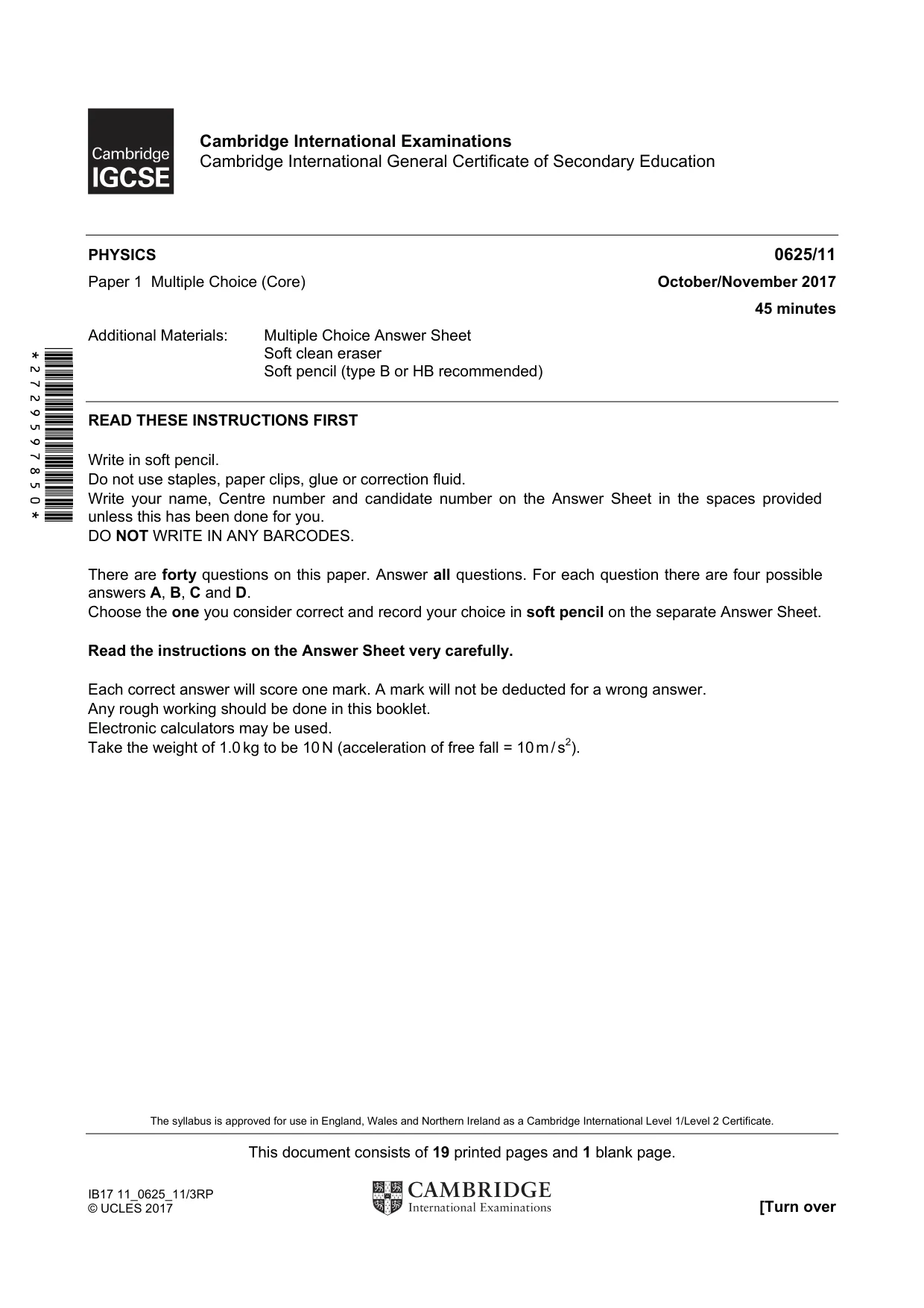
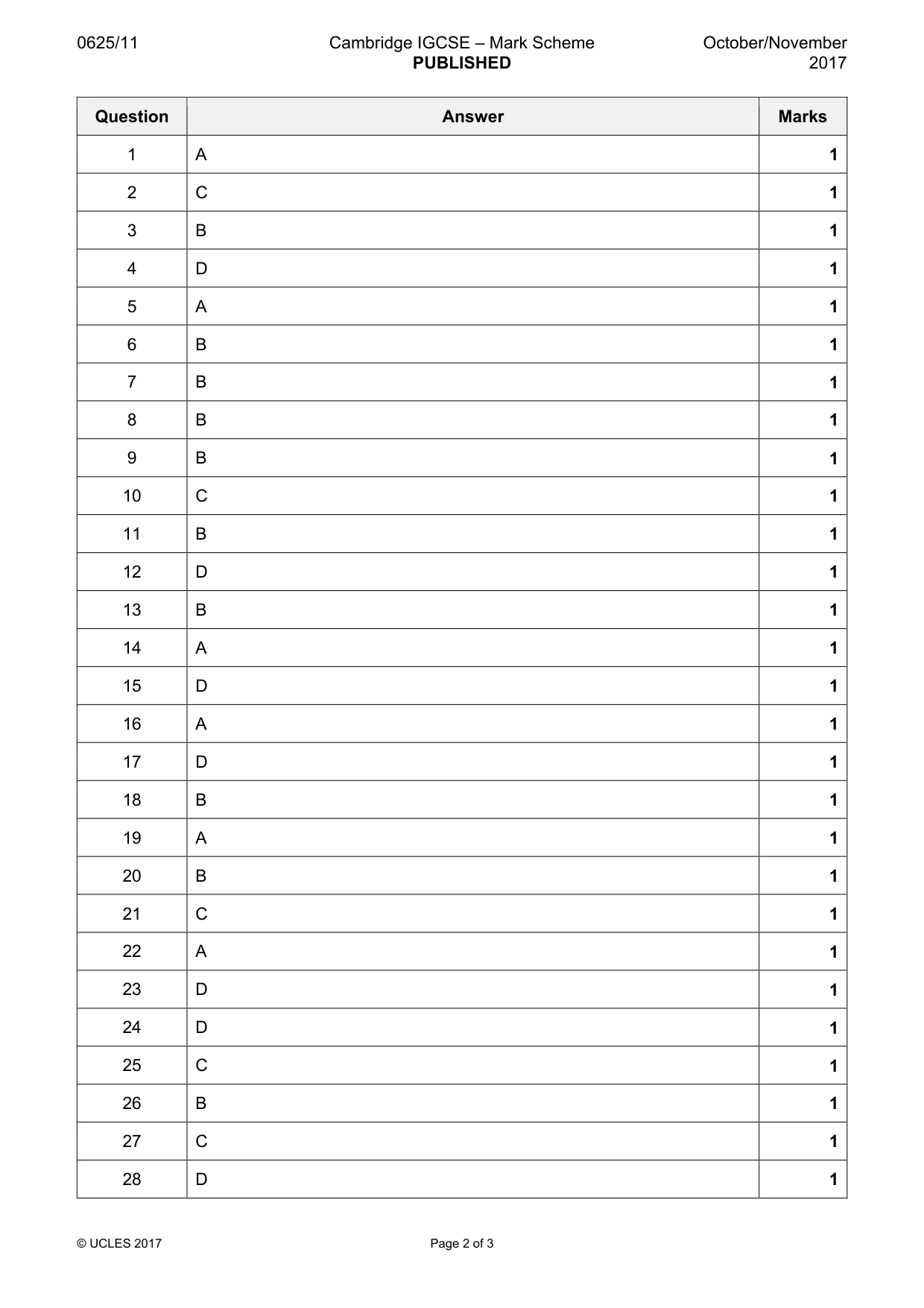
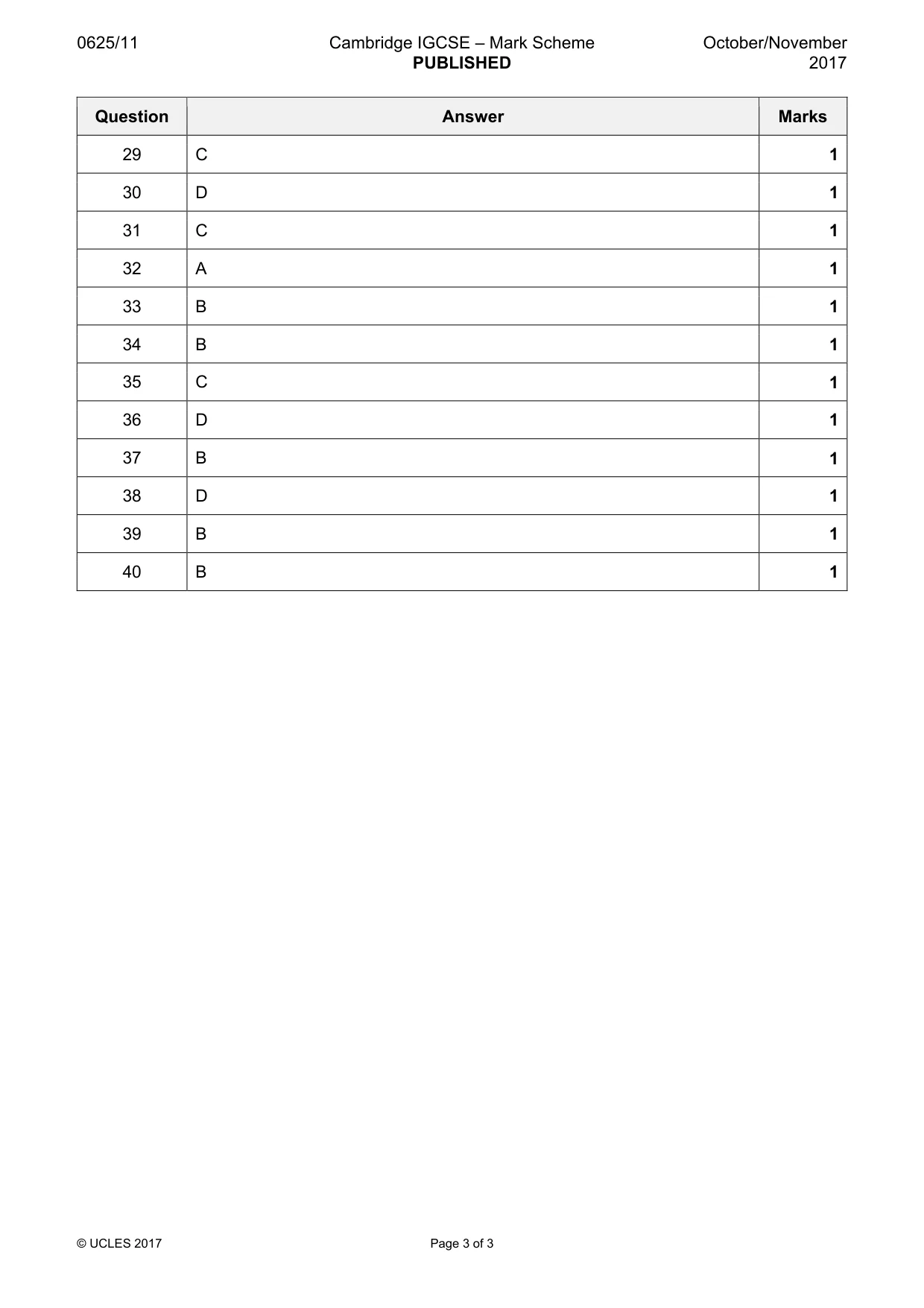
Mark scheme3 pages
Answers below. Sit the paper first if you are practising.
Questions as text
Q1 · A student measures the volume of a cork
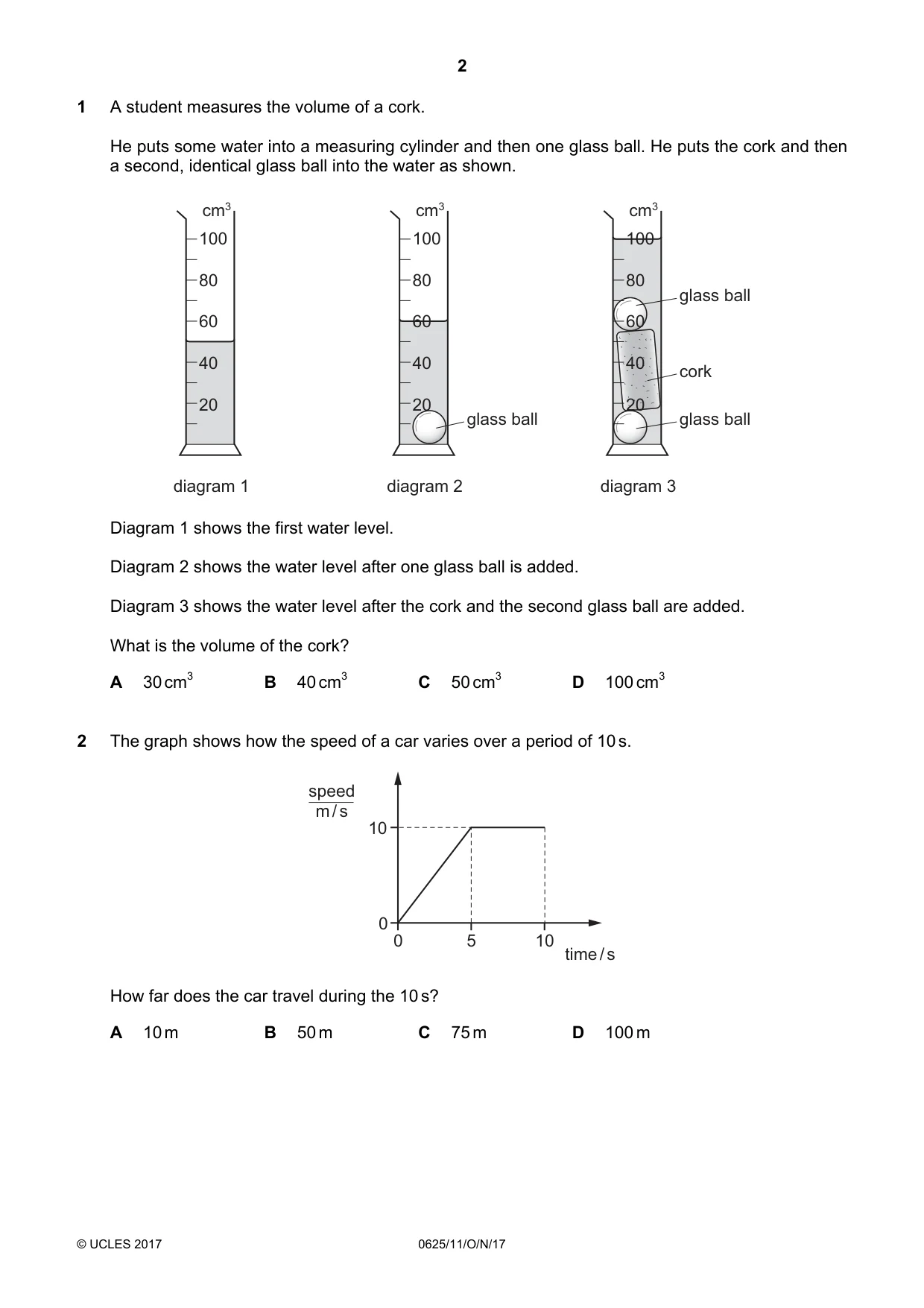
1 A student measures the volume of a cork. He puts some water into a measuring cylinder and then one glass ball. He puts the cork and then a second, identical glass ball into the water as shown. cm3 cm3 cm3 100 100 100 80 80 80 glass ball 60 60 60 40 40 40 cork 20 20 20 glass ball glass ball diagram 1 diagram 2 diagram 3 Diagram 1 shows the first water level. Diagram 2 shows the water level after one glass ball is added. Diagram 3 shows the water level after the cork and the second glass ball are added. What is the volume of the cork? A 30 cm3 B 40 cm3 C 50 cm3 D 100 cm3
Mark scheme: A
More questions on Physical quantities and measurement techniques
Q2 · The graph shows how the speed of a car varies over a period of 10 s
2 The graph shows how the speed of a car varies over a period of 10 s. speed m / s 10 0 0 5 10 time / s How far does the car travel during the 10 s? A 10 m B 50 m C 75 m D 100 m
Mark scheme: C
Q3 · The diagram shows how the speed of a falling object changes with time
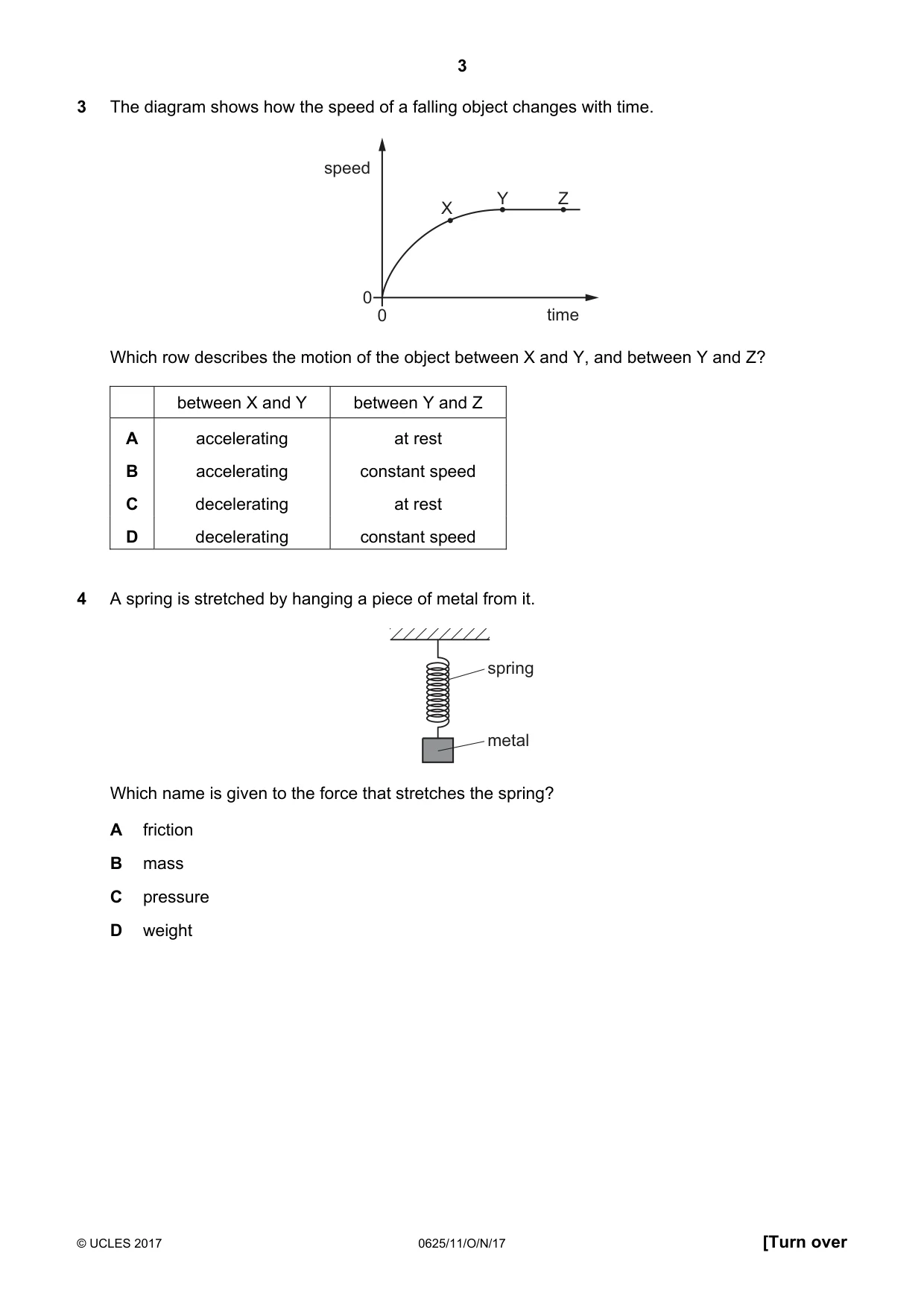
3 The diagram shows how the speed of a falling object changes with time. speed Y Z X 0 0 time Which row describes the motion of the object between X and Y, and between Y and Z? between X and Y between Y and Z A accelerating at rest B accelerating constant speed C decelerating at rest D decelerating constant speed
Mark scheme: B
Q4 · A spring is stretched by hanging a piece of metal from it
4 A spring is stretched by hanging a piece of metal from it. spring metal Which name is given to the force that stretches the spring? A friction B mass C pressure D weight
Mark scheme: D
Q5 · The graph shows how weight varies with mass on planet P and on planet Q
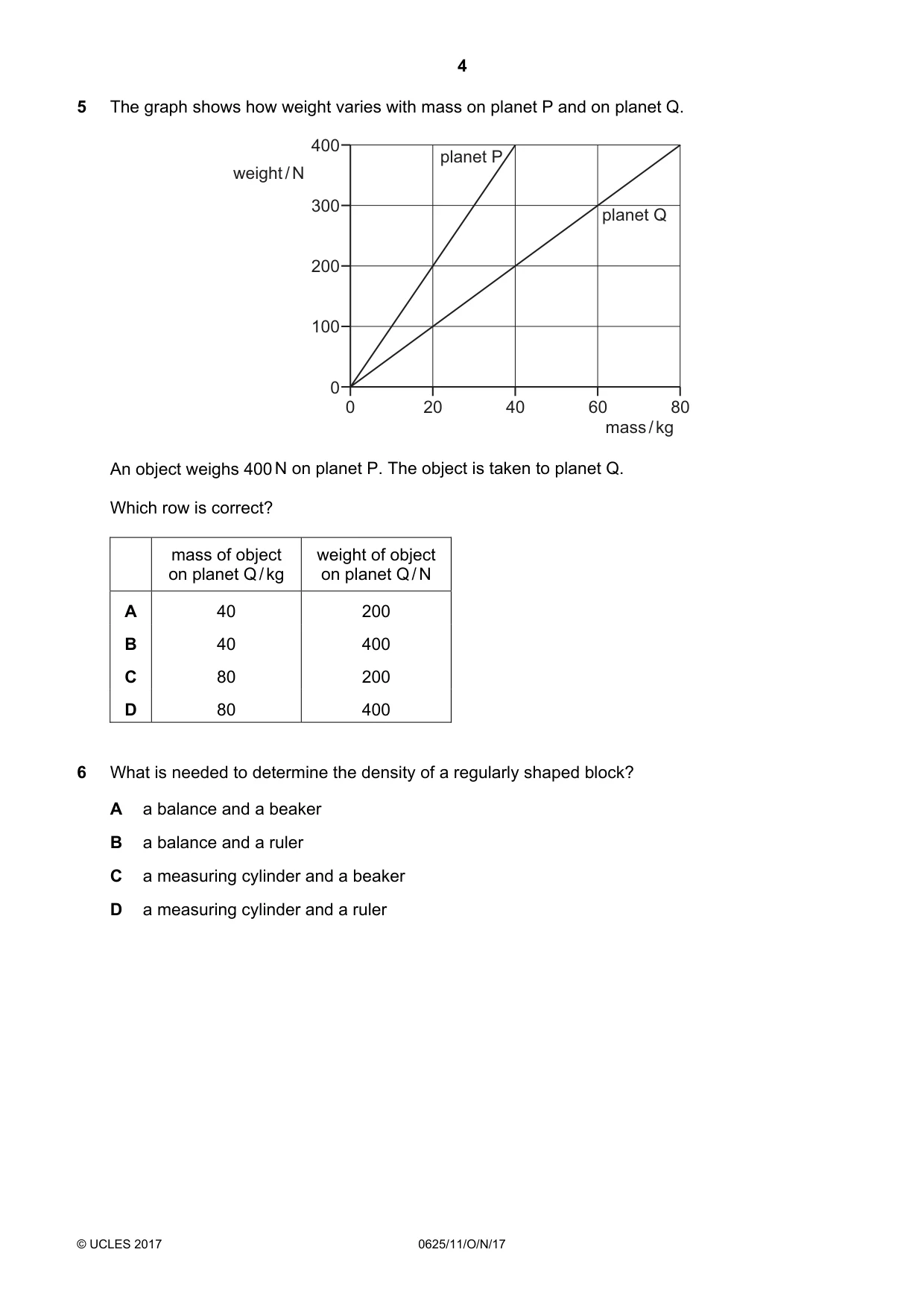
5 The graph shows how weight varies with mass on planet P and on planet Q. 400 planet P weight / N 300 planet Q 200 100 0 0 20 40 60 80 mass / kg An object weighs 400 N on planet P. The object is taken to planet Q. Which row is correct? mass of object weight of object on planet Q / kg on planet Q / N A 40 200 B 40 400 C 80 200 D 80 400
Mark scheme: A
Q6 · What is needed to determine the density of a regularly shaped block?
6 What is needed to determine the density of a regularly shaped block? A a balance and a beaker B a balance and a ruler C a measuring cylinder and a beaker D a measuring cylinder and a ruler
Mark scheme: B
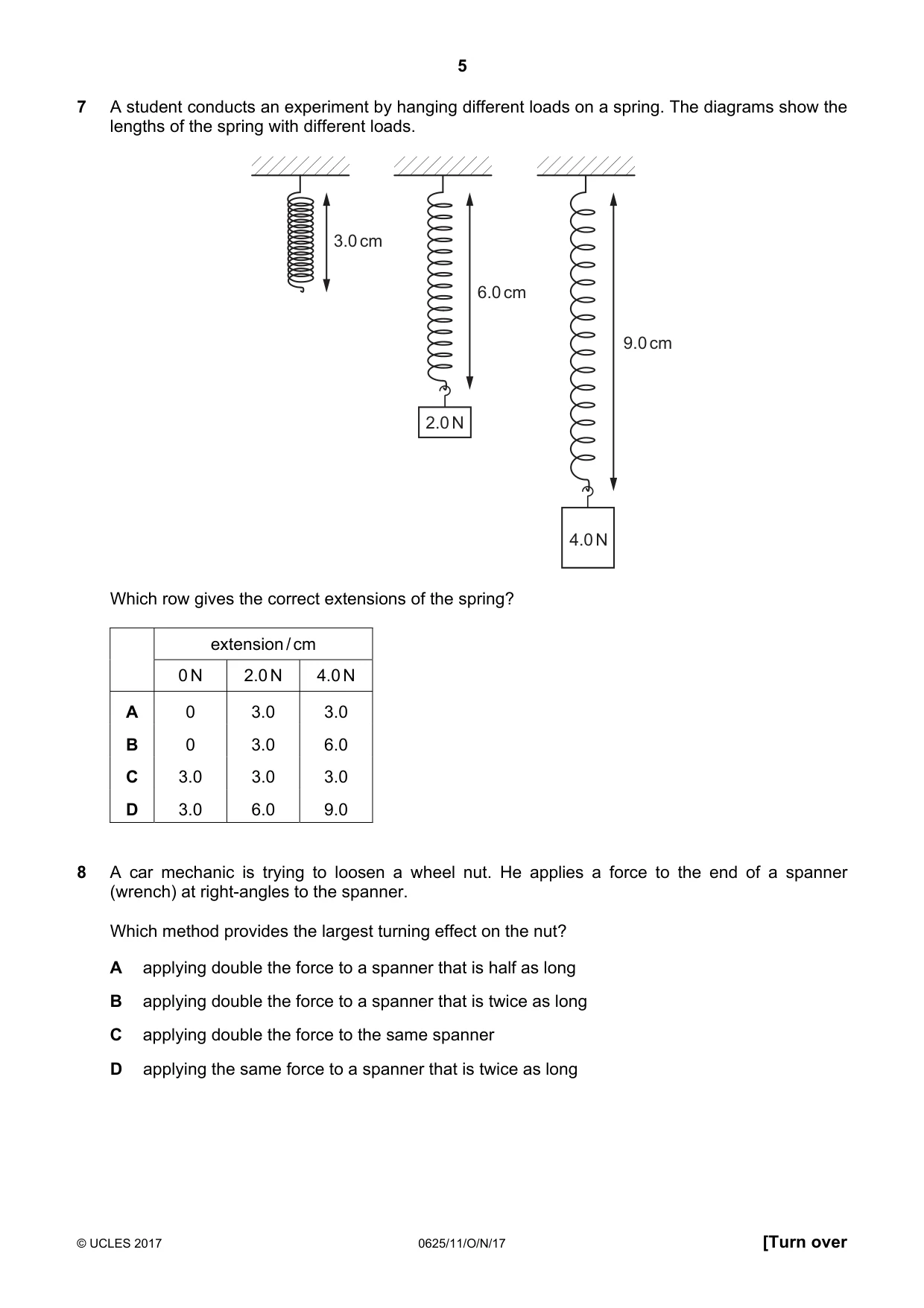
Q7 · A student conducts an experiment by hanging different loads on a spring
7 A student conducts an experiment by hanging different loads on a spring. The diagrams show the lengths of the spring with different loads. 3.0 cm 6.0 cm 9.0 cm 2.0 N 4.0 N Which row gives the correct extensions of the spring? extension / cm 0 N 2.0 N 4.0 N A 0 3.0 3.0 B 0 3.0 6.0 C 3.0 3.0 3.0 D 3.0 6.0 9.0
Mark scheme: B
Q8 · A car mechanic is trying to loosen a wheel nut
8 A car mechanic is trying to loosen a wheel nut. He applies a force to the end of a spanner (wrench) at right-angles to the spanner. Which method provides the largest turning effect on the nut? A applying double the force to a spanner that is half as long B applying double the force to a spanner that is twice as long C applying double the force to the same spanner D applying the same force to a spanner that is twice as long
Mark scheme: B
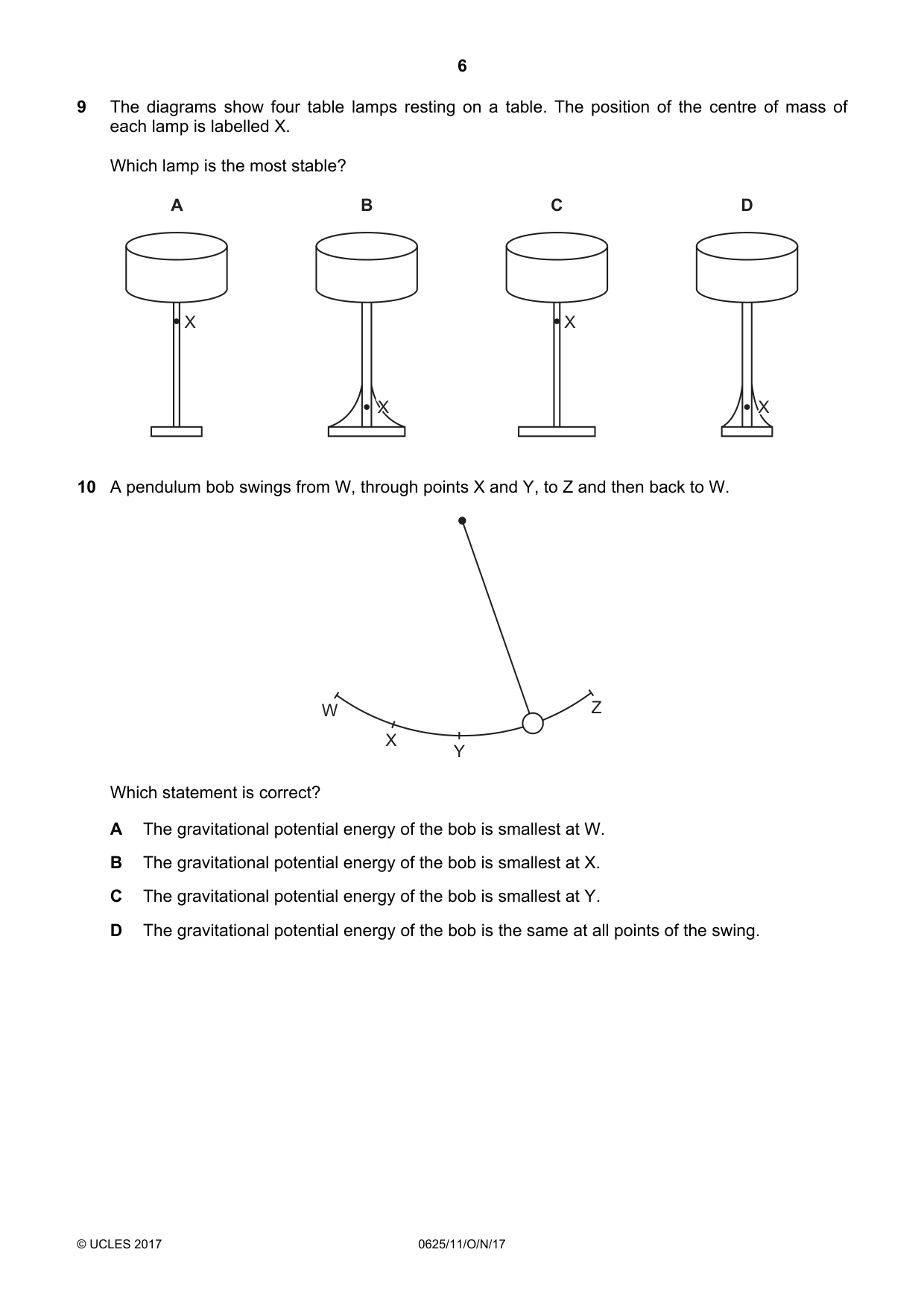
Q9 · The diagrams show four table lamps resting on a table
9 The diagrams show four table lamps resting on a table. The position of the centre of mass of each lamp is labelled X. Which lamp is the most stable? A B C D X X X X
Mark scheme: B
Q10 · A pendulum bob swings from W, through points X and Y, to Z and then back to W
10 A pendulum bob swings from W, through points X and Y, to Z and then back to W. W Z X Y Which statement is correct? A The gravitational potential energy of the bob is smallest at W. B The gravitational potential energy of the bob is smallest at X. C The gravitational potential energy of the bob is smallest at Y. D The gravitational potential energy of the bob is the same at all points of the swing.
Mark scheme: C
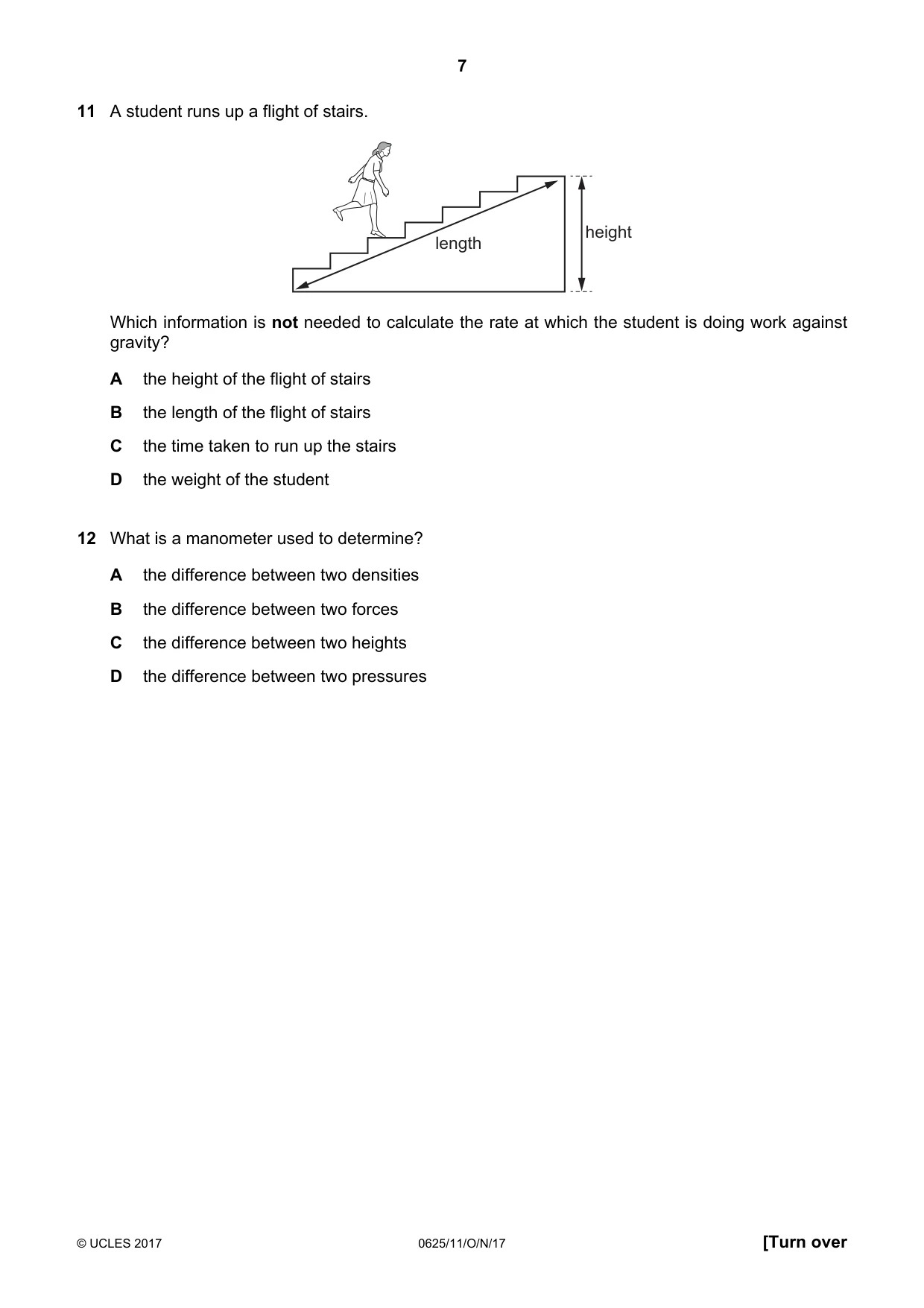
Q11 · A student runs up a flight of stairs
11 A student runs up a flight of stairs. height length Which information is not needed to calculate the rate at which the student is doing work against gravity? A the height of the flight of stairs B the length of the flight of stairs C the time taken to run up the stairs D the weight of the student
Mark scheme: B
Q12 · What is a manometer used to determine?
12 What is a manometer used to determine? A the difference between two densities B the difference between two forces C the difference between two heights D the difference between two pressures
Mark scheme: D
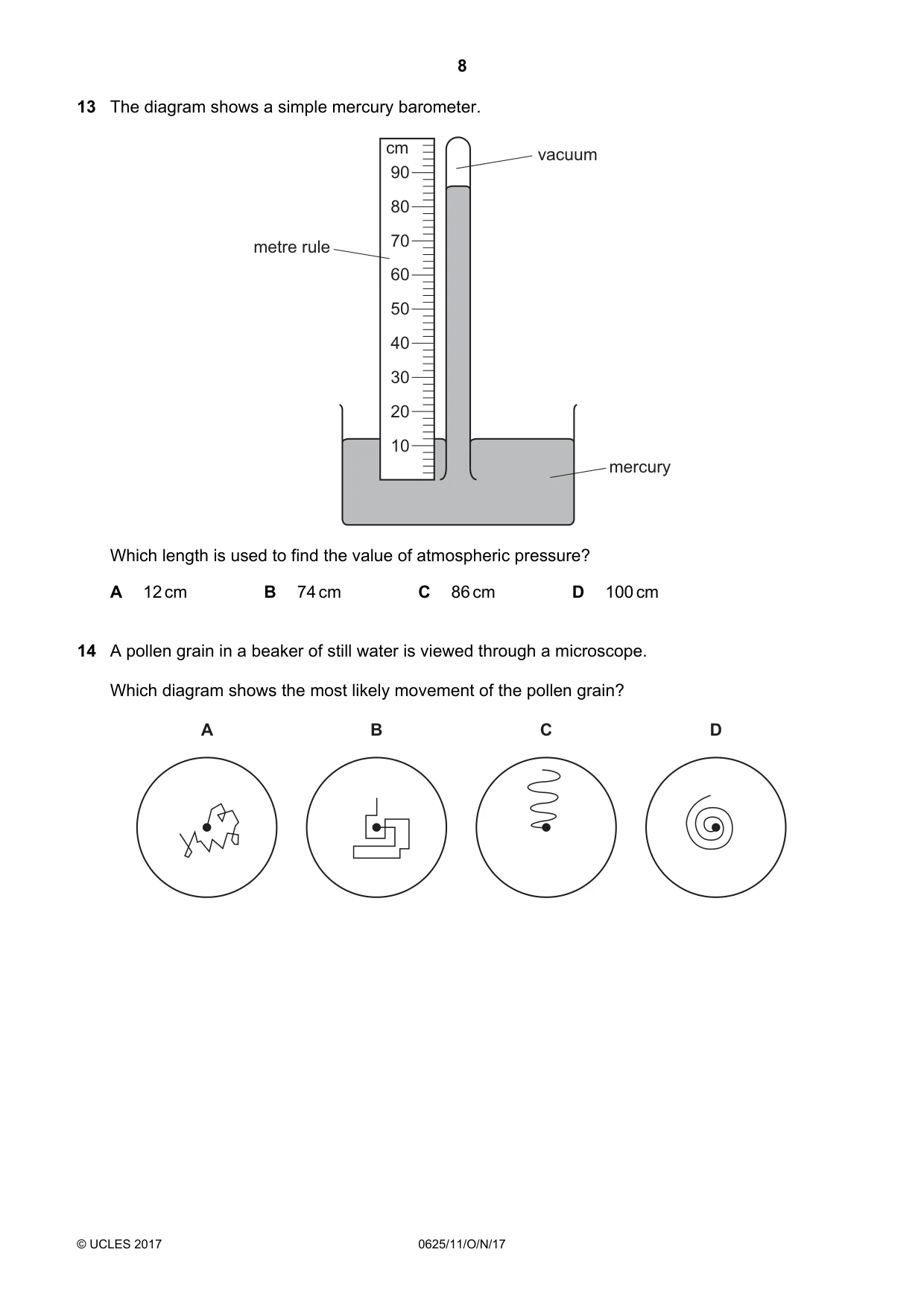
Q13 · The diagram shows a simple mercury barometer
13 The diagram shows a simple mercury barometer. cm vacuum 90 80 metre rule 70 60 50 40 30 20 10 mercury Which length is used to find the value of atmospheric pressure? A 12 cm B 74 cm C 86 cm D 100 cm
Mark scheme: B
Q14 · A pollen grain in a beaker of still water is viewed through a microscope
14 A pollen grain in a beaker of still water is viewed through a microscope. Which diagram shows the most likely movement of the pollen grain? A B C D
Mark scheme: A
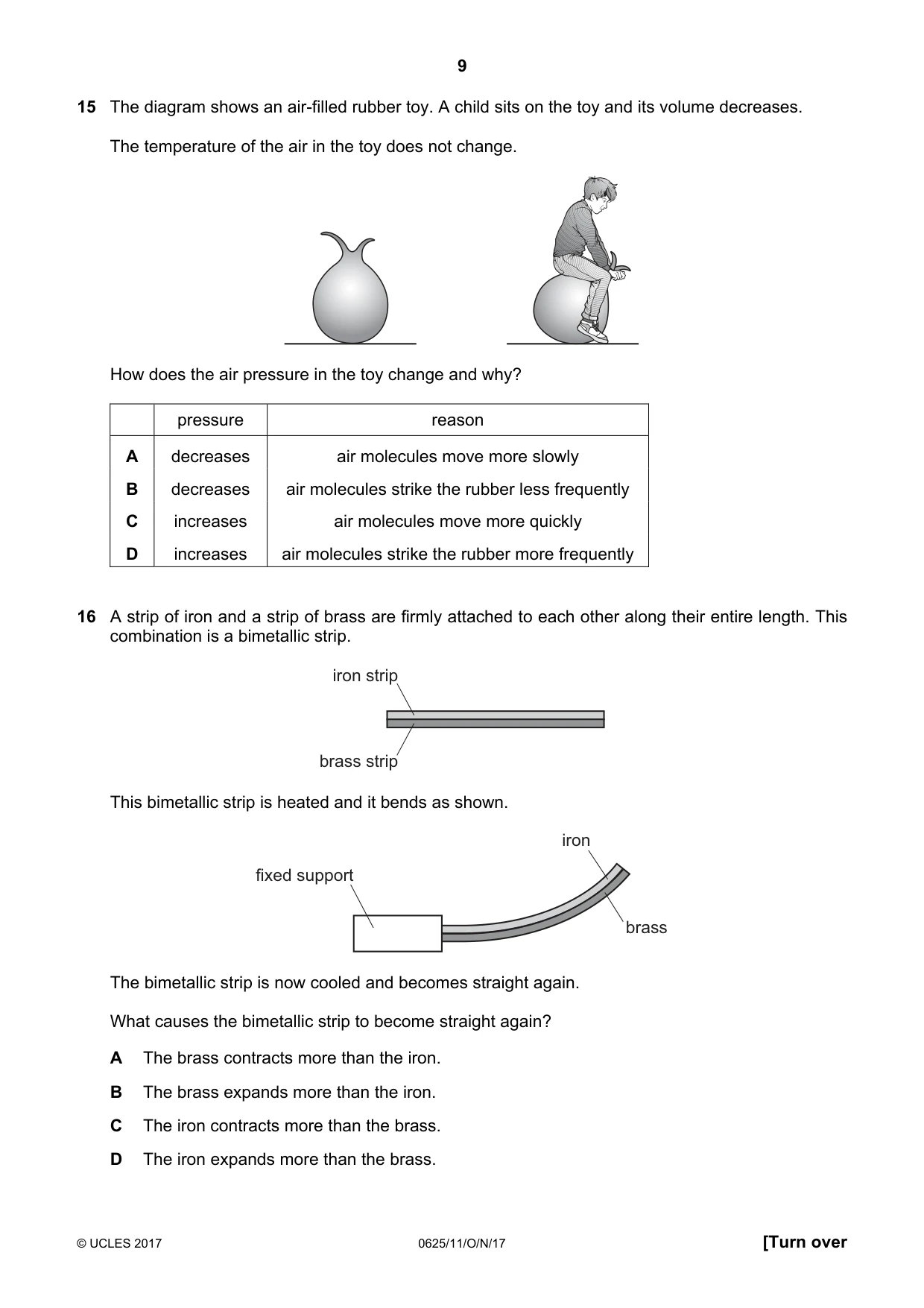
Q15 · The diagram shows an air-filled rubber toy
15 The diagram shows an air-filled rubber toy. A child sits on the toy and its volume decreases. The temperature of the air in the toy does not change. How does the air pressure in the toy change and why? pressure reason A decreases air molecules move more slowly B decreases air molecules strike the rubber less frequently C increases air molecules move more quickly D increases air molecules strike the rubber more frequently
Mark scheme: D
Q16 · A strip of iron and a strip of brass are firmly attached to each other along their entire…
16 A strip of iron and a strip of brass are firmly attached to each other along their entire length. This combination is a bimetallic strip. iron strip brass strip This bimetallic strip is heated and it bends as shown. iron fixed support brass The bimetallic strip is now cooled and becomes straight again. What causes the bimetallic strip to become straight again? A The brass contracts more than the iron. B The brass expands more than the iron. C The iron contracts more than the brass. D The iron expands more than the brass.
Mark scheme: A
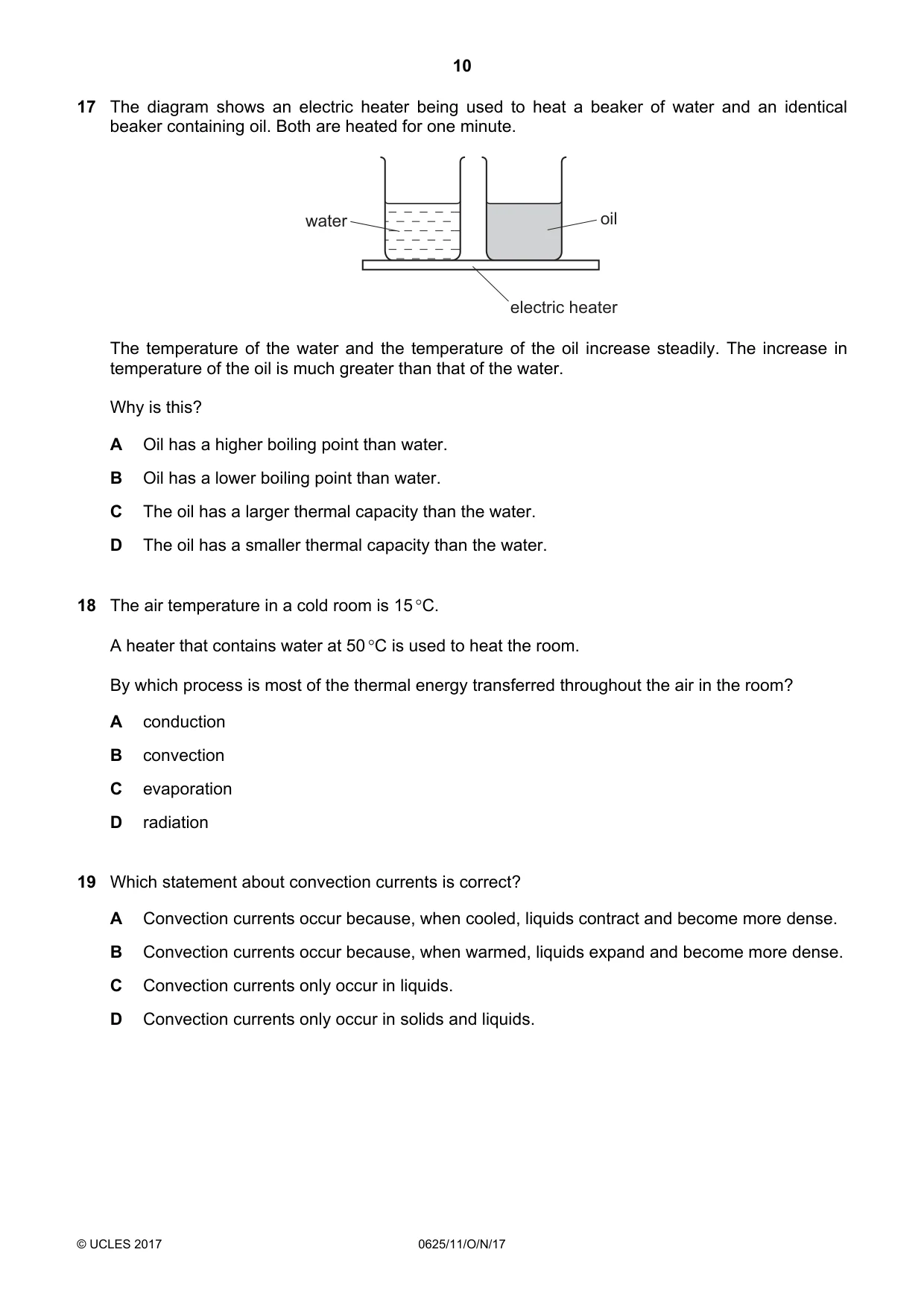
Q17 · The diagram shows an electric heater being used to heat a beaker of water and an…
17 The diagram shows an electric heater being used to heat a beaker of water and an identical beaker containing oil. Both are heated for one minute. water oil electric heater The temperature of the water and the temperature of the oil increase steadily. The increase in temperature of the oil is much greater than that of the water. Why is this? A Oil has a higher boiling point than water. B Oil has a lower boiling point than water. C The oil has a larger thermal capacity than the water. D The oil has a smaller thermal capacity than the water.
Mark scheme: D
Q18 · The air temperature in a cold room is 15 °C
18 The air temperature in a cold room is 15 °C. A heater that contains water at 50 °C is used to heat the room. By which process is most of the thermal energy transferred throughout the air in the room? A conduction B convection C evaporation D radiation
Mark scheme: B
Q19 · Which statement about convection currents is correct?
19 Which statement about convection currents is correct? A Convection currents occur because, when cooled, liquids contract and become more dense. B Convection currents occur because, when warmed, liquids expand and become more dense. C Convection currents only occur in liquids. D Convection currents only occur in solids and liquids.
Mark scheme: A
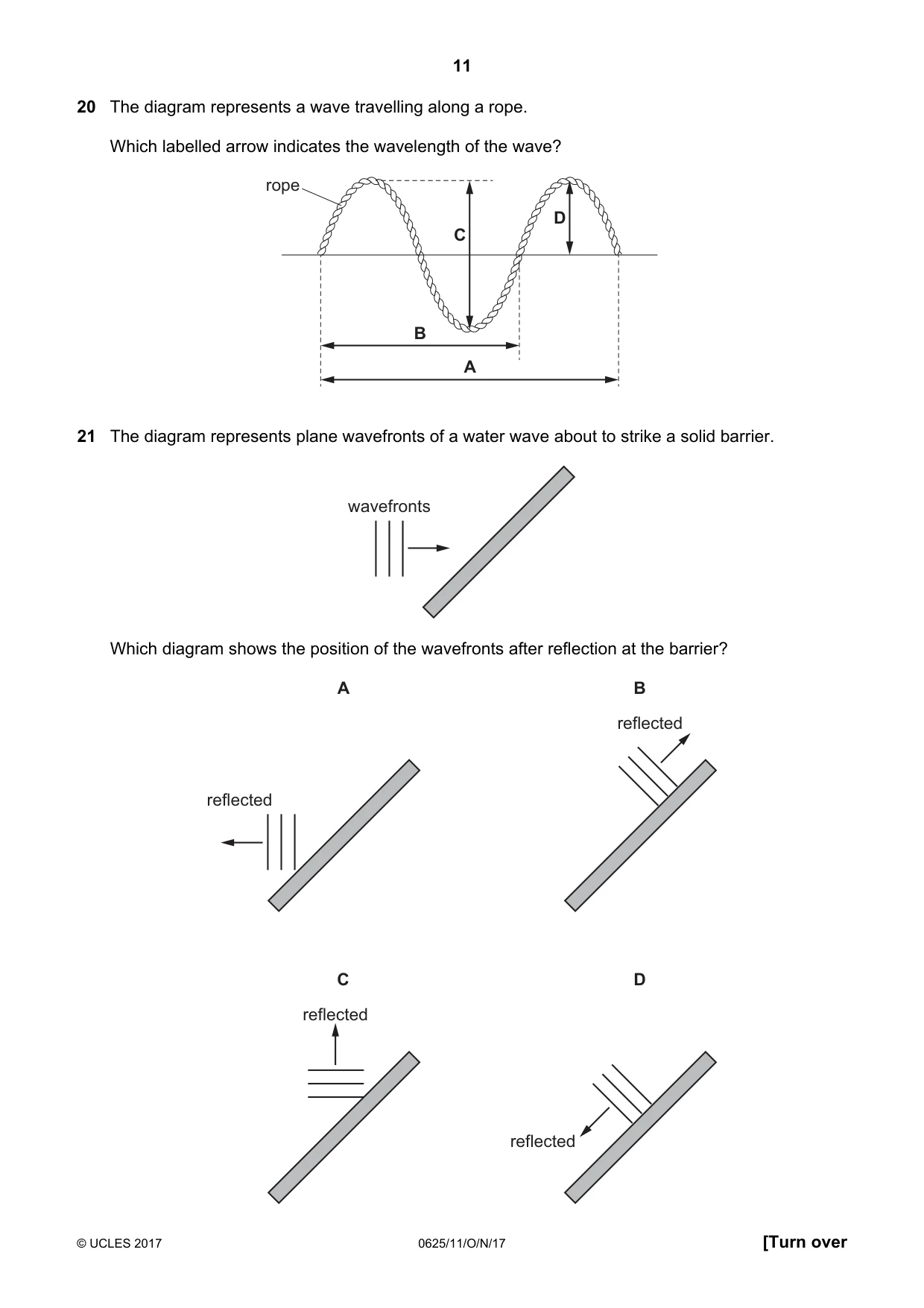
Q20 · The diagram represents a wave travelling along a rope
20 The diagram represents a wave travelling along a rope. Which labelled arrow indicates the wavelength of the wave? rope D C B A
Mark scheme: B
Q21 · The diagram represents plane wavefronts of a water wave about to strike a solid barrier
21 The diagram represents plane wavefronts of a water wave about to strike a solid barrier. wavefronts Which diagram shows the position of the wavefronts after reflection at the barrier? A B reflected reflected C D reflected reflected
Mark scheme: C
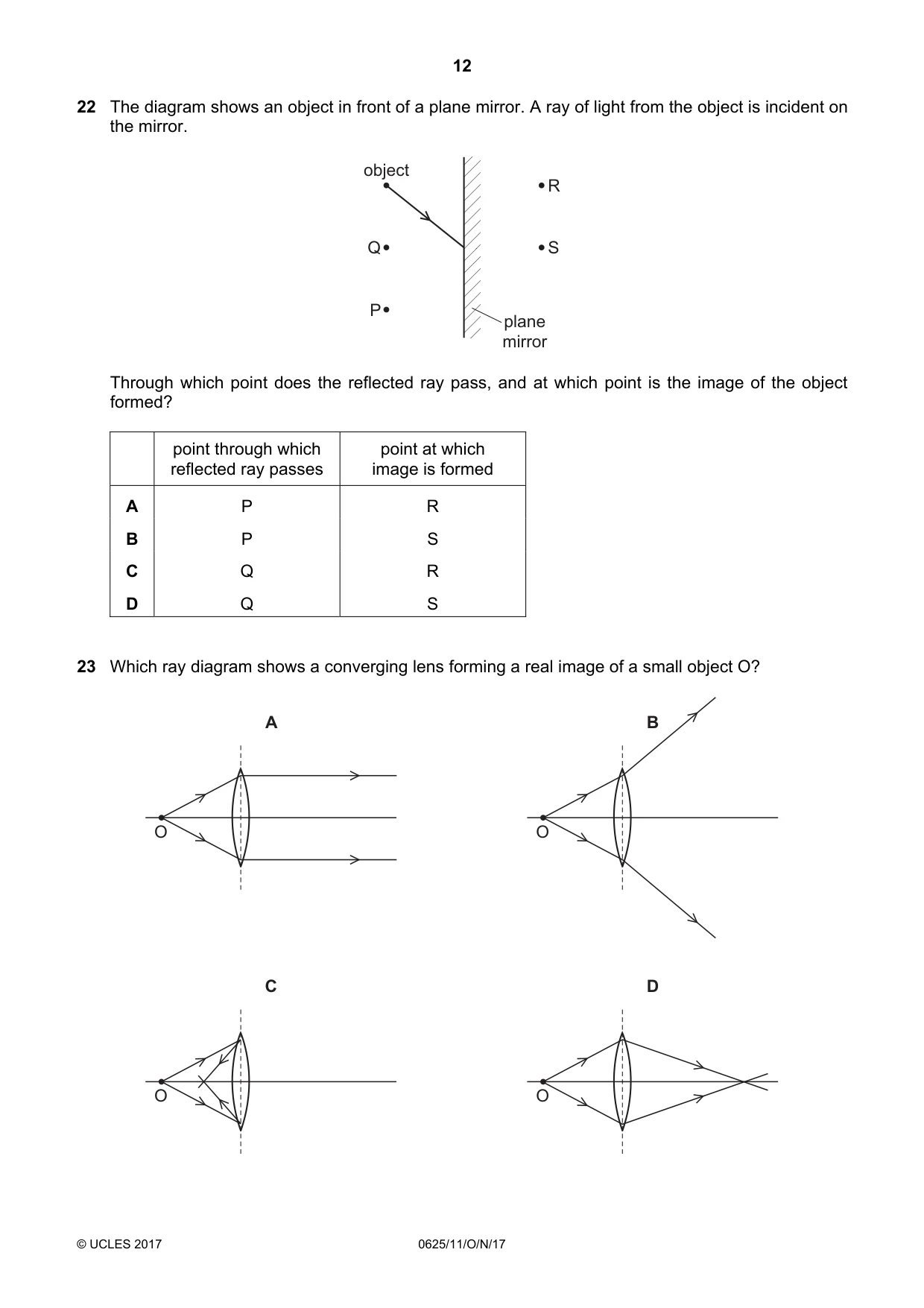
Q22 · The diagram shows an object in front of a plane mirror
22 The diagram shows an object in front of a plane mirror. A ray of light from the object is incident on the mirror. object R Q S P plane mirror Through which point does the reflected ray pass, and at which point is the image of the object formed? point through which point at which reflected ray passes image is formed A P R B P S C Q R D Q S
Mark scheme: A
Q23 · Which ray diagram shows a converging lens forming a real image of a small object O?
23 Which ray diagram shows a converging lens forming a real image of a small object O? A B O O C D O O
Mark scheme: D
Q24 · Visible light, X-rays and microwaves are all components of the electromagnetic spectrum
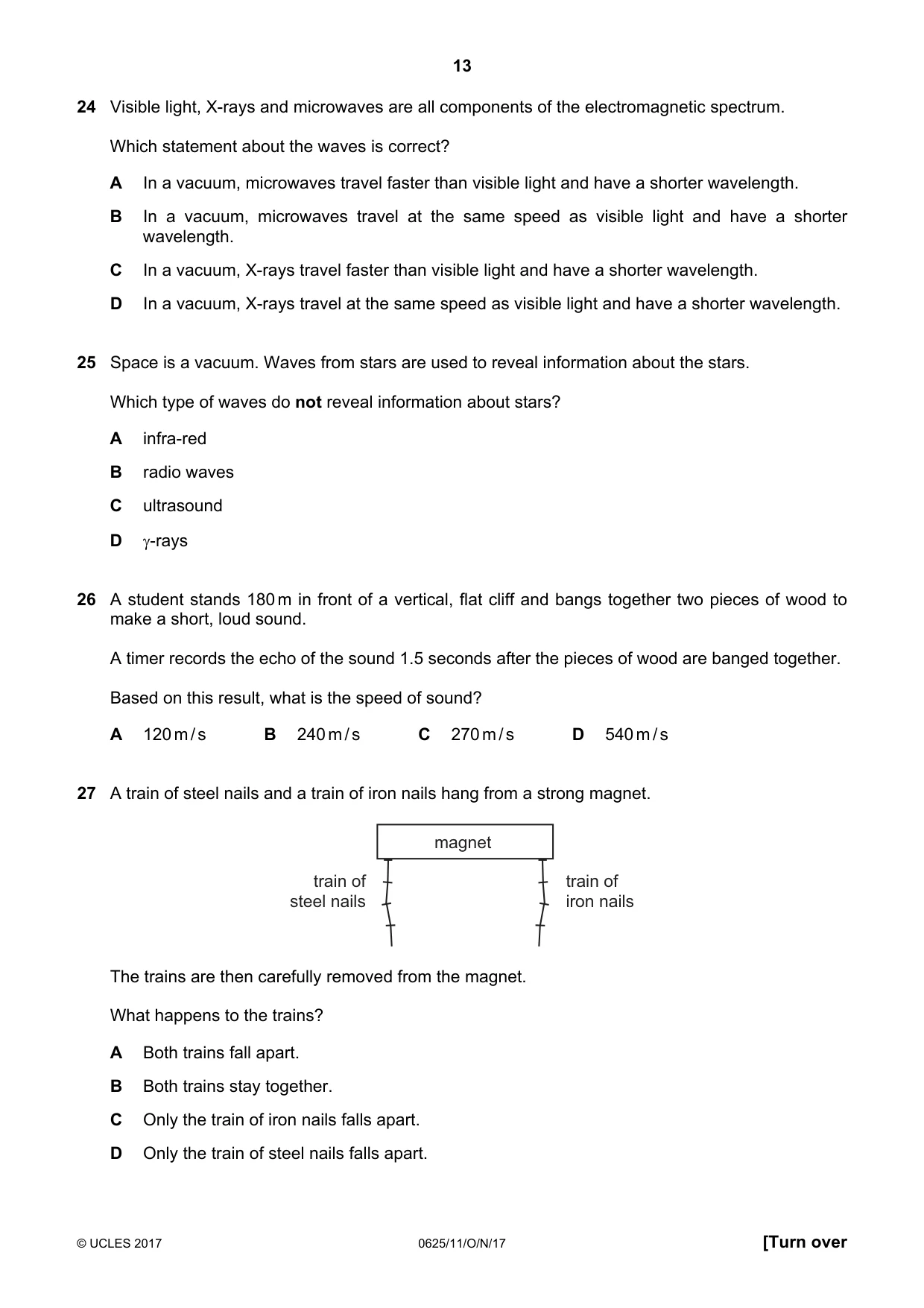
24 Visible light, X-rays and microwaves are all components of the electromagnetic spectrum. Which statement about the waves is correct? A In a vacuum, microwaves travel faster than visible light and have a shorter wavelength. B In a vacuum, microwaves travel at the same speed as visible light and have a shorter wavelength. C In a vacuum, X-rays travel faster than visible light and have a shorter wavelength. D In a vacuum, X-rays travel at the same speed as visible light and have a shorter wavelength.
Mark scheme: D
Q25 · Space is a vacuum
25 Space is a vacuum. Waves from stars are used to reveal information about the stars. Which type of waves do not reveal information about stars? A infra-red B radio waves C ultrasound D γ-rays
Mark scheme: C
Q26 · A student stands 180 m in front of a vertical, flat cliff and bangs together two pieces…
26 A student stands 180 m in front of a vertical, flat cliff and bangs together two pieces of wood to make a short, loud sound. A timer records the echo of the sound 1.5 seconds after the pieces of wood are banged together. Based on this result, what is the speed of sound? A 120 m / s B 240 m / s C 270 m / s D 540 m / s
Mark scheme: B
Q27 · A train of steel nails and a train of iron nails hang from a strong magnet
27 A train of steel nails and a train of iron nails hang from a strong magnet. magnet train of train of steel nails iron nails The trains are then carefully removed from the magnet. What happens to the trains? A Both trains fall apart. B Both trains stay together. C Only the train of iron nails falls apart. D Only the train of steel nails falls apart.
Mark scheme: C
Q28 · The north pole of a bar magnet is placed in turn next to each end of a rod X
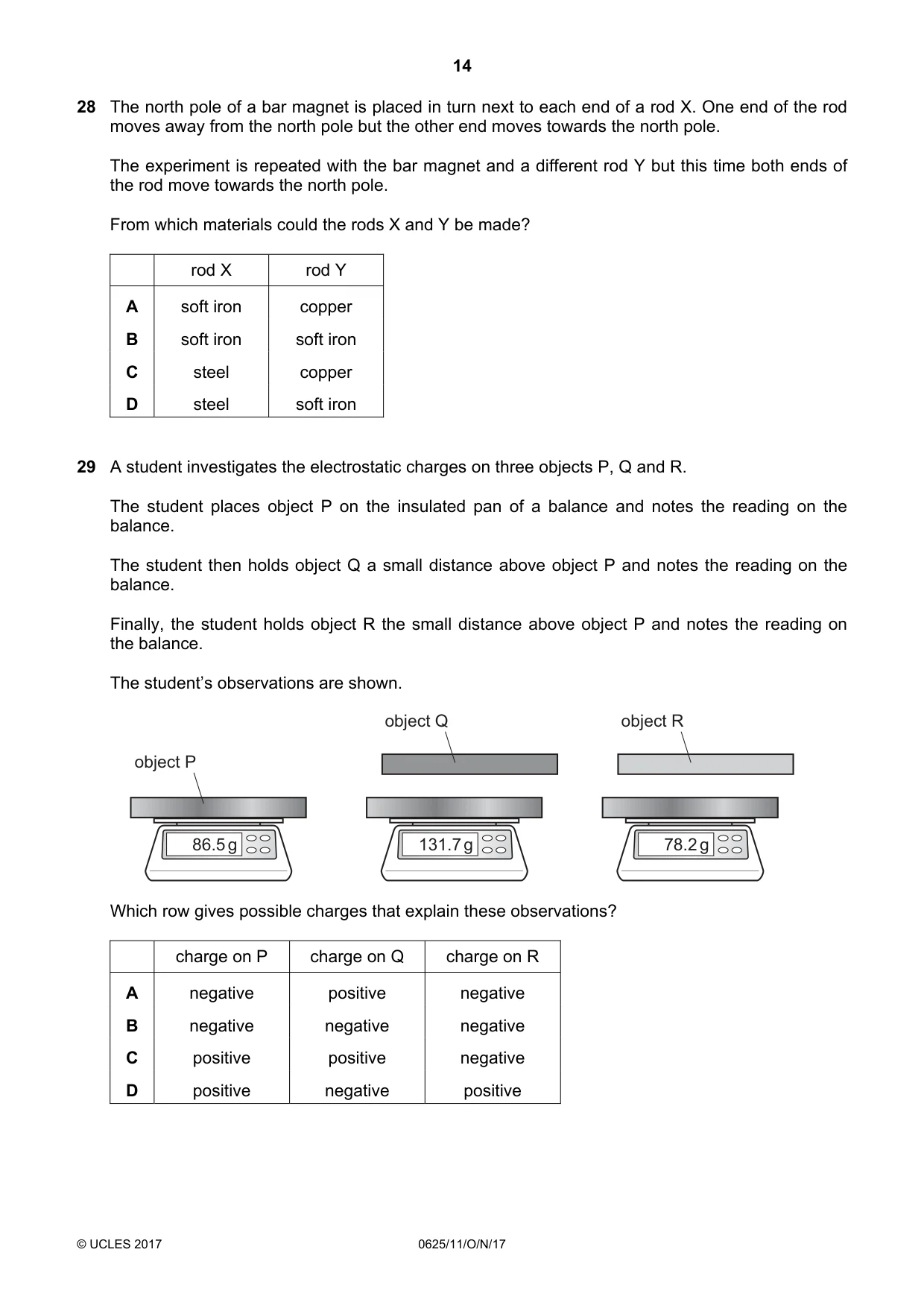
28 The north pole of a bar magnet is placed in turn next to each end of a rod X. One end of the rod moves away from the north pole but the other end moves towards the north pole. The experiment is repeated with the bar magnet and a different rod Y but this time both ends of the rod move towards the north pole. From which materials could the rods X and Y be made? rod X rod Y A soft iron copper B soft iron soft iron C steel copper D steel soft iron
Mark scheme: D
Q29 · A student investigates the electrostatic charges on three objects P, Q and R
29 A student investigates the electrostatic charges on three objects P, Q and R. The student places object P on the insulated pan of a balance and notes the reading on the balance. The student then holds object Q a small distance above object P and notes the reading on the balance. Finally, the student holds object R the small distance above object P and notes the reading on the balance. The student’s observations are shown. object Q object R object P 86.5 g 131.7 g 78.2 g Which row gives possible charges that explain these observations? charge on P charge on Q charge on R A negative positive negative B negative negative negative C positive positive negative D positive negative positive
Mark scheme: C
Q30 · Which equation is used to calculate resistance?
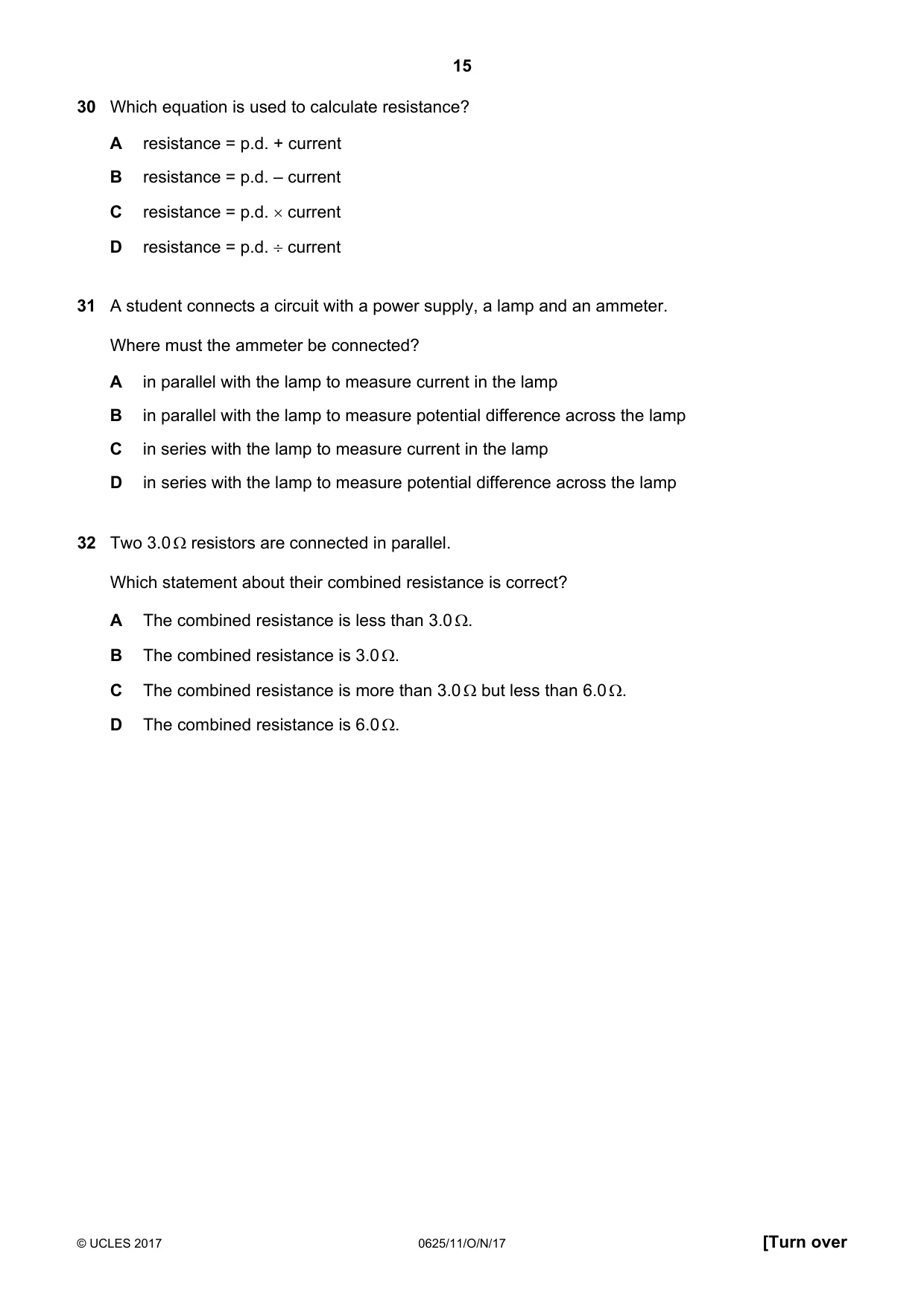
30 Which equation is used to calculate resistance? A resistance = p.d. + current B resistance = p.d. – current C resistance = p.d. × current D resistance = p.d. ÷ current
Mark scheme: D
Q31 · A student connects a circuit with a power supply, a lamp and an ammeter
31 A student connects a circuit with a power supply, a lamp and an ammeter. Where must the ammeter be connected? A in parallel with the lamp to measure current in the lamp B in parallel with the lamp to measure potential difference across the lamp C in series with the lamp to measure current in the lamp D in series with the lamp to measure potential difference across the lamp
Mark scheme: C
Q32 · Two 3.0 Ω resistors are connected in parallel
32 Two 3.0 Ω resistors are connected in parallel. Which statement about their combined resistance is correct? A The combined resistance is less than 3.0 Ω. B The combined resistance is 3.0 Ω. C The combined resistance is more than 3.0 Ω but less than 6.0 Ω. D The combined resistance is 6.0 Ω.
Mark scheme: A
Q33 · The diagram shows a potential divider circuit
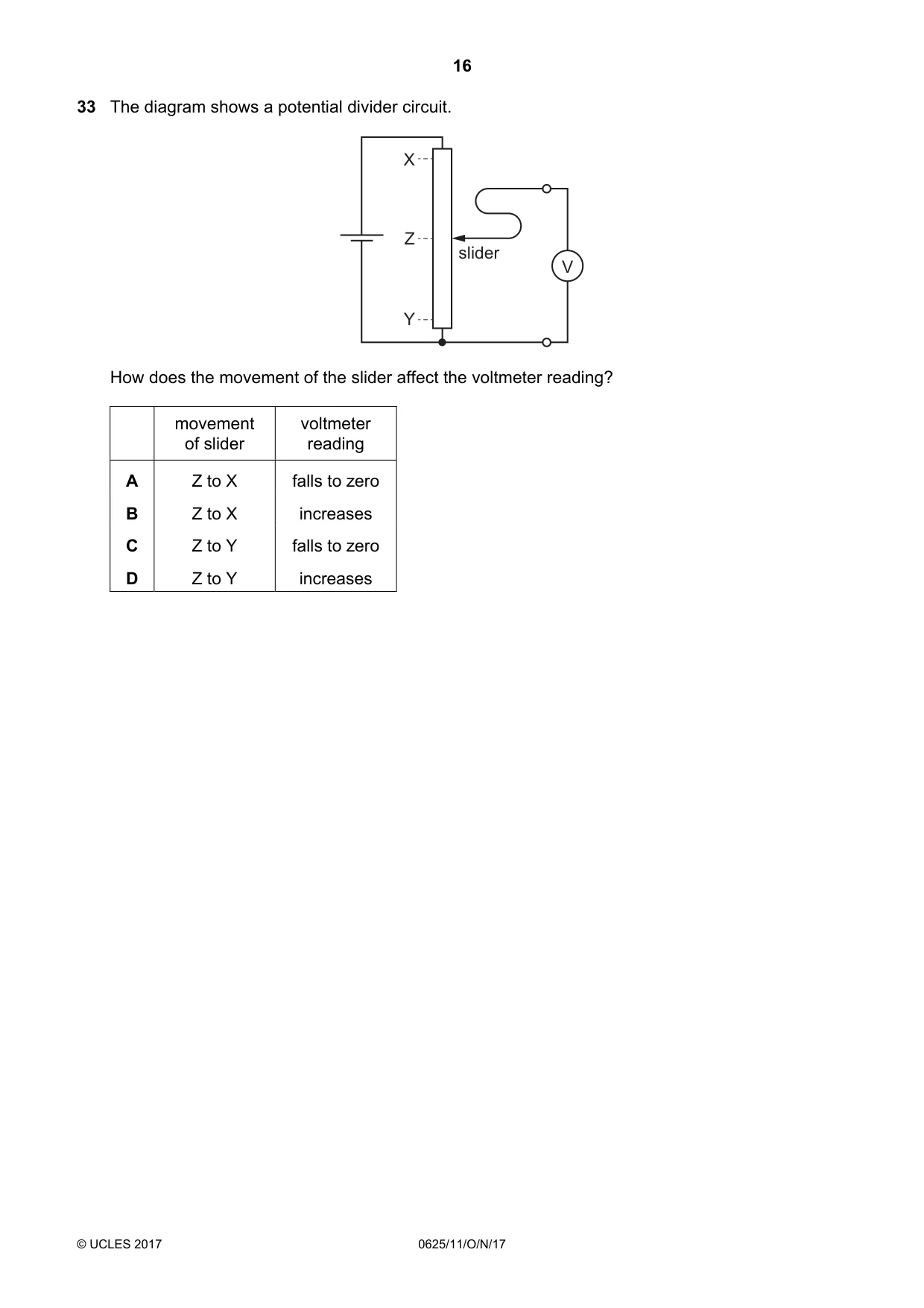
33 The diagram shows a potential divider circuit. X Z slider V Y How does the movement of the slider affect the voltmeter reading? movement voltmeter of slider reading A Z to X falls to zero B Z to X increases C Z to Y falls to zero D Z to Y increases
Mark scheme: B
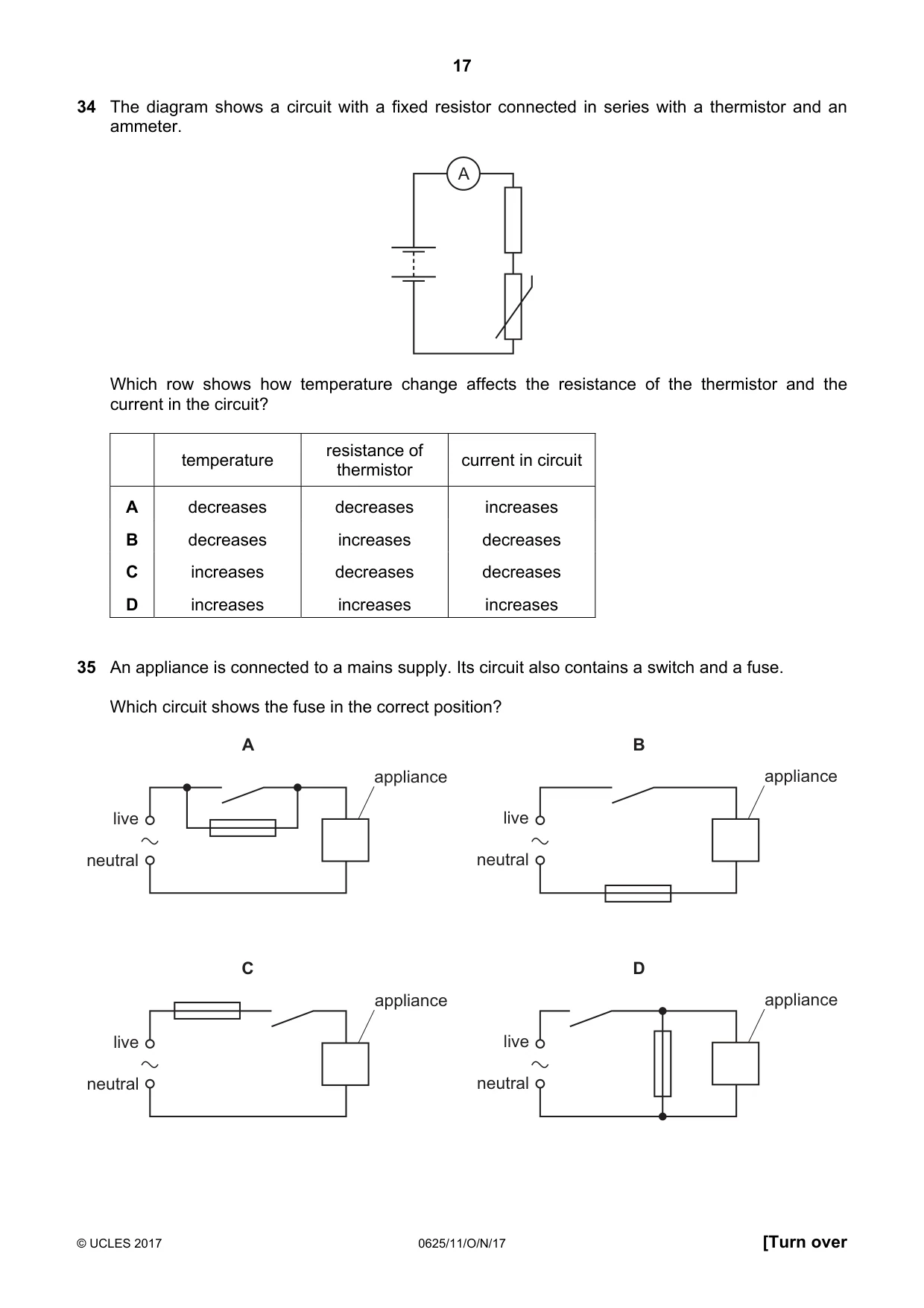
Q34 · The diagram shows a circuit with a fixed resistor connected in series with a thermistor…
34 The diagram shows a circuit with a fixed resistor connected in series with a thermistor and an ammeter. A Which row shows how temperature change affects the resistance of the thermistor and the current in the circuit? resistance of temperature current in circuit thermistor A decreases decreases increases B decreases increases decreases C increases decreases decreases D increases increases increases
Mark scheme: B
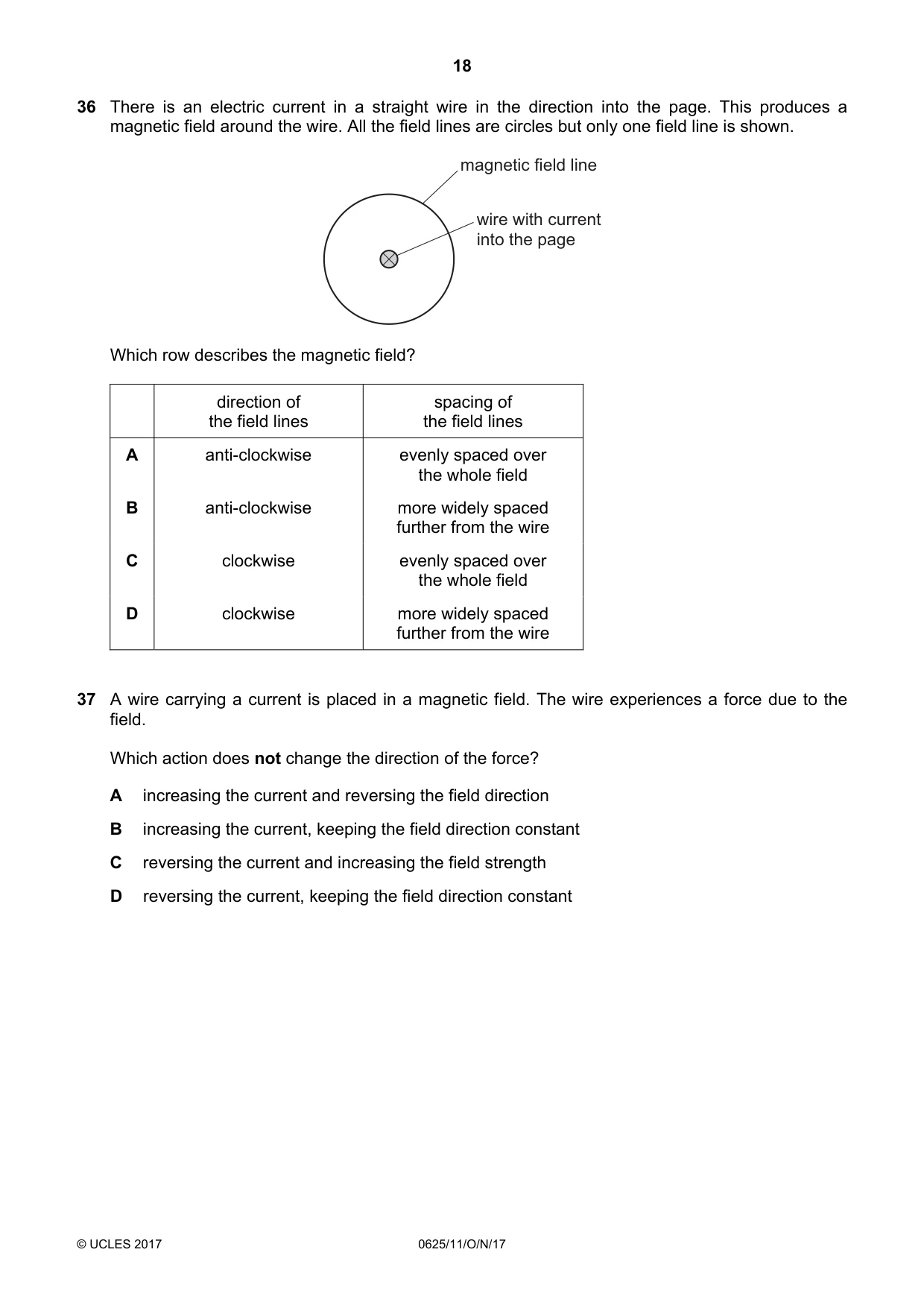
Q35 · An appliance is connected to a mains supply
35 An appliance is connected to a mains supply. Its circuit also contains a switch and a fuse. Which circuit shows the fuse in the correct position? A B appliance appliance live live neutral neutral C D appliance appliance live live neutral neutral
Mark scheme: C
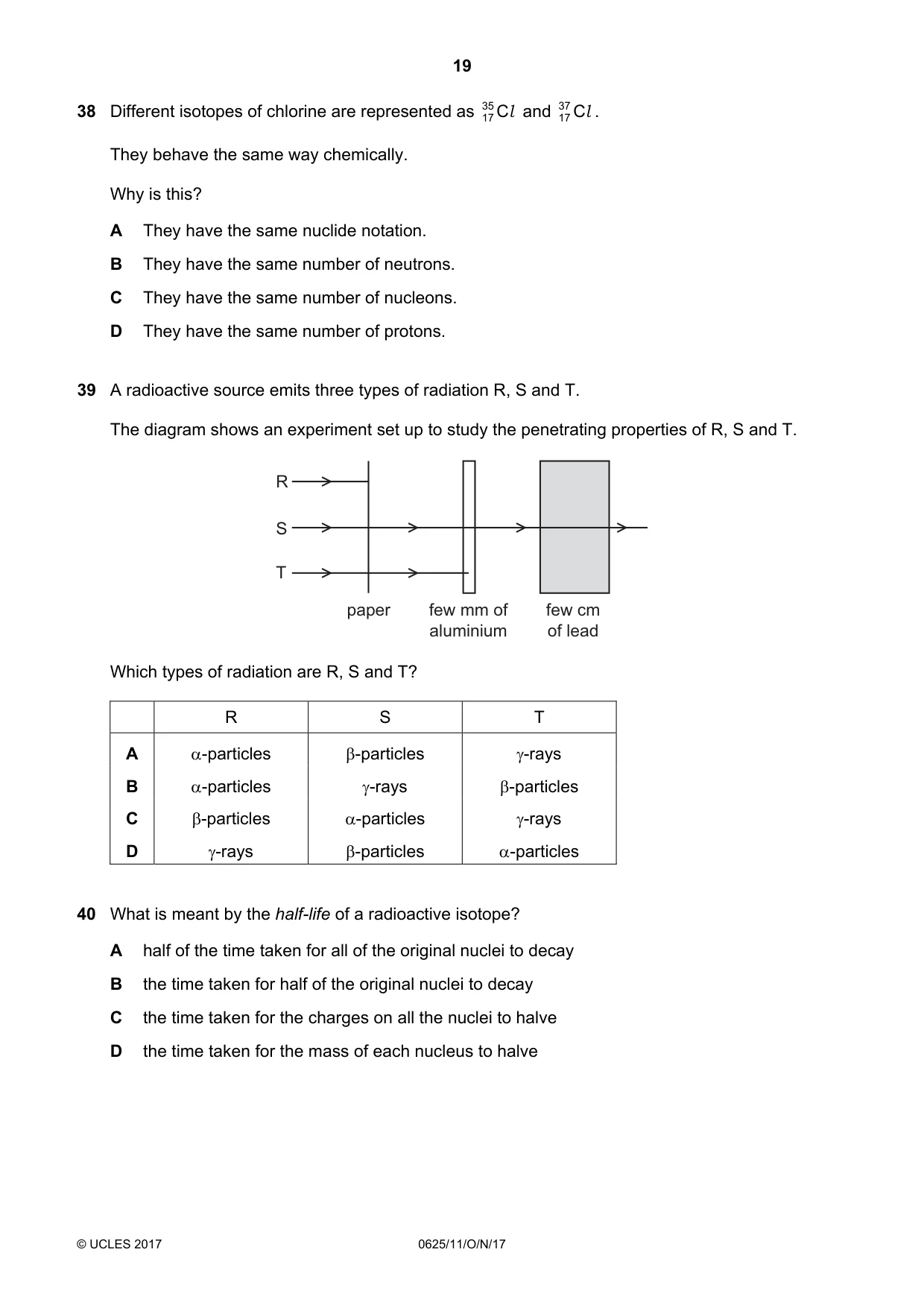
Q36 · There is an electric current in a straight wire in the direction into the page
36 There is an electric current in a straight wire in the direction into the page. This produces a magnetic field around the wire. All the field lines are circles but only one field line is shown. magnetic field line wire with current into the page Which row describes the magnetic field? direction of spacing of the field lines the field lines A anti-clockwise evenly spaced over the whole field B anti-clockwise more widely spaced further from the wire C clockwise evenly spaced over the whole field D clockwise more widely spaced further from the wire
Mark scheme: D
Q37 · A wire carrying a current is placed in a magnetic field
37 A wire carrying a current is placed in a magnetic field. The wire experiences a force due to the field. Which action does not change the direction of the force? A increasing the current and reversing the field direction B increasing the current, keeping the field direction constant C reversing the current and increasing the field strength D reversing the current, keeping the field direction constant
Mark scheme: B
Q38 · Different isotopes of chlorine are represented as 35 C l and 37 C l
38 Different isotopes of chlorine are represented as 35 C l and 37 C l . 17 17 They behave the same way chemically. Why is this? A They have the same nuclide notation. B They have the same number of neutrons. C They have the same number of nucleons. D They have the same number of protons.
Mark scheme: D
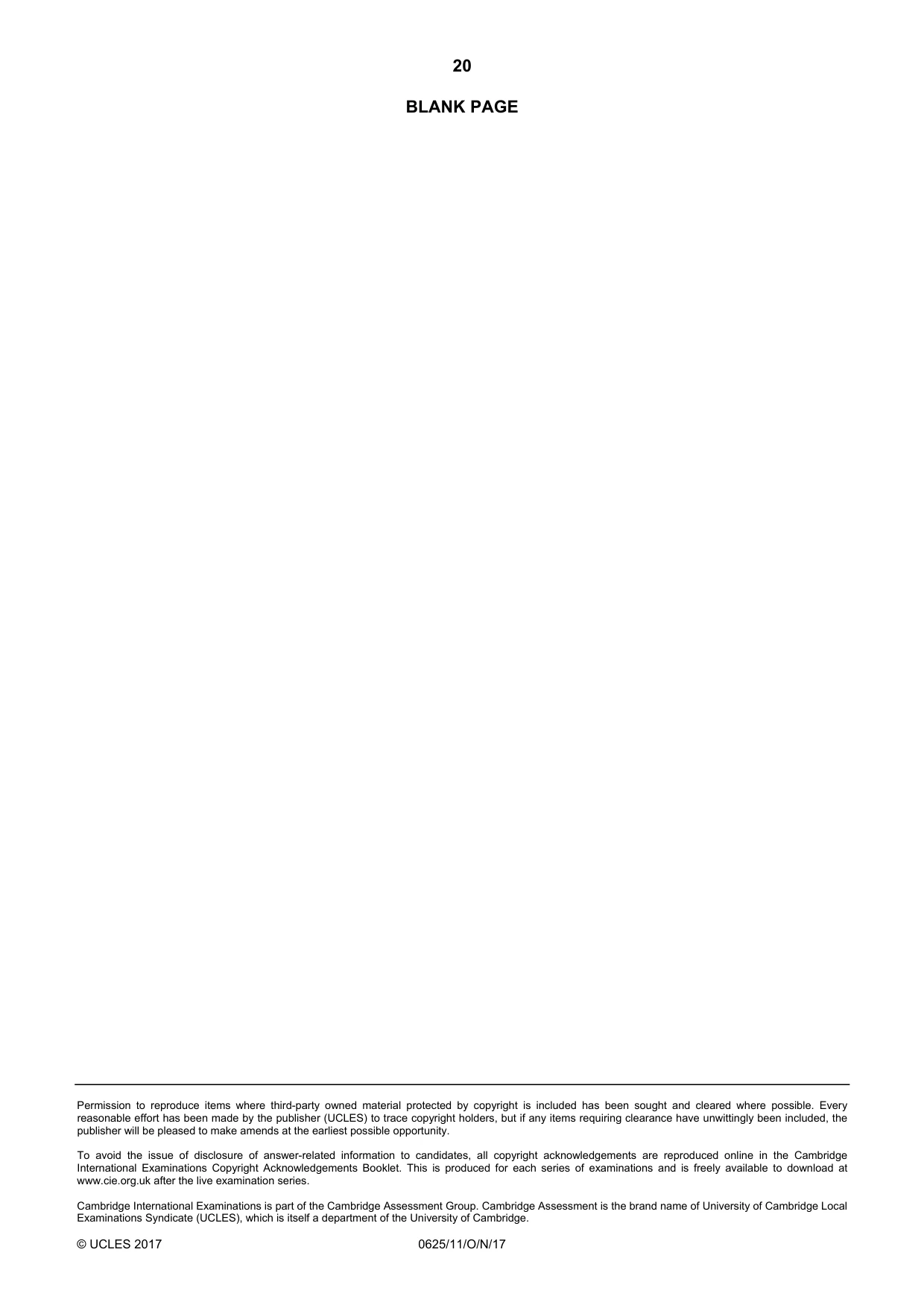
Q39 · A radioactive source emits three types of radiation R, S and T
39 A radioactive source emits three types of radiation R, S and T. The diagram shows an experiment set up to study the penetrating properties of R, S and T. R S T paper few mm of few cm aluminium of lead Which types of radiation are R, S and T? R S T A α-particles β-particles γ-rays B α-particles γ-rays β-particles C β-particles α-particles γ-rays D γ-rays β-particles α-particles
Mark scheme: B
Q40 · What is meant by the half-life of a radioactive isotope?
40 What is meant by the half-life of a radioactive isotope? A half of the time taken for all of the original nuclei to decay B the time taken for half of the original nuclei to decay C the time taken for the charges on all the nuclei to halve D the time taken for the mass of each nucleus to halve
Mark scheme: B
What was in this paper
The subtopics covered by these 40 questions, and how many questions each got. Open one in a new tab to see every Cambridge question on it.
4Forces3Electrical quantities2Electromagnetic effects2Energy, work and power2General properties of waves2Kinetic particle model of matter2Light2Mass and weight2Motion2Pressure2Radioactivity2Simple phenomena of magnetism2Sound2Thermal properties and temperature2Transfer of thermal energy2Density1Electrical safety1Electromagnetic spectrum1Physical quantities and measurement techniques1The nuclear model of the atom1What you needed in this session
Cambridge’s own grade thresholds for 2017 Oct/Nov, Paper 1 · Variant 1. A higher threshold means an easier paper — the bar moves with how the cohort did.