Cambridge IGCSE Physics 0625 — 2015 Oct/Nov Paper 1 · Variant 1
0625/11/O/N/15 · 40 questions · 40 marks · ≈45 min
The question paper and its mark scheme, free to read here and free to download. This is Cambridge’s own paper, exactly as it was sat.
Question paper16 pages
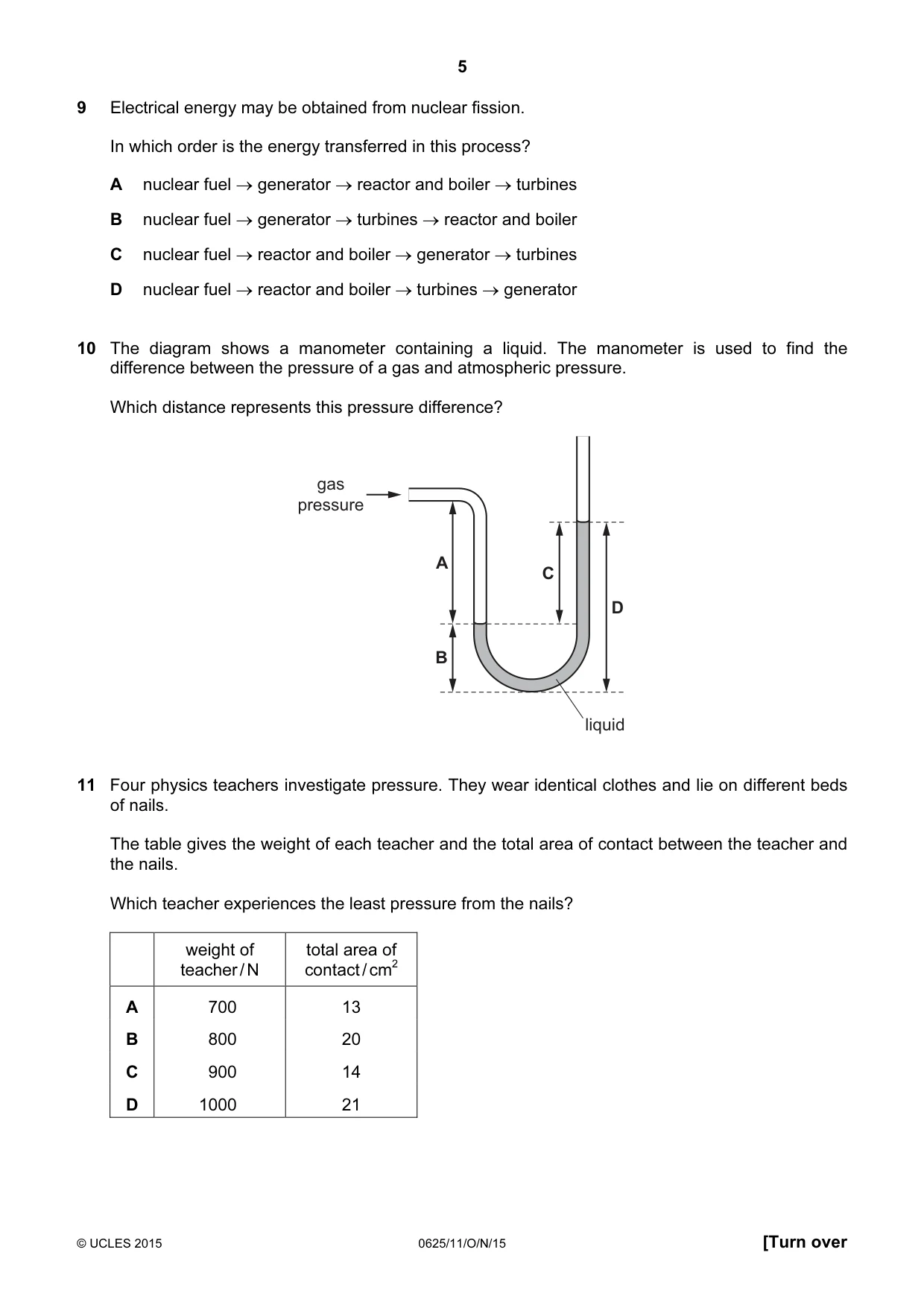
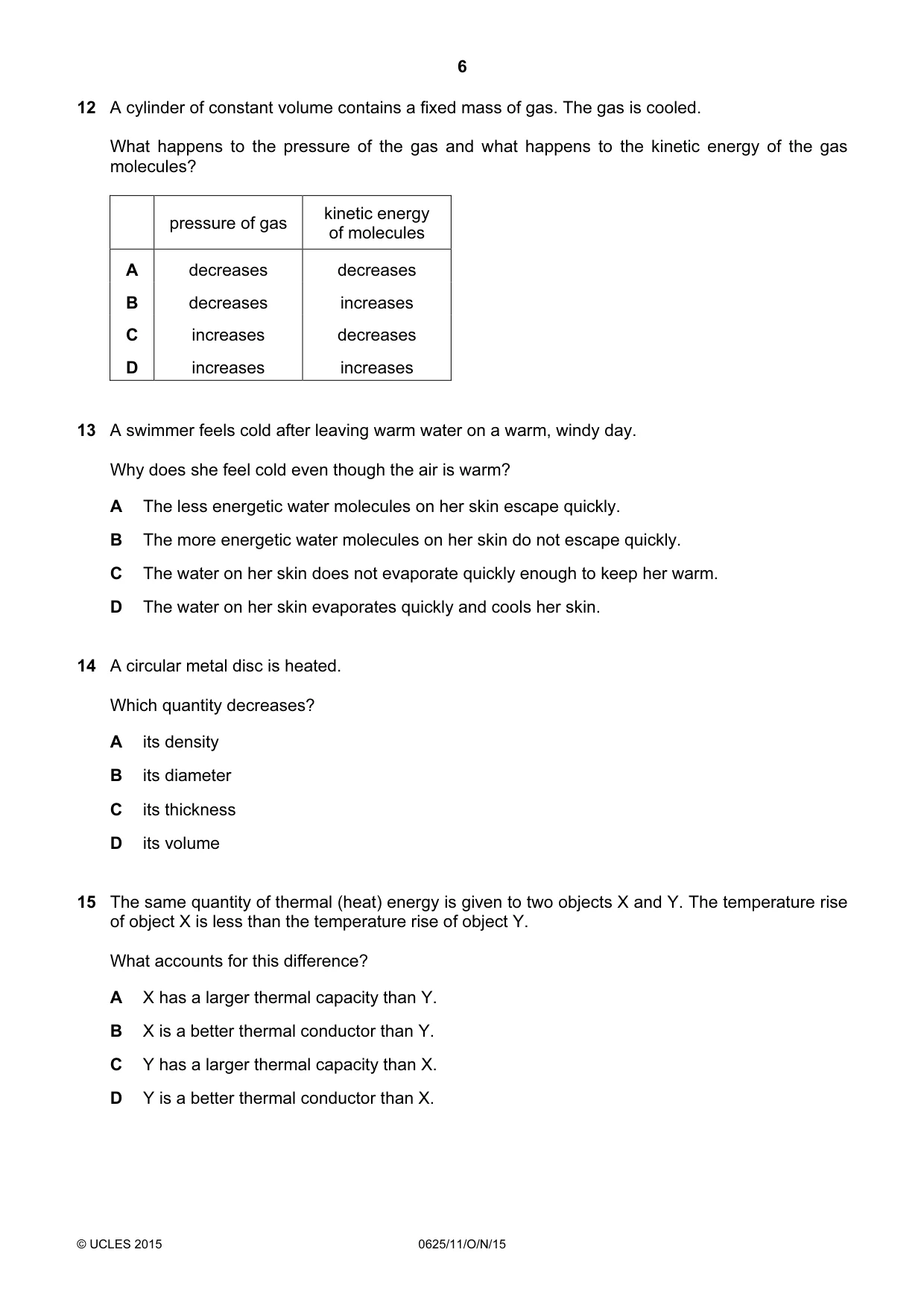
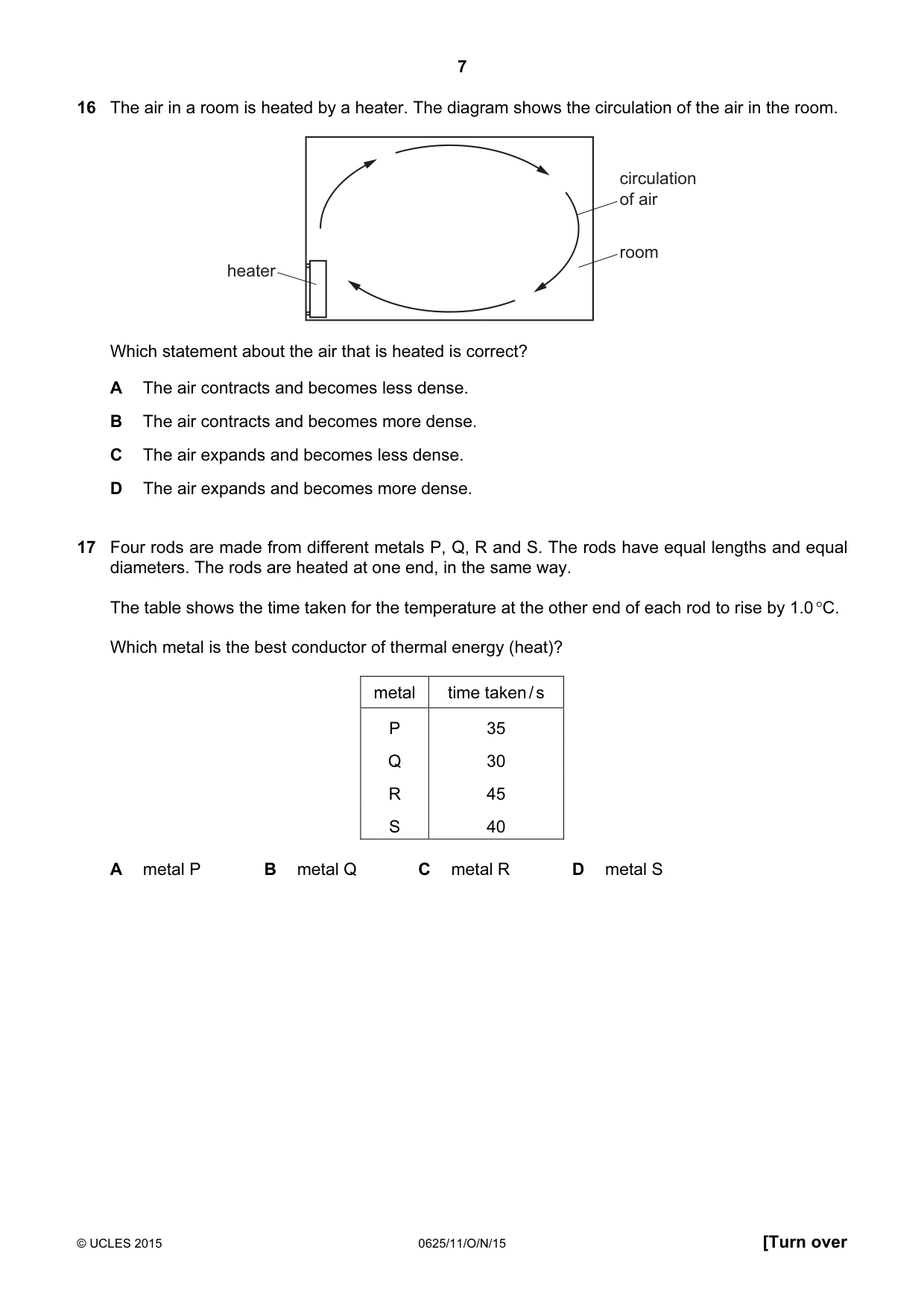
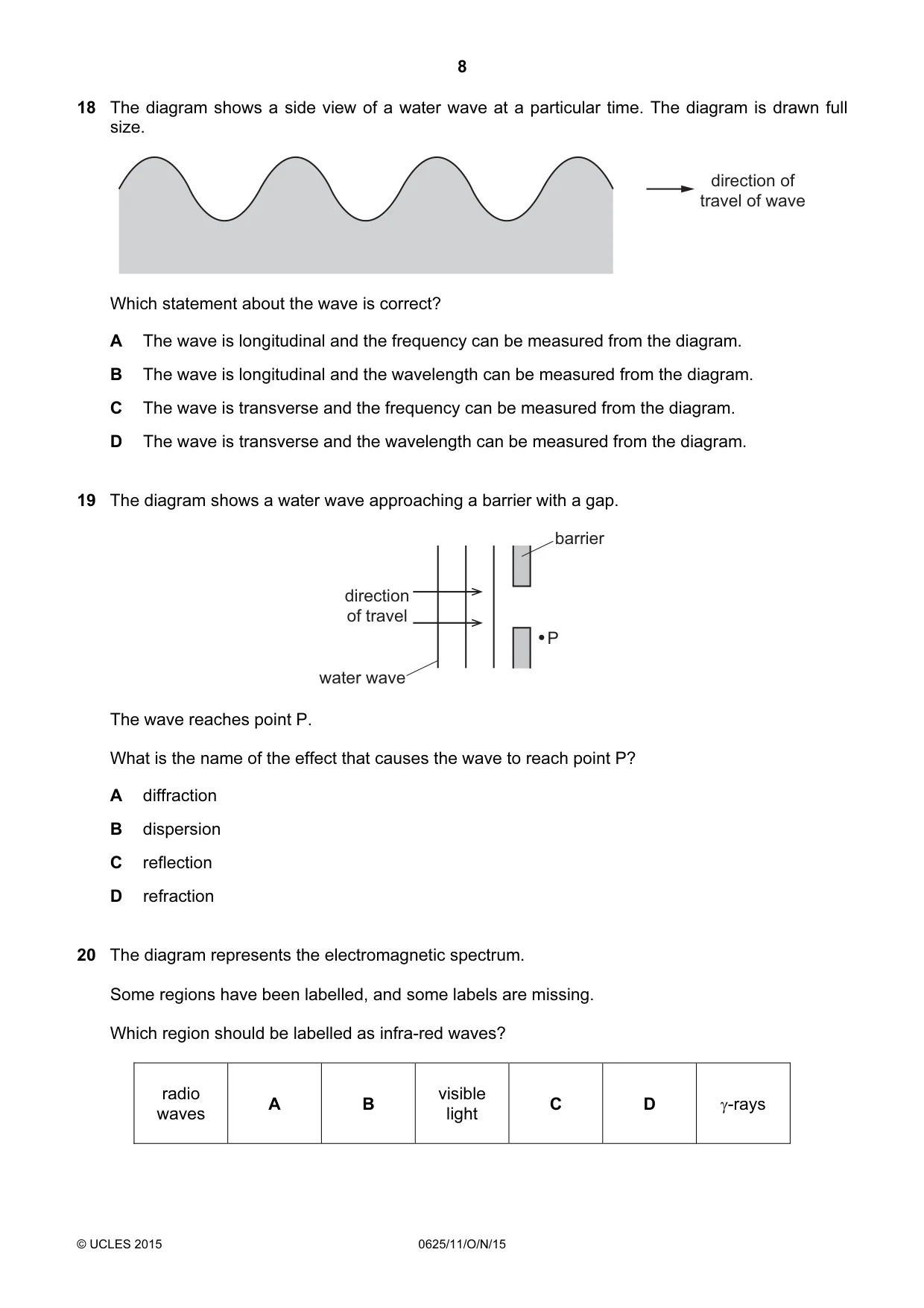
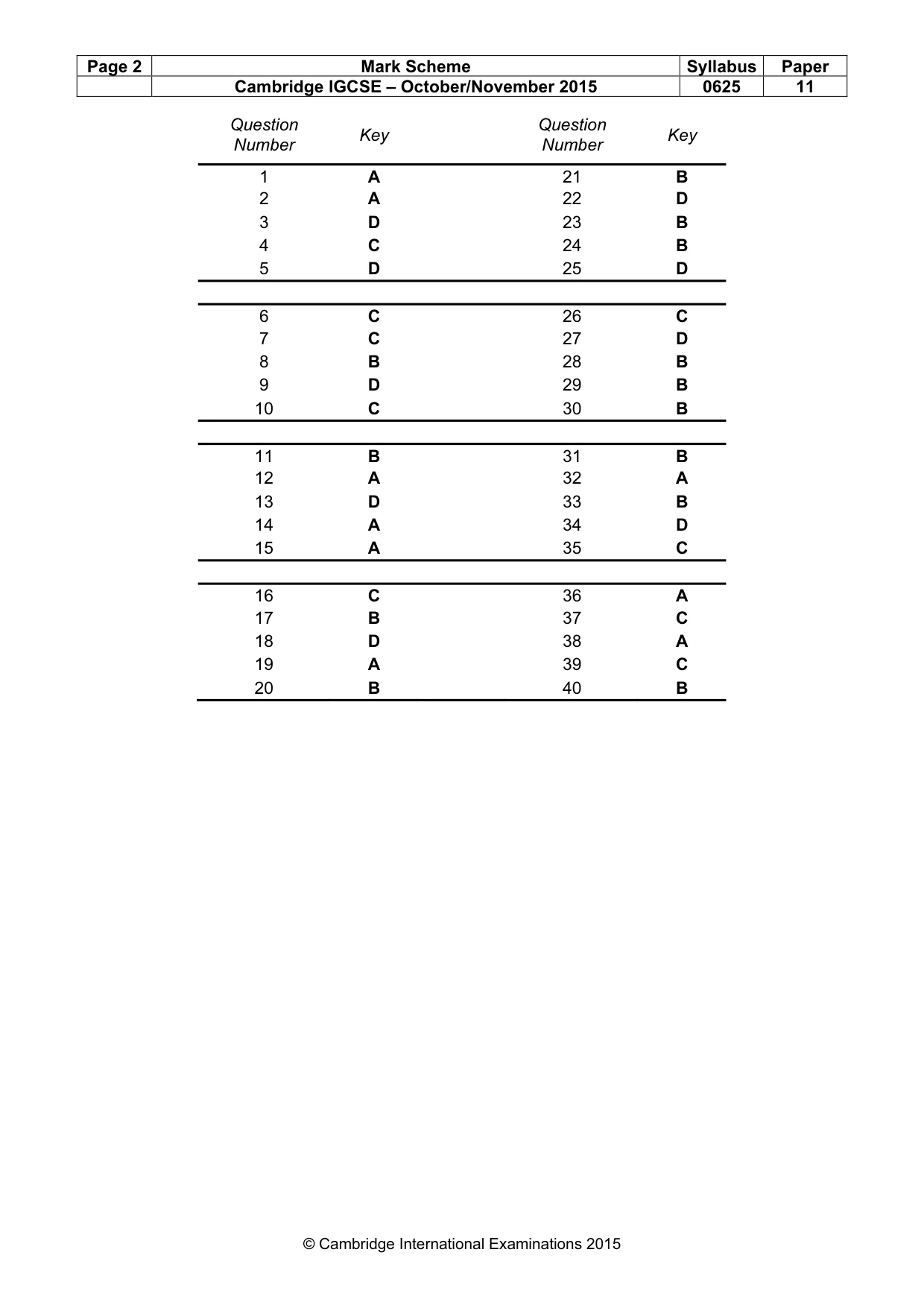
Mark scheme2 pages
Answers below. Sit the paper first if you are practising.
Questions as text
Q1 · Which option contains only apparatus that could be used to determine the volume of a…
1 Which option contains only apparatus that could be used to determine the volume of a small block of unknown material? A measuring cylinder, metre rule B measuring cylinder, stopwatch C metre rule, balance D metre rule, stopwatch
Mark scheme: A
More questions on Physical quantities and measurement techniques
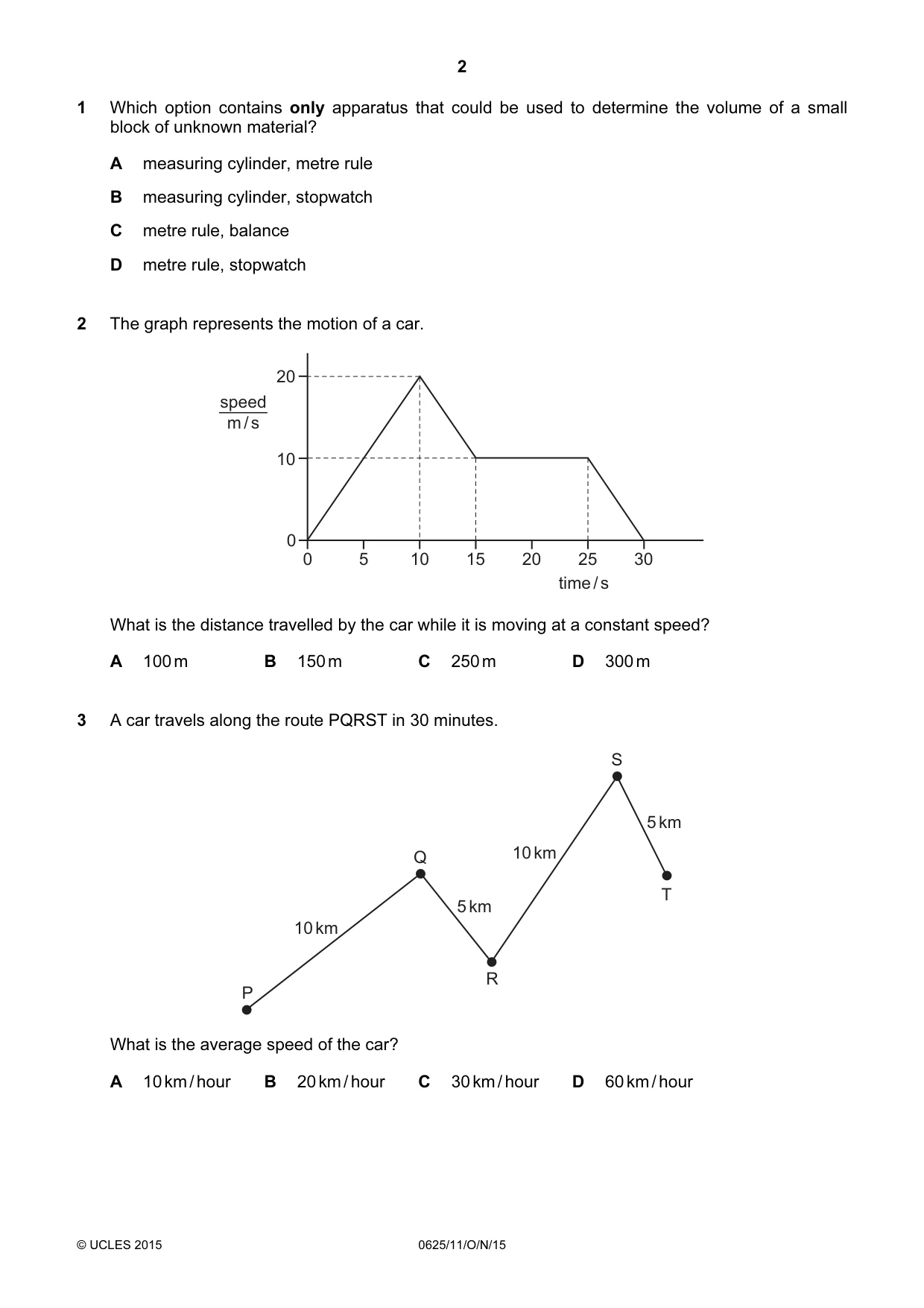
Q2 · The graph represents the motion of a car
2 The graph represents the motion of a car. 20 speed m / s 10 0 0 5 10 15 20 25 30 time / s What is the distance travelled by the car while it is moving at a constant speed? A 100 m B 150 m C 250 m D 300 m
Mark scheme: A
Q3 · A car travels along the route PQRST in 30 minutes
3 A car travels along the route PQRST in 30 minutes. S 5 km Q 10 km T 5 km 10 km R P What is the average speed of the car? A 10 km / hour B 20 km / hour C 30 km / hour D 60 km / hour
Mark scheme: D
Q4 · The mass of an object is measured on Earth
4 The mass of an object is measured on Earth. The mass is 5.0 kg. The object is taken to the Moon. The mass of the object is measured on the Moon. What is the mass of the object on the Moon? A 0 kg B more than 0 kg, but less than 5.0 kg C 5.0 kg D more than 5.0 kg
Mark scheme: C
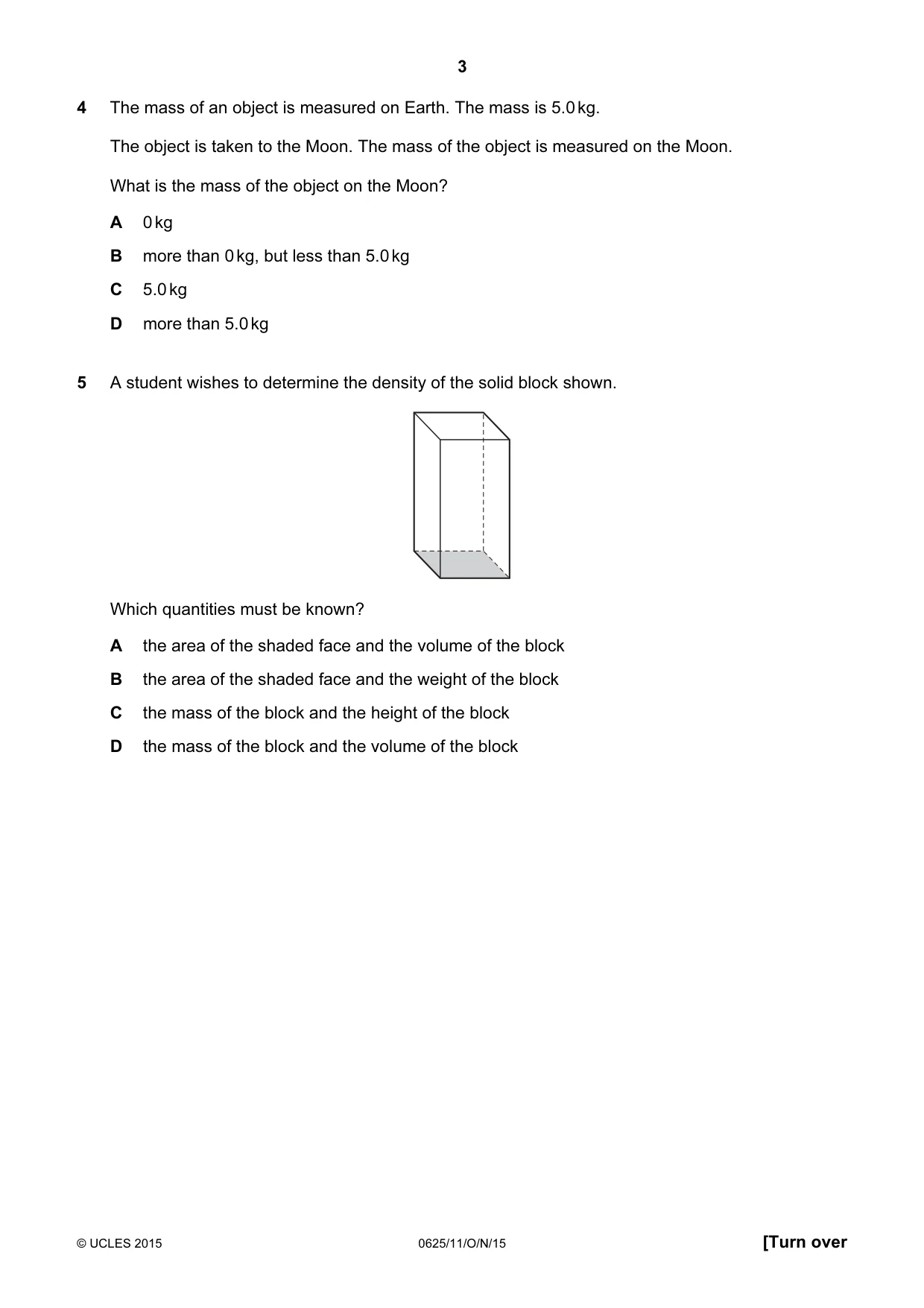
Q5 · A student wishes to determine the density of the solid block shown
5 A student wishes to determine the density of the solid block shown. Which quantities must be known? A the area of the shaded face and the volume of the block B the area of the shaded face and the weight of the block C the mass of the block and the height of the block D the mass of the block and the volume of the block
Mark scheme: D
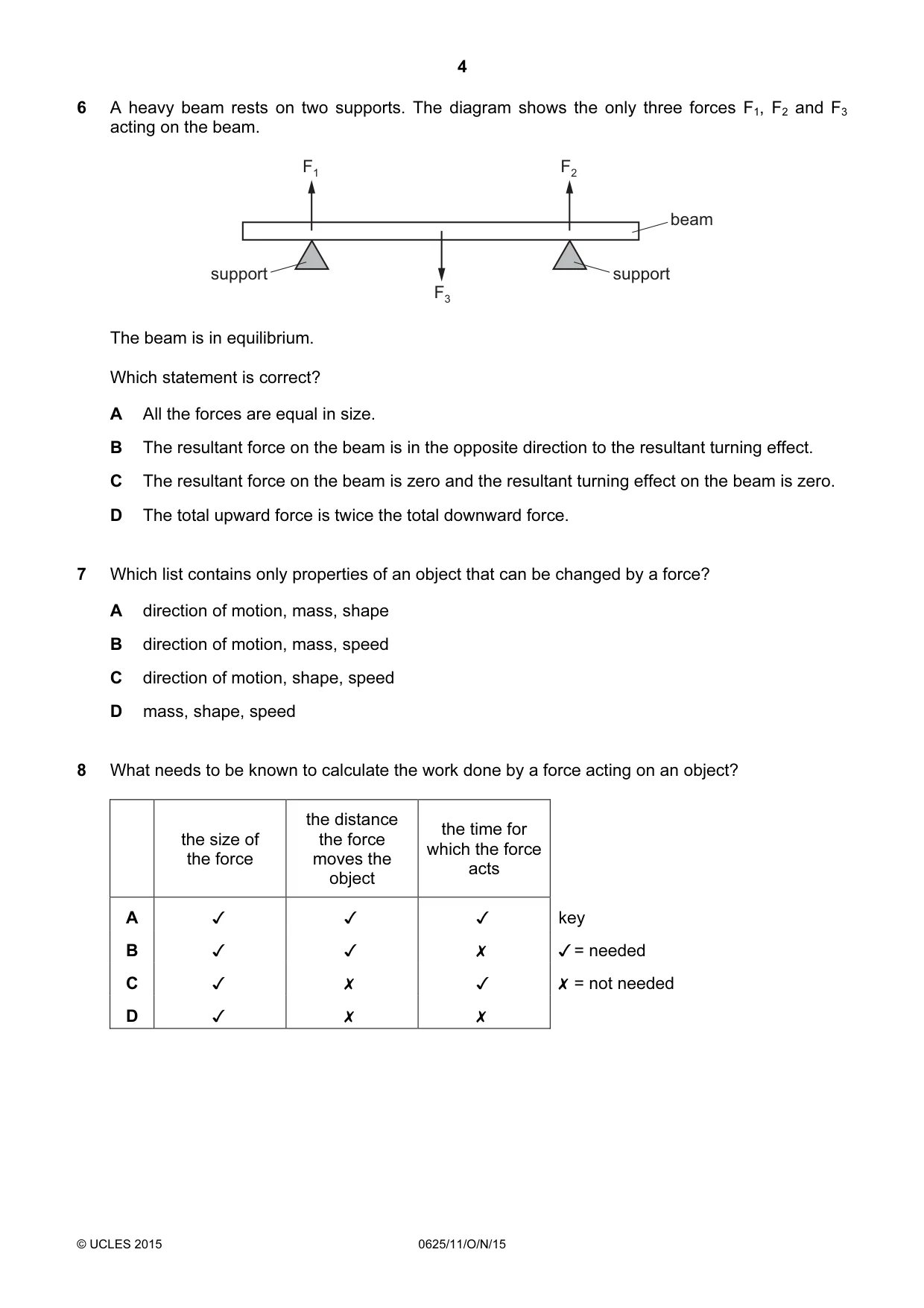
Q6 · A heavy beam rests on two supports
6 A heavy beam rests on two supports. The diagram shows the only three forces F1, F2 and F3 acting on the beam. F1 F2 beam support support F3 The beam is in equilibrium. Which statement is correct? A All the forces are equal in size. B The resultant force on the beam is in the opposite direction to the resultant turning effect. C The resultant force on the beam is zero and the resultant turning effect on the beam is zero. D The total upward force is twice the total downward force.
Mark scheme: C
Q7 · Which list contains only properties of an object that can be changed by a force?
7 Which list contains only properties of an object that can be changed by a force? A direction of motion, mass, shape B direction of motion, mass, speed C direction of motion, shape, speed D mass, shape, speed
Mark scheme: C
Q8 · What needs to be known to calculate the work done by a force acting on an object?
8 What needs to be known to calculate the work done by a force acting on an object? the distance the time for the size of the force . which the force the force moves the : acts object A v v Jv key B Jv Jv x J/ = needed Cc Jv x Jv X = not needed D Jv x x
Mark scheme: B
Q9 · Electrical energy may be obtained from nuclear fission
9 Electrical energy may be obtained from nuclear fission. In which order is the energy transferred in this process? A nuclear fuel → generator → reactor and boiler → turbines B nuclear fuel → generator → turbines → reactor and boiler C nuclear fuel → reactor and boiler → generator → turbines D nuclear fuel → reactor and boiler → turbines → generator
Mark scheme: D
Q10 · The diagram shows a manometer containing a liquid
10 The diagram shows a manometer containing a liquid. The manometer is used to find the difference between the pressure of a gas and atmospheric pressure. Which distance represents this pressure difference? gas pressure A C D B liquid
Mark scheme: C
Q11 · Four physics teachers investigate pressure
11 Four physics teachers investigate pressure. They wear identical clothes and lie on different beds of nails. The table gives the weight of each teacher and the total area of contact between the teacher and the nails. Which teacher experiences the least pressure from the nails? weight of total area of teacher / N contact / cm2 A 700 13 B 800 20 C 900 14 D 1000 21
Mark scheme: B
Q12 · A cylinder of constant volume contains a fixed mass of gas
12 A cylinder of constant volume contains a fixed mass of gas. The gas is cooled. What happens to the pressure of the gas and what happens to the kinetic energy of the gas molecules? kinetic energy pressure of gas of molecules A decreases decreases B decreases increases C increases decreases D increases increases
Mark scheme: A
Q13 · A swimmer feels cold after leaving warm water on a warm, windy day
13 A swimmer feels cold after leaving warm water on a warm, windy day. Why does she feel cold even though the air is warm? A The less energetic water molecules on her skin escape quickly. B The more energetic water molecules on her skin do not escape quickly. C The water on her skin does not evaporate quickly enough to keep her warm. D The water on her skin evaporates quickly and cools her skin.
Mark scheme: D
Q14 · A circular metal disc is heated
14 A circular metal disc is heated. Which quantity decreases? A its density B its diameter C its thickness D its volume
Mark scheme: A
Q15 · The same quantity of thermal (heat) energy is given to two objects X and Y
15 The same quantity of thermal (heat) energy is given to two objects X and Y. The temperature rise of object X is less than the temperature rise of object Y. What accounts for this difference? A X has a larger thermal capacity than Y. B X is a better thermal conductor than Y. C Y has a larger thermal capacity than X. D Y is a better thermal conductor than X.
Mark scheme: A
Q16 · The air in a room is heated by a heater
16 The air in a room is heated by a heater. The diagram shows the circulation of the air in the room. circulation of air room heater Which statement about the air that is heated is correct? A The air contracts and becomes less dense. B The air contracts and becomes more dense. C The air expands and becomes less dense. D The air expands and becomes more dense.
Mark scheme: C
Q17 · Four rods are made from different metals P, Q, R and S
17 Four rods are made from different metals P, Q, R and S. The rods have equal lengths and equal diameters. The rods are heated at one end, in the same way. The table shows the time taken for the temperature at the other end of each rod to rise by 1.0 °C. Which metal is the best conductor of thermal energy (heat)? metal time taken / s P 35 Q 30 R 45 S 40 A metal P B metal Q C metal R D metal S
Mark scheme: B
Q18 · The diagram shows a side view of a water wave at a particular time
18 The diagram shows a side view of a water wave at a particular time. The diagram is drawn full size. direction of travel of wave Which statement about the wave is correct? A The wave is longitudinal and the frequency can be measured from the diagram. B The wave is longitudinal and the wavelength can be measured from the diagram. C The wave is transverse and the frequency can be measured from the diagram. D The wave is transverse and the wavelength can be measured from the diagram.
Mark scheme: D
Q19 · The diagram shows a water wave approaching a barrier with a gap
19 The diagram shows a water wave approaching a barrier with a gap. barrier direction of travel P water wave The wave reaches point P. What is the name of the effect that causes the wave to reach point P? A diffraction B dispersion C reflection D refraction
Mark scheme: A
Q20 · The diagram represents the electromagnetic spectrum
20 The diagram represents the electromagnetic spectrum. Some regions have been labelled, and some labels are missing. Which region should be labelled as infra-red waves? radio visible A B C D γ-rays waves light
Mark scheme: B
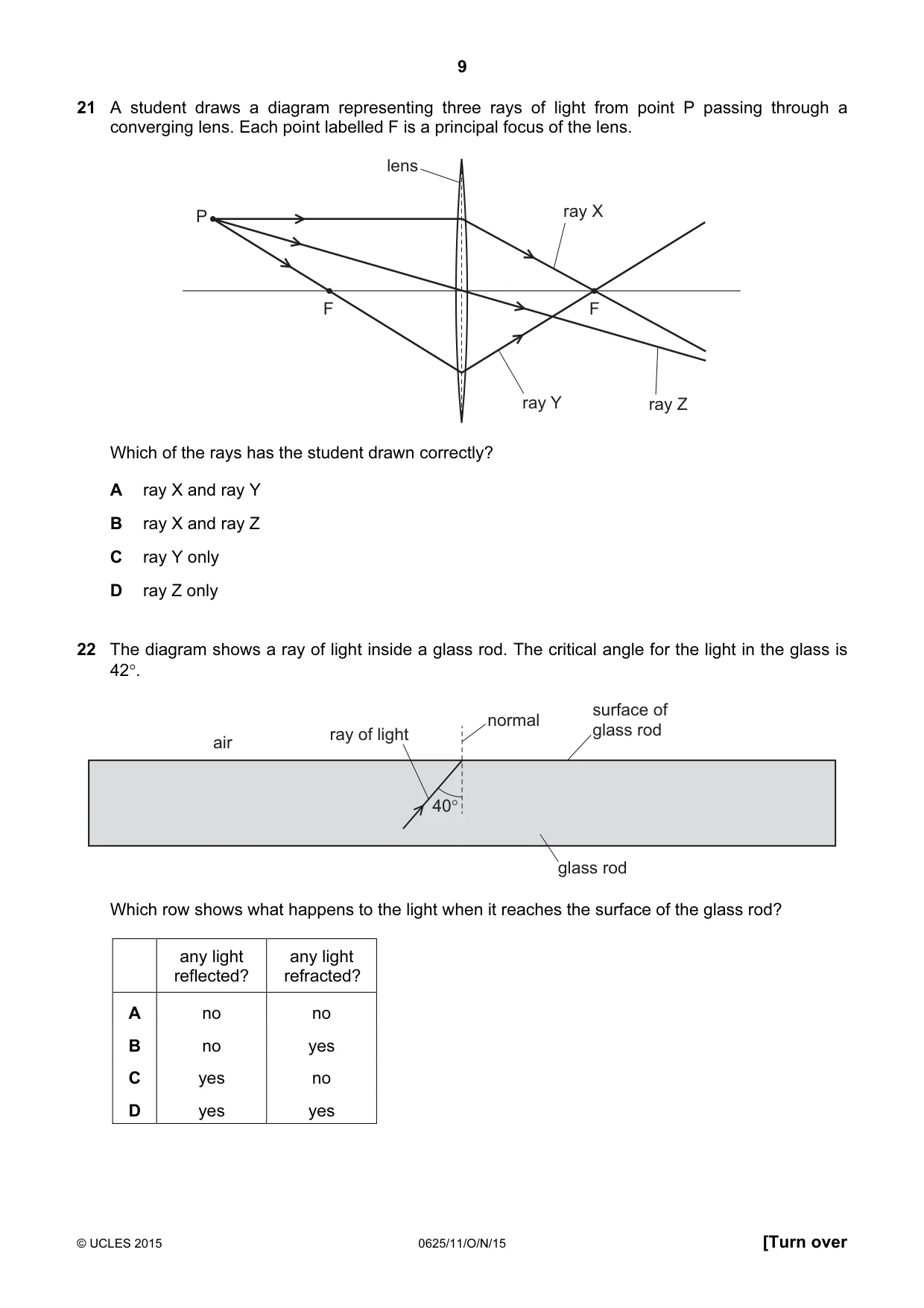
Q21 · A student draws a diagram representing three rays of light from point P passing through a…
21 A student draws a diagram representing three rays of light from point P passing through a converging lens. Each point labelled F is a principal focus of the lens. lens P ray X F F ray Y ray Z Which of the rays has the student drawn correctly? A ray X and ray Y B ray X and ray Z C ray Y only D ray Z only
Mark scheme: B
Q22 · The diagram shows a ray of light inside a glass rod
22 The diagram shows a ray of light inside a glass rod. The critical angle for the light in the glass is 42°. surface of normal ray of light glass rod air 40° glass rod Which row shows what happens to the light when it reaches the surface of the glass rod? any light any light reflected? refracted? A no no B no yes C yes no D yes yes
Mark scheme: D
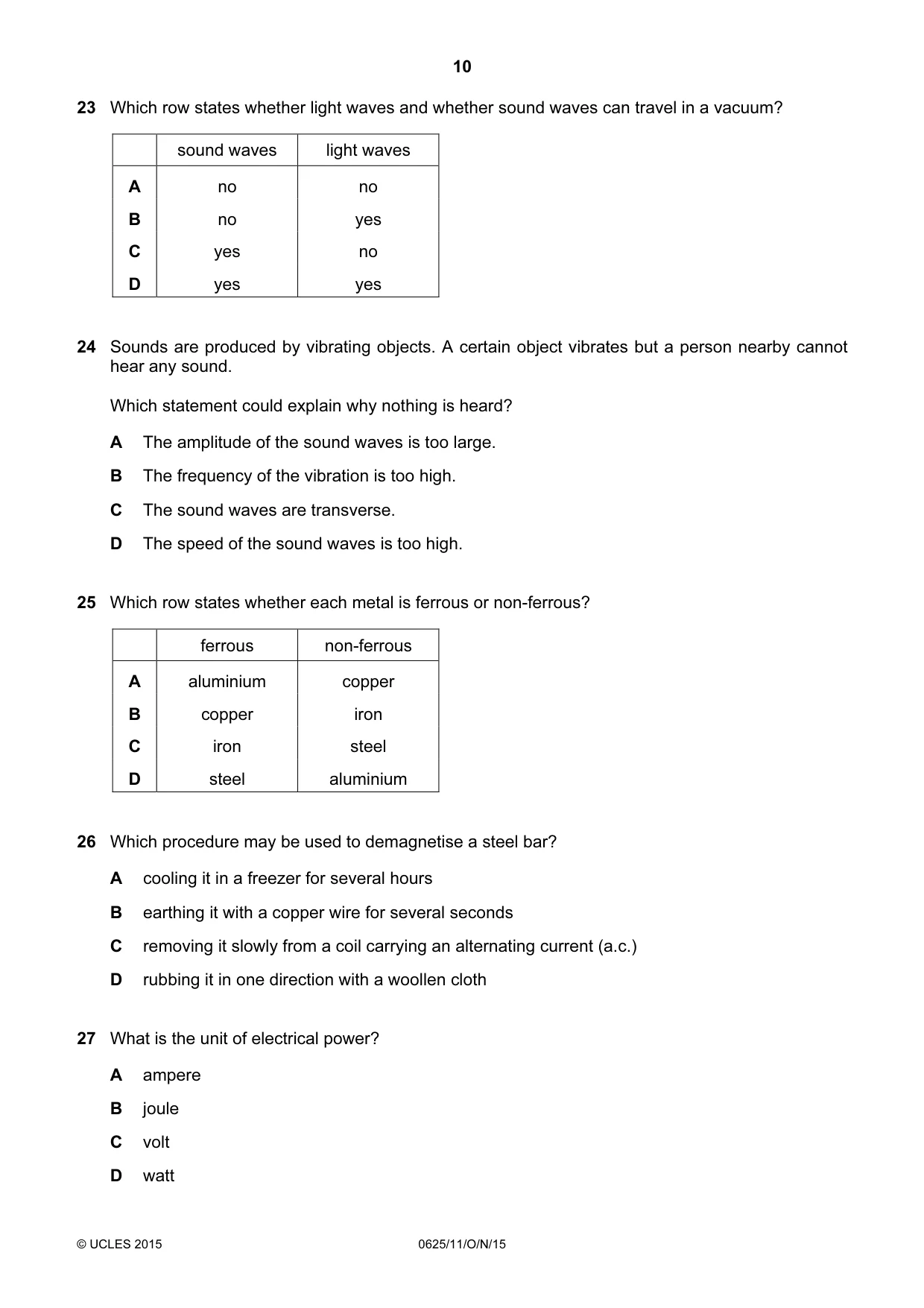
Q23 · Which row states whether light waves and whether sound waves can travel in a vacuum?
23 Which row states whether light waves and whether sound waves can travel in a vacuum? sound waves light waves A no no B no yes C yes no D yes yes
Mark scheme: B
Q24 · Sounds are produced by vibrating objects
24 Sounds are produced by vibrating objects. A certain object vibrates but a person nearby cannot hear any sound. Which statement could explain why nothing is heard? A The amplitude of the sound waves is too large. B The frequency of the vibration is too high. C The sound waves are transverse. D The speed of the sound waves is too high.
Mark scheme: B
Q25 · Which row states whether each metal is ferrous or non-ferrous?
25 Which row states whether each metal is ferrous or non-ferrous? ferrous non-ferrous A aluminium copper B copper iron C iron steel D steel aluminium
Mark scheme: D
Q26 · Which procedure may be used to demagnetise a steel bar?
26 Which procedure may be used to demagnetise a steel bar? A cooling it in a freezer for several hours B earthing it with a copper wire for several seconds C removing it slowly from a coil carrying an alternating current (a.c.) D rubbing it in one direction with a woollen cloth
Mark scheme: C
Q27 · What is the unit of electrical power?
27 What is the unit of electrical power? A ampere B joule C volt D watt
Mark scheme: D
Q28 · Some resistors are made using one type of wire
28 Some resistors are made using one type of wire. Two different lengths of wire are available. Each length is available in two different diameters. Which wire has the highest resistance? A the wire with the greater length and the larger diameter B the wire with the greater length and the smaller diameter C the wire with the smaller length and the larger diameter D the wire with the smaller length and the smaller diameter
Mark scheme: B
Q29 · Four students are each given an identical resistor and asked to find its resistance
29 Four students are each given an identical resistor and asked to find its resistance. They each measure the potential difference across the resistor and the current in it. One student makes a mistake. Which row shows the results of the student that makes a mistake? potential difference / V current / A A 1.2 0.500 B 2.4 1.100 C 1.5 0.625 D 3.0 1.250
Mark scheme: B
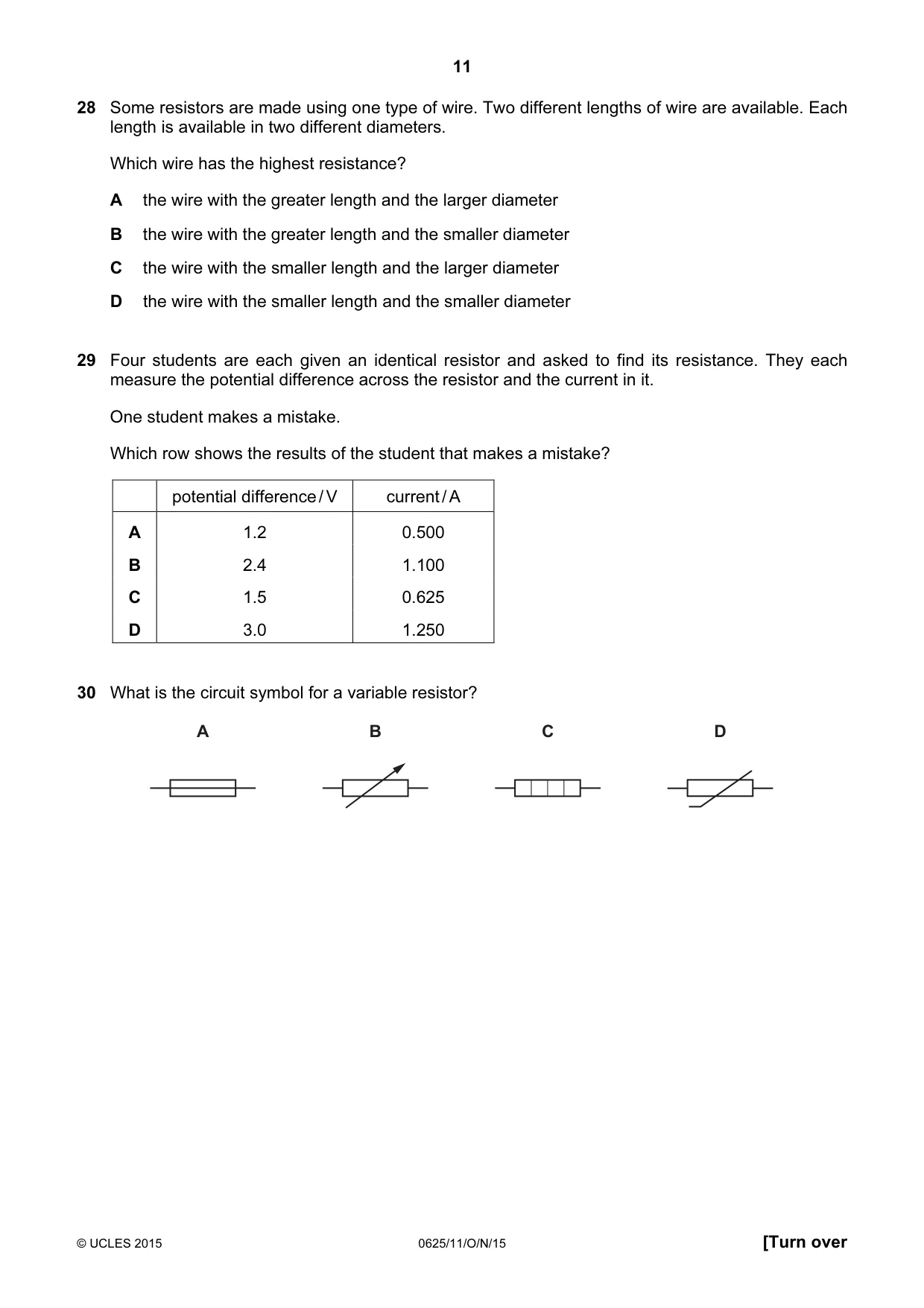
Q30 · What is the circuit symbol for a variable resistor?
30 What is the circuit symbol for a variable resistor? A B C D
Mark scheme: B
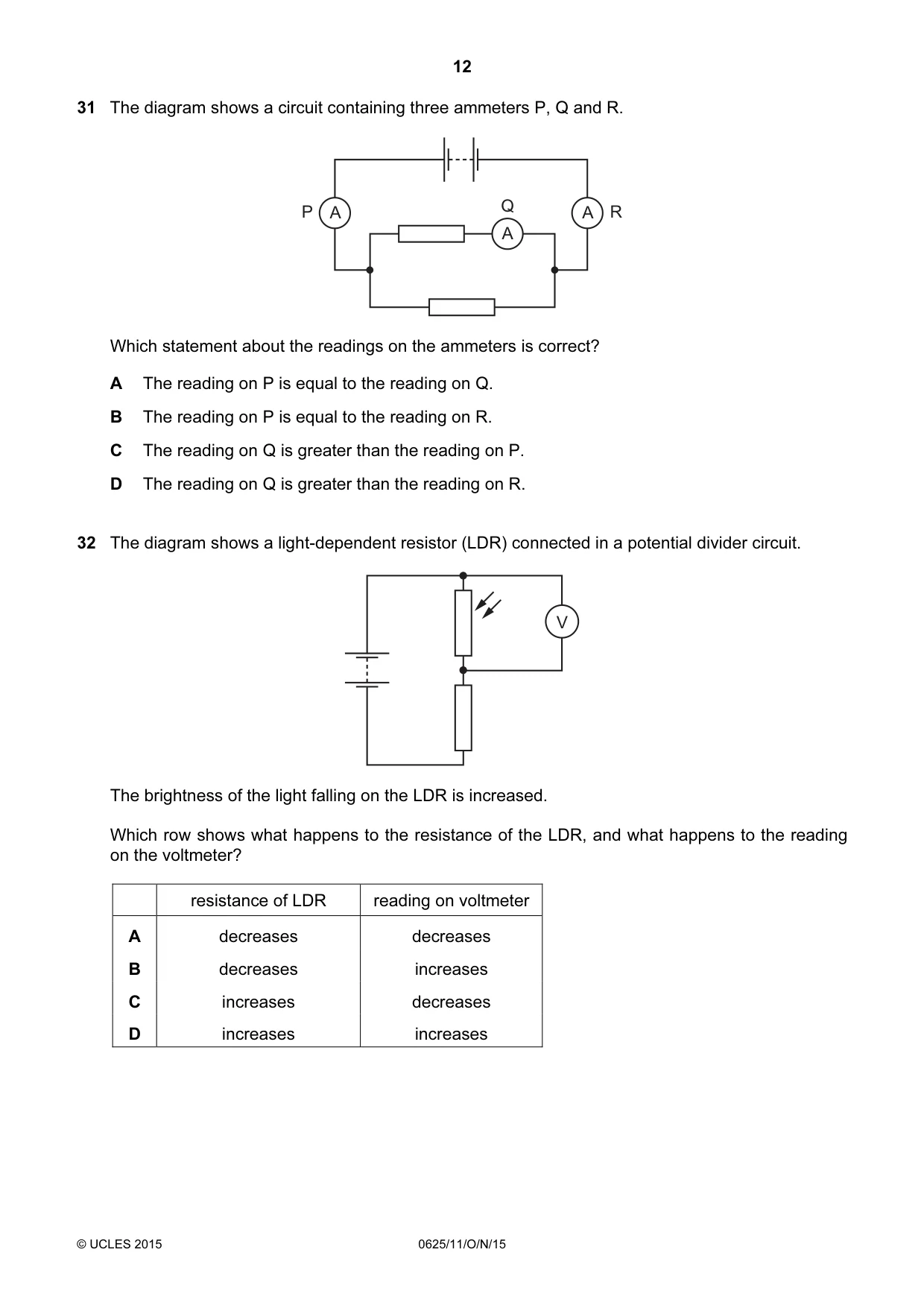
Q31 · The diagram shows a circuit containing three ammeters P, Q and R
31 The diagram shows a circuit containing three ammeters P, Q and R. P A Q A R A Which statement about the readings on the ammeters is correct? A The reading on P is equal to the reading on Q. B The reading on P is equal to the reading on R. C The reading on Q is greater than the reading on P. D The reading on Q is greater than the reading on R.
Mark scheme: B
Q32 · The diagram shows a light-dependent resistor (LDR) connected in a potential divider…
32 The diagram shows a light-dependent resistor (LDR) connected in a potential divider circuit. V The brightness of the light falling on the LDR is increased. Which row shows what happens to the resistance of the LDR, and what happens to the reading on the voltmeter? resistance of LDR reading on voltmeter A decreases decreases B decreases increases C increases decreases D increases increases
Mark scheme: A
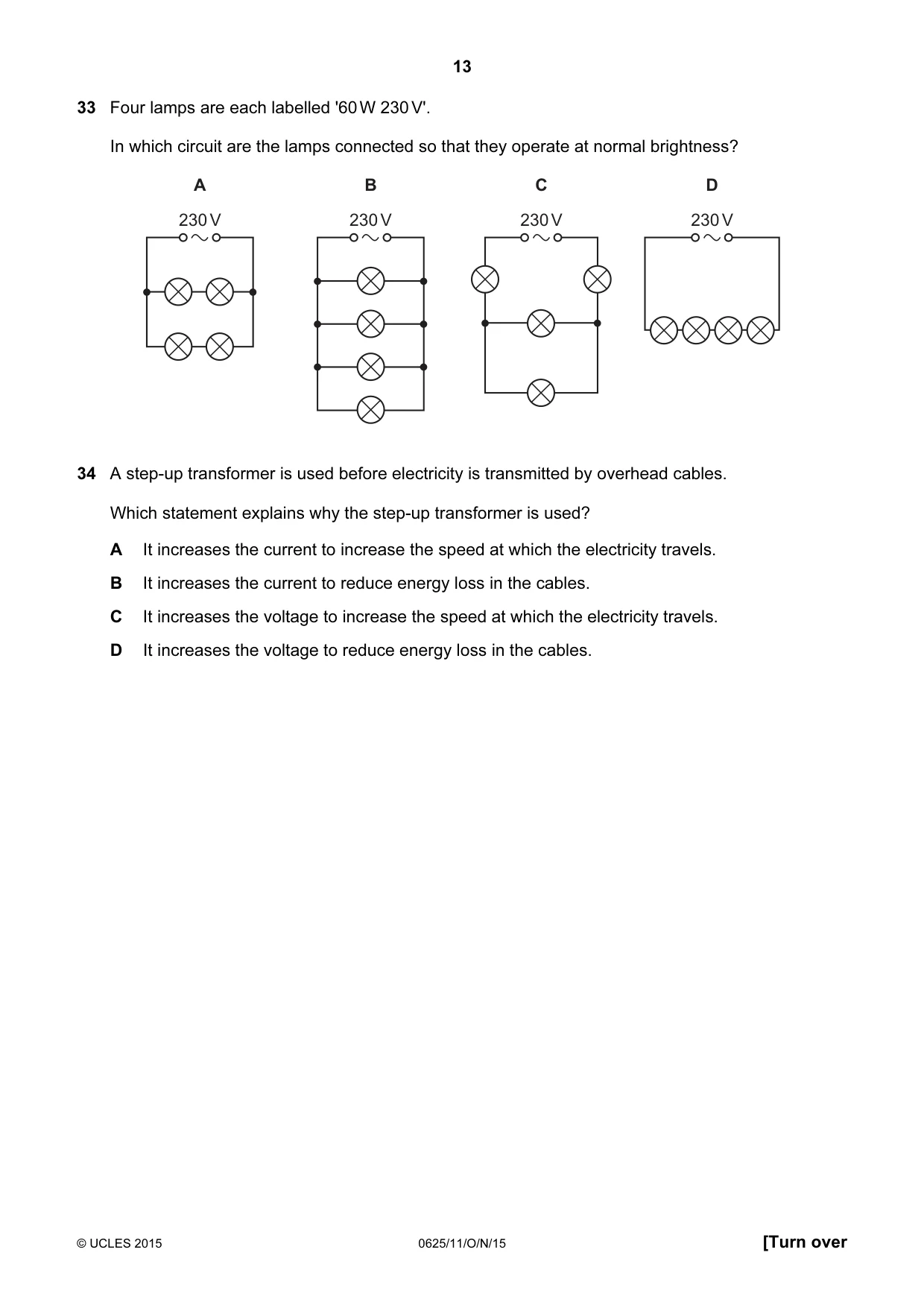
Q33 · Four lamps are each labelled '60 W 230 V'
33 Four lamps are each labelled '60 W 230 V'. In which circuit are the lamps connected so that they operate at normal brightness? A B C D 230 V 230 V 230 V 230 V
Mark scheme: B
Q34 · A step-up transformer is used before electricity is transmitted by overhead cables
34 A step-up transformer is used before electricity is transmitted by overhead cables. Which statement explains why the step-up transformer is used? A It increases the current to increase the speed at which the electricity travels. B It increases the current to reduce energy loss in the cables. C It increases the voltage to increase the speed at which the electricity travels. D It increases the voltage to reduce energy loss in the cables.
Mark scheme: D
Q35 · A current-carrying wire XY lies in the magnetic field between the two poles of a U-shaped…
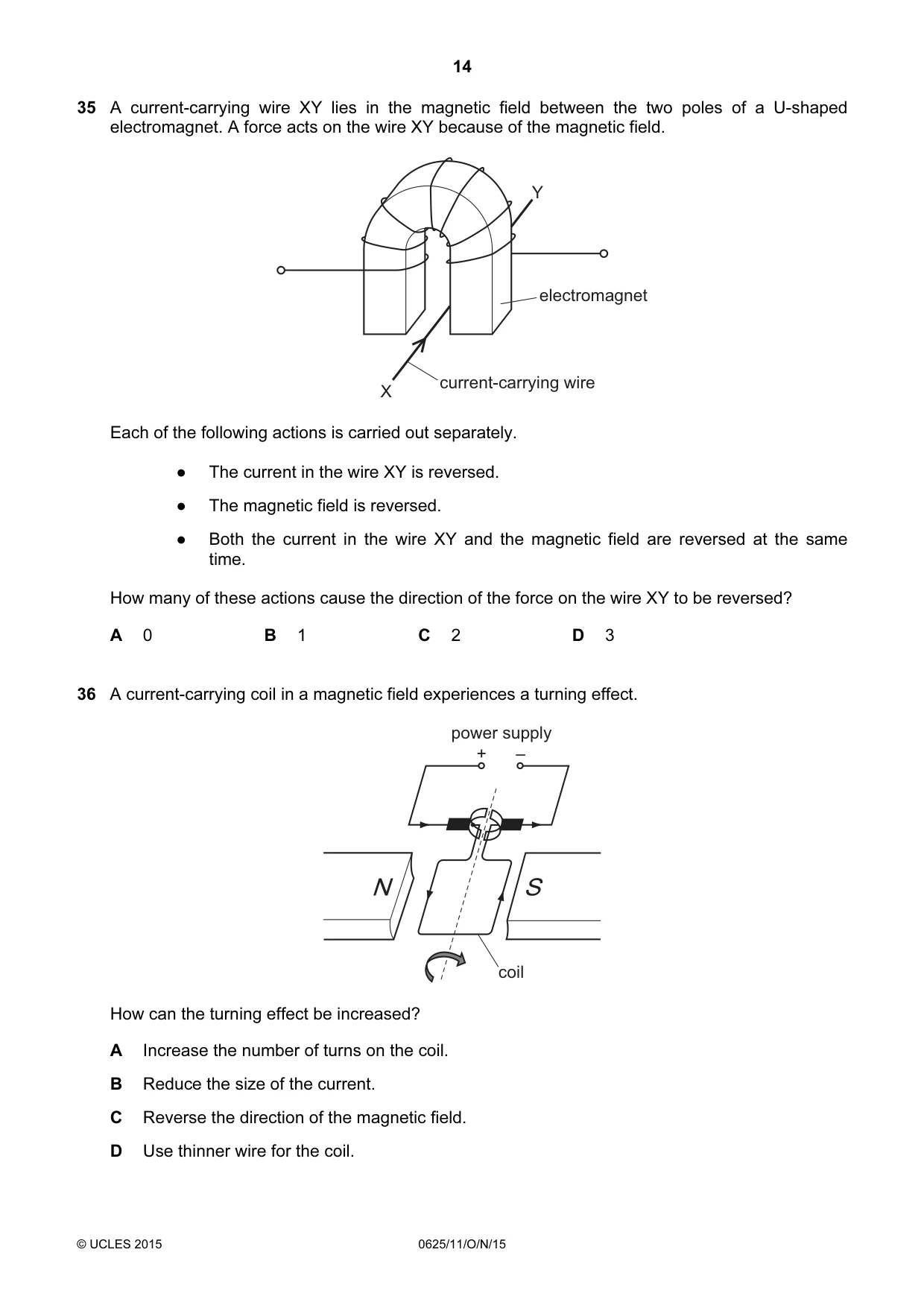
35 A current-carrying wire XY lies in the magnetic field between the two poles of a U-shaped electromagnet. A force acts on the wire XY because of the magnetic field. Y electromagnet current-carrying wire X Each of the following actions is carried out separately. ● The current in the wire XY is reversed. ● The magnetic field is reversed. ● Both the current in the wire XY and the magnetic field are reversed at the same time. How many of these actions cause the direction of the force on the wire XY to be reversed? A 0 B 1 C 2 D 3
Mark scheme: C
Q36 · A current-carrying coil in a magnetic field experiences a turning effect
36 A current-carrying coil in a magnetic field experiences a turning effect. power supply + – N S coil How can the turning effect be increased? A Increase the number of turns on the coil. B Reduce the size of the current. C Reverse the direction of the magnetic field. D Use thinner wire for the coil.
Mark scheme: A
Q37 · The diagram shows cathode rays entering an electric field between two charged plates
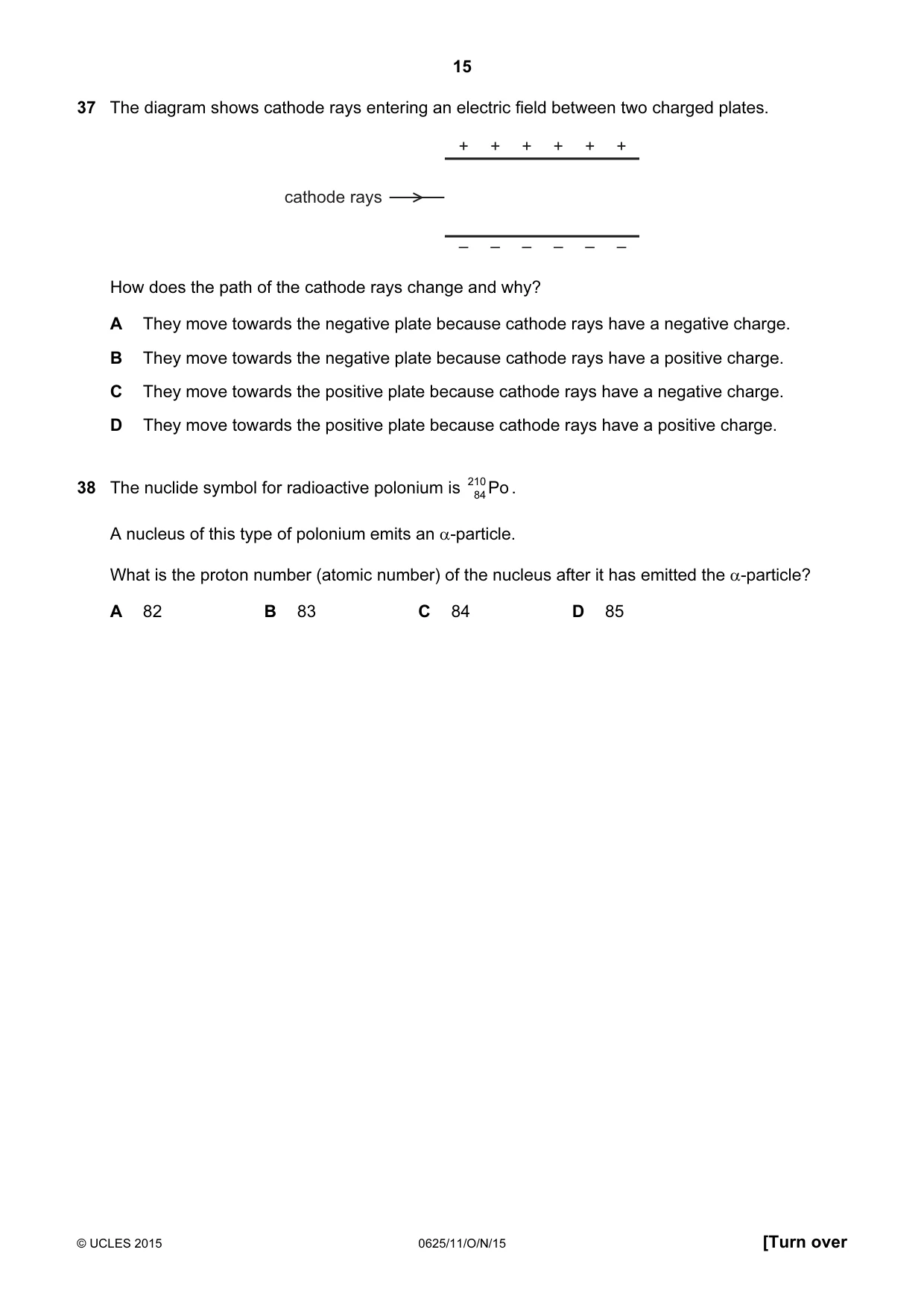
37 The diagram shows cathode rays entering an electric field between two charged plates. + + + + + + cathode rays – – – – – – How does the path of the cathode rays change and why? A They move towards the negative plate because cathode rays have a negative charge. B They move towards the negative plate because cathode rays have a positive charge. C They move towards the positive plate because cathode rays have a negative charge. D They move towards the positive plate because cathode rays have a positive charge.
Mark scheme: C
Q38 · The nuclide symbol for radioactive polonium is 210 Po
38 The nuclide symbol for radioactive polonium is 210 Po . 84 A nucleus of this type of polonium emits an α-particle. What is the proton number (atomic number) of the nucleus after it has emitted the α-particle? A 82 B 83 C 84 D 85
Mark scheme: A
Q39 · A student investigates how the radiation from a radioactive source changes with time
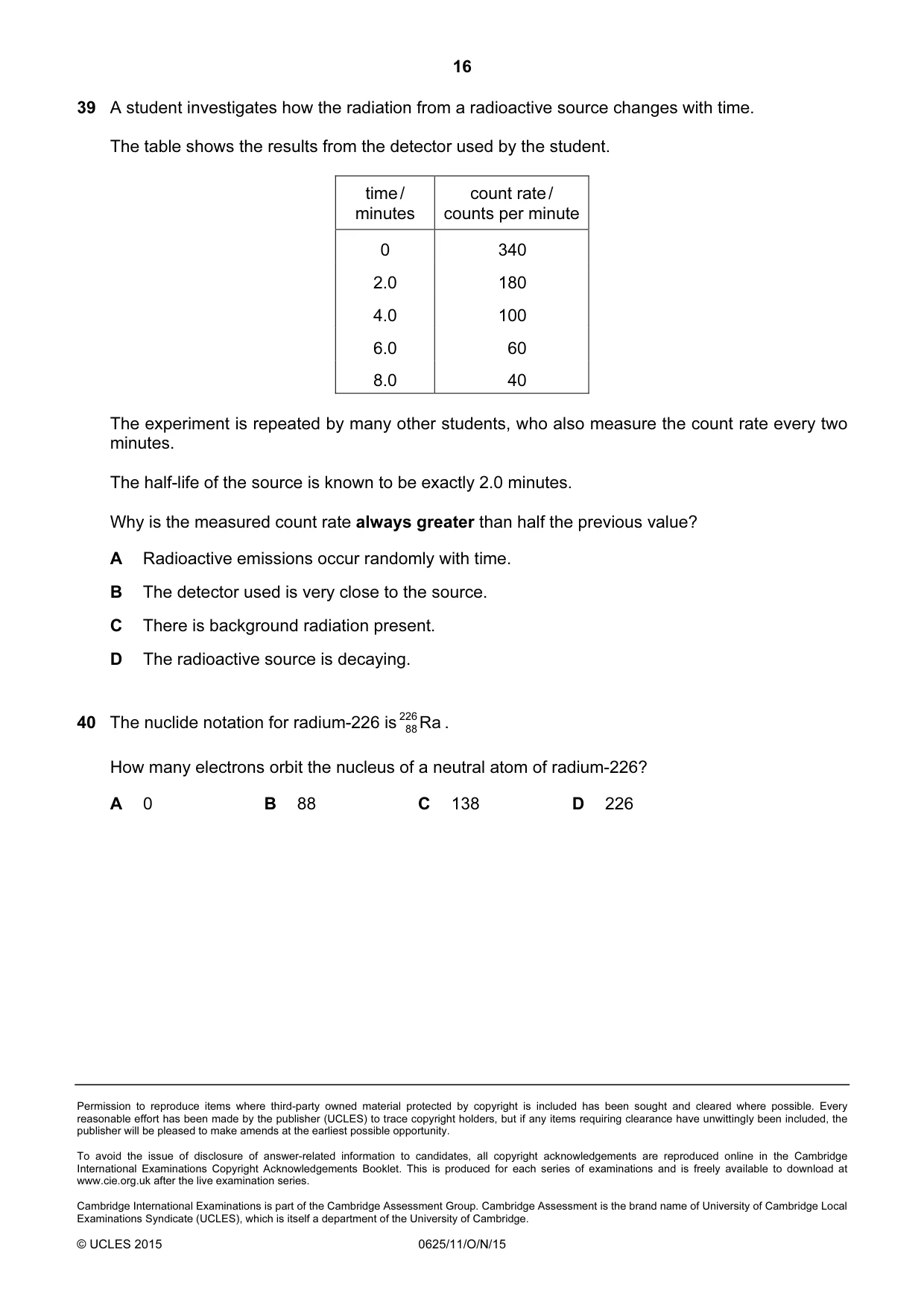
39 A student investigates how the radiation from a radioactive source changes with time. The table shows the results from the detector used by the student. time / count rate / minutes counts per minute 0 340 2.0 180 4.0 100 6.0 60 8.0 40 The experiment is repeated by many other students, who also measure the count rate every two minutes. The half-life of the source is known to be exactly 2.0 minutes. Why is the measured count rate always greater than half the previous value? A Radioactive emissions occur randomly with time. B The detector used is very close to the source. C There is background radiation present. D The radioactive source is decaying.
Mark scheme: C
Q40 · The nuclide notation for radium-226 is 226 Ra
40 The nuclide notation for radium-226 is 226 Ra . 88 How many electrons orbit the nucleus of a neutral atom of radium-226? A 0 B 88 C 138 D 226
Mark scheme: B
What was in this paper
The subtopics covered by these 40 questions, and how many questions each got. Open one in a new tab to see every Cambridge question on it.
4Electrical quantities3Electromagnetic effects3Energy, work and power2Forces2General properties of waves2Kinetic particle model of matter2Light2Motion2Pressure2Radioactivity2Simple phenomena of magnetism2Sound2The nuclear model of the atom2Thermal properties and temperature2Transfer of thermal energy2Density1Electromagnetic spectrum1Mass and weight1Physical quantities and measurement techniques1What you needed in this session
Cambridge’s own grade thresholds for 2015 Oct/Nov, Paper 1 · Variant 1. A higher threshold means an easier paper — the bar moves with how the cohort did.