Cambridge IGCSE Physics 0625 — 2020 Oct/Nov Paper 1 · Variant 1
0625/11/O/N/20 · 40 questions · 40 marks · ≈45 min
The question paper and its mark scheme, free to read here and free to download. This is Cambridge’s own paper, exactly as it was sat.
Question paper16 pages
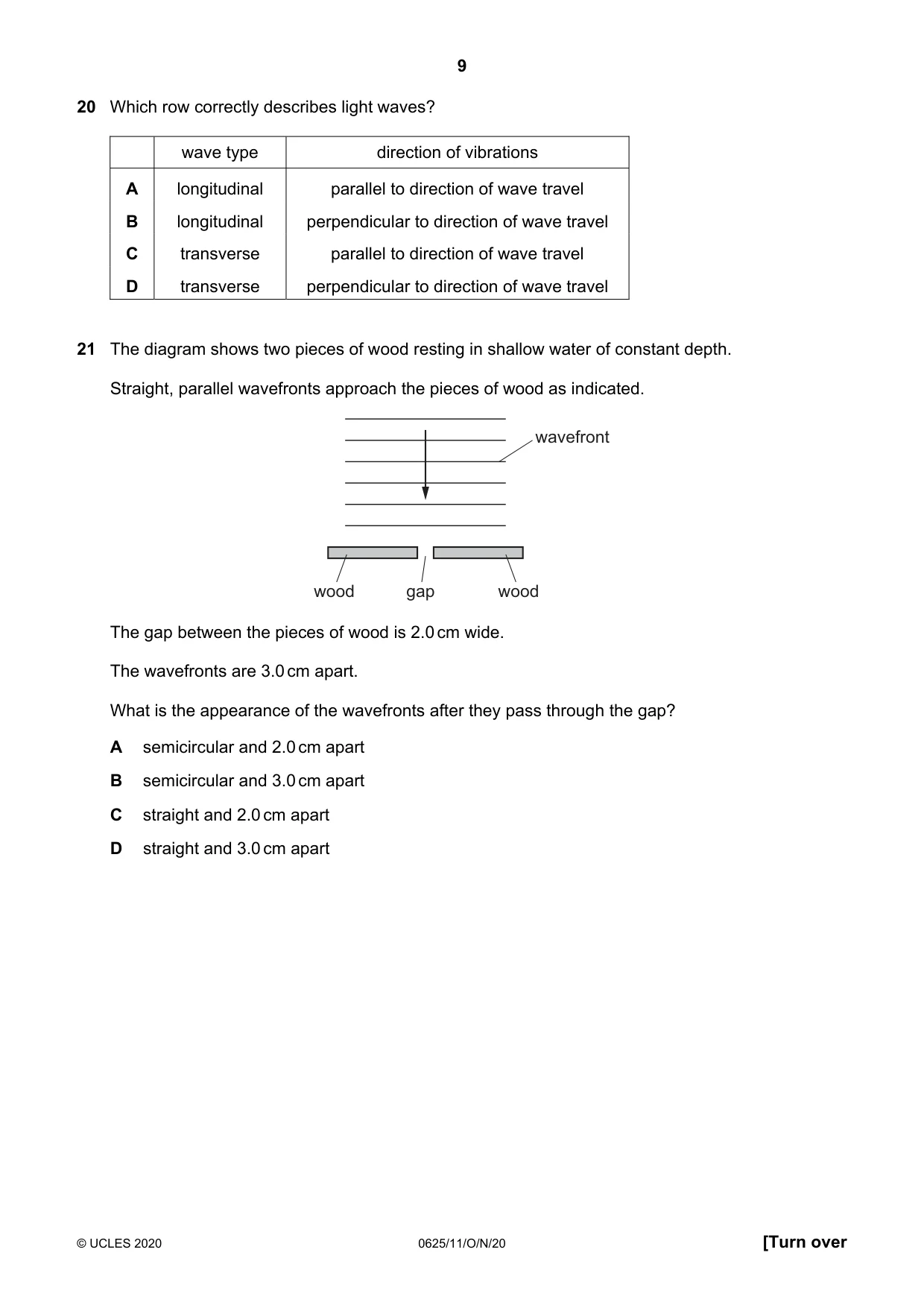
Mark scheme3 pages
Answers below. Sit the paper first if you are practising.
Questions as text
Q1 · The diagram shows a pendulum
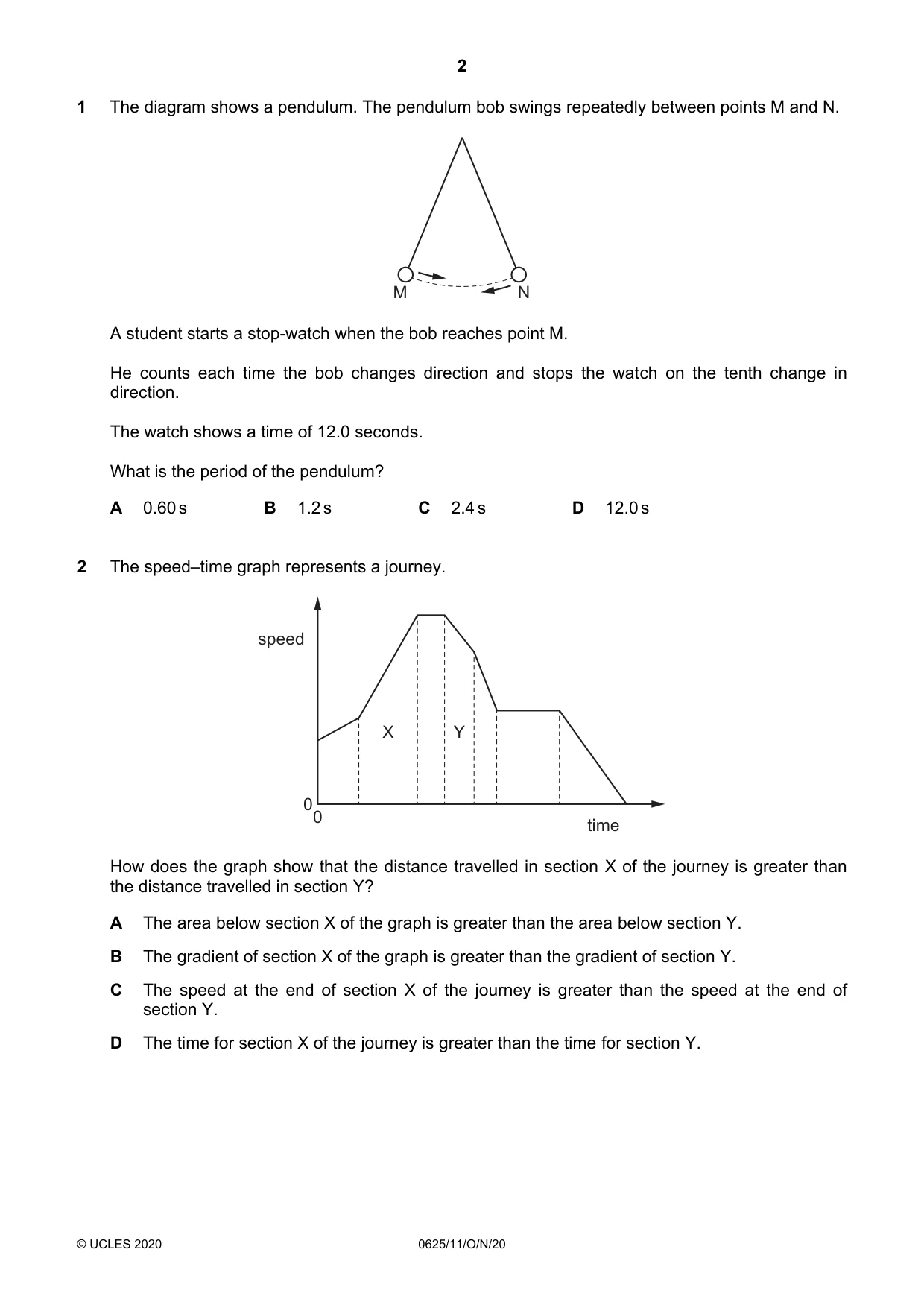
1 The diagram shows a pendulum. The pendulum bob swings repeatedly between points M and N. M N A student starts a stop-watch when the bob reaches point M. He counts each time the bob changes direction and stops the watch on the tenth change in direction. The watch shows a time of 12.0 seconds. What is the period of the pendulum? A 0.60 s B 1.2 s C 2.4 s D 12.0 s
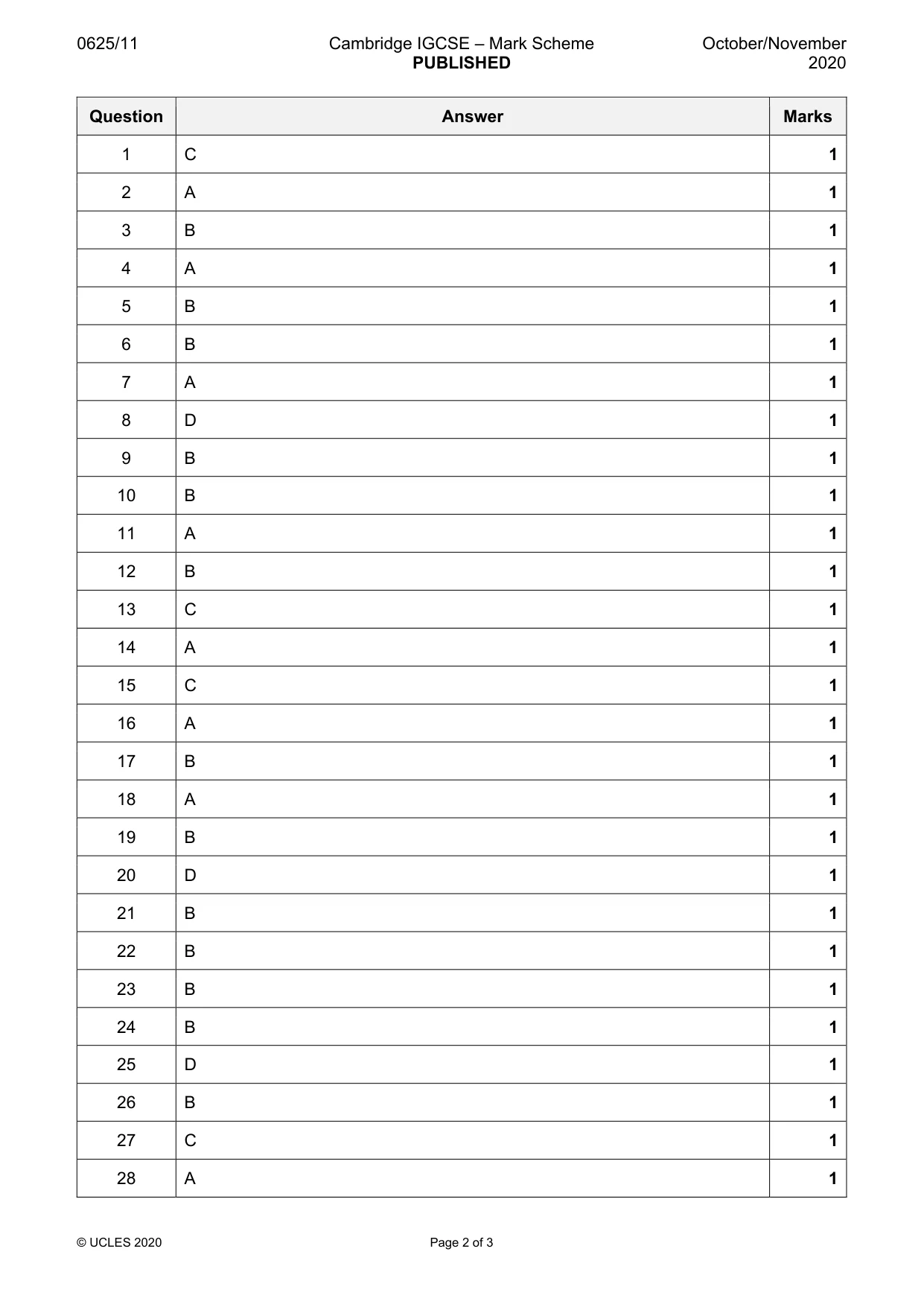
Mark scheme: C
More questions on Physical quantities and measurement techniques
Q2 · The speed–time graph represents a journey
2 The speed–time graph represents a journey. speed X Y 00 time How does the graph show that the distance travelled in section X of the journey is greater than the distance travelled in section Y? A The area below section X of the graph is greater than the area below section Y. B The gradient of section X of the graph is greater than the gradient of section Y. C The speed at the end of section X of the journey is greater than the speed at the end of section Y. D The time for section X of the journey is greater than the time for section Y.
Mark scheme: A
Q3 · A boy throws a ball vertically upwards with a speed v
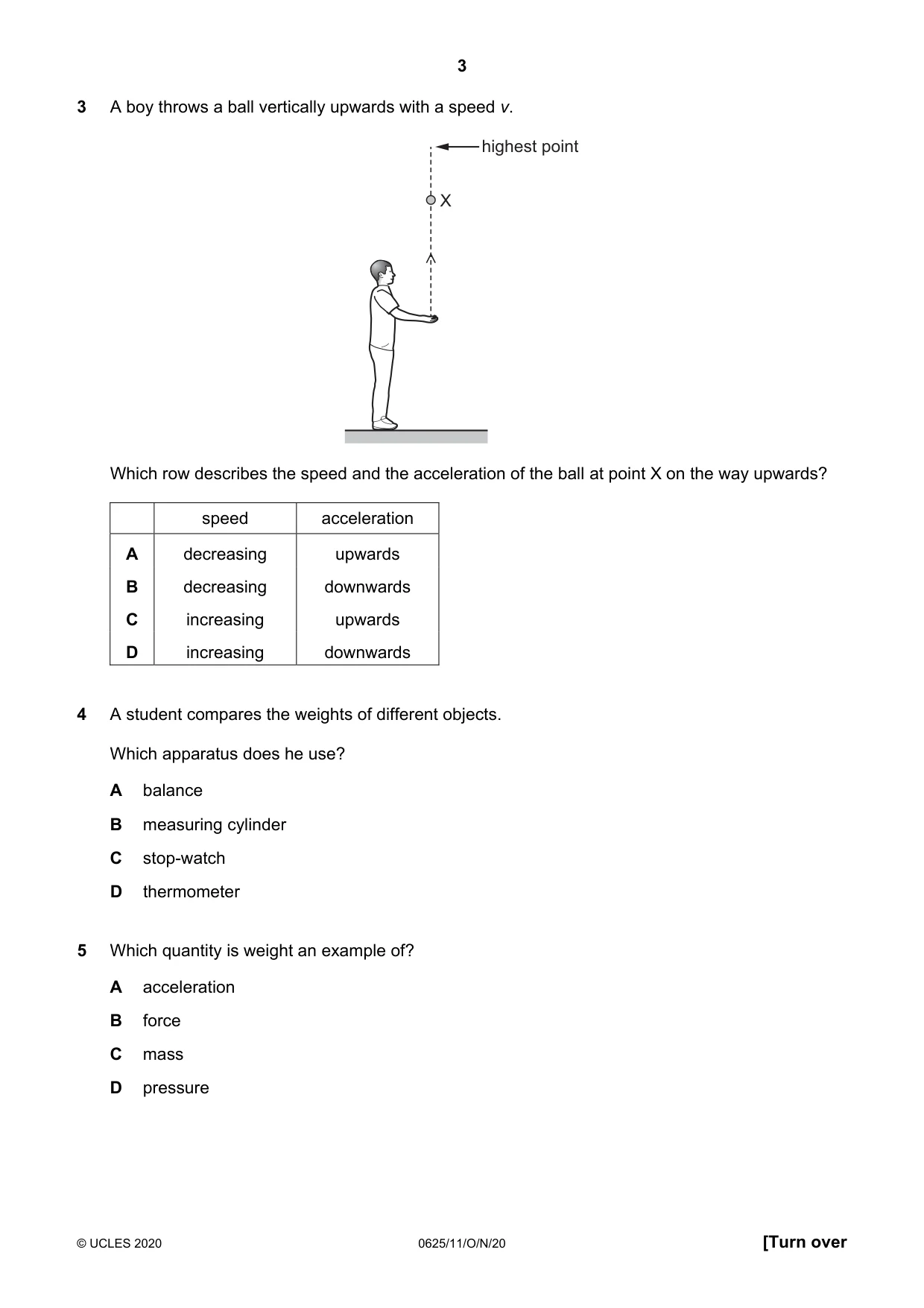
3 A boy throws a ball vertically upwards with a speed v. highest point X Which row describes the speed and the acceleration of the ball at point X on the way upwards? speed acceleration A decreasing upwards B decreasing downwards C increasing upwards D increasing downwards
Mark scheme: B
Q4 · A student compares the weights of different objects
4 A student compares the weights of different objects. Which apparatus does he use? A balance B measuring cylinder C stop-watch D thermometer
Mark scheme: A
Q5 · Which quantity is weight an example of?
5 Which quantity is weight an example of? A acceleration B force C mass D pressure
Mark scheme: B
Q6 · A metal ball is attached to a cork and is lowered into a measuring cylinder, pulling the…
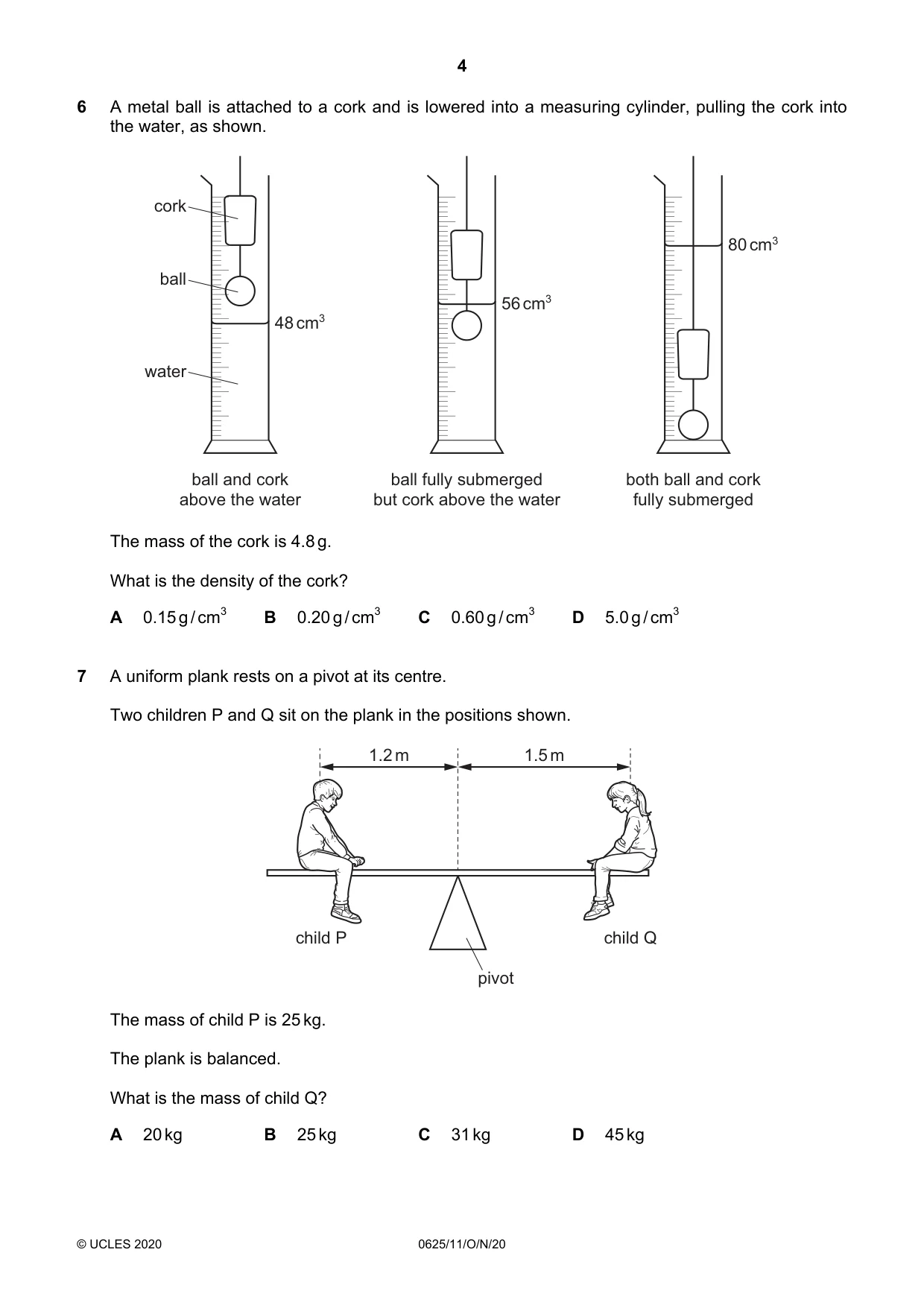
6 A metal ball is attached to a cork and is lowered into a measuring cylinder, pulling the cork into the water, as shown. cork 80 cm3 ball 56 cm3 48 cm3 water ball and cork ball fully submerged both ball and cork above the water but cork above the water fully submerged The mass of the cork is 4.8 g. What is the density of the cork? A 0.15 g / cm3 B 0.20 g / cm3 C 0.60 g / cm3 D 5.0 g / cm3
Mark scheme: B
Q7 · A uniform plank rests on a pivot at its centre
7 A uniform plank rests on a pivot at its centre. Two children P and Q sit on the plank in the positions shown. 1.2 m 1.5 m child P child Q pivot The mass of child P is 25 kg. The plank is balanced. What is the mass of child Q? A 20 kg B 25 kg C 31 kg D 45 kg
Mark scheme: A
Q8 · An object is in equilibrium on the Earth
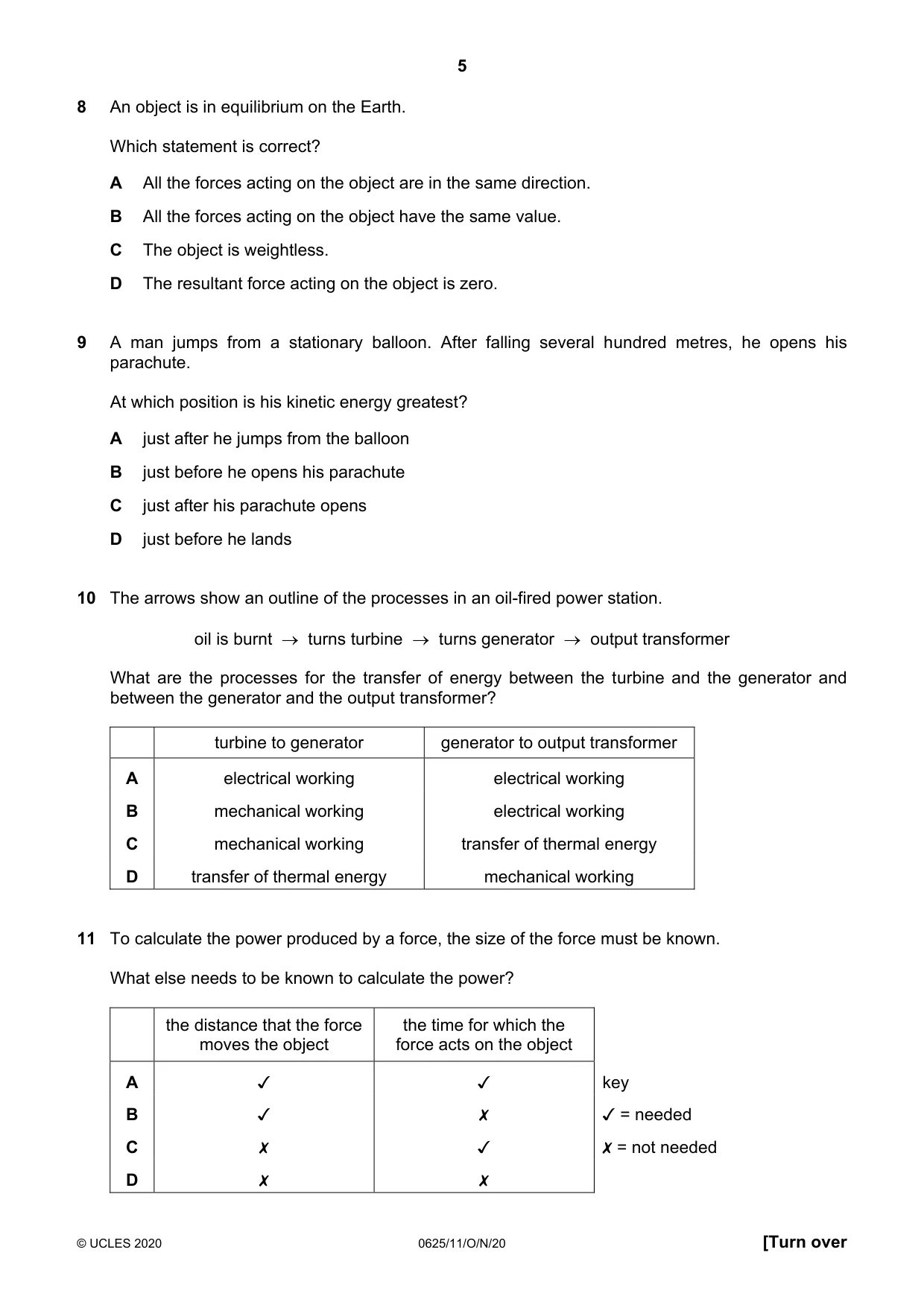
8 An object is in equilibrium on the Earth. Which statement is correct? A All the forces acting on the object are in the same direction. B All the forces acting on the object have the same value. C The object is weightless. D The resultant force acting on the object is zero.
Mark scheme: D
Q9 · A man jumps from a stationary balloon
9 A man jumps from a stationary balloon. After falling several hundred metres, he opens his parachute. At which position is his kinetic energy greatest? A just after he jumps from the balloon B just before he opens his parachute C just after his parachute opens D just before he lands
Mark scheme: B
Q10 · The arrows show an outline of the processes in an oil-fired power station
10 The arrows show an outline of the processes in an oil-fired power station. oil is burnt turns turbine turns generator output transformer What are the processes for the transfer of energy between the turbine and the generator and between the generator and the output transformer? turbine to generator generator to output transformer A electrical working electrical working B mechanical working electrical working C mechanical working transfer of thermal energy D transfer of thermal energy mechanical working
Mark scheme: B
Q11 · To calculate the power produced by a force, the size of the force must be known
11 To calculate the power produced by a force, the size of the force must be known. What else needs to be known to calculate the power? the distance that the force moves the object the time for which the force acts on the object 0 0O WwW D> v v x x v x v x key Jv = needed X = not needed
Mark scheme: A
Q12 · A rectangular marble block has dimensions 1 m by 1 m by 5 m and weighs 125 000 N
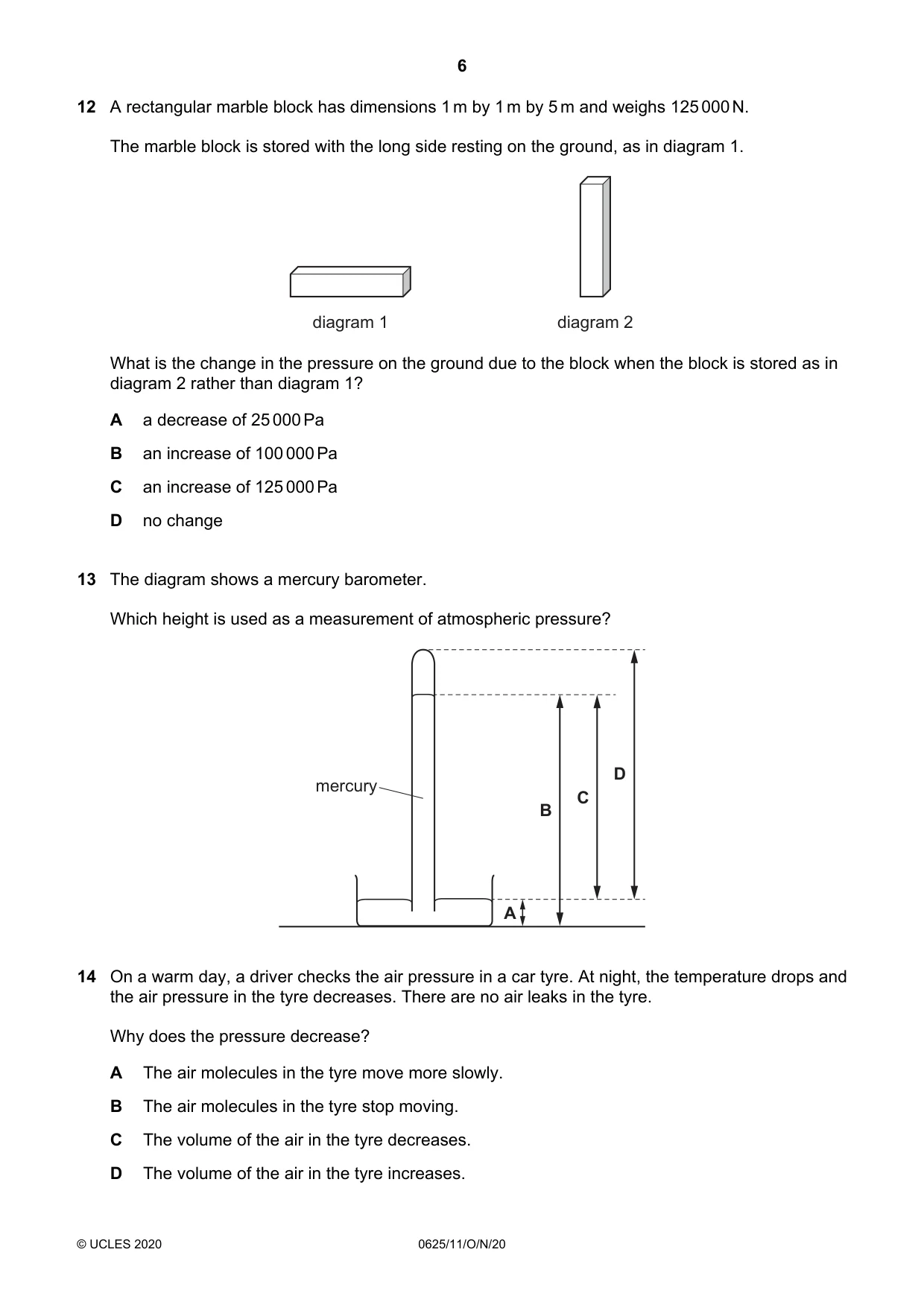
12 A rectangular marble block has dimensions 1 m by 1 m by 5 m and weighs 125 000 N. The marble block is stored with the long side resting on the ground, as in diagram 1. diagram 1 diagram 2 What is the change in the pressure on the ground due to the block when the block is stored as in diagram 2 rather than diagram 1? A a decrease of 25 000 Pa B an increase of 100 000 Pa C an increase of 125 000 Pa D no change
Mark scheme: B
Q13 · The diagram shows a mercury barometer
13 The diagram shows a mercury barometer. Which height is used as a measurement of atmospheric pressure? D mercury C B A
Mark scheme: C
Q14 · On a warm day, a driver checks the air pressure in a car tyre
14 On a warm day, a driver checks the air pressure in a car tyre. At night, the temperature drops and the air pressure in the tyre decreases. There are no air leaks in the tyre. Why does the pressure decrease? A The air molecules in the tyre move more slowly. B The air molecules in the tyre stop moving. C The volume of the air in the tyre decreases. D The volume of the air in the tyre increases.
Mark scheme: A
Q15 · The diagram shows the more energetic water molecules escaping from the surface of liquid…
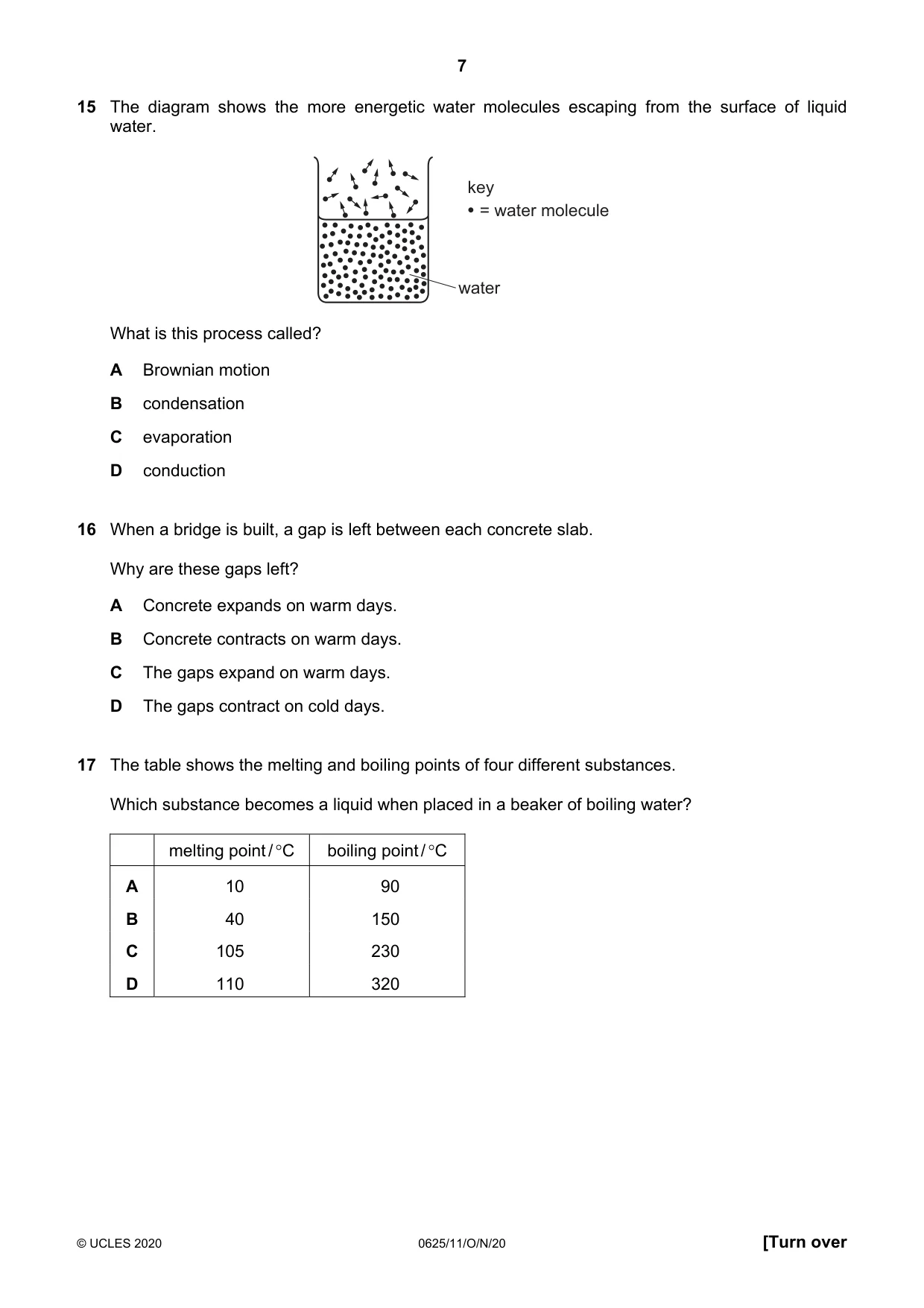
15 The diagram shows the more energetic water molecules escaping from the surface of liquid water. key = water molecule water What is this process called? A Brownian motion B condensation C evaporation D conduction
Mark scheme: C
Q16 · When a bridge is built, a gap is left between each concrete slab
16 When a bridge is built, a gap is left between each concrete slab. Why are these gaps left? A Concrete expands on warm days. B Concrete contracts on warm days. C The gaps expand on warm days. D The gaps contract on cold days.
Mark scheme: A
Q17 · The table shows the melting and boiling points of four different substances
17 The table shows the melting and boiling points of four different substances. Which substance becomes a liquid when placed in a beaker of boiling water? melting point / C boiling point / C A 10 90 B 40 150 C 105 230 D 110 320
Mark scheme: B
Q18 · The diagram shows four rods
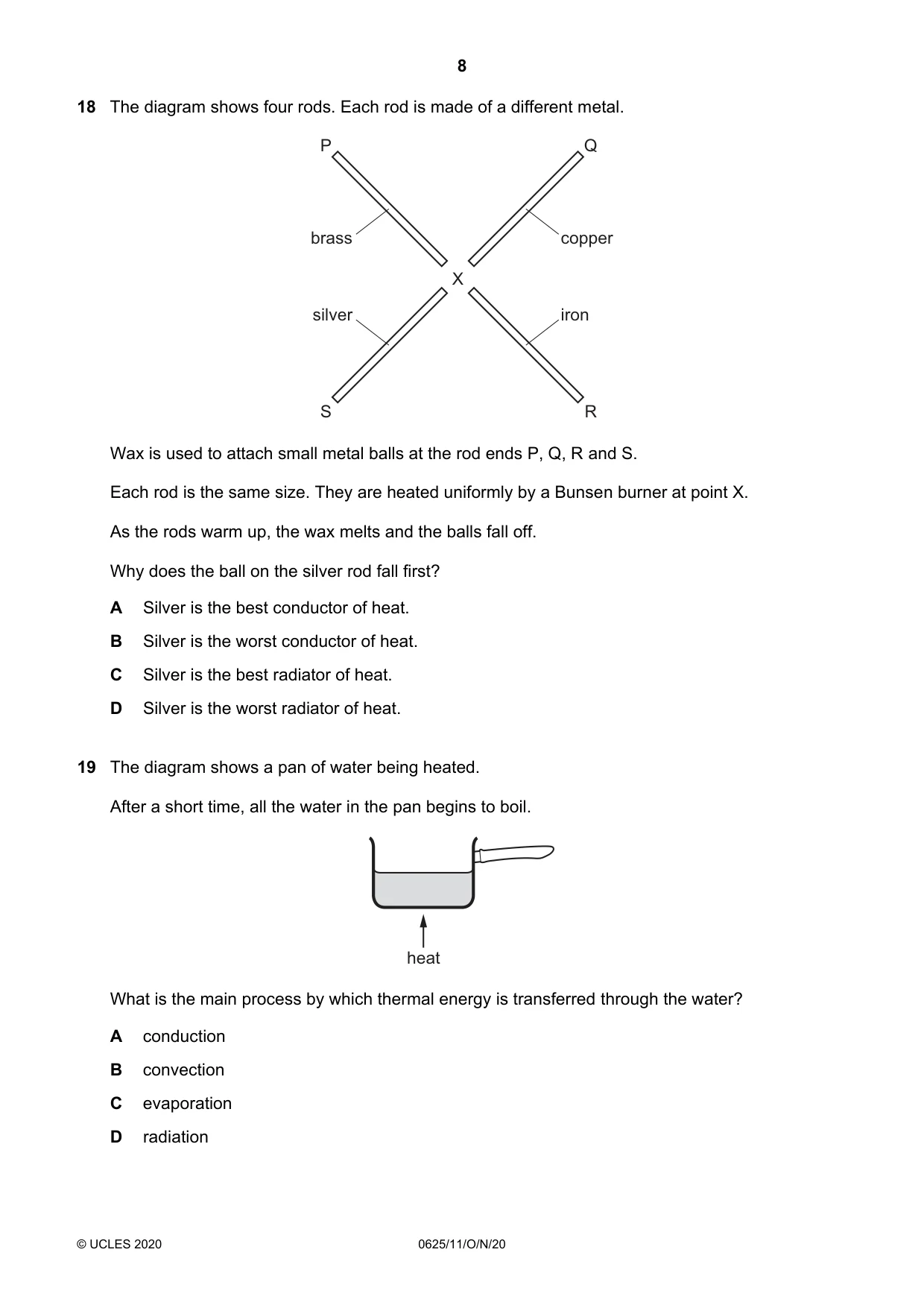
18 The diagram shows four rods. Each rod is made of a different metal. P Q brass copper X silver iron S R Wax is used to attach small metal balls at the rod ends P, Q, R and S. Each rod is the same size. They are heated uniformly by a Bunsen burner at point X. As the rods warm up, the wax melts and the balls fall off. Why does the ball on the silver rod fall first? A Silver is the best conductor of heat. B Silver is the worst conductor of heat. C Silver is the best radiator of heat. D Silver is the worst radiator of heat.
Mark scheme: A
Q19 · The diagram shows a pan of water being heated
19 The diagram shows a pan of water being heated. After a short time, all the water in the pan begins to boil. heat What is the main process by which thermal energy is transferred through the water? A conduction B convection C evaporation D radiation
Mark scheme: B
Q20 · Which row correctly describes light waves?
20 Which row correctly describes light waves? wave type direction of vibrations A longitudinal parallel to direction of wave travel B longitudinal perpendicular to direction of wave travel C transverse parallel to direction of wave travel D transverse perpendicular to direction of wave travel
Mark scheme: D
Q21 · The diagram shows two pieces of wood resting in shallow water of constant depth
21 The diagram shows two pieces of wood resting in shallow water of constant depth. Straight, parallel wavefronts approach the pieces of wood as indicated. wavefront wood gap wood The gap between the pieces of wood is 2.0 cm wide. The wavefronts are 3.0 cm apart. What is the appearance of the wavefronts after they pass through the gap? A semicircular and 2.0 cm apart B semicircular and 3.0 cm apart C straight and 2.0 cm apart D straight and 3.0 cm apart
Mark scheme: B
Q22 · A man sees a stone at the bottom of a pool of water
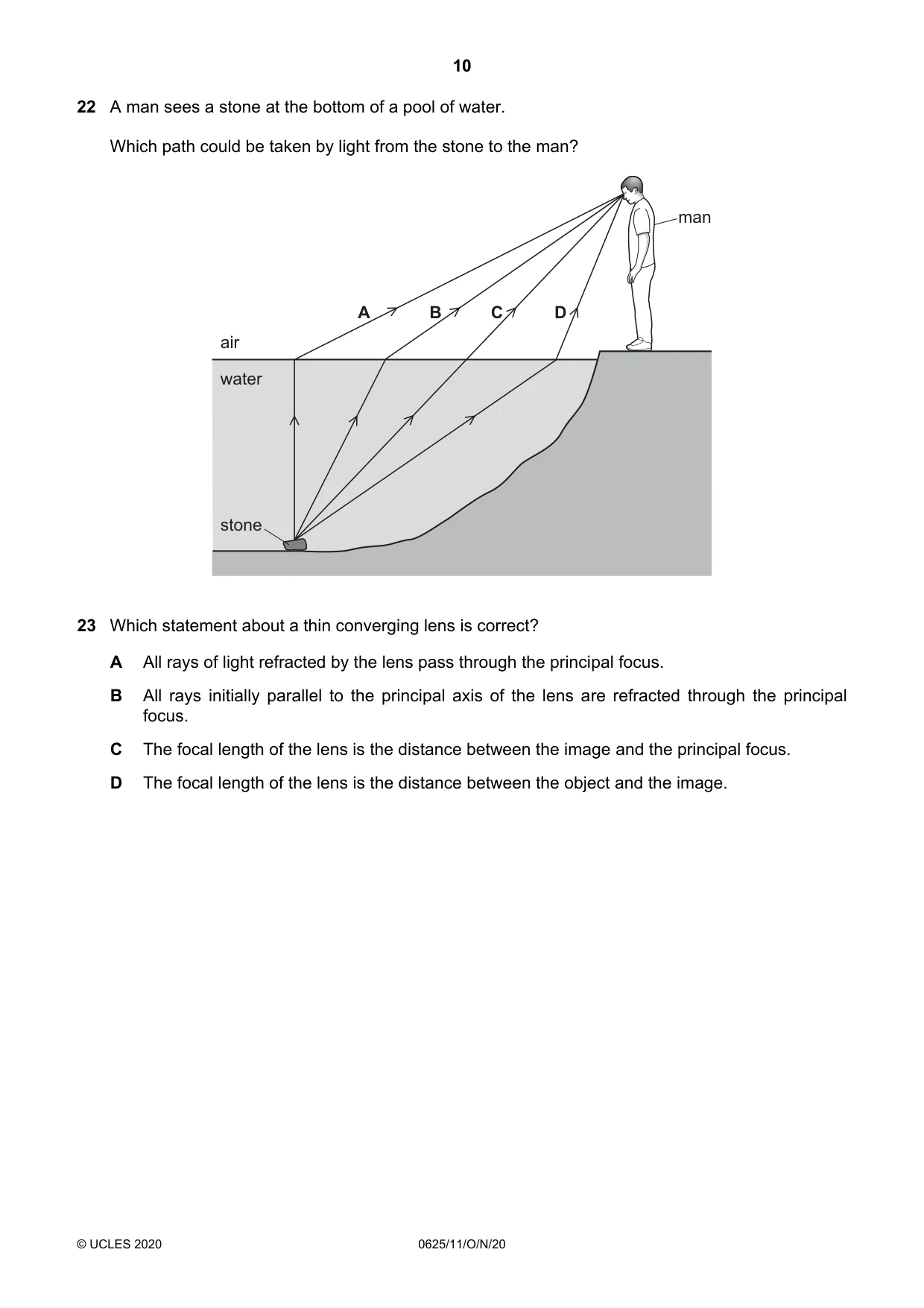
22 A man sees a stone at the bottom of a pool of water. Which path could be taken by light from the stone to the man? man A B C D air water stone
Mark scheme: B
Q23 · Which statement about a thin converging lens is correct?
23 Which statement about a thin converging lens is correct? A All rays of light refracted by the lens pass through the principal focus. B All rays initially parallel to the principal axis of the lens are refracted through the principal focus. C The focal length of the lens is the distance between the image and the principal focus. D The focal length of the lens is the distance between the object and the image.
Mark scheme: B
Q24 · The diagram shows a beam of white light passing through a triangular prism
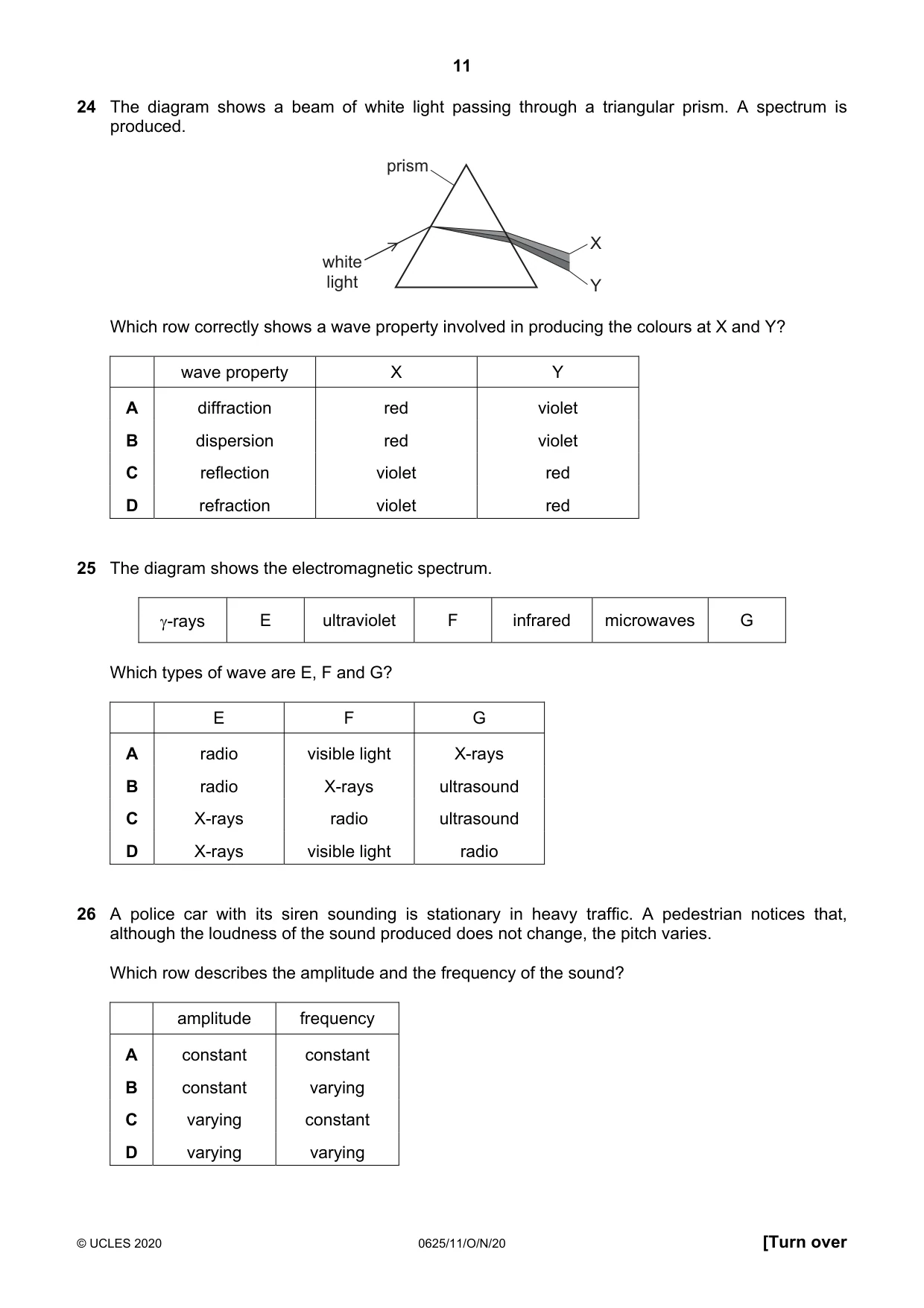
24 The diagram shows a beam of white light passing through a triangular prism. A spectrum is produced. prism X white light Y Which row correctly shows a wave property involved in producing the colours at X and Y? wave property X Y A diffraction red violet B dispersion red violet C reflection violet red D refraction violet red
Mark scheme: B
Q25 · The diagram shows the electromagnetic spectrum
25 The diagram shows the electromagnetic spectrum. -rays E ultraviolet F infrared microwaves G Which types of wave are E, F and G? E F G A radio visible light X-rays B radio X-rays ultrasound C X-rays radio ultrasound D X-rays visible light radio
Mark scheme: D
Q26 · A police car with its siren sounding is stationary in heavy traffic
26 A police car with its siren sounding is stationary in heavy traffic. A pedestrian notices that, although the loudness of the sound produced does not change, the pitch varies. Which row describes the amplitude and the frequency of the sound? amplitude frequency A constant constant B constant varying C varying constant D varying varying
Mark scheme: B
Q27 · Two soft-iron pins are suspended from the S pole of a bar magnet
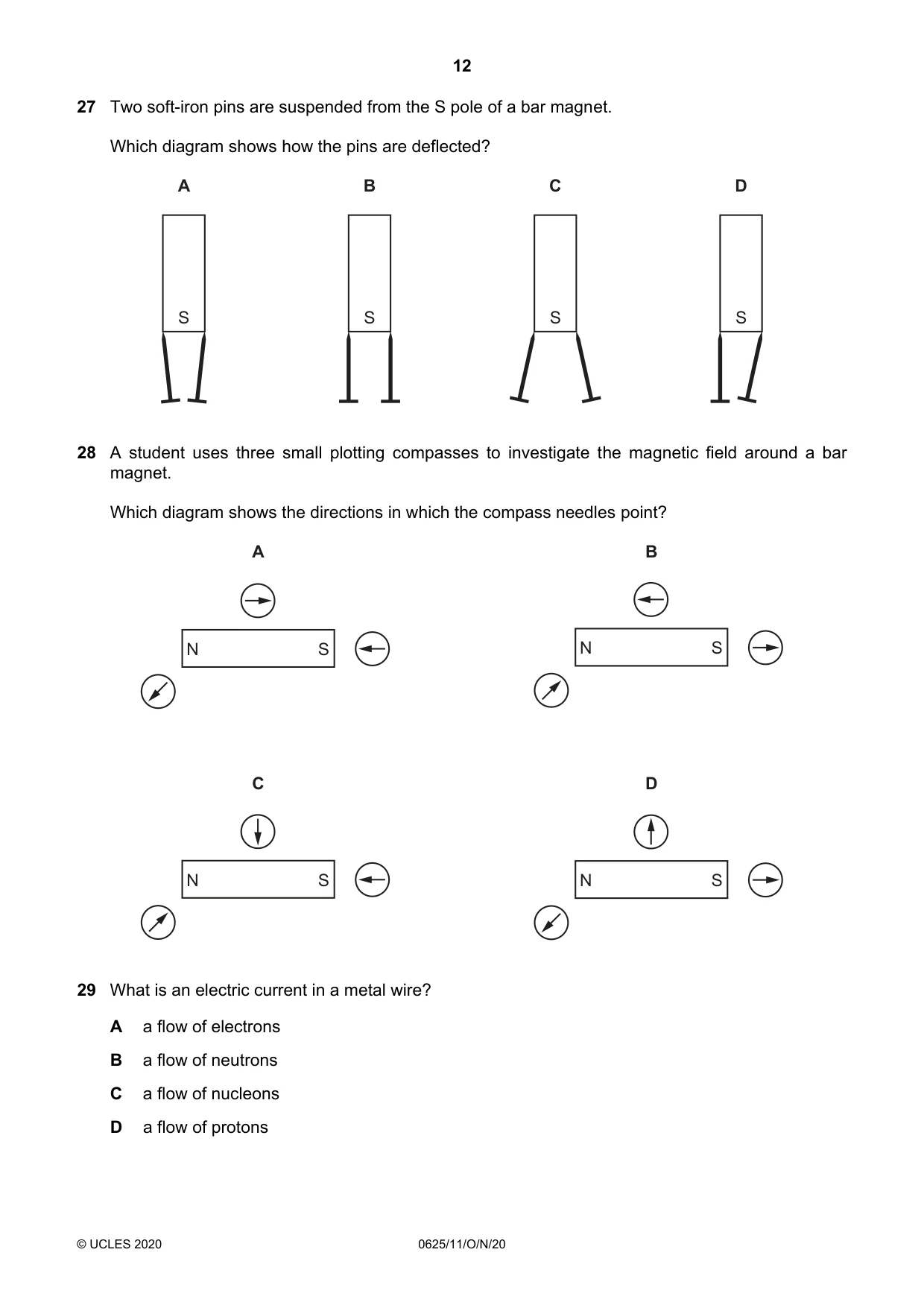
27 Two soft-iron pins are suspended from the S pole of a bar magnet. Which diagram shows how the pins are deflected? A B C D S S S S
Mark scheme: C
Q28 · A student uses three small plotting compasses to investigate the magnetic field around a…
28 A student uses three small plotting compasses to investigate the magnetic field around a bar magnet. Which diagram shows the directions in which the compass needles point? A B N S N S C D N S N S
Mark scheme: A
Q29 · What is an electric current in a metal wire?
29 What is an electric current in a metal wire? A a flow of electrons B a flow of neutrons C a flow of nucleons D a flow of protons
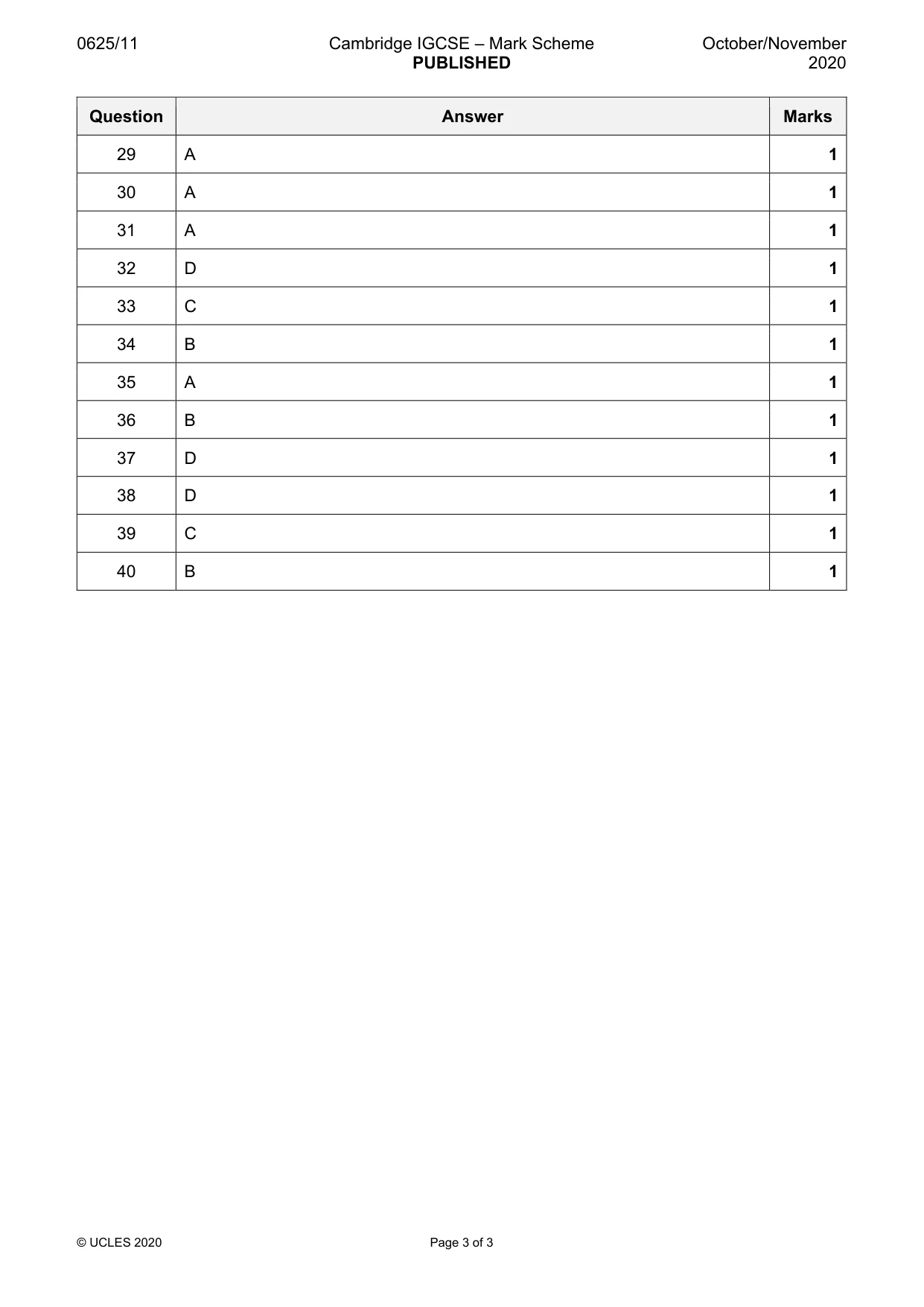
Mark scheme: A
Q30 · Four wires are made of the same metal
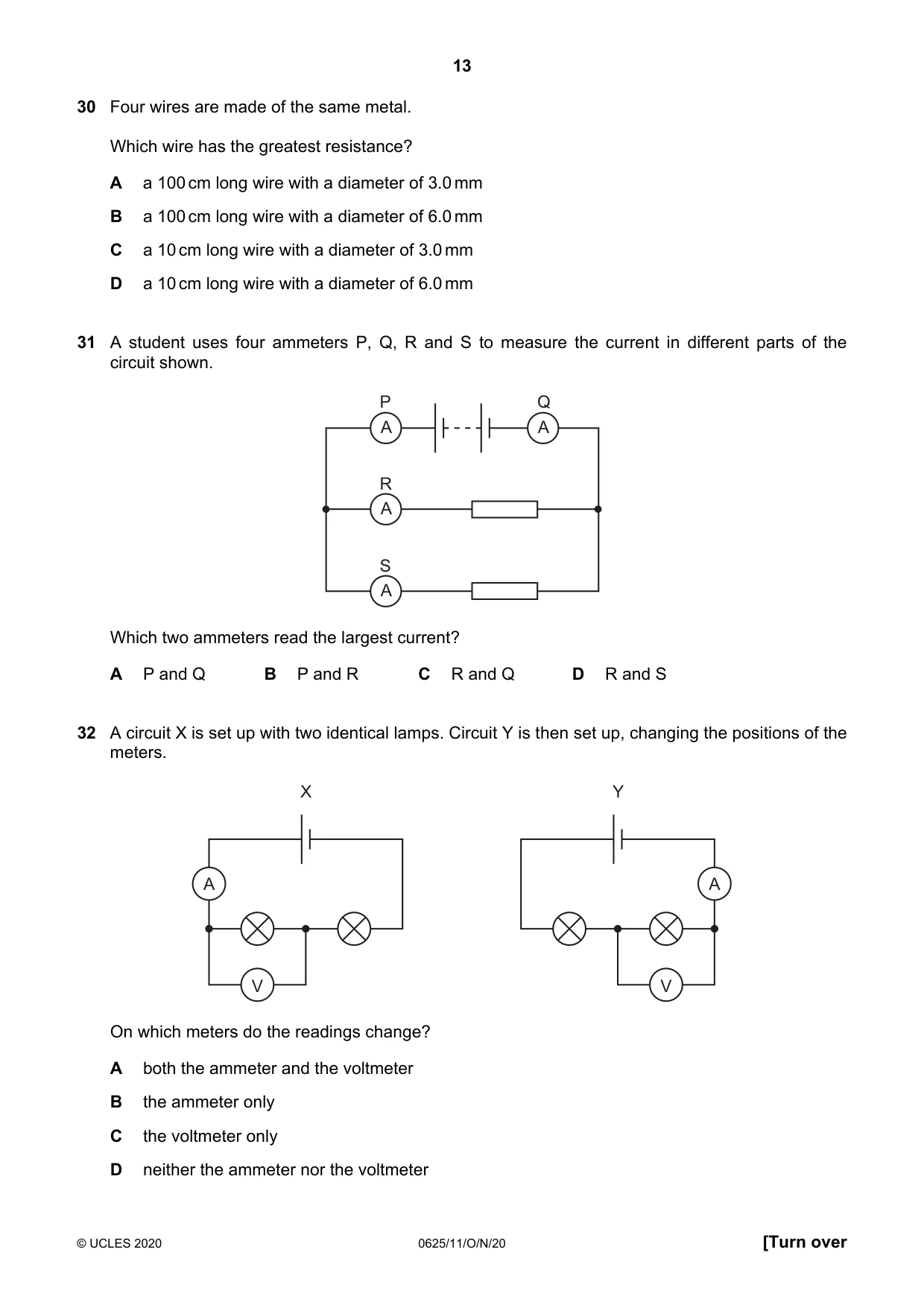
30 Four wires are made of the same metal. Which wire has the greatest resistance? A a 100 cm long wire with a diameter of 3.0 mm B a 100 cm long wire with a diameter of 6.0 mm C a 10 cm long wire with a diameter of 3.0 mm D a 10 cm long wire with a diameter of 6.0 mm
Mark scheme: A
Q31 · A student uses four ammeters P, Q, R and S to measure the current in different parts of…
31 A student uses four ammeters P, Q, R and S to measure the current in different parts of the circuit shown. P Q A A R A S A Which two ammeters read the largest current? A P and Q B P and R C R and Q D R and S
Mark scheme: A
Q32 · A circuit X is set up with two identical lamps
32 A circuit X is set up with two identical lamps. Circuit Y is then set up, changing the positions of the meters. X Y A A V V On which meters do the readings change? A both the ammeter and the voltmeter B the ammeter only C the voltmeter only D neither the ammeter nor the voltmeter
Mark scheme: D
Q33 · An electrical appliance is powered from a mains supply
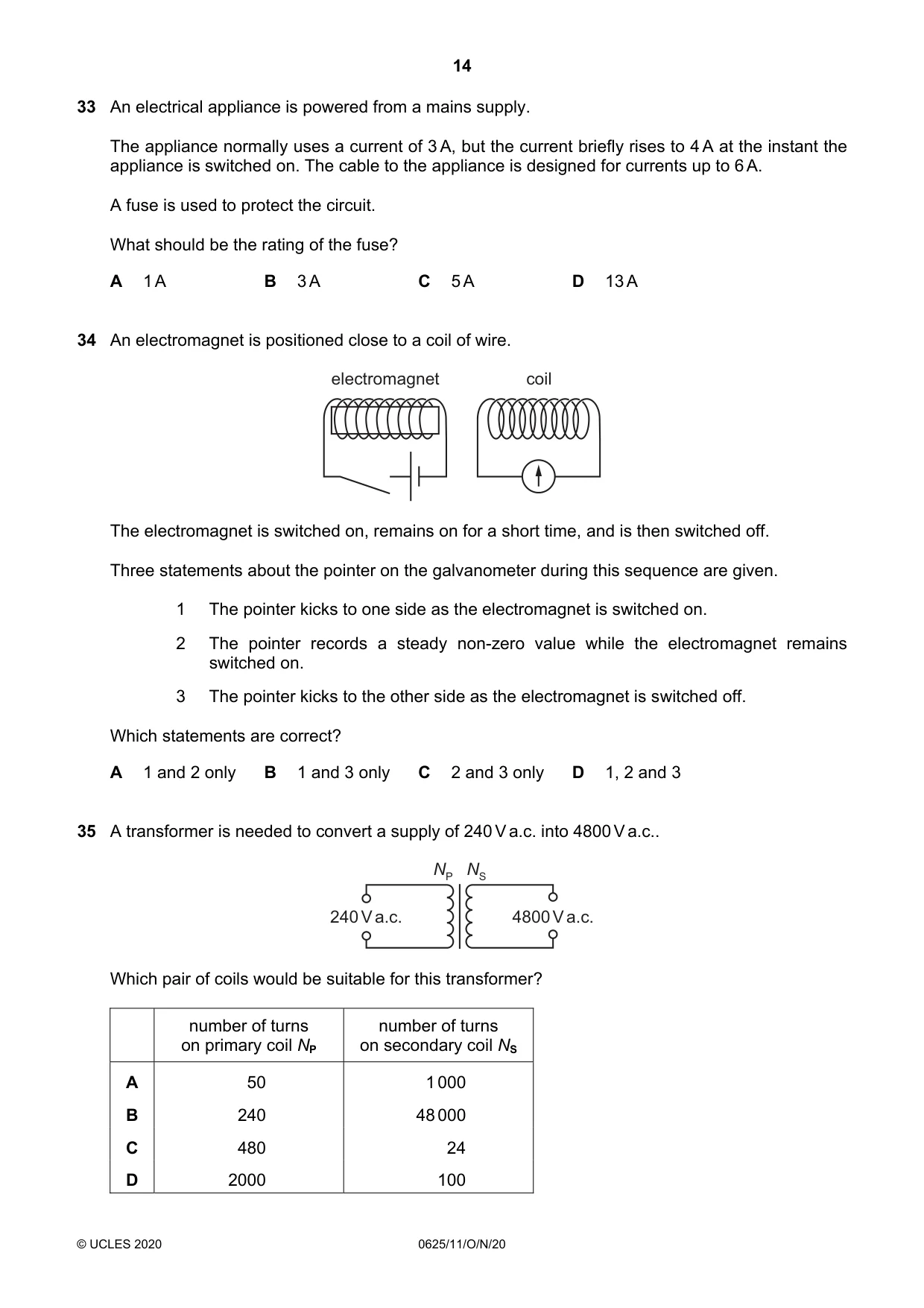
33 An electrical appliance is powered from a mains supply. The appliance normally uses a current of 3 A, but the current briefly rises to 4 A at the instant the appliance is switched on. The cable to the appliance is designed for currents up to 6 A. A fuse is used to protect the circuit. What should be the rating of the fuse? A 1 A B 3 A C 5 A D 13 A
Mark scheme: C
Q34 · An electromagnet is positioned close to a coil of wire
34 An electromagnet is positioned close to a coil of wire. electromagnet coil The electromagnet is switched on, remains on for a short time, and is then switched off. Three statements about the pointer on the galvanometer during this sequence are given. 1 The pointer kicks to one side as the electromagnet is switched on. 2 The pointer records a steady non-zero value while the electromagnet remains switched on. 3 The pointer kicks to the other side as the electromagnet is switched off. Which statements are correct? A 1 and 2 only B 1 and 3 only C 2 and 3 only D 1, 2 and 3
Mark scheme: B
Q35 · A transformer is needed to convert a supply of 240 V a.c
35 A transformer is needed to convert a supply of 240 V a.c. into 4800 V a.c.. NP NS 240 V a.c. 4800 V a.c. Which pair of coils would be suitable for this transformer? number of turns number of turns on primary coil NP on secondary coil NS A 50 1 000 B 240 48 000 C 480 24 D 2000 100
Mark scheme: A
Q36 · The diagrams show a current-carrying wire with an arrow in the direction of the current
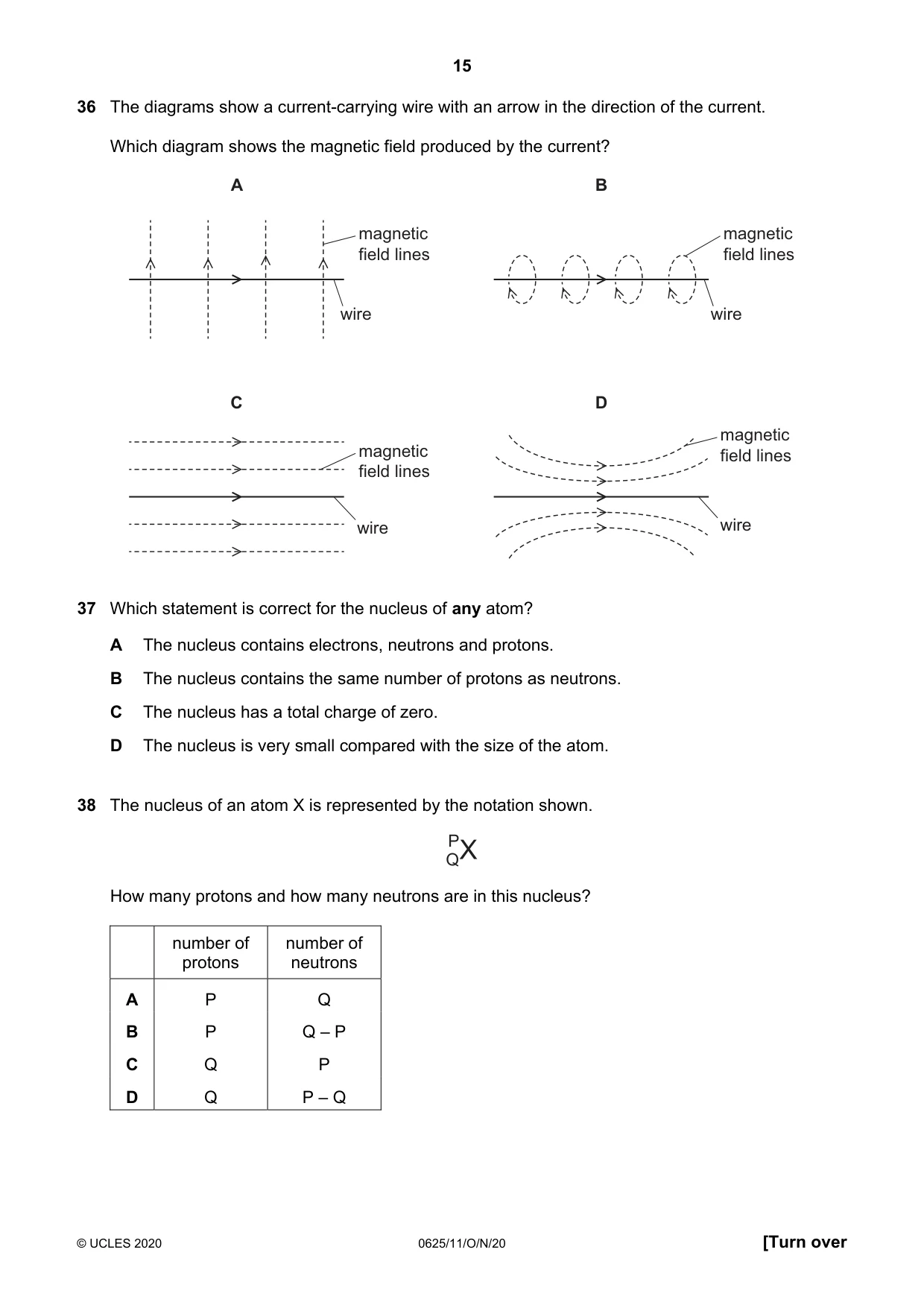
36 The diagrams show a current-carrying wire with an arrow in the direction of the current. Which diagram shows the magnetic field produced by the current? A B magnetic magnetic field lines field lines wire wire C D magnetic magnetic field lines field lines wire wire
Mark scheme: B
Q37 · Which statement is correct for the nucleus of any atom?
37 Which statement is correct for the nucleus of any atom? A The nucleus contains electrons, neutrons and protons. B The nucleus contains the same number of protons as neutrons. C The nucleus has a total charge of zero. D The nucleus is very small compared with the size of the atom.
Mark scheme: D
Q38 · The nucleus of an atom X is represented by the notation shown
38 The nucleus of an atom X is represented by the notation shown. How many protons and how many neutrons are in this nucleus? number of number of protons neutrons A P Q B P Q – P C Q P D Q P – Q
Mark scheme: D
Q39 · A radiation detector records a low reading even when no radioactive source is close
39 A radiation detector records a low reading even when no radioactive source is close. This is due to background radiation. What does not contribute to this background radiation? A rocks on Earth B cosmic rays from the Sun C satellite TV signals D waste from nuclear power stations
Mark scheme: C
Q40 · The graph shows the radioactive decay curve of a substance
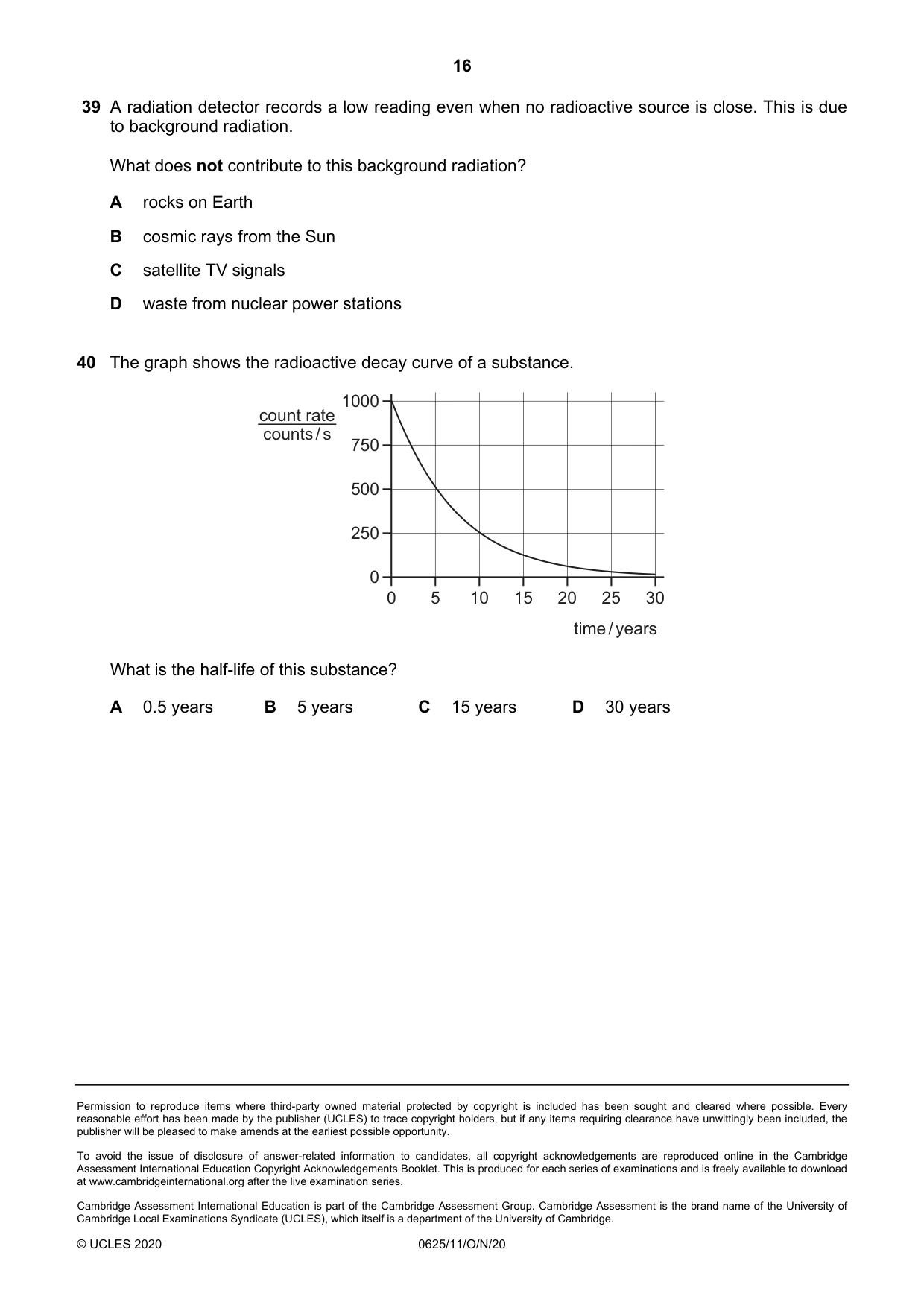
40 The graph shows the radioactive decay curve of a substance. 1000 count rate counts / s 750 500 250 0 0 5 10 15 20 25 30 time / years What is the half-life of this substance? A 0.5 years B 5 years C 15 years D 30 years
Mark scheme: B
What was in this paper
The subtopics covered by these 40 questions, and how many questions each got. Open one in a new tab to see every Cambridge question on it.
3Energy, work and power3Light3Electric circuits2Electrical quantities2Forces2General properties of waves2Kinetic particle model of matter2Mass and weight2Motion2Pressure2Radioactivity2Simple phenomena of magnetism2The nuclear model of the atom2Thermal properties and temperature2Transfer of thermal energy2Density1Electrical safety1Electromagnetic spectrum1Physical quantities and measurement techniques1Sound1What you needed in this session
Cambridge’s own grade thresholds for 2020 Oct/Nov, Paper 1 · Variant 1. A higher threshold means an easier paper — the bar moves with how the cohort did.