Cambridge IGCSE Physics 0625 — 2011 May/June Paper 1 · Variant 3
0625/13/M/J/11 · 40 questions · 40 marks · ≈45 min
The question paper and its mark scheme, free to read here and free to download. This is Cambridge’s own paper, exactly as it was sat.
Question paper20 pages
Mark scheme2 pages
Answers below. Sit the paper first if you are practising.
Questions as text
Q1 · A tennis player hits a ball hard and 0.40 s later hears the echo from a wall
1 A tennis player hits a ball hard and 0.40 s later hears the echo from a wall. The speed of sound in air is 330 m / s. How far away is the player from the wall? A 66 m B 132 m C 264 m D 825 m
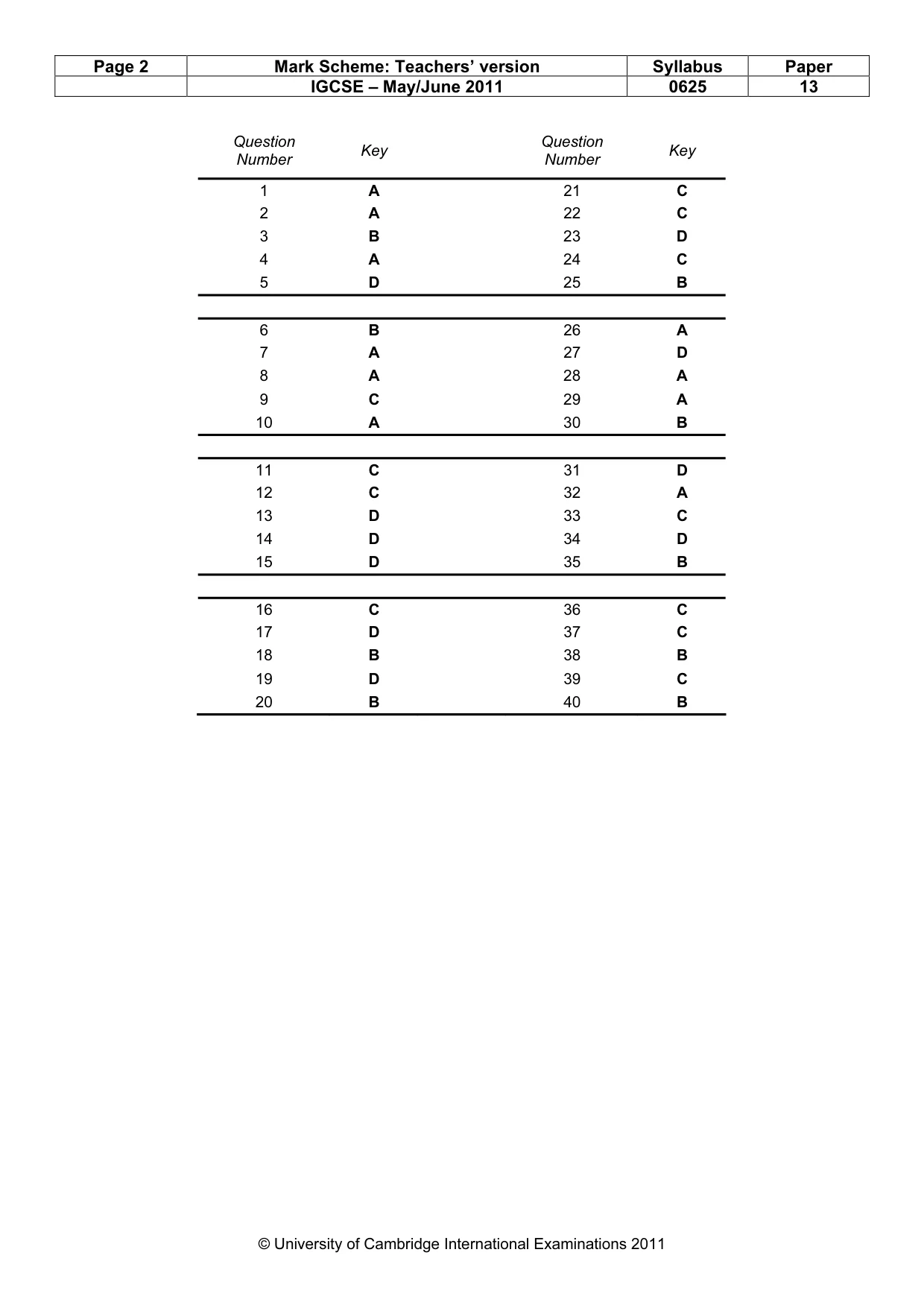
Mark scheme: A
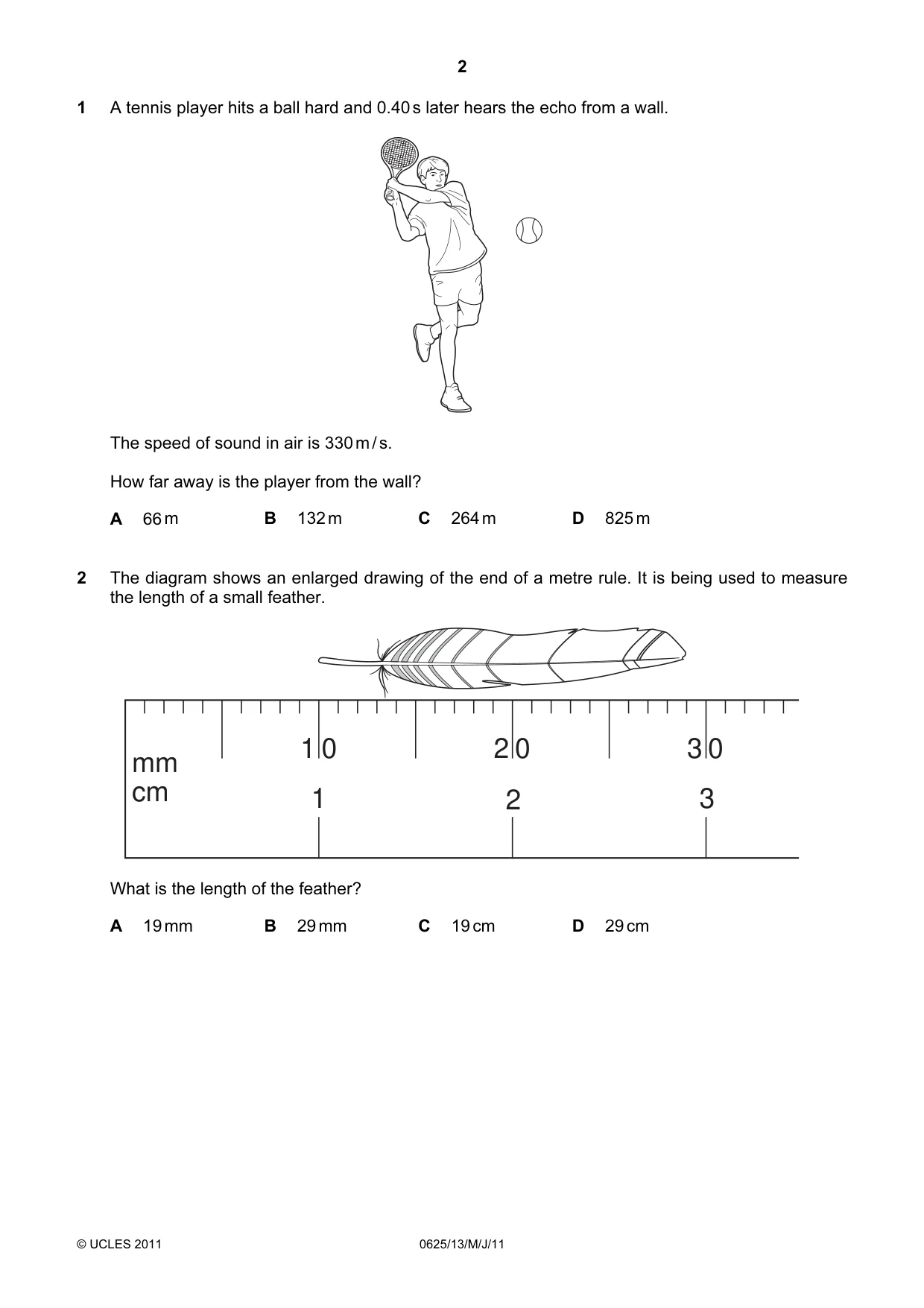
Q2 · The diagram shows an enlarged drawing of the end of a metre rule
2 The diagram shows an enlarged drawing of the end of a metre rule. It is being used to measure the length of a small feather. 1 0 2 0 3 0 mm cm 1 2 3 What is the length of the feather? A 19 mm B 29 mm C 19 cm D 29 cm
Mark scheme: A
More questions on Physical quantities and measurement techniques
Q3 · Water waves can be used to show reflection, refraction and diffraction
3 Water waves can be used to show reflection, refraction and diffraction. For each of these, which row shows whether or not the speed of the water waves changes? reflection refraction diffraction A no no yes B no yes no C yes no no D yes yes yes
Mark scheme: B
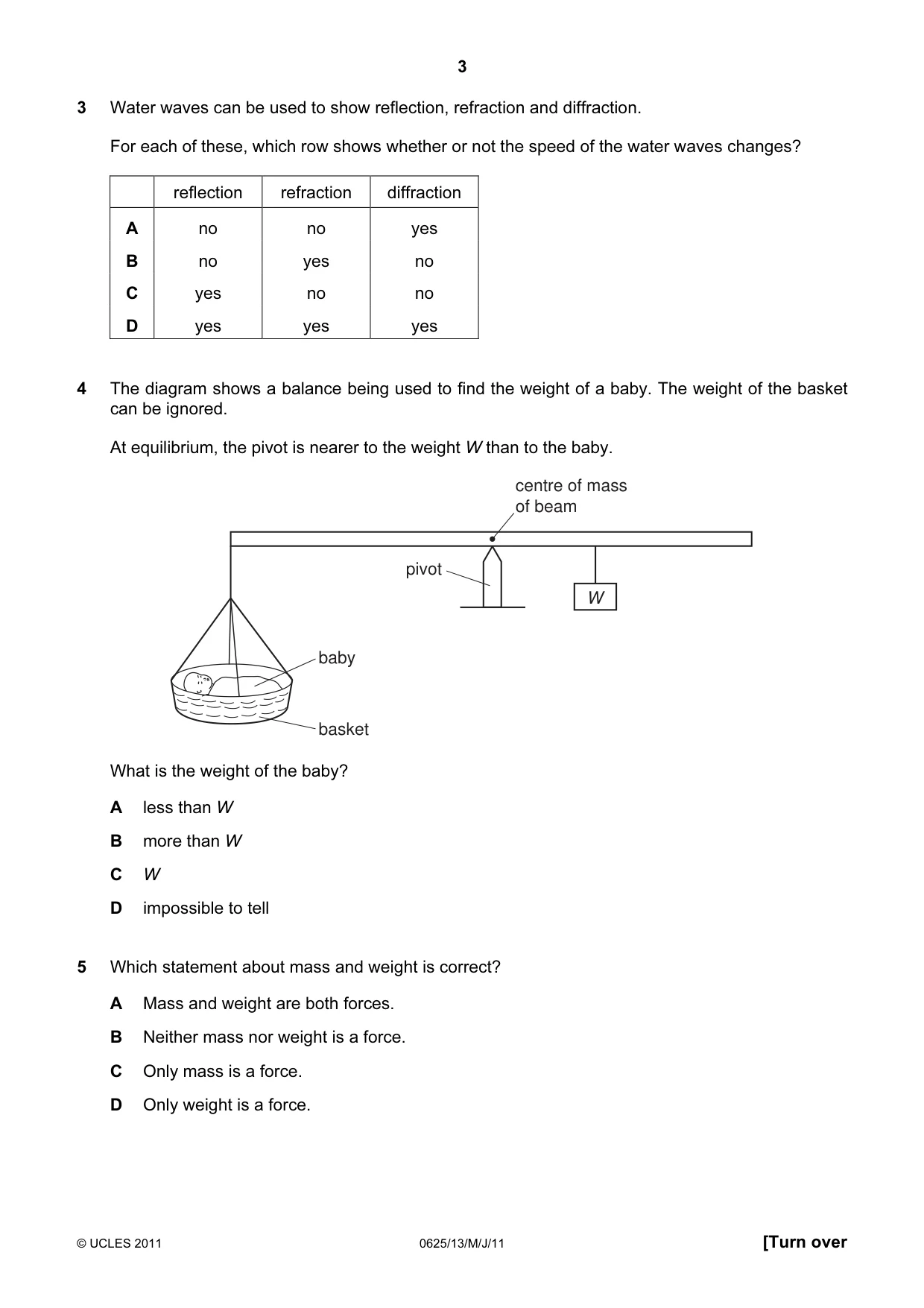
Q4 · The diagram shows a balance being used to find the weight of a baby
4 The diagram shows a balance being used to find the weight of a baby. The weight of the basket can be ignored. At equilibrium, the pivot is nearer to the weight W than to the baby. centre of mass of beam pivot W baby basket What is the weight of the baby? A less than W B more than W C W D impossible to tell
Mark scheme: A
Q5 · Which statement about mass and weight is correct?
5 Which statement about mass and weight is correct? A Mass and weight are both forces. B Neither mass nor weight is a force. C Only mass is a force. D Only weight is a force.
Mark scheme: D
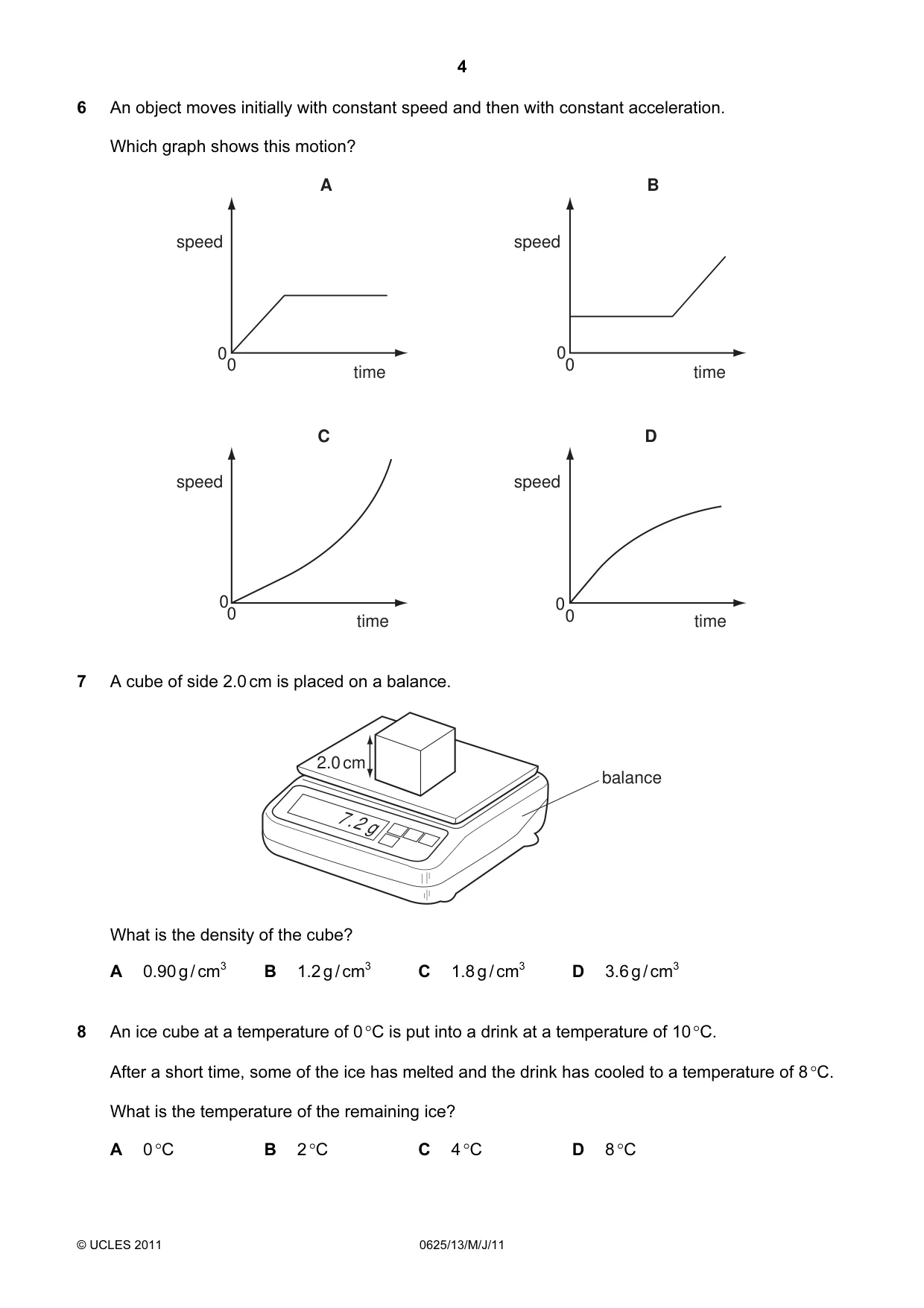
Q6 · An object moves initially with constant speed and then with constant acceleration
6 An object moves initially with constant speed and then with constant acceleration. Which graph shows this motion? A B speed speed 0 0 00 time time C D speed speed 0 0 00 time time
Mark scheme: B
Q7 · A cube of side 2.0 cm is placed on a balance
7 A cube of side 2.0 cm is placed on a balance. 2.0 cm balance 7.2 g What is the density of the cube? A 0.90 g / cm3 B 1.2 g / cm3 C 1.8 g / cm3 D 3.6 g / cm3
Mark scheme: A
Q8 · An ice cube at a temperature of 0 °C is put into a drink at a temperature of 10 °C
8 An ice cube at a temperature of 0 °C is put into a drink at a temperature of 10 °C. After a short time, some of the ice has melted and the drink has cooled to a temperature of 8 °C. What is the temperature of the remaining ice? A 0 °C B 2 °C C 4 °C D 8 °C
Mark scheme: A
Q9 · The diagram shows a thermometer calibrated in degrees Celsius
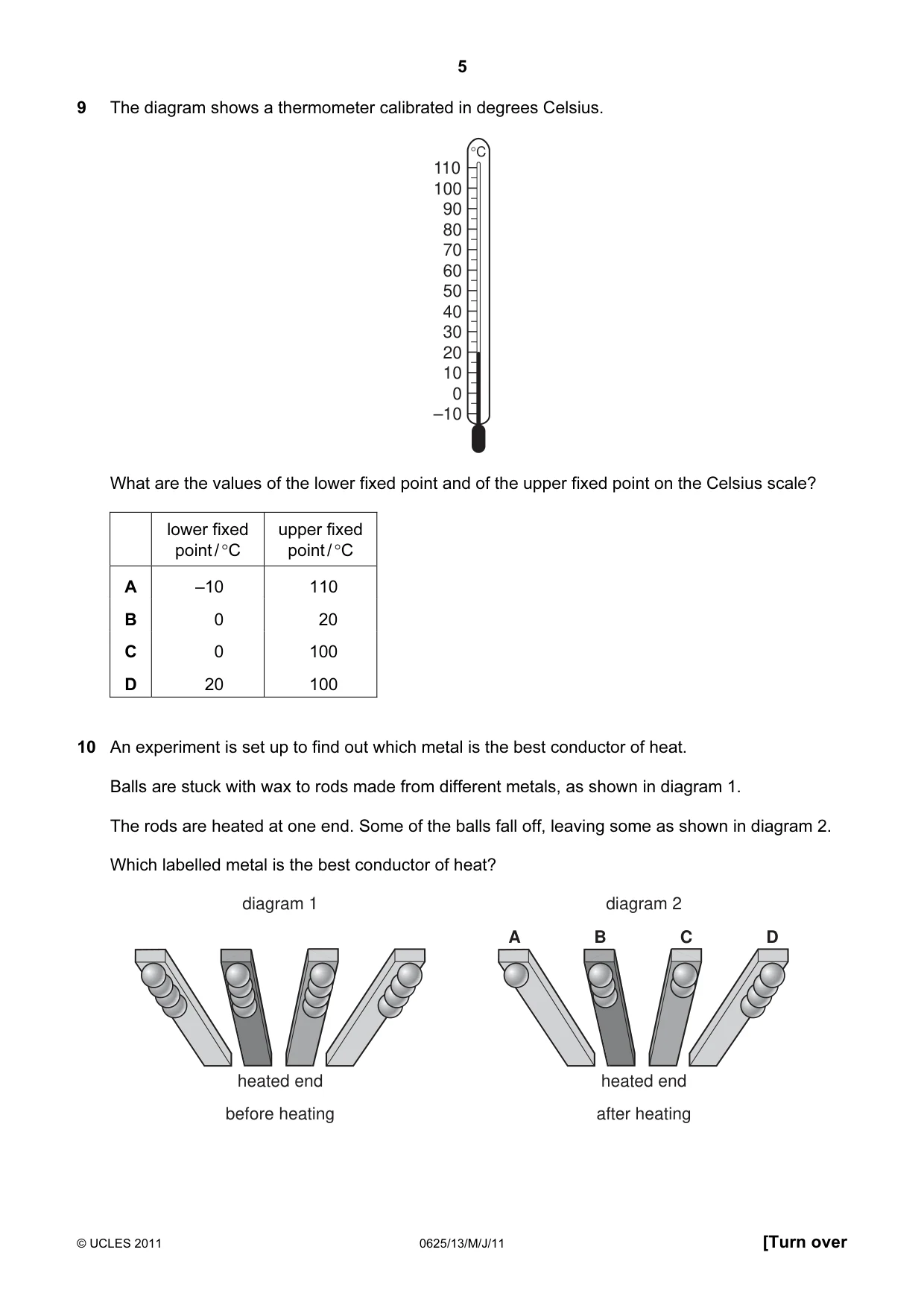
9 The diagram shows a thermometer calibrated in degrees Celsius. °C 110 100 90 80 70 60 50 40 30 20 10 0 –10 What are the values of the lower fixed point and of the upper fixed point on the Celsius scale? lower fixed upper fixed point / °C point / °C A –10 110 B 0 20 C 0 100 D 20 100
Mark scheme: C
Q10 · An experiment is set up to find out which metal is the best conductor of heat
10 An experiment is set up to find out which metal is the best conductor of heat. Balls are stuck with wax to rods made from different metals, as shown in diagram 1. The rods are heated at one end. Some of the balls fall off, leaving some as shown in diagram 2. Which labelled metal is the best conductor of heat? diagram 1 diagram 2 A B C D heated end heated end before heating after heating
Mark scheme: A
Q11 · Objects with different masses are hung on a spring
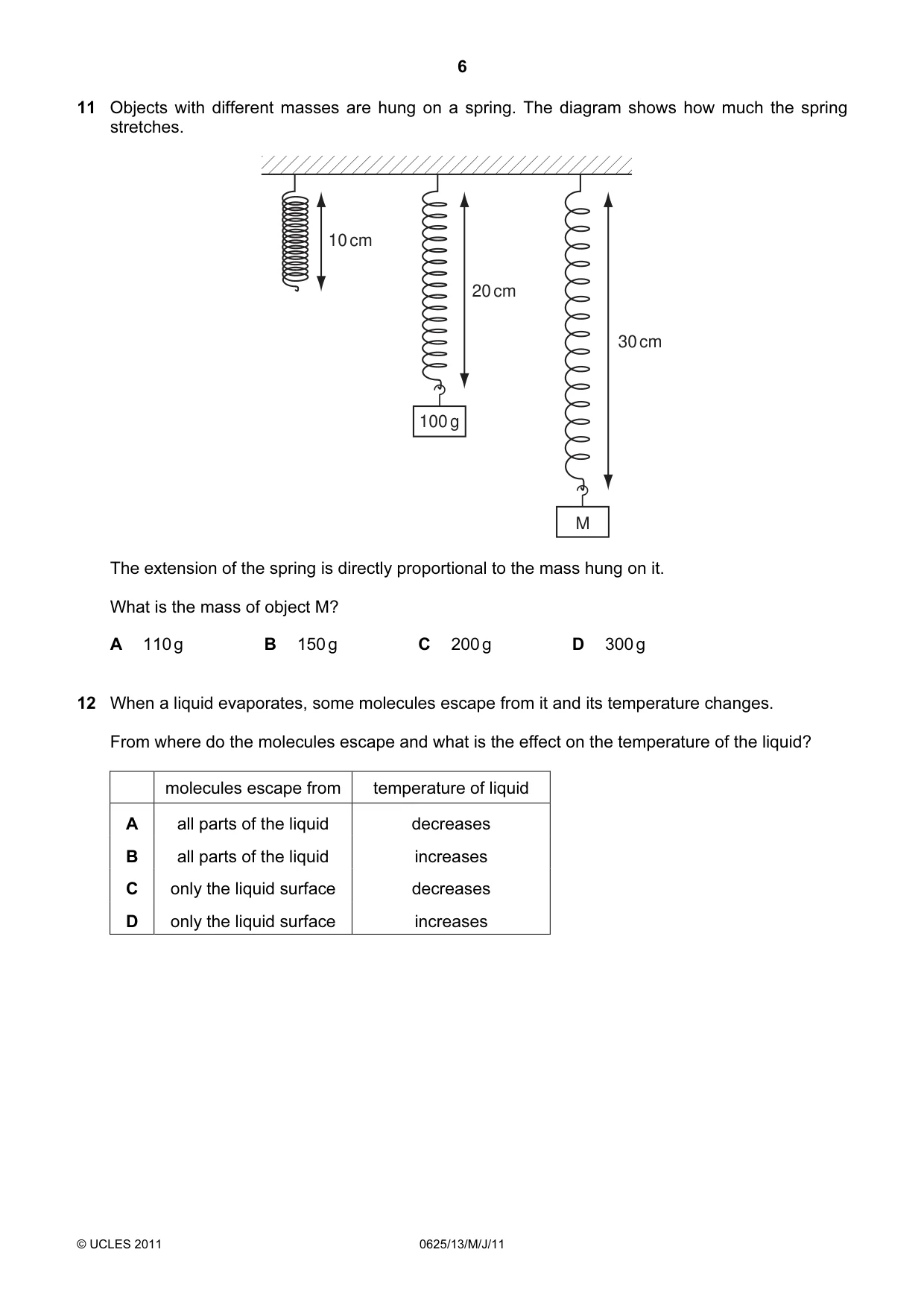
11 Objects with different masses are hung on a spring. The diagram shows how much the spring stretches. 10 cm 20 cm 30 cm 100 g M The extension of the spring is directly proportional to the mass hung on it. What is the mass of object M? A 110 g B 150 g C 200 g D 300 g
Mark scheme: C
Q12 · When a liquid evaporates, some molecules escape from it and its temperature changes
12 When a liquid evaporates, some molecules escape from it and its temperature changes. From where do the molecules escape and what is the effect on the temperature of the liquid? molecules escape from temperature of liquid A all parts of the liquid decreases B all parts of the liquid increases C only the liquid surface decreases D only the liquid surface increases
Mark scheme: C
Q13 · A sealed gas cylinder is left outside on a hot, sunny day
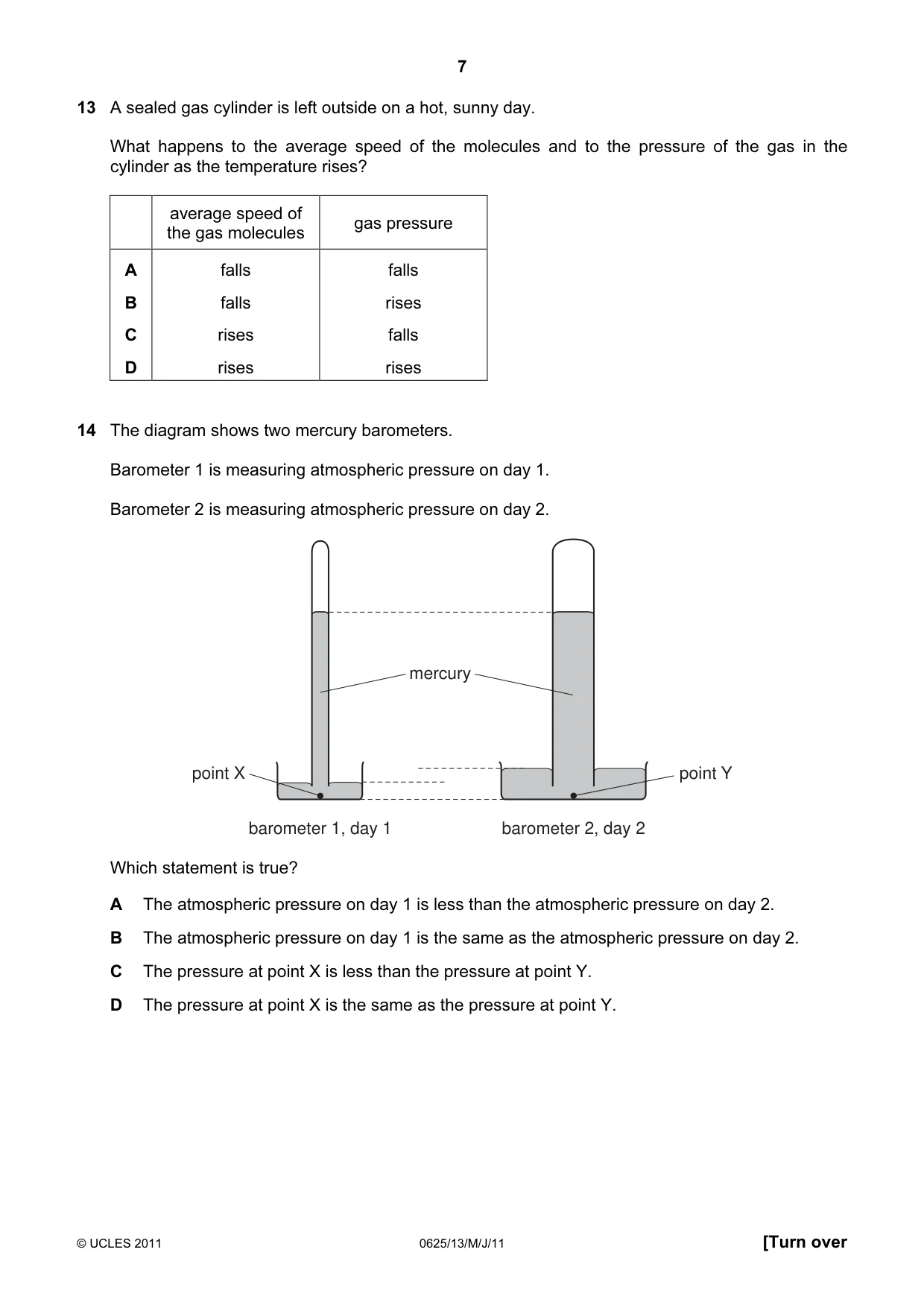
13 A sealed gas cylinder is left outside on a hot, sunny day. What happens to the average speed of the molecules and to the pressure of the gas in the cylinder as the temperature rises? average speed of gas pressure the gas molecules A falls falls B falls rises C rises falls D rises rises
Mark scheme: D
Q14 · The diagram shows two mercury barometers
14 The diagram shows two mercury barometers. Barometer 1 is measuring atmospheric pressure on day 1. Barometer 2 is measuring atmospheric pressure on day 2. mercury point X point Y barometer 1, day 1 barometer 2, day 2 Which statement is true? A The atmospheric pressure on day 1 is less than the atmospheric pressure on day 2. B The atmospheric pressure on day 1 is the same as the atmospheric pressure on day 2. C The pressure at point X is less than the pressure at point Y. D The pressure at point X is the same as the pressure at point Y.
Mark scheme: D
Q15 · Which row gives an example of the stated form of energy?
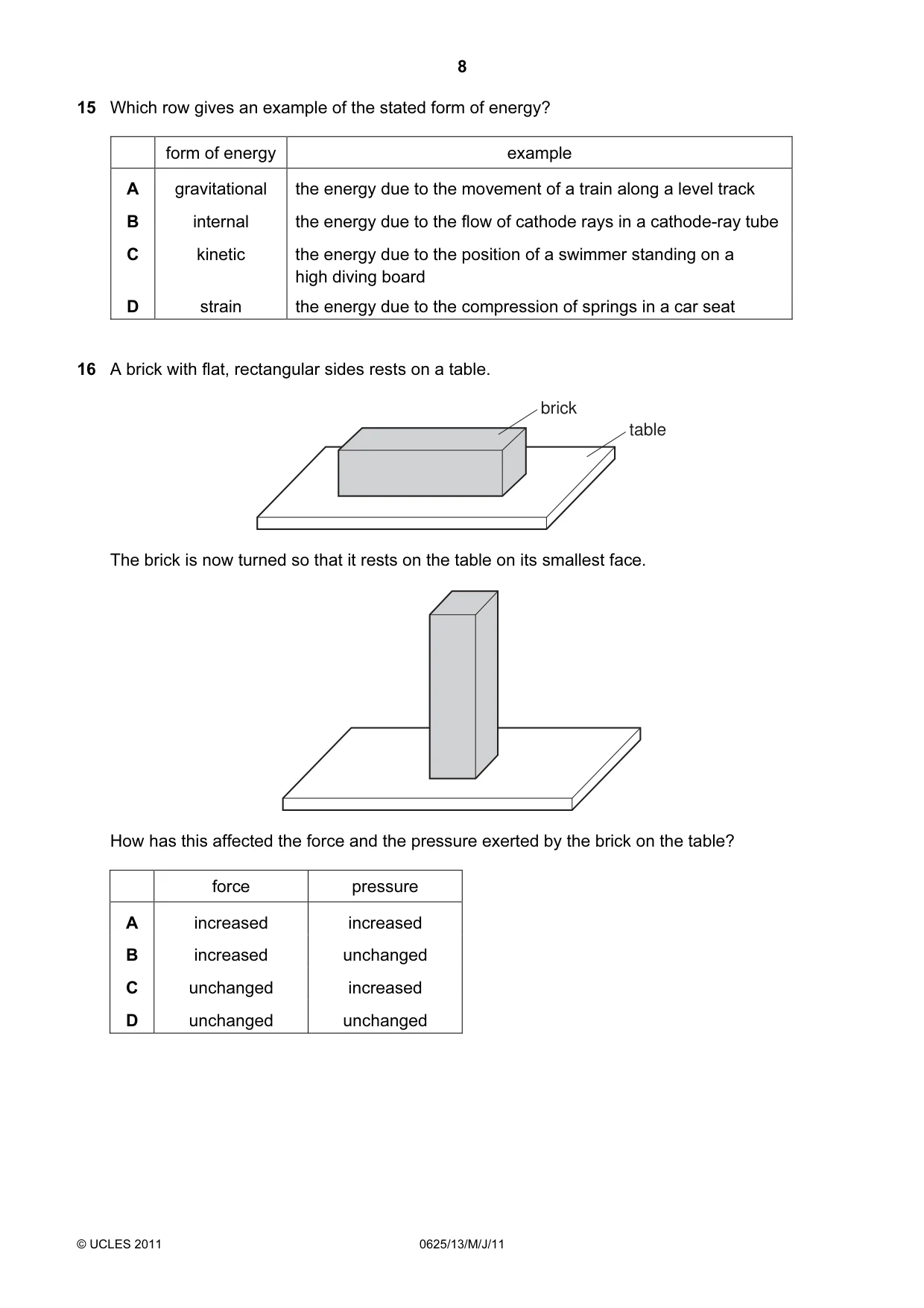
15 Which row gives an example of the stated form of energy? form of energy example A gravitational the energy due to the movement of a train along a level track B internal the energy due to the flow of cathode rays in a cathode-ray tube C kinetic the energy due to the position of a swimmer standing on a high diving board D strain the energy due to the compression of springs in a car seat
Mark scheme: D
Q16 · A brick with flat, rectangular sides rests on a table
16 A brick with flat, rectangular sides rests on a table. brick table The brick is now turned so that it rests on the table on its smallest face. How has this affected the force and the pressure exerted by the brick on the table? force pressure A increased increased B increased unchanged C unchanged increased D unchanged unchanged
Mark scheme: C
Q17 · Two farmers use an electrically powered elevator to lift bales of hay
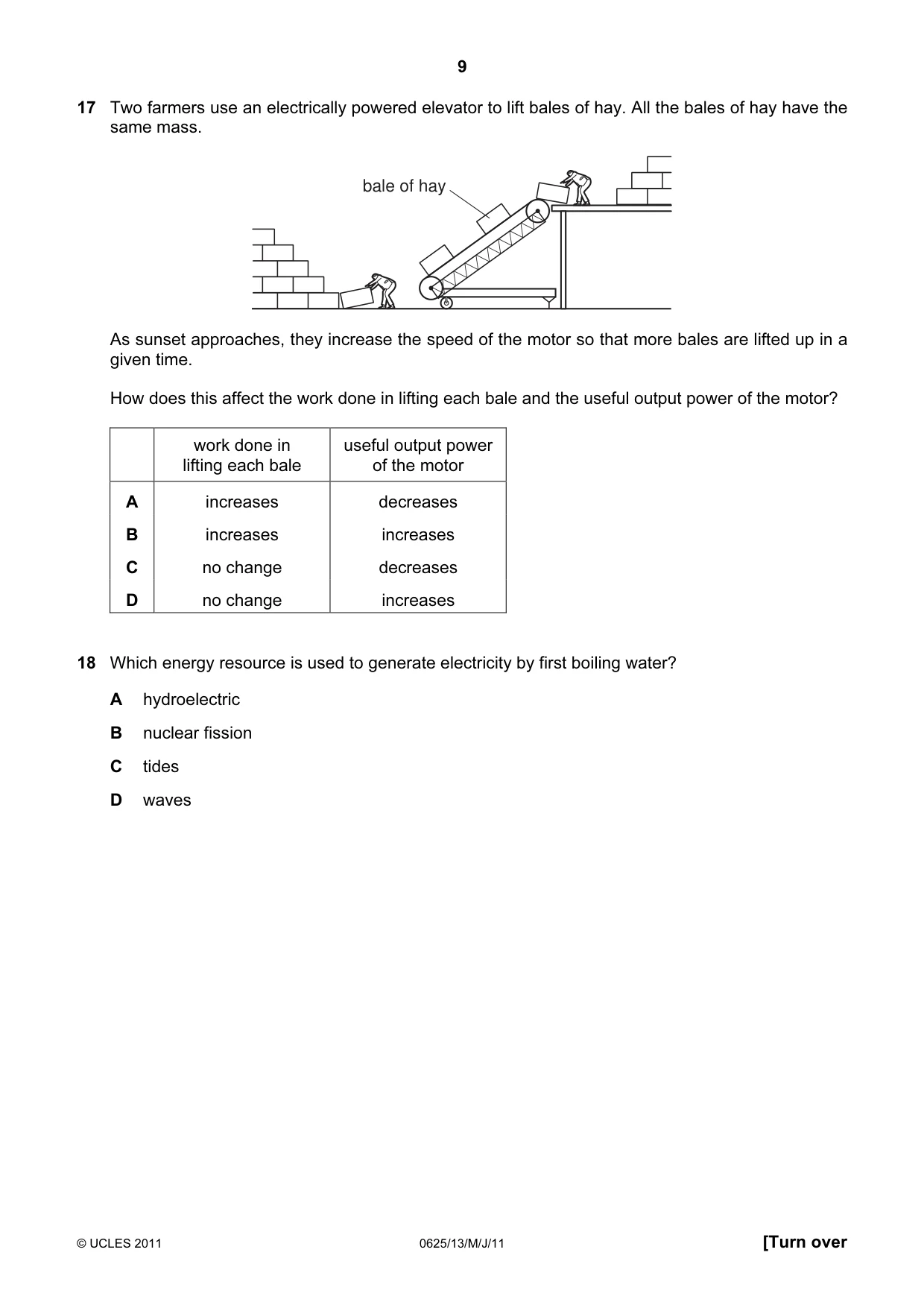
17 Two farmers use an electrically powered elevator to lift bales of hay. All the bales of hay have the same mass. bale of hay As sunset approaches, they increase the speed of the motor so that more bales are lifted up in a given time. How does this affect the work done in lifting each bale and the useful output power of the motor? work done in useful output power lifting each bale of the motor A increases decreases B increases increases C no change decreases D no change increases
Mark scheme: D
Q18 · Which energy resource is used to generate electricity by first boiling water?
18 Which energy resource is used to generate electricity by first boiling water? A hydroelectric B nuclear fission C tides D waves
Mark scheme: B
Q19 · A thin converging lens is used to produce, on a screen, a focused image of a candle
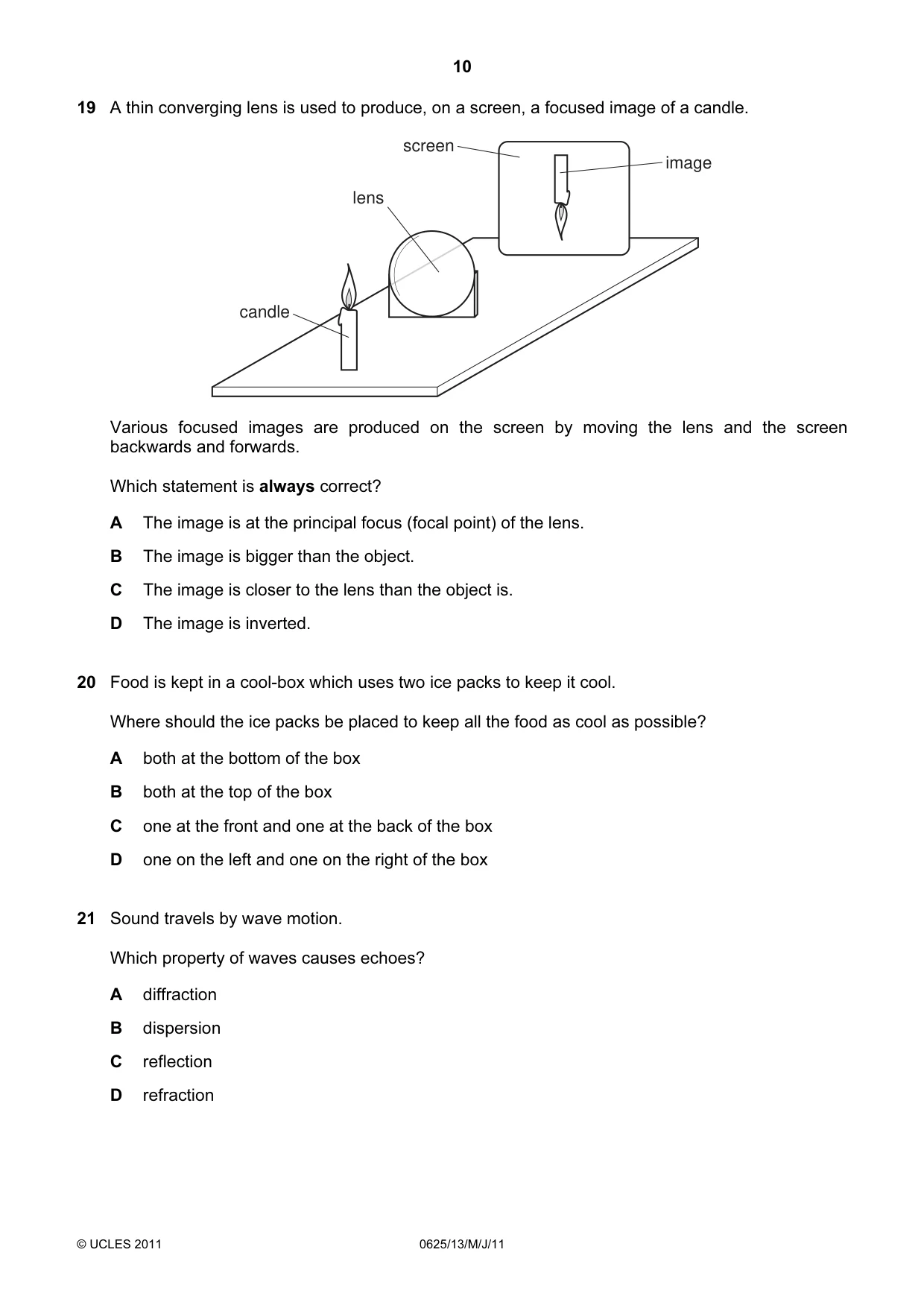
19 A thin converging lens is used to produce, on a screen, a focused image of a candle. screen image lens candle Various focused images are produced on the screen by moving the lens and the screen backwards and forwards. Which statement is always correct? A The image is at the principal focus (focal point) of the lens. B The image is bigger than the object. C The image is closer to the lens than the object is. D The image is inverted.
Mark scheme: D
Q20 · Food is kept in a cool-box which uses two ice packs to keep it cool
20 Food is kept in a cool-box which uses two ice packs to keep it cool. Where should the ice packs be placed to keep all the food as cool as possible? A both at the bottom of the box B both at the top of the box C one at the front and one at the back of the box D one on the left and one on the right of the box
Mark scheme: B
Q21 · Sound travels by wave motion
21 Sound travels by wave motion. Which property of waves causes echoes? A diffraction B dispersion C reflection D refraction
Mark scheme: C
Q22 · A student listens to a machine that makes sounds of different frequencies
22 A student listens to a machine that makes sounds of different frequencies. He can only hear one of the sounds. Which frequency of sound is the student able to hear? A 2 Hz B 10 Hz C 2 kHz D 30 kHz
Mark scheme: C
Q23 · The diagram shows the dispersion of white light by a glass prism
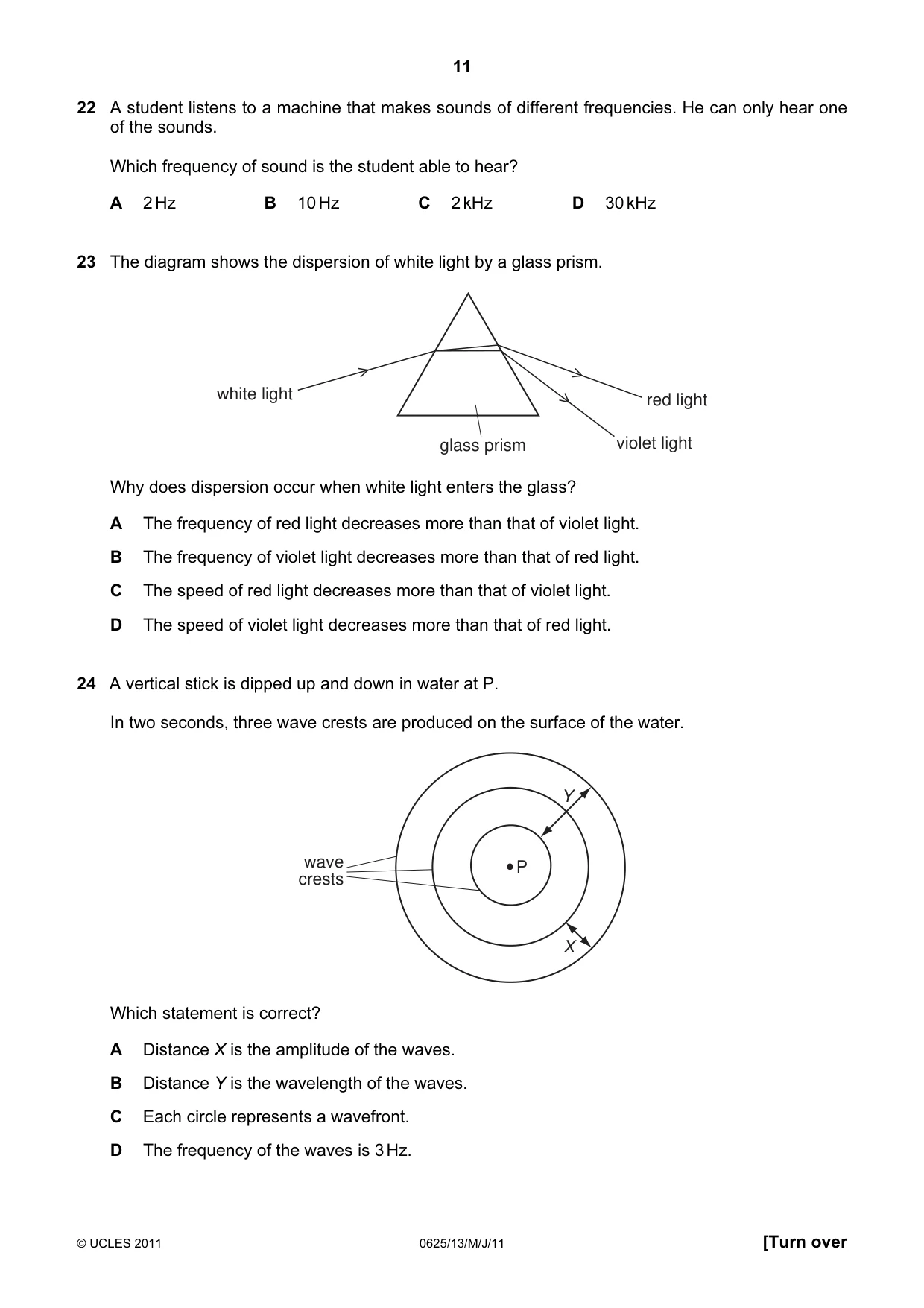
23 The diagram shows the dispersion of white light by a glass prism. white light red light glass prism violet light Why does dispersion occur when white light enters the glass? A The frequency of red light decreases more than that of violet light. B The frequency of violet light decreases more than that of red light. C The speed of red light decreases more than that of violet light. D The speed of violet light decreases more than that of red light.
Mark scheme: D
Q24 · A vertical stick is dipped up and down in water at P
24 A vertical stick is dipped up and down in water at P. In two seconds, three wave crests are produced on the surface of the water. Y wave P crests X Which statement is correct? A Distance X is the amplitude of the waves. B Distance Y is the wavelength of the waves. C Each circle represents a wavefront. D The frequency of the waves is 3 Hz.
Mark scheme: C
Q25 · An ammeter and an 18 Ω resistor are connected in series with a battery
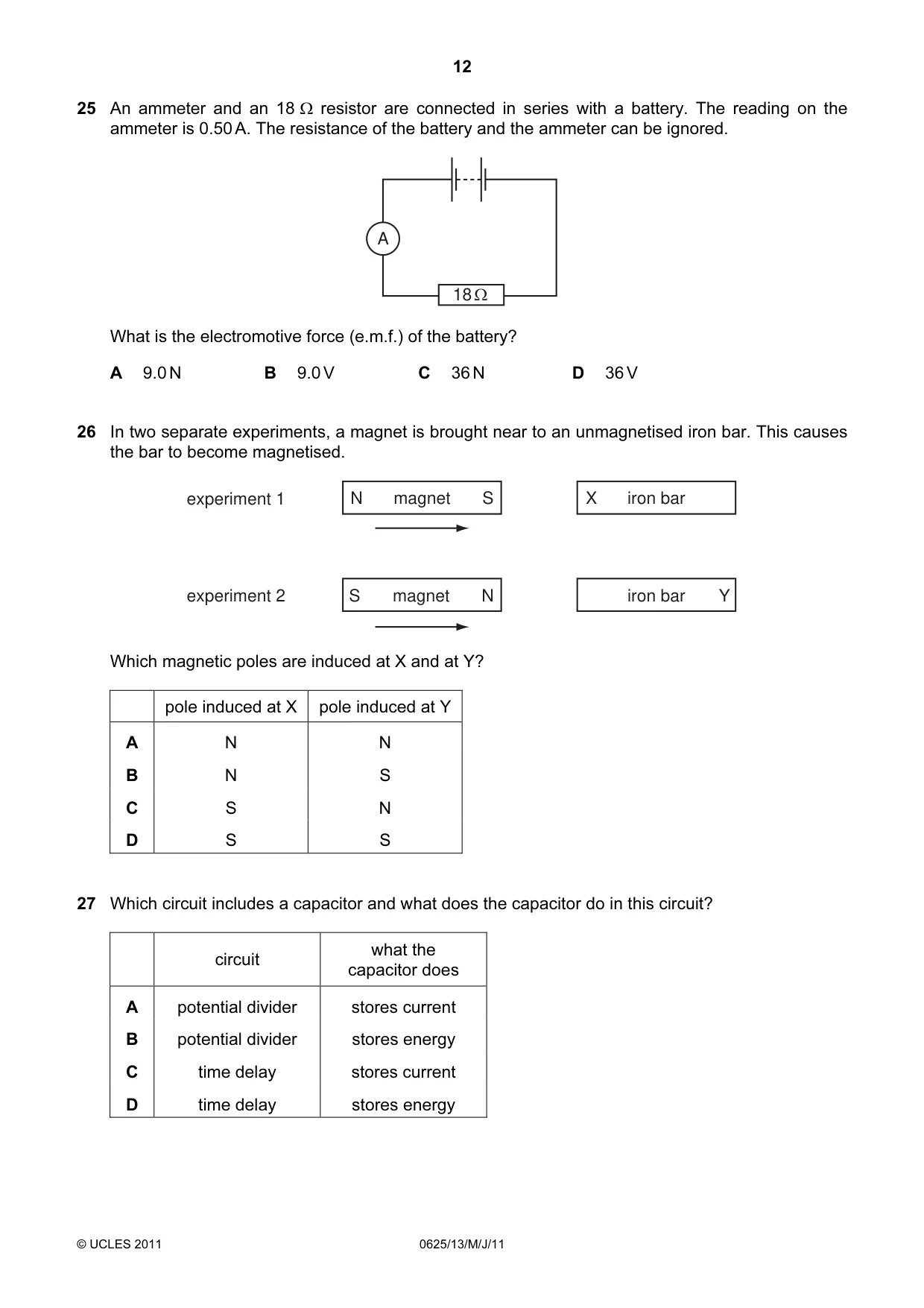
25 An ammeter and an 18 Ω resistor are connected in series with a battery. The reading on the ammeter is 0.50 A. The resistance of the battery and the ammeter can be ignored. A 18 Ω What is the electromotive force (e.m.f.) of the battery? A 9.0 N B 9.0 V C 36 N D 36 V
Mark scheme: B
Q26 · In two separate experiments, a magnet is brought near to an unmagnetised iron bar
26 In two separate experiments, a magnet is brought near to an unmagnetised iron bar. This causes the bar to become magnetised. experiment 1 N magnet S X iron bar experiment 2 S magnet N iron bar Y Which magnetic poles are induced at X and at Y? pole induced at X pole induced at Y A N N B N S C S N D S S
Mark scheme: A
Q27 · Which circuit includes a capacitor and what does the capacitor do in this circuit?
27 Which circuit includes a capacitor and what does the capacitor do in this circuit? what the circuit capacitor does A potential divider stores current B potential divider stores energy C time delay stores current D time delay stores energy
Mark scheme: D
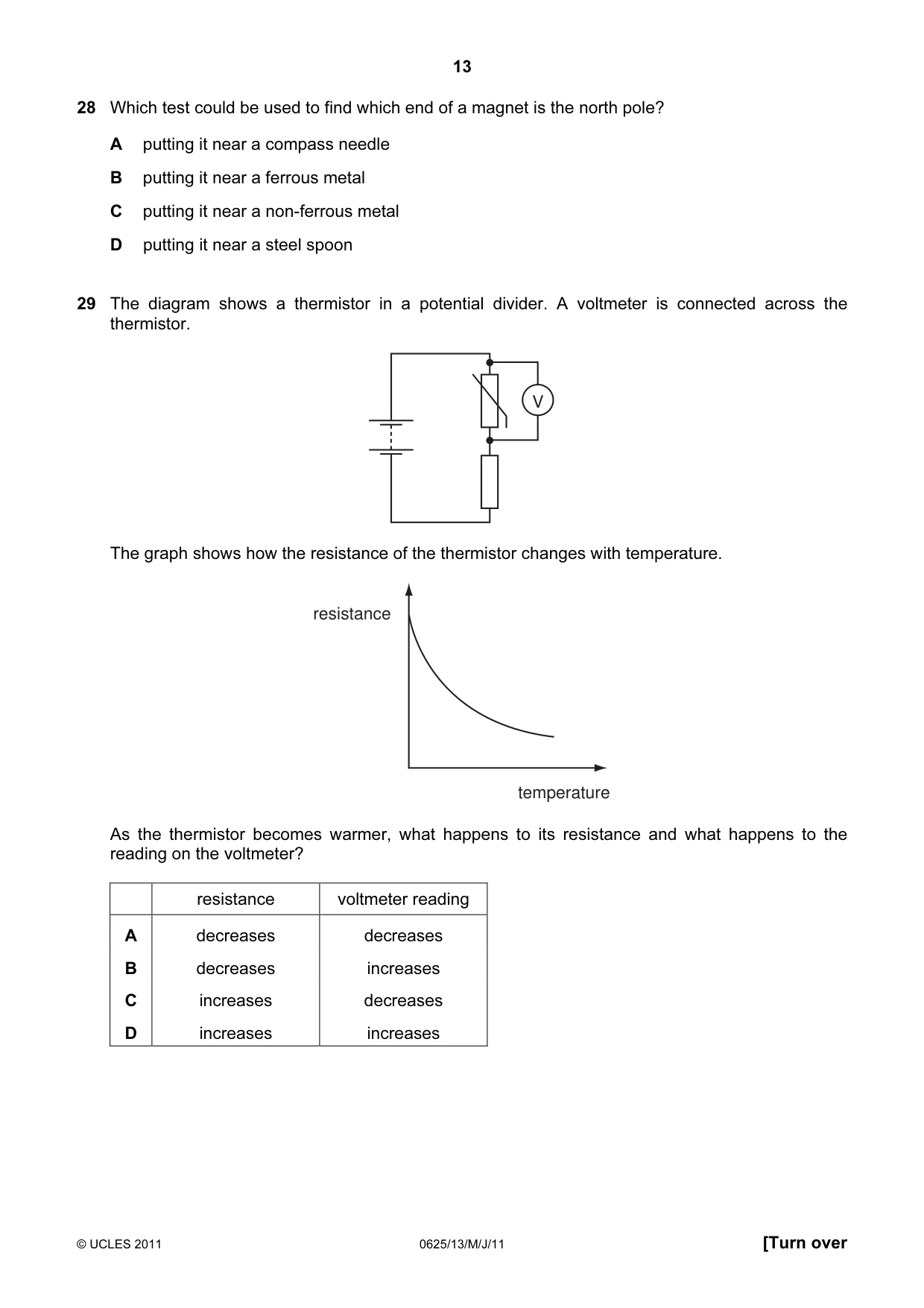
Q28 · Which test could be used to find which end of a magnet is the north pole?
28 Which test could be used to find which end of a magnet is the north pole? A putting it near a compass needle B putting it near a ferrous metal C putting it near a non-ferrous metal D putting it near a steel spoon
Mark scheme: A
Q29 · The diagram shows a thermistor in a potential divider
29 The diagram shows a thermistor in a potential divider. A voltmeter is connected across the thermistor. V The graph shows how the resistance of the thermistor changes with temperature. resistance temperature As the thermistor becomes warmer, what happens to its resistance and what happens to the reading on the voltmeter? resistance voltmeter reading A decreases decreases B decreases increases C increases decreases D increases increases
Mark scheme: A
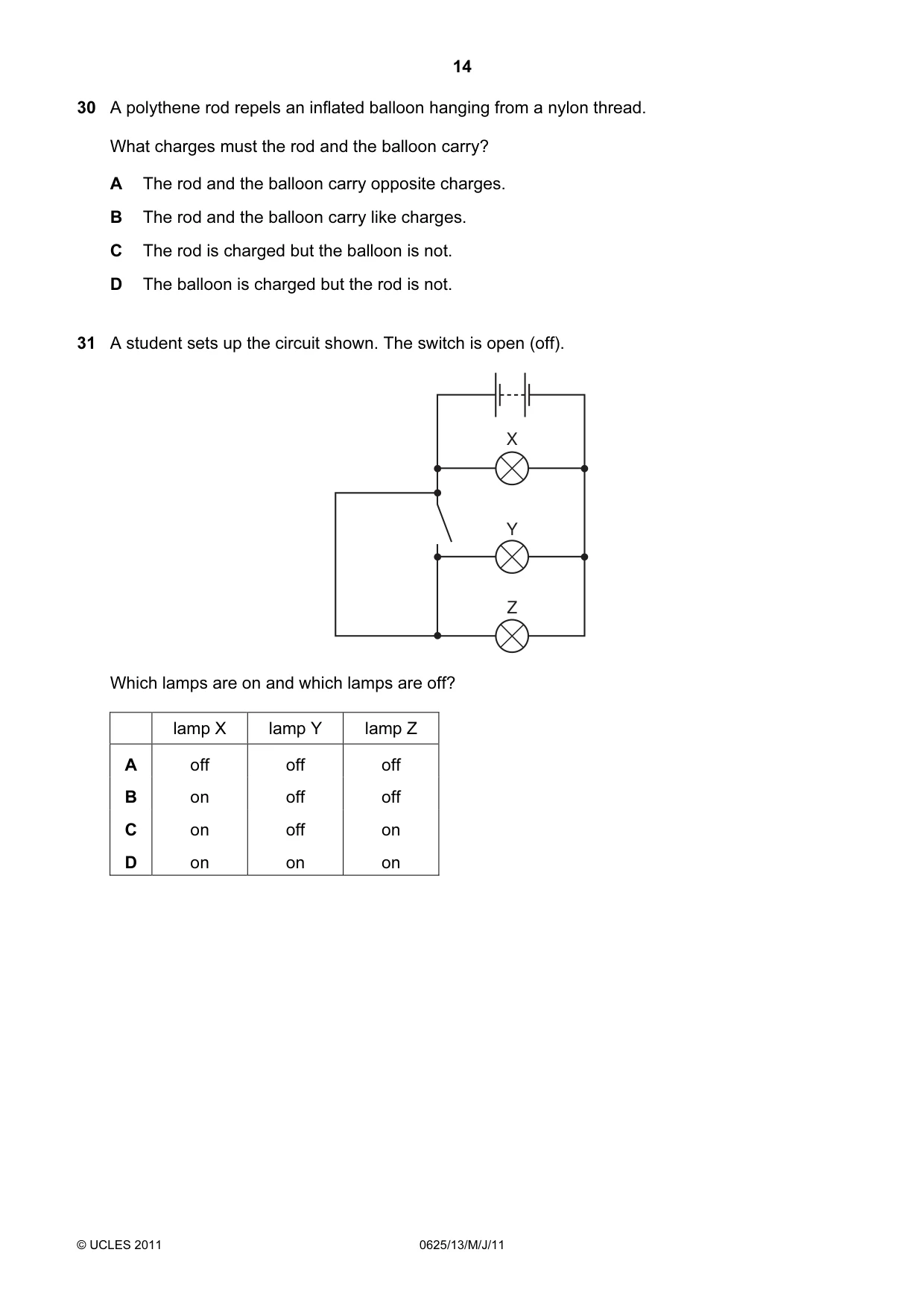
Q30 · A polythene rod repels an inflated balloon hanging from a nylon thread
30 A polythene rod repels an inflated balloon hanging from a nylon thread. What charges must the rod and the balloon carry? A The rod and the balloon carry opposite charges. B The rod and the balloon carry like charges. C The rod is charged but the balloon is not. D The balloon is charged but the rod is not.
Mark scheme: B
Q31 · A student sets up the circuit shown
31 A student sets up the circuit shown. The switch is open (off). X Y Z Which lamps are on and which lamps are off? lamp X lamp Y lamp Z A off off off B on off off C on off on D on on on
Mark scheme: D
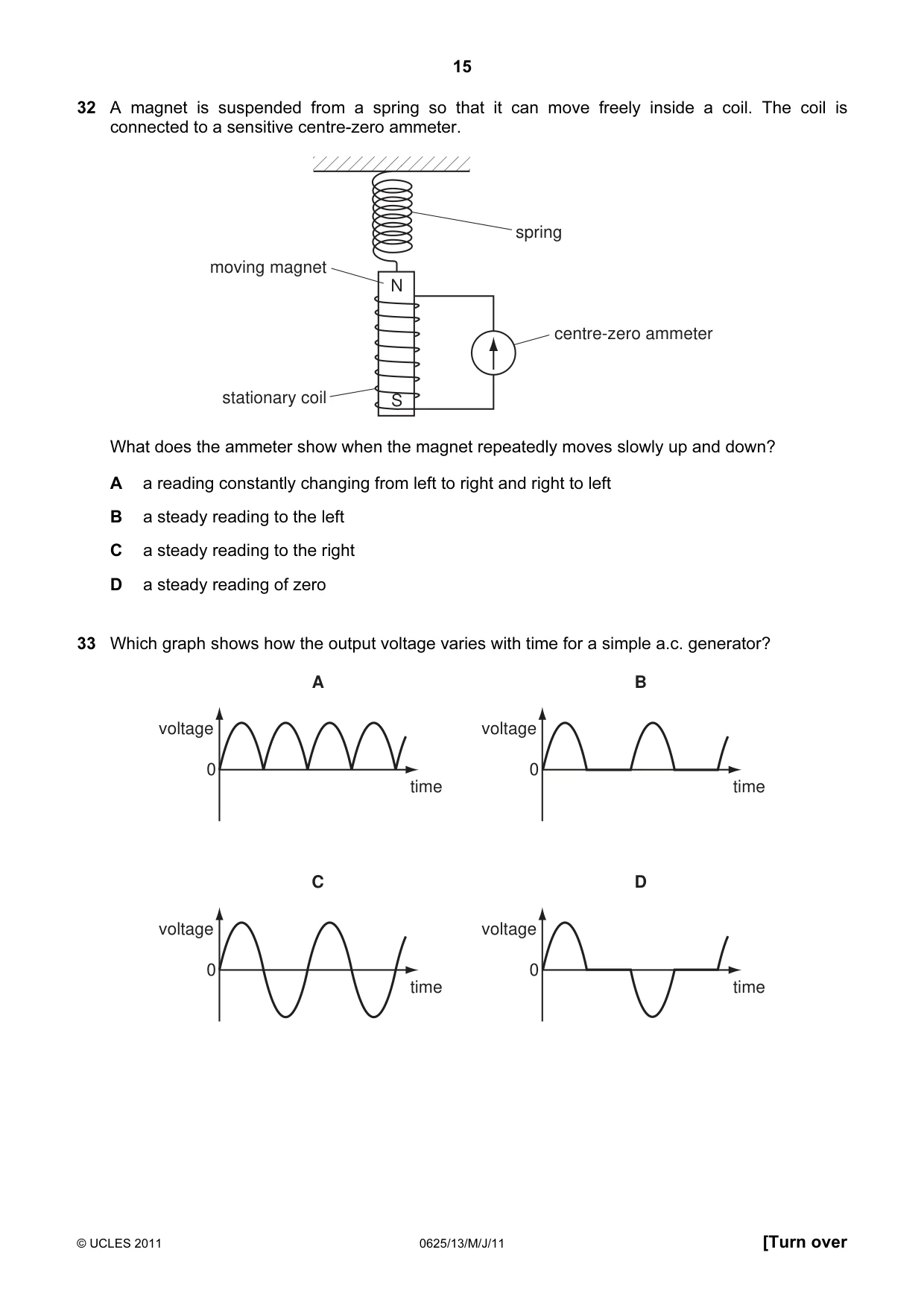
Q32 · A magnet is suspended from a spring so that it can move freely inside a coil
32 A magnet is suspended from a spring so that it can move freely inside a coil. The coil is connected to a sensitive centre-zero ammeter. spring moving magnet N centre-zero ammeter stationary coil S What does the ammeter show when the magnet repeatedly moves slowly up and down? A a reading constantly changing from left to right and right to left B a steady reading to the left C a steady reading to the right D a steady reading of zero
Mark scheme: A
Q33 · Which graph shows how the output voltage varies with time for a simple a.c
33 Which graph shows how the output voltage varies with time for a simple a.c. generator? A B voltage voltage 0 0 time time C D voltage voltage 0 0 time time
Mark scheme: C
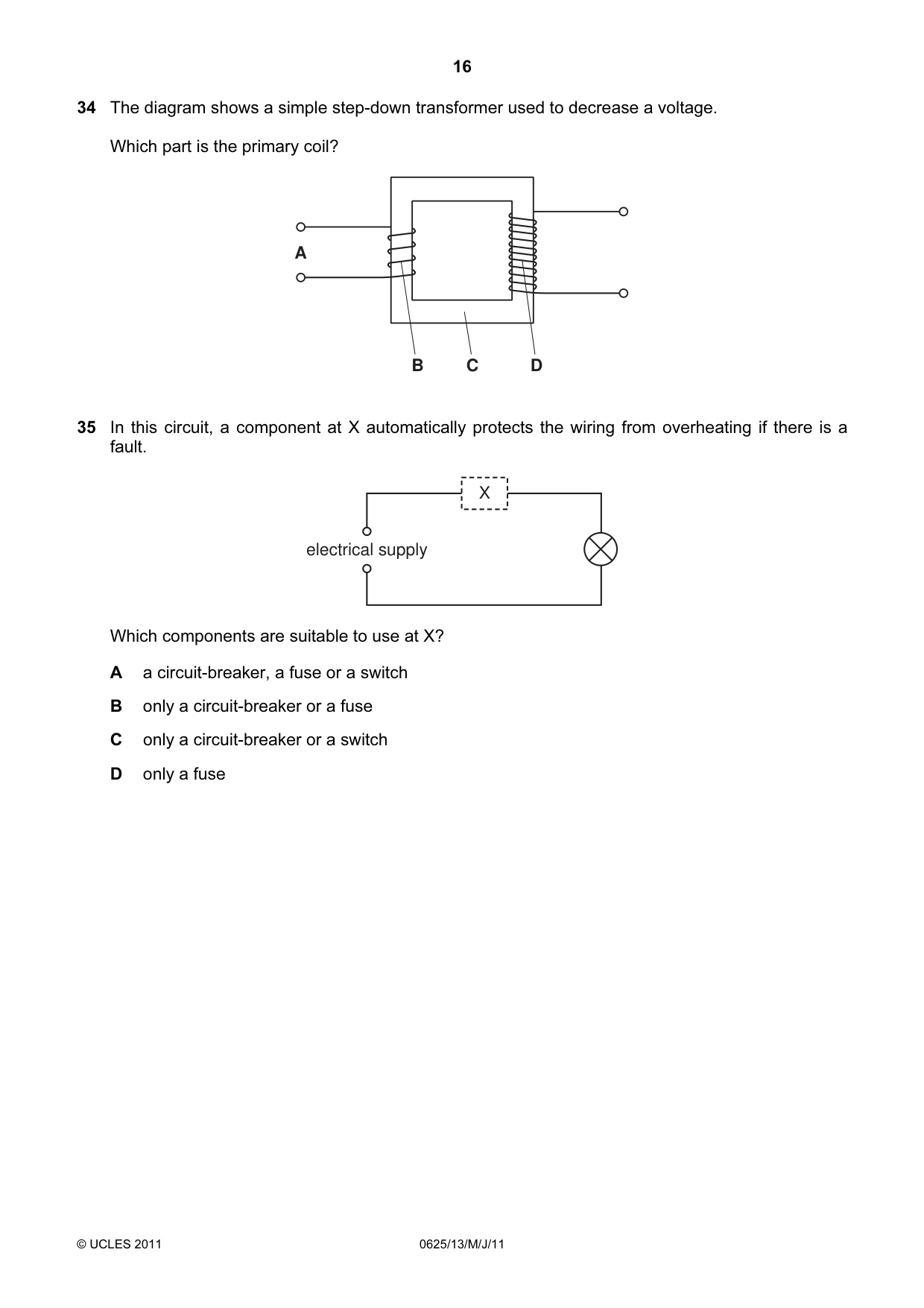
Q34 · The diagram shows a simple step-down transformer used to decrease a voltage
34 The diagram shows a simple step-down transformer used to decrease a voltage. Which part is the primary coil? A B C D
Mark scheme: D
Q35 · In this circuit, a component at X automatically protects the wiring from overheating if…
35 In this circuit, a component at X automatically protects the wiring from overheating if there is a fault. X electrical supply Which components are suitable to use at X? A a circuit-breaker, a fuse or a switch B only a circuit-breaker or a fuse C only a circuit-breaker or a switch D only a fuse
Mark scheme: B
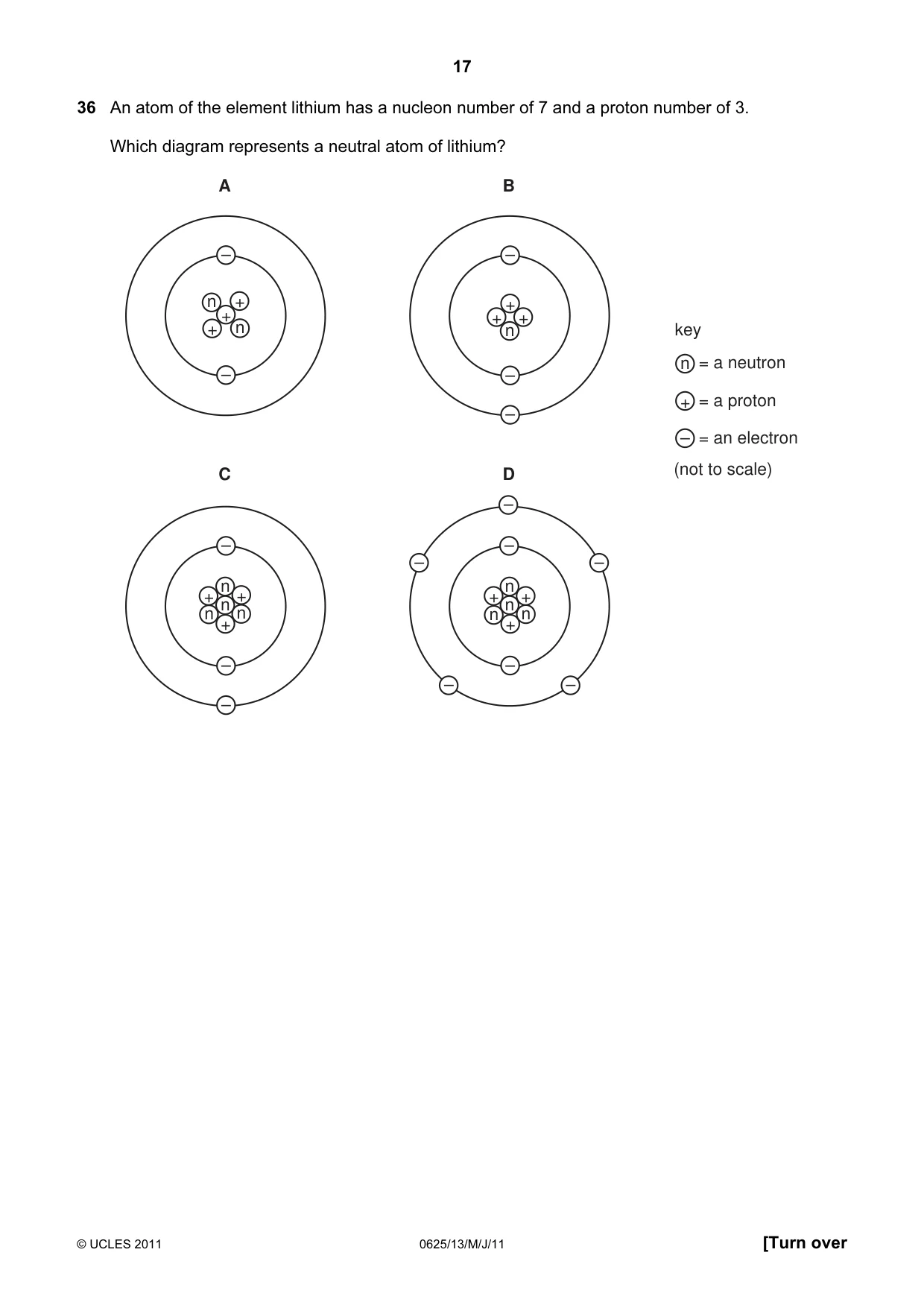
Q36 · An atom of the element lithium has a nucleon number of 7 and a proton number of 3
36 An atom of the element lithium has a nucleon number of 7 and a proton number of 3. Which diagram represents a neutral atom of lithium? A B – – n + + + + + + n n key n = a neutron – – + = a proton – – = an electron C D (not to scale) – – – – – n n + + + + n n n n n n + + – – – – –
Mark scheme: C
Q37 · A powder contains 400 mg of a radioactive material that emits α-particles
37 A powder contains 400 mg of a radioactive material that emits α-particles. The half-life of the material is 5 days. What mass of that material remains after 10 days? A 0 mg B 40 mg C 100 mg D 200 mg
Mark scheme: C
Q38 · Which row shows the relative ionising effects and penetrating abilities of α-particles…
38 Which row shows the relative ionising effects and penetrating abilities of α-particles and β-particles? ionising effect penetrating ability A α greater than β α greater than β B α greater than β α less than β C α less than β α greater than β D α less than β α less than β
Mark scheme: B
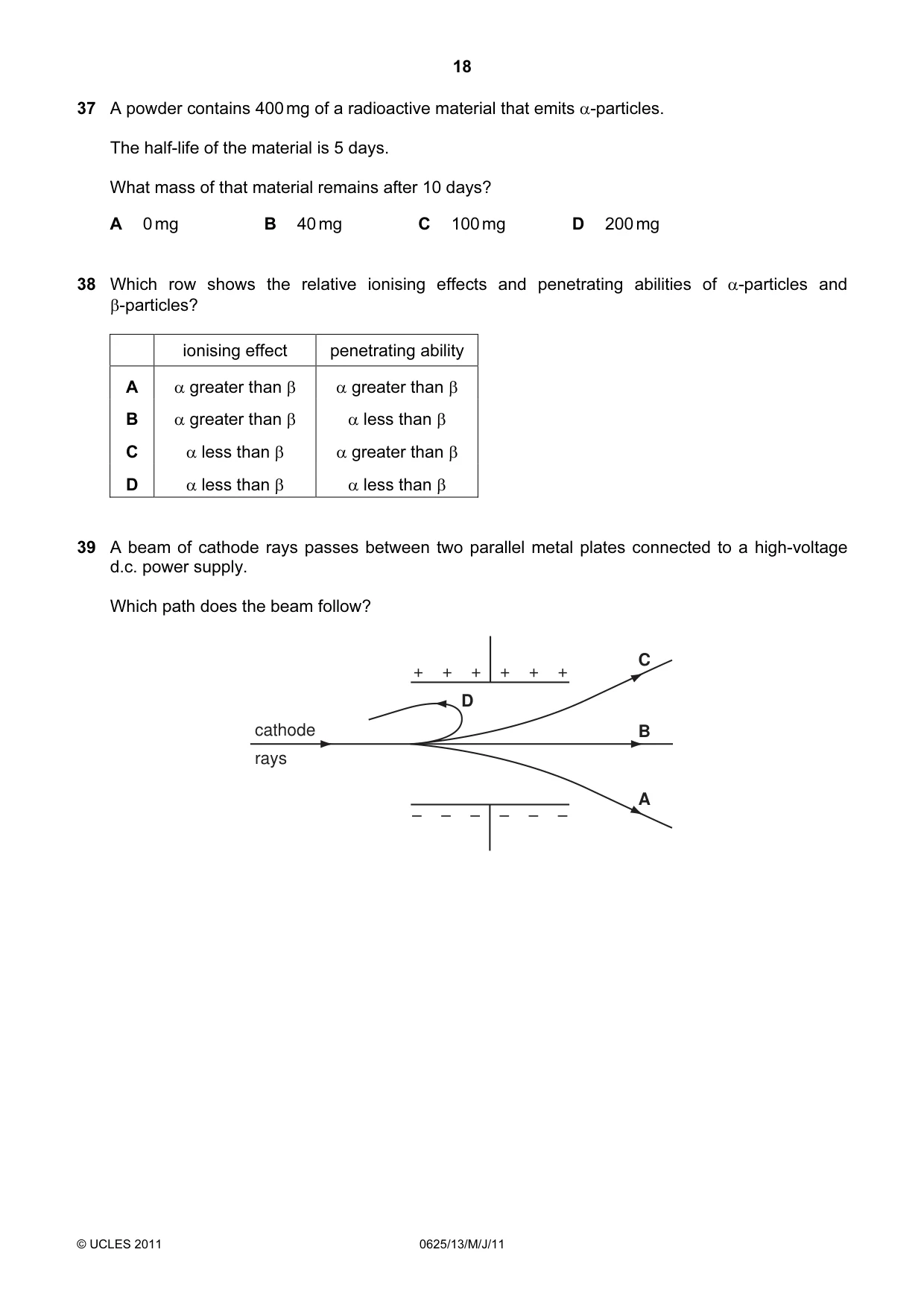
Q39 · A beam of cathode rays passes between two parallel metal plates connected to a…
39 A beam of cathode rays passes between two parallel metal plates connected to a high-voltage d.c. power supply. Which path does the beam follow? C + + + + + + D cathode B rays A
Mark scheme: C
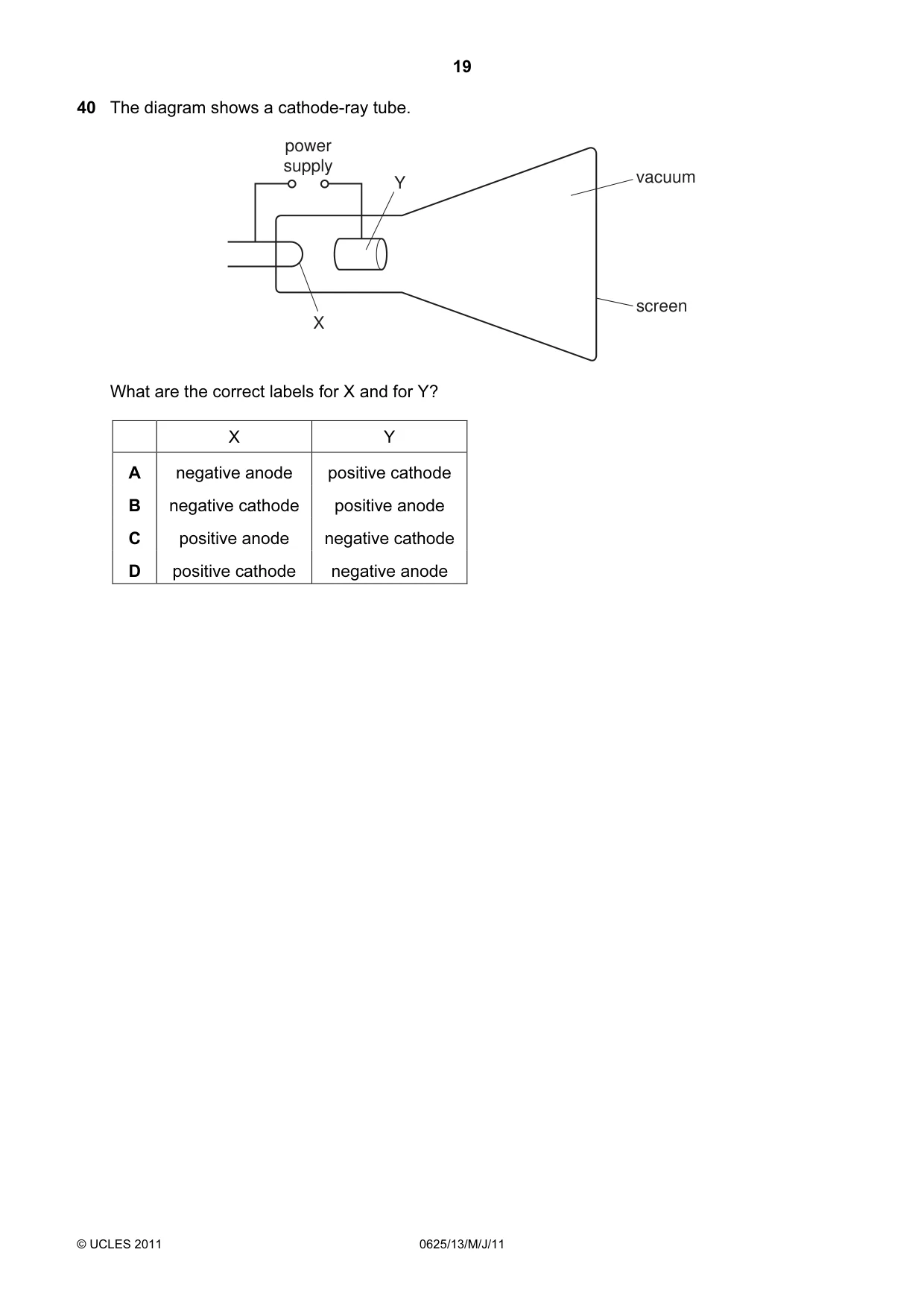
Q40 · The diagram shows a cathode-ray tube
40 The diagram shows a cathode-ray tube. power supply Y vacuum screen X What are the correct labels for X and for Y? X Y A negative anode positive cathode B negative cathode positive anode C positive anode negative cathode D positive cathode negative anode
Mark scheme: B
What was in this paper
The subtopics covered by these 40 questions, and how many questions each got. Open one in a new tab to see every Cambridge question on it.
3Electromagnetic effects3Energy, work and power3Simple phenomena of magnetism3Sound3The nuclear model of the atom3Forces2General properties of waves2Kinetic particle model of matter2Light2Pressure2Radioactivity2Thermal properties and temperature2Transfer of thermal energy2Density1Electrical quantities1Electrical safety1Mass and weight1Motion1Physical quantities and measurement techniques1What you needed in this session
Cambridge’s own grade thresholds for 2011 May/June, Paper 1 · Variant 3. A higher threshold means an easier paper — the bar moves with how the cohort did.