Cambridge IGCSE Physics 0625 — 2023 Oct/Nov Paper 1 · Variant 1
0625/11/O/N/23 · 40 questions · 40 marks · ≈45 min
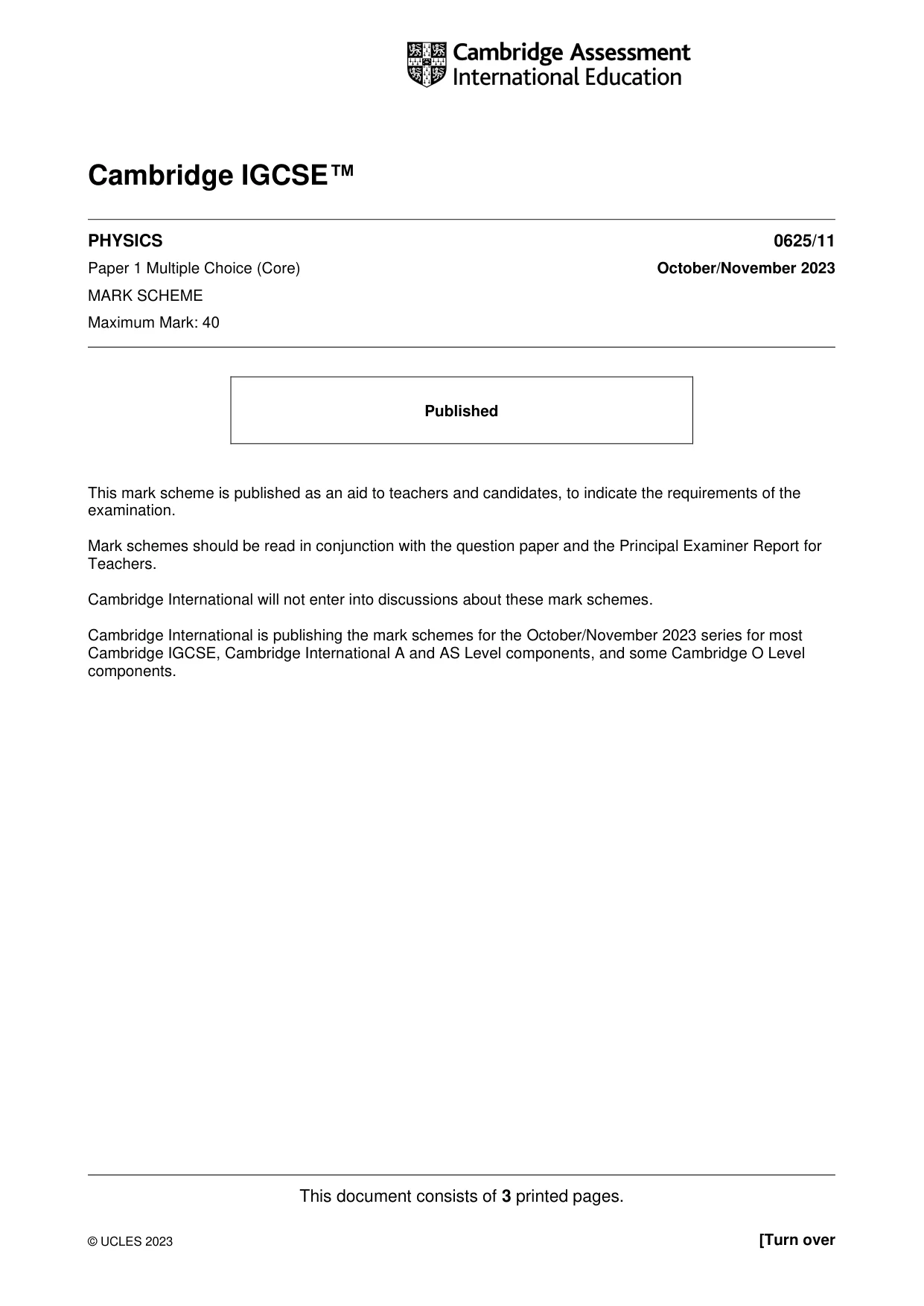
The question paper and its mark scheme, free to read here and free to download. This is Cambridge’s own paper, exactly as it was sat.
Question paper16 pages
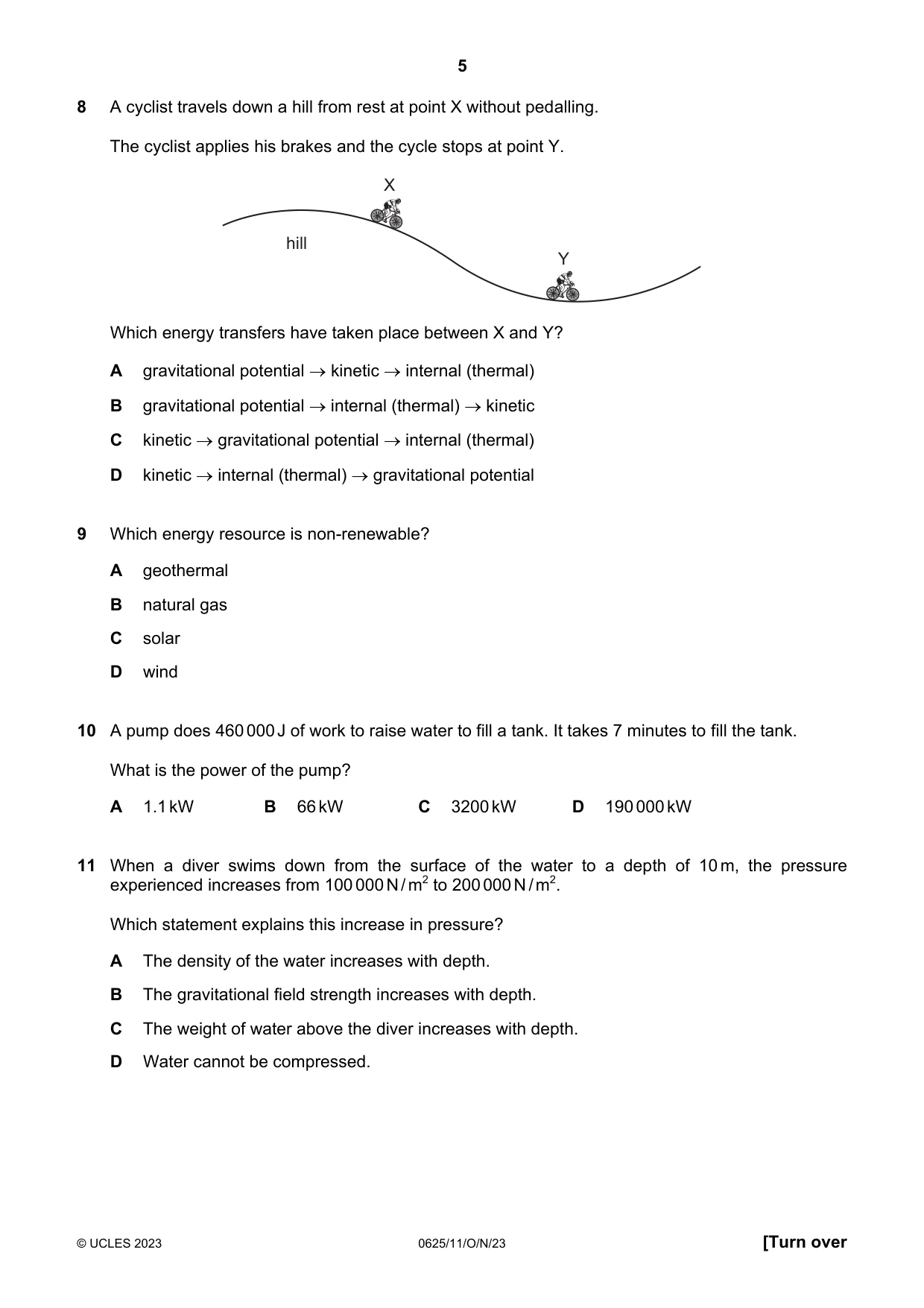
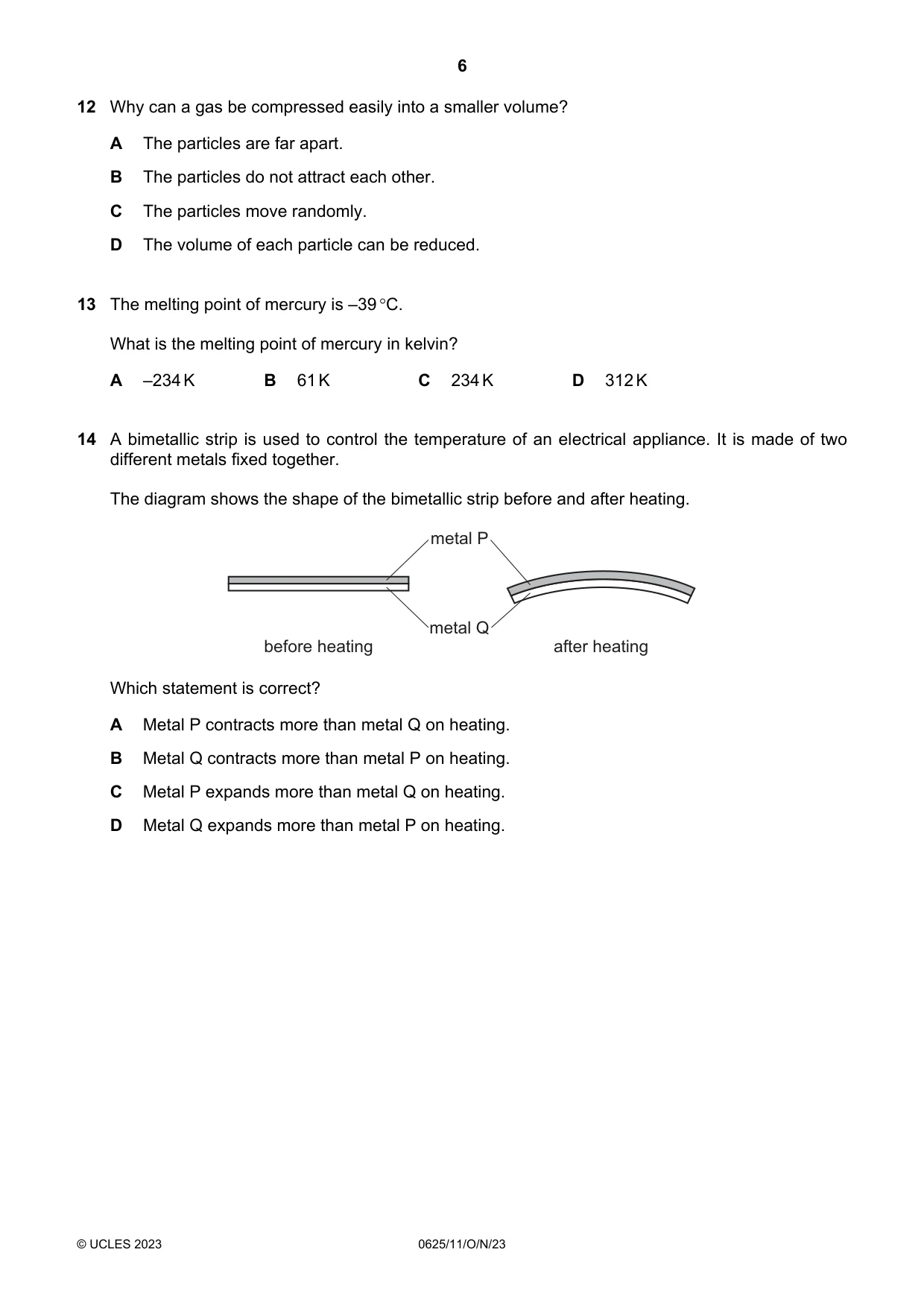
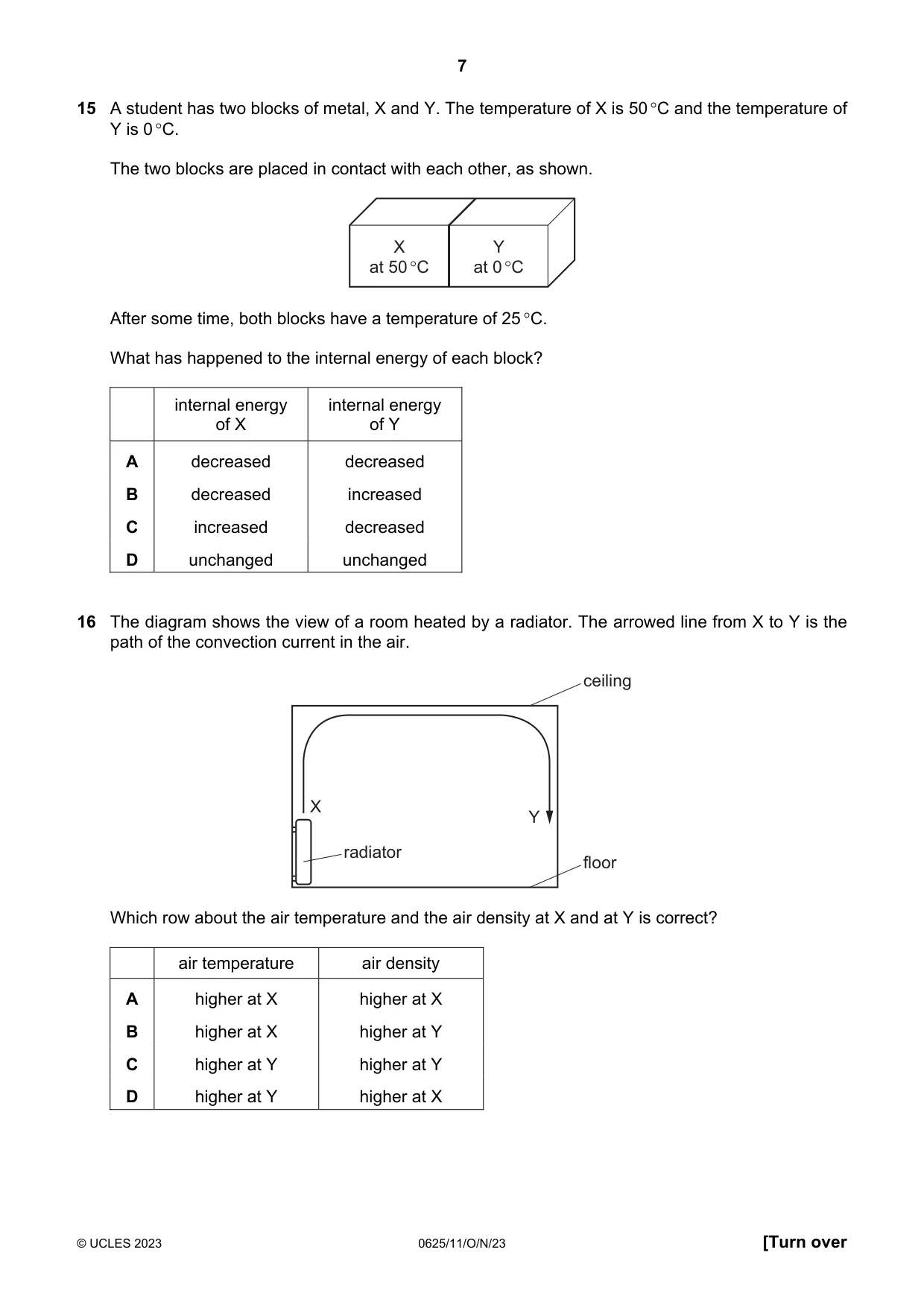
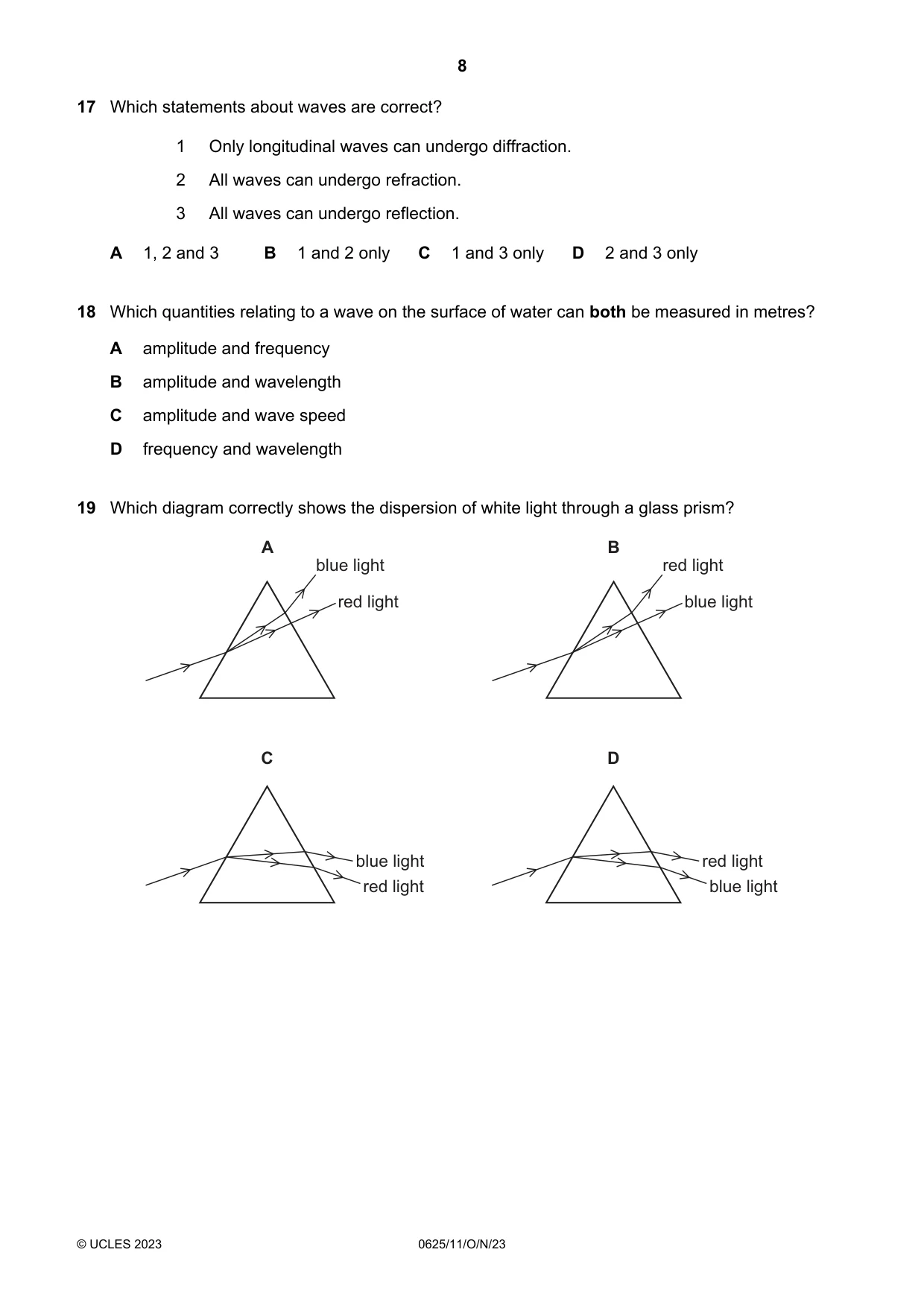
Mark scheme3 pages
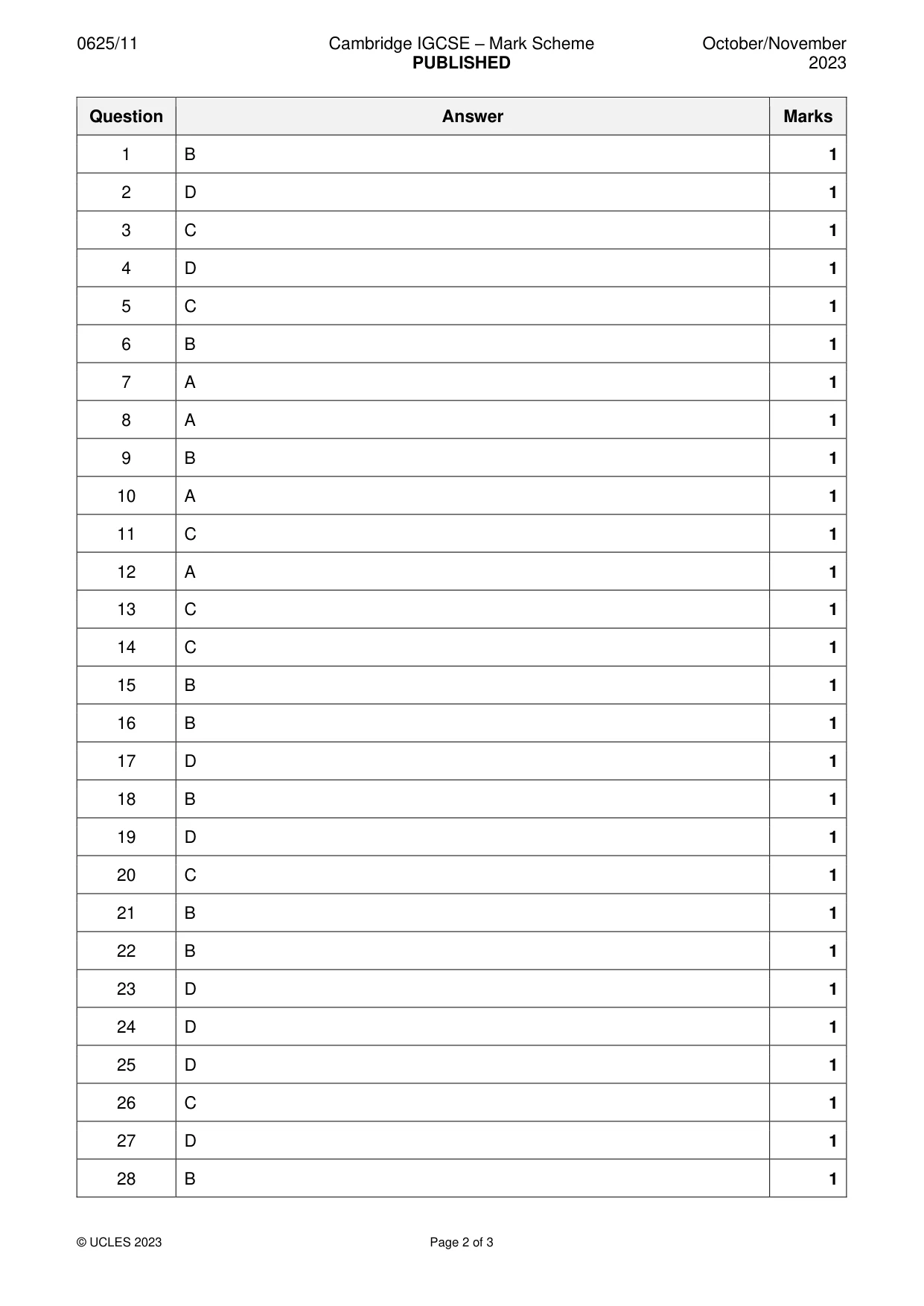
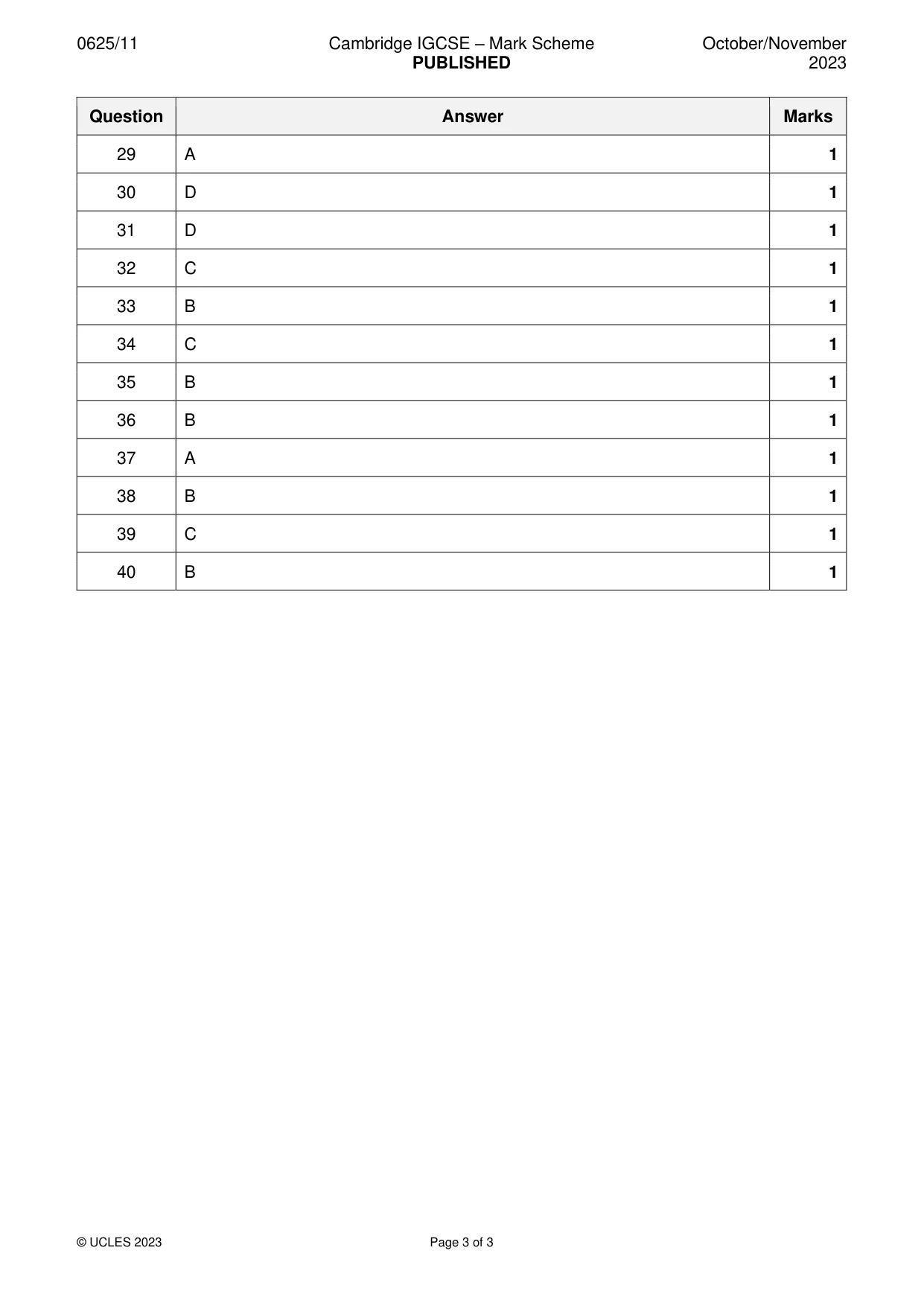
Answers below. Sit the paper first if you are practising.
Questions as text
Q1 · In order to determine the period of a pendulum, a student times one complete swing of the…
1 In order to determine the period of a pendulum, a student times one complete swing of the pendulum using an analogue stop-watch with a second hand. Which change of method produces the greatest improvement in accuracy? A asking a friend with a shorter reaction time to take the measurement B measuring the time for 100 swings of the pendulum and dividing it by 100 C measuring the time for a half swing of the pendulum and doubling it D using a digital timer
Mark scheme: B
More questions on Physical quantities and measurement techniques
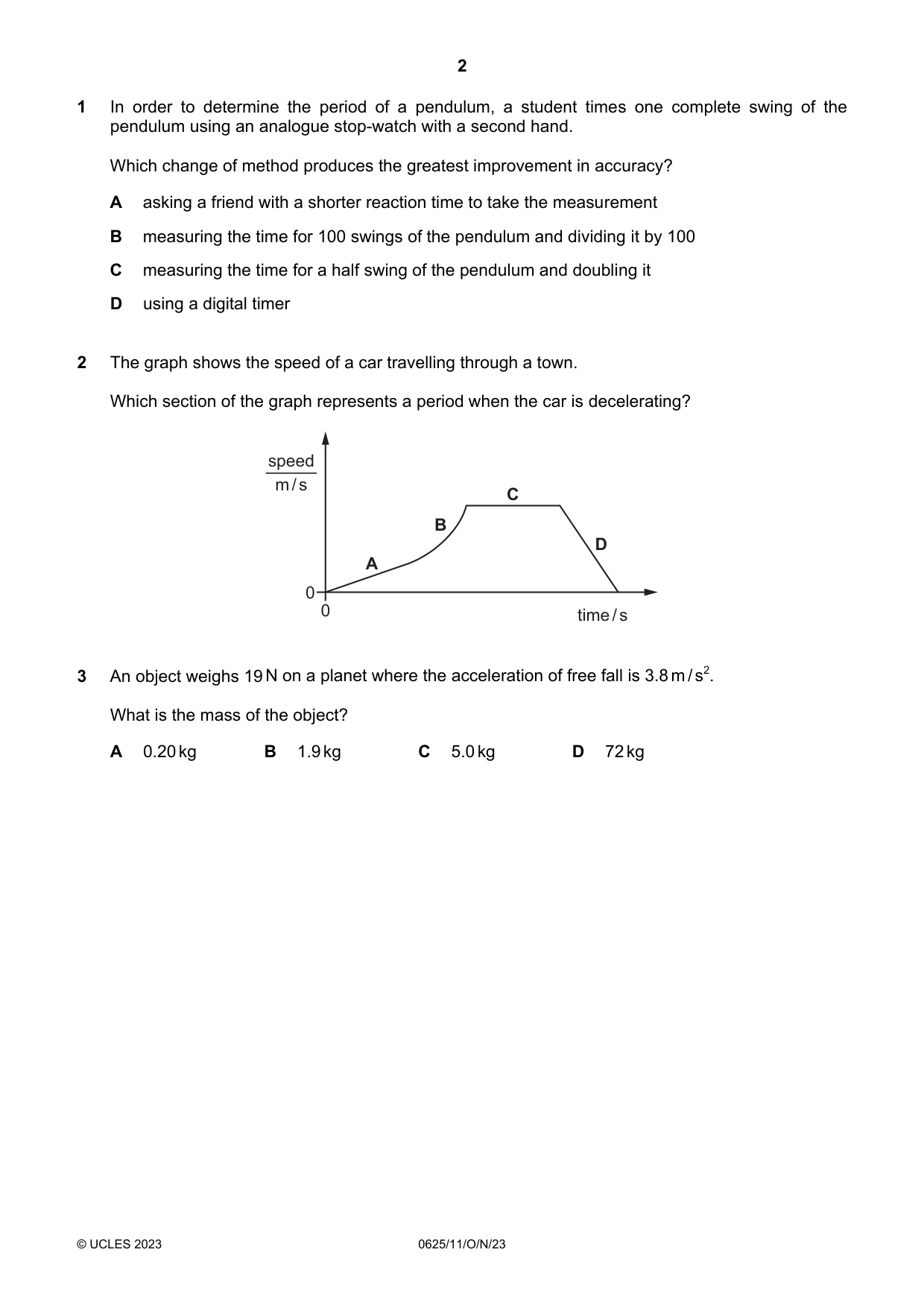
Q2 · The graph shows the speed of a car travelling through a town
2 The graph shows the speed of a car travelling through a town. Which section of the graph represents a period when the car is decelerating? speed m / s C B D A 0 0 time / s
Mark scheme: D
Q3 · An object weighs 19 N on a planet where the acceleration of free fall is 3.8 m / s2
3 An object weighs 19 N on a planet where the acceleration of free fall is 3.8 m / s2. What is the mass of the object? A 0.20 kg B 1.9 kg C 5.0 kg D 72 kg
Mark scheme: C
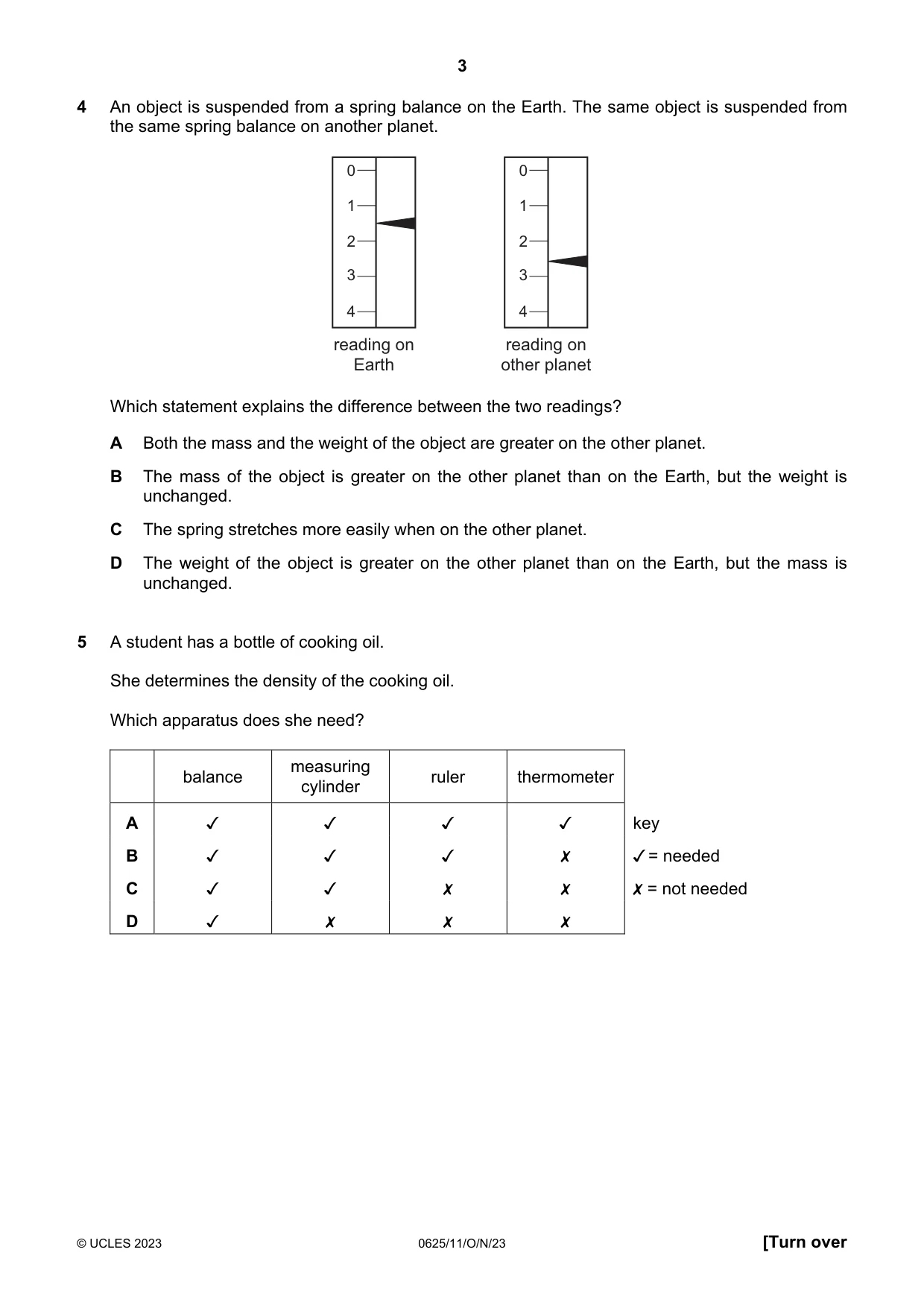
Q4 · An object is suspended from a spring balance on the Earth
4 An object is suspended from a spring balance on the Earth. The same object is suspended from the same spring balance on another planet. 0 0 1 1 2 2 3 3 4 4 reading on reading on Earth other planet Which statement explains the difference between the two readings? A Both the mass and the weight of the object are greater on the other planet. B The mass of the object is greater on the other planet than on the Earth, but the weight is unchanged. C The spring stretches more easily when on the other planet. D The weight of the object is greater on the other planet than on the Earth, but the mass is unchanged.
Mark scheme: D
Q5 · A student has a bottle of cooking oil
5 A student has a bottle of cooking oil. She determines the density of the cooking oil. Which apparatus does she need? balance Minder ruler thermometer A v v v v key B v v v x / = needed Cc v v x x X = not needed D Jv x x x
Mark scheme: C
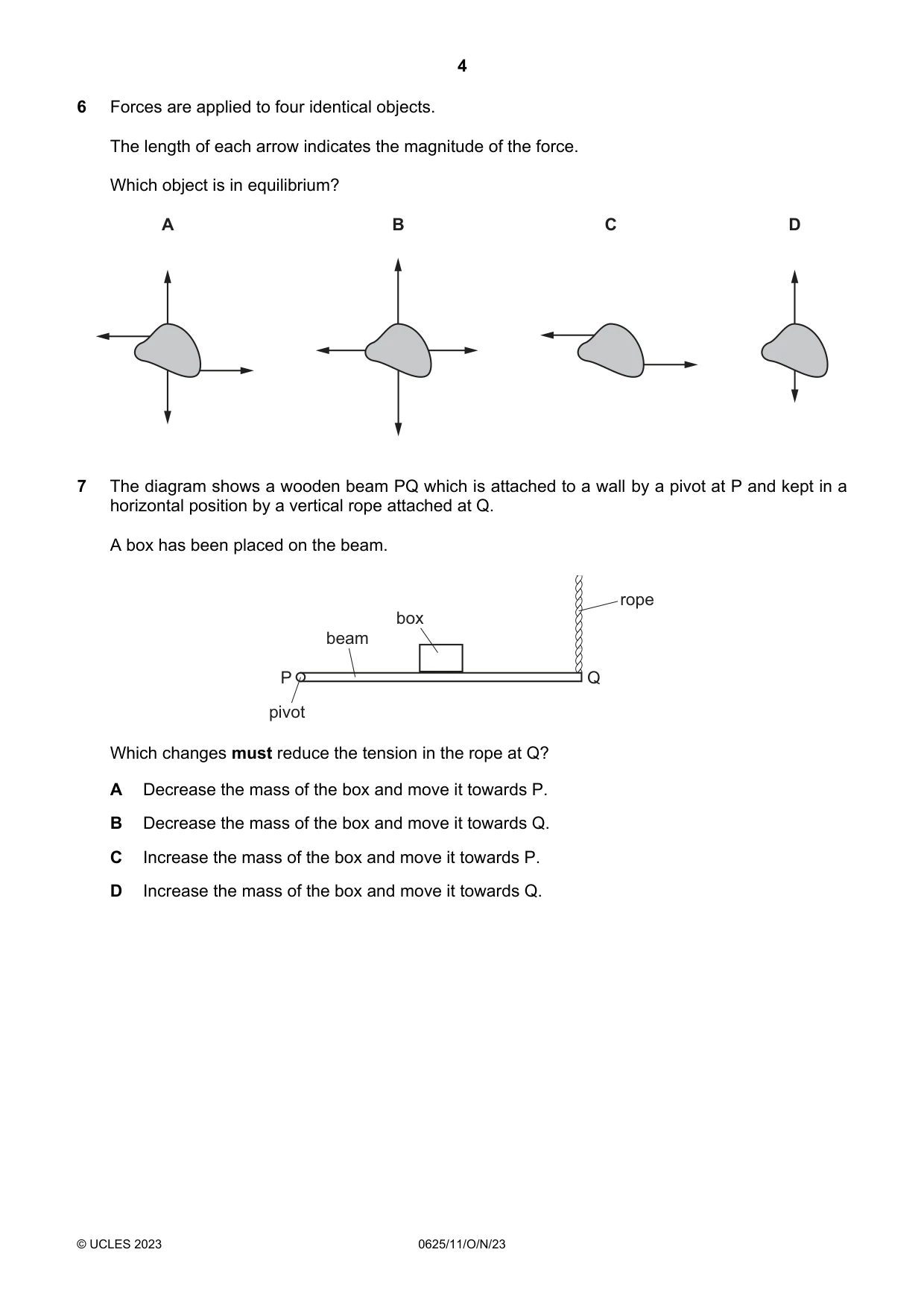
Q6 · Forces are applied to four identical objects
6 Forces are applied to four identical objects. The length of each arrow indicates the magnitude of the force. Which object is in equilibrium? A B C D
Mark scheme: B
Q7 · The diagram shows a wooden beam PQ which is attached to a wall by a pivot at P and kept…
7 The diagram shows a wooden beam PQ which is attached to a wall by a pivot at P and kept in a horizontal position by a vertical rope attached at Q. A box has been placed on the beam. rope box beam P Q pivot Which changes must reduce the tension in the rope at Q? A Decrease the mass of the box and move it towards P. B Decrease the mass of the box and move it towards Q. C Increase the mass of the box and move it towards P. D Increase the mass of the box and move it towards Q.
Mark scheme: A
Q8 · A cyclist travels down a hill from rest at point X without pedalling
8 A cyclist travels down a hill from rest at point X without pedalling. The cyclist applies his brakes and the cycle stops at point Y. X hill Y Which energy transfers have taken place between X and Y? A gravitational potential kinetic internal (thermal) B gravitational potential internal (thermal) kinetic C kinetic gravitational potential internal (thermal) D kinetic internal (thermal) gravitational potential
Mark scheme: A
Q9 · Which energy resource is non-renewable?
9 Which energy resource is non-renewable? A geothermal B natural gas C solar D wind
Mark scheme: B
Q10 · A pump does 460 000 J of work to raise water to fill a tank
10 A pump does 460 000 J of work to raise water to fill a tank. It takes 7 minutes to fill the tank. What is the power of the pump? A 1.1 kW B 66 kW C 3200 kW D 190 000 kW
Mark scheme: A
Q11 · When a diver swims down from the surface of the water to a depth of 10 m, the pressure…
11 When a diver swims down from the surface of the water to a depth of 10 m, the pressure experienced increases from 100 000 N / m2 to 200 000 N / m2. Which statement explains this increase in pressure? A The density of the water increases with depth. B The gravitational field strength increases with depth. C The weight of water above the diver increases with depth. D Water cannot be compressed.
Mark scheme: C
Q12 · Why can a gas be compressed easily into a smaller volume?
12 Why can a gas be compressed easily into a smaller volume? A The particles are far apart. B The particles do not attract each other. C The particles move randomly. D The volume of each particle can be reduced.
Mark scheme: A
Q13 · The melting point of mercury is –39 C
13 The melting point of mercury is –39 C. What is the melting point of mercury in kelvin? A –234 K B 61 K C 234 K D 312 K
Mark scheme: C
Q14 · A bimetallic strip is used to control the temperature of an electrical appliance
14 A bimetallic strip is used to control the temperature of an electrical appliance. It is made of two different metals fixed together. The diagram shows the shape of the bimetallic strip before and after heating. metal P metal Q before heating after heating Which statement is correct? A Metal P contracts more than metal Q on heating. B Metal Q contracts more than metal P on heating. C Metal P expands more than metal Q on heating. D Metal Q expands more than metal P on heating.
Mark scheme: C
Q15 · A student has two blocks of metal, X and Y
15 A student has two blocks of metal, X and Y. The temperature of X is 50°C and the temperature of Y is O°C. The two blocks are placed in contact with each other, as shown. After some time, both blocks have a temperature of 25 °C. What has happened to the internal energy of each block? internal energy internal energy of X of Y A decreased decreased B decreased increased Cc increased decreased D unchanged unchanged
Mark scheme: B
Q16 · The diagram shows the view of a room heated by a radiator
16 The diagram shows the view of a room heated by a radiator. The arrowed line from X to Y is the path of the convection current in the air. ceiling X Y radiator floor Which row about the air temperature and the air density at X and at Y is correct? air temperature air density A higher at X higher at X B higher at X higher at Y C higher at Y higher at Y D higher at Y higher at X
Mark scheme: B
Q17 · Which statements about waves are correct?
17 Which statements about waves are correct? 1 Only longitudinal waves can undergo diffraction. 2 All waves can undergo refraction. 3 All waves can undergo reflection. A 1, 2 and 3 B 1 and 2 only C 1 and 3 only D 2 and 3 only
Mark scheme: D
Q18 · Which quantities relating to a wave on the surface of water can both be measured in…
18 Which quantities relating to a wave on the surface of water can both be measured in metres? A amplitude and frequency B amplitude and wavelength C amplitude and wave speed D frequency and wavelength
Mark scheme: B
Q19 · Which diagram correctly shows the dispersion of white light through a glass prism?
19 Which diagram correctly shows the dispersion of white light through a glass prism? A B blue light red light red light blue light C D blue light red light red light blue light
Mark scheme: D
Q20 · A ray of light is reflected by a plane mirror
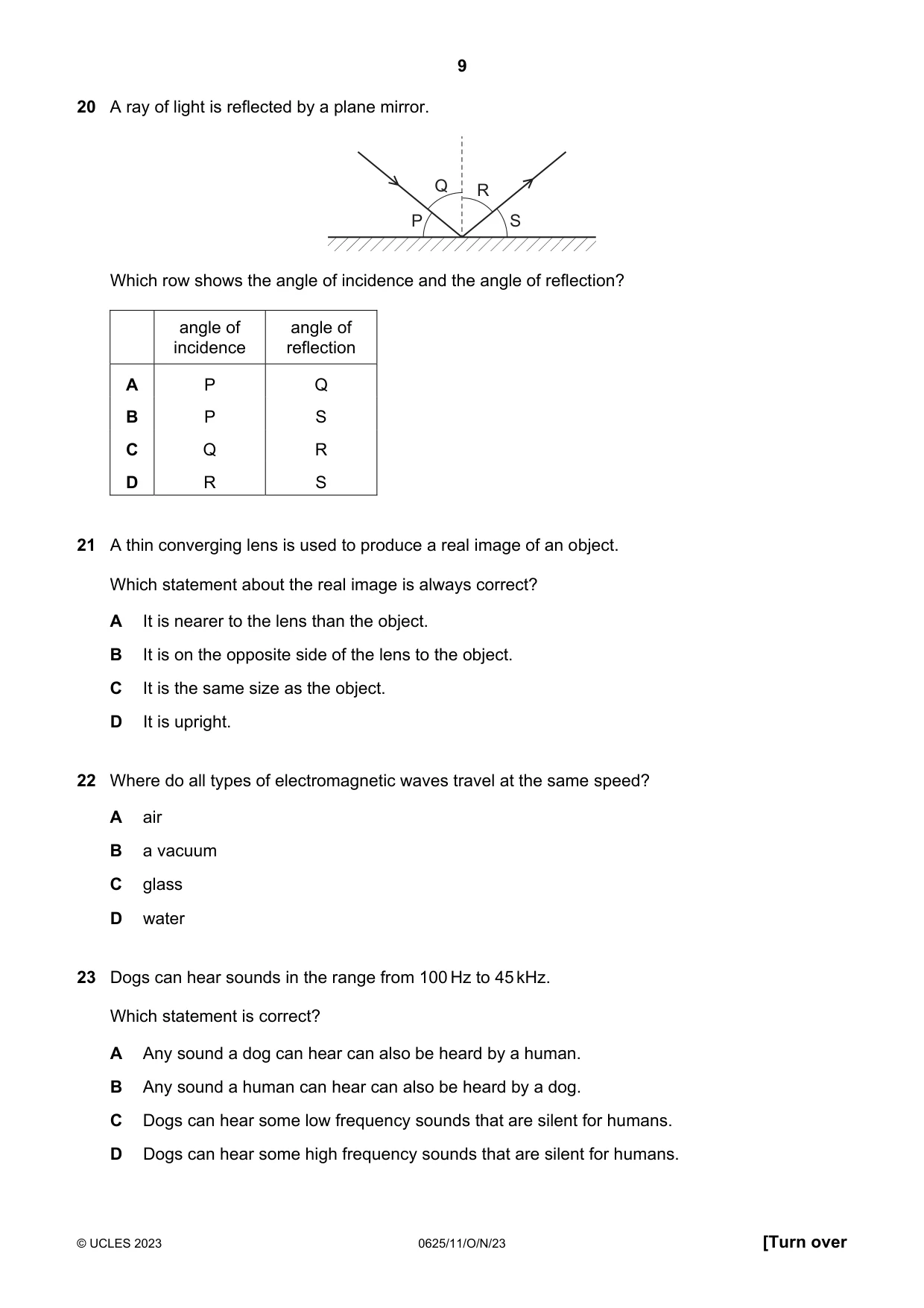
20 A ray of light is reflected by a plane mirror. Q R P S Which row shows the angle of incidence and the angle of reflection? angle of angle of incidence reflection A P Q B P S C Q R D R S
Mark scheme: C
Q21 · A thin converging lens is used to produce a real image of an object
21 A thin converging lens is used to produce a real image of an object. Which statement about the real image is always correct? A It is nearer to the lens than the object. B It is on the opposite side of the lens to the object. C It is the same size as the object. D It is upright.
Mark scheme: B
Q22 · Where do all types of electromagnetic waves travel at the same speed?
22 Where do all types of electromagnetic waves travel at the same speed? A air B a vacuum C glass D water
Mark scheme: B
Q23 · Dogs can hear sounds in the range from 100 Hz to 45 kHz
23 Dogs can hear sounds in the range from 100 Hz to 45 kHz. Which statement is correct? A Any sound a dog can hear can also be heard by a human. B Any sound a human can hear can also be heard by a dog. C Dogs can hear some low frequency sounds that are silent for humans. D Dogs can hear some high frequency sounds that are silent for humans.
Mark scheme: D
Q24 · Which metal could be used for a permanent magnet and which metal could be used for the…
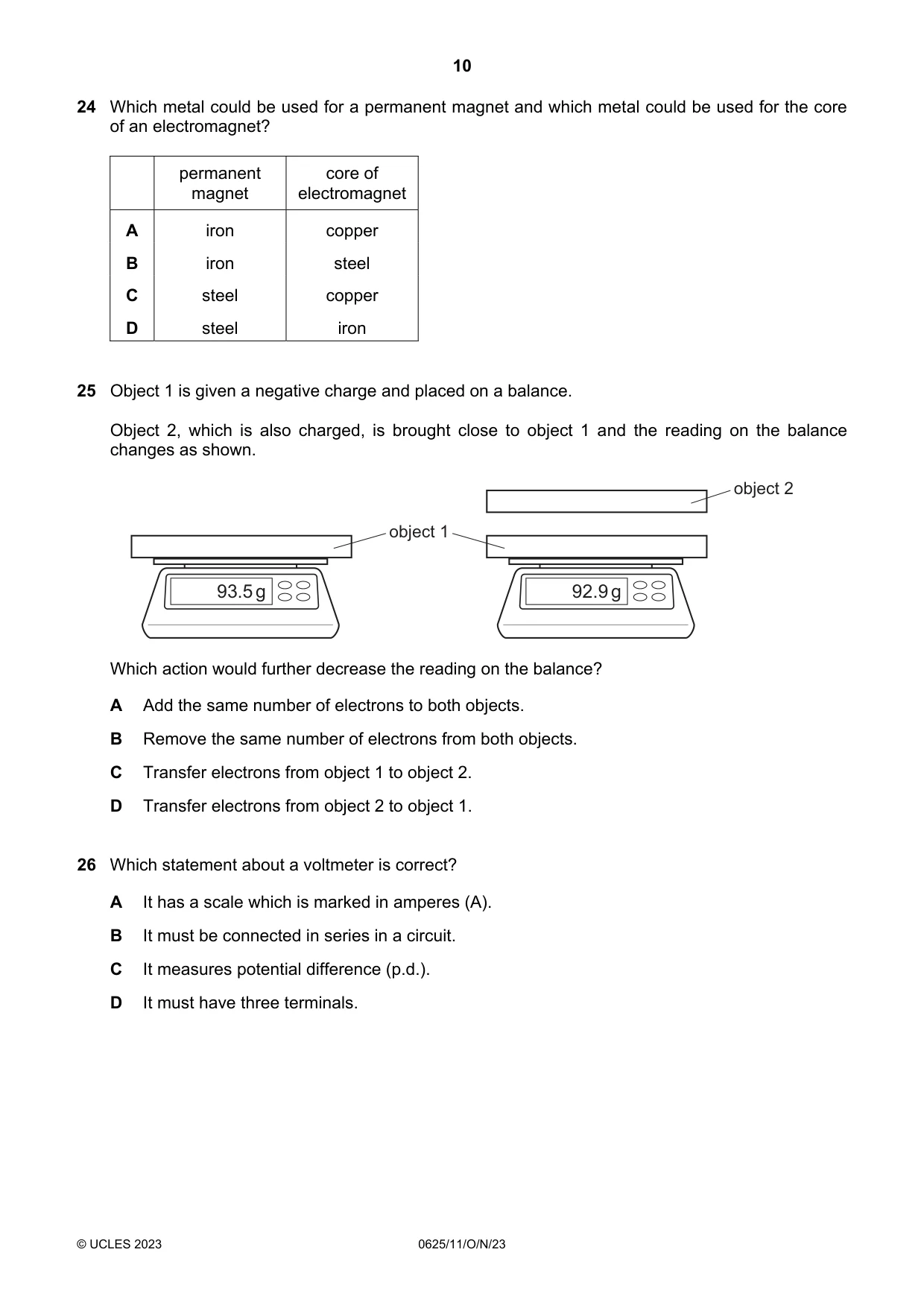
24 Which metal could be used for a permanent magnet and which metal could be used for the core of an electromagnet? permanent core of magnet electromagnet A iron copper B iron steel C steel copper D steel iron
Mark scheme: D
Q25 · Object 1 is given a negative charge and placed on a balance
25 Object 1 is given a negative charge and placed on a balance. Object 2, which is also charged, is brought close to object 1 and the reading on the balance changes as shown. object 2 object 1 93.5 g 92.9 g Which action would further decrease the reading on the balance? A Add the same number of electrons to both objects. B Remove the same number of electrons from both objects. C Transfer electrons from object 1 to object 2. D Transfer electrons from object 2 to object 1.
Mark scheme: D
Q26 · Which statement about a voltmeter is correct?
26 Which statement about a voltmeter is correct? A It has a scale which is marked in amperes (A). B It must be connected in series in a circuit. C It measures potential difference (p.d.). D It must have three terminals.
Mark scheme: C
Q27 · How does the resistance of a metallic wire change: ● as its length increases ● as its…
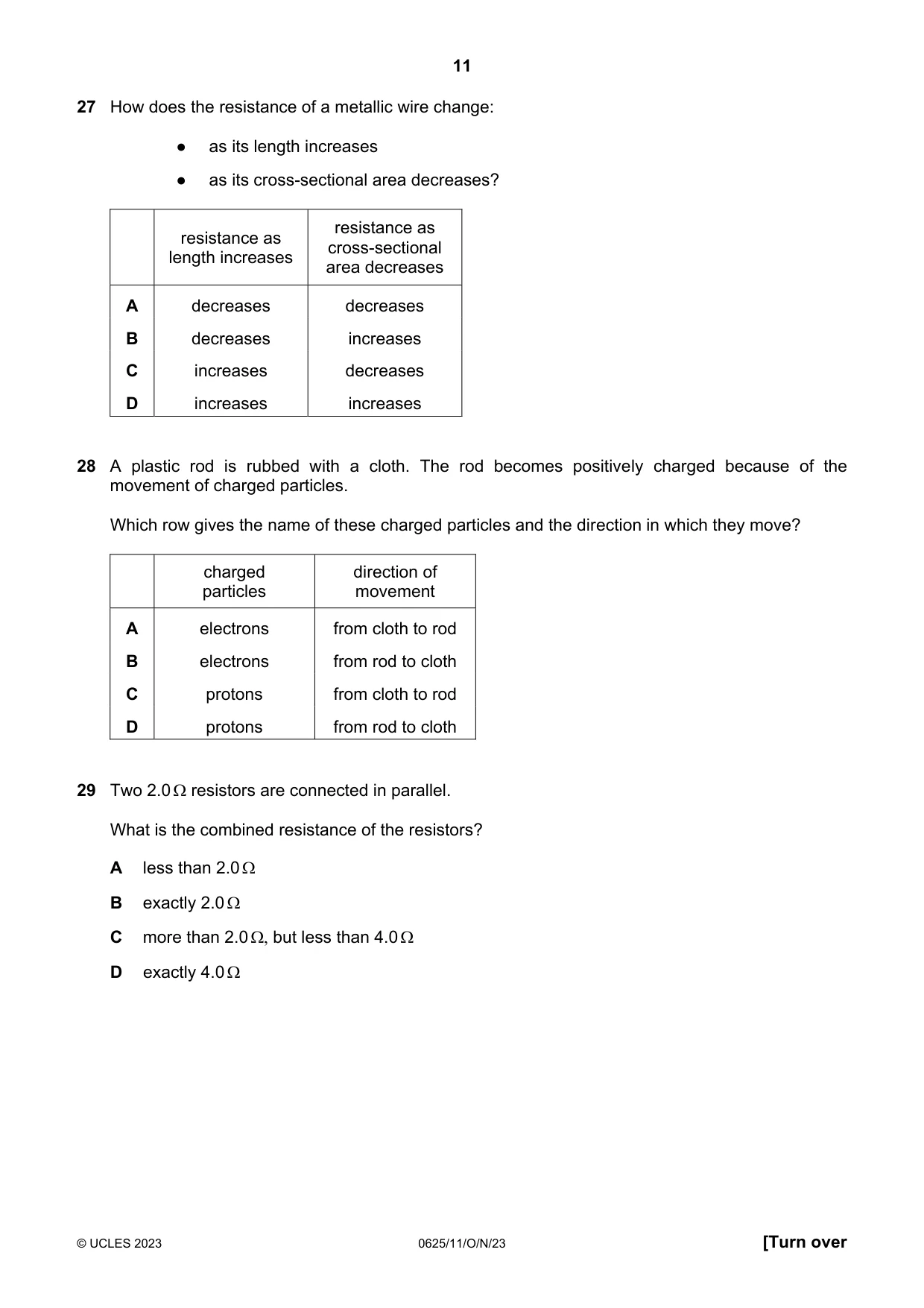
27 How does the resistance of a metallic wire change: ● as its length increases ● as its cross-sectional area decreases? resistance as resistance as cross-sectional length increases area decreases A decreases decreases B decreases increases C increases decreases D increases increases
Mark scheme: D
Q28 · A plastic rod is rubbed with a cloth
28 A plastic rod is rubbed with a cloth. The rod becomes positively charged because of the movement of charged particles. Which row gives the name of these charged particles and the direction in which they move? charged direction of particles movement A electrons from cloth to rod B electrons from rod to cloth C protons from cloth to rod D protons from rod to cloth
Mark scheme: B
Q29 · Two 2.0 resistors are connected in parallel
29 Two 2.0 resistors are connected in parallel. What is the combined resistance of the resistors? A less than 2.0 B exactly 2.0 C more than 2.0 but less than 4.0 D exactly 4.0
Mark scheme: A
Q30 · An electric heater is plugged into the mains supply using a fused plug
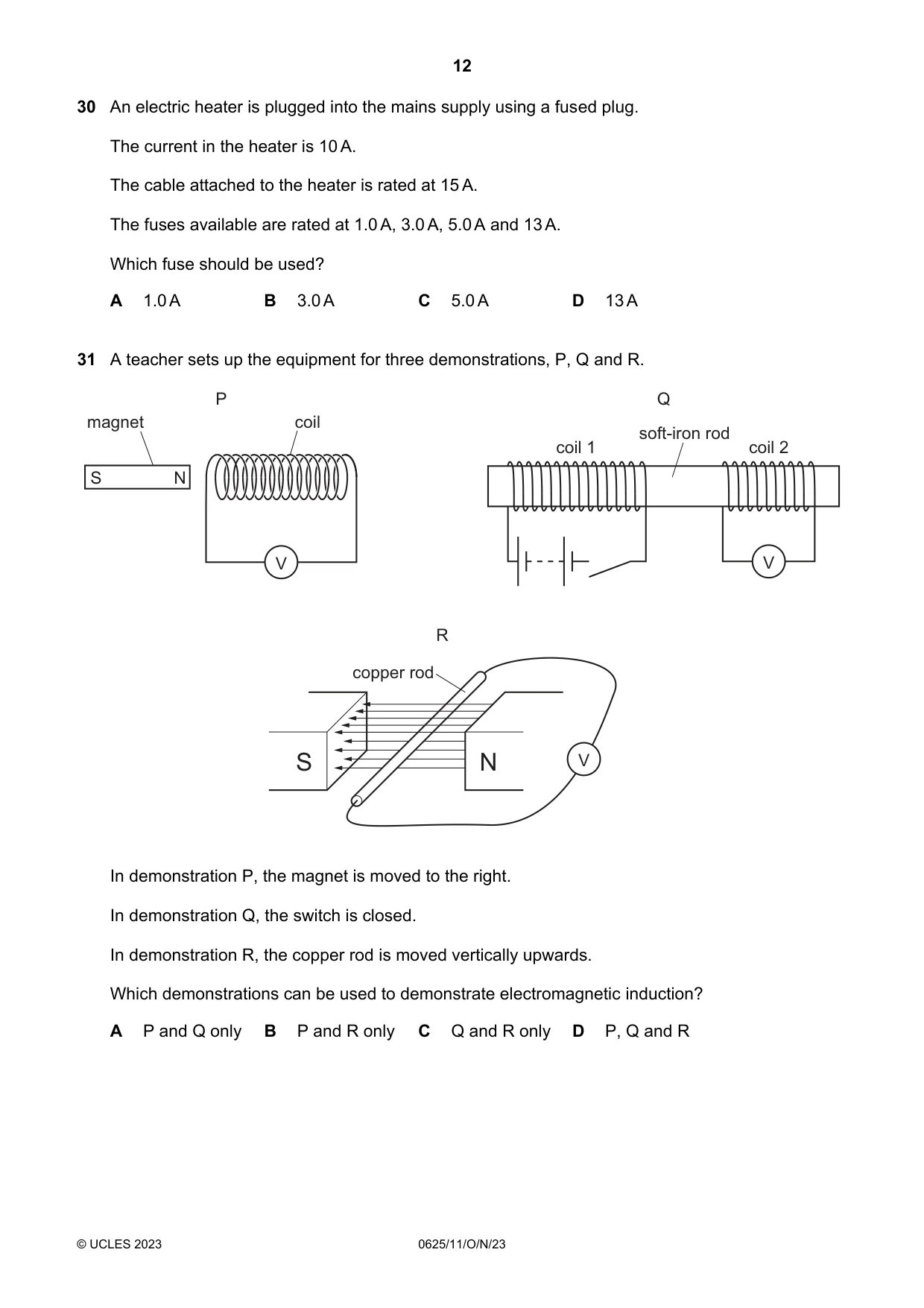
30 An electric heater is plugged into the mains supply using a fused plug. The current in the heater is 10 A. The cable attached to the heater is rated at 15 A. The fuses available are rated at 1.0 A, 3.0 A, 5.0 A and 13 A. Which fuse should be used? A 1.0 A B 3.0 A C 5.0 A D 13 A
Mark scheme: D
Q31 · A teacher sets up the equipment for three demonstrations, P, Q and R
31 A teacher sets up the equipment for three demonstrations, P, Q and R. P Q magnet coil soft-iron rod coil 1 coil 2 S N V V R copper rod S N V In demonstration P, the magnet is moved to the right. In demonstration Q, the switch is closed. In demonstration R, the copper rod is moved vertically upwards. Which demonstrations can be used to demonstrate electromagnetic induction? A P and Q only B P and R only C Q and R only D P, Q and R
Mark scheme: D
Q32 · A metal rod PQ rests on two horizontal metal wires that are attached to a battery
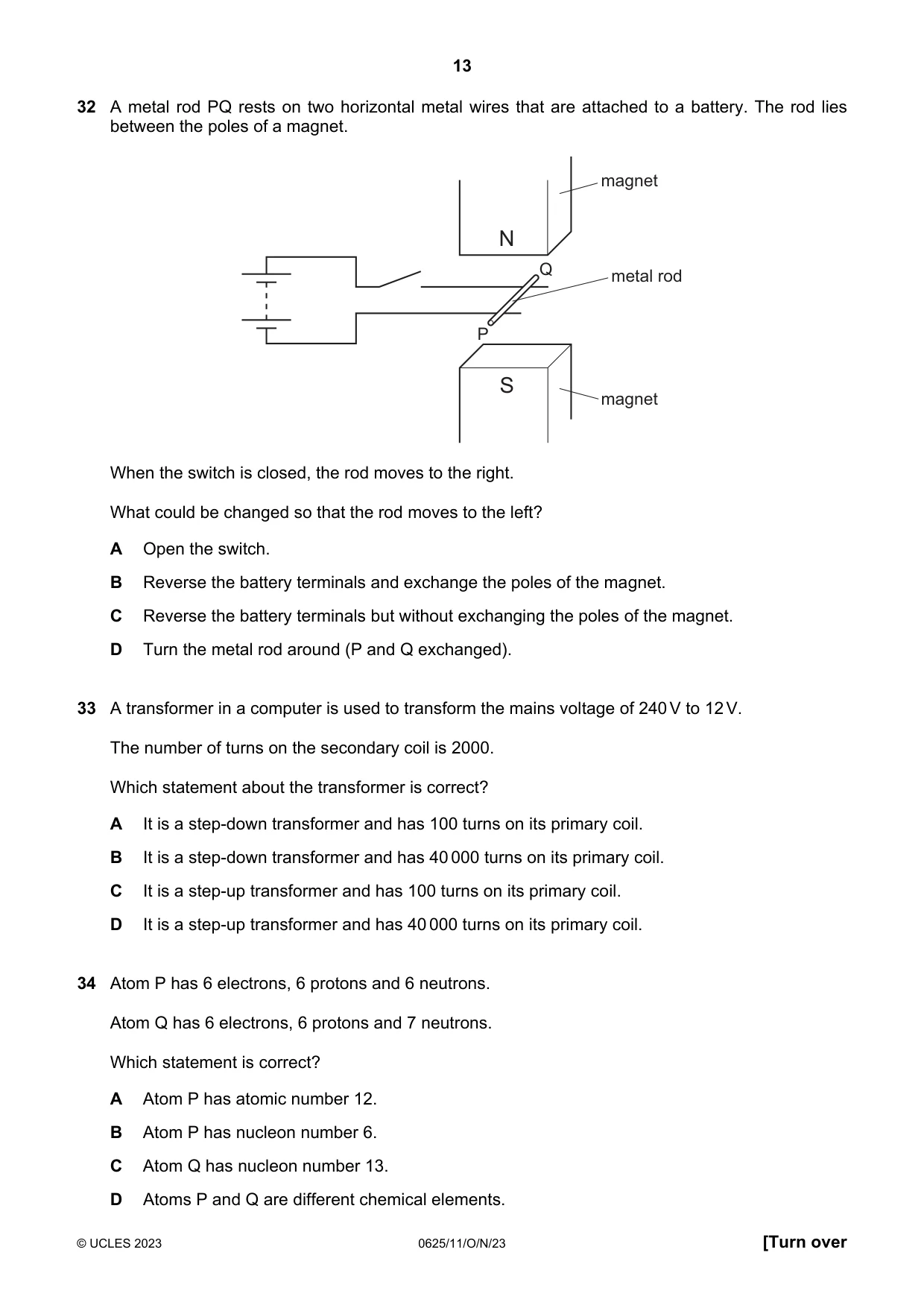
32 A metal rod PQ rests on two horizontal metal wires that are attached to a battery. The rod lies between the poles of a magnet. magnet N Q metal rod P S magnet When the switch is closed, the rod moves to the right. What could be changed so that the rod moves to the left? A Open the switch. B Reverse the battery terminals and exchange the poles of the magnet. C Reverse the battery terminals but without exchanging the poles of the magnet. D Turn the metal rod around (P and Q exchanged).
Mark scheme: C
Q33 · A transformer in a computer is used to transform the mains voltage of 240 V to 12 V
33 A transformer in a computer is used to transform the mains voltage of 240 V to 12 V. The number of turns on the secondary coil is 2000. Which statement about the transformer is correct? A It is a step-down transformer and has 100 turns on its primary coil. B It is a step-down transformer and has 40 000 turns on its primary coil. C It is a step-up transformer and has 100 turns on its primary coil. D It is a step-up transformer and has 40 000 turns on its primary coil.
Mark scheme: B
Q34 · Atom P has 6 electrons, 6 protons and 6 neutrons
34 Atom P has 6 electrons, 6 protons and 6 neutrons. Atom Q has 6 electrons, 6 protons and 7 neutrons. Which statement is correct? A Atom P has atomic number 12. B Atom P has nucleon number 6. C Atom Q has nucleon number 13. D Atoms P and Q are different chemical elements.
Mark scheme: C
Q35 · -particles, -particles and -rays are emitted by radioactive nuclei when they decay
35 -particles, -particles and -rays are emitted by radioactive nuclei when they decay. Which emissions can be deflected by an electric field? A -particles, -particles and -rays B -particles and -particles only C -particles and -rays only D -rays and -particles only
Mark scheme: B
Q36 · The graph shows the count rate from a radioactive source over a period of time
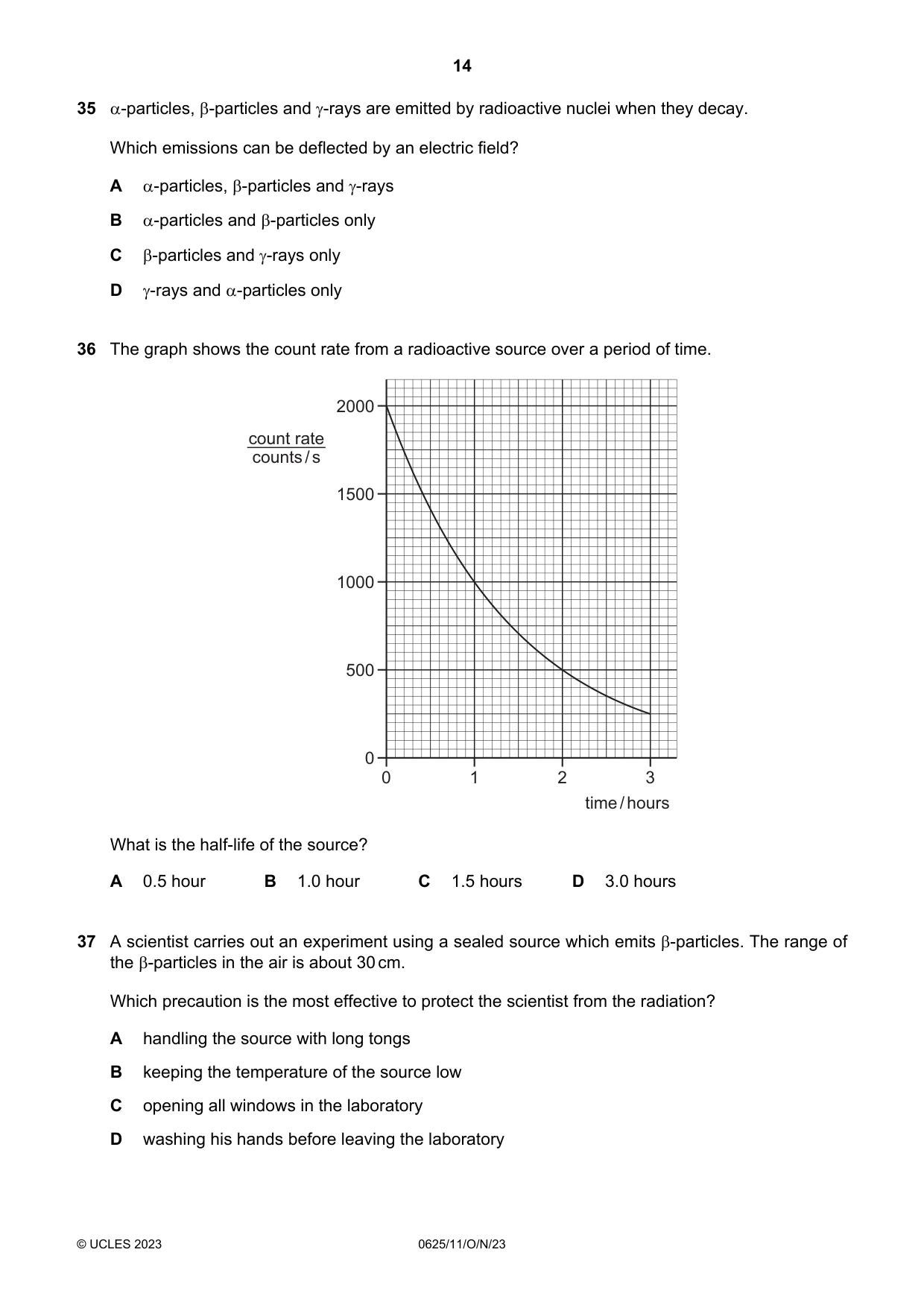
36 The graph shows the count rate from a radioactive source over a period of time. 2000 count rate counts / s 1500 1000 500 0 0 1 2 3 time / hours What is the half-life of the source? A 0.5 hour B 1.0 hour C 1.5 hours D 3.0 hours
Mark scheme: B
Q37 · A scientist carries out an experiment using a sealed source which emits -particles
37 A scientist carries out an experiment using a sealed source which emits -particles. The range of the -particles in the air is about 30 cm. Which precaution is the most effective to protect the scientist from the radiation? A handling the source with long tongs B keeping the temperature of the source low C opening all windows in the laboratory D washing his hands before leaving the laboratory
Mark scheme: A
Q38 · Which planet orbits the Sun between Mars and Saturn?
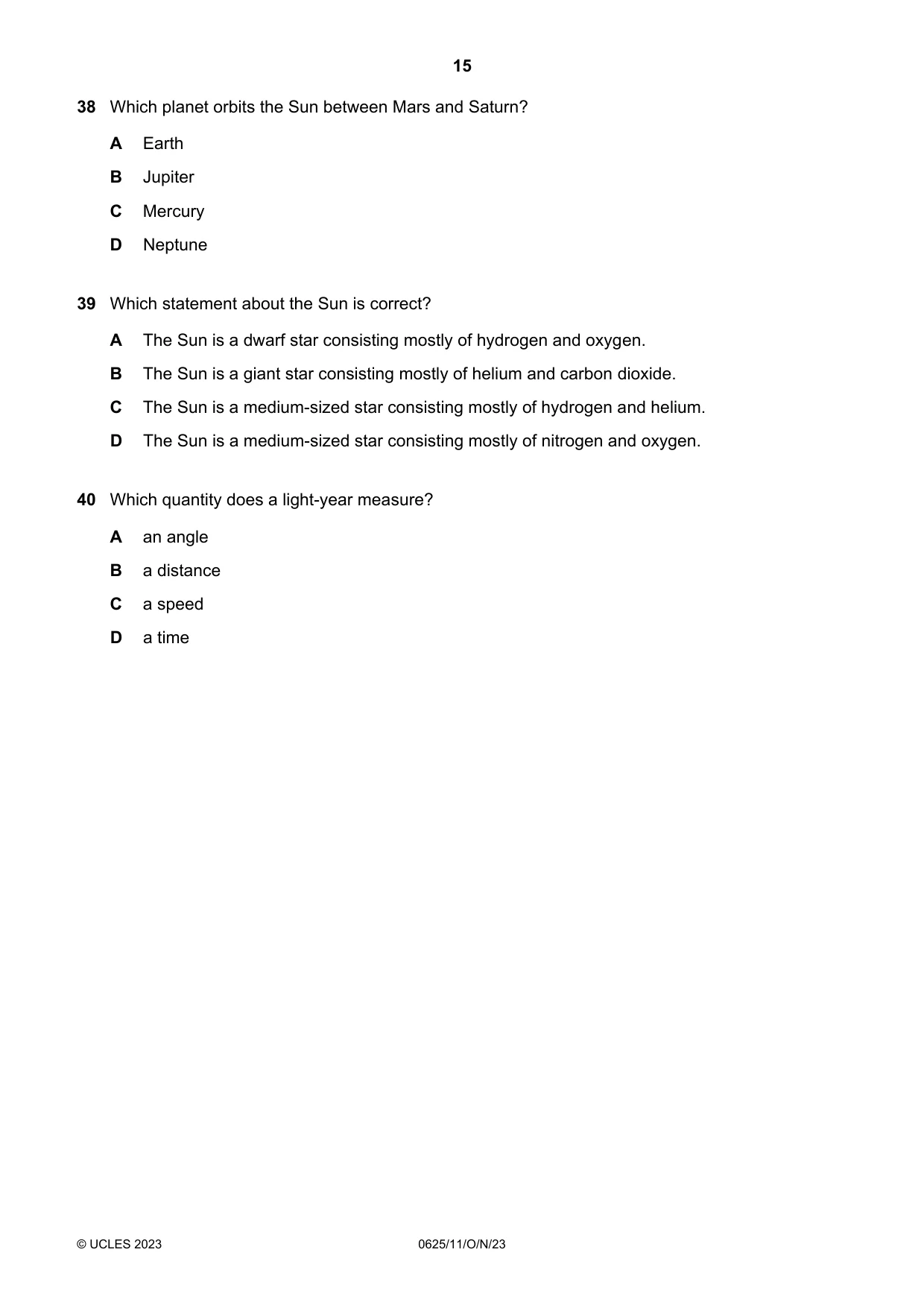
38 Which planet orbits the Sun between Mars and Saturn? A Earth B Jupiter C Mercury D Neptune
Mark scheme: B
Q39 · Which statement about the Sun is correct?
39 Which statement about the Sun is correct? A The Sun is a dwarf star consisting mostly of hydrogen and oxygen. B The Sun is a giant star consisting mostly of helium and carbon dioxide. C The Sun is a medium-sized star consisting mostly of hydrogen and helium. D The Sun is a medium-sized star consisting mostly of nitrogen and oxygen.
Mark scheme: C
Q40 · Which quantity does a light-year measure?
40 Which quantity does a light-year measure? A an angle B a distance C a speed D a time
Mark scheme: B
What was in this paper
The subtopics covered by these 40 questions, and how many questions each got. Open one in a new tab to see every Cambridge question on it.
4Electromagnetic effects3Energy, work and power3Light3Radioactivity3Thermal properties and temperature3Forces2General properties of waves2Mass and weight2Stars and the Universe2Density1Electric circuits1Electrical safety1Electromagnetic spectrum1Kinetic particle model of matter1Motion1Physical quantities and measurement techniques1Pressure1Simple phenomena of magnetism1Sound1The Earth and the Solar System1The nuclear model of the atom1Transfer of thermal energy1What you needed in this session
Cambridge’s own grade thresholds for 2023 Oct/Nov, Paper 1 · Variant 1. A higher threshold means an easier paper — the bar moves with how the cohort did.