Cambridge IGCSE Physics 0625 — 2016 Oct/Nov Paper 1 · Variant 1
0625/11/O/N/16 · 40 questions · 40 marks · ≈45 min
The question paper and its mark scheme, free to read here and free to download. This is Cambridge’s own paper, exactly as it was sat.
Question paper20 pages
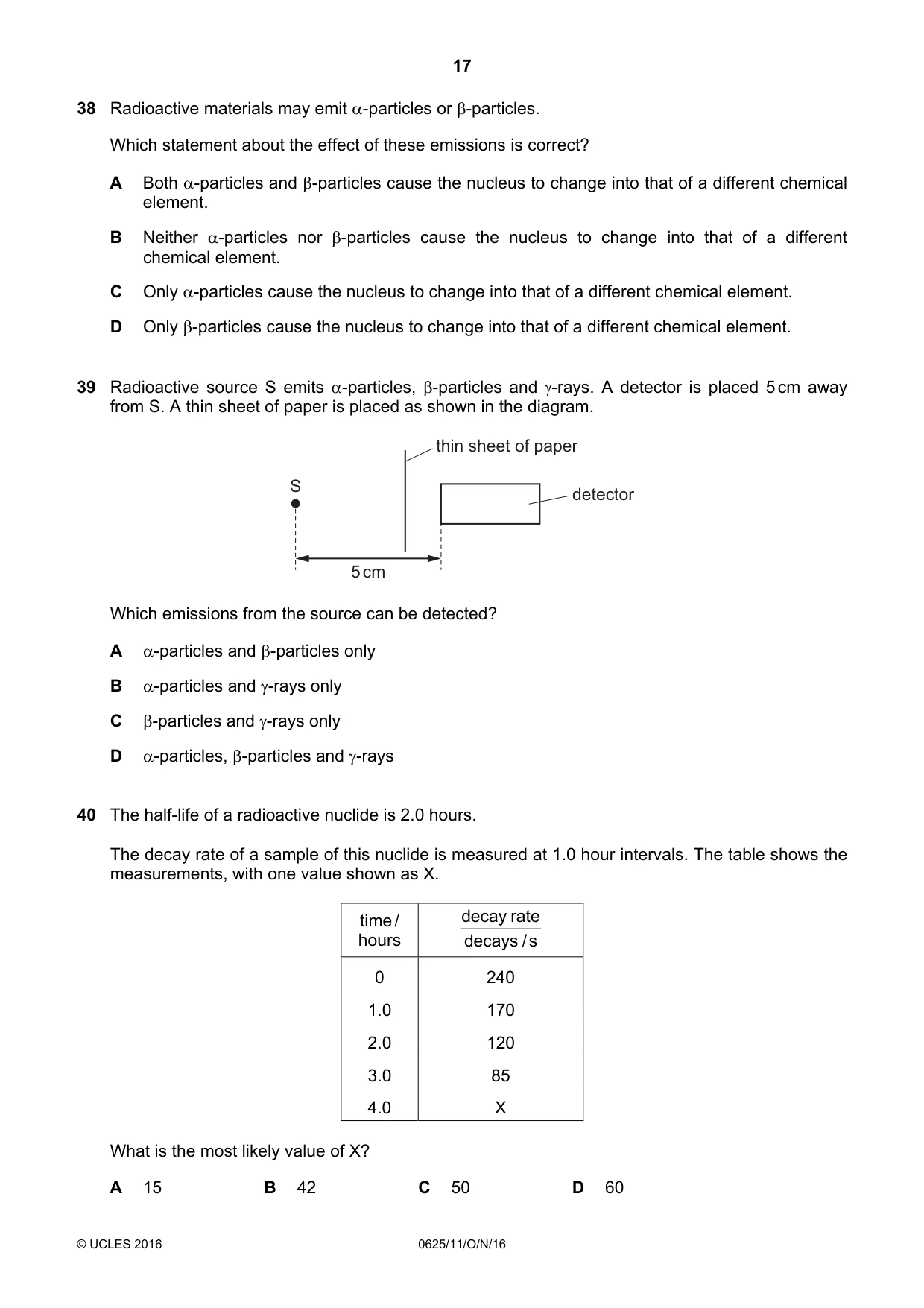


Mark scheme2 pages
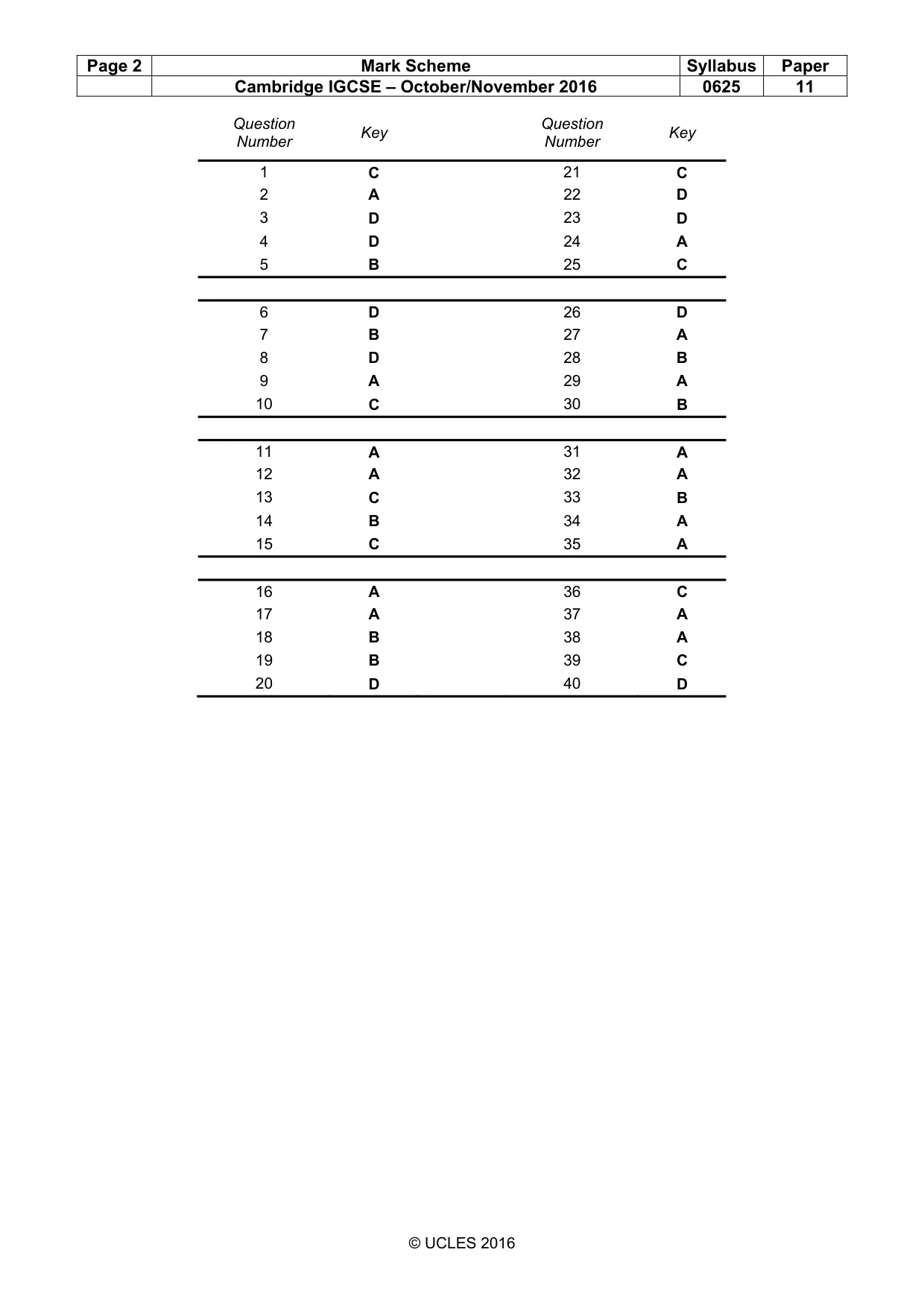
Answers below. Sit the paper first if you are practising.
Questions as text
Q1 · A student has a can of oil
1 A student has a can of oil. Which quantity can be measured using only a measuring cylinder? A density of the oil B mass of the oil C volume of the oil D weight of the oil
Mark scheme: C
More questions on Physical quantities and measurement techniques
Q2 · The graph shows how the distance travelled by a vehicle changes with time
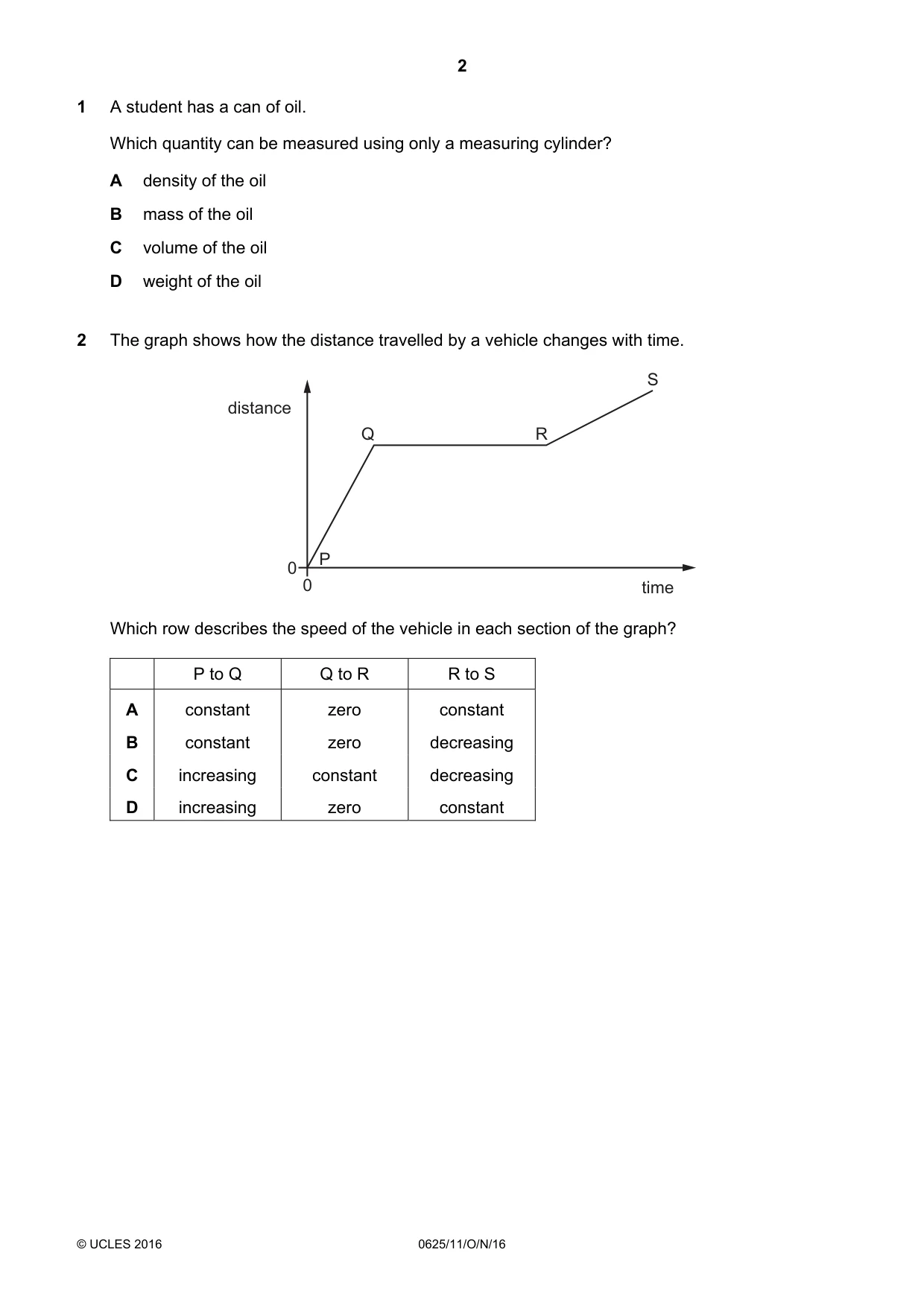
2 The graph shows how the distance travelled by a vehicle changes with time. S distance Q R P 0 0 time Which row describes the speed of the vehicle in each section of the graph? P to Q Q to R R to S A constant zero constant B constant zero decreasing C increasing constant decreasing D increasing zero constant
Mark scheme: A
Q3 · A stone falls freely from the top of a cliff
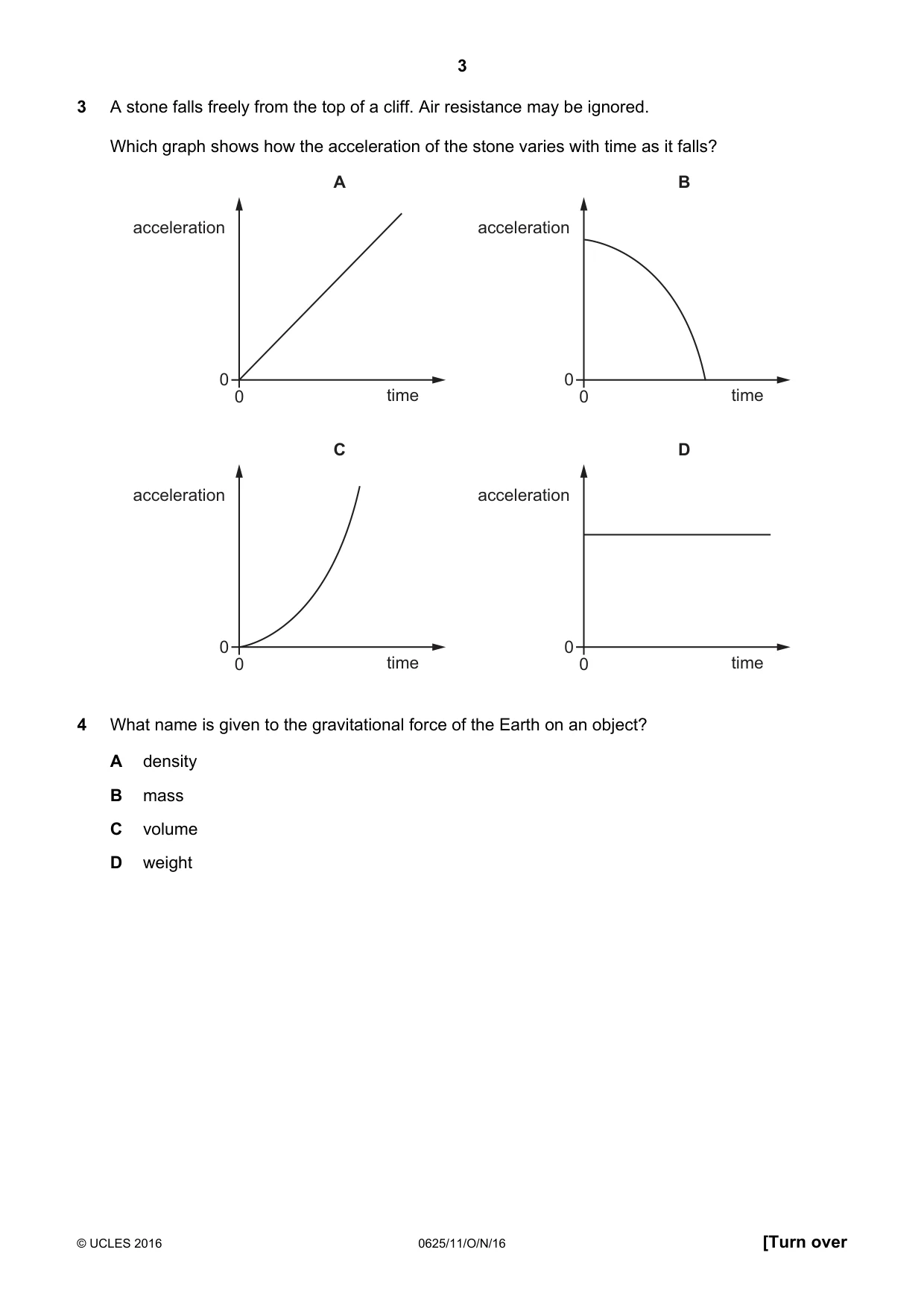
3 A stone falls freely from the top of a cliff. Air resistance may be ignored. Which graph shows how the acceleration of the stone varies with time as it falls? A B acceleration acceleration 0 0 0 time 0 time C D acceleration acceleration 0 0 0 time 0 time
Mark scheme: D
Q4 · What name is given to the gravitational force of the Earth on an object?
4 What name is given to the gravitational force of the Earth on an object? A density B mass C volume D weight
Mark scheme: D
Q5 · The diagrams show an empty rectangular box, and the same box filled with liquid
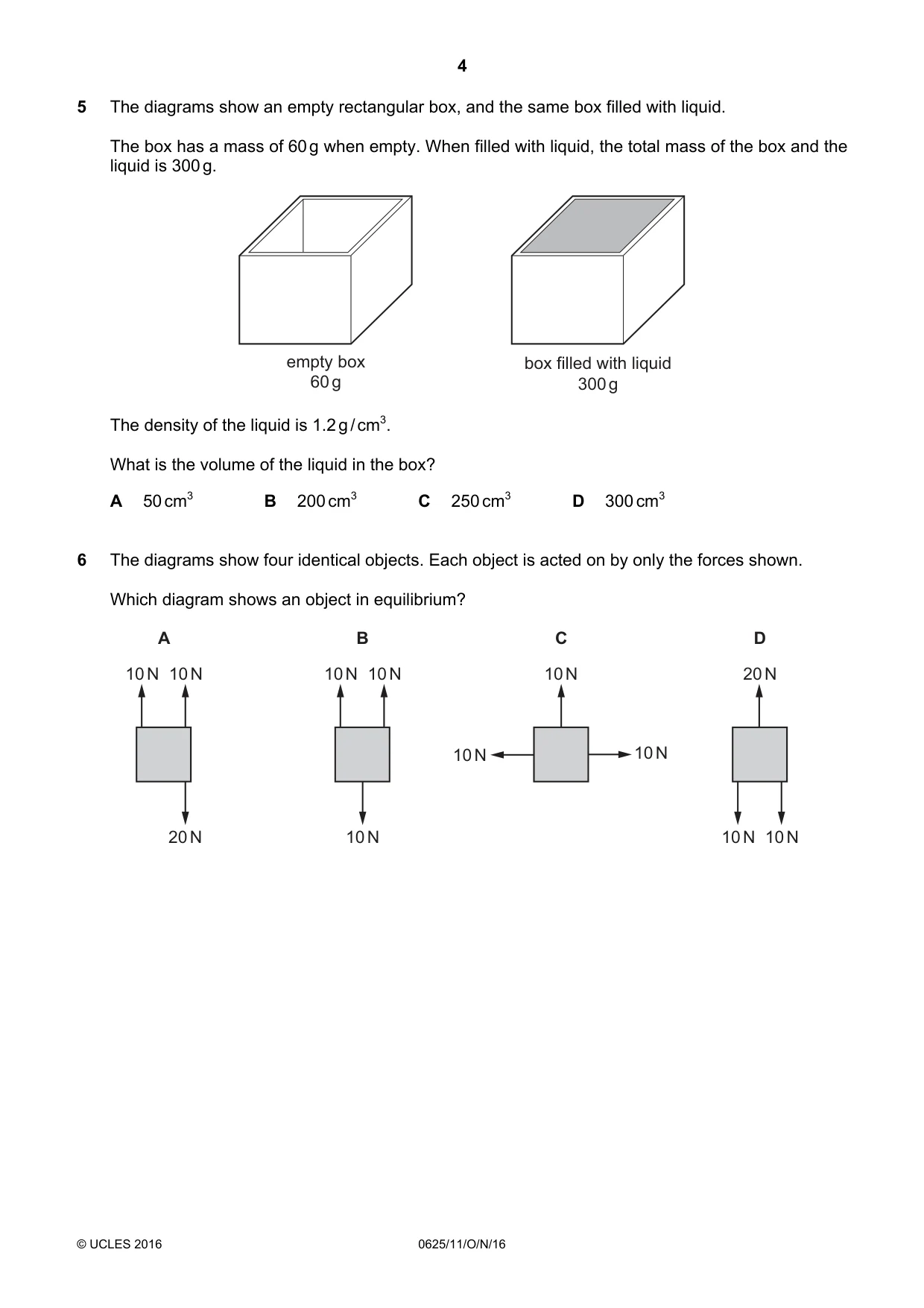
5 The diagrams show an empty rectangular box, and the same box filled with liquid. The box has a mass of 60 g when empty. When filled with liquid, the total mass of the box and the liquid is 300 g. empty box box filled with liquid 60 g 300 g The density of the liquid is 1.2 g / cm3. What is the volume of the liquid in the box? A 50 cm3 B 200 cm3 C 250 cm3 D 300 cm3
Mark scheme: B
Q6 · The diagrams show four identical objects
6 The diagrams show four identical objects. Each object is acted on by only the forces shown. Which diagram shows an object in equilibrium? A B C D 10 N 10 N 10 N 10 N 10 N 20 N 10 N 10 N 20 N 10 N 10 N 10 N
Mark scheme: D
Q7 · A student investigates a steel spring
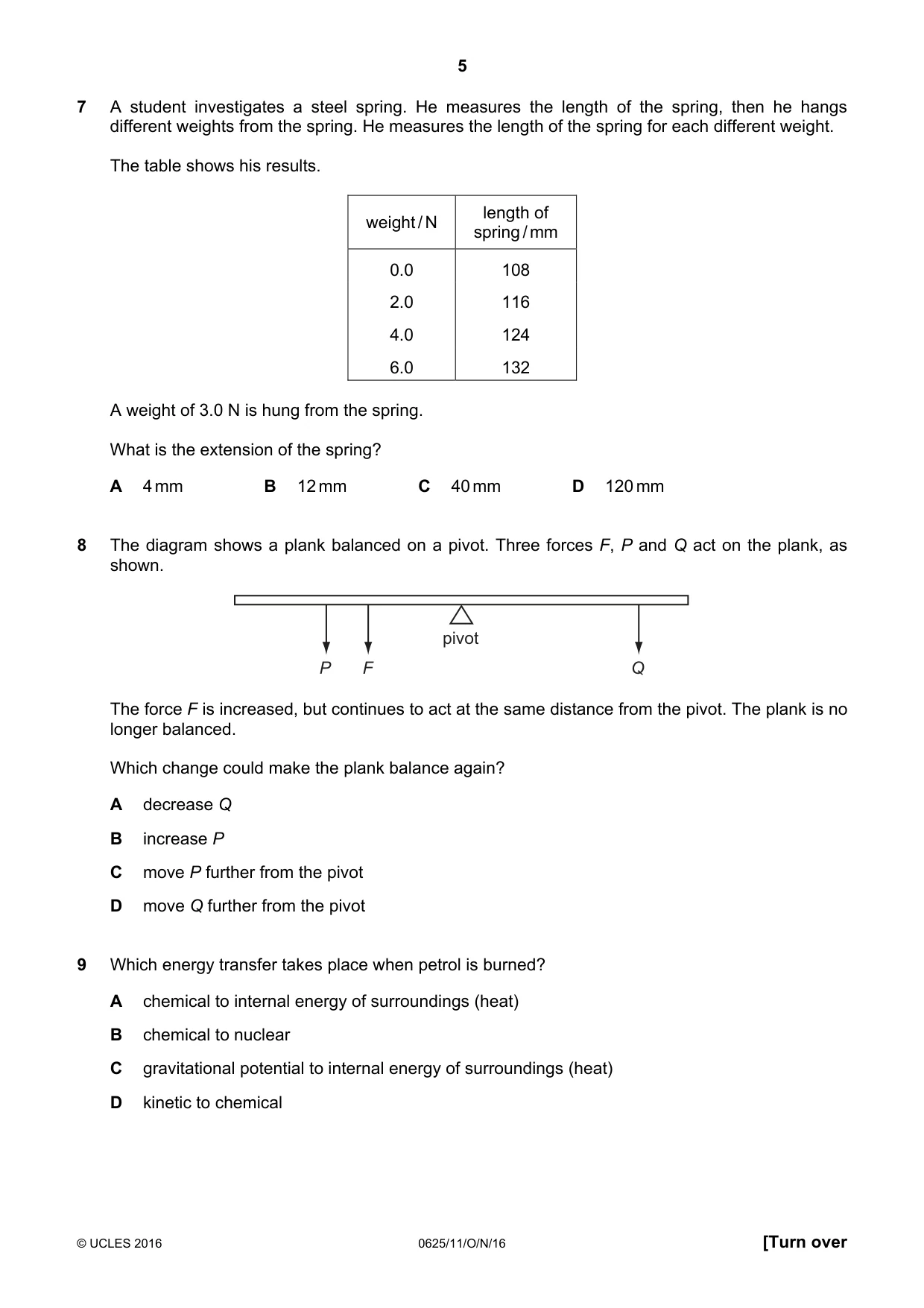
7 A student investigates a steel spring. He measures the length of the spring, then he hangs different weights from the spring. He measures the length of the spring for each different weight. The table shows his results. length of weight / N spring / mm 0.0 108 2.0 116 4.0 124 6.0 132 A weight of 3.0 N is hung from the spring. What is the extension of the spring? A 4 mm B 12 mm C 40 mm D 120 mm
Mark scheme: B
Q8 · The diagram shows a plank balanced on a pivot
8 The diagram shows a plank balanced on a pivot. Three forces F, P and Q act on the plank, as shown. pivot P F Q The force F is increased, but continues to act at the same distance from the pivot. The plank is no longer balanced. Which change could make the plank balance again? A decrease Q B increase P C move P further from the pivot D move Q further from the pivot
Mark scheme: D
Q9 · Which energy transfer takes place when petrol is burned?
9 Which energy transfer takes place when petrol is burned? A chemical to internal energy of surroundings (heat) B chemical to nuclear C gravitational potential to internal energy of surroundings (heat) D kinetic to chemical
Mark scheme: A
Q10 · The box contains the names of eight different energy resources
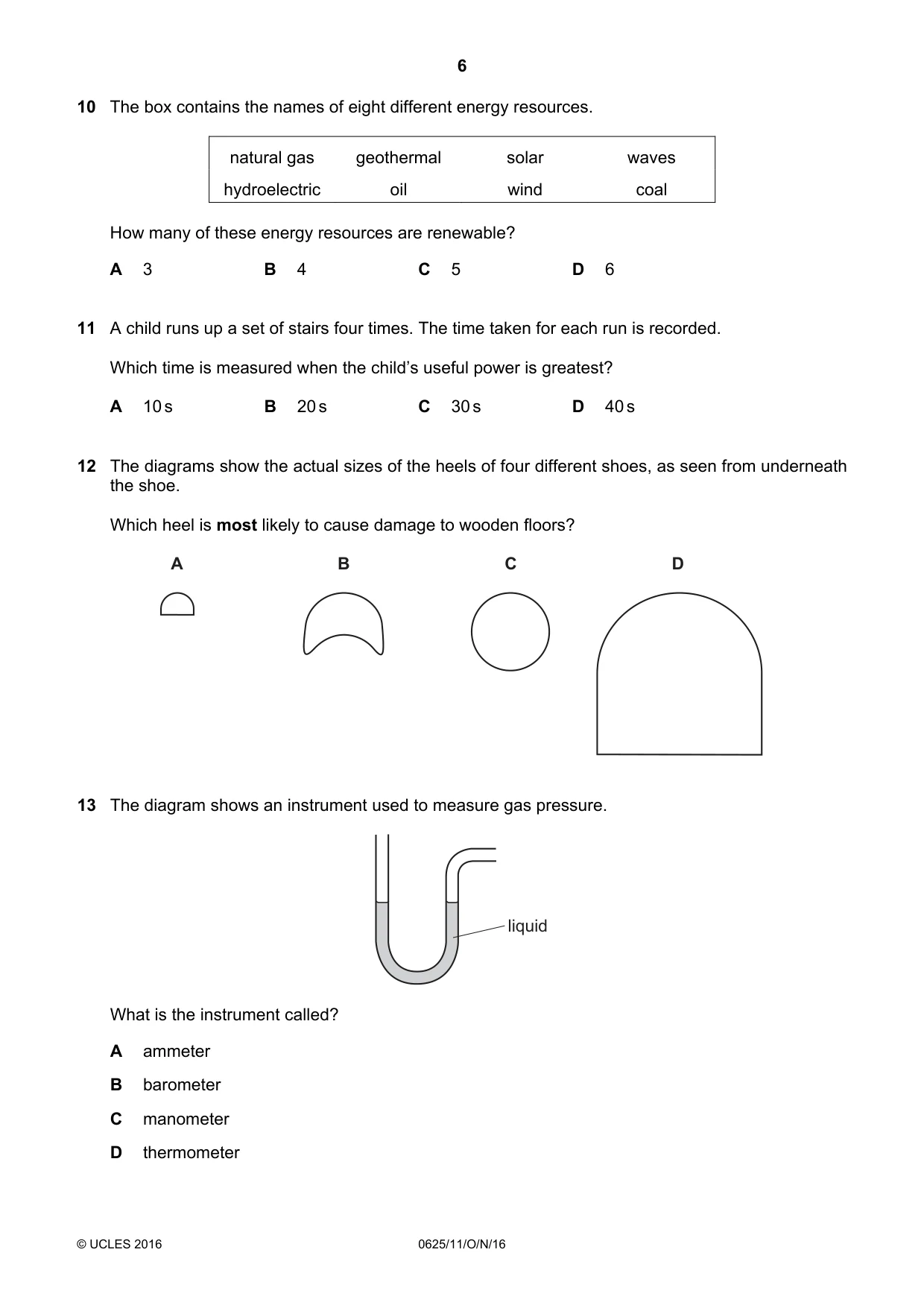
10 The box contains the names of eight different energy resources. natural gas geothermal solar waves hydroelectric oil wind coal How many of these energy resources are renewable? A 3 B 4 C 5 D 6
Mark scheme: C
Q11 · A child runs up a set of stairs four times
11 A child runs up a set of stairs four times. The time taken for each run is recorded. Which time is measured when the child’s useful power is greatest? A 10 s B 20 s C 30 s D 40 s
Mark scheme: A
Q12 · The diagrams show the actual sizes of the heels of four different shoes, as seen from…
12 The diagrams show the actual sizes of the heels of four different shoes, as seen from underneath the shoe. Which heel is most likely to cause damage to wooden floors? A B C D
Mark scheme: A
Q13 · The diagram shows an instrument used to measure gas pressure
13 The diagram shows an instrument used to measure gas pressure. liquid What is the instrument called? A ammeter B barometer C manometer D thermometer
Mark scheme: C
Q14 · Smoke particles in air are illuminated by a beam of light
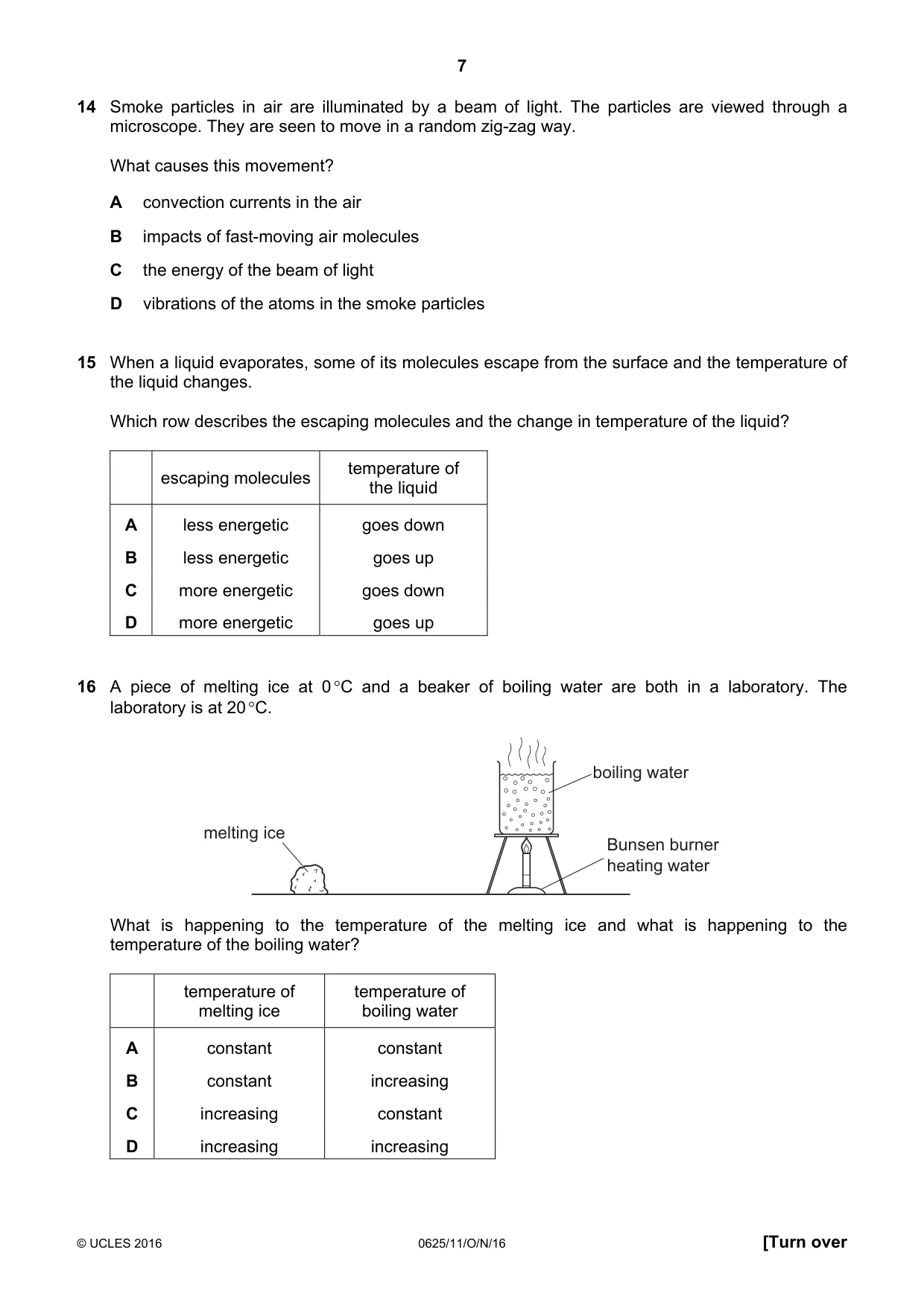
14 Smoke particles in air are illuminated by a beam of light. The particles are viewed through a microscope. They are seen to move in a random zig-zag way. What causes this movement? A convection currents in the air B impacts of fast-moving air molecules C the energy of the beam of light D vibrations of the atoms in the smoke particles
Mark scheme: B
Q15 · When a liquid evaporates, some of its molecules escape from the surface and the…
15 When a liquid evaporates, some of its molecules escape from the surface and the temperature of the liquid changes. Which row describes the escaping molecules and the change in temperature of the liquid? temperature of escaping molecules the liquid A less energetic goes down B less energetic goes up C more energetic goes down D more energetic goes up
Mark scheme: C
Q16 · A piece of melting ice at 0 °C and a beaker of boiling water are both in a laboratory
16 A piece of melting ice at 0 °C and a beaker of boiling water are both in a laboratory. The laboratory is at 20 °C. boiling water melting ice Bunsen burner heating water What is happening to the temperature of the melting ice and what is happening to the temperature of the boiling water? temperature of temperature of melting ice boiling water A constant constant B constant increasing C increasing constant D increasing increasing
Mark scheme: A
Q17 · Changes in which physical property cannot be used for temperature measurement?
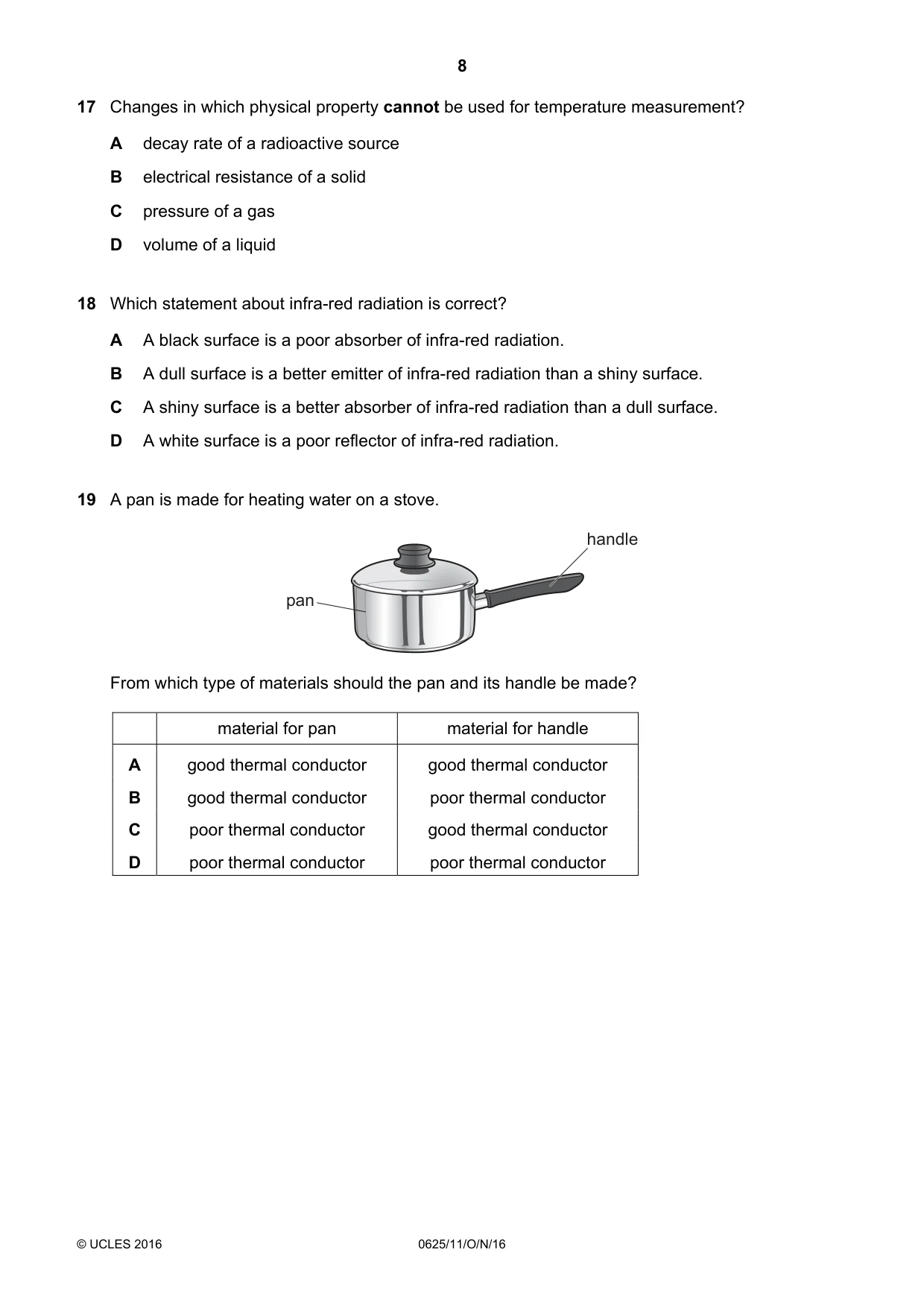
17 Changes in which physical property cannot be used for temperature measurement? A decay rate of a radioactive source B electrical resistance of a solid C pressure of a gas D volume of a liquid
Mark scheme: A
Q18 · Which statement about infra-red radiation is correct?
18 Which statement about infra-red radiation is correct? A A black surface is a poor absorber of infra-red radiation. B A dull surface is a better emitter of infra-red radiation than a shiny surface. C A shiny surface is a better absorber of infra-red radiation than a dull surface. D A white surface is a poor reflector of infra-red radiation.
Mark scheme: B
Q19 · A pan is made for heating water on a stove
19 A pan is made for heating water on a stove. handle pan From which type of materials should the pan and its handle be made? material for pan material for handle A good thermal conductor good thermal conductor B good thermal conductor poor thermal conductor C poor thermal conductor good thermal conductor D poor thermal conductor poor thermal conductor
Mark scheme: B
Q20 · A toy boat floats on water in a tank
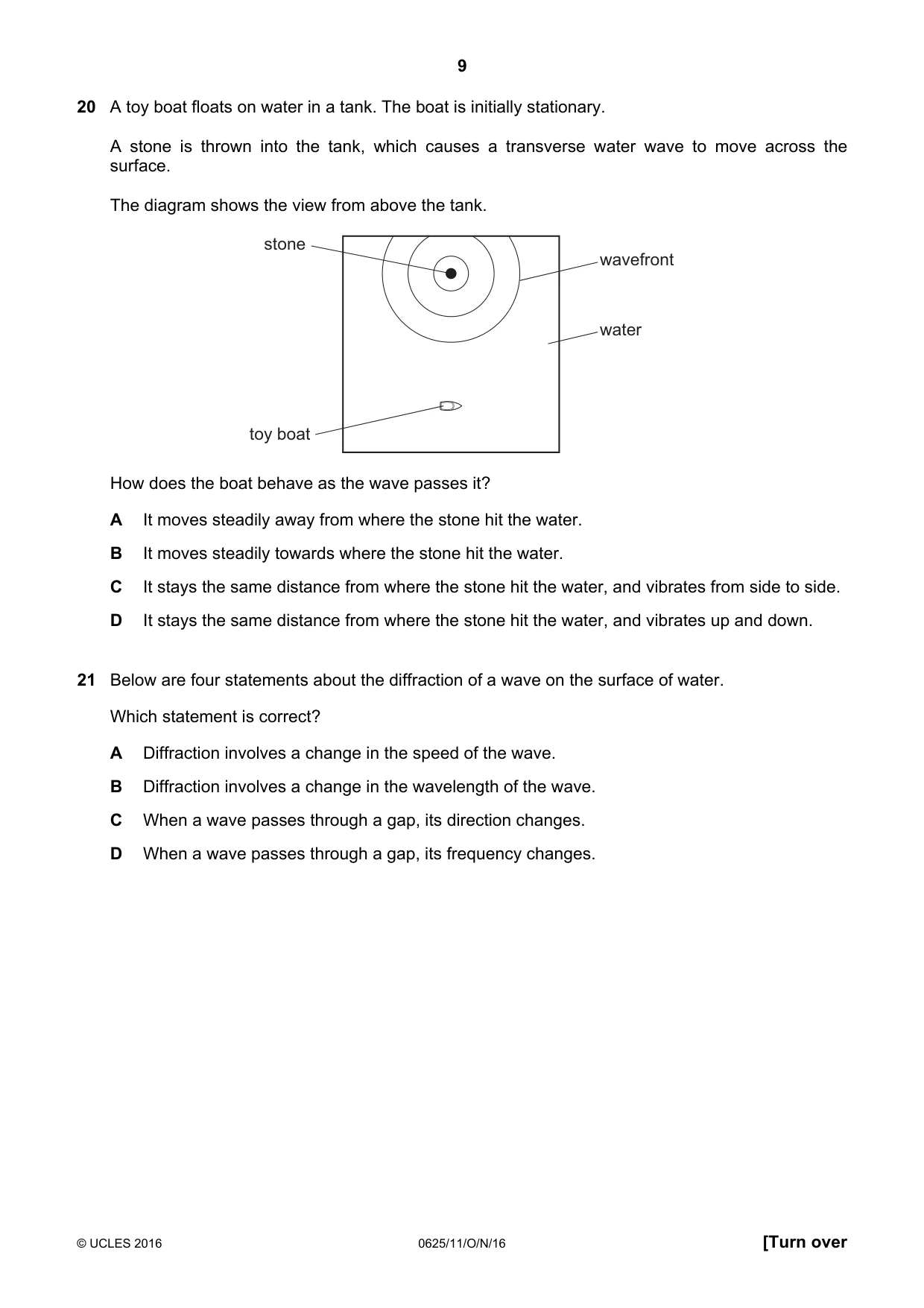
20 A toy boat floats on water in a tank. The boat is initially stationary. A stone is thrown into the tank, which causes a transverse water wave to move across the surface. The diagram shows the view from above the tank. stone wavefront water toy boat How does the boat behave as the wave passes it? A It moves steadily away from where the stone hit the water. B It moves steadily towards where the stone hit the water. C It stays the same distance from where the stone hit the water, and vibrates from side to side. D It stays the same distance from where the stone hit the water, and vibrates up and down.
Mark scheme: D
Q21 · Below are four statements about the diffraction of a wave on the surface of water
21 Below are four statements about the diffraction of a wave on the surface of water. Which statement is correct? A Diffraction involves a change in the speed of the wave. B Diffraction involves a change in the wavelength of the wave. C When a wave passes through a gap, its direction changes. D When a wave passes through a gap, its frequency changes.
Mark scheme: C
Q22 · A child wears a T-shirt with the letter ‘F’ written on it
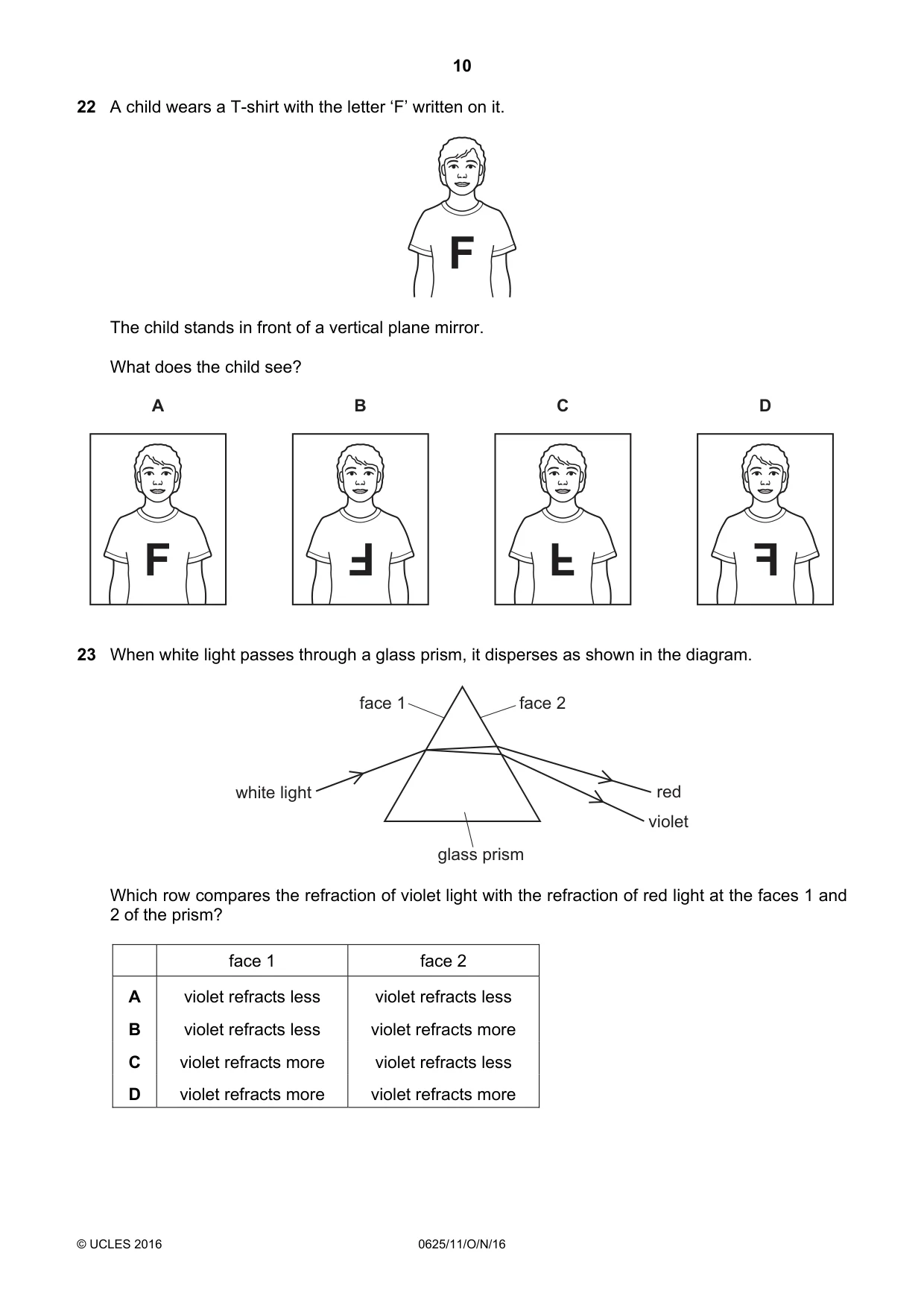
22 A child wears a T-shirt with the letter ‘F’ written on it. The child stands in front of a vertical plane mirror. What does the child see? A B C D
Mark scheme: D
Q23 · When white light passes through a glass prism, it disperses as shown in the diagram
23 When white light passes through a glass prism, it disperses as shown in the diagram. face 1 face 2 white light red violet glass prism Which row compares the refraction of violet light with the refraction of red light at the faces 1 and 2 of the prism? face 1 face 2 A violet refracts less violet refracts less B violet refracts less violet refracts more C violet refracts more violet refracts less D violet refracts more violet refracts more
Mark scheme: D
Q24 · Radiation from which part of the electromagnetic spectrum is used in the remote…
24 Radiation from which part of the electromagnetic spectrum is used in the remote controller for a television? A infra-red waves B microwaves C radio waves D ultraviolet waves
Mark scheme: A
Q25 · A girl notices that, when she shouts into a cave, she hears an echo
25 A girl notices that, when she shouts into a cave, she hears an echo. Which wave property causes the echo? A diffraction B dispersion C reflection D refraction
Mark scheme: C
Q26 · The diagrams represent the displacement in four different sound waves
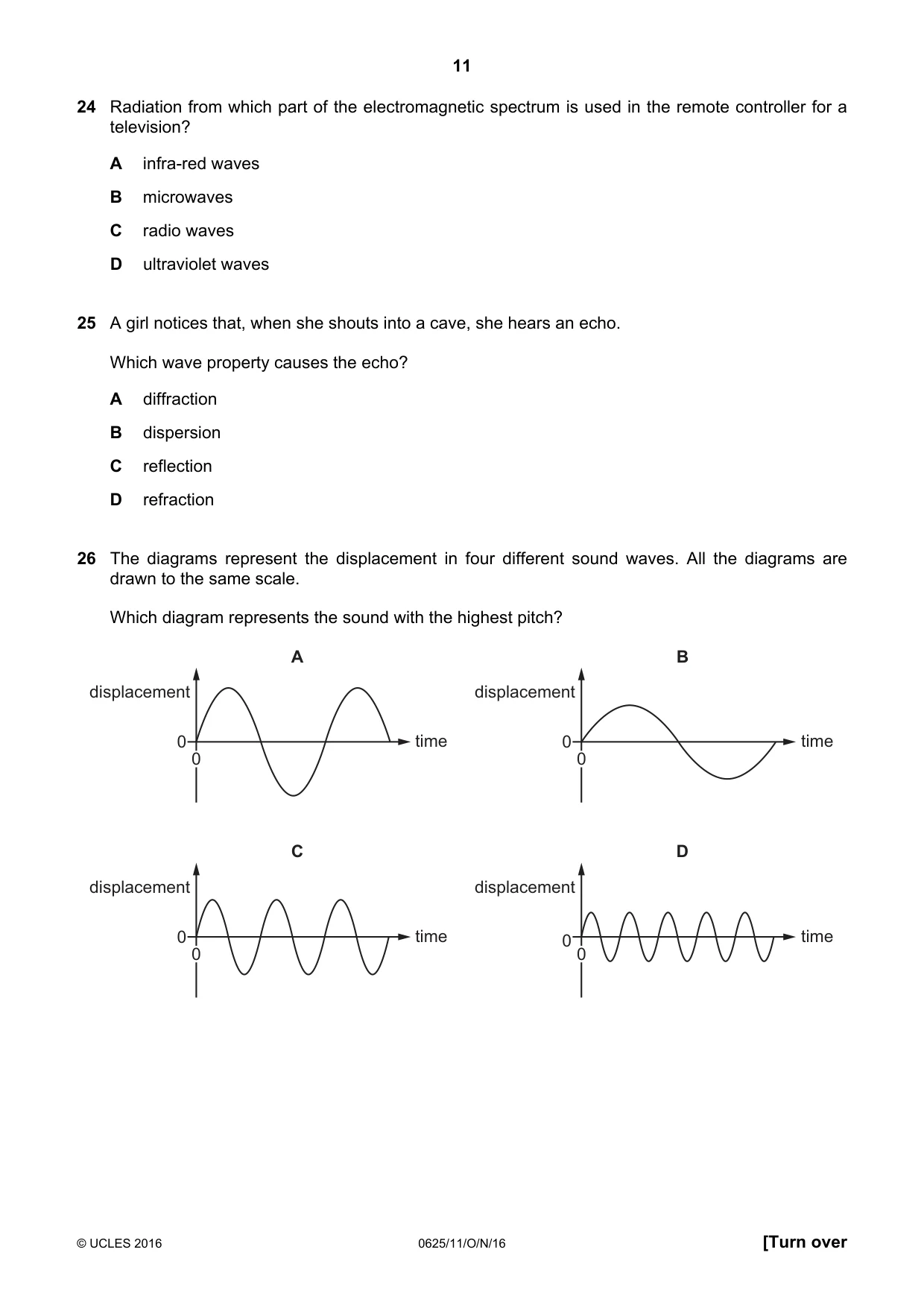
26 The diagrams represent the displacement in four different sound waves. All the diagrams are drawn to the same scale. Which diagram represents the sound with the highest pitch? A B displacement displacement 0 time 0 time 0 0 C D displacement displacement 0 time 0 time 0 0
Mark scheme: D
Q27 · In two separate experiments, a magnet is brought near to an unmagnetised iron bar
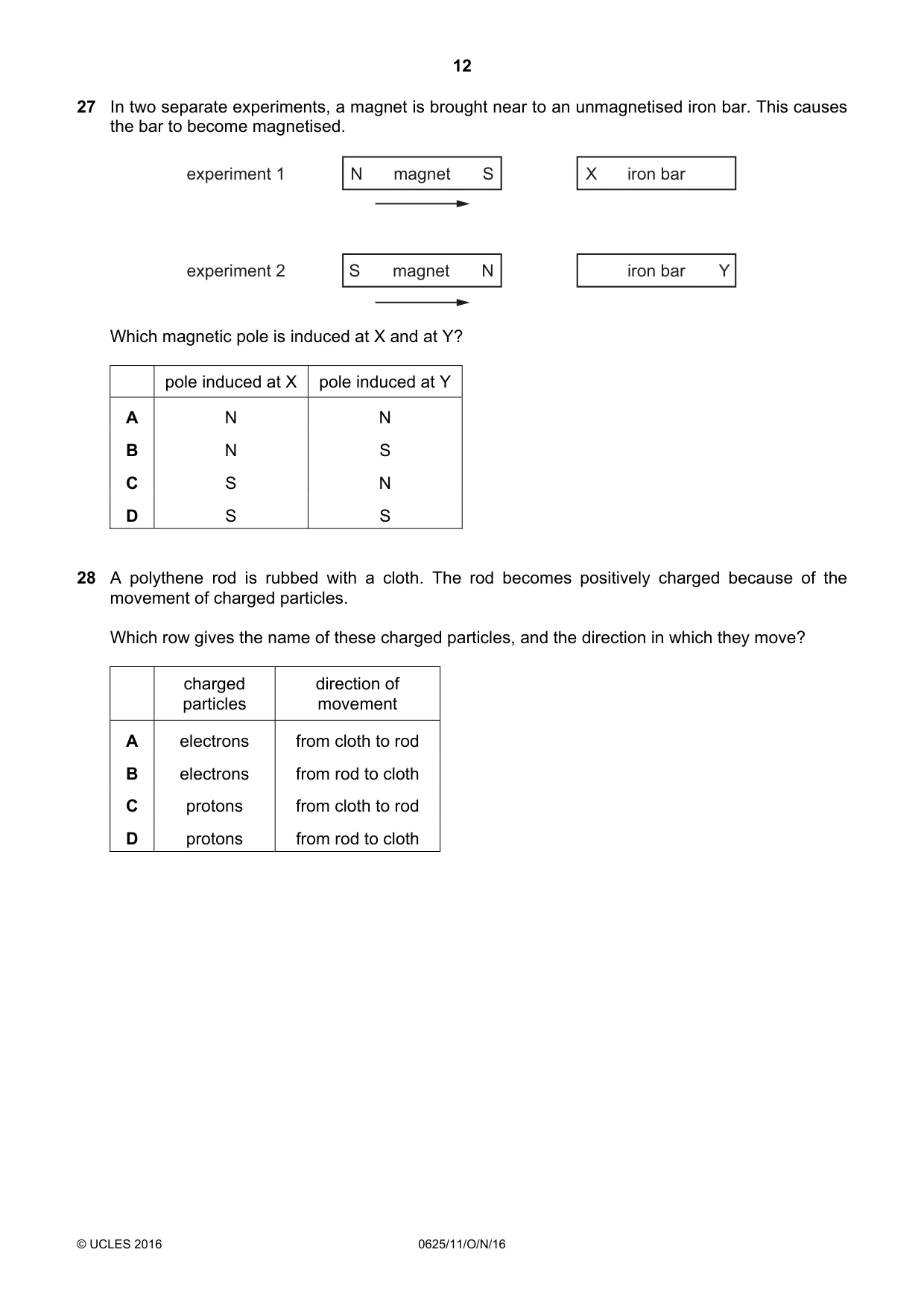
27 In two separate experiments, a magnet is brought near to an unmagnetised iron bar. This causes the bar to become magnetised. experiment 1 N magnet S X iron bar experiment 2 S magnet N iron bar Y Which magnetic pole is induced at X and at Y? pole induced at X pole induced at Y A N N B N S C S N D S S
Mark scheme: A
Q28 · A polythene rod is rubbed with a cloth
28 A polythene rod is rubbed with a cloth. The rod becomes positively charged because of the movement of charged particles. Which row gives the name of these charged particles, and the direction in which they move? charged direction of particles movement A electrons from cloth to rod B electrons from rod to cloth C protons from cloth to rod D protons from rod to cloth
Mark scheme: B
Q29 · The diagram shows a lamp in a circuit
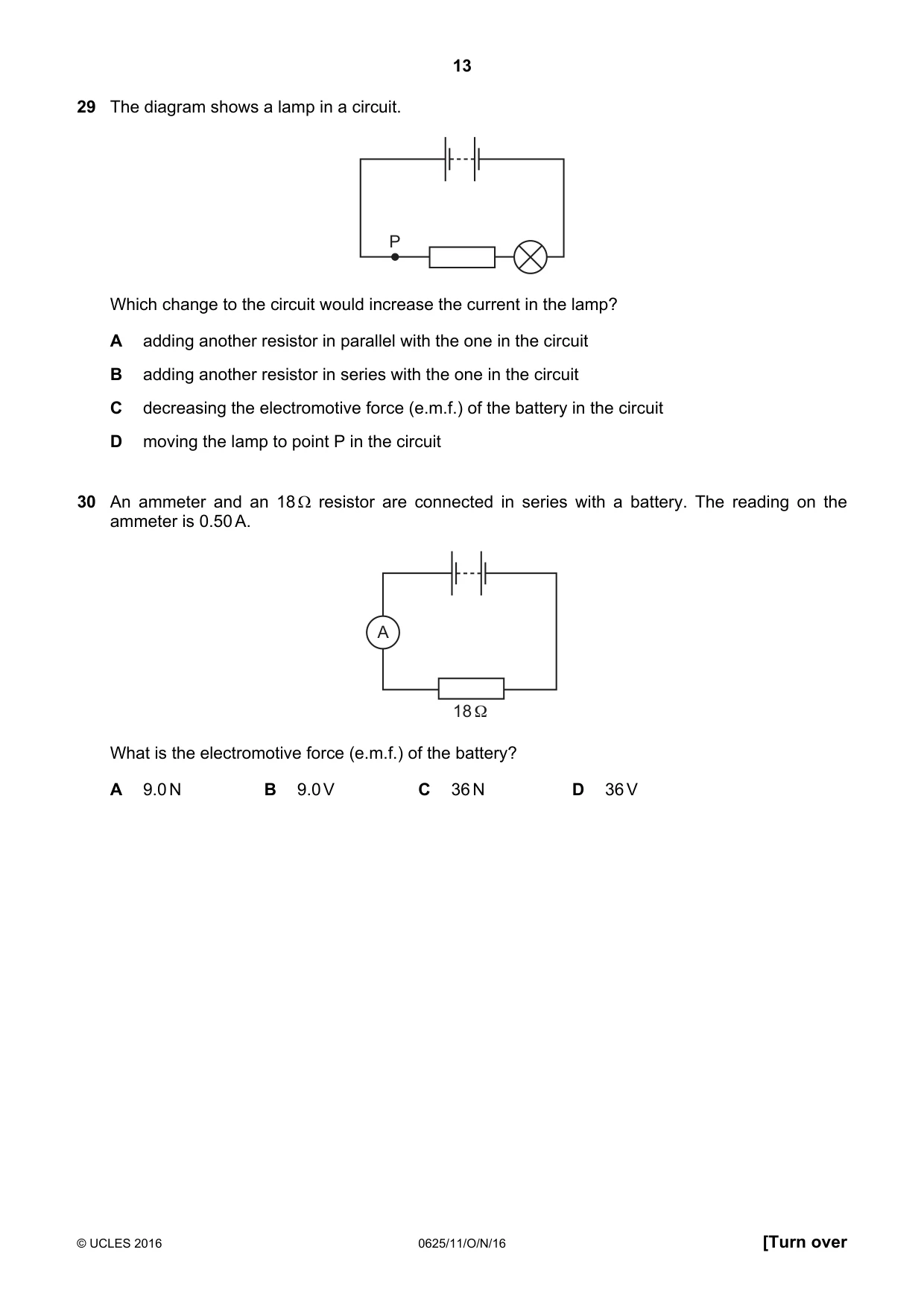
29 The diagram shows a lamp in a circuit. P Which change to the circuit would increase the current in the lamp? A adding another resistor in parallel with the one in the circuit B adding another resistor in series with the one in the circuit C decreasing the electromotive force (e.m.f.) of the battery in the circuit D moving the lamp to point P in the circuit
Mark scheme: A
Q30 · An ammeter and an 18 Ω resistor are connected in series with a battery
30 An ammeter and an 18 Ω resistor are connected in series with a battery. The reading on the ammeter is 0.50 A. A 18 Ω What is the electromotive force (e.m.f.) of the battery? A 9.0 N B 9.0 V C 36 N D 36 V
Mark scheme: B
Q31 · A source of constant electromotive force (e.m.f.) is connected across a thermistor
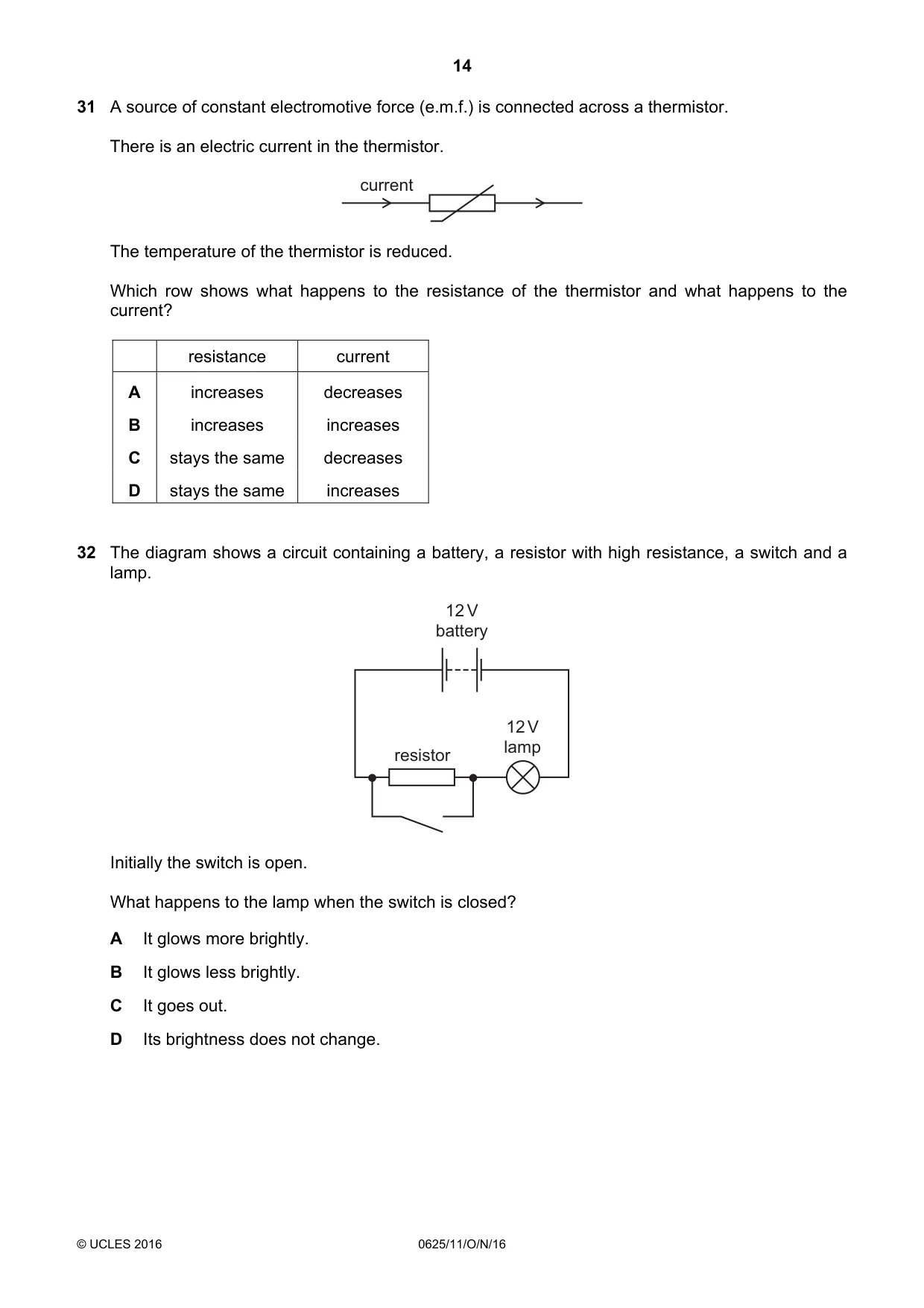
31 A source of constant electromotive force (e.m.f.) is connected across a thermistor. There is an electric current in the thermistor. current The temperature of the thermistor is reduced. Which row shows what happens to the resistance of the thermistor and what happens to the current? resistance current A increases decreases B increases increases C stays the same decreases D stays the same increases
Mark scheme: A
Q32 · The diagram shows a circuit containing a battery, a resistor with high resistance, a…
32 The diagram shows a circuit containing a battery, a resistor with high resistance, a switch and a lamp. 12 V battery 12 V resistor lamp Initially the switch is open. What happens to the lamp when the switch is closed? A It glows more brightly. B It glows less brightly. C It goes out. D Its brightness does not change.
Mark scheme: A
Q33 · The diagram shows a circuit containing two identical lamps and three ammeters
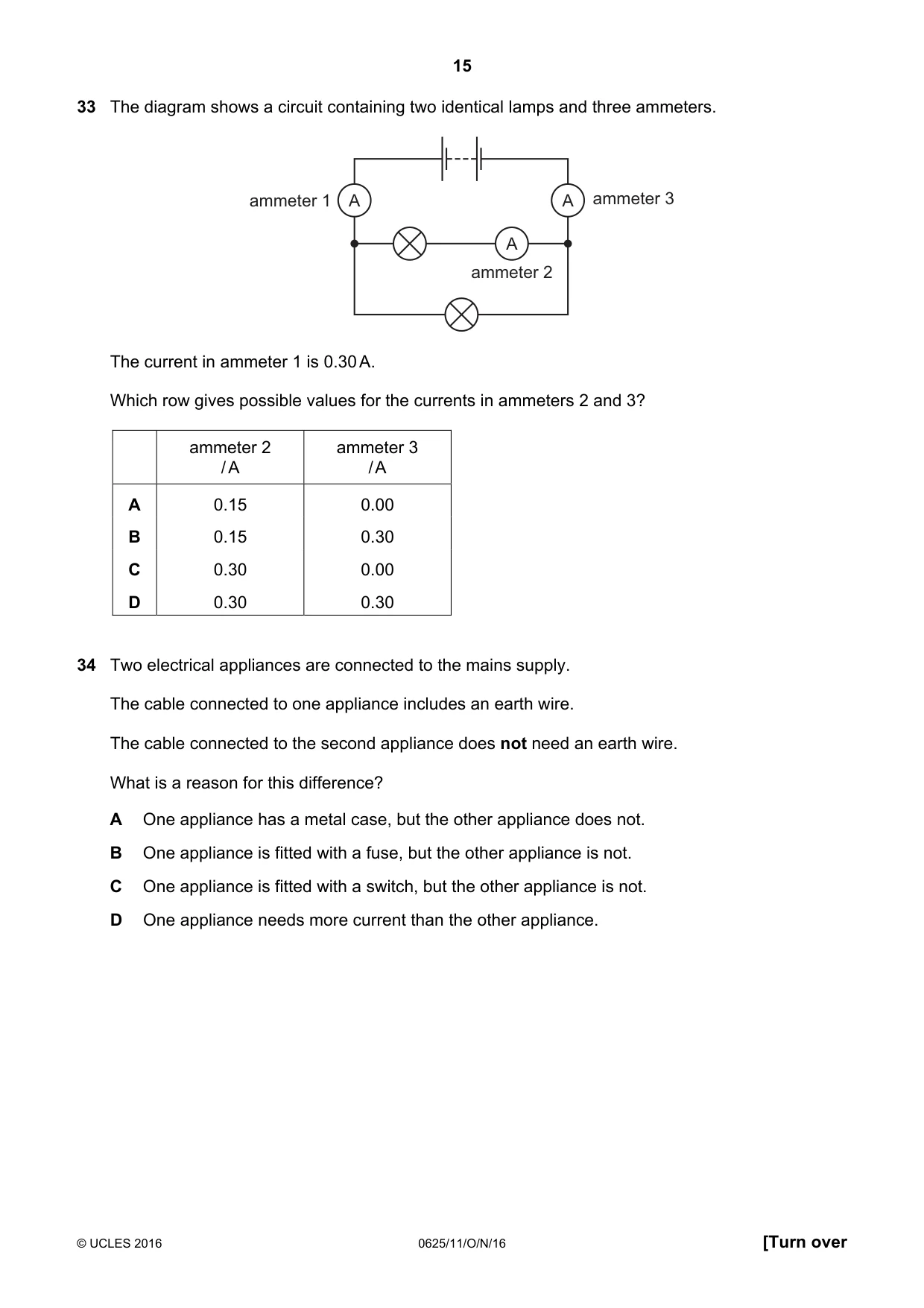
33 The diagram shows a circuit containing two identical lamps and three ammeters. ammeter 1 A A ammeter 3 A ammeter 2 The current in ammeter 1 is 0.30 A. Which row gives possible values for the currents in ammeters 2 and 3? ammeter 2 ammeter 3 / A / A A 0.15 0.00 B 0.15 0.30 C 0.30 0.00 D 0.30 0.30
Mark scheme: B
Q34 · Two electrical appliances are connected to the mains supply
34 Two electrical appliances are connected to the mains supply. The cable connected to one appliance includes an earth wire. The cable connected to the second appliance does not need an earth wire. What is a reason for this difference? A One appliance has a metal case, but the other appliance does not. B One appliance is fitted with a fuse, but the other appliance is not. C One appliance is fitted with a switch, but the other appliance is not. D One appliance needs more current than the other appliance.
Mark scheme: A
Q35 · The diagram represents a transformer
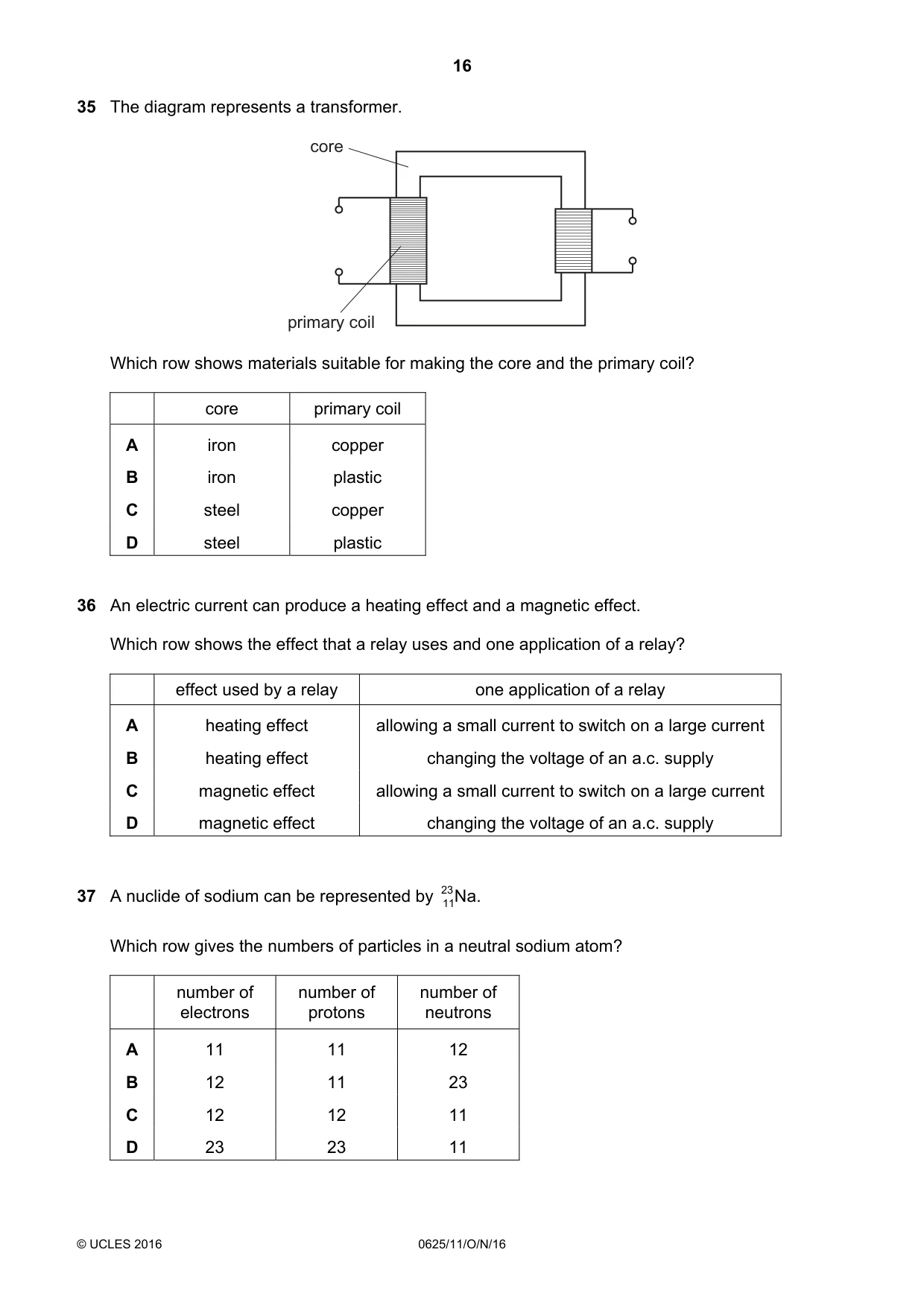
35 The diagram represents a transformer. core primary coil Which row shows materials suitable for making the core and the primary coil? core primary coil A iron copper B iron plastic C steel copper D steel plastic
Mark scheme: A
Q36 · An electric current can produce a heating effect and a magnetic effect
36 An electric current can produce a heating effect and a magnetic effect. Which row shows the effect that a relay uses and one application of a relay? effect used by a relay one application of a relay A heating effect allowing a small current to switch on a large current B heating effect changing the voltage of an a.c. supply C magnetic effect allowing a small current to switch on a large current D magnetic effect changing the voltage of an a.c. supply
Mark scheme: C
Q37 · A nuclide of sodium can be represented by 23 Na
37 A nuclide of sodium can be represented by 23 Na. 11 Which row gives the numbers of particles in a neutral sodium atom? number of number of number of electrons protons neutrons A 11 11 12 B 12 11 23 C 12 12 11 D 23 23 11
Mark scheme: A
Q38 · Radioactive materials may emit α-particles or β-particles
38 Radioactive materials may emit α-particles or β-particles. Which statement about the effect of these emissions is correct? A Both α-particles and β-particles cause the nucleus to change into that of a different chemical element. B Neither α-particles nor β-particles cause the nucleus to change into that of a different chemical element. C Only α-particles cause the nucleus to change into that of a different chemical element. D Only β-particles cause the nucleus to change into that of a different chemical element.
Mark scheme: A
Q39 · Radioactive source S emits α-particles, β-particles and γ-rays
39 Radioactive source S emits α-particles, β-particles and γ-rays. A detector is placed 5 cm away from S. A thin sheet of paper is placed as shown in the diagram. thin sheet of paper S detector 5 cm Which emissions from the source can be detected? A α-particles and β-particles only B α-particles and γ-rays only C β-particles and γ-rays only D α-particles, β-particles and γ-rays
Mark scheme: C
Q40 · The half-life of a radioactive nuclide is 2.0 hours
40 The half-life of a radioactive nuclide is 2.0 hours. The decay rate of a sample of this nuclide is measured at 1.0 hour intervals. The table shows the measurements, with one value shown as X. time / decay rate hours decays / s 0 240 1.0 170 2.0 120 3.0 85 4.0 X What is the most likely value of X? A 15 B 42 C 50 D 60
Mark scheme: D
What was in this paper
The subtopics covered by these 40 questions, and how many questions each got. Open one in a new tab to see every Cambridge question on it.
3Electrical quantities3Energy, work and power3Forces3Radioactivity3Electromagnetic effects2General properties of waves2Kinetic particle model of matter2Light2Motion2Pressure2Sound2Thermal properties and temperature2Transfer of thermal energy2Density1Electrical safety1Electromagnetic spectrum1Mass and weight1Physical quantities and measurement techniques1Simple phenomena of magnetism1The nuclear model of the atom1What you needed in this session
Cambridge’s own grade thresholds for 2016 Oct/Nov, Paper 1 · Variant 1. A higher threshold means an easier paper — the bar moves with how the cohort did.