Cambridge IGCSE Physics 0625 — 2025 May/June Paper 1 · Variant 3
0625/13/M/J/25 · 40 questions · 40 marks · ≈45 min
The question paper and its mark scheme, free to read here and free to download. This is Cambridge’s own paper, exactly as it was sat.
Question paper16 pages


Mark scheme3 pages
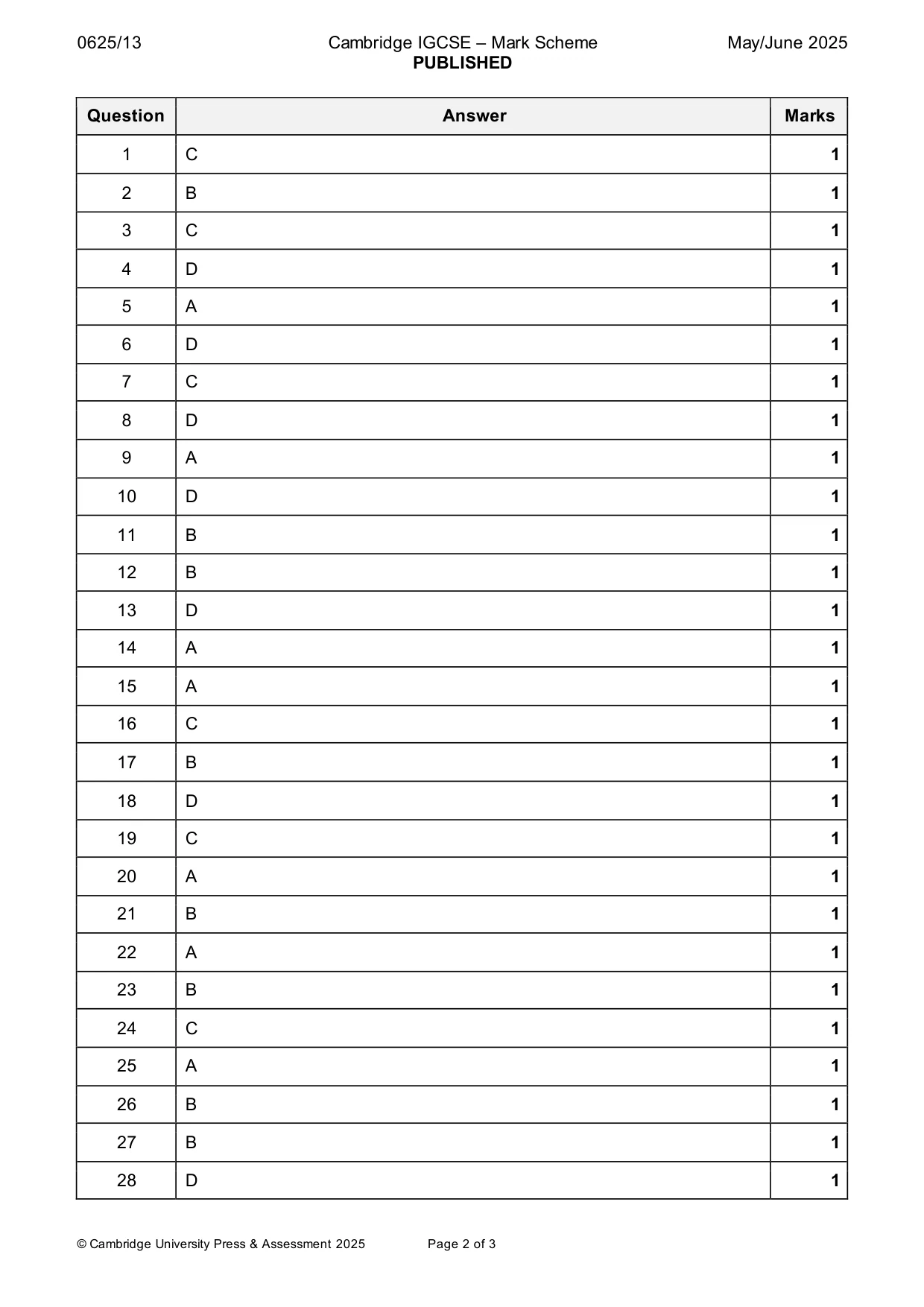
Answers below. Sit the paper first if you are practising.
Questions as text
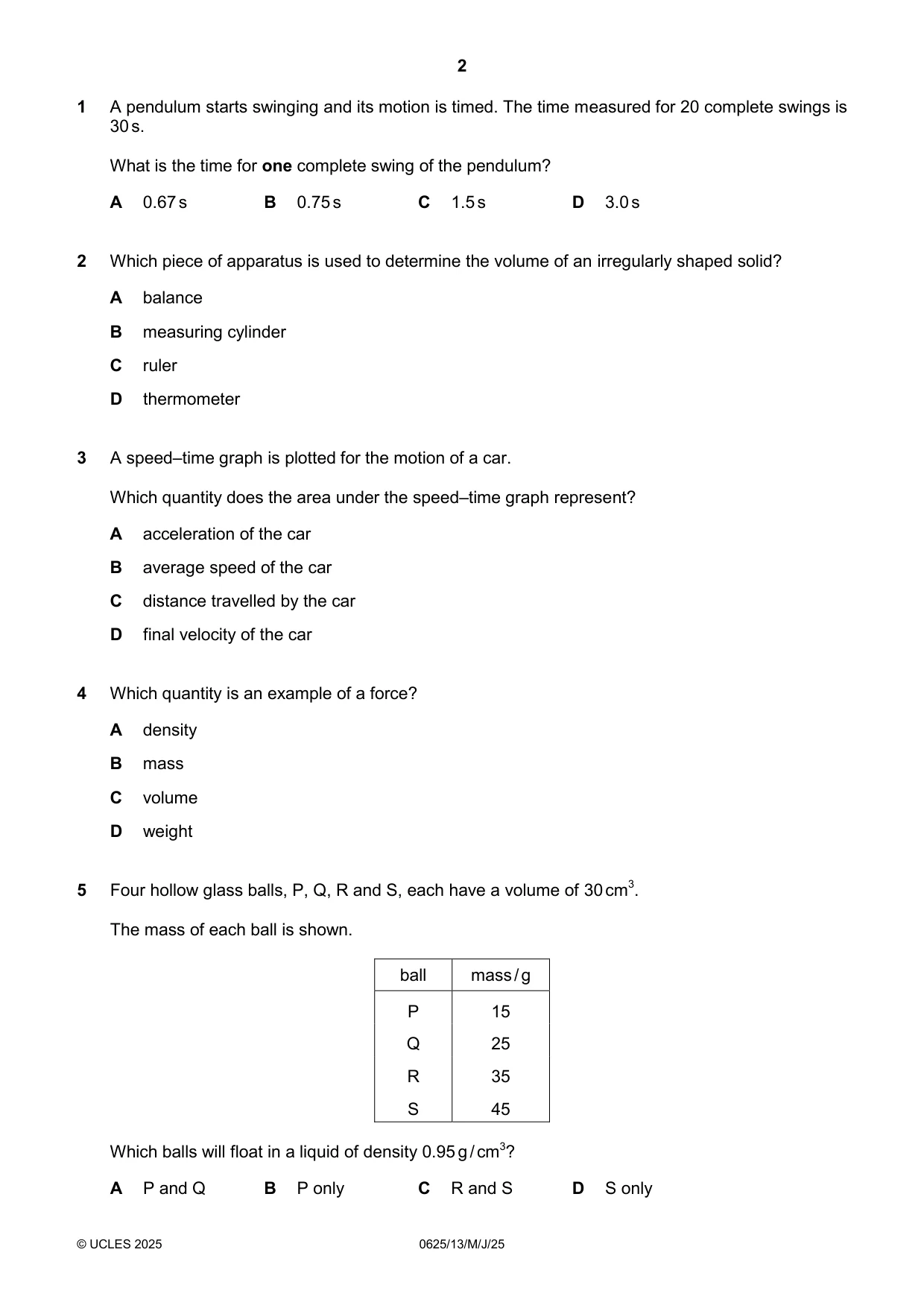
Q1 · A pendulum starts swinging and its motion is timed
1 A pendulum starts swinging and its motion is timed. The time measured for 20 complete swings is 30 s. What is the time for one complete swing of the pendulum? A 0.67 s B 0.75 s C 1.5 s D 3.0 s
Mark scheme: C
More questions on Physical quantities and measurement techniques
Q2 · Which piece of apparatus is used to determine the volume of an irregularly shaped solid?
2 Which piece of apparatus is used to determine the volume of an irregularly shaped solid? A balance B measuring cylinder C ruler D thermometer
Mark scheme: B
More questions on Physical quantities and measurement techniques
Q3 · A speed–time graph is plotted for the motion of a car
3 A speed–time graph is plotted for the motion of a car. Which quantity does the area under the speed–time graph represent? A acceleration of the car B average speed of the car C distance travelled by the car D final velocity of the car
Mark scheme: C
Q4 · Which quantity is an example of a force?
4 Which quantity is an example of a force? A density B mass C volume D weight
Mark scheme: D
Q5 · Four hollow glass balls, P, Q, R and S, each have a volume of 30 cm3
5 Four hollow glass balls, P, Q, R and S, each have a volume of 30 cm3. The mass of each ball is shown. ball mass / g P 15 Q 25 R 35 S 45 Which balls will float in a liquid of density 0.95 g / cm3? A P and Q B P only C R and S D S only
Mark scheme: A
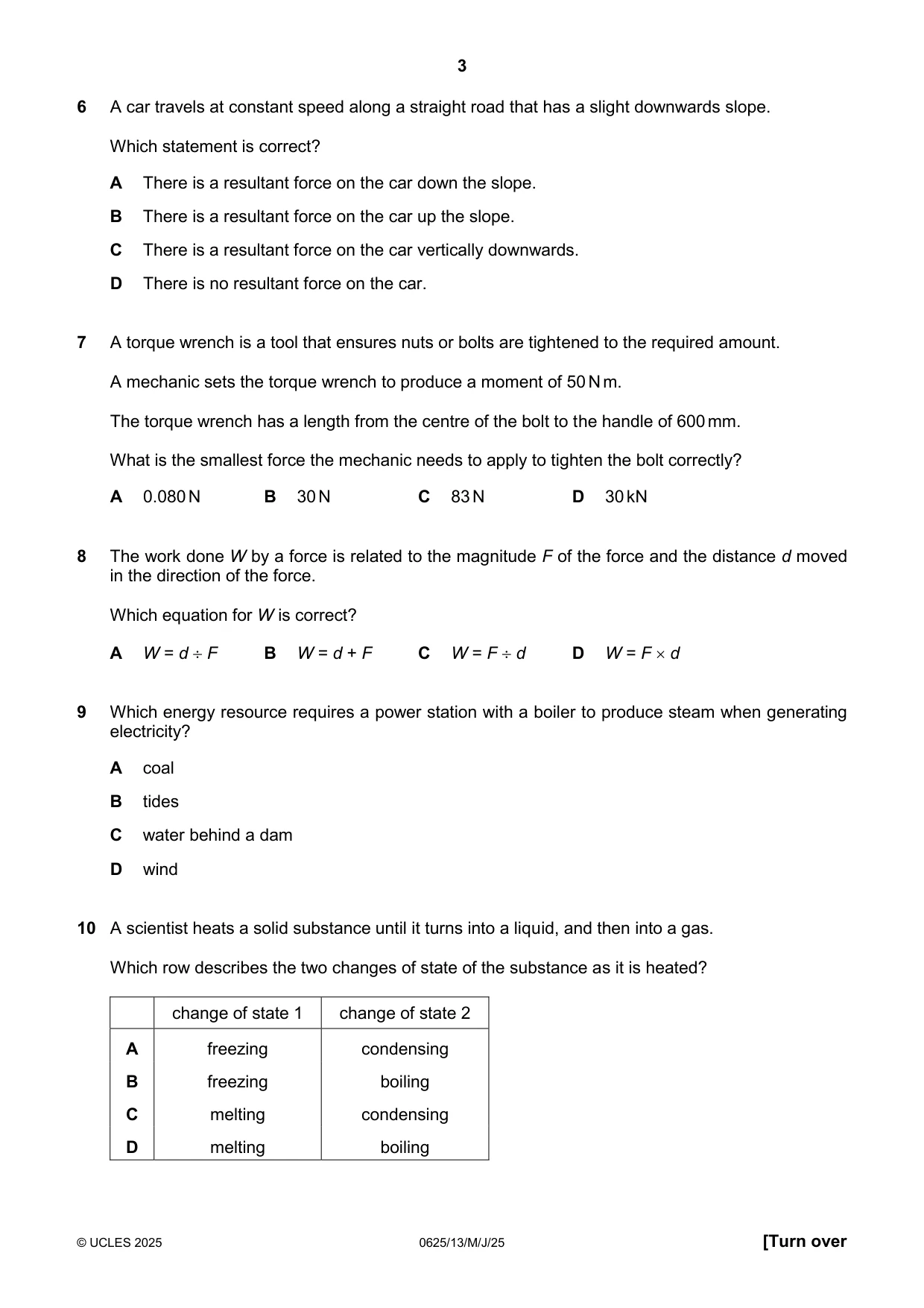
Q6 · A car travels at constant speed along a straight road that has a slight downwards slope
6 A car travels at constant speed along a straight road that has a slight downwards slope. Which statement is correct? A There is a resultant force on the car down the slope. B There is a resultant force on the car up the slope. C There is a resultant force on the car vertically downwards. D There is no resultant force on the car.
Mark scheme: D
Q7 · A torque wrench is a tool that ensures nuts or bolts are tightened to the required amount
7 A torque wrench is a tool that ensures nuts or bolts are tightened to the required amount. A mechanic sets the torque wrench to produce a moment of 50 N m. The torque wrench has a length from the centre of the bolt to the handle of 600 mm. What is the smallest force the mechanic needs to apply to tighten the bolt correctly? A 0.080 N B 30 N C 83 N D 30 kN
Mark scheme: C
Q8 · The work done W by a force is related to the magnitude F of the force and the distance d…
8 The work done W by a force is related to the magnitude F of the force and the distance d moved in the direction of the force. Which equation for W is correct? A W = d F B W = d + F C W = F d D W = F d
Mark scheme: D
Q9 · Which energy resource requires a power station with a boiler to produce steam when…
9 Which energy resource requires a power station with a boiler to produce steam when generating electricity? A coal B tides C water behind a dam D wind
Mark scheme: A
Q10 · A scientist heats a solid substance until it turns into a liquid, and then into a gas
10 A scientist heats a solid substance until it turns into a liquid, and then into a gas. Which row describes the two changes of state of the substance as it is heated? change of state 1 change of state 2 A freezing condensing B freezing boiling C melting condensing D melting boiling
Mark scheme: D
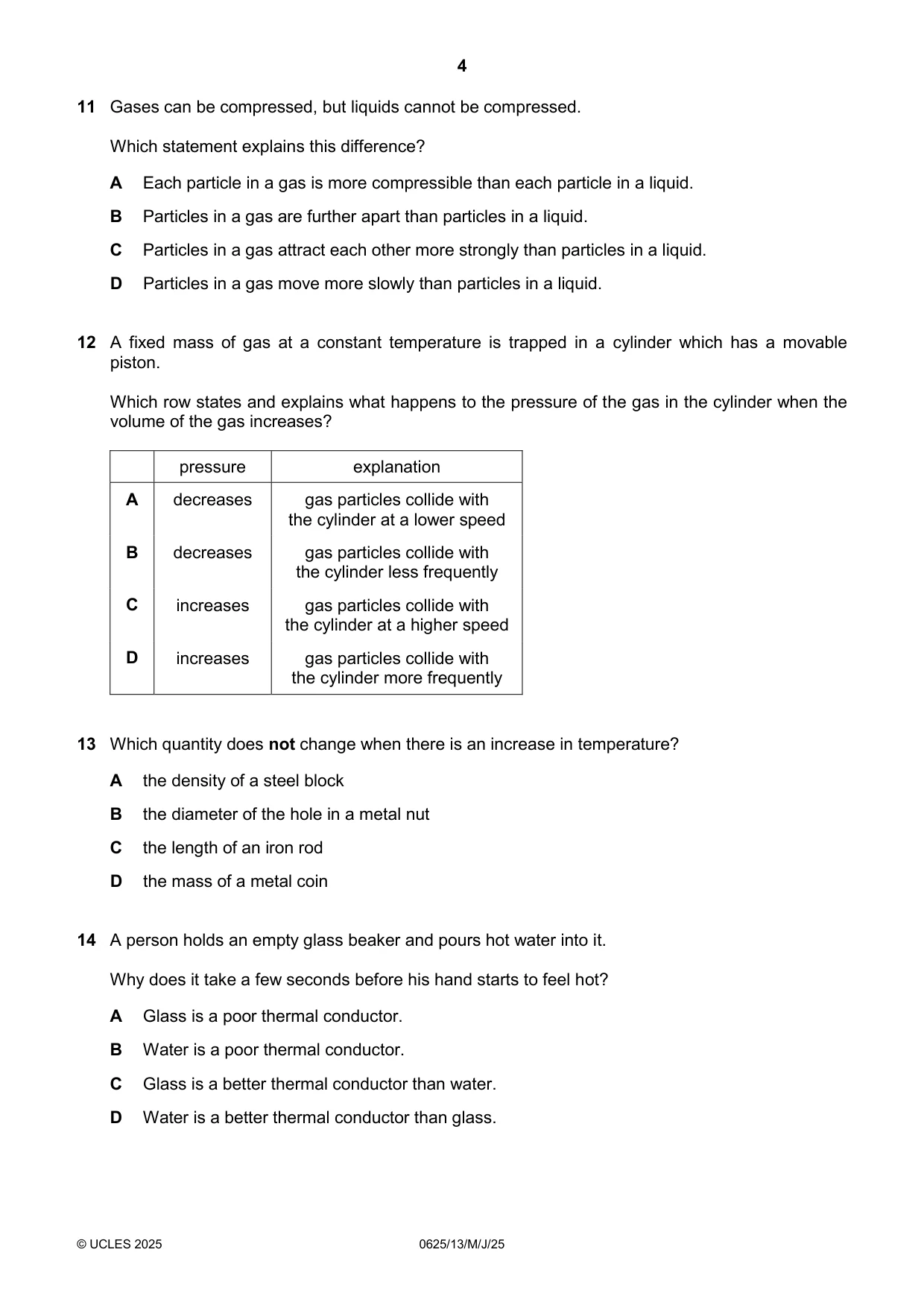
Q11 · Gases can be compressed, but liquids cannot be compressed
11 Gases can be compressed, but liquids cannot be compressed. Which statement explains this difference? A Each particle in a gas is more compressible than each particle in a liquid. B Particles in a gas are further apart than particles in a liquid. C Particles in a gas attract each other more strongly than particles in a liquid. D Particles in a gas move more slowly than particles in a liquid.
Mark scheme: B
Q12 · A fixed mass of gas at a constant temperature is trapped in a cylinder which has a…
12 A fixed mass of gas at a constant temperature is trapped in a cylinder which has a movable piston. Which row states and explains what happens to the pressure of the gas in the cylinder when the volume of the gas increases? pressure explanation A decreases gas particles collide with the cylinder at a lower speed B decreases gas particles collide with the cylinder less frequently C increases gas particles collide with the cylinder at a higher speed D increases gas particles collide with the cylinder more frequently
Mark scheme: B
Q13 · Which quantity does not change when there is an increase in temperature?
13 Which quantity does not change when there is an increase in temperature? A the density of a steel block B the diameter of the hole in a metal nut C the length of an iron rod D the mass of a metal coin
Mark scheme: D
Q14 · A person holds an empty glass beaker and pours hot water into it
14 A person holds an empty glass beaker and pours hot water into it. Why does it take a few seconds before his hand starts to feel hot? A Glass is a poor thermal conductor. B Water is a poor thermal conductor. C Glass is a better thermal conductor than water. D Water is a better thermal conductor than glass.
Mark scheme: A
Q15 · A liquid is heated and it expands
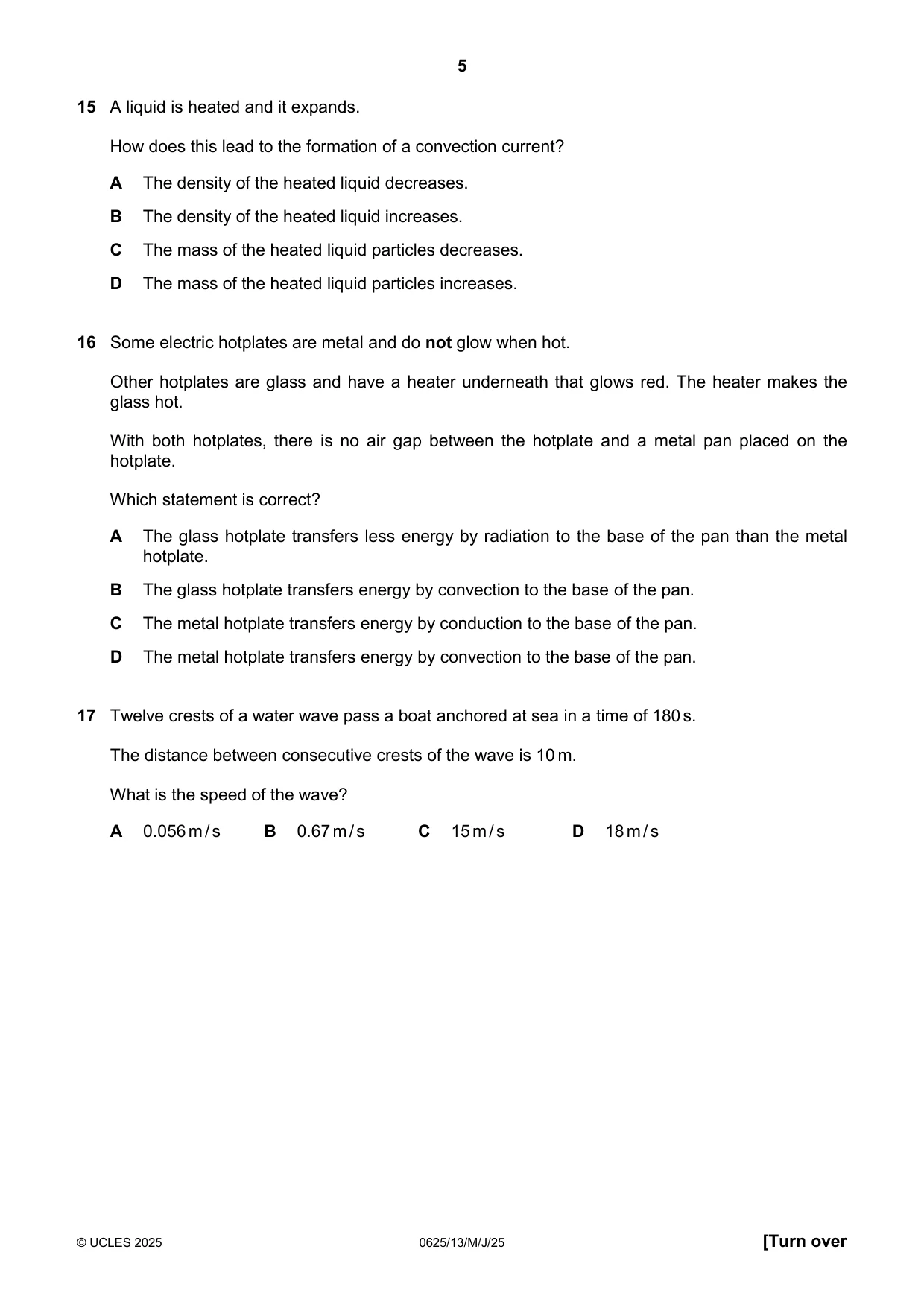
15 A liquid is heated and it expands. How does this lead to the formation of a convection current? A The density of the heated liquid decreases. B The density of the heated liquid increases. C The mass of the heated liquid particles decreases. D The mass of the heated liquid particles increases.
Mark scheme: A
Q16 · Some electric hotplates are metal and do not glow when hot
16 Some electric hotplates are metal and do not glow when hot. Other hotplates are glass and have a heater underneath that glows red. The heater makes the glass hot. With both hotplates, there is no air gap between the hotplate and a metal pan placed on the hotplate. Which statement is correct? A The glass hotplate transfers less energy by radiation to the base of the pan than the metal hotplate. B The glass hotplate transfers energy by convection to the base of the pan. C The metal hotplate transfers energy by conduction to the base of the pan. D The metal hotplate transfers energy by convection to the base of the pan.
Mark scheme: C
Q17 · Twelve crests of a water wave pass a boat anchored at sea in a time of 180 s
17 Twelve crests of a water wave pass a boat anchored at sea in a time of 180 s. The distance between consecutive crests of the wave is 10 m. What is the speed of the wave? A 0.056 m / s B 0.67 m / s C 15 m / s D 18 m / s
Mark scheme: B
Q18 · The diagrams show examples of wave motion
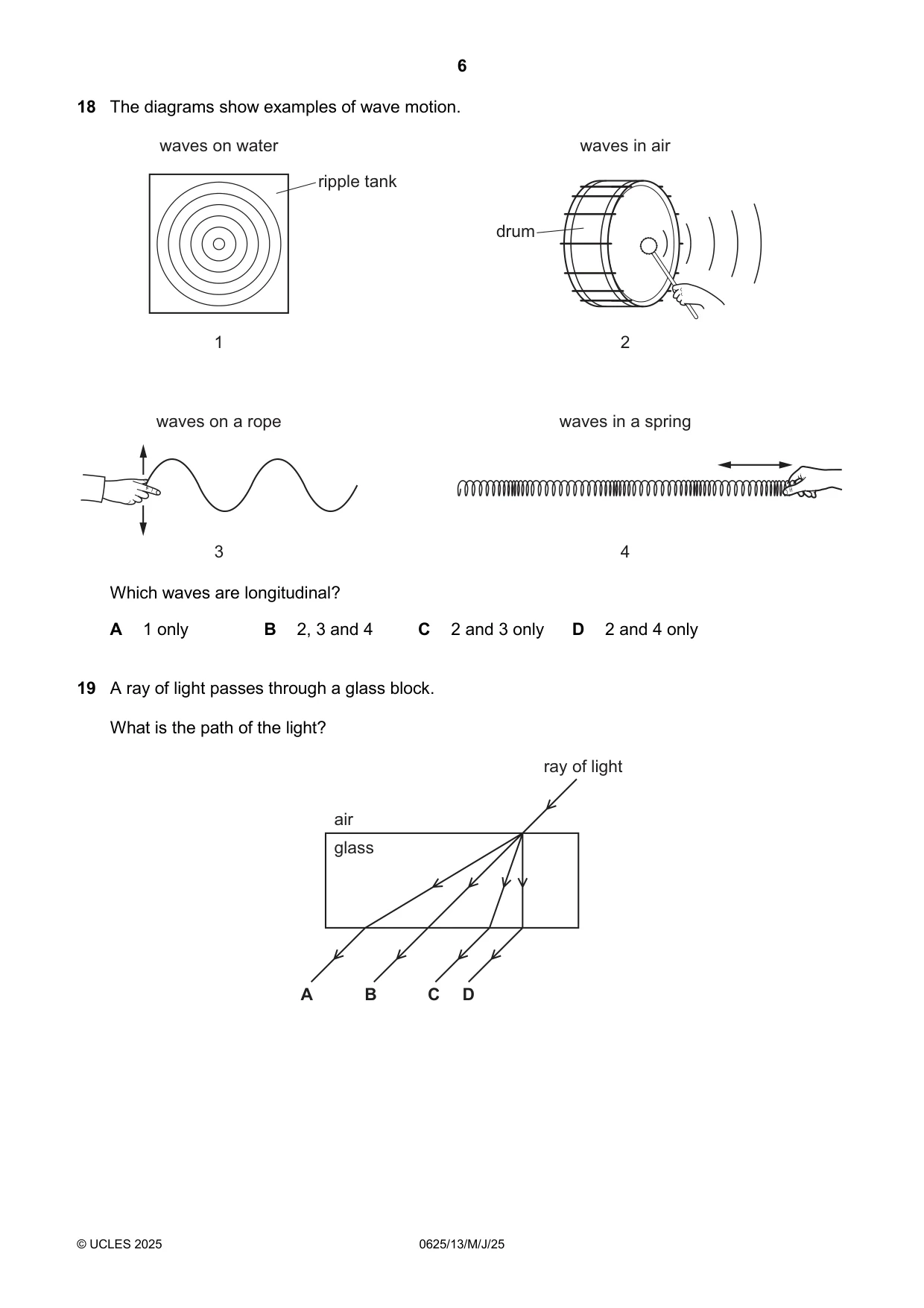
18 The diagrams show examples of wave motion. waves on water waves in air ripple tank drum 1 2 waves on a rope waves in a spring 3 4 Which waves are longitudinal? A 1 only B 2, 3 and 4 C 2 and 3 only D 2 and 4 only
Mark scheme: D
Q19 · A ray of light passes through a glass block
19 A ray of light passes through a glass block. What is the path of the light? ray of light air glass A B C D
Mark scheme: C
Q20 · The diagram shows a converging lens forming an image
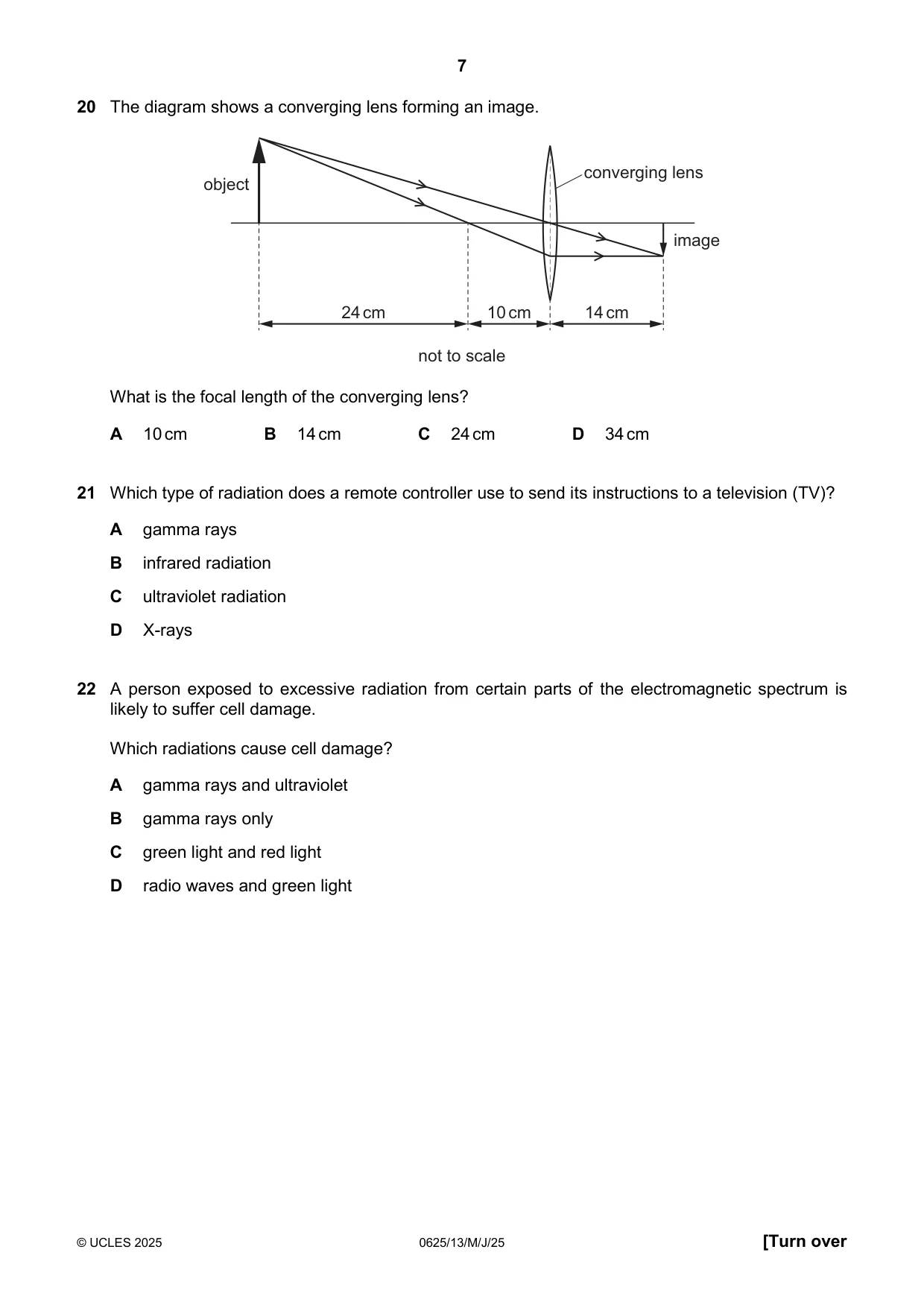
20 The diagram shows a converging lens forming an image. converging lens object image 24 cm 10 cm 14 cm not to scale What is the focal length of the converging lens? A 10 cm B 14 cm C 24 cm D 34 cm
Mark scheme: A
Q21 · Which type of radiation does a remote controller use to send its instructions to a…
21 Which type of radiation does a remote controller use to send its instructions to a television (TV)? A gamma rays B infrared radiation C ultraviolet radiation D X-rays
Mark scheme: B
Q22 · A person exposed to excessive radiation from certain parts of the electromagnetic…
22 A person exposed to excessive radiation from certain parts of the electromagnetic spectrum is likely to suffer cell damage. Which radiations cause cell damage? A gamma rays and ultraviolet B gamma rays only C green light and red light D radio waves and green light
Mark scheme: A
Q23 · The diagram shows the ranges of human hearing and of ultrasound waves
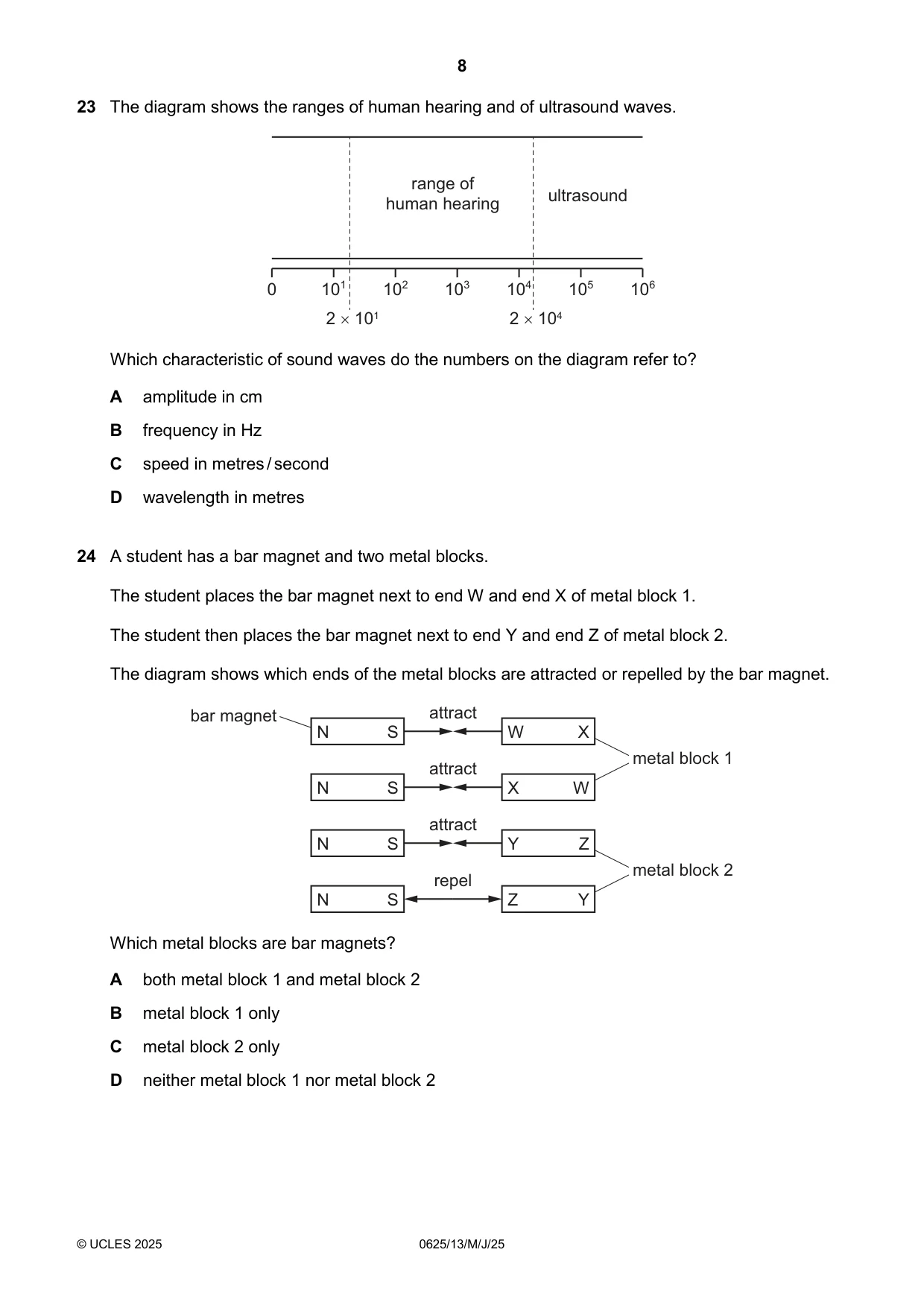
23 The diagram shows the ranges of human hearing and of ultrasound waves. range of i} i} i} i} I I i} 1 i} 1 human hearing ultrasound i} i} i} i} i) I i) I I I i 1 I] 1 i} 2 x 10' 2 x 10⁴ Which characteristic of sound waves do the numbers on the diagram refer to? A amplitude in cm B_ frequency in Hz C speed in metres/second D wavelength in metres
Mark scheme: B
Q24 · A student has a bar magnet and two metal blocks
24 A student has a bar magnet and two metal blocks. The student places the bar magnet next to end W and end X of metal block 1. The student then places the bar magnet next to end Y and end Z of metal block 2. The diagram shows which ends of the metal blocks are attracted or repelled by the bar magnet. bar magnet attract N S W X metal block 1 attract N S X W attract N S Y Z metal block 2 repel N S Z Y Which metal blocks are bar magnets? A both metal block 1 and metal block 2 B metal block 1 only C metal block 2 only D neither metal block 1 nor metal block 2
Mark scheme: C
Q25 · A glass rod is rubbed with a silk cloth
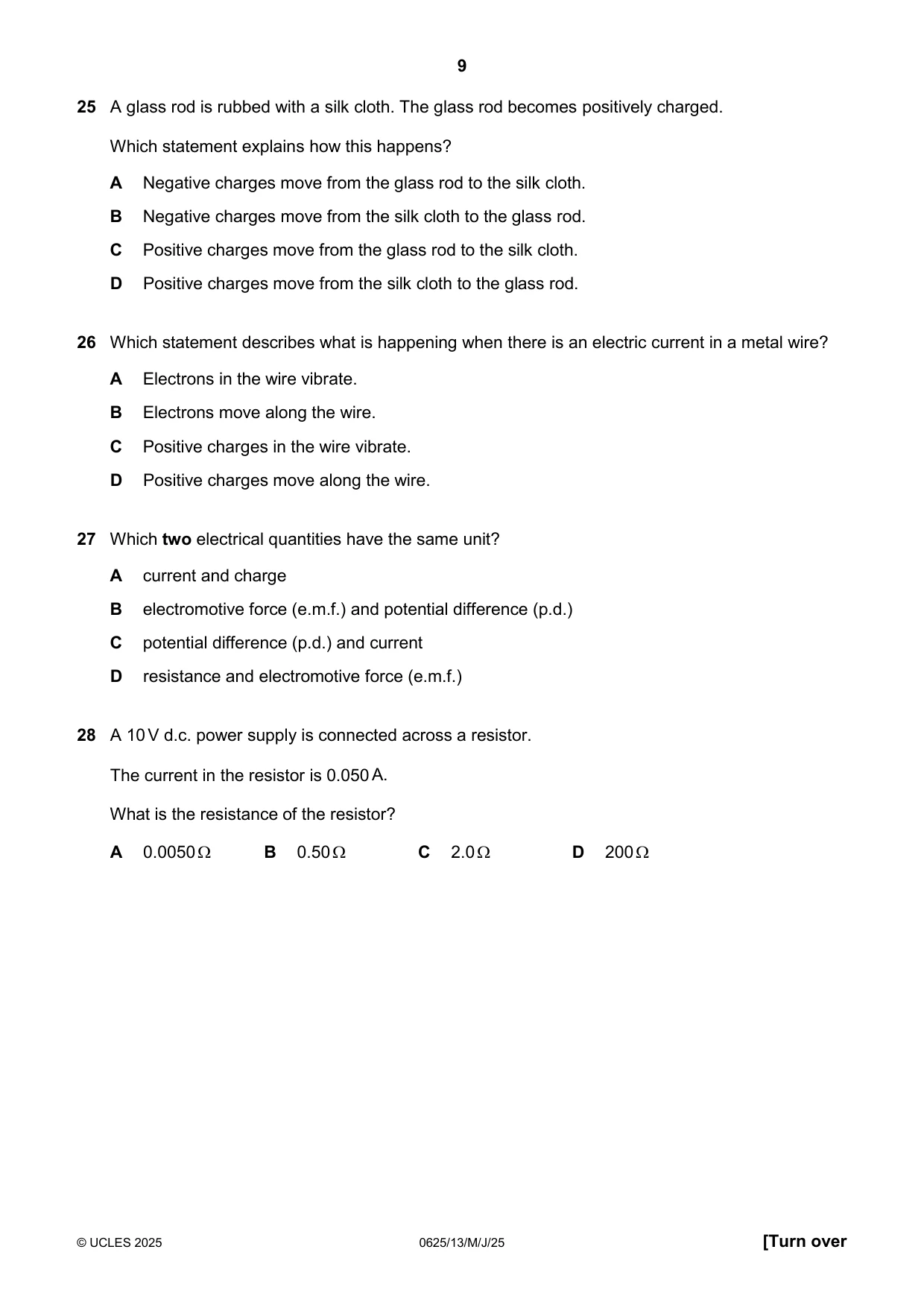
25 A glass rod is rubbed with a silk cloth. The glass rod becomes positively charged. Which statement explains how this happens? A Negative charges move from the glass rod to the silk cloth. B Negative charges move from the silk cloth to the glass rod. C Positive charges move from the glass rod to the silk cloth. D Positive charges move from the silk cloth to the glass rod.
Mark scheme: A
Q26 · Which statement describes what is happening when there is an electric current in a metal…
26 Which statement describes what is happening when there is an electric current in a metal wire? A Electrons in the wire vibrate. B Electrons move along the wire. C Positive charges in the wire vibrate. D Positive charges move along the wire.
Mark scheme: B
Q27 · Which two electrical quantities have the same unit?
27 Which two electrical quantities have the same unit? A current and charge B electromotive force (e.m.f.) and potential difference (p.d.) C potential difference (p.d.) and current D resistance and electromotive force (e.m.f.)
Mark scheme: B
Q28 · A 10 V d.c
28 A 10 V d.c. power supply is connected across a resistor. The current in the resistor is 0.050 A. What is the resistance of the resistor? A 0.0050 B 0.50 C 2.0 D 200
Mark scheme: D
Q29 · A resistor and a thermistor are connected in a series circuit, as shown
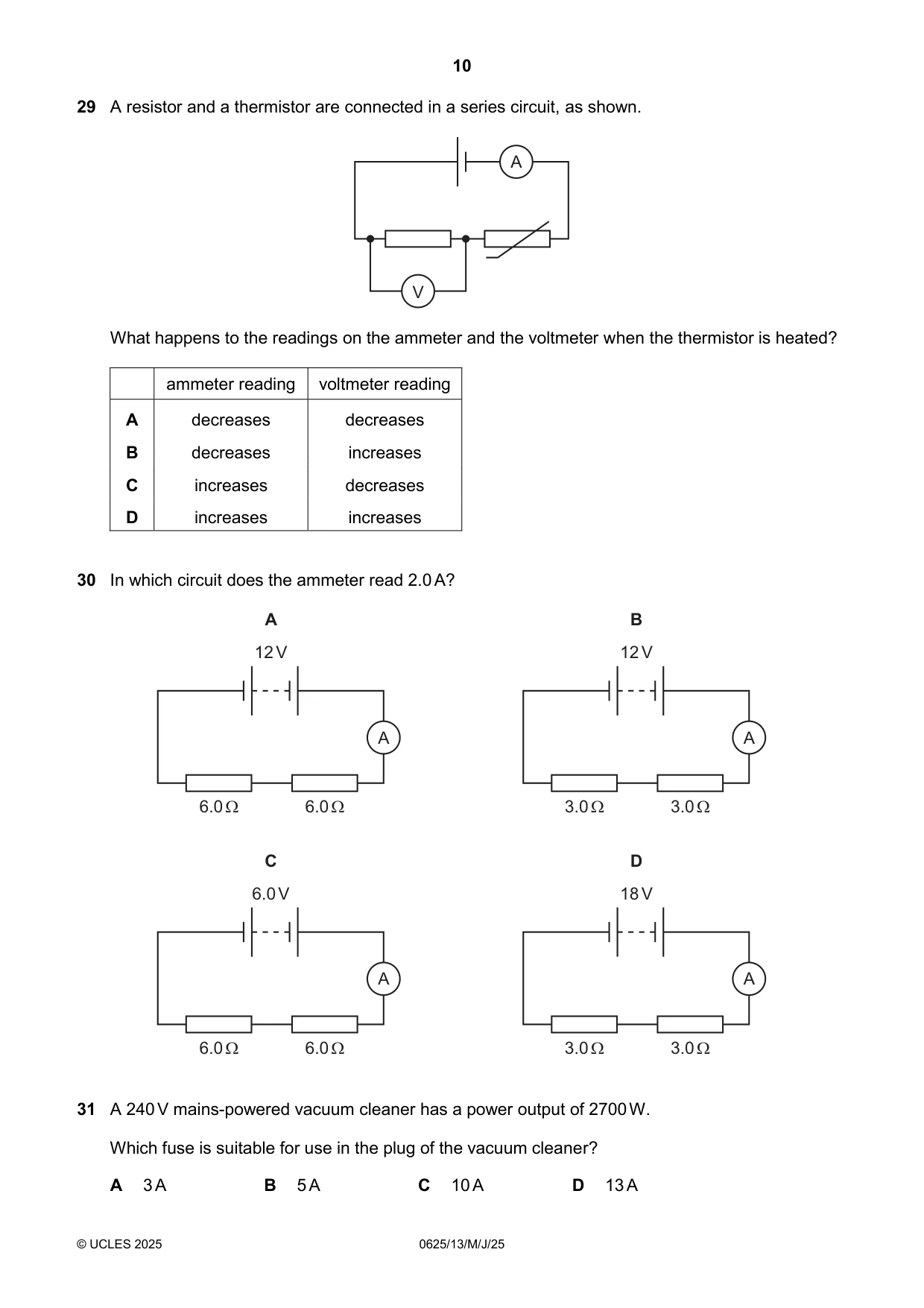
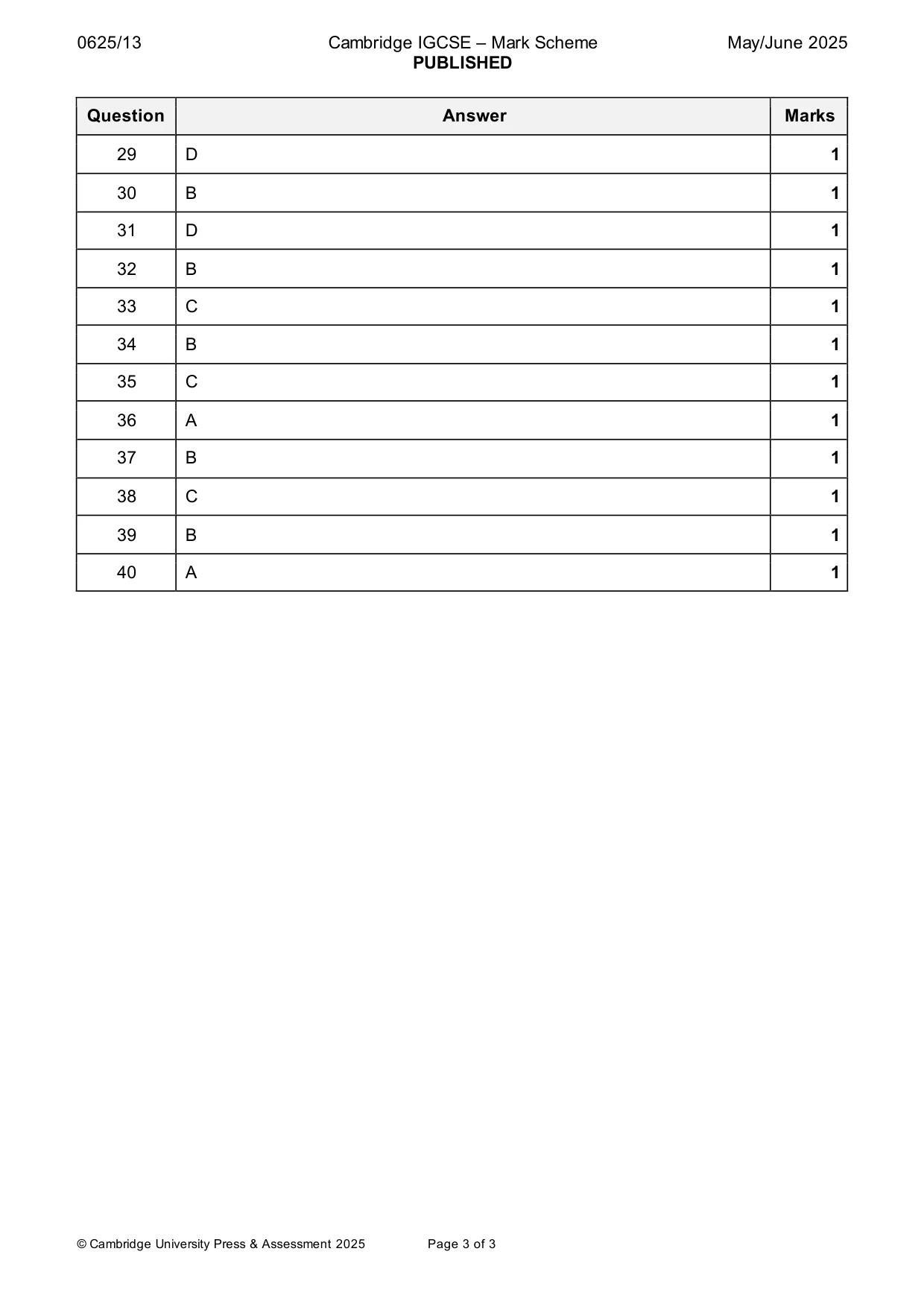
29 A resistor and a thermistor are connected in a series circuit, as shown. A V What happens to the readings on the ammeter and the voltmeter when the thermistor is heated? ammeter reading voltmeter reading A decreases decreases B decreases increases C increases decreases D increases increases
Mark scheme: D
Q30 · In which circuit does the ammeter read 2.0 A?
30 In which circuit does the ammeter read 2.0 A? 6.02 6.02 3.00 3.00
Mark scheme: B
Q31 · A 240 V mains-powered vacuum cleaner has a power output of 2700 W
31 A 240 V mains-powered vacuum cleaner has a power output of 2700 W. Which fuse is suitable for use in the plug of the vacuum cleaner? A 3 A B 5 A C 10 A D 13 A
Mark scheme: D
Q32 · The transformer in a laptop power supply is used to change mains voltage from 240 V to 20…
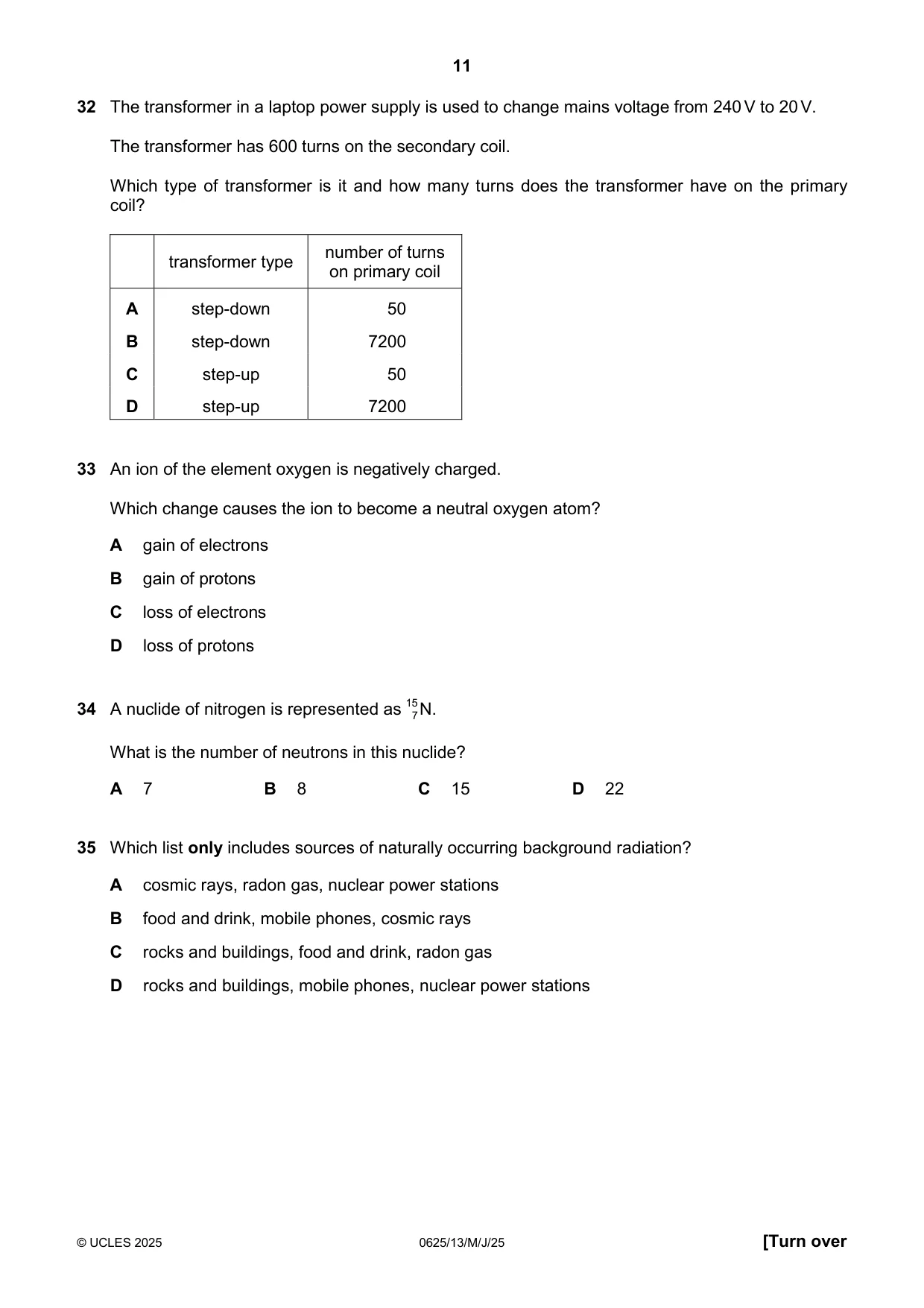
32 The transformer in a laptop power supply is used to change mains voltage from 240 V to 20 V. The transformer has 600 turns on the secondary coil. Which type of transformer is it and how many turns does the transformer have on the primary coil? number of turns transformer type on primary coil A step-down 50 B step-down 7200 C step-up 50 D step-up 7200
Mark scheme: B
Q33 · An ion of the element oxygen is negatively charged
33 An ion of the element oxygen is negatively charged. Which change causes the ion to become a neutral oxygen atom? A gain of electrons B gain of protons C loss of electrons D loss of protons
Mark scheme: C
Q34 · A nuclide of nitrogen is represented as 15 N
34 A nuclide of nitrogen is represented as 15 N. 7 What is the number of neutrons in this nuclide? A 7 B 8 C 15 D 22
Mark scheme: B
Q35 · Which list only includes sources of naturally occurring background radiation?
35 Which list only includes sources of naturally occurring background radiation? A cosmic rays, radon gas, nuclear power stations B food and drink, mobile phones, cosmic rays C rocks and buildings, food and drink, radon gas D rocks and buildings, mobile phones, nuclear power stations
Mark scheme: C
Q36 · A student compares alpha emissions, beta emissions and gamma emissions
36 A student compares alpha emissions, beta emissions and gamma emissions. Which statement is correct? A Alpha emissions are the most ionising. B Beta emissions are the most penetrating. C Beta emissions are part of the electromagnetic spectrum. D Gamma emissions are streams of charged particles.
Mark scheme: A
Q37 · In school laboratories, radioactive sources are stored in lead-lined boxes
37 In school laboratories, radioactive sources are stored in lead-lined boxes. Why is lead used? A Lead neutralises radiation. B Lead absorbs radiation. C Lead repels radiation. D Lead dissolves radiation.
Mark scheme: B
Q38 · The Sun, the Earth and the Moon are all bodies in the Solar System
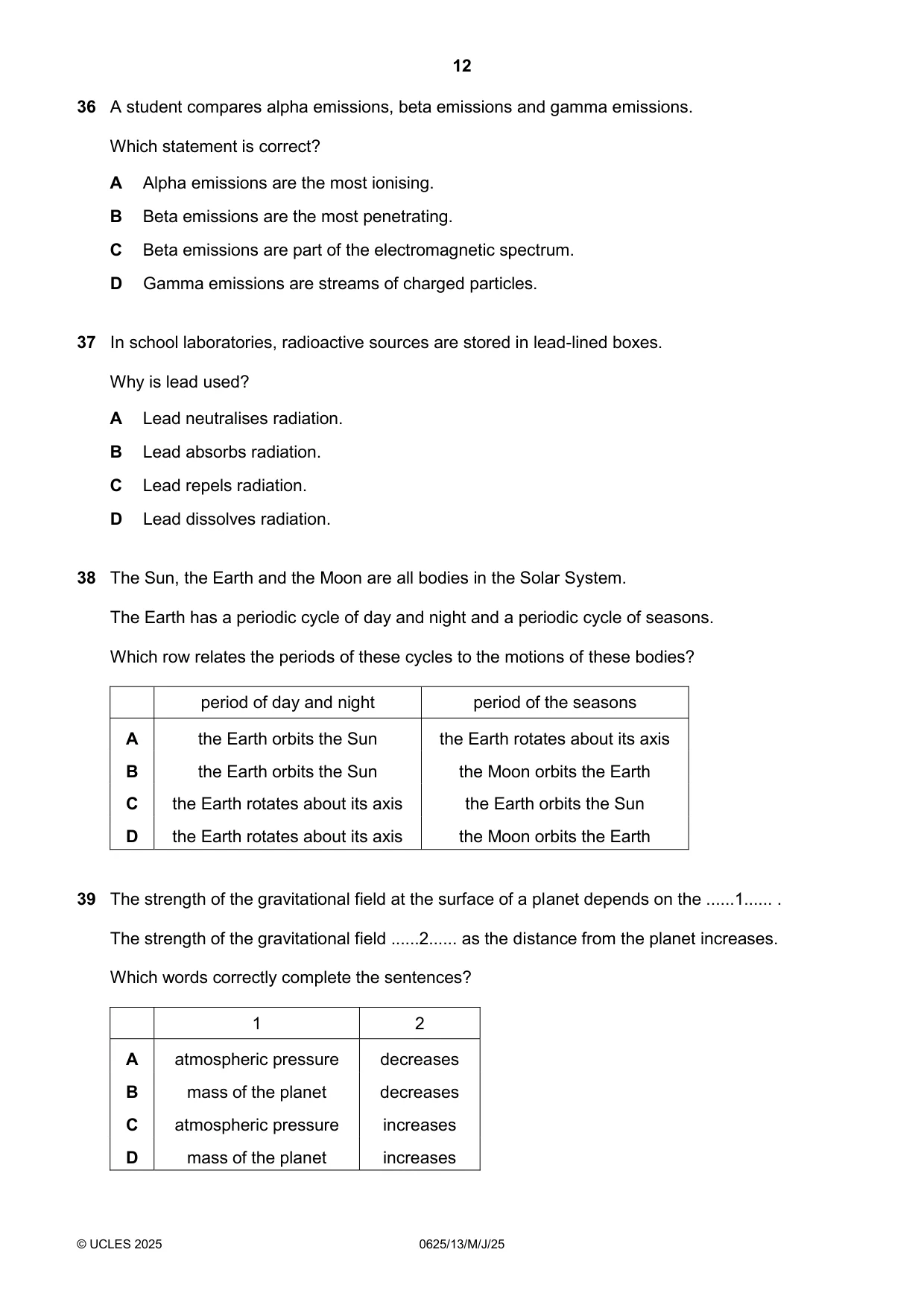
38 The Sun, the Earth and the Moon are all bodies in the Solar System. The Earth has a periodic cycle of day and night and a periodic cycle of seasons. Which row relates the periods of these cycles to the motions of these bodies? period of day and night period of the seasons A the Earth orbits the Sun the Earth rotates about its axis B the Earth orbits the Sun the Moon orbits the Earth C the Earth rotates about its axis the Earth orbits the Sun D the Earth rotates about its axis the Moon orbits the Earth
Mark scheme: C
Q39 · The strength of the gravitational field at the surface of a planet depends on the…
39 The strength of the gravitational field at the surface of a planet depends on the ......1...... . The strength of the gravitational field ......2...... as the distance from the planet increases. Which words correctly complete the sentences? 1 2 A atmospheric pressure decreases B mass of the planet decreases C atmospheric pressure increases D mass of the planet increases
Mark scheme: B
Q40 · The Sun radiates most of its energy in three regions of the electromagnetic spectrum
40 The Sun radiates most of its energy in three regions of the electromagnetic spectrum. The diagram shows the proportion of the total energy radiated in each of these regions. Q R P Region P is visible light and region Q is ultraviolet. What is region R? A infrared B microwaves C radio waves D X-rays
Mark scheme: A
What was in this paper
The subtopics covered by these 40 questions, and how many questions each got. Open one in a new tab to see every Cambridge question on it.
4Forces3Radioactivity3Transfer of thermal energy3Electric circuits2Electromagnetic spectrum2Energy, work and power2General properties of waves2Kinetic particle model of matter2Light2Physical quantities and measurement techniques2The Earth and the Solar System2The nuclear model of the atom2Thermal properties and temperature2Density1Electrical safety1Electromagnetic effects1Motion1Simple phenomena of magnetism1Sound1Stars and the Universe1What you needed in this session
Cambridge’s own grade thresholds for 2025 May/June, Paper 1 · Variant 3. A higher threshold means an easier paper — the bar moves with how the cohort did.