Cambridge IGCSE Physics 0625 — 2015 May/June Paper 1 · Variant 4
0625/14/M/J/15 · 40 questions · 40 marks · ≈45 min
The question paper and its mark scheme, free to read here and free to download. This is Cambridge’s own paper, exactly as it was sat.
Question paper20 pages

Mark scheme2 pages
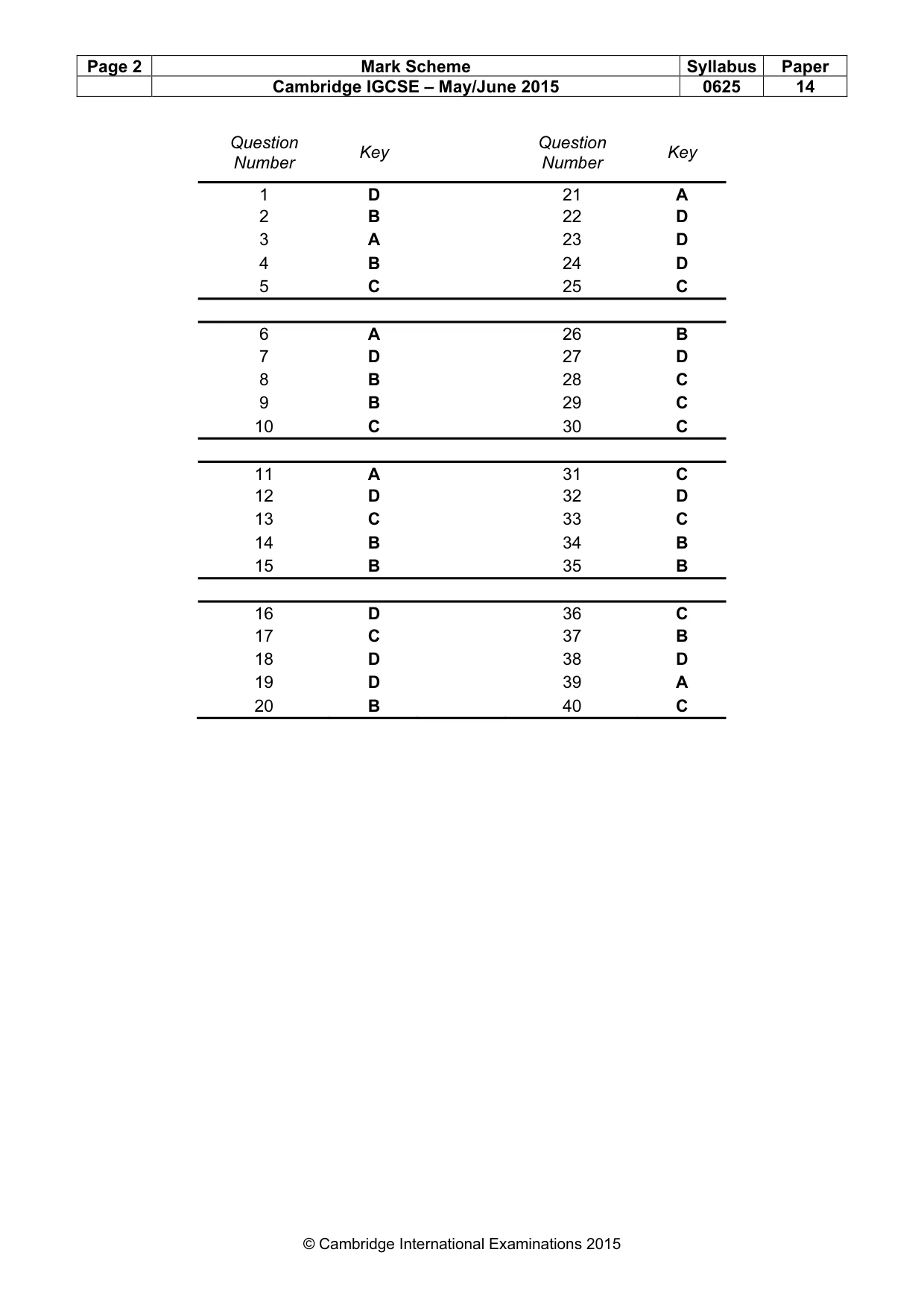
Answers below. Sit the paper first if you are practising.
Questions as text
Q1 · The diagram shows a measuring instrument
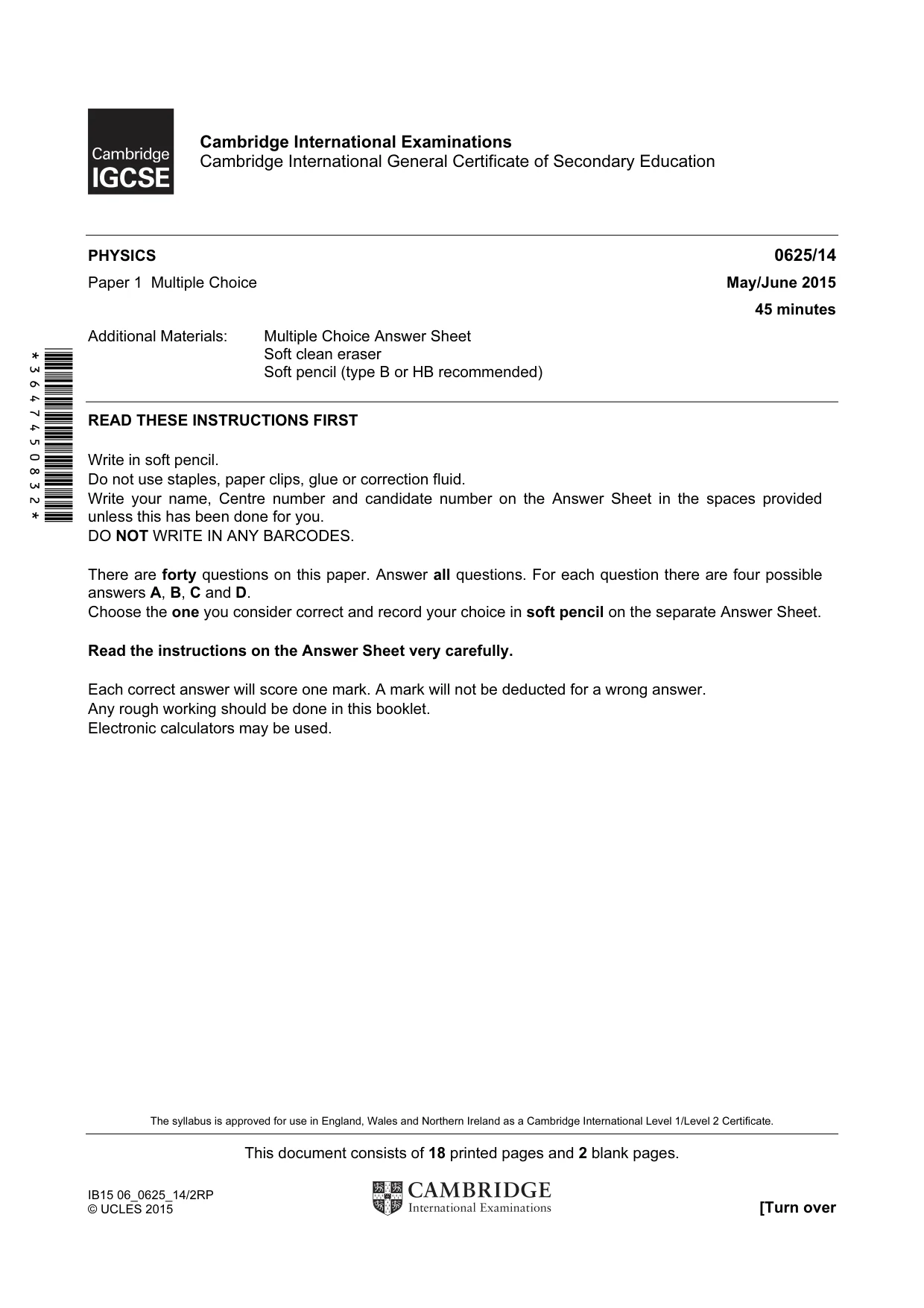
1 The diagram shows a measuring instrument. Which quantity is this instrument used to measure? A area B density C mass D volume
Mark scheme: D
More questions on Physical quantities and measurement techniques
Q2 · The diagram shows the distance-time graph of an object
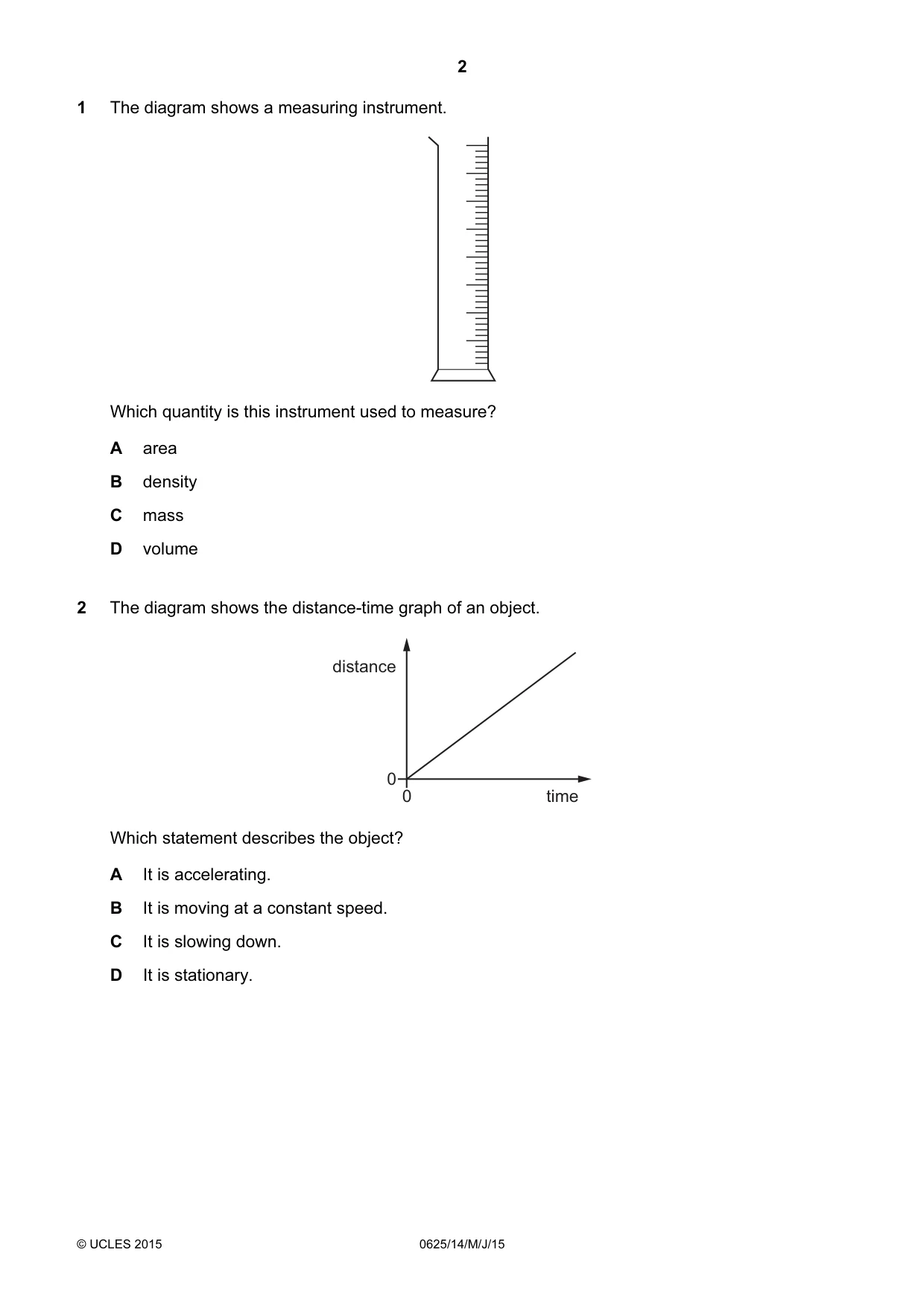
2 The diagram shows the distance-time graph of an object. distance 0 0 time Which statement describes the object? A It is accelerating. B It is moving at a constant speed. C It is slowing down. D It is stationary.
Mark scheme: B
Q3 · A tennis player hits a ball hard and 0.40 s later hears the echo from a wall
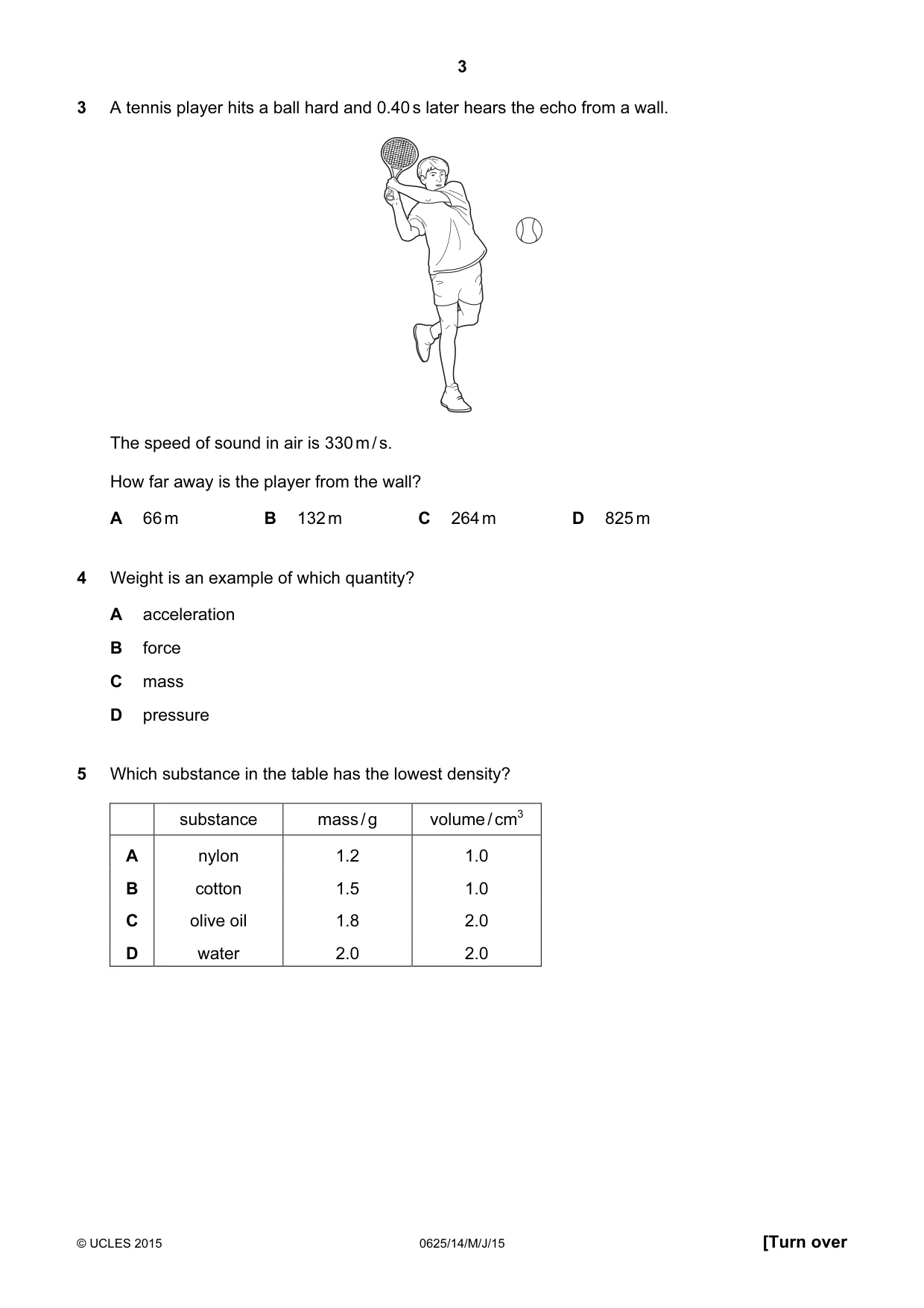
3 A tennis player hits a ball hard and 0.40 s later hears the echo from a wall. The speed of sound in air is 330 m / s. How far away is the player from the wall? A 66 m B 132 m C 264 m D 825 m
Mark scheme: A
Q4 · Weight is an example of which quantity?
4 Weight is an example of which quantity? A acceleration B force C mass D pressure
Mark scheme: B
Q5 · Which substance in the table has the lowest density?
5 Which substance in the table has the lowest density? substance mass / g volume / cm3 A nylon 1.2 1.0 B cotton 1.5 1.0 C olive oil 1.8 2.0 D water 2.0 2.0
Mark scheme: C
Q6 · A car travels along a horizontal road at a constant speed
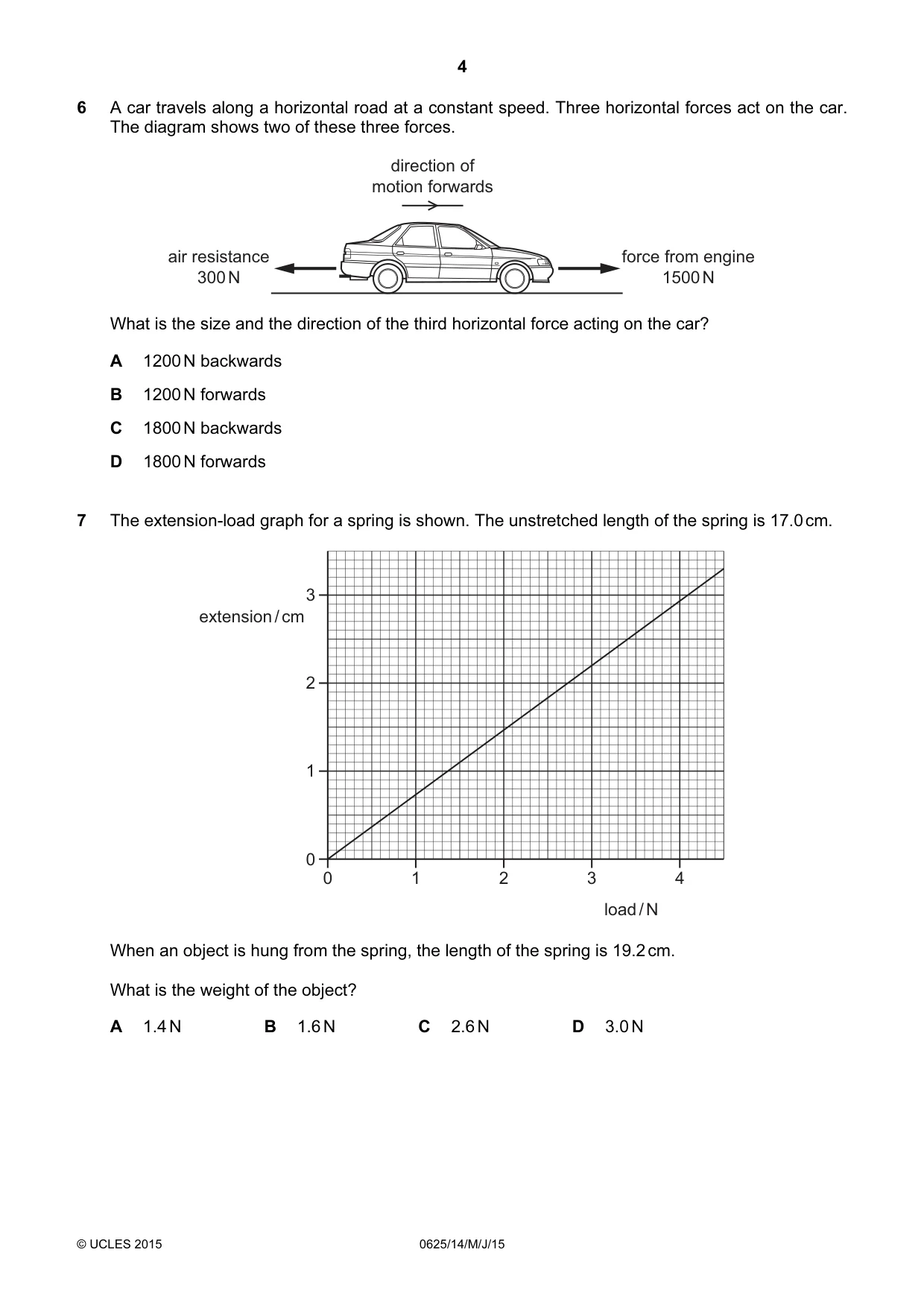
6 A car travels along a horizontal road at a constant speed. Three horizontal forces act on the car. The diagram shows two of these three forces. direction of motion forwards air resistance force from engine 300 N 1500 N What is the size and the direction of the third horizontal force acting on the car? A 1200 N backwards B 1200 N forwards C 1800 N backwards D 1800 N forwards
Mark scheme: A
Q7 · The extension-load graph for a spring is shown
7 The extension-load graph for a spring is shown. The unstretched length of the spring is 17.0 cm. 3 extension / cm 2 1 0 0 1 2 3 4 load / N When an object is hung from the spring, the length of the spring is 19.2 cm. What is the weight of the object? A 1.4 N B 1.6 N C 2.6 N D 3.0 N
Mark scheme: D
Q8 · Which form of energy is used to generate electrical energy in a tidal power station?
8 Which form of energy is used to generate electrical energy in a tidal power station? A chemical energy B gravitational energy C internal energy (thermal energy) D nuclear energy
Mark scheme: B
Q9 · Four different model steam engines each lift a 1.0 kg object from the same laboratory…
9 Four different model steam engines each lift a 1.0 kg object from the same laboratory floor to the same laboratory bench. Each engine takes a different time to lift the object. How does the most powerful engine compare with the other engines? speed of lifting useful work done object onto bench A faster more than other engines B faster same as other engines C slower less than other engines D slower same as other engines
Mark scheme: B
Q10 · Which statement is explained by reference to pressure?
10 Which statement is explained by reference to pressure? A Objects with greater mass have greater weight. B One kilogram of water occupies more volume than one kilogram of lead. C Spikes on running-shoes sink into the ground. D Water cooled to a low enough temperature turns to ice.
Mark scheme: C
Q11 · Small smoke particles suspended in air are viewed through a microscope
11 Small smoke particles suspended in air are viewed through a microscope. The smoke particles move randomly. What does this show? A The air consists of fast-moving molecules. B The pressure of the air is increasing. C There are convection currents in the air. D The temperature of the air is increasing.
Mark scheme: A
Q12 · The gas in a container is heated but is kept at constant volume
12 The gas in a container is heated but is kept at constant volume. Why does the gas pressure increase? A The molecules expand. B The molecules increase in mass. C The molecules move further apart. D The molecules move more rapidly.
Mark scheme: D
Q13 · Which row is correct for the evaporation of a liquid?
13 Which row is correct for the evaporation of a liquid? the particles escaping the average kinetic from the liquid are on energy of particles average remaining in the liquid A the least energetic decreases B the least energetic increases C the most energetic decreases D the most energetic increases
Mark scheme: C
Q14 · A long thin bar of copper is heated evenly along its length
14 A long thin bar of copper is heated evenly along its length. copper bar heat What happens to the bar? A It becomes less heavy. B It becomes longer. C It becomes shorter. D It bends at the ends.
Mark scheme: B
Q15 · A solid is heated from room temperature
15 A solid is heated from room temperature. The graph shows how its temperature changes with time as it is heated constantly. S T temperature Q R room temperature P 0 0 time Between which labelled points on the graph is the substance partly solid and partly liquid? A between P and Q B between Q and R C between R and S D between S and T
Mark scheme: B
Q16 · One method of heat transfer involves the energy travelling at a much greater speed than…
16 One method of heat transfer involves the energy travelling at a much greater speed than in other methods. What is the name of this method? A conduction B convection C evaporation D radiation
Mark scheme: D
Q17 · The diagram shows four markings on a liquid-in-glass thermometer
17 The diagram shows four markings on a liquid-in-glass thermometer. 110 °C 100 °C 0 °C –10 °C Which temperatures are the upper and lower fixed points? upper fixed lower fixed point / °C point / °C A 110 0 B 110 –10 C 100 0 D 100 –10
Mark scheme: C
Q18 · The diagram shows a block of ice placed in a warm room
18 The diagram shows a block of ice placed in a warm room. At which point is the temperature the lowest? A B clamp C ice table D
Mark scheme: D
Q19 · The thermal capacity of solid Y is greater than that of solid Z
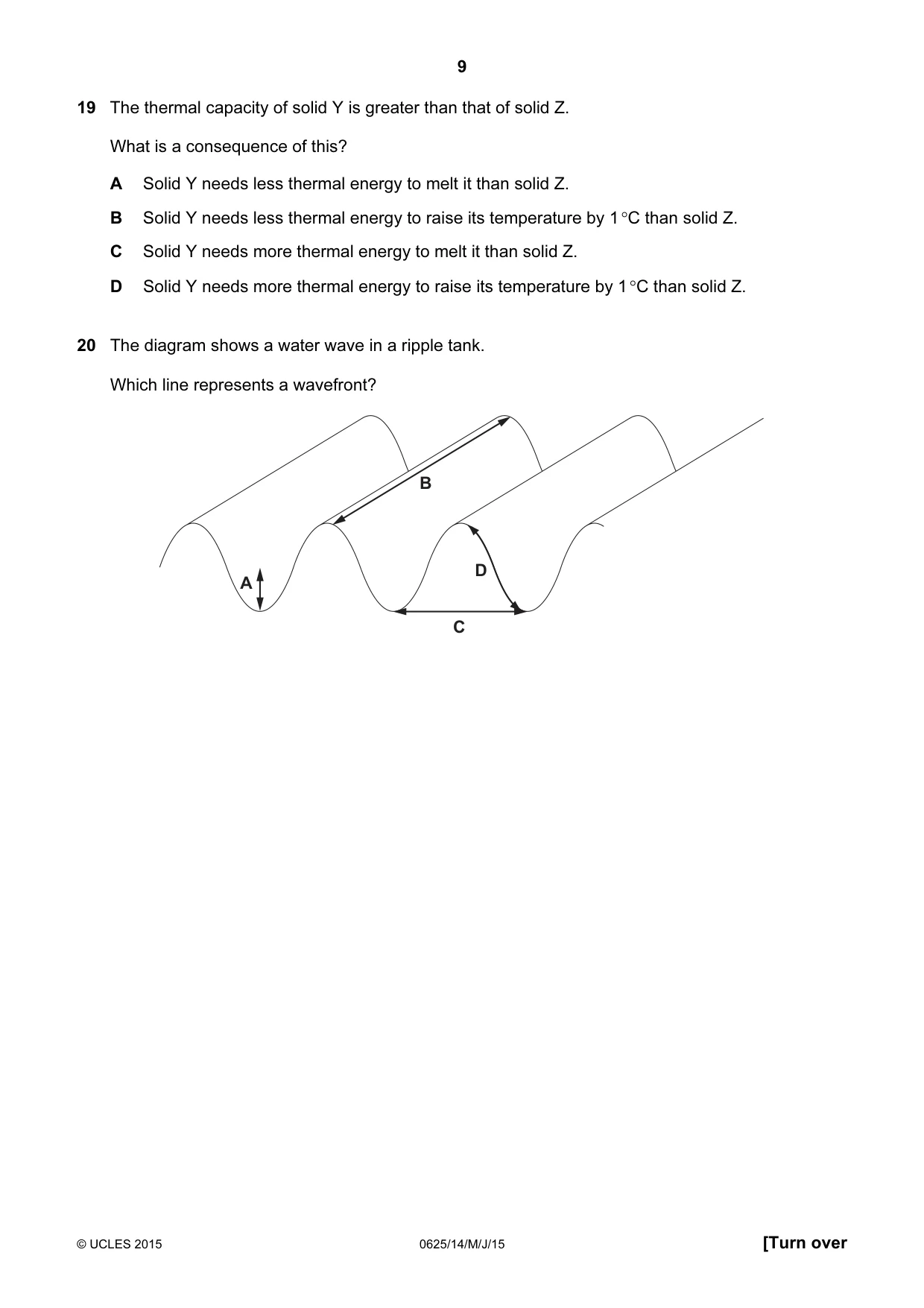
19 The thermal capacity of solid Y is greater than that of solid Z. What is a consequence of this? A Solid Y needs less thermal energy to melt it than solid Z. B Solid Y needs less thermal energy to raise its temperature by 1 °C than solid Z. C Solid Y needs more thermal energy to melt it than solid Z. D Solid Y needs more thermal energy to raise its temperature by 1 °C than solid Z.
Mark scheme: D
Q20 · The diagram shows a water wave in a ripple tank
20 The diagram shows a water wave in a ripple tank. Which line represents a wavefront? B D A C
Mark scheme: B
Q21 · Which diagram shows how the light from a candle is reflected by a mirror, and shows the…
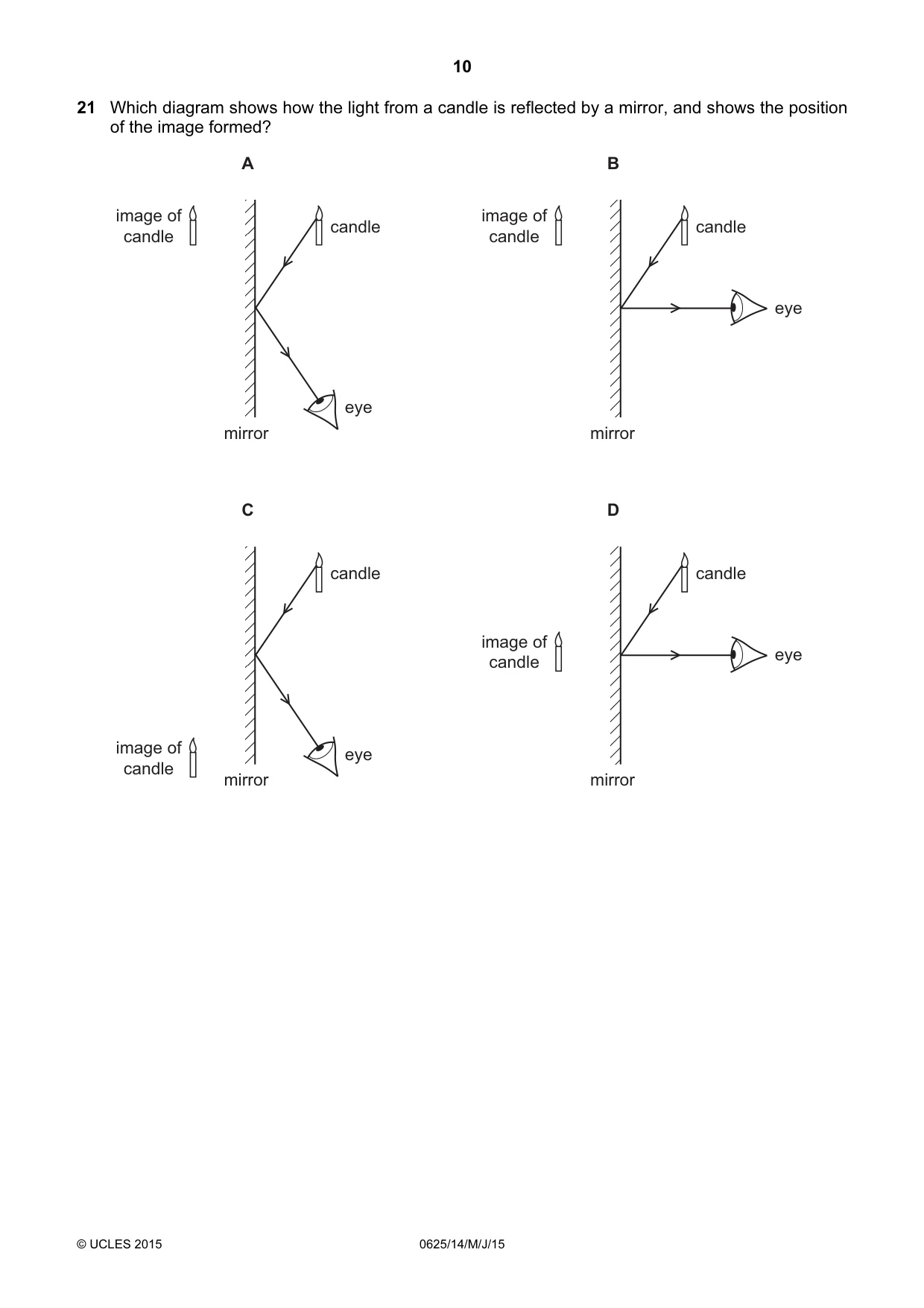
21 Which diagram shows how the light from a candle is reflected by a mirror, and shows the position of the image formed? A B image of image of candle candle candle candle eye eye mirror mirror C D candle candle image of candle eye image of eye candle mirror mirror
Mark scheme: A
Q22 · The diagram shows a ray of white light incident on a triangular glass prism
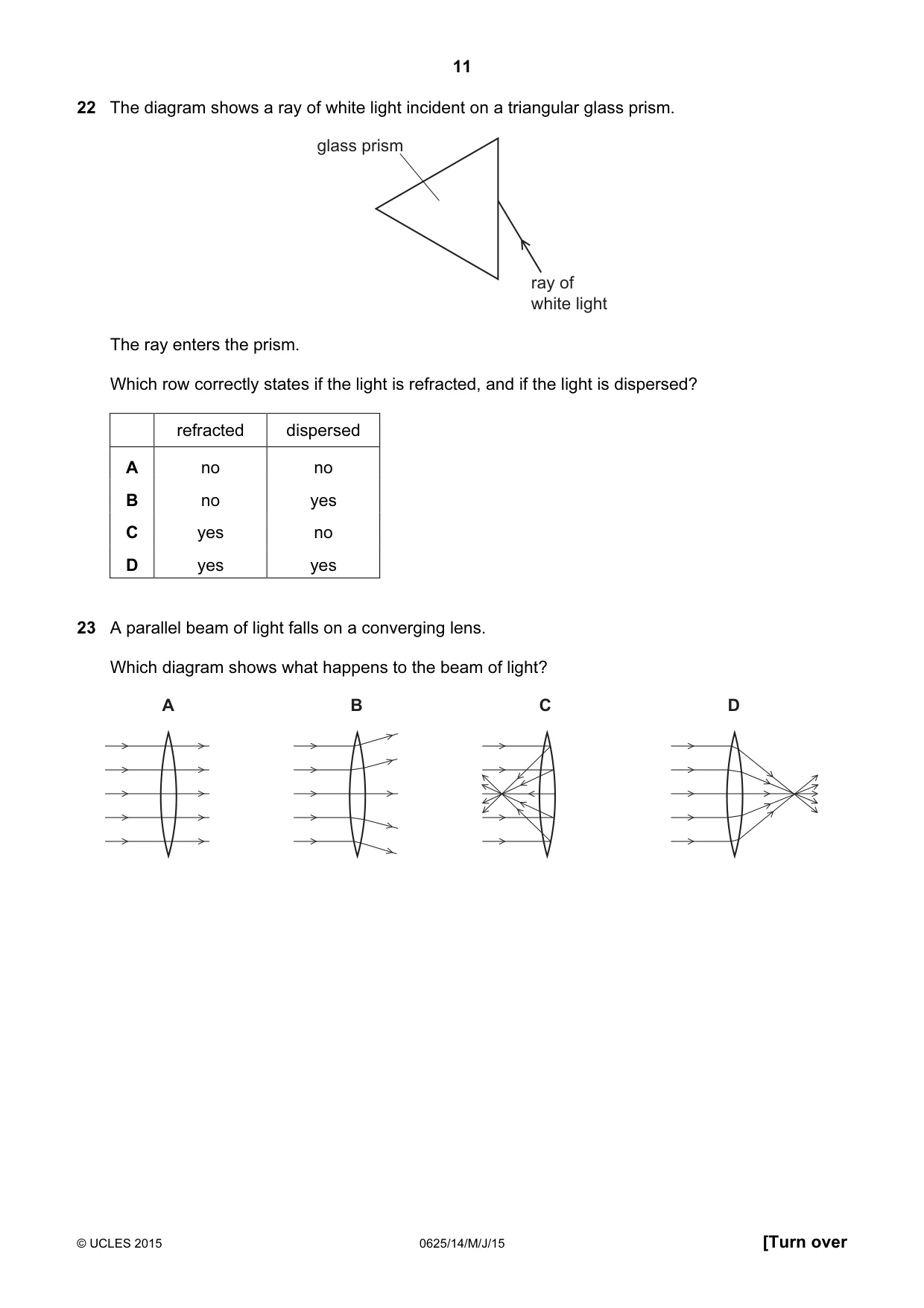
22 The diagram shows a ray of white light incident on a triangular glass prism. glass prism ray of white light The ray enters the prism. Which row correctly states if the light is refracted, and if the light is dispersed? refracted dispersed A no no B no yes C yes no D yes yes
Mark scheme: D
Q23 · A parallel beam of light falls on a converging lens
23 A parallel beam of light falls on a converging lens. Which diagram shows what happens to the beam of light? A B C D
Mark scheme: D
Q24 · In the experiment shown, the bell is heard ringing
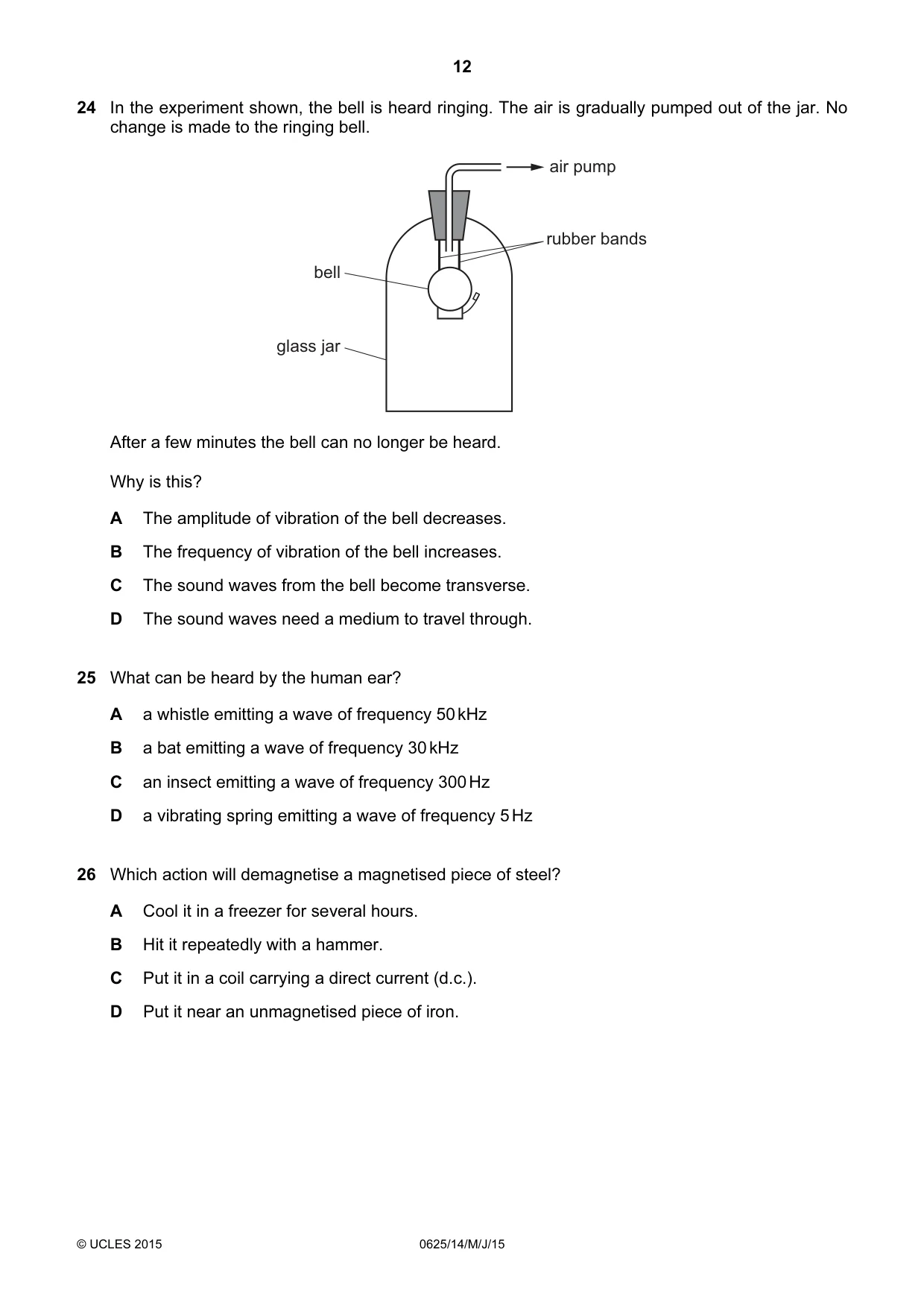
24 In the experiment shown, the bell is heard ringing. The air is gradually pumped out of the jar. No change is made to the ringing bell. air pump rubber bands bell glass jar After a few minutes the bell can no longer be heard. Why is this? A The amplitude of vibration of the bell decreases. B The frequency of vibration of the bell increases. C The sound waves from the bell become transverse. D The sound waves need a medium to travel through.
Mark scheme: D
Q25 · What can be heard by the human ear?
25 What can be heard by the human ear? A a whistle emitting a wave of frequency 50 kHz B a bat emitting a wave of frequency 30 kHz C an insect emitting a wave of frequency 300 Hz D a vibrating spring emitting a wave of frequency 5 Hz
Mark scheme: C
Q26 · Which action will demagnetise a magnetised piece of steel?
26 Which action will demagnetise a magnetised piece of steel? A Cool it in a freezer for several hours. B Hit it repeatedly with a hammer. C Put it in a coil carrying a direct current (d.c.). D Put it near an unmagnetised piece of iron.
Mark scheme: B
Q27 · Which row gives the unit for electromotive force (e.m.f.) and the unit for potential…
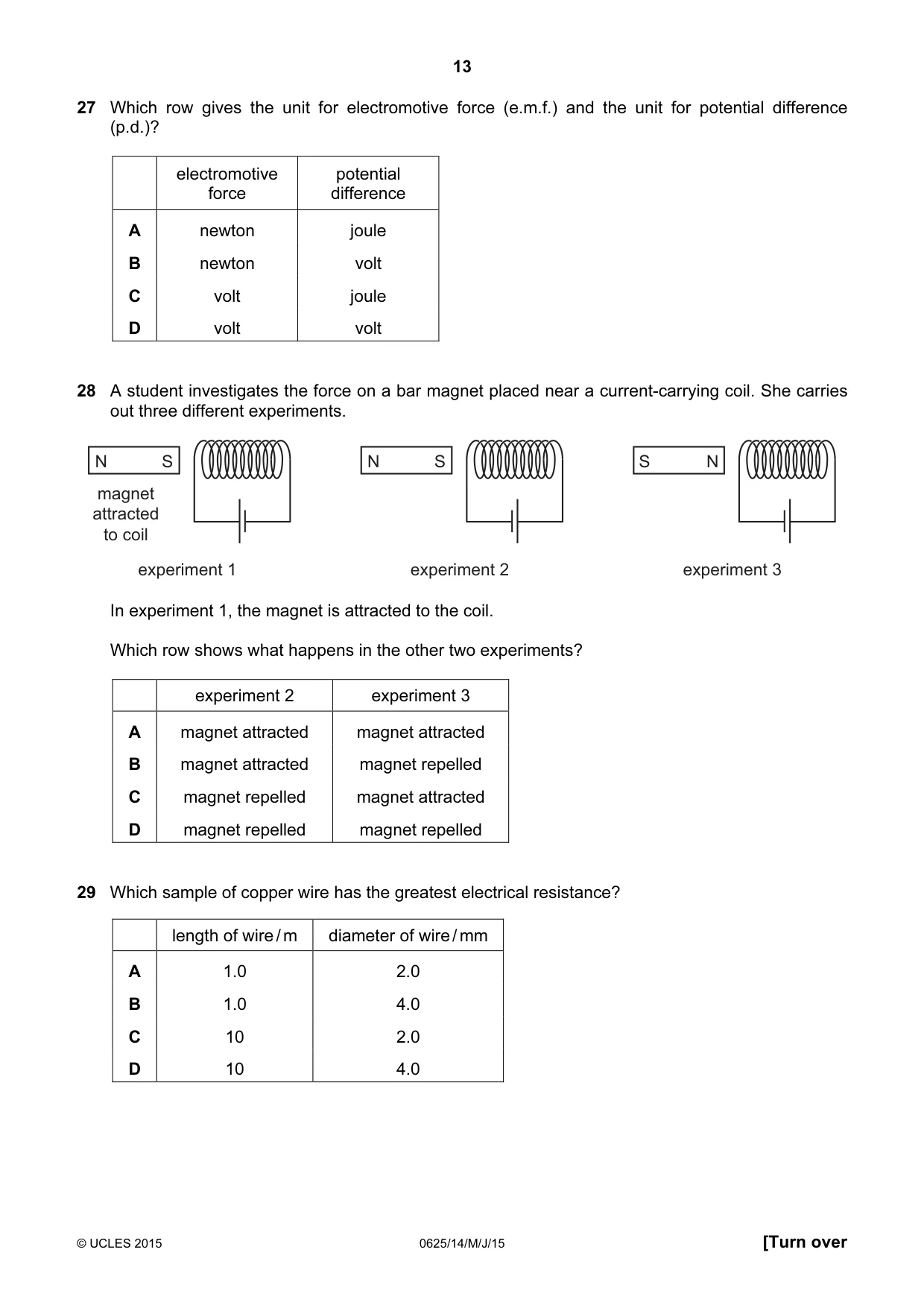
27 Which row gives the unit for electromotive force (e.m.f.) and the unit for potential difference (p.d.)? electromotive potential force difference A newton joule B newton volt C volt joule D volt volt
Mark scheme: D
Q28 · A student investigates the force on a bar magnet placed near a current-carrying coil
28 A student investigates the force on a bar magnet placed near a current-carrying coil. She carries out three different experiments. N S N S S N magnet attracted to coil experiment 1 experiment 2 experiment 3 In experiment 1, the magnet is attracted to the coil. Which row shows what happens in the other two experiments? experiment 2 experiment 3 A magnet attracted magnet attracted B magnet attracted magnet repelled C magnet repelled magnet attracted D magnet repelled magnet repelled
Mark scheme: C
Q29 · Which sample of copper wire has the greatest electrical resistance?
29 Which sample of copper wire has the greatest electrical resistance? length of wire / m diameter of wire / mm A 1.0 2.0 B 1.0 4.0 C 10 2.0 D 10 4.0
Mark scheme: C
Q30 · A student uses the circuit shown to determine the resistance of the two identical…
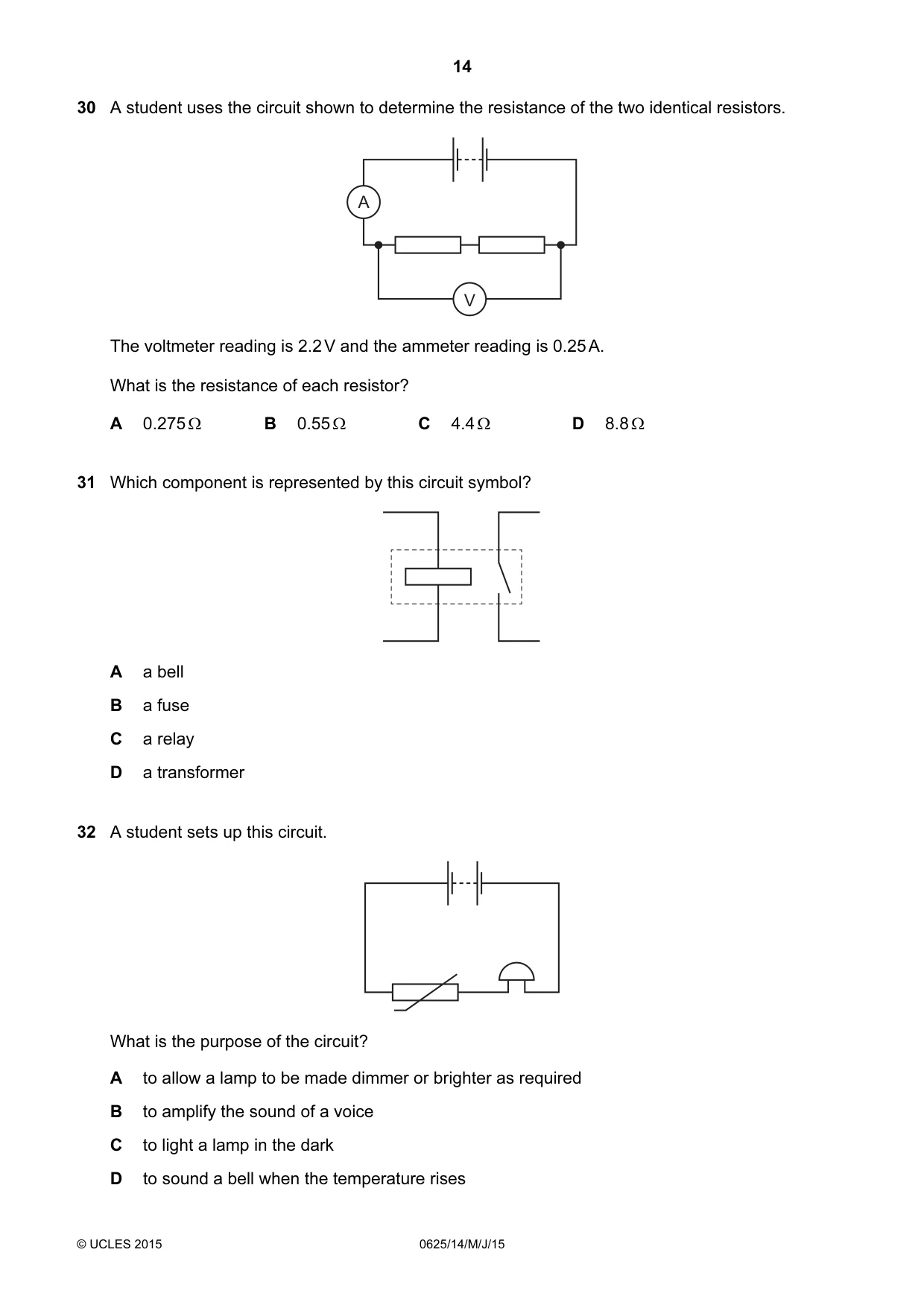
30 A student uses the circuit shown to determine the resistance of the two identical resistors. A V The voltmeter reading is 2.2 V and the ammeter reading is 0.25 A. What is the resistance of each resistor? A 0.275 Ω B 0.55 Ω C 4.4 Ω D 8.8 Ω
Mark scheme: C
Q31 · Which component is represented by this circuit symbol?
31 Which component is represented by this circuit symbol? A a bell B a fuse C a relay D a transformer
Mark scheme: C
Q32 · A student sets up this circuit
32 A student sets up this circuit. What is the purpose of the circuit? A to allow a lamp to be made dimmer or brighter as required B to amplify the sound of a voice C to light a lamp in the dark D to sound a bell when the temperature rises
Mark scheme: D
Q33 · Three cores of different metals, P, Q and R, are placed inside identical coils of wire
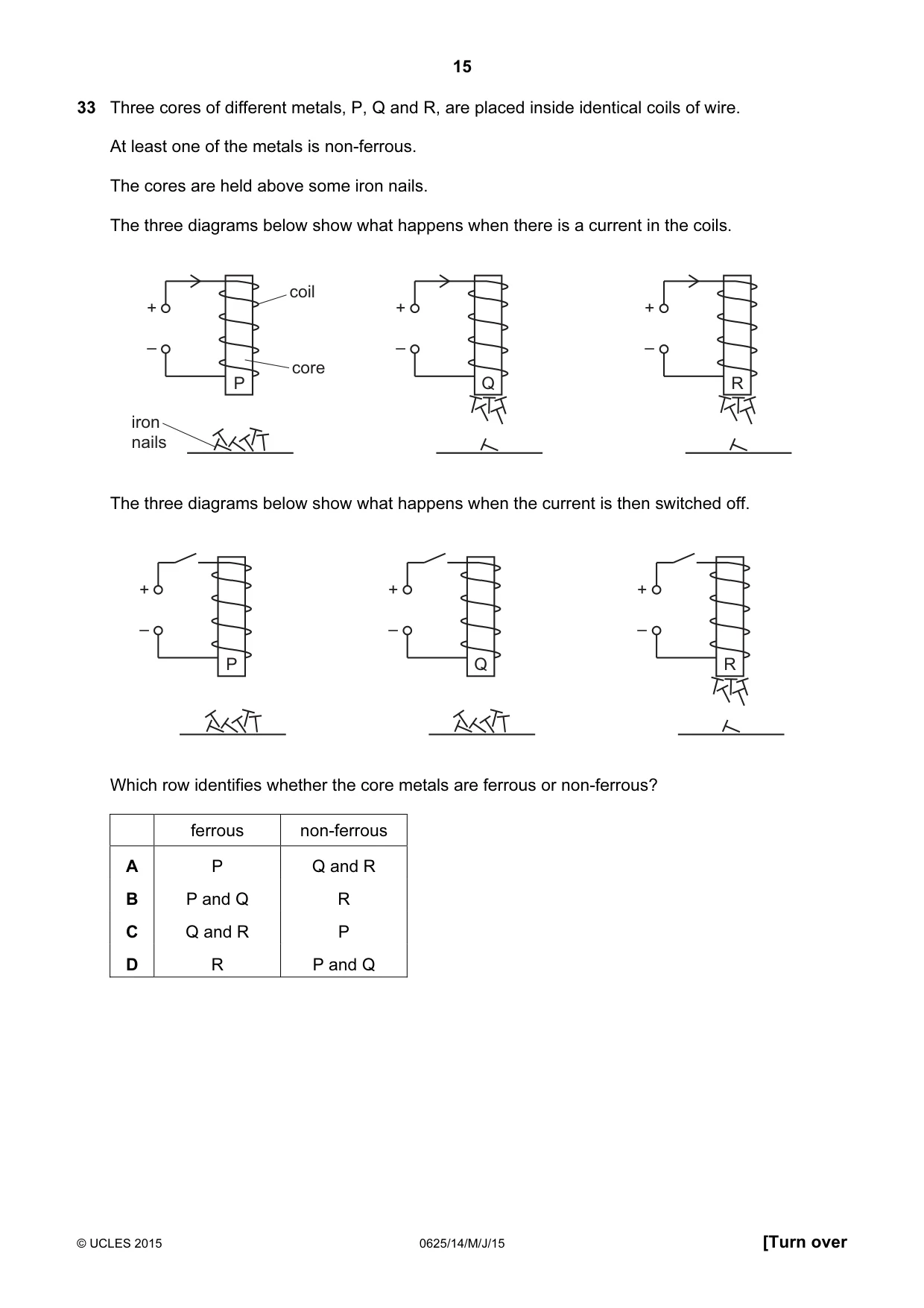
33 Three cores of different metals, P, Q and R, are placed inside identical coils of wire. At least one of the metals is non-ferrous. The cores are held above some iron nails. The three diagrams below show what happens when there is a current in the coils. coil + + + – – – core P Q R iron nails The three diagrams below show what happens when the current is then switched off. + + + – – – P Q R Which row identifies whether the core metals are ferrous or non-ferrous? ferrous non-ferrous A P Q and R B P and Q R C Q and R P D R P and Q
Mark scheme: C
Q34 · Which diagram represents the voltage output of a simple a.c
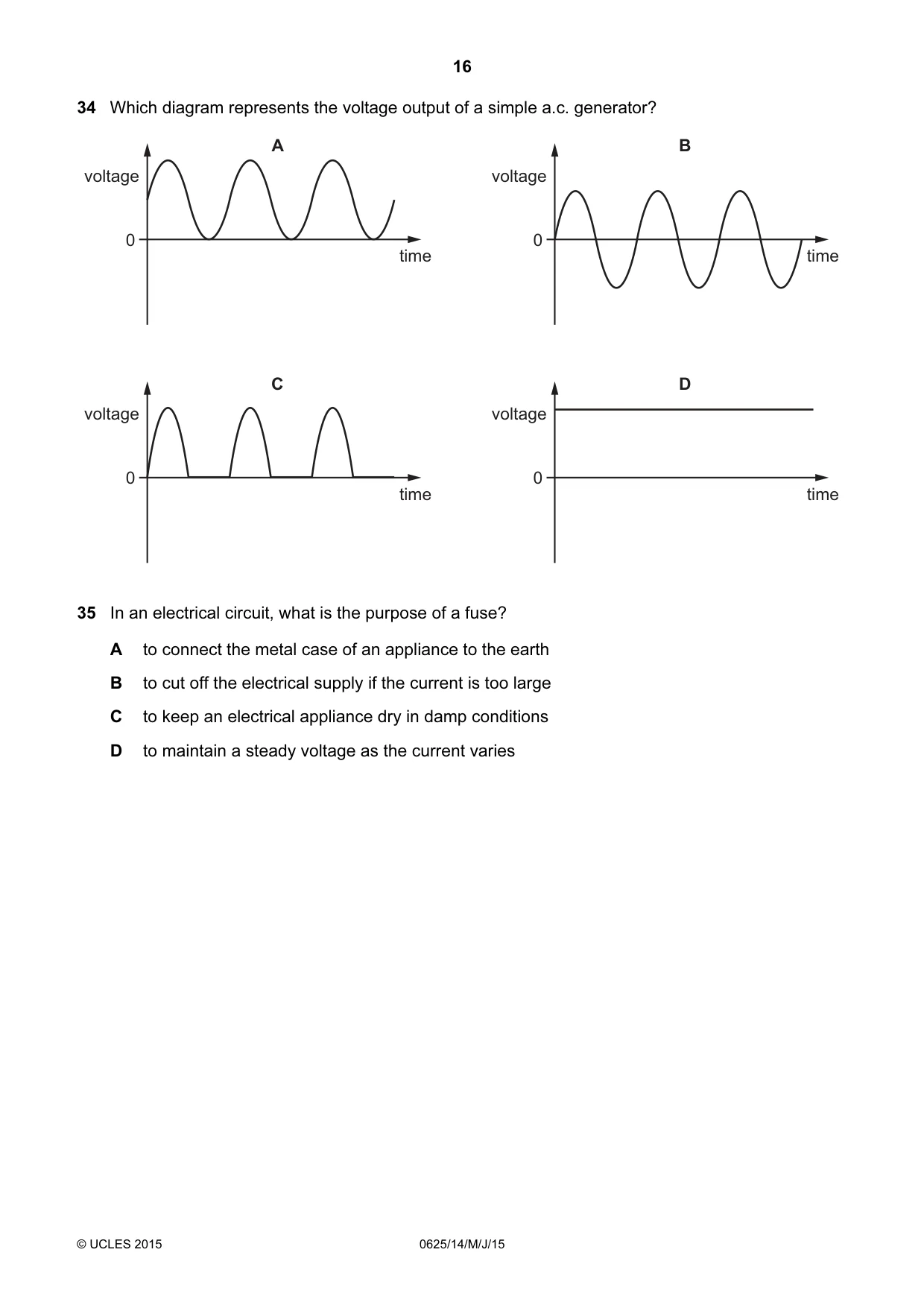
34 Which diagram represents the voltage output of a simple a.c. generator? A B voltage voltage 0 0 time time C D voltage voltage 0 0 time time
Mark scheme: B
Q35 · In an electrical circuit, what is the purpose of a fuse?
35 In an electrical circuit, what is the purpose of a fuse? A to connect the metal case of an appliance to the earth B to cut off the electrical supply if the current is too large C to keep an electrical appliance dry in damp conditions D to maintain a steady voltage as the current varies
Mark scheme: B
Q36 · The diagram shows a cathode-ray tube
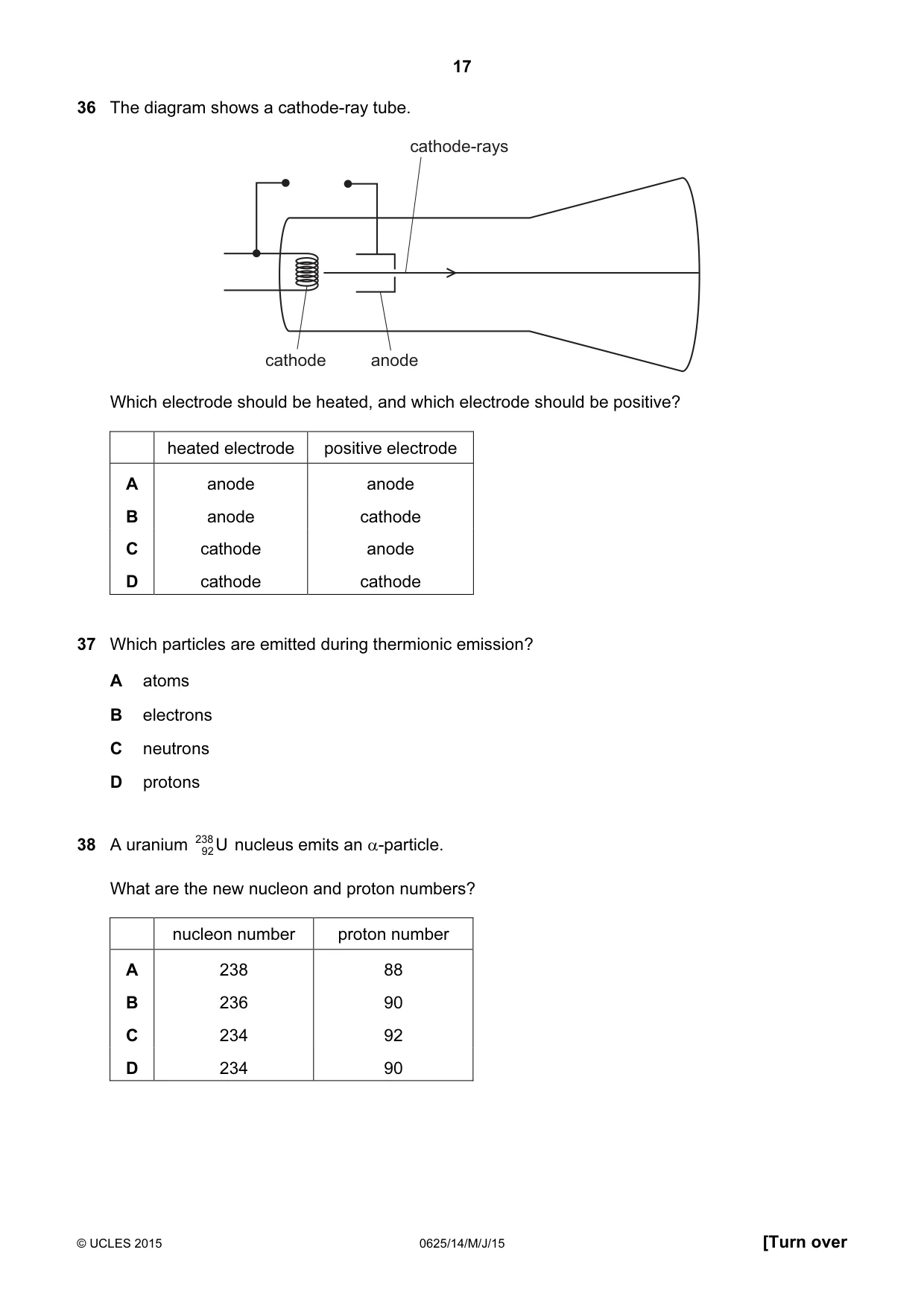
36 The diagram shows a cathode-ray tube. cathode-rays cathode anode Which electrode should be heated, and which electrode should be positive? heated electrode positive electrode A anode anode B anode cathode C cathode anode D cathode cathode
Mark scheme: C
Q37 · Which particles are emitted during thermionic emission?
37 Which particles are emitted during thermionic emission? A atoms B electrons C neutrons D protons
Mark scheme: B
Q38 · A uranium 238 U nucleus emits an α-particle
38 A uranium 238 U nucleus emits an α-particle. 92 What are the new nucleon and proton numbers? nucleon number proton number A 238 88 B 236 90 C 234 92 D 234 90
Mark scheme: D
Q39 · Which row shows the nature and the penetrating ability of β-particles?
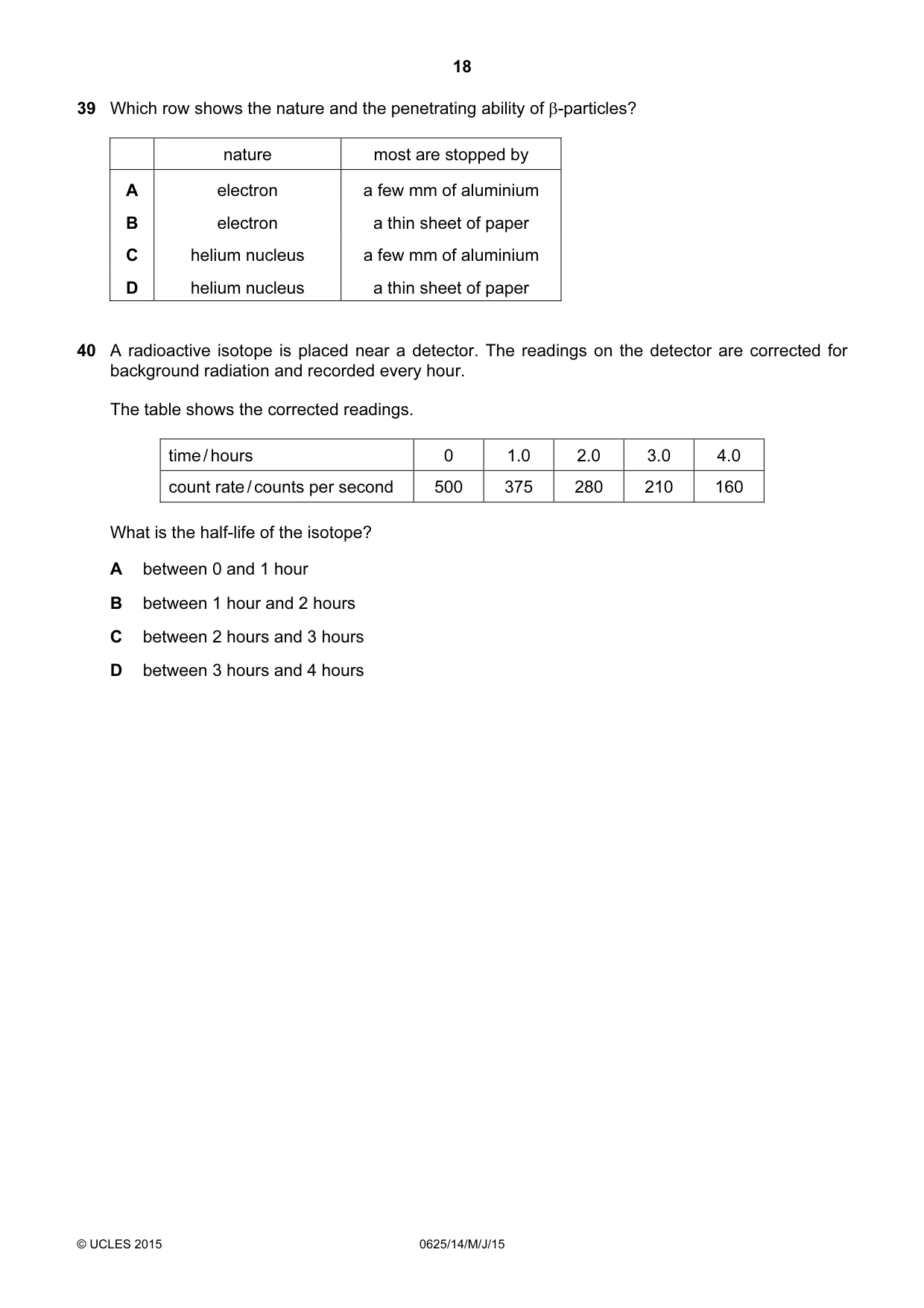
39 Which row shows the nature and the penetrating ability of β-particles? nature most are stopped by A electron a few mm of aluminium B electron a thin sheet of paper C helium nucleus a few mm of aluminium D helium nucleus a thin sheet of paper
Mark scheme: A
Q40 · A radioactive isotope is placed near a detector
40 A radioactive isotope is placed near a detector. The readings on the detector are corrected for background radiation and recorded every hour. The table shows the corrected readings. time / hours 0 1.0 2.0 3.0 4.0 count rate / counts per second 500 375 280 210 160 What is the half-life of the isotope? A between 0 and 1 hour B between 1 hour and 2 hours C between 2 hours and 3 hours D between 3 hours and 4 hours
Mark scheme: C
What was in this paper
The subtopics covered by these 40 questions, and how many questions each got. Open one in a new tab to see every Cambridge question on it.
4Thermal properties and temperature4Electric circuits3Kinetic particle model of matter3Light3Radioactivity3Sound3Electromagnetic effects2Energy, work and power2Forces2Simple phenomena of magnetism2Transfer of thermal energy2Density1Electrical safety1General properties of waves1Mass and weight1Motion1Physical quantities and measurement techniques1Pressure1What you needed in this session
Cambridge’s own grade thresholds for 2015 May/June, Paper 1 · Variant 4. A higher threshold means an easier paper — the bar moves with how the cohort did.