Cambridge IGCSE Physics 0625 — 2024 May/June Paper 1 · Variant 3
0625/13/M/J/24 · 40 questions · 40 marks · ≈45 min
The question paper and its mark scheme, free to read here and free to download. This is Cambridge’s own paper, exactly as it was sat.
Question paper16 pages
Mark scheme3 pages
Answers below. Sit the paper first if you are practising.
Questions as text
Q1 · A student wishes to find the volume of a small, irregularly shaped stone
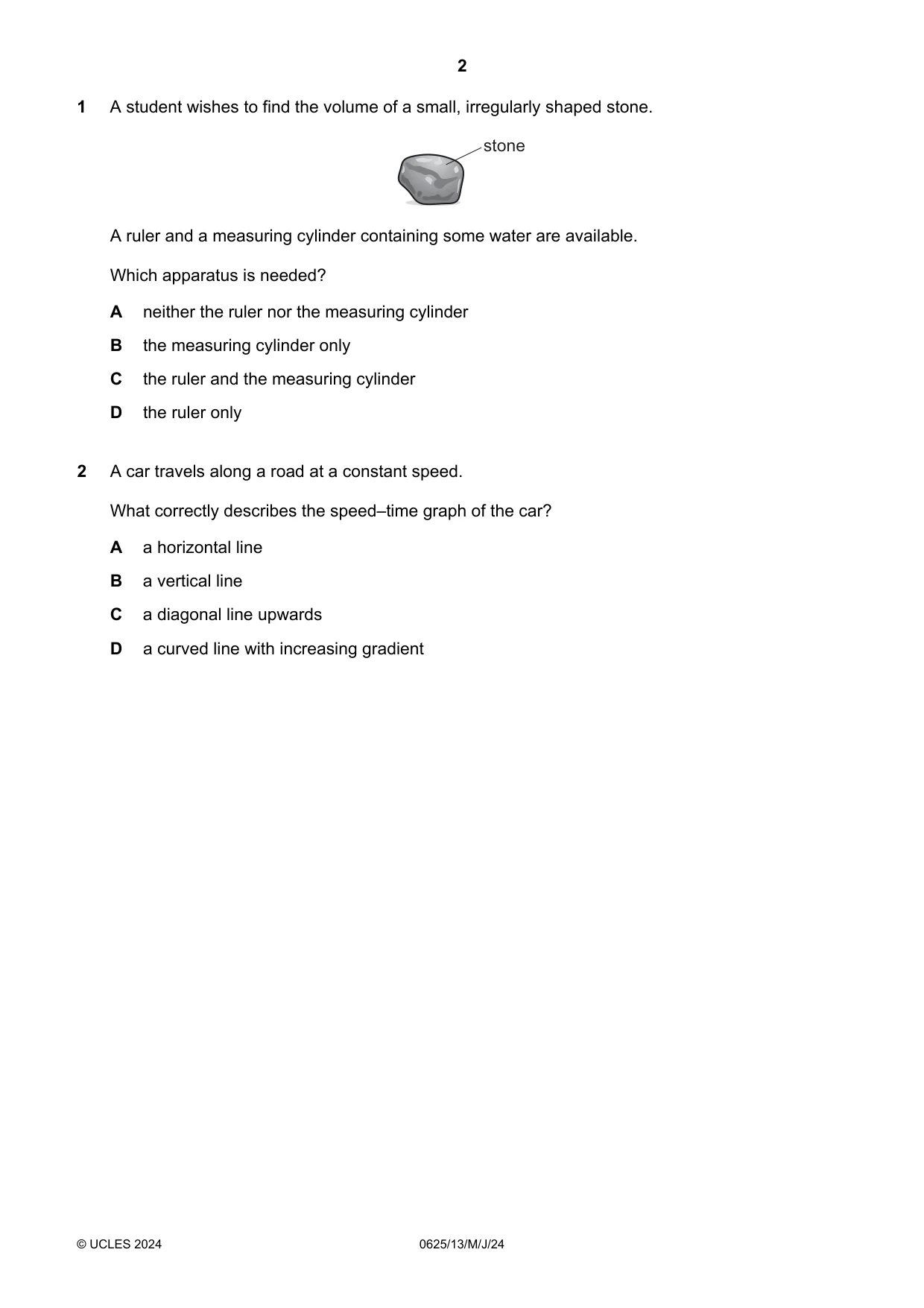
1 A student wishes to find the volume of a small, irregularly shaped stone. stone A ruler and a measuring cylinder containing some water are available. Which apparatus is needed? A neither the ruler nor the measuring cylinder B the measuring cylinder only C the ruler and the measuring cylinder D the ruler only
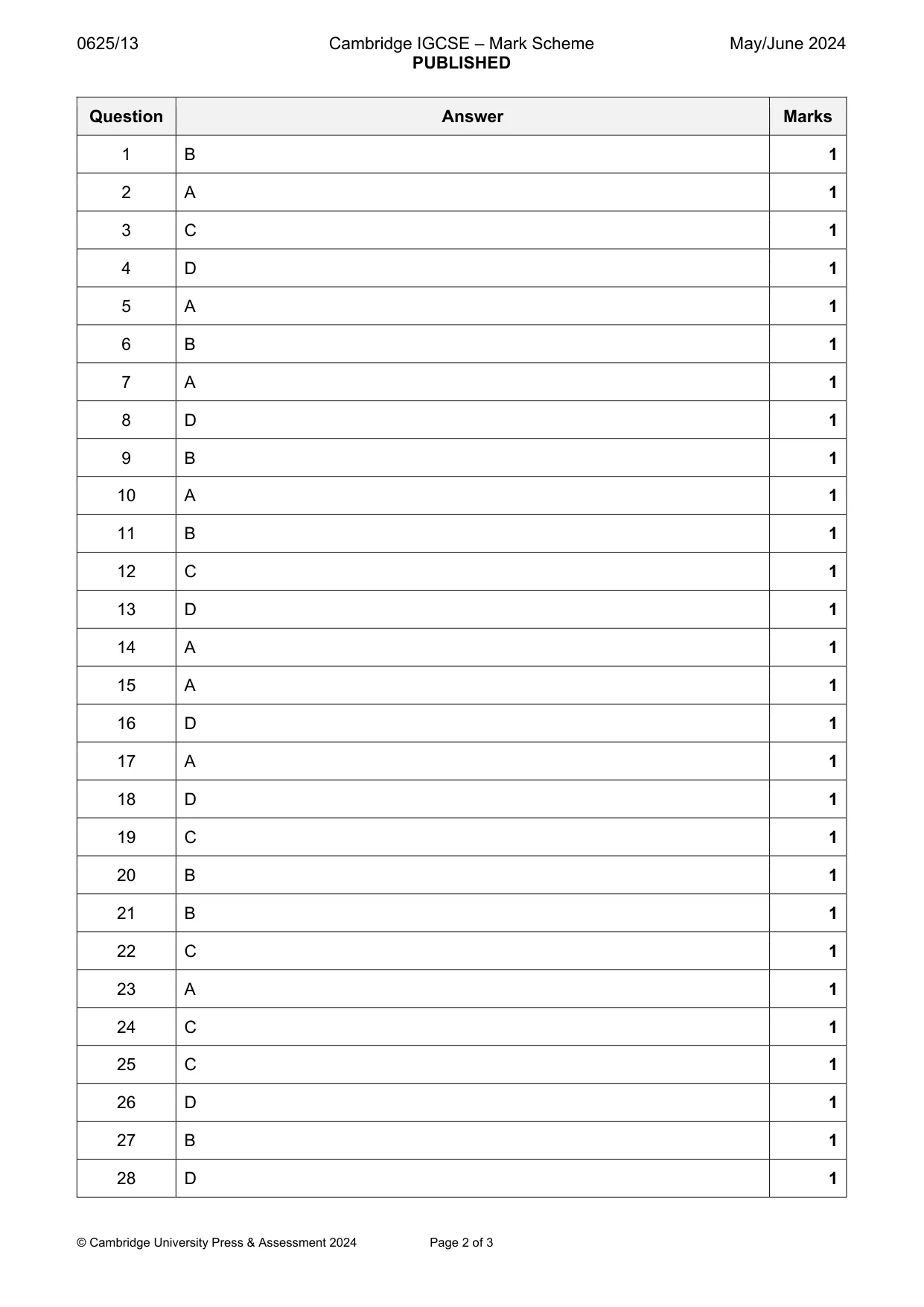
Mark scheme: B
More questions on Physical quantities and measurement techniques
Q2 · A car travels along a road at a constant speed
2 A car travels along a road at a constant speed. What correctly describes the speed–time graph of the car? A a horizontal line B a vertical line C a diagonal line upwards D a curved line with increasing gradient
Mark scheme: A
Q3 · Four objects are moving along a straight line
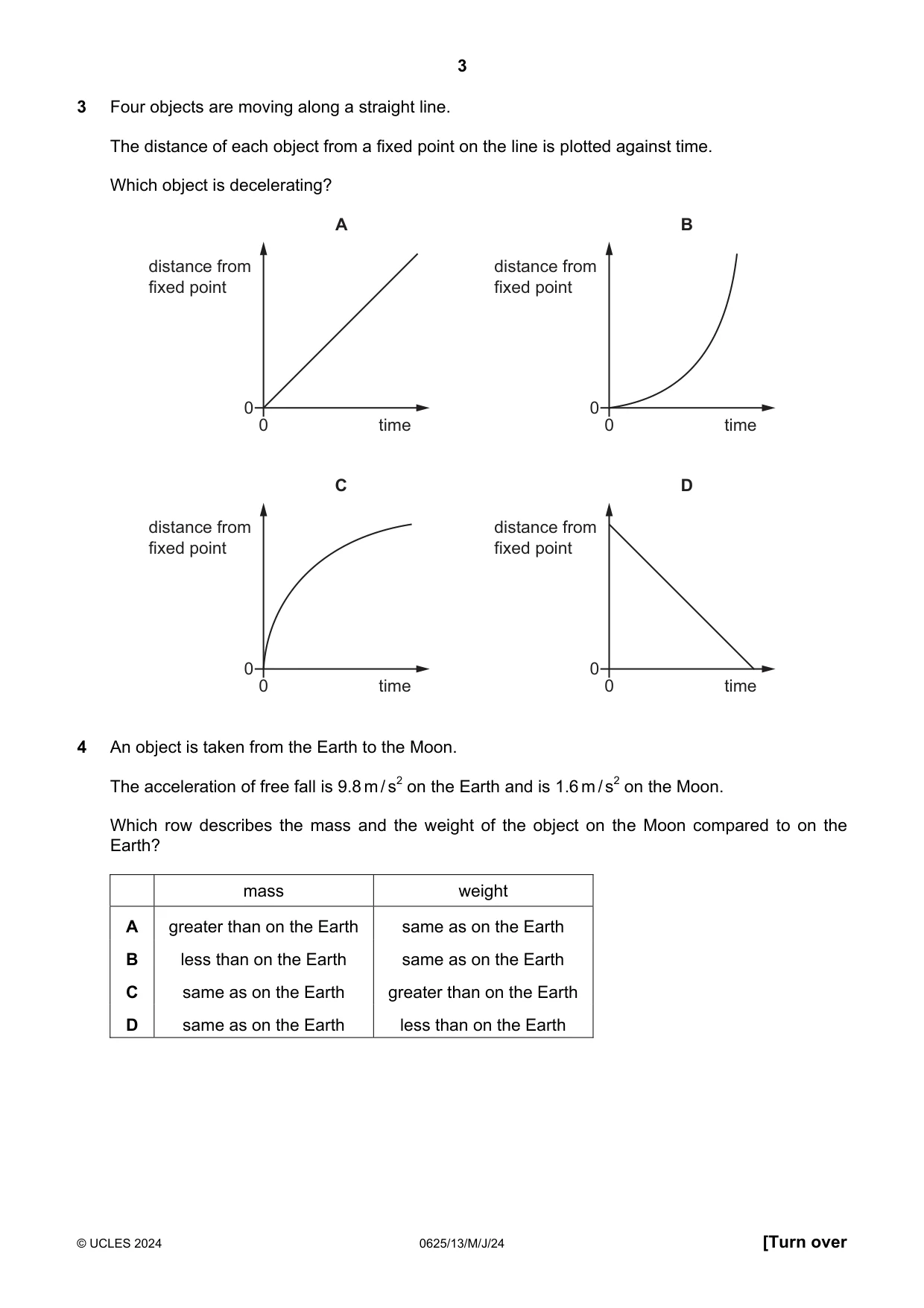
3 Four objects are moving along a straight line. The distance of each object from a fixed point on the line is plotted against time. Which object is decelerating? A B distance from distance from fixed point fixed point 0 0 0 time 0 time C D distance from distance from fixed point fixed point 0 0 0 time 0 time
Mark scheme: C
Q4 · An object is taken from the Earth to the Moon
4 An object is taken from the Earth to the Moon. The acceleration of free fall is 9.8 m / s2 on the Earth and is 1.6 m / s2 on the Moon. Which row describes the mass and the weight of the object on the Moon compared to on the Earth? mass weight A greater than on the Earth same as on the Earth B less than on the Earth same as on the Earth C same as on the Earth greater than on the Earth D same as on the Earth less than on the Earth
Mark scheme: D
Q5 · The diagram shows some liquid in a measuring cylinder
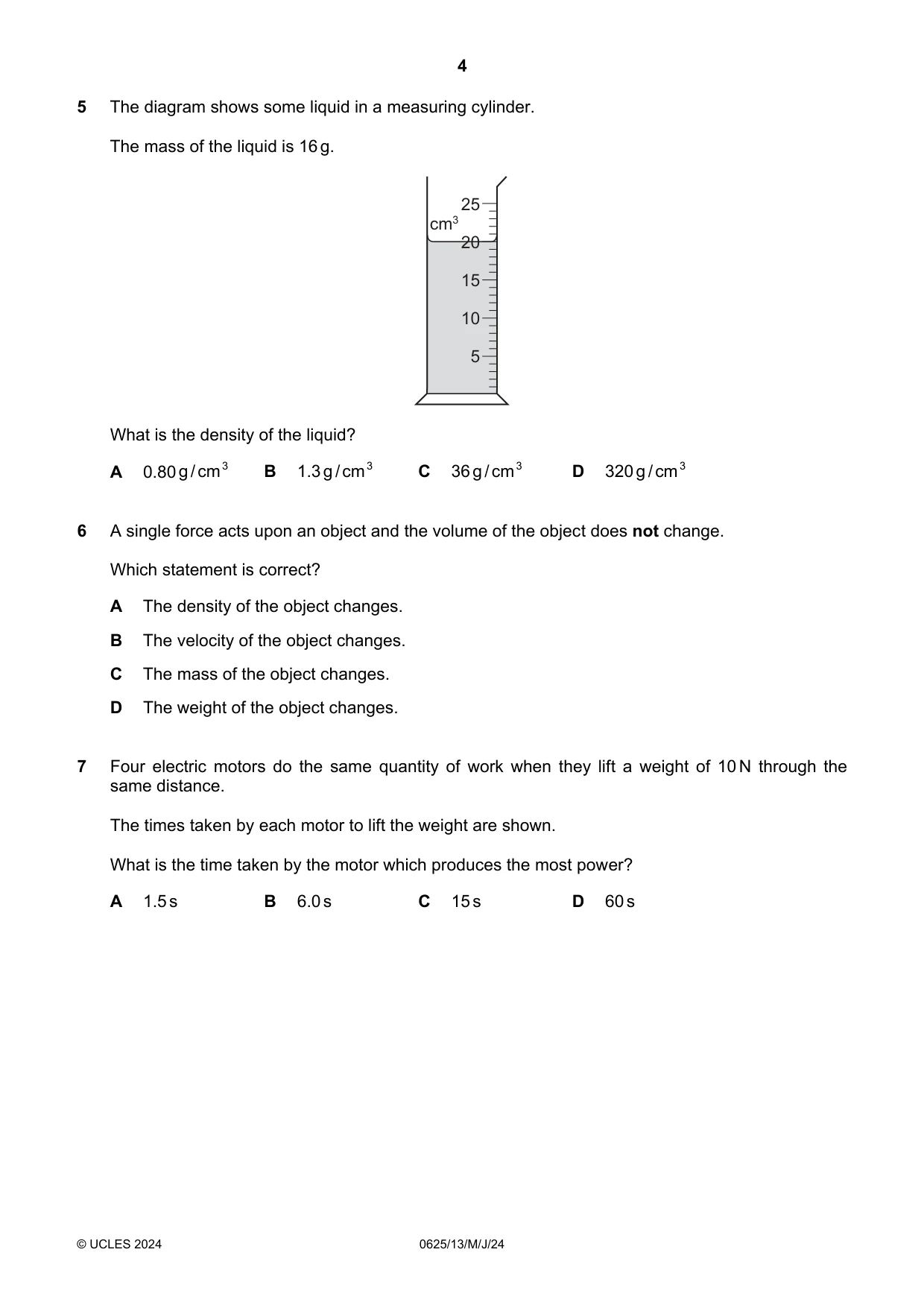
5 The diagram shows some liquid in a measuring cylinder. The mass of the liquid is 16 g. 25 cm3 20 15 10 5 What is the density of the liquid? A 0.80 g / cm 3 B 1.3 g / cm 3 C 36 g / cm 3 D 320 g / cm 3
Mark scheme: A
Q6 · A single force acts upon an object and the volume of the object does not change
6 A single force acts upon an object and the volume of the object does not change. Which statement is correct? A The density of the object changes. B The velocity of the object changes. C The mass of the object changes. D The weight of the object changes.
Mark scheme: B
Q7 · Four electric motors do the same quantity of work when they lift a weight of 10 N through…
7 Four electric motors do the same quantity of work when they lift a weight of 10 N through the same distance. The times taken by each motor to lift the weight are shown. What is the time taken by the motor which produces the most power? A 1.5 s B 6.0 s C 15 s D 60 s
Mark scheme: A
Q8 · Which row describes how the pressure beneath the surface of a liquid depends on the depth…
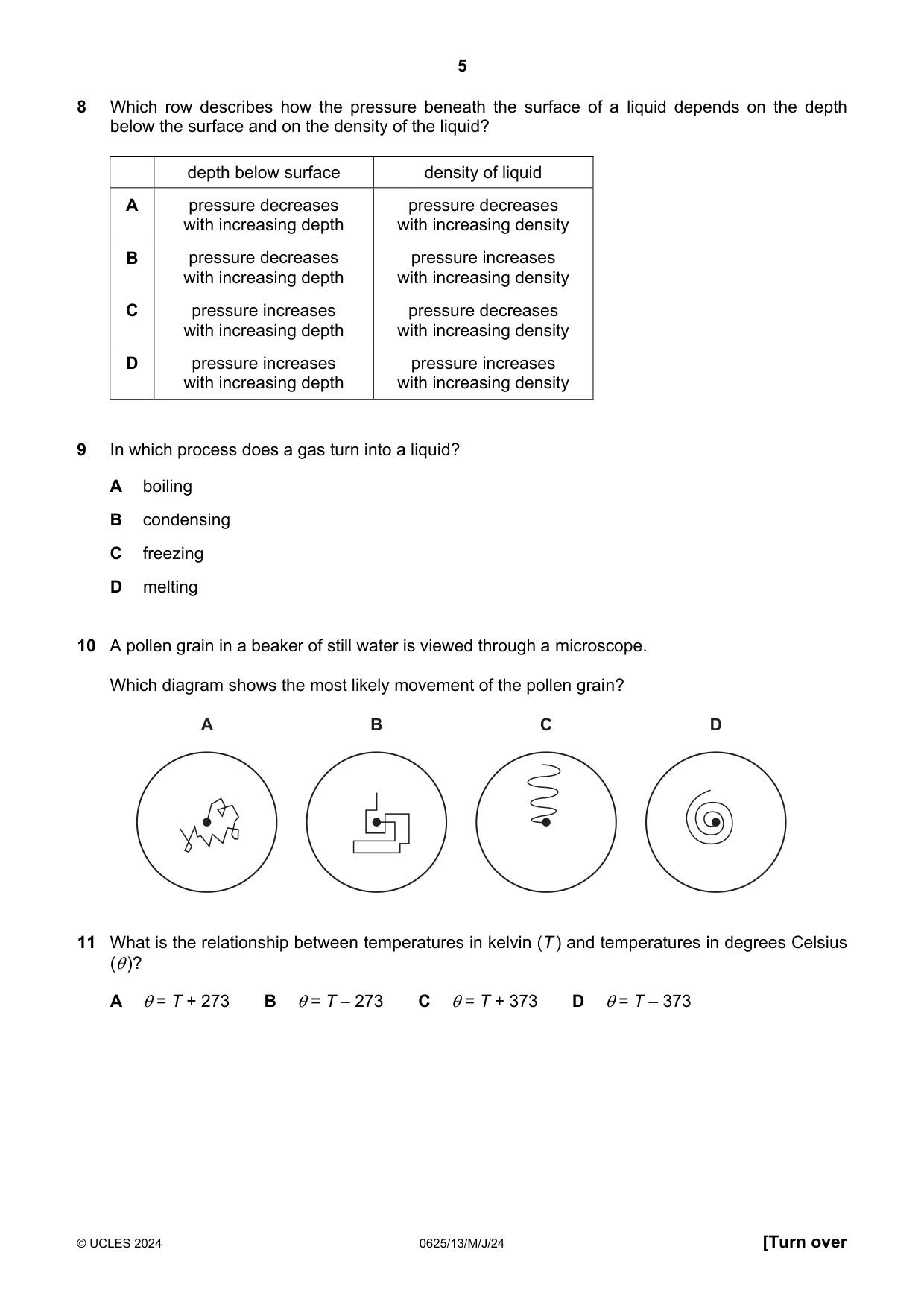
8 Which row describes how the pressure beneath the surface of a liquid depends on the depth below the surface and on the density of the liquid? depth below surface density of liquid A pressure decreases pressure decreases with increasing depth with increasing density B pressure decreases pressure increases with increasing depth with increasing density C pressure increases pressure decreases with increasing depth with increasing density D pressure increases pressure increases with increasing depth with increasing density
Mark scheme: D
Q9 · In which process does a gas turn into a liquid?
9 In which process does a gas turn into a liquid? A boiling B condensing C freezing D melting
Mark scheme: B
Q10 · A pollen grain in a beaker of still water is viewed through a microscope
10 A pollen grain in a beaker of still water is viewed through a microscope. Which diagram shows the most likely movement of the pollen grain? A B C D
Mark scheme: A
Q11 · What is the relationship between temperatures in kelvin (T ) and temperatures in degrees…
11 What is the relationship between temperatures in kelvin (T ) and temperatures in degrees Celsius ( )? A = T + 273 B = T – 273 C = T + 373 D = T – 373
Mark scheme: B
Q12 · In a famous experiment, a scientist showed that, when water in an insulated tub is…
12 In a famous experiment, a scientist showed that, when water in an insulated tub is stirred, its temperature increases. What can be concluded from this experiment? A Temperature is a store of energy. B The water absorbs heat from the surroundings. C Work done by stirring increases the internal energy of the water. D Energy is not conserved.
Mark scheme: C
Q13 · Solids expand when heated and contract when cooled
13 Solids expand when heated and contract when cooled. In which example is there a useful application of expansion and not an unwanted effect? A bridges B railway lines C telephone cables D thermostats
Mark scheme: D
Q14 · A rod is made half of aluminium and half of glass
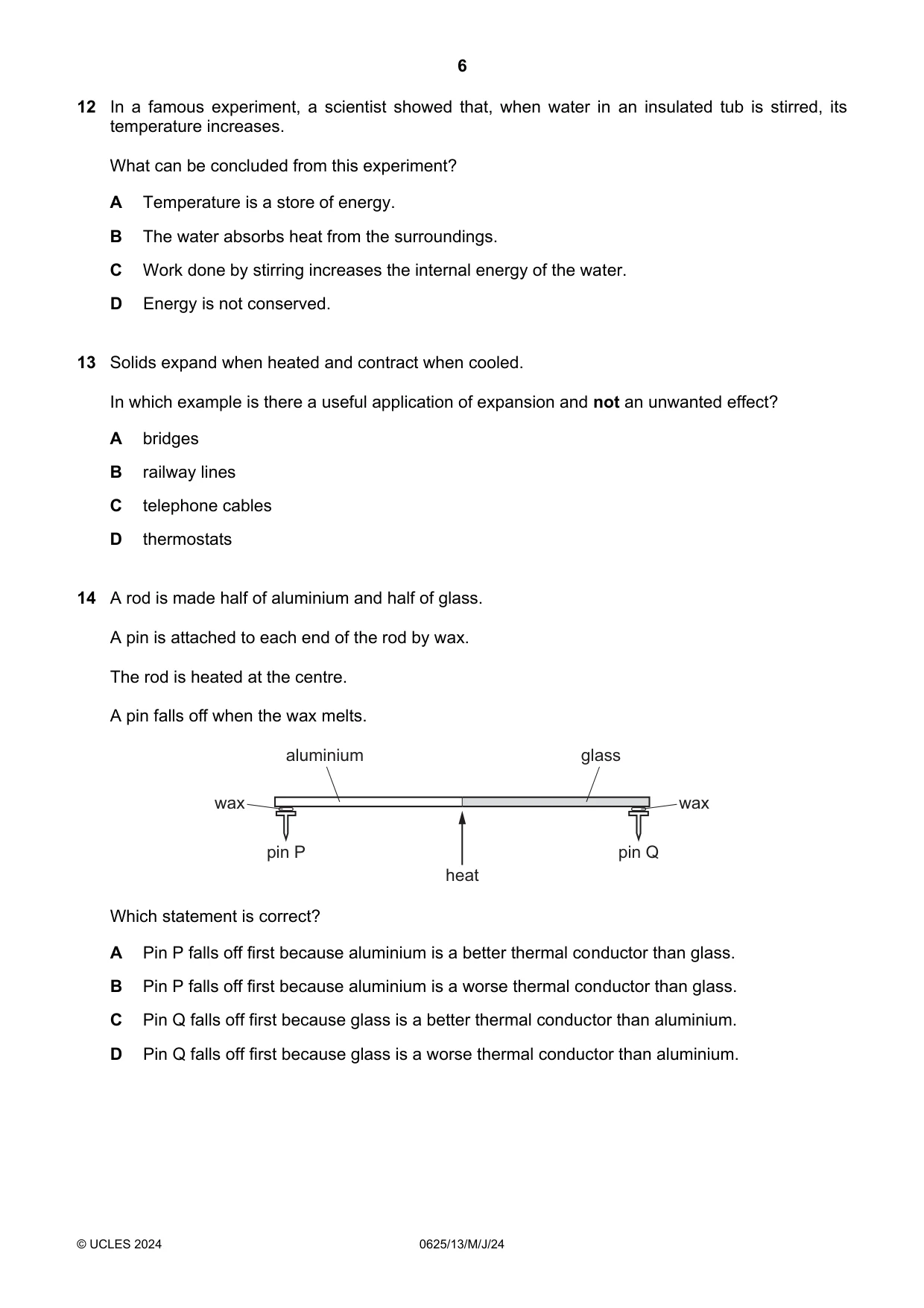
14 A rod is made half of aluminium and half of glass. A pin is attached to each end of the rod by wax. The rod is heated at the centre. A pin falls off when the wax melts. aluminium glass wax wax pin P pin Q heat Which statement is correct? A Pin P falls off first because aluminium is a better thermal conductor than glass. B Pin P falls off first because aluminium is a worse thermal conductor than glass. C Pin Q falls off first because glass is a better thermal conductor than aluminium. D Pin Q falls off first because glass is a worse thermal conductor than aluminium.
Mark scheme: A
Q15 · In countries where it is usually hot, houses are often painted white
15 In countries where it is usually hot, houses are often painted white. What is the reason for this? A White surfaces are good reflectors of infrared radiation. B White surfaces are good conductors of infrared radiation. C White surfaces are good absorbers of infrared radiation. D White surfaces are good emitters of infrared radiation.
Mark scheme: A
Q16 · What is the name of the distance from one crest in a transverse wave to the next crest?
16 What is the name of the distance from one crest in a transverse wave to the next crest? A amplitude B period C wavefront D wavelength
Mark scheme: D
Q17 · Waves on the surface of water travel from deep water to shallow water
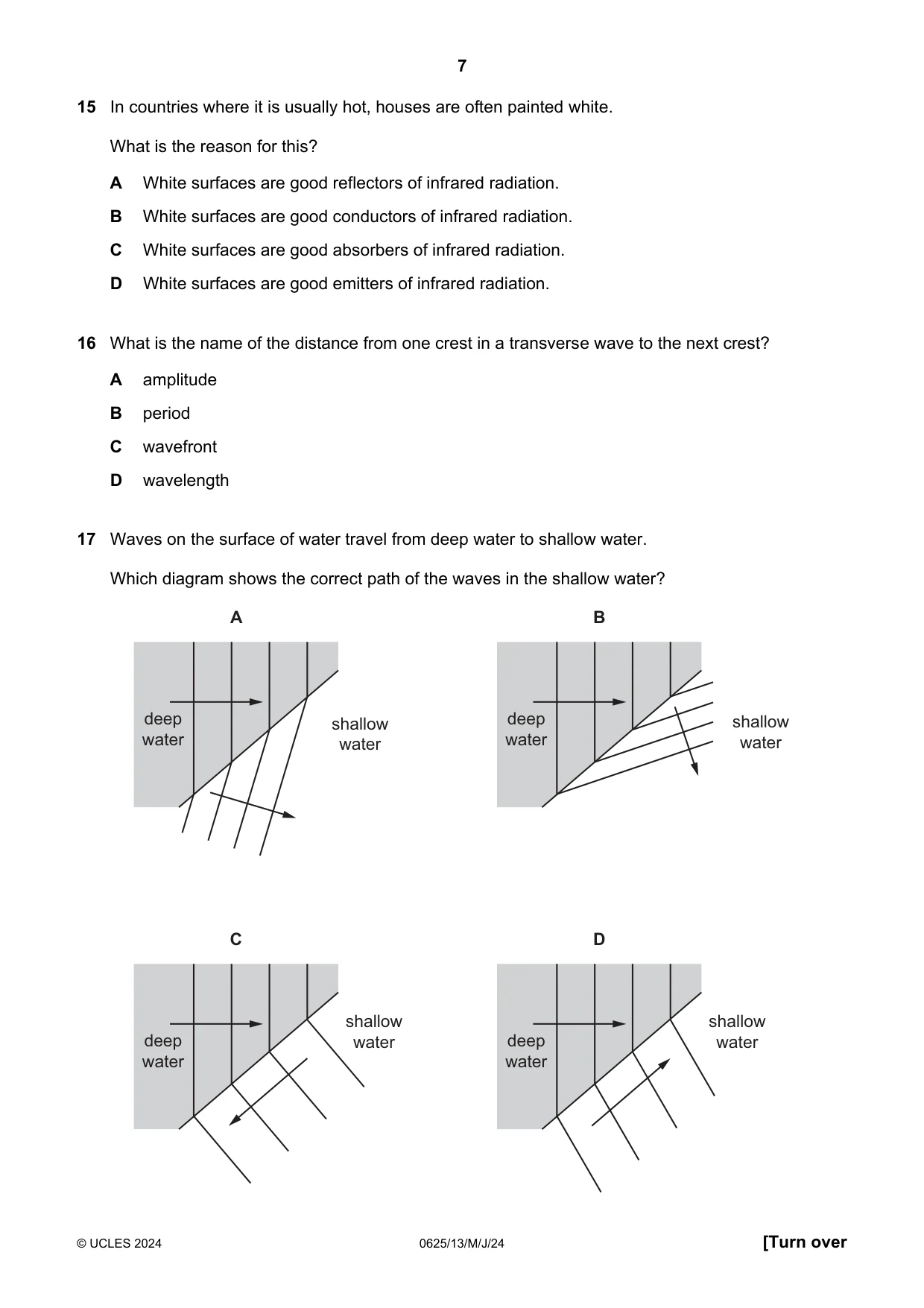
17 Waves on the surface of water travel from deep water to shallow water. Which diagram shows the correct path of the waves in the shallow water? A B deep shallow deep shallow water water water water C D shallow shallow deep water deep water water water
Mark scheme: A
Q18 · The diagram shows a thin converging lens with principal focuses at F1 and F2
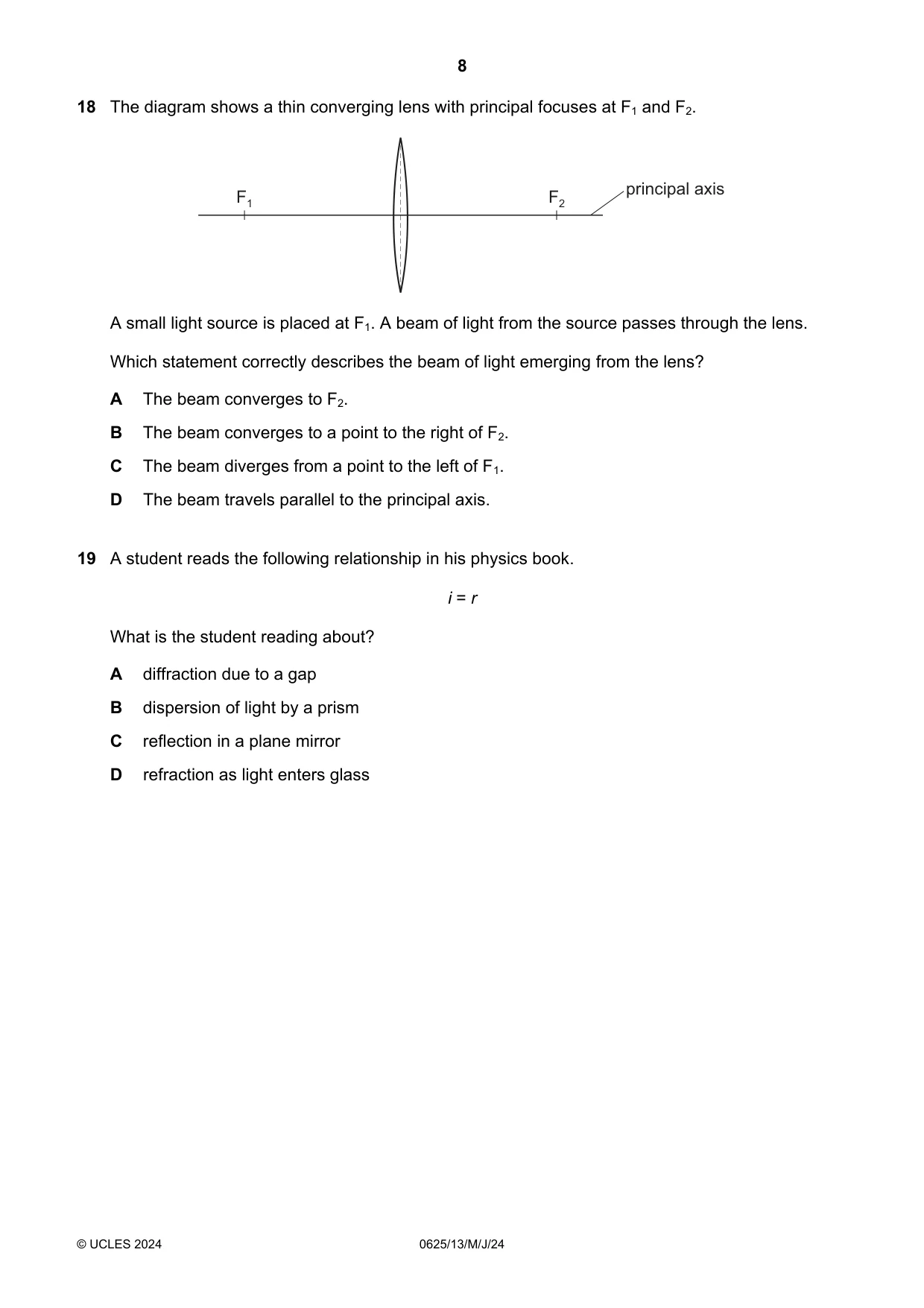
18 The diagram shows a thin converging lens with principal focuses at F1 and F2. principal axis F1 F2 A small light source is placed at F1. A beam of light from the source passes through the lens. Which statement correctly describes the beam of light emerging from the lens? A The beam converges to F2. B The beam converges to a point to the right of F2. C The beam diverges from a point to the left of F1. D The beam travels parallel to the principal axis.
Mark scheme: D
Q19 · A student reads the following relationship in his physics book
19 A student reads the following relationship in his physics book. i = r What is the student reading about? A diffraction due to a gap B dispersion of light by a prism C reflection in a plane mirror D refraction as light enters glass
Mark scheme: C
Q20 · The table shows information about different colours of light
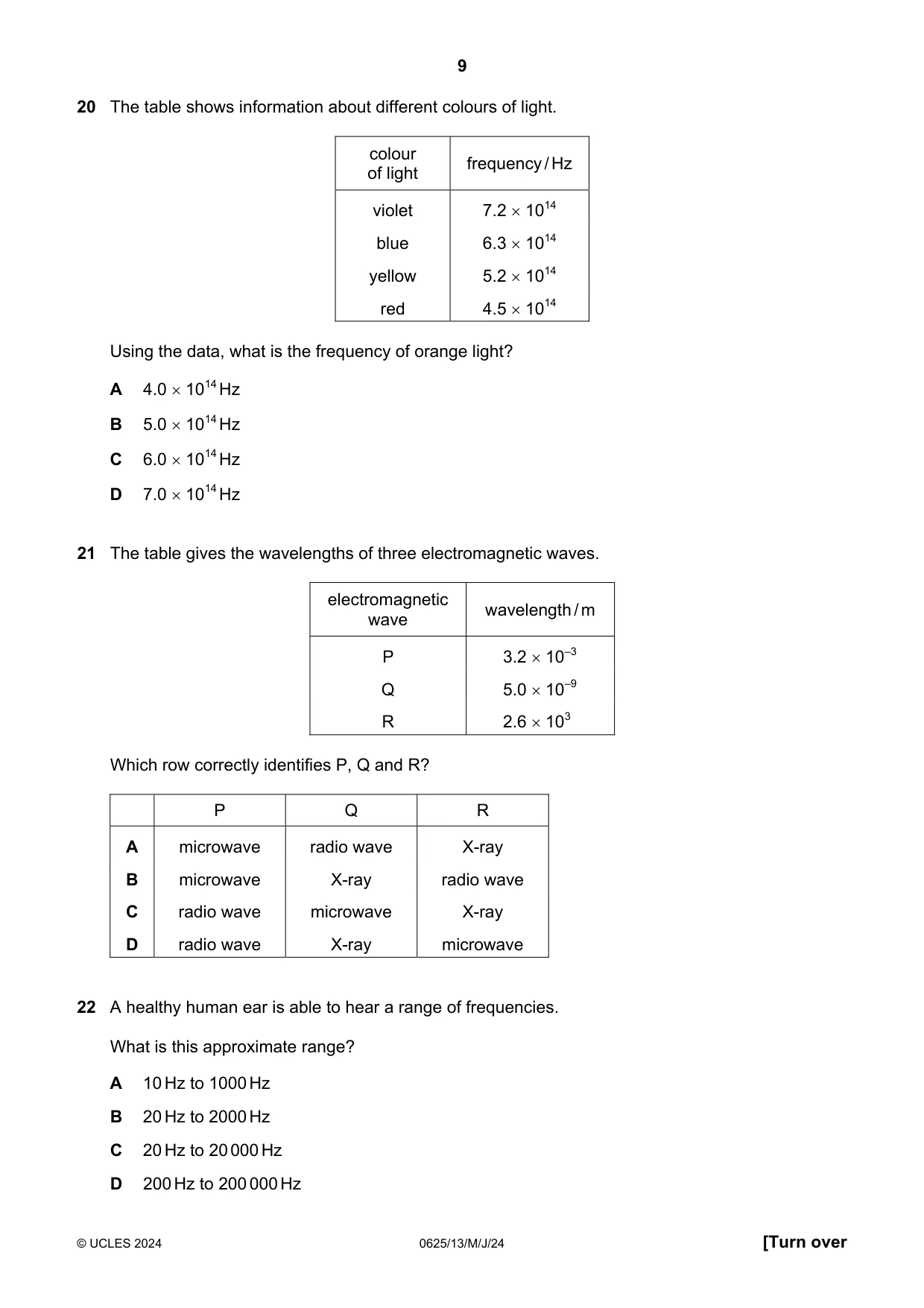
20 The table shows information about different colours of light. colour frequency / Hz of light violet 7.2 1014 blue 6.3 1014 yellow 5.2 1014 red 4.5 1014 Using the data, what is the frequency of orange light? A 4.0 1014 Hz B 5.0 1014 Hz C 6.0 1014 Hz D 7.0 1014 Hz
Mark scheme: B
Q21 · The table gives the wavelengths of three electromagnetic waves
21 The table gives the wavelengths of three electromagnetic waves. electromagnetic wavelength / m wave P 3.2 10–3 Q 5.0 10–9 R 2.6 103 Which row correctly identifies P, Q and R? P Q R A microwave radio wave X-ray B microwave X-ray radio wave C radio wave microwave X-ray D radio wave X-ray microwave
Mark scheme: B
Q22 · A healthy human ear is able to hear a range of frequencies
22 A healthy human ear is able to hear a range of frequencies. What is this approximate range? A 10 Hz to 1000 Hz B 20 Hz to 2000 Hz C 20 Hz to 20 000 Hz D 200 Hz to 200 000 Hz
Mark scheme: C
Q23 · A student hits two wooden blocks together in front of a wall and calculates the speed of…
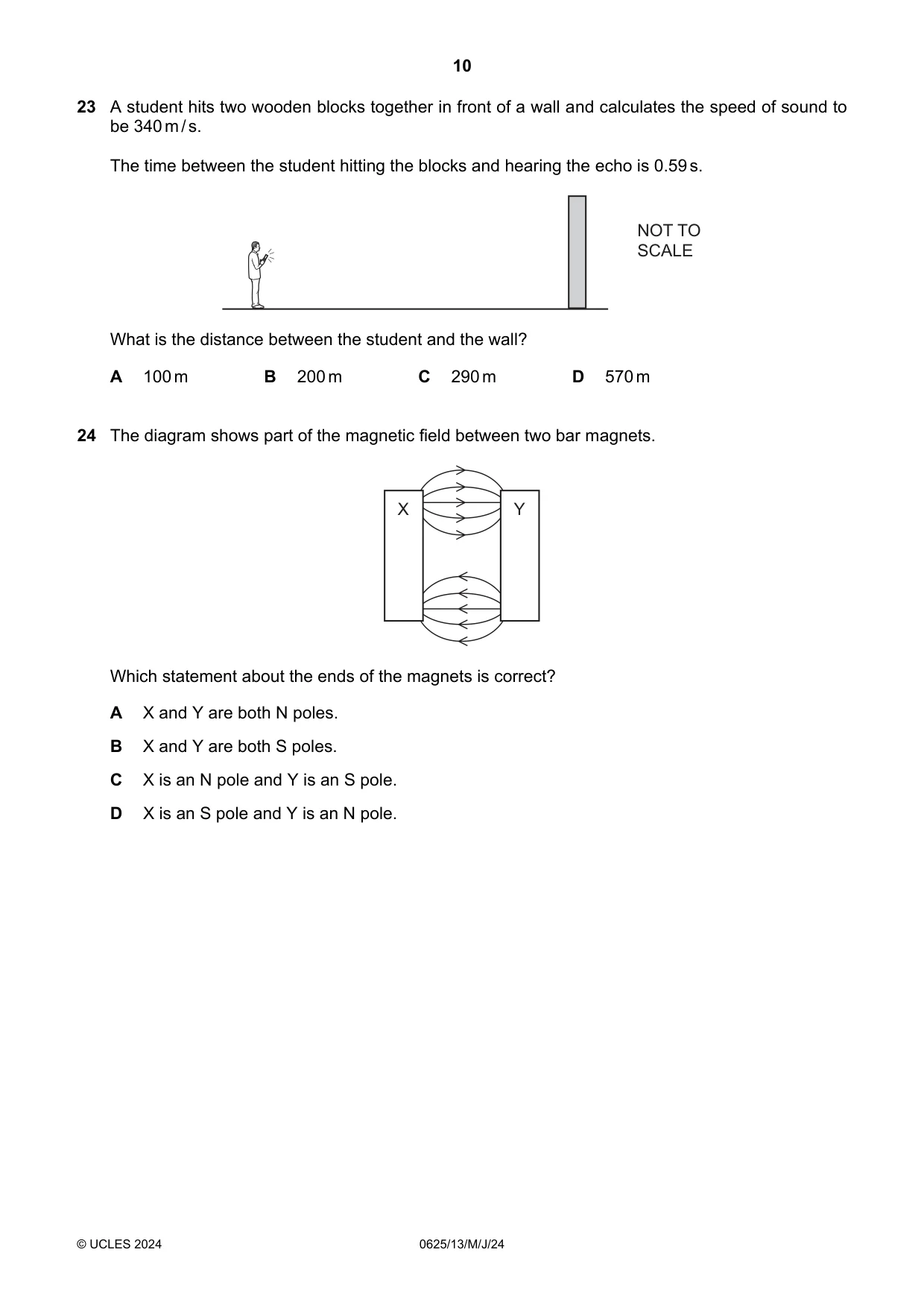
23 A student hits two wooden blocks together in front of a wall and calculates the speed of sound to be 340 m / s. The time between the student hitting the blocks and hearing the echo is 0.59 s. NOT TO SCALE What is the distance between the student and the wall? A 100 m B 200 m C 290 m D 570 m
Mark scheme: A
Q24 · The diagram shows part of the magnetic field between two bar magnets
24 The diagram shows part of the magnetic field between two bar magnets. X Y Which statement about the ends of the magnets is correct? A X and Y are both N poles. B X and Y are both S poles. C X is an N pole and Y is an S pole. D X is an S pole and Y is an N pole.
Mark scheme: C
Q25 · Diagrams 1, 2 and 3 show an experiment to compare two magnets 1 and 2
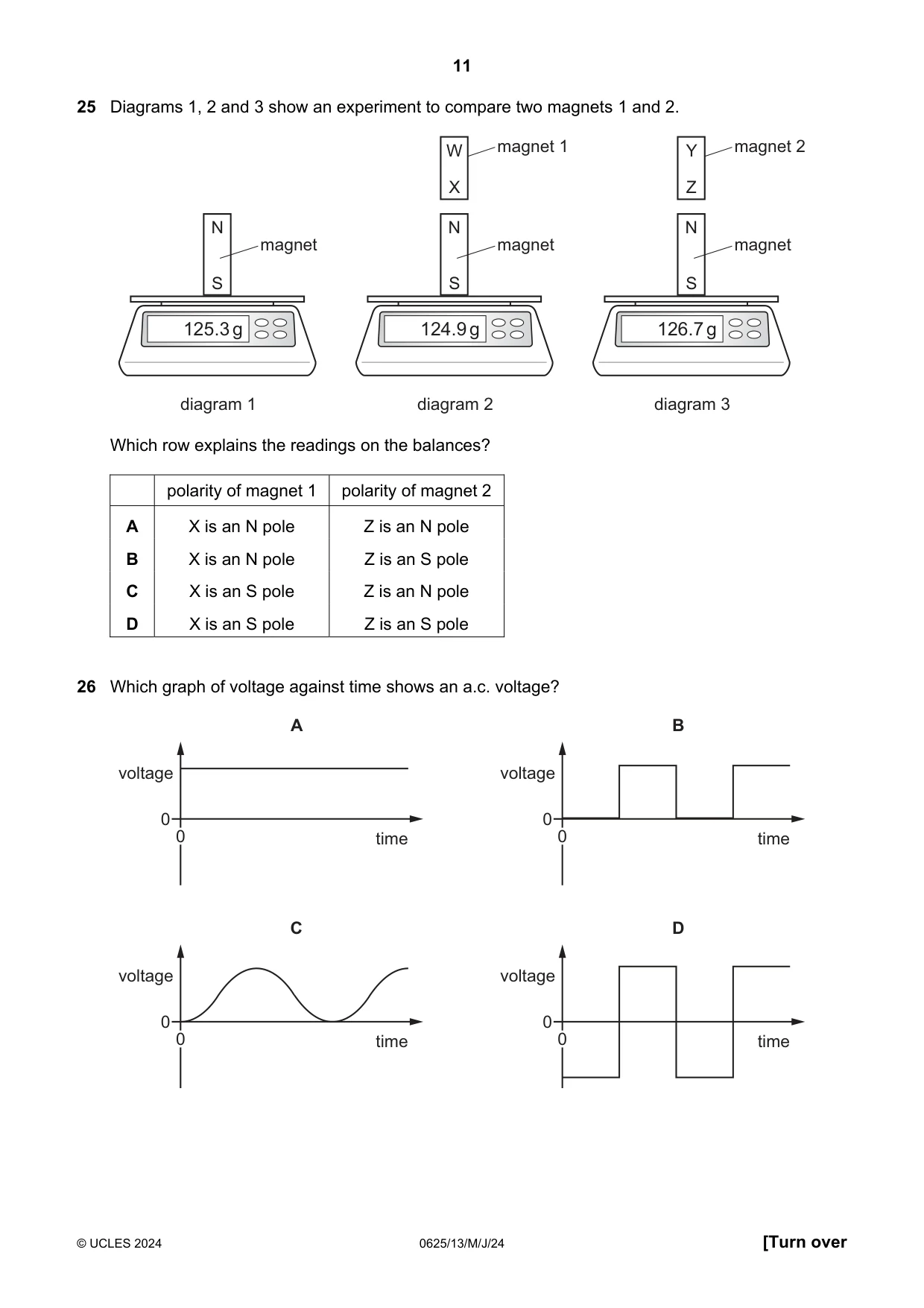
25 Diagrams 1, 2 and 3 show an experiment to compare two magnets 1 and 2. W magnet 1 Y magnet 2 X Z N N N magnet magnet magnet S S S 125.3 g 124.9 g 126.7 g diagram 1 diagram 2 diagram 3 Which row explains the readings on the balances? polarity of magnet 1 polarity of magnet 2 A X is an N pole Z is an N pole B X is an N pole Z is an S pole C X is an S pole Z is an N pole D X is an S pole Z is an S pole
Mark scheme: C
Q26 · Which graph of voltage against time shows an a.c
26 Which graph of voltage against time shows an a.c. voltage? A B voltage voltage 0 0 0 time 0 time C D voltage voltage 0 0 0 time 0 time
Mark scheme: D
Q27 · There is a current I in a resistor for a time t
27 There is a current I in a resistor for a time t. The potential difference (p.d) across the resistor is V. What does the product IVt represent? A the charge flowing through the resistor B the energy transferred by the resistor C the power dissipated by the resistor D the resistance of the resistor
Mark scheme: B
Q28 · A student designs a circuit to turn on a fan when the temperature increases
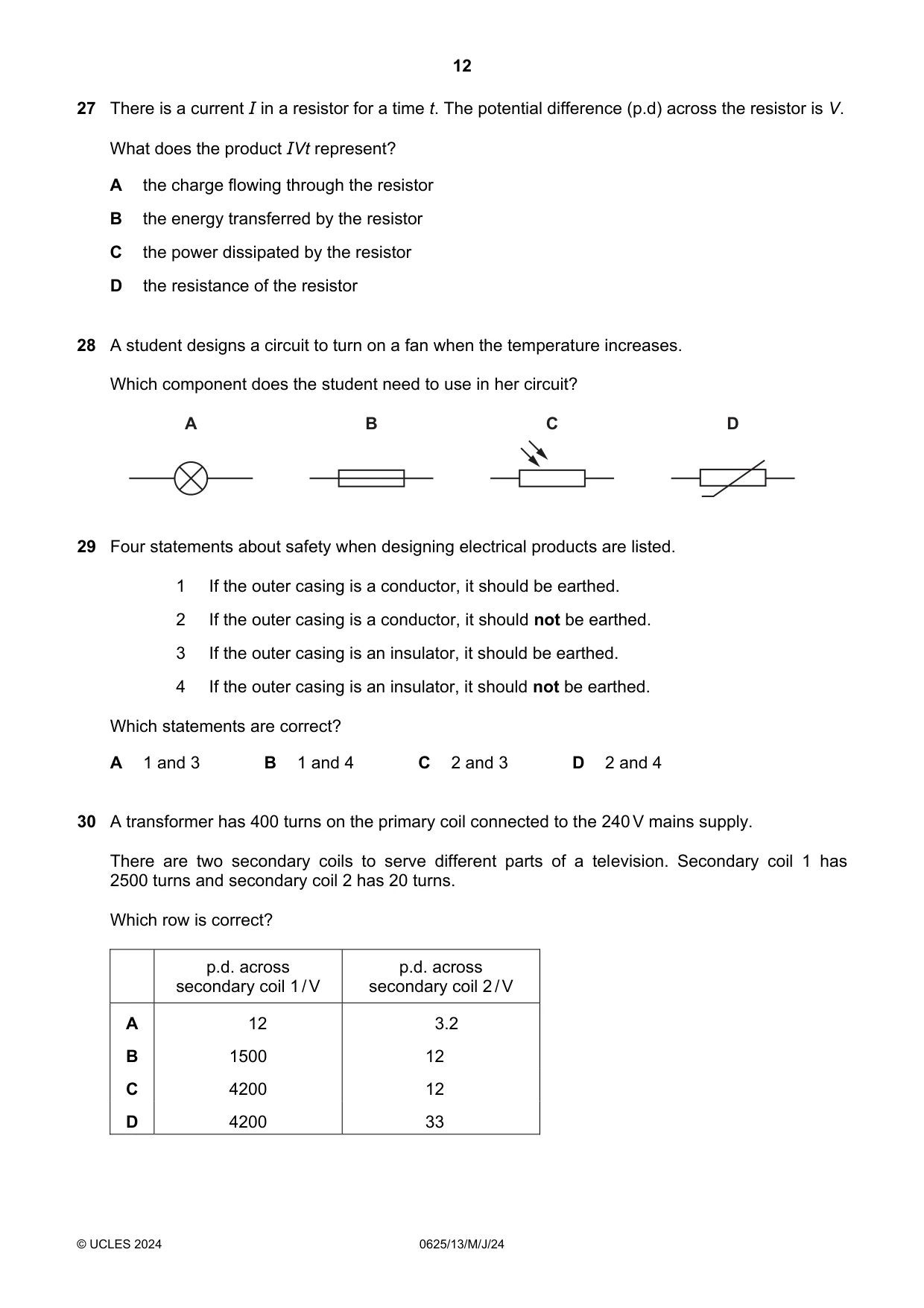
28 A student designs a circuit to turn on a fan when the temperature increases. Which component does the student need to use in her circuit? A B C D
Mark scheme: D
Q29 · Four statements about safety when designing electrical products are listed
29 Four statements about safety when designing electrical products are listed. 1 If the outer casing is a conductor, it should be earthed. 2 If the outer casing is a conductor, it should not be earthed. 3 If the outer casing is an insulator, it should be earthed. 4 If the outer casing is an insulator, it should not be earthed. Which statements are correct? A 1 and 3 B 1 and 4 C 2 and 3 D 2 and 4
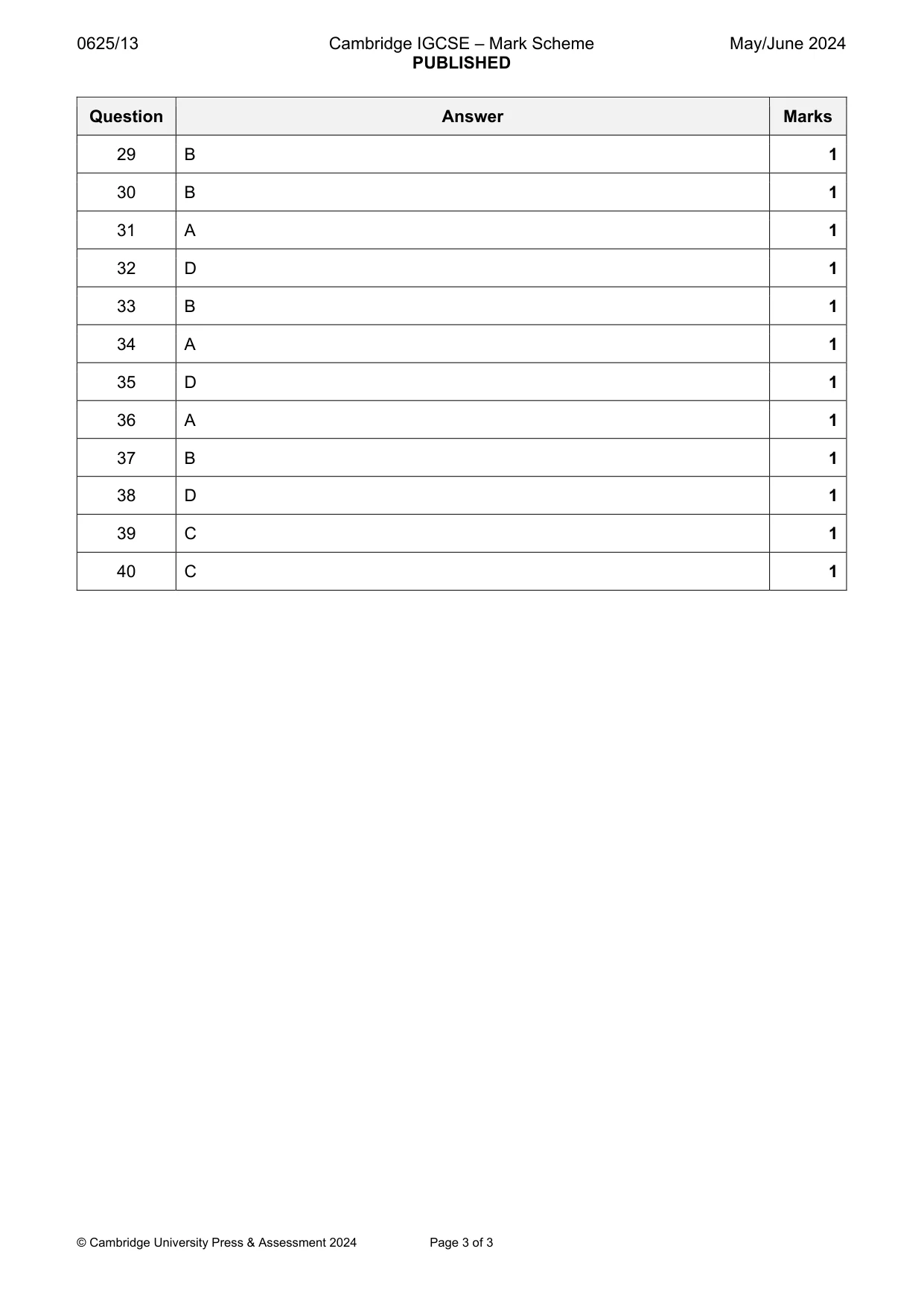
Mark scheme: B
Q30 · A transformer has 400 turns on the primary coil connected to the 240 V mains supply
30 A transformer has 400 turns on the primary coil connected to the 240 V mains supply. There are two secondary coils to serve different parts of a television. Secondary coil 1 has 2500 turns and secondary coil 2 has 20 turns. Which row is correct? p.d. across p.d. across secondary coil 1 / V secondary coil 2 / V A 12 3.2 B 1500 12 C 4200 12 D 4200 33
Mark scheme: B
Q31 · A class is designing a d.c
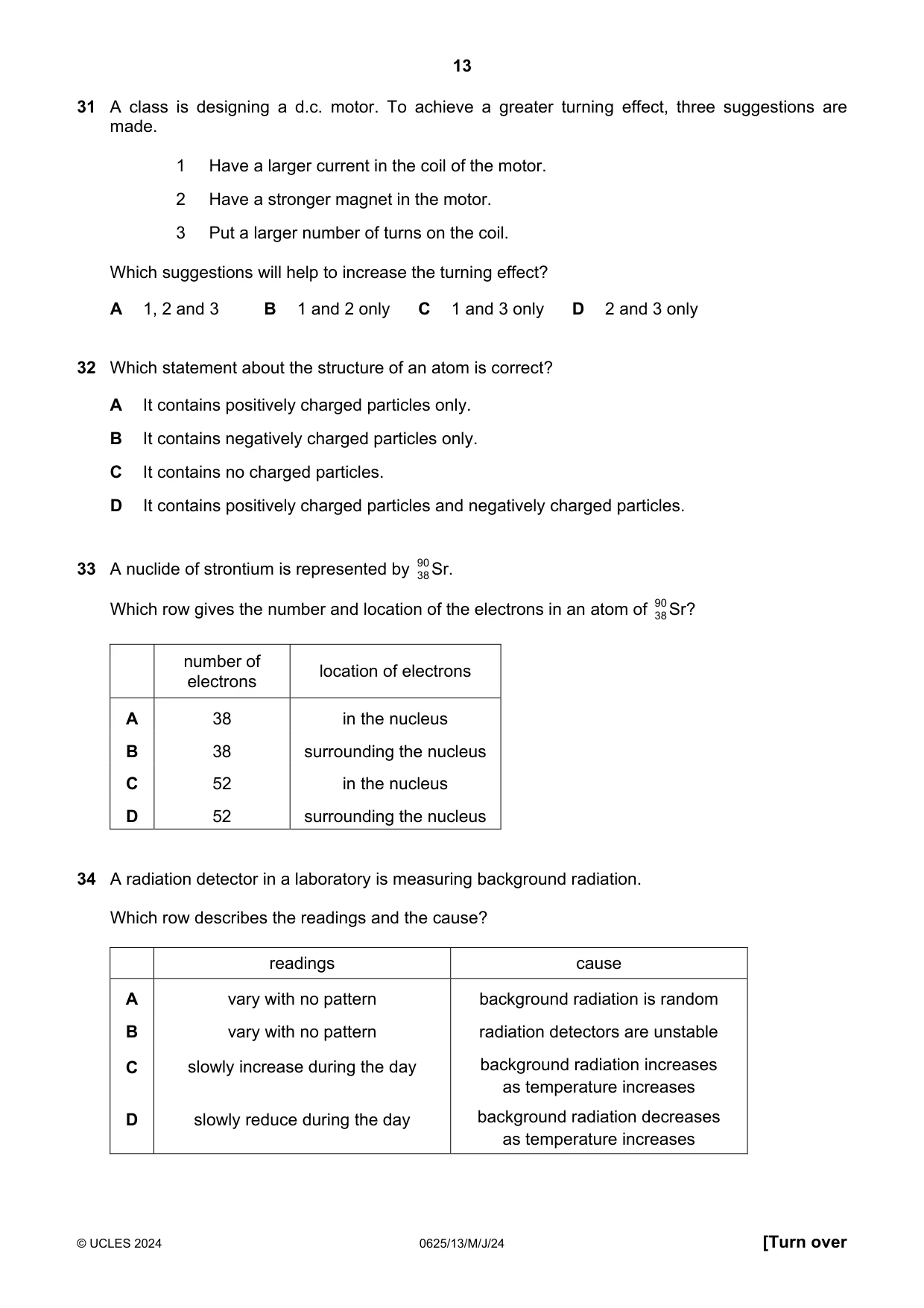
31 A class is designing a d.c. motor. To achieve a greater turning effect, three suggestions are made. 1 Have a larger current in the coil of the motor. 2 Have a stronger magnet in the motor. 3 Put a larger number of turns on the coil. Which suggestions will help to increase the turning effect? A 1, 2 and 3 B 1 and 2 only C 1 and 3 only D 2 and 3 only
Mark scheme: A
Q32 · Which statement about the structure of an atom is correct?
32 Which statement about the structure of an atom is correct? A It contains positively charged particles only. B It contains negatively charged particles only. C It contains no charged particles. D It contains positively charged particles and negatively charged particles.
Mark scheme: D
Q33 · A nuclide of strontium is represented by 90 Sr
33 A nuclide of strontium is represented by 90 Sr. 38 Which row gives the number and location of the electrons in an atom of 90 Sr? 38 number of location of electrons electrons A 38 in the nucleus B 38 surrounding the nucleus C 52 in the nucleus D 52 surrounding the nucleus
Mark scheme: B
Q34 · A radiation detector in a laboratory is measuring background radiation
34 A radiation detector in a laboratory is measuring background radiation. Which row describes the readings and the cause? readings cause A vary with no pattern background radiation is random B vary with no pattern radiation detectors are unstable C slowly increase during the day background radiation increases as temperature increases D slowly reduce during the day background radiation decreases as temperature increases
Mark scheme: A
Q35 · The nuclei of the atoms in a substance are changing randomly and emitting radiation
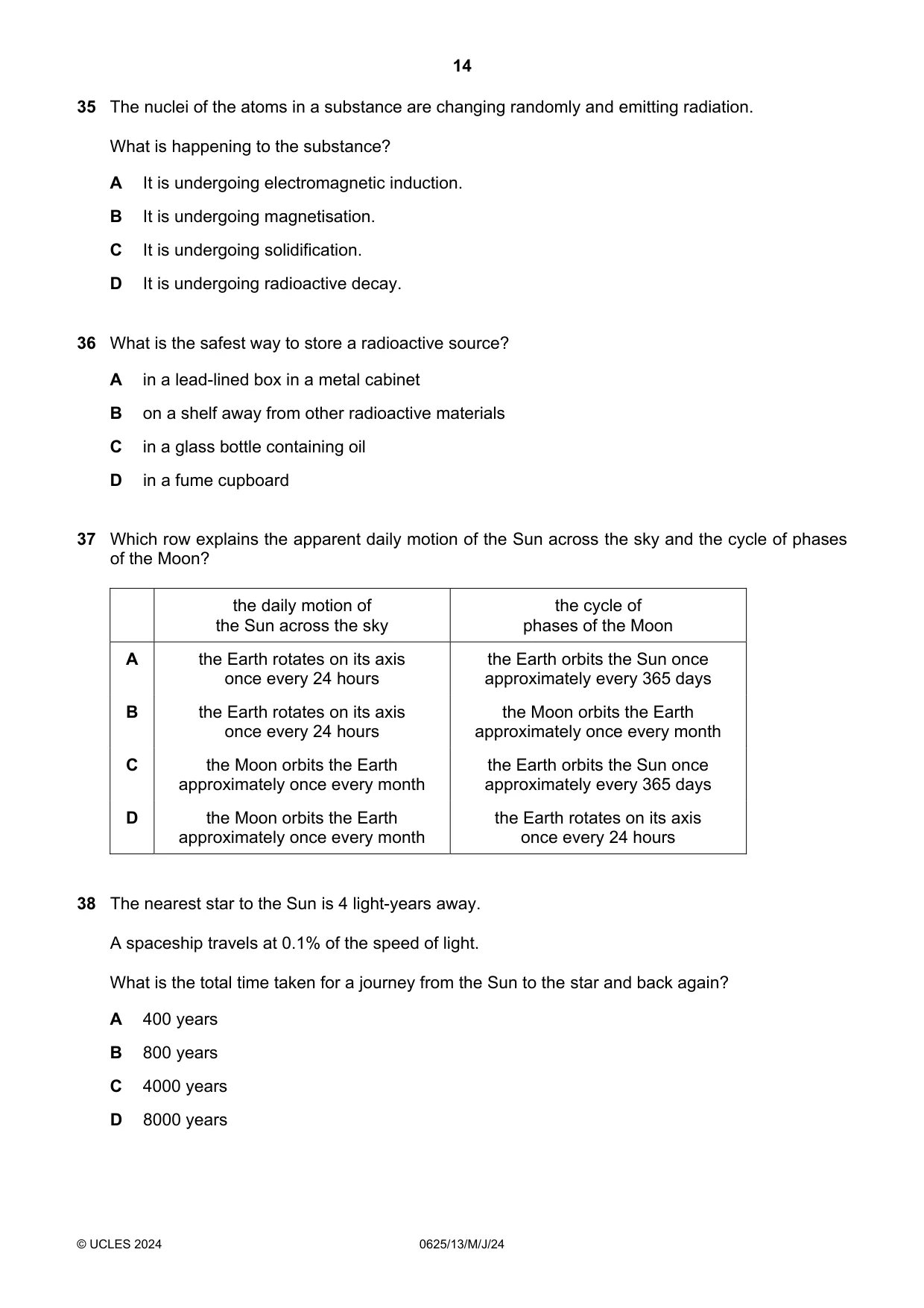
35 The nuclei of the atoms in a substance are changing randomly and emitting radiation. What is happening to the substance? A It is undergoing electromagnetic induction. B It is undergoing magnetisation. C It is undergoing solidification. D It is undergoing radioactive decay.
Mark scheme: D
Q36 · What is the safest way to store a radioactive source?
36 What is the safest way to store a radioactive source? A in a lead-lined box in a metal cabinet B on a shelf away from other radioactive materials C in a glass bottle containing oil D in a fume cupboard
Mark scheme: A
Q37 · Which row explains the apparent daily motion of the Sun across the sky and the cycle of…
37 Which row explains the apparent daily motion of the Sun across the sky and the cycle of phases of the Moon? the daily motion of the cycle of the Sun across the sky phases of the Moon A the Earth rotates on its axis the Earth orbits the Sun once once every 24 hours approximately every 365 days B the Earth rotates on its axis the Moon orbits the Earth once every 24 hours approximately once every month C the Moon orbits the Earth the Earth orbits the Sun once approximately once every month approximately every 365 days D the Moon orbits the Earth the Earth rotates on its axis approximately once every month once every 24 hours
Mark scheme: B
Q38 · The nearest star to the Sun is 4 light-years away
38 The nearest star to the Sun is 4 light-years away. A spaceship travels at 0.1% of the speed of light. What is the total time taken for a journey from the Sun to the star and back again? A 400 years B 800 years C 4000 years D 8000 years
Mark scheme: D
Q39 · In which regions of the electromagnetic spectrum does the Sun radiate most of its energy?
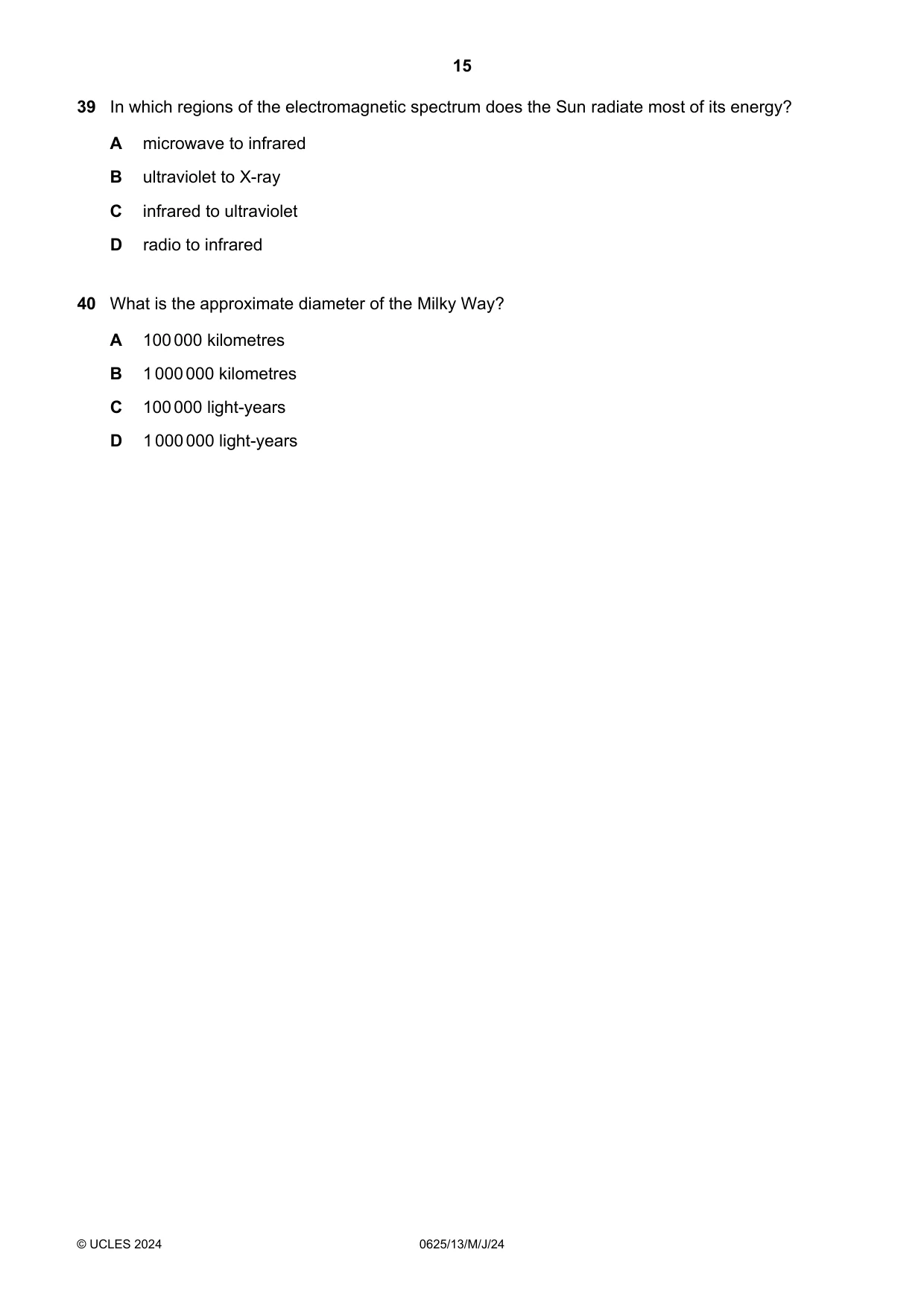
39 In which regions of the electromagnetic spectrum does the Sun radiate most of its energy? A microwave to infrared B ultraviolet to X-ray C infrared to ultraviolet D radio to infrared
Mark scheme: C
Q40 · What is the approximate diameter of the Milky Way?
40 What is the approximate diameter of the Milky Way? A 100 000 kilometres B 1 000 000 kilometres C 100 000 light-years D 1 000 000 light-years
Mark scheme: C
What was in this paper
The subtopics covered by these 40 questions, and how many questions each got. Open one in a new tab to see every Cambridge question on it.
3Stars and the Universe3Thermal properties and temperature3Electrical quantities2Electromagnetic effects2Electromagnetic spectrum2General properties of waves2Kinetic particle model of matter2Light2Motion2Simple phenomena of magnetism2Sound2The nuclear model of the atom2Transfer of thermal energy2Density1Electric circuits1Electrical safety1Energy, work and power1Forces1Mass and weight1Physical quantities and measurement techniques1Pressure1The Earth and the Solar System1What you needed in this session
Cambridge’s own grade thresholds for 2024 May/June, Paper 1 · Variant 3. A higher threshold means an easier paper — the bar moves with how the cohort did.