Questions as text
Q1 · A fire alarm is not loud enough 0625/11 May/June 2005
24 A fire alarm is not loud enough. An engineer adjusts it so that it produces a note of the same pitch which is louder. What effect does this have on the amplitude and on the frequency of the sound? amplitude frequency A larger larger B larger same C same larger D same same
1 marks
Answer: B
This question in 0625/11 May/June 2005
Q2 · To estimate the width of a valley, a climber starts a stopwatch as he shouts 0625/11 May/June 2005
25 To estimate the width of a valley, a climber starts a stopwatch as he shouts. He hears an echo from the opposite side of the valley after 1.0 s. sound climber valley The sound travels at 340 m / s. What is the width of the valley? A 85 m B 170 m C 340 m D 680 m
1 marks
Answer: B
This question in 0625/11 May/June 2005
Q3 · The diagrams show four sources of waves 0625/11 Oct/Nov 2005
19 The diagrams show four sources of waves. Which source generates longitudinal waves? A B C D stick pushed up radio loudspeaker lamp and down in water transmitter
1 marks
Answer: C
This question in 0625/11 Oct/Nov 2005
Q4 · Two astronauts without radios can only communicate in space if their helmets are touching 0625/11 Oct/Nov 2005
24 Two astronauts without radios can only communicate in space if their helmets are touching. There is no air in space. What does this show about sound? through a solid through a vacuum A can travel can travel B can travel cannot travel C cannot travel can travel D cannot travel cannot travel
1 marks
Answer: B
This question in 0625/11 Oct/Nov 2005
Q5 · When the horn on a ship is sounded, the passengers hear an echo from a cliff after 4.0 s 0625/11 Oct/Nov 2005
25 When the horn on a ship is sounded, the passengers hear an echo from a cliff after 4.0 s. If the speed of sound is 340 m / s, how far away is the cliff? A 170 m B 340 m C 680 m D 1360 m
1 marks
Answer: C
This question in 0625/11 Oct/Nov 2005
Q6 · The diagram shows a man standing at X who shouts to a man standing at Y 0625/11 May/June 2006
24 The diagram shows a man standing at X who shouts to a man standing at Y. X N W E S Y The man’s voice will be heard sooner and more clearly if the wind is blowing towards the A north. B south. C east. D west.
1 marks
Answer: B
This question in 0625/11 May/June 2006
Q7 · Sounds are made by vibrating objects 0625/11 May/June 2006
25 Sounds are made by vibrating objects. A certain object vibrates but a person nearby cannot hear any sound. Which statement might explain why nothing is heard? A The amplitude of the sound waves is too large. B The frequency of the vibration is too high. C The sound waves are transverse. D The speed of the sound waves is too high.
1 marks
Answer: B
This question in 0625/11 May/June 2006
Q8 · Music is produced by the loudspeaker of a radio 0625/11 May/June 2007
23 Music is produced by the loudspeaker of a radio. Which property of the sound wave increases when the music is made louder? A amplitude B frequency C speed D wavelength
1 marks
Answer: A
This question in 0625/11 May/June 2007
Q9 · A starting pistol is fired 640 m away from a spectator 0625/11 May/June 2007
24 A starting pistol is fired 640 m away from a spectator. 640 m spectator The spectator hears the sound of the starting pistol two seconds after seeing the flash from the gun. What is the speed of sound in air? A 160 m / s B 320 m / s C 640 m / s D 1280 m / s
1 marks
Answer: B
This question in 0625/11 May/June 2007
Q10 · A tennis player hits a ball hard and 0.4 s later hears an echo from a wall 0625/11 Oct/Nov 2007
3 A tennis player hits a ball hard and 0.4 s later hears an echo from a wall. The speed of sound in air is 330 m / s. How far away is the player from the wall? A 66 m B 132 m C 264 m D 825 m
1 marks
Answer: A
This question in 0625/11 Oct/Nov 2007
Q11 · Which line gives an example of a longitudinal wave and describes its vibrations? 0625/11 Oct/Nov 2007
20 Which line gives an example of a longitudinal wave and describes its vibrations? example of a vibrations longitudinal wave A light wave at right angles to the direction the wave travels B Iight wave in the same direction as the wave travels C sound wave at right angles to the direction the wave travels D sound wave in the same direction as the wave travels
1 marks
Answer: D
This question in 0625/11 Oct/Nov 2007
Q12 · A girl stands at a distance from a large building 0625/11 Oct/Nov 2007
24 A girl stands at a distance from a large building. She claps her hands and a short time later hears an echo. Why is an echo produced when the sound waves hit the building? A The sound waves are absorbed. B The sound waves are diffracted. C The sound waves are reflected. D The sound waves are refracted.
1 marks
Answer: C
This question in 0625/11 Oct/Nov 2007
Q13 · The graph represents a sound wave 0625/11 Oct/Nov 2007
25 The graph represents a sound wave. The horizontal (x) axis represents time. y x The frequency of the sound is increased. The graphs below are shown to the same scale. Which graph represents the new sound wave? A B y y x x C D y y x x
1 marks
Answer: A
This question in 0625/11 Oct/Nov 2007
Q14 · Which equation can be used to calculate the speed of sound? 0625/11 May/June 2008
25 Which equation can be used to calculate the speed of sound? distance A speed = time B speed = distance × time time C speed = distance D speed = time + distance
1 marks
Answer: A
This question in 0625/11 May/June 2008
Q15 · A battery-operated bell is surrounded by a box with double walls 0625/11 May/June 2008
26 A battery-operated bell is surrounded by a box with double walls. air bell box walls gap The bell is ringing but no sound at all is heard outside the box. What is in the gap? A a solid B a liquid C a gas D a vacuum
1 marks
Answer: D
This question in 0625/11 May/June 2008
Q16 · Which word correctly completes the sentence below? 0625/11 Oct/Nov 2008
24 Which word correctly completes the sentence below? An echo is a sound wave which is ………… by a large obstacle. A absorbed B dispersed C reflected D refracted
1 marks
Answer: C
This question in 0625/11 Oct/Nov 2008
Q17 · In an experiment to measure the speed of sound, a student uses a stopwatch to find how… 0625/11 Oct/Nov 2008
25 In an experiment to measure the speed of sound, a student uses a stopwatch to find how long a sound takes to travel from X to Y. She does this six times. sound travels from X to Y X Y The table shows her results. time / s first 0.5 second 0.7 third 0.6 fourth 0.4 fifth 0.9 sixth 0.5 What value for the time should be used to calculate the speed of sound? A 0.4 s B 0.5 s C 0.6 s D 0.9 s
1 marks
Answer: C
This question in 0625/11 Oct/Nov 2008
Q18 · The diagrams show examples of wave motion 0625/11 May/June 2009
20 The diagrams show examples of wave motion. 1 2 ripple tank drum waves on water waves in air 3 4 waves on a rope waves in a spring (as shown) Which are longitudinal waves? A 1 only B 1, 2 and 4 C 2 and 3 only D 2 and 4 only
1 marks
Answer: D
This question in 0625/11 May/June 2009
Q19 · An engineer standing at P sees an explosion at X 0625/11 May/June 2009
24 An engineer standing at P sees an explosion at X. P Z Y DANGER - X BLASTING V W After the explosion, she hears two bangs. One bang is heard a fraction of a second after the other. The second bang is an echo. From which surface has the sound reflected to cause this echo? A XY B PV C ZY D WX
1 marks
Answer: C
This question in 0625/11 May/June 2009
Q20 · The diagram shows a microphone being used in an interview 0625/11 Oct/Nov 2009
9 The diagram shows a microphone being used in an interview. microphone Which energy change takes place in the microphone? input energy output energy A chemical electrical B electrical chemical C electrical sound D sound electrical
1 marks
Answer: D
This question in 0625/11 Oct/Nov 2009
Q21 · Sound waves travel from a point X to another point Y 0625/11 Oct/Nov 2009
20 Sound waves travel from a point X to another point Y. X Y Which diagram represents the movement of the air molecules, caused by the sound waves, in the region between X and Y. A B C D X Y
1 marks
Answer: B
This question in 0625/11 Oct/Nov 2009
Q22 · Which range of frequencies typically can be heard by a 10 year-old child? 0625/11 Oct/Nov 2009
23 Which range of frequencies typically can be heard by a 10 year-old child? A 20 Hz – 2000 Hz B 20 Hz – 20 000 Hz C 200 Hz – 2000 Hz D 200 Hz – 20 000 Hz
1 marks
Answer: B
This question in 0625/11 Oct/Nov 2009
Q23 · Astronaut 1 uses a hammer to mend a satellite in space 0625/11 Oct/Nov 2009
24 Astronaut 1 uses a hammer to mend a satellite in space. Astronaut 2 is nearby. There is no air in space. hammer astronaut 1 astronaut 2 Compared with the sound heard if they were working on Earth, what does astronaut 2 hear? A a louder sound B a quieter sound C a sound of the same loudness D no sound at all
1 marks
Answer: D
This question in 0625/11 Oct/Nov 2009
Q24 · The diagram shows a microphone being used in an interview 0625/12 Oct/Nov 2009
10 The diagram shows a microphone being used in an interview. microphone Which energy change takes place in the microphone? input energy output energy A chemical electrical B electrical chemical C electrical sound D sound electrical
1 marks
Answer: D
This question in 0625/12 Oct/Nov 2009
Q25 · Which range of frequencies typically can be heard by a 10 year-old child? 0625/12 Oct/Nov 2009
19 Which range of frequencies typically can be heard by a 10 year-old child? A 20 Hz – 2000 Hz B 20 Hz – 20 000 Hz C 200 Hz – 2000 Hz D 200 Hz – 20 000 Hz
1 marks
Answer: B
This question in 0625/12 Oct/Nov 2009
Q26 · Astronaut 1 uses a hammer to mend a satellite in space 0625/12 Oct/Nov 2009
20 Astronaut 1 uses a hammer to mend a satellite in space. Astronaut 2 is nearby. There is no air in space. hammer astronaut 1 astronaut 2 Compared with the sound heard if they were working on Earth, what does astronaut 2 hear? A a louder sound B a quieter sound C a sound of the same loudness D no sound at all
1 marks
Answer: D
This question in 0625/12 Oct/Nov 2009
Q27 · Sound waves travel from a point X to another point Y 0625/12 Oct/Nov 2009
22 Sound waves travel from a point X to another point Y. X Y Which diagram represents the movement of the air molecules, caused by the sound waves, in the region between X and Y. A B C D X Y
1 marks
Answer: B
This question in 0625/12 Oct/Nov 2009
Q28 · Which waves are longitudinal? 0625/11 May/June 2010
20 Which waves are longitudinal? A B C D 88:88 light waves microwaves sound waves water waves from a lamp in an oven from a trumpet on a pond
1 marks
Answer: C
This question in 0625/11 May/June 2010
Q29 · What is the approximate value of the highest frequency that can be heard by a young… 0625/11 May/June 2010
24 What is the approximate value of the highest frequency that can be heard by a young person? A 20 Hz B 200 Hz C 2000 Hz D 20 000 Hz
1 marks
Answer: D
This question in 0625/11 May/June 2010
Q30 · A police car siren emits two different sounds P and Q 0625/11 May/June 2010
25 A police car siren emits two different sounds P and Q. These are produced alternately. The diagram represents the sounds emitted. P P P displacement Q Q time Which sound is the louder and which has the lower pitch? louder lower pitch A P P B P Q C Q P D Q Q
1 marks
Answer: A
This question in 0625/11 May/June 2010
Q31 · Which waves are longitudinal? 0625/12 May/June 2010
20 Which waves are longitudinal? A B C D 88:88 light waves microwaves sound waves water waves from a lamp in an oven from a trumpet on a pond
1 marks
Answer: C
This question in 0625/12 May/June 2010
Q32 · A police car siren emits two different sounds P and Q 0625/12 May/June 2010
21 A police car siren emits two different sounds P and Q. These are produced alternately. The diagram represents the sounds emitted. P P P displacement Q Q time Which sound is the louder and which has the lower pitch? louder lower pitch A P P B P Q C Q P D Q Q
1 marks
Answer: A
This question in 0625/12 May/June 2010
Q33 · What is the approximate value of the highest frequency that can be heard by a young… 0625/12 May/June 2010
22 What is the approximate value of the highest frequency that can be heard by a young person? A 20 Hz B 200 Hz C 2000 Hz D 20 000 Hz
1 marks
Answer: D
This question in 0625/12 May/June 2010
Q34 · The diagrams represent two different sound waves 0625/11 Oct/Nov 2010
24 The diagrams represent two different sound waves. wave P wave Q displacement displacement time time How do the frequency and pitch of P compare with the frequency and pitch of Q? frequency of P pitch of P A greater than Q higher than Q B greater than Q same as Q C same as Q higher than Q D same as Q same as Q
1 marks
Answer: D
This question in 0625/11 Oct/Nov 2010
Q35 · A ship sends a pulse of sound vertically downwards to the sea bed 0625/11 Oct/Nov 2010
25 A ship sends a pulse of sound vertically downwards to the sea bed. An echo is heard 0.4 seconds later. If the speed of sound in the water is 1200 m / s, how deep is the water below the ship? A 240 m B 480 m C 1500 m D 3000 m
1 marks
Answer: A
This question in 0625/11 Oct/Nov 2010
Q36 · A ship sends a pulse of sound vertically downwards to the sea bed 0625/12 Oct/Nov 2010
23 A ship sends a pulse of sound vertically downwards to the sea bed. An echo is heard 0.4 seconds later. If the speed of sound in the water is 1200 m / s, how deep is the water below the ship? A 240 m B 480 m C 1500 m D 3000 m
1 marks
Answer: A
This question in 0625/12 Oct/Nov 2010
Q37 · The diagrams represent two different sound waves 0625/12 Oct/Nov 2010
24 The diagrams represent two different sound waves. wave P wave Q displacement displacement time time How do the frequency and pitch of P compare with the frequency and pitch of Q? frequency of P pitch of P A greater than Q higher than Q B greater than Q same as Q C same as Q higher than Q D same as Q same as Q
1 marks
Answer: D
This question in 0625/12 Oct/Nov 2010
Q38 · The diagrams represent two different sound waves 0625/13 Oct/Nov 2010
21 The diagrams represent two different sound waves. wave P wave Q displacement displacement time time How do the frequency and pitch of P compare with the frequency and pitch of Q? frequency of P pitch of P A greater than Q higher than Q B greater than Q same as Q C same as Q higher than Q D same as Q same as Q
1 marks
Answer: D
This question in 0625/13 Oct/Nov 2010
Q39 · A ship sends a pulse of sound vertically downwards to the sea bed 0625/13 Oct/Nov 2010
22 A ship sends a pulse of sound vertically downwards to the sea bed. An echo is heard 0.4 seconds later. If the speed of sound in the water is 1200 m / s, how deep is the water below the ship? A 240 m B 480 m C 1500 m D 3000 m
1 marks
Answer: A
This question in 0625/13 Oct/Nov 2010
Q40 · A tennis player hits a ball hard and 0.40 s later hears the echo from a wall 0625/11 May/June 2011
3 A tennis player hits a ball hard and 0.40 s later hears the echo from a wall. The speed of sound in air is 330 m / s. How far away is the player from the wall? A 66 m B 132 m C 264 m D 825 m
1 marks
Answer: A
This question in 0625/11 May/June 2011
Q41 · Sound travels by wave motion 0625/11 May/June 2011
23 Sound travels by wave motion. Which property of waves causes echoes? A diffraction B dispersion C reflection D refraction
1 marks
Answer: C
This question in 0625/11 May/June 2011
Q42 · A student listens to a machine that makes sounds of different frequencies 0625/11 May/June 2011
24 A student listens to a machine that makes sounds of different frequencies. He can only hear one of the sounds. Which frequency of sound is the student able to hear? A 2 Hz B 10 Hz C 2 kHz D 30 kHz
1 marks
Answer: C
This question in 0625/11 May/June 2011
Q43 · A tennis player hits a ball hard and 0.40 s later hears the echo from a wall 0625/12 May/June 2011
1 A tennis player hits a ball hard and 0.40 s later hears the echo from a wall. The speed of sound in air is 330 m / s. How far away is the player from the wall? A 66 m B 132 m C 264 m D 825 m
1 marks
Answer: A
This question in 0625/12 May/June 2011
Q44 · Sound travels by wave motion 0625/12 May/June 2011
21 Sound travels by wave motion. Which property of waves causes echoes? A diffraction B dispersion C reflection D refraction
1 marks
Answer: C
This question in 0625/12 May/June 2011
Q45 · A student listens to a machine that makes sounds of different frequencies 0625/12 May/June 2011
22 A student listens to a machine that makes sounds of different frequencies. He can only hear one of the sounds. Which frequency of sound is the student able to hear? A 2 Hz B 10 Hz C 2 kHz D 30 kHz
1 marks
Answer: C
This question in 0625/12 May/June 2011
Q46 · A tennis player hits a ball hard and 0.40 s later hears the echo from a wall 0625/13 May/June 2011
1 A tennis player hits a ball hard and 0.40 s later hears the echo from a wall. The speed of sound in air is 330 m / s. How far away is the player from the wall? A 66 m B 132 m C 264 m D 825 m
1 marks
Answer: A
This question in 0625/13 May/June 2011
Q47 · Sound travels by wave motion 0625/13 May/June 2011
21 Sound travels by wave motion. Which property of waves causes echoes? A diffraction B dispersion C reflection D refraction
1 marks
Answer: C
This question in 0625/13 May/June 2011
Q48 · A student listens to a machine that makes sounds of different frequencies 0625/13 May/June 2011
22 A student listens to a machine that makes sounds of different frequencies. He can only hear one of the sounds. Which frequency of sound is the student able to hear? A 2 Hz B 10 Hz C 2 kHz D 30 kHz
1 marks
Answer: C
This question in 0625/13 May/June 2011
Q49 · A girl notices that when she shouts into a cave she hears an echo 0625/11 Oct/Nov 2012
25 A girl notices that when she shouts into a cave she hears an echo. Which wave property causes the echo? A diffraction B dispersion C reflection D refraction
1 marks
Answer: C
This question in 0625/11 Oct/Nov 2012
Q50 · In a test, a car horn is found to be too loud and the pitch of the note is too high 0625/11 Oct/Nov 2012
26 In a test, a car horn is found to be too loud and the pitch of the note is too high. What information does this give about the amplitude and the frequency of the sound wave produced? amplitude frequency A too large too large B too large too small C too small too large D too small too small
1 marks
Answer: A
This question in 0625/11 Oct/Nov 2012
Q51 · In a test, a car horn is found to be too loud and the pitch of the note is too high 0625/12 Oct/Nov 2012
22 In a test, a car horn is found to be too loud and the pitch of the note is too high. What information does this give about the amplitude and the frequency of the sound wave produced? amplitude frequency A too large too large B too large too small C too small too large D too small too small
1 marks
Answer: A
This question in 0625/12 Oct/Nov 2012
Q52 · A girl notices that when she shouts into a cave she hears an echo 0625/12 Oct/Nov 2012
23 A girl notices that when she shouts into a cave she hears an echo. Which wave property causes the echo? A diffraction B dispersion C reflection D refraction
1 marks
Answer: C
This question in 0625/12 Oct/Nov 2012
Q53 · Sound waves may cause an echo 0625/13 Oct/Nov 2012
25 Sound waves may cause an echo. What happens to sound waves to cause an echo and what is the nature of sound waves? what an echo nature of is caused by sound waves A reflection longitudinal B reflection transverse C refraction longitudinal D refraction transverse
1 marks
Answer: A
This question in 0625/13 Oct/Nov 2012
Q54 · In a test, a car horn is found to be too loud and the pitch of the note is too high 0625/13 Oct/Nov 2012
26 In a test, a car horn is found to be too loud and the pitch of the note is too high. What information does this give about the amplitude and the frequency of the sound wave produced? amplitude frequency A too large too large B too large too small C too small too large D too small too small
1 marks
Answer: A
This question in 0625/13 Oct/Nov 2012
Q55 · The diagrams represent two sound waves 0625/11 May/June 2013
24 The diagrams represent two sound waves. The scales in the two diagrams are the same. displacement displacement time time sound wave 1 sound wave 2 Which statement describes the waves? A The waves have different loudness and different pitch. B The waves have different loudness but the same pitch. C The waves have the same loudness and the same pitch. D The waves have the same loudness but different pitch.
1 marks
Answer: D
This question in 0625/11 May/June 2013
Q56 · A student claps once when standing 100 m away from a large wall 0625/11 May/June 2013
25 A student claps once when standing 100 m away from a large wall. The speed of sound in air is 330 m / s. How long after clapping does the student hear an echo? A 0.30 s B 0.61 s C 1.7 s D 3.3 s
1 marks
Answer: B
This question in 0625/11 May/June 2013
Q57 · A tuning fork is marked with the number 320 0625/12 May/June 2013
24 A tuning fork is marked with the number 320. 320 This indicates the size of the frequency. What does this mean? A The length of the tuning fork is 320 mm. B The note from the tuning fork will last for up to 320 s. C The sound waves produced by the tuning fork travel at 320 m / s. D The tuning fork vibrates 320 times every second.
1 marks
Answer: D
This question in 0625/12 May/June 2013
Q58 · Some sound from a loudspeaker at P travels directly to Q 0625/12 May/June 2013
25 Some sound from a loudspeaker at P travels directly to Q. Sound also reaches Q after being reflected from a wall at R. loudspeaker wall P 8 m 10 m R 8 m Q The speed of sound is 330 m / s. What is the difference in time for a sound to travel from P to Q by the two routes? A 6 s B 16 C D s (6 × 330) s (16 × 330) s 330 330
1 marks
Answer: A
This question in 0625/12 May/June 2013
Q59 · The diagrams represent two sound waves 0625/13 May/June 2013
24 The diagrams represent two sound waves. The scales in the two diagrams are the same. displacement displacement time time sound wave 1 sound wave 2 Which statement describes the waves? A The waves have different loudness and different pitch. B The waves have different loudness but the same pitch. C The waves have the same loudness and the same pitch. D The waves have the same loudness but different pitch.
1 marks
Answer: D
This question in 0625/13 May/June 2013
Q60 · A student claps once when standing 100 m away from a large wall 0625/13 May/June 2013
26 A student claps once when standing 100 m away from a large wall. The speed of sound in air is 330 m / s. How long after clapping does the student hear an echo? A 0.30 s B 0.61 s C 1.7 s D 3.3 s
1 marks
Answer: B
This question in 0625/13 May/June 2013
Q61 · When the volcano Krakatoa erupted in 1883, it was heard 5000 km away 0625/11 Oct/Nov 2013
24 When the volcano Krakatoa erupted in 1883, it was heard 5000 km away. Which statement about the sound from the volcano is not correct? A If such a loud sound were to be made today, an astronaut orbiting in space (a vacuum) at a height of 400 km could hear it. B People further from the volcano heard the sound later than people nearer to the volcano. C The amplitude of the sound waves would have been smaller further from the volcano. D The sound was very loud because a lot of energy was transferred to vibrations of the air.
1 marks
Answer: A
This question in 0625/11 Oct/Nov 2013
Q62 · A loudspeaker on a boat produces a pulse of sound in the sea 0625/11 Oct/Nov 2013
25 A loudspeaker on a boat produces a pulse of sound in the sea. The echo of the pulse is received back at the boat after 3.0 s. The depth of the sea under the boat is 2250 m. boat pulse of sound sea bed (not to scale) From this information, what is the speed of sound in the sea water? A 330 m / s B 750 m / s C 1500 m / s D 6750 m / s
1 marks
Answer: C
This question in 0625/11 Oct/Nov 2013
Q63 · When the volcano Krakatoa erupted in 1883, it was heard 5000 km away 0625/12 Oct/Nov 2013
24 When the volcano Krakatoa erupted in 1883, it was heard 5000 km away. Which statement about the sound from the volcano is not correct? A If such a loud sound were to be made today, an astronaut orbiting in space (a vacuum) at a height of 400 km could hear it. B People further from the volcano heard the sound later than people nearer to the volcano. C The amplitude of the sound waves would have been smaller further from the volcano. D The sound was very loud because a lot of energy was transferred to vibrations of the air.
1 marks
Answer: A
This question in 0625/12 Oct/Nov 2013
Q64 · A loudspeaker on a boat produces a pulse of sound in the sea 0625/12 Oct/Nov 2013
25 A loudspeaker on a boat produces a pulse of sound in the sea. The echo of the pulse is received back at the boat after 3.0 s. The depth of the sea under the boat is 2250 m. boat pulse of sound sea bed (not to scale) From this information, what is the speed of sound in the sea water? A 330 m / s B 750 m / s C 1500 m / s D 6750 m / s
1 marks
Answer: C
This question in 0625/12 Oct/Nov 2013
Q65 · To estimate the width of a valley, a climber starts a stopwatch as he shouts 0625/13 Oct/Nov 2013
24 To estimate the width of a valley, a climber starts a stopwatch as he shouts. He hears an echo from the opposite side of the valley after 1.0 s. sound climber valley The sound travels at 330 m / s. What is the width of the valley? A 82.5 m B 165 m C 330 m D 660 m
1 marks
Answer: B
This question in 0625/13 Oct/Nov 2013
Q66 · A police car sounds its siren when travelling to an emergency 0625/13 Oct/Nov 2013
25 A police car sounds its siren when travelling to an emergency. The siren produces two different sounds P and Q, which are emitted alternately. The diagram represents the sound waves emitted by the siren. P P P P Q Q Q Q Which of the two sounds P and Q is the louder and which has the higher pitch? louder sound of sound higher pitch A P P B P Q C Q P D Q Q
1 marks
Answer: B
This question in 0625/13 Oct/Nov 2013
Q67 · A boy blows a whistle that has a frequency of 10 000 Hz 0625/11 May/June 2014
23 A boy blows a whistle that has a frequency of 10 000 Hz. The boy’s friend cannot hear the sound from the whistle. The friend has normal hearing. What could be a reason why he cannot hear the sound? A The amplitude is too large. B The amplitude is too small. C The frequency is too high. D The frequency is too low.
1 marks
Answer: B
This question in 0625/11 May/June 2014
Q68 · A lighted candle is placed in front of a loudspeaker that is making a loud, steady note 0625/11 May/June 2014
24 A lighted candle is placed in front of a loudspeaker that is making a loud, steady note. The candle flame vibrates because of the sound wave. candle flame loudspeaker Which type of waves are sound waves and in which direction does the flame vibrate? type of wave direction of vibration A longitudinal B transverse C longitudinal D transverse
1 marks
Answer: C
This question in 0625/11 May/June 2014
Q69 · The diagrams show the wave patterns of four sounds shown on a cathode-ray oscilloscope… 0625/12 May/June 2014
24 The diagrams show the wave patterns of four sounds shown on a cathode-ray oscilloscope (c.r.o.). The oscilloscope controls are set the same for each sound. Which sound has the highest pitch? A B C D
1 marks
Answer: A
This question in 0625/12 May/June 2014
Q70 · A lighted candle is placed in front of a loudspeaker that is making a loud, steady note 0625/12 May/June 2014
25 A lighted candle is placed in front of a loudspeaker that is making a loud, steady note. The candle flame vibrates because of the sound wave. candle flame loudspeaker Which type of waves are sound waves and in which direction does the flame vibrate? type of wave direction of vibration A longitudinal B transverse C longitudinal D transverse
1 marks
Answer: C
This question in 0625/12 May/June 2014
Q71 · A boy blows a whistle that has a frequency of 10 000 Hz 0625/13 May/June 2014
18 A boy blows a whistle that has a frequency of 10 000 Hz. The boy’s friend cannot hear the sound from the whistle. The friend has normal hearing. What could be a reason why he cannot hear the sound? A The amplitude is too large. B The amplitude is too small. C The frequency is too high. D The frequency is too low.
1 marks
Answer: B
This question in 0625/13 May/June 2014
Q72 · A lighted candle is placed in front of a loudspeaker that is making a loud, steady note 0625/13 May/June 2014
19 A lighted candle is placed in front of a loudspeaker that is making a loud, steady note. The candle flame vibrates because of the sound wave. candle flame loudspeaker Which type of waves are sound waves and in which direction does the flame vibrate? type of wave direction of vibration A longitudinal B transverse C longitudinal D transverse
1 marks
Answer: C
This question in 0625/13 May/June 2014
Q73 · Which waves are longitudinal? 0625/11 Oct/Nov 2014
22 Which waves are longitudinal? A B C D 88:88 light waves microwaves water waves sound waves from a lamp in an oven on a pond from a trumpet
1 marks
Answer: D
This question in 0625/11 Oct/Nov 2014
Q74 · A fire alarm is not loud enough and the pitch is too low 0625/11 Oct/Nov 2014
24 A fire alarm is not loud enough and the pitch is too low. An engineer adjusts the alarm so that it produces a louder note of a higher pitch. What effect does this have on the amplitude and on the frequency of the sound waves that the alarm produces? amplitude frequency A larger larger B larger smaller C smaller larger D smaller smaller
1 marks
Answer: A
This question in 0625/11 Oct/Nov 2014
Q75 · In an experiment to measure the speed of sound, a student uses a stopwatch to find the… 0625/11 Oct/Nov 2014
25 In an experiment to measure the speed of sound, a student uses a stopwatch to find the time taken for a sound wave to travel from X to Y. She does this six times. sound travels from X to Y X Y The table shows her results. measurement time / s first 0.5 second 0.7 third 0.6 fourth 0.4 fifth 0.9 sixth 0.5 Which value for the time should be used to calculate the speed of sound? A 0.4 s B 0.5 s C 0.6 s D 0.9 s
1 marks
Answer: C
This question in 0625/11 Oct/Nov 2014
Q76 · Which waves are longitudinal? 0625/12 Oct/Nov 2014
26 Which waves are longitudinal? A B C D 88:88 light waves microwaves water waves sound waves from a lamp in an oven on a pond from a trumpet
1 marks
Answer: D
This question in 0625/12 Oct/Nov 2014
Q77 · In an experiment to measure the speed of sound, a student uses a stopwatch to find the… 0625/12 Oct/Nov 2014
29 In an experiment to measure the speed of sound, a student uses a stopwatch to find the time taken for a sound wave to travel from X to Y. She does this six times. sound travels from X to Y X Y The table shows her results. measurement time / s first 0.5 second 0.7 third 0.6 fourth 0.4 fifth 0.9 sixth 0.5 Which value for the time should be used to calculate the speed of sound? A 0.4 s B 0.5 s C 0.6 s D 0.9 s
1 marks
Answer: C
This question in 0625/12 Oct/Nov 2014
Q78 · A fire alarm is not loud enough and the pitch is too low 0625/12 Oct/Nov 2014
31 A fire alarm is not loud enough and the pitch is too low. An engineer adjusts the alarm so that it produces a louder note of a higher pitch. What effect does this have on the amplitude and on the frequency of the sound waves that the alarm produces? amplitude frequency A larger larger B larger smaller C smaller larger D smaller smaller
1 marks
Answer: A
This question in 0625/12 Oct/Nov 2014
Q79 · Which waves are longitudinal? 0625/13 Oct/Nov 2014
22 Which waves are longitudinal? A B C D 88:88 light waves microwaves water waves sound waves from a lamp in an oven on a pond from a trumpet
1 marks
Answer: D
This question in 0625/13 Oct/Nov 2014
Q80 · Three vibrating objects P, Q and R produce waves in the air of different frequencies as… 0625/13 Oct/Nov 2014
24 Three vibrating objects P, Q and R produce waves in the air of different frequencies as shown. object frequency / Hz P 25 Q 1000 R 15 000 Which of these waves can be heard by a human ear? A P, Q and R B P and Q only C P and R only D Q and R only
1 marks
Answer: A
This question in 0625/13 Oct/Nov 2014
Q81 · In an experiment to measure the speed of sound, a student uses a stopwatch to find the… 0625/13 Oct/Nov 2014
25 In an experiment to measure the speed of sound, a student uses a stopwatch to find the time taken for a sound wave to travel from X to Y. She does this six times. sound travels from X to Y X Y The table shows her results. measurement time / s first 0.5 second 0.7 third 0.6 fourth 0.4 fifth 0.9 sixth 0.5 Which value for the time should be used to calculate the speed of sound? A 0.4 s B 0.5 s C 0.6 s D 0.9 s
1 marks
Answer: C
This question in 0625/13 Oct/Nov 2014
Q82 · What is the approximate range of audible sound frequencies for a human with good hearing? 0625/12 Feb/March 2015
23 What is the approximate range of audible sound frequencies for a human with good hearing? A from 20 Hz to 2000 Hz B from 20 Hz to 20 000 Hz C from 200 Hz to 20 000 Hz D from 200 Hz to 200 000 Hz
1 marks
Answer: B
This question in 0625/12 Feb/March 2015
Q83 · A pulse of sound is produced at the bottom of a boat 0625/12 Feb/March 2015
24 A pulse of sound is produced at the bottom of a boat. The sound travels through the water and is reflected from the sea-bed. The sound reaches the boat again after 1.3 s. The sea-bed is 1000 m below the boat. boat 1000 m sea-bed Using this information, what is the speed of sound in the water? A 769 m / s B 1300 m / s C 1538 m / s D 2600 m / s
1 marks
Answer: C
This question in 0625/12 Feb/March 2015
Q84 · Which row states two properties of sound waves? 0625/11 May/June 2015
23 Which row states two properties of sound waves? can travel through type of wave A a vacuum longitudinal B a vacuum transverse C water longitudinal D water transverse
1 marks
Answer: C
This question in 0625/11 May/June 2015
Q85 · A man holding a starting pistol stands 640 m away from a spectator 0625/11 May/June 2015
24 A man holding a starting pistol stands 640 m away from a spectator. 640 m spectator The spectator hears the sound of the starting pistol 2.0 s after seeing the flash from the pistol. Using this information, what is the speed of sound in air? A 160 m / s B 320 m / s C 640 m / s D 1280 m / s
1 marks
Answer: B
This question in 0625/11 May/June 2015
Q86 · A quiet sound is produced by a loudspeaker 0625/12 May/June 2015
23 A quiet sound is produced by a loudspeaker. The loudness of the sound is increased. Which property of the sound wave is increased? A amplitude B frequency C speed D wavelength
1 marks
Answer: A
This question in 0625/12 May/June 2015
Q87 · A man holding a starting pistol stands 640 m away from a spectator 0625/12 May/June 2015
24 A man holding a starting pistol stands 640 m away from a spectator. 640 m spectator The spectator hears the sound of the starting pistol 2.0 s after seeing the flash from the pistol. Using this information, what is the speed of sound in air? A 160 m / s B 320 m / s C 640 m / s D 1280 m / s
1 marks
Answer: B
This question in 0625/12 May/June 2015
Q88 · The frequency of a musical note is increased 0625/13 May/June 2015
23 The frequency of a musical note is increased. A student hearing the sound detects an increase in which property? A loudness of the sound B pitch of the sound C speed of the sound wave D wavelength of the sound wave
1 marks
Answer: B
This question in 0625/13 May/June 2015
Q89 · A man holding a starting pistol stands 640 m away from a spectator 0625/13 May/June 2015
24 A man holding a starting pistol stands 640 m away from a spectator. 640 m spectator The spectator hears the sound of the starting pistol 2.0 s after seeing the flash from the pistol. Using this information, what is the speed of sound in air? A 160 m / s B 320 m / s C 640 m / s D 1280 m / s
1 marks
Answer: B
This question in 0625/13 May/June 2015
Q90 · A tennis player hits a ball hard and 0.40 s later hears the echo from a wall 0625/14 May/June 2015
3 A tennis player hits a ball hard and 0.40 s later hears the echo from a wall. The speed of sound in air is 330 m / s. How far away is the player from the wall? A 66 m B 132 m C 264 m D 825 m
1 marks
Answer: A
This question in 0625/14 May/June 2015
Q91 · In the experiment shown, the bell is heard ringing 0625/14 May/June 2015
24 In the experiment shown, the bell is heard ringing. The air is gradually pumped out of the jar. No change is made to the ringing bell. air pump rubber bands bell glass jar After a few minutes the bell can no longer be heard. Why is this? A The amplitude of vibration of the bell decreases. B The frequency of vibration of the bell increases. C The sound waves from the bell become transverse. D The sound waves need a medium to travel through.
1 marks
Answer: D
This question in 0625/14 May/June 2015
Q92 · What can be heard by the human ear? 0625/14 May/June 2015
25 What can be heard by the human ear? A a whistle emitting a wave of frequency 50 kHz B a bat emitting a wave of frequency 30 kHz C an insect emitting a wave of frequency 300 Hz D a vibrating spring emitting a wave of frequency 5 Hz
1 marks
Answer: C
This question in 0625/14 May/June 2015
Q93 · Which row states whether light waves and whether sound waves can travel in a vacuum? 0625/11 Oct/Nov 2015
23 Which row states whether light waves and whether sound waves can travel in a vacuum? sound waves light waves A no no B no yes C yes no D yes yes
1 marks
Answer: B
This question in 0625/11 Oct/Nov 2015
Q94 · Sounds are produced by vibrating objects 0625/11 Oct/Nov 2015
24 Sounds are produced by vibrating objects. A certain object vibrates but a person nearby cannot hear any sound. Which statement could explain why nothing is heard? A The amplitude of the sound waves is too large. B The frequency of the vibration is too high. C The sound waves are transverse. D The speed of the sound waves is too high.
1 marks
Answer: B
This question in 0625/11 Oct/Nov 2015
Q95 · Two sounds X and Y are produced by loudspeakers 0625/12 Oct/Nov 2015
23 Two sounds X and Y are produced by loudspeakers. The amplitude and frequency of each sound wave is given in the table. amplitude / mm frequency / Hz X 1.3 475 Y 2.0 235 How does sound Y compare with sound X? A Y is louder and has a higher pitch. B Y is louder and has a lower pitch. C Y is quieter and has a higher pitch. D Y is quieter and has a lower pitch.
1 marks
Answer: B
This question in 0625/12 Oct/Nov 2015
Q96 · Sounds are produced by vibrating objects 0625/12 Oct/Nov 2015
24 Sounds are produced by vibrating objects. A certain object vibrates but a person nearby cannot hear any sound. Which statement could explain why nothing is heard? A The amplitude of the sound waves is too large. B The frequency of the vibration is too high. C The sound waves are transverse. D The speed of the sound waves is too high.
1 marks
Answer: B
This question in 0625/12 Oct/Nov 2015
Q97 · A pulse of sound is produced at the bottom of a boat 0625/13 Oct/Nov 2015
23 A pulse of sound is produced at the bottom of a boat. The sound travels through the water and is reflected from the sea bed. The sound reaches the boat again after 1.2 s. The speed of sound in the water is 1500 m / s. boat sea bed How far below the bottom of the boat is the sea bed? A 450 m B 900 m C 1800 m D 3600 m
1 marks
Answer: B
This question in 0625/13 Oct/Nov 2015
Q98 · Sounds are produced by vibrating objects 0625/13 Oct/Nov 2015
24 Sounds are produced by vibrating objects. A certain object vibrates but a person nearby cannot hear any sound. Which statement could explain why nothing is heard? A The amplitude of the sound waves is too large. B The frequency of the vibration is too high. C The sound waves are transverse. D The speed of the sound waves is too high.
1 marks
Answer: B
This question in 0625/13 Oct/Nov 2015
Q99 · A sound wave travels from a point X to another point Y 0625/12 Feb/March 2016
25 A sound wave travels from a point X to another point Y. X Y Which diagram represents the movement of the air molecules, due to the sound wave, in the region between X and Y? A B C D
1 marks
Answer: D
This question in 0625/12 Feb/March 2016
Q100 · Sound wave P has a greater amplitude and a larger wavelength in air than sound wave Q 0625/12 Feb/March 2016
26 Sound wave P has a greater amplitude and a larger wavelength in air than sound wave Q. How do the loudness and pitch of P compare with the loudness and pitch of Q? A P is louder and higher in pitch than Q. B P is louder and lower in pitch than Q. C P is quieter and higher in pitch than Q. D P is quieter and lower in pitch than Q.
1 marks
Answer: B
This question in 0625/12 Feb/March 2016
Q101 · Why can ultrasound not be heard by humans? 0625/11 May/June 2016
25 Why can ultrasound not be heard by humans? A The amplitude is too great. B The frequency is too great. C The speed is too great. D The wavelength is too great.
1 marks
Answer: B
This question in 0625/11 May/June 2016
Q102 · A sound wave has a certain amplitude and a certain frequency 0625/11 May/June 2016
26 A sound wave has a certain amplitude and a certain frequency. A second sound wave is quieter and lower in pitch than the first sound wave. The second wave has A a larger amplitude and a greater frequency. B a larger amplitude and a smaller frequency. C a smaller amplitude and a greater frequency. D a smaller amplitude and a smaller frequency.
1 marks
Answer: D
This question in 0625/11 May/June 2016
Q103 · What is the approximate range of hearing of a healthy human ear? 0625/12 May/June 2016
25 What is the approximate range of hearing of a healthy human ear? A 2.0 Hz to 2.0 kHz B 2.0 Hz to 20 kHz C 20 Hz to 2.0 kHz D 20 Hz to 20 kHz
1 marks
Answer: D
This question in 0625/12 May/June 2016
Q104 · A singer sings two notes 0625/12 May/June 2016
26 A singer sings two notes. The first note is louder and lower in pitch than the second note. Which statement about the two notes is correct? A The first note has a larger amplitude and a larger frequency than the second note. B The first note has a larger amplitude and a smaller frequency than the second note. C The first note has a smaller amplitude and a larger frequency than the second note. D The first note has a smaller amplitude and a smaller frequency than the second note.
1 marks
Answer: B
This question in 0625/12 May/June 2016
Q105 · Which range of wave frequencies includes only sounds that can be heard by a human with… 0625/13 May/June 2016
25 Which range of wave frequencies includes only sounds that can be heard by a human with normal hearing? A 3.0 Hz to 300 Hz B 30 Hz to 3000 Hz C 300 Hz to 30 000 Hz D 3000 Hz to 300 000 Hz
1 marks
Answer: B
This question in 0625/13 May/June 2016
Q106 · A candle flame is placed in front of a loudspeaker 0625/13 May/June 2016
26 A candle flame is placed in front of a loudspeaker. The loudspeaker produces a sound wave that causes air particles to vibrate. The vibrating air particles make the candle flame vibrate in the same direction as the air particles. candle flame loudspeaker Which row shows the direction of vibration of the candle flame, and the nature of sound waves? direction of nature of vibration sound waves A longitudinal B transverse C longitudinal D transverse
1 marks
Answer: C
This question in 0625/13 May/June 2016
Q107 · A girl notices that, when she shouts into a cave, she hears an echo 0625/11 Oct/Nov 2016
25 A girl notices that, when she shouts into a cave, she hears an echo. Which wave property causes the echo? A diffraction B dispersion C reflection D refraction
1 marks
Answer: C
This question in 0625/11 Oct/Nov 2016
Q108 · The diagrams represent the displacement in four different sound waves 0625/11 Oct/Nov 2016
26 The diagrams represent the displacement in four different sound waves. All the diagrams are drawn to the same scale. Which diagram represents the sound with the highest pitch? A B displacement displacement 0 time 0 time 0 0 C D displacement displacement 0 time 0 time 0 0
1 marks
Answer: D
This question in 0625/11 Oct/Nov 2016
Q109 · A girl notices that, when she shouts into a cave, she hears an echo 0625/12 Oct/Nov 2016
25 A girl notices that, when she shouts into a cave, she hears an echo. Which wave property causes the echo? A diffraction B dispersion C reflection D refraction
1 marks
Answer: C
This question in 0625/12 Oct/Nov 2016
Q110 · Which property of a sound wave affects the loudness of the sound? 0625/12 Oct/Nov 2016
26 Which property of a sound wave affects the loudness of the sound? A amplitude B frequency C speed D wavelength
1 marks
Answer: A
This question in 0625/12 Oct/Nov 2016
Q111 · A girl notices that, when she shouts into a cave, she hears an echo 0625/13 Oct/Nov 2016
25 A girl notices that, when she shouts into a cave, she hears an echo. Which wave property causes the echo? A diffraction B dispersion C reflection D refraction
1 marks
Answer: C
This question in 0625/13 Oct/Nov 2016
Q112 · A man stands 110 m from a high wall 0625/13 Oct/Nov 2016
26 A man stands 110 m from a high wall. He makes a short, sharp sound and then hears an echo from the wall. The speed of sound in air is 330 m / s. How long after making the sound does the man hear the echo? A 0.33 s B 0.67 s C 1.5 s D 3.0 s
1 marks
Answer: B
This question in 0625/13 Oct/Nov 2016
Q113 · A student stands a few hundred metres away from a wall and shouts 0625/12 Feb/March 2017
25 A student stands a few hundred metres away from a wall and shouts. He hears a faint echo. Which statement is correct? A The sound waves returning are quiet because they have a reduced frequency. B The sound waves returning are quiet because they have a reduced wavelength. C The sound waves returning to the student are longitudinal. D The sound waves returning to the student are transverse.
1 marks
Answer: C
This question in 0625/12 Feb/March 2017
Q114 · Which statement about ultrasound is correct? 0625/12 Feb/March 2017
26 Which statement about ultrasound is correct? A It is produced by a rapidly vibrating source. B It is uncomfortable to human ears. C Its frequency must be greater than 300 kHz. D It travels the fastest in a vacuum.
1 marks
Answer: A
This question in 0625/12 Feb/March 2017
Q115 · A fire alarm is not loud enough and the pitch is too low 0625/11 May/June 2017
25 A fire alarm is not loud enough and the pitch is too low. An engineer adjusts the alarm so that it produces a louder note of a higher pitch. What effect does this have on the amplitude and on the frequency of the sound? amplitude frequency A larger greater B larger smaller C smaller greater D smaller smaller
1 marks
Answer: A
This question in 0625/11 May/June 2017
Q116 · A fire alarm is not loud enough and the pitch is too low 0625/12 May/June 2017
25 A fire alarm is not loud enough and the pitch is too low. An engineer adjusts the alarm so that it produces a louder note of a higher pitch. What effect does this have on the amplitude and on the frequency of the sound? amplitude frequency A larger greater B larger smaller C smaller greater D smaller smaller
1 marks
Answer: A
This question in 0625/12 May/June 2017
Q117 · The diagrams show four sources of waves 0625/13 May/June 2017
24 The diagrams show four sources of waves. Which source produces longitudinal waves? A B C D stick pushed up radio loudspeaker lamp and down in water transmitter
1 marks
Answer: C
This question in 0625/13 May/June 2017
Q118 · A fire alarm is not loud enough and the pitch is too low 0625/13 May/June 2017
25 A fire alarm is not loud enough and the pitch is too low. An engineer adjusts the alarm so that it produces a louder note of a higher pitch. What effect does this have on the amplitude and on the frequency of the sound? amplitude frequency A larger greater B larger smaller C smaller greater D smaller smaller
1 marks
Answer: A
This question in 0625/13 May/June 2017
Q119 · Space is a vacuum 0625/11 Oct/Nov 2017
25 Space is a vacuum. Waves from stars are used to reveal information about the stars. Which type of waves do not reveal information about stars? A infra-red B radio waves C ultrasound D γ-rays
1 marks
Answer: C
This question in 0625/11 Oct/Nov 2017
Q120 · A student stands 180 m in front of a vertical, flat cliff and bangs together two pieces… 0625/11 Oct/Nov 2017
26 A student stands 180 m in front of a vertical, flat cliff and bangs together two pieces of wood to make a short, loud sound. A timer records the echo of the sound 1.5 seconds after the pieces of wood are banged together. Based on this result, what is the speed of sound? A 120 m / s B 240 m / s C 270 m / s D 540 m / s
1 marks
Answer: B
This question in 0625/11 Oct/Nov 2017
Question 121 0625/12 Oct/Nov 2017
26 What is ultrasound? A sound waves that are so loud that they damage human hearing B sound waves that are too high-pitched for humans to hear C sound waves that are too low-pitched for humans to hear D sound waves that are too quiet for humans to hear
1 marks
Answer: B
This question in 0625/12 Oct/Nov 2017
Q122 · A student finds that it takes sound 0.33 seconds to travel 100 metres 0625/12 Oct/Nov 2017
27 A student finds that it takes sound 0.33 seconds to travel 100 metres. From this information, what is the speed of sound? A 30 m / s B 60 m / s C 300 m / s D 600 m / s
1 marks
Answer: C
This question in 0625/12 Oct/Nov 2017
Q123 · The speed of sound in air is 330 m / s 0625/13 Oct/Nov 2017
25 The speed of sound in air is 330 m / s. The speed of ultraviolet waves in air is 300 000 000 m / s. Which row gives a possible frequency and speed of an ultrasound wave in air? speed frequency / Hz m / s A 4000 330 B 4000 300 000 000 C 40 000 330 D 40 000 300 000 000
1 marks
Answer: C
This question in 0625/13 Oct/Nov 2017
Q124 · The diagram shows the Earth and its surroundings 0625/13 Oct/Nov 2017
26 The diagram shows the Earth and its surroundings. Through which labelled region can sound not be transmitted? A B C D sea land atmosphere outer space (water) (rock) (air) (vacuum) not to scale
1 marks
Answer: D
This question in 0625/13 Oct/Nov 2017
Q125 · A dolphin has a range of audible frequencies of 150 Hz–150 kHz 0625/11 May/June 2018
26 A dolphin has a range of audible frequencies of 150 Hz–150 kHz. Which range of frequencies can be heard both by humans with good hearing and by dolphins? A 20 Hz–150 Hz B 20 Hz–150 kHz C 20 kHz–150 kHz D 150 Hz–20 kHz
1 marks
Answer: D
This question in 0625/11 May/June 2018
Q126 · A siren is emitting a sound 0625/12 May/June 2018
25 A siren is emitting a sound. As time passes, the sound becomes louder and higher pitched. What is happening to the amplitude and to the frequency of the emitted sound wave? amplitude frequency A decreasing decreasing B decreasing increasing C increasing decreasing D increasing increasing
1 marks
Answer: D
This question in 0625/12 May/June 2018
Q127 · The diagram shows the ranges of human hearing and of ultrasound waves 0625/13 May/June 2018
23 The diagram shows the ranges of human hearing and of ultrasound waves. range of ultrasound human hearing 0 101 102 103 104 105 106 2 × 101 2 × 10⁴ To which characteristic of sound waves do the numbers on the diagram refer? A amplitude in cm B frequency in Hz C speed in metres / second D wavelength in metres
1 marks
Answer: B
This question in 0625/13 May/June 2018
Q128 · A woman hears the first note produced by a clarinet 0625/11 Oct/Nov 2018
25 A woman hears the first note produced by a clarinet. She then hears a second note that has a higher pitch and is quieter. Which row compares the frequency and the amplitude of the two notes? first note second note A higher frequency larger amplitude B higher frequency smaller amplitude C lower frequency larger amplitude D lower frequency smaller amplitude
1 marks
Answer: D
This question in 0625/11 Oct/Nov 2018
Q129 · Which statement about ultrasound is correct? 0625/12 Oct/Nov 2018
25 Which statement about ultrasound is correct? A Ultrasound must have greater amplitude than audible sound. B Ultrasound must have greater frequency than audible sound. C Ultrasound must have lower amplitude than audible sound. D Ultrasound must have lower frequency than audible sound.
1 marks
Answer: B
This question in 0625/12 Oct/Nov 2018
Q130 · Which row gives the nature of sound waves and the name of the effect that causes an echo… 0625/13 Oct/Nov 2018
25 Which row gives the nature of sound waves and the name of the effect that causes an echo of a sound? nature of sound waves effect causing an echo A longitudinal reflection B longitudinal refraction C transverse reflection D transverse refraction
1 marks
Answer: A
This question in 0625/13 Oct/Nov 2018
Q131 · A pulse of sound is produced at the bottom of a boat 0625/12 Feb/March 2019
25 A pulse of sound is produced at the bottom of a boat. The sound travels through the water and is reflected from the sea-bed. The sound reaches the boat again after 1.3 s. The sea-bed is 1000 m below the boat. boat 1000 m sea-bed Using this information, what is the speed of sound in the water? A 770 m / s B 1300 m / s C 1500 m / s D 2600 m / s
1 marks
Answer: C
This question in 0625/12 Feb/March 2019
Q132 · Ultrasound is used in a hospital to scan a patient 0625/11 May/June 2019
21 Ultrasound is used in a hospital to scan a patient. Ultrasound refracts at the boundary between muscle and bone because it travels at a greater speed in bone. Which change takes place when the ultrasound travels from muscle into bone? A The frequency of the wave decreases. B The frequency of the wave increases. C The wavelength of the wave decreases. D The wavelength of the wave increases.
1 marks
Answer: D
This question in 0625/11 May/June 2019
Q133 · A pulse of sound is produced at the bottom of a boat 0625/11 May/June 2019
26 A pulse of sound is produced at the bottom of a boat. The sound travels through the water and is reflected from a shoal of fish. The sound reaches the boat again after 1.2 s. The speed of sound in the water is 1500 m / s. boat shoal of fish How far below the bottom of the boat is the shoal of fish? A 450 m B 900 m C 1800 m D 3600 m
1 marks
Answer: B
This question in 0625/11 May/June 2019
Q134 · Which range is approximately correct for the audio frequencies that can be detected by a… 0625/11 May/June 2019
27 Which range is approximately correct for the audio frequencies that can be detected by a healthy human ear? A 2 Hz to 2000 Hz B 2 Hz to 20 000 Hz C 20 Hz to 2000 Hz D 20 Hz to 20 000 Hz
1 marks
Answer: D
This question in 0625/11 May/June 2019
Q135 · A pulse of sound is produced at the bottom of a boat 0625/12 May/June 2019
26 A pulse of sound is produced at the bottom of a boat. The sound travels through the water and is reflected from a shoal of fish. The sound reaches the boat again after 1.2 s. The speed of sound in the water is 1500 m / s. boat shoal of fish How far below the bottom of the boat is the shoal of fish? A 450 m B 900 m C 1800 m D 3600 m
1 marks
Answer: B
This question in 0625/12 May/June 2019
Q136 · An observer stands at the finish line of a 100 m race 0625/12 May/June 2019
27 An observer stands at the finish line of a 100 m race. He wants to time the winner’s run. He starts his stop-watch as soon as he sees the smoke from the starting gun instead of when he hears the bang. What is the reason for doing this? A Light travels much faster than sound. B There is a risk he might respond to an echo from a wall. C Humans react slower to sound than to light. D Humans react more quickly to sound than to light.
1 marks
Answer: A
This question in 0625/12 May/June 2019
Q137 · A pulse of sound is produced at the bottom of a boat 0625/13 May/June 2019
26 A pulse of sound is produced at the bottom of a boat. The sound travels through the water and is reflected from a shoal of fish. The sound reaches the boat again after 1.2 s. The speed of sound in the water is 1500 m / s. boat shoal of fish How far below the bottom of the boat is the shoal of fish? A 450 m B 900 m C 1800 m D 3600 m
1 marks
Answer: B
This question in 0625/13 May/June 2019
Q138 · Which statement about ultrasound is correct? 0625/13 May/June 2019
27 Which statement about ultrasound is correct? A It has a higher frequency than audible sound, and it is a longitudinal wave. B It has a higher frequency than audible sound, and it is a transverse wave. C It has a lower frequency than audible sound, and it is a longitudinal wave. D It has a lower frequency than audible sound, and it is a transverse wave.
1 marks
Answer: A
This question in 0625/13 May/June 2019
Q139 · A man hears a starting pistol fire 1.5 seconds after he sees a puff of smoke from the… 0625/11 Oct/Nov 2019
26 A man hears a starting pistol fire 1.5 seconds after he sees a puff of smoke from the pistol. The sound and the smoke are made at the same time. The starting pistol is 450 metres away from the man. What is the speed of sound calculated from this observation? A 150 m / s B 300 m / s C 330 m / s D 625 m / s
1 marks
Answer: B
This question in 0625/11 Oct/Nov 2019
Q140 · Which row correctly describes the vibrations of a transverse wave and also gives a… 0625/12 Oct/Nov 2019
21 Which row correctly describes the vibrations of a transverse wave and also gives a correct example of a transverse wave? example of a description of vibration transverse wave A right-angles to the wave direction sound B right-angles to the wave direction water wave C parallel to the wave direction sound D parallel to the wave direction water wave
1 marks
Answer: B
This question in 0625/12 Oct/Nov 2019
Q141 · A man hears a starting pistol fire 1.5 seconds after he sees a puff of smoke from the… 0625/12 Oct/Nov 2019
26 A man hears a starting pistol fire 1.5 seconds after he sees a puff of smoke from the pistol. The sound and the smoke are made at the same time. The starting pistol is 450 metres away from the man. What is the speed of sound calculated from this observation? A 150 m / s B 300 m / s C 330 m / s D 625 m / s
1 marks
Answer: B
This question in 0625/12 Oct/Nov 2019
Q142 · Which type of wave is not an example of a transverse wave? 0625/13 Oct/Nov 2019
21 Which type of wave is not an example of a transverse wave? A sound wave B microwave C infrared wave D radio wave
1 marks
Answer: A
This question in 0625/13 Oct/Nov 2019
Q143 · A man hears a starting pistol fire 1.5 seconds after he sees a puff of smoke from the… 0625/13 Oct/Nov 2019
26 A man hears a starting pistol fire 1.5 seconds after he sees a puff of smoke from the pistol. The sound and the smoke are made at the same time. The starting pistol is 450 metres away from the man. What is the speed of sound calculated from this observation? A 150 m / s B 300 m / s C 330 m / s D 625 m / s
1 marks
Answer: B
This question in 0625/13 Oct/Nov 2019
Q144 · The graphs show the displacement of particles in sound waves from three sources X, Y and Z 0625/11 May/June 2020
26 The graphs show the displacement of particles in sound waves from three sources X, Y and Z. The scales on the graphs are all identical. source X source Y displacement displacement 0 0 0 time 0 time source Z displacement 0 0 time Which sources are producing sound waves with the same pitch? A X and Y only B Y and Z only C X and Z only D X, Y and Z
1 marks
Answer: B
This question in 0625/11 May/June 2020
Q145 · A dolphin sends out a sound wave 0625/12 May/June 2020
26 A dolphin sends out a sound wave. An echo returns 0.010 s later from a fish which is 7.5 m from the dolphin. What is the speed of the sound wave in water? A 0.075 m / s B 0.15 m / s C 750 m / s D 1500 m / s
1 marks
Answer: D
This question in 0625/12 May/June 2020
Q146 · A tuning fork produces a sound when it vibrates 0625/13 May/June 2020
26 A tuning fork produces a sound when it vibrates. What is the effect on the sound produced when the tuning fork vibrates more times every second and with a larger amplitude? A higher pitch and less loud B higher pitch and louder C lower pitch and less loud D lower pitch and louder
1 marks
Answer: B
This question in 0625/13 May/June 2020
Q147 · A police car with its siren sounding is stationary in heavy traffic 0625/11 Oct/Nov 2020
26 A police car with its siren sounding is stationary in heavy traffic. A pedestrian notices that, although the loudness of the sound produced does not change, the pitch varies. Which row describes the amplitude and the frequency of the sound? amplitude frequency A constant constant B constant varying C varying constant D varying varying
1 marks
Answer: B
This question in 0625/11 Oct/Nov 2020
Q148 · A police car with its siren sounding is stationary in heavy traffic 0625/12 Oct/Nov 2020
26 A police car with its siren sounding is stationary in heavy traffic. A pedestrian notices that, although the loudness of the sound produced does not change, the pitch varies. Which row describes the amplitude and the frequency of the sound? amplitude frequency A constant constant B constant varying C varying constant D varying varying
1 marks
Answer: B
This question in 0625/12 Oct/Nov 2020
Q149 · A police car with its siren sounding is stationary in heavy traffic 0625/13 Oct/Nov 2020
26 A police car with its siren sounding is stationary in heavy traffic. A pedestrian notices that, although the loudness of the sound produced does not change, the pitch varies. Which row describes the amplitude and the frequency of the sound? amplitude frequency A constant constant B constant varying C varying constant D varying varying
1 marks
Answer: B
This question in 0625/13 Oct/Nov 2020
Q150 · Which process causes a sound wave to produce an echo? 0625/12 Feb/March 2021
26 Which process causes a sound wave to produce an echo? A diffraction B dispersion C reflection D refraction
1 marks
Answer: C
This question in 0625/12 Feb/March 2021
Q151 · A quiet sound is produced by a loudspeaker 0625/12 Feb/March 2021
27 A quiet sound is produced by a loudspeaker. The pitch of the sound remains constant but the loudness of the sound is increased. Which property of the sound wave is increased? A amplitude B frequency C speed D wavelength
1 marks
Answer: A
This question in 0625/12 Feb/March 2021
Q152 · Sound is a transfer of energy from an oscillating source 0625/12 May/June 2021
25 Sound is a transfer of energy from an oscillating source. Which statement describes how sound energy is transferred? A a longitudinal wave with the oscillation parallel to the direction in which energy is transferred B a longitudinal wave with the oscillation perpendicular to the direction in which energy is transferred C a transverse wave with the oscillation parallel to the direction in which energy is transferred D a transverse wave with the oscillation perpendicular to the direction in which energy is transferred
1 marks
Answer: A
This question in 0625/12 May/June 2021
Q153 · The diagrams represent the waves produced by four sources of sound 0625/12 May/June 2021
26 The diagrams represent the waves produced by four sources of sound. The scales are the same for all the diagrams. Which sound has the highest frequency? A time B time C time D time
1 marks
Answer: D
This question in 0625/12 May/June 2021
Question 154 0625/11 Oct/Nov 2021
24 What is ultrasound? A sound waves that are so loud that they damage human hearing B sound waves that are too high-pitched for humans to hear C sound waves that are too low-pitched for humans to hear D sound waves that are too quiet for humans to hear
1 marks
Answer: B
This question in 0625/11 Oct/Nov 2021
Question 155 0625/12 Oct/Nov 2021
24 What is ultrasound? A sound waves that are so loud that they damage human hearing B sound waves that are too high-pitched for humans to hear C sound waves that are too low-pitched for humans to hear D sound waves that are too quiet for humans to hear
1 marks
Answer: B
This question in 0625/12 Oct/Nov 2021
Question 156 0625/13 Oct/Nov 2021
24 What is ultrasound? A sound waves that are so loud that they damage human hearing B sound waves that are too high-pitched for humans to hear C sound waves that are too low-pitched for humans to hear D sound waves that are too quiet for humans to hear
1 marks
Answer: B
This question in 0625/13 Oct/Nov 2021
Q157 · A student investigates sound waves from a loudspeaker 0625/12 Feb/March 2022
26 A student investigates sound waves from a loudspeaker. The frequency of the sound wave is 25 000 Hz. The student has normal hearing but she cannot hear the sound. What should she do if she wants to hear a sound from the loudspeaker? A decrease the amplitude B decrease the frequency C increase the amplitude D increase the frequency
1 marks
Answer: B
This question in 0625/12 Feb/March 2022
Q158 · Student 1 and student 2 stand 170 m apart as shown 0625/13 May/June 2022
25 Student 1 and student 2 stand 170 m apart as shown. Student 1 fires a starting pistol. Student 2 hears the sound twice, once by the direct route and once from the reflection from the wall. wall 170 m 170 m 170 m student 1 student 2 The speed of sound in air is 340 m / s. What is the interval between hearing the two sounds? A 0.25 s B 0.50 s C 1.0 s D 2.0 s
1 marks
Answer: B
This question in 0625/13 May/June 2022
Q159 · A 100 m race is started by firing a gun 0625/12 Oct/Nov 2022
24 A 100 m race is started by firing a gun. The gun makes a bang and a puff of smoke at the same time. starter finishing judge 100 m When does the finishing judge see the smoke and when does he hear the bang? sees the smoke hears the bang A almost immediately almost immediately B almost immediately after about 0.3 s C after about 0.3 s almost immediately D after about 0.3 s after about 0.3 s
1 marks
Answer: B
This question in 0625/12 Oct/Nov 2022
Q160 · Which wave is not an electromagnetic wave? 0625/13 Oct/Nov 2022
23 Which wave is not an electromagnetic wave? A microwaves B radio C sound D ultraviolet
1 marks
Answer: C
This question in 0625/13 Oct/Nov 2022
Q161 · A 100 m race is started by firing a gun 0625/13 Oct/Nov 2022
24 A 100 m race is started by firing a gun. The gun makes a bang and a puff of smoke at the same time. starter finishing judge 100 m When does the finishing judge see the smoke and when does he hear the bang? sees the smoke hears the bang A almost immediately almost immediately B almost immediately after about 0.3 s C after about 0.3 s almost immediately D after about 0.3 s after about 0.3 s
1 marks
Answer: B
This question in 0625/13 Oct/Nov 2022
Q162 · A sound wave has a wavelength of 0.024 m 0625/12 Feb/March 2023
23 A sound wave has a wavelength of 0.024 m. What is the frequency of this sound wave and is it audible to humans? frequency audible / Hz to humans A 140 yes B 140 no C 14 000 yes D 14 000 no
1 marks
Answer: C
This question in 0625/12 Feb/March 2023
Q163 · Student X fires a starting pistol which produces smoke and sound 0625/11 May/June 2023
22 Student X fires a starting pistol which produces smoke and sound. Student Y is standing 100 m away and sees the smoke the instant it is produced. The speed of sound in air is 340 m / s. What is the time delay between student Y seeing the smoke and hearing the sound? A 0.29 s B 0.59 s C 1.7 s D 3.4 s
1 marks
Answer: A
This question in 0625/11 May/June 2023
Q164 · A boy shouts and hears the echo from a tall building 2.2 s later 0625/12 May/June 2023
22 A boy shouts and hears the echo from a tall building 2.2 s later. The speed of sound in air is 330 m / s. How far away from the boy is the building? A 150 m B 300 m C 360 m D 730 m
1 marks
Answer: C
This question in 0625/12 May/June 2023
Q165 · A ship sounds its horn when it is 790 m from a cliff 0625/13 May/June 2023
22 A ship sounds its horn when it is 790 m from a cliff. A passenger on the ship hears the echo 4.8 s later. What is the speed of the sound? A 165 m / s B 330 m / s C 340 m / s D 1896 m / s
1 marks
Answer: B
This question in 0625/13 May/June 2023
Q166 · Dogs can hear sounds in the range from 100 Hz to 45 kHz 0625/11 Oct/Nov 2023
23 Dogs can hear sounds in the range from 100 Hz to 45 kHz. Which statement is correct? A Any sound a dog can hear can also be heard by a human. B Any sound a human can hear can also be heard by a dog. C Dogs can hear some low frequency sounds that are silent for humans. D Dogs can hear some high frequency sounds that are silent for humans.
1 marks
Answer: D
This question in 0625/11 Oct/Nov 2023
Q167 · Which statement about a sound that can be heard by a person with normal hearing is… 0625/12 Oct/Nov 2023
23 Which statement about a sound that can be heard by a person with normal hearing is correct? A The sound is a longitudinal wave with a frequency between 2.0 Hz and 20 Hz. B The sound is a longitudinal wave with a frequency between 20 Hz and 20 000 Hz. C The sound is a transverse wave with a frequency between 2.0 Hz and 2000 Hz. D The sound is a transverse wave with a frequency between 2.0 Hz and 20 MHz.
1 marks
Answer: B
This question in 0625/12 Oct/Nov 2023
Q168 · A sound is produced and an echo is heard after the sound reflects off a wall 0625/13 Oct/Nov 2023
23 A sound is produced and an echo is heard after the sound reflects off a wall. How do the properties of the echo compare to the original sound wave? amplitude frequency speed A lower lower lower B lower same same C same lower lower D same same same
1 marks
Answer: B
This question in 0625/13 Oct/Nov 2023
Q169 · Which row gives an example of a longitudinal wave and describes the direction of the… 0625/12 Feb/March 2024
17 Which row gives an example of a longitudinal wave and describes the direction of the vibrations? example of a direction of vibrations longitudinal wave A light wave at right angles to the direction of propagation B Iight wave parallel to the direction of propagation C sound wave at right angles to the direction of propagation D sound wave parallel to the direction of propagation
1 marks
Answer: D
This question in 0625/12 Feb/March 2024
Q170 · Which process causes a sound wave to produce an echo? 0625/12 Feb/March 2024
21 Which process causes a sound wave to produce an echo? A diffraction B dispersion C reflection D refraction
1 marks
Answer: C
This question in 0625/12 Feb/March 2024
Q171 · A student stands 75 m from a wall and makes a short, loud sound by tapping two pieces of… 0625/12 Feb/March 2024
22 A student stands 75 m from a wall and makes a short, loud sound by tapping two pieces of wood together. What is the approximate time between making the sound and the student hearing the echo produced? A 0.2 s B 0.5 s C 2 s D 5 s
1 marks
Answer: B
This question in 0625/12 Feb/March 2024
Q172 · Which row describes a seismic P-wave? 0625/11 May/June 2024
17 Which row describes a seismic P-wave? type of wave direction of vibration A longitudinal parallel to the direction of propagation of the wave B longitudinal perpendicular to the direction of propagation of the wave C transverse parallel to the direction of propagation of the wave D transverse perpendicular to the direction of propagation of the wave
1 marks
Answer: A
This question in 0625/11 May/June 2024
Q173 · The table shows data for the hearing ranges of different animals 0625/11 May/June 2024
22 The table shows data for the hearing ranges of different animals. Which animal has the most similar hearing range to a human? animal hearing range / Hz A turtle 20–1000 B mouse 1000–1 000 000 C moth 20 000–300 000 D elephant 16–12 000
1 marks
Answer: D
This question in 0625/11 May/June 2024
Q174 · Which description of ultrasound is correct? 0625/11 May/June 2024
23 Which description of ultrasound is correct? A longitudinal waves with a frequency greater than 20 000 Hz B longitudinal waves with a frequency less than 20 Hz C transverse waves with a frequency greater than 20 000 Hz D transverse waves with a frequency less than 20 Hz
1 marks
Answer: A
This question in 0625/11 May/June 2024
Q175 · A healthy human ear is able to hear a range of frequencies 0625/13 May/June 2024
22 A healthy human ear is able to hear a range of frequencies. What is this approximate range? A 10 Hz to 1000 Hz B 20 Hz to 2000 Hz C 20 Hz to 20 000 Hz D 200 Hz to 200 000 Hz
1 marks
Answer: C
This question in 0625/13 May/June 2024
Q176 · A student hits two wooden blocks together in front of a wall and calculates the speed of… 0625/13 May/June 2024
23 A student hits two wooden blocks together in front of a wall and calculates the speed of sound to be 340 m / s. The time between the student hitting the blocks and hearing the echo is 0.59 s. NOT TO SCALE What is the distance between the student and the wall? A 100 m B 200 m C 290 m D 570 m
1 marks
Answer: A
This question in 0625/13 May/June 2024
Q177 · The horn on a ship makes a sound 0625/11 Oct/Nov 2024
23 The horn on a ship makes a sound. The captain on the ship hears an echo from a cliff 4.0 s later. The speed of sound is 340 m / s. How far away is the cliff from the ship? A 170 m B 340 m C 680 m D 1400 m
1 marks
Answer: C
This question in 0625/11 Oct/Nov 2024
Q178 · Sound waves may cause an echo 0625/12 Oct/Nov 2024
23 Sound waves may cause an echo. What happens to sound waves to cause an echo and what is the nature of sound waves? what an echo nature of is caused by sound waves A reflection longitudinal B reflection transverse C refraction longitudinal D refraction transverse
1 marks
Answer: A
This question in 0625/12 Oct/Nov 2024
Q179 · A pulse of sound is produced at the bottom of a boat 0625/13 Oct/Nov 2024
23 A pulse of sound is produced at the bottom of a boat. The sound travels through the water and is reflected from the seabed. The reflected sound reaches the boat 1.3 s after the sound was produced. The seabed is 1000 m below the boat. boat 1000 m seabed Using this information, what is the speed of sound in the water? A 770 m / s B 1300 m / s C 1500 m / s D 2600 m / s
1 marks
Answer: C
This question in 0625/13 Oct/Nov 2024
Q180 · An athlete hears a starting pistol fire 1.5 seconds after she sees a puff of smoke from… 0625/12 Feb/March 2025
27 An athlete hears a starting pistol fire 1.5 seconds after she sees a puff of smoke from the pistol. The sound and the smoke are made at the same time. The starting pistol is 450 metres away from the athlete. What is the speed of sound calculated from this observation? A 150 m / s B 300 m / s C 330 m / s D 675 m / s
1 marks
Answer: B
This question in 0625/12 Feb/March 2025
Q181 · The amplitude and the frequency of a sound wave both increase 0625/11 May/June 2025
23 The amplitude and the frequency of a sound wave both increase. What happens to the loudness and what happens to the pitch of the sound? loudness pitch A decreases decreases B decreases increases C increases decreases D increases increases
1 marks
Answer: D
This question in 0625/11 May/June 2025
Q182 · Which statements about sound and ultrasound are correct? 0625/11 May/June 2025
24 Which statements about sound and ultrasound are correct? sound ultrasound A humans can hear frequencies the speed in air between 20 Hz and 20 000 Hz is 330 m / s B humans can hear frequencies the speed in air less than 20 000 Hz is 100 m / s C the speed in air is 100 m / s has a frequency greater than 20 000 Hz D the speed in air is 330 m / s has a frequency less than 20 Hz
1 marks
Answer: A
This question in 0625/11 May/June 2025
Q183 · The diagrams show examples of wave motion 0625/12 May/June 2025
18 The diagrams show examples of wave motion. waves on water waves in air ripple tank drum 1 2 waves on a rope waves in a spring 3 4 Which waves are longitudinal? A 1 only B 2, 3 and 4 C 2 and 3 only D 2 and 4 only
1 marks
Answer: D
This question in 0625/12 May/June 2025
Q184 · The diagram shows the ranges of human hearing and of ultrasound waves 0625/12 May/June 2025
23 The diagram shows the ranges of human hearing and of ultrasound waves.
range of
1 I
1 i}
i} i}
i} i}
i} i}
human hearing ultrasound
1 I
1 i)
1 i}
i} I
i} i}
if if
[] [J
i}
0 101! = 10? 10° 1041 10° 10°
2 x 10' 2 x 10⁴
Which characteristic of sound waves do the numbers on the diagram refer to?
A amplitude in cm
B_ frequency in Hz
C speed in metres/second
D
wavelength in metres
1 marks
Answer: B
This question in 0625/12 May/June 2025
Q185 · The diagram shows the ranges of human hearing and of ultrasound waves 0625/13 May/June 2025
23 The diagram shows the ranges of human hearing and of ultrasound waves.
range of
i} i}
i} i}
I I
i} 1
i} 1
human hearing ultrasound
i} i}
i} i}
i) I
i) I
I I
i 1
I] 1
i}
2 x 10' 2 x 10⁴
Which characteristic of sound waves do the numbers on the diagram refer to?
A amplitude in cm
B_ frequency in Hz
C speed in metres/second
D
wavelength in metres
1 marks
Answer: B
This question in 0625/13 May/June 2025
Q186 · A student places a loudspeaker inside each of four sealed jars 0625/12 Oct/Nov 2025
25 A student places a loudspeaker inside each of four sealed jars. From which jar will the student not hear a sound from the loudspeaker? A sealed jar with air inside B sealed jar with carbon dioxide inside C sealed jar with a vacuum inside D sealed jar with water inside
1 marks
Answer: C
This question in 0625/12 Oct/Nov 2025
Q187 · P-waves and S-waves are produced in the ground during an earthquake 0625/13 Oct/Nov 2025
19 P-waves and S-waves are produced in the ground during an earthquake. Which statement about these waves is correct? A Only P-waves are transverse waves. B Only P-waves are longitudinal waves. C Both P-waves and S-waves are longitudinal waves. D Both P-waves and S-waves are transverse waves.
1 marks
Answer: B
This question in 0625/13 Oct/Nov 2025
Q188 · A sound wave with a frequency of 25 000 Hz travels through air with a speed of 340 m / s 0625/13 Oct/Nov 2025
24 A sound wave with a frequency of 25 000 Hz travels through air with a speed of 340 m / s. Why can a human not hear the sound? A The frequency is too low. B The frequency is too high. C The speed is too low. D The speed is too high.
1 marks
Answer: B
This question in 0625/13 Oct/Nov 2025
Q189 · A drummer hits a drum harder to make a louder sound without changing the pitch of the… 0625/13 Oct/Nov 2025
25 A drummer hits a drum harder to make a louder sound without changing the pitch of the sound. Which statement describes the change in properties of the sound as the drummer hits the drum harder? A Only the amplitude of the sound increases. B Only the frequency of the sound decreases. C Both the amplitude and the frequency of the sound increase. D Both the amplitude and the frequency of the sound decrease.
1 marks
Answer: A
This question in 0625/13 Oct/Nov 2025
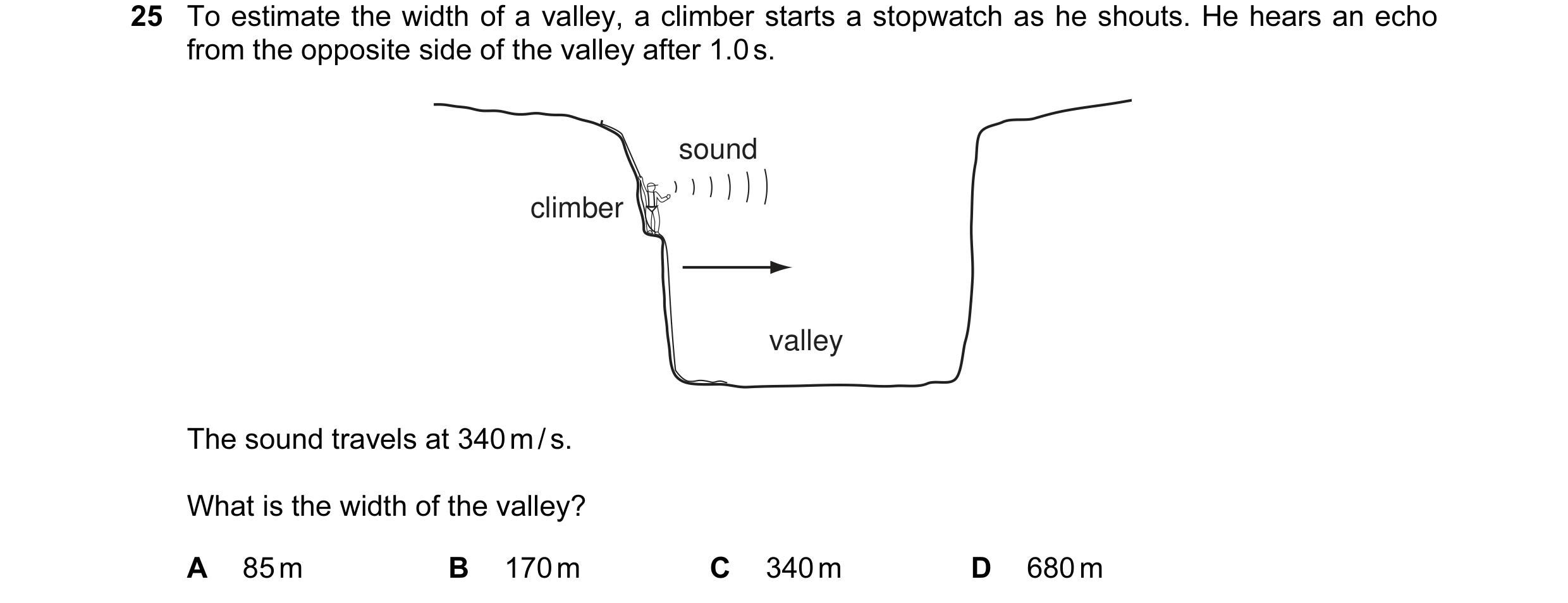
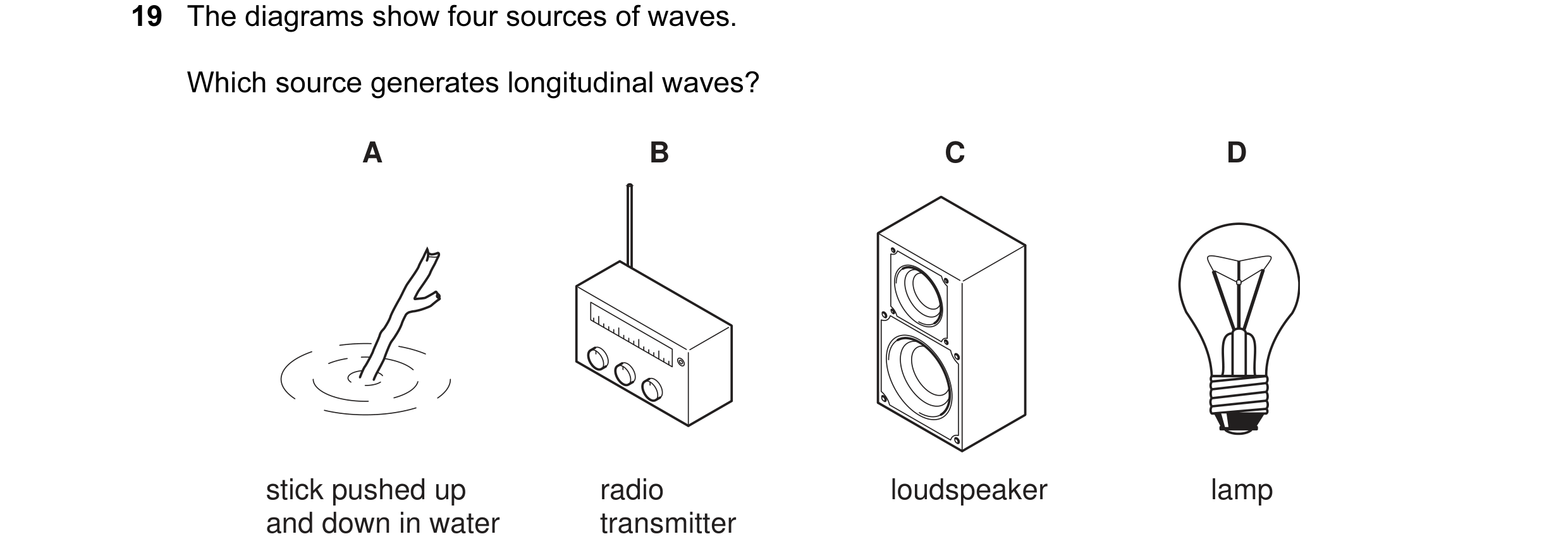 1 / 54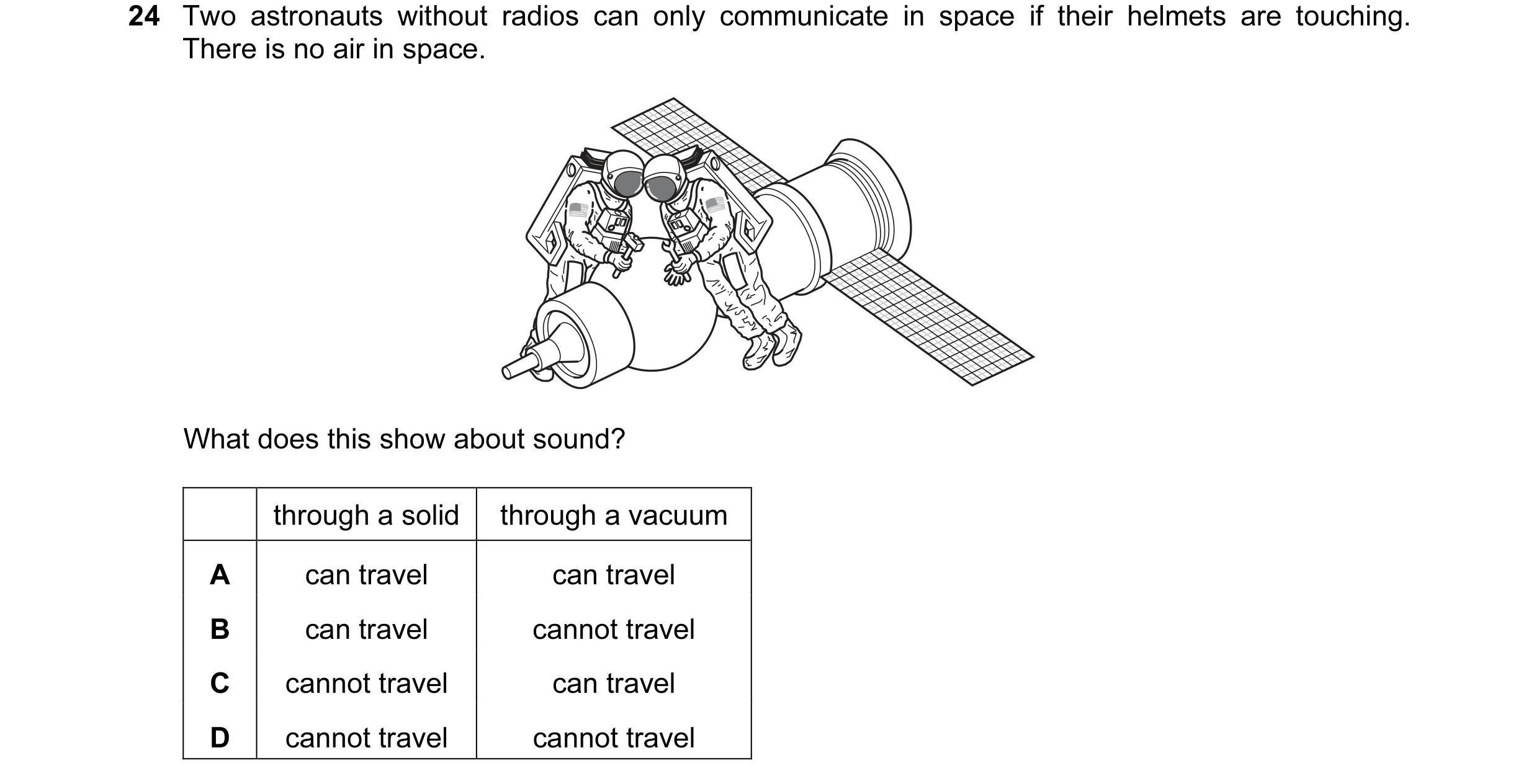

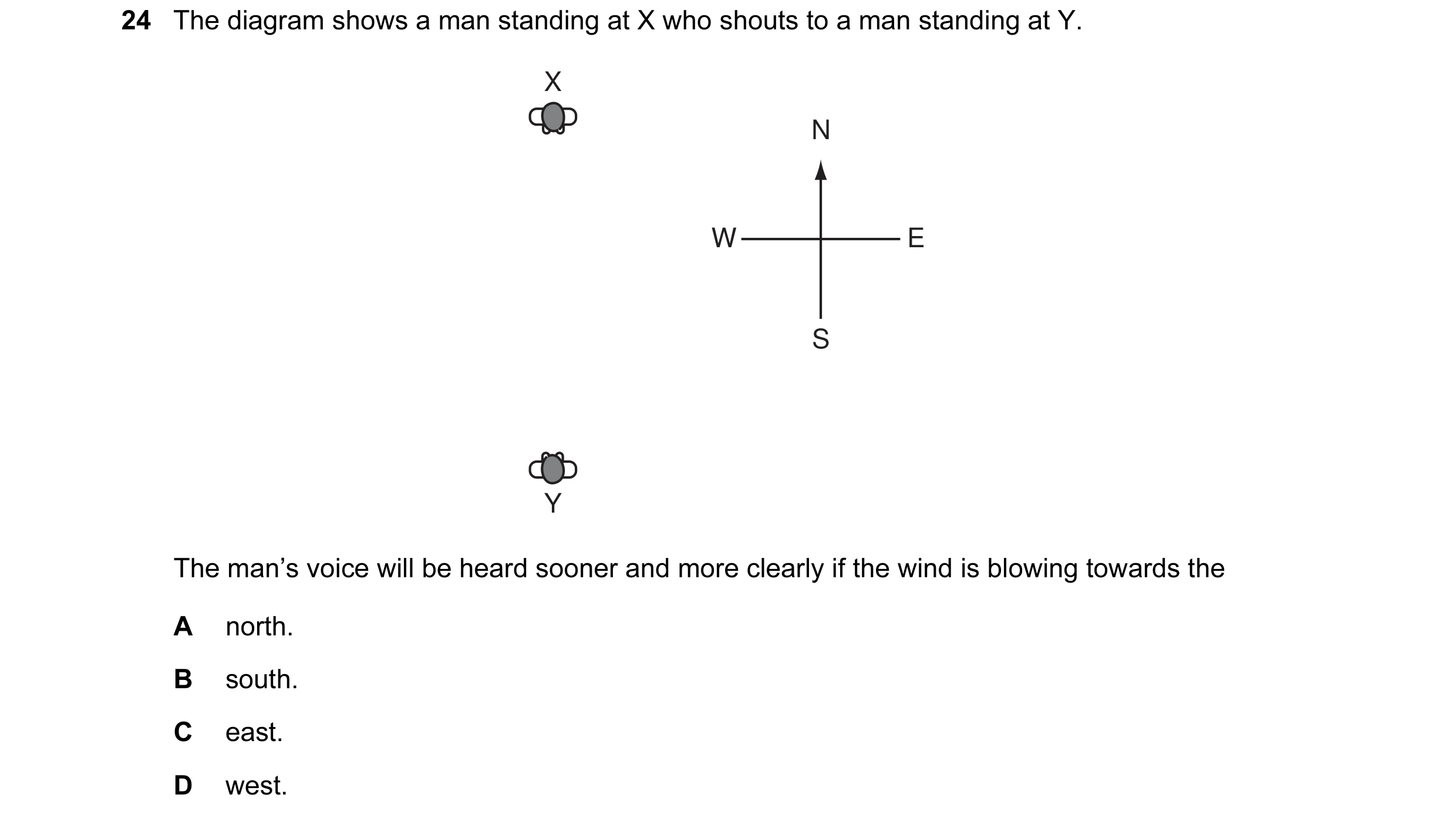 2 / 54
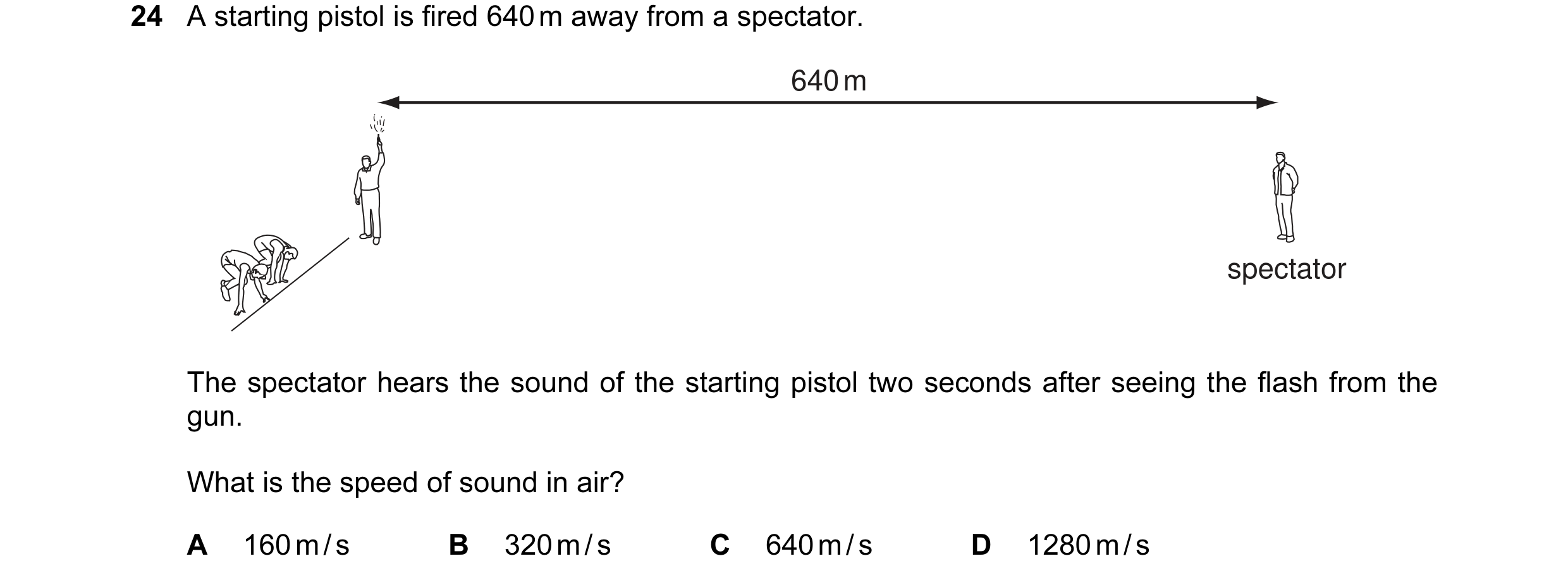
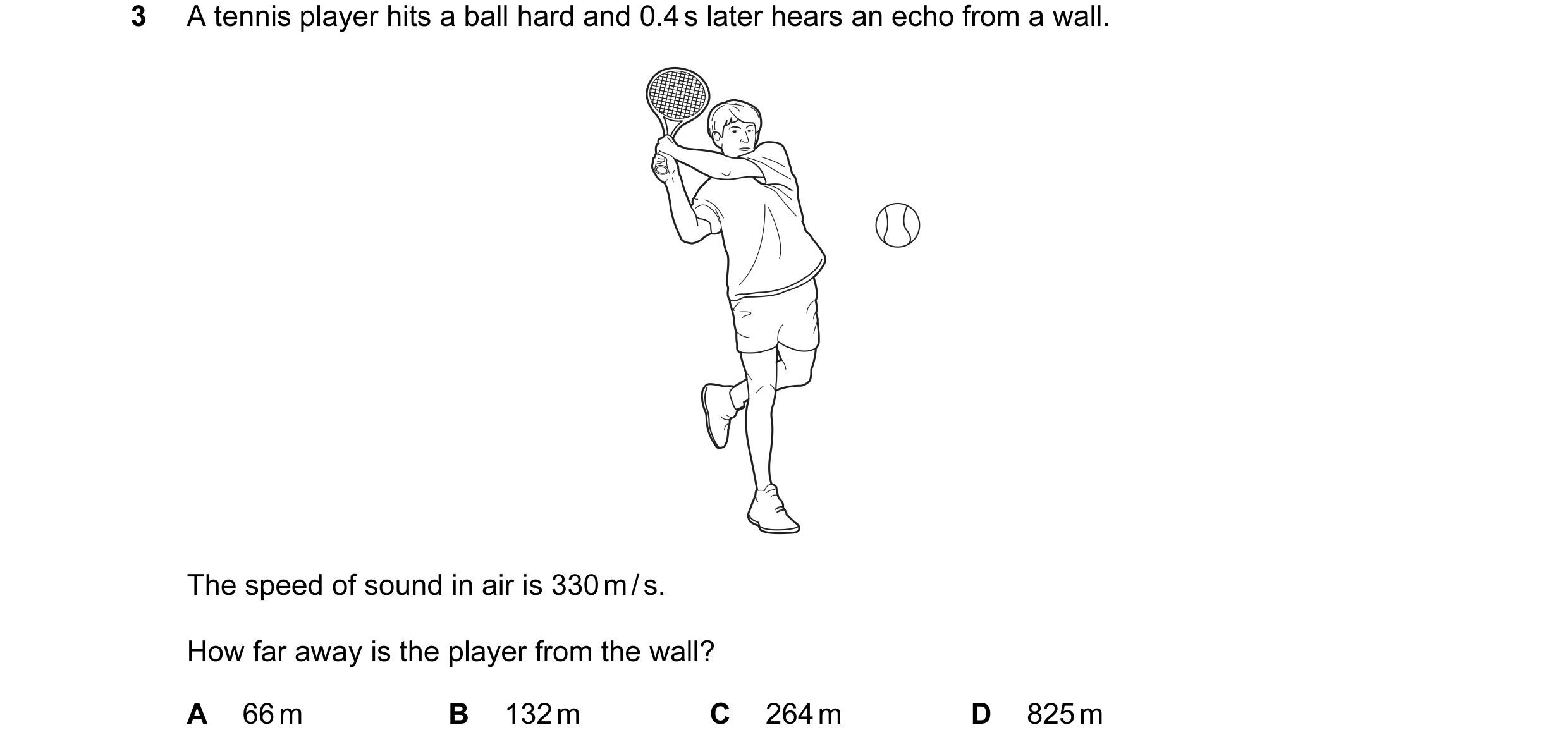 3 / 54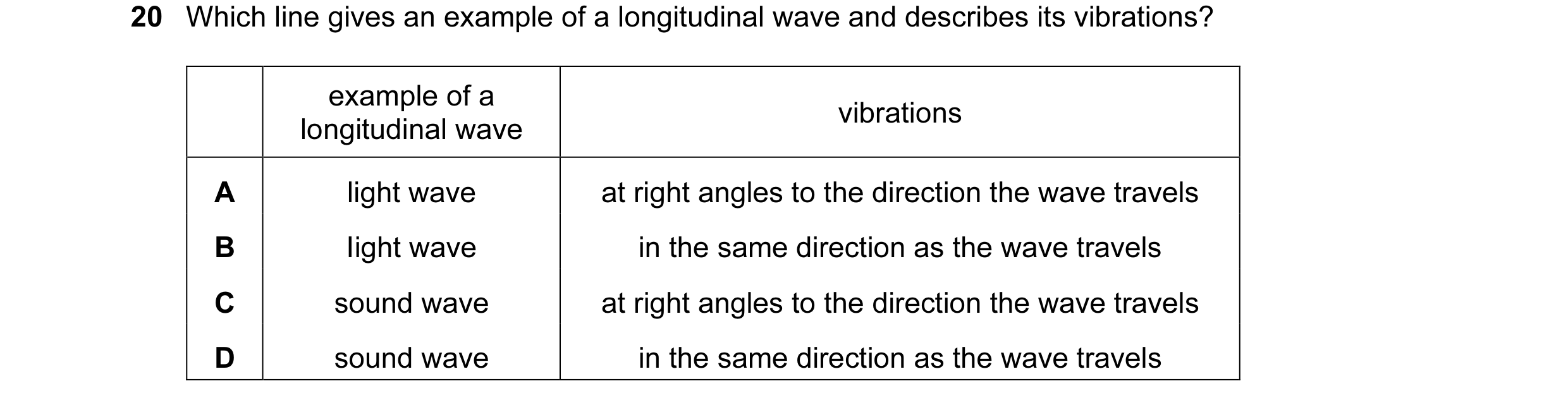
 4 / 54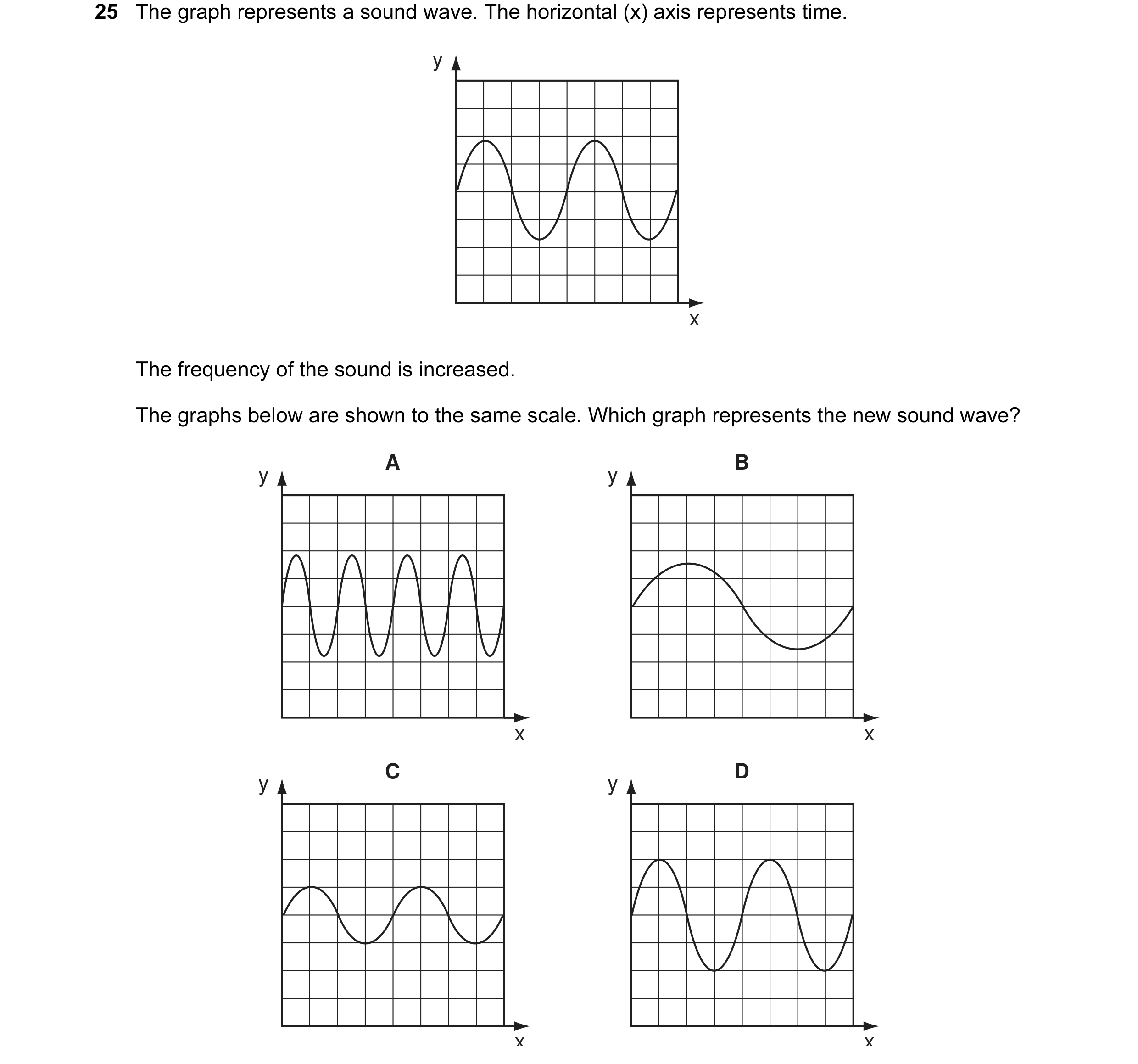
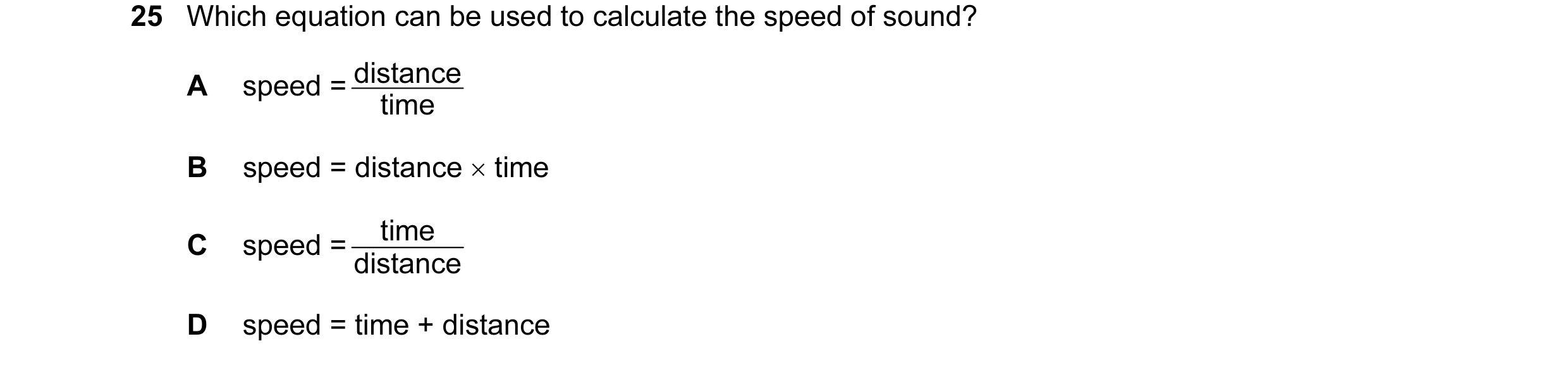 5 / 54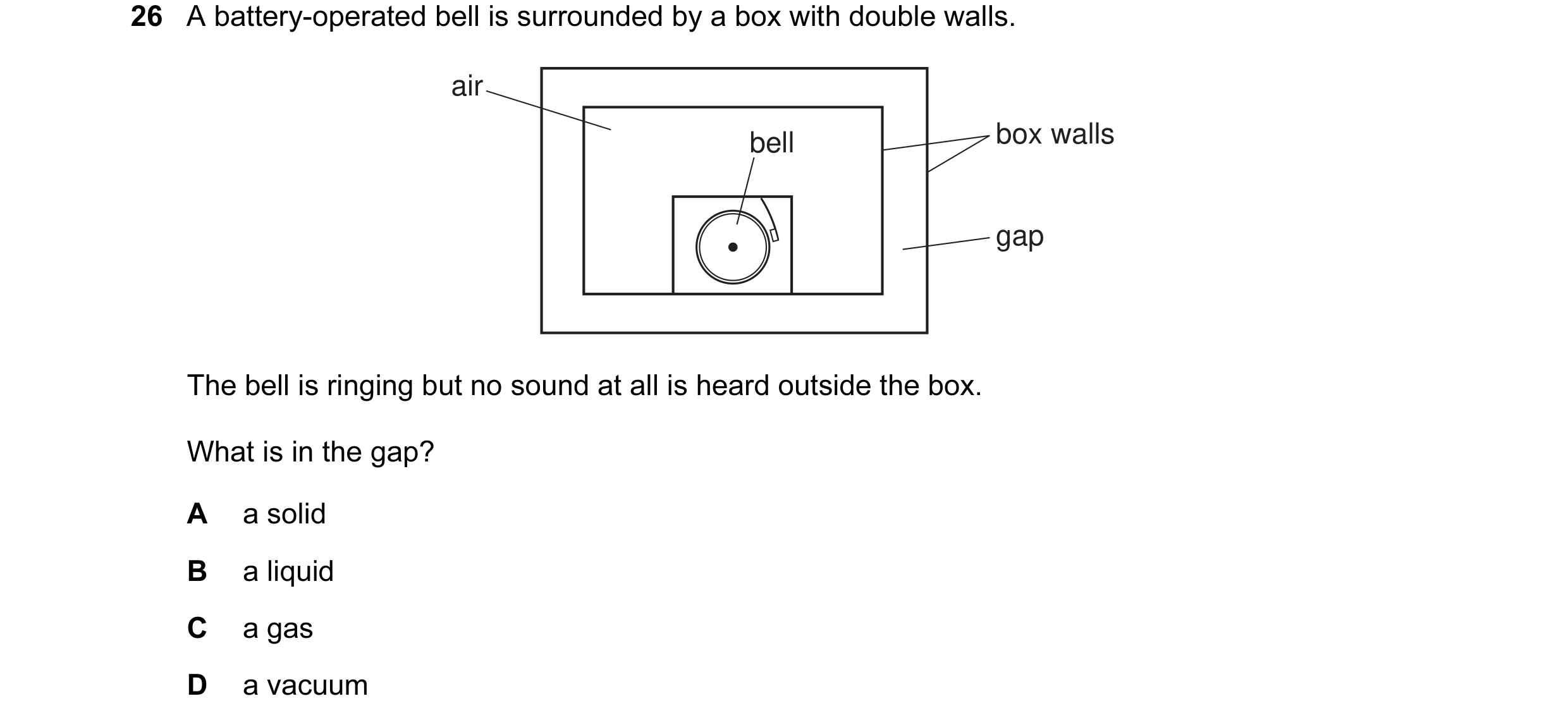
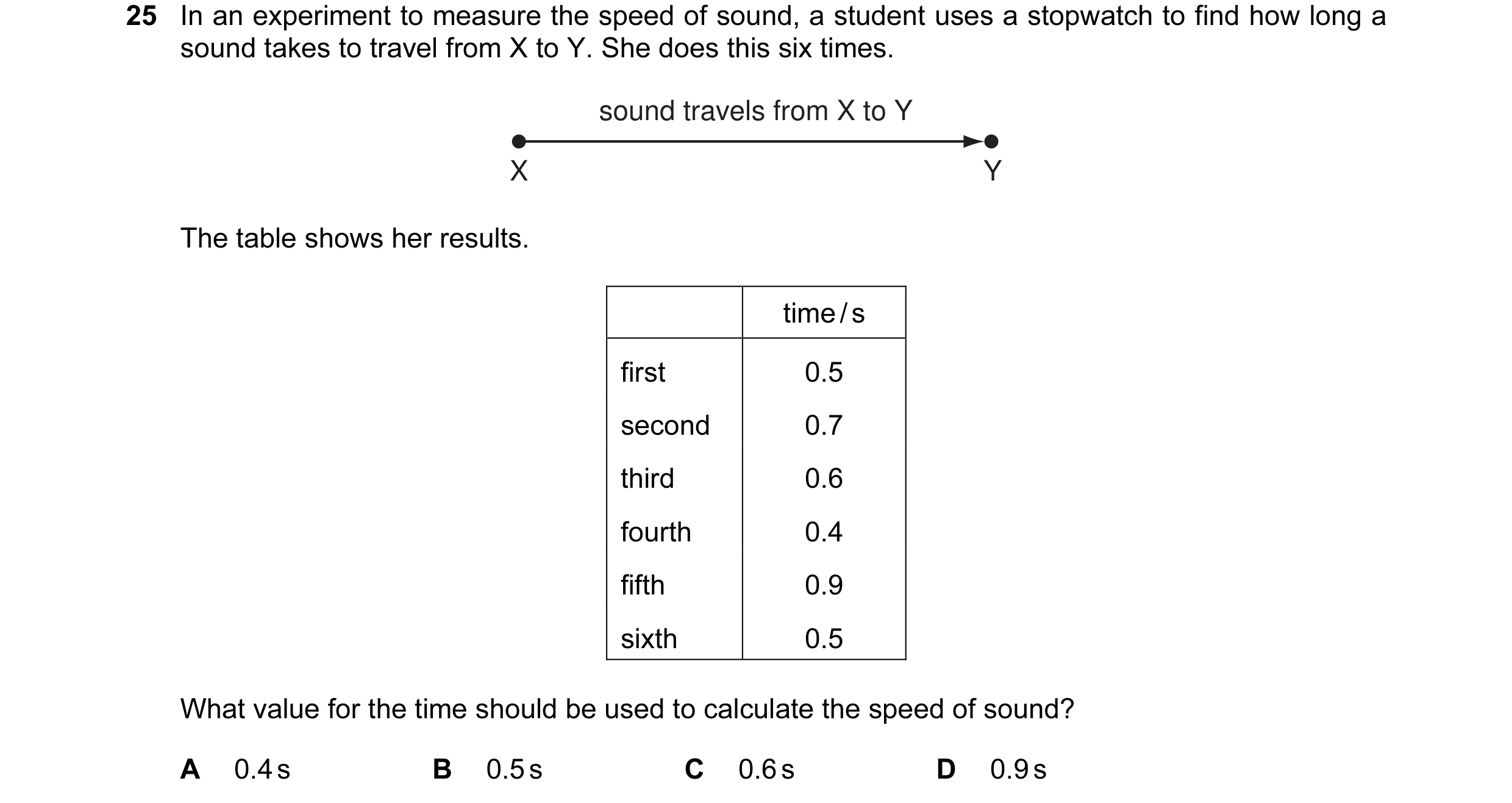 6 / 54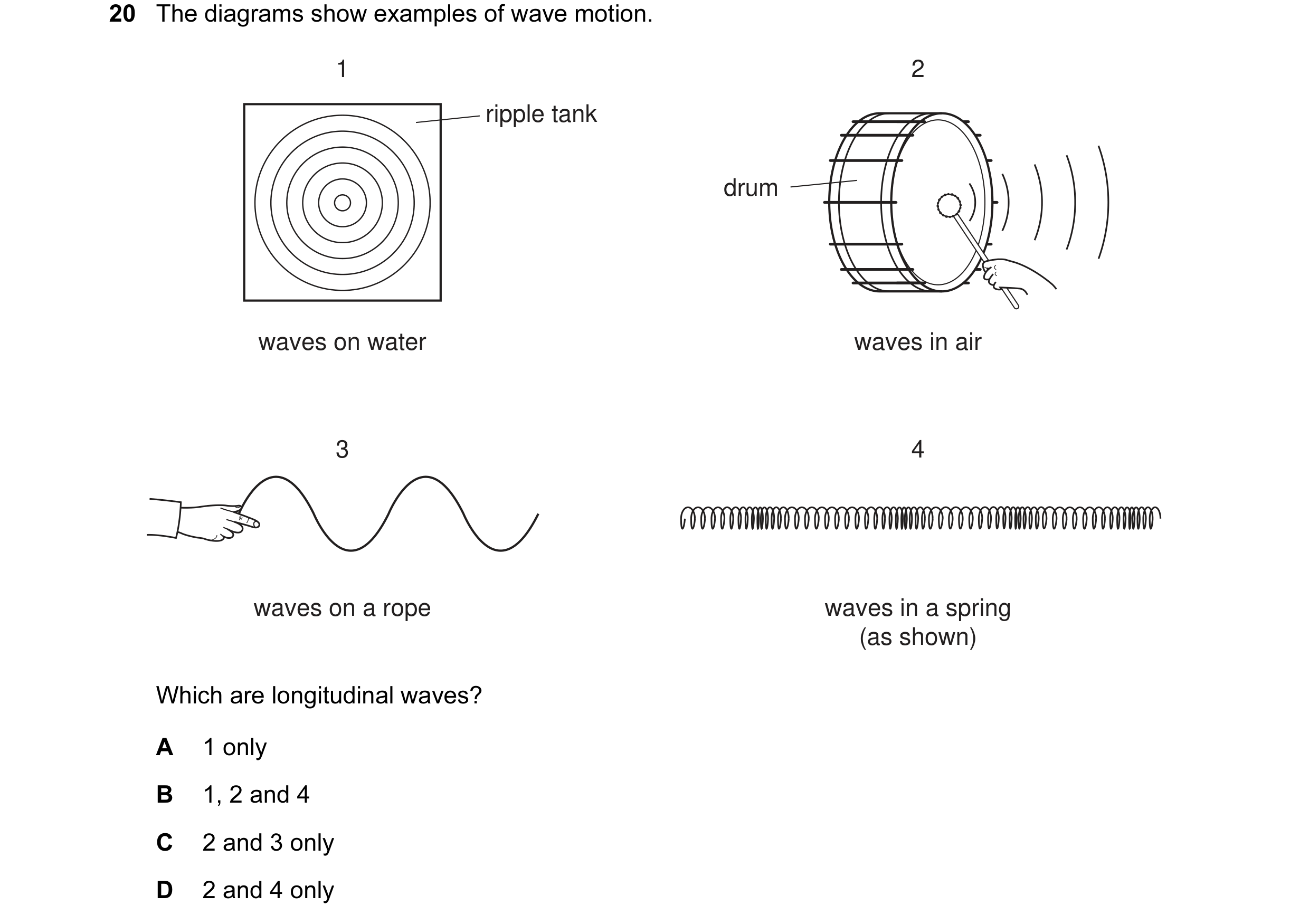
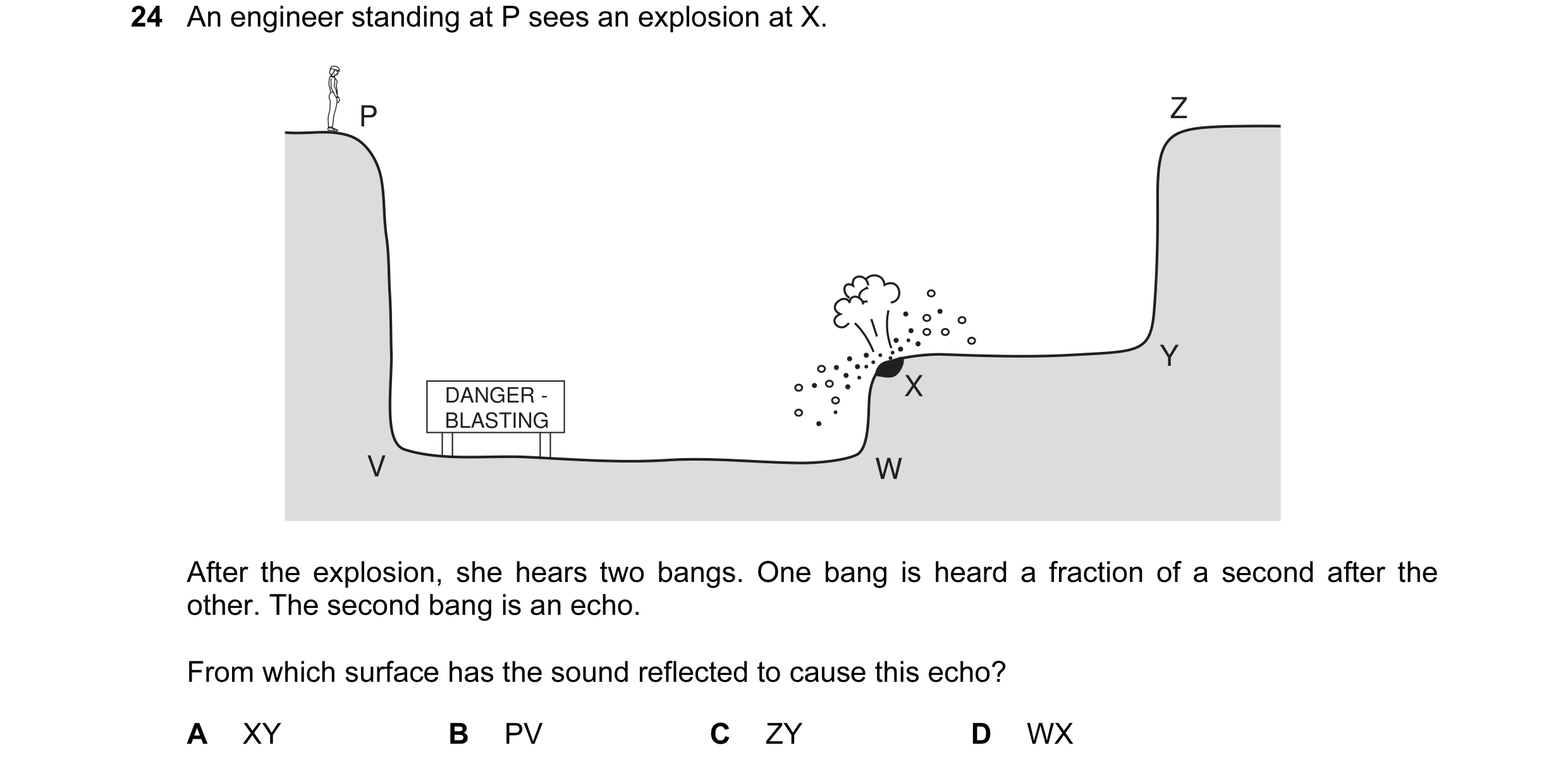 7 / 54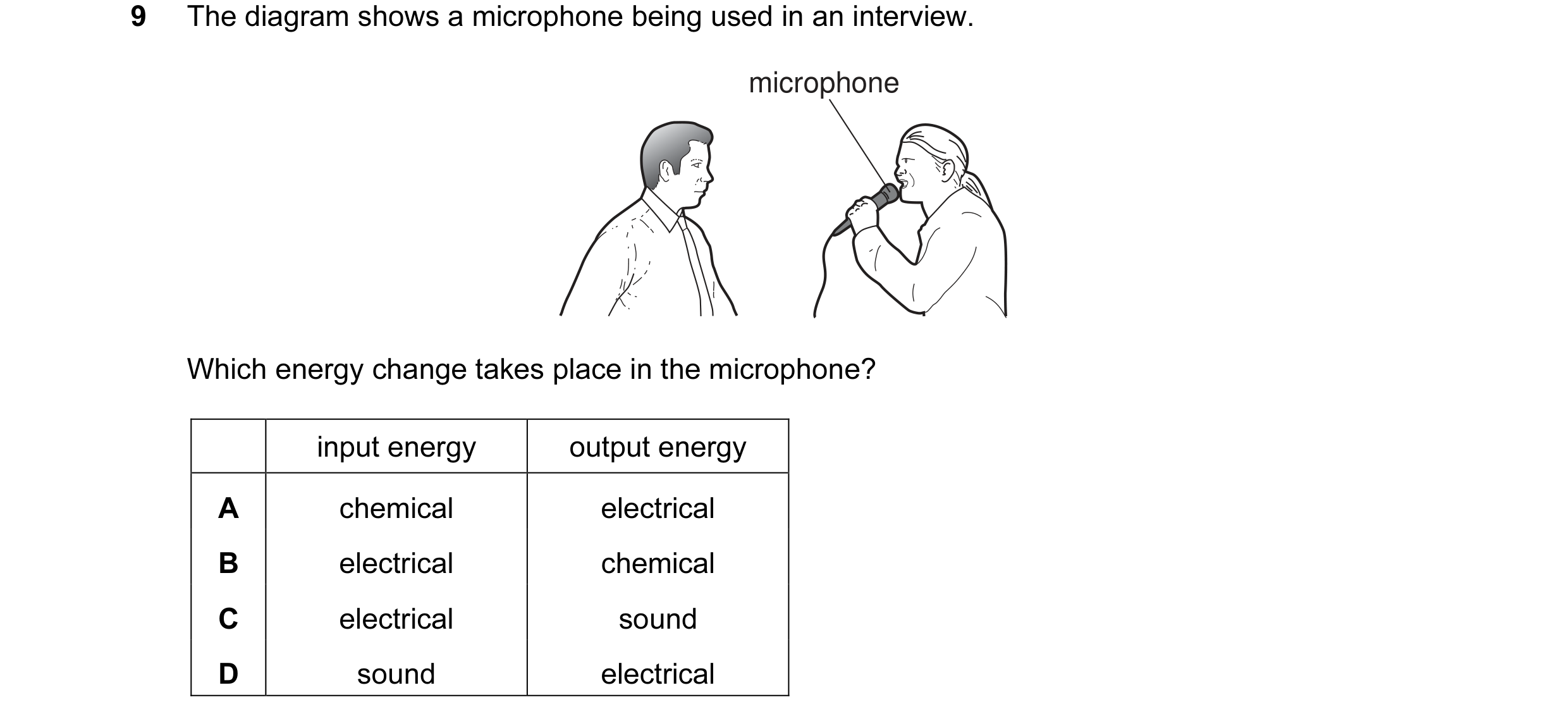
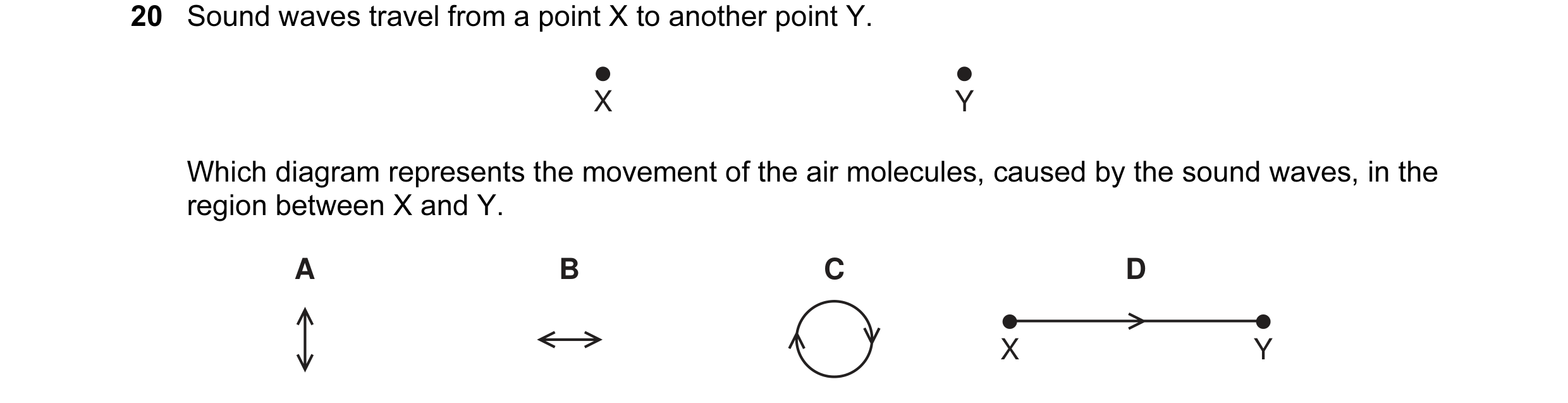
 8 / 54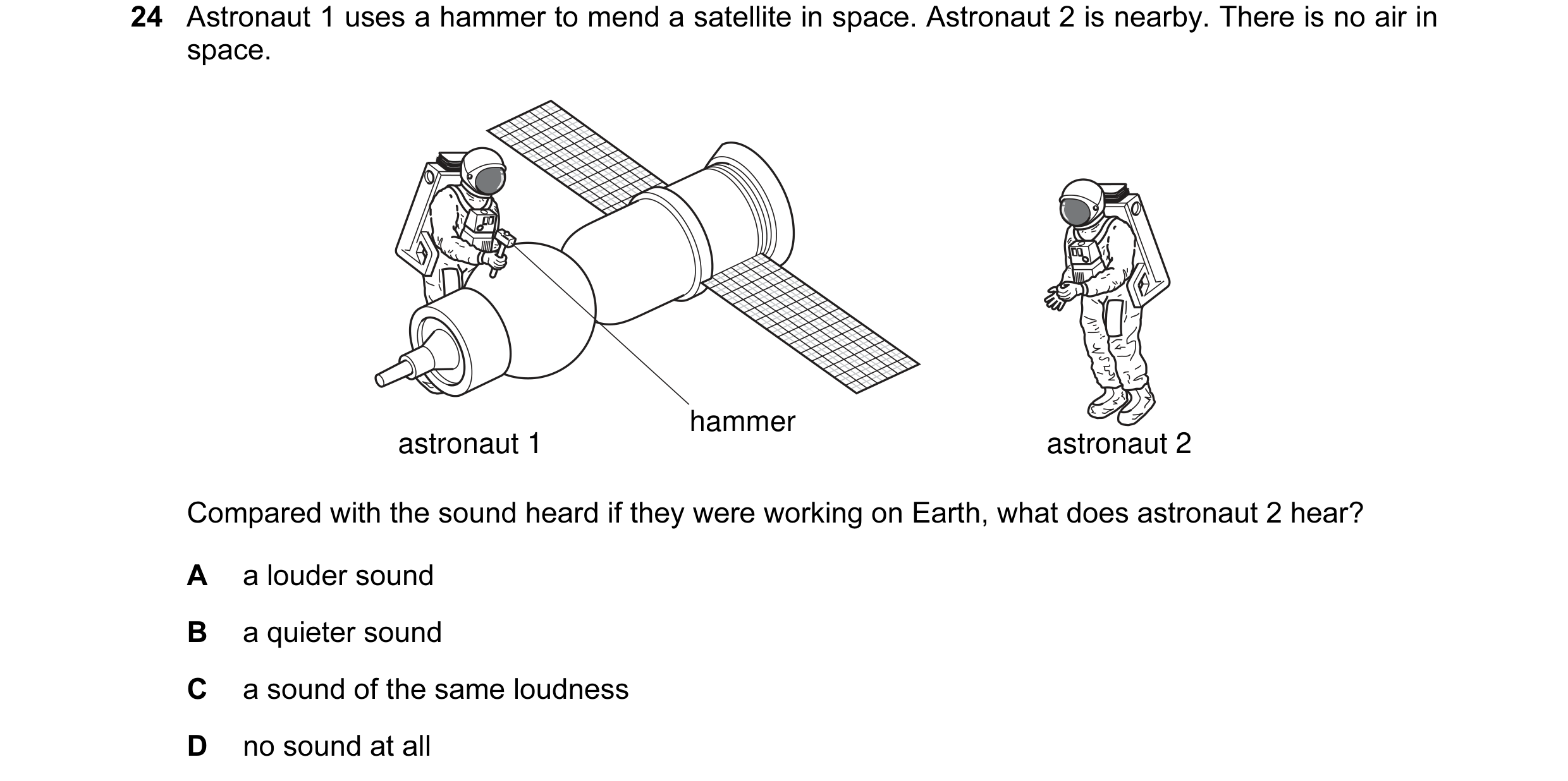
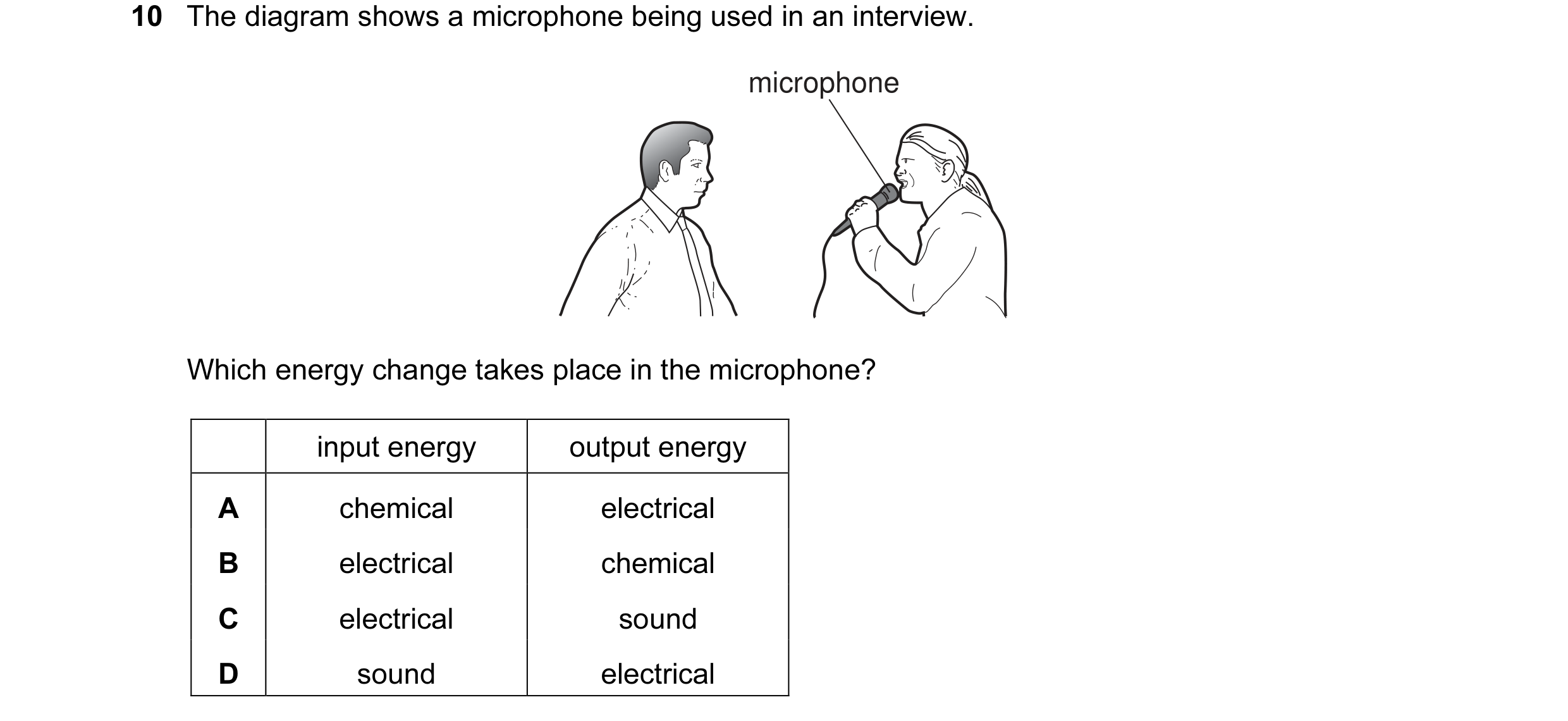
 9 / 54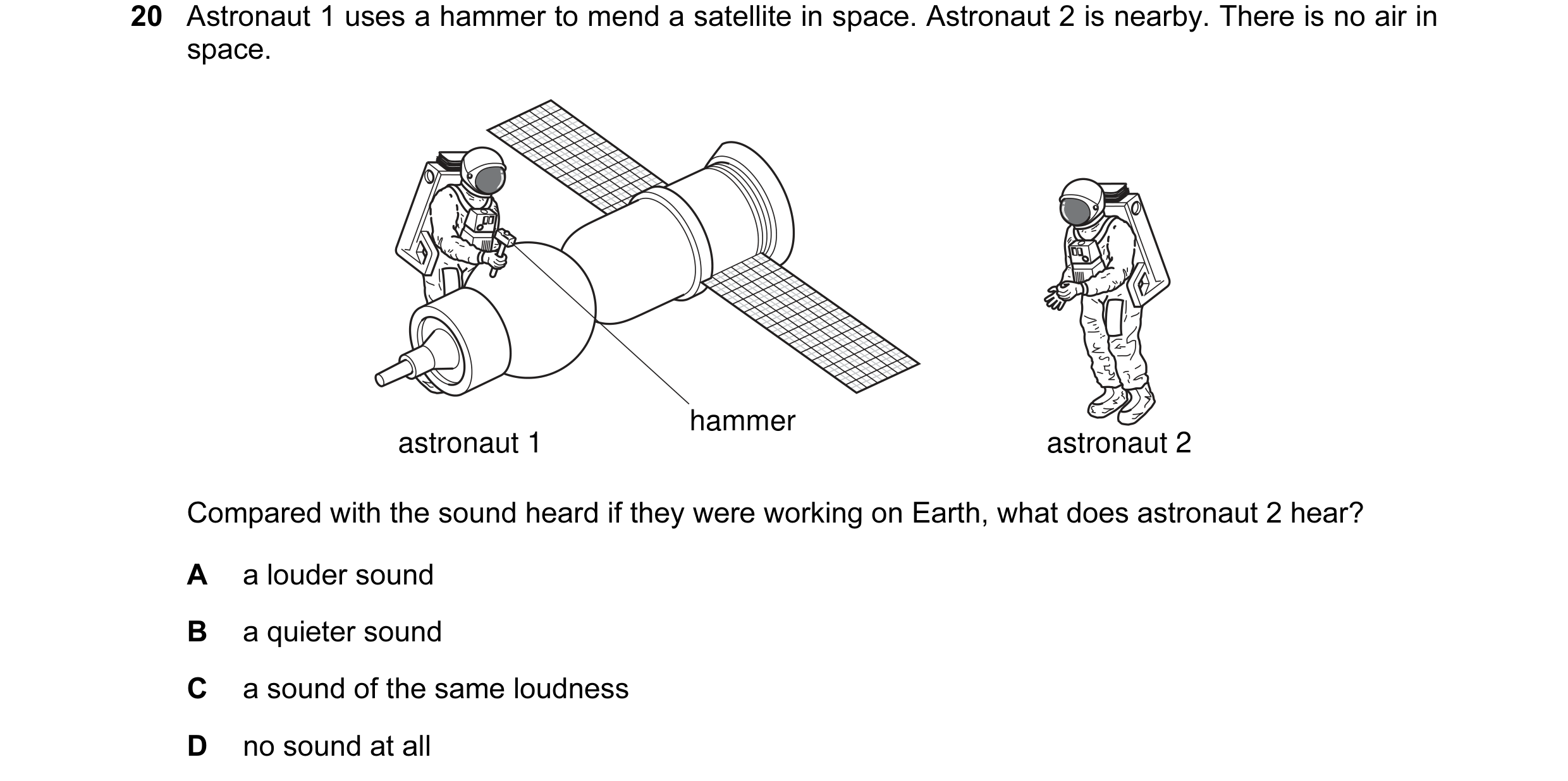
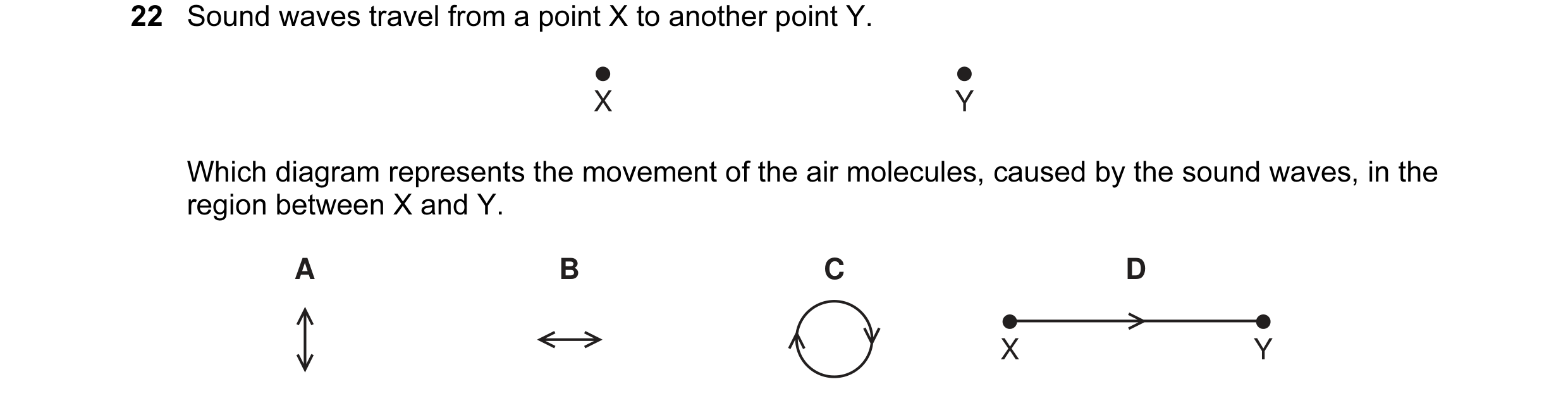
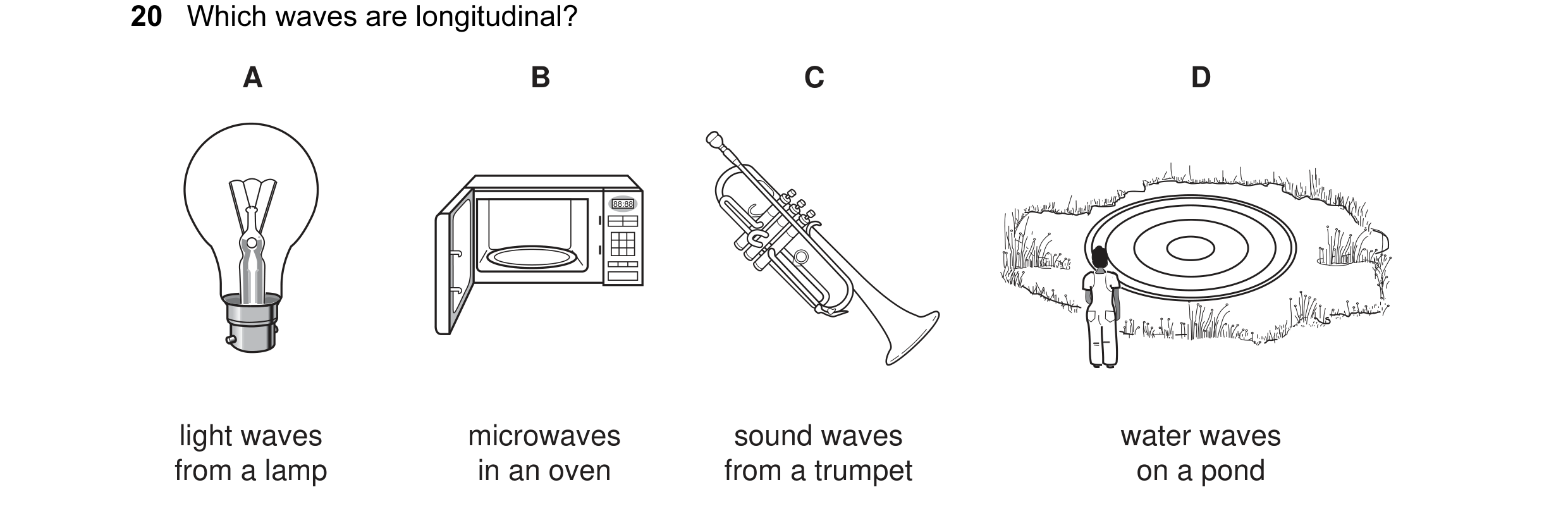
 10 / 54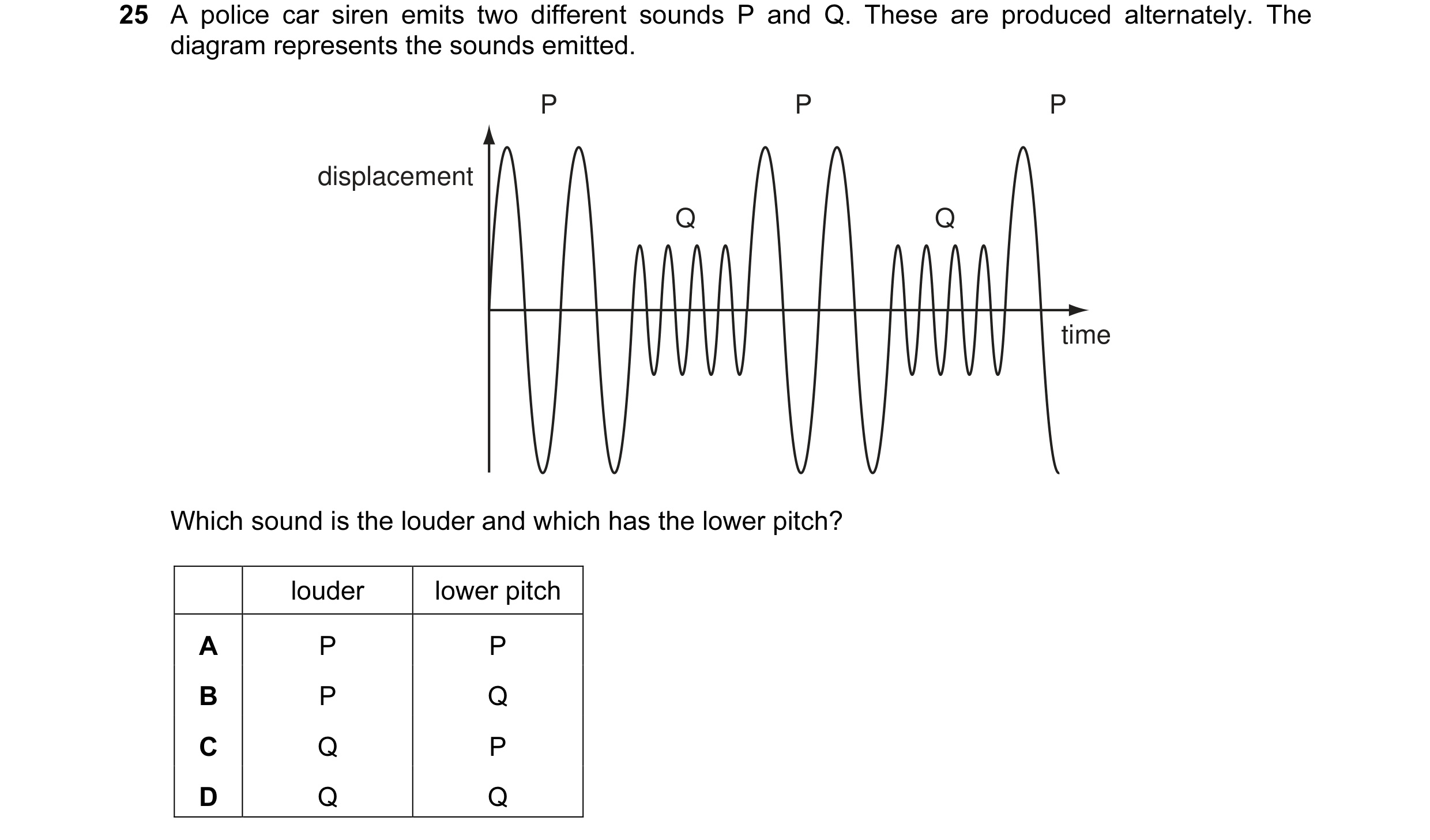
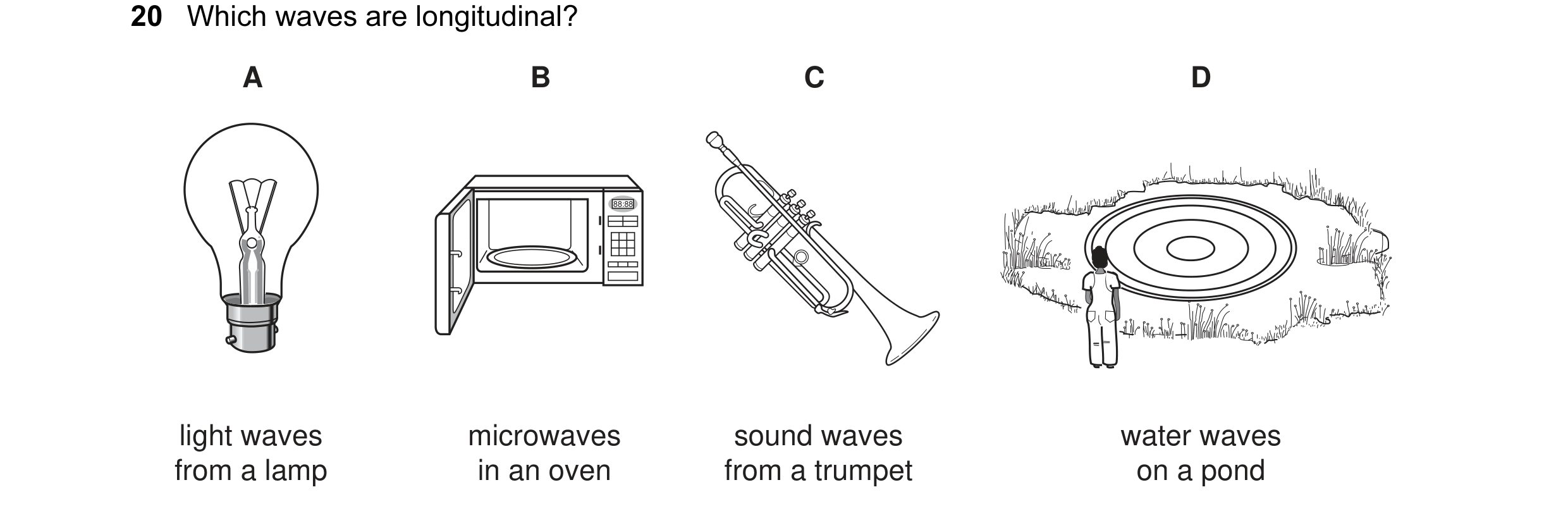 11 / 54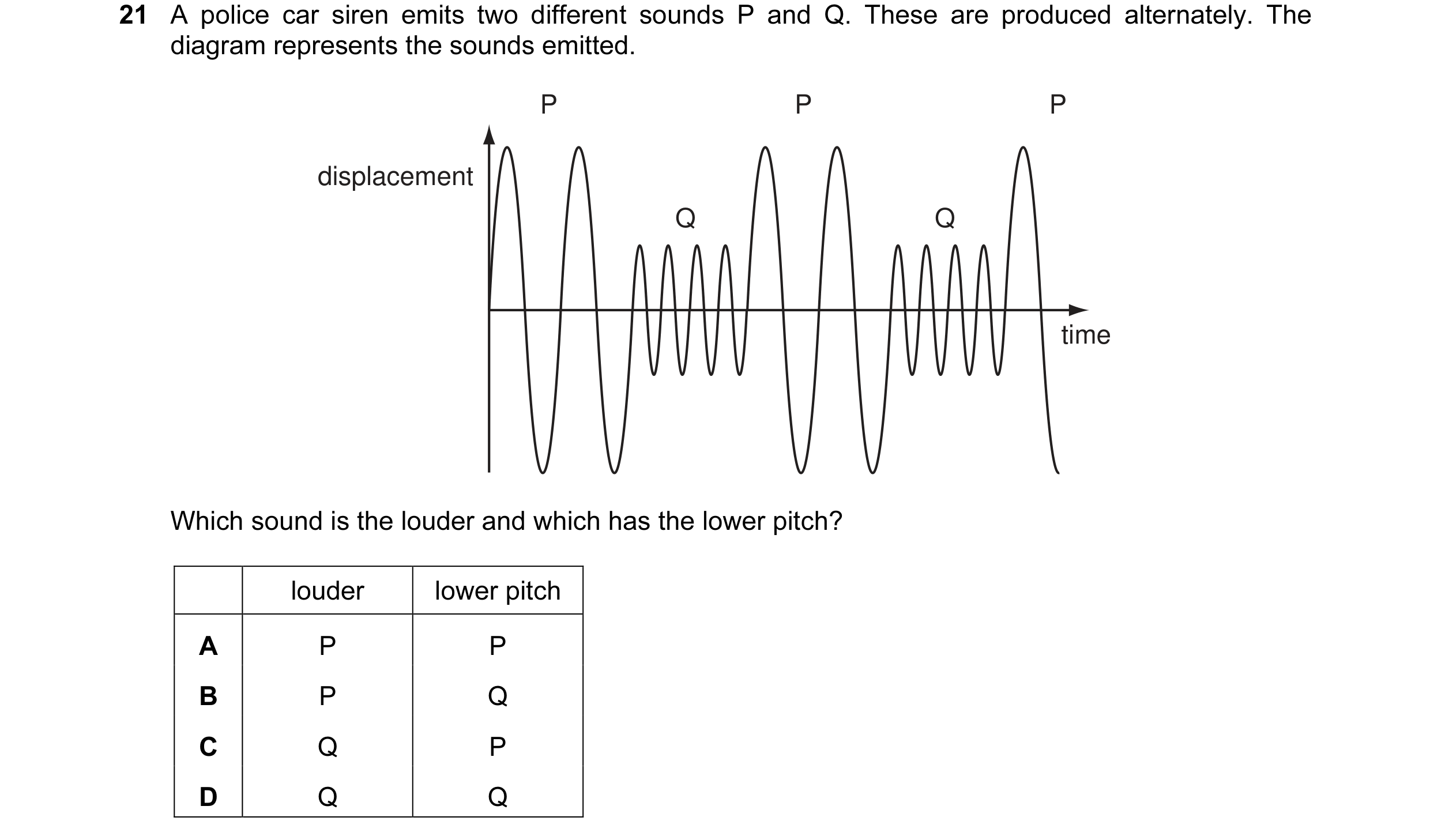

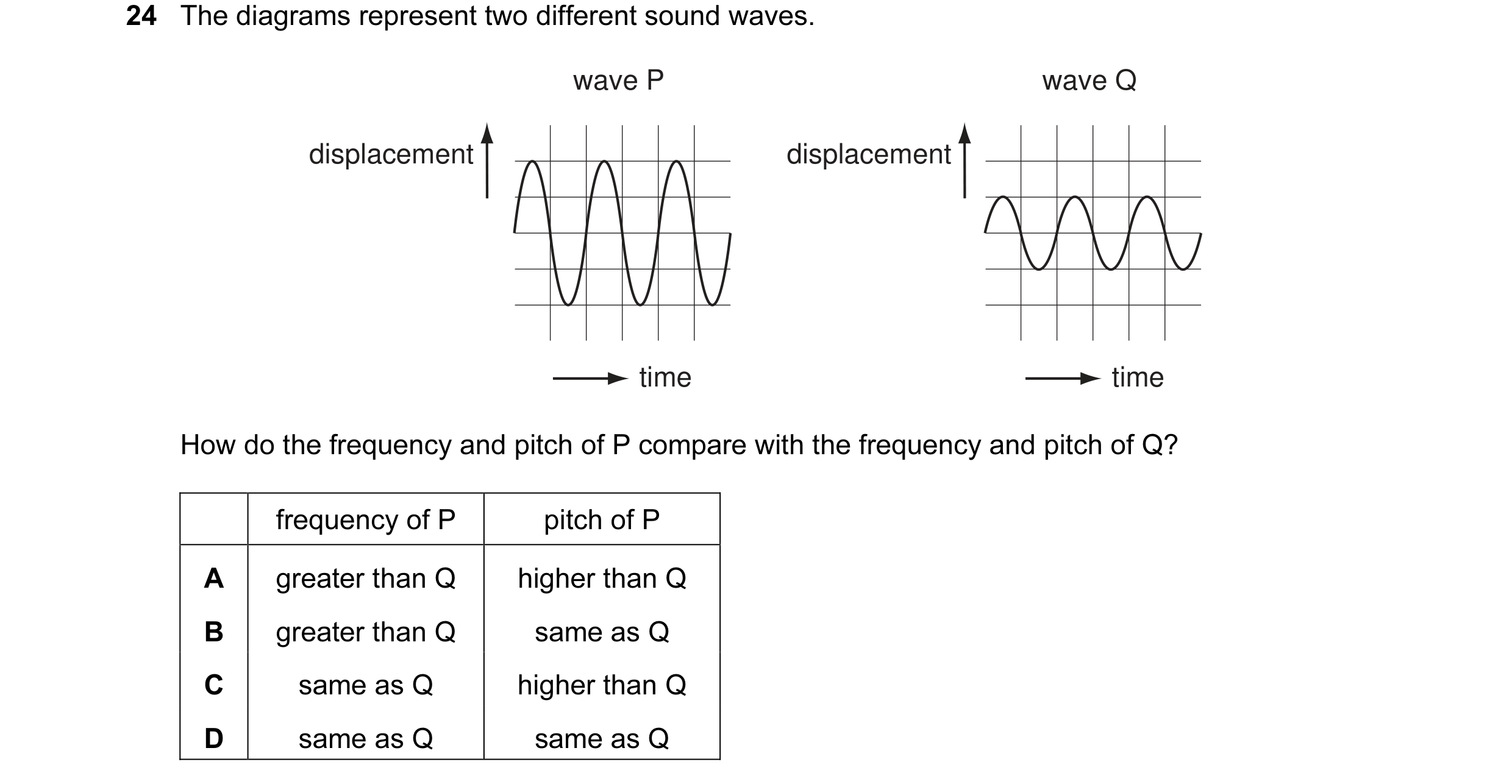
 12 / 54
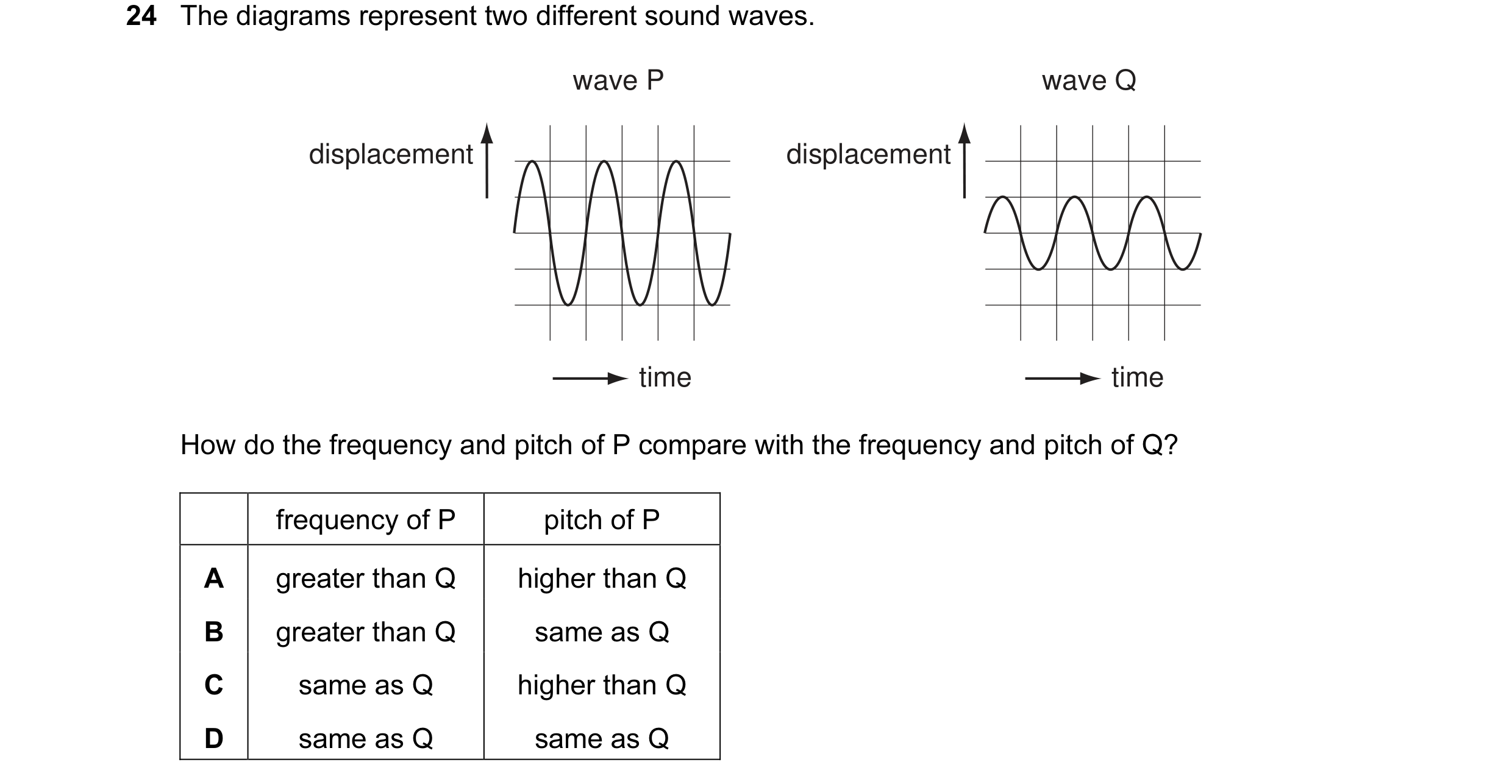
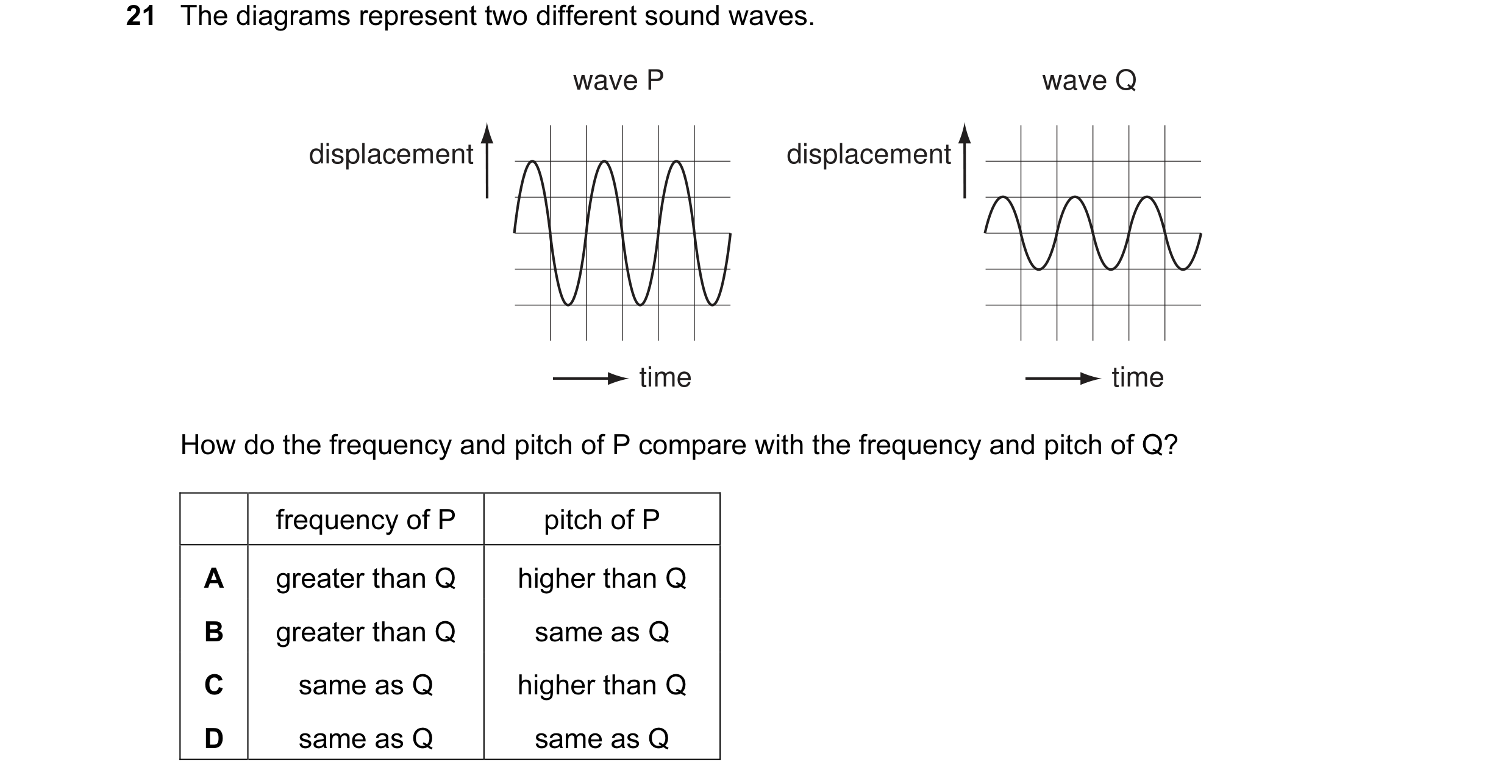
 13 / 54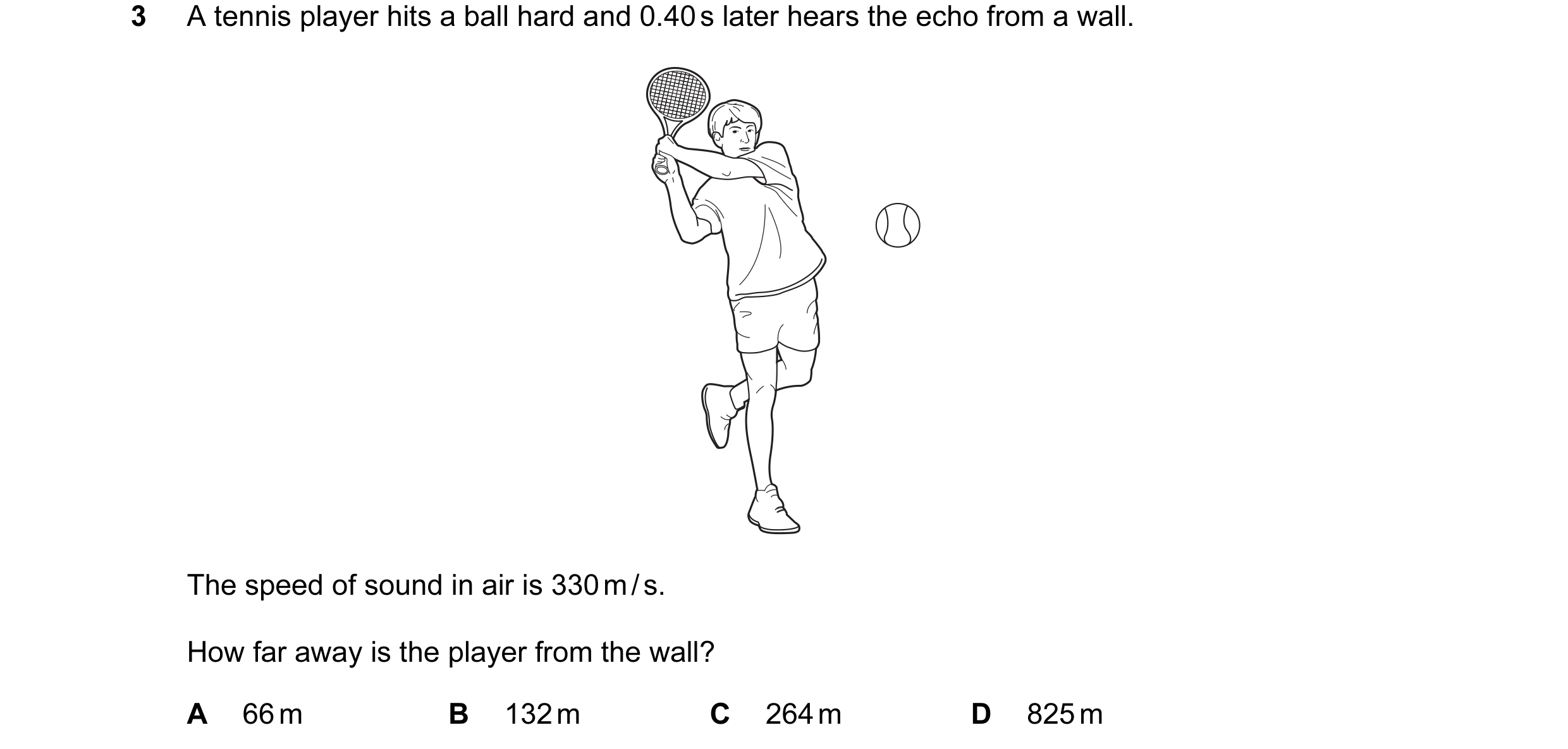

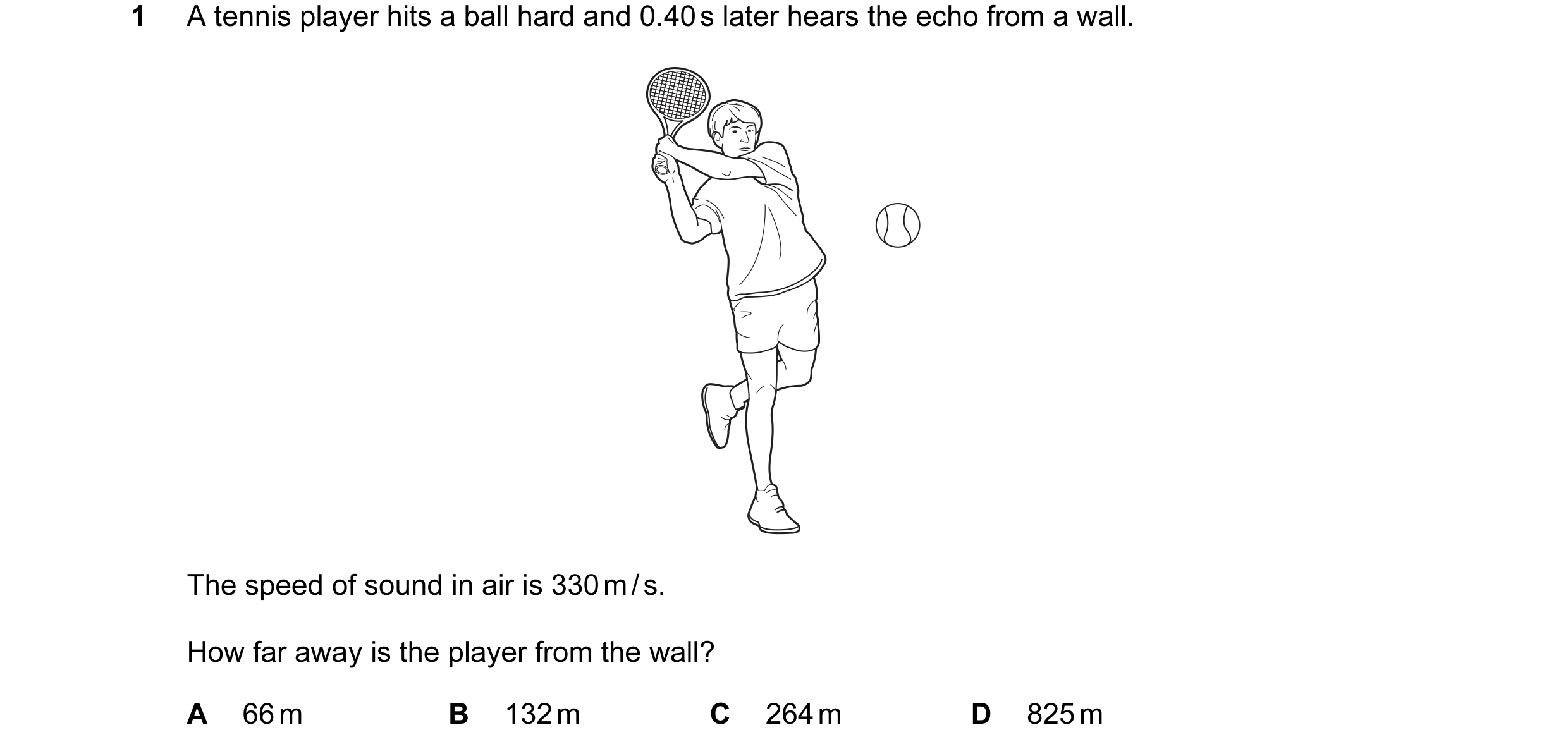 14 / 54

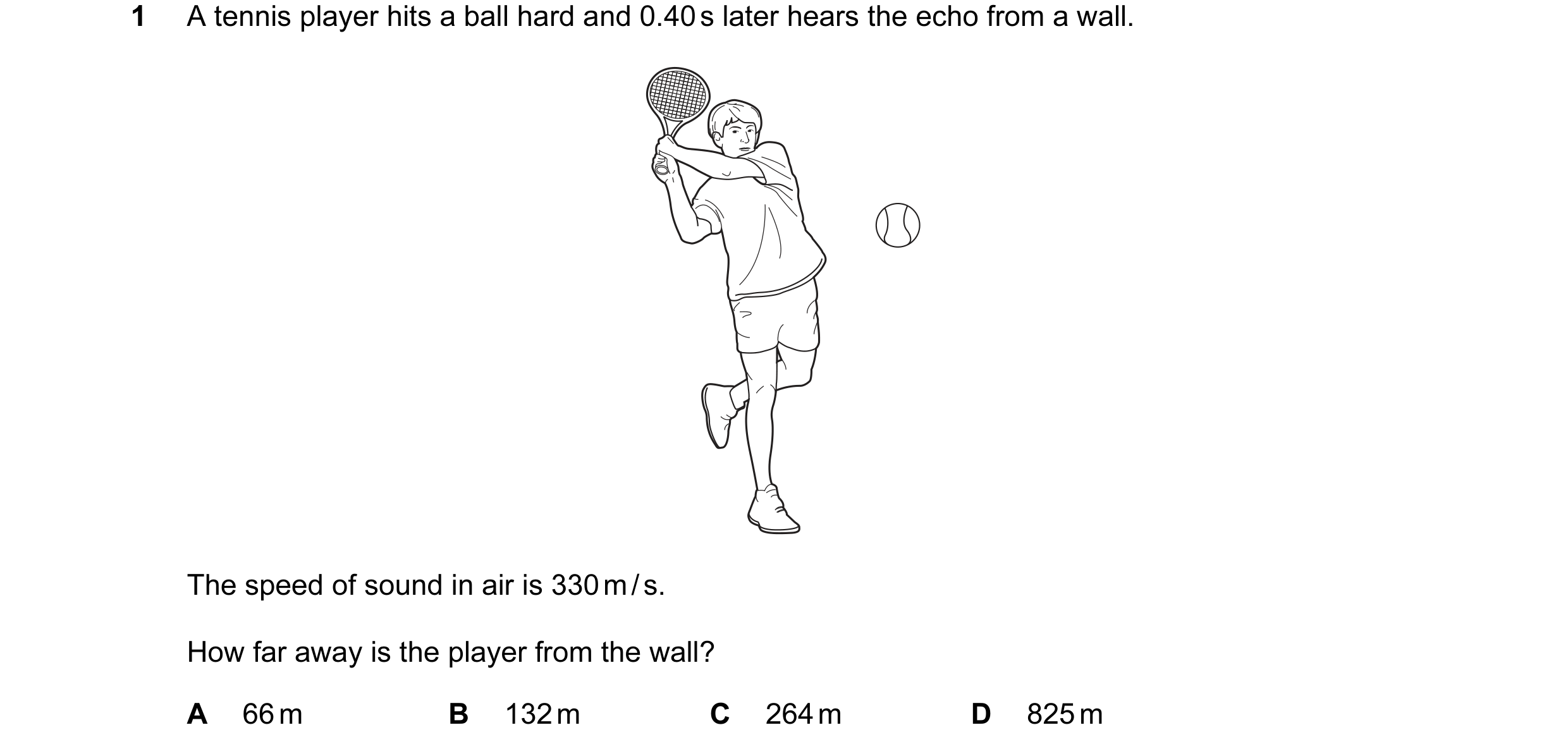
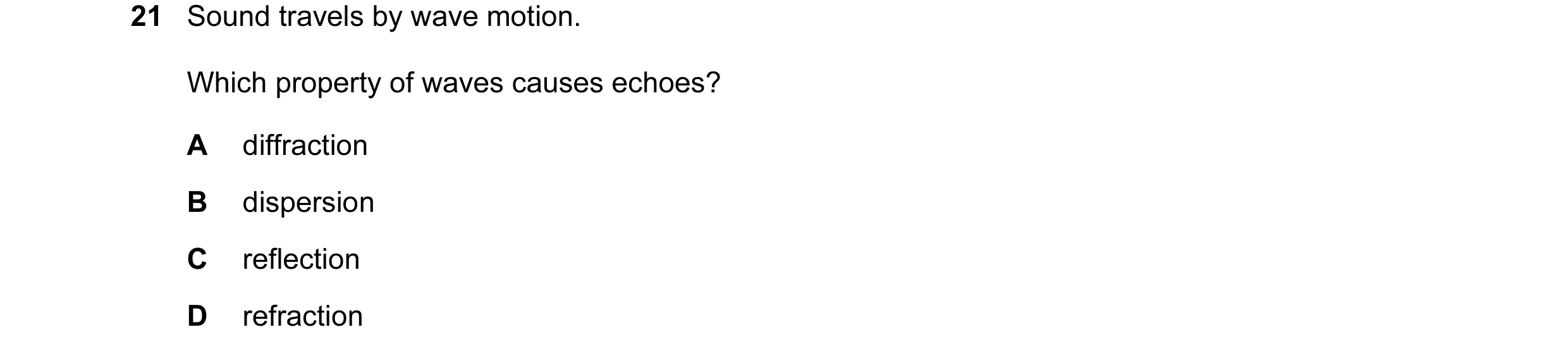
 15 / 54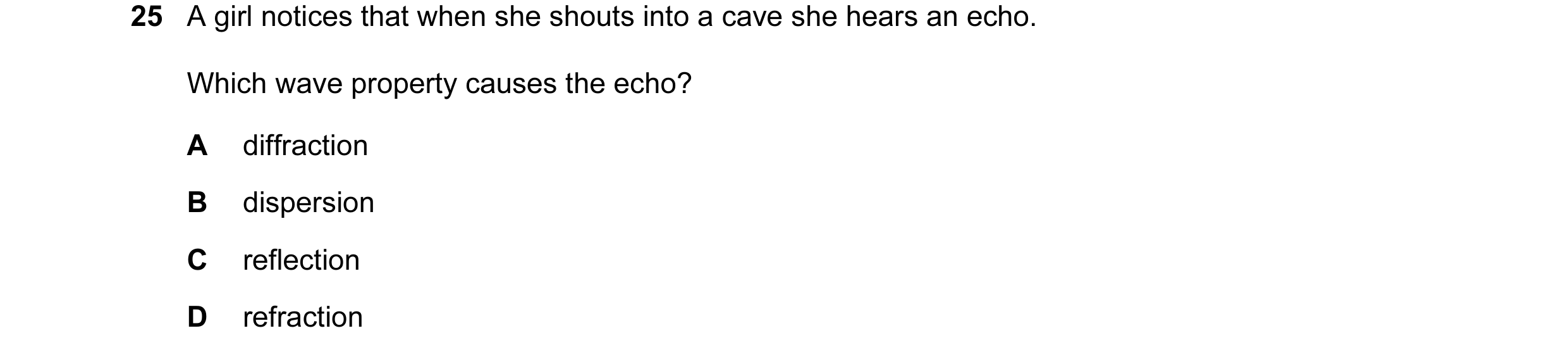
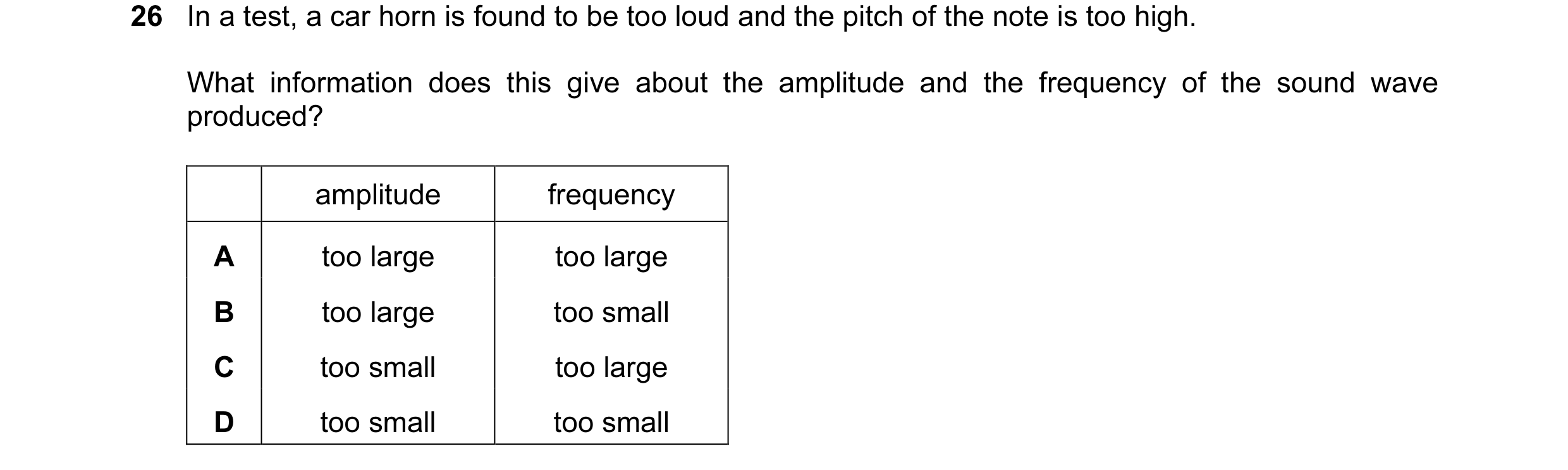
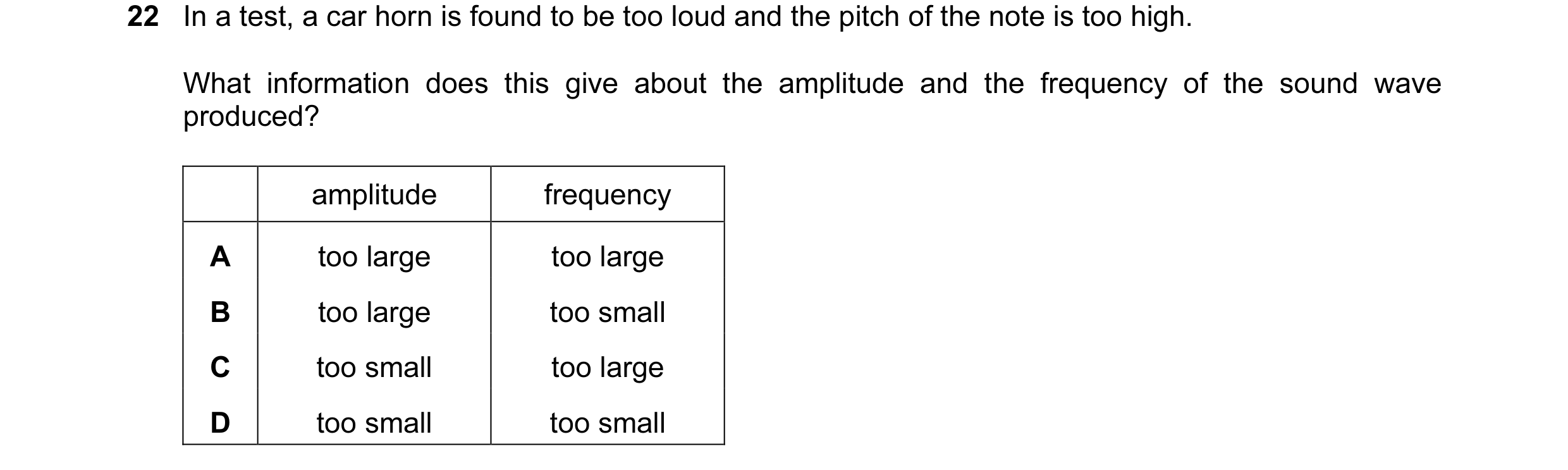
 16 / 54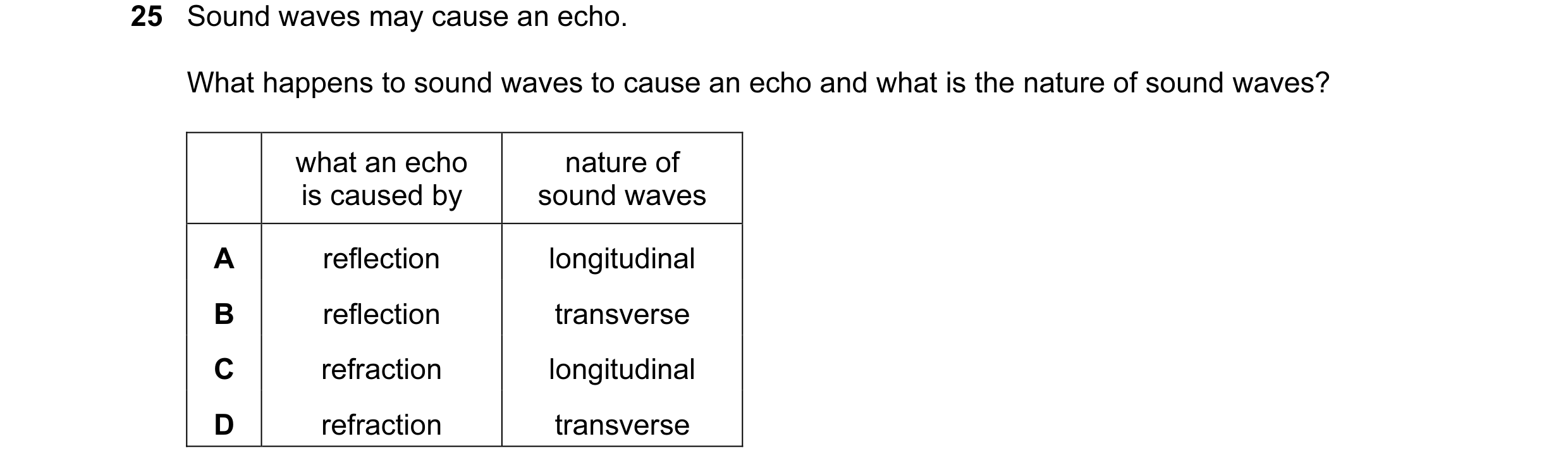
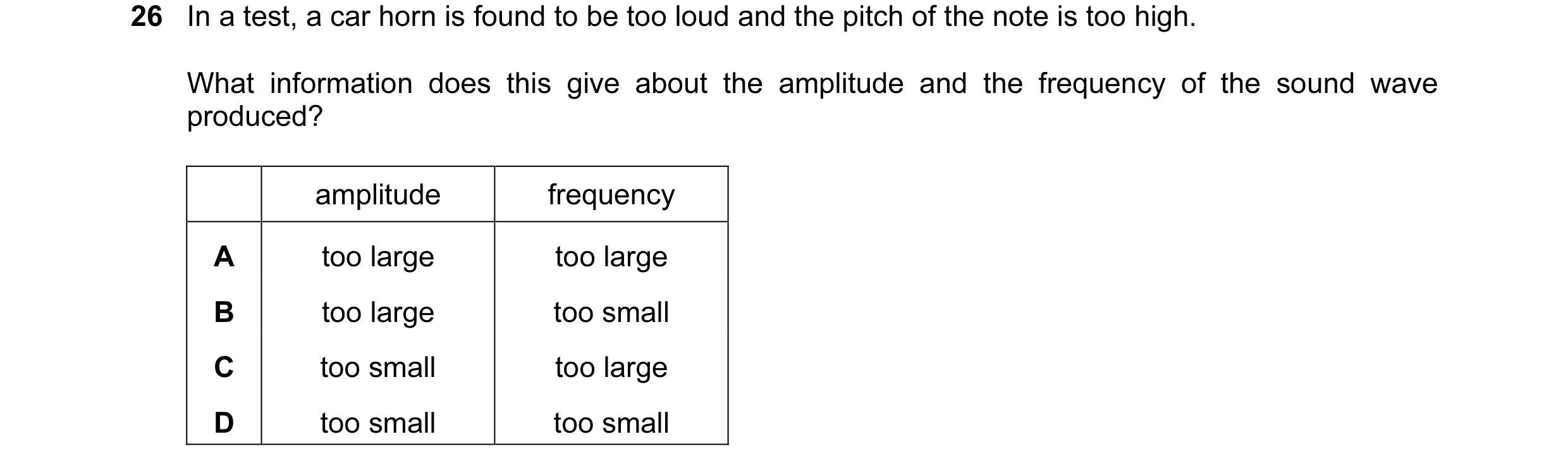
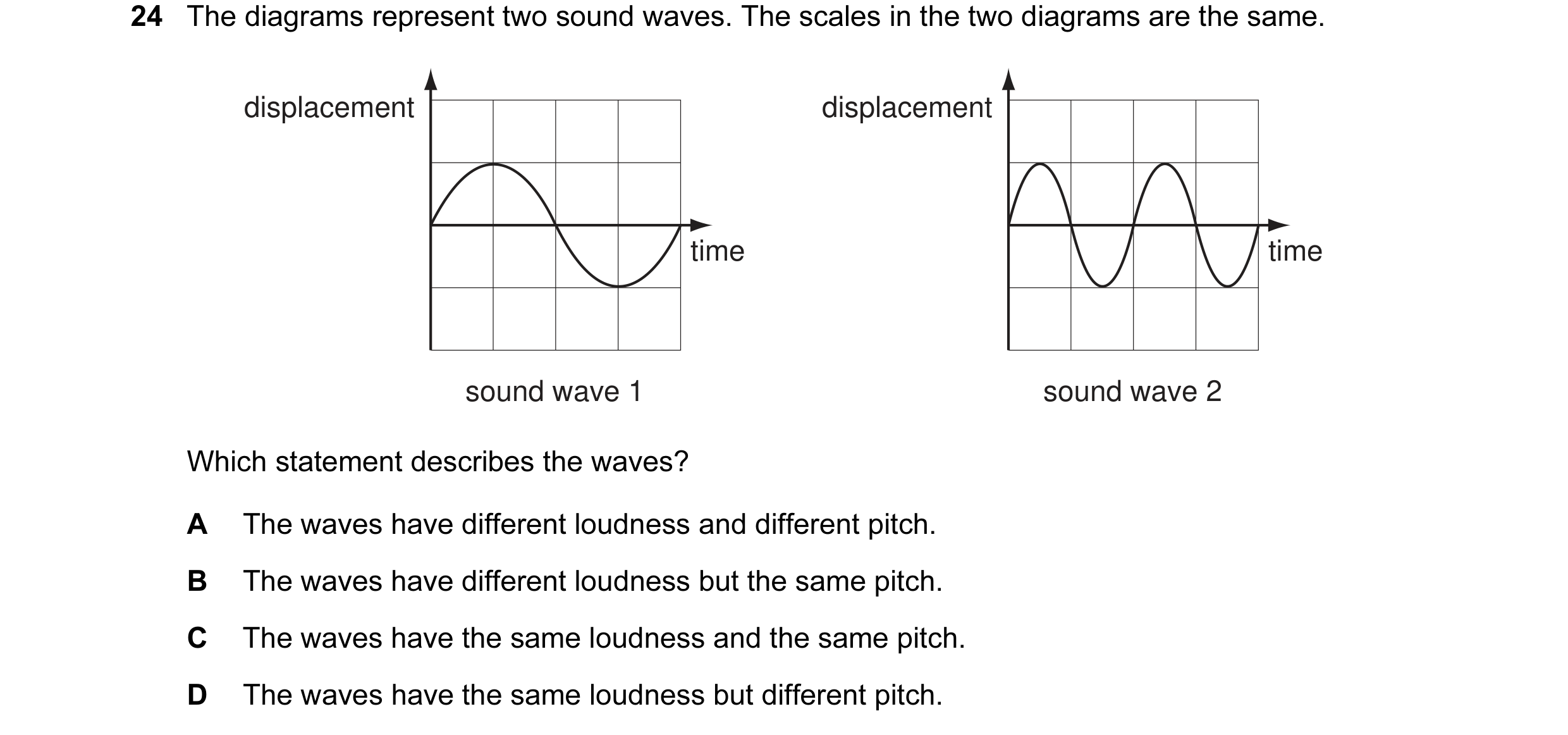
 17 / 54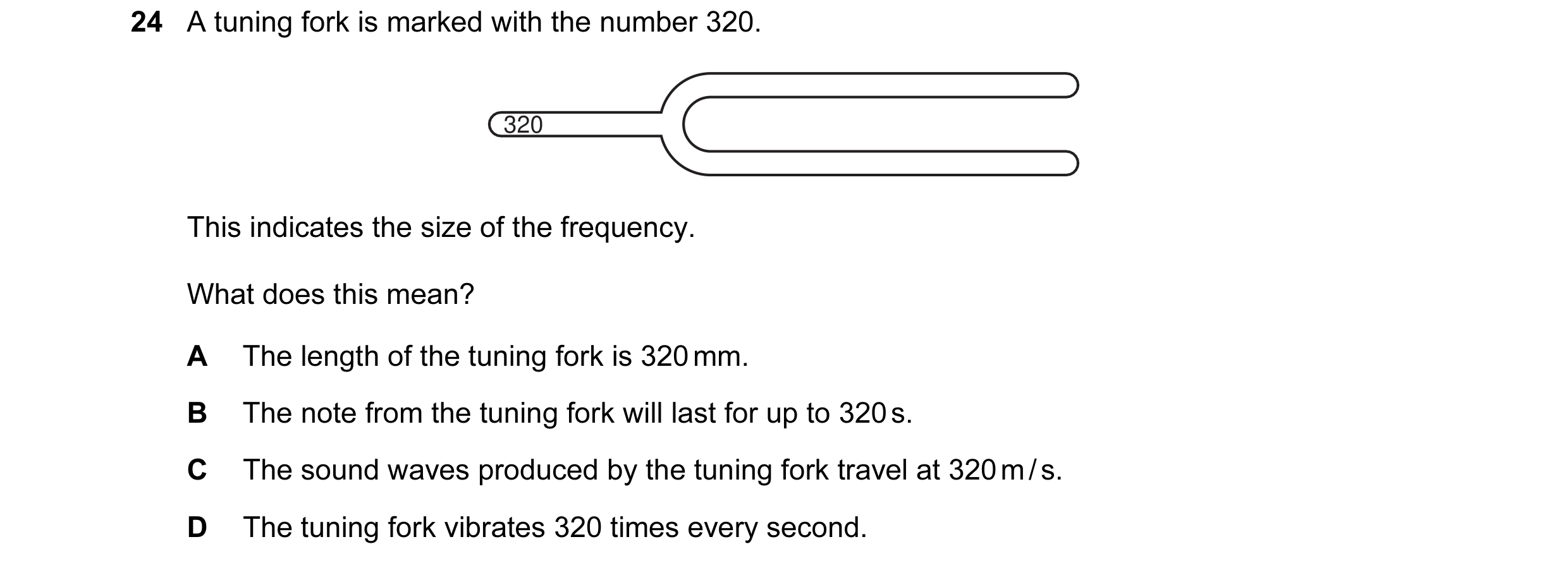
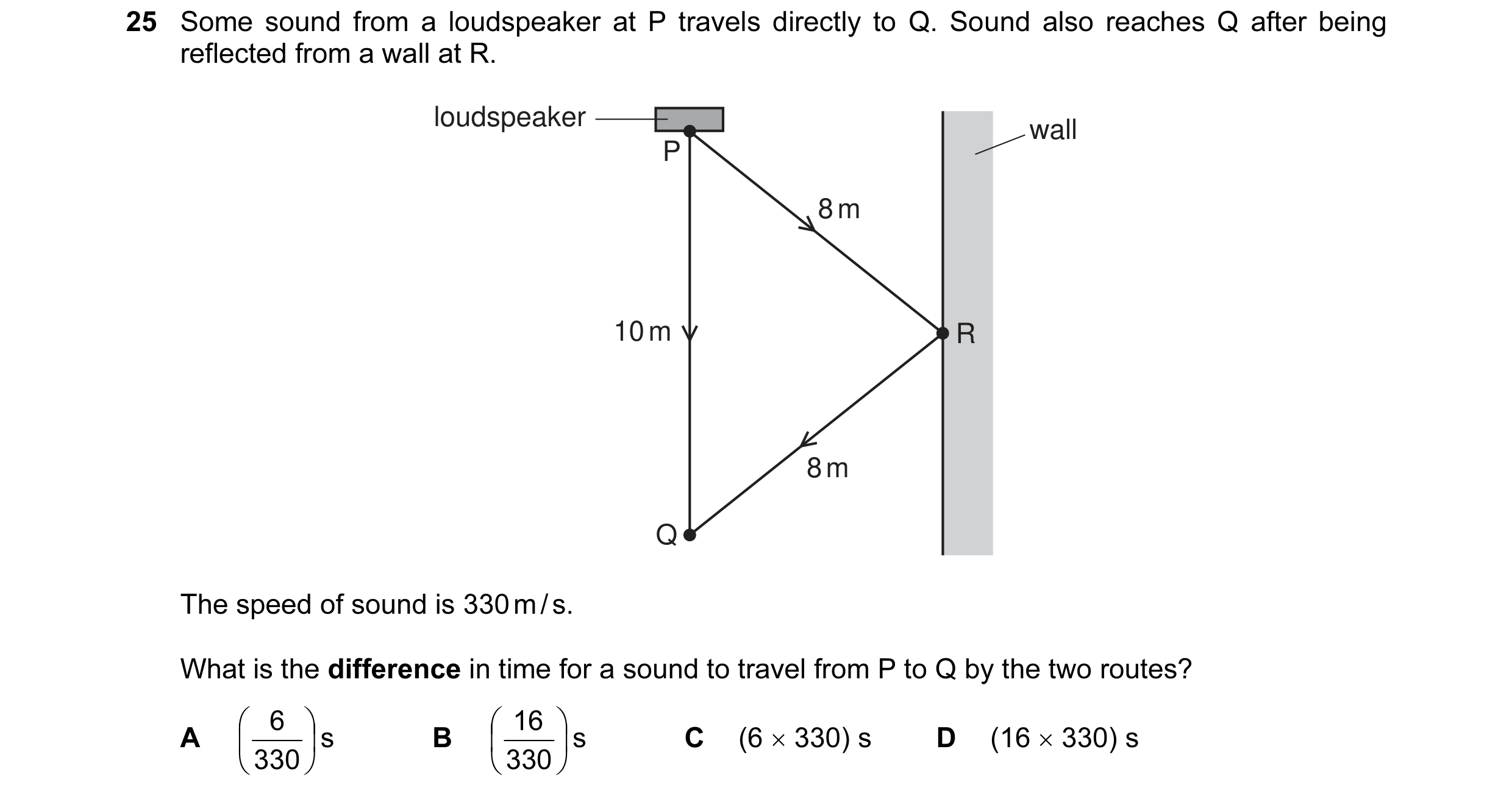
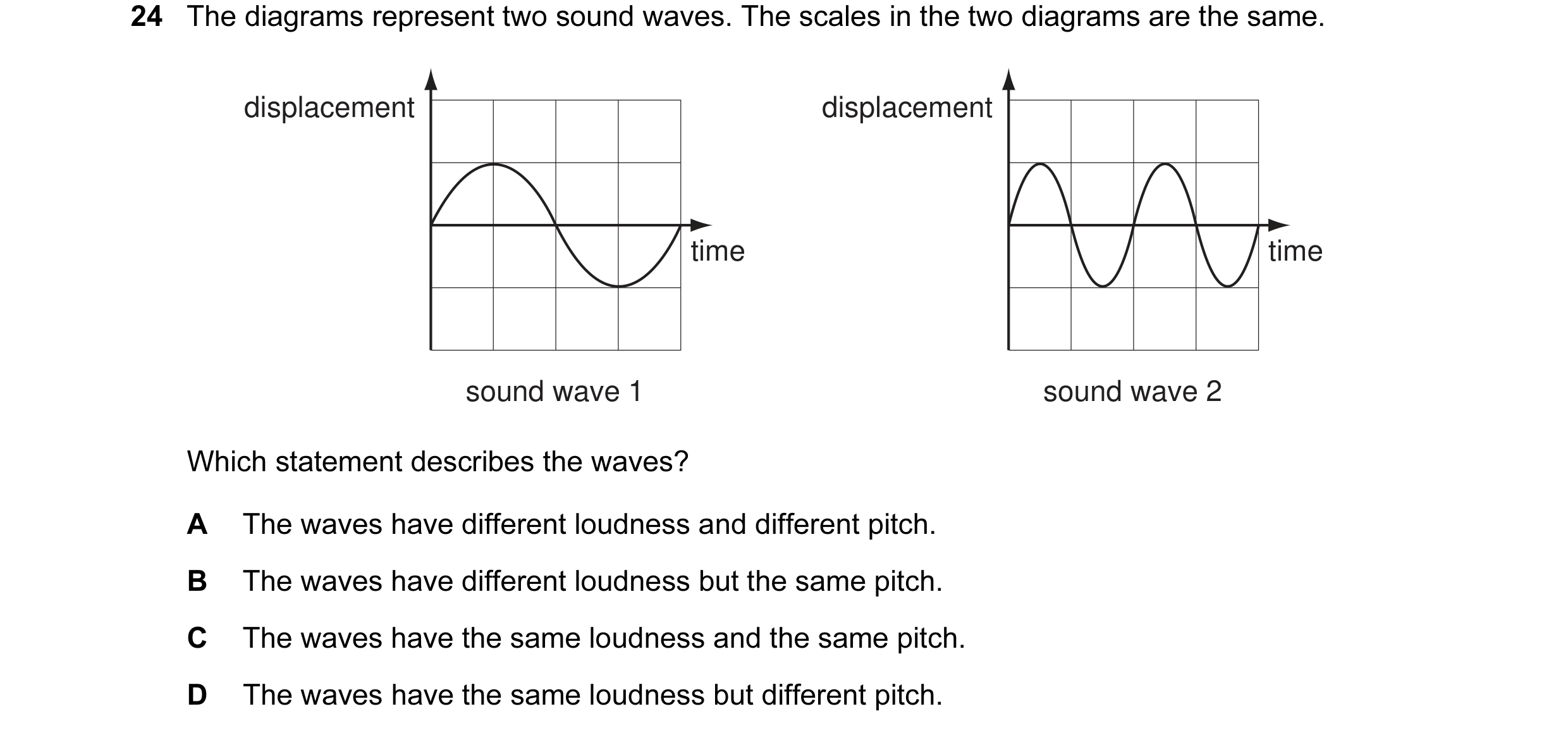 18 / 54
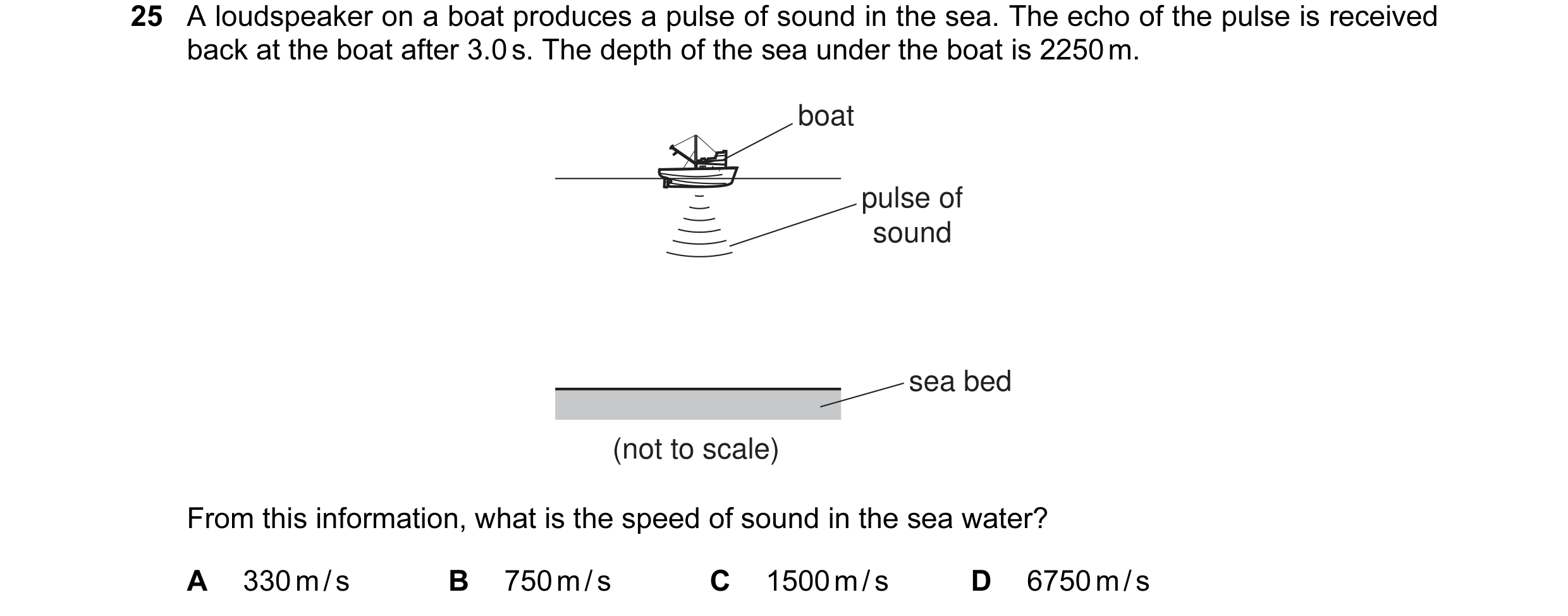
 19 / 54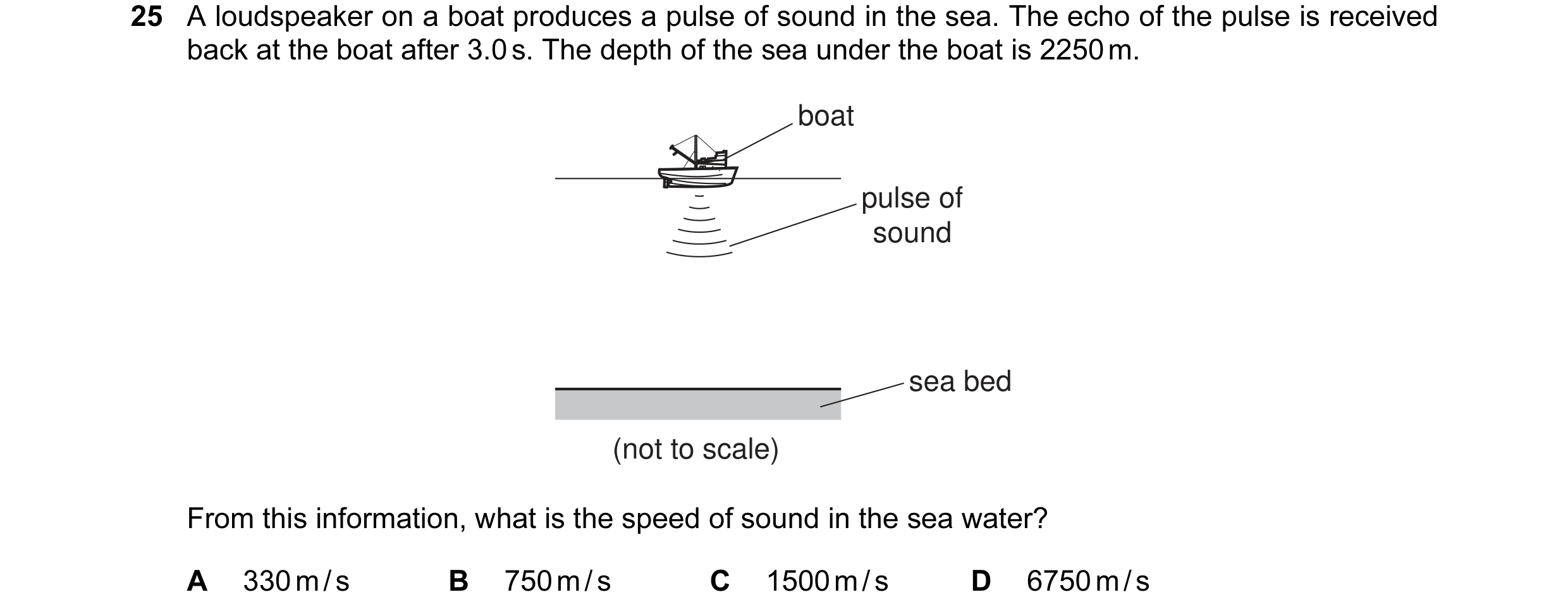
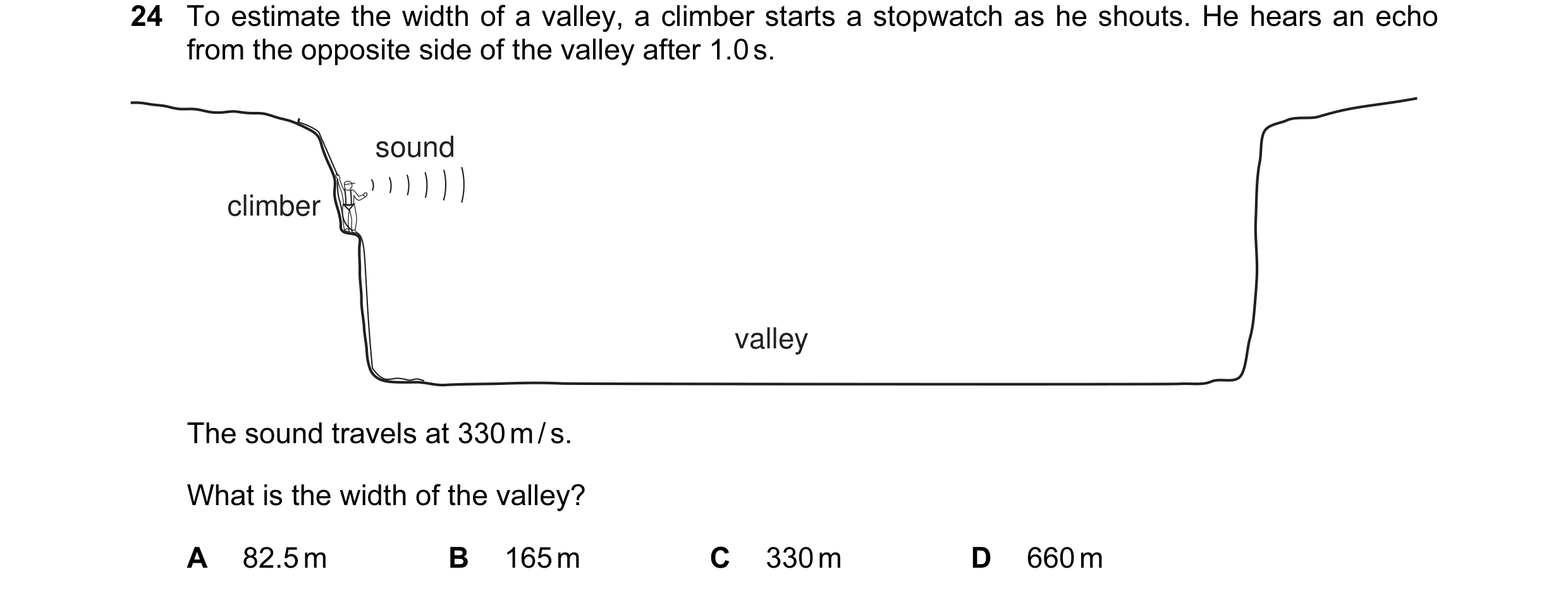
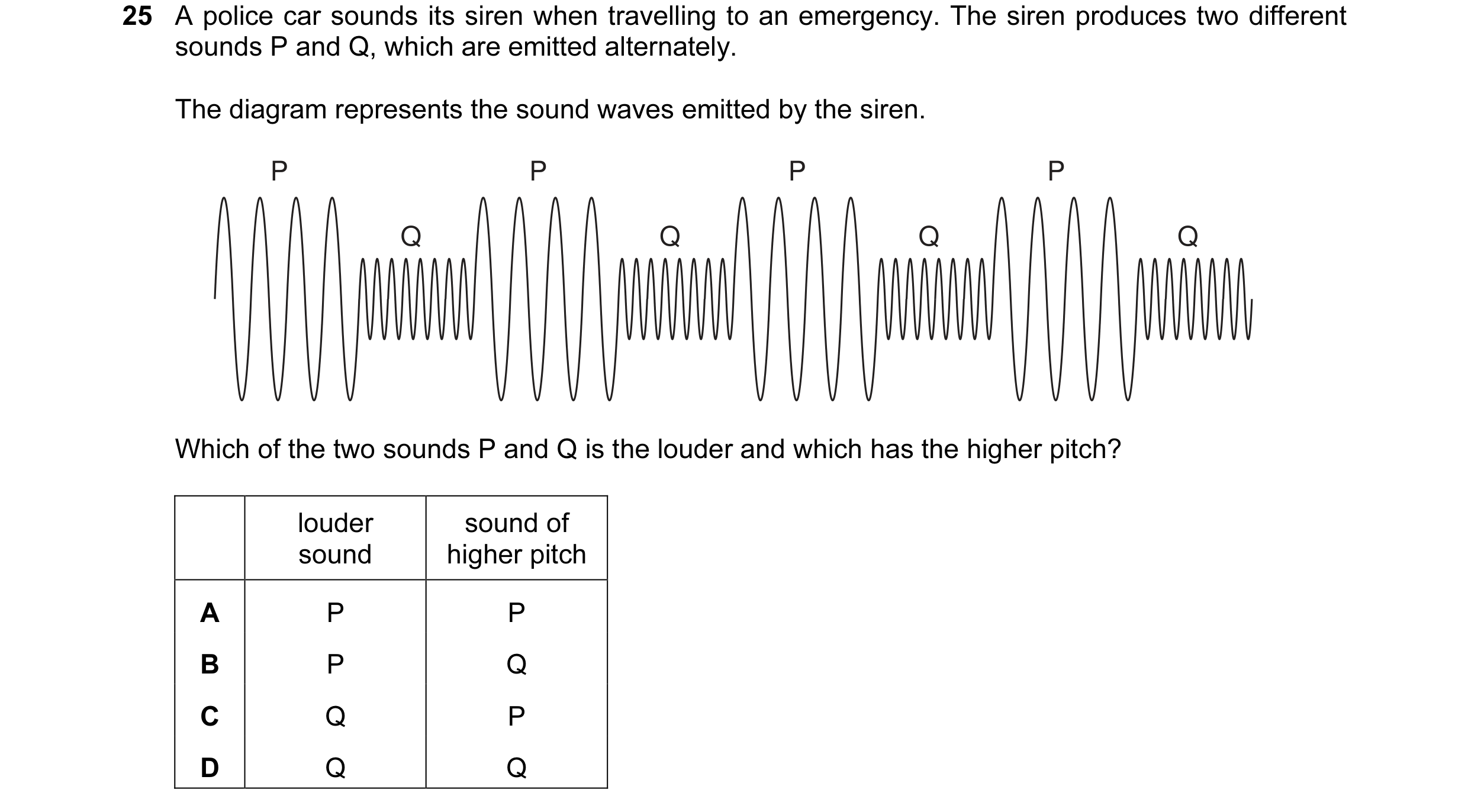 20 / 54
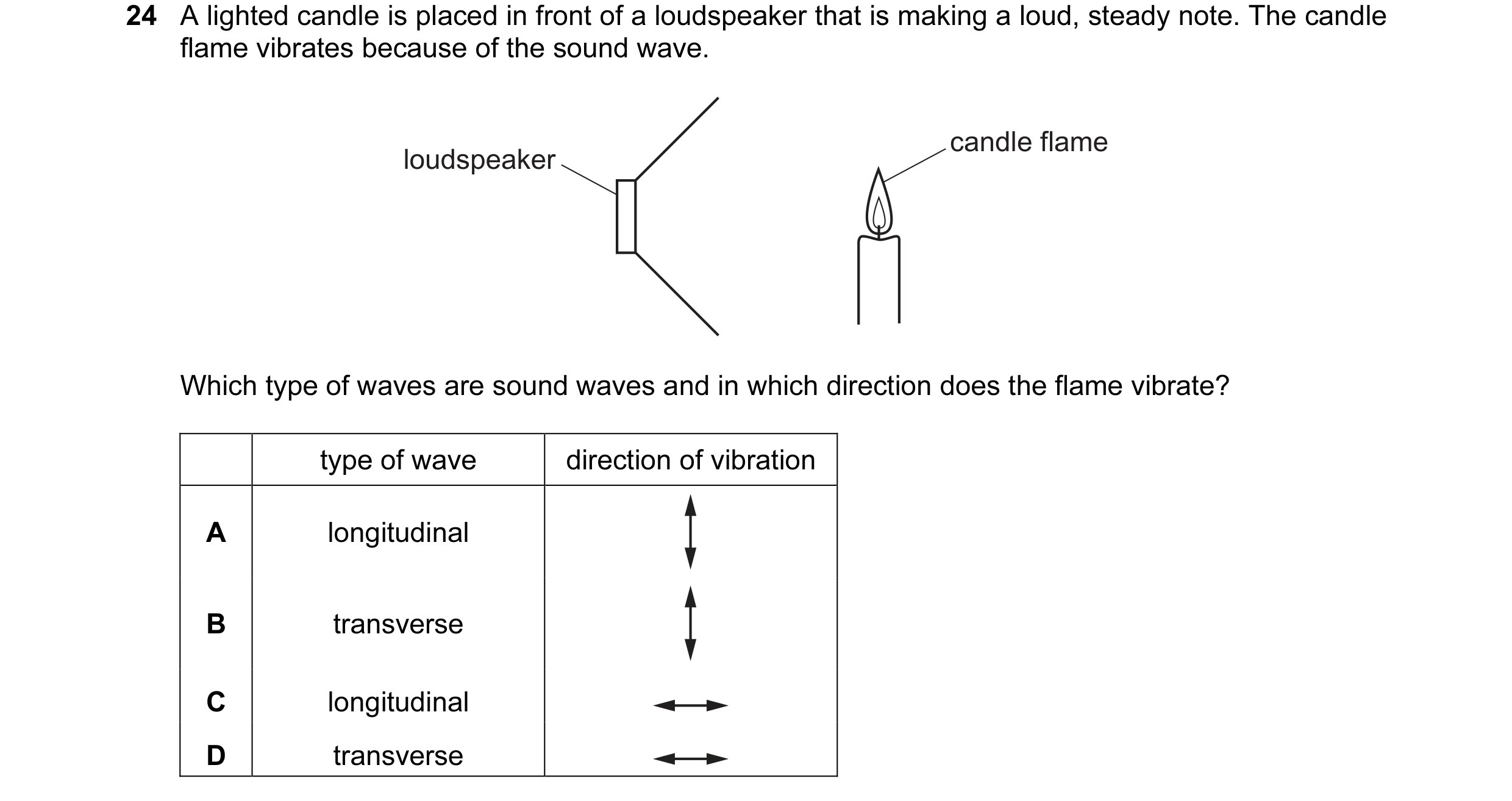 21 / 54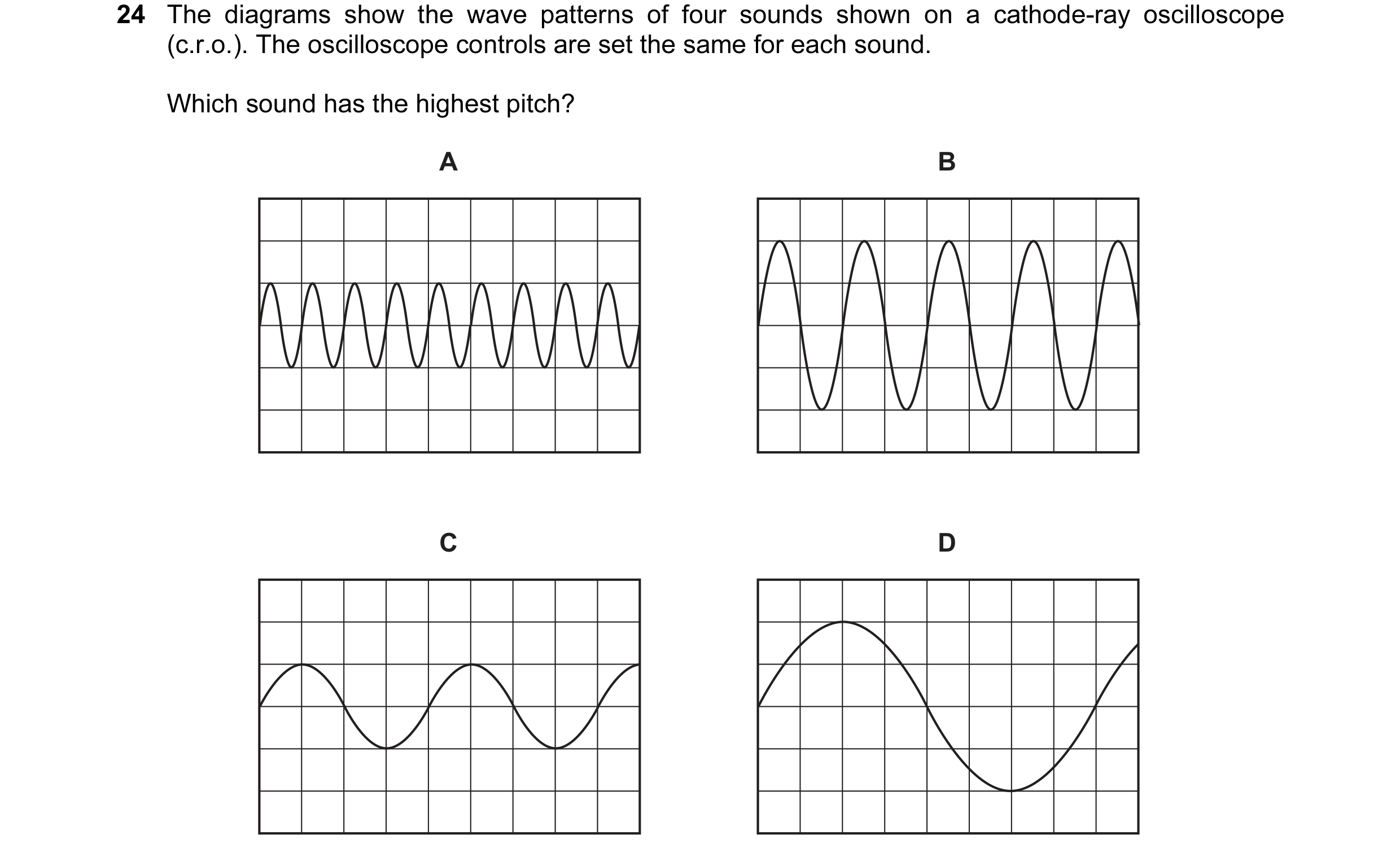
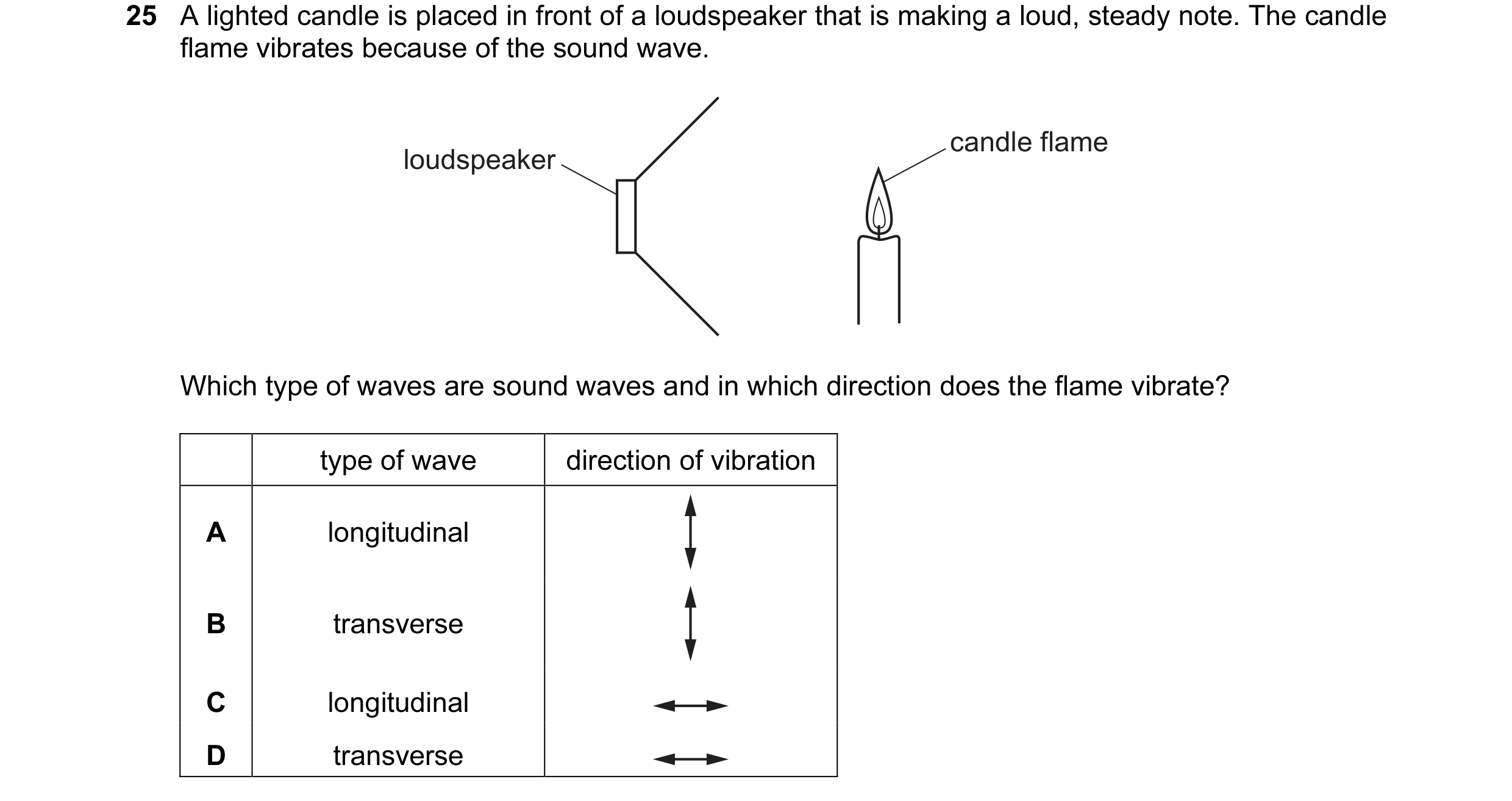 22 / 54
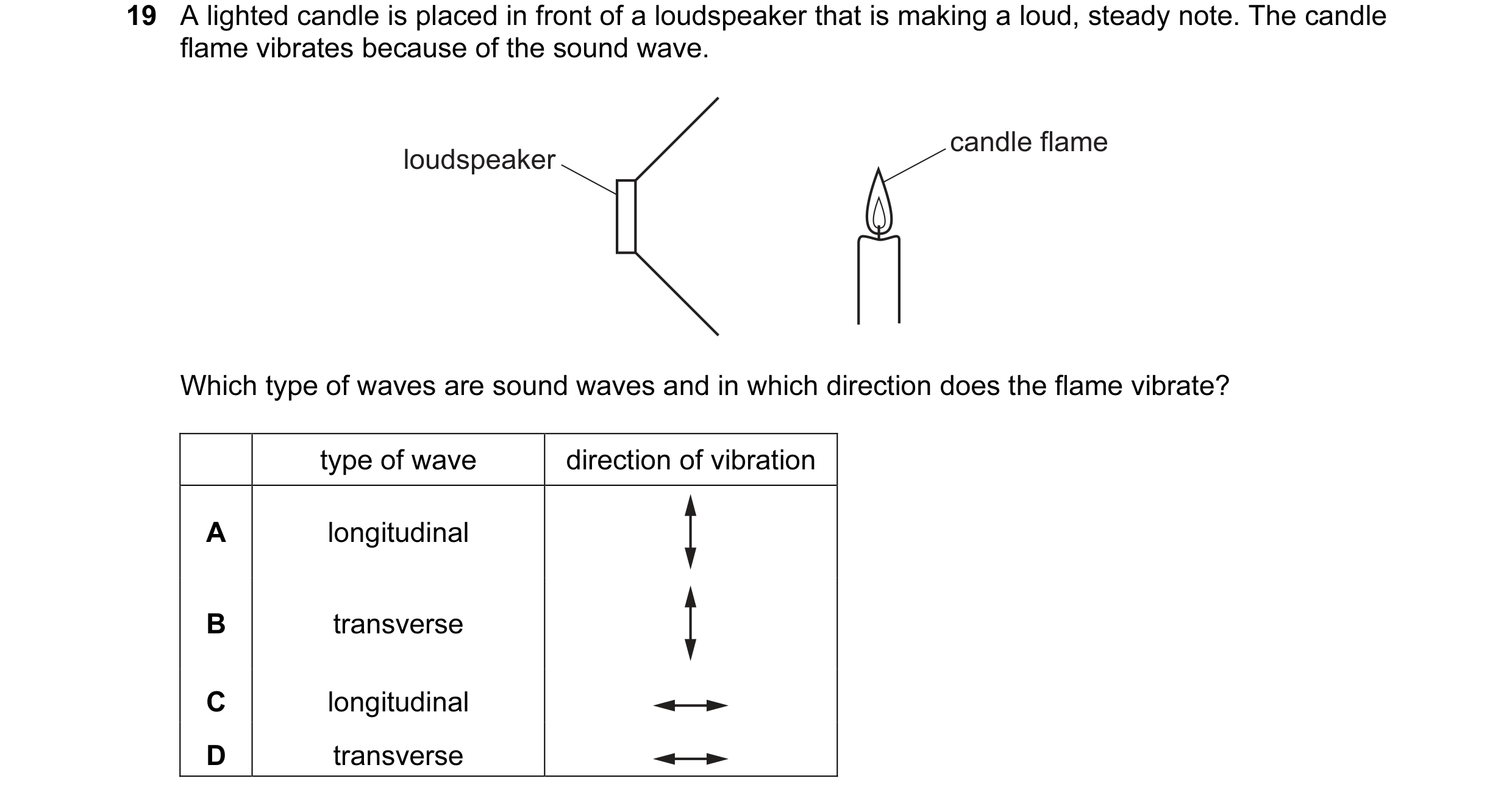
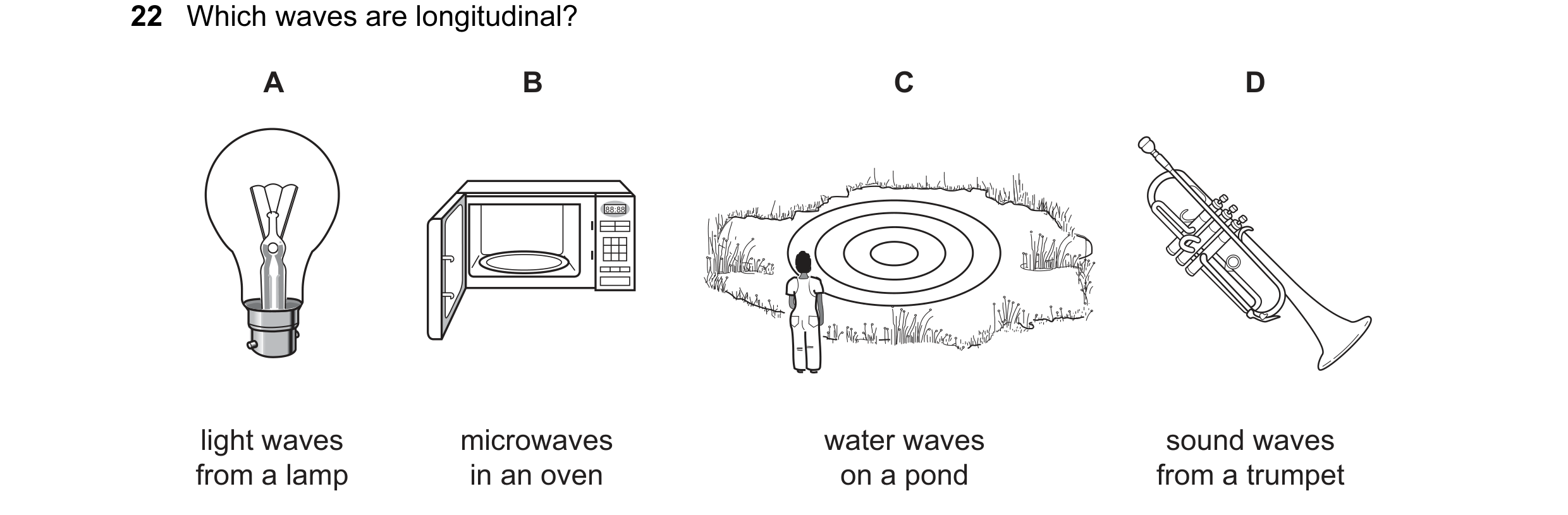 23 / 54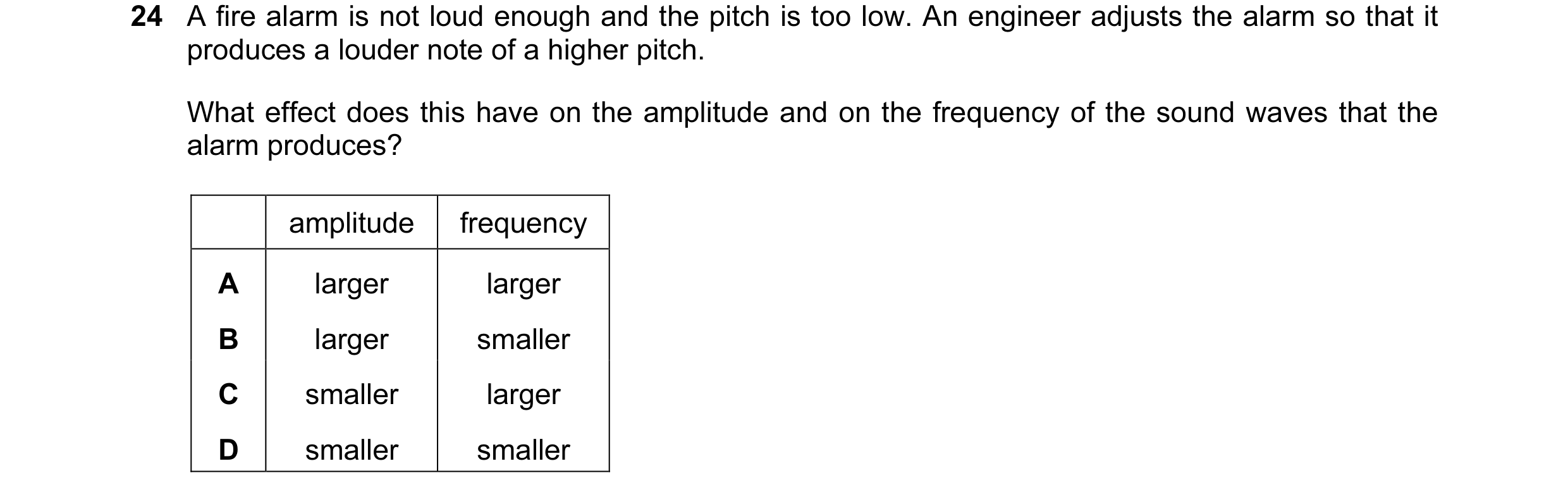
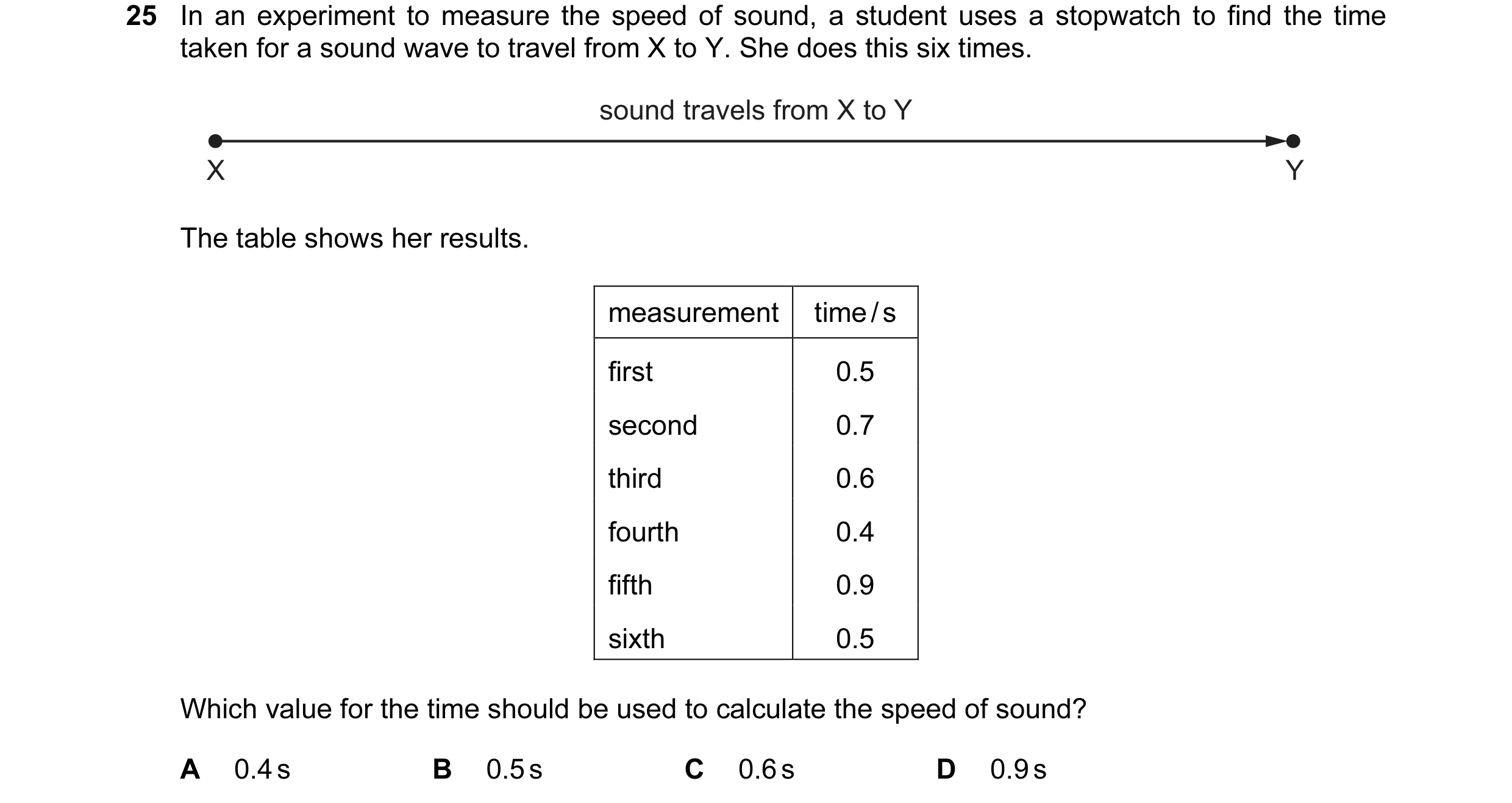
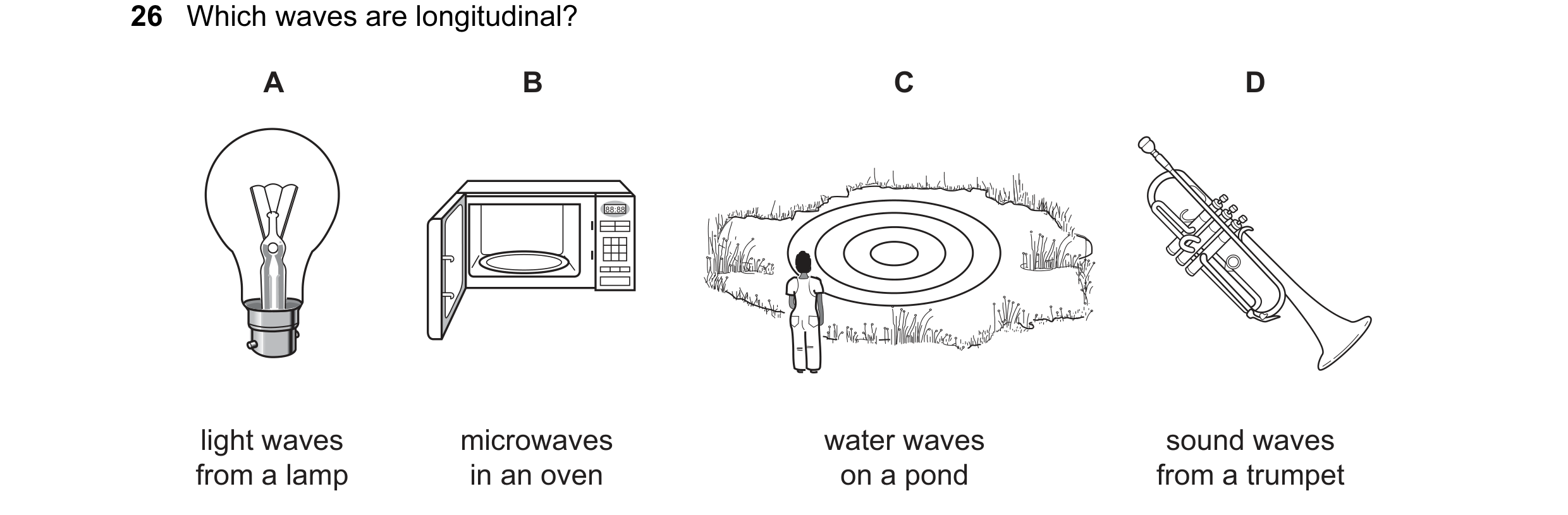 24 / 54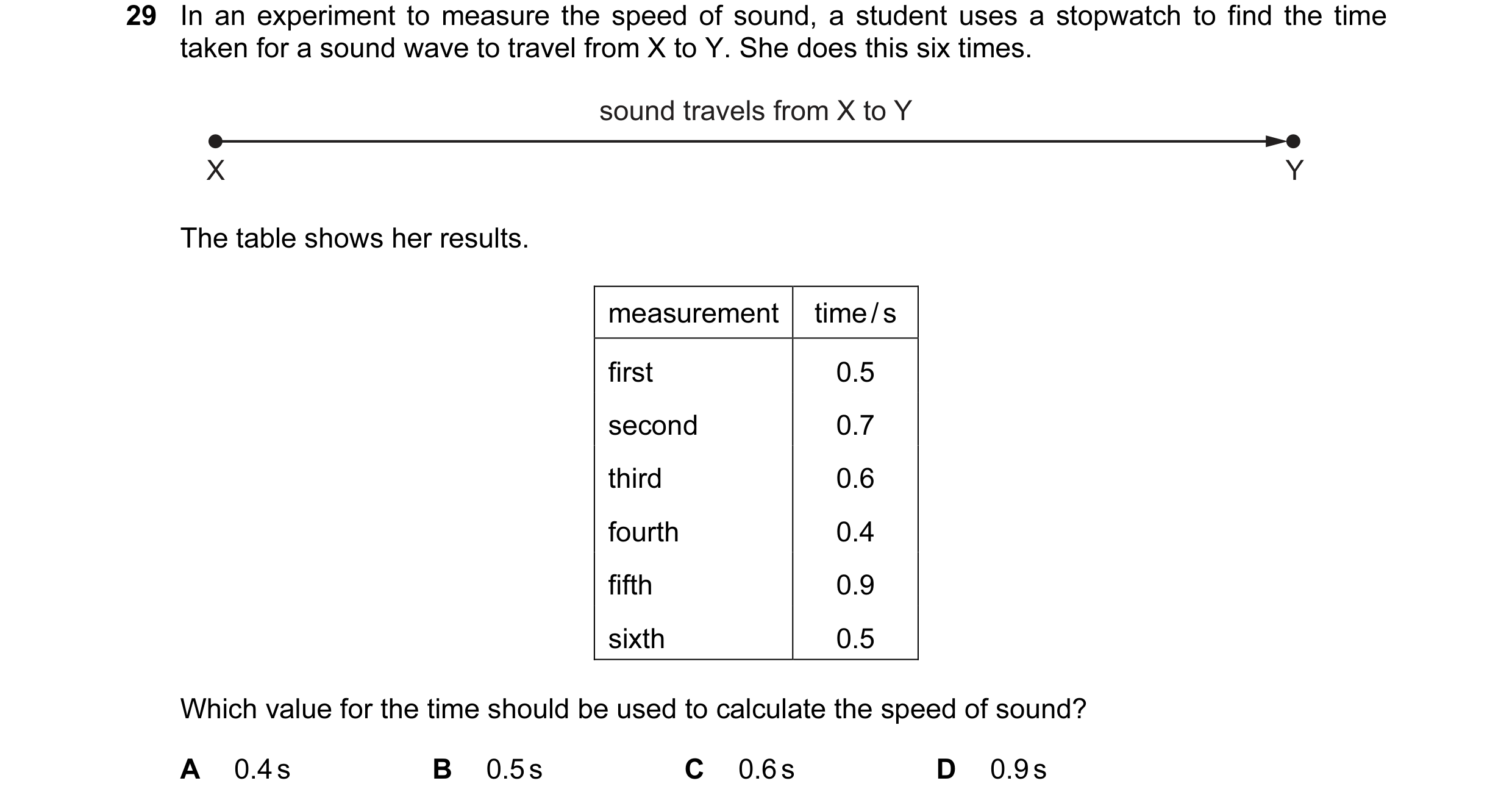
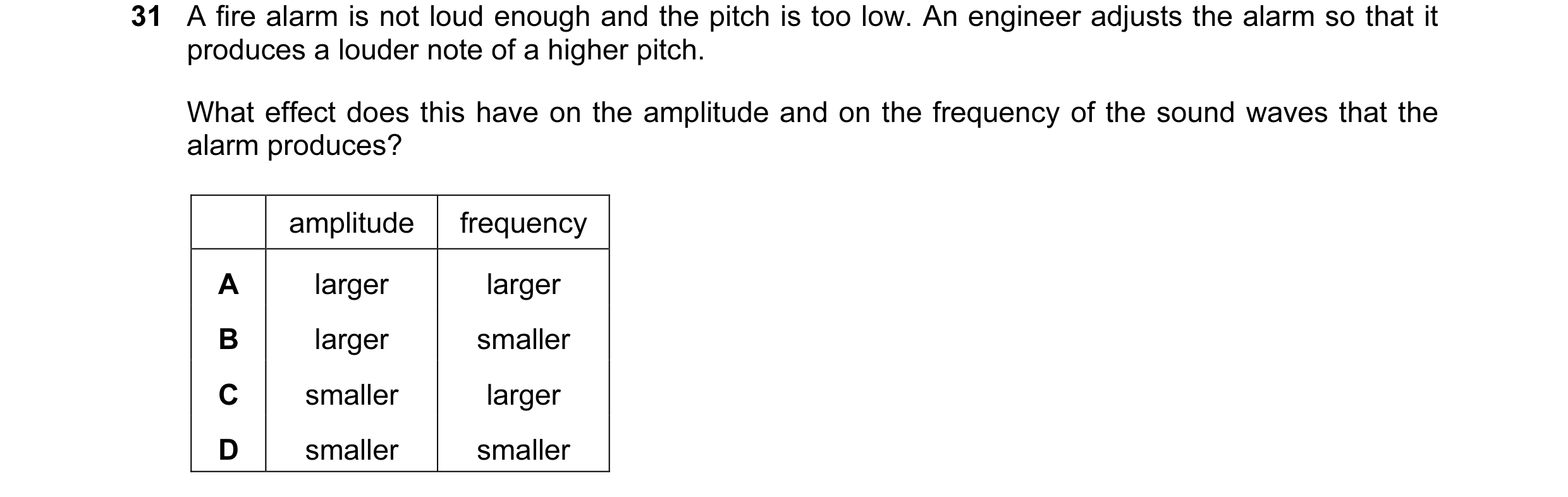
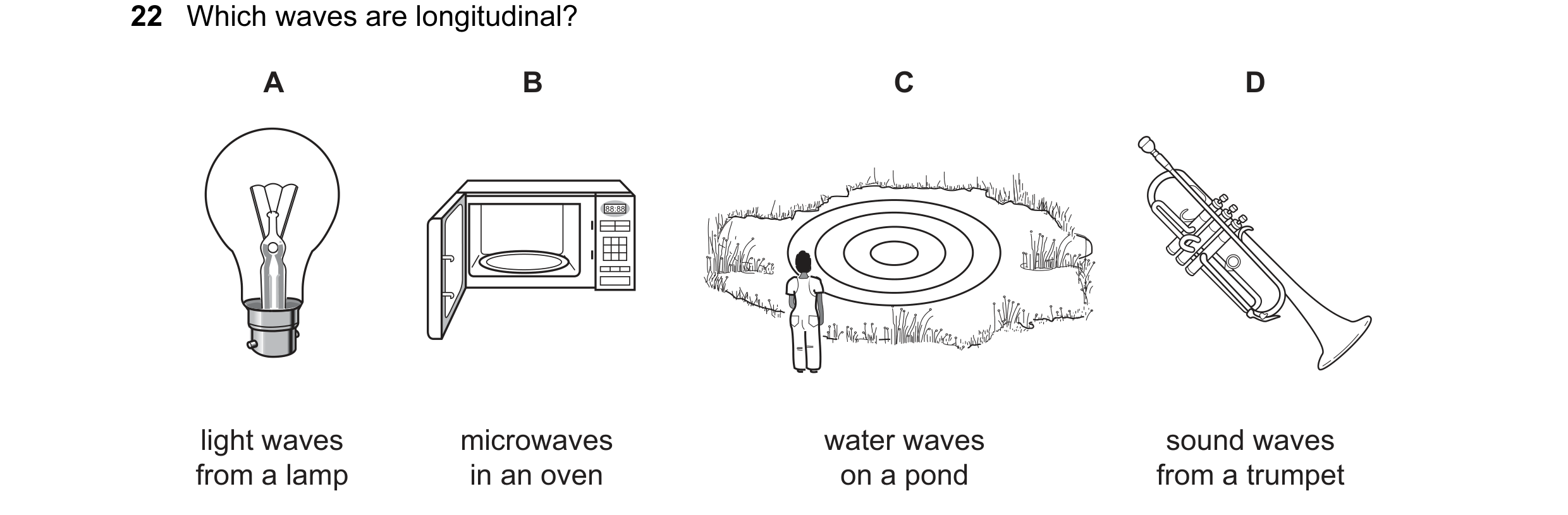 25 / 54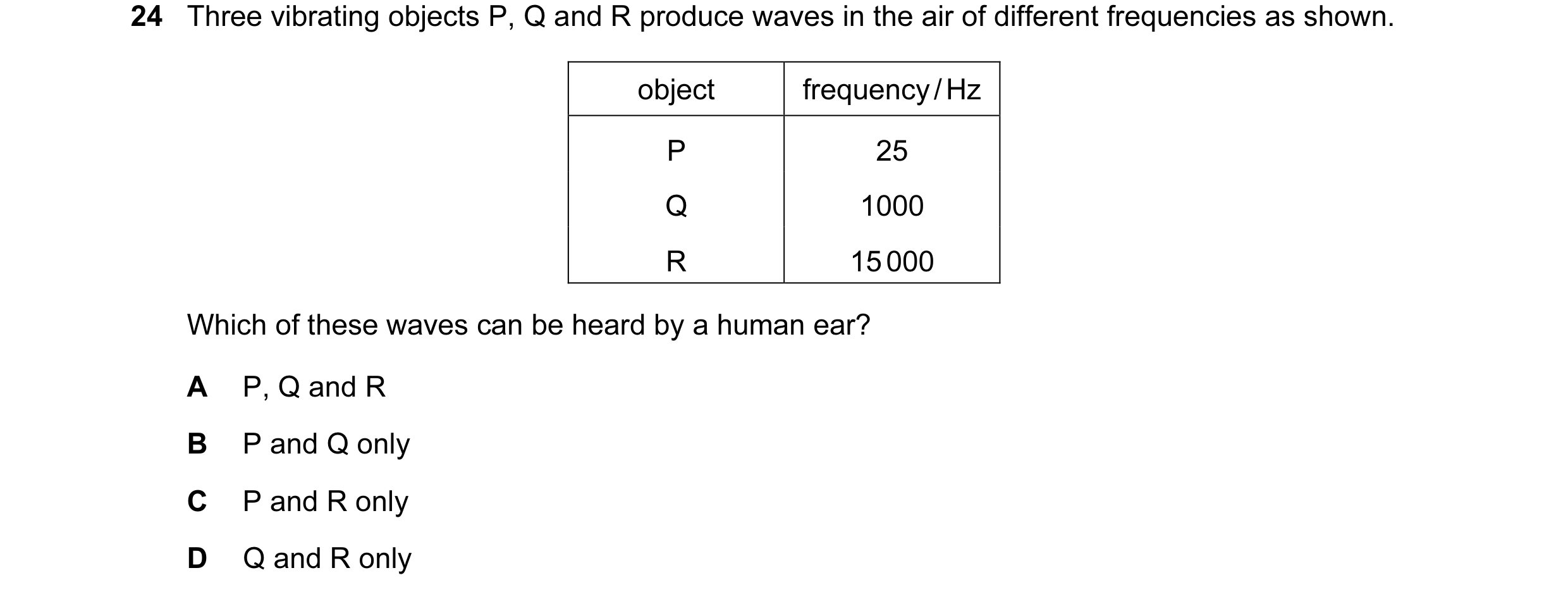
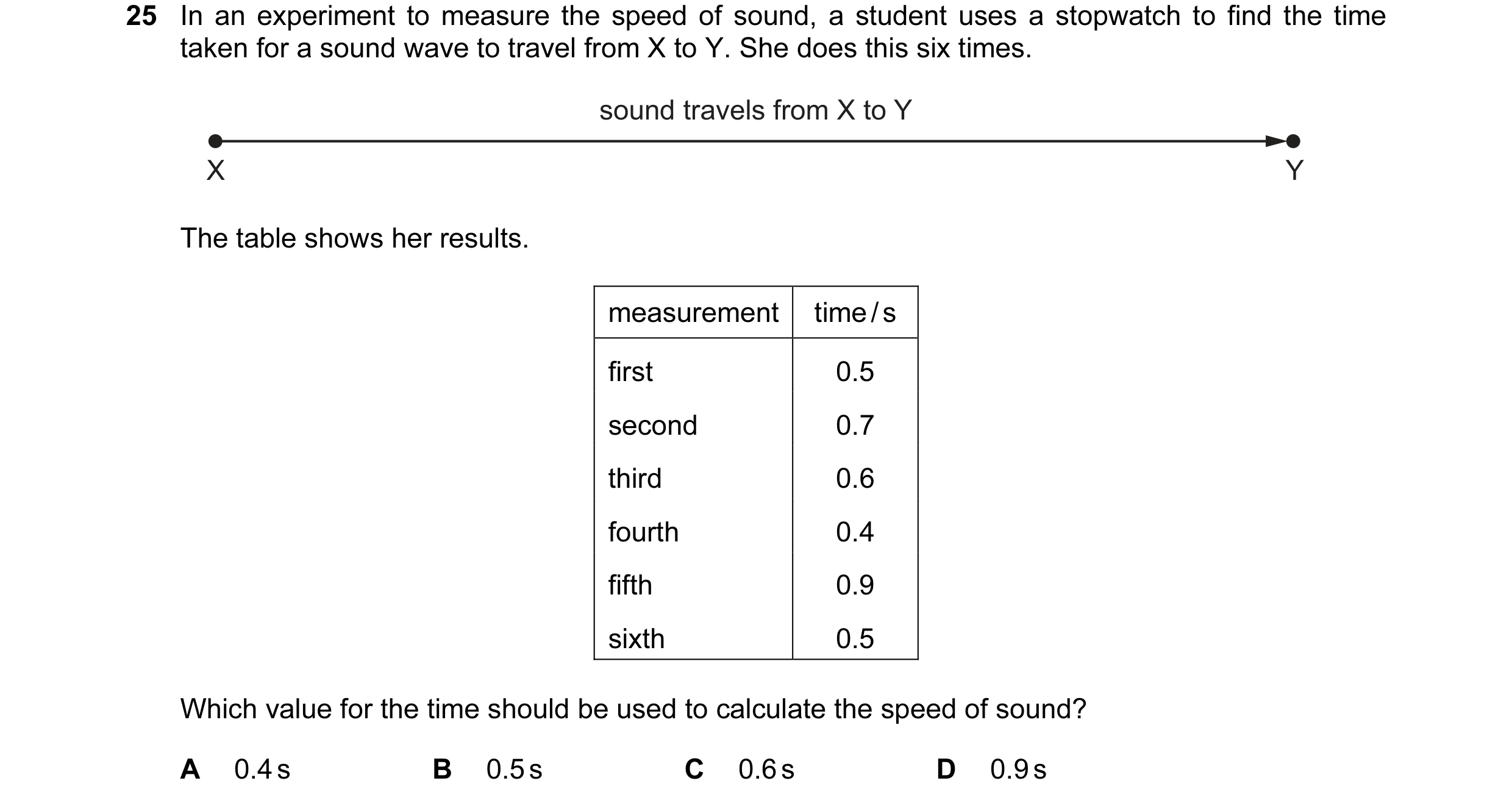
 26 / 54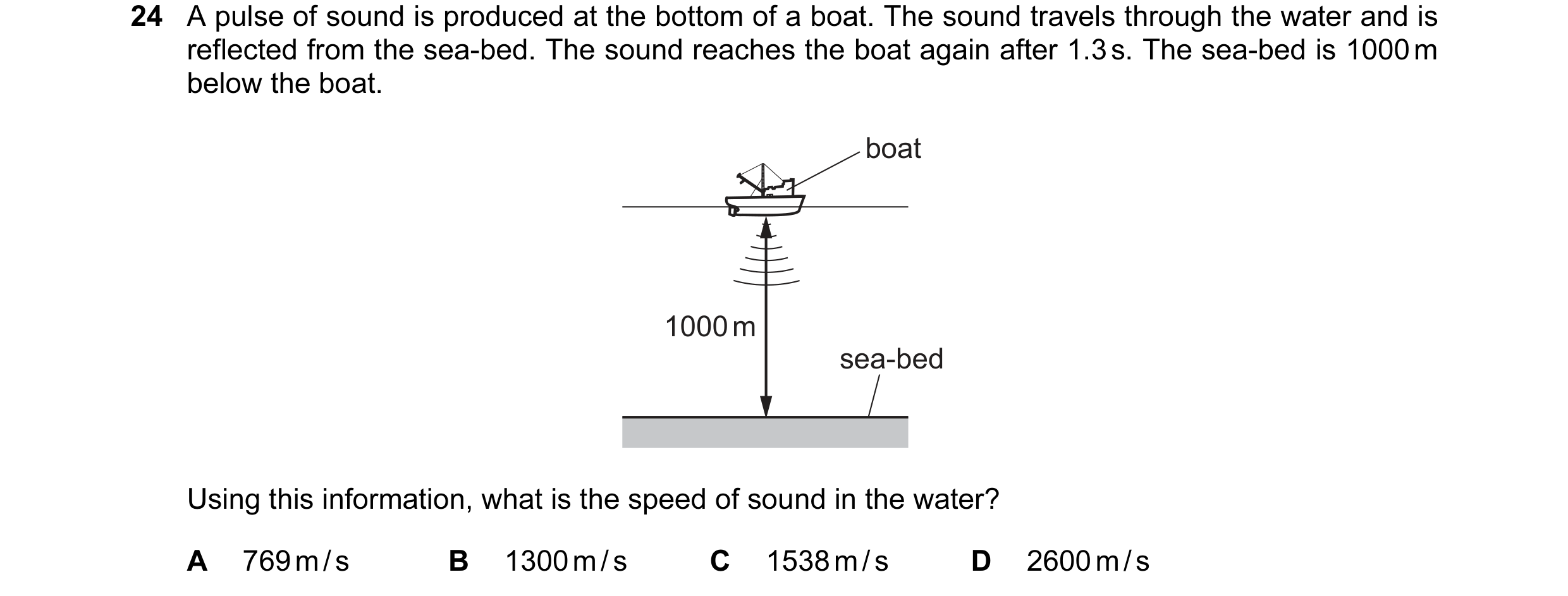

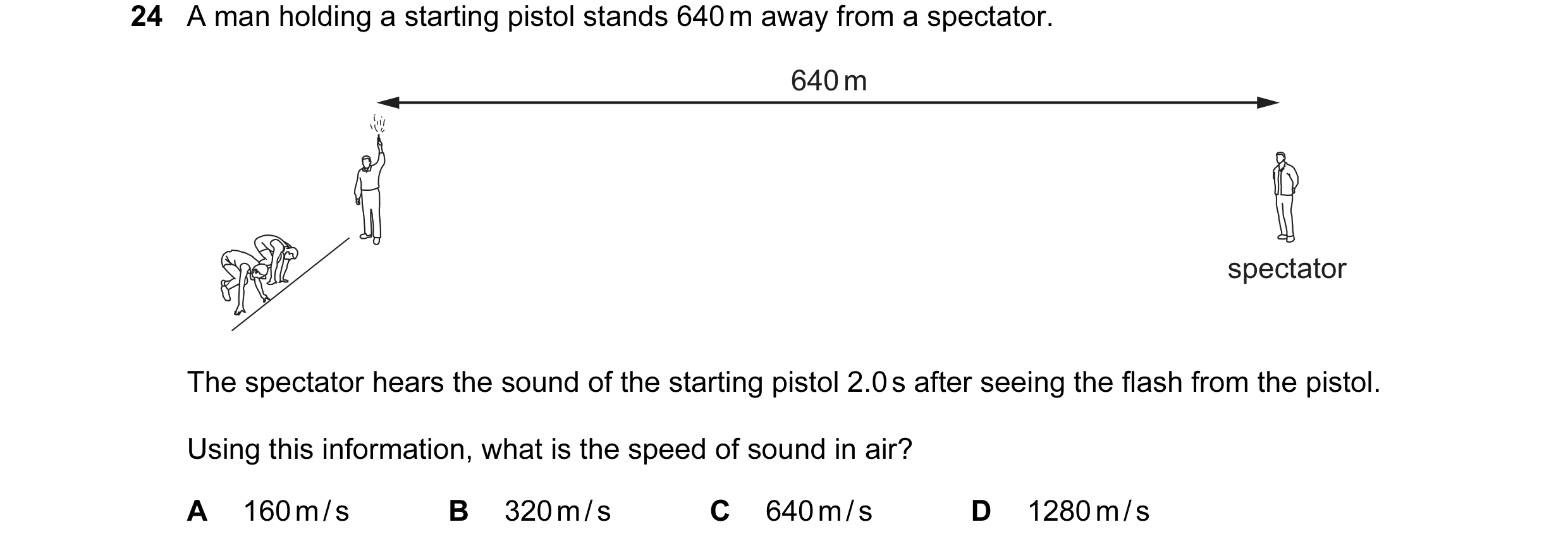
 27 / 54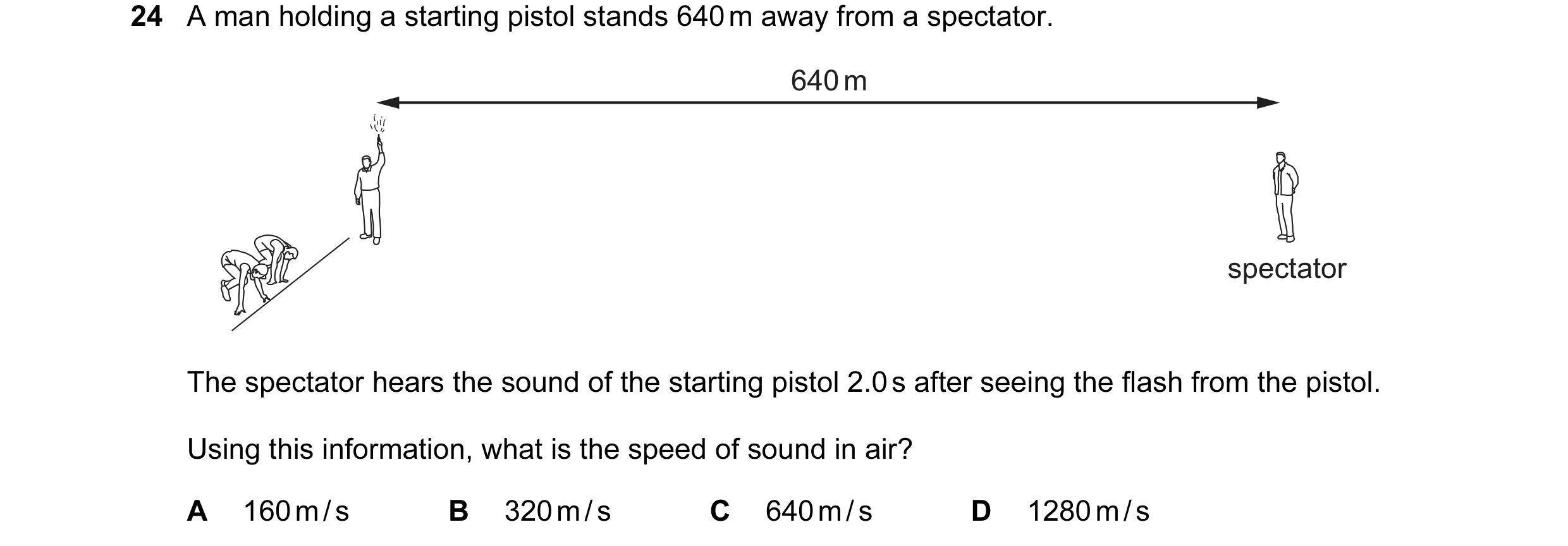
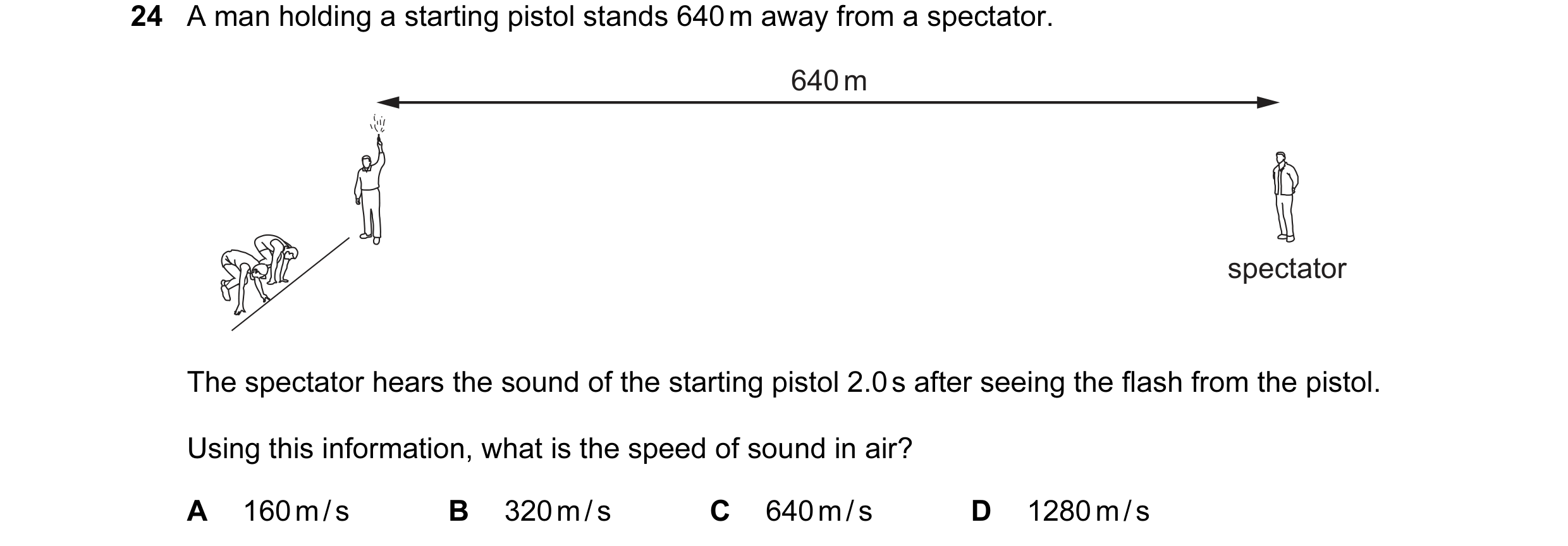 28 / 54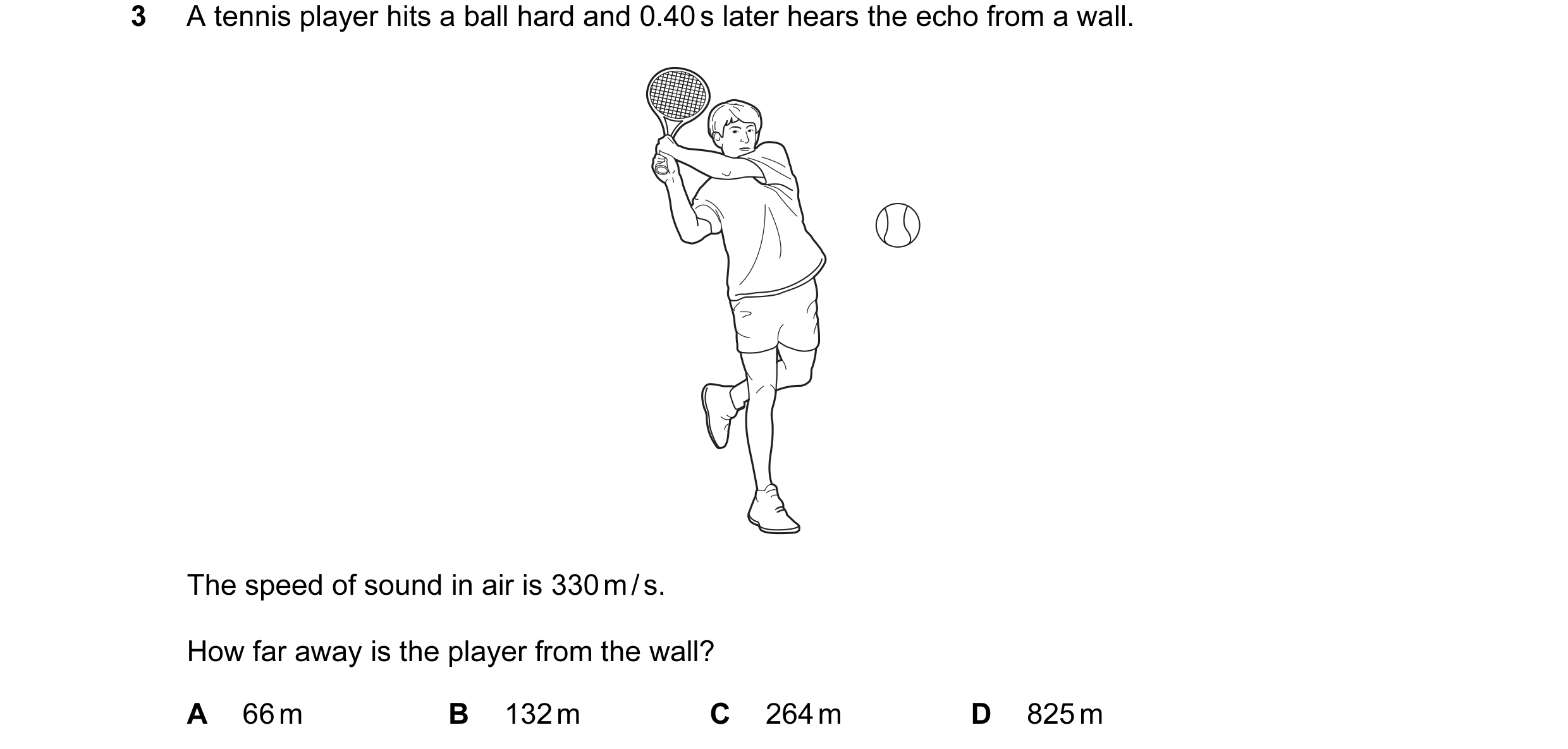
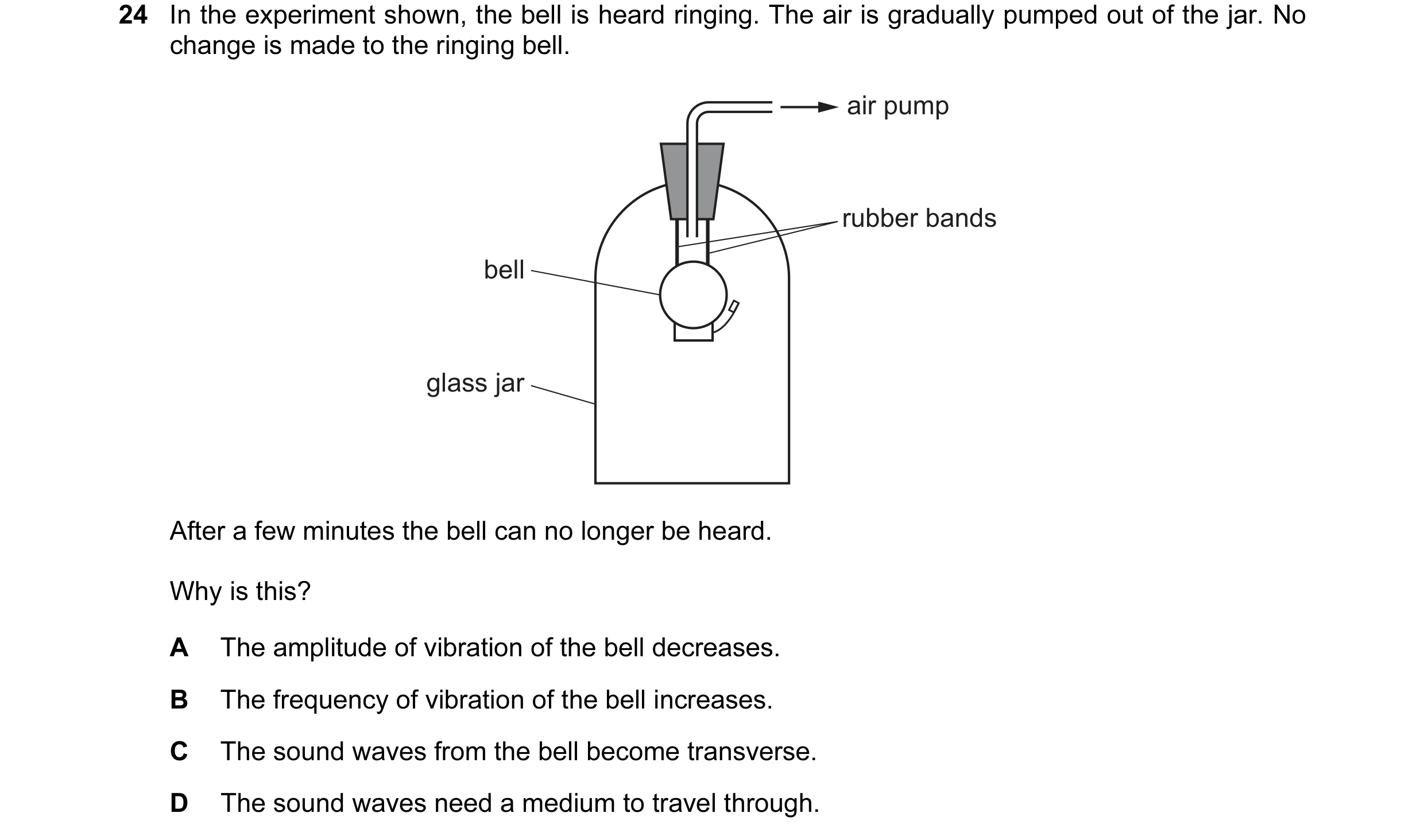
 29 / 54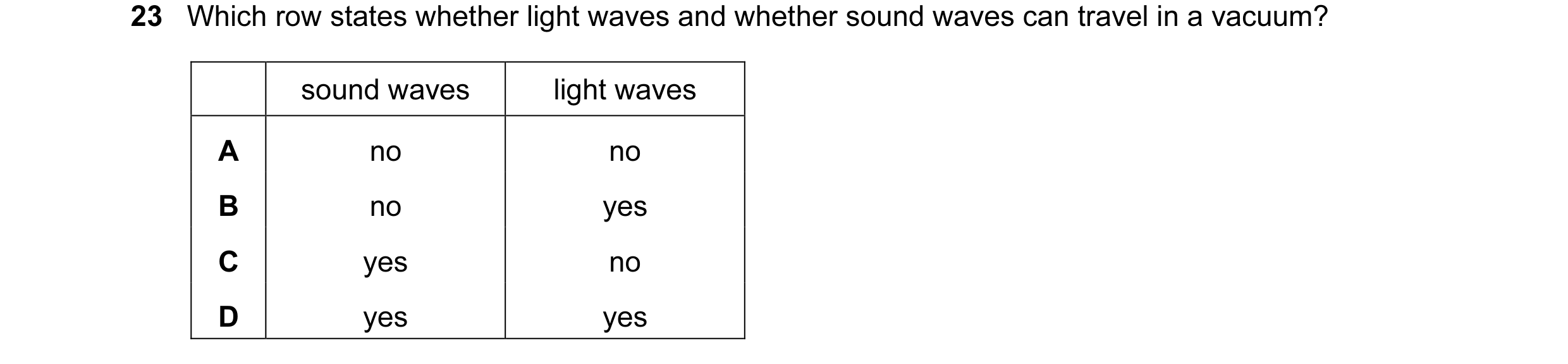
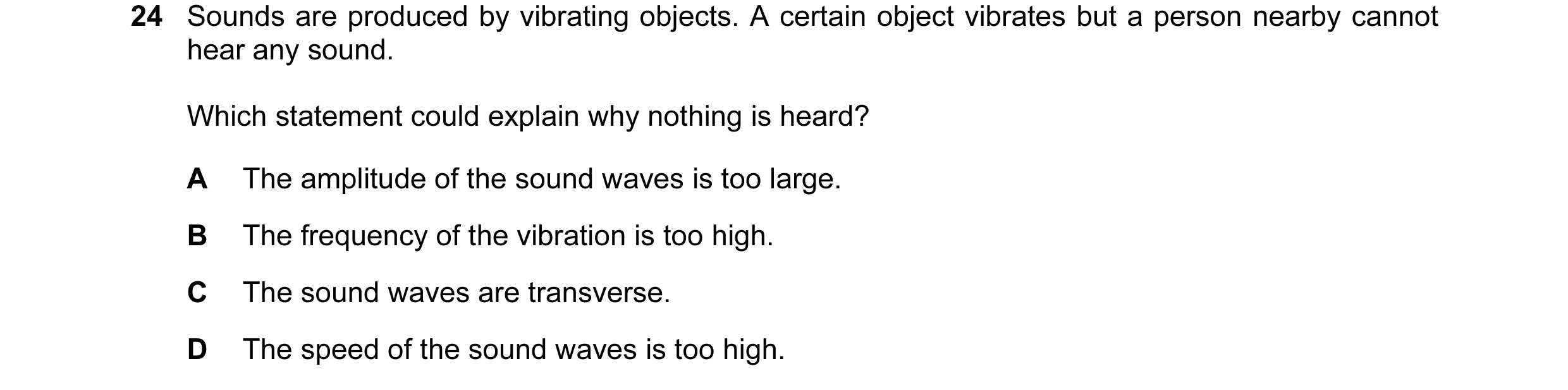
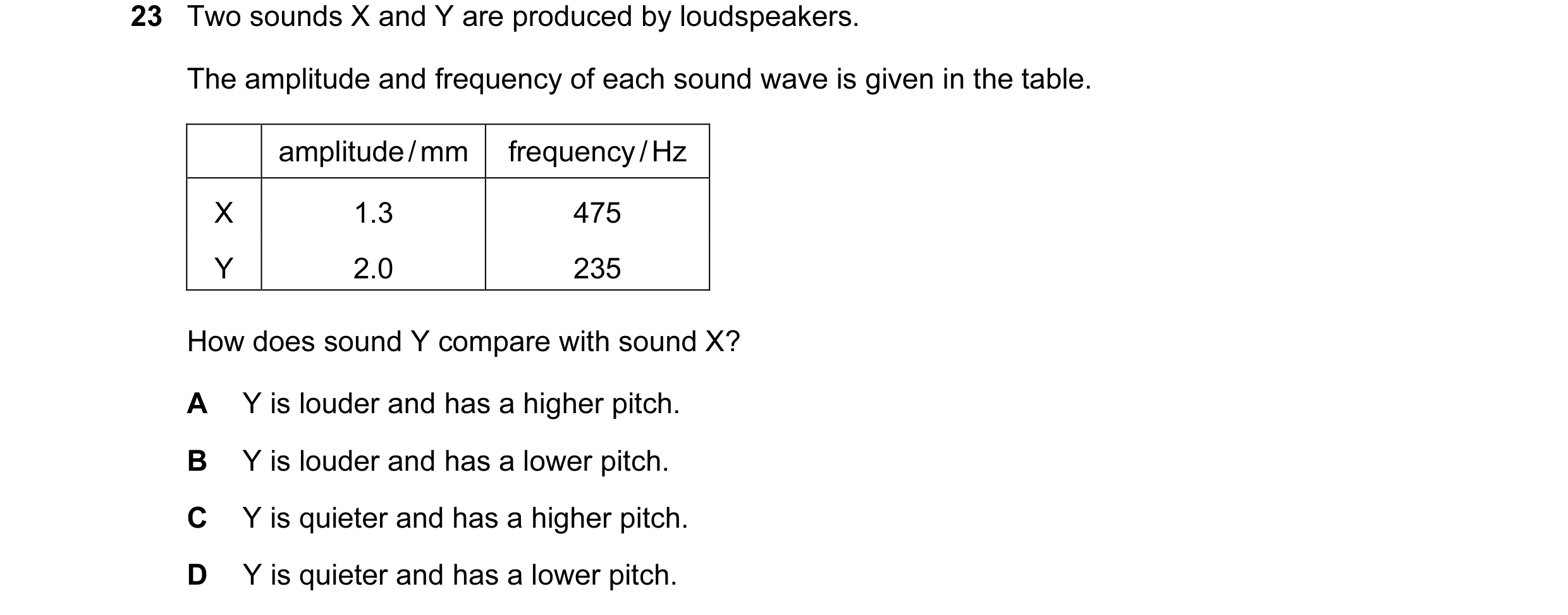
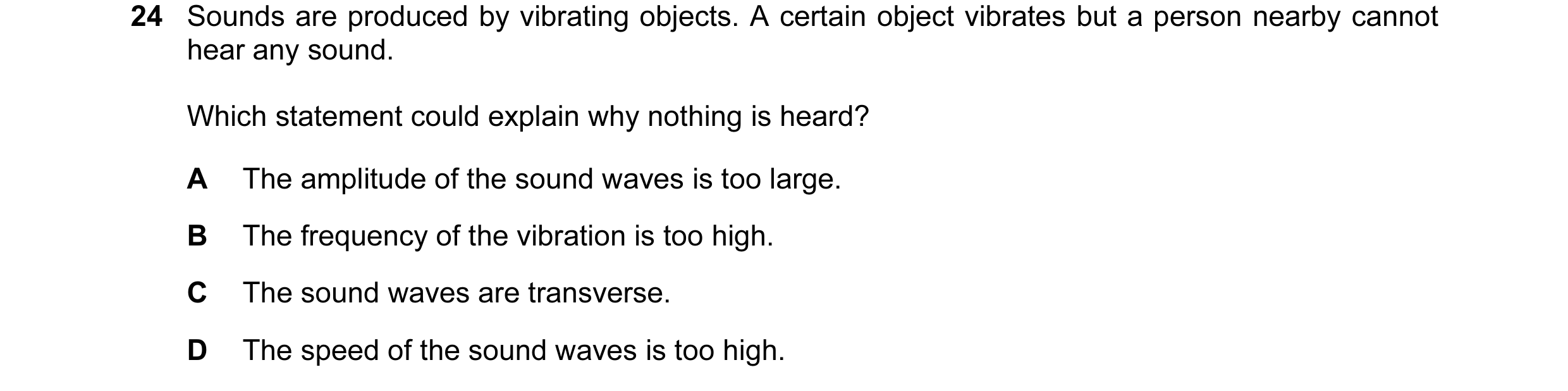 30 / 54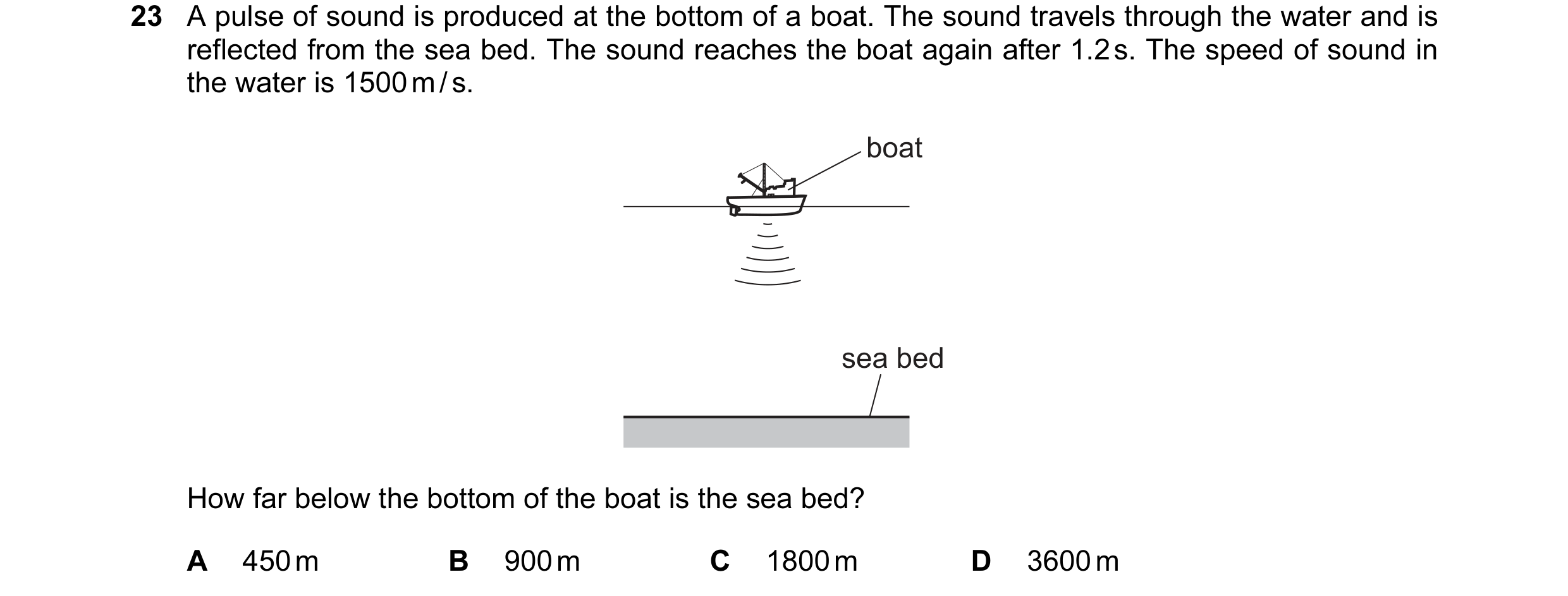
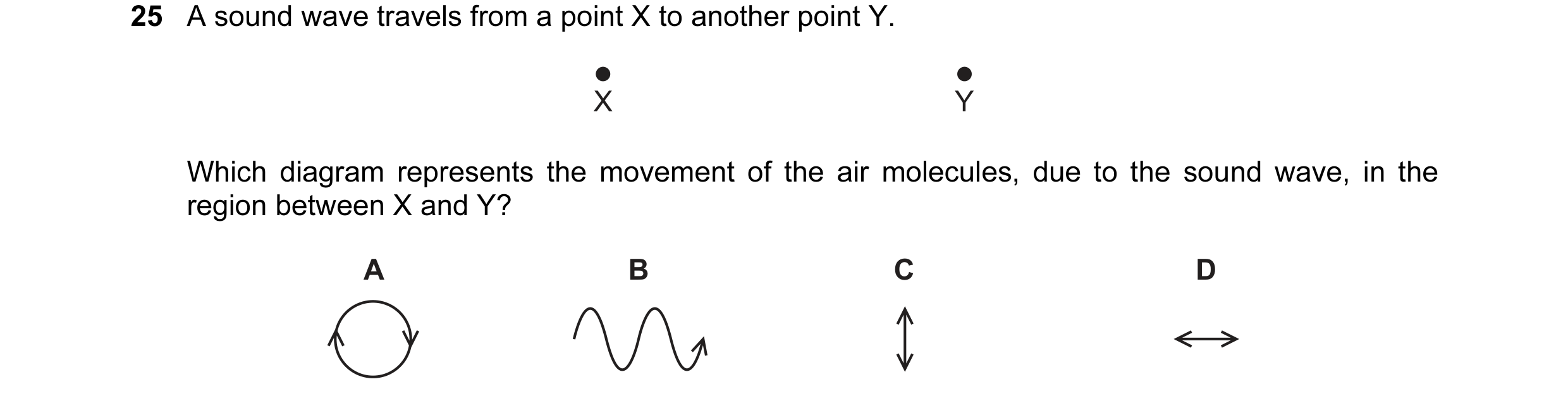
 31 / 54

 32 / 54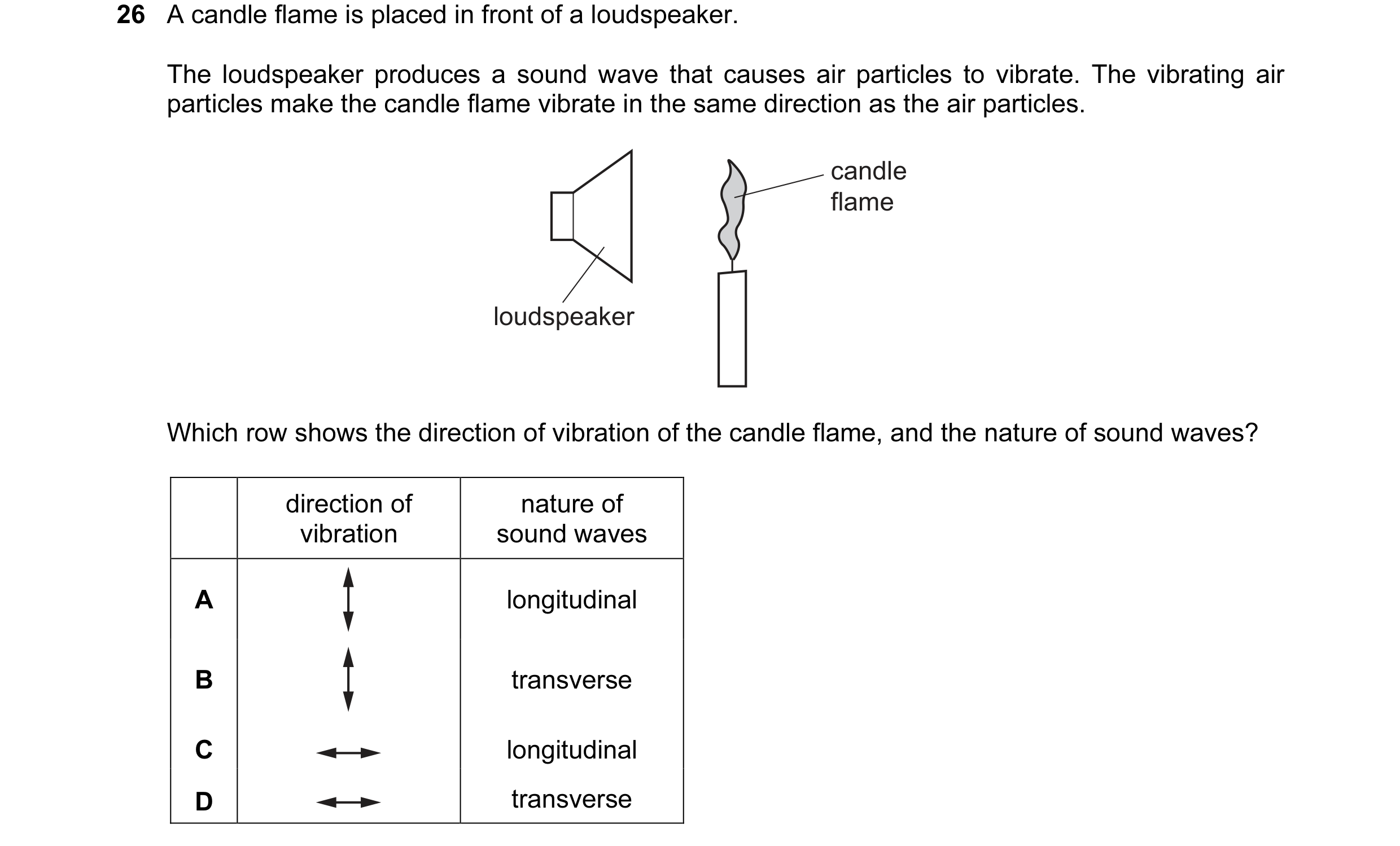
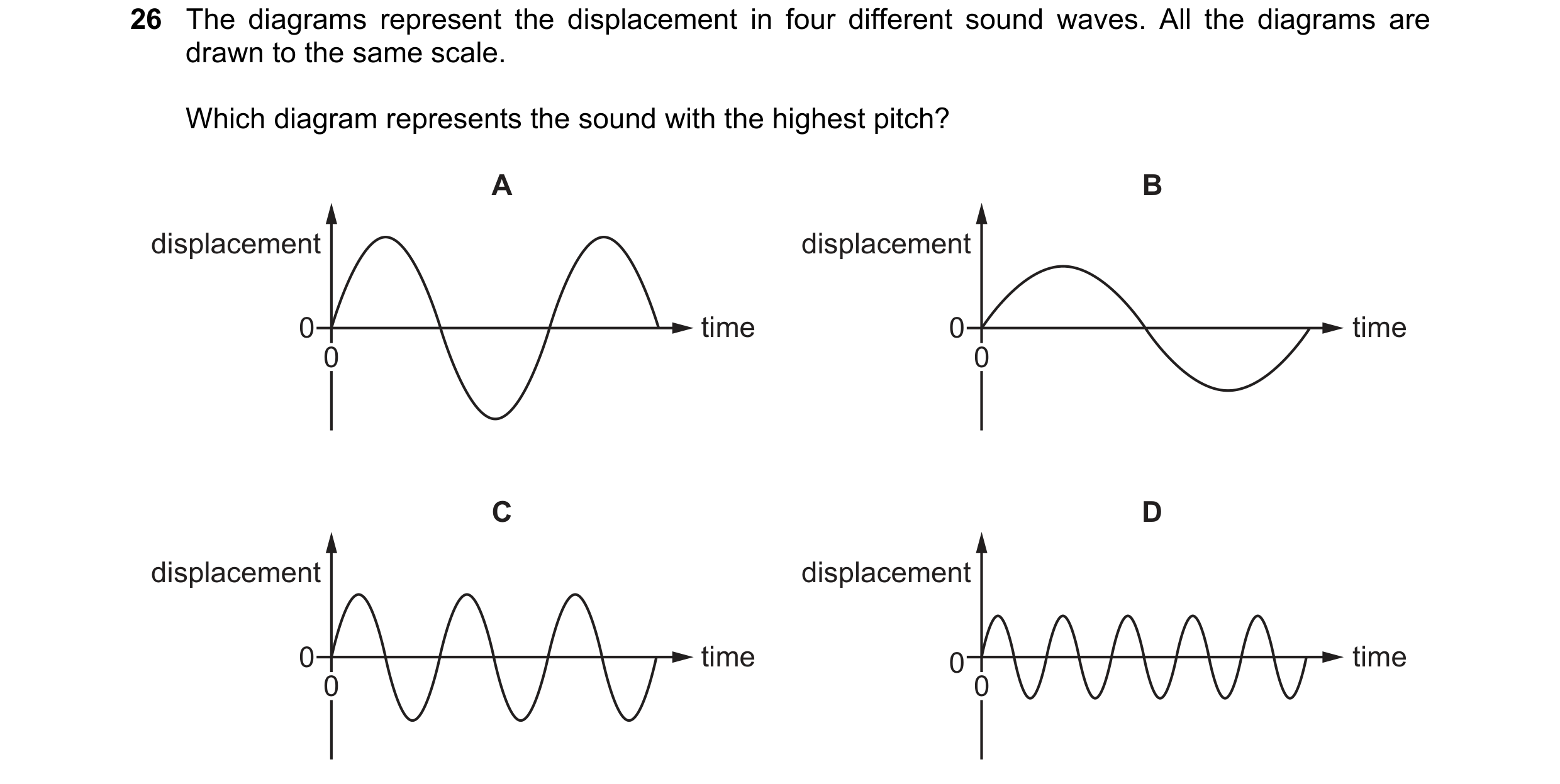 33 / 54


 34 / 54
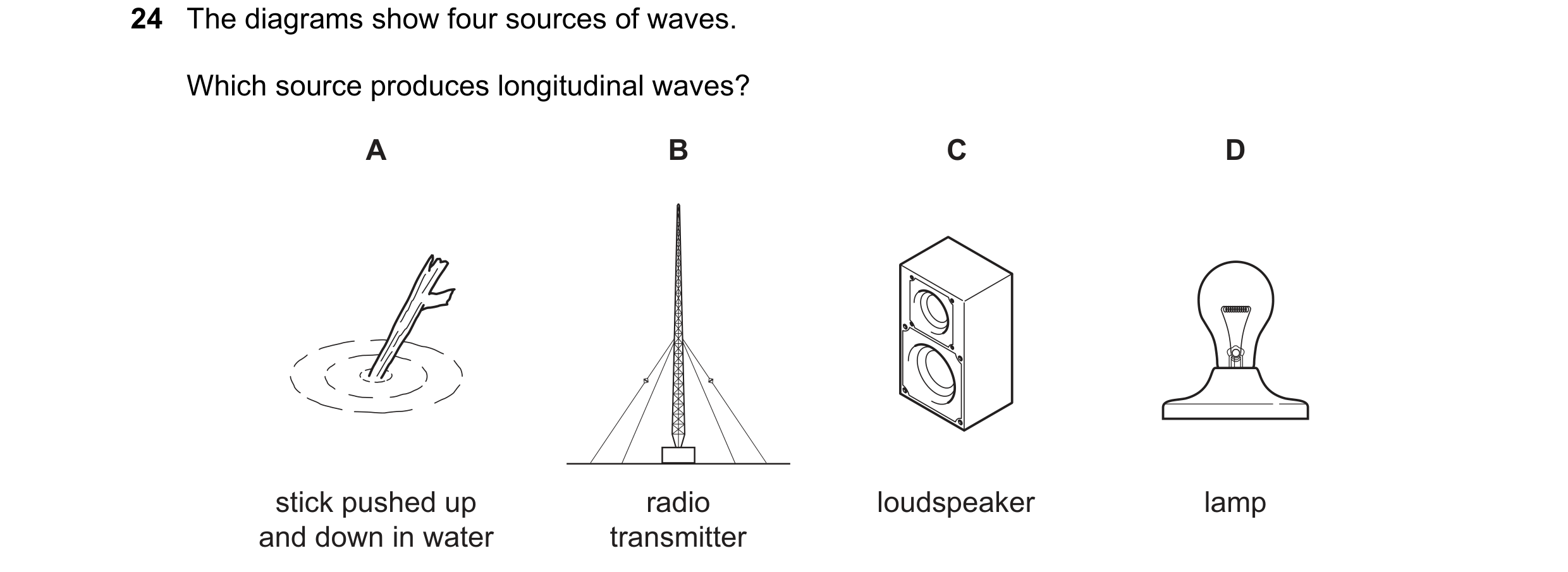
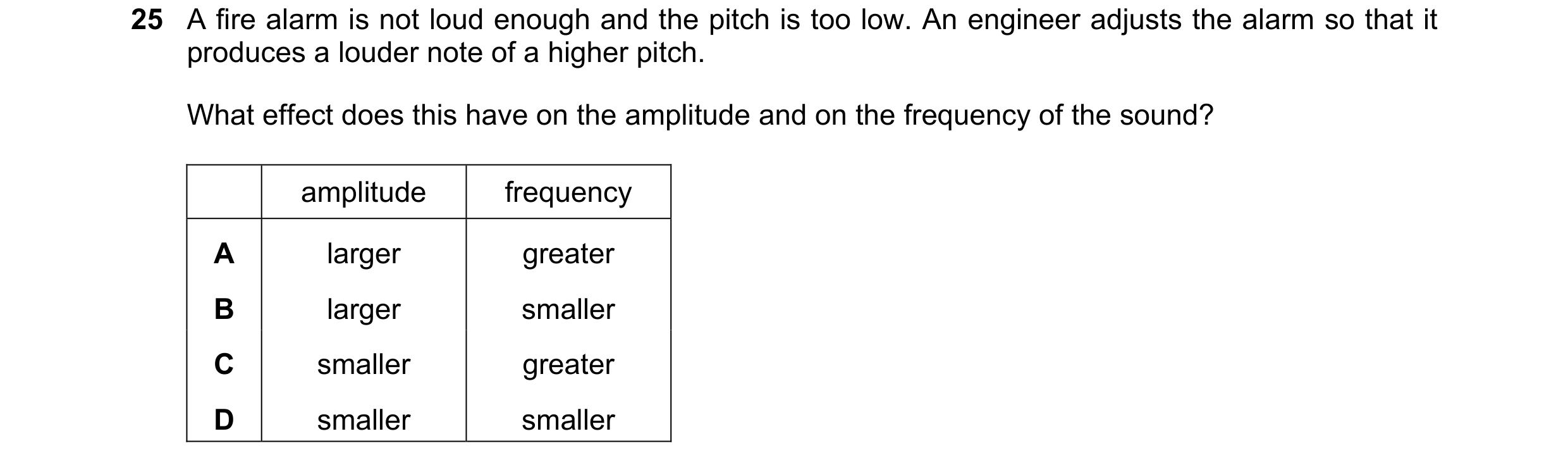 35 / 54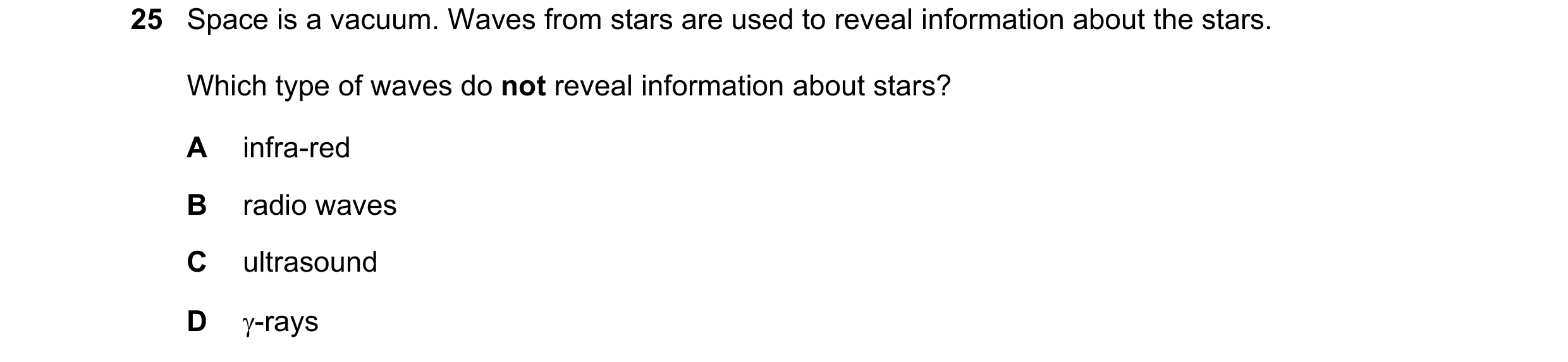



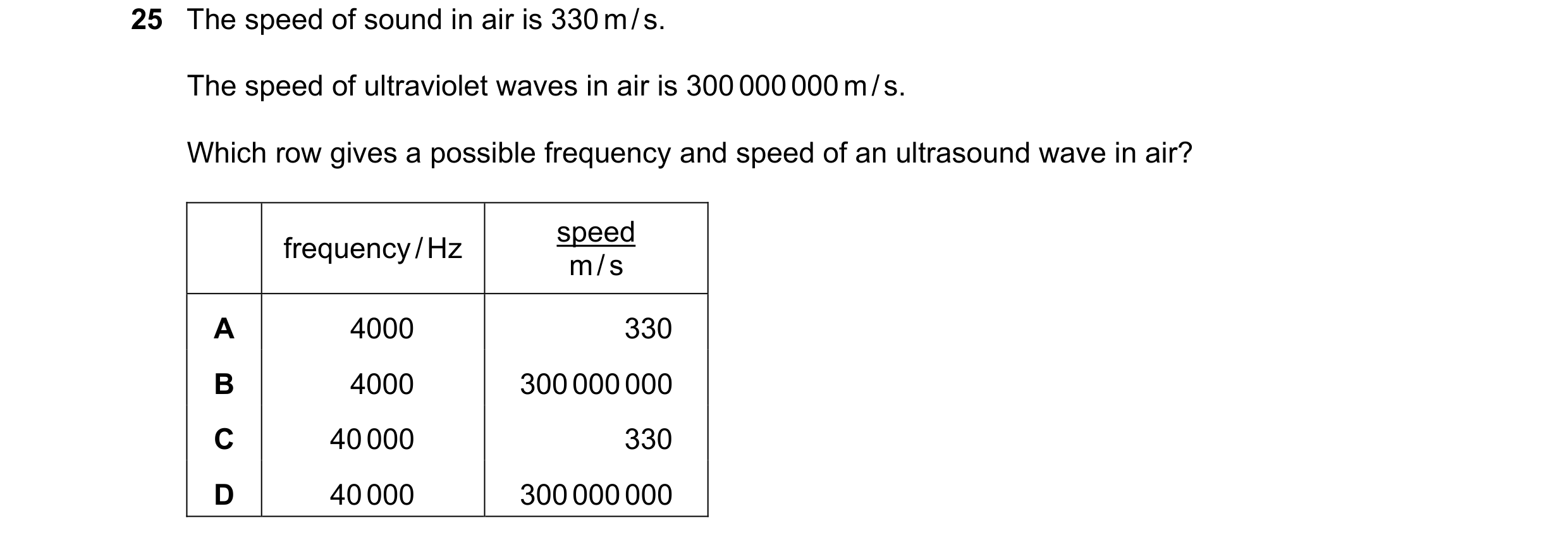 36 / 54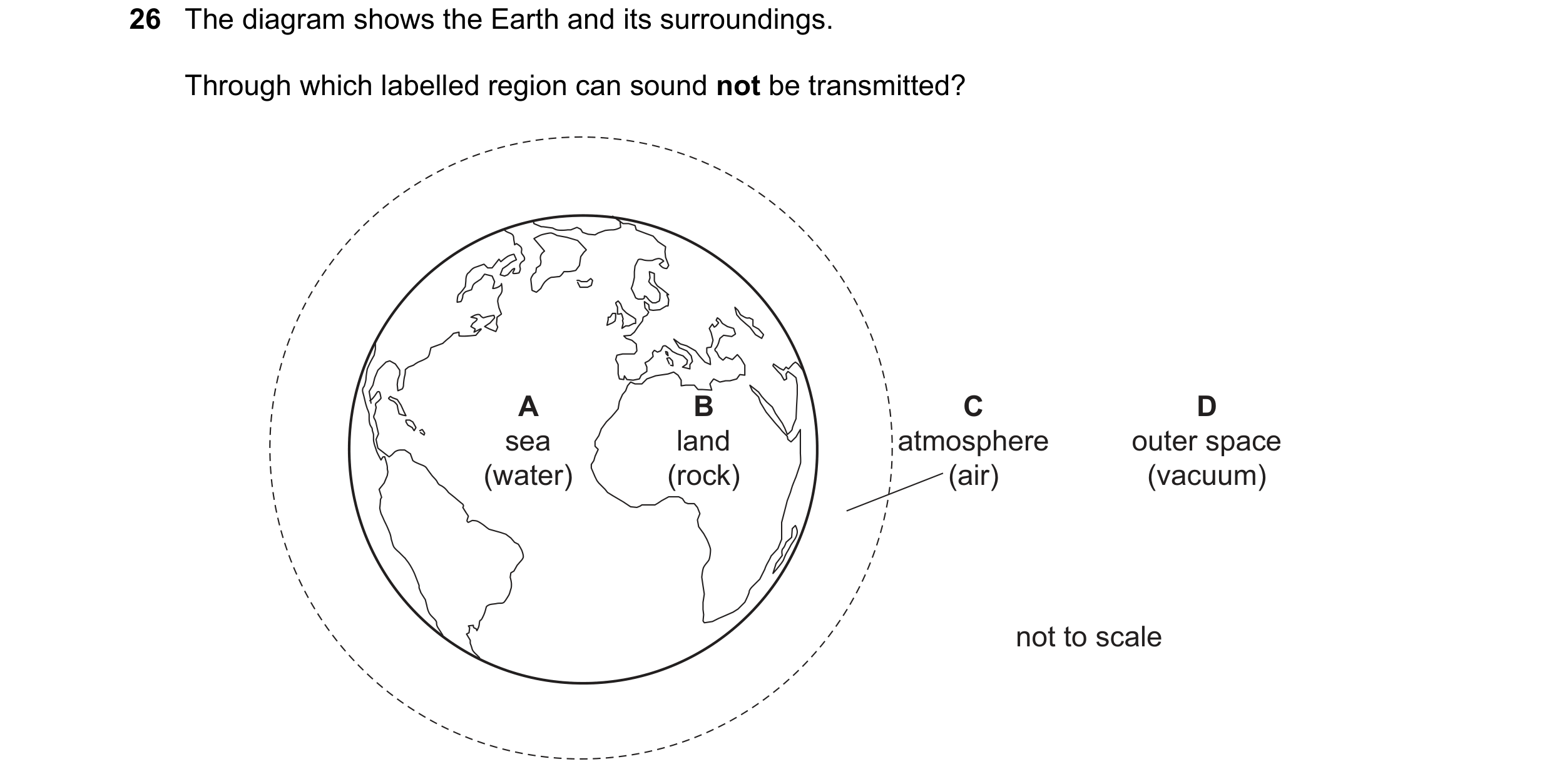
 37 / 54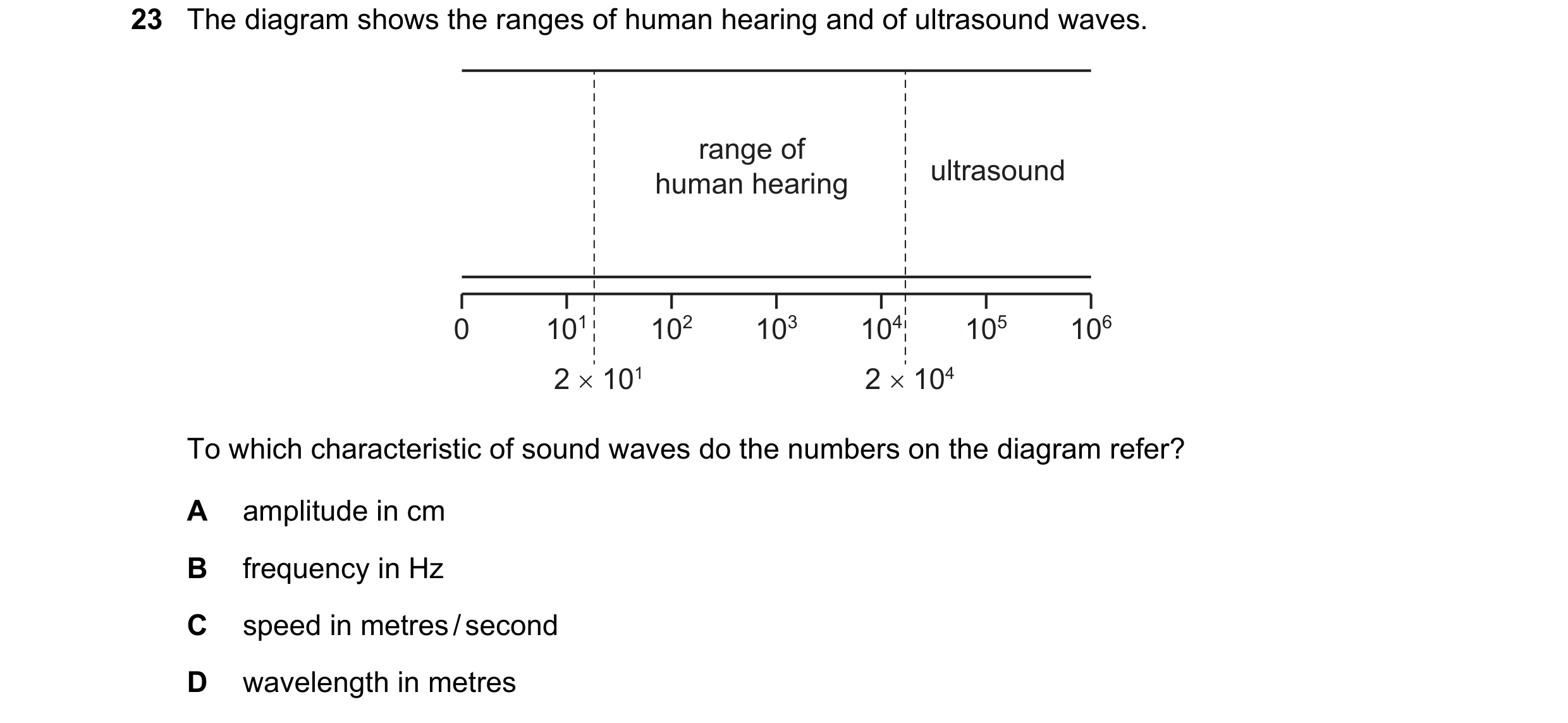

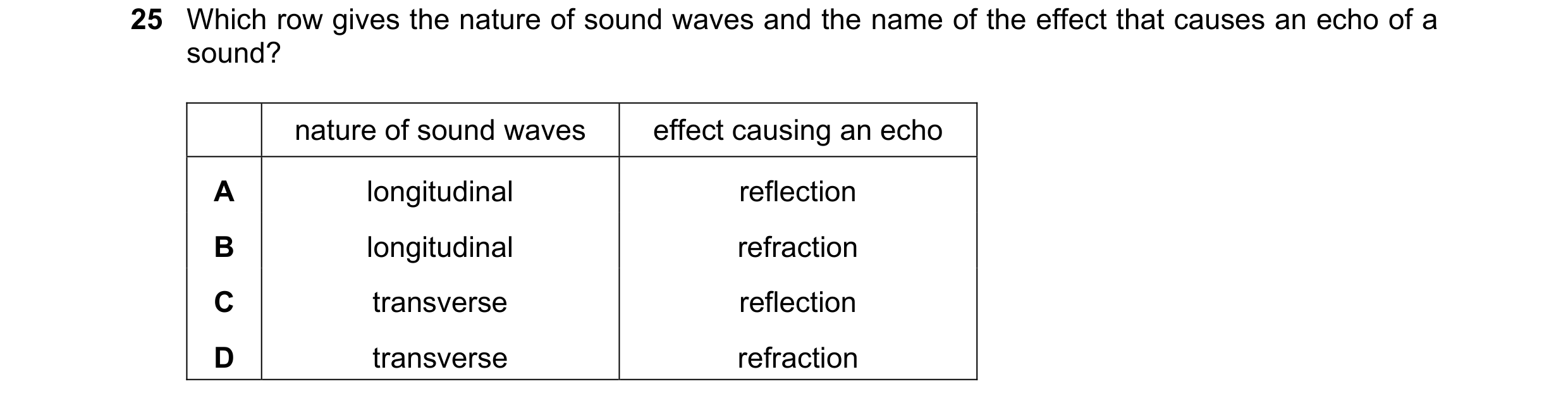 38 / 54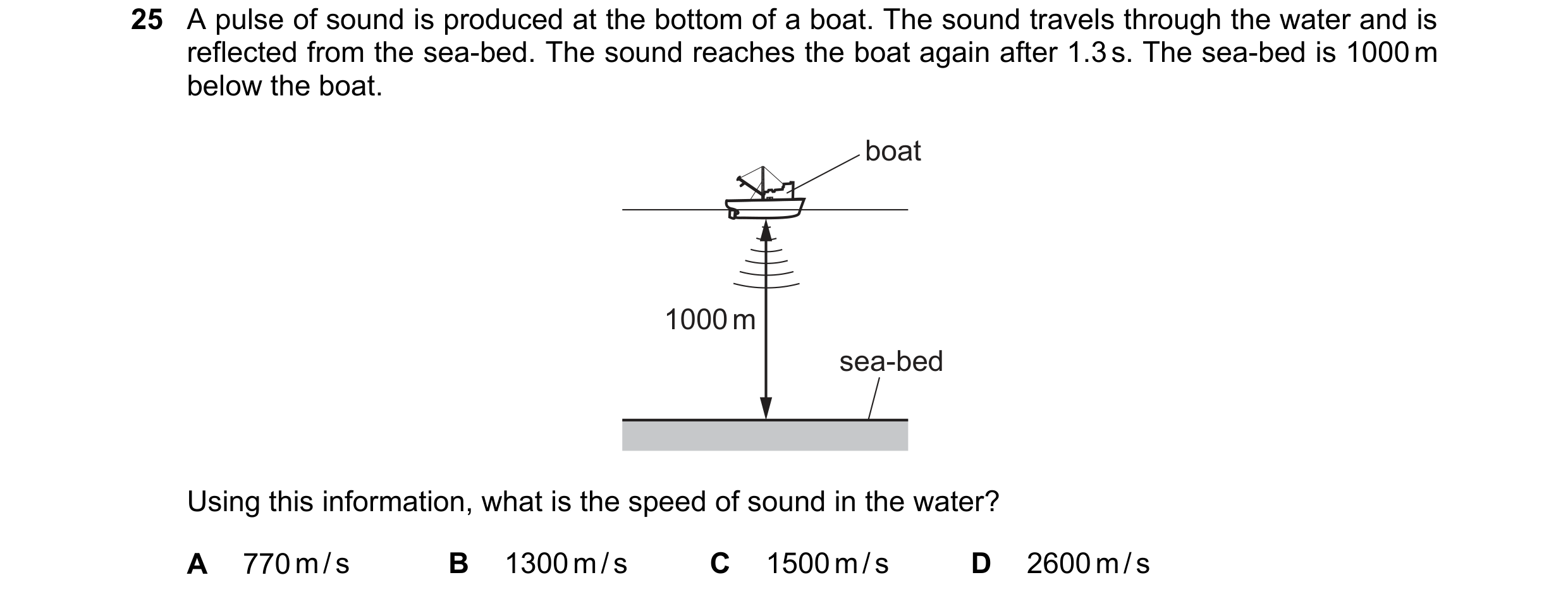
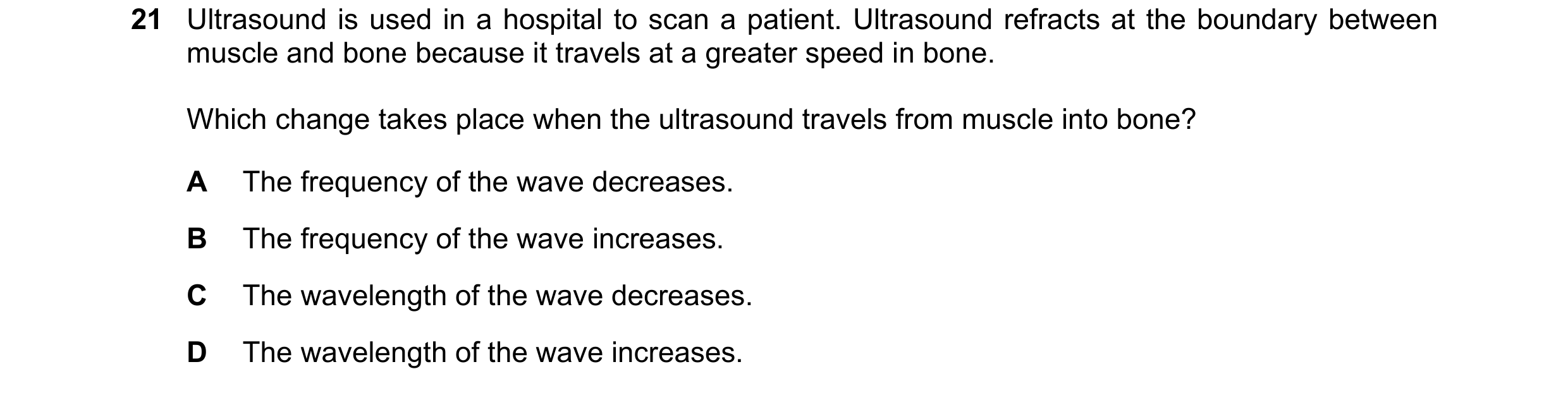
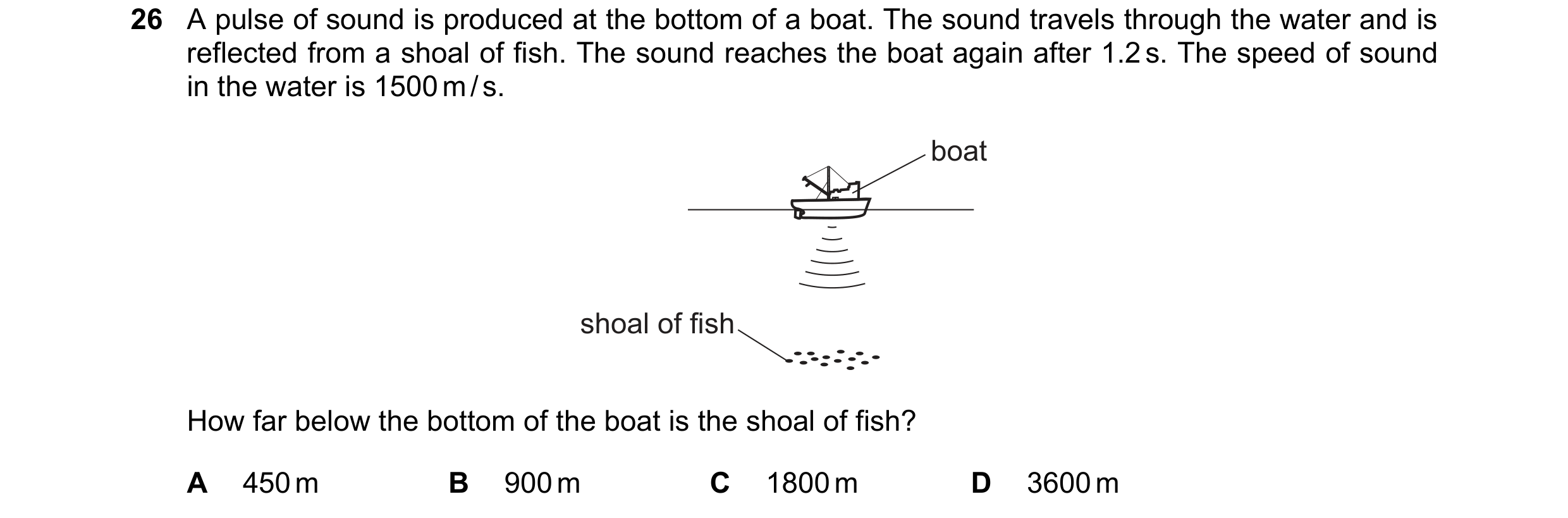
 39 / 54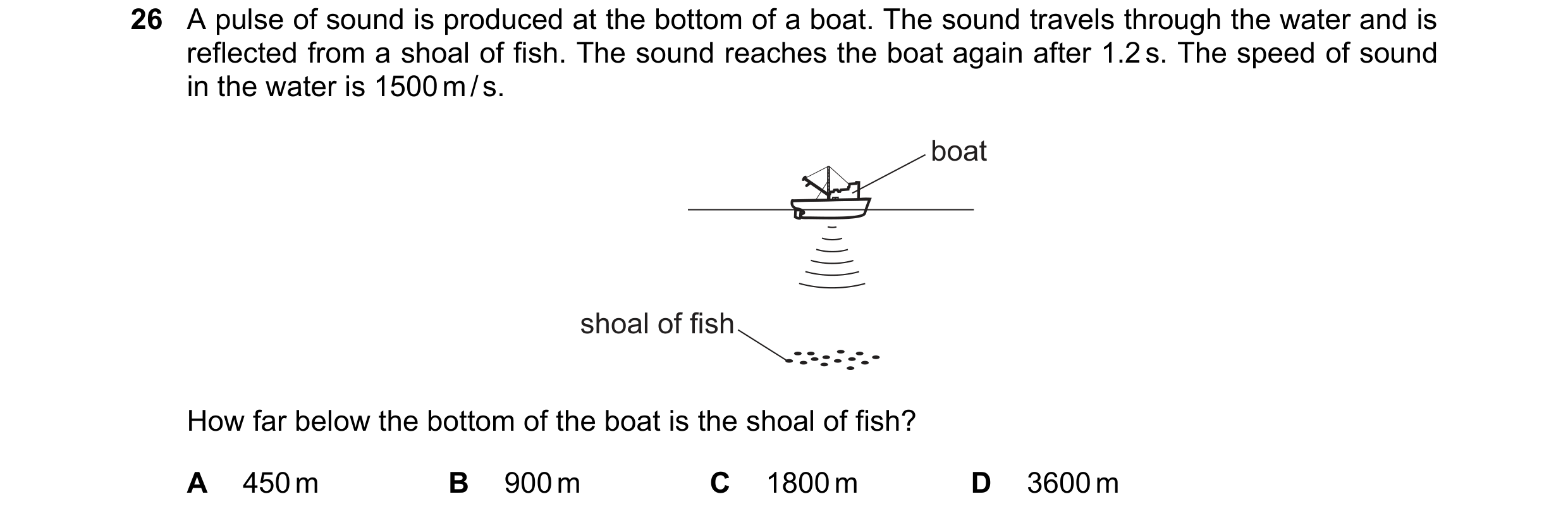
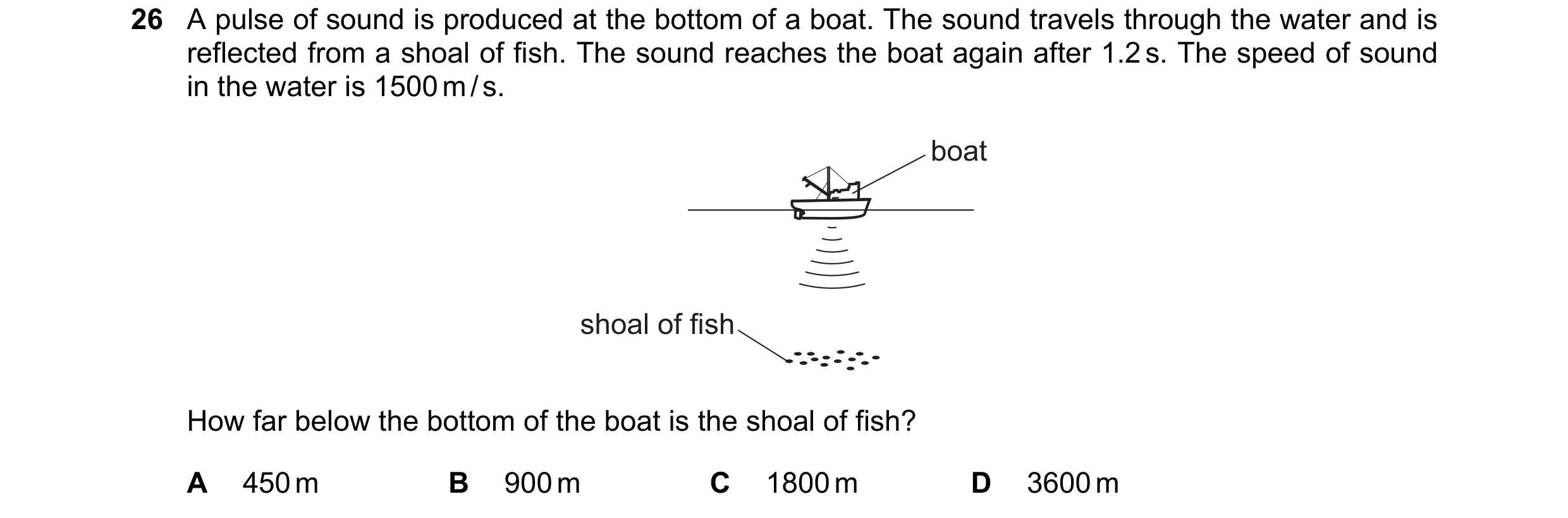

 40 / 54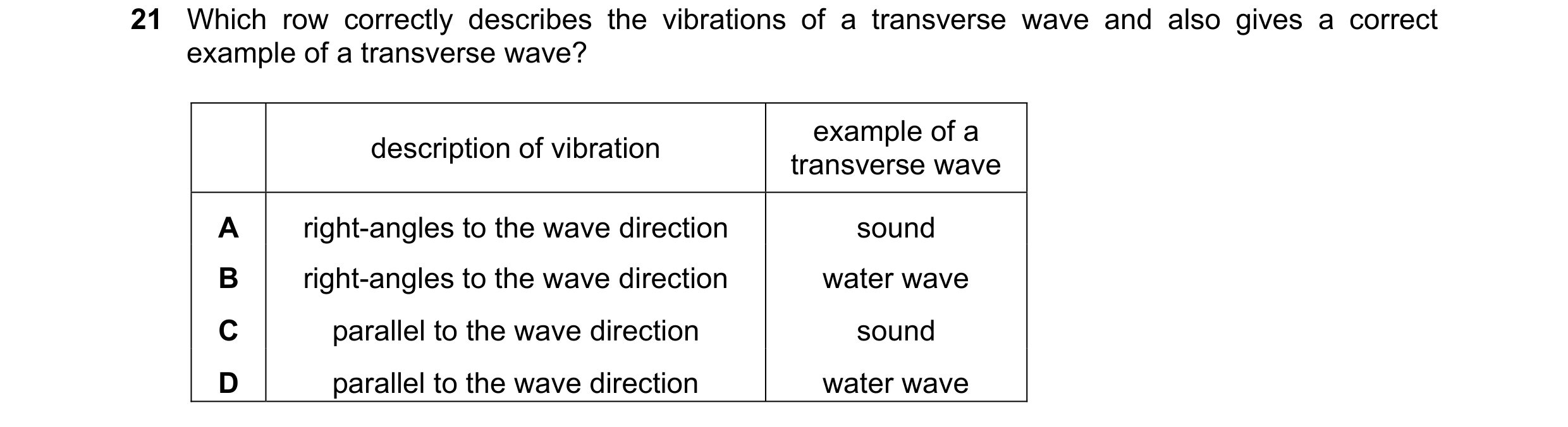


 41 / 54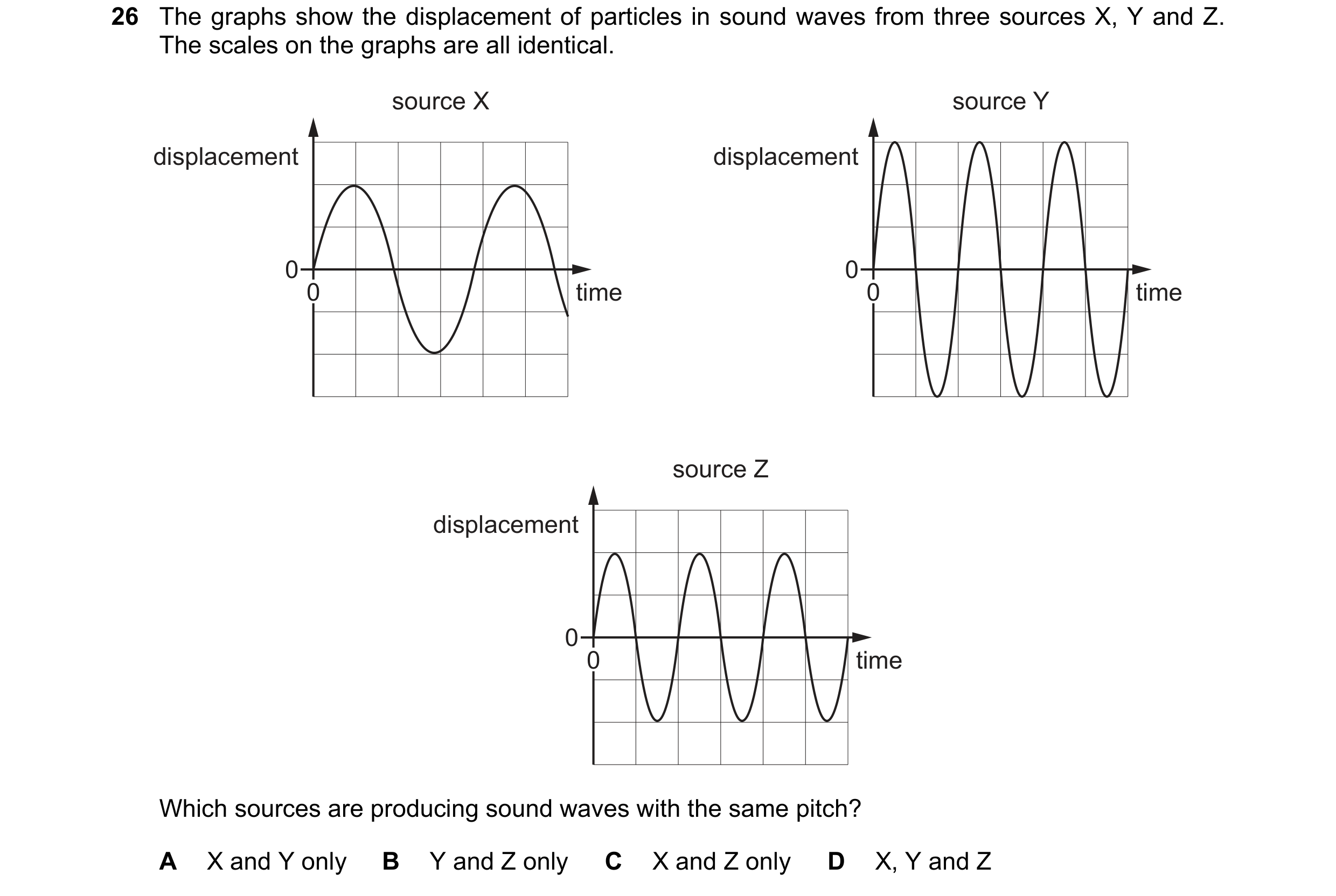

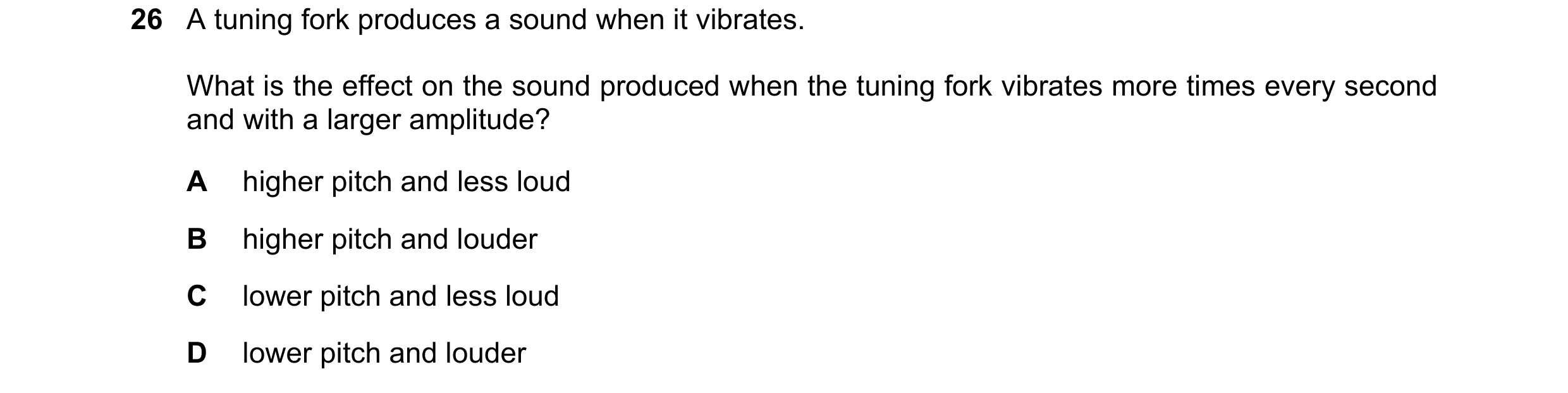 42 / 54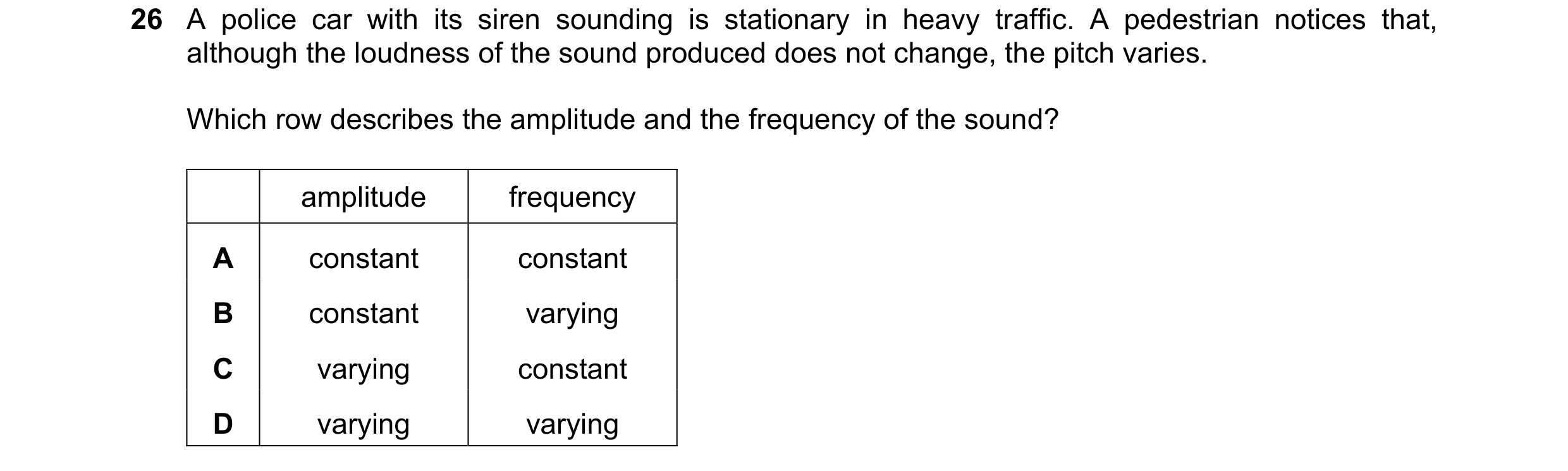
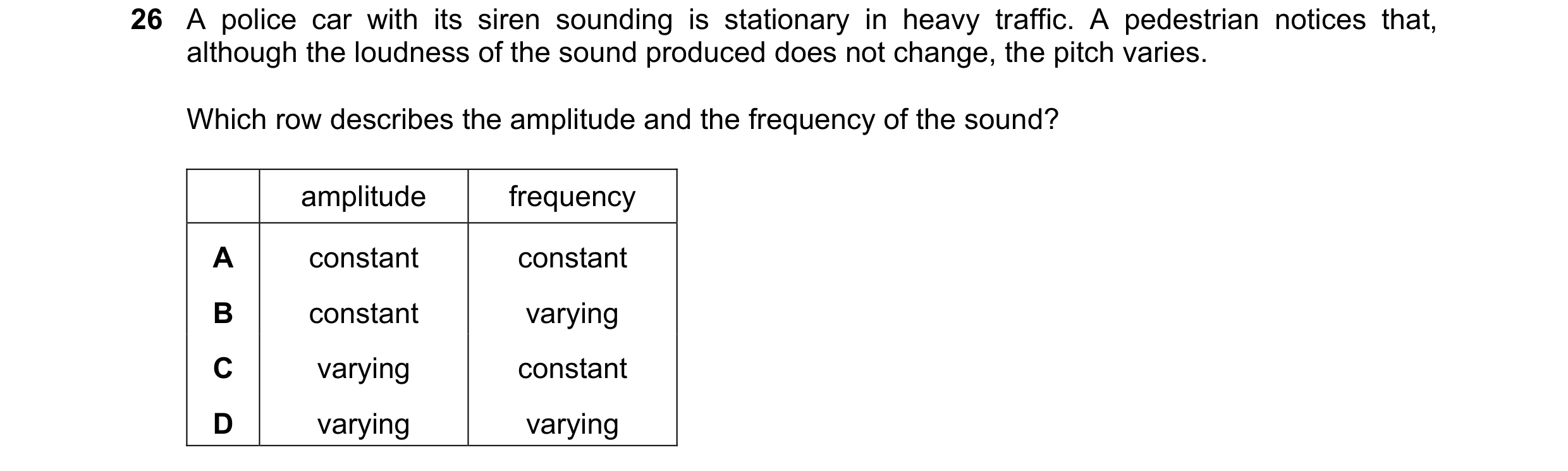
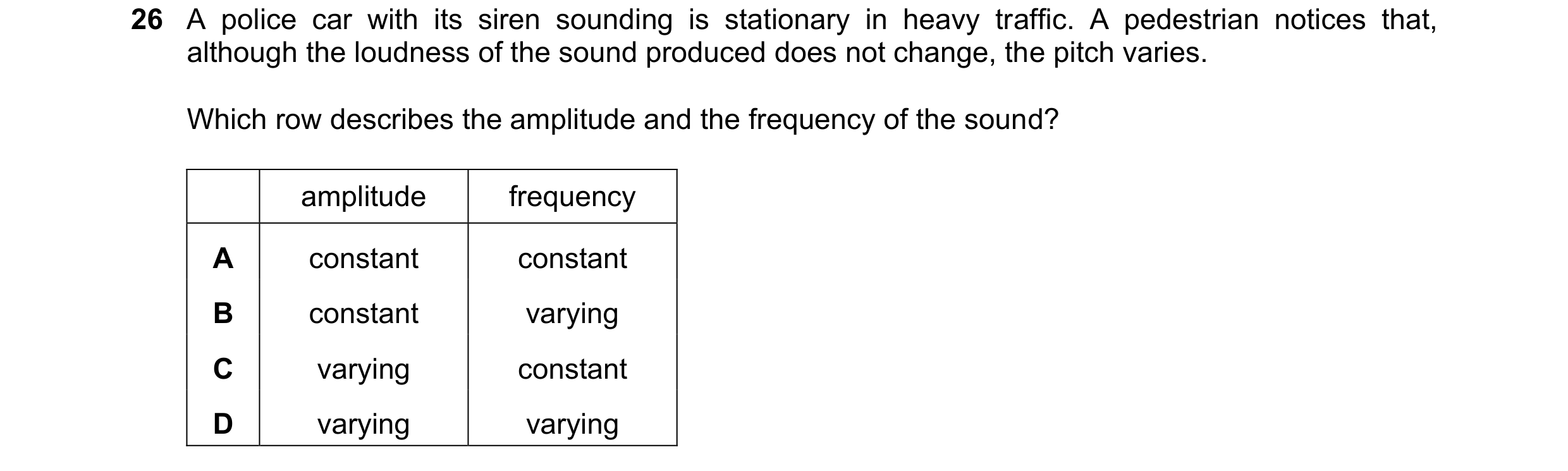
 43 / 54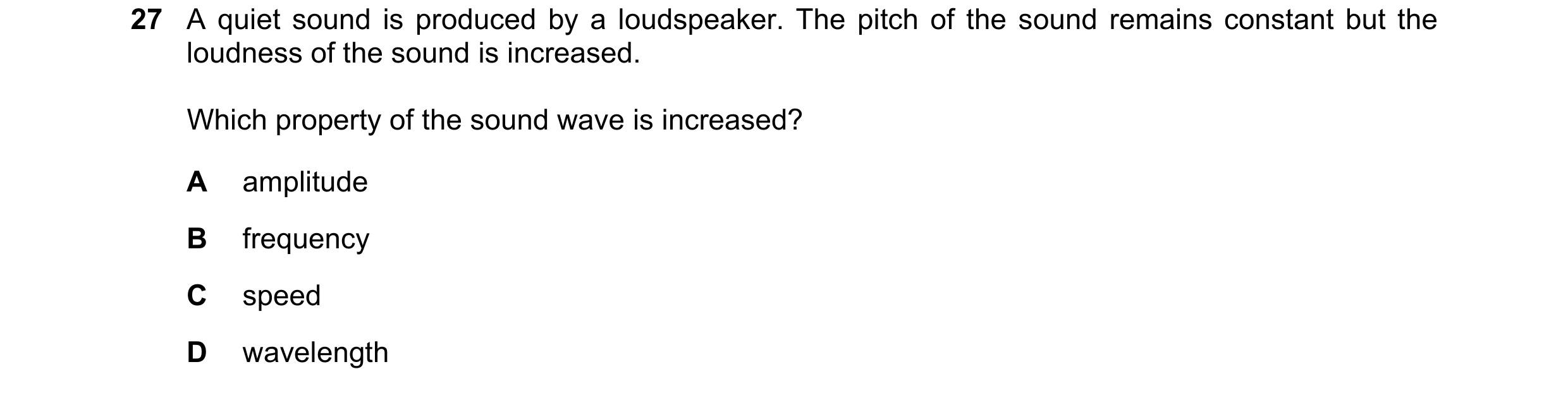
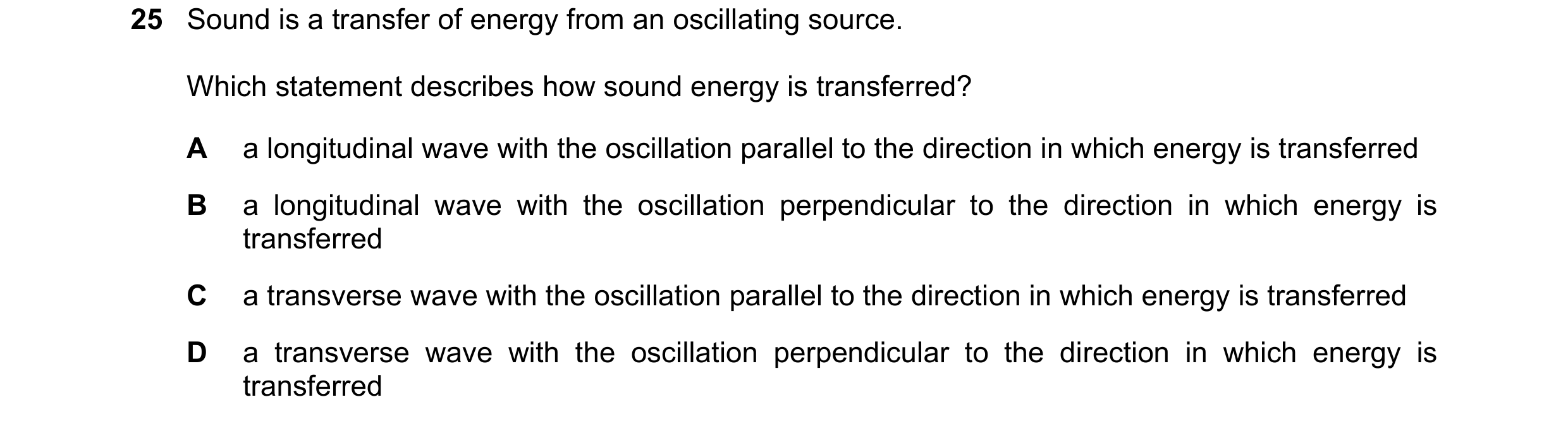
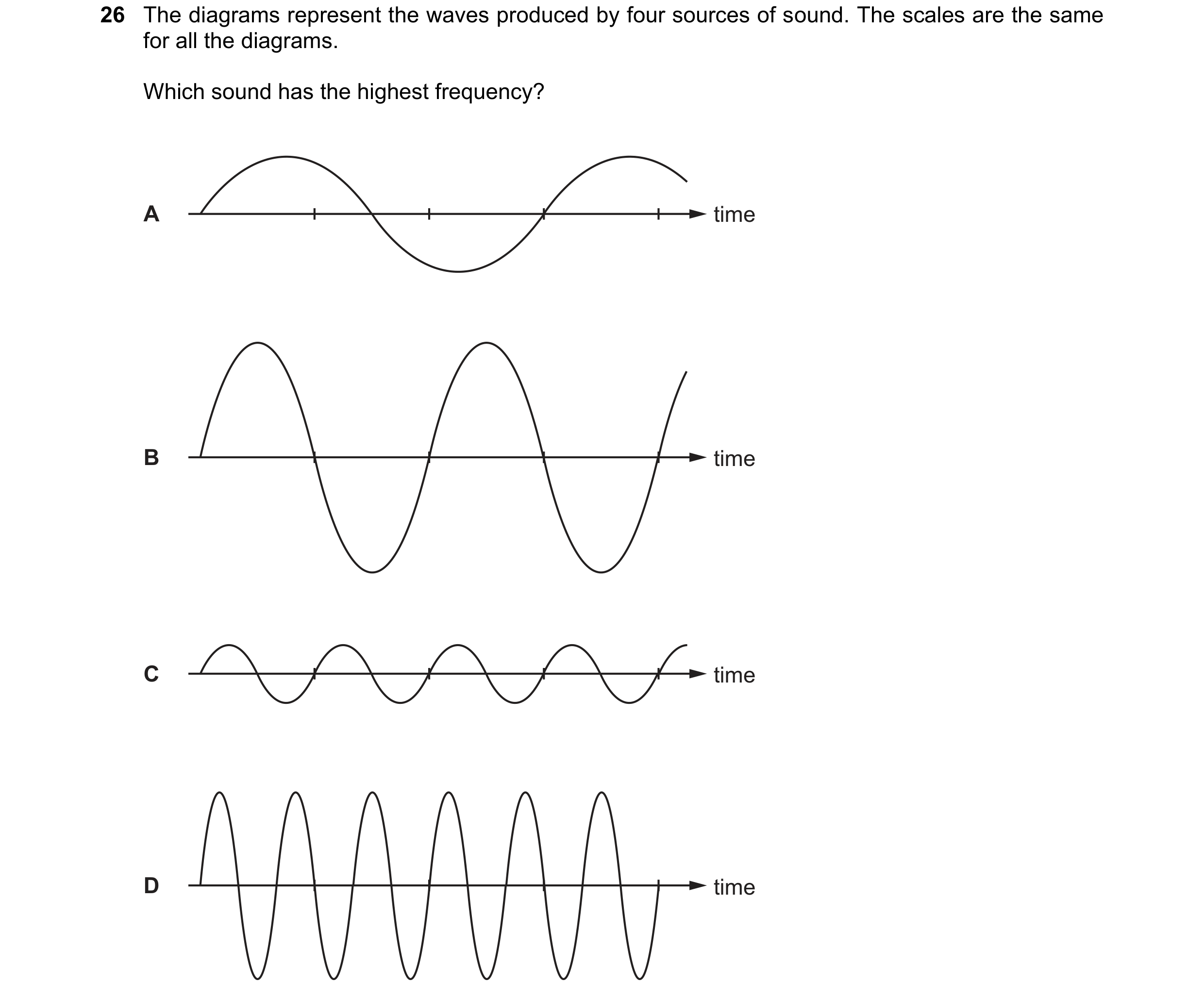 44 / 54


 45 / 54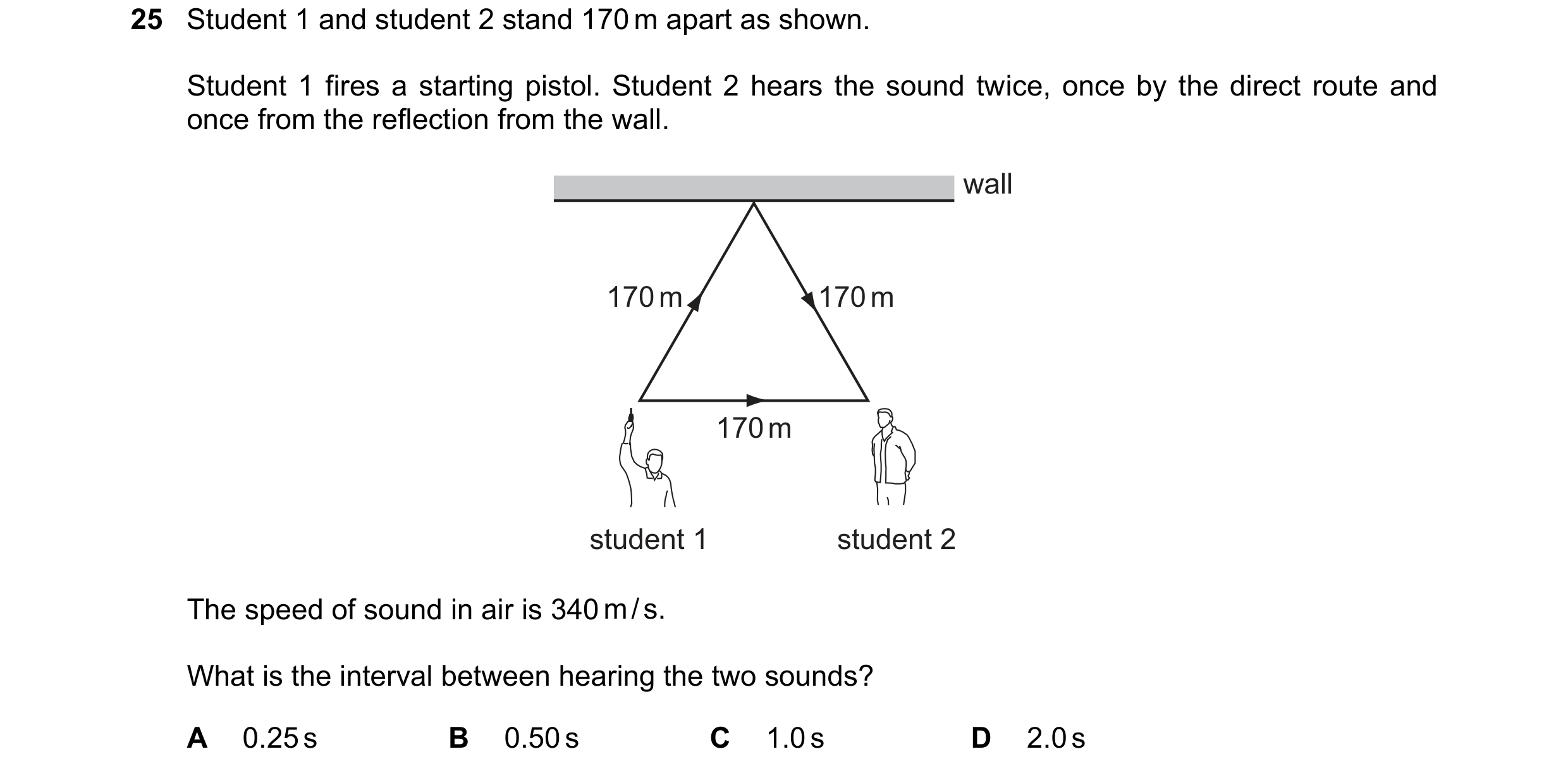
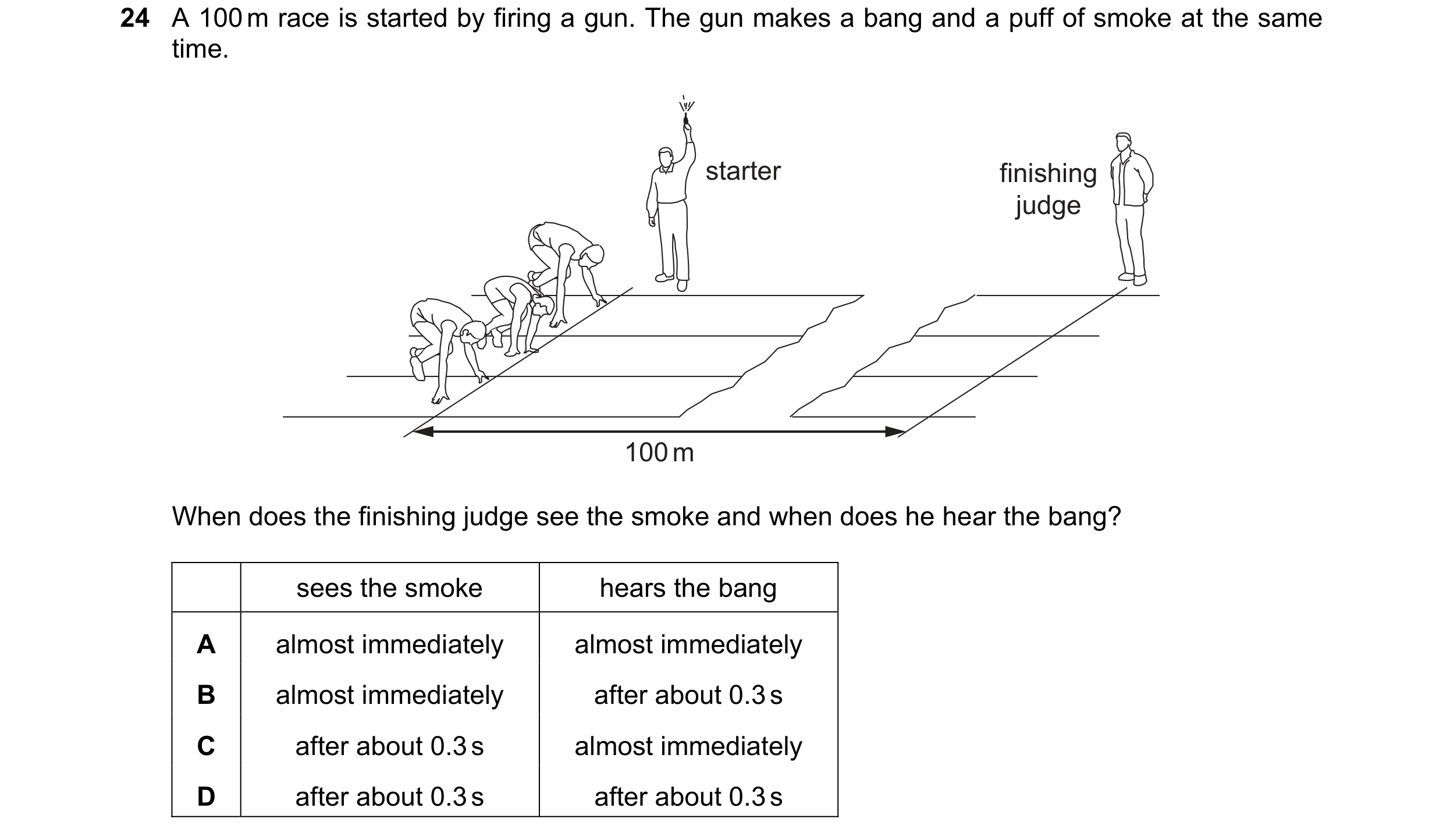
 46 / 54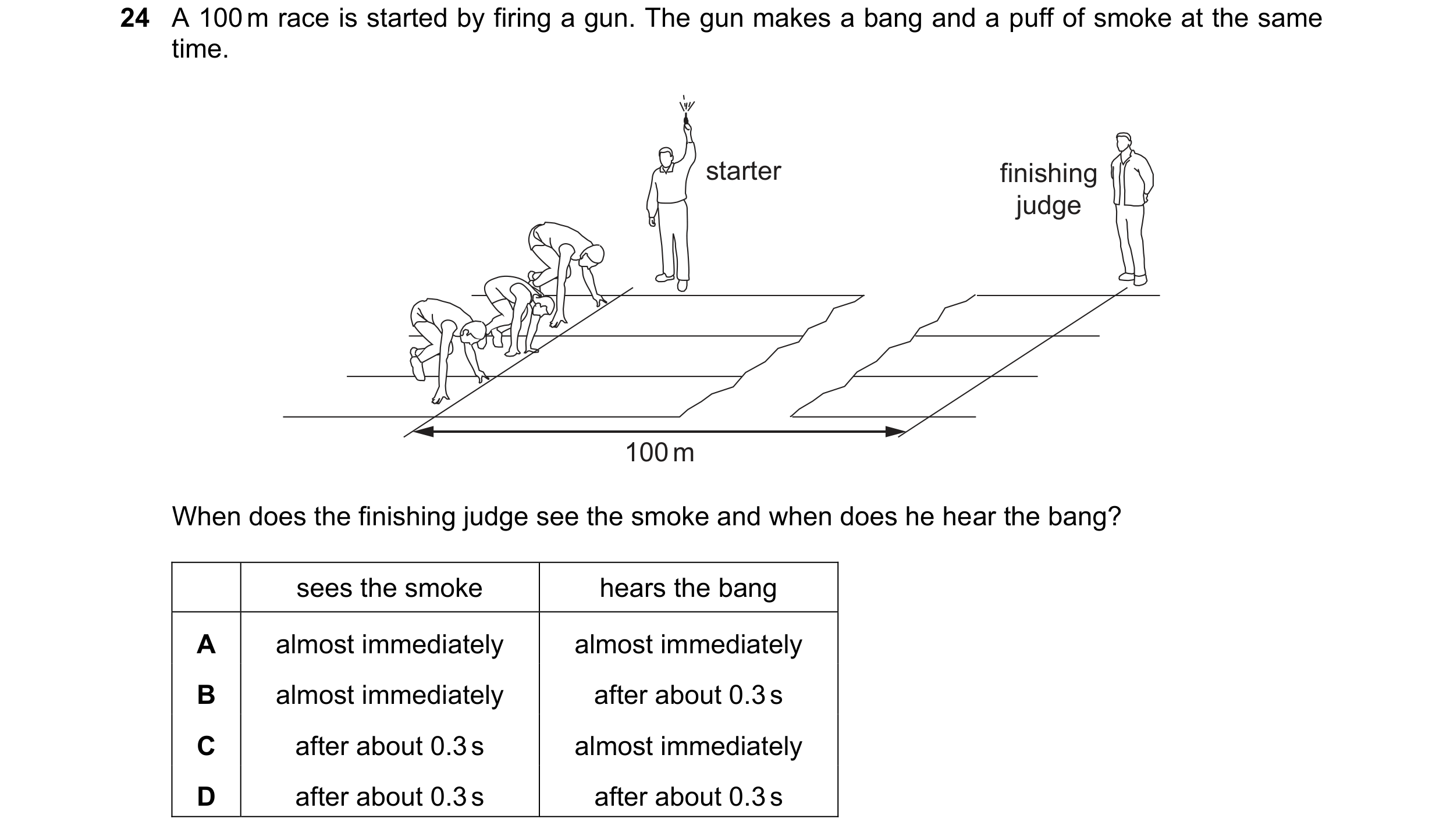
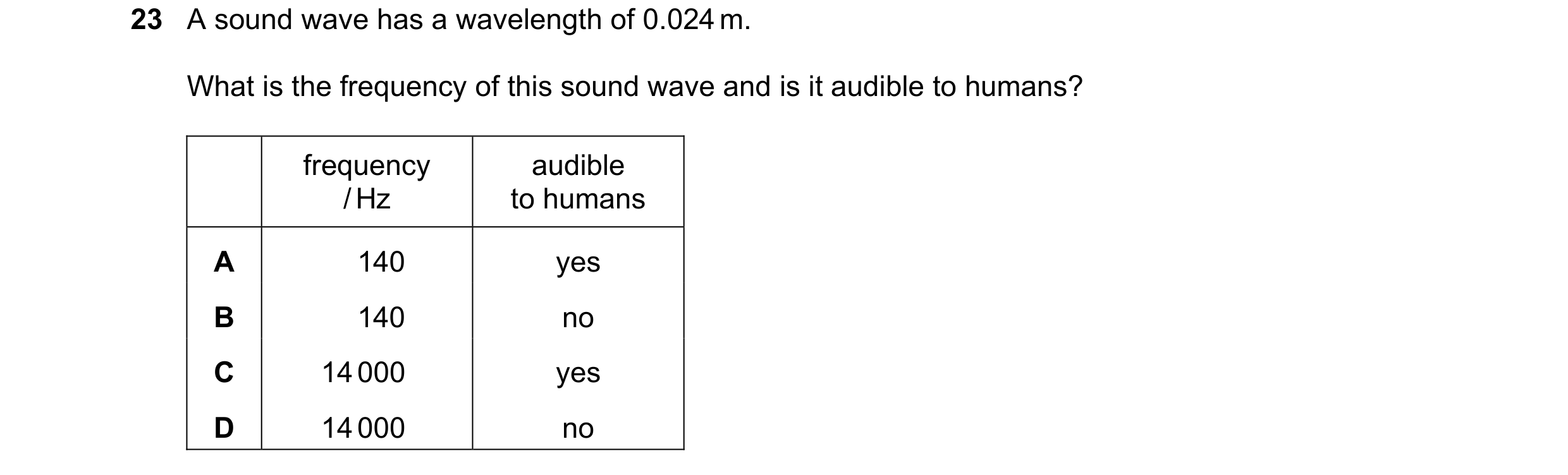


 47 / 54

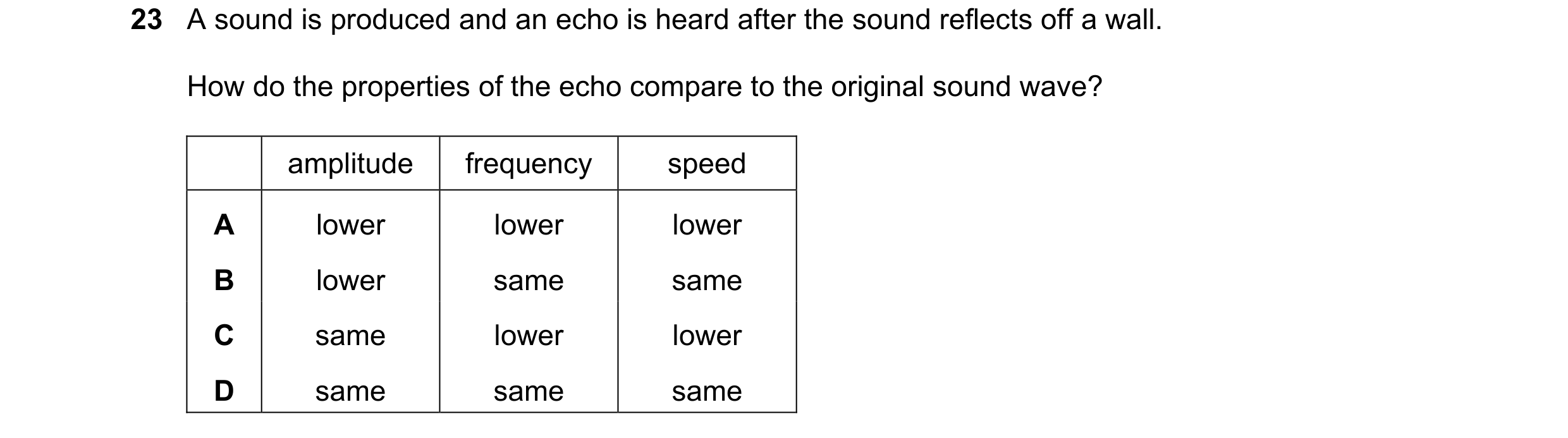
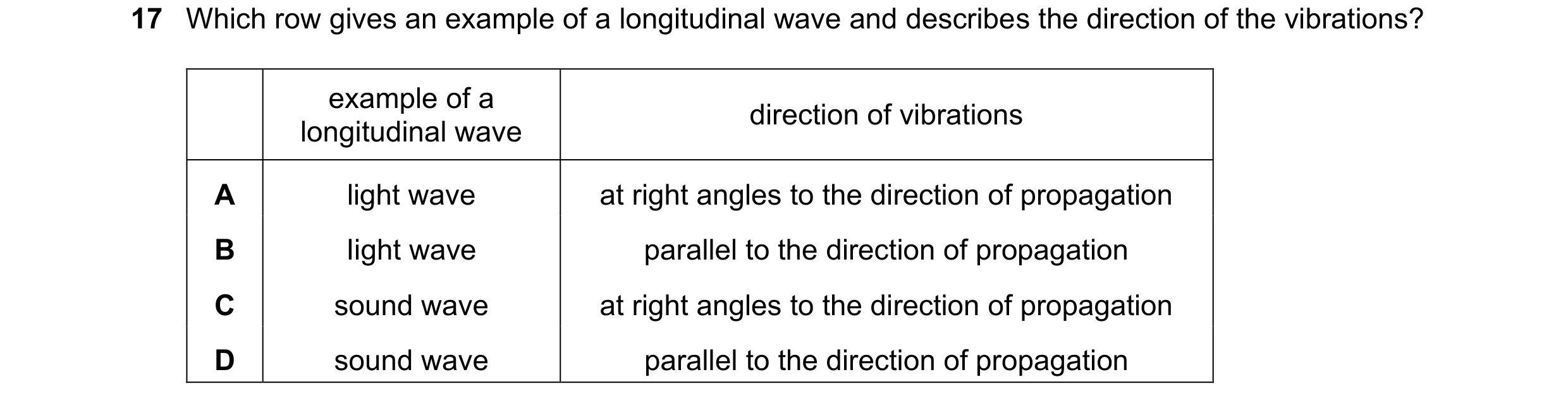
 48 / 54
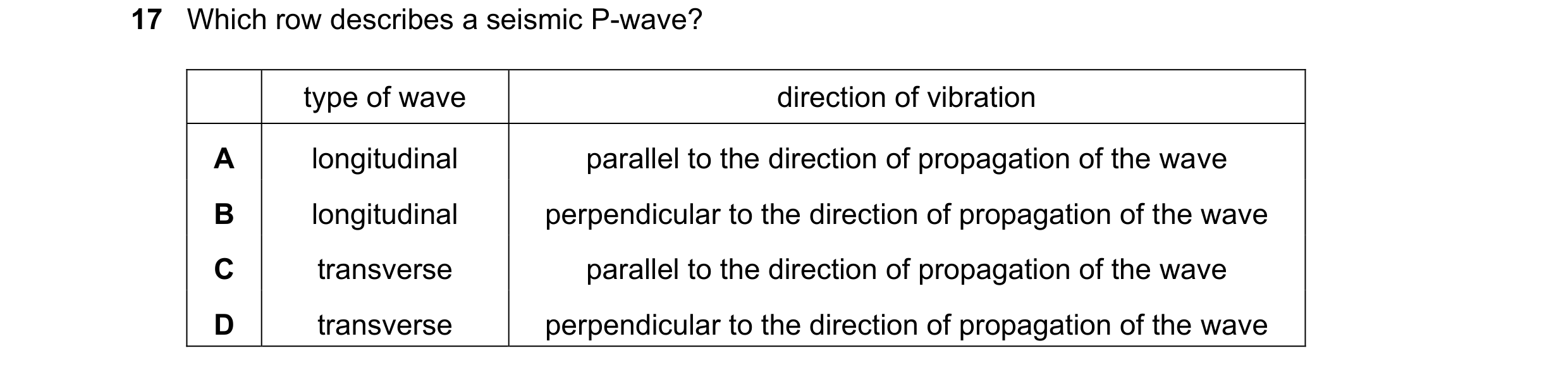


 49 / 54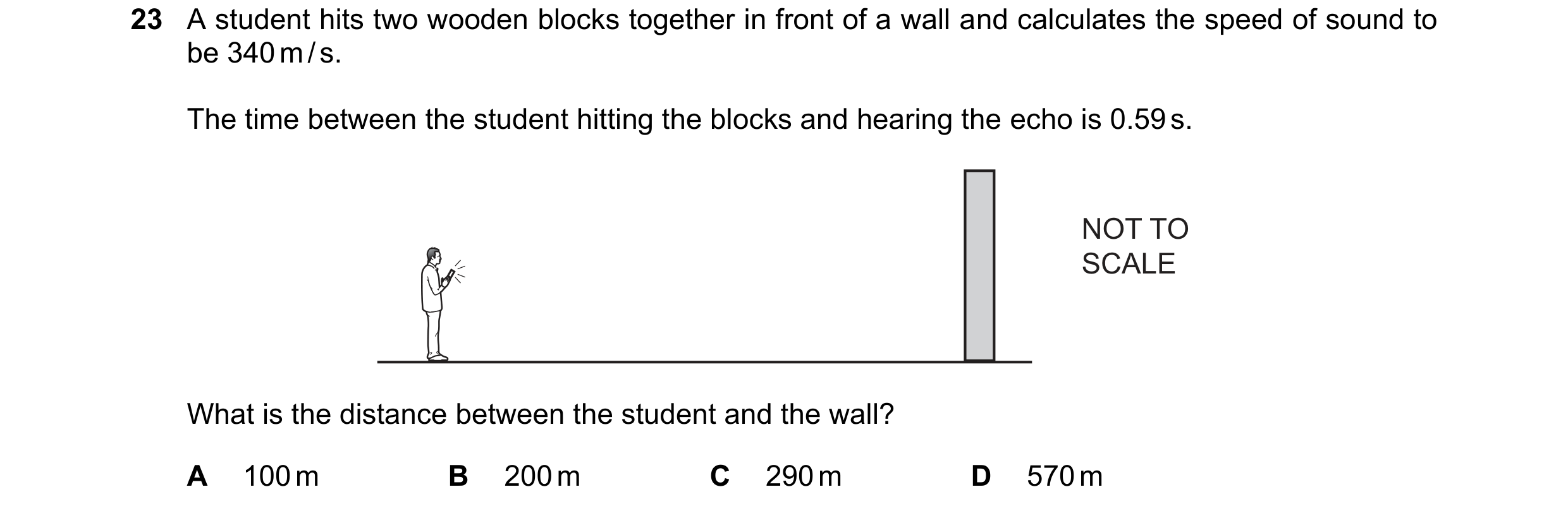

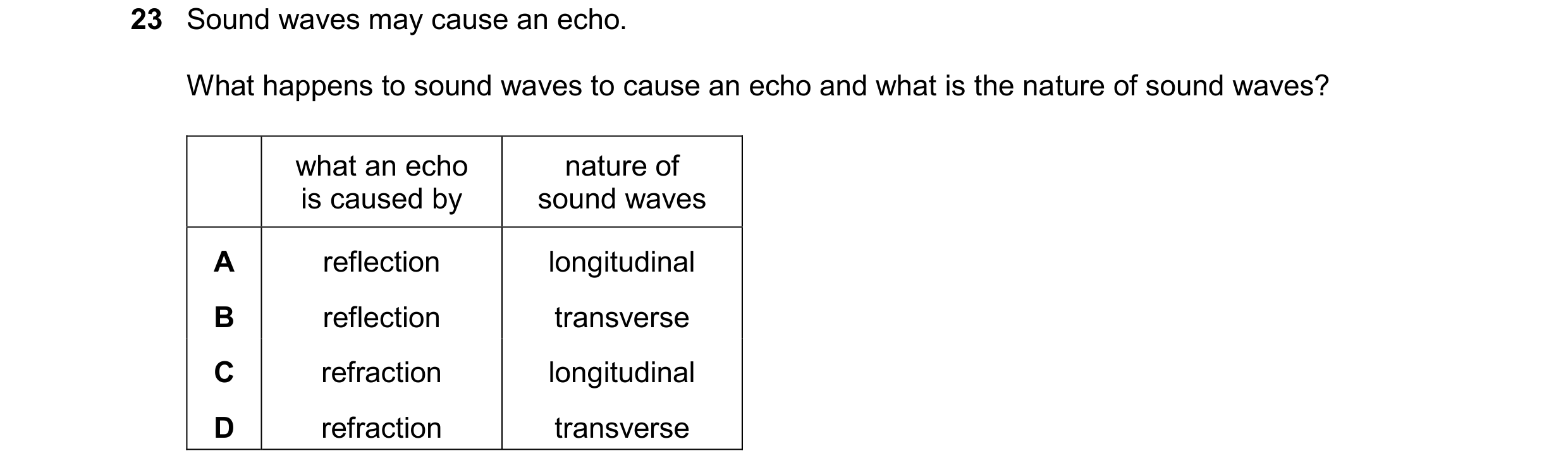
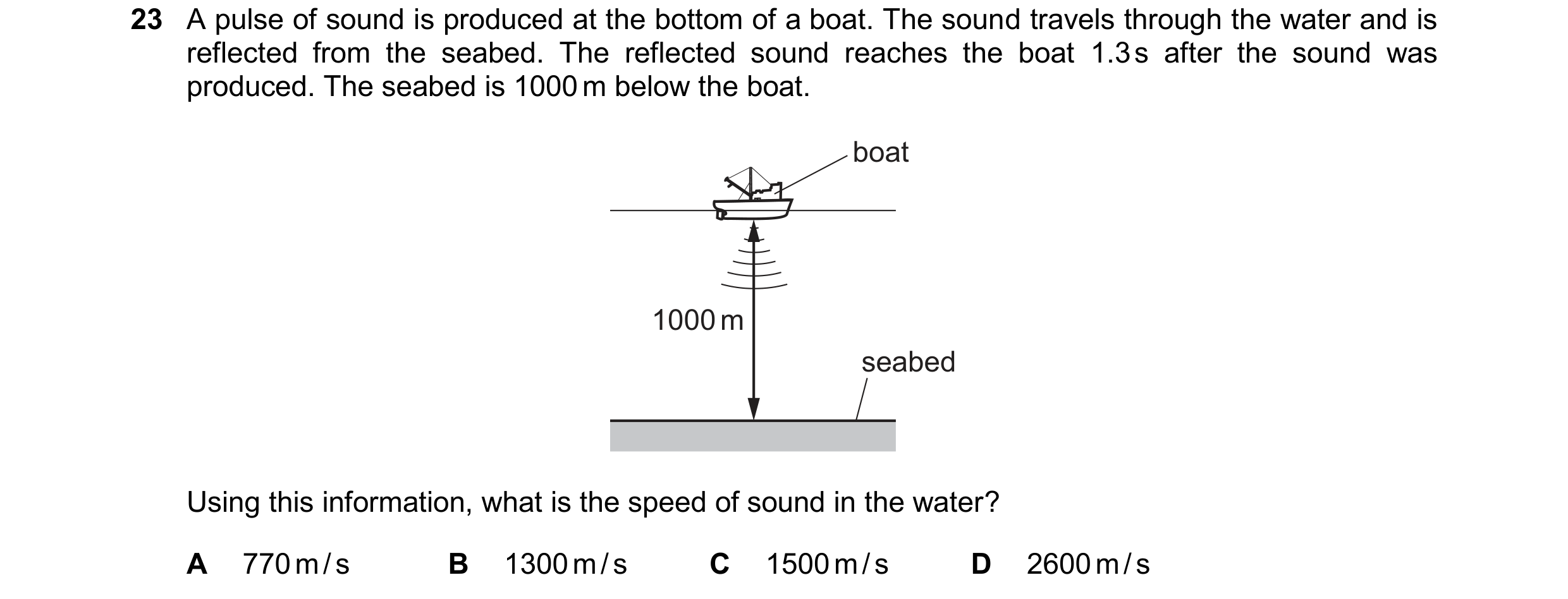 50 / 54
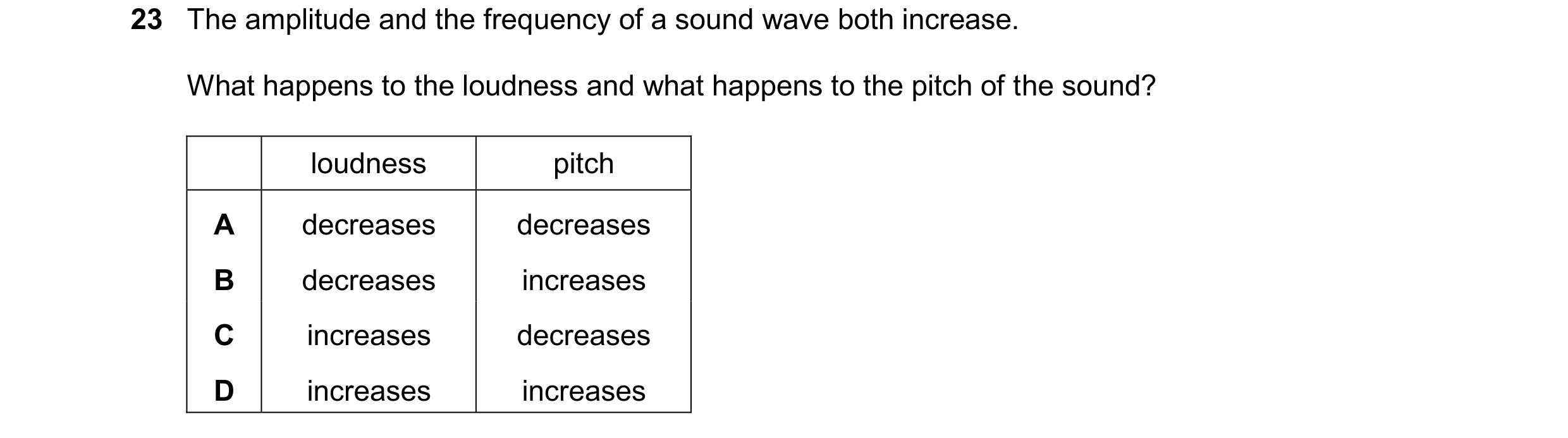
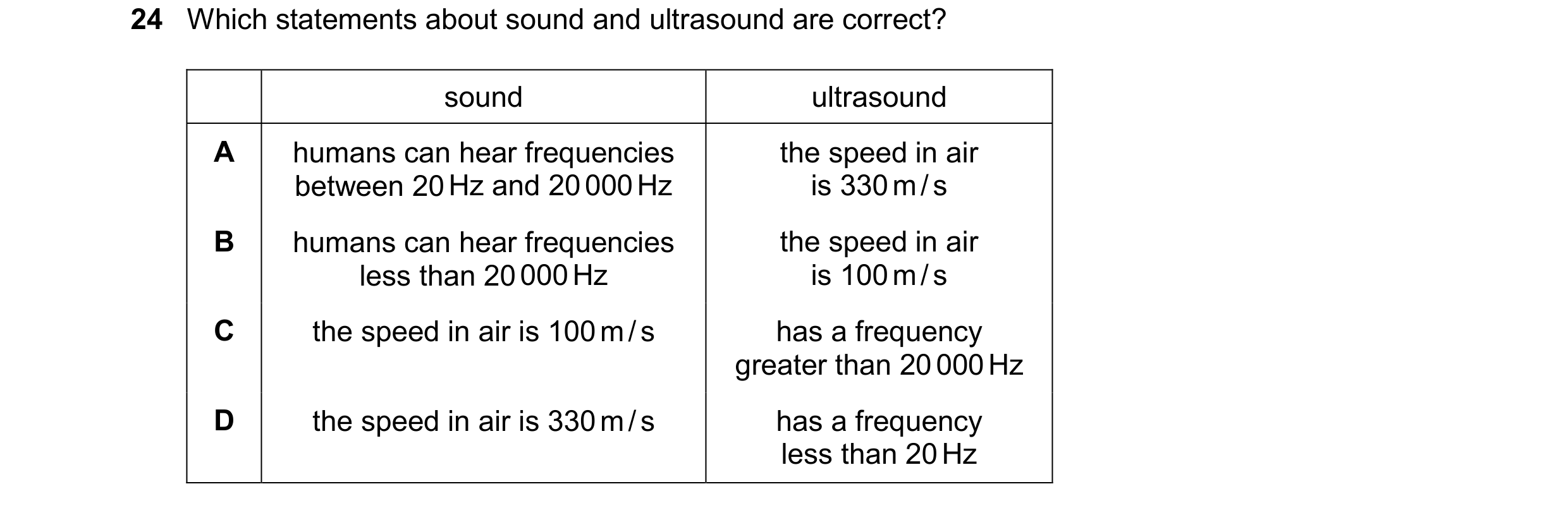 51 / 54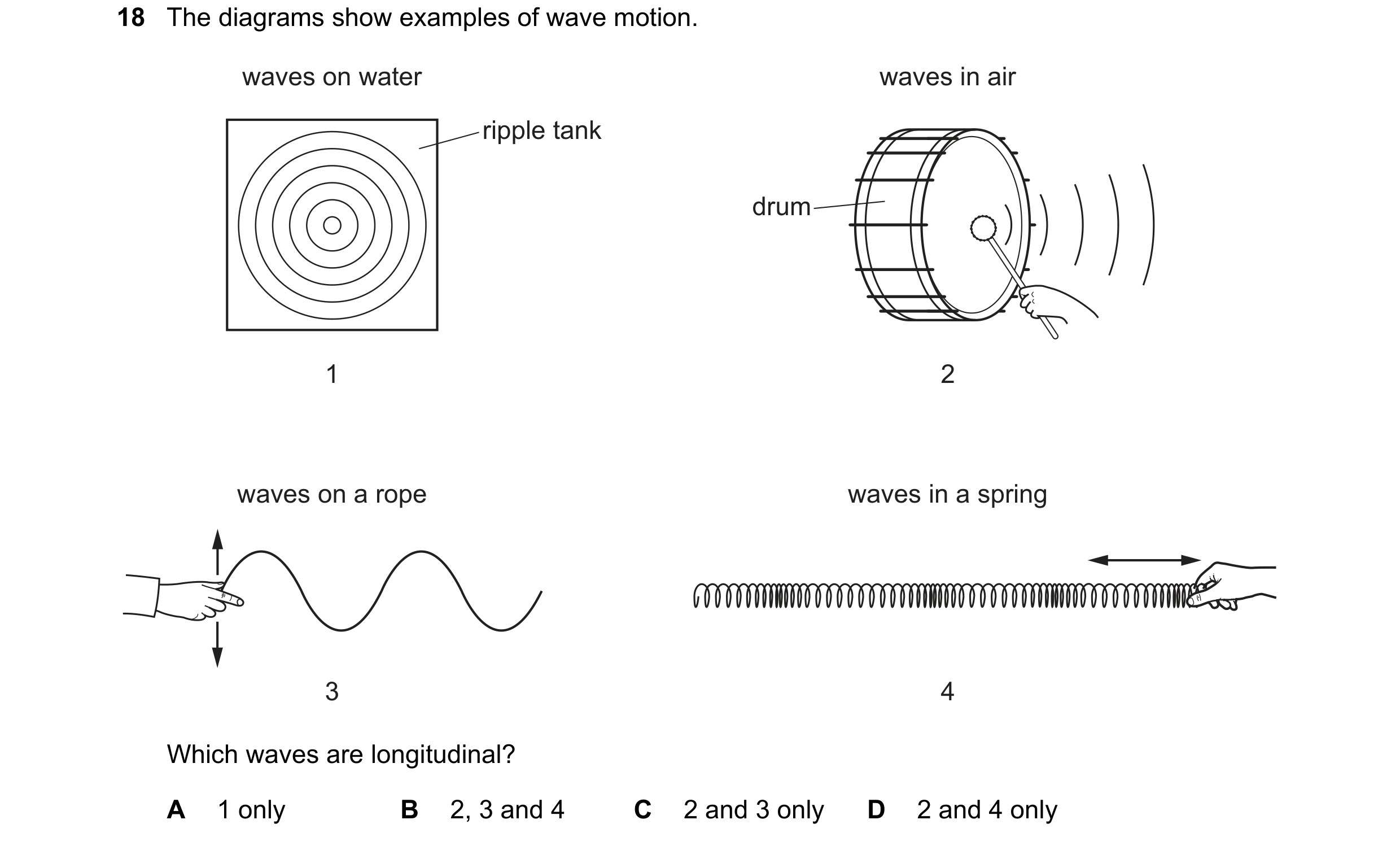
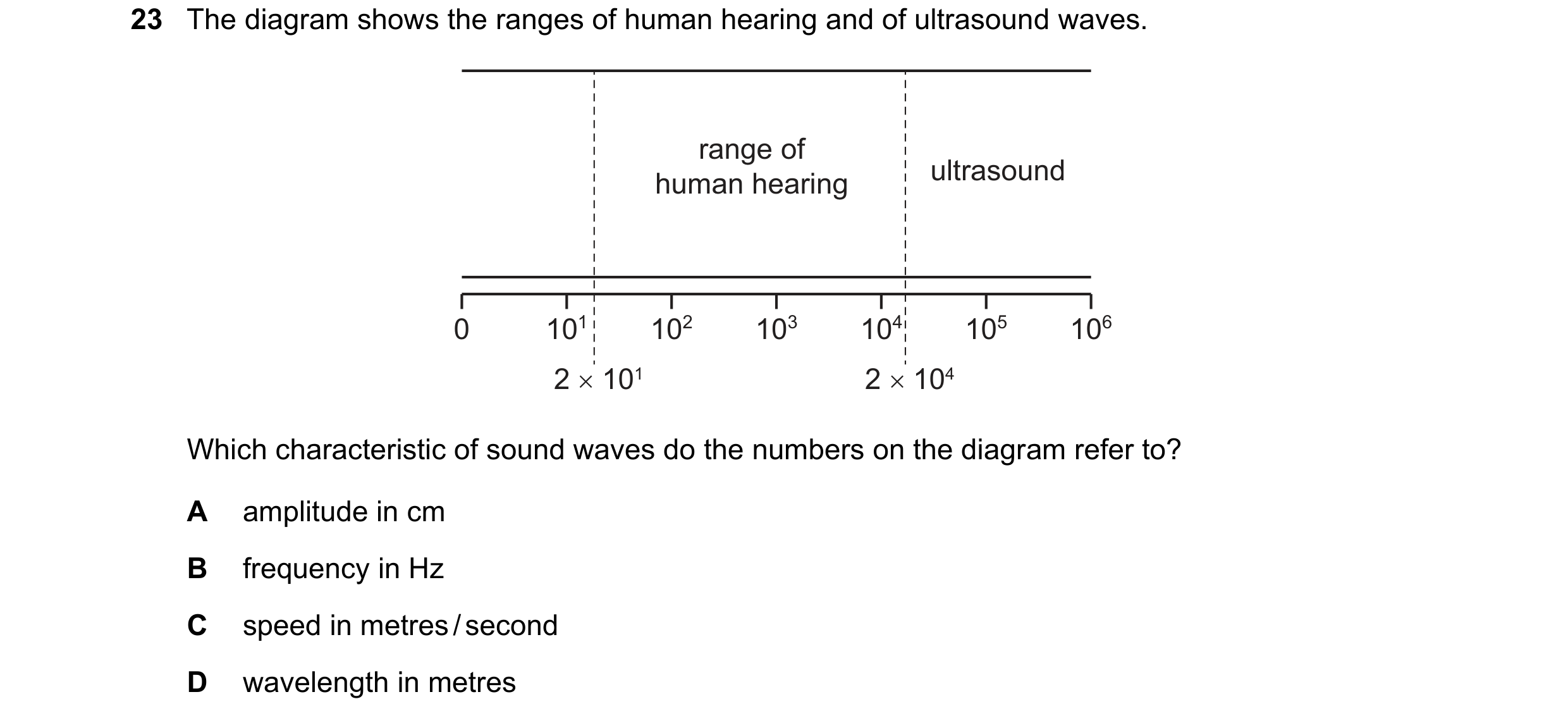 52 / 54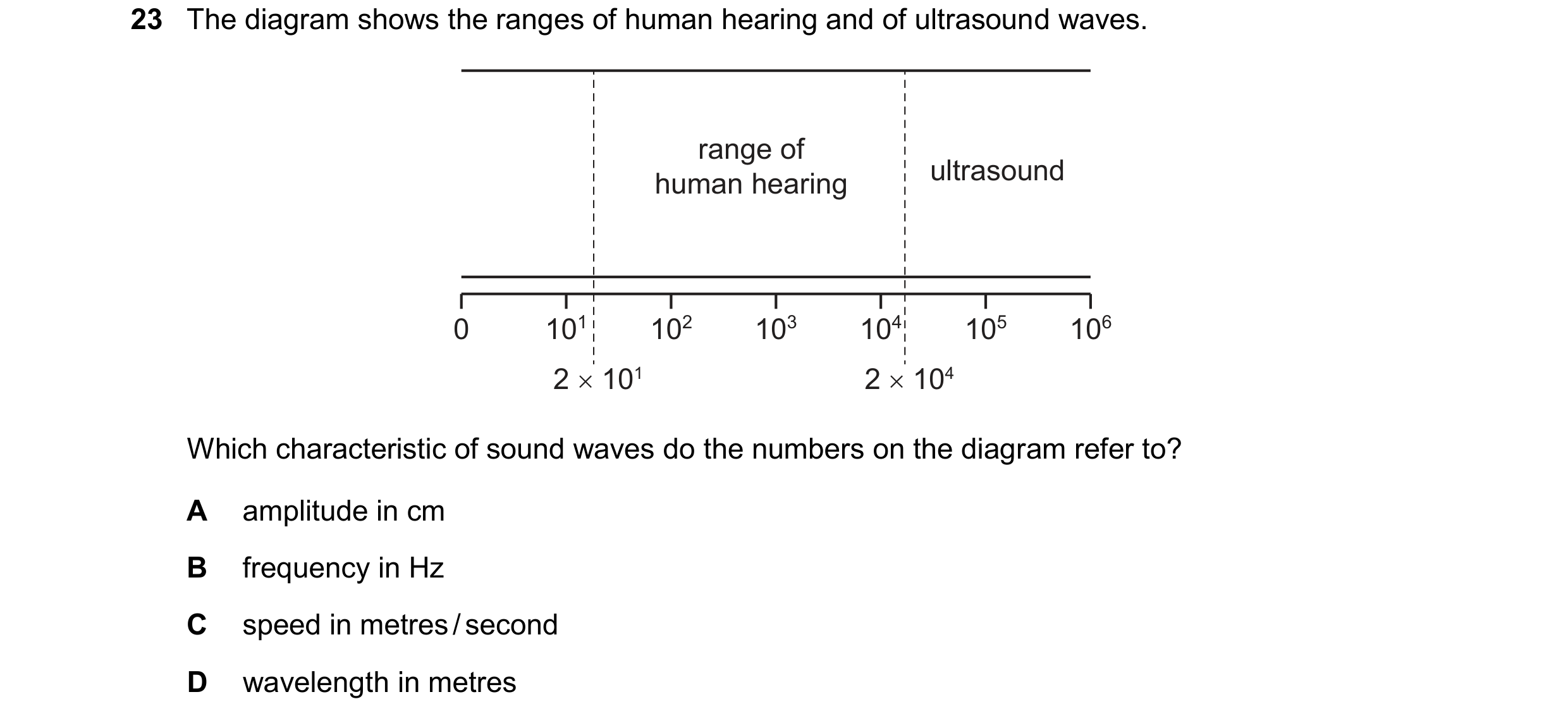


 53 / 54
 54 / 54