Questions as text
Q1 · A loudspeaker produces a sound wave of constant frequency 0625/41 May/June 2017
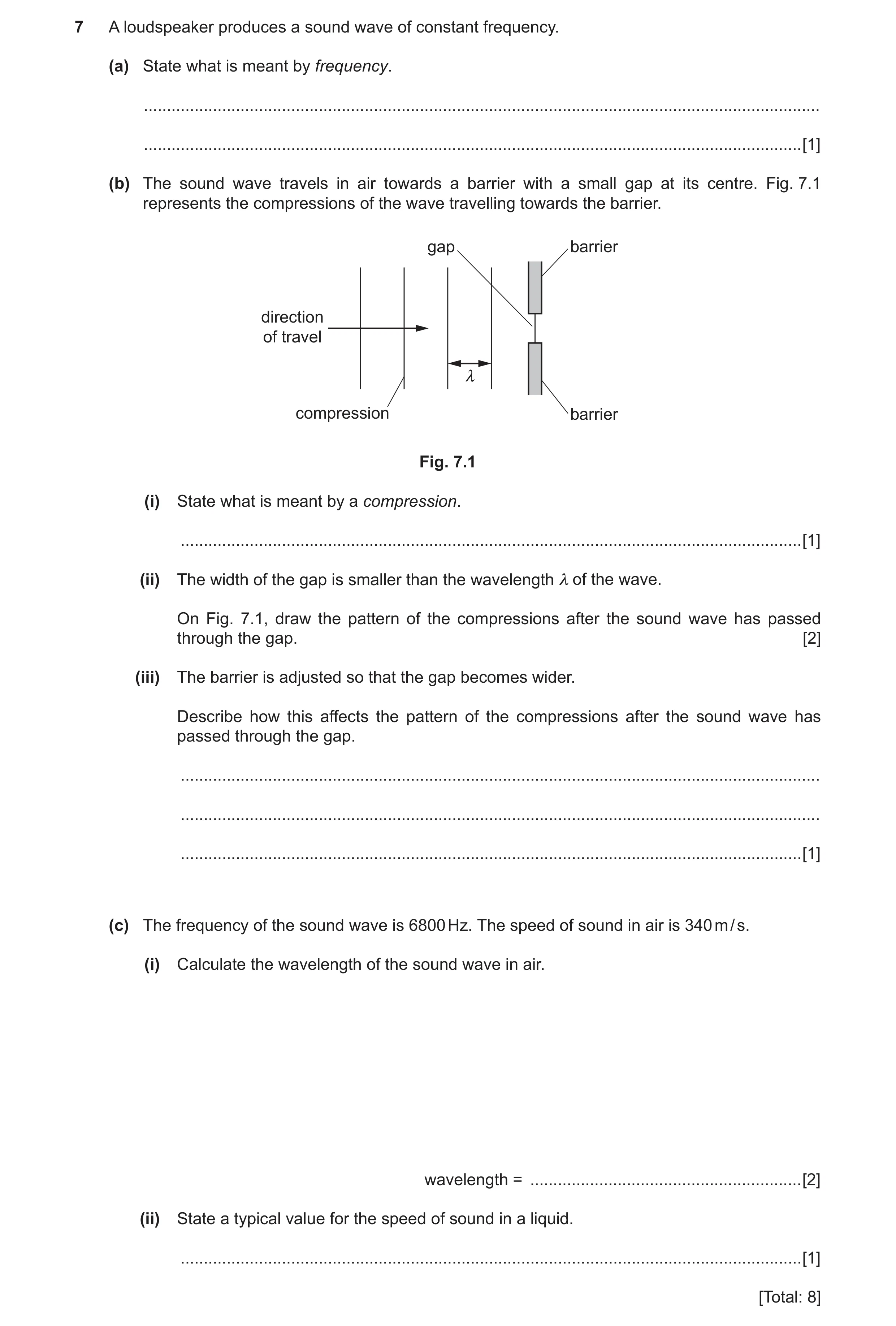
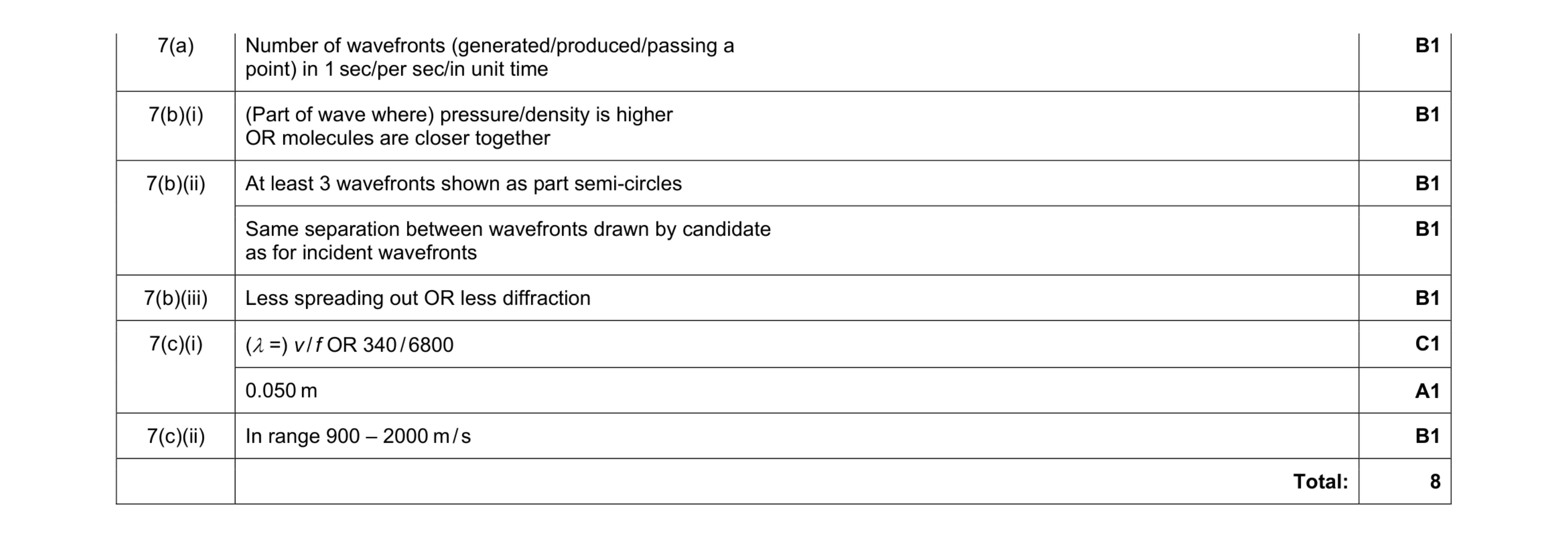
7 A loudspeaker produces a sound wave of constant frequency. (a) State what is meant by frequency. … … [1] (b) The sound wave travels in air towards a barrier with a small gap at its centre. Fig. 7.1 represents the compressions of the wave travelling towards the barrier. gap barrier direction of travel λ compression barrier Fig. 7.1 (i) State what is meant by a compression. … [1] (ii) The width of the gap is smaller than the wavelength λ of the wave. On Fig. 7.1, draw the pattern of the compressions after the sound wave has passed through the gap. [2] (iii) The barrier is adjusted so that the gap becomes wider. Describe how this affects the pattern of the compressions after the sound wave has passed through the gap. … … … [1] (c) The frequency of the sound wave is 6800 Hz. The speed of sound in air is 340 m / s. (i) Calculate the wavelength of the sound wave in air. wavelength = … [2] (ii) State a typical value for the speed of sound in a liquid. … [1] [Total: 8]
8 marks
Mark scheme: 7(a) Number of wavefronts (generated/produced/passing a point) in 1 sec/per sec/in unit time B1 7(b)(i) (Part of wave where) pressure/density is higher OR molecules are closer together B1 7(b)(ii) At least 3 wavefronts shown as part semi-circles B1 Same separation between wavefronts drawn by candidate as for incident wavefronts B1 7(b)(iii) Less spreading out OR less diffraction B1 7(c)(i) (λ =) v / f OR 340 / 6800 C1 0.050 m A1 7(c)(ii) In range 900 – 2000 m / s B1 Total: 8
This question in 0625/41 May/June 2017
Q2 · A loudspeaker is built into the side of a swimming pool 0625/43 May/June 2017
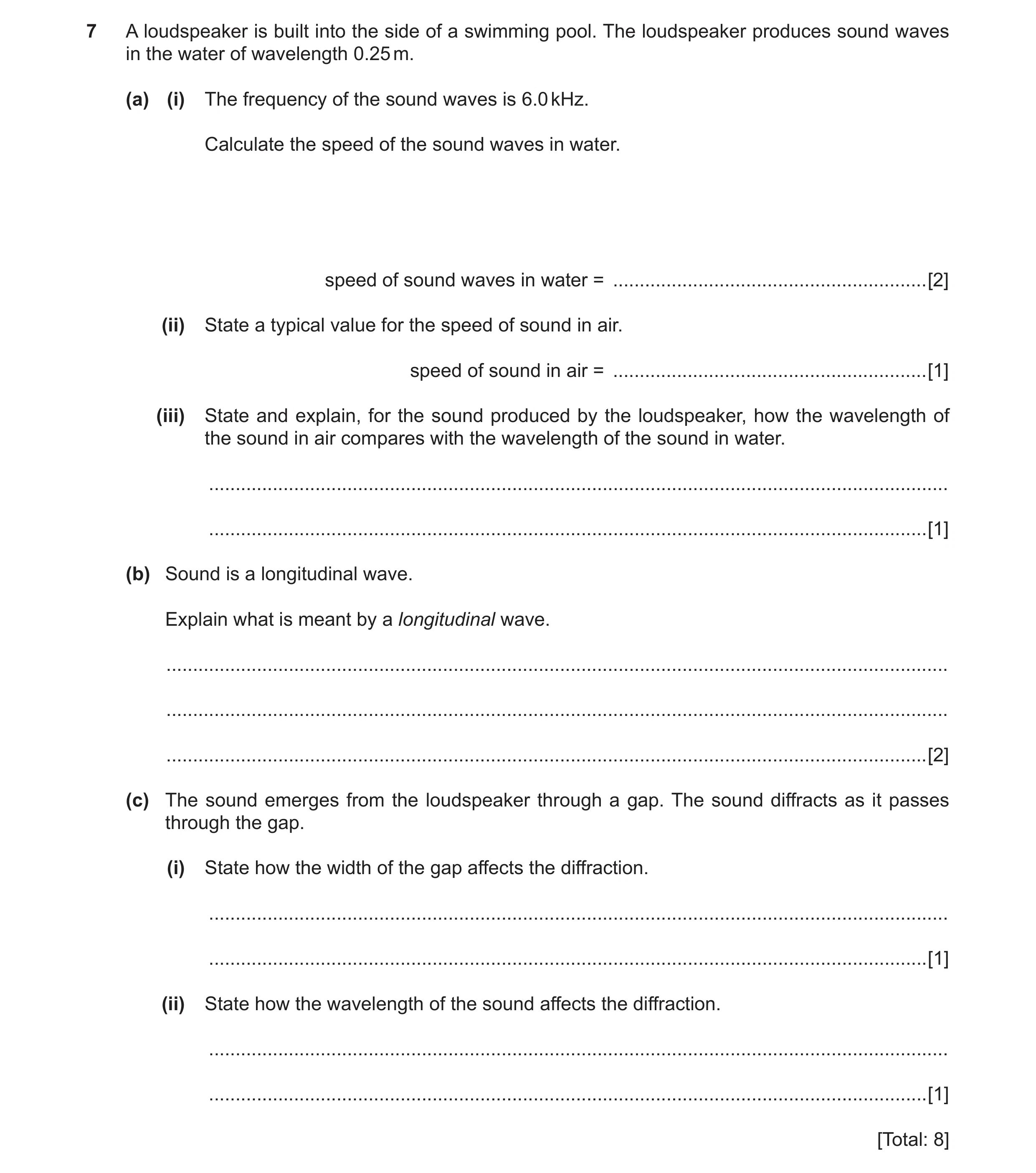
7 A loudspeaker is built into the side of a swimming pool. The loudspeaker produces sound waves in the water of wavelength 0.25 m. (a) (i) The frequency of the sound waves is 6.0 kHz. Calculate the speed of the sound waves in water. speed of sound waves in water = … [2] (ii) State a typical value for the speed of sound in air. speed of sound in air = … [1] (iii) State and explain, for the sound produced by the loudspeaker, how the wavelength of the sound in air compares with the wavelength of the sound in water. … … [1] (b) Sound is a longitudinal wave. Explain what is meant by a longitudinal wave. … … … [2] (c) The sound emerges from the loudspeaker through a gap. The sound diffracts as it passes through the gap. (i) State how the width of the gap affects the diffraction. … … [1] (ii) State how the wavelength of the sound affects the diffraction. … … [1] [Total: 8]
8 marks
Mark scheme: 7(a)(i) C1 1500 m / s A1 7(a)(ii) 300 m / s ⩽ c ⩽ 360 m / s B1 7(a)(iii) less and travels less far in same/periodic time B1 7(b) vibration/oscillation B1 vibration/oscillation parallel to direction of travel OR compressions and rarefactions B1 7(c)(i) inversely related OR the wider the gap, the less the diffraction OR v.v. B1 7(c)(ii) directly related OR greater wavelength, greater diffraction OR v.v. B1 Total: 8
This question in 0625/43 May/June 2017
Q3 · The left-hand column of the table shows some possible speeds of a sound wave 0625/41 Oct/Nov 2017
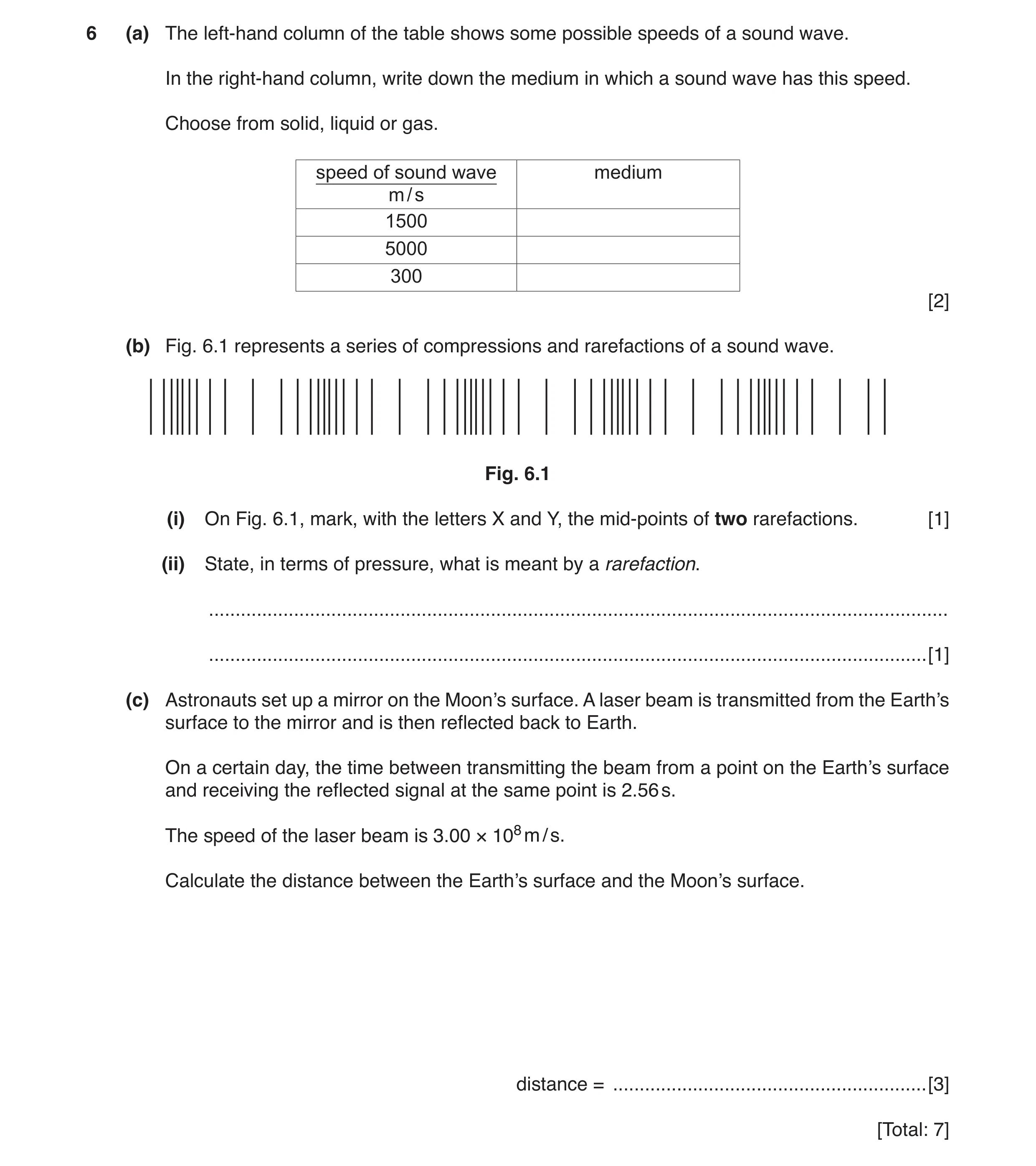
6 (a) The left-hand column of the table shows some possible speeds of a sound wave. In the right-hand column, write down the medium in which a sound wave has this speed. Choose from solid, liquid or gas. speed of sound wave medium m / s 1500 5000 300 [2] (b) Fig. 6.1 represents a series of compressions and rarefactions of a sound wave. Fig. 6.1 (i) On Fig. 6.1, mark, with the letters X and Y, the mid-points of two rarefactions. [1] (ii) State, in terms of pressure, what is meant by a rarefaction. … … [1] (c) Astronauts set up a mirror on the Moon’s surface. A laser beam is transmitted from the Earth’s surface to the mirror and is then reflected back to Earth. On a certain day, the time between transmitting the beam from a point on the Earth’s surface and receiving the reflected signal at the same point is 2.56 s. The speed of the laser beam is 3.00 × 10⁸ m / s. Calculate the distance between the Earth’s surface and the Moon’s surface. distance = … [3] [Total: 7]
7 marks
Mark scheme: 6(a) 1500 m / s liquid 5000 m / s solid 300 m / s gas B2 6(b)(i) X and Y marked at centres of any two rarefactions B1 6(b)(ii) Area of low pressure or low density (of atoms) or where atoms / molecules far apart B1 6(c) v = = d / t or 2 d / t in any form C1 d = v t / 2 OR 3.0 × 108 × 2.56 / 2 C1 3.84 × 10⁸ m OR 3.84 × 10⁵km A1
This question in 0625/41 Oct/Nov 2017
Q4 · Circle two of the following that apply to an ultrasound wave travelling in air 0625/42 May/June 2018
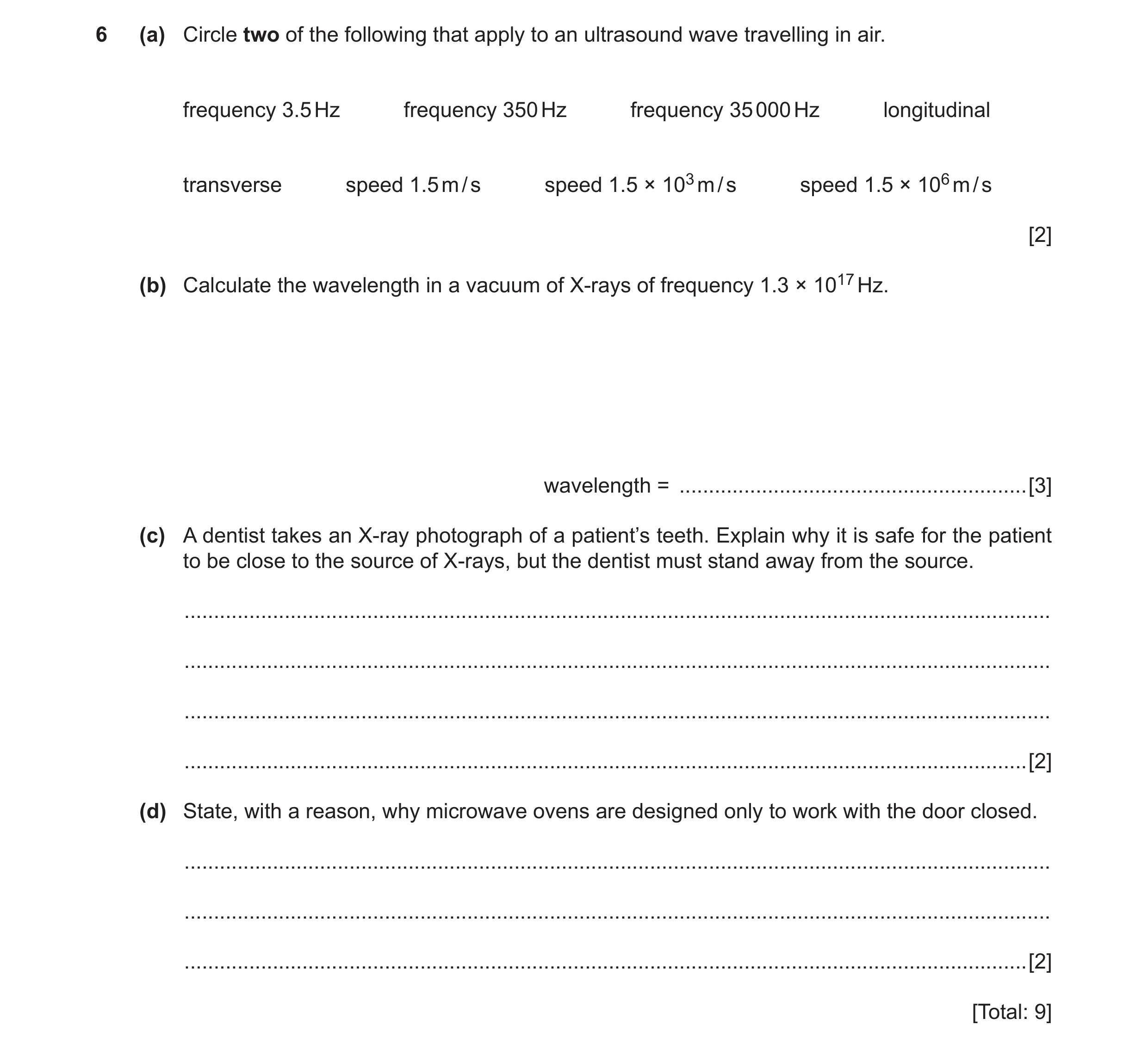
6 (a) Circle two of the following that apply to an ultrasound wave travelling in air. frequency 3.5 Hz frequency 350 Hz frequency 35 000 Hz longitudinal transverse speed 1.5 m / s speed 1.5 × 10³ m / s speed 1.5 × 10⁶ m / s [2] (b) Calculate the wavelength in a vacuum of X-rays of frequency 1.3 × 10¹⁷ Hz. wavelength = … [3] (c) A dentist takes an X-ray photograph of a patient’s teeth. Explain why it is safe for the patient to be close to the source of X-rays, but the dentist must stand away from the source. … … … … [2] (d) State, with a reason, why microwave ovens are designed only to work with the door closed. … … … [2] [Total: 9]
9 marks
Mark scheme: 6(a) frequency 35 000 Hz ringed 1 longitudinal ringed 1 6(b) v = f λ OR (λ = ) v ÷ f 1 (λ=) 3 × 10⁸ ÷ 1.3 × 10¹⁷ 1 (λ =) 2.3 × 10⁻⁹ m 1 6(c) X-rays ionising/harmful/dangerous (to humans) 1 Any one from: patient rarely exposed low total dose on patient meaningful comment about benefit outweighs danger dentist frequently exposed total dose on dentist would be high if stayed in room 1 6(d) microwaves harmful/dangerous (to humans) 1 microwaves would pass through open door 1
This question in 0625/42 May/June 2018
Q5 · Sound is a longitudinal wave 0625/43 May/June 2018
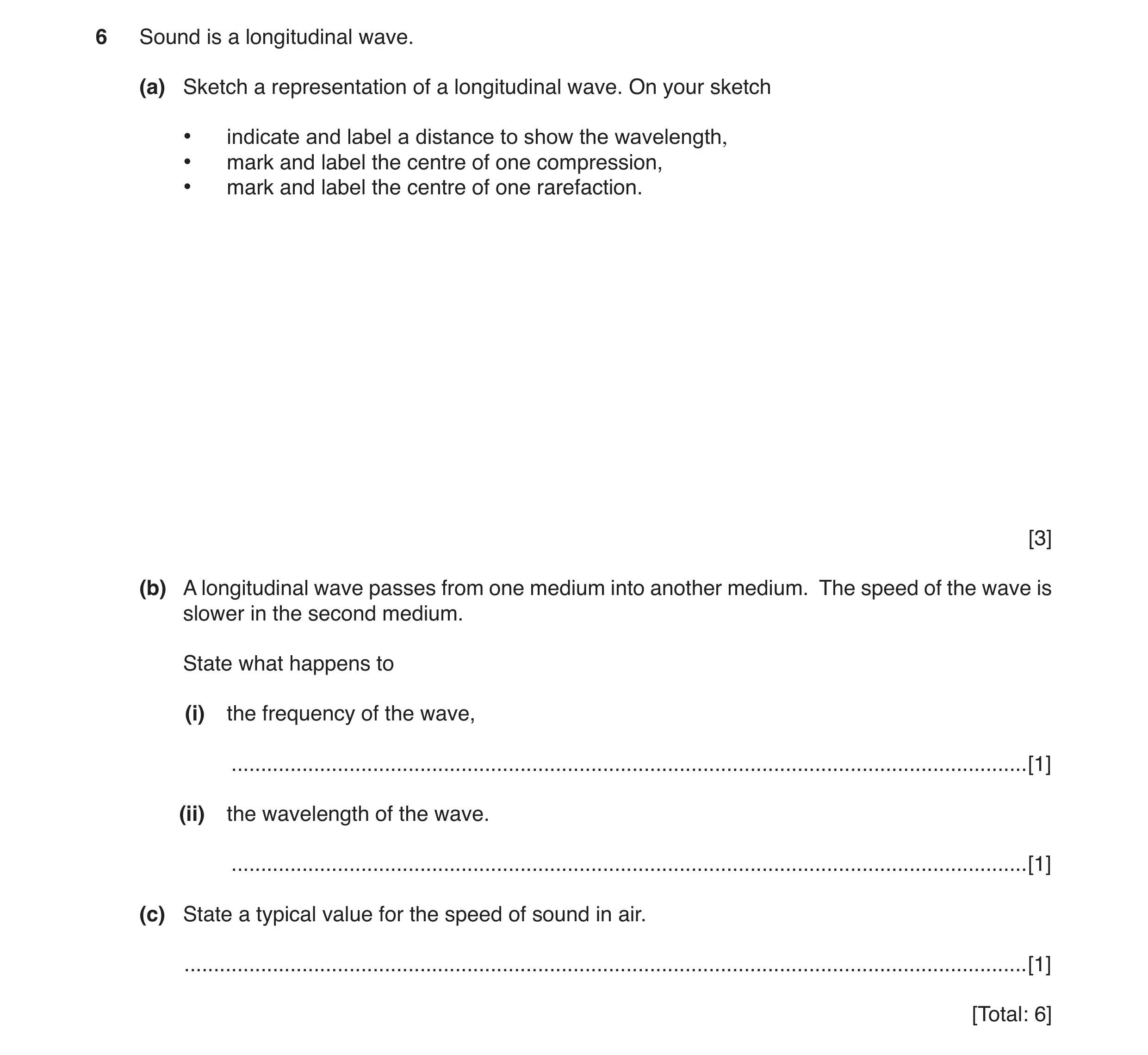
6 Sound is a longitudinal wave. (a) Sketch a representation of a longitudinal wave. On your sketch • indicate and label a distance to show the wavelength, • mark and label the centre of one compression, • mark and label the centre of one rarefaction. [3] (b) A longitudinal wave passes from one medium into another medium. The speed of the wave is slower in the second medium. State what happens to (i) the frequency of the wave, … [1] (ii) the wavelength of the wave. … [1] (c) State a typical value for the speed of sound in air. … [1] [Total: 6]
6 marks
Mark scheme: 6(a) attempt at compressions and rarefactions B1 at least one compression labelled and at least one rarefaction labelled B1 wavelength and labelled λ B1 6(b)(i) (it/frequency remains) constant B1 6(b)(ii) (it/wavelength) decreases B1 6(c) 320 to 350 m / s B1
This question in 0625/43 May/June 2018
Q6 · A vibrating source on a ship produces a sound wave that travels through the ocean 0625/41 Oct/Nov 2018
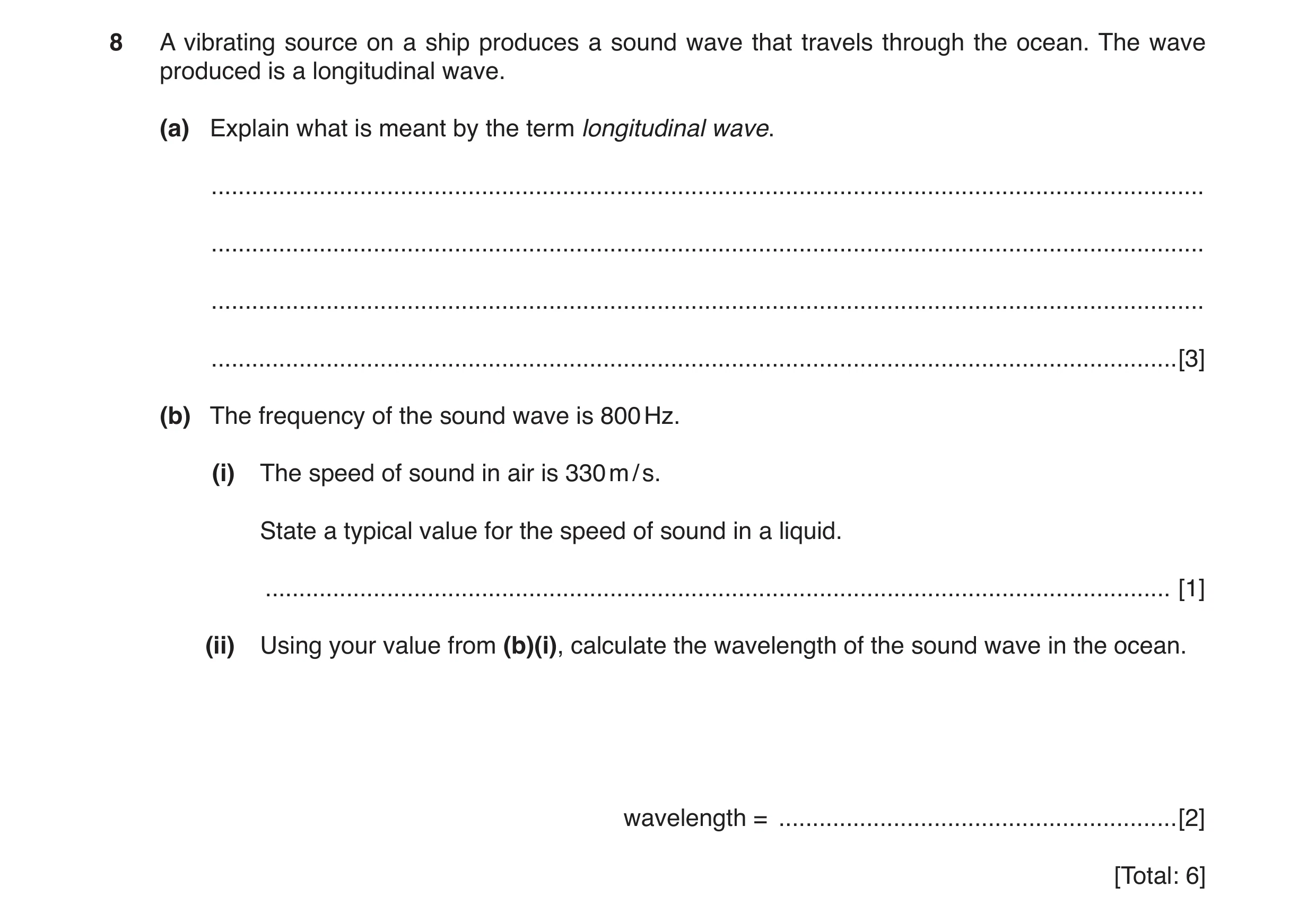
8 A vibrating source on a ship produces a sound wave that travels through the ocean. The wave produced is a longitudinal wave. (a) Explain what is meant by the term longitudinal wave. … … … … [3] (b) The frequency of the sound wave is 800 Hz. (i) The speed of sound in air is 330 m / s. State a typical value for the speed of sound in a liquid. … [1] (ii) Using your value from (b)(i), calculate the wavelength of the sound wave in the ocean. wavelength = … [2] [Total: 6]
6 marks
Mark scheme: 8(a) Particles / molecules / water / medium vibrate B1 Vibration is in the direction travel of the wave B1 Has compressions and rarefactions B1 8(b)(i) Value in range from 900 m / s to 2000 m / s B1 8(b)(ii) v = fλ in any form OR (λ =) v / f OR answer to (b)(i) / 800 C1 correct evaluation with unit (m) A1
This question in 0625/41 Oct/Nov 2018
Q7 · A sound wave of wavelength 0.45 m travelling from left to right 0625/42 Oct/Nov 2018
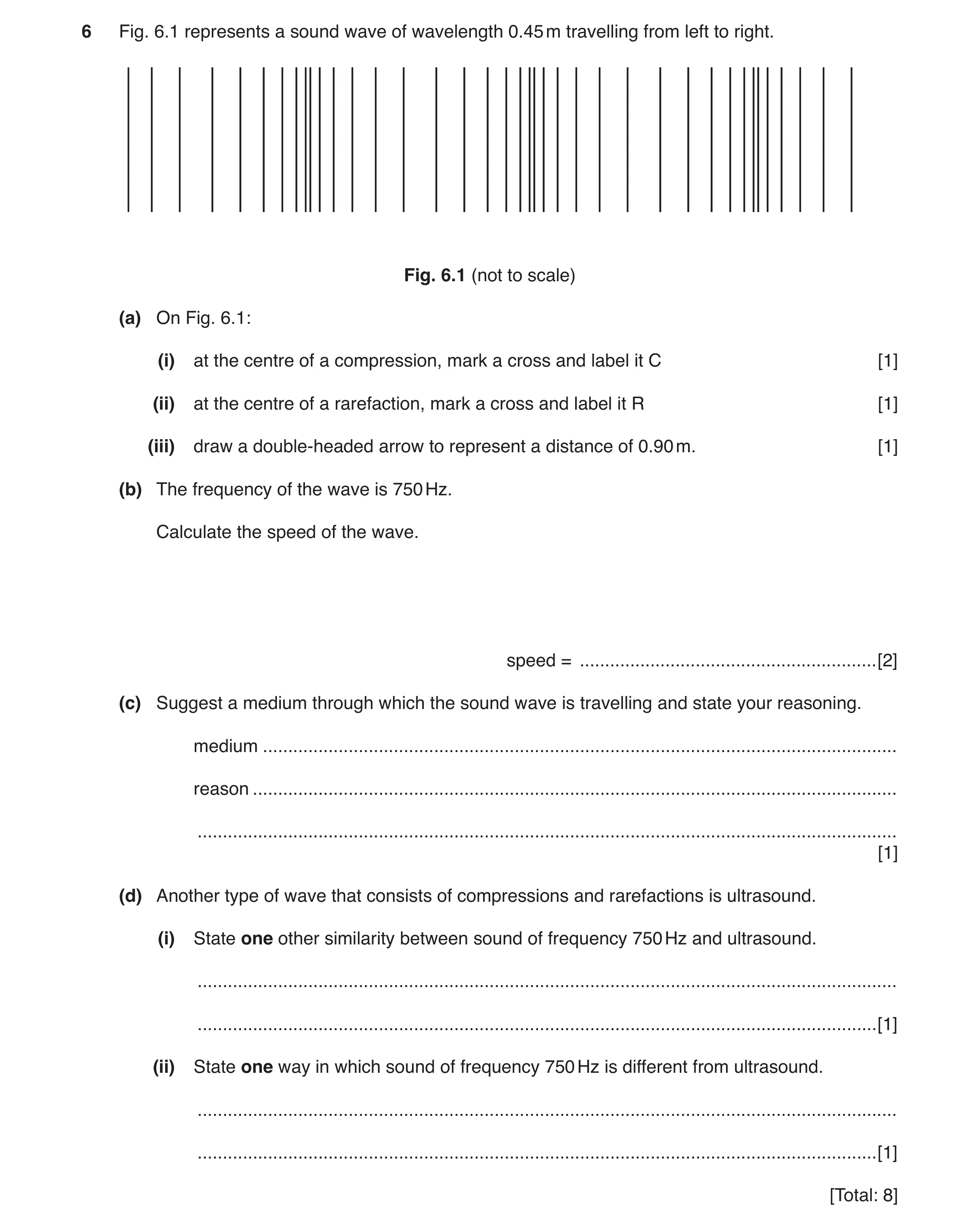
6 Fig. 6.1 represents a sound wave of wavelength 0.45 m travelling from left to right. Fig. 6.1 (not to scale) (a) On Fig. 6.1: (i) at the centre of a compression, mark a cross and label it C [1] (ii) at the centre of a rarefaction, mark a cross and label it R [1] (iii) draw a double-headed arrow to represent a distance of 0.90 m. [1] (b) The frequency of the wave is 750 Hz. Calculate the speed of the wave. speed = … [2] (c) Suggest a medium through which the sound wave is travelling and state your reasoning. medium … reason … … [1] (d) Another type of wave that consists of compressions and rarefactions is ultrasound. (i) State one other similarity between sound of frequency 750 Hz and ultrasound. … … [1] (ii) State one way in which sound of frequency 750 Hz is different from ultrasound. … … [1] [Total: 8]
8 marks
Mark scheme: 6(a)(i) C marked within the shortest gap B1 6(a)(ii) R marked within longest gap B1 6(a)(iii) double-headed arrow across two wavelengths B1 6(b) (v = ) f λ in any form C1 (v = 750 × 0.45 = ) 340 m / s A1 6(c) air OR any / a gas AND speed is (typical) of sound in a gas B1 6(d)(i) longitudinal OR vibration parallel to wave travel direction OR transfer energy B1 6(d)(ii) frequency / pitch less OR below 20 000 Hz OR audible (to someone with normal hearing) B1
This question in 0625/42 Oct/Nov 2018
Q8 · A water wave in a ripple tank 0625/42 May/June 2019
6 (a) Fig. 6.1 shows a water wave in a ripple tank. new wave direction original wave direction region B region A Fig. 6.1 (i) State the name of the process that occurs as the wave moves from region A to region B. … [1] (ii) Suggest a cause for the change in direction of the wave. … [1] (b) Fig. 6.2 shows a transverse wave. displacement 0 time Fig. 6.2 On Fig. 6.2, draw a wave which has half the amplitude and a greater frequency than the wave shown. [2] (c) A train travels along steel rails. A person waiting at a station hears the sound of the train through the rails before he hears the sound through the air. (i) Explain why this happens. … … [1] (ii) The speed of sound in the rails is 5800 m / s. Calculate the wavelength of sound of frequency 1100 Hz travelling at this speed. wavelength = … [2] [Total: 7]
7 marks
Mark scheme: 6(a)(i) refraction B1 6(a)(ii) (waves move) faster (in region B) OR slower in region A B1 6(b) at least one complete cycle with half the amplitude B1 at least one complete cycle shorter time period B1 6(c)(i) sound travels faster in steel/metal/solid/the rail (than in air) B1 6(c)(ii) v = f λ in any form OR (λ = ) v/f OR (λ =) 5800/1100 C1 (λ =) 5.3 m A1
This question in 0625/42 May/June 2019
Q9 · A small submarine submerged below the surface of the sea 0625/43 May/June 2019
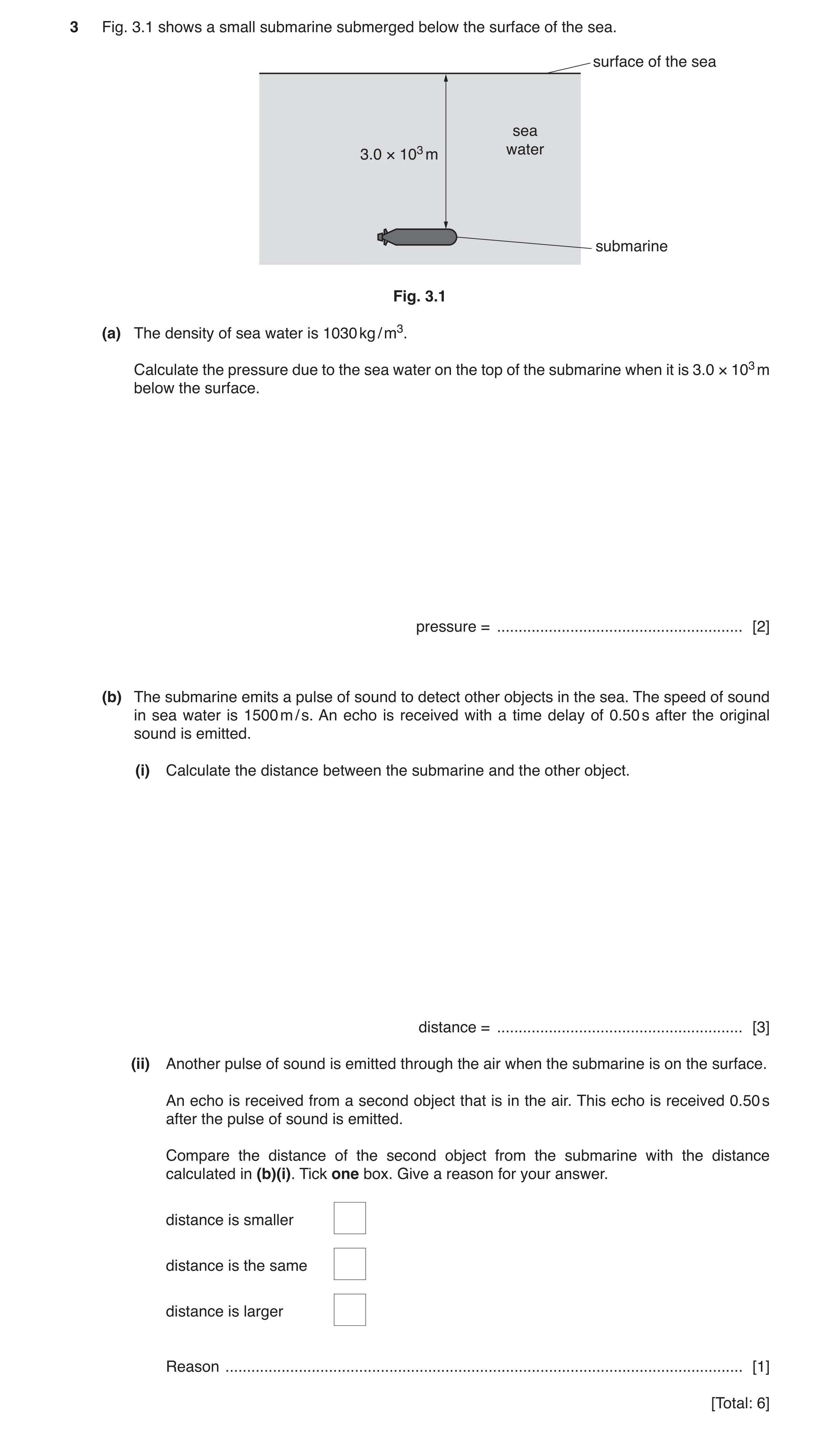
3 Fig. 3.1 shows a small submarine submerged below the surface of the sea. surface of the sea sea water 3.0 × 10³ m submarine Fig. 3.1 (a) The density of sea water is 1030 kg / m3. Calculate the pressure due to the sea water on the top of the submarine when it is 3.0 × 10³ m below the surface. pressure = … [2] (b) The submarine emits a pulse of sound to detect other objects in the sea. The speed of sound in sea water is 1500 m / s. An echo is received with a time delay of 0.50 s after the original sound is emitted. (i) Calculate the distance between the submarine and the other object. distance = … [3] (ii) Another pulse of sound is emitted through the air when the submarine is on the surface. An echo is received from a second object that is in the air. This echo is received 0.50 s after the pulse of sound is emitted. Compare the distance of the second object from the submarine with the distance calculated in (b)(i). Tick one box. Give a reason for your answer. distance is smaller distance is the same distance is larger Reason … [1] [Total: 6]
6 marks
Mark scheme: 3(a) (p) = ρgh in any form OR (p=) 1030 × 10 × 3.0 × 103 C1 3.1 × 10⁷ Pa A1 3(b)(i) v = d/t OR v = 2d/t in any form C1 1500 = 2 0.50 d OR 2d = 1500 × 0.50 C1 380 m A1 3(b)(ii) distance smaller (first box ticked) AND speed of sound lower (in air than liquid) B1
This question in 0625/43 May/June 2019
Q10 · A loudspeaker that is producing a sound wave in air of frequency 15 000 Hz 0625/41 Oct/Nov 2019
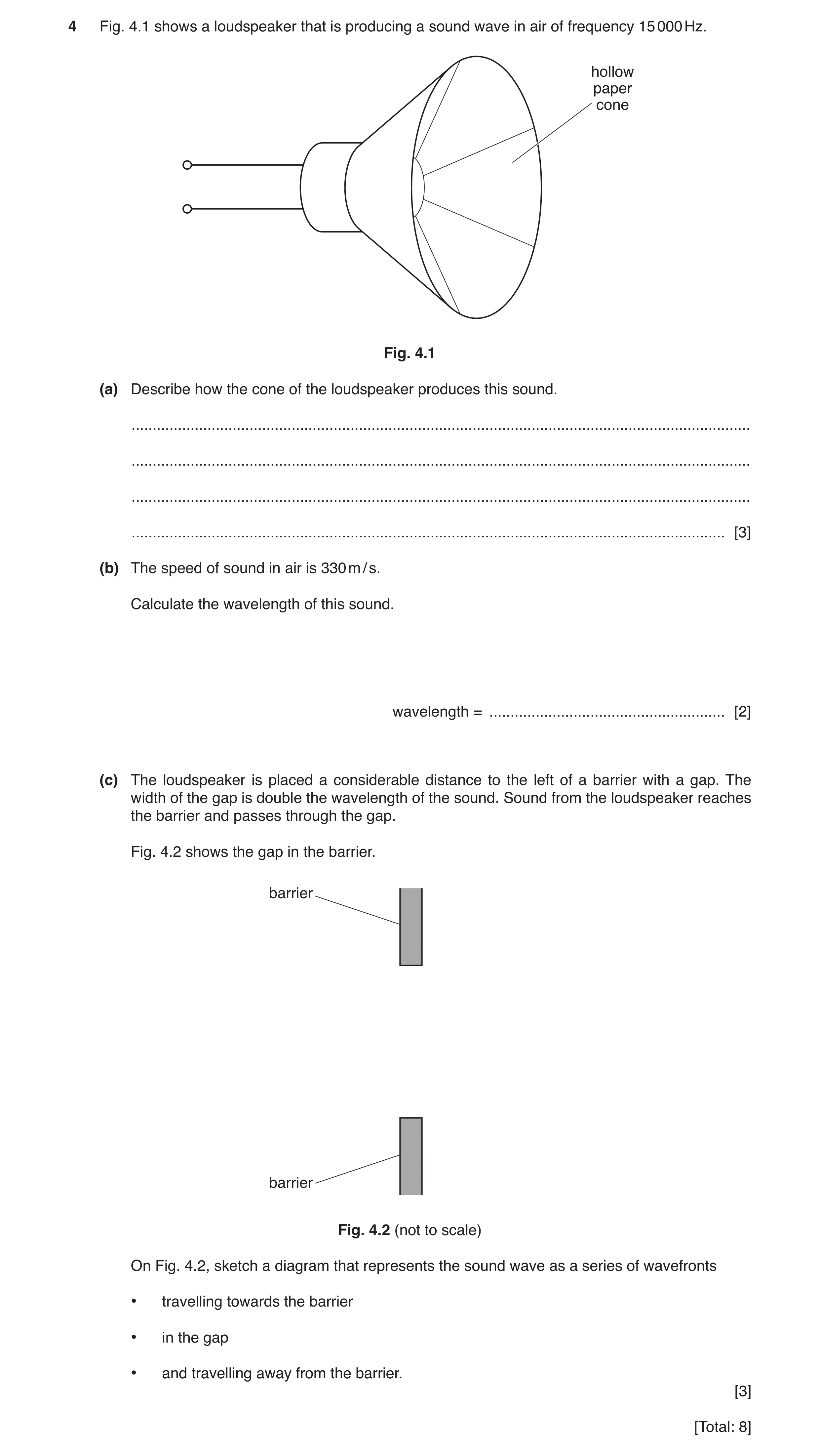
4 Fig. 4.1 shows a loudspeaker that is producing a sound wave in air of frequency 15 000 Hz. hollow paper cone Fig. 4.1 (a) Describe how the cone of the loudspeaker produces this sound. … … … … [3] (b) The speed of sound in air is 330 m / s. Calculate the wavelength of this sound. wavelength = … [2] (c) The loudspeaker is placed a considerable distance to the left of a barrier with a gap. The width of the gap is double the wavelength of the sound. Sound from the loudspeaker reaches the barrier and passes through the gap. Fig. 4.2 shows the gap in the barrier. barrier barrier Fig. 4.2 (not to scale) On Fig. 4.2, sketch a diagram that represents the sound wave as a series of wavefronts • travelling towards the barrier • in the gap • and travelling away from the barrier. [3] [Total: 8]
8 marks
Mark scheme: 4(a) it / cone vibrates any two from: alternating current (a.c.) (in coil / wire) or alternating magnetic field (neighbouring) air vibrates or vibrations passed on (producing) compressions and rarefactions / vibrations parallel to energy transfer vibrating at 15 000 Hz B1 B2 4(b) λ = v / f in any form words, symbols or numbers or (λ =) v / f or 330 / 15 000 0.022 m C1 A1 4(c) at least two vertical wavefronts either to left of barrier or in gap at least one wavefront showing some diffraction approximately constant wavelength throughout and ~50% of gap width B1 B1 B1
This question in 0625/41 Oct/Nov 2019
Q11 · Wavefronts of a sound wave travelling in air from left to right 0625/43 Oct/Nov 2019
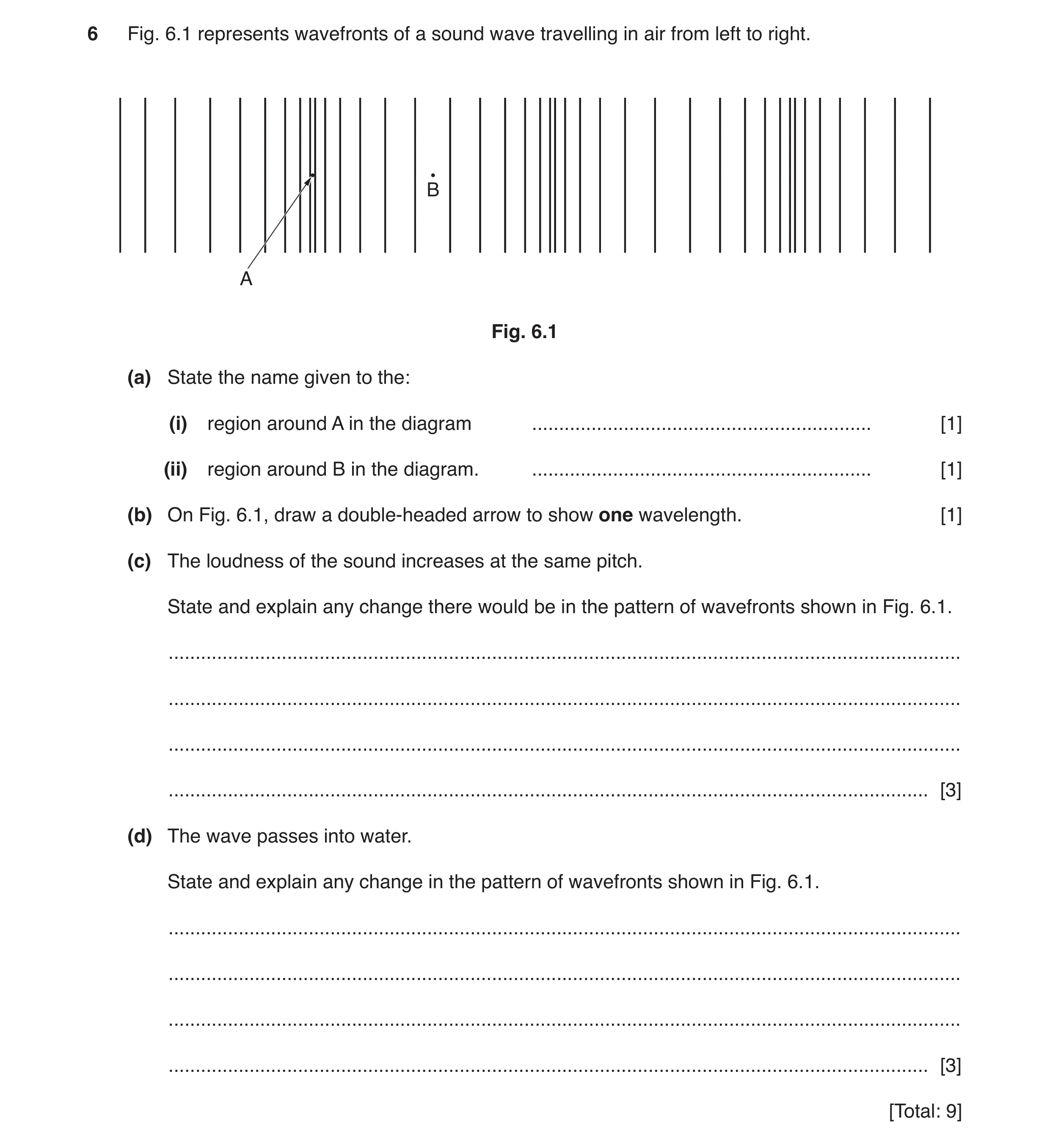
6 Fig. 6.1 represents wavefronts of a sound wave travelling in air from left to right. B A Fig. 6.1 (a) State the name given to the: (i) region around A in the diagram … [1] (ii) region around B in the diagram. … [1] (b) On Fig. 6.1, draw a double-headed arrow to show one wavelength. [1] (c) The loudness of the sound increases at the same pitch. State and explain any change there would be in the pattern of wavefronts shown in Fig. 6.1. … … … … [3] (d) The wave passes into water. State and explain any change in the pattern of wavefronts shown in Fig. 6.1. … … … … [3] [Total: 9]
9 marks
Mark scheme: 6(a)(i) compression B1 6(a)(ii) rarefaction B1 6(b) correct wavelength indicated B1 6(c) closer together at compression and further apart at rarefaction B1 amplitude changes B1 loudness does not affect wavelength B1 6(d) more spread out / further apart B1 Velocity / speed greater in water than air B1 (so) wavelength greater B1
This question in 0625/43 Oct/Nov 2019
Q12 · The speed of sound in air is 340 m / s 0625/41 May/June 2020
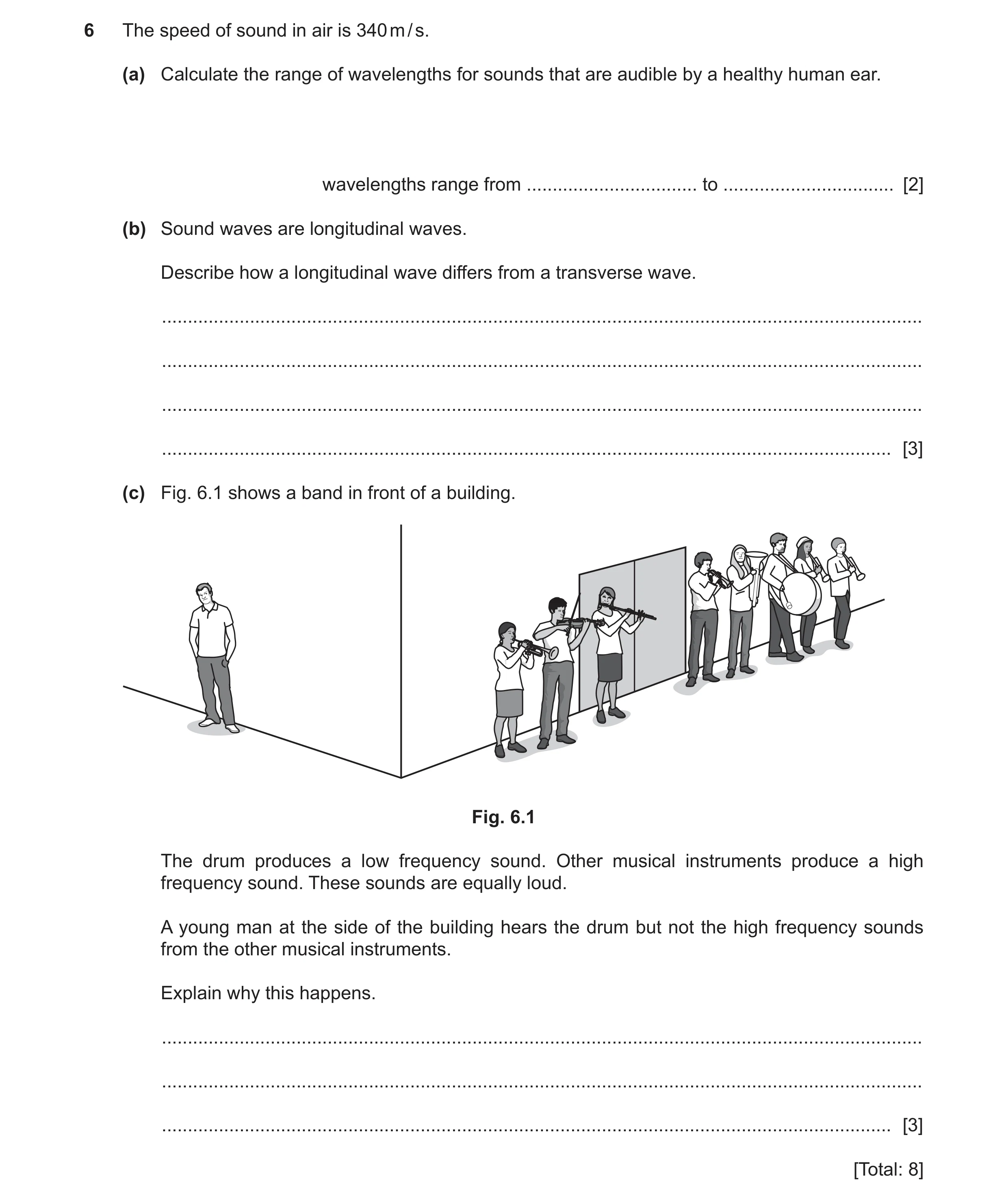
6 The speed of sound in air is 340 m / s. (a) Calculate the range of wavelengths for sounds that are audible by a healthy human ear. wavelengths range from … to … [2] (b) Sound waves are longitudinal waves. Describe how a longitudinal wave differs from a transverse wave. … … … … [3] (c) Fig. 6.1 shows a band in front of a building. Fig. 6.1 The drum produces a low frequency sound. Other musical instruments produce a high frequency sound. These sounds are equally loud. A young man at the side of the building hears the drum but not the high frequency sounds from the other musical instruments. Explain why this happens. … … … [3] [Total: 8]
8 marks
Mark scheme: 6(a) (λ =) v / f OR 340 / 20 000 OR 340 / 20 C1 0.017 m AND 17 m A1 6(b) (longitudinal wave) vibration direction parallel to propagation / energy travel direction B1 transverse wave vibration direction perpendicular to propagation / energy travel direction B1 consists of rarefactions AND compressions B1 Question Answer Marks 6(c) diffraction mentioned B1 wavelength of sound from drum / low frequency sound greater (than wavelength of high frequency sound) B1 more diffraction of sound from drum OR less diffraction of high frequency sound B1
This question in 0625/41 May/June 2020
Q13 · Crests of a wave approaching a barrier where the wave is reflected 0625/42 May/June 2020
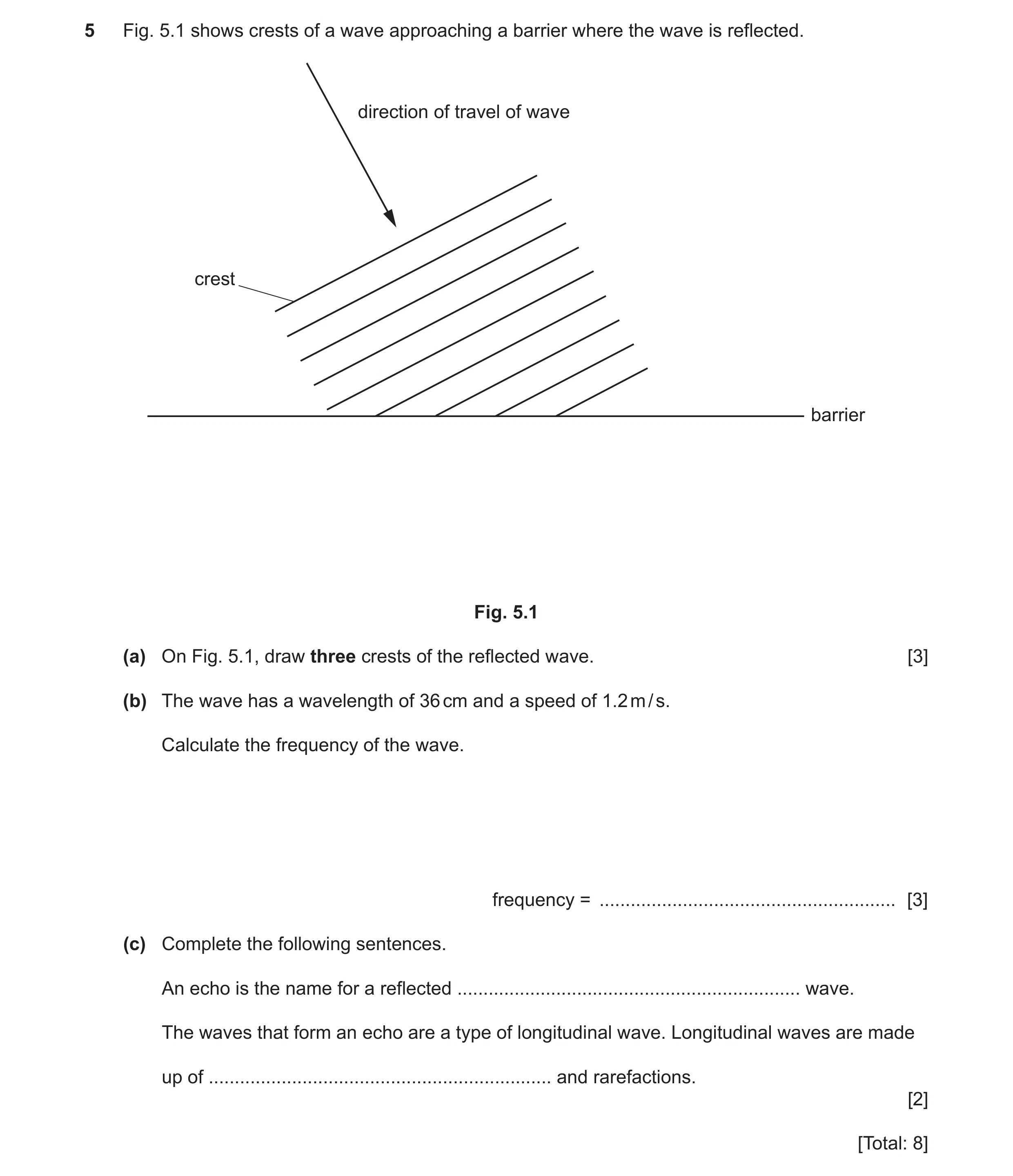
5 Fig. 5.1 shows crests of a wave approaching a barrier where the wave is reflected. direction of travel of wave crest barrier Fig. 5.1 (a) On Fig. 5.1, draw three crests of the reflected wave. [3] (b) The wave has a wavelength of 36 cm and a speed of 1.2 m / s. Calculate the frequency of the wave. frequency = … [3] (c) Complete the following sentences. An echo is the name for a reflected … wave. The waves that form an echo are a type of longitudinal wave. Longitudinal waves are made up of … and rarefactions. [2] [Total: 8]
8 marks
Mark scheme: 5(a) three wavefronts parallel to each other AND same angles of reflection and incidence both by eye B1 two wavelengths same as original wavelength by eye B1 three reflected waves meet incident waves at barrier B1 5(b) v = fλ in any form OR (f =) v/λ C1 OR (f =) 1.2 / 0.36 C1 (f =) 3.3 Hz A1 5(c) sound OR ultrasound B1 compressions B1
This question in 0625/42 May/June 2020
Q14 · Crests of a sound wave after reflection from a solid surface 0625/43 May/June 2020
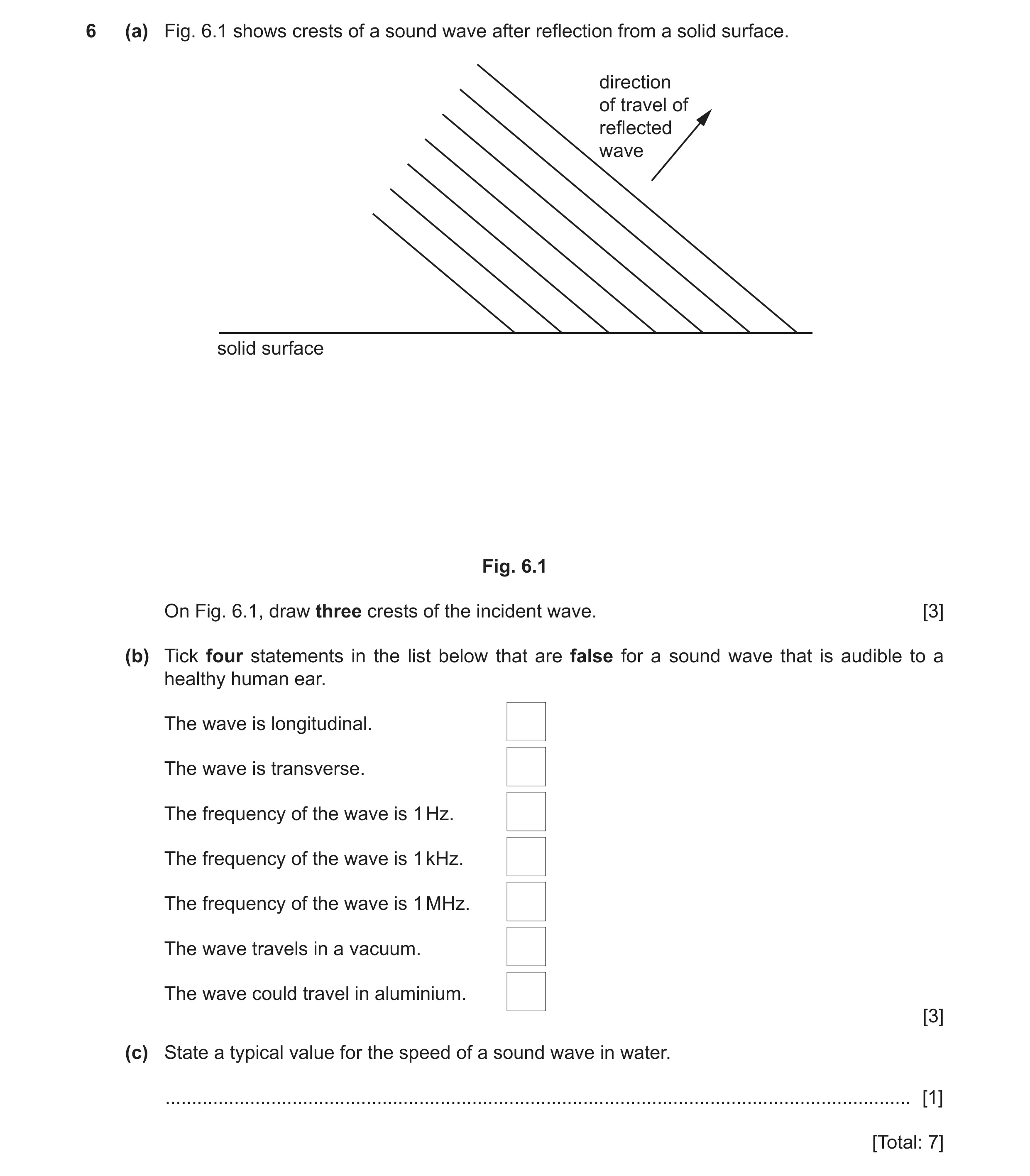
6 (a) Fig. 6.1 shows crests of a sound wave after reflection from a solid surface. direction of travel of reflected wave solid surface Fig. 6.1 On Fig. 6.1, draw three crests of the incident wave. [3] (b) Tick four statements in the list below that are false for a sound wave that is audible to a healthy human ear. The wave is longitudinal. The wave is transverse. The frequency of the wave is 1 Hz. The frequency of the wave is 1 kHz. The frequency of the wave is 1 MHz. The wave travels in a vacuum. The wave could travel in aluminium. [3] (c) State a typical value for the speed of a sound wave in water. … [1] [Total: 7]
7 marks
Mark scheme: 6(a) three wavefronts parallel to each other B1 two wavelengths same as reflected by eye B1 three wavefronts at same angle to barrier as original B1 6(b) second, third, fifth and sixth boxes ticked B3 6(c) 1500 m / s B1
This question in 0625/43 May/June 2020
Q15 · Sound waves consist of compressions and rarefactions 0625/43 Oct/Nov 2020
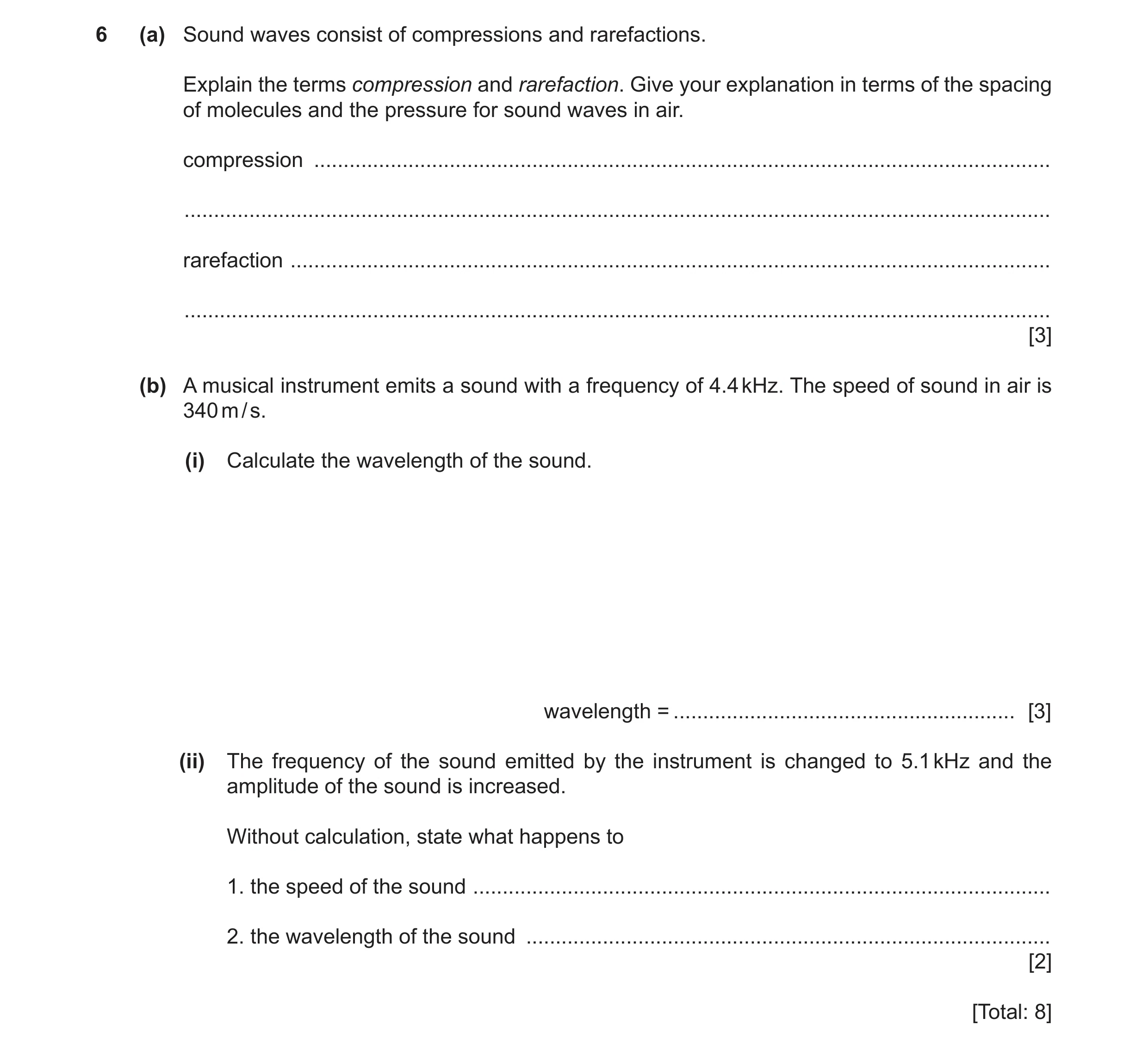
6 (a) Sound waves consist of compressions and rarefactions. Explain the terms compression and rarefaction. Give your explanation in terms of the spacing of molecules and the pressure for sound waves in air. compression … … rarefaction … … [3] (b) A musical instrument emits a sound with a frequency of 4.4 kHz. The speed of sound in air is 340 m / s. (i) Calculate the wavelength of the sound. wavelength = … [3] (ii) The frequency of the sound emitted by the instrument is changed to 5.1 kHz and the amplitude of the sound is increased. Without calculation, state what happens to 1. the speed of the sound … 2. the wavelength of the sound … [2] [Total: 8]
8 marks
Mark scheme: 6(a) molecules closer together than normal in a compression B1 molecules further apart than normal in a rarefaction B1 pressure higher (than normal) in a compression AND pressure lower (than normal) in a rarefaction B1 Question Answer Marks 6(b)(i) 4400 (Hz) seen C1 (λ = )v ÷ f in any form OR 340 ÷ 4400 OR 340 ÷ 4.4 OR 77 C1 (λ = v ÷ f =) 0.077 m A1 6(b)(ii) 1 speed stays the same B1 2 wavelength decreases B1
This question in 0625/43 Oct/Nov 2020
Q16 · State two uses for infrared radiation 0625/43 Oct/Nov 2020
7 (a) State two uses for infrared radiation. 1. … … 2. … … [2] (b) X-rays are used in hospitals to help treat patients. Suggest and explain three precautions for the safe use of X-rays. 1. … … 2. … … 3. … … [3] (c) (i) State the speed in a vacuum of 1. microwaves … [1] 2. X-rays … [1] (ii) State a possible frequency for an ultrasound wave. … [1] [Total: 8]
8 marks
Mark scheme: 7(a) any two from: remote controls (infrared) sensors / alarms specific electrical appliances thermal imaging B2 7(b) Any three from • shielding of operator behind screen / lead apron / out of room AND to absorb radiation • shielding of other parts of patient with lead / shielding of other parts of patient AND to absorb radiation • distance from source AND reduces intensity / amount of radiation / exposure • limit time of exposure / not too frequent / max number of X-rays per year AND to limit dose • limit strength / intensity of X-ray beam AND to limit dose B3 7(c)(i) 1 3 × 10⁸ m / s B1 2 3 × 10⁸ m / s B1 7(c)(ii) > 20 000 Hz B1
This question in 0625/43 Oct/Nov 2020
Q17 · A full-scale diagram that represents a sound wave travelling in air 0625/41 May/June 2021
6 Fig. 6.1 is a full-scale diagram that represents a sound wave travelling in air. direction of travel Fig. 6.1 (a) On Fig. 6.1, mark two points, each at the centre of a different compression. Label both of the points C. [1] (b) The speed of sound in air is 330 m / s. Measure the diagram and determine the frequency of the sound. frequency = … [3] (c) The wave reaches a barrier. Fig. 6.2 shows the wave passing through a gap in the barrier. barrier direction of travel Fig. 6.2 The frequency of the wave is increased to a value many times greater than the value obtained in (b). Describe and explain two ways in which a diagram representing the wave with the greater frequency differs from Fig. 6.2. 1. … … 2. … … [3] [Total: 7]
7 marks
Mark scheme: 6(a) two points labelled C at the centre of the two compressions B1 6(b) 6200−6500 Hz A3 (λ =) value from 0.051 to 0.053 (m) seen anywhere C1 (f =) v / λ in any form or 330 / 0.052 or 330 / 5.2 or 63 C1 6(c) compressions / rarefactions closer or more compressions / rarefactions (in same distance) B1 less diffraction / spreading out B1 (because of) smaller wavelength or ratio wavelength / gap width smaller B1
This question in 0625/41 May/June 2021
Q18 · A wave on the sea approaching a harbour 0625/43 May/June 2021
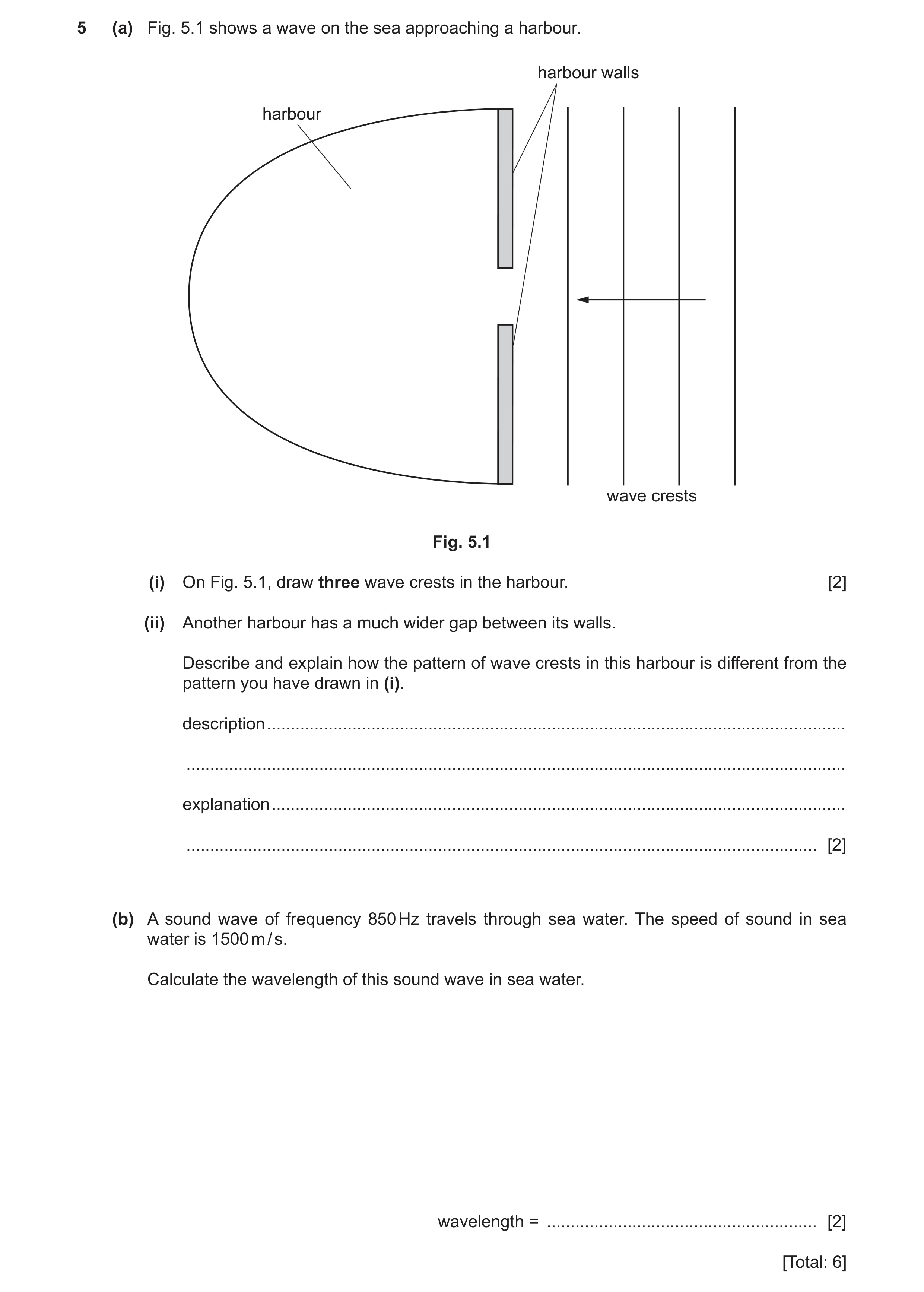
5 (a) Fig. 5.1 shows a wave on the sea approaching a harbour. harbour walls harbour wave crests Fig. 5.1 (i) On Fig. 5.1, draw three wave crests in the harbour. [2] (ii) Another harbour has a much wider gap between its walls. Describe and explain how the pattern of wave crests in this harbour is different from the pattern you have drawn in (i). description … … explanation … … [2] (b) A sound wave of frequency 850 Hz travels through sea water. The speed of sound in sea water is 1500 m / s. Calculate the wavelength of this sound wave in sea water. wavelength = … [2] [Total: 6]
6 marks
Mark scheme: 5(a)(i) part of a circle, at least quarter of a circle, centred on centre of gap B1 waves same wavelength as incident waves B1 5(a)(ii) waves pass through gap remaining straight B1 less / no diffraction occurs B1 5(b) 1.8 m A2 λ = v/f OR 1500/850 in any form C1
This question in 0625/43 May/June 2021
Q19 · Particles of a material in which a sound wave is travelling 0625/42 Oct/Nov 2021
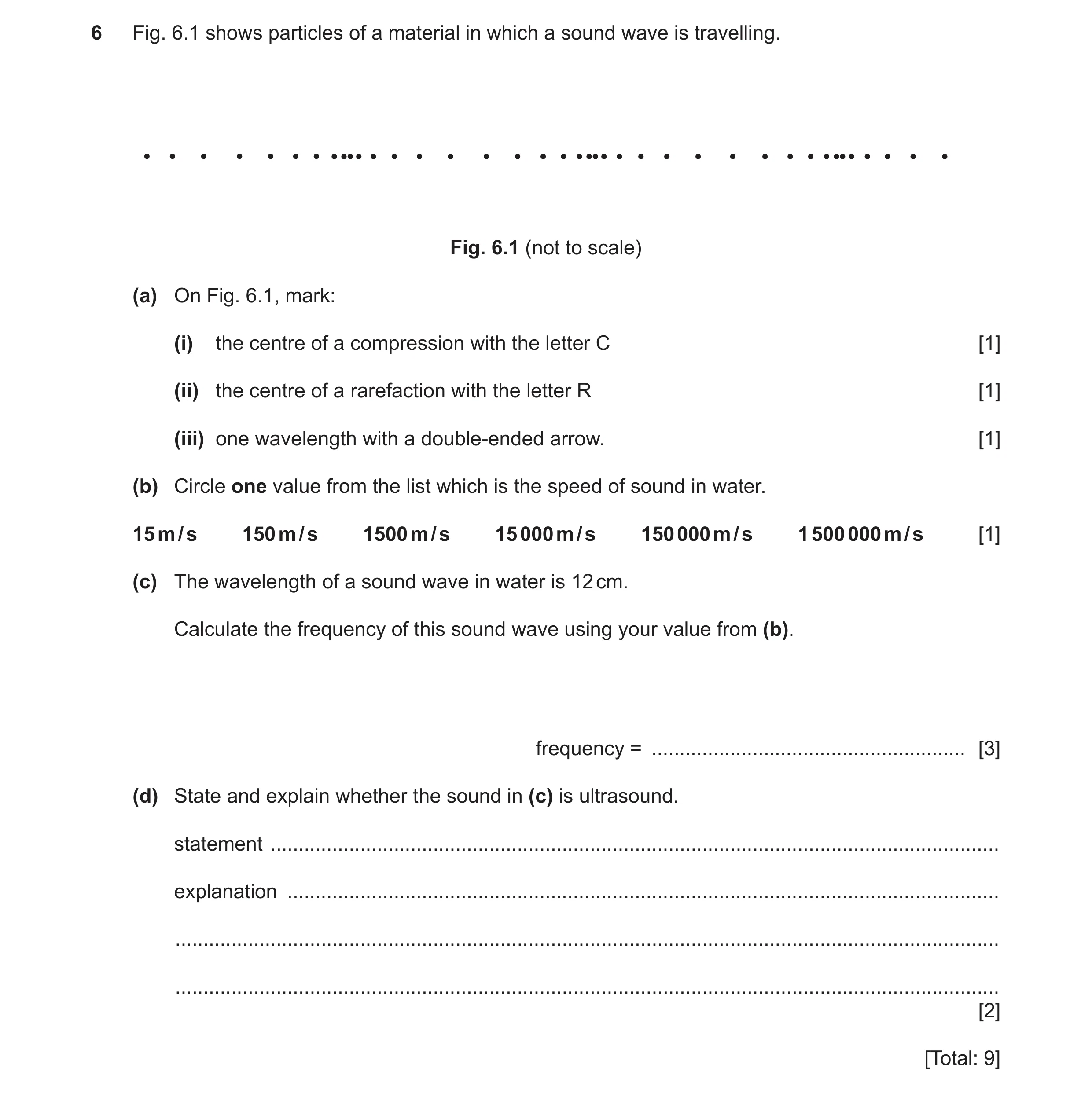
6 Fig. 6.1 shows particles of a material in which a sound wave is travelling. Fig. 6.1 (not to scale) (a) On Fig. 6.1, mark: (i) the centre of a compression with the letter C [1] (ii) the centre of a rarefaction with the letter R [1] (iii) one wavelength with a double-ended arrow. [1] (b) Circle one value from the list which is the speed of sound in water. 15 m / s 150 m / s 1500 m / s 15 000 m / s 150 000 m / s 1 500 000 m / s [1] (c) The wavelength of a sound wave in water is 12 cm. Calculate the frequency of this sound wave using your value from (b). frequency = … [3] (d) State and explain whether the sound in (c) is ultrasound. statement … explanation … … … [2] [Total: 9]
9 marks
Mark scheme: 6(a)(i) C in line with smallest gap between dots B1 6(a)(ii) R in line with largest gap between dots B1 6(a)(iii) arrow corresponds to wavelength B1 6(b) 1500 m / s B1 6(c) v = fλ in any form OR (f =) v / λ C1 (f =) 1500 / 0.12 C1 (f =) 13 kHz OR 13 000 Hz A1 6(d) statement consistent with candidate’s answer to 6c M1 ultrasound is above 20 000 Hz A1
This question in 0625/42 Oct/Nov 2021
Q20 · Describe an experiment to determine the speed of sound in air 0625/43 Oct/Nov 2021
6 (a) Describe an experiment to determine the speed of sound in air. State the apparatus you need, details of how to take measurements and how to calculate the speed of sound in air. You may use the space below to draw a labelled diagram as part of your answer. … … … … … … … … [5] (b) Sound waves from a television are diffracted through doorways. Light waves from a television are not diffracted through doorways. Suggest why light waves and sound waves behave differently in this situation. … … … [2] [Total: 7]
7 marks
Mark scheme: 6(a) B5 method of producing sound, e.g. clap for echo method or gun for direct measurement, sig gen or loudspeaker, hammer on block B1 apparatus used, e.g. stopwatch, long tape, trundle wheel, wall if using echo method, metre rule, microphones and timer or microphones and oscilloscope B1 detail of measurement of (long) distance, e.g. measure distance between person and the wall, measure distance between loudspeaker and microphone or measure distance between two microphones B1 detail of measurement of time OR appropriate time measured, e.g. at one end start stopwatch when smoke seen from gun and stop it when sound heard, start stopwatch when gun heard / clap heard and stop when echo heard, measure time taken between clap and hearing echo, timer starts when first microphone receives signal and stops when second receives signal OR measurement of wavelength, e.g. move one microphone away until two waves on oscilloscope have moved one wavelength apart B1 speed = measured distance / time for direct method OR speed = 2 × distance from student clapping to wall / time for echo method OR distance between microphones = wavelength AND v = f × λ B1 6(b) B2 wavelength of light is (much) smaller than width of doorway or wavelength of sound B1 wavelength of sound is similar to width of doorway OR λ ≃ width of gap for diffraction to occur OR larger wavelength results in greater diffraction ORA B1
This question in 0625/43 Oct/Nov 2021
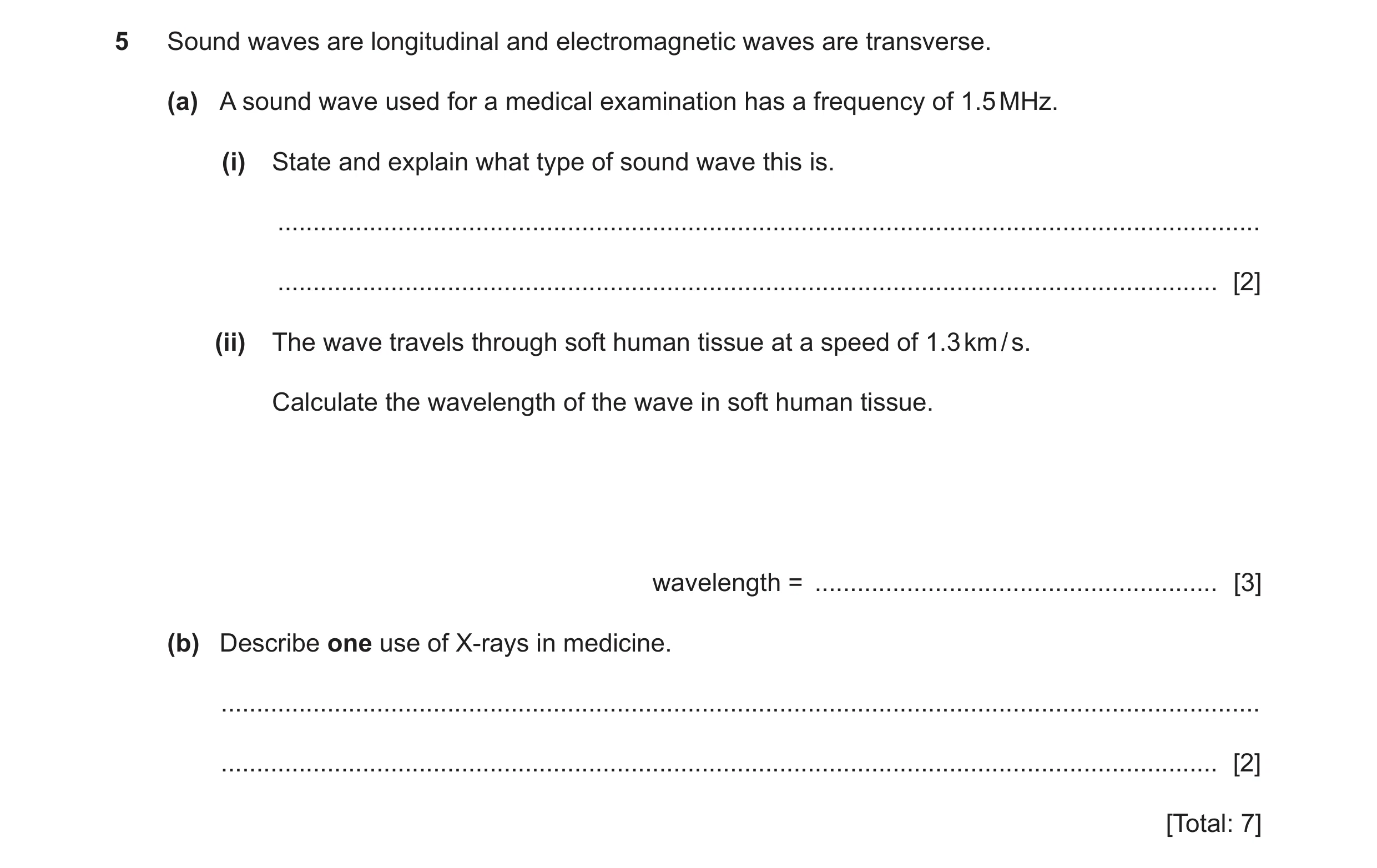
Q21 · Sound waves are longitudinal and electromagnetic waves are transverse 0625/42 May/June 2022
5 Sound waves are longitudinal and electromagnetic waves are transverse. (a) A sound wave used for a medical examination has a frequency of 1.5 MHz. (i) State and explain what type of sound wave this is. … … [2] (ii) The wave travels through soft human tissue at a speed of 1.3 km / s. Calculate the wavelength of the wave in soft human tissue. wavelength = … [3] (b) Describe one use of X-rays in medicine. … … [2] [Total: 7]
7 marks
Mark scheme: 5(a)(i) ultrasound OR sound (frequency) above audible range B1 frequency > 20 kHz OR 20 000 Hz B1 5(a)(ii) 8.7 10–4 m A3 ( =) v / f OR v = f in any form C1 ( =) 1.3 103 / 1.5 106 OR 8.7 10n C1 5(b) basic description of use e.g. X-rays for detecting broken bones B1 additional detail e.g. X-rays pass through soft tissue AND not through bone B1
This question in 0625/42 May/June 2022
Q22 · Crests of a plane water wave approaching a barrier with a gap 0625/43 May/June 2022
6 (a) (i) Fig. 6.1 shows crests of a plane water wave approaching a barrier with a gap. crests barrier direction of travel of water wave Fig. 6.1 On Fig. 6.1, draw three crests of the water wave to the right of the barrier. [2] (ii) Fig. 6.2 shows crests of a plane water wave in deep water approaching a region of shallow water. boundary direction of travel of water wave deep shallow water water Fig. 6.2 The water wave moves more slowly in shallow water. On Fig. 6.2, draw: 1. three crests of the water wave in the shallow water [2] 2. the direction of travel of the wave in the shallow water. [1] (b) State two ways in which transverse waves differ from longitudinal waves. 1. … … 2. … … [2] (c) (i) State a typical value of the speed of sound in water. … [1] (ii) Explain why sound travels faster in water than in air. … [1] [Total: 9]
9 marks
Mark scheme: 6(a)(i) wavefronts semicircles or part semicircles centred on gap B1 wavelength of waves to right of barrier same as wavelength of incident wave B1 6(a)(ii) 1 wavelength shorter B1 correct refraction B1 2 direction of travel perpendicular to wavefronts B1 6(b) any two from: particles (in transverse waves) vibrate perpendicular to the direction of travel (of the wave) OR particles in longitudinal waves vibrate parallel to the direction of travel of the wave longitudinal waves have compressions and rarefactions transverse waves have troughs and crests B2 6(c)(i) 1000 m / s ⩽ value ⩽ 2000 m / s B1 6(c)(ii) molecules closer together / water has greater density B1
This question in 0625/43 May/June 2022
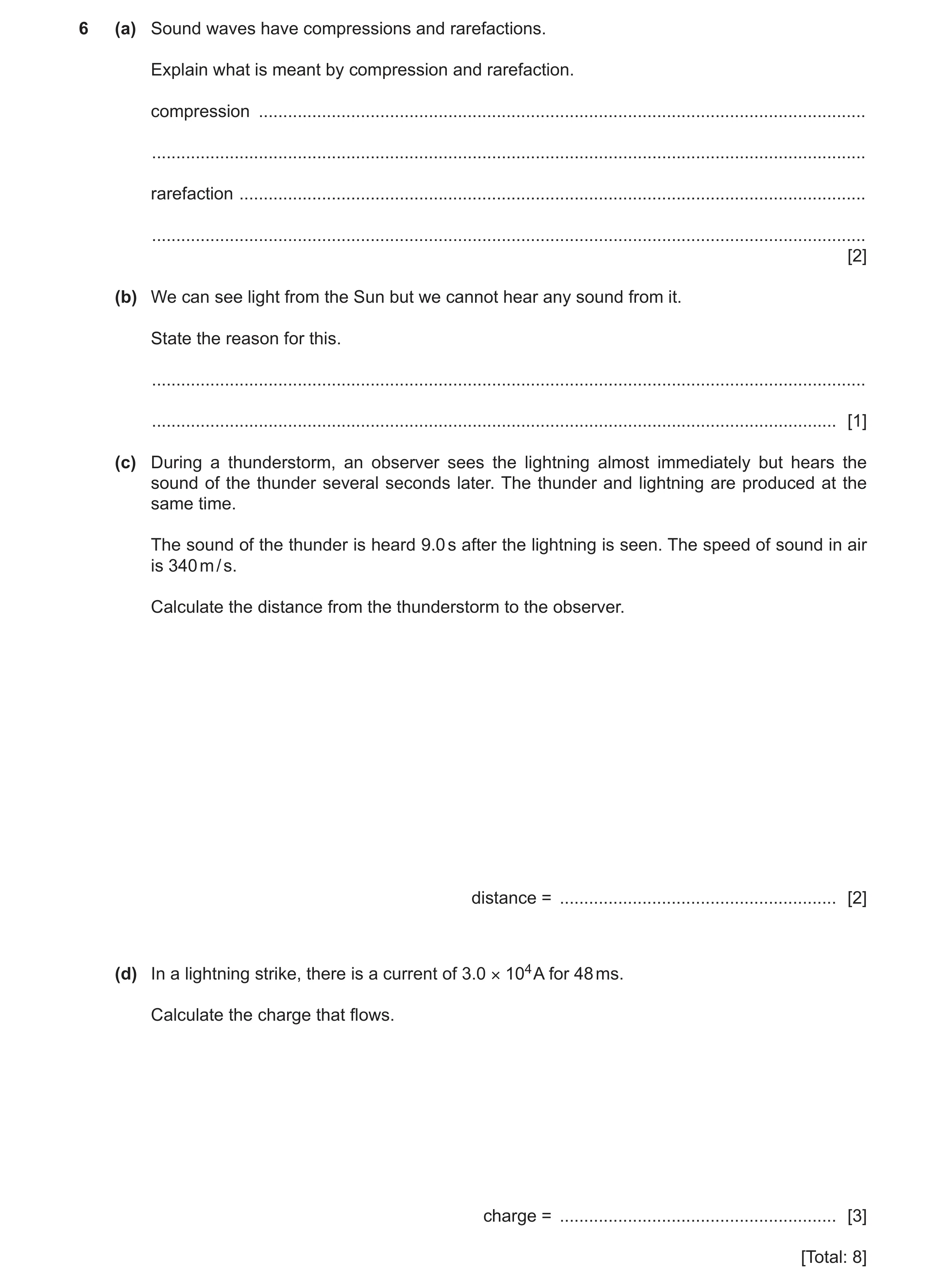
Q23 · Sound waves have compressions and rarefactions 0625/42 Feb/March 2023
6 (a) Sound waves have compressions and rarefactions. Explain what is meant by compression and rarefaction. compression … … rarefaction … … [2] (b) We can see light from the Sun but we cannot hear any sound from it. State the reason for this. … … [1] (c) During a thunderstorm, an observer sees the lightning almost immediately but hears the sound of the thunder several seconds later. The thunder and lightning are produced at the same time. The sound of the thunder is heard 9.0 s after the lightning is seen. The speed of sound in air is 340 m / s. Calculate the distance from the thunderstorm to the observer. distance = … [2] (d) In a lightning strike, there is a current of 3.0 × 10⁴ A for 48 ms. Calculate the charge that flows. charge = … [3] [Total: 8]
8 marks
Mark scheme: 6(a) (region where) particles are close(r) together (than normal) OR (region where) there is a great(er) pressure (than normal) B1 (region where) particles are further / far apart (than normal) OR (region where) there is a low(er) pressure (than normal) B1 6(b) light does not need a medium to travel through OR sound needs a medium to travel through (and there is no medium B1 between Sun and Earth) 6(c) 3100 m OR 3.1 km A2 v = s / t OR (s =) vt OR 340 9 (C1) 6(d) 1400 C A3 I = Q / t OR (Q = )I t OR 3.0 104 48 10–3 (C1) (t =) 48 10–3 OR (t =) 4.8 10–2 OR (t =) 0.048 SEEN (C1)
This question in 0625/42 Feb/March 2023
Q24 · A sound wave travels through air 0625/42 May/June 2024
6 (a) A sound wave travels through air. Fig. 6.1 shows a pressure–time graph for the air at one place. pressure atmospheric pressure time Fig. 6.1 (i) On Fig. 6.1: • label one point C to indicate a compression • label one point R to indicate a rarefaction. [2] (ii) Explain why this graph cannot be used to find the wavelength of the sound wave. … … … [1] (iii) The sound becomes louder and of lower pitch. State what happens to: the amplitude of the sound … the frequency of the sound. … [1] (b) A sound of frequency 13 kHz is transmitted through water. The speed of sound in water is 1500 m / s. Calculate the wavelength of this sound in water. wavelength = … [3] (c) State the approximate speed of sound in air. speed = … [1] [Total: 8]
8 marks
Mark scheme: 6(a)(i) C marked and labelled at a peak of the sine wave B1 R marked and labelled at a trough of the sine wave B1 6(a)(ii) graph / it does not show (variation with) displacement B1 6(a)(iii) (amplitude) increases AND (frequency) decreases B1 6(b) 0.12 m A3 v = f OR ( =) v / f OR () = 1500 / 13 000 C1 1500 / 13 000 OR 1.2 10N C1 6(c) 330 m / s ⩽ speed ⩽ 350 m / s B1
This question in 0625/42 May/June 2024
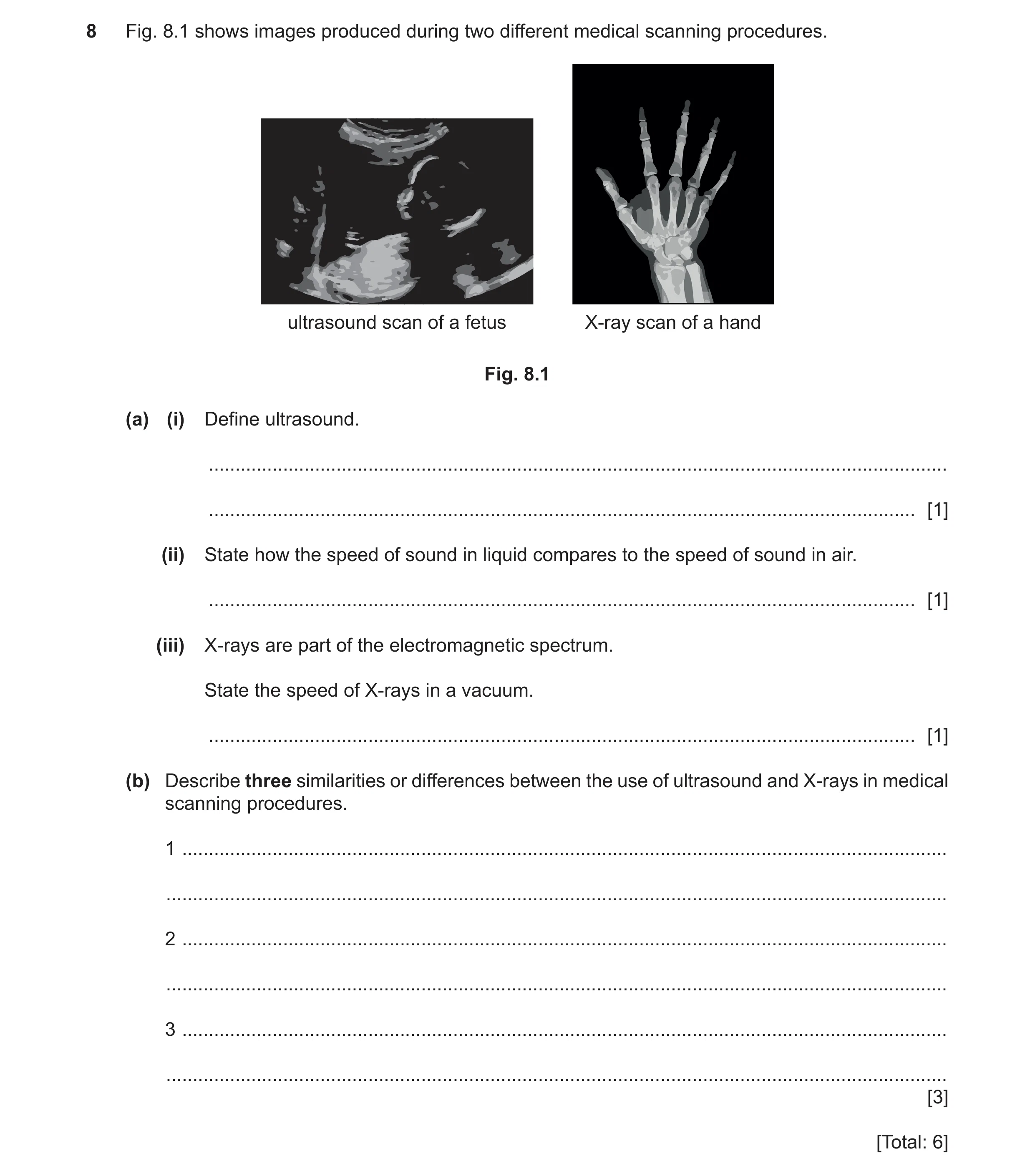
Q25 · Images produced during two different medical scanning procedures 0625/43 May/June 2024
8 Fig. 8.1 shows images produced during two different medical scanning procedures. ultrasound scan of a fetus X-ray scan of a hand Fig. 8.1 (a) (i) Define ultrasound. … … [1] (ii) State how the speed of sound in liquid compares to the speed of sound in air. … [1] (iii) X-rays are part of the electromagnetic spectrum. State the speed of X-rays in a vacuum. … [1] (b) Describe three similarities or differences between the use of ultrasound and X-rays in medical scanning procedures. 1 … … 2 … … 3 … … [3] [Total: 6]
6 marks
Mark scheme: 8(a)(i) (ultrasound is) sound with a frequency higher than 20 kHz B1 8(a)(ii) (sound travels) faster (in a liquid than in air) / ORA B1 8(a)(iii) 3.0 108 m / s B1 8(b) any three from: X-rays and ultrasound show internal body parts (without the need to cut open the body) X-rays and ultrasound both travel through (some parts of) the body images are formed by ultrasound (partially) reflecting (from boundaries between body matter) images are formed by X-rays which (travel in straight lines and) pass through soft tissue and are absorbed by bone X-rays show parts of the skeleton / X-rays show bones OR ultrasound shows image of soft tissues an X-ray detector forms image from X-rays that travel through patient OR ultrasound detector forms image from sound waves reflected back (from body parts) X-rays expose you to radiation (which can be harmful to humans) B3
This question in 0625/43 May/June 2024
Q26 · A loudspeaker produces a sound wave in air 0625/41 Oct/Nov 2024
5 A loudspeaker produces a sound wave in air. The distance between the centre of a compression and the centre of a neighbouring rarefaction is 0.10 m. (a) Calculate the wavelength of the sound wave. wavelength = … [1] (b) State a typical value for the speed of sound in air. … [1] (c) (i) Calculate the frequency of the sound from the loudspeaker. frequency = … [2] (ii) Explain whether the sound from the loudspeaker is audible to a human with normal hearing. … … [1] (d) Another loudspeaker produces a sound of wavelength 0.40 m. Sound from the loudspeaker reaches a sound absorbing surface with a gap of width 0.80 m at the centre. Fig. 5.1 shows the arrangement. J gap 0.80 m loudspeaker K sound absorbing surface Fig. 5.1 Explain whether it is possible to detect sound from the loudspeaker at either point J or at point K. point J … … … point K … … … [4] [Total: 9]
9 marks
Mark scheme: 5(a) 0.20 m B1 5(b) any value in range from 330 m / s ⩽ value ⩽ 350 m / s B1 5(c)(i) (b) (a) evaluated AND Hz A2 f = v / OR (f = ) v / OR (b) (a) C1 5(c)(ii) audible/yes/it is OR inaudible / no / it isn’t consistent with value in 5(c)(i) B1 AND consistent explanation with reference to 20 (Hz) ⩽ normal range of human hearing ⩽ 20 000 (Hz) 5(d) 1 (explanation mentions) diffraction M1 2 Only a little diffraction owtte A1 3 (because) gap width large (compared to wavelength) owtte A1 4 Little / no sound heard at J AND (some) sound heard at K A1
This question in 0625/41 Oct/Nov 2024
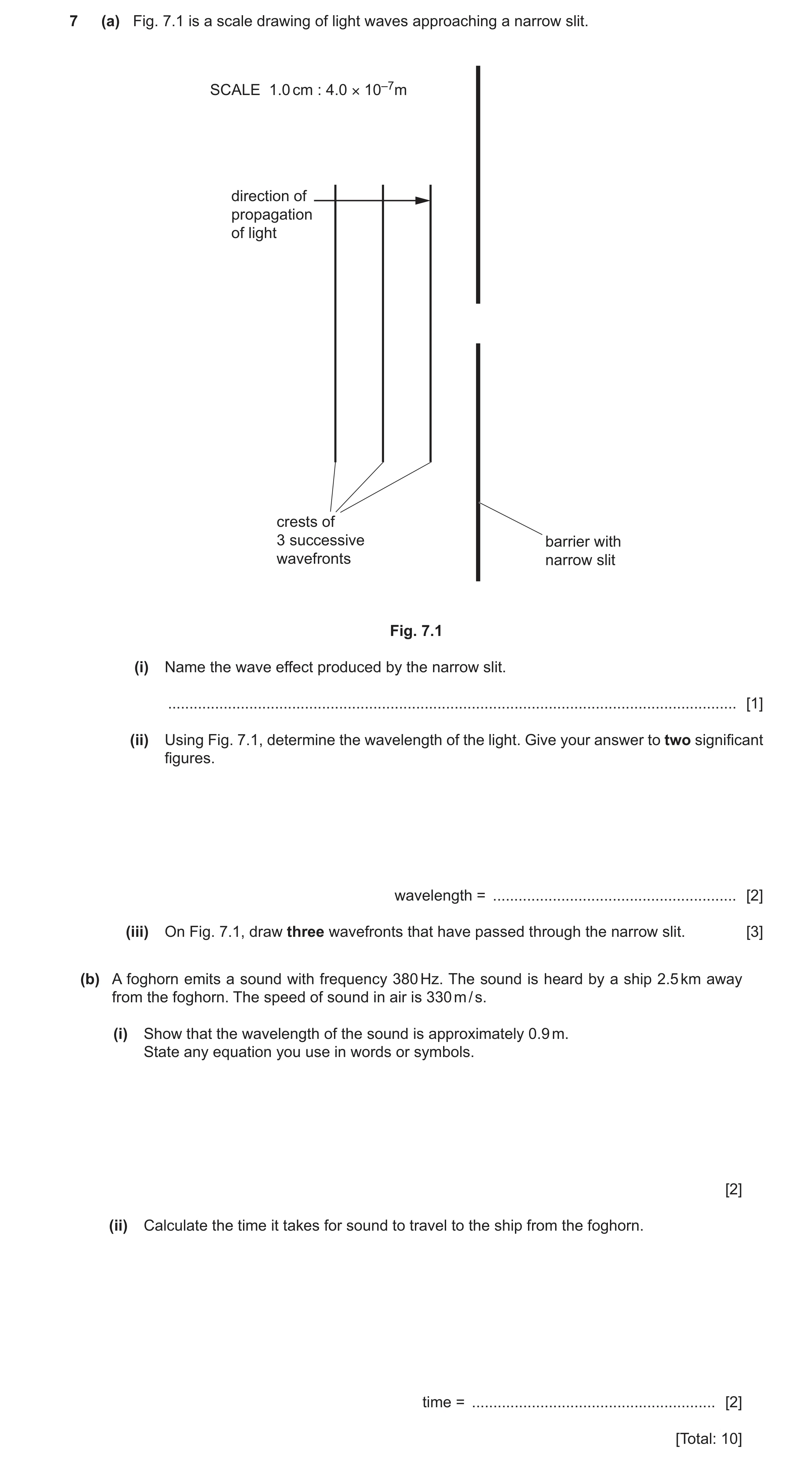
Q27 · A scale drawing of light waves approaching a narrow slit 0625/42 Feb/March 2025
7 (a) Fig. 7.1 is a scale drawing of light waves approaching a narrow slit. SCALE 1.0 cm : 4.0 × 10⁻⁷m direction of propagation of light crests of 3 successive barrier with wavefronts narrow slit Fig. 7.1 (i) Name the wave effect produced by the narrow slit. … [1] (ii) Using Fig. 7.1, determine the wavelength of the light. Give your answer to two significant figures. wavelength = … [2] (iii) On Fig. 7.1, draw three wavefronts that have passed through the narrow slit. [3] (b) A foghorn emits a sound with frequency 380 Hz. The sound is heard by a ship 2.5 km away from the foghorn. The speed of sound in air is 330 m / s. (i) Show that the wavelength of the sound is approximately 0.9 m. State any equation you use in words or symbols. [2] (ii) Calculate the time it takes for sound to travel to the ship from the foghorn. time = … [2] [Total: 10]
10 marks
Mark scheme: 7(a)(i) diffraction B1 7(a)(ii) 4.8 10–7 m OR 480 nm A2 One wavelength marked on Fig. 6.1 OR 1.2 seen C1 7(a)(iii) at least two curved wavefronts B1 three semi-circular wavefronts centred on (centre of) gap B1 wavelength is unchanged B1 7(b)(i) v = f M1 (=) 330 / 380 OR (=) 0.87 (m) A1 7(b)(ii) 7.6 s A2 v = s / t OR (t = ) s / v OR (t =) 2500 / 330 C1
This question in 0625/42 Feb/March 2025
Q28 · Describe an experiment to determine the speed of sound in air 0625/42 May/June 2025
5 (a) Describe an experiment to determine the speed of sound in air. State the apparatus required, the measurements taken and how to calculate the speed of sound in air from the measurements. You may draw a labelled diagram as part of your answer. … … … … … … … [4] (b) Bluetooth is used to connect a mobile (cell) phone to headphones. (i) State the name of the region of the electromagnetic spectrum used by Bluetooth. … [1] (ii) State the speed of electromagnetic waves in air. speed = … [1] (iii) The frequency of a Bluetooth network is 2.48 GHz. Calculate the wavelength of the waves used in the Bluetooth network. wavelength = … [3] [Total: 9]
9 marks
Mark scheme: 5(a) echo method (outside): B4 1 method of producing short, loud sound (e.g. clap / shout / cry out / bang 2 pieces of wood together) 2 measuring tape or trundle wheel, stopwatch and wall 3 (person) starts stopwatch when clap etc heard and stops it when echo heard 4 speed = 2 measured distance ÷ time OR direct method outside: B4 1 method of producing short, loud sound (e.g. fire gun) 2 measuring tape or trundle wheel, stopwatch 3 (student at one end) starts stopwatch when smoke seen from gun and stops it when sound heard 4 speed = distance ÷ time OR direct method (using digital): B4 1 method of producing short sound e.g. clap or hammer striking block 2 measuring tape or metre ruler, digital timer and microphones 3 digital timer starts when sound reaches first microphone and stops when sound reaches second microphone. Time difference is recorded on digital timer owtte 4 speed = distance ÷ time for direct method 5(b)(i) radio waves B1 5(b)(ii) 3(.0) 108 m / s B1 5(b)(iii) 0.12 m A3 v = fOR (=) v ÷ f OR (=) {3(.0) 108} ÷ {2.48 109} C1 (=) {3(.0) 108} ÷ {2.48 109} OR (=) 1.2 10N C1
This question in 0625/42 May/June 2025
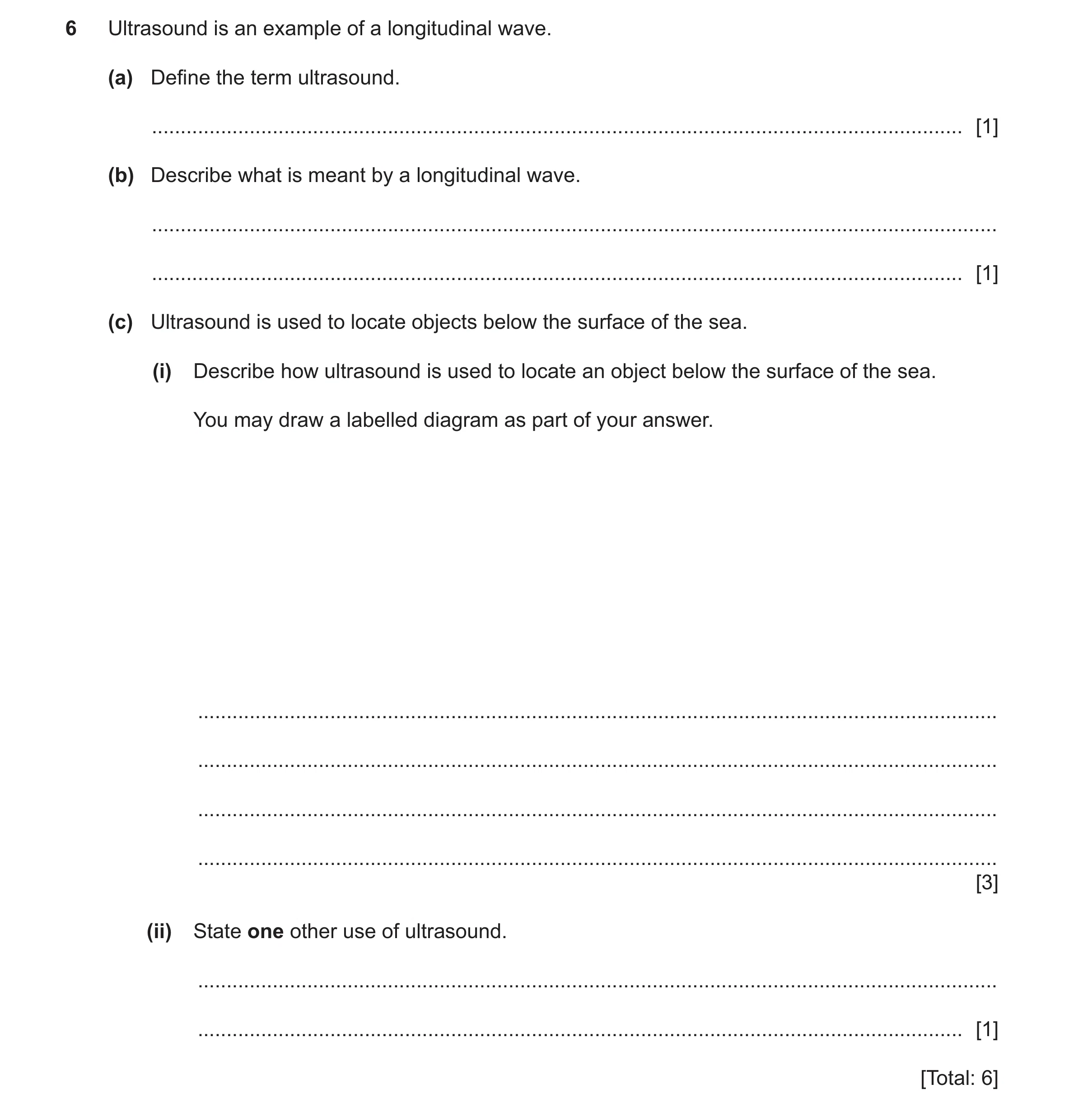
Q29 · Ultrasound is an example of a longitudinal wave 0625/43 May/June 2025
6 Ultrasound is an example of a longitudinal wave. (a) Define the term ultrasound. … [1] (b) Describe what is meant by a longitudinal wave. … … [1] (c) Ultrasound is used to locate objects below the surface of the sea. (i) Describe how ultrasound is used to locate an object below the surface of the sea. You may draw a labelled diagram as part of your answer. … … … … [3] (ii) State one other use of ultrasound. … … [1] [Total: 6]
6 marks
Mark scheme: 6(a) sound with a frequency higher than 20 kHz B1 6(b) vibrations (of the wave / particles) are parallel to the direction of propagation B1 6(c)(i) (pulse of) ultrasound / sound / wave (sent into water) reflects from object B1 time to travel to object and back measured B1 depth = speed time B1 6(c)(ii) any one from: B1 • non-destructive testing of materials • medical scanning (of soft tissue)
This question in 0625/43 May/June 2025
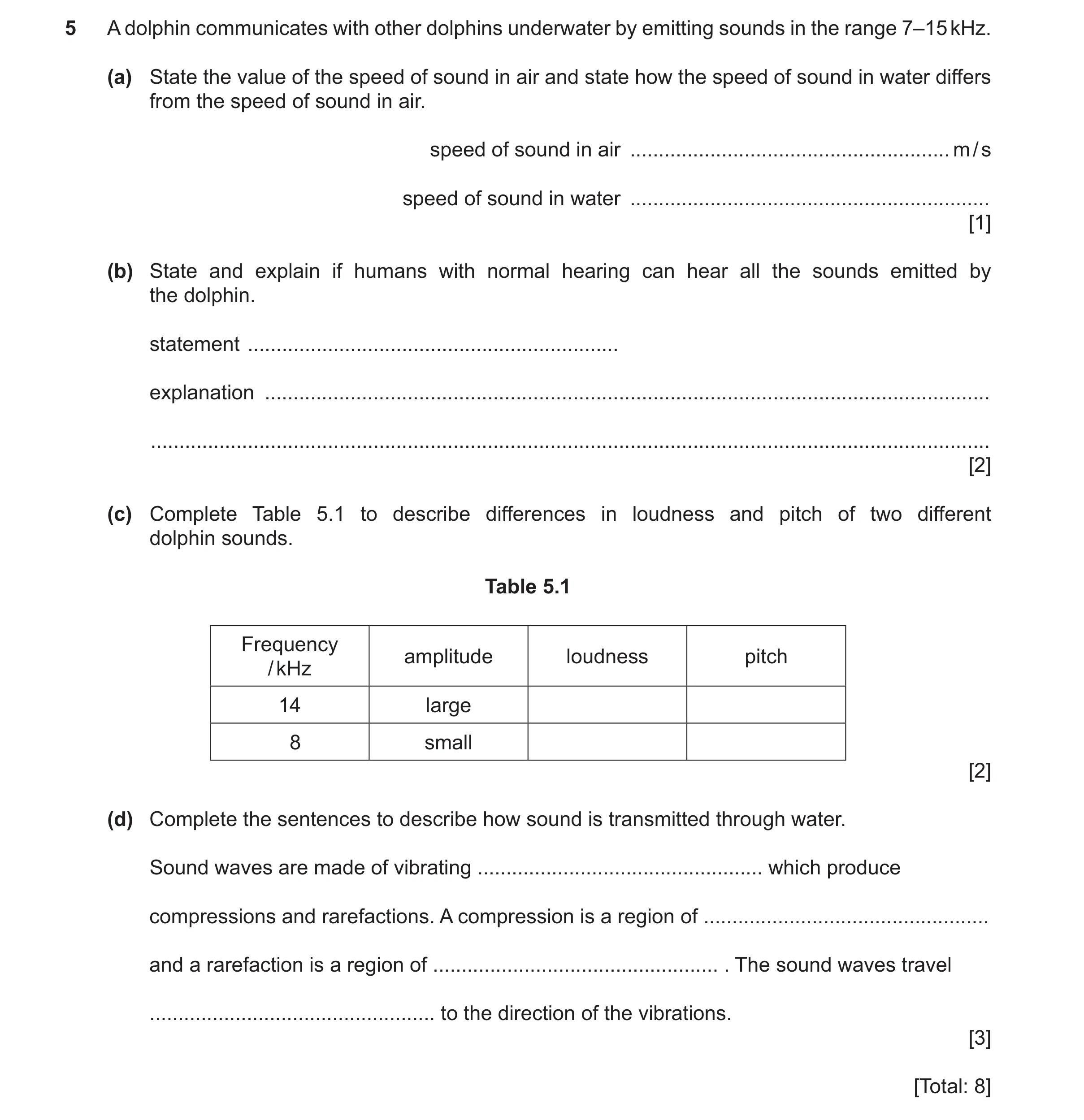
Q30 · A dolphin communicates with other dolphins underwater by emitting sounds in the range… 0625/41 Oct/Nov 2025
5 A dolphin communicates with other dolphins underwater by emitting sounds in the range 7–15 kHz. (a) State the value of the speed of sound in air and state how the speed of sound in water differs from the speed of sound in air. speed of sound in air … m / s speed of sound in water … [1] (b) State and explain if humans with normal hearing can hear all the sounds emitted by the dolphin. statement … explanation … … [2] (c) Complete Table 5.1 to describe differences in loudness and pitch of two different dolphin sounds. Table 5.1 Frequency amplitude loudness pitch / kHz 14 large 8 small [2] (d) Complete the sentences to describe how sound is transmitted through water. Sound waves are made of vibrating … which produce compressions and rarefactions. A compression is a region of … and a rarefaction is a region of … . The sound waves travel … to the direction of the vibrations. [3] [Total: 8]
8 marks
Mark scheme: 5(a) (speed of sound in air =) 330 m / s ⩽ value ⩽ 350 m / s B1 AND (speed of sound in water) is faster 5(b) Yes AND (normal) human hearing range is 20 Hz to 20 kHz (and all dolphin sounds lie in this range) A2 Yes AND all the dolphin sounds are in the range of human hearing C1 5(c) B2 Frequency kHz amplitude loudness pitch 14 Large loud high 8 small soft / quiet low one mark for each column correct 5(d) Particles B1 5(d) high pressure B1 AND low pressure Parallel B1
This question in 0625/41 Oct/Nov 2025
 2 / 34
 3 / 34
 4 / 34
 5 / 34
 6 / 34
 7 / 34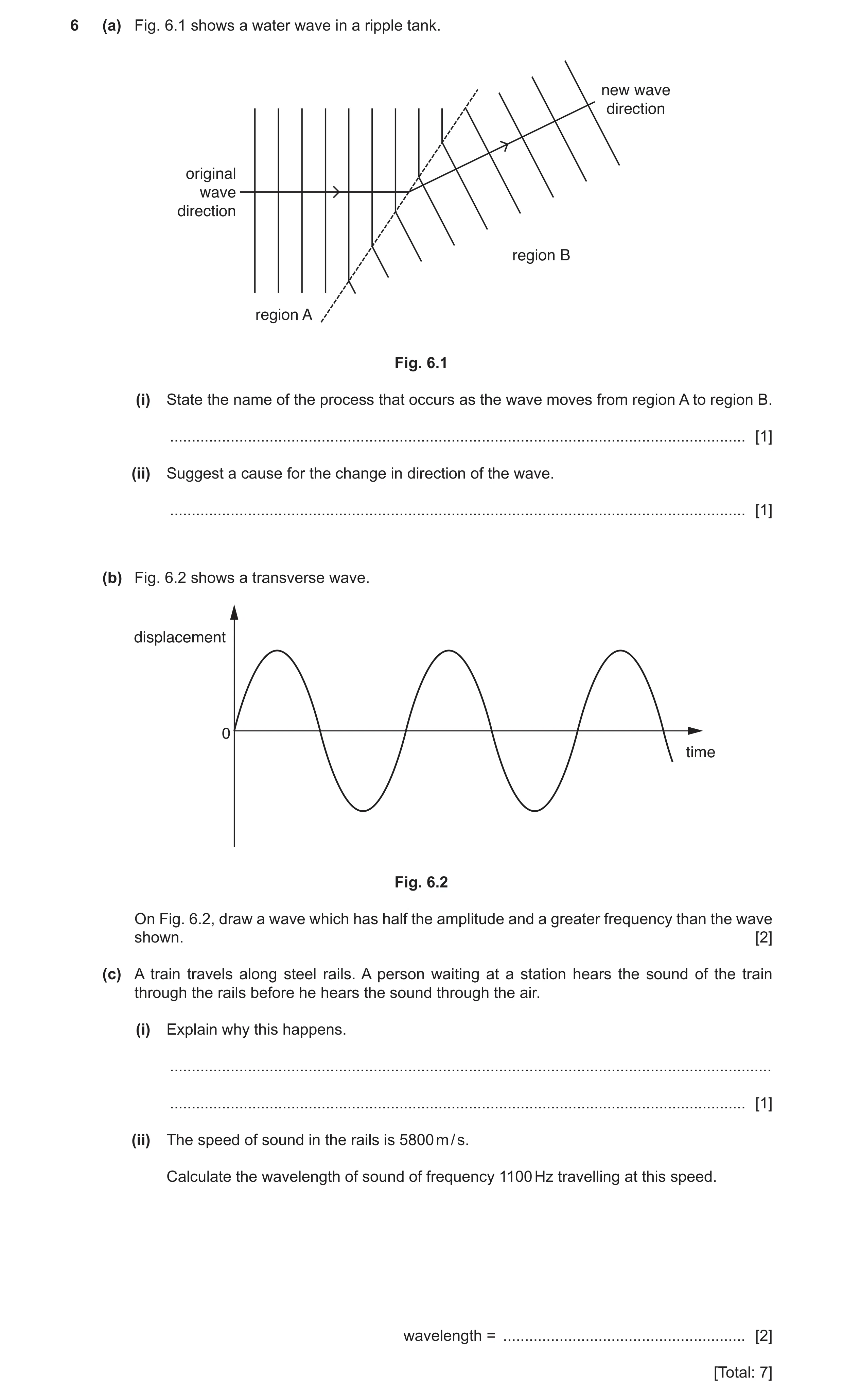
 12 / 34
 13 / 34
 14 / 34
 15 / 34
 16 / 34
 17 / 34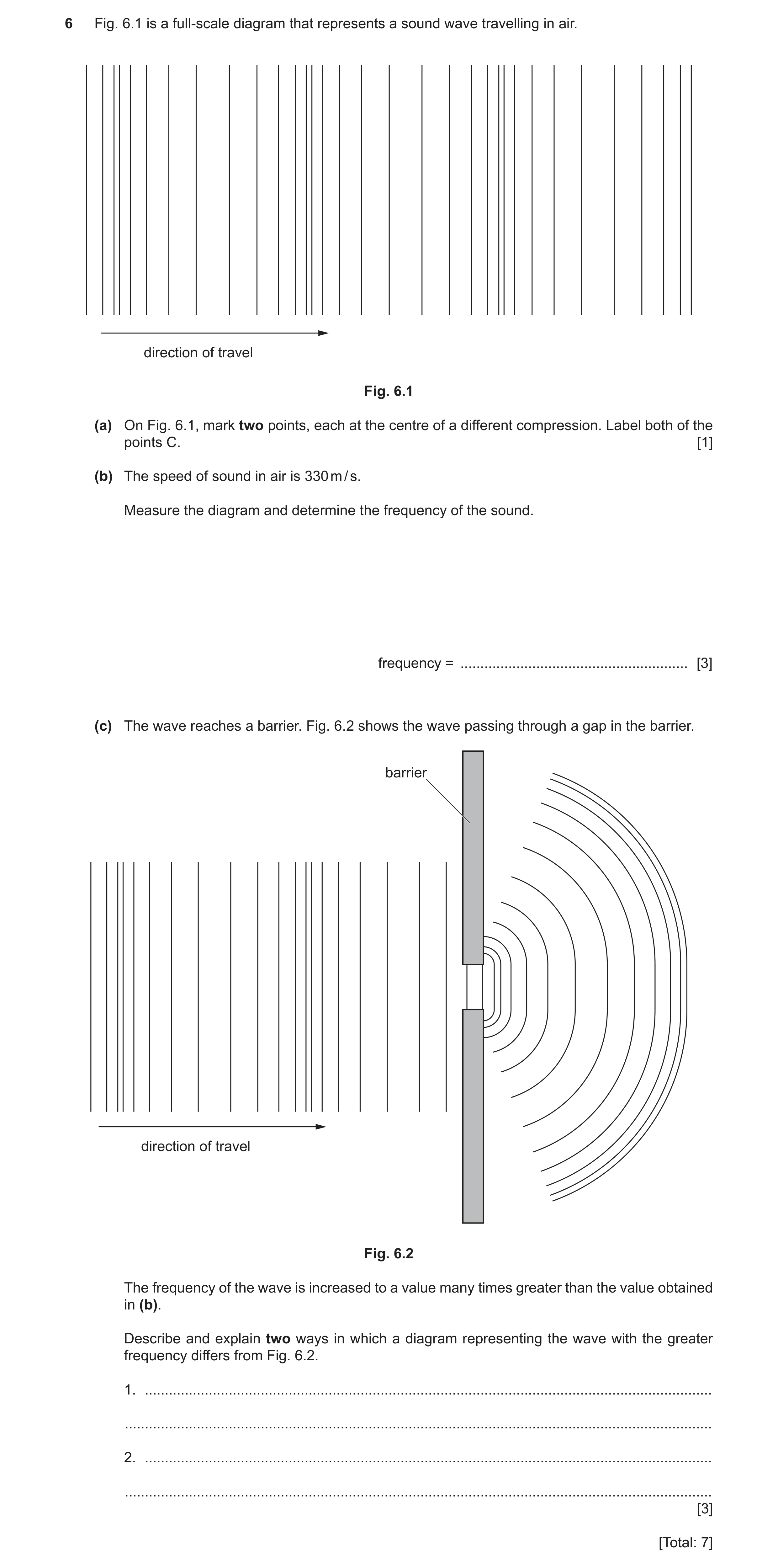
 20 / 34
 21 / 34
 22 / 34
 23 / 34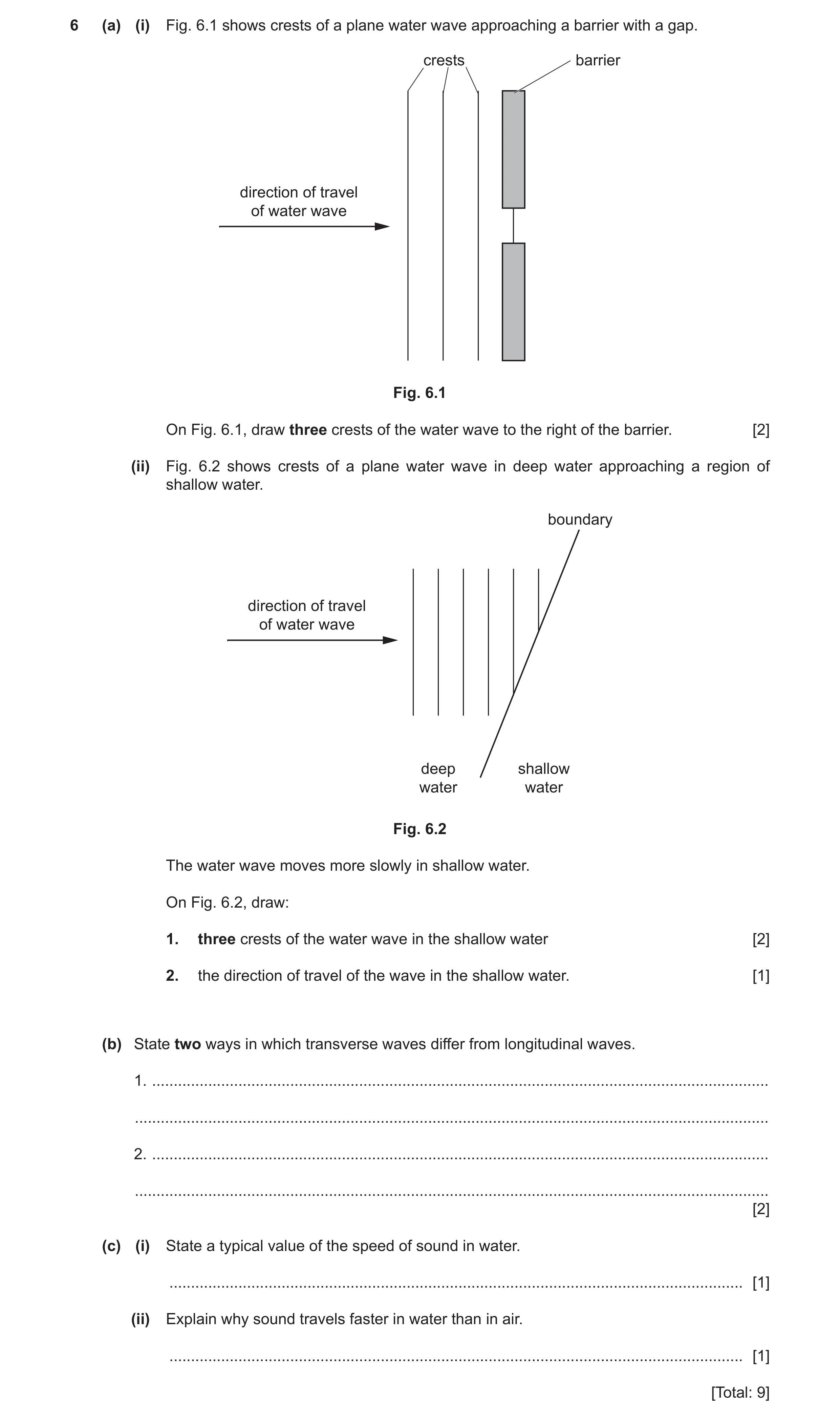
 25 / 34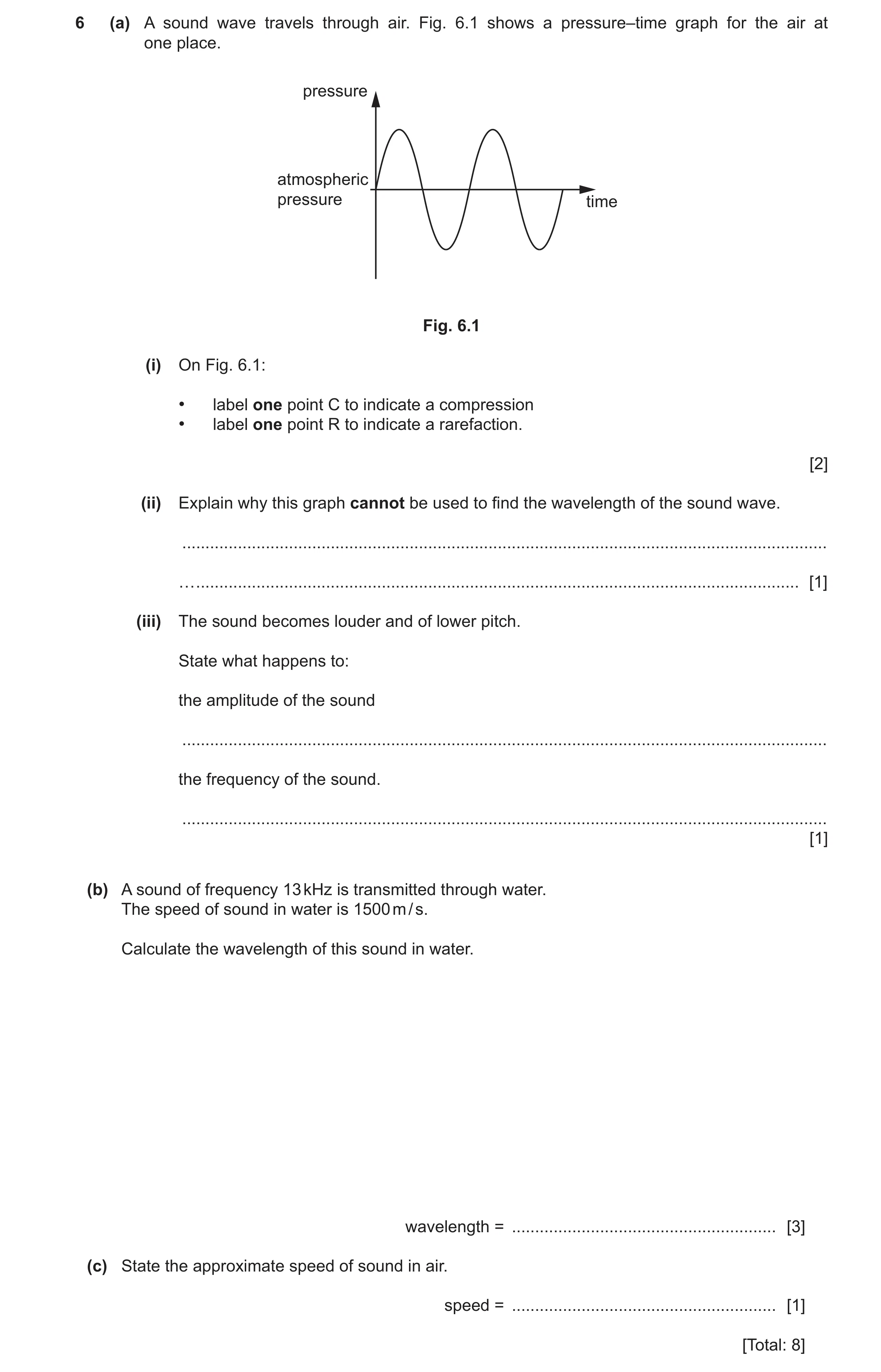
 28 / 34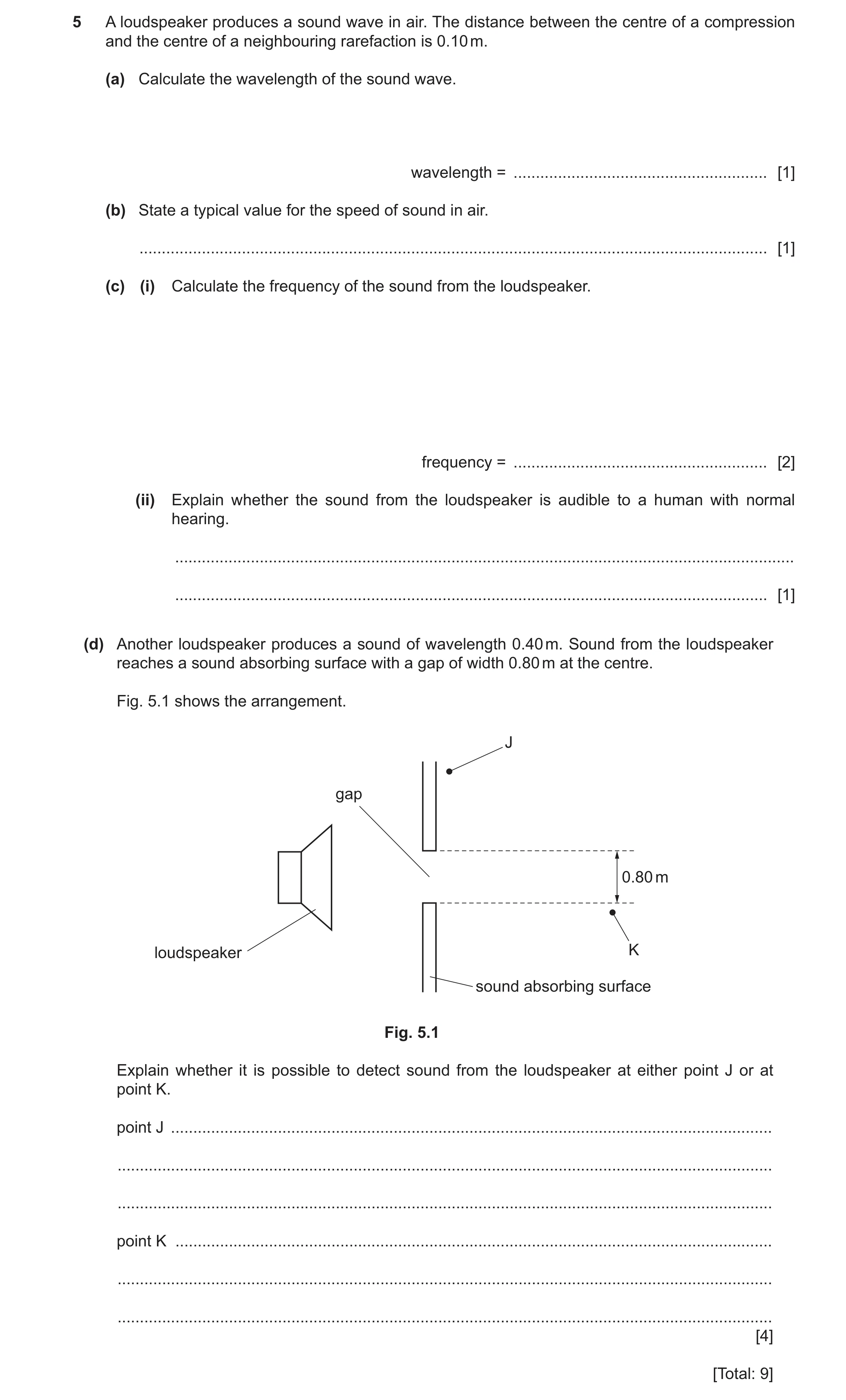
 32 / 34
 33 / 34
 34 / 34
 8
8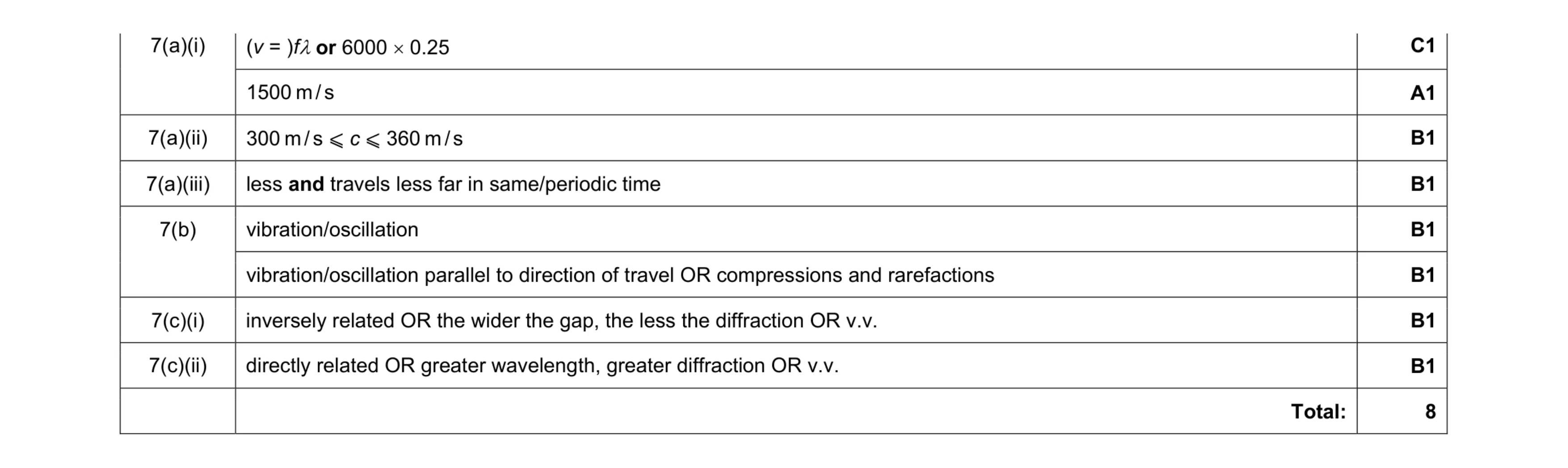 8
8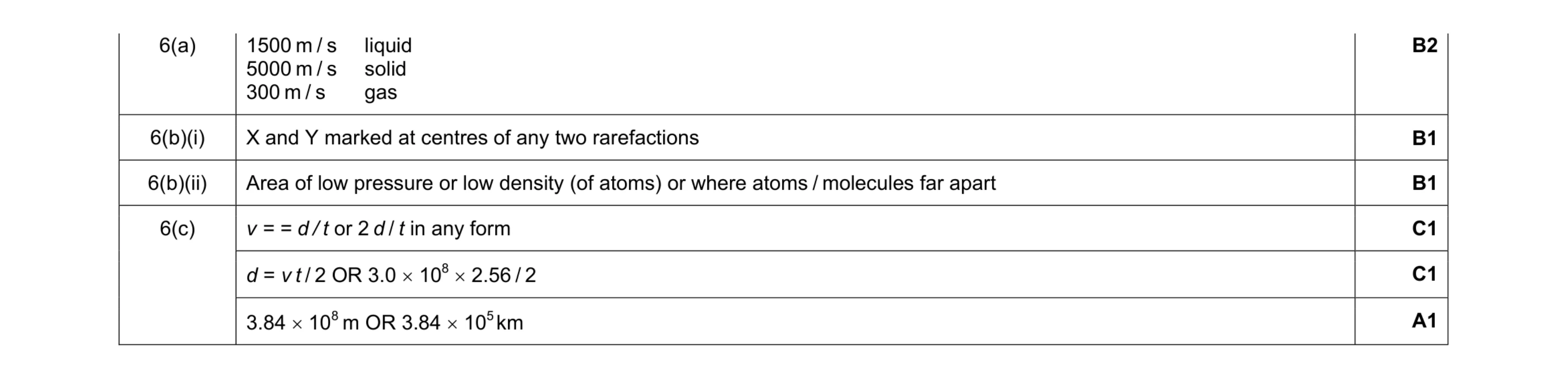 7
7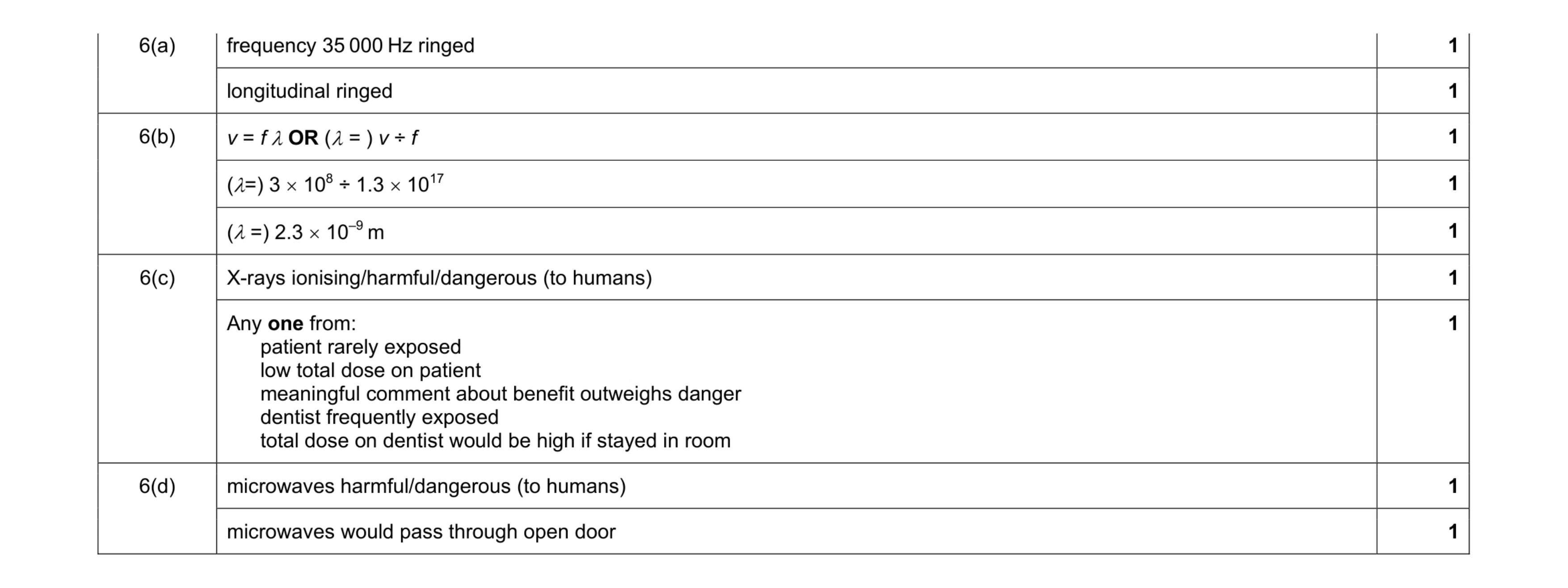 9
9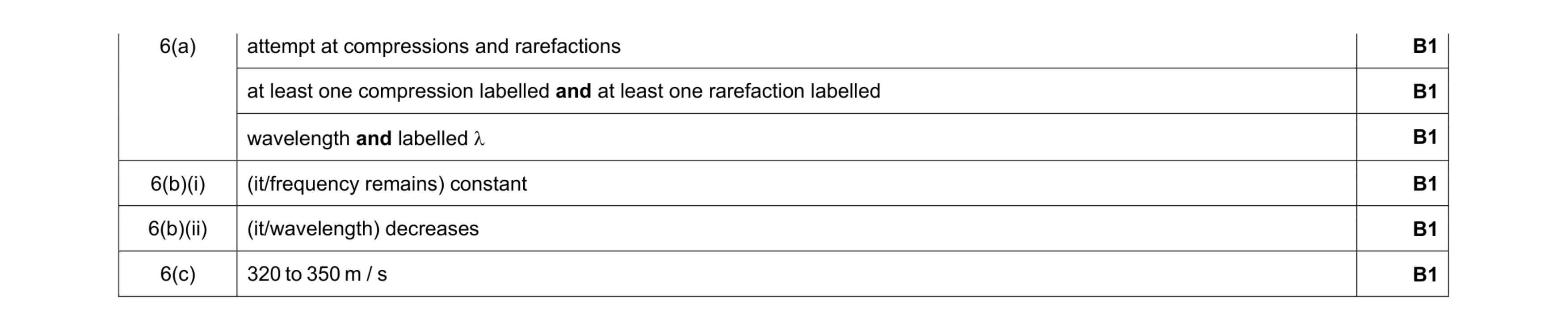 6
6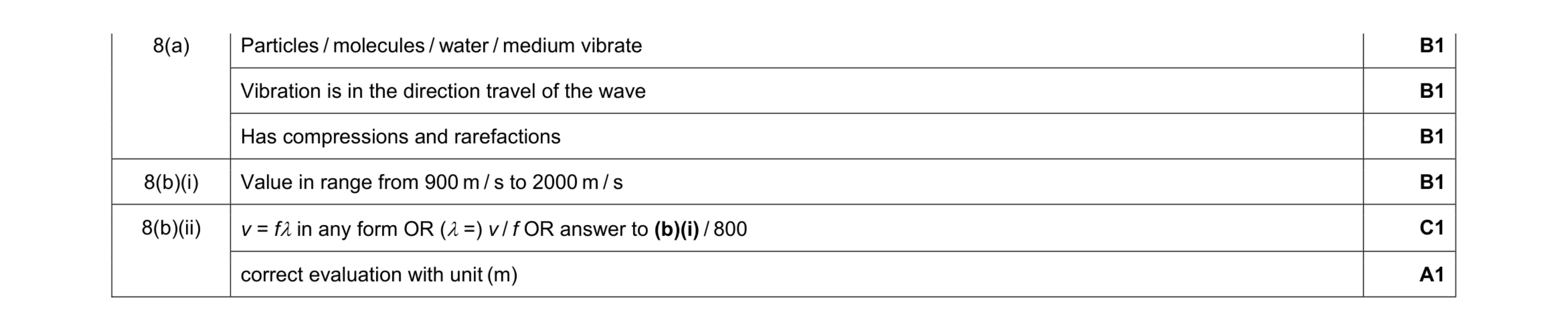 6
6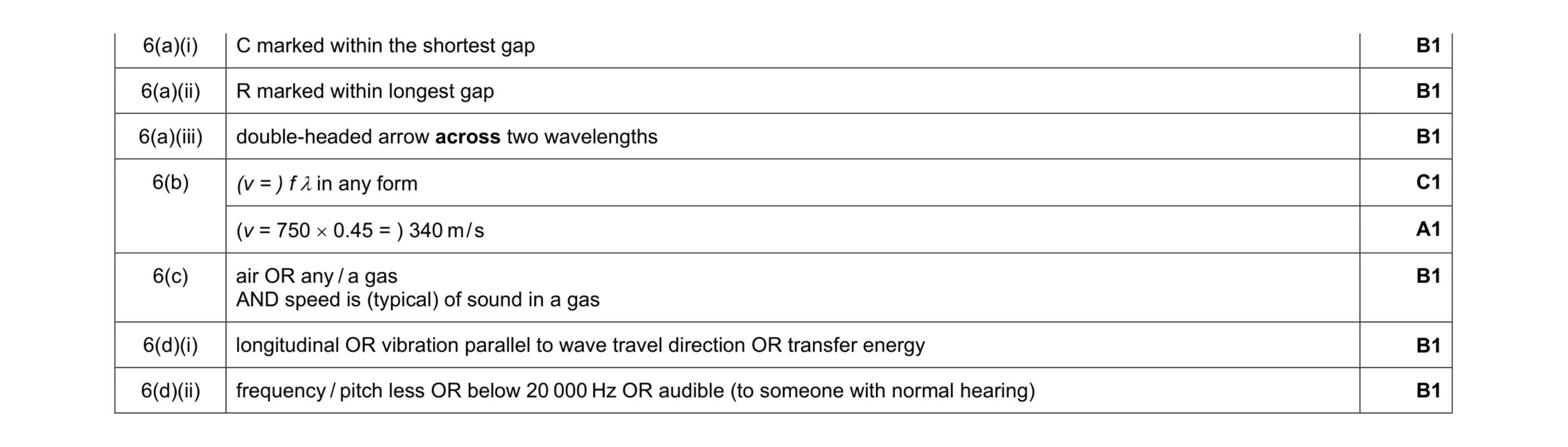 8
8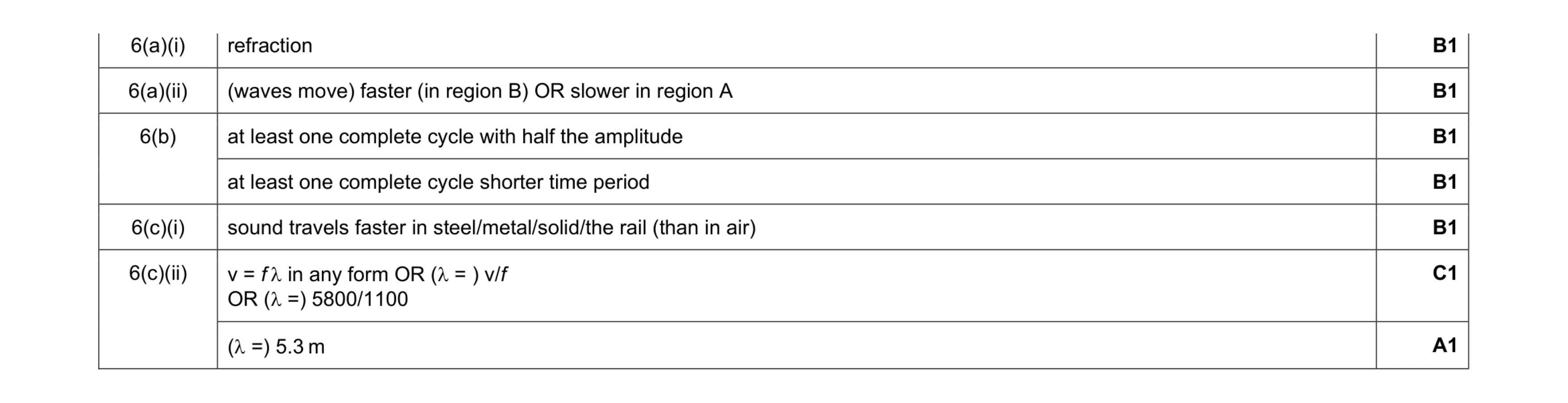 7
7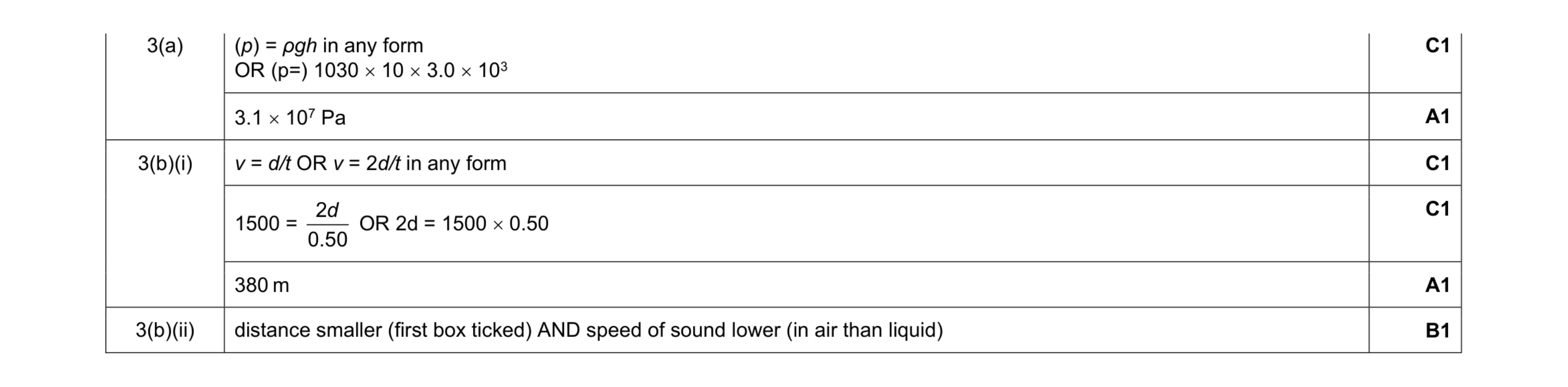 6
6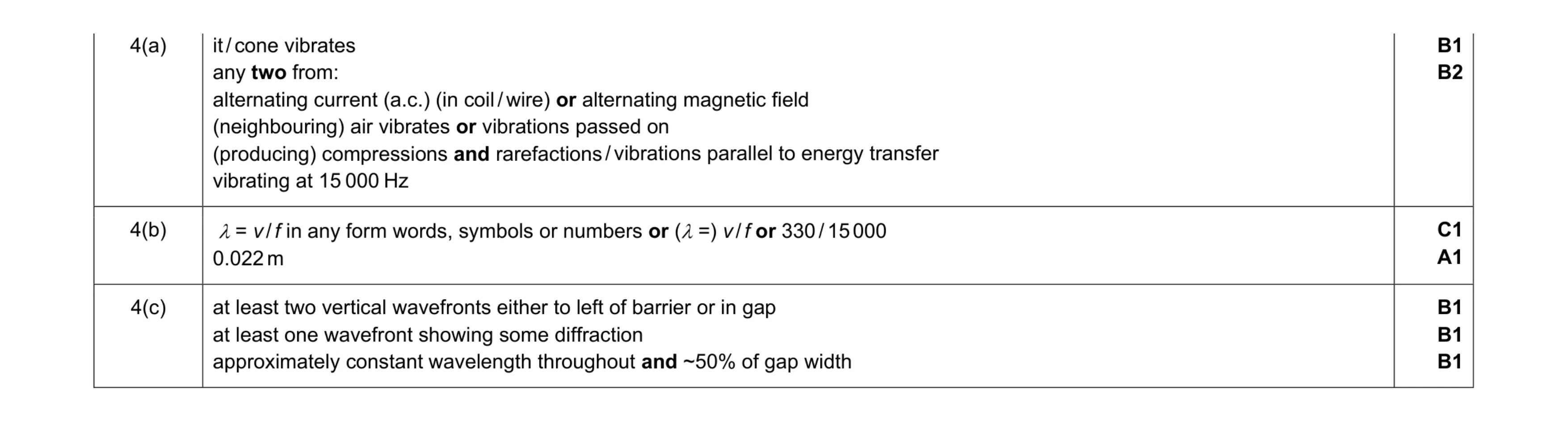 8
8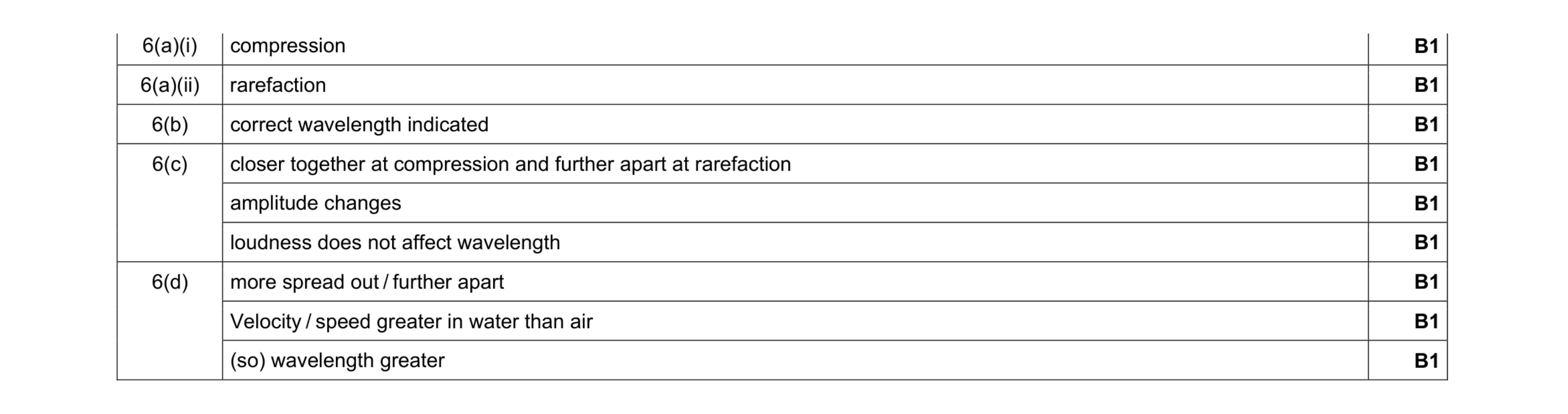 9
9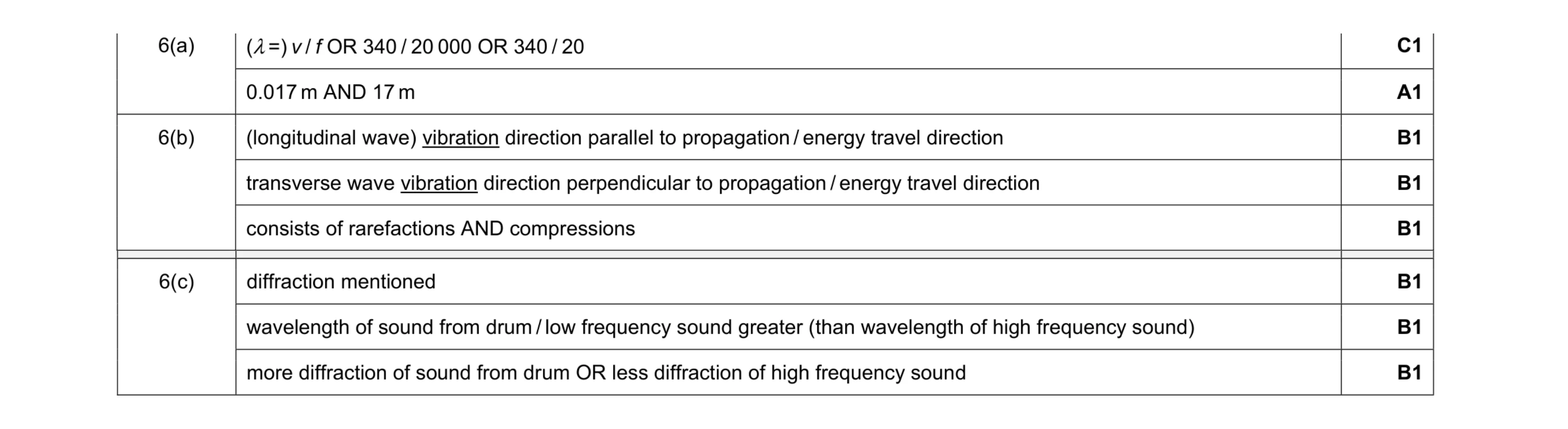 8
8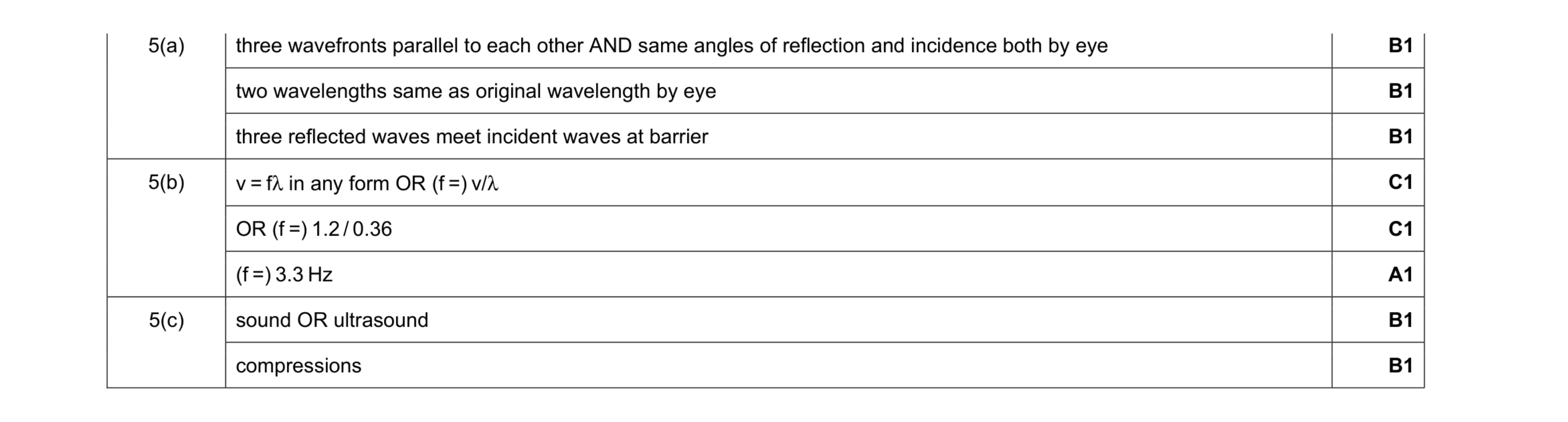 8
8 7
7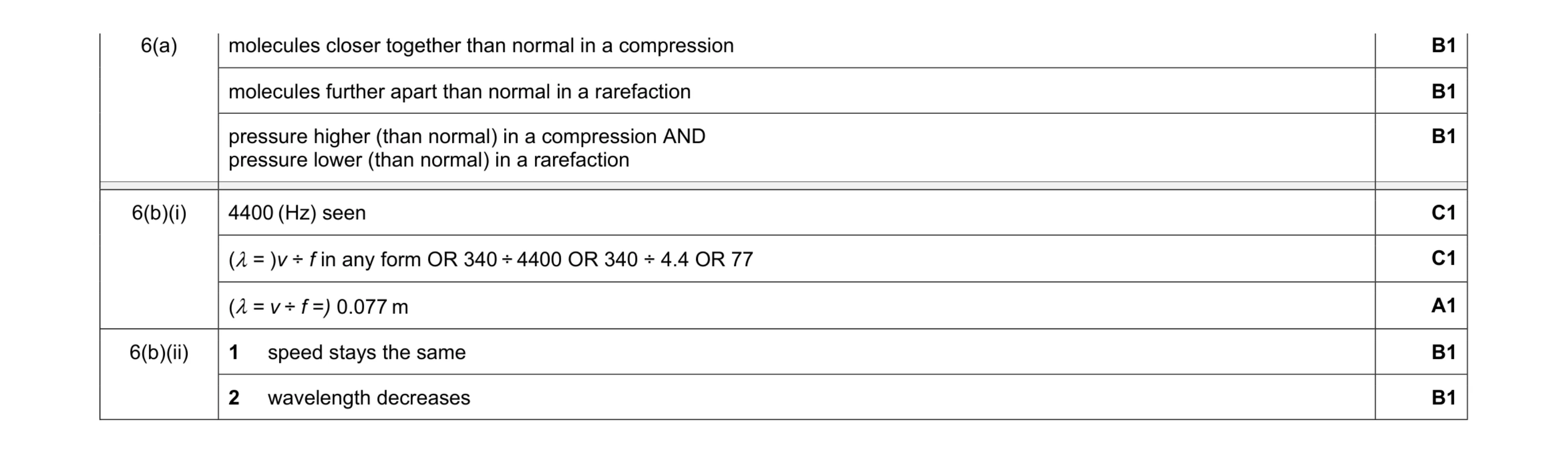 8
8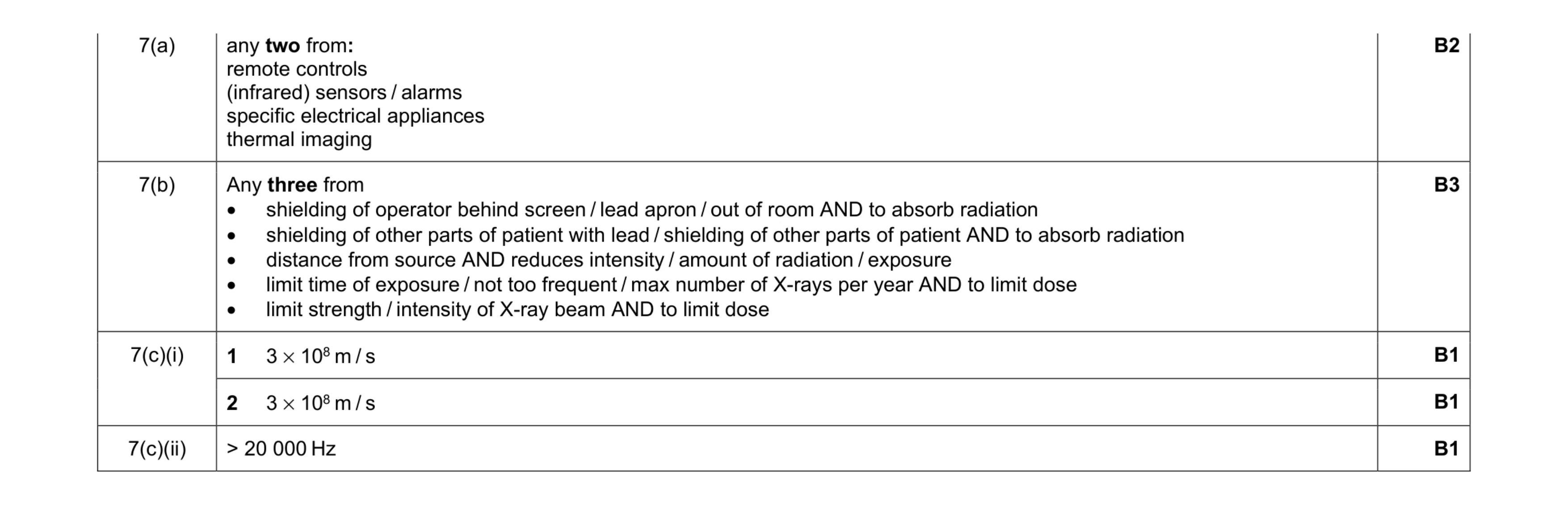 8
8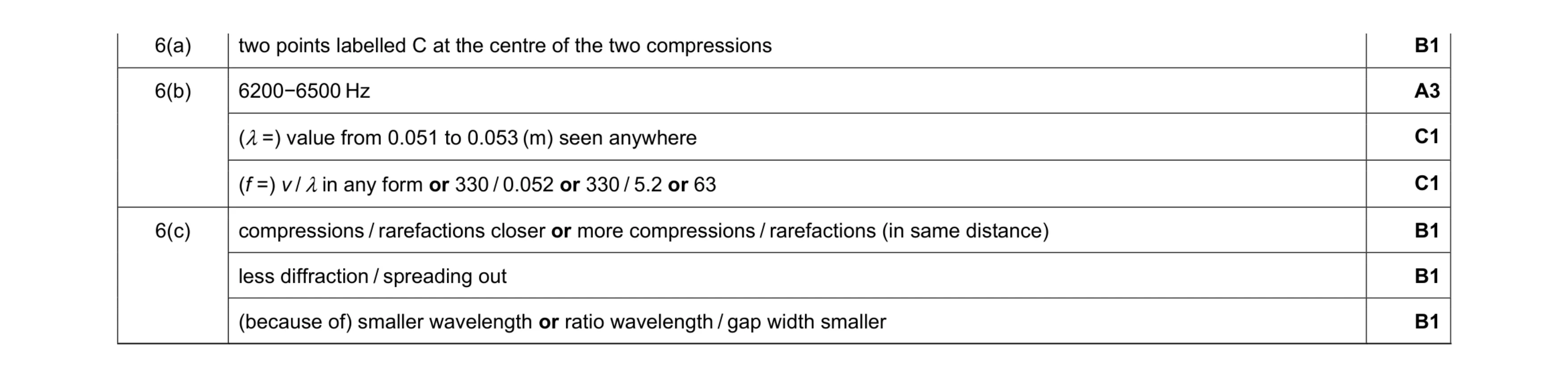 7
7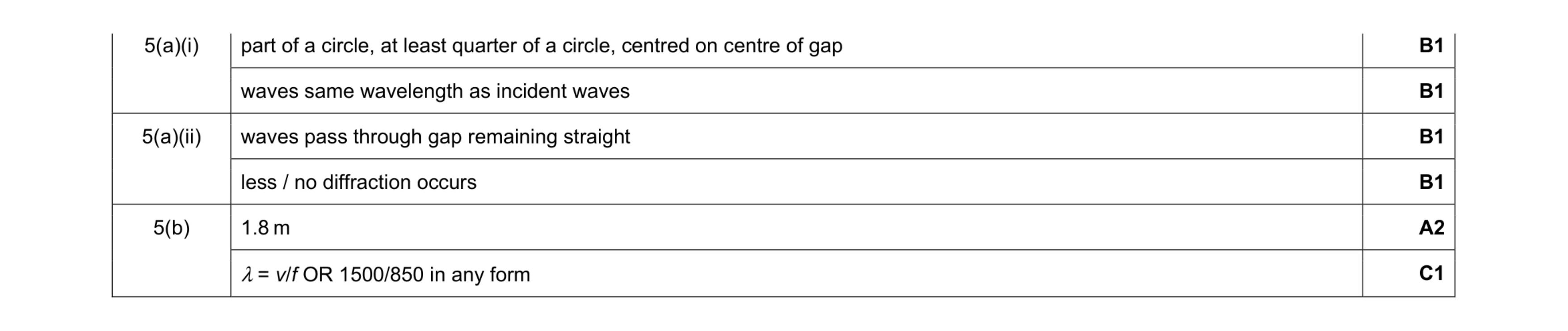 6
6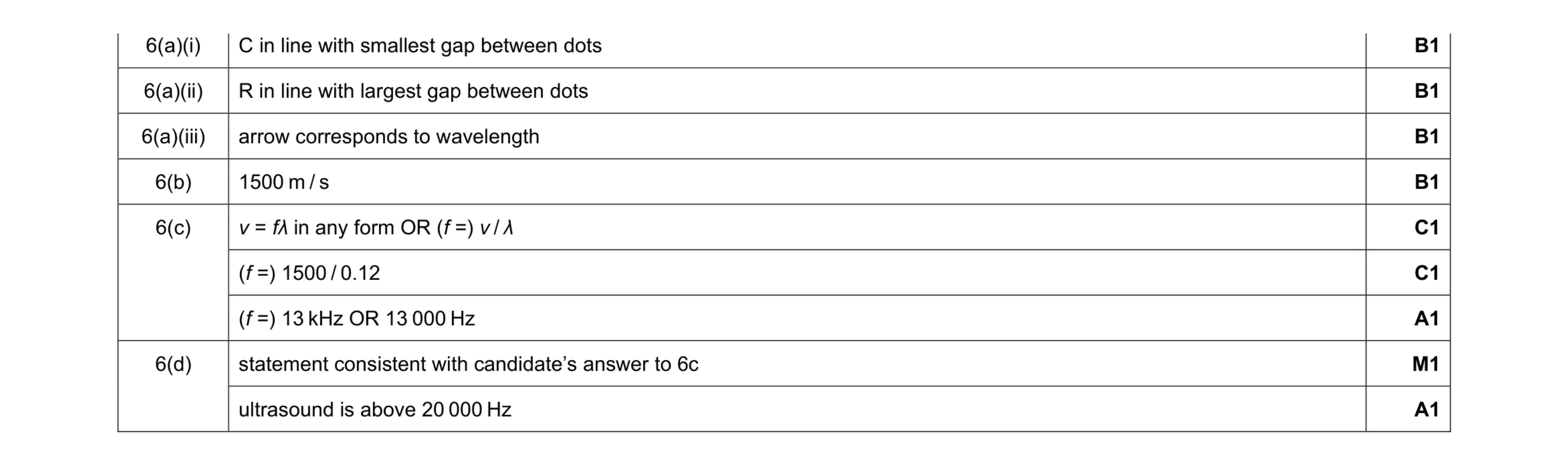 9
9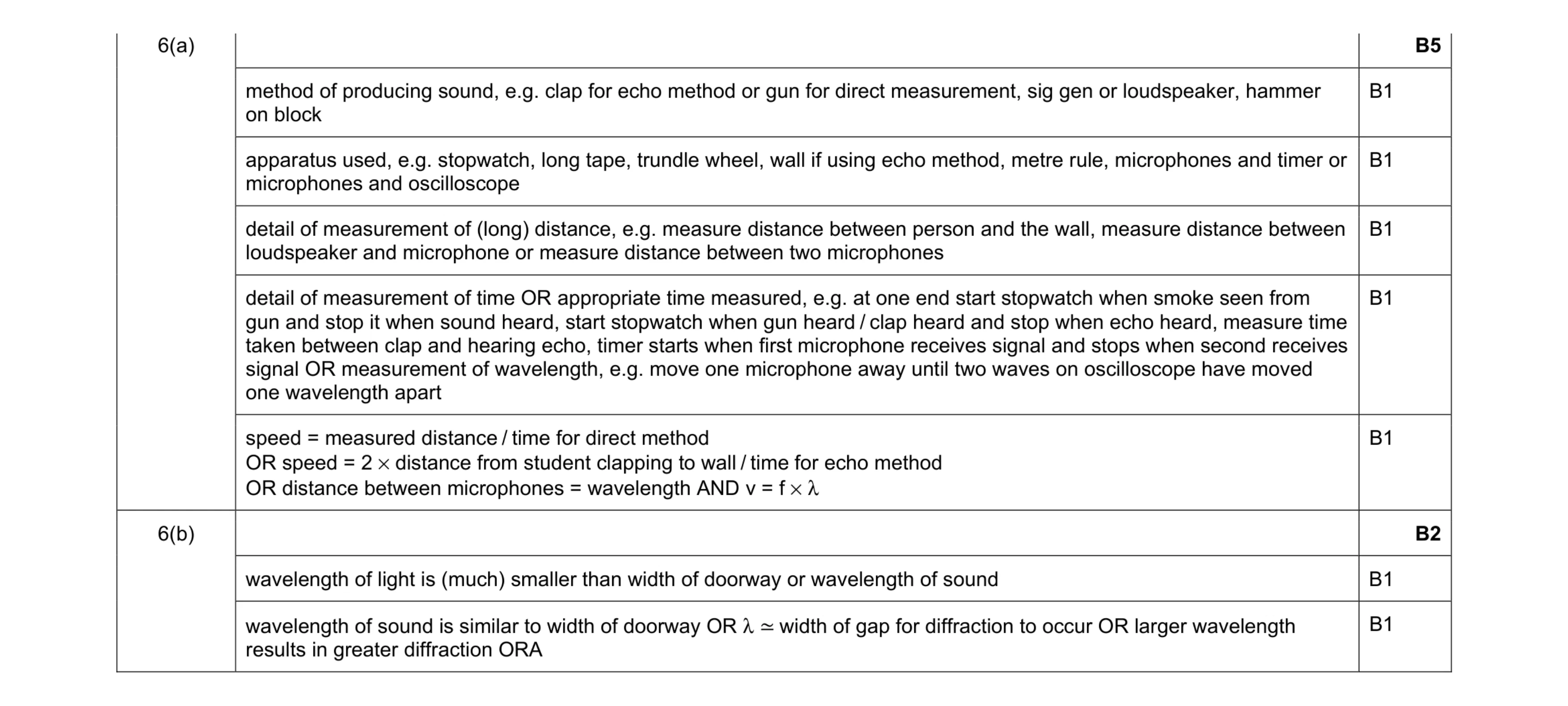 7
7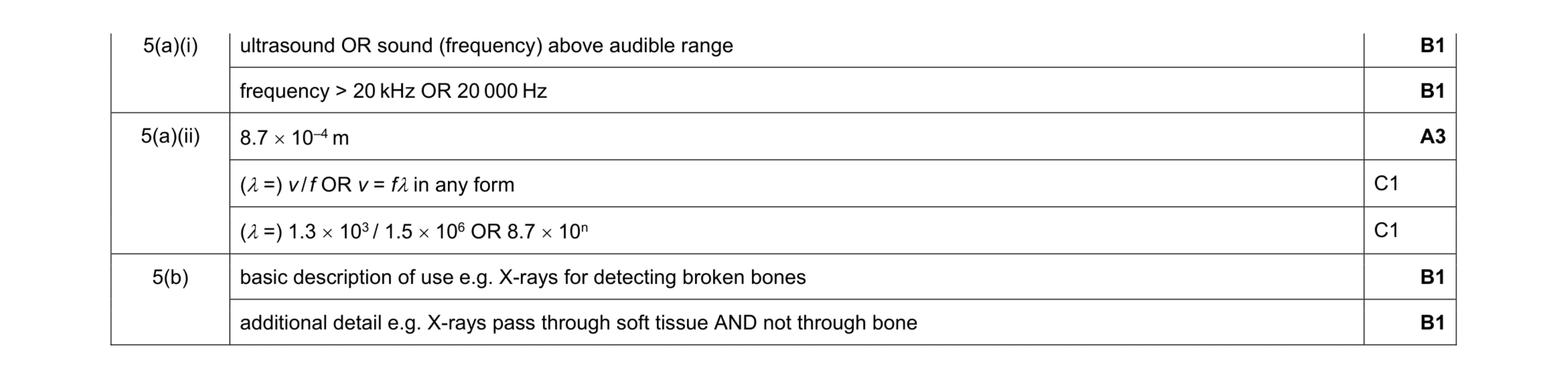 7
7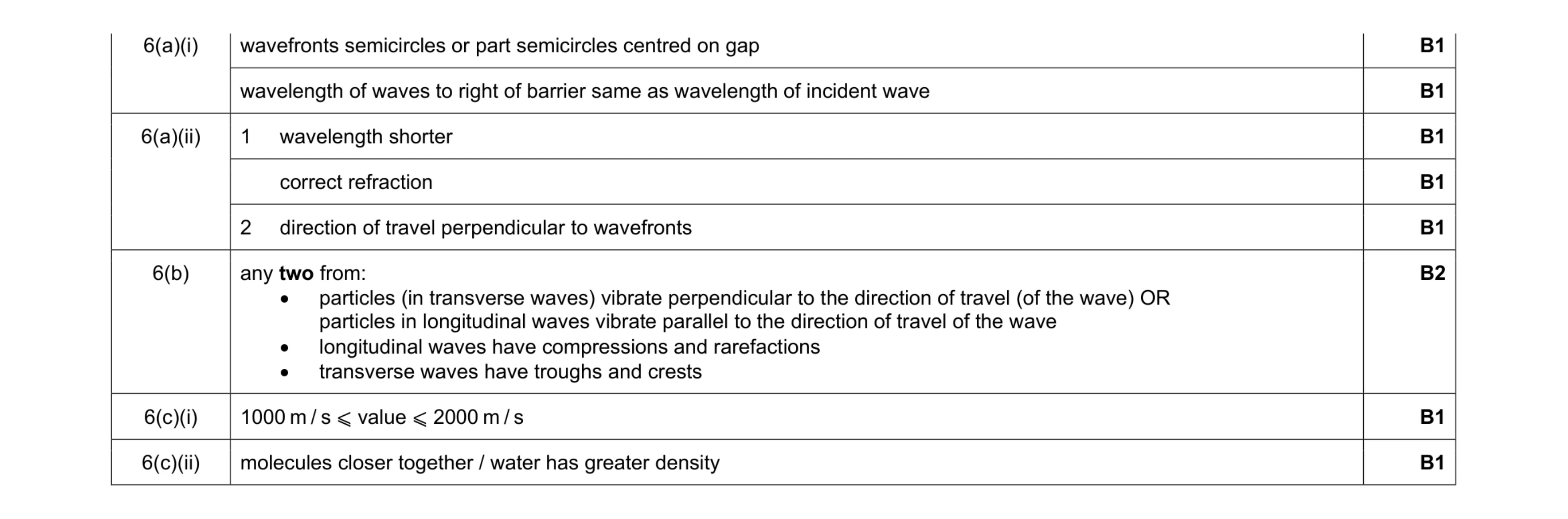 9
9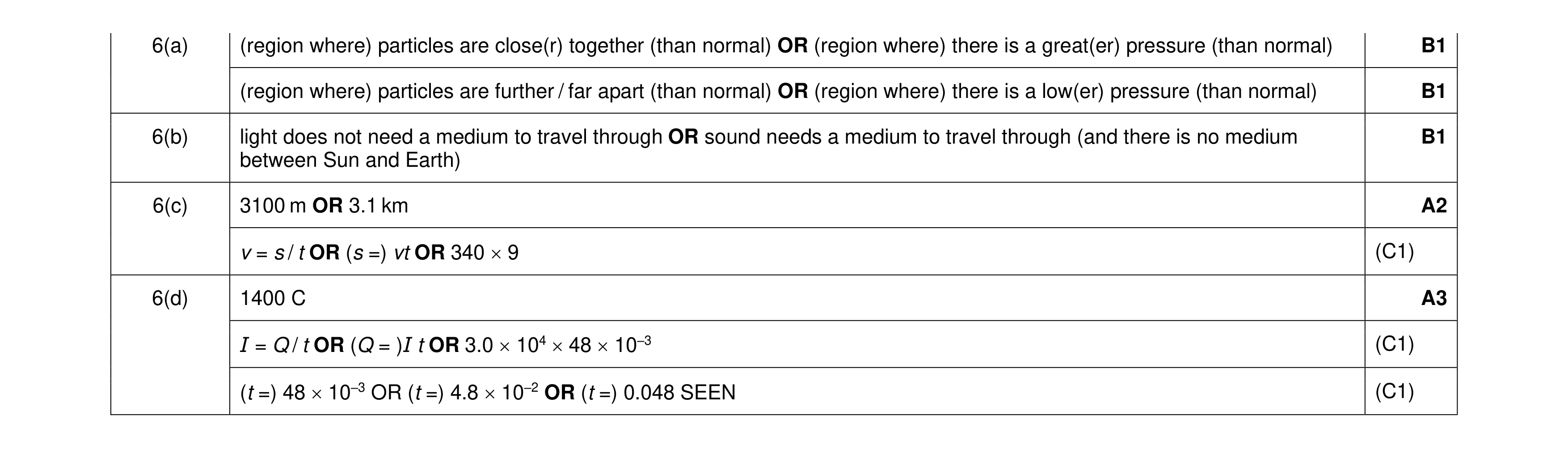 8
8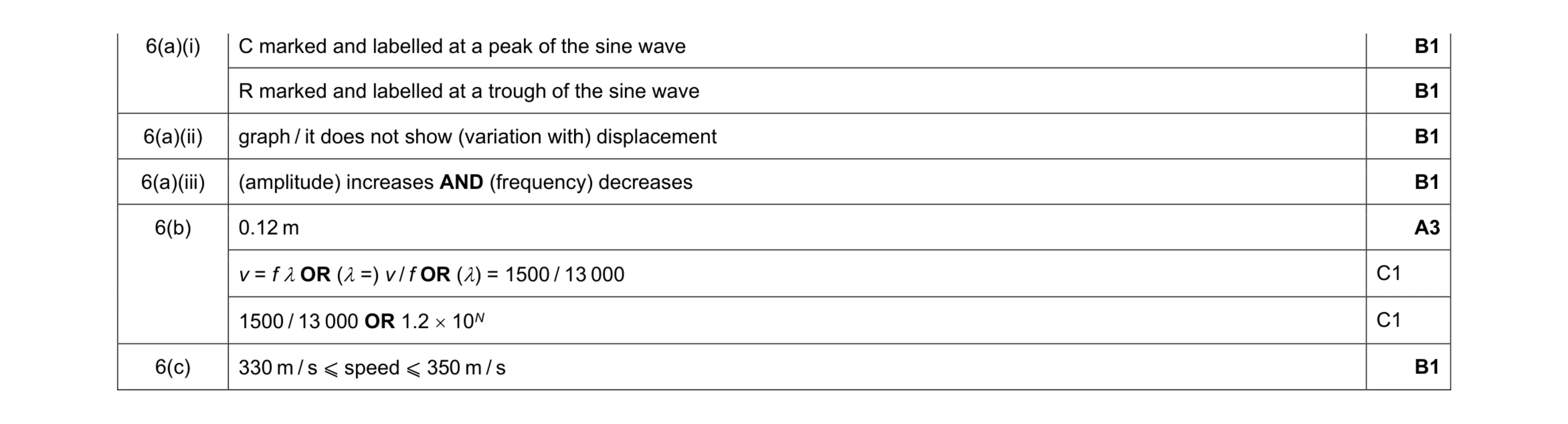 8
8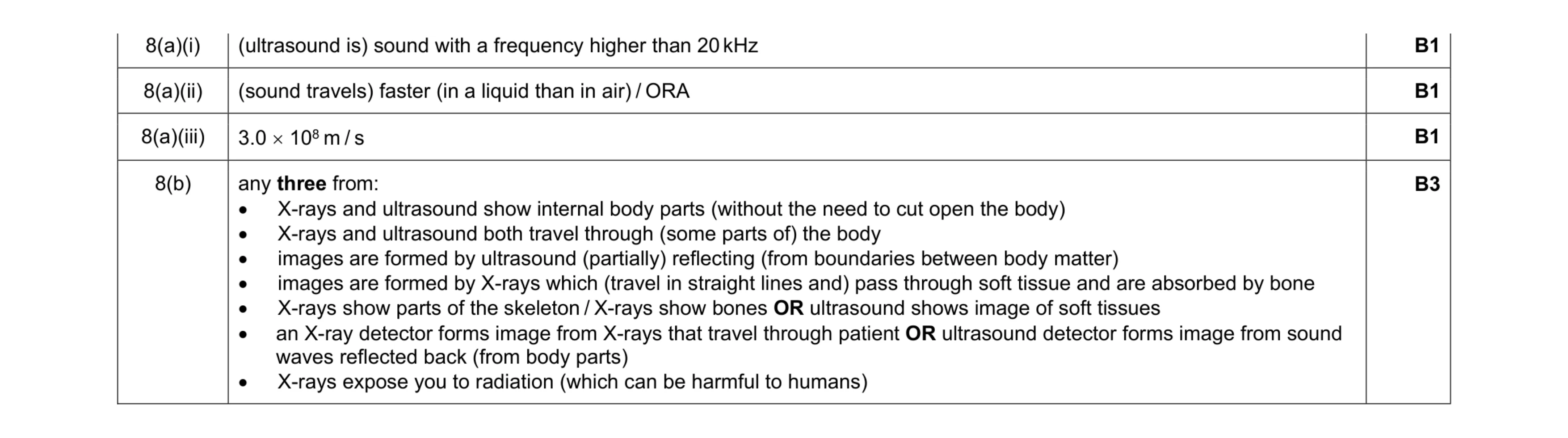 6
6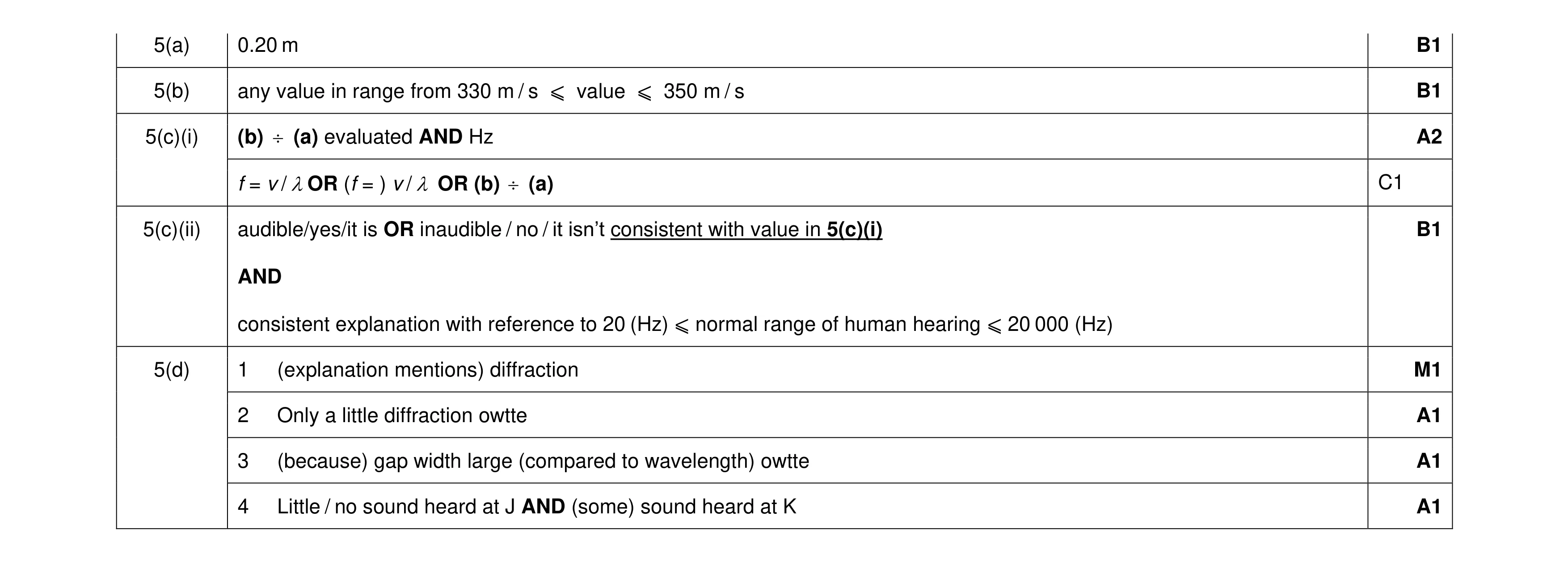 9
9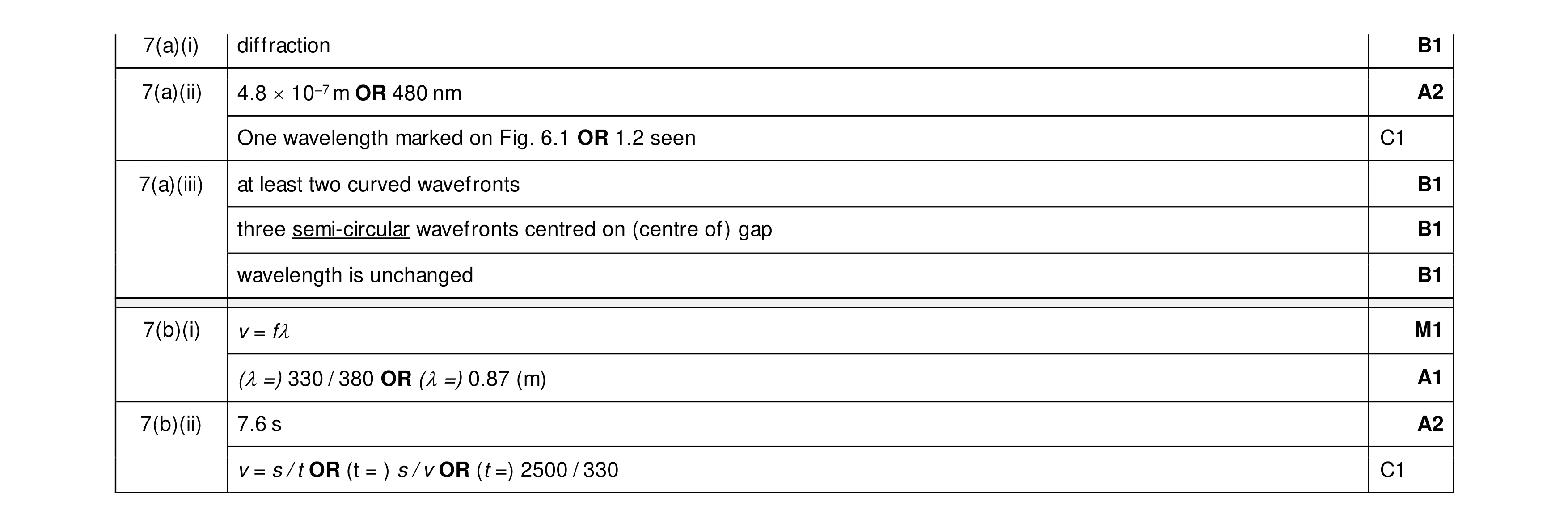 10
10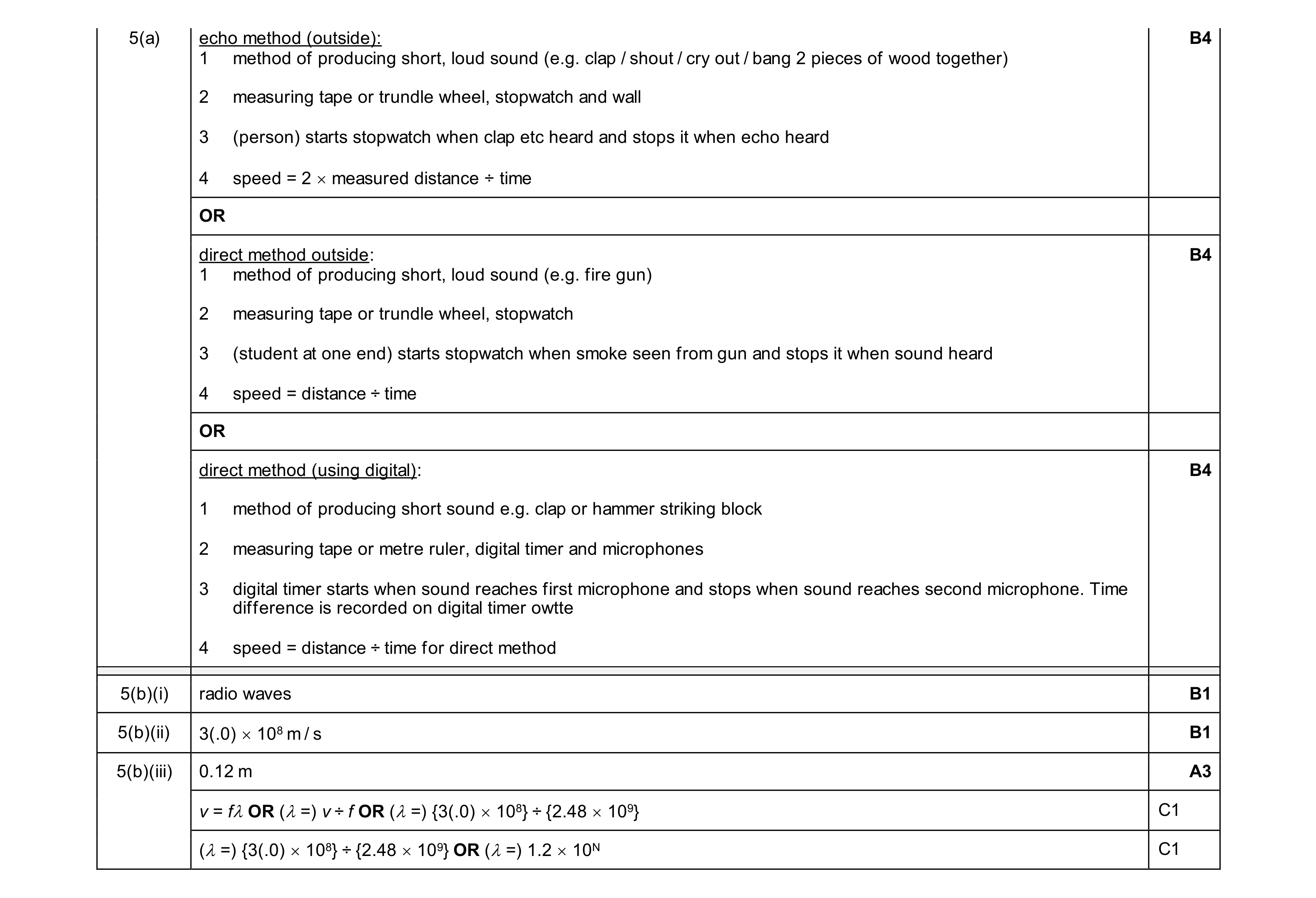 9
9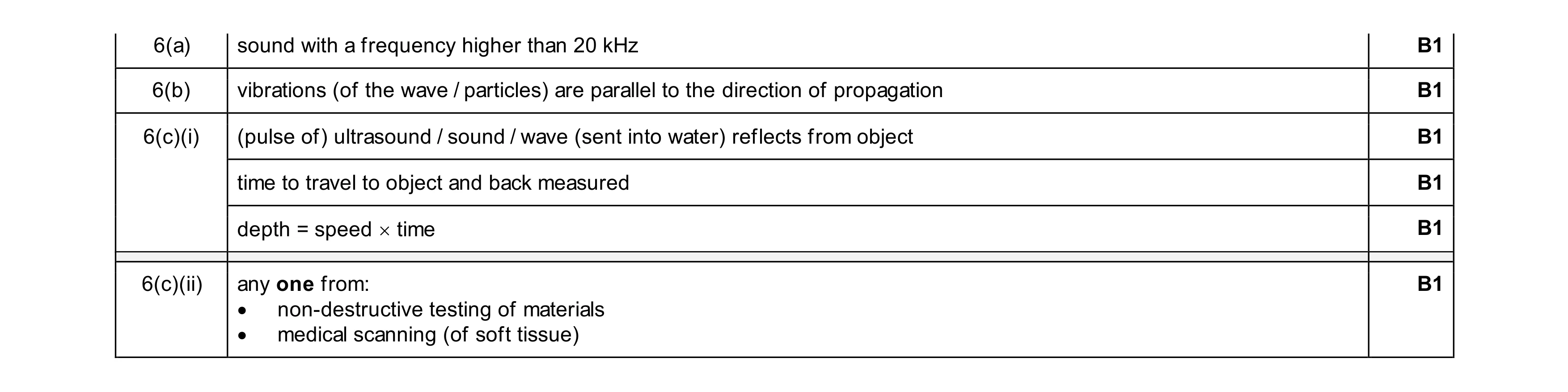 6
6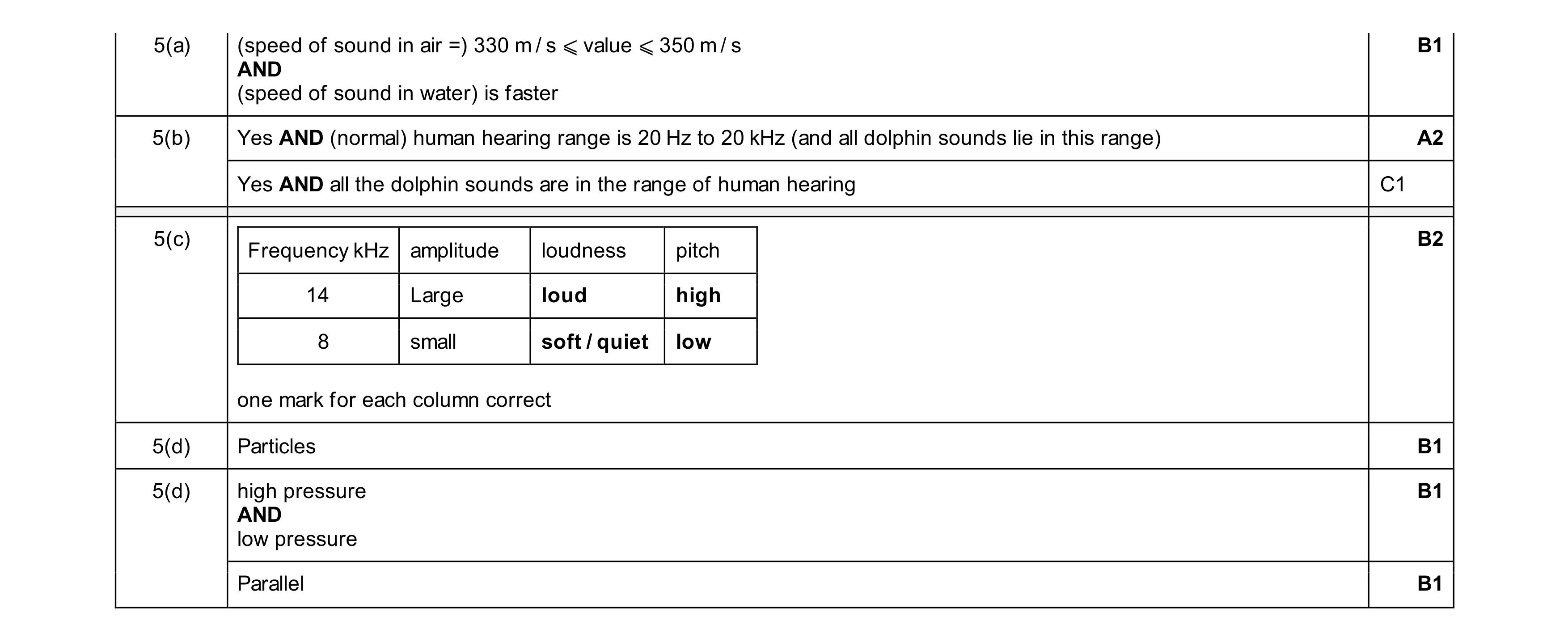 8
8