Questions as text
Q1 · A cruise ship has a firework display near a cliff as shown in Fig 0625/32 Feb/March 2017
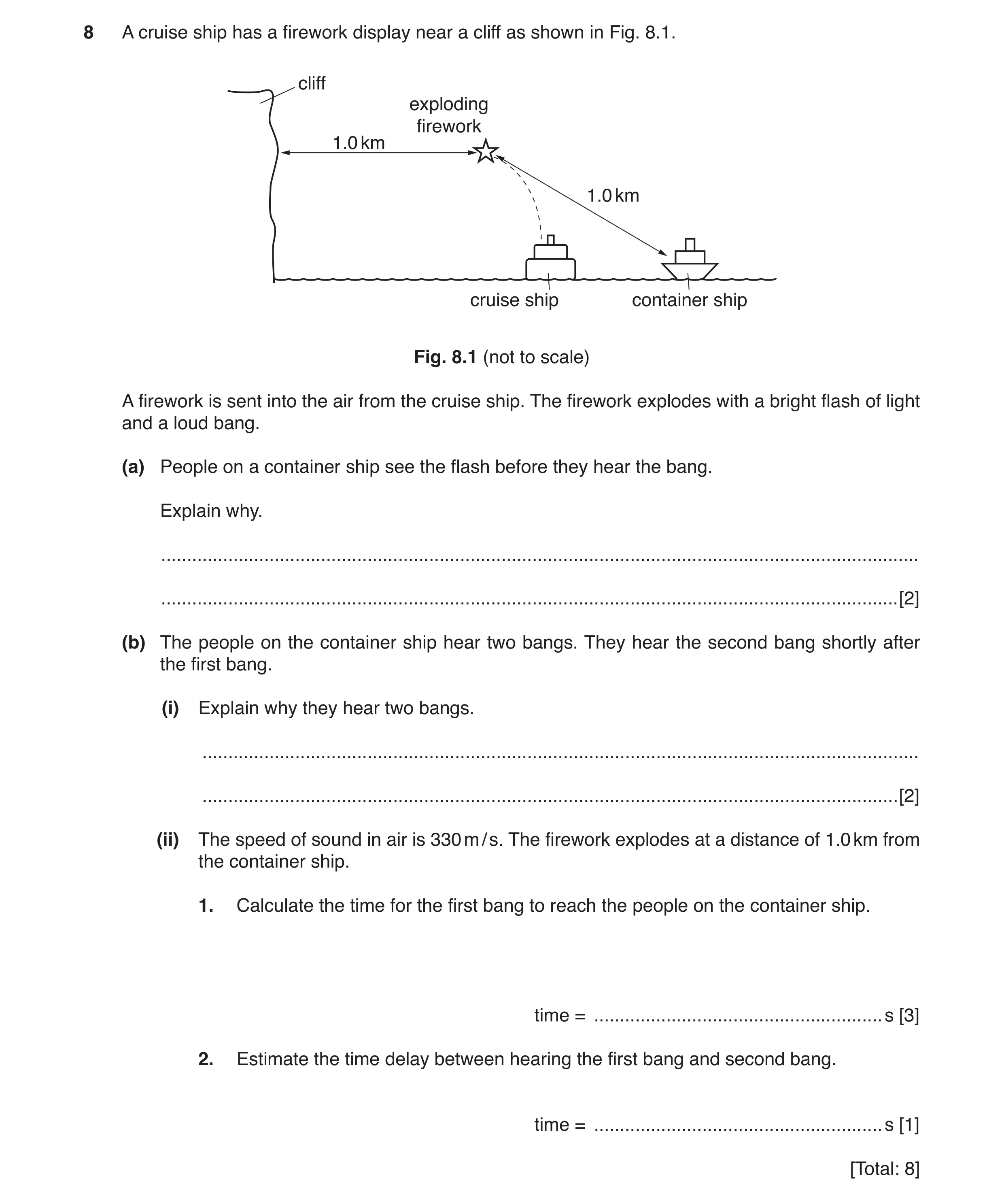
8 A cruise ship has a firework display near a cliff as shown in Fig. 8.1. cliff exploding firework 1.0 km 1.0 km cruise ship container ship Fig. 8.1 (not to scale) A firework is sent into the air from the cruise ship. The firework explodes with a bright flash of light and a loud bang. (a) People on a container ship see the flash before they hear the bang. Explain why. … … [2] (b) The people on the container ship hear two bangs. They hear the second bang shortly after the first bang. (i) Explain why they hear two bangs. … … [2] (ii) The speed of sound in air is 330 m / s. The firework explodes at a distance of 1.0 km from the container ship. 1. Calculate the time for the first bang to reach the people on the container ship. time = … s [3] 2. Estimate the time delay between hearing the first bang and second bang. time = … s [1] [Total: 8]
8 marks
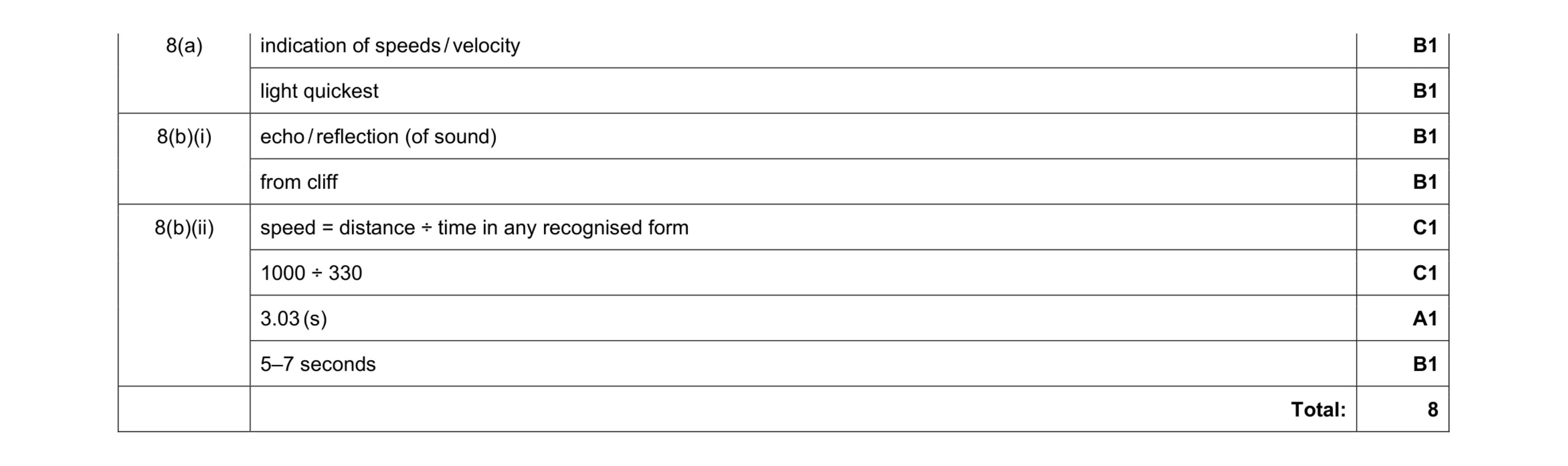
Mark scheme: 8(a) indication of speeds / velocity B1 light quickest B1 8(b)(i) echo / reflection (of sound) B1 from cliff B1 8(b)(ii) speed = distance ÷ time in any recognised form C1 1000 ÷ 330 C1 3.03 (s) A1 5–7 seconds B1 Total: 8
This question in 0625/32 Feb/March 2017
Q2 · The position of a man working in a rock quarry 0625/31 May/June 2017
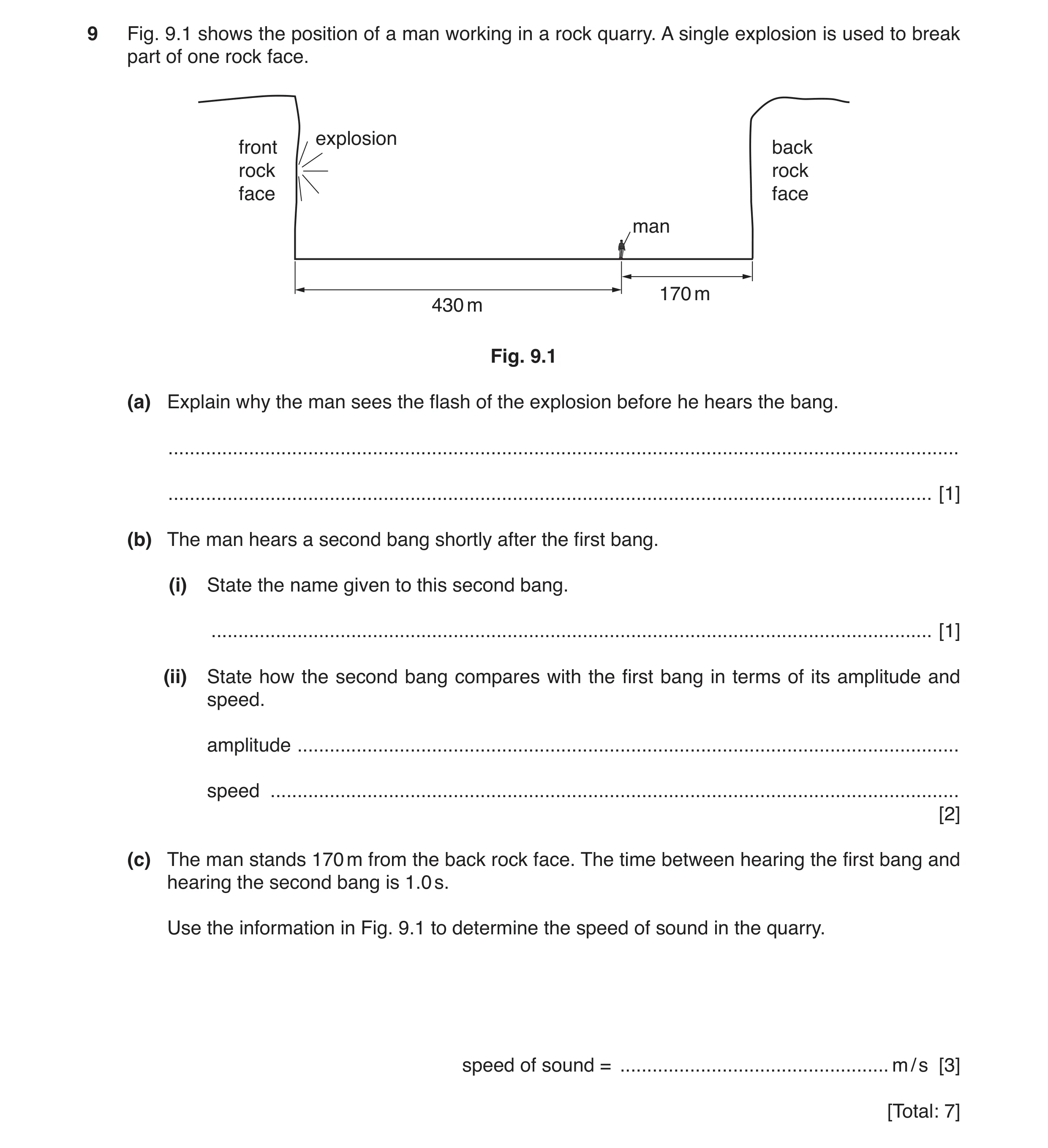
9 Fig. 9.1 shows the position of a man working in a rock quarry. A single explosion is used to break part of one rock face. explosion front back rock rock face face man 170 m 430 m Fig. 9.1 (a) Explain why the man sees the flash of the explosion before he hears the bang. … … [1] (b) The man hears a second bang shortly after the first bang. (i) State the name given to this second bang. … [1] (ii) State how the second bang compares with the first bang in terms of its amplitude and speed. amplitude … speed … [2] (c) The man stands 170 m from the back rock face. The time between hearing the first bang and hearing the second bang is 1.0 s. Use the information in Fig. 9.1 to determine the speed of sound in the quarry. speed of sound = … m / s [3] [Total: 7]
7 marks
Mark scheme: 9(a) light travels faster than sound or converse argument B1 9(b)(i) echo B1 9(b)(ii) amplitude – smaller B1 speed – the same B1 9(c) speed = distance ÷ time C1 170 + 170 OR 340 ÷ 1 C1 340 (m / s) A1 Total: 7
This question in 0625/31 May/June 2017
Q3 · The regions of the electromagnetic spectrum 0625/32 May/June 2017
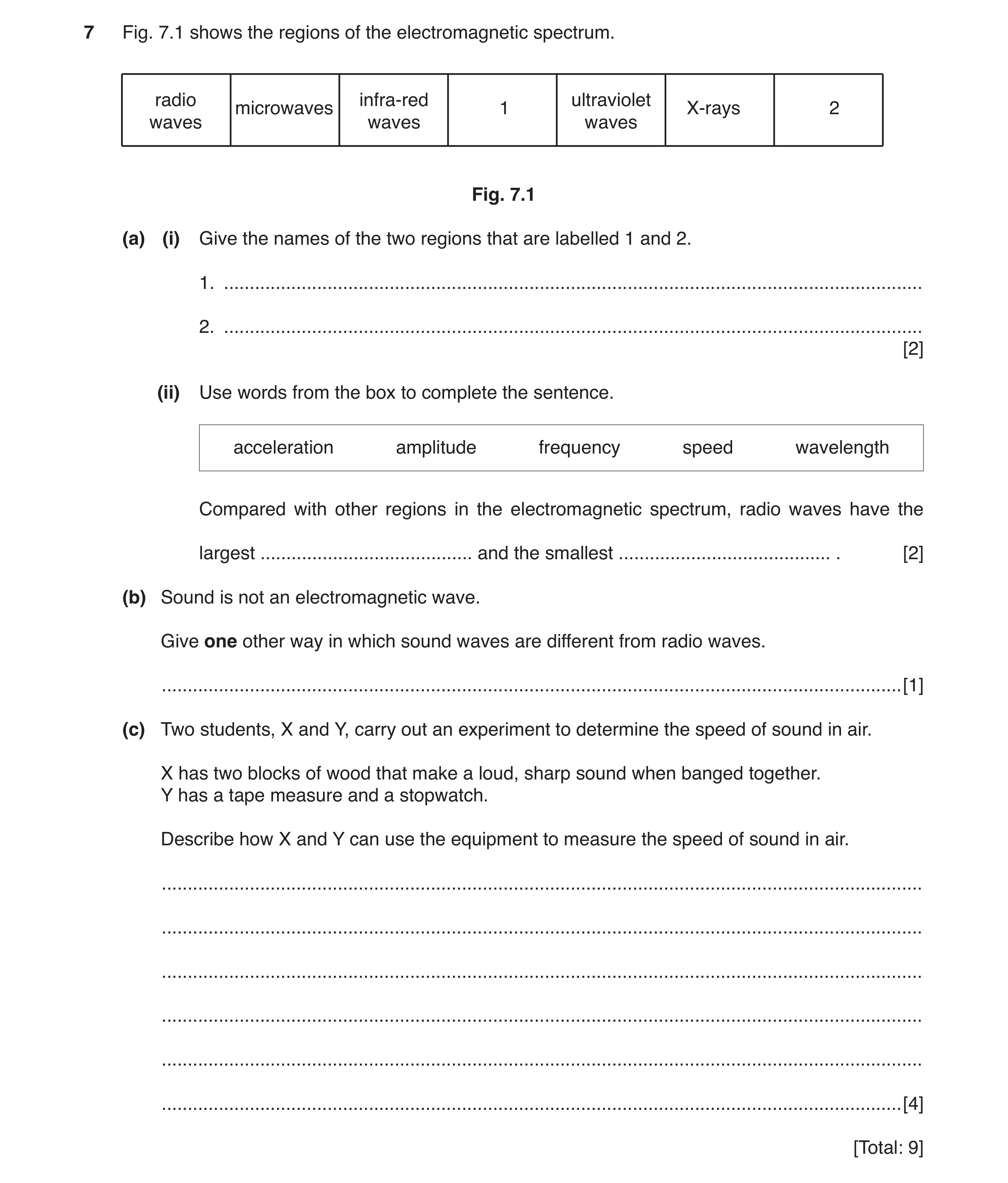
7 Fig. 7.1 shows the regions of the electromagnetic spectrum. radio infra-red ultraviolet microwaves 1 X-rays 2 waves waves waves Fig. 7.1 (a) (i) Give the names of the two regions that are labelled 1 and 2. 1. … 2. … [2] (ii) Use words from the box to complete the sentence. acceleration amplitude frequency speed wavelength Compared with other regions in the electromagnetic spectrum, radio waves have the largest … and the smallest … . [2] (b) Sound is not an electromagnetic wave. Give one other way in which sound waves are different from radio waves. … [1] (c) Two students, X and Y, carry out an experiment to determine the speed of sound in air. X has two blocks of wood that make a loud, sharp sound when banged together. Y has a tape measure and a stopwatch. Describe how X and Y can use the equipment to measure the speed of sound in air. … … … … … … [4] [Total: 9]
9 marks
Mark scheme: 7(a)(i) visible light B1 gamma rays B1 7(a)(ii) wavelength B1 frequency B1 7(b) (sound) is a longitudinal wave (radio waves are transverse) (sound) needs a medium to be transmitted (but radio waves do not) B1 7(c) any four from: only award 4 marks if valid procedure (use tape measure) to measure distance of at least 100 m blocks banged together stopwatch started when blocks are SEEN to hit stopwatch stopped when sound heard time taken recorded/calculated speed = distance ÷ time B4 Total: 9
This question in 0625/32 May/June 2017
Q4 · A sound wave is a longitudinal wave 0625/33 May/June 2017
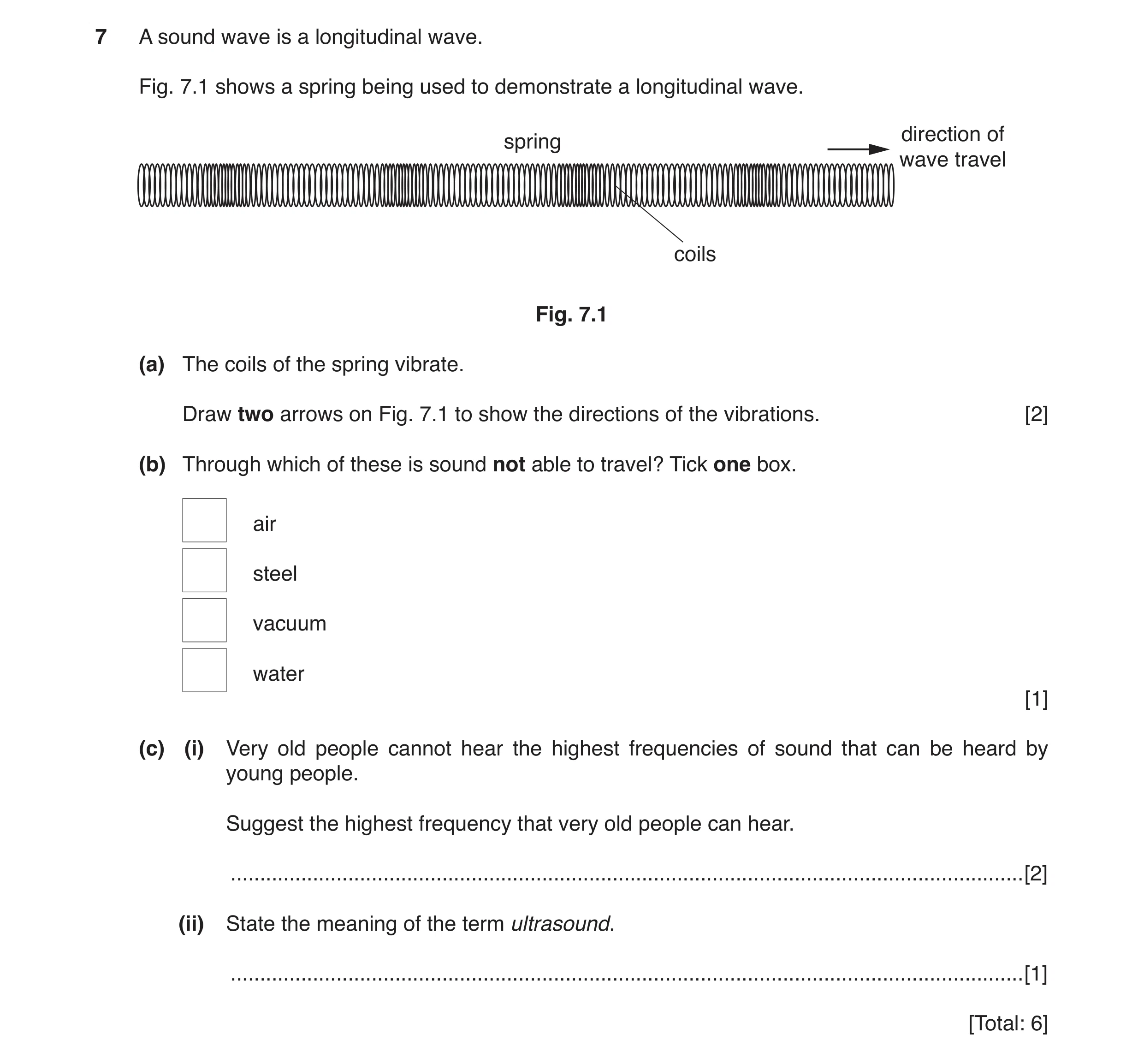
7 A sound wave is a longitudinal wave. Fig. 7.1 shows a spring being used to demonstrate a longitudinal wave. direction of spring wave travel coils Fig. 7.1 (a) The coils of the spring vibrate. Draw two arrows on Fig. 7.1 to show the directions of the vibrations. [2] (b) Through which of these is sound not able to travel? Tick one box. air steel vacuum water [1] (c) (i) Very old people cannot hear the highest frequencies of sound that can be heard by young people. Suggest the highest frequency that very old people can hear. … [2] (ii) State the meaning of the term ultrasound. … [1] [Total: 6]
6 marks
Mark scheme: 7(a) horizontal arrows by eye B1 arrows pointing in opposite directions B1 7(b) 3rd box ticked vacuum B1 7(c)(i) value less than 20 000 B1 Hz B1 7(c)(ii) sound with frequency above upper (frequency) limit of human hearing B1 Total: 6
This question in 0625/33 May/June 2017
Q5 · A man listening to a radio 0625/31 Oct/Nov 2017
7 (a) Fig. 7.1 shows a man listening to a radio. X centre of loudspeaker Fig. 7.1 (i) Sound from the radio makes an air particle at X vibrate. On Fig. 7.1 draw two arrows on point X to show the directions of vibration of the air particle. [2] (ii) Which of these terms correctly describes the sound wave? Tick one box. transverse longitudinal electromagnetic [1] (iii) Suggest a value for the frequency of the sound that the man can hear. State the unit. frequency = … [2] (iv) Explain why the man cannot hear ultrasound. … … [1] (b) Fig. 7.2 shows a distance-time graph for ultrasound travelling in sea-water. 1000 distance / m 800 600 400 200 0 0 0.20 0.40 0.60 0.80 time / s Fig. 7.2 (i) Use the graph to calculate the speed of ultrasound in sea-water. speed = … m / s [2] (ii) A scientist measures the depth of the sea by using ultrasound. She sends a pulse of ultrasound from the ship to the seabed. It reflects from the seabed as shown in Fig. 7.3. reflection pulse of ultrasound Fig. 7.3 The time taken between sending a pulse and receiving the echo is 0.60 s. Use the graph to determine the depth of the sea. depth = … m [2]
10 marks
Mark scheme: 7(a)(i) arrows horizontal / on line from radio to man B1 arrows in opposite direction B1 7(a)(ii) middle box ticked longitudinal B1 7(a)(iii) number in range 20–20 000 B1 hertz B1 7(a)(iv) (frequency of ultrasound) is above human (hearing) range B1 7(b)(i) speed = dist ÷ time or any two corresponding values of distance ÷ time e.g. 600 ÷ 0.4 C1 1500 (m / s) A1 7(b)(ii) 900 (m) read from graph C1 depth = 450 (m) A1
This question in 0625/31 Oct/Nov 2017
Q6 · Some equipment used in a demonstration 0625/32 Oct/Nov 2017
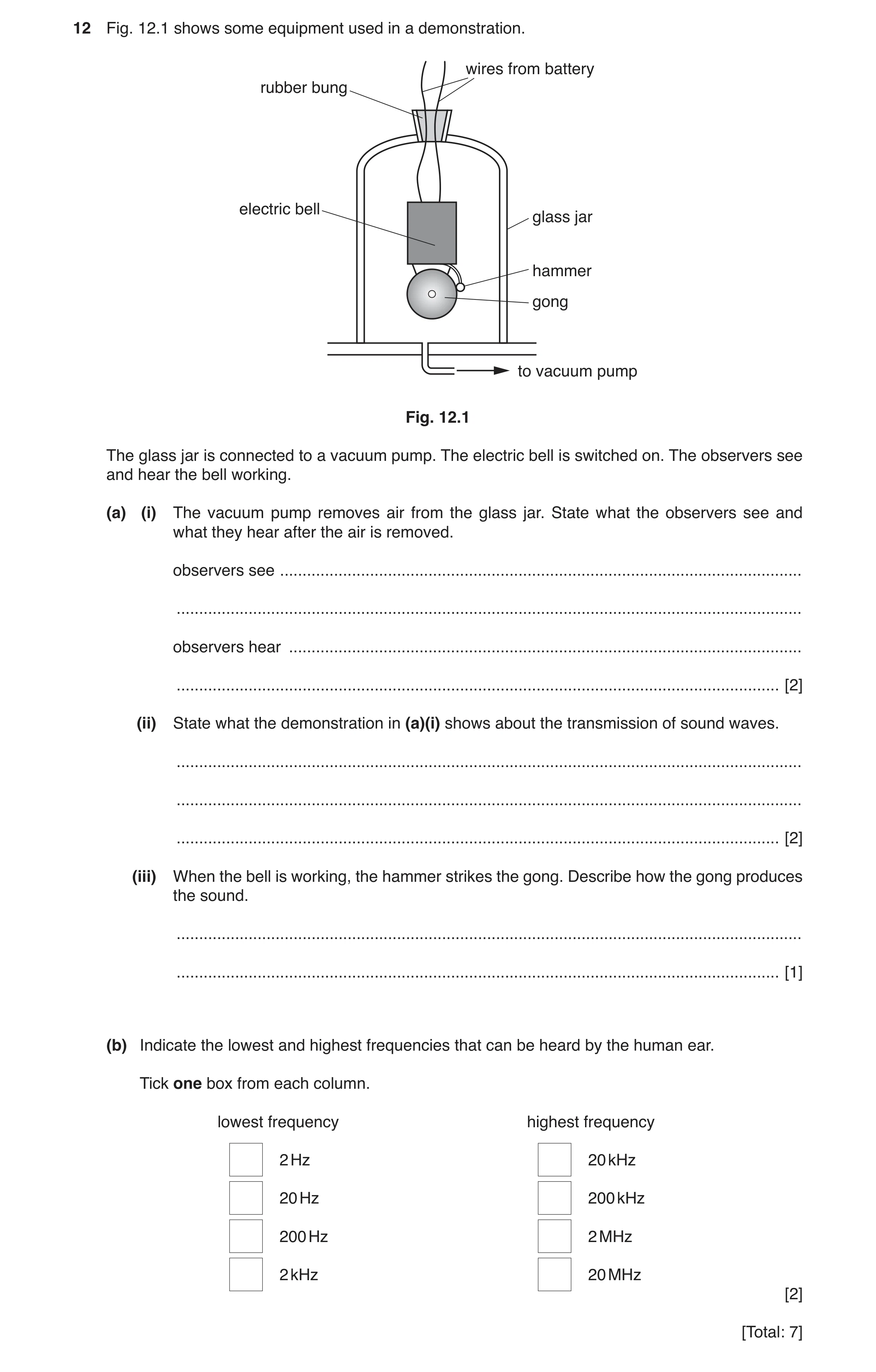
12 Fig. 12.1 shows some equipment used in a demonstration. wires from battery rubber bung electric bell glass jar hammer gong to vacuum pump Fig. 12.1 The glass jar is connected to a vacuum pump. The electric bell is switched on. The observers see and hear the bell working. (a) (i) The vacuum pump removes air from the glass jar. State what the observers see and what they hear after the air is removed. observers see … … observers hear … … [2] (ii) State what the demonstration in (a)(i) shows about the transmission of sound waves. … … … [2] (iii) When the bell is working, the hammer strikes the gong. Describe how the gong produces the sound. … … [1] (b) Indicate the lowest and highest frequencies that can be heard by the human ear. Tick one box from each column. lowest frequency highest frequency 2 Hz 20 kHz 20 Hz 200 kHz 200 Hz 2 MHz 2 kHz 20 MHz [2] [Total: 7]
7 marks
Mark scheme: 12(a)(i) electric bell working owtte B1 no sound from bell / bell is quieter B1 12(a)(ii) any two from: sound will travel through air / glass sound will not cross a vacuum sound needs a medium to travel through B2 12(a)(iii) vibrations B1 12(b) 20 Hz from first column B1 20 kHz from second column B1
This question in 0625/32 Oct/Nov 2017
Q7 · A machine pushes a metal post into the ground using a hammer, as shown in Fig 0625/33 Oct/Nov 2017
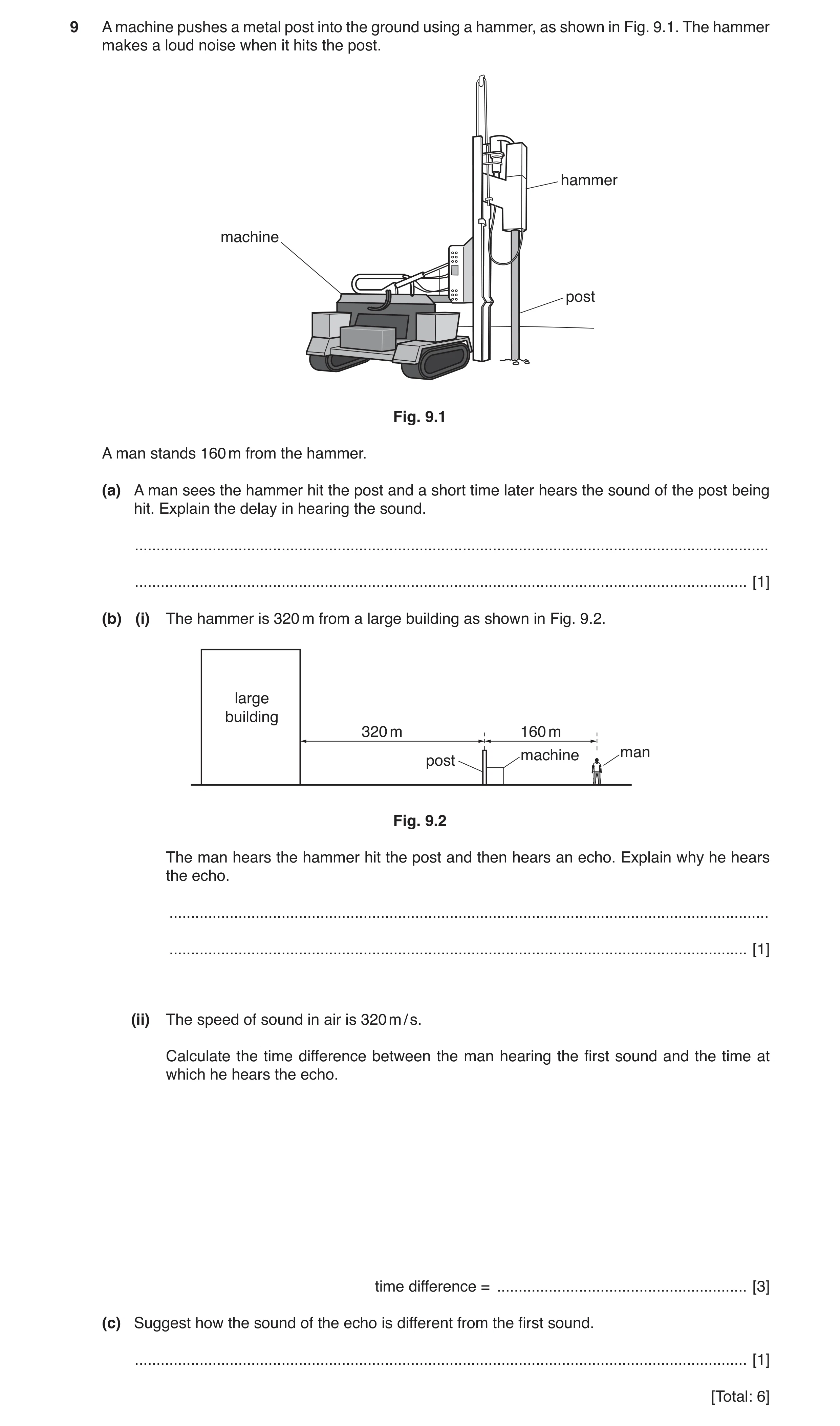
9 A machine pushes a metal post into the ground using a hammer, as shown in Fig. 9.1. The hammer makes a loud noise when it hits the post. hammer machine post Fig. 9.1 A man stands 160 m from the hammer. (a) A man sees the hammer hit the post and a short time later hears the sound of the post being hit. Explain the delay in hearing the sound. … … [1] (b) (i) The hammer is 320 m from a large building as shown in Fig. 9.2. large building 320 m 160 m machine man post Fig. 9.2 The man hears the hammer hit the post and then hears an echo. Explain why he hears the echo. … … [1] (ii) The speed of sound in air is 320 m / s. Calculate the time difference between the man hearing the first sound and the time at which he hears the echo. time difference = … [3] (c) Suggest how the sound of the echo is different from the first sound. … [1] [Total: 6]
6 marks
Mark scheme: 9(a) light travels faster than sound OR reverse argument B1 9(b) reflection (from building) / bouncing back (from building) B1 9(c) time taken for first sound = 0.5 s C1 Time taken for echo = 2.5 s OR time for sound to travel from hammer and return = 2.0 s C1 2.0 s A1 9(d) quieter / less amplitude / less energy B1
This question in 0625/33 Oct/Nov 2017
Q8 · This question is about measuring the speed of sound in air 0625/31 May/June 2018
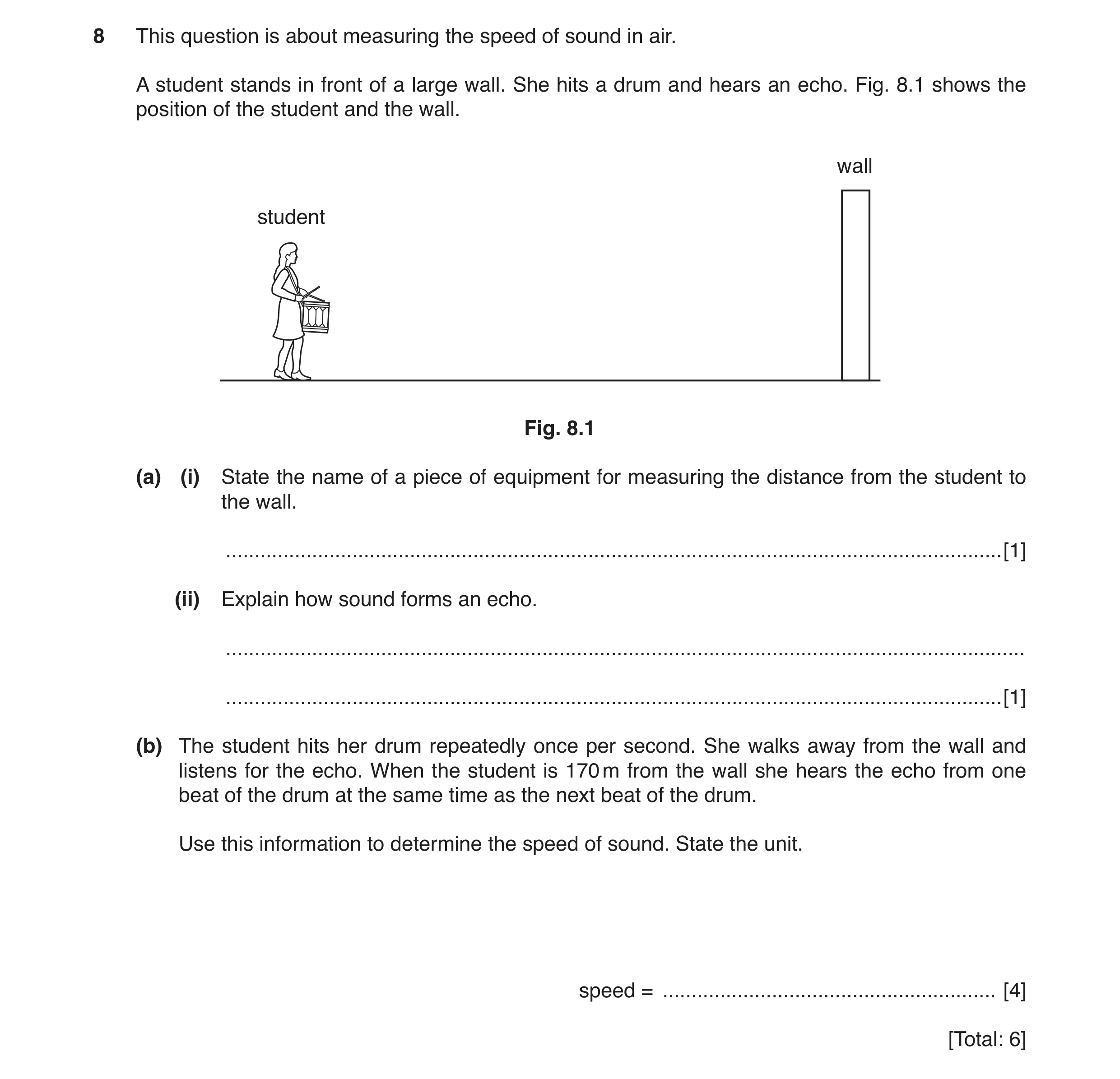
8 This question is about measuring the speed of sound in air. A student stands in front of a large wall. She hits a drum and hears an echo. Fig. 8.1 shows the position of the student and the wall. wall student Fig. 8.1 (a) (i) State the name of a piece of equipment for measuring the distance from the student to the wall. … [1] (ii) Explain how sound forms an echo. … … [1] (b) The student hits her drum repeatedly once per second. She walks away from the wall and listens for the echo. When the student is 170 m from the wall she hears the echo from one beat of the drum at the same time as the next beat of the drum. Use this information to determine the speed of sound. State the unit. speed = … [4] [Total: 6]
6 marks
Mark scheme: 8(a)(i) tape measure 1 8(a)(ii) reflection (of sound) 1 8(b) time for sound to travel to wall and back = 1.0 s 1 340 m in 1.0 s 1 (speed =) 340 1 m / s 1
This question in 0625/31 May/June 2018
Q9 · Complete the sentences about sound 0625/32 May/June 2018
8 (a) Complete the sentences about sound. Use words from the box above each sentence. (i) glows reflects refracts vibrates Sound is produced when a source … . [1] (ii) electromagnetic longitudinal transverse Sound waves are … waves. [1] (iii) metal vacuum liquid Sound waves cannot travel through a … . [1] (b) Humans, elephants, mice and dolphins have different hearing ranges. Fig. 8.1 shows the hearing range for each type of animal. 1000 000 100 000 frequency / Hz 10 000 1000 100 10 0 humans elephants mice dolphins Fig. 8.1 (i) State the lowest frequency of sound that can be heard by mice. … Hz [1] (ii) State the highest frequency of sound that can be heard by elephants. … Hz [1] (iii) Explain how the chart shows that elephants can hear some sounds that humans cannot hear. … … … [2] (iv) State the term given to the high frequencies that dolphins can hear but humans cannot hear. … [1] [Total: 8]
8 marks
Mark scheme: 8(a)(i) vibrates 1 8(a)(ii) longitudinal 1 8(a)(iii) vacuum 1 8(b)(i) 1000 (Hz) 1 8(b)(ii) frequency in range 10 001 to 30 000 (Hz) 1 8(b)(iii) lowest frequency heard by humans is 20 Hz 1 (but) elephants can hear frequencies below 20 Hz 1 8(b)(iv) ultrasound 1
This question in 0625/32 May/June 2018
Q10 · The boxes contain words about waves 0625/33 May/June 2018
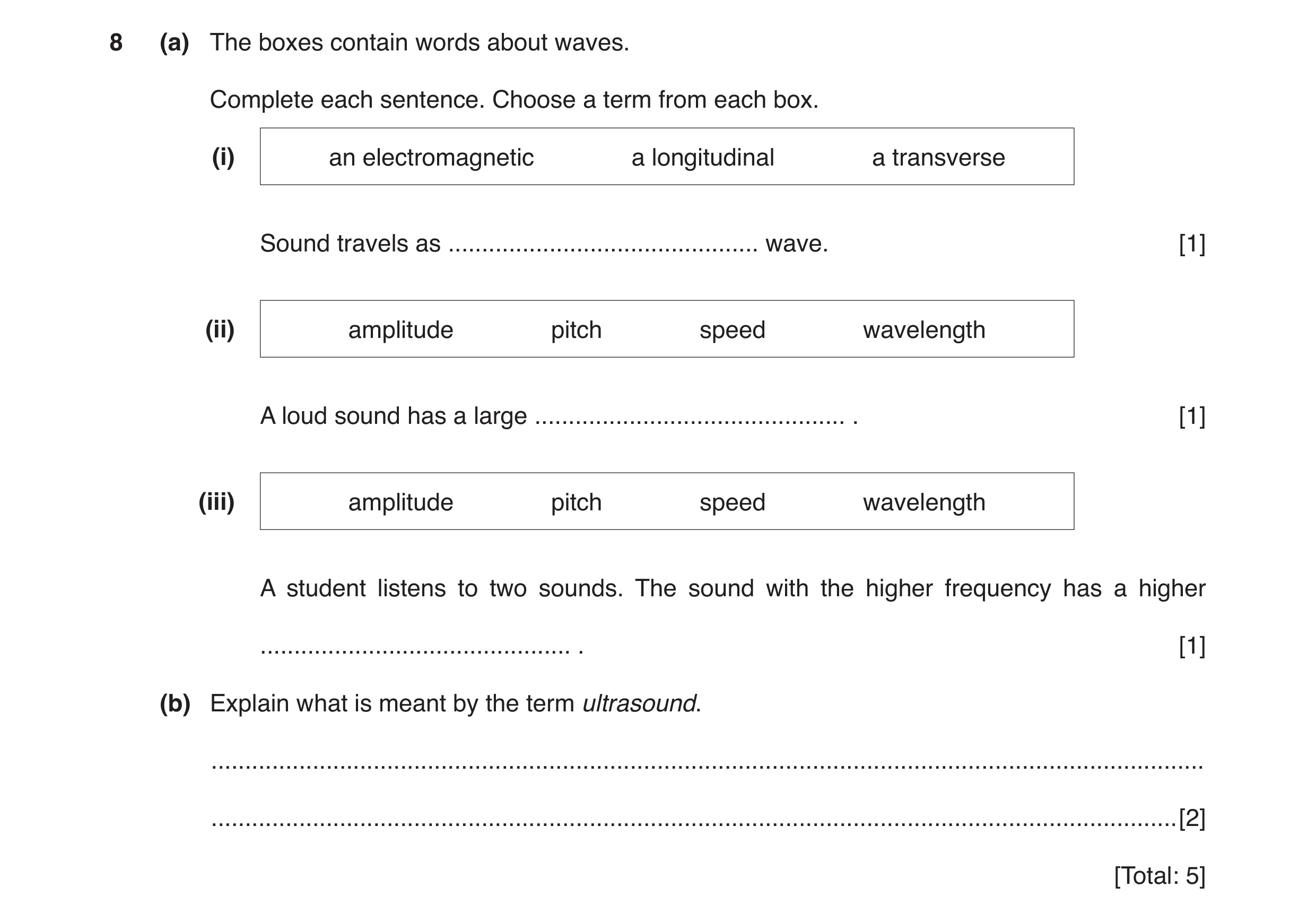
8 (a) The boxes contain words about waves. Complete each sentence. Choose a term from each box. (i) an electromagnetic a longitudinal a transverse Sound travels as … wave. [1] (ii) amplitude pitch speed wavelength A loud sound has a large … . [1] (iii) amplitude pitch speed wavelength A student listens to two sounds. The sound with the higher frequency has a higher … . [1] (b) Explain what is meant by the term ultrasound. … … [2] [Total: 5]
5 marks
Mark scheme: 8(a)(i) Longitudinal 1 8(a)(ii) Amplitude 1 8(a)(iii) pitch 1 8(b) frequencies (of sound) 1 above 20 000 Hz 1
This question in 0625/33 May/June 2018
Q11 · A tuning fork and a wooden block 0625/31 Oct/Nov 2018
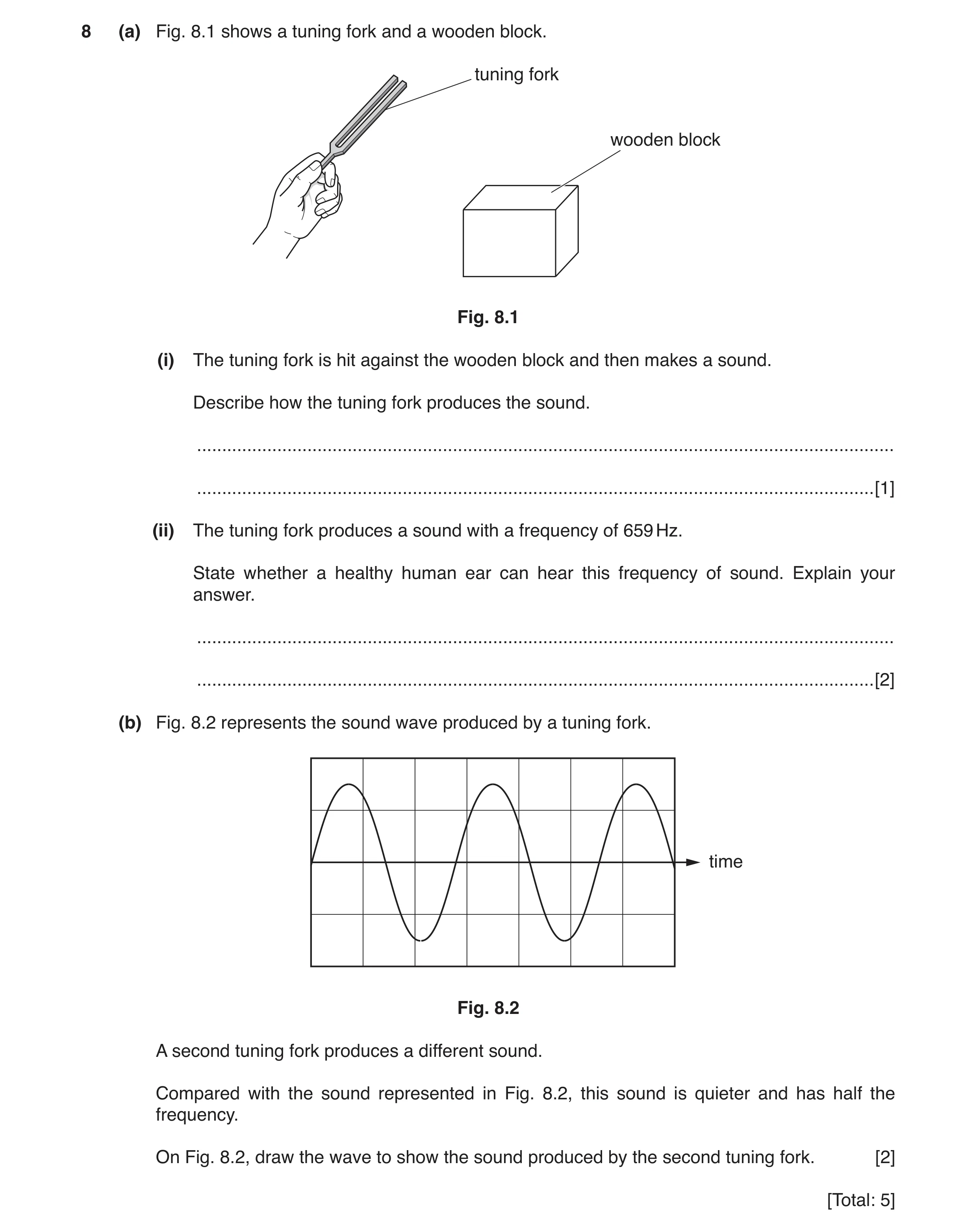
8 (a) Fig. 8.1 shows a tuning fork and a wooden block. tuning fork wooden block Fig. 8.1 (i) The tuning fork is hit against the wooden block and then makes a sound. Describe how the tuning fork produces the sound. … … [1] (ii) The tuning fork produces a sound with a frequency of 659 Hz. State whether a healthy human ear can hear this frequency of sound. Explain your answer. … … [2] (b) Fig. 8.2 represents the sound wave produced by a tuning fork. time Fig. 8.2 A second tuning fork produces a different sound. Compared with the sound represented in Fig. 8.2, this sound is quieter and has half the frequency. On Fig. 8.2, draw the wave to show the sound produced by the second tuning fork. [2] [Total: 5]
5 marks
Mark scheme: 8(a)(i) vibrates B1 8(a)(ii) Yes B1 (as within audible range of) 20 Hz to 20 000 Hz B1 8(b) line drawn with smaller amplitude B1 lower frequency i.e. fewer waves on screen B1
This question in 0625/31 Oct/Nov 2018
Q12 · A healthy human ear can hear a range of frequencies 0625/32 Oct/Nov 2018
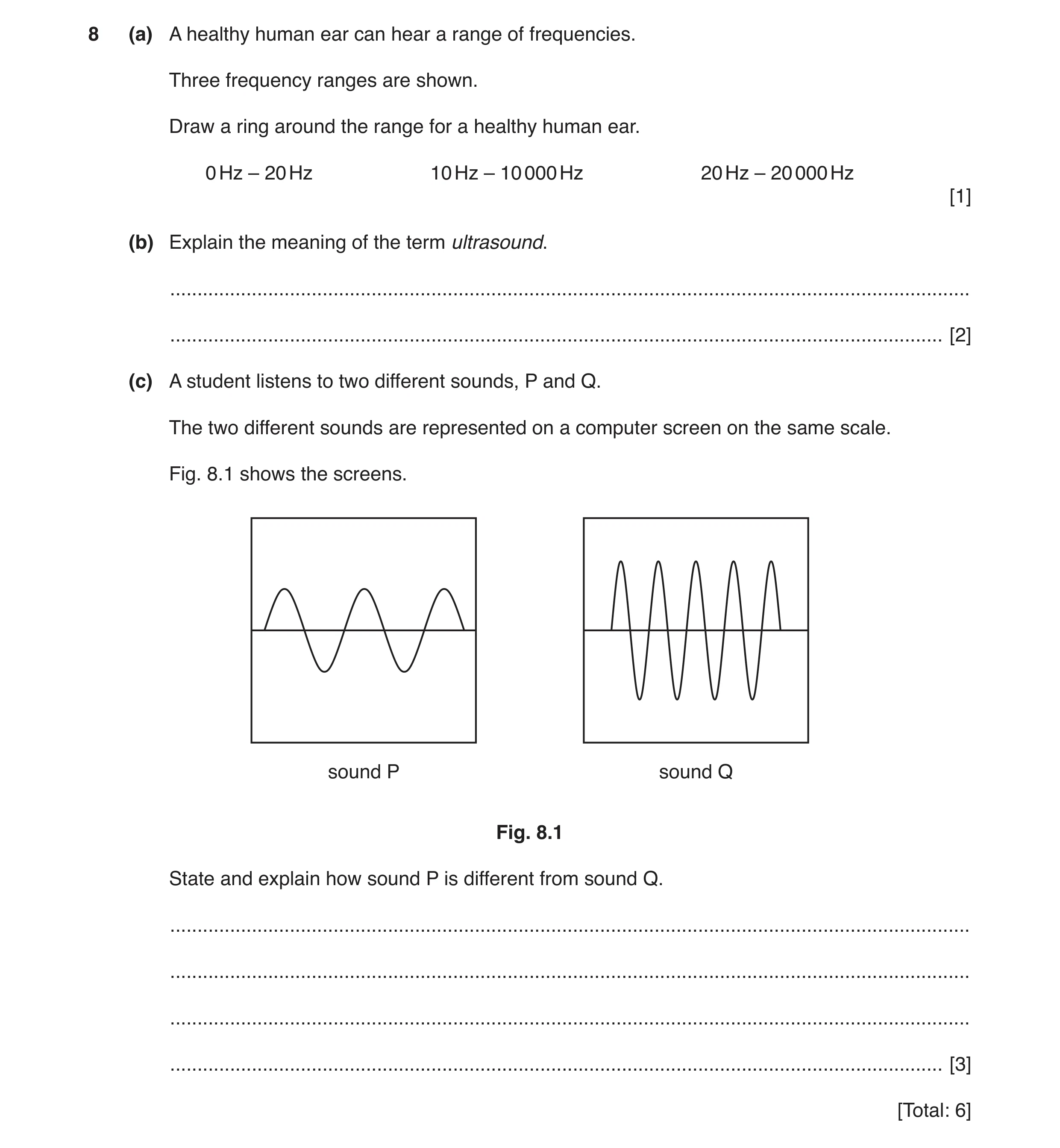
8 (a) A healthy human ear can hear a range of frequencies. Three frequency ranges are shown. Draw a ring around the range for a healthy human ear. 0 Hz – 20 Hz 10 Hz – 10 000 Hz 20 Hz – 20 000 Hz [1] (b) Explain the meaning of the term ultrasound. … … [2] (c) A student listens to two different sounds, P and Q. The two different sounds are represented on a computer screen on the same scale. Fig. 8.1 shows the screens. sound P sound Q Fig. 8.1 State and explain how sound P is different from sound Q. … … … … [3] [Total: 6]
6 marks
Mark scheme: 8(a) circle around 20 Hz–20 000 Hz B1 8(b) frequencies (of sound) B1 above 20 000 Hz B1 8(c) Quieter sound AND has lower pitch B1 (as) smaller amplitude B1 (as) frequency is lower B1
This question in 0625/32 Oct/Nov 2018
Q13 · Some students make statements about sound 0625/33 Oct/Nov 2018
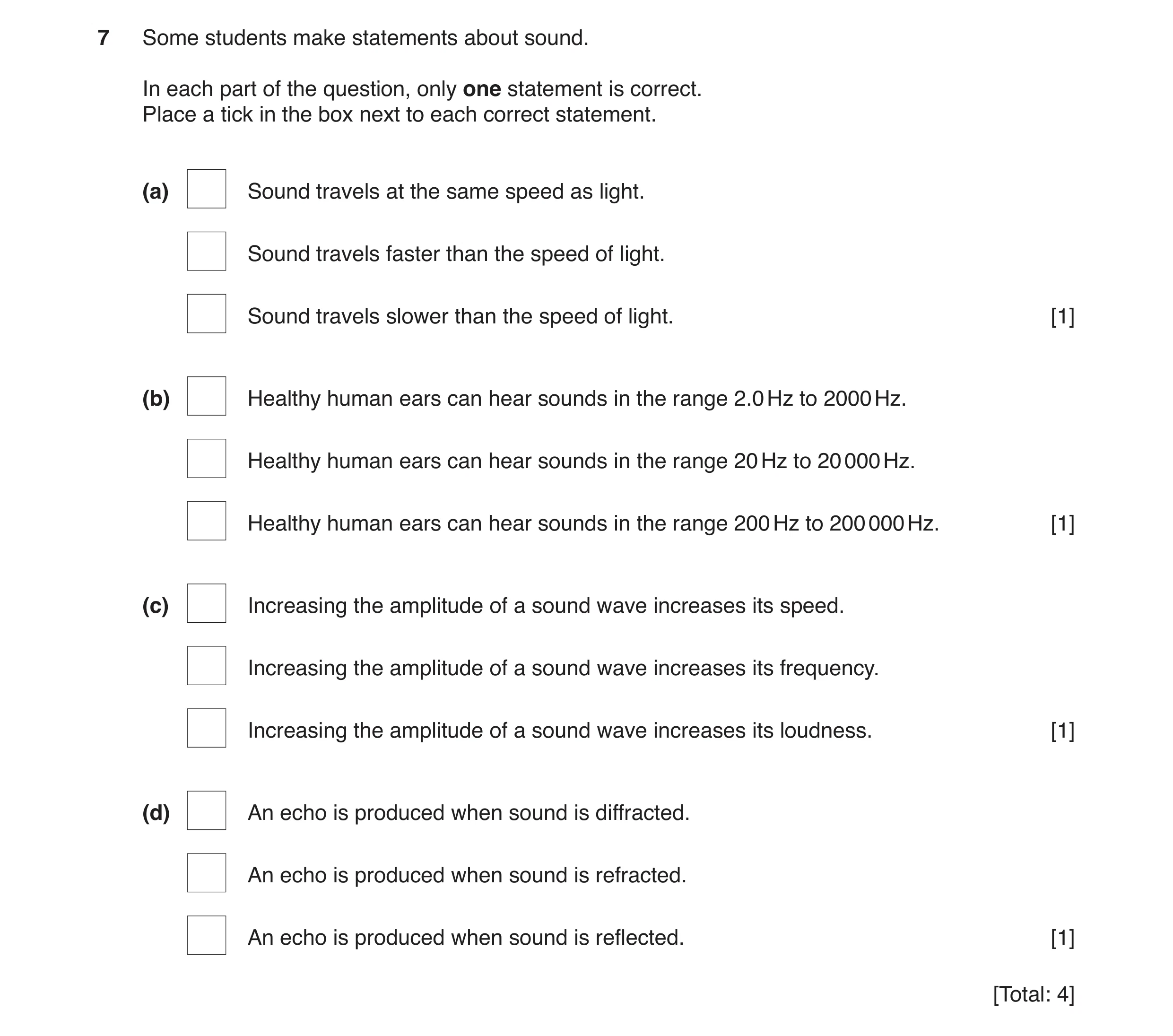
7 Some students make statements about sound. In each part of the question, only one statement is correct. Place a tick in the box next to each correct statement. (a) Sound travels at the same speed as light. Sound travels faster than the speed of light. Sound travels slower than the speed of light. [1] (b) Healthy human ears can hear sounds in the range 2.0 Hz to 2000 Hz. Healthy human ears can hear sounds in the range 20 Hz to 20 000 Hz. Healthy human ears can hear sounds in the range 200 Hz to 200 000 Hz. [1] (c) Increasing the amplitude of a sound wave increases its speed. Increasing the amplitude of a sound wave increases its frequency. Increasing the amplitude of a sound wave increases its loudness. [1] (d) An echo is produced when sound is diffracted. An echo is produced when sound is refracted. An echo is produced when sound is reflected. [1] [Total: 4]
4 marks
Mark scheme: 7(a) 3rd box – sound travels slower than the speed of light B1 7(b) 2nd box – 20 to 20000 Hz B1 7(c) 3rd box – Increasing the amplitude of a sound wave increases its loudness B1 7(d) 3rd box – an echo is produced when sound is reflected B1
This question in 0625/33 Oct/Nov 2018
Q14 · A student listening to the sound produced by a tuning fork 0625/31 Oct/Nov 2019
8 (a) Fig. 8.1 shows a student listening to the sound produced by a tuning fork. tuning fork Fig. 8.1 (i) State how the tuning fork produces the sound. … [1] (ii) Complete the following sentence. Choose a word from the box. electromagnetic longitudinal transverse A sound wave is … [1] (iii) A loudspeaker produces a sound with a frequency of 25 kHz. A student with healthy ears cannot hear this sound. Explain why. … … [2] (b) Fig. 8.2 represents a sound wave travelling in air. Fig. 8.2 (drawn full size) (i) The air particles are moving. On Fig. 8.2, draw two arrows in opposite directions to show the movement of the air particles. [1] (ii) Use Fig. 8.2 to determine the wavelength of the sound wave. wavelength = … cm [1] (c) Describe a method of using water waves to demonstrate refraction. … … … … … … [4] [Total: 10]
10 marks
Mark scheme: 8(a)(i) (it is) vibrating B1 8(a)(ii) longitudinal B1 8(a)(iii) frequency (of sound) OR 25 kHz B1 is above (upper limit of) human hearing range OR is an ultrasound B1 8(b)(i) horizontal line with arrows at either end B1 8(b)(ii) (14.4 ÷ 4 =) 3.6 (cm) B1 8(c) Any four from: use of shallow water use of flat lamina or shape below surface / different depths (of water) used waves hit {shallower water / shape} at an angle (other than 90°) waves change direction (due to) change in speed B4
This question in 0625/31 Oct/Nov 2019
Q15 · A boat race starts on the sea, but close to land 0625/32 Oct/Nov 2019
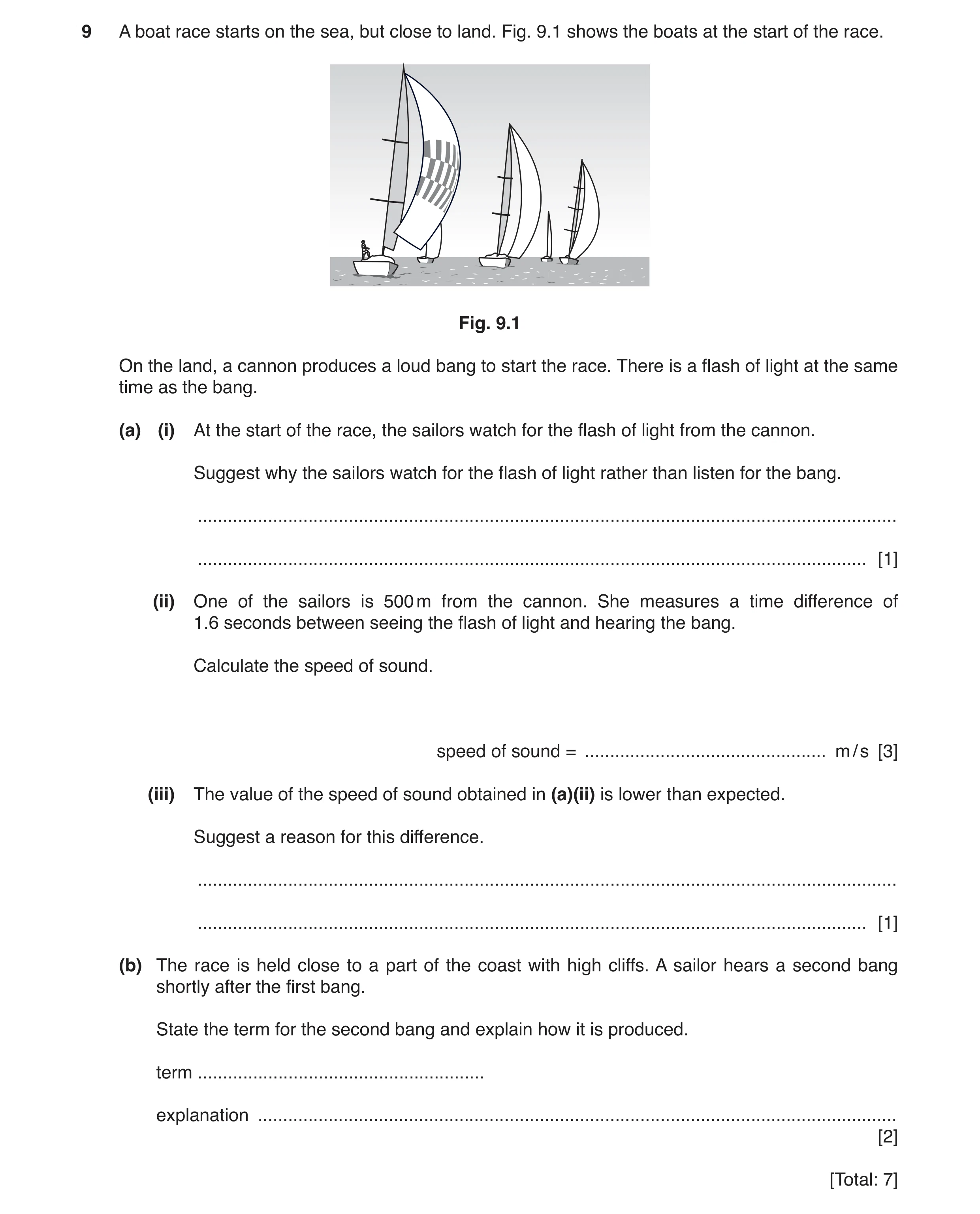
9 A boat race starts on the sea, but close to land. Fig. 9.1 shows the boats at the start of the race. Fig. 9.1 On the land, a cannon produces a loud bang to start the race. There is a flash of light at the same time as the bang. (a) (i) At the start of the race, the sailors watch for the flash of light from the cannon. Suggest why the sailors watch for the flash of light rather than listen for the bang. … … [1] (ii) One of the sailors is 500 m from the cannon. She measures a time difference of 1.6 seconds between seeing the flash of light and hearing the bang. Calculate the speed of sound. speed of sound = … m / s [3] (iii) The value of the speed of sound obtained in (a)(ii) is lower than expected. Suggest a reason for this difference. … … [1] (b) The race is held close to a part of the coast with high cliffs. A sailor hears a second bang shortly after the first bang. State the term for the second bang and explain how it is produced. term … explanation … [2] [Total: 7]
7 marks
Mark scheme: 9(a)(i) light travels faster than sound OR flash / light seen before bang heard B1 9(a)(ii) speed = distance ÷ time in any form C1 500 ÷ 1.6 C1 312.5 (m / s) A1 9(a)(iii) it is windy owtte OR reaction times to start / stop watch B1 9(b) echo B1 (sound) reflected from cliffs B1
This question in 0625/32 Oct/Nov 2019
Q16 · The pressure at one instant along part of a sound wave 0625/31 May/June 2020
8 Fig. 8.1 represents the pressure at one instant along part of a sound wave. direction of wave travel above normal air pressure normal air pressure 20 40 60 80 100 120 distance / cm below normal air pressure Fig. 8.1 (a) (i) Determine the wavelength of the sound wave. wavelength of the sound wave = … cm [1] (ii) On Fig. 8.1, draw a wave representing a louder sound of the same wavelength. [1] (b) State the range of audible frequencies for a healthy human ear. Include the unit. … [2] [Total: 4]
4 marks
Mark scheme: 8(a)(i) (wavelength =) 40 (cm) B1 8(a)(ii) wave drawn with greater amplitude B1 8(b) 20 to 20 000 B1 Hz or hertz B1
This question in 0625/31 May/June 2020
Q17 · Sound travels as a wave 0625/32 May/June 2020
8 Sound travels as a wave. (a) Complete each sentence. Sound is produced when an object … . An echo is produced when sound is … from a hard surface. Compared with a quiet sound, a loud sound always has a greater … . Compared with a high pitched sound, a low pitched sound always has a smaller … . Waves transfer energy without transferring … . [5] (b) State the meaning of the term ultrasound. … [1] [Total: 6]
6 marks
Mark scheme: 8(a) vibrates B1 reflected B1 amplitude B1 frequency B1 matter B1 8(b) vibrations with higher frequency than sound B1
This question in 0625/32 May/June 2020
Q18 · A mobile (cell) phone 0625/31 Oct/Nov 2020
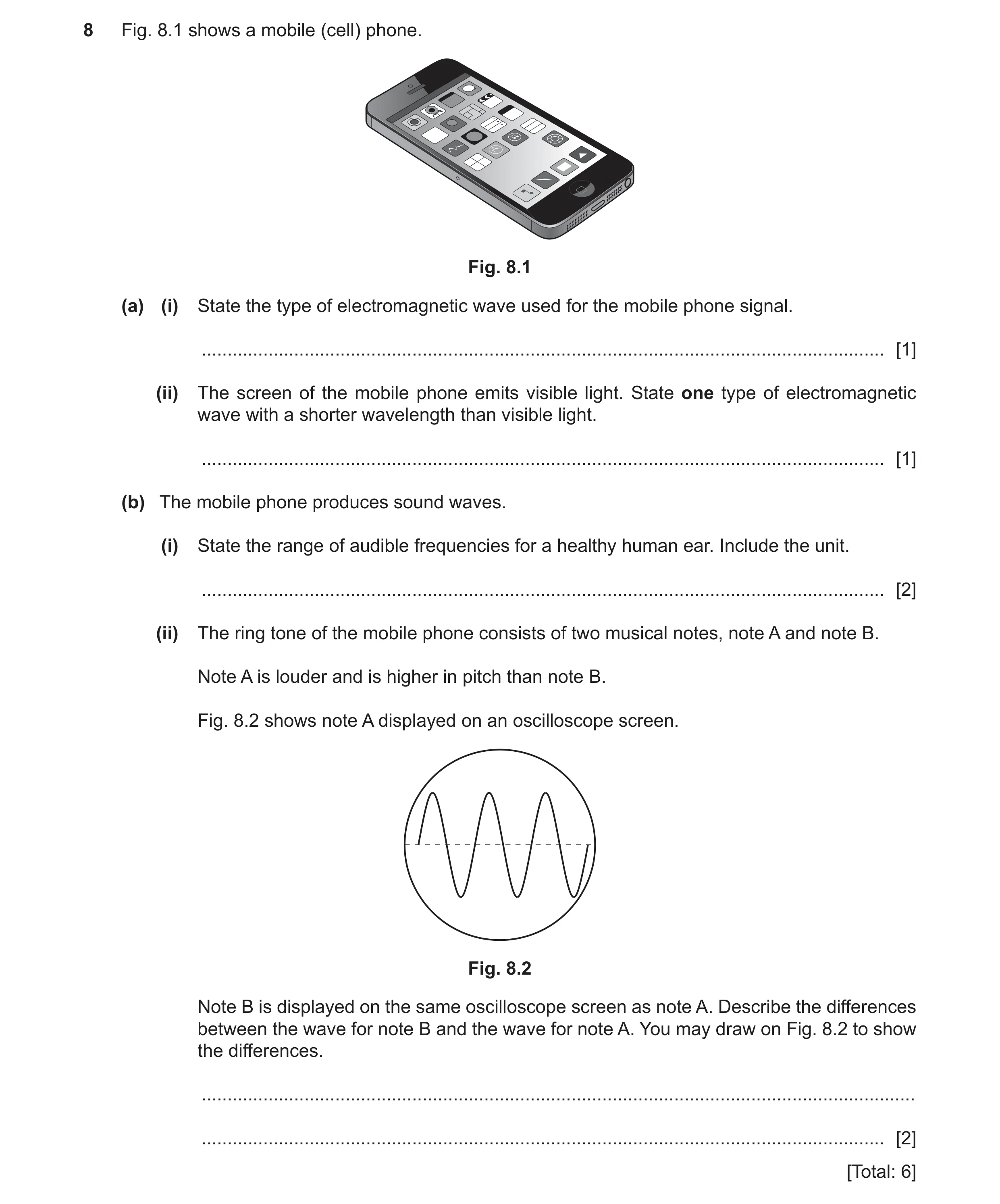
8 Fig. 8.1 shows a mobile (cell) phone. Fig. 8.1 (a) (i) State the type of electromagnetic wave used for the mobile phone signal. … [1] (ii) The screen of the mobile phone emits visible light. State one type of electromagnetic wave with a shorter wavelength than visible light. … [1] (b) The mobile phone produces sound waves. (i) State the range of audible frequencies for a healthy human ear. Include the unit. … [2] (ii) The ring tone of the mobile phone consists of two musical notes, note A and note B. Note A is louder and is higher in pitch than note B. Fig. 8.2 shows note A displayed on an oscilloscope screen. Fig. 8.2 Note B is displayed on the same oscilloscope screen as note A. Describe the differences between the wave for note B and the wave for note A. You may draw on Fig. 8.2 to show the differences. … … [2] [Total: 6]
6 marks
Mark scheme: 8(a)(i) microwave B1 8(a)(ii) ultraviolet / UV OR X-ray OR γ- / gamma (rays) B1 8(b)(i) 20 to 20 000 B1 Hz or hertz B1 8(b)(ii) (note B has) smaller amplitude OR note A has larger amplitude B1 (note B has) lower frequency OR longer wavelength OR note A has higher frequency OR shorter wavelength B1
This question in 0625/31 Oct/Nov 2020
Q19 · A loudspeaker is producing a sound 0625/31 May/June 2021
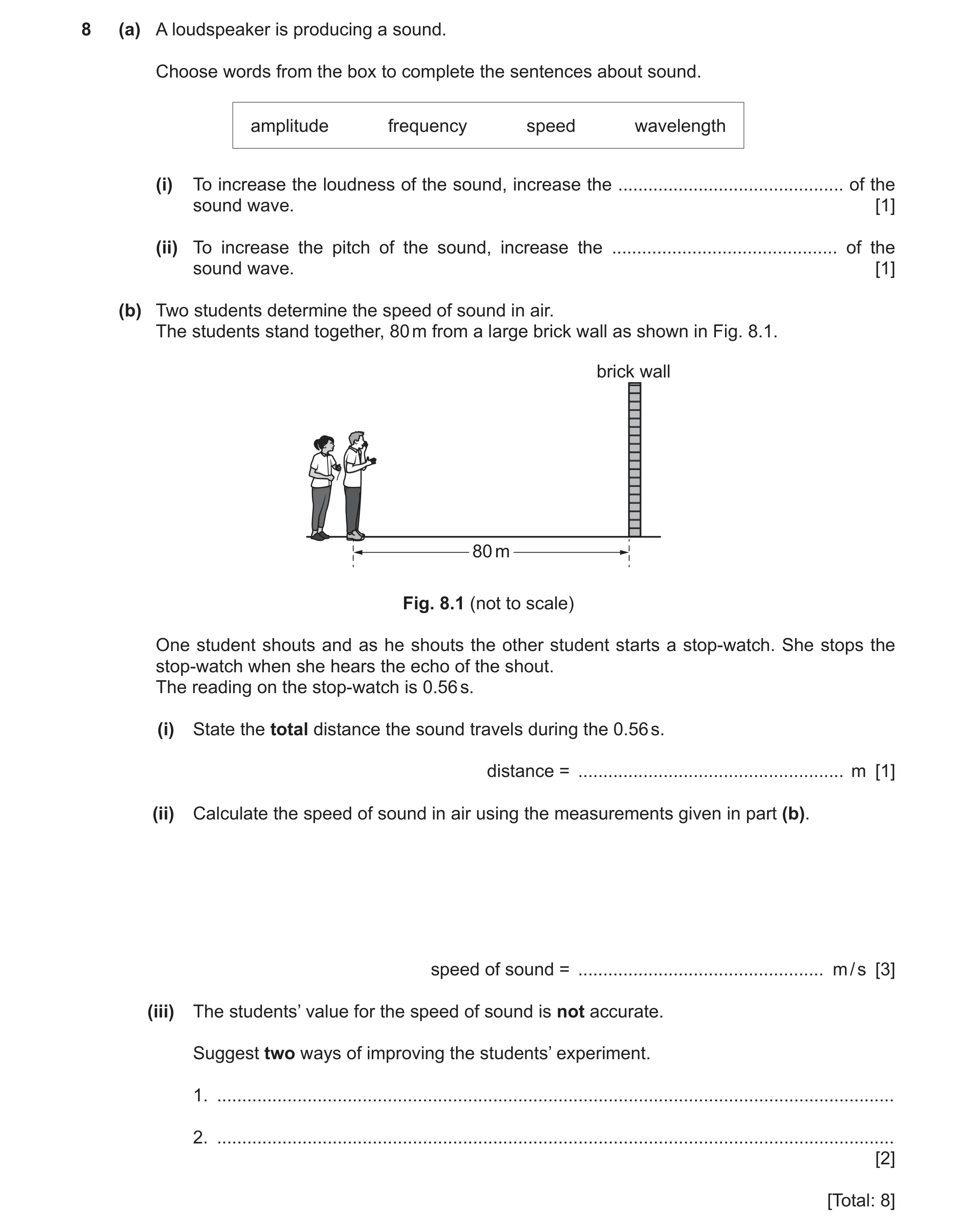
8 (a) A loudspeaker is producing a sound. Choose words from the box to complete the sentences about sound. amplitude frequency speed wavelength (i) To increase the loudness of the sound, increase the … of the sound wave. [1] (ii) To increase the pitch of the sound, increase the … of the sound wave. [1] (b) Two students determine the speed of sound in air. The students stand together, 80 m from a large brick wall as shown in Fig. 8.1. brick wall 80 m Fig. 8.1 (not to scale) One student shouts and as he shouts the other student starts a stop-watch. She stops the stop-watch when she hears the echo of the shout. The reading on the stop-watch is 0.56 s. (i) State the total distance the sound travels during the 0.56 s. distance = … m [1] (ii) Calculate the speed of sound in air using the measurements given in part (b). speed of sound = … m / s [3] (iii) The students’ value for the speed of sound is not accurate. Suggest two ways of improving the students’ experiment. 1. … 2. … [2] [Total: 8]
8 marks
Mark scheme: 8(a)(i) amplitude B1 8(a)(ii) frequency B1 8(b)(i) 160 (m) B1 8(b)(ii) (s = ) d ÷ t (speed of sound =) distance ÷ time C1 160 ÷ 0.56 C1 290 (m / s) A1 8(b)(iii) any two from: use something to give sharper sound stand further away from wall no other walls nearby both students stand at 80 (m)/same distance (from wall) repeat (the measurement/experiment) AND average (results) B2
This question in 0625/31 May/June 2021
Q20 · Part of a water wave 0625/31 Oct/Nov 2021
6 (a) Fig. 6.1 shows part of a water wave. R height P Q 0 S distance T Fig. 6.1 (i) State the letter P, Q, R, S or T on Fig. 6.1 that represents the wavelength of the water wave. … [1] (ii) State the letter P, Q, R, S or T on Fig. 6.1 that represents the amplitude of the water wave. … [1] (iii) State what is meant by the term frequency of a wave. … … [1] (b) Two students, A and B, use echoes to measure the speed of sound. Student A has two blocks of wood that make a loud sound when banged together. Student B has a stop‑watch. They stand 120 m from a school wall as shown in Fig. 6.2. stop-watch school wall blocks of wood B A 120 m Fig. 6.2 (not to scale) Describe how the students use the arrangement in Fig. 6.2 to determine the speed of sound in air. … … … … … … … [4] [Total: 7]
7 marks
Mark scheme: 6(a)(i) R B1 6(a)(ii) P B1 6(a)(iii) idea of: number of (complete) waves {sent out or produced or passing a point} {in one second or unit time} B1 6(b) any four from: (student A) bangs two blocks of wood together (student B) starts stopwatch when (sees) blocks or wood collide (student B) stops stopwatch when she hears echo repeat (experiment) AND calculate average (time) uses 240 m as distance travelled by sound owtte use s= d ÷ t B4
This question in 0625/31 Oct/Nov 2021
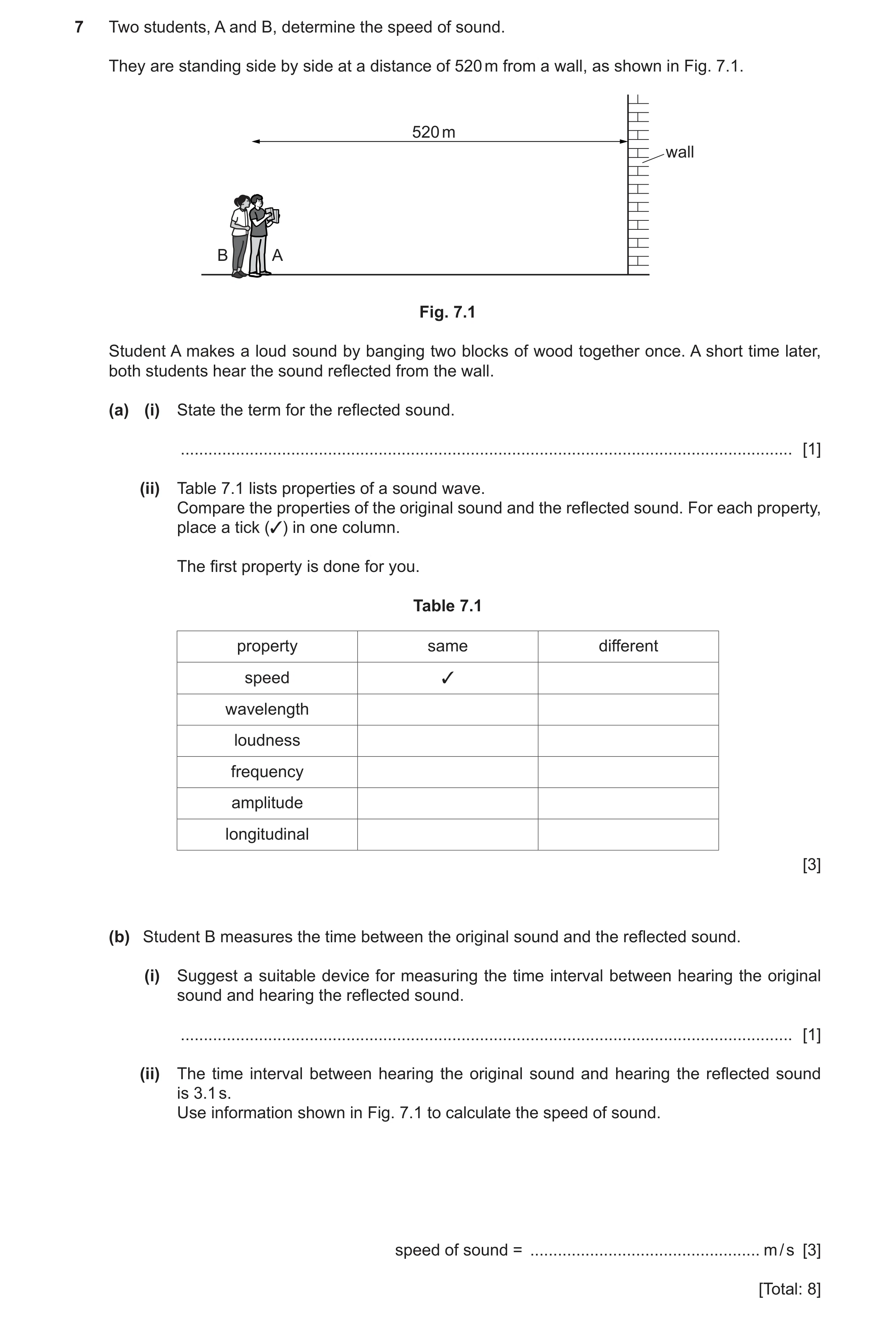
Q21 · Two students, A and B, determine the speed of sound 0625/33 Oct/Nov 2022
7 Two students, A and B, determine the speed of sound. They are standing side by side at a distance of 520 m from a wall, as shown in Fig. 7.1. 520 m wall B A Fig. 7.1 Student A makes a loud sound by banging two blocks of wood together once. A short time later, both students hear the sound reflected from the wall. (a) (i) State the term for the reflected sound. … [1] (ii) Table 7.1 lists properties of a sound wave. Compare the properties of the original sound and the reflected sound. For each property, place a tick (✓) in one column. The first property is done for you. Table 7.1 property same different speed ✓ wavelength loudness frequency amplitude longitudinal [3] (b) Student B measures the time between the original sound and the reflected sound. (i) Suggest a suitable device for measuring the time interval between hearing the original sound and hearing the reflected sound. … [1] (ii) The time interval between hearing the original sound and hearing the reflected sound is 3.1 s. Use information shown in Fig. 7.1 to calculate the speed of sound. speed of sound = … m / s [3] [Total: 8]
8 marks
Mark scheme: 7(a)(i) echo B1 7(a)(ii) B3 property same different speed ✓ wavelength ✓ loudness ✓ frequency ✓ amplitude ✓ longitudinal ✓ 7(b)(i) stopwatch B1 7(b)(ii) 340 (m / s) A3 (2 520) ÷ 3.1 OR 1040 ÷ 3.1 (C2) (distance =) 2 520 OR 1040 OR (speed =) distance ÷ time in any form (C1)
This question in 0625/33 Oct/Nov 2022
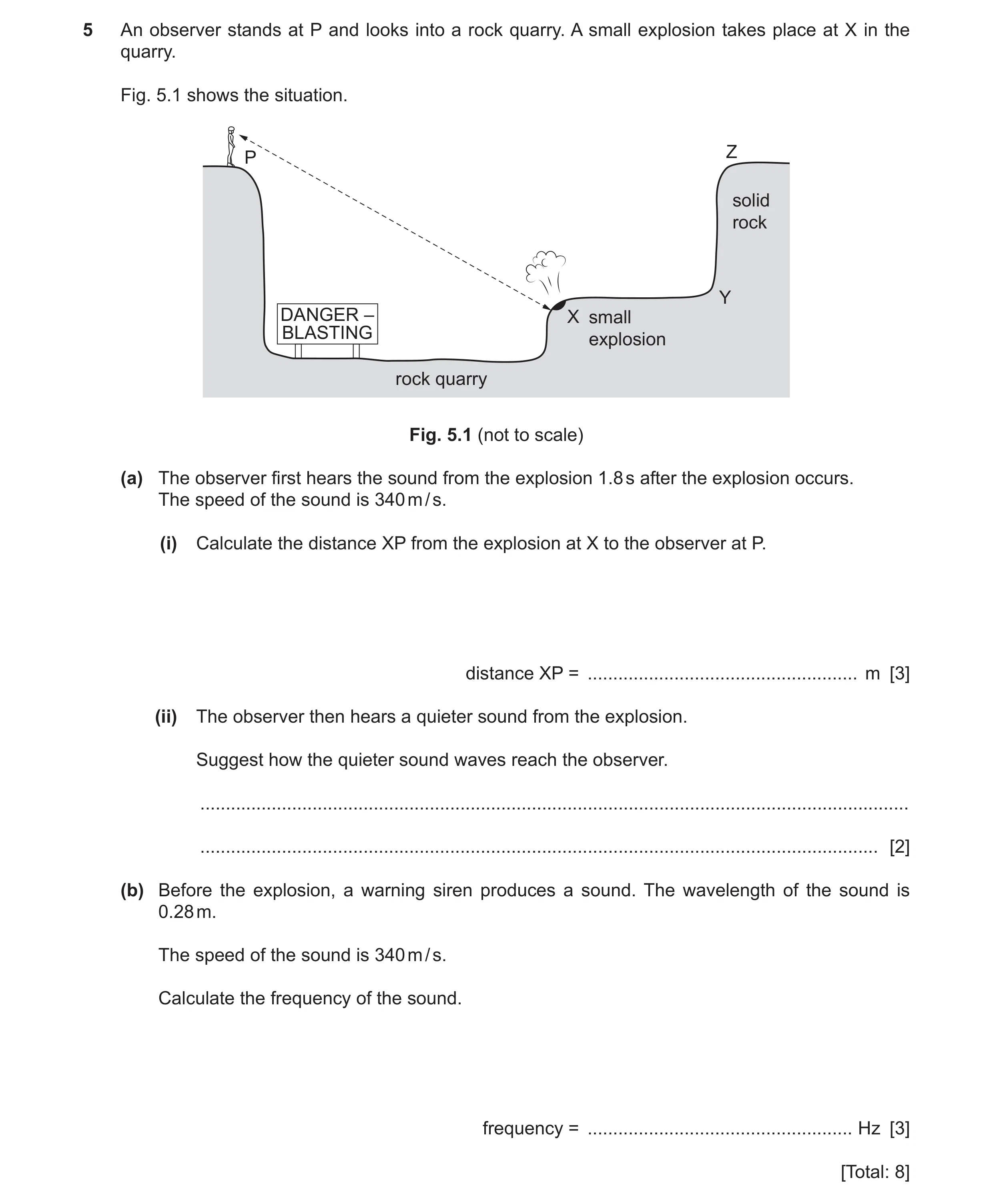
Q22 · An observer stands at P and looks into a rock quarry 0625/32 May/June 2023
5 An observer stands at P and looks into a rock quarry. A small explosion takes place at X in the quarry. Fig. 5.1 shows the situation. Z P solid rock Y DANGER – X small BLASTING explosion rock quarry Fig. 5.1 (not to scale) (a) The observer first hears the sound from the explosion 1.8 s after the explosion occurs. The speed of the sound is 340 m / s. (i) Calculate the distance XP from the explosion at X to the observer at P. distance XP = … m [3] (ii) The observer then hears a quieter sound from the explosion. Suggest how the quieter sound waves reach the observer. … … [2] (b) Before the explosion, a warning siren produces a sound. The wavelength of the sound is 0.28 m. The speed of the sound is 340 m / s. Calculate the frequency of the sound. frequency = … Hz [3] [Total: 8]
8 marks
Mark scheme: 5(a)(i) 610 (m) A3 340 = distance ÷ 1.8 OR (distance =) 340 1.8 (C2) speed = distance ÷ time in any form (C1) 5(a)(ii) an echo OR sound (waves) reflecting B1 from rocks OR YZ OR Z OR bottom of quarry B1 5(b) 1200 (Hz) A3 340 = f 0.28 OR (f =) 340 ÷ 0.28 (C2) v = f in any form OR (f =) v ÷ (C1)
This question in 0625/32 May/June 2023
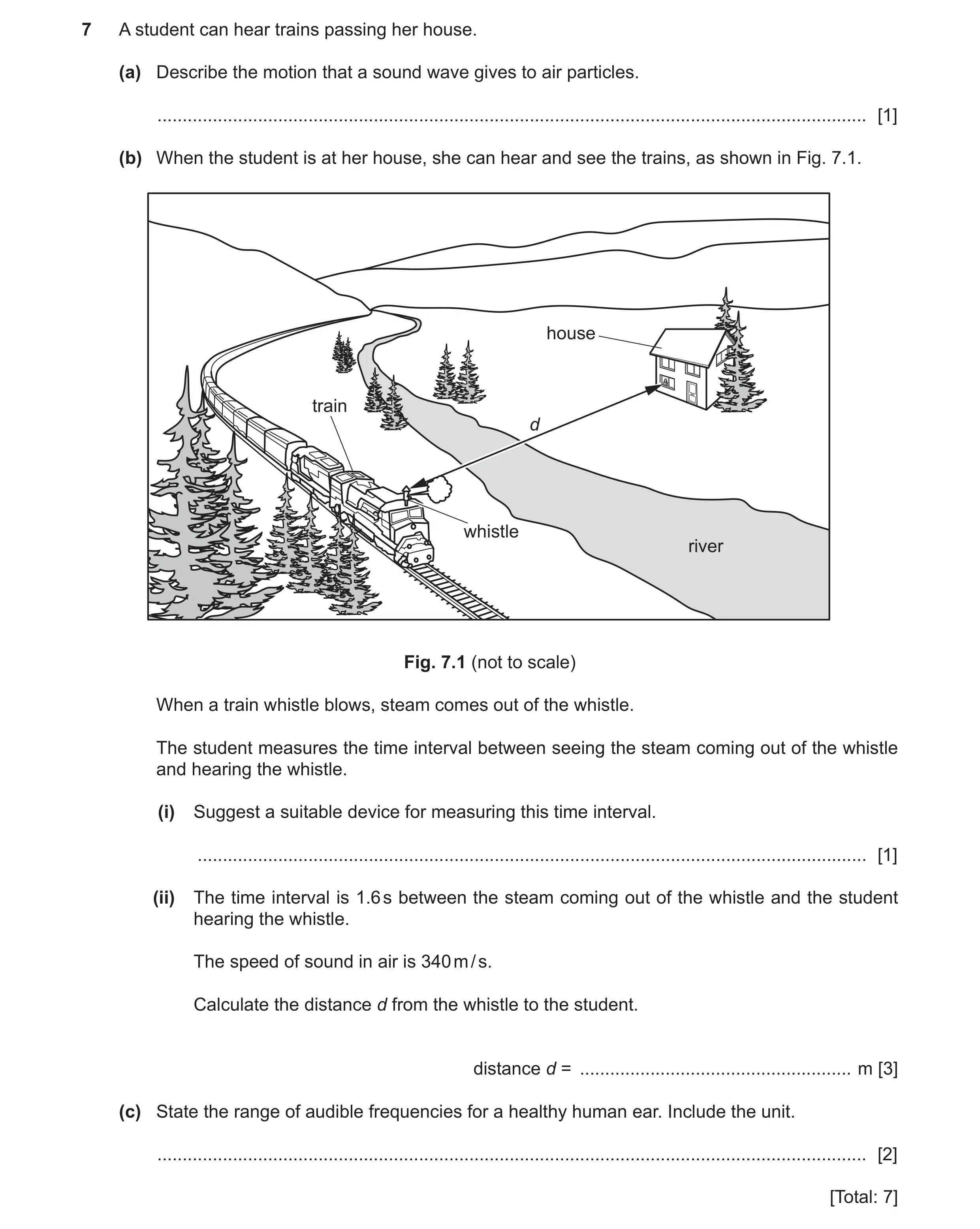
Q23 · A student can hear trains passing her house 0625/32 Oct/Nov 2023
7 A student can hear trains passing her house. (a) Describe the motion that a sound wave gives to air particles. … [1] (b) When the student is at her house, she can hear and see the trains, as shown in Fig. 7.1. house train d whistle river Fig. 7.1 (not to scale) When a train whistle blows, steam comes out of the whistle. The student measures the time interval between seeing the steam coming out of the whistle and hearing the whistle. (i) Suggest a suitable device for measuring this time interval. … [1] (ii) The time interval is 1.6 s between the steam coming out of the whistle and the student hearing the whistle. The speed of sound in air is 340 m / s. Calculate the distance d from the whistle to the student. distance d = … m [3] (c) State the range of audible frequencies for a healthy human ear. Include the unit. … [2] [Total: 7]
7 marks
Mark scheme: 7(a) oscillating / vibrating/backwards and forwards B1 7(b)(i) stopwatch / (stop)clock B1 7(b)(ii) 540 (m) A3 340 1.6 (C1) (distance =) speed time (C1) 7(c) 20 – 20 000 B1 Hz / hertz B1
This question in 0625/32 Oct/Nov 2023
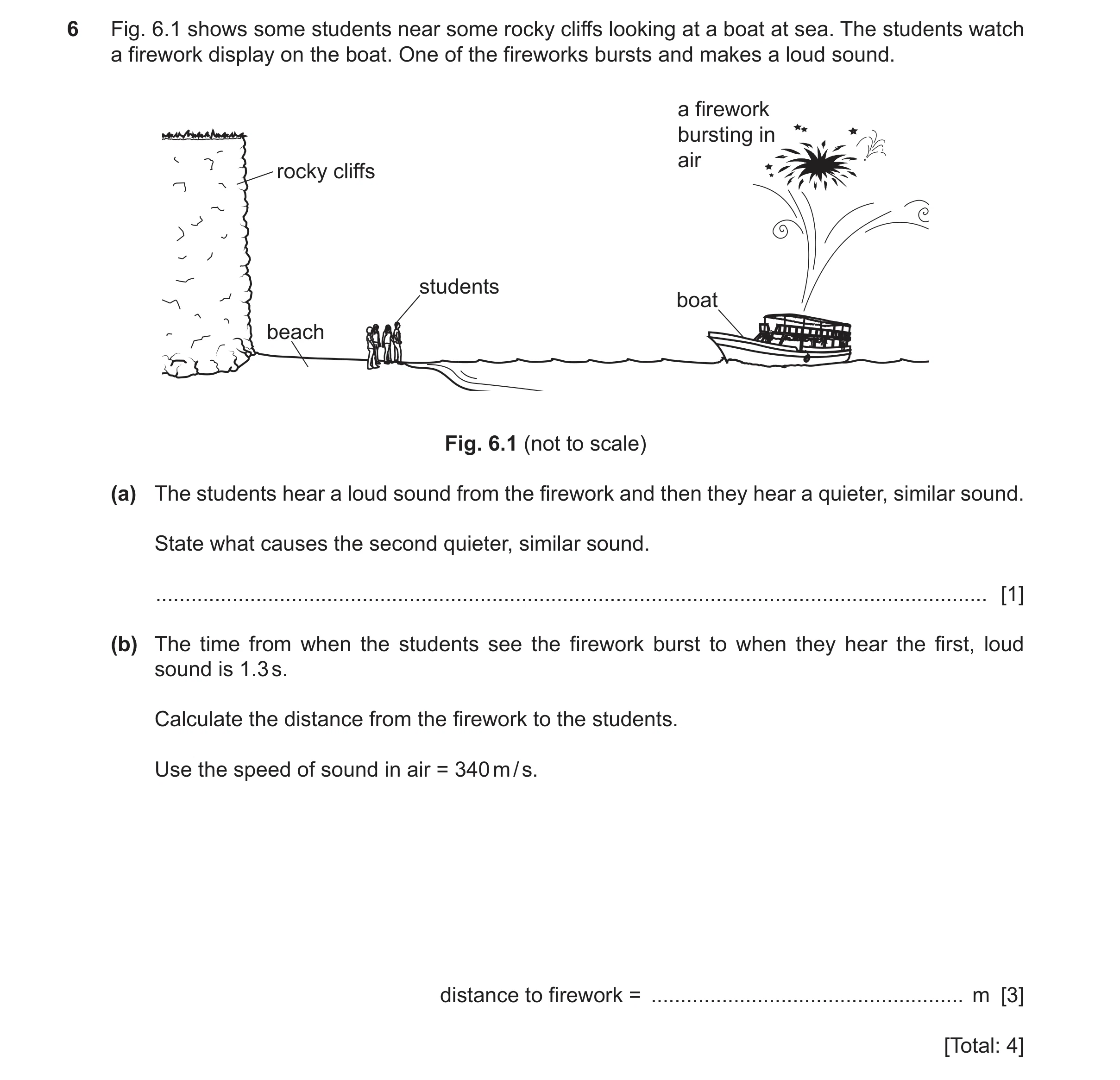
Q24 · Some students near some rocky cliffs looking at a boat at sea 0625/31 Oct/Nov 2024
6 Fig. 6.1 shows some students near some rocky cliffs looking at a boat at sea. The students watch a firework display on the boat. One of the fireworks bursts and makes a loud sound. a firework bursting in air rocky cliffs students boat beach Fig. 6.1 (not to scale) (a) The students hear a loud sound from the firework and then they hear a quieter, similar sound. State what causes the second quieter, similar sound. … [1] (b) The time from when the students see the firework burst to when they hear the first, loud sound is 1.3 s. Calculate the distance from the firework to the students. Use the speed of sound in air = 340 m / s. distance to firework = … m [3] [Total: 4]
4 marks
Mark scheme: 6(a) (sound is) reflected (from cliff ) OR echo (from cliff) B1 6(b) (d =) 440 (m) A3 (d =) 340 1.3 (C2) (d =) s t OR s = d t (C1)
This question in 0625/31 Oct/Nov 2024
Q25 · A student strikes a tuning fork on a wooden block 0625/32 Feb/March 2025
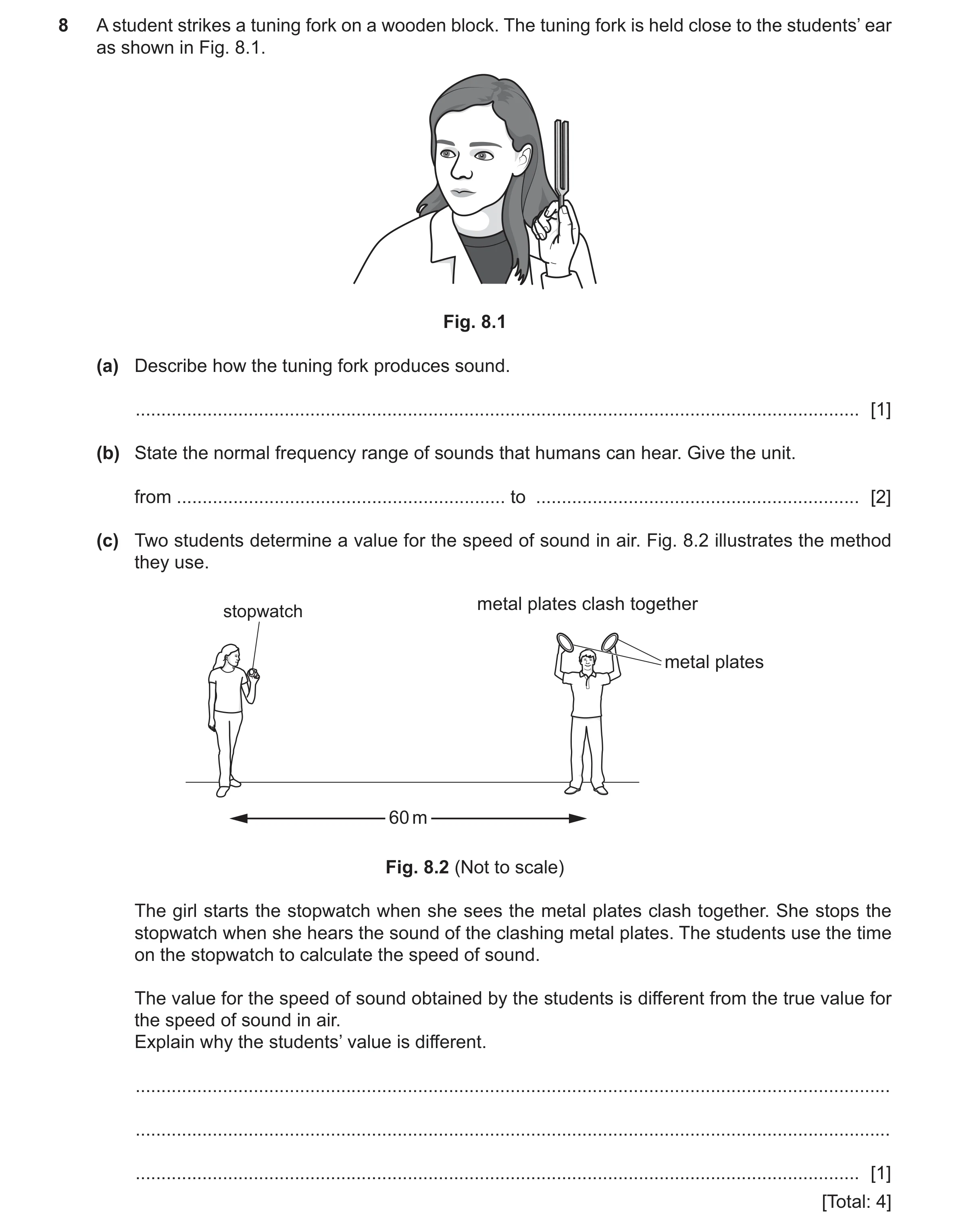
8 A student strikes a tuning fork on a wooden block. The tuning fork is held close to the students’ ear as shown in Fig. 8.1. Fig. 8.1 (a) Describe how the tuning fork produces sound. … [1] (b) State the normal frequency range of sounds that humans can hear. Give the unit. from … to … [2] (c) Two students determine a value for the speed of sound in air. Fig. 8.2 illustrates the method they use. metal plates clash together stopwatch metal plates 60 m Fig. 8.2 (Not to scale) The girl starts the stopwatch when she sees the metal plates clash together. She stops the stopwatch when she hears the sound of the clashing metal plates. The students use the time on the stopwatch to calculate the speed of sound. The value for the speed of sound obtained by the students is different from the true value for the speed of sound in air. Explain why the students’ value is different. … … … [1] [Total: 4]
4 marks
Mark scheme: 8(b) 20 to 20 000 B1 hertz OR Hz B1 8(c) reaction time B1 OR distance / time interval is too small
This question in 0625/32 Feb/March 2025
Q26 · A group of students are studying a topic called ‘Light and Sound’ 0625/32 Oct/Nov 2025
4 A group of students are studying a topic called ‘Light and Sound’. (a) Fig. 4.1 shows a demonstration using a noisy toy. air outlet noisy toy transparent box sound proof block Fig. 4.1 The teacher puts the noisy toy into a sealed, transparent case that contains air. The teacher removes the air from inside the case. The sound of the noisy toy becomes quieter until the students cannot hear it. The students can see the toy moving, but cannot hear it, because light and sound have different properties. State three differences between the properties of light and the properties of sound. 1 … 2 … 3 … [3] (b) The students go to a large park to determine the speed of sound. Describe an experiment for determining the speed of sound. You may draw a diagram as part of your answer. … … … … … … … … [4] (c) The students find that the speed of sound is 340 m / s. They strike a tuning fork of frequency 260 Hz. Calculate the wavelength of the sound that the tuning fork produces. wavelength = … m [3] [Total: 10]
10 marks
Mark scheme: 4(a) any three from: B3 • light travels through a vacuum or • sound does not travel through a vacuum / needs a medium owtte • light is transverse (wave – sound isn’t) • sound is longitudinal (wave – light isn’t) • light is electromagnetic / e.m. (wave – sound isn’t) • light travels at different speed than sound (in air) 4(b) two students / groups at least 100 m apart B1 any three from: B3 • distance measured by tape (measure) / trundle wheel • means of making loud sound (that is visible) e.g. wooden blocks • distant student / group start measuring time when sound is made e.g. when blocks colliding seen • distant student / group stop time measurement when sound is heard • (time measured by) stopwatch / stop-clock / timer • repeat (experiment) AND calculate average (time) • use speed = distance ÷ time in any form alternative MS for echo method: B1 two students / group at least 50 m from wall / solid structure any three from: B3 • distance measured by tape (measure) / trundle wheel • means of making loud sound e.g. shouting • another student / group start(s) measuring time when loud noise made • another student / group stop measuring when echo / number of echoes is / are heard • (time measured by) stopwatch / stop-clock / timer • repeat (experiment) AND calculate average (time) or perform sound-echo-sound-echo (n) ⩾ 9 times AND ÷ n • use speed = 2 distance ÷ time 4(c) 1.3 (m) A3 340 ÷ 260 C2 (wavelength =) speed ÷ frequency C1
This question in 0625/32 Oct/Nov 2025
 1 / 28
 2 / 28
 3 / 28
 4 / 28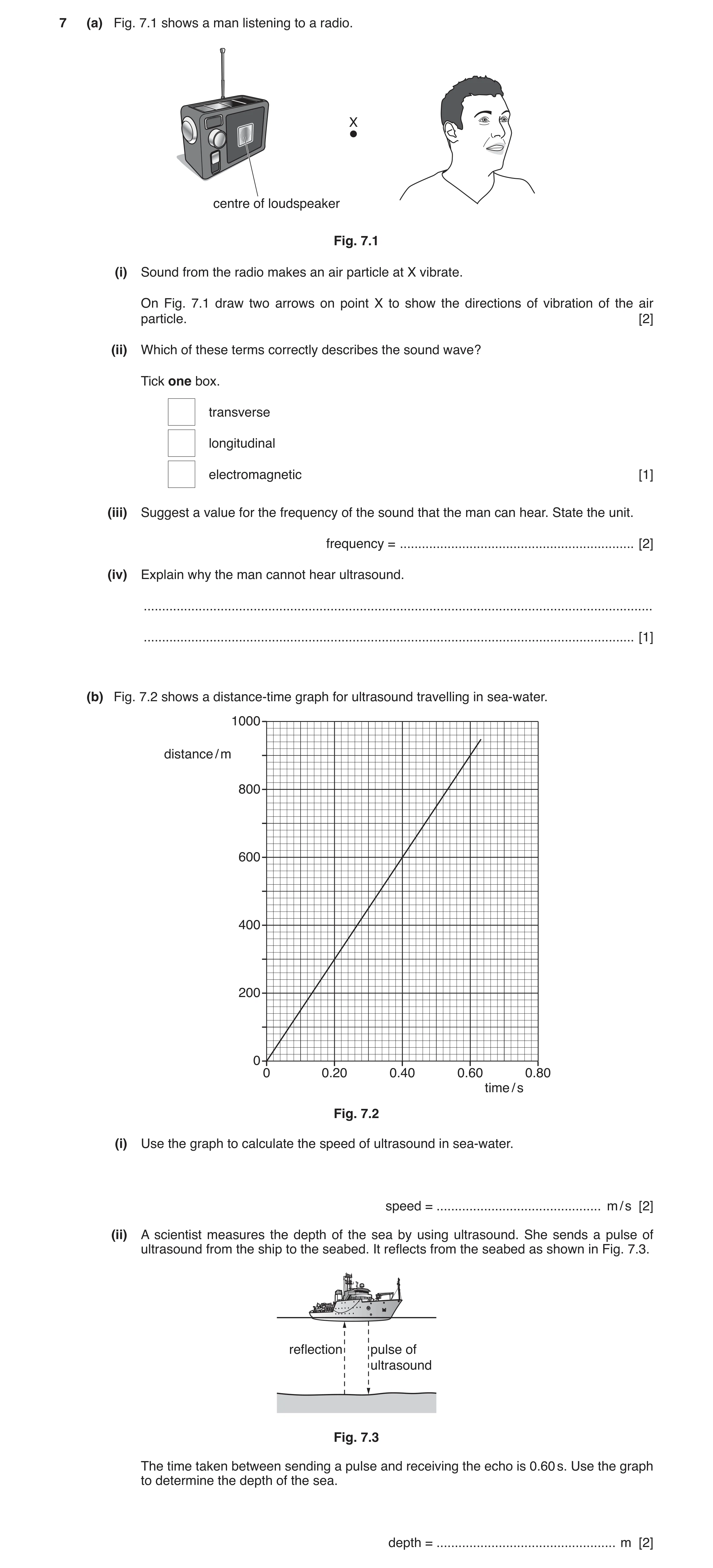
 9 / 28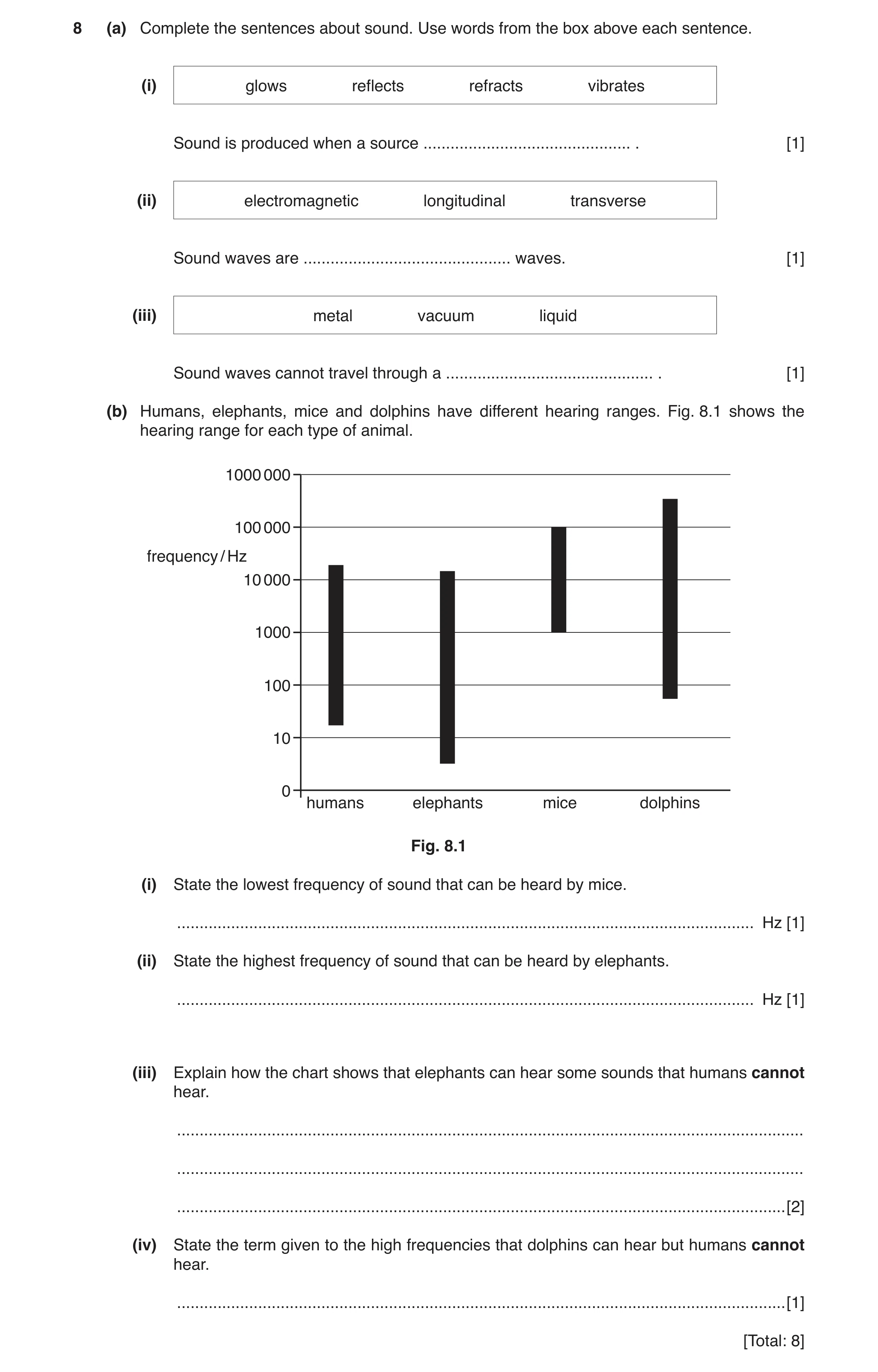
 11 / 28
 12 / 28
 13 / 28
 14 / 28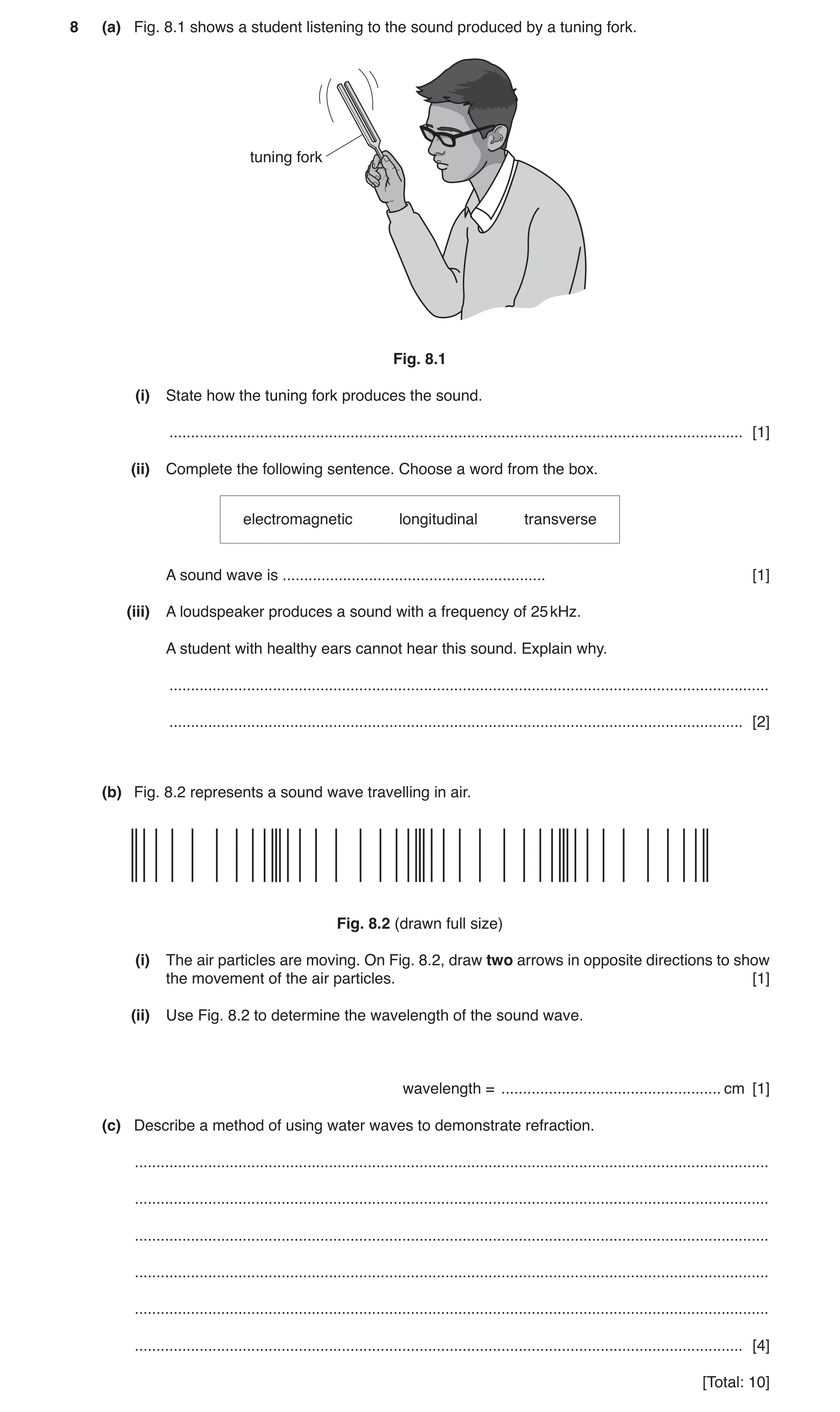
 16 / 28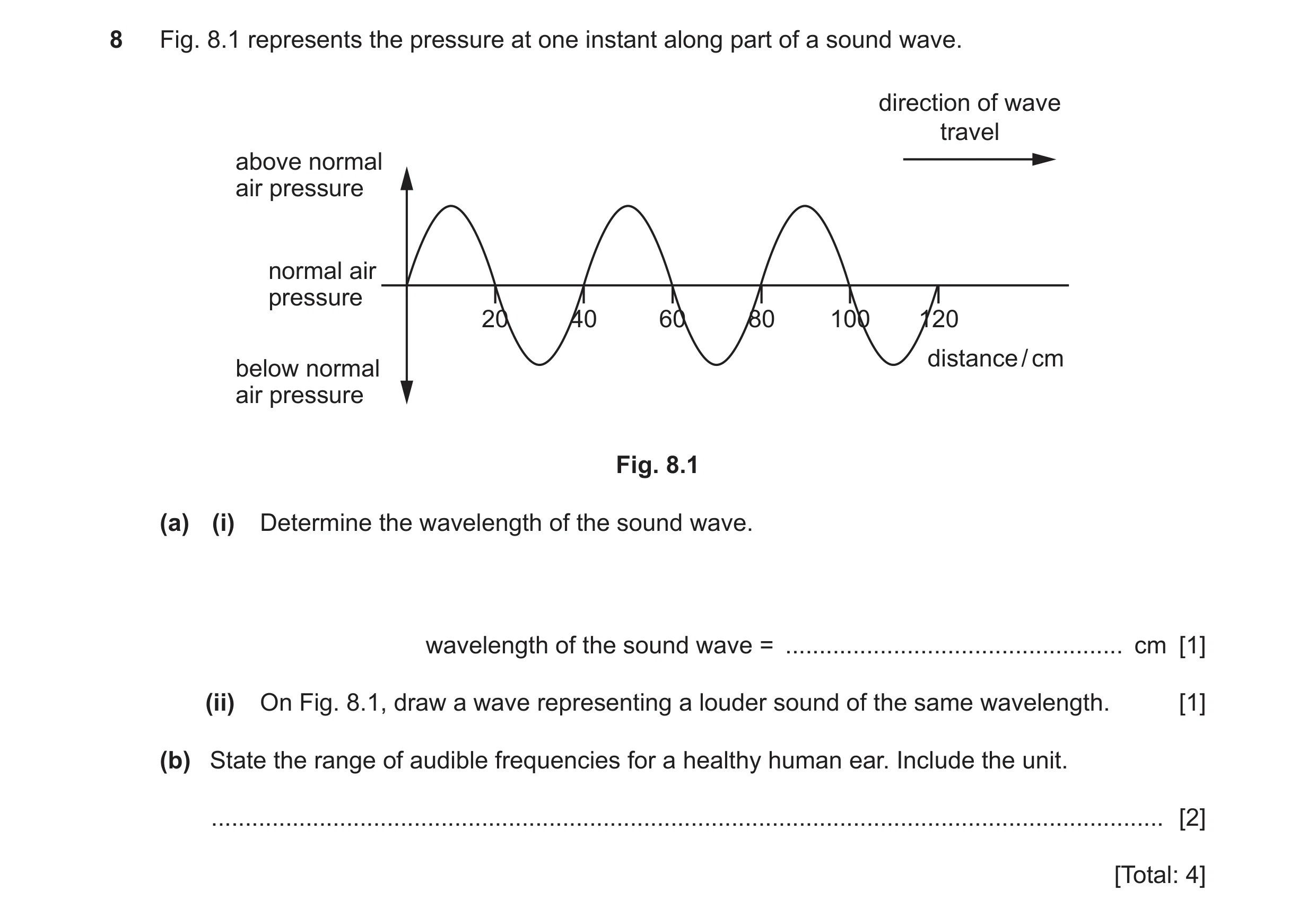
 17 / 28
 18 / 28
 19 / 28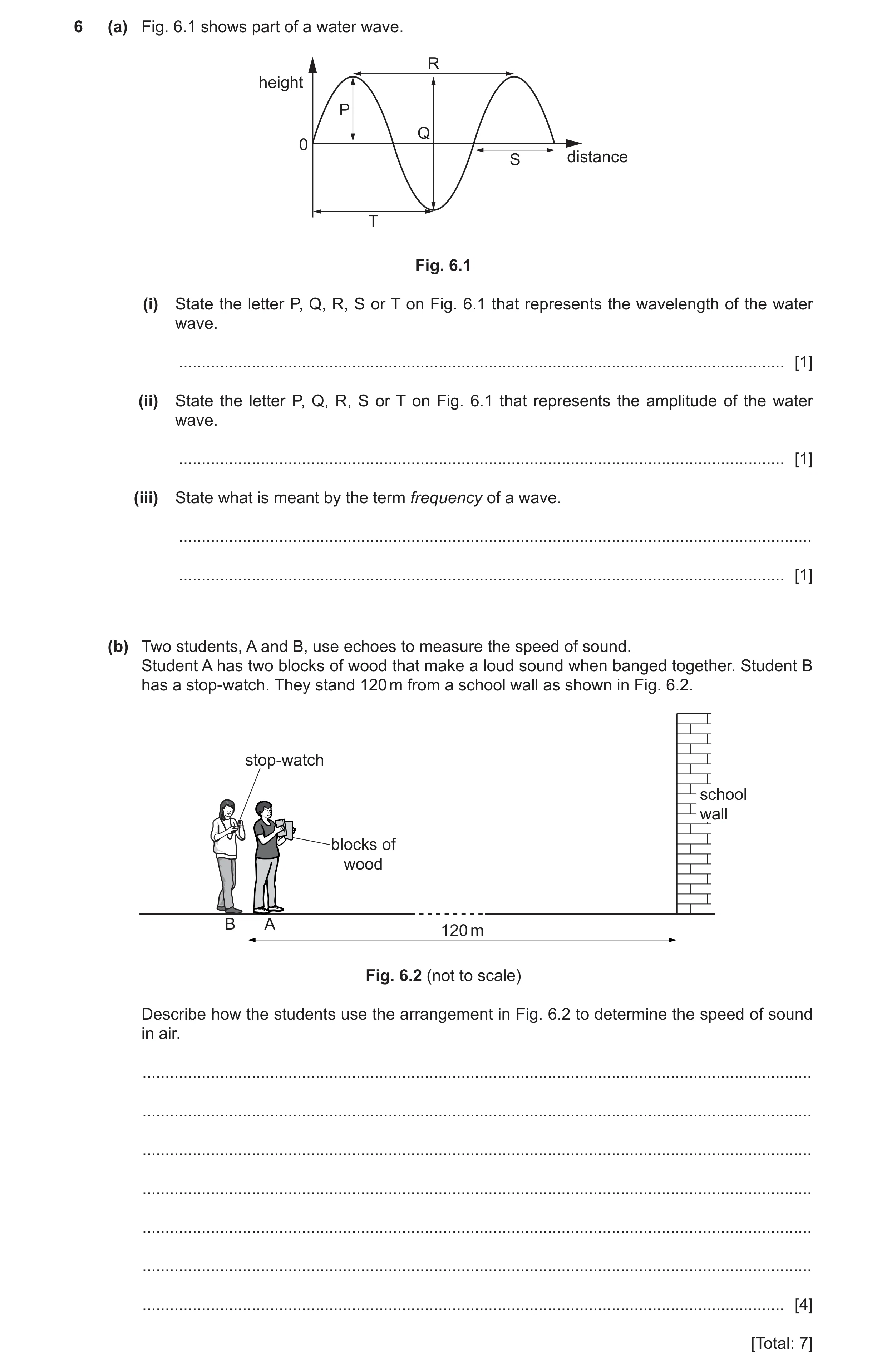
 23 / 28
 24 / 28
 25 / 28
 26 / 28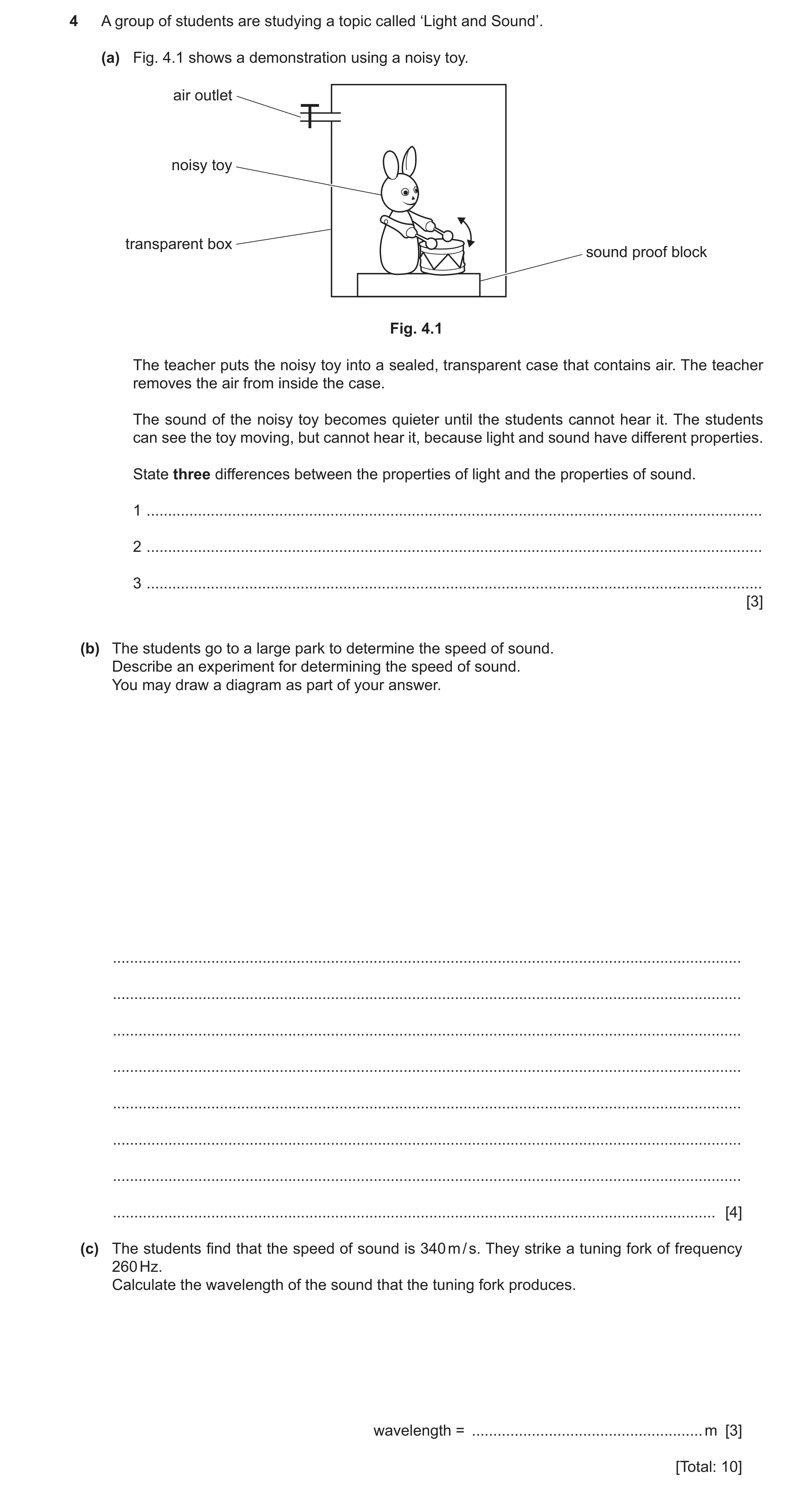
 8
8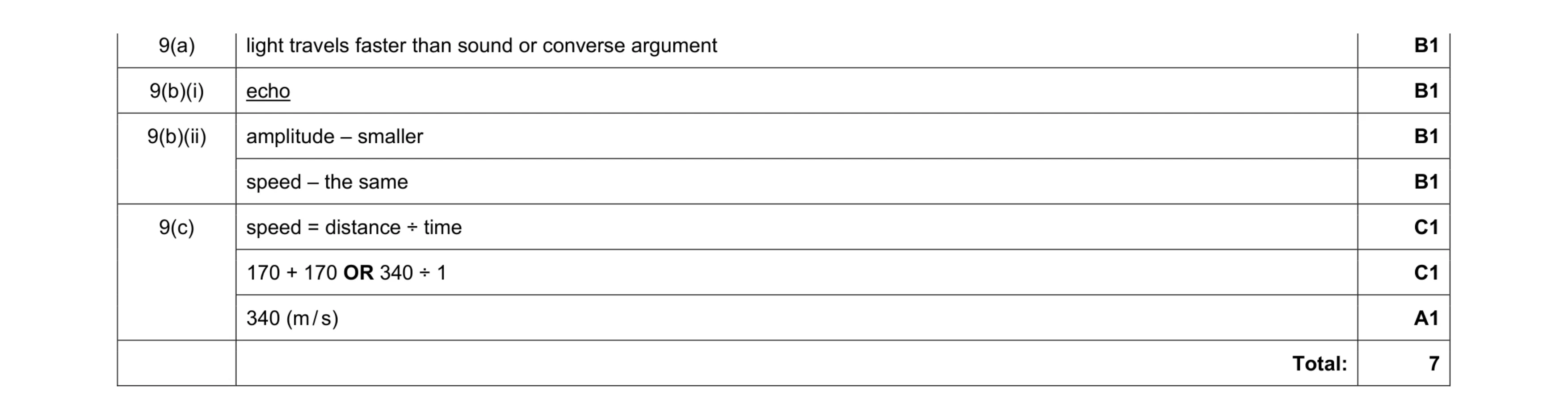 7
7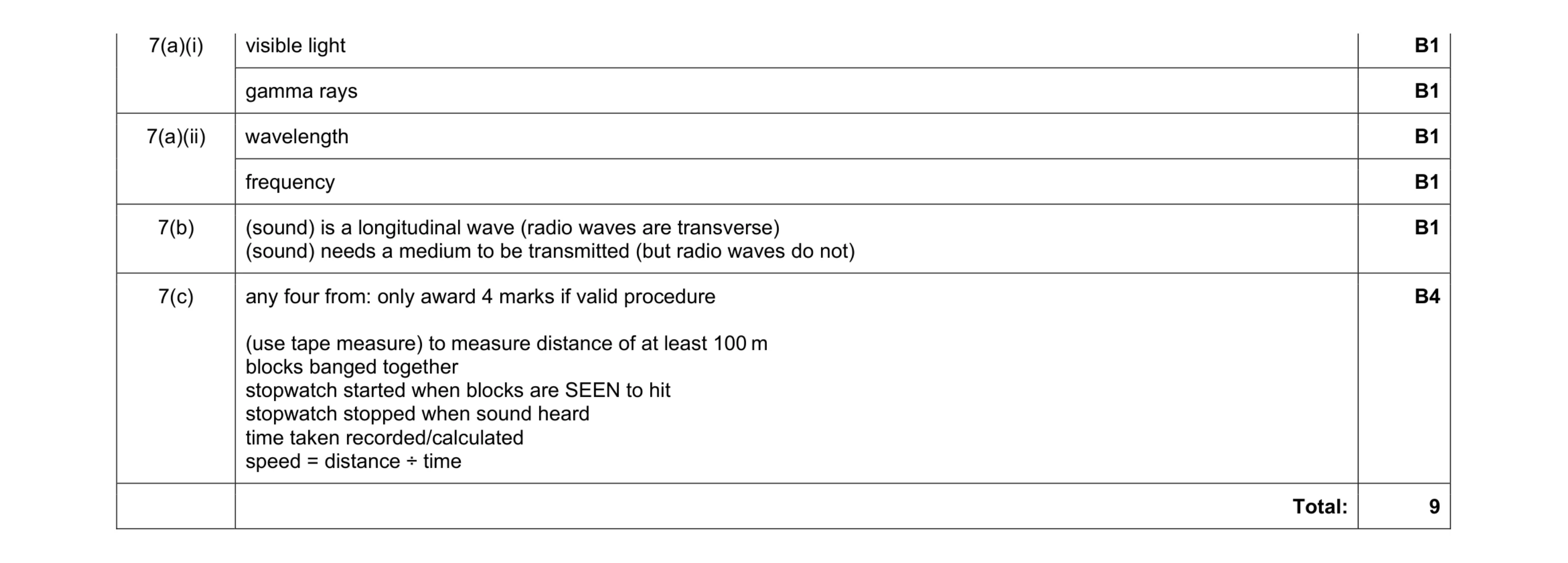 9
9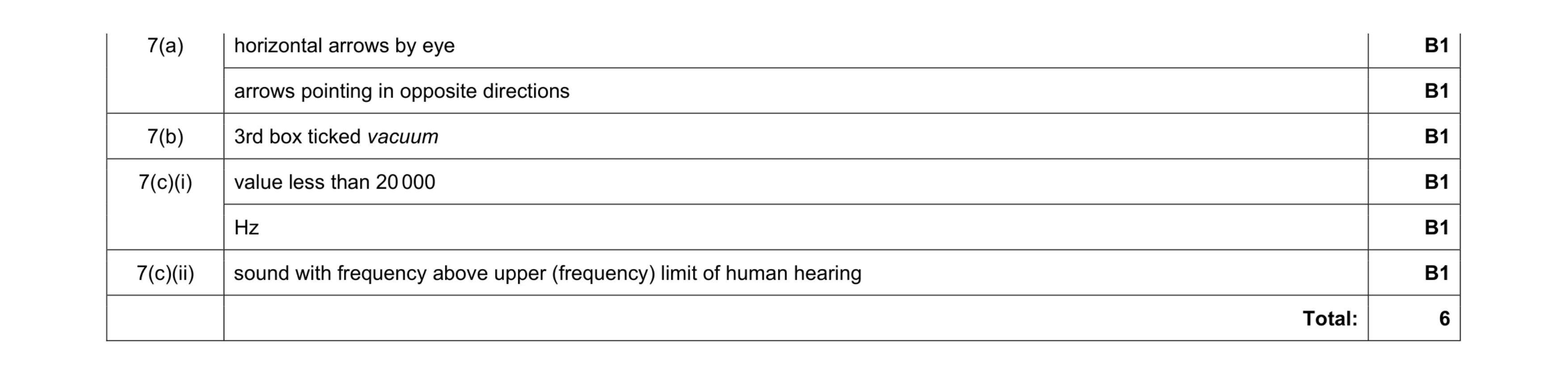 6
6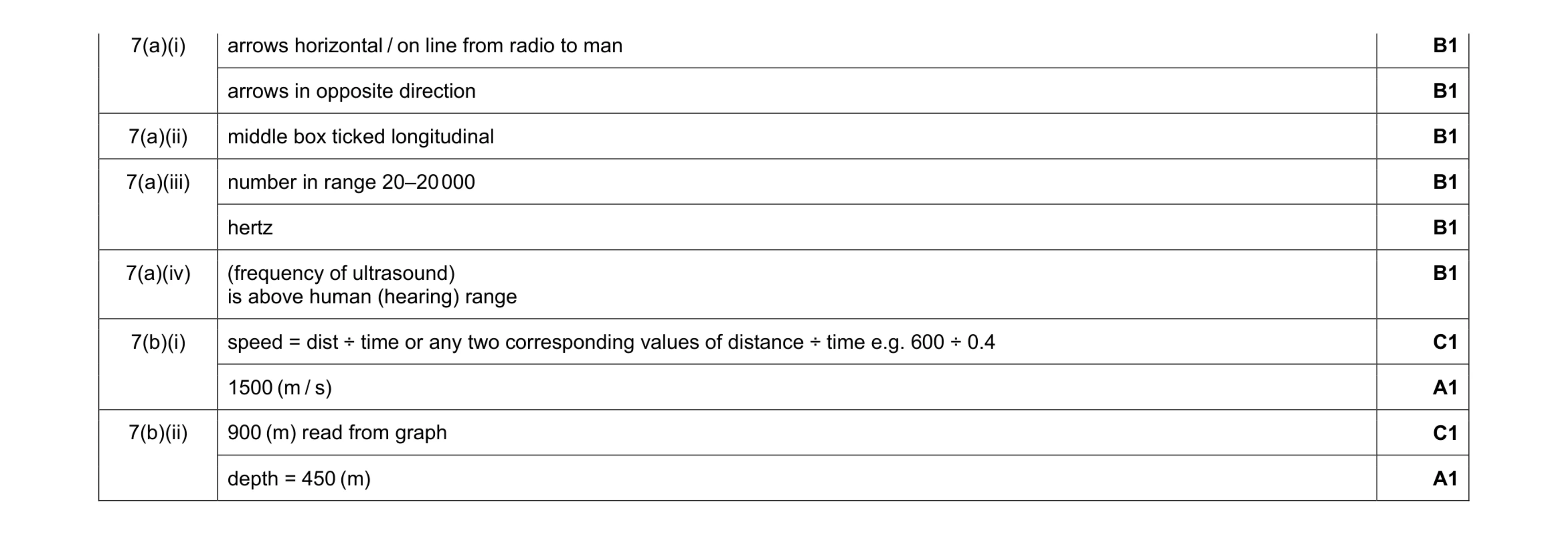 10
10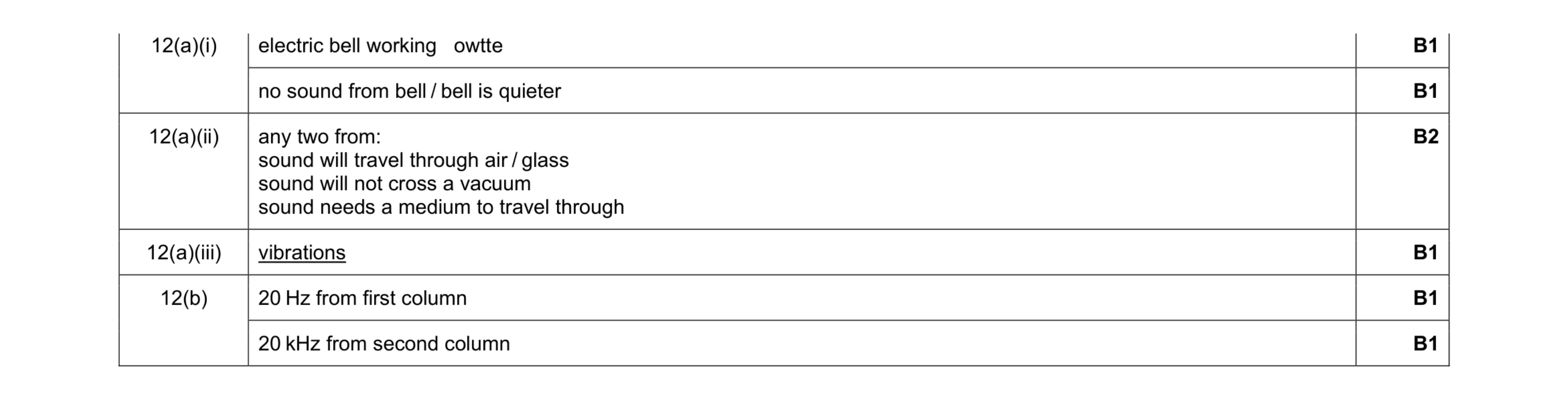 7
7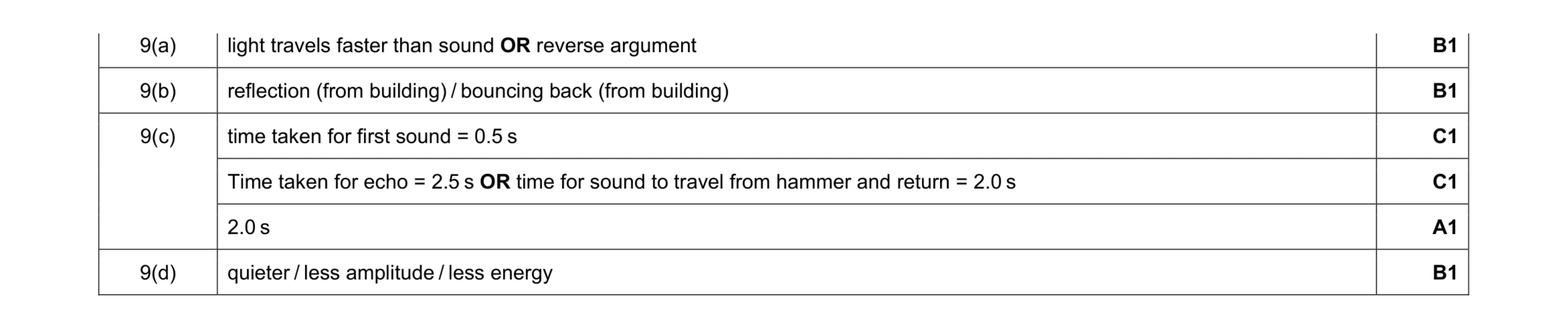 6
6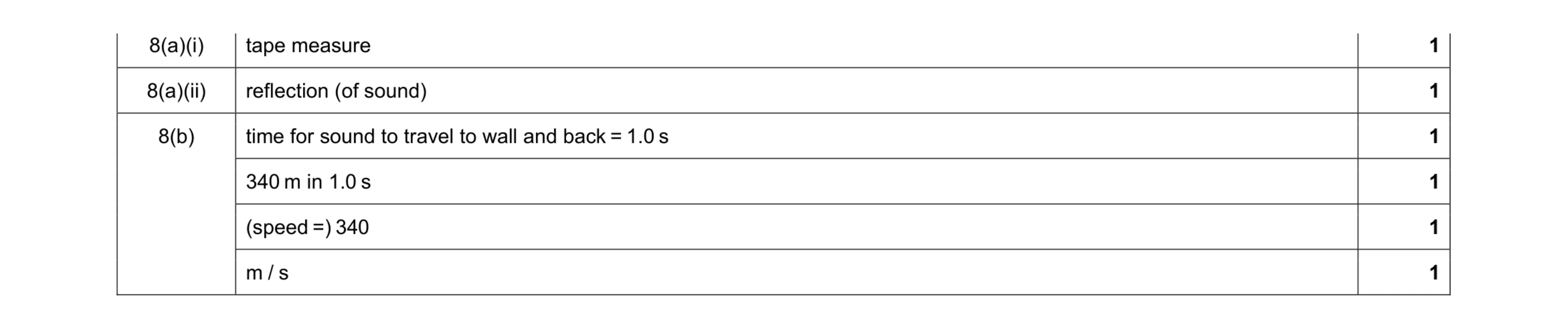 6
6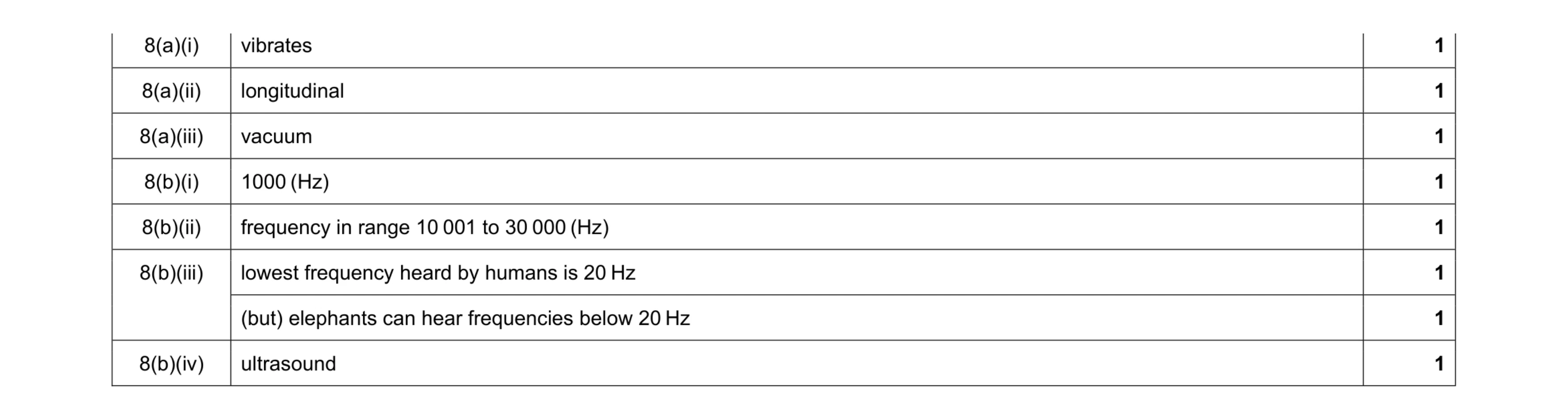 8
8 5
5 5
5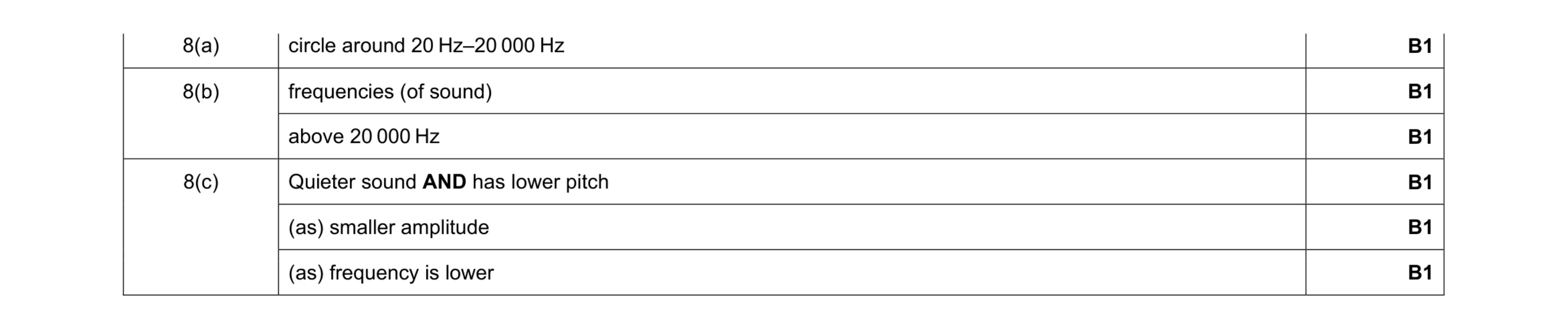 6
6 4
4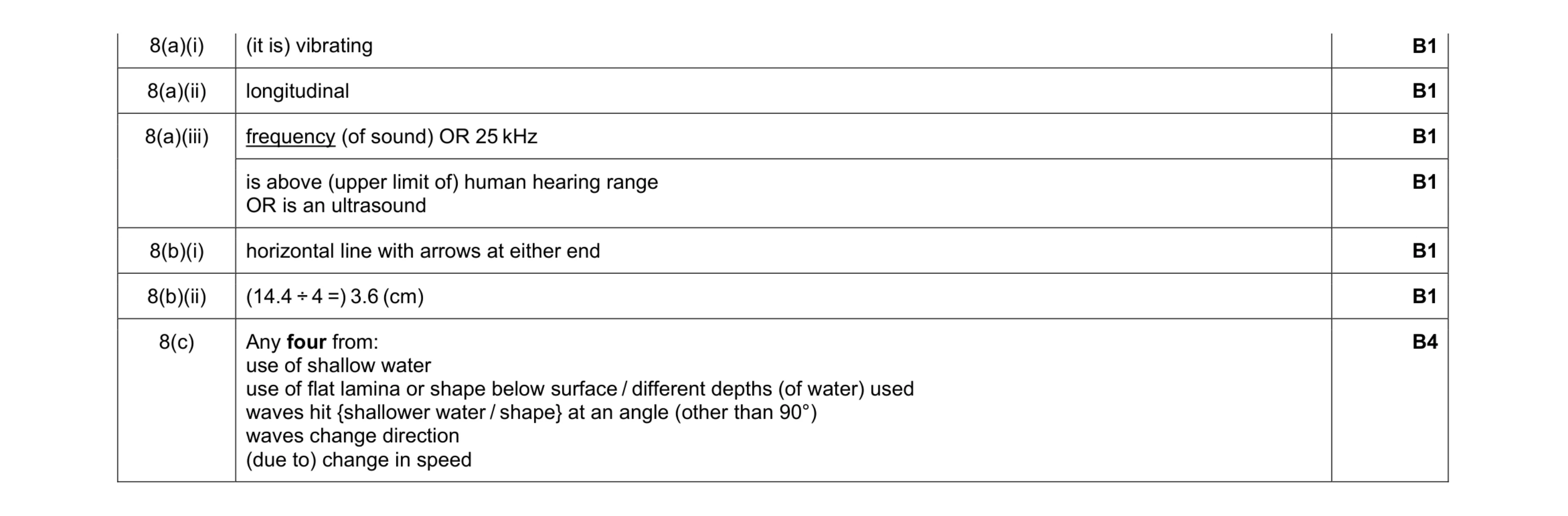 10
10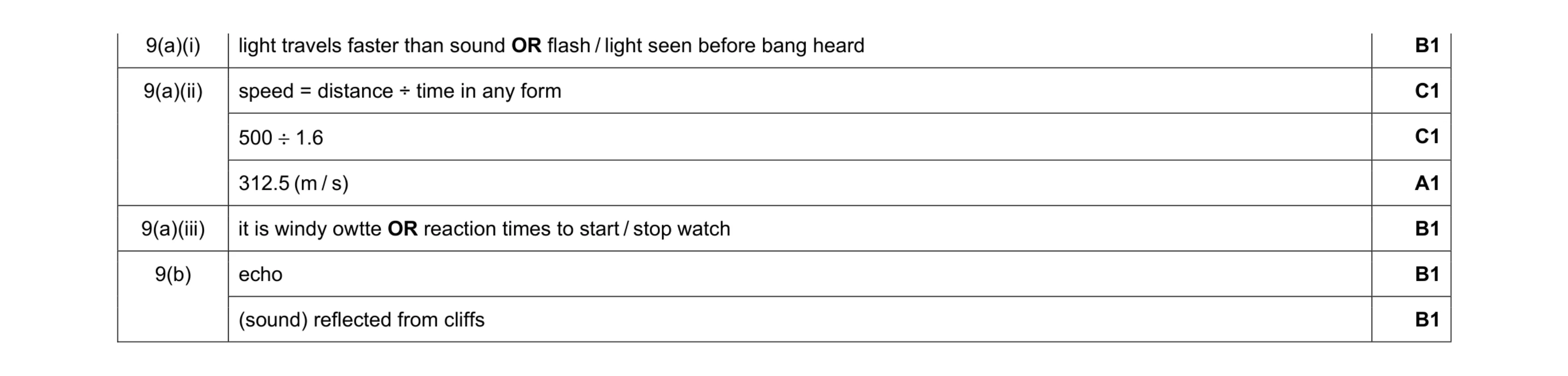 7
7 4
4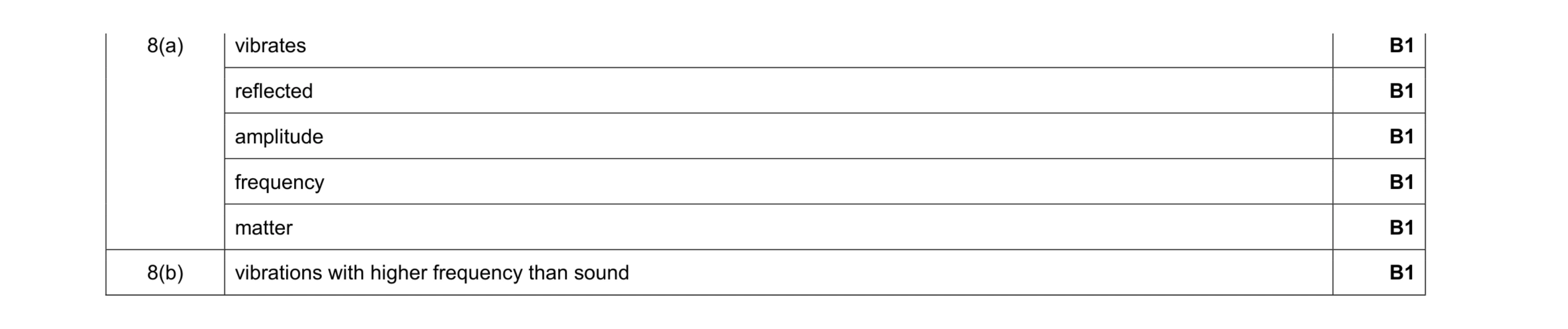 6
6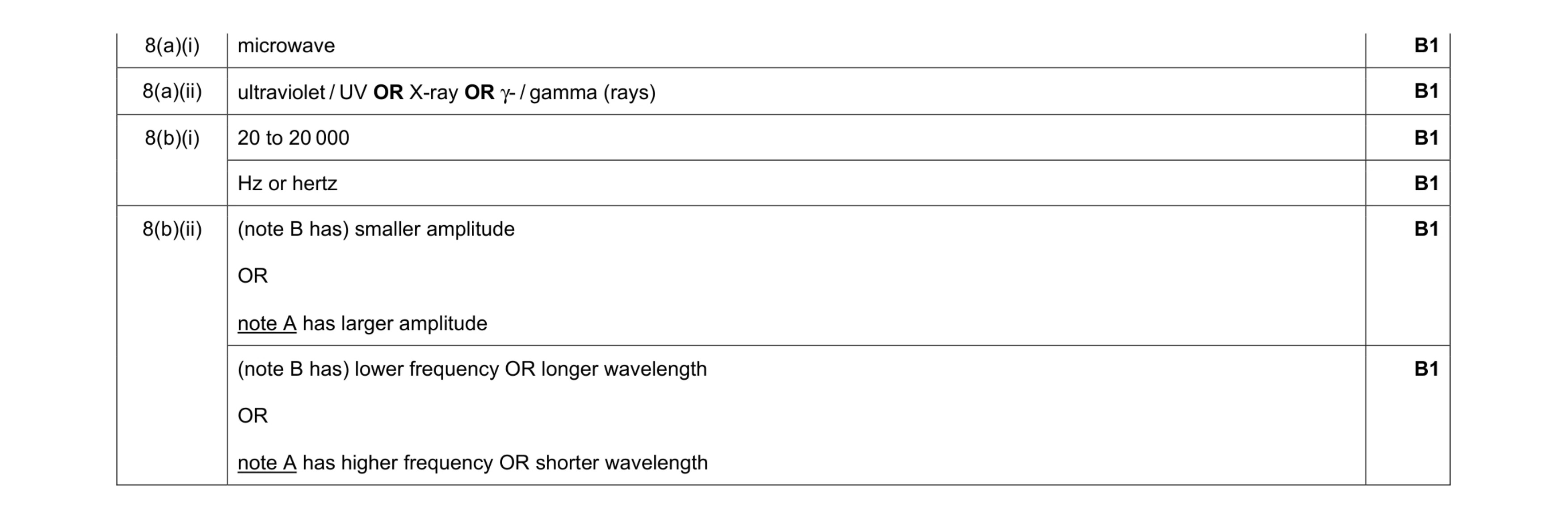 6
6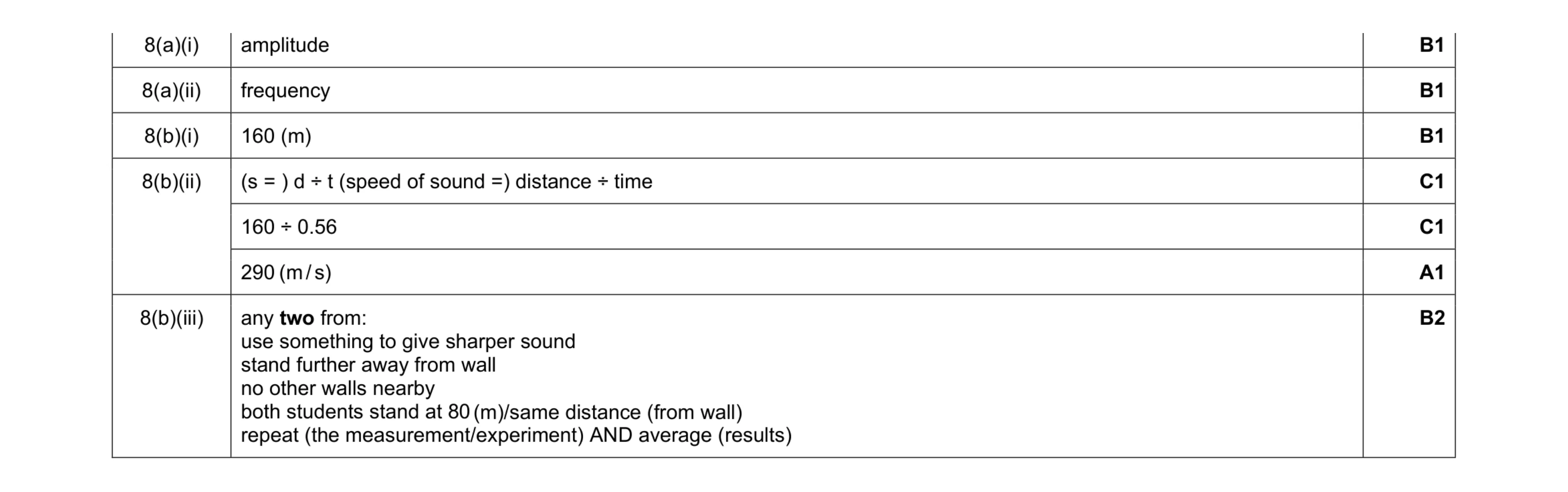 8
8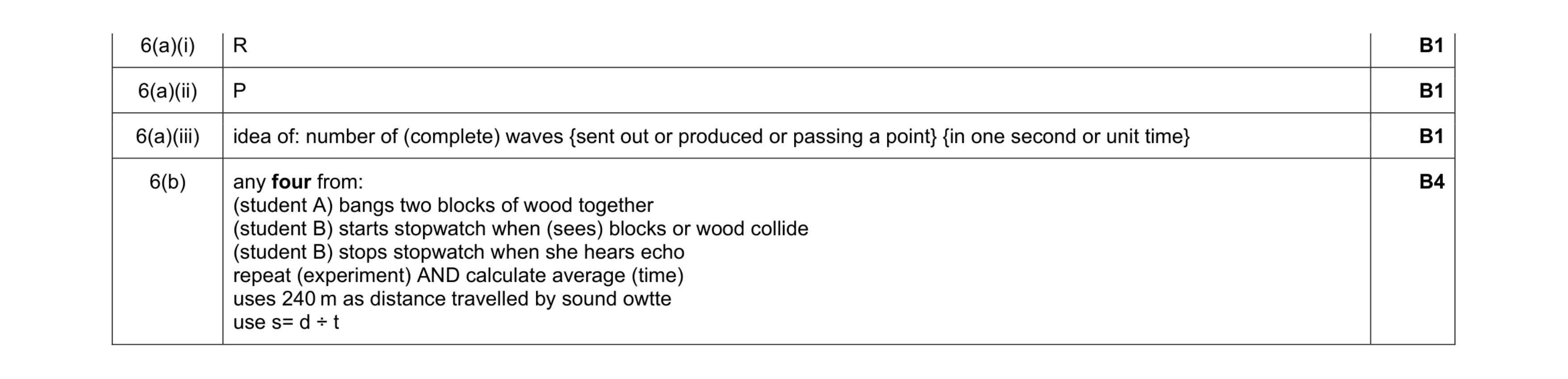 7
7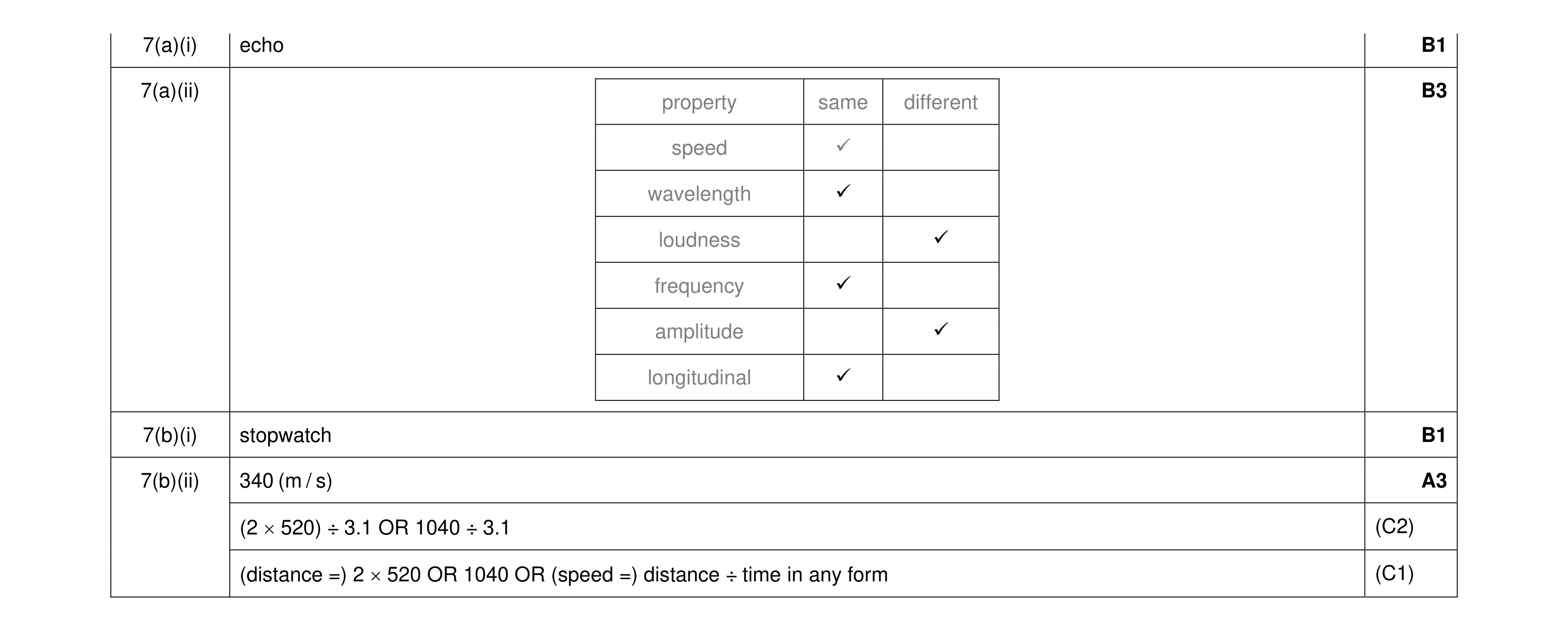 8
8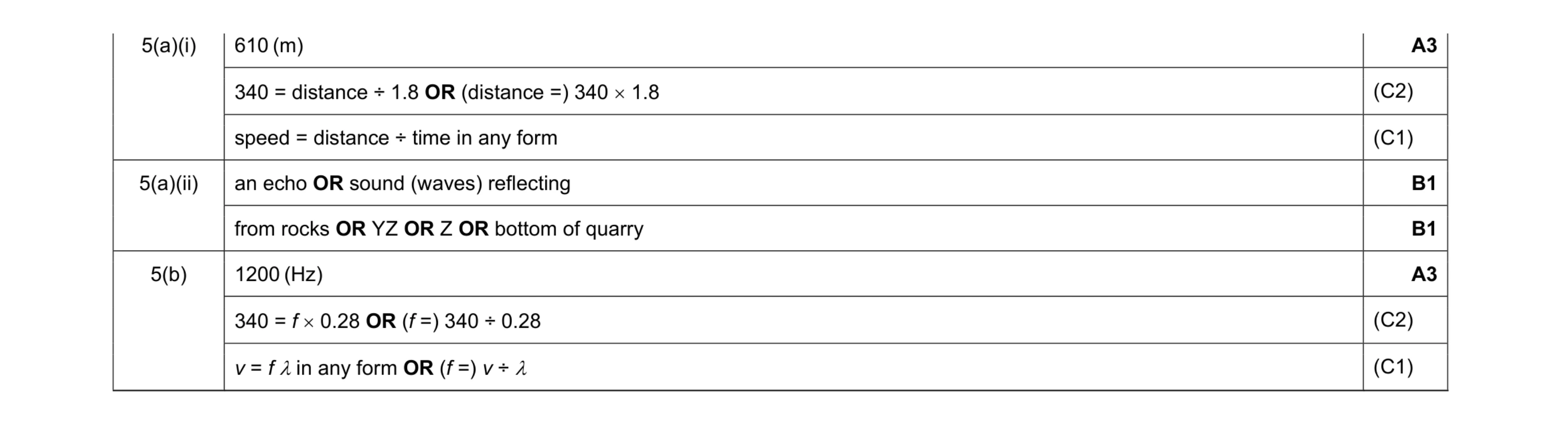 8
8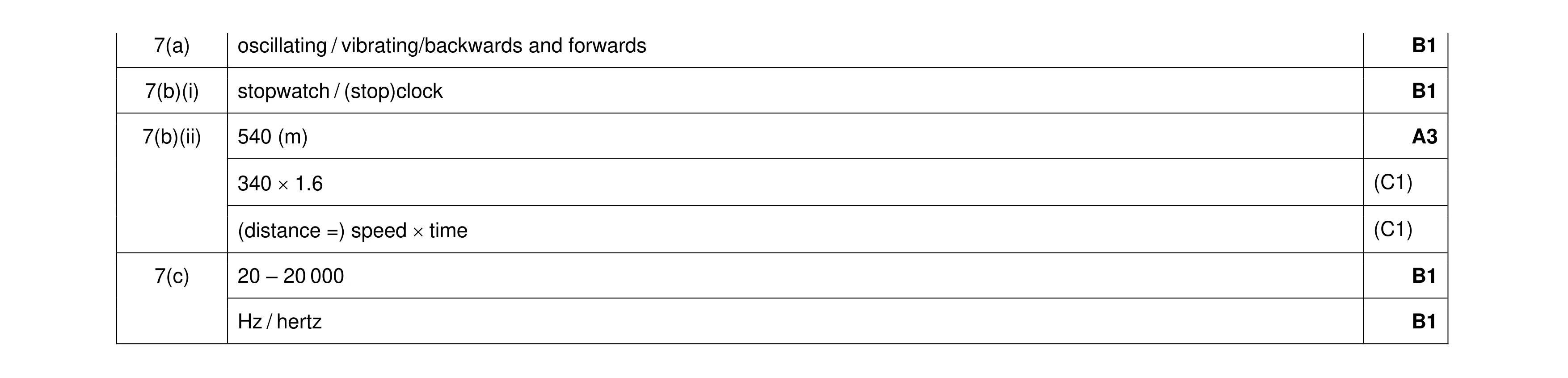 7
7 4
4 4
4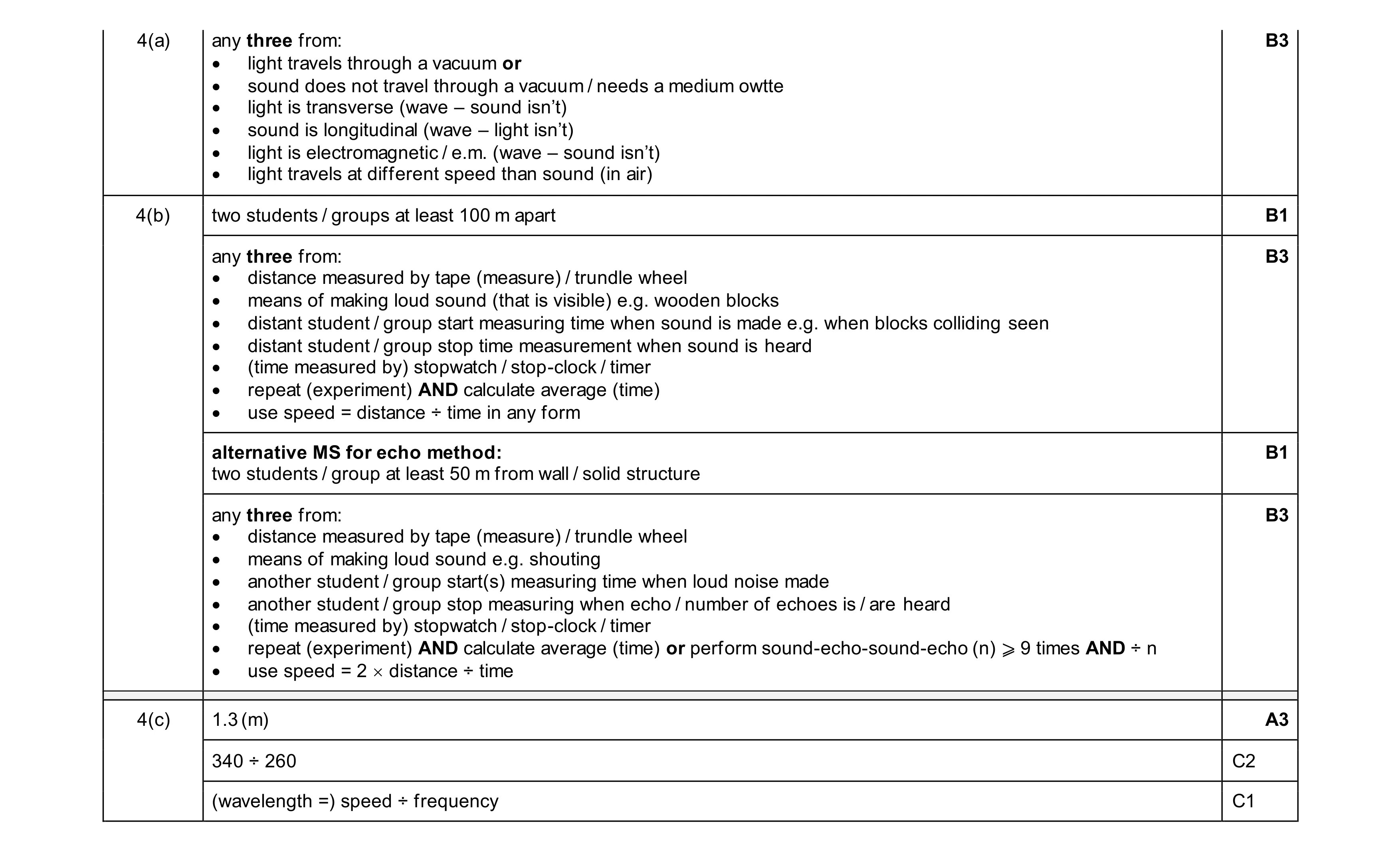 10
10