Questions as text
Q1 · Viewed through a microscope, very small particles can be seen moving with Brownian motion 0625/11 May/June 2005
14 Viewed through a microscope, very small particles can be seen moving with Brownian motion. Which line in the table is correct? type of motion particles are of particles suspended in A vibration a liquid or a gas B vibration a solid, a liquid or a gas C random a liquid or a gas D random a solid, a liquid or a gas
1 marks
Answer: C
This question in 0625/11 May/June 2005
Q2 · A measured mass of gas is placed in a cylinder at atmospheric pressure and is then slowly… 0625/11 May/June 2005
15 A measured mass of gas is placed in a cylinder at atmospheric pressure and is then slowly compressed. piston gas piston pushed in The temperature of the gas does not change. What happens to the pressure of the gas? A It drops to zero. B It decreases, but not to zero. C It stays the same. D It increases.
1 marks
Answer: D
This question in 0625/11 May/June 2005
Q3 · A drop of liquid falls on a student’s skin and quickly evaporates 0625/11 Oct/Nov 2005
13 A drop of liquid falls on a student’s skin and quickly evaporates. What is the effect on the skin and the reason? A The skin cools because the most energetic molecules escape from the liquid. B The skin cools because the most energetic molecules remain in the liquid. C The skin warms because the most energetic molecules escape from the liquid. D The skin warms because the most energetic molecules remain in the liquid.
1 marks
Answer: A
This question in 0625/11 Oct/Nov 2005
Q4 · A suspension of pollen grains in water is observed under a microscope 0625/11 Oct/Nov 2005
14 A suspension of pollen grains in water is observed under a microscope. The pollen grains are seen to be moving all the time. Which diagram illustrates this motion? A B C D
1 marks
Answer: D
This question in 0625/11 Oct/Nov 2005
Q5 · Which substance is a liquid at a room temperature of 25 oC? 0625/11 Oct/Nov 2005
16 Which substance is a liquid at a room temperature of 25 oC? substance melting point / oC boiling point / oC A –218 –183 B –39 357 C 44 280 D 119 444
1 marks
Answer: B
This question in 0625/11 Oct/Nov 2005
Q6 · Brownian motion is seen by looking at smoke particles through a microscope 0625/11 May/June 2006
13 Brownian motion is seen by looking at smoke particles through a microscope. How do the smoke particles move in Brownian motion? A all in the same direction B at random C in circles D vibrating about fixed points
1 marks
Answer: B
This question in 0625/11 May/June 2006
Q7 · Driving a car raises the temperature of the tyres 0625/11 May/June 2006
14 Driving a car raises the temperature of the tyres. This causes the pressure of the air in the tyres to increase. Why is this? A Air molecules break up to form separate atoms. B Air molecules expand with the rise in temperature. C The force between the air molecules increases. D The speed of the air molecules increases.
1 marks
Answer: D
This question in 0625/11 May/June 2006
Q8 · A cylinder is filled with a gas and then sealed, so that the gas has a fixed volume 0625/11 May/June 2007
13 A cylinder is filled with a gas and then sealed, so that the gas has a fixed volume. The gas molecules are given energy so that their average speed increases. What happens to the pressure and to the temperature of the gas in the cylinder? pressure temperature A decreases decreases B decreases increases C increases decreases D increases increases
1 marks
Answer: D
This question in 0625/11 May/June 2007
Q9 · Apparatus being used to observe smoke particles 0625/11 May/June 2007
14 Diagram 1 shows apparatus being used to observe smoke particles. Diagram 2 shows how a smoke particle moves randomly. diagram 1 diagram 2 random movement microscope air molecules light and smoke particles Why do the smoke particles move randomly? A They are hit by air molecules. B They are less dense than air. C They are moved by convection currents. D They gain energy from the light.
1 marks
Answer: A
This question in 0625/11 May/June 2007
Q10 · The gas in a container is heated but is kept at constant volume 0625/11 Oct/Nov 2007
14 The gas in a container is heated but is kept at constant volume. Why does the gas pressure increase? A The molecules expand. B The molecules increase in mass. C The molecules move further apart. D The molecules move more rapidly.
1 marks
Answer: D
This question in 0625/11 Oct/Nov 2007
Q11 · The table lists the melting points and the boiling points of four different substances A… 0625/11 Oct/Nov 2007
15 The table lists the melting points and the boiling points of four different substances A, B, C and D. Which substance is a gas at 25 °C? substance melting point / °C boiling point / °C A –219 –183 B –7 58 C 98 890 D 1083 2582
1 marks
Answer: A
This question in 0625/11 Oct/Nov 2007
Q12 · Which line in the table describes the properties of solids and of liquids at a fixed… 0625/11 May/June 2008
14 Which line in the table describes the properties of solids and of liquids at a fixed temperature? solids liquids A definite volume and definite shape no definite volume but definite shape B no definite volume but definite shape definite volume and definite shape C definite volume and definite shape definite volume but no definite shape D no definite volume but definite shape no definite volume and no definite shape
1 marks
Answer: C
This question in 0625/11 May/June 2008
Q13 · Air is pumped slowly into a car tyre to increase the pressure 0625/11 May/June 2008
15 Air is pumped slowly into a car tyre to increase the pressure. The temperature of the air does not change. Which line in the table is correct? number of molecules hitting 1 cm2 of the average speed at which molecules hit the tyre tyre each second A increases increases B increases unchanged C unchanged increases D unchanged unchanged
1 marks
Answer: B
This question in 0625/11 May/June 2008
Q14 · Viewed through a microscope, very small particles can be seen moving with Brownian motion 0625/11 Oct/Nov 2008
14 Viewed through a microscope, very small particles can be seen moving with Brownian motion. Which line in the table is correct? type of motion particles are of particles suspended in A vibration a liquid or a gas B vibration a solid, a liquid or a gas C random a liquid or a gas D random a solid, a liquid or a gas
1 marks
Answer: C
This question in 0625/11 Oct/Nov 2008
Q15 · The pressure of a fixed mass of gas in a cylinder is measured 0625/11 Oct/Nov 2008
15 The pressure of a fixed mass of gas in a cylinder is measured. The volume of the gas in the cylinder is then slowly decreased. Which graph could show the change of pressure of the gas during this process? A B pressure pressure 0 0 0 time 0 time C D pressure pressure 0 0 0 time 0 time
1 marks
Answer: C
This question in 0625/11 Oct/Nov 2008
Q16 · In an experiment, some of a substance changes from a liquid to a gas 0625/11 May/June 2009
13 In an experiment, some of a substance changes from a liquid to a gas. The temperature of the remaining liquid changes because of this. What is the name for this change of state and how does the temperature change? change of state how temperature changes A condensation decreases B condensation increases C evaporation decreases D evaporation increases
1 marks
Answer: C
This question in 0625/11 May/June 2009
Q17 · A piston traps a certain mass of gas inside a cylinder 0625/11 May/June 2009
14 A piston traps a certain mass of gas inside a cylinder. Initially the piston is halfway along the length of the cylinder. The piston is now moved towards the open end of the cylinder. The temperature of the gas remains constant. initial position final position How are the density and the pressure of the gas affected by moving the piston? density pressure A decreases decreases B decreases unchanged C increases decreases D increases unchanged
1 marks
Answer: A
This question in 0625/11 May/June 2009
Q18 · A cup contains hot liquid 0625/11 Oct/Nov 2009
5 A cup contains hot liquid. Some of the liquid evaporates as it cools. What happens to the mass and to the weight of the liquid in the cup as it cools? mass weight A decreases decreases B decreases stays the same C stays the same decreases D stays the same stays the same
1 marks
Answer: A
This question in 0625/11 Oct/Nov 2009
Q19 · Brownian motion is observed by looking at smoke particles through a microscope 0625/11 Oct/Nov 2009
13 Brownian motion is observed by looking at smoke particles through a microscope. How do the smoke particles move in Brownian motion? A all in the same direction B at random C in circles D vibrating about fixed points
1 marks
Answer: B
This question in 0625/11 Oct/Nov 2009
Q20 · A small amount of air is introduced into the vacuum above the mercury in a mercury… 0625/11 Oct/Nov 2009
14 A small amount of air is introduced into the vacuum above the mercury in a mercury barometer tube. The mercury level goes down. Why does the mercury level go down? A The air molecules cool the mercury and make it contract. B The air molecules decrease the pressure above the mercury. C The air molecules heat the mercury and make it expand. D The air molecules increase the pressure above the mercury.
1 marks
Answer: D
This question in 0625/11 Oct/Nov 2009
Q21 · The table gives the melting points and boiling points of glycerine and benzene 0625/11 Oct/Nov 2009
16 The table gives the melting points and boiling points of glycerine and benzene. melting point boiling point glycerine 18 °C 290 °C benzene 5.4 °C 80 °C At which temperature will both glycerine and benzene be liquid? A 0 °C B 50 °C C 100 °C D 150 °C
1 marks
Answer: B
This question in 0625/11 Oct/Nov 2009
Q22 · A cup contains hot liquid 0625/12 Oct/Nov 2009
6 A cup contains hot liquid. Some of the liquid evaporates as it cools. What happens to the mass and to the weight of the liquid in the cup as it cools? mass weight A decreases decreases B decreases stays the same C stays the same decreases D stays the same stays the same
1 marks
Answer: A
This question in 0625/12 Oct/Nov 2009
Q23 · The table gives the melting points and boiling points of glycerine and benzene 0625/12 Oct/Nov 2009
14 The table gives the melting points and boiling points of glycerine and benzene. melting point boiling point glycerine 18 °C 290 °C benzene 5.4 °C 80 °C At which temperature will both glycerine and benzene be liquid? A 0 °C B 50 °C C 100 °C D 150 °C
1 marks
Answer: B
This question in 0625/12 Oct/Nov 2009
Q24 · Brownian motion is observed by looking at smoke particles through a microscope 0625/12 Oct/Nov 2009
15 Brownian motion is observed by looking at smoke particles through a microscope. How do the smoke particles move in Brownian motion? A all in the same direction B at random C in circles D vibrating about fixed points
1 marks
Answer: B
This question in 0625/12 Oct/Nov 2009
Q25 · A small amount of air is introduced into the vacuum above the mercury in a mercury… 0625/12 Oct/Nov 2009
16 A small amount of air is introduced into the vacuum above the mercury in a mercury barometer tube. The mercury level goes down. Why does the mercury level go down? A The air molecules cool the mercury and make it contract. B The air molecules decrease the pressure above the mercury. C The air molecules heat the mercury and make it expand. D The air molecules increase the pressure above the mercury.
1 marks
Answer: D
This question in 0625/12 Oct/Nov 2009
Q26 · The diagram represents the molecules of a gas in a closed container of constant volume 0625/11 May/June 2010
14 The diagram represents the molecules of a gas in a closed container of constant volume. What happens to the molecules when the gas is heated? A They expand. B They hit the walls less often. C They move further apart. D They move more quickly.
1 marks
Answer: D
This question in 0625/11 May/June 2010
Q27 · A liquid is left in an open dish 0625/11 May/June 2010
15 A liquid is left in an open dish. After several days there is less liquid in the dish. Which statement explains this? A The least energetic molecules leave the surface and escape into the air. B The least energetic molecules leave the surface and return. C The most energetic molecules leave the surface and escape into the air. D The most energetic molecules leave the surface and return.
1 marks
Answer: C
This question in 0625/11 May/June 2010
Q28 · A student carries out an experiment to find the melting point of wax 0625/11 May/June 2010
17 A student carries out an experiment to find the melting point of wax. The graph shows how the temperature of the wax changes as it cools. X temperature / °C Y melting point of wax Z 00 time Which statement is correct? A At X the temperature drops more slowly than at Z. B At Y all the wax is solid. C At Y thermal energy is being given out by the wax. D At Z the wax molecules are not moving.
1 marks
Answer: C
This question in 0625/11 May/June 2010
Q29 · The diagram represents the molecules of a gas in a closed container of constant volume 0625/12 May/June 2010
17 The diagram represents the molecules of a gas in a closed container of constant volume. What happens to the molecules when the gas is heated? A They expand. B They hit the walls less often. C They move further apart. D They move more quickly.
1 marks
Answer: D
This question in 0625/12 May/June 2010
Q30 · A liquid is left in an open dish 0625/12 May/June 2010
18 A liquid is left in an open dish. After several days there is less liquid in the dish. Which statement explains this? A The least energetic molecules leave the surface and escape into the air. B The least energetic molecules leave the surface and return. C The most energetic molecules leave the surface and escape into the air. D The most energetic molecules leave the surface and return.
1 marks
Answer: C
This question in 0625/12 May/June 2010
Q31 · A student carries out an experiment to find the melting point of wax 0625/12 May/June 2010
19 A student carries out an experiment to find the melting point of wax. The graph shows how the temperature of the wax changes as it cools. X temperature / °C Y melting point of wax Z 00 time Which statement is correct? A At X the temperature drops more slowly than at Z. B At Y all the wax is solid. C At Y thermal energy is being given out by the wax. D At Z the wax molecules are not moving.
1 marks
Answer: C
This question in 0625/12 May/June 2010
Q32 · Some gas in a sealed plastic bag is cooled 0625/11 Oct/Nov 2010
14 Some gas in a sealed plastic bag is cooled. How do the gas molecules behave when this happens? A They move more quickly and become closer together. B They move more quickly and become further apart. C They move more slowly and become closer together. D They move more slowly and become further apart.
1 marks
Answer: C
This question in 0625/11 Oct/Nov 2010
Q33 · A block of ice cream is prevented from melting by wrapping it in newspaper soaked in water 0625/11 Oct/Nov 2010
15 A block of ice cream is prevented from melting by wrapping it in newspaper soaked in water. The water evaporates from the newspaper. Which molecules escape from the water and what happens to the average speed of the water molecules that remain in the newspaper? average speed of the escaping molecules remaining water molecules A the more energetic ones decreases B the more energetic ones increases C the less energetic ones decreases D the less energetic ones increases
1 marks
Answer: A
This question in 0625/11 Oct/Nov 2010
Q34 · Which change is condensation? 0625/11 Oct/Nov 2010
16 Which change is condensation? A B solid liquid gas C D
1 marks
Answer: D
This question in 0625/11 Oct/Nov 2010
Q35 · A beaker containing ice and a thermometer is left in a warm room for 15 minutes 0625/11 Oct/Nov 2010
17 A beaker containing ice and a thermometer is left in a warm room for 15 minutes. No water is visible in the beaker until 5 minutes has passed. After 15 minutes some ice is still visible. ice ice water start of after after experiment 5 minutes 15 minutes Which graph shows how the thermometer reading changes? A B temperature temperature / °C / °C 0 0 0 5 10 15 0 5 10 15 time / min time / min C D temperature temperature / °C / °C 0 0 0 5 10 15 0 5 10 15 time / min time / min
1 marks
Answer: A
This question in 0625/11 Oct/Nov 2010
Q36 · Which change is condensation? 0625/12 Oct/Nov 2010
13 Which change is condensation? A B solid liquid gas C D
1 marks
Answer: D
This question in 0625/12 Oct/Nov 2010
Q37 · Some gas in a sealed plastic bag is cooled 0625/12 Oct/Nov 2010
14 Some gas in a sealed plastic bag is cooled. How do the gas molecules behave when this happens? A They move more quickly and become closer together. B They move more quickly and become further apart. C They move more slowly and become closer together. D They move more slowly and become further apart.
1 marks
Answer: C
This question in 0625/12 Oct/Nov 2010
Q38 · A beaker containing ice and a thermometer is left in a warm room for 15 minutes 0625/12 Oct/Nov 2010
15 A beaker containing ice and a thermometer is left in a warm room for 15 minutes. No water is visible in the beaker until 5 minutes has passed. After 15 minutes some ice is still visible. ice ice water start of after after experiment 5 minutes 15 minutes Which graph shows how the thermometer reading changes? A B temperature temperature / °C / °C 0 0 0 5 10 15 0 5 10 15 time / min time / min C D temperature temperature / °C / °C 0 0 0 5 10 15 0 5 10 15 time / min time / min
1 marks
Answer: A
This question in 0625/12 Oct/Nov 2010
Q39 · A block of ice cream is prevented from melting by wrapping it in newspaper soaked in water 0625/12 Oct/Nov 2010
17 A block of ice cream is prevented from melting by wrapping it in newspaper soaked in water. The water evaporates from the newspaper. Which molecules escape from the water and what happens to the average speed of the water molecules that remain in the newspaper? average speed of the escaping molecules remaining water molecules A the more energetic ones decreases B the more energetic ones increases C the less energetic ones decreases D the less energetic ones increases
1 marks
Answer: A
This question in 0625/12 Oct/Nov 2010
Q40 · Some gas in a sealed plastic bag is cooled 0625/13 Oct/Nov 2010
15 Some gas in a sealed plastic bag is cooled. How do the gas molecules behave when this happens? A They move more quickly and become closer together. B They move more quickly and become further apart. C They move more slowly and become closer together. D They move more slowly and become further apart.
1 marks
Answer: C
This question in 0625/13 Oct/Nov 2010
Q41 · Which change is condensation? 0625/13 Oct/Nov 2010
16 Which change is condensation? A B solid liquid gas C D
1 marks
Answer: D
This question in 0625/13 Oct/Nov 2010
Q42 · A block of ice cream is prevented from melting by wrapping it in newspaper soaked in water 0625/13 Oct/Nov 2010
17 A block of ice cream is prevented from melting by wrapping it in newspaper soaked in water. The water evaporates from the newspaper. Which molecules escape from the water and what happens to the average speed of the water molecules that remain in the newspaper? average speed of the escaping molecules remaining water molecules A the more energetic ones decreases B the more energetic ones increases C the less energetic ones decreases D the less energetic ones increases
1 marks
Answer: A
This question in 0625/13 Oct/Nov 2010
Q43 · A beaker containing ice and a thermometer is left in a warm room for 15 minutes 0625/13 Oct/Nov 2010
18 A beaker containing ice and a thermometer is left in a warm room for 15 minutes. No water is visible in the beaker until 5 minutes has passed. After 15 minutes some ice is still visible. ice ice water start of after after experiment 5 minutes 15 minutes Which graph shows how the thermometer reading changes? A B temperature temperature / °C / °C 0 0 0 5 10 15 0 5 10 15 time / min time / min C D temperature temperature / °C / °C 0 0 0 5 10 15 0 5 10 15 time / min time / min
1 marks
Answer: A
This question in 0625/13 Oct/Nov 2010
Q44 · A sealed gas cylinder is left outside on a hot, sunny day 0625/11 May/June 2011
13 A sealed gas cylinder is left outside on a hot, sunny day. What happens to the average speed of the molecules and to the pressure of the gas in the cylinder as the temperature rises? average speed of gas pressure the gas molecules A falls falls B falls rises C rises falls D rises rises
1 marks
Answer: D
This question in 0625/11 May/June 2011
Q45 · When a liquid evaporates, some molecules escape from it and its temperature changes 0625/11 May/June 2011
14 When a liquid evaporates, some molecules escape from it and its temperature changes. From where do the molecules escape and what is the effect on the temperature of the liquid? molecules escape from temperature of liquid A all parts of the liquid decreases B all parts of the liquid increases C only the liquid surface decreases D only the liquid surface increases
1 marks
Answer: C
This question in 0625/11 May/June 2011
Q46 · When a liquid evaporates, some molecules escape from it and its temperature changes 0625/12 May/June 2011
12 When a liquid evaporates, some molecules escape from it and its temperature changes. From where do the molecules escape and what is the effect on the temperature of the liquid? molecules escape from temperature of liquid A all parts of the liquid decreases B all parts of the liquid increases C only the liquid surface decreases D only the liquid surface increases
1 marks
Answer: C
This question in 0625/12 May/June 2011
Q47 · A sealed gas cylinder is left outside on a hot, sunny day 0625/12 May/June 2011
13 A sealed gas cylinder is left outside on a hot, sunny day. What happens to the average speed of the molecules and to the pressure of the gas in the cylinder as the temperature rises? average speed of gas pressure the gas molecules A falls falls B falls rises C rises falls D rises rises
1 marks
Answer: D
This question in 0625/12 May/June 2011
Q48 · When a liquid evaporates, some molecules escape from it and its temperature changes 0625/13 May/June 2011
12 When a liquid evaporates, some molecules escape from it and its temperature changes. From where do the molecules escape and what is the effect on the temperature of the liquid? molecules escape from temperature of liquid A all parts of the liquid decreases B all parts of the liquid increases C only the liquid surface decreases D only the liquid surface increases
1 marks
Answer: C
This question in 0625/13 May/June 2011
Q49 · A sealed gas cylinder is left outside on a hot, sunny day 0625/13 May/June 2011
13 A sealed gas cylinder is left outside on a hot, sunny day. What happens to the average speed of the molecules and to the pressure of the gas in the cylinder as the temperature rises? average speed of gas pressure the gas molecules A falls falls B falls rises C rises falls D rises rises
1 marks
Answer: D
This question in 0625/13 May/June 2011
Q50 · Very small pollen grains are suspended in water 0625/11 Oct/Nov 2012
14 Very small pollen grains are suspended in water. A bright light shines from the side. Looking through a microscope, small specks of light are seen to be moving in a random, jerky manner. eye microscope light pollen grains in water What are the moving specks of light? A pollen grains being hit by other pollen grains B pollen grains being hit by water molecules C water molecules being hit by other water molecules D water molecules being hit by pollen grains
1 marks
Answer: B
This question in 0625/11 Oct/Nov 2012
Q51 · A swimmer feels cold after leaving warm water on a warm, windy day 0625/11 Oct/Nov 2012
15 A swimmer feels cold after leaving warm water on a warm, windy day. Why does she feel cold even though the air is warm? A The less energetic water molecules on her skin escape quickly. B The more energetic water molecules on her skin do not escape quickly. C The water on her skin does not evaporate quickly enough to keep her warm. D The water on her skin evaporates quickly and cools her skin.
1 marks
Answer: D
This question in 0625/11 Oct/Nov 2012
Q52 · Very small pollen grains are suspended in water 0625/12 Oct/Nov 2012
10 Very small pollen grains are suspended in water. A bright light shines from the side. Looking through a microscope, small specks of light are seen to be moving in a random, jerky manner. eye microscope light pollen grains in water What are the moving specks of light? A pollen grains being hit by other pollen grains B pollen grains being hit by water molecules C water molecules being hit by other water molecules D water molecules being hit by pollen grains
1 marks
Answer: B
This question in 0625/12 Oct/Nov 2012
Q53 · The graph shows the temperature of a substance as it is heated steadily 0625/12 Oct/Nov 2012
17 The graph shows the temperature of a substance as it is heated steadily. In which part of the graph is the substance boiling? D temperature C B A time
1 marks
Answer: D
This question in 0625/12 Oct/Nov 2012
Q54 · A swimmer feels cold after leaving warm water on a warm, windy day 0625/12 Oct/Nov 2012
18 A swimmer feels cold after leaving warm water on a warm, windy day. Why does she feel cold even though the air is warm? A The less energetic water molecules on her skin escape quickly. B The more energetic water molecules on her skin do not escape quickly. C The water on her skin does not evaporate quickly enough to keep her warm. D The water on her skin evaporates quickly and cools her skin.
1 marks
Answer: D
This question in 0625/12 Oct/Nov 2012
Q55 · A car tyre contains a constant volume of air 0625/13 Oct/Nov 2012
14 A car tyre contains a constant volume of air. During use, the air gets hotter and the air pressure increases. What explains this increase in pressure in terms of the motion of air molecules? number of air force between air number of collisions per second molecules in tyre molecules and tyre wall between air molecules and tyre wall A increased increased decreased B increased unchanged decreased C unchanged increased increased D unchanged unchanged increased
1 marks
Answer: C
This question in 0625/13 Oct/Nov 2012
Q56 · The graph shows the temperature of a substance as it is heated steadily 0625/13 Oct/Nov 2012
17 The graph shows the temperature of a substance as it is heated steadily. In which part of the graph is the substance boiling? D temperature C B A time
1 marks
Answer: D
This question in 0625/13 Oct/Nov 2012
Q57 · A thermometer bulb is covered by a piece of damp absorbent cloth 0625/11 May/June 2013
13 A thermometer bulb is covered by a piece of damp absorbent cloth. thermometer damp cloth air bulb Air at room temperature is blown across the damp cloth. What happens to the thermometer reading? A It remains constant. B It rises. C It rises then falls. D It falls.
1 marks
Answer: D
This question in 0625/11 May/June 2013
Q58 · A gas storage tank has a fixed volume 0625/11 May/June 2013
14 A gas storage tank has a fixed volume. The graph shows how the temperature of the gas in the tank varies with time. temperature X Y time At time Y, the gas molecules are A closer together than at time X. B hitting the sides of the tank harder than at time X. C larger in size than at time X. D moving more slowly than at time X.
1 marks
Answer: B
This question in 0625/11 May/June 2013
Q59 · Which diagram best shows the path of a gas molecule? 0625/12 May/June 2013
13 Which diagram best shows the path of a gas molecule? A B C D
1 marks
Answer: D
This question in 0625/12 May/June 2013
Q60 · A gas storage tank has a fixed volume 0625/12 May/June 2013
14 A gas storage tank has a fixed volume. The graph shows how the temperature of the gas in the tank varies with time. temperature X Y time At time Y, the gas molecules are A closer together than at time X. B hitting the sides of the tank harder than at time X. C larger in size than at time X. D moving more slowly than at time X.
1 marks
Answer: B
This question in 0625/12 May/June 2013
Q61 · A thermometer bulb is covered by a piece of damp absorbent cloth 0625/13 May/June 2013
13 A thermometer bulb is covered by a piece of damp absorbent cloth. thermometer damp cloth air bulb Air at room temperature is blown across the damp cloth. What happens to the thermometer reading? A It remains constant. B It rises. C It rises then falls. D It falls.
1 marks
Answer: D
This question in 0625/13 May/June 2013
Q62 · A gas storage tank has a fixed volume 0625/13 May/June 2013
15 A gas storage tank has a fixed volume. The graph shows how the temperature of the gas in the tank varies with time. temperature X Y time At time Y, the gas molecules are A closer together than at time X. B hitting the sides of the tank harder than at time X. C larger in size than at time X. D moving more slowly than at time X.
1 marks
Answer: B
This question in 0625/13 May/June 2013
Q63 · A cup contains hot liquid 0625/11 Oct/Nov 2013
5 A cup contains hot liquid. Some of the liquid evaporates. What happens to the mass and to the weight of the liquid in the cup? mass weight A decreases decreases B decreases stays the same C stays the same decreases D stays the same stays the same
1 marks
Answer: A
This question in 0625/11 Oct/Nov 2013
Q64 · The diagram shows a sealed jar containing a gas 0625/11 Oct/Nov 2013
13 The diagram shows a sealed jar containing a gas. gas Which statement about the gas in the jar is correct? A The gas molecules collide with the inside of the jar more often as the temperature increases. B The gas molecules move more slowly as the temperature increases. C The pressure of the gas decreases as the temperature increases. D The pressure of the gas is higher at the top of the jar than at the bottom of the jar.
1 marks
Answer: A
This question in 0625/11 Oct/Nov 2013
Q65 · A block of ice cream is prevented from melting by wrapping it in newspaper soaked in water 0625/11 Oct/Nov 2013
14 A block of ice cream is prevented from melting by wrapping it in newspaper soaked in water. The water evaporates from the newspaper. Which molecules escape from the water and what happens to the average speed of the water molecules that remain in the newspaper? average speed of the escaping molecules remaining water molecules A the less energetic ones decreases B the less energetic ones increases C the more energetic ones decreases D the more energetic ones increases
1 marks
Answer: C
This question in 0625/11 Oct/Nov 2013
Q66 · A cup contains hot liquid 0625/12 Oct/Nov 2013
6 A cup contains hot liquid. Some of the liquid evaporates. What happens to the mass and to the weight of the liquid in the cup? mass weight A decreases decreases B decreases stays the same C stays the same decreases D stays the same stays the same
1 marks
Answer: A
This question in 0625/12 Oct/Nov 2013
Q67 · A block of ice cream is prevented from melting by wrapping it in newspaper soaked in water 0625/12 Oct/Nov 2013
13 A block of ice cream is prevented from melting by wrapping it in newspaper soaked in water. The water evaporates from the newspaper. Which molecules escape from the water and what happens to the average speed of the water molecules that remain in the newspaper? average speed of the escaping molecules remaining water molecules A the less energetic ones decreases B the less energetic ones increases C the more energetic ones decreases D the more energetic ones increases
1 marks
Answer: C
This question in 0625/12 Oct/Nov 2013
Q68 · The diagram shows a sealed jar containing a gas 0625/12 Oct/Nov 2013
14 The diagram shows a sealed jar containing a gas. gas Which statement about the gas in the jar is correct? A The gas molecules collide with the inside of the jar more often as the temperature increases. B The gas molecules move more slowly as the temperature increases. C The pressure of the gas decreases as the temperature increases. D The pressure of the gas is higher at the top of the jar than at the bottom of the jar.
1 marks
Answer: A
This question in 0625/12 Oct/Nov 2013
Q69 · A cup contains hot liquid 0625/13 Oct/Nov 2013
5 A cup contains hot liquid. Some of the liquid evaporates. What happens to the mass and to the weight of the liquid in the cup? mass weight A decreases decreases B decreases stays the same C stays the same decreases D stays the same stays the same
1 marks
Answer: A
This question in 0625/13 Oct/Nov 2013
Q70 · A closed flask of gas is placed in a cold-water bath 0625/13 Oct/Nov 2013
13 A closed flask of gas is placed in a cold-water bath. thermometer cold water gas As the flask cools, the temperature of the gas decreases. What happens to the molecules of the gas? A They contract. B They expand. C They move more quickly. D They move more slowly.
1 marks
Answer: D
This question in 0625/13 Oct/Nov 2013
Q71 · A block of ice cream is prevented from melting by wrapping it in newspaper soaked in water 0625/13 Oct/Nov 2013
14 A block of ice cream is prevented from melting by wrapping it in newspaper soaked in water. The water evaporates from the newspaper. Which molecules escape from the water and what happens to the average speed of the water molecules that remain in the newspaper? average speed of the escaping molecules remaining water molecules A the less energetic ones decreases B the less energetic ones increases C the more energetic ones decreases D the more energetic ones increases
1 marks
Answer: C
This question in 0625/13 Oct/Nov 2013
Q72 · Equal masses of two different liquids are heated using the same heater 0625/13 Oct/Nov 2013
15 Equal masses of two different liquids are heated using the same heater. The graph shows how the temperature of each liquid changes with time. temperature liquid 1 liquid 2 0 0 time What does the graph tell us about the liquids? A Liquid 1 has a higher melting point than liquid 2. B Liquid 1 has a higher boiling point than liquid 2. C Liquid 1 starts to melt sooner than liquid 2. D Liquid 1 starts to boil sooner than liquid 2.
1 marks
Answer: B
This question in 0625/13 Oct/Nov 2013
Q73 · A student places his thumb firmly on the outlet of a bicycle pump, to stop the air coming… 0625/11 May/June 2014
12 A student places his thumb firmly on the outlet of a bicycle pump, to stop the air coming out. trapped air direction of motion handle What happens to the pressure and what happens to the volume of the trapped air as the pump handle is pushed in? pressure volume A decreases decreases B decreases remains the same C increases decreases D increases remains the same
1 marks
Answer: C
This question in 0625/11 May/June 2014
Q74 · During evaporation, molecules escape rapidly from the surface of a liquid 0625/11 May/June 2014
13 During evaporation, molecules escape rapidly from the surface of a liquid. What happens to the average energy of the molecules of the remaining liquid and what happens to the temperature of the remaining liquid? average energy of temperature of remaining molecules remaining liquid A decreases decreases B decreases increases C stays the same decreases D stays the same increases
1 marks
Answer: A
This question in 0625/11 May/June 2014
Q75 · In an experiment, a thermometer is placed in a test-tube of hot liquid 0625/11 May/June 2014
15 In an experiment, a thermometer is placed in a test-tube of hot liquid. The temperature of the liquid is recorded every half minute. The table shows the results. time / minutes 0.0 0.5 1.0 1.5 2.0 2.5 3.0 3.5 4.0 4.5 5.0 5.5 6.0 6.5 7.0 7.5 temperature / °C 73 65 59 55 55 55 51 48 45 42 40 38 36 35 34 33 What is the melting point of the substance? A 0 °C B 33 °C C 55 °C D 73 °C
1 marks
Answer: C
This question in 0625/11 May/June 2014
Q76 · A student places his thumb firmly on the outlet of a bicycle pump, to stop the air coming… 0625/12 May/June 2014
12 A student places his thumb firmly on the outlet of a bicycle pump, to stop the air coming out. trapped air direction of motion handle What happens to the pressure and what happens to the volume of the trapped air as the pump handle is pushed in? pressure volume A decreases decreases B decreases remains the same C increases decreases D increases remains the same
1 marks
Answer: C
This question in 0625/12 May/June 2014
Q77 · The diagram represents molecules of gas moving in a container 0625/12 May/June 2014
13 The diagram represents molecules of gas moving in a container. What happens to the gas molecules when the temperature of the gas increases? A They move more quickly. B They move more slowly. C They vibrate more quickly. D They vibrate more slowly.
1 marks
Answer: A
This question in 0625/12 May/June 2014
Q78 · In an experiment, a thermometer is placed in a test-tube of hot liquid 0625/12 May/June 2014
16 In an experiment, a thermometer is placed in a test-tube of hot liquid. The temperature of the liquid is recorded every half minute. The table shows the results. time / minutes 0.0 0.5 1.0 1.5 2.0 2.5 3.0 3.5 4.0 4.5 5.0 5.5 6.0 6.5 7.0 7.5 temperature / °C 73 65 59 55 55 55 51 48 45 42 40 38 36 35 34 33 What is the melting point of the substance? A 0 °C B 33 °C C 55 °C D 73 °C
1 marks
Answer: C
This question in 0625/12 May/June 2014
Q79 · During evaporation, molecules escape rapidly from the surface of a liquid 0625/13 May/June 2014
16 During evaporation, molecules escape rapidly from the surface of a liquid. What happens to the average energy of the molecules of the remaining liquid and what happens to the temperature of the remaining liquid? average energy of temperature of remaining molecules remaining liquid A decreases decreases B decreases increases C stays the same decreases D stays the same increases
1 marks
Answer: A
This question in 0625/13 May/June 2014
Q80 · A student places his thumb firmly on the outlet of a bicycle pump, to stop the air coming… 0625/13 May/June 2014
17 A student places his thumb firmly on the outlet of a bicycle pump, to stop the air coming out. trapped air direction of motion handle What happens to the pressure and what happens to the volume of the trapped air as the pump handle is pushed in? pressure volume A decreases decreases B decreases remains the same C increases decreases D increases remains the same
1 marks
Answer: C
This question in 0625/13 May/June 2014
Q81 · The diagram shows a beaker of water 0625/11 Oct/Nov 2014
13 The diagram shows a beaker of water. Four molecules are labelled. The relative amount of energy of each molecule is shown. Which molecule is most likely to escape from the liquid? molecule A (high energy) molecule B (low energy) molecule C molecule D (high energy) (low energy)
1 marks
Answer: A
This question in 0625/11 Oct/Nov 2014
Q82 · Some gas is trapped in a container of fixed volume 0625/11 Oct/Nov 2014
14 Some gas is trapped in a container of fixed volume. The temperature of the gas increases. Which graph shows how the pressure of the gas changes with temperature? A B pressure / Pa pressure / Pa 0 0 0 temperature / °C 0 temperature / °C C D pressure / Pa pressure / Pa 0 0 0 temperature / °C 0 temperature / °C
1 marks
Answer: D
This question in 0625/11 Oct/Nov 2014
Q83 · The metal surface of a kettle is hot 0625/12 Oct/Nov 2014
14 The metal surface of a kettle is hot. What happens to the cool air outside the kettle when it comes into contact with the hot kettle? A The density of the air decreases and the air falls. B The density of the air decreases and the air rises. C The density of the air increases and the air falls. D The density of the air increases and the air rises.
1 marks
Answer: B
This question in 0625/12 Oct/Nov 2014
Q84 · Some gas is trapped in a container of fixed volume 0625/12 Oct/Nov 2014
15 Some gas is trapped in a container of fixed volume. The temperature of the gas increases. Which graph shows how the pressure of the gas changes with temperature? A B pressure / Pa pressure / Pa 0 0 0 temperature / °C 0 temperature / °C C D pressure / Pa pressure / Pa 0 0 0 temperature / °C 0 temperature / °C
1 marks
Answer: D
This question in 0625/12 Oct/Nov 2014
Q85 · The diagram shows a beaker of water 0625/12 Oct/Nov 2014
17 The diagram shows a beaker of water. Four molecules are labelled. The relative amount of energy of each molecule is shown. Which molecule is most likely to escape from the liquid? molecule A (high energy) molecule B (low energy) molecule C molecule D (high energy) (low energy)
1 marks
Answer: A
This question in 0625/12 Oct/Nov 2014
Q86 · The volume of a gas in a sealed syringe is increased 0625/13 Oct/Nov 2014
13 The volume of a gas in a sealed syringe is increased. The temperature of the gas does not change. before change after change After this change is made, what has happened to the gas molecules in the syringe? A They move more quickly. B They move more slowly. C They hit the syringe walls less often. D They hit the syringe walls more often.
1 marks
Answer: C
This question in 0625/13 Oct/Nov 2014
Q87 · Some liquid is poured into a metal dish on a wooden table 0625/13 Oct/Nov 2014
14 Some liquid is poured into a metal dish on a wooden table. The dish, the liquid, the table and the air around the dish are all at the same temperature. liquid metal dish wooden table The temperature of the liquid now starts to decrease. What could cause this temperature decrease? A convection currents in the liquid B conduction of heat through the metal dish C evaporation of the liquid D heat radiation from the liquid
1 marks
Answer: C
This question in 0625/13 Oct/Nov 2014
Q88 · The diagram shows four labelled changes of state between solid, liquid and gas 0625/13 Oct/Nov 2014
15 The diagram shows four labelled changes of state between solid, liquid and gas. P Q solid liquid gas S R Which changes need an energy input? A P and Q B Q and R C R and S D S and P
1 marks
Answer: A
This question in 0625/13 Oct/Nov 2014
Q89 · Extremely small pollen grains in water are viewed through a microscope 0625/12 Feb/March 2015
12 Extremely small pollen grains in water are viewed through a microscope. The grains are seen to move continually and randomly. What is the reason for this random movement? A The grains are moved by randomly moving water molecules. B The grains are moved by random convection currents in the water. C The grains are moved by random rays of light reflecting off them. D The grains are moved by the random motion of their own atoms.
1 marks
Answer: A
This question in 0625/12 Feb/March 2015
Q90 · A gas is compressed in a sealed cylinder by moving a piston 0625/12 Feb/March 2015
13 A gas is compressed in a sealed cylinder by moving a piston. piston piston gas gas initial position after gas has been compressed Which row in the table states what happens to the density of the gas and to the pressure of the gas when it is compressed? density pressure A decreases decreases B decreases increases C increases decreases D increases increases
1 marks
Answer: D
This question in 0625/12 Feb/March 2015
Q91 · Two states of matter are described as follows 0625/11 May/June 2015
12 Two states of matter are described as follows. In state 1, the molecules are very far apart. They move about very quickly at random in straight lines until they hit something. In state 2, the molecules are quite closely packed together. They move about at random. They do not have fixed positions. What is state 1 and what is state 2? state 1 state 2 A gas liquid B gas solid C liquid gas D solid liquid
1 marks
Answer: A
This question in 0625/11 May/June 2015
Q92 · The pressure of a fixed mass of gas in a cylinder is measured 0625/11 May/June 2015
13 The pressure of a fixed mass of gas in a cylinder is measured. The temperature of the gas in the cylinder is then slowly increased. The volume of the cylinder does not change. Which graph shows the pressure of the gas during this process? A B pressure pressure 0 0 0 time 0 time C D pressure pressure 0 0 0 time 0 time
1 marks
Answer: C
This question in 0625/11 May/June 2015
Q93 · A solid is heated from room temperature 0625/11 May/June 2015
15 A solid is heated from room temperature. The graph shows how its temperature changes with time as it is heated constantly. At which time has it just become completely liquid? temperature room temperature 0 0 A B C D time
1 marks
Answer: C
This question in 0625/11 May/June 2015
Q94 · Puddles of rain water remain after a storm 0625/12 May/June 2015
12 Puddles of rain water remain after a storm. The water in the puddles gradually evaporates. How does the evaporation affect the temperature of the water remaining in the puddle, and how does it affect the average speed of the remaining water molecules in the puddle? average speed of temperature of water molecules water in puddle in puddle A decreases decreases B decreases increases C increases decreases D increases increases
1 marks
Answer: A
This question in 0625/12 May/June 2015
Q95 · The diagram represents moving gas molecules in a sealed container of fixed volume 0625/12 May/June 2015
13 The diagram represents moving gas molecules in a sealed container of fixed volume. container gas molecule The temperature of the gas is now increased. What happens to the pressure of the gas, and what happens to the speed of the gas molecules? pressure speed of of gas molecules A increases increases B increases unchanged C unchanged increases D unchanged unchanged
1 marks
Answer: A
This question in 0625/12 May/June 2015
Q96 · Small smoke particles suspended in air are viewed through a microscope 0625/13 May/June 2015
12 Small smoke particles suspended in air are viewed through a microscope. The smoke particles move randomly. What does this show? A The air consists of fast-moving molecules. B The pressure of the air is increasing. C There are convection currents in the air. D The temperature of the air is increasing.
1 marks
Answer: A
This question in 0625/13 May/June 2015
Q97 · Molecules escape from a liquid during evaporation 0625/13 May/June 2015
13 Molecules escape from a liquid during evaporation. The temperature of the remaining liquid changes. Which molecules escape and how does the temperature change? temperature of molecules escaping remaining liquid A least energetic decreases B least energetic increases C most energetic decreases D most energetic increases
1 marks
Answer: C
This question in 0625/13 May/June 2015
Q98 · A solid is heated from room temperature 0625/13 May/June 2015
15 A solid is heated from room temperature. The graph shows how its temperature changes with time as it is heated constantly. S T temperature Q R room temperature P 0 0 time Between which labelled points on the graph is the substance partly solid and partly liquid? A between P and Q B between Q and R C between R and S D between S and T
1 marks
Answer: B
This question in 0625/13 May/June 2015
Q99 · Small smoke particles suspended in air are viewed through a microscope 0625/14 May/June 2015
11 Small smoke particles suspended in air are viewed through a microscope. The smoke particles move randomly. What does this show? A The air consists of fast-moving molecules. B The pressure of the air is increasing. C There are convection currents in the air. D The temperature of the air is increasing.
1 marks
Answer: A
This question in 0625/14 May/June 2015
Q100 · The gas in a container is heated but is kept at constant volume 0625/14 May/June 2015
12 The gas in a container is heated but is kept at constant volume. Why does the gas pressure increase? A The molecules expand. B The molecules increase in mass. C The molecules move further apart. D The molecules move more rapidly.
1 marks
Answer: D
This question in 0625/14 May/June 2015
Q101 · Which row is correct for the evaporation of a liquid? 0625/14 May/June 2015
13 Which row is correct for the evaporation of a liquid? the particles escaping the average kinetic from the liquid are on energy of particles average remaining in the liquid A the least energetic decreases B the least energetic increases C the most energetic decreases D the most energetic increases
1 marks
Answer: C
This question in 0625/14 May/June 2015
Q102 · A cylinder of constant volume contains a fixed mass of gas 0625/11 Oct/Nov 2015
12 A cylinder of constant volume contains a fixed mass of gas. The gas is cooled. What happens to the pressure of the gas and what happens to the kinetic energy of the gas molecules? kinetic energy pressure of gas of molecules A decreases decreases B decreases increases C increases decreases D increases increases
1 marks
Answer: A
This question in 0625/11 Oct/Nov 2015
Q103 · A swimmer feels cold after leaving warm water on a warm, windy day 0625/11 Oct/Nov 2015
13 A swimmer feels cold after leaving warm water on a warm, windy day. Why does she feel cold even though the air is warm? A The less energetic water molecules on her skin escape quickly. B The more energetic water molecules on her skin do not escape quickly. C The water on her skin does not evaporate quickly enough to keep her warm. D The water on her skin evaporates quickly and cools her skin.
1 marks
Answer: D
This question in 0625/11 Oct/Nov 2015
Q104 · The diagrams represent the molecules in two different states of matter 0625/12 Oct/Nov 2015
12 The diagrams represent the molecules in two different states of matter. The arrows show the motion of the molecules. molecule state 1 state 2 What is state 1, and what is state 2? state 1 state 2 A gas liquid B gas solid C liquid gas D liquid solid
1 marks
Answer: B
This question in 0625/12 Oct/Nov 2015
Q105 · A swimmer feels cold after leaving warm water on a warm, windy day 0625/12 Oct/Nov 2015
13 A swimmer feels cold after leaving warm water on a warm, windy day. Why does she feel cold even though the air is warm? A The less energetic water molecules on her skin escape quickly. B The more energetic water molecules on her skin do not escape quickly. C The water on her skin does not evaporate quickly enough to keep her warm. D The water on her skin evaporates quickly and cools her skin.
1 marks
Answer: D
This question in 0625/12 Oct/Nov 2015
Q106 · A car tyre has a constant volume 0625/13 Oct/Nov 2015
12 A car tyre has a constant volume. Why does the pressure of the air in the tyre increase when its temperature increases? A The air molecules hit each other less often. B The air molecules hit the inside of the tyre less often. C The average speed of the air molecules in the tyre is greater. D There are more air molecules in the tyre.
1 marks
Answer: C
This question in 0625/13 Oct/Nov 2015
Q107 · A swimmer feels cold after leaving warm water on a warm, windy day 0625/13 Oct/Nov 2015
13 A swimmer feels cold after leaving warm water on a warm, windy day. Why does she feel cold even though the air is warm? A The less energetic water molecules on her skin escape quickly. B The more energetic water molecules on her skin do not escape quickly. C The water on her skin does not evaporate quickly enough to keep her warm. D The water on her skin evaporates quickly and cools her skin.
1 marks
Answer: D
This question in 0625/13 Oct/Nov 2015
Q108 · Air in a sealed syringe is slowly compressed by moving the piston 0625/12 Feb/March 2016
15 Air in a sealed syringe is slowly compressed by moving the piston. The temperature of the air stays the same. air syringe piston Which statement about the air is correct? A The pressure of the air decreases because its molecules now travel more slowly. B The pressure of the air decreases because the area of the syringe walls is now smaller. C The pressure of the air increases because its molecules now hit the syringe walls more frequently. D The pressure of the air increases because its molecules now travel more quickly.
1 marks
Answer: C
This question in 0625/12 Feb/March 2016
Q109 · A cup contains hot liquid 0625/11 May/June 2016
4 A cup contains hot liquid. Some of the liquid evaporates. What happens to the mass and what happens to the weight of the liquid in the cup? mass weight A decreases decreases B decreases stays the same C stays the same decreases D stays the same stays the same
1 marks
Answer: A
This question in 0625/11 May/June 2016
Q110 · Which statement about evaporation is correct? 0625/11 May/June 2016
14 Which statement about evaporation is correct? A Evaporation causes the temperature of the remaining liquid to decrease. B Evaporation does not occur from a cold liquid near its freezing point. C Evaporation does not occur from a dense liquid, such as mercury. D Evaporation occurs from all parts of a liquid.
1 marks
Answer: A
This question in 0625/11 May/June 2016
Q111 · A gas is stored in a sealed container of constant volume 0625/11 May/June 2016
15 A gas is stored in a sealed container of constant volume. The temperature of the gas increases. This causes the pressure of the gas to increase. What happens to the gas molecules during this pressure increase? A The average kinetic energy of the molecules increases. B The average separation of the molecules decreases. C The average separation of the molecules increases. D The volume of each molecule increases.
1 marks
Answer: A
This question in 0625/11 May/June 2016
Q112 · A substance loses thermal energy (heat) to the surroundings at a steady rate 0625/11 May/June 2016
16 A substance loses thermal energy (heat) to the surroundings at a steady rate. The graph shows how the temperature of the substance changes with time. temperature P Q 0 0 time What could the portion PQ of the graph represent? A gas condensing B gas cooling C liquid cooling D liquid solidifying
1 marks
Answer: C
This question in 0625/11 May/June 2016
Q113 · A liquid is evaporating 0625/12 May/June 2016
14 A liquid is evaporating. The liquid is not boiling. Which statement about the liquid is correct? A Any molecule can escape, and from any part of the liquid. B Any molecule can escape, but only from the liquid surface. C Only molecules with enough energy can escape, and only from the liquid surface. D Only molecules with enough energy can escape, but from any part of the liquid.
1 marks
Answer: C
This question in 0625/12 May/June 2016
Q114 · The diagram shows a quantity of gas enclosed in a cylinder by a piston 0625/12 May/June 2016
15 The diagram shows a quantity of gas enclosed in a cylinder by a piston. moves to the left gas moves to the right cylinder piston The piston is moved to the left or to the right. The temperature of the gas is kept constant. Which row describes the effect of moving the piston slowly in the direction shown in the table? movement speed of gas pressure of piston molecules of gas A to the left increases decreases B to the left no change increases C to the right increases decreases D to the right no change increases
1 marks
Answer: B
This question in 0625/12 May/June 2016
Q115 · Which statement describes what happens as ice at 0 °C starts to melt to become water? 0625/12 May/June 2016
16 Which statement describes what happens as ice at 0 °C starts to melt to become water? A Energy is absorbed and the temperature remains constant. B Energy is absorbed and the temperature rises. C Energy is released and the temperature remains constant. D Energy is released and the temperature rises.
1 marks
Answer: A
This question in 0625/12 May/June 2016
Q116 · A cup contains hot liquid 0625/13 May/June 2016
5 A cup contains hot liquid. Some of the liquid evaporates. What happens to the mass and what happens to the weight of the liquid in the cup? mass weight A decreases decreases B decreases stays the same C stays the same decreases D stays the same stays the same
1 marks
Answer: A
This question in 0625/13 May/June 2016
Q117 · What causes the random, zig-zag movement (Brownian motion) of smoke particles suspended… 0625/13 May/June 2016
14 What causes the random, zig-zag movement (Brownian motion) of smoke particles suspended in air? A air molecules colliding with smoke particles B convection currents as the hot smoke rises C smoke particles colliding with each other D smoke particles reacting with oxygen molecules in the air
1 marks
Answer: A
This question in 0625/13 May/June 2016
Q118 · A sealed bottle of constant volume contains air 0625/13 May/June 2016
15 A sealed bottle of constant volume contains air. The air in the bottle is heated by the Sun. What is the effect on the average speed of the air molecules in the bottle, and the average distance between them? average distance average speed between air of air molecules molecules A decreases decreases B decreases stays the same C increases increases D increases stays the same
1 marks
Answer: D
This question in 0625/13 May/June 2016
Q119 · A jug of water is at room temperature 0625/13 May/June 2016
17 A jug of water is at room temperature. Several ice cubes at a temperature of 0 °C are dropped into the water and they begin to melt immediately. What happens to the temperature of the water and what happens to the temperature of the ice cubes while they are melting? temperature of temperature of the water the ice cubes A decreases increases B decreases stays constant C stays constant increases D stays constant stays constant
1 marks
Answer: B
This question in 0625/13 May/June 2016
Q120 · Smoke particles in air are illuminated by a beam of light 0625/11 Oct/Nov 2016
14 Smoke particles in air are illuminated by a beam of light. The particles are viewed through a microscope. They are seen to move in a random zig-zag way. What causes this movement? A convection currents in the air B impacts of fast-moving air molecules C the energy of the beam of light D vibrations of the atoms in the smoke particles
1 marks
Answer: B
This question in 0625/11 Oct/Nov 2016
Q121 · When a liquid evaporates, some of its molecules escape from the surface and the… 0625/11 Oct/Nov 2016
15 When a liquid evaporates, some of its molecules escape from the surface and the temperature of the liquid changes. Which row describes the escaping molecules and the change in temperature of the liquid? temperature of escaping molecules the liquid A less energetic goes down B less energetic goes up C more energetic goes down D more energetic goes up
1 marks
Answer: C
This question in 0625/11 Oct/Nov 2016
Q122 · Water can exist in three states: solid (ice), liquid and gas (steam) 0625/12 Oct/Nov 2016
14 Water can exist in three states: solid (ice), liquid and gas (steam). In which state, or states, is the motion of the molecules only vibrational? A ice only B steam only C liquid water only D liquid water and ice only
1 marks
Answer: A
This question in 0625/12 Oct/Nov 2016
Q123 · Which statement about evaporation is correct? 0625/12 Oct/Nov 2016
15 Which statement about evaporation is correct? A Evaporation causes heating of the liquid. B Evaporation only happens from liquids. C Molecules escape from anywhere in the liquid. D Only the least energetic molecules escape.
1 marks
Answer: B
This question in 0625/12 Oct/Nov 2016
Q124 · Which diagram best represents the movement of a smoke particle displaying Brownian motion? 0625/13 Oct/Nov 2016
14 Which diagram best represents the movement of a smoke particle displaying Brownian motion? A B smoke smoke particle particle C D smoke particle smoke particle
1 marks
Answer: D
This question in 0625/13 Oct/Nov 2016
Q125 · A cylinder containing trapped air is put into a freezer 0625/13 Oct/Nov 2016
15 A cylinder containing trapped air is put into a freezer. cylinder piston cylinder piston air air at room temperature in a freezer As the air cools, the piston moves to the left as shown. How has the air changed? A Its density is less. B Its mass is less. C The average speed of its molecules is less. D The average volume of its molecules is less.
1 marks
Answer: C
This question in 0625/13 Oct/Nov 2016
Q126 · On a hot day, the pressure of the air in a car tyre is greater than on a cold day 0625/12 Feb/March 2017
13 On a hot day, the pressure of the air in a car tyre is greater than on a cold day. Why is the pressure greater on a hot day? A The air molecules strike each other more frequently. B The air molecules strike each other with greater force. C The air molecules strike the tyre walls more frequently. D The number of air molecules in the tyre increases.
1 marks
Answer: C
This question in 0625/12 Feb/March 2017
Q127 · Very small pollen grains are suspended in water 0625/12 Feb/March 2017
14 Very small pollen grains are suspended in water. A bright light shines from the side. When looked at through a microscope, small specks of light are seen to be moving in a random, jerky manner. eye microscope bright light pollen grains in water What are the moving specks of light? A pollen grains being hit by other pollen grains B pollen grains being hit by water molecules C water molecules being hit by other water molecules D water molecules being hit by pollen grains
1 marks
Answer: B
This question in 0625/12 Feb/March 2017
Q128 · A substance can exist in three different states: solid, liquid or gas 0625/12 Feb/March 2017
17 A substance can exist in three different states: solid, liquid or gas. Each of the two statements below describes a change of state. change 1 Molecules move closer together but continue to travel throughout the substance. change 2 Molecules stop travelling throughout the substance and just vibrate about fixed positions. Which changes of state do these statements describe? change 1 change 2 A condensation melting B condensation solidification C solidification condensation D solidification melting
1 marks
Answer: B
This question in 0625/12 Feb/March 2017
Q129 · A student has a syringe which has its open end sealed 0625/11 May/June 2017
13 A student has a syringe which has its open end sealed. The syringe is completely filled with a certain substance, as shown in diagram 1. The student pushes the piston of the syringe in as far as possible, as shown in diagram 2. syringe piston sealed end diagram 1 diagram 2 What is in the syringe? A a gas and a liquid B a solid and a liquid C a liquid only D a solid only
1 marks
Answer: A
This question in 0625/11 May/June 2017
Q130 · When a microscope is used to look at smoke particles in air, Brownian motion is observed 0625/11 May/June 2017
14 When a microscope is used to look at smoke particles in air, Brownian motion is observed. What causes the smoke particles to move at random? A Smoke particles are hit by air molecules. B Smoke particles are moved by convection currents in the air. C Smoke particles have different weights and fall at different speeds. D Smoke particles hit the walls of the container.
1 marks
Answer: A
This question in 0625/11 May/June 2017
Q131 · It is a warm and humid day 0625/11 May/June 2017
17 It is a warm and humid day. A glass contains an iced drink. Water starts to form on the outside of the glass. What is the name of the effect by which the water forms? A condensation B conduction C convection D evaporation
1 marks
Answer: A
This question in 0625/11 May/June 2017
Q132 · A block of ice is removed from a freezer 0625/12 May/June 2017
5 A block of ice is removed from a freezer. Some of the ice melts to produce water. Some of the water that is produced evaporates. The original mass of the ice is p. The mass of the ice that has not yet melted is q. The mass of the water is r. The mass of the water vapour is s. The diagram shows these changes. before melting after melting and evaporation ice ice water water vapour mass p mass q mass r mass s Which equation gives the relationship between p, q, r and s? A p = q + r B p = q + r + s C p = q + r – s D p = q + s
1 marks
Answer: B
This question in 0625/12 May/June 2017
Q133 · Brownian motion is observed when using a microscope to look at smoke particles in air 0625/12 May/June 2017
13 Brownian motion is observed when using a microscope to look at smoke particles in air. What causes the smoke particles to move at random? A Smoke particles are hit by air molecules. B Smoke particles are moved by convection currents in the air. C Smoke particles have different weights and fall at different speeds. D Smoke particles hit the walls of the container.
1 marks
Answer: A
This question in 0625/12 May/June 2017
Q134 · Which change is evaporation? 0625/12 May/June 2017
14 Which change is evaporation? solid D A liquid liquid B C gas
1 marks
Answer: B
This question in 0625/12 May/June 2017
Q135 · The diagram represents molecules of a gas inside a closed container of constant volume 0625/13 May/June 2017
13 The diagram represents molecules of a gas inside a closed container of constant volume. What happens to the molecules of the gas when the container is heated? A They expand. B They get closer together. C They hit the container walls with less force. D They move faster.
1 marks
Answer: D
This question in 0625/13 May/June 2017
Q136 · Brownian motion is observed when using a microscope to look at smoke particles in air 0625/13 May/June 2017
14 Brownian motion is observed when using a microscope to look at smoke particles in air. What causes the smoke particles to move at random? A Smoke particles are hit by air molecules. B Smoke particles are moved by convection currents in the air. C Smoke particles have different weights and fall at different speeds. D Smoke particles hit the walls of the container.
1 marks
Answer: A
This question in 0625/13 May/June 2017
Q137 · A solid substance is heated at a constant rate 0625/13 May/June 2017
17 A solid substance is heated at a constant rate. The solid changes into a liquid and then into a gas. The graph shows how the temperature of the substance changes. 700 temperature / °C 600 500 400 300 200 100 0 0 time What is the melting point and what is the boiling point of the substance? melting boiling point / °C point / °C A 200 300 B 200 500 C 300 500 D 300 700
1 marks
Answer: C
This question in 0625/13 May/June 2017
Q138 · A pollen grain in a beaker of still water is viewed through a microscope 0625/11 Oct/Nov 2017
14 A pollen grain in a beaker of still water is viewed through a microscope. Which diagram shows the most likely movement of the pollen grain? A B C D
1 marks
Answer: A
This question in 0625/11 Oct/Nov 2017
Q139 · The diagram shows an air-filled rubber toy 0625/11 Oct/Nov 2017
15 The diagram shows an air-filled rubber toy. A child sits on the toy and its volume decreases. The temperature of the air in the toy does not change. How does the air pressure in the toy change and why? pressure reason A decreases air molecules move more slowly B decreases air molecules strike the rubber less frequently C increases air molecules move more quickly D increases air molecules strike the rubber more frequently
1 marks
Answer: D
This question in 0625/11 Oct/Nov 2017
Q140 · A pollen grain in a beaker of still water is viewed through a microscope 0625/12 Oct/Nov 2017
14 A pollen grain in a beaker of still water is viewed through a microscope. Which diagram shows the most likely movement of the pollen grain? A B C D
1 marks
Answer: A
This question in 0625/12 Oct/Nov 2017
Q141 · The diagram shows an air-filled rubber toy 0625/12 Oct/Nov 2017
15 The diagram shows an air-filled rubber toy. A child sits on the toy and its volume decreases. The temperature of the air in the toy does not change. How does the air pressure in the toy change and why? pressure reason A decreases air molecules move more slowly B decreases air molecules strike the rubber less frequently C increases air molecules move more quickly D increases air molecules strike the rubber more frequently
1 marks
Answer: D
This question in 0625/12 Oct/Nov 2017
Q142 · Which statement about the direction of a change of state is correct? 0625/12 Oct/Nov 2017
18 Which statement about the direction of a change of state is correct? A Evaporation is the reverse process to boiling. B Evaporation is the reverse process to condensation. C Evaporation is the reverse process to melting. D Evaporation is the reverse process to solidification.
1 marks
Answer: B
This question in 0625/12 Oct/Nov 2017
Q143 · Three cups are made from the same insulating material 0625/12 Oct/Nov 2017
19 Three cups are made from the same insulating material. cup 1 cup 2 cup 3 The cups are each filled with the same volume of hot tea. In which cup does the tea cool most quickly and in which cup does it cool most slowly? most quickly most slowly A 1 3 B 2 1 C 3 2 D 3 1
1 marks
Answer: C
This question in 0625/12 Oct/Nov 2017
Q144 · A pollen grain in a beaker of still water is viewed through a microscope 0625/13 Oct/Nov 2017
14 A pollen grain in a beaker of still water is viewed through a microscope. Which diagram shows the most likely movement of the pollen grain? A B C D
1 marks
Answer: A
This question in 0625/13 Oct/Nov 2017
Q145 · The diagram shows an air-filled rubber toy 0625/13 Oct/Nov 2017
15 The diagram shows an air-filled rubber toy. A child sits on the toy and its volume decreases. The temperature of the air in the toy does not change. How does the air pressure in the toy change and why? pressure reason A decreases air molecules move more slowly B decreases air molecules strike the rubber less frequently C increases air molecules move more quickly D increases air molecules strike the rubber more frequently
1 marks
Answer: D
This question in 0625/13 Oct/Nov 2017
Q146 · On a warm day, a carton of fresh milk is covered with a wet cloth 0625/11 May/June 2018
15 On a warm day, a carton of fresh milk is covered with a wet cloth. Why does this help to reduce the temperature of the milk? A Some water evaporates from the cloth so the remaining water becomes cooler. B The water has a very high thermal capacity. C The water insulates the milk from the warm air around it. D Water is always colder than the air around it.
1 marks
Answer: A
This question in 0625/11 May/June 2018
Q147 · Air is trapped in a cylinder by a piston 0625/11 May/June 2018
16 Air is trapped in a cylinder by a piston. The piston is pushed inwards and the volume of the air is reduced. The temperature of the trapped air remains constant. Which row describes how the average speed of the air molecules and the average distance between them changes? average speed average distance of molecules between molecules A increases decreases B increases unchanged C unchanged decreases D unchanged increases
1 marks
Answer: C
This question in 0625/11 May/June 2018
Q148 · Which row gives the correct name for each change of state shown? 0625/11 May/June 2018
19 Which row gives the correct name for each change of state shown? change of state gas to liquid liquid to solid solid to liquid A condensation melting solidification B condensation solidification melting C evaporation melting solidification D evaporation solidification melting
1 marks
Answer: B
This question in 0625/11 May/June 2018
Q149 · Brownian motion is the random motion of particles due to molecular bombardment 0625/12 May/June 2018
13 Brownian motion is the random motion of particles due to molecular bombardment. In which states of matter is Brownian motion observed? A gases, liquids and solids B gases and liquids only C gases and solids only D liquids and solids only
1 marks
Answer: B
This question in 0625/12 May/June 2018
Q150 · The diagram shows the relative number of molecules in a liquid that have a given kinetic… 0625/12 May/June 2018
14 The diagram shows the relative number of molecules in a liquid that have a given kinetic energy. The graph is divided into sections so that each section contains the same number of molecules. From which section does the greatest number of molecules escape from the liquid per unit time? relative number of molecules A B C D 0 0 kinetic energy
1 marks
Answer: D
This question in 0625/12 May/June 2018
Q151 · Brownian motion of particles is observed 0625/13 May/June 2018
12 Brownian motion of particles is observed. Which statements describe the movement of the particles? 1 The particles all travel along a curved path. 2 The particles move randomly. 3 The particles all travel in the same direction. A 1 and 3 B 1 only C 2 and 3 D 2 only
1 marks
Answer: D
This question in 0625/13 May/June 2018
Q152 · A pure liquid is left in an open beaker and some of the liquid molecules escape by… 0625/13 May/June 2018
13 A pure liquid is left in an open beaker and some of the liquid molecules escape by evaporation. Which statement about this process is correct? A None of the escaping molecules return to the liquid. B The escaping molecules are generally the more energetic ones. C The rate of escape of the molecules can be increased by increasing the depth of the liquid in the beaker. D The temperature of the remaining liquid is unaffected by the escape of the molecules.
1 marks
Answer: B
This question in 0625/13 May/June 2018
Q153 · During evaporation of a liquid, the more energetic molecules escape 0625/11 Oct/Nov 2018
14 During evaporation of a liquid, the more energetic molecules escape. The temperature of the remaining liquid changes. Which row identifies where these molecules escape from and describes the temperature change? molecules temperature of escape from the remaining liquid A body of the liquid decreases B body of the liquid increases C surface of the liquid decreases D surface of the liquid increases
1 marks
Answer: C
This question in 0625/11 Oct/Nov 2018
Q154 · Apparatus being used to observe smoke particles 0625/11 Oct/Nov 2018
15 Diagram 1 shows apparatus being used to observe smoke particles. Diagram 2 shows how a smoke particle moves randomly. diagram 1 diagram 2 eye random movement microscope air molecules light and smoke particles Why do the smoke particles move randomly? A They are hit by air molecules. B They are less dense than air. C They are moved by convection currents. D They gain energy from the light.
1 marks
Answer: A
This question in 0625/11 Oct/Nov 2018
Q155 · The particles of a gas, in a container of fixed volume, are given more energy 0625/12 Oct/Nov 2018
13 The particles of a gas, in a container of fixed volume, are given more energy. Which effect does this have on the gas? A Both the pressure and temperature of the gas increase. B Only the temperature of the gas increases. C Neither the pressure nor temperature of the gas increases. D Only the pressure of the gas increases.
1 marks
Answer: A
This question in 0625/12 Oct/Nov 2018
Q156 · Apparatus being used to observe smoke particles 0625/12 Oct/Nov 2018
15 Diagram 1 shows apparatus being used to observe smoke particles. Diagram 2 shows how a smoke particle moves randomly. diagram 1 diagram 2 eye random movement microscope air molecules light and smoke particles Why do the smoke particles move randomly? A They are hit by air molecules. B They are less dense than air. C They are moved by convection currents. D They gain energy from the light.
1 marks
Answer: A
This question in 0625/12 Oct/Nov 2018
Q157 · Liquid in a dish evaporates 0625/13 Oct/Nov 2018
14 Liquid in a dish evaporates. This causes the temperature of the remaining liquid to change. Which row is correct? change in reason for temperature change temperature A increase the most energetic molecules remain in the liquid B increase the most energetic molecules escape from the liquid C decrease the most energetic molecules remain in the liquid D decrease the most energetic molecules escape from the liquid
1 marks
Answer: D
This question in 0625/13 Oct/Nov 2018
Q158 · Apparatus being used to observe smoke particles 0625/13 Oct/Nov 2018
15 Diagram 1 shows apparatus being used to observe smoke particles. Diagram 2 shows how a smoke particle moves randomly. diagram 1 diagram 2 eye random movement microscope air molecules light and smoke particles Why do the smoke particles move randomly? A They are hit by air molecules. B They are less dense than air. C They are moved by convection currents. D They gain energy from the light.
1 marks
Answer: A
This question in 0625/13 Oct/Nov 2018
Q159 · Steam at 100 °C condenses to form water at 100 °C 0625/13 Oct/Nov 2018
17 Steam at 100 °C condenses to form water at 100 °C. What happens to the average separation and what happens to the average speed of the water molecules? separation average speed A decreases decreases B decreases remains the same C increases decreases D increases remains the same
1 marks
Answer: B
This question in 0625/13 Oct/Nov 2018
Q160 · A car tyre runs over a nail which makes a hole in it 0625/12 Feb/March 2019
14 A car tyre runs over a nail which makes a hole in it. The air in the tyre leaks out. air Why does the air leave the tyre? A The pressure inside the tyre is greater than the pressure outside. B The pressure inside the tyre is less than the pressure outside. C The temperature inside the tyre is greater than the temperature outside. D The temperature inside the tyre is less than the temperature outside.
1 marks
Answer: A
This question in 0625/12 Feb/March 2019
Q161 · Which row describes the process of melting? 0625/12 Feb/March 2019
17 Which row describes the process of melting? change in initial state final state temperature? A liquid gas yes B liquid solid no C solid gas yes D solid liquid no
1 marks
Answer: D
This question in 0625/12 Feb/March 2019
Q162 · Why can a gas be compressed easily into a smaller volume? 0625/11 May/June 2019
14 Why can a gas be compressed easily into a smaller volume? A The molecules are far apart. B The molecules do not attract each other. C The molecules move randomly. D The volume of each molecule can be reduced.
1 marks
Answer: A
This question in 0625/11 May/June 2019
Q163 · When a liquid evaporates, some molecules escape 0625/11 May/June 2019
15 When a liquid evaporates, some molecules escape. The temperature of the remaining liquid changes. What is the effect on the temperature and from where do the molecules escape? temperature of liquid molecules escape from A decreases everywhere within the liquid B decreases the surface only C increases everywhere within the liquid D increases the surface only
1 marks
Answer: B
This question in 0625/11 May/June 2019
Q164 · The diagram shows the changes of state P, Q, R and S that occur in solids, liquids and… 0625/11 May/June 2019
18 The diagram shows the changes of state P, Q, R and S that occur in solids, liquids and gases when they gain or lose thermal energy. gain thermal energy P Q solid liquid gas S R lose thermal energy What is the name of change R? A condensation B solidification C boiling D melting
1 marks
Answer: A
This question in 0625/11 May/June 2019
Q165 · A sample of mercury is heated 0625/12 May/June 2019
14 A sample of mercury is heated. In which states of matter will its volume increase as its temperature rises? A gas only B liquid and gas only C solid and liquid only D solid, liquid and gas
1 marks
Answer: D
This question in 0625/12 May/June 2019
Q166 · When water evaporates, what escapes from the surface of the water? 0625/12 May/June 2019
15 When water evaporates, what escapes from the surface of the water? A individual atoms B individual molecules C individual protons D tiny drops of water
1 marks
Answer: B
This question in 0625/12 May/June 2019
Q167 · Which row describes the process of condensation? 0625/12 May/June 2019
18 Which row describes the process of condensation? separation change of state of molecules A gas to liquid decreases B gas to liquid increases C liquid to gas decreases D liquid to gas increases
1 marks
Answer: A
This question in 0625/12 May/June 2019
Q168 · Which statement is correct? 0625/13 May/June 2019
14 Which statement is correct? A A solid can flow. B A solid can be compressed easily. C A solid has a fixed shape. D A solid takes the shape of its container.
1 marks
Answer: C
This question in 0625/13 May/June 2019
Q169 · On a hot summer day, the level of the water in a pond falls 0625/13 May/June 2019
15 On a hot summer day, the level of the water in a pond falls. Which statement explains this? A The least energetic water molecules escape from the surface and do not return. B The least energetic water molecules escape from the surface and then return. C The most energetic water molecules escape from the surface and do not return. D The most energetic water molecules escape from the surface and then return.
1 marks
Answer: C
This question in 0625/13 May/June 2019
Q170 · A test-tube contains 1.0 cm3 of liquid water at 100 °C 0625/11 Oct/Nov 2019
14 A test-tube contains 1.0 cm3 of liquid water at 100 °C. The liquid water boils to form 1600 cm3 of steam. What is the reason for the large increase in volume? A Steam molecules are bigger than water molecules. B The average distance between the molecules is much greater in the steam. C The molecules do not move until the water turns into a gas. D There are more steam molecules than there were water molecules.
1 marks
Answer: B
This question in 0625/11 Oct/Nov 2019
Q171 · Which statement about the evaporation of a liquid is correct? 0625/11 Oct/Nov 2019
15 Which statement about the evaporation of a liquid is correct? A The least energetic molecules escape from the surface and the temperature of the liquid decreases. B The least energetic molecules escape from the surface and the temperature of the liquid increases. C The most energetic molecules escape from the surface and the temperature of the liquid decreases. D The most energetic molecules escape from the surface and the temperature of the liquid increases.
1 marks
Answer: C
This question in 0625/11 Oct/Nov 2019
Q172 · The diagram shows four labelled changes of state between solid, liquid and gas 0625/11 Oct/Nov 2019
18 The diagram shows four labelled changes of state between solid, liquid and gas. P Q solid liquid gas S R Which changes need an energy input? A P and Q B Q and R C R and S D S and P
1 marks
Answer: A
This question in 0625/11 Oct/Nov 2019
Q173 · Which row describes the arrangement and the motion of the molecules in a gas? 0625/12 Oct/Nov 2019
14 Which row describes the arrangement and the motion of the molecules in a gas? arrangement motion A far apart move freely B far apart vibrate only C tightly packed move freely D tightly packed vibrate only
1 marks
Answer: A
This question in 0625/12 Oct/Nov 2019
Q174 · A driver of a car measures the pressure of the air in the tyres 0625/12 Oct/Nov 2019
15 A driver of a car measures the pressure of the air in the tyres. He measures the pressure again after a long journey. The pressure reading has increased. Which row states what has happened to the speed of the air molecules and the temperature of the air in the tyres? speed of molecules temperature A decreases decreases B decreases increases C increases decreases D increases increases
1 marks
Answer: D
This question in 0625/12 Oct/Nov 2019
Q175 · The diagram shows four labelled changes of state between solid, liquid and gas 0625/12 Oct/Nov 2019
18 The diagram shows four labelled changes of state between solid, liquid and gas. P Q solid liquid gas S R Which changes need an energy input? A P and Q B Q and R C R and S D S and P
1 marks
Answer: A
This question in 0625/12 Oct/Nov 2019
Q176 · Which row compares the separation and the motion of the molecules of a hot gas with those… 0625/13 Oct/Nov 2019
14 Which row compares the separation and the motion of the molecules of a hot gas with those of a cool liquid? (Both the gas and the liquid are at the same pressure.) separation motion A greater for a gas faster for a gas B greater for a gas slower for a gas C smaller for a gas faster for a gas D smaller for a gas slower for a gas
1 marks
Answer: A
This question in 0625/13 Oct/Nov 2019
Q177 · A fixed mass of gas is trapped in a container 0625/13 Oct/Nov 2019
15 A fixed mass of gas is trapped in a container. The temperature of the gas is increased but the volume of the gas is kept constant. fixed mass of gas How does this change affect the kinetic energy of the molecules and the pressure on the walls of the container? kinetic energy pressure A increases increases B stays the same increases C increases decreases D decreases increases
1 marks
Answer: A
This question in 0625/13 Oct/Nov 2019
Q178 · The diagram shows four labelled changes of state between solid, liquid and gas 0625/13 Oct/Nov 2019
18 The diagram shows four labelled changes of state between solid, liquid and gas. P Q solid liquid gas S R Which changes need an energy input? A P and Q B Q and R C R and S D S and P
1 marks
Answer: A
This question in 0625/13 Oct/Nov 2019
Q179 · A gas is heated in a sealed container 0625/11 May/June 2020
14 A gas is heated in a sealed container. The volume of the container does not change. What happens to the molecules of the gas? A The average distance between molecules increases. B The average kinetic energy of the molecules increases. C The mass of each molecule increases. D The volume of each molecule increases.
1 marks
Answer: B
This question in 0625/11 May/June 2020
Q180 · A student is investigating evaporation 0625/11 May/June 2020
15 A student is investigating evaporation. She soaks a piece of cotton wool in a liquid and attaches this to the bulb of a thermometer. As the liquid evaporates the temperature reading on the thermometer changes. cotton wool soaked in liquid thermometer Which statement is correct? A The more energetic molecules leave the liquid and the temperature reading decreases. B The more energetic molecules leave the liquid and the temperature reading increases. C The less energetic molecules leave the liquid and the temperature reading decreases. D The less energetic molecules leave the liquid and the temperature reading increases.
1 marks
Answer: A
This question in 0625/11 May/June 2020
Q181 · When a hot gas is left to cool, its internal energy decreases 0625/11 May/June 2020
17 When a hot gas is left to cool, its internal energy decreases. What causes this? A a decrease in the kinetic energy of the gas particles B a decrease in the gravitational potential energy of the gas particles C an increase in the average speed of the gas particles D an increase in the average distance of separation of the gas particles
1 marks
Answer: A
This question in 0625/11 May/June 2020
Q182 · Evaporation occurs from the surface of a pool of water 0625/12 May/June 2020
14 Evaporation occurs from the surface of a pool of water. Which statement describes this change of state? A Electrons move from the liquid and become a gas. B Molecules that move from the liquid have the same energy as those that stay in the liquid. C The more energetic molecules escape the liquid. D The more energetic molecules remain in the liquid.
1 marks
Answer: C
This question in 0625/12 May/June 2020
Q183 · A gas, in a sealed container, is compressed slowly so that its temperature does not change 0625/12 May/June 2020
15 A gas, in a sealed container, is compressed slowly so that its temperature does not change. What happens to the molecules of the gas as a result of this compression? A The average speed of the molecules increases. B The average force in a collision between a molecule and the container increases. C There are more frequent collisions between molecules and the container. D The volume of each molecule decreases.
1 marks
Answer: C
This question in 0625/12 May/June 2020
Q184 · What is the correct particle diagram for a solid? 0625/13 May/June 2020
14 What is the correct particle diagram for a solid? A B C D
1 marks
Answer: B
This question in 0625/13 May/June 2020
Q185 · A sealed box contains a fixed mass of gas 0625/13 May/June 2020
15 A sealed box contains a fixed mass of gas. Which action results in each molecule of the gas colliding with the walls of the container less frequently and with a smaller force? A Decrease the temperature of the gas. B Decrease the volume of the container. C Increase the temperature of the gas. D Increase the volume of the container.
1 marks
Answer: A
This question in 0625/13 May/June 2020
Q186 · A gas is cooled so that its molecules move more slowly, come closer together and do not… 0625/13 May/June 2020
18 A gas is cooled so that its molecules move more slowly, come closer together and do not move freely. Which process is being described? A boiling B condensing C freezing D melting
1 marks
Answer: B
This question in 0625/13 May/June 2020
Q187 · On a warm day, a driver checks the air pressure in a car tyre 0625/11 Oct/Nov 2020
14 On a warm day, a driver checks the air pressure in a car tyre. At night, the temperature drops and the air pressure in the tyre decreases. There are no air leaks in the tyre. Why does the pressure decrease? A The air molecules in the tyre move more slowly. B The air molecules in the tyre stop moving. C The volume of the air in the tyre decreases. D The volume of the air in the tyre increases.
1 marks
Answer: A
This question in 0625/11 Oct/Nov 2020
Q188 · The diagram shows the more energetic water molecules escaping from the surface of liquid… 0625/11 Oct/Nov 2020
15 The diagram shows the more energetic water molecules escaping from the surface of liquid water. key = water molecule water What is this process called? A Brownian motion B condensation C evaporation D conduction
1 marks
Answer: C
This question in 0625/11 Oct/Nov 2020
Q189 · On a warm day, a driver checks the air pressure in a car tyre 0625/12 Oct/Nov 2020
14 On a warm day, a driver checks the air pressure in a car tyre. At night, the temperature drops and the air pressure in the tyre decreases. There are no air leaks in the tyre. Why does the pressure decrease? A The air molecules in the tyre move more slowly. B The air molecules in the tyre stop moving. C The volume of the air in the tyre decreases. D The volume of the air in the tyre increases.
1 marks
Answer: A
This question in 0625/12 Oct/Nov 2020
Q190 · Wet clothes are put out on a line to allow the water in the clothes to evaporate 0625/12 Oct/Nov 2020
15 Wet clothes are put out on a line to allow the water in the clothes to evaporate. Which type of weather would cause the water to evaporate most quickly? A a cold day with no wind B a cold day with wind C a hot day with no wind D a hot day with wind
1 marks
Answer: D
This question in 0625/12 Oct/Nov 2020
Q191 · On a warm day, a driver checks the air pressure in a car tyre 0625/13 Oct/Nov 2020
14 On a warm day, a driver checks the air pressure in a car tyre. At night, the temperature drops and the air pressure in the tyre decreases. There are no air leaks in the tyre. Why does the pressure decrease? A The air molecules in the tyre move more slowly. B The air molecules in the tyre stop moving. C The volume of the air in the tyre decreases. D The volume of the air in the tyre increases.
1 marks
Answer: A
This question in 0625/13 Oct/Nov 2020
Q192 · A textbook gives the description of a thermal process as ‘more-energetic molecules escape… 0625/13 Oct/Nov 2020
15 A textbook gives the description of a thermal process as ‘more-energetic molecules escape from the surface of a liquid which causes the liquid to cool’. Which process is being described? A boiling B Brownian motion C condensation D evaporation
1 marks
Answer: D
This question in 0625/13 Oct/Nov 2020
Q193 · Air in a sealed syringe is slowly compressed by moving the piston 0625/12 Feb/March 2021
14 Air in a sealed syringe is slowly compressed by moving the piston. The temperature of the air stays the same. air syringe piston Which statement about the air is correct? A The pressure of the air decreases because its molecules now travel more slowly. B The pressure of the air decreases because the area of the syringe walls is now smaller. C The pressure of the air increases because its molecules now hit the syringe walls more frequently. D The pressure of the air increases because its molecules now travel more quickly.
1 marks
Answer: C
This question in 0625/12 Feb/March 2021
Q194 · In an experiment, smoke particles are suspended in air and viewed through a microscope 0625/12 Feb/March 2021
15 In an experiment, smoke particles are suspended in air and viewed through a microscope. The smoke particles move about with short random movements. Which of the following statements is correct? A Air particles have large masses compared to smoke particles and they move in one direction only. B Air particles have large masses compared to smoke particles and they move in random directions. C Air particles move at high speeds compared to smoke particles and they move in one direction only. D Air particles move at high speeds compared to smoke particles and they move in random directions.
1 marks
Answer: D
This question in 0625/12 Feb/March 2021
Q195 · A beaker of liquid is heated slowly so that the liquid evaporates 0625/12 Feb/March 2021
16 A beaker of liquid is heated slowly so that the liquid evaporates. During evaporation, from where do the more energetic molecules leave the liquid? A B liquid C D heat
1 marks
Answer: A
This question in 0625/12 Feb/March 2021
Q196 · A person taking a shower notices that water appears on the inside of the bathroom window… 0625/12 May/June 2021
14 A person taking a shower notices that water appears on the inside of the bathroom window, even though the window is some distance from the shower. Which statement explains this observation? A Droplets of water from the hot shower move through the air and onto the window. B The colder window causes the steam in the atmosphere to solidify. C Water vapour from the atmosphere condenses onto the colder window. D The hot water boils and turns into steam.
1 marks
Answer: C
This question in 0625/12 May/June 2021
Q197 · Very small pollen grains are suspended in water 0625/12 May/June 2021
15 Very small pollen grains are suspended in water. A bright light shines from the side. When looked at through a microscope, small specks of light are seen to be moving in a random, jerky manner. eye microscope bright light pollen grains in water What are the moving specks of light? A pollen grains being hit by other pollen grains B pollen grains being hit by water molecules C water molecules being hit by other water molecules D water molecules being hit by pollen grains
1 marks
Answer: B
This question in 0625/12 May/June 2021
Q198 · A liquid is evaporating 0625/11 Oct/Nov 2021
12 A liquid is evaporating. The liquid is not boiling. Which statement about the liquid is correct at an instant in time? A Any molecule can escape, and from any part of the liquid. B Any molecule can escape, but only from the liquid’s surface. C Only molecules with enough energy can escape, and only from the liquid’s surface. D Only molecules with enough energy can escape, but from any part of the liquid.
1 marks
Answer: C
This question in 0625/11 Oct/Nov 2021
Q199 · Which row correctly describes the movement of particles in solids and liquids? 0625/11 Oct/Nov 2021
13 Which row correctly describes the movement of particles in solids and liquids? solids liquids A no movement move around each other B no movement vibration only C vibration only move around each other D vibration only vibration only
1 marks
Answer: C
This question in 0625/11 Oct/Nov 2021
Q200 · A liquid is evaporating 0625/12 Oct/Nov 2021
12 A liquid is evaporating. The liquid is not boiling. Which statement about the liquid is correct at an instant in time? A Any molecule can escape, and from any part of the liquid. B Any molecule can escape, but only from the liquid’s surface. C Only molecules with enough energy can escape, and only from the liquid’s surface. D Only molecules with enough energy can escape, but from any part of the liquid.
1 marks
Answer: C
This question in 0625/12 Oct/Nov 2021
Q201 · The temperature of the gas in a sealed container of constant volume decreases from 20 C… 0625/12 Oct/Nov 2021
13 The temperature of the gas in a sealed container of constant volume decreases from 20 C to 12 C. Which row is correct? pressure of the gas average speed of in the container the molecules of gas A decreases decreases B stays the same increases C increases stays the same D stays the same decreases
1 marks
Answer: A
This question in 0625/12 Oct/Nov 2021
Q202 · A liquid is evaporating 0625/13 Oct/Nov 2021
12 A liquid is evaporating. The liquid is not boiling. Which statement about the liquid is correct at an instant in time? A Any molecule can escape, and from any part of the liquid. B Any molecule can escape, but only from the liquid’s surface. C Only molecules with enough energy can escape, and only from the liquid’s surface. D Only molecules with enough energy can escape, but from any part of the liquid.
1 marks
Answer: C
This question in 0625/13 Oct/Nov 2021
Q203 · The diagram shows a sealed gas cylinder with a movable piston 0625/13 Oct/Nov 2021
13 The diagram shows a sealed gas cylinder with a movable piston. movable piston gas The piston is moved slowly downwards and there is no change in temperature of the gas. What happens to the average distance between the gas molecules and to the pressure of the gas? average distance pressure of gas between gas in cylinder molecules A decreases decreases B decreases increases C increases decreases D increases increases
1 marks
Answer: B
This question in 0625/13 Oct/Nov 2021
Q204 · Which properties does a liquid have? 0625/12 Feb/March 2022
14 Which properties does a liquid have?
_ can be
definite
compressed
shape :
easily
A v v
B v x
Cc x v
D x x
key
¥ = has this property
X = does not have this property
1 marks
Answer: D
This question in 0625/12 Feb/March 2022
Q205 · In the diagrams, the black circle represents a smoke particle in air 0625/12 Feb/March 2022
15 In the diagrams, the black circle represents a smoke particle in air. Which diagram shows a likely path that the particle takes because of Brownian motion? A B C D
1 marks
Answer: C
This question in 0625/12 Feb/March 2022
Q206 · Which name is given to the change in volume of a gas when it is heated at constant… 0625/12 Feb/March 2022
16 Which name is given to the change in volume of a gas when it is heated at constant pressure? A thermal capacity B thermal conduction C thermal energy D thermal expansion
1 marks
Answer: D
This question in 0625/12 Feb/March 2022
Q207 · The melting point of a substance is –78 C and its boiling point is 23 C 0625/12 Feb/March 2022
18 The melting point of a substance is –78 C and its boiling point is 23 C. Which row gives the correct state of matter of the substance at the given temperatures? state at state at temperature of 0 C temperature of 100 C A solid liquid B solid gas C liquid solid D liquid gas
1 marks
Answer: D
This question in 0625/12 Feb/March 2022
Q208 · The list gives three properties of different states of matter 0625/11 May/June 2022
13 The list gives three properties of different states of matter. 1 They cannot be compressed significantly. 2 They can flow. 3 They always completely fill their container. Which properties are correct for liquids? A 1 and 2 only B 2 and 3 only C 1 and 3 only D 1, 2 and 3
1 marks
Answer: A
This question in 0625/11 May/June 2022
Q209 · Two thermometers, P and Q, give the same reading at room temperature 0625/11 May/June 2022
14 Two thermometers, P and Q, give the same reading at room temperature. The bulb of thermometer Q is wrapped in gauze and dipped in a beaker of water at room temperature. Air at room temperature is blown over the two thermometer bulbs. Which statement correctly describes and explains what happens? A P reads higher than Q because bulb P absorbs energy from the air. B P reads higher than Q because water evaporates from the gauze and cools bulb Q. C P reads lower than Q because the wet gauze insulates bulb Q. D P reads lower than Q because water evaporates from the gauze and warms bulb Q.
1 marks
Answer: B
This question in 0625/11 May/June 2022
Q210 · What happens to the volumes of liquid metal and of solid metal when heated at constant… 0625/11 May/June 2022
15 What happens to the volumes of liquid metal and of solid metal when heated at constant pressure? volume of volume of liquid metal solid metal A decreases increases B decreases no change C increases increases D increases no change
1 marks
Answer: C
This question in 0625/11 May/June 2022
Q211 · A glass contains an iced drink on a warm and humid day 0625/11 May/June 2022
17 A glass contains an iced drink on a warm and humid day. Water starts to form on the outside of the glass. What is the name of the effect by which the water forms? A condensation B conduction C convection D evaporation
1 marks
Answer: A
This question in 0625/11 May/June 2022
Q212 · A particular state of matter consists of molecules that move freely in random directions… 0625/12 May/June 2022
13 A particular state of matter consists of molecules that move freely in random directions at high speed. The average speed of the molecules is decreasing. Which state of matter is being described? A a gas cooling B a gas being heated C a solid cooling D a liquid being heated
1 marks
Answer: A
This question in 0625/12 May/June 2022
Q213 · Small pollen particles are suspended in water 0625/12 May/June 2022
14 Small pollen particles are suspended in water. When viewed with a microscope, the pollen particles can be seen to be moving about irregularly. What causes this movement? A The pollen particles are being bombarded by the heavier particles of the water. B The pollen particles are being bombarded by the lighter particles of the water. C The temperature of the water is higher than that of the pollen particles. D The temperature of the water is lower than that of the pollen particles.
1 marks
Answer: B
This question in 0625/12 May/June 2022
Q214 · A glass contains an iced drink on a warm and humid day 0625/12 May/June 2022
17 A glass contains an iced drink on a warm and humid day. Water starts to form on the outside of the glass. What is the name of the effect by which the water forms? A condensation B conduction C convection D evaporation
1 marks
Answer: A
This question in 0625/12 May/June 2022
Q215 · The properties of two states of matter are listed 0625/13 May/June 2022
13 The properties of two states of matter are listed. state 1 The molecules move quickly and randomly. There is a large distance between the molecules. state 2 The molecules vibrate about fixed positions. The molecules are closely packed together. What are states 1 and 2? state 1 state 2 A gas liquid B liquid solid C solid liquid D gas solid
1 marks
Answer: D
This question in 0625/13 May/June 2022
Q216 · A gas in a container is cooled but the volume of the gas does not change 0625/13 May/June 2022
14 A gas in a container is cooled but the volume of the gas does not change. Which row describes the changes in the pressure of the gas and the average kinetic energy of the gas particles? average pressure of gas kinetic energy of gas particles A decreases decreases B decreases increases C increases decreases D increases increases
1 marks
Answer: A
This question in 0625/13 May/June 2022
Q217 · A solid in a closed container is heated until it completely melts 0625/13 May/June 2022
16 A solid in a closed container is heated until it completely melts. Which diagram shows the shape and the volume of the solid before and after heating. A B before after before after C D before after before after
1 marks
Answer: D
This question in 0625/13 May/June 2022
Q218 · The pressure of a fixed mass of gas in a cylinder is measured 0625/12 Oct/Nov 2022
12 The pressure of a fixed mass of gas in a cylinder is measured. The volume of the gas in the cylinder is slowly decreased. The temperature of the gas does not change. Which graph shows how the pressure of the gas changes during this process? A B pressure pressure 0 0 0 time 0 time C D pressure pressure 0 0 0 time 0 time
1 marks
Answer: C
This question in 0625/12 Oct/Nov 2022
Q219 · Which statement about the motion of molecules describes the process of evaporation? 0625/12 Oct/Nov 2022
13 Which statement about the motion of molecules describes the process of evaporation? A Molecules break free from their fixed positions. B Freely moving molecules collide and join together. C Molecules escape from the surface of a liquid. D Freely moving molecules gain energy and move further apart.
1 marks
Answer: C
This question in 0625/12 Oct/Nov 2022
Q220 · What happens to a solid when its temperature increases? 0625/12 Oct/Nov 2022
15 What happens to a solid when its temperature increases? A It contracts. B Its density increases. C Its internal energy increases. D Its molecules move freely.
1 marks
Answer: C
This question in 0625/12 Oct/Nov 2022
Q221 · Particles can move, transferring thermal energy, as shown 0625/12 Oct/Nov 2022
17 Particles can move, transferring thermal energy, as shown. heater In which states of matter does this movement occur? A gas and liquid only B gas and solid only C gas, liquid and solid D liquid and solid only
1 marks
Answer: A
This question in 0625/12 Oct/Nov 2022
Q222 · The pressure of a fixed mass of gas in a cylinder is measured 0625/13 Oct/Nov 2022
12 The pressure of a fixed mass of gas in a cylinder is measured. The volume of the gas in the cylinder is slowly decreased. The temperature of the gas does not change. Which graph shows how the pressure of the gas changes during this process? A B pressure pressure 0 0 0 time 0 time C D pressure pressure 0 0 0 time 0 time
1 marks
Answer: C
This question in 0625/13 Oct/Nov 2022
Q223 · A liquid is evaporating 0625/13 Oct/Nov 2022
13 A liquid is evaporating. What does it lose from its surface? A less energetic ions B less energetic molecules C more energetic ions D more energetic molecules
1 marks
Answer: D
This question in 0625/13 Oct/Nov 2022
Q224 · Which statements does the term ‘melting point’ refer to? 0625/13 Oct/Nov 2022
15 Which statements does the term ‘melting point’ refer to? 1 the temperature at which a liquid changes to solid without a change in temperature 2 the temperature at which a solid changes to liquid without a change in temperature 3 the temperature at which a liquid changes to vapour without a change in temperature 4 the temperature at which a vapour changes to liquid without a change in temperature A 1 and 2 B 2 only C 3 and 4 D 4 only
1 marks
Answer: A
This question in 0625/13 Oct/Nov 2022
Q225 · A piston traps a mass of gas inside a cylinder 0625/12 Feb/March 2023
14 A piston traps a mass of gas inside a cylinder. Initially, the piston is halfway along the length of the cylinder. The piston is now moved towards the open end of the cylinder. The temperature of the gas remains constant. initial position cylinder piston final position How are the density and the pressure of the gas affected by moving the piston? density pressure A decreases decreases B decreases unchanged C increases decreases D increases unchanged
1 marks
Answer: A
This question in 0625/12 Feb/March 2023
Q226 · Which statement describes what happens to air particles when the air is heated? 0625/12 Feb/March 2023
15 Which statement describes what happens to air particles when the air is heated? A The particles move more slowly. B The particles move more quickly. C The particles move closer together. D The particles vibrate faster.
1 marks
Answer: B
This question in 0625/12 Feb/March 2023
Q227 · In which states of matter can thermal energy be transferred by convection? 0625/12 Feb/March 2023
17 In which states of matter can thermal energy be transferred by convection? A in gases, liquids and solids B in gases and liquids only C in gases and solids only D in liquids only
1 marks
Answer: B
This question in 0625/12 Feb/March 2023
Q228 · Gases, liquids and solids are made up of small particles 0625/11 May/June 2023
14 Gases, liquids and solids are made up of small particles. Which row gives the relative separation of the particles? gas liquid solid A far apart far apart far apart B far apart far apart close together C far apart close together close together D close together close together far apart
1 marks
Answer: C
This question in 0625/11 May/June 2023
Q229 · Which statements about evaporation of water are correct? 0625/11 May/June 2023
15 Which statements about evaporation of water are correct? 1 Evaporation causes the remaining liquid to cool. 2 During evaporation, the more energetic particles escape from the surface of the liquid. 3 Evaporation only happens at 100 °C. A 1, 2 and 3 B 1 and 2 only C 1 and 3 only D 2 and 3 only
1 marks
Answer: B
This question in 0625/11 May/June 2023
Q230 · At the surface of a liquid, the more energetic molecules can escape from the liquid into… 0625/12 May/June 2023
15 At the surface of a liquid, the more energetic molecules can escape from the liquid into the atmosphere. Which name is given to this process? A boiling B condensation C evaporation D melting
1 marks
Answer: C
This question in 0625/12 May/June 2023
Q231 · What is the lowest possible temperature (absolute zero) and what happens to the energy of… 0625/13 May/June 2023
14 What is the lowest possible temperature (absolute zero) and what happens to the energy of particles at this temperature? lowest possible particle energy temperature / C A –273 particles have least kinetic energy B –273 particles have zero gravitational potential energy C 0 particles have least kinetic energy D 0 particles have zero gravitational potential energy
1 marks
Answer: A
This question in 0625/13 May/June 2023
Q232 · Which statement about the particles of a substance after condensation is correct? 0625/13 May/June 2023
15 Which statement about the particles of a substance after condensation is correct? A They are close to each other and slide over each other. B They are close to each other and vibrate about fixed points. C They are far apart from each other and vibrate about fixed points. D They are far apart from each other and move freely within the container.
1 marks
Answer: A
This question in 0625/13 May/June 2023
Q233 · Why can a gas be compressed easily into a smaller volume? 0625/11 Oct/Nov 2023
12 Why can a gas be compressed easily into a smaller volume? A The particles are far apart. B The particles do not attract each other. C The particles move randomly. D The volume of each particle can be reduced.
1 marks
Answer: A
This question in 0625/11 Oct/Nov 2023
Q234 · Brownian motion is the random motion of particles 0625/12 Oct/Nov 2023
12 Brownian motion is the random motion of particles. In which states of matter is Brownian motion observed? A gases, liquids and solids B gases and liquids only C gases and solids only D liquids and solids only
1 marks
Answer: B
This question in 0625/12 Oct/Nov 2023
Q235 · A student investigates the relationship between the pressure of a gas and its volume at… 0625/12 Oct/Nov 2023
13 A student investigates the relationship between the pressure of a gas and its volume at constant temperature. He records his results in the table. pressure volume reading / cm3 N cm / 2 1 10.0 24 2 7.4 32 3 4.0 63 4 13.0 19 What is the correct conclusion from the experiment? A The volume decreases when the pressure increases. B The volume increases when the pressure increases. C The volume initially increases when the pressure increases, but then decreases. D The volume is independent of the pressure.
1 marks
Answer: A
This question in 0625/12 Oct/Nov 2023
Q236 · A sealed bottle of constant volume contains air 0625/13 Oct/Nov 2023
12 A sealed bottle of constant volume contains air. The air in the bottle is heated by the Sun. What is the effect on the average speed of the air particles in the bottle and the average distance between them? average distance average speed between air of air particles particles A decreases decreases B decreases stays the same C increases increases D increases stays the same
1 marks
Answer: D
This question in 0625/13 Oct/Nov 2023
Q237 · Which graph shows the relationship between the pressure p of a fixed mass of gas and its… 0625/13 Oct/Nov 2023
13 Which graph shows the relationship between the pressure p of a fixed mass of gas and its volume V at a constant temperature? A B C D p p p p 0 0 0 0 0 V 0 V 0 V 0 V
1 marks
Answer: C
This question in 0625/13 Oct/Nov 2023
Q238 · A cupboard is placed in front of a heater 0625/13 Oct/Nov 2023
16 A cupboard is placed in front of a heater. Air can move through a gap under the cupboard. wall cupboard heater air moves through gap floor Which row describes the temperature and the direction of movement of the air in the gap? air temperature air direction A cool away from the heater B cool towards the heater C warm away from the heater D warm towards the heater
1 marks
Answer: B
This question in 0625/13 Oct/Nov 2023
Q239 · Which row correctly describes the movement of particles in solids and liquids? 0625/12 Feb/March 2024
9 Which row correctly describes the movement of particles in solids and liquids? solids liquids A no movement move around each other B no movement vibration only C vibration only move around each other D vibration only vibration only
1 marks
Answer: C
This question in 0625/12 Feb/March 2024
Q240 · Which statement describes what happens to particles during the evaporation of a liquid? 0625/12 Feb/March 2024
13 Which statement describes what happens to particles during the evaporation of a liquid? A Particles become fixed in position. B Particles escape from the surface. C Particles move much closer together. D Particles start to move around at random.
1 marks
Answer: B
This question in 0625/12 Feb/March 2024
Q241 · Some terms describing changes of state are listed 0625/11 May/June 2024
9 Some terms describing changes of state are listed. 1 boiling 2 solidification 3 condensation 4 evaporation Which two terms identify the same change of state? A 1 and 3 B 1 and 4 C 2 and 3 D 2 and 4
1 marks
Answer: B
This question in 0625/11 May/June 2024
Q242 · Apparatus being used to observe smoke particles 0625/11 May/June 2024
10 Diagram 1 shows apparatus being used to observe smoke particles. Diagram 2 shows how a smoke particle moves randomly. diagram 1 diagram 2 eye random movement microscope air particles light and smoke particles Why do the smoke particles move randomly? A They are hit by air particles. B They are less dense than air. C They are moved by convection currents. D They gain energy from the light.
1 marks
Answer: A
This question in 0625/11 May/June 2024
Q243 · The diagram shows a frictionless piston inside a cylinder 0625/11 May/June 2024
12 The diagram shows a frictionless piston inside a cylinder. The air inside the cylinder is heated. The piston moves in the direction shown. piston cylinder movement of piston heat Which statement about the air inside the cylinder is correct? A The temperature and volume increase at constant pressure. B The temperature and pressure increase at constant volume. C The temperature, volume and pressure all increase. D The volume and pressure increase at constant temperature.
1 marks
Answer: A
This question in 0625/11 May/June 2024
Q244 · A textbook gives the description of a thermal process as ‘more-energetic molecules escape… 0625/11 May/June 2024
14 A textbook gives the description of a thermal process as ‘more-energetic molecules escape from the surface of a liquid which causes the liquid to cool’. Which process is being described? A boiling B Brownian motion C condensation D evaporation
1 marks
Answer: D
This question in 0625/11 May/June 2024
Q245 · In which process does a gas turn into a liquid? 0625/13 May/June 2024
9 In which process does a gas turn into a liquid? A boiling B condensing C freezing D melting
1 marks
Answer: B
This question in 0625/13 May/June 2024
Q246 · A pollen grain in a beaker of still water is viewed through a microscope 0625/13 May/June 2024
10 A pollen grain in a beaker of still water is viewed through a microscope. Which diagram shows the most likely movement of the pollen grain? A B C D
1 marks
Answer: A
This question in 0625/13 May/June 2024
Q247 · A quantity of water is boiled to form the same mass of steam 0625/11 Oct/Nov 2024
12 A quantity of water is boiled to form the same mass of steam. Which row shows how the volume and density of the water change? volume density A decreases decreases B decreases increases C increases decreases D increases increases
1 marks
Answer: C
This question in 0625/11 Oct/Nov 2024
Q248 · The diagram represents gas particles moving around in a sealed container 0625/11 Oct/Nov 2024
13 The diagram represents gas particles moving around in a sealed container. The gas particles collide with the walls of the container. The temperature of the gas is increased. What happens to the average speed of the gas particles and what happens to the number of collisions by the gas particles with the walls of the container? average speed the number of collisions with of gas particles the walls of the container A increases less frequent collisions B increases more frequent collisions C stays the same less frequent collisions D stays the same more frequent collisions
1 marks
Answer: B
This question in 0625/11 Oct/Nov 2024
Q249 · A fixed mass of air is trapped inside a cylinder fitted with a moveable piston 0625/12 Oct/Nov 2024
13 A fixed mass of air is trapped inside a cylinder fitted with a moveable piston. The piston is slowly pushed in. trapped air piston cylinder What happens to the pressure and the volume of the trapped air? pressure volume A decreases decreases B decreases does not change C increases decreases D increases increases
1 marks
Answer: C
This question in 0625/12 Oct/Nov 2024
Q250 · Which diagram shows the overall movement of particles and the temperature change when a… 0625/12 Oct/Nov 2024
15 Which diagram shows the overall movement of particles and the temperature change when a liquid evaporates? A B C D particles escape particles enter particles escape particles enter from the liquid the liquid from the liquid the liquid liquid liquid liquid liquid cools heats up heats up cools
1 marks
Answer: A
This question in 0625/12 Oct/Nov 2024
Q251 · A fixed mass of gas is trapped in a cylinder with a piston 0625/13 Oct/Nov 2024
12 A fixed mass of gas is trapped in a cylinder with a piston. The volume of the gas is slowly reduced at constant temperature without any particles of gas escaping. Which statement is correct? A The force exerted by the gas on the piston will decrease because the particles move more quickly. B The force exerted by the gas on the piston will decrease because the particles move more slowly. C The force exerted by the gas on the piston will increase because the particles are hitting the piston harder. D The force exerted by the gas on the piston will increase because the particles are hitting the piston more frequently.
1 marks
Answer: D
This question in 0625/13 Oct/Nov 2024
Q252 · On a hot summer day, the level of the water in a pond falls 0625/13 Oct/Nov 2024
15 On a hot summer day, the level of the water in a pond falls. Which statement explains this? A The least energetic water particles escape from the surface and do not return. B The least energetic water particles escape from the surface and then return. C The most energetic water particles escape from the surface and do not return. D The most energetic water particles escape from the surface and then return.
1 marks
Answer: C
This question in 0625/13 Oct/Nov 2024
Q253 · The diagram shows a cylinder containing oxygen under high pressure 0625/12 Feb/March 2025
15 The diagram shows a cylinder containing oxygen under high pressure. The temperature of the cylinder and the oxygen decreases. Which statement describes what happens to the pressure in the cylinder and gives the reason why the pressure changes? A The pressure decreases because the oxygen particles move faster. B The pressure decreases because the oxygen particles move more slowly. C The pressure increases because the oxygen particles move faster. D The pressure increases because the oxygen particles move more slowly.
1 marks
Answer: B
This question in 0625/12 Feb/March 2025
Q254 · Which statement describes what happens during solidification? 0625/12 Feb/March 2025
16 Which statement describes what happens during solidification? A Particles begin to move around each other easily. B Particles stop moving around each other. C The temperature of the particles continues to decrease during solidification. D The temperature of the particles continues to increase during solidification.
1 marks
Answer: B
This question in 0625/12 Feb/March 2025
Q255 · Solids expand the … 1 … and the average separation between molecules is the … 2 … 0625/12 Feb/March 2025
17 Solids expand the … 1 … and the average separation between molecules is the … 2 … . Which words complete the sentence about the expansion of solids when they are heated, relative to liquids and gases? 1 2 A least greatest B least smallest C most greatest D most smallest
1 marks
Answer: B
This question in 0625/12 Feb/March 2025
Q256 · A girl blows some air into a party balloon and ties a knot to seal the air in the balloon 0625/12 Feb/March 2025
18 A girl blows some air into a party balloon and ties a knot to seal the air in the balloon. The girl holds the sealed balloon above a hot convector heater. She observes that the volume of the balloon increases significantly. Which statement identifies the cause of this increase in volume? A The air in the balloon contracts. B The air in the balloon expands. C The material of the balloon contracts. D The material of the balloon expands.
1 marks
Answer: B
This question in 0625/12 Feb/March 2025
Q257 · The graph shows what happens to the density of a substance as its temperature changes… 0625/12 Feb/March 2025
19 The graph shows what happens to the density of a substance as its temperature changes over time. density 0 0 t1 t2 time Which term describes the change of state taking place at time t2? A melting B freezing C condensation D boiling
1 marks
Answer: D
This question in 0625/12 Feb/March 2025
Q258 · A liquid substance changes into a gas 0625/11 May/June 2025
12 A liquid substance changes into a gas. Which property of the substance remains the same? A ability to flow B compressibility C shape D volume
1 marks
Answer: A
This question in 0625/11 May/June 2025
Q259 · At room temperature, iron is difficult to compress 0625/11 May/June 2025
13 At room temperature, iron is difficult to compress. At the same temperature, oxygen is much easier to compress. Which comparison of the particles in iron and the particles in oxygen explains this? A The iron particles are closer together. B The iron particles have a greater mass. C The iron particles can be magnetised. D The iron particles have less average kinetic energy.
1 marks
Answer: A
This question in 0625/11 May/June 2025
Q260 · A teacher has a gas in a sealed syringe with a movable plunger 0625/11 May/June 2025
14 A teacher has a gas in a sealed syringe with a movable plunger. gas plunger syringe The teacher slowly moves the plunger out of the syringe. The temperature of the gas remains constant. Which row explains what happens to the pressure of the gas in the syringe? pressure of gas explanation A decreases gas particles collide with the syringe wall less frequently B decreases gas particles collide with the syringe wall more frequently C increases gas particles collide with the syringe wall less frequently D increases gas particles collide with the syringe wall more frequently
1 marks
Answer: A
This question in 0625/11 May/June 2025
Q261 · Evaporation occurs from the surface of a pool of water 0625/11 May/June 2025
15 Evaporation occurs from the surface of a pool of water. Which statement describes this change of state? A Electrons move from the liquid and become a gas. B Molecules that move from the liquid have the same energy as the molecules that stay in the liquid. C The more-energetic molecules escape the liquid. D The more-energetic molecules remain in the liquid.
1 marks
Answer: C
This question in 0625/11 May/June 2025
Q262 · A scientist heats a solid substance until it turns into a liquid, and then into a gas 0625/12 May/June 2025
10 A scientist heats a solid substance until it turns into a liquid, and then into a gas. Which row describes the two changes of state of the substance as it is heated? change of state 1 change of state 2 A freezing condensing B freezing boiling C melting condensing D melting boiling
1 marks
Answer: D
This question in 0625/12 May/June 2025
Q263 · Gases can be compressed, but liquids cannot be compressed 0625/12 May/June 2025
11 Gases can be compressed, but liquids cannot be compressed. Which statement explains this difference? A Each particle in a gas is more compressible than each particle in a liquid. B Particles in a gas are further apart than particles in a liquid. C Particles in a gas attract each other more strongly than particles in a liquid. D Particles in a gas move more slowly than particles in a liquid.
1 marks
Answer: B
This question in 0625/12 May/June 2025
Q264 · A fixed mass of gas at a constant temperature is trapped in a cylinder which has a… 0625/12 May/June 2025
12 A fixed mass of gas at a constant temperature is trapped in a cylinder which has a movable piston. Which row states and explains what happens to the pressure of the gas in the cylinder when the volume of the gas increases? pressure explanation A decreases gas particles collide with the cylinder at a lower speed B decreases gas particles collide with the cylinder less frequently C increases gas particles collide with the cylinder at a higher speed D increases gas particles collide with the cylinder more frequently
1 marks
Answer: B
This question in 0625/12 May/June 2025
Q265 · Gases can be compressed, but liquids cannot be compressed 0625/13 May/June 2025
11 Gases can be compressed, but liquids cannot be compressed. Which statement explains this difference? A Each particle in a gas is more compressible than each particle in a liquid. B Particles in a gas are further apart than particles in a liquid. C Particles in a gas attract each other more strongly than particles in a liquid. D Particles in a gas move more slowly than particles in a liquid.
1 marks
Answer: B
This question in 0625/13 May/June 2025
Q266 · A fixed mass of gas at a constant temperature is trapped in a cylinder which has a… 0625/13 May/June 2025
12 A fixed mass of gas at a constant temperature is trapped in a cylinder which has a movable piston. Which row states and explains what happens to the pressure of the gas in the cylinder when the volume of the gas increases? pressure explanation A decreases gas particles collide with the cylinder at a lower speed B decreases gas particles collide with the cylinder less frequently C increases gas particles collide with the cylinder at a higher speed D increases gas particles collide with the cylinder more frequently
1 marks
Answer: B
This question in 0625/13 May/June 2025
Q267 · A kettle of boiling water converts water to steam at 100 °C 0625/12 Oct/Nov 2025
11 A kettle of boiling water converts water to steam at 100 °C. How does the mass and volume of the steam produced compare with the mass and volume of the water that is lost through boiling? mass of steam volume of steam A same as water same as water B same as water greater than water C less than water same as water D less than water greater than water
1 marks
Answer: B
This question in 0625/12 Oct/Nov 2025
Q268 · Which row lists two properties of a solid? 0625/12 Oct/Nov 2025
12 Which row lists two properties of a solid? property 1 property 2 A particles vibrate in fixed positions has a fixed volume B particles move around freely has no fixed volume C particles vibrate and can change position has a fixed volume D particles vibrate in fixed positions has no fixed volume
1 marks
Answer: A
This question in 0625/12 Oct/Nov 2025
Q269 · Air is trapped in a cylinder by a piston 0625/12 Oct/Nov 2025
13 Air is trapped in a cylinder by a piston. The piston is pushed inwards. The volume of the air reduces. The temperature of the air stays the same. Which row describes how the average speed of the air molecules and the average distance between them changes? average speed average distance of molecules between molecules A increases decreases B increases unchanged C unchanged decreases D unchanged increases
1 marks
Answer: C
This question in 0625/12 Oct/Nov 2025
Q270 · When a hot gas cools, its internal energy decreases 0625/13 Oct/Nov 2025
11 When a hot gas cools, its internal energy decreases. What causes this? A a decrease in the average kinetic energy of the gas particles B a decrease in the gravitational potential energy of the gas particles C an increase in the average speed of the gas particles D an increase in the average distance of separation of the gas particles
1 marks
Answer: A
This question in 0625/13 Oct/Nov 2025
Q271 · A test-tube contains a volume of 1.0 cm3 of liquid water at a temperature of 100 °C 0625/13 Oct/Nov 2025
14 A test-tube contains a volume of 1.0 cm3 of liquid water at a temperature of 100 °C. The liquid water boils to form a volume of 1600 cm3 of steam. What is the reason for the large increase in volume? A Steam particles are bigger than water particles. B The average distance between the particles is much greater in the steam. C The particles do not move until the water turns into a gas. D There are more steam particles than there were water particles.
1 marks
Answer: B
This question in 0625/13 Oct/Nov 2025
Q272 · When a liquid is exposed to the air, the more-energetic particles escape from the surface… 0625/13 Oct/Nov 2025
15 When a liquid is exposed to the air, the more-energetic particles escape from the surface of the liquid. What is the name of this process? A boiling B condensation C convection D evaporation
1 marks
Answer: D
This question in 0625/13 Oct/Nov 2025
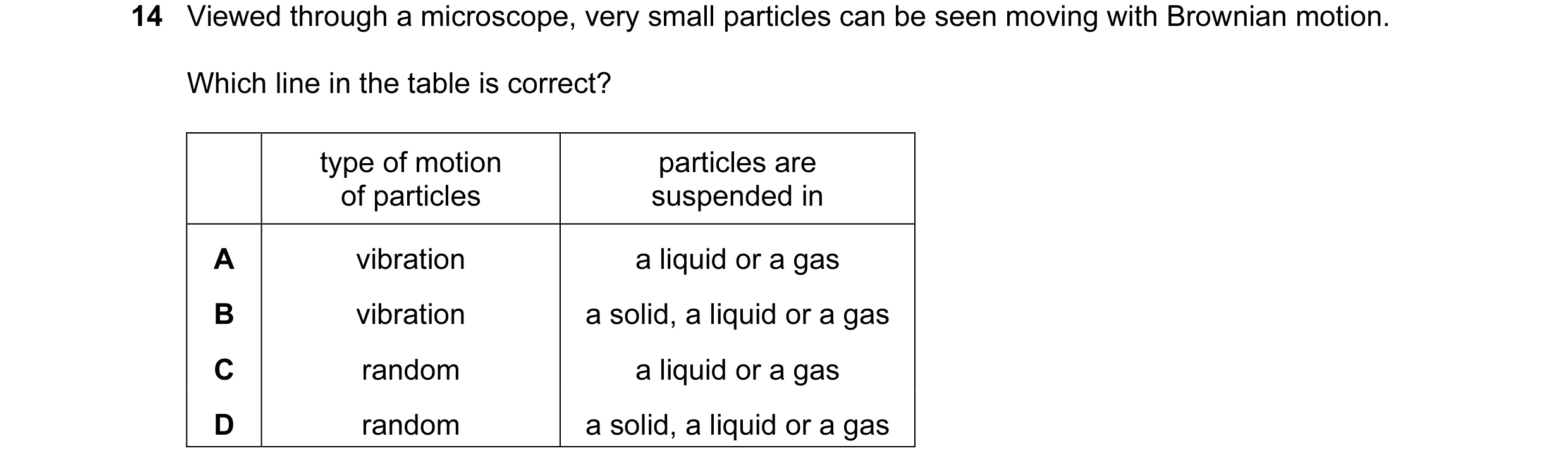
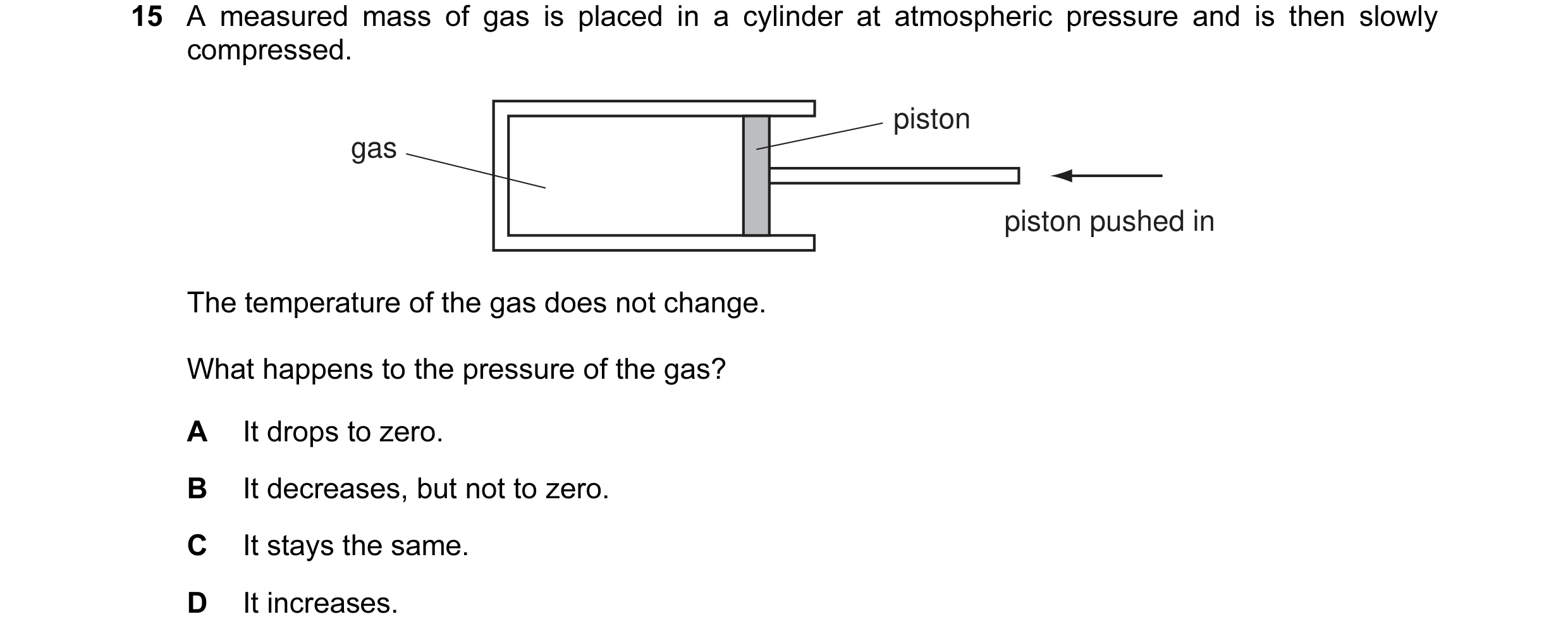
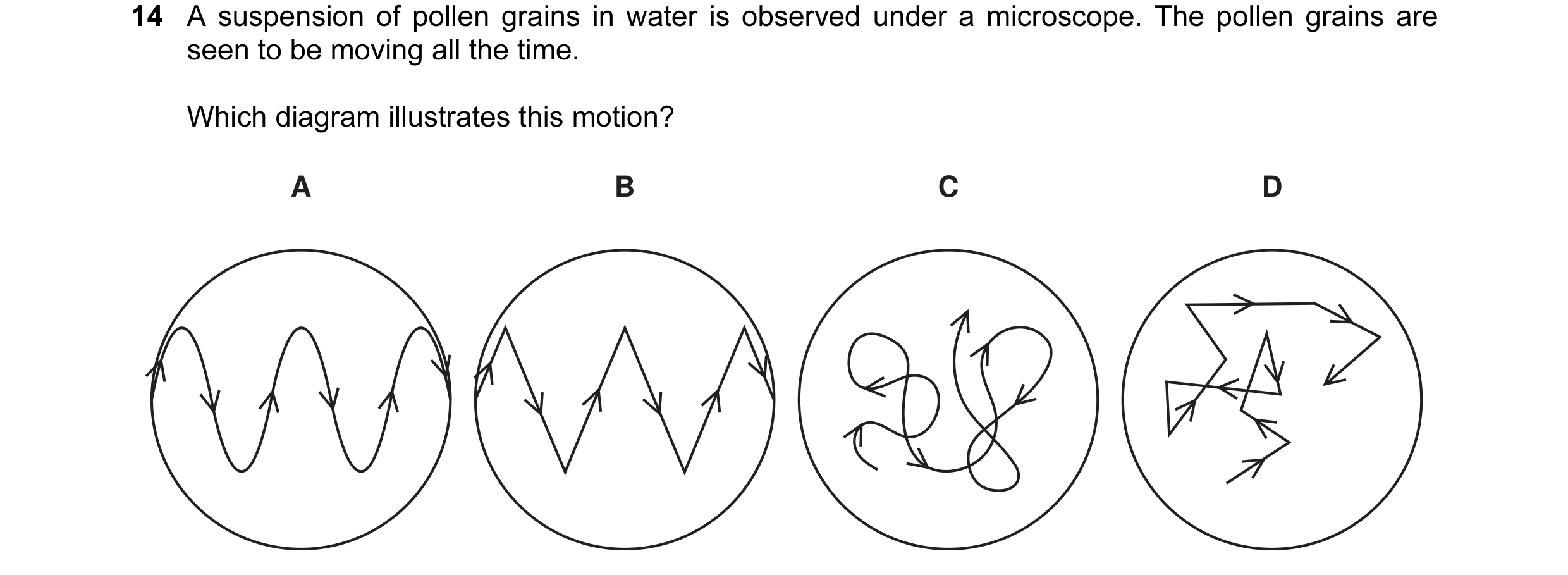 1 / 83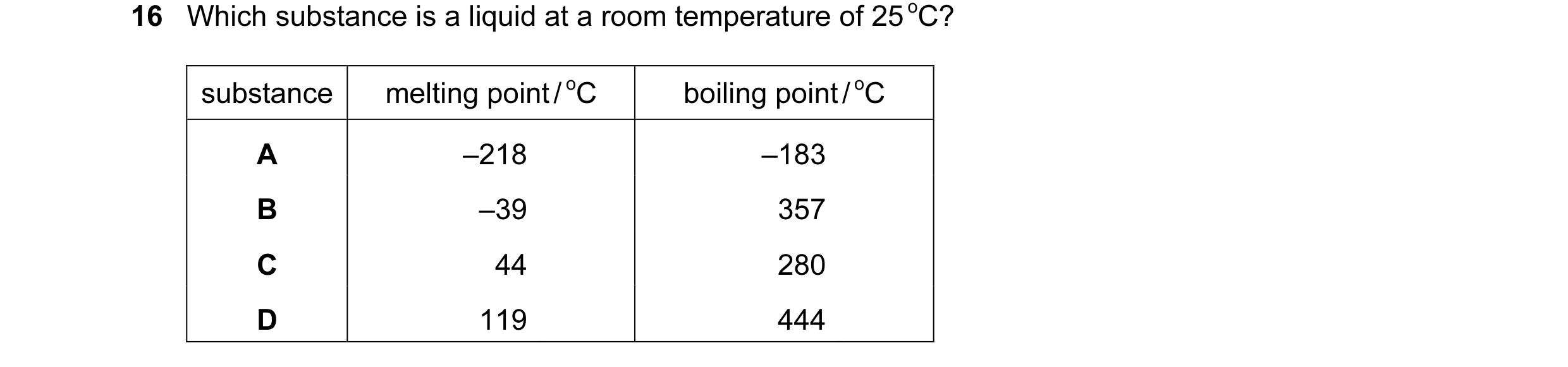
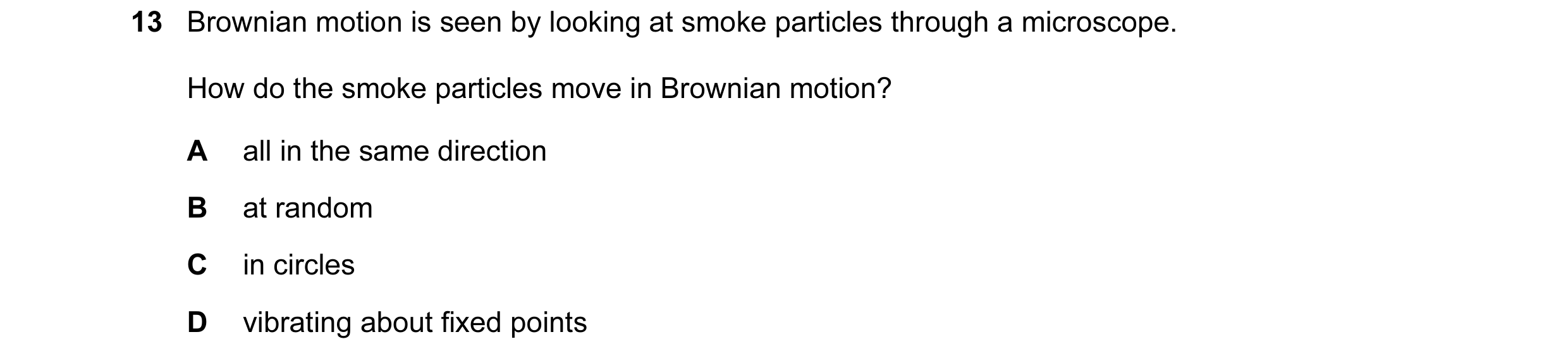
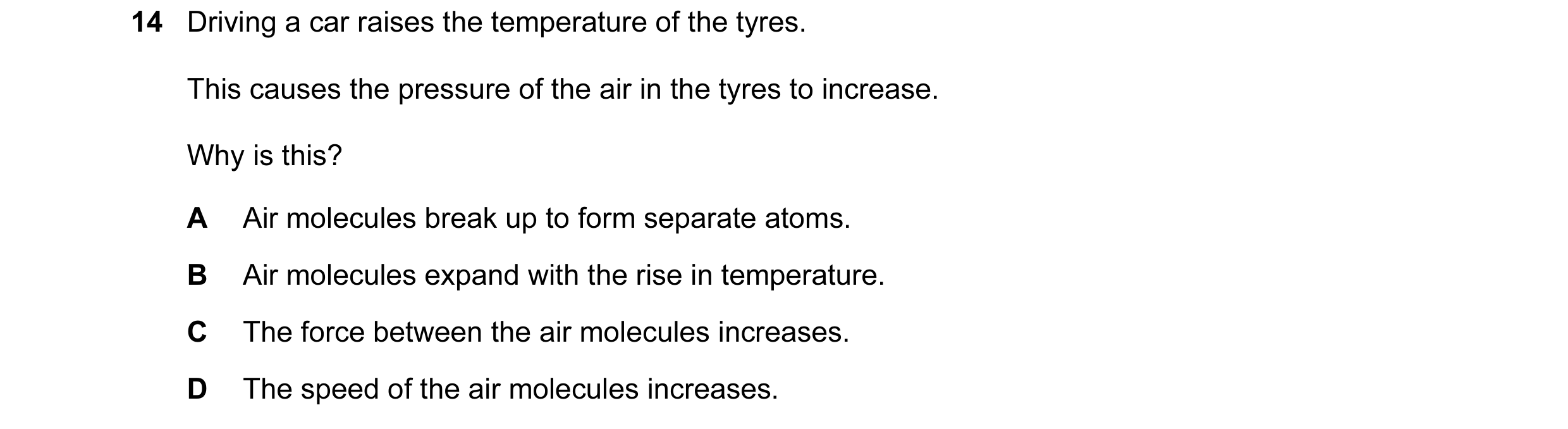
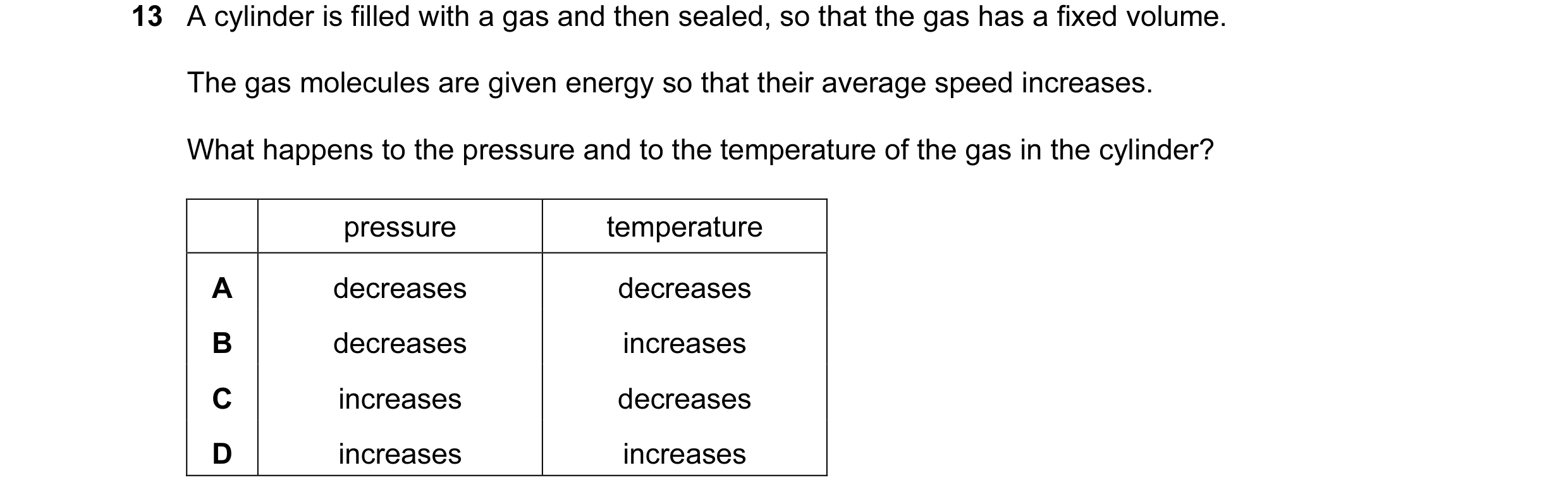 2 / 83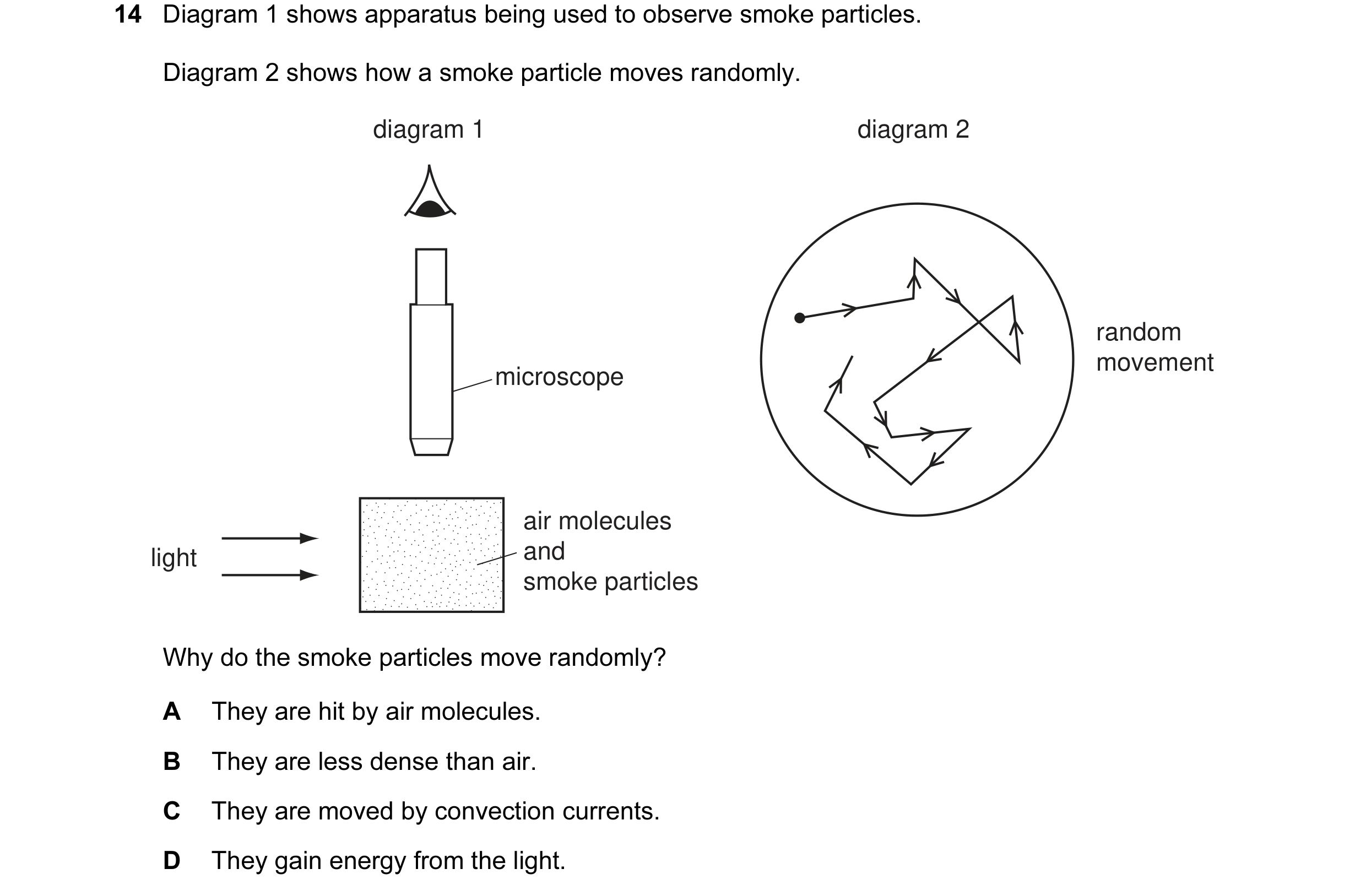
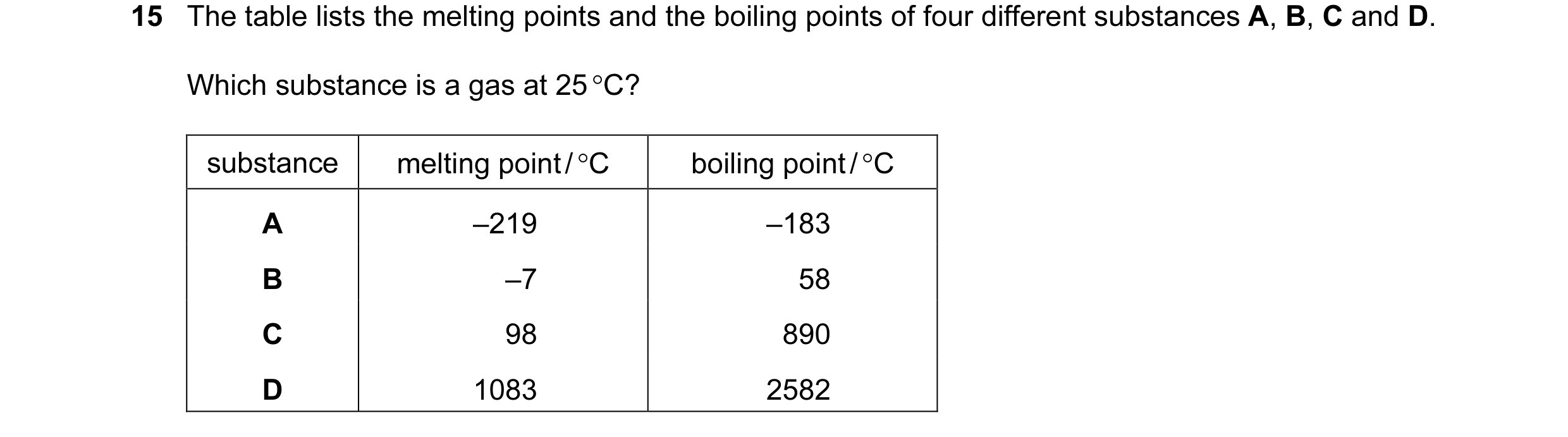 3 / 83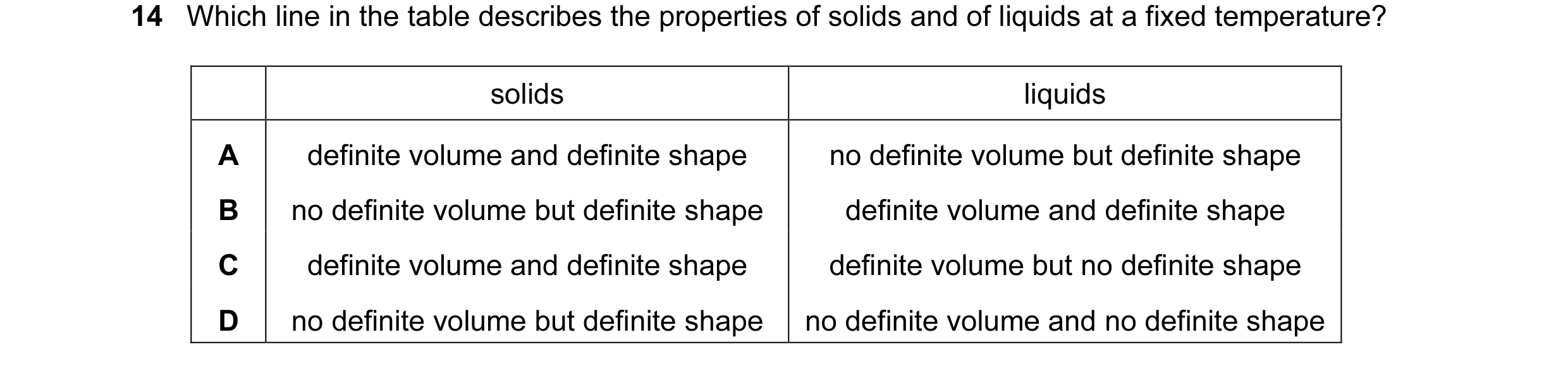
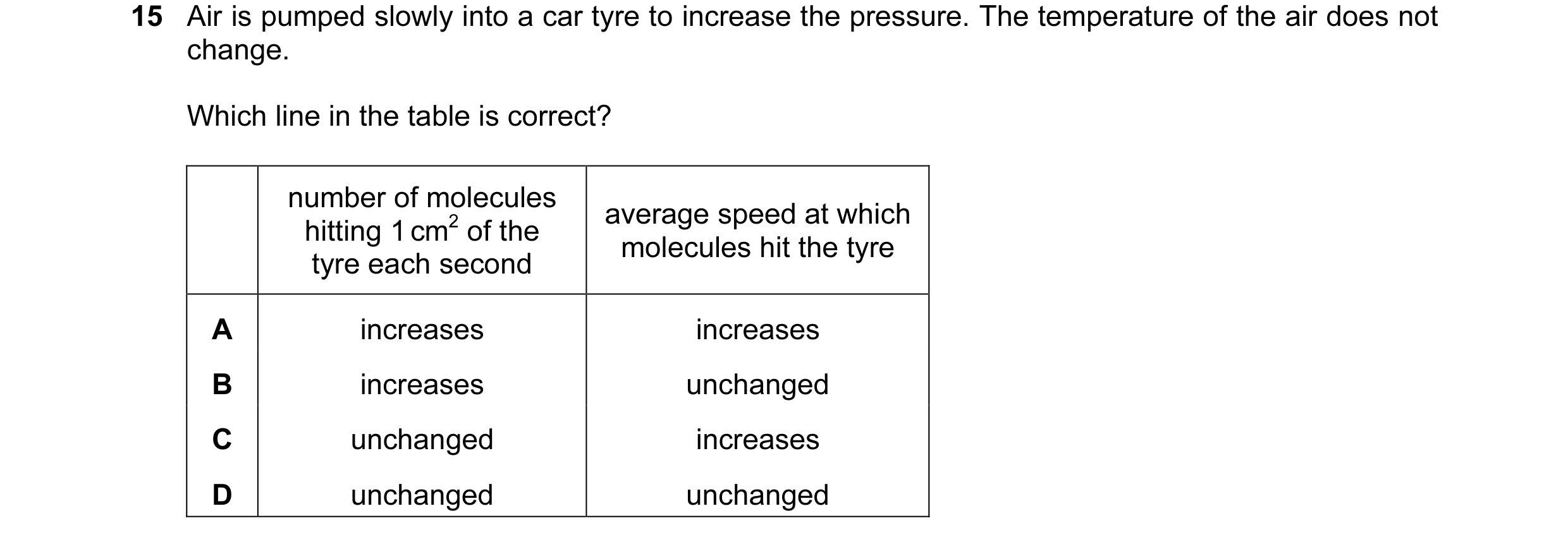
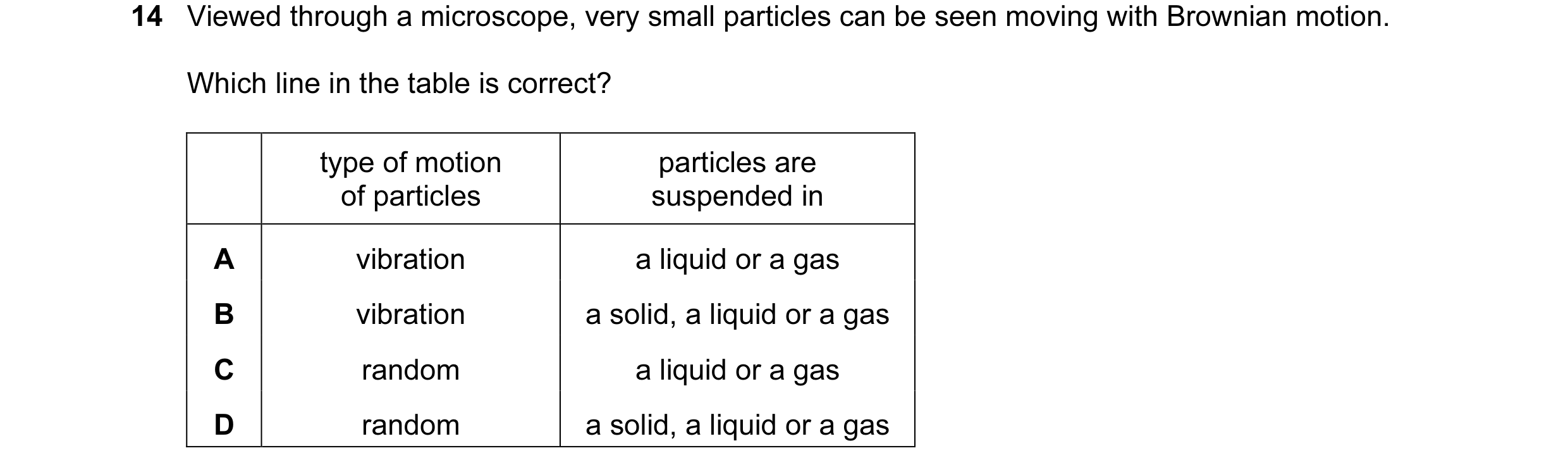 4 / 83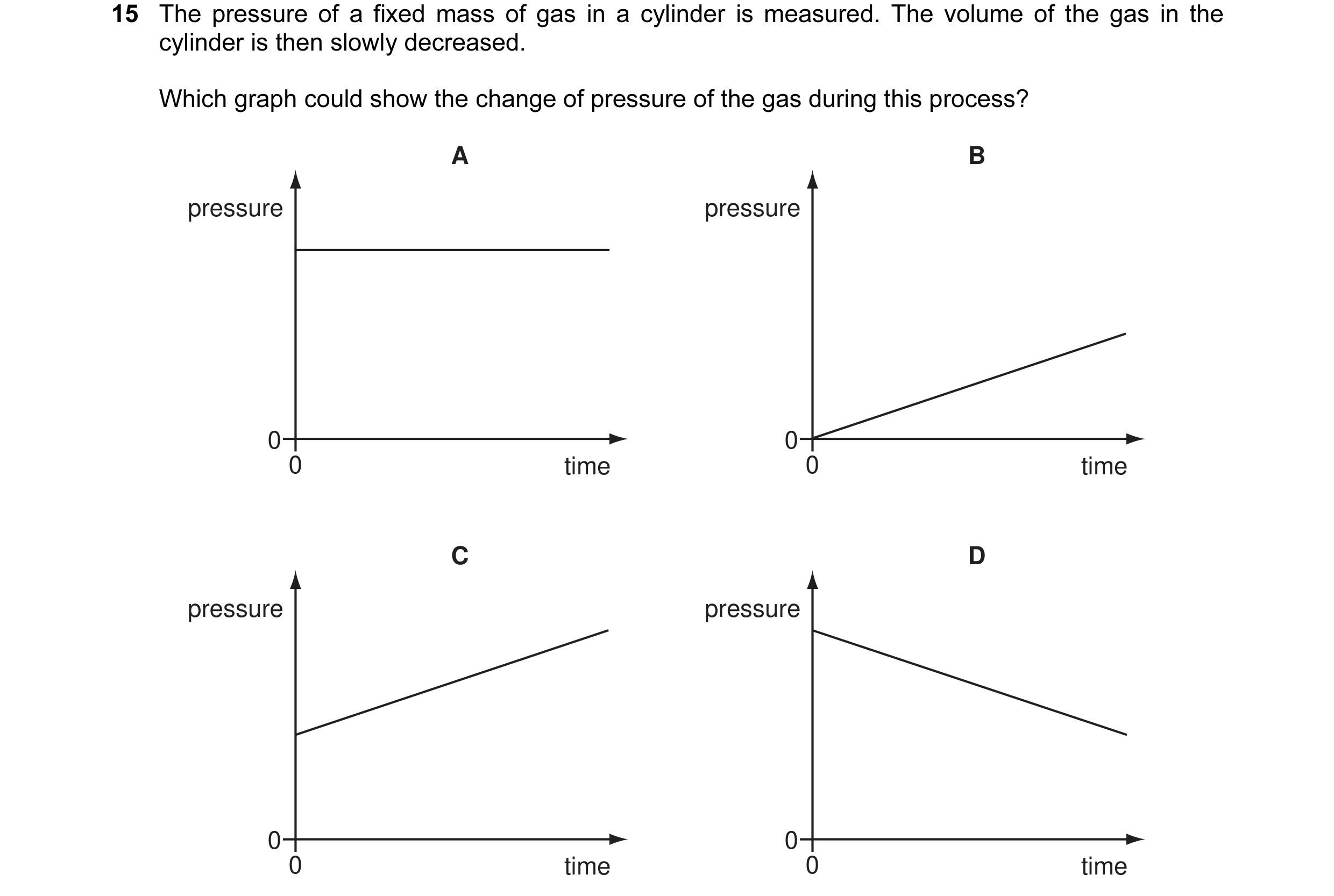
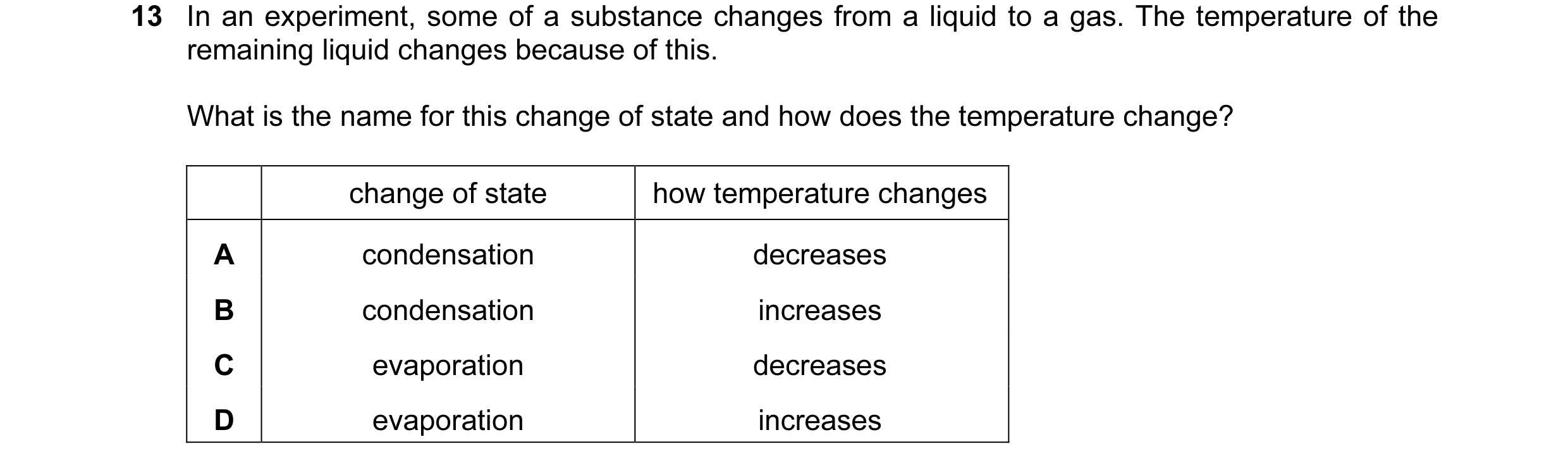 5 / 83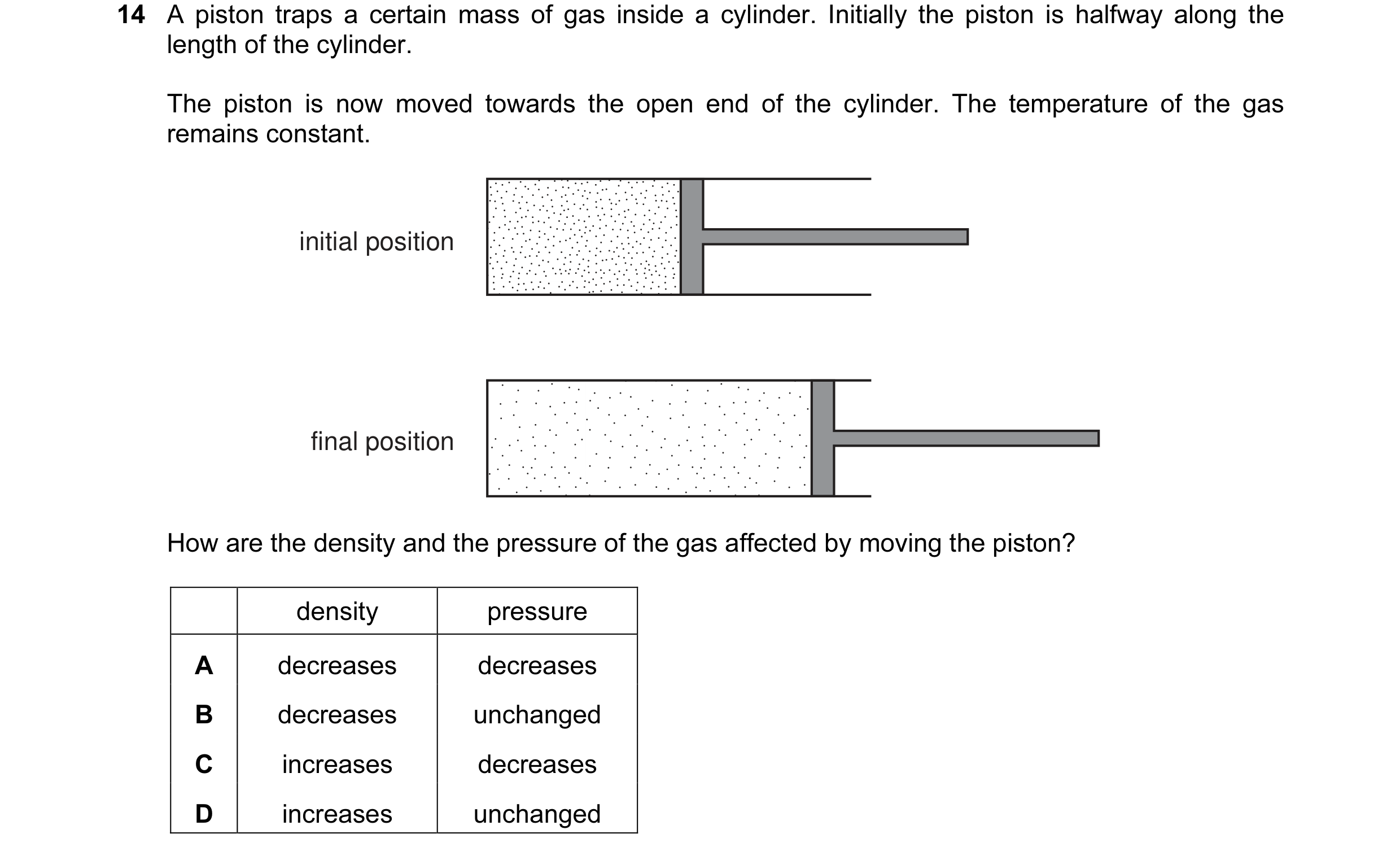
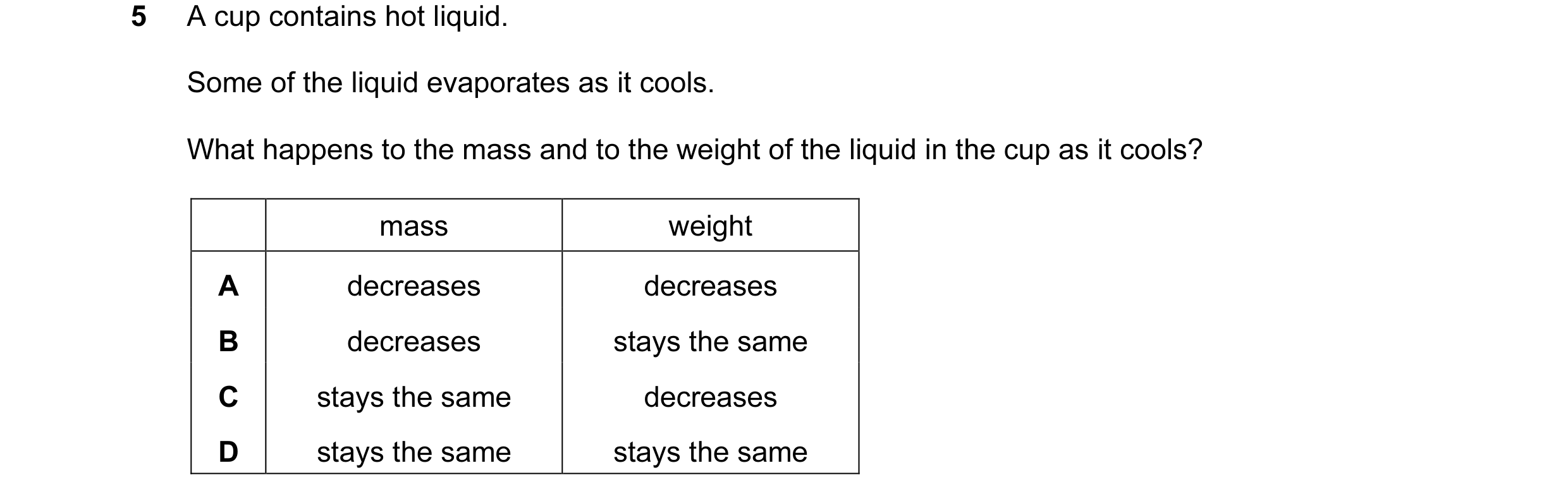
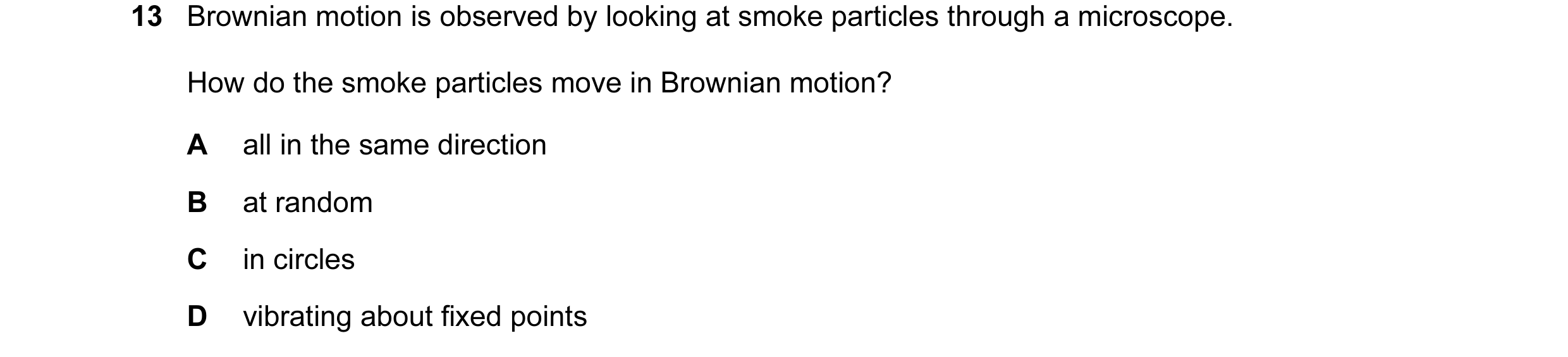 6 / 83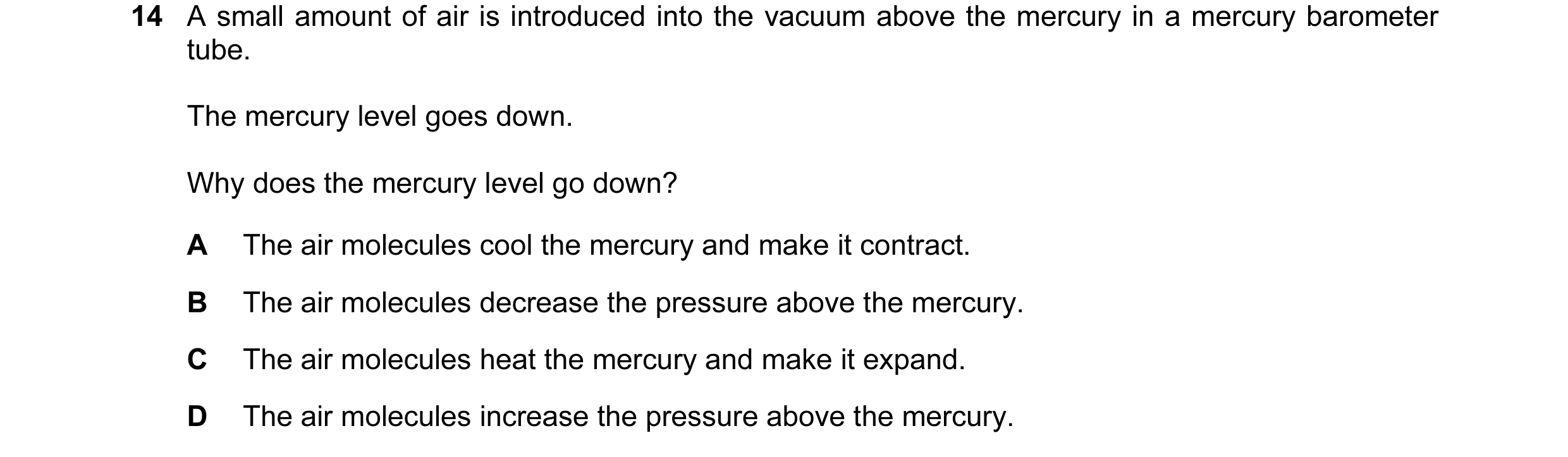
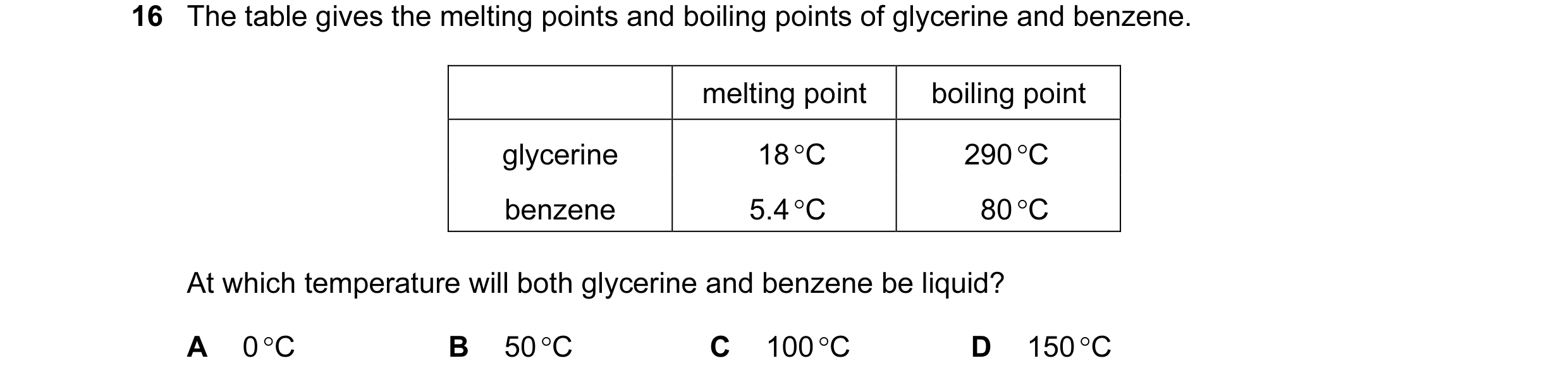
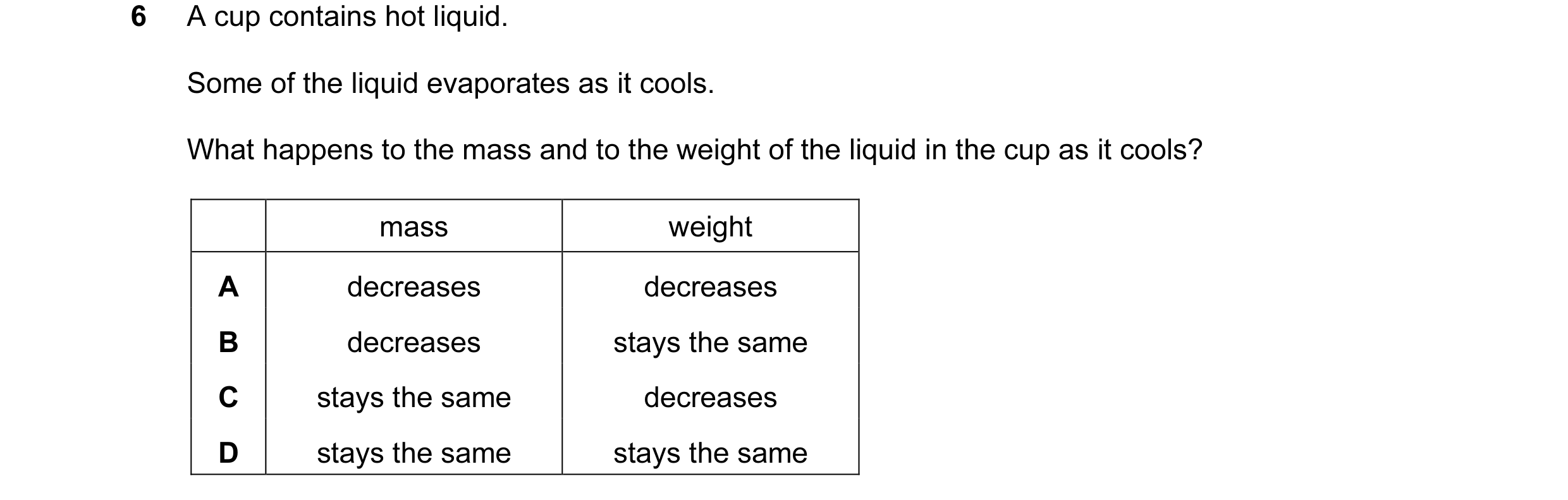
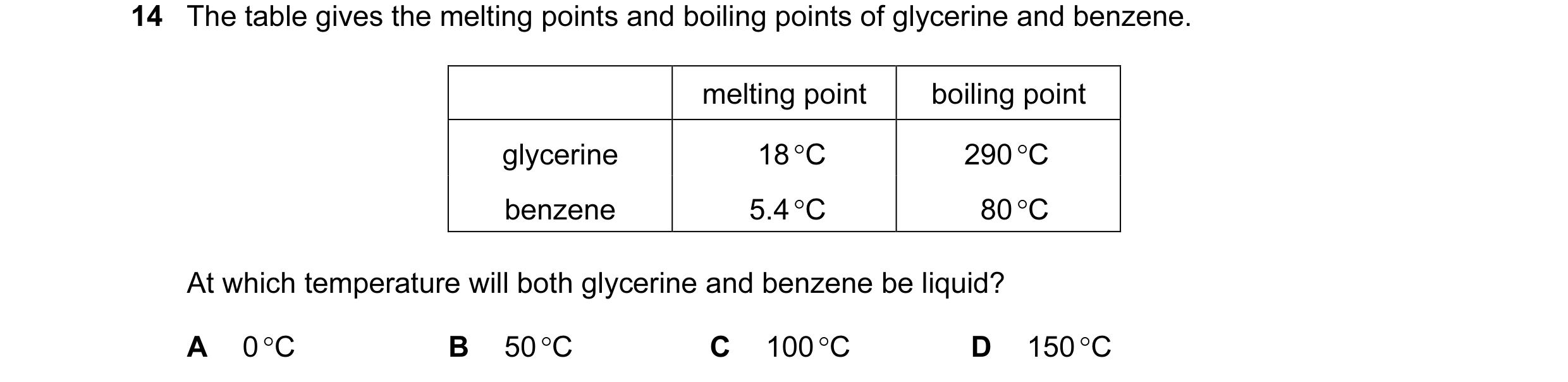 7 / 83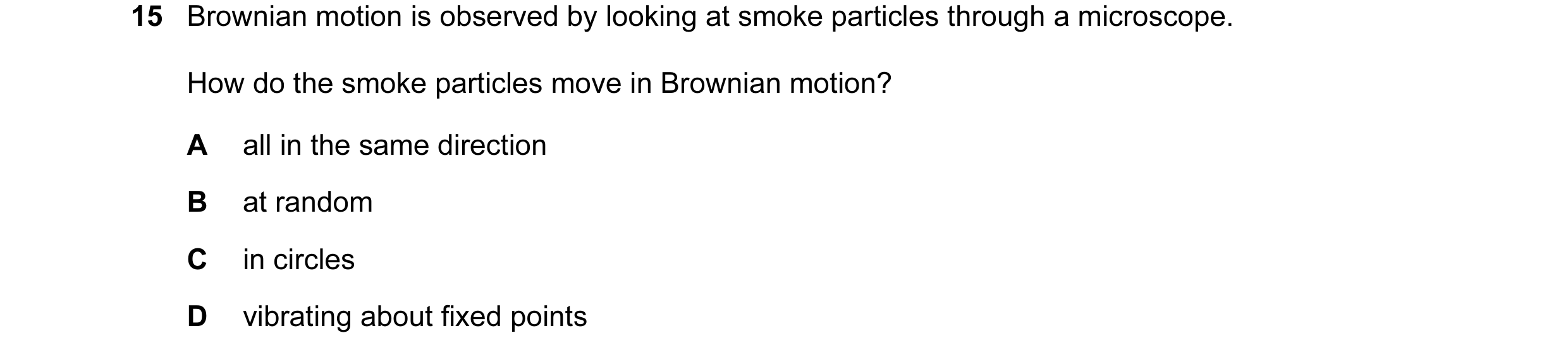
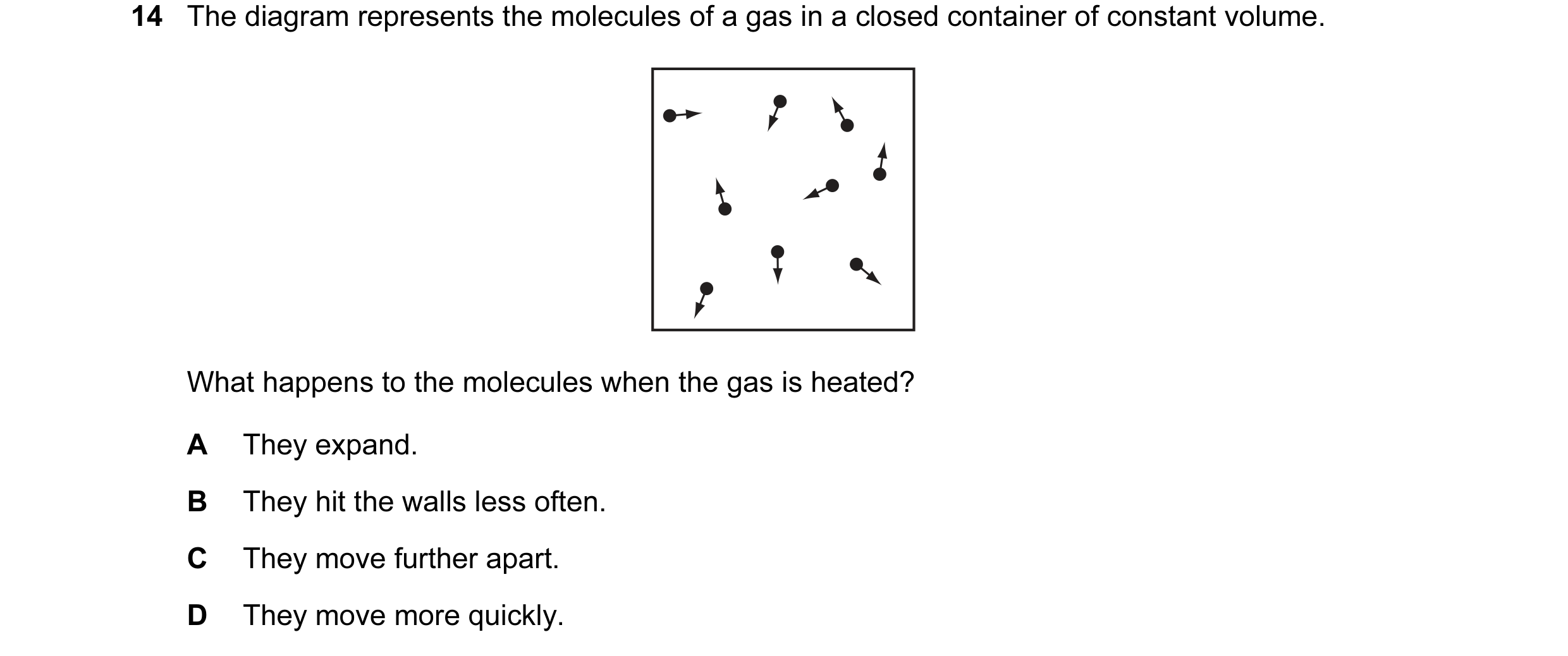
 8 / 83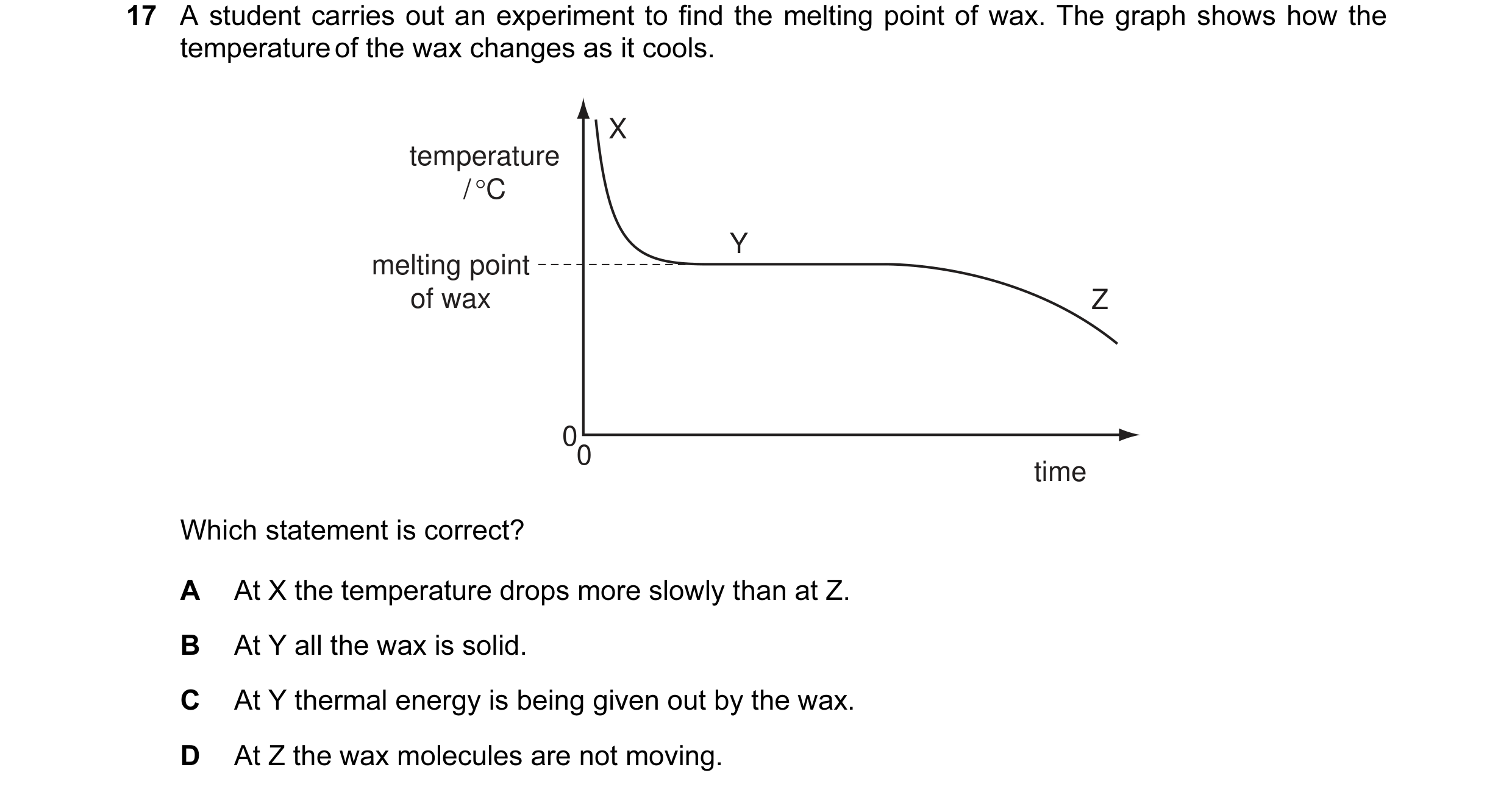
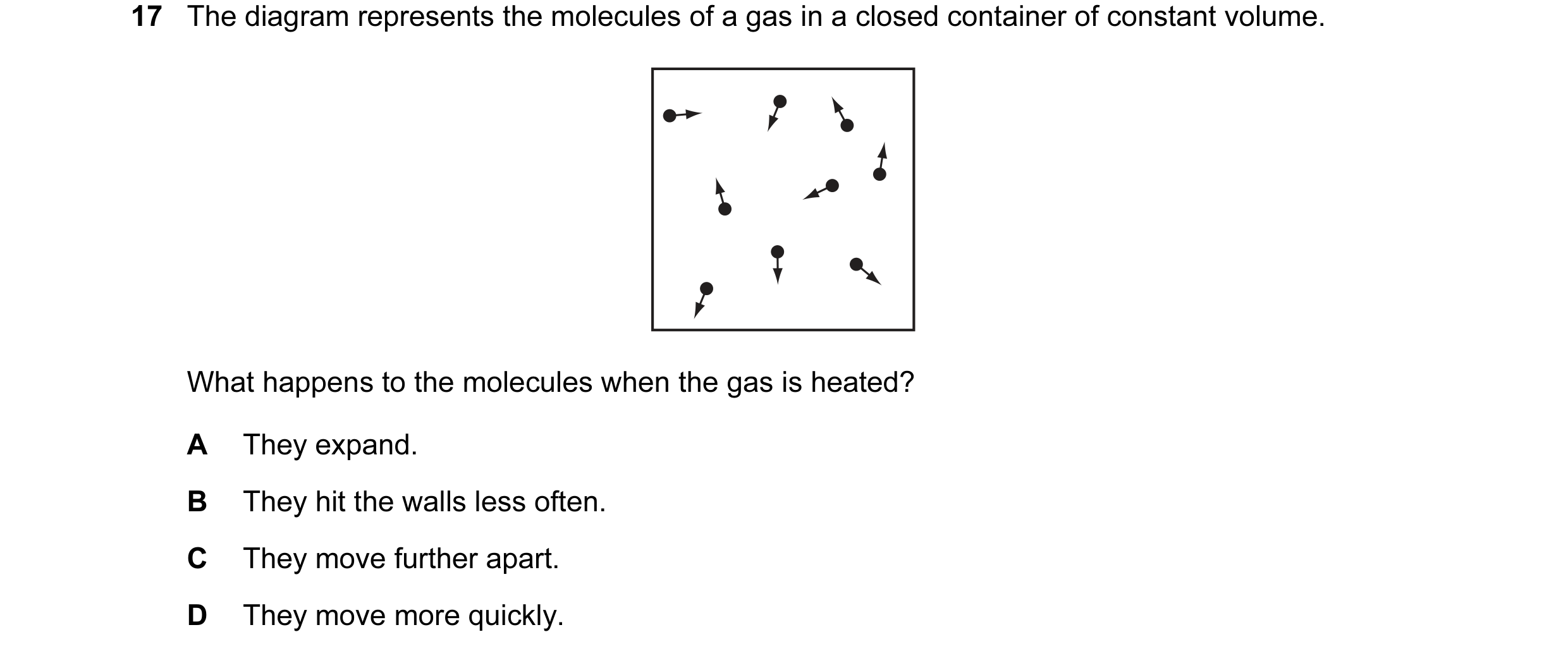
 9 / 83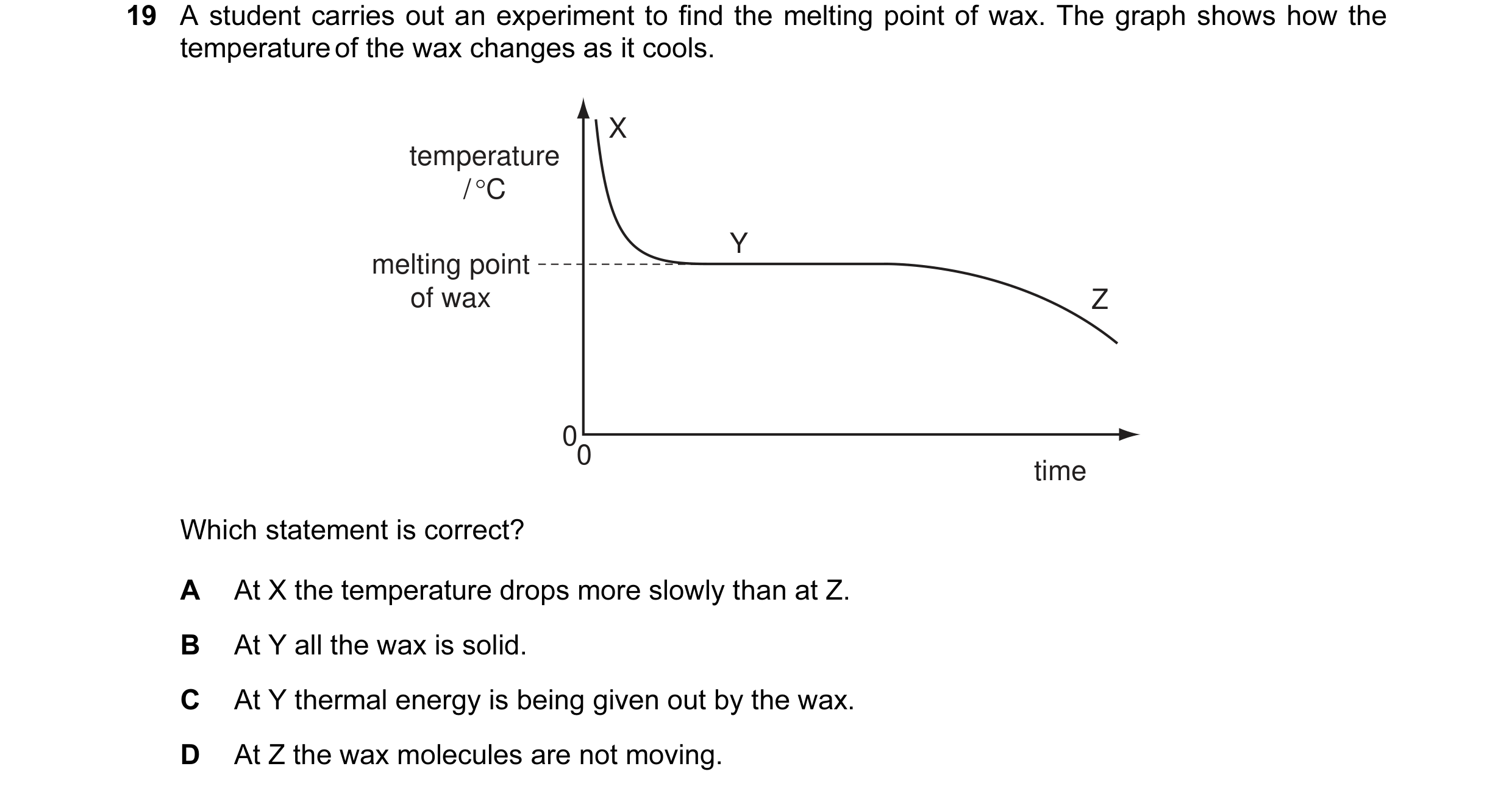
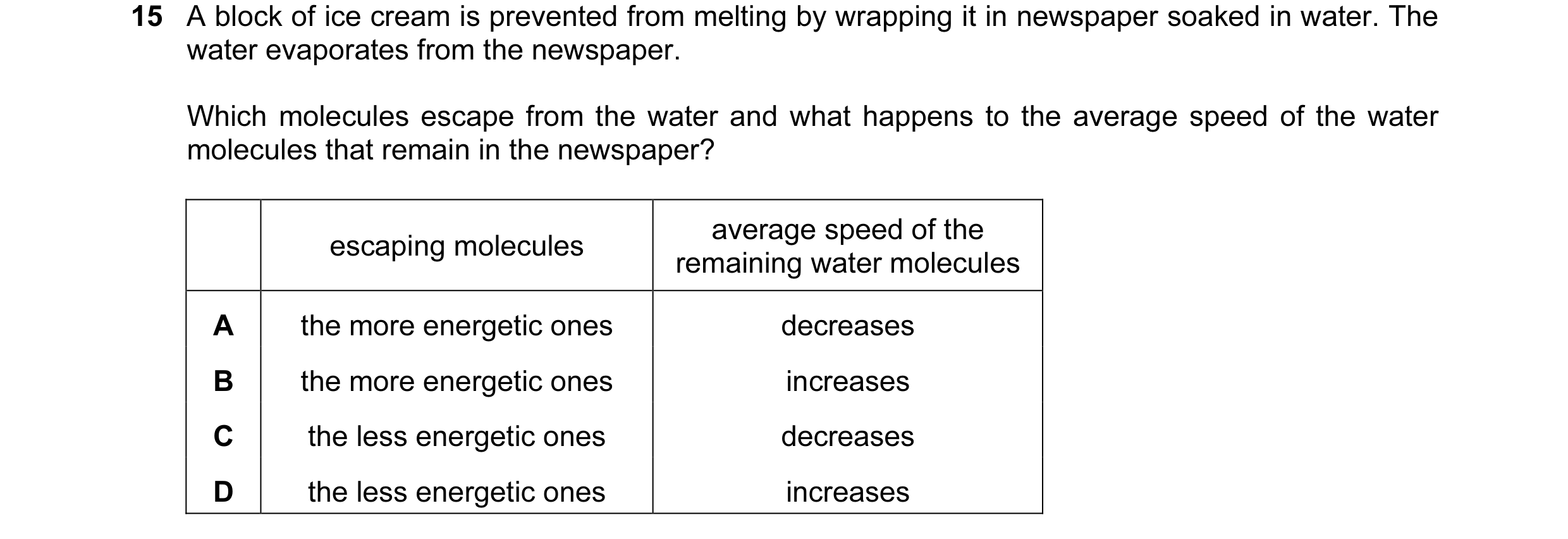
 10 / 83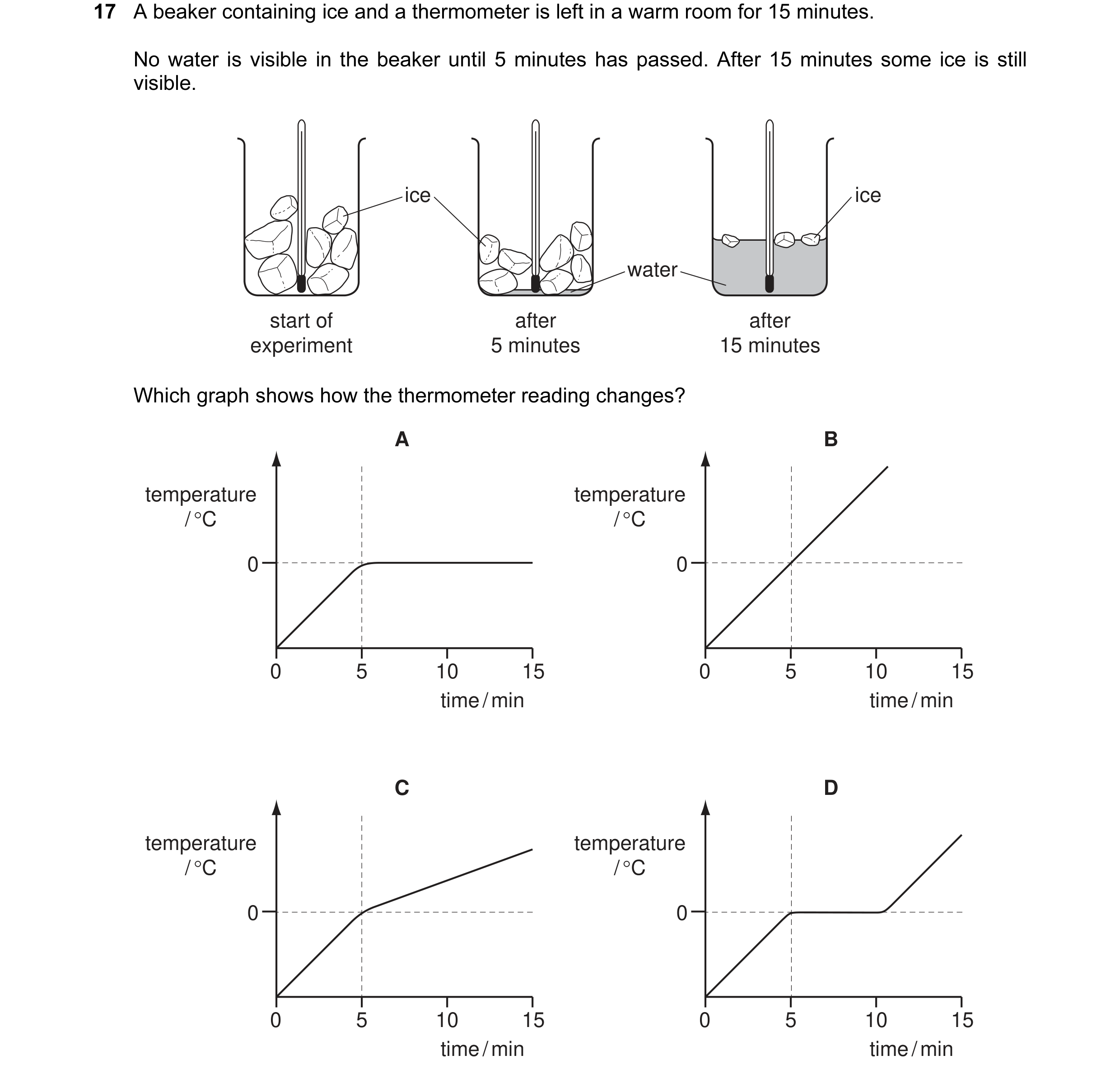

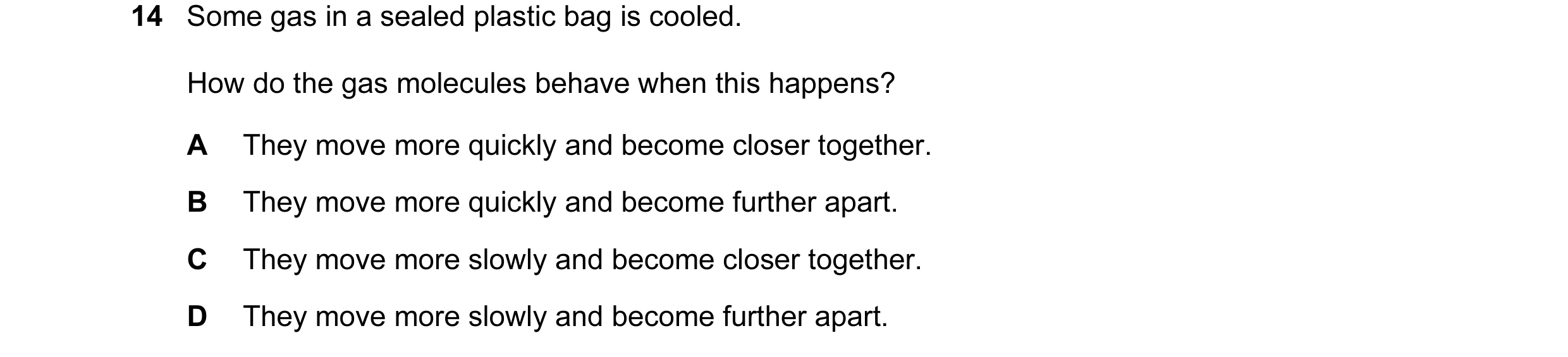 11 / 83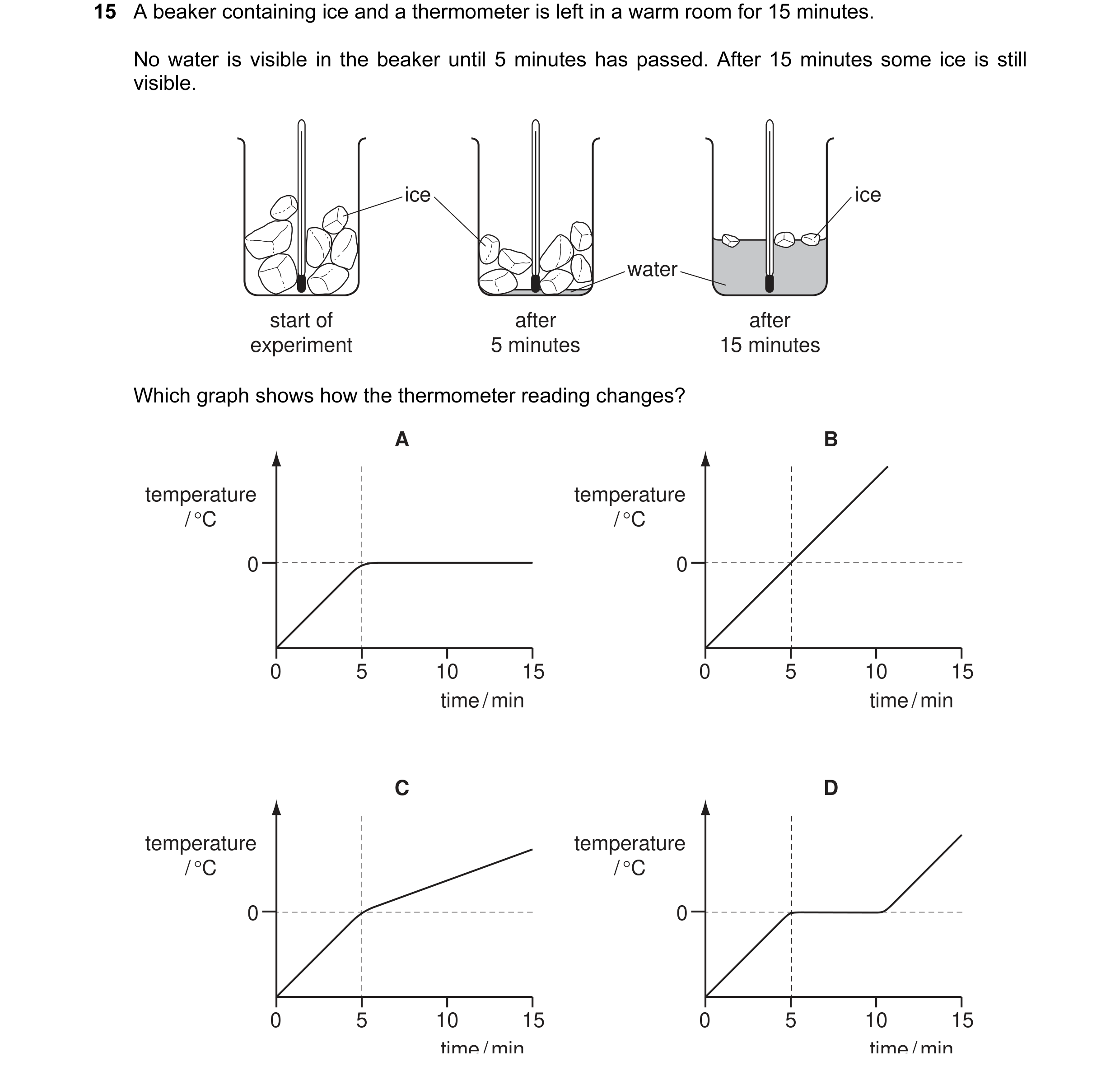
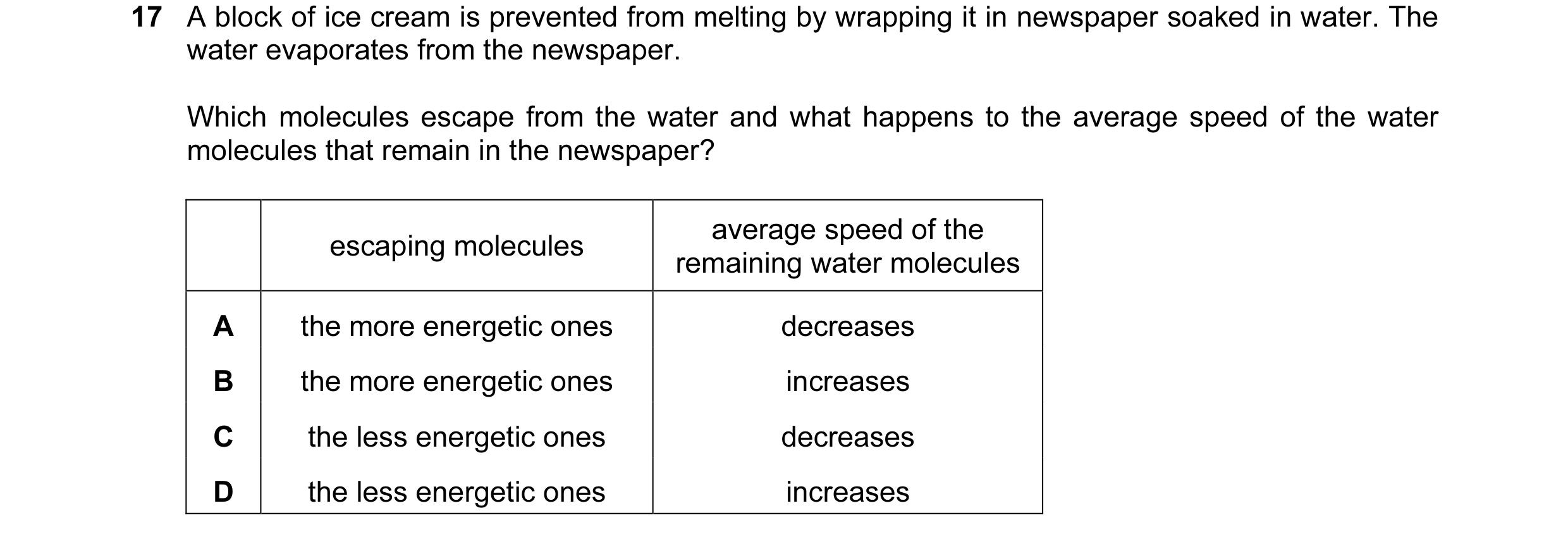 12 / 83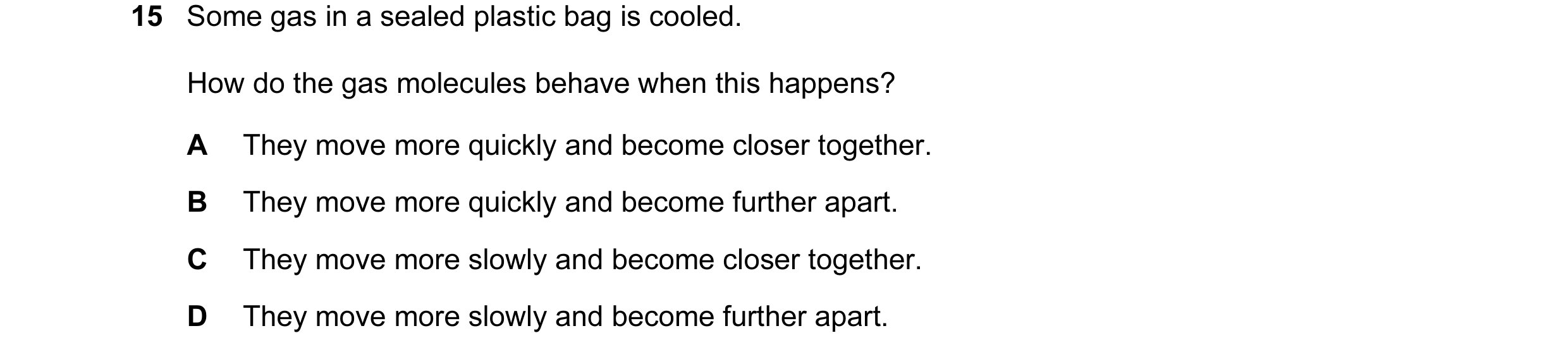

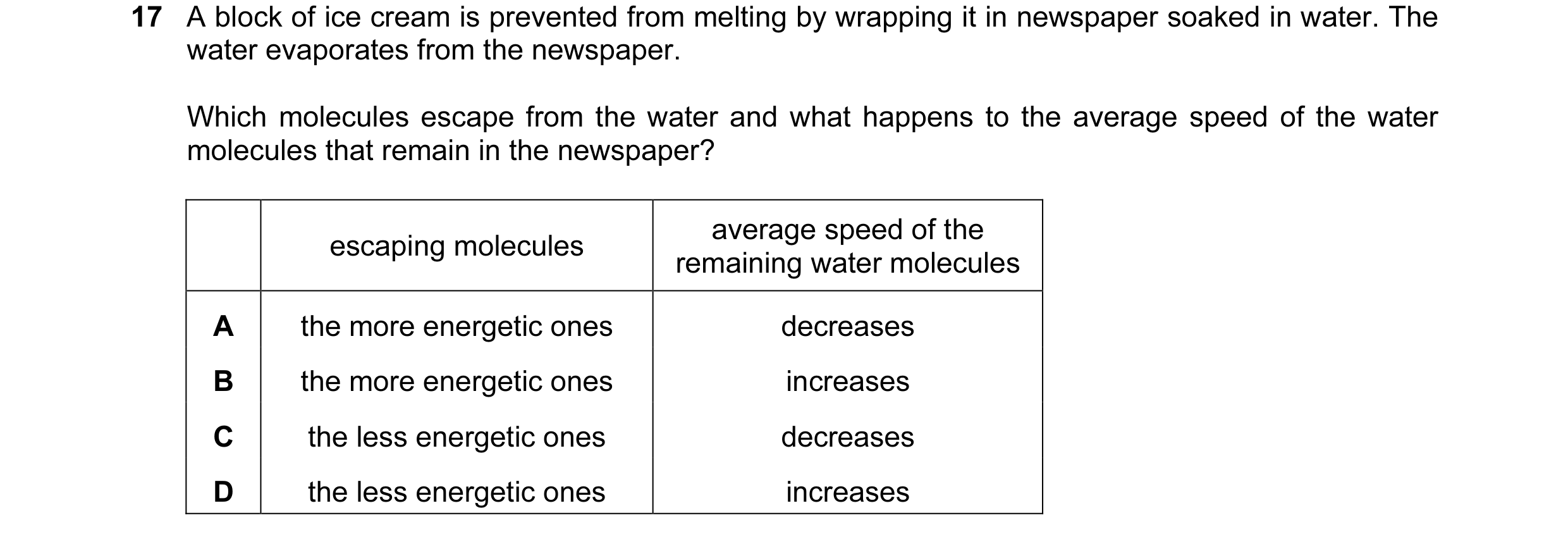 13 / 83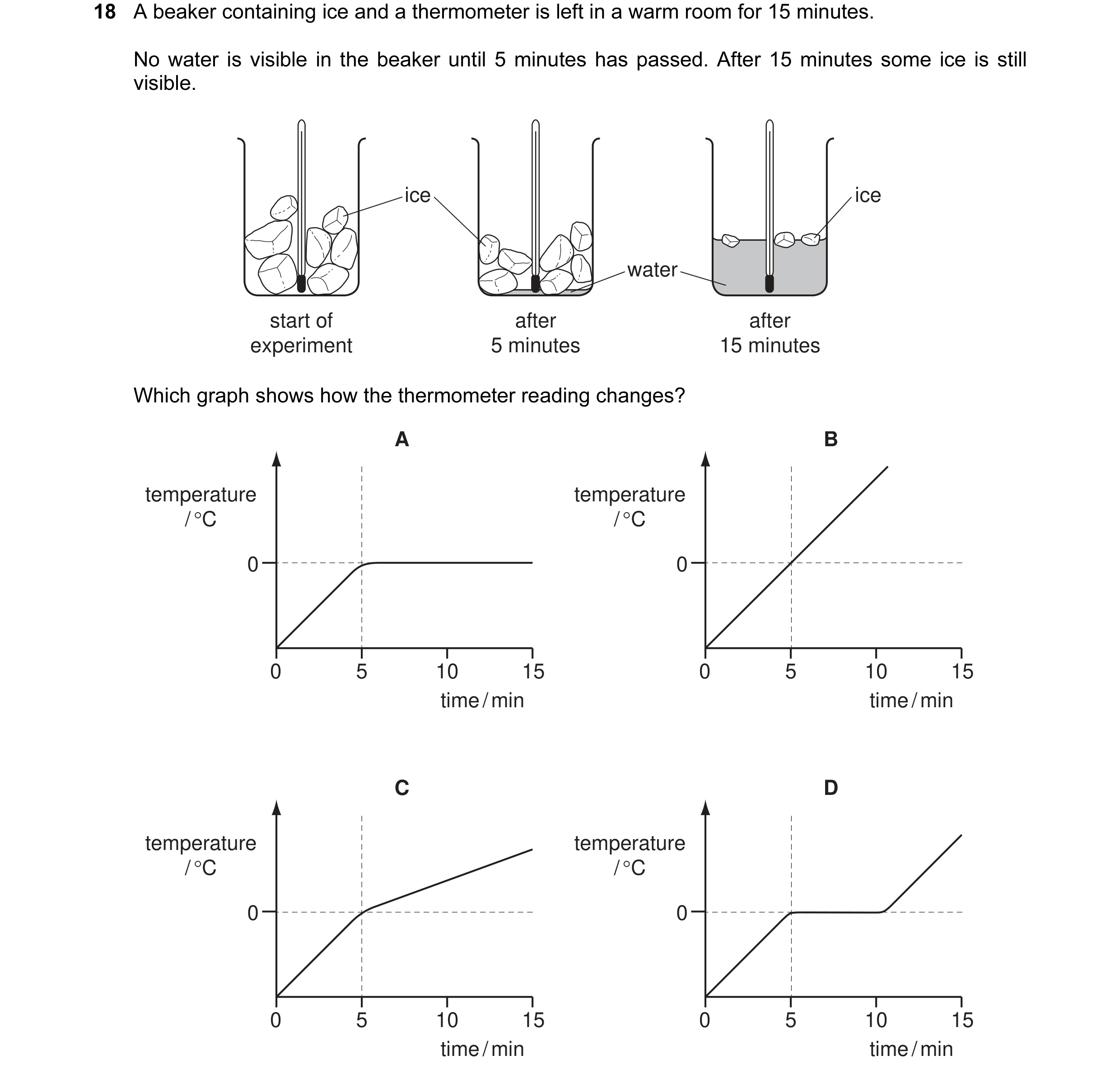
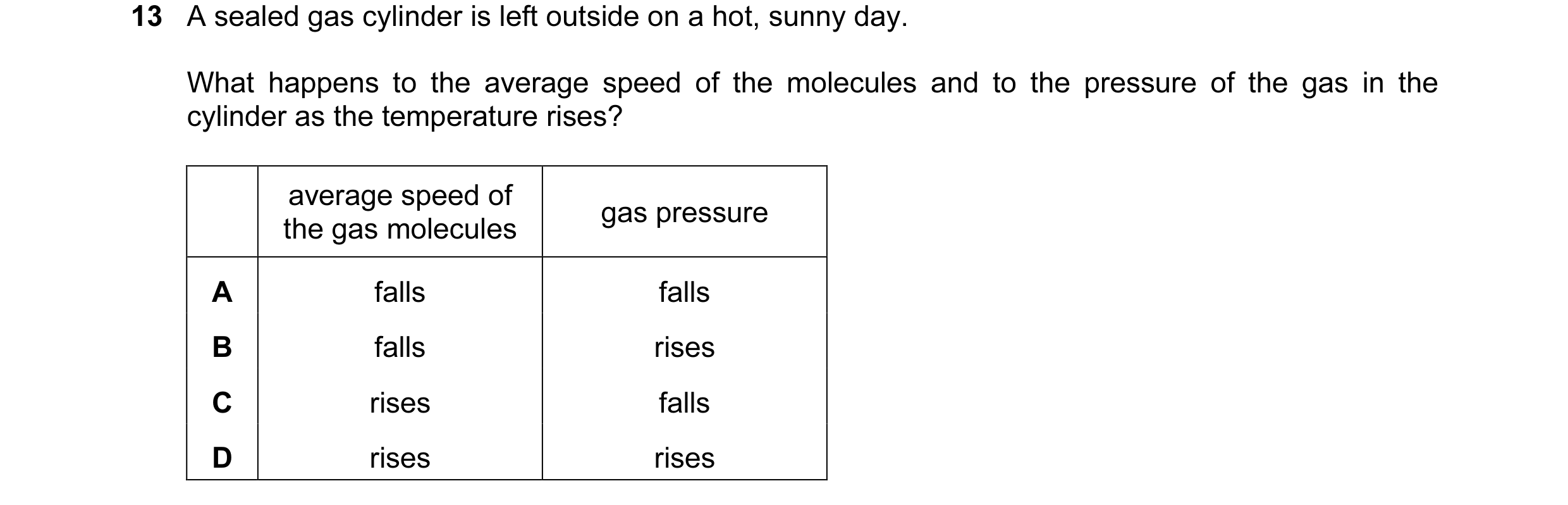 14 / 83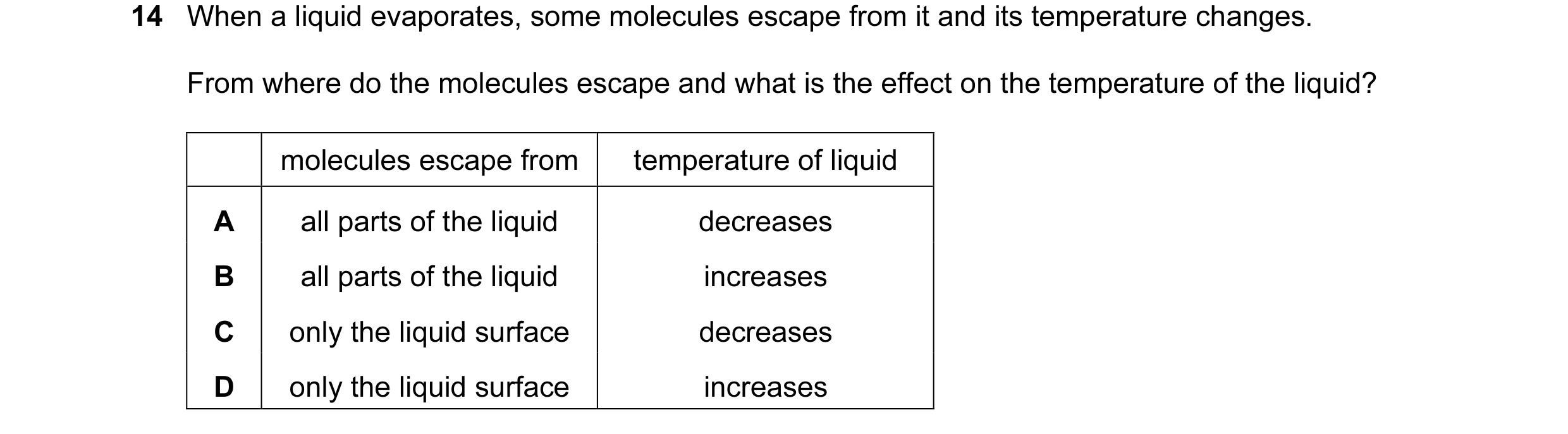
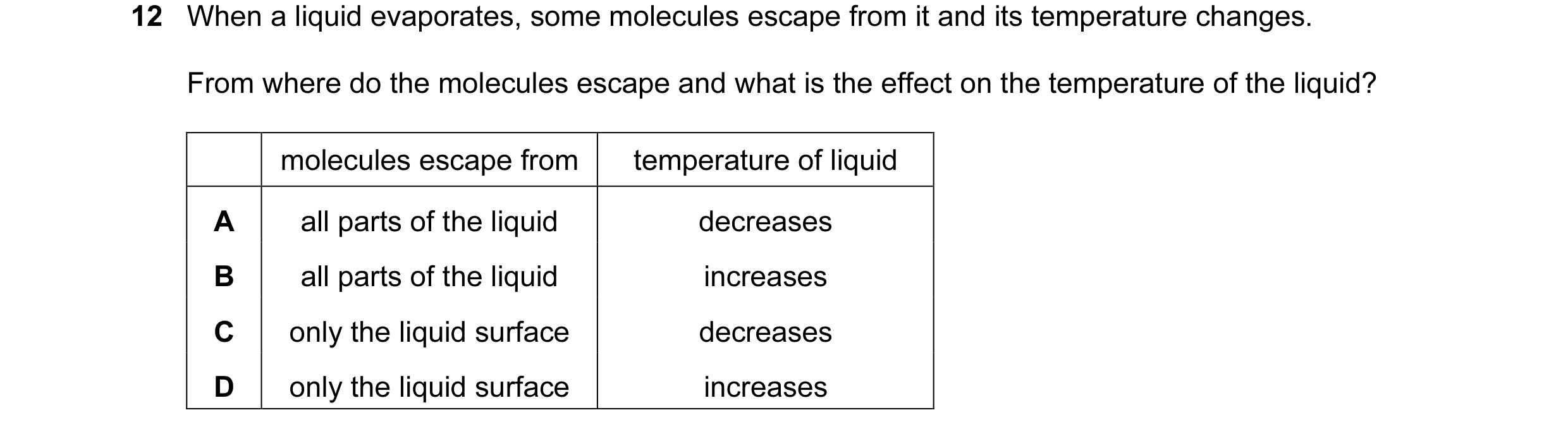
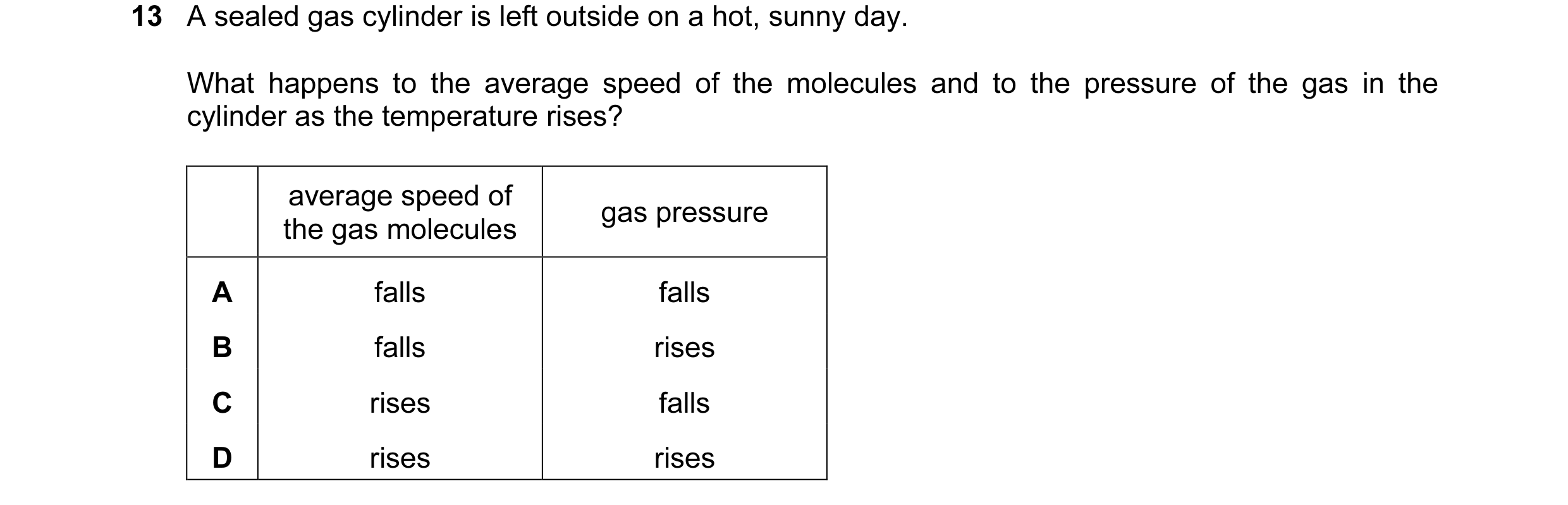
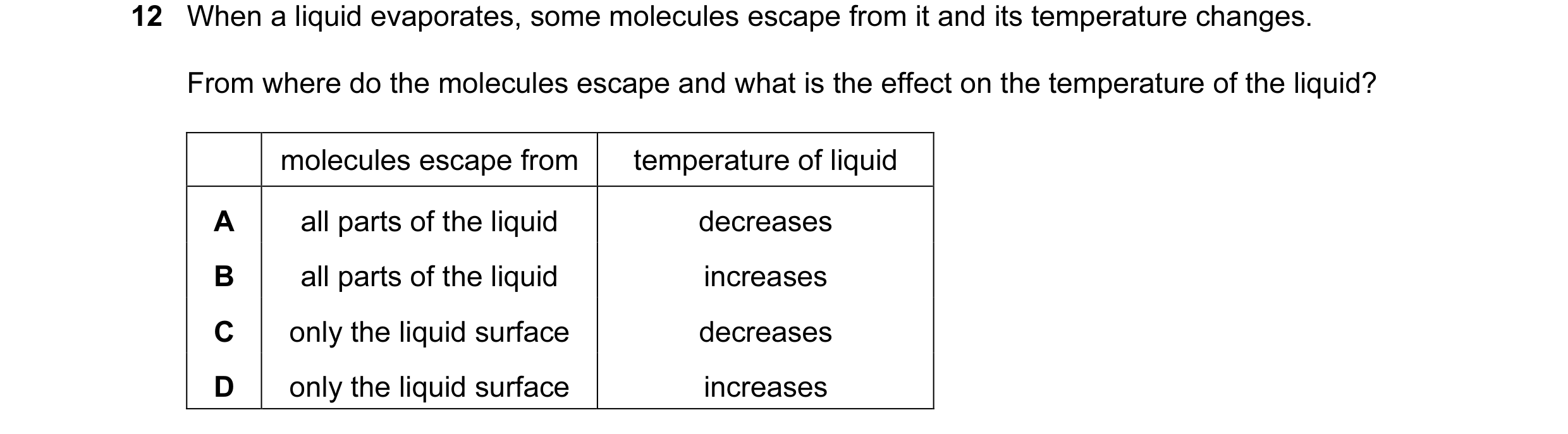 15 / 83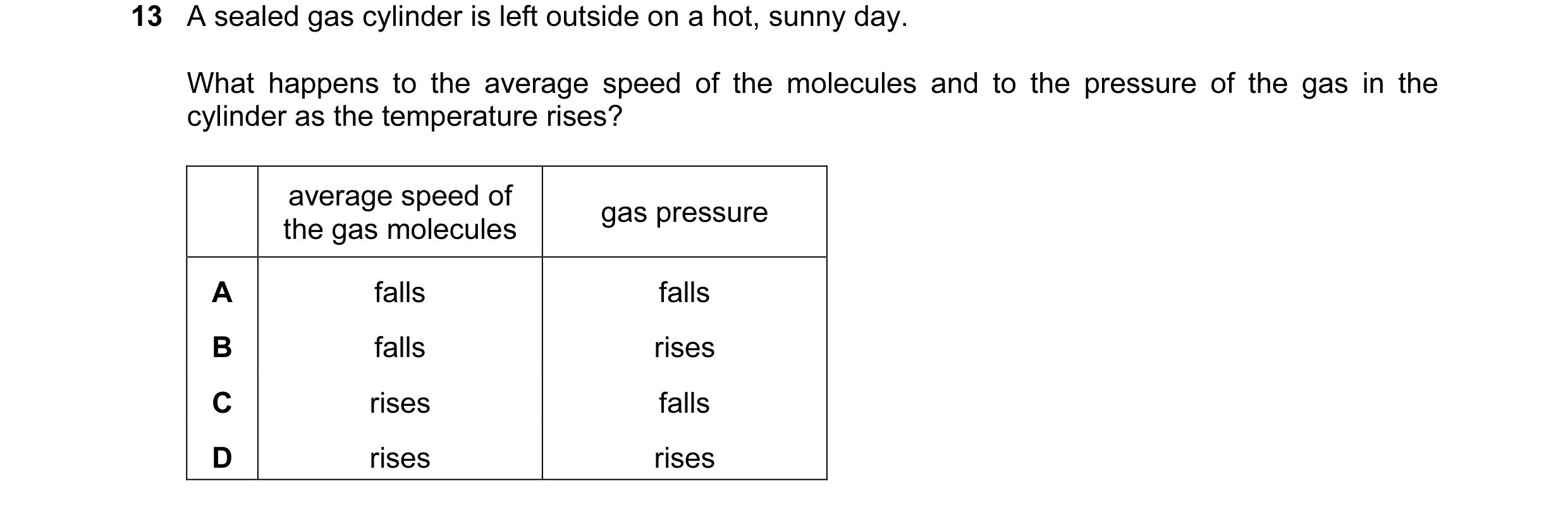
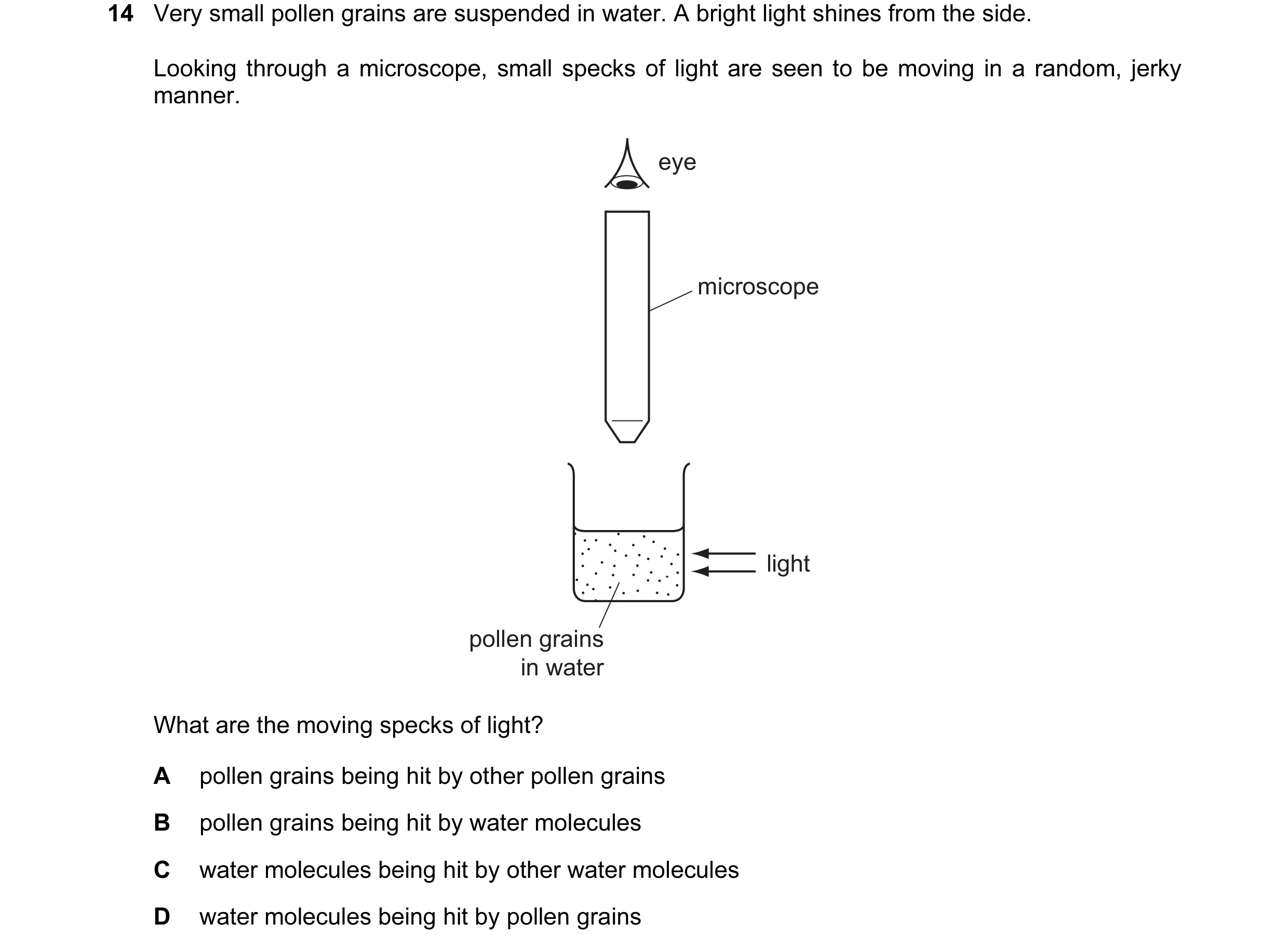
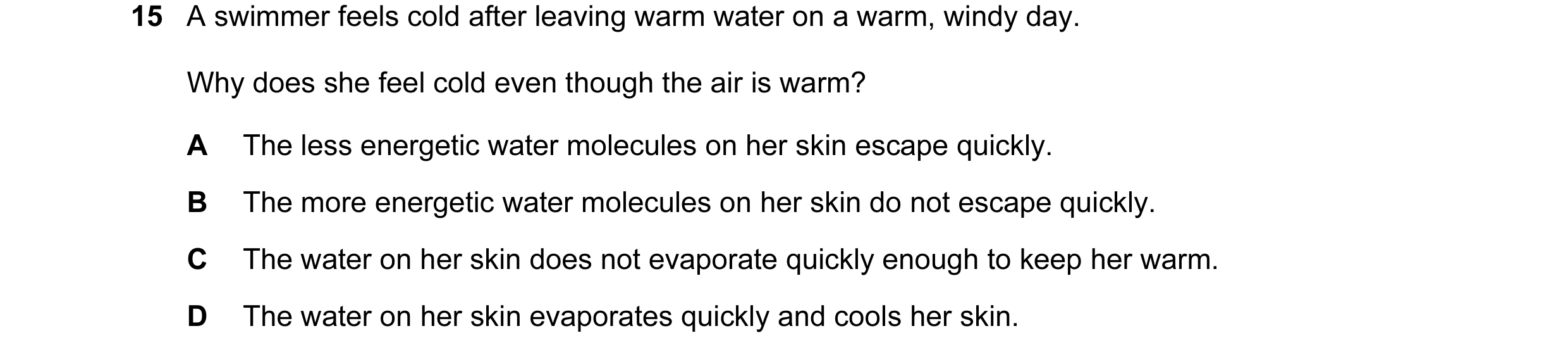 16 / 83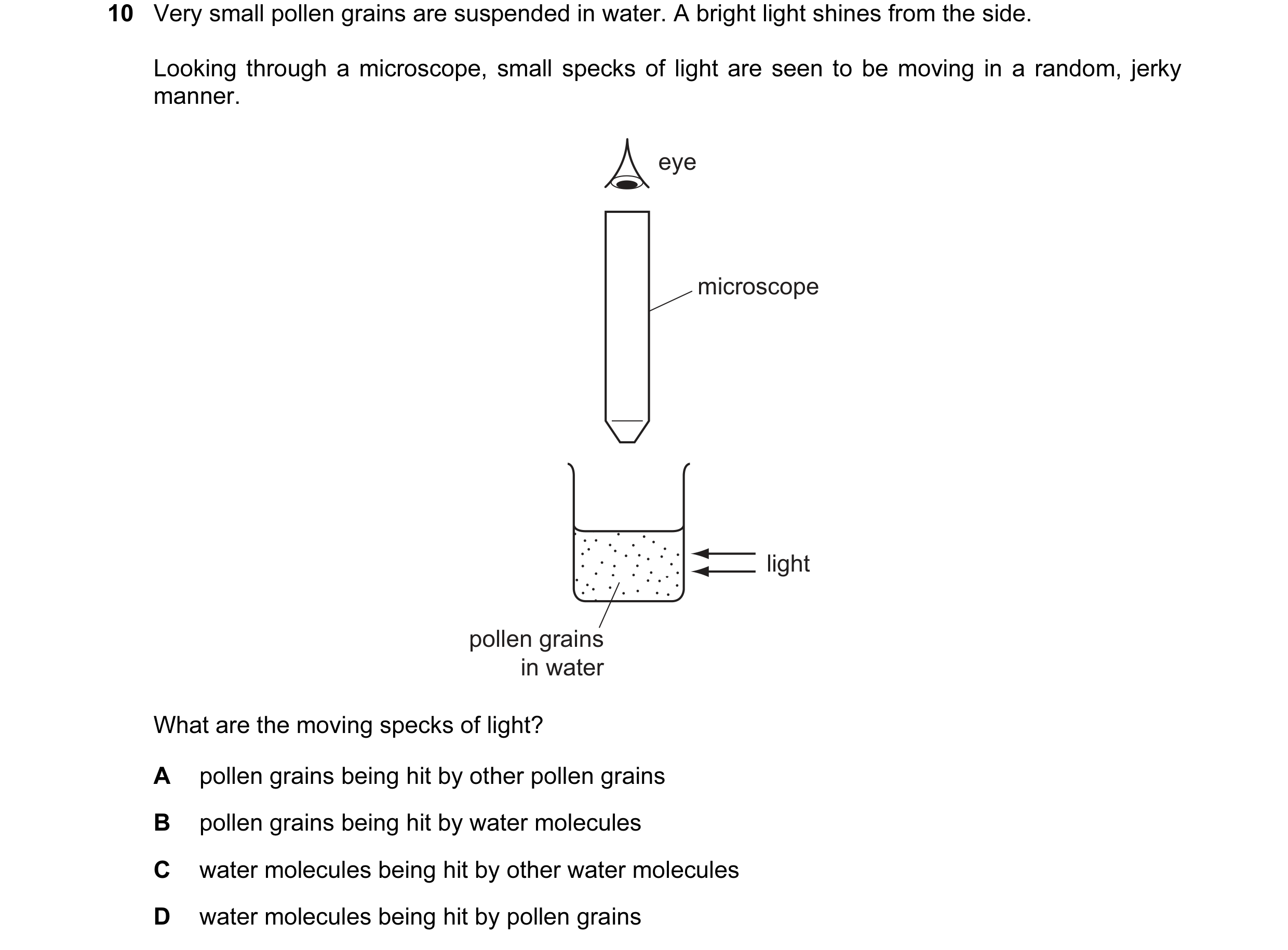
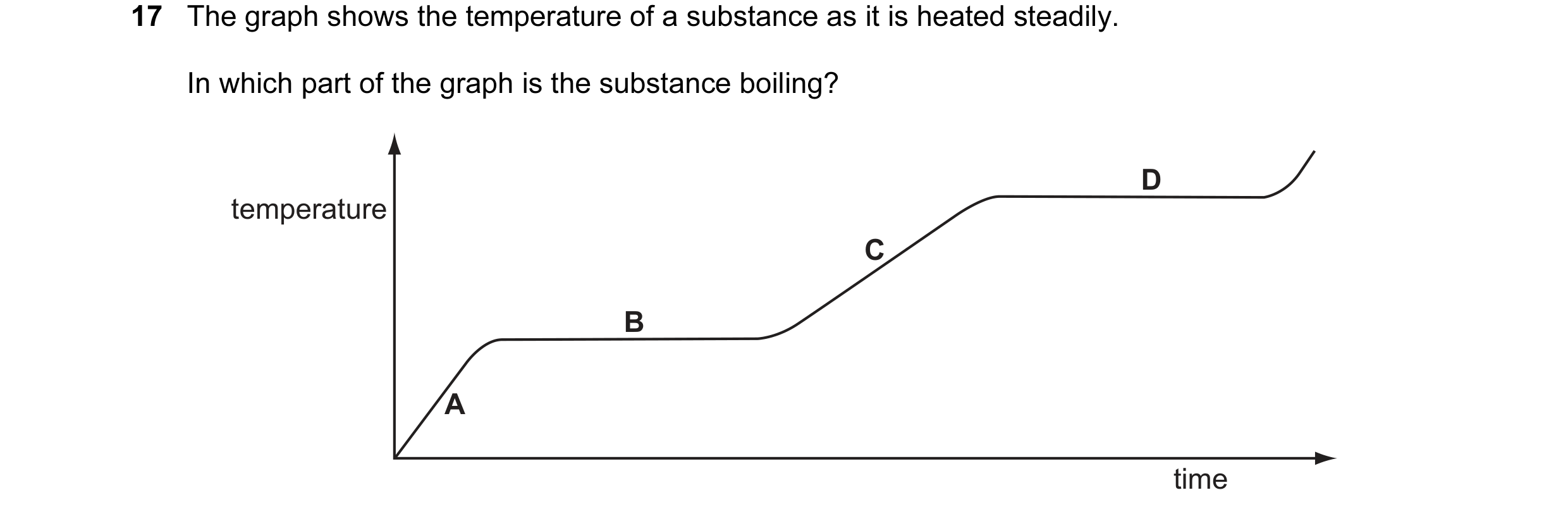
 17 / 83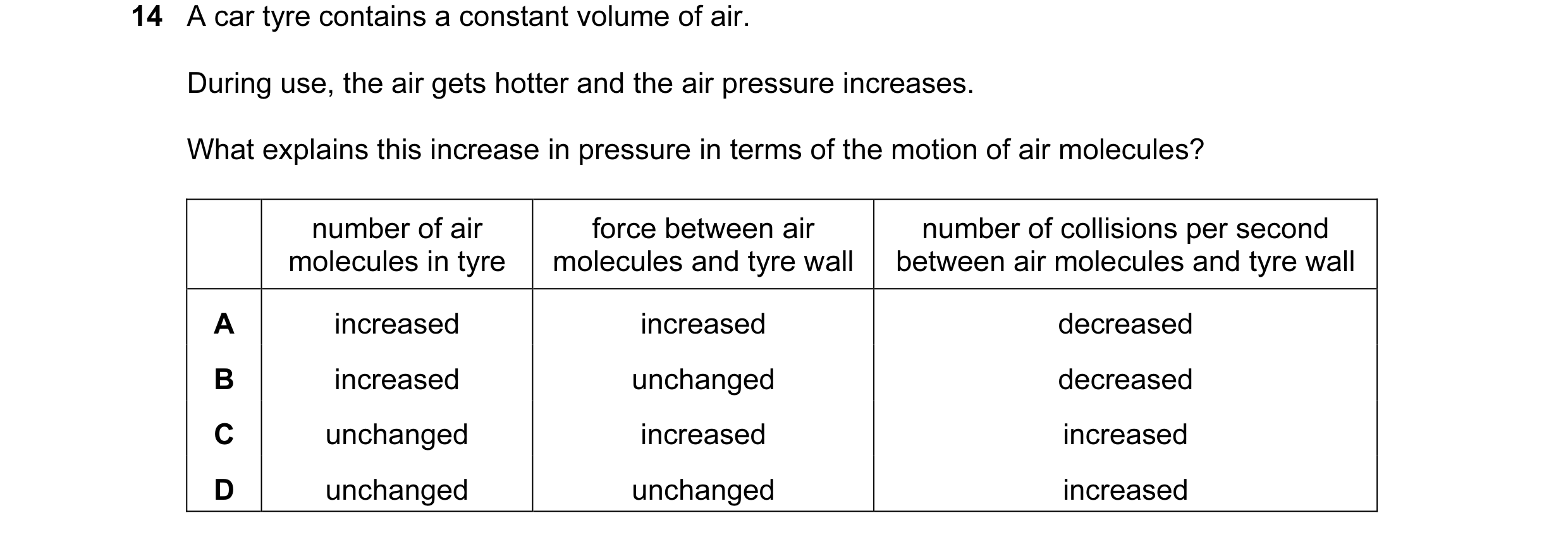
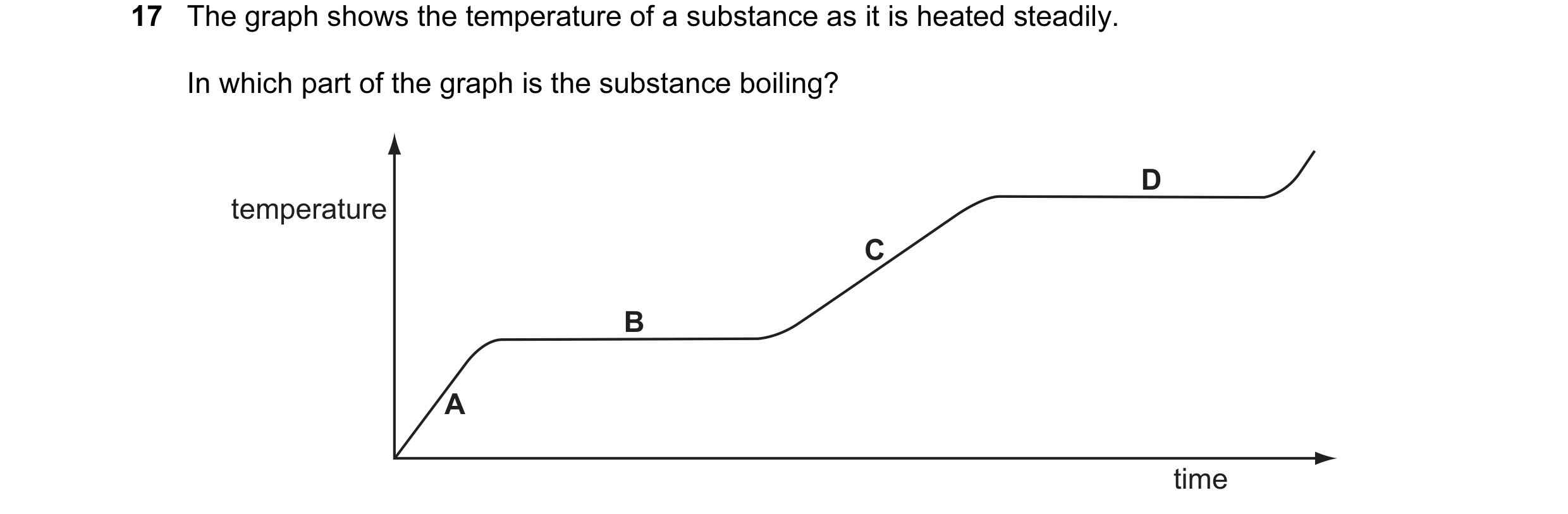
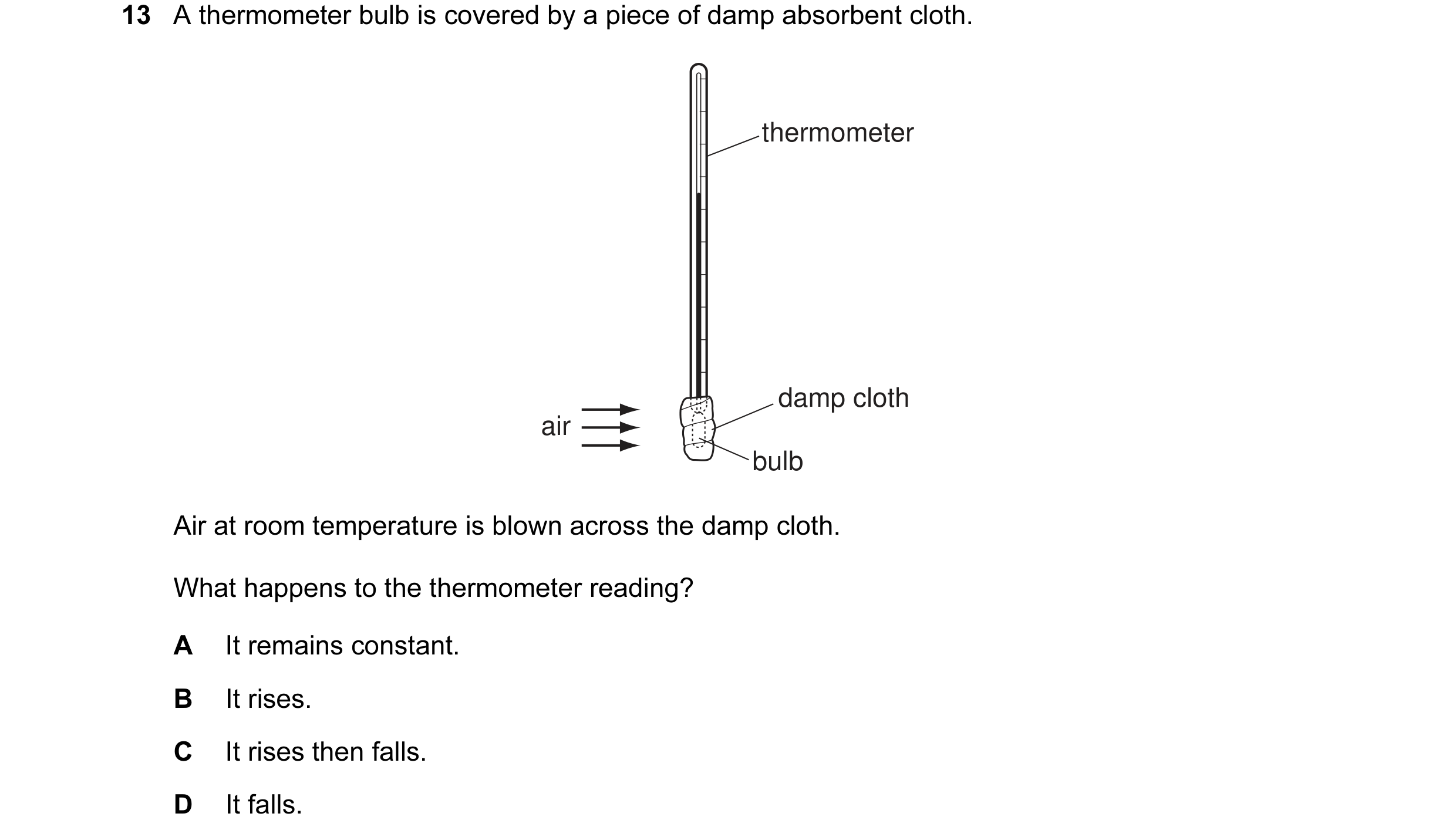 18 / 83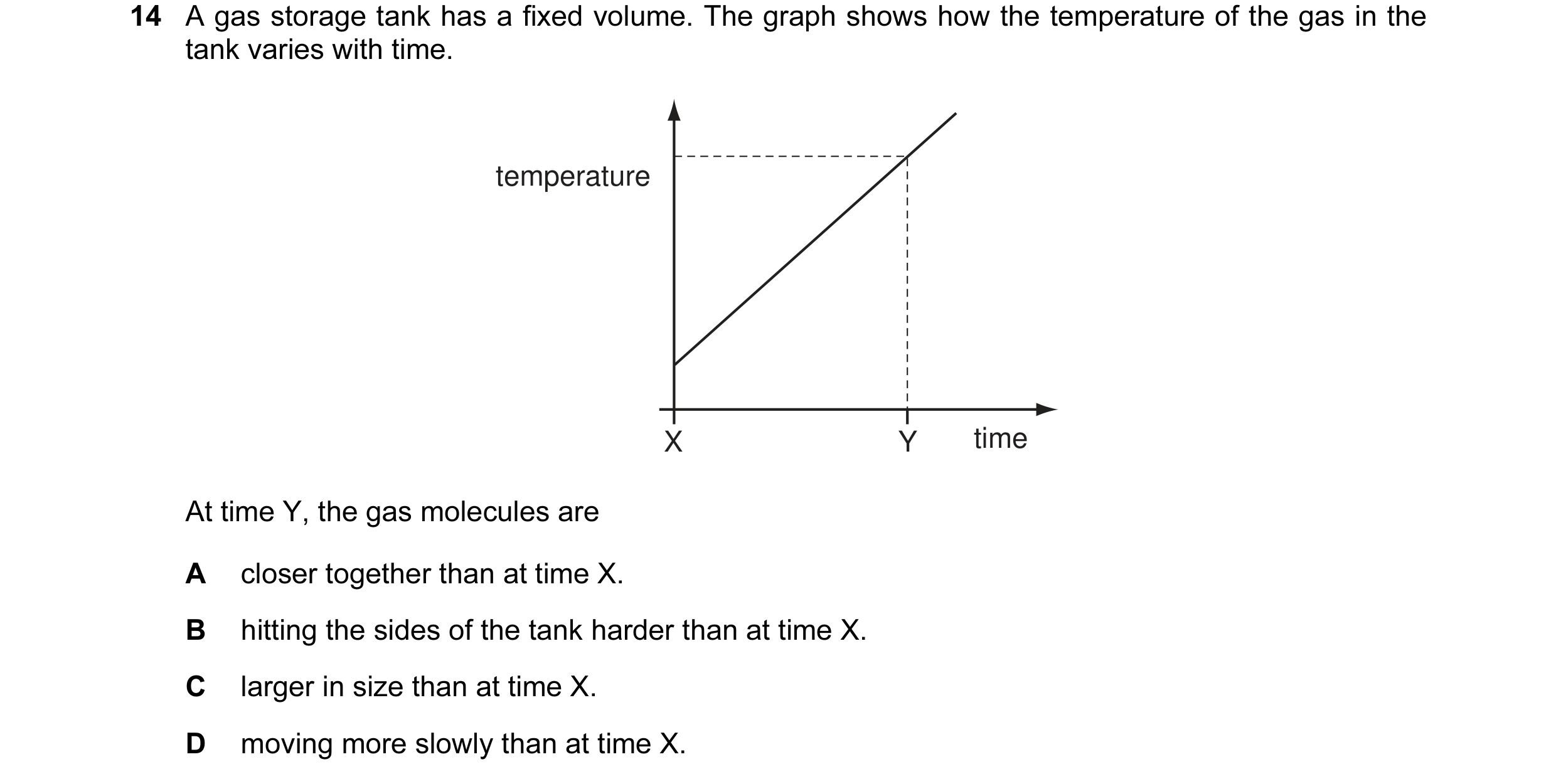
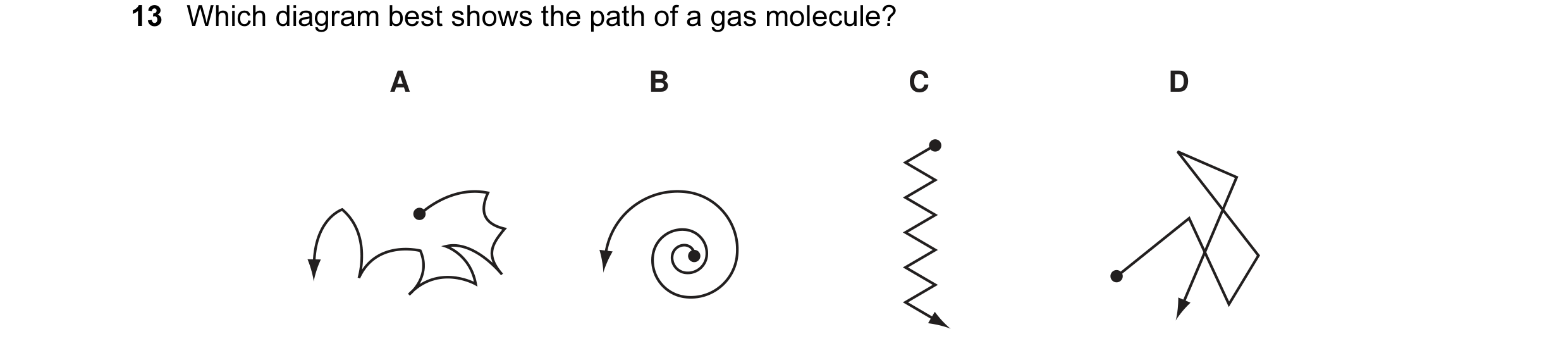
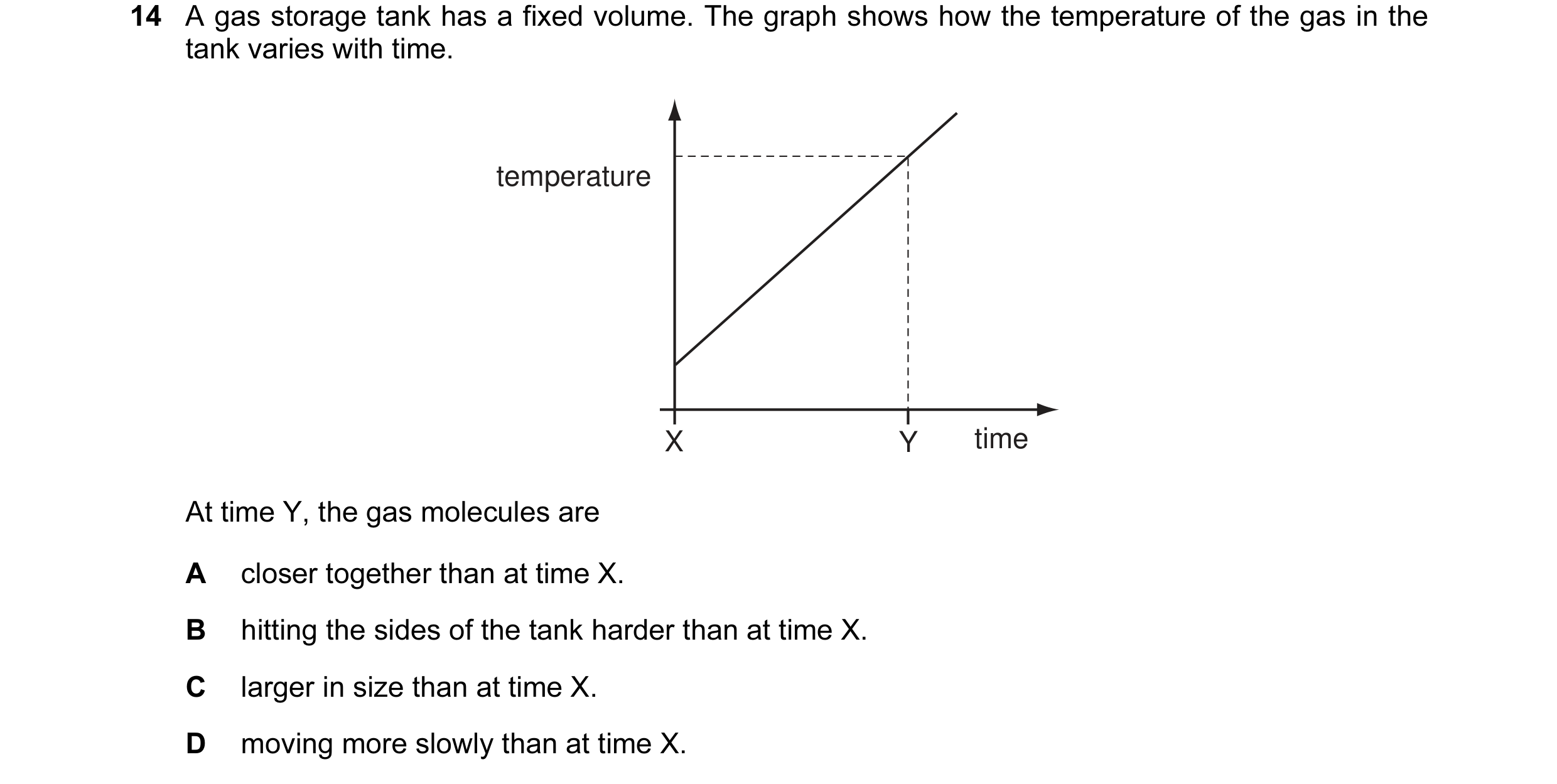 19 / 83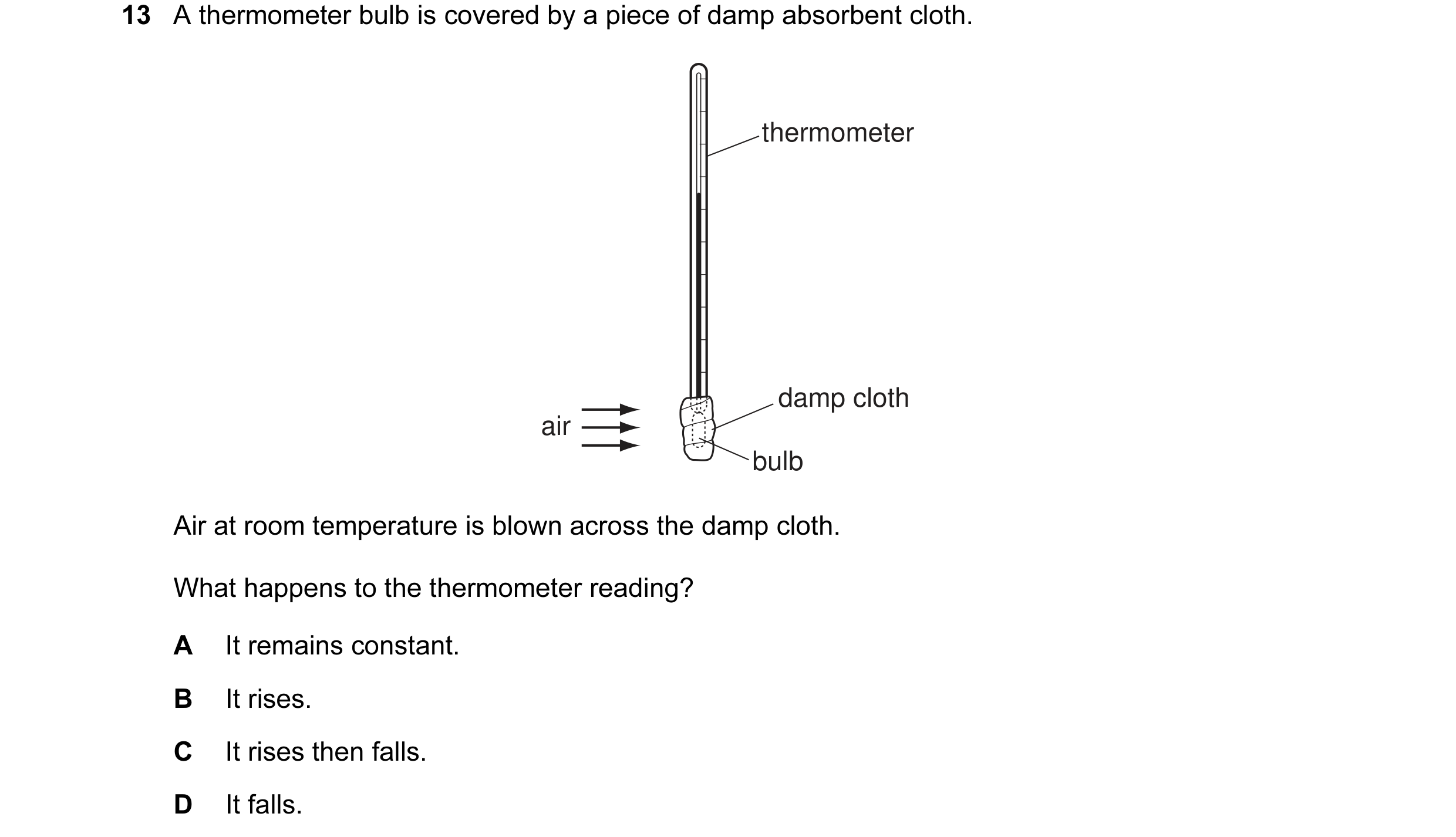
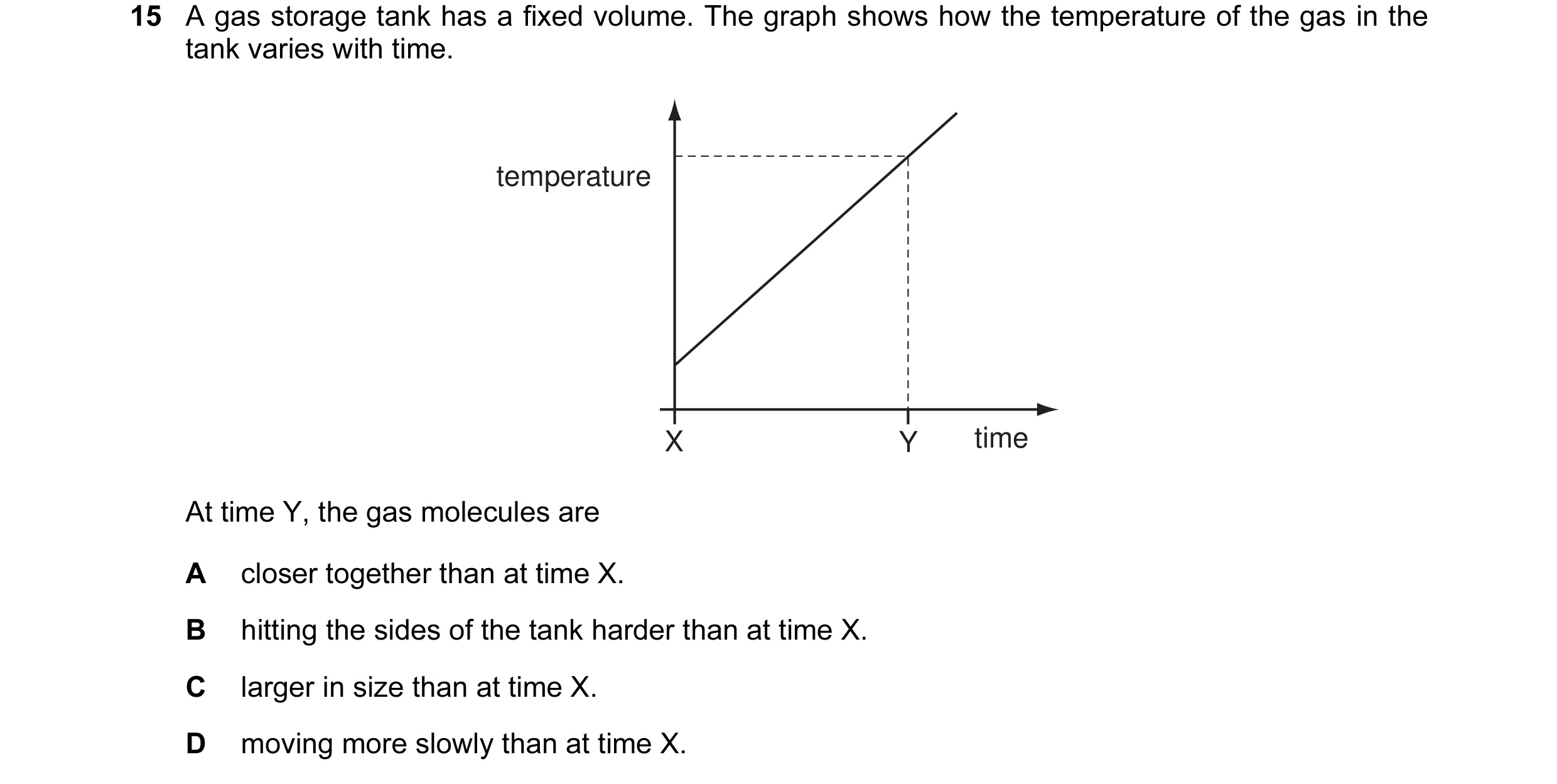 20 / 83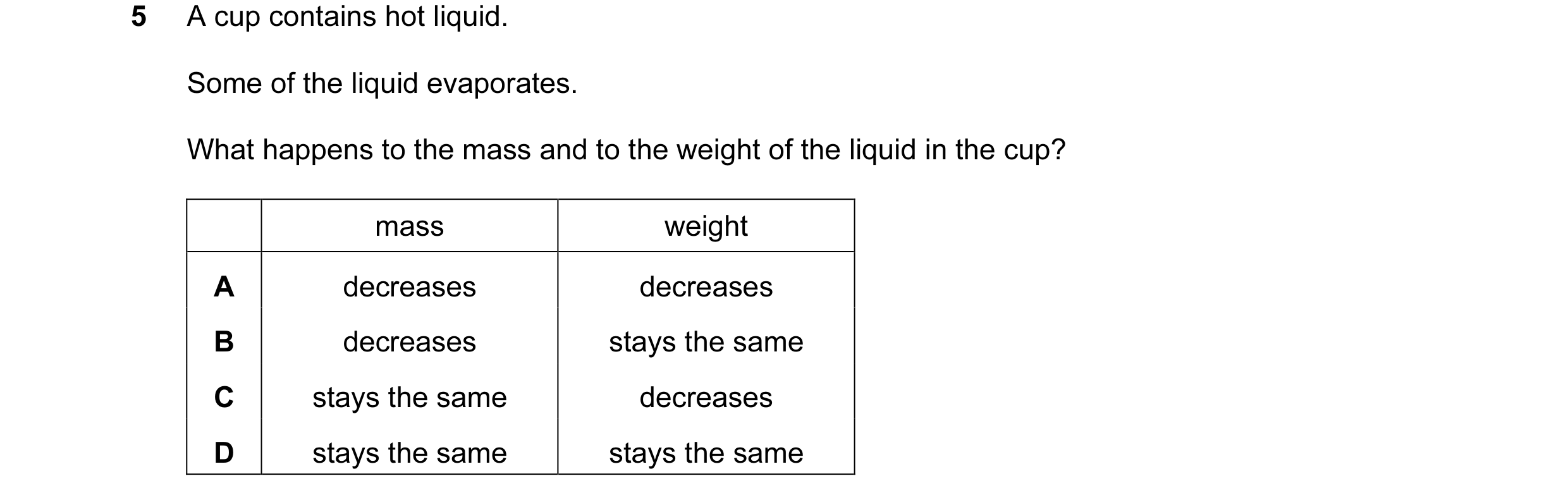
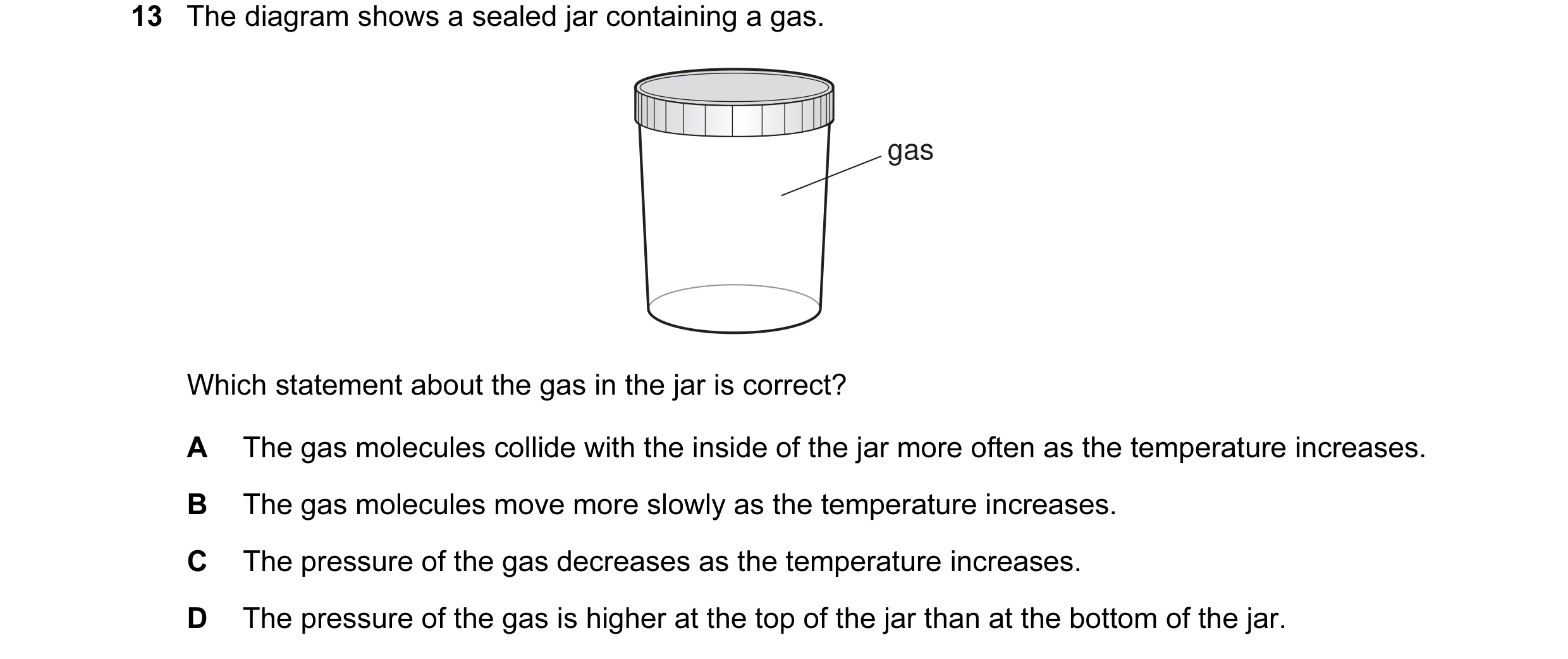
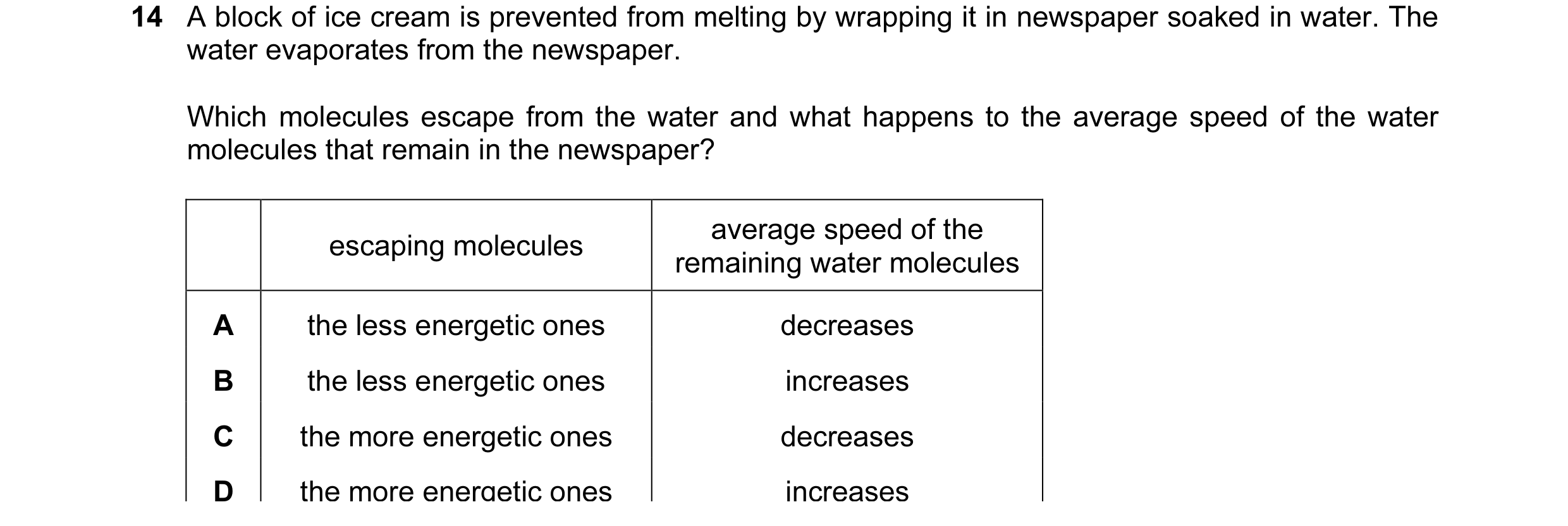 21 / 83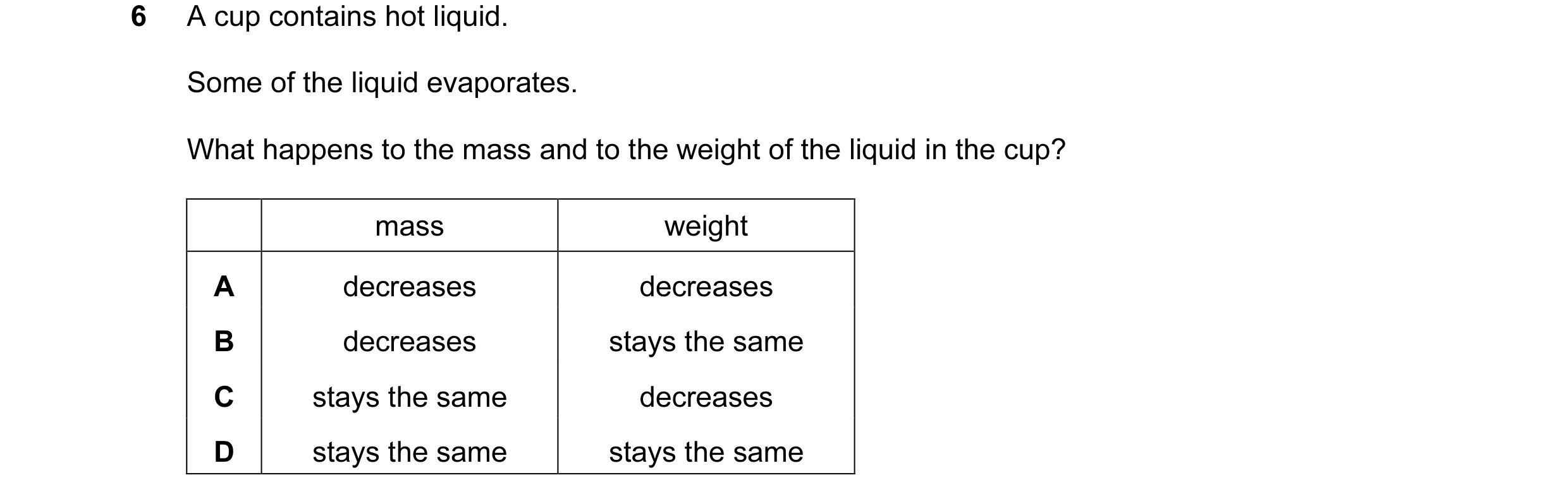
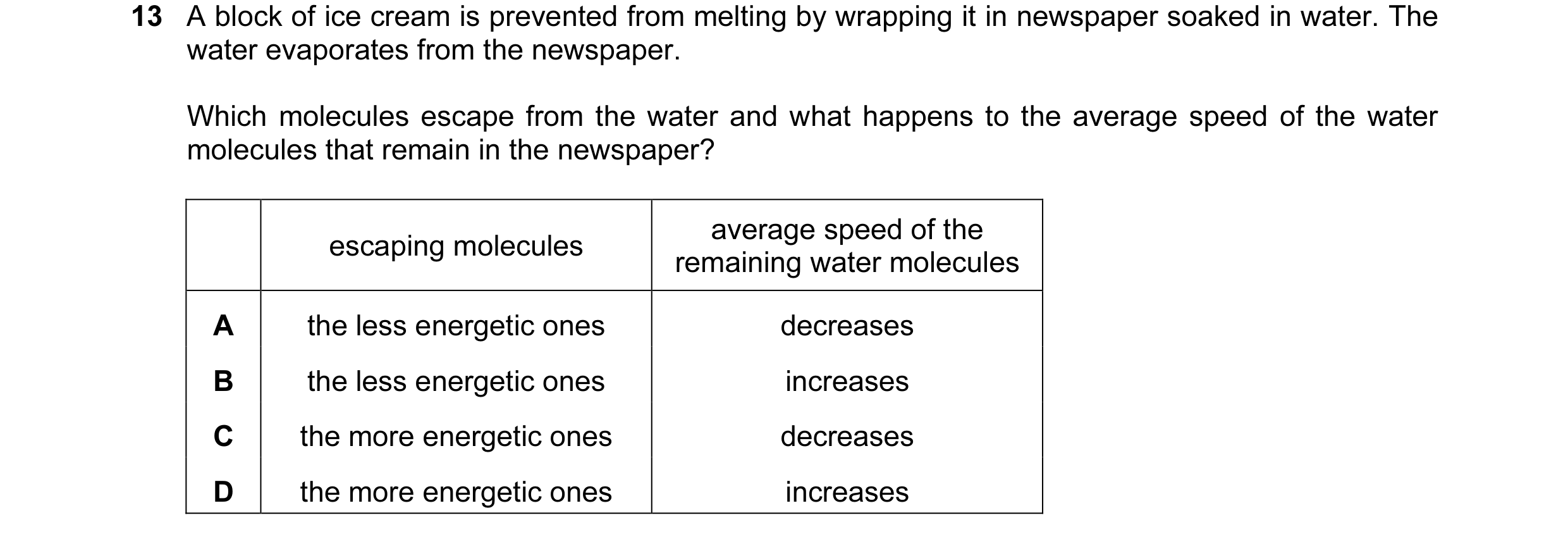
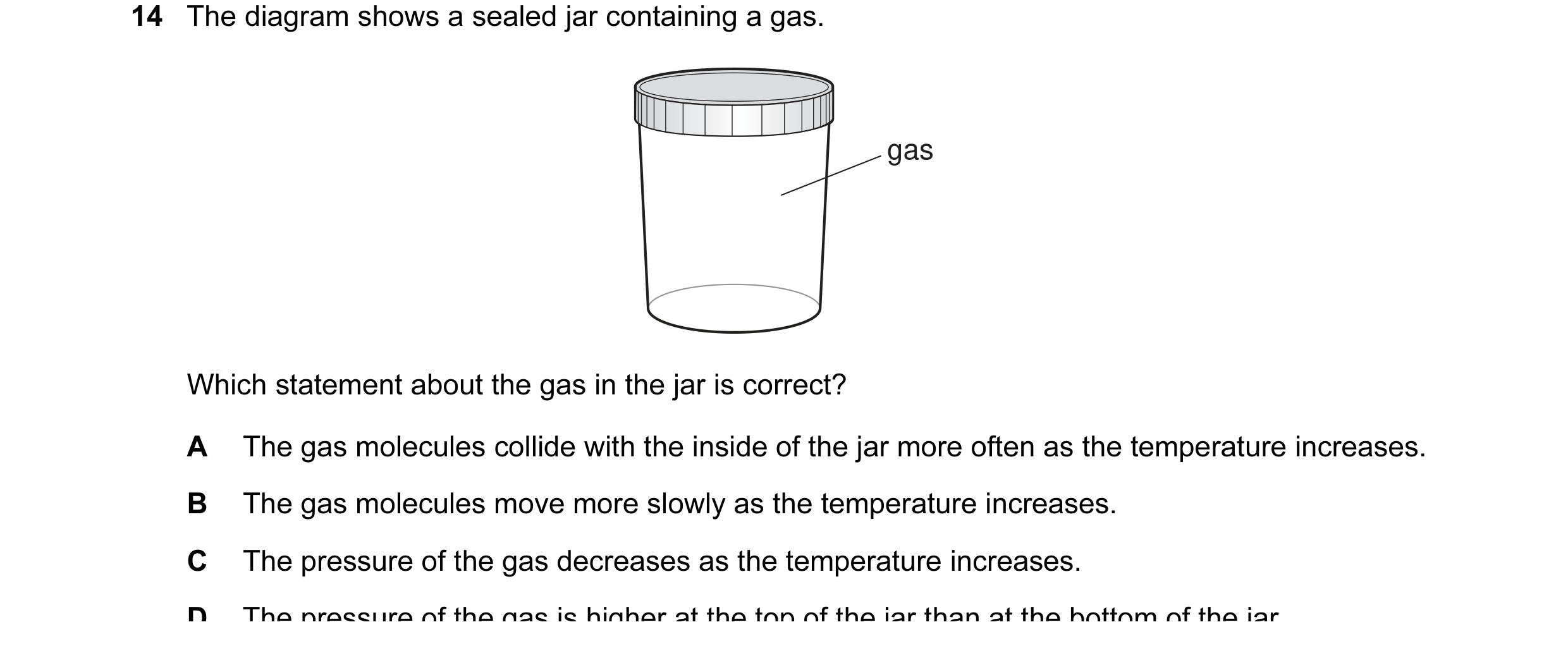 22 / 83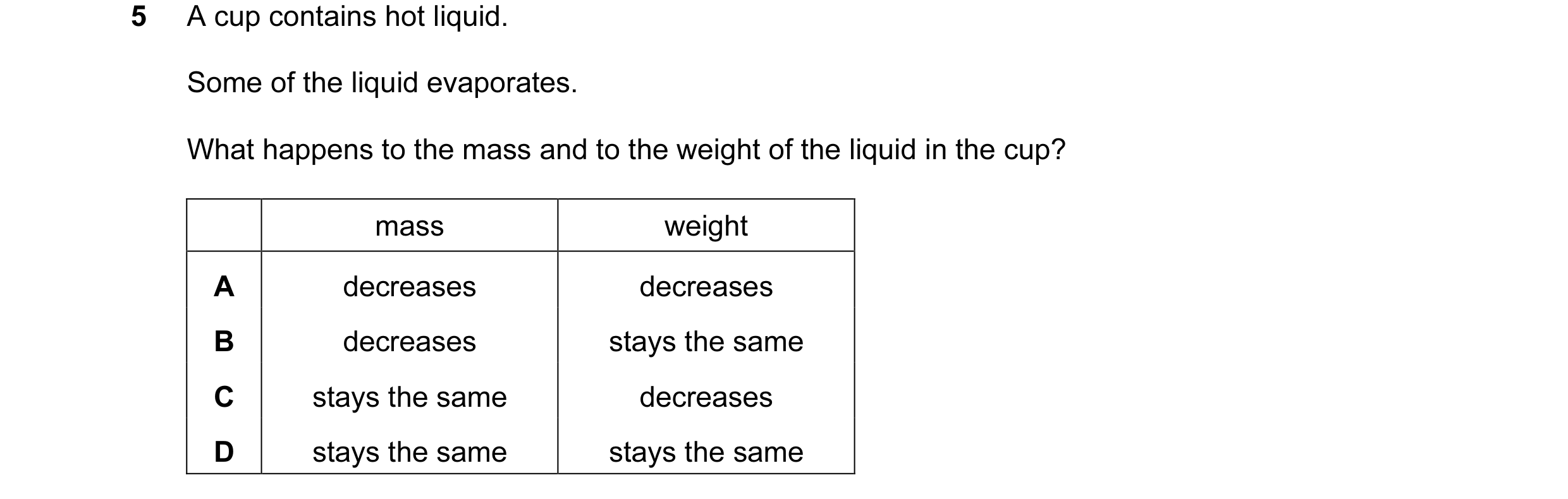
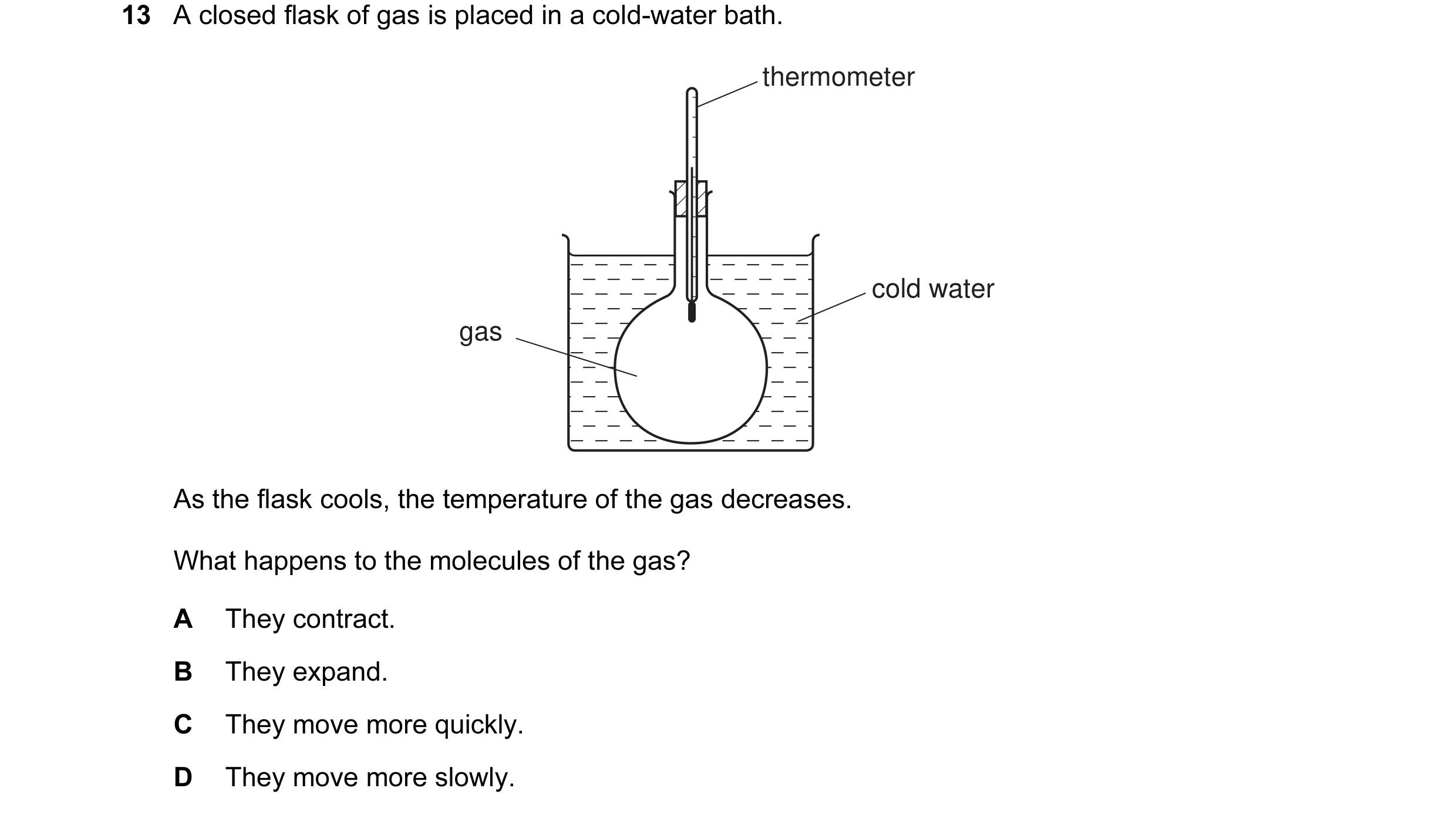
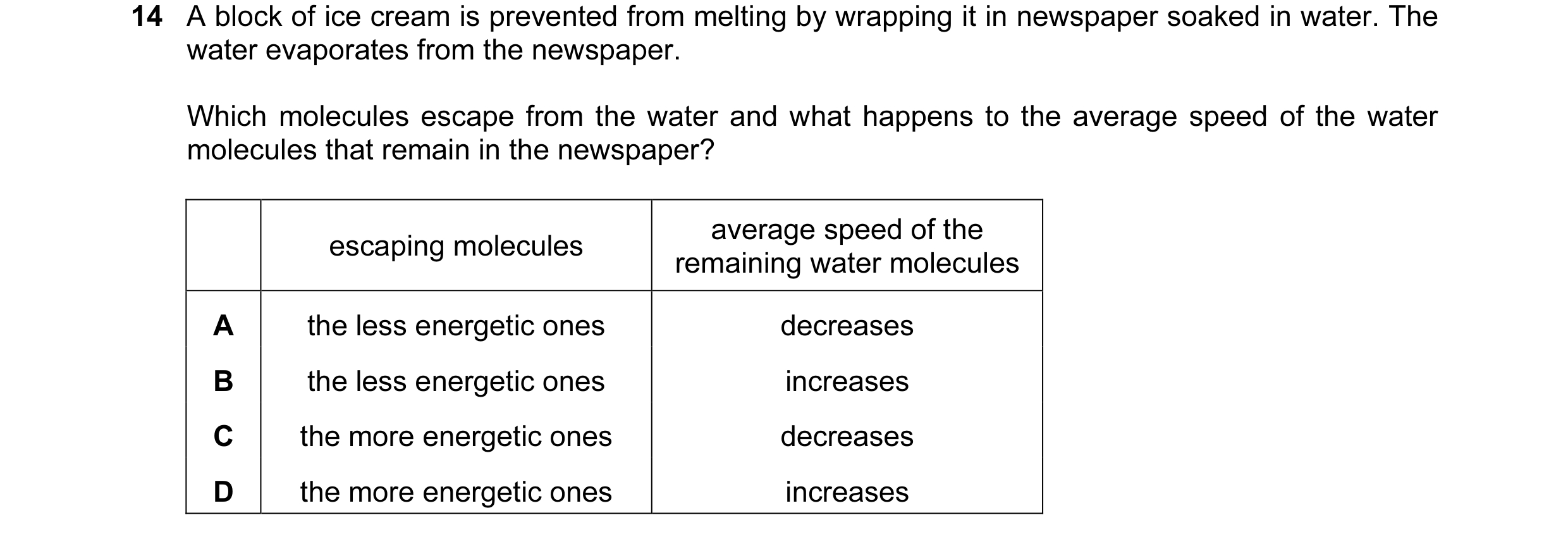 23 / 83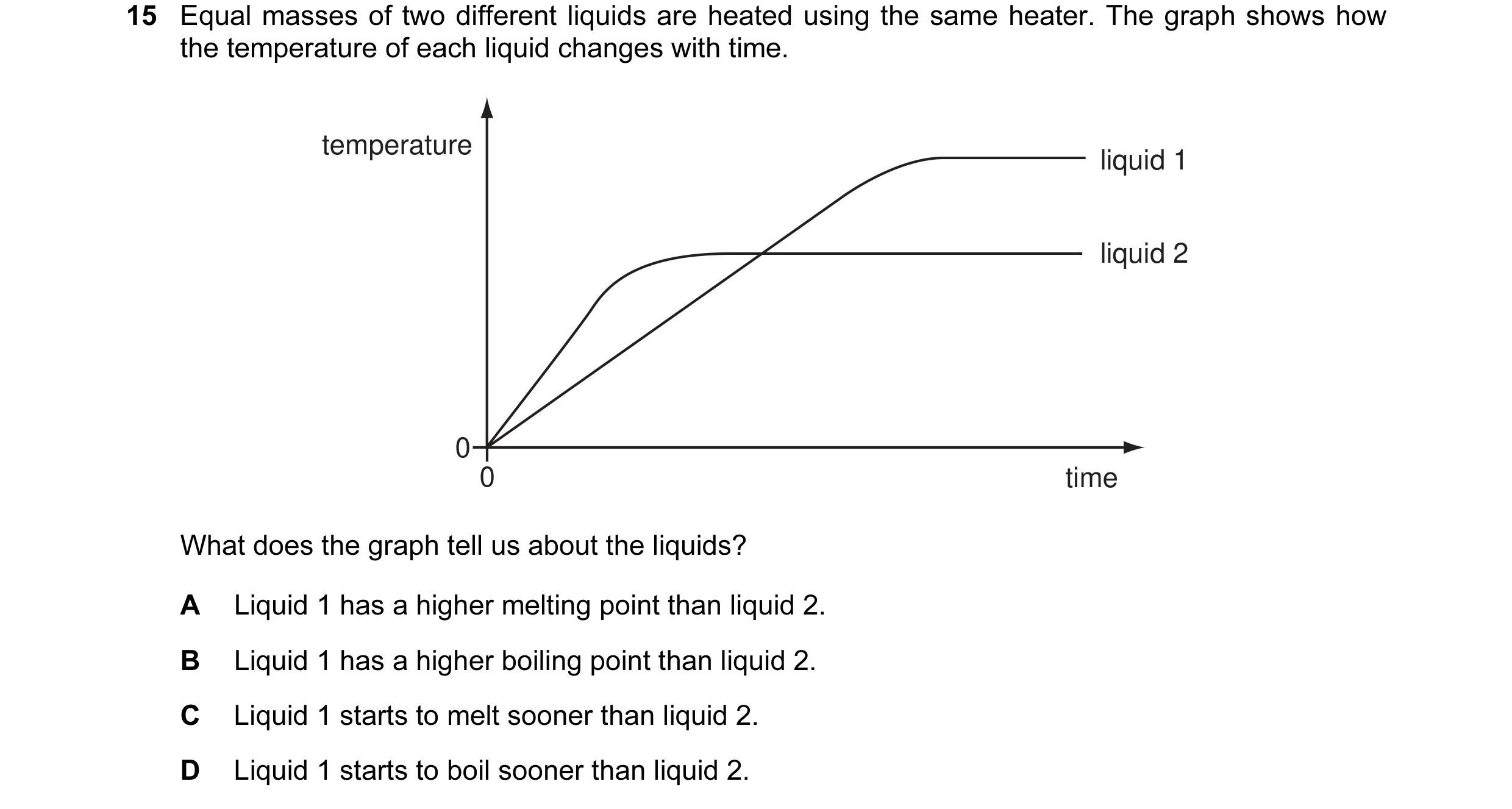
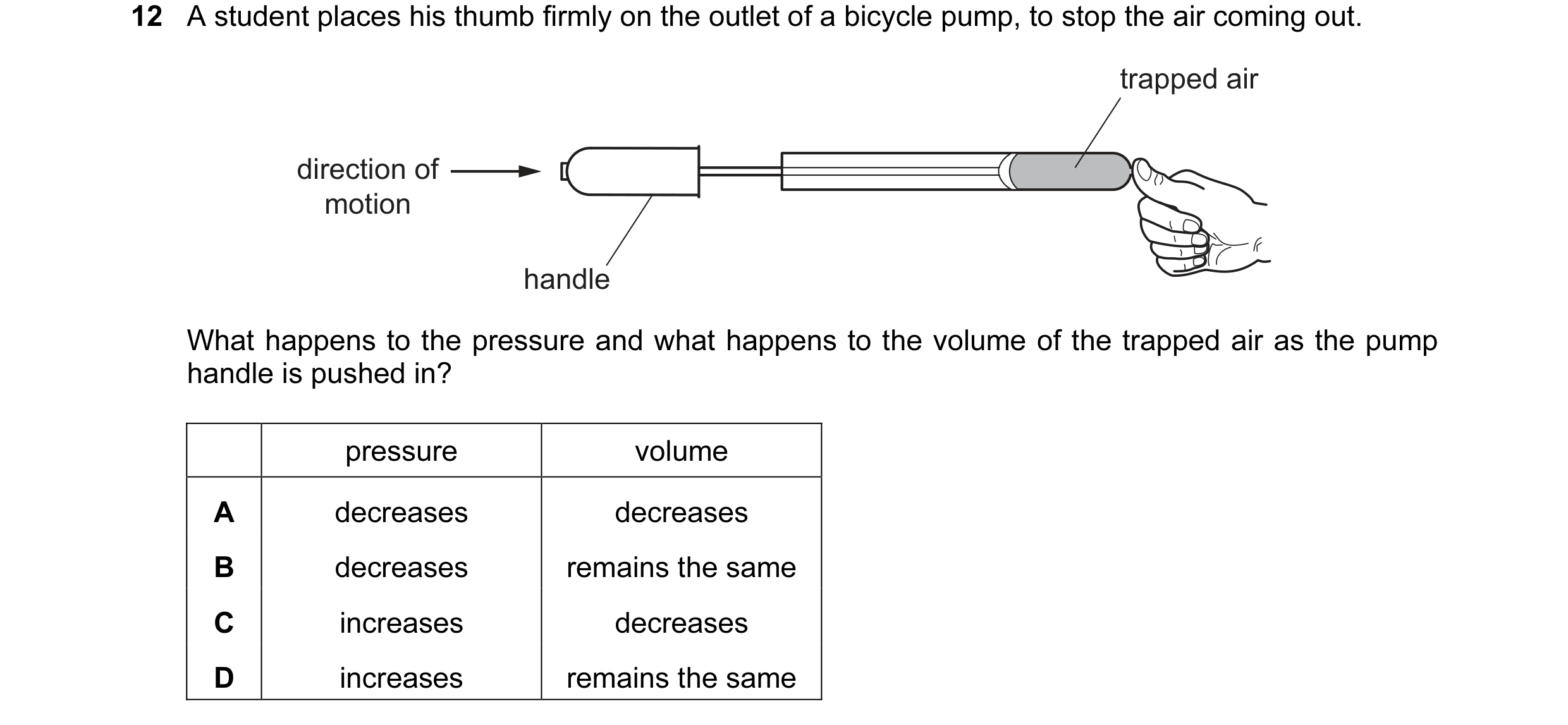
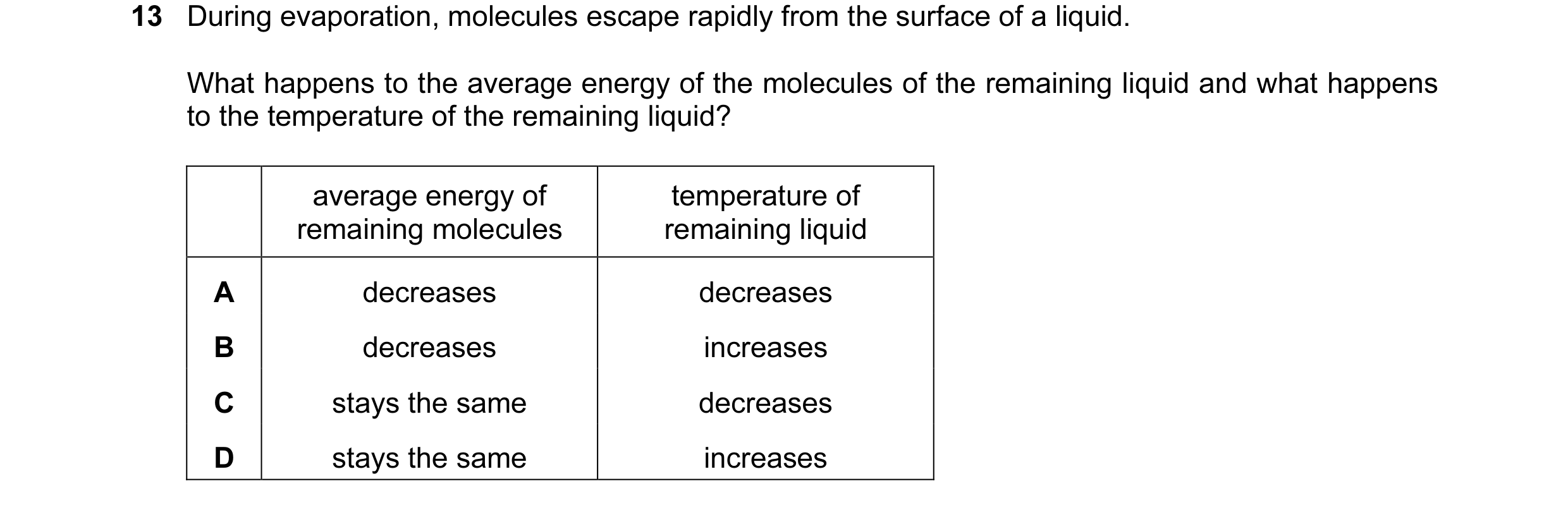 24 / 83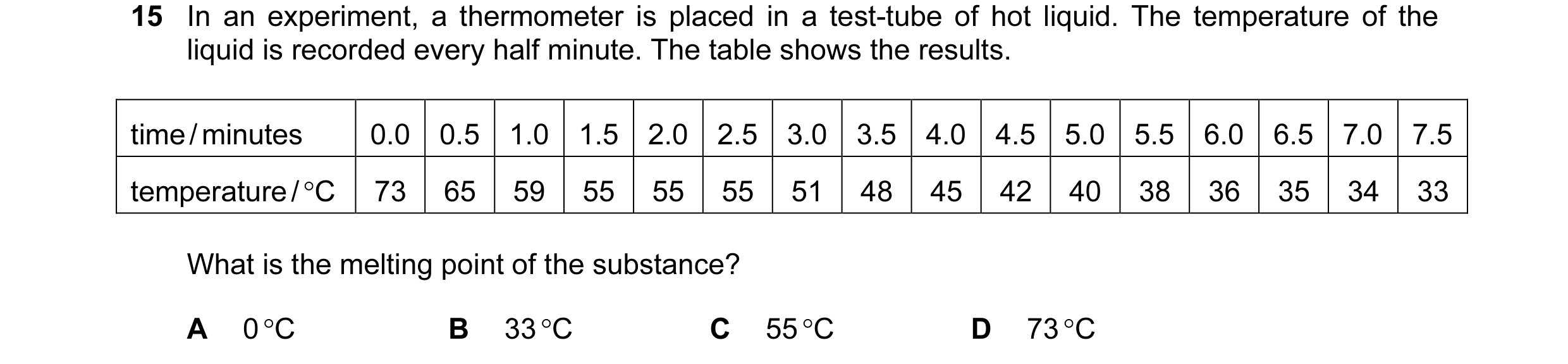
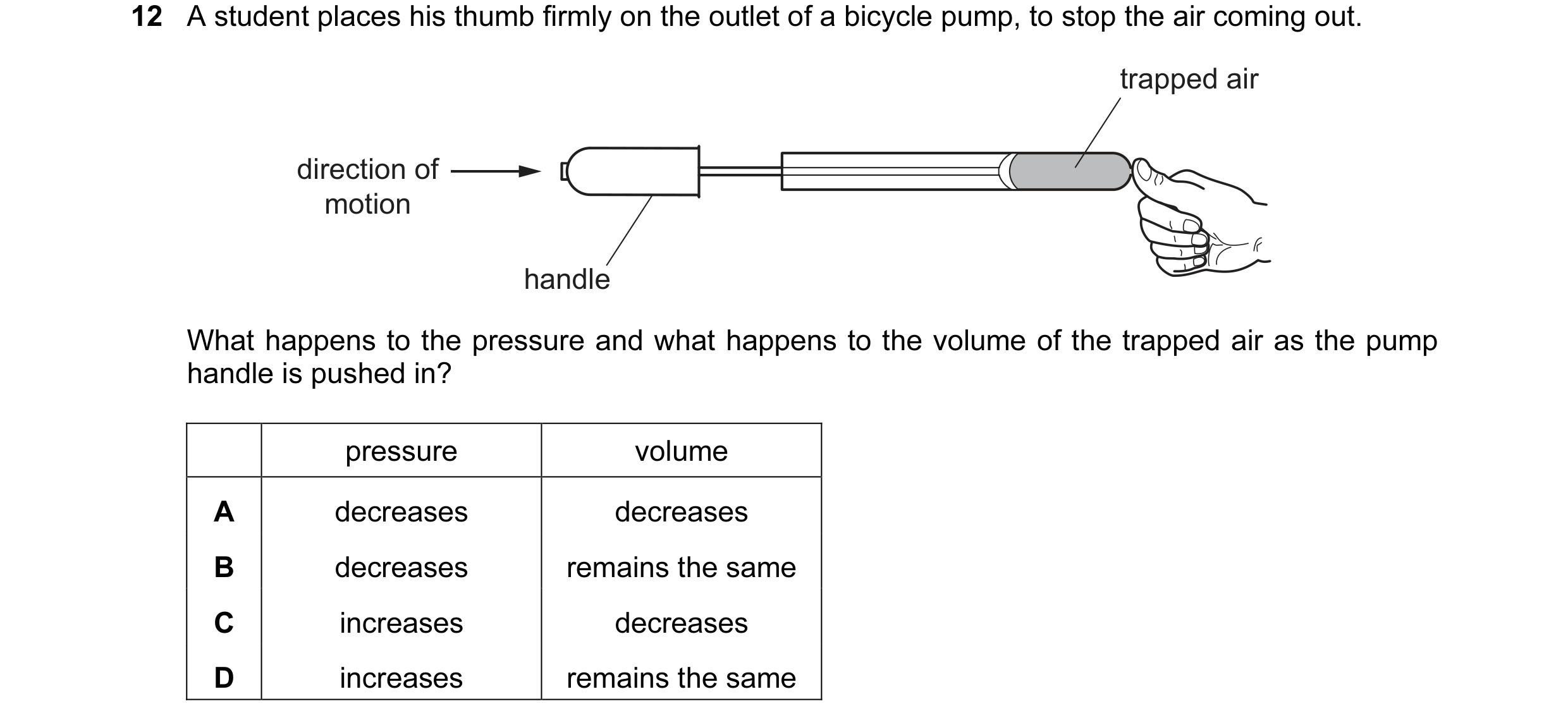
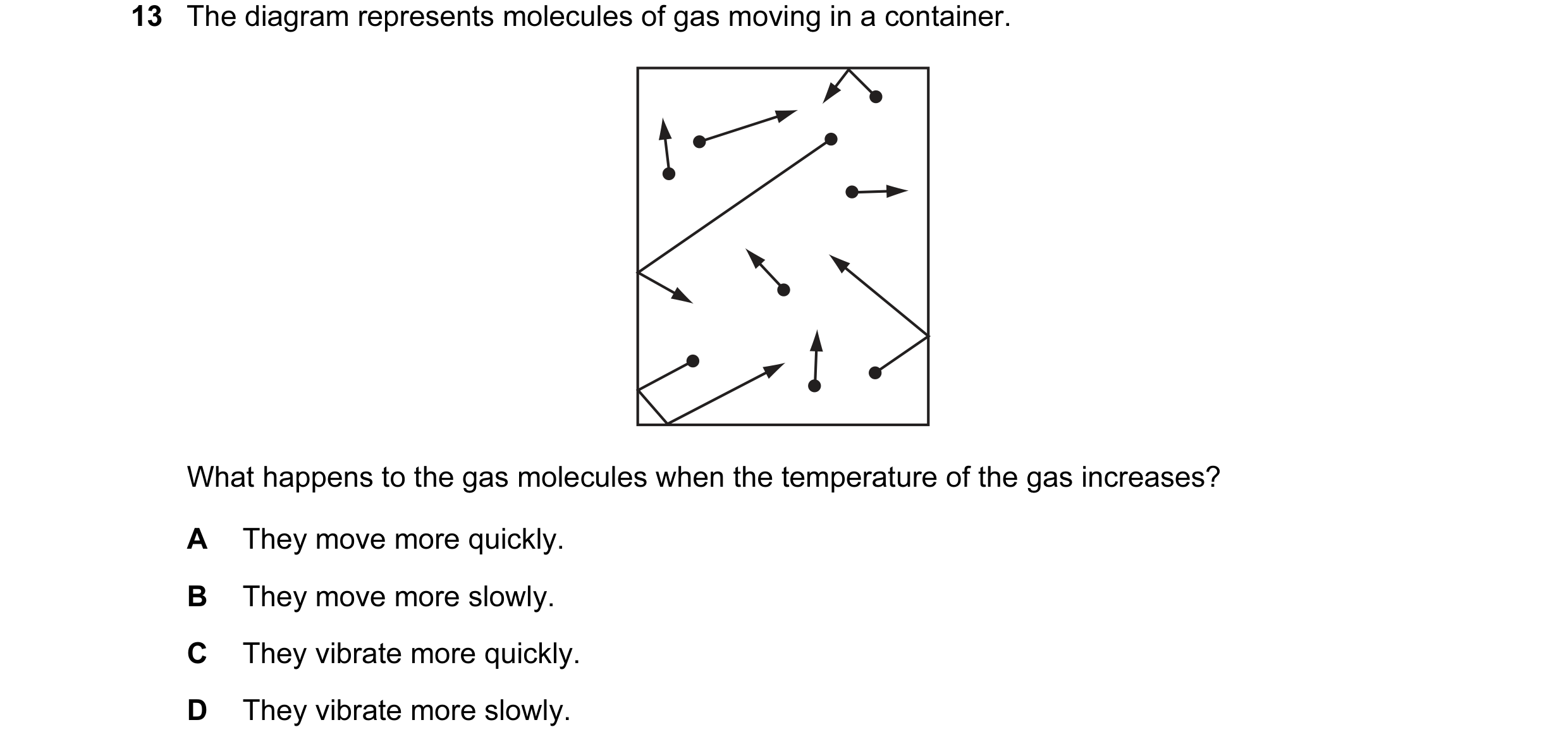 25 / 83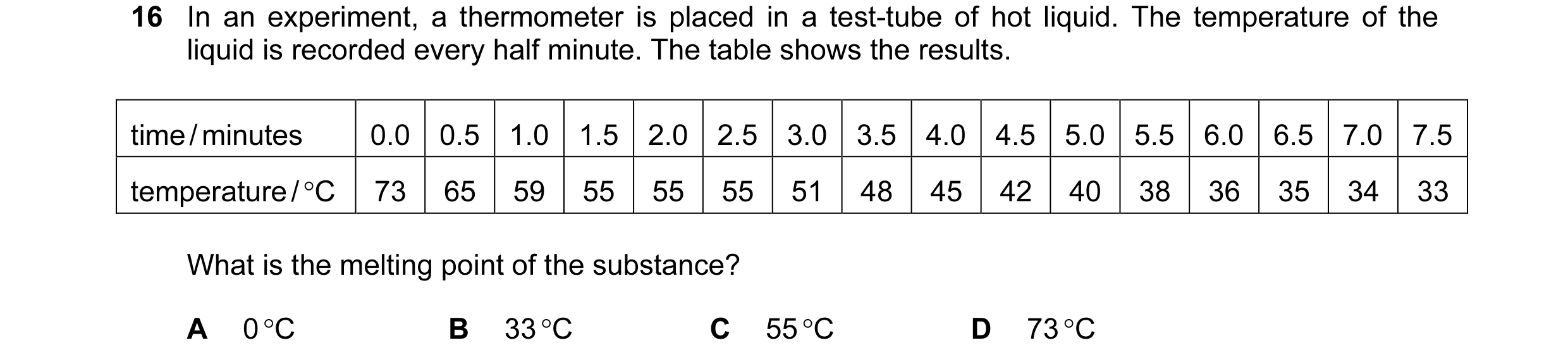
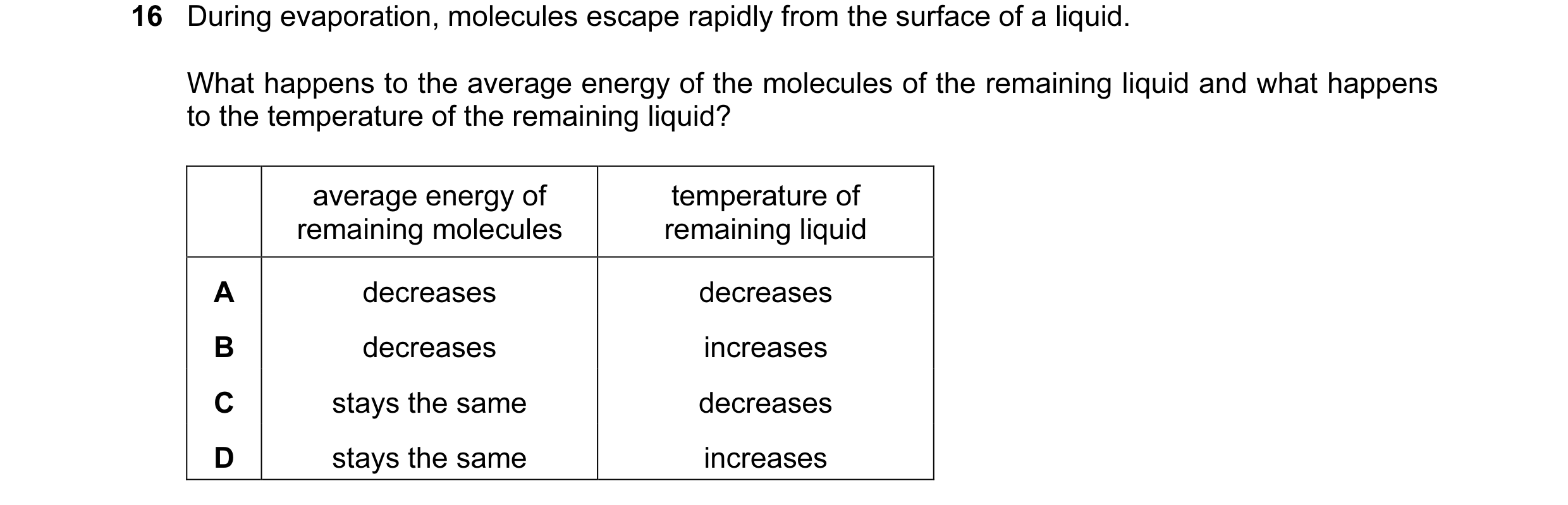
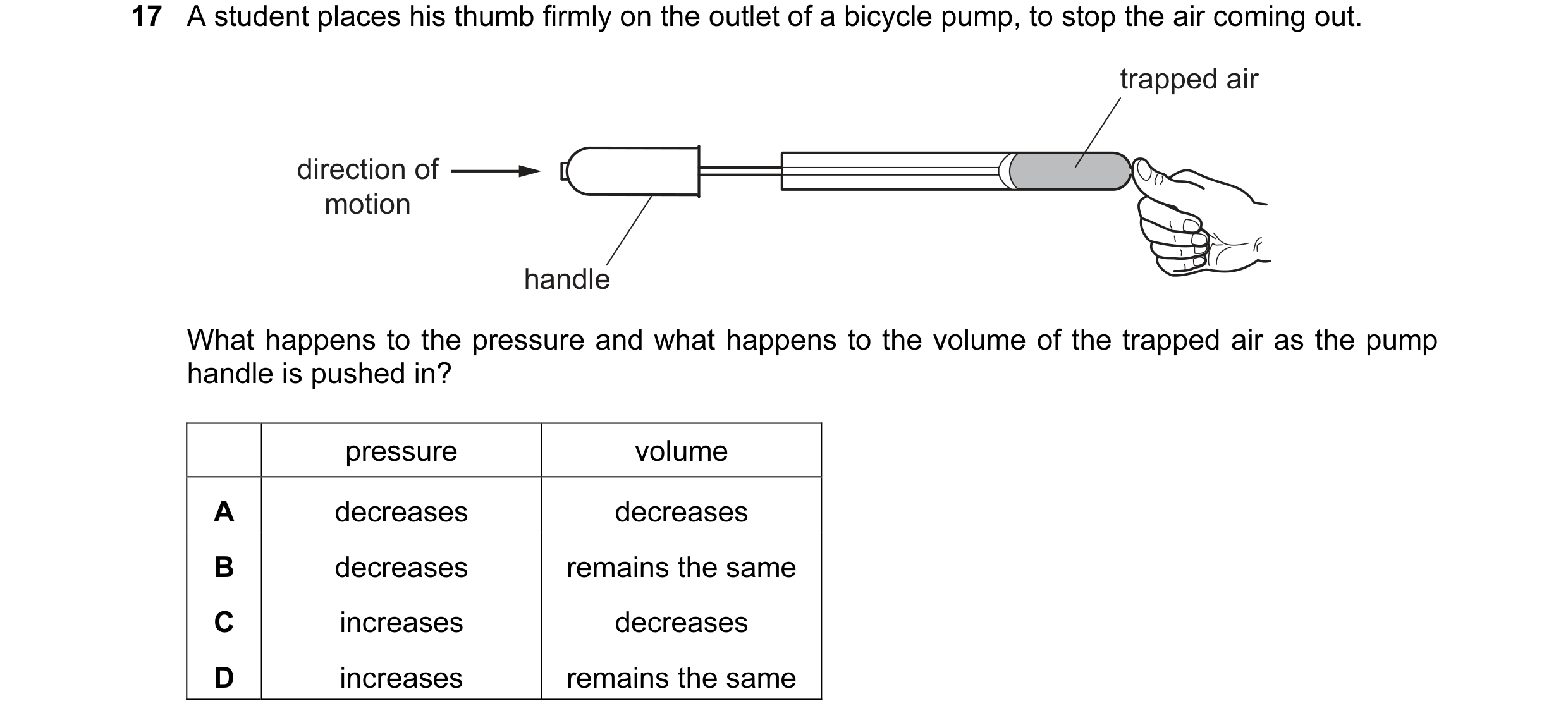
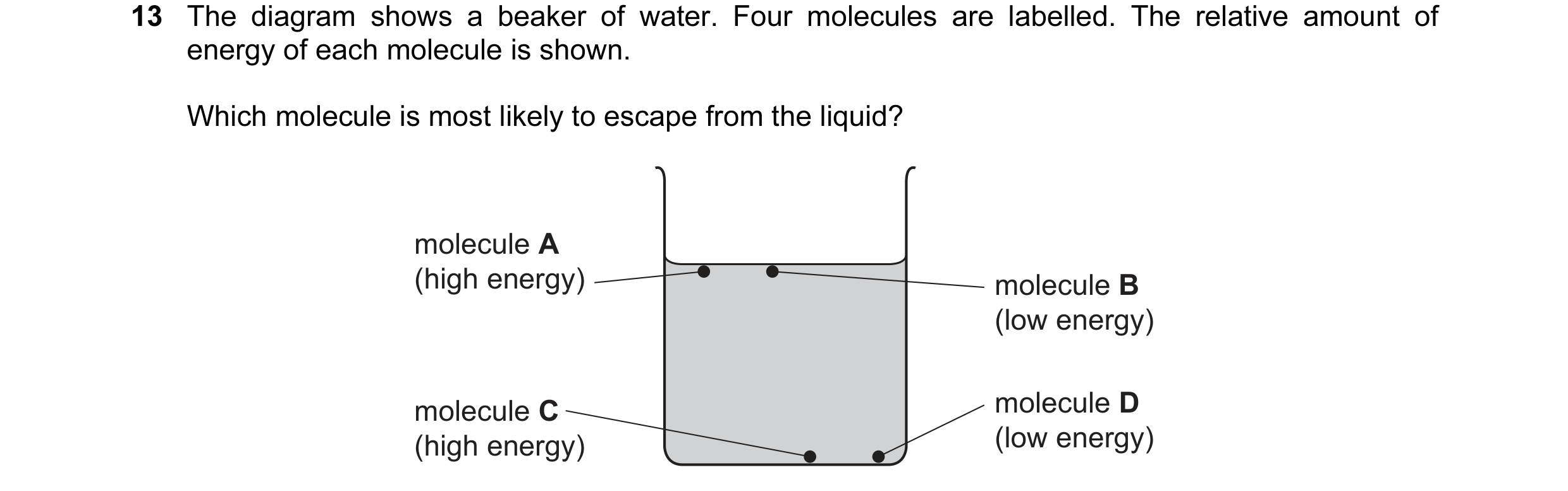 26 / 83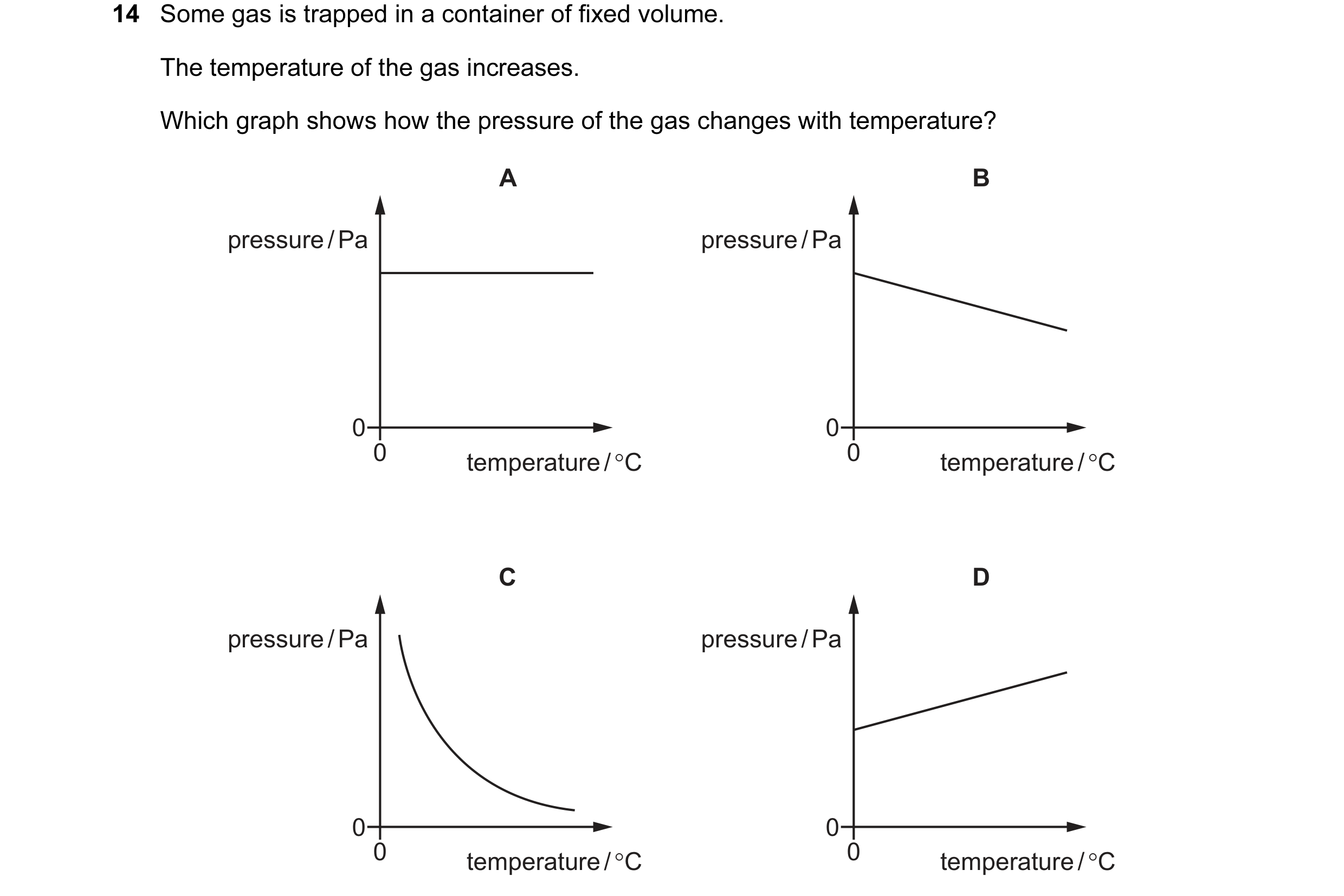
 27 / 83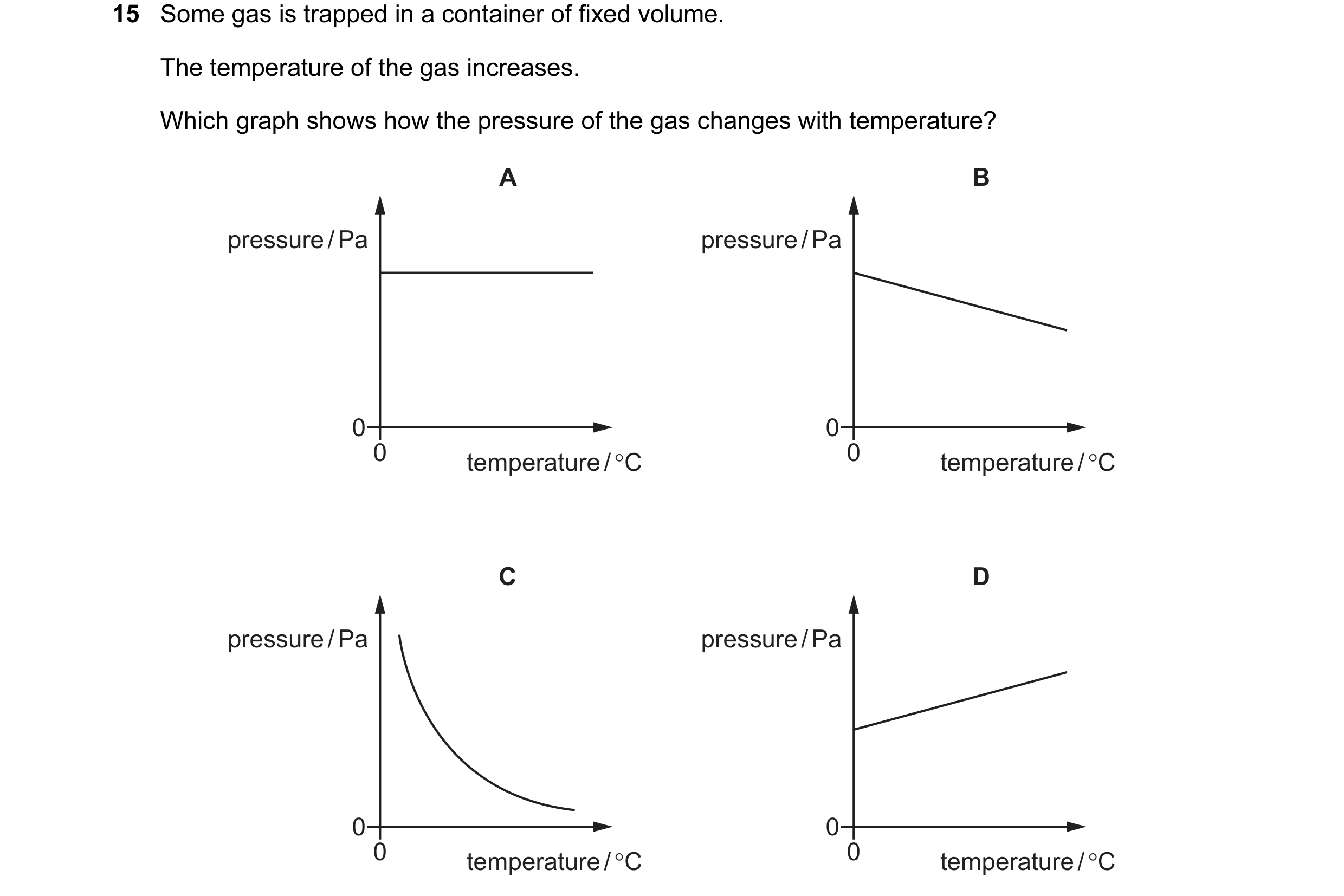
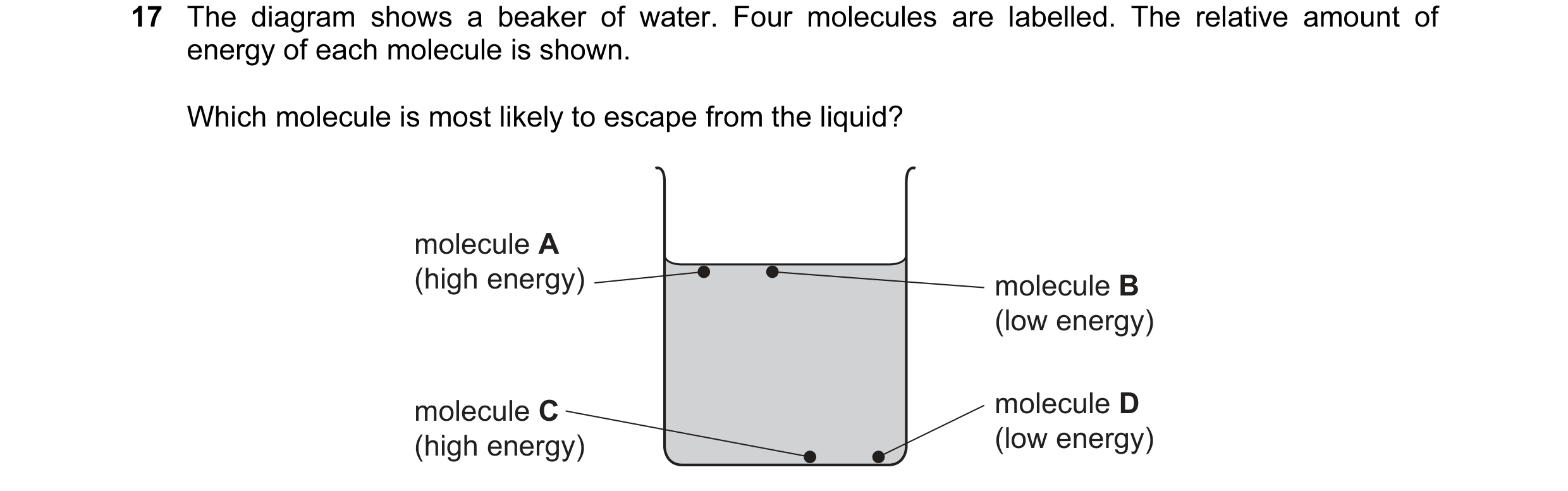 28 / 83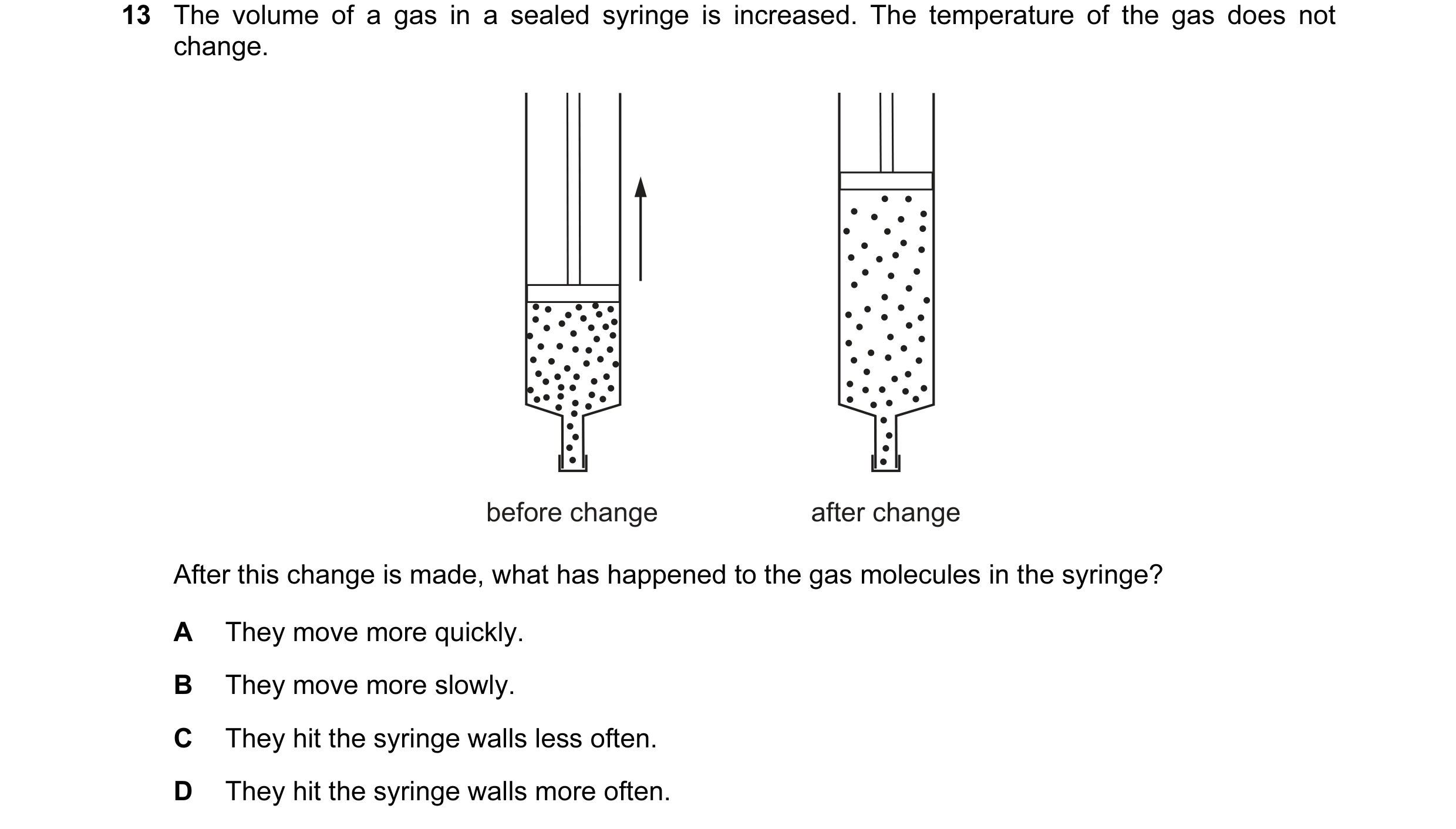
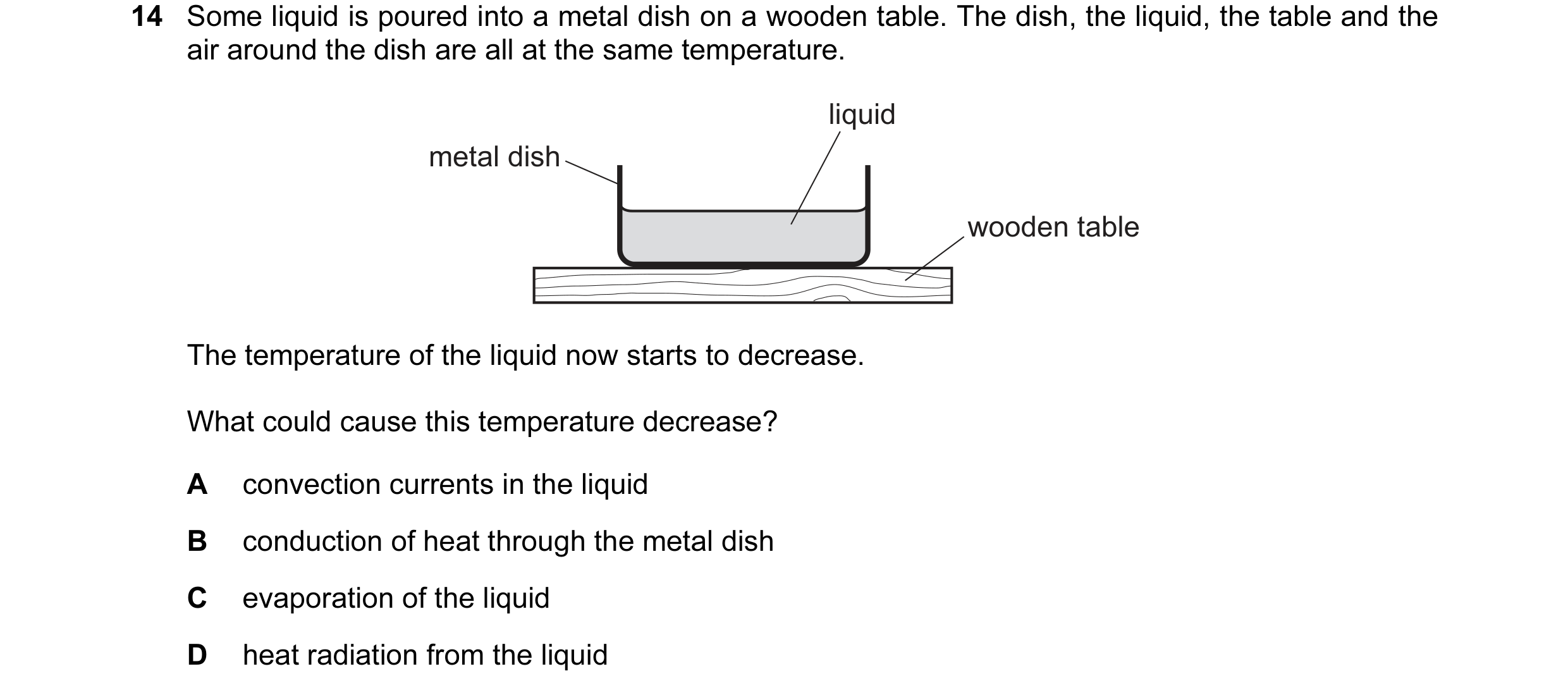
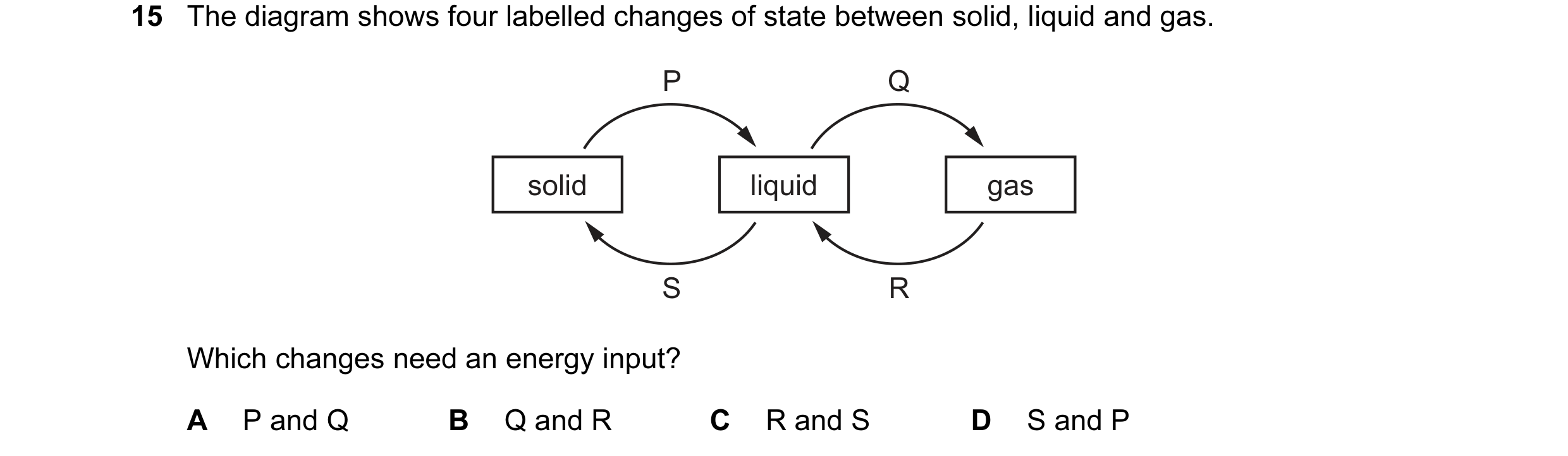 29 / 83
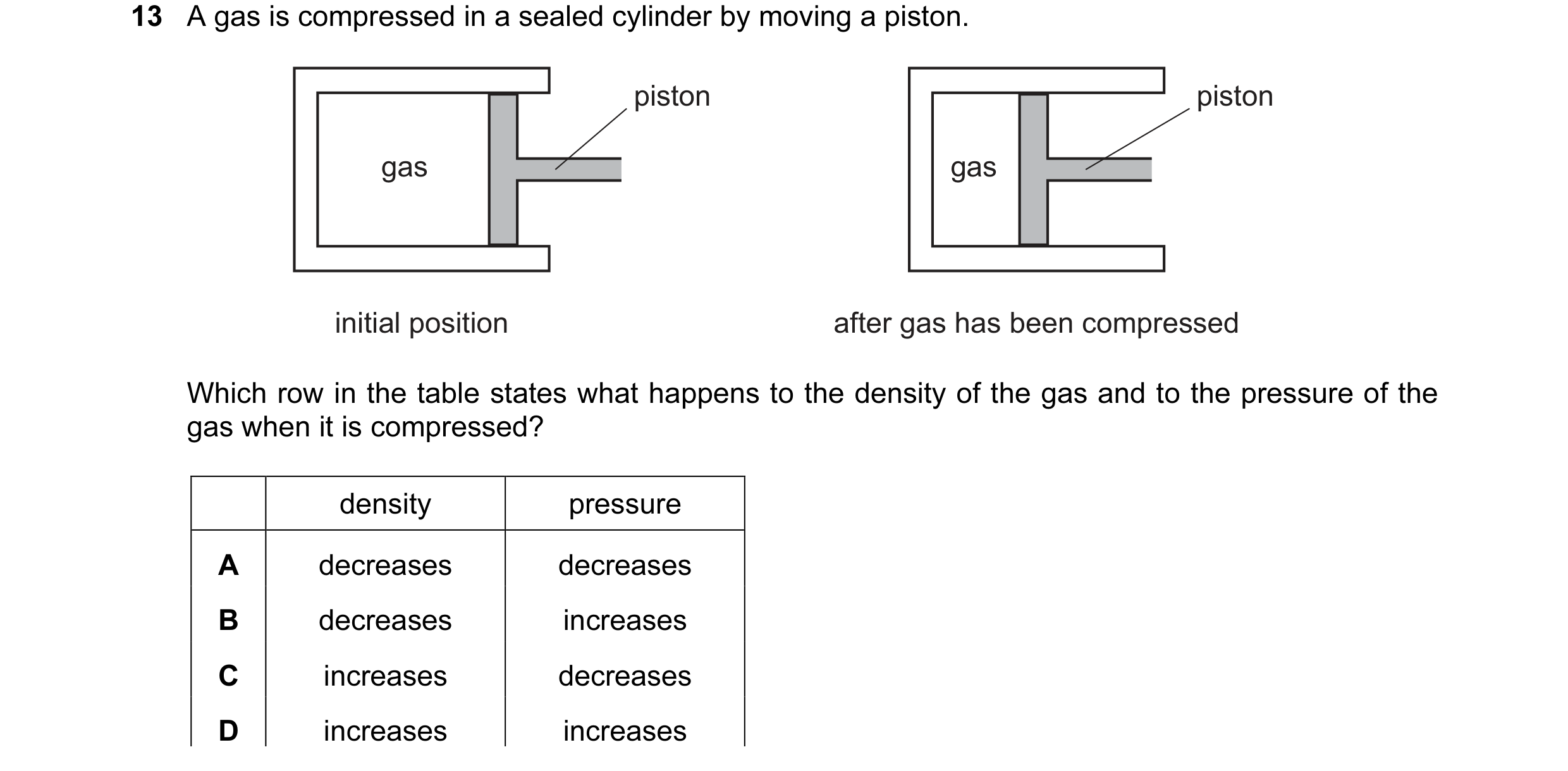
 30 / 83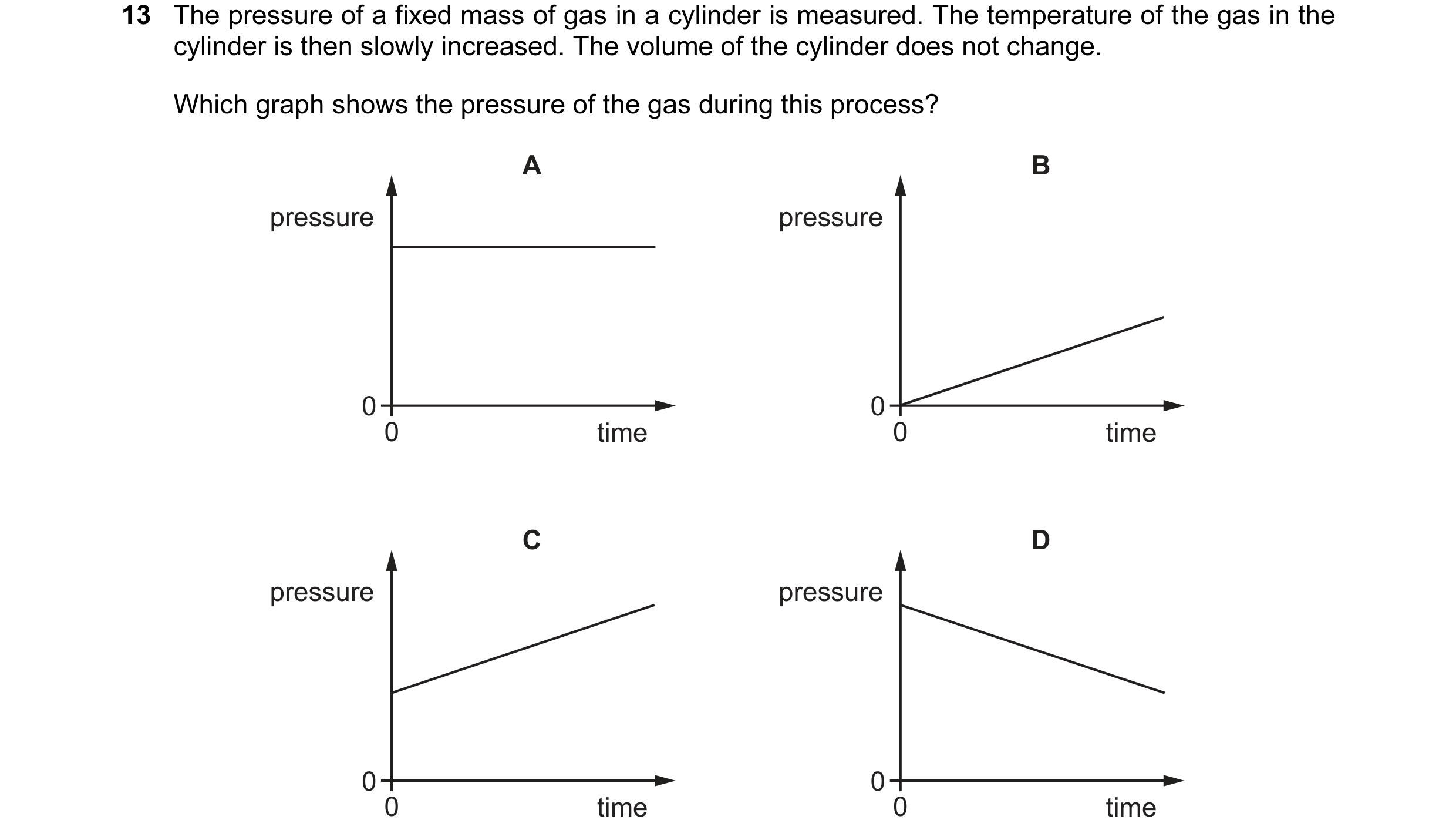
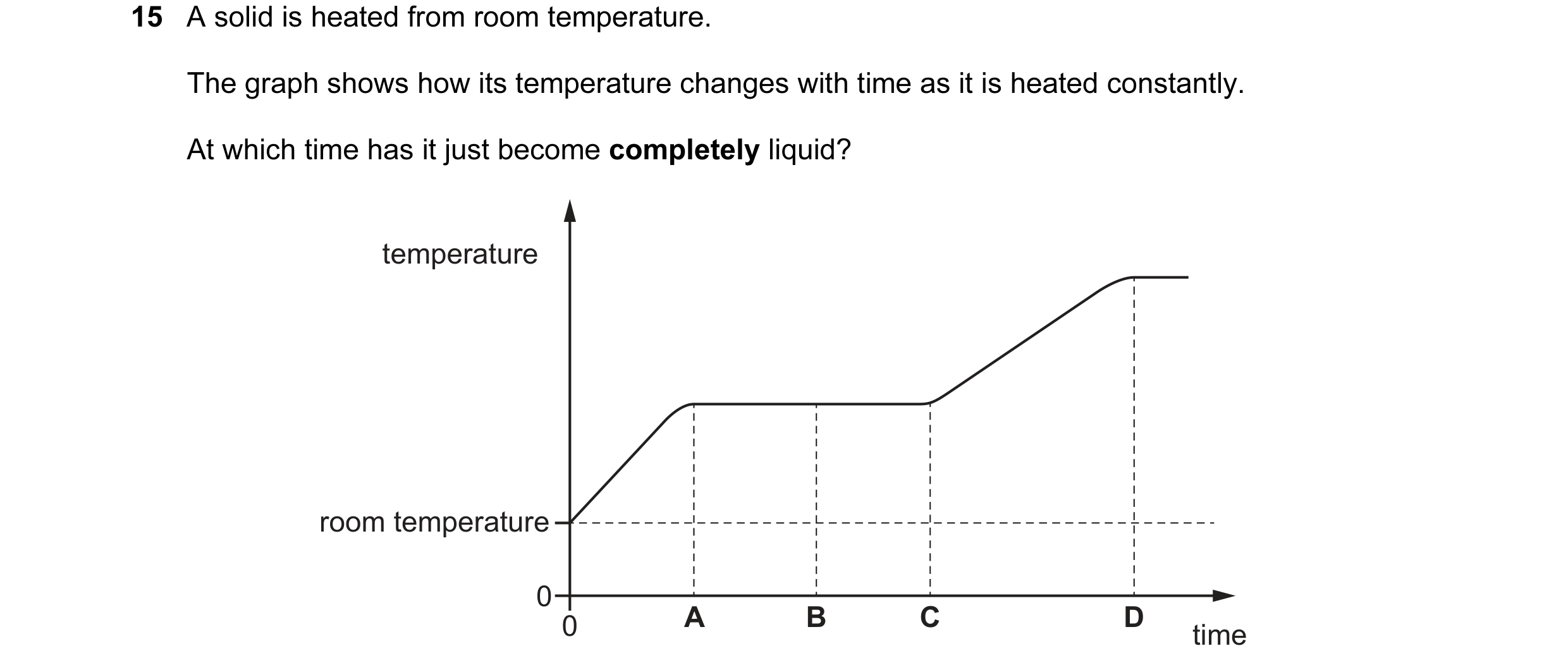
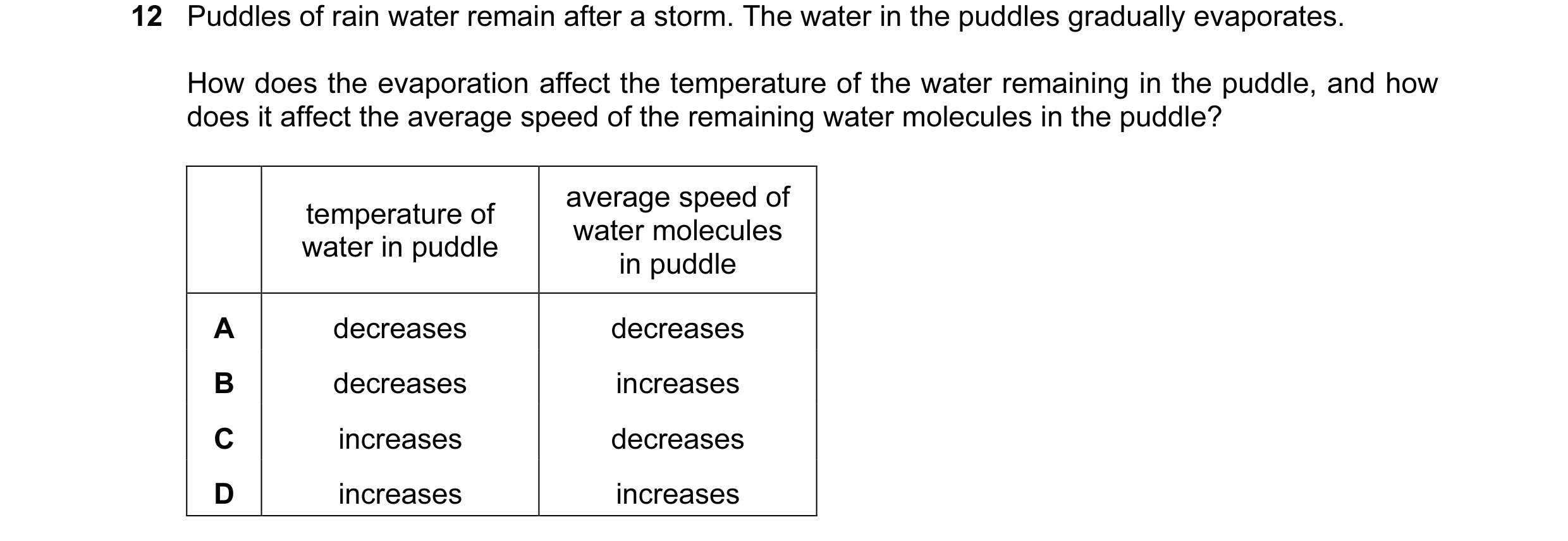 31 / 83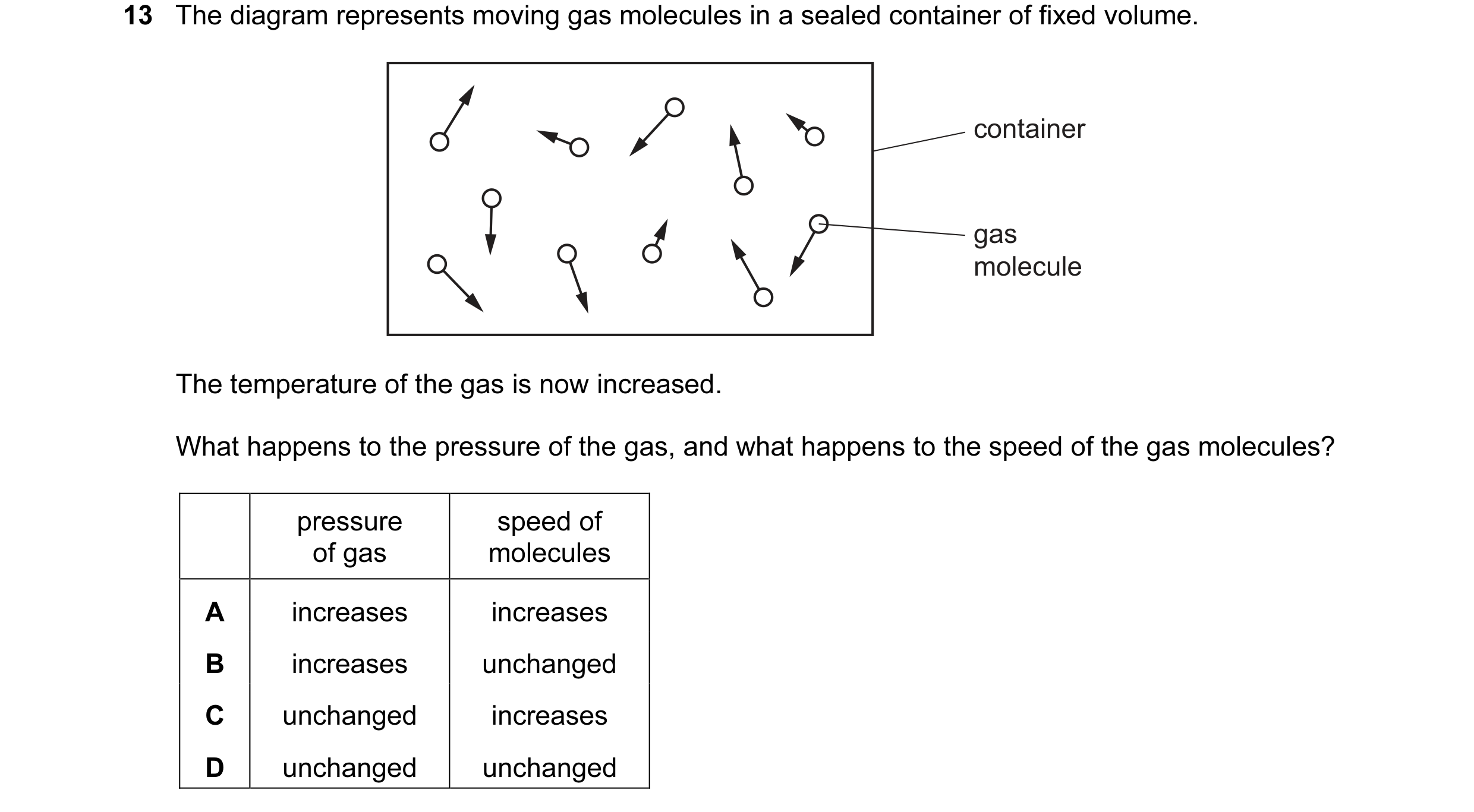
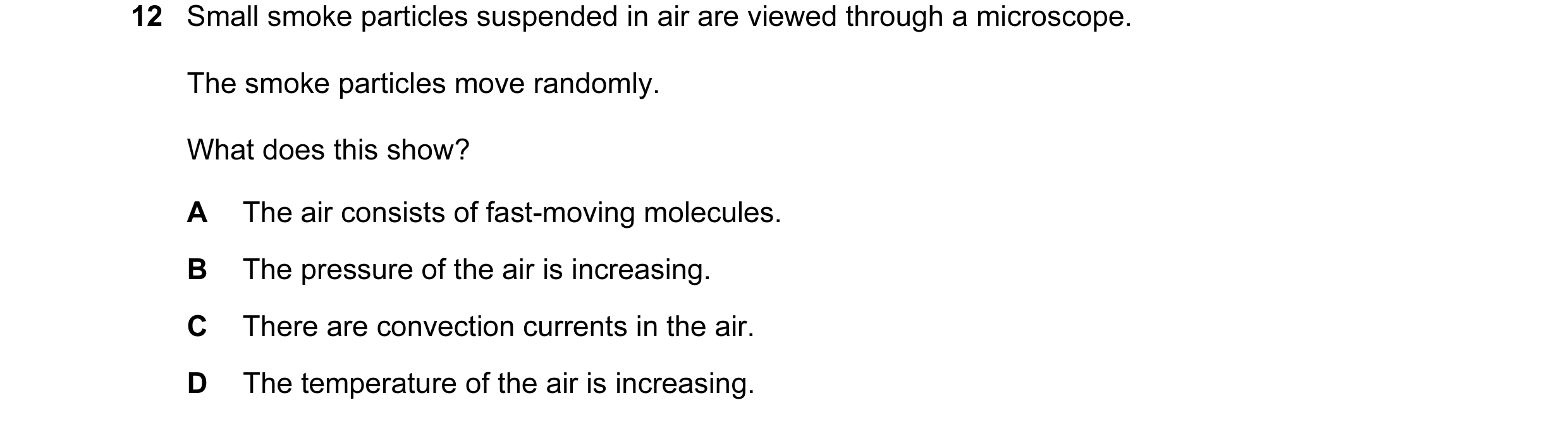
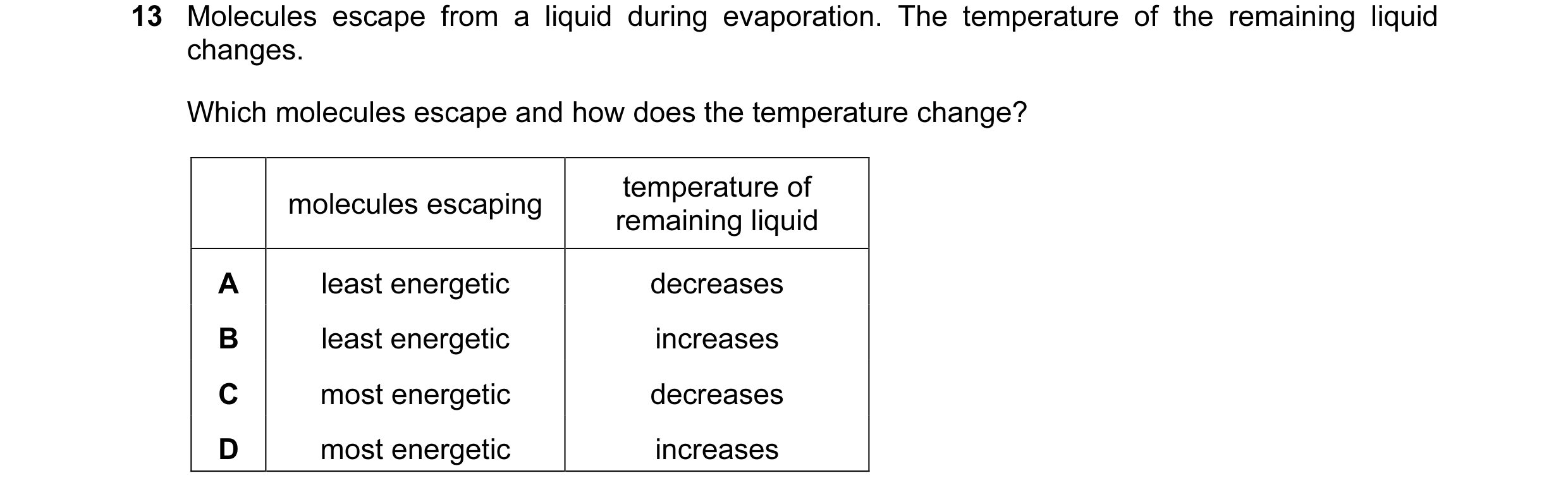 32 / 83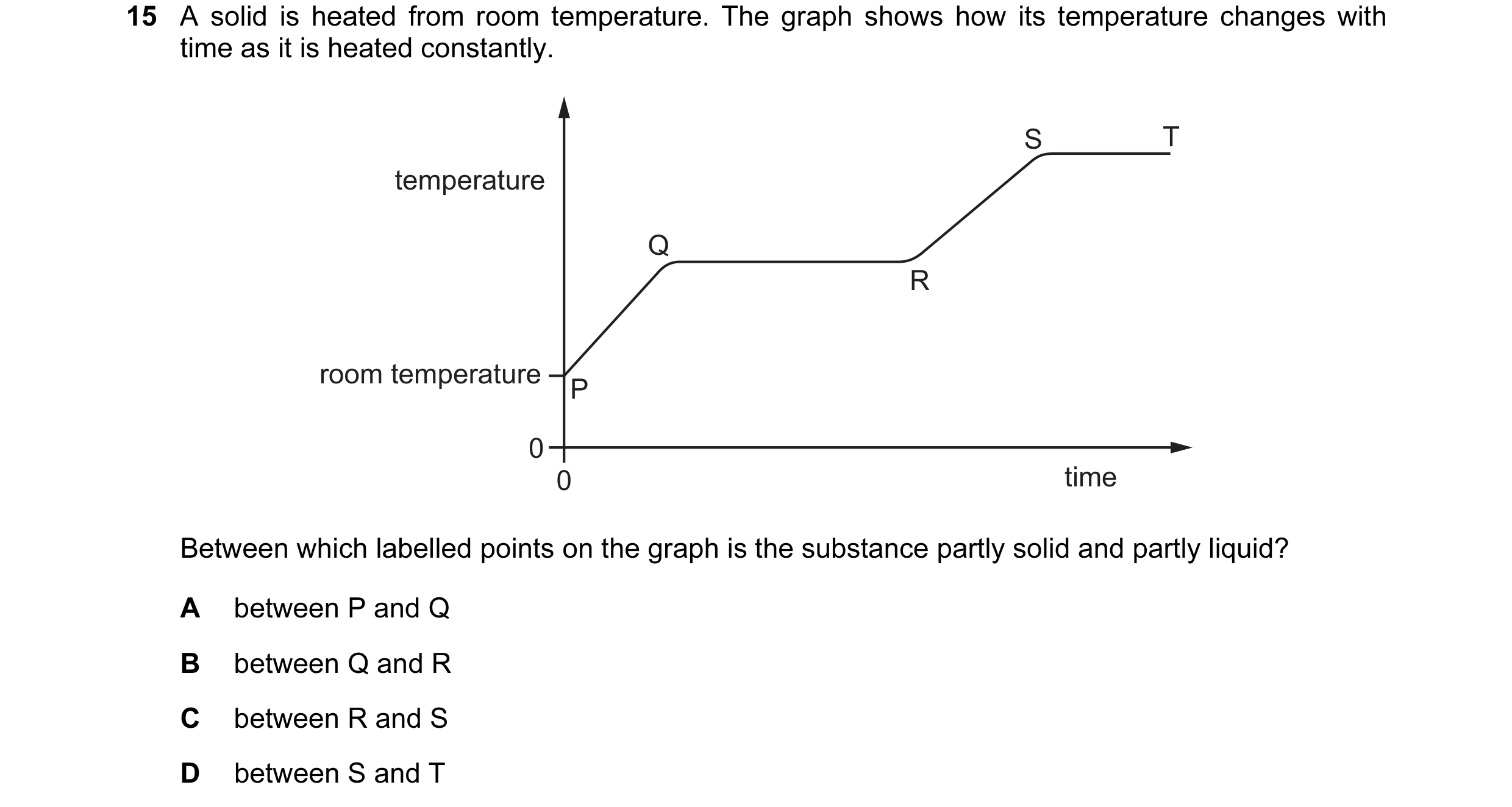
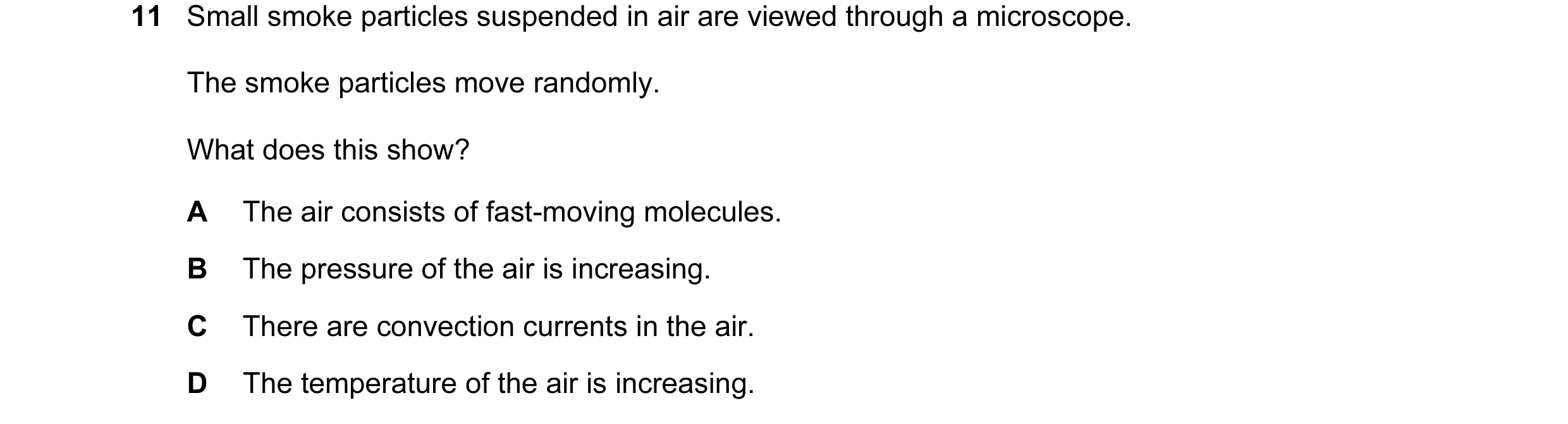
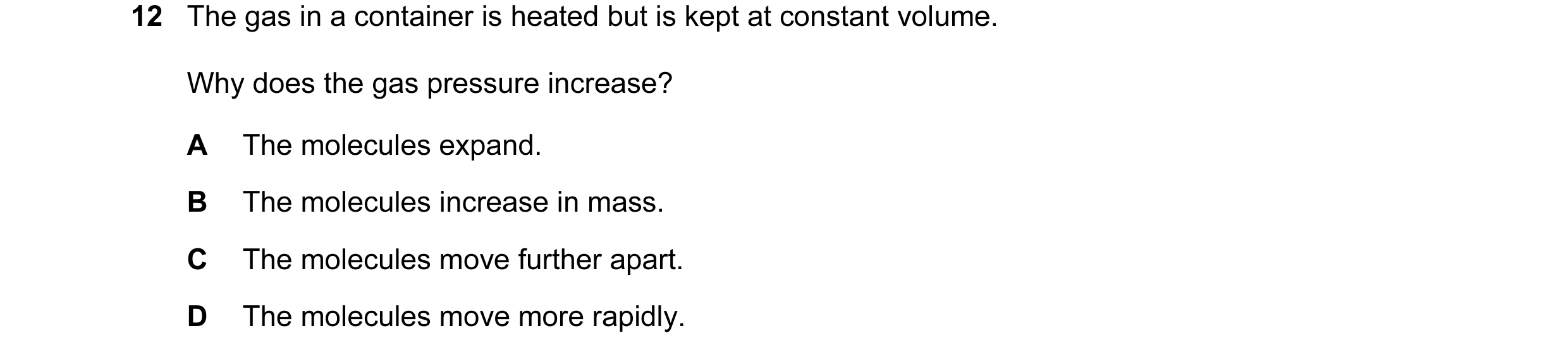
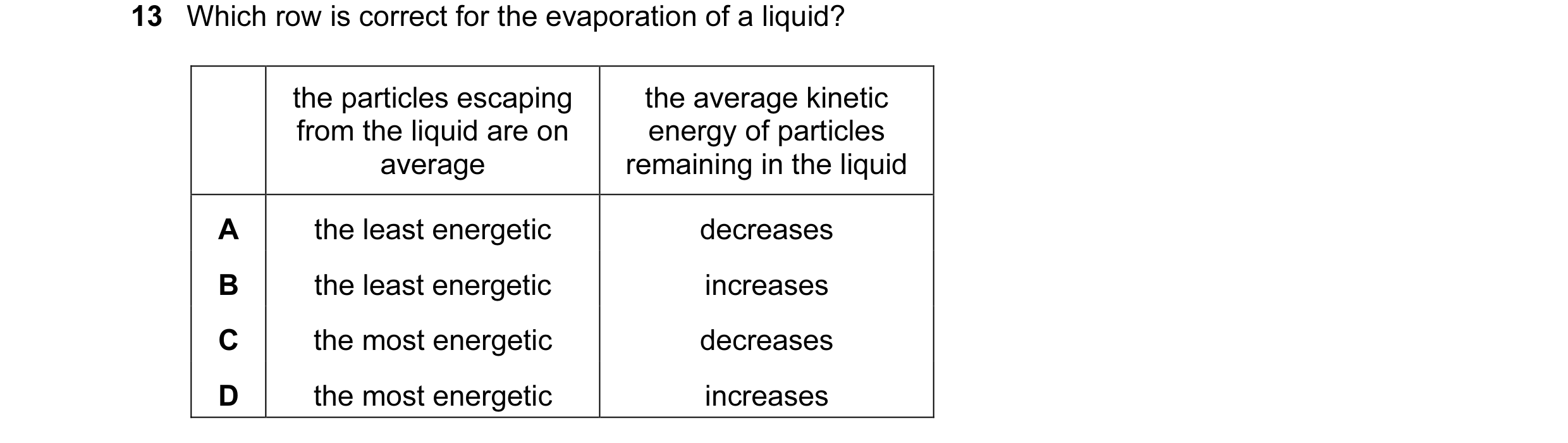 33 / 83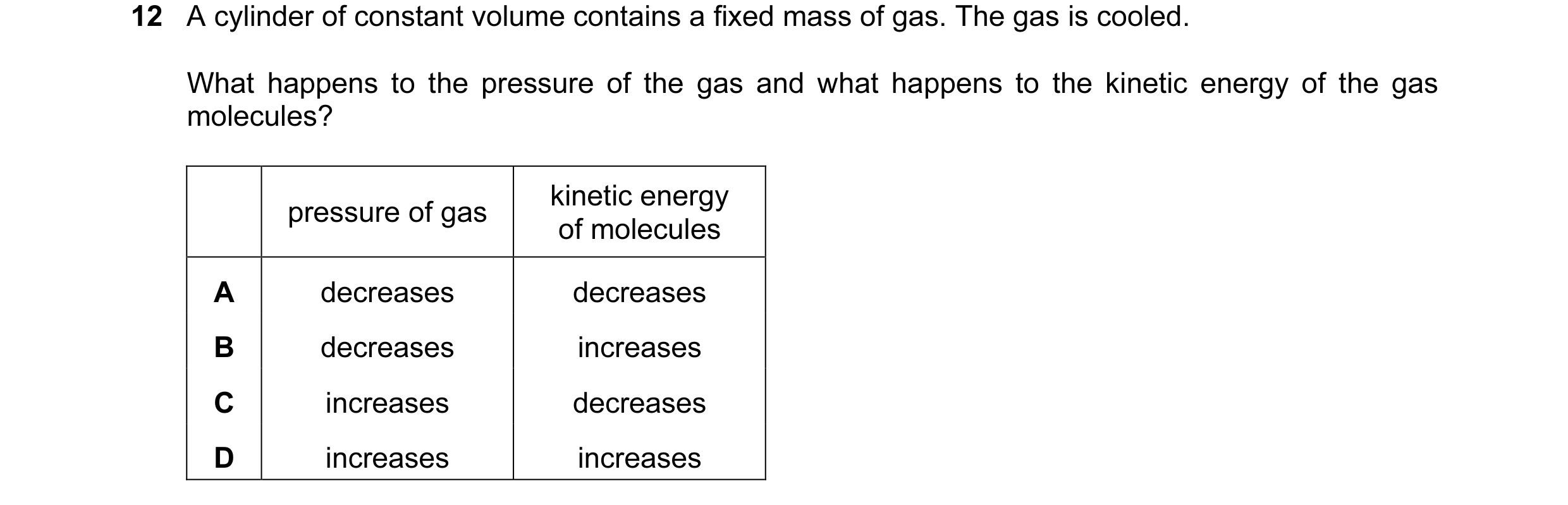
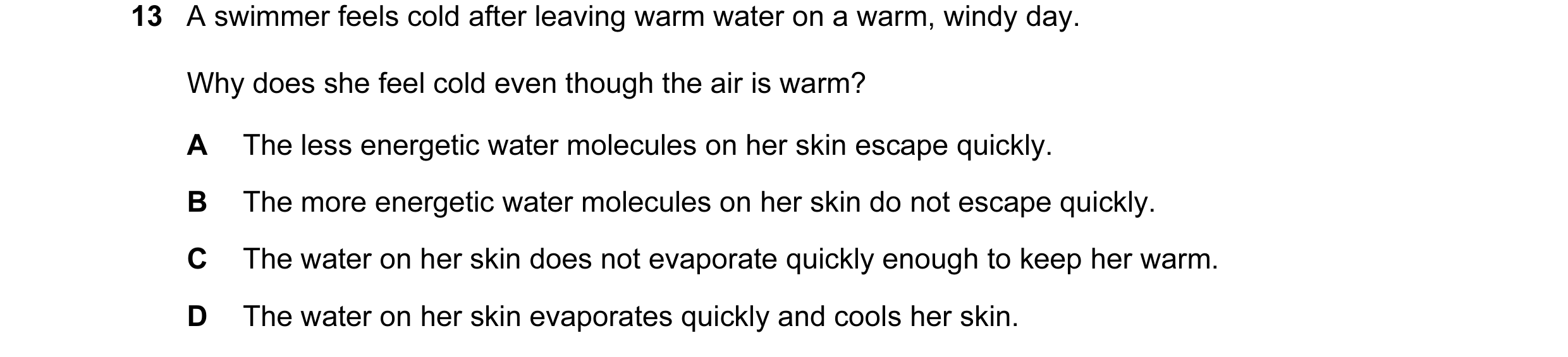
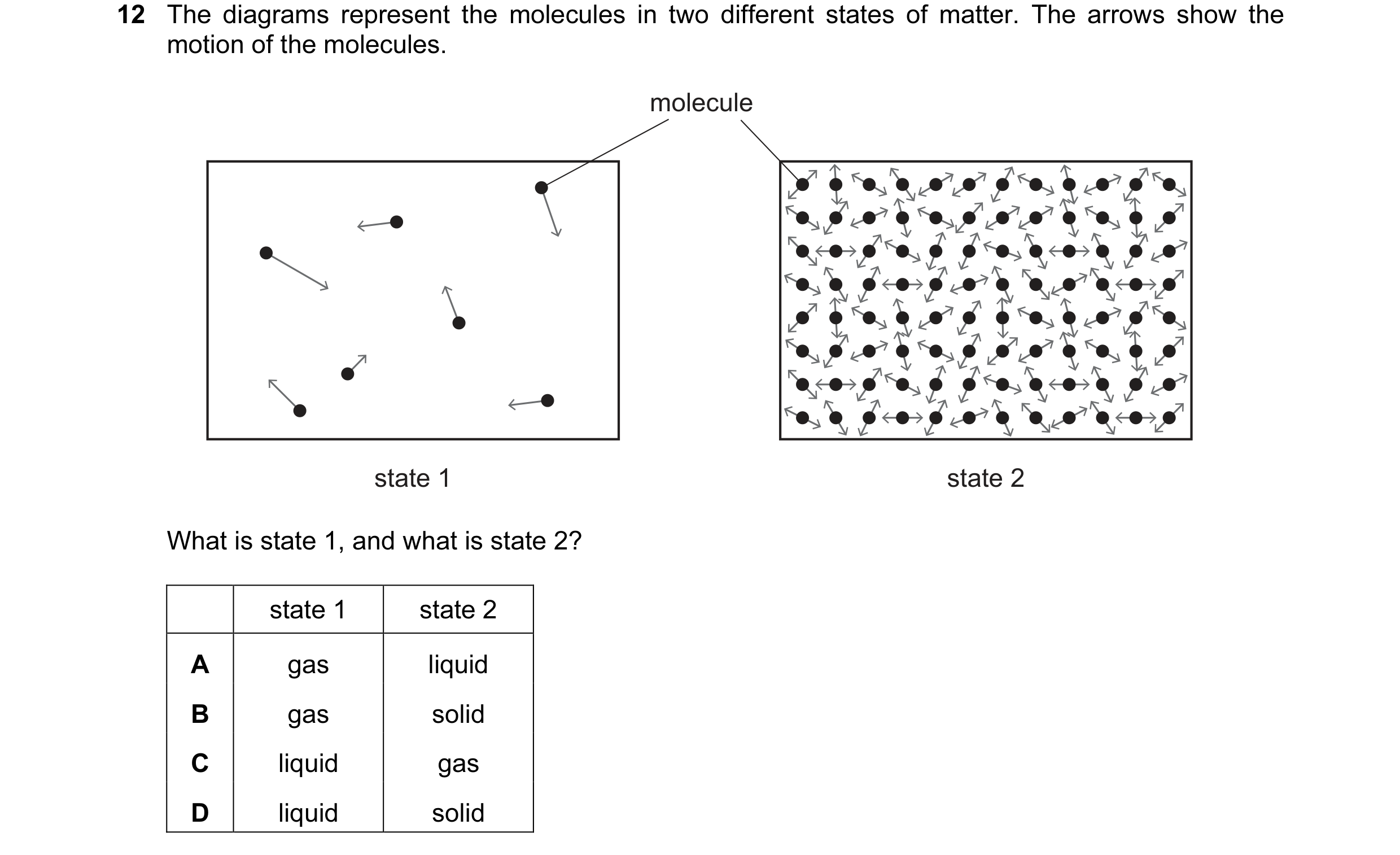 34 / 83
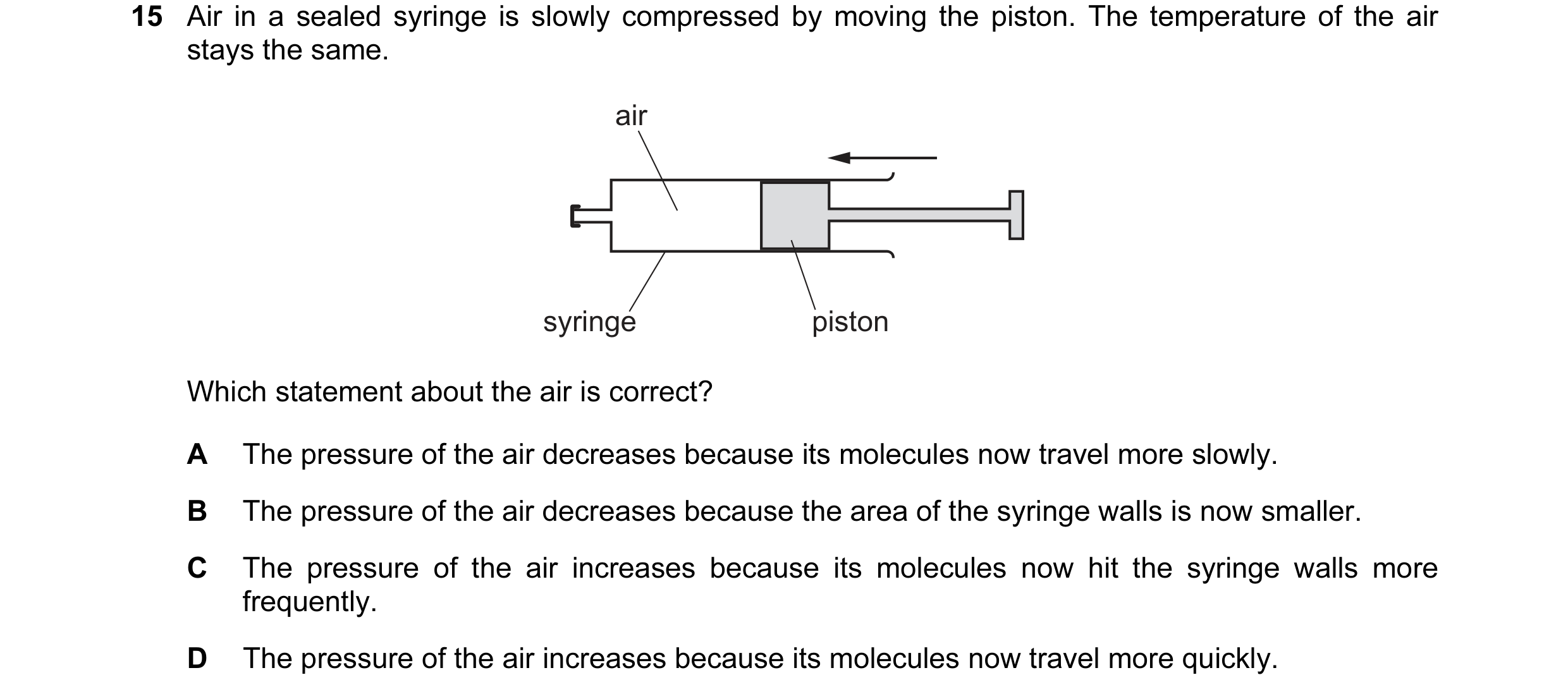 35 / 83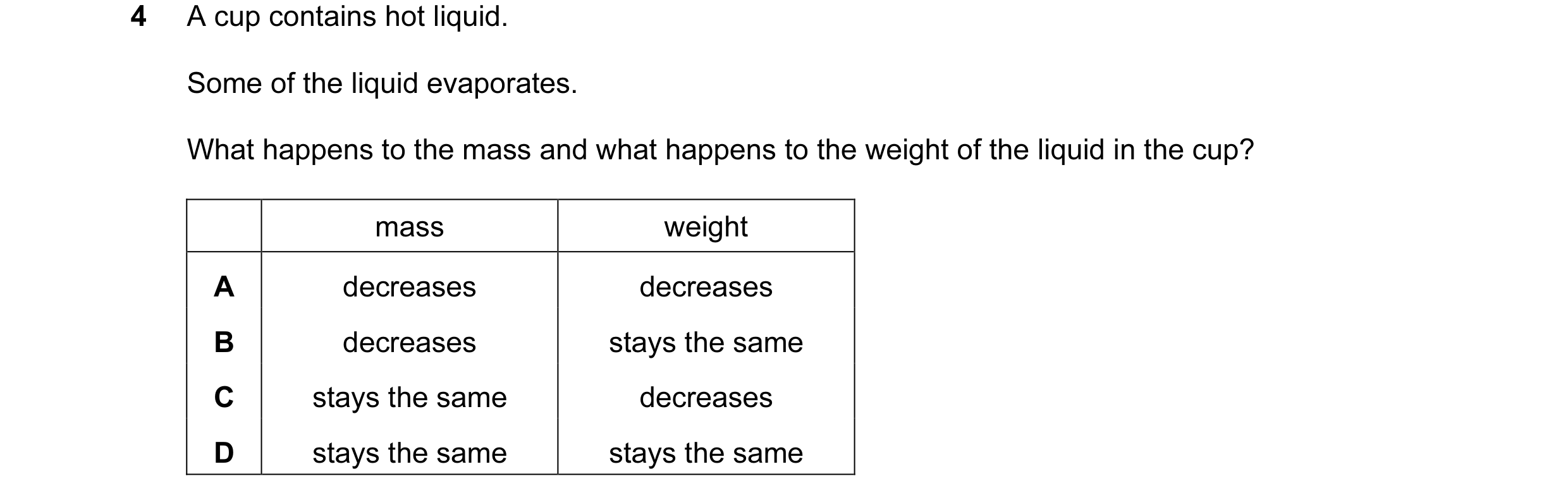

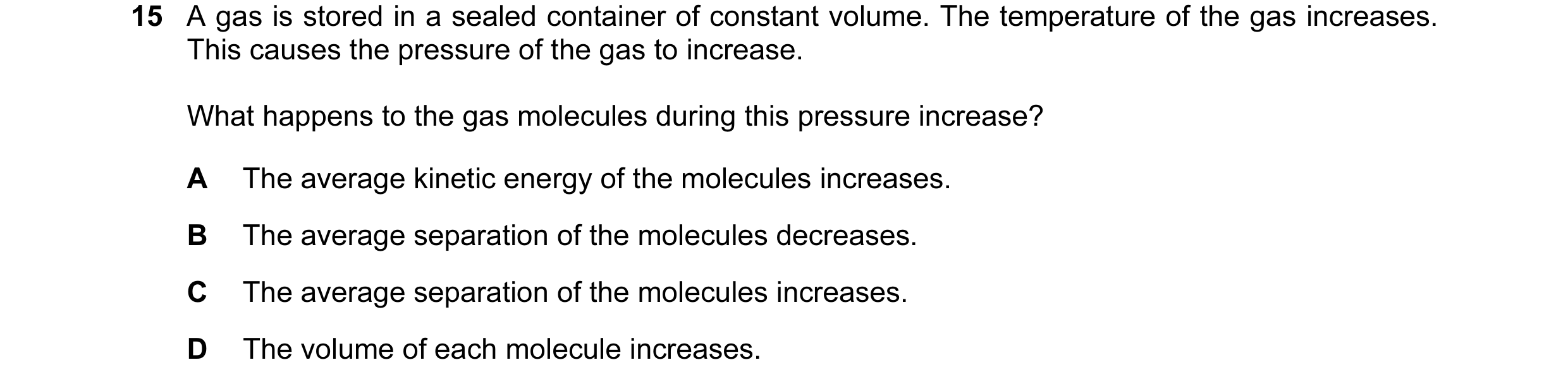
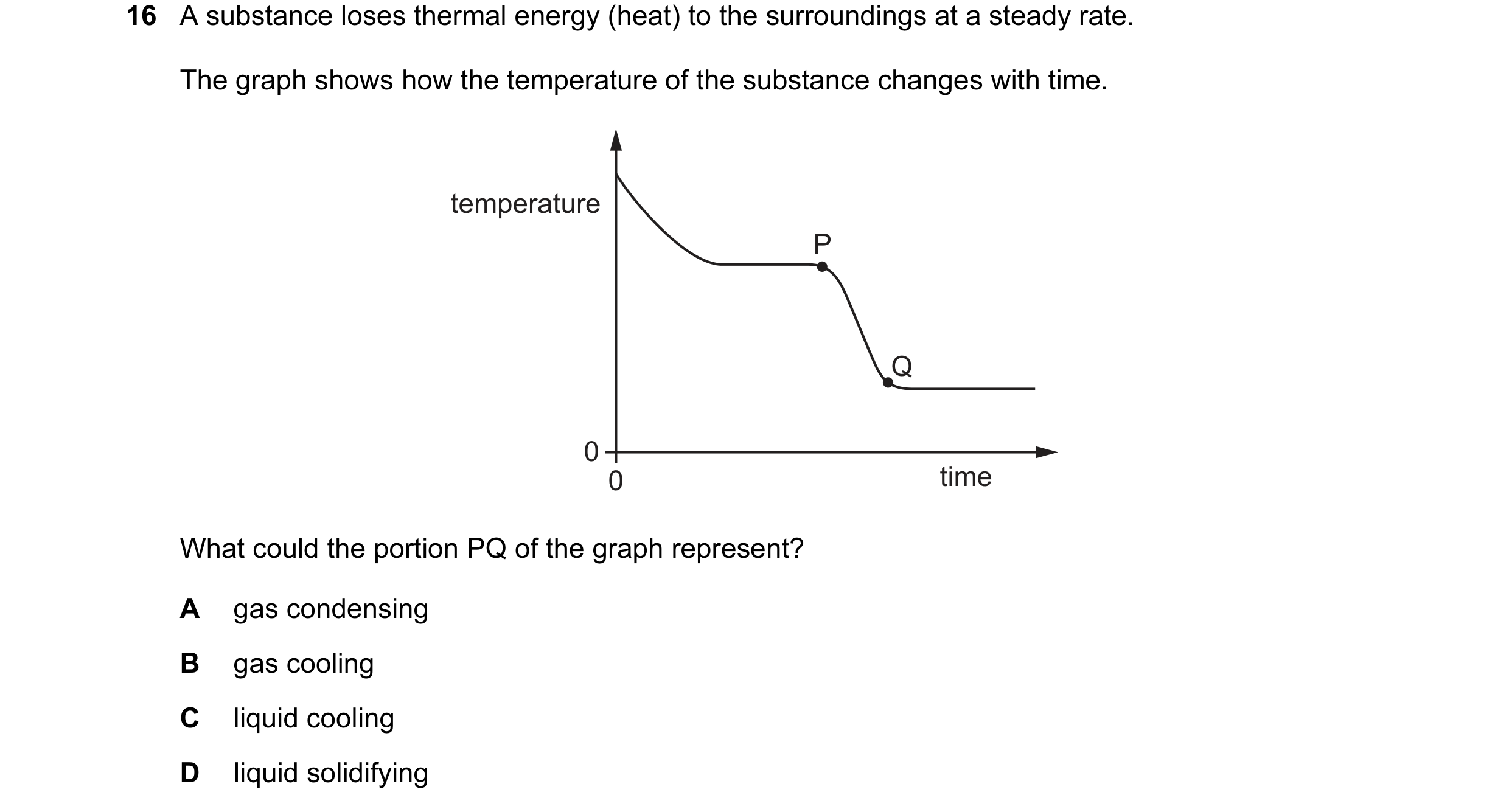 36 / 83
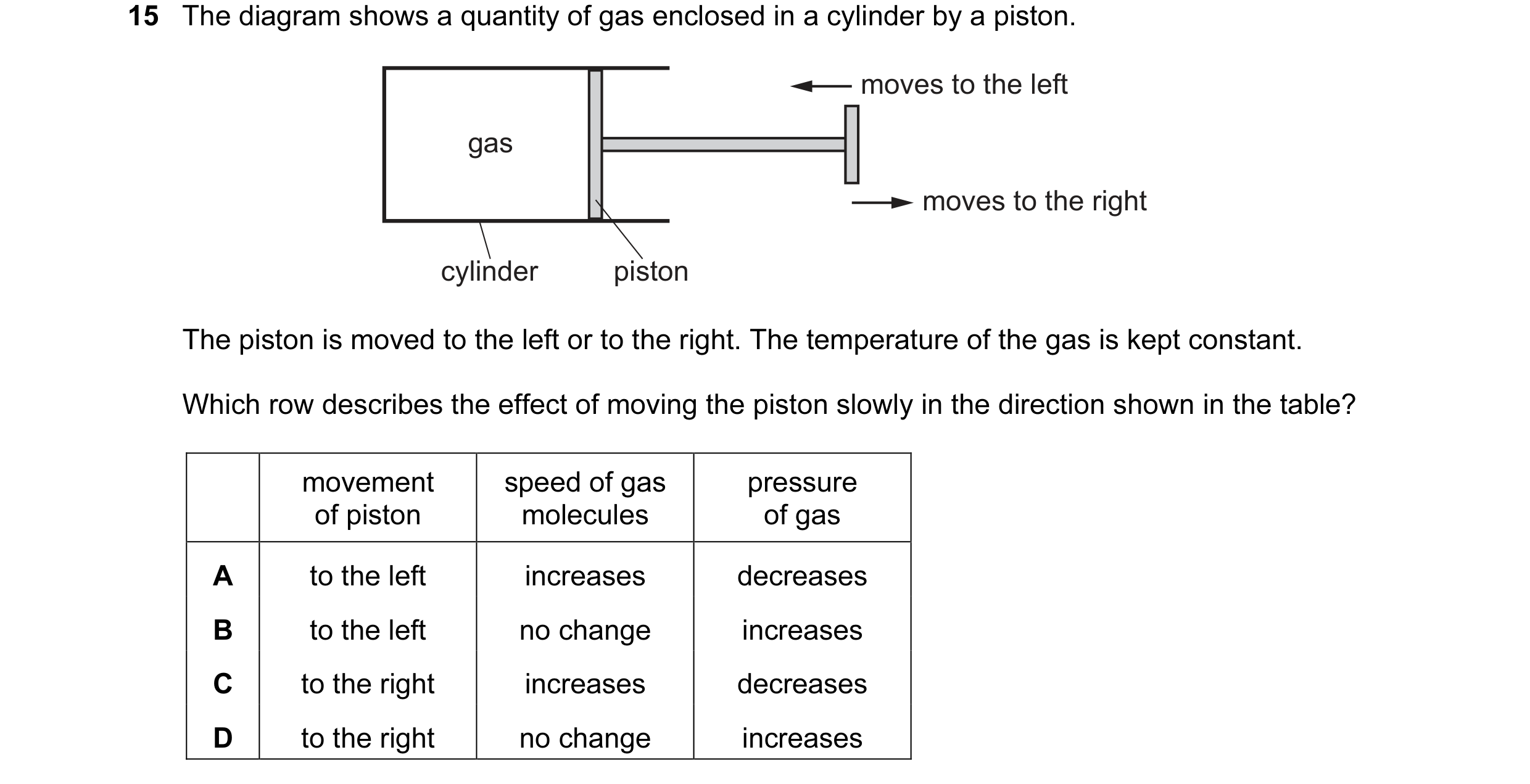

 37 / 83
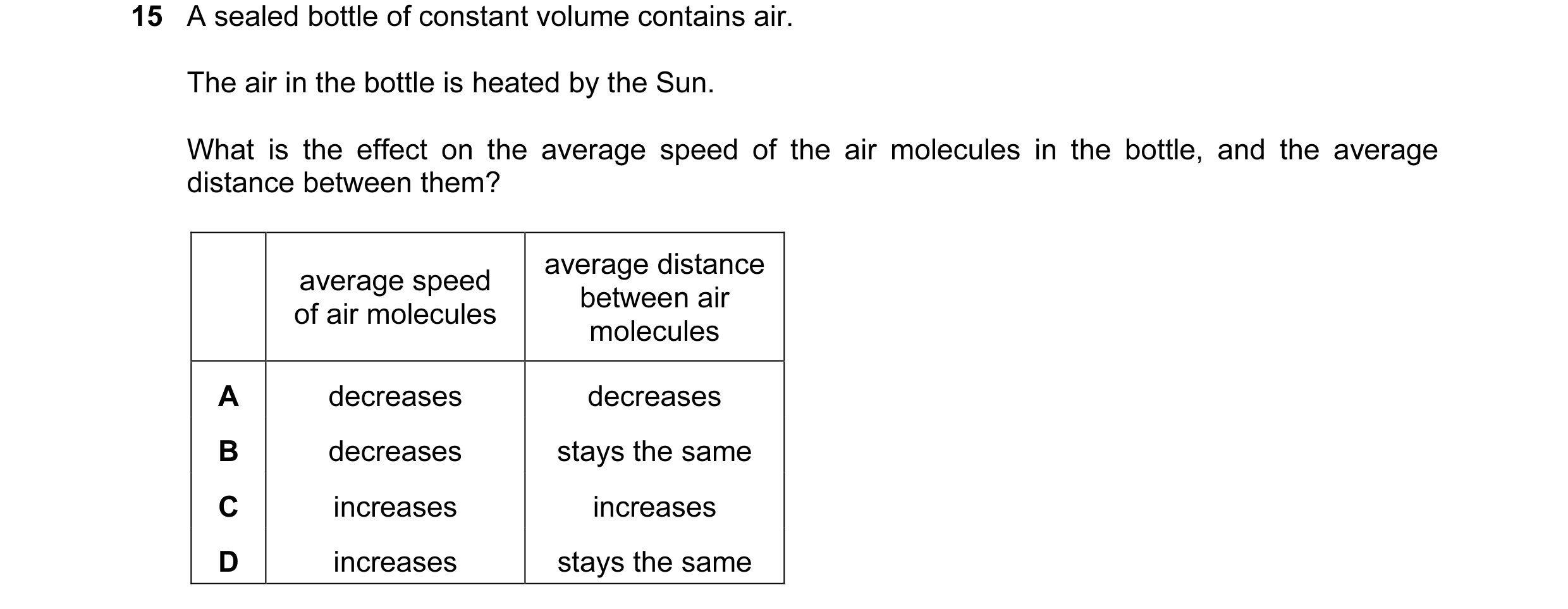
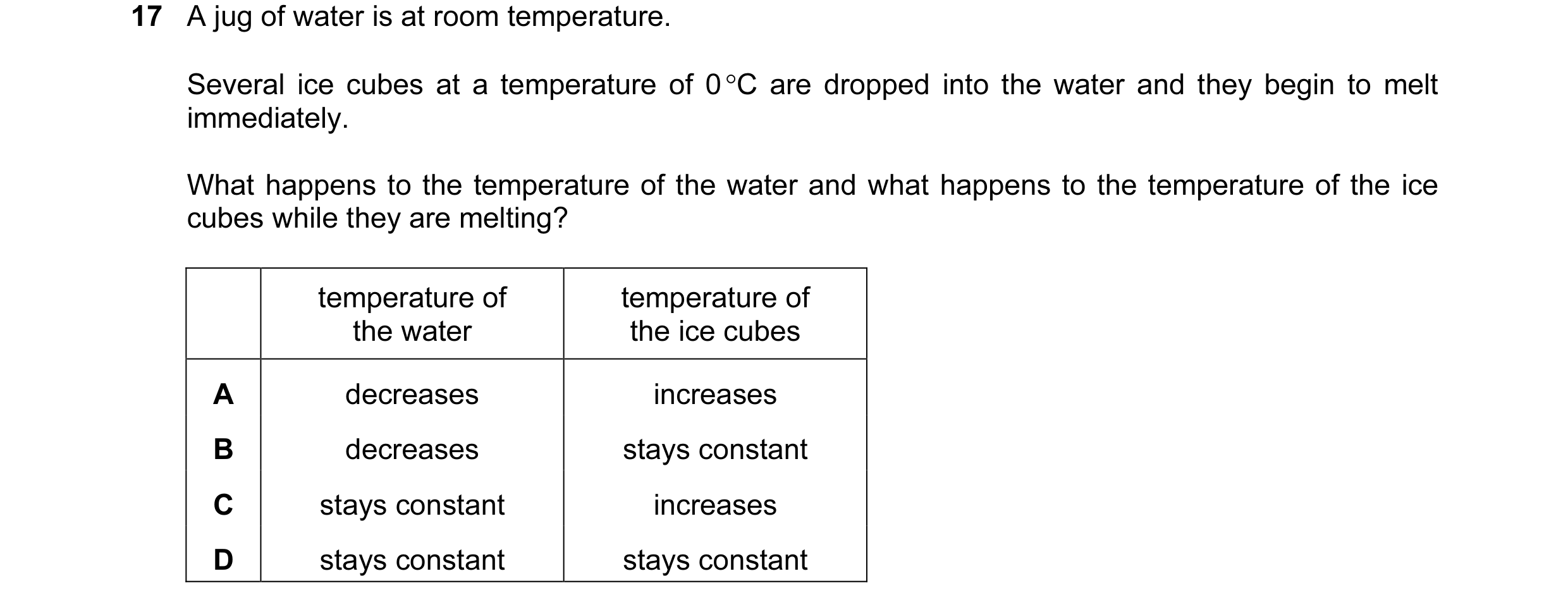
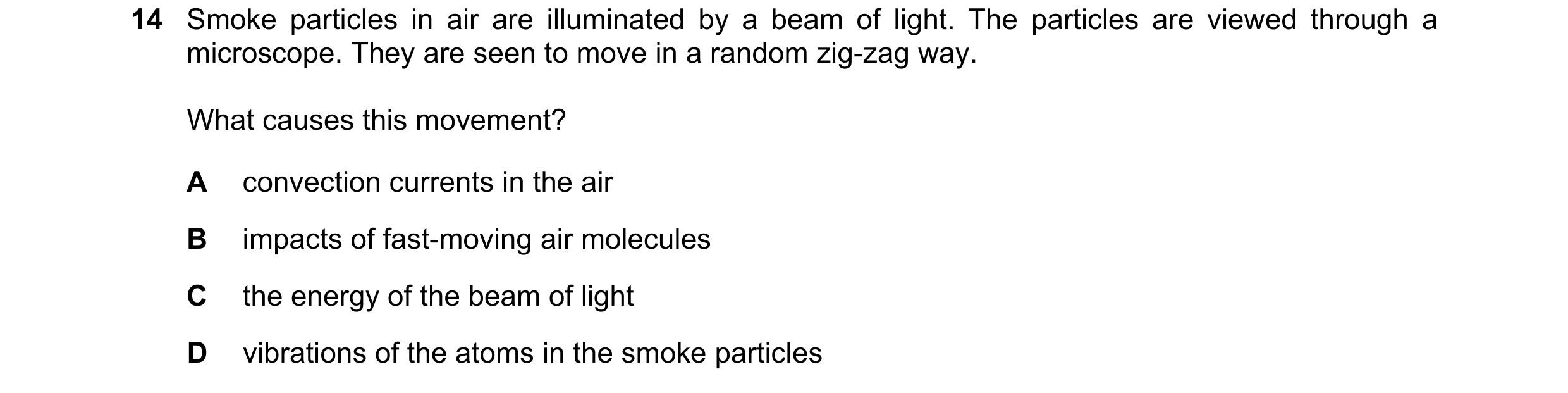 38 / 83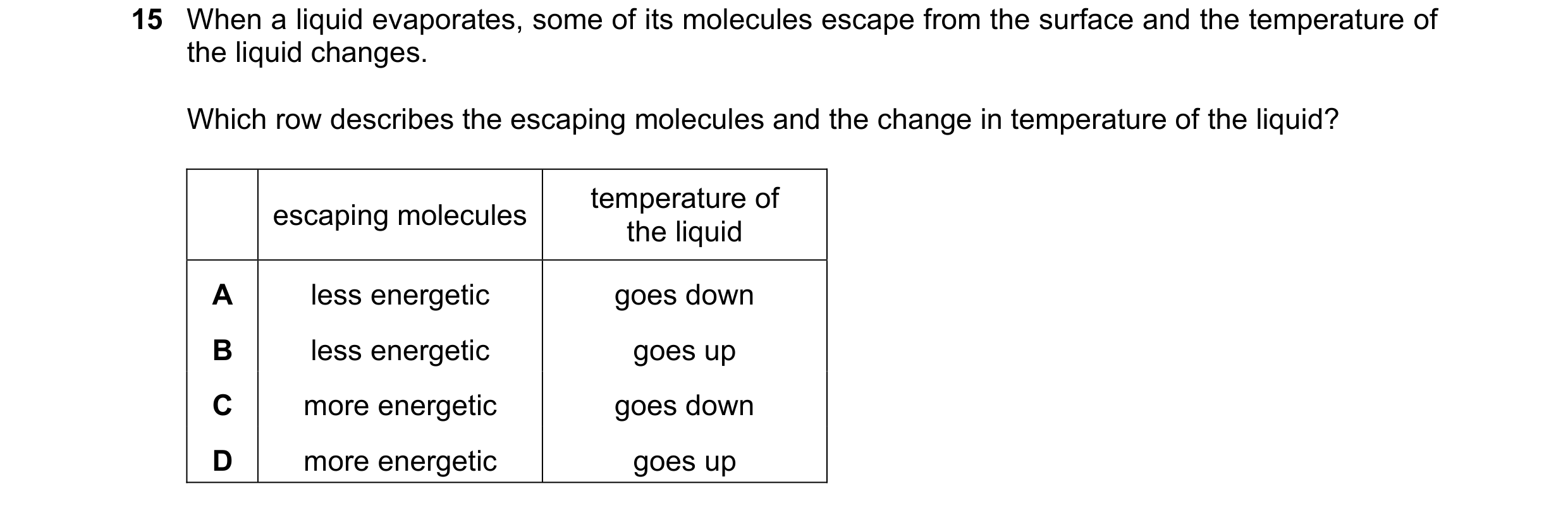

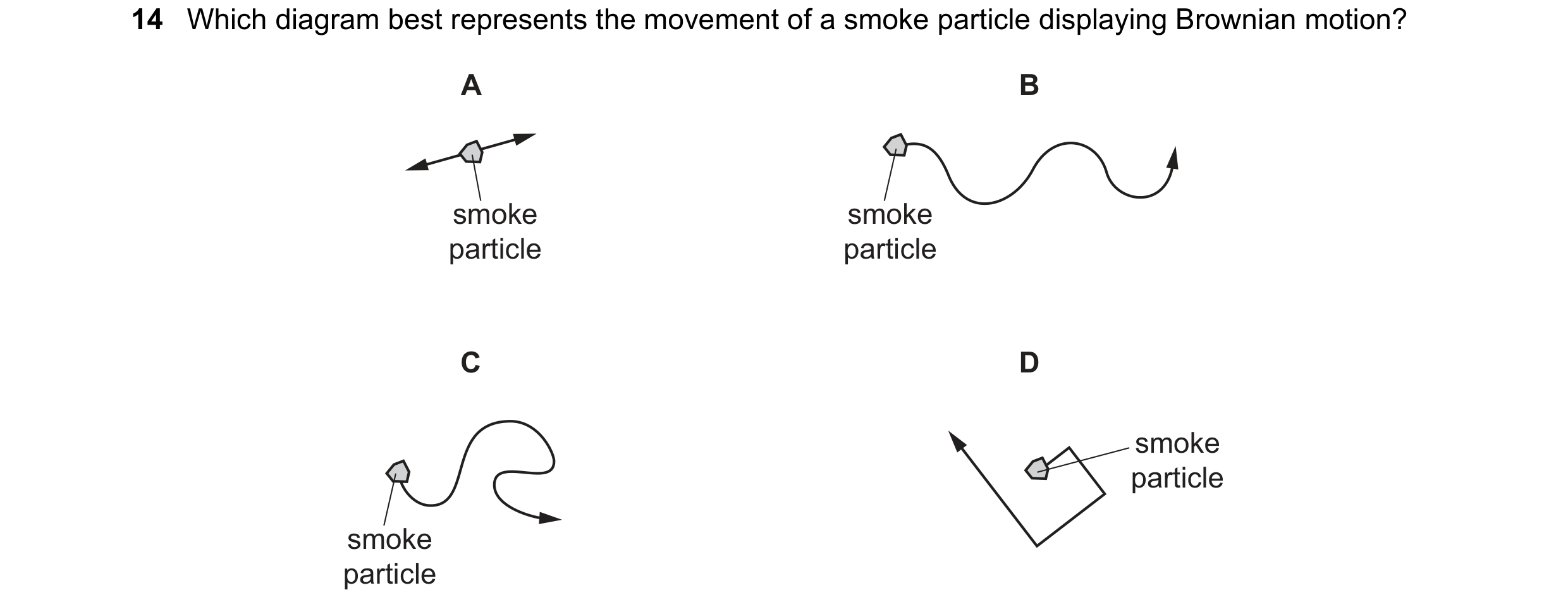 39 / 83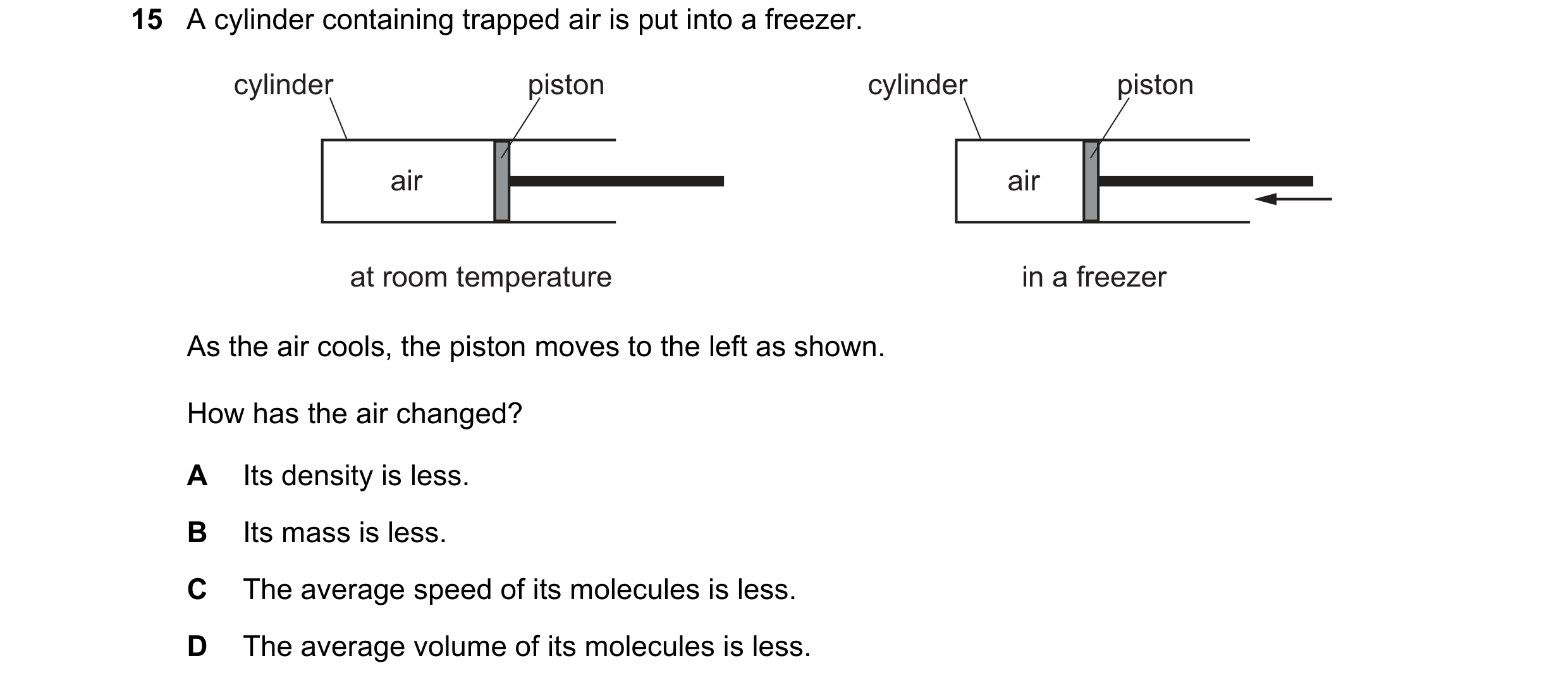
 40 / 83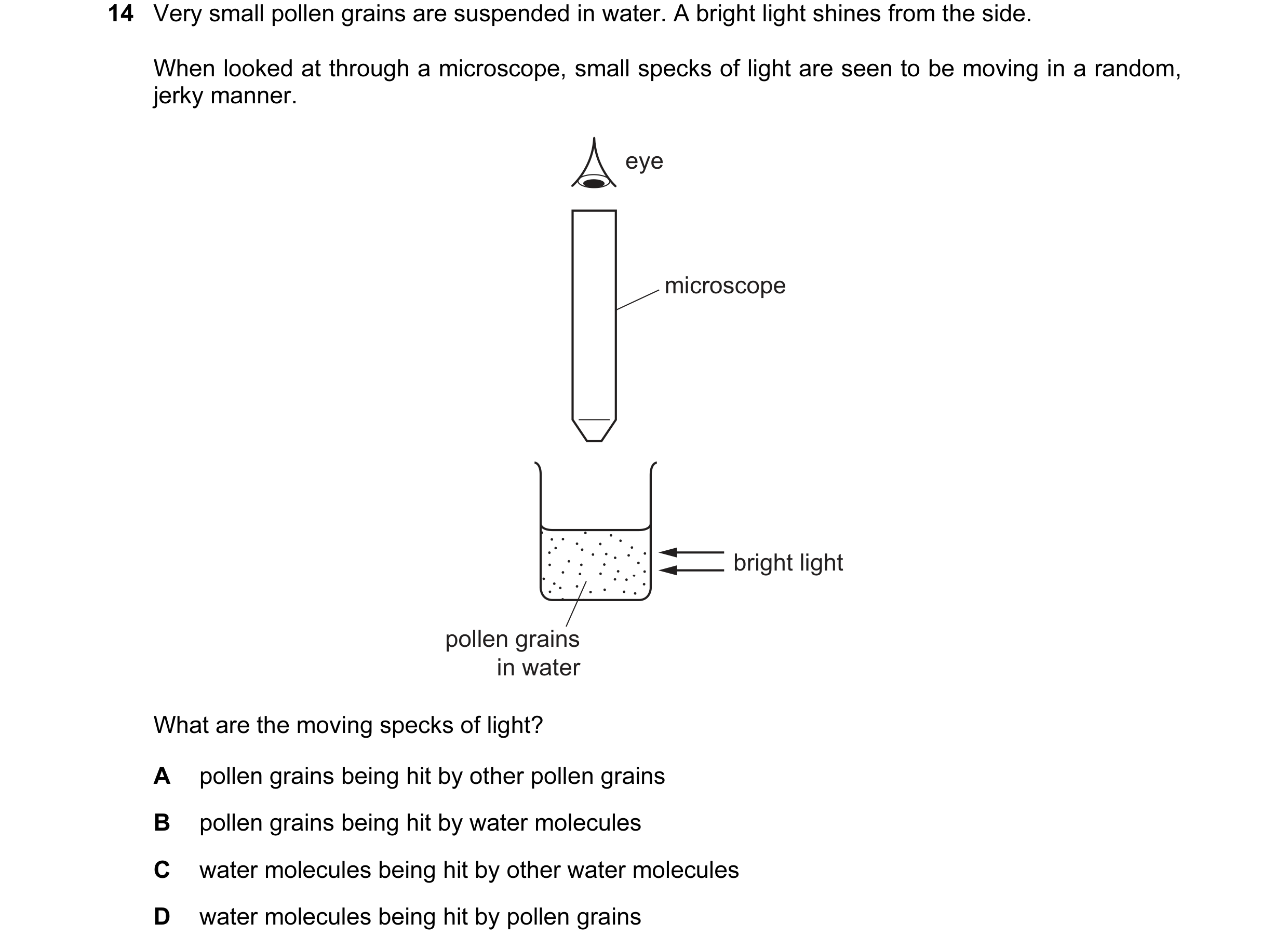
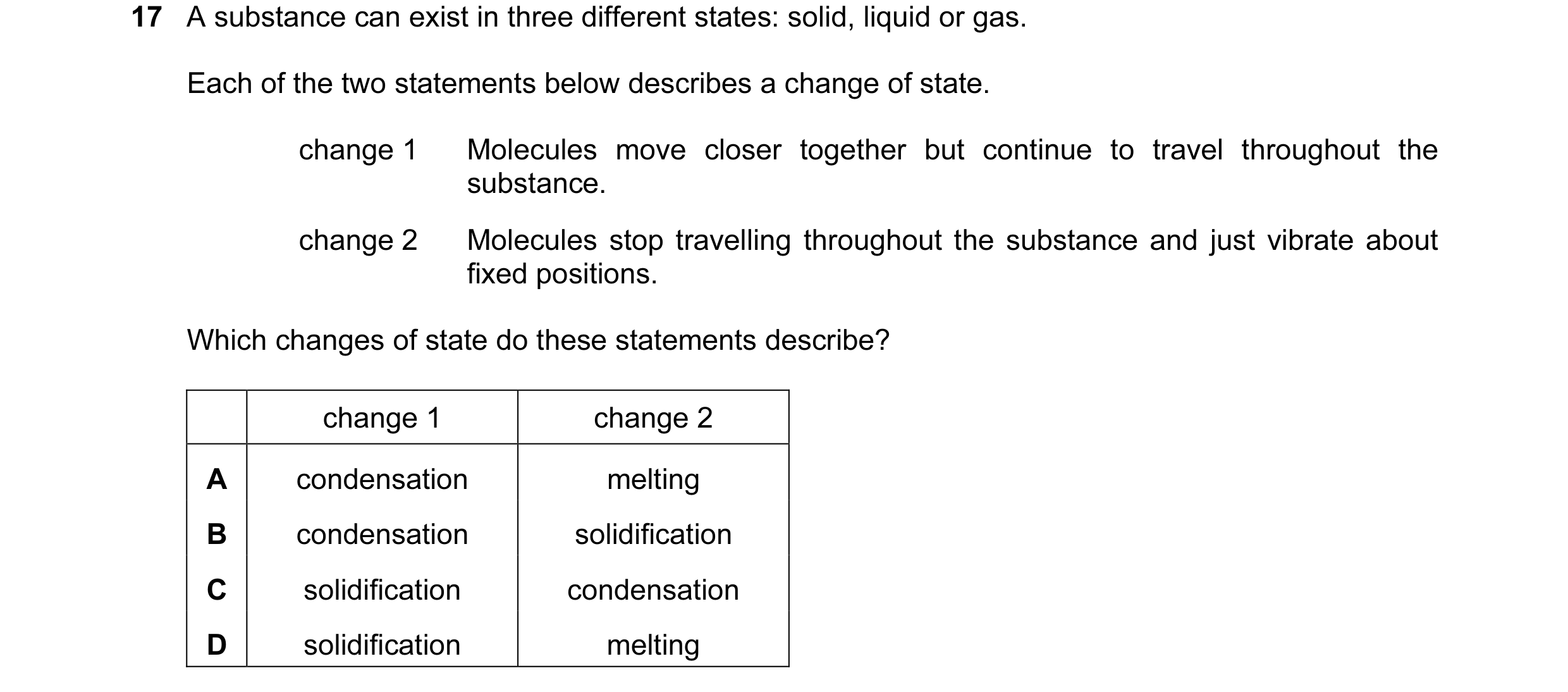 41 / 83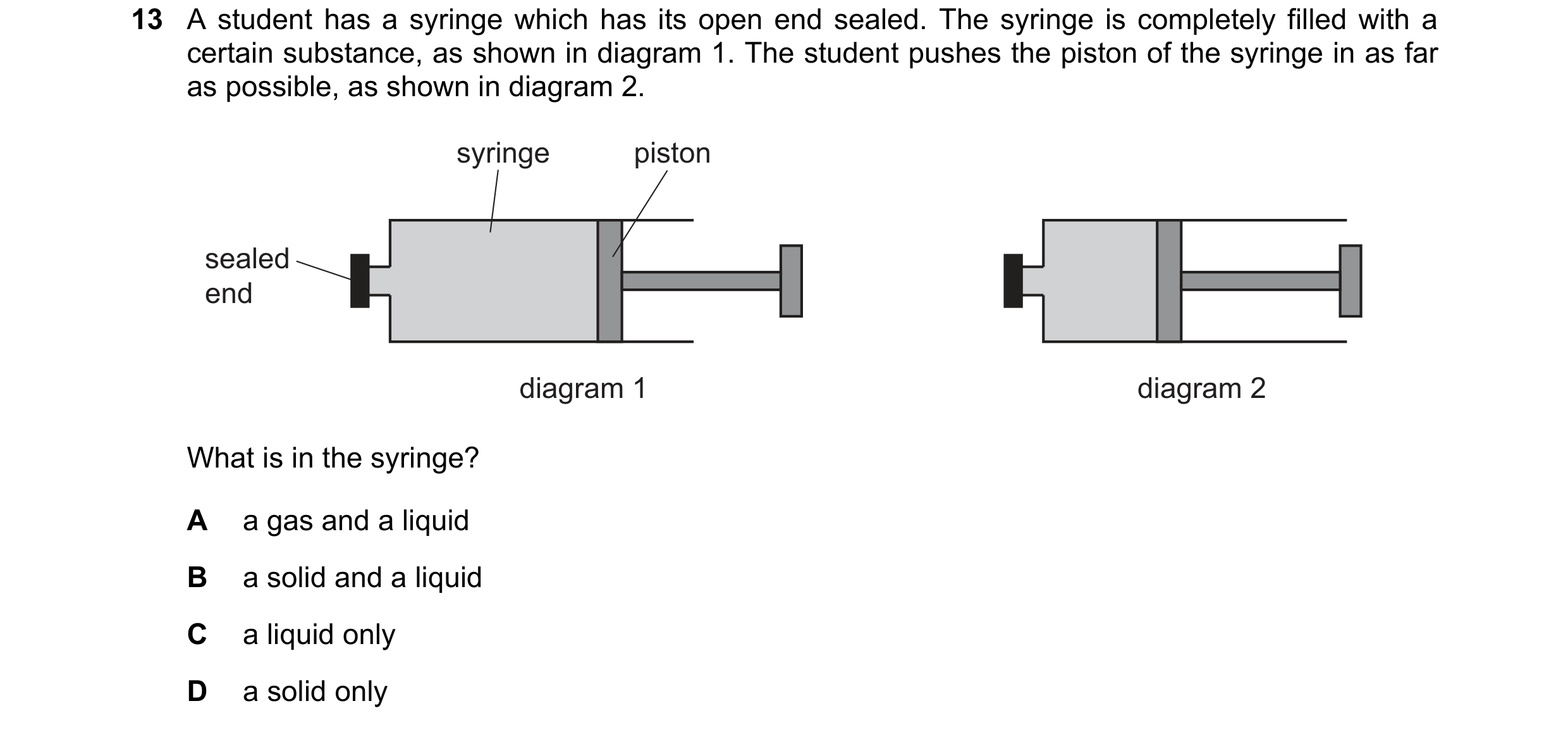
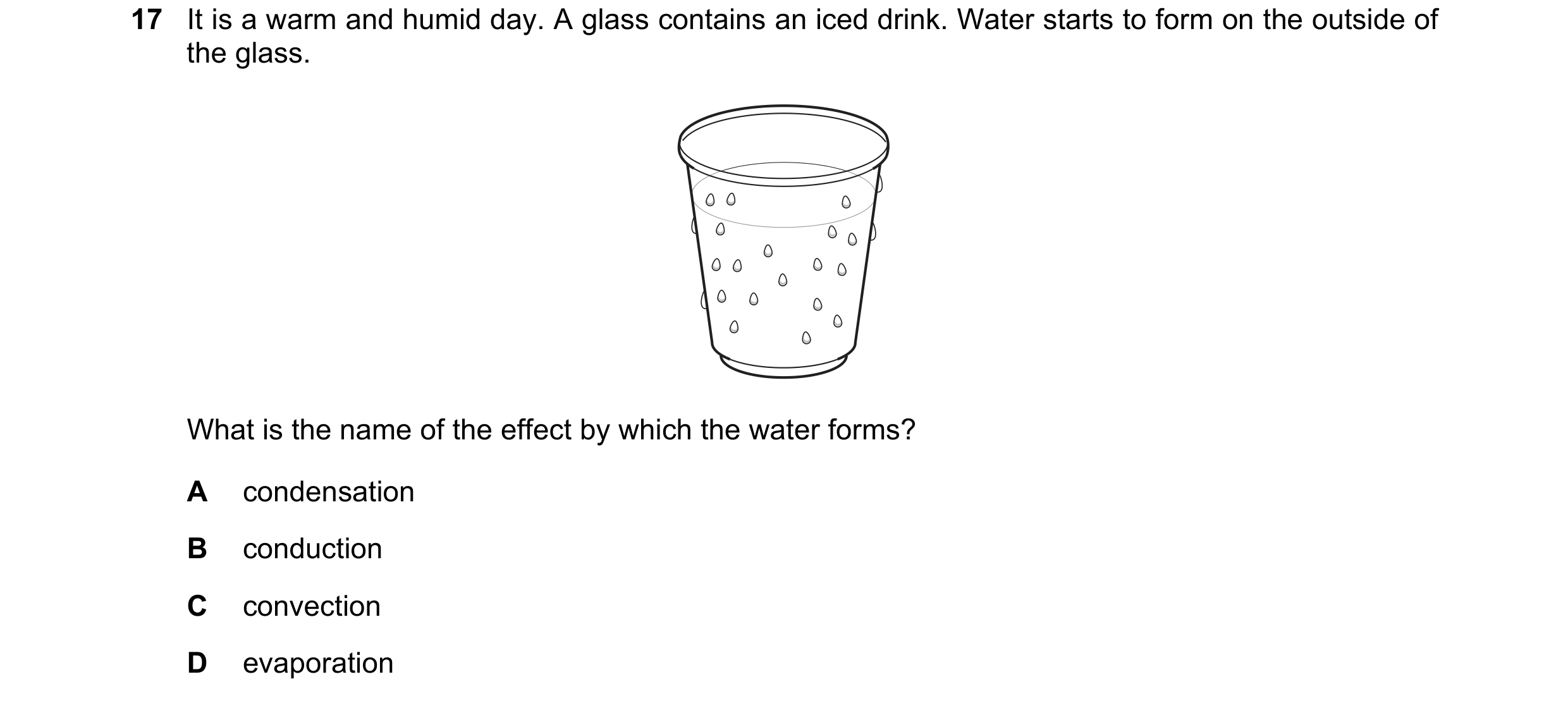 42 / 83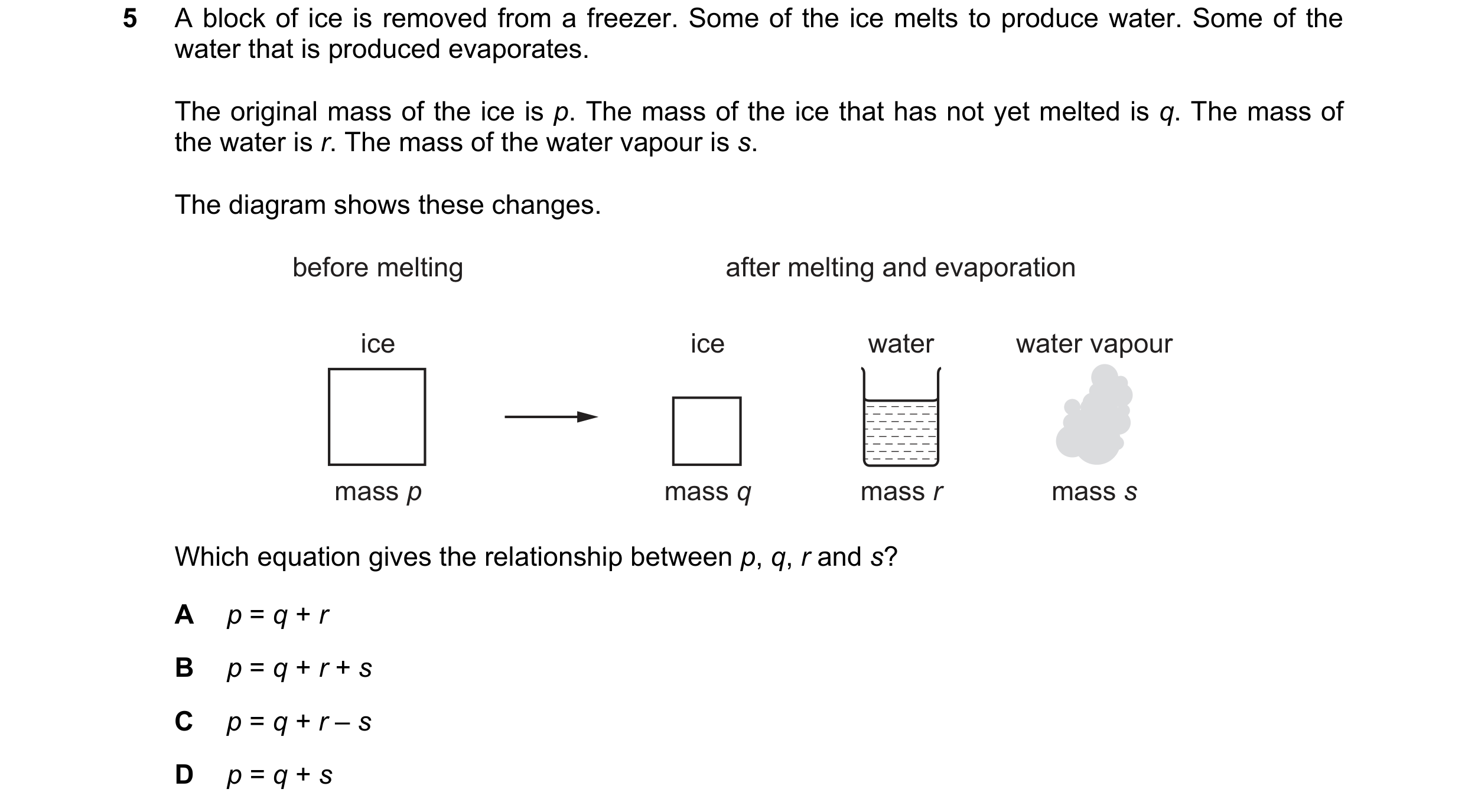
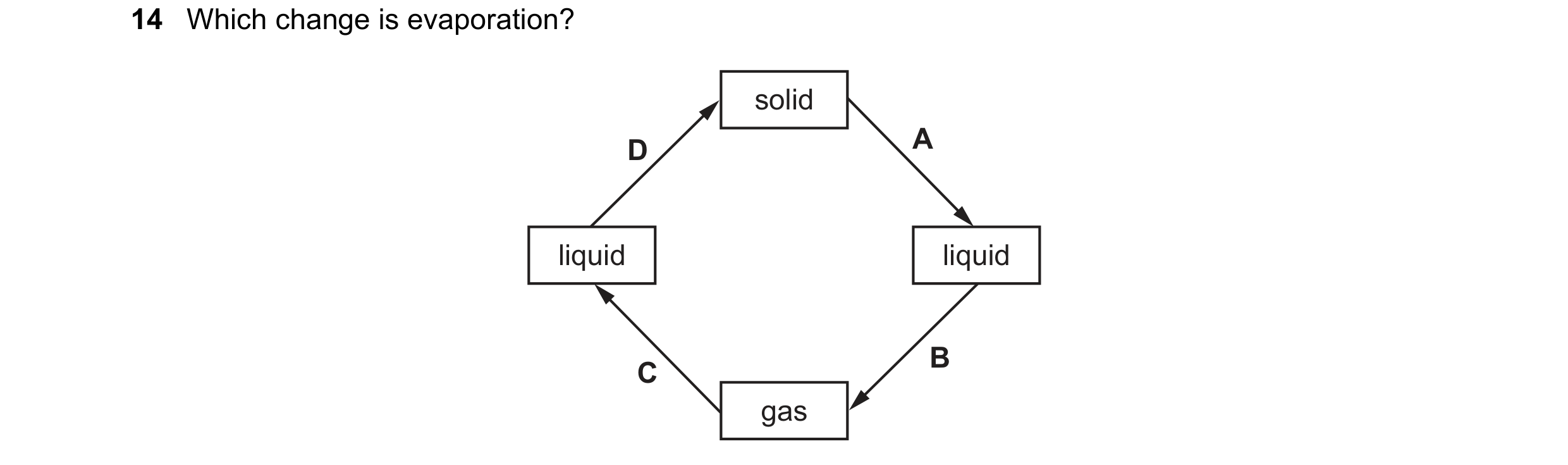 43 / 83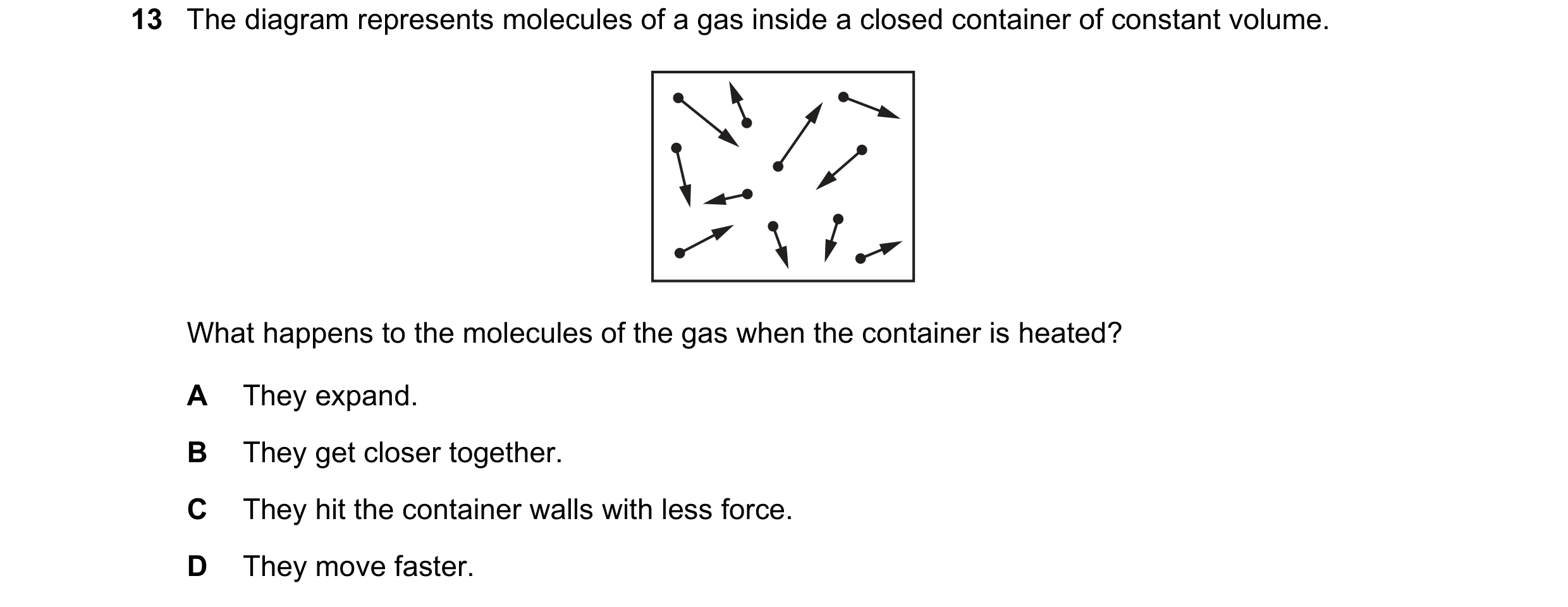
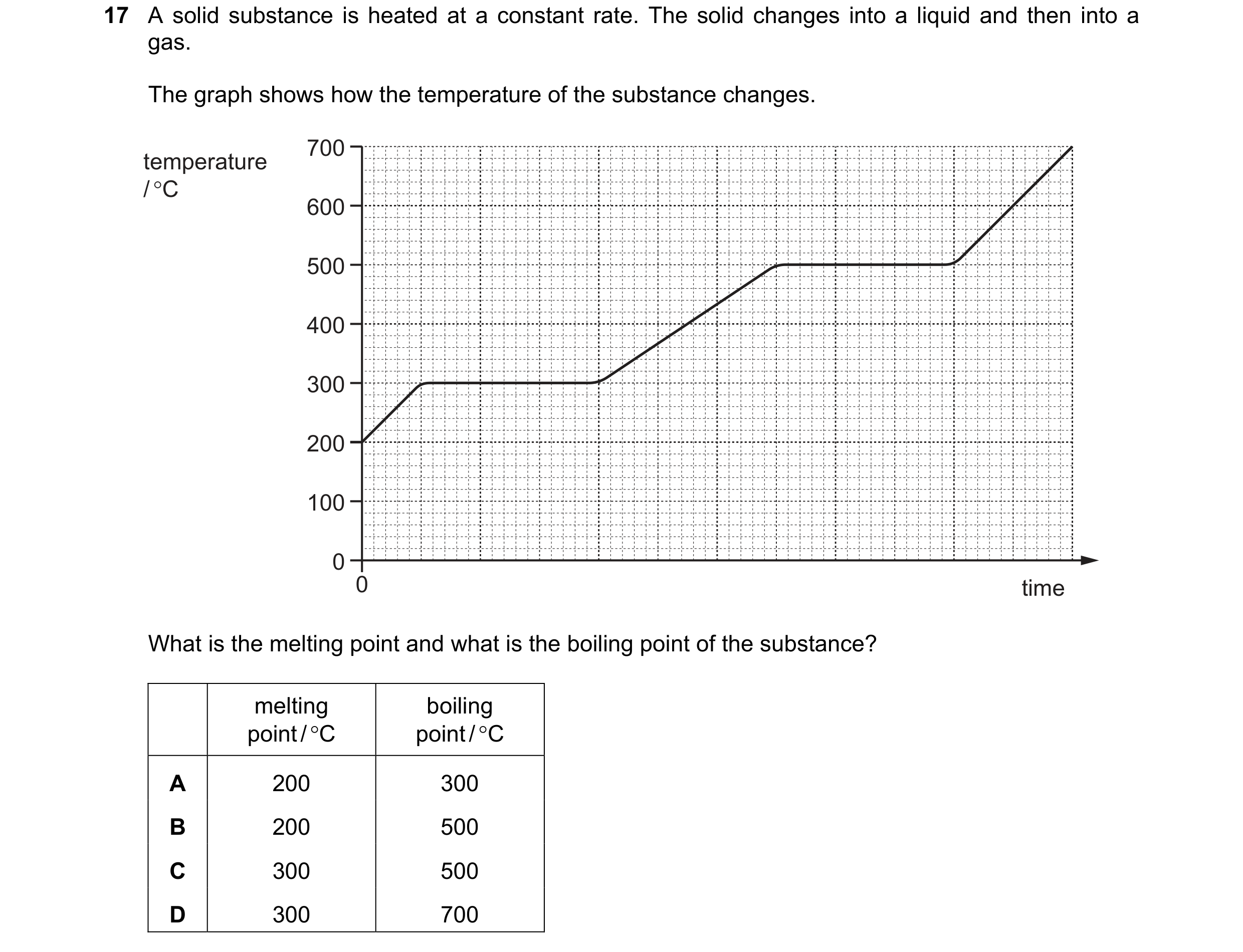 44 / 83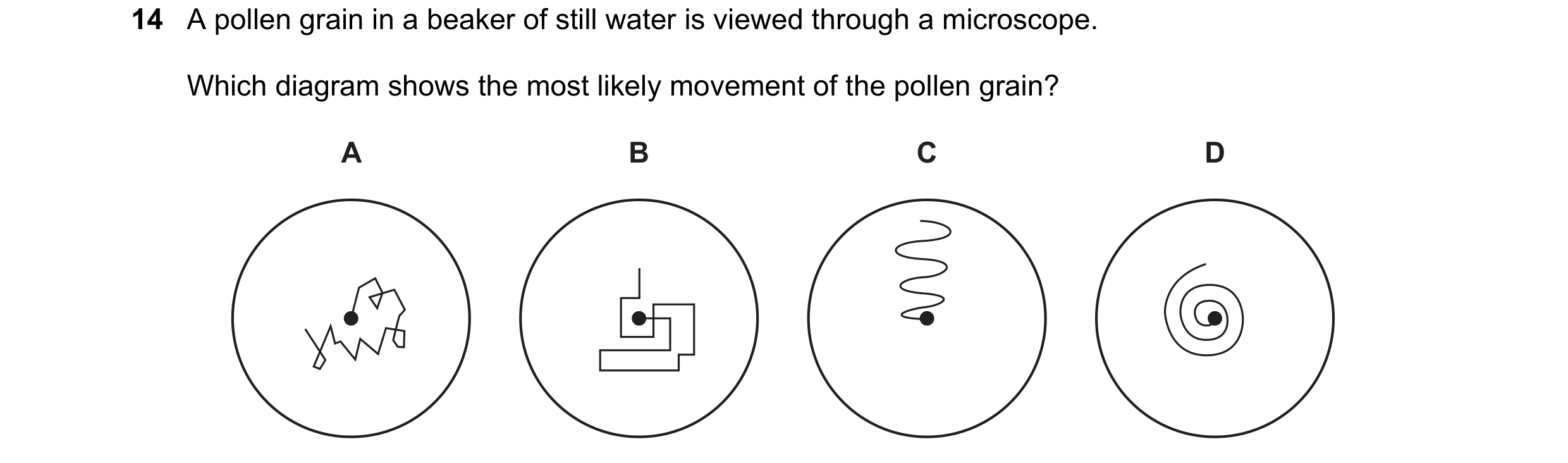
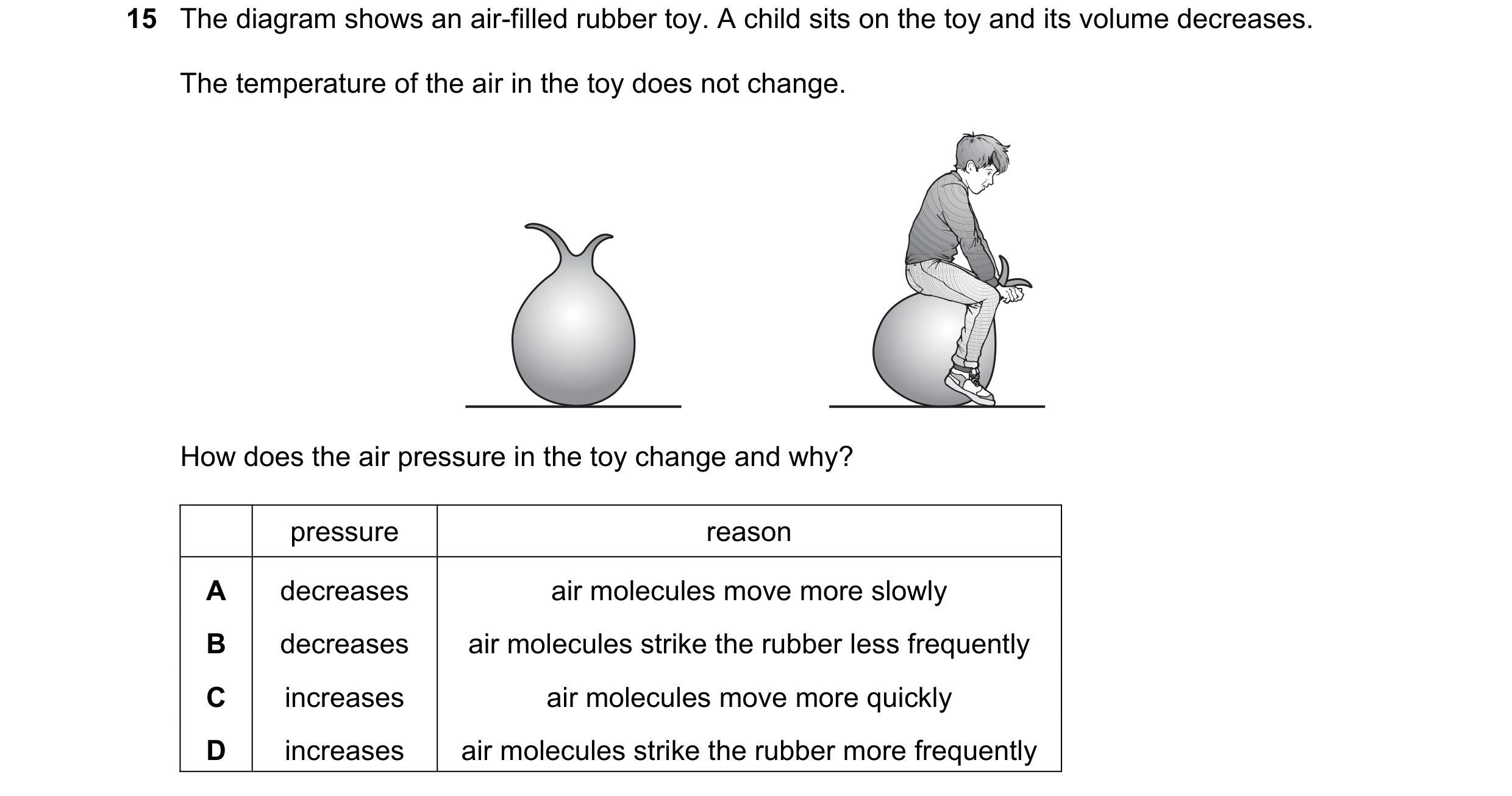
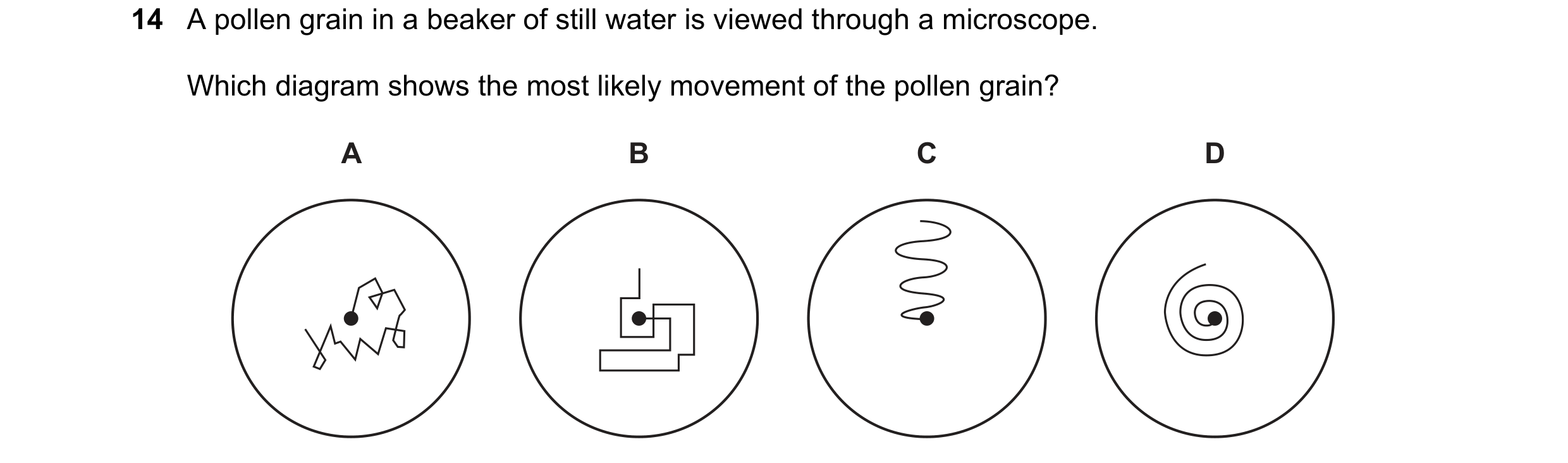 45 / 83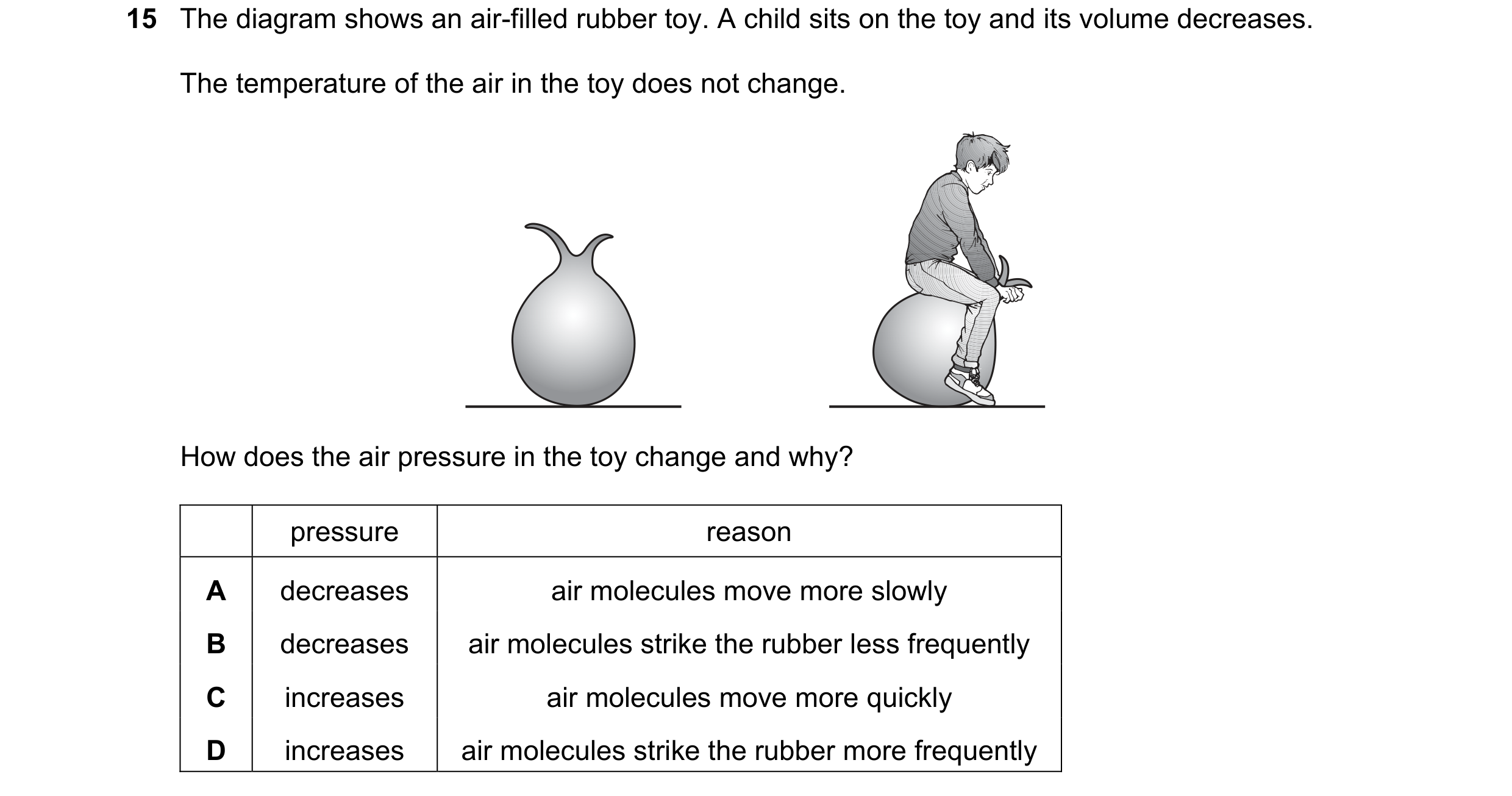

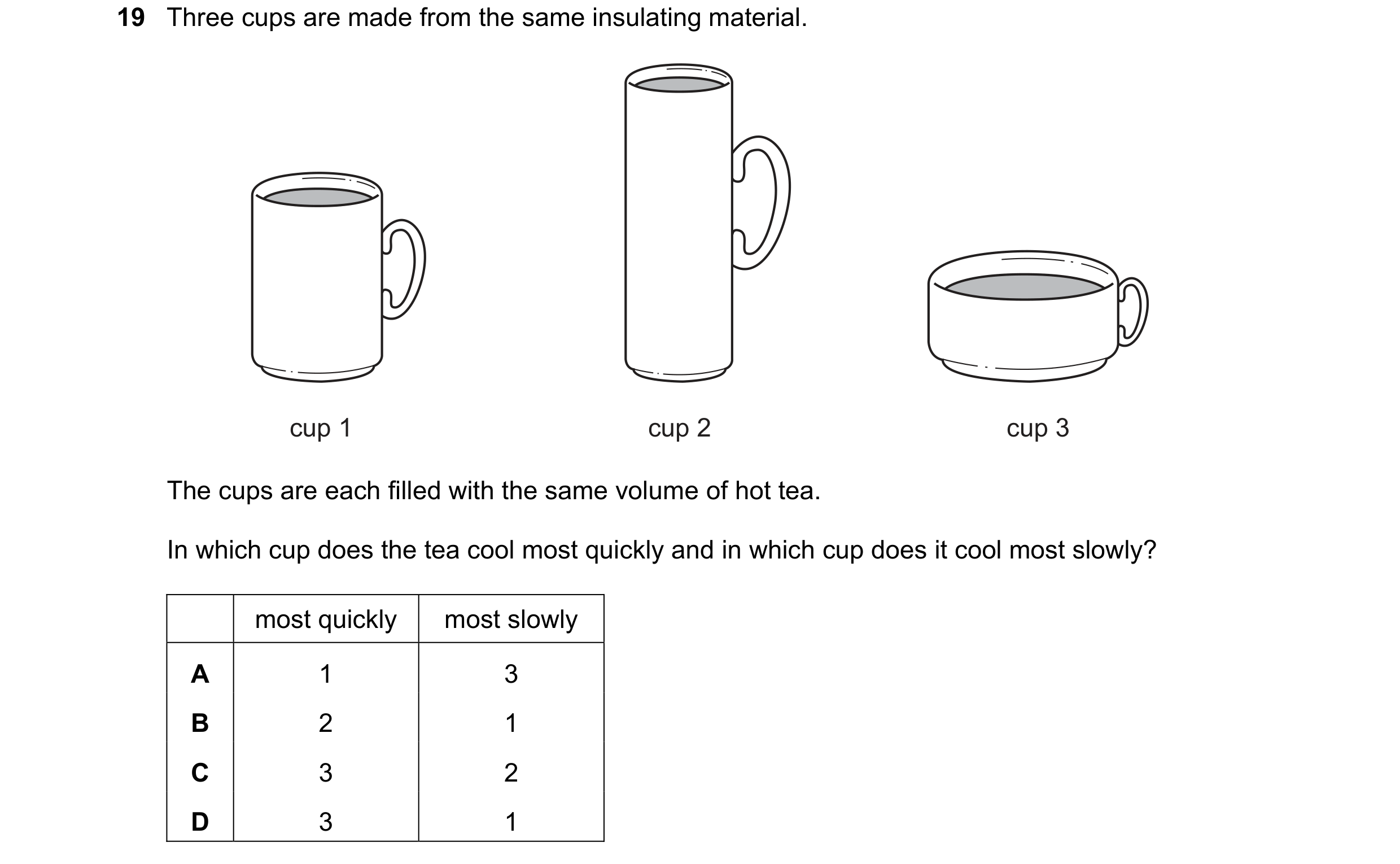 46 / 83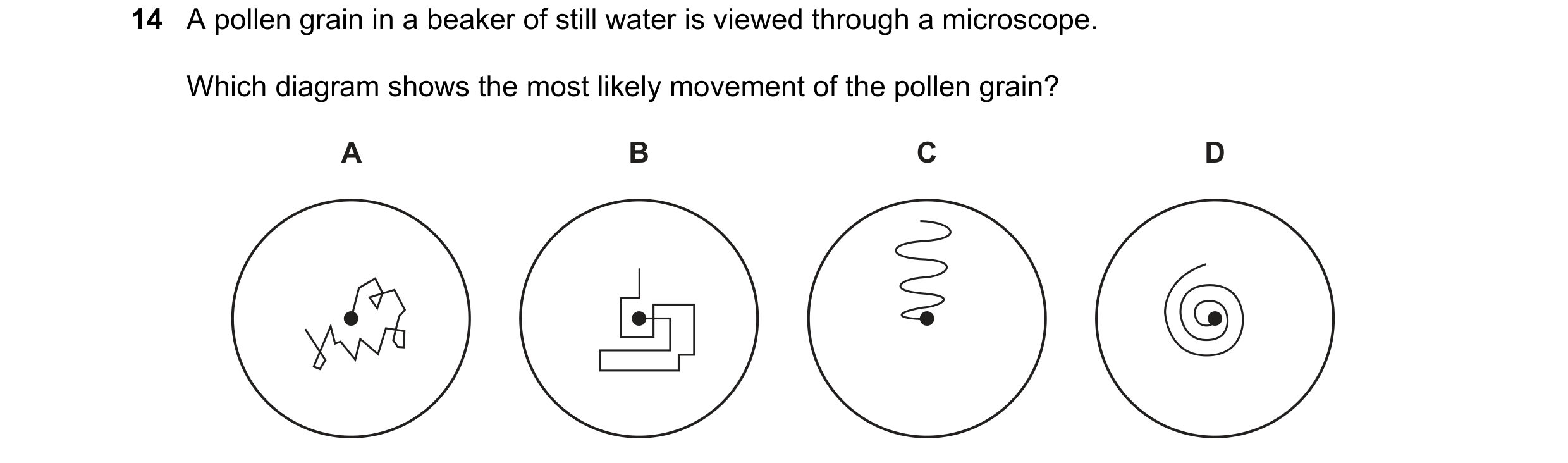
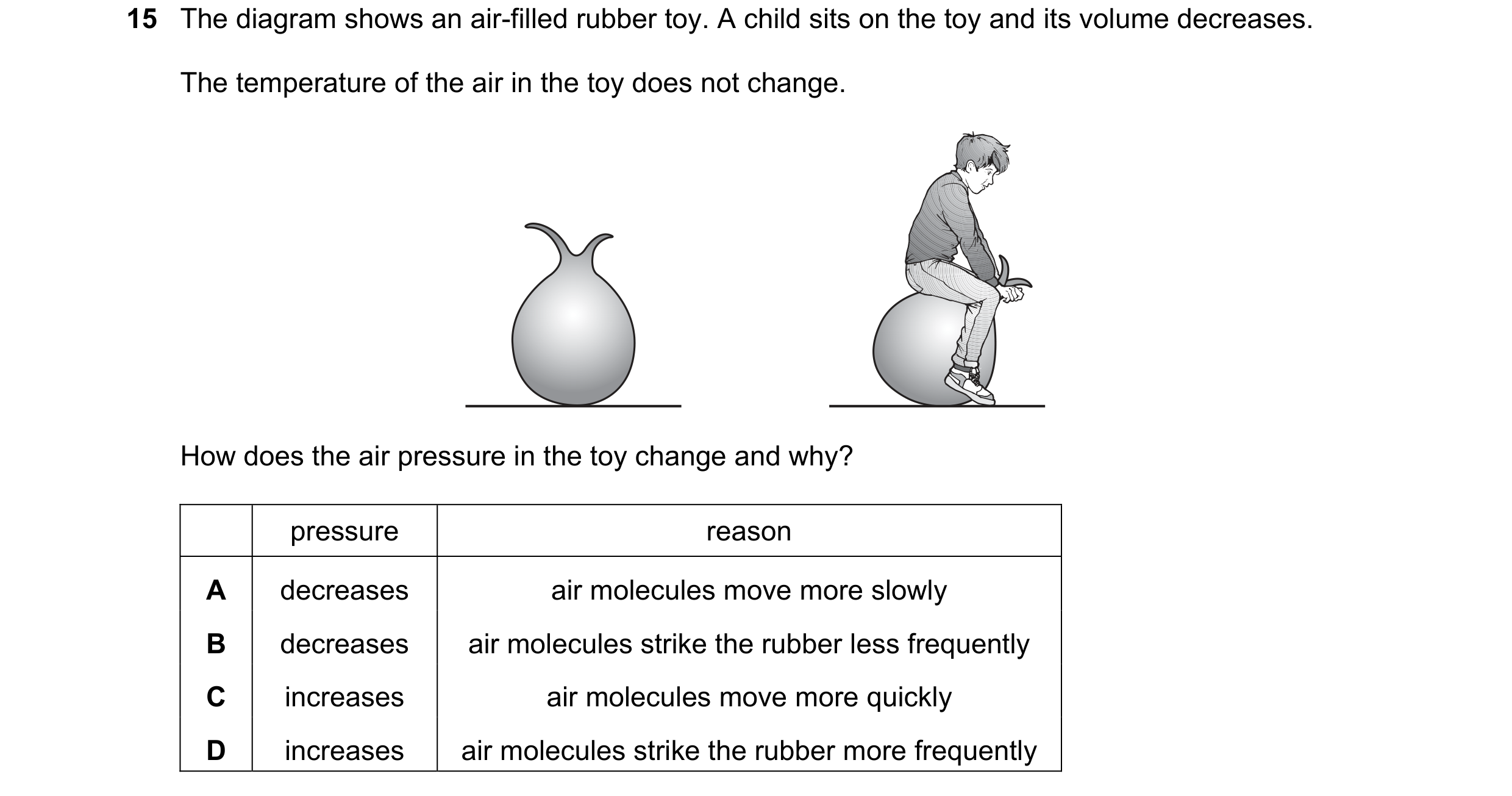
 47 / 83
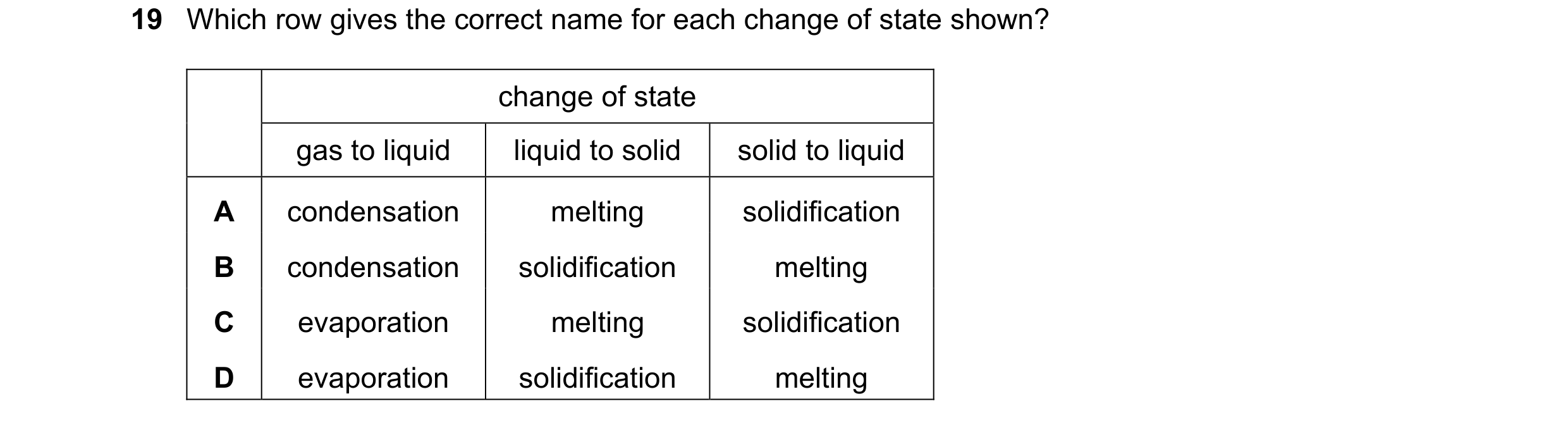
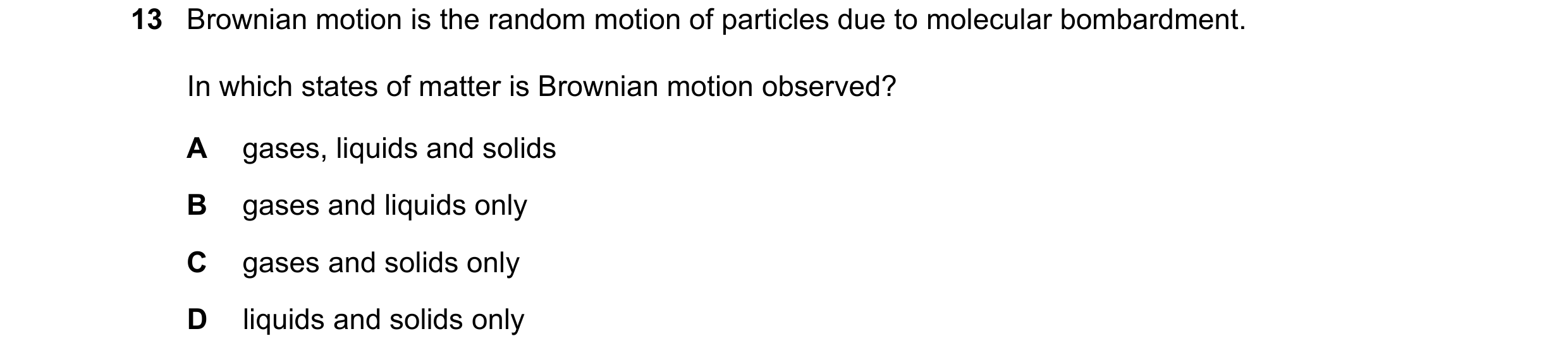
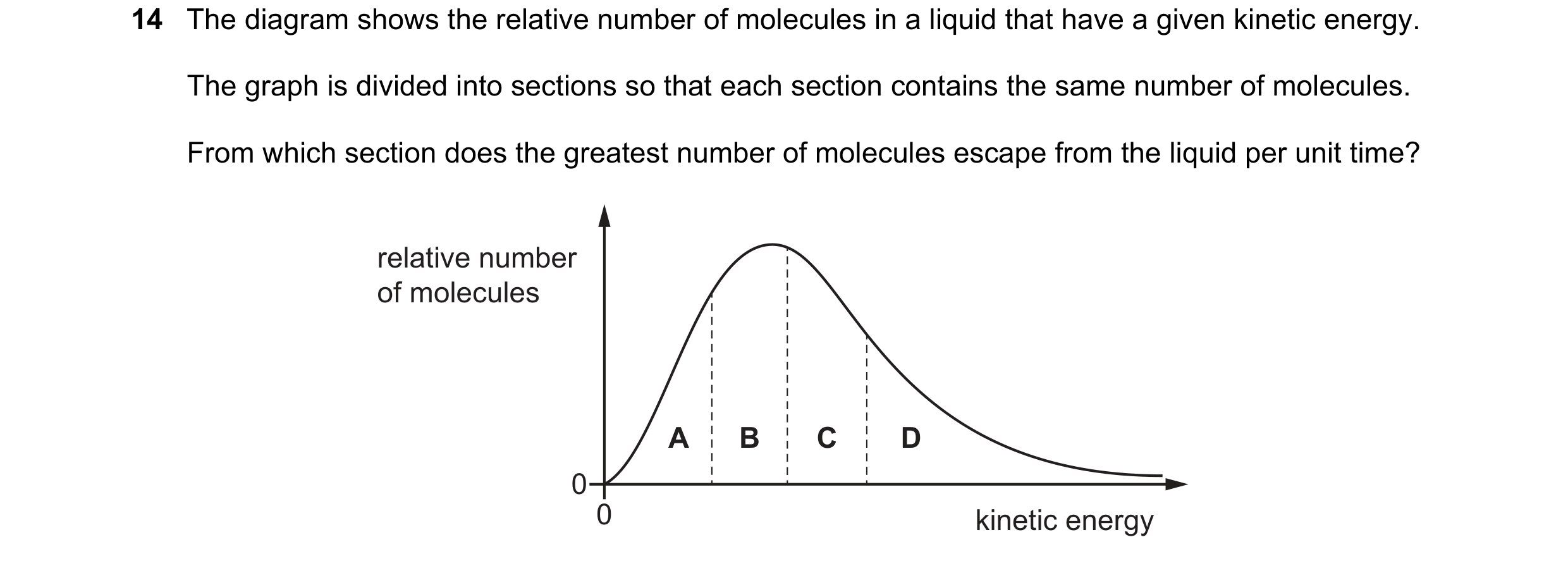 48 / 83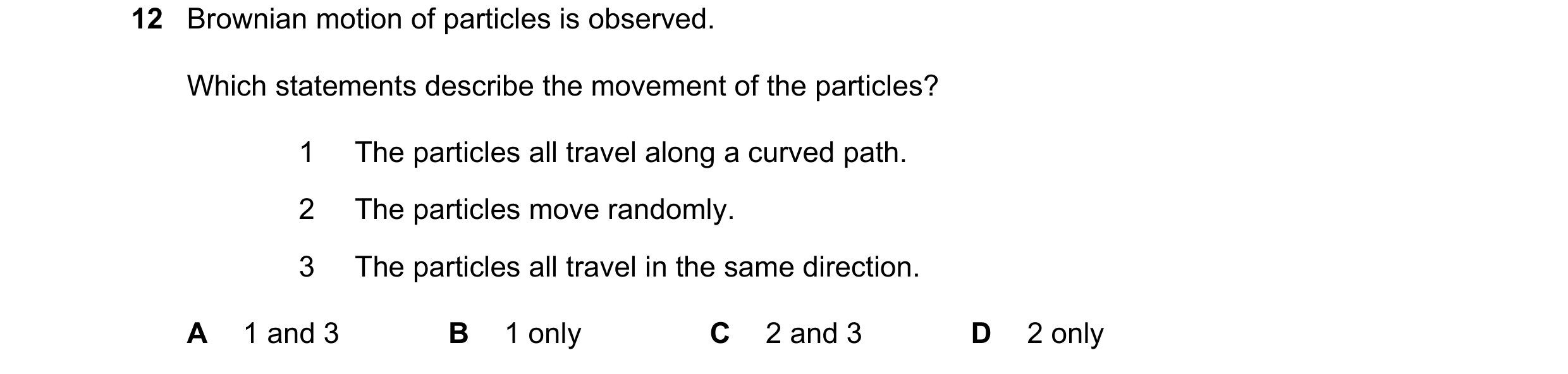
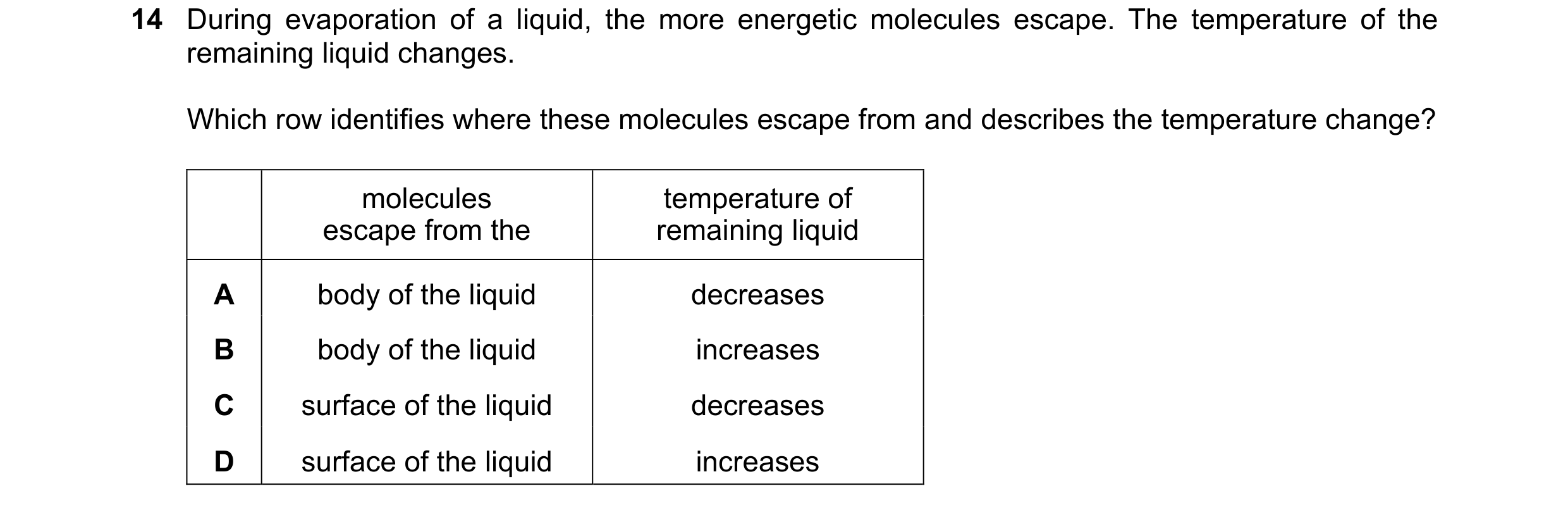 49 / 83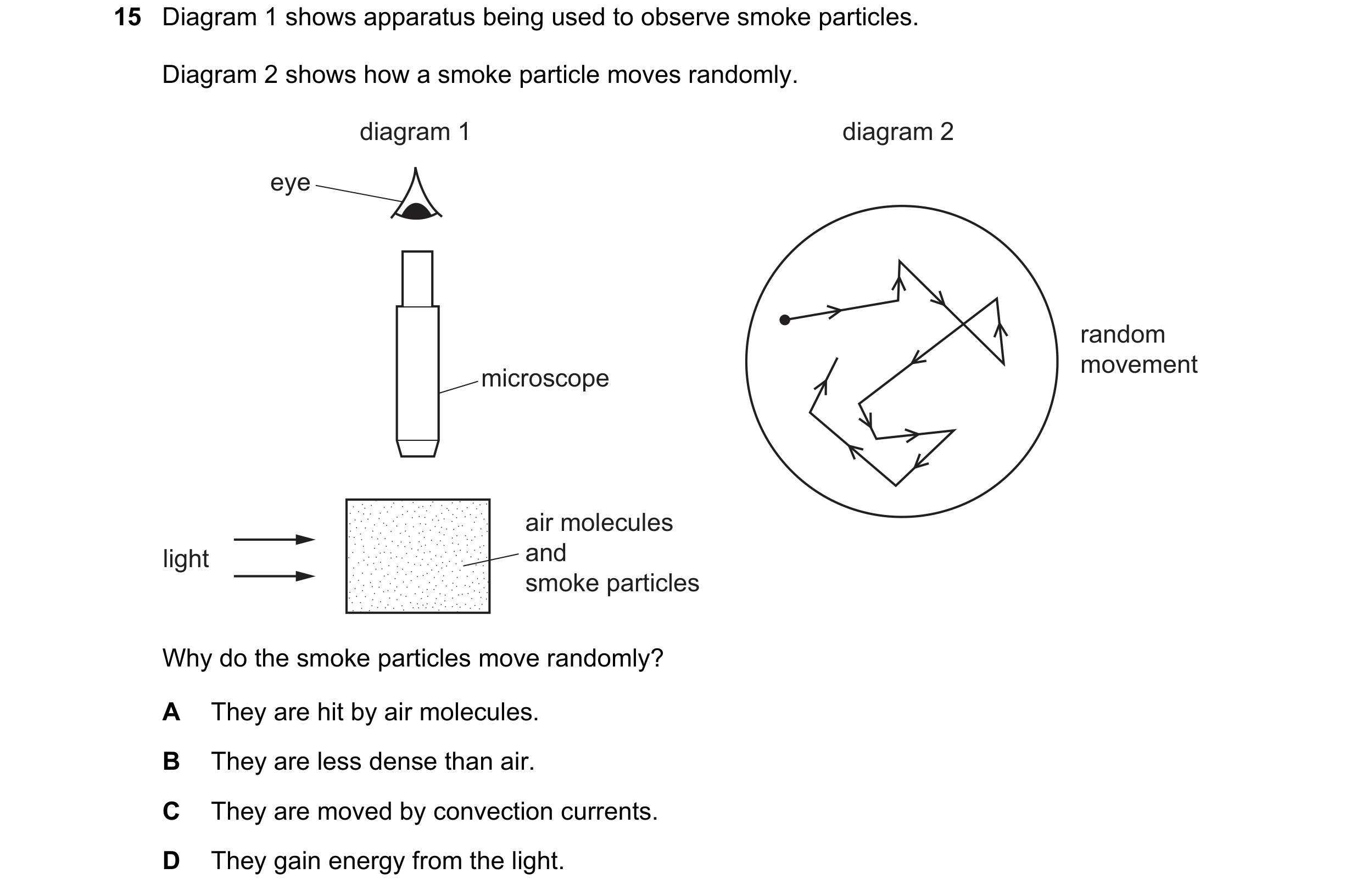
 50 / 83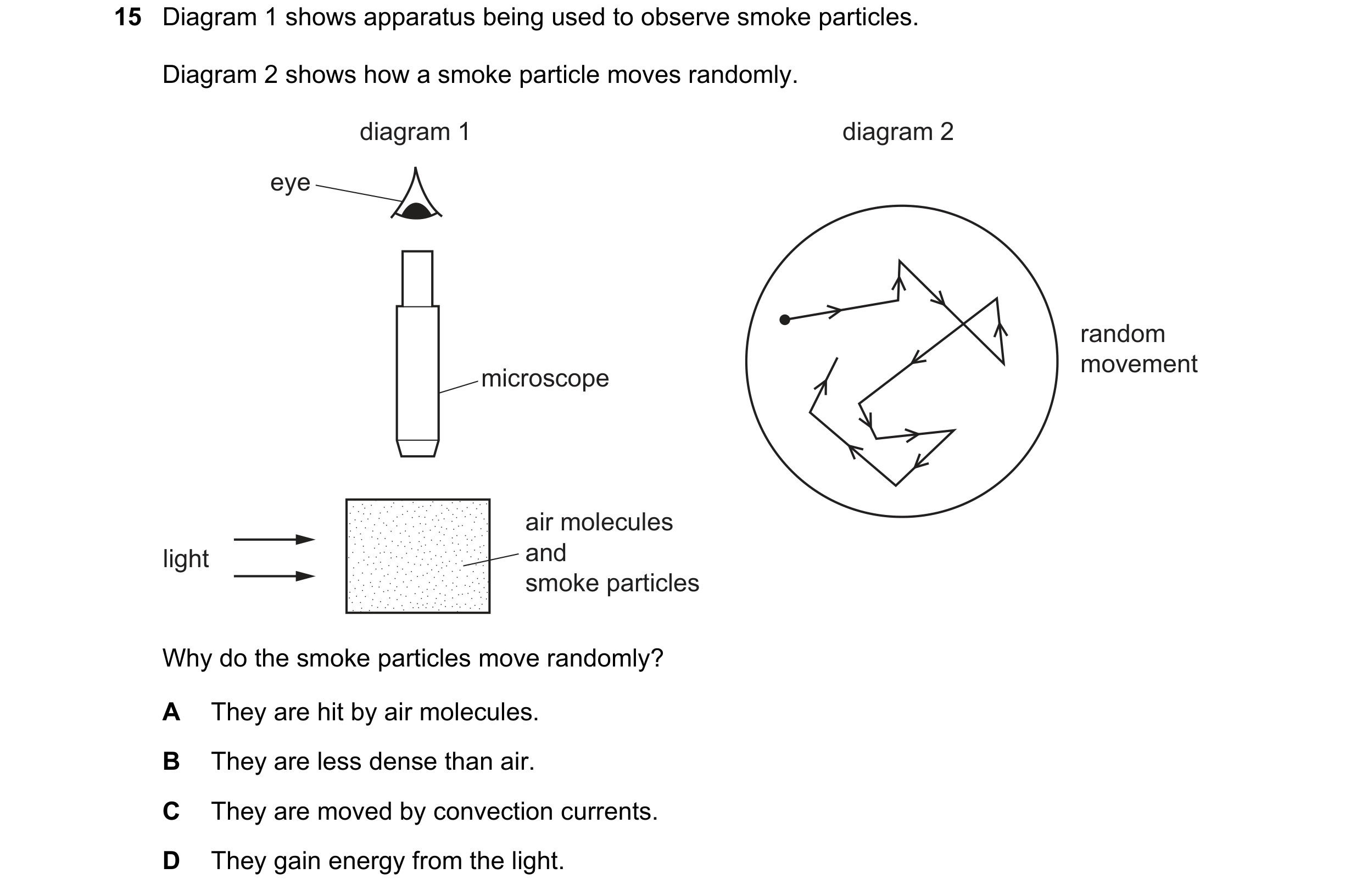
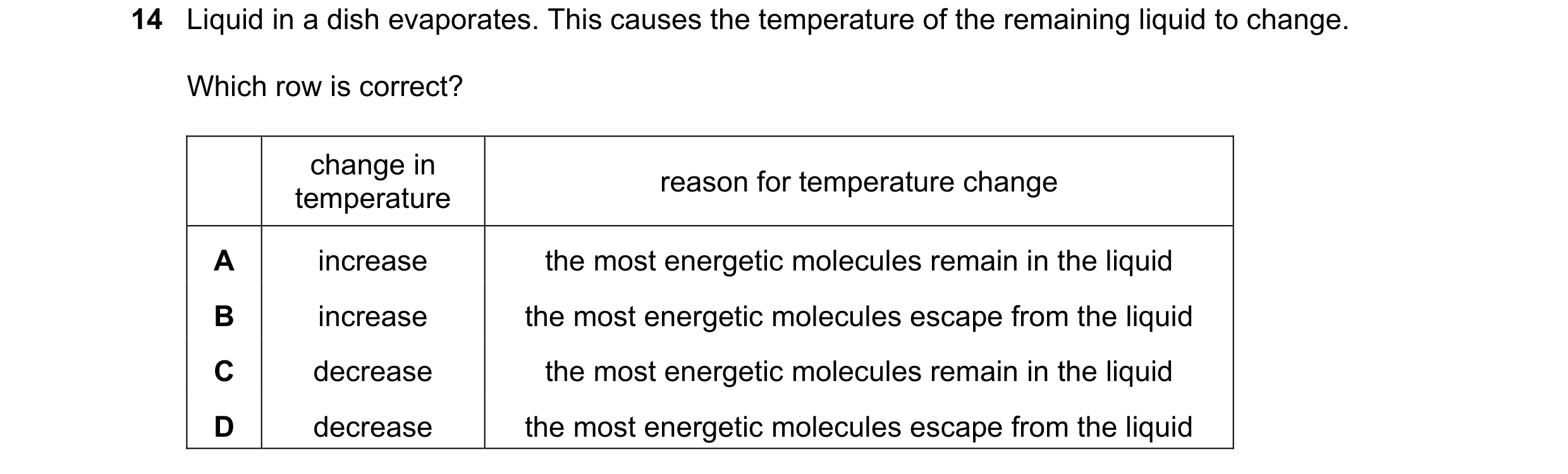 51 / 83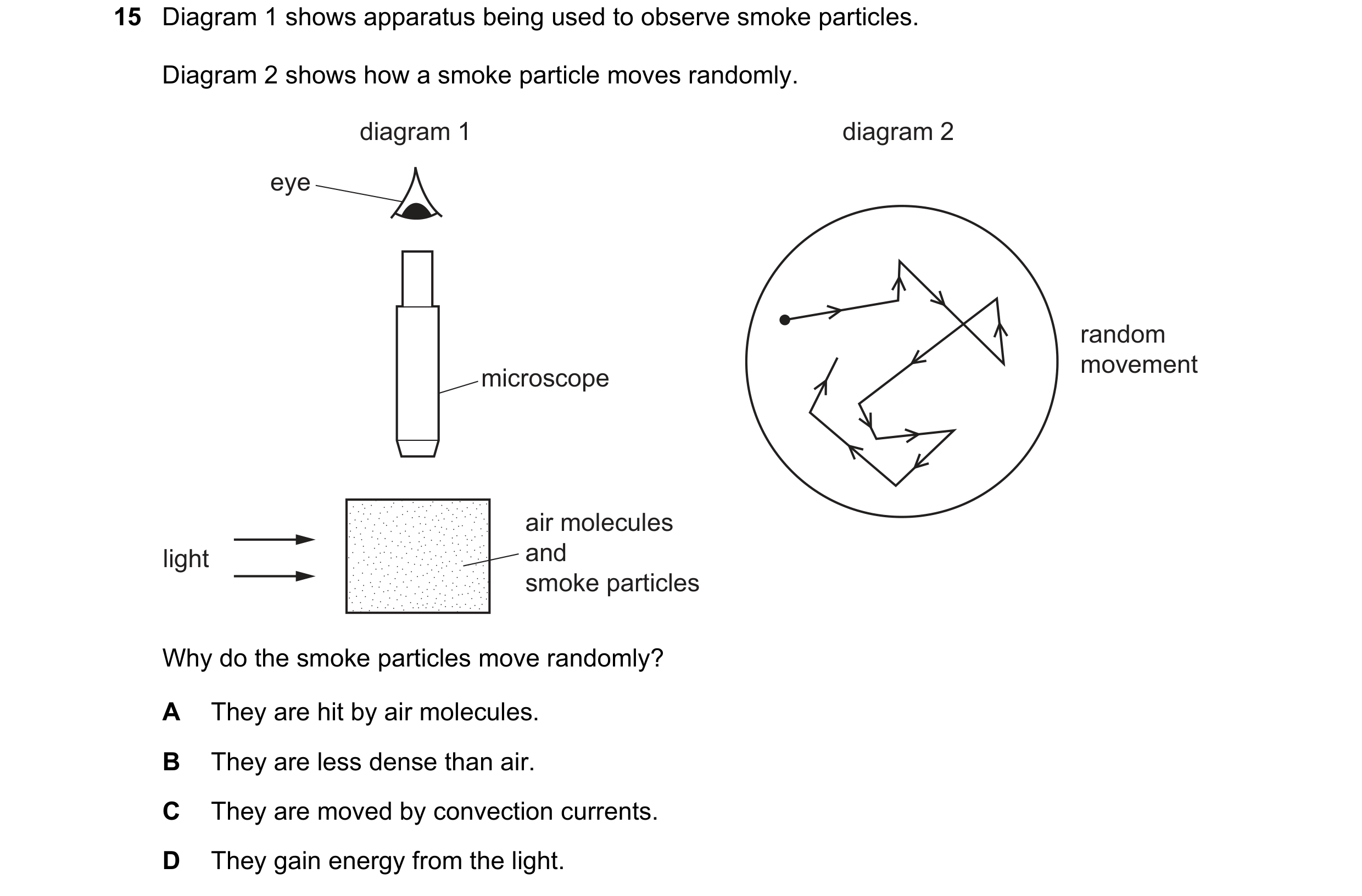
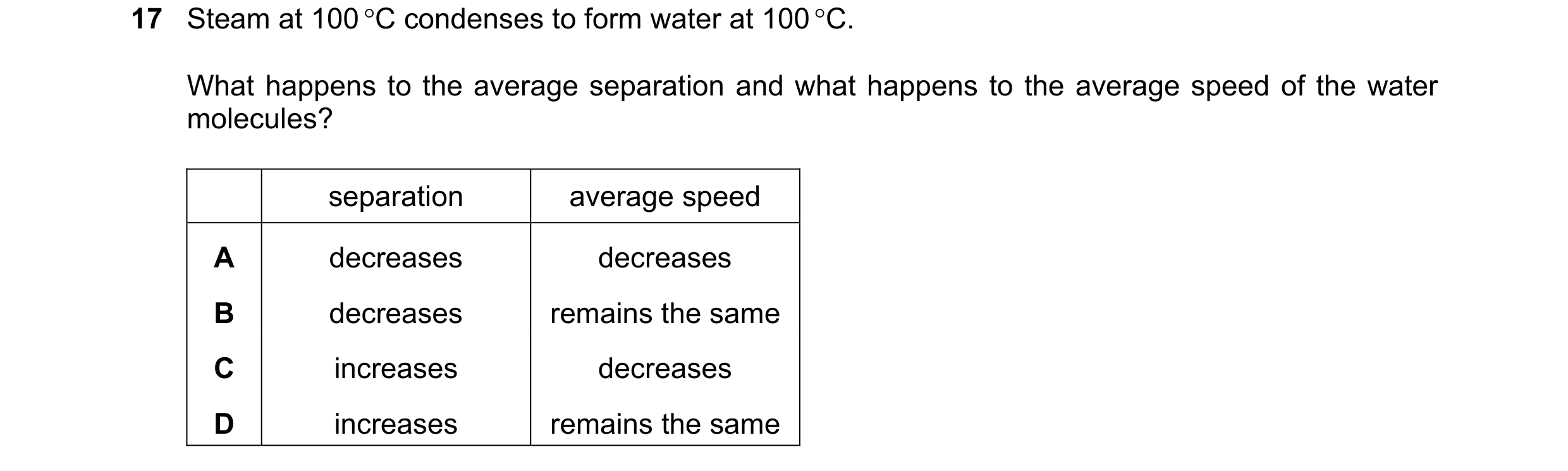 52 / 83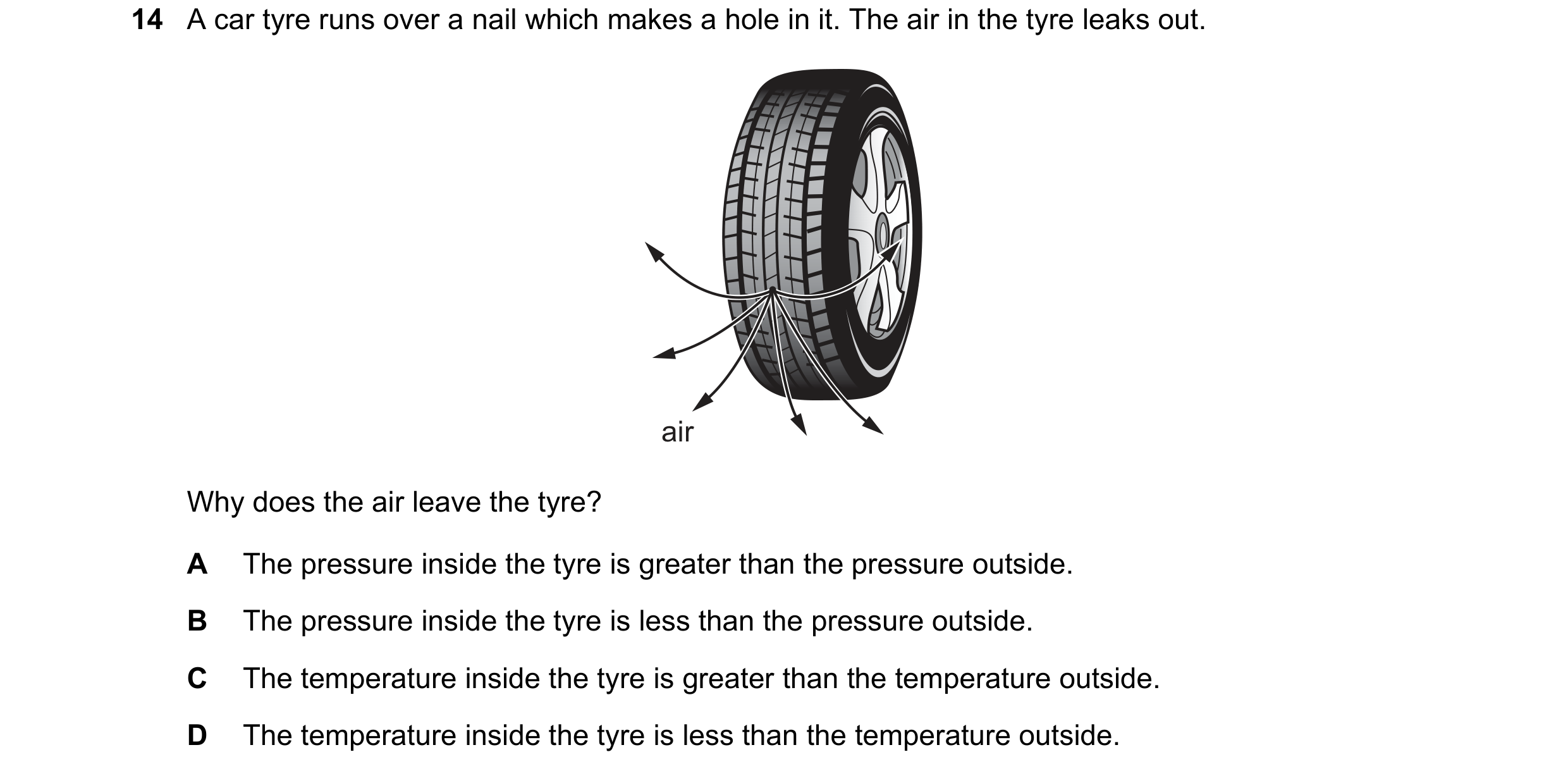
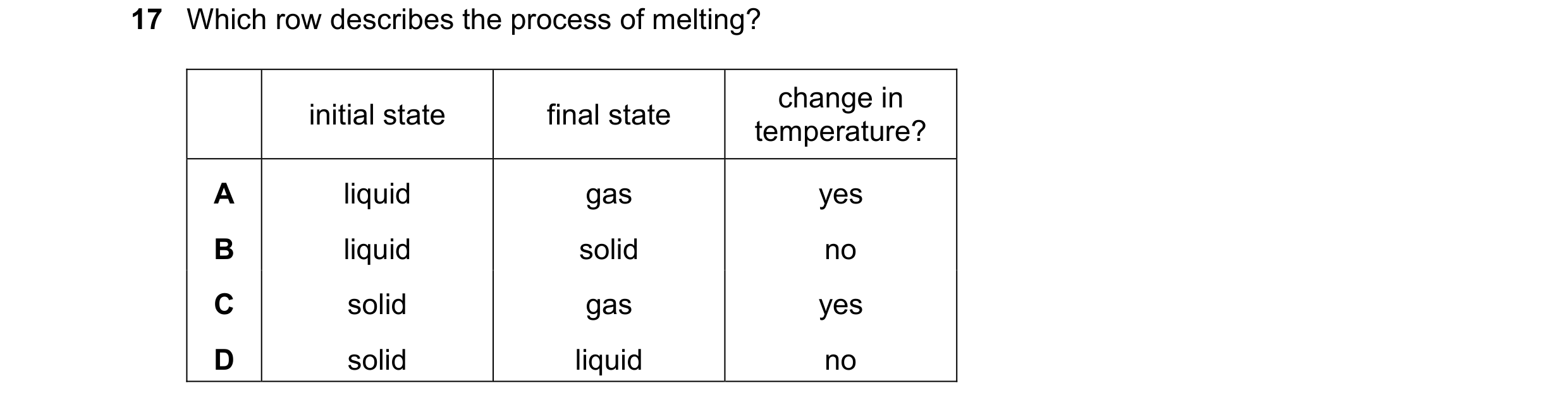

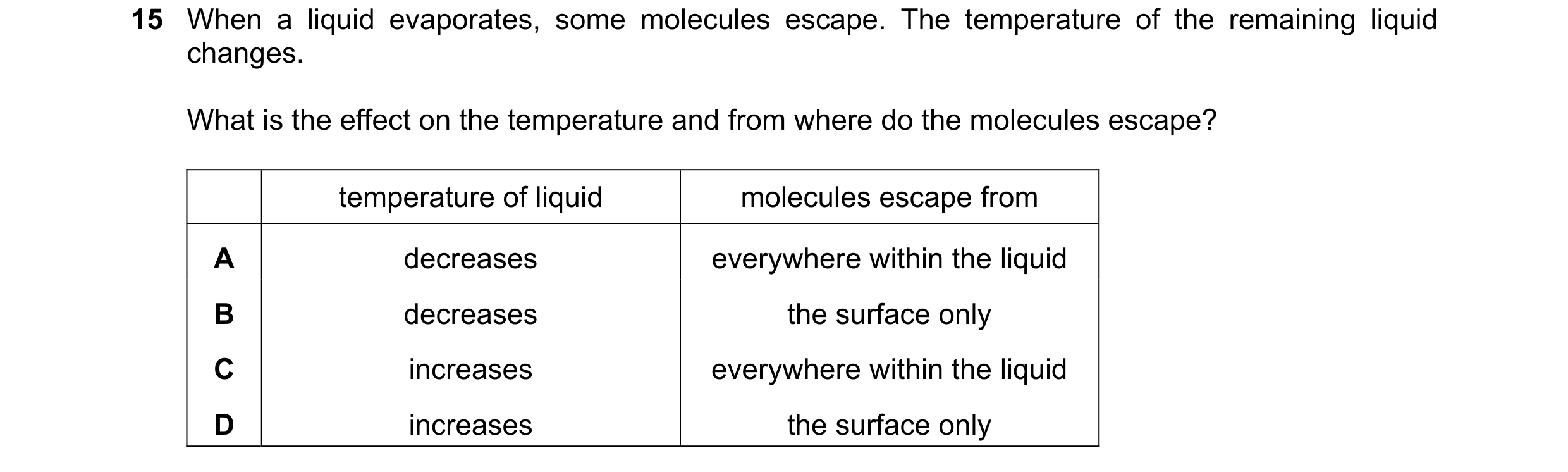 53 / 83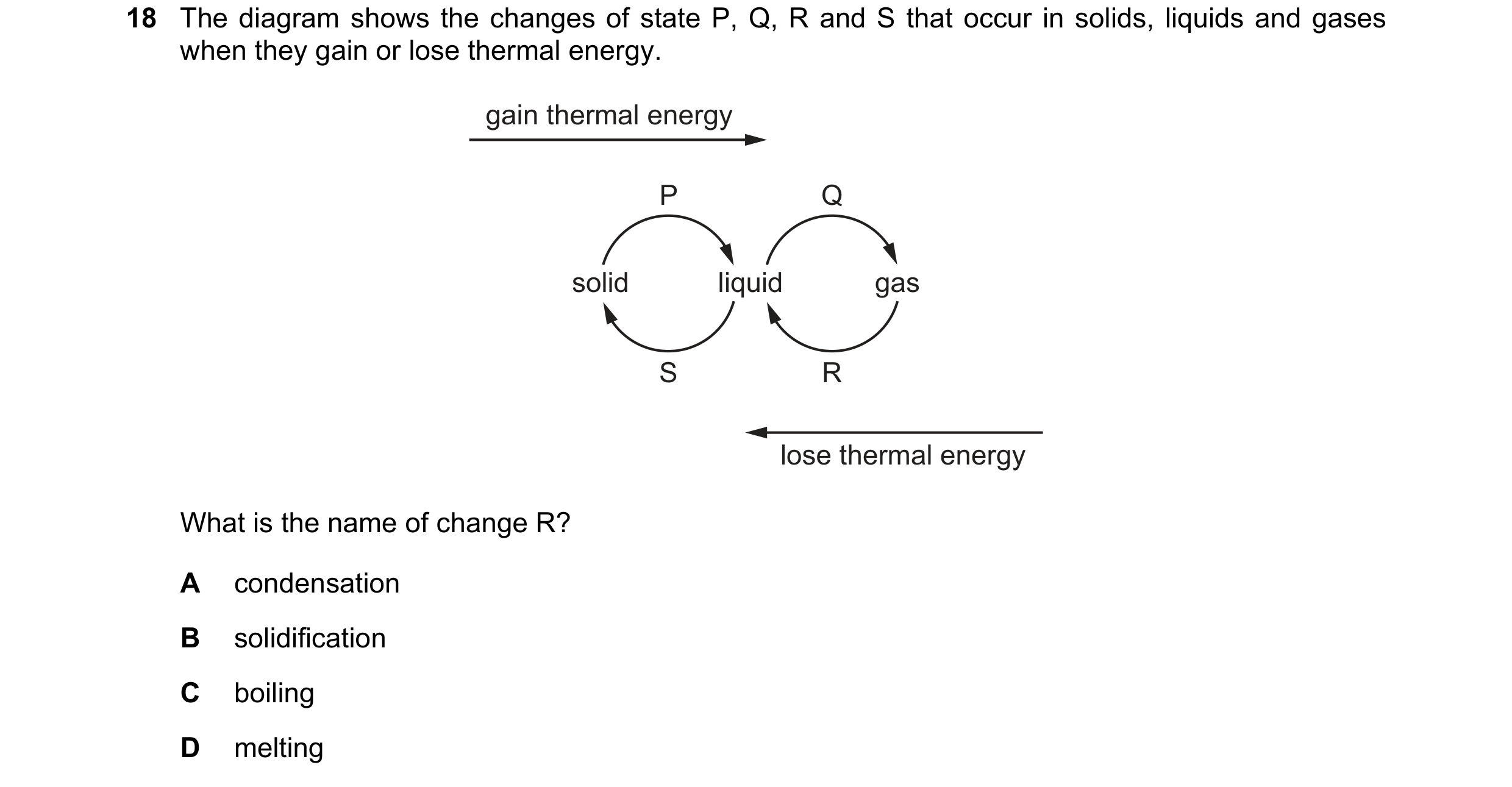
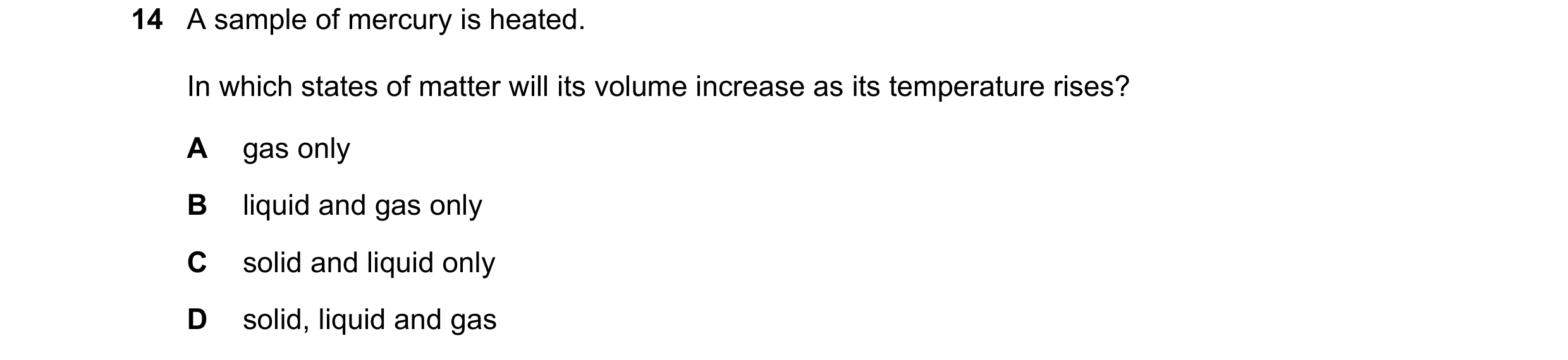

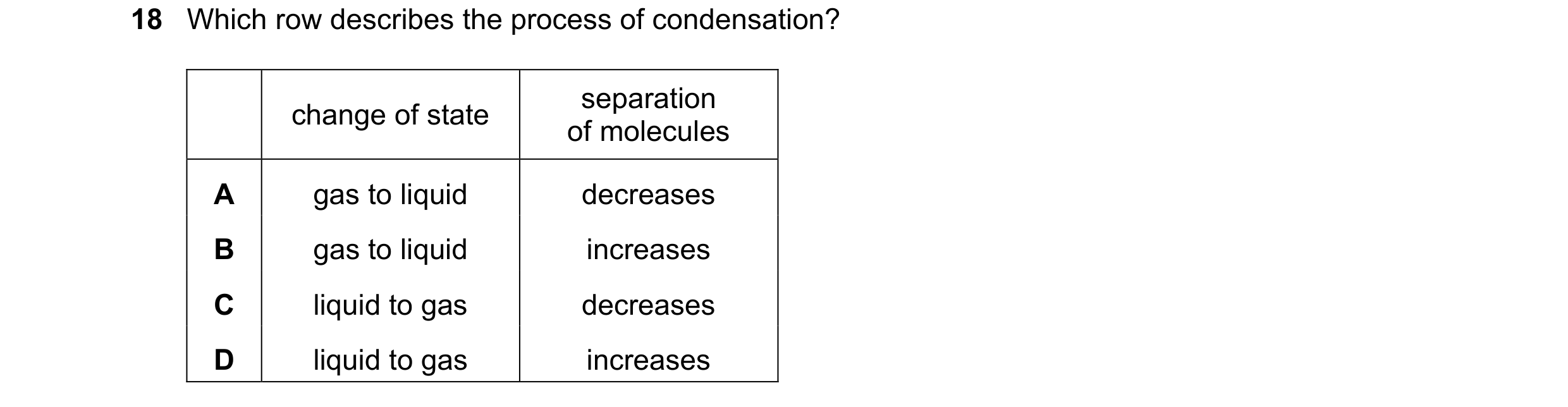 54 / 83
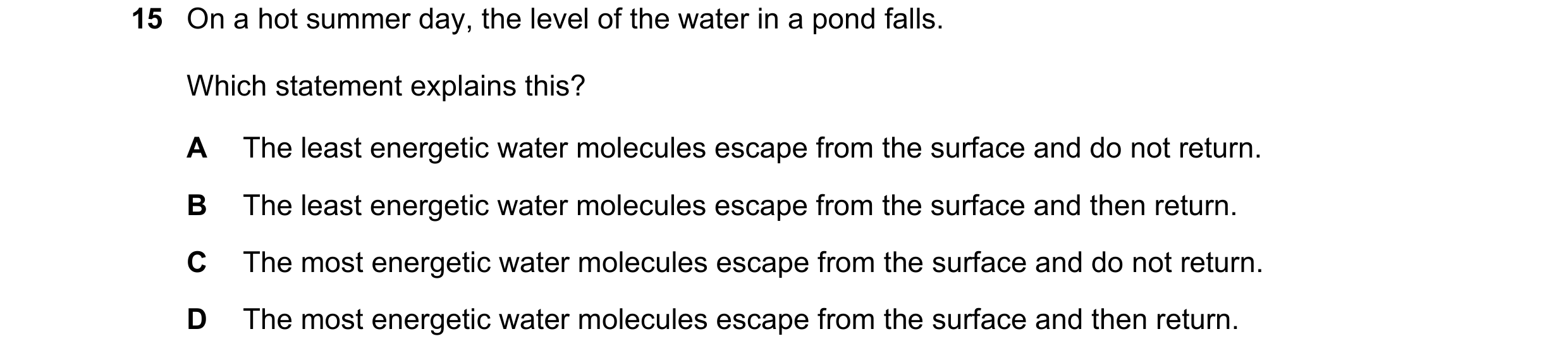
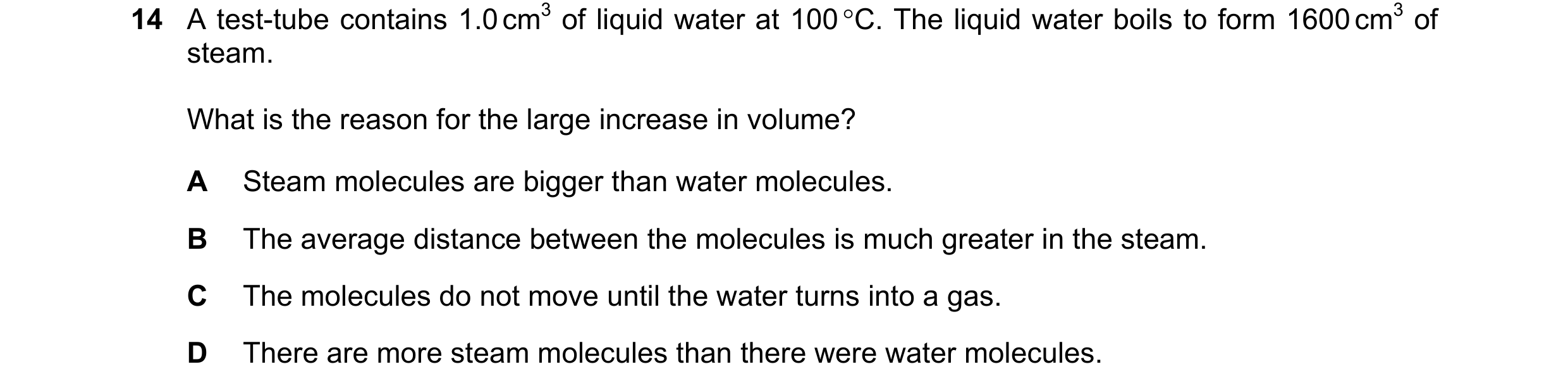
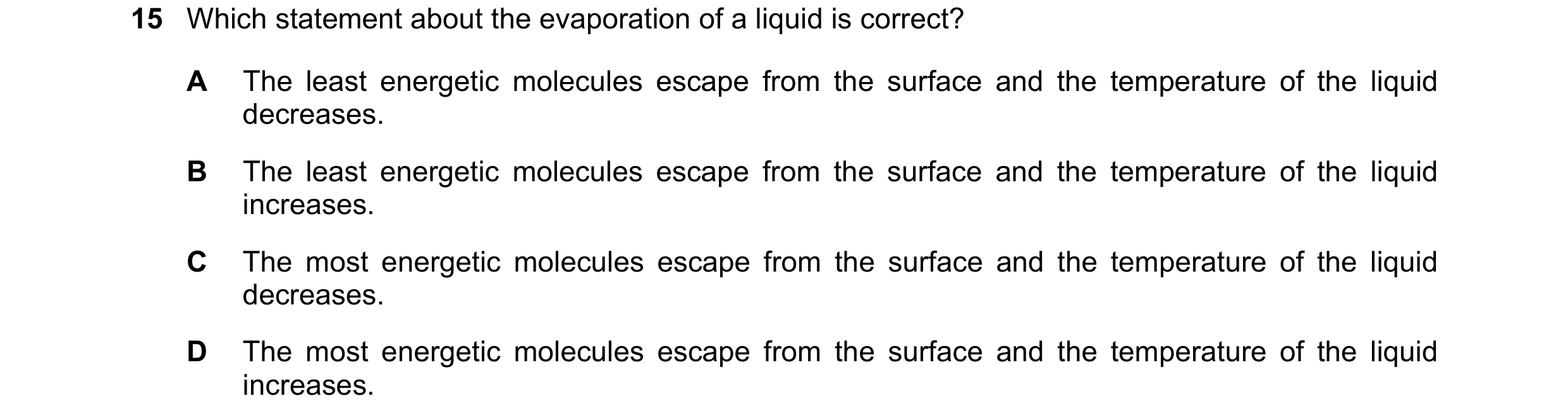
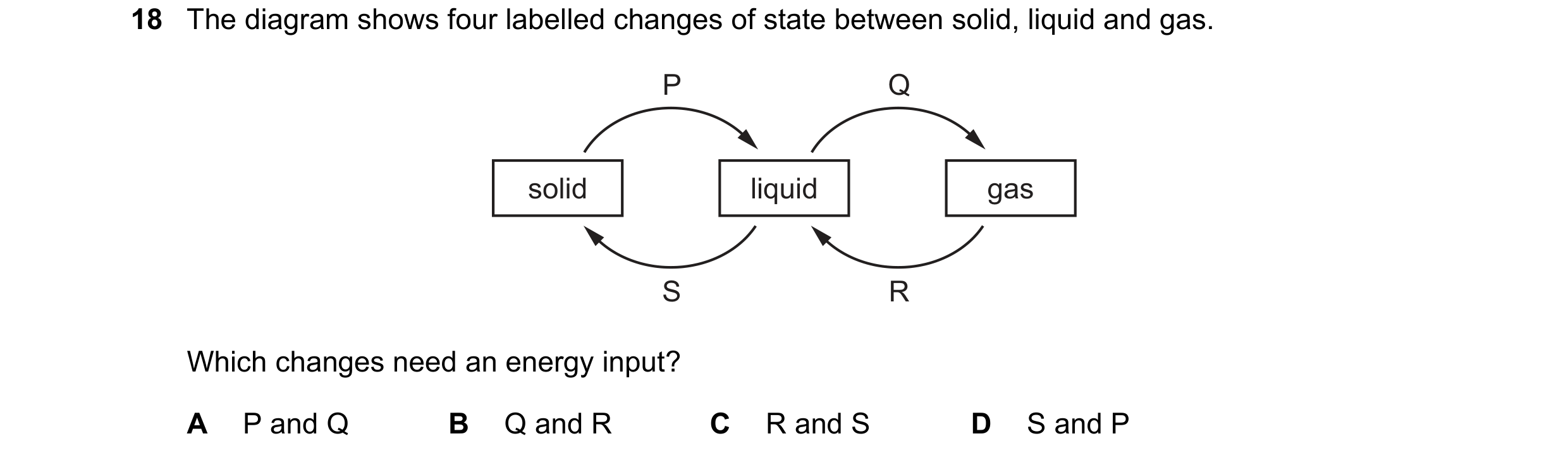 55 / 83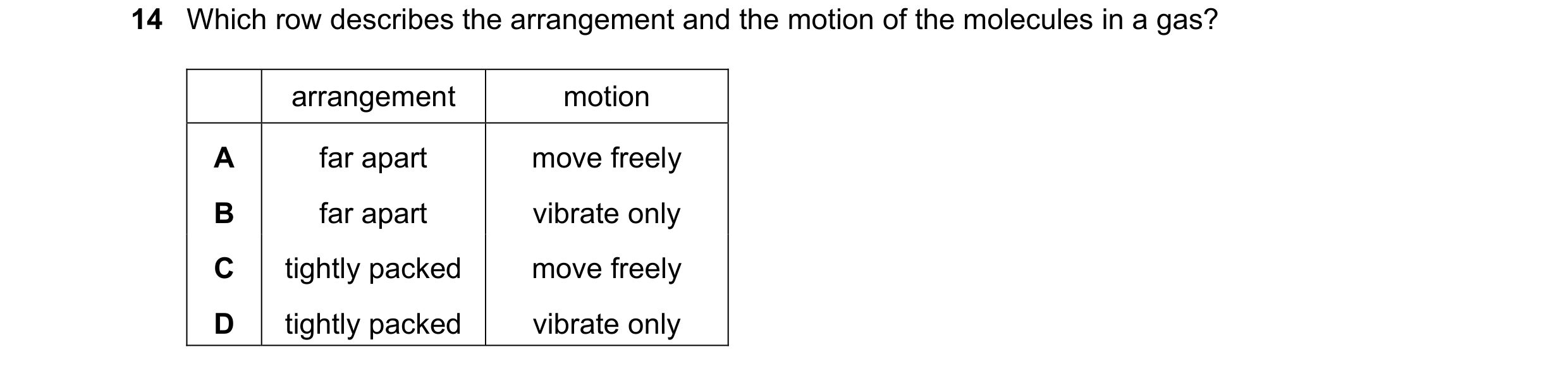
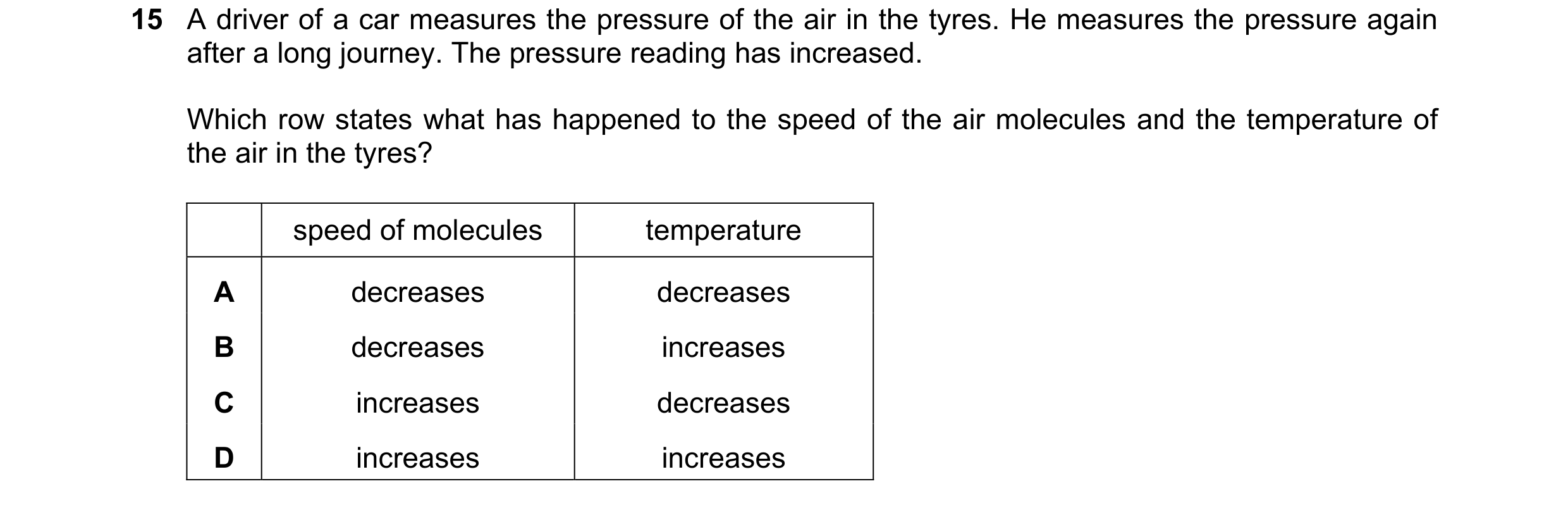
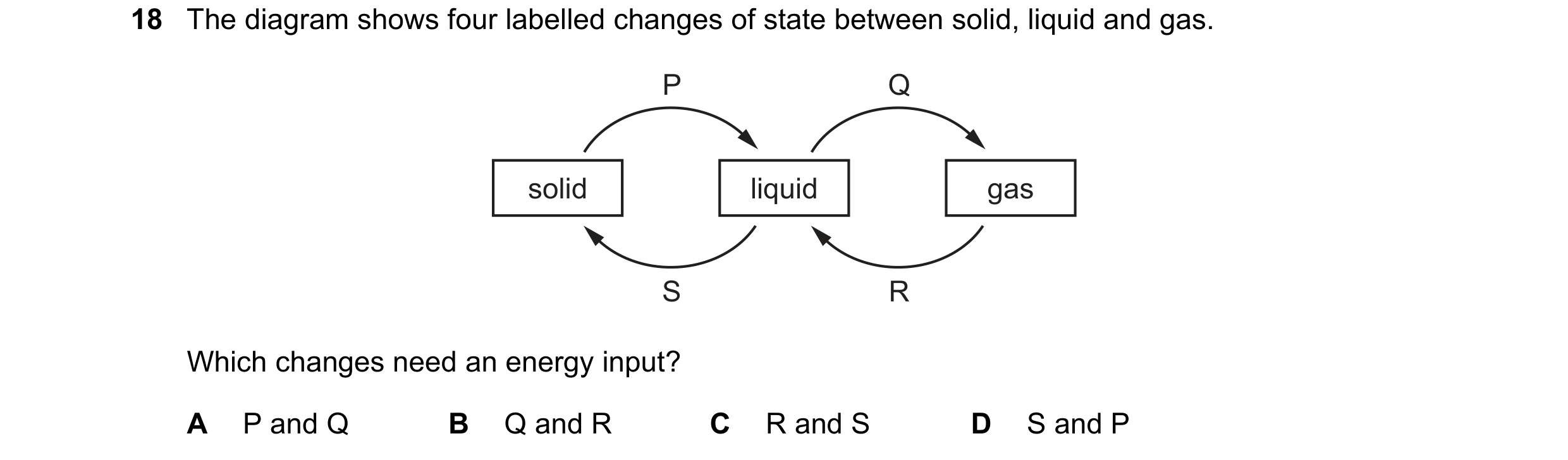
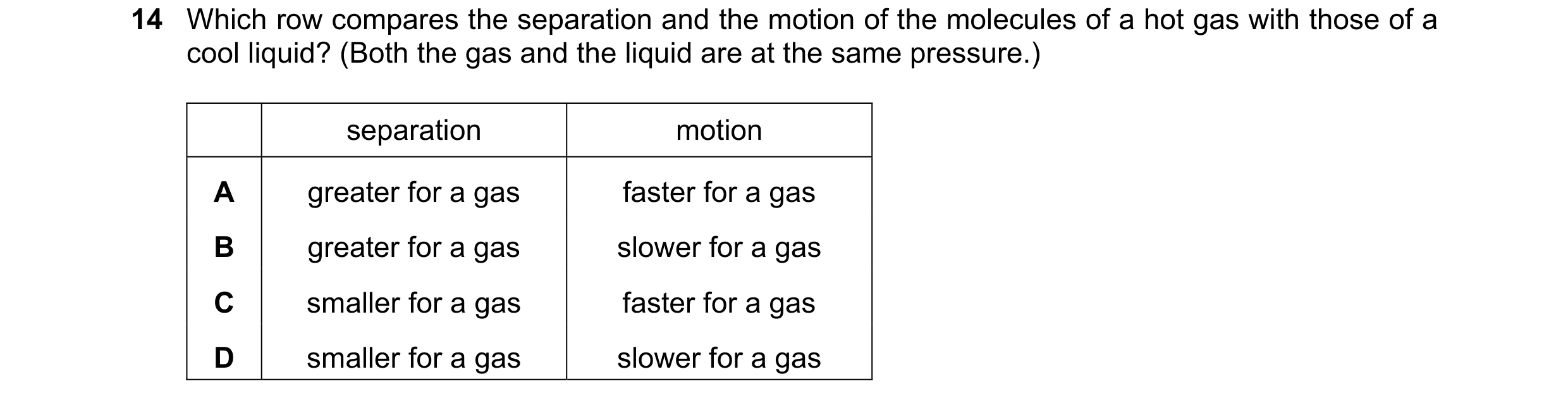 56 / 83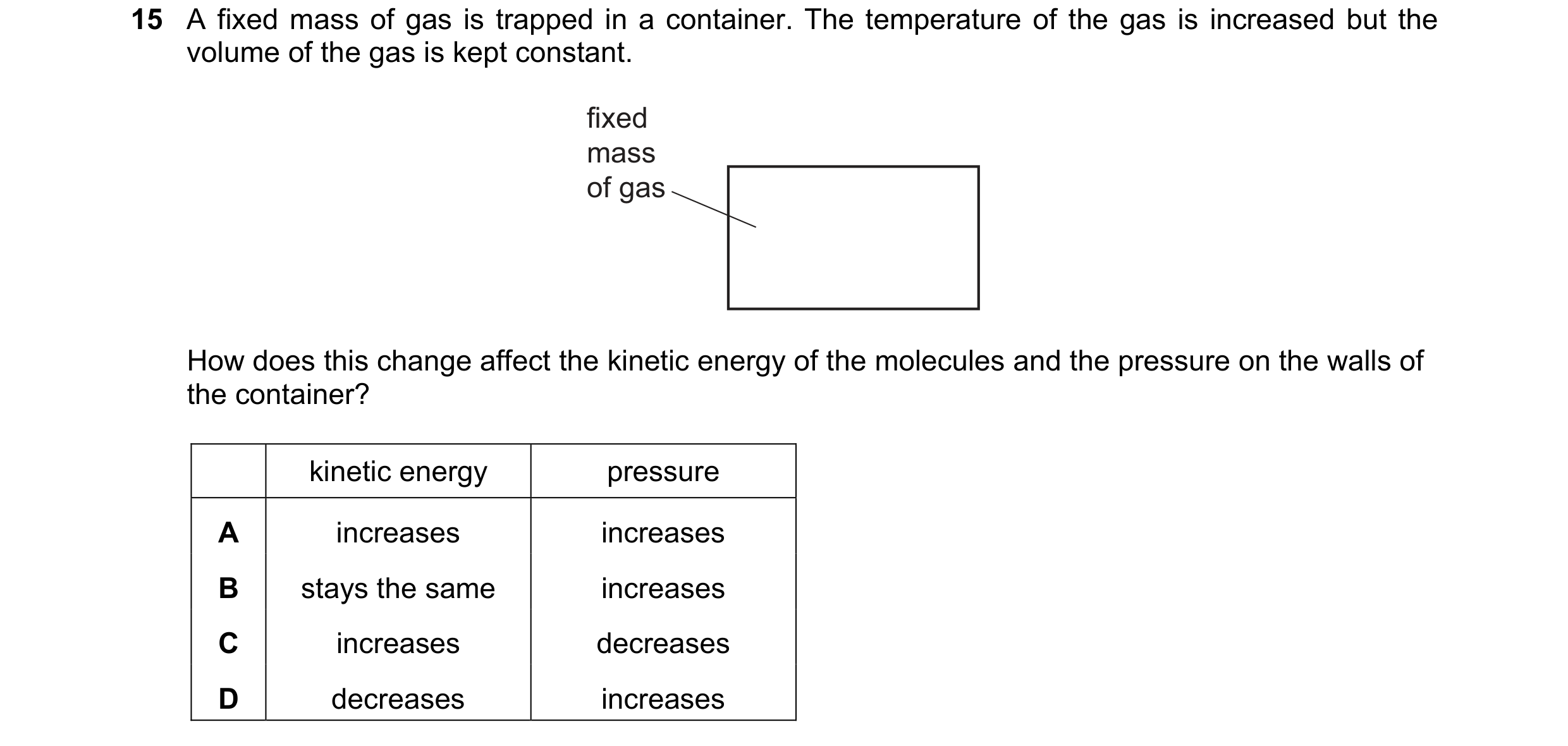
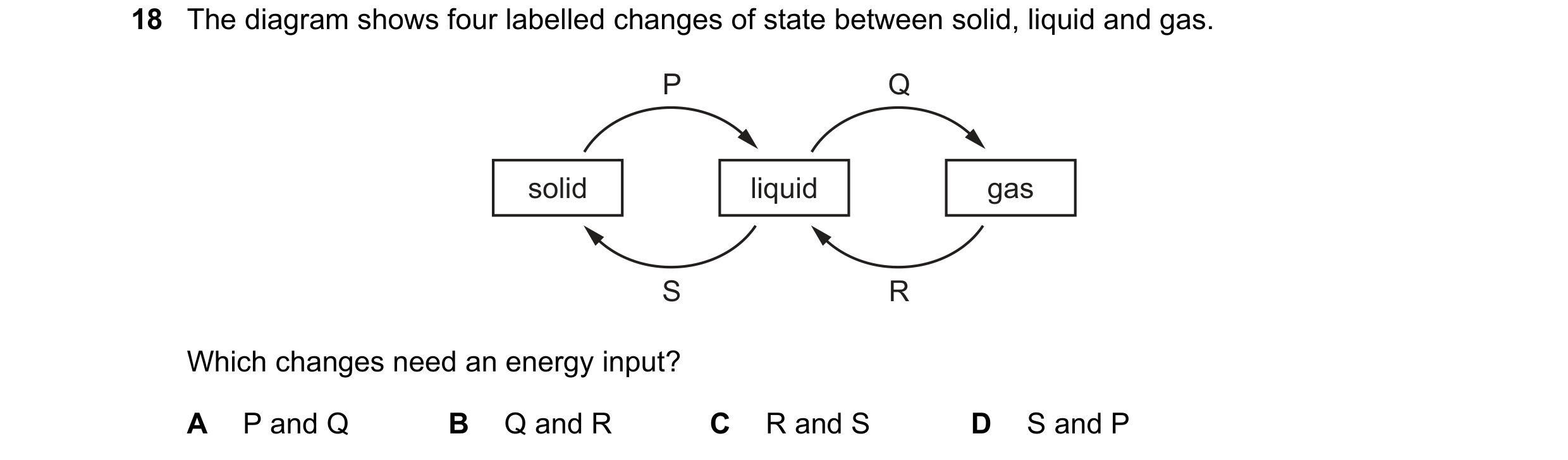
 57 / 83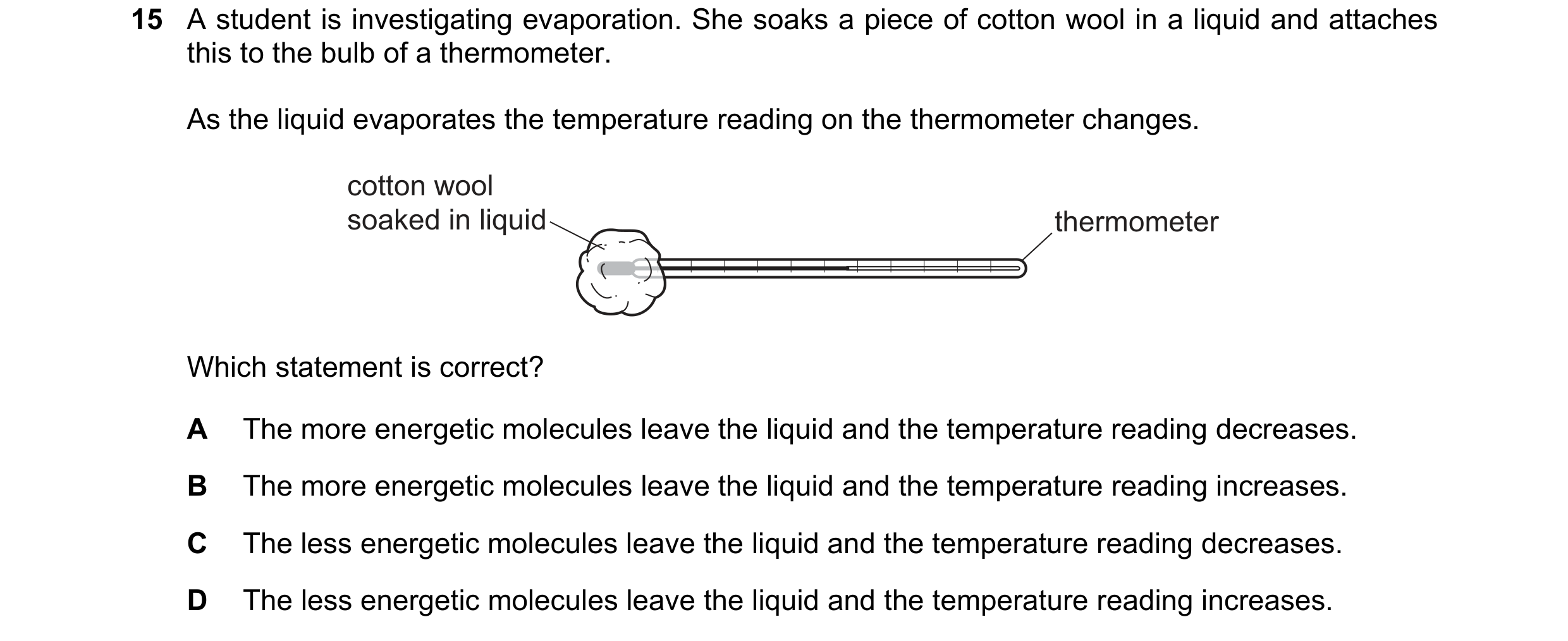
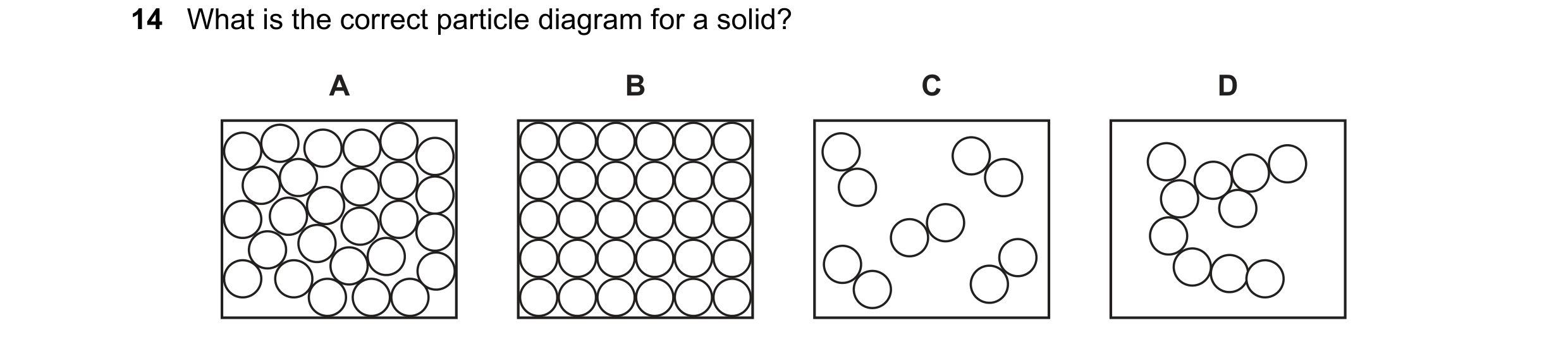 58 / 83
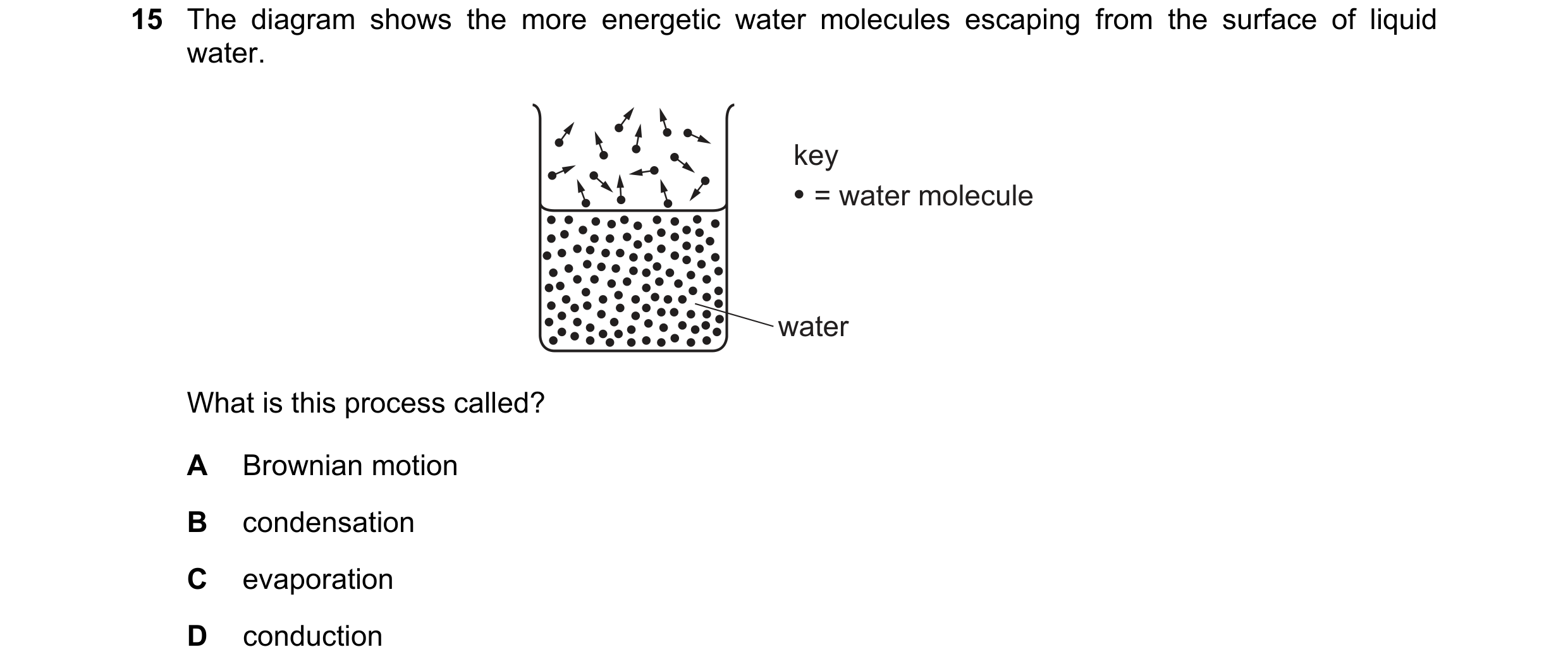 59 / 83
 60 / 83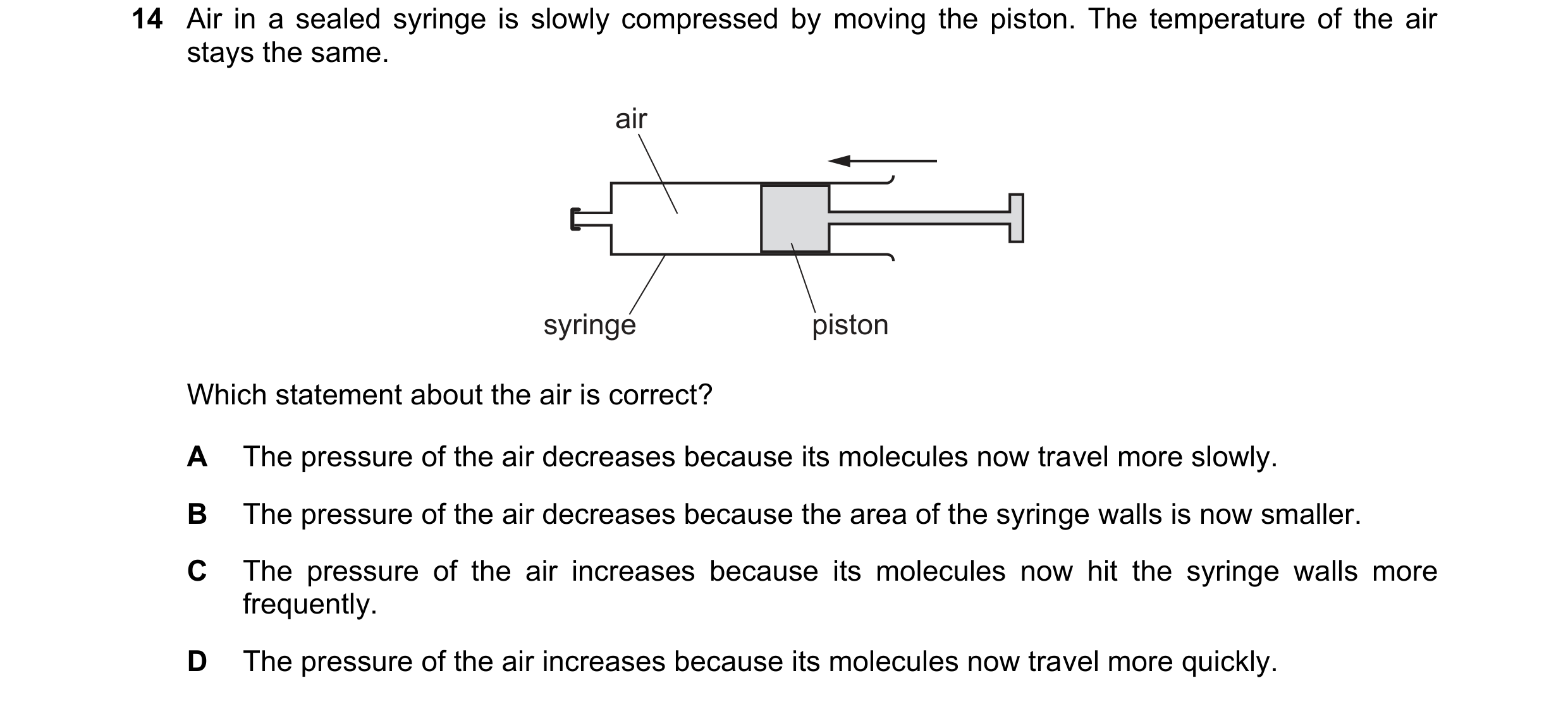
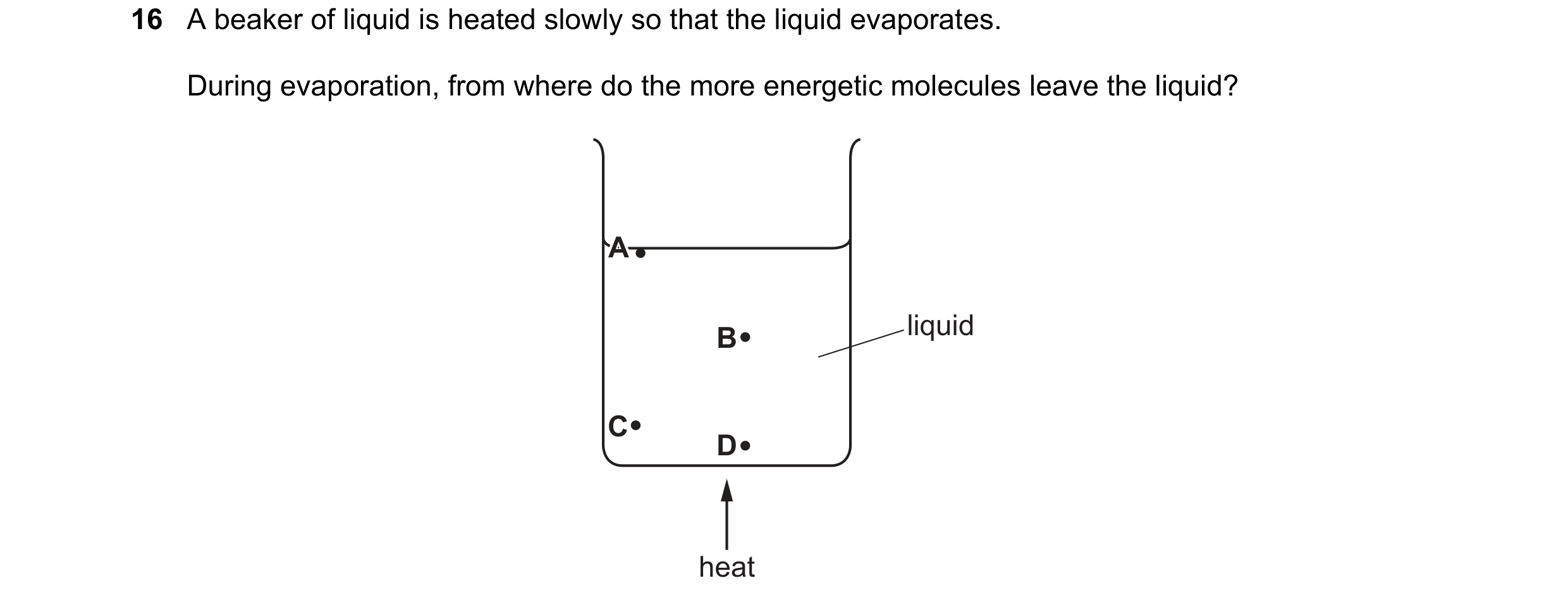 61 / 83
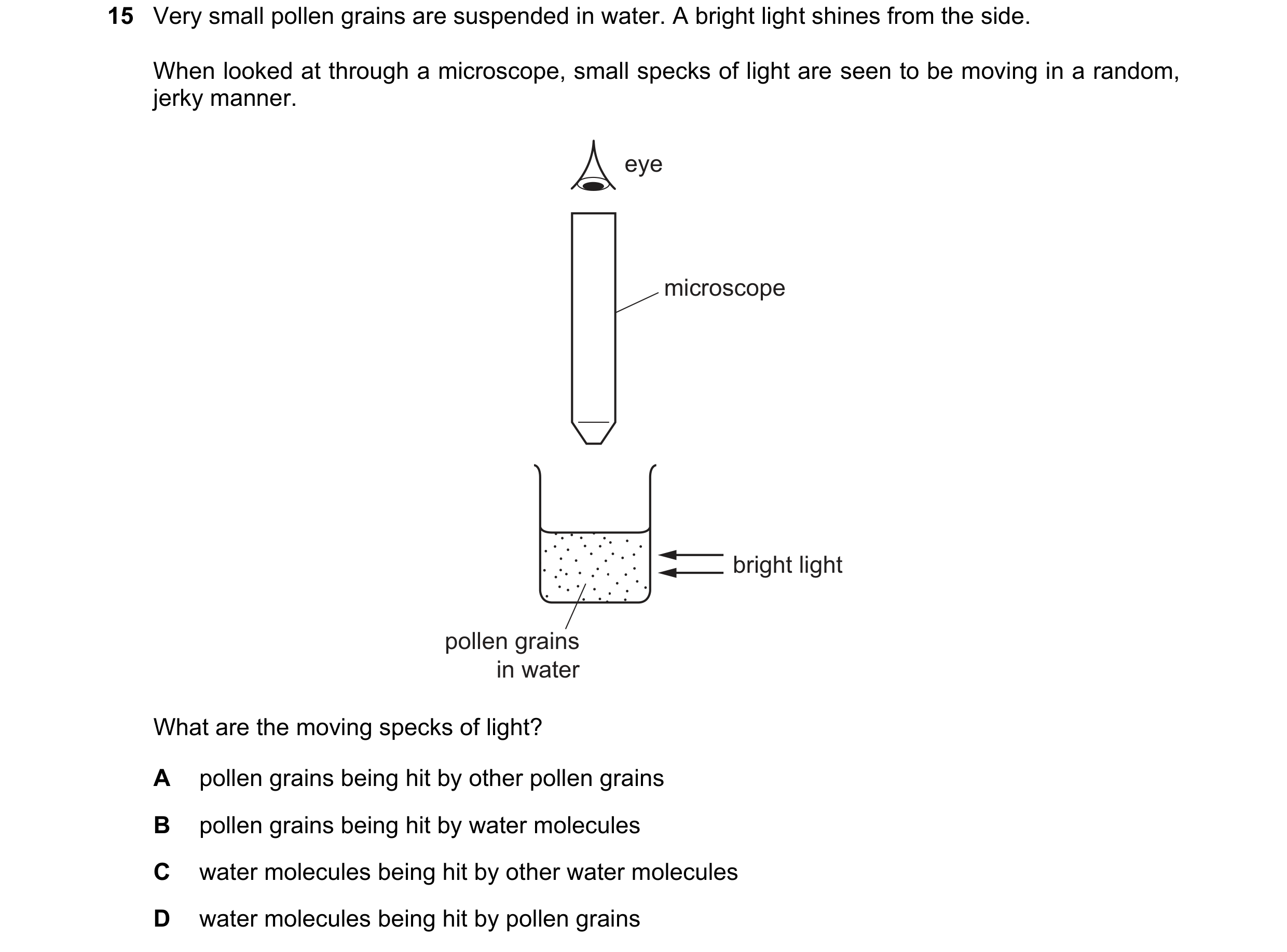
 62 / 83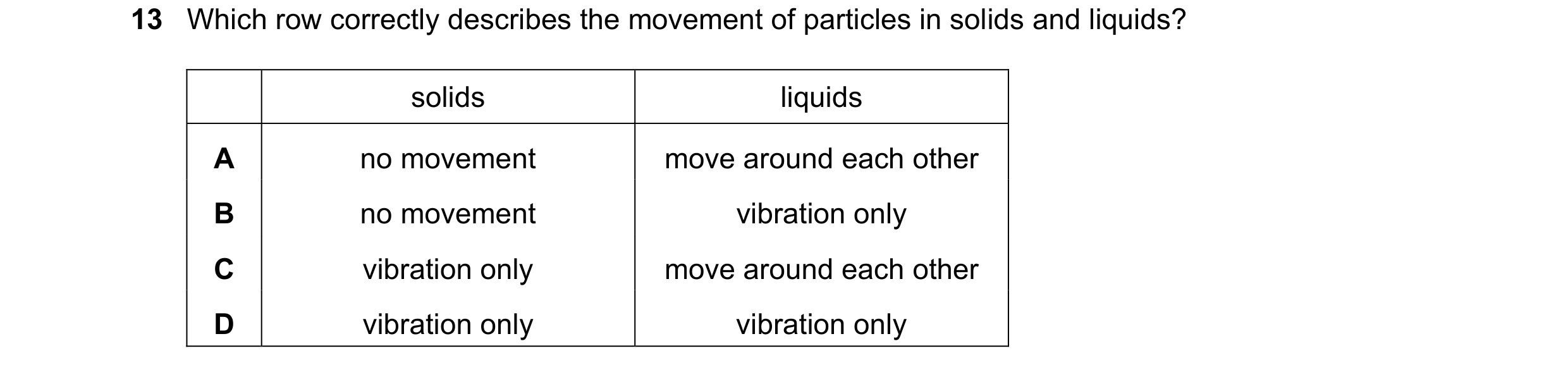
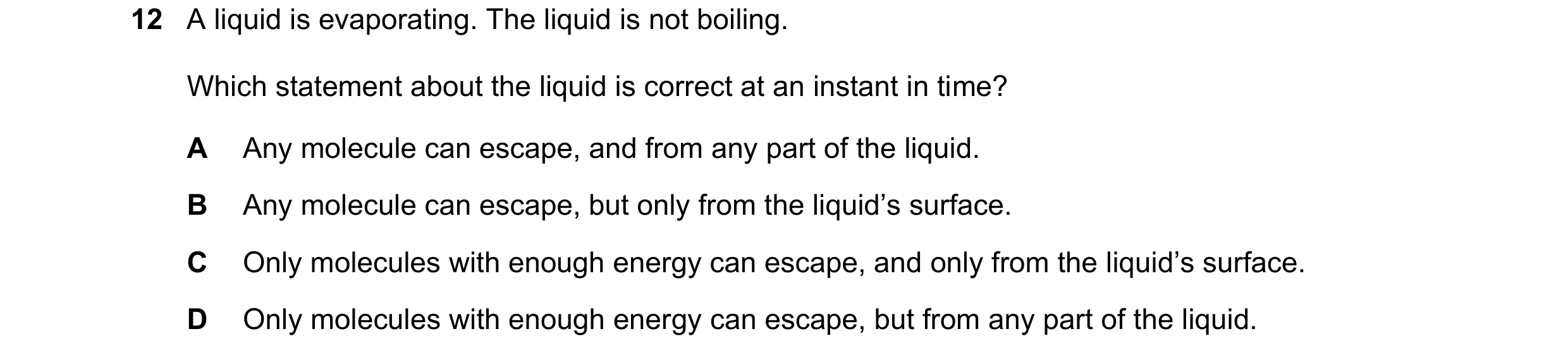
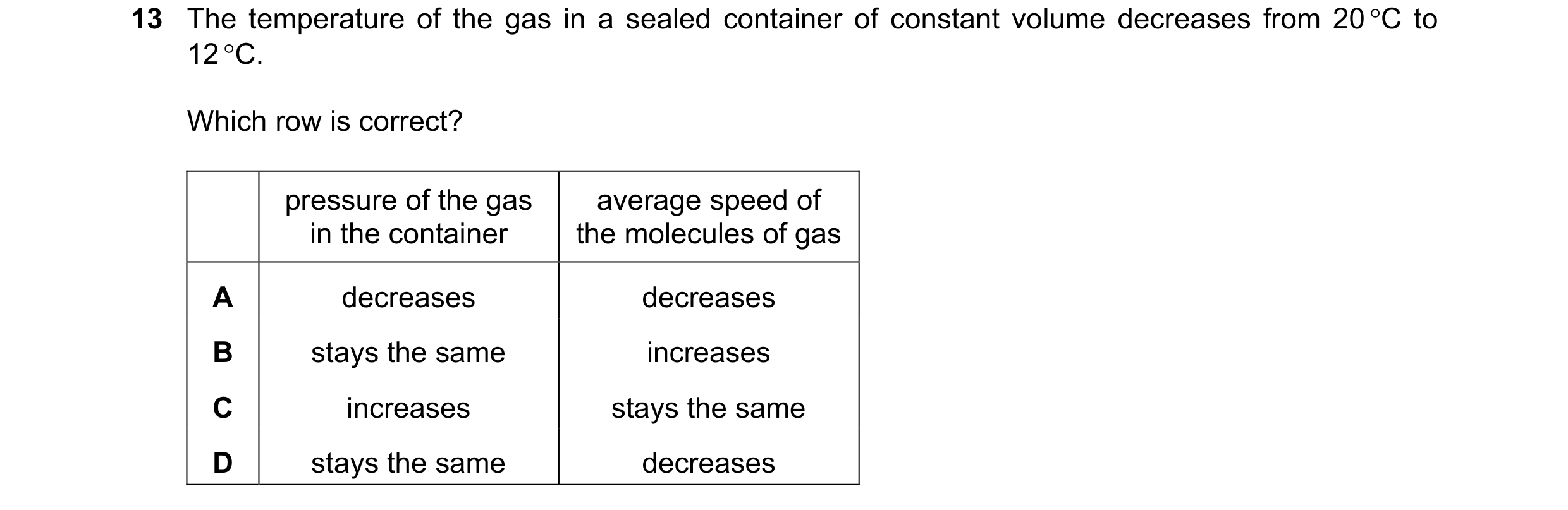
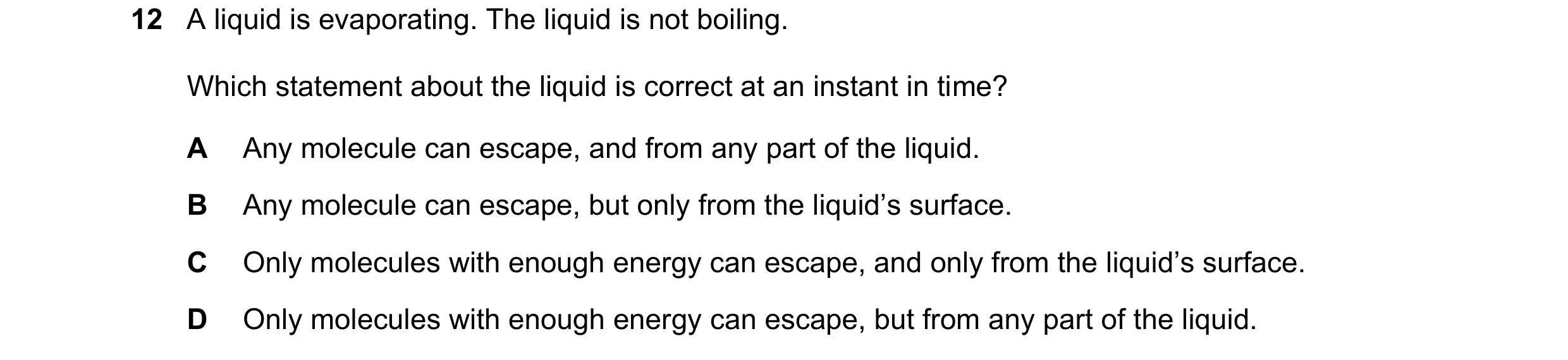 63 / 83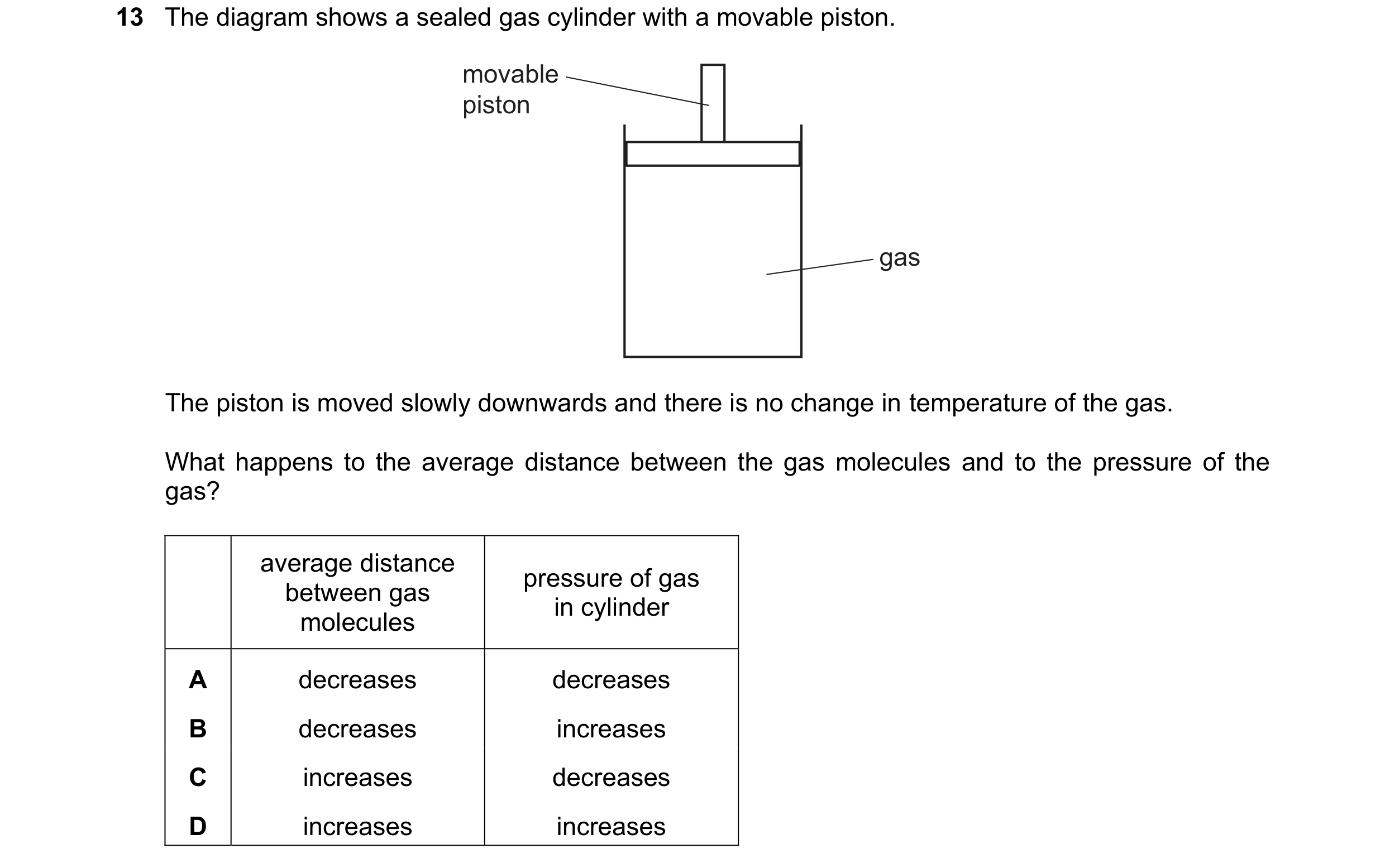
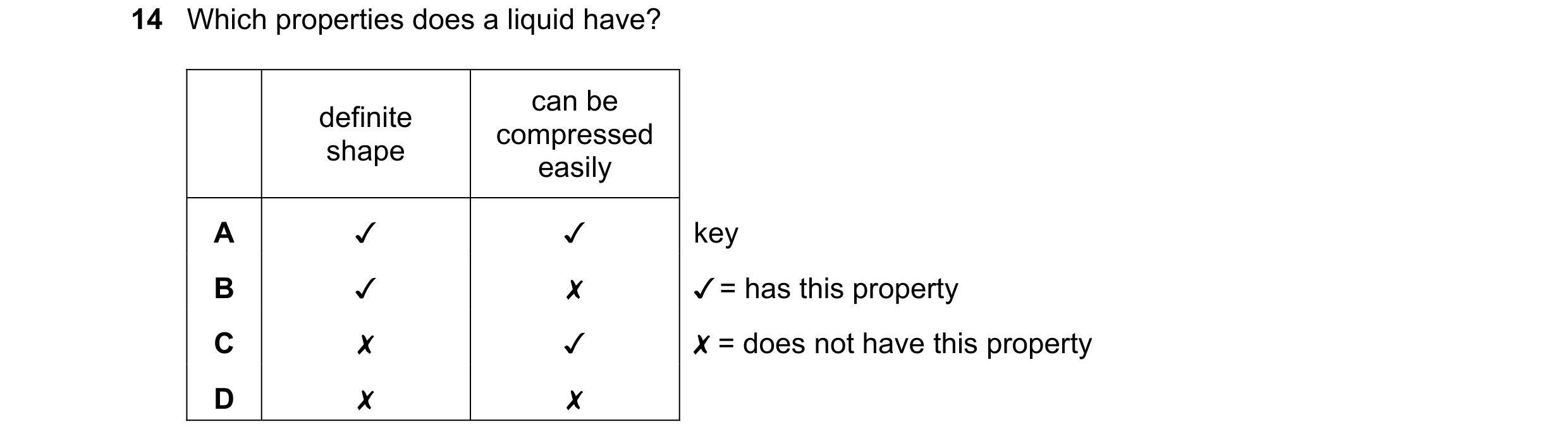
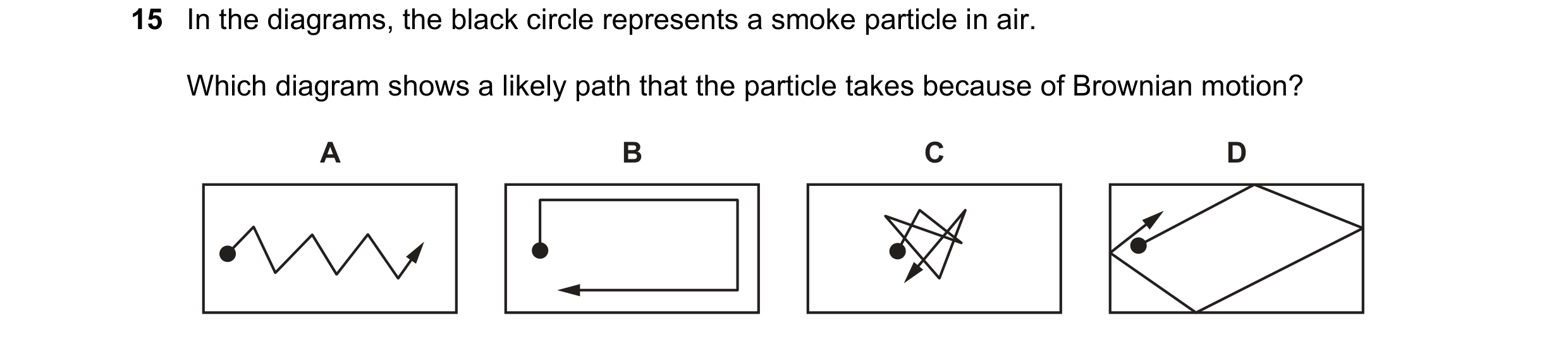
 64 / 83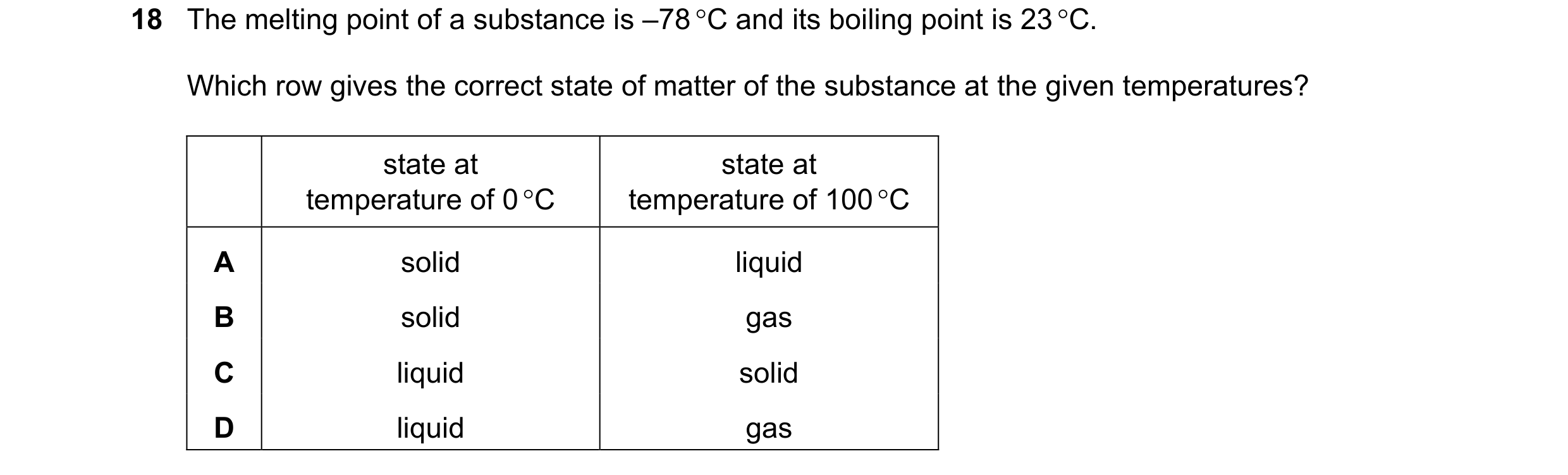
 65 / 83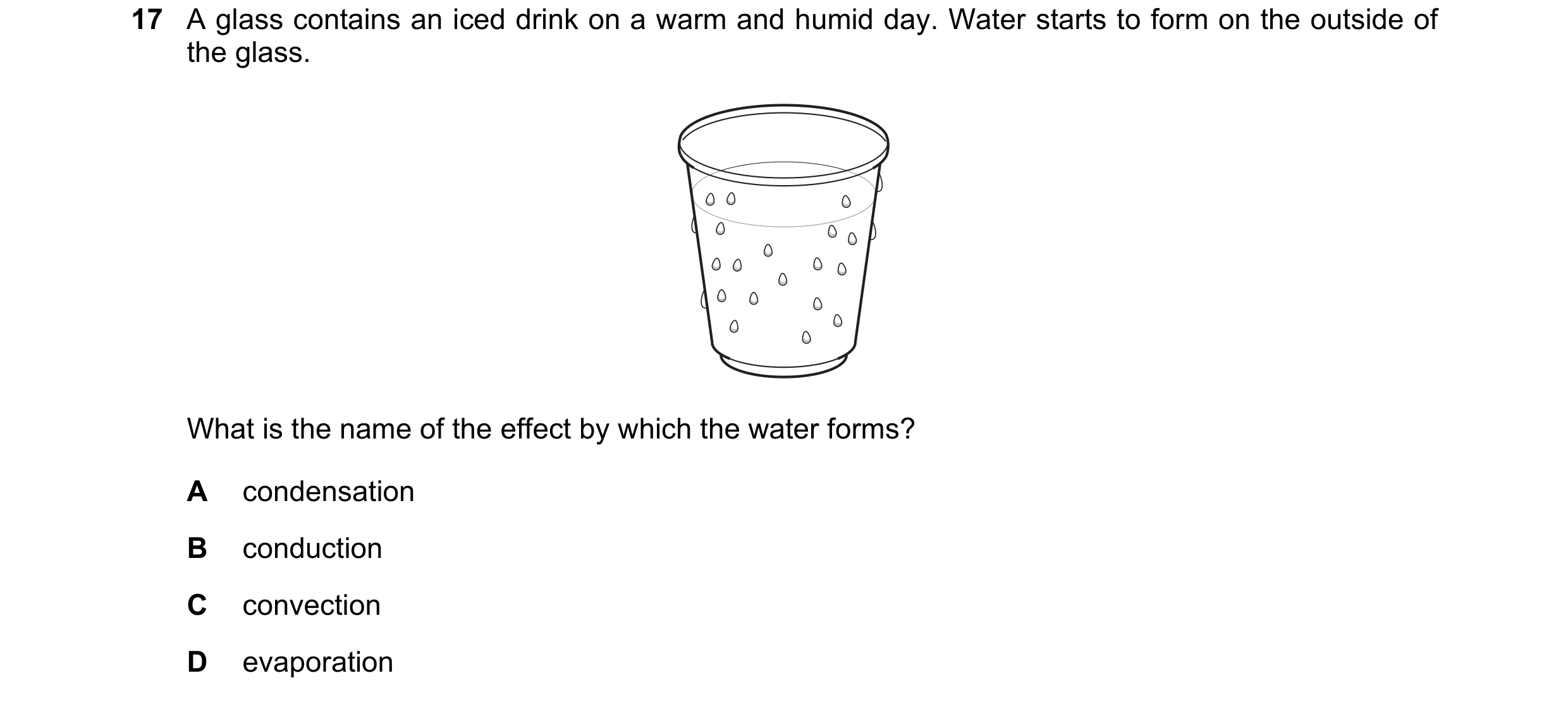
 66 / 83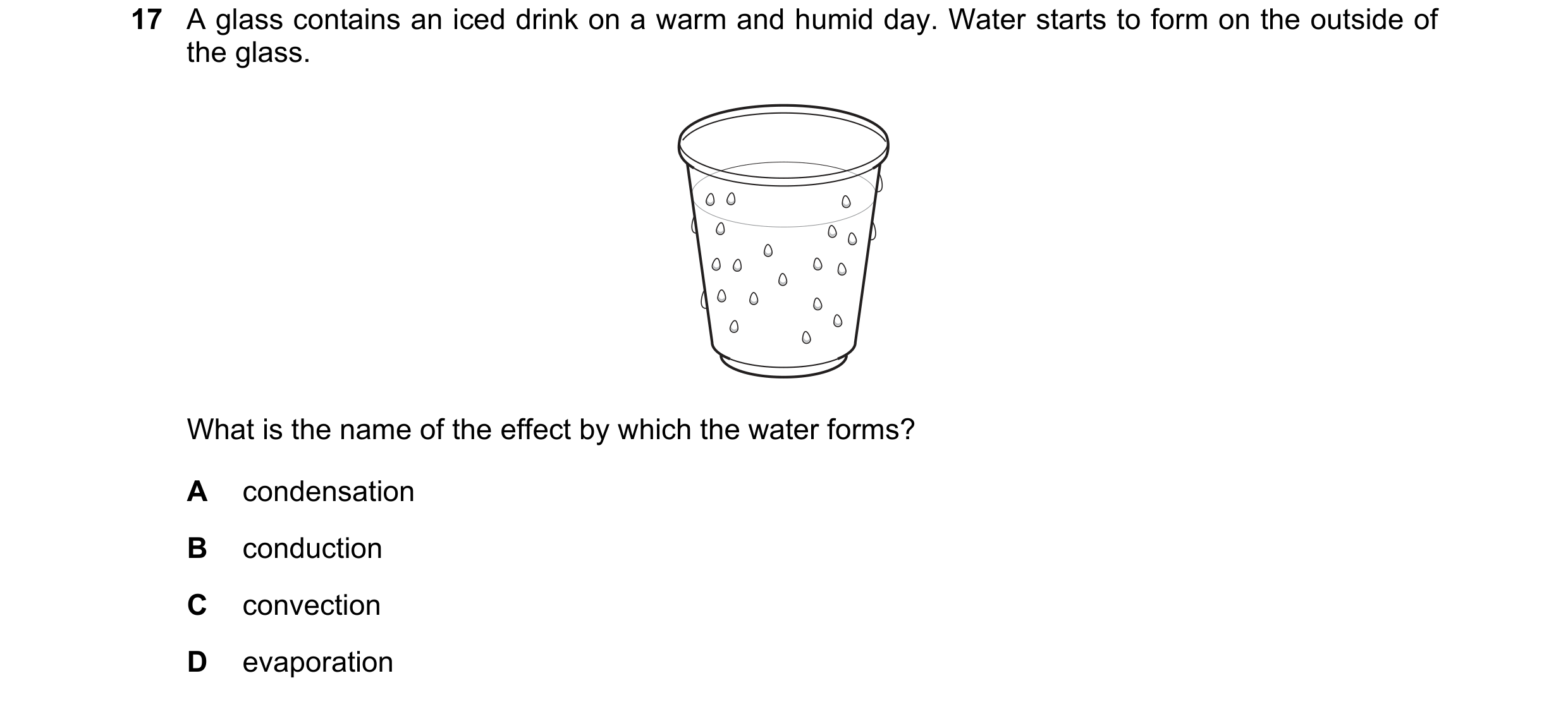
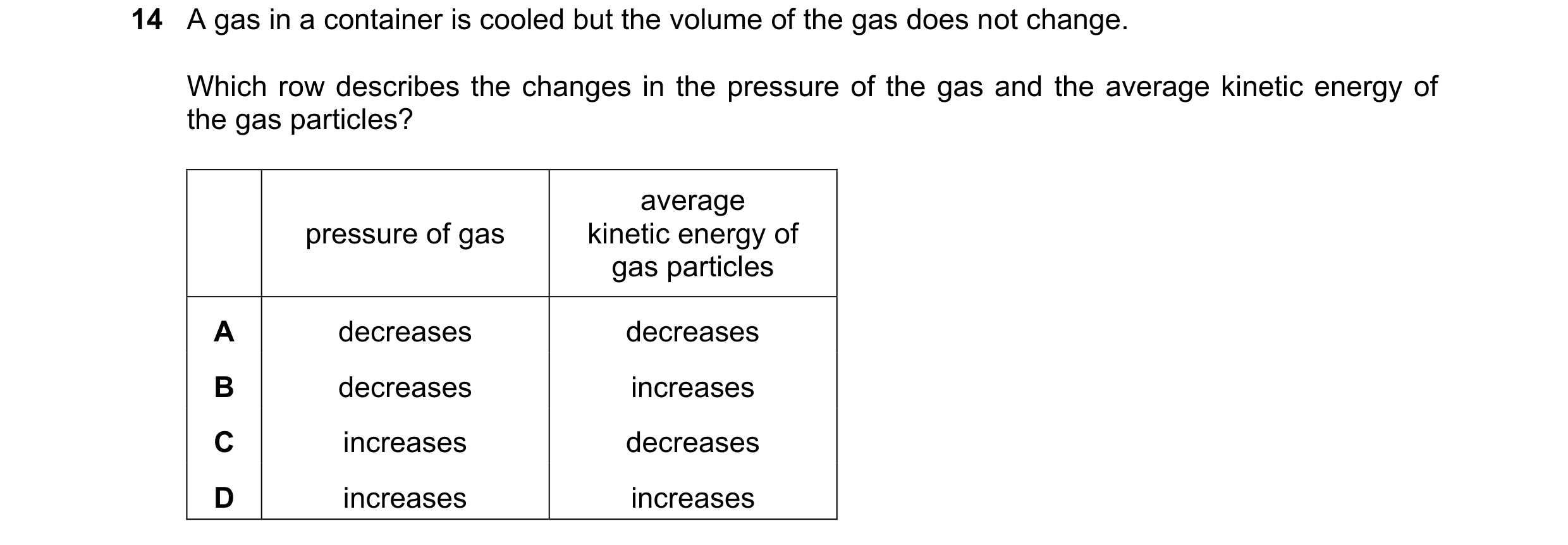 67 / 83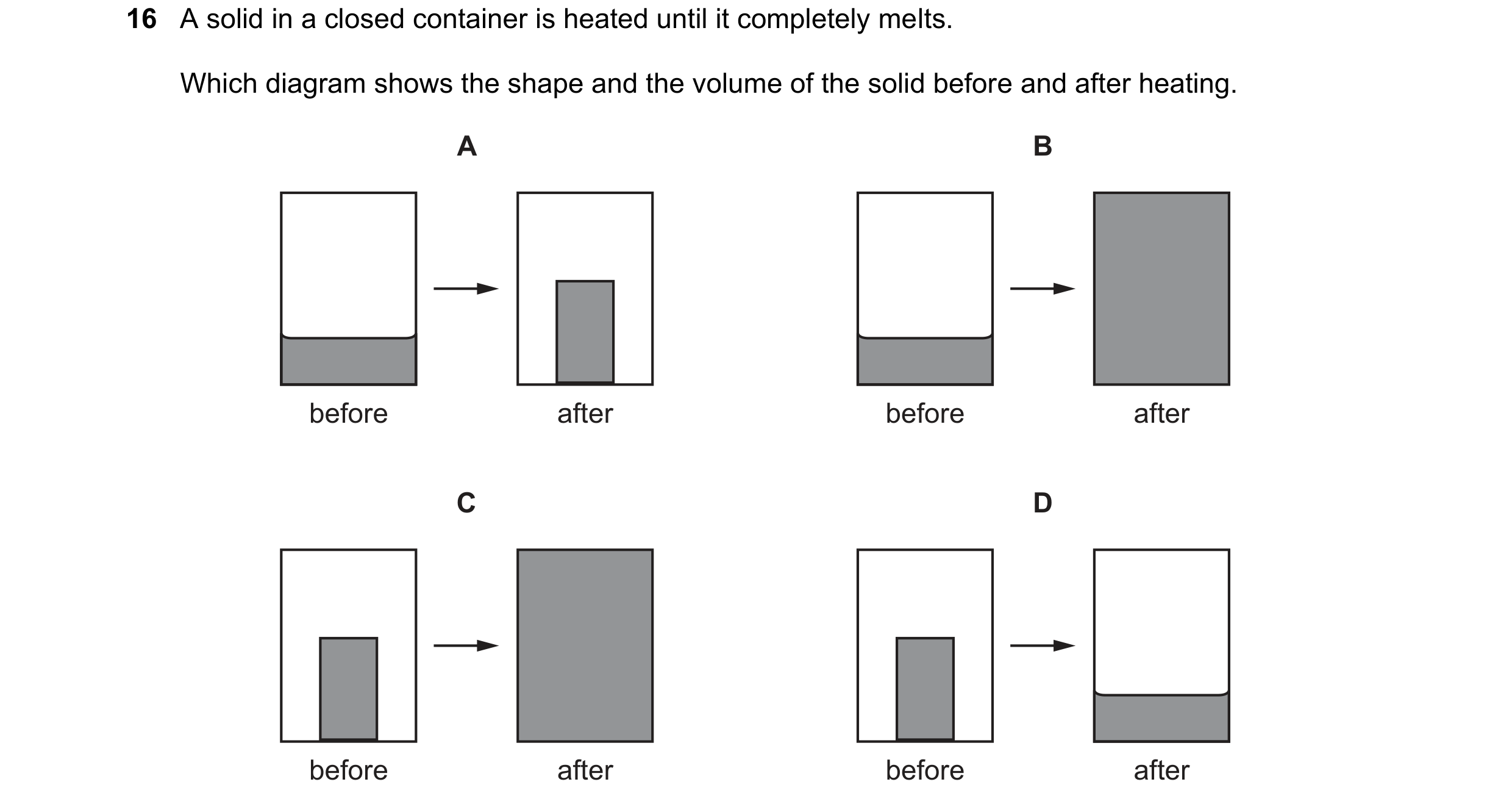
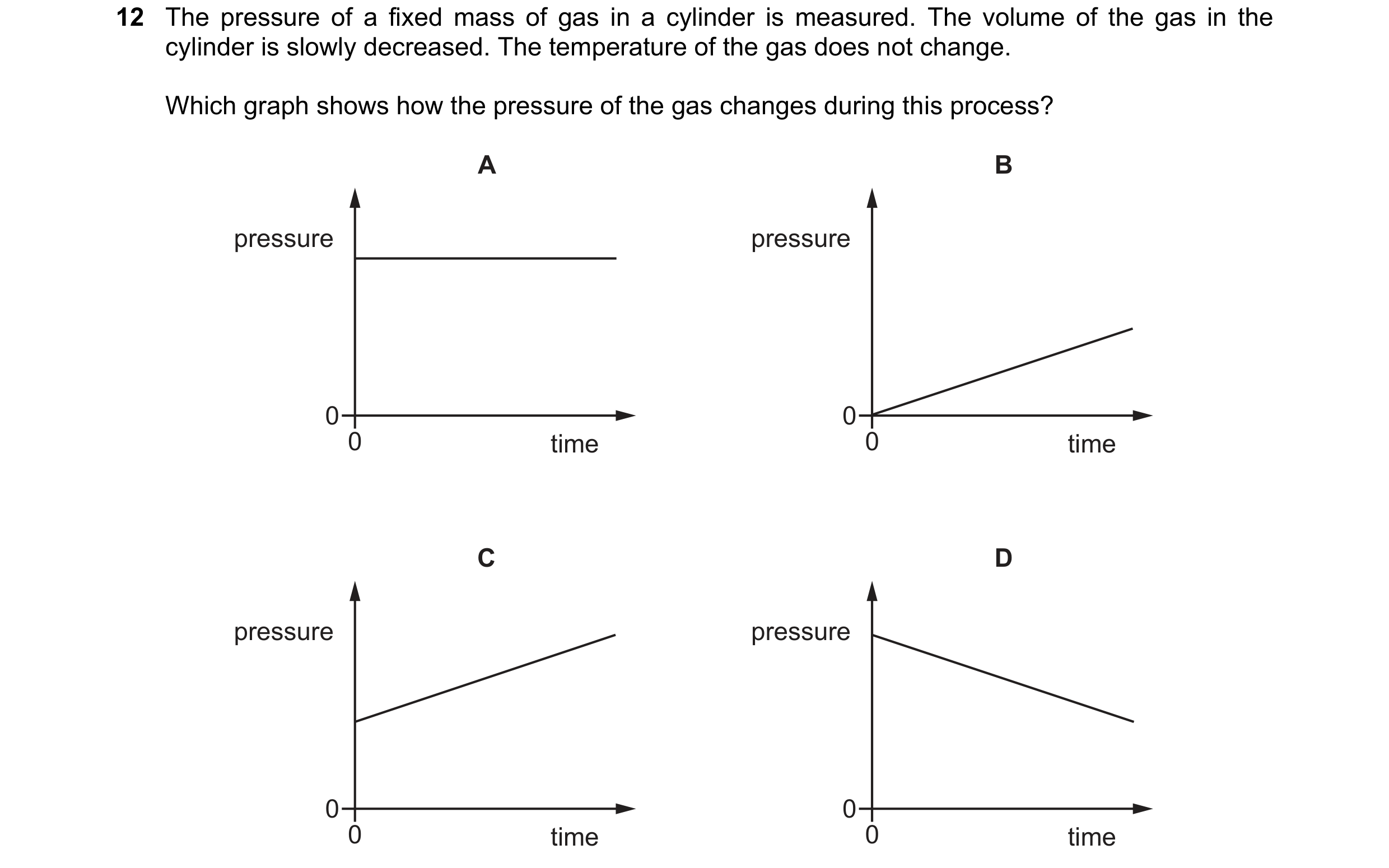
 68 / 83
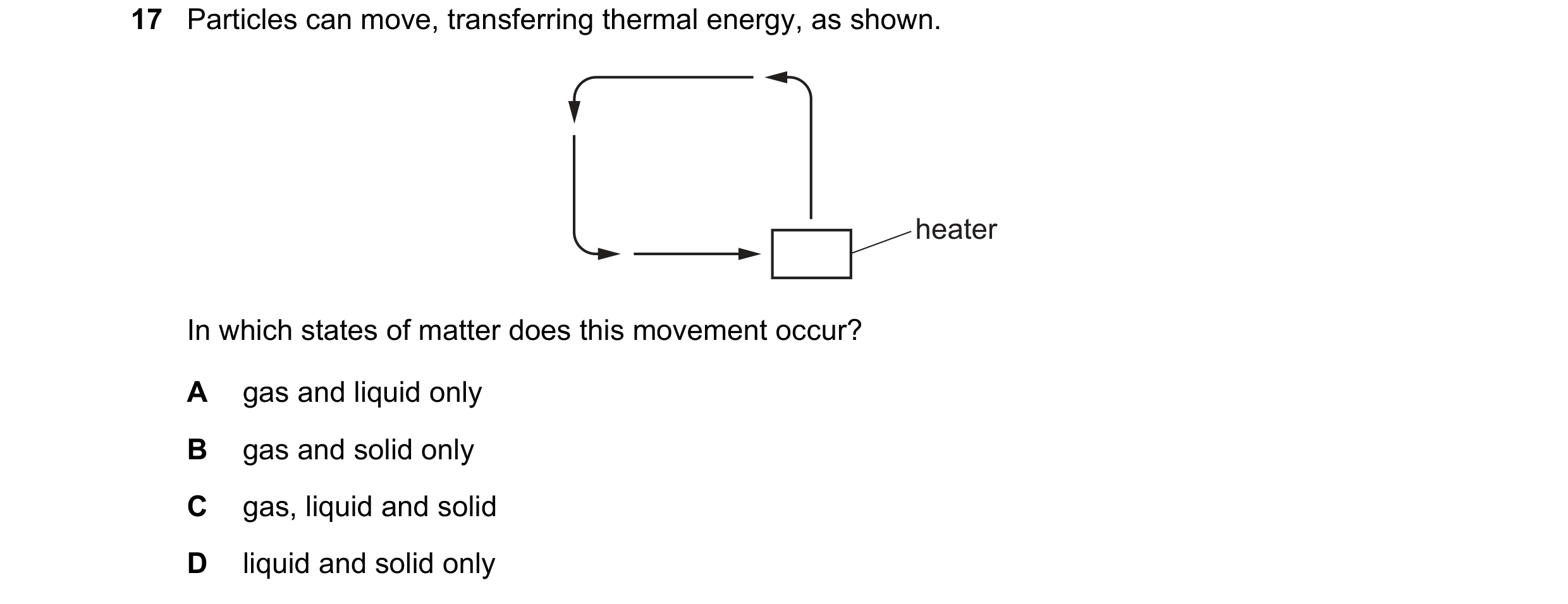
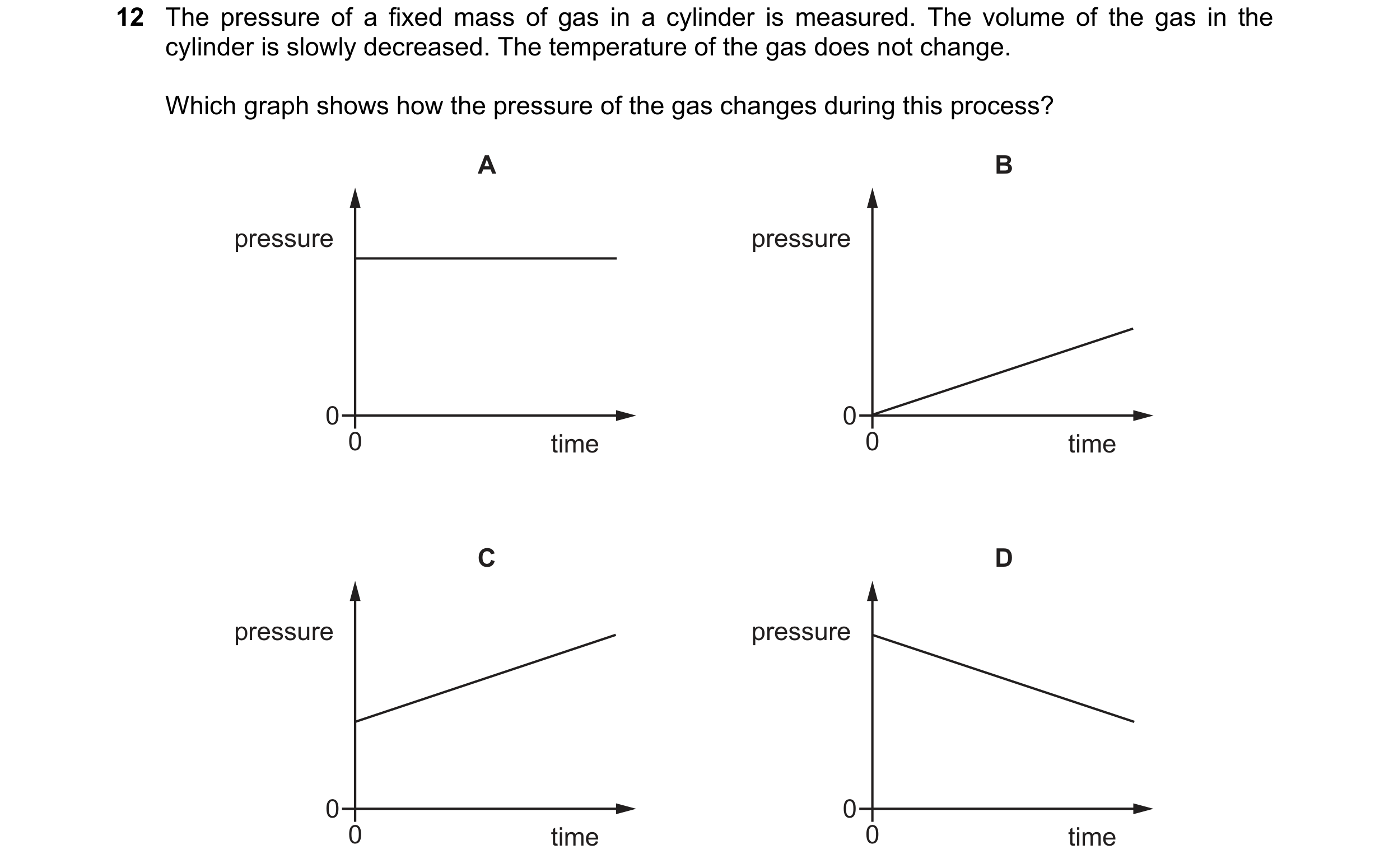 69 / 83
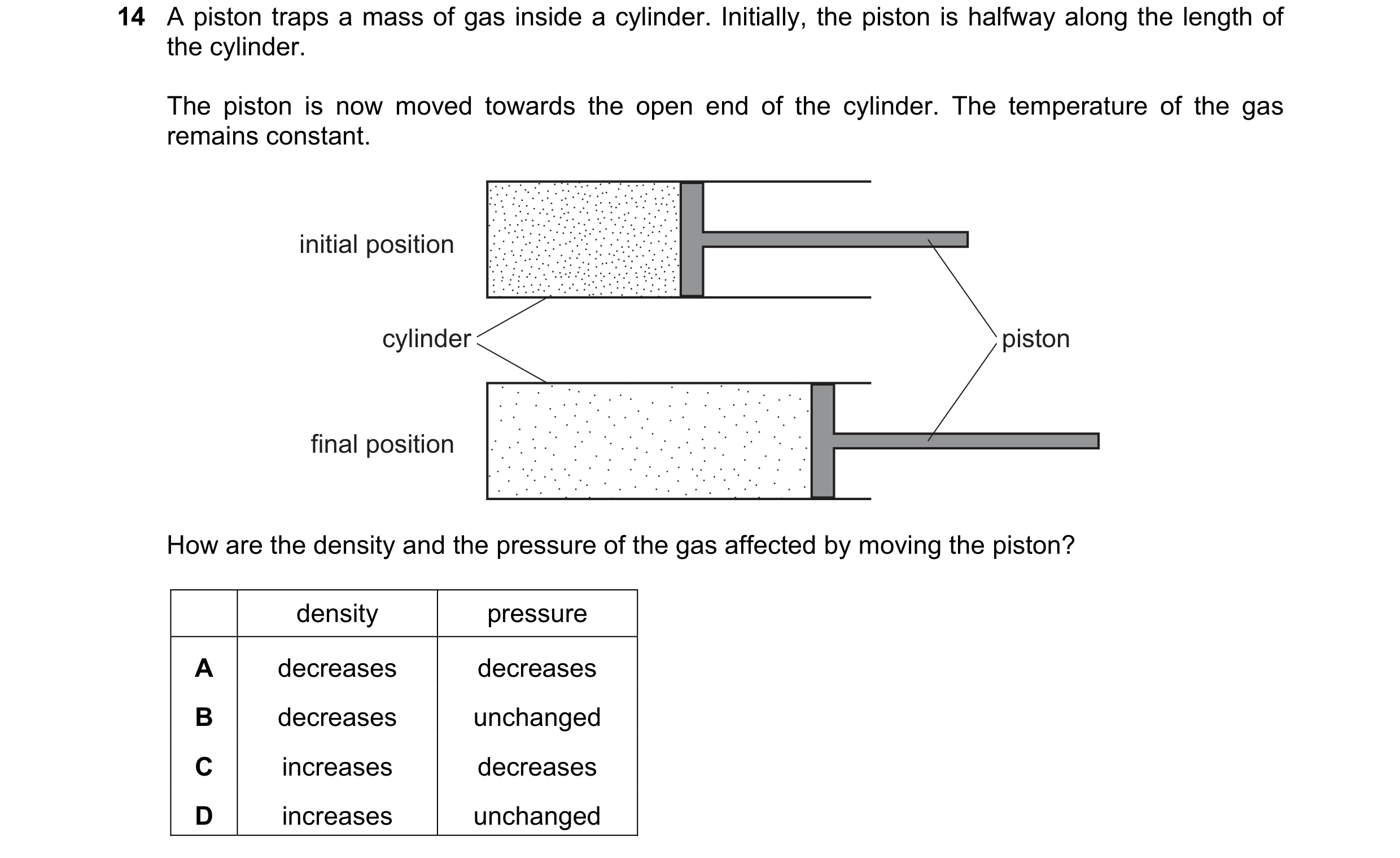
 70 / 83
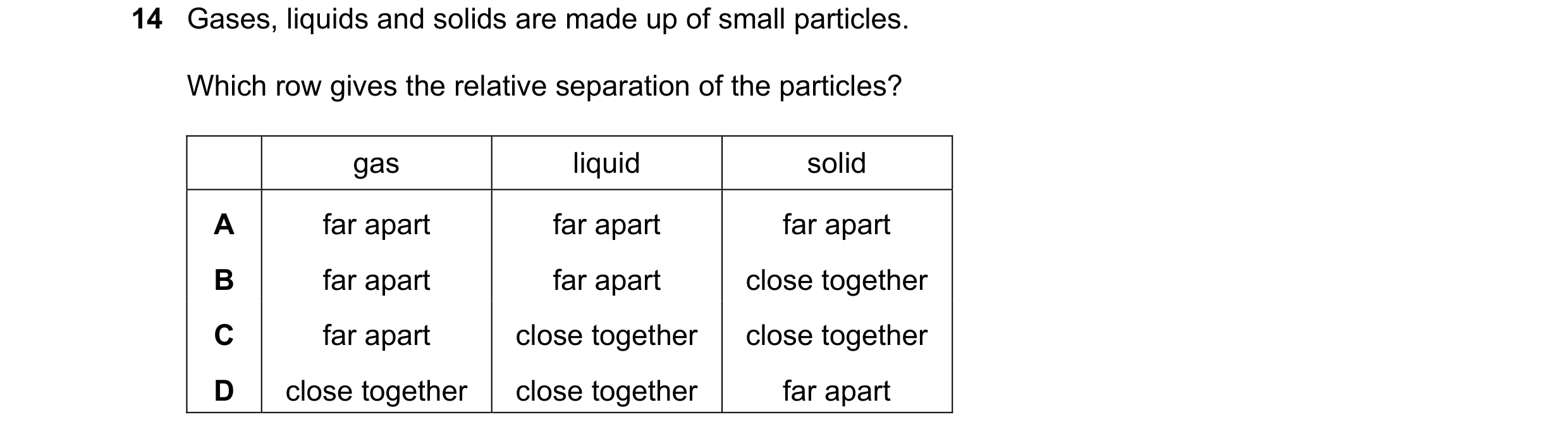
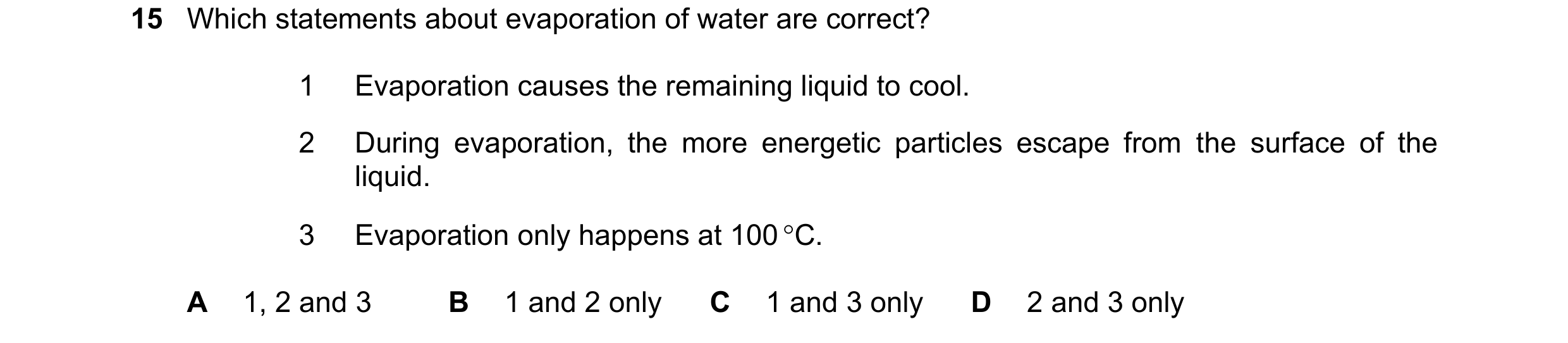
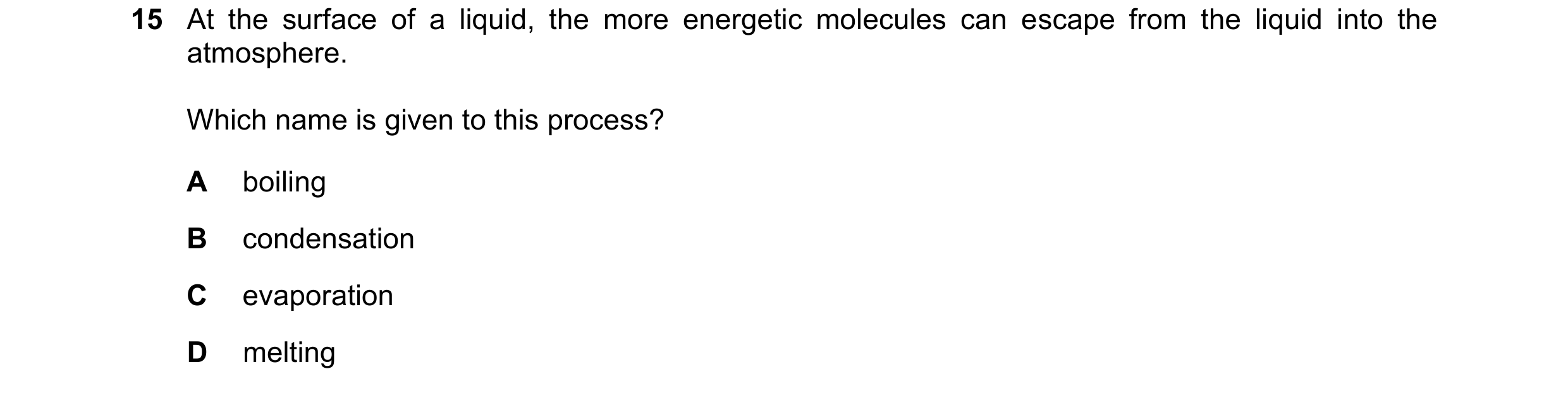
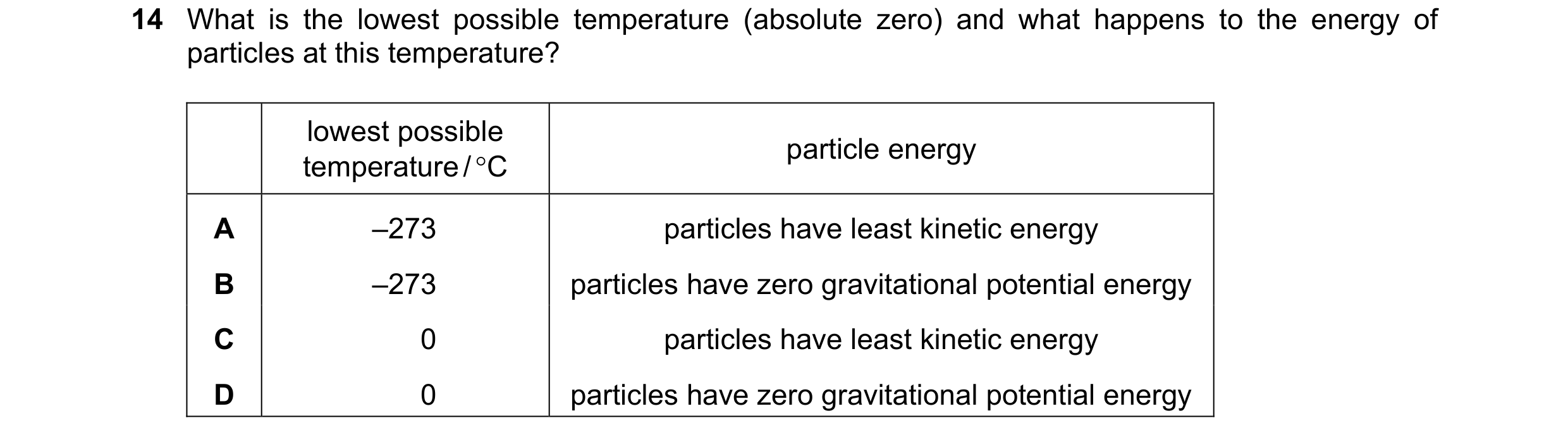 71 / 83

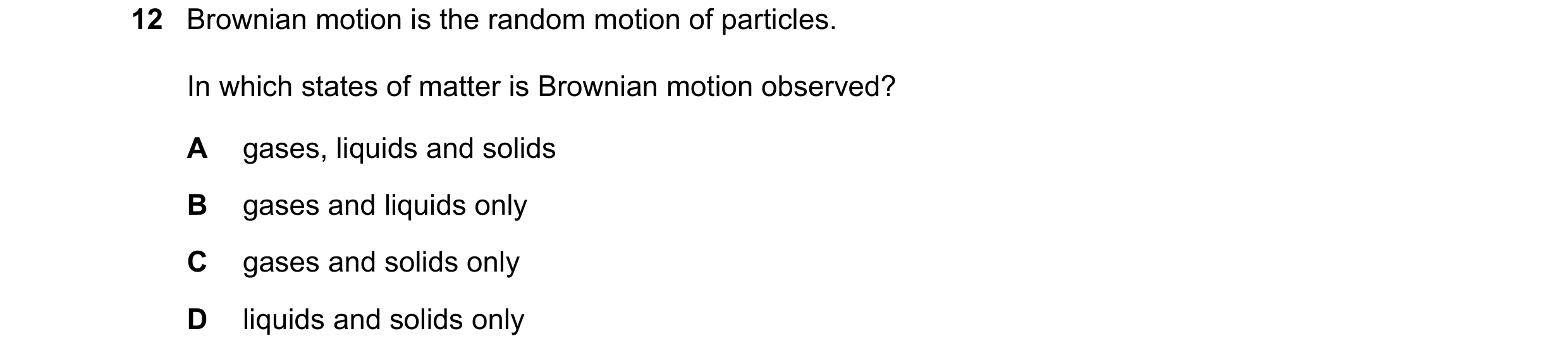
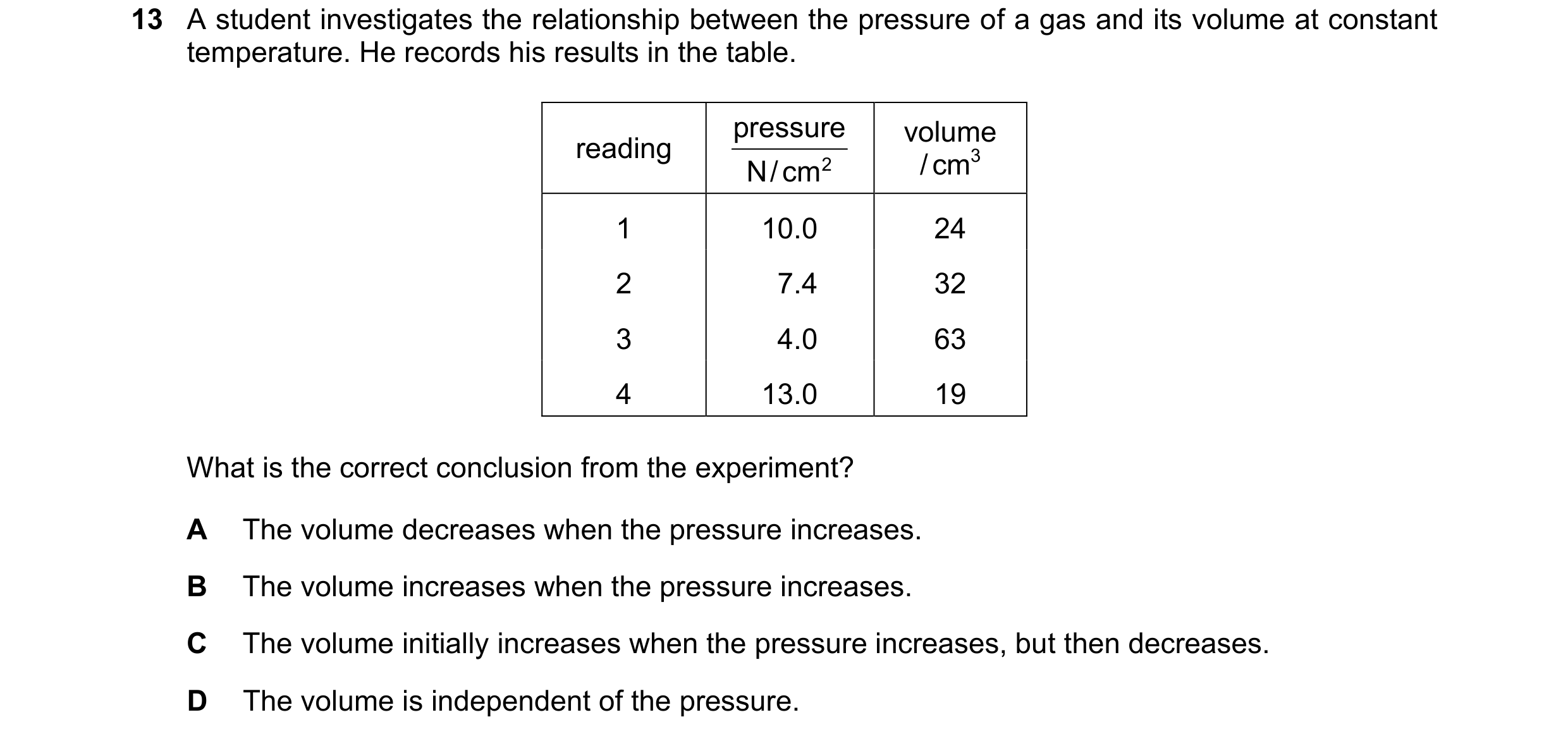 72 / 83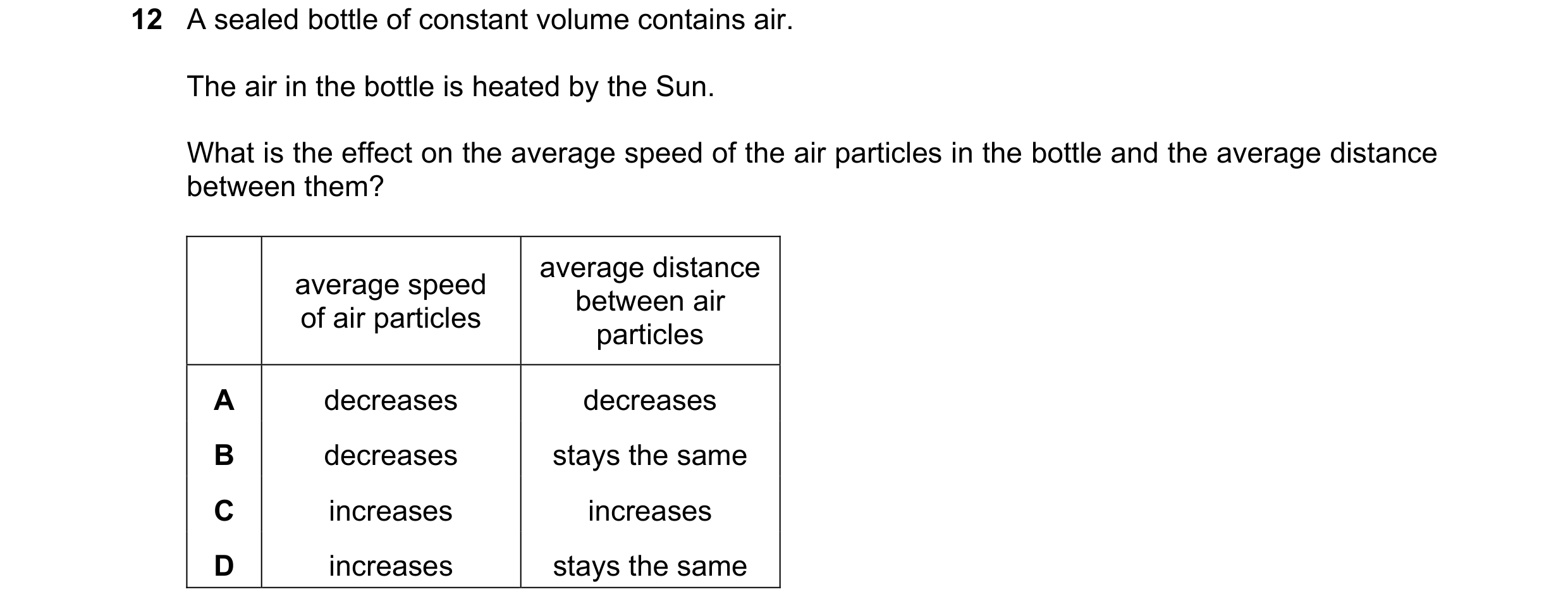
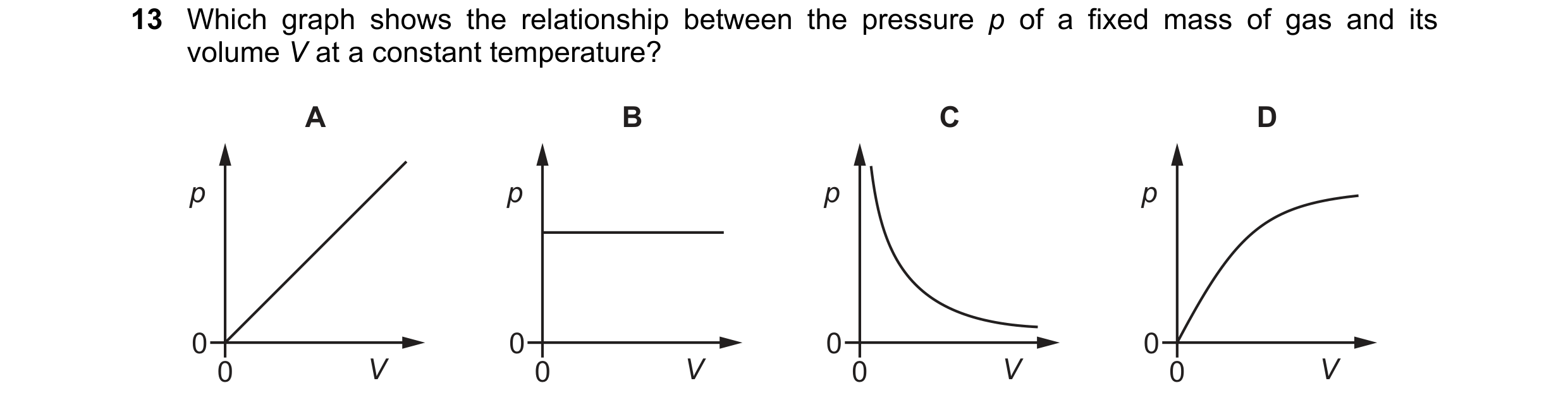
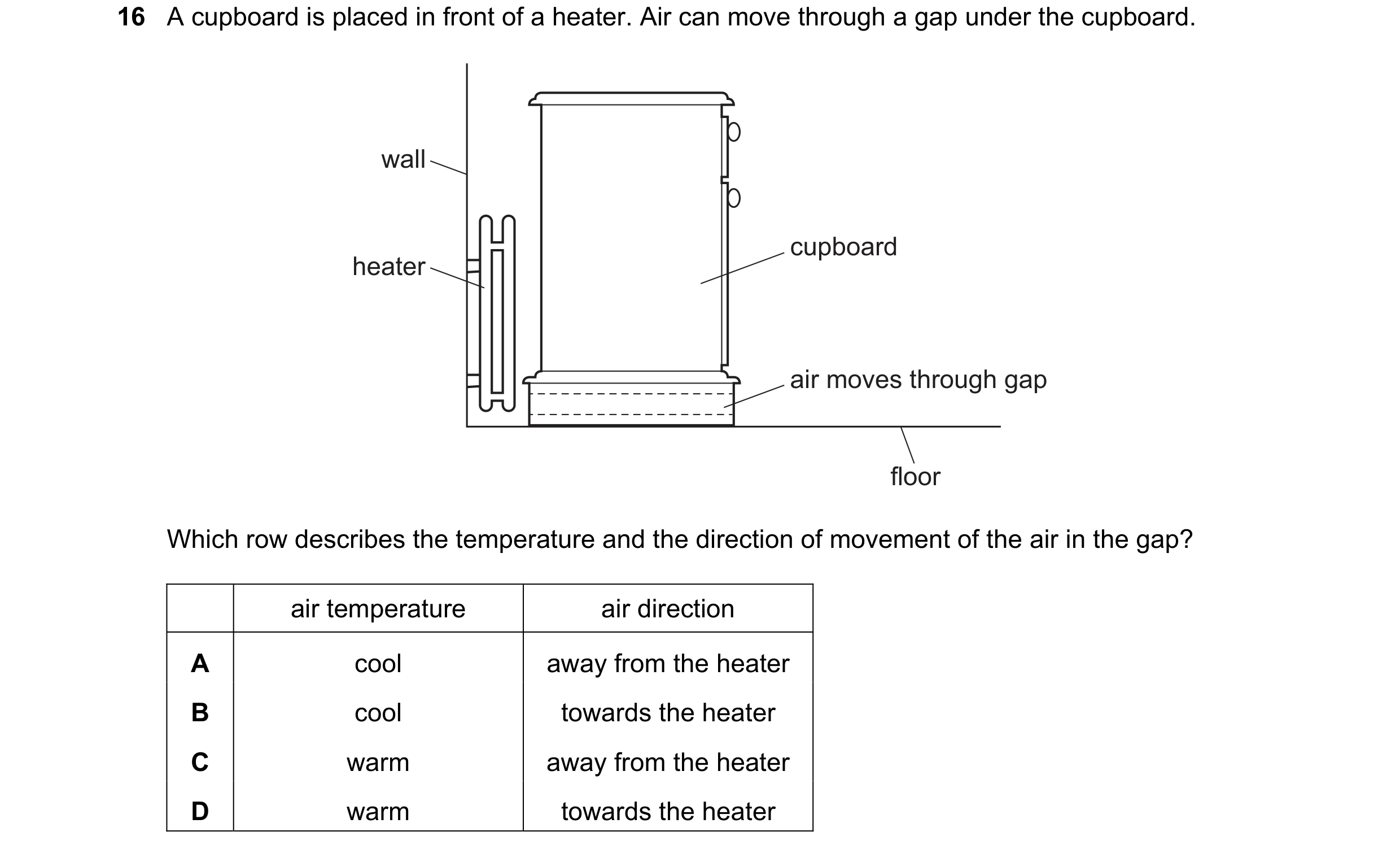 73 / 83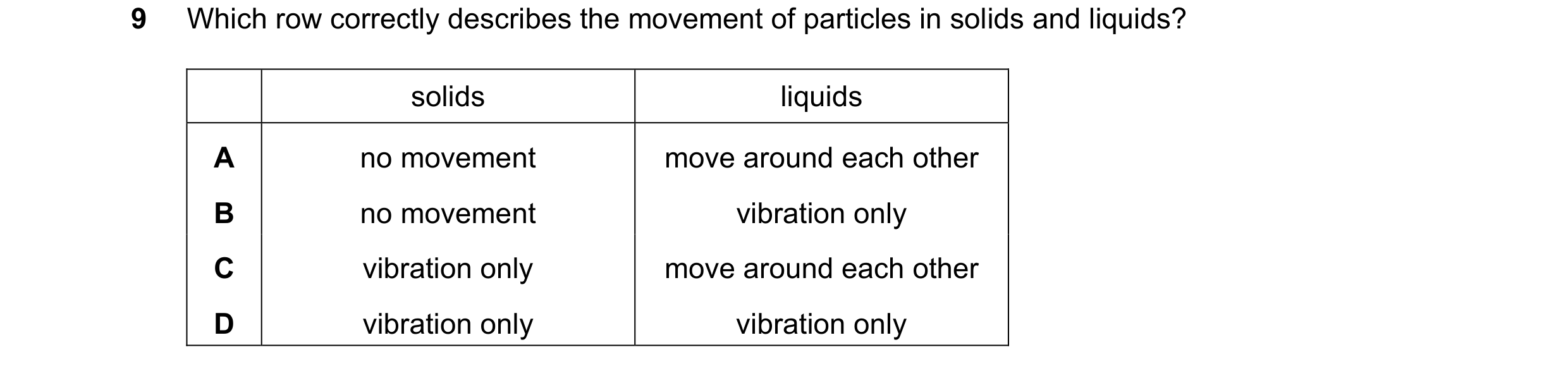

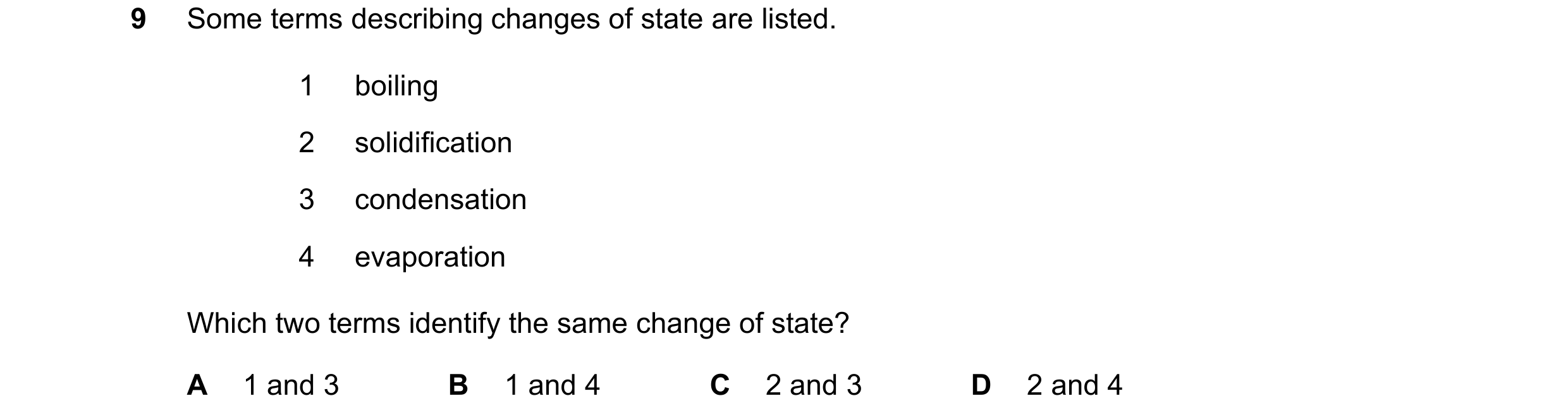
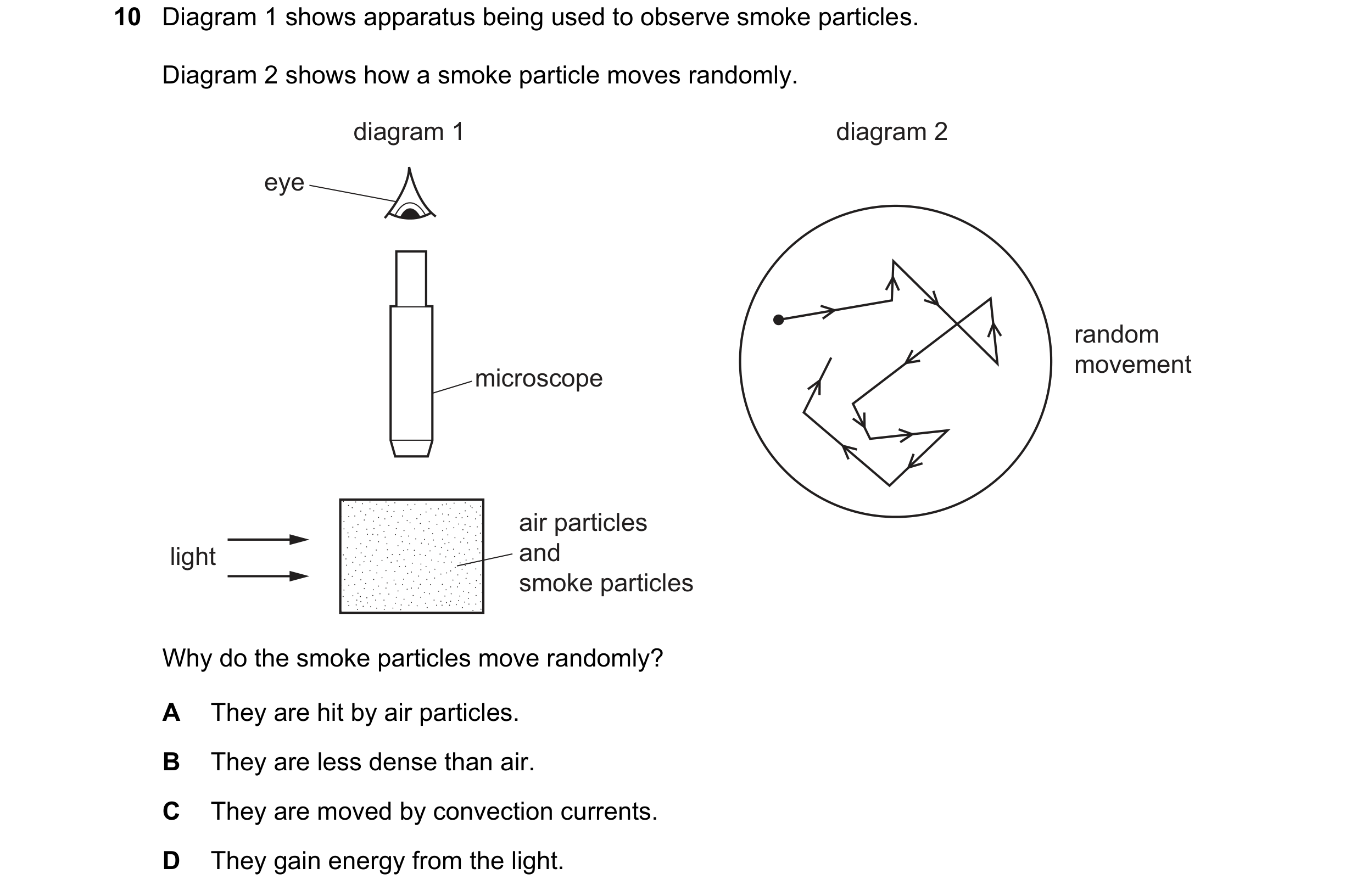 74 / 83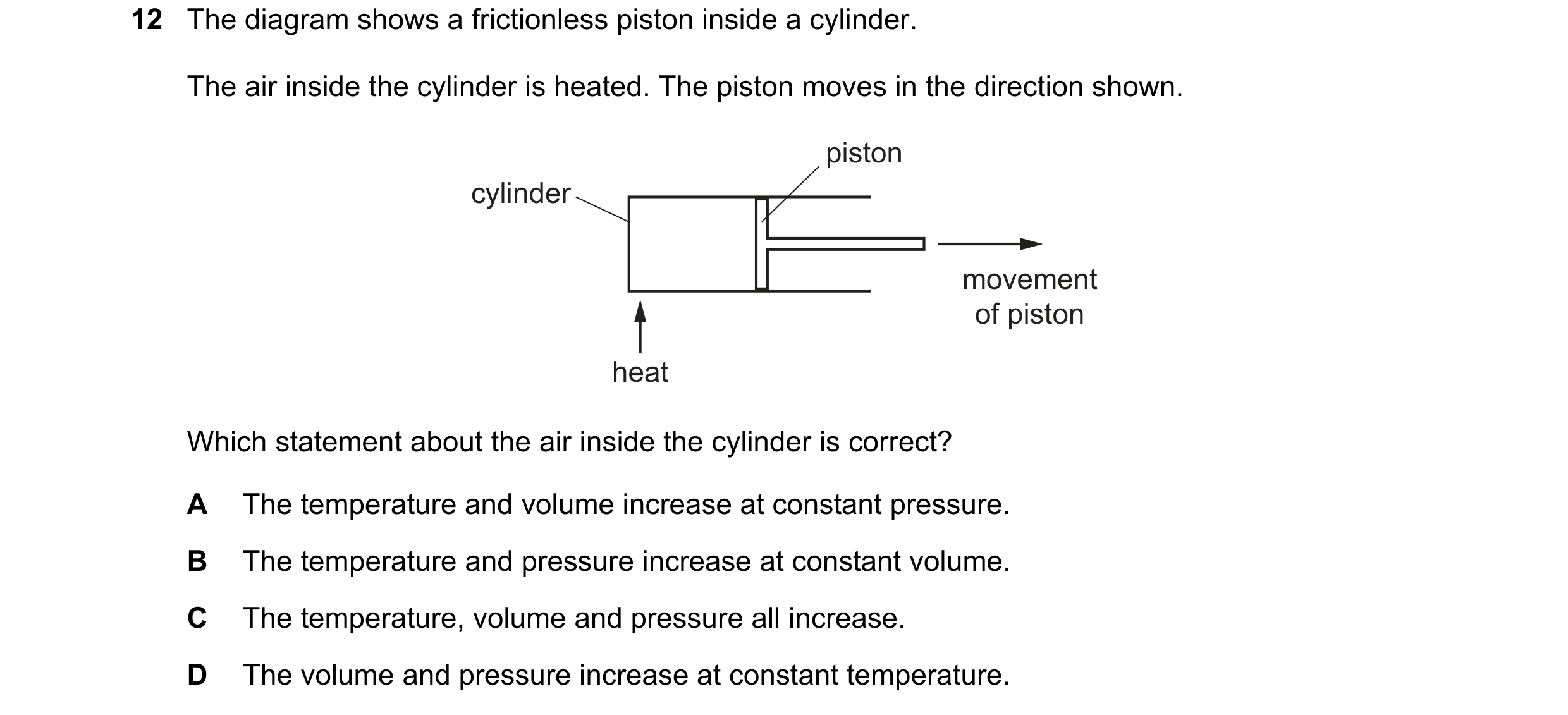

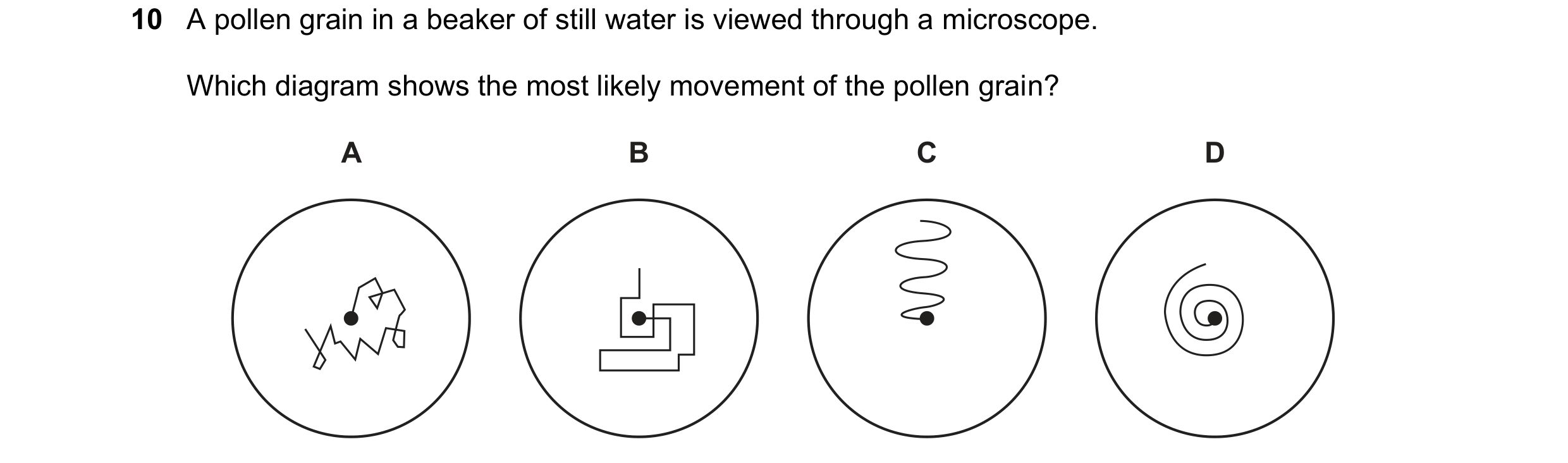 75 / 83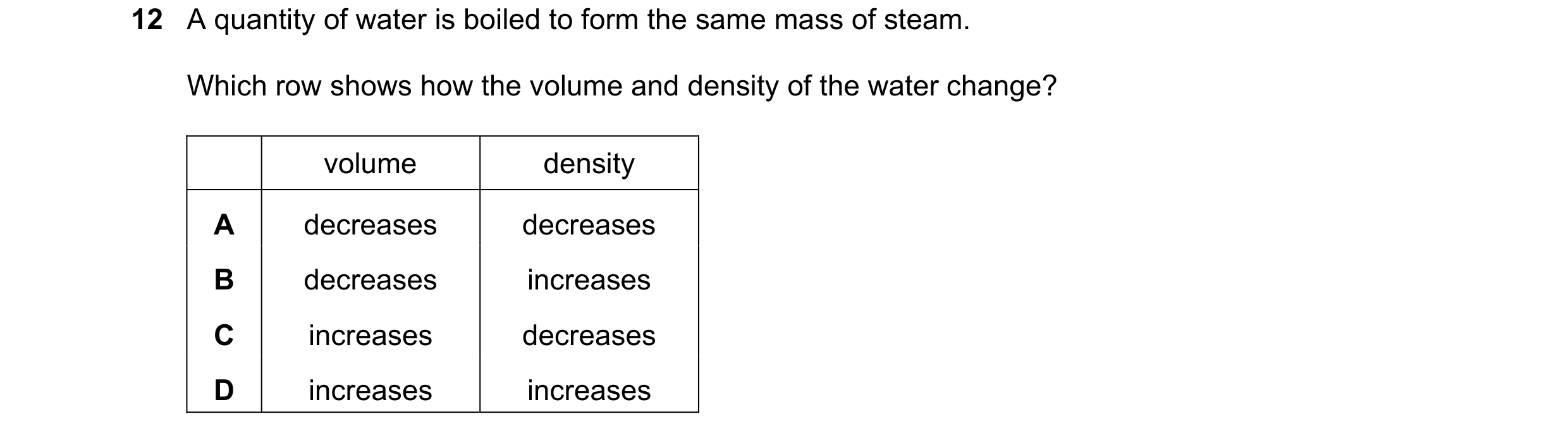
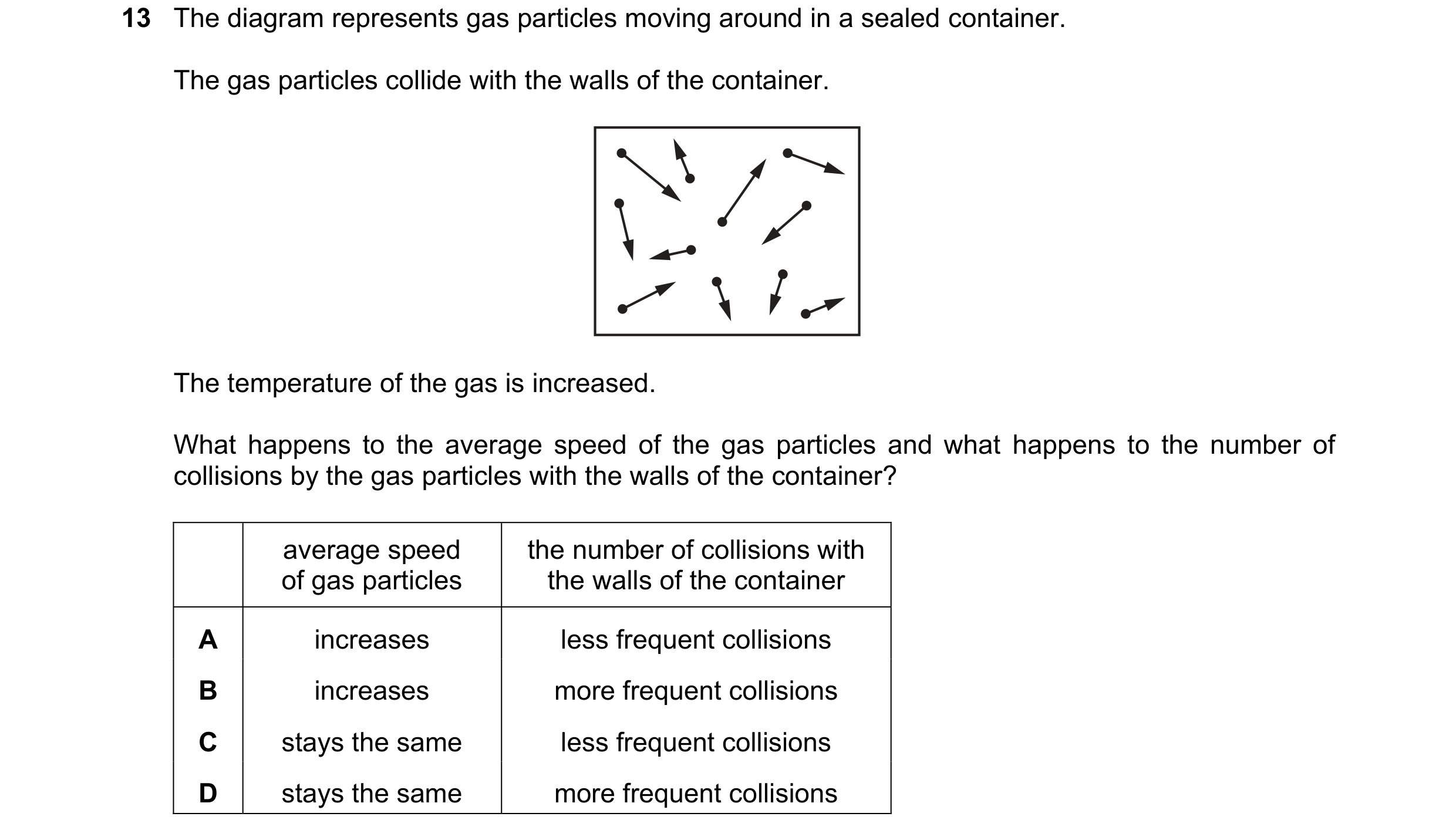
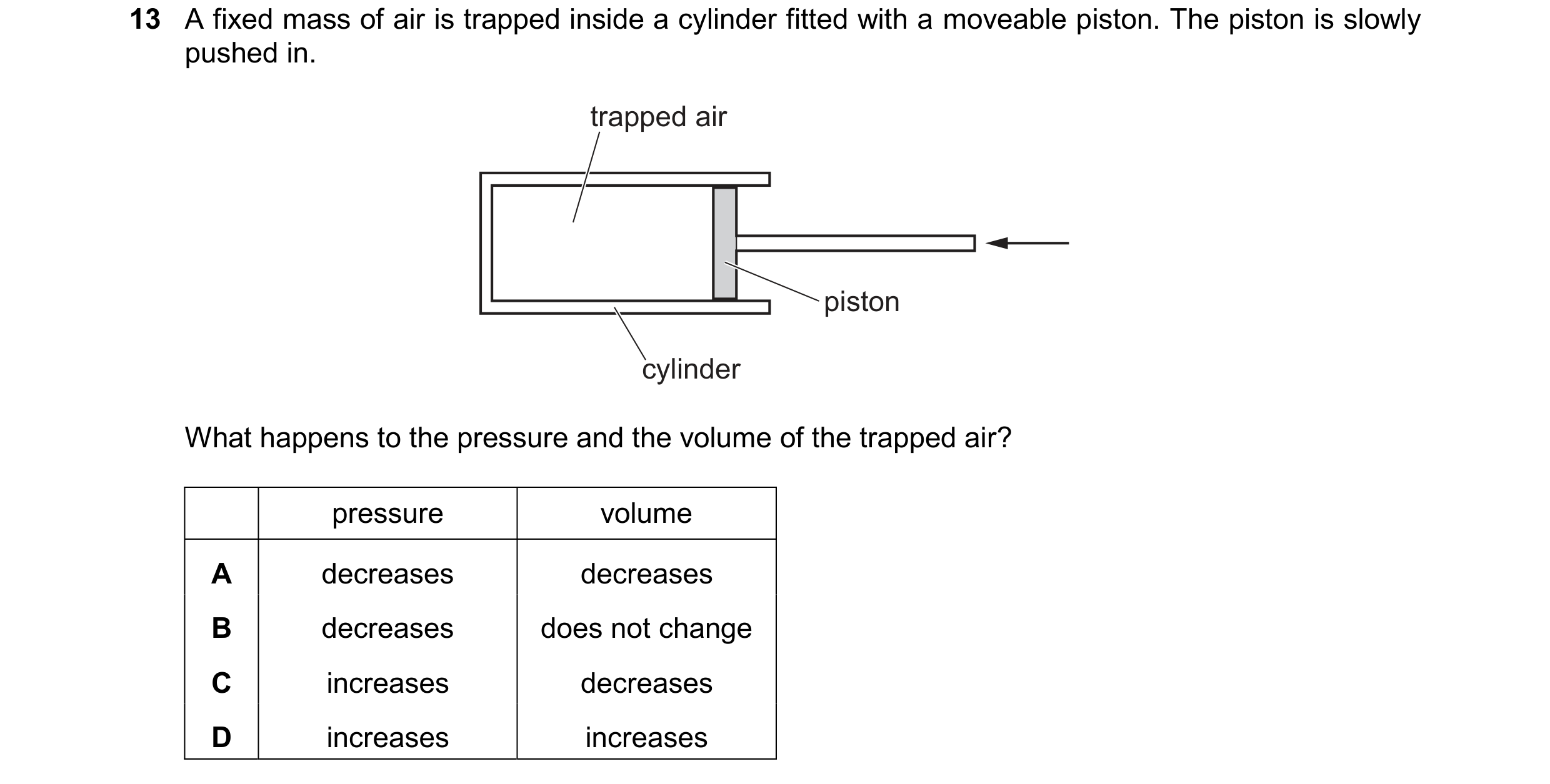 76 / 83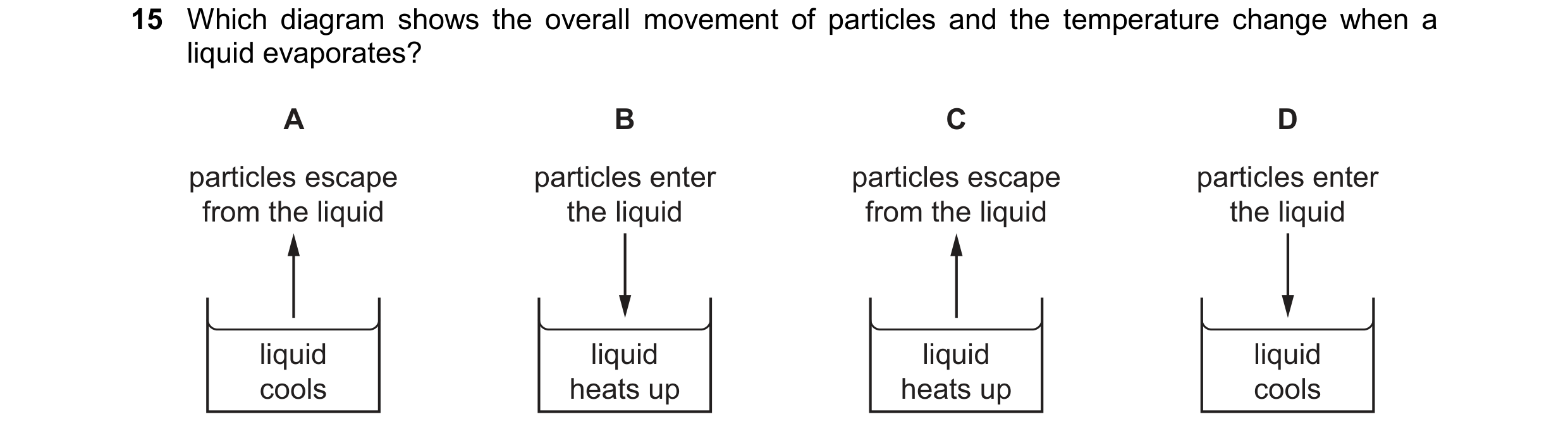
 77 / 83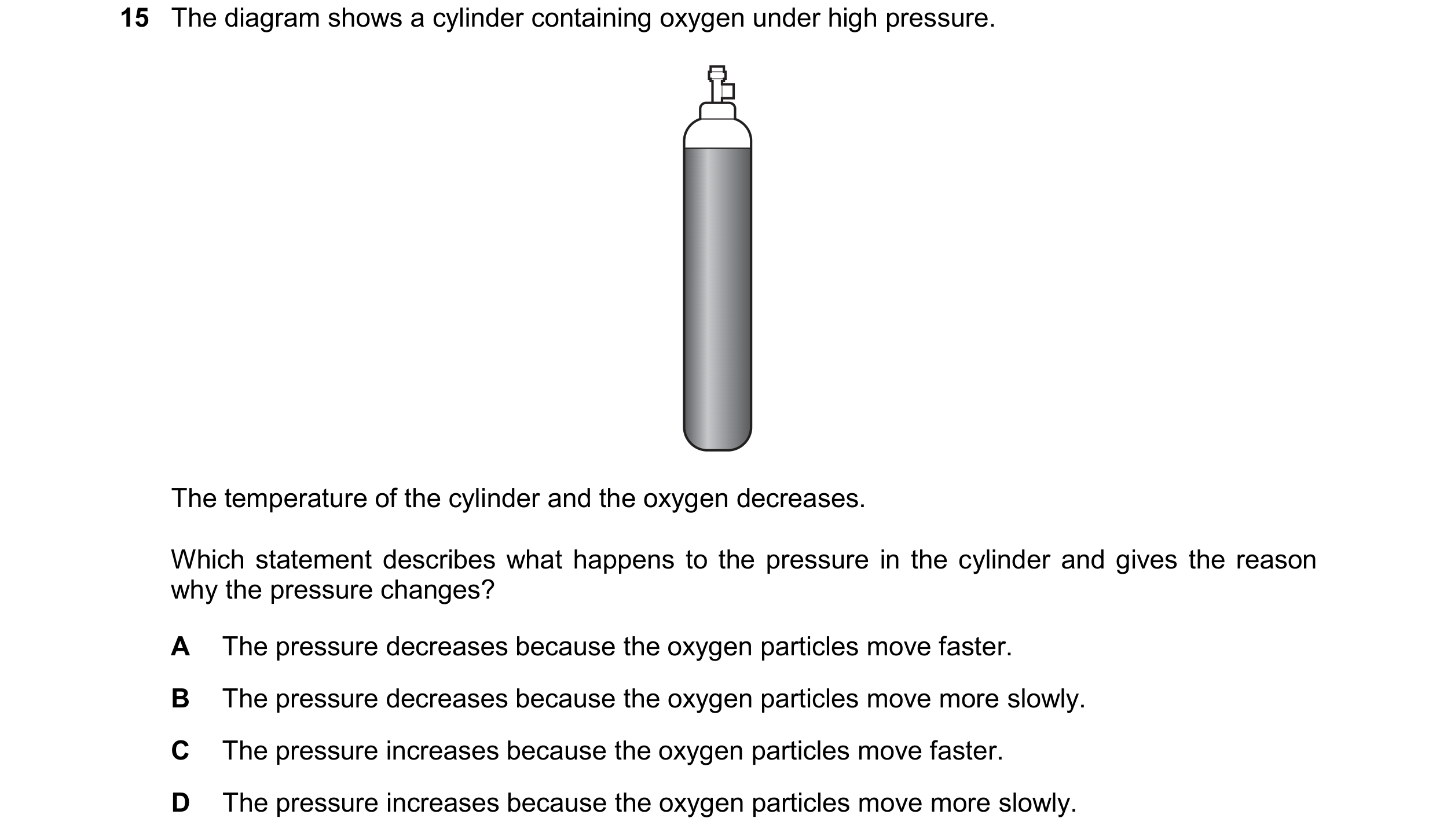

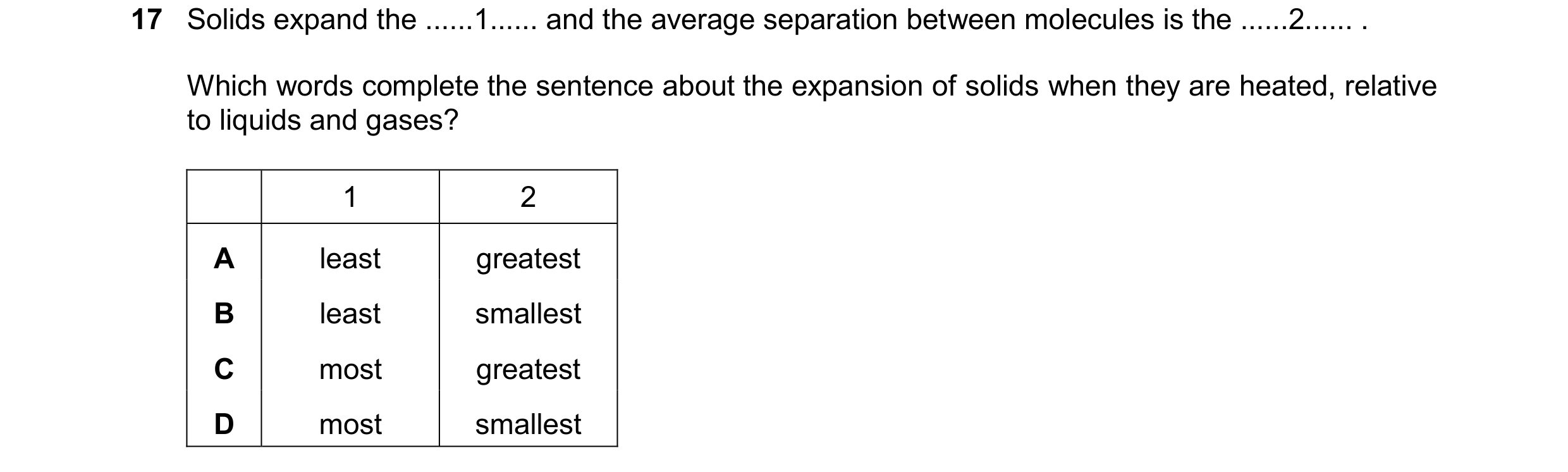 78 / 83
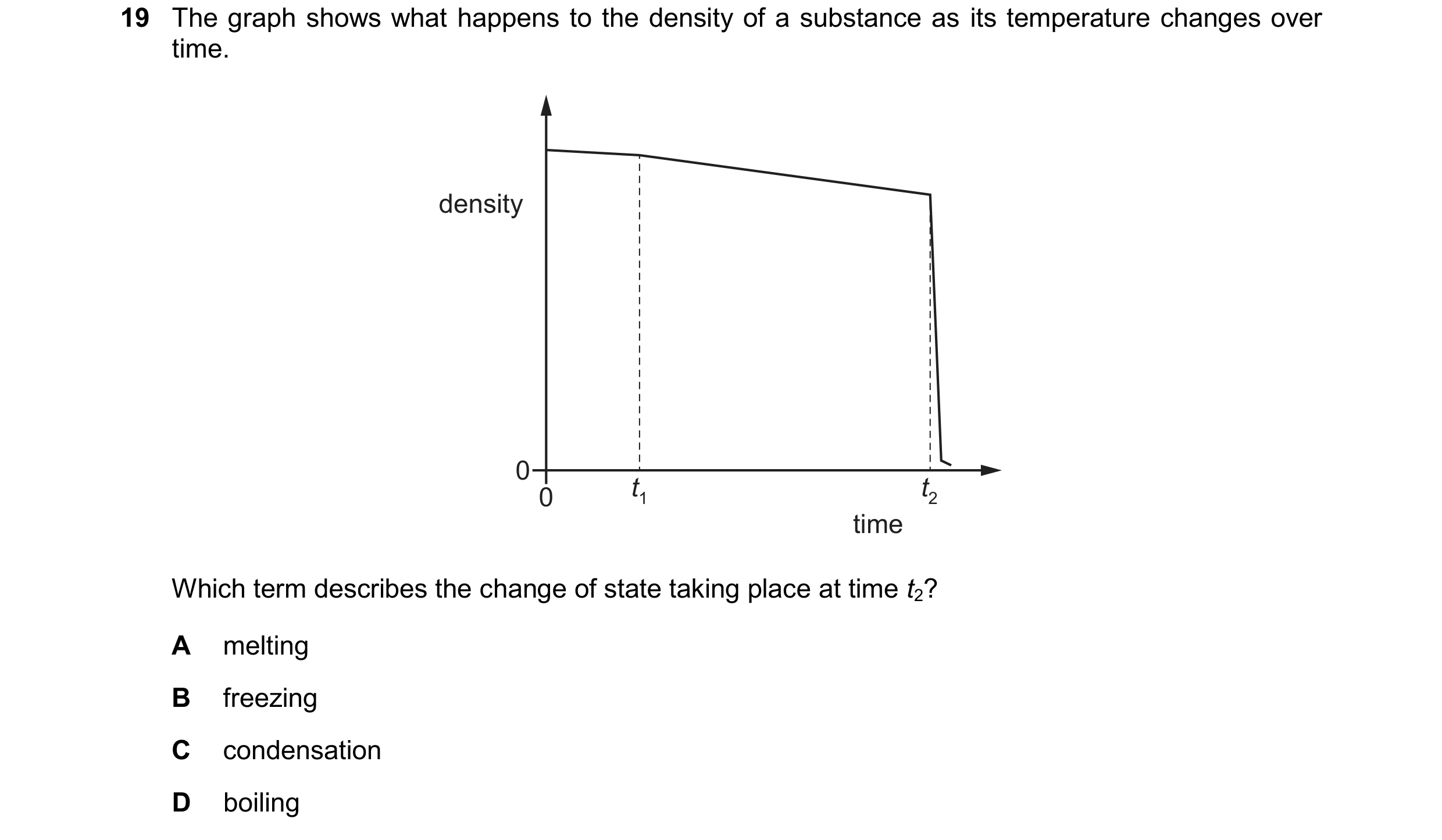
 79 / 83
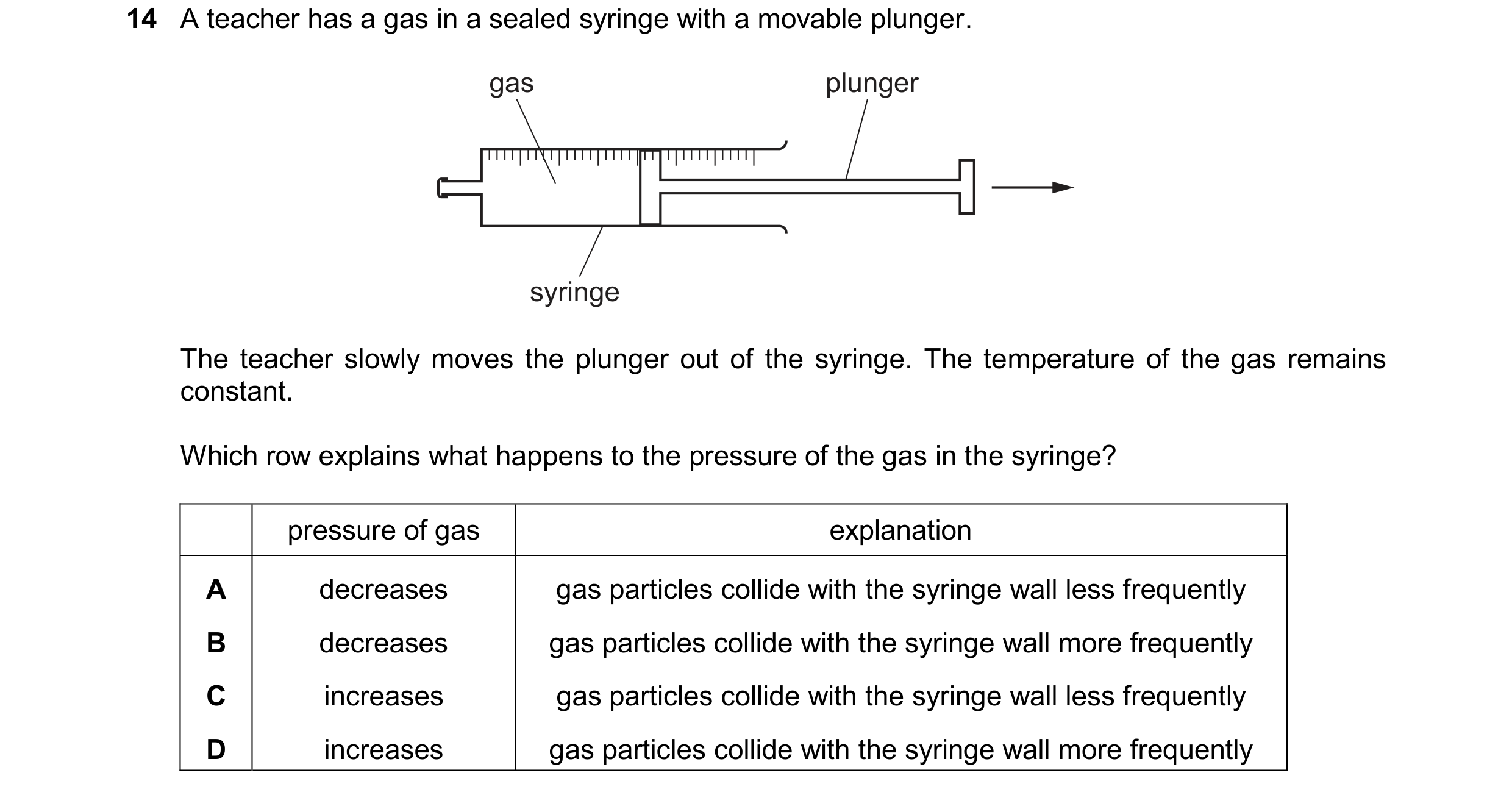
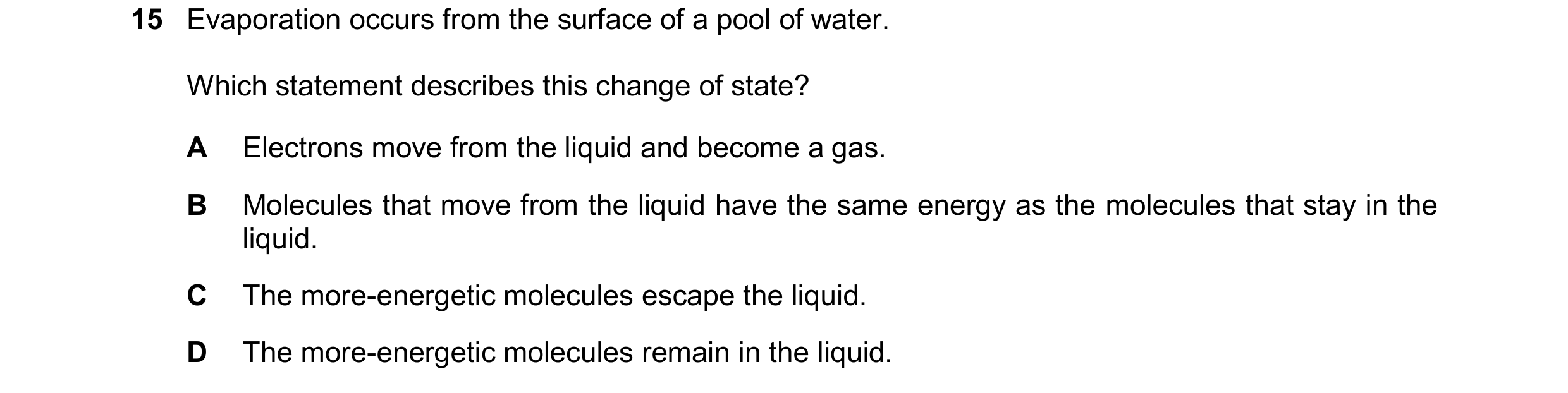
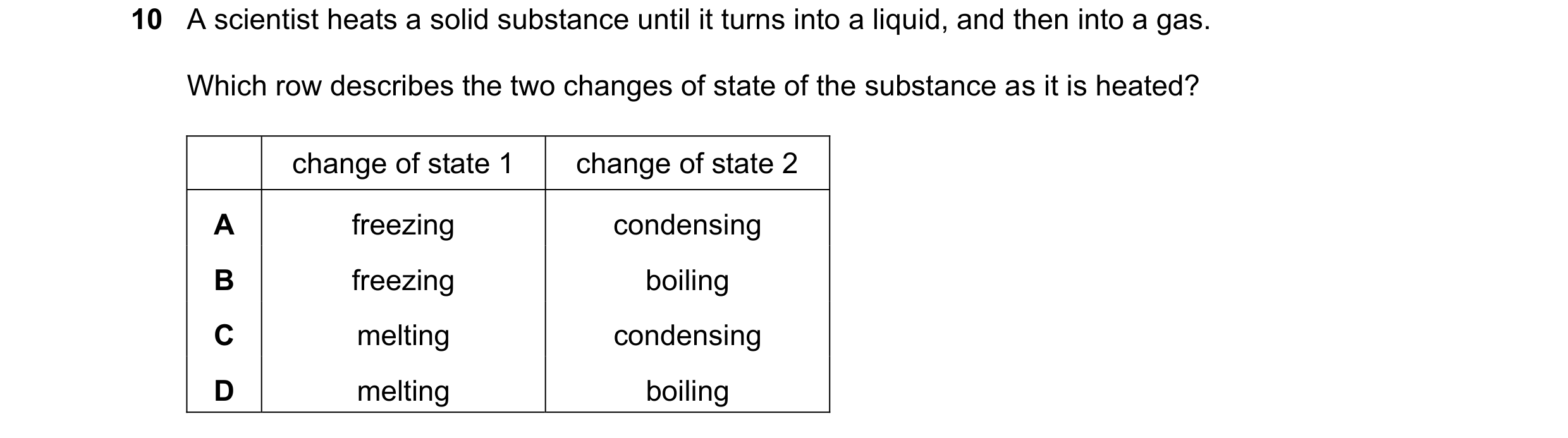 80 / 83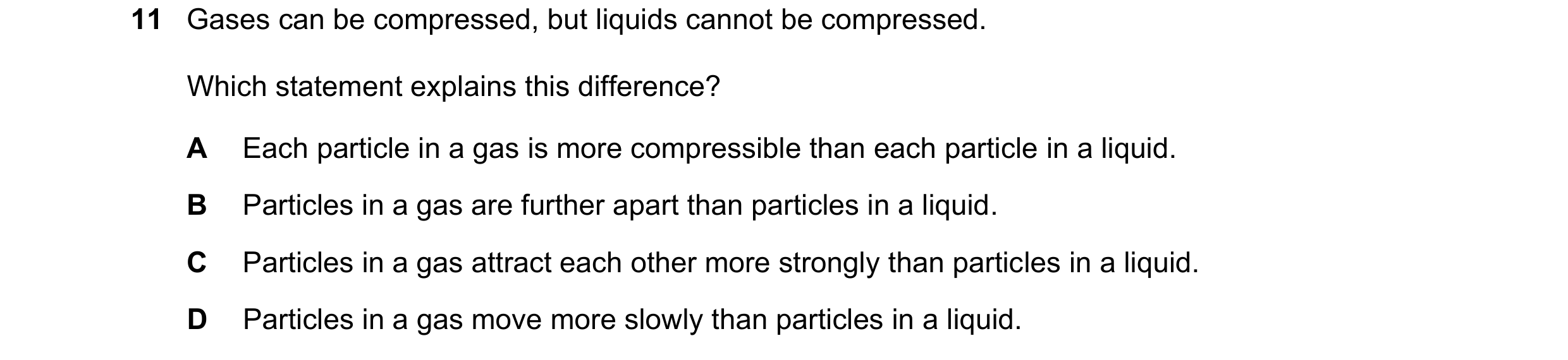
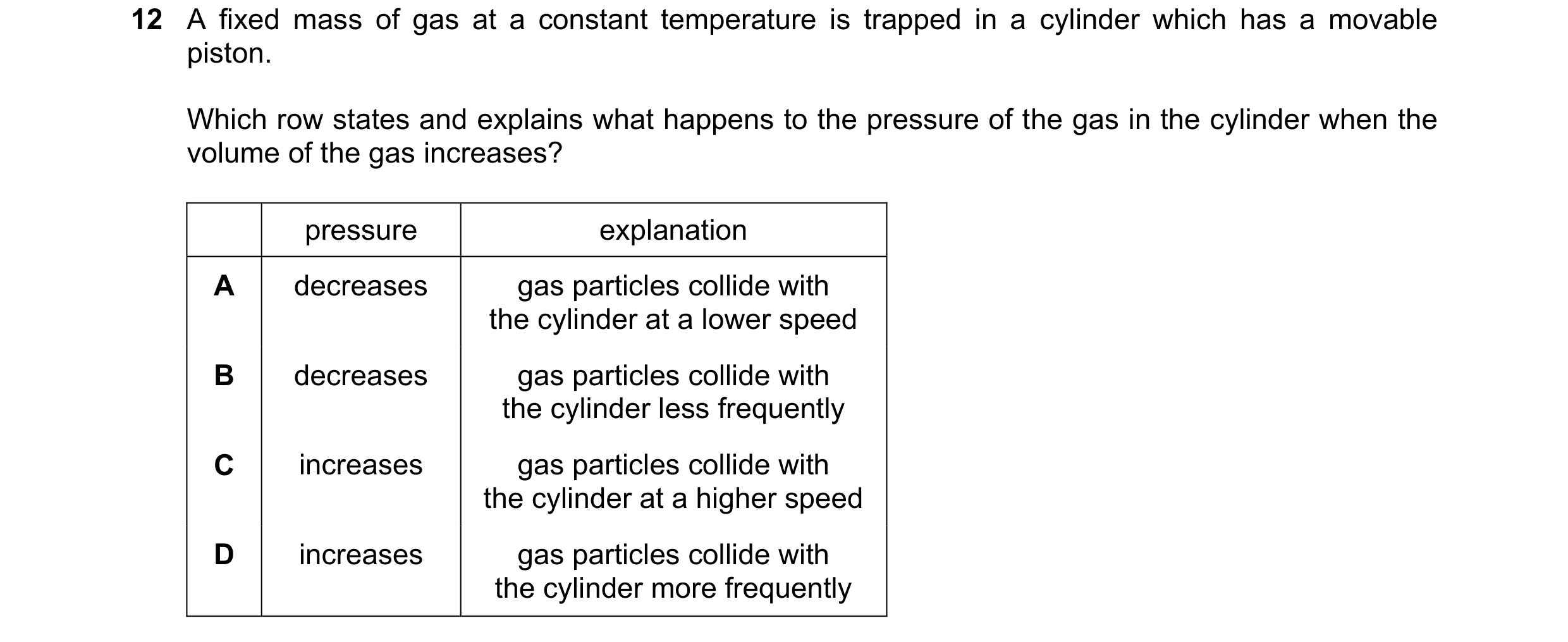
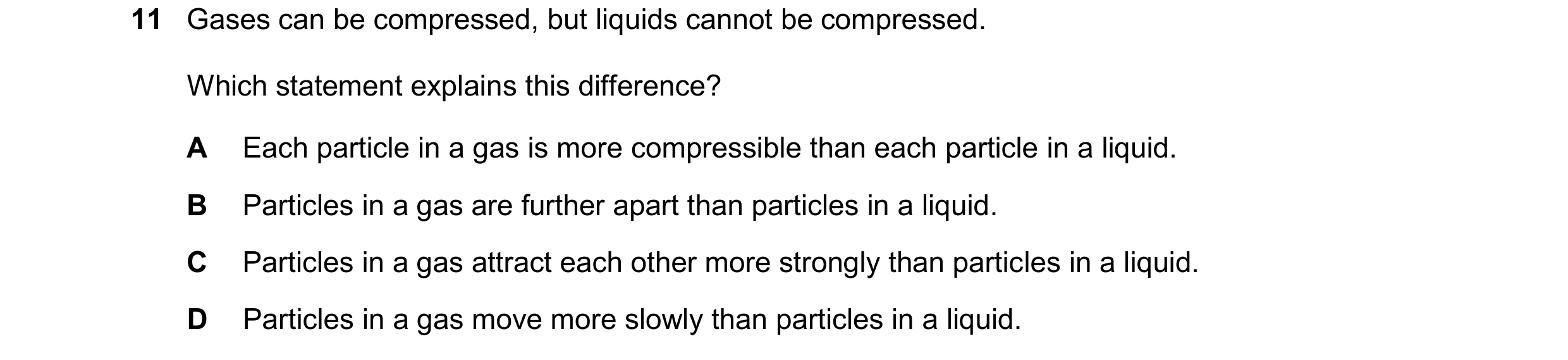
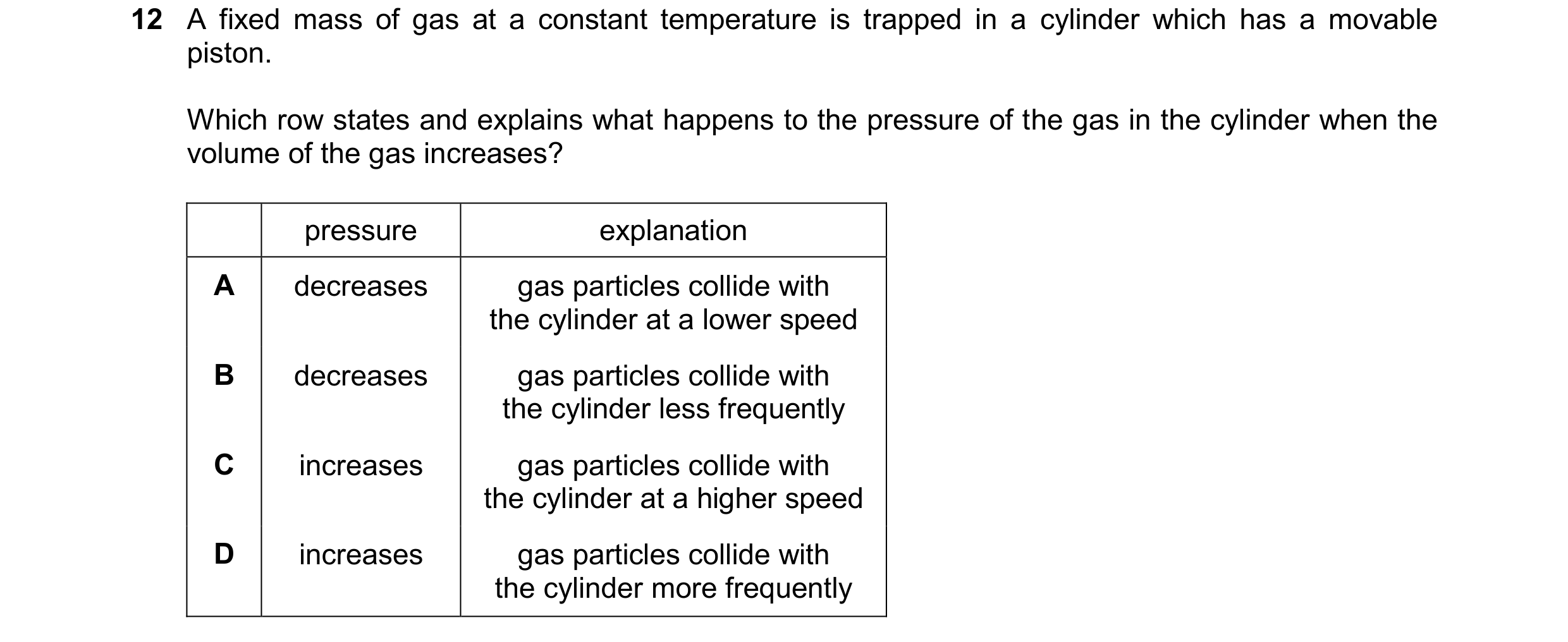 81 / 83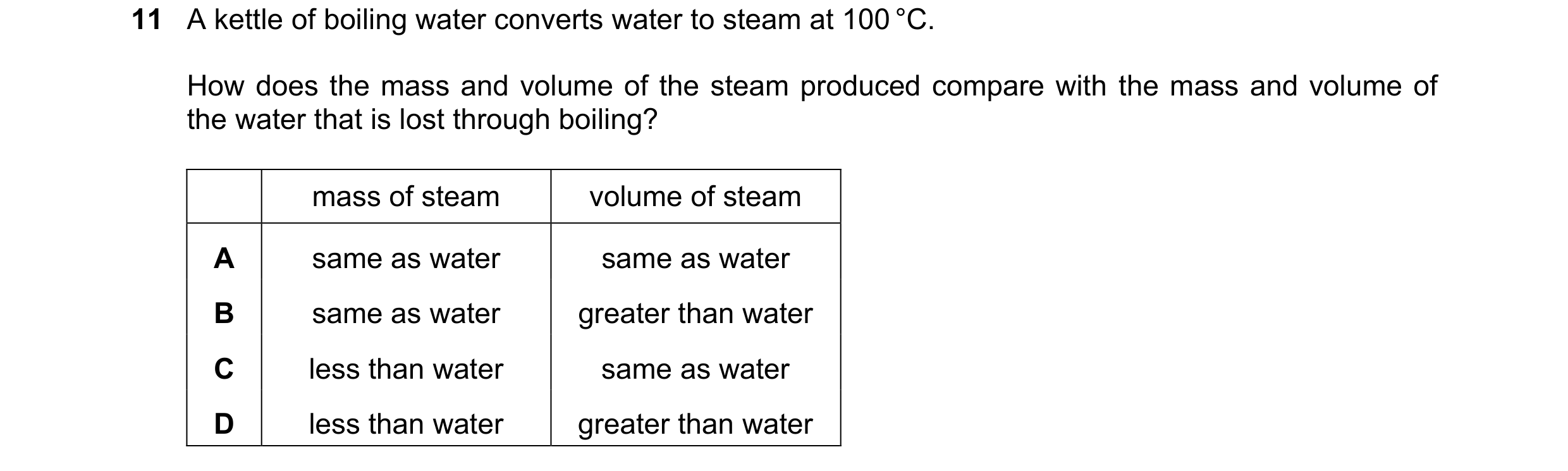
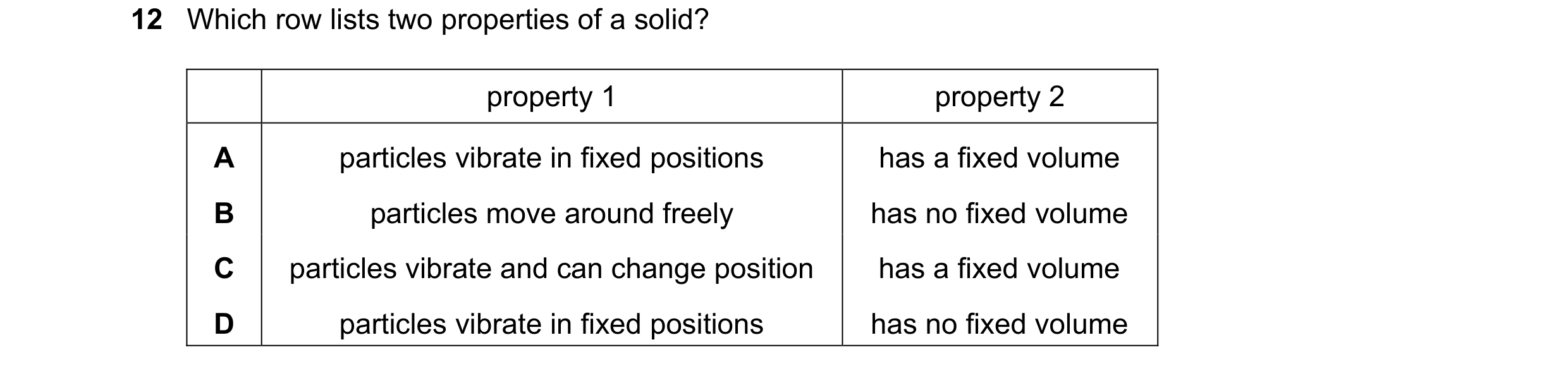
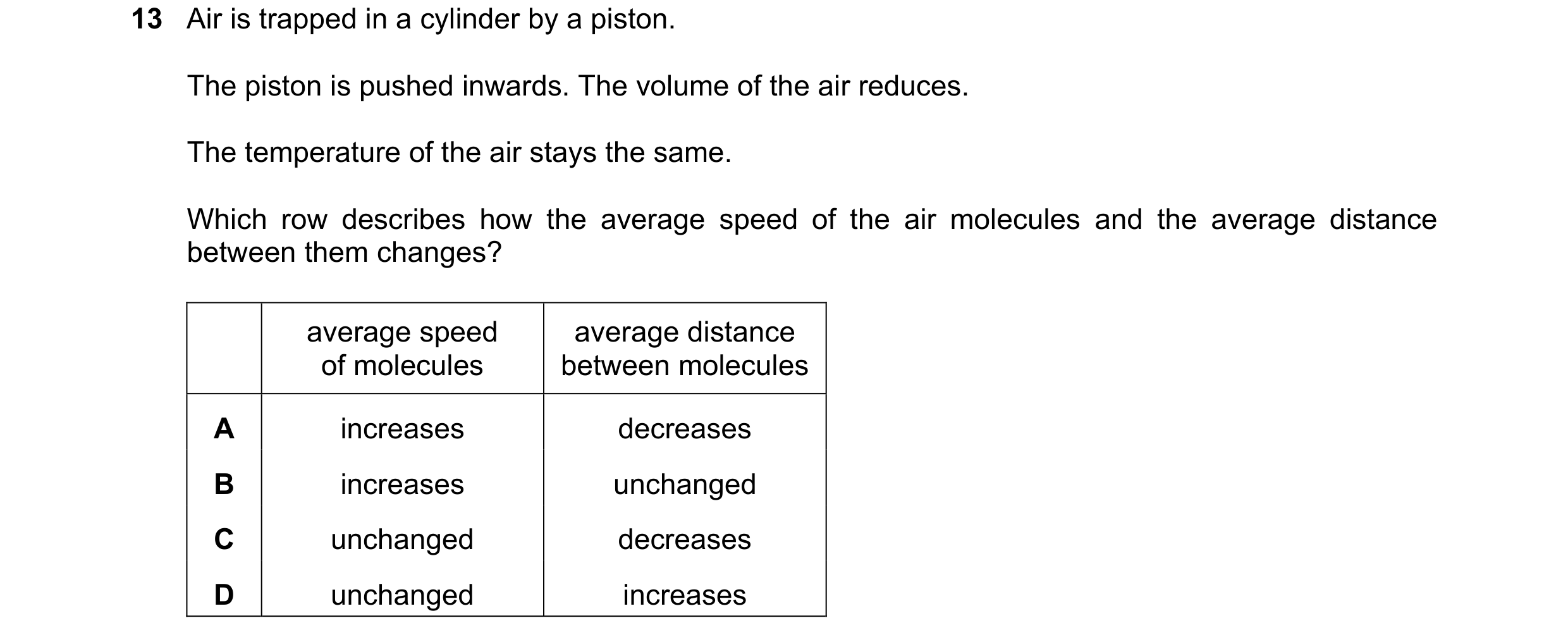
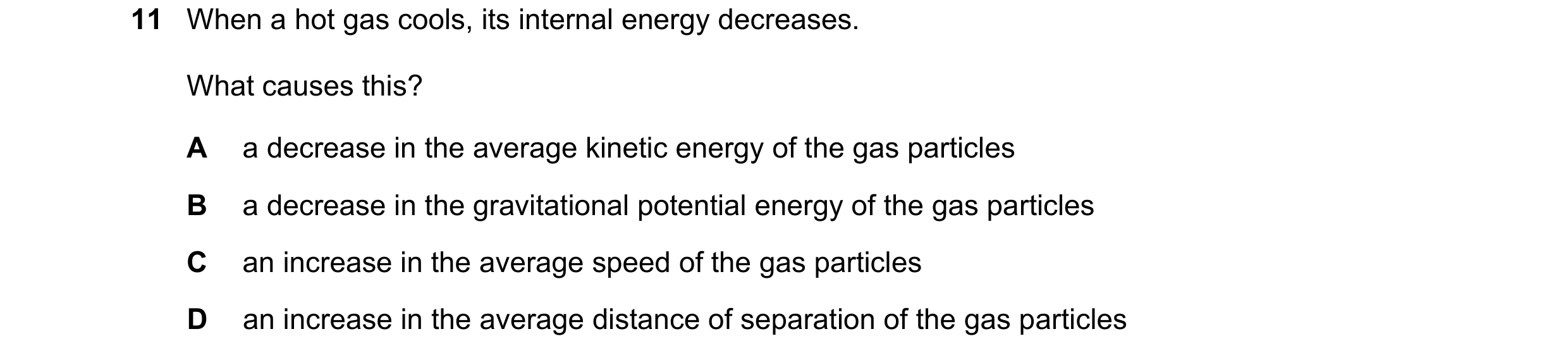 82 / 83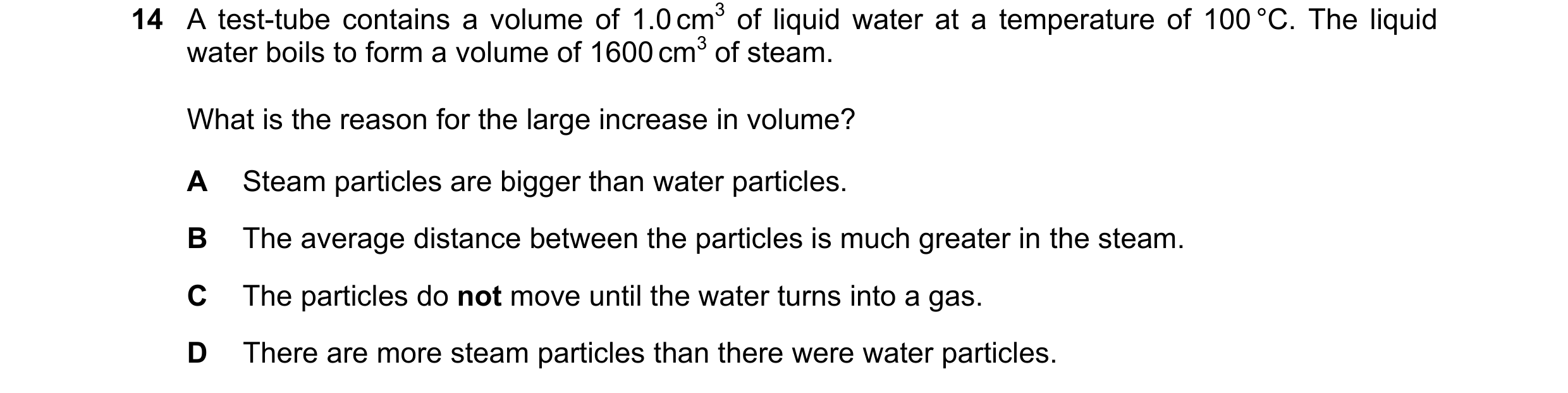
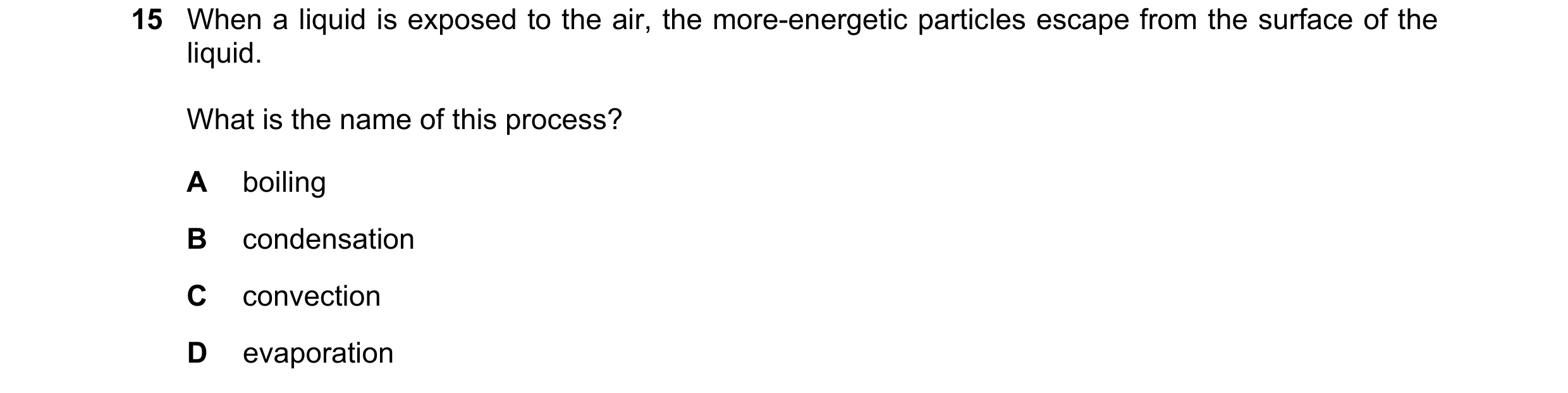 83 / 83