Questions as text
Q1 · Water can exist as ice, liquid water and steam 0625/32 Feb/March 2017
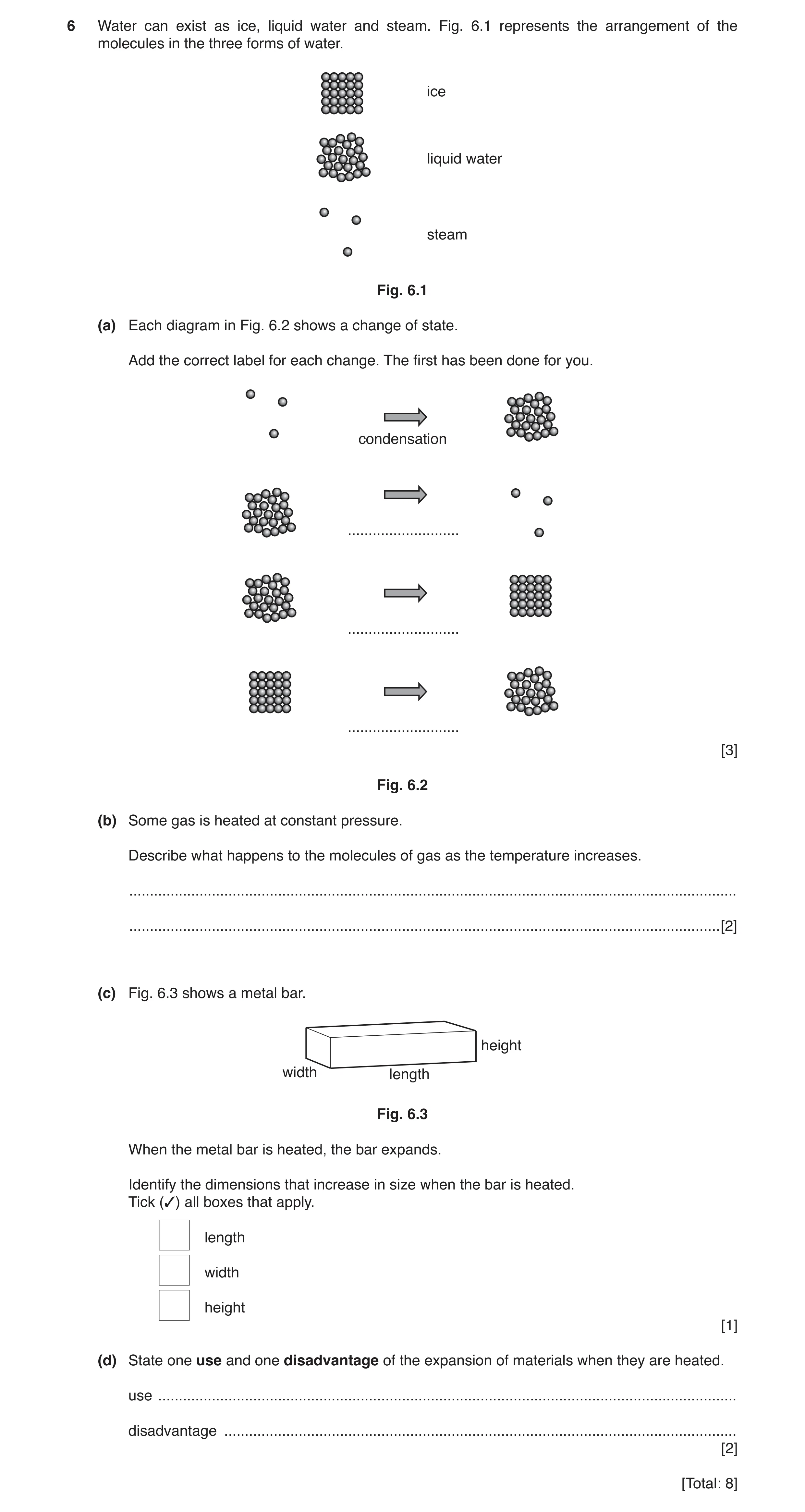
6 Water can exist as ice, liquid water and steam. Fig. 6.1 represents the arrangement of the molecules in the three forms of water. ice liquid water steam Fig. 6.1 (a) Each diagram in Fig. 6.2 shows a change of state. Add the correct label for each change. The first has been done for you. condensation … … … [3] Fig. 6.2 (b) Some gas is heated at constant pressure. Describe what happens to the molecules of gas as the temperature increases. … … [2] (c) Fig. 6.3 shows a metal bar. height width length Fig. 6.3 When the metal bar is heated, the bar expands. Identify the dimensions that increase in size when the bar is heated. Tick (3) all boxes that apply. length width height [1] (d) State one use and one disadvantage of the expansion of materials when they are heated. use … disadvantage … [2] [Total: 8]
8 marks
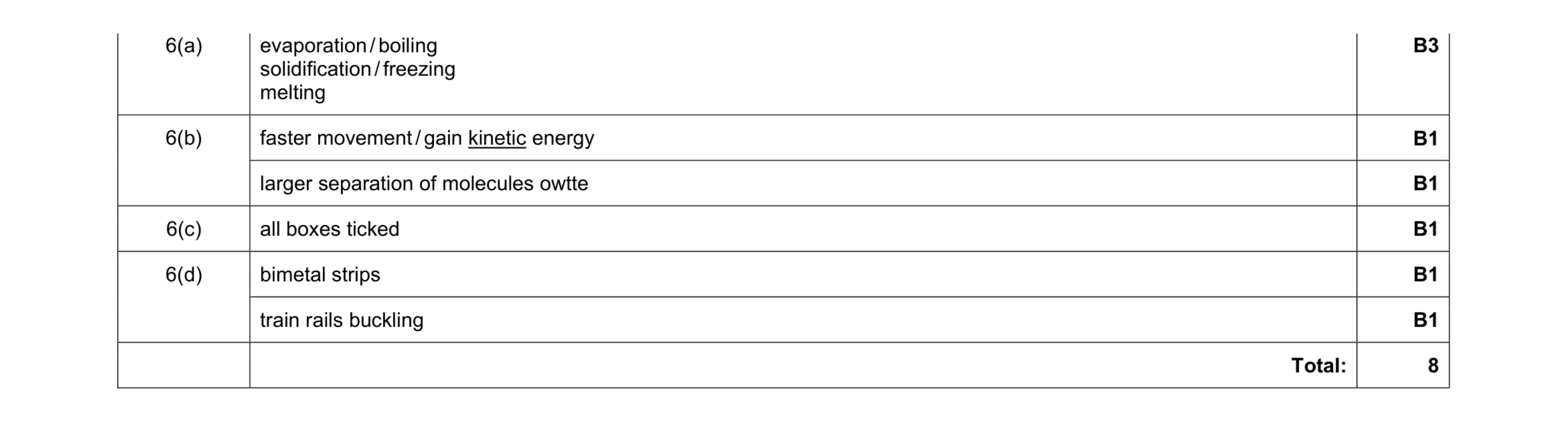
Mark scheme: 6(a) evaporation / boiling solidification / freezing melting B3 6(b) faster movement / gain kinetic energy B1 larger separation of molecules owtte B1 6(c) all boxes ticked B1 6(d) bimetal strips B1 train rails buckling B1 Total: 8
This question in 0625/32 Feb/March 2017
Q2 · Workers pouring liquid metal 0625/31 May/June 2017
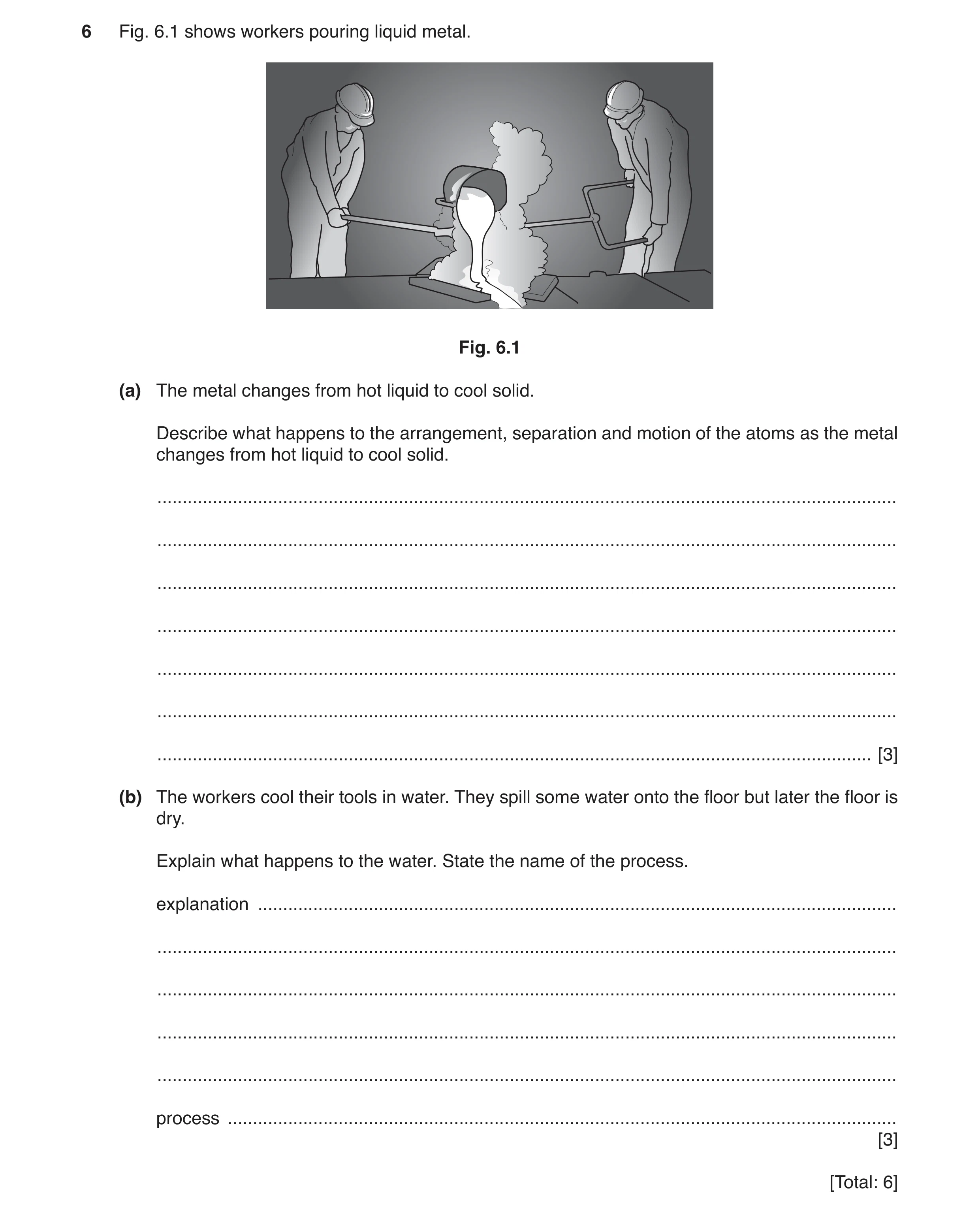
6 Fig. 6.1 shows workers pouring liquid metal. Fig. 6.1 (a) The metal changes from hot liquid to cool solid. Describe what happens to the arrangement, separation and motion of the atoms as the metal changes from hot liquid to cool solid. … … … … … … … [3] (b) The workers cool their tools in water. They spill some water onto the floor but later the floor is dry. Explain what happens to the water. State the name of the process. explanation … … … … … process … [3] [Total: 6]
6 marks
Mark scheme: 6(a) more regular/uniform arrangement/fixed position owtte B1 separation between atoms decreases/move closer/tightly packed B1 slower moving atoms/atoms vibrate (more slowly) B1 6(b) (water) molecules gain energy (from surroundings) B1 molecules escape from a liquid (surface) B1 evaporation B1 Total: 6
This question in 0625/31 May/June 2017
Q3 · A car tyre in contact with the road 0625/33 May/June 2017
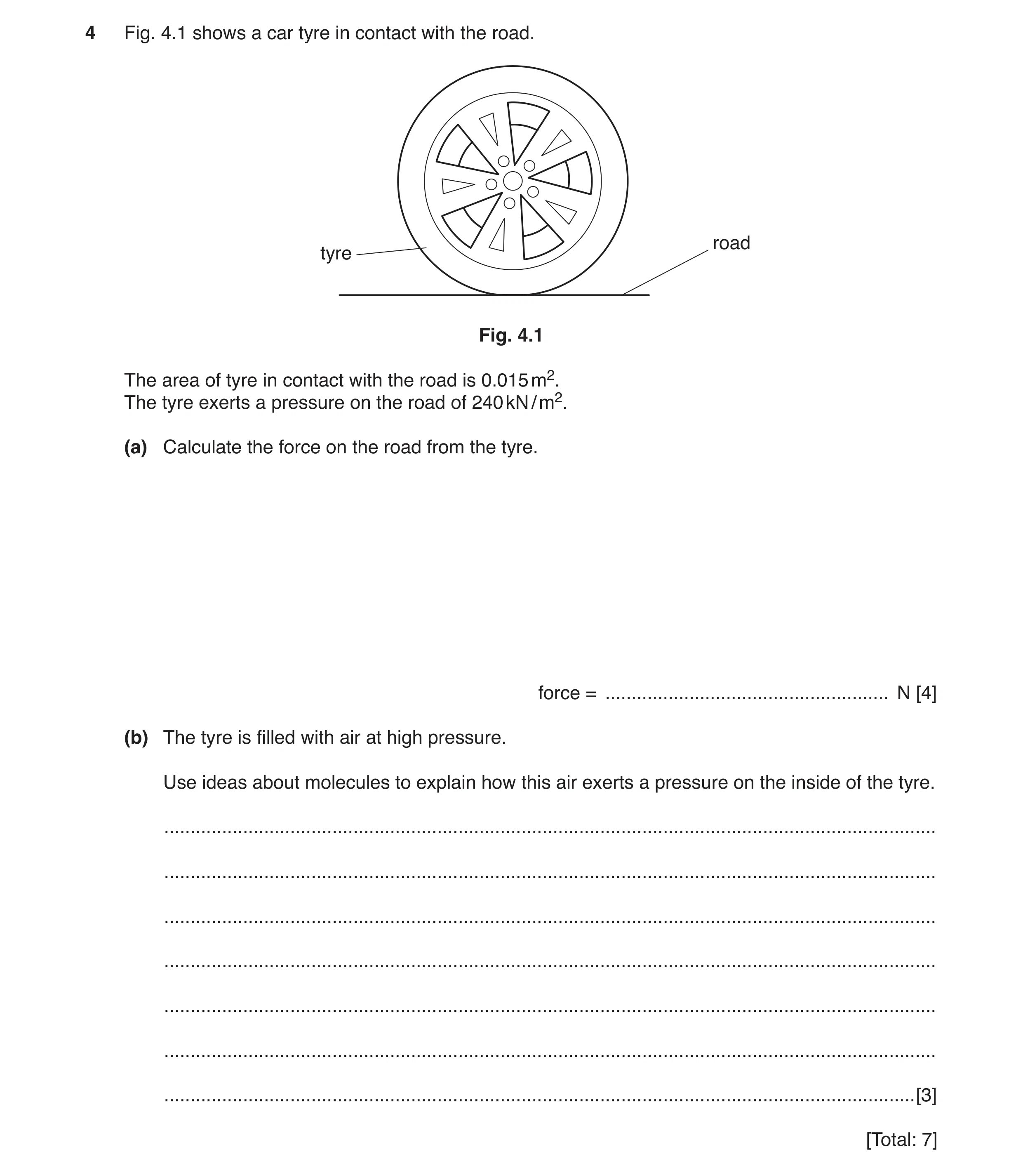
4 Fig. 4.1 shows a car tyre in contact with the road. road tyre Fig. 4.1 The area of tyre in contact with the road is 0.015 m2. The tyre exerts a pressure on the road of 240 kN / m2. (a) Calculate the force on the road from the tyre. force = … N [4] (b) The tyre is filled with air at high pressure. Use ideas about molecules to explain how this air exerts a pressure on the inside of the tyre. … … … … … … … [3] [Total: 7]
7 marks
Mark scheme: 4(a) B1 pressure = force ÷ area C1 transformation force = pressure × area C1 3600 (N) A1 4(b) any 3 from: molecules move about (randomly) collisions impacts with walls/surfaces (of tyre) idea of force produced (by bombarding molecules) idea of pressure as force on an area B3 Total: 7
This question in 0625/33 May/June 2017
Question 4 0625/31 Oct/Nov 2017
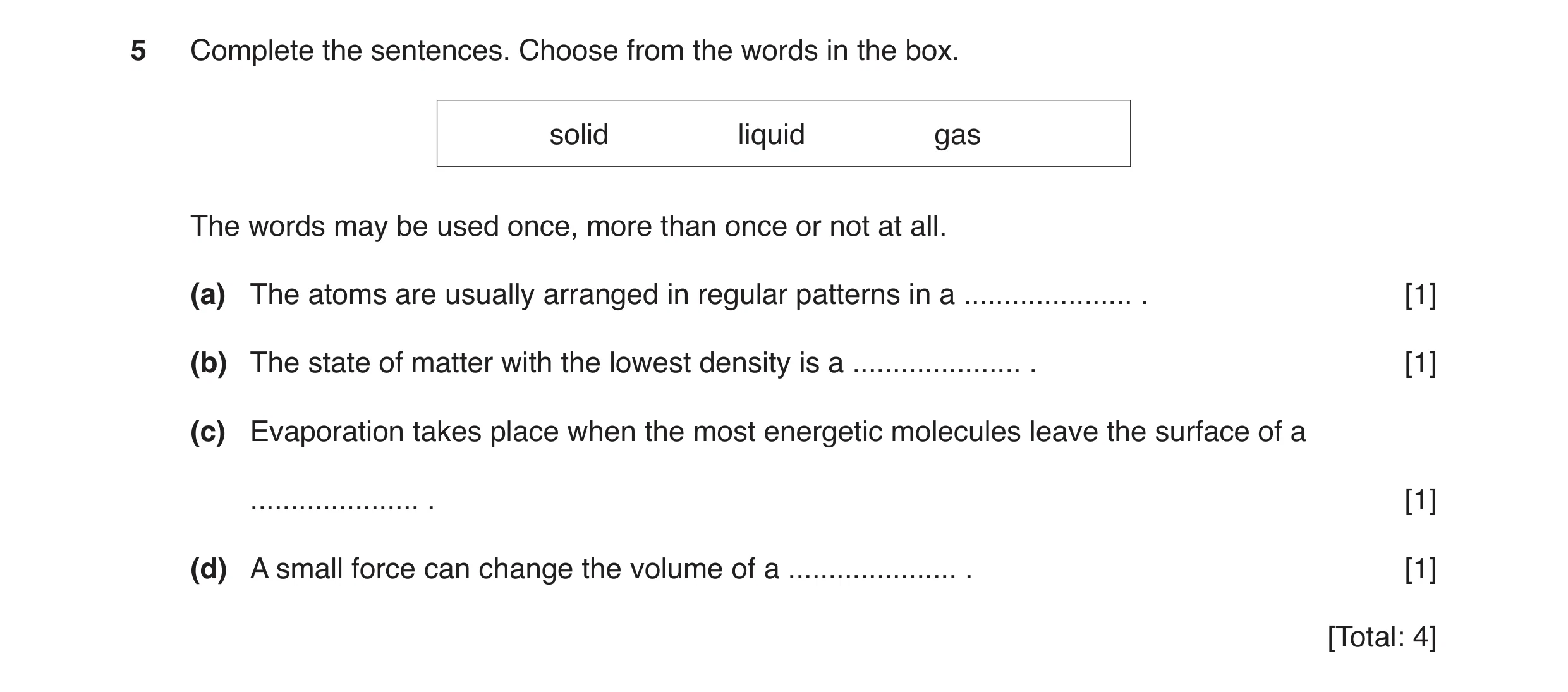
5 Complete the sentences. Choose from the words in the box. solid liquid gas The words may be used once, more than once or not at all. (a) The atoms are usually arranged in regular patterns in a … . [1] (b) The state of matter with the lowest density is a … . [1] (c) Evaporation takes place when the most energetic molecules leave the surface of a … . [1] (d) A small force can change the volume of a … . [1] [Total: 4]
4 marks
Mark scheme: 5(a) solid B1 5(b) gas B1 5(c) liquid B1 5(d) gas B1
This question in 0625/31 Oct/Nov 2017
Q5 · A vehicle may have tyres of type A or type B, as shown in Fig 0625/33 Oct/Nov 2017
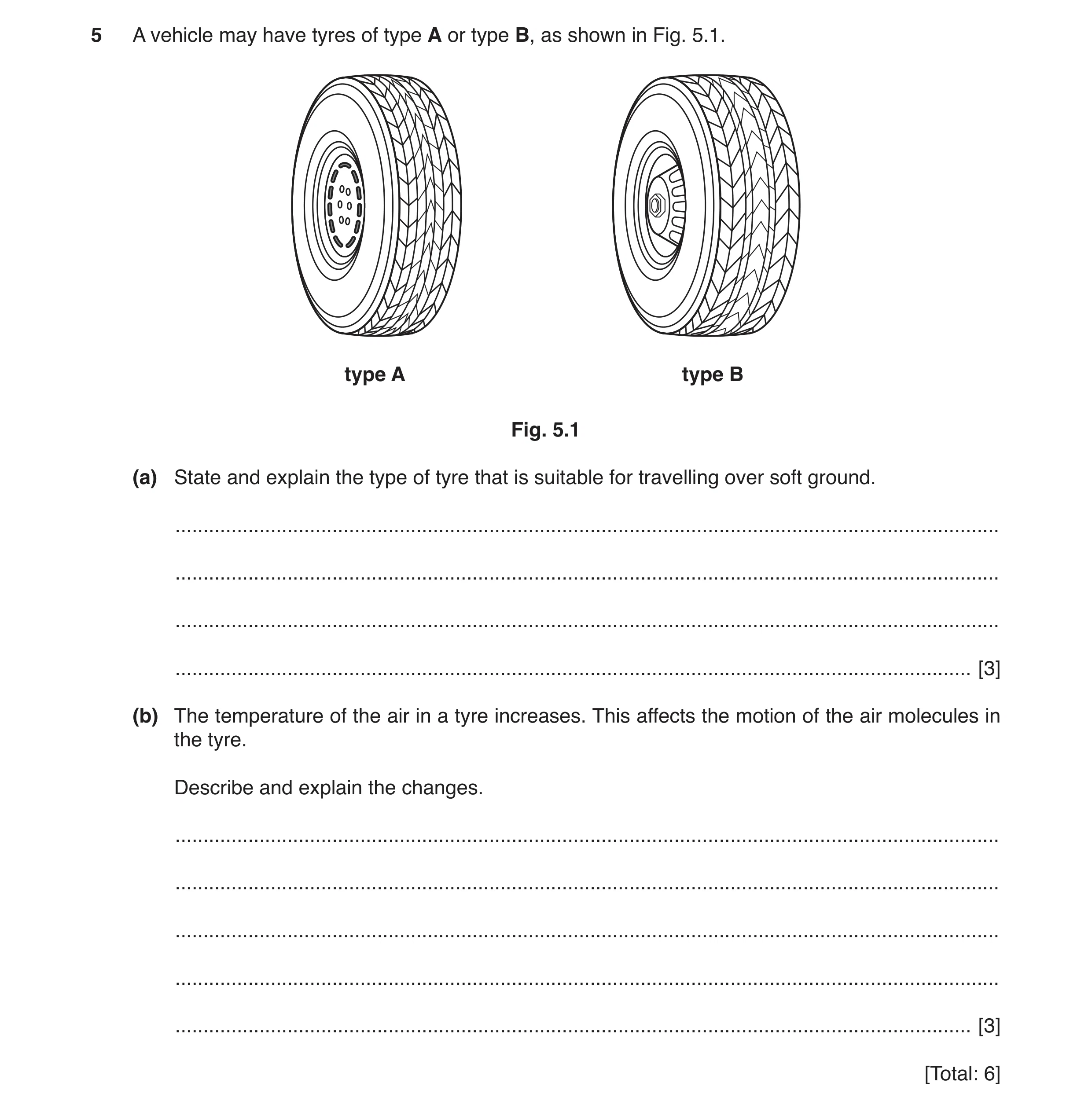
5 A vehicle may have tyres of type A or type B, as shown in Fig. 5.1. type A type B Fig. 5.1 (a) State and explain the type of tyre that is suitable for travelling over soft ground. … … … … [3] (b) The temperature of the air in a tyre increases. This affects the motion of the air molecules in the tyre. Describe and explain the changes. … … … … … [3] [Total: 6]
6 marks
Mark scheme: 5(a) Tyre B B1 larger / bigger surface area B1 less pressure (on ground) / weight distributed B1 5(b) molecules gain kinetic energy / move faster B1 more (frequent) / harder collisions (with tyre) B1 Increased / greater pressure (on tyre) B1
This question in 0625/33 Oct/Nov 2017
Question 6 0625/31 May/June 2018
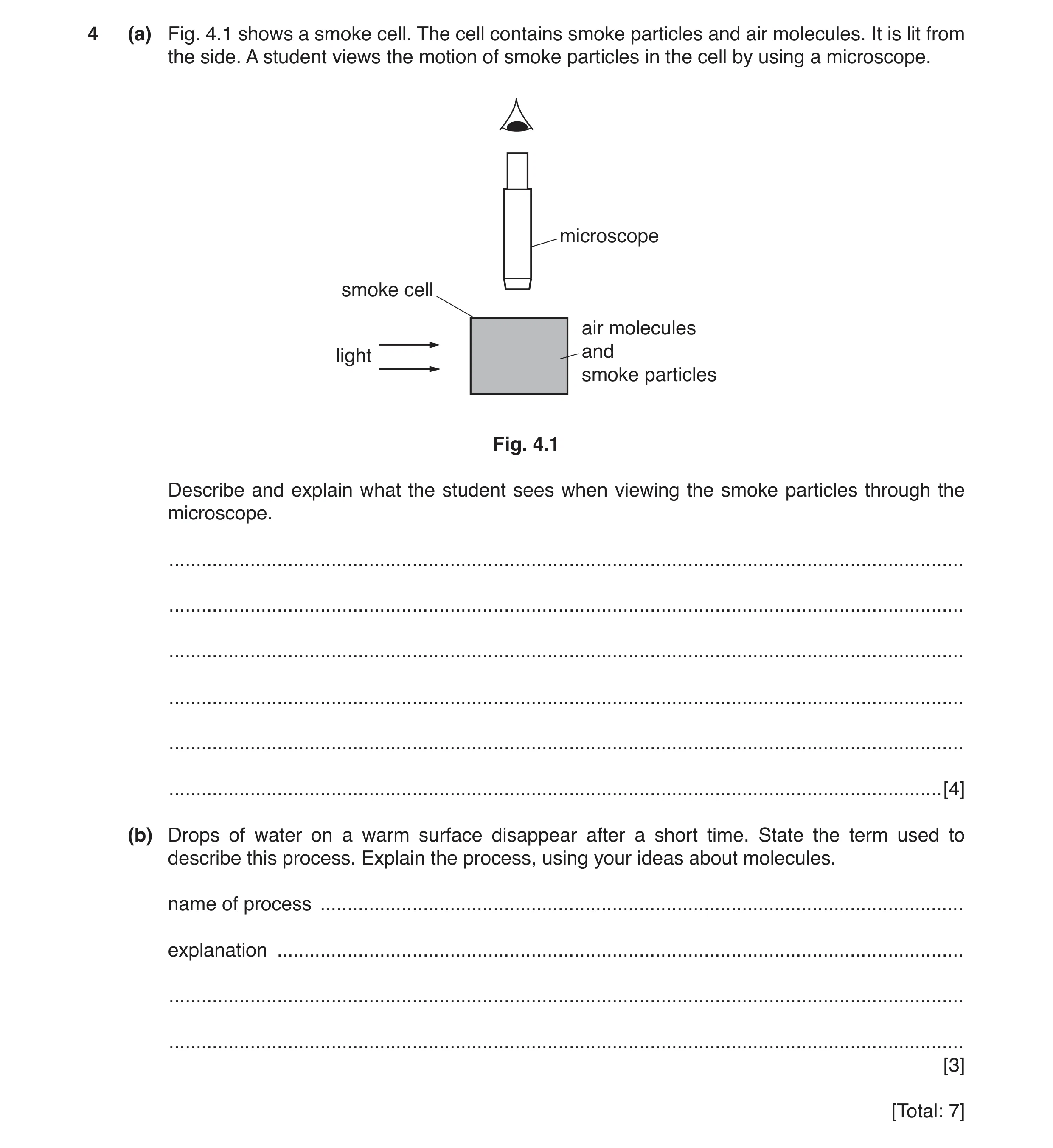
4 (a) Fig. 4.1 shows a smoke cell. The cell contains smoke particles and air molecules. It is lit from the side. A student views the motion of smoke particles in the cell by using a microscope. microscope smoke cell air molecules light and smoke particles Fig. 4.1 Describe and explain what the student sees when viewing the smoke particles through the microscope. … … … … … … [4] (b) Drops of water on a warm surface disappear after a short time. State the term used to describe this process. Explain the process, using your ideas about molecules. name of process … explanation … … … [3] [Total: 7]
7 marks
Mark scheme: 4(a) Any four from: specs/dots (of light) (smoke/air particles) moving (smoke/air particles) randomly (because fast moving ) air molecules collide with smoke particles (producing)Brownian motion 4 4(b) evaporate/evaporation 1 high(er) energy/enough energy/fast(er) moving molecules OR molecules with great(er) KE 1 escape (from the water surface) 1
This question in 0625/31 May/June 2018
Q7 · A metal can containing air 0625/33 May/June 2018
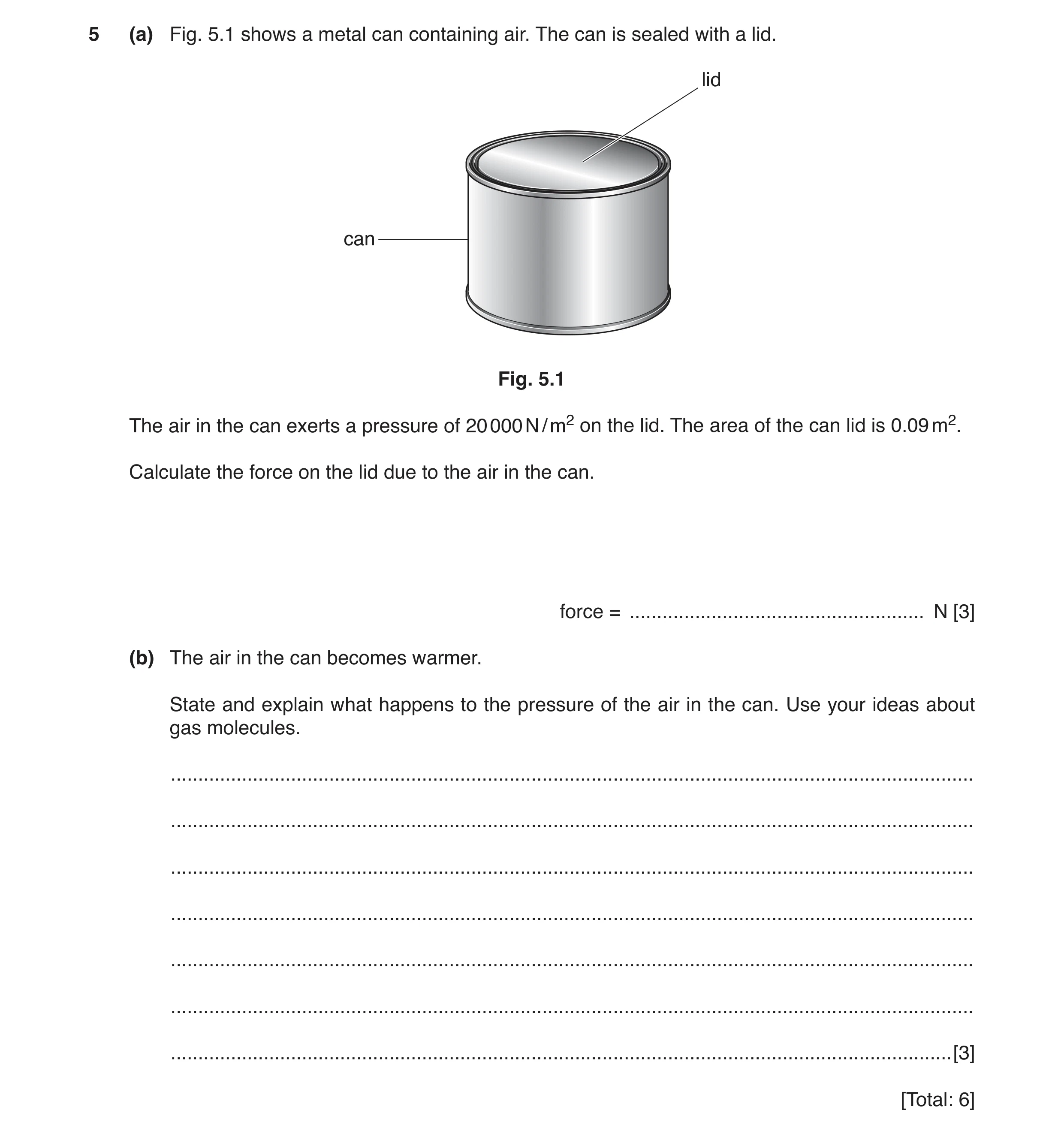
5 (a) Fig. 5.1 shows a metal can containing air. The can is sealed with a lid. lid can Fig. 5.1 The air in the can exerts a pressure of 20 000 N / m2 on the lid. The area of the can lid is 0.09 m2. Calculate the force on the lid due to the air in the can. force = … N [3] (b) The air in the can becomes warmer. State and explain what happens to the pressure of the air in the can. Use your ideas about gas molecules. … … … … … … … [3] [Total: 6]
6 marks
Mark scheme: 5(a) 1 20 000 × 0.009 1 1800 (N) 1 5(b) pressure increases 1 any two from: molecules move faster/have more ke collide harder/more often (with walls of can) (change in momentum due to) collisions impart(s) force on can walls 2
This question in 0625/33 May/June 2018
Q8 · A student draws diagrams that represent three states of matter, as shown in Fig 0625/31 Oct/Nov 2018
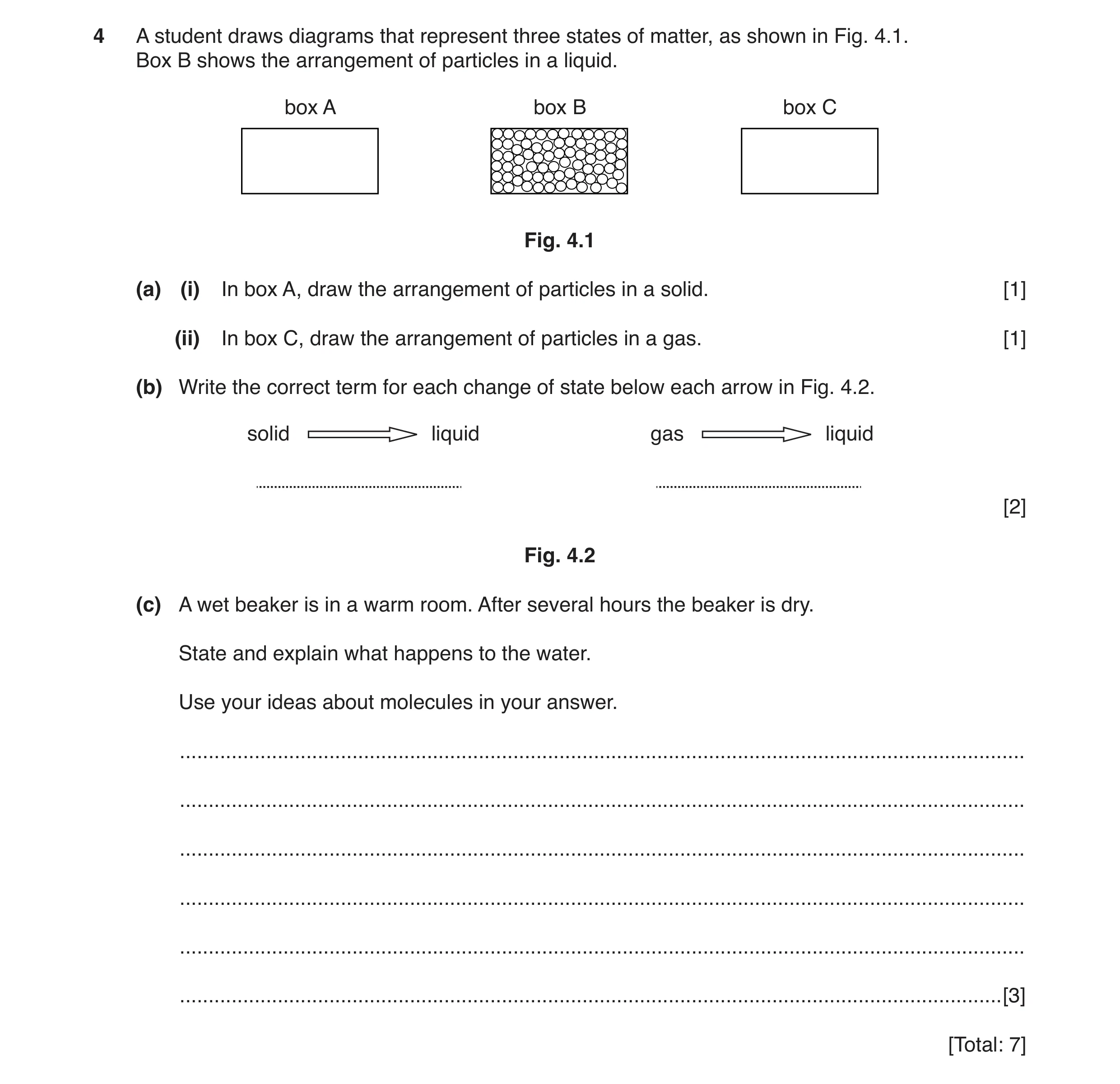
4 A student draws diagrams that represent three states of matter, as shown in Fig. 4.1. Box B shows the arrangement of particles in a liquid. box A box B box C Fig. 4.1 (a) (i) In box A, draw the arrangement of particles in a solid. [1] (ii) In box C, draw the arrangement of particles in a gas. [1] (b) Write the correct term for each change of state below each arrow in Fig. 4.2. solid liquid gas liquid [2] Fig. 4.2 (c) A wet beaker is in a warm room. After several hours the beaker is dry. State and explain what happens to the water. Use your ideas about molecules in your answer. … … … … … … [3] [Total: 7]
7 marks
Mark scheme: 4(a)(i) regular arrangement of atoms in LH box regular arrangement of atoms in LH box B1 4(a)(ii) few atoms with no pattern in RH box B1 4(b) melting below arrow on left B1 condensing / condensation below arrow on right B1 4(c) evaporate / evaporation seen anywhere in explanation B1 Any two from: atoms (at the surface) gain KE fastest molecules / molecules with most energy (are able to) escape from surface B2
This question in 0625/31 Oct/Nov 2018
Q9 · A flask contains gas with a pressure lower than atmospheric pressure 0625/32 Oct/Nov 2018
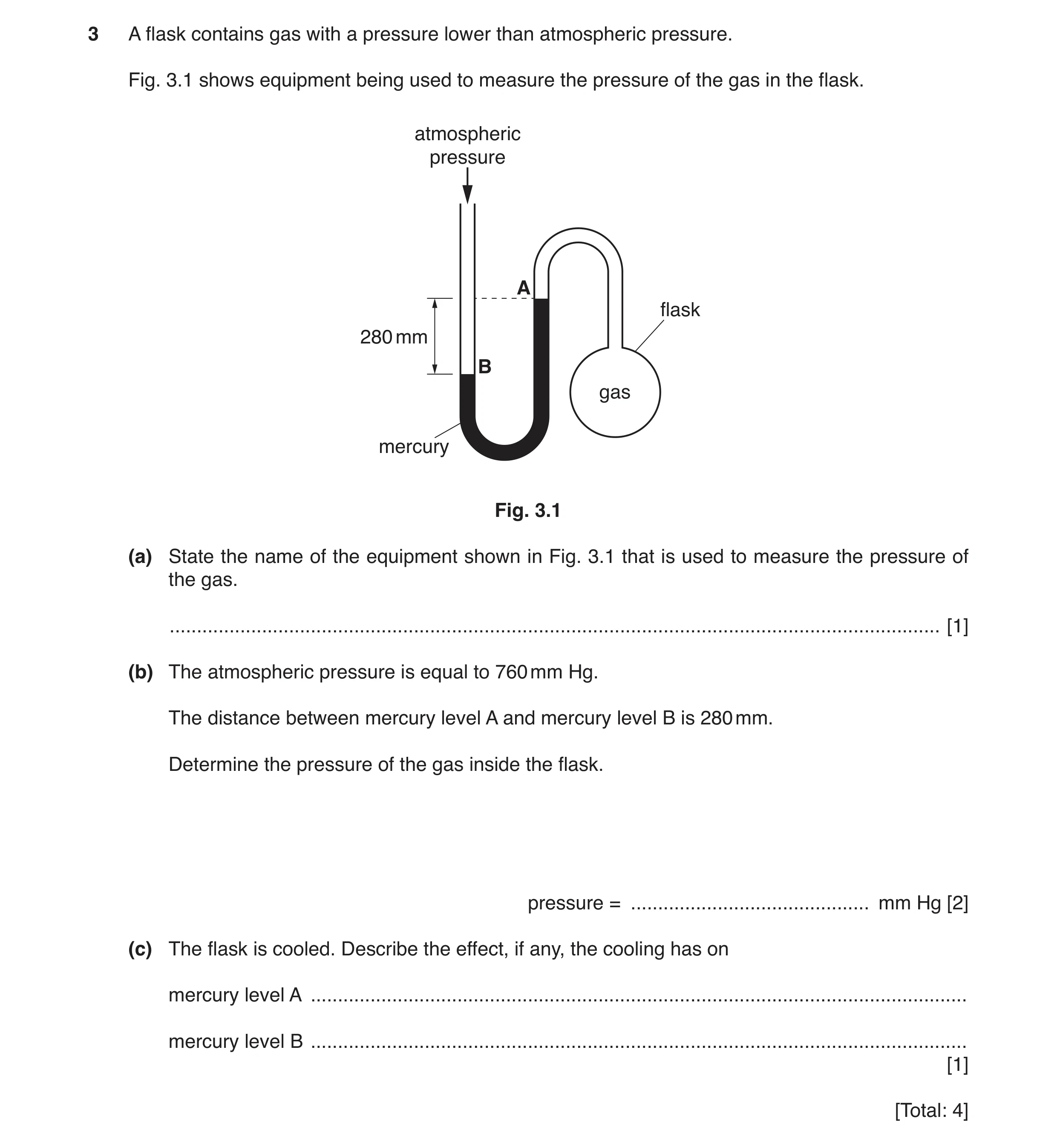
3 A flask contains gas with a pressure lower than atmospheric pressure. Fig. 3.1 shows equipment being used to measure the pressure of the gas in the flask. atmospheric pressure A flask 280 mm B gas mercury Fig. 3.1 (a) State the name of the equipment shown in Fig. 3.1 that is used to measure the pressure of the gas. … [1] (b) The atmospheric pressure is equal to 760 mm Hg. The distance between mercury level A and mercury level B is 280 mm. Determine the pressure of the gas inside the flask. pressure = … mm Hg [2] (c) The flask is cooled. Describe the effect, if any, the cooling has on mercury level A … mercury level B … [1] [Total: 4]
4 marks
Mark scheme: 3(a) manometer B1 3(b) 760–280 C1 480 (mm Hg) A1 3(c) (level A) up (level B) down B1
This question in 0625/32 Oct/Nov 2018
Q10 · State the meaning of the term thermal capacity 0625/32 Oct/Nov 2018
5 (a) State the meaning of the term thermal capacity. … … [1] (b) When a material is cooled or heated there may be a change of state. Complete each statement by using words from the box. Each word can be used once, more than once or not at all. condensation evaporation freezing melting The change from solid to liquid is called … The change from liquid to gas is called … The change from liquid to solid is called … The change from gas to liquid is called … . [4] (c) A student heats a gas and keeps its volume constant. State and explain the effect on the pressure of the gas. In your answer, use your ideas about molecules. … … … … [3] [Total: 8]
8 marks
Mark scheme: 5(a) B1 5(b) melting evaporation or boiling freezing condensation or condensing B4 5(c) increased pressure B1 more collisions or hit walls of container harder or more often B1 molecules move faster OR have more (kinetic) energy B1
This question in 0625/32 Oct/Nov 2018
Question 11 0625/33 Oct/Nov 2018
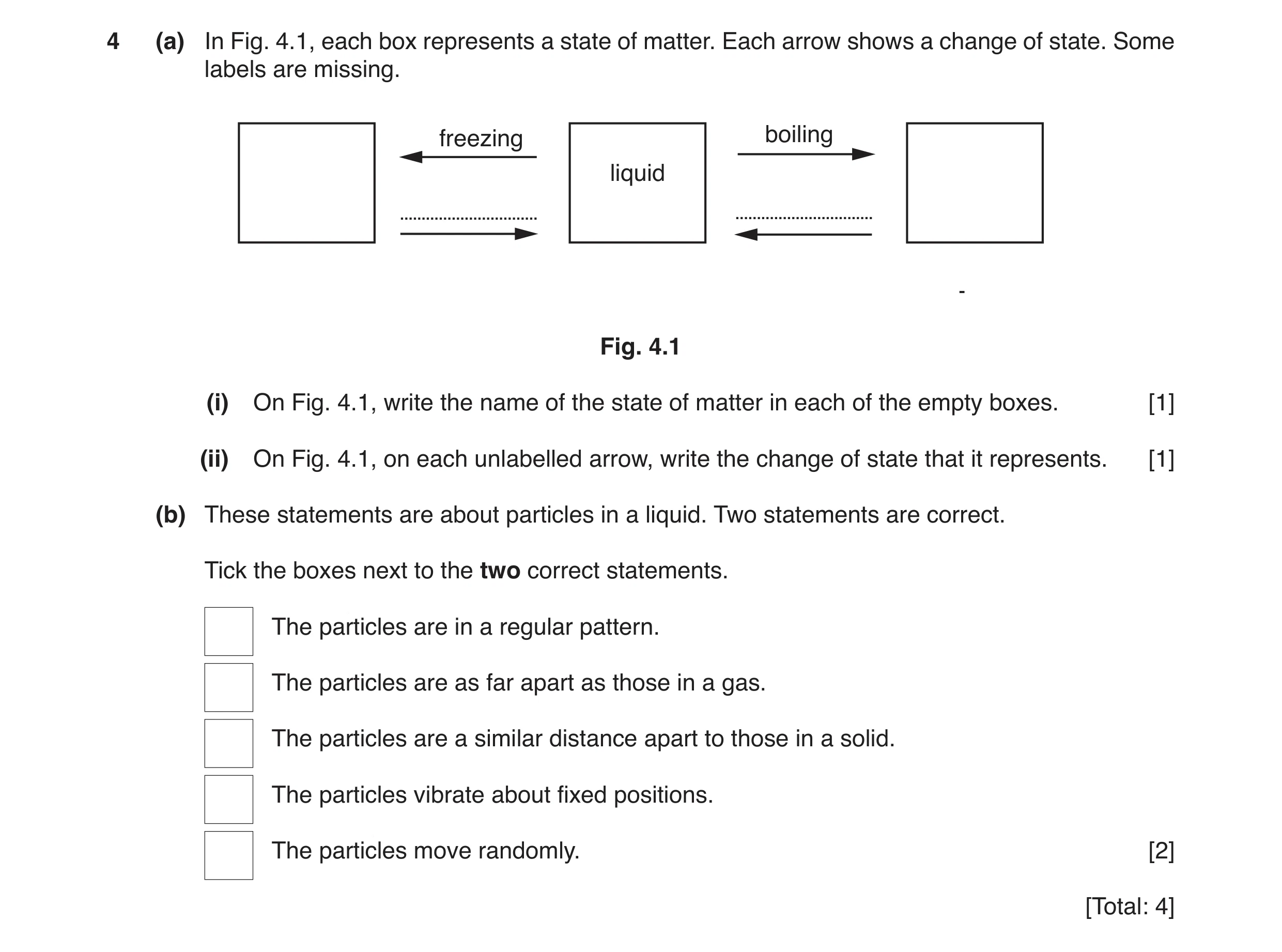
4 (a) In Fig. 4.1, each box represents a state of matter. Each arrow shows a change of state. Some labels are missing. freezing boiling liquid Fig. 4.1 (i) On Fig. 4.1, write the name of the state of matter in each of the empty boxes. [1] (ii) On Fig. 4.1, on each unlabelled arrow, write the change of state that it represents. [1] (b) These statements are about particles in a liquid. Two statements are correct. Tick the boxes next to the two correct statements. The particles are in a regular pattern. The particles are as far apart as those in a gas. The particles are a similar distance apart to those in a solid. The particles vibrate about fixed positions. The particles move randomly. [2] [Total: 4]
4 marks
Mark scheme: 4(a)(i) solid AND gas / vapour B1 4(a)(ii) melting AND condensing B1 4(b) 3rd box ticked: The particles are a similar distance apart as those in a solid. B1 5th bottom box ticked: The particles move randomly. B1
This question in 0625/33 Oct/Nov 2018
Q12 · A liquid-in-glass thermometer is placed in some ice made from pure water 0625/31 May/June 2019
6 A liquid-in-glass thermometer is placed in some ice made from pure water. The ice is heated. It changes to water and then to steam. The graph in Fig. 6.1 shows how the temperature varies with time. The values of temperature are missing from the y-axis. temperature / °C Y X 0 10 20 30 40 50 60 70 time / minutes Fig. 6.1 (a) On Fig. 6.1, suggest a value for the temperature at each of the three points marked on the y-axis. Write a value in each of the boxes. [2] (b) In both section X and section Y the line on the graph is horizontal. For each section, state the name for the process taking place and explain what is happening to the molecules. (i) section X name … explanation … … … … [2] (ii) section Y name … explanation … … … … [2] [Total: 6]
6 marks
Mark scheme: 6(a) 0 AND 100 correctly labelled M1 36 A1 6(b)(i) Melting B1 Any one of: molecules gain energy molecule (begin to) break (some) bonds arrangement becomes irregular or arrangement changes B1 6(b)(ii) boiling B1 Any one of: molecules break (all) bonds molecules move (more) freely molecules become widely separated or far apart B1
This question in 0625/31 May/June 2019
Q13 · A student places a balloon filled with air next to a window, as shown in Fig 0625/32 May/June 2019
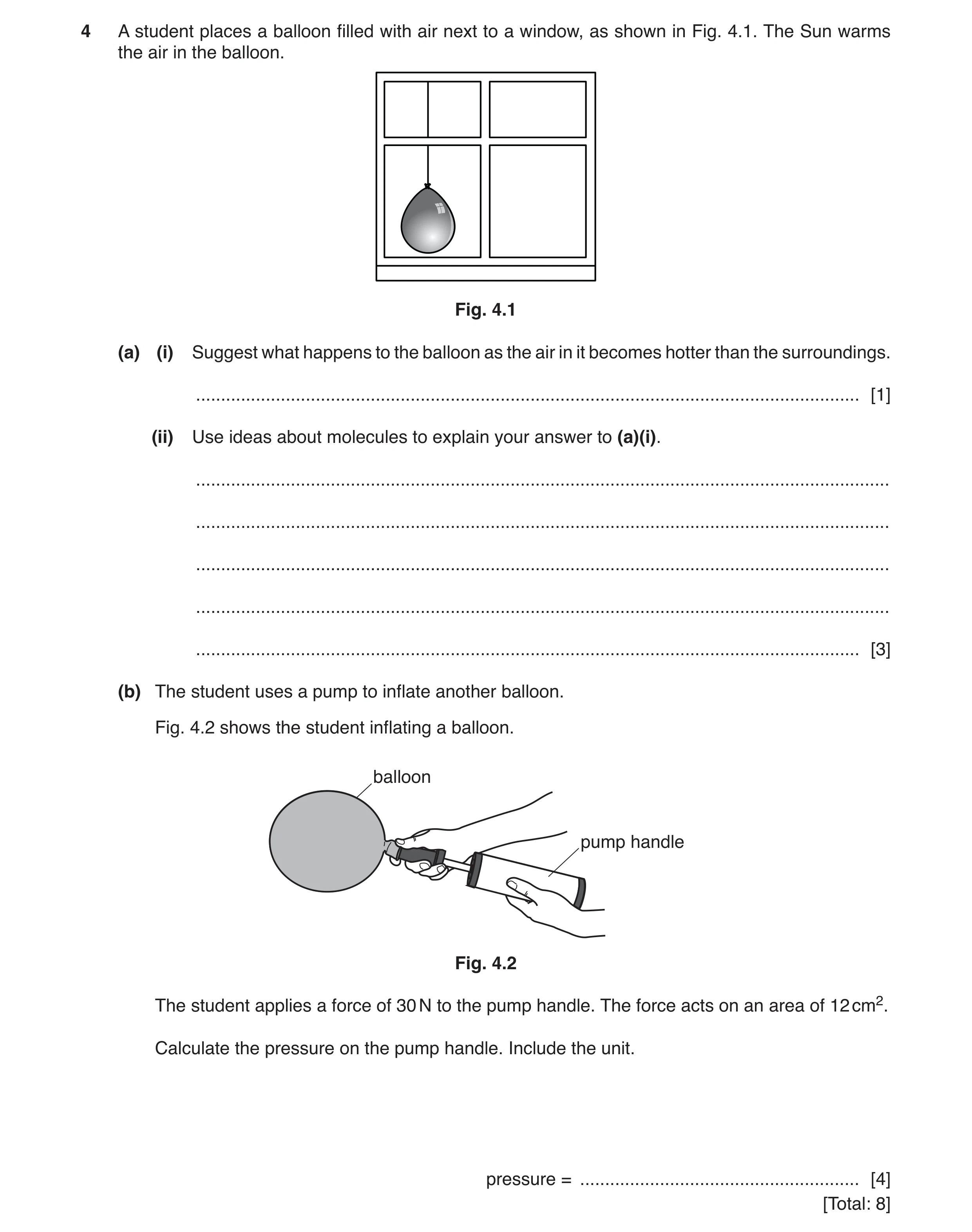
4 A student places a balloon filled with air next to a window, as shown in Fig. 4.1. The Sun warms the air in the balloon. Fig. 4.1 (a) (i) Suggest what happens to the balloon as the air in it becomes hotter than the surroundings. … [1] (ii) Use ideas about molecules to explain your answer to (a)(i). … … … … … [3] (b) The student uses a pump to inflate another balloon. Fig. 4.2 shows the student inflating a balloon. balloon pump handle Fig. 4.2 The student applies a force of 30 N to the pump handle. The force acts on an area of 12 cm2. Calculate the pressure on the pump handle. Include the unit. pressure = … [4] [Total: 8]
8 marks
Mark scheme: 4(a)(i) expand or increase in size/volume increase in pressure decrease in density B1 4(a)(ii) any 3 from: density (of air) is less molecules move faster/have more (kinetic) energy more collisions ( per second) collisions with surface OR balloon (owtte) more force (in collisions) molecules move (further) apart B3 Question Answer Marks 4(b) P = F/A in any form C1 30 ÷ 12 C1 2.5 A1 N/cm2 B1
This question in 0625/32 May/June 2019
Q14 · Solid, liquid and gas are three states of matter 0625/32 May/June 2019
7 (a) Solid, liquid and gas are three states of matter. For each state of matter describe the arrangement of the molecules. solid … … liquid … … gas … … [3] (b) A liquid is spilt on a bench in a warm laboratory. After a short time, the liquid disappears. (i) State the name of the process that causes the liquid to disappear. … [1] (ii) The process in (b)(i) causes a cooling effect. Explain why the cooling effect occurs. Use your ideas about molecules. … … … … … [3] [Total: 7]
7 marks
Mark scheme: 7(a) solid: molecules closely packed OR fixed positions OR can only vibrate B1 liquid: molecules loosely packed OR (more) random (arrangement) B1 gas: molecules widely spaced OR further apart than in liquid B1 7(b)(i) evaporation B1 7(b)(ii) Any 3 from: more energetic/faster molecules escape from the surface OR liquid (net/average) energy of remaining molecules is lower less (average) energy (gives) lower temperature molecules gain energy (from surroundings) speed of molecules increases B3
This question in 0625/32 May/June 2019
Q15 · All matter is made up of atoms and molecules 0625/32 Oct/Nov 2019
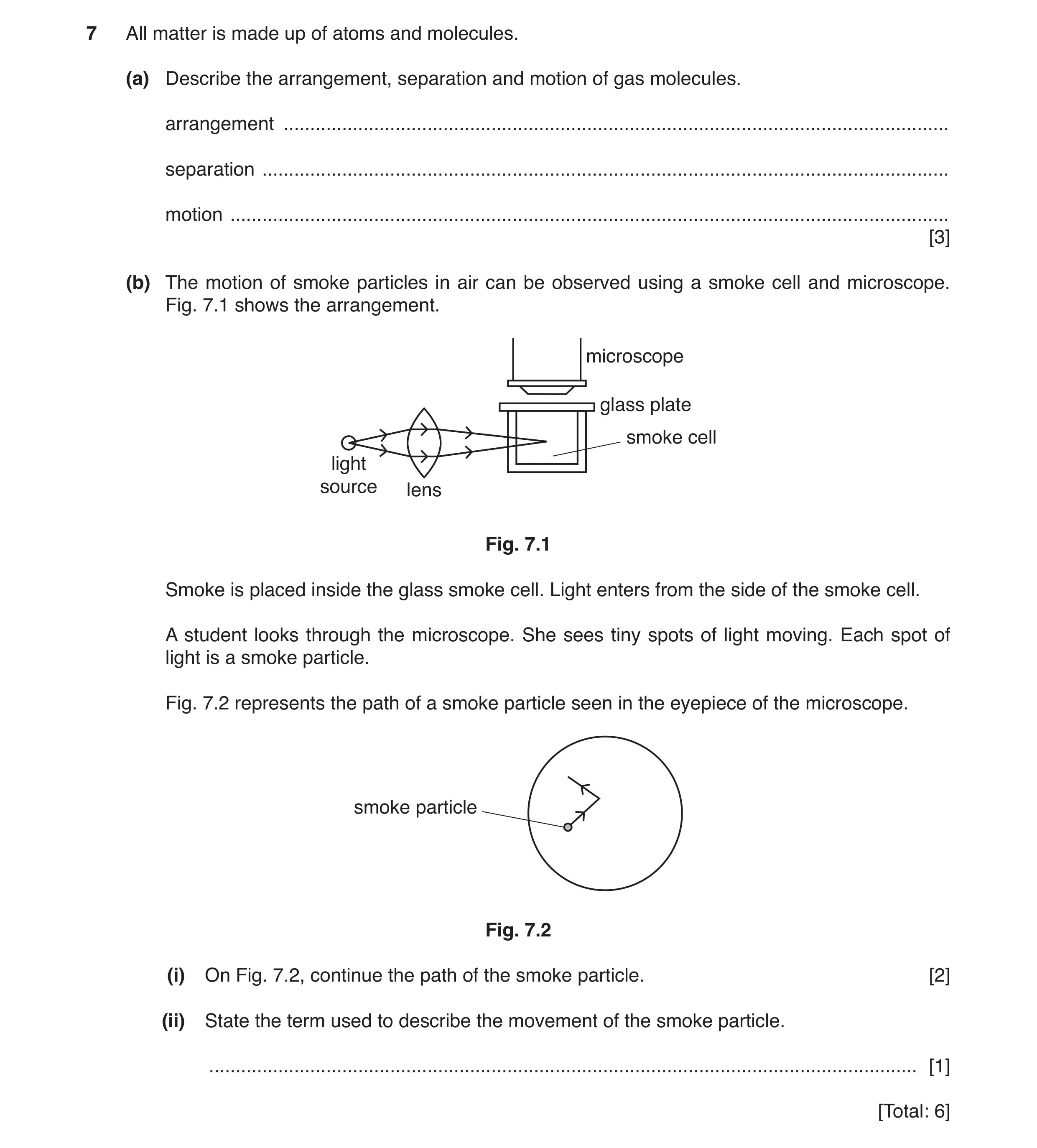
7 All matter is made up of atoms and molecules. (a) Describe the arrangement, separation and motion of gas molecules. arrangement … separation … motion … [3] (b) The motion of smoke particles in air can be observed using a smoke cell and microscope. Fig. 7.1 shows the arrangement. microscope glass plate smoke cell light source lens Fig. 7.1 Smoke is placed inside the glass smoke cell. Light enters from the side of the smoke cell. A student looks through the microscope. She sees tiny spots of light moving. Each spot of light is a smoke particle. Fig. 7.2 represents the path of a smoke particle seen in the eyepiece of the microscope. smoke particle Fig. 7.2 (i) On Fig. 7.2, continue the path of the smoke particle. [2] (ii) State the term used to describe the movement of the smoke particle. … [1] [Total: 6]
6 marks
Mark scheme: 7(a) no fixed position B1 (average) distance between molecules is greater than that of solids and liquids B1 molecules move in any direction owtte at high speeds B1 7(b)(i) change of direction B1 minimum of two straight lines drawn B1 7(b)(ii) Brownian (movement) B1
This question in 0625/32 Oct/Nov 2019
Q16 · The arrows on Fig 0625/33 Oct/Nov 2019
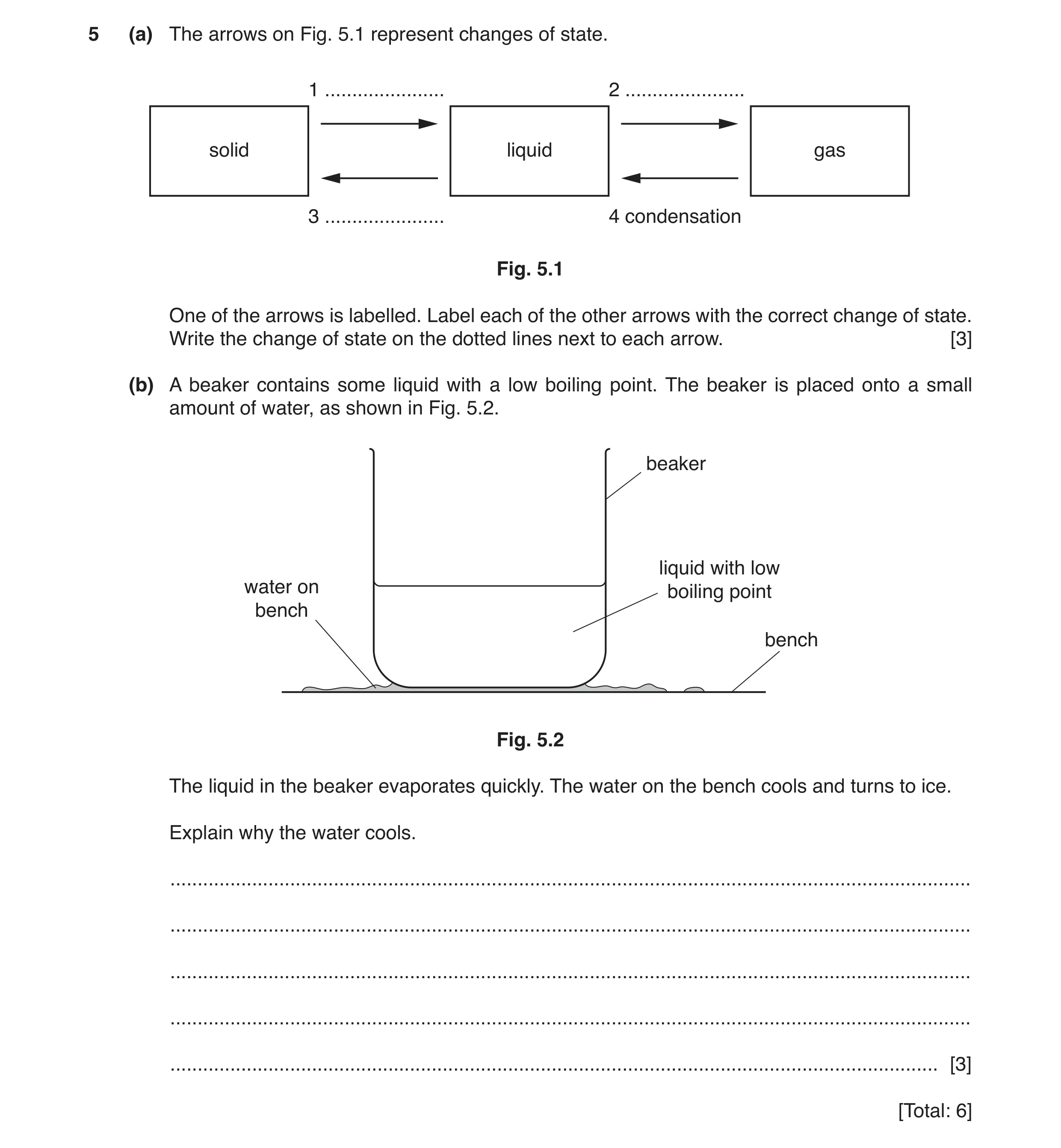
5 (a) The arrows on Fig. 5.1 represent changes of state. 1 … 2 … solid liquid gas 3 … 4 condensation Fig. 5.1 One of the arrows is labelled. Label each of the other arrows with the correct change of state. Write the change of state on the dotted lines next to each arrow. [3] (b) A beaker contains some liquid with a low boiling point. The beaker is placed onto a small amount of water, as shown in Fig. 5.2. beaker liquid with low water on boiling point bench bench Fig. 5.2 The liquid in the beaker evaporates quickly. The water on the bench cools and turns to ice. Explain why the water cools. … … … … … [3] [Total: 6]
6 marks
Mark scheme: 5(a) 1. melting 2. boiling / evaporation 3. freezing / solidification B1 B1 B1 5(b) Any three from: (evaporation –) most energetic molecules escape from surface of liquid average KE of molecules remaining in liquid decreases temperature of liquid decreases energy transfers from water (on bench) to liquid (so water cools / freezes) B3
This question in 0625/33 Oct/Nov 2019
Q17 · A list of statements about molecules in gases and solids 0625/32 Feb/March 2020
6 (a) Table 6.1 gives a list of statements about molecules in gases and solids. Table 6.1 statement gas solid molecules are closely packed molecules are free to move around from place to place molecules are far apart compared to their size molecules can only vibrate about a fixed position molecules change position randomly Put one tick in every row to indicate whether each statement refers to a gas or a solid. [4] (b) Fig. 6.1 represents a smoke particle in air. The smoke particle is moving. air smoke particle Fig. 6.1 Fig. 6.2 shows the path of the smoke particle and the position of the smoke particle a short time later. smoke particle air Fig. 6.2 (i) State the term given to the movement of the smoke particle. … [1] (ii) State what the motion of the smoke particle shows about air molecules. … … … … [3] [Total: 8]
8 marks
Mark scheme: 6(a) statement gas solid molecules are closely packed molecules are free to move around from place to place molecules are far apart compared to their size molecules can only vibrate about a fixed position molecules change position randomly B4 6(b)(i) Brownian (movement) B1 6(b)(ii) any three from: air consists of particles / is not continuous (fluid) air particles bombard / collide with smoke (particles) air particles moving (freely) at high speed air particles moving randomly air particles are very small (compared with smoke particles) B3
This question in 0625/32 Feb/March 2020
Q18 · Some gas molecules are in a box at room temperature 0625/31 May/June 2020
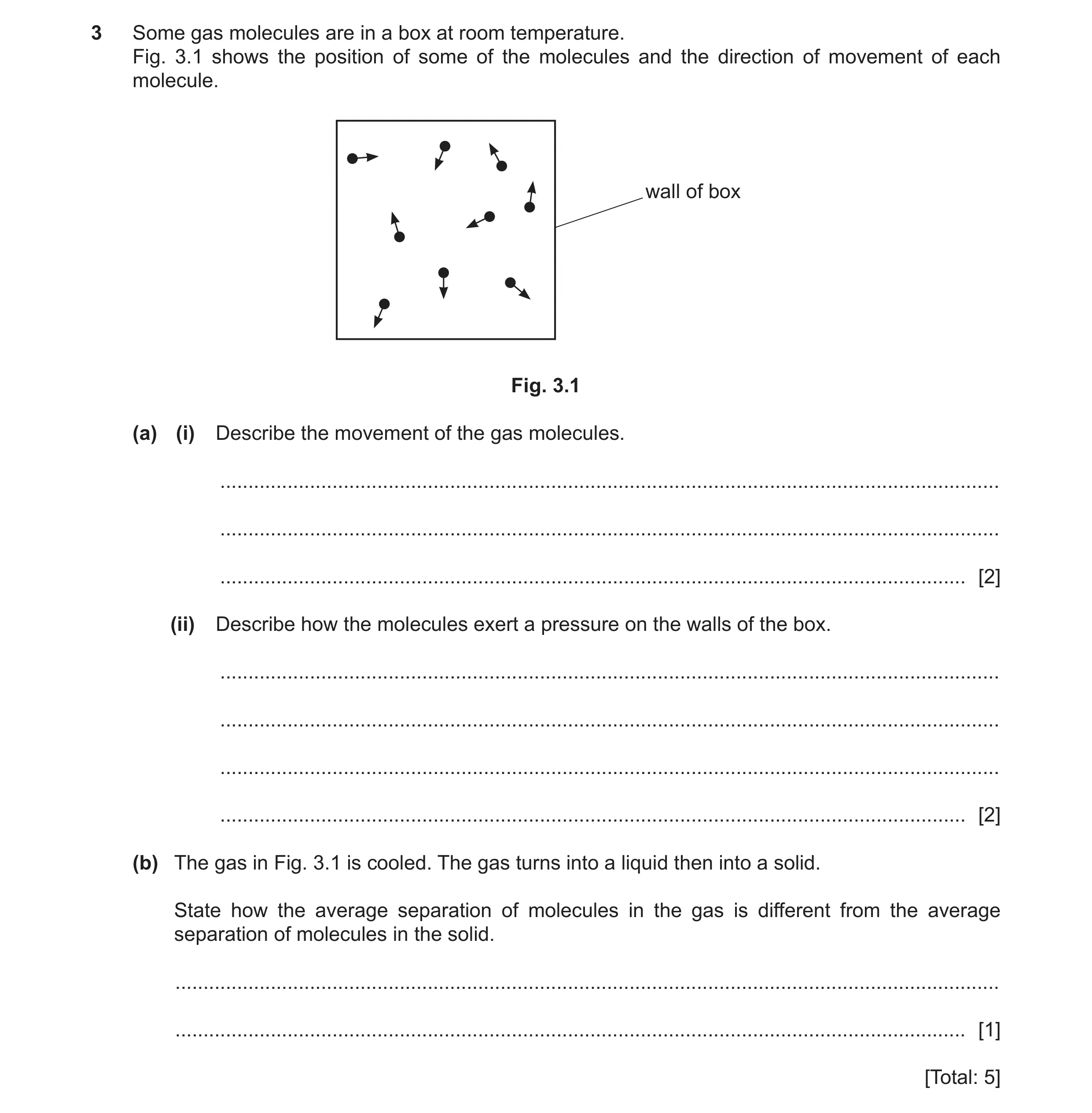
3 Some gas molecules are in a box at room temperature. Fig. 3.1 shows the position of some of the molecules and the direction of movement of each molecule. wall of box Fig. 3.1 (a) (i) Describe the movement of the gas molecules. … … … [2] (ii) Describe how the molecules exert a pressure on the walls of the box. … … … … [2] (b) The gas in Fig. 3.1 is cooled. The gas turns into a liquid then into a solid. State how the average separation of molecules in the gas is different from the average separation of molecules in the solid. … … [1] [Total: 5]
5 marks
Mark scheme: 3(a)(i) high speed B1 (in) any or all directions or random (motion) B1 3(a)(ii) collisions M1 (of molecules) with walls of box A1 3(b) widely separated (owtte) in gas to very close / touching in solid B1
This question in 0625/31 May/June 2020
Q19 · Match each description with the correct state of matter in Table 4.1 0625/32 May/June 2020
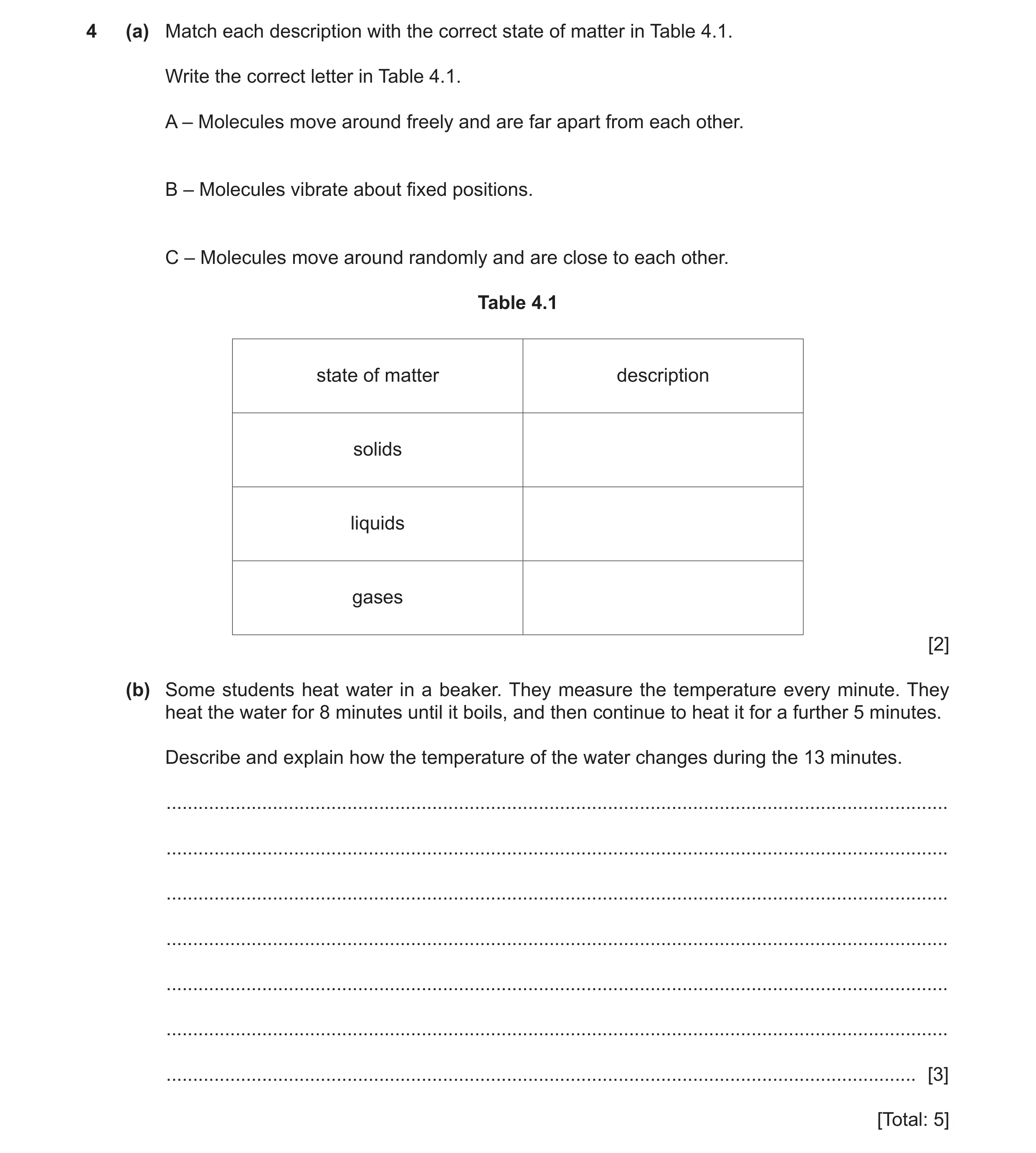
4 (a) Match each description with the correct state of matter in Table 4.1. Write the correct letter in Table 4.1. A – Molecules move around freely and are far apart from each other. B – Molecules vibrate about fixed positions. C – Molecules move around randomly and are close to each other. Table 4.1 state of matter description solids liquids gases [2] (b) Some students heat water in a beaker. They measure the temperature every minute. They heat the water for 8 minutes until it boils, and then continue to heat it for a further 5 minutes. Describe and explain how the temperature of the water changes during the 13 minutes. … … … … … … … [3] [Total: 5]
5 marks
Mark scheme: 4(a) B C A B2 4(b) any three from: during first eight minutes temp rises (because) internal energy of water rises (from thermal energy input) during next five minutes temperature is constant / stays the same (because) internal energy does not rise (at boiling point) B3
This question in 0625/32 May/June 2020
Q20 · A steel container fitted with a liquid manometer 0625/31 Oct/Nov 2020
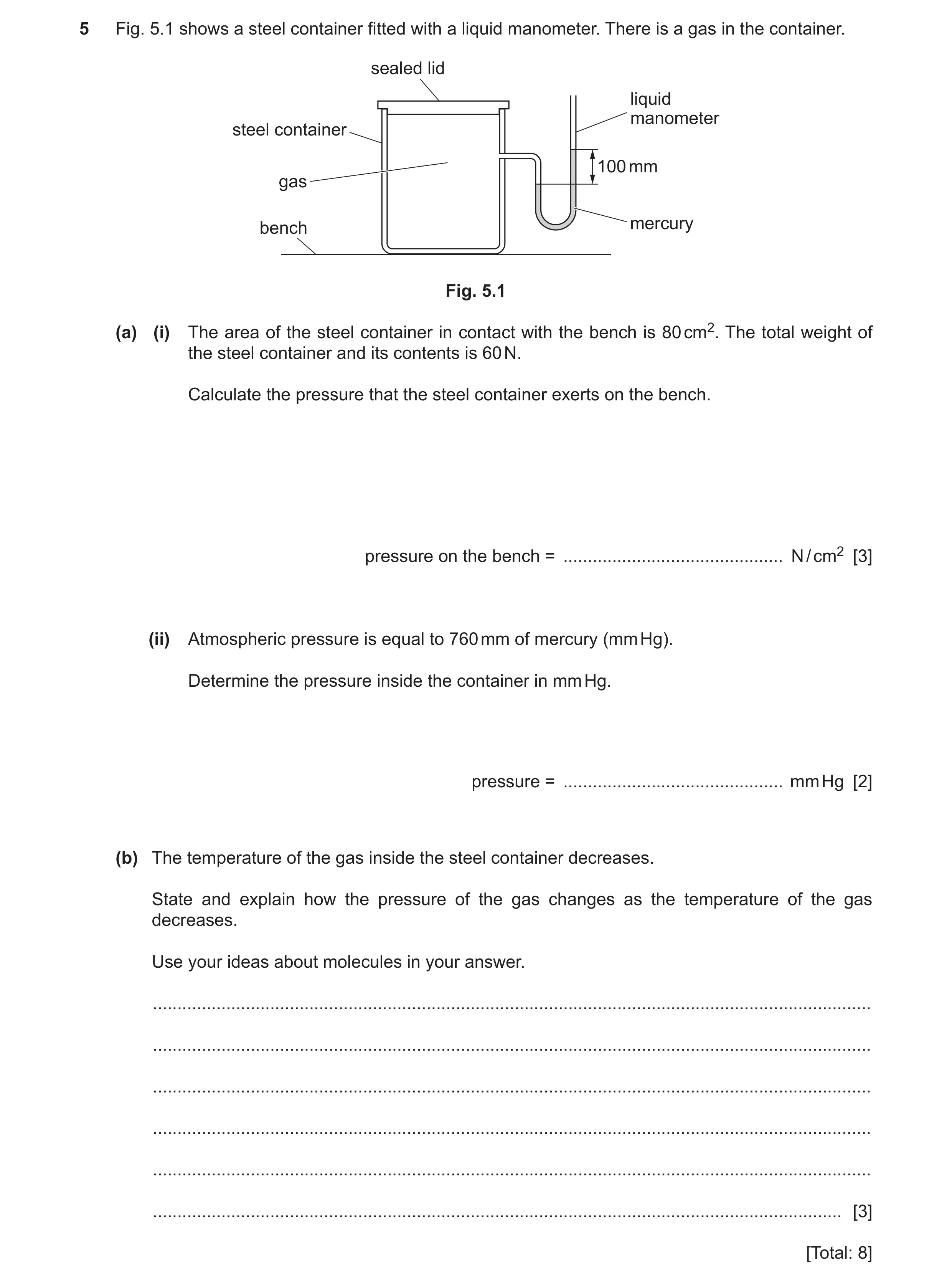
5 Fig. 5.1 shows a steel container fitted with a liquid manometer. There is a gas in the container. sealed lid liquid manometer steel container 100 mm gas bench mercury Fig. 5.1 (a) (i) The area of the steel container in contact with the bench is 80 cm2. The total weight of the steel container and its contents is 60 N. Calculate the pressure that the steel container exerts on the bench. pressure on the bench = … N / cm2 [3] (ii) Atmospheric pressure is equal to 760 mm of mercury (mm Hg). Determine the pressure inside the container in mm Hg. pressure = … mm Hg [2] (b) The temperature of the gas inside the steel container decreases. State and explain how the pressure of the gas changes as the temperature of the gas decreases. Use your ideas about molecules in your answer. … … … … … … [3] [Total: 8]
8 marks
Mark scheme: 5(a)(i) (P =) F ÷ A in any form C1 (P =) 60 ÷ 80 C1 (P =) 0.75 (N / cm2) A1 5(a)(ii) 760(.0) + OR – 100(.0) C1 860 (mm of Hg) A1 5(b) pressure decreases B1 Any two from: (because) molecules slower speed or less kinetic energy fewer collisions OR molecules collide less often (with walls of container) collides with less force (with walls of container) B2
This question in 0625/31 Oct/Nov 2020
Q21 · Three changes of state 0625/31 Oct/Nov 2020
6 (a) Fig. 6.1 represents three changes of state. Each pair of diagrams A, B and C shows the arrangement of molecules in a substance before and after it changes state. before after A B C Fig. 6.1 Give the term used for each change of state. A … B … C … [3] (b) A student attaches a liquid-in-glass thermometer to a ruler. The thermometer does not have a marked scale. Fig. 6.2 shows the arrangement. ruler cm 15 14 thermometer 13 12 11 10 9 8 mercury level 7 6 5 4 3 2 1 0 Fig. 6.2 The student places the thermometer in steam. The mercury rises to 11 cm on the ruler. The student places the thermometer in melting ice. The mercury decreases to 1 cm on the ruler. Determine the temperature indicated by the mercury level in Fig. 6.2. temperature = … °C [3] [Total: 6]
6 marks
Mark scheme: 6(a) A: melting B1 B: evaporating / boiling / vapourising B1 C: freezing / solidifying B1 6(b) 1(.0) cm = 10 °C OR (6(.0) – 1(.0)) = 5 B1 × − 5 100 11 1 C1 (temperature =) 50 (°C) A1
This question in 0625/31 Oct/Nov 2020
Q22 · A rigid container is filled with a gas 0625/32 Oct/Nov 2020
4 A rigid container is filled with a gas. (a) Describe the movement and arrangement of the gas molecules in the container. … … … [3] (b) The gas in the container is heated. The volume of the gas does not change. State and explain the change in pressure of the gas as the temperature of the gas increases. Use your ideas about molecules in your answer. … … … … [3] [Total: 6]
6 marks
Mark scheme: 4(a) any three from: high speed random movement random arrangement large spaces / gaps between molecules colliding (with each other / walls of container) B3 4(b) (pressure) increases B1 AND any two from: (because) molecules move faster collide more frequently (with walls of container) collide with greater force (with walls of container) B2
This question in 0625/32 Oct/Nov 2020
Q23 · A beaker contains water 0625/32 Oct/Nov 2020
5 A beaker contains water. Some of the water evaporates. (a) Describe and explain how the water evaporates. Use your ideas about molecules. … … … [2] (b) Evaporation changes the temperature of the water that remains in the beaker. State and explain the change in temperature of the water due to evaporation. … … … [3] [Total: 5]
5 marks
Mark scheme: 5(a) high(er / est) energy molecules B1 (near the surface) escape (from surface) B1 5(b) (temperature) decreases B1 AND any two from: higher energy molecules have escaped (leaving) lower energy particles behind (so) average energy of remaining molecules is lower B2
This question in 0625/32 Oct/Nov 2020
Q24 · Diagrams of the arrangement of molecules in three states of matter and shows descriptions… 0625/33 Oct/Nov 2020
5 (a) Fig. 5.1 shows diagrams of the arrangement of molecules in three states of matter and shows descriptions of how the molecules move. arrangement of molecules state of matter movement of molecules solid do not move move around while in contact with other molecules liquid move around freely vibrate about gas fixed positions Fig. 5.1 On Fig. 5.1, draw a line: • from each arrangement of molecules to the correct state of matter • from the state of matter to the correct description of the movement of molecules. [4] (b) A bicycle tyre contains air. The tyre is sealed and does not leak. The temperature of the air in the tyre increases by 20 °C. The volume of the tyre does not change. (i) State how the increase in temperature affects the motion of the air molecules in the tyre. … [1] (ii) State how the increase in temperature changes the pressure of the air in the tyre. … [1] (c) Fig. 5.2 shows a liquid-in-glass thermometer. … … narrow tube liquid Fig. 5.2 (i) Add the missing labels to Fig. 5.2. [2] (ii) The thermometer in Fig. 5.2 is designed to measure a range of temperatures from 0 °C to 100 °C. State the name of a suitable liquid for use in this thermometer. … [1] (iii) Describe and explain the changes in the thermometer in Fig. 5.2 when the temperature of the liquid increases. … … … [2] [Total: 11]
11 marks
Mark scheme: 5(a) arrangement: solid to 2nd box liquid to 3rd box 3 correct – 2 marks: 2 or 1 correct – 1 mark gas to 1st box movement: solid to 4th box liquid to 2nd box 3 correct – 2 marks: 2 or 1 correct – 1 mark gas to 3rd box B2 5(b)(i) move faster / speed up / more (kinetic) energy or wtte B1 5(b)(ii) (pressure) increases B1 5(c)(i) (temperature) scale B1 bulb OR reservoir B1 5(c)(ii) mercury B1 5(c)(iii) (liquid / mercury / alcohol) expands B1 liquid level / meniscus moves along tube / scale B1
This question in 0625/33 Oct/Nov 2020
Q25 · A metal block on a flat surface 0625/32 Feb/March 2021
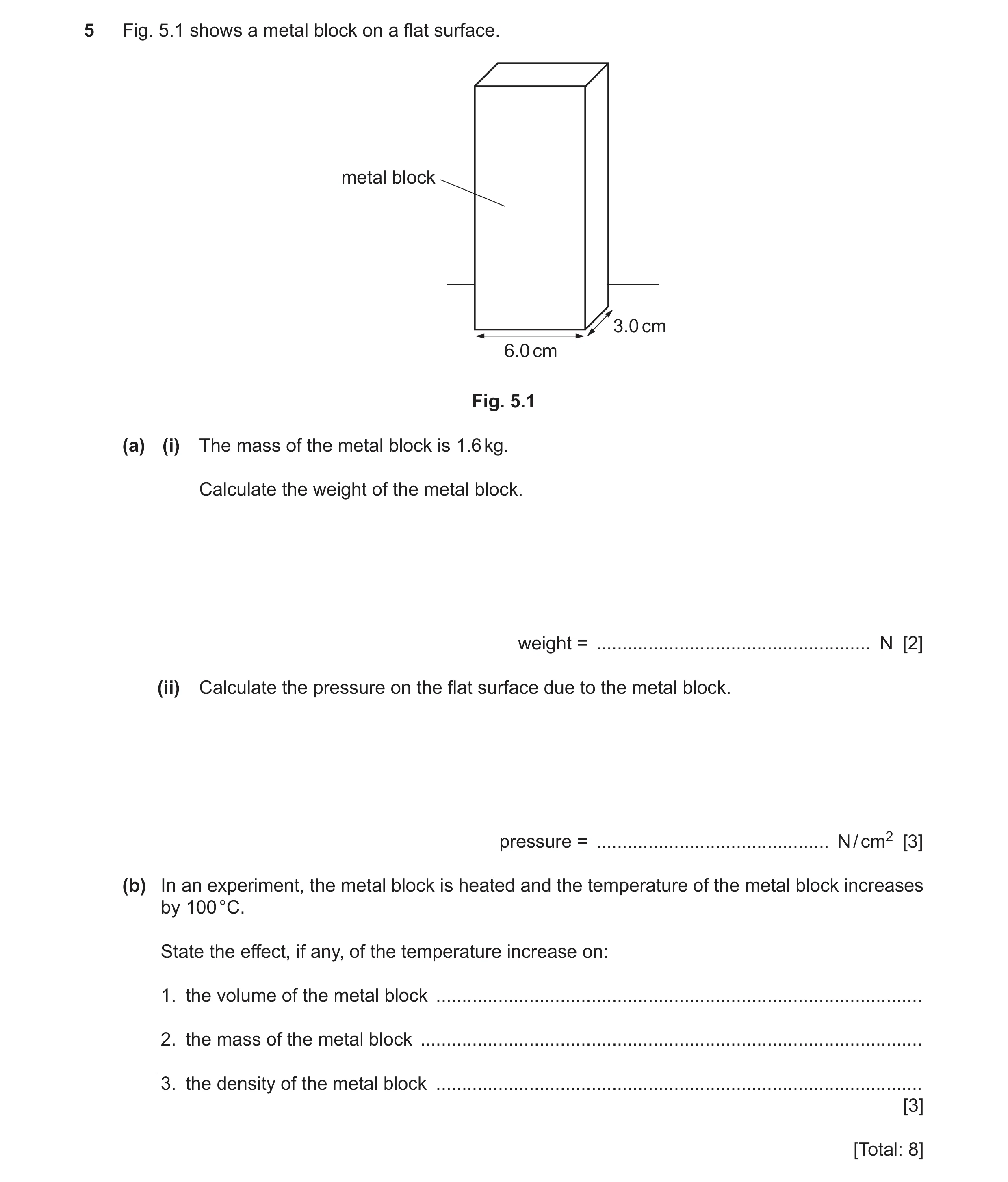
5 Fig. 5.1 shows a metal block on a flat surface. metal block 3.0 cm 6.0 cm Fig. 5.1 (a) (i) The mass of the metal block is 1.6 kg. Calculate the weight of the metal block. weight = … N [2] (ii) Calculate the pressure on the flat surface due to the metal block. pressure = … N / cm2 [3] (b) In an experiment, the metal block is heated and the temperature of the metal block increases by 100 °C. State the effect, if any, of the temperature increase on: 1. the volume of the metal block … 2. the mass of the metal block … 3. the density of the metal block … [3] [Total: 8]
8 marks
Mark scheme: 5(a)(i) (weight =) mass × g OR 1.6 × 10 OR mass = W ÷ g C1 (weight =) 16 (N) A1 5(a)(ii) (pressure =) force ÷ area C1 (pressure =) 16 ÷ 18 C1 (pressure =) 0.89 (N / cm2) A1 5(b) 1 (volume of block) increases B1 2 (mass) remains constant owtte B1 3 (density) decreases B1
This question in 0625/32 Feb/March 2021
Question 26 0625/31 May/June 2021
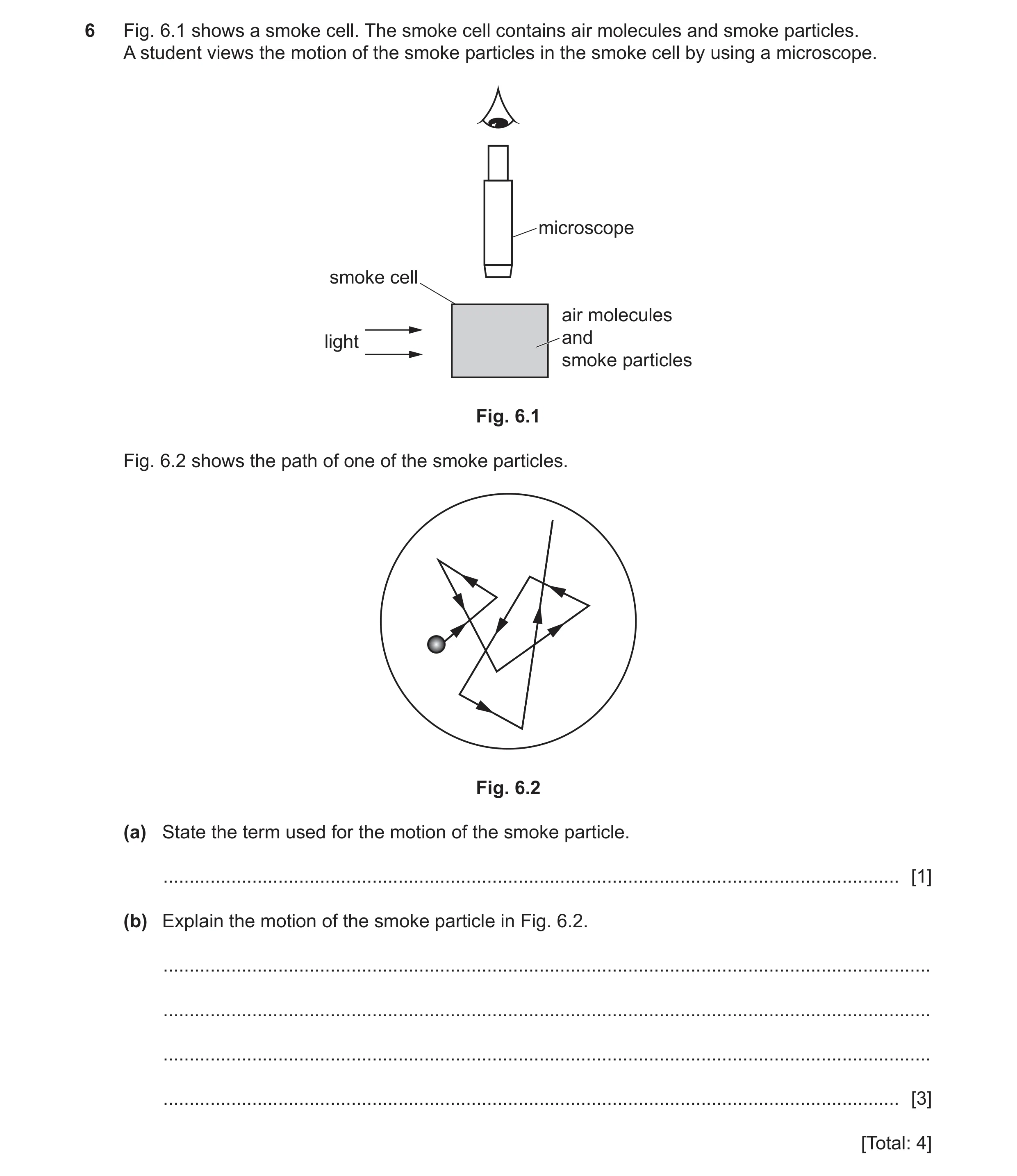
6 Fig. 6.1 shows a smoke cell. The smoke cell contains air molecules and smoke particles. A student views the motion of the smoke particles in the smoke cell by using a microscope. microscope smoke cell air molecules light and smoke particles Fig. 6.1 Fig. 6.2 shows the path of one of the smoke particles. Fig. 6.2 (a) State the term used for the motion of the smoke particle. … [1] (b) Explain the motion of the smoke particle in Fig. 6.2. … … … … [3] [Total: 4]
4 marks
Mark scheme: 6(a) Brownian (motion) B1 6(b) any three from: air molecules (air molecules) collide with (smoke particle) (air molecules) moving randomly (air molecules/collisions) cause change in direction (of smoke particle) (air molecules moving with) high speed idea of more collisions on one side (of particle at a given time) B3
This question in 0625/31 May/June 2021
Q27 · A tractor and a car of the same weight 0625/33 May/June 2021
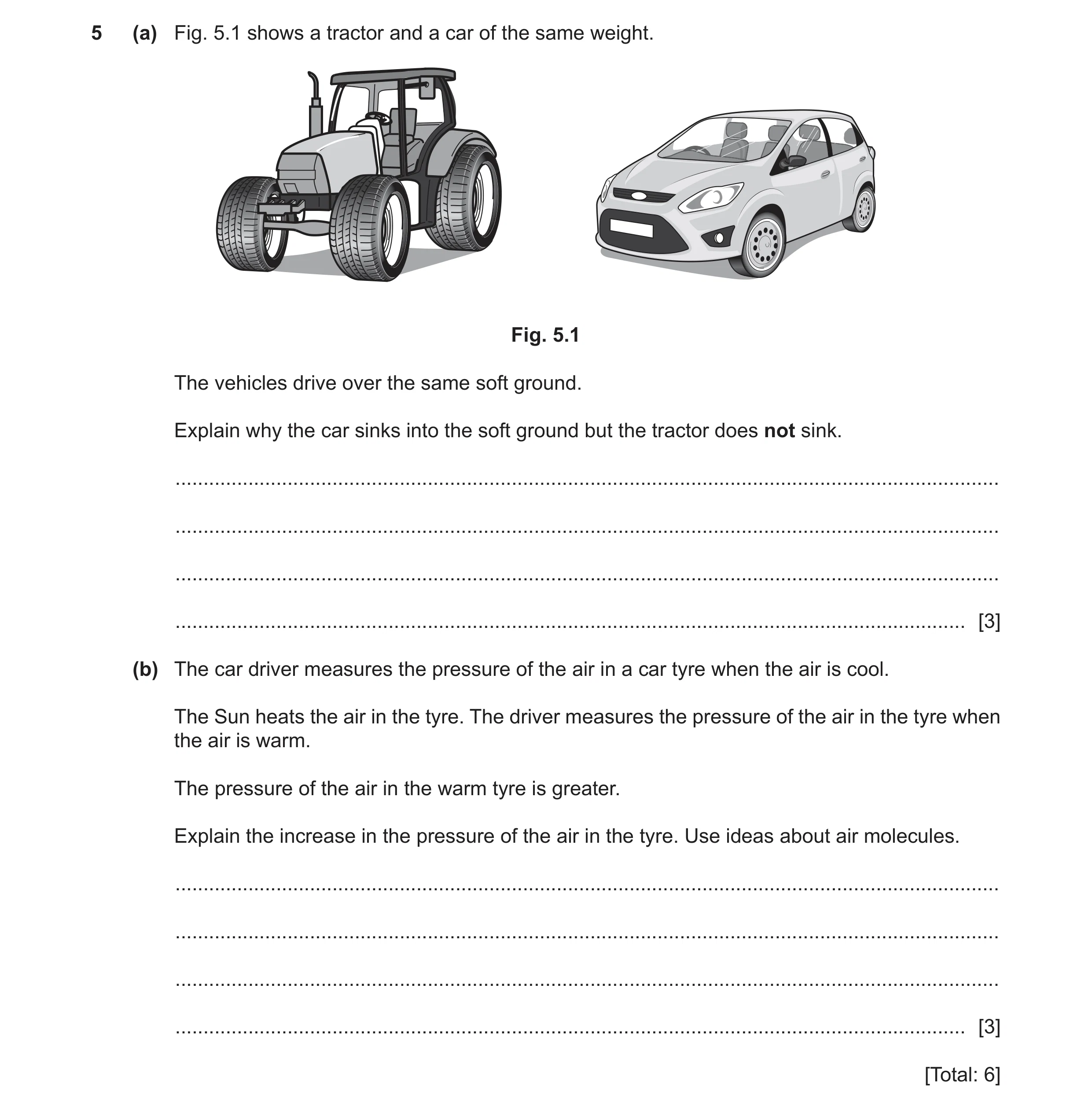
5 (a) Fig. 5.1 shows a tractor and a car of the same weight. Fig. 5.1 The vehicles drive over the same soft ground. Explain why the car sinks into the soft ground but the tractor does not sink. … … … … [3] (b) The car driver measures the pressure of the air in a car tyre when the air is cool. The Sun heats the air in the tyre. The driver measures the pressure of the air in the tyre when the air is warm. The pressure of the air in the warm tyre is greater. Explain the increase in the pressure of the air in the tyre. Use ideas about air molecules. … … … … [3] [Total: 6]
6 marks
Mark scheme: 5(a) P = F ÷ A in any form B1 tractor has larger area (of tyre(s) in contact with ground) / ora B1 so (tractor) pressure is less (on the ground) / ora B1 5(b) kinetic energy of molecules increases / speed of molecules increases B1 hit (tyre walls) more often / greater rate B1 hit (tyre walls) with greater force / harder B1
This question in 0625/33 May/June 2021
Q28 · A substance cools from 50 °C to 5.0 °C 0625/31 Oct/Nov 2021
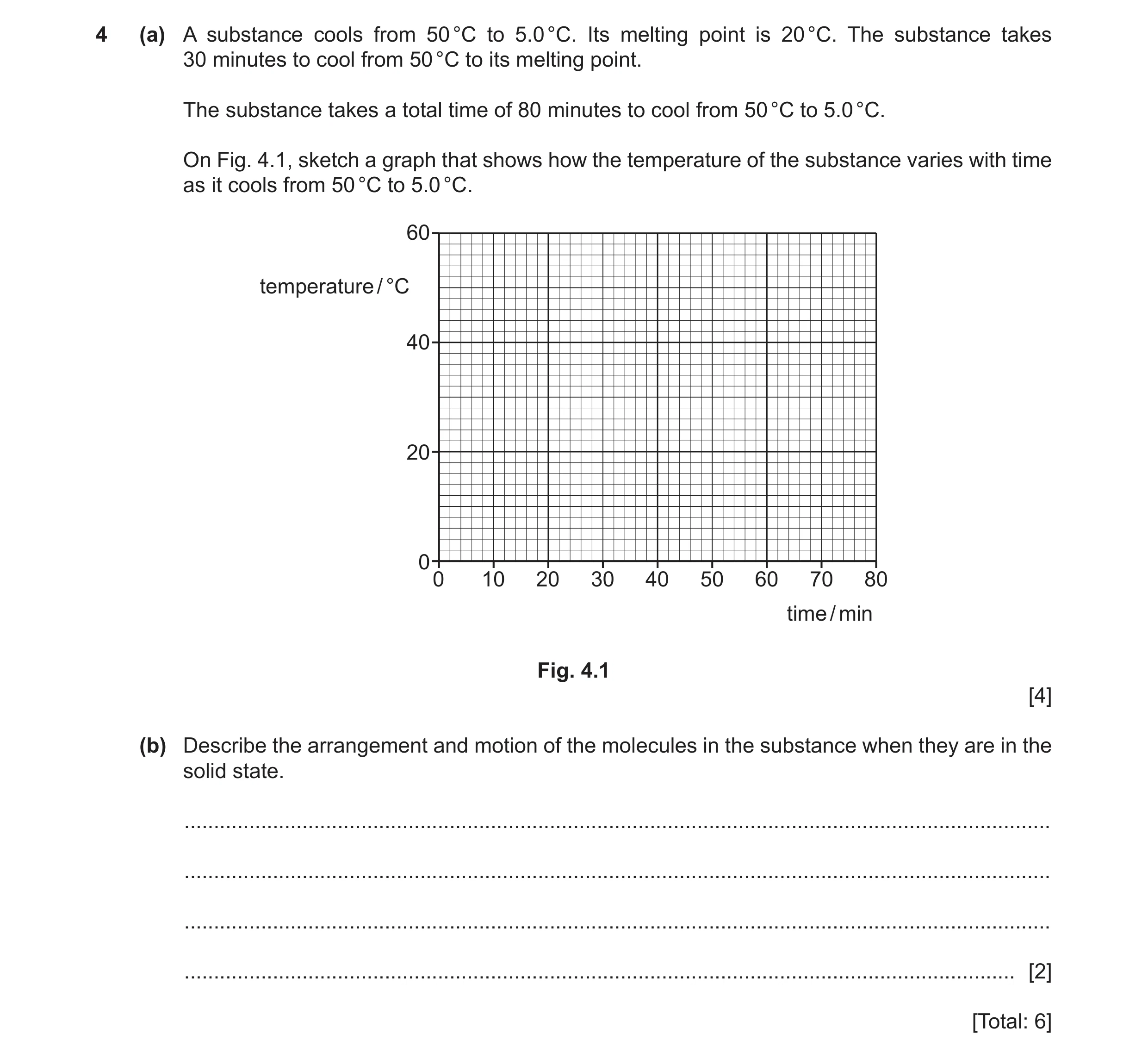
4 (a) A substance cools from 50 °C to 5.0 °C. Its melting point is 20 °C. The substance takes 30 minutes to cool from 50 °C to its melting point. The substance takes a total time of 80 minutes to cool from 50 °C to 5.0 °C. On Fig. 4.1, sketch a graph that shows how the temperature of the substance varies with time as it cools from 50 °C to 5.0 °C. 60 temperature / °C 40 20 0 0 10 20 30 40 50 60 70 80 time / min Fig. 4.1 [4] (b) Describe the arrangement and motion of the molecules in the substance when they are in the solid state. … … … … [2] [Total: 6]
6 marks
Mark scheme: 4(a) horizontal section at 20 °C B1 line starting at (0, 50) line decreasing (steadily) (from (0, 50)) to 20 °C in 30 minutes (by eye) line decreasing from 20 °C AND line reaches 5 °C at time of 80 mins B3 4(b) any two from: (in solid state molecules / they are) close(r)(than in liquids / gases) (in solid state molecules / they are) in regular arrangement (in solid state molecules / they are) in fixed positions (in solid state molecules / they can only) vibrate B2
This question in 0625/31 Oct/Nov 2021
Q29 · A plastic bottle on a bench 0625/31 Oct/Nov 2021
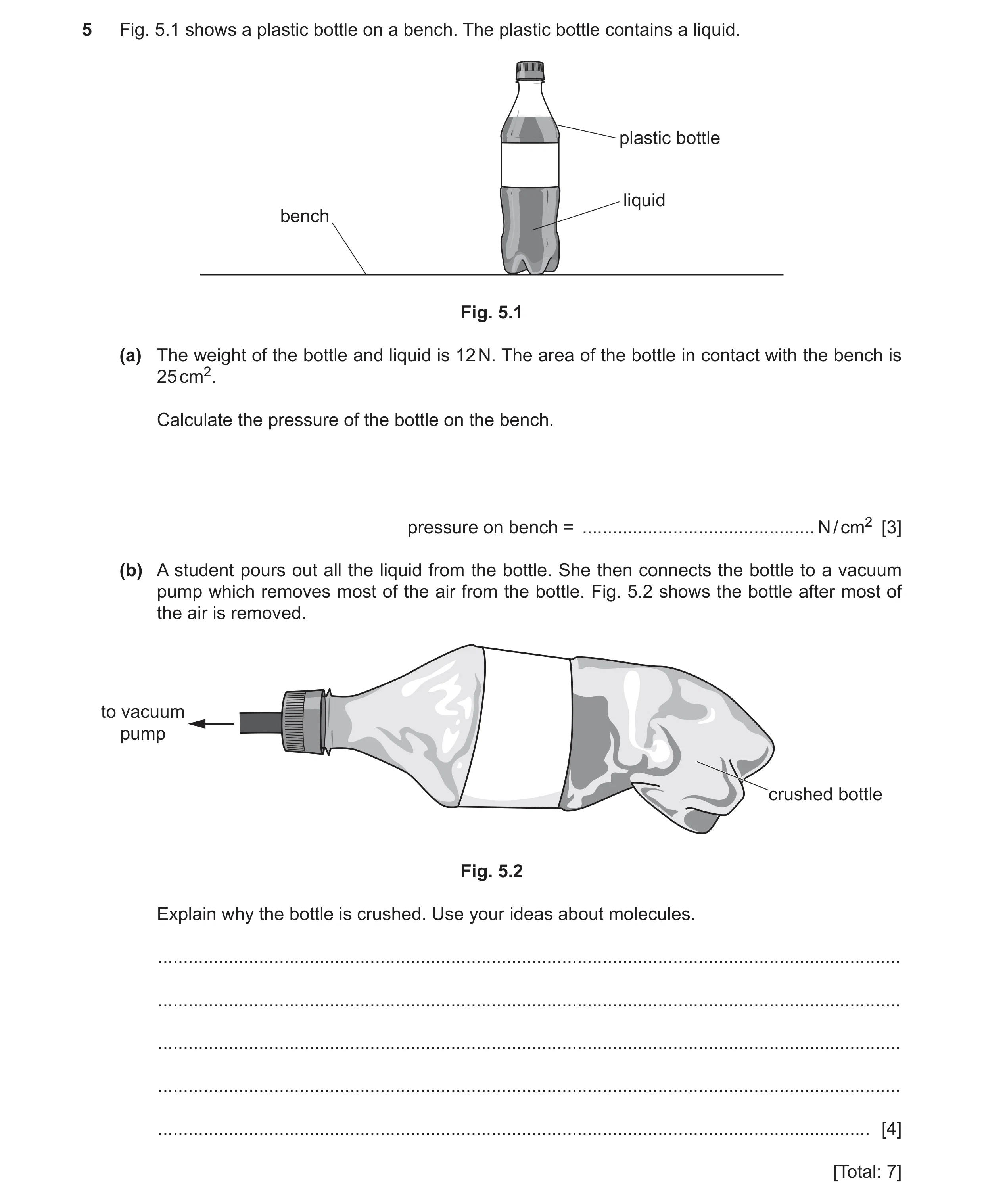
5 Fig. 5.1 shows a plastic bottle on a bench. The plastic bottle contains a liquid. plastic bottle liquid bench Fig. 5.1 (a) The weight of the bottle and liquid is 12 N. The area of the bottle in contact with the bench is 25 cm2. Calculate the pressure of the bottle on the bench. pressure on bench = … N / cm2 [3] (b) A student pours out all the liquid from the bottle. She then connects the bottle to a vacuum pump which removes most of the air from the bottle. Fig. 5.2 shows the bottle after most of the air is removed. to vacuum pump crushed bottle Fig. 5.2 Explain why the bottle is crushed. Use your ideas about molecules. … … … … … [4] [Total: 7]
7 marks
Mark scheme: 5(a) (P =) F ÷ A OR (pressure = ) force ÷ area in any form C1 12 ÷ 25 C1 0.48 (N / cm2) A1 5(b) Any four from: molecules in air moving at high speed / kinetic energy molecules collide with (plastic) bottle OR wall (of bottle) force of collisions (per unit area) cause pressure fewer air molecules or collisions on inside(compared to outside) (and so) greater force OR pressure on outside (than inside) B4
This question in 0625/31 Oct/Nov 2021
Question 30 0625/33 Oct/Nov 2021
6 (a) In Fig. 6.1, the circles represent molecules. The diagram shows the arrangement of the molecules in a liquid. solid liquid gas Fig. 6.1 (i) Show the arrangement of the molecules in a solid. Draw a diagram in the box above the word ‘solid’ in Fig. 6.1. Draw at least 10 molecules. [2] (ii) Show the arrangement of the molecules in a gas. Draw a diagram in the box above the word ‘gas’ in Fig. 6.1. Draw at least 10 molecules. [2] (iii) State the name of the process by which a solid changes into a liquid. … [1] (iv) State the name of the process by which a gas changes into a liquid. … [1] (b) Fig. 6.2 shows a microscope used for viewing smoke particles in a small glass box. A bright light shines into the box. The box contains smoke particles and air molecules. microscope glass box containing smoke particles and bright air molecules light Fig. 6.2 A student views the smoke particles through the microscope. The smoke particles are moving. (i) State the name given to the movement of the smoke particles. … [1] (ii) Fig. 6.3 shows a smoke particle as seen with the microscope. smoke particle Fig. 6.3 Show how the smoke particle moves by drawing a series of lines on Fig. 6.3. [2] (iii) The temperature in the glass box decreases. Describe any changes in the movement of the smoke particles. … [1] [Total: 10]
10 marks
Mark scheme: 6(a)(i) (circles) touching / no gaps (by eye) B1 regular arrangement B1 6(a)(ii) large(r) separation (by eye) B1 random arrangement B1 6(a)(iii) melting B1 6(a)(iv) condensing / condensation B1 6(b)(i) Brownian / random (motion) B1 6(b)(ii) sharp changes of direction B1 random B1 6(b)(iii) slower / moving with less (kinetic) energy OR fewer collisions / changes of direction B1
This question in 0625/33 Oct/Nov 2021
Q31 · Gas particles in a container 0625/32 Feb/March 2022
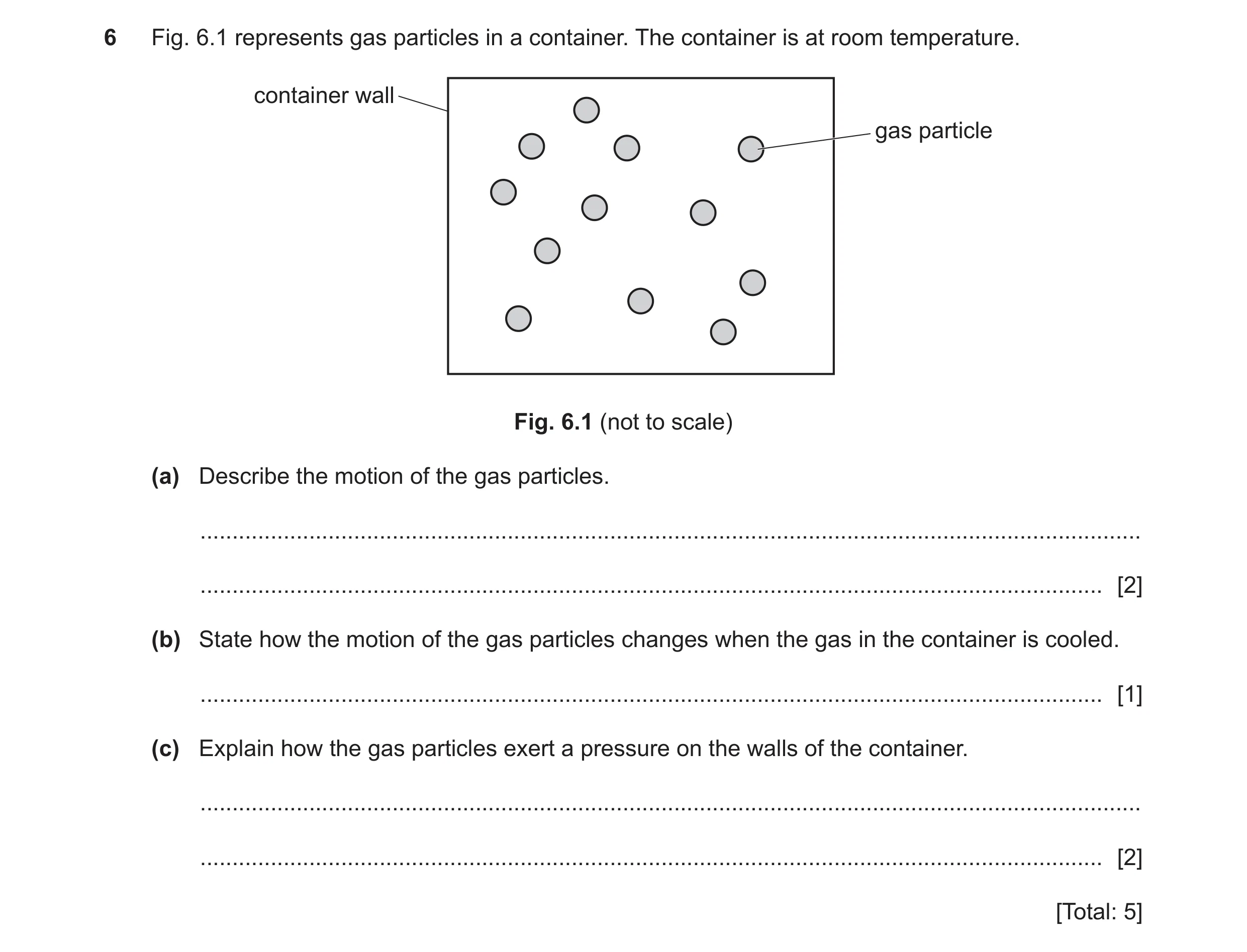
6 Fig. 6.1 represents gas particles in a container. The container is at room temperature. container wall gas particle Fig. 6.1 (not to scale) (a) Describe the motion of the gas particles. … … [2] (b) State how the motion of the gas particles changes when the gas in the container is cooled. … [1] (c) Explain how the gas particles exert a pressure on the walls of the container. … … [2] [Total: 5]
5 marks
Mark scheme: 6(a) any two from: (move at) high speed random directions collisions (with other molecules / walls) B2 6(b) slow(er) (average speed) B1 6(c) (particles) collide (with walls of container) any one from: B1 (collisions) apply force to walls (sum of)force(s) spread over area B1
This question in 0625/32 Feb/March 2022
Q32 · A teacher fills a copper can with solid wax and heats the can 0625/31 May/June 2022
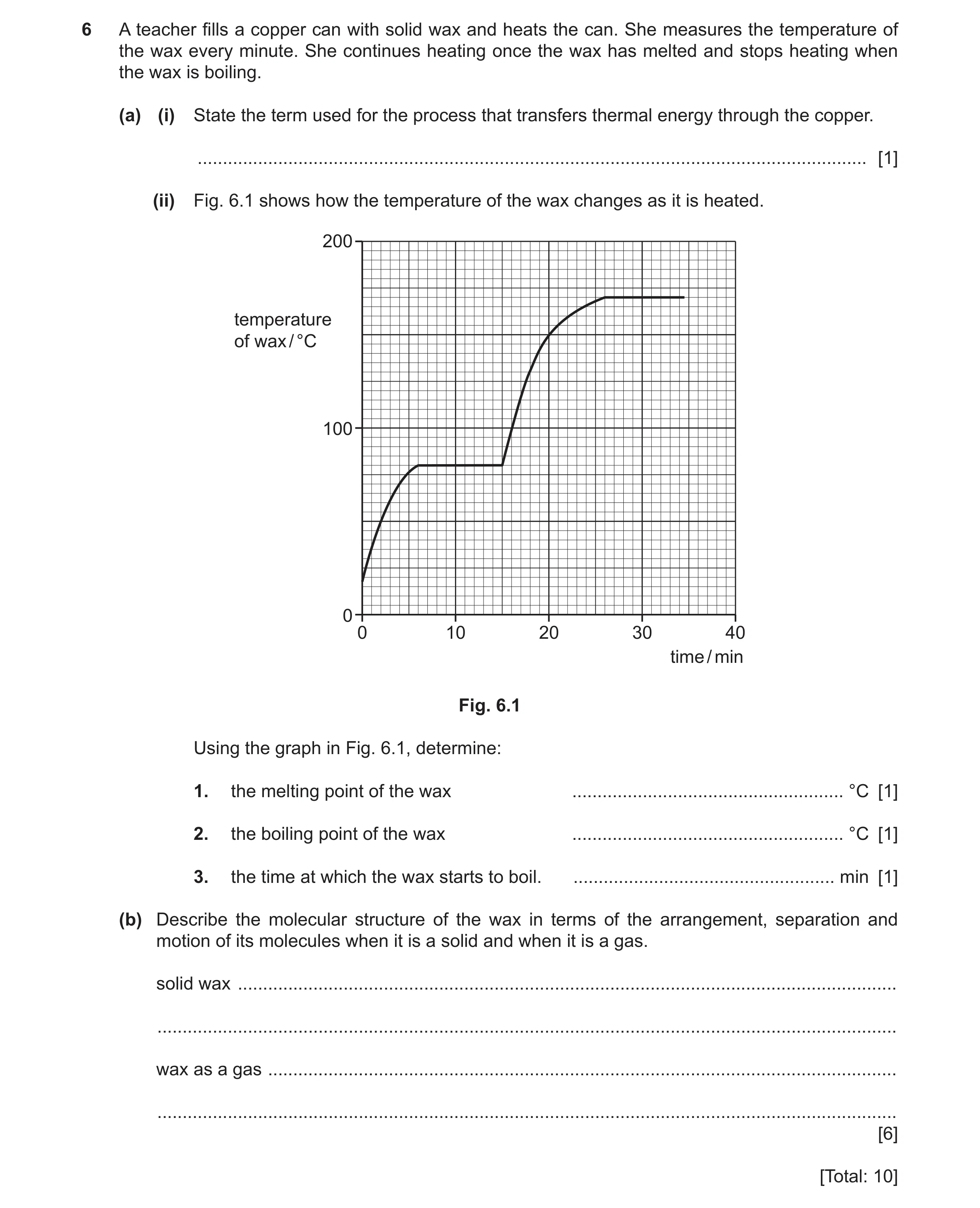
6 A teacher fills a copper can with solid wax and heats the can. She measures the temperature of the wax every minute. She continues heating once the wax has melted and stops heating when the wax is boiling. (a) (i) State the term used for the process that transfers thermal energy through the copper. … [1] (ii) Fig. 6.1 shows how the temperature of the wax changes as it is heated. 200 temperature of wax / °C 100 0 0 10 20 30 40 time / min Fig. 6.1 Using the graph in Fig. 6.1, determine: 1. the melting point of the wax … °C [1] 2. the boiling point of the wax … °C [1] 3. the time at which the wax starts to boil. … min [1] (b) Describe the molecular structure of the wax in terms of the arrangement, separation and motion of its molecules when it is a solid and when it is a gas. solid wax … … wax as a gas … … [6] [Total: 10]
10 marks
Mark scheme: 6(a)(i) conduction B1 6(a)(ii) 1 80 (°C) B1 2 170 (°C) B1 3 26 (minutes) B1 Question Answer Marks 6(b) (solid:) particles/molecules any three from: (are) fixed in place/position/arrangement regular spacing / pattern / arrangement vibrating close together B3 (gas:) particles/molecules any three from: (are) moving randomly at high speed colliding (with each other/walls) randomly arranged/no pattern (relatively) far apart B3
This question in 0625/31 May/June 2022
Q33 · A cross-section of a flask 0625/32 May/June 2022
5 Fig. 5.1 shows a cross-section of a flask. The flask is used to keep a liquid hot. The flask has two glass walls with a vacuum between them. The surfaces of the glass walls are shiny. plastic cap double-walled glass container hot liquid vacuum shiny surfaces Fig. 5.1 (a) (i) Explain how the shiny surfaces reduce the transfer of thermal energy from the hot liquid. … … [2] (ii) Explain how the vacuum reduces the transfer of thermal energy from the hot liquid. … … [2] (b) Some of the hot liquid is poured out of the flask into a shallow dish. Explain how evaporation causes the liquid to cool. … … … [3] (c) A student uses a microscope to view a small particle in the liquid. Fig. 5.2 shows the path of the particle. small particle Fig. 5.2 (i) State the name given to the motion of the small particle. … [1] (ii) Explain why the small particle moves as shown in Fig. 5.2. … … [2] [Total: 10]
10 marks
Mark scheme: 5(a)(i) (shiny surfaces) are good reflectors OR poor absorbers/emitters B1 so less thermal energy lost by radiation B1 5(a)(ii) less (heat lost by) convection B1 less (heat lost by) conduction B1 5(b) more energetic particles B1 particles escape (from the surface (attraction)) B1 so average energy of particles remaining (in liquid) decreases B1 5(c)(i) Brownian (motion) B1 5(c)(ii) any two from: (fast moving liquid) molecules bombard/collide with (small) particle collisions produce (resultant) force (in random directions) B2
This question in 0625/32 May/June 2022
Q34 · State and explain one application of thermal expansion 0625/33 May/June 2022
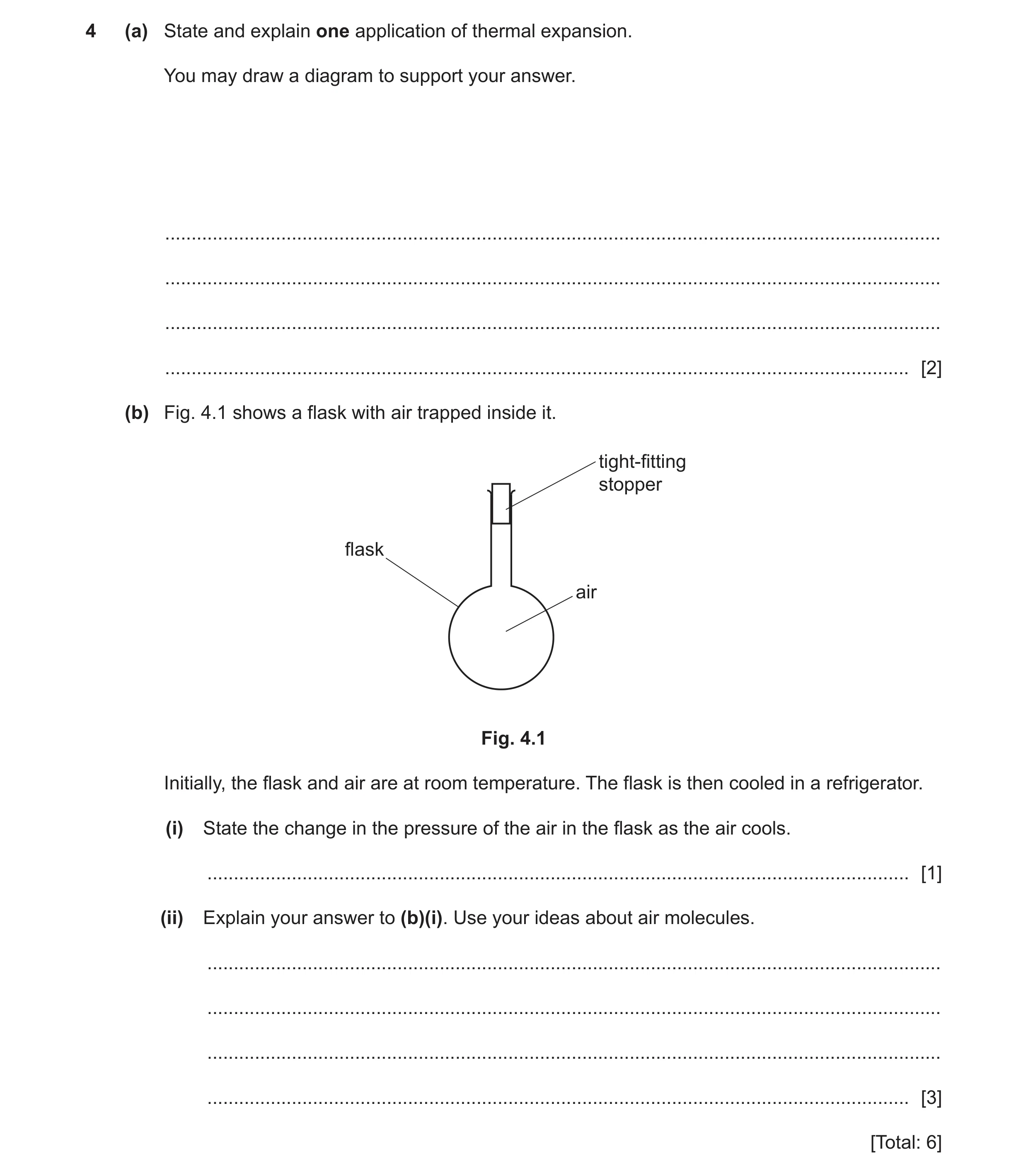
4 (a) State and explain one application of thermal expansion. You may draw a diagram to support your answer. … … … … [2] (b) Fig. 4.1 shows a flask with air trapped inside it. tight-fitting stopper flask air Fig. 4.1 Initially, the flask and air are at room temperature. The flask is then cooled in a refrigerator. (i) State the change in the pressure of the air in the flask as the air cools. … [1] (ii) Explain your answer to (b)(i). Use your ideas about air molecules. … … … … [3] [Total: 6]
6 marks
Mark scheme: 4(a) situation B1 explanation B1 4(b)(i) decreases B1 4(b)(ii) molecules slow(er)/less (kinetic) energy B1 hit (wall/flask) less often B1 hit (wall/flask) with less force B1
This question in 0625/33 May/June 2022
Q35 · An engineer measures the pressure of the gas in a gas bottle 0625/31 Oct/Nov 2022
5 An engineer measures the pressure of the gas in a gas bottle. Fig. 5.1 shows the measuring device he uses, connected to the gas bottle. mm 300 glass tube 250 from a gas bottle 200 150 100 50 mercury 0 Fig. 5.1 (a) (i) Atmospheric pressure is 756 mm of mercury. Calculate the pressure of the gas in the gas bottle. pressure of gas = … mm of mercury [3] (ii) State the name of the measuring device shown in Fig. 5.1. … [1] (b) Some gas is trapped in a cylinder fitted with a moveable piston. Fig. 5.2 shows the arrangement. gas cylinder moveable piston Fig. 5.2 (i) Describe how the gas exerts a pressure on the cylinder. Use your ideas about molecules. … … [2] (ii) The piston moves and increases the volume occupied by the gas. The temperature of the gas remains constant. Fig. 5.3 shows the new position of the piston. moveable gas piston cylinder Fig. 5.3 State and explain what happens to the pressure of the gas on the cylinder. … … [2] [Total: 8]
8 marks
Mark scheme: 5(a)(i) 880 (mm Hg) A3 (180 – 60 =) 120 (mm Hg) C2 (left tube =) 60 (mm Hg) AND (right tube =) 180 (mm Hg) seen C1 5(a)(ii) (U-tube) manometer B1 5(b)(i) any two from: B2 • molecules in air moving at high speed / kinetic energy • molecules collide with cylinder OR wall (of cylinder) OR piston • force of collisions (per unit area) cause pressure. 5(b)(ii) smaller / lower pressure (on cylinder) B1 (because) reduced rate of collisions OR fewer collisions with cylinder OR wall (of cylinder) OR piston (per unit area) B1
This question in 0625/31 Oct/Nov 2022
Q36 · Students walking to school 0625/32 Oct/Nov 2022
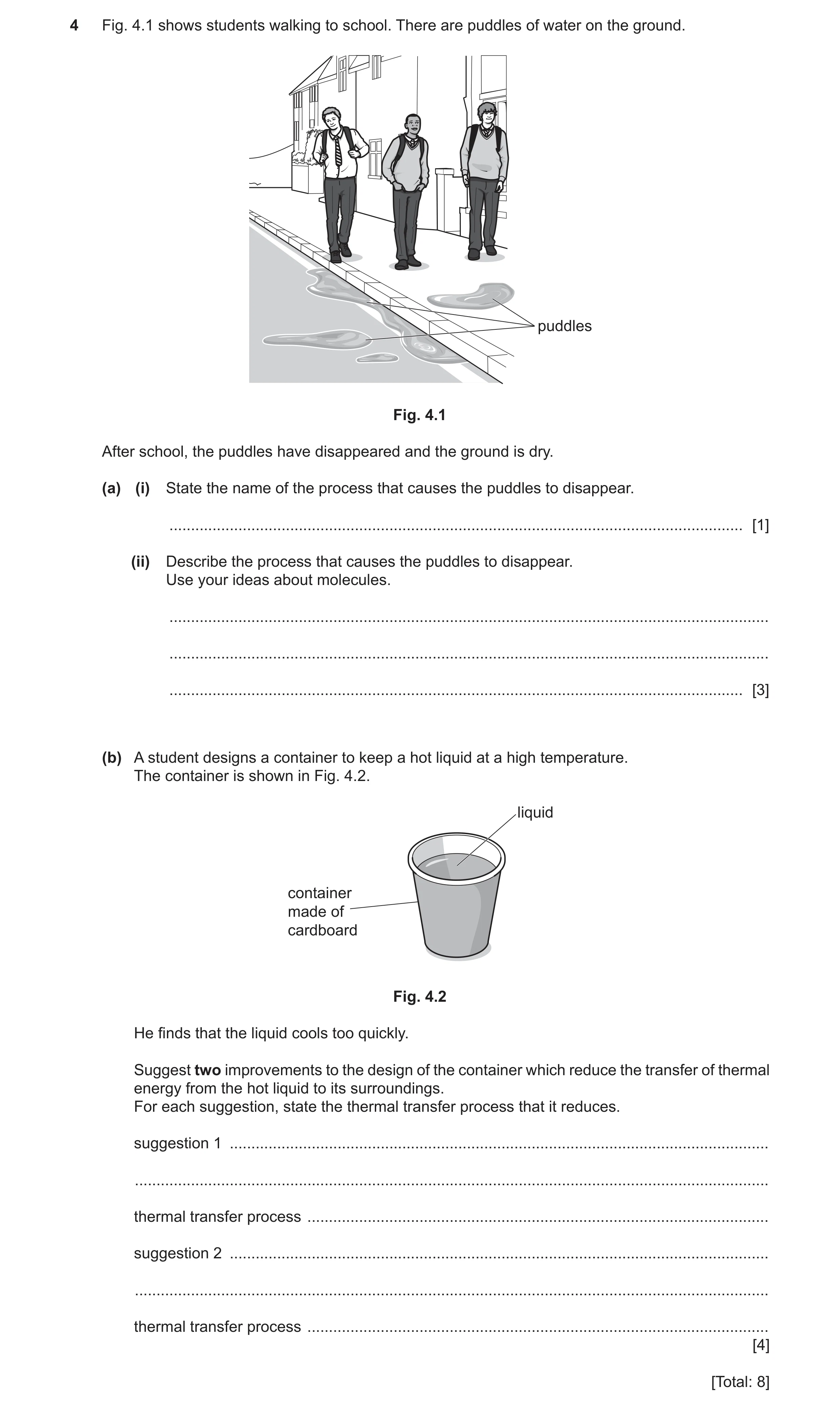
4 Fig. 4.1 shows students walking to school. There are puddles of water on the ground. puddles Fig. 4.1 After school, the puddles have disappeared and the ground is dry. (a) (i) State the name of the process that causes the puddles to disappear. … [1] (ii) Describe the process that causes the puddles to disappear. Use your ideas about molecules. … … … [3] (b) A student designs a container to keep a hot liquid at a high temperature. The container is shown in Fig. 4.2. liquid container made of cardboard Fig. 4.2 He finds that the liquid cools too quickly. Suggest two improvements to the design of the container which reduce the transfer of thermal energy from the hot liquid to its surroundings. For each suggestion, state the thermal transfer process that it reduces. suggestion 1 … … thermal transfer process … suggestion 2 … … thermal transfer process … [4] [Total: 8]
8 marks
Mark scheme: 4(a)(i) evaporation B1 4(a)(ii) any three from the following: B3 at the surface more energetic molecules escape (from liquid) owtte (as they) overcome / break forces / bonds (between molecules) (liquid (molecules) →) gas / vapour (molecules) 4(b) any two pairs B2 (surround container with) insulation / lagging / cotton wool or similar – conduction change material of cup to better insulator – conduction (surround container with) foil / silver / (paint) shiny white – radiation (surround container with) vacuum – conduction OR convection lid – evaporation / convection
This question in 0625/32 Oct/Nov 2022
Q37 · During an experiment, a heater supplies thermal energy to a substance 0625/33 Oct/Nov 2022
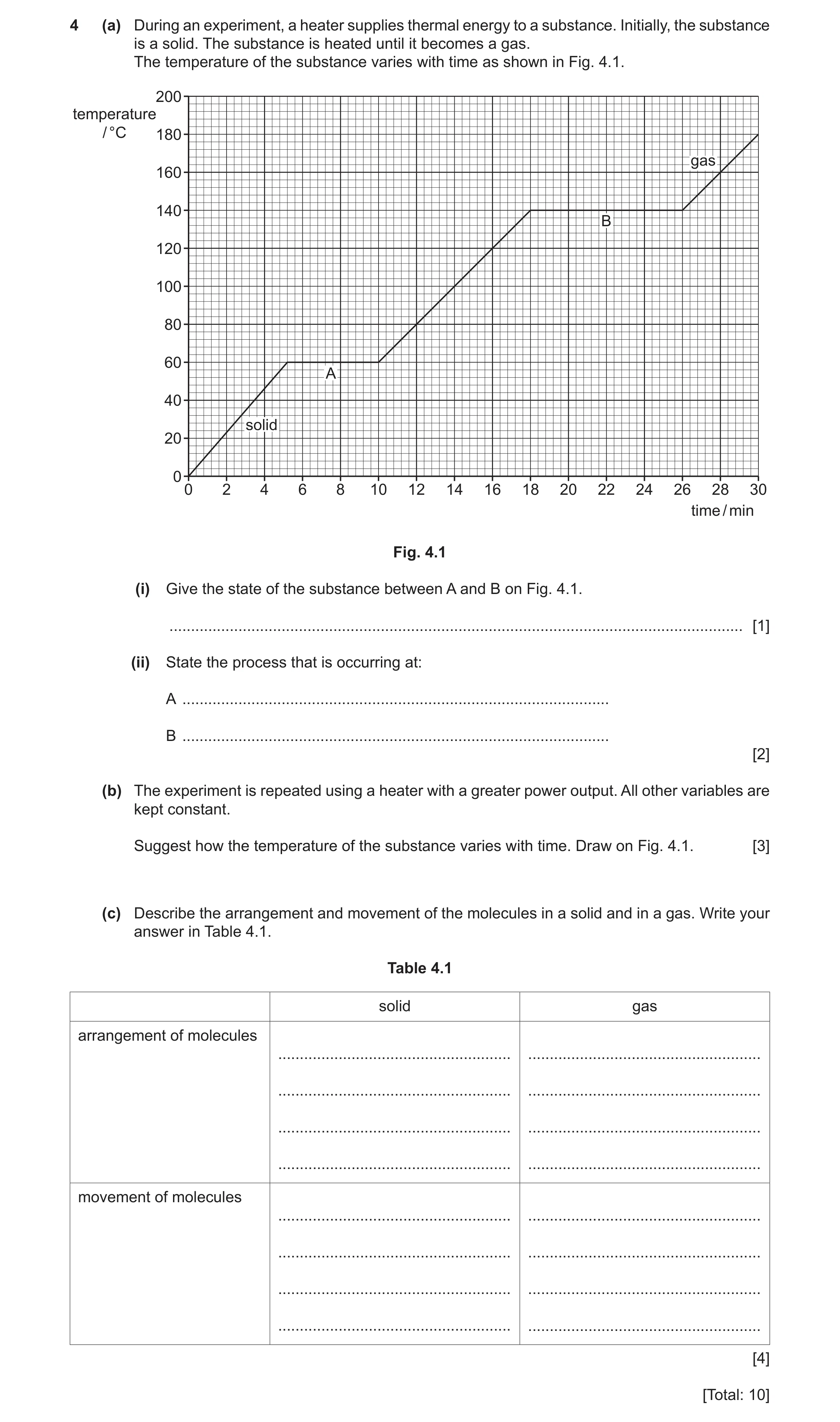
4 (a) During an experiment, a heater supplies thermal energy to a substance. Initially, the substance is a solid. The substance is heated until it becomes a gas. The temperature of the substance varies with time as shown in Fig. 4.1. 200 temperature / °C 180 gas 160 140 B 120 100 80 60 A 40 solid 20 0 0 2 4 6 8 10 12 14 16 18 20 22 24 26 28 30 time / min Fig. 4.1 (i) Give the state of the substance between A and B on Fig. 4.1. … [1] (ii) State the process that is occurring at: A … B … [2] (b) The experiment is repeated using a heater with a greater power output. All other variables are kept constant. Suggest how the temperature of the substance varies with time. Draw on Fig. 4.1. [3] (c) Describe the arrangement and movement of the molecules in a solid and in a gas. Write your answer in Table 4.1. Table 4.1 solid gas arrangement of molecules … … … … … … … … movement of molecules … … … … … … … … [4] [Total: 10]
10 marks
Mark scheme: 4(a)(i) liquid B1 4(a)(ii) A ... melting B1 B ... boiling B1 4(b) line starts below freezing point and ends above boiling point B1 line ends before 30 min B1 horizontal lines at melting point AND boiling point at correct temperature B1 4(c) arrangement: B1 solid: regular OR close together owtte gas: irregular / random OR far apart B1 movement: B1 solid: vibration owtte gas: fast moving OR colliding OR random B1
This question in 0625/33 Oct/Nov 2022
Q38 · Some gas, at room temperature, in a cylinder with a piston that can move 0625/32 Feb/March 2023
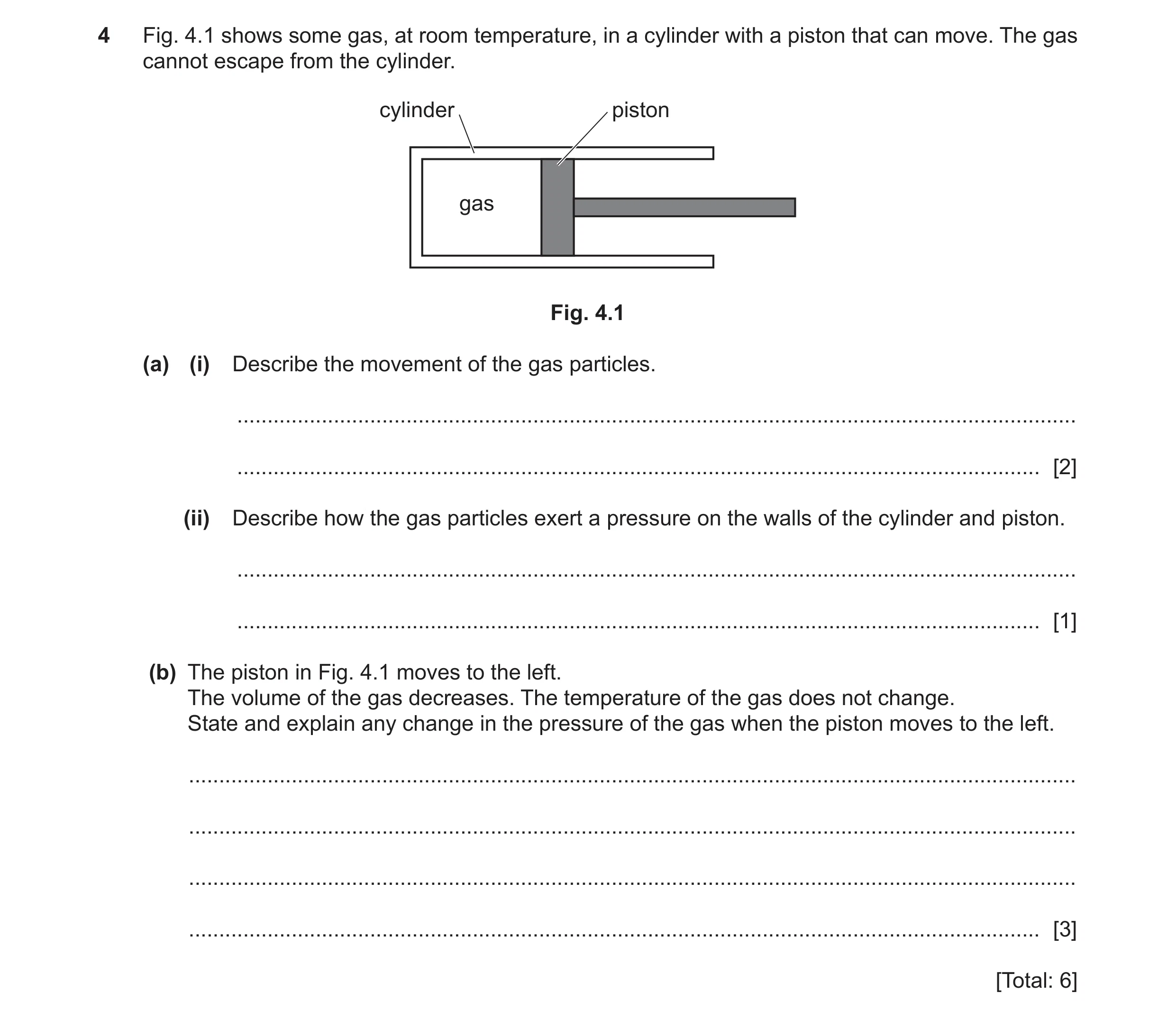
4 Fig. 4.1 shows some gas, at room temperature, in a cylinder with a piston that can move. The gas cannot escape from the cylinder. cylinder piston gas Fig. 4.1 (a) (i) Describe the movement of the gas particles. … … [2] (ii) Describe how the gas particles exert a pressure on the walls of the cylinder and piston. … … [1] (b) The piston in Fig. 4.1 moves to the left. The volume of the gas decreases. The temperature of the gas does not change. State and explain any change in the pressure of the gas when the piston moves to the left. … … … … [3] [Total: 6]
6 marks
Mark scheme: 4(a)(i) any two from: B2 high speed moving freely random (motion) OR (moving in) any / all directions 4(a)(ii) collisions (of particles with walls of cylinder OR surface) B1 4(b) any three from: B3 pressure increases (because) molecules are closer together / more densely packed OR area of cylinder decreases (so there are) more collisions per unit area (with walls of cylinder) pressure = force ÷ area
This question in 0625/32 Feb/March 2023
Q39 · Some particles of a gas in a metal box 0625/31 May/June 2023
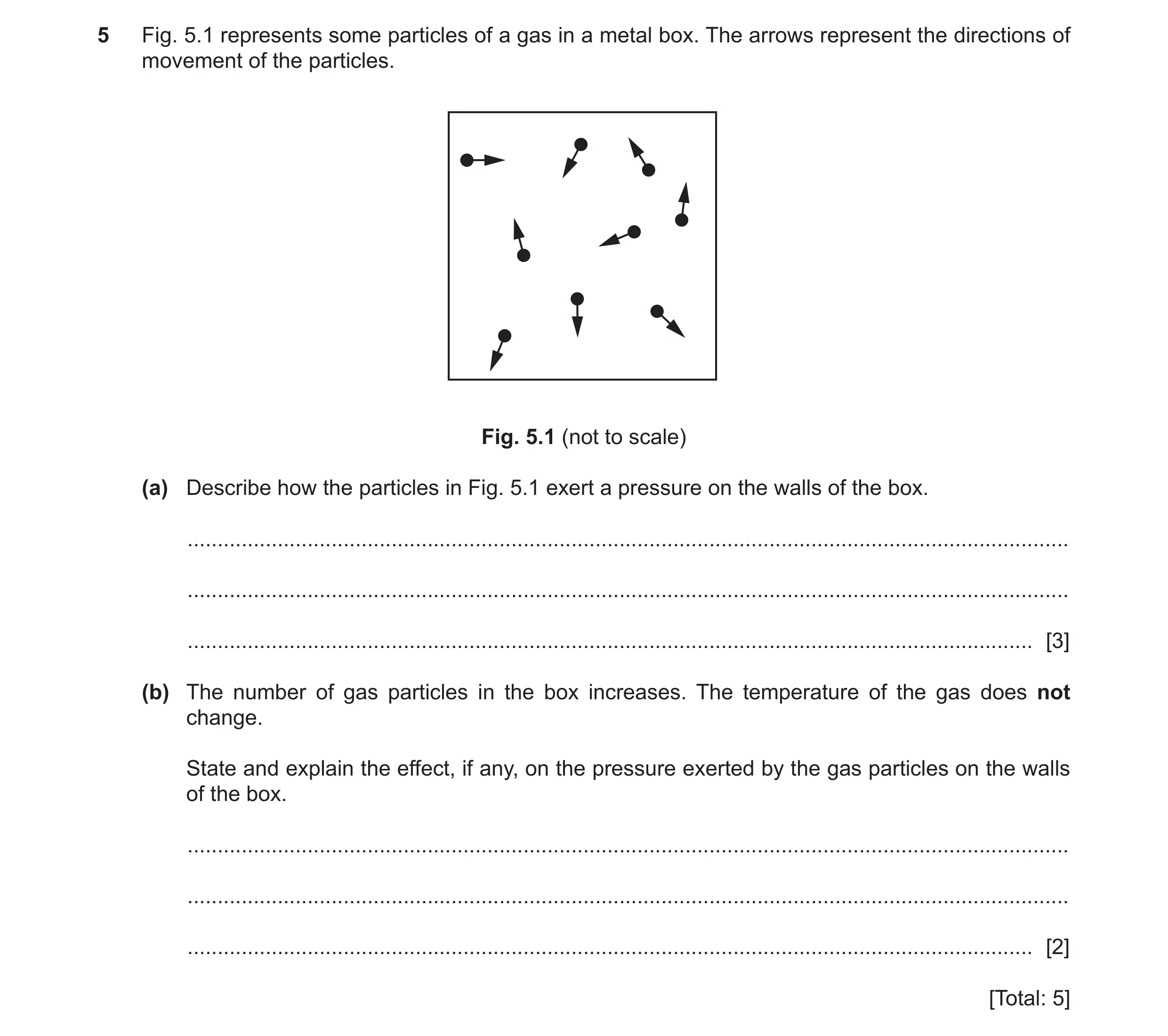
5 Fig. 5.1 represents some particles of a gas in a metal box. The arrows represent the directions of movement of the particles. Fig. 5.1 (not to scale) (a) Describe how the particles in Fig. 5.1 exert a pressure on the walls of the box. … … … [3] (b) The number of gas particles in the box increases. The temperature of the gas does not change. State and explain the effect, if any, on the pressure exerted by the gas particles on the walls of the box. … … … [2] [Total: 5]
5 marks
Mark scheme: 5(a) any three from: idea of (continuous) random movement (of gas particles) collisions / impacts (of particles) (collisions) with wall(s) of box idea that force is produced (by colliding particles) idea that pressure is force on an area 5(b) pressure increases M1 (as) more (frequent) collisions (with walls of box) A1
This question in 0625/31 May/June 2023
Q40 · A student has a block of solid metal at room temperature 0625/32 May/June 2023
4 A student has a block of solid metal at room temperature. (a) (i) Describe the arrangement, separation and motion of the particles in the solid metal. … … … … [3] (ii) The student cools the block of metal in a freezer. State the effect, if any, of cooling on the kinetic energy of the particles in the block of metal. … [1] (b) (i) State the name of the temperature at which particles have the least kinetic energy. … [1] (ii) State the value of temperature at which particles have the least kinetic energy. Include the unit. … [1] (c) The metal block emits thermal radiation from its surface. State two features of a surface that is a good emitter of thermal radiation. 1 … 2 … [2] [Total: 8]
8 marks
Mark scheme: 4(a)(i) any three from: (particles are) fixed in position / place regular arrangement vibrating close(r than in liquids or gases) B3 4(a)(ii) (kinetic energy) decreases B1 4(b)(i) absolute zero B1 4(b)(ii) –273 °C OR 0 K OR zero K / kelvin B1 4(c) black OR dark (colour) B1 dull OR rough (surface) B1
This question in 0625/32 May/June 2023
Q41 · The arrangement and separation of particles in a liquid 0625/31 Oct/Nov 2023
3 Fig. 3.1 represents the arrangement and separation of particles in a liquid. Each circle represents a particle. Fig. 3.1 (a) In the box in Fig. 3.2, draw at least four circles to show the arrangement and separation of particles in a gas. Fig. 3.2 [2] (b) Describe the arrangement, separation and motion of particles in a solid. … … … [3] (c) Fig. 3.3 shows a fire heating water in a metal pan. water metal pan Fig. 3.3 (i) State the name of the process of thermal energy transfer through the metal of the pan. … [1] (ii) Describe how thermal energy is transferred through the water by convection. … … … [3] (iii) State the temperature at which the water boils at standard atmospheric pressure. temperature = … °C [1] [Total: 10]
10 marks
Mark scheme: 3(a) at least 4 circles widely separated (gaps at least the diameter of circles) B1 random arrangement B1 3(b) any three from: B3 regular / uniform arrangement fixed (positions) vibrating close(ly) OR tight(ly) (packed) 3(c)(i) conduction B1 3(c)(ii) any three from: B3 water particles (at bottom of pan) gain thermal / internal / kinetic energy (water) particles move apart density of liquid decreases OR liquid becomes less dense less dense liquid rises causing liquid to circulate (in pan) 3(c)(iii) 100 (°C) B1
This question in 0625/31 Oct/Nov 2023
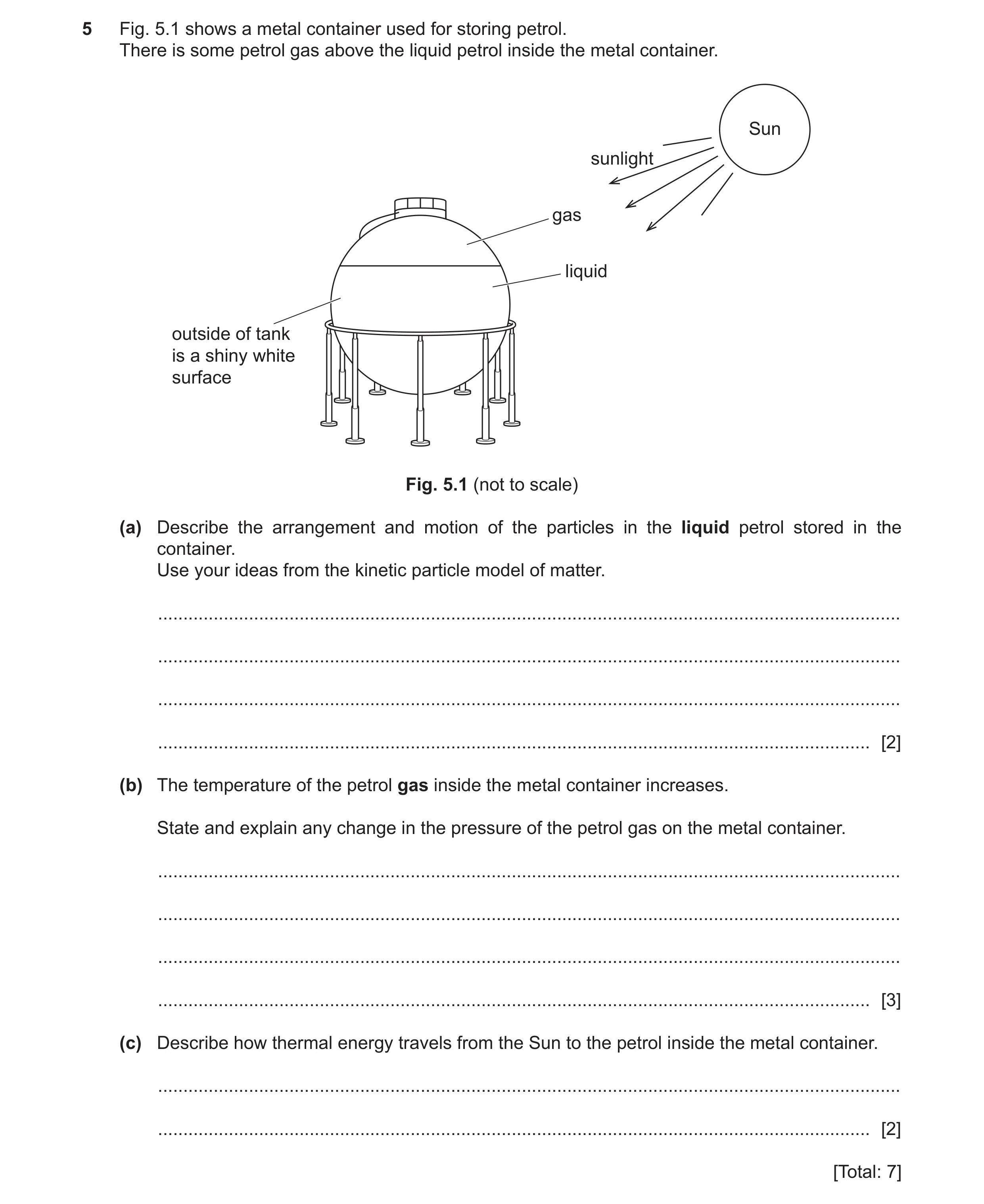
Q42 · A metal container used for storing petrol 0625/32 Feb/March 2024
5 Fig. 5.1 shows a metal container used for storing petrol. There is some petrol gas above the liquid petrol inside the metal container. Sun sunlight gas liquid outside of tank is a shiny white surface Fig. 5.1 (not to scale) (a) Describe the arrangement and motion of the particles in the liquid petrol stored in the container. Use your ideas from the kinetic particle model of matter. … … … … [2] (b) The temperature of the petrol gas inside the metal container increases. State and explain any change in the pressure of the petrol gas on the metal container. … … … … [3] (c) Describe how thermal energy travels from the Sun to the petrol inside the metal container. … … [2] [Total: 7]
7 marks
Mark scheme: 5(a) any two from: B2 • (particles are;) random arrangement / pattern • close together OR idea slightly further apart than in solid • move randomly OR move around / about (freely) • colliding with each other / walls • have some vibrational energy / motion 5(b) pressure increases B1 any two from: (because) B2 • particles move faster OR have increased kinetic energy • more (frequent) collisions (with walls of container) • harder collisions (with walls of container) 5(c) infrared OR radiation (through space and atmosphere) B1 conduction (through the metal) B1
This question in 0625/32 Feb/March 2024
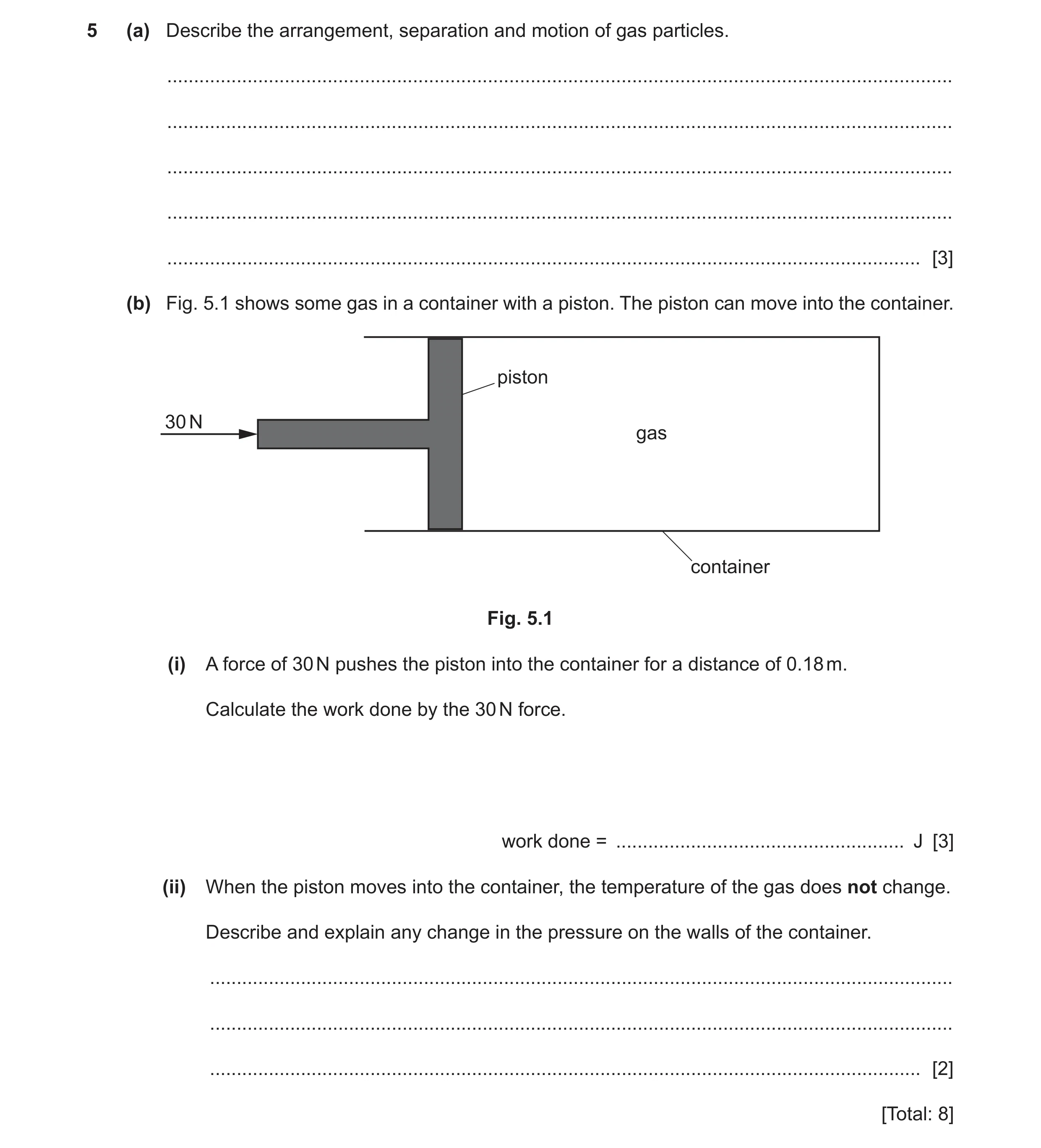
Q43 · Describe the arrangement, separation and motion of gas particles 0625/31 May/June 2024
5 (a) Describe the arrangement, separation and motion of gas particles. … … … … … [3] (b) Fig. 5.1 shows some gas in a container with a piston. The piston can move into the container. piston 30 N gas container Fig. 5.1 (i) A force of 30 N pushes the piston into the container for a distance of 0.18 m. Calculate the work done by the 30 N force. work done = … J [3] (ii) When the piston moves into the container, the temperature of the gas does not change. Describe and explain any change in the pressure on the walls of the container. … … … [2] [Total: 8]
8 marks
Mark scheme: 5(a) any three from (particles / molecules of gas are / have): random arrangement widely spaced (compared to solid / liquid) random motion colliding (with each other / walls) high speed / KE 5(b)(i) 5.4 (J) A3 (work done =) 30 0.18 (C2) (work done =) force distance (moved in direction of force) (C1) 5(b)(ii) (pressure) increases M1 (because) collisions are more frequent / often (of gas particles with walls) A1
This question in 0625/31 May/June 2024
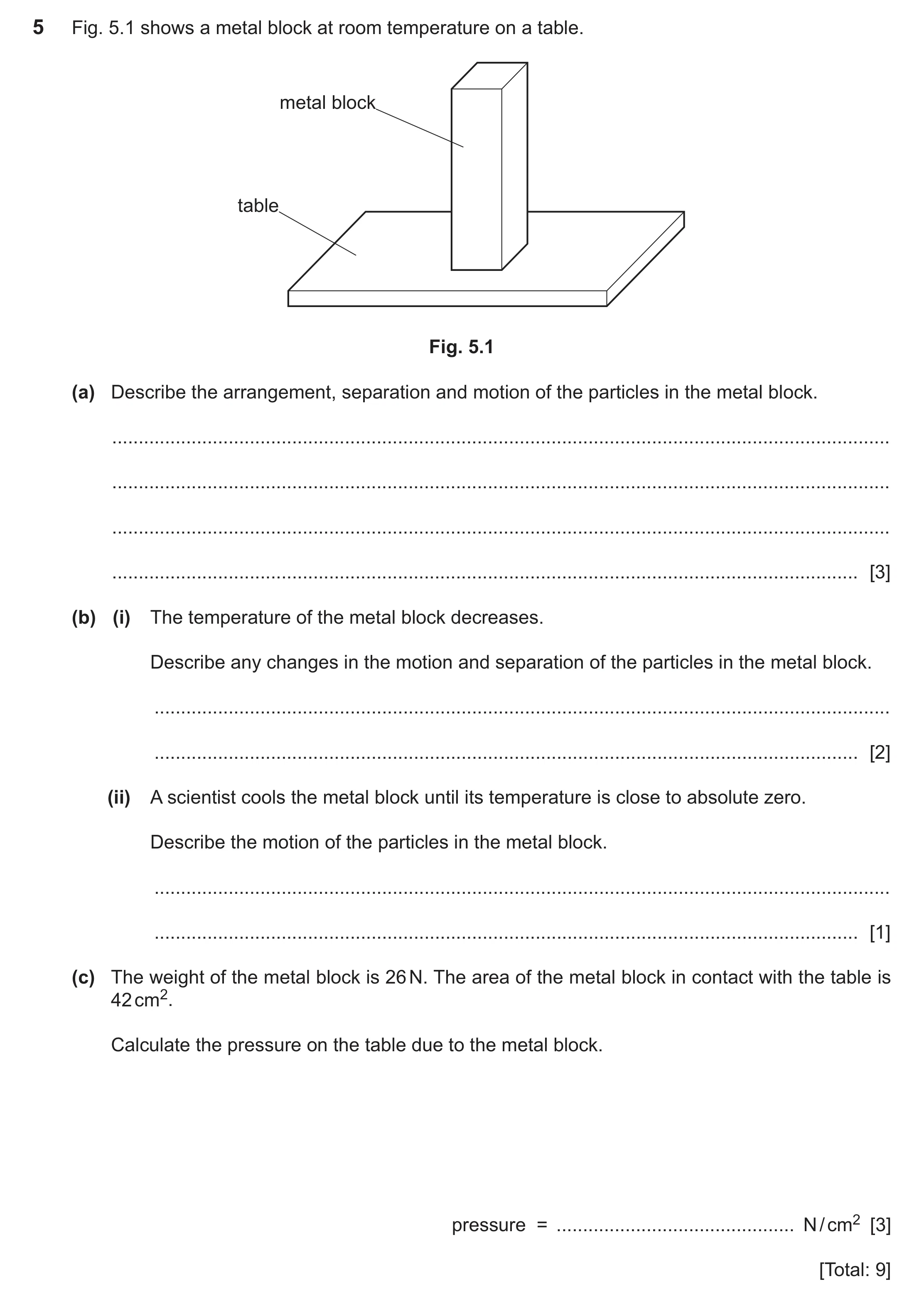
Q44 · A metal block at room temperature on a table 0625/32 May/June 2024
5 Fig. 5.1 shows a metal block at room temperature on a table. metal block table Fig. 5.1 (a) Describe the arrangement, separation and motion of the particles in the metal block. … … … … [3] (b) (i) The temperature of the metal block decreases. Describe any changes in the motion and separation of the particles in the metal block. … … [2] (ii) A scientist cools the metal block until its temperature is close to absolute zero. Describe the motion of the particles in the metal block. … … [1] (c) The weight of the metal block is 26 N. The area of the metal block in contact with the table is 42 cm2. Calculate the pressure on the table due to the metal block. pressure = … N / cm2 [3] [Total: 9]
9 marks
Mark scheme: 5(a) (particles are) fixed in position / in lattice OR regular / fixed arrangement / pattern B1 can only vibrate / no translational KE B1 close / closer (than in liquids or gases) B1 5(b)(i) (particles move) closer (as temperature decreases) B1 particles vibrate slower / less OR have smaller vibrations B1 5(b)(ii) (at absolute zero particles have) least / smallest vibrations B1 5(c) (P =) 0.62 (N / cm2) A3 (P =) 26 ÷ 42 (C2) (P =) F ÷ A (C1)
This question in 0625/32 May/June 2024
Q45 · The arrangement of particles in a solid 0625/33 May/June 2024
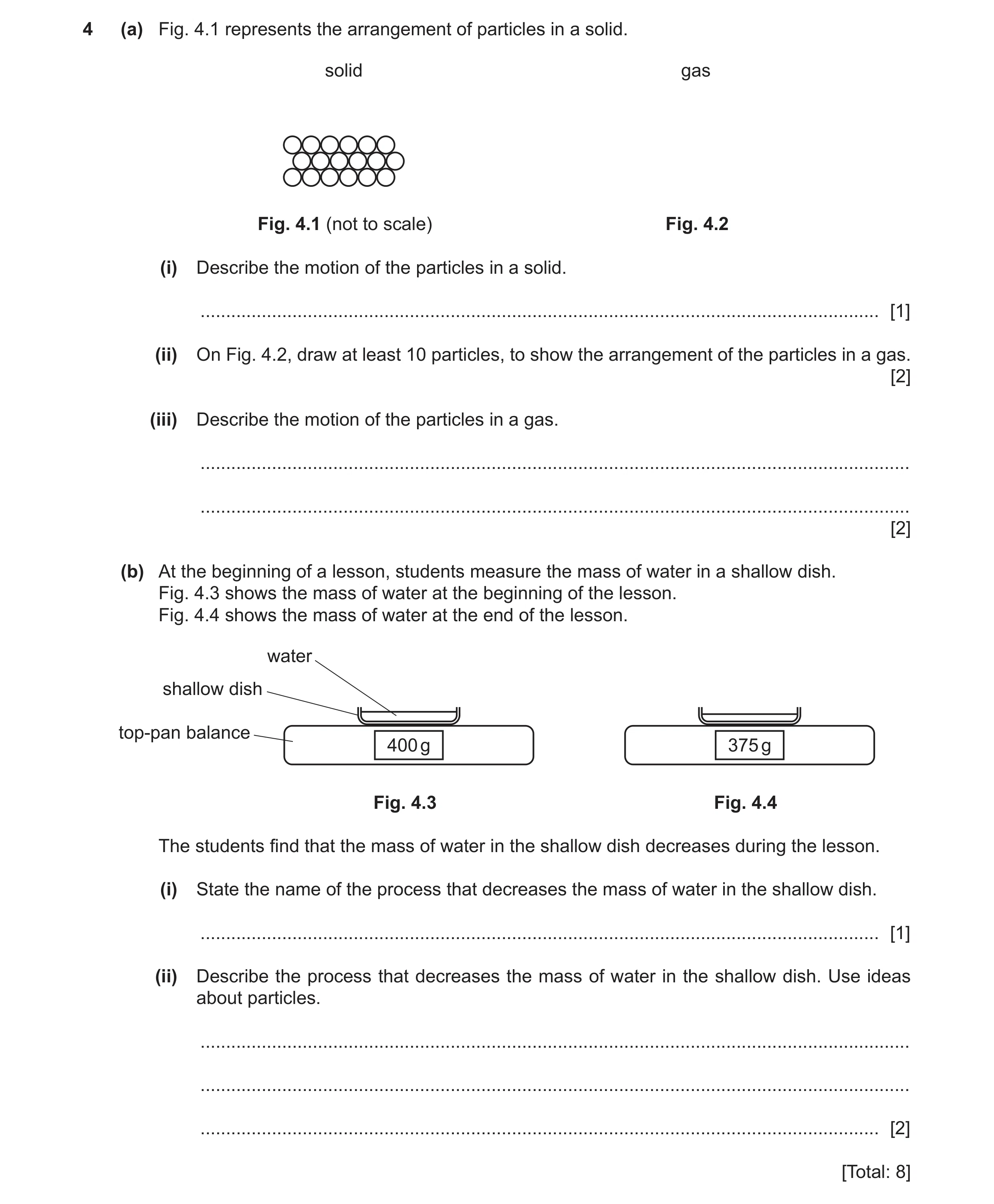
4 (a) Fig. 4.1 represents the arrangement of particles in a solid. solid gas Fig. 4.1 (not to scale) Fig. 4.2 (i) Describe the motion of the particles in a solid. … [1] (ii) On Fig. 4.2, draw at least 10 particles, to show the arrangement of the particles in a gas. [2] (iii) Describe the motion of the particles in a gas. … … [2] (b) At the beginning of a lesson, students measure the mass of water in a shallow dish. Fig. 4.3 shows the mass of water at the beginning of the lesson. Fig. 4.4 shows the mass of water at the end of the lesson. water shallow dish top-pan balance 400 g 375 g Fig. 4.3 Fig. 4.4 The students find that the mass of water in the shallow dish decreases during the lesson. (i) State the name of the process that decreases the mass of water in the shallow dish. … [1] (ii) Describe the process that decreases the mass of water in the shallow dish. Use ideas about particles. … … … [2] [Total: 8]
8 marks
Mark scheme: 4(a)(i) vibrate B1 4(a)(ii) random (arrangement) B1 clear separation of particles B1 4(a)(iii) any two from: random fast/high speed / high KE colliding B2 4(b)(i) evaporation B1 4(b)(ii) any two from: (happens at the) surface the more energetic particles escape (liquid particles) → gas / vapour (particles) B2
This question in 0625/33 May/June 2024
Question 46 0625/31 Oct/Nov 2024
5 Fig. 5.1 shows a metal box. The air in the box is at room temperature, 20 °C. Air cannot leave or enter the box. metal box Fig. 5.1 (a) Describe the motion, separation and arrangement of the air particles in the metal box. … … … [3] (b) A student puts the box in a freezer. The temperature of the air in the box decreases. Describe the changes in the motion of the air particles in the box when the temperature decreases. … … [2] [Total: 5]
5 marks
Mark scheme: 5(a) any three from: B3 • random motion (of particles) • high speed • widely separated (compared to particles in liquid or solid) • random arrangement • constantly colliding (with each other / walls) 5(b) any two from: B2 • speed decreases • (because) kinetic energy OR (internal) energy decreases • (and so) collision rate decreases
This question in 0625/31 Oct/Nov 2024
Q47 · A sealed glass bottle contains air 0625/32 Oct/Nov 2024
5 A sealed glass bottle contains air. The temperature of the air is 21 °C. (a) Calculate the temperature of the air in kelvin. temperature = … K [2] (b) The temperature of the air in the bottle decreases to 14 °C. State and explain what happens to the pressure inside the bottle. Use your ideas about gas particles. … … … … … … [4] [Total: 6]
6 marks
Mark scheme: 5(a) 294 (K) A2 273 (+ 21) (C1) 5(b) • low(er) pressure B1 any three from: • slow(er)particles or particles have less Kinetic Energy OR less energy in the kinetic store • less frequent collisions (with inside of bottle) B3 • (collide with) less force • pressure = force / area OR p = F A
This question in 0625/32 Oct/Nov 2024
Q48 · A student warms some water in a metal container using an electric heater, as shown in Fig 0625/32 Feb/March 2025
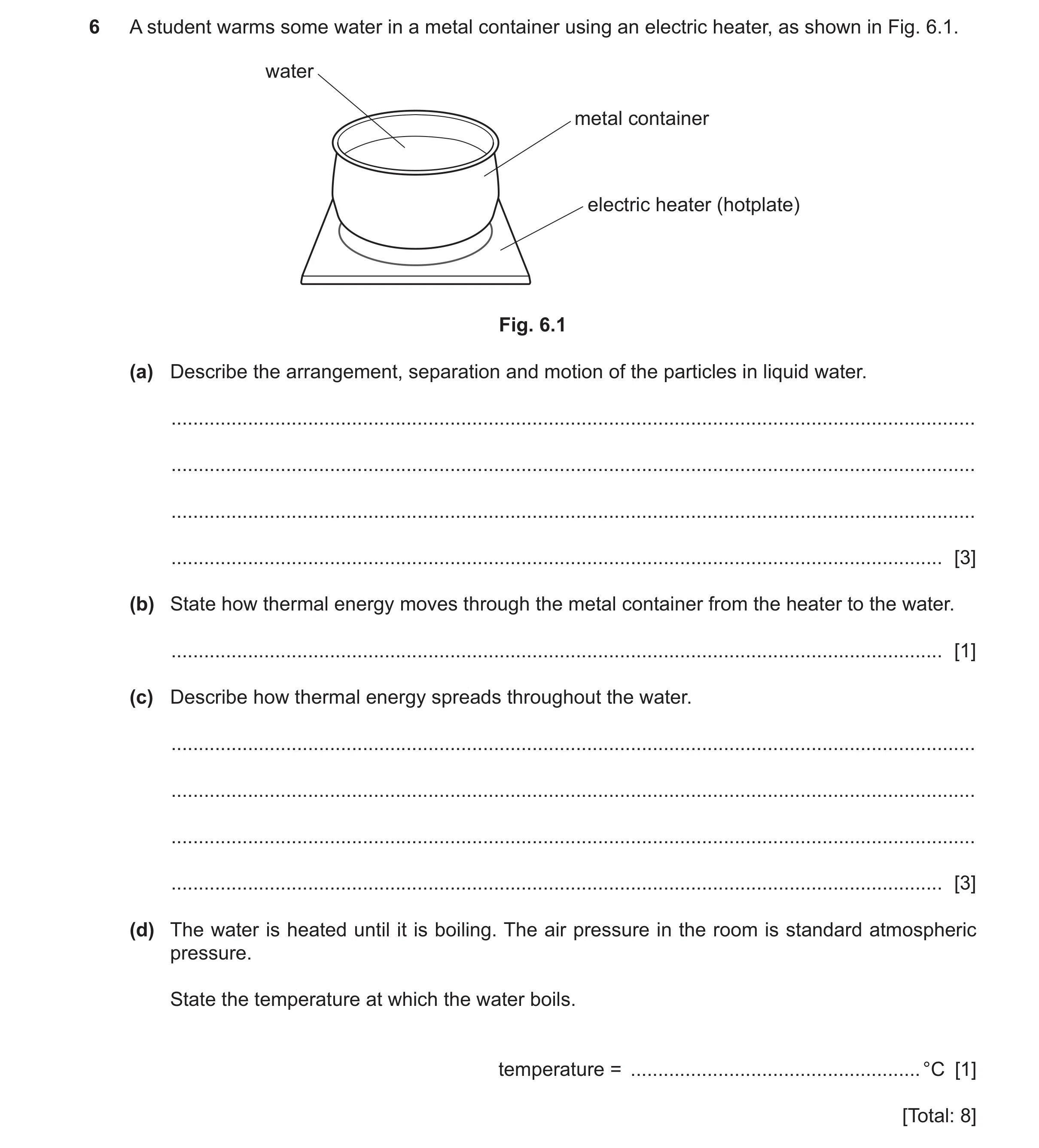
6 A student warms some water in a metal container using an electric heater, as shown in Fig. 6.1. water metal container electric heater (hotplate) Fig. 6.1 (a) Describe the arrangement, separation and motion of the particles in liquid water. … … … … [3] (b) State how thermal energy moves through the metal container from the heater to the water. … [1] (c) Describe how thermal energy spreads throughout the water. … … … … [3] (d) The water is heated until it is boiling. The air pressure in the room is standard atmospheric pressure. State the temperature at which the water boils. temperature = … °C [1] [Total: 8]
8 marks
Mark scheme: 6(a) any three from (particles are:) B3 in a random arrangement close together OR slightly further apart than in solids move freely OR slide over each other collide (with each other) moving randomly 6(b) conduction B1 6(c) any three from: B3 convection idea that water at bottom of pan is warmed / temp of water at bottom increases warm water is less dense less dense / warm water rises OR more dense/colder water sinks 6(d) 100 (°C) B1
This question in 0625/32 Feb/March 2025
Q49 · Complete the sentences about the kinetic particle model of matter 0625/32 May/June 2025
4 (a) Complete the sentences about the kinetic particle model of matter. (i) The movement of the particles in a gas is … … . [1] (ii) The forces between the particles in a gas are … … . [1] (iii) The gas exerts a pressure because the moving gas particles … … . [1] (iv) As the temperature of a fixed volume of gas decreases, the pressure exerted by the gas … . [1] (b) (i) State the value, in degrees Celsius, of the lowest possible temperature. lowest possible temperature = … °C [1] (ii) State the term used for the lowest possible temperature. … [1] [Total: 6]
6 marks
Mark scheme: 4(a)(i) random B1 4(a)(ii) weak / small / negligible B1 4(a)(iii) collide B1 4(a)(iv) decreases B1 4(b)(i) −273 ( C) B1 4(b)(ii) absolute zero B1
This question in 0625/32 May/June 2025
Q50 · Complete the sentences about the kinetic particle model of matter 0625/33 May/June 2025
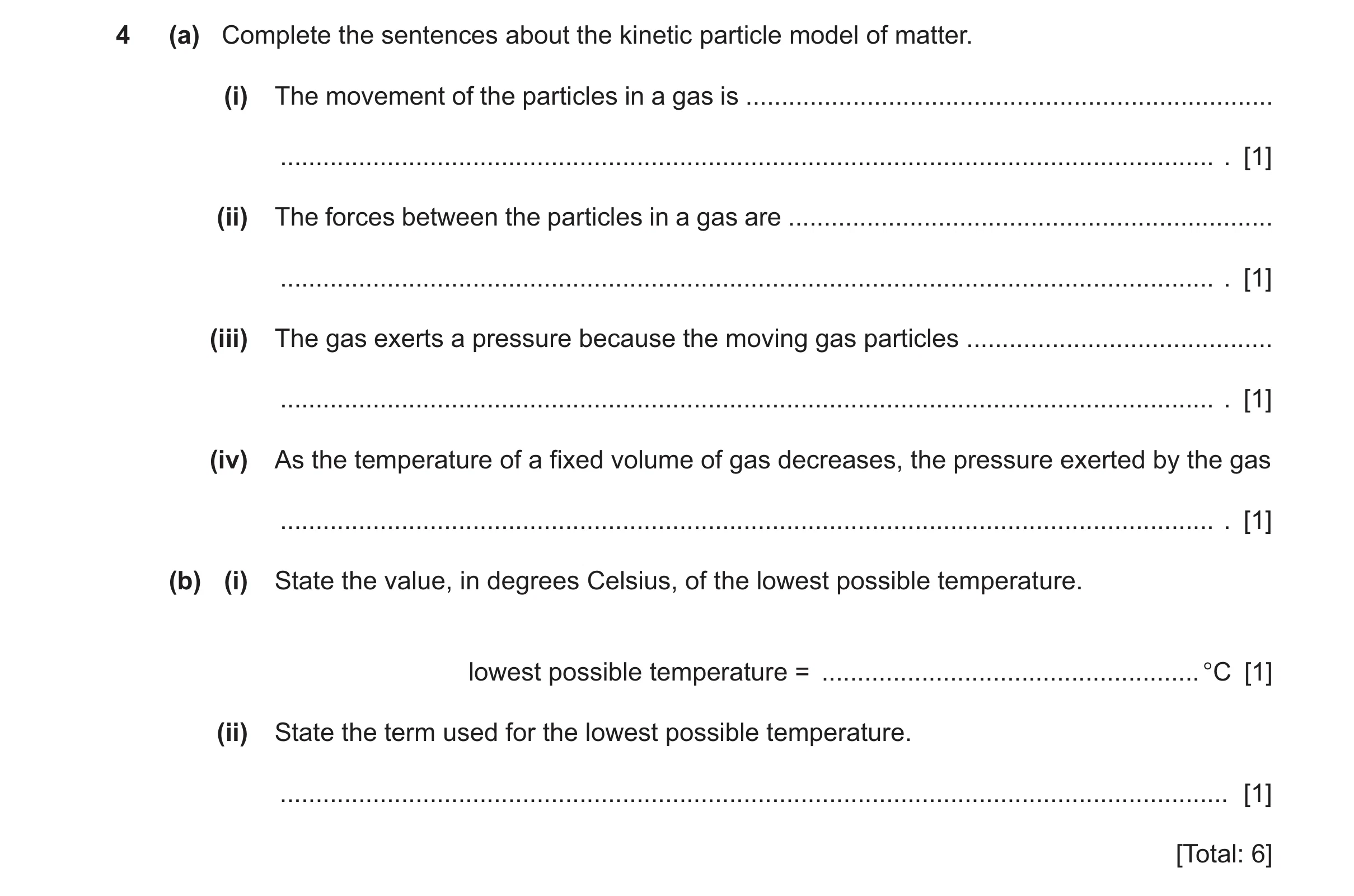
4 (a) Complete the sentences about the kinetic particle model of matter. (i) The movement of the particles in a gas is … … . [1] (ii) The forces between the particles in a gas are … … . [1] (iii) The gas exerts a pressure because the moving gas particles … … . [1] (iv) As the temperature of a fixed volume of gas decreases, the pressure exerted by the gas … . [1] (b) (i) State the value, in degrees Celsius, of the lowest possible temperature. lowest possible temperature = … °C [1] (ii) State the term used for the lowest possible temperature. … [1] [Total: 6]
6 marks
Mark scheme: 4(a)(i) random B1 4(a)(ii) weak / small / negligible B1 4(a)(iii) collide B1 4(a)(iv) decreases B1 4(b)(i) −273 ( C) B1 4(b)(ii) absolute zero B1
This question in 0625/33 May/June 2025
Q51 · An empty metal cylinder 0625/31 Oct/Nov 2025
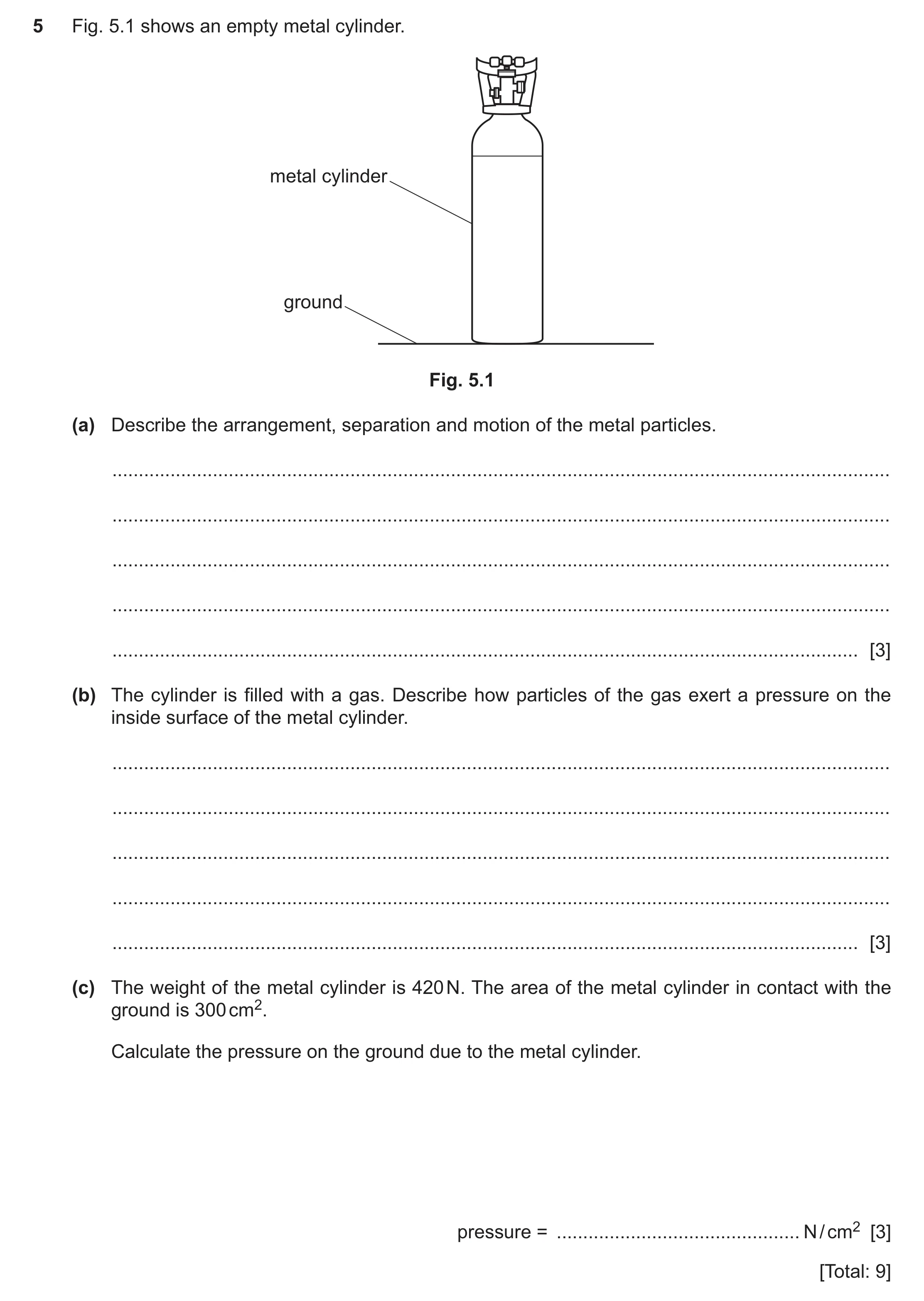
5 Fig. 5.1 shows an empty metal cylinder. metal cylinder ground Fig. 5.1 (a) Describe the arrangement, separation and motion of the metal particles. … … … … … [3] (b) The cylinder is filled with a gas. Describe how particles of the gas exert a pressure on the inside surface of the metal cylinder. … … … … … [3] (c) The weight of the metal cylinder is 420 N. The area of the metal cylinder in contact with the ground is 300 cm2. Calculate the pressure on the ground due to the metal cylinder. pressure = … N / cm2 [3] [Total: 9]
9 marks
Mark scheme: 5(a) (particles are;) fixed in position/ in lattice/regular pattern B1 (can only) vibrate / no translational KE B1 close(r than in liquids or gases) B1 5(b) any THREE from: B3 (particles/they) move at high speed OR have high/large KE move randomly (particles/they) collide with it/surface/walls (collisions) create a force (on cylinder wall) idea of P = F / A 5(c) (P = ) 1.4 (N/cm2) A3 (P = ) 420 ÷ 300 (C2) (P = ) F ÷ A (C1)
This question in 0625/31 Oct/Nov 2025
Q52 · Small cubes of ice in a glass of water 0625/32 Oct/Nov 2025
5 (a) Fig. 5.1 shows small cubes of ice in a glass of water. small cubes of ice water Fig. 5.1 Table 5.1 shows the density of ice and of water. Table 5.1 density g / cm3 ice 0.92 water 0.99 (i) Explain why the cubes of ice float in the water. … [1] (ii) The volume of a cube of ice is 3.4 cm3. Calculate the mass of a cube of ice. mass = … g [3] (b) Cubes of ice are added to the water. One cube of ice falls to the floor. Fig. 5.2 shows this cube of ice as it changes from a solid into a liquid. solid liquid Fig. 5.2 (i) State the name of the process when a solid changes into a liquid. … [1] (ii) Describe the changes in the arrangement and motion of the particles as the ice changes from solid to liquid. arrangement … … … motion … … … [3] (c) Later, the floor is dry. State the name of the process that causes the liquid to disappear. … [1] [Total: 9]
9 marks
Mark scheme: 5(a)(i) ice / it (is) less dense (than water) ora B1 5(a)(ii) 3.1 (g) A3 3.4 0.92 C2 (mass =) density volume C1 5(b)(i) Melting B1 5(b)(ii) any three from: B3 arrangement: regular in solid random in liquid motion: (particles only) vibrate in solid (particles) move around / flow over each other in liquid 5(c) evaporation B1
This question in 0625/32 Oct/Nov 2025
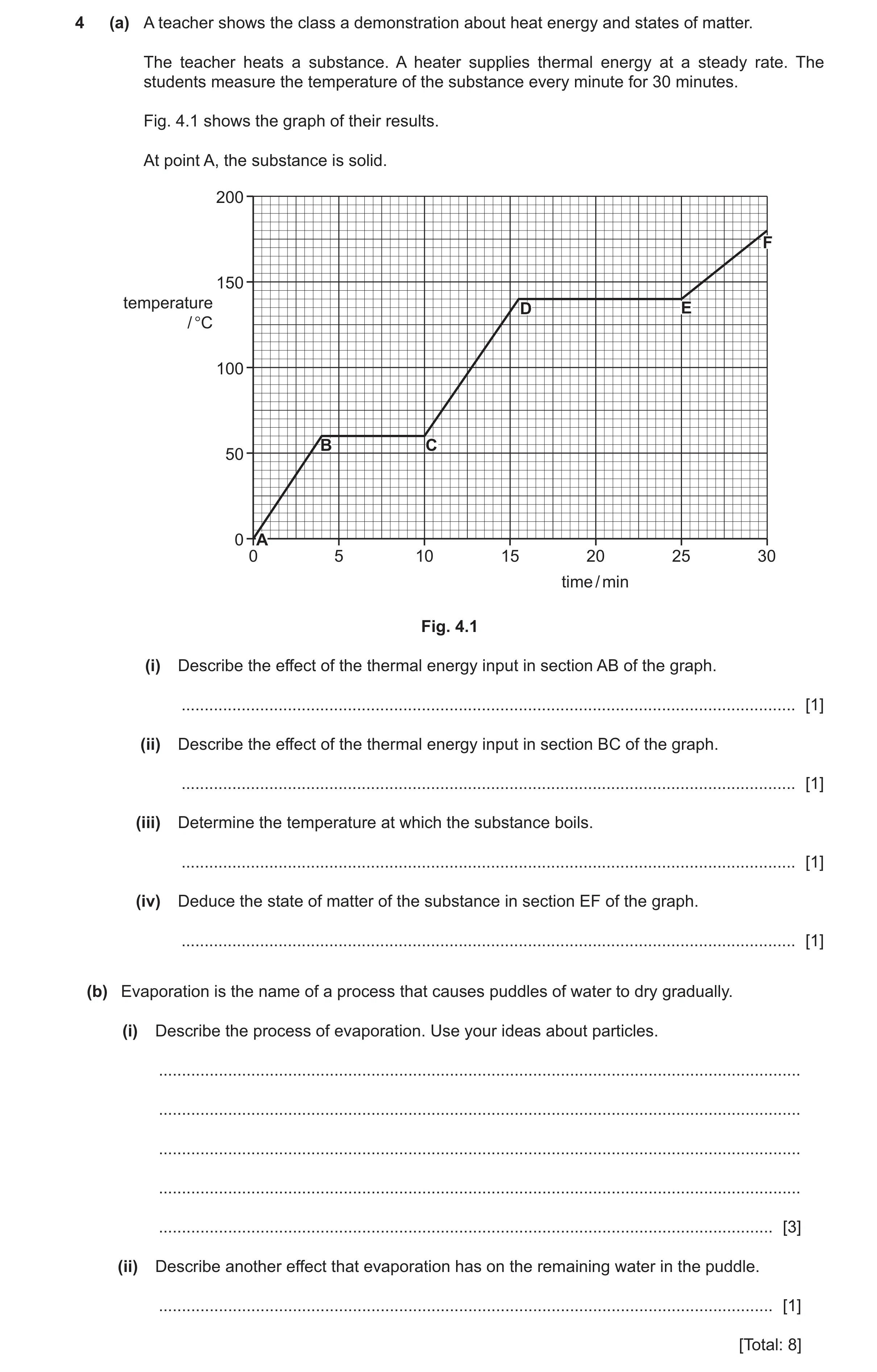
Q53 · A teacher shows the class a demonstration about heat energy and states of matter 0625/33 Oct/Nov 2025
4 (a) A teacher shows the class a demonstration about heat energy and states of matter. The teacher heats a substance. A heater supplies thermal energy at a steady rate. The students measure the temperature of the substance every minute for 30 minutes. Fig. 4.1 shows the graph of their results. At point A, the substance is solid. 200 F 150 temperature D E / °C 100 B C 50 0 A 0 5 10 15 20 25 30 time / min Fig. 4.1 (i) Describe the effect of the thermal energy input in section AB of the graph. … [1] (ii) Describe the effect of the thermal energy input in section BC of the graph. … [1] (iii) Determine the temperature at which the substance boils. … [1] (iv) Deduce the state of matter of the substance in section EF of the graph. … [1] (b) Evaporation is the name of a process that causes puddles of water to dry gradually. (i) Describe the process of evaporation. Use your ideas about particles. … … … … … [3] (ii) Describe another effect that evaporation has on the remaining water in the puddle. … [1] [Total: 8]
8 marks
Mark scheme: 4(a)(i) temperature increasing or internal energy increasing B1 4(a)(ii) melting or changing from solid to liquid B1 4(a)(iii) 140 (°C) B1 4(a)(iv) Gas B1 4(b)(i) any three from the following: B3 • liquid (particles) → gas / vapour (particles) • happens at a surface • (liquid / water absorbs) thermal energy / heat from sun / surroundings / remaining liquid • (average) kinetic energy of particle increases • more energetic particles escape owtte 4(b)(ii) (remaining liquid) cools B1
This question in 0625/33 Oct/Nov 2025
 3 / 55
 4 / 55
 5 / 55
 6 / 55
 7 / 55
 8 / 55
 9 / 55
 10 / 55
 11 / 55
 12 / 55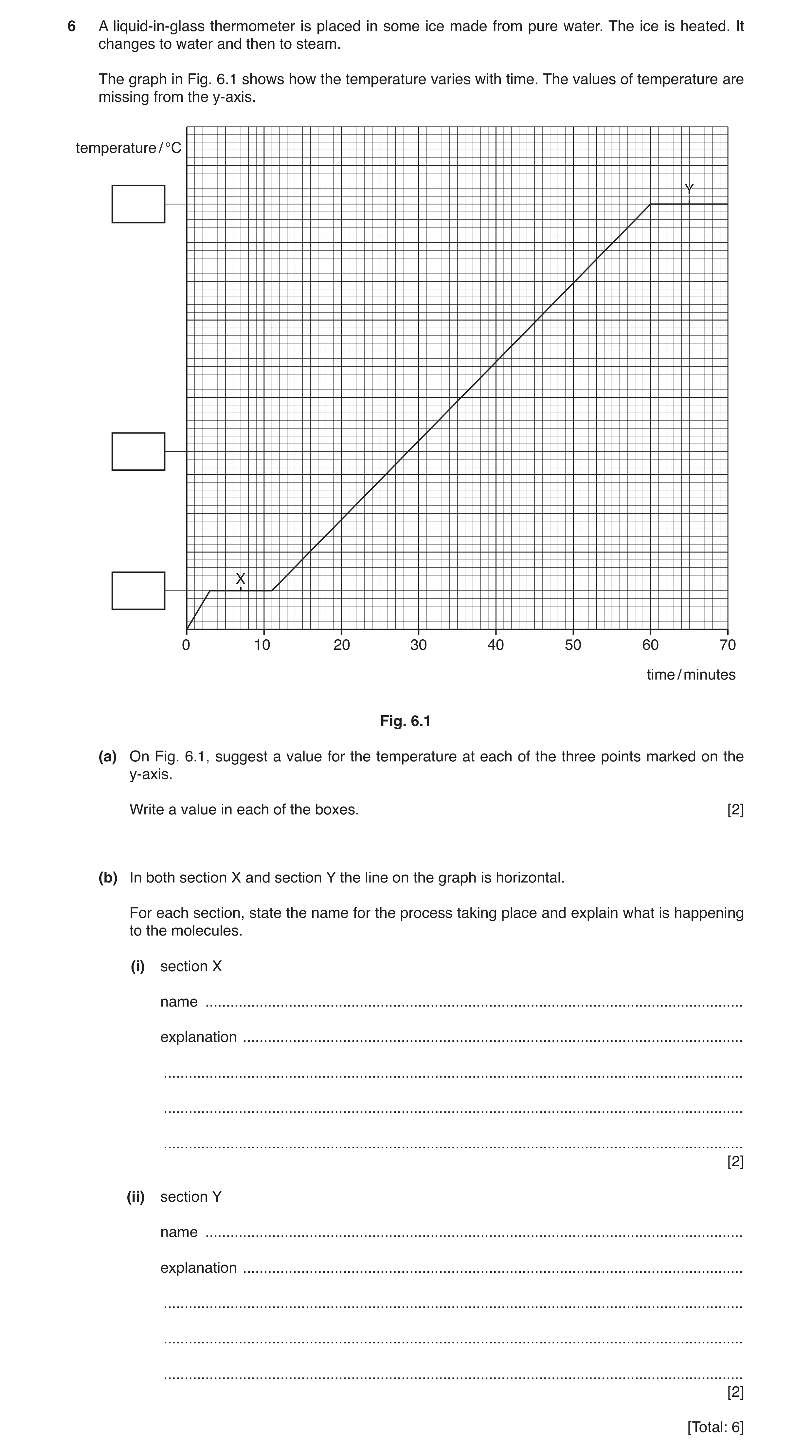
 15 / 55
 16 / 55
 17 / 55
 18 / 55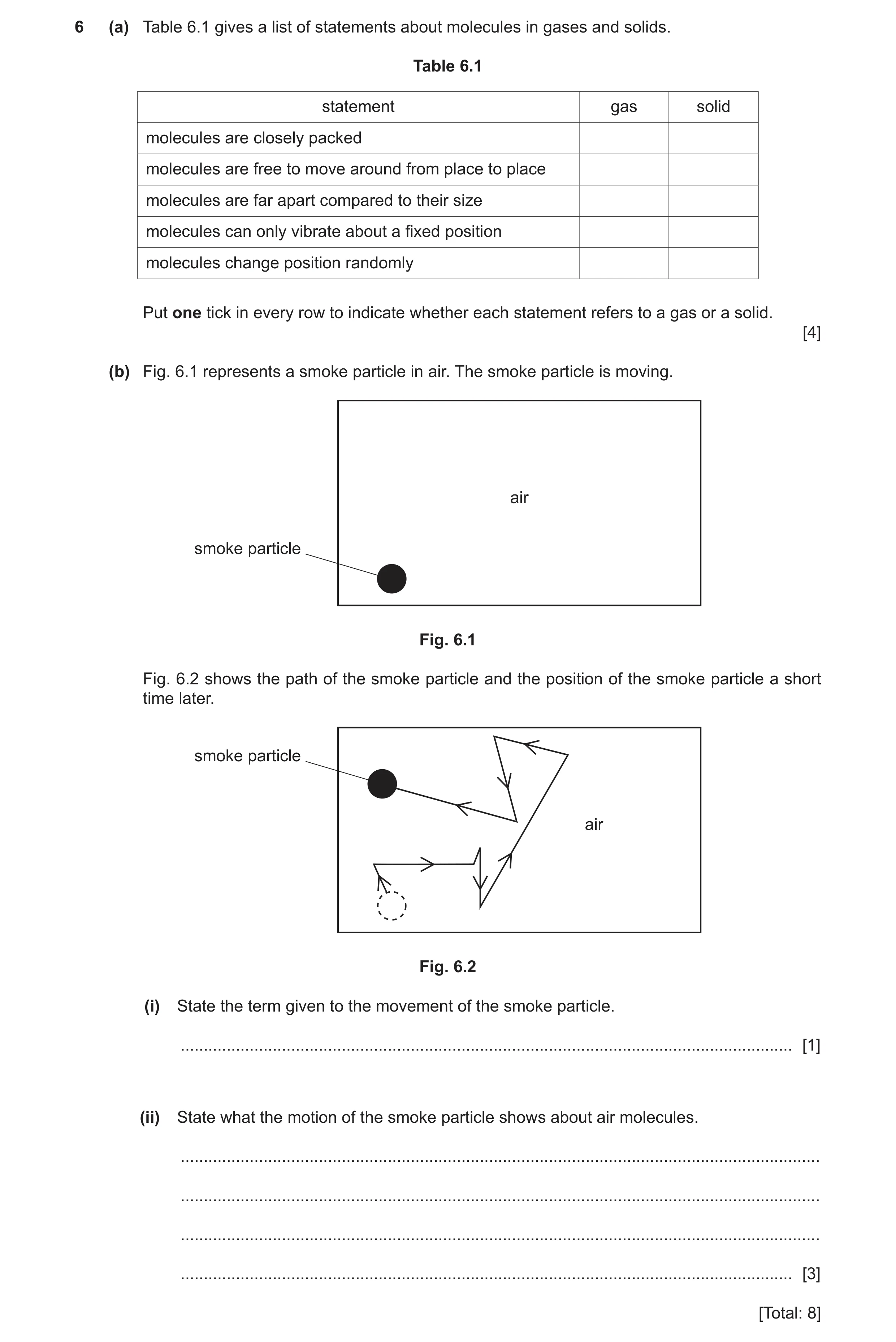
 20 / 55
 21 / 55
 22 / 55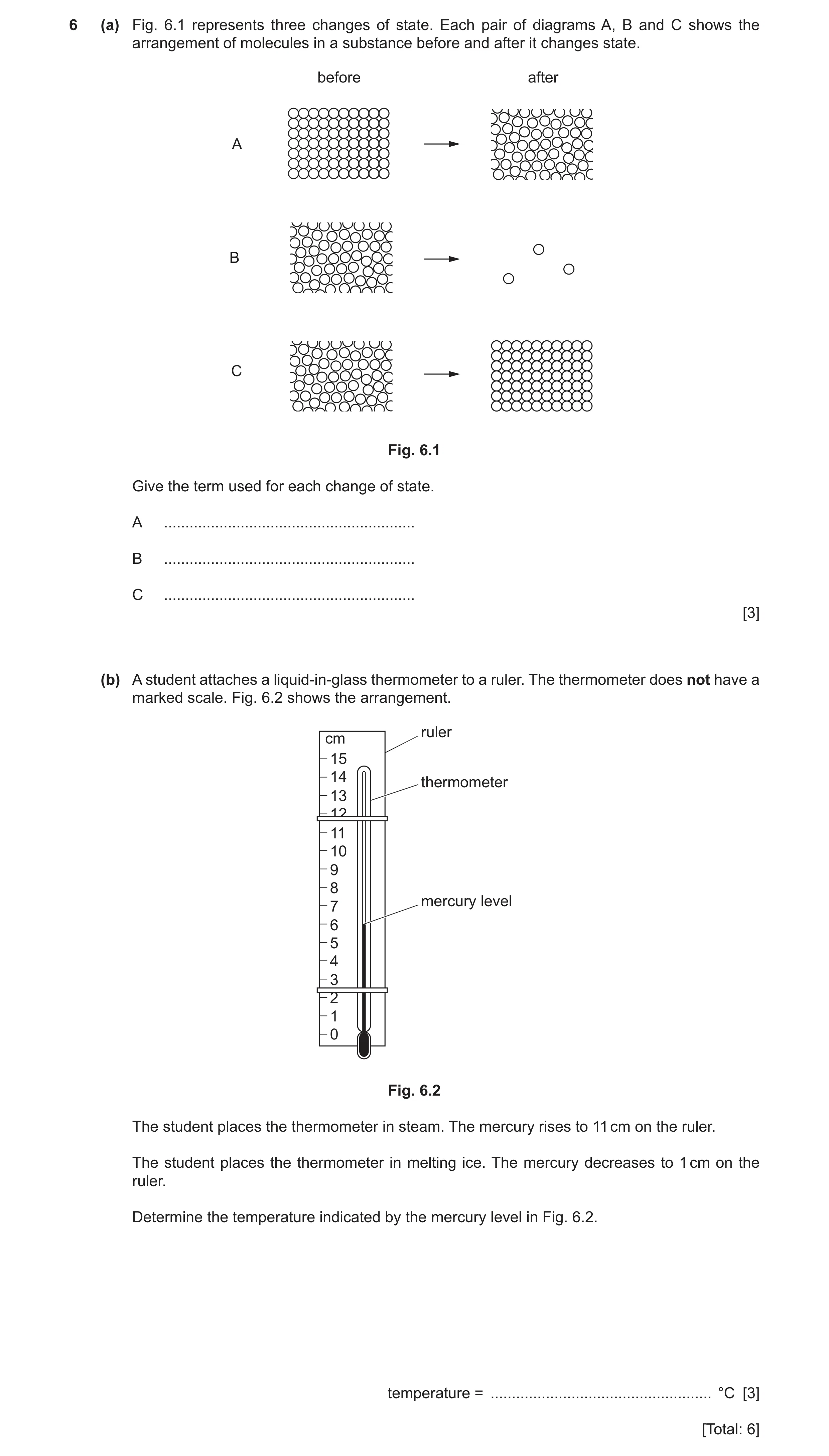
 24 / 55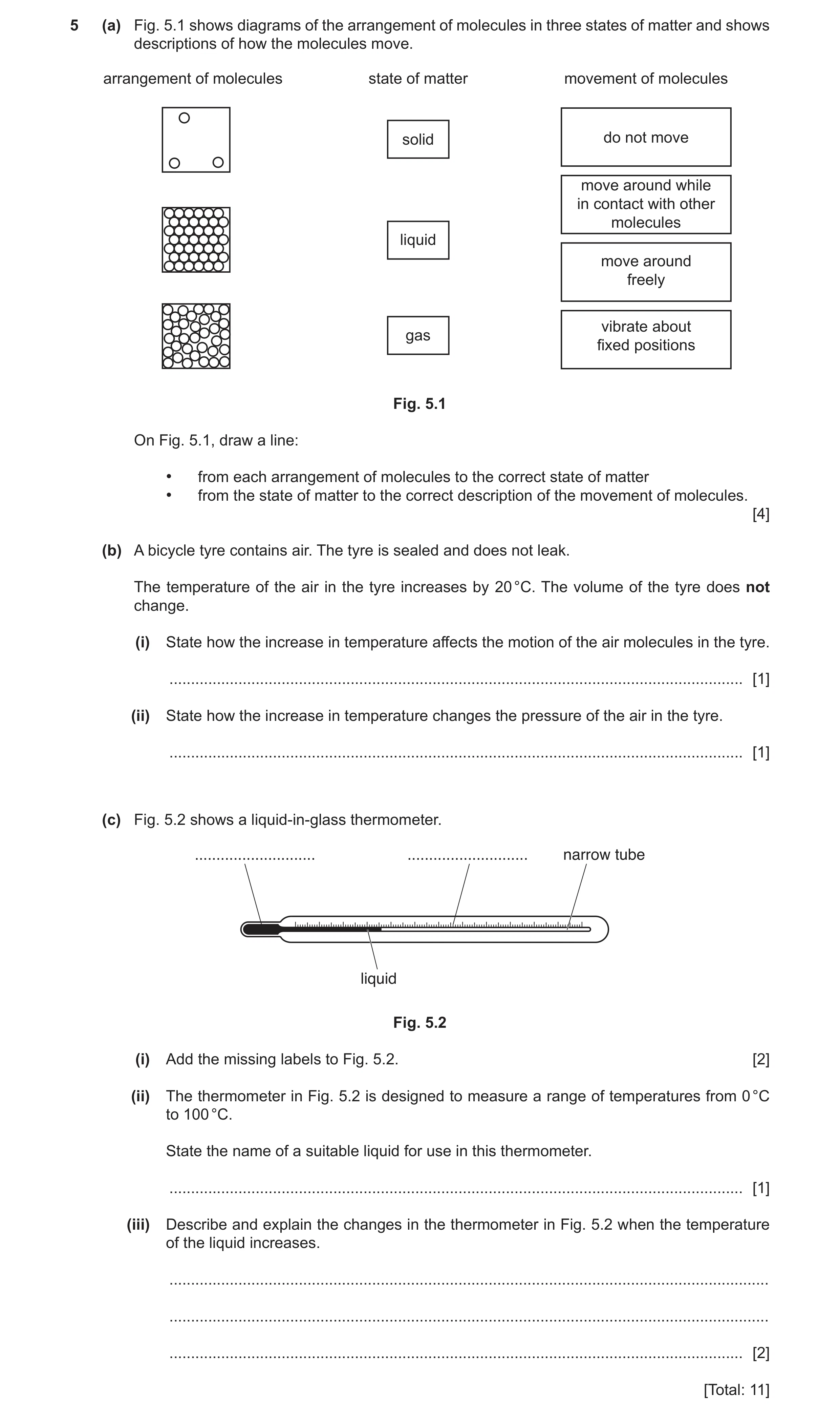
 27 / 55
 28 / 55
 29 / 55
 30 / 55
 31 / 55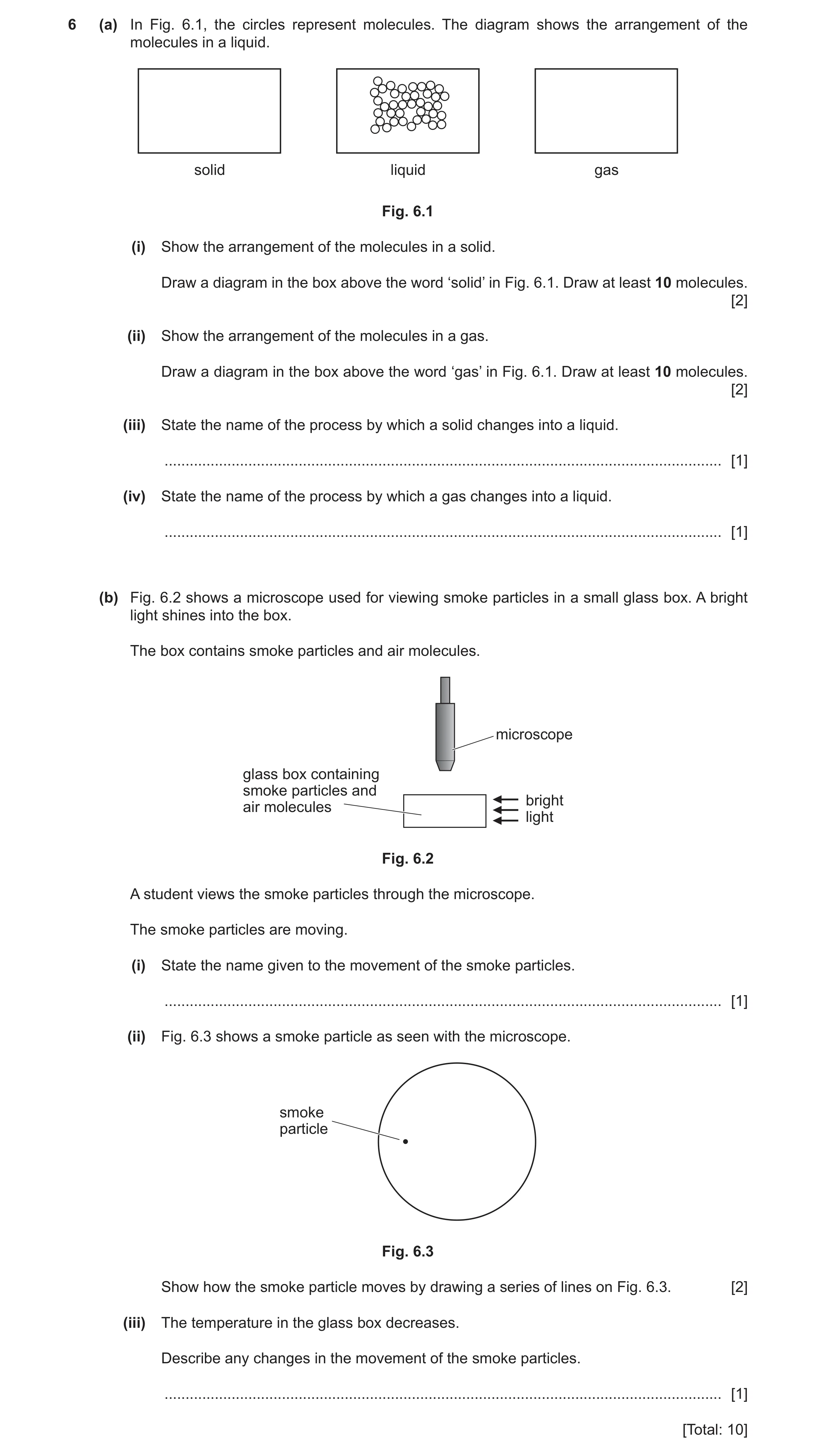
 33 / 55
 34 / 55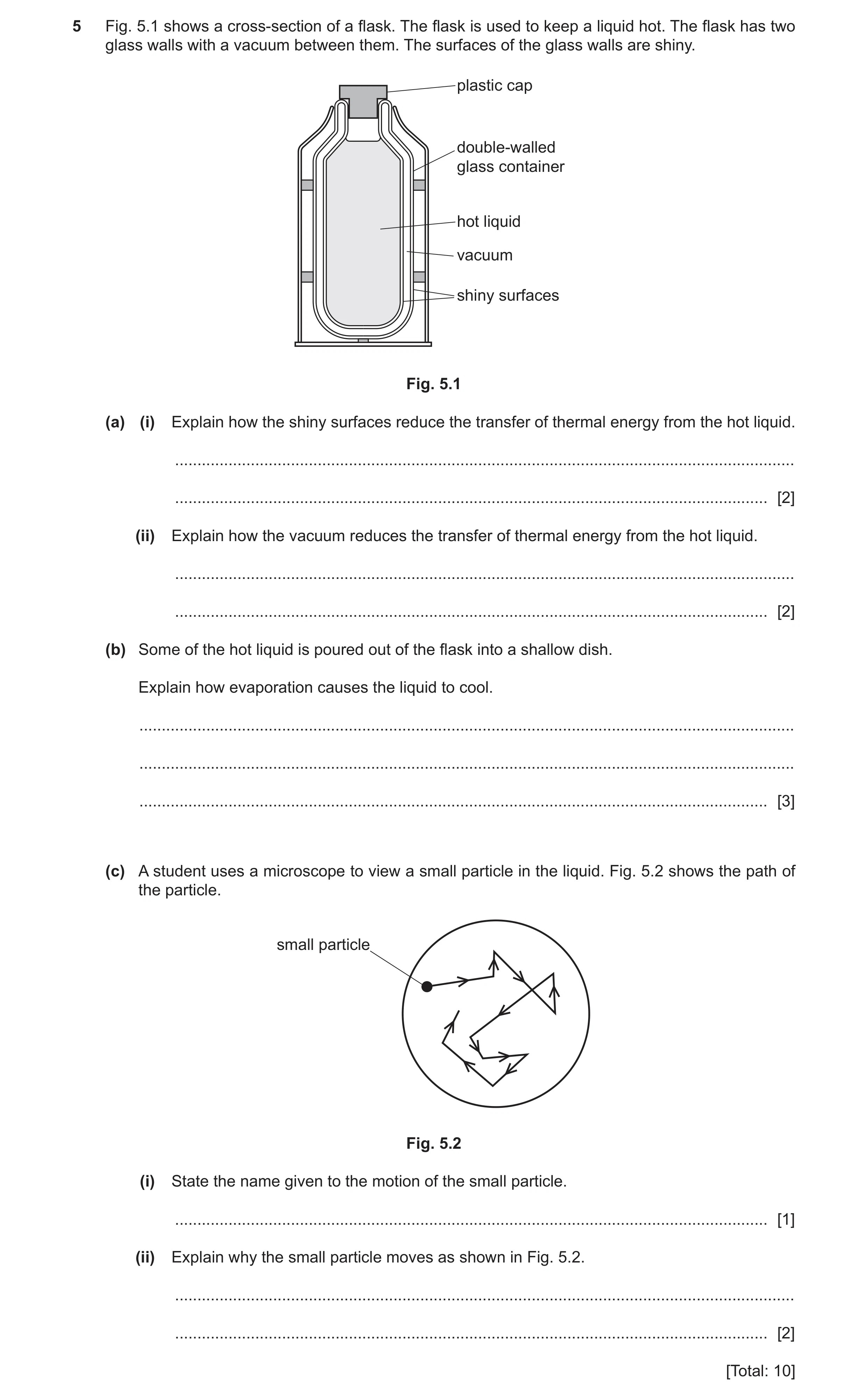
 36 / 55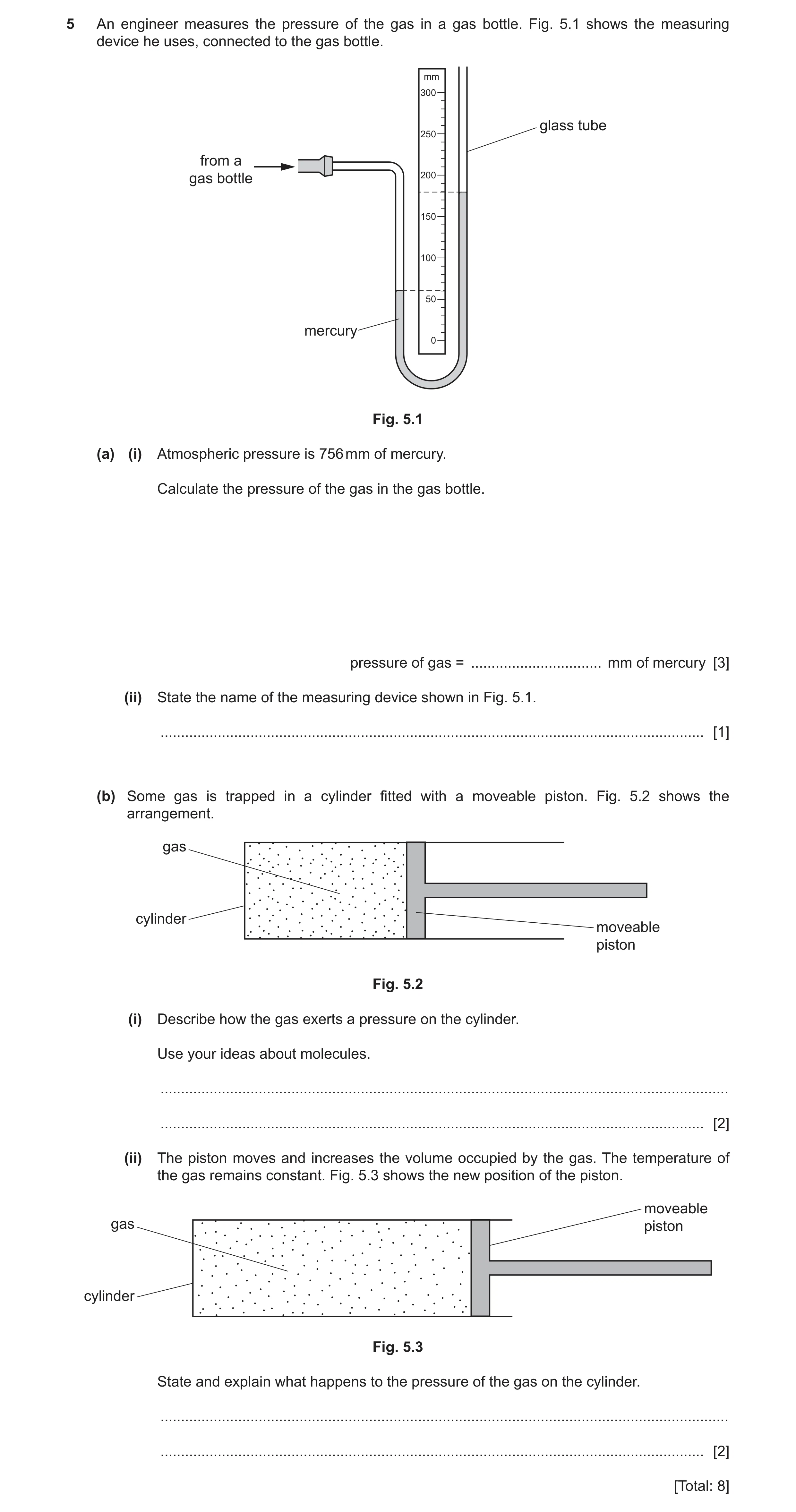
 41 / 55
 42 / 55
 43 / 55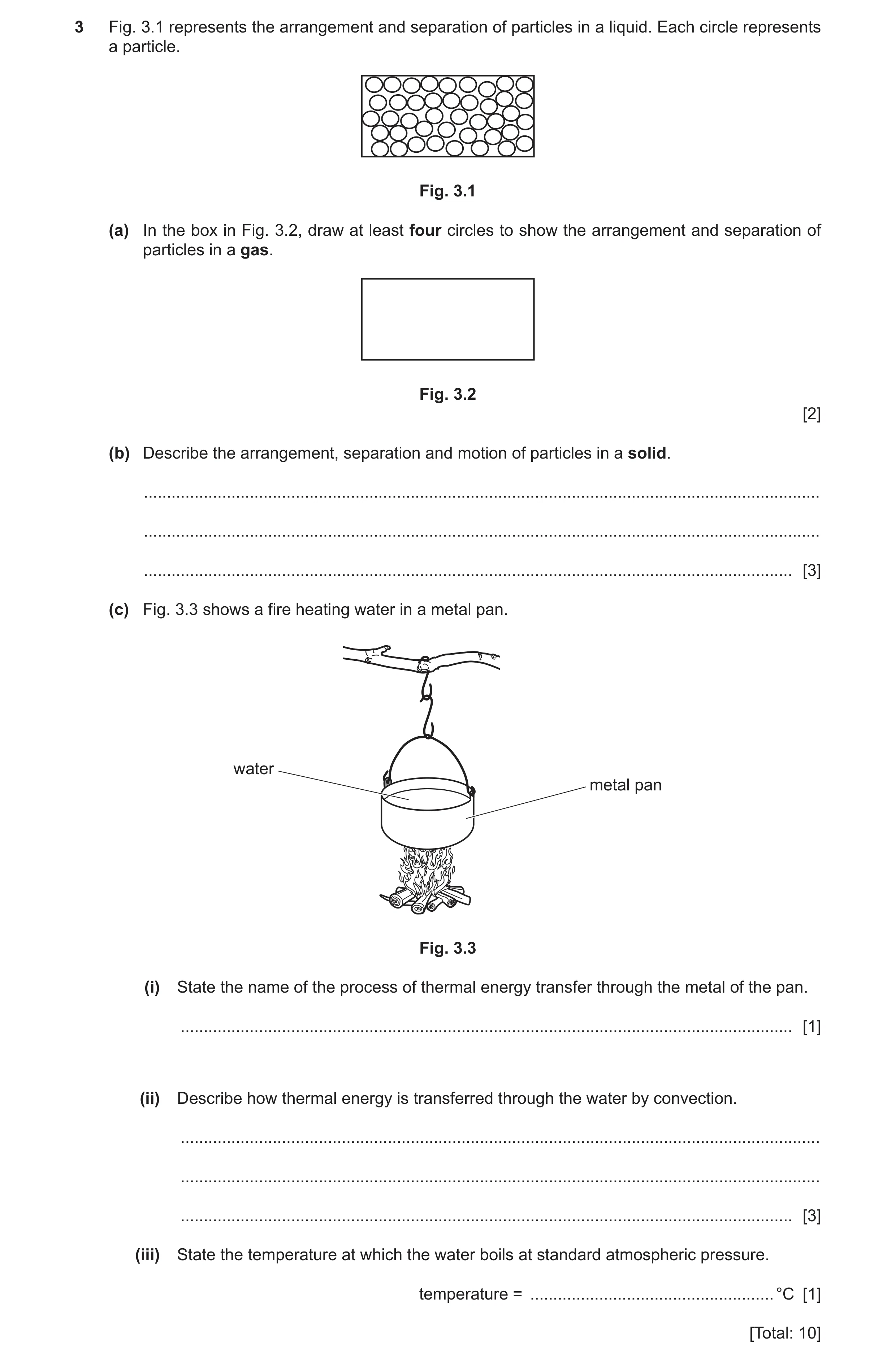
 45 / 55
 46 / 55
 47 / 55
 48 / 55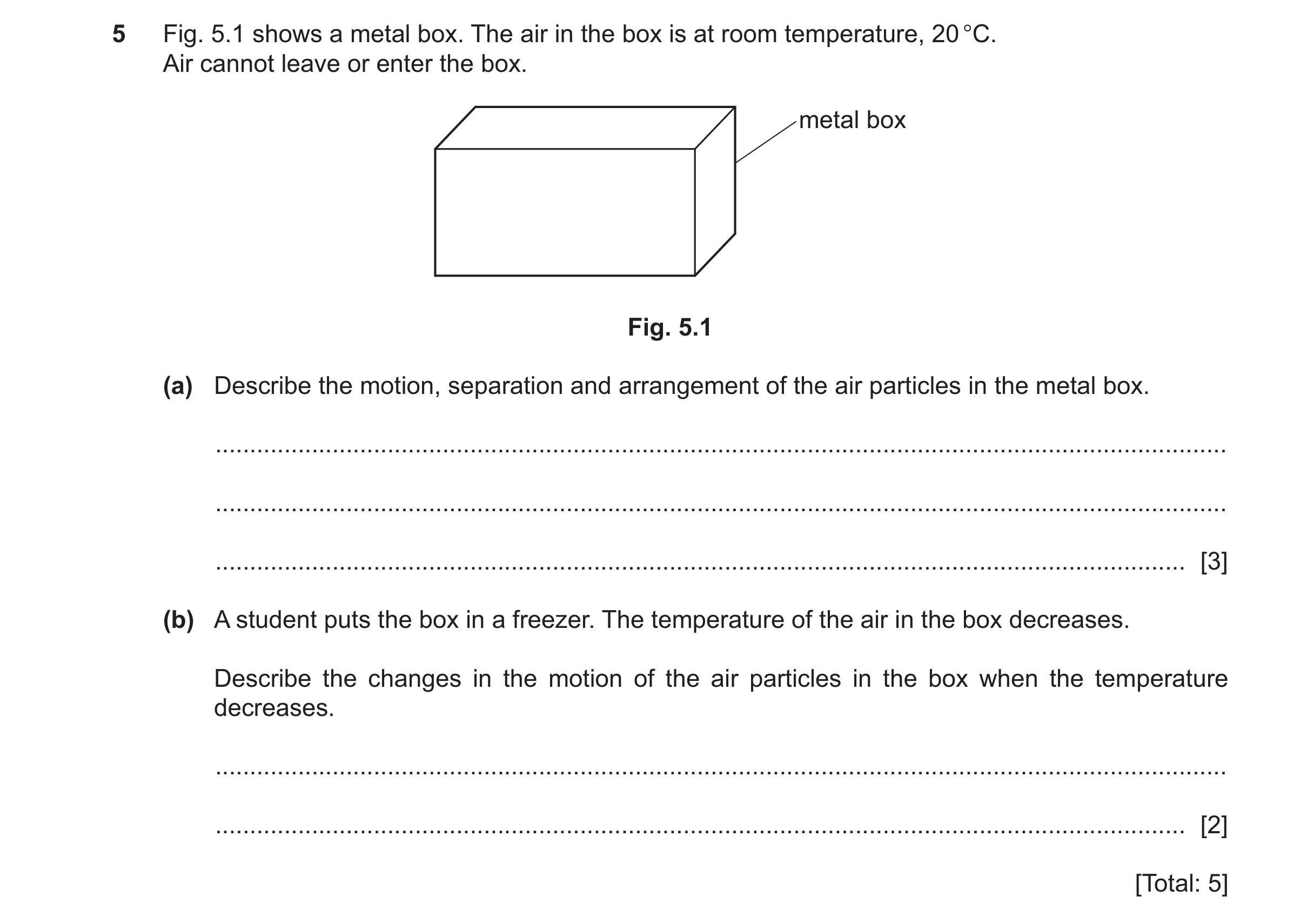
 49 / 55
 50 / 55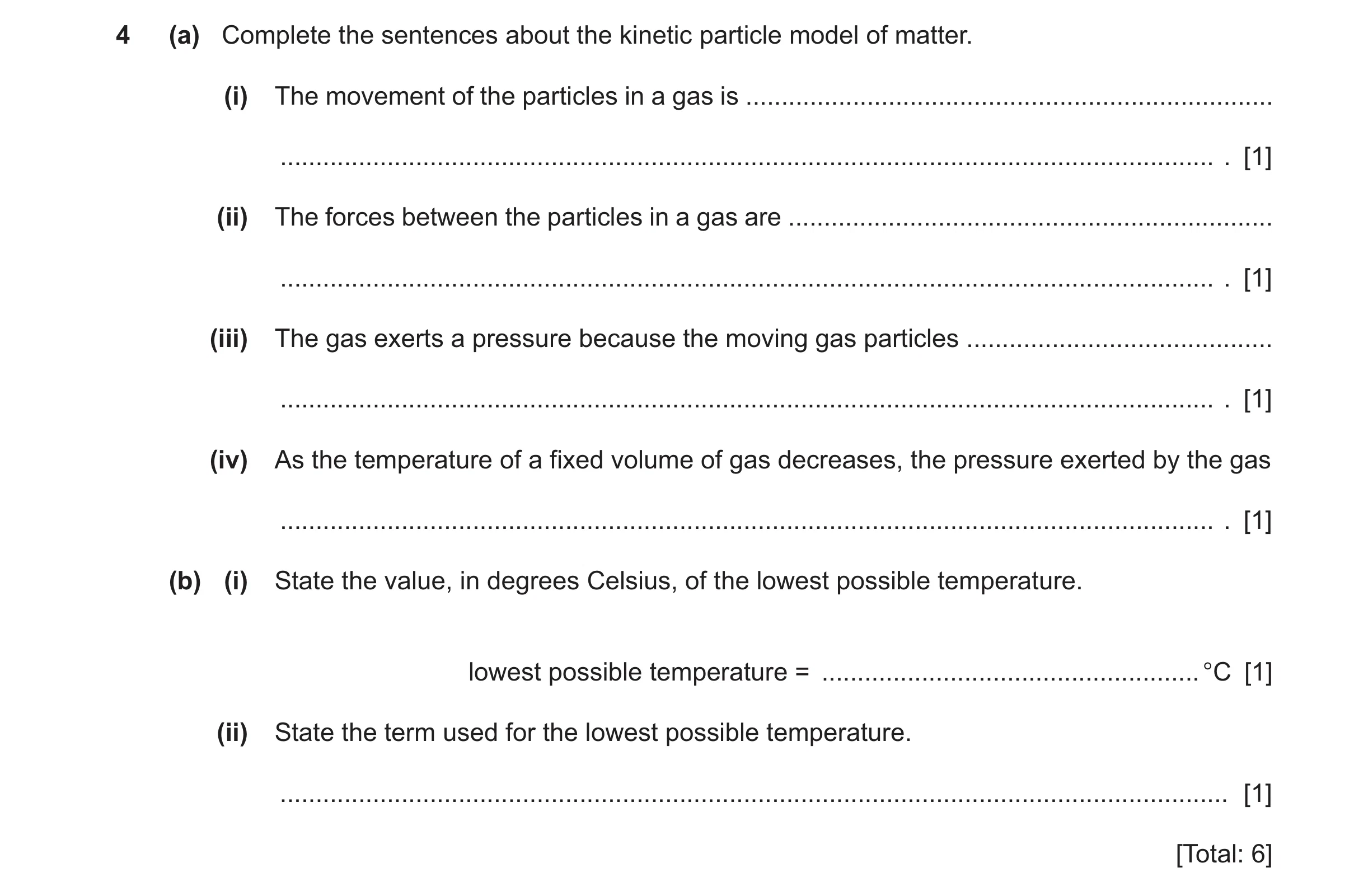
 51 / 55
 52 / 55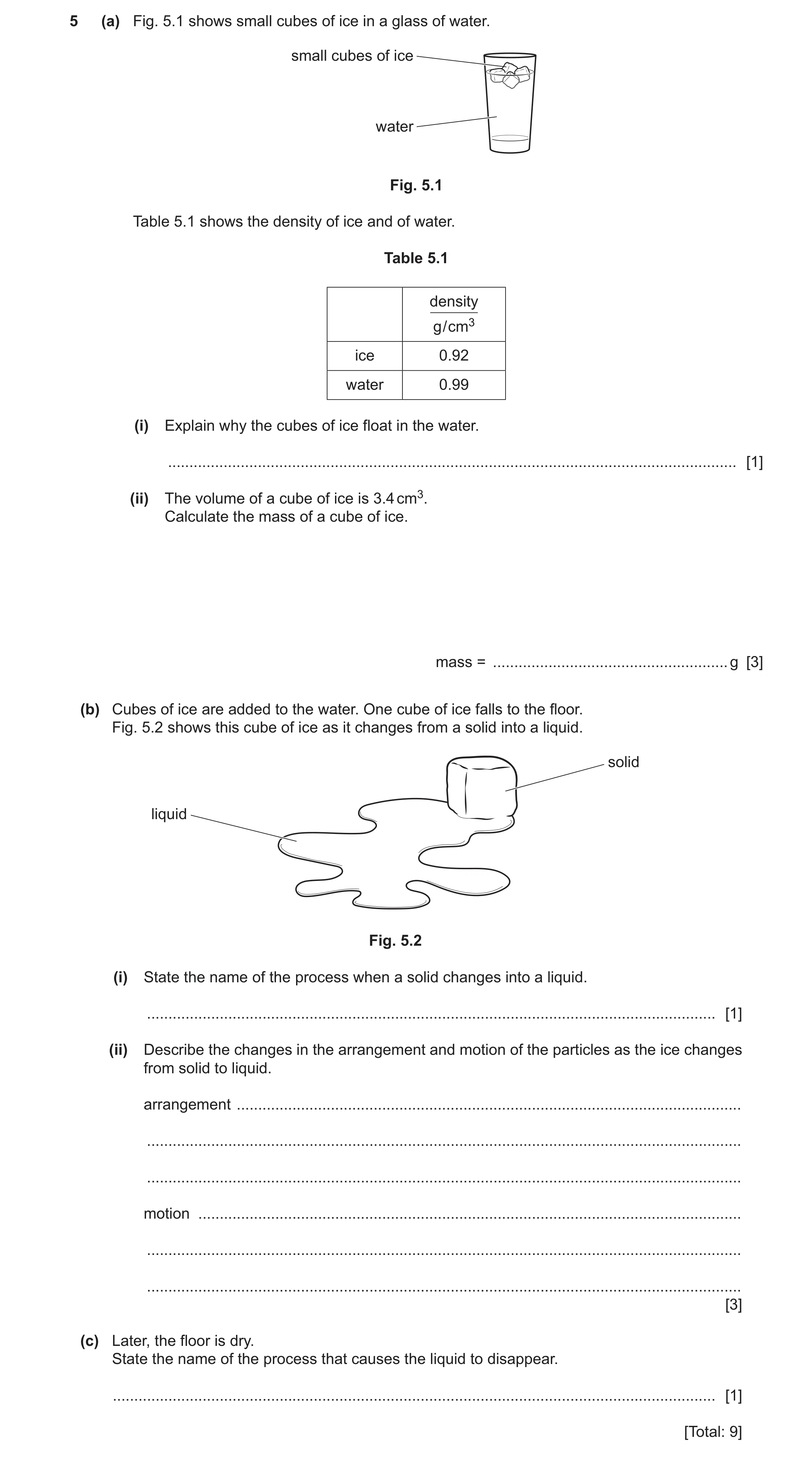
 8
8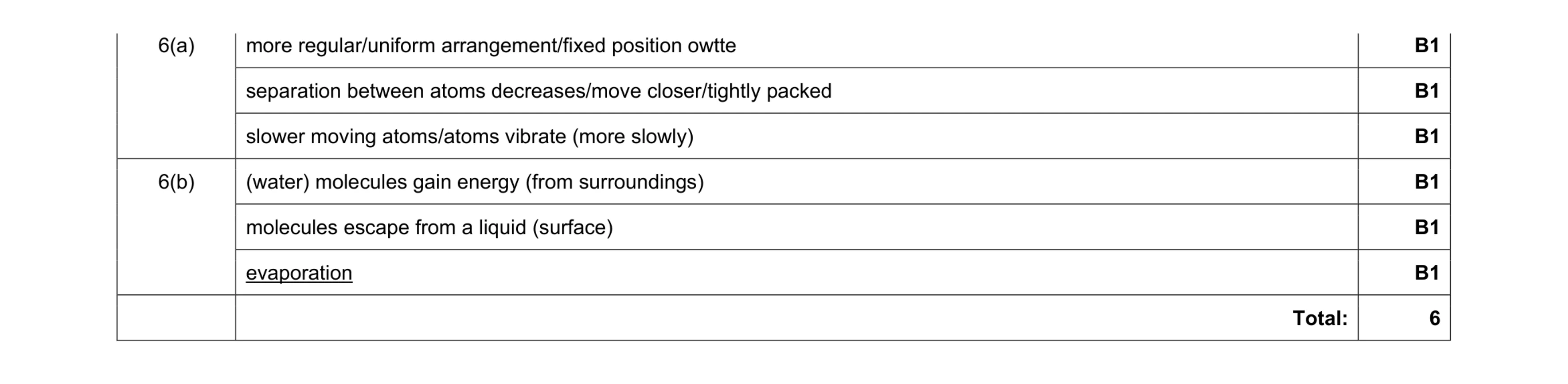 6
6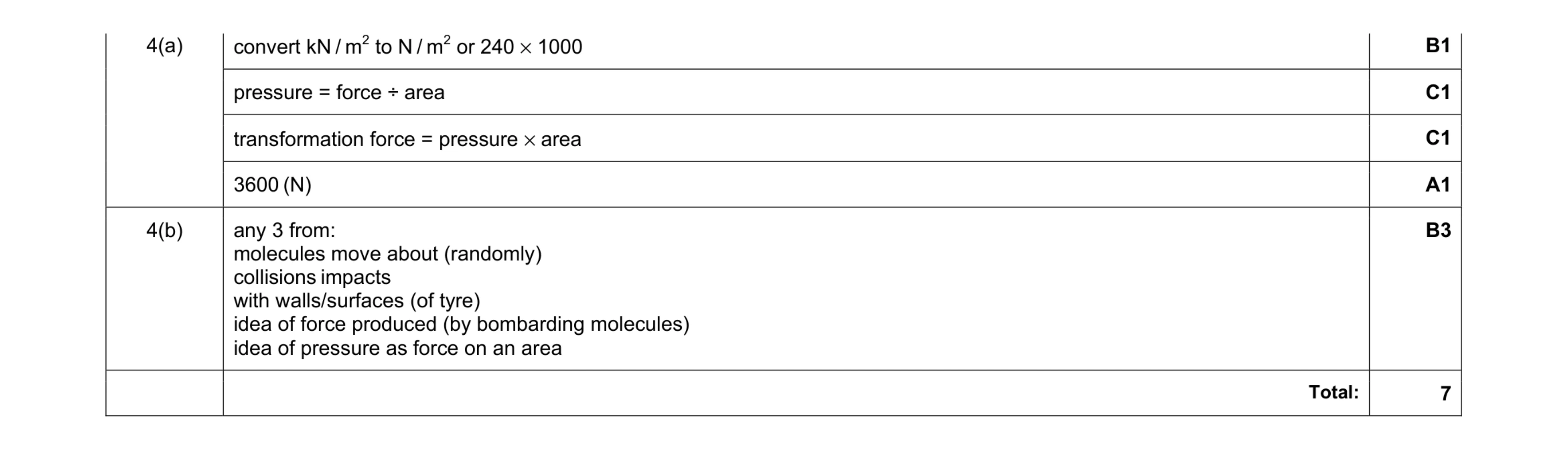 7
7 4
4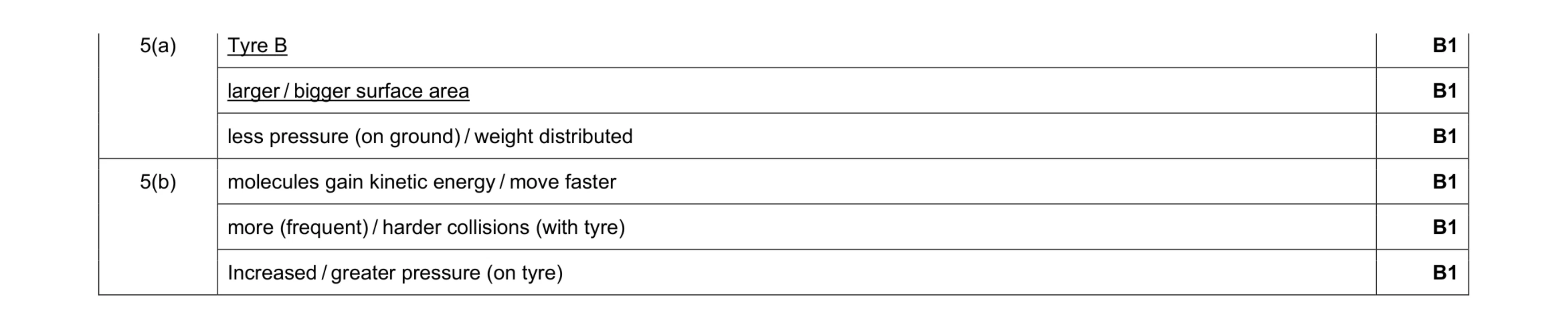 6
6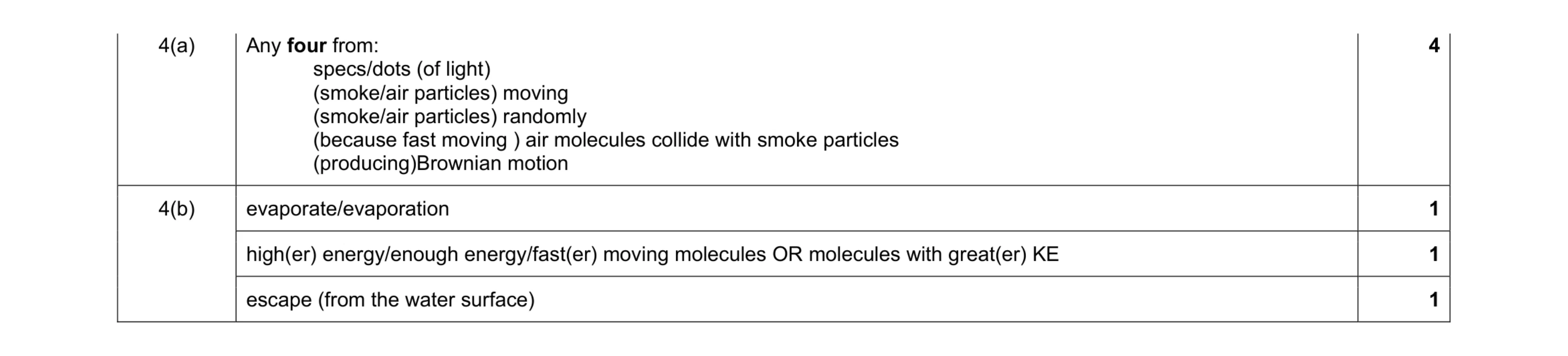 7
7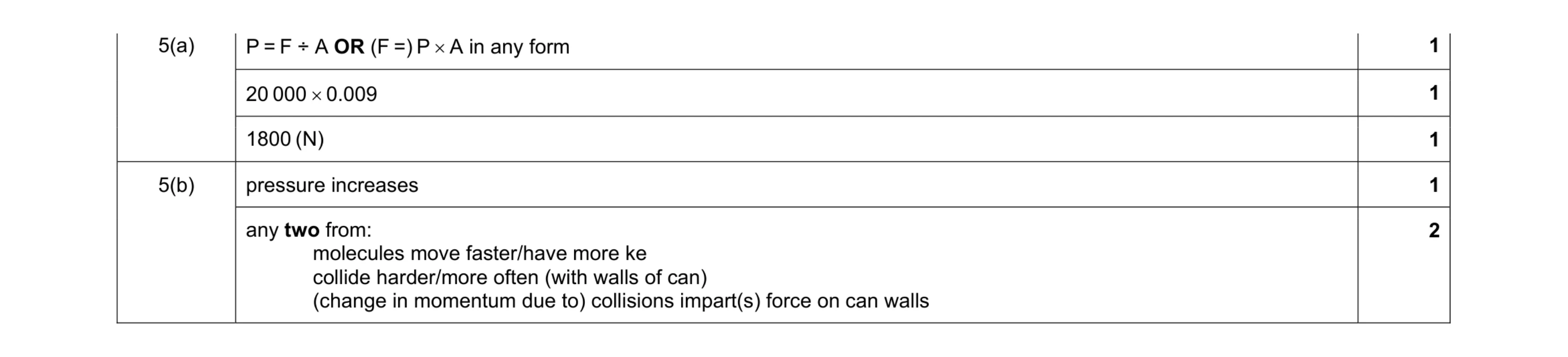 6
6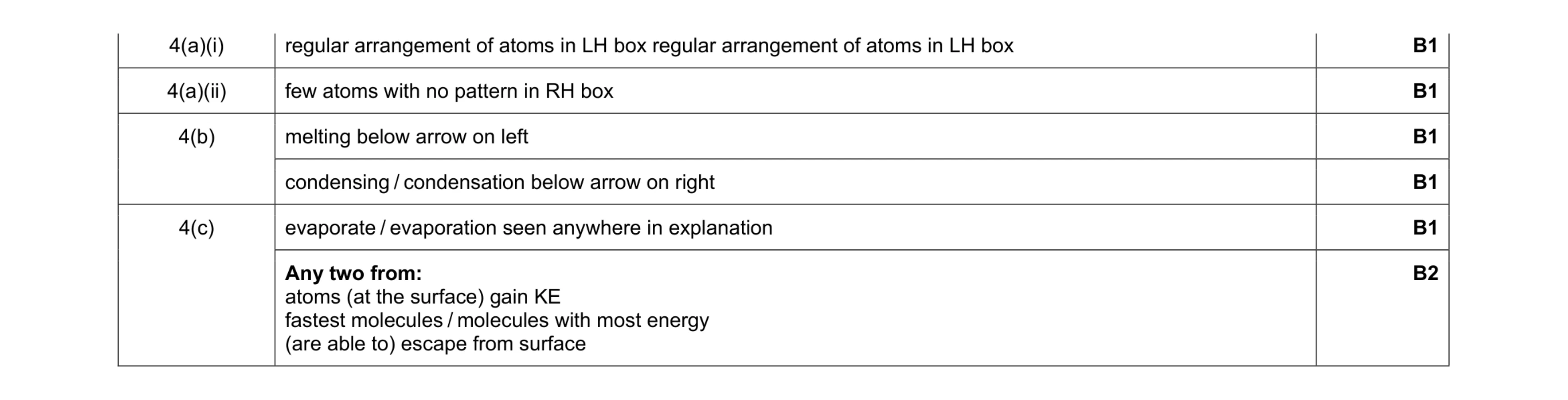 7
7 4
4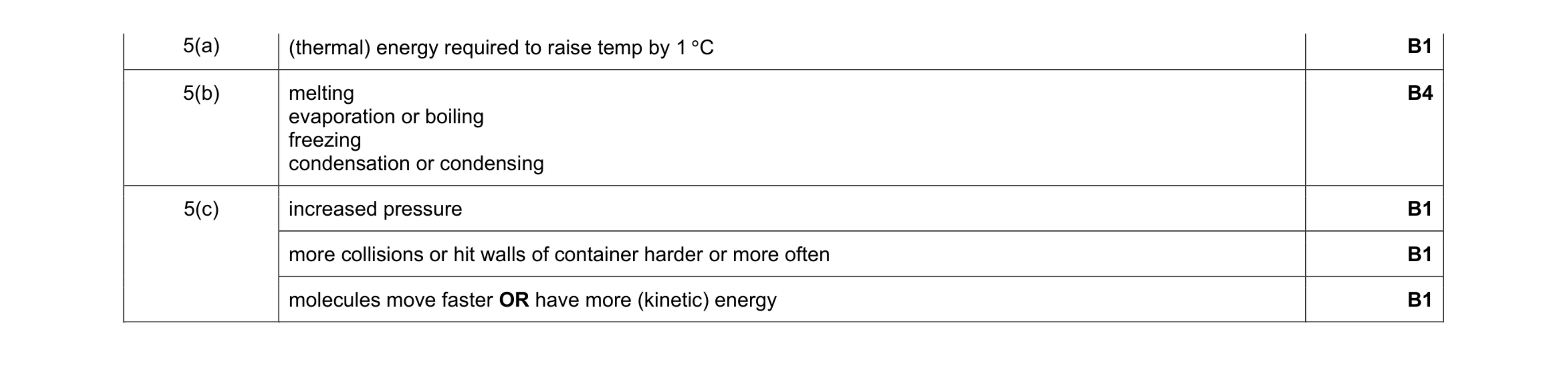 8
8 4
4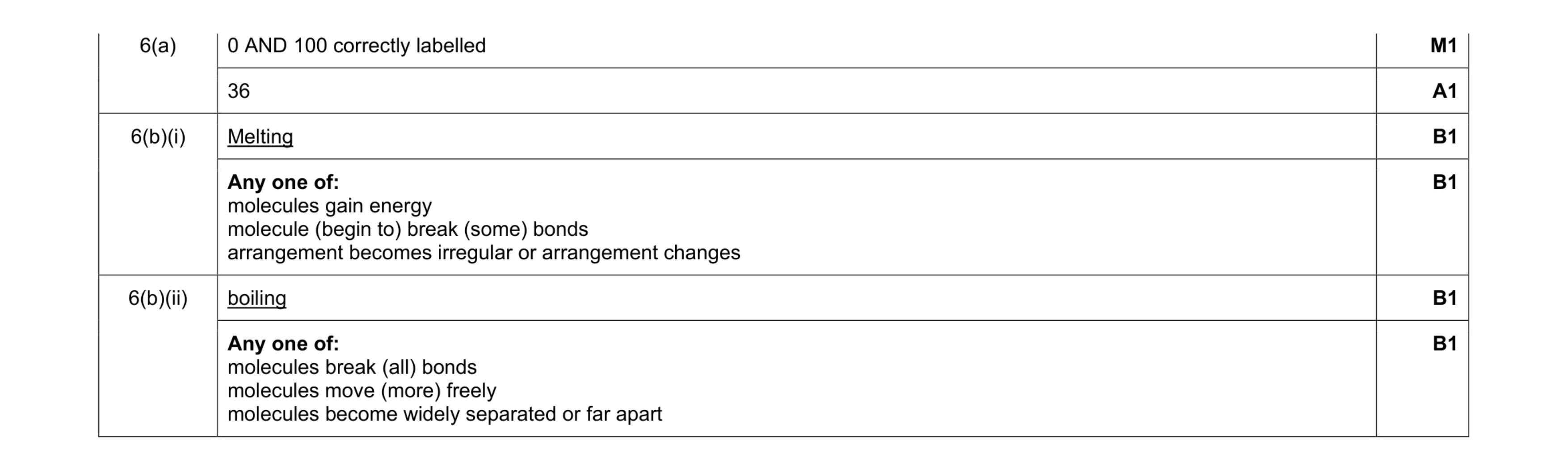 6
6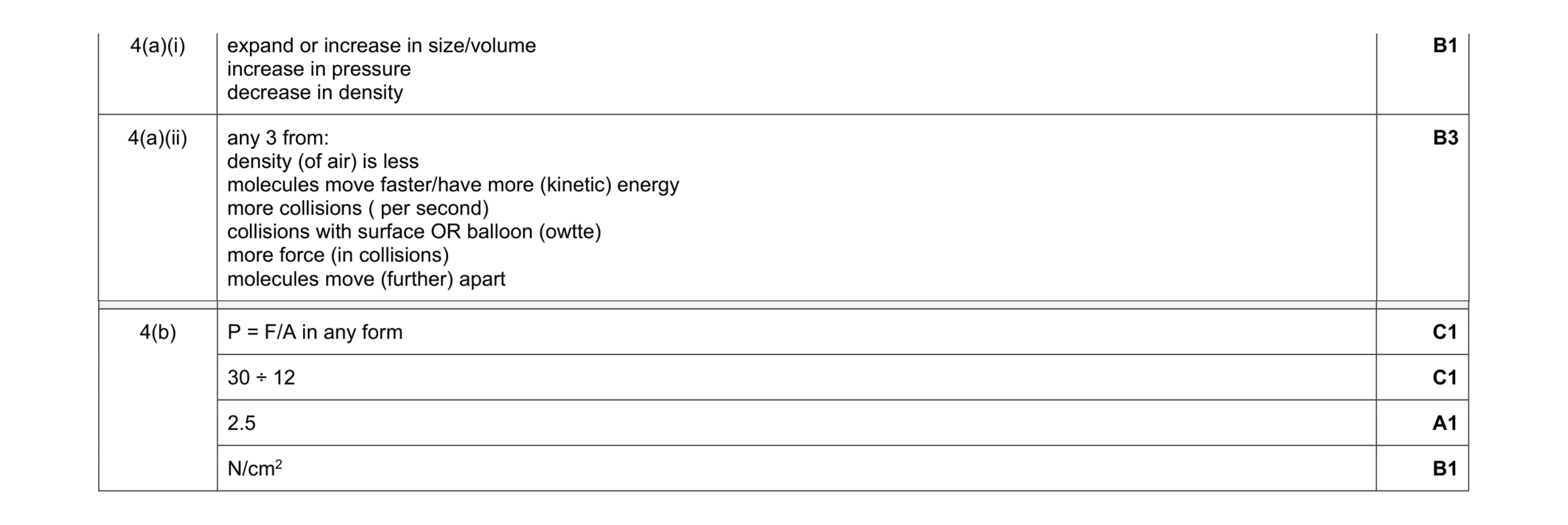 8
8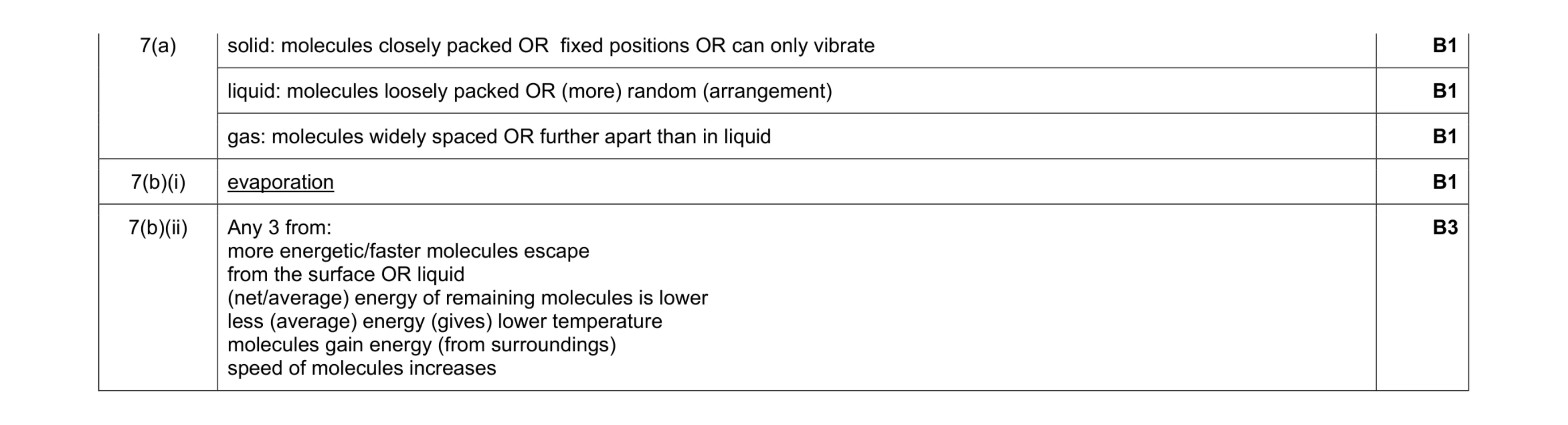 7
7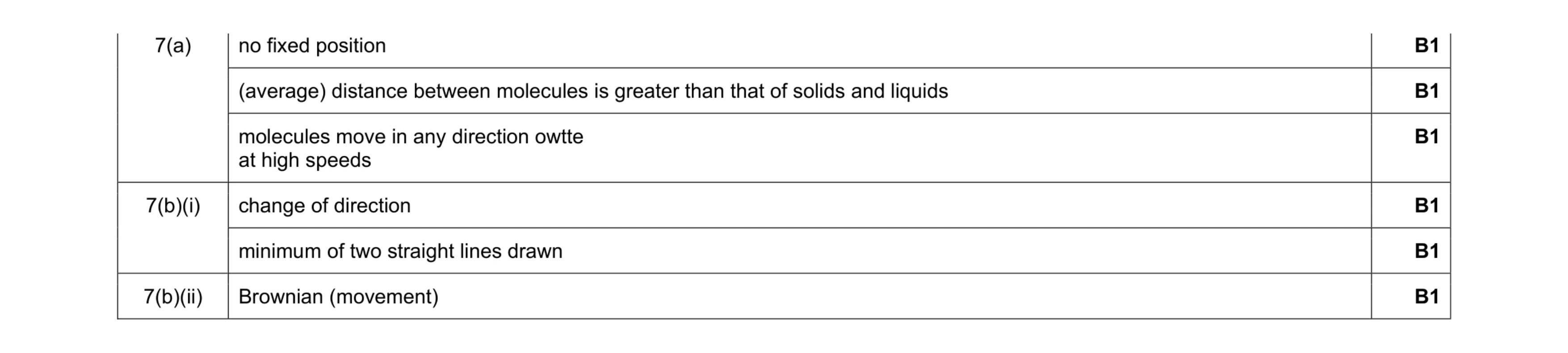 6
6 6
6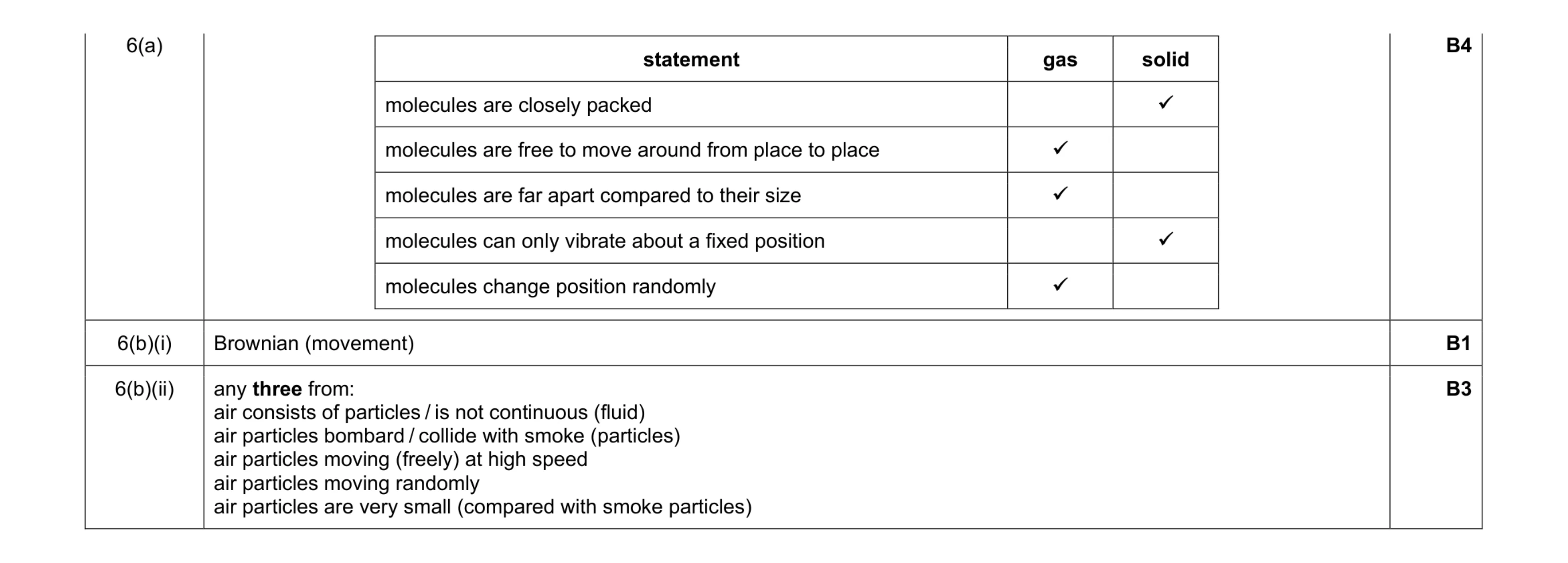 8
8 5
5 5
5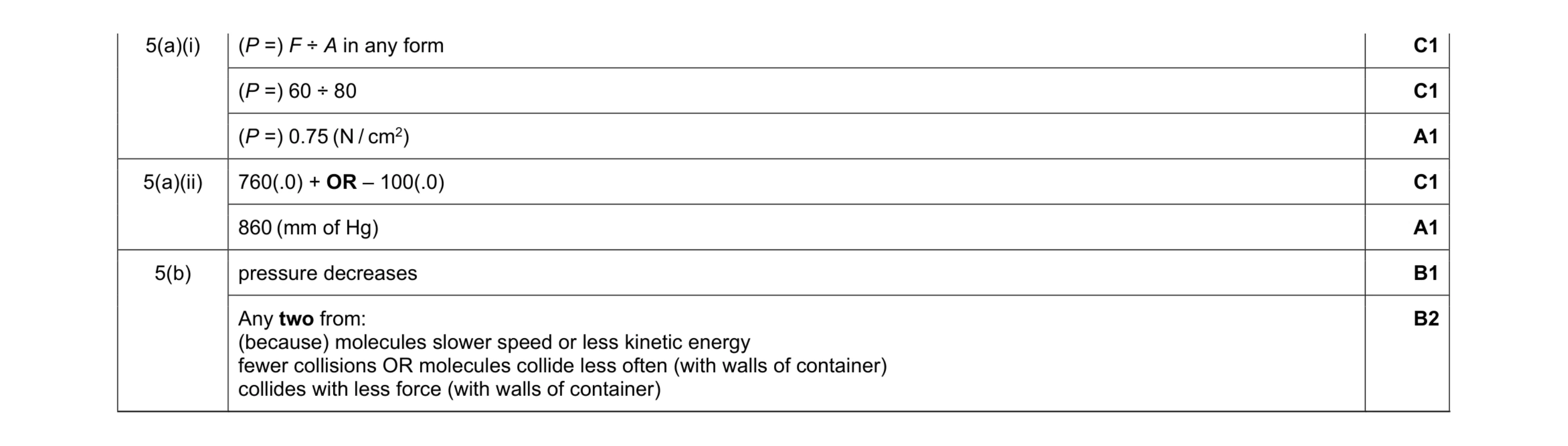 8
8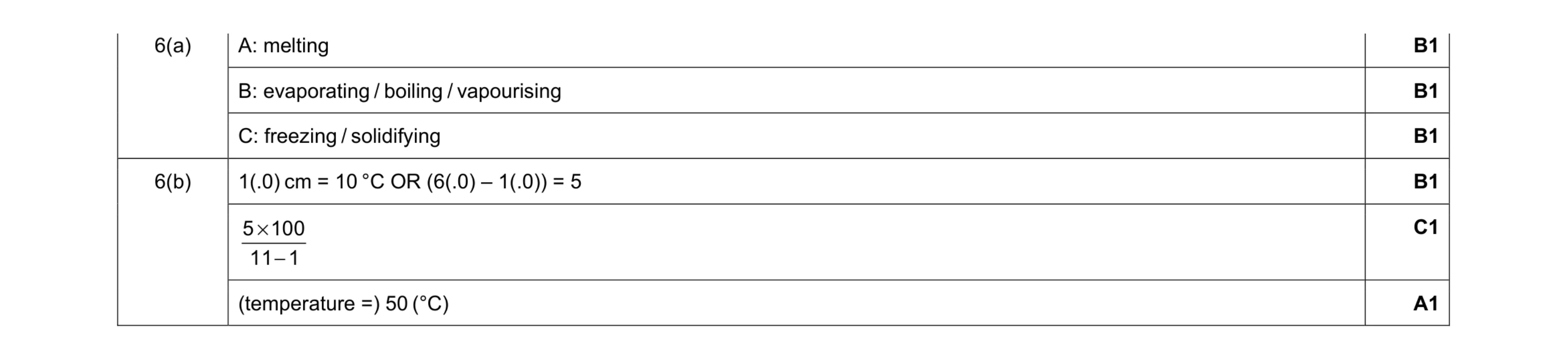 6
6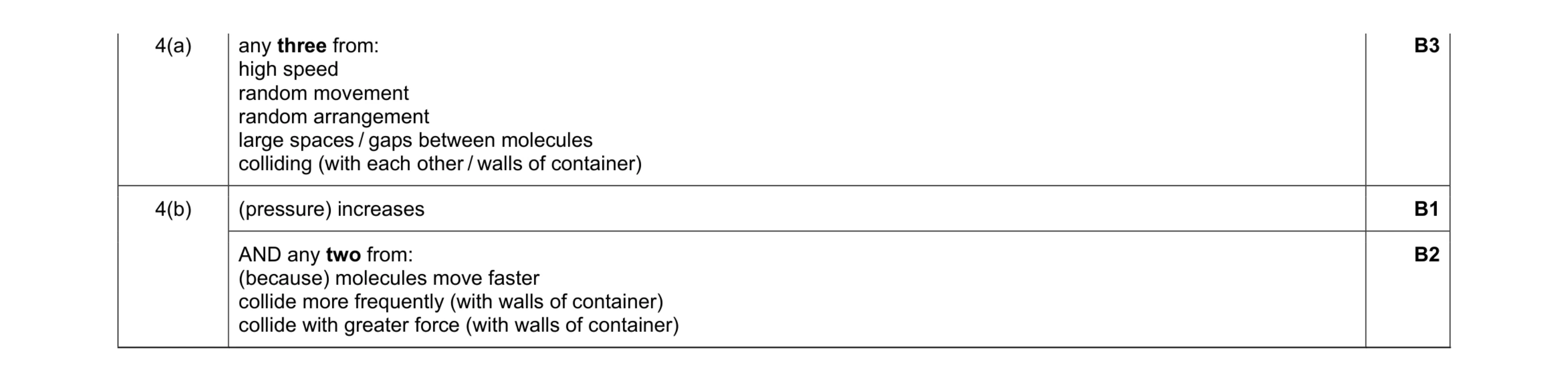 6
6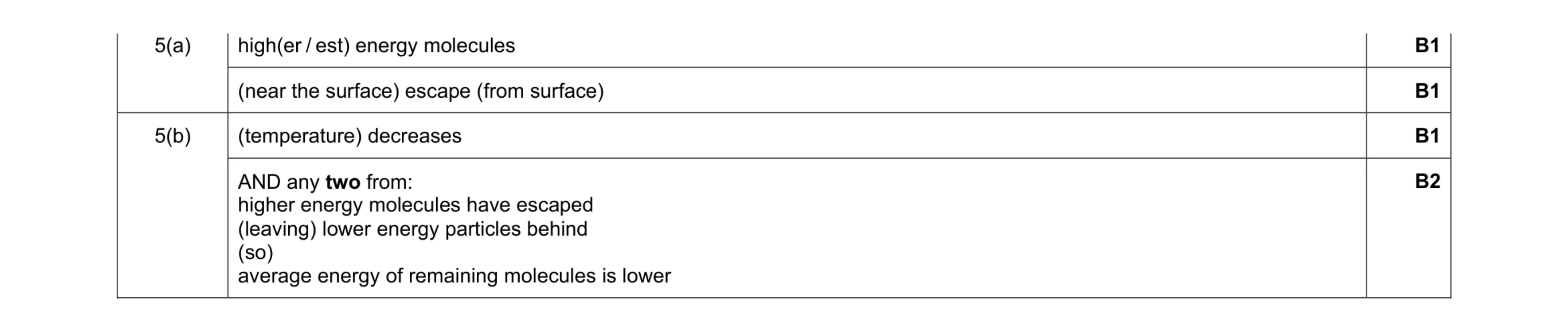 5
5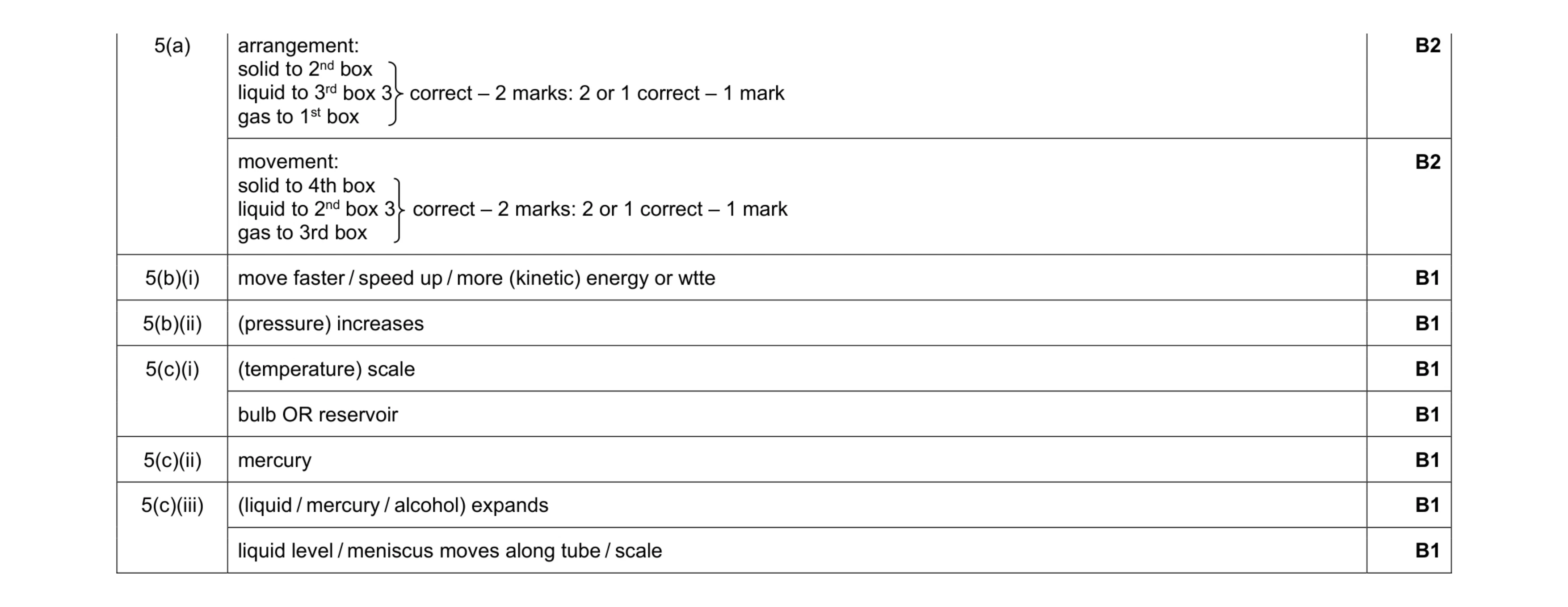 11
11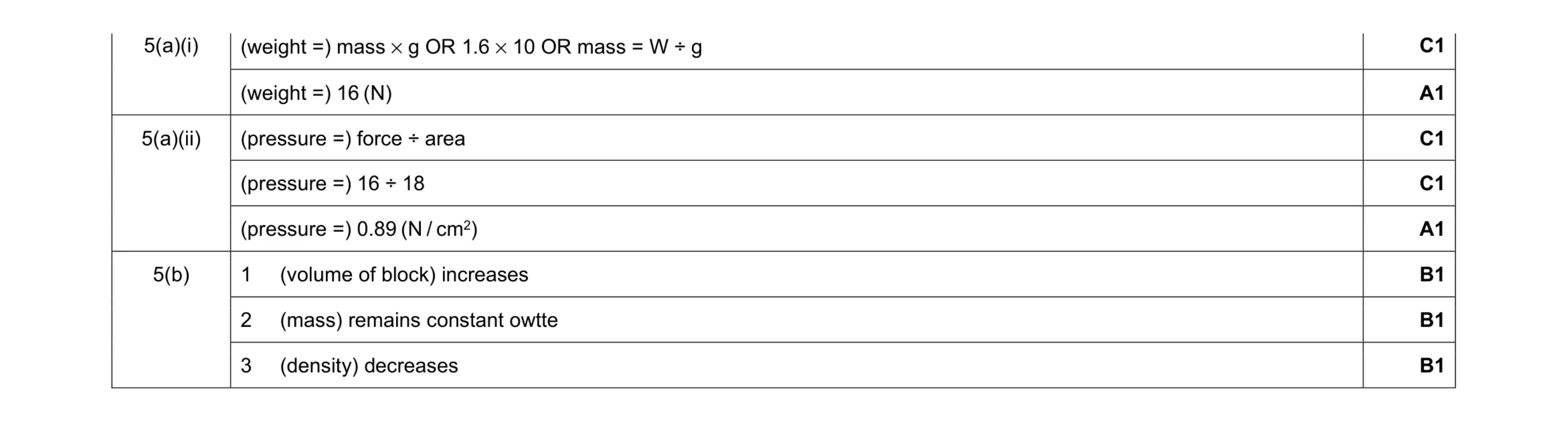 8
8 4
4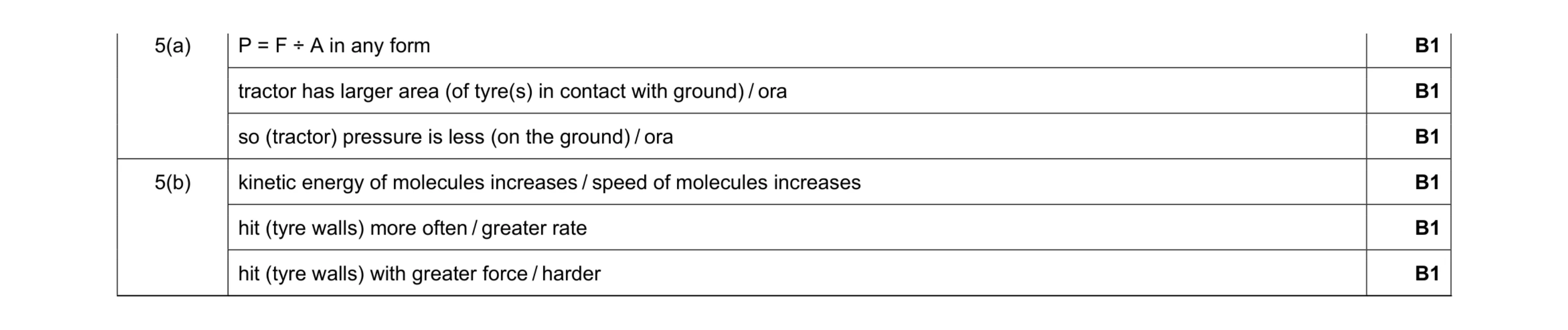 6
6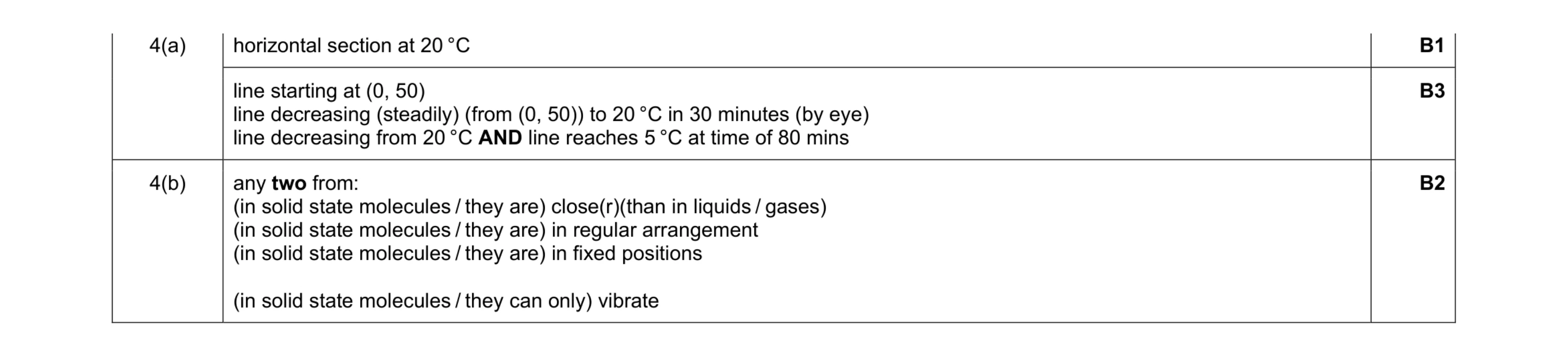 6
6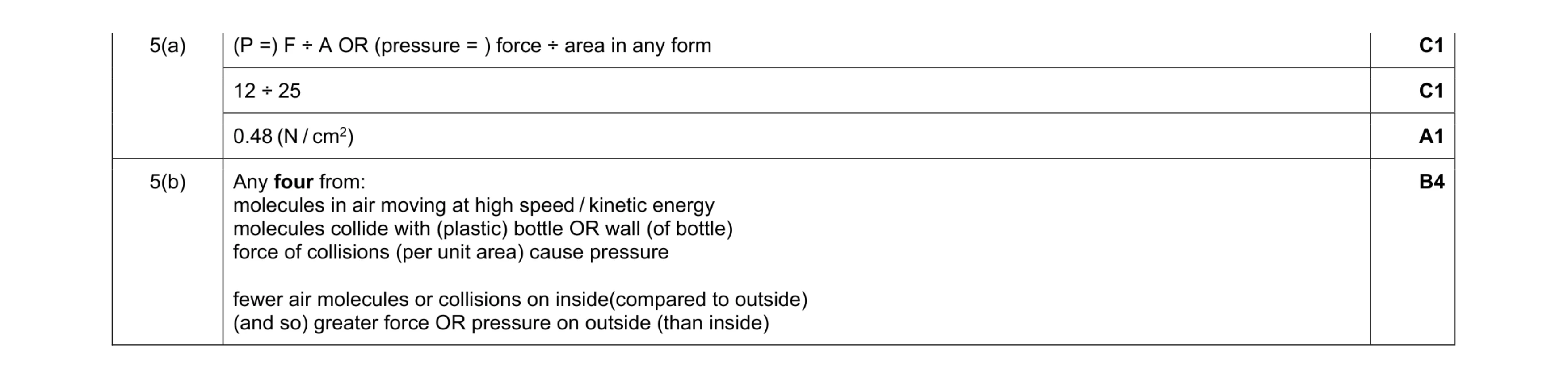 7
7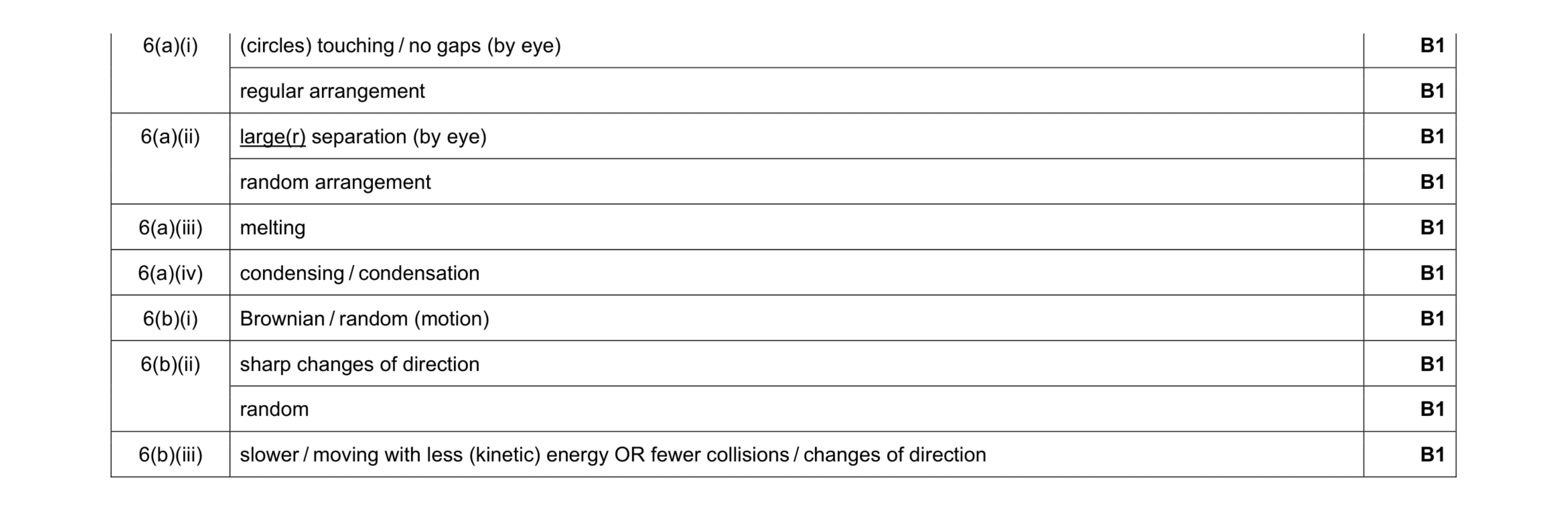 10
10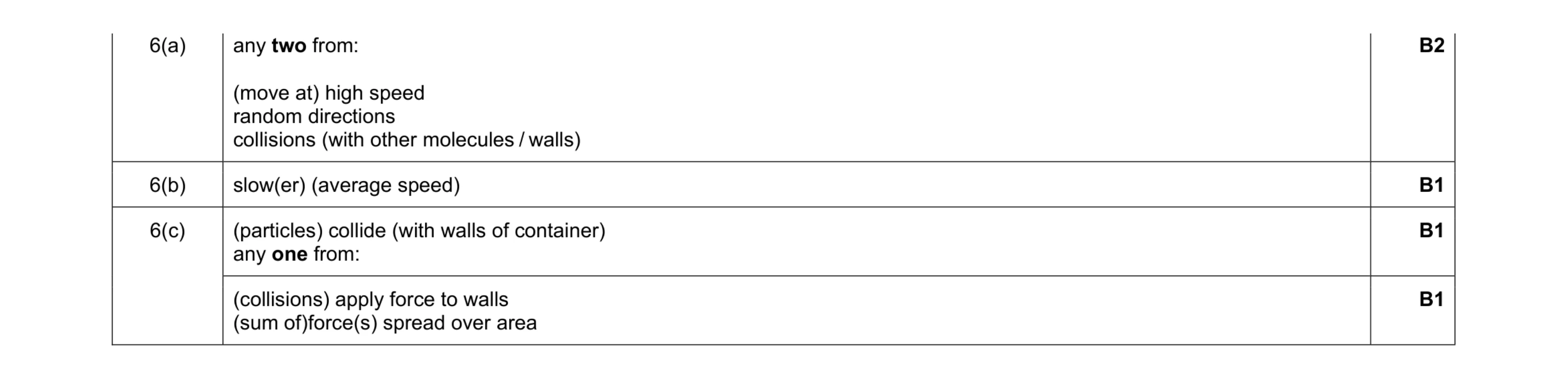 5
5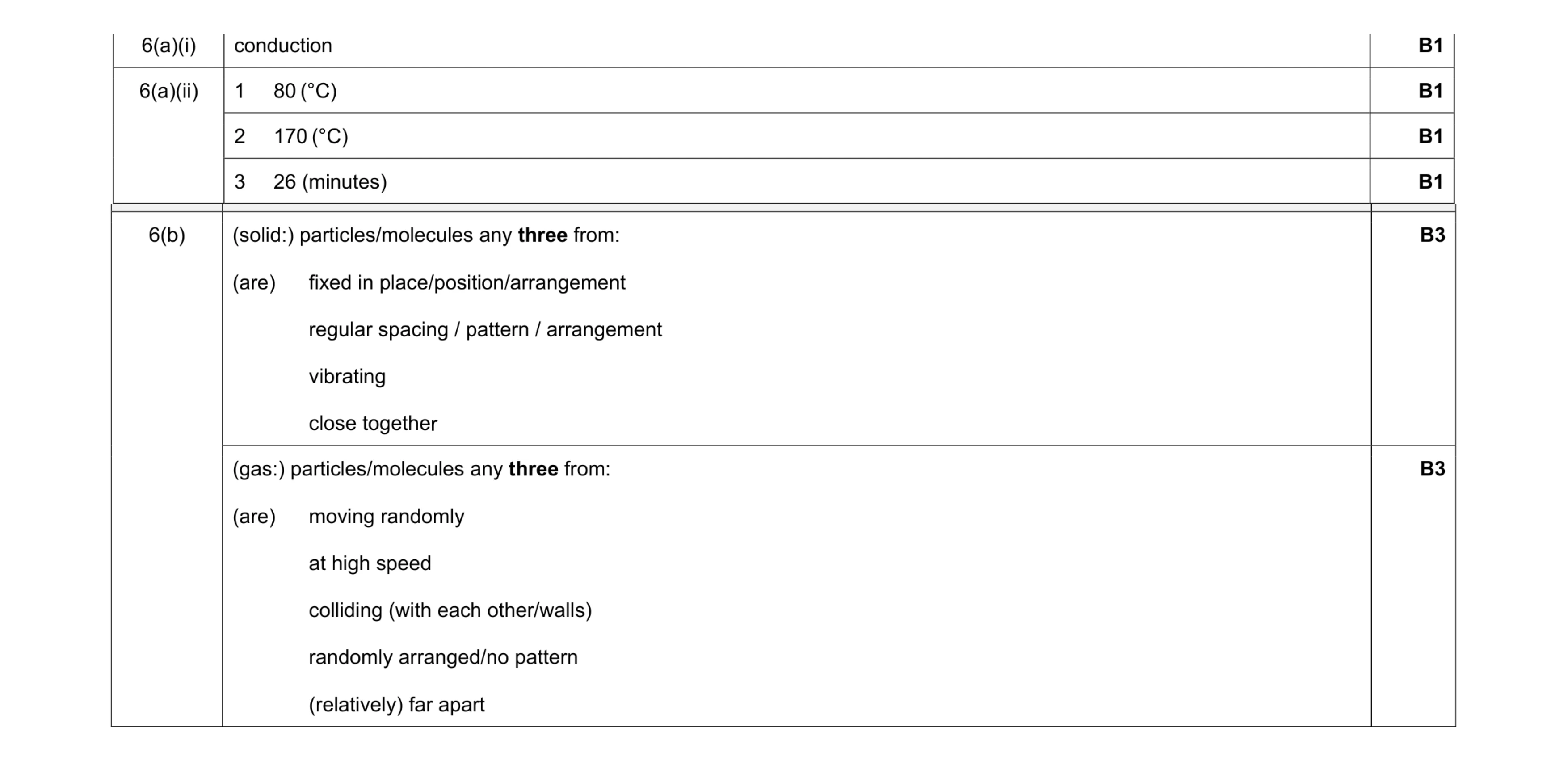 10
10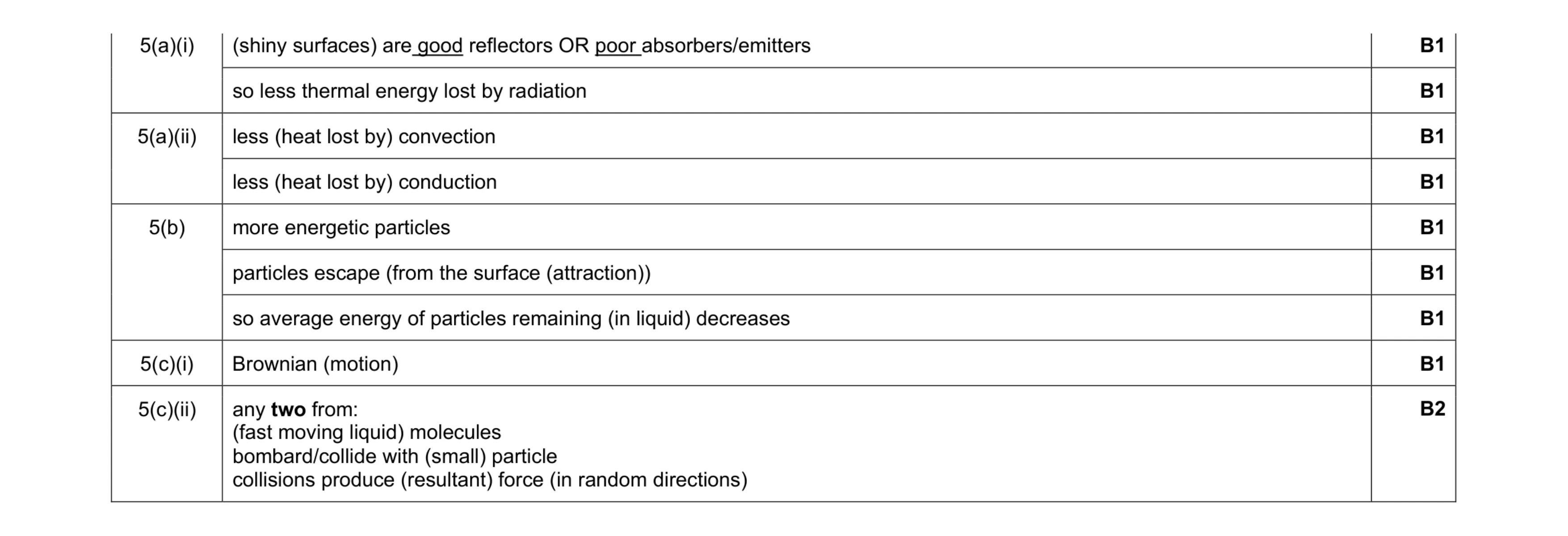 10
10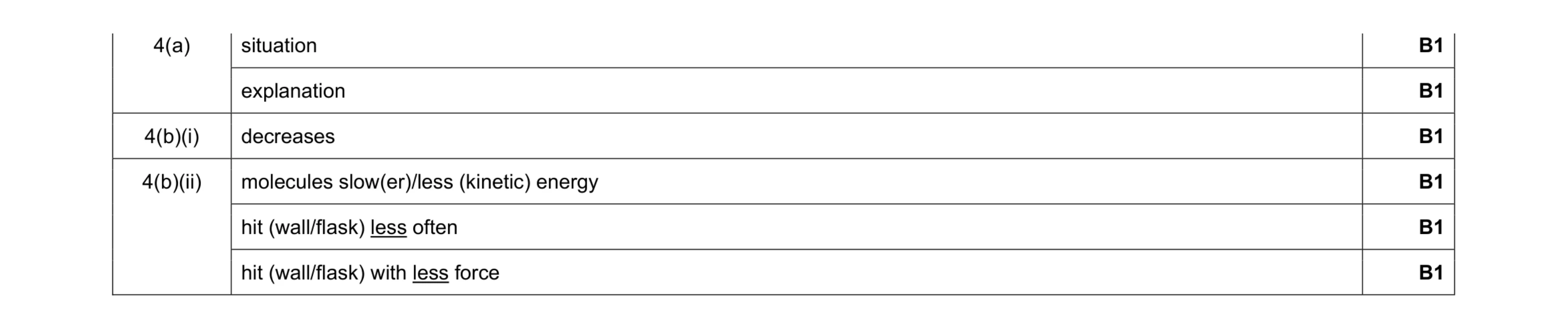 6
6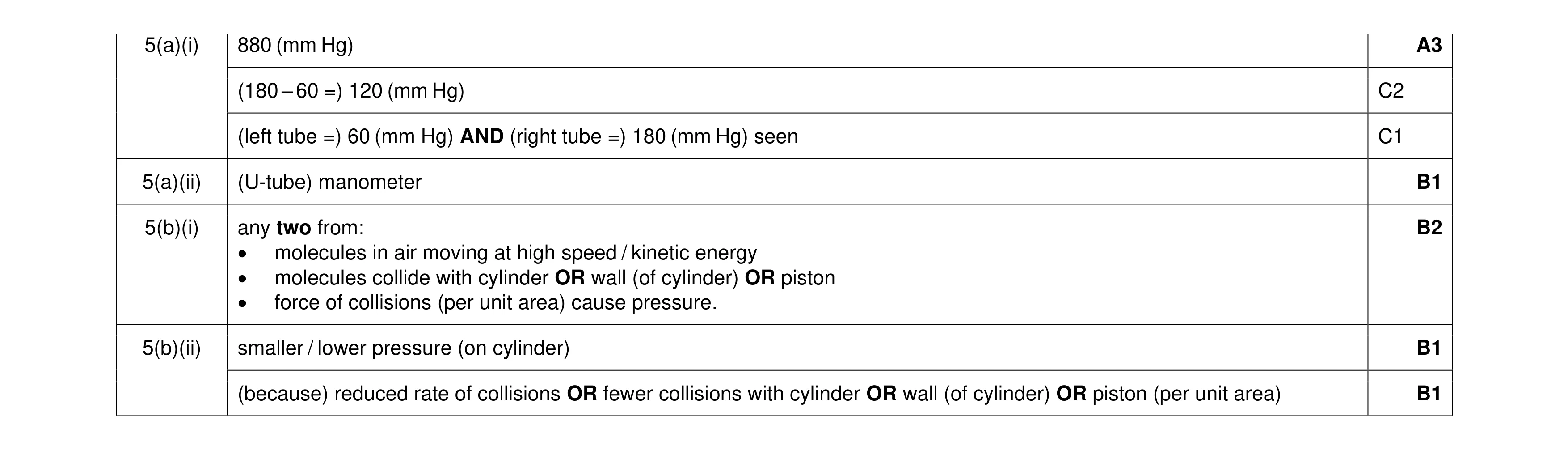 8
8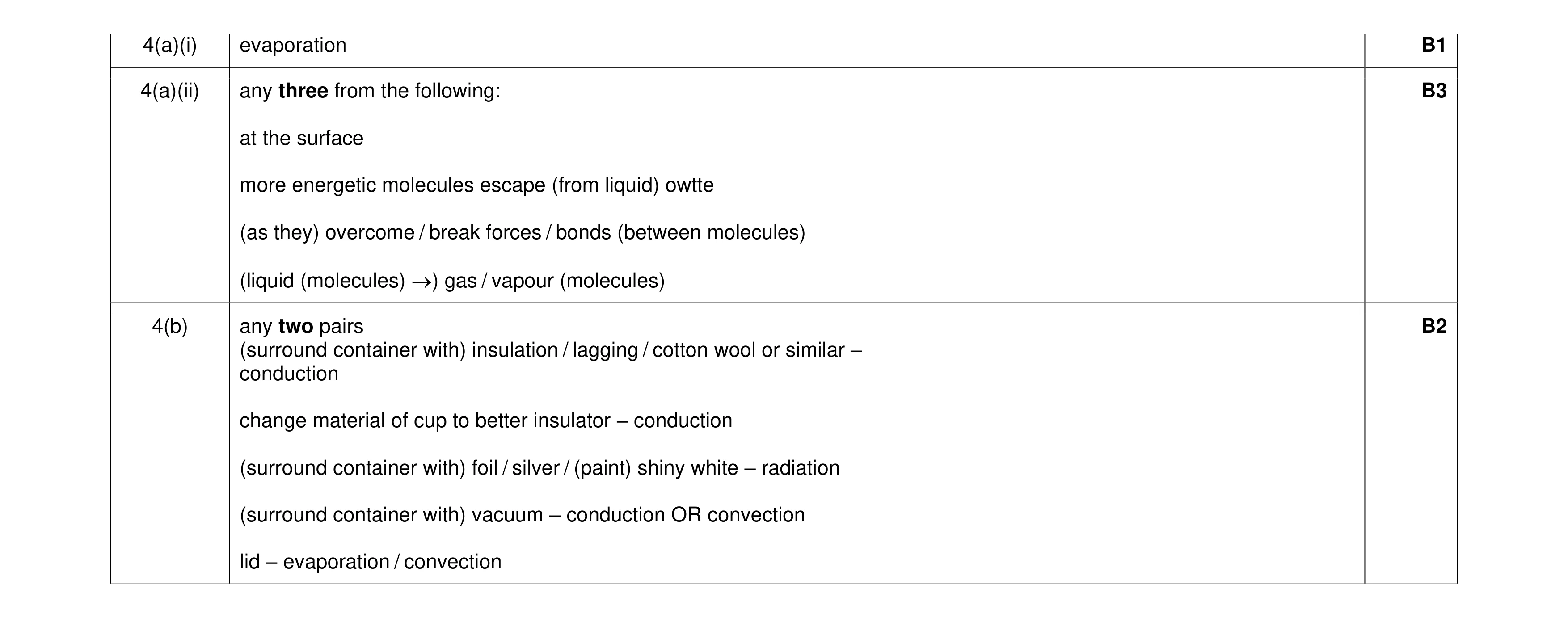 8
8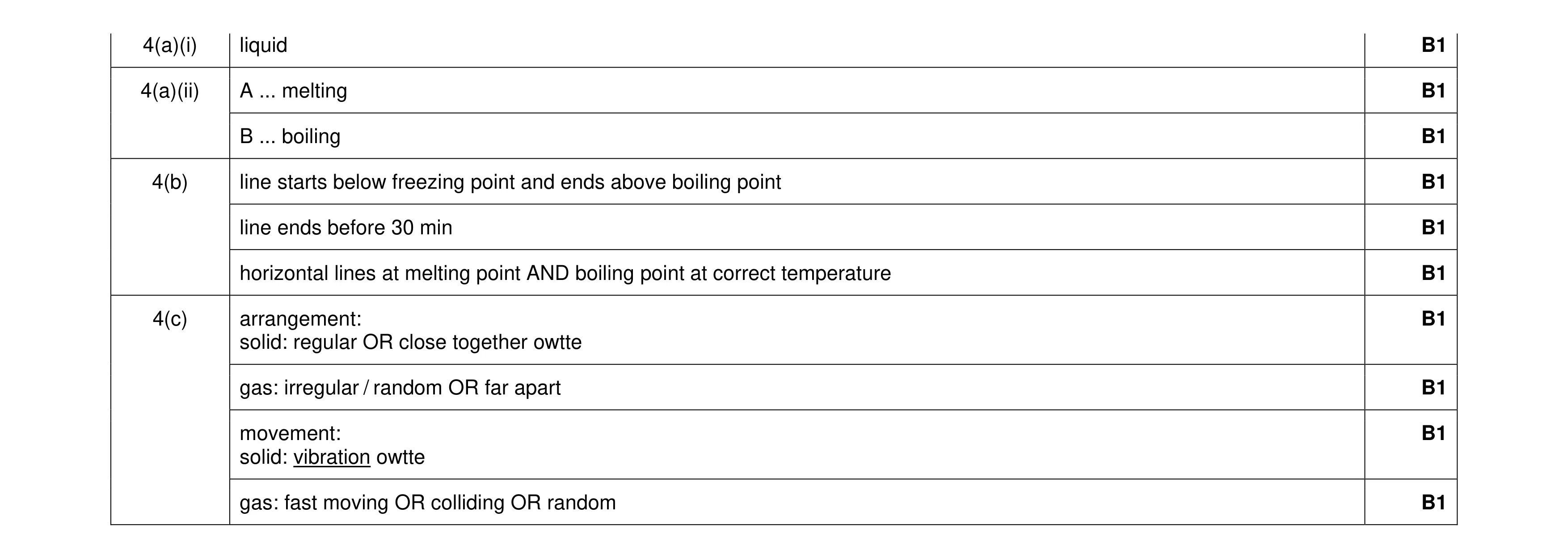 10
10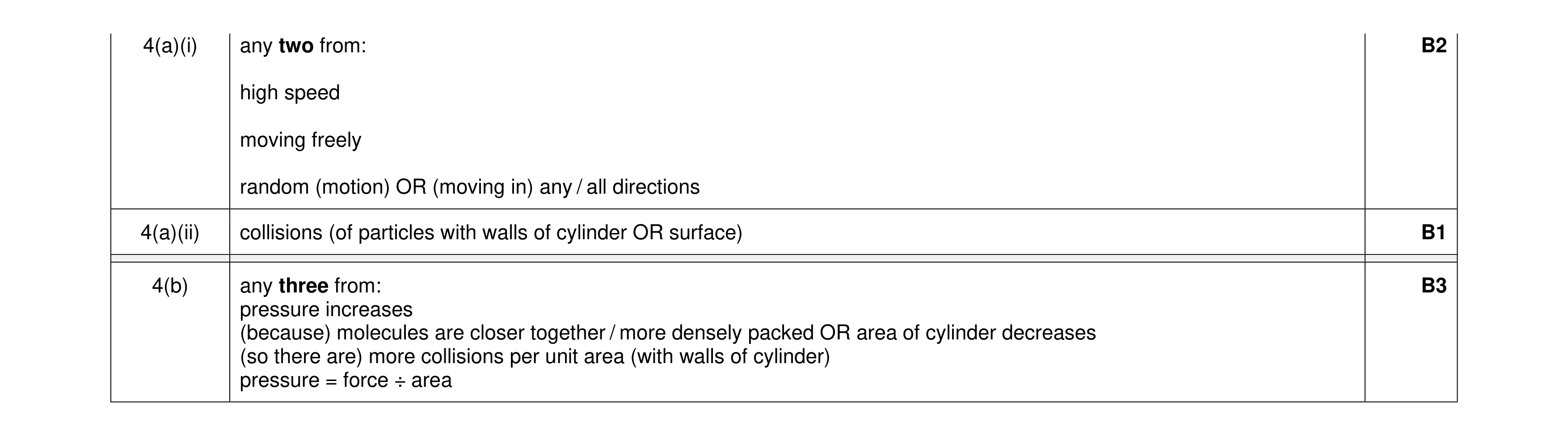 6
6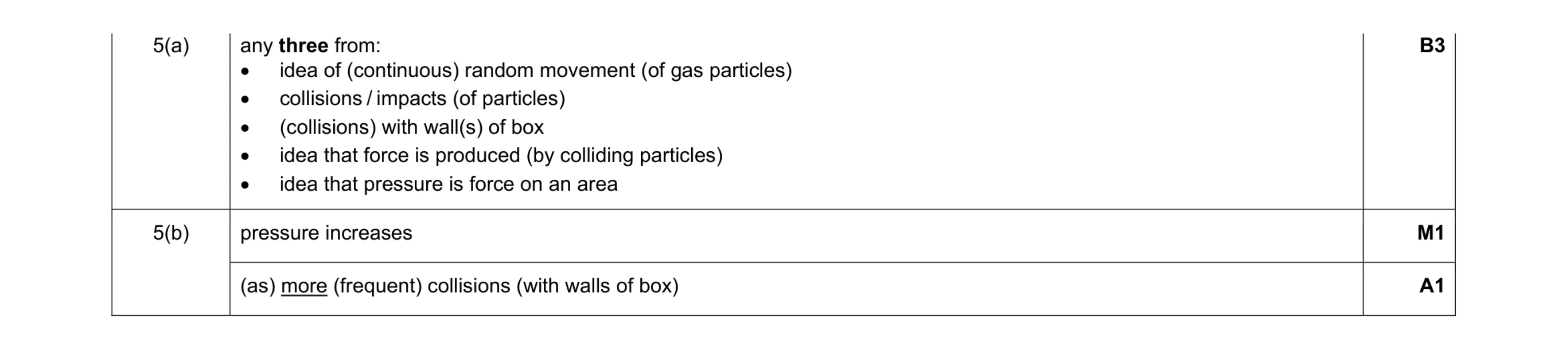 5
5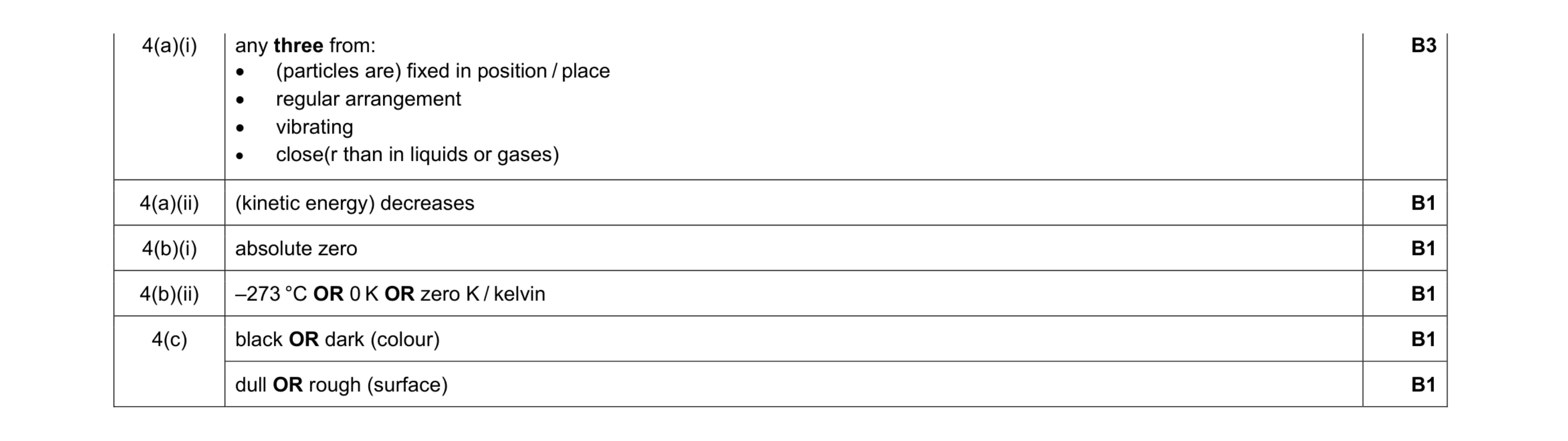 8
8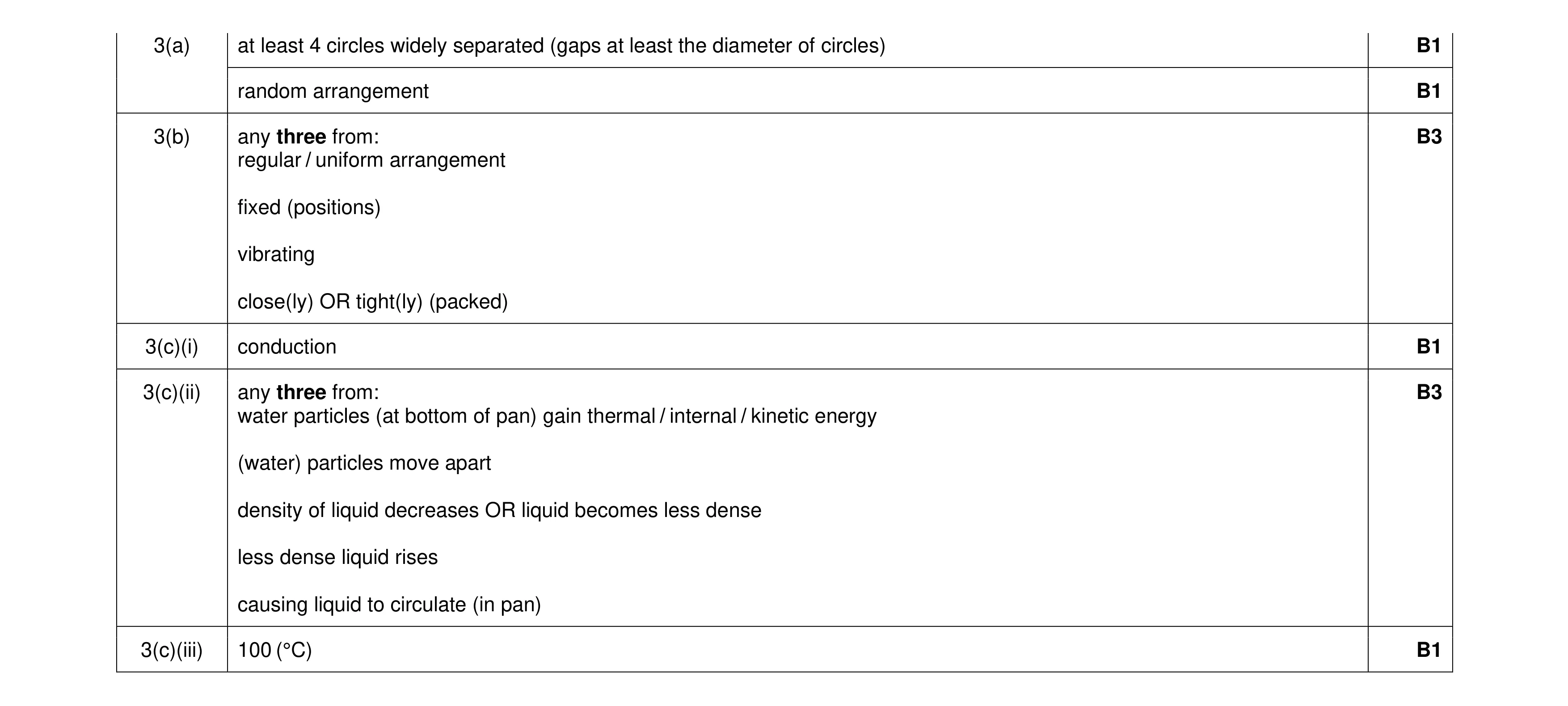 10
10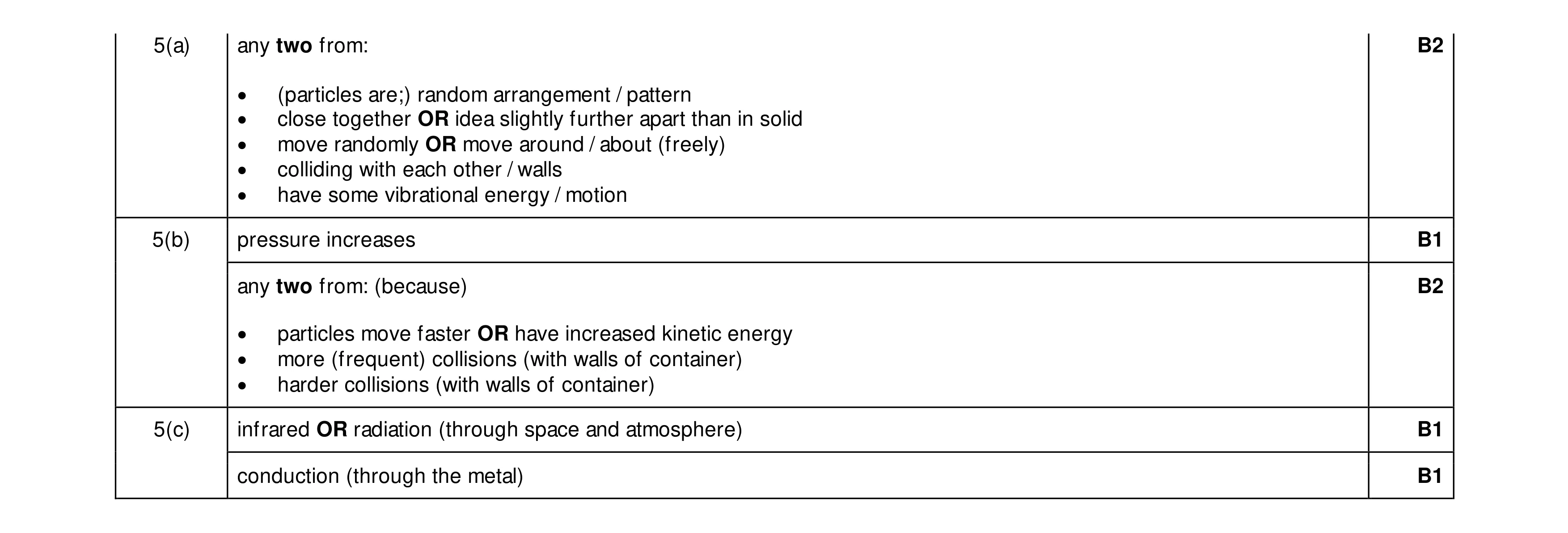 7
7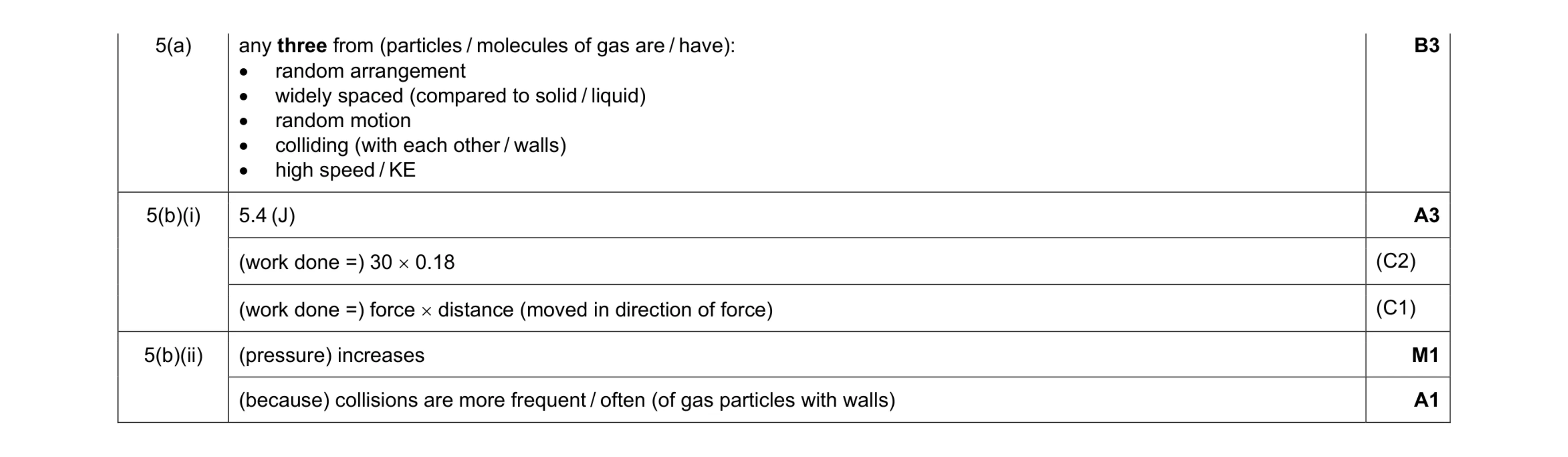 8
8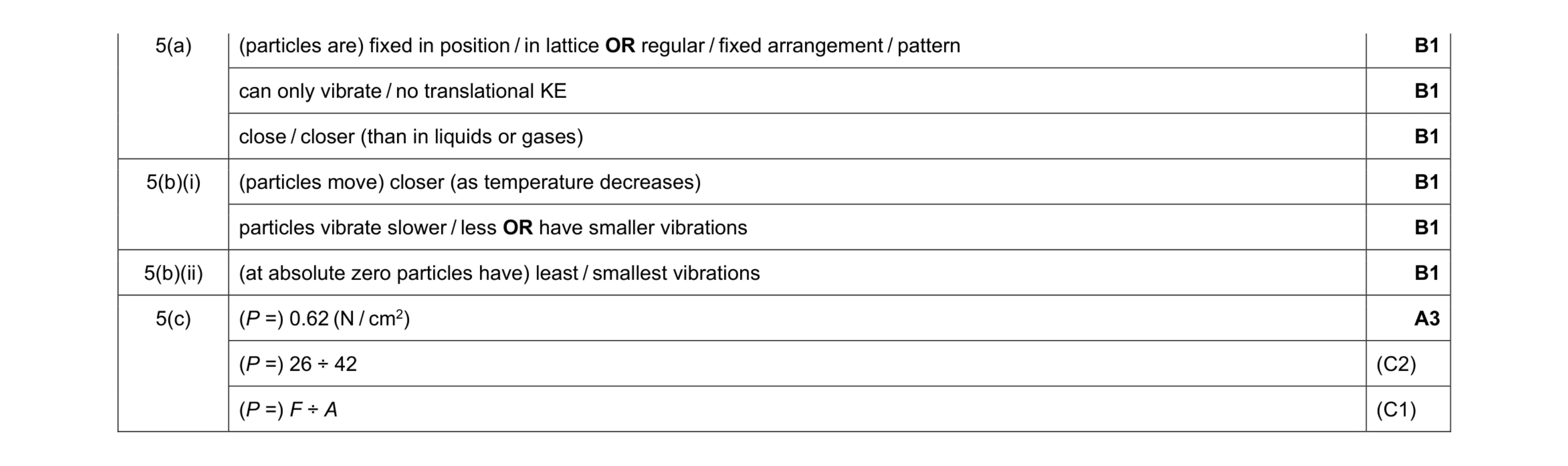 9
9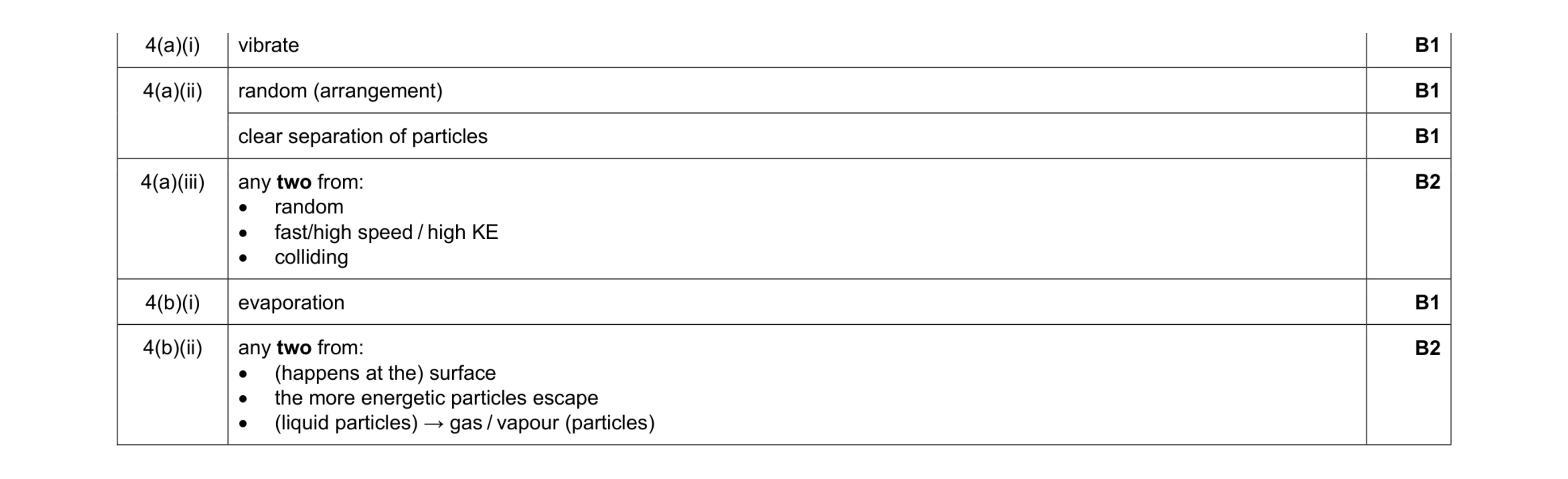 8
8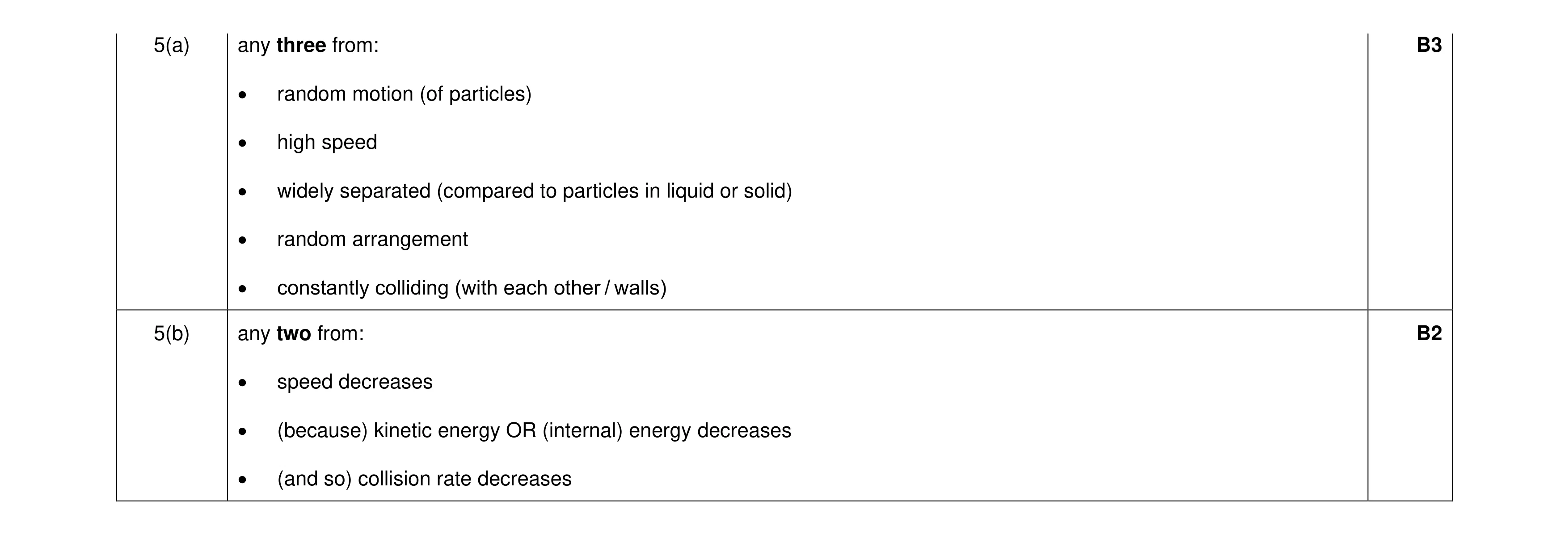 5
5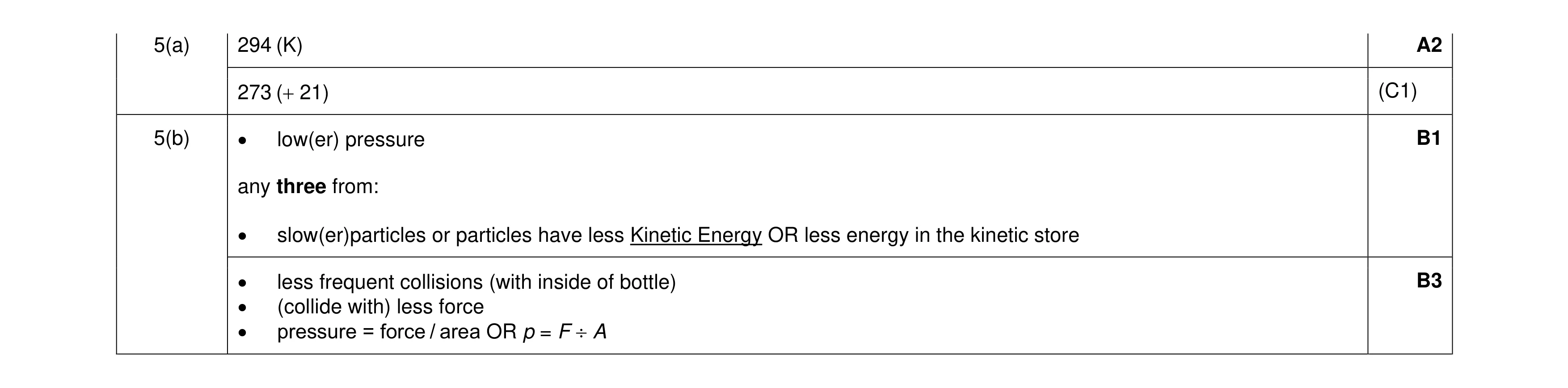 6
6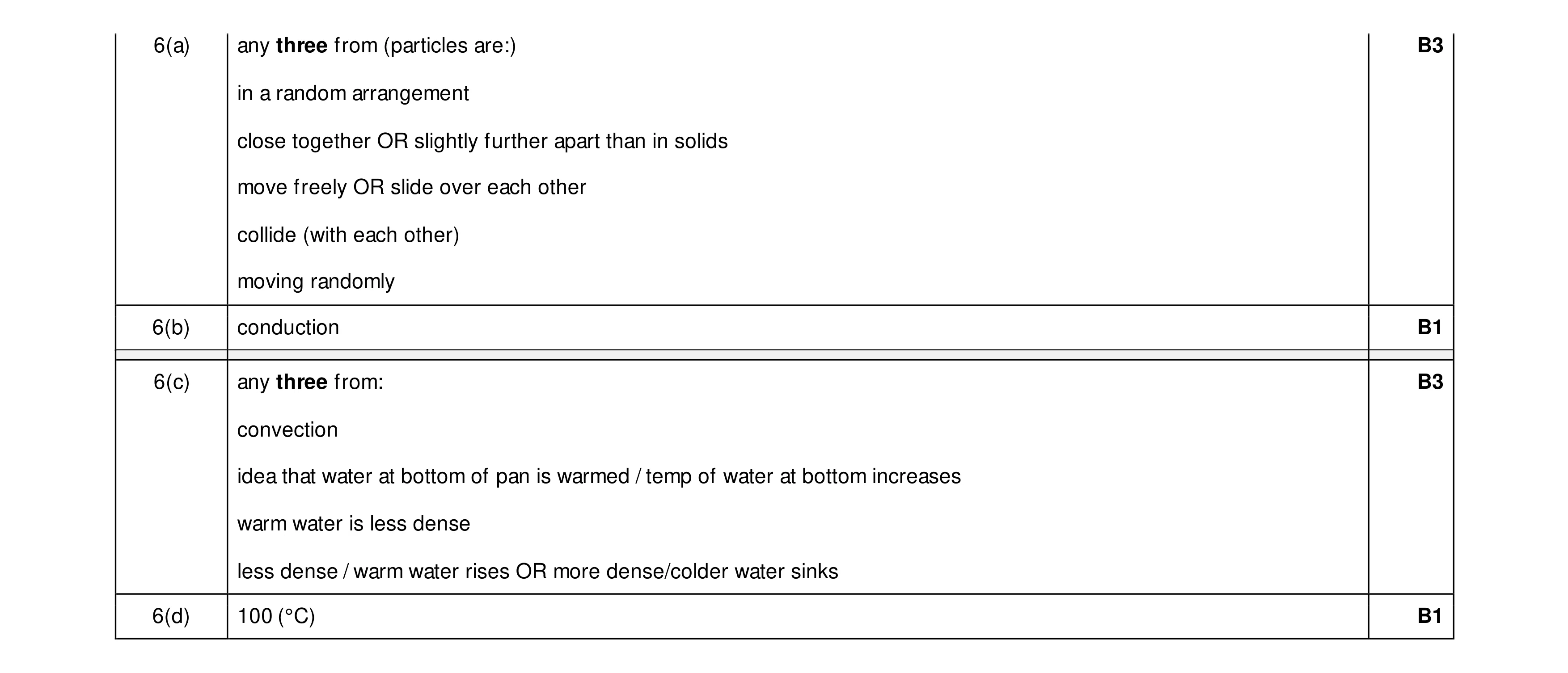 8
8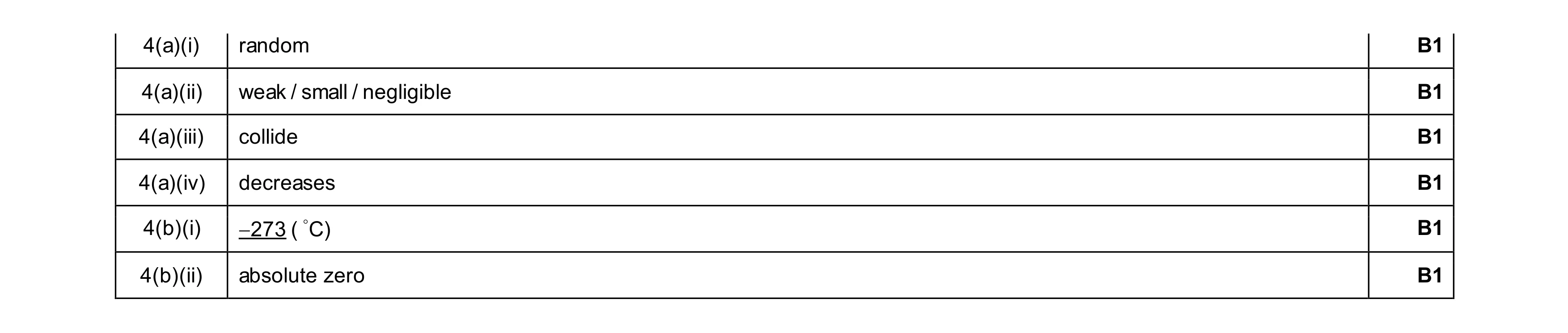 6
6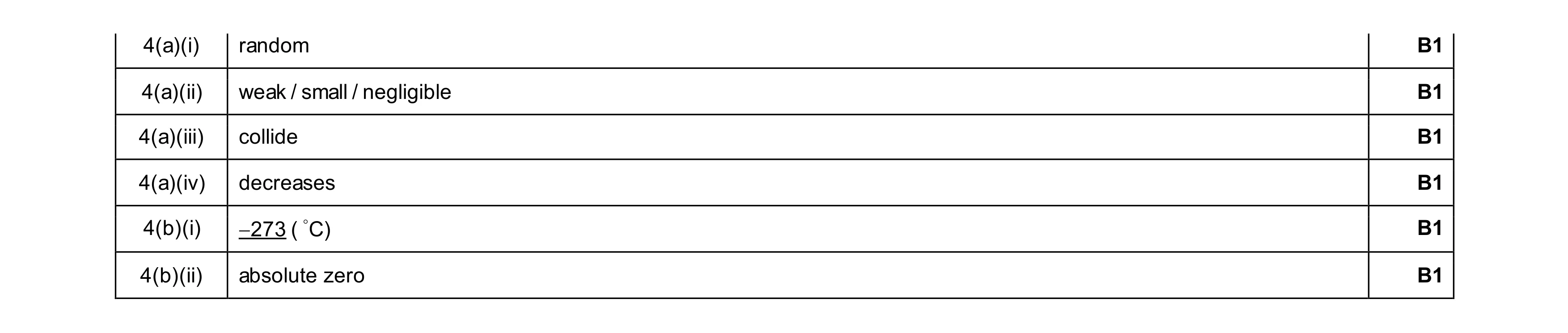 6
6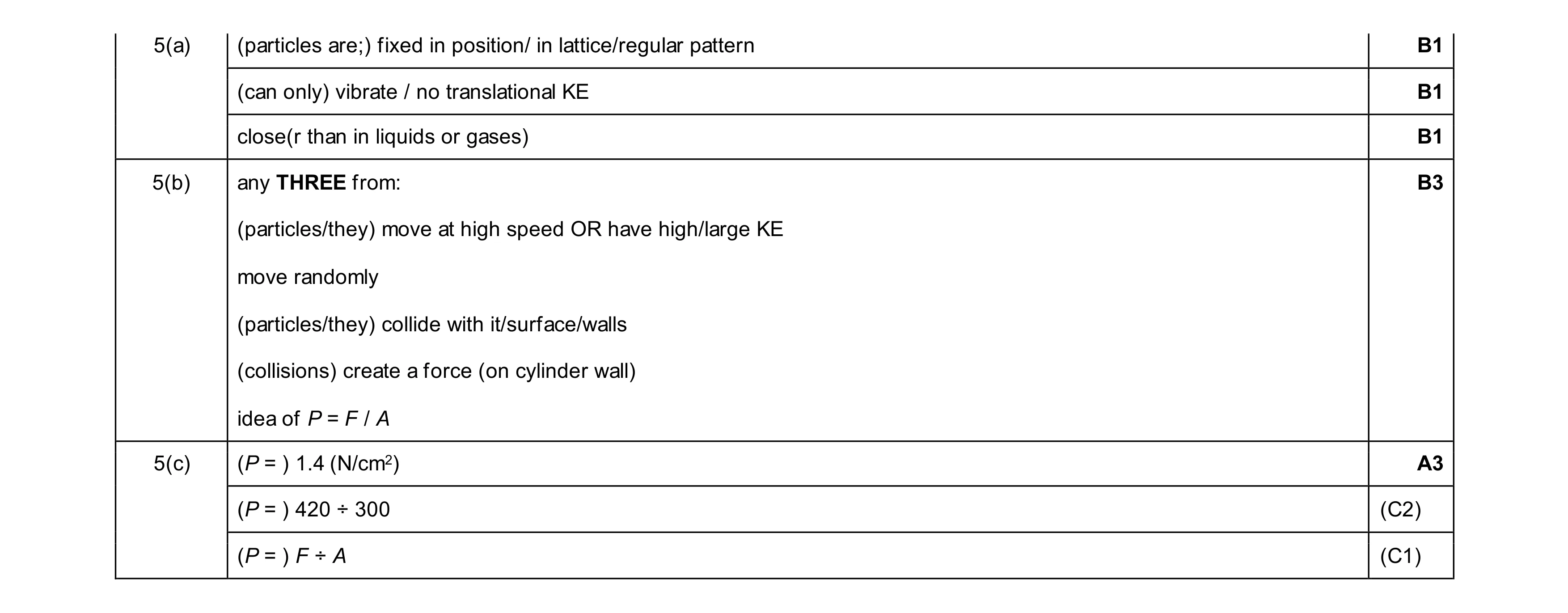 9
9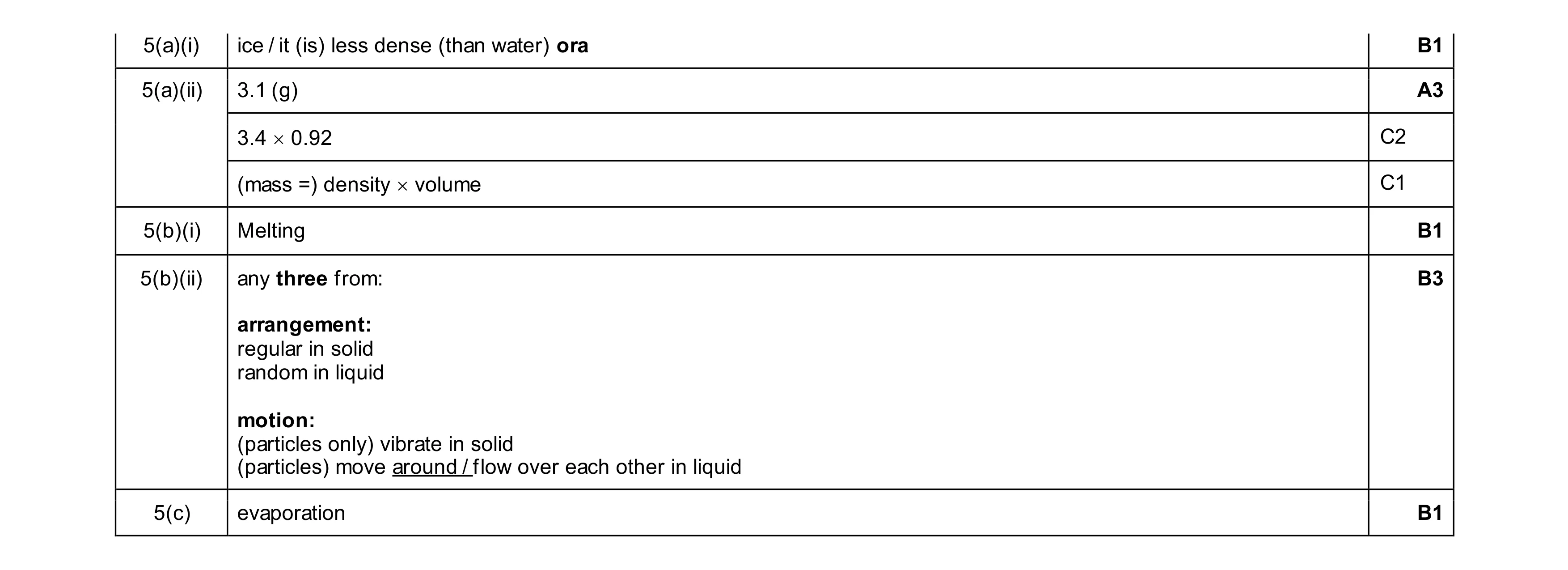 9
9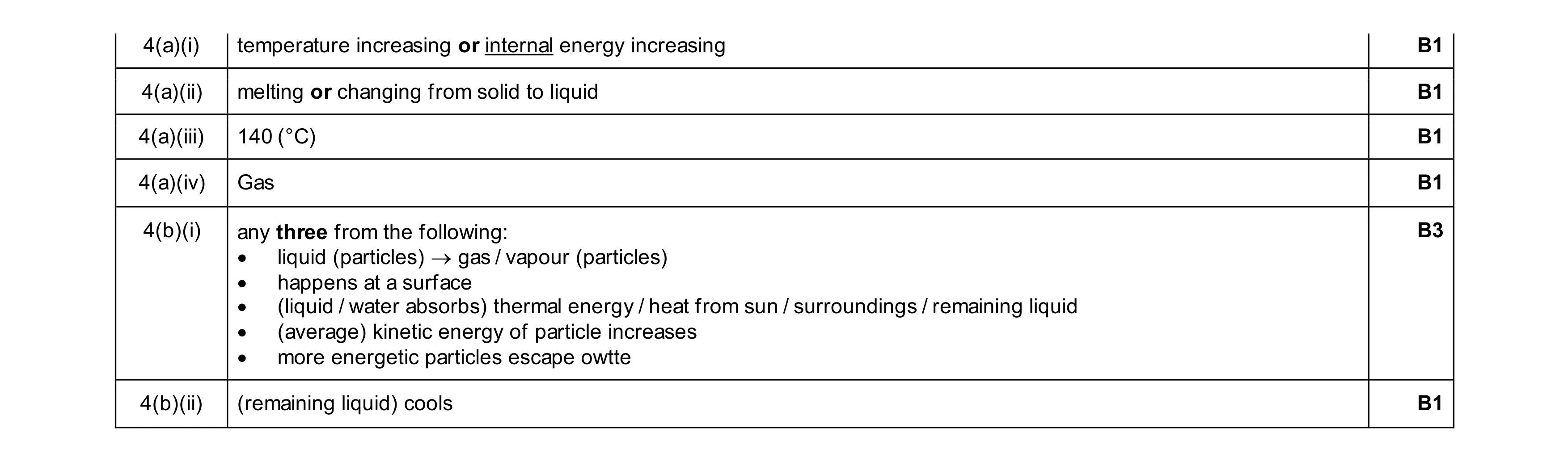 8
8