Questions as text
Q1 · Gases can be compressed, but liquids cannot 0625/22 Feb/March 2016
14 Gases can be compressed, but liquids cannot. Which statement explains this difference? A Each molecule in a gas is more compressible than each molecule in a liquid. B Molecules in a gas are further apart than molecules in a liquid. C Molecules in a gas attract each other more strongly than molecules in a liquid. D Molecules in a gas move more slowly than molecules in a liquid.
1 marks
Answer: B
This question in 0625/22 Feb/March 2016
Q2 · The diagram shows a quantity of gas trapped in a cylinder 0625/22 Feb/March 2016
15 The diagram shows a quantity of gas trapped in a cylinder. The piston is pushed in slowly and the gas is compressed. The temperature of the gas does not change. gas piston pushed in piston Which graph shows the relationship between the pressure and the volume of the gas? A B pressure pressure 0 0 0 volume 0 volume C D pressure pressure 0 0 0 volume 0 volume
1 marks
Answer: B
This question in 0625/22 Feb/March 2016
Q3 · In an experiment, a liquid is heated at a constant rate 0625/22 Feb/March 2016
18 In an experiment, a liquid is heated at a constant rate. The temperature of the liquid increases and eventually becomes constant. Which statement about the experiment is correct? A Boiling occurs at all temperatures but only on the liquid surface. B Boiling occurs throughout the liquid but only at the constant temperature. C Evaporation occurs throughout the liquid and at all temperatures. D Evaporation occurs only at the constant temperature and only on the liquid surface.
1 marks
Answer: B
This question in 0625/22 Feb/March 2016
Q4 · A cup contains hot liquid 0625/21 May/June 2016
5 A cup contains hot liquid. Some of the liquid evaporates. What happens to the mass and what happens to the weight of the liquid in the cup? mass weight A decreases decreases B decreases stays the same C stays the same decreases D stays the same stays the same
1 marks
Answer: A
This question in 0625/21 May/June 2016
Q5 · A diver under water uses breathing apparatus at a depth where the pressure is 1.25 × 10⁵… 0625/21 May/June 2016
12 A diver under water uses breathing apparatus at a depth where the pressure is 1.25 × 10⁵ Pa. A bubble of gas breathed out by the diver has a volume of 20 cm3 when it is released. The bubble moves upwards to the surface of the water. At the surface of the water, the atmospheric pressure is 1.00 × 10⁵ Pa. The temperature of the water is the same at all depths. What is the volume of this bubble when it reaches the surface? A 15 cm3 B 16 cm3 C 20 cm3 D 25 cm3
1 marks
Answer: D
This question in 0625/21 May/June 2016
Q6 · Which statement about evaporation is correct? 0625/21 May/June 2016
14 Which statement about evaporation is correct? A Evaporation causes the temperature of the remaining liquid to decrease. B Evaporation does not occur from a cold liquid near its freezing point. C Evaporation does not occur from a dense liquid, such as mercury. D Evaporation occurs from all parts of a liquid.
1 marks
Answer: A
This question in 0625/21 May/June 2016
Q7 · A substance loses thermal energy (heat) to the surroundings at a steady rate 0625/21 May/June 2016
16 A substance loses thermal energy (heat) to the surroundings at a steady rate. The graph shows how the temperature of the substance changes with time. temperature P Q 0 0 time What could the portion PQ of the graph represent? A gas condensing B gas cooling C liquid cooling D liquid solidifying
1 marks
Answer: C
This question in 0625/21 May/June 2016
Q8 · A diver under water uses breathing apparatus at a depth where the pressure is 1.25 × 10⁵… 0625/22 May/June 2016
12 A diver under water uses breathing apparatus at a depth where the pressure is 1.25 × 10⁵ Pa. A bubble of gas breathed out by the diver has a volume of 20 cm3 when it is released. The bubble moves upwards to the surface of the water. At the surface of the water, the atmospheric pressure is 1.00 × 10⁵ Pa. The temperature of the water is the same at all depths. What is the volume of this bubble when it reaches the surface? A 15 cm3 B 16 cm3 C 20 cm3 D 25 cm3
1 marks
Answer: D
This question in 0625/22 May/June 2016
Q9 · Which statement describes what happens as ice at 0 °C starts to melt to become water? 0625/22 May/June 2016
14 Which statement describes what happens as ice at 0 °C starts to melt to become water? A Energy is absorbed and the temperature remains constant. B Energy is absorbed and the temperature rises. C Energy is released and the temperature remains constant. D Energy is released and the temperature rises.
1 marks
Answer: A
This question in 0625/22 May/June 2016
Q10 · Smoke particles, illuminated by a bright light, are seen through a microscope 0625/22 May/June 2016
15 Smoke particles, illuminated by a bright light, are seen through a microscope. They move about randomly. What causes this motion? A attraction between the smoke particles and the molecules of the air B collisions between the smoke particles and the molecules of the air C evaporation of the faster-moving smoke particles D warming of the smoke particles by the lamp
1 marks
Answer: B
This question in 0625/22 May/June 2016
Q11 · A liquid is at a temperature below its boiling point 0625/22 May/June 2016
16 A liquid is at a temperature below its boiling point. The liquid is then heated so that it becomes a gas at a temperature above its boiling point. Which row correctly compares the liquid with the gas? average distance average speed between the particles of the particles A greater in the liquid greater in the liquid B greater in the liquid smaller in the liquid C smaller in the liquid greater in the liquid D smaller in the liquid smaller in the liquid
1 marks
Answer: D
This question in 0625/22 May/June 2016
Q12 · A beaker of liquid is left on a laboratory bench 0625/22 May/June 2016
17 A beaker of liquid is left on a laboratory bench. There is an electric fan in the laboratory causing a draught over the liquid. The liquid evaporates. Which row shows two changes that will both cause the liquid to evaporate more quickly? change to change to surface area speed of fan of the liquid A decrease decrease B decrease increase C increase decrease D increase increase
1 marks
Answer: D
This question in 0625/22 May/June 2016
Q13 · A cup contains hot liquid 0625/23 May/June 2016
4 A cup contains hot liquid. Some of the liquid evaporates. What happens to the mass and what happens to the weight of the liquid in the cup? mass weight A decreases decreases B decreases stays the same C stays the same decreases D stays the same stays the same
1 marks
Answer: A
This question in 0625/23 May/June 2016
Q14 · A gas molecule strikes the wall of a container 0625/23 May/June 2016
8 A gas molecule strikes the wall of a container. The molecule rebounds with the same speed. wall wall gas molecule gas molecule before hitting the wall after hitting the wall What happens to the kinetic energy and what happens to the momentum of the molecule? kinetic energy momentum A changes changes B changes stays the same C stays the same changes D stays the same stays the same
1 marks
Answer: C
This question in 0625/23 May/June 2016
Q15 · A diver under water uses breathing apparatus at a depth where the pressure is 1.25 × 10⁵… 0625/23 May/June 2016
12 A diver under water uses breathing apparatus at a depth where the pressure is 1.25 × 10⁵ Pa. A bubble of gas breathed out by the diver has a volume of 20 cm3 when it is released. The bubble moves upwards to the surface of the water. At the surface of the water, the atmospheric pressure is 1.00 × 10⁵ Pa. The temperature of the water is the same at all depths. What is the volume of this bubble when it reaches the surface? A 15 cm3 B 16 cm3 C 20 cm3 D 25 cm3
1 marks
Answer: D
This question in 0625/23 May/June 2016
Q16 · What causes the random, zig-zag movement (Brownian motion) of smoke particles suspended… 0625/23 May/June 2016
14 What causes the random, zig-zag movement (Brownian motion) of smoke particles suspended in air? A air molecules colliding with smoke particles B convection currents as the hot smoke rises C smoke particles colliding with each other D smoke particles reacting with oxygen molecules in the air
1 marks
Answer: A
This question in 0625/23 May/June 2016
Q17 · A sealed bottle of constant volume contains air 0625/23 May/June 2016
15 A sealed bottle of constant volume contains air. The air in the bottle is heated by the Sun. What is the effect on the average speed of the air molecules in the bottle, and the average distance between them? average distance average speed between air of air molecules molecules A decreases decreases B decreases stays the same C increases increases D increases stays the same
1 marks
Answer: D
This question in 0625/23 May/June 2016
Q18 · Air is trapped in a cylinder by a piston 0625/21 Oct/Nov 2016
13 Air is trapped in a cylinder by a piston. The original volume of the trapped air is V and the original pressure of the trapped air is P. The piston is pushed to the left. The temperature of the gas does not change. before piston is pushed in after piston is pushed in piston cylinder 25 50 25 50 trapped air trapped air What is the new volume and what is the new pressure of the trapped air? new volume new pressure P A 2V 2 B 2V 2P V P C 2 2 V D 2P 2
1 marks
Answer: D
This question in 0625/21 Oct/Nov 2016
Q19 · When a liquid evaporates, some of its molecules escape from the surface and the… 0625/21 Oct/Nov 2016
14 When a liquid evaporates, some of its molecules escape from the surface and the temperature of the liquid changes. Which row describes the escaping molecules and the change in temperature of the liquid? temperature of escaping molecules the liquid A less energetic goes down B less energetic goes up C more energetic goes down D more energetic goes up
1 marks
Answer: C
This question in 0625/21 Oct/Nov 2016
Q20 · A gas at a constant temperature is in a container of fixed volume 0625/21 Oct/Nov 2016
15 A gas at a constant temperature is in a container of fixed volume. The gas exerts a pressure on the walls of the container. The pressure is caused by the gas molecules striking the walls. Which statement about the gas molecules when they strike the walls is correct? A The average kinetic energy of the gas molecules changes. B The average momentum of the gas molecules changes. C The average speed of the gas molecules changes. D The chemical energy of the gas molecules changes.
1 marks
Answer: B
This question in 0625/21 Oct/Nov 2016
Q21 · The diagram shows a gas that is trapped in a cylinder by a piston 0625/22 Oct/Nov 2016
14 The diagram shows a gas that is trapped in a cylinder by a piston. The volume of the gas is 120 cm3 and the pressure of the gas is P. gas piston The piston is moved slowly to the left so that the volume of the gas is reduced to 30 cm3. The temperature of the gas does not change. What is the new pressure of the trapped gas? P P A B C P D 4P 4 2
1 marks
Answer: D
This question in 0625/22 Oct/Nov 2016
Q22 · A puddle of water is formed after a rain shower on a windy day 0625/22 Oct/Nov 2016
16 A puddle of water is formed after a rain shower on a windy day. Which statement explains the effect of the wind on the rate of evaporation of the water in the puddle? A The wind gives molecules in the water extra kinetic energy and so increases the rate of evaporation. B The wind removes evaporated water from near the surface and so decreases the rate of evaporation. C The wind removes evaporated water from near the surface and so increases the rate of evaporation. D The wind takes energy from molecules near the surface and so decreases the rate of evaporation.
1 marks
Answer: C
This question in 0625/22 Oct/Nov 2016
Q23 · Which diagram best represents the movement of a smoke particle displaying Brownian motion? 0625/23 Oct/Nov 2016
14 Which diagram best represents the movement of a smoke particle displaying Brownian motion? A B smoke smoke particle particle C D smoke particle smoke particle
1 marks
Answer: D
This question in 0625/23 Oct/Nov 2016
Q24 · The volume of a gas is measured at different pressures 0625/23 Oct/Nov 2016
15 The volume of a gas is measured at different pressures.
The pressure p and the volume V of the gas are found to be related by the equation:
pV = constant.
Which quantities are kept constant and which quantities change?
density of gas mass of gas temperature of gas
A v v x key
B v x v ¥ = constant
Cc x v v X = changed
D x x Jv
1 marks
Answer: C
This question in 0625/23 Oct/Nov 2016
Q25 · Very small pollen grains are suspended in water 0625/22 Feb/March 2017
13 Very small pollen grains are suspended in water. A bright light shines from the side. When looked at through a microscope, small specks of light are seen to be moving in a random, jerky manner. eye microscope bright light pollen grains in water What are the moving specks of light? A pollen grains being hit by other pollen grains B pollen grains being hit by water molecules C water molecules being hit by other water molecules D water molecules being hit by pollen grains
1 marks
Answer: B
This question in 0625/22 Feb/March 2017
Q26 · At –39 °C, liquid mercury solidifies without a change of temperature 0625/22 Feb/March 2017
14 At –39 °C, liquid mercury solidifies without a change of temperature. Which row shows whether the mercury absorbs or releases energy and what happens to the bonds between the mercury atoms? bonds between energy atoms A absorbed stronger B absorbed weaker C released stronger D released weaker
1 marks
Answer: C
This question in 0625/22 Feb/March 2017
Q27 · Brownian motion is observed when using a microscope to look at smoke particles in air 0625/21 May/June 2017
14 Brownian motion is observed when using a microscope to look at smoke particles in air. What causes the smoke particles to move at random? A Smoke particles are hit by air molecules. B Smoke particles are moved by convection currents in the air. C Smoke particles have different weights and fall at different speeds. D Smoke particles hit the walls of the container.
1 marks
Answer: A
This question in 0625/21 May/June 2017
Q28 · Gas molecules striking a container wall cause a pressure to be exerted on the wall 0625/21 May/June 2017
15 Gas molecules striking a container wall cause a pressure to be exerted on the wall. Which statement explains this? A When a molecule rebounds there must be a change in its energy. B When a molecule rebounds there must be a change in its momentum. C When a molecule rebounds there must be a change in its speed. D When a molecule rebounds there must be a change in its temperature.
1 marks
Answer: B
This question in 0625/21 May/June 2017
Q29 · Brownian motion is observed when using a microscope to look at smoke particles in air 0625/22 May/June 2017
14 Brownian motion is observed when using a microscope to look at smoke particles in air. What causes the smoke particles to move at random? A Smoke particles are hit by air molecules. B Smoke particles are moved by convection currents in the air. C Smoke particles have different weights and fall at different speeds. D Smoke particles hit the walls of the container.
1 marks
Answer: A
This question in 0625/22 May/June 2017
Q30 · Brownian motion is observed when using a microscope to look at smoke particles in air 0625/23 May/June 2017
14 Brownian motion is observed when using a microscope to look at smoke particles in air. What causes the smoke particles to move at random? A Smoke particles are hit by air molecules. B Smoke particles are moved by convection currents in the air. C Smoke particles have different weights and fall at different speeds. D Smoke particles hit the walls of the container.
1 marks
Answer: A
This question in 0625/23 May/June 2017
Q31 · The diagrams show four open dishes 0625/23 May/June 2017
15 The diagrams show four open dishes. Each dish contains water at the same temperature. The dishes are different shapes and a draught blows over two of them. From which container does the water evaporate at the greatest rate? A B C D draught draught no draught no draught
1 marks
Answer: A
This question in 0625/23 May/June 2017
Q32 · A pollen grain in a beaker of still water is viewed through a microscope 0625/21 Oct/Nov 2017
15 A pollen grain in a beaker of still water is viewed through a microscope. Which diagram shows the most likely movement of the pollen grain? A B C D
1 marks
Answer: A
This question in 0625/21 Oct/Nov 2017
Q33 · The diagram shows an air-filled rubber toy 0625/21 Oct/Nov 2017
16 The diagram shows an air-filled rubber toy. A child sits on the toy and its volume decreases. The temperature of the air in the toy does not change. How does the air pressure in the toy change and why? pressure reason A decreases air molecules move more slowly B decreases air molecules strike the rubber less frequently C increases air molecules move more quickly D increases air molecules strike the rubber more frequently
1 marks
Answer: D
This question in 0625/21 Oct/Nov 2017
Q34 · A pollen grain in a beaker of still water is viewed through a microscope 0625/22 Oct/Nov 2017
14 A pollen grain in a beaker of still water is viewed through a microscope. Which diagram shows the most likely movement of the pollen grain? A B C D
1 marks
Answer: A
This question in 0625/22 Oct/Nov 2017
Q35 · The diagram shows an air-filled rubber toy 0625/22 Oct/Nov 2017
15 The diagram shows an air-filled rubber toy. A child sits on the toy and its volume decreases. The temperature of the air in the toy does not change. How does the air pressure in the toy change and why? pressure reason A decreases air molecules move more slowly B decreases air molecules strike the rubber less frequently C increases air molecules move more quickly D increases air molecules strike the rubber more frequently
1 marks
Answer: D
This question in 0625/22 Oct/Nov 2017
Q36 · The diagram shows a glass flask, sealed with a small volume of mercury in a glass tube 0625/22 Oct/Nov 2017
16 The diagram shows a glass flask, sealed with a small volume of mercury in a glass tube. When the flask is gently warmed the mercury rises up the tube. glass tube mercury air water What is the main cause of the movement of the mercury? A expansion of air in the flask B expansion of the glass flask C expansion of the glass tube D expansion of the mercury
1 marks
Answer: A
This question in 0625/22 Oct/Nov 2017
Q37 · The speed of sound is different in different states of matter 0625/22 Oct/Nov 2017
26 The speed of sound is different in different states of matter. The speed of sound in water is 1500 m / s. Which row correctly compares the speed of sound in ice and the speed of sound in steam with the speed of sound in water? speed of sound in ice speed of sound in steam m / s m / s A less than 1500 less than 1500 B less than 1500 more than 1500 C more than 1500 less than 1500 D more than 1500 more than 1500
1 marks
Answer: C
This question in 0625/22 Oct/Nov 2017
Q38 · A pollen grain in a beaker of still water is viewed through a microscope 0625/23 Oct/Nov 2017
14 A pollen grain in a beaker of still water is viewed through a microscope. Which diagram shows the most likely movement of the pollen grain? A B C D
1 marks
Answer: A
This question in 0625/23 Oct/Nov 2017
Q39 · The diagram shows an air-filled rubber toy 0625/23 Oct/Nov 2017
15 The diagram shows an air-filled rubber toy. A child sits on the toy and its volume decreases. The temperature of the air in the toy does not change. How does the air pressure in the toy change and why? pressure reason A decreases air molecules move more slowly B decreases air molecules strike the rubber less frequently C increases air molecules move more quickly D increases air molecules strike the rubber more frequently
1 marks
Answer: D
This question in 0625/23 Oct/Nov 2017
Q40 · A sound wave travels from a medium in one state into the same medium but in another state 0625/23 Oct/Nov 2017
23 A sound wave travels from a medium in one state into the same medium but in another state. This causes the speed of the wave to change from approximately 300 m / s to approximately 3000 m / s. Between which two states is the sound wave travelling? A gas to solid B liquid to gas C liquid to solid D solid to liquid
1 marks
Answer: A
This question in 0625/23 Oct/Nov 2017
Q41 · When molecules of a gas rebound from a wall of a container, the wall experiences a… 0625/21 May/June 2018
15 When molecules of a gas rebound from a wall of a container, the wall experiences a pressure. What is the cause of this pressure? A the change in energy of the molecules B the change in momentum of the molecules C the change in power of the molecules D the change in speed of the molecules
1 marks
Answer: B
This question in 0625/21 May/June 2018
Q42 · Which statements about boiling and about evaporation are both correct? 0625/21 May/June 2018
17 Which statements about boiling and about evaporation are both correct? boiling evaporation A takes place only at the surface takes place only at the surface B takes place only at the surface takes place throughout the liquid C takes place throughout the liquid takes place only at the surface D takes place throughout the liquid takes place throughout the liquid
1 marks
Answer: C
This question in 0625/21 May/June 2018
Q43 · When molecules of a gas rebound from a wall of a container, the wall experiences a… 0625/22 May/June 2018
15 When molecules of a gas rebound from a wall of a container, the wall experiences a pressure. What is the cause of this pressure? A the change in energy of the molecules B the change in momentum of the molecules C the change in power of the molecules D the change in speed of the molecules
1 marks
Answer: B
This question in 0625/22 May/June 2018
Q44 · When molecules of a gas rebound from a wall of a container, the wall experiences a… 0625/23 May/June 2018
15 When molecules of a gas rebound from a wall of a container, the wall experiences a pressure. What is the cause of this pressure? A the change in energy of the molecules B the change in momentum of the molecules C the change in power of the molecules D the change in speed of the molecules
1 marks
Answer: B
This question in 0625/23 May/June 2018
Q45 · Apparatus being used to observe smoke particles 0625/21 Oct/Nov 2018
14 Diagram 1 shows apparatus being used to observe smoke particles. Diagram 2 shows how a smoke particle moves randomly. diagram 1 diagram 2 eye random movement microscope air molecules light and smoke particles Why do the smoke particles move randomly? A They are hit by air molecules. B They are less dense than air. C They are moved by convection currents. D They gain energy from the light.
1 marks
Answer: A
This question in 0625/21 Oct/Nov 2018
Q46 · The gas in a sealed container is compressed at constant temperature 0625/21 Oct/Nov 2018
15 The gas in a sealed container is compressed at constant temperature. Which graph shows how the pressure of the gas changes with its volume? A B pressure pressure 0 0 0 volume 0 volume C D pressure pressure 0 0 0 volume 0 volume
1 marks
Answer: D
This question in 0625/21 Oct/Nov 2018
Q47 · Apparatus being used to observe smoke particles 0625/22 Oct/Nov 2018
14 Diagram 1 shows apparatus being used to observe smoke particles. Diagram 2 shows how a smoke particle moves randomly. diagram 1 diagram 2 eye random movement microscope air molecules light and smoke particles Why do the smoke particles move randomly? A They are hit by air molecules. B They are less dense than air. C They are moved by convection currents. D They gain energy from the light.
1 marks
Answer: A
This question in 0625/22 Oct/Nov 2018
Q48 · A closed container of gas is heated 0625/22 Oct/Nov 2018
15 A closed container of gas is heated. The pressure of the gas increases. Which statement explains this increase in pressure? A The changes in the momentum of the gas molecules striking the walls of the container increase. B The forces of attraction between the gas molecules and the walls of the container increase. C The gas molecules collide with each other more frequently. D The gas molecules lose more energy when they strike the walls of the container.
1 marks
Answer: A
This question in 0625/22 Oct/Nov 2018
Q49 · Apparatus being used to observe smoke particles 0625/23 Oct/Nov 2018
14 Diagram 1 shows apparatus being used to observe smoke particles. Diagram 2 shows how a smoke particle moves randomly. diagram 1 diagram 2 eye random movement microscope air molecules light and smoke particles Why do the smoke particles move randomly? A They are hit by air molecules. B They are less dense than air. C They are moved by convection currents. D They gain energy from the light.
1 marks
Answer: A
This question in 0625/23 Oct/Nov 2018
Q50 · A bubble of air has a volume of 2.0 cm3 at the bottom of a lake where the total pressure… 0625/23 Oct/Nov 2018
15 A bubble of air has a volume of 2.0 cm3 at the bottom of a lake where the total pressure is 4.0 × 10⁵ Pa. The temperature of the water in the lake is constant. The atmospheric pressure at the surface is 1.0 × 10⁵ Pa. What is the volume of the bubble when it rises to the surface? A 0.13 cm3 B 0.17 cm3 C 6.0 cm3 D 8.0 cm3
1 marks
Answer: D
This question in 0625/23 Oct/Nov 2018
Q51 · Gas molecules exert a pressure when they collide with the walls of a container 0625/22 Feb/March 2019
16 Gas molecules exert a pressure when they collide with the walls of a container. Which statement is correct? A They experience a change in force which exerts a pressure equal to momentum × area on the walls. momentum on the B They experience a change in force which exerts a pressure equal to area walls. C They experience a change in momentum which exerts a pressure equal to force × area on the walls. force on the D They experience a change in momentum which exerts a pressure equal to area walls.
1 marks
Answer: D
This question in 0625/22 Feb/March 2019
Q52 · A stationary smoke particle is hit by a fast-moving nitrogen molecule 0625/21 May/June 2019
14 A stationary smoke particle is hit by a fast-moving nitrogen molecule. Which row describes the motion of the smoke particle and of the nitrogen molecule after the collision? smoke particle nitrogen molecule A moves rebounds B moves stops C remains stationary rebounds D remains stationary stops
1 marks
Answer: A
This question in 0625/21 May/June 2019
Q53 · At room temperature, iron is difficult to compress 0625/22 May/June 2019
14 At room temperature, iron is difficult to compress. At the same temperature, oxygen is much easier to compress. Which comparison of the structures of iron and oxygen explains this? A The iron particles are closer together. B The iron particles have a greater mass. C The iron particles can be magnetised. D The iron particles have less average kinetic energy.
1 marks
Answer: A
This question in 0625/22 May/June 2019
Q54 · The handle of a metal saucepan is made of plastic 0625/22 May/June 2019
17 The handle of a metal saucepan is made of plastic. As the saucepan heats up, the handle gets warmer. Which statement explains this? A Molecules of the plastic radiate their energy to other molecules. B Molecules of the plastic vibrate more and pass on their energy to nearby molecules. C The free electrons in the plastic transfer the thermal energy along the handle. D The heated molecules very slowly move along the plastic handle.
1 marks
Answer: B
This question in 0625/22 May/June 2019
Q55 · Water in a beaker evaporates when it is left on a bench for a period of time 0625/23 May/June 2019
14 Water in a beaker evaporates when it is left on a bench for a period of time. Increasing the surface area and increasing the temperature of the water each change the rate of evaporation. Which row is correct? increasing the surface area increasing the temperature A rate of evaporation decreases rate of evaporation decreases B rate of evaporation decreases rate of evaporation increases C rate of evaporation increases rate of evaporation decreases D rate of evaporation increases rate of evaporation increases
1 marks
Answer: D
This question in 0625/23 May/June 2019
Q56 · Why does a metal rod conduct thermal energy much better than a similar-sized plastic rod? 0625/23 May/June 2019
17 Why does a metal rod conduct thermal energy much better than a similar-sized plastic rod? A The molecules in the plastic are much closer together than the atoms in the metal. B The molecules in the plastic are much larger than the atoms in the metal. C The molecules in the plastic are much more tightly held together than the atoms in the metal. D The molecular structure in the plastic contains no free electrons, but the metal has free electrons.
1 marks
Answer: D
This question in 0625/23 May/June 2019
Q57 · Which statement about the evaporation of a liquid is correct? 0625/21 Oct/Nov 2019
15 Which statement about the evaporation of a liquid is correct? A The least energetic molecules escape from the surface and the temperature of the liquid decreases. B The least energetic molecules escape from the surface and the temperature of the liquid increases. C The most energetic molecules escape from the surface and the temperature of the liquid decreases. D The most energetic molecules escape from the surface and the temperature of the liquid increases.
1 marks
Answer: C
This question in 0625/21 Oct/Nov 2019
Q58 · A bubble of gas is formed deep under water 0625/21 Oct/Nov 2019
16 A bubble of gas is formed deep under water. The bubble has a volume of 40 cm3 and the pressure inside the bubble is P. The bubble rises up through the water. The volume of the bubble increases to 56 cm3 and the pressure becomes 100 kPa. The temperature of the gas does not change. What is the initial pressure P ? A 71 Pa B 71 kPa C 140 Pa D 140 kPa
1 marks
Answer: D
This question in 0625/21 Oct/Nov 2019
Q59 · A liquid turns into a gas 0625/21 Oct/Nov 2019
18 A liquid turns into a gas. This occurs only at one particular temperature, and the change happens throughout the liquid. What is this process called? A boiling B condensation C evaporation D fusion
1 marks
Answer: A
This question in 0625/21 Oct/Nov 2019
Q60 · One end of a rod of copper is placed in hot water 0625/21 Oct/Nov 2019
19 One end of a rod of copper is placed in hot water. Thermal energy travels along the rod to make the other end warmer. What is the behaviour of the copper at an atomic level that accounts for most of the transfer of thermal energy from one end to the other? A Atoms at the hot end gain kinetic energy and move towards the other end. B Atoms at the hot end expand, colliding with other atoms and transferring energy. C Free electrons at the hot end gain energy and move towards the other end, colliding with atoms along the rod. D Free electrons at the hot end gain energy from the hot water and move directly to the other end.
1 marks
Answer: C
This question in 0625/21 Oct/Nov 2019
Q61 · Which row describes the arrangement and the motion of the molecules in a gas? 0625/22 Oct/Nov 2019
16 Which row describes the arrangement and the motion of the molecules in a gas? arrangement motion A far apart move freely B far apart vibrate only C tightly packed move freely D tightly packed vibrate only
1 marks
Answer: A
This question in 0625/22 Oct/Nov 2019
Q62 · A bubble of air of volume 3.0 mm3 is under water 0625/22 Oct/Nov 2019
17 A bubble of air of volume 3.0 mm3 is under water. The bubble is at a depth where the pressure of the air inside the bubble is four times atmospheric pressure. The temperature of the air in the bubble stays the same as it rises to the surface. What is the volume of the air in the bubble as it reaches the surface? A 3.0 mm3 B 9.0 mm3 C 12 mm3 D 15 mm3
1 marks
Answer: C
This question in 0625/22 Oct/Nov 2019
Q63 · A liquid turns into a gas 0625/22 Oct/Nov 2019
19 A liquid turns into a gas. This occurs only at one particular temperature, and the change happens throughout the liquid. What is this process called? A boiling B condensation C evaporation D fusion
1 marks
Answer: A
This question in 0625/22 Oct/Nov 2019
Q64 · Which row compares the separation and the motion of the molecules of a hot gas with those… 0625/23 Oct/Nov 2019
15 Which row compares the separation and the motion of the molecules of a hot gas with those of a cool liquid? (Both the gas and the liquid are at the same pressure.) separation motion A greater for a gas faster for a gas B greater for a gas slower for a gas C smaller for a gas faster for a gas D smaller for a gas slower for a gas
1 marks
Answer: A
This question in 0625/23 Oct/Nov 2019
Q65 · A fixed mass of gas has a volume of 25 cm3 0625/23 Oct/Nov 2019
16 A fixed mass of gas has a volume of 25 cm3. The pressure of the gas is 100 kPa. The volume of the gas is slowly decreased by 15 cm3 at constant temperature. What is the change in pressure of the gas? A 67 kPa B 150 kPa C 170 kPa D 250 kPa
1 marks
Answer: B
This question in 0625/23 Oct/Nov 2019
Q66 · A liquid turns into a gas 0625/23 Oct/Nov 2019
17 A liquid turns into a gas. This occurs only at one particular temperature, and the change happens throughout the liquid. What is this process called? A boiling B condensation C evaporation D fusion
1 marks
Answer: A
This question in 0625/23 Oct/Nov 2019
Q67 · Which row gives a possible set of values for the speed of sound in ice, in water and in… 0625/23 Oct/Nov 2019
25 Which row gives a possible set of values for the speed of sound in ice, in water and in steam? speed of sound speed of sound speed of sound in ice in water in steam m/s m/s m/s A 500 1500 4000 B 1500 4000 500 C 4000 500 1500 D 4000 1500 500
1 marks
Answer: D
This question in 0625/23 Oct/Nov 2019
Q68 · When pollen grains in water are viewed through a microscope, they are seen to be in… 0625/22 Feb/March 2020
16 When pollen grains in water are viewed through a microscope, they are seen to be in continuous, rapid random motion. What causes a pollen grain to move in this way? A convection currents in the water B bombardment by a single molecule of water C uneven bombardment on different sides by water molecules D collision with another pollen grain due to their kinetic energies
1 marks
Answer: C
This question in 0625/22 Feb/March 2020
Q69 · A student measures the mass of warm water in an open container over two minutes 0625/22 Feb/March 2020
17 A student measures the mass of warm water in an open container over two minutes. The container is kept at a constant temperature. The results are in the table. time / minutes mass / g 0.0 33.9 0.5 30.6 1.0 27.6 1.5 24.9 2.0 22.5 Why does the mass of the water change? A The water evaporates. B The water freezes. C The water condenses. D The water boils.
1 marks
Answer: A
This question in 0625/22 Feb/March 2020
Q70 · A boy jumps into an indoor swimming pool 0625/22 Feb/March 2020
22 A boy jumps into an indoor swimming pool. He notices that the water appears to get colder as he goes deeper underwater. This is due to convection. Which statement is correct? A Cold water is more dense than warm water so it sinks to the bottom of the pool. B Warm water is more dense than cold water so it rises to the surface of the pool. C The molecules in cold water have more kinetic energy than the molecules in warm water so they move to the bottom of the pool faster. D The molecules in warm water are closer together than the molecules in cold water so they rise to the surface of the pool.
1 marks
Answer: A
This question in 0625/22 Feb/March 2020
Q71 · The diagram shows compressions and rarefactions in air as a sound wave moves from left to… 0625/22 Feb/March 2020
28 The diagram shows compressions and rarefactions in air as a sound wave moves from left to right. rarefaction compression A quieter sound of the same frequency is made. What will happen to the number of particles in a region of rarefaction and in a region of compression? number of particles in number of particles in region of rarefaction region of compression A decrease decrease B decrease increase C increase decrease D increase increase
1 marks
Answer: C
This question in 0625/22 Feb/March 2020
Q72 · A gas is heated in a sealed container 0625/21 May/June 2020
14 A gas is heated in a sealed container. The volume of the container does not change. What happens to the molecules of the gas? A The average distance between molecules increases. B The average kinetic energy of the molecules increases. C The mass of each molecule increases. D The volume of each molecule increases.
1 marks
Answer: B
This question in 0625/21 May/June 2020
Q73 · Water in a beaker evaporates when left on a bench for a period of time 0625/21 May/June 2020
15 Water in a beaker evaporates when left on a bench for a period of time. Which three factors all affect the rate of evaporation of the water? A wind speed, surface area, temperature B wind speed, temperature, volume C wind speed, surface area, volume D surface area, temperature, volume
1 marks
Answer: A
This question in 0625/21 May/June 2020
Q74 · Which row describes the forces between the molecules and the motion of the molecules in a… 0625/22 May/June 2020
14 Which row describes the forces between the molecules and the motion of the molecules in a solid? forces between motion molecules of molecules A strong move freely B strong vibrate only C weak move freely D weak vibrate only
1 marks
Answer: B
This question in 0625/22 May/June 2020
Q75 · Wet clothes are hanging outside to dry 0625/22 May/June 2020
15 Wet clothes are hanging outside to dry. Which condition decreases the rate of evaporation of the water from the clothes? A folded clothes B higher temperature C wetter clothes D windy day
1 marks
Answer: A
This question in 0625/22 May/June 2020
Q76 · When a molecule rebounds from a wall, a force is exerted on the wall 0625/23 May/June 2020
14 When a molecule rebounds from a wall, a force is exerted on the wall. What causes this force? A the kinetic energy gained by the molecule B the kinetic energy lost by the molecule C the change of momentum of the molecule D the change of speed of the molecule
1 marks
Answer: C
This question in 0625/23 May/June 2020
Q77 · The relationship between pressure p and volume V of a gas is given as pV = constant 0625/23 May/June 2020
15 The relationship between pressure p and volume V of a gas is given as pV = constant. Under which conditions for the mass of a gas and for its temperature does the equation hold? mass temperature A changing changing B changing constant C constant changing D constant constant
1 marks
Answer: D
This question in 0625/23 May/June 2020
Q78 · Which row gives possible values for the speed of sound? 0625/21 Oct/Nov 2020
25 Which row gives possible values for the speed of sound? speed in gas speed in liquid speed in solid m / s m / s m / s A 972 1450 3560 B 972 3560 1450 C 1450 3560 972 D 3560 972 1450
1 marks
Answer: A
This question in 0625/21 Oct/Nov 2020
Q79 · A student splashes water on to her face 0625/22 Oct/Nov 2020
15 A student splashes water on to her face. Here are three statements about the effects. P The water uses energy to evaporate. Q The water gains energy from the student. R The face of the student cools. Which statements are correct? A P and Q only B P and R only C Q and R only D P, Q and R
1 marks
Answer: D
This question in 0625/22 Oct/Nov 2020
Q80 · A student splashes water on to her face 0625/23 Oct/Nov 2020
15 A student splashes water on to her face. Here are three statements about the effects. P The water uses energy to evaporate. Q The water gains energy from the student. R The face of the student cools. Which statements are correct? A P and Q only B P and R only C Q and R only D P, Q and R
1 marks
Answer: D
This question in 0625/23 Oct/Nov 2020
Q81 · Equal volumes of solids and liquids experience different changes of volume when they are… 0625/23 Oct/Nov 2020
16 Equal volumes of solids and liquids experience different changes of volume when they are heated through the same temperature range. What is the reason for this? A The average increase in separation of the particles in a liquid is greater than the average increase in separation of those in a solid. B The average increase in separation of the particles in a liquid is less than the average increase in separation of those in a solid. C The particles in liquids expand by less than those in solids. D The particles in liquids expand by more than those in solids.
1 marks
Answer: A
This question in 0625/23 Oct/Nov 2020
Q82 · The diagram shows the view of a room heated by a radiator 0625/23 Oct/Nov 2020
19 The diagram shows the view of a room heated by a radiator. The arrowed line from X to Y is the path of the convection current in the air. ceiling X Y radiator floor Which row about the air temperature and the air density at X and at Y is correct? air temperature air density A higher at X higher at X B higher at X higher at Y C higher at Y higher at Y D higher at Y higher at X
1 marks
Answer: B
This question in 0625/23 Oct/Nov 2020
Q83 · Air in a sealed syringe is slowly compressed by moving the piston 0625/22 Feb/March 2021
14 Air in a sealed syringe is slowly compressed by moving the piston. The temperature of the air stays the same. air syringe piston Which statement about the air is correct? A The pressure of the air decreases because its molecules now travel more slowly. B The pressure of the air decreases because the area of the syringe walls is now smaller. C The pressure of the air increases because its molecules now hit the syringe walls more frequently. D The pressure of the air increases because its molecules now travel more quickly.
1 marks
Answer: C
This question in 0625/22 Feb/March 2021
Q84 · In an experiment, smoke particles are suspended in air and viewed through a microscope 0625/22 Feb/March 2021
15 In an experiment, smoke particles are suspended in air and viewed through a microscope. The smoke particles move about with short random movements. Which of the following statements is correct? A Air particles have large masses compared to smoke particles and they move in one direction only. B Air particles have large masses compared to smoke particles and they move in random directions. C Air particles move at high speeds compared to smoke particles and they move in one direction only. D Air particles move at high speeds compared to smoke particles and they move in random directions.
1 marks
Answer: D
This question in 0625/22 Feb/March 2021
Q85 · The speed of sound is different in different states of matter 0625/22 Feb/March 2021
27 The speed of sound is different in different states of matter. The speed of sound in liquid water is 1500 m / s. Which row correctly compares the speed of sound in ice and the speed of sound in water vapour with the speed of sound in water? speed of sound in ice speed of sound in steam m / s m / s A less than 1500 less than 1500 B less than 1500 more than 1500 C more than 1500 less than 1500 D more than 1500 more than 1500
1 marks
Answer: C
This question in 0625/22 Feb/March 2021
Q86 · Which row describes the forces between the molecules and the motion of the molecules in a… 0625/22 May/June 2021
14 Which row describes the forces between the molecules and the motion of the molecules in a gas? forces between motion molecules of molecules A strong move freely B strong vibrate only C weak move freely D weak vibrate only
1 marks
Answer: C
This question in 0625/22 May/June 2021
Q87 · Very small pollen grains are suspended in water 0625/22 May/June 2021
15 Very small pollen grains are suspended in water. A bright light shines from the side. When looked at through a microscope, small specks of light are seen to be moving in a random, jerky manner. eye microscope bright light pollen grains in water What are the moving specks of light? A pollen grains being hit by other pollen grains B pollen grains being hit by water molecules C water molecules being hit by other water molecules D water molecules being hit by pollen grains
1 marks
Answer: B
This question in 0625/22 May/June 2021
Q88 · A liquid is evaporating 0625/21 Oct/Nov 2021
12 A liquid is evaporating. The liquid is not boiling. Which statement about the liquid is correct at an instant in time? A Any molecule can escape, and from any part of the liquid. B Any molecule can escape, but only from the liquid’s surface. C Only molecules with enough energy can escape, and only from the liquid’s surface. D Only molecules with enough energy can escape, but from any part of the liquid.
1 marks
Answer: C
This question in 0625/21 Oct/Nov 2021
Q89 · The diagram shows two cylinders connected by a narrow tube fitted with a tap 0625/21 Oct/Nov 2021
13 The diagram shows two cylinders connected by a narrow tube fitted with a tap. tap 80 cm3 20 cm3 One cylinder contains 80 cm3 of gas at a pressure of 2.0 105 Pa. The other cylinder contains a vacuum. The volume of the evacuated cylinder is 20 cm3. The tap is opened so that the gas can flow to fill both cylinders. The temperature of the gas remains constant. What is the new pressure of the gas? A 0.50 105 Pa B 1.6 105 Pa C 2.5 105 Pa D 8.0 105 Pa
1 marks
Answer: B
This question in 0625/21 Oct/Nov 2021
Q90 · A liquid is evaporating 0625/22 Oct/Nov 2021
12 A liquid is evaporating. The liquid is not boiling. Which statement about the liquid is correct at an instant in time? A Any molecule can escape, and from any part of the liquid. B Any molecule can escape, but only from the liquid’s surface. C Only molecules with enough energy can escape, and only from the liquid’s surface. D Only molecules with enough energy can escape, but from any part of the liquid.
1 marks
Answer: C
This question in 0625/22 Oct/Nov 2021
Q91 · A gas is contained in a sealed container in a laboratory 0625/22 Oct/Nov 2021
13 A gas is contained in a sealed container in a laboratory. The temperature of the gas increases. What happens to the average speed and what happens to the total kinetic energy of the gas molecules? average speed total kinetic energy A does not change does not change B does not change increases C increases does not change D increases increases
1 marks
Answer: D
This question in 0625/22 Oct/Nov 2021
Q92 · A liquid is evaporating 0625/23 Oct/Nov 2021
12 A liquid is evaporating. The liquid is not boiling. Which statement about the liquid is correct at an instant in time? A Any molecule can escape, and from any part of the liquid. B Any molecule can escape, but only from the liquid’s surface. C Only molecules with enough energy can escape, and only from the liquid’s surface. D Only molecules with enough energy can escape, but from any part of the liquid.
1 marks
Answer: C
This question in 0625/23 Oct/Nov 2021
Q93 · The same mass of a gas is trapped in four identical cylinders by a piston that can move 0625/23 Oct/Nov 2021
13 The same mass of a gas is trapped in four identical cylinders by a piston that can move. The diagrams show the samples of gas in different conditions of volume and temperature. 1 2 3 4 piston 20 °C 40 °C 40 °C 50 °C Which list gives the pressure of the gas in order from lowest to highest? A 1 2 3 4 B 1 3 2 4 C 4 2 3 1 D 4 3 2 1
1 marks
Answer: B
This question in 0625/23 Oct/Nov 2021
Q94 · A solid and a gas are each given the same increase in temperature 0625/23 Oct/Nov 2021
15 A solid and a gas are each given the same increase in temperature. The gas is kept at a constant pressure. Which row is correct? the one which the reason expands most A the gas molecules in the gas each expand more than the solid molecules B the gas the molecules in the solid are held strongly together C the solid molecules in the solid each expand more than the gas molecules D the solid all the molecules in the gas are separate from one another
1 marks
Answer: B
This question in 0625/23 Oct/Nov 2021
Q95 · Smoke particles, illuminated by a bright lamp, are seen through a microscope 0625/22 Feb/March 2022
15 Smoke particles, illuminated by a bright lamp, are seen through a microscope. They move about randomly. What causes this motion? A attraction between the smoke particles and the molecules of the air B collisions between the smoke particles and the molecules of the air C evaporation of the faster-moving smoke particles D warming of the smoke particles by the lamp
1 marks
Answer: B
This question in 0625/22 Feb/March 2022
Q96 · A sealed rigid container has a fixed volume 0625/21 May/June 2022
14 A sealed rigid container has a fixed volume. The container is filled with air. The container is placed in a freezer cabinet and the temperature of the air in the container decreases. Which row correctly describes what happens to the air in the container? average distance average speed between air particles of air particles A decreases increases B decreases decreases C no change increases D no change decreases
1 marks
Answer: D
This question in 0625/21 May/June 2022
Q97 · Two open containers are filled with water at room temperature 0625/21 May/June 2022
15 Two open containers are filled with water at room temperature. The containers have different shapes. container 1 container 2 From which container does the water evaporate at the greater rate and how can the rate of evaporation be increased? container with the greater how the rate of rate of evaporation evaporation can be increased A 1 decrease the water temperature B 1 increase the water temperature C 2 decrease the water temperature D 2 increase the water temperature
1 marks
Answer: B
This question in 0625/21 May/June 2022
Q98 · A glass contains an iced drink on a warm and humid day 0625/21 May/June 2022
18 A glass contains an iced drink on a warm and humid day. Water starts to form on the outside of the glass. What is the name of the effect by which the water forms? A condensation B conduction C convection D evaporation
1 marks
Answer: A
This question in 0625/21 May/June 2022
Q99 · The conditions of a sample of gas change in two stages 0625/22 May/June 2022
14 The conditions of a sample of gas change in two stages. stage 1 increase of temperature at constant volume stage 2 increase of volume with no further change of temperature Which row about the pressure after each stage is correct? stage 1 stage 2 pressure compared pressure compared to to original pressure pressure after stage 1 A decreases decreases B decreases increases C increases decreases D increases increases
1 marks
Answer: C
This question in 0625/22 May/June 2022
Q100 · Small pollen particles are suspended in water 0625/22 May/June 2022
15 Small pollen particles are suspended in water. When viewed with a microscope, the pollen particles can be seen to be moving about irregularly. What causes this movement? A The pollen particles are being bombarded by the heavier particles of the water. B The pollen particles are being bombarded by the lighter particles of the water. C The temperature of the water is higher than that of the pollen particles. D The temperature of the water is lower than that of the pollen particles.
1 marks
Answer: B
This question in 0625/22 May/June 2022
Q101 · A glass contains an iced drink on a warm and humid day 0625/22 May/June 2022
18 A glass contains an iced drink on a warm and humid day. Water starts to form on the outside of the glass. What is the name of the effect by which the water forms? A condensation B conduction C convection D evaporation
1 marks
Answer: A
This question in 0625/22 May/June 2022
Q102 · The diagram shows gas particles hitting the wall of a container 0625/23 May/June 2022
14 The diagram shows gas particles hitting the wall of a container. The system is at room temperature. Why do the gas particles exert a pressure on the wall? A When the particles hit the wall, their momentum changes, which causes a force. B When the particles hit the wall, their average kinetic energy increases. C The particles expand when they hit the wall. D The particles collide with each other.
1 marks
Answer: A
This question in 0625/23 May/June 2022
Q103 · A gas in a container is cooled but the volume of the gas does not change 0625/23 May/June 2022
15 A gas in a container is cooled but the volume of the gas does not change. Which row describes the changes in the pressure of the gas and the kinetic energy of the gas particles? kinetic energy pressure of gas of gas particles A decreases decreases B decreases increases C increases decreases D increases increases
1 marks
Answer: A
This question in 0625/23 May/June 2022
Q104 · A fixed mass of gas is trapped in a container 0625/21 Oct/Nov 2022
12 A fixed mass of gas is trapped in a container. The temperature of the gas is increased but the volume of the gas is kept constant. fixed mass of gas How does this change affect the average kinetic energy of the molecules and the pressure on the walls of the container? average pressure kinetic energy A increases increases B stays the same increases C increases decreases D decreases increases
1 marks
Answer: A
This question in 0625/21 Oct/Nov 2022
Q105 · Which row correctly describes boiling and evaporation of water? 0625/21 Oct/Nov 2022
13 Which row correctly describes boiling and evaporation of water? boiling evaporation A bubbles seen occurs at surface only B bubbles seen occurs throughout the water C no bubbles occurs at surface only D no bubbles occurs throughout the water
1 marks
Answer: A
This question in 0625/21 Oct/Nov 2022
Q106 · The pressure of a fixed mass of gas in a cylinder is measured 0625/22 Oct/Nov 2022
12 The pressure of a fixed mass of gas in a cylinder is measured. The volume of the gas in the cylinder is slowly decreased. The temperature of the gas does not change. Which graph shows how the pressure of the gas changes during this process? A B pressure pressure 0 0 0 time 0 time C D pressure pressure 0 0 0 time 0 time
1 marks
Answer: C
This question in 0625/22 Oct/Nov 2022
Q107 · Wet clothes are hanging outside to dry 0625/22 Oct/Nov 2022
13 Wet clothes are hanging outside to dry. What are the best conditions for the clothes to dry most quickly? wind speed temperature A high high B high low C low high D low low
1 marks
Answer: A
This question in 0625/22 Oct/Nov 2022
Q108 · The pressure of a fixed mass of gas in a cylinder is measured 0625/23 Oct/Nov 2022
12 The pressure of a fixed mass of gas in a cylinder is measured. The volume of the gas in the cylinder is slowly decreased. The temperature of the gas does not change. Which graph shows how the pressure of the gas changes during this process? A B pressure pressure 0 0 0 time 0 time C D pressure pressure 0 0 0 time 0 time
1 marks
Answer: C
This question in 0625/23 Oct/Nov 2022
Q109 · Which statement about evaporation is correct? 0625/23 Oct/Nov 2022
13 Which statement about evaporation is correct? A A body in contact with an evaporating liquid loses thermal energy. B A decrease in the surface area of an evaporating liquid increases the rate of evaporation. C A wind over a liquid decreases the rate of evaporation. D It is necessary to provide an external source of thermal energy to a liquid for it to evaporate.
1 marks
Answer: A
This question in 0625/23 Oct/Nov 2022
Q110 · A sample of gas is trapped in a rigid container 0625/22 Feb/March 2023
15 A sample of gas is trapped in a rigid container. As the temperature of the gas is increased, the pressure increases. Which statement is not correct? A The gas molecules have greater kinetic energy. B The gas molecules hit the walls of the container harder. C The gas molecules hit the walls of the container more frequently. D The gas molecules move further apart.
1 marks
Answer: D
This question in 0625/22 Feb/March 2023
Q111 · A student uses a microscope to observe pollen moving on the surface of water 0625/21 May/June 2023
14 A student uses a microscope to observe pollen moving on the surface of water. Which statement describes the reason for this movement? A Water molecules are moved by microscopic pollen particles. B Water molecules are moved by pollen molecules. C Microscopic pollen particles are moved by water molecules. D Pollen molecules are moved by water molecules.
1 marks
Answer: C
This question in 0625/21 May/June 2023
Q112 · Four students describe the phrase ‘absolute zero’ during a lesson on the particle model 0625/22 May/June 2023
14 Four students describe the phrase ‘absolute zero’ during a lesson on the particle model. Which student is correct? A This is the lowest possible temperature. B Particles in a solid start vibrating. C Particles do not have any weight. D Particles have the least gravitational potential energy.
1 marks
Answer: A
This question in 0625/22 May/June 2023
Q113 · Four students are asked to state and explain the relative magnitudes of the thermal… 0625/22 May/June 2023
15 Four students are asked to state and explain the relative magnitudes of the thermal expansion of solids and gases. Which student is correct? A Gases expand more than solids because the molecules in a gas are in random motion. B Gases expand more than solids because the attractive forces between molecules are much weaker in gases. C Solids expand more than gases because the molecules are closer together in solids. D Solids expand more than gases because the molecules in a solid are in a regular pattern.
1 marks
Answer: B
This question in 0625/22 May/June 2023
Q114 · Which statement about the particles of a substance after condensation is correct? 0625/23 May/June 2023
15 Which statement about the particles of a substance after condensation is correct? A They are close to each other and slide over each other. B They are close to each other and vibrate about fixed points. C They are far apart from each other and vibrate about fixed points. D They are far apart from each other and move freely within the container.
1 marks
Answer: A
This question in 0625/23 May/June 2023
Q115 · Why can a gas be compressed easily into a smaller volume? 0625/21 Oct/Nov 2023
12 Why can a gas be compressed easily into a smaller volume? A The particles are far apart. B The particles do not attract each other. C The particles move randomly. D The volume of each particle can be reduced.
1 marks
Answer: A
This question in 0625/21 Oct/Nov 2023
Q116 · A gas is contained in a cylinder by a movable piston 0625/21 Oct/Nov 2023
13 A gas is contained in a cylinder by a movable piston. gas cylinder piston The gas is heated so that it expands at constant pressure. How is the force of each collision of a gas particle with the piston affected and how does the frequency of collisions between the gas particles and the piston change? force frequency A increases decreases B increases increases C stays the same decreases D stays the same increases
1 marks
Answer: A
This question in 0625/21 Oct/Nov 2023
Q117 · On a warm day, a carton of fresh milk is covered with a wet cloth 0625/21 Oct/Nov 2023
14 On a warm day, a carton of fresh milk is covered with a wet cloth. Why does this help to reduce the temperature of the milk? A Some water evaporates from the cloth so the remaining water becomes cooler. B The water has a very high specific heat capacity. C The water insulates the milk from the warm air around it. D Water is always colder than the air around it.
1 marks
Answer: A
This question in 0625/21 Oct/Nov 2023
Q118 · The element mercury exists as a solid, a liquid or a gas 0625/21 Oct/Nov 2023
23 The element mercury exists as a solid, a liquid or a gas. Which row gives a possible set of values of the speeds of sound through mercury? speed of sound in speed of sound in speed of sound in frozen mercury liquid mercury mercury vapour m / s m / s m / s A 250 1500 2500 B 250 2500 1500 C 1500 250 2500 D 2500 1500 250
1 marks
Answer: D
This question in 0625/21 Oct/Nov 2023
Q119 · Brownian motion is the random motion of particles 0625/22 Oct/Nov 2023
12 Brownian motion is the random motion of particles. In which states of matter is Brownian motion observed? A gases, liquids and solids B gases and liquids only C gases and solids only D liquids and solids only
1 marks
Answer: B
This question in 0625/22 Oct/Nov 2023
Q120 · The volume of a fixed mass of gas is varied 0625/22 Oct/Nov 2023
13 The volume of a fixed mass of gas is varied. The temperature remains constant. Which graph shows how the pressure p of the gas varies with volume V ? A B C D p p p p 0 0 0 0 0 V 0 V 0 1 0 1 V V
1 marks
Answer: D
This question in 0625/22 Oct/Nov 2023
Q121 · Liquid evaporates from a beaker 0625/22 Oct/Nov 2023
14 Liquid evaporates from a beaker. What happens to the temperature of the remaining liquid and how does this temperature change affect the rate of evaporation? rate of temperature evaporation A decreases decreases B decreases increases C increases decreases D increases increases
1 marks
Answer: A
This question in 0625/22 Oct/Nov 2023
Q122 · A sealed bottle of constant volume contains air 0625/23 Oct/Nov 2023
12 A sealed bottle of constant volume contains air. The air in the bottle is heated by the Sun. What is the effect on the average speed of the air particles in the bottle and the average distance between them? average distance average speed between air of air particles particles A decreases decreases B decreases stays the same C increases increases D increases stays the same
1 marks
Answer: D
This question in 0625/23 Oct/Nov 2023
Q123 · In an experiment to investigate the relationship between the volume of a sample of air… 0625/23 Oct/Nov 2023
13 In an experiment to investigate the relationship between the volume of a sample of air and its pressure, the volume of the sample is decreased and its pressure is measured continuously. Curve X on the graph shows the results that would be expected for a fixed mass of air at constant temperature. Curve Y shows the results that are obtained in this particular experiment. X pressure Y 0 0 volume Which row shows two possible reasons why curve Y is different from curve X? 1 2 A the temperature of the air increases air leaks into the container as the volume is decreased as the volume is decreased B the temperature of the air increases air leaks out of the container as the volume is decreased as the volume is decreased C the temperature of the air decreases air leaks into the container as the volume is decreased as the volume is decreased D the temperature of the air decreases air leaks out of the container as the volume is decreased as the volume is decreased
1 marks
Answer: D
This question in 0625/23 Oct/Nov 2023
Q124 · Four containers each contain water 0625/23 Oct/Nov 2023
15 Four containers each contain water. More water at the same temperature is added to each container. From which container does water now evaporate more slowly than it did before? A B C D
1 marks
Answer: C
This question in 0625/23 Oct/Nov 2023
Q125 · Which statement correctly describes a change of state? 0625/22 Feb/March 2024
9 Which statement correctly describes a change of state? A A gas condenses to form a liquid. B A liquid melts to form a solid. C A solid condenses to form a liquid. D A solid boils to form a gas.
1 marks
Answer: A
This question in 0625/22 Feb/March 2024
Q126 · When pollen grains in water are viewed through a microscope, they are seen to be in… 0625/22 Feb/March 2024
12 When pollen grains in water are viewed through a microscope, they are seen to be in continuous, rapid, random motion. What causes a pollen grain to move in this way? A convection currents in the water B bombardment by a single molecule of water C uneven bombardment on different sides by water molecules D collision with another pollen grain
1 marks
Answer: C
This question in 0625/22 Feb/March 2024
Q127 · A circular, flat-bottomed dish contains 100 cm3 of water 0625/22 Feb/March 2024
13 A circular, flat-bottomed dish contains 100 cm3 of water. Students are asked how to increase the rate at which the water evaporates. Their suggestions are listed. student 1 Pour the water into a flat-bottomed dish of larger diameter. student 2 Cool the dish and water. student 3 Create a current of air over the dish with a fan. Which suggestions will increase the rate of evaporation? A 1, 2 and 3 B 1 and 2 only C 1 and 3 only D 2 and 3 only
1 marks
Answer: C
This question in 0625/22 Feb/March 2024
Q128 · Matter consists of very small particles in a continual state of motion 0625/22 Feb/March 2024
14 Matter consists of very small particles in a continual state of motion. Which row describes the behaviour of particles in a liquid? force motion of particles between particles A strong move randomly at high speed B strong vibrate, but change positions C weak vibrate in fixed positions D weak move randomly at high speed
1 marks
Answer: B
This question in 0625/22 Feb/March 2024
Q129 · A man puts some ice into a glass of water on a warm day 0625/21 May/June 2024
9 A man puts some ice into a glass of water on a warm day. After a short time, he notices that the ice disappears and that water droplets appear on the outside of the glass. ice droplets of water Which two changes of state are taking place? A condensation and freezing B condensation and melting C boiling and melting D freezing and evaporation
1 marks
Answer: B
This question in 0625/21 May/June 2024
Q130 · Gas of volume 200 cm3 is trapped inside a container by a piston 0625/21 May/June 2024
10 Gas of volume 200 cm3 is trapped inside a container by a piston. The piston is pushed to the right and the volume of the gas decreases to 100 cm3. The temperature of the gas remains constant. trapped gas piston container Which row states the effect that this has on the kinetic energy of the gas particles and the force per unit area exerted by the particles colliding with the inside walls of the container? kinetic energy force per unit area A doubles doubles B doubles stays the same C stays the same doubles D stays the same stays the same
1 marks
Answer: C
This question in 0625/21 May/June 2024
Q131 · Which graph shows the relationship between the pressure and volume of a fixed mass of gas… 0625/21 May/June 2024
11 Which graph shows the relationship between the pressure and volume of a fixed mass of gas at constant temperature? A B pressure pressure 0 0 0 volume 0 volume C D pressure pressure 0 0 0 volume 0 volume
1 marks
Answer: D
This question in 0625/21 May/June 2024
Q132 · During evaporation of a liquid, the most energetic particles escape 0625/21 May/June 2024
12 During evaporation of a liquid, the most energetic particles escape. The temperature of the remaining liquid changes. Which row identifies where these particles escape from and describes the temperature change? place from which temperature of the particles escape remaining liquid A body of the liquid decreases B body of the liquid increases C surface of the liquid decreases D surface of the liquid increases
1 marks
Answer: C
This question in 0625/21 May/June 2024
Q133 · Wet clothes are put out on a line to allow the water in the clothes to evaporate 0625/21 May/June 2024
13 Wet clothes are put out on a line to allow the water in the clothes to evaporate. Which type of weather would cause the water to evaporate most quickly? A a cold day with no wind B a cold day with wind C a hot day with no wind D a hot day with wind
1 marks
Answer: D
This question in 0625/21 May/June 2024
Q134 · What are the correct terms for each change of state? 0625/22 May/June 2024
9 What are the correct terms for each change of state? liquid to solid liquid to gas A solidification condensation B melting condensation C solidification evaporation D melting evaporation
1 marks
Answer: C
This question in 0625/22 May/June 2024
Q135 · Extremely small pollen grains in water are viewed through a microscope 0625/22 May/June 2024
10 Extremely small pollen grains in water are viewed through a microscope. The grains are seen to move continually and randomly. What is the reason for this random movement? A The grains are moved by randomly moving water molecules. B The grains are moved by random convection currents in the water. C The grains are moved by random rays of light reflecting off them. D The grains are moved by the random motion of their own atoms.
1 marks
Answer: A
This question in 0625/22 May/June 2024
Q136 · Which graph shows how the volume of a fixed mass of gas at constant temperature varies… 0625/22 May/June 2024
11 Which graph shows how the volume of a fixed mass of gas at constant temperature varies with its pressure? A B volume volume 0 0 0 pressure 0 pressure C D volume volume 0 0 0 pressure 0 pressure
1 marks
Answer: D
This question in 0625/22 May/June 2024
Q137 · An ice cube is placed in a beaker and is heated 0625/22 May/June 2024
14 An ice cube is placed in a beaker and is heated. The ice melts to form water, which evaporates at first and then boils. The steam condenses on a cold window in the room. Which process involves a transfer of energy from the ice, water or steam to the surroundings? A melting B evaporating C boiling D condensing
1 marks
Answer: D
This question in 0625/22 May/June 2024
Q138 · A piece of solid metal melts to become a liquid 0625/23 May/June 2024
9 A piece of solid metal melts to become a liquid. How do the particles of metal or their behaviour change? A They increase in size. B They move around each other. C They move much further apart. D They vibrate more about their fixed positions.
1 marks
Answer: B
This question in 0625/23 May/June 2024
Q139 · Brownian motion of particles is observed 0625/23 May/June 2024
10 Brownian motion of particles is observed. Which statements describe the movement of the particles? 1 The particles all travel along a curved path. 2 The particles move randomly. 3 The particles all travel in the same direction. A 1 and 3 B 1 only C 2 and 3 D 2 only
1 marks
Answer: D
This question in 0625/23 May/June 2024
Q140 · A fixed mass of air in a cylinder is compressed by a piston so that the volume of the air… 0625/23 May/June 2024
11 A fixed mass of air in a cylinder is compressed by a piston so that the volume of the air decreases at constant temperature. How do the air particles now collide with the cylinder walls? A less often with a greater velocity B less often with the same velocity C more often with a greater velocity D more often with the same velocity
1 marks
Answer: D
This question in 0625/23 May/June 2024
Q141 · The diagram shows a quantity of gas trapped in a cylinder 0625/23 May/June 2024
12 The diagram shows a quantity of gas trapped in a cylinder. The piston is pushed in slowly and the gas is compressed. The temperature of the gas does not change. gas piston pushed in piston Which graph shows the relationship between the pressure and the volume of the gas? A B pressure pressure 0 0 0 volume 0 volume C D pressure pressure 0 0 0 volume 0 volume
1 marks
Answer: B
This question in 0625/23 May/June 2024
Q142 · Some air is trapped inside a metal container with a tightly fitting lid 0625/21 Oct/Nov 2024
12 Some air is trapped inside a metal container with a tightly fitting lid. tightly fitting lid metal container air heat The container is heated strongly behind a safety screen. The lid is blown off by the increased pressure of the air inside the container. What causes the increase in pressure of the air inside the container? A Each air particle expands and takes up more room. B The air particles move more quickly. C The number of particles inside the container increases. D The volume occupied by the air decreases.
1 marks
Answer: B
This question in 0625/21 Oct/Nov 2024
Q143 · A student measures the mass of water in an open container over two hours 0625/21 Oct/Nov 2024
14 A student measures the mass of water in an open container over two hours. The container is kept in a warm room. The results are in the table. time / hours mass of water / g 0.0 33.9 0.5 30.6 1.0 27.6 1.5 24.9 2.0 22.5 Why does the mass of the water change? A The water evaporates. B The water freezes. C The water condenses. D The water boils.
1 marks
Answer: A
This question in 0625/21 Oct/Nov 2024
Q144 · Water can exist in three states: solid (ice), liquid (liquid water) and gas (steam) 0625/22 Oct/Nov 2024
12 Water can exist in three states: solid (ice), liquid (liquid water) and gas (steam). In which states is the motion of the water particles only vibrational? A liquid water and ice B liquid water only C ice only D steam only
1 marks
Answer: C
This question in 0625/22 Oct/Nov 2024
Q145 · A cube has sides 2.0 m long 0625/22 Oct/Nov 2024
13 A cube has sides 2.0 m long. The cube contains a gas at a pressure of 8000 N / m2. 2.0 m gas A second cube has sides 4.0 m long. This cube contains the same mass of the same gas as the first cube, at the same temperature. 4.0 m gas What is the pressure of the gas in the second cube? A 1000 N / m2 B 4000 N / m2 C 16 000 N / m2 D 64 000 N / m2
1 marks
Answer: A
This question in 0625/22 Oct/Nov 2024
Q146 · Which row gives the correct name for each change of state shown? 0625/22 Oct/Nov 2024
14 Which row gives the correct name for each change of state shown? gas to liquid liquid to solid solid to liquid A condensation melting solidification B condensation solidification melting C evaporation melting solidification D evaporation solidification melting
1 marks
Answer: B
This question in 0625/22 Oct/Nov 2024
Q147 · A gas is heated in a sealed container 0625/23 Oct/Nov 2024
12 A gas is heated in a sealed container. The volume of the container does not change. What happens to the particles of the gas? A The average distance between particles increases. B The average kinetic energy of the particles increases. C The mass of each particle increases. D The volume of each particle increases.
1 marks
Answer: B
This question in 0625/23 Oct/Nov 2024
Q148 · Air in a sealed syringe is slowly compressed by moving the piston 0625/23 Oct/Nov 2024
13 Air in a sealed syringe is slowly compressed by moving the piston. The temperature of the air stays the same. air syringe piston Which statement about the air is correct? A The pressure of the air decreases because its particles now travel more slowly. B The pressure of the air decreases because the area of the syringe walls is now smaller. C The pressure of the air increases because its particles now hit the syringe walls more frequently. D The pressure of the air increases because its particles now travel more quickly.
1 marks
Answer: C
This question in 0625/23 Oct/Nov 2024
Q149 · Which statement about the evaporation of a liquid is correct? 0625/23 Oct/Nov 2024
14 Which statement about the evaporation of a liquid is correct? A The least energetic particles escape from the surface and the temperature of the liquid decreases. B The least energetic particles escape from the surface and the temperature of the liquid increases. C The most energetic particles escape from the surface and the temperature of the liquid decreases. D The most energetic particles escape from the surface and the temperature of the liquid increases.
1 marks
Answer: C
This question in 0625/23 Oct/Nov 2024
Q150 · A sample of gas is sealed inside a container of fixed volume 0625/22 Feb/March 2025
13 A sample of gas is sealed inside a container of fixed volume. The temperature of the gas is increased. Which statement explains why the pressure of the gas increases? A The gas particles collide with the walls of the container more frequently. B The mass of the gas particles increases. C The number of gas particles in the container increases. D The time between collisions of the gas particles increases.
1 marks
Answer: A
This question in 0625/22 Feb/March 2025
Q151 · A metal block is left overnight in a cool, shady room 0625/22 Feb/March 2025
15 A metal block is left overnight in a cool, shady room. In the morning, the metal block is moved into warm surroundings. Which statement about the metal block is correct in the morning? A The internal energy of the metal block increases. B The temperature of the metal block decreases. C Convection transfers energy throughout the metal block. D The metal contracts slightly.
1 marks
Answer: A
This question in 0625/22 Feb/March 2025
Q152 · A fixed mass of gas is contained within a sealed syringe at a pressure of 100 kPa 0625/22 Feb/March 2025
16 A fixed mass of gas is contained within a sealed syringe at a pressure of 100 kPa. The plunger is slowly moved until the pressure is 80 kPa. The final volume of the gas is 50 cm3. The temperature of the gas does not change. What is the volume of the gas before the plunger is moved? A 0.25 cm3 B 40 cm3 C 63 cm3 D 160 cm3
1 marks
Answer: B
This question in 0625/22 Feb/March 2025
Q153 · The diagram shows the more energetic water molecules escaping from the surface of liquid… 0625/22 Feb/March 2025
17 The diagram shows the more energetic water molecules escaping from the surface of liquid water. key = water molecule water What is this process called? A Brownian motion B condensation C evaporation D conduction
1 marks
Answer: C
This question in 0625/22 Feb/March 2025
Q154 · A hot gas and a cool liquid are at the same pressure 0625/21 May/June 2025
10 A hot gas and a cool liquid are at the same pressure. Which row describes the separation and the motion of the particles of a hot gas compared to those of a cool liquid? separation of gas particles motion of gas particles A greater than a cool liquid faster than a cool liquid B greater than a cool liquid slower than a cool liquid C less than a cool liquid faster than a cool liquid D less than a cool liquid slower than a cool liquid
1 marks
Answer: A
This question in 0625/21 May/June 2025
Q155 · When water evaporates, what escapes from the surface of the water? 0625/21 May/June 2025
13 When water evaporates, what escapes from the surface of the water? A individual atoms B individual molecules C individual protons D tiny drops of water
1 marks
Answer: B
This question in 0625/21 May/June 2025
Q156 · A sealed container of gas is heated 0625/21 May/June 2025
14 A sealed container of gas is heated. The pressure of the gas increases. Which statement explains this increase in pressure? A The forces of the gas particles striking the walls of the container increase. B The forces of attraction between the gas particles and the walls of the container increase. C The gas particles collide with each other more frequently. D The gas particles lose more energy when they strike the walls of the container.
1 marks
Answer: A
This question in 0625/21 May/June 2025
Q157 · A sample of a substance has a shape that is determined by its container 0625/22 May/June 2025
10 A sample of a substance has a shape that is determined by its container. What are the possible states of this sample? A gas, liquid and solid B gas and liquid only C gas and solid only D solid and liquid only
1 marks
Answer: B
This question in 0625/22 May/June 2025
Q158 · A stationary smoke particle is hit by a fast-moving nitrogen molecule 0625/22 May/June 2025
11 A stationary smoke particle is hit by a fast-moving nitrogen molecule. Which row describes the motion of the smoke particle and of the nitrogen molecule after the collision? smoke particle nitrogen molecule A moves rebounds B moves stops C remains stationary rebounds D remains stationary stops
1 marks
Answer: A
This question in 0625/22 May/June 2025
Q159 · A bubble of gas rises from the bottom of a lake to the top 0625/22 May/June 2025
12 A bubble of gas rises from the bottom of a lake to the top. The table shows readings of the gas pressure inside the bubble and the volume of the bubble. The temperature of the water in the lake is constant. The values in three rows of the table are correct and one row is not correct. Which row is not correct? pressure / kPa volume / cm3 A 360 2.4 B 270 3.2 C 160 4.6 D 120 7.2
1 marks
Answer: C
This question in 0625/22 May/June 2025
Q160 · Which row describes the particle structure of a gas? 0625/23 May/June 2025
10 Which row describes the particle structure of a gas? distance between motion of the particles the particles A close together vibrating B close together random C far apart vibrating D far apart random
1 marks
Answer: D
This question in 0625/23 May/June 2025
Q161 · The particles of a gas in a container of fixed volume gain energy in the kinetic store 0625/23 May/June 2025
11 The particles of a gas in a container of fixed volume gain energy in the kinetic store. Which effect does this have on the gas? A Both the pressure and the temperature of the gas increase. B Only the temperature of the gas increases. C Neither the pressure nor the temperature of the gas increases. D Only the pressure of the gas increases.
1 marks
Answer: A
This question in 0625/23 May/June 2025
Q162 · Gas particles exert a pressure when they collide with the walls of a container 0625/23 May/June 2025
12 Gas particles exert a pressure when they collide with the walls of a container. Which statement about the gas particles is correct? A They experience a change in force, which results in a pressure equal to momentum area. momentum . B They experience a change in force, which results in a pressure equal to area C They experience a change in momentum, which results in a pressure equal to force area. force . D They experience a change in momentum, which results in a pressure equal to area
1 marks
Answer: D
This question in 0625/23 May/June 2025
Q163 · A flask with a tight-fitting stopper contains a gas 0625/21 Oct/Nov 2025
10 A flask with a tight-fitting stopper contains a gas. The gas and flask are initially at room temperature. tight-fitting stopper gas The gas and flask are cooled. Which row describes the average speed of the gas particles and the pressure of the gas as the temperature decreases? average speed of pressure of the gas particles the gas A decreases decreases B decreases stays the same C increases increases D increases stays the same
1 marks
Answer: A
This question in 0625/21 Oct/Nov 2025
Q164 · Brownian motion is the random movement of microscopic particles in a liquid or gas 0625/21 Oct/Nov 2025
11 Brownian motion is the random movement of microscopic particles in a liquid or gas. Which statement about Brownian motion is correct? A Brownian motion only occurs when the liquid or gas is heated. B Much heavier fast-moving particles that cannot be seen collide with the microscopic particles. C Much lighter fast-moving particles that cannot be seen collide with the microscopic particles. D The microscopic particles move to avoid the fast-moving liquid or gas molecules.
1 marks
Answer: C
This question in 0625/21 Oct/Nov 2025
Q165 · The pressure of the air in a car tyre rises after a long journey 0625/22 Oct/Nov 2025
10 The pressure of the air in a car tyre rises after a long journey. This is caused by a change in the average speed of the air particles and a change in the temperature of the air in the tyre. Which row describes the changes that have caused the air pressure in the tyre to rise? average speed of temperature the air particles of the air A decreases decreases B decreases increases C increases decreases D increases increases
1 marks
Answer: D
This question in 0625/22 Oct/Nov 2025
Q166 · A football is inflated in a warm room and then taken outside where the temperature is… 0625/23 Oct/Nov 2025
11 A football is inflated in a warm room and then taken outside where the temperature is much lower. The pressure and temperature inside the ball both decrease. The volume of the ball is unchanged. Which row explains the decrease in pressure in terms of the movement of air particles? frequency of collisions kinetic energy between air particles and of air particles inside surface of ball A decreased decreased B decreased unchanged C unchanged decreased D unchanged unchanged
1 marks
Answer: A
This question in 0625/23 Oct/Nov 2025
Q167 · The diagram shows four labelled changes of state, P, Q, R and S, between solid, liquid… 0625/23 Oct/Nov 2025
14 The diagram shows four labelled changes of state, P, Q, R and S, between solid, liquid and gas. P Q solid liquid gas S R Which changes need an energy input? A P and Q B Q and R C R and S D S and P
1 marks
Answer: A
This question in 0625/23 Oct/Nov 2025
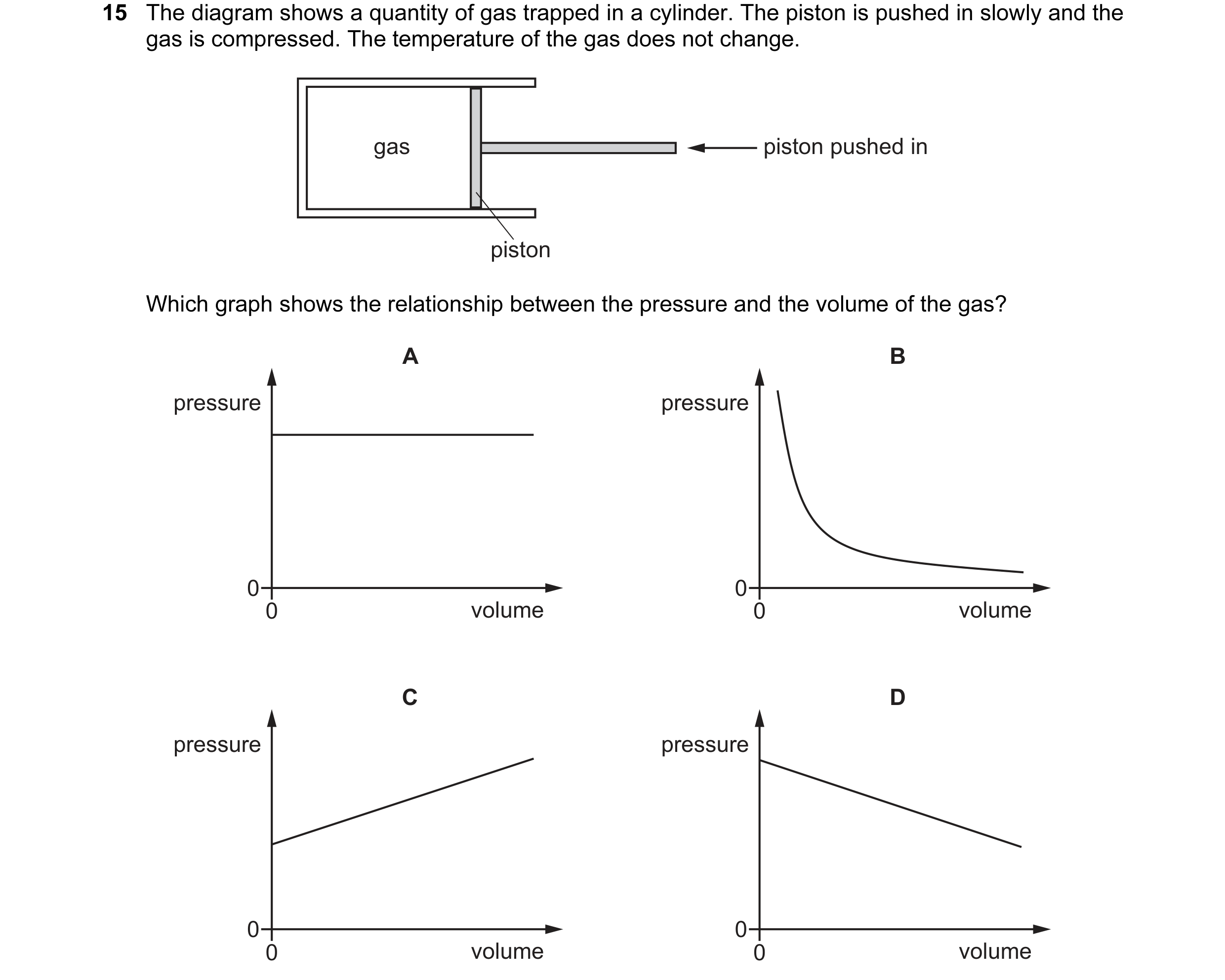
 1 / 50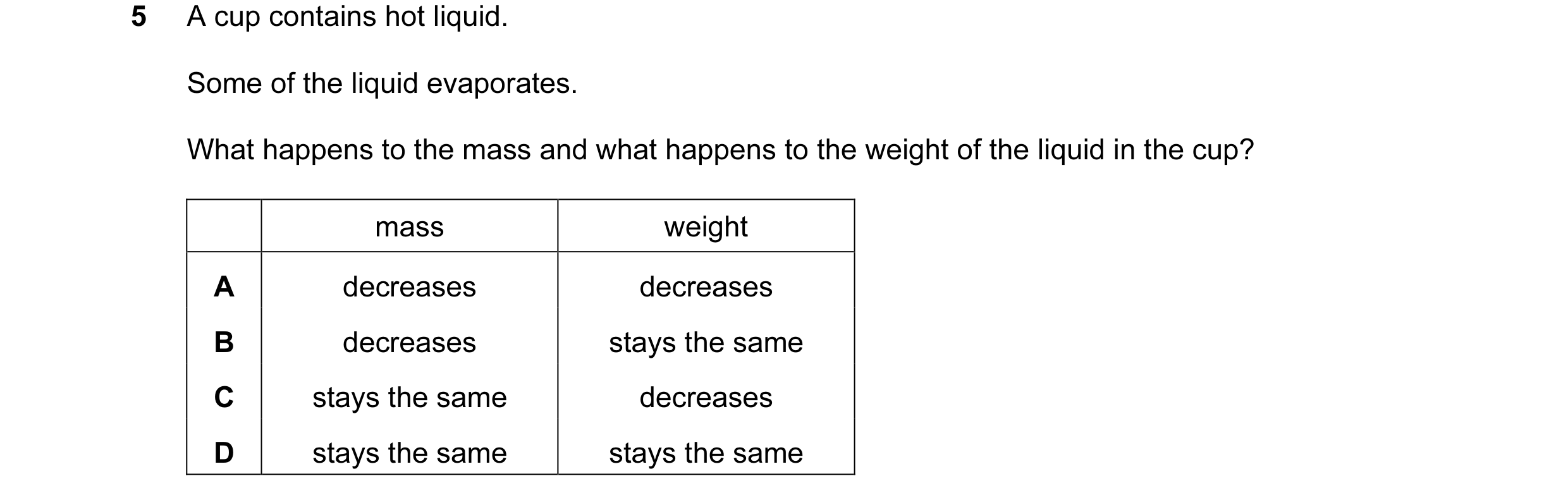
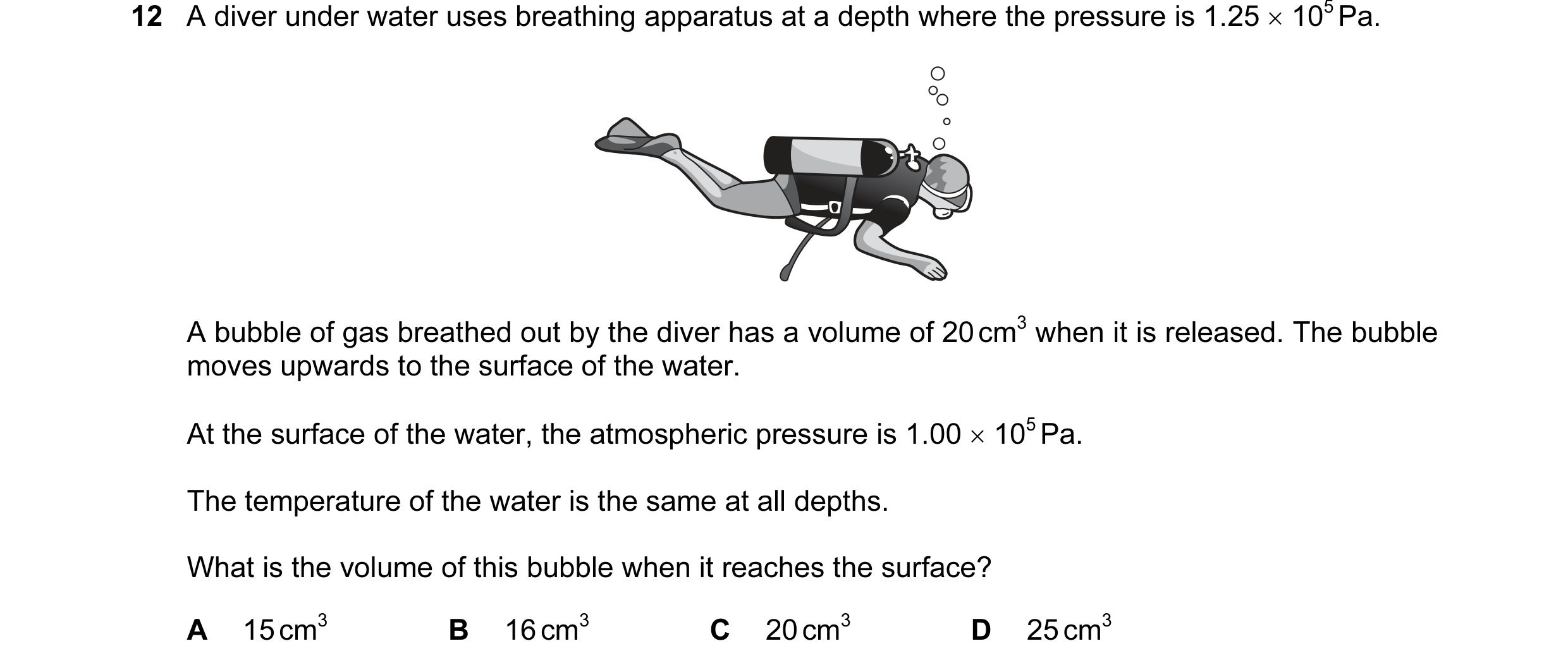
 2 / 50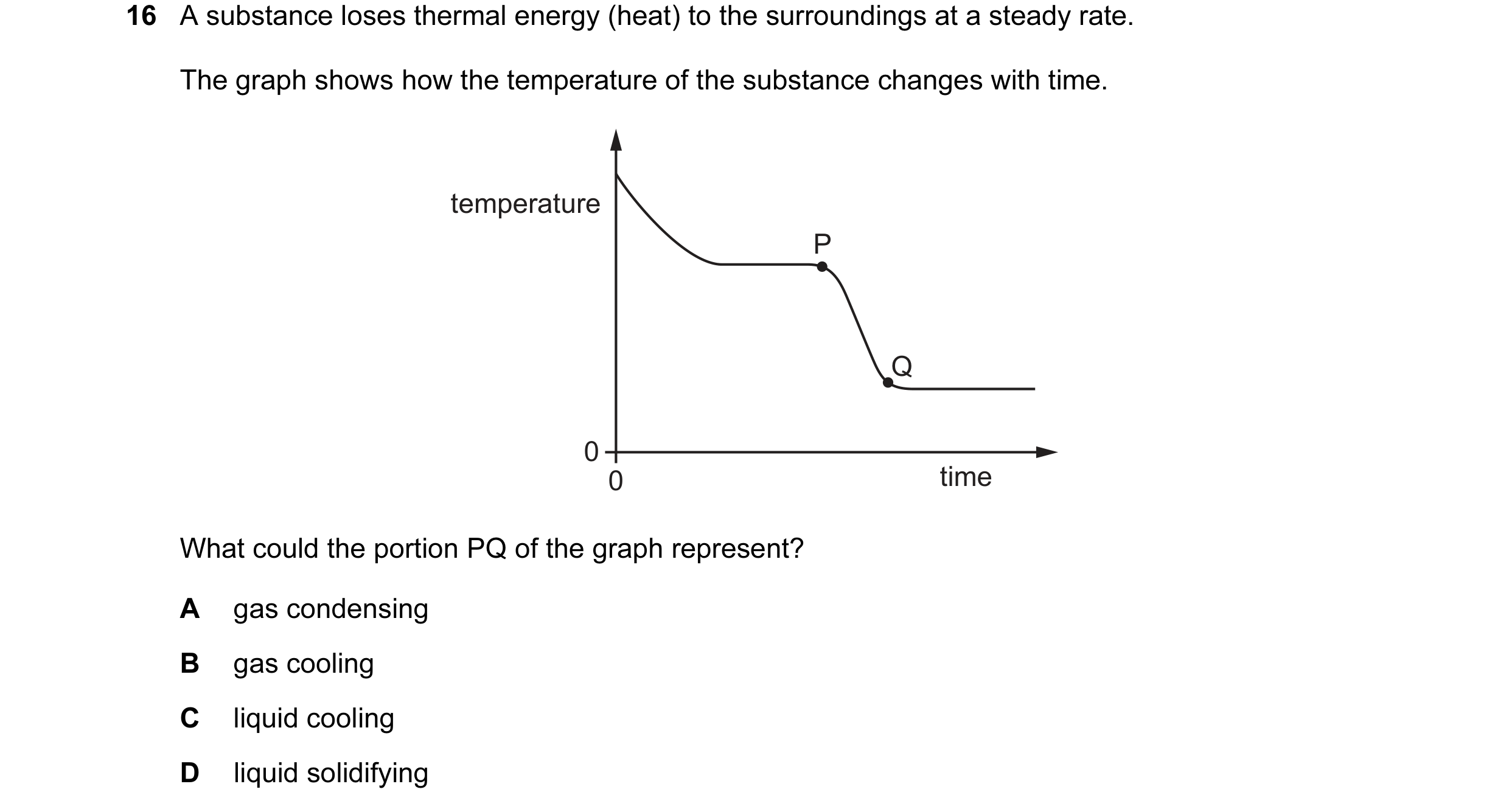
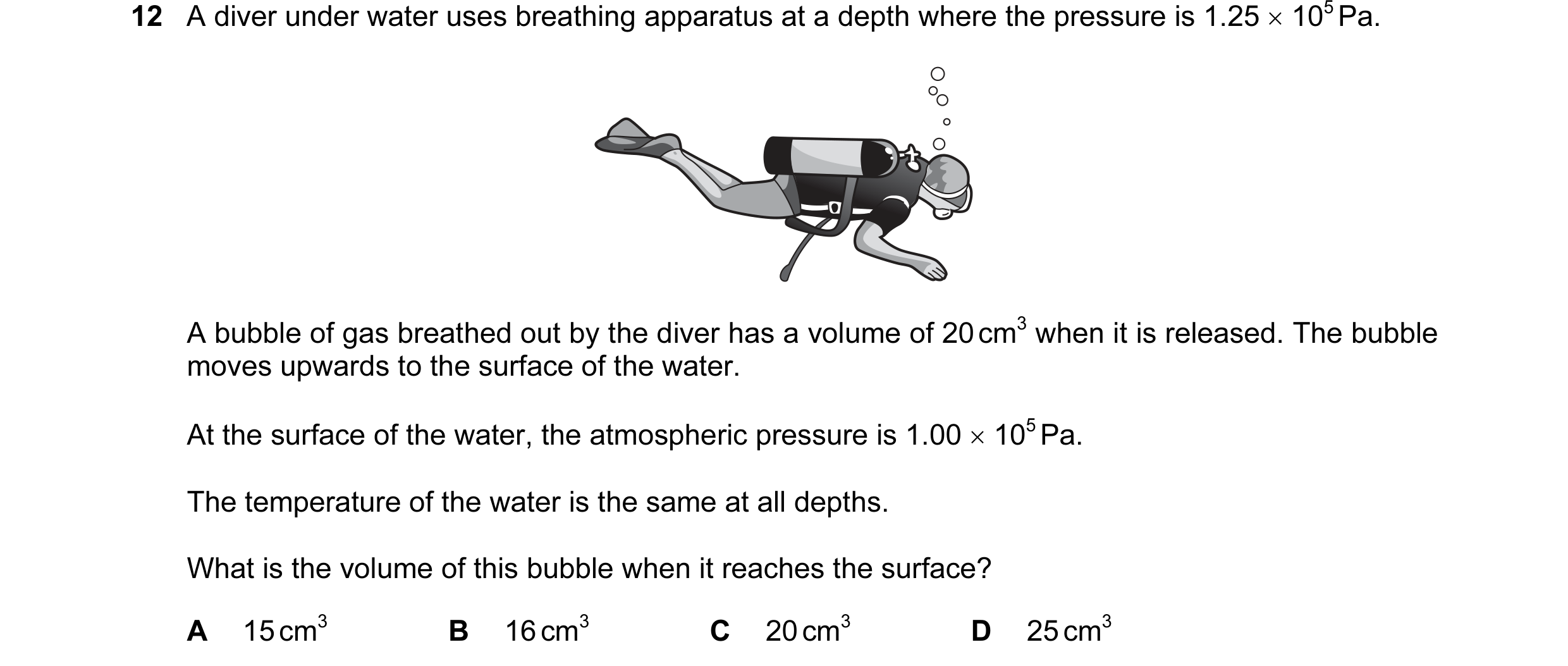
 3 / 50
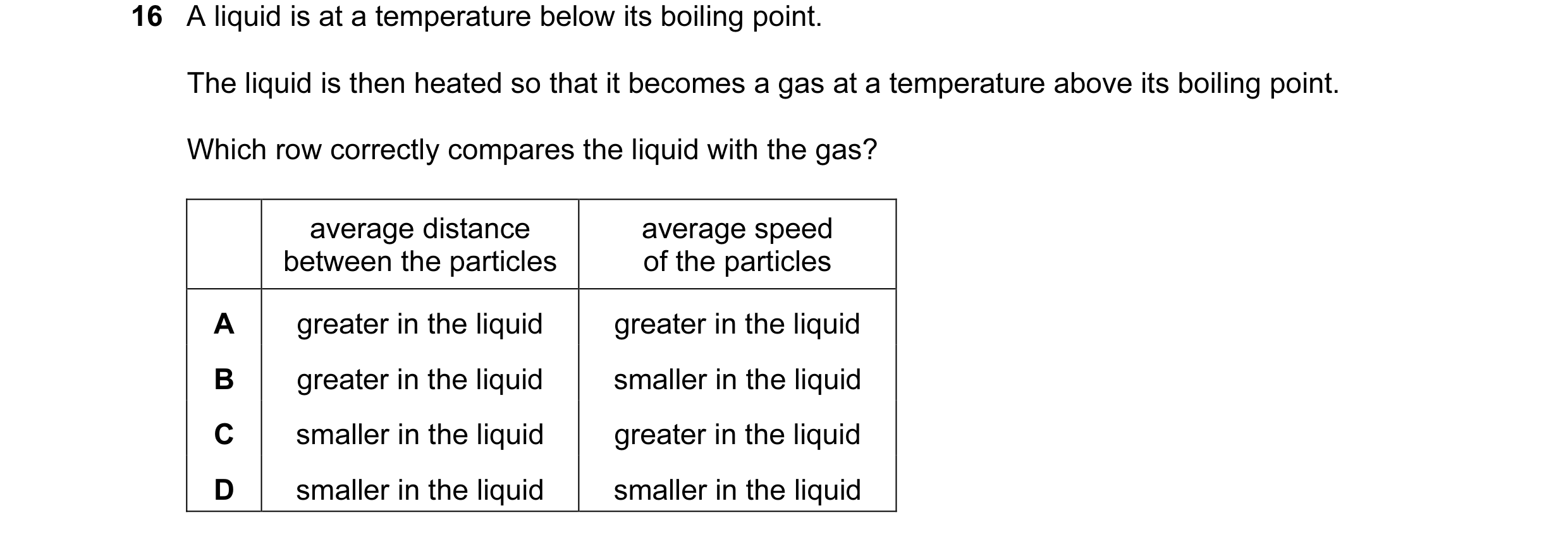
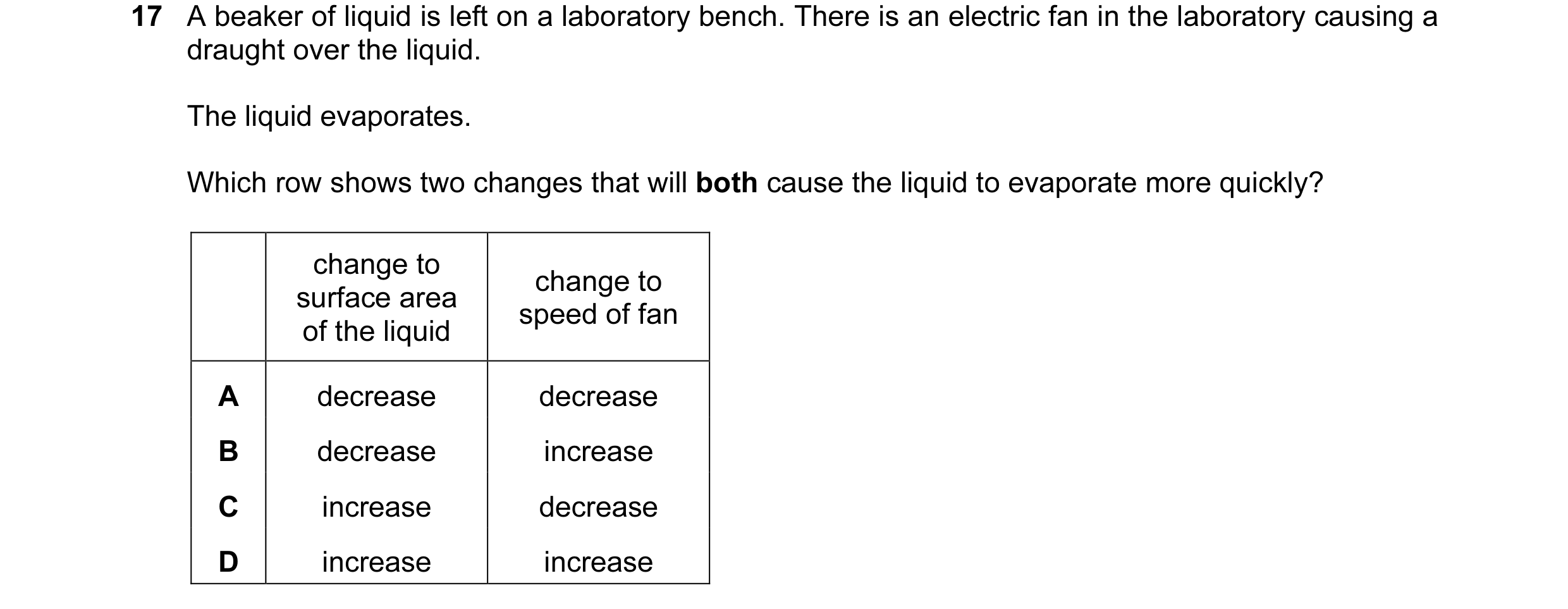
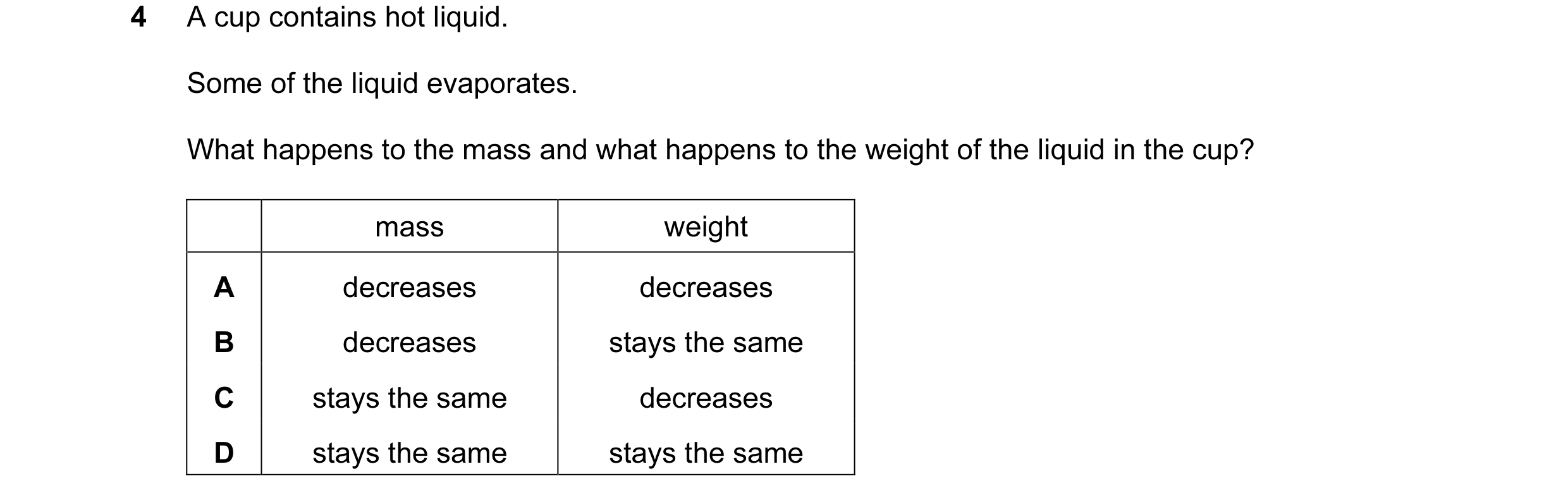 4 / 50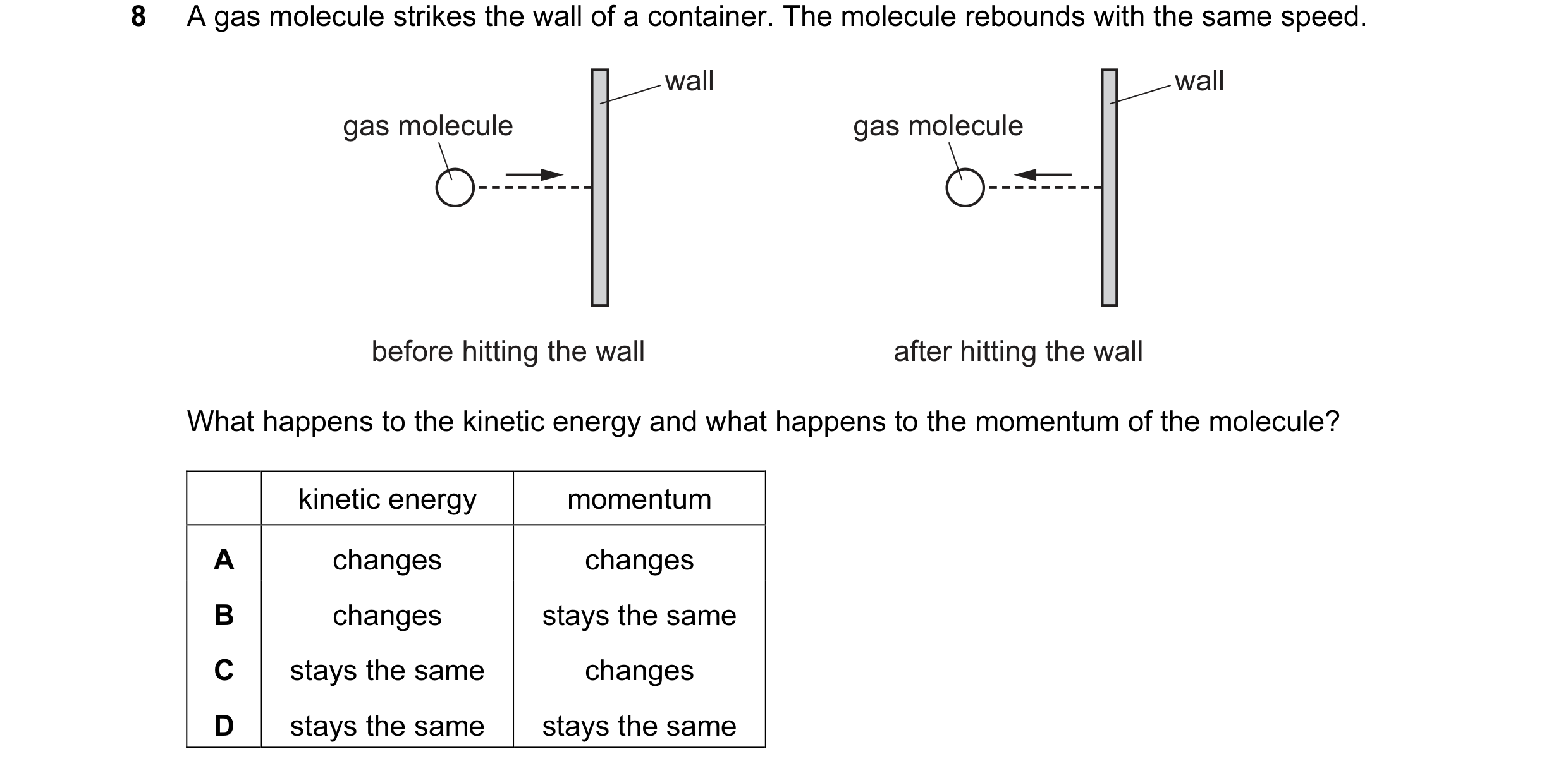
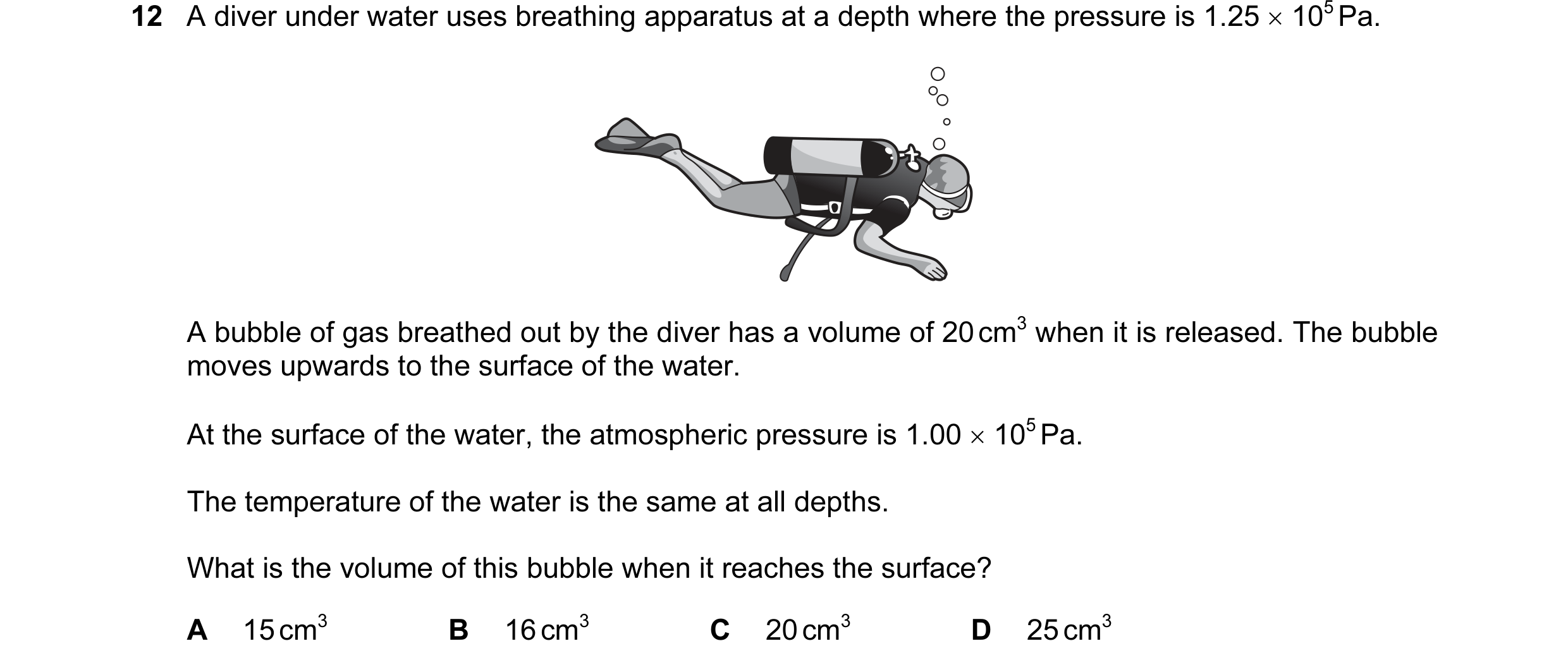
 5 / 50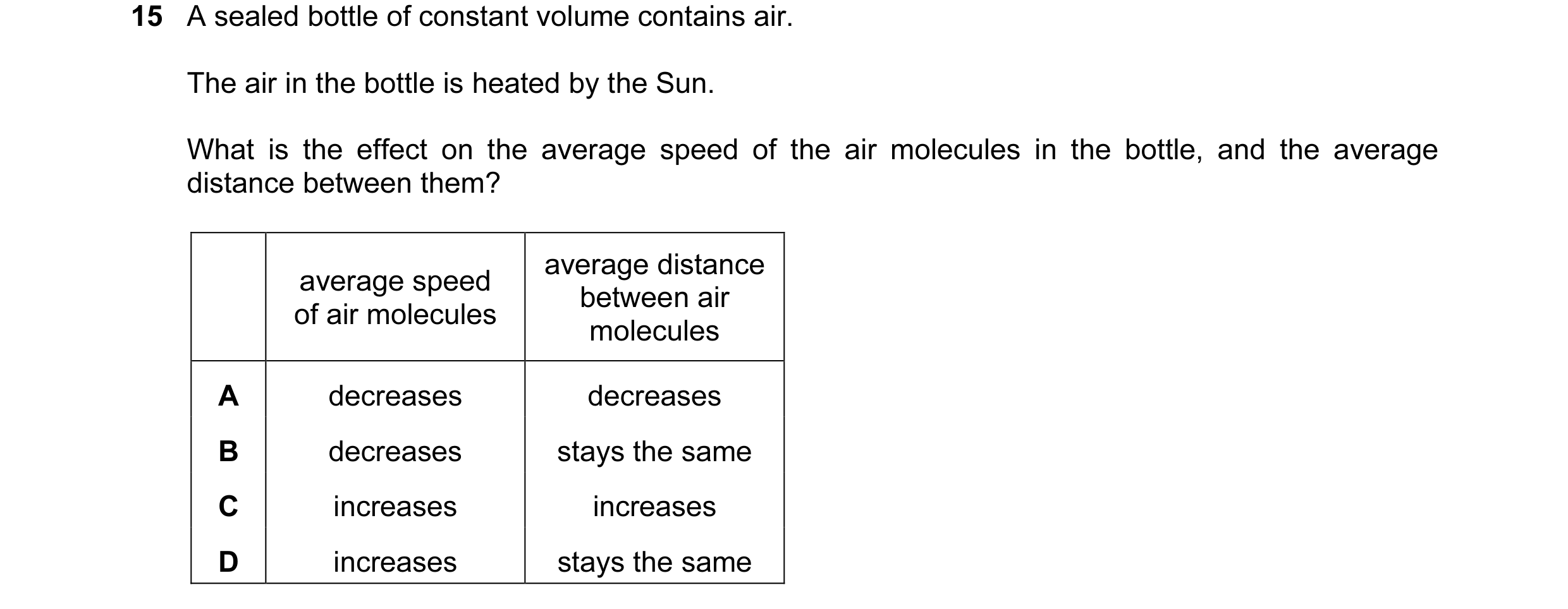
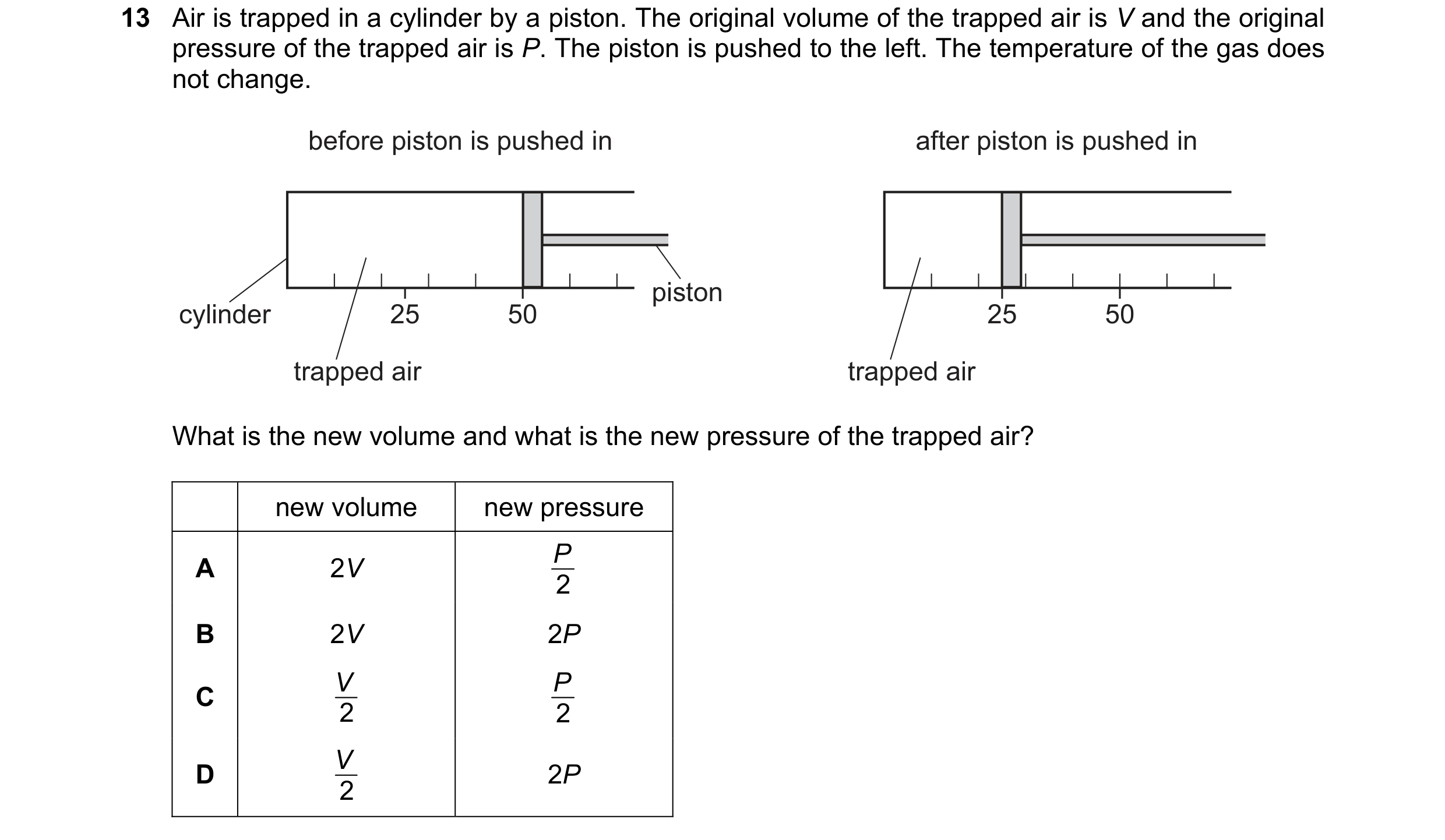
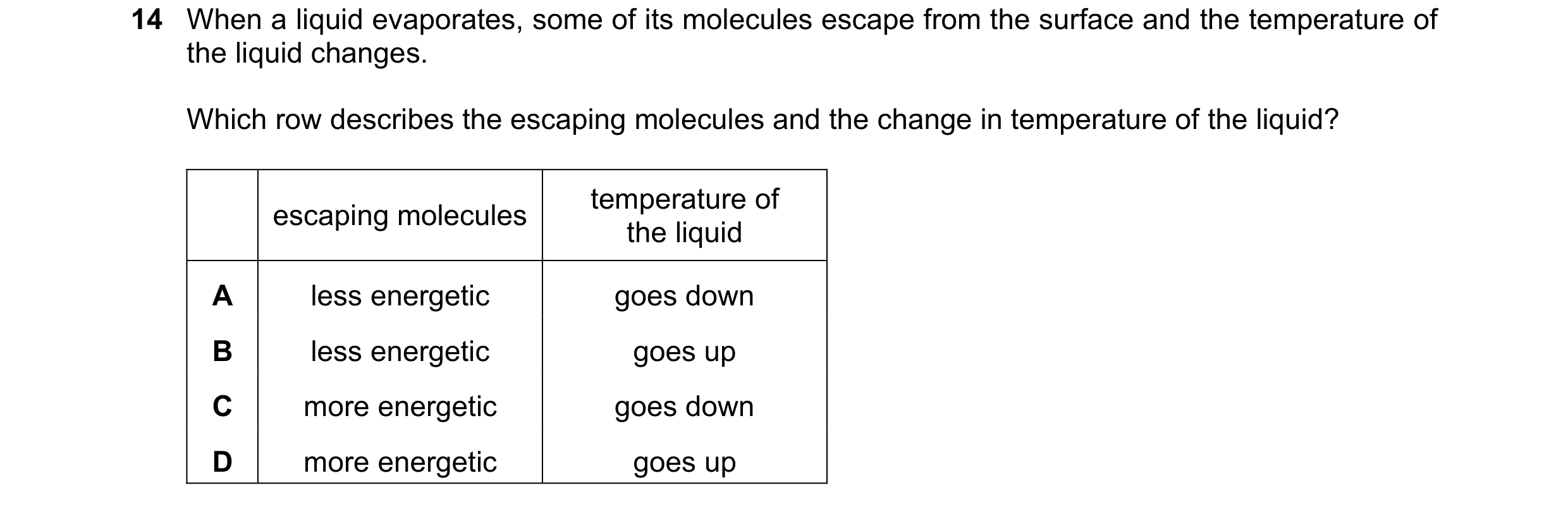 6 / 50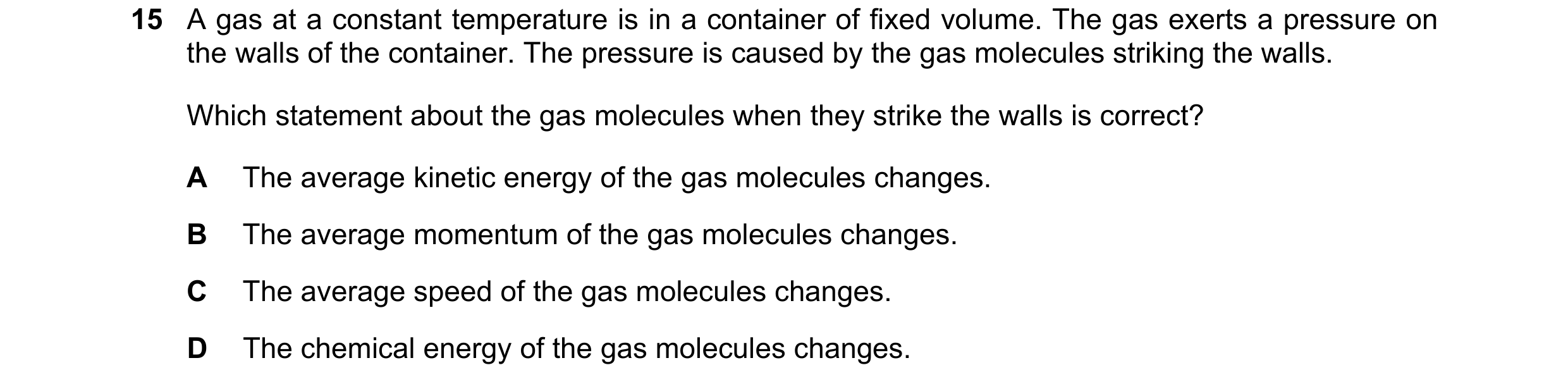
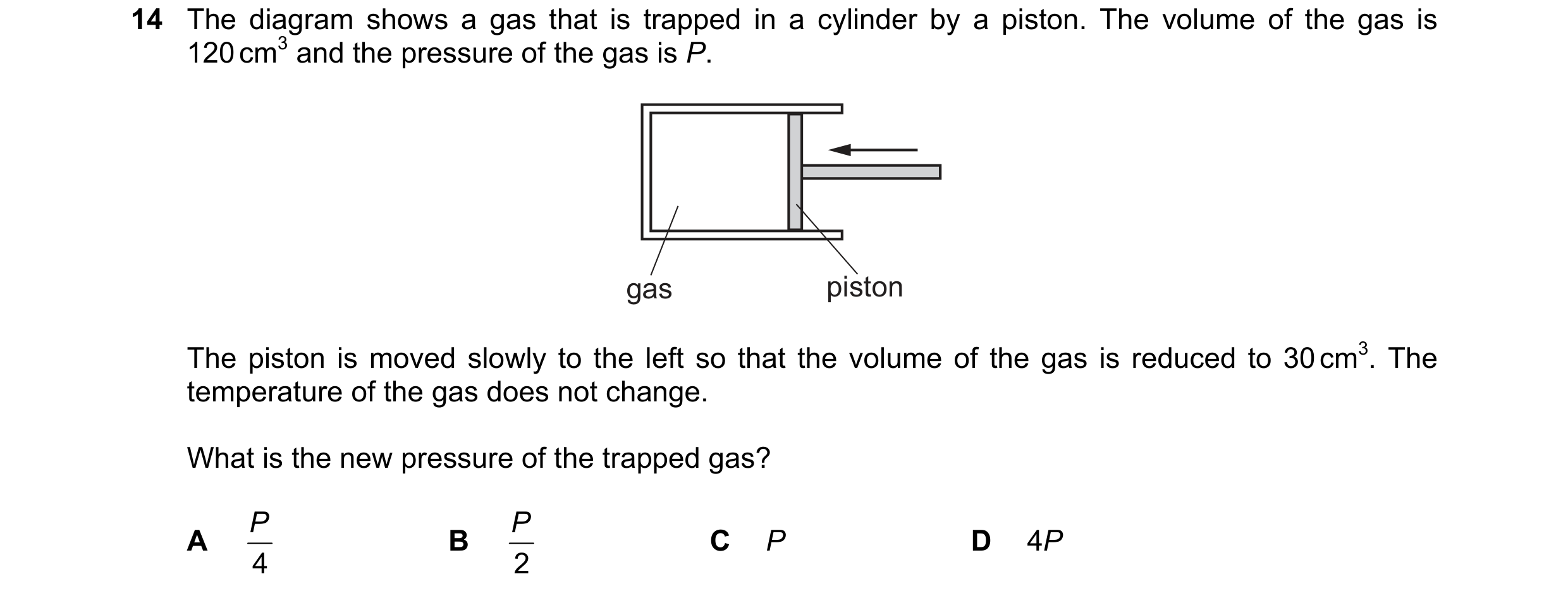
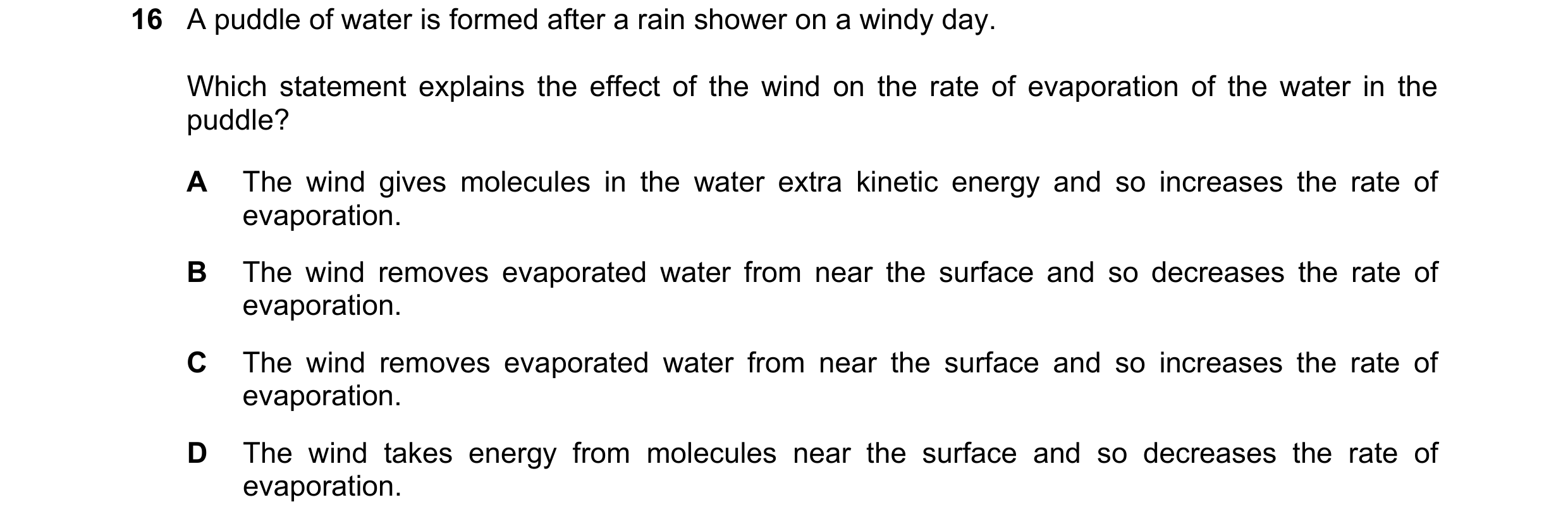 7 / 50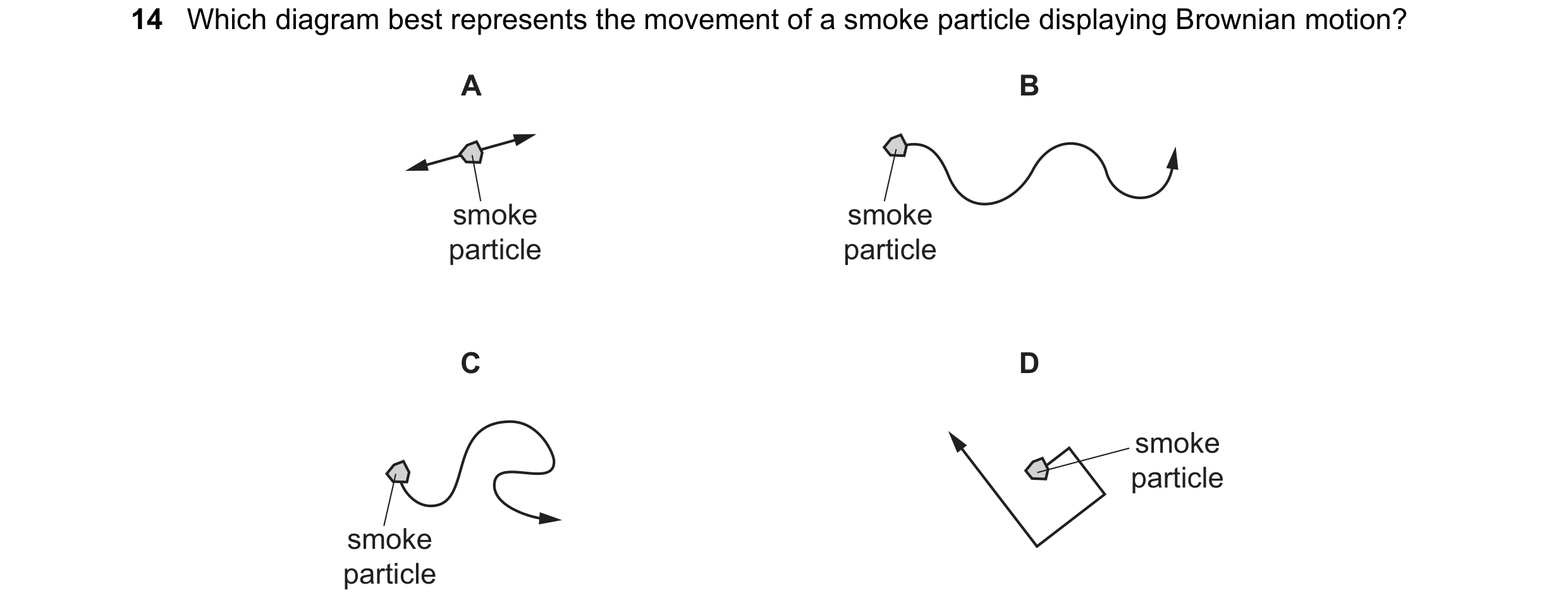
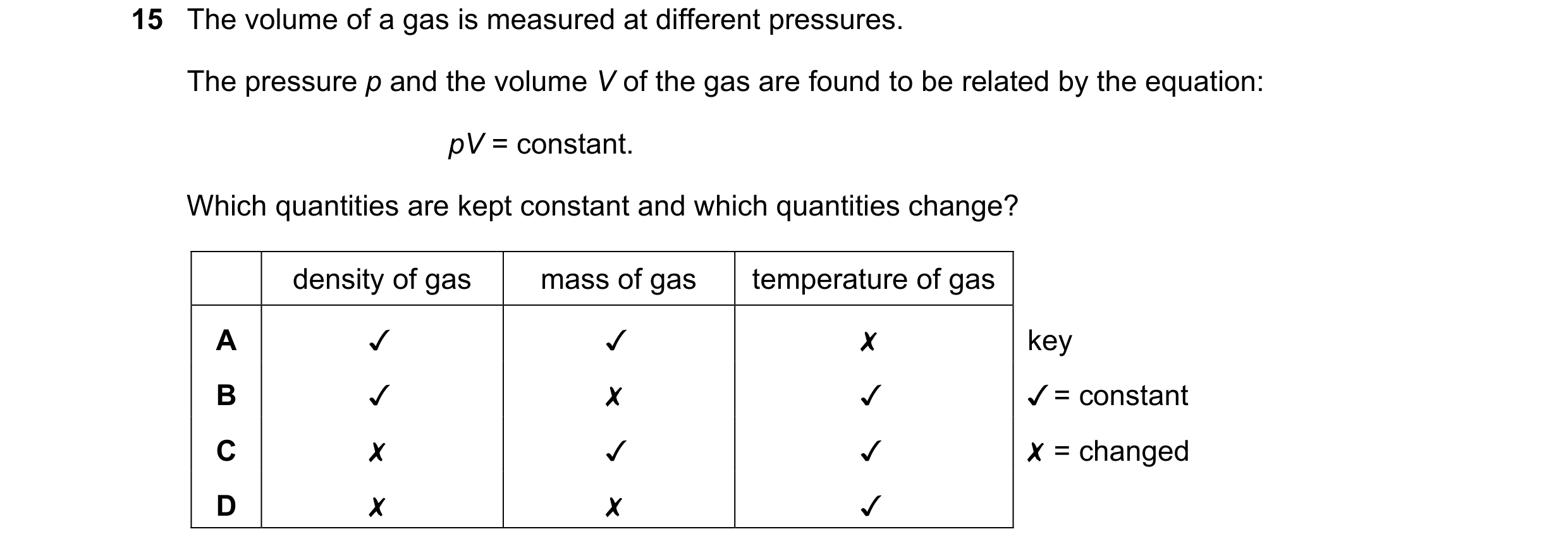 8 / 50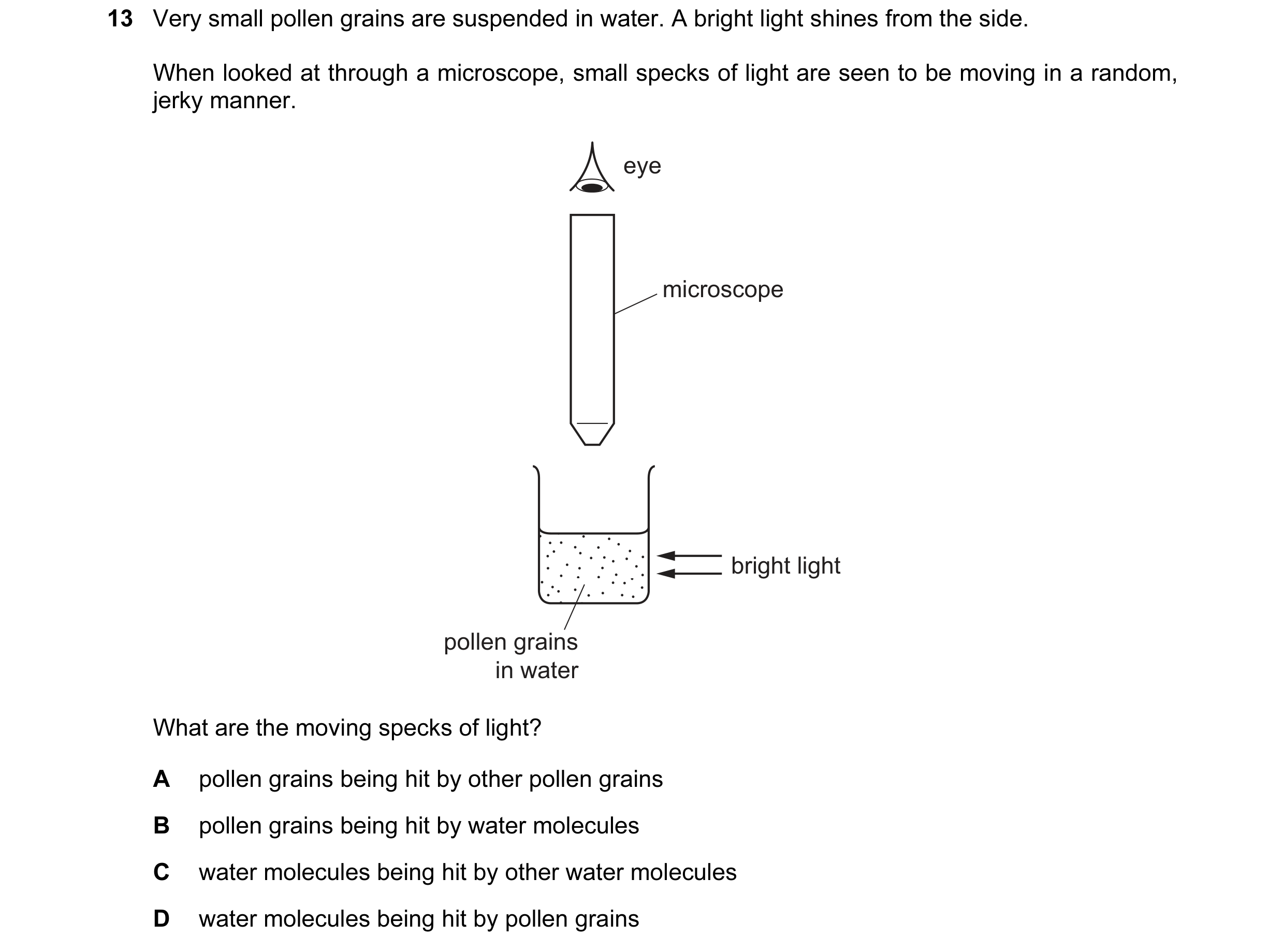
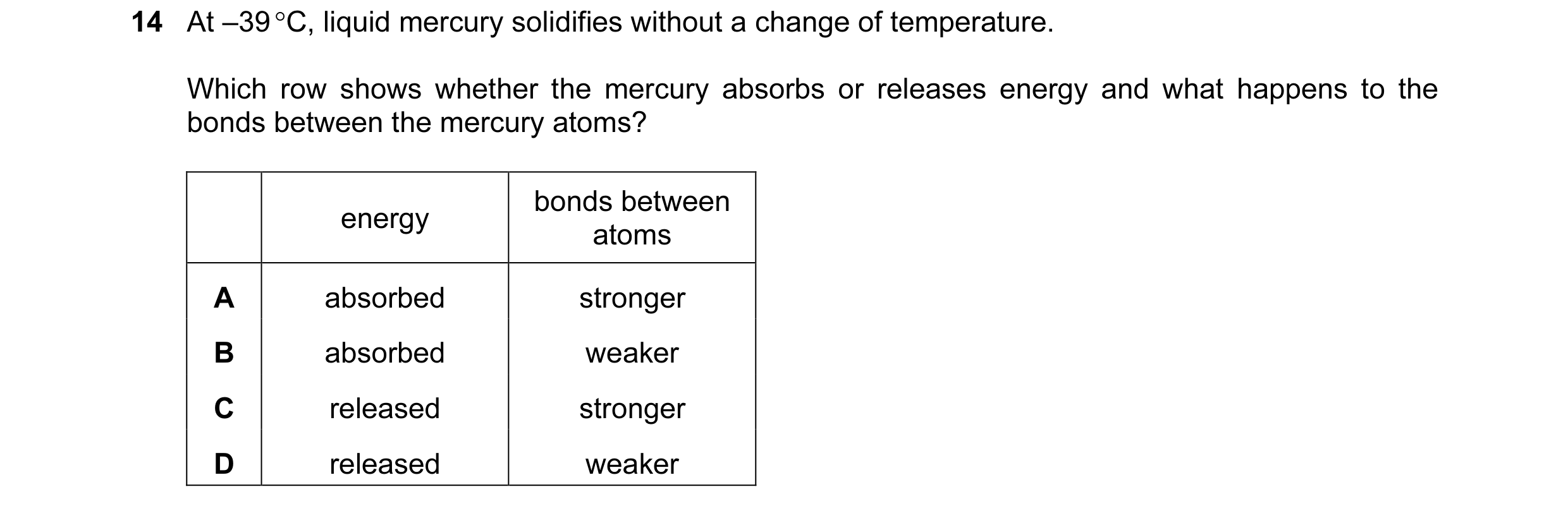
 9 / 50
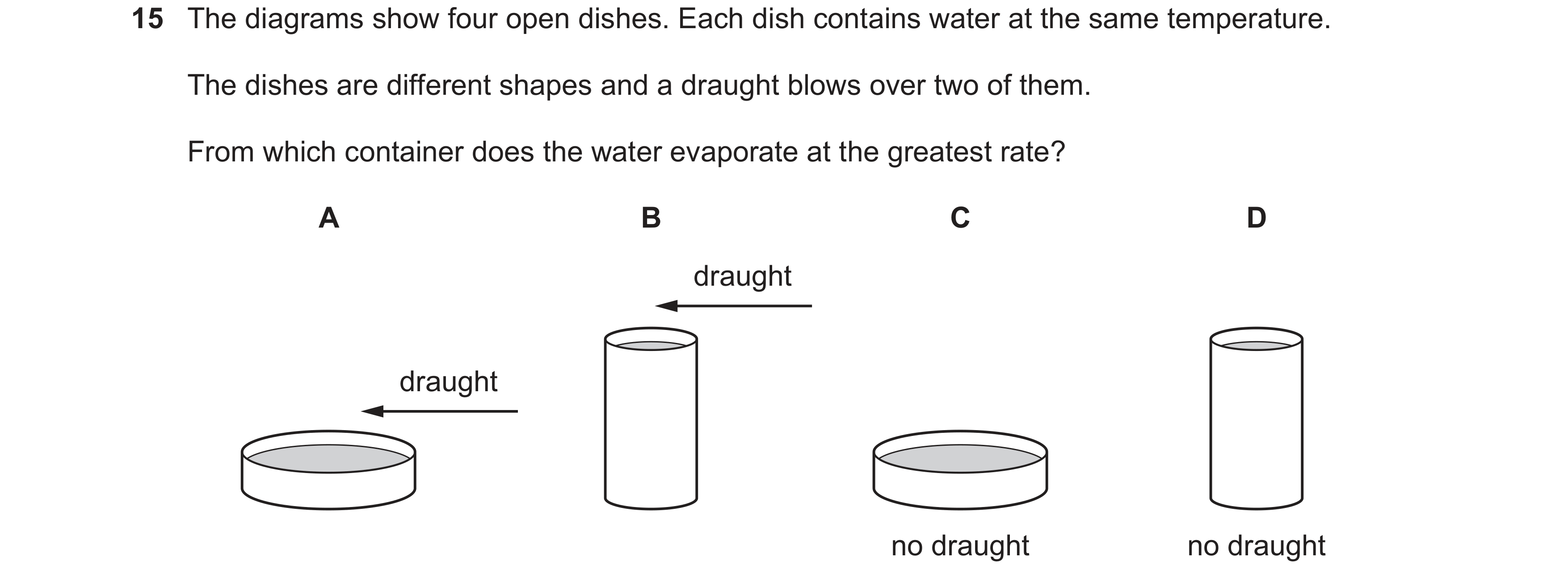 10 / 50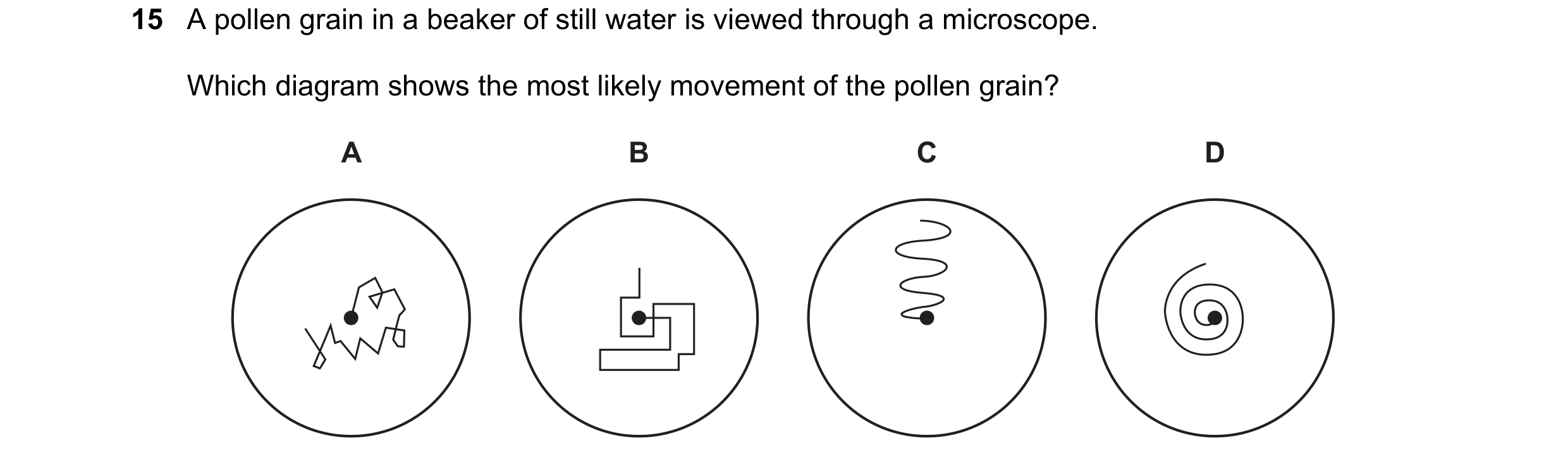
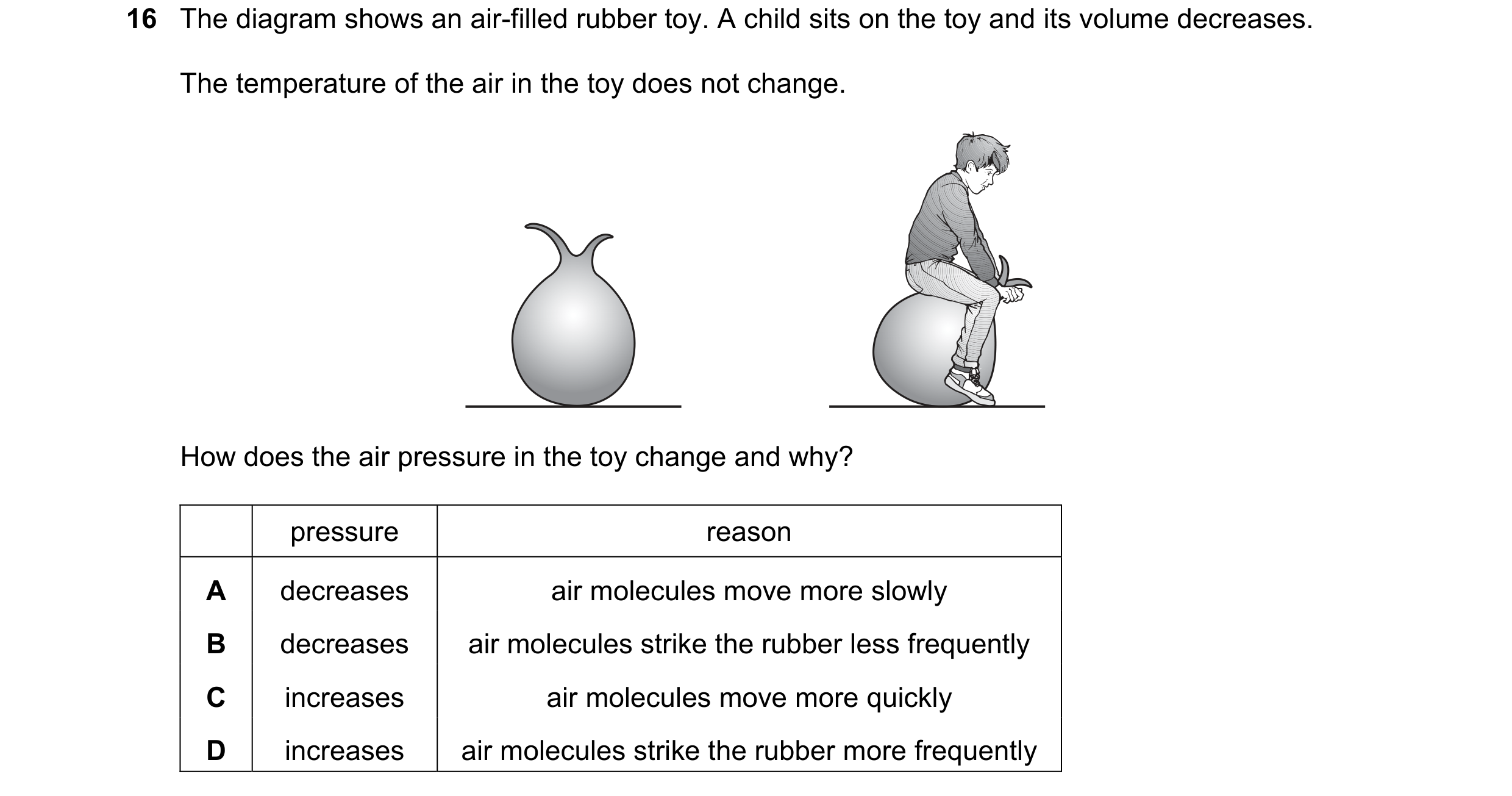
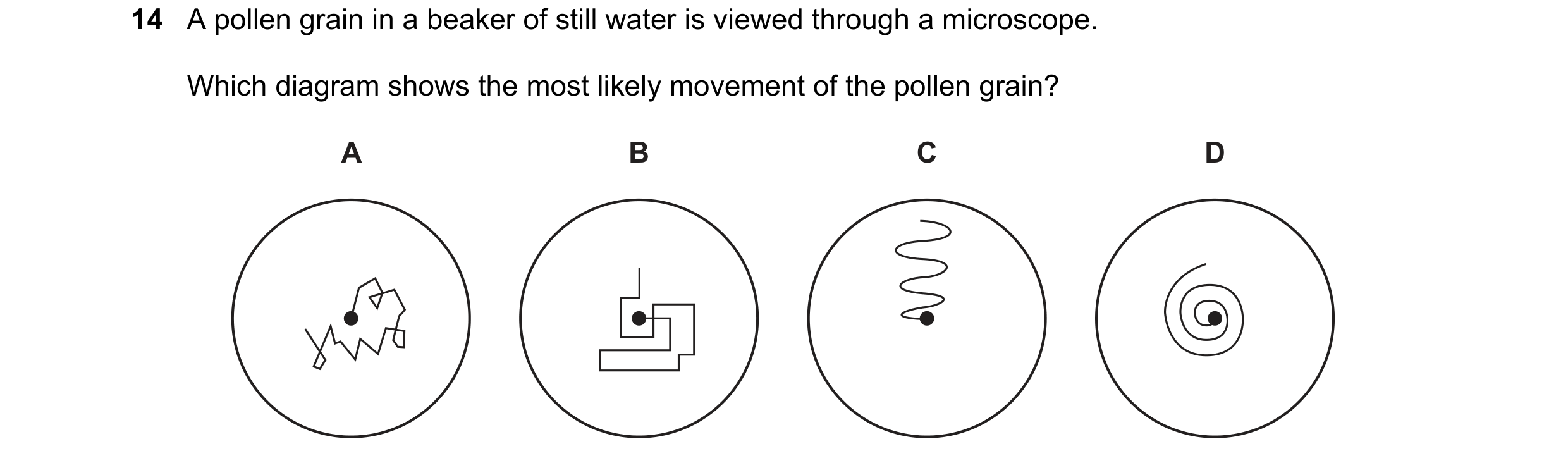 11 / 50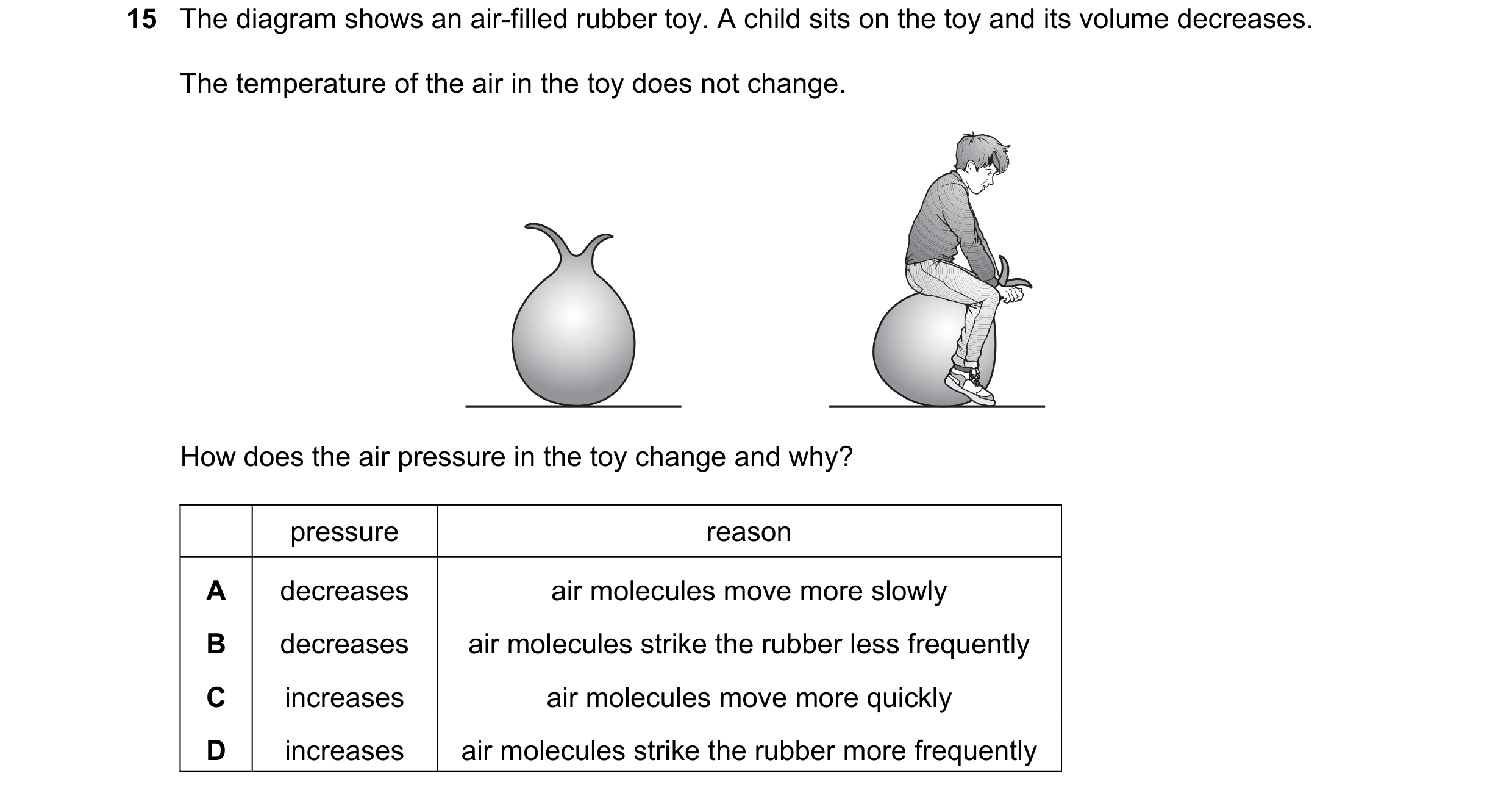
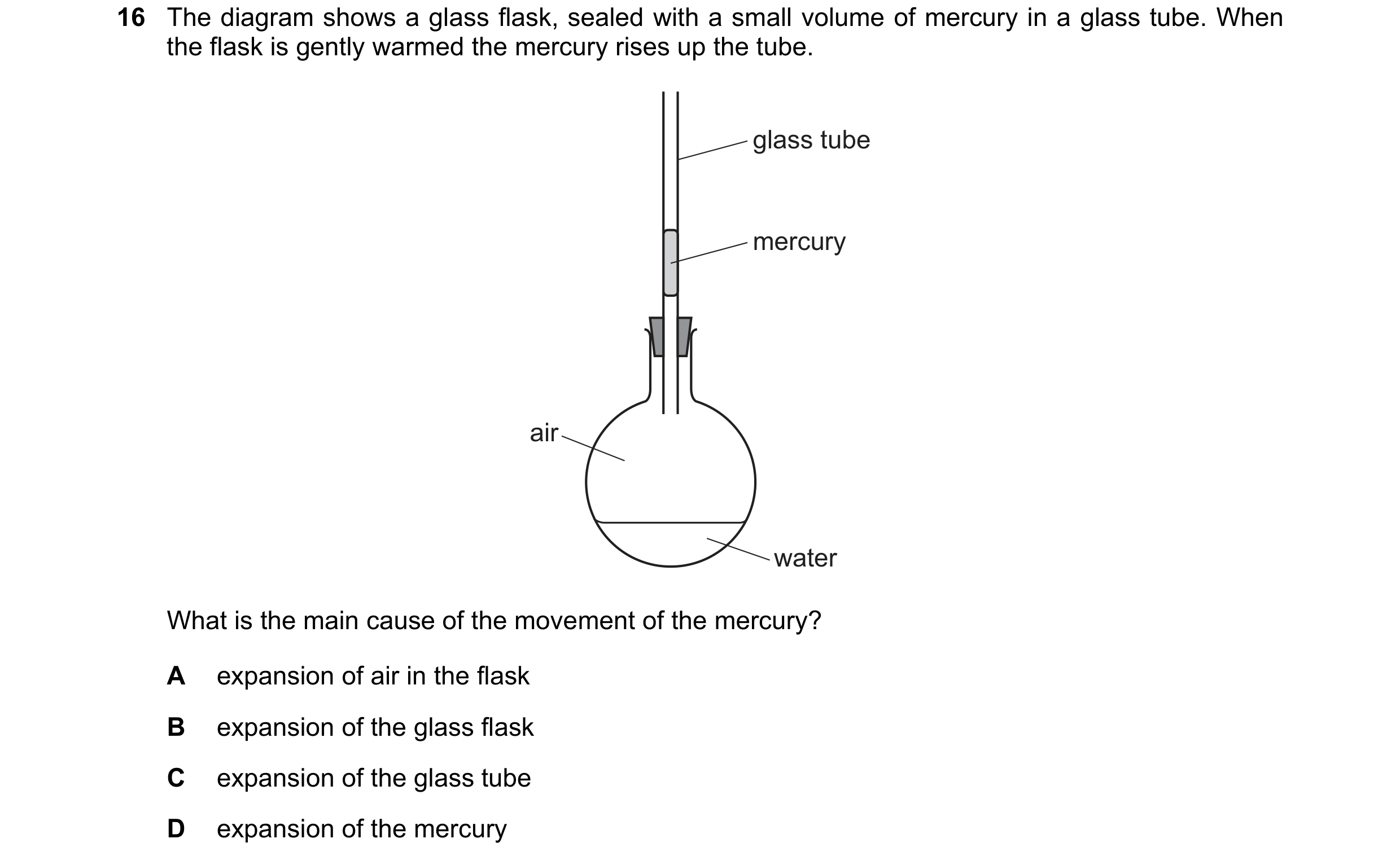 12 / 50
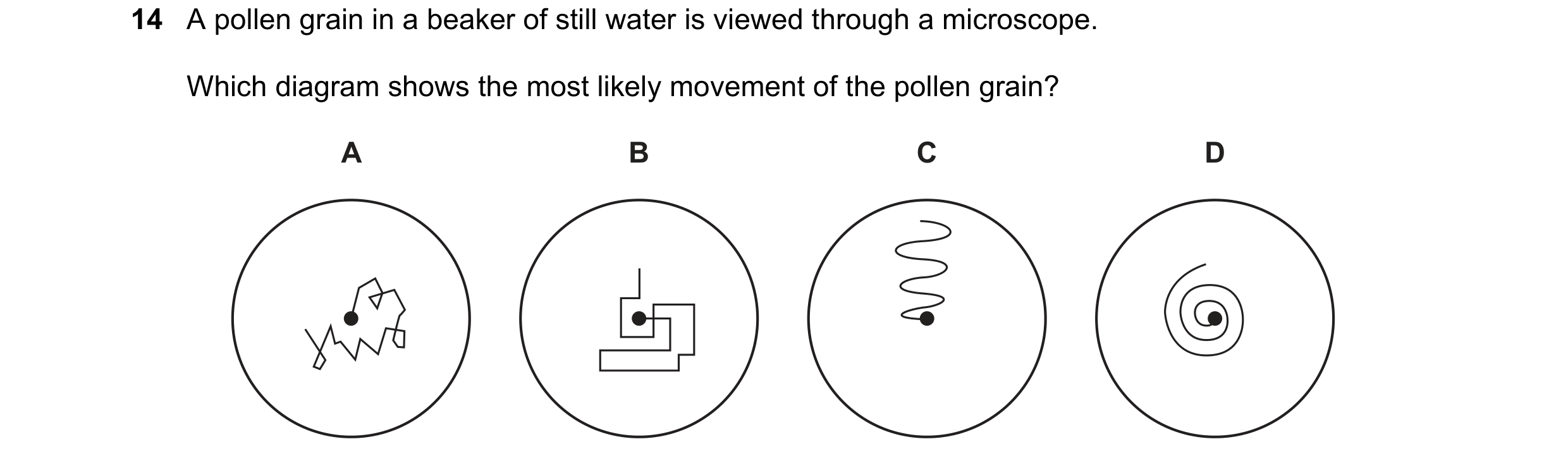
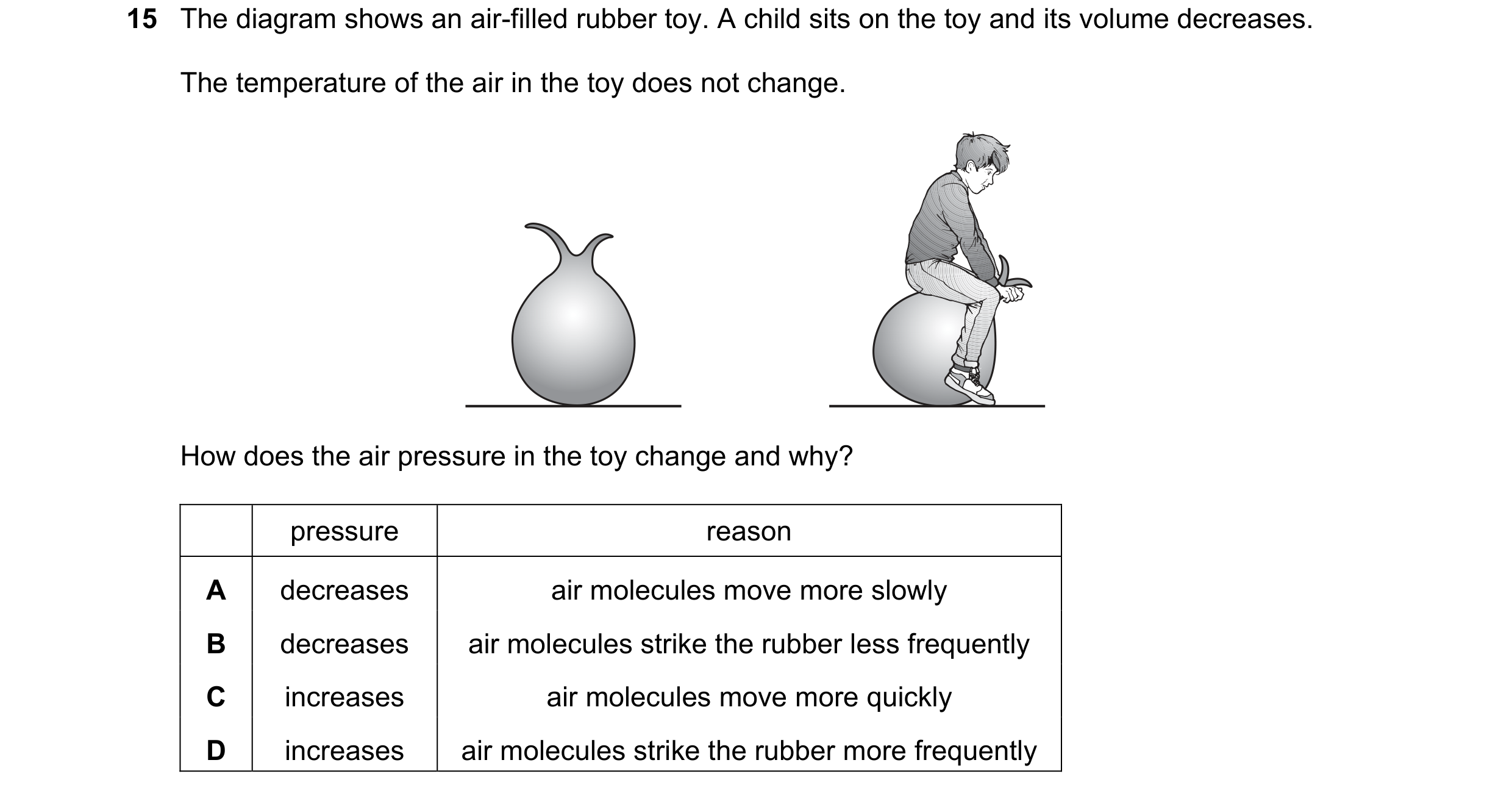 13 / 50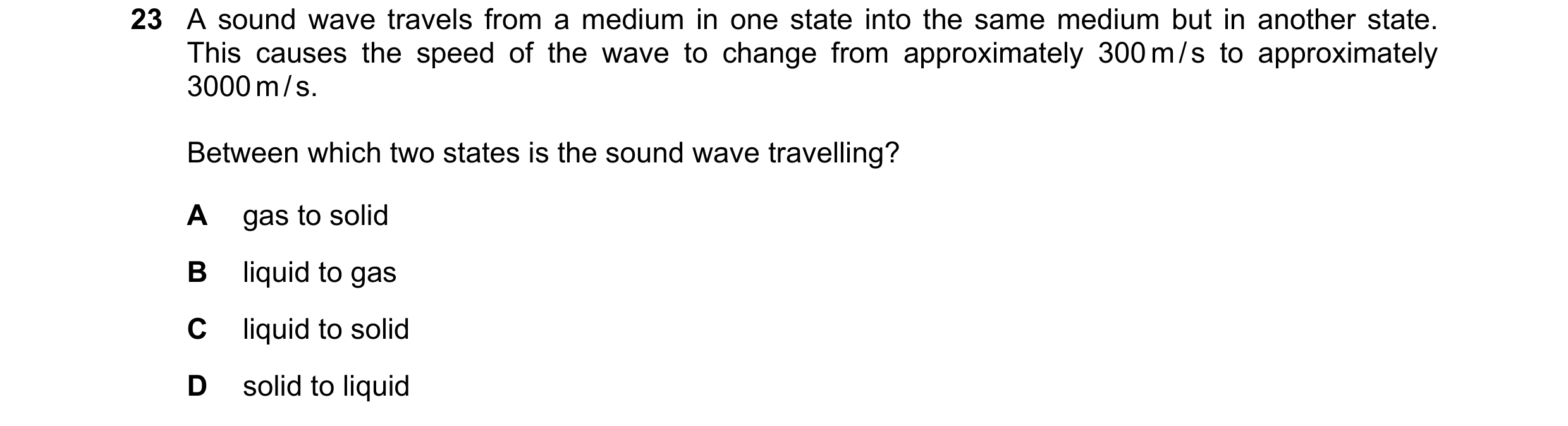
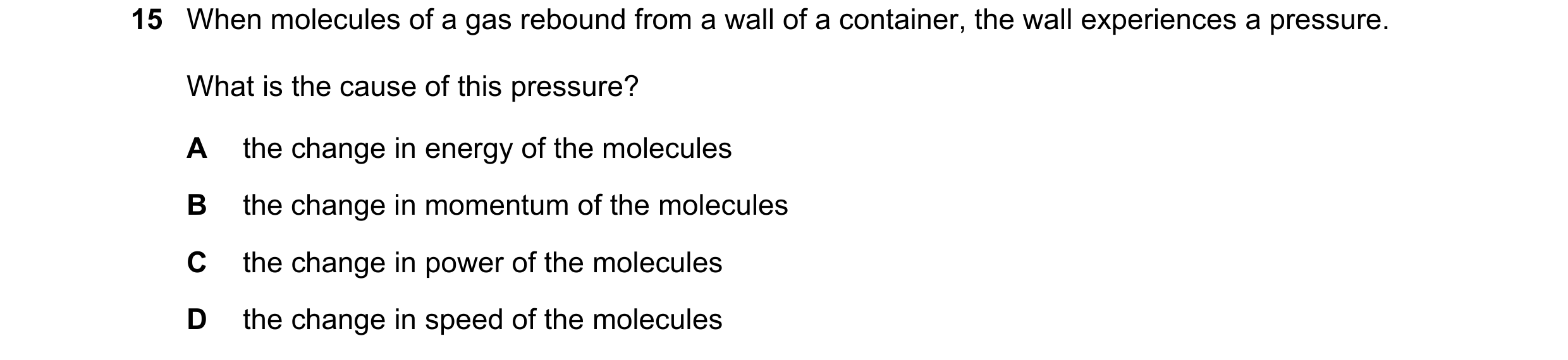
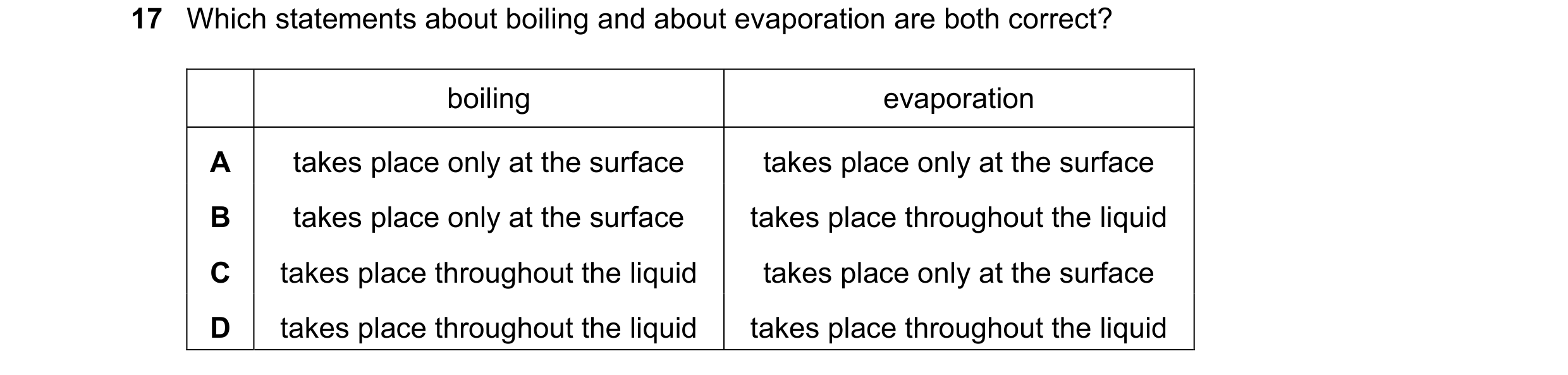
 14 / 50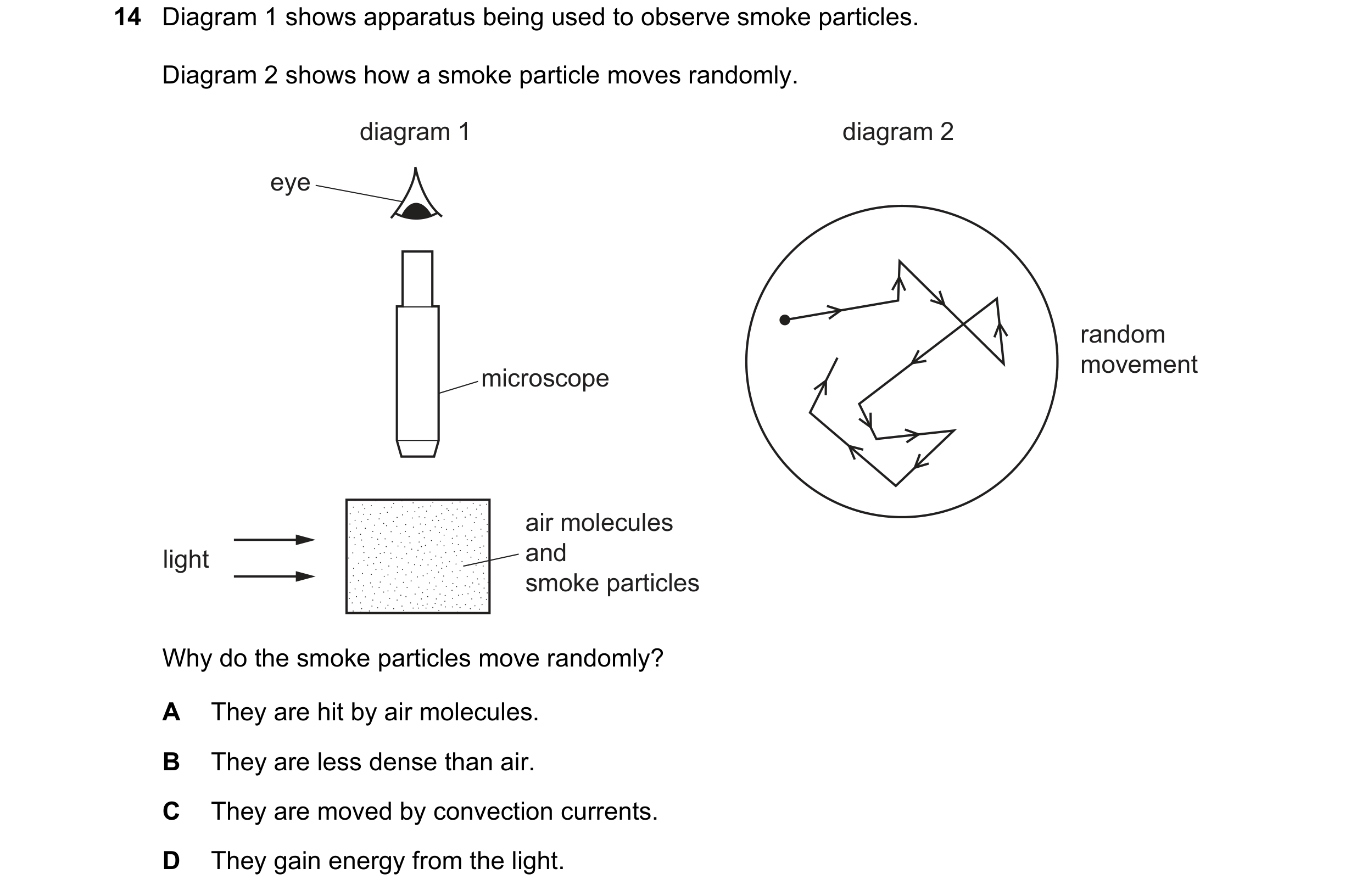
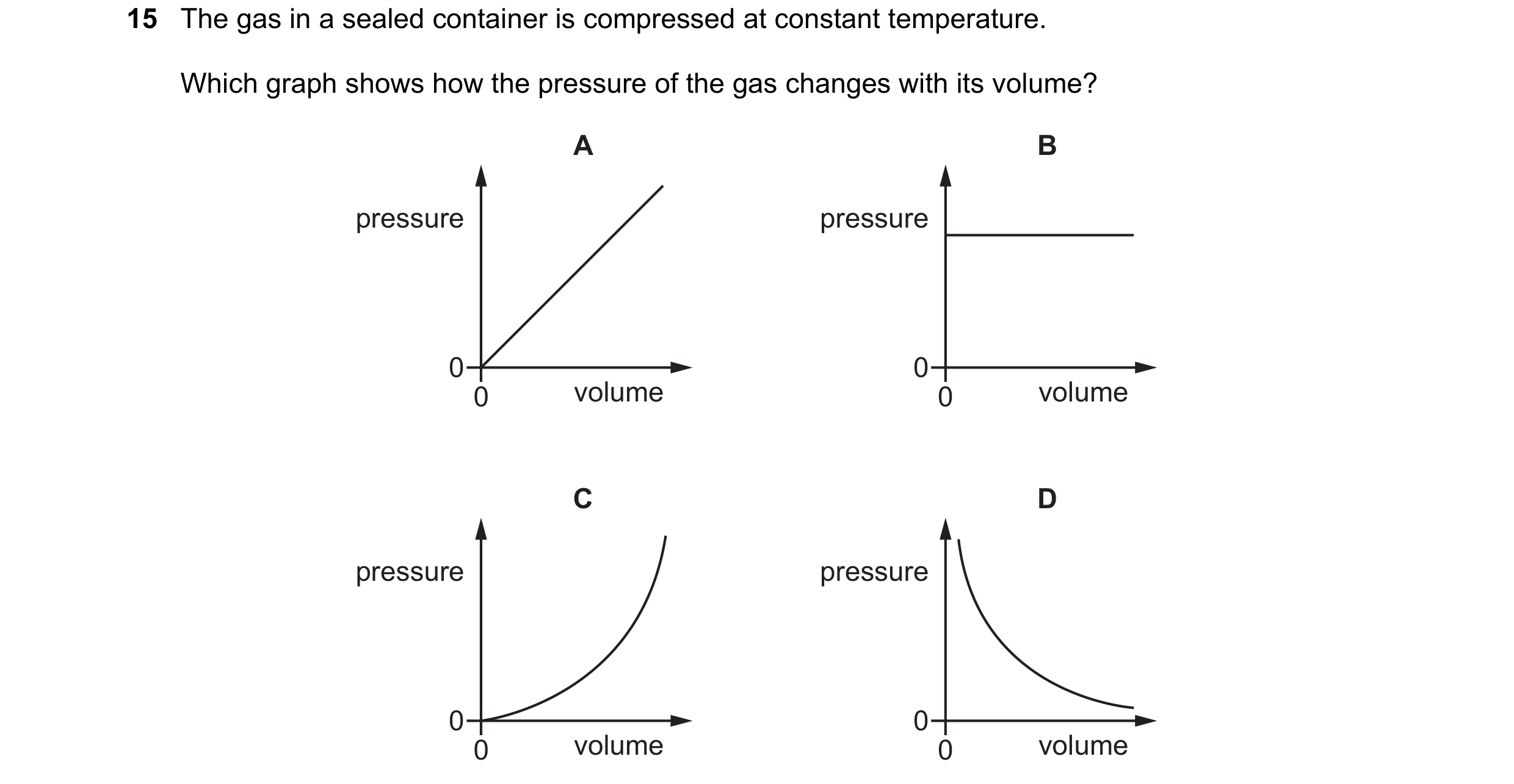 15 / 50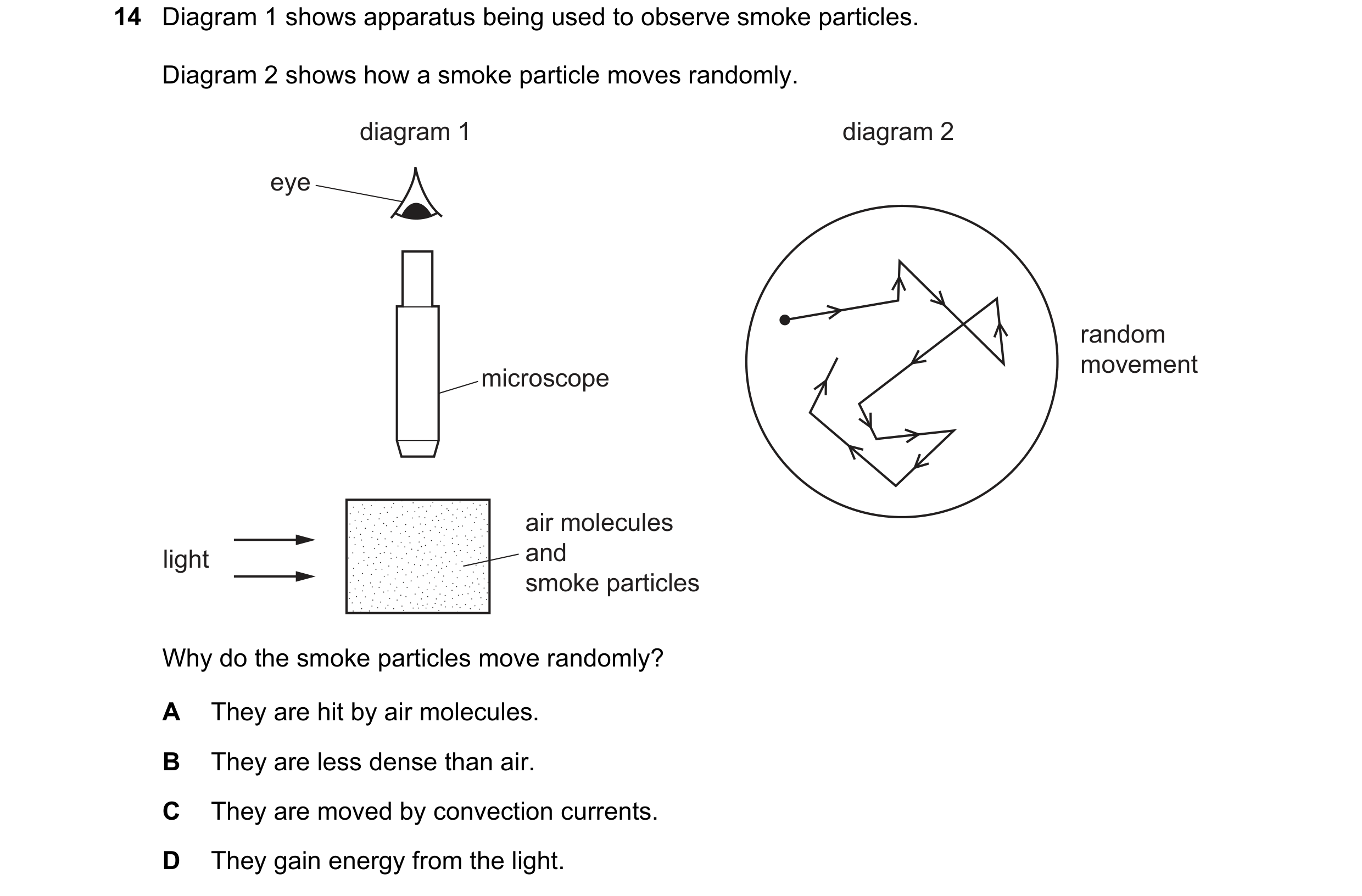
 16 / 50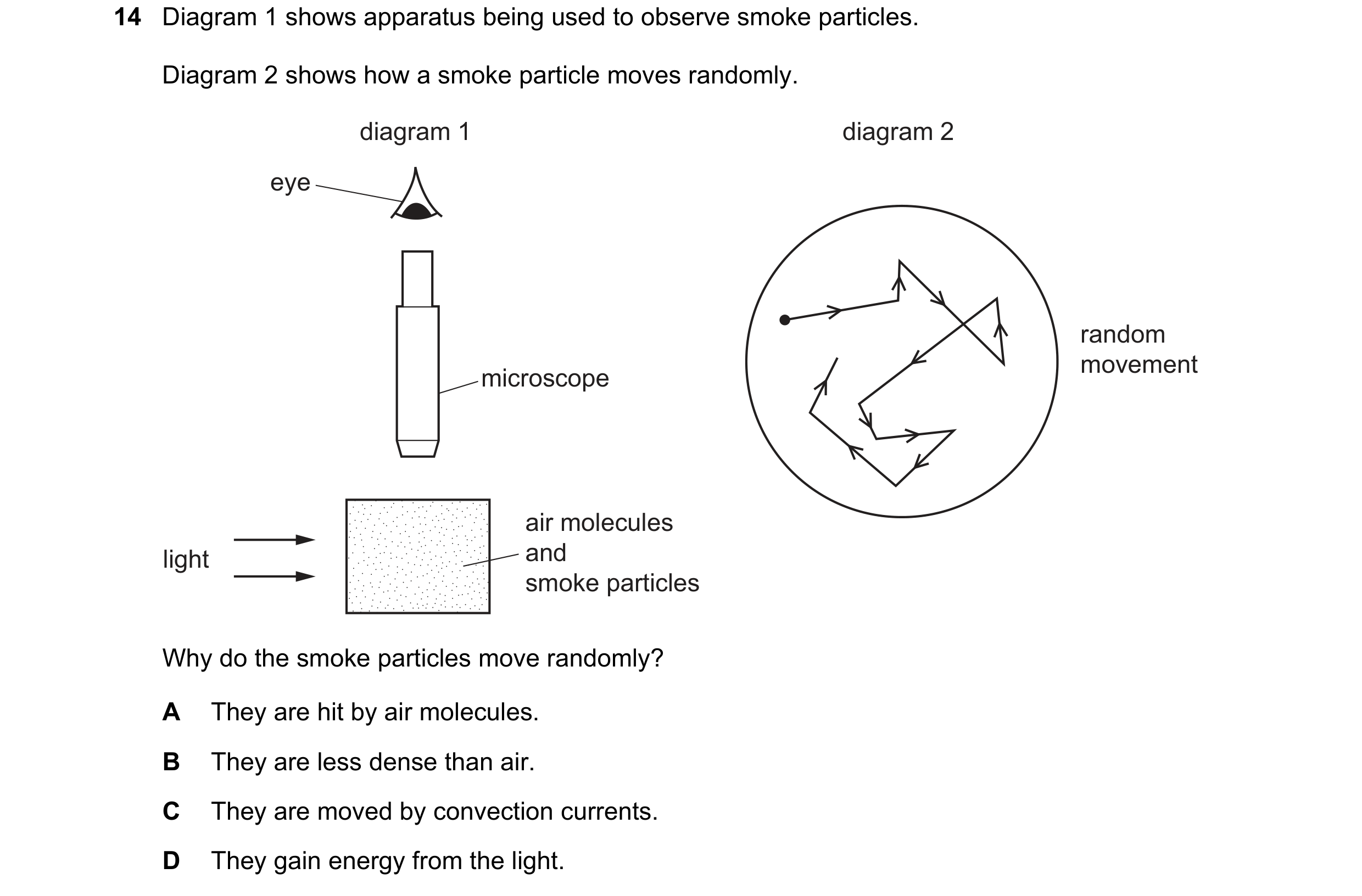

 17 / 50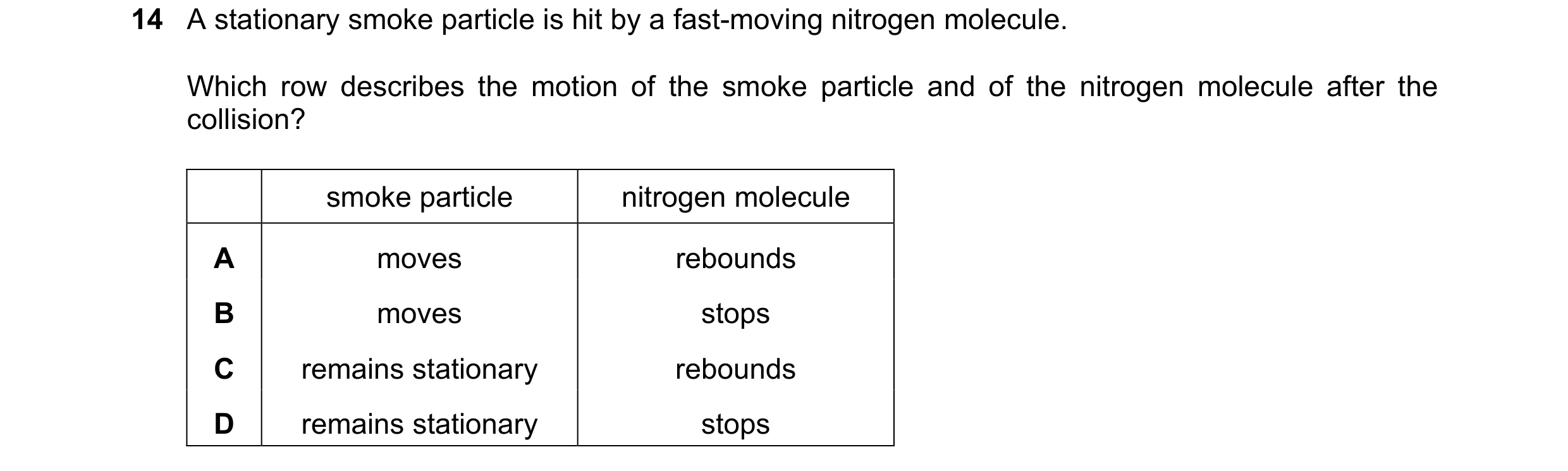
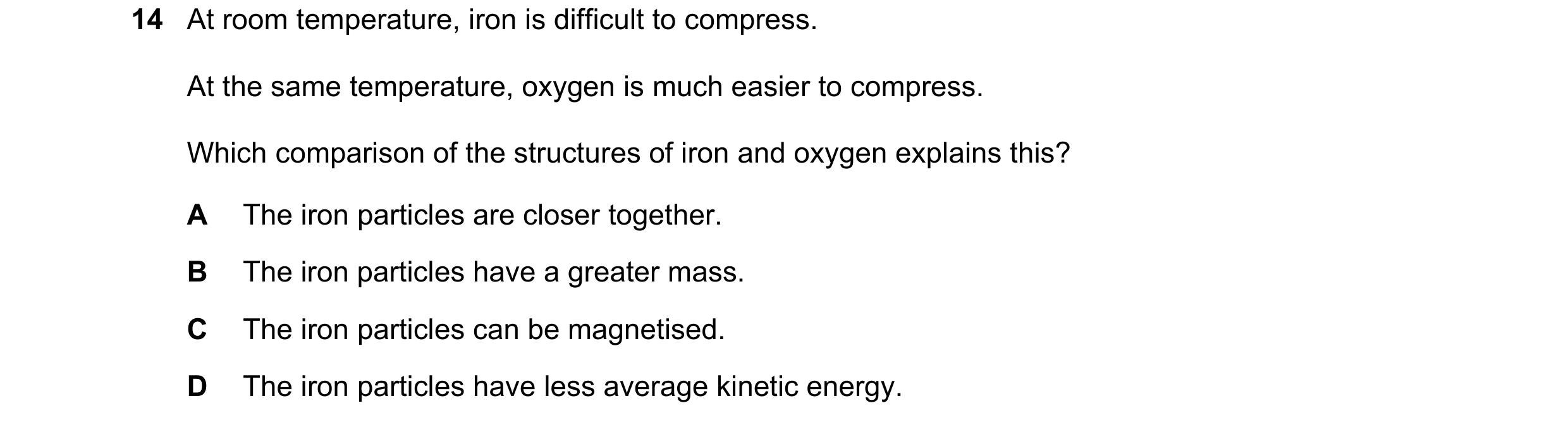
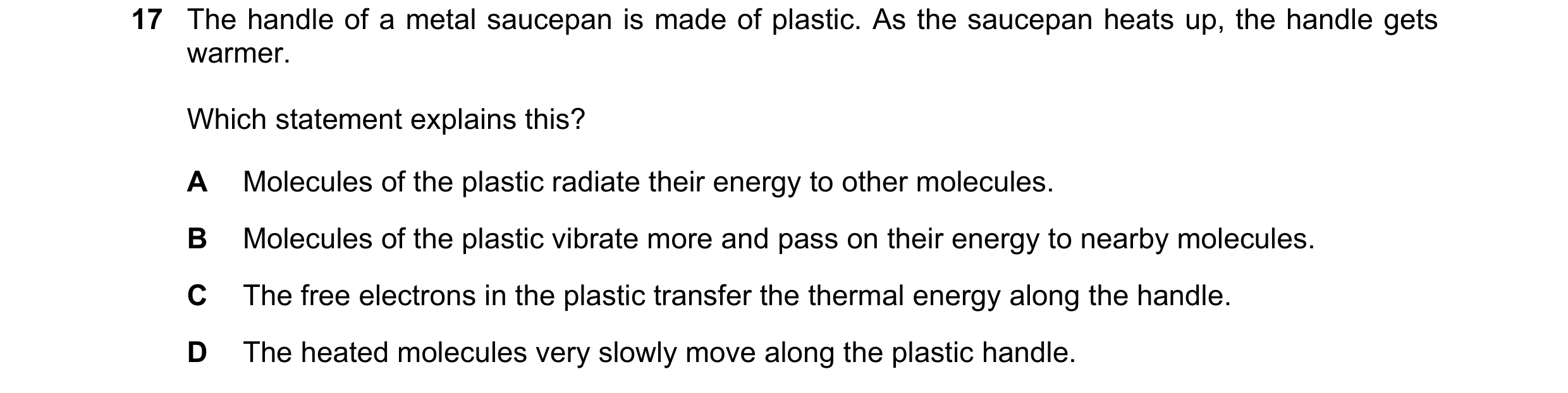
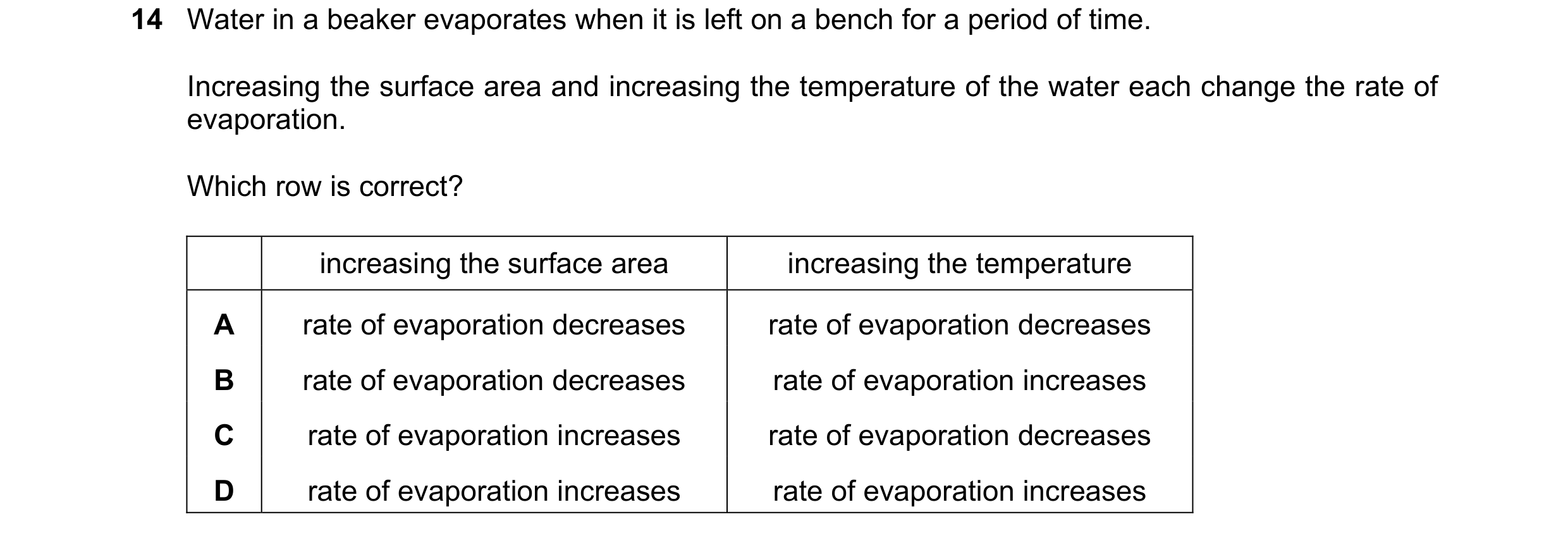 18 / 50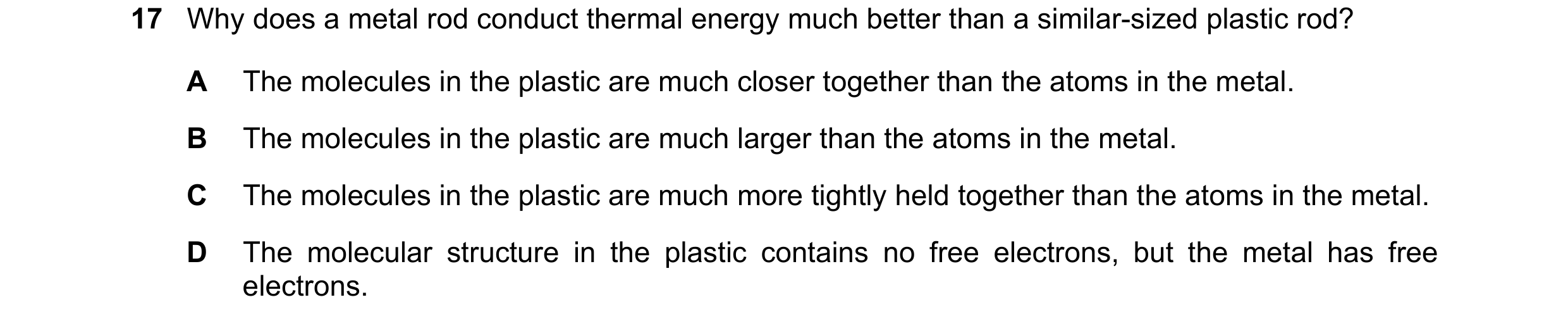
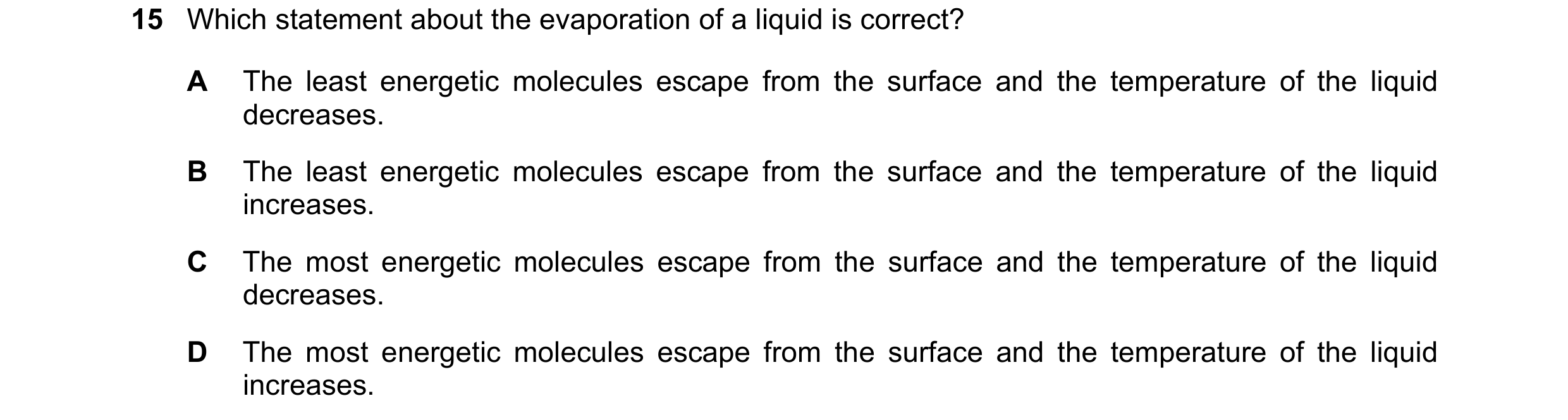
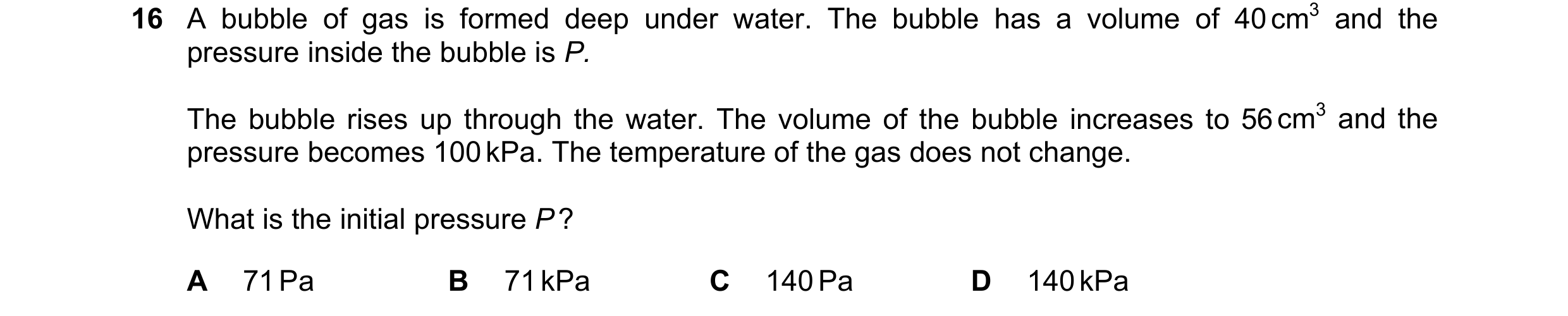
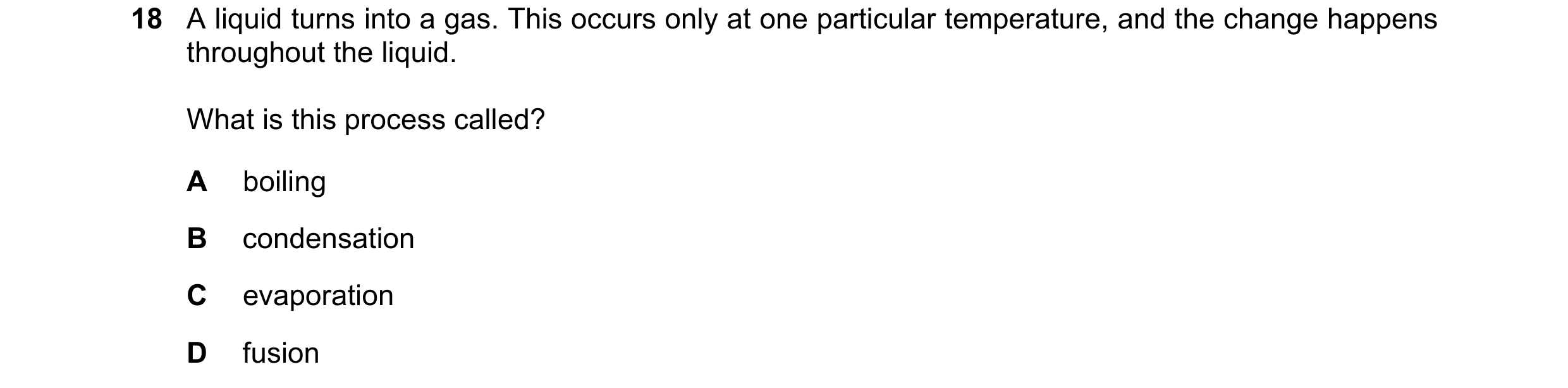
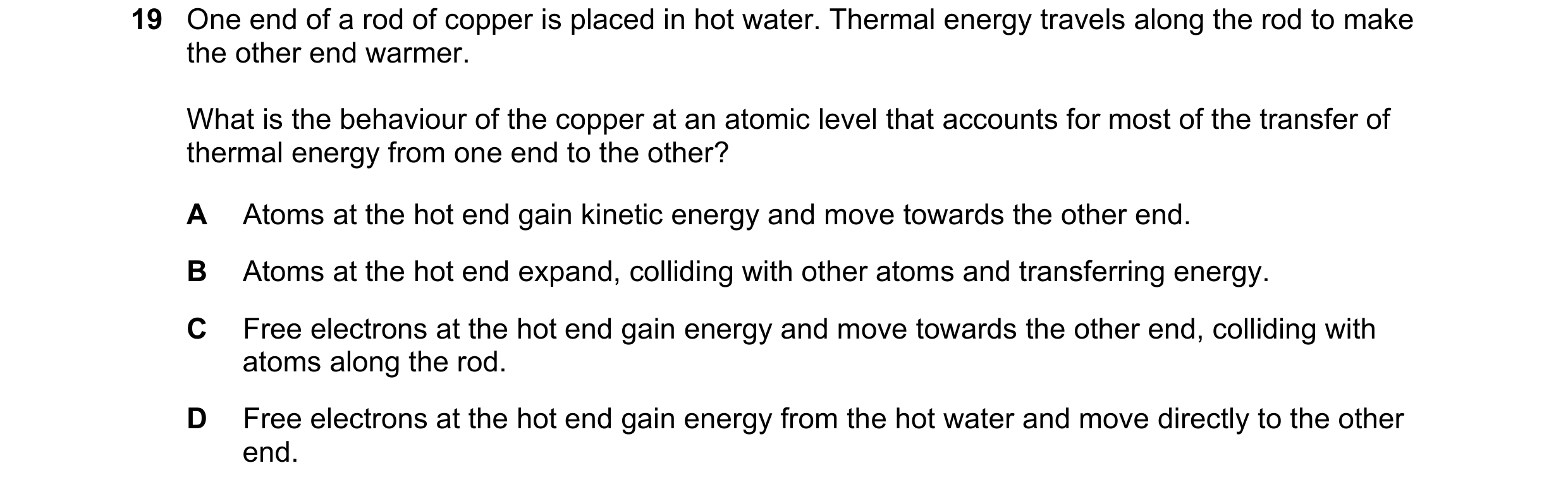 19 / 50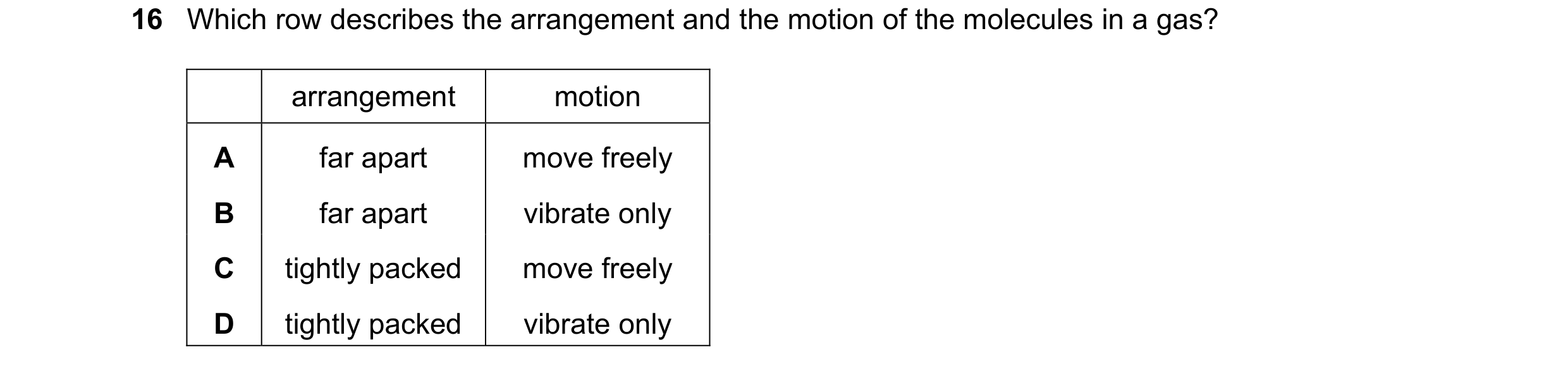

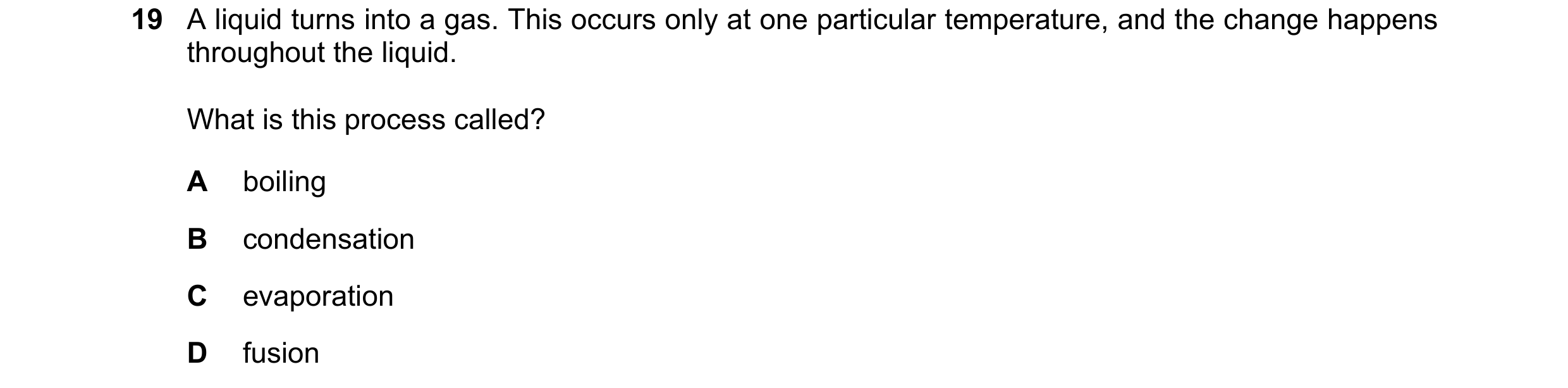
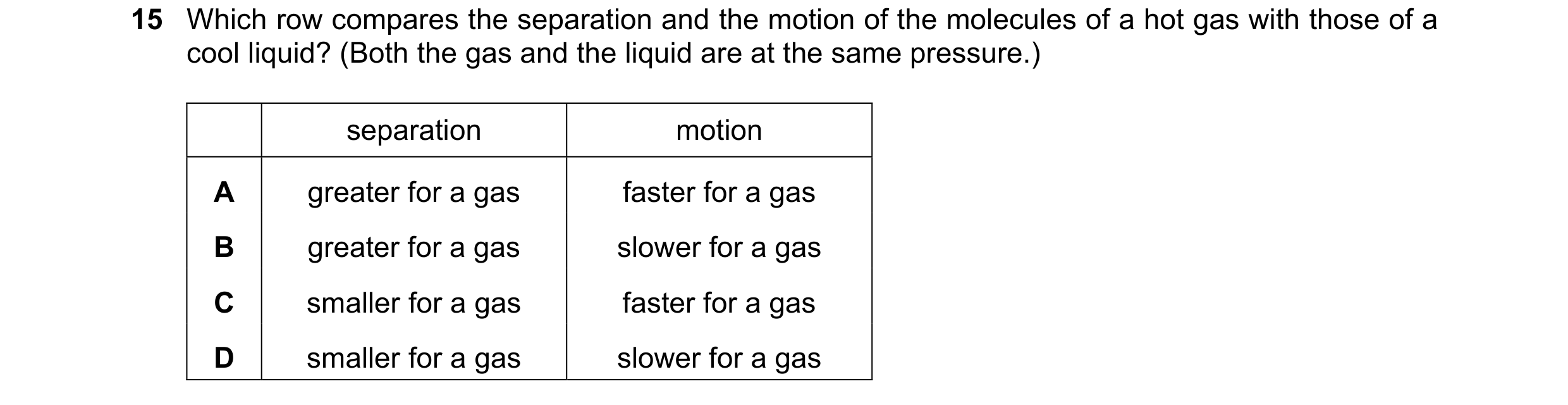
 20 / 50
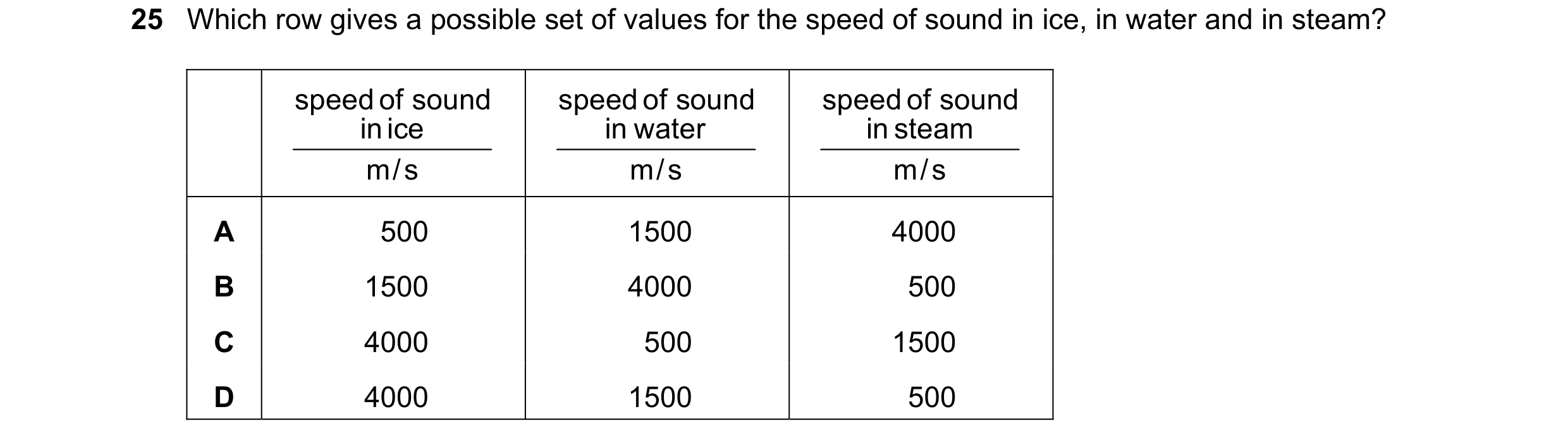
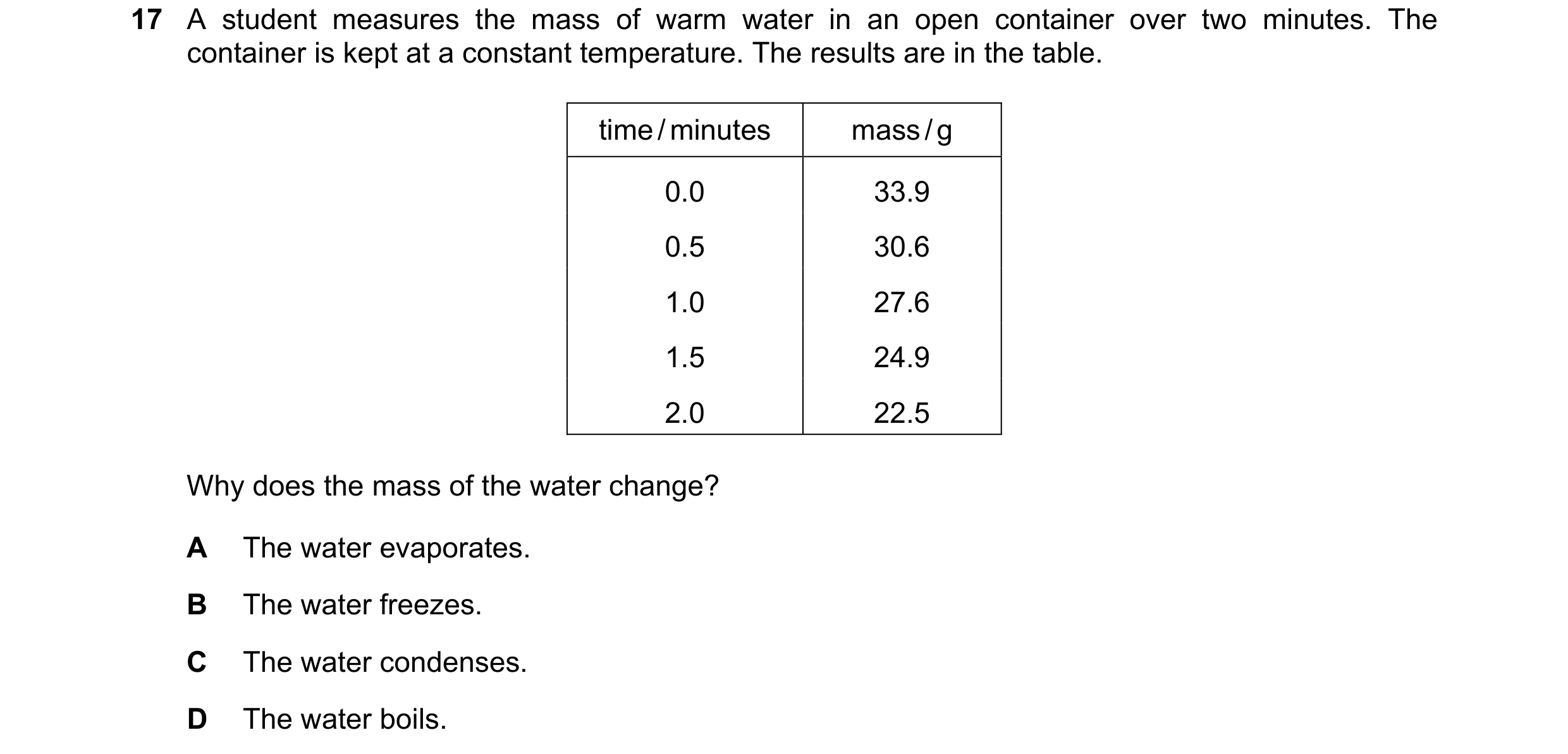 21 / 50
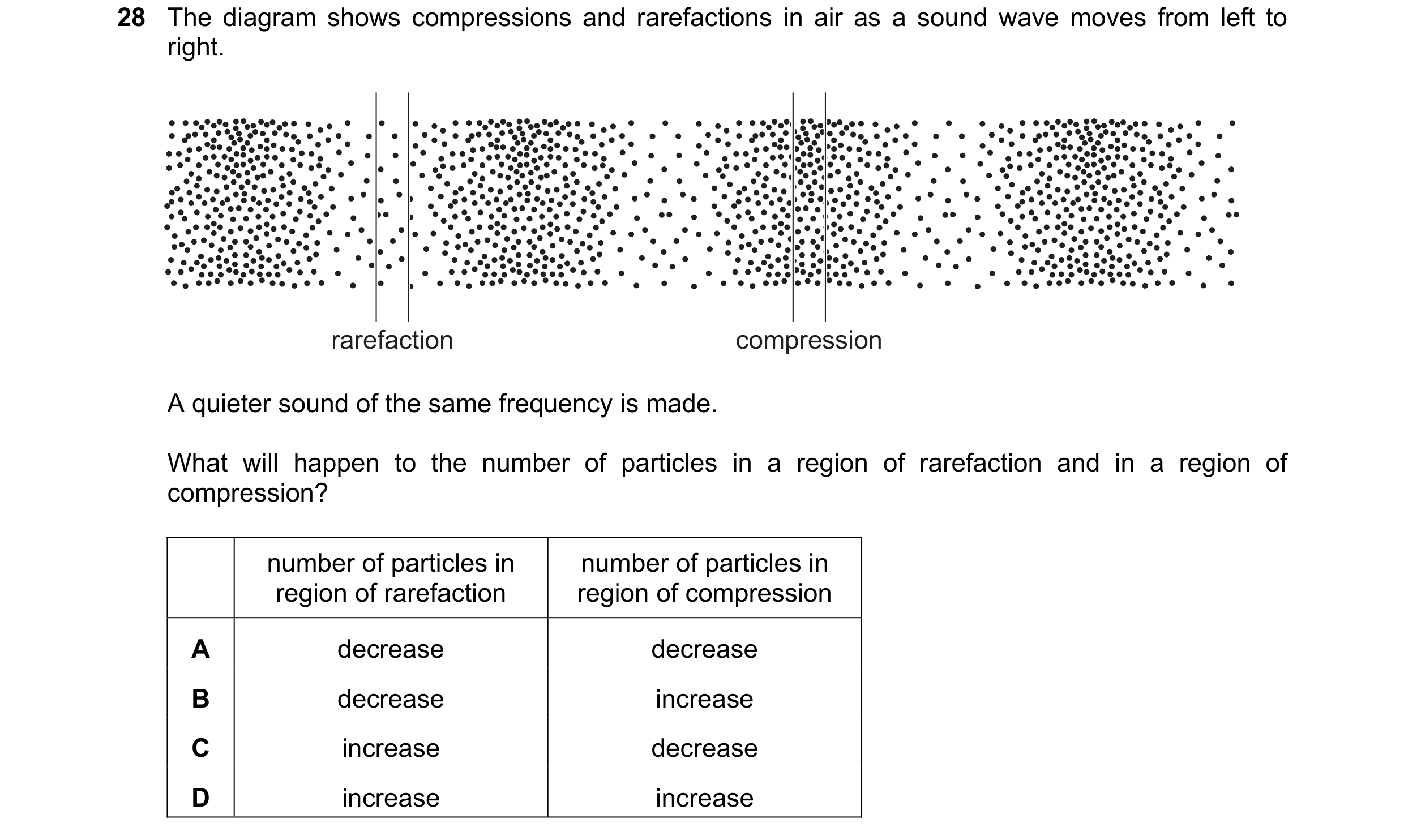
 22 / 50
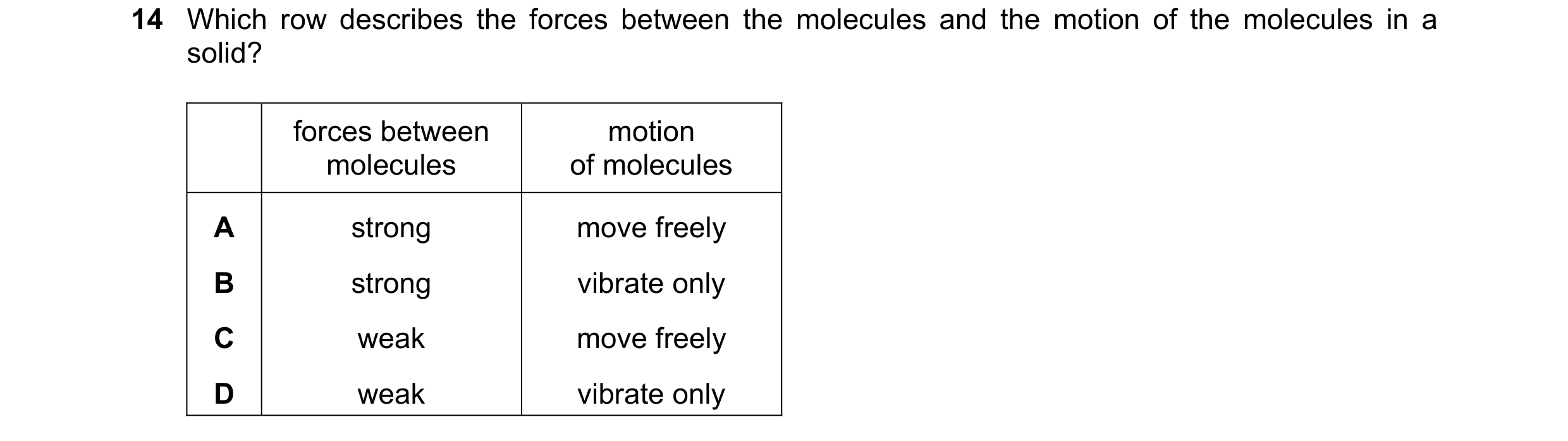
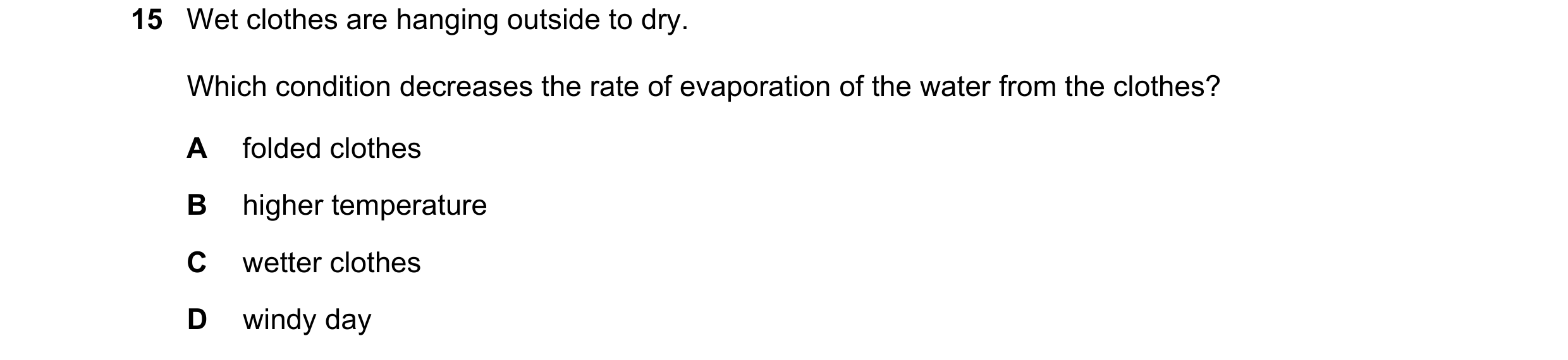
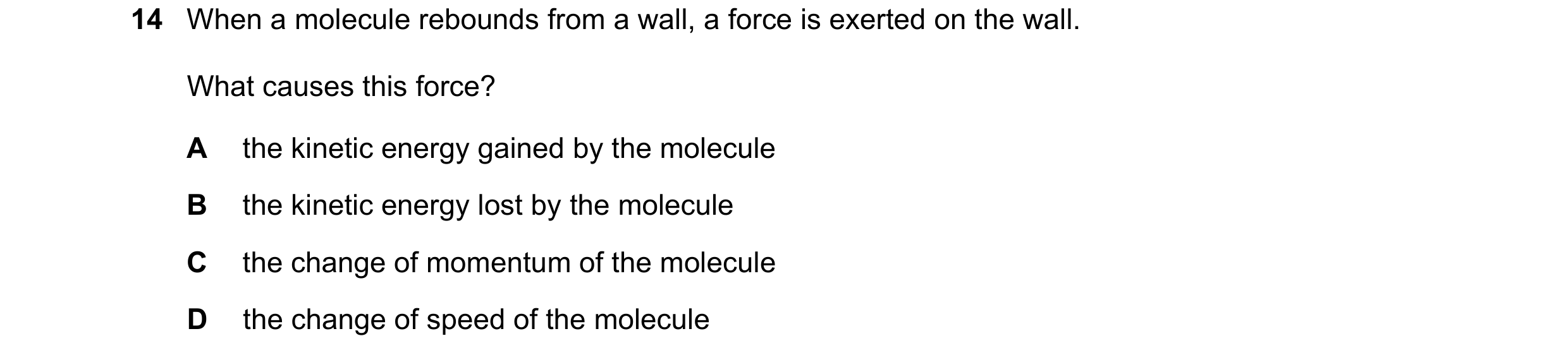
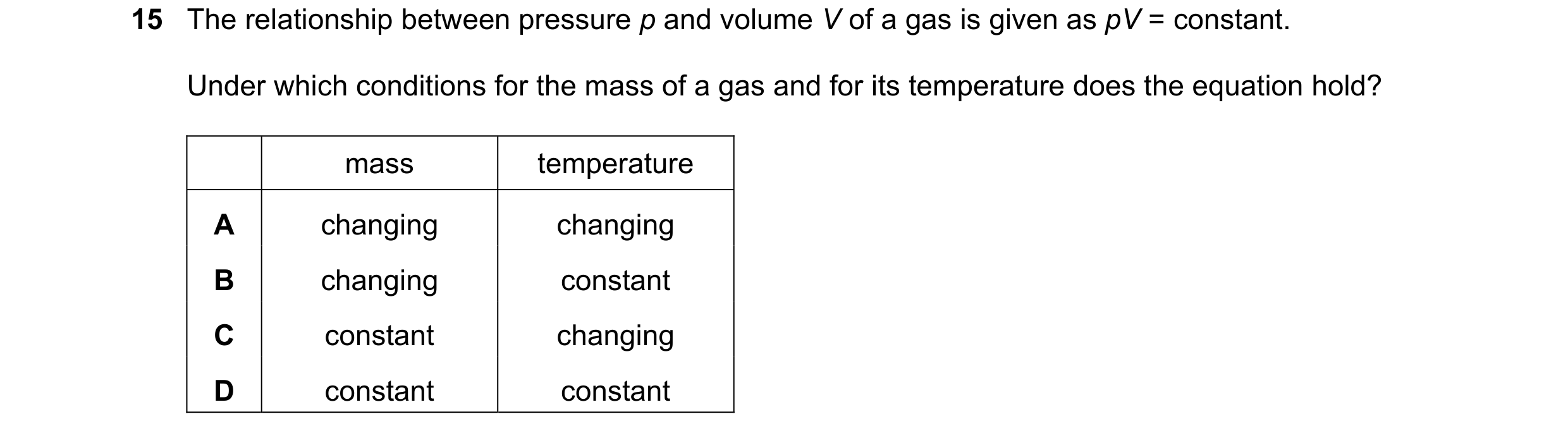 23 / 50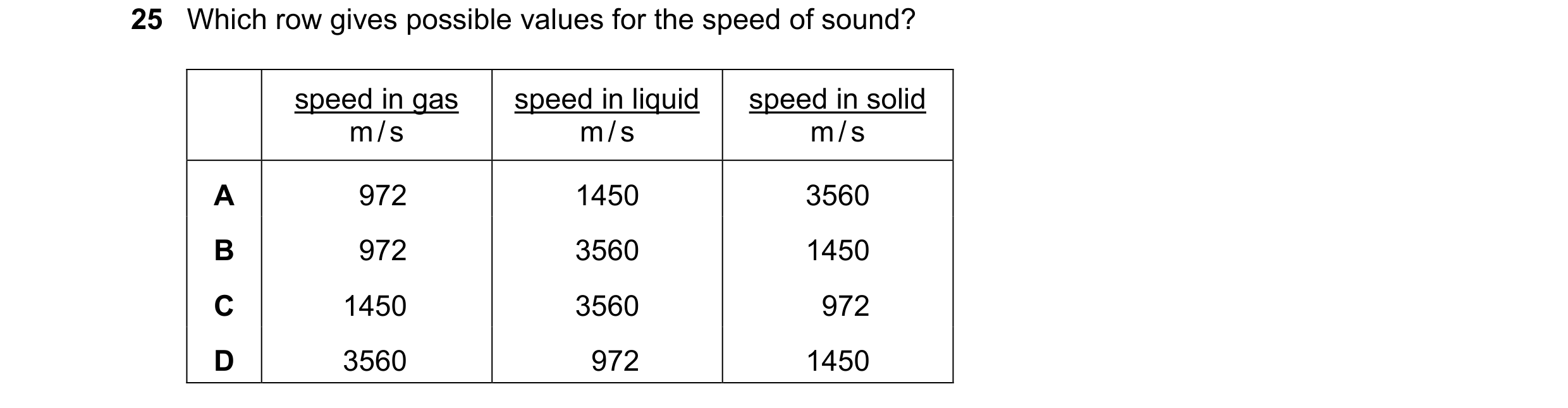
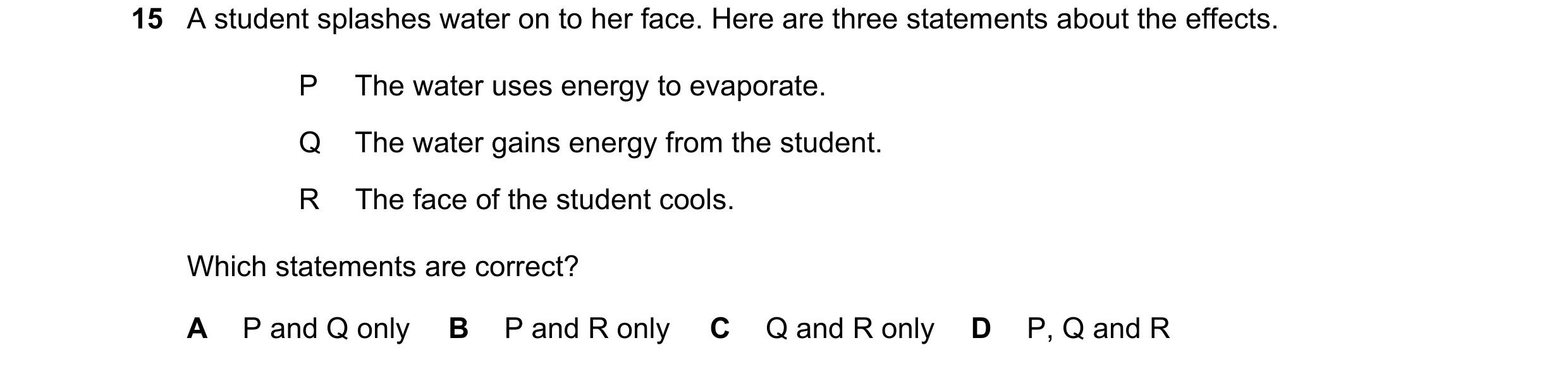
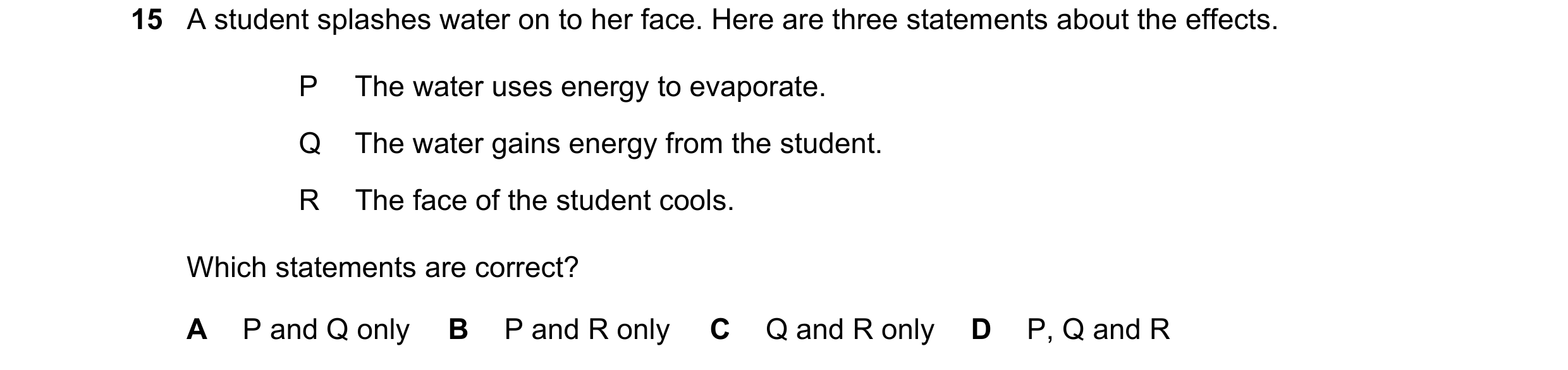
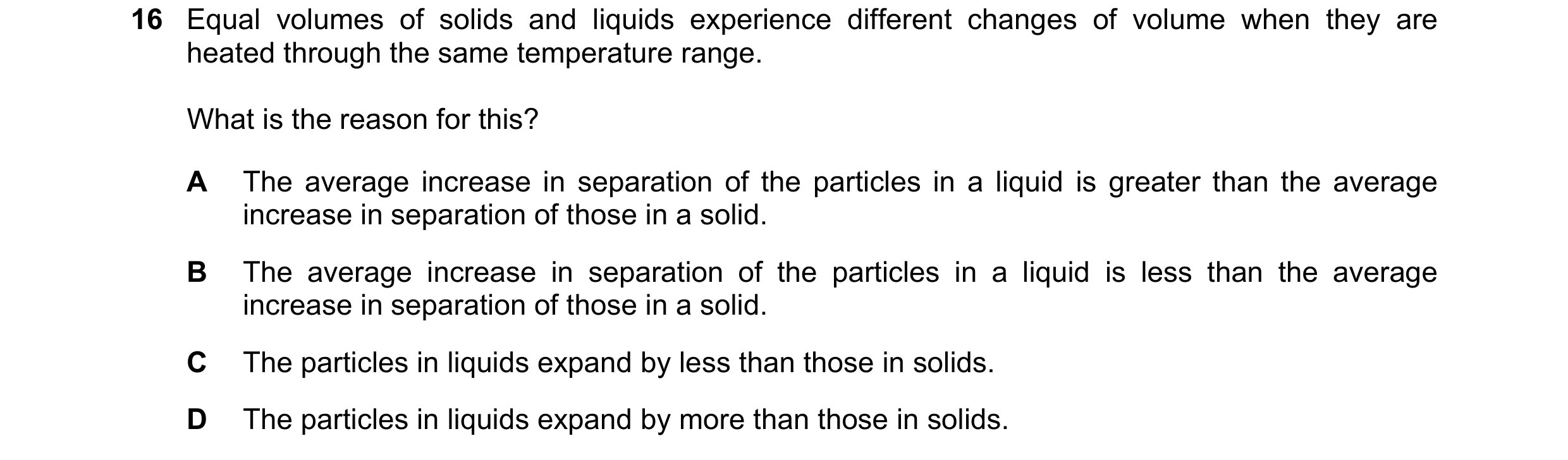 24 / 50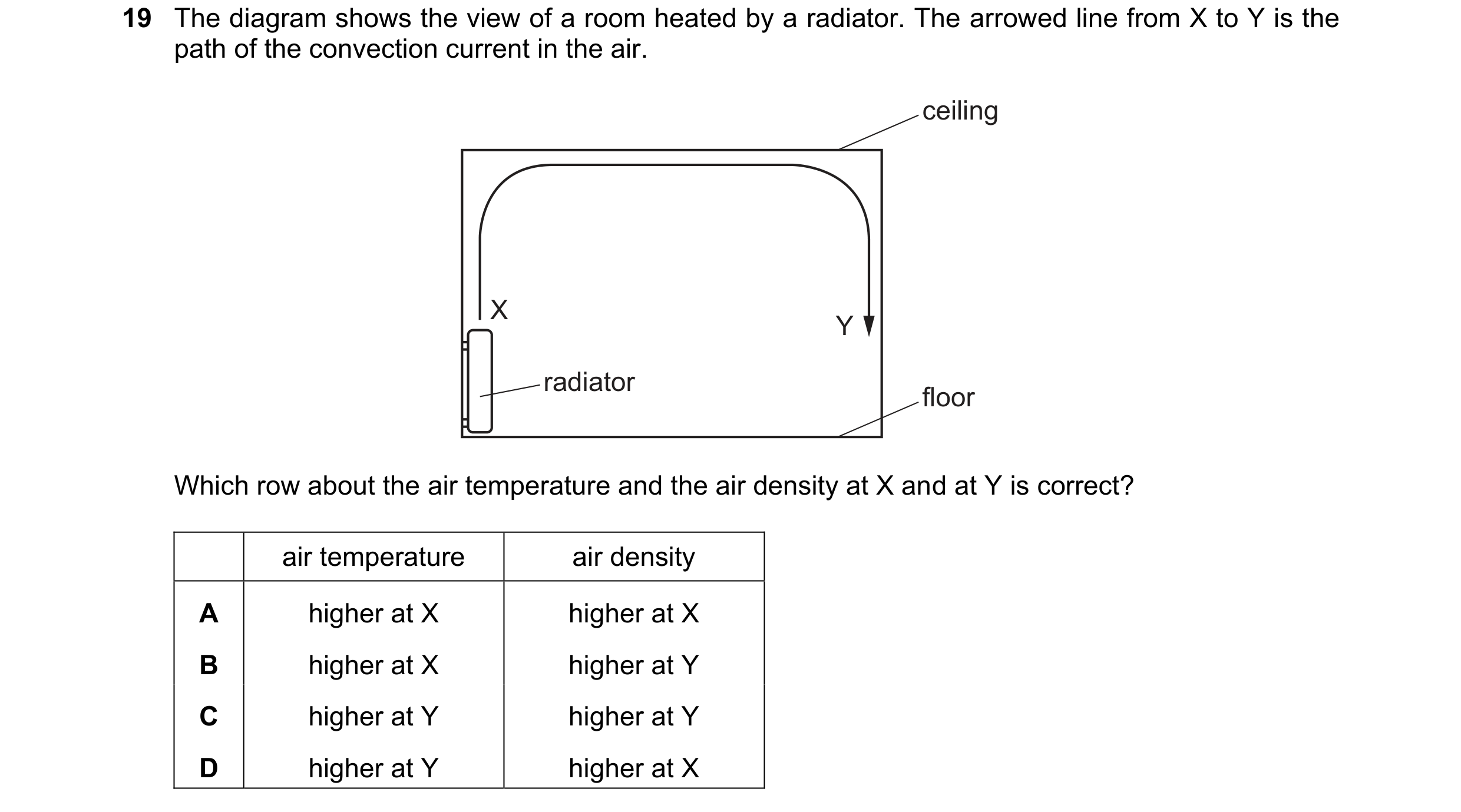
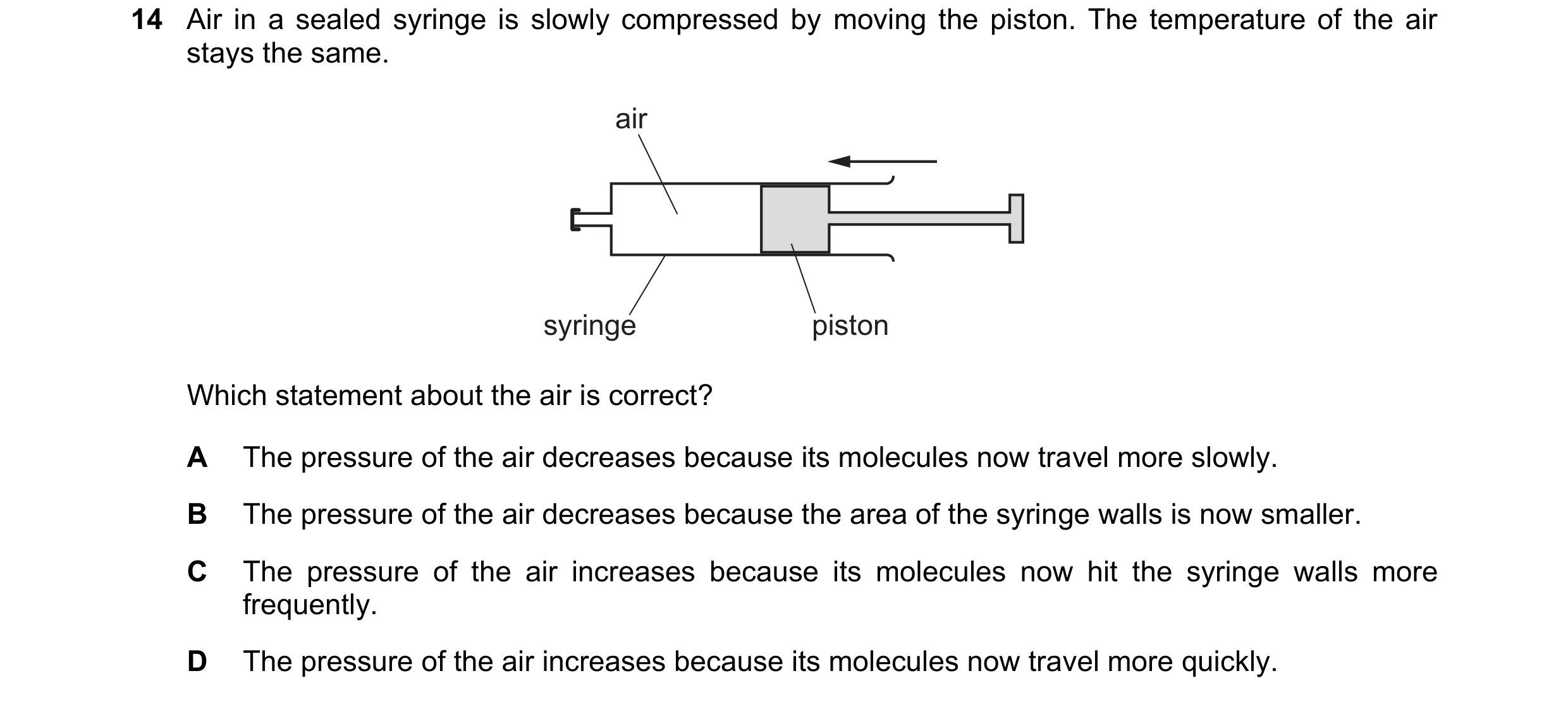
 25 / 50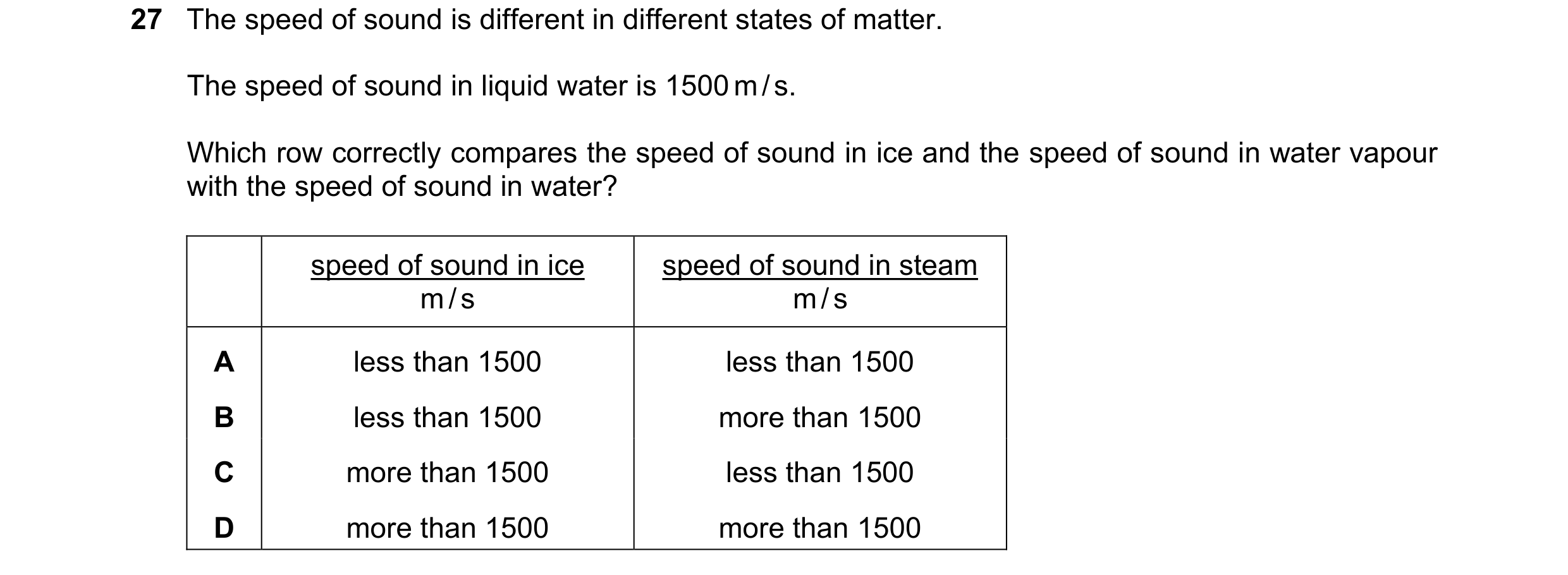
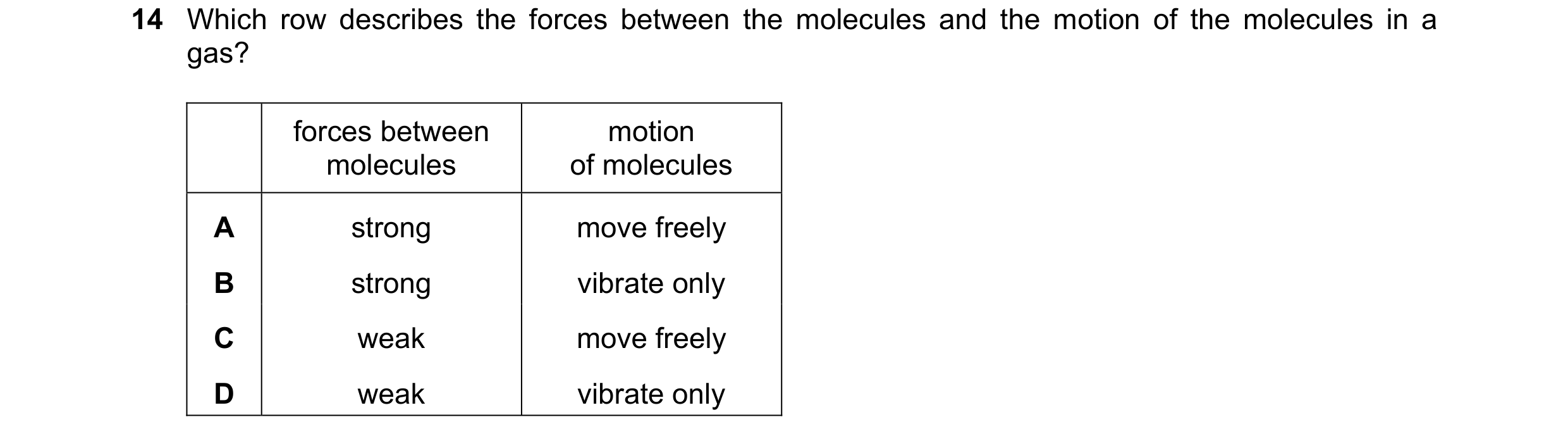 26 / 50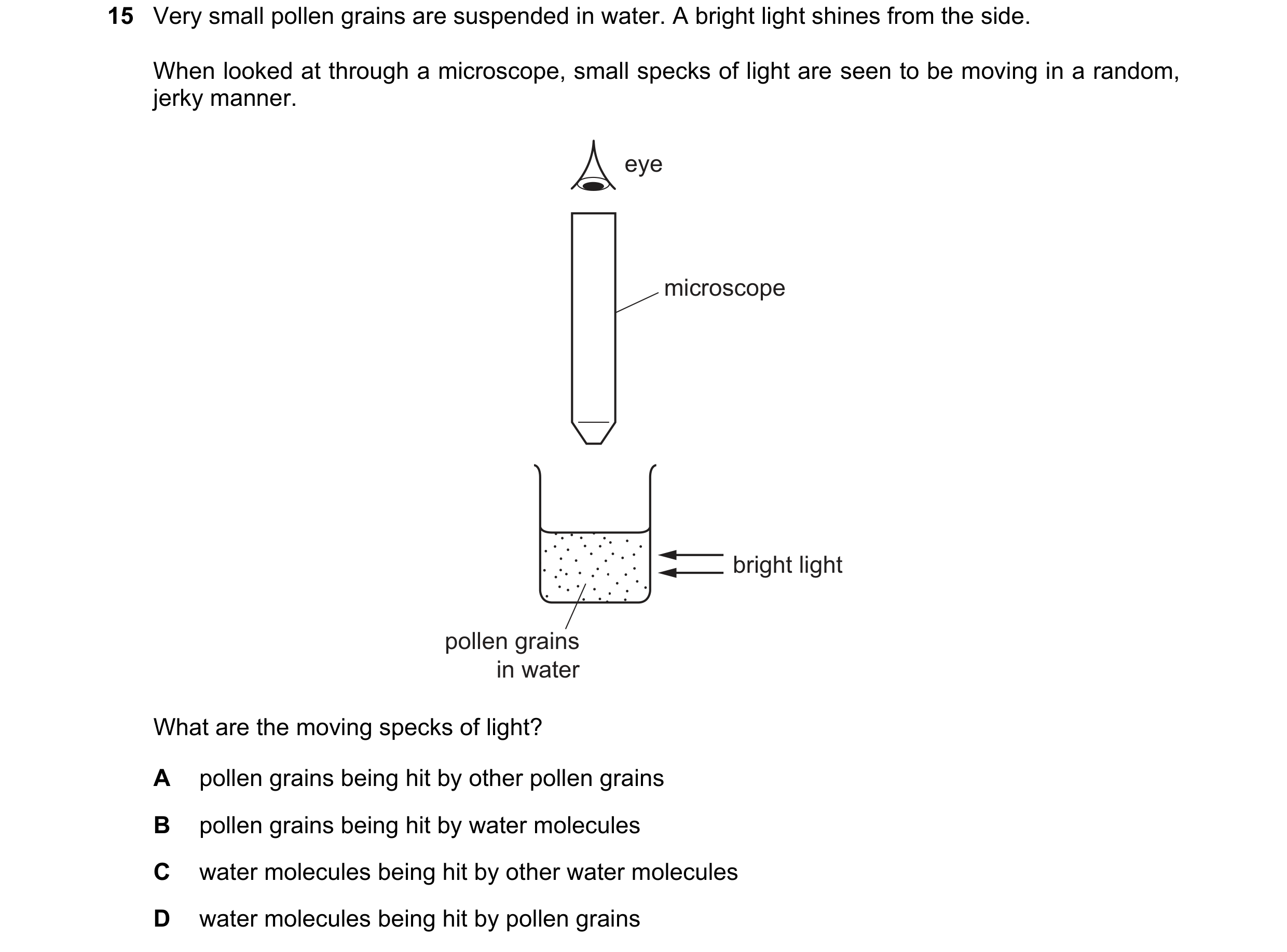
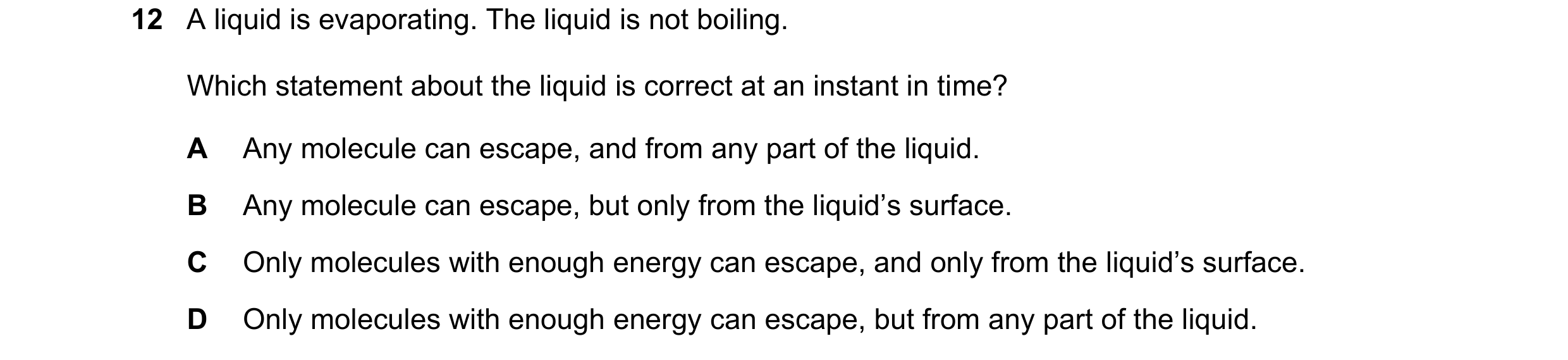 27 / 50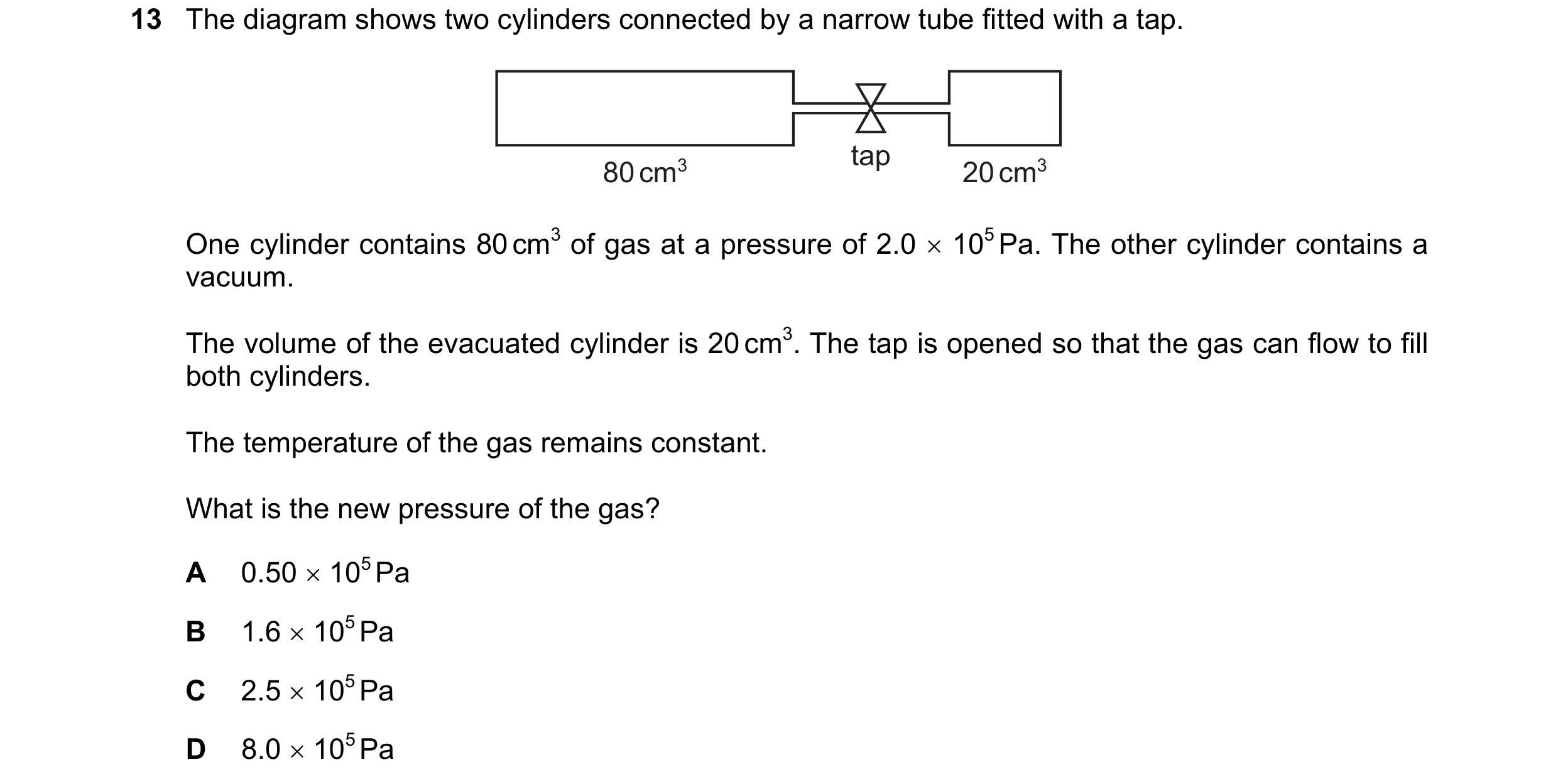
 28 / 50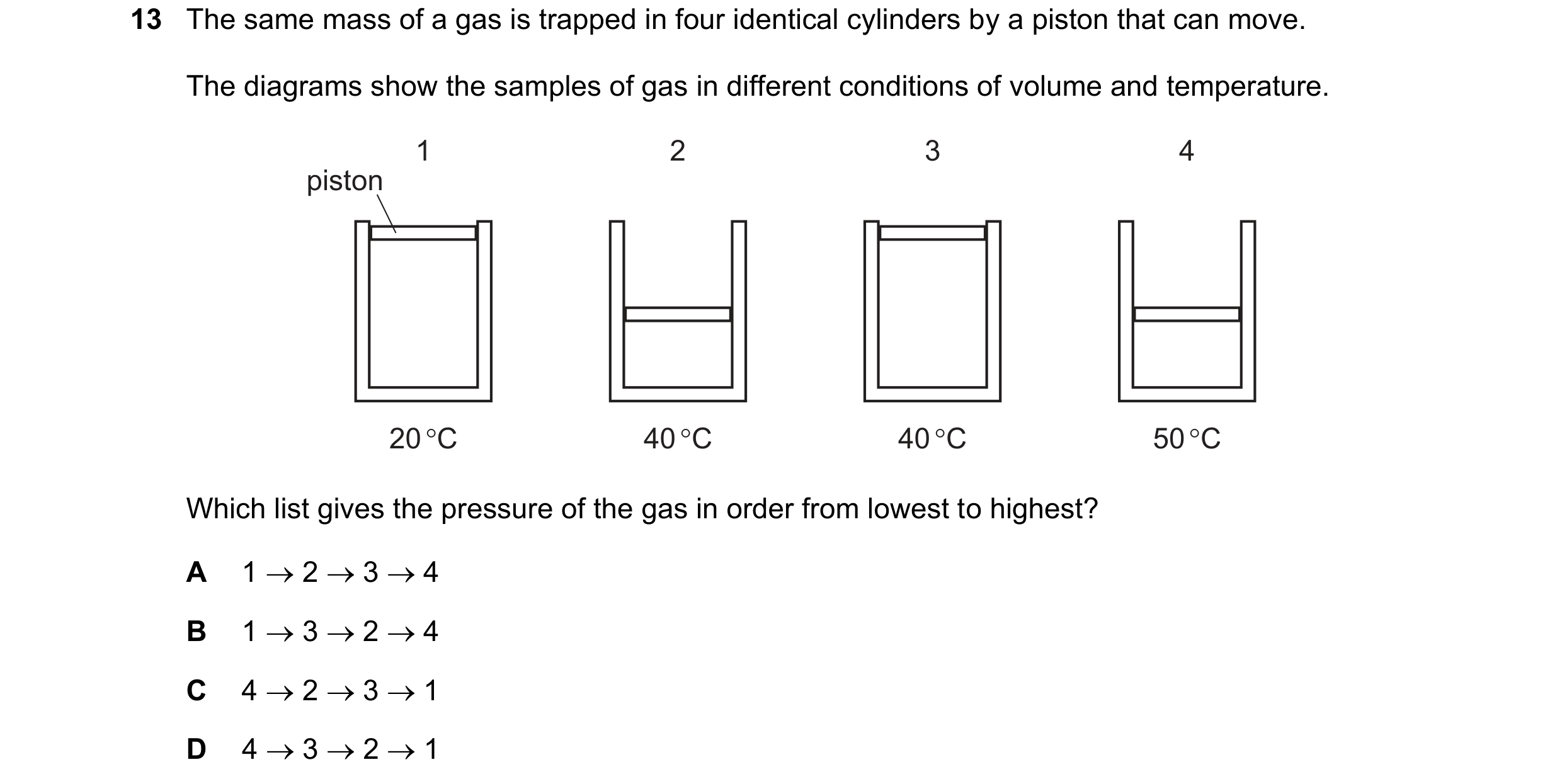
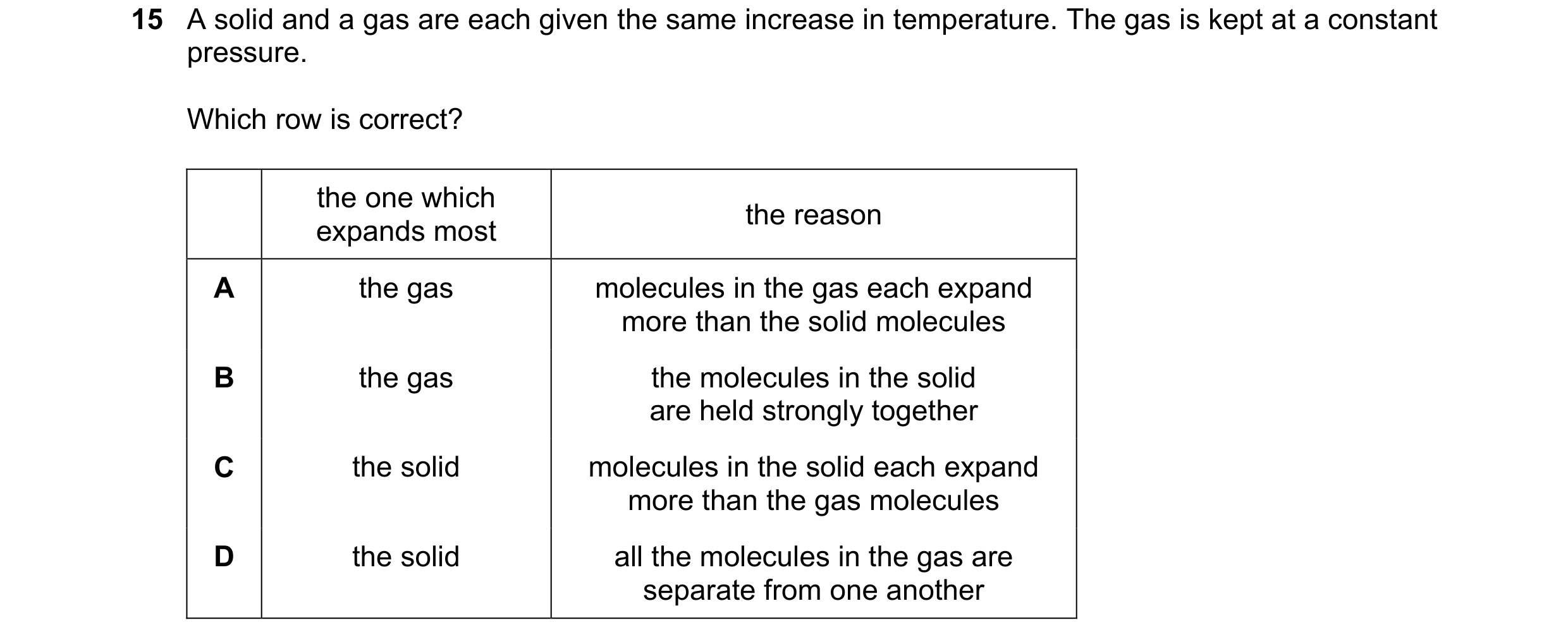
 29 / 50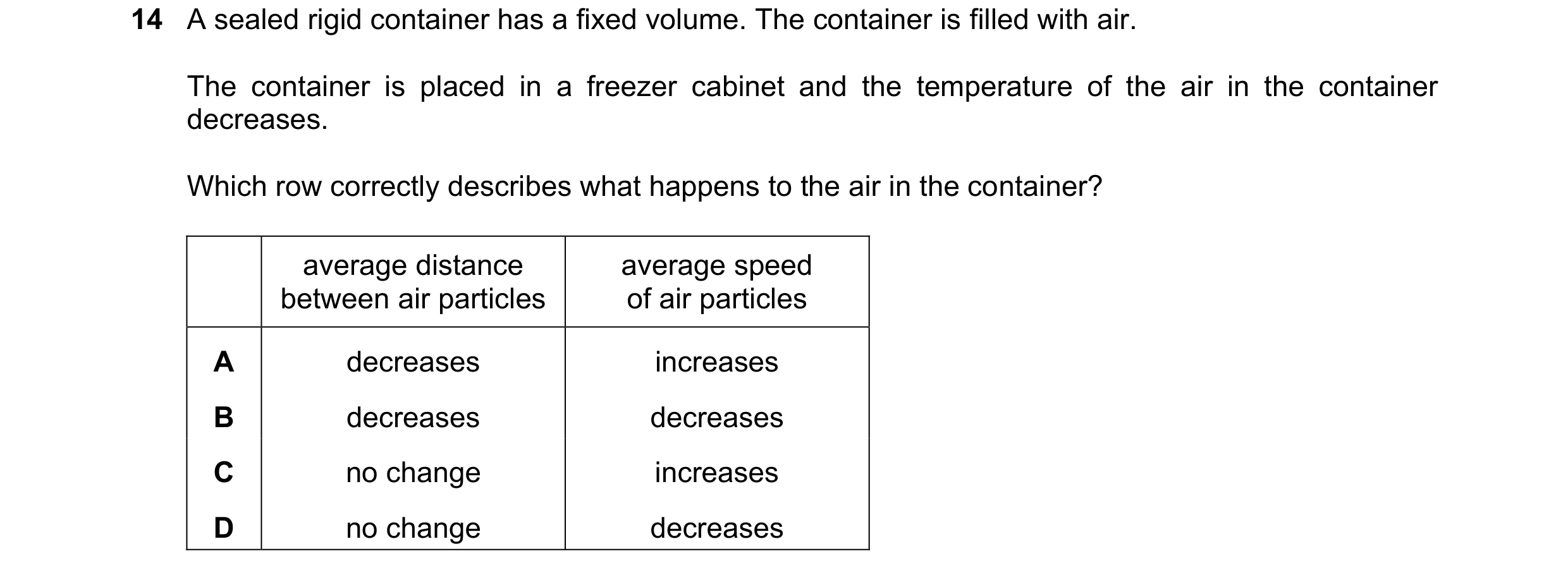
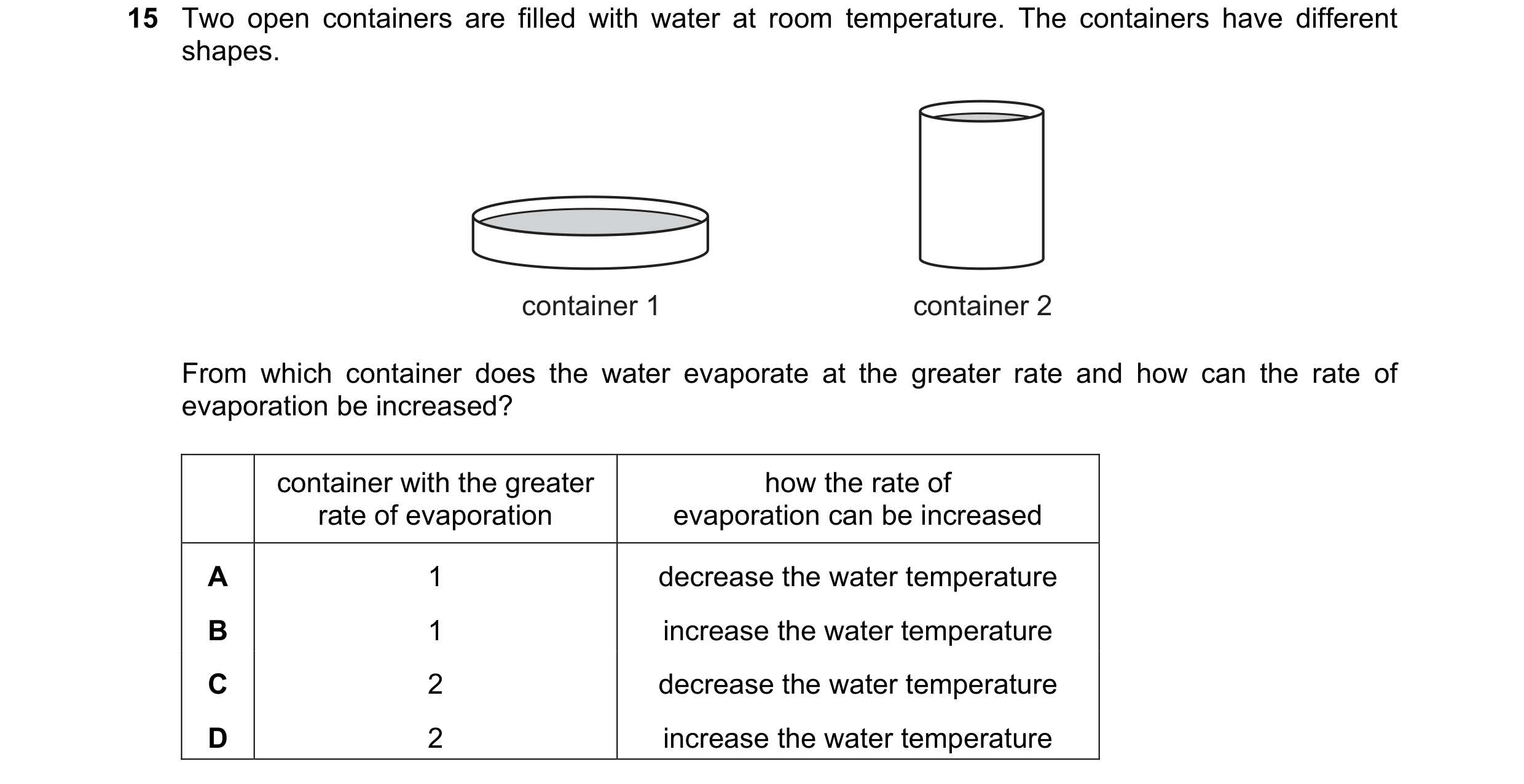
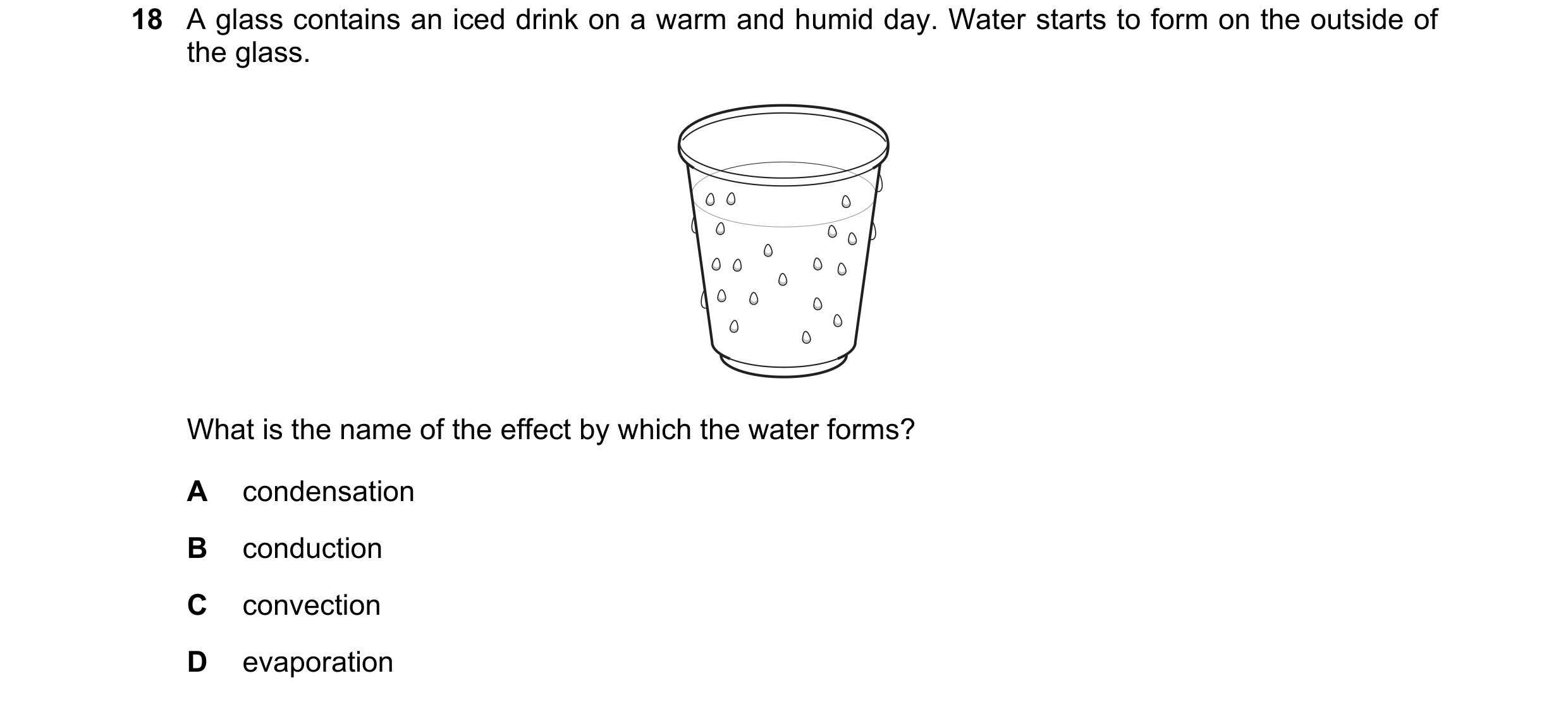 30 / 50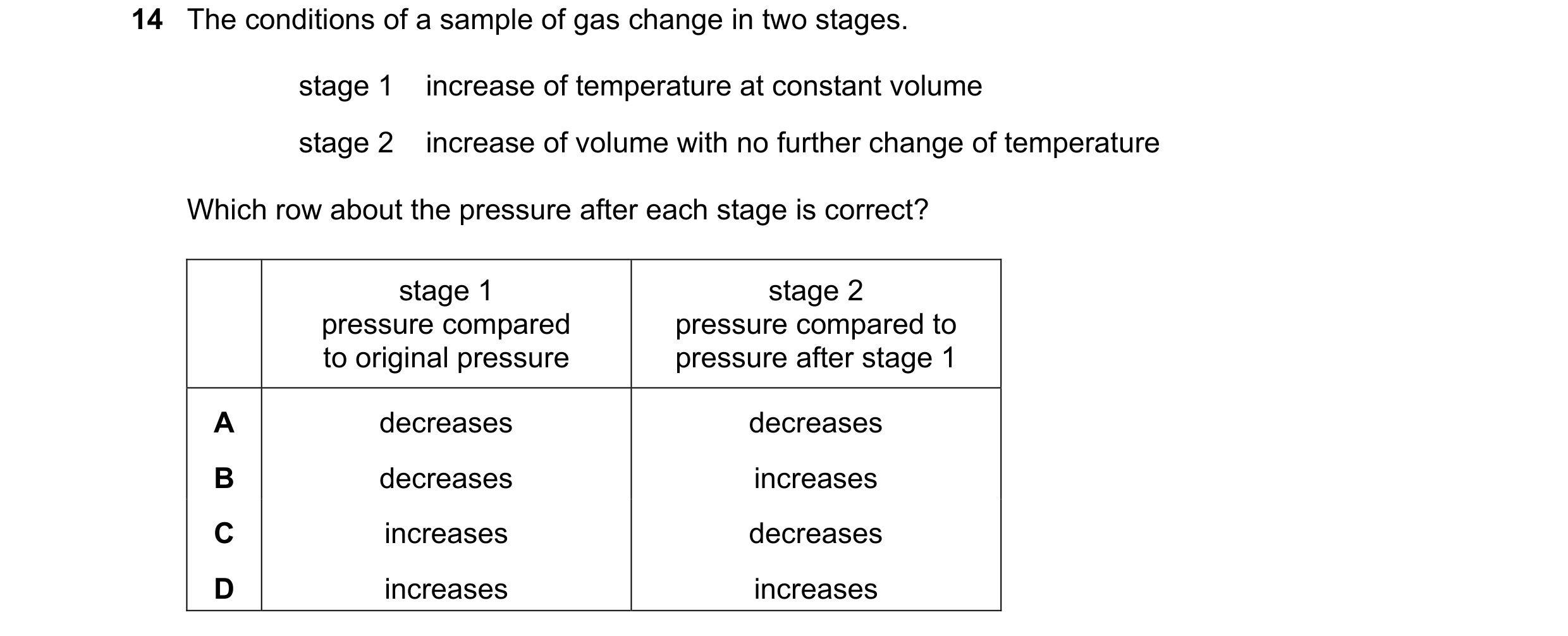
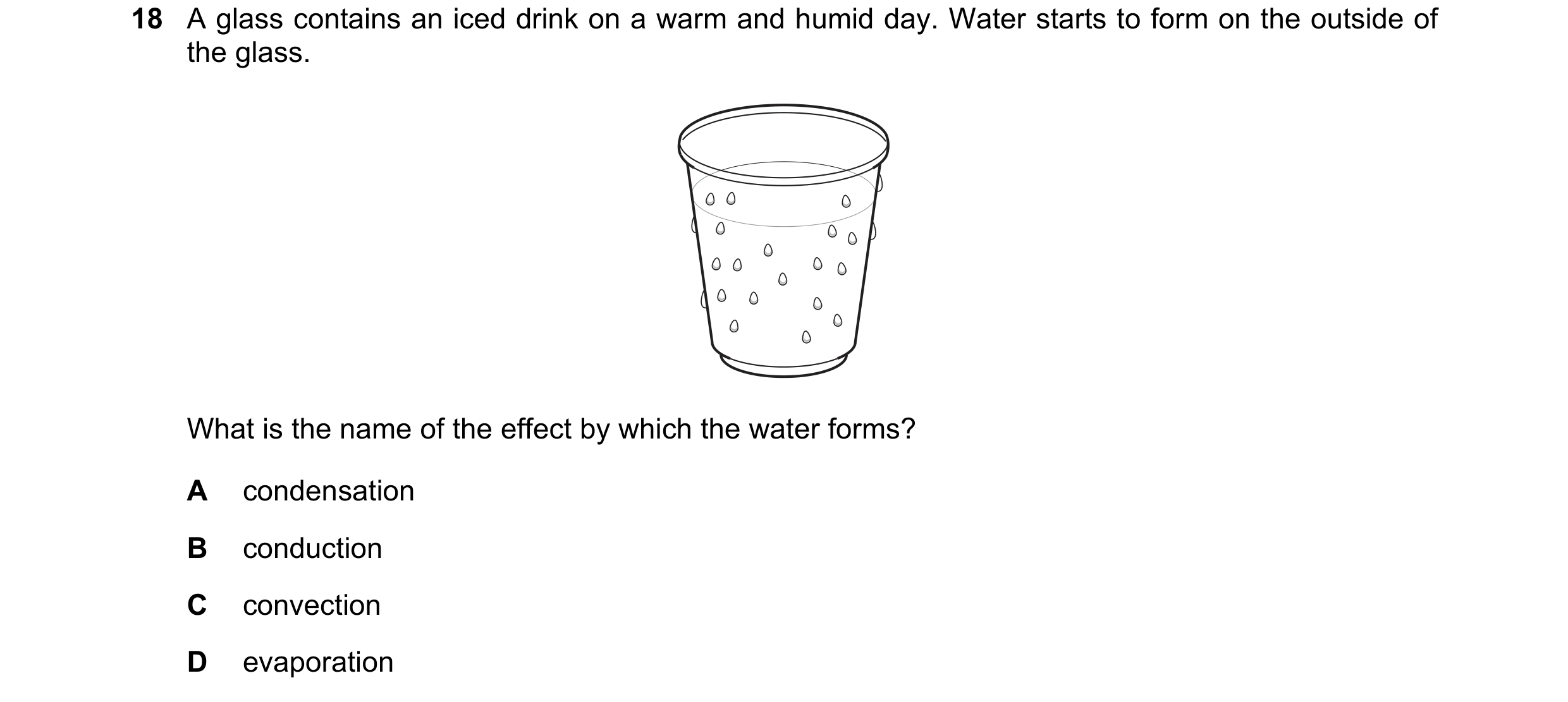 31 / 50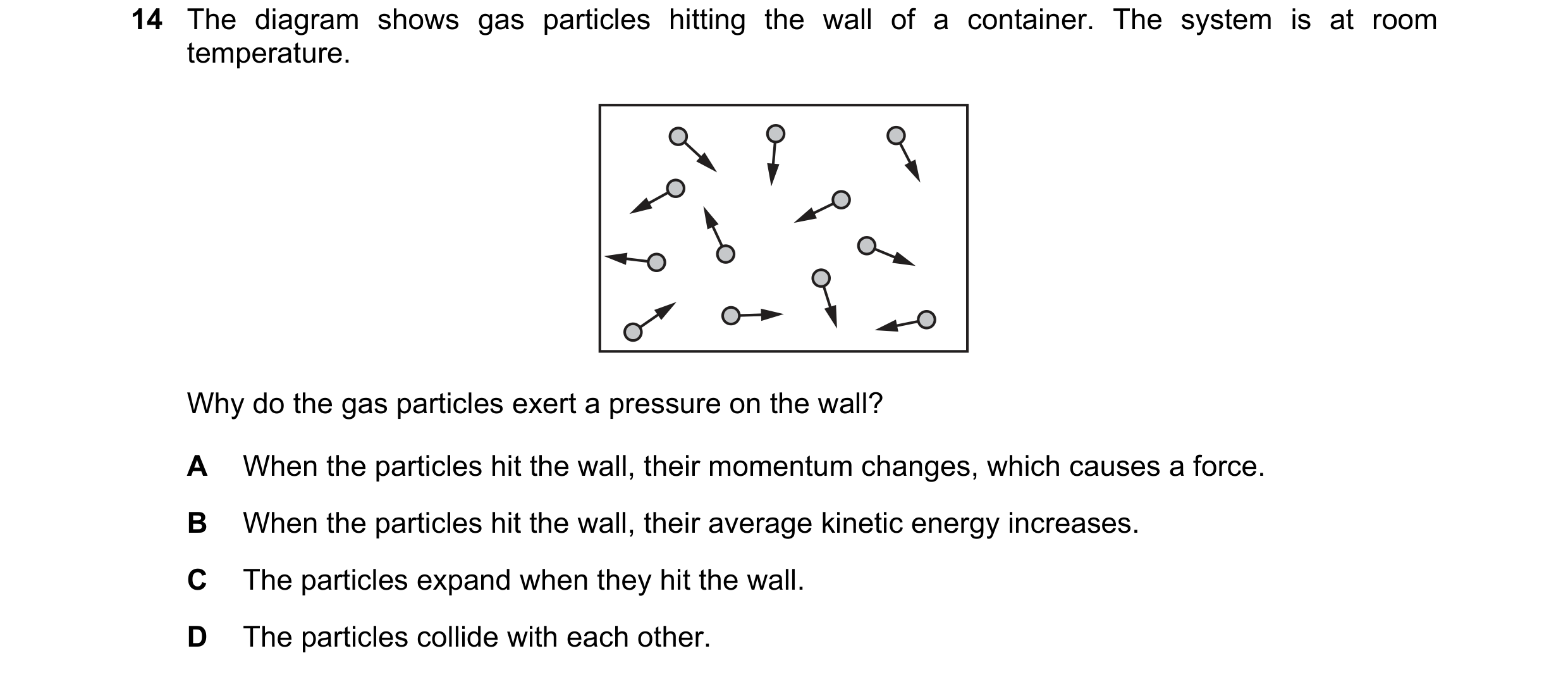
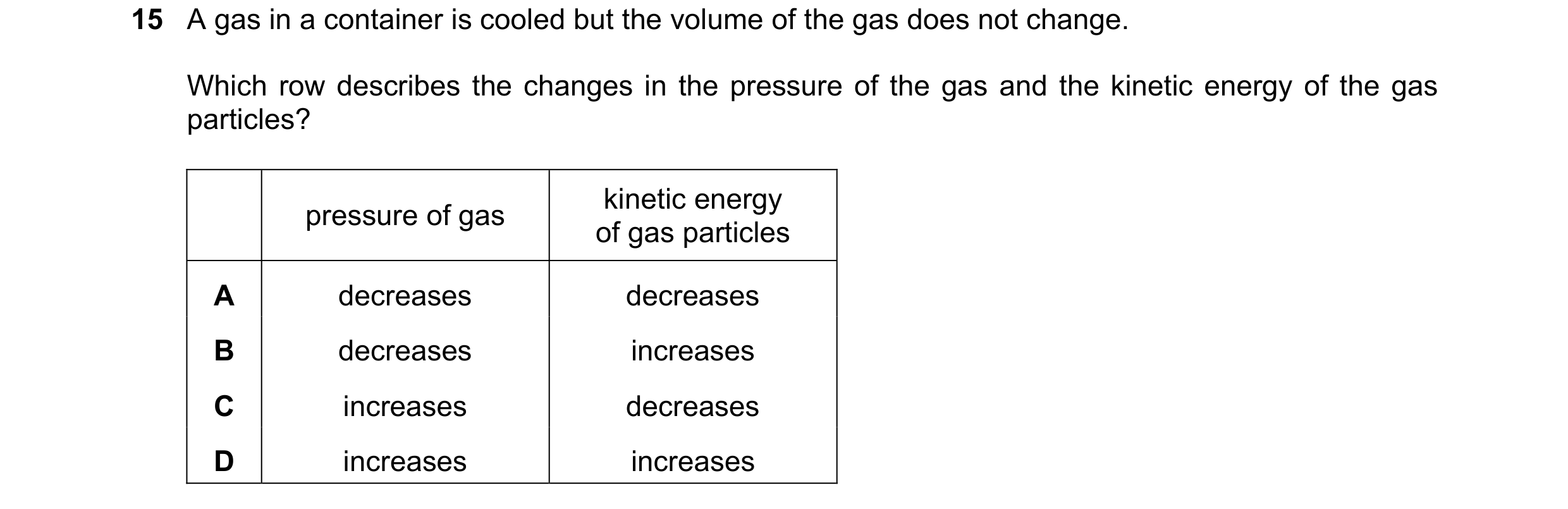
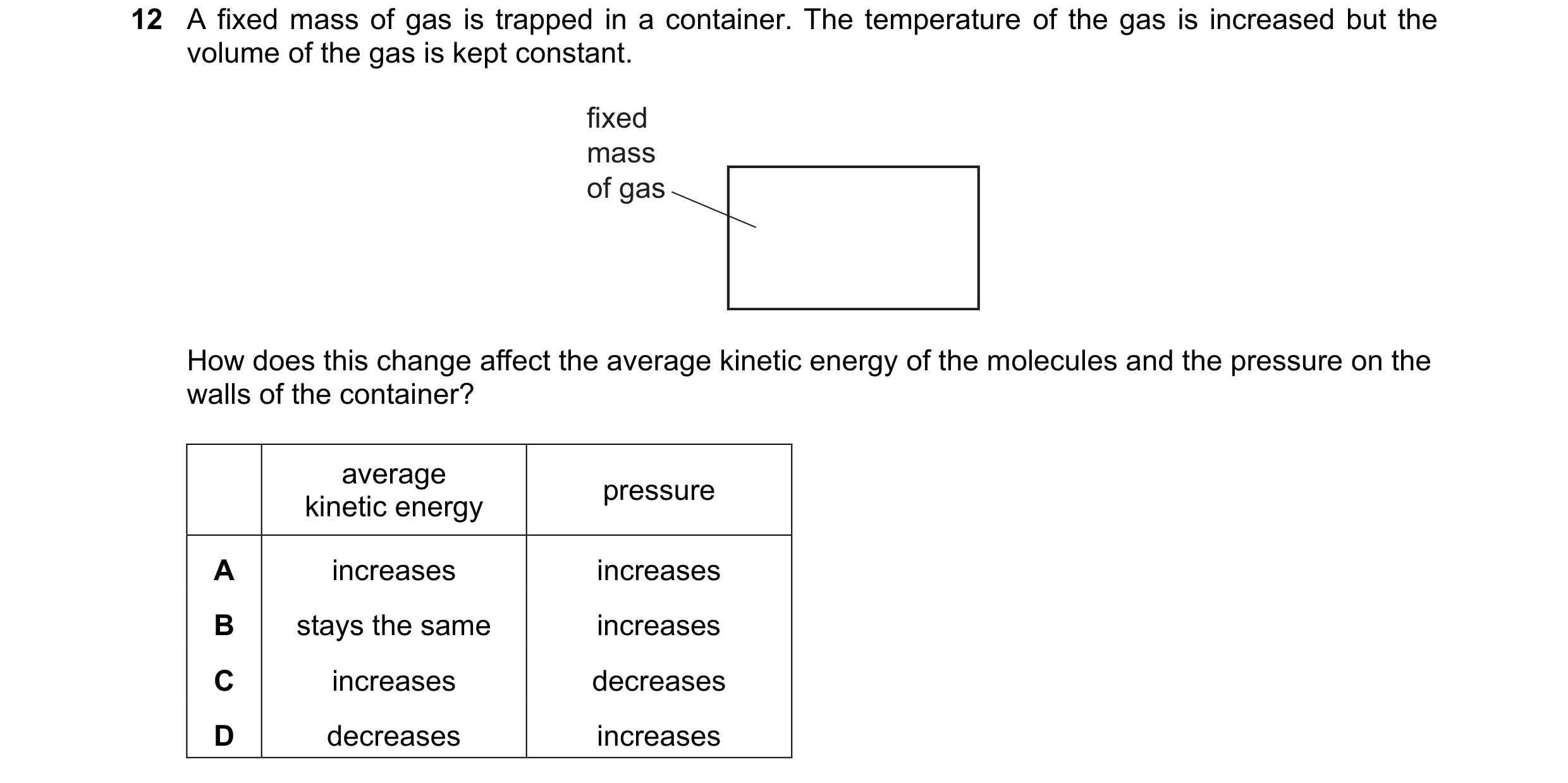 32 / 50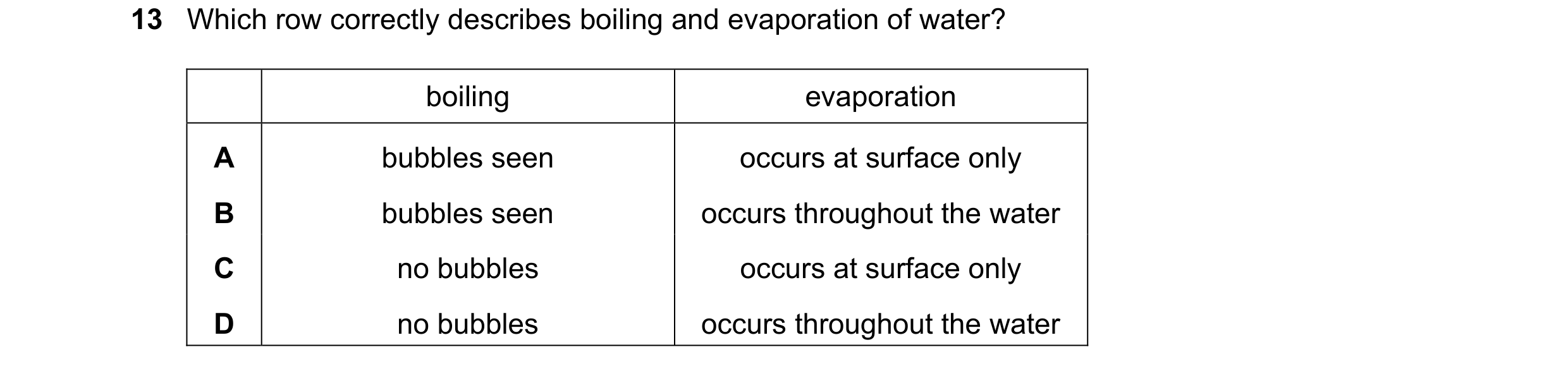
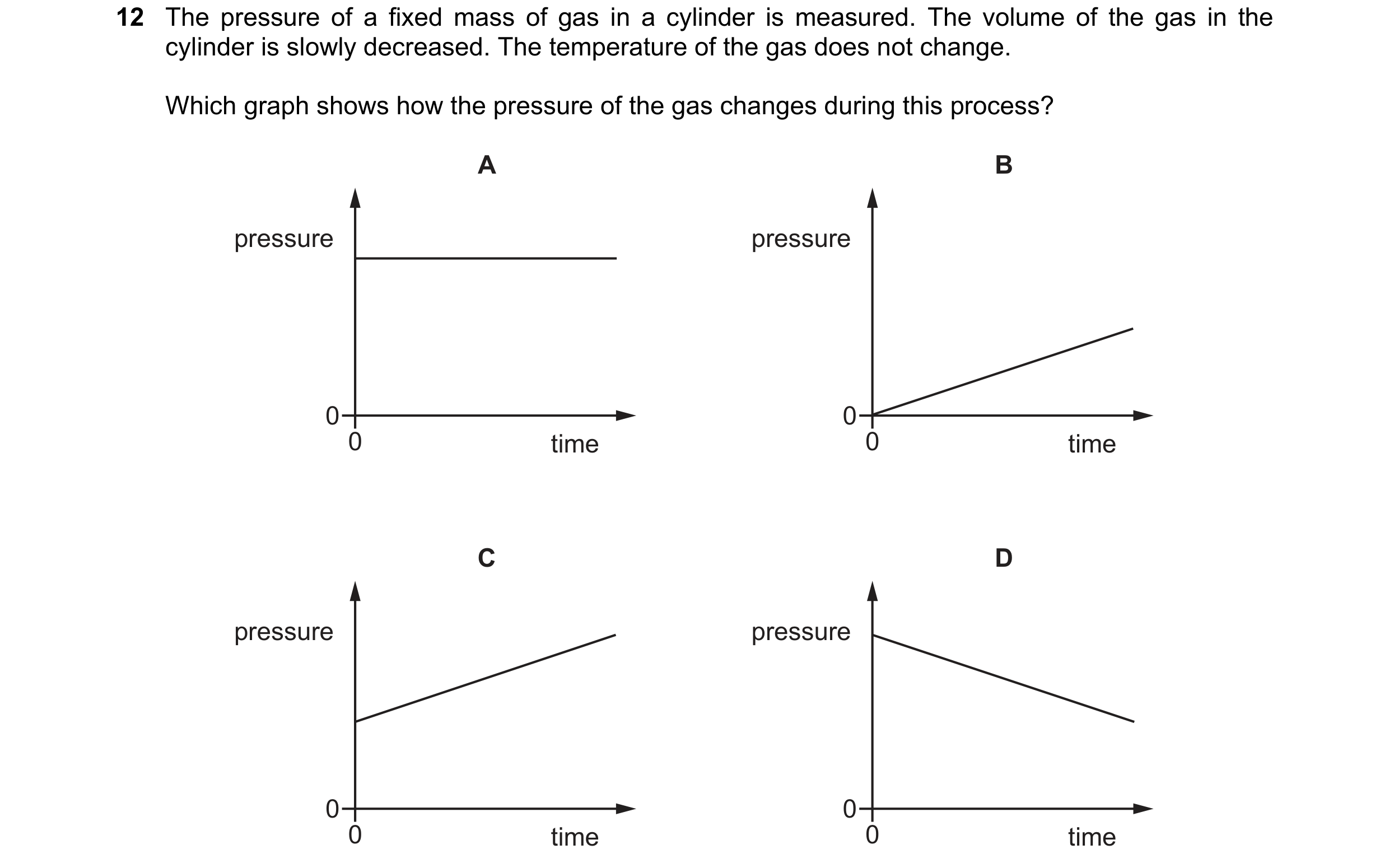
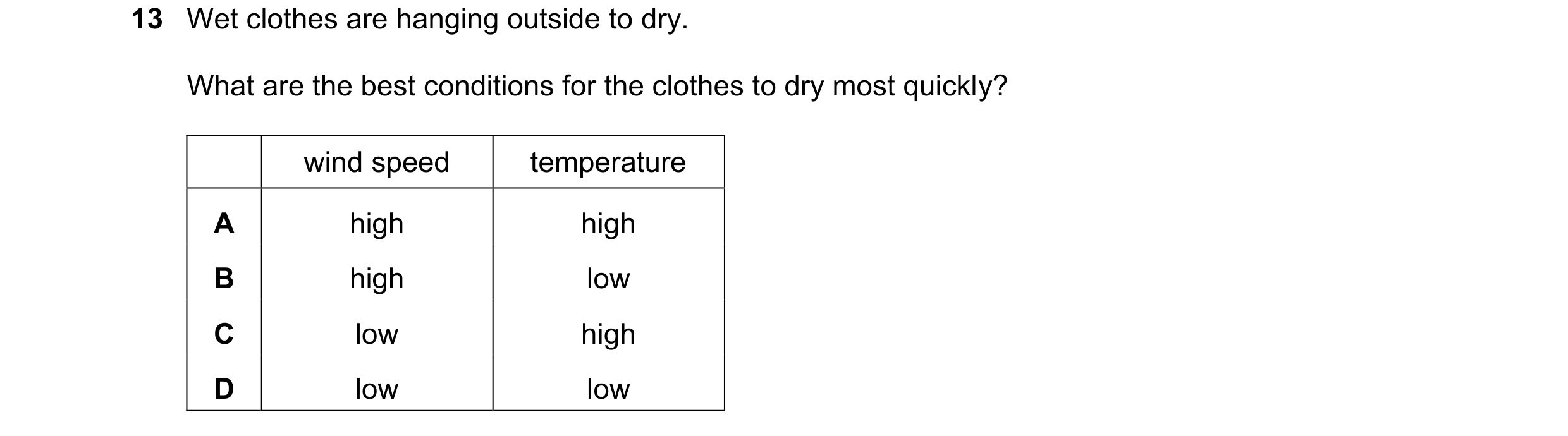 33 / 50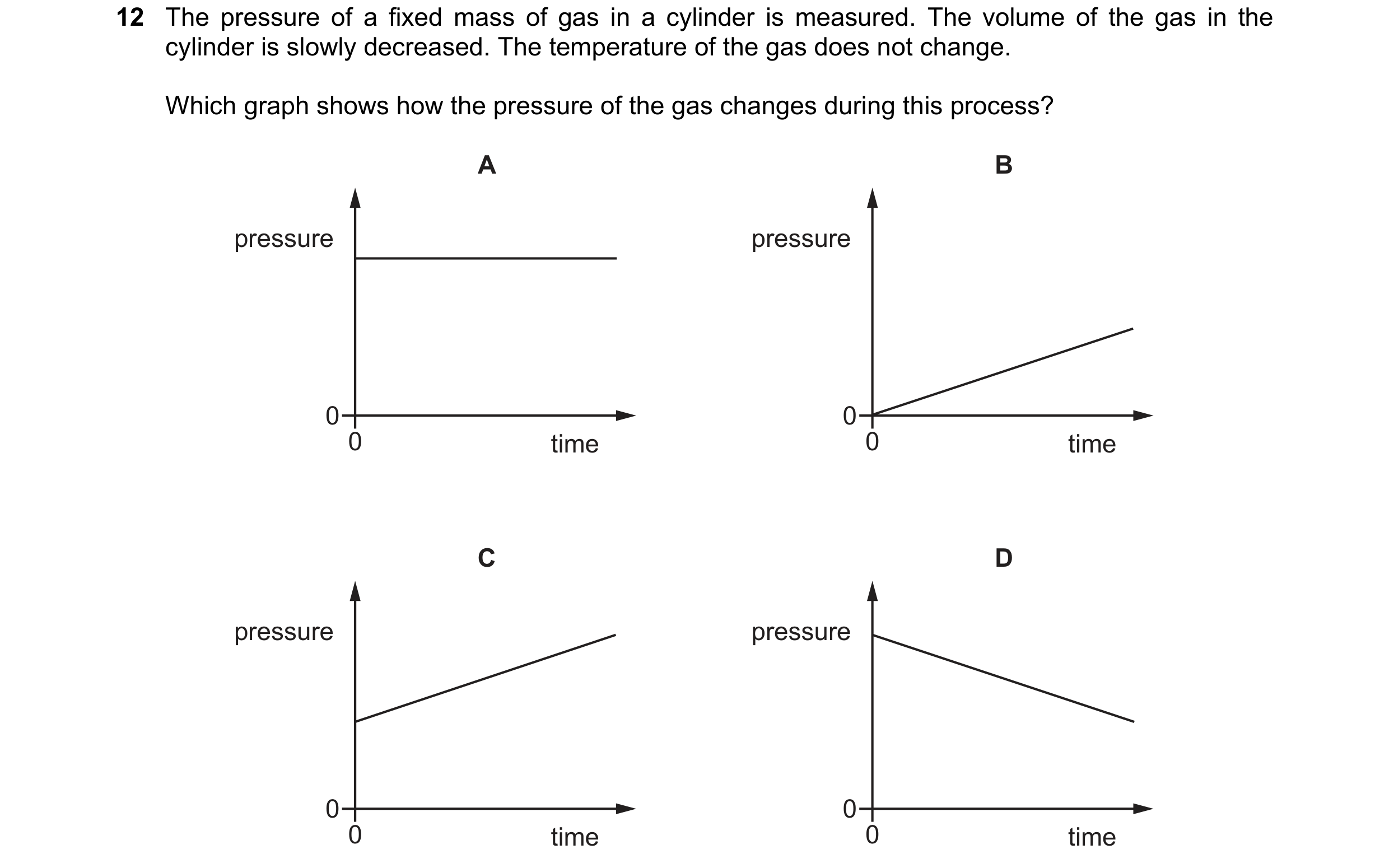

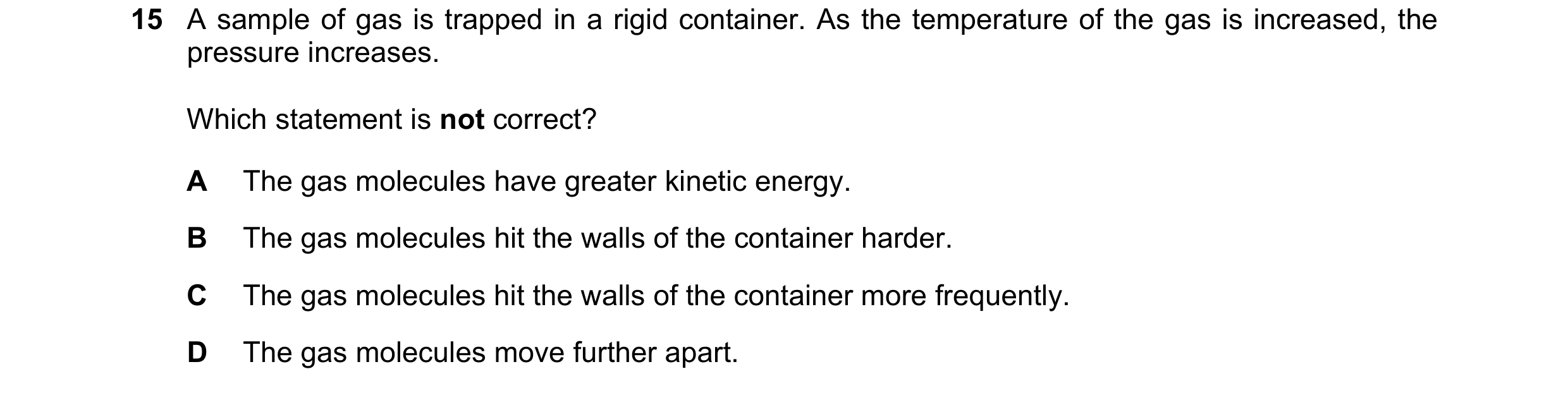
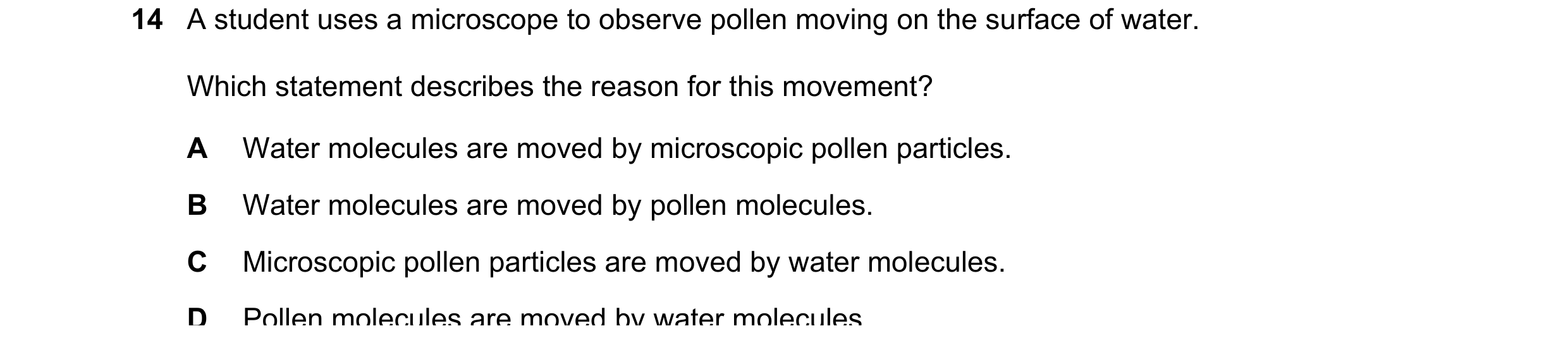 34 / 50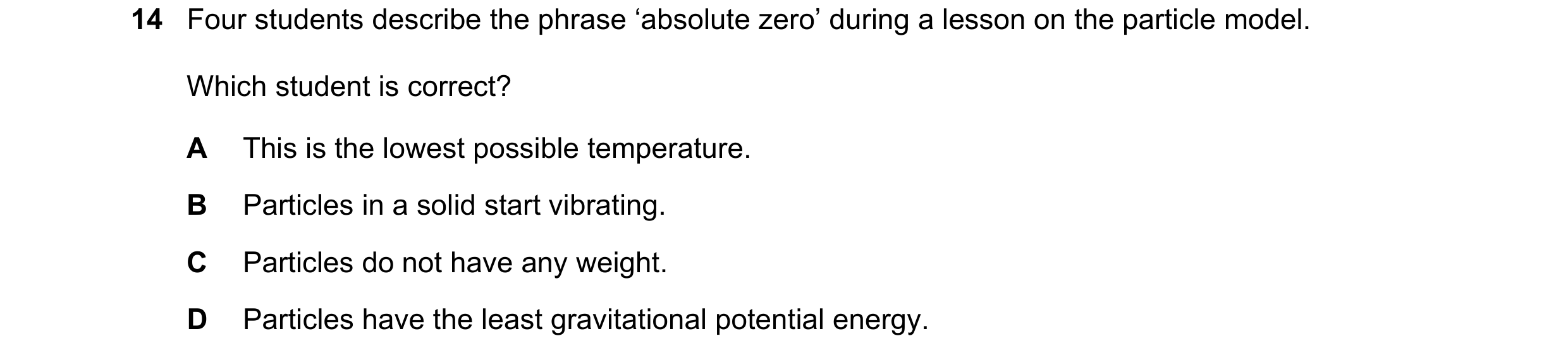
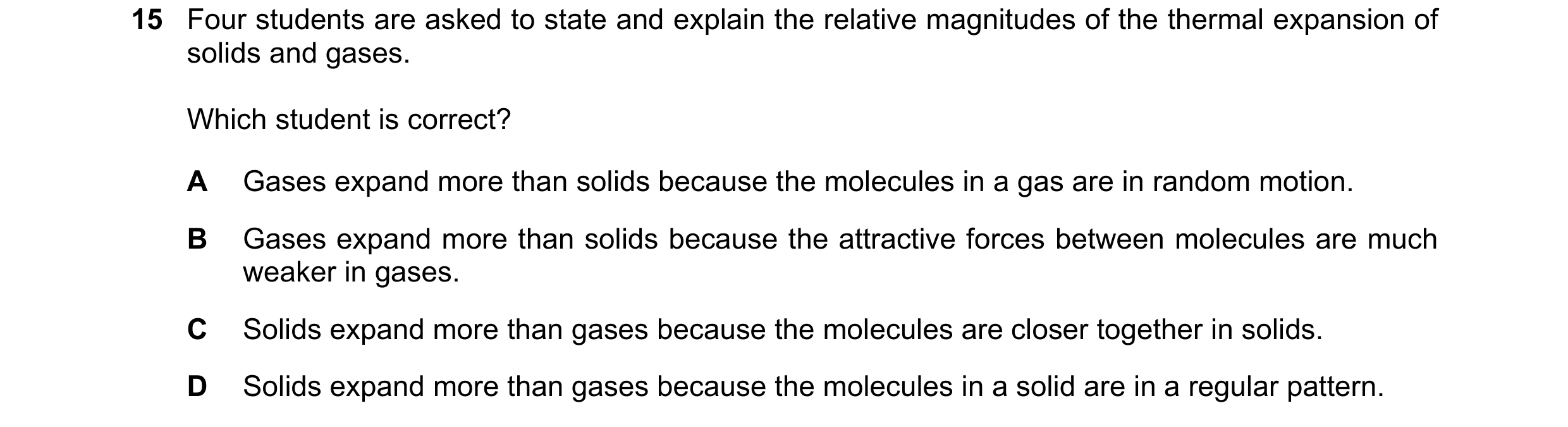

 35 / 50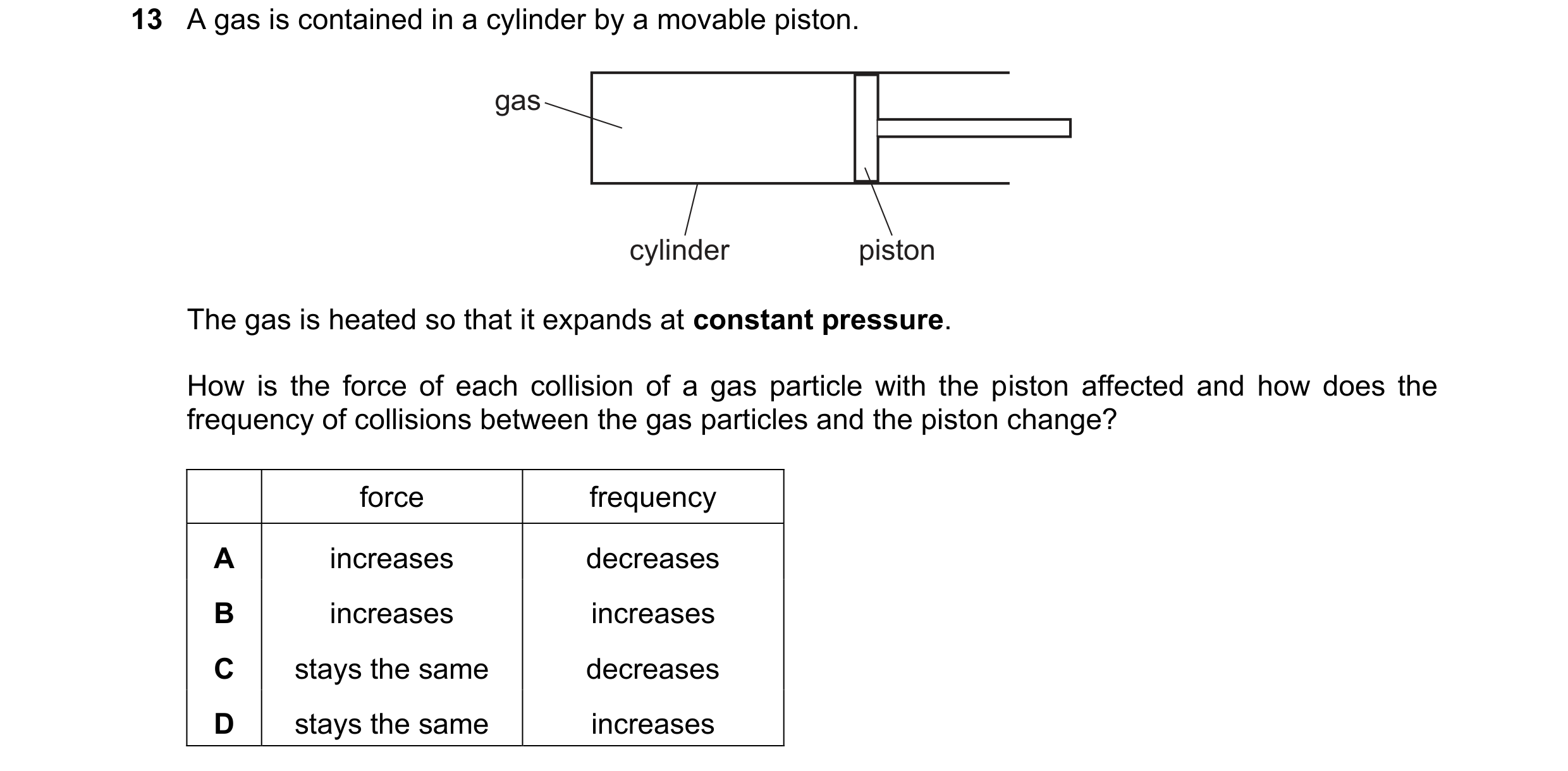
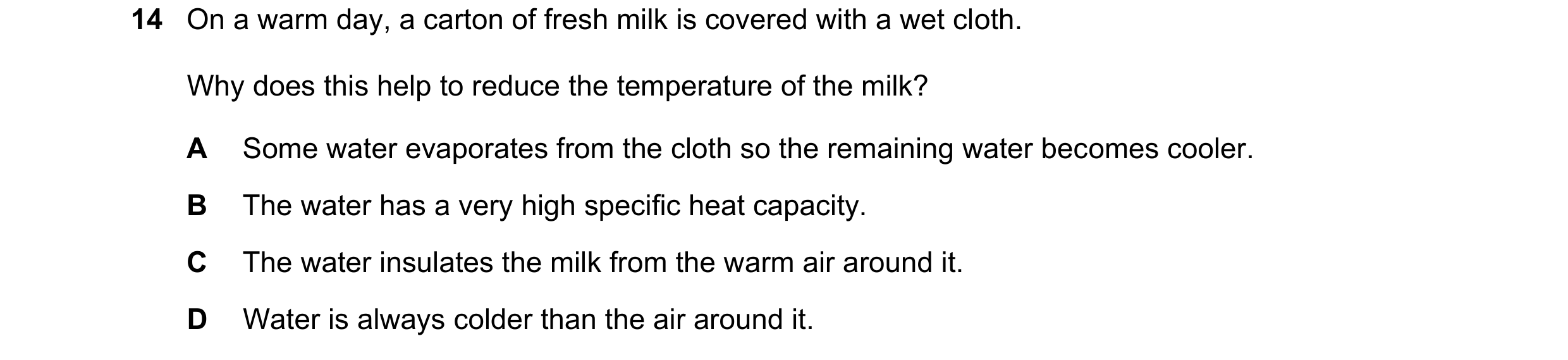
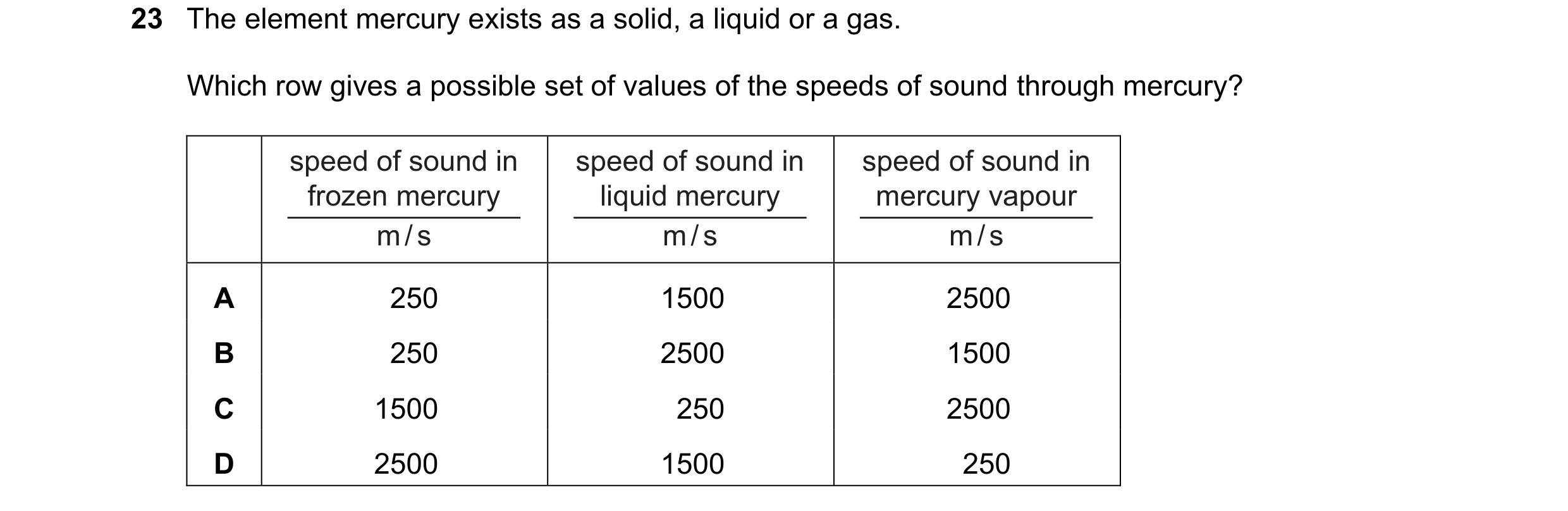
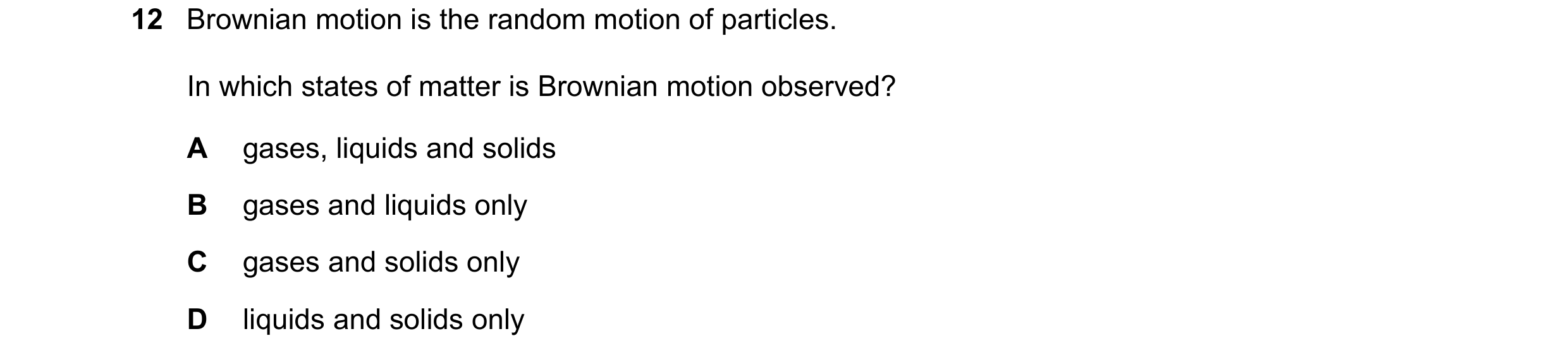 36 / 50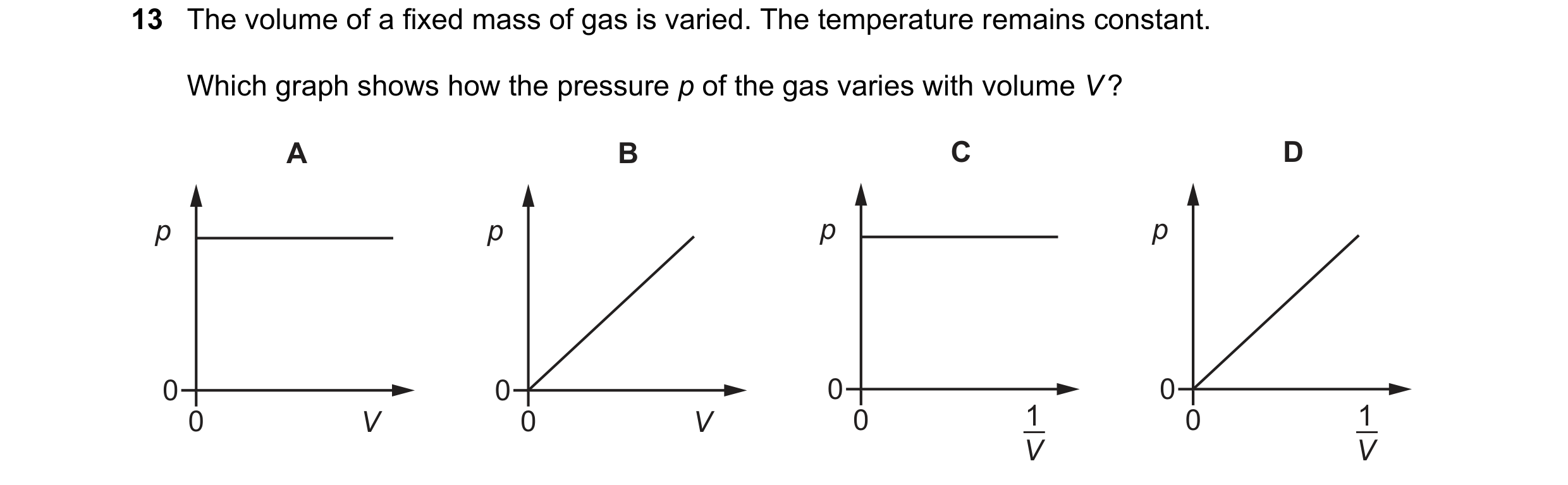
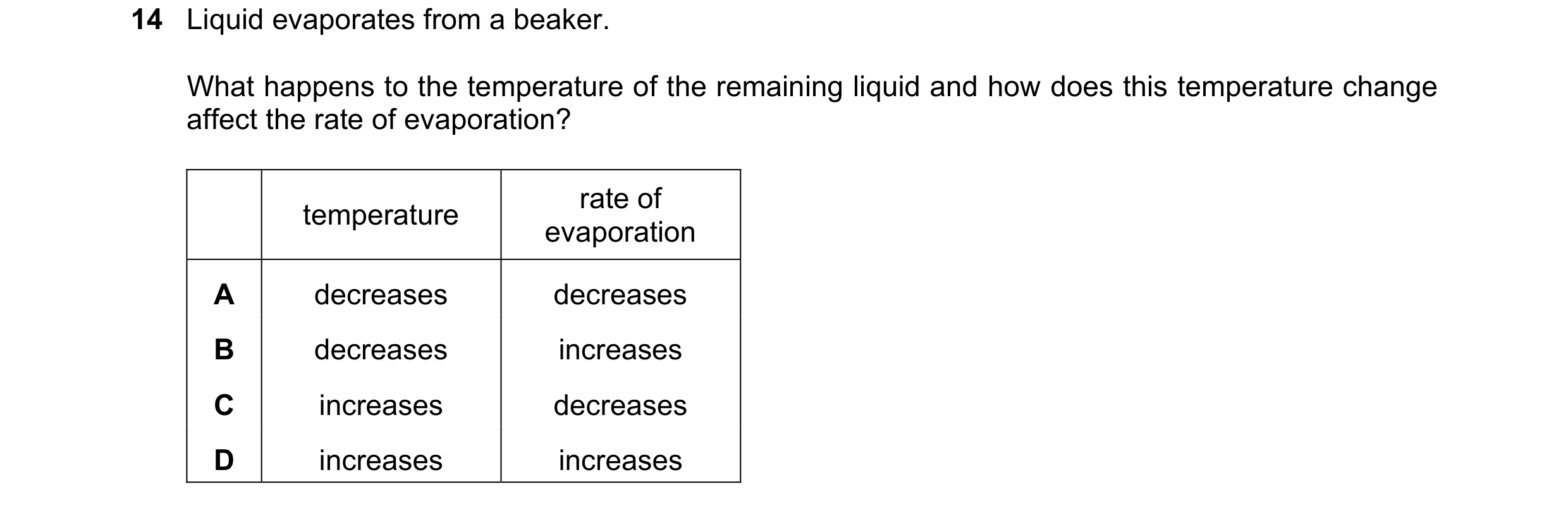
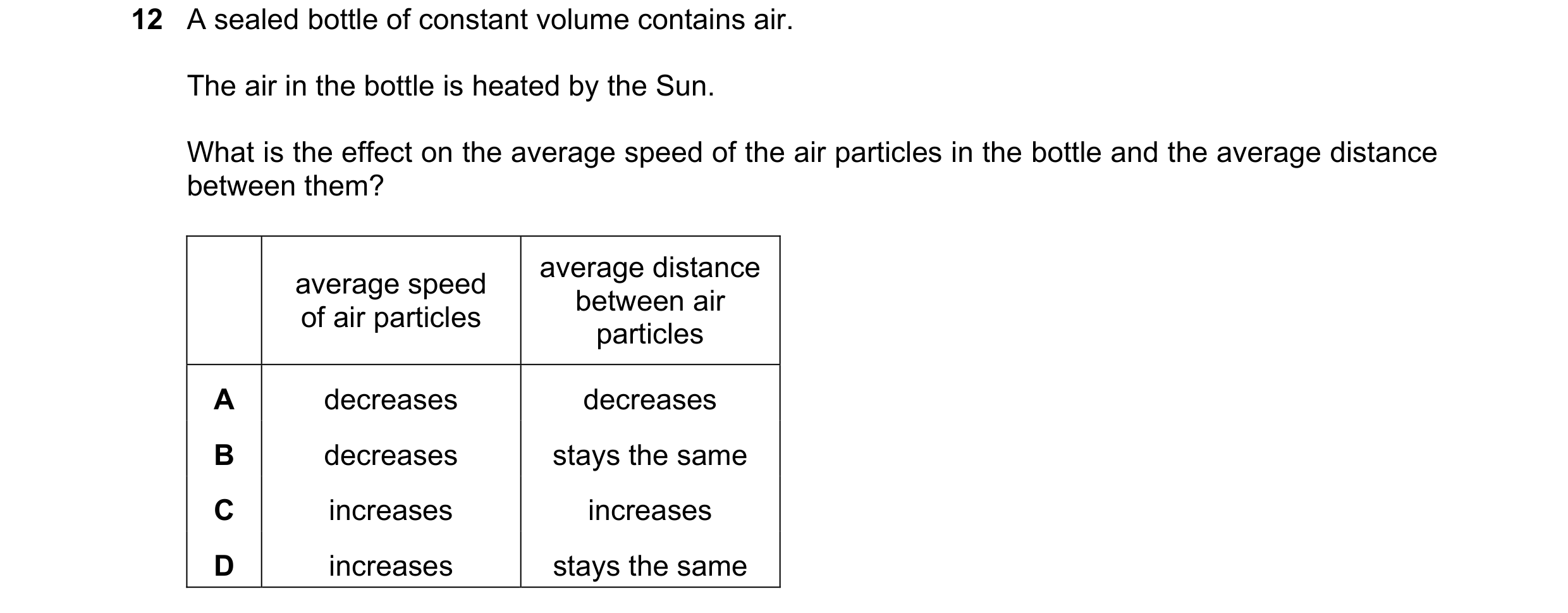 37 / 50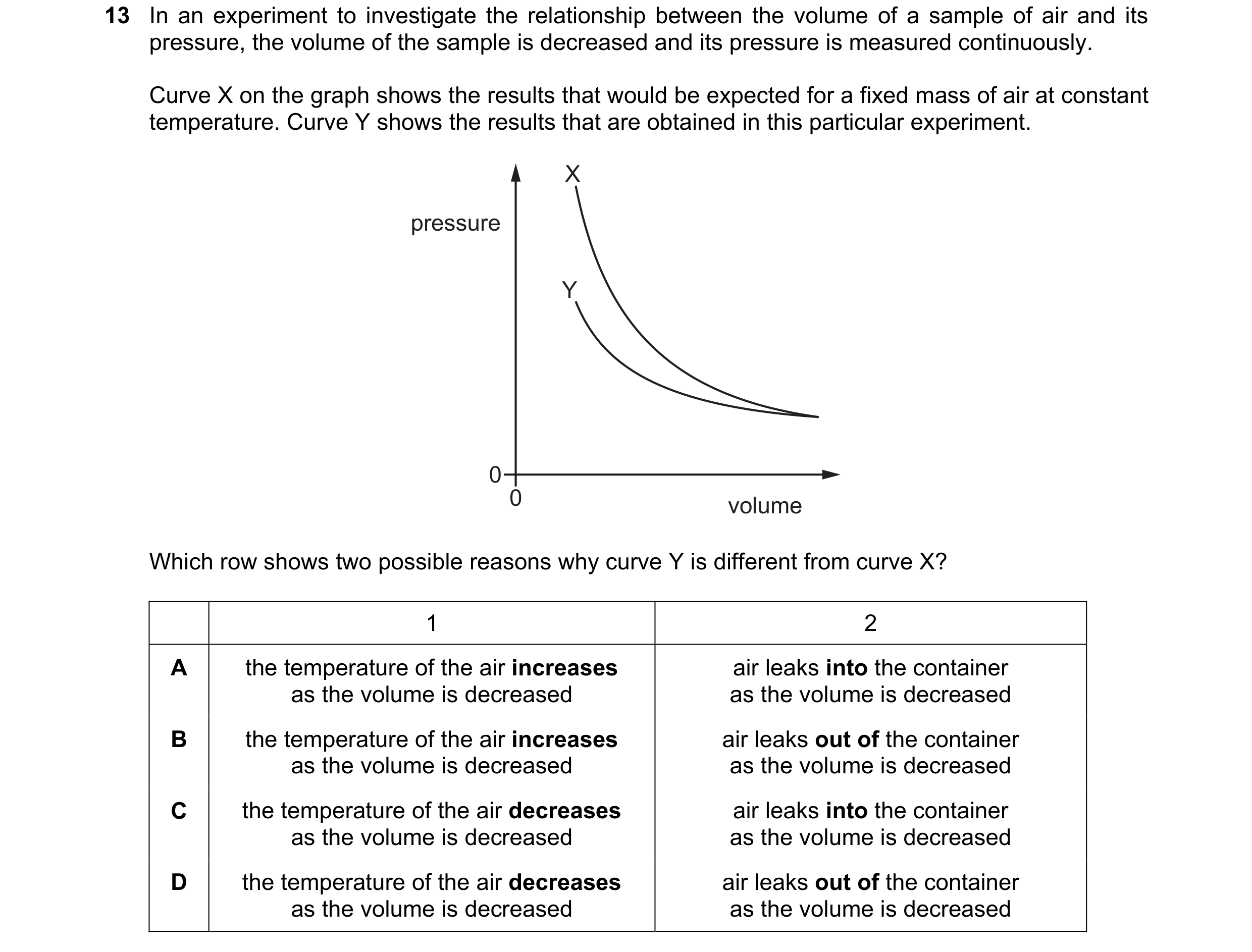
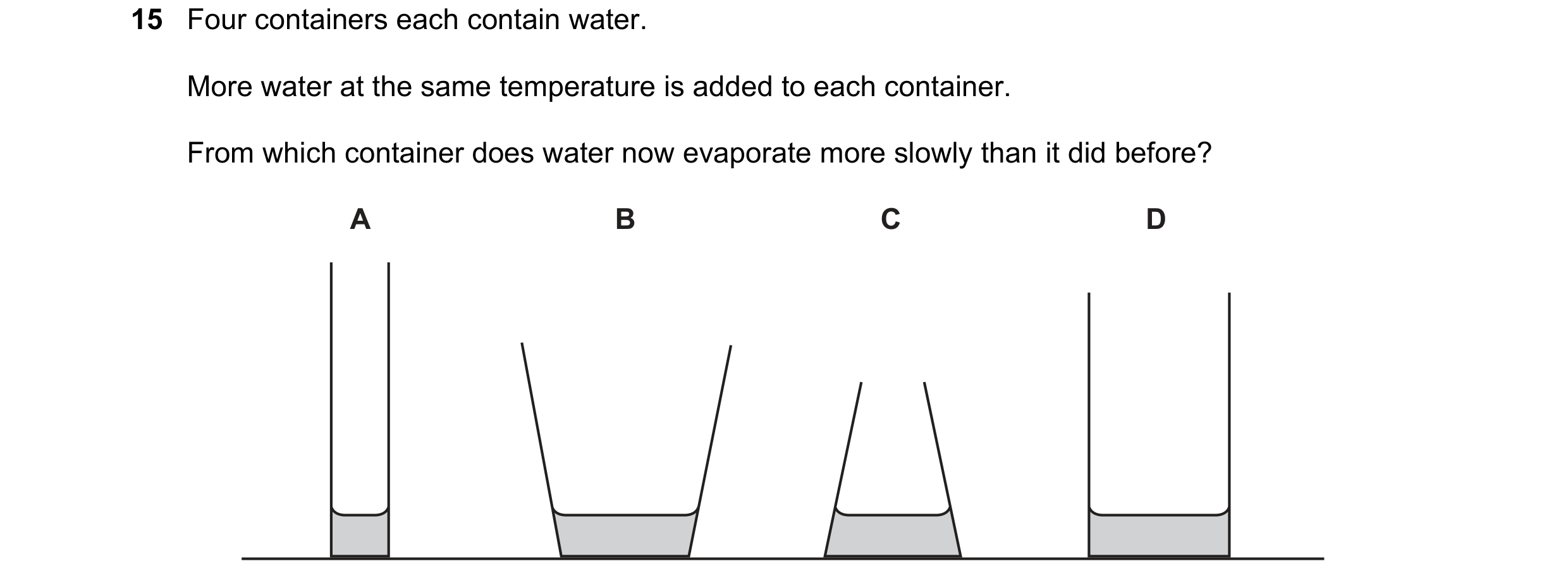
 38 / 50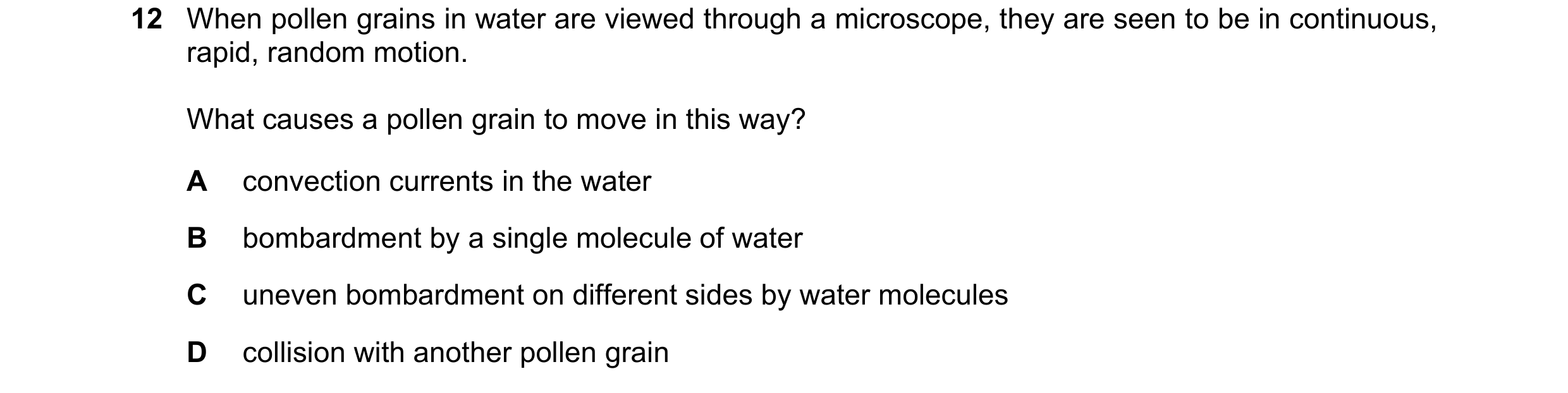
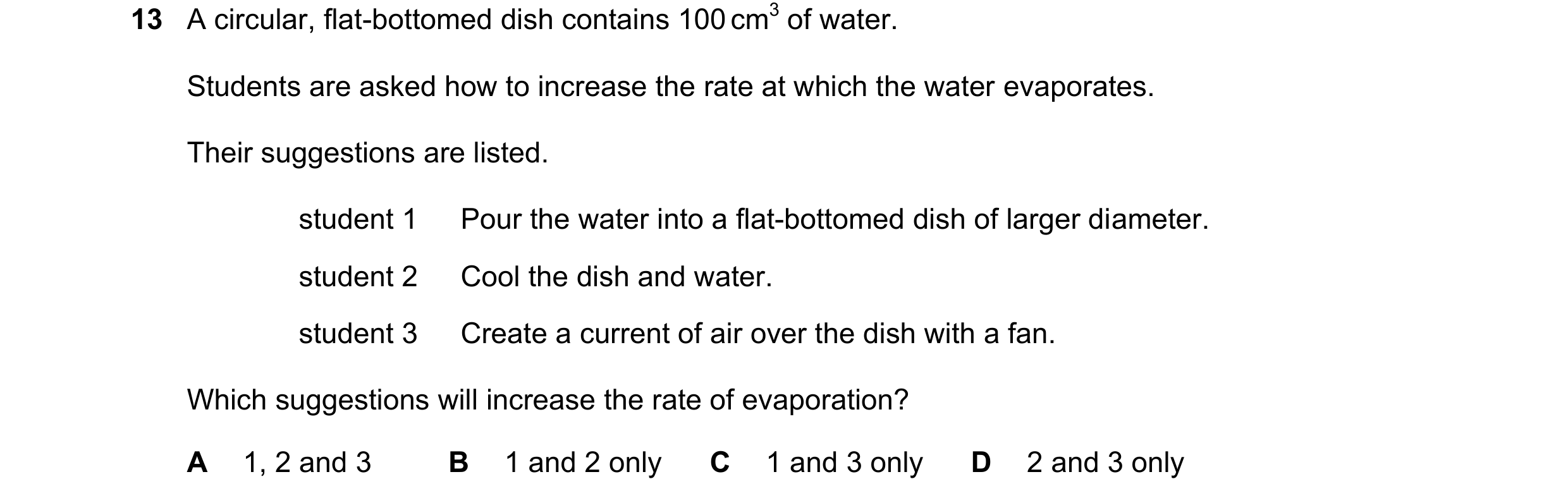
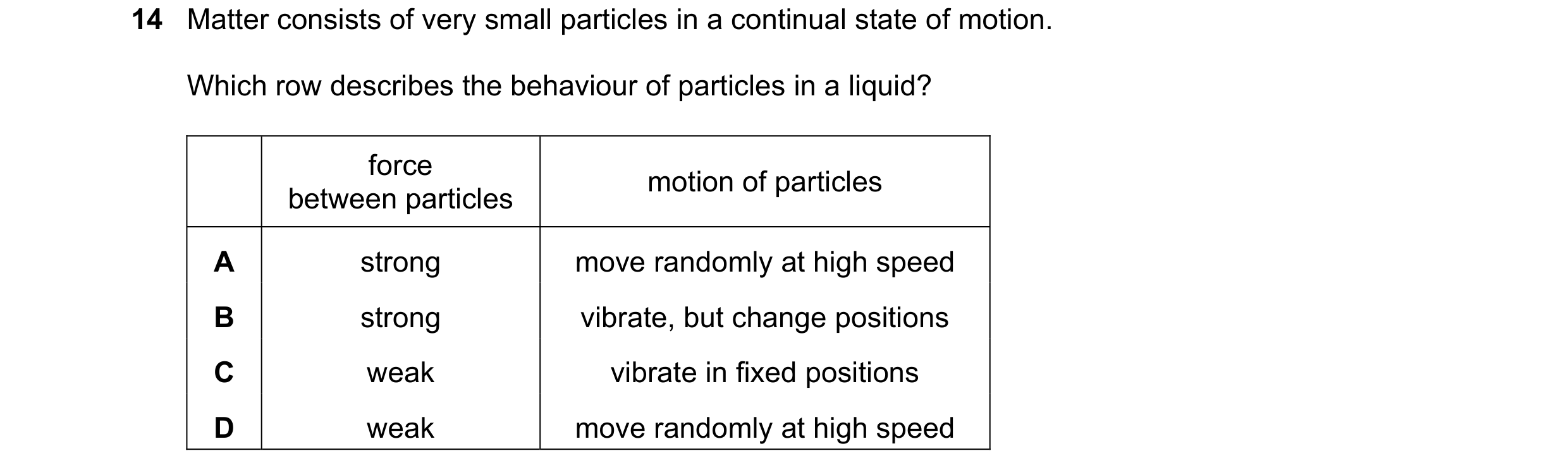
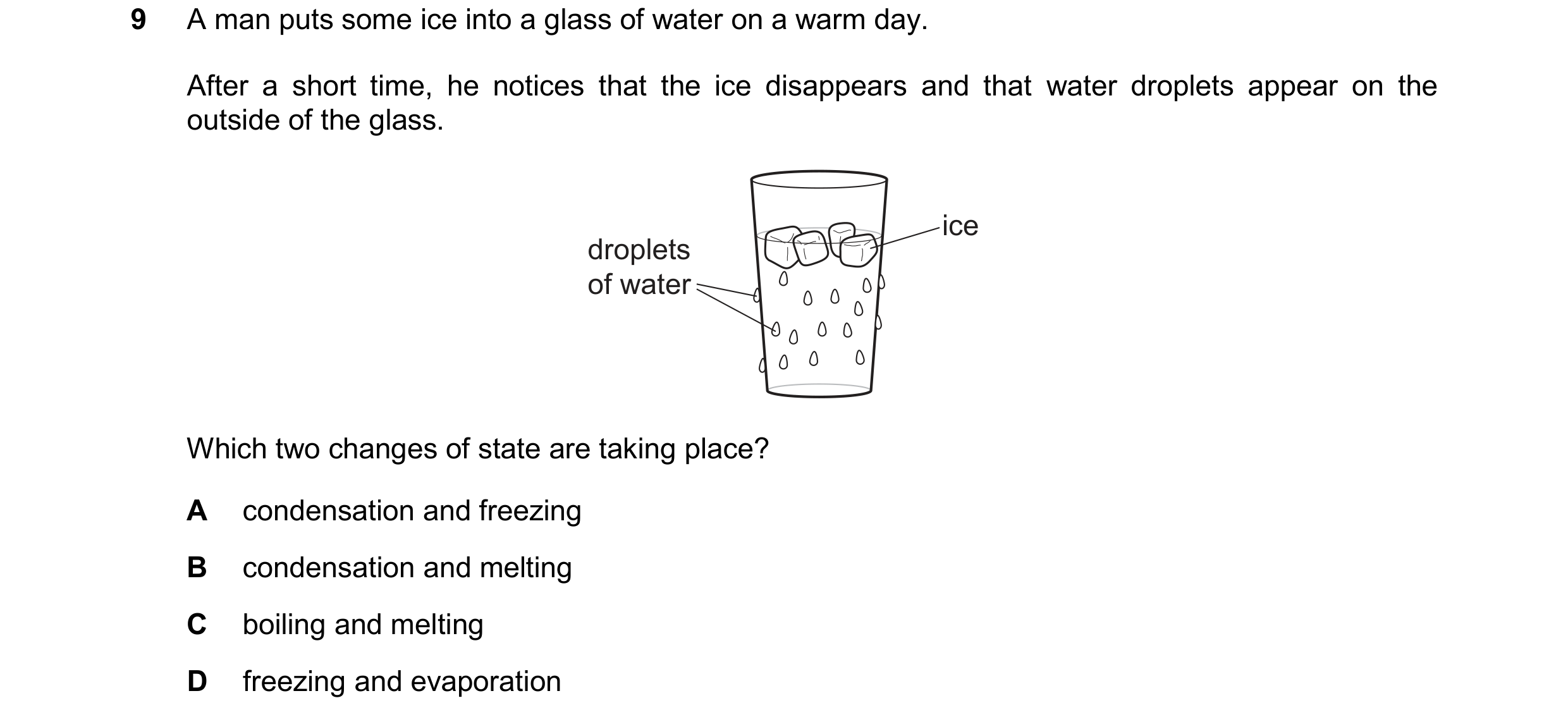 39 / 50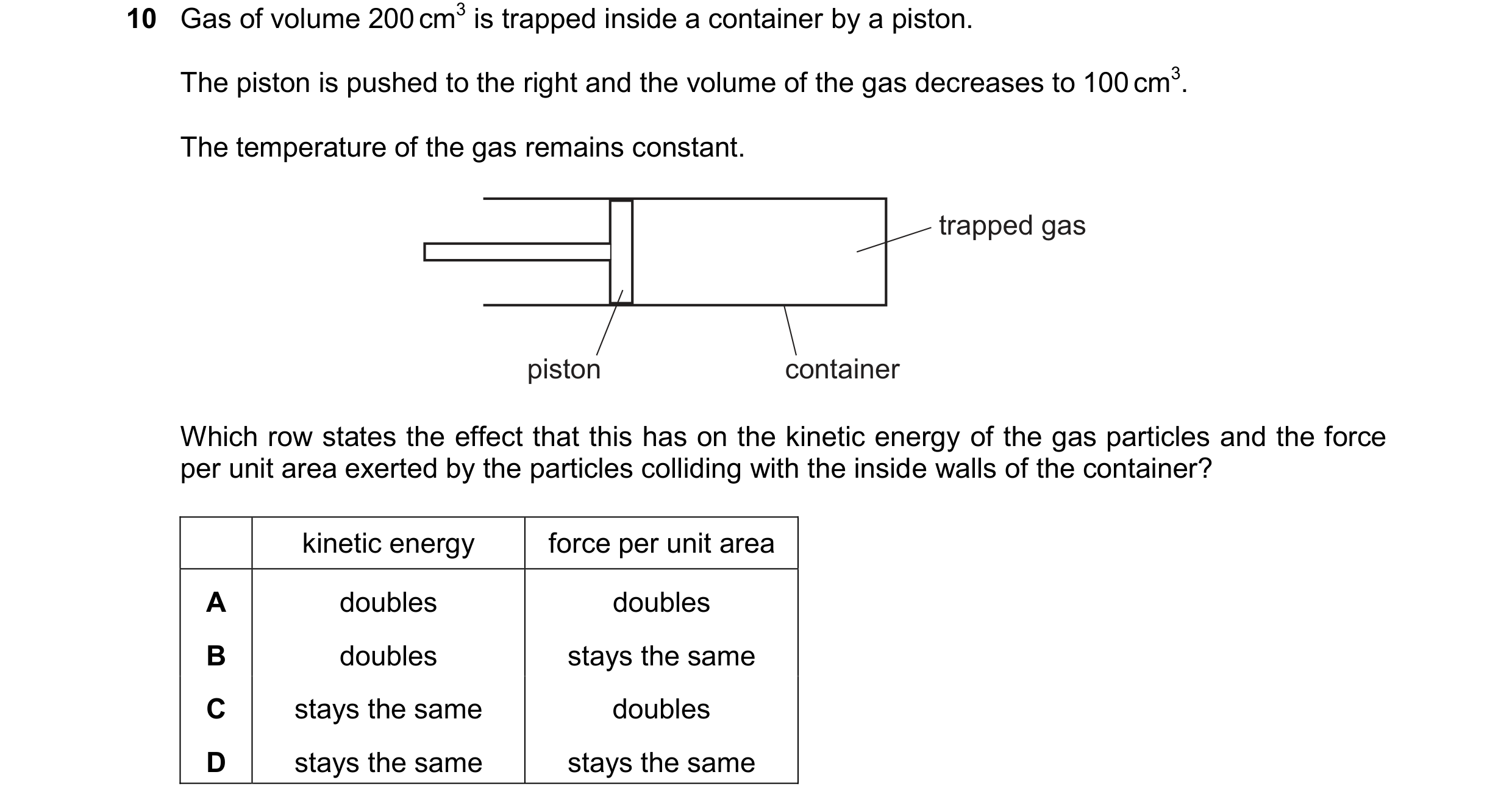
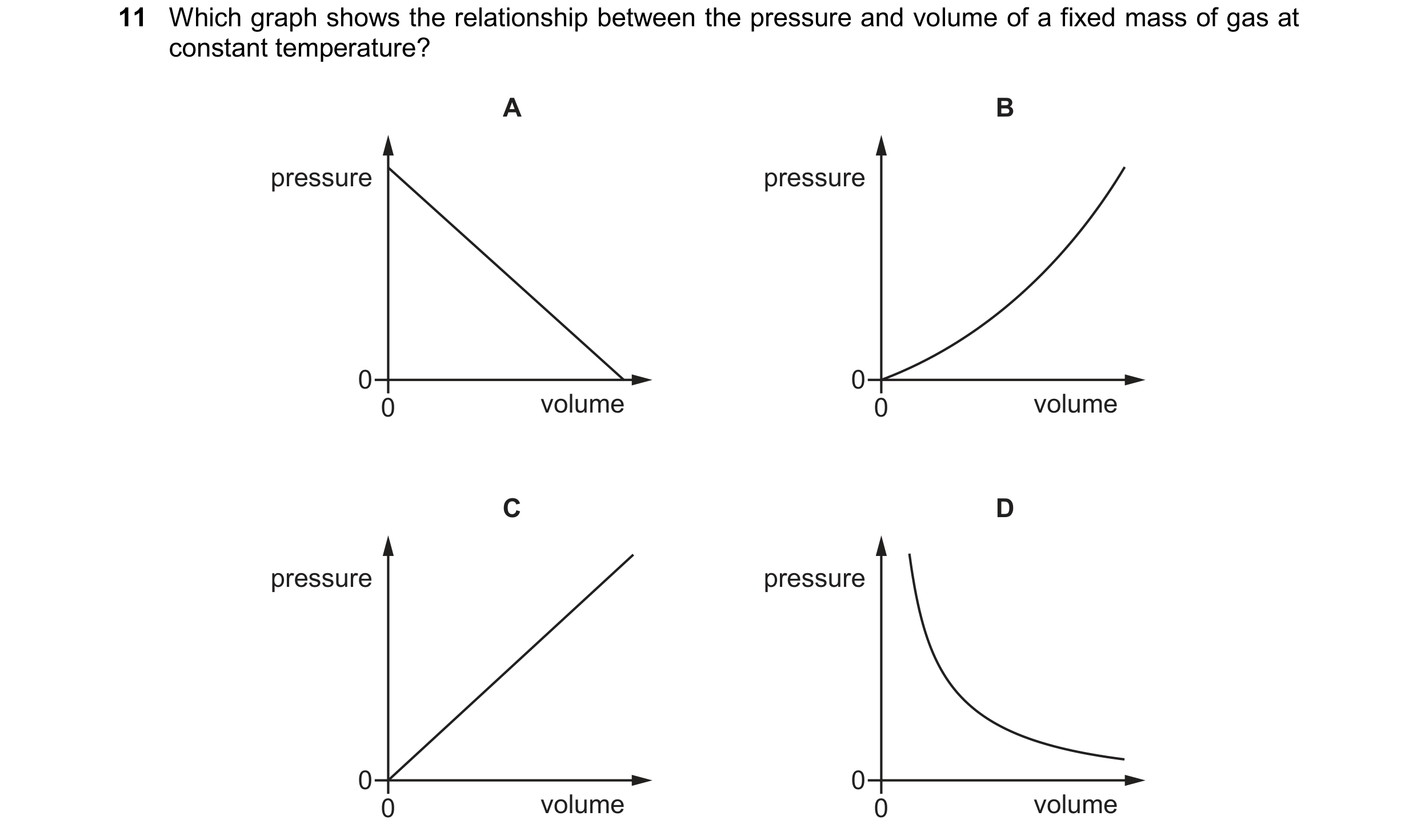 40 / 50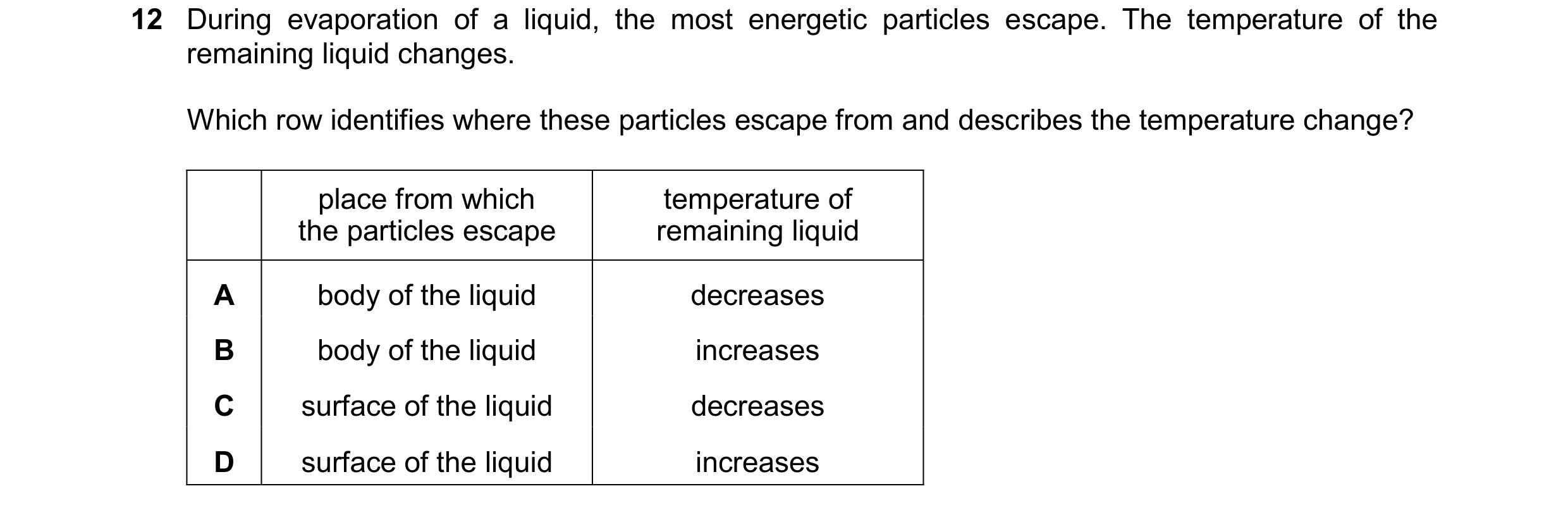
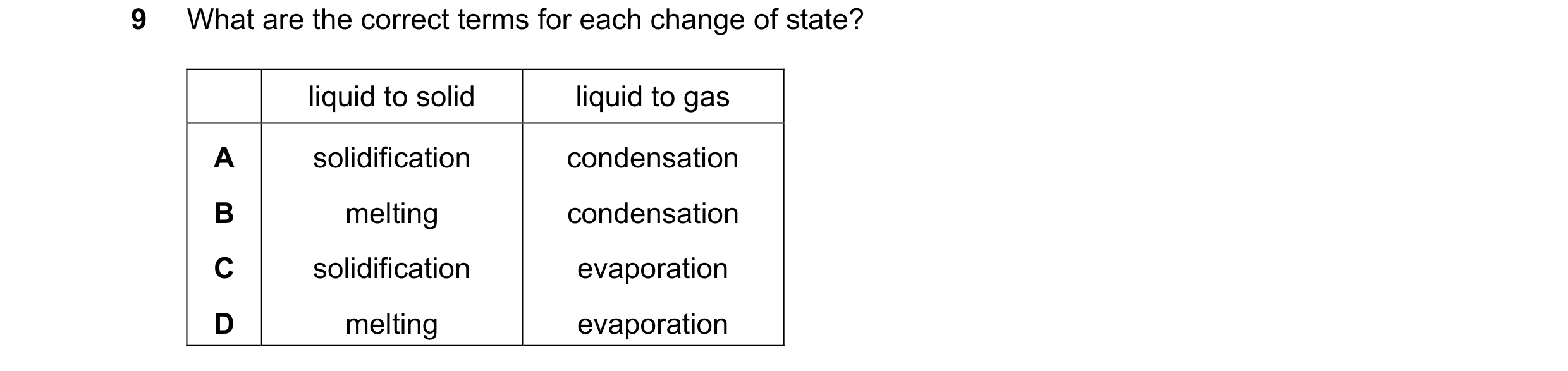
 41 / 50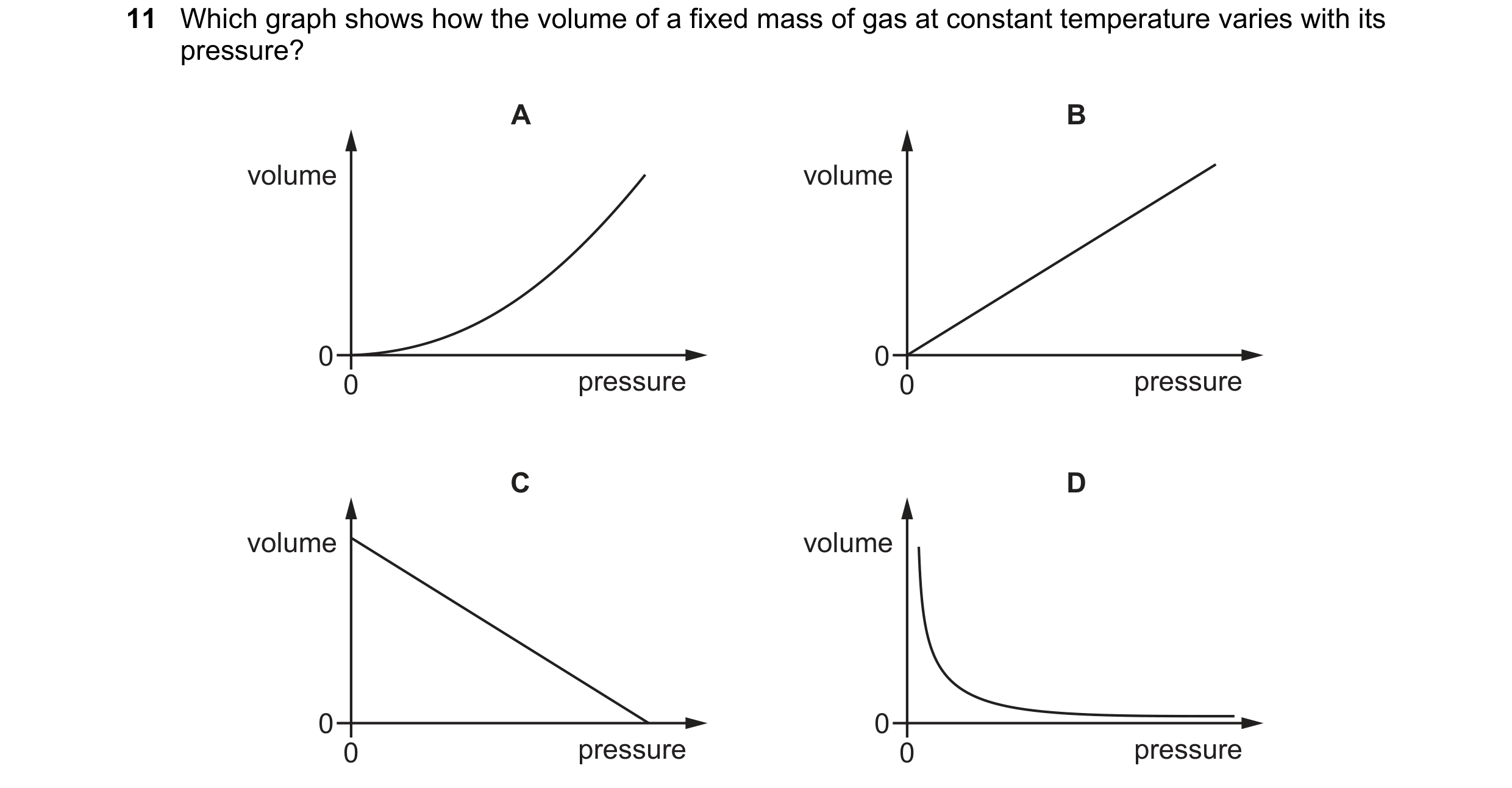
 42 / 50
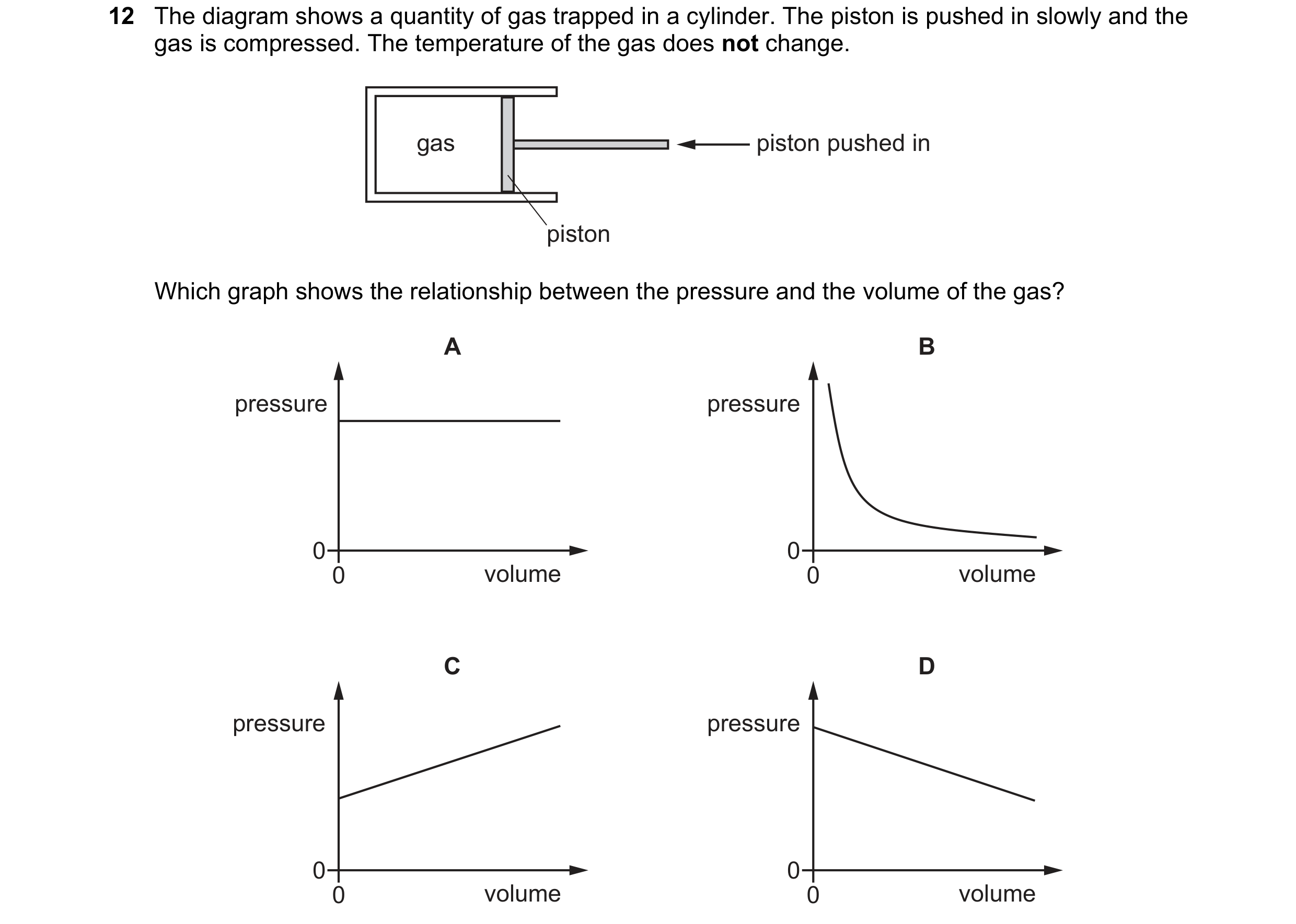 43 / 50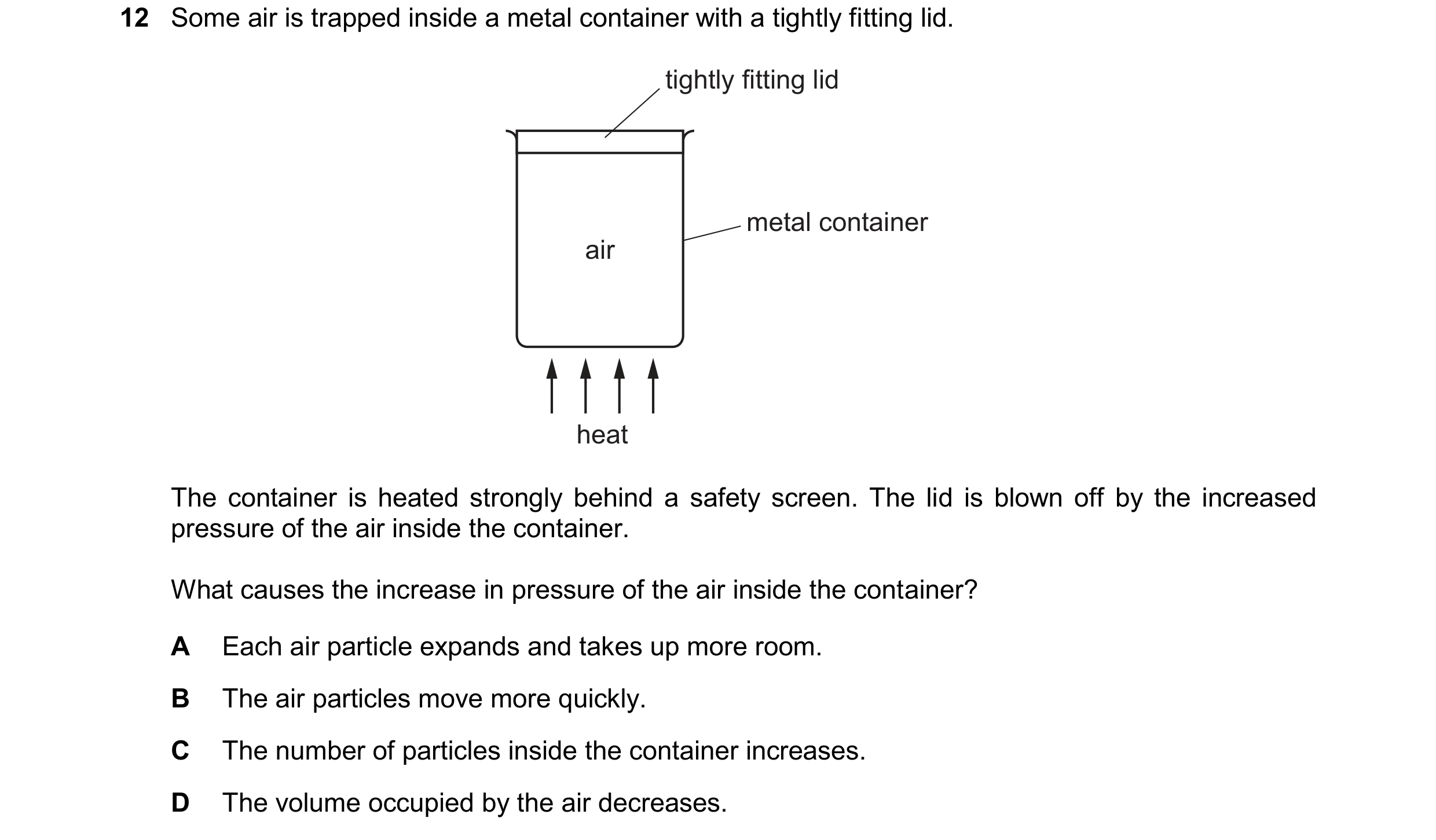
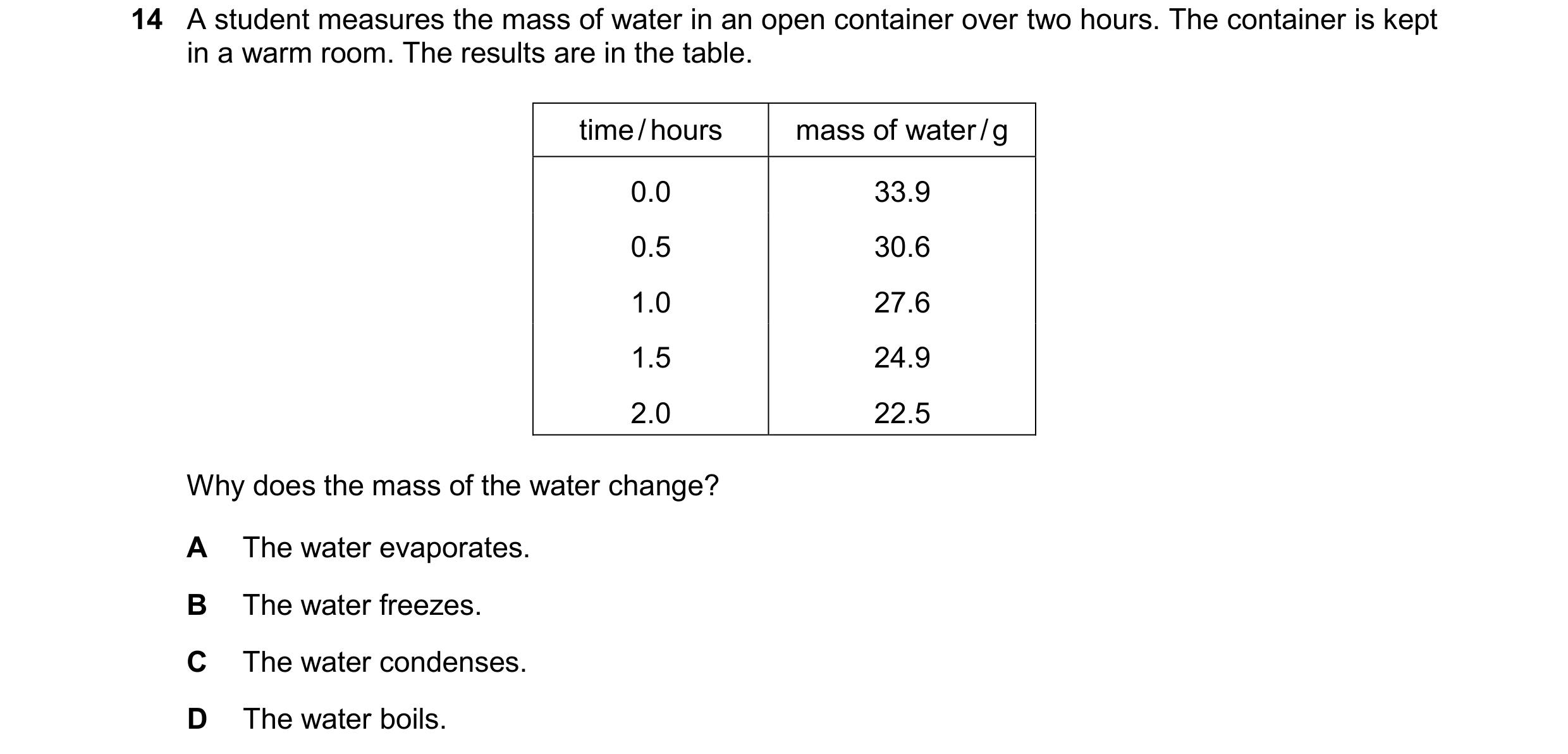
 44 / 50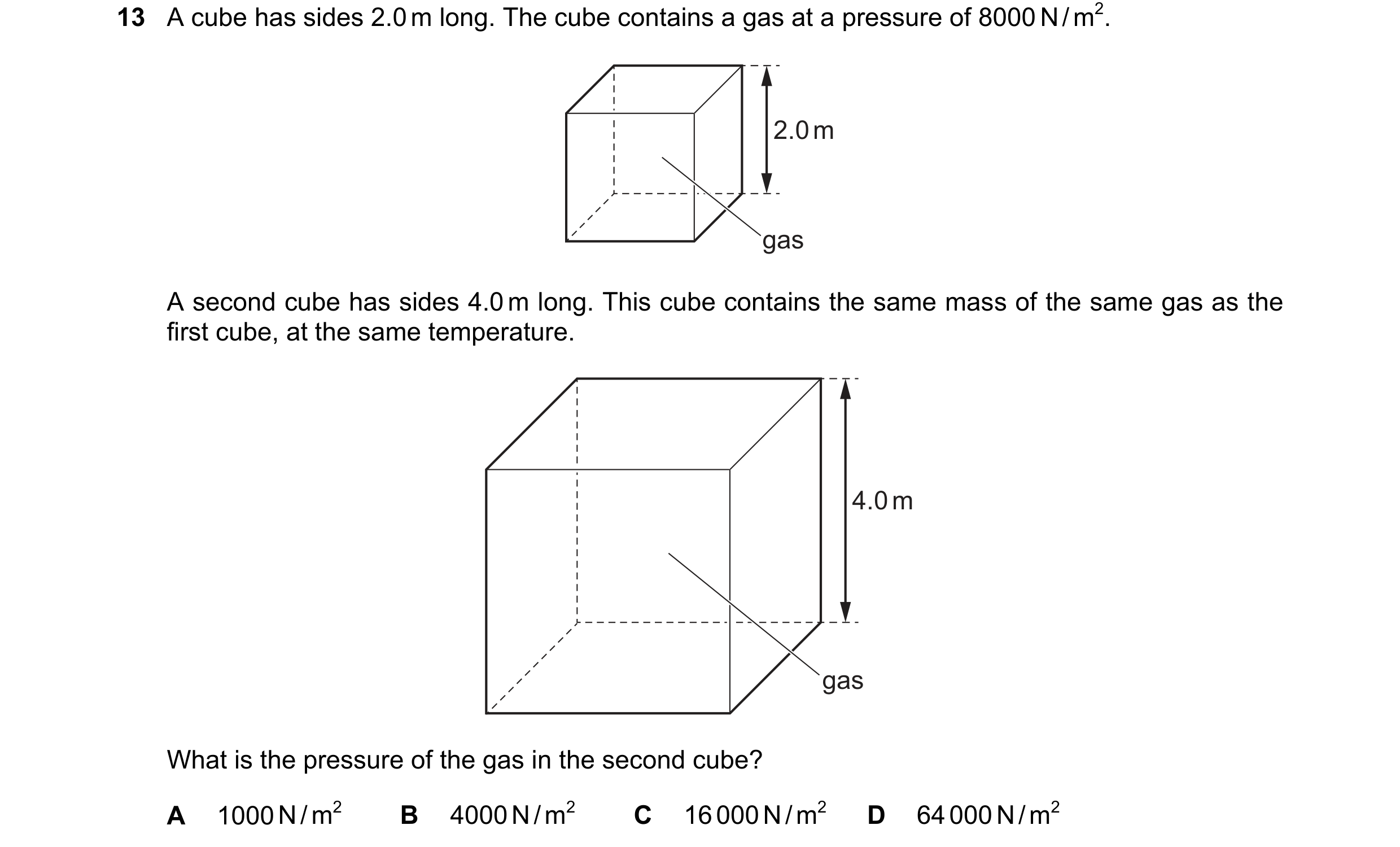
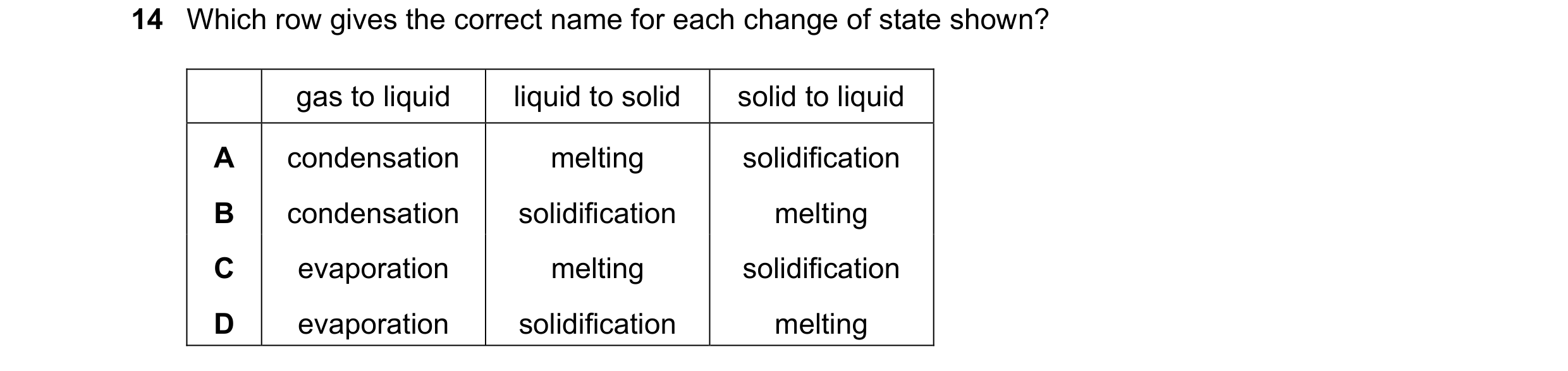
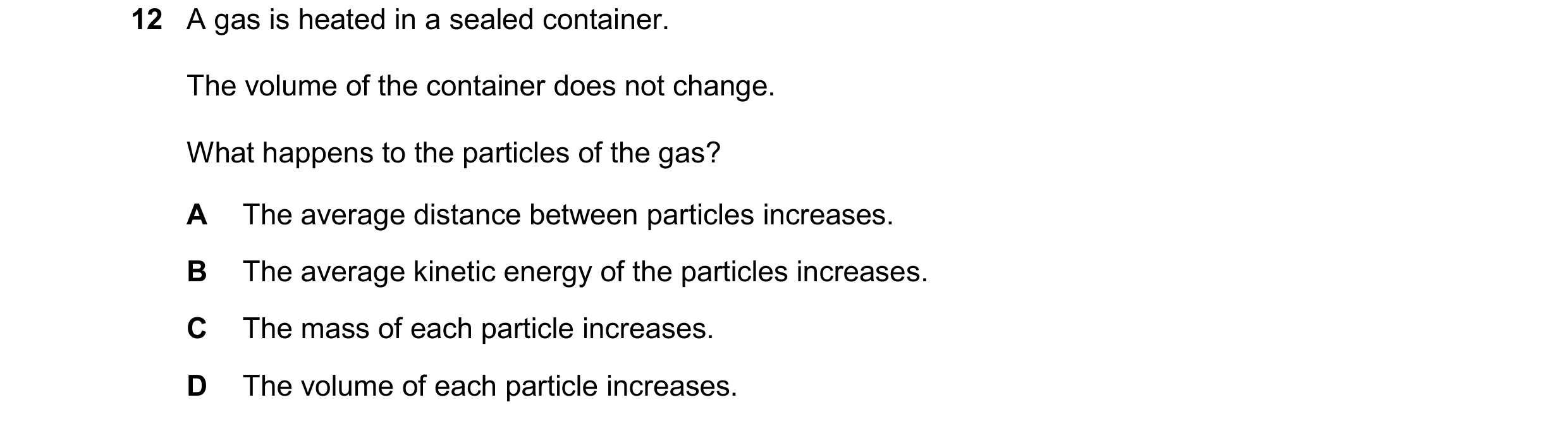 45 / 50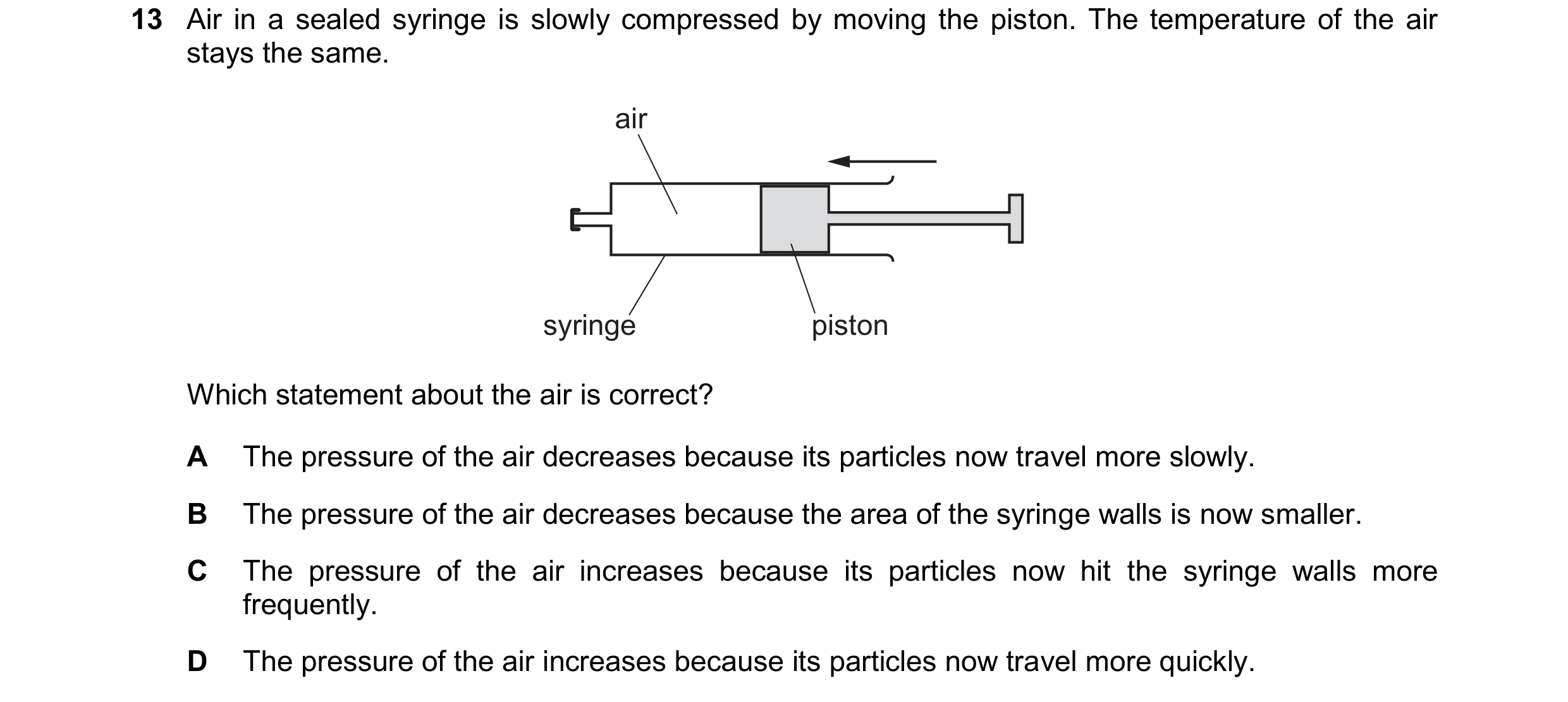
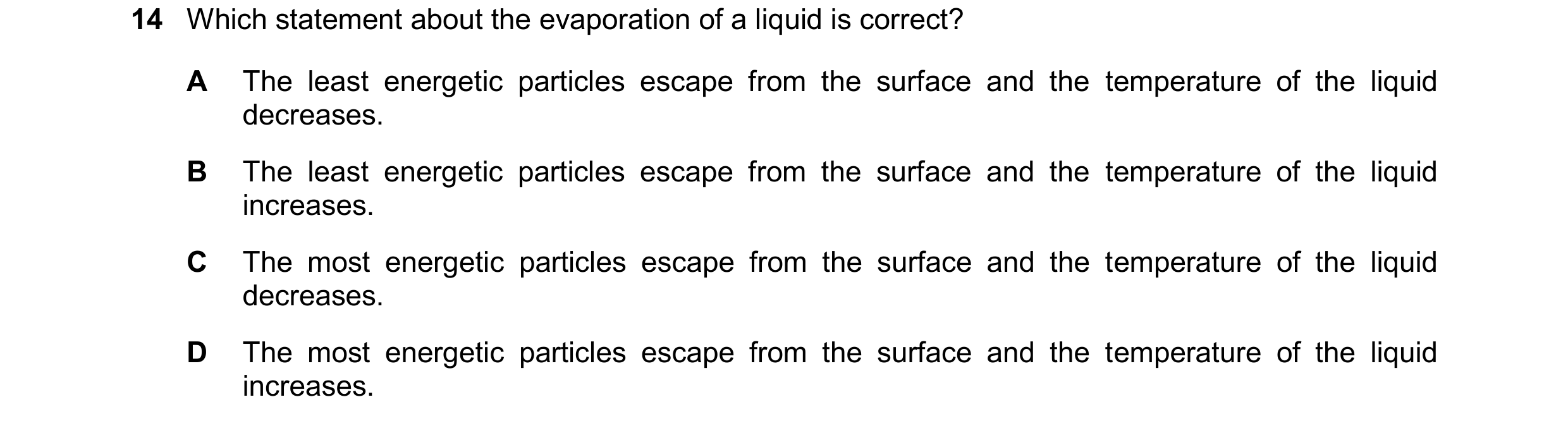
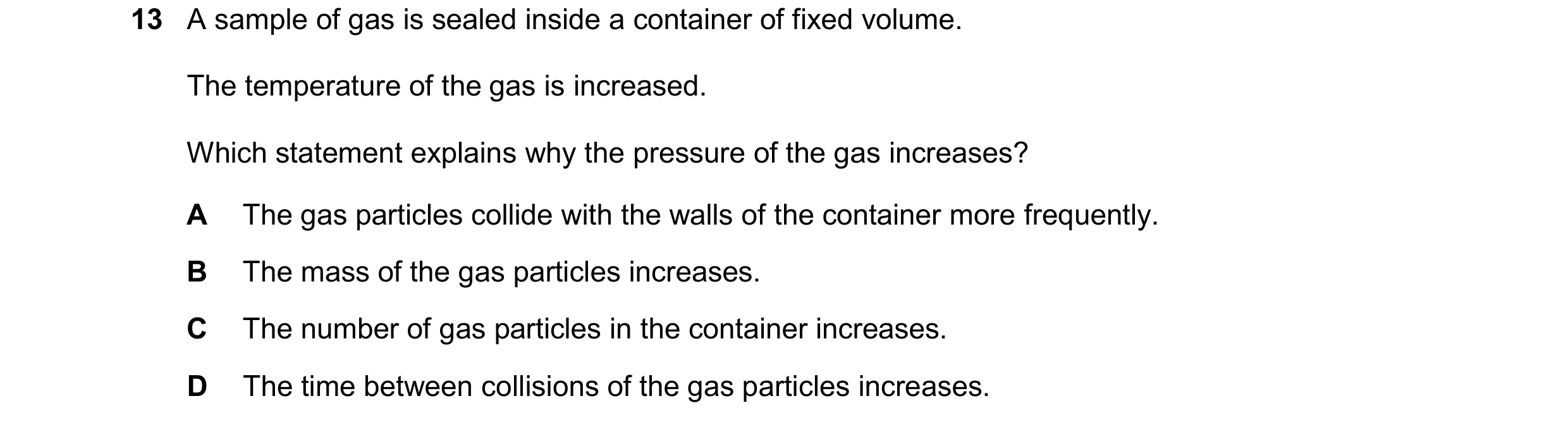
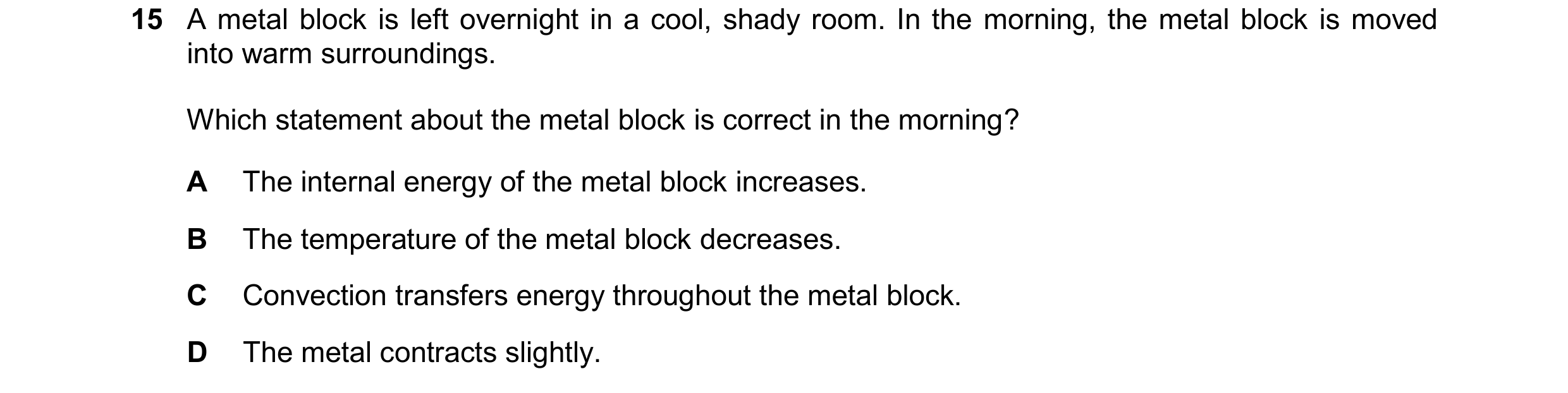 46 / 50
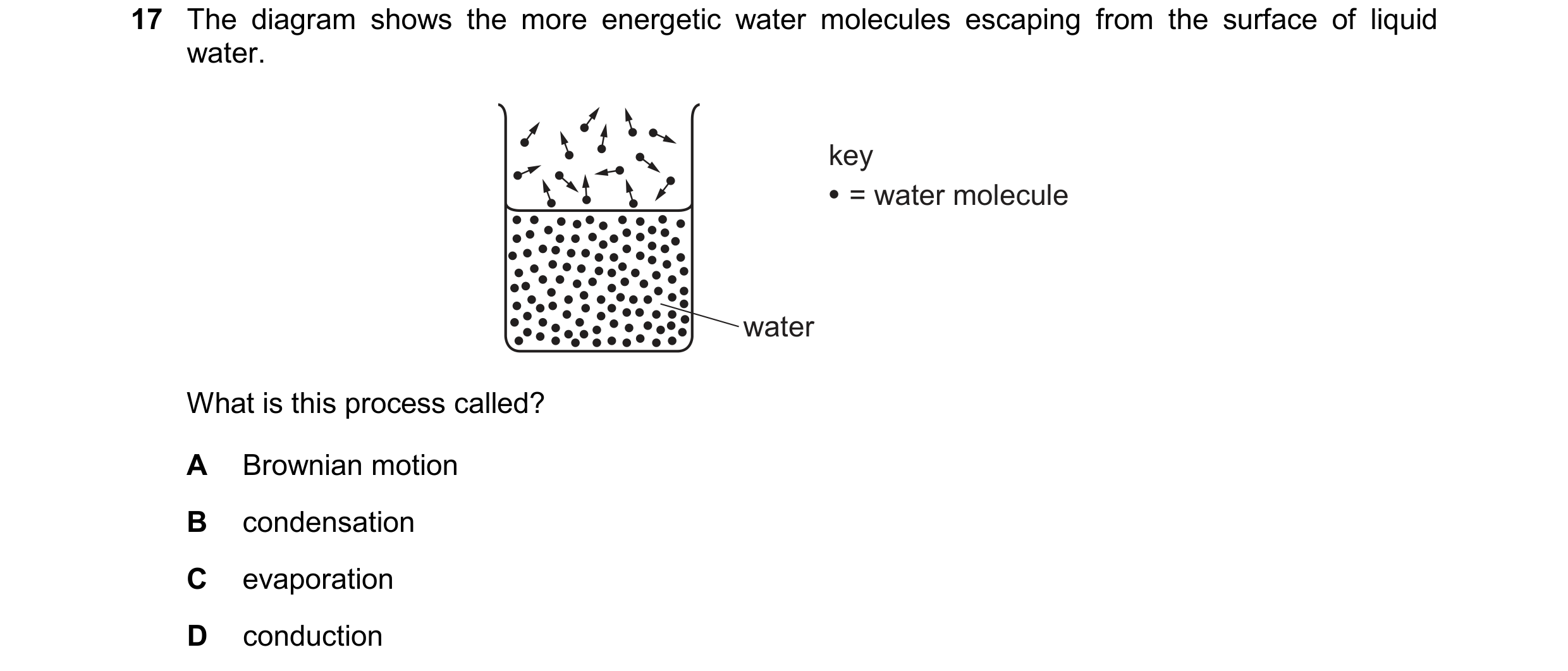
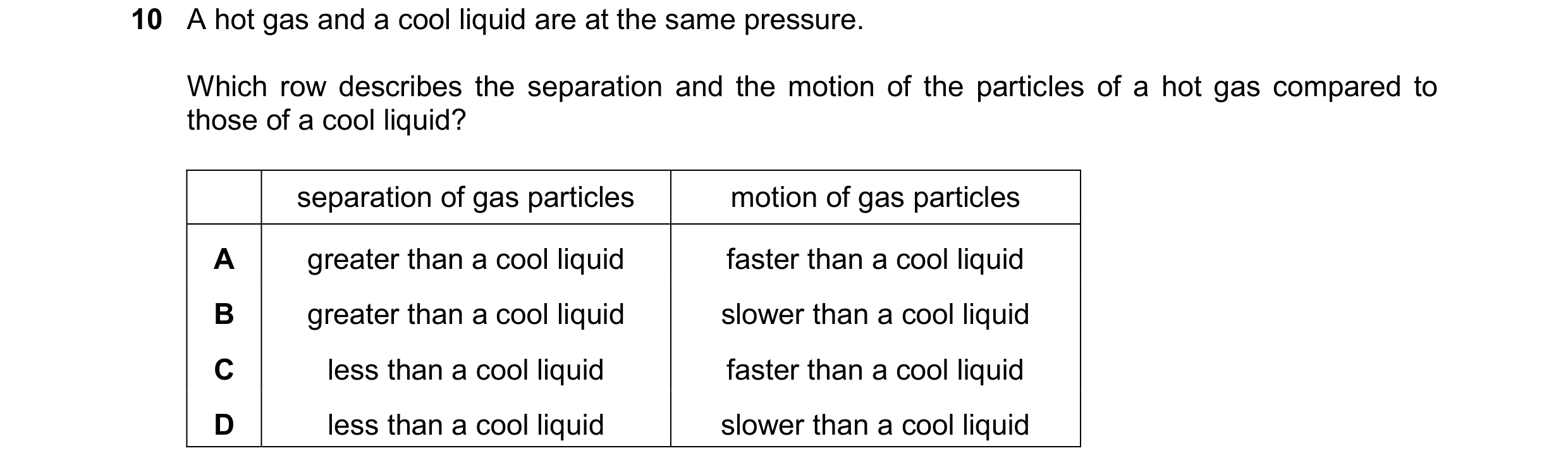

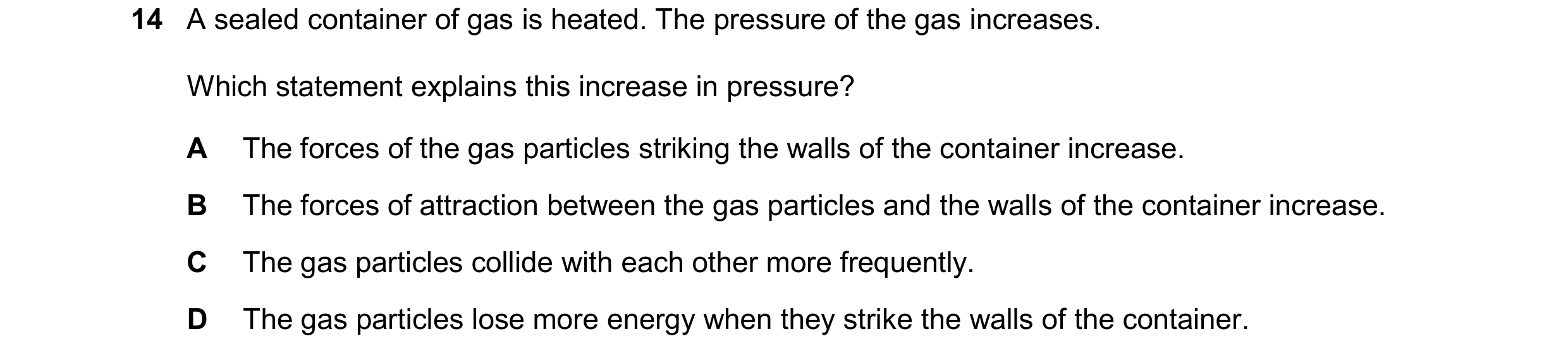 47 / 50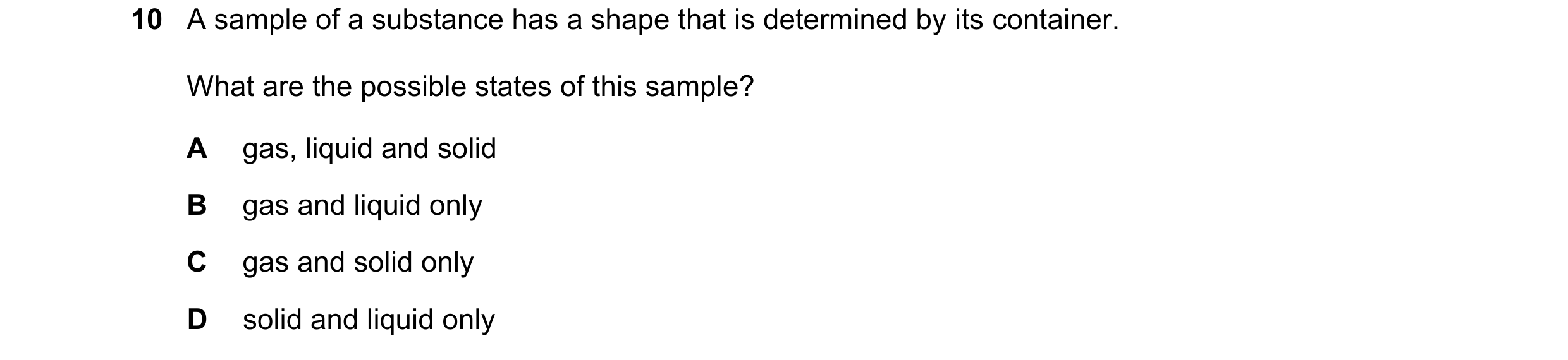
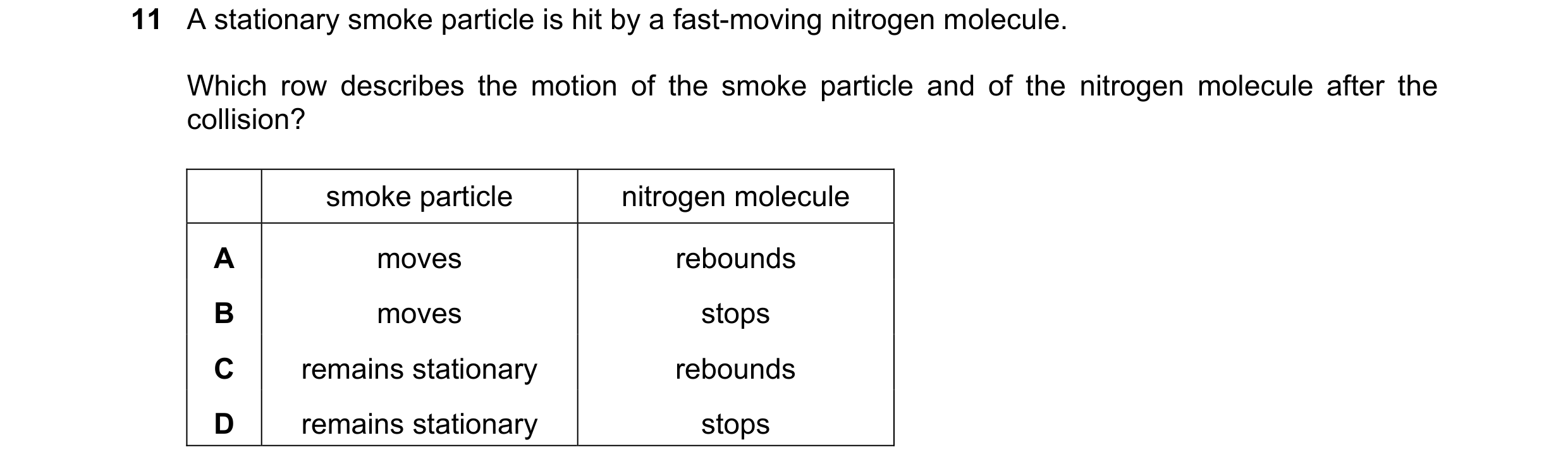
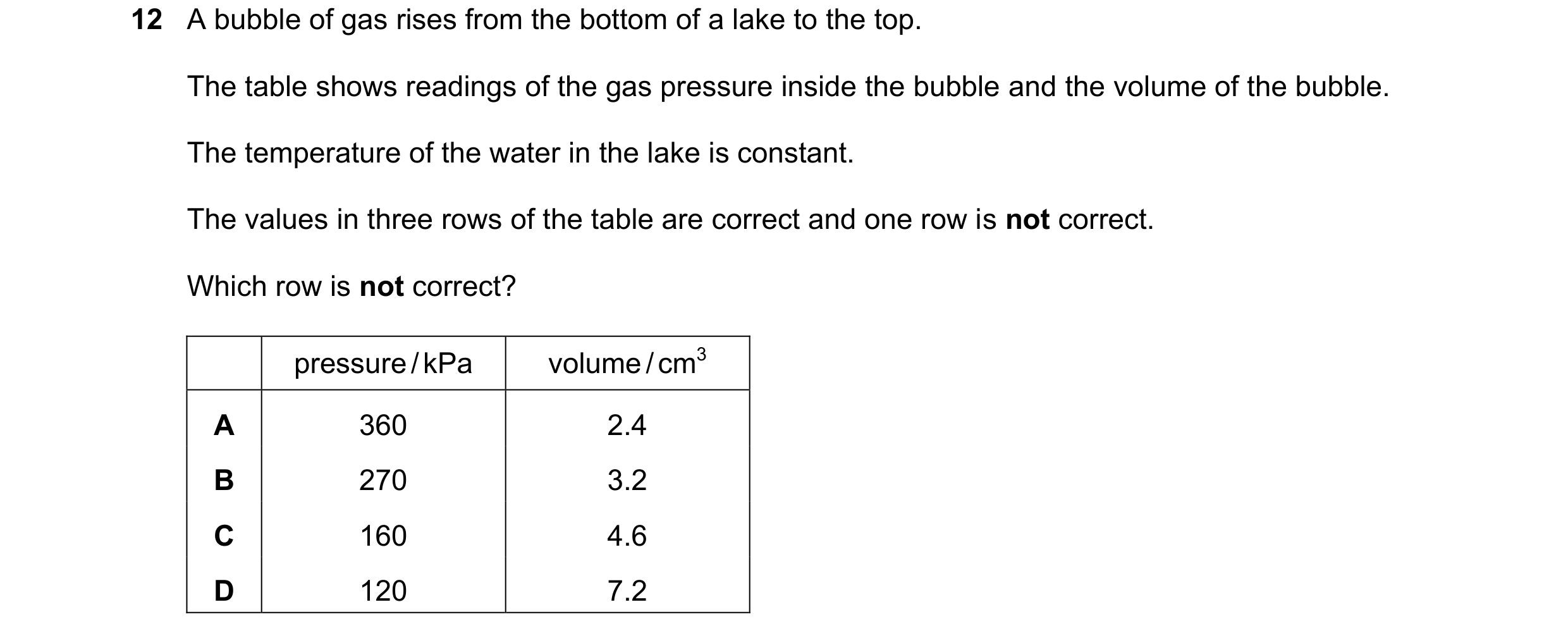
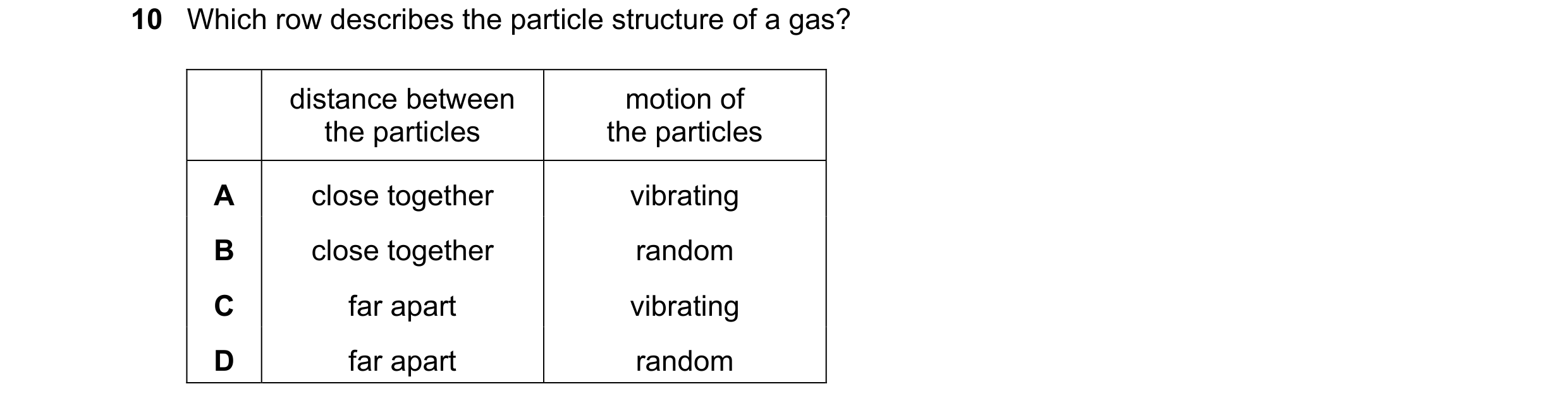 48 / 50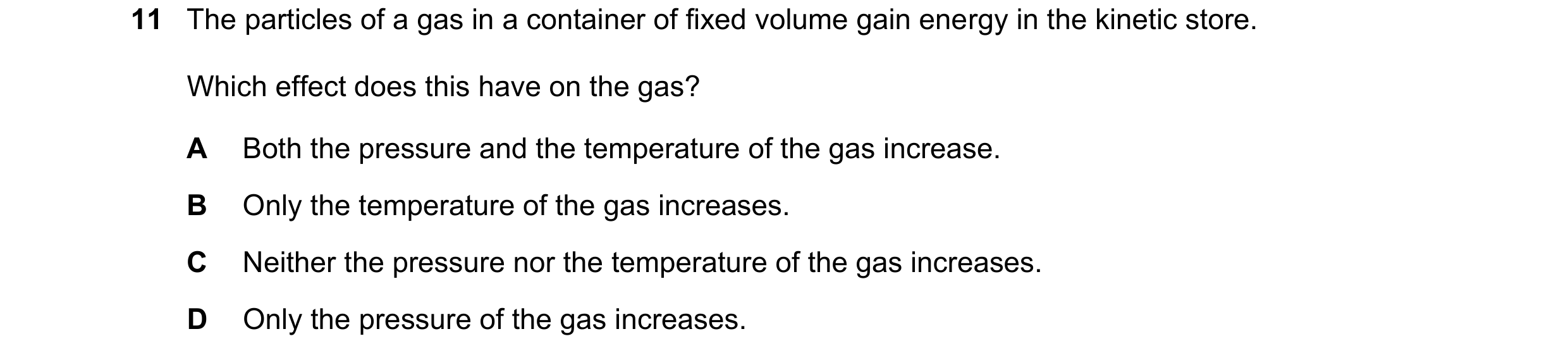
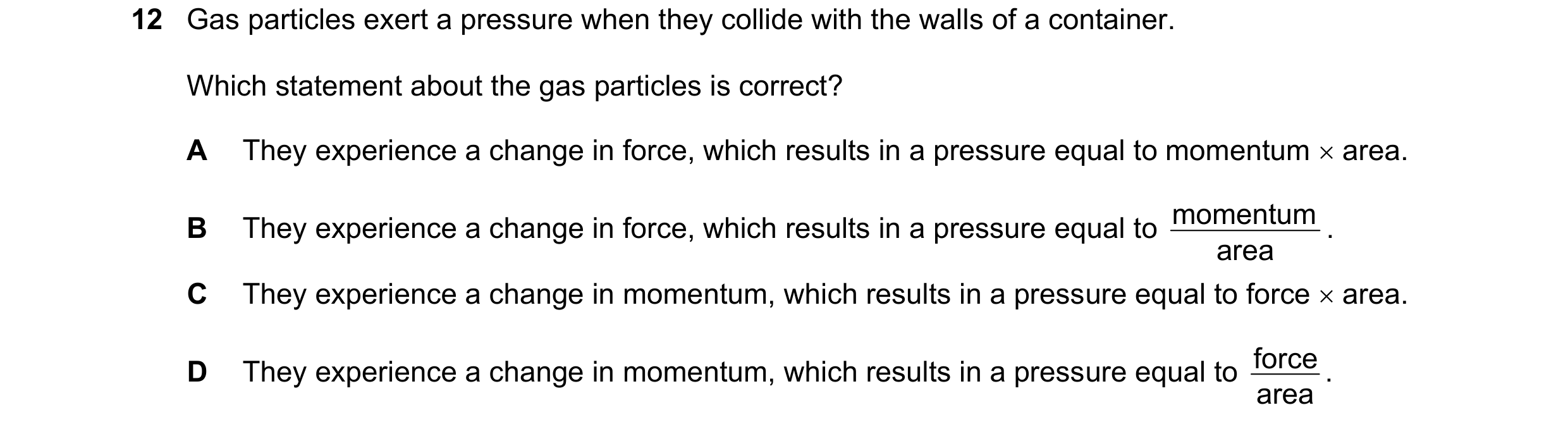
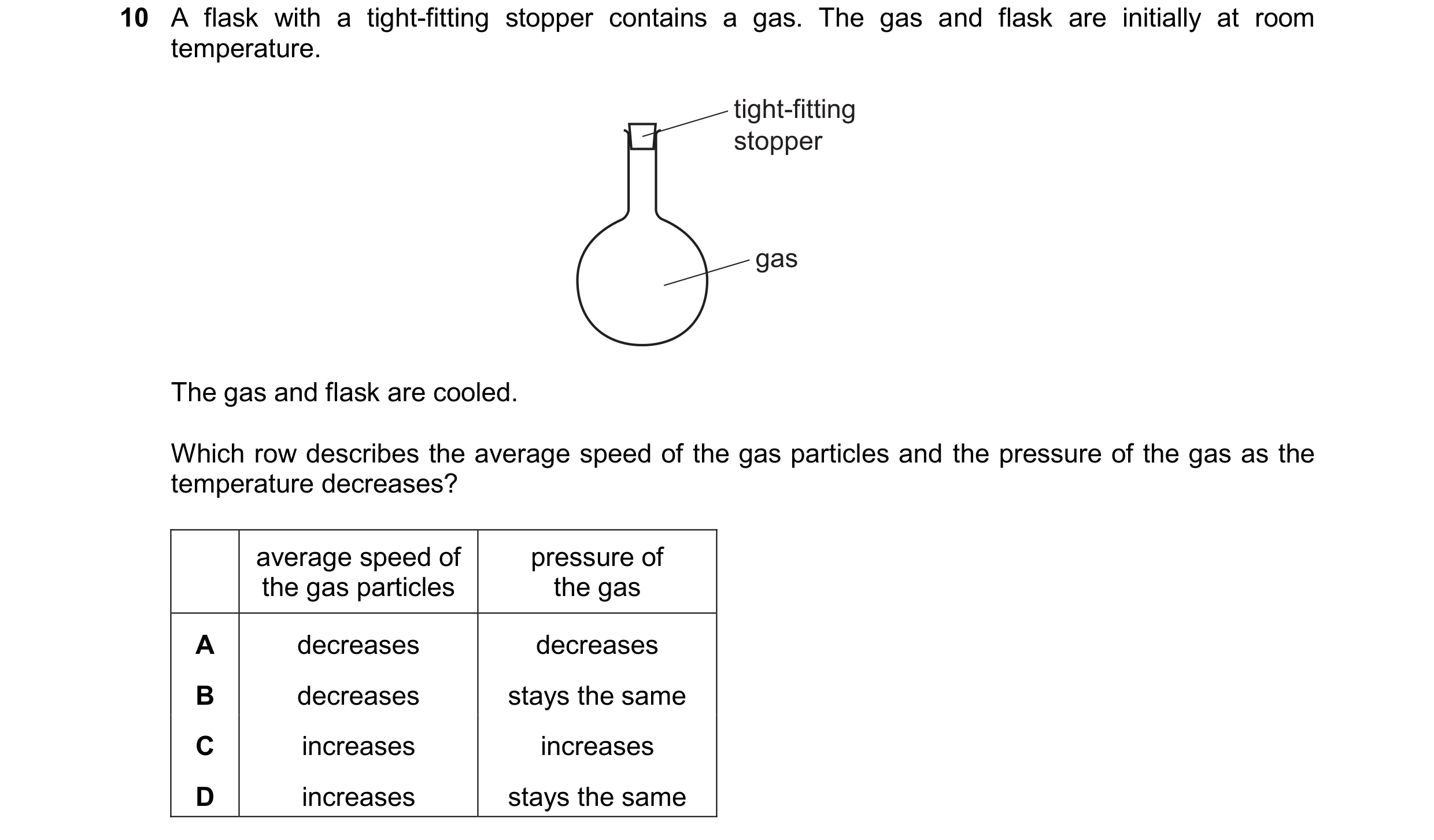
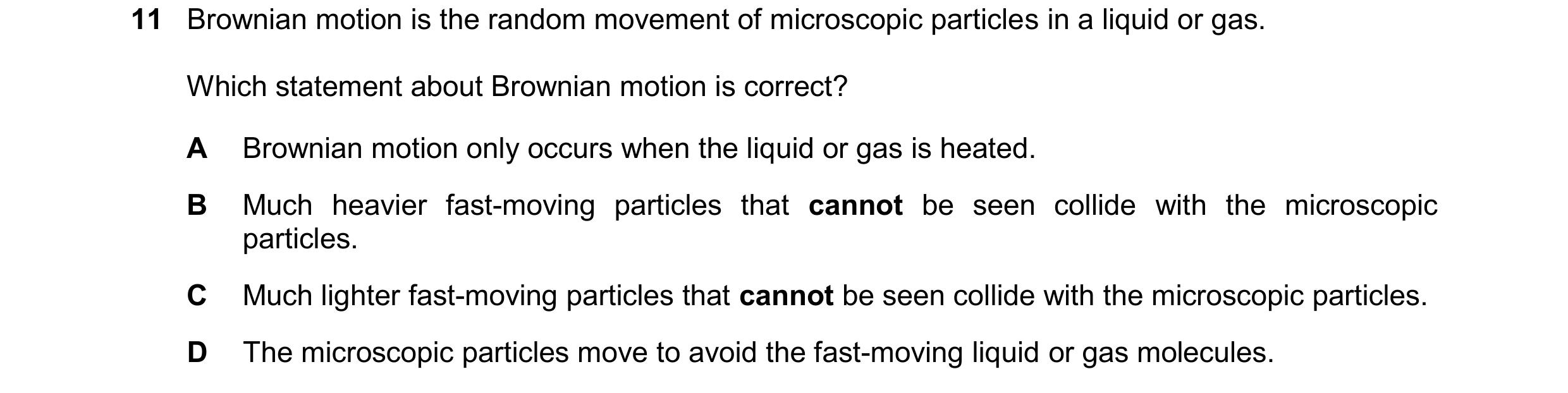 49 / 50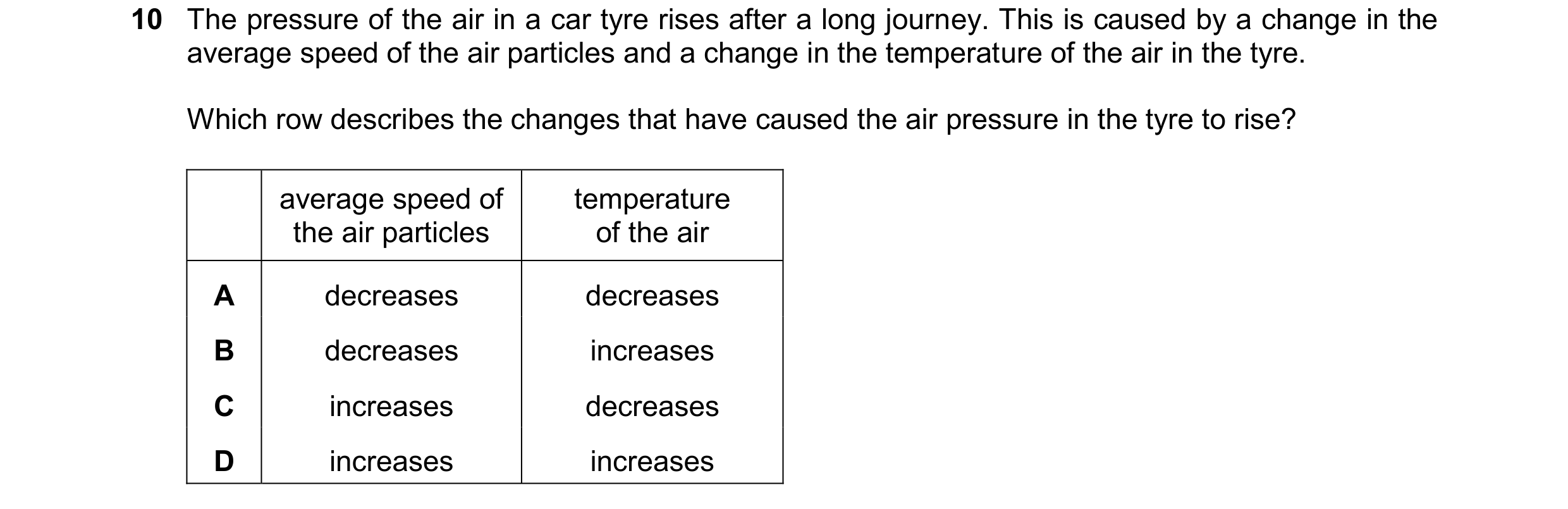
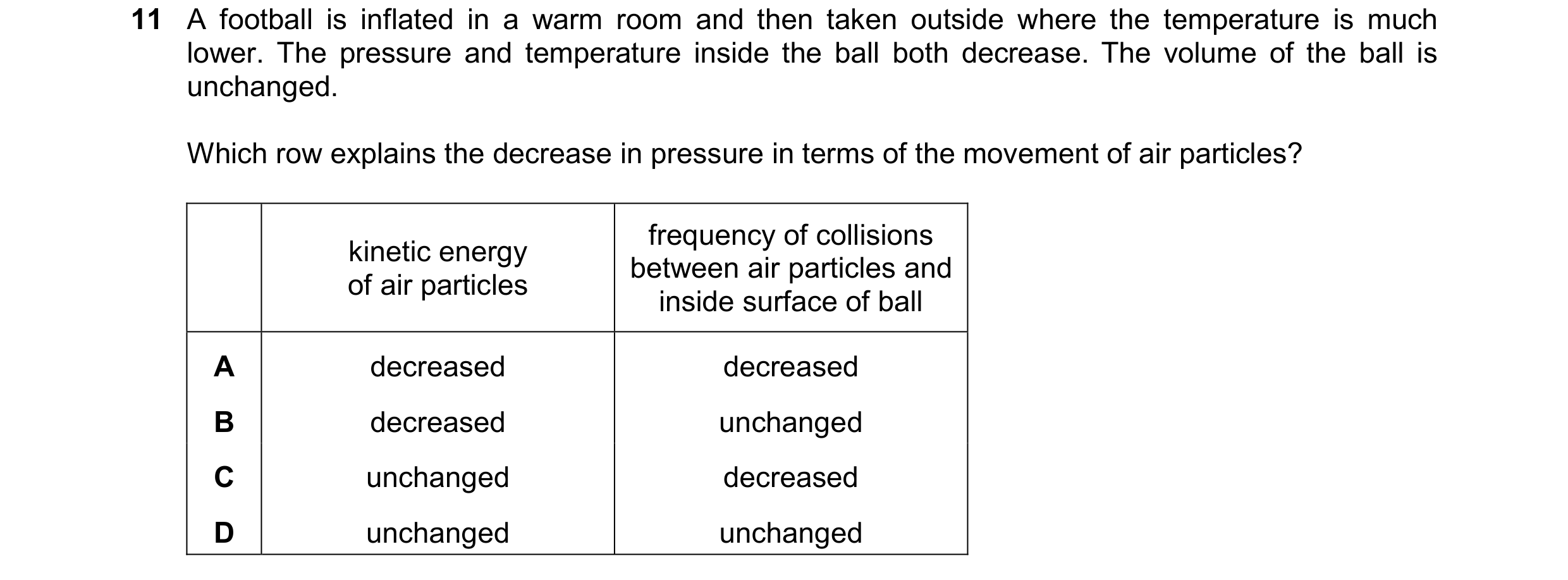
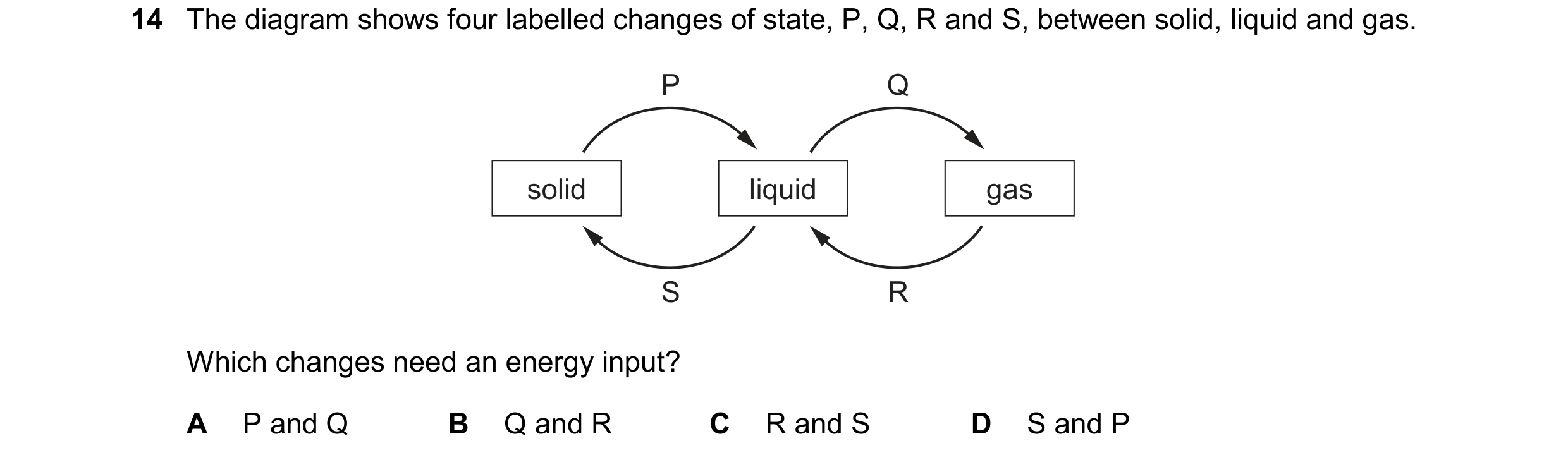 50 / 50