Questions as text
Q1 · Consecutive elements X, Y, Z are in Period 3 of the Periodic Table 9701/11 Oct/Nov 2005
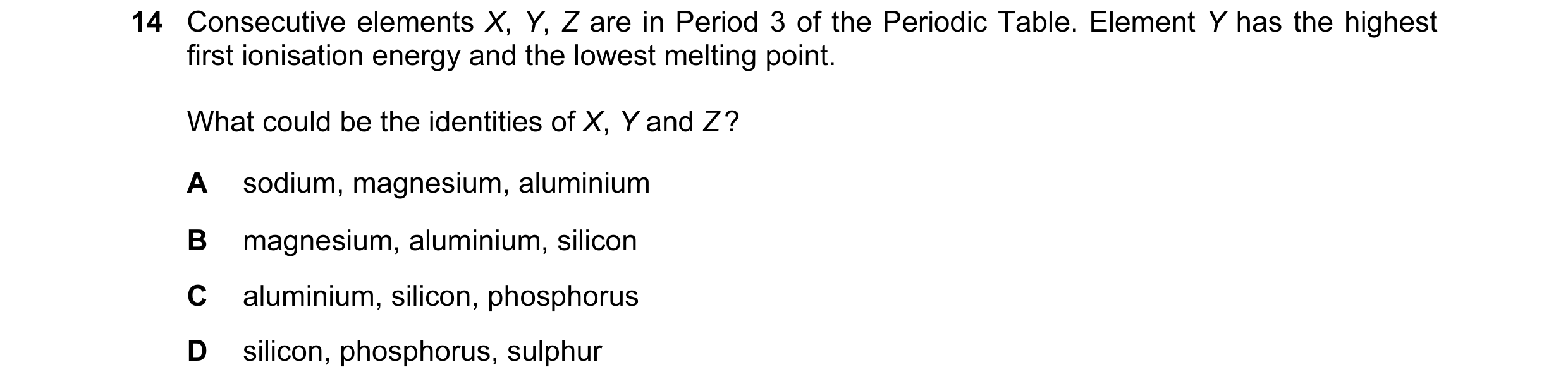
14 Consecutive elements X, Y, Z are in Period 3 of the Periodic Table. Element Y has the highest first ionisation energy and the lowest melting point. What could be the identities of X, Y and Z ? A sodium, magnesium, aluminium B magnesium, aluminium, silicon C aluminium, silicon, phosphorus D silicon, phosphorus, sulphur
1 marks
Answer: D
This question in 9701/11 Oct/Nov 2005
Q2 · In which pair is the radius of the second atom greater than that of the first atom? 9701/11 May/June 2006
13 In which pair is the radius of the second atom greater than that of the first atom? A Na, Mg B Sr, Ca C P, N D Cl, Br
1 marks
Answer: D
This question in 9701/11 May/June 2006
Q3 · Three successive elements in the Periodic Table have first ionisation energies which have… 9701/11 Oct/Nov 2006
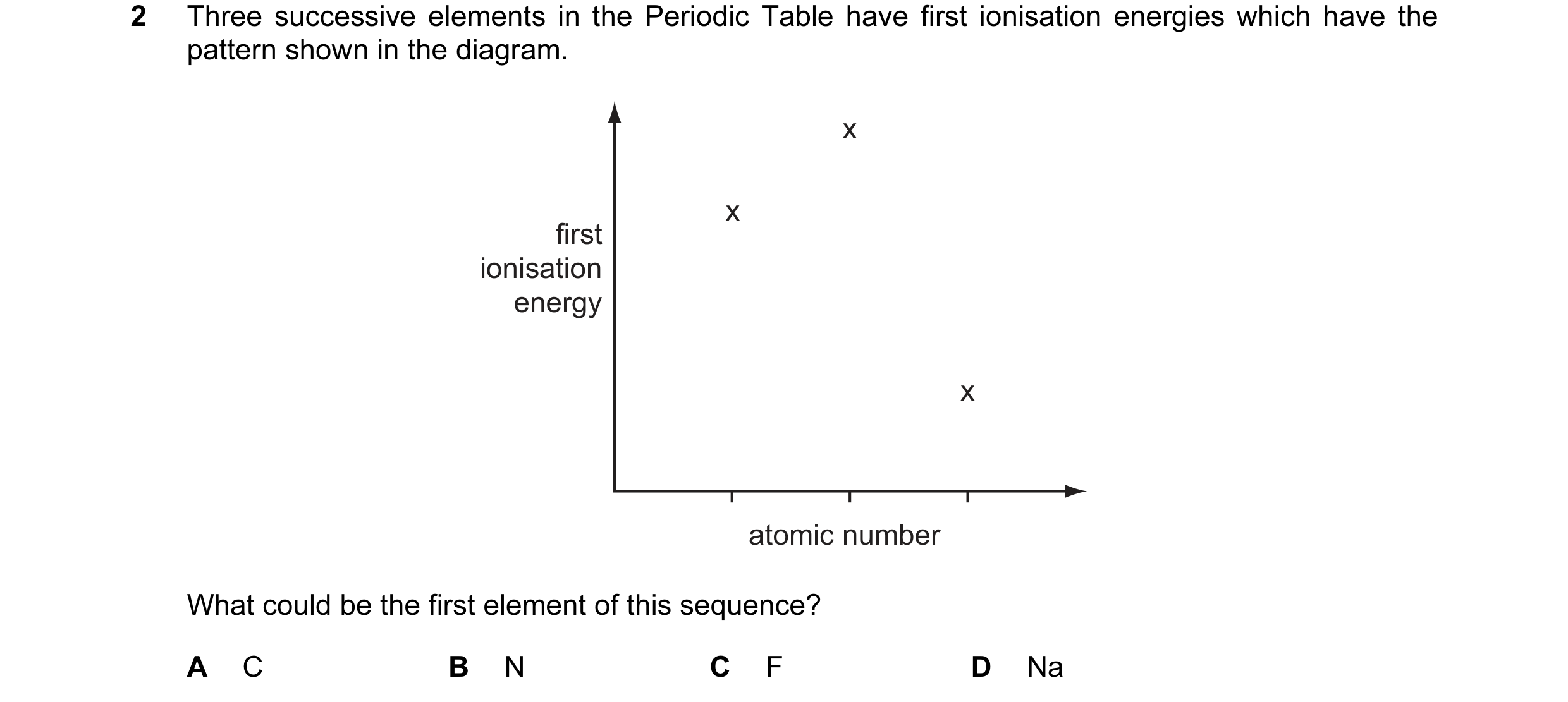
2 Three successive elements in the Periodic Table have first ionisation energies which have the pattern shown in the diagram. x x first ionisation energy x atomic number What could be the first element of this sequence? A C B N C F D Na
1 marks
Answer: C
This question in 9701/11 Oct/Nov 2006
Q4 · Which species has the largest radius? 9701/11 Oct/Nov 2007
13 Which species has the largest radius? A P3 − B Cl − C Ar D K+
1 marks
Answer: A
This question in 9701/11 Oct/Nov 2007
Q5 · In an experiment, 0.1 g samples of Na2O, MgO, P4O10 and SO2 are added to separate 100 cm3… 9701/11 May/June 2008
13 In an experiment, 0.1 g samples of Na2O, MgO, P4O10 and SO2 are added to separate 100 cm3 volumes of water. For which oxide is the resulting mixture most alkaline? A Na2O B MgO C P4O10 D SO2
1 marks
Answer: A
This question in 9701/11 May/June 2008
Q6 · Which element is expected to show the greatest tendency to form some covalent compounds? 9701/11 May/June 2008
14 Which element is expected to show the greatest tendency to form some covalent compounds? A aluminium B calcium C magnesium D sodium
1 marks
Answer: A
This question in 9701/11 May/June 2008
Q7 · Use of the Data Booklet is relevant to this question 9701/11 May/June 2009
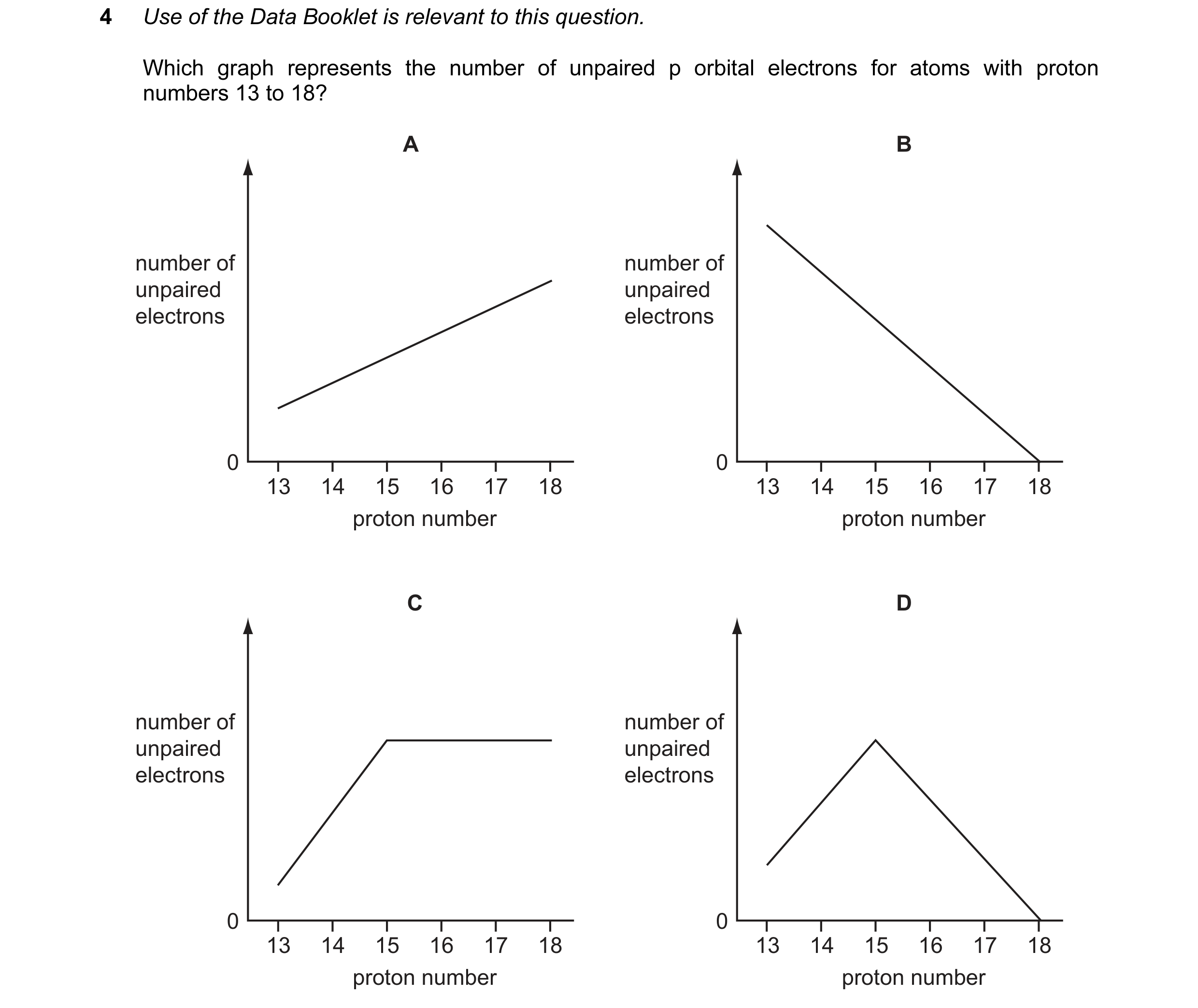
4 Use of the Data Booklet is relevant to this question. Which graph represents the number of unpaired p orbital electrons for atoms with proton numbers 13 to 18? A B number of number of unpaired unpaired electrons electrons 0 0 13 14 15 16 17 18 13 14 15 16 17 18 proton number proton number C D number of number of unpaired unpaired electrons electrons 0 0 13 14 15 16 17 18 13 14 15 16 17 18 proton number proton number
1 marks
Answer: D
This question in 9701/11 May/June 2009
Q8 · The following graph shows the variation of a property of the first 20 elements in the… 9701/11 Oct/Nov 2009
12 The following graph shows the variation of a property of the first 20 elements in the Periodic Table with the atomic number of the element. property 1 2 3 4 5 6 7 8 9 10 11 12 13 14 15 16 17 18 19 20 atomic number What is the property? A atomic radius B first ionisation energy C ionic radius D melting point
1 marks
Answer: D
This question in 9701/11 Oct/Nov 2009
Q9 · Consecutive elements X, Y, Z are in the third period of the Periodic Table 9701/11 May/June 2010
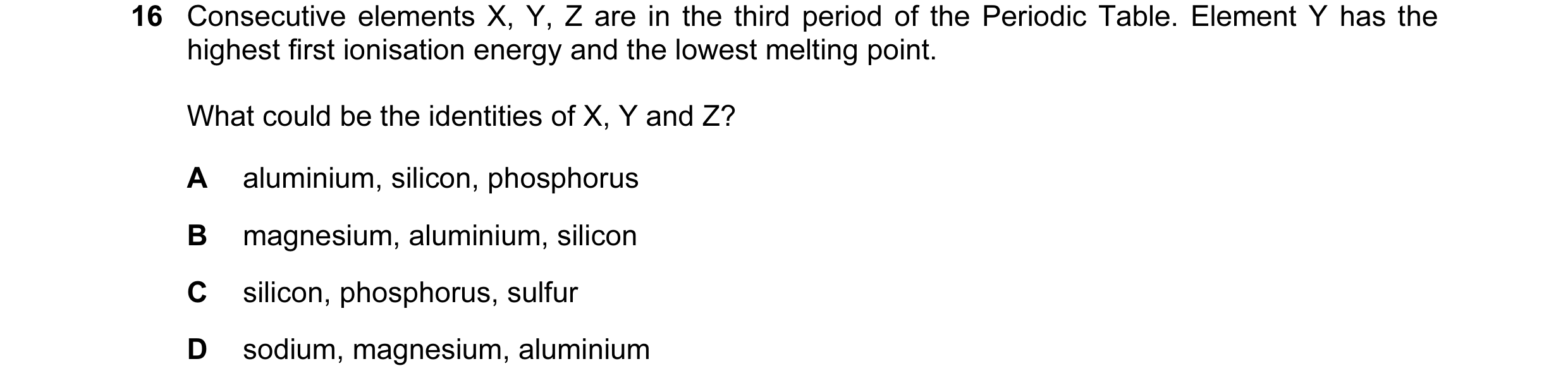
16 Consecutive elements X, Y, Z are in the third period of the Periodic Table. Element Y has the highest first ionisation energy and the lowest melting point. What could be the identities of X, Y and Z? A aluminium, silicon, phosphorus B magnesium, aluminium, silicon C silicon, phosphorus, sulfur D sodium, magnesium, aluminium
1 marks
Answer: C
This question in 9701/11 May/June 2010
Q10 · Two properties of non-metallic elements and their atoms are as follows 9701/12 May/June 2010
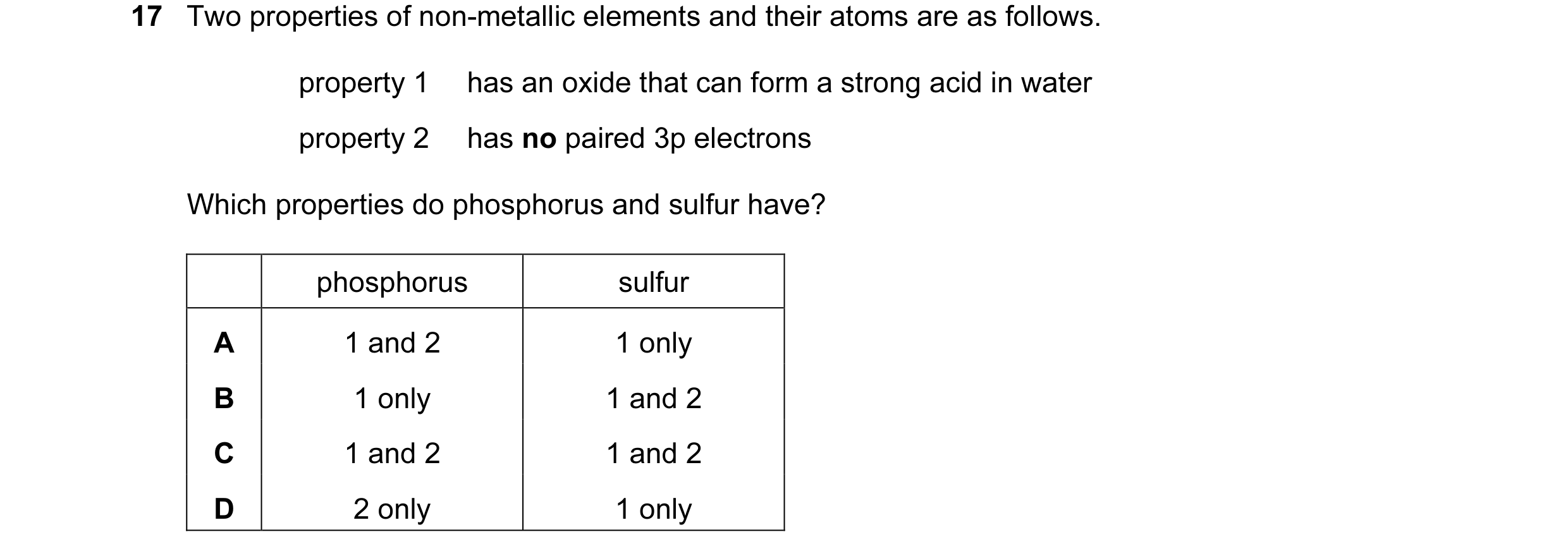
17 Two properties of non-metallic elements and their atoms are as follows. property 1 has an oxide that can form a strong acid in water property 2 has no paired 3p electrons Which properties do phosphorus and sulfur have? phosphorus sulfur A 1 and 2 1 only B 1 only 1 and 2 C 1 and 2 1 and 2 D 2 only 1 only
1 marks
Answer: A
This question in 9701/12 May/June 2010
Q11 · Consecutive elements X, Y, Z are in the third period of the Periodic Table 9701/12 May/June 2010
18 Consecutive elements X, Y, Z are in the third period of the Periodic Table. Element Y has the highest first ionisation energy and the lowest melting point. What could be the identities of X, Y and Z? A aluminium, silicon, phosphorus B magnesium, aluminium, silicon C silicon, phosphorus, sulfur D sodium, magnesium, aluminium
1 marks
Answer: C
This question in 9701/12 May/June 2010
Q12 · Consecutive elements X, Y, Z are in the third period of the Periodic Table 9701/13 May/June 2010
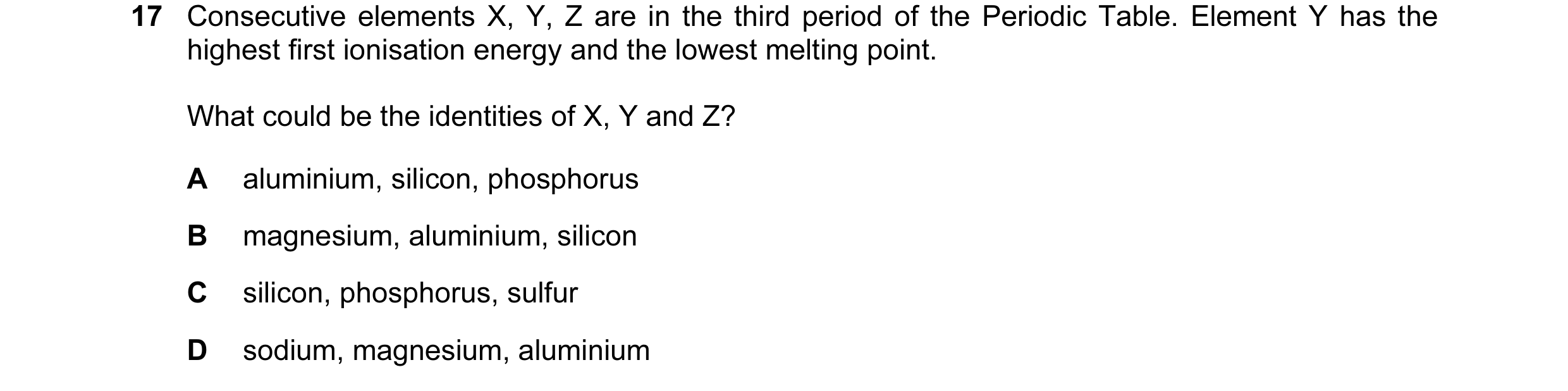
17 Consecutive elements X, Y, Z are in the third period of the Periodic Table. Element Y has the highest first ionisation energy and the lowest melting point. What could be the identities of X, Y and Z? A aluminium, silicon, phosphorus B magnesium, aluminium, silicon C silicon, phosphorus, sulfur D sodium, magnesium, aluminium
1 marks
Answer: C
This question in 9701/13 May/June 2010
Q13 · Why is the first ionisation energy of phosphorus greater than the first ionisation energy… 9701/11 Oct/Nov 2010
13 Why is the first ionisation energy of phosphorus greater than the first ionisation energy of silicon? A A phosphorus atom has one more proton in its nucleus. B The atomic radius of a phosphorus atom is greater. C The outer electron in a phosphorus atom is more shielded. D The outer electron in a phosphorus atom is paired.
1 marks
Answer: A
This question in 9701/11 Oct/Nov 2010
Q14 · Why is the first ionisation energy of phosphorus greater than the first ionisation energy… 9701/13 Oct/Nov 2010
16 Why is the first ionisation energy of phosphorus greater than the first ionisation energy of silicon? A A phosphorus atom has one more proton in its nucleus. B The atomic radius of a phosphorus atom is greater. C The outer electron in a phosphorus atom is more shielded. D The outer electron in a phosphorus atom is paired.
1 marks
Answer: A
This question in 9701/13 Oct/Nov 2010
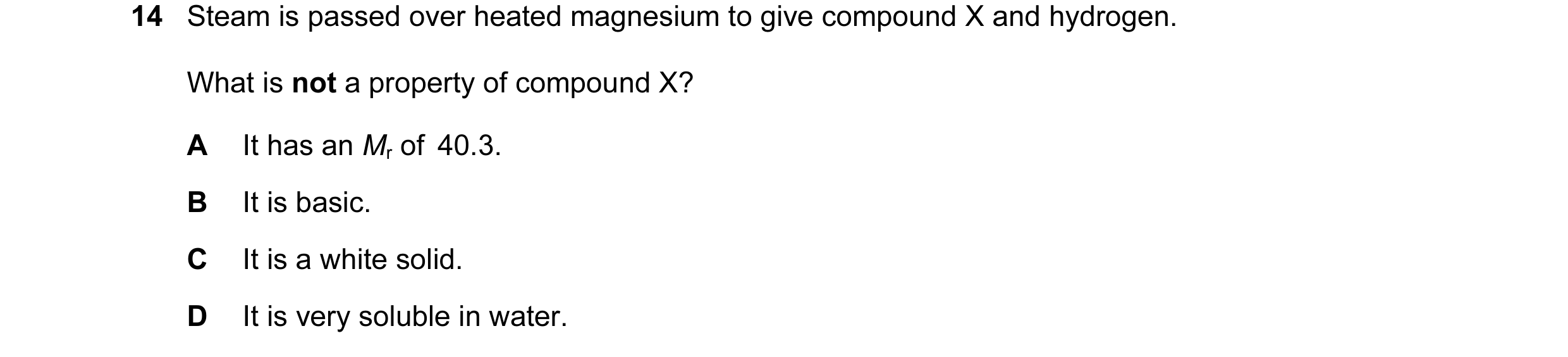
Q15 · Steam is passed over heated magnesium to give compound X and hydrogen 9701/11 May/June 2011
14 Steam is passed over heated magnesium to give compound X and hydrogen. What is not a property of compound X? A It has an Mr of 40.3. B It is basic. C It is a white solid. D It is very soluble in water.
1 marks
Answer: D
This question in 9701/11 May/June 2011
Q16 · The diagram shows the first ionisation energies of 11 consecutive elements 9701/12 May/June 2011
15 The diagram shows the first ionisation energies of 11 consecutive elements. first ionisation energy / kJ mol–1 X Y atomic number Which type of elements are labelled X and Y ? A Group I metals B Group II metals C halogens D noble gases
1 marks
Answer: A
This question in 9701/12 May/June 2011
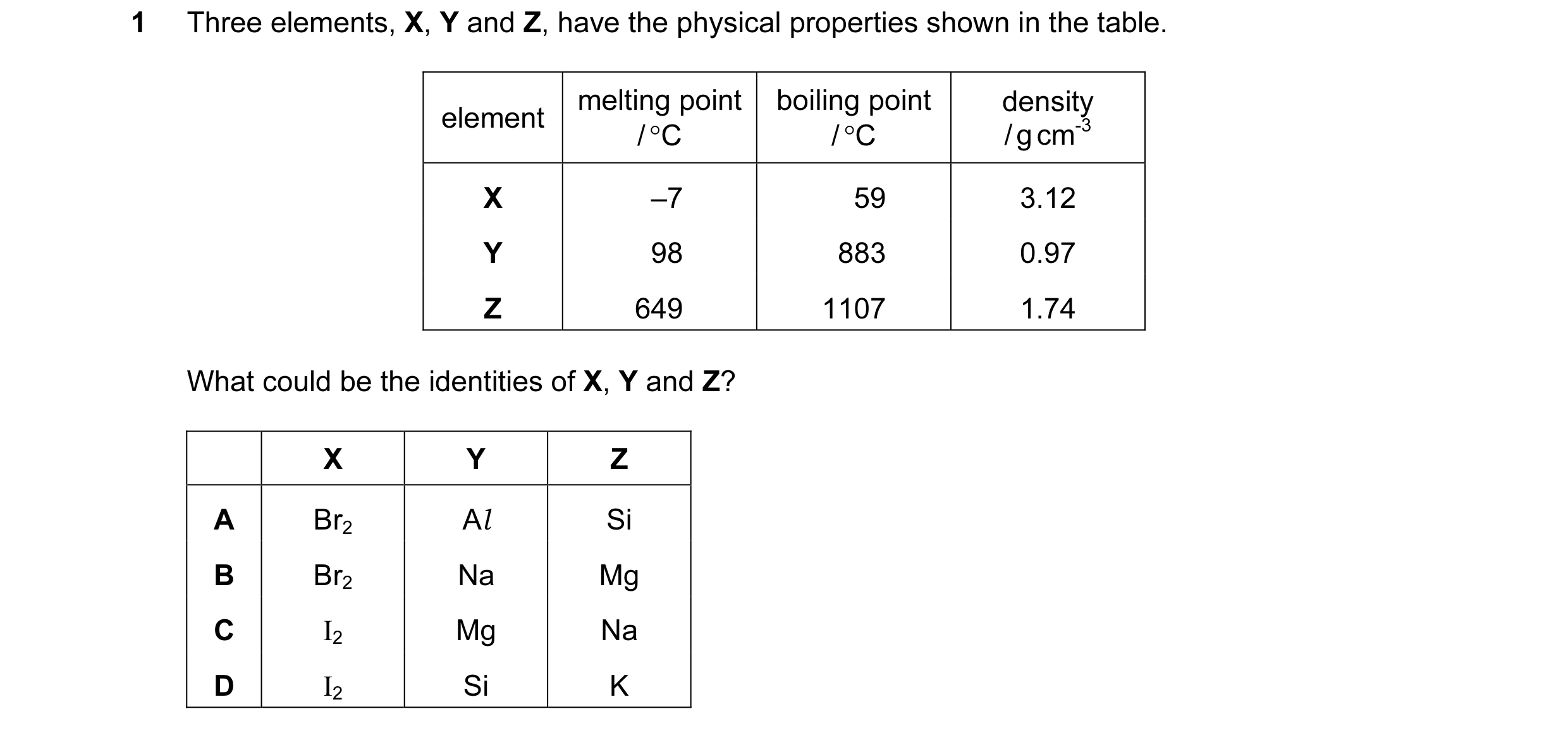
Q17 · Three elements, X, Y and Z, have the physical properties shown in the table 9701/11 Oct/Nov 2011
1 Three elements, X, Y and Z, have the physical properties shown in the table. melting point boiling point density element / g cm-3 / °C / °C X –7 59 3.12 Y 98 883 0.97 Z 649 1107 1.74 What could be the identities of X, Y and Z? X Y Z A Br2 Al Si B Br2 Na Mg C I2 Mg Na D I2 Si K
1 marks
Answer: B
This question in 9701/11 Oct/Nov 2011
Q18 · Three elements, X, Y and Z, have the physical properties shown in the table 9701/13 Oct/Nov 2011
3 Three elements, X, Y and Z, have the physical properties shown in the table. melting point boiling point density element / g cm-3 / °C / °C X –7 59 3.12 Y 98 883 0.97 Z 649 1107 1.74 What could be the identities of X, Y and Z? X Y Z A Br2 Al Si B Br2 Na Mg C I2 Mg Na D I2 Si K
1 marks
Answer: B
This question in 9701/13 Oct/Nov 2011
Q19 · Use of the Data Booklet is relevant to this question 9701/12 May/June 2012
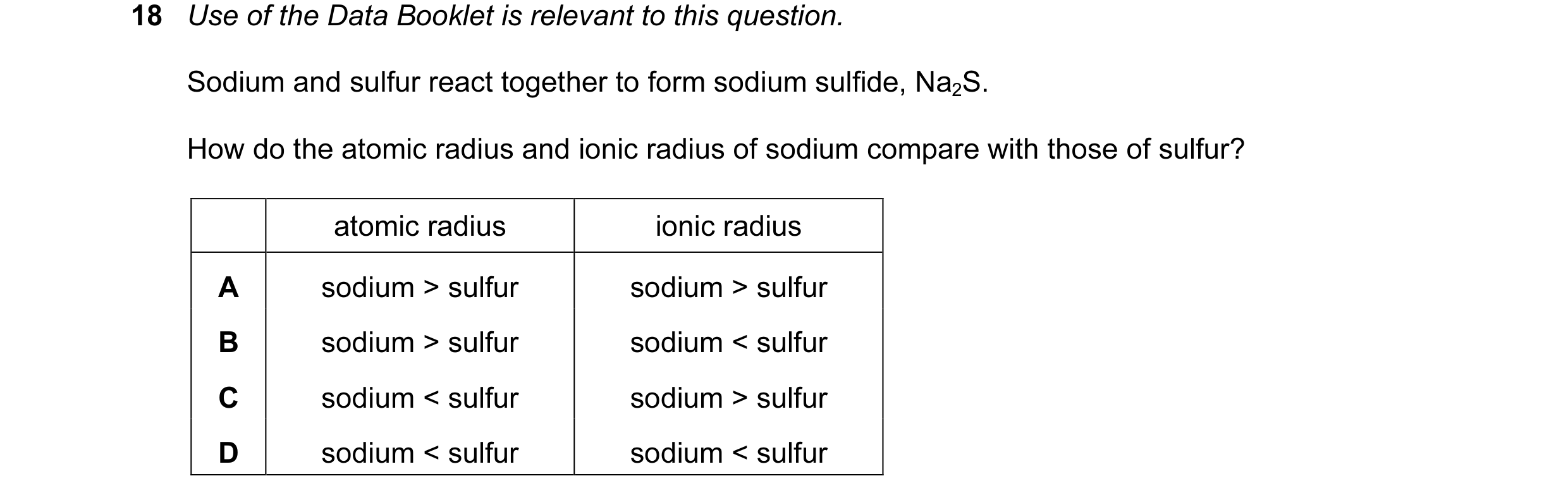
18 Use of the Data Booklet is relevant to this question. Sodium and sulfur react together to form sodium sulfide, Na2S. How do the atomic radius and ionic radius of sodium compare with those of sulfur? atomic radius ionic radius A sodium > sulfur sodium > sulfur B sodium > sulfur sodium < sulfur C sodium < sulfur sodium > sulfur D sodium < sulfur sodium < sulfur
1 marks
Answer: B
This question in 9701/12 May/June 2012
Q20 · Why is the ionic radius of a chloride ion larger than the ionic radius of a sodium ion? 9701/11 Oct/Nov 2012
13 Why is the ionic radius of a chloride ion larger than the ionic radius of a sodium ion? A A chloride ion has one more occupied electron shell than a sodium ion. B Chlorine has a higher proton number than sodium. C Ionic radius increases regularly across the third period. D Sodium is a metal, chlorine is a non-metal.
1 marks
Answer: A
This question in 9701/11 Oct/Nov 2012
Q21 · Which diagram shows the variation of the metallic radius r of the Group I elements, Li… 9701/11 Oct/Nov 2012
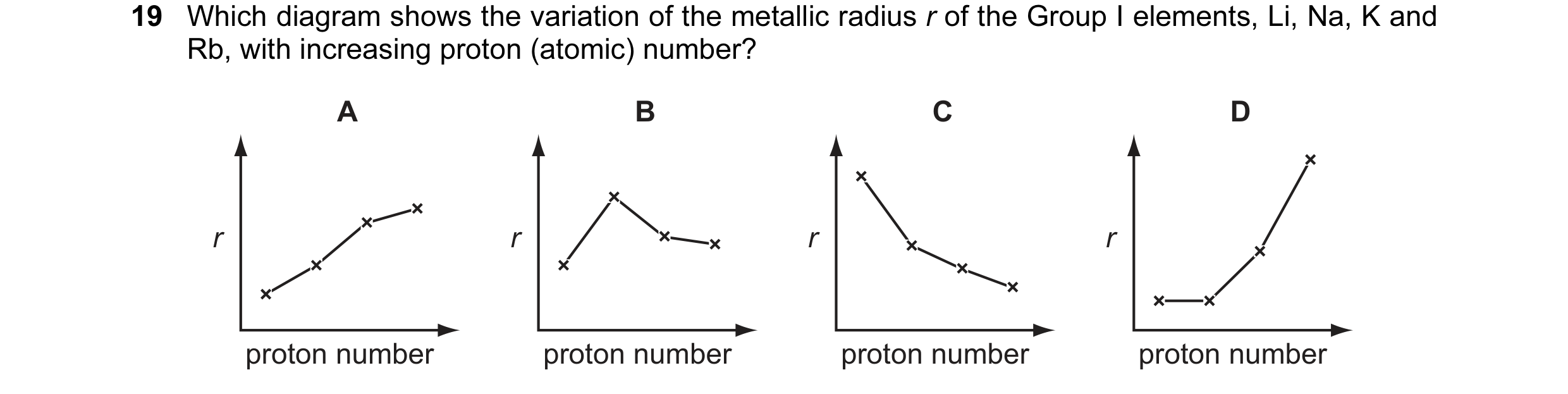
19 Which diagram shows the variation of the metallic radius r of the Group I elements, Li, Na, K and Rb, with increasing proton (atomic) number? A B C D r r r r proton number proton number proton number proton number
1 marks
Answer: A
This question in 9701/11 Oct/Nov 2012
Q22 · Which diagram shows the variation of the metallic radius r of the Group I elements, Li… 9701/12 Oct/Nov 2012
19 Which diagram shows the variation of the metallic radius r of the Group I elements, Li, Na, K and Rb, with increasing proton (atomic) number? A B C D r r r r proton number proton number proton number proton number
1 marks
Answer: A
This question in 9701/12 Oct/Nov 2012
Q23 · The first ionisation energies of twenty successive elements in the Periodic Table are… 9701/11 May/June 2013
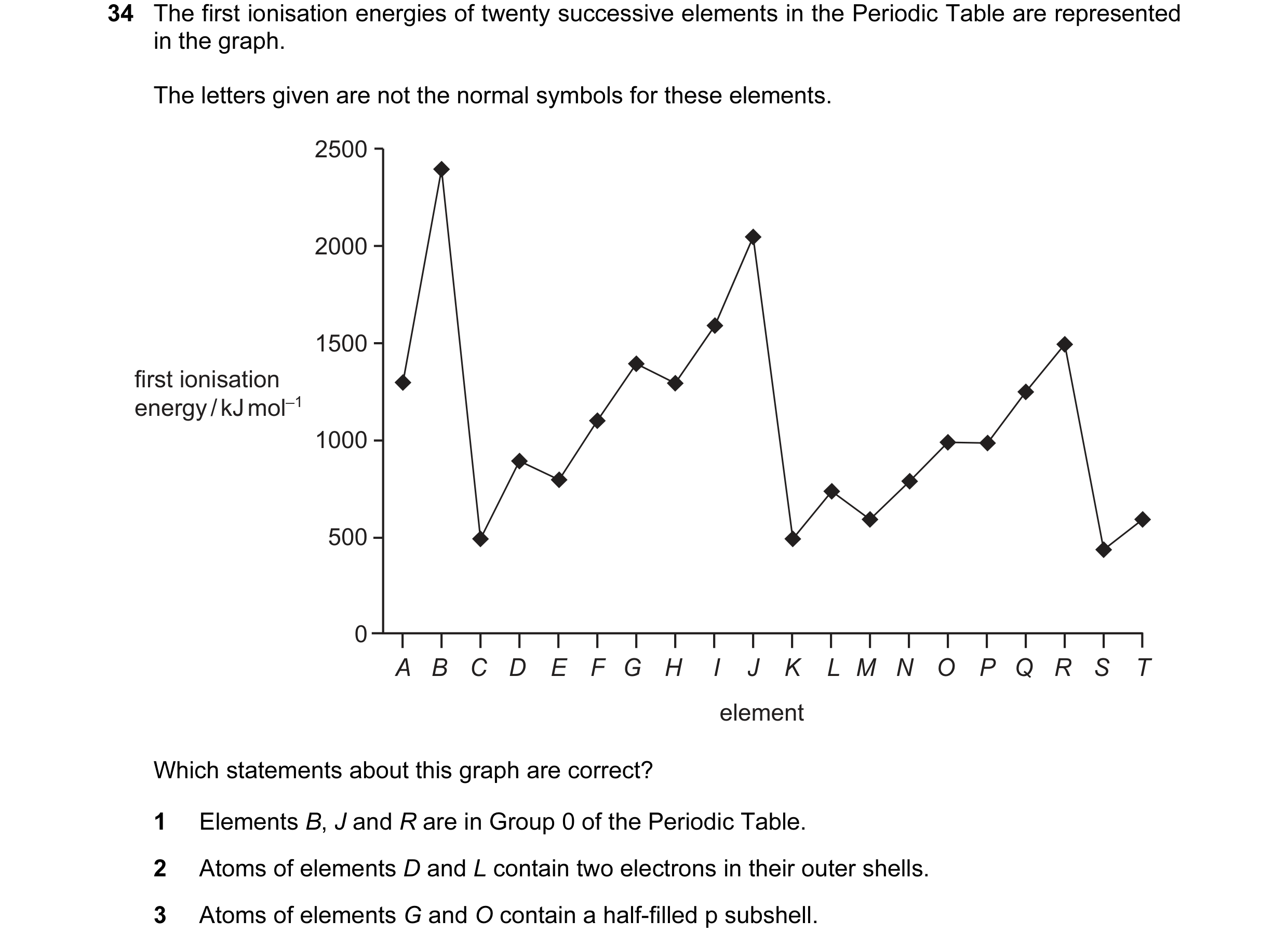
34 The first ionisation energies of twenty successive elements in the Periodic Table are represented in the graph. The letters given are not the normal symbols for these elements. 2500 2000 1500 first ionisation energy / kJ mol _1 1000 500 0 A B C D E F G H I J K L M N O P Q R S T element Which statements about this graph are correct? 1 Elements B, J and R are in Group 0 of the Periodic Table. 2 Atoms of elements D and L contain two electrons in their outer shells. 3 Atoms of elements G and O contain a half-filled p subshell.
1 marks
Answer: A
This question in 9701/11 May/June 2013
Q24 · The trends in three physical properties of the elements Na, Mg, Al, Si, P and S are shown… 9701/12 May/June 2013
16 The trends in three physical properties of the elements Na, Mg, Al, Si, P and S are shown in the graphs. 0 0 0 Na Mg Al Si P S Na Mg Al Si P S Na Mg Al Si P S Which physical property is not illustrated? A atomic radius B electrical conductivity C first ionisation energy D melting point
1 marks
Answer: B
This question in 9701/12 May/June 2013
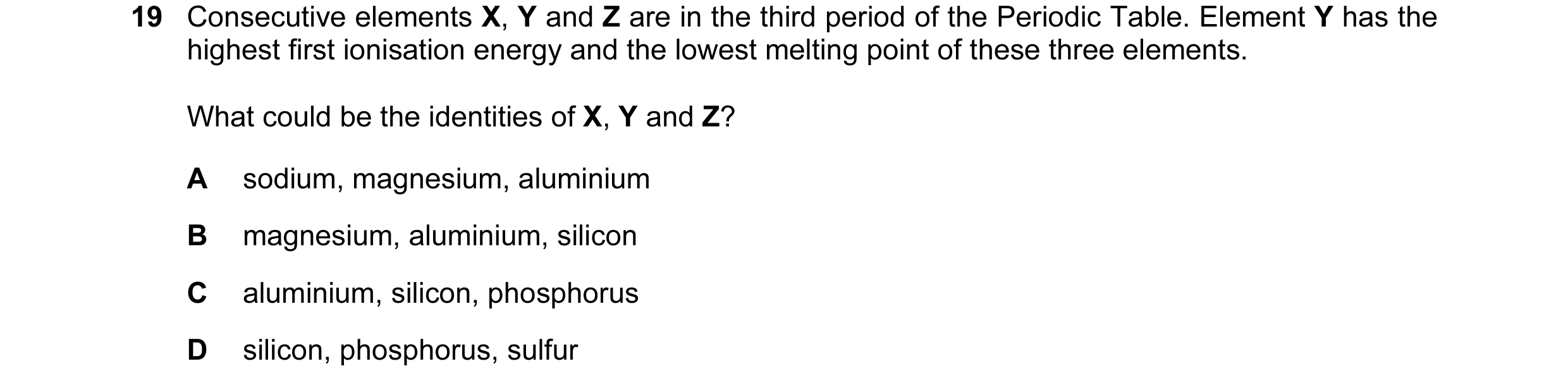
Q25 · Consecutive elements X, Y and Z are in the third period of the Periodic Table 9701/11 Oct/Nov 2013
19 Consecutive elements X, Y and Z are in the third period of the Periodic Table. Element Y has the highest first ionisation energy and the lowest melting point of these three elements. What could be the identities of X, Y and Z? A sodium, magnesium, aluminium B magnesium, aluminium, silicon C aluminium, silicon, phosphorus D silicon, phosphorus, sulfur
1 marks
Answer: D
This question in 9701/11 Oct/Nov 2013
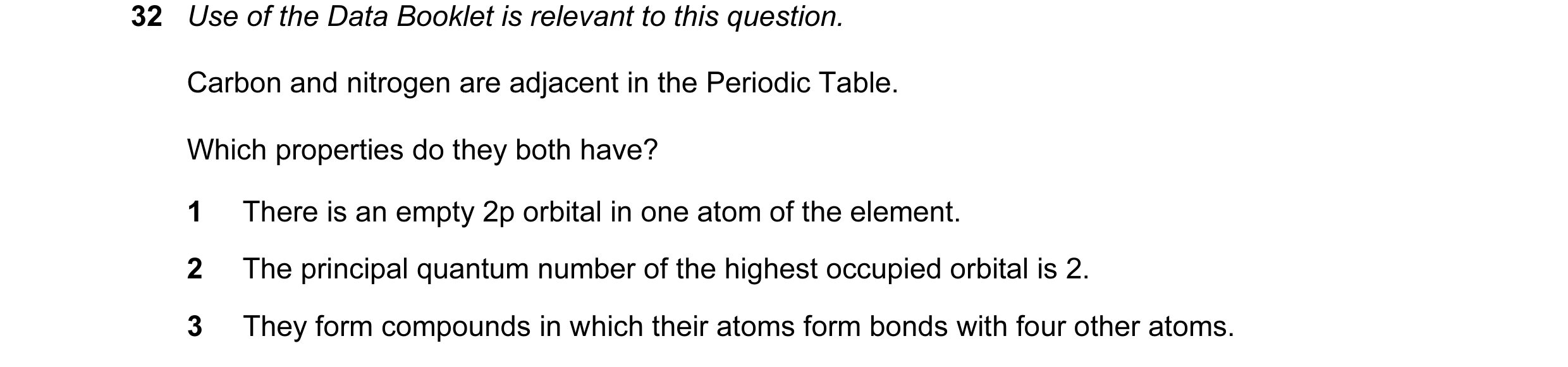
Q26 · Use of the Data Booklet is relevant to this question 9701/11 Oct/Nov 2013
32 Use of the Data Booklet is relevant to this question. Carbon and nitrogen are adjacent in the Periodic Table. Which properties do they both have? 1 There is an empty 2p orbital in one atom of the element. 2 The principal quantum number of the highest occupied orbital is 2. 3 They form compounds in which their atoms form bonds with four other atoms.
1 marks
Answer: C
This question in 9701/11 Oct/Nov 2013
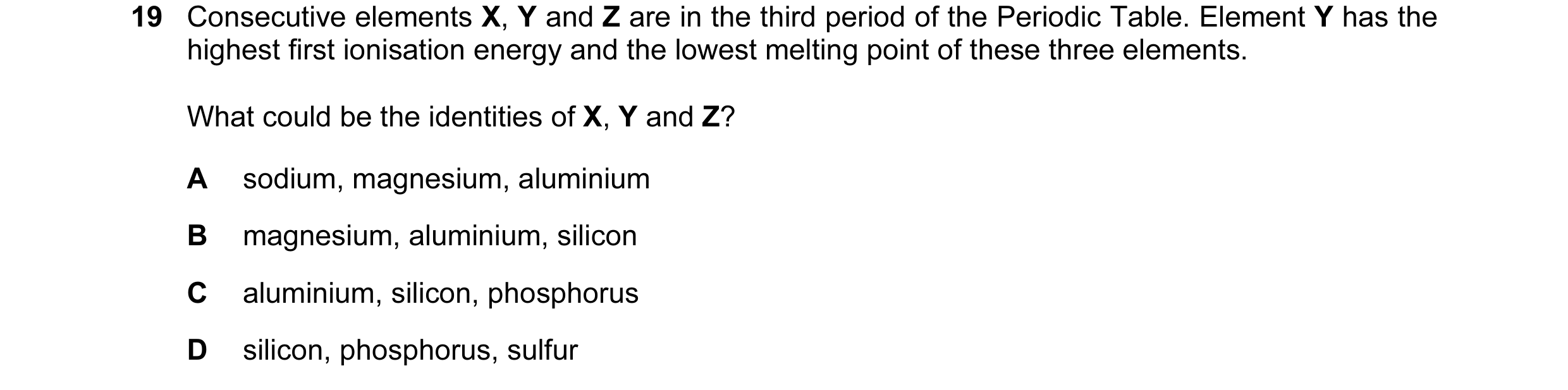
Q27 · Consecutive elements X, Y and Z are in the third period of the Periodic Table 9701/12 Oct/Nov 2013
19 Consecutive elements X, Y and Z are in the third period of the Periodic Table. Element Y has the highest first ionisation energy and the lowest melting point of these three elements. What could be the identities of X, Y and Z? A sodium, magnesium, aluminium B magnesium, aluminium, silicon C aluminium, silicon, phosphorus D silicon, phosphorus, sulfur
1 marks
Answer: D
This question in 9701/12 Oct/Nov 2013
Q28 · The graph below shows the variation of the first ionisation energy with the number of… 9701/13 Oct/Nov 2013
18 The graph below shows the variation of the first ionisation energy with the number of protons for some elements. Q Y first ionisation X energy / kJ mol–1 V W S U T R proton number Which statement is correct? A Elements Q and Y are in the same period in the Periodic Table. B The general increase from elements R to Y is due to increasing atomic radius. C The small decrease between elements S and T is due to decreased shielding. D The small decrease between elements V and W is due to repulsion between paired electrons.
1 marks
Answer: D
This question in 9701/13 Oct/Nov 2013
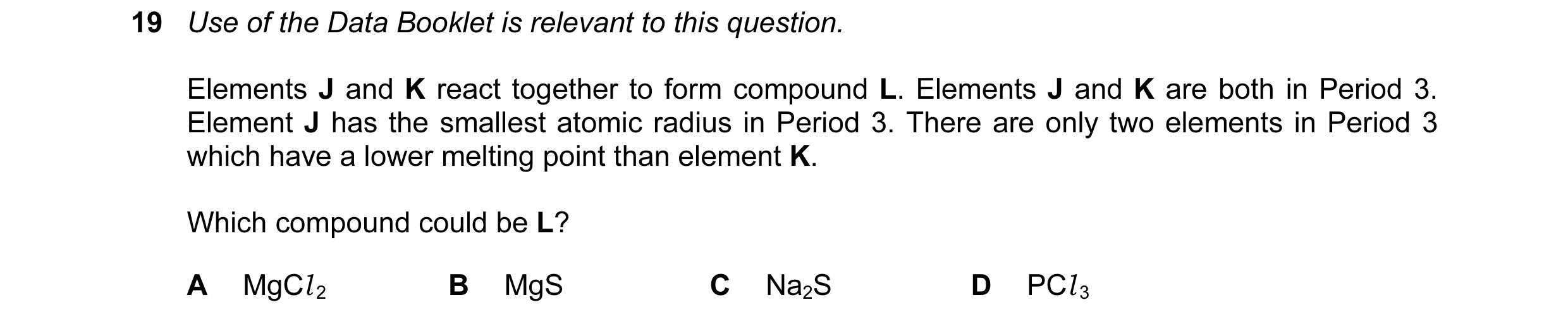
Q29 · Use of the Data Booklet is relevant to this question 9701/13 Oct/Nov 2013
19 Use of the Data Booklet is relevant to this question. Elements J and K react together to form compound L. Elements J and K are both in Period 3. Element J has the smallest atomic radius in Period 3. There are only two elements in Period 3 which have a lower melting point than element K. Which compound could be L? A MgCl 2 B MgS C Na2S D PCl 3
1 marks
Answer: D
This question in 9701/13 Oct/Nov 2013
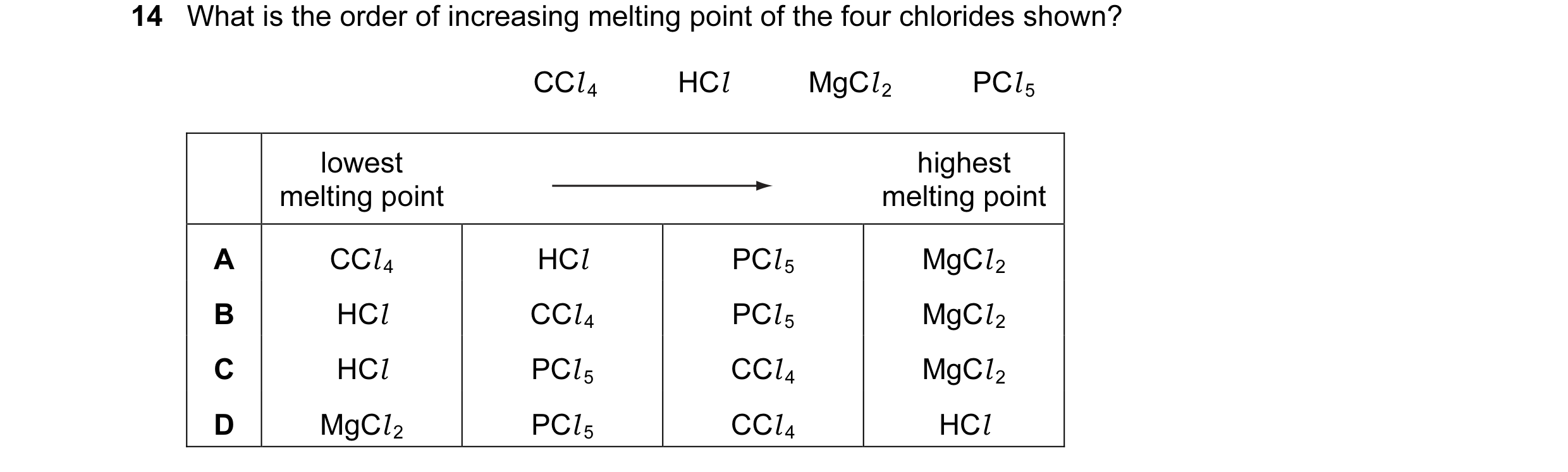
Q30 · What is the order of increasing melting point of the four chlorides shown? 9701/11 May/June 2014
14 What is the order of increasing melting point of the four chlorides shown? CCl 4 HCl MgCl 2 PCl 5 lowest highest melting point melting point A CCl 4 HCl PCl 5 MgCl 2 B HCl CCl 4 PCl 5 MgCl 2 C HCl PCl 5 CCl 4 MgCl 2 D MgCl 2 PCl 5 CCl 4 HCl
1 marks
Answer: B
This question in 9701/11 May/June 2014
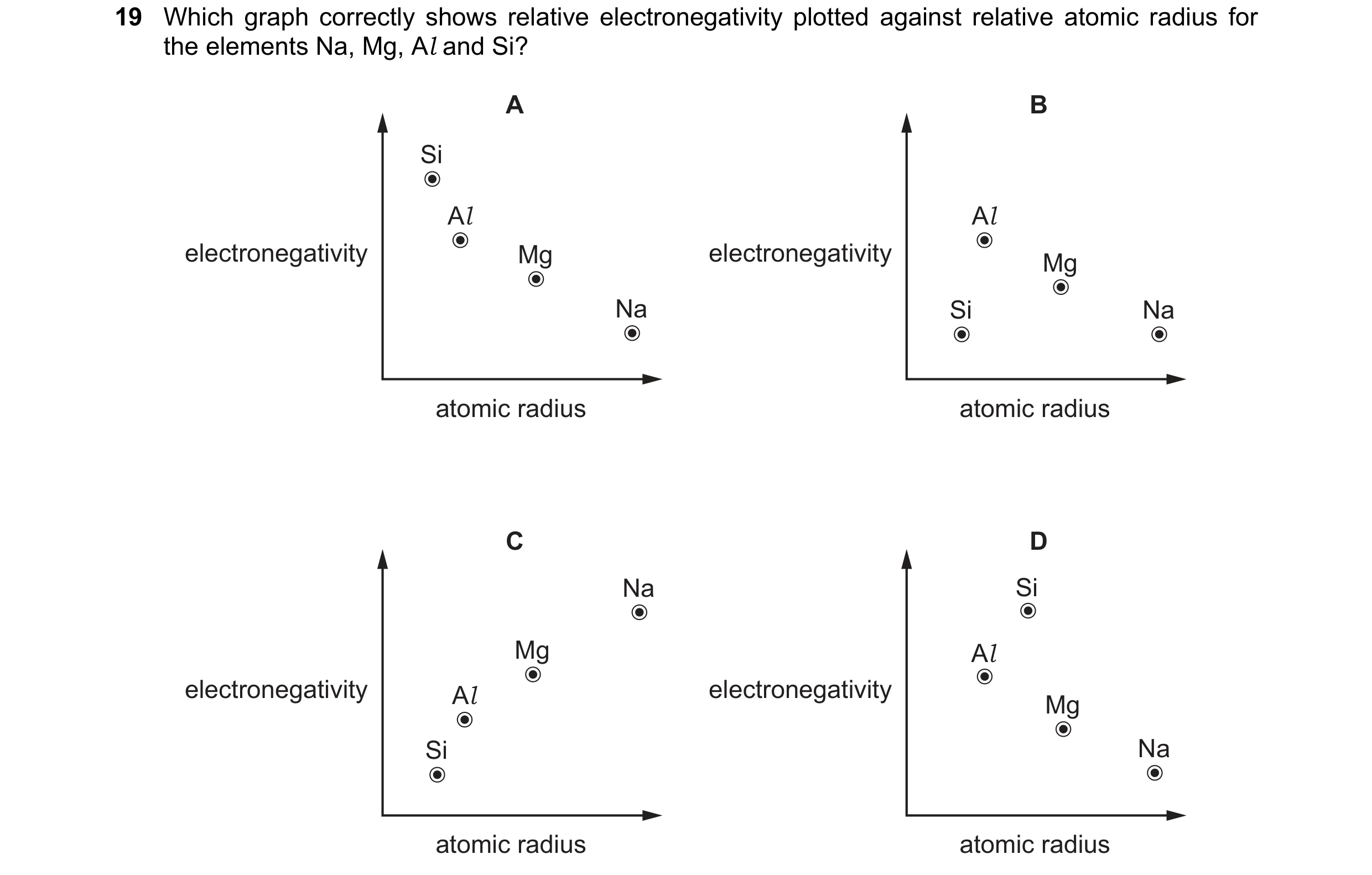
Q31 · Use of the Data Booklet is relevant to this question 9701/11 May/June 2014
19 Use of the Data Booklet is relevant to this question. Which graph correctly shows relative electronegativity plotted against relative atomic radius for the elements Na, Mg, Al and Si? A B Si Al Al electronegativity Mg electronegativity Mg Si Na Na atomic radius atomic radius C D Na Si Mg Al electronegativity Al electronegativity Mg Si Na atomic radius atomic radius
1 marks
Answer: B
This question in 9701/11 May/June 2014
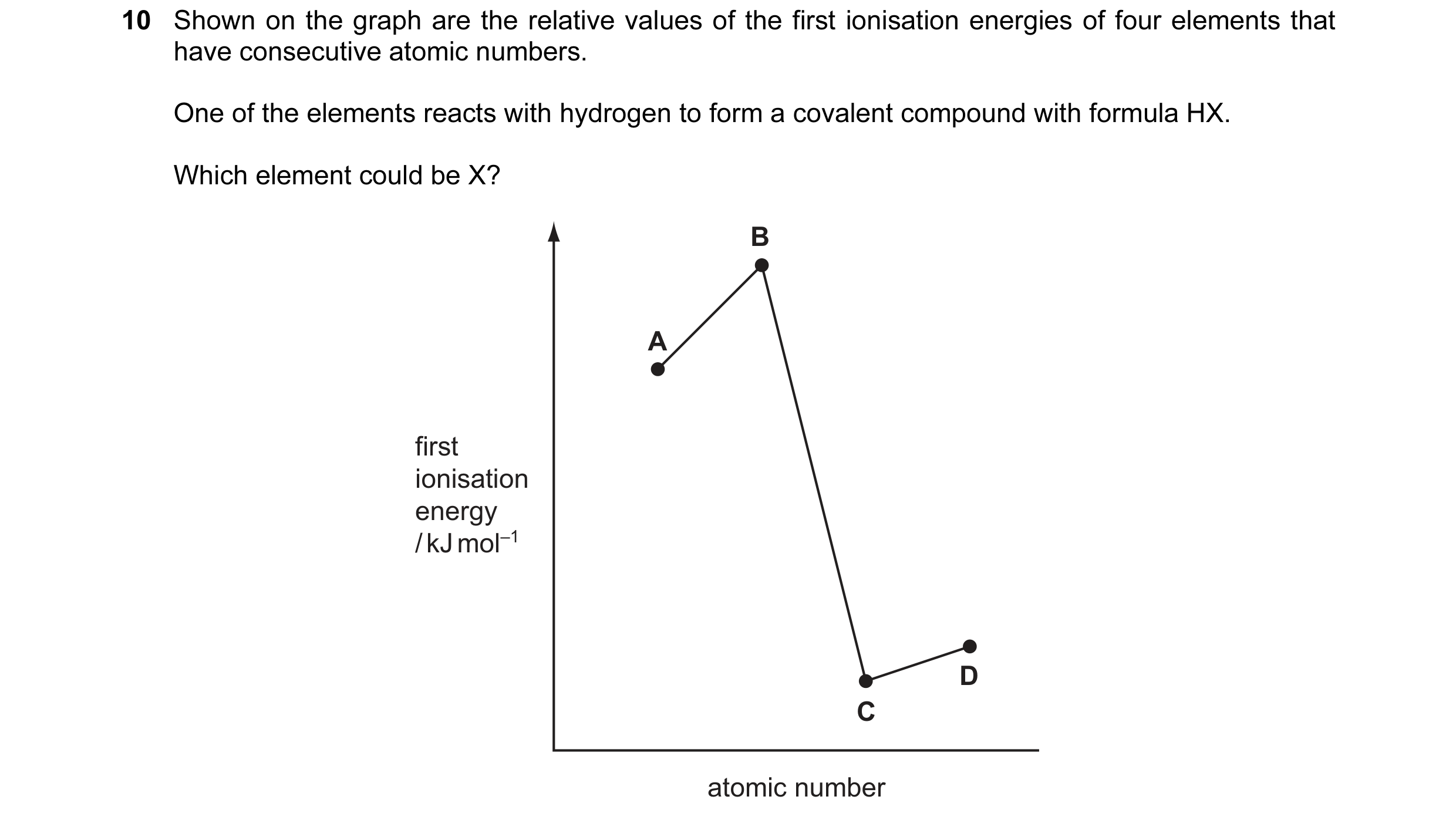
Q32 · Shown on the graph are the relative values of the first ionisation energies of four… 9701/12 May/June 2014
10 Shown on the graph are the relative values of the first ionisation energies of four elements that have consecutive atomic numbers. One of the elements reacts with hydrogen to form a covalent compound with formula HX. Which element could be X? B A first ionisation energy / kJ mol–1 D C atomic number
1 marks
Answer: A
This question in 9701/12 May/June 2014
Q33 · Which graph correctly shows the relative melting points of the elements Mg, Al, Si and P… 9701/12 May/June 2014
16 Which graph correctly shows the relative melting points of the elements Mg, Al, Si and P plotted against their relative electronegativities? A B Si Al melting point Mg melting point Mg Al Si P P electronegativity electronegativity C D Si Al melting point Al Mg melting point Mg Si P P electronegativity electronegativity
1 marks
Answer: B
This question in 9701/12 May/June 2014
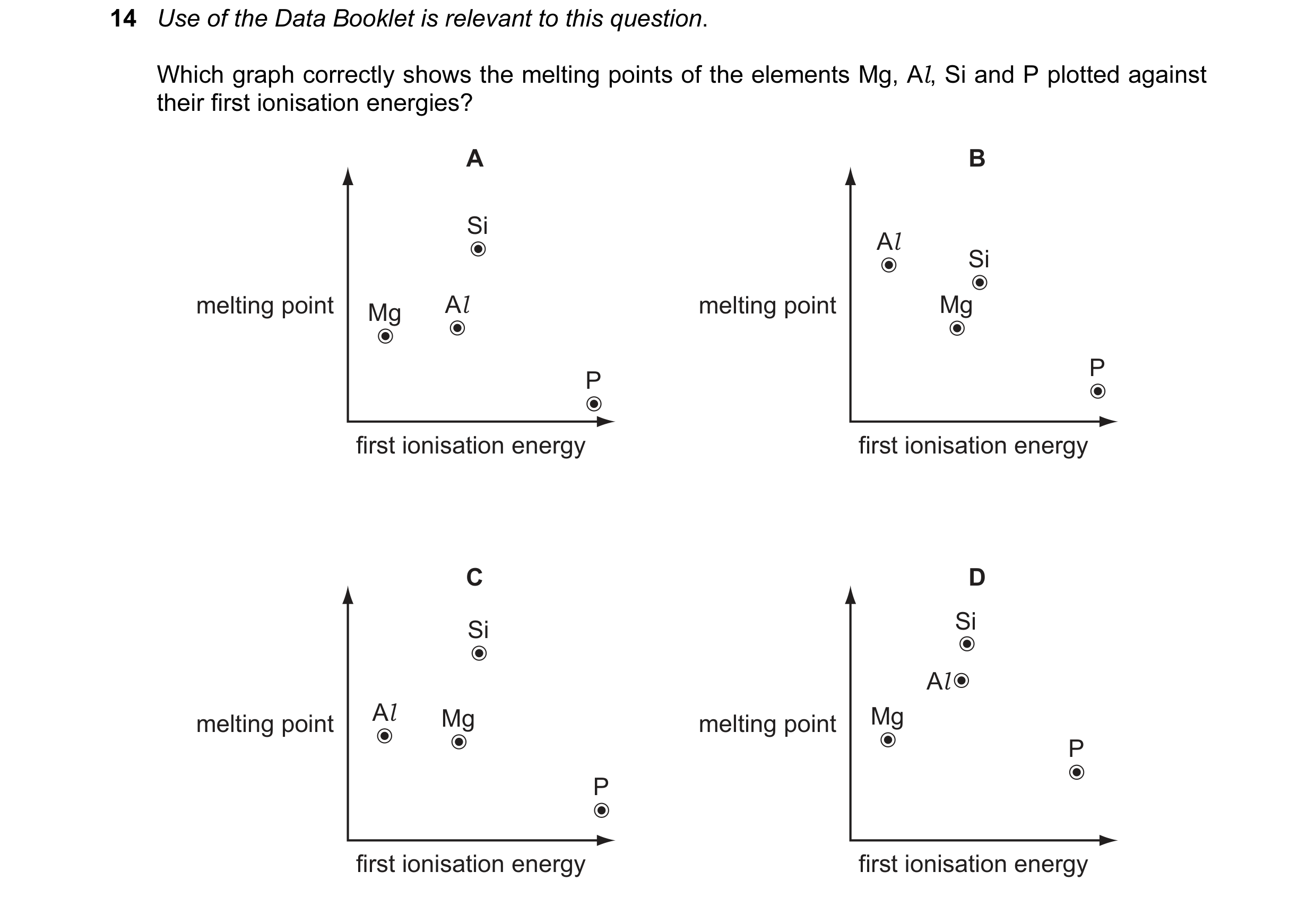
Q34 · Use of the Data Booklet is relevant to this question 9701/13 May/June 2014
14 Use of the Data Booklet is relevant to this question. Which graph correctly shows the melting points of the elements Mg, Al, Si and P plotted against their first ionisation energies? A B Si Al Si melting point Mg Al melting point Mg P P first ionisation energy first ionisation energy C D Si Si Al Al Mg Mg melting point melting point P P first ionisation energy first ionisation energy
1 marks
Answer: C
This question in 9701/13 May/June 2014
Q35 · X, Y and Z are compounds of three elements in Period 3 9701/13 Oct/Nov 2014
14 X, Y and Z are compounds of three elements in Period 3. Their electrical conductivities are shown in the table. X Y Z conductivity of the compound does not does not good in the molten state conduct conduct conductivity of the mixture obtained does not good good by adding the compound to water conduct What could be compounds X, Y and Z? X Y Z A Al 2O3 SiCl 4 NaF B NaF Al 2O3 SiCl 4 C NaF SiCl 4 SiO2 D SiCl 4 Al 2O3 SiO2
1 marks
Answer: C
This question in 9701/13 Oct/Nov 2014
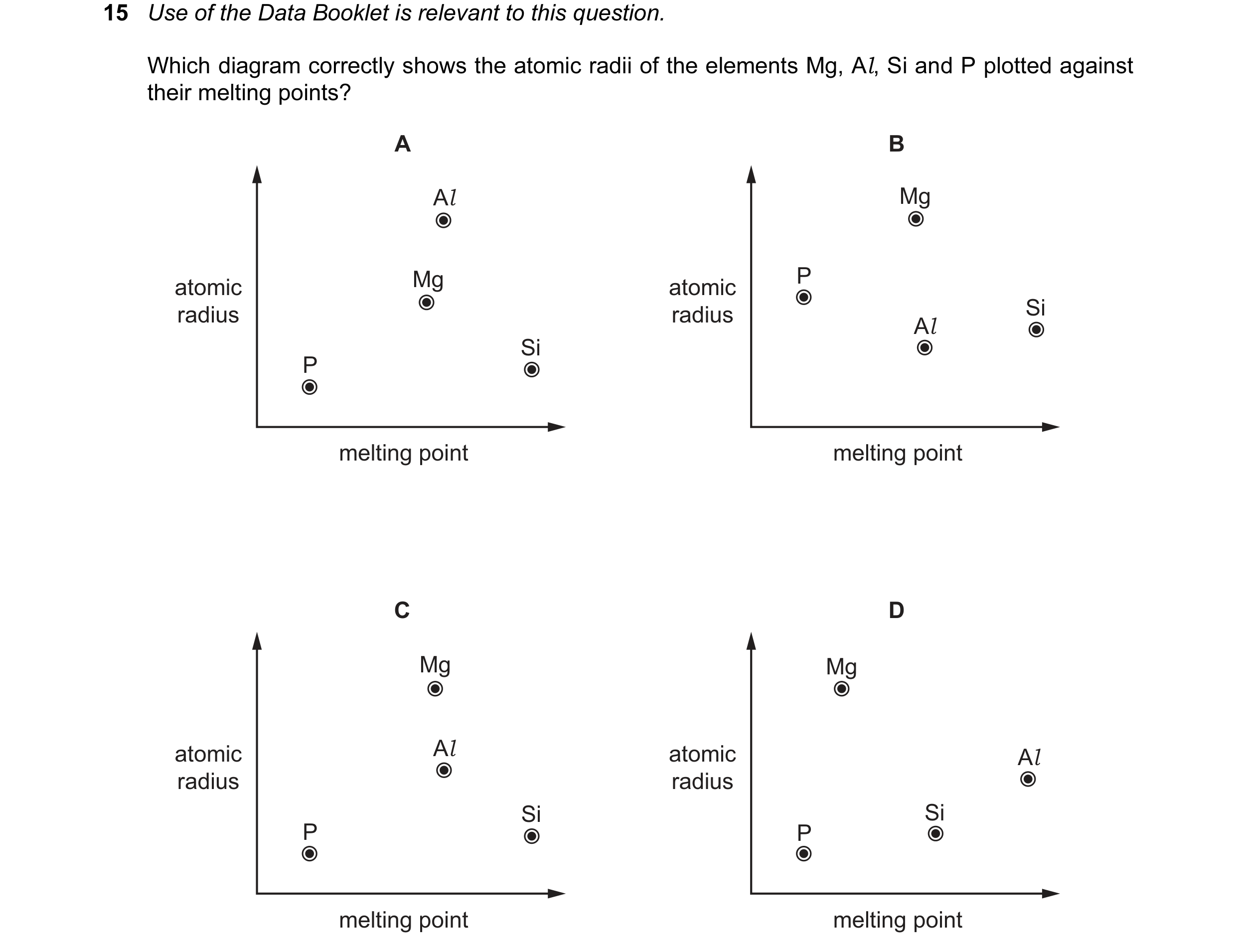
Q36 · Use of the Data Booklet is relevant to this question 9701/11 May/June 2015
15 Use of the Data Booklet is relevant to this question. Which diagram correctly shows the atomic radii of the elements Mg, Al, Si and P plotted against their melting points? A B Al Mg Mg P atomic atomic radius radius Si Al Si P melting point melting point C D Mg Mg atomic Al atomic Al radius radius Si Si P P melting point melting point
1 marks
Answer: C
This question in 9701/11 May/June 2015
Q37 · Use of the Data Booklet is relevant to this question 9701/12 May/June 2015
15 Use of the Data Booklet is relevant to this question. Which diagram correctly shows the electronegativity of the elements Na, Mg, Al and Si plotted against their first ionisation energies? A B Si Si Al Al electronegativity electronegativity Mg Mg Na Na first ionisation energy first ionisation energy C D Na Na Al Mg electronegativity electronegativity Mg Al Si Si first ionisation energy first ionisation energy
1 marks
Answer: B
This question in 9701/12 May/June 2015
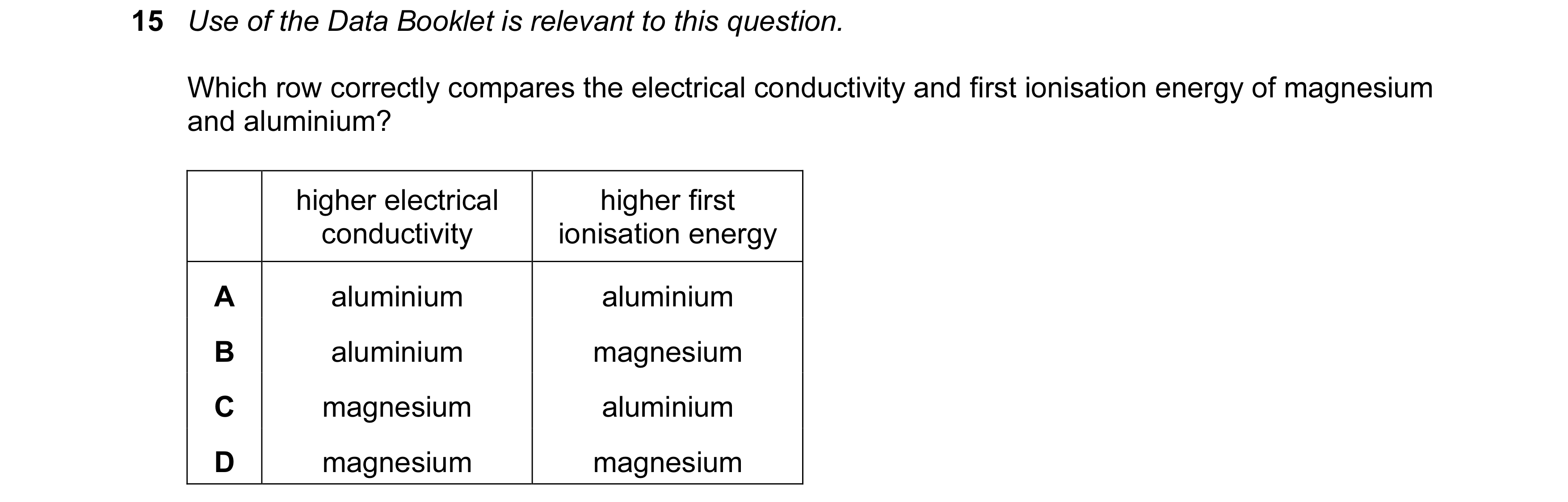
Q38 · Use of the Data Booklet is relevant to this question 9701/12 Oct/Nov 2015
15 Use of the Data Booklet is relevant to this question. Which row correctly compares the electrical conductivity and first ionisation energy of magnesium and aluminium? higher electrical higher first conductivity ionisation energy A aluminium aluminium B aluminium magnesium C magnesium aluminium D magnesium magnesium
1 marks
This question in 9701/12 Oct/Nov 2015
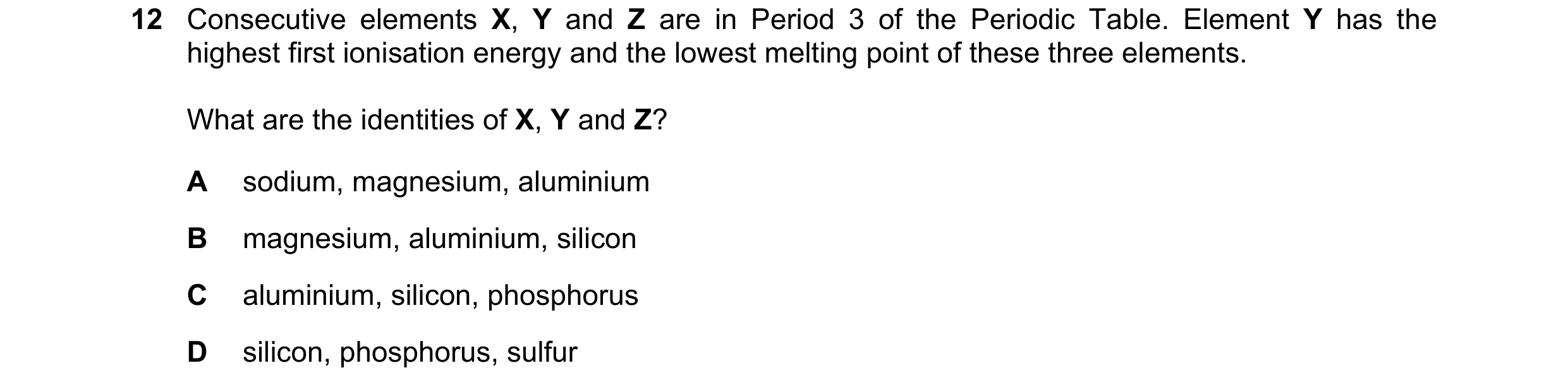
Q39 · Consecutive elements X, Y and Z are in Period 3 of the Periodic Table 9701/12 Feb/March 2016
12 Consecutive elements X, Y and Z are in Period 3 of the Periodic Table. Element Y has the highest first ionisation energy and the lowest melting point of these three elements. What are the identities of X, Y and Z? A sodium, magnesium, aluminium B magnesium, aluminium, silicon C aluminium, silicon, phosphorus D silicon, phosphorus, sulfur
1 marks
Answer: D
This question in 9701/12 Feb/March 2016
Q40 · Elements D and E are both in Period 3 9701/11 May/June 2016
13 Elements D and E are both in Period 3. Element D has the smallest atomic radius in Period 3. There are only two elements in Period 3 which have a lower melting point than element E. Elements D and E react together to form compound L. Which compound could be L? A MgCl 2 B MgS C Na2S D PCl 3
1 marks
Answer: D
This question in 9701/11 May/June 2016
Q41 · The first ionisation energies of twenty successive elements in the Periodic Table are… 9701/12 May/June 2016
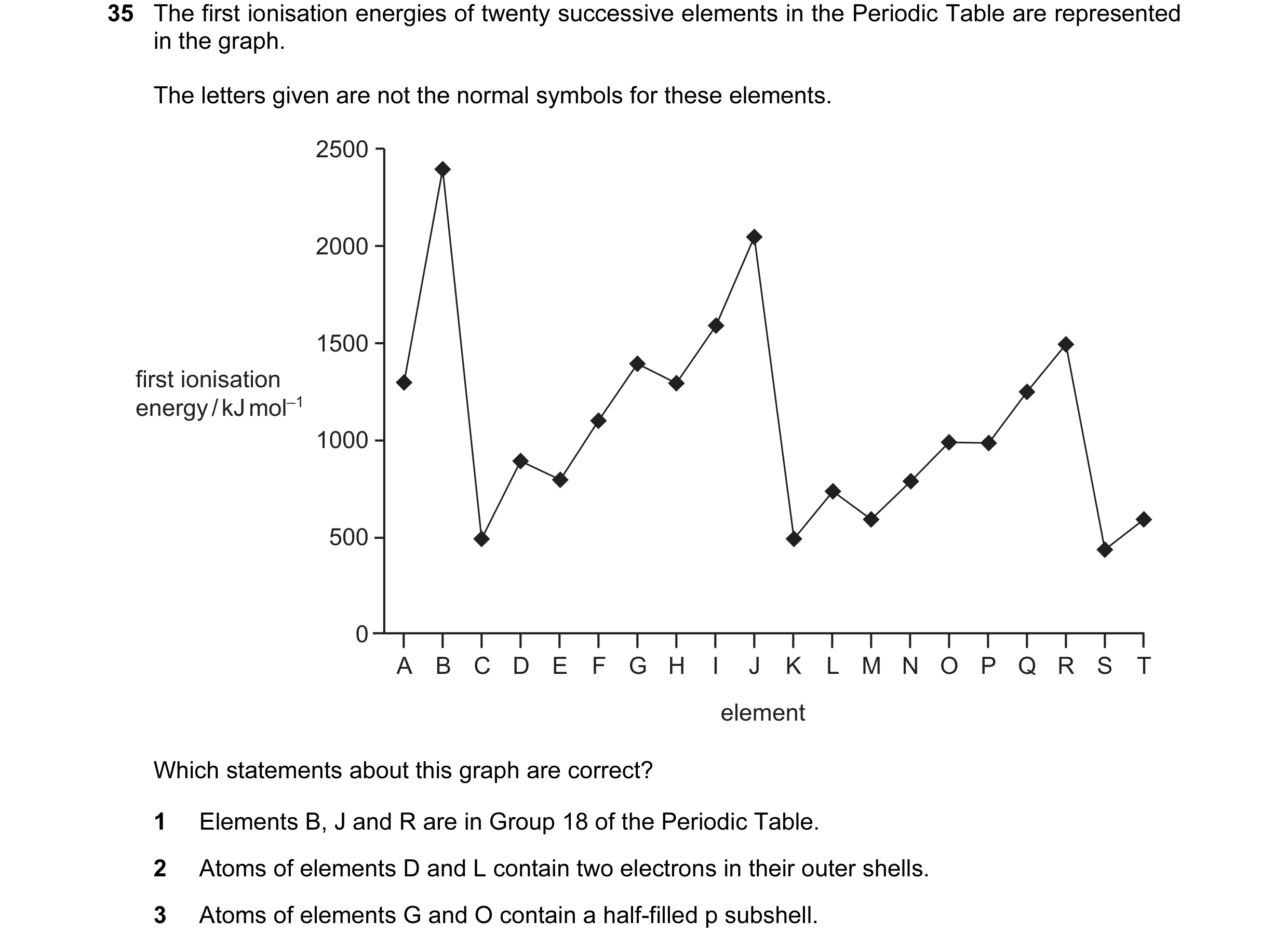
35 The first ionisation energies of twenty successive elements in the Periodic Table are represented in the graph. The letters given are not the normal symbols for these elements. 2500 2000 1500 first ionisation energy / kJ mol _1 1000 500 0 A B C D E F G H I J K L M N O P Q R S T element Which statements about this graph are correct? 1 Elements B, J and R are in Group 18 of the Periodic Table. 2 Atoms of elements D and L contain two electrons in their outer shells. 3 Atoms of elements G and O contain a half-filled p subshell.
1 marks
Answer: A
This question in 9701/12 May/June 2016
Q42 · Compound X is made from two elements 9701/13 May/June 2016
31 Compound X is made from two elements. One element has the second highest value of first ionisation energy in its group and the other element has the third highest value of first ionisation energy in its group. Which compounds could be compound X? 1 calcium chloride 2 magnesium bromide 3 potassium sulfide
1 marks
Answer: A
This question in 9701/13 May/June 2016
Q43 · The diagram shows the melting points of eight elements with consecutive atomic numbers 9701/11 Oct/Nov 2016
13 The diagram shows the melting points of eight elements with consecutive atomic numbers. Which element could be sodium? D melting point / K C A B atomic number
1 marks
Answer: C
This question in 9701/11 Oct/Nov 2016
Q44 · The diagram shows the melting points of eight elements with consecutive atomic numbers 9701/13 Oct/Nov 2016
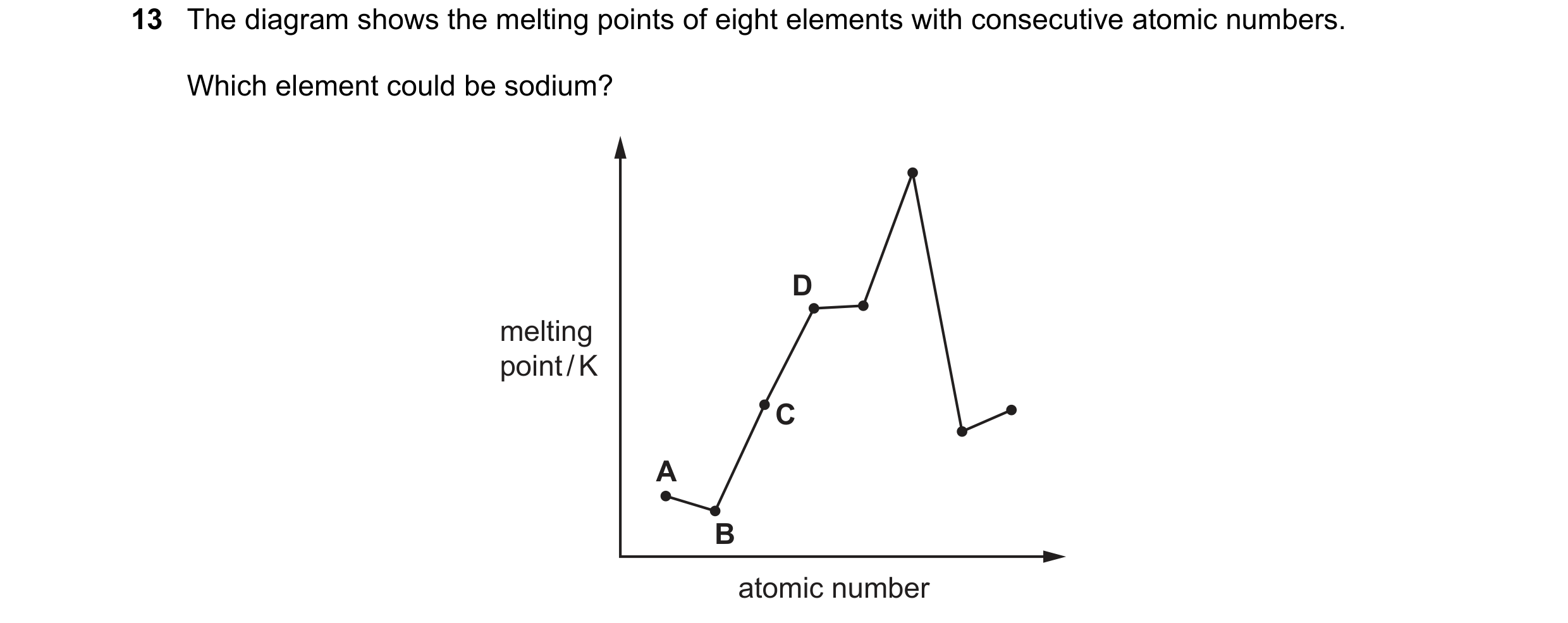
13 The diagram shows the melting points of eight elements with consecutive atomic numbers. Which element could be sodium? D melting point / K C A B atomic number
1 marks
Answer: C
This question in 9701/13 Oct/Nov 2016
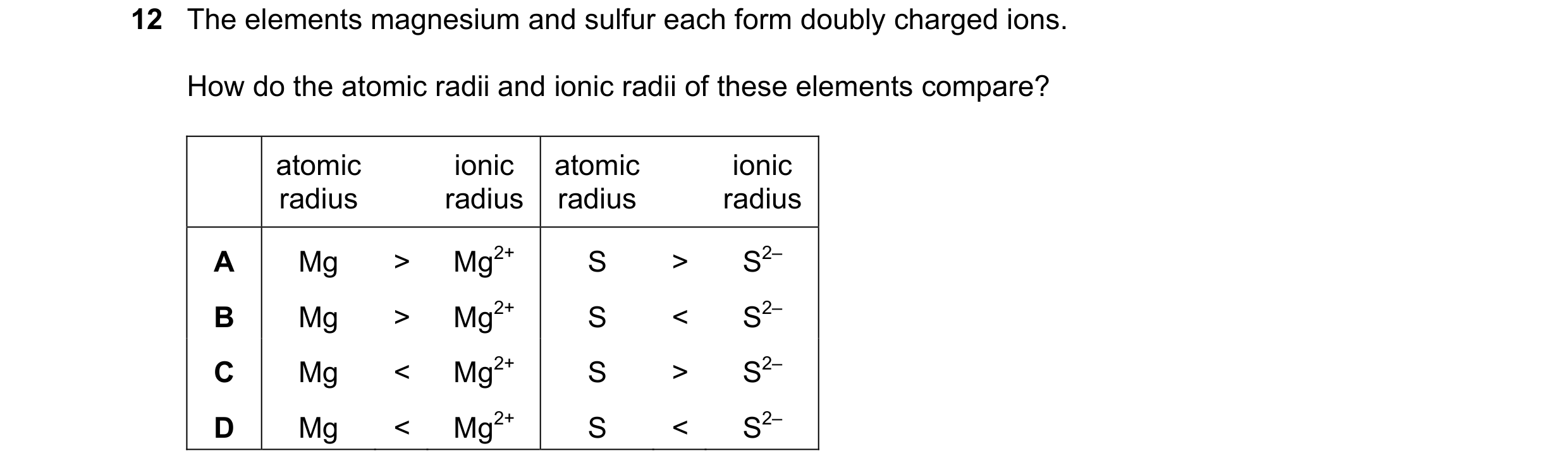
Q45 · The elements magnesium and sulfur each form doubly charged ions 9701/12 May/June 2017
12 The elements magnesium and sulfur each form doubly charged ions. How do the atomic radii and ionic radii of these elements compare? atomic ionic atomic ionic radius radius radius radius A Mg > Mg2+ S > S2– B Mg > Mg2+ S < S2– C Mg < Mg2+ S > S2– D Mg < Mg2+ S < S2–
1 marks
Answer: B
This question in 9701/12 May/June 2017
Q46 · Which graph correctly shows relative electronegativity plotted against relative atomic… 9701/12 May/June 2017
13 Which graph correctly shows relative electronegativity plotted against relative atomic radius for the elements Na, Mg, Al and Si? A B Si Al Al electronegativity Mg electronegativity Mg Si Na Na atomic radius atomic radius C D Na Si Mg Al electronegativity Al electronegativity Mg Si Na atomic radius atomic radius
1 marks
Answer: B
This question in 9701/12 May/June 2017
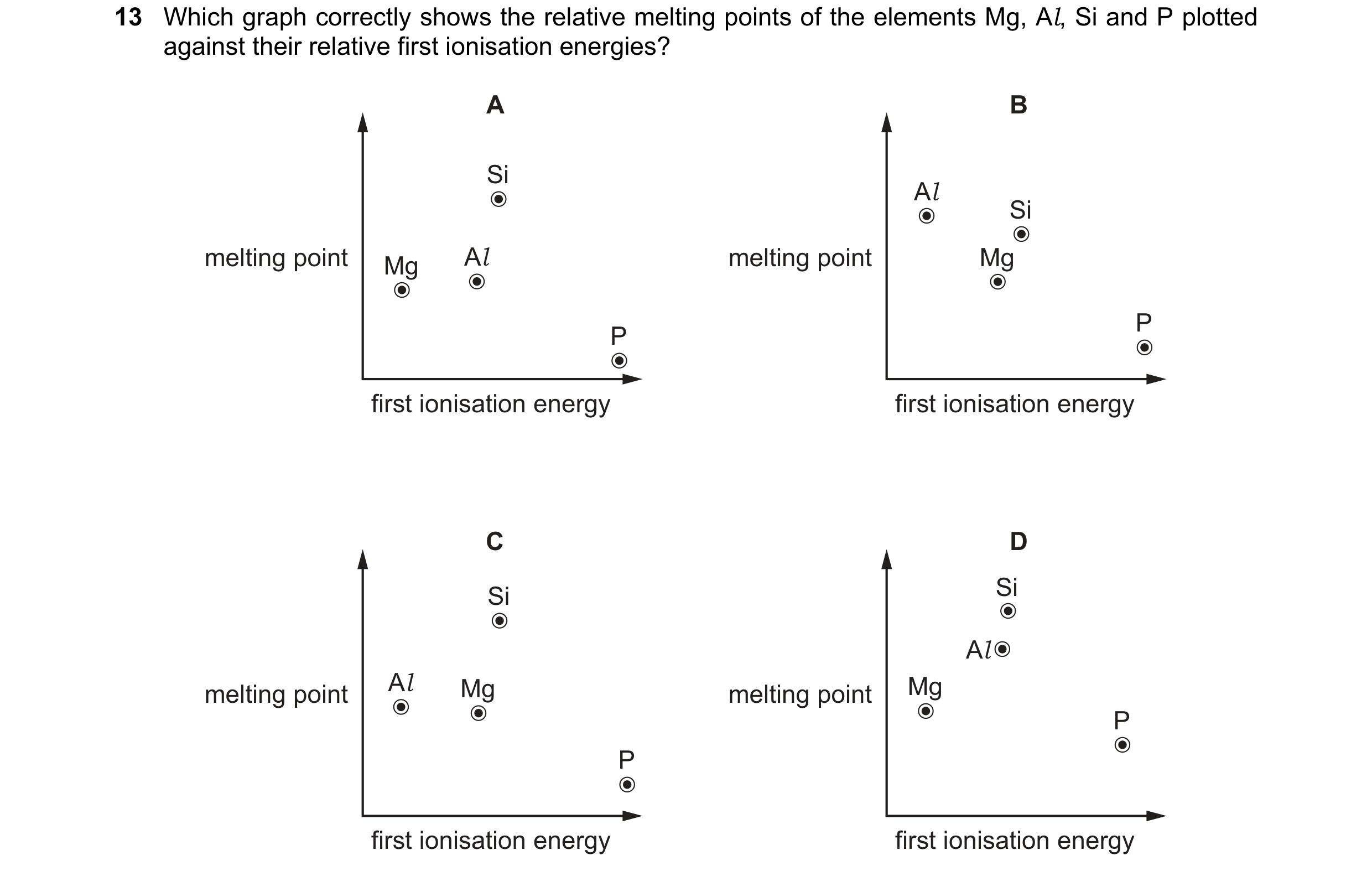
Q47 · Which graph correctly shows the relative melting points of the elements Mg, Al, Si and P… 9701/13 May/June 2017
13 Which graph correctly shows the relative melting points of the elements Mg, Al, Si and P plotted against their relative first ionisation energies? A B Si Al Si melting point Mg Al melting point Mg P P first ionisation energy first ionisation energy C D Si Si Al Al Mg Mg melting point melting point P P first ionisation energy first ionisation energy
1 marks
Answer: C
This question in 9701/13 May/June 2017
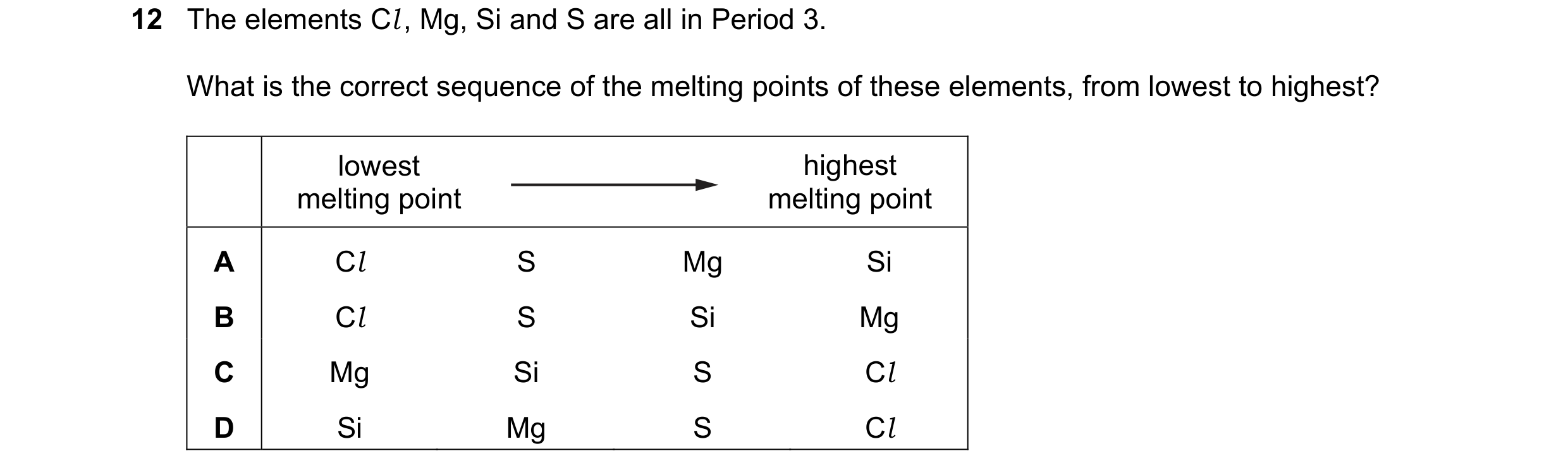
Q48 · The elements Cl , Mg, Si and S are all in Period 3 9701/11 Oct/Nov 2017
12 The elements Cl , Mg, Si and S are all in Period 3. What is the correct sequence of the melting points of these elements, from lowest to highest? lowest highest melting point melting point A Cl S Mg Si B Cl S Si Mg C Mg Si S Cl D Si Mg S Cl
1 marks
Answer: A
This question in 9701/11 Oct/Nov 2017
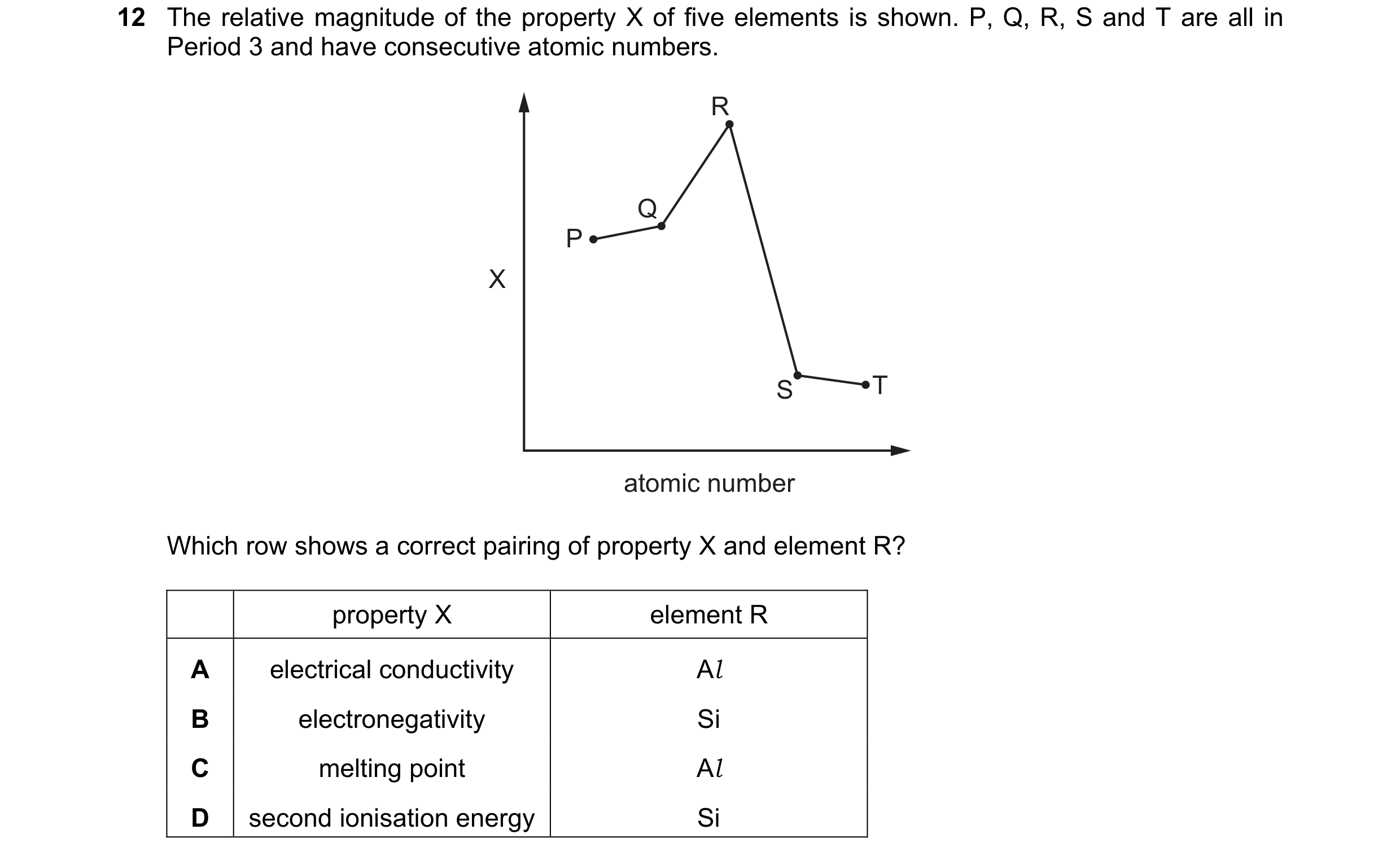
Q49 · The relative magnitude of the property X of five elements is shown 9701/12 Oct/Nov 2017
12 The relative magnitude of the property X of five elements is shown. P, Q, R, S and T are all in Period 3 and have consecutive atomic numbers. R Q P X S T atomic number Which row shows a correct pairing of property X and element R? property X element R A electrical conductivity Al B electronegativity Si C melting point Al D second ionisation energy Si
1 marks
Answer: A
This question in 9701/12 Oct/Nov 2017
Q50 · The elements Cl , Mg, Si and S are all in Period 3 9701/13 Oct/Nov 2017
12 The elements Cl , Mg, Si and S are all in Period 3. What is the correct sequence of the melting points of these elements, from lowest to highest? lowest highest melting point melting point A Cl S Mg Si B Cl S Si Mg C Mg Si S Cl D Si Mg S Cl
1 marks
Answer: A
This question in 9701/13 Oct/Nov 2017
Q51 · X, Y and Z are three elements in the third period 9701/12 Feb/March 2018
14 X, Y and Z are three elements in the third period. ● X reacts with chlorine to give a liquid product. ● Y reacts with chlorine to give a solid product that dissolves in water to give a solution of pH 7. ● Z reacts with chlorine to give a solid product that dissolves in water to give a solution of pH 6. Which elements are good conductors of electricity? A X and Y B Y and Z C Y only D Z only
1 marks
Answer: B
This question in 9701/12 Feb/March 2018
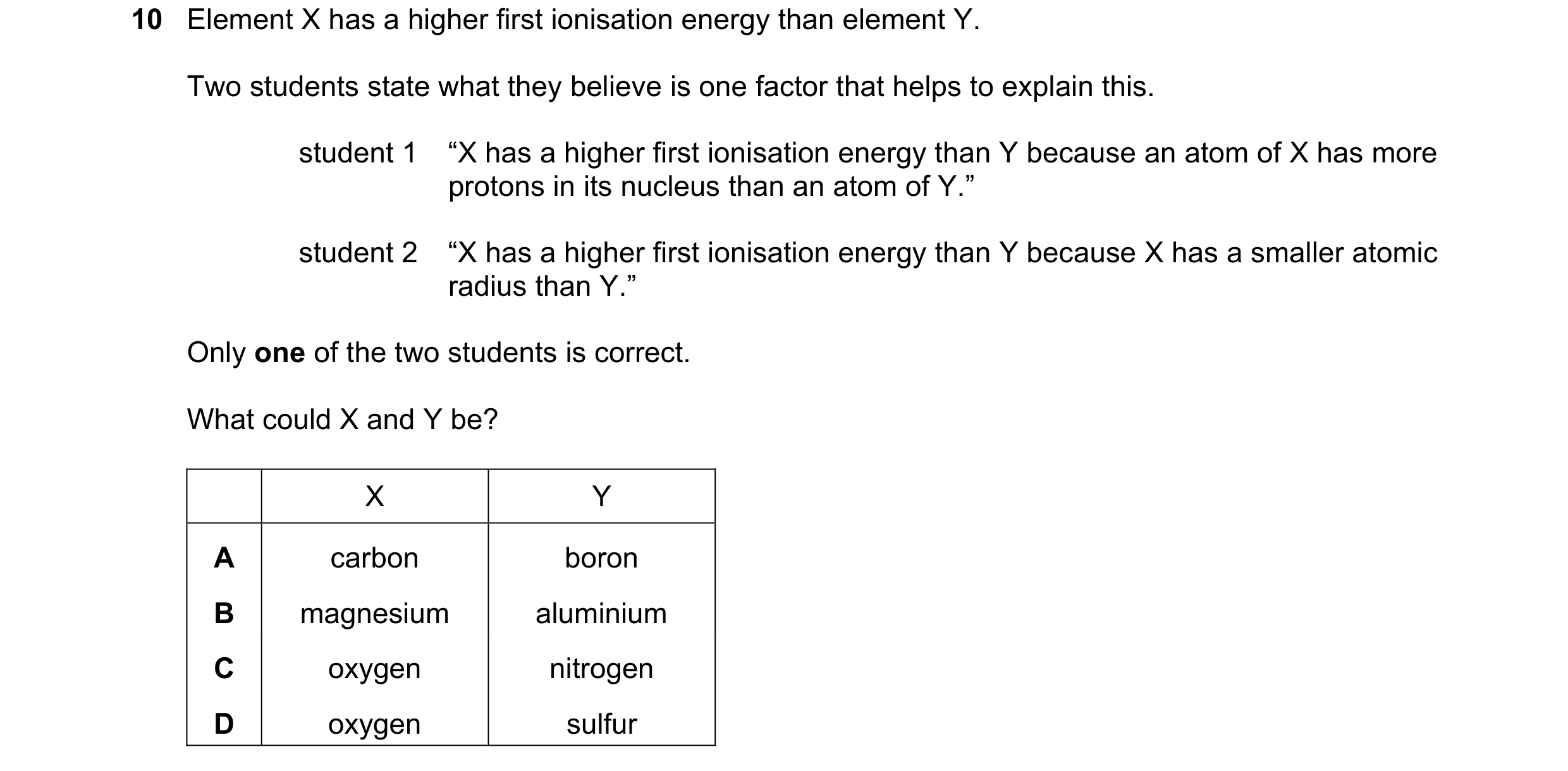
Q52 · Element X has a higher first ionisation energy than element Y 9701/11 May/June 2018
10 Element X has a higher first ionisation energy than element Y. Two students state what they believe is one factor that helps to explain this. student 1 “X has a higher first ionisation energy than Y because an atom of X has more protons in its nucleus than an atom of Y.” student 2 “X has a higher first ionisation energy than Y because X has a smaller atomic radius than Y.” Only one of the two students is correct. What could X and Y be? X Y A carbon boron B magnesium aluminium C oxygen nitrogen D oxygen sulfur
1 marks
Answer: D
This question in 9701/11 May/June 2018
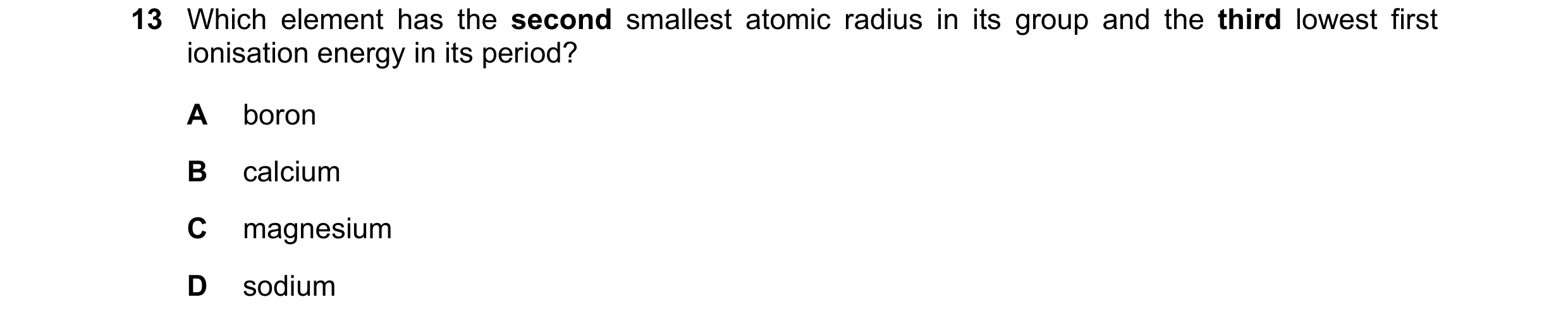
Q53 · Which element has the second smallest atomic radius in its group and the third lowest… 9701/11 May/June 2018
13 Which element has the second smallest atomic radius in its group and the third lowest first ionisation energy in its period? A boron B calcium C magnesium D sodium
1 marks
Answer: C
This question in 9701/11 May/June 2018
Q54 · The graphs show trends in four physical properties of elements in Period 3, excluding… 9701/12 May/June 2018
13 The graphs show trends in four physical properties of elements in Period 3, excluding argon. Which graph has electronegativity on the y-axis? A B Na Mg Al Si P S Cl Na Mg Al Si P S Cl C D Na Mg Al Si P S Cl Na Mg Al Si P S Cl
1 marks
Answer: D
This question in 9701/12 May/June 2018
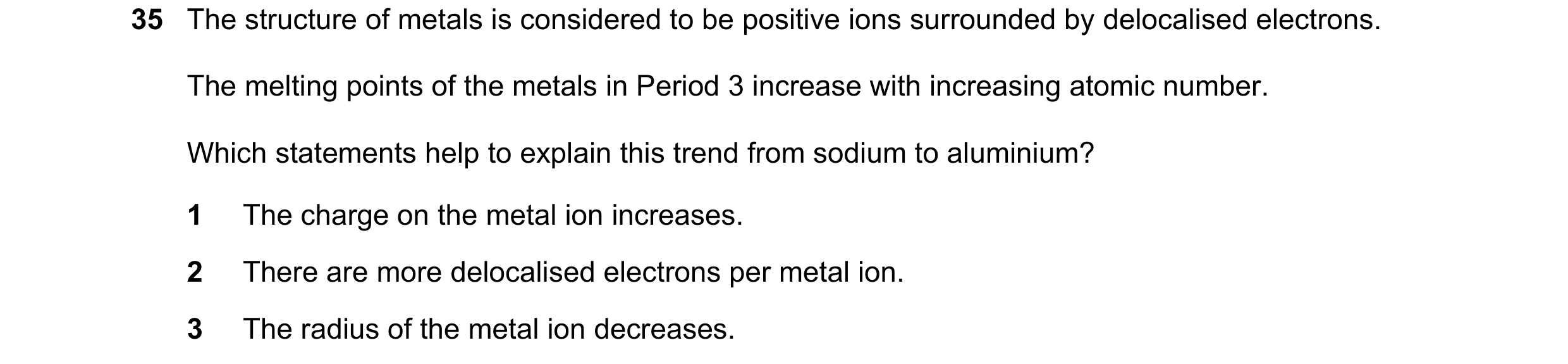
Q55 · The structure of metals is considered to be positive ions surrounded by delocalised… 9701/13 May/June 2018
35 The structure of metals is considered to be positive ions surrounded by delocalised electrons. The melting points of the metals in Period 3 increase with increasing atomic number. Which statements help to explain this trend from sodium to aluminium? 1 The charge on the metal ion increases. 2 There are more delocalised electrons per metal ion. 3 The radius of the metal ion decreases.
1 marks
Answer: A
This question in 9701/13 May/June 2018
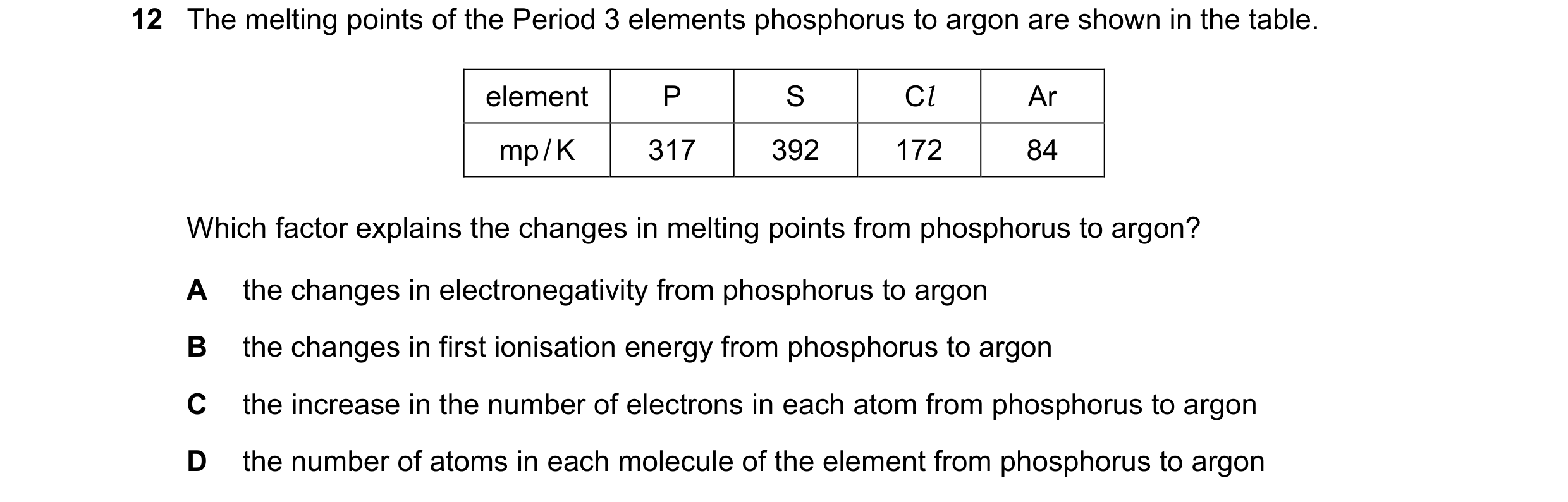
Q56 · The melting points of the Period 3 elements phosphorus to argon are shown in the table 9701/12 Oct/Nov 2018
12 The melting points of the Period 3 elements phosphorus to argon are shown in the table. element P S Cl Ar mp / K 317 392 172 84 Which factor explains the changes in melting points from phosphorus to argon? A the changes in electronegativity from phosphorus to argon B the changes in first ionisation energy from phosphorus to argon C the increase in the number of electrons in each atom from phosphorus to argon D the number of atoms in each molecule of the element from phosphorus to argon
1 marks
Answer: D
This question in 9701/12 Oct/Nov 2018
Q57 · The relative melting points of four consecutive elements in the Periodic Table are shown… 9701/11 May/June 2019
13 The relative melting points of four consecutive elements in the Periodic Table are shown in the graph. The elements all have proton numbers less than 20. Which element is in Group 16? A melting point / K B C 273 D proton number
1 marks
Answer: C
This question in 9701/11 May/June 2019
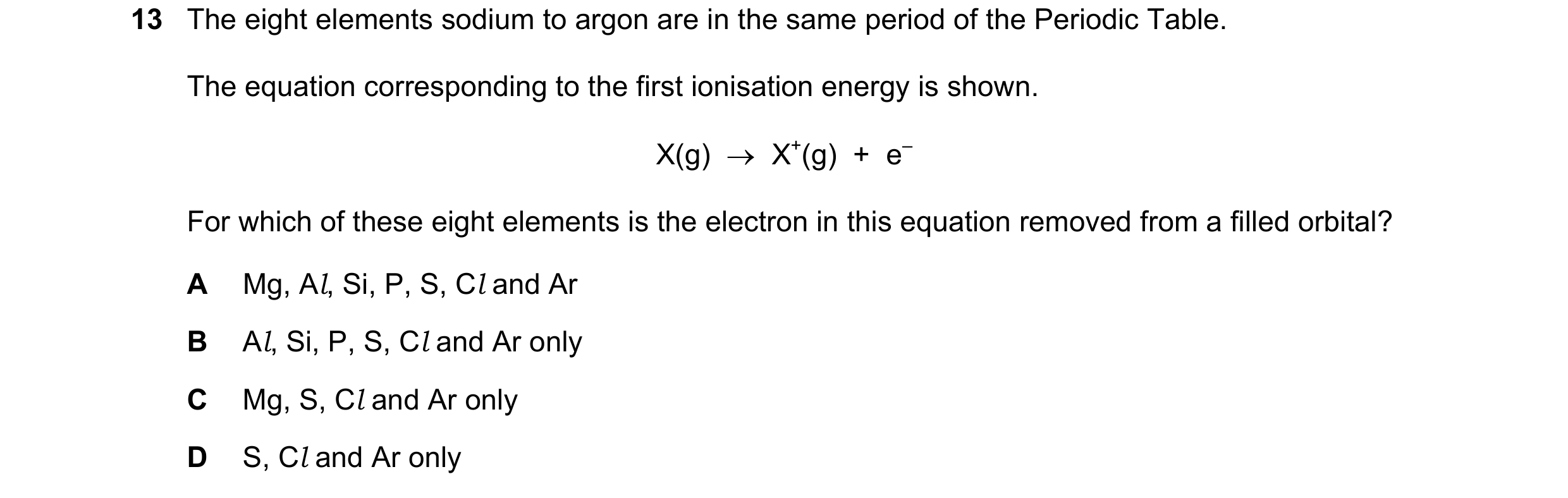
Q58 · The eight elements sodium to argon are in the same period of the Periodic Table 9701/12 May/June 2019
13 The eight elements sodium to argon are in the same period of the Periodic Table. The equation corresponding to the first ionisation energy is shown. X(g) → X+(g) + e– For which of these eight elements is the electron in this equation removed from a filled orbital? A Mg, Al, Si, P, S, Cl and Ar B Al, Si, P, S, Cl and Ar only C Mg, S, Cl and Ar only D S, Cl and Ar only
1 marks
Answer: C
This question in 9701/12 May/June 2019
Q59 · Elements D and E are both in Period 3 9701/12 May/June 2019
14 Elements D and E are both in Period 3. Element D has the smallest atomic radius in Period 3. There are only two elements in Period 3 which have a lower melting point than element E. Elements D and E react together to form compound L. Which compound could be L? A MgCl 2 B MgS C Na2S D PCl 3
1 marks
Answer: D
This question in 9701/12 May/June 2019
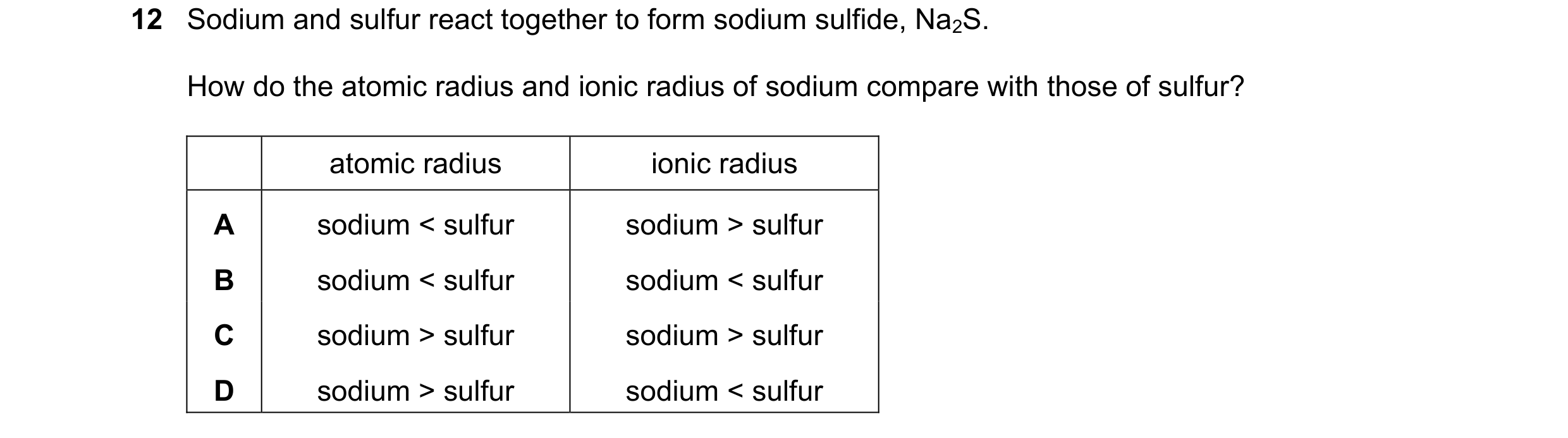
Q60 · Sodium and sulfur react together to form sodium sulfide, Na2S 9701/13 May/June 2019
12 Sodium and sulfur react together to form sodium sulfide, Na2S. How do the atomic radius and ionic radius of sodium compare with those of sulfur? atomic radius ionic radius A sodium < sulfur sodium > sulfur B sodium < sulfur sodium < sulfur C sodium > sulfur sodium > sulfur D sodium > sulfur sodium < sulfur
1 marks
Answer: D
This question in 9701/13 May/June 2019
Q61 · Which graph represents the variation in electronegativity for Period 3 elements? 9701/13 May/June 2019
13 Which graph represents the variation in electronegativity for Period 3 elements? A B electronegativity electronegativity Na Mg Al Si P S Cl Na Mg Al Si P S Cl element element C D electronegativity electronegativity Na Mg Al Si P S Cl Na Mg Al Si P S Cl element element
1 marks
Answer: B
This question in 9701/13 May/June 2019
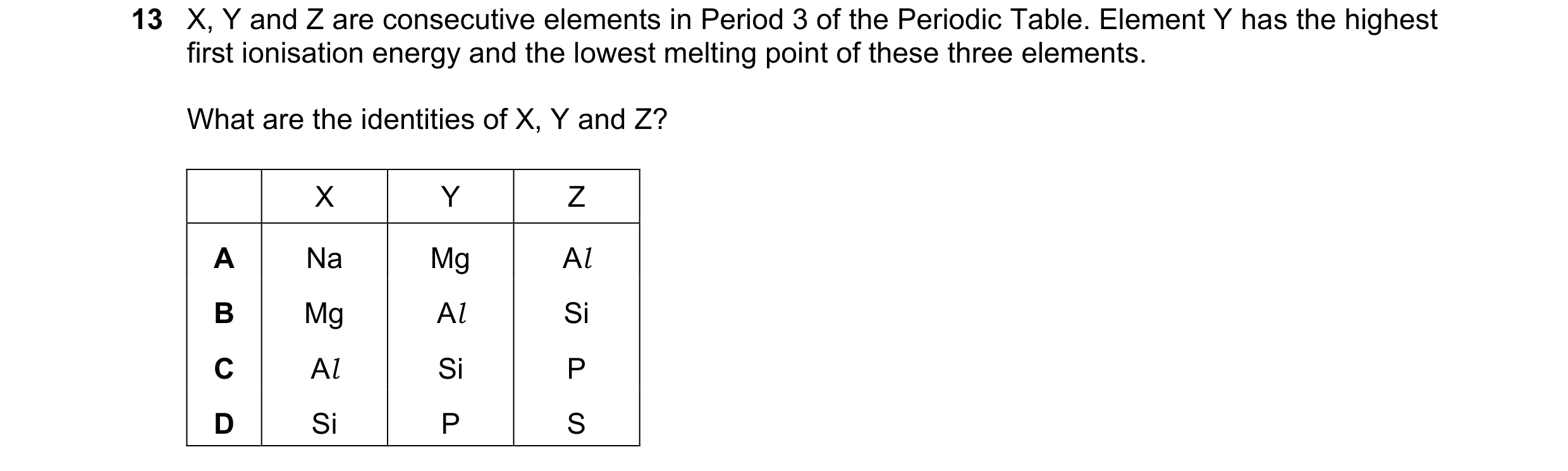
Q62 · X, Y and Z are consecutive elements in Period 3 of the Periodic Table 9701/11 Oct/Nov 2019
13 X, Y and Z are consecutive elements in Period 3 of the Periodic Table. Element Y has the highest first ionisation energy and the lowest melting point of these three elements. What are the identities of X, Y and Z? X Y Z A Na Mg Al B Mg Al Si C Al Si P D Si P S
1 marks
Answer: D
This question in 9701/11 Oct/Nov 2019
Q63 · The first ionisation energy of chlorine is greater than that of sulfur 9701/11 Oct/Nov 2019
32 The first ionisation energy of chlorine is greater than that of sulfur. Which factors contribute to this? 1 Chlorine has more protons in its nucleus than sulfur does. 2 Chlorine has greater electron shielding than sulfur does. 3 The covalent bonds in chlorine molecules are stronger than those in sulfur molecules.
1 marks
Answer: D
This question in 9701/11 Oct/Nov 2019
Q64 · The graph shows the successive ionisation energies of element X and element Y 9701/12 Oct/Nov 2019
3 The graph shows the successive ionisation energies of element X and element Y. Both elements are in Period 3. key element X element Y energy 0 1 2 3 4 5 6 7 8 9 10 successive ionisation energies Which statement is correct? A An atom of element X needs one extra electron for a full outer shell; an atom of element Y needs three extra electrons for a full outer shell. B An atom of element Y has five electrons in the 3p subshell. C Element X has an oxidation number of +7 in most of its compounds. D When element X combines with element Y, the bonding is ionic.
1 marks
Answer: A
This question in 9701/12 Oct/Nov 2019
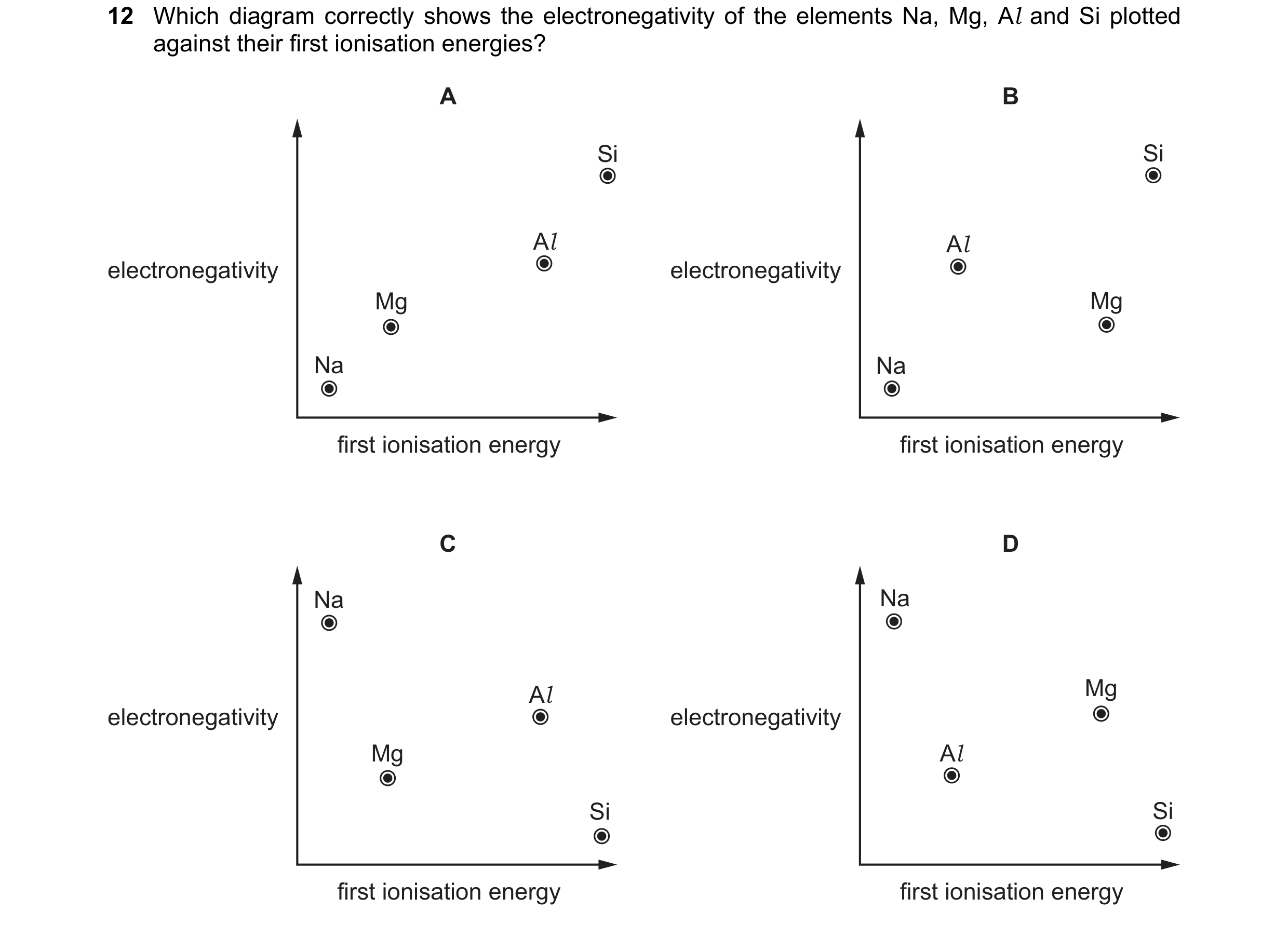
Q65 · Which diagram correctly shows the electronegativity of the elements Na, Mg, Al and Si… 9701/12 Oct/Nov 2019
12 Which diagram correctly shows the electronegativity of the elements Na, Mg, Al and Si plotted against their first ionisation energies? A B Si Si Al Al electronegativity electronegativity Mg Mg Na Na first ionisation energy first ionisation energy C D Na Na Al Mg electronegativity electronegativity Mg Al Si Si first ionisation energy first ionisation energy
1 marks
Answer: B
This question in 9701/12 Oct/Nov 2019
Q66 · X, Y and Z are consecutive elements in Period 3 of the Periodic Table 9701/13 Oct/Nov 2019
13 X, Y and Z are consecutive elements in Period 3 of the Periodic Table. Element Y has the highest first ionisation energy and the lowest melting point of these three elements. What are the identities of X, Y and Z? X Y Z A Na Mg Al B Mg Al Si C Al Si P D Si P S
1 marks
Answer: D
This question in 9701/13 Oct/Nov 2019
Q67 · The first ionisation energy of chlorine is greater than that of sulfur 9701/13 Oct/Nov 2019
32 The first ionisation energy of chlorine is greater than that of sulfur. Which factors contribute to this? 1 Chlorine has more protons in its nucleus than sulfur does. 2 Chlorine has greater electron shielding than sulfur does. 3 The covalent bonds in chlorine molecules are stronger than those in sulfur molecules.
1 marks
Answer: D
This question in 9701/13 Oct/Nov 2019
Q68 · Carbon and nitrogen are adjacent in the Periodic Table 9701/12 Feb/March 2020
31 Carbon and nitrogen are adjacent in the Periodic Table. Which properties do they both have? 1 There is an empty 2p orbital in each atom of the element. 2 The principal quantum number of the highest occupied orbital is 2. 3 They can form compounds in which their atoms form four bonds.
1 marks
Answer: C
This question in 9701/12 Feb/March 2020
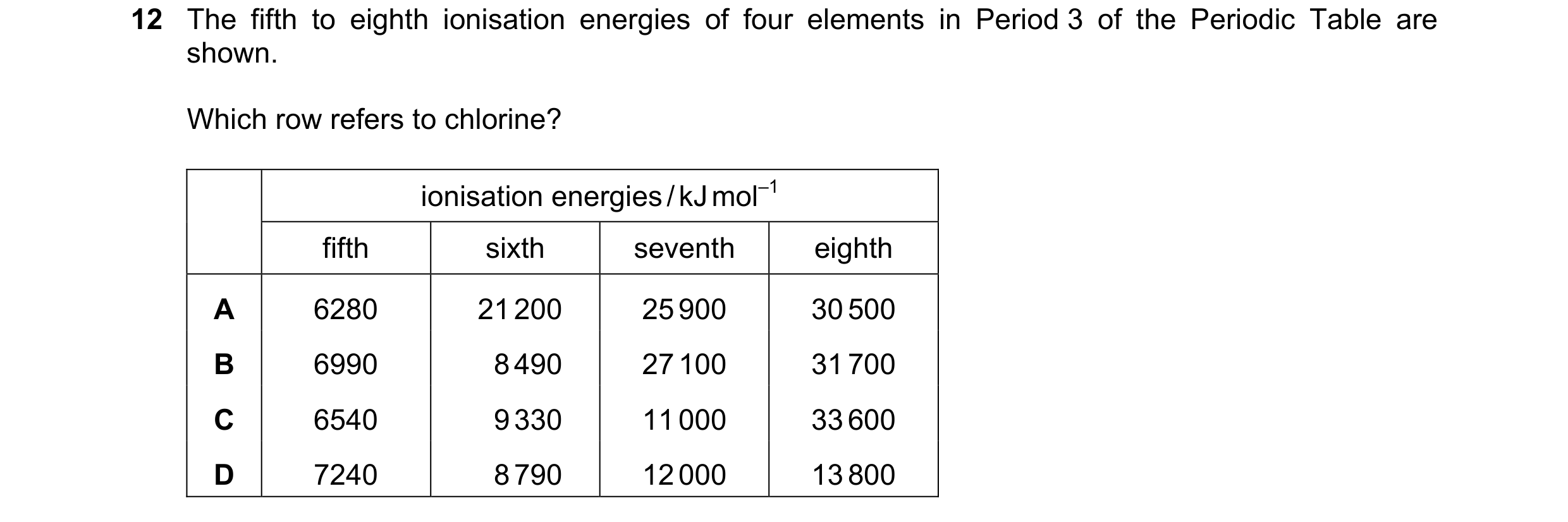
Q69 · The fifth to eighth ionisation energies of four elements in Period 3 of the Periodic… 9701/12 May/June 2020
12 The fifth to eighth ionisation energies of four elements in Period 3 of the Periodic Table are shown. Which row refers to chlorine? ionisation energies / kJ mol–1 fifth sixth seventh eighth A 6280 21 200 25 900 30 500 B 6990 8 490 27 100 31 700 C 6540 9 330 11 000 33 600 D 7240 8 790 12 000 13 800
1 marks
Answer: C
This question in 9701/12 May/June 2020
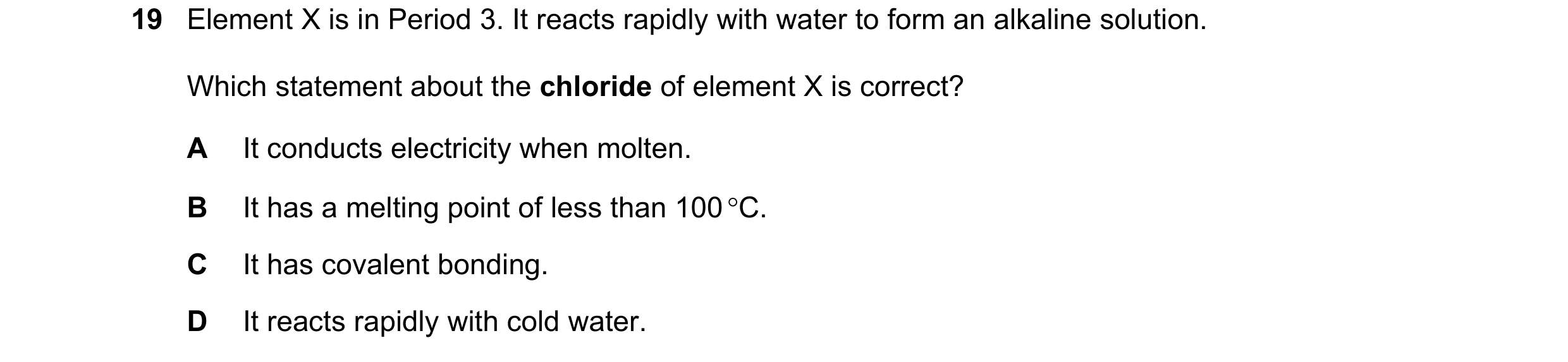
Q70 · Element X is in Period 3 9701/13 May/June 2020
19 Element X is in Period 3. It reacts rapidly with water to form an alkaline solution. Which statement about the chloride of element X is correct? A It conducts electricity when molten. B It has a melting point of less than 100 °C. C It has covalent bonding. D It reacts rapidly with cold water.
1 marks
Answer: A
This question in 9701/13 May/June 2020
Q71 · X and Y are two elements in Period 3 of the Periodic Table 9701/11 Oct/Nov 2020
12 X and Y are two elements in Period 3 of the Periodic Table. They combine to form compound Z. X forms a soluble acidic oxide. The oxidation number of X in this oxide is +4. Y forms an amphoteric oxide. What is the formula of compound Z? A Al P B Al 2S3 C Si2P5 D SiS2
1 marks
Answer: B
This question in 9701/11 Oct/Nov 2020
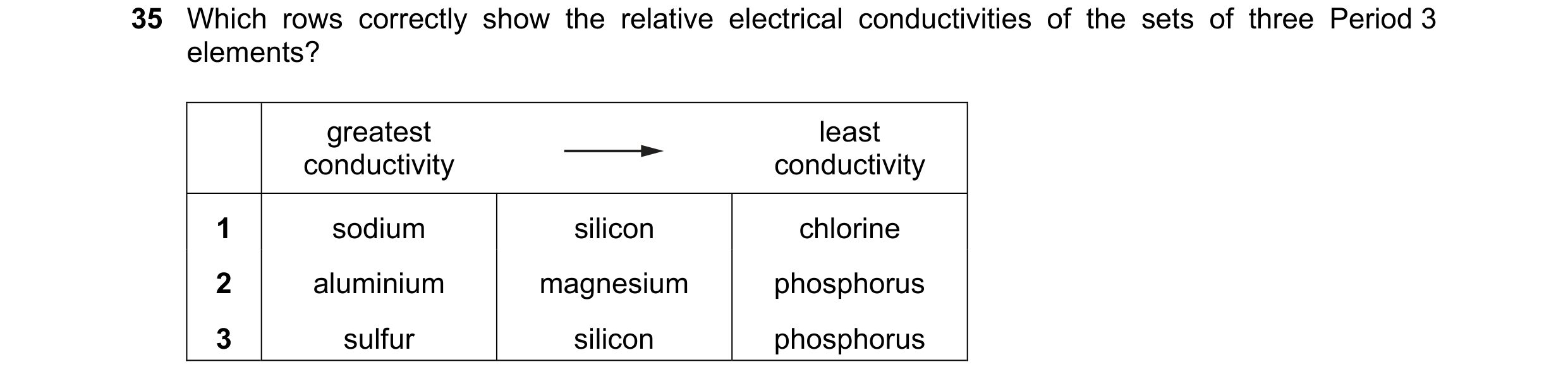
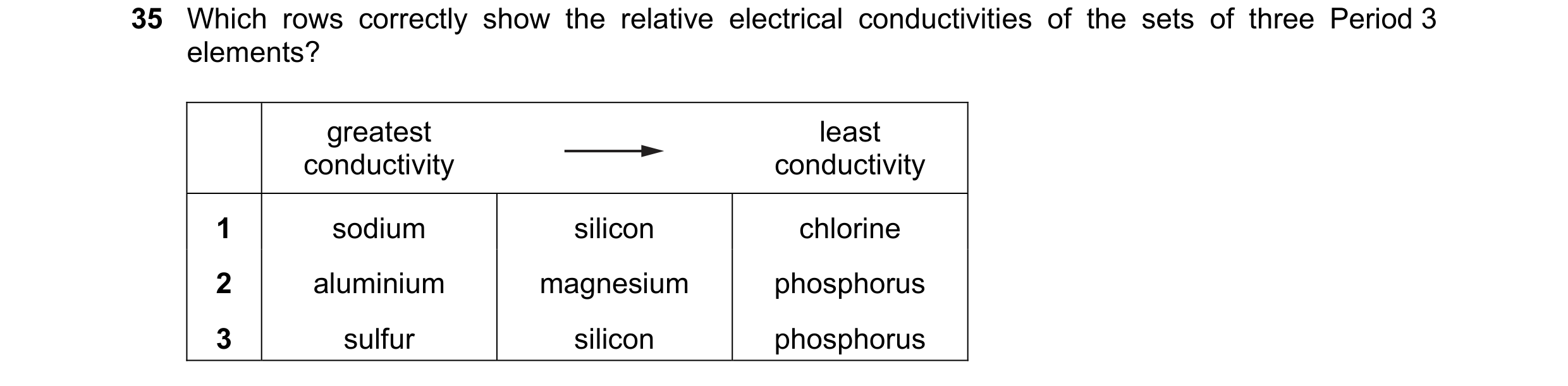
Q72 · Which rows correctly show the relative electrical conductivities of the sets of three… 9701/11 Oct/Nov 2020
35 Which rows correctly show the relative electrical conductivities of the sets of three Period 3 elements? greatest least conductivity conductivity 1 sodium silicon chlorine 2 aluminium magnesium phosphorus 3 sulfur silicon phosphorus
1 marks
Answer: B
This question in 9701/11 Oct/Nov 2020
Q73 · Which statements are correct? 9701/12 Oct/Nov 2020
36 Which statements are correct? 1 The empirical formula of silicon(IV) oxide is SiO2. 2 The molecular formula of phosphorus(V) oxide is P2O5. 3 Silicon(IV) oxide and phosphorus(V) oxide are both simple molecular compounds.
1 marks
Answer: D
This question in 9701/12 Oct/Nov 2020
Q74 · Which rows correctly show the relative electrical conductivities of the sets of three… 9701/13 Oct/Nov 2020
35 Which rows correctly show the relative electrical conductivities of the sets of three Period 3 elements? greatest least conductivity conductivity 1 sodium silicon chlorine 2 aluminium magnesium phosphorus 3 sulfur silicon phosphorus
1 marks
Answer: B
This question in 9701/13 Oct/Nov 2020
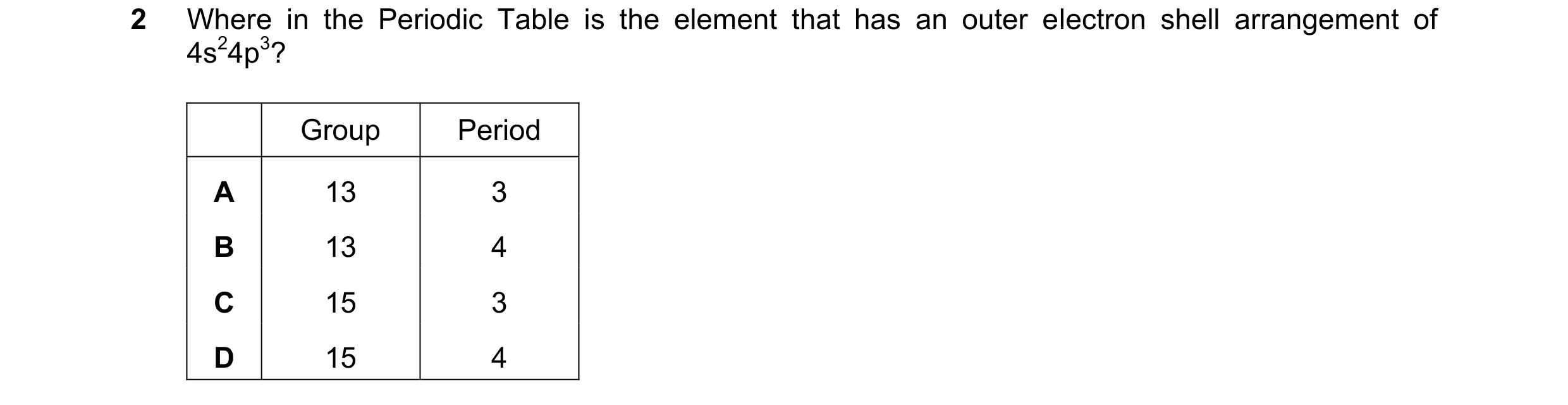
Q75 · Where in the Periodic Table is the element that has an outer electron shell arrangement… 9701/12 Feb/March 2021
2 Where in the Periodic Table is the element that has an outer electron shell arrangement of 4s24p3? Group Period A 13 3 B 13 4 C 15 3 D 15 4
1 marks
Answer: D
This question in 9701/12 Feb/March 2021
Q76 · Which row is correct? 9701/12 Feb/March 2021
13 Which row is correct? statement reason A The first ionisation energy of phosphorus electron is lost from a is greater than that of magnesium. 3p orbital in both cases B The melting point of phosphorus phosphorus has more valence is greater than that of magnesium. electrons than magnesium C The atomic radius of phosphorus phosphorus has greater nuclear is smaller than that of magnesium. charge than magnesium D The electrical conductivity of phosphorus bonding changes from ionic in is smaller than that of magnesium. magnesium to covalent in phosphorus
1 marks
Answer: C
This question in 9701/12 Feb/March 2021
Q77 · Element X is in Period 3 9701/11 May/June 2021
12 Element X is in Period 3. Element X forms a solid oxide Y. Y reacts with hot concentrated hydrochloric acid. Y reacts with hot aqueous sodium hydroxide to form a compound in which X is part of an anion. How many p electrons does one atom of X have in its outer shell? A 0 B 1 C 2 D 3
1 marks
Answer: B
This question in 9701/11 May/June 2021
Q78 · Which statements are correct going across Period 3 from sodium to chlorine? 9701/11 May/June 2021
35 Which statements are correct going across Period 3 from sodium to chlorine? 1 The charge on the nucleus increases, pulling the electrons closer to it. 2 The radius of the most common ion of each element decreases. 3 The shielding caused by inner electrons decreases, so the outer electrons are pulled closer to the nucleus.
1 marks
Answer: D
This question in 9701/11 May/June 2021
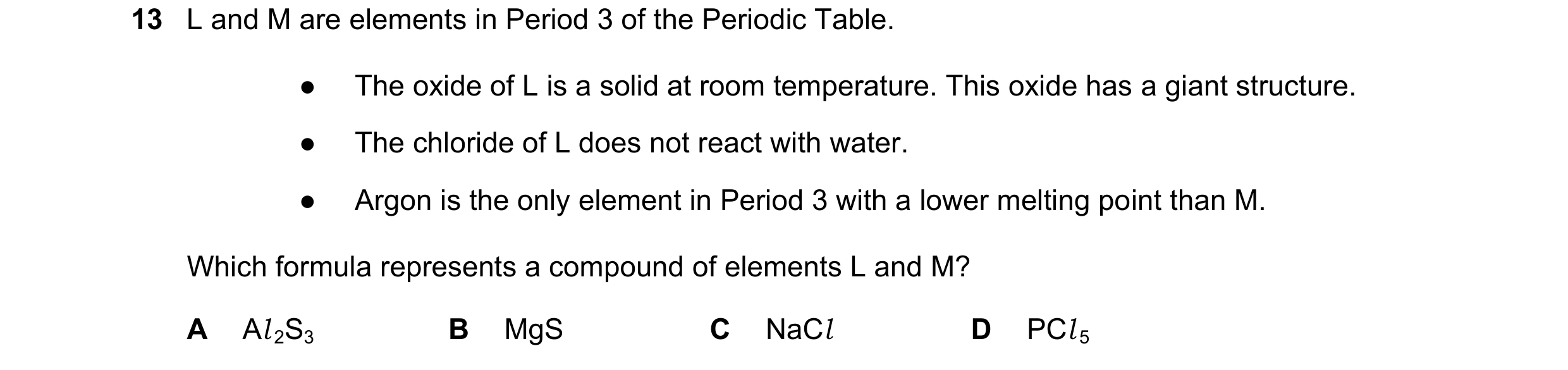
Q79 · L and M are elements in Period 3 of the Periodic Table 9701/12 May/June 2021
13 L and M are elements in Period 3 of the Periodic Table. ● The oxide of L is a solid at room temperature. This oxide has a giant structure. ● The chloride of L does not react with water. ● Argon is the only element in Period 3 with a lower melting point than M. Which formula represents a compound of elements L and M? A Al 2S3 B MgS C NaCl D PCl 5
1 marks
Answer: C
This question in 9701/12 May/June 2021
Q80 · Which statements about first ionisation energies are correct? 9701/13 May/June 2021
31 Which statements about first ionisation energies are correct? 1 They are always endothermic. 2 They decrease down Group 2. 3 They decrease across Period 3.
1 marks
Answer: B
This question in 9701/13 May/June 2021
Q81 · Which statements help to explain the increase in melting point from sodium to aluminium? 9701/13 May/June 2021
36 Which statements help to explain the increase in melting point from sodium to aluminium? 1 The charge on the metal ion increases. 2 There are more delocalised electrons per metal ion. 3 The radius of the metal ion decreases.
1 marks
Answer: A
This question in 9701/13 May/June 2021
Q82 · The following statements compare some properties of the oxides and chlorides of sodium… 9701/12 Oct/Nov 2021
35 The following statements compare some properties of the oxides and chlorides of sodium and silicon. Which statements are correct? 1 The melting point of SiCl 4 is higher than the melting point of SiO2. 2 SiCl 4 reacts with water, NaCl does not. 3 The melting point of SiCl 4 is lower than the melting point of NaCl.
1 marks
Answer: C
This question in 9701/12 Oct/Nov 2021
Q83 · Which graph correctly shows relative electronegativity plotted against relative atomic… 9701/12 May/June 2022
19 Which graph correctly shows relative electronegativity plotted against relative atomic radius for the elements Na, Mg, Al and Si? A B Si Al Al electronegativity Mg electronegativity Mg Na Si Na atomic radius atomic radius C D Na Si Mg Al electronegativity Al electronegativity Mg Si Na atomic radius atomic radius
1 marks
Answer: A
This question in 9701/12 May/June 2022
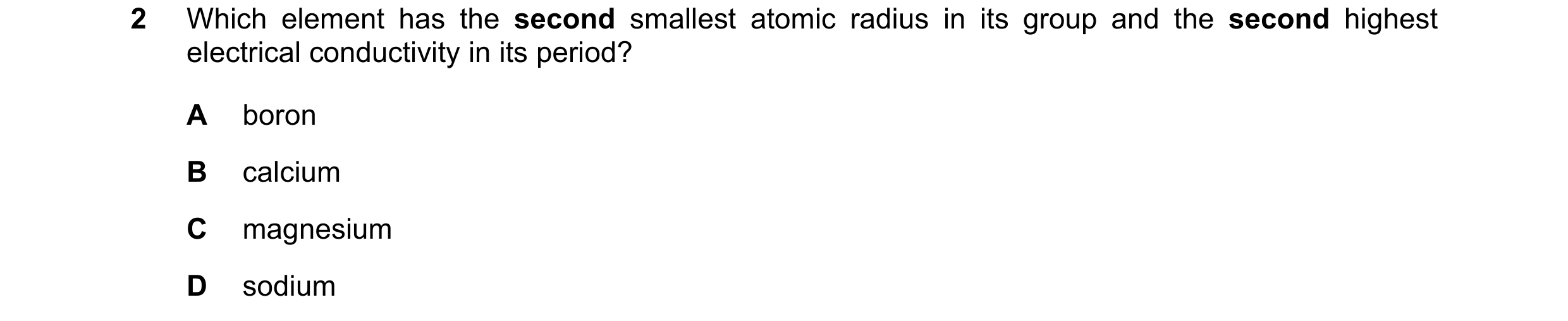
Q84 · Which element has the second smallest atomic radius in its group and the second highest… 9701/13 May/June 2022
2 Which element has the second smallest atomic radius in its group and the second highest electrical conductivity in its period? A boron B calcium C magnesium D sodium
1 marks
Answer: C
This question in 9701/13 May/June 2022
Q85 · For the element sulfur, which pair of ionisation energies has the largest difference… 9701/11 Oct/Nov 2022
4 For the element sulfur, which pair of ionisation energies has the largest difference between them? A third and fourth ionisation energies B fourth and fifth ionisation energies C fifth and sixth ionisation energies D sixth and seventh ionisation energies
1 marks
Answer: D
This question in 9701/11 Oct/Nov 2022
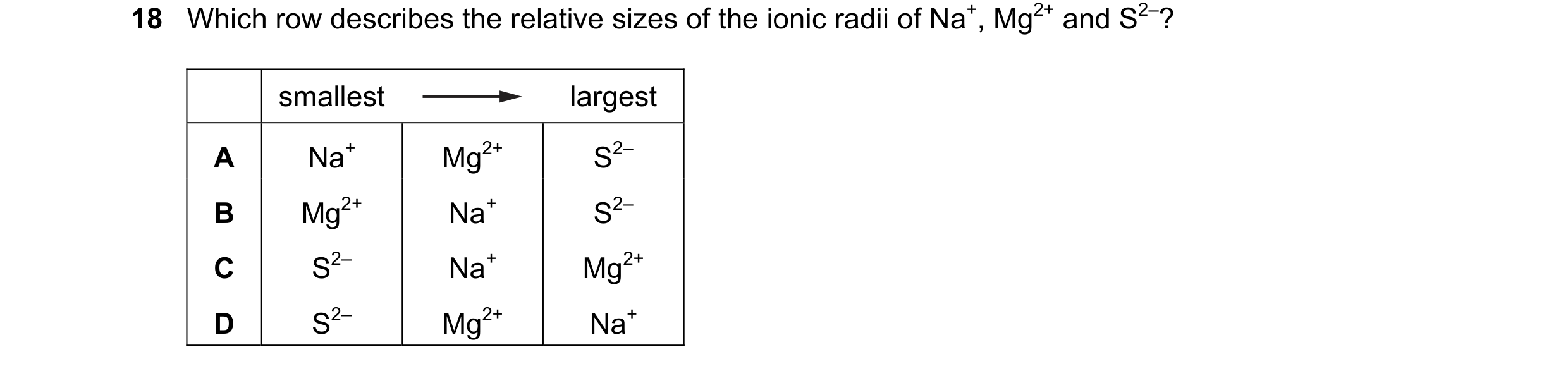
Q86 · Which row describes the relative sizes of the ionic radii of Na+, Mg2+ and S2–? 9701/11 Oct/Nov 2022
18 Which row describes the relative sizes of the ionic radii of Na+, Mg2+ and S2–? smallest largest A Na+ Mg2+ S2– B Mg2+ Na+ S2– C S2– Na+ Mg2+ D S2– Mg2+ Na+
1 marks
Answer: B
This question in 9701/11 Oct/Nov 2022
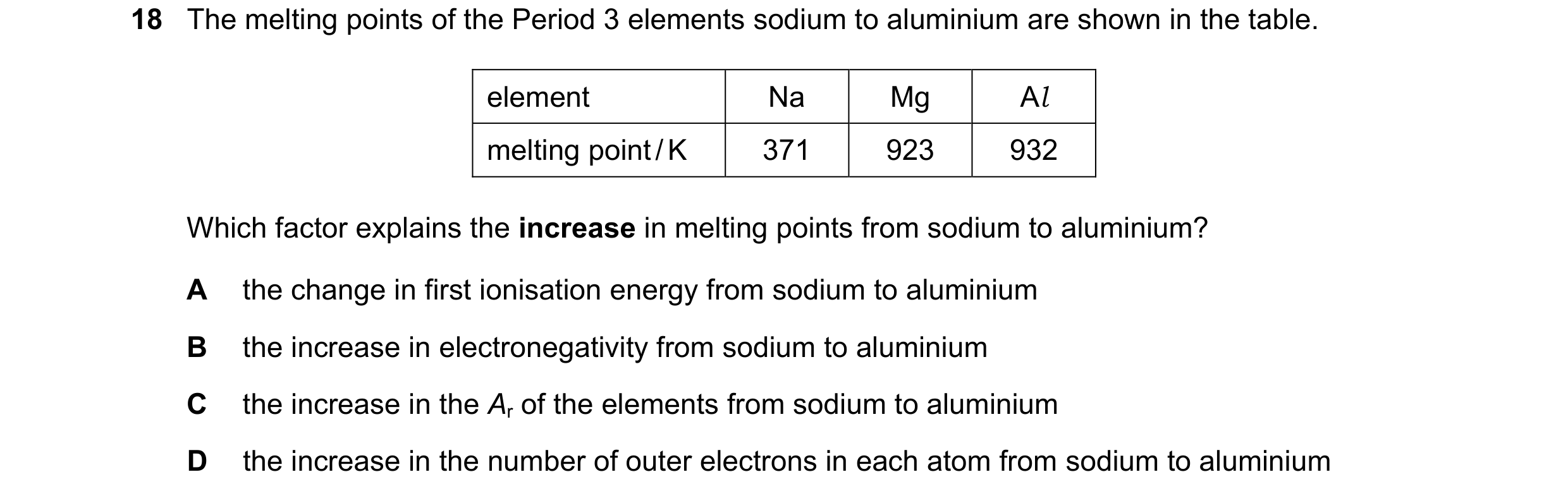
Q87 · The melting points of the Period 3 elements sodium to aluminium are shown in the table 9701/12 Oct/Nov 2022
18 The melting points of the Period 3 elements sodium to aluminium are shown in the table. element Na Mg Al melting point / K 371 923 932 Which factor explains the increase in melting points from sodium to aluminium? A the change in first ionisation energy from sodium to aluminium B the increase in electronegativity from sodium to aluminium C the increase in the Ar of the elements from sodium to aluminium D the increase in the number of outer electrons in each atom from sodium to aluminium
1 marks
Answer: D
This question in 9701/12 Oct/Nov 2022
Q88 · Which row describes the relative sizes of the ionic radii of Na+, Mg2+ and S2–? 9701/13 Oct/Nov 2022
18 Which row describes the relative sizes of the ionic radii of Na+, Mg2+ and S2–? smallest largest A Na+ Mg2+ S2– B Mg2+ Na+ S2– C S2– Na+ Mg2+ D S2– Mg2+ Na+
1 marks
Answer: B
This question in 9701/13 Oct/Nov 2022
Q89 · Which statement about the first ionisation energies of magnesium and neon is correct? 9701/12 Feb/March 2023
13 Which statement about the first ionisation energies of magnesium and neon is correct? A Magnesium has the greater numerical value and both are endothermic. B Magnesium has the greater numerical value and both are exothermic. C Neon has the greater numerical value and both are endothermic. D Neon has the greater numerical value and both are exothermic.
1 marks
Answer: C
This question in 9701/12 Feb/March 2023
Q90 · L and M are elements in Period 3 of the Periodic Table 9701/13 May/June 2023
4 L and M are elements in Period 3 of the Periodic Table. Neither element is argon. Information about the Pauling electronegativity values of L and M is given. element Pauling electronegativity value L the highest of the seven elements Na to Cl M the lowest of the seven elements Na to Cl Three statements about elements L and M are given. 1 Element L contains covalent bonds. 2 Element L has a higher atomic number than element M. 3 A compound of L and M contains ionic bonds. Which statements are correct? A 1, 2 and 3 B 1 and 2 only C 1 and 3 only D 2 and 3 only
1 marks
Answer: A
This question in 9701/13 May/June 2023
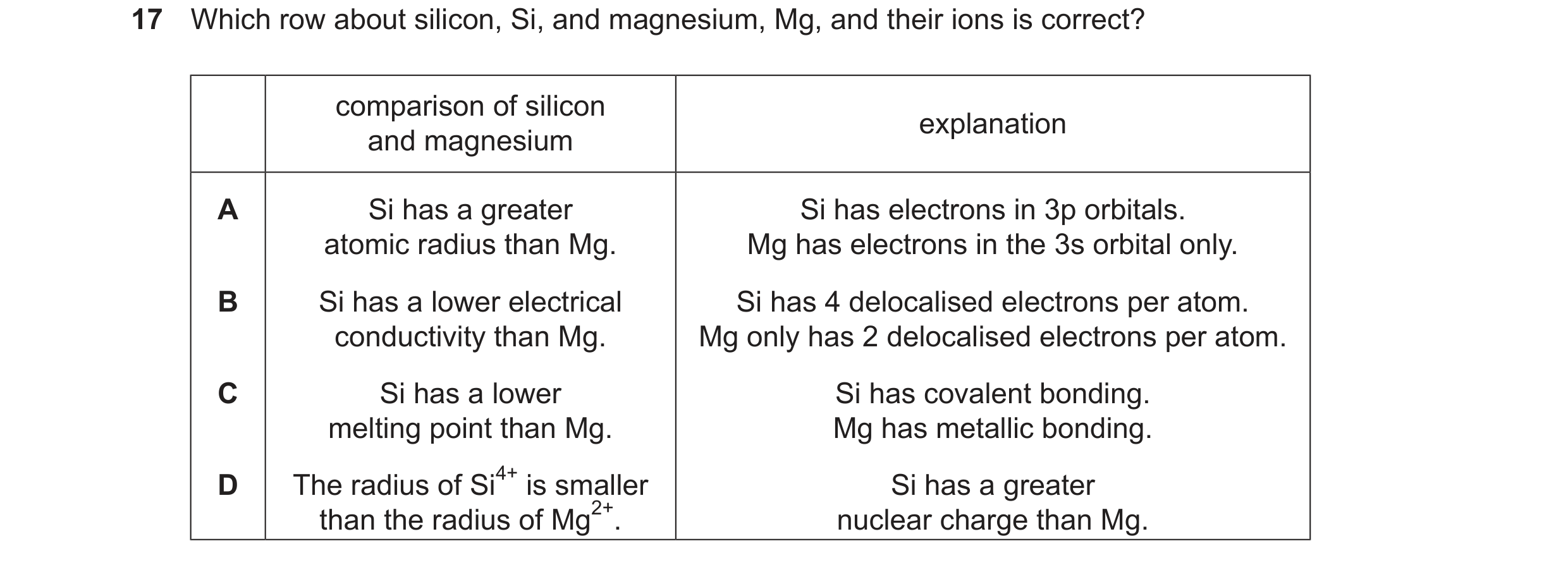
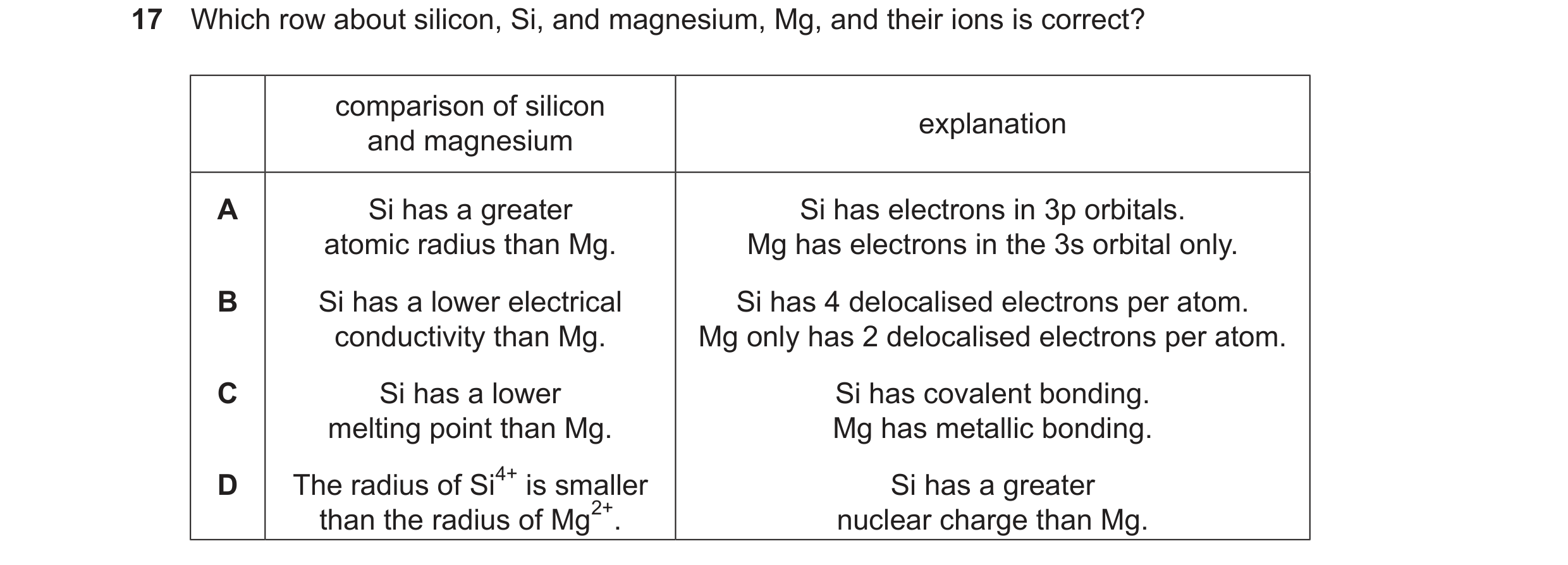
Q91 · Which row about silicon, Si, and magnesium, Mg, and their ions is correct? 9701/11 Oct/Nov 2023
17 Which row about silicon, Si, and magnesium, Mg, and their ions is correct? comparison of silicon explanation and magnesium A Si has a greater Si has electrons in 3p orbitals. atomic radius than Mg. Mg has electrons in the 3s orbital only. B Si has a lower electrical Si has 4 delocalised electrons per atom. conductivity than Mg. Mg only has 2 delocalised electrons per atom. C Si has a lower Si has covalent bonding. melting point than Mg. Mg has metallic bonding. The radius of Si4+ is smaller D Si has a greater than the radius of Mg2+. nuclear charge than Mg.
1 marks
Answer: D
This question in 9701/11 Oct/Nov 2023
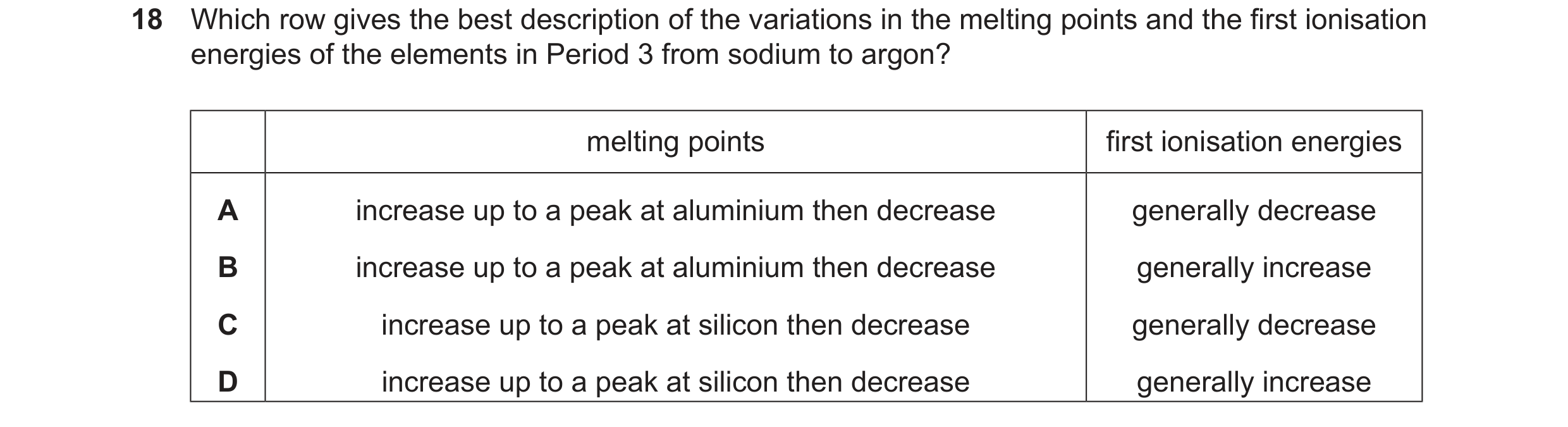
Q92 · Which row gives the best description of the variations in the melting points and the… 9701/12 Oct/Nov 2023
18 Which row gives the best description of the variations in the melting points and the first ionisation energies of the elements in Period 3 from sodium to argon? melting points first ionisation energies A increase up to a peak at aluminium then decrease generally decrease B increase up to a peak at aluminium then decrease generally increase C increase up to a peak at silicon then decrease generally decrease D increase up to a peak at silicon then decrease generally increase
1 marks
Answer: D
This question in 9701/12 Oct/Nov 2023
Q93 · X and Y are atoms of different elements in Period 3 of the Periodic Table 9701/12 Oct/Nov 2023
19 X and Y are atoms of different elements in Period 3 of the Periodic Table. Neither X nor Y is argon. X is a non-metal. X has a greater atomic radius than Y. Which statement is correct? A X has more occupied electron shells than Y. B X has more protons in each atom than Y. C X has the same number of outer electrons in each atom as Y. D Y is a non-metal. Four mixtures are added to four separate 50cm3 samples of water and stirred.
1 marks
Answer: D
This question in 9701/12 Oct/Nov 2023
Q94 · Which row about silicon, Si, and magnesium, Mg, and their ions is correct? 9701/13 Oct/Nov 2023
17 Which row about silicon, Si, and magnesium, Mg, and their ions is correct? comparison of silicon explanation and magnesium A Si has a greater Si has electrons in 3p orbitals. atomic radius than Mg. Mg has electrons in the 3s orbital only. B Si has a lower electrical Si has 4 delocalised electrons per atom. conductivity than Mg. Mg only has 2 delocalised electrons per atom. C Si has a lower Si has covalent bonding. melting point than Mg. Mg has metallic bonding. The radius of Si4+ is smaller D Si has a greater than the radius of Mg2+. nuclear charge than Mg.
1 marks
Answer: D
This question in 9701/13 Oct/Nov 2023
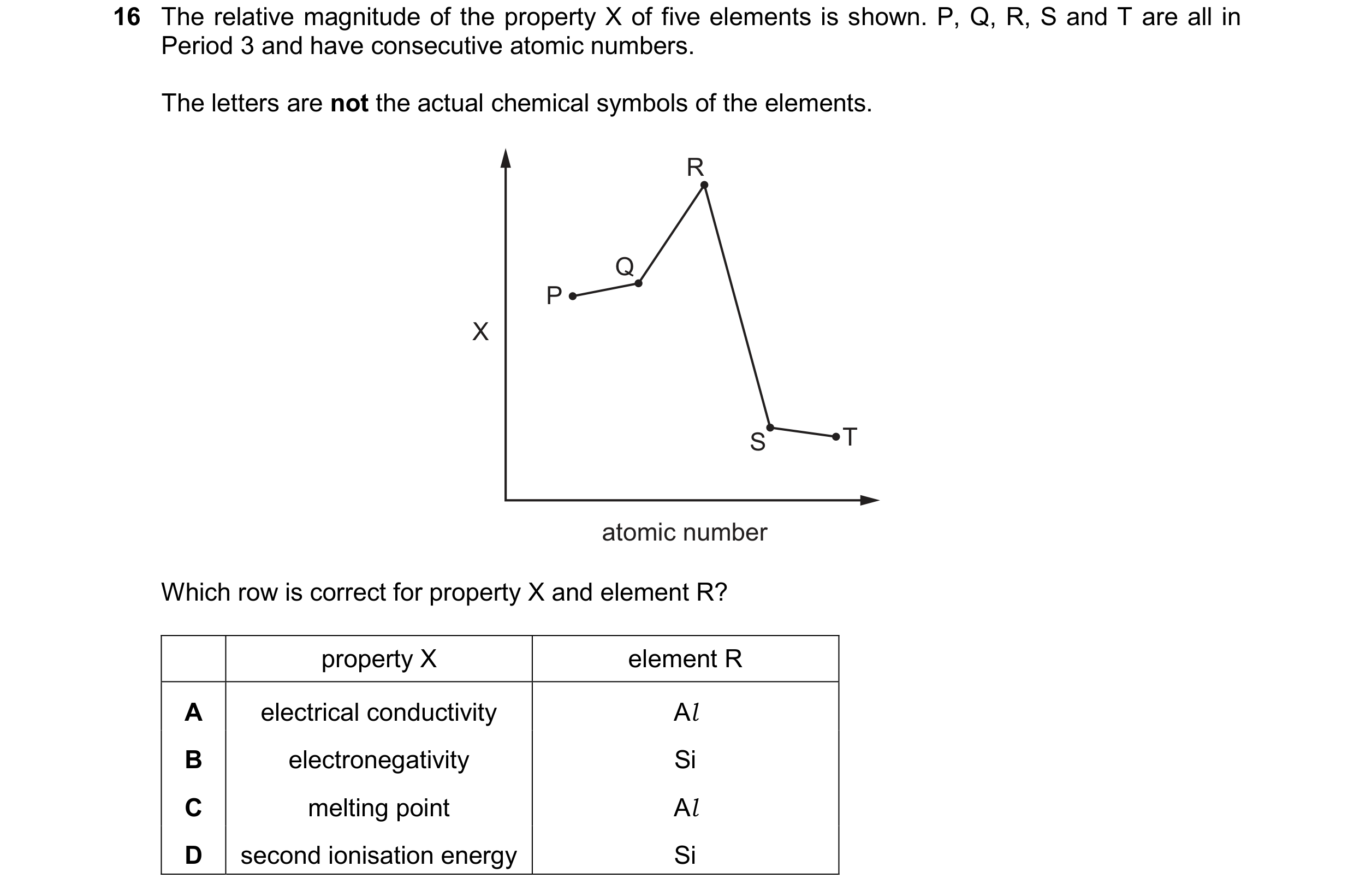
Q95 · The relative magnitude of the property X of five elements is shown 9701/12 Feb/March 2024
16 The relative magnitude of the property X of five elements is shown. P, Q, R, S and T are all in Period 3 and have consecutive atomic numbers. The letters are not the actual chemical symbols of the elements. R Q P X S T atomic number Which row is correct for property X and element R? property X element R A electrical conductivity Al B electronegativity Si C melting point Al D second ionisation energy Si
1 marks
Answer: A
This question in 9701/12 Feb/March 2024
Q96 · Which statement is correct? 9701/11 May/June 2024
18 Which statement is correct? A The atomic radius of silicon is larger than that of aluminium. B The boiling point of chlorine is higher than that of silicon. C The first ionisation energy of sulfur is greater than that of phosphorus. D The electrical conductivity of magnesium is greater than that of sodium.
1 marks
Answer: D
This question in 9701/11 May/June 2024
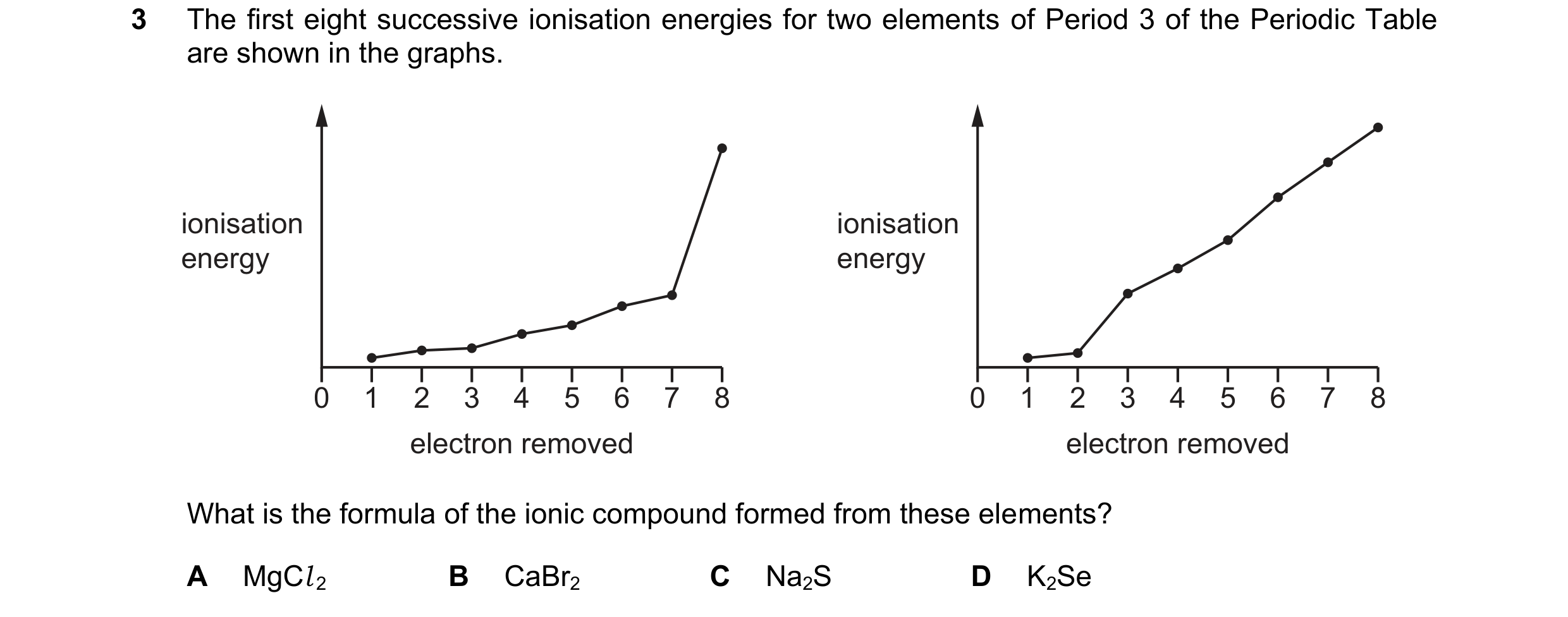
Q97 · The first eight successive ionisation energies for two elements of Period 3 of the… 9701/12 May/June 2024
3 The first eight successive ionisation energies for two elements of Period 3 of the Periodic Table are shown in the graphs. ionisation ionisation energy energy 0 1 2 3 4 5 6 7 8 0 1 2 3 4 5 6 7 8 electron removed electron removed What is the formula of the ionic compound formed from these elements? A MgCl 2 B CaBr2 C Na2S D K2Se
1 marks
Answer: A
This question in 9701/12 May/June 2024
Q98 · Which statement is correct? 9701/12 May/June 2024
25 Which statement is correct? A Adding sodium oxide to water gives a lower pH solution than adding silicon oxide to water. B The oxidation state of sodium in its chloride is higher than the oxidation state of silicon in its chloride. C The atomic radius of sodium is larger than that of silicon. D The melting point of the chloride of sodium is lower than the melting point of the chloride of silicon.
1 marks
Answer: C
This question in 9701/12 May/June 2024
Q99 · X and Y are two elements from Period 3 of the Periodic Table 9701/13 May/June 2024
18 X and Y are two elements from Period 3 of the Periodic Table. Element X has a higher electrical conductivity than element Y. Element Y has a higher melting point than element X. Which formula is a compound formed from element X and element Y? A MgS B Mg2Si C NaCl D SiCl 4
1 marks
Answer: B
This question in 9701/13 May/June 2024
Q100 · Compound X contains two elements, Y and Z 9701/11 Oct/Nov 2024
2 Compound X contains two elements, Y and Z. Element Y is in Period 2 of the Periodic Table. In one atom of element Y, the p sub-shell has all three orbitals occupied; only one of these three orbitals is fully occupied. Element Z is in Period 3 of the Periodic Table. In one atom of element Z, the p sub-shell has only two orbitals occupied. What is the formula of compound X? A CCl 4 B SiCl 4 C SiO2 D SO2
1 marks
Answer: C
This question in 9701/11 Oct/Nov 2024
Q101 · The graphs show trends in four physical properties of elements in Period 3, excluding… 9701/11 Oct/Nov 2024
6 The graphs show trends in four physical properties of elements in Period 3, excluding argon. Which graph has electronegativity on the y-axis? A B Na Mg Al Si P S Cl Na Mg Al Si P S Cl C D Na Mg Al Si P S Cl Na Mg Al Si P S Cl
1 marks
Answer: D
This question in 9701/11 Oct/Nov 2024
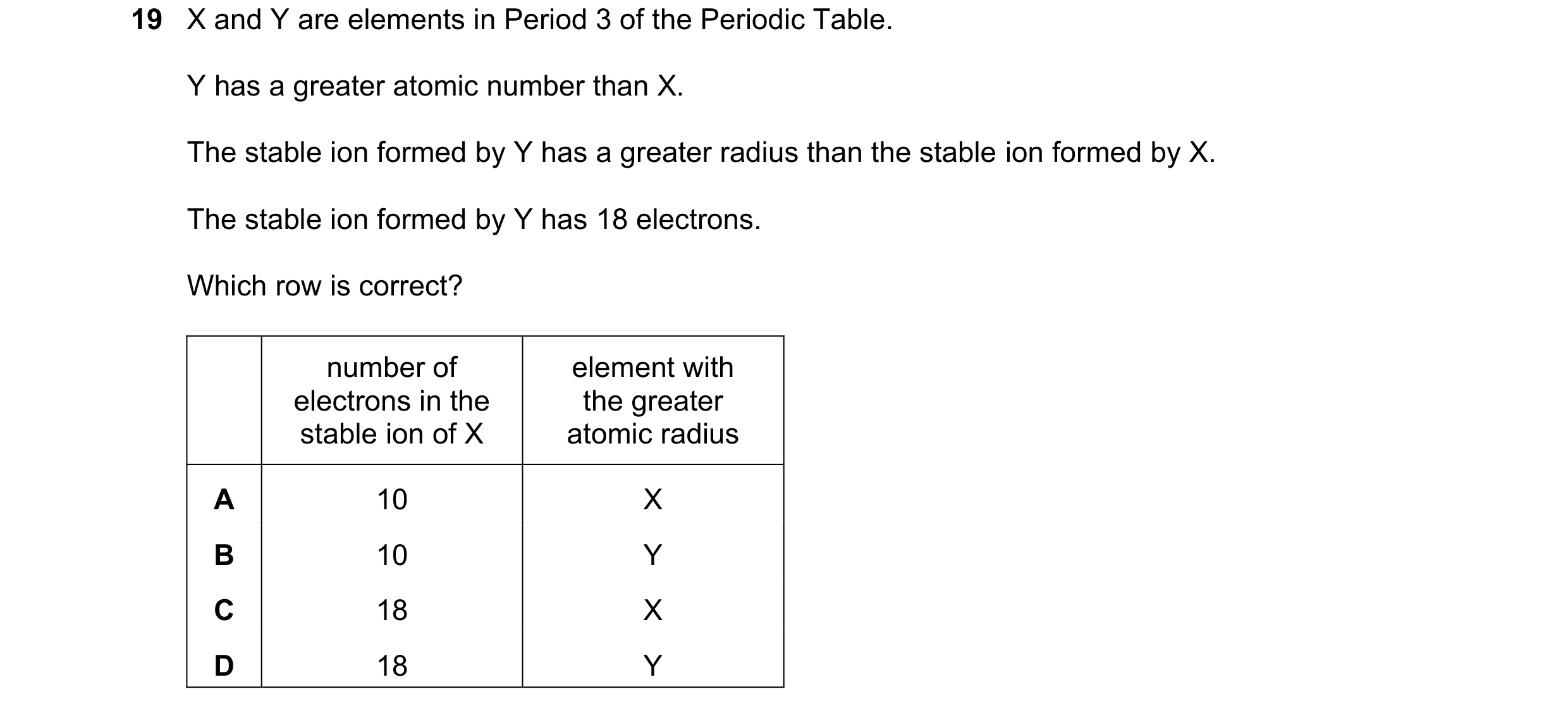
Q102 · X and Y are elements in Period 3 of the Periodic Table 9701/12 Oct/Nov 2024
19 X and Y are elements in Period 3 of the Periodic Table. Y has a greater atomic number than X. The stable ion formed by Y has a greater radius than the stable ion formed by X. The stable ion formed by Y has 18 electrons. Which row is correct? number of element with electrons in the the greater stable ion of X atomic radius A 10 X B 10 Y C 18 X D 18 Y
1 marks
Answer: A
This question in 9701/12 Oct/Nov 2024
Q103 · The graphs show trends in four physical properties of elements in Period 3, excluding… 9701/13 Oct/Nov 2024
6 The graphs show trends in four physical properties of elements in Period 3, excluding argon. Which graph has electronegativity on the y-axis? A B Na Mg Al Si P S Cl Na Mg Al Si P S Cl C D Na Mg Al Si P S Cl Na Mg Al Si P S Cl
1 marks
Answer: D
This question in 9701/13 Oct/Nov 2024
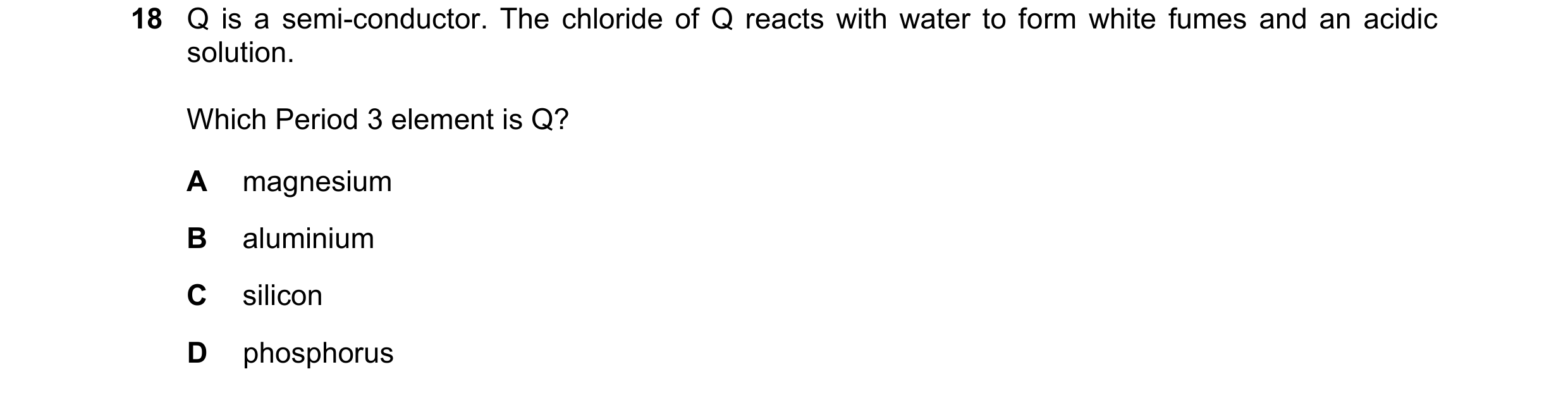
Q104 · Q is a semi-conductor 9701/13 Oct/Nov 2024
18 Q is a semi-conductor. The chloride of Q reacts with water to form white fumes and an acidic solution. Which Period 3 element is Q? A magnesium B aluminium C silicon D phosphorus
1 marks
Answer: C
This question in 9701/13 Oct/Nov 2024
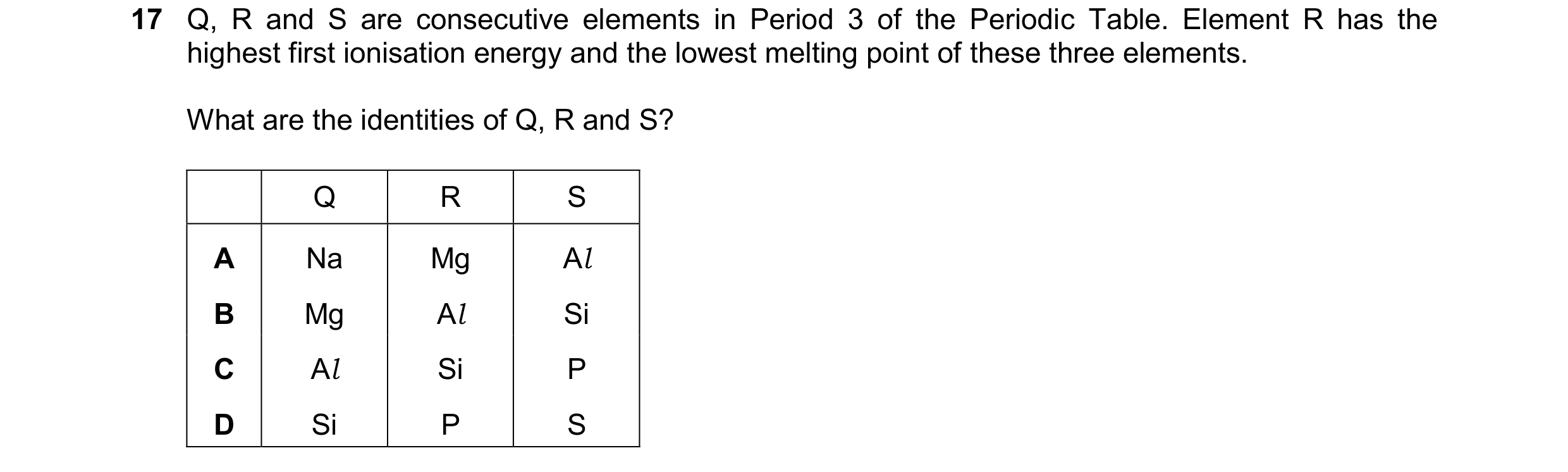
Q105 · Q, R and S are consecutive elements in Period 3 of the Periodic Table 9701/12 Feb/March 2025
17 Q, R and S are consecutive elements in Period 3 of the Periodic Table. Element R has the highest first ionisation energy and the lowest melting point of these three elements. What are the identities of Q, R and S? Q R S A Na Mg Al B Mg Al Si C Al Si P D Si P S
1 marks
Answer: D
This question in 9701/12 Feb/March 2025
Q106 · Which diagram shows the electronegativity of the elements Na, Mg, Al and Si plotted… 9701/11 May/June 2025
20 Which diagram shows the electronegativity of the elements Na, Mg, Al and Si plotted against their first ionisation energies? first ionisation energy electronegativity Si Na Al Mg A first ionisation energy electronegativity Si Na Al Mg B first ionisation energy electronegativity Si Na Al Mg C first ionisation energy electronegativity Si Na Al Mg D
1 marks
Answer: B
This question in 9701/11 May/June 2025
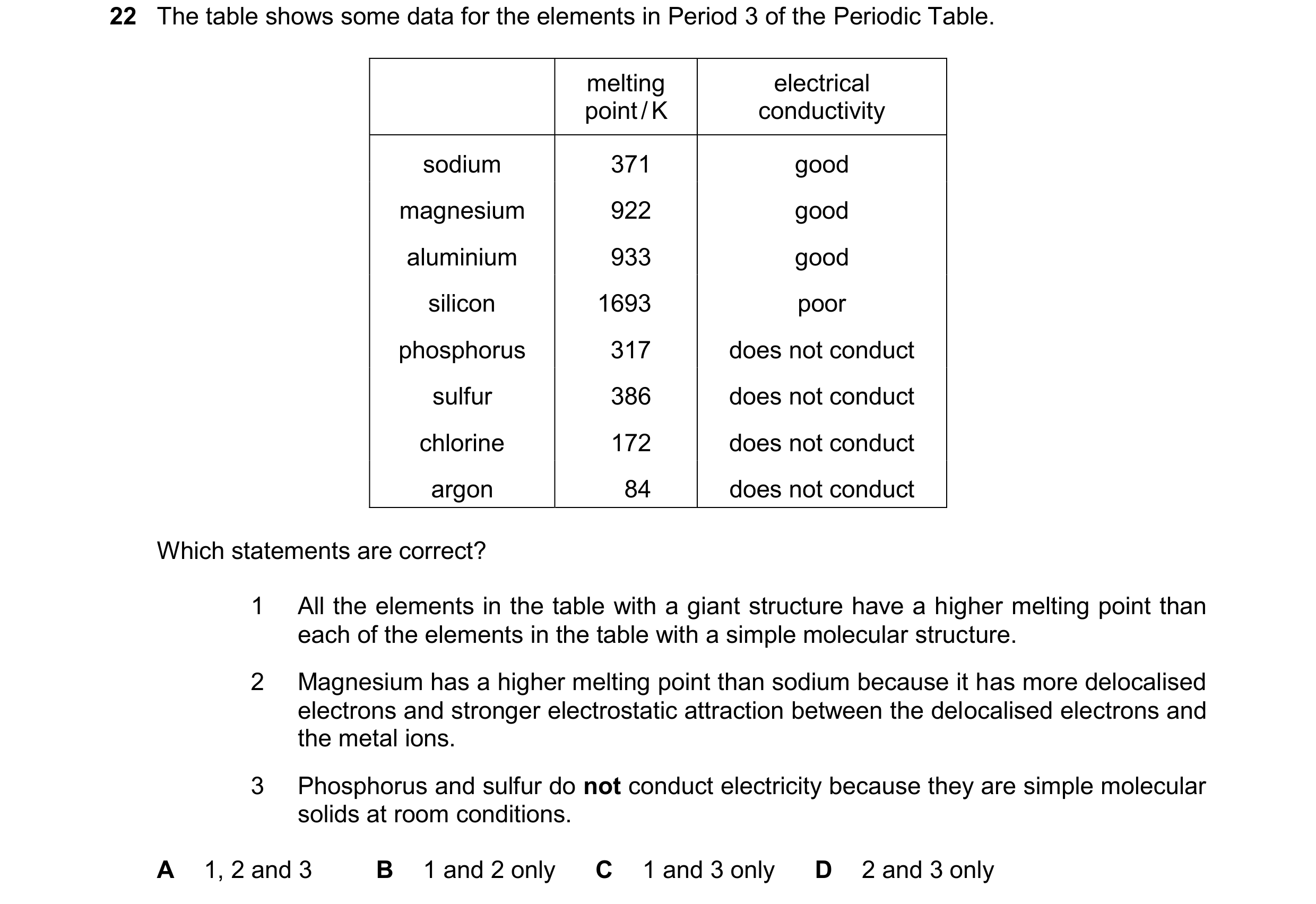
Q107 · The table shows some data for the elements in Period 3 of the Periodic Table 9701/11 May/June 2025
22 The table shows some data for the elements in Period 3 of the Periodic Table. melting point/K electrical conductivity sodium 371 good magnesium 922 good aluminium 933 good silicon 1693 poor phosphorus 317 does not conduct sulfur 386 does not conduct chlorine 172 does not conduct argon 84 does not conduct Which statements are correct? 1 All the elements in the table with a giant structure have a higher melting point than each of the elements in the table with a simple molecular structure. 2 Magnesium has a higher melting point than sodium because it has more delocalised electrons and stronger electrostatic attraction between the delocalised electrons and the metal ions. 3 Phosphorus and sulfur do not conduct electricity because they are simple molecular solids at room conditions. A 1, 2 and 3 B 1 and 2 only C 1 and 3 only D 2 and 3 only
1 marks
Answer: D
This question in 9701/11 May/June 2025
Q108 · Elements Y and Z are both in Period 3 9701/12 May/June 2025
22 Elements Y and Z are both in Period 3. Element Y has the smallest atomic radius in Period 3. There are only two elements in Period 3 that have a lower melting point than element Z. Elements Y and Z react together to form compound R. Which compound could be R? A MgCl 2 B MgS C Na2S D PCl 3
1 marks
Answer: D
This question in 9701/12 May/June 2025
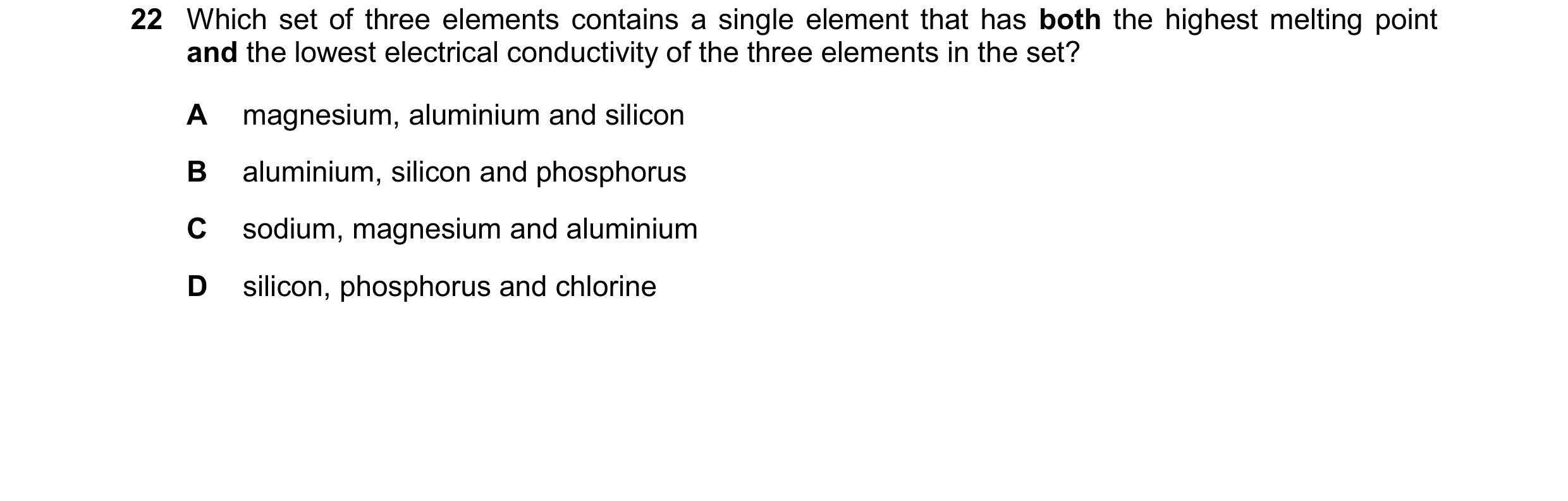
Q109 · Which set of three elements contains a single element that has both the highest melting… 9701/13 May/June 2025
22 Which set of three elements contains a single element that has both the highest melting point and the lowest electrical conductivity of the three elements in the set? A magnesium, aluminium and silicon B aluminium, silicon and phosphorus C sodium, magnesium and aluminium D silicon, phosphorus and chlorine
1 marks
Answer: A
This question in 9701/13 May/June 2025
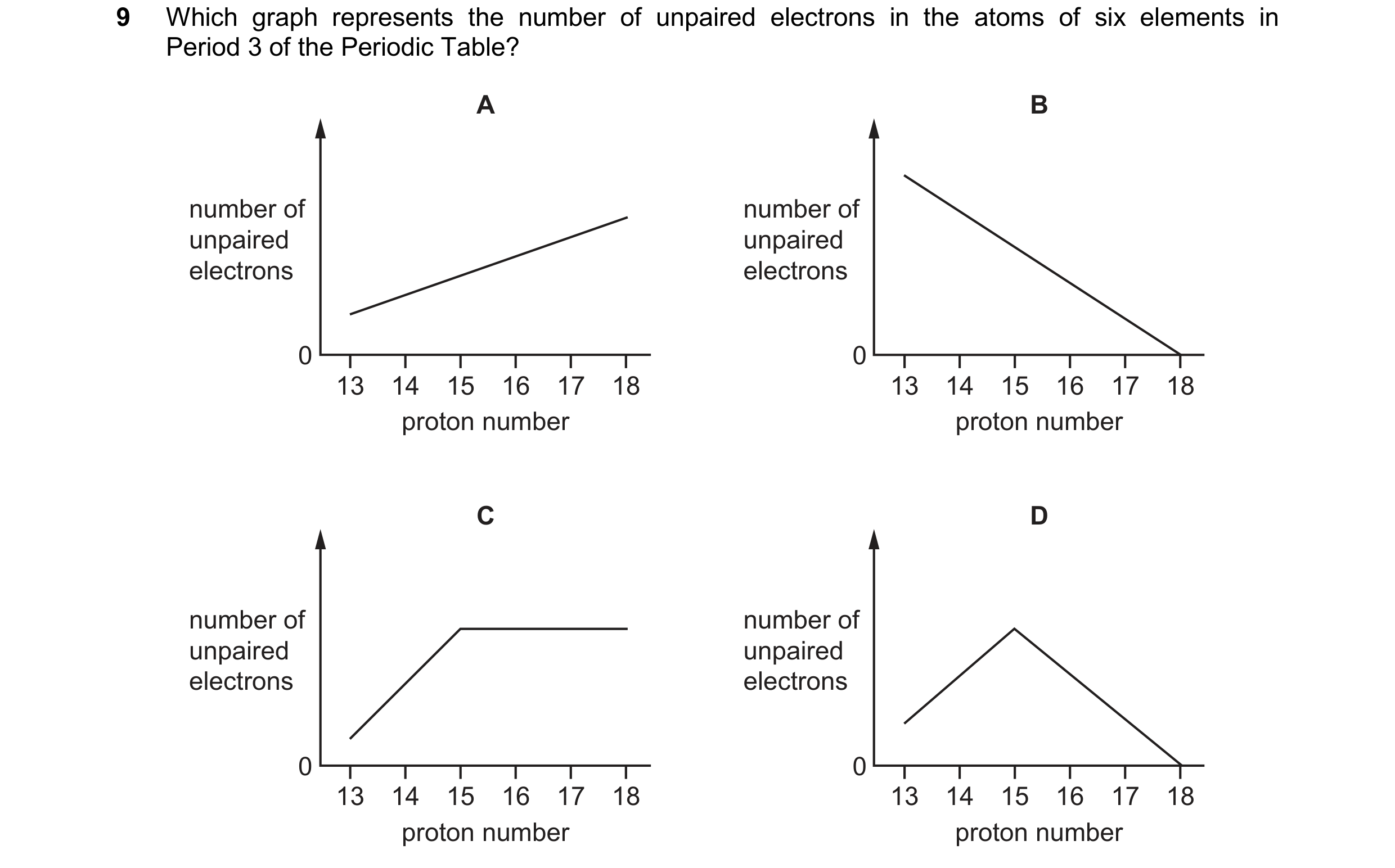
Q110 · Which graph represents the number of unpaired electrons in the atoms of six elements in… 9701/14 May/June 2025
9 Which graph represents the number of unpaired electrons in the atoms of six elements in Period 3 of the Periodic Table? A B number of number of unpaired unpaired electrons electrons 0 0 13 14 15 16 17 18 13 14 15 16 17 18 proton number proton number C D number of number of unpaired unpaired electrons electrons 0 0 13 14 15 16 17 18 13 14 15 16 17 18 proton number proton number
1 marks
Answer: D
This question in 9701/14 May/June 2025
Q111 · What increases for each successive element in Period 3 from sodium to sulfur? 9701/14 May/June 2025
24 What increases for each successive element in Period 3 from sodium to sulfur? A the highest oxidation number of the element seen in an oxide B the melting point of the elements C the number of occupied orbitals in the atom D the pH of the solutions of the chlorides in water
1 marks
Answer: A
This question in 9701/14 May/June 2025
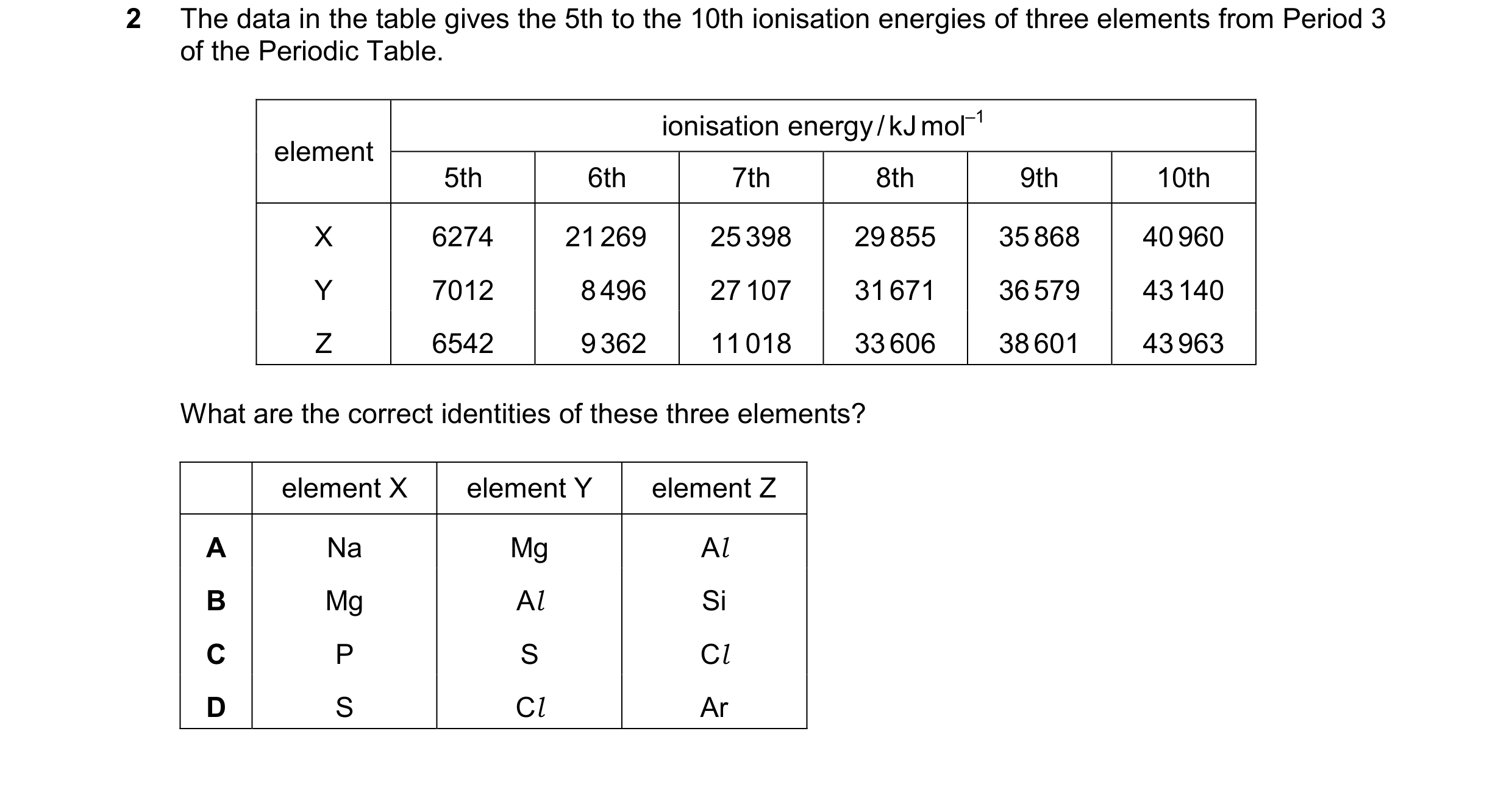
Q112 · The data in the table gives the 5th to the 10th ionisation energies of three elements… 9701/11 Oct/Nov 2025
2 The data in the table gives the 5th to the 10th ionisation energies of three elements from Period 3 of the Periodic Table. element ionisation energy/kJmol–1 5th 6th 7th 8th 9th 10th X 6274 21269 25398 29855 35868 40960 Y 7012 8496 27107 31671 36579 43140 Z 6542 9362 11018 33606 38601 43963 What are the correct identities of these three elements? element X element Y element Z A Na Mg Al B Mg Al Si C P S Cl D S Cl Ar
1 marks
Answer: C
This question in 9701/11 Oct/Nov 2025
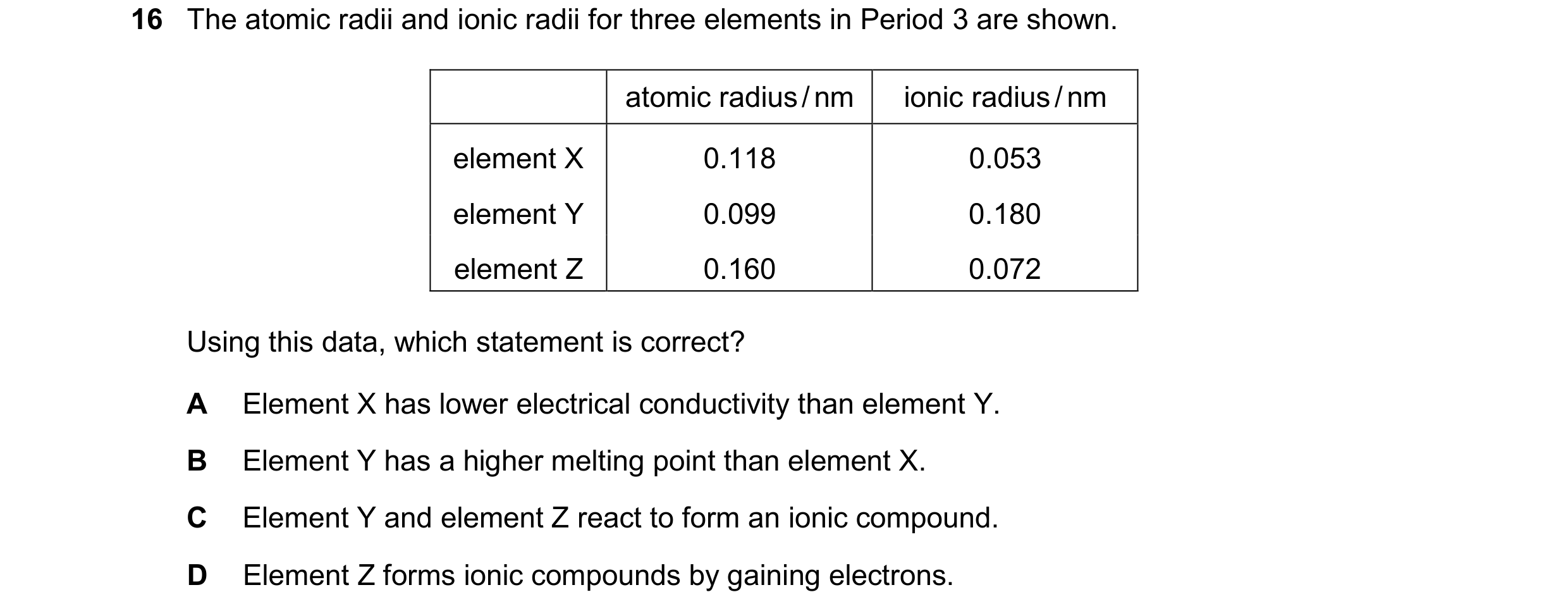
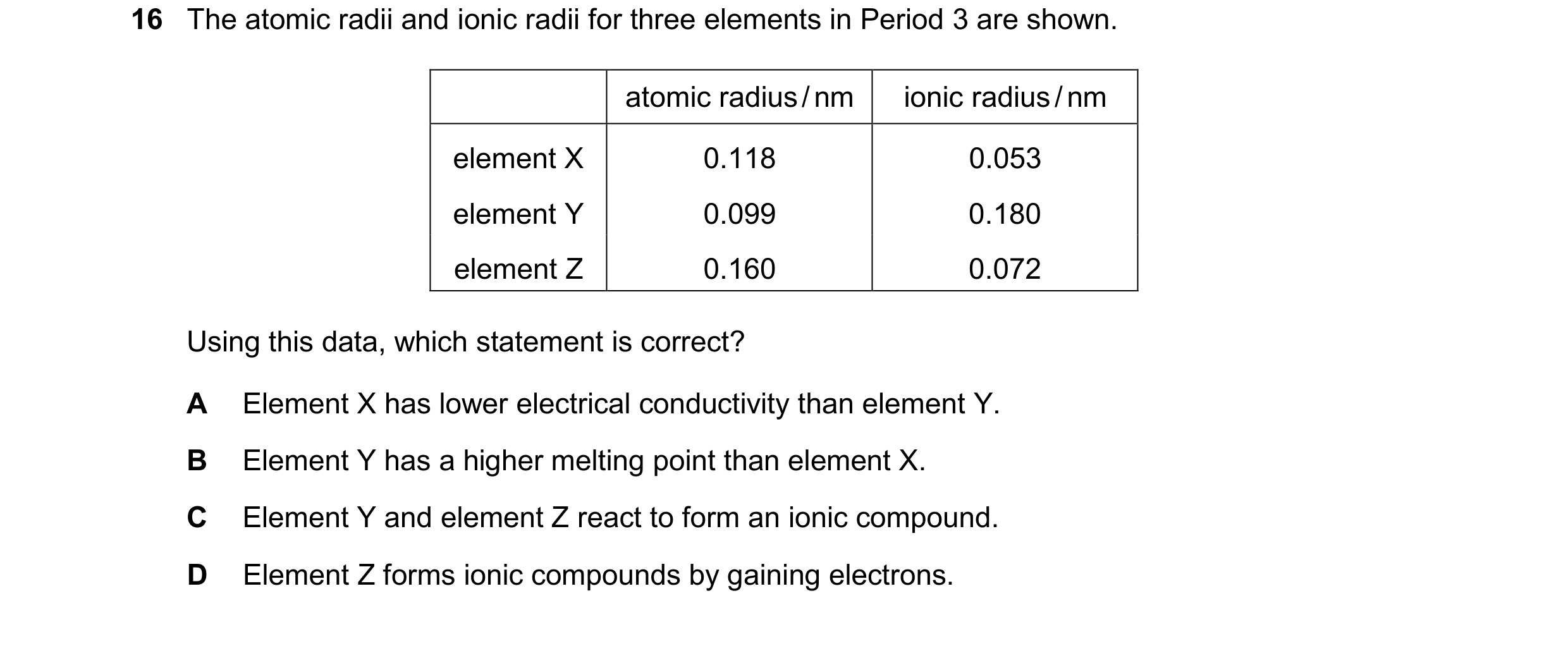
Q113 · The atomic radii and ionic radii for three elements in Period 3 are shown 9701/11 Oct/Nov 2025
16 The atomic radii and ionic radii for three elements in Period 3 are shown. atomic radius/nm ionic radius/nm element X 0.118 0.053 element Y 0.099 0.180 element Z 0.160 0.072 Using this data, which statement is correct? A Element X has lower electrical conductivity than element Y. B Element Y has a higher melting point than element X. C Element Y and element Z react to form an ionic compound. D Element Z forms ionic compounds by gaining electrons.
1 marks
Answer: C
This question in 9701/11 Oct/Nov 2025
Q114 · Which oxide has a simple structure rather than a giant structure? 9701/11 Oct/Nov 2025
18 Which oxide has a simple structure rather than a giant structure? A MgO B Al2O3 C SiO2 D P4O10
1 marks
Answer: D
This question in 9701/11 Oct/Nov 2025
Q115 · X and Y are different elements in Period 3 9701/12 Oct/Nov 2025
7 X and Y are different elements in Period 3. Atoms of X and Y each have only one completely filled orbital in their highest occupied energy sub-shell. Y has a greater first ionisation energy than X. Which row shows the structure and bonding in X and Y? X Y A giant metallic giant metallic B giant metallic simple molecular C giant covalent simple molecular D simple molecular simple molecular
1 marks
Answer: B
This question in 9701/12 Oct/Nov 2025
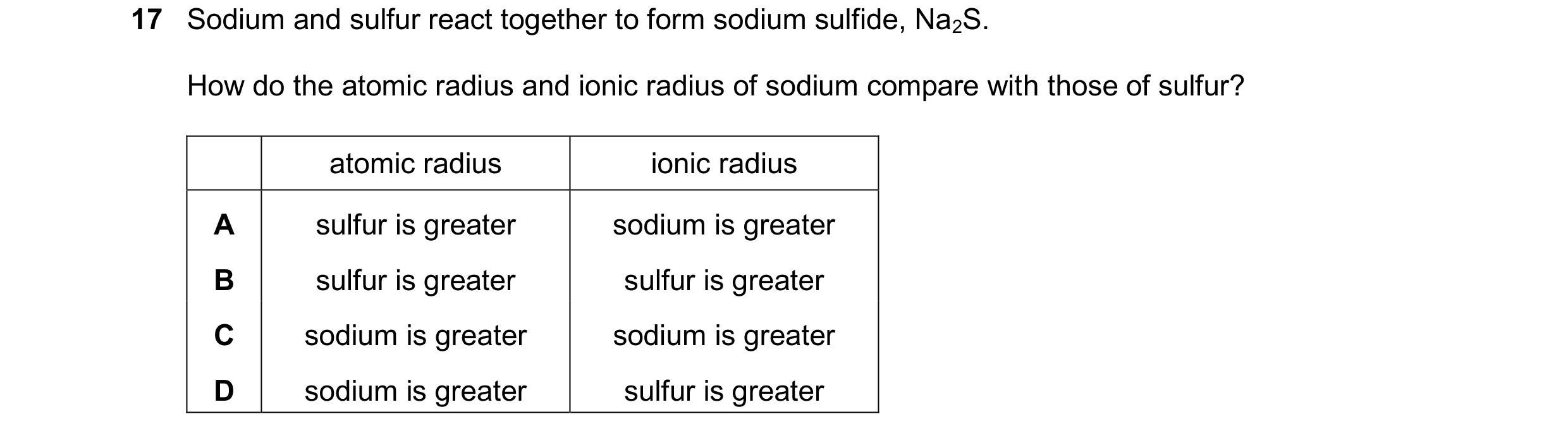
Q116 · Sodium and sulfur react together to form sodium sulfide, Na2S 9701/12 Oct/Nov 2025
17 Sodium and sulfur react together to form sodium sulfide, Na2S. How do the atomic radius and ionic radius of sodium compare with those of sulfur? atomic radius ionic radius A sulfur is greater sodium is greater B sulfur is greater sulfur is greater C sodium is greater sodium is greater D sodium is greater sulfur is greater
1 marks
Answer: D
This question in 9701/12 Oct/Nov 2025
Q117 · The data in the table gives the 5th to the 10th ionisation energies of three elements… 9701/13 Oct/Nov 2025
2 The data in the table gives the 5th to the 10th ionisation energies of three elements from Period 3 of the Periodic Table. element ionisation energy/kJmol–1 5th 6th 7th 8th 9th 10th X 6274 21269 25398 29855 35868 40960 Y 7012 8496 27107 31671 36579 43140 Z 6542 9362 11018 33606 38601 43963 What are the correct identities of these three elements? element X element Y element Z A Na Mg Al B Mg Al Si C P S Cl D S Cl Ar
1 marks
Answer: C
This question in 9701/13 Oct/Nov 2025
Q118 · The atomic radii and ionic radii for three elements in Period 3 are shown 9701/13 Oct/Nov 2025
16 The atomic radii and ionic radii for three elements in Period 3 are shown. atomic radius/nm ionic radius/nm element X 0.118 0.053 element Y 0.099 0.180 element Z 0.160 0.072 Using this data, which statement is correct? A Element X has lower electrical conductivity than element Y. B Element Y has a higher melting point than element X. C Element Y and element Z react to form an ionic compound. D Element Z forms ionic compounds by gaining electrons.
1 marks
Answer: C
This question in 9701/13 Oct/Nov 2025



 1 / 37
 2 / 37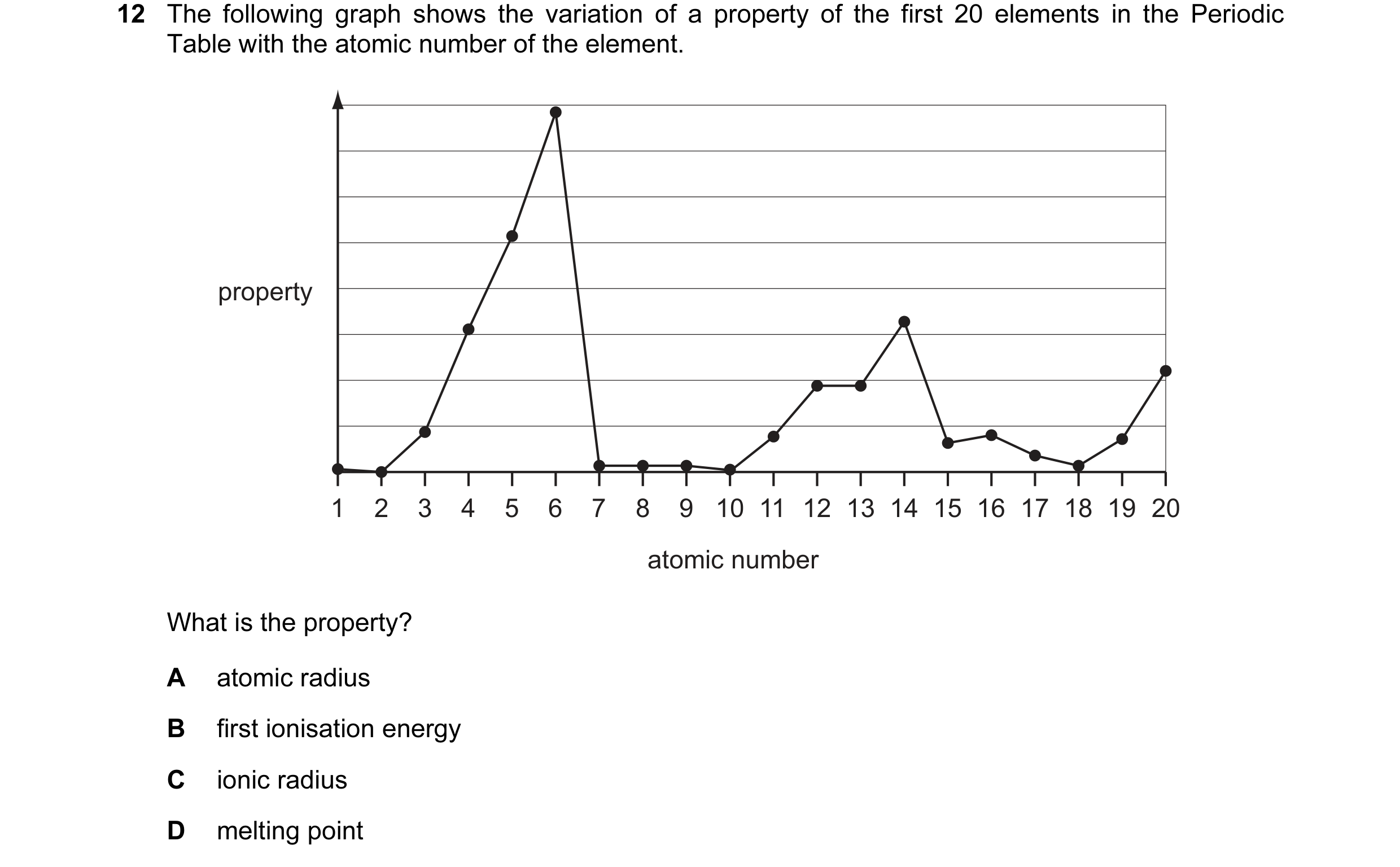
 3 / 37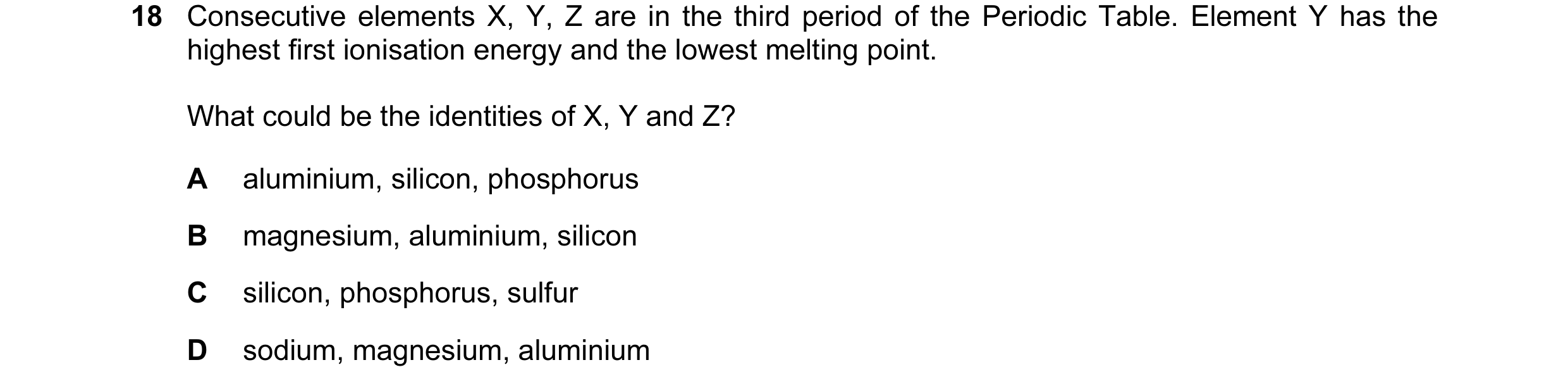


 4 / 37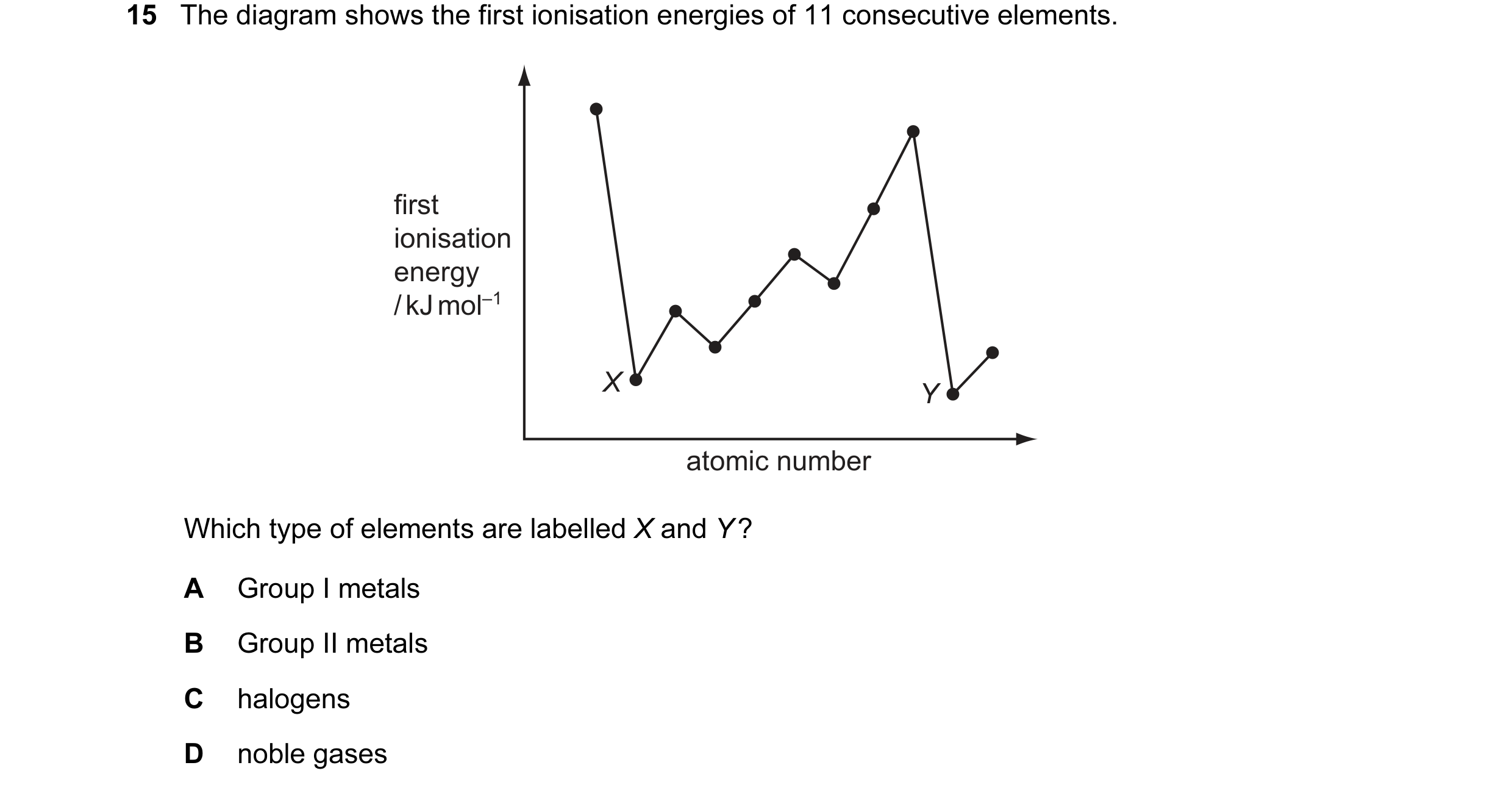
 5 / 37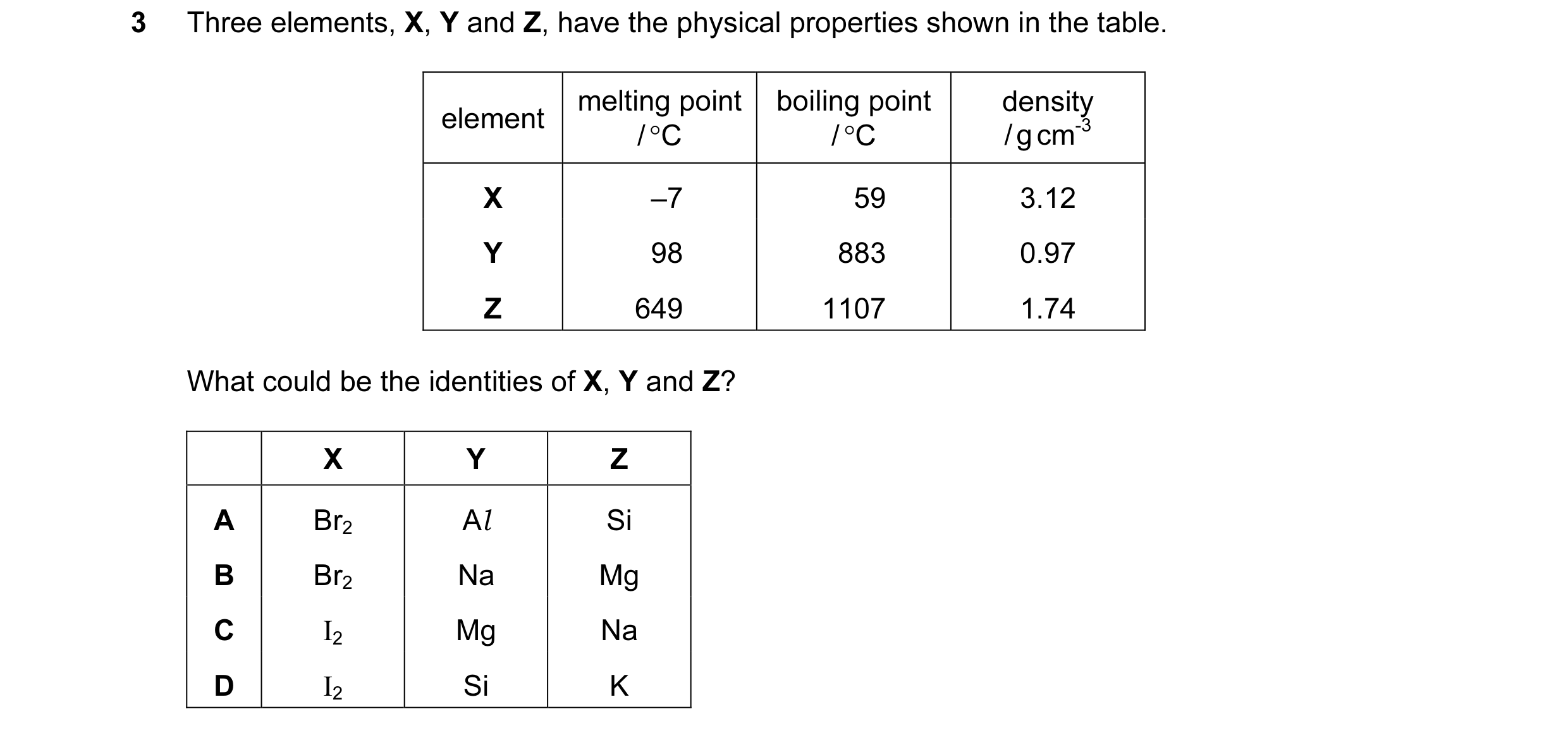

 6 / 37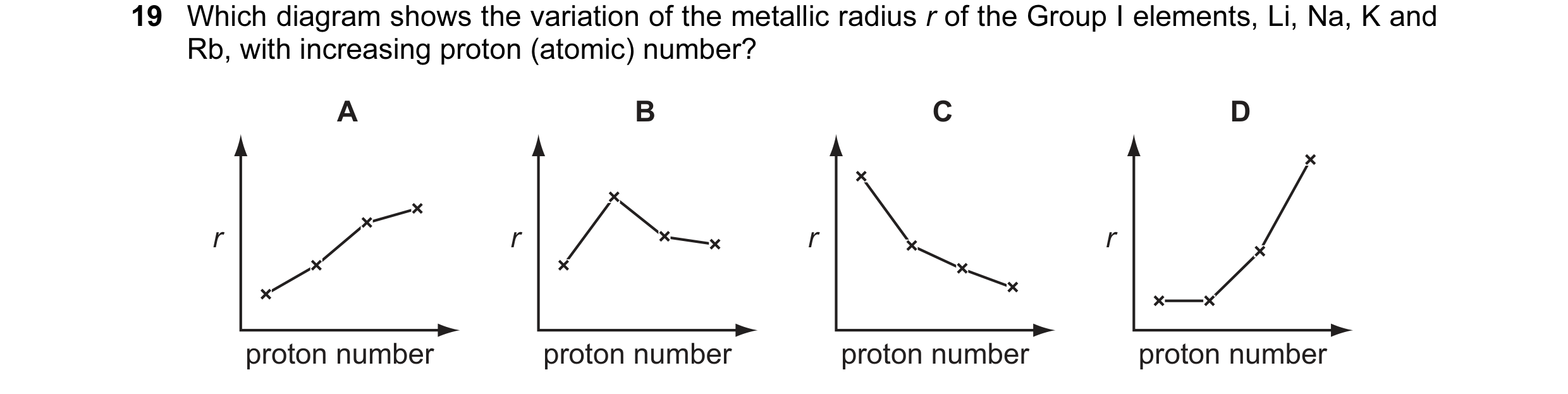
 7 / 37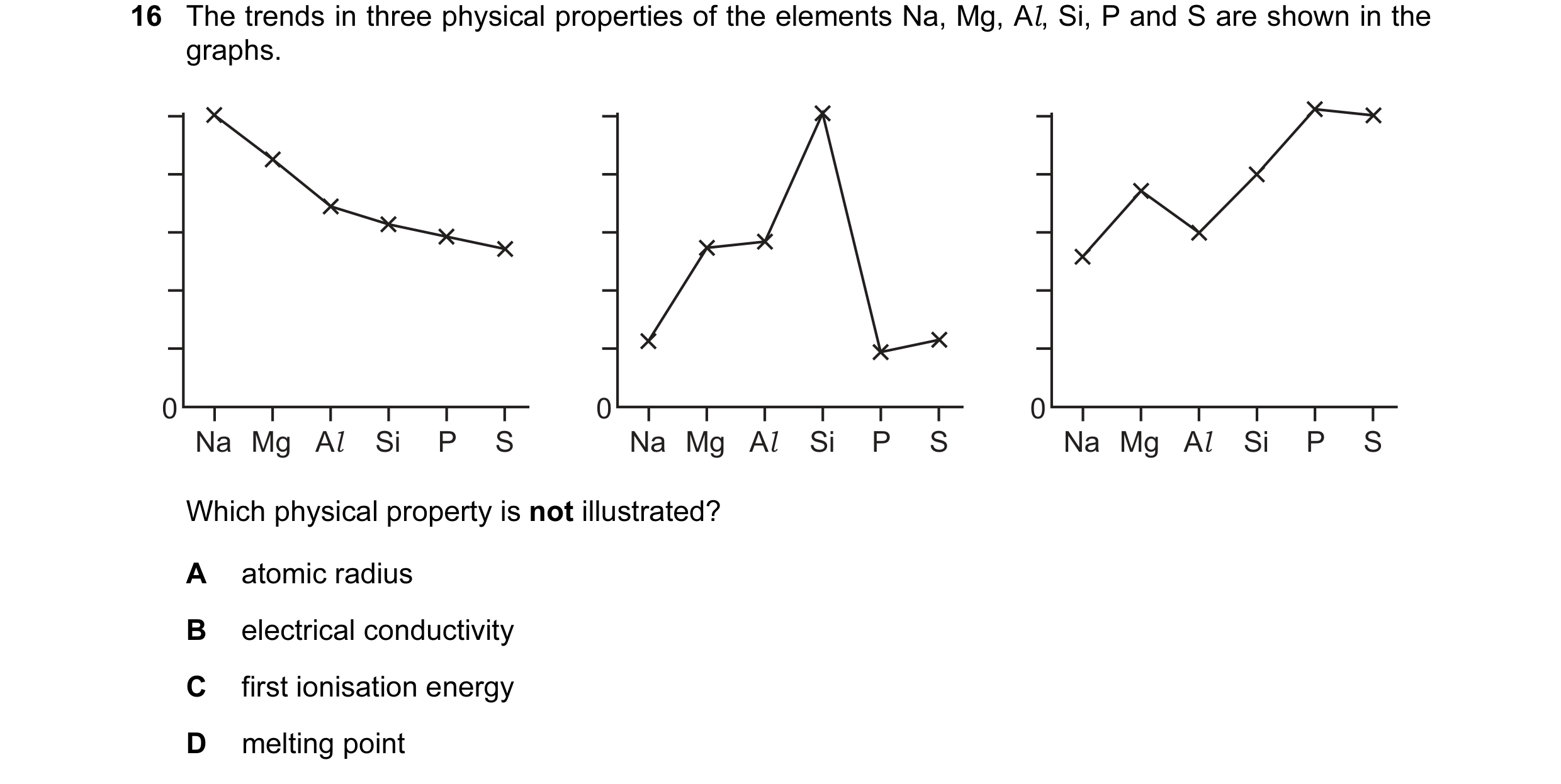
 8 / 37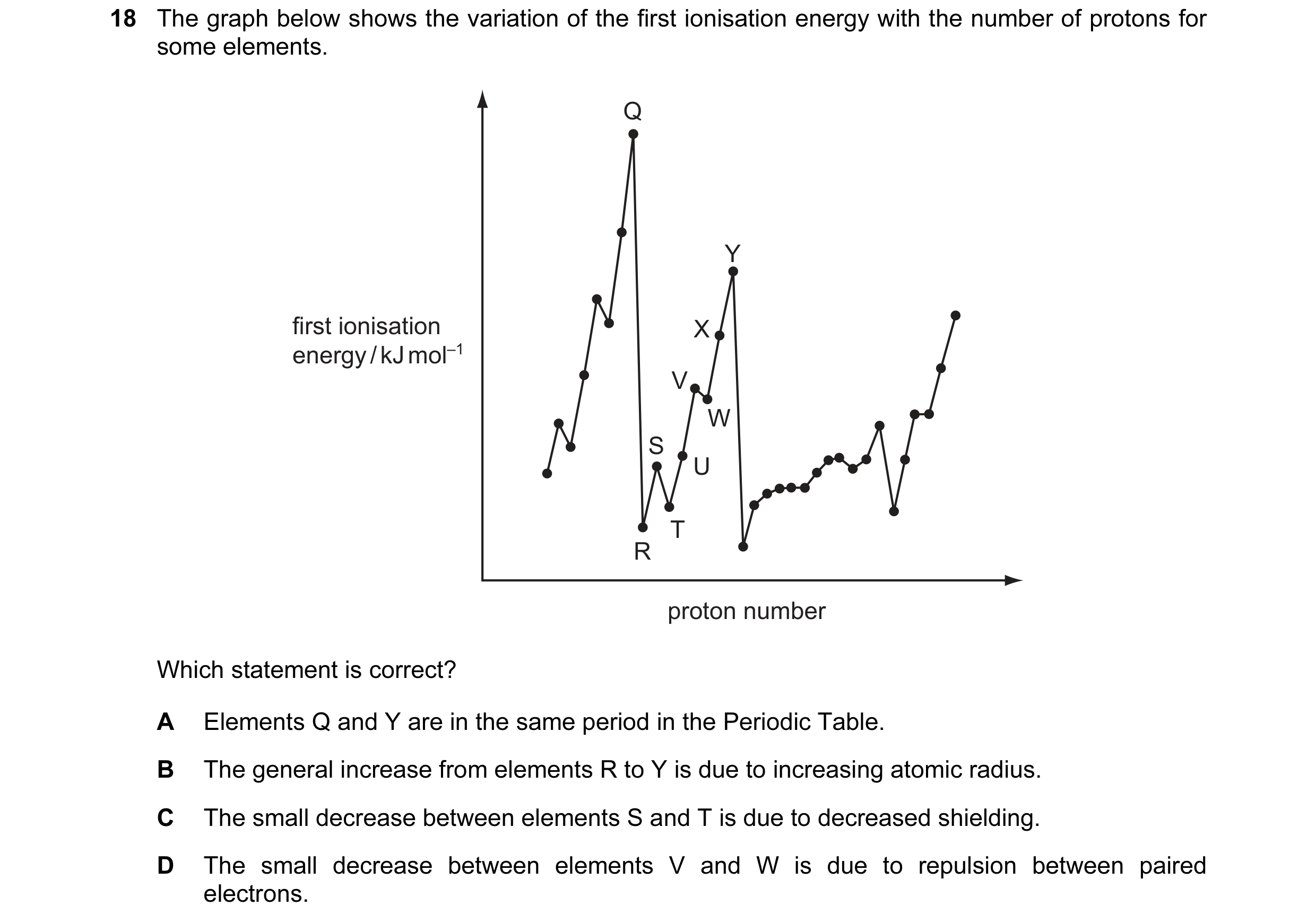
 9 / 37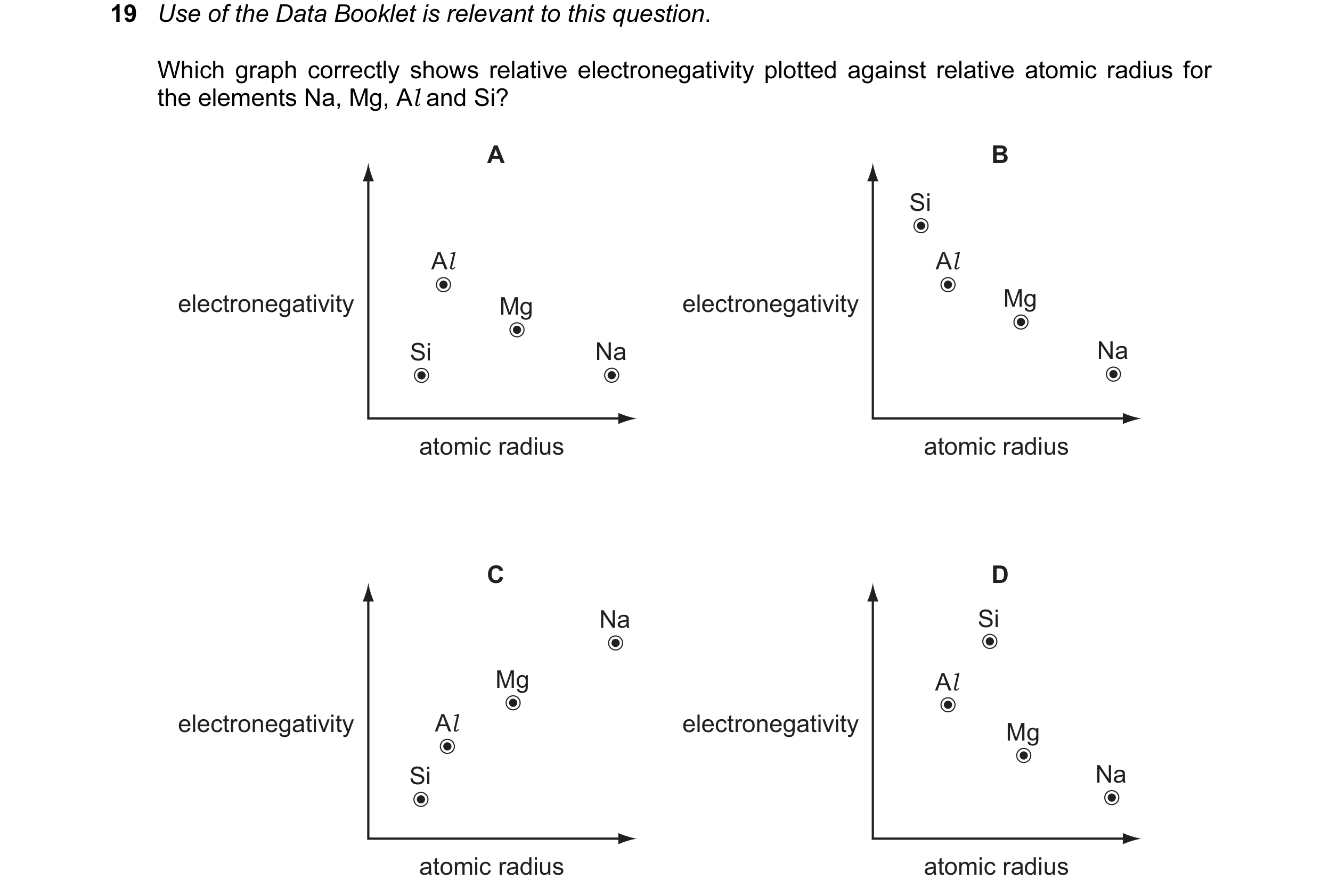
 10 / 37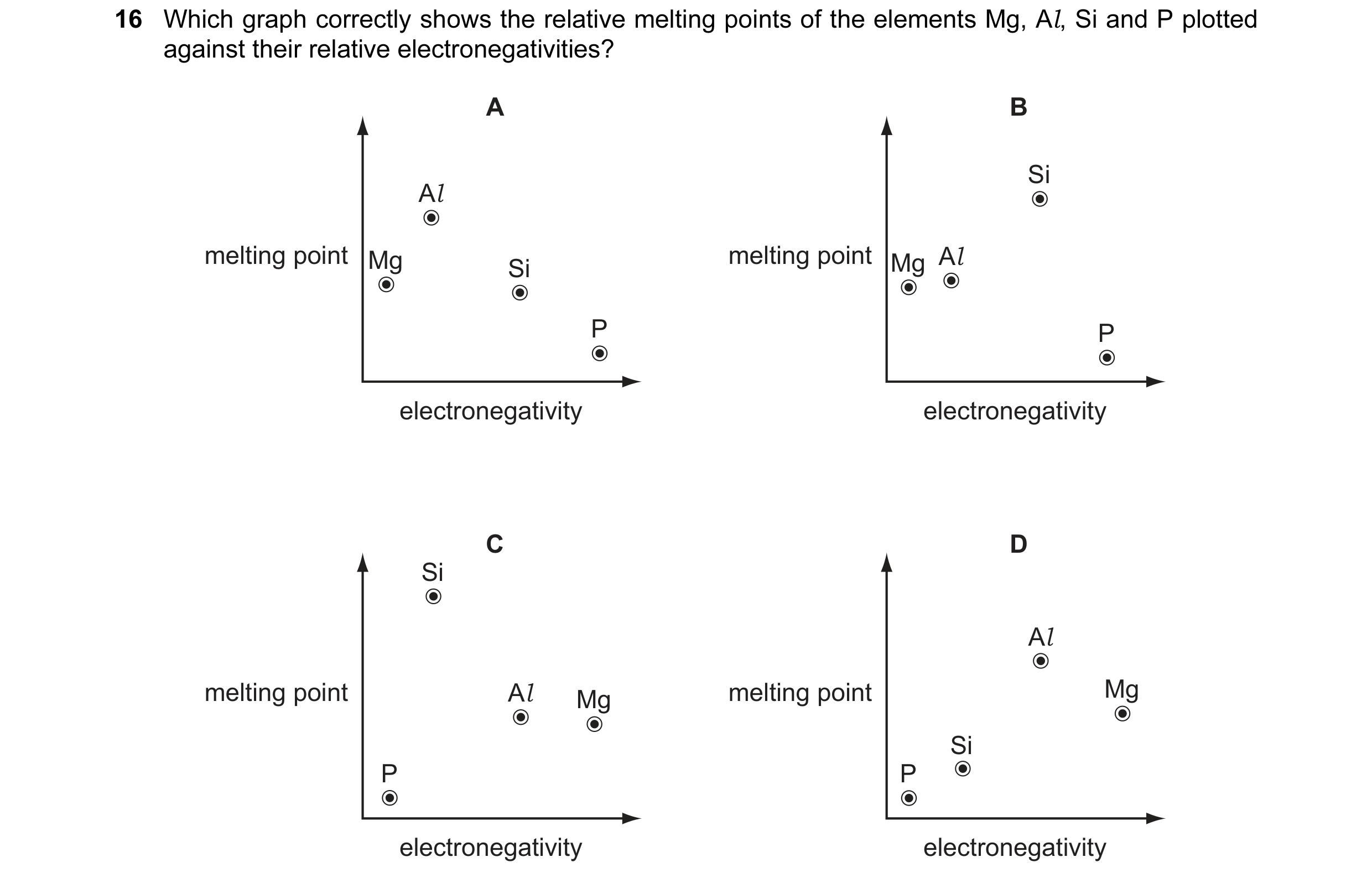
 11 / 37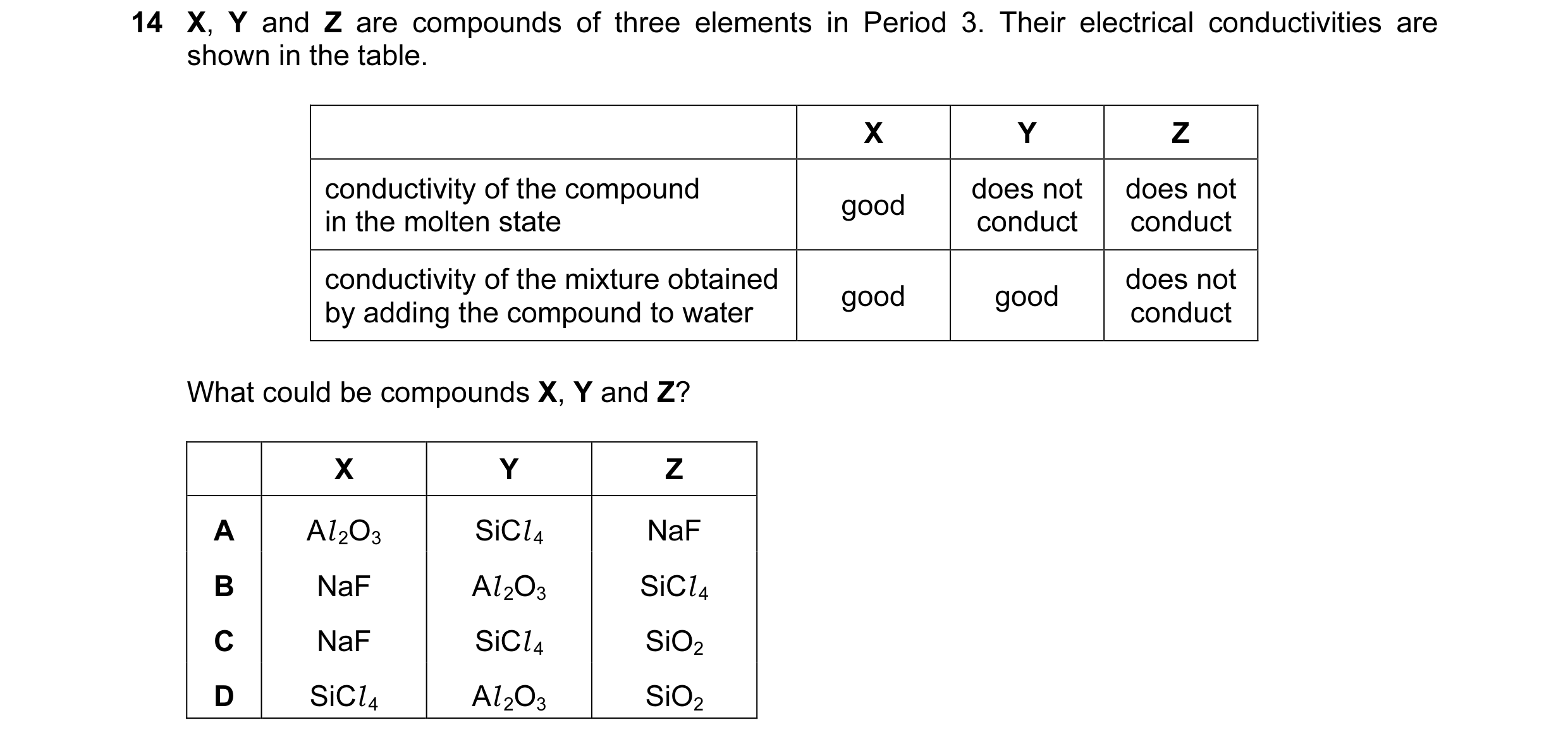
 12 / 37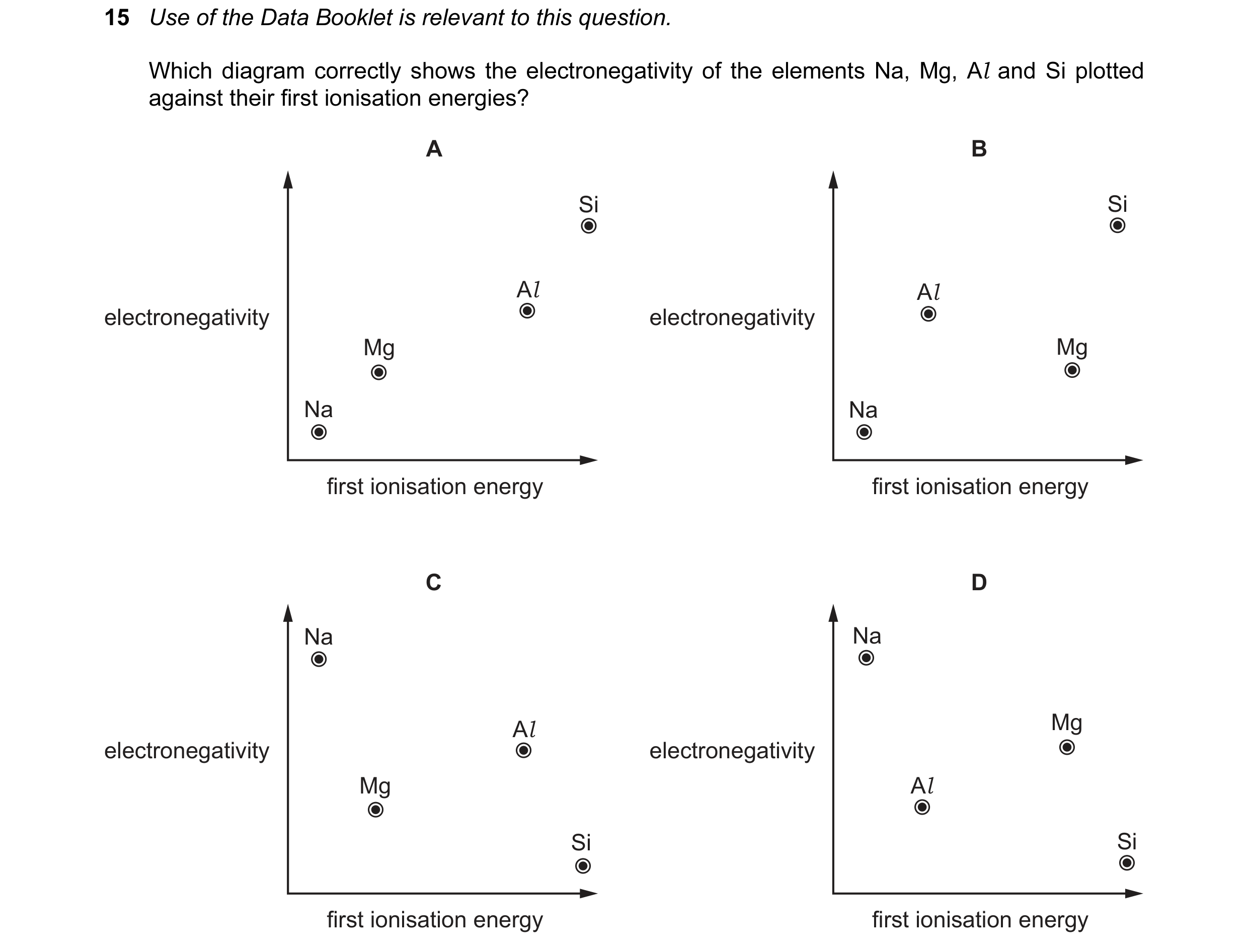
 13 / 37
 14 / 37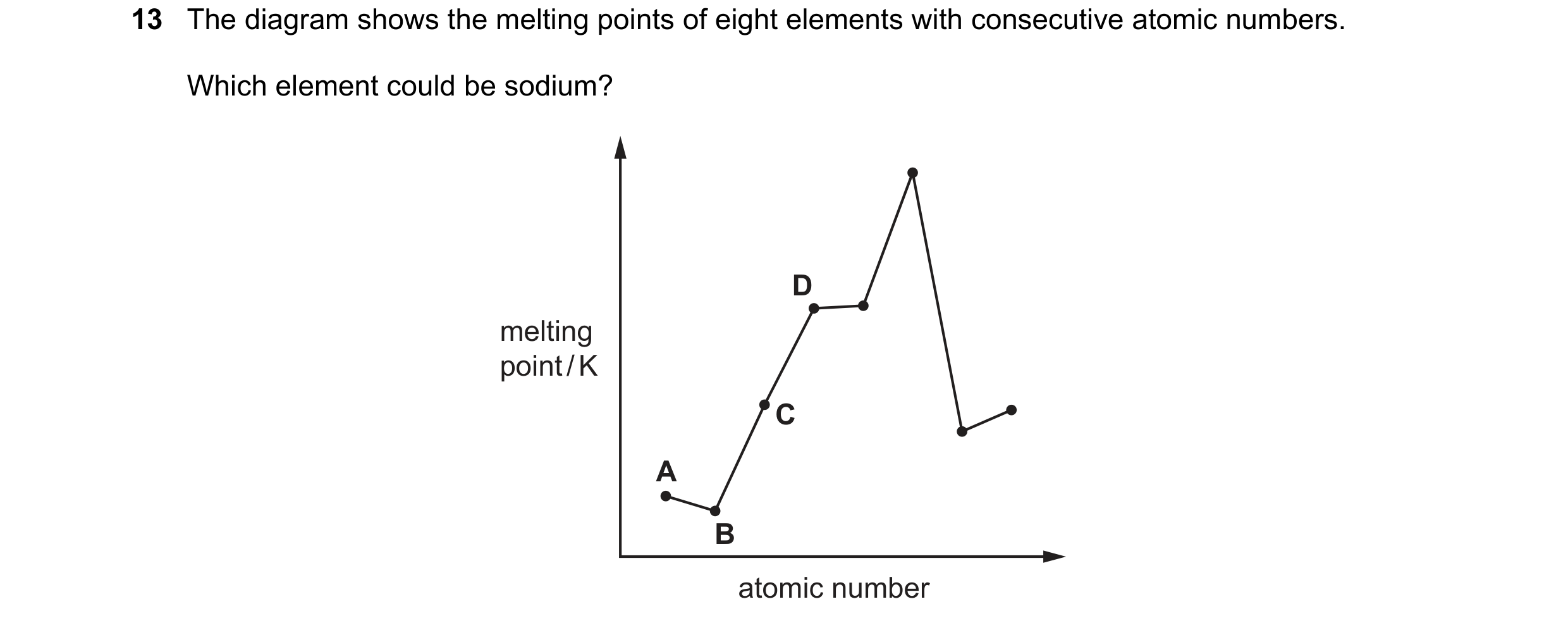
 15 / 37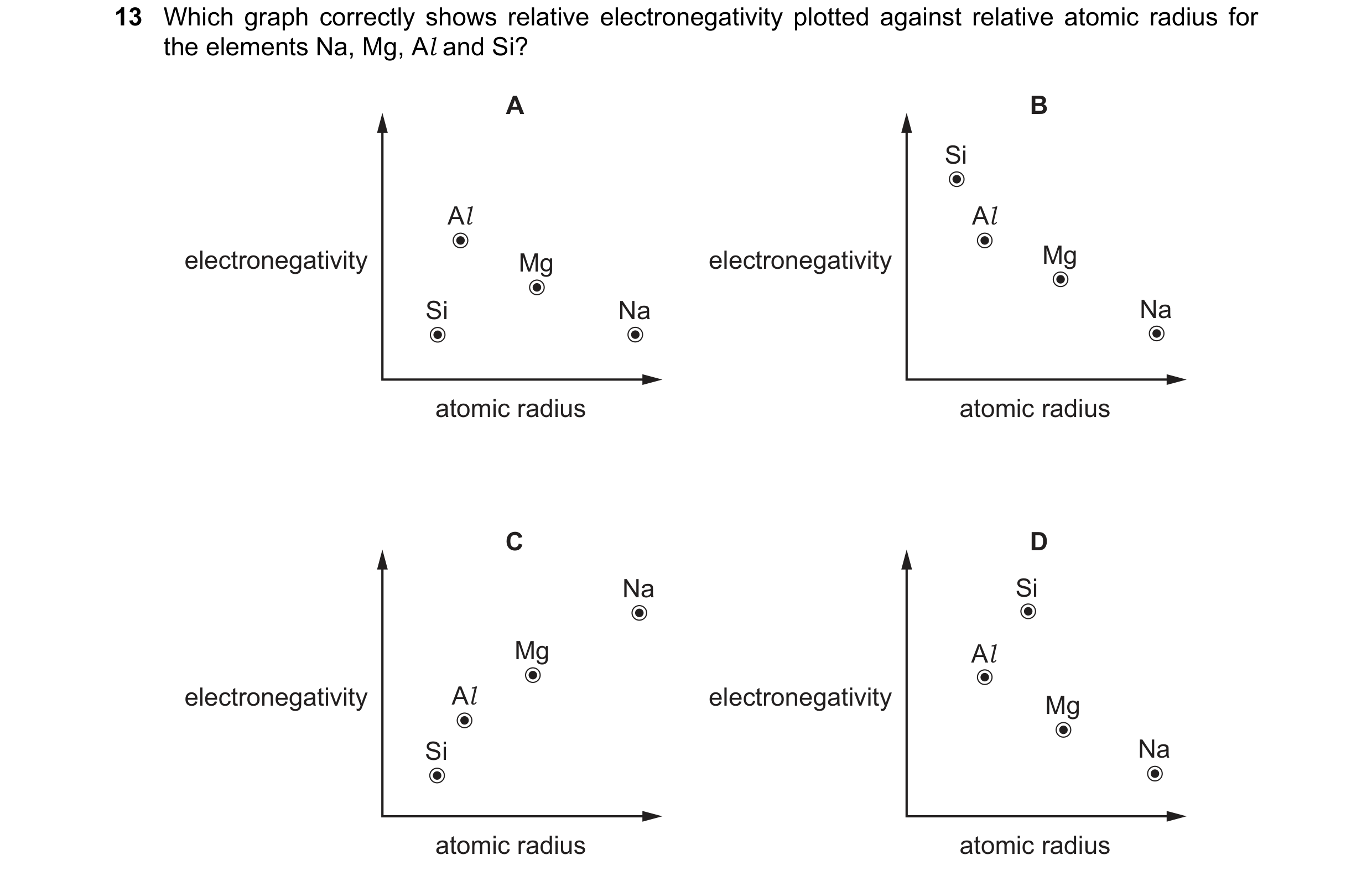
 16 / 37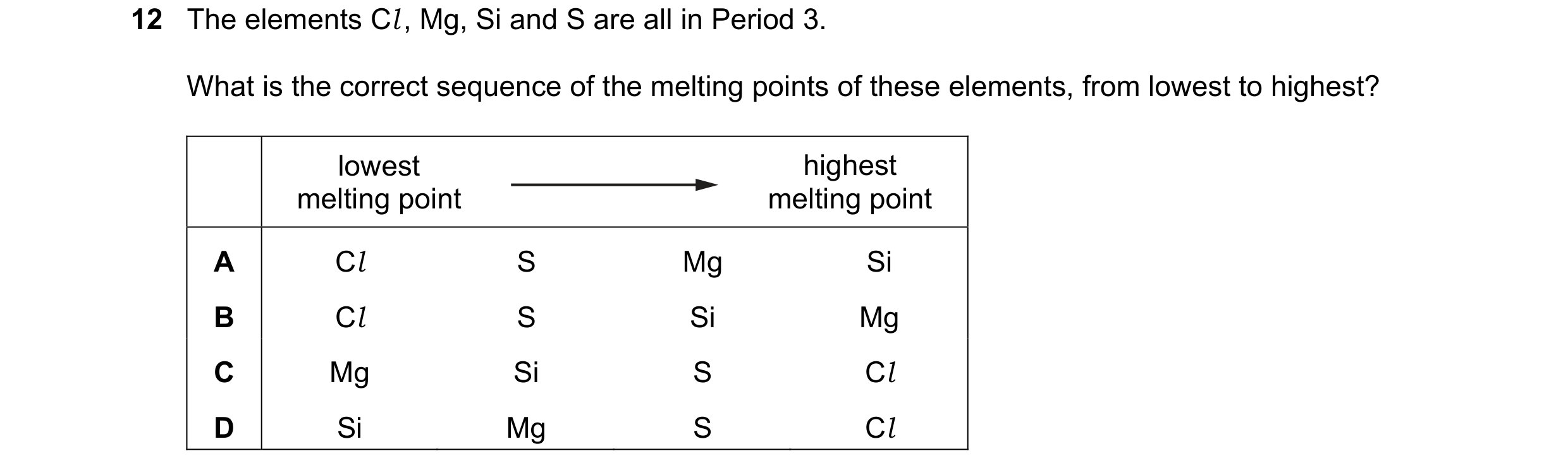
 17 / 37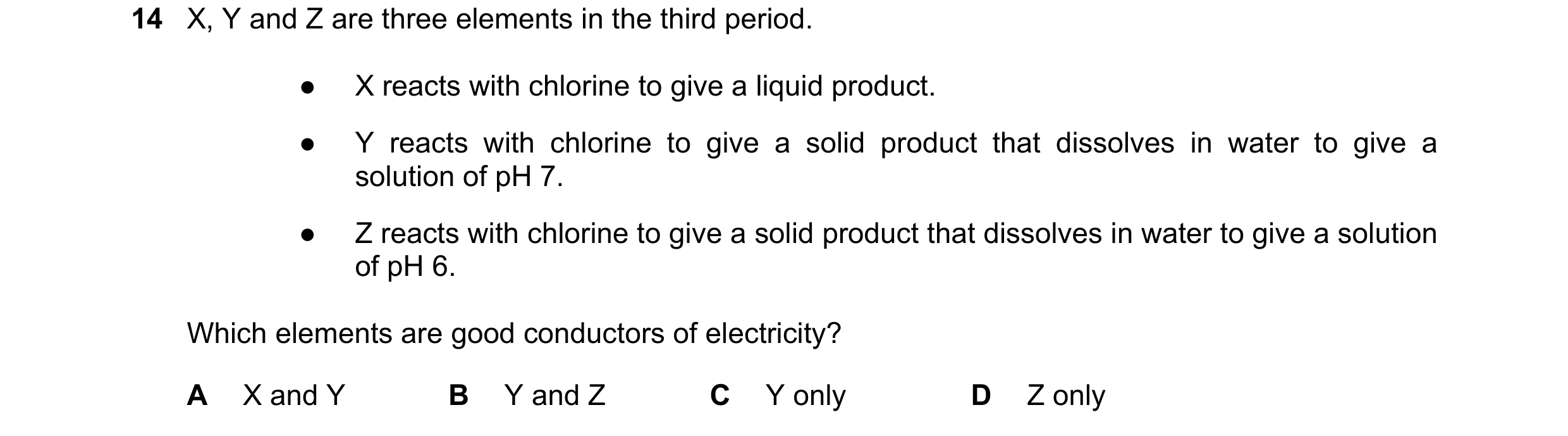
 18 / 37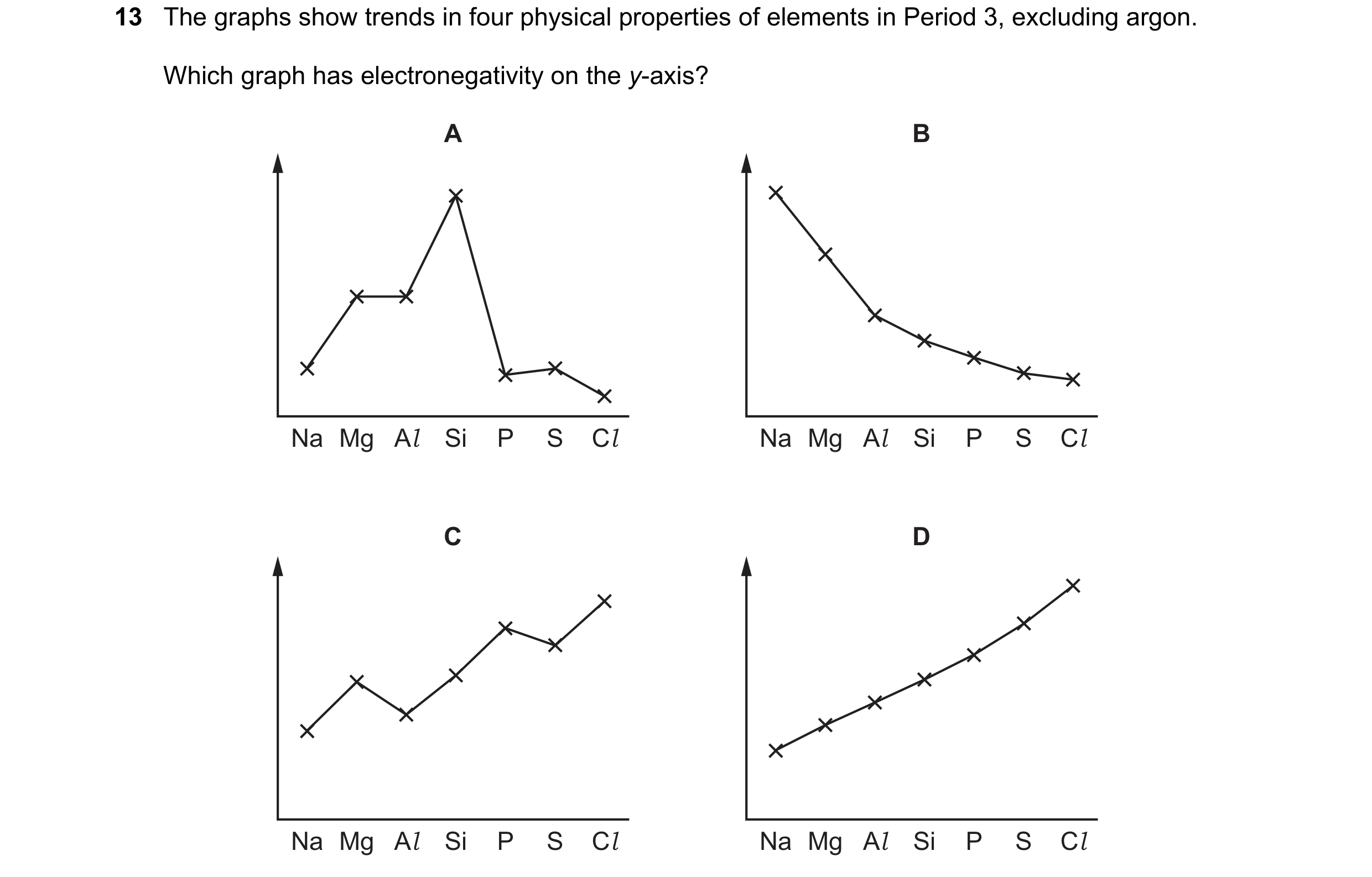
 19 / 37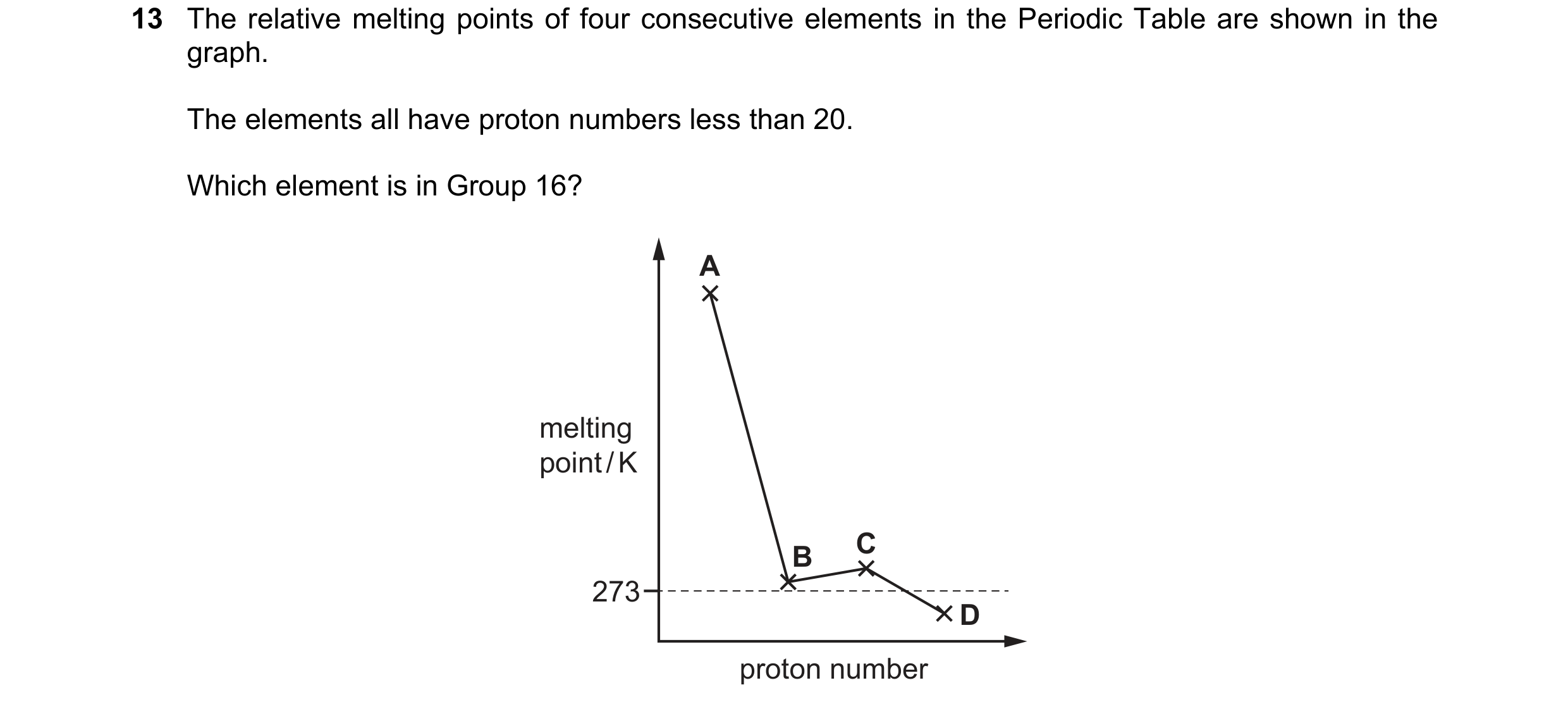

 20 / 37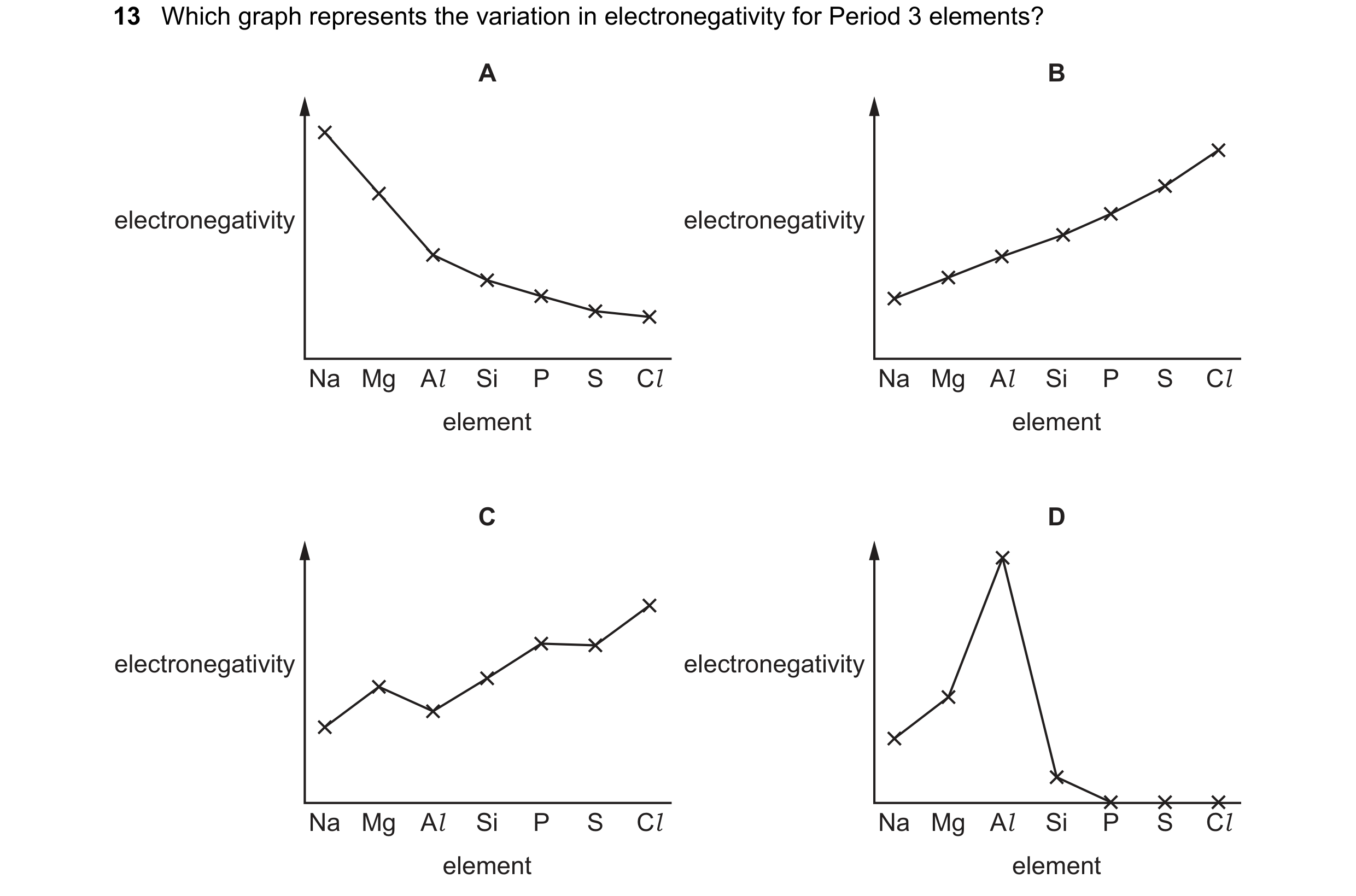
 21 / 37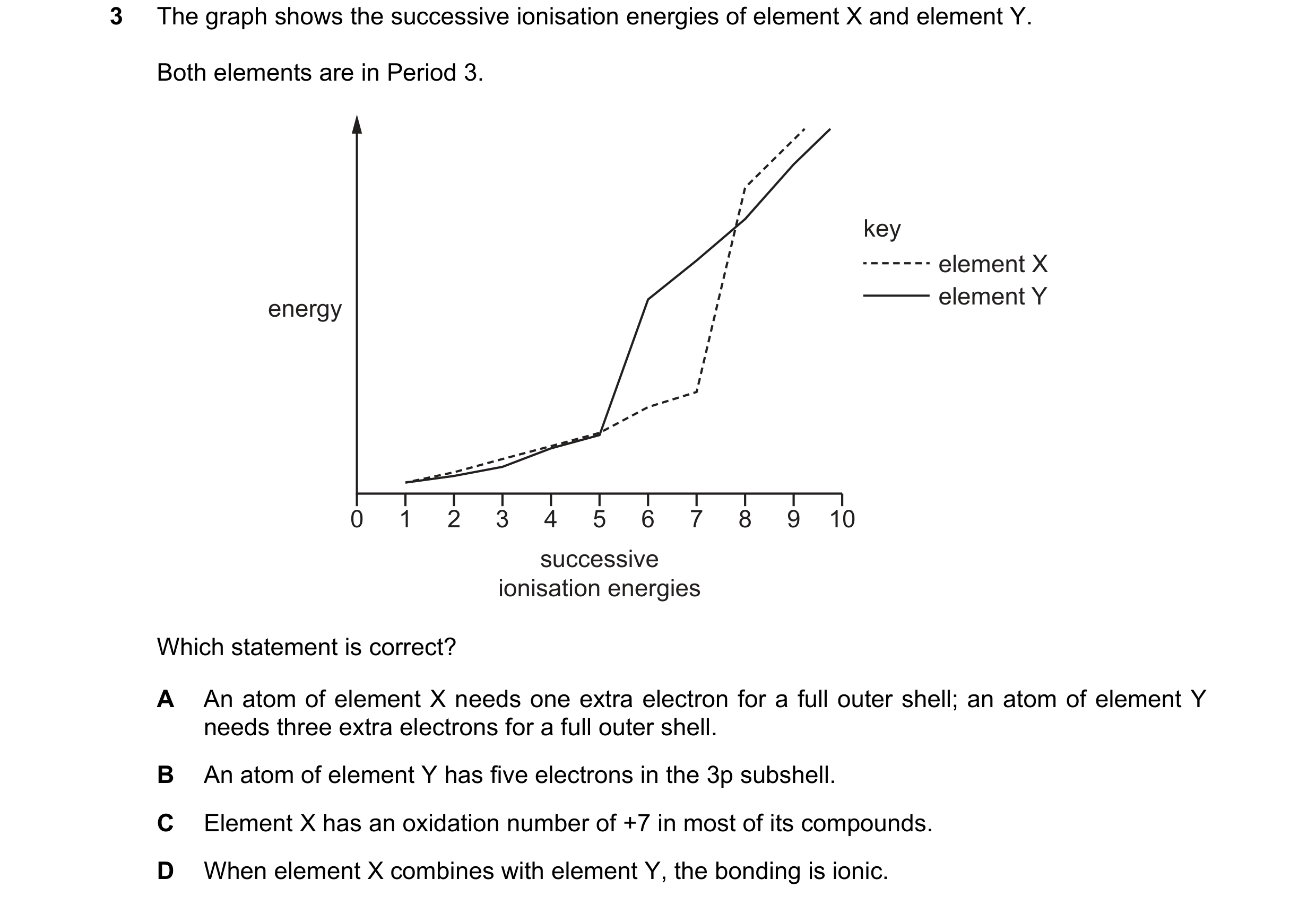
 22 / 37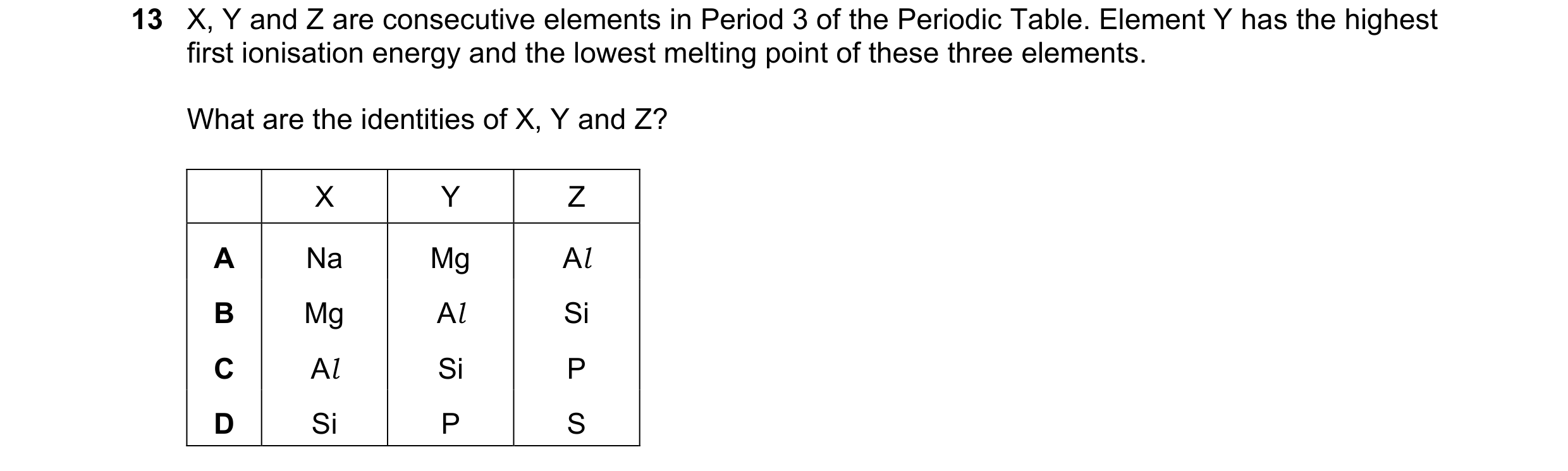


 23 / 37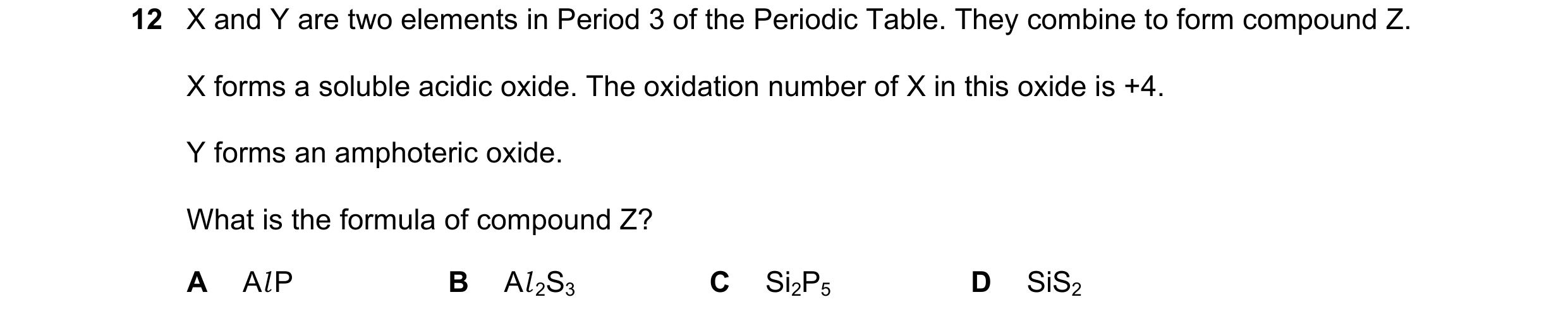

 24 / 37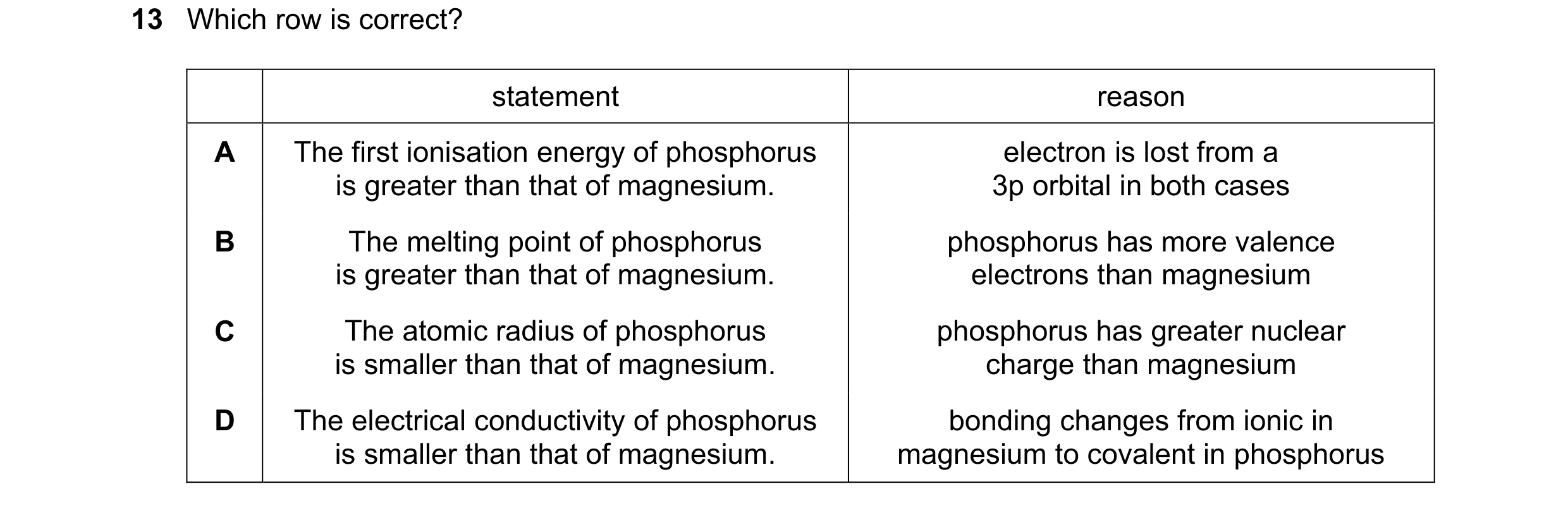



 25 / 37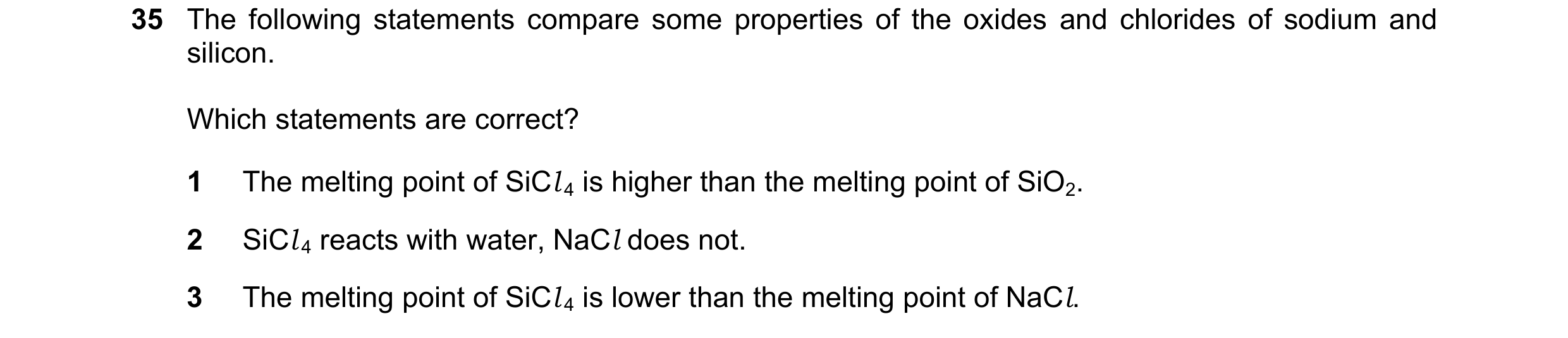
 26 / 37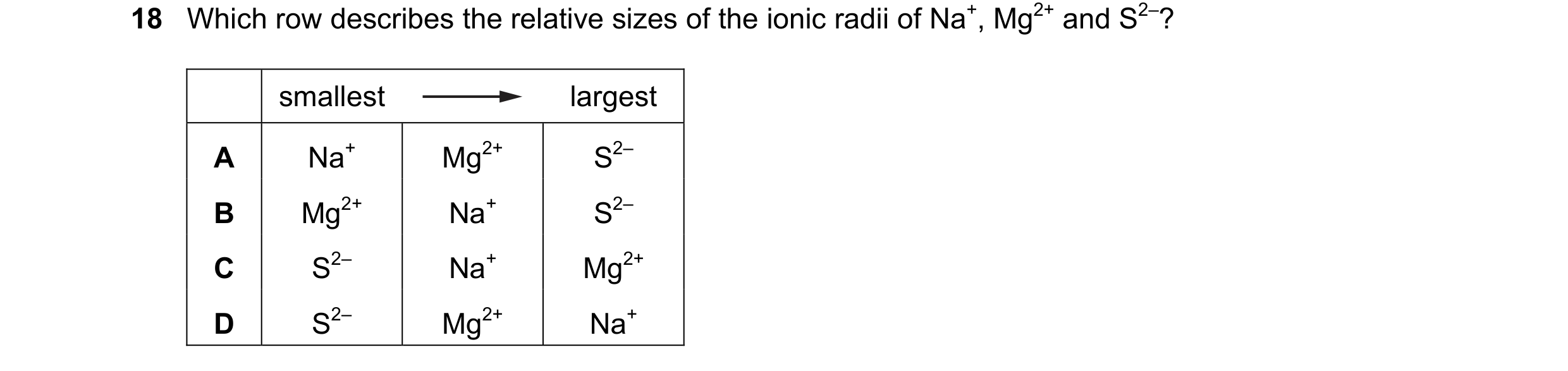
 27 / 37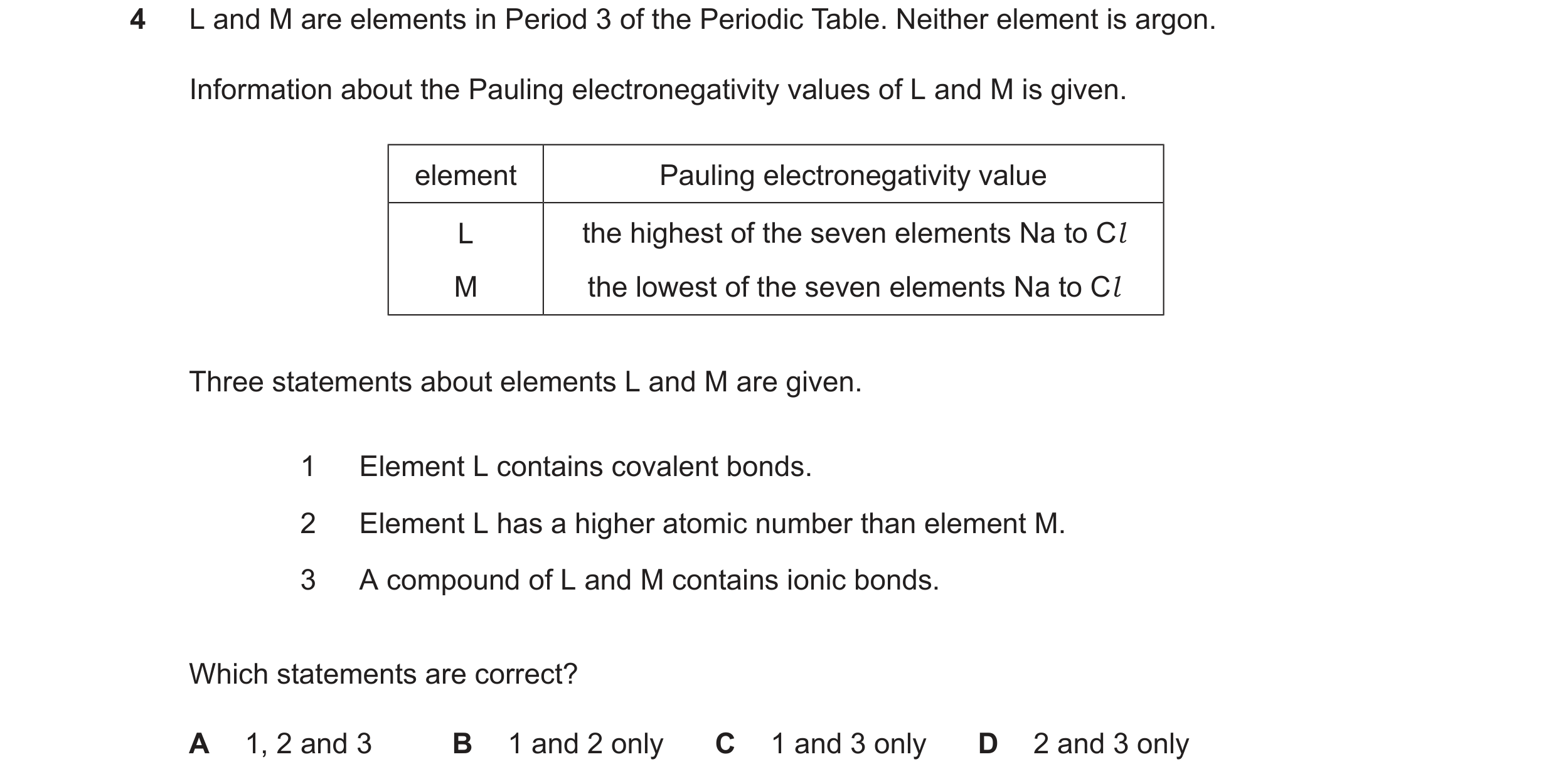
 28 / 37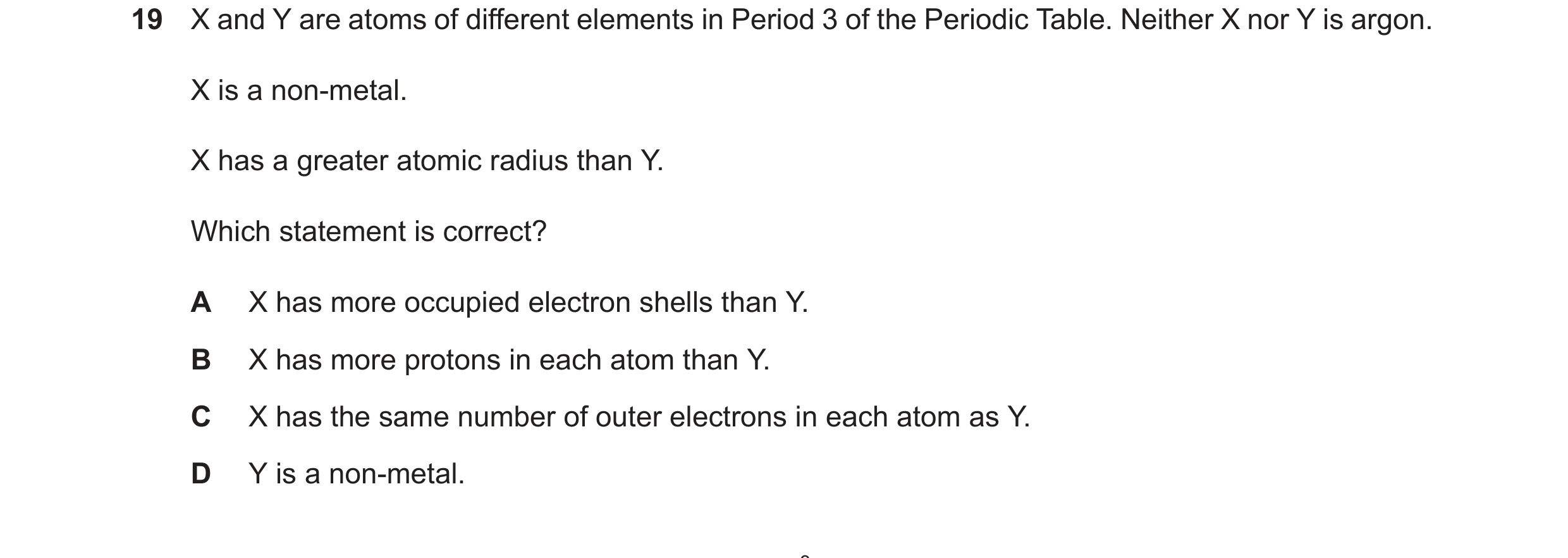
 29 / 37

 30 / 37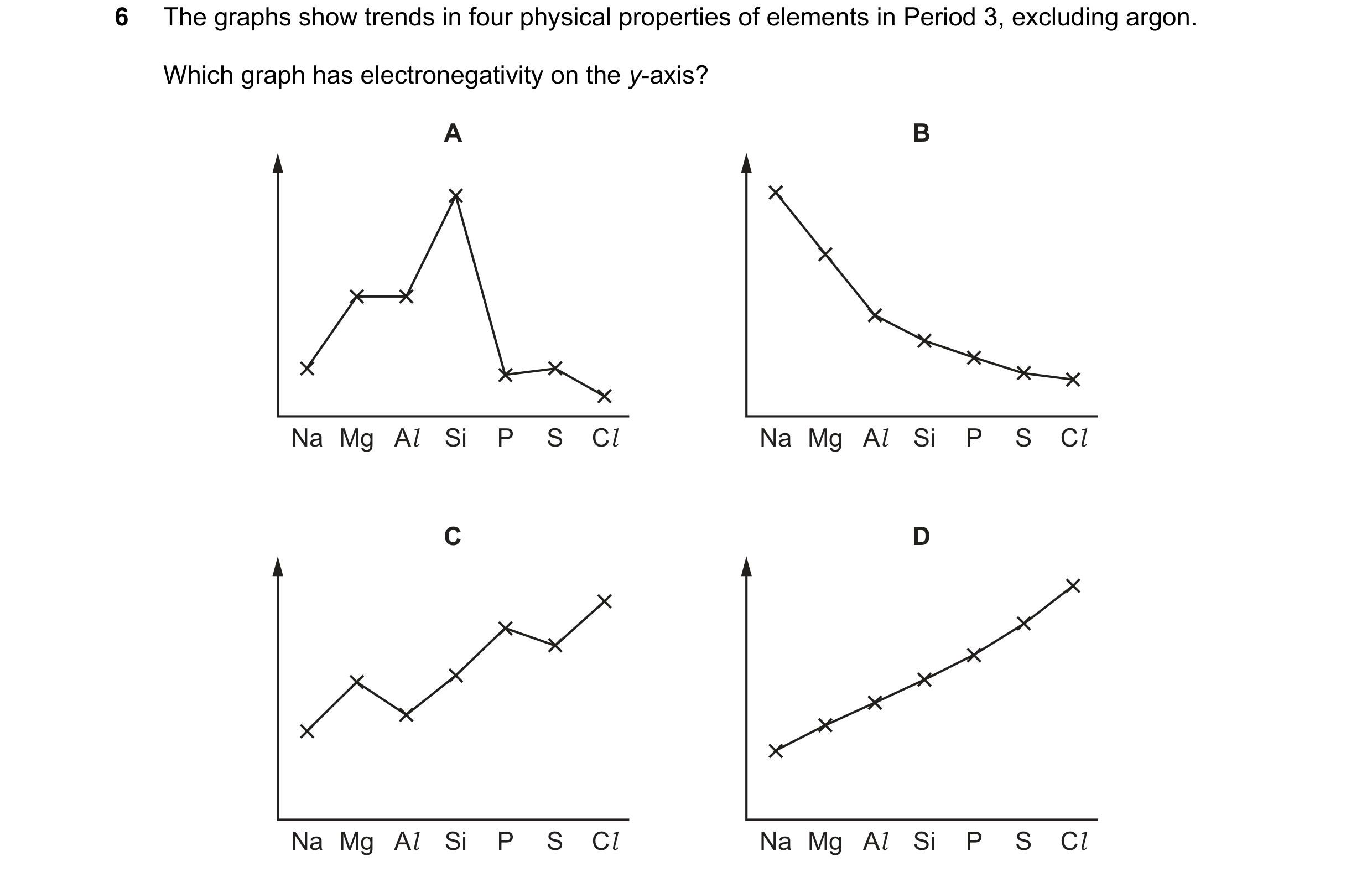
 31 / 37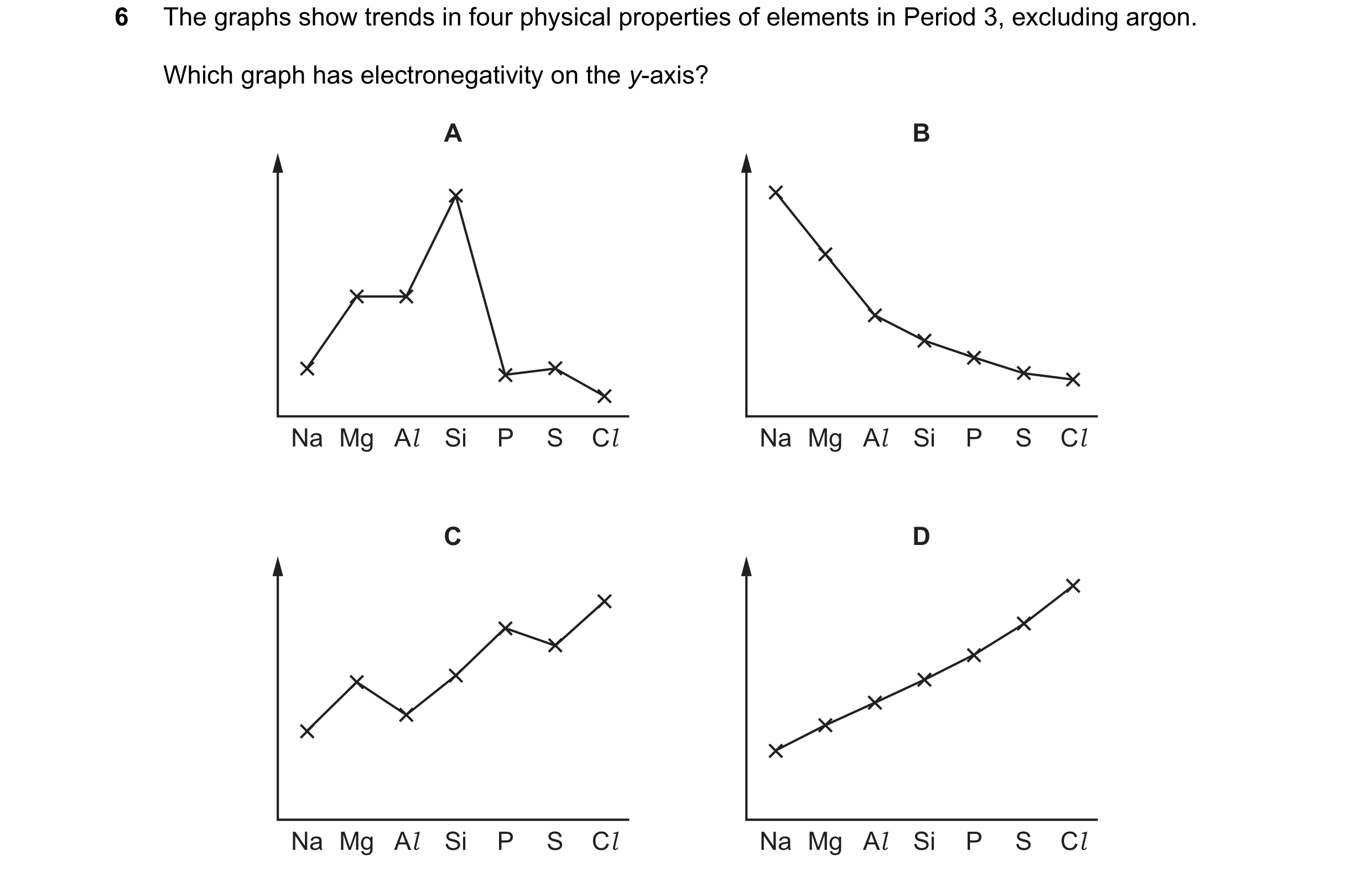
 32 / 37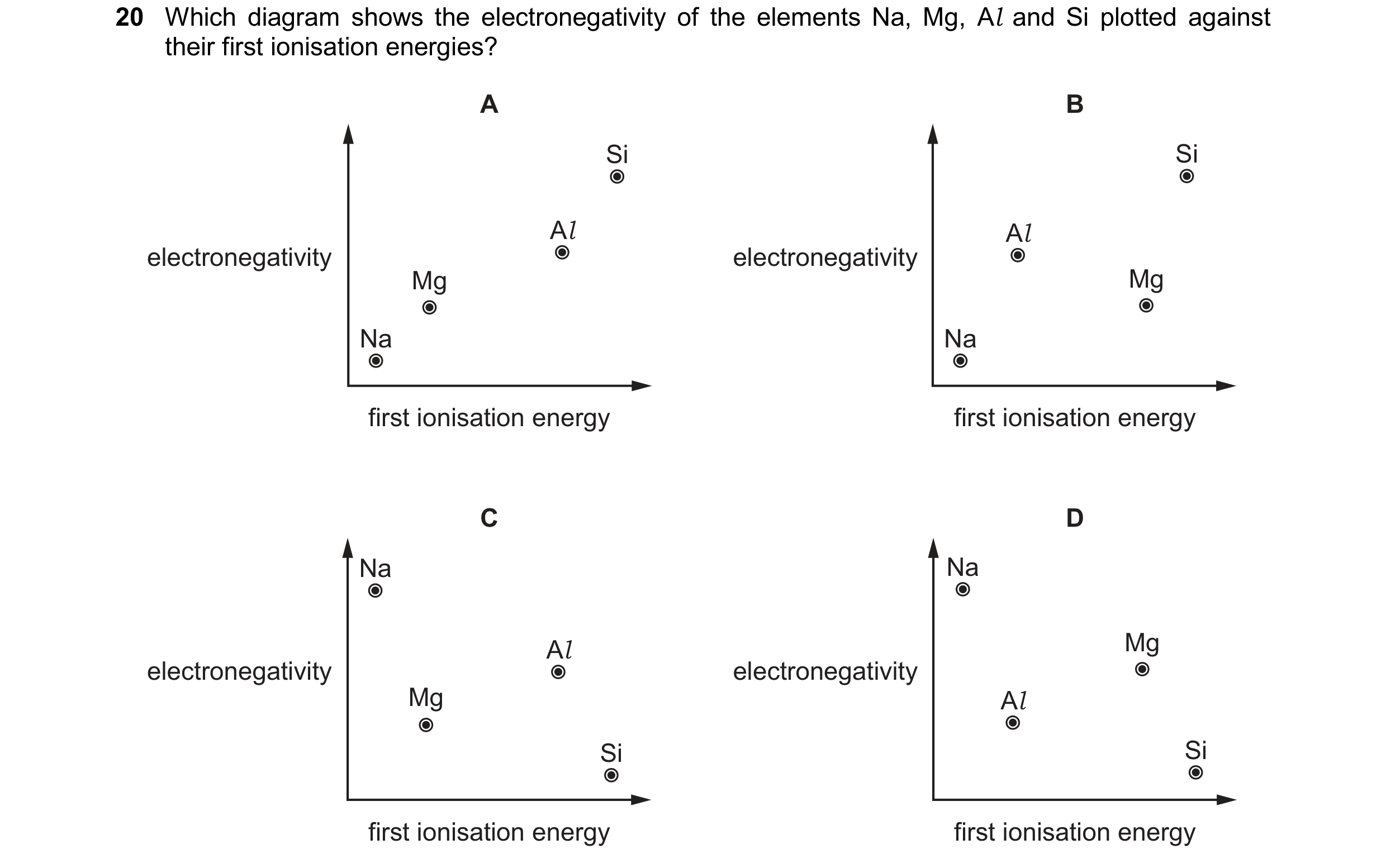
 33 / 37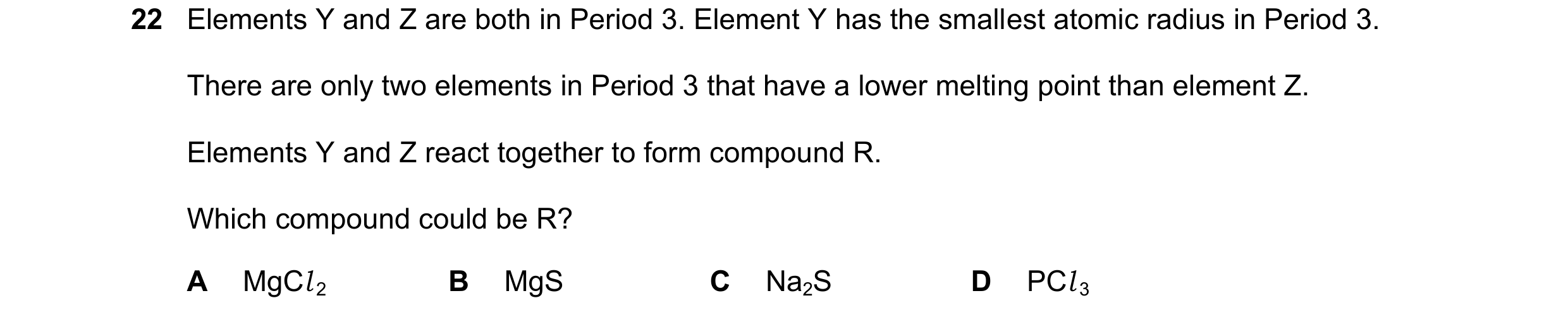
 34 / 37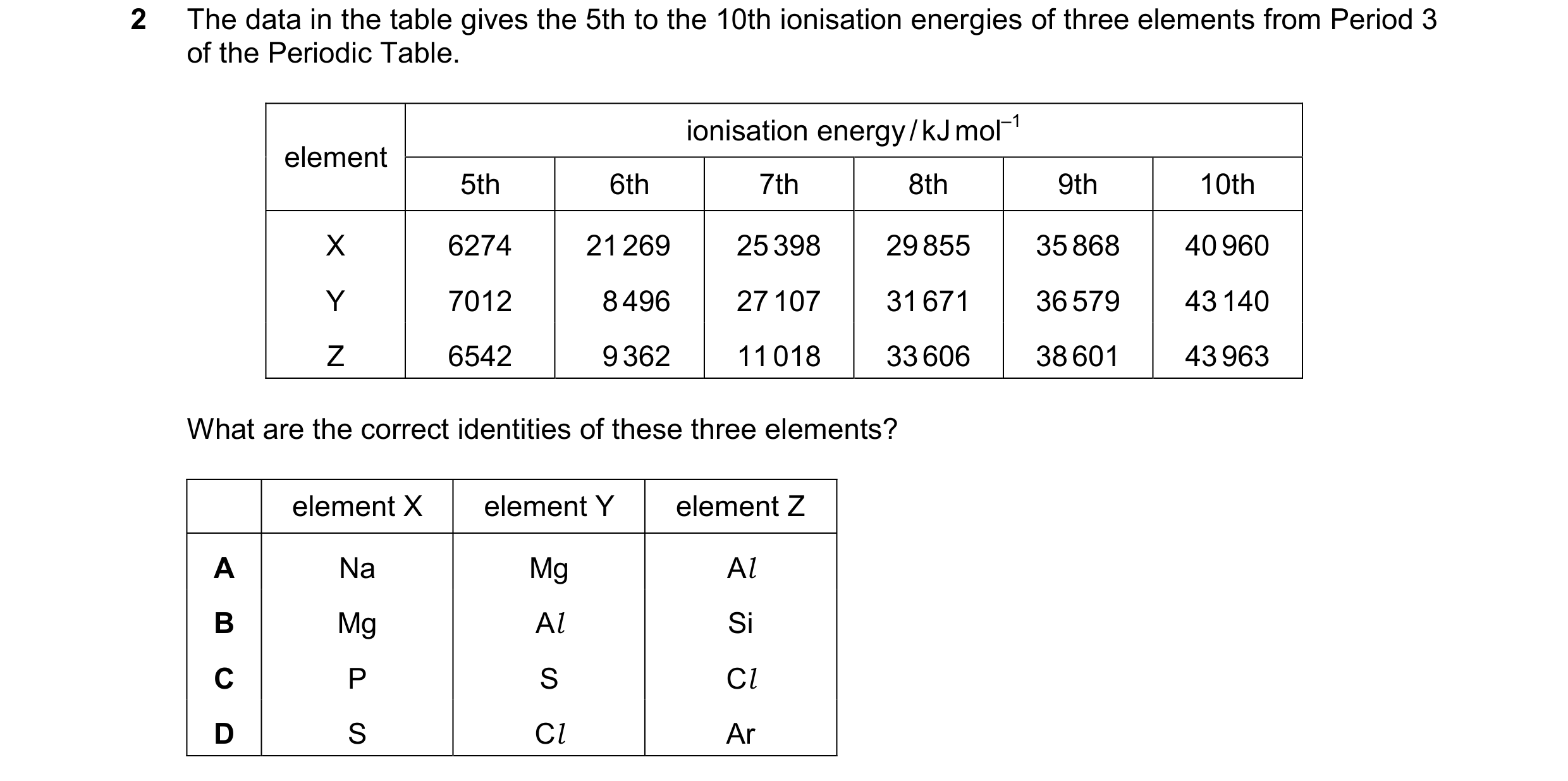
 35 / 37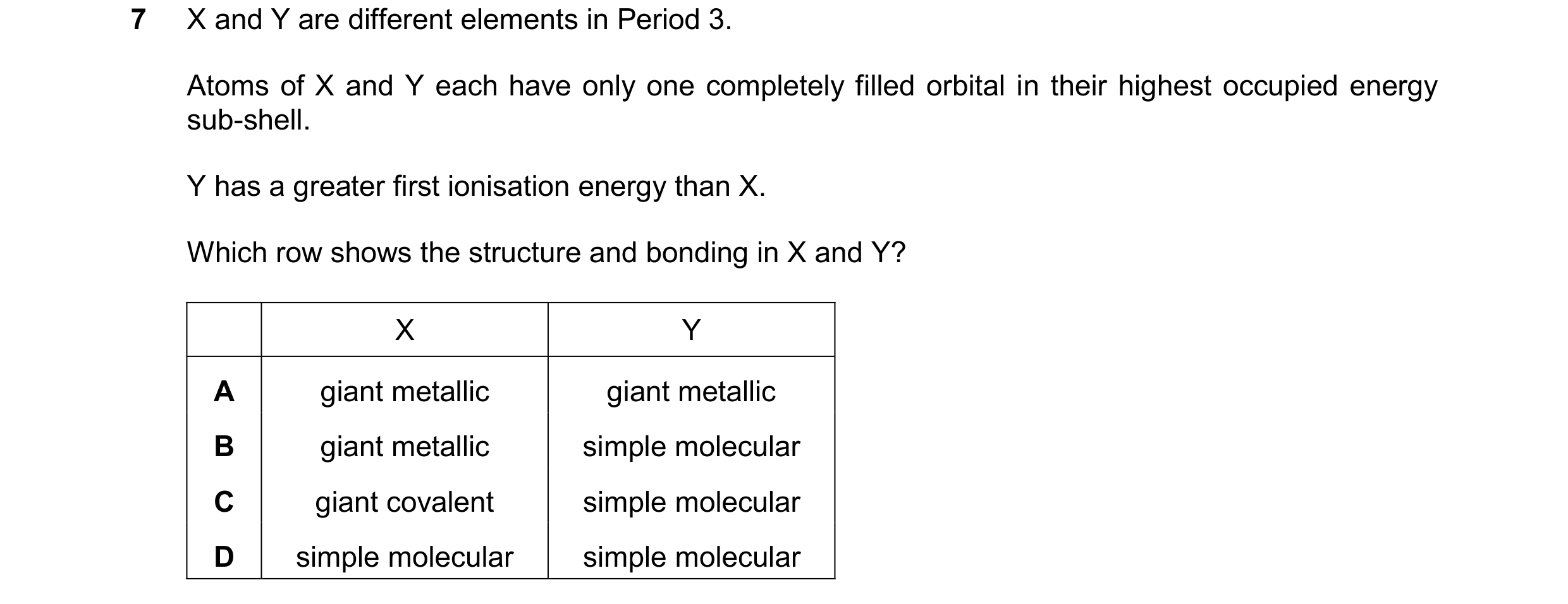
 36 / 37
 37 / 37