Questions as text
Q1 · Lactic acid occurs naturally, for example in sour milk 9701/11 Oct/Nov 2005
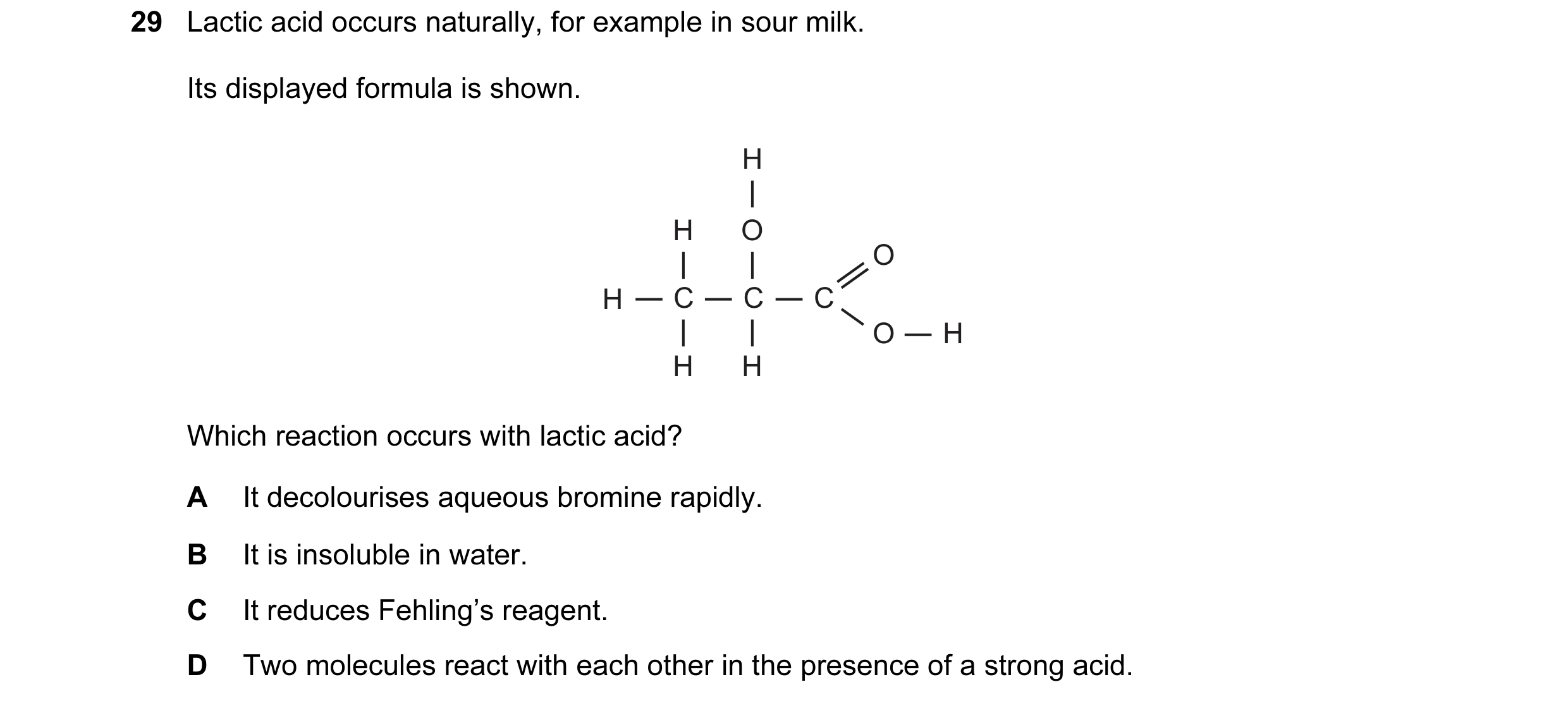
29 Lactic acid occurs naturally, for example in sour milk. Its displayed formula is shown. H H O O H C C C O H H H Which reaction occurs with lactic acid? A It decolourises aqueous bromine rapidly. B It is insoluble in water. C It reduces Fehling’s reagent. D Two molecules react with each other in the presence of a strong acid.
1 marks
Answer: D
This question in 9701/11 Oct/Nov 2005
Q2 · Which statements about lactic acid, CH3CH(OH)CO2H, are correct? 9701/11 May/June 2006
40 Which statements about lactic acid, CH3CH(OH)CO2H, are correct? 1 Lactic acid forms optical isomers. 2 Two hydrogen atoms per lactic acid molecule can be involved in hydrogen bonding. 3 Lactic acid would form an aldehyde when oxidised by acidified potassium dichromate(VI).
1 marks
Answer: B
This question in 9701/11 May/June 2006
Q3 · Butanedioic acid occurs in amber, algae, lichens, sugar cane and beets 9701/11 Oct/Nov 2007
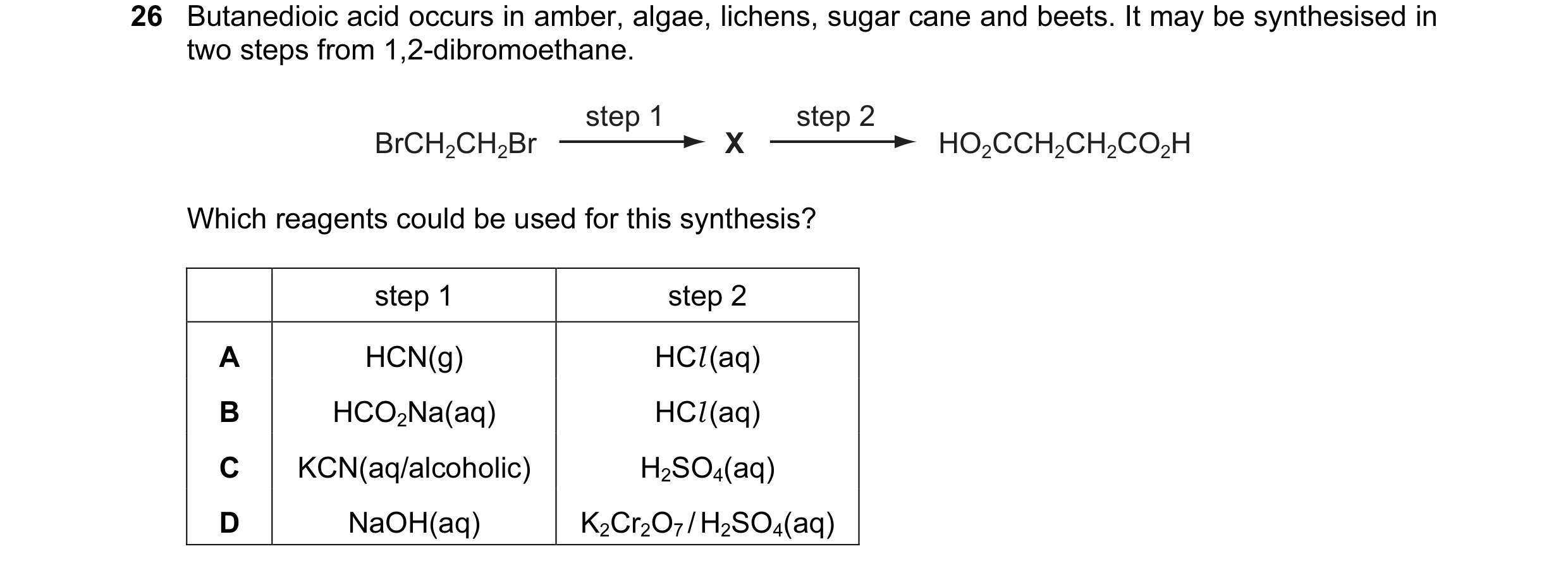
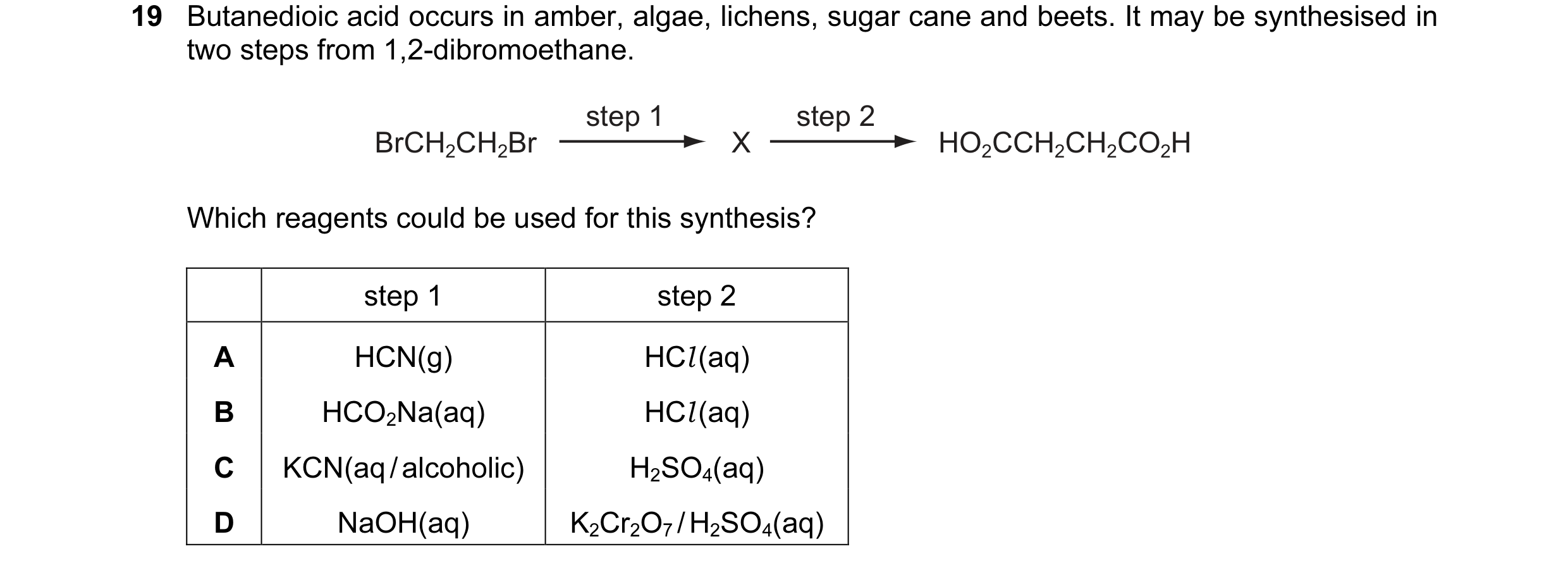
26 Butanedioic acid occurs in amber, algae, lichens, sugar cane and beets. It may be synthesised in two steps from 1,2-dibromoethane. step 1 step 2 BrCH2CH2Br X HO2CCH2CH2CO2H Which reagents could be used for this synthesis? step 1 step 2 A HCN(g) HCl (aq) B HCO2Na(aq) HCl (aq) C KCN(aq/alcoholic) H2SO4(aq) D NaOH(aq) K2Cr2O7 / H2SO4(aq)
1 marks
Answer: C
This question in 9701/11 Oct/Nov 2007
Q4 · Monopotassium citrate is used as an emulsifying agent in powdered milk and in powdered… 9701/11 Oct/Nov 2007
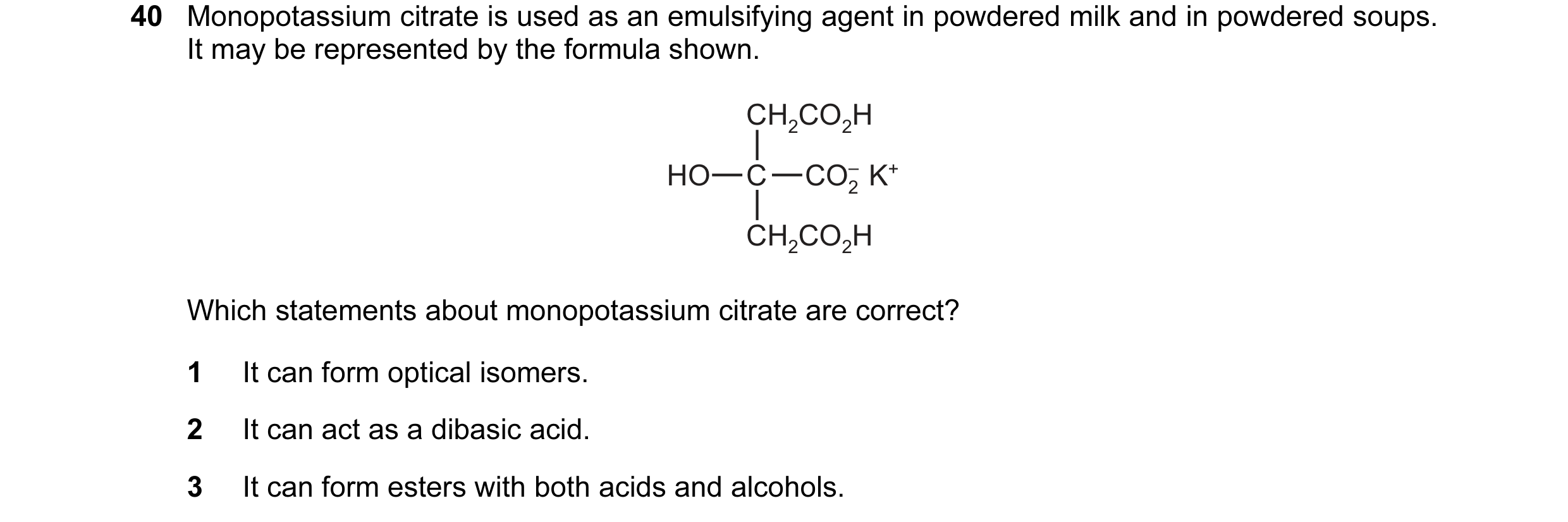
40 Monopotassium citrate is used as an emulsifying agent in powdered milk and in powdered soups. It may be represented by the formula shown. CH2CO2H HO C CO2 K+ – CH2CO2H Which statements about monopotassium citrate are correct? 1 It can form optical isomers. 2 It can act as a dibasic acid. 3 It can form esters with both acids and alcohols.
1 marks
Answer: C
This question in 9701/11 Oct/Nov 2007
Q5 · Which compound is both chiral and acidic? 9701/11 May/June 2008
29 Which compound is both chiral and acidic? A B C D H CO2H CH3 OH CH2Br CH(OH)CO2H C HCO2CH CH2CO2H C CH3 H CO2H
1 marks
Answer: D
This question in 9701/11 May/June 2008
Q6 · Aspirin is a widely-available pain-killer, whose properties have been known for centuries 9701/11 May/June 2008
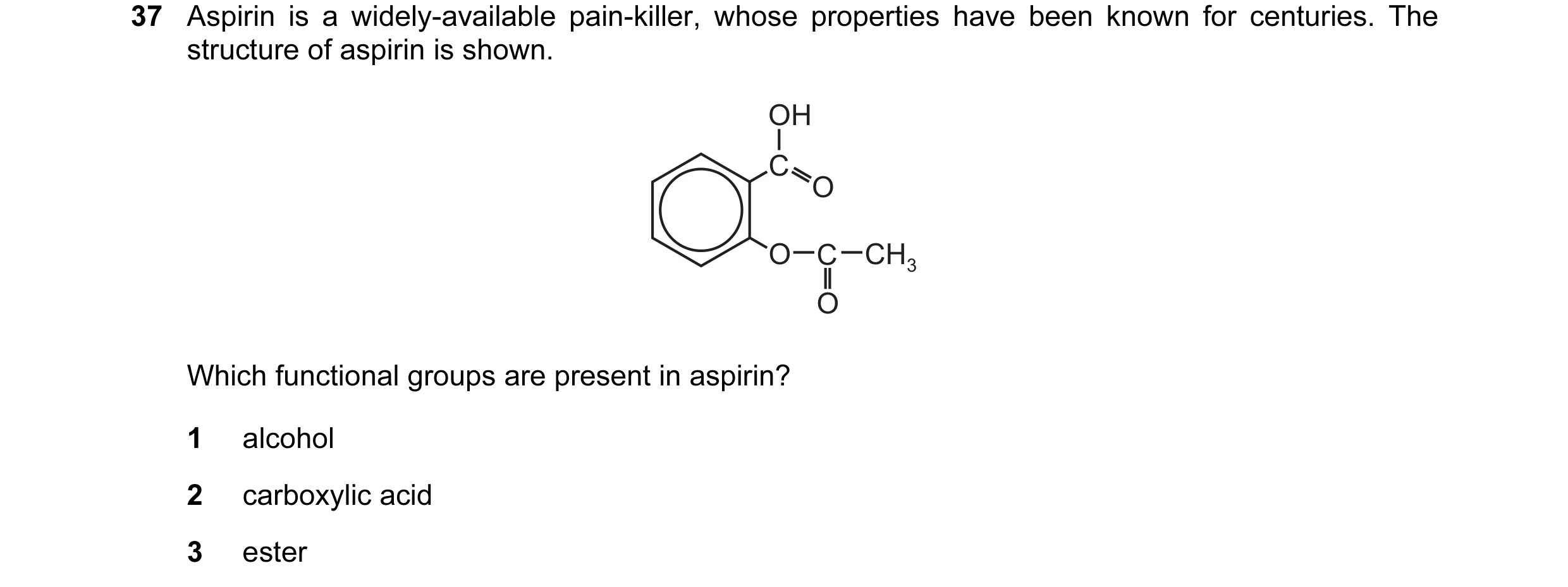
37 Aspirin is a widely-available pain-killer, whose properties have been known for centuries. The structure of aspirin is shown. OH C O O C CH3 O Which functional groups are present in aspirin? 1 alcohol 2 carboxylic acid 3 ester
1 marks
Answer: C
This question in 9701/11 May/June 2008
Q7 · Ferulic acid is an antioxidant that occurs widely in plants 9701/11 May/June 2008
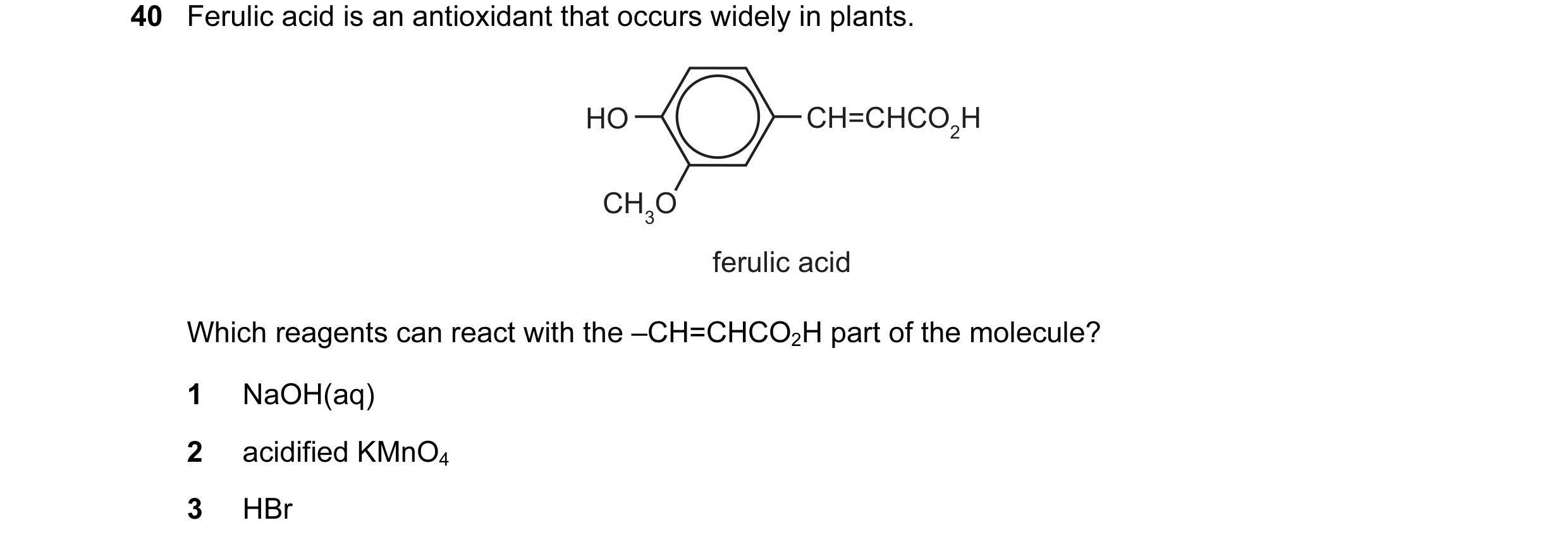
40 Ferulic acid is an antioxidant that occurs widely in plants. HO CH=CHCO2H CH3O ferulic acid Which reagents can react with the –CH=CHCO2H part of the molecule? 1 NaOH(aq) 2 acidified KMnO4 3 HBr
1 marks
Answer: A
This question in 9701/11 May/June 2008
Q8 · The stomach wall can become sensitive to acidic compounds 9701/11 Oct/Nov 2008
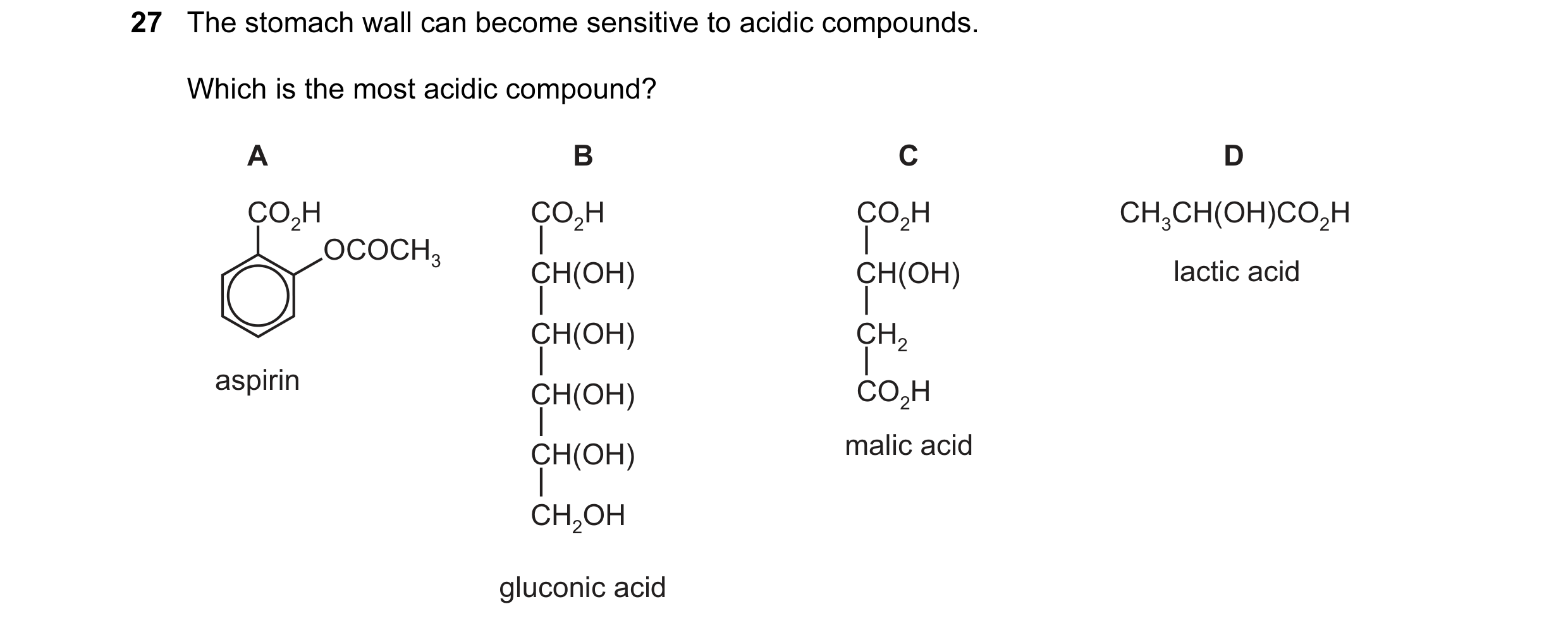
27 The stomach wall can become sensitive to acidic compounds. Which is the most acidic compound? A B C D CO2H CO2H CO2H CH3CH(OH)CO2H OCOCH3 CH(OH) CH(OH) lactic acid CH(OH) CH2 aspirin CO2H CH(OH) CH(OH) malic acid CH2OH gluconic acid
1 marks
Answer: C
This question in 9701/11 Oct/Nov 2008
Q9 · Glycol, used in anti-freeze, has the formula HOCH2CH2OH 9701/11 May/June 2009
26 Glycol, used in anti-freeze, has the formula HOCH2CH2OH. It can be oxidised to give a number of products. What is the molecular formula of an oxidation product of glycol that will not react with sodium? A C2H2O2 B C2H2O3 C C2H2O4 D C2H4O2
1 marks
Answer: A
This question in 9701/11 May/June 2009
Q10 · The characteristic odour of rum is attributed to the compound 2-ethyl-3-methylbutanoic… 9701/11 Oct/Nov 2009
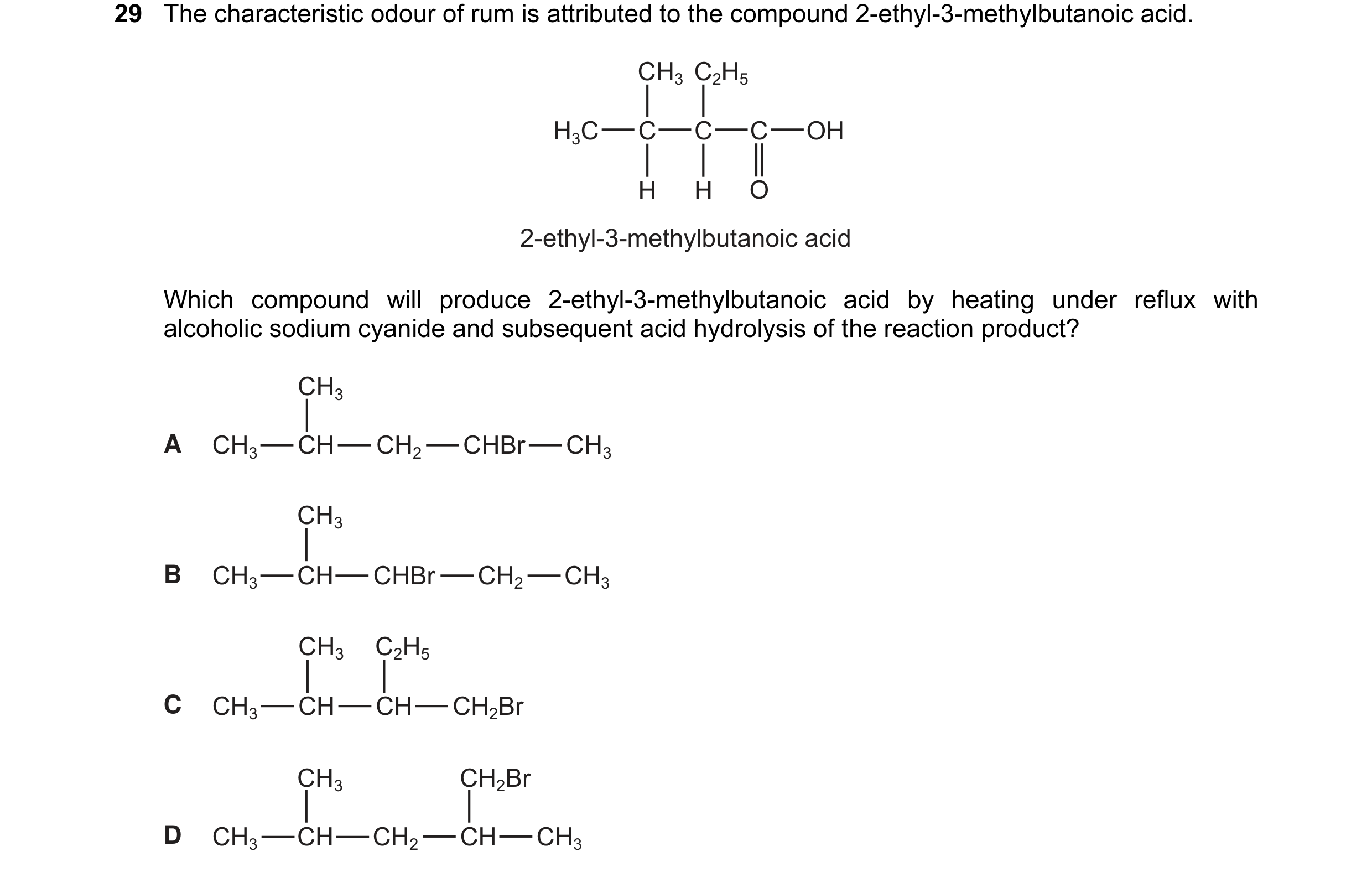
29 The characteristic odour of rum is attributed to the compound 2-ethyl-3-methylbutanoic acid. CH3 C2H5 H3C C C C OH H H O 2-ethyl-3-methylbutanoic acid Which compound will produce 2-ethyl-3-methylbutanoic acid by heating under reflux with alcoholic sodium cyanide and subsequent acid hydrolysis of the reaction product? CH3 A CH3 CH CH2 CHBr CH3 CH3 B CH3 CH CHBr CH2 CH3 CH3 C2H5 C CH3 CH CH CH2Br CH3 CH2Br D CH3 CH CH2 CH CH3
1 marks
Answer: B
This question in 9701/11 Oct/Nov 2009
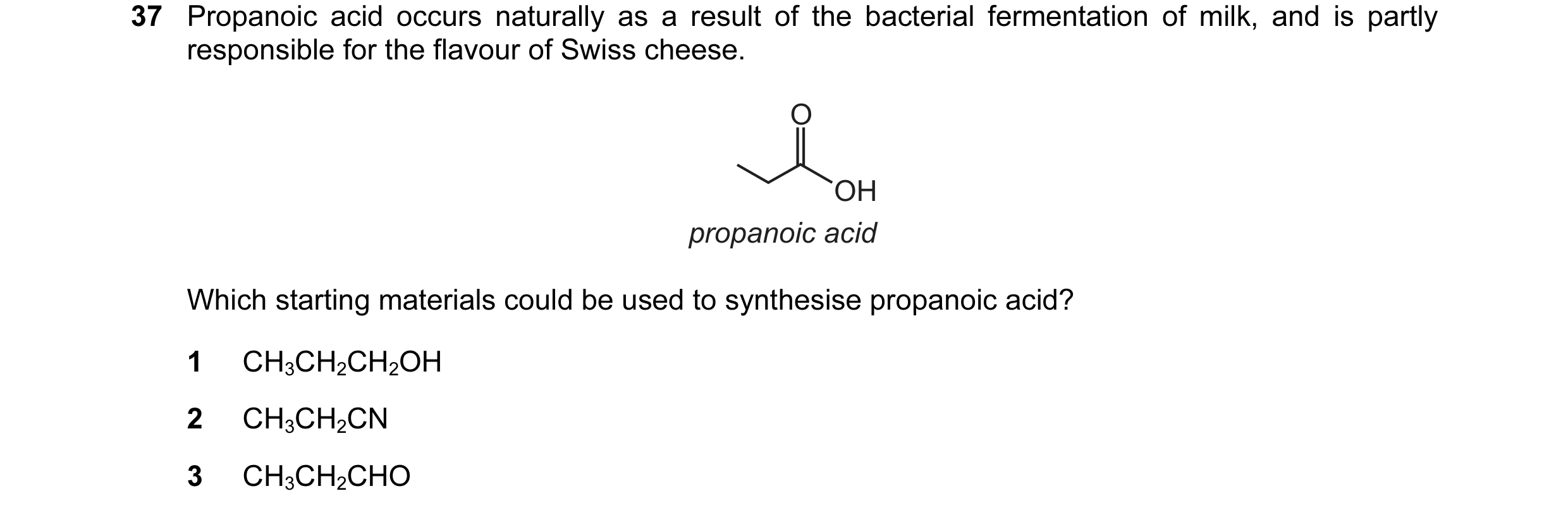
Q11 · Propanoic acid occurs naturally as a result of the bacterial fermentation of milk, and is… 9701/11 May/June 2010
37 Propanoic acid occurs naturally as a result of the bacterial fermentation of milk, and is partly responsible for the flavour of Swiss cheese. O OH propanoic acid Which starting materials could be used to synthesise propanoic acid? 1 CH3CH2CH2OH 2 CH3CH2CN 3 CH3CH2CHO
1 marks
Answer: A
This question in 9701/11 May/June 2010
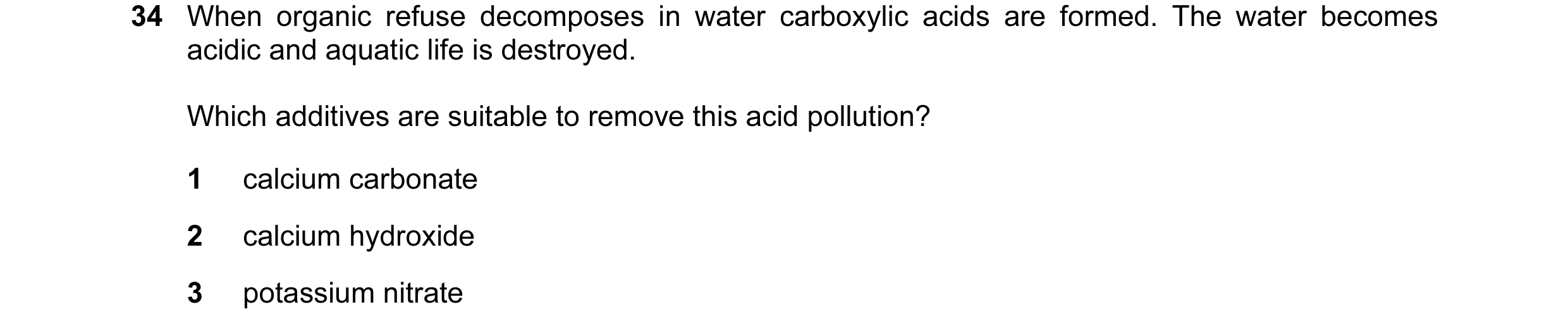
Q12 · When organic refuse decomposes in water carboxylic acids are formed 9701/12 May/June 2010
34 When organic refuse decomposes in water carboxylic acids are formed. The water becomes acidic and aquatic life is destroyed. Which additives are suitable to remove this acid pollution? 1 calcium carbonate 2 calcium hydroxide 3 potassium nitrate
1 marks
Answer: B
This question in 9701/12 May/June 2010
Q13 · Propanoic acid occurs naturally as a result of the bacterial fermentation of milk, and is… 9701/12 May/June 2010
38 Propanoic acid occurs naturally as a result of the bacterial fermentation of milk, and is partly responsible for the flavour of Swiss cheese. O OH propanoic acid Which starting materials could be used to synthesise propanoic acid? 1 CH3CH2CH2OH 2 CH3CH2CN 3 CH3CH2CHO
1 marks
Answer: A
This question in 9701/12 May/June 2010
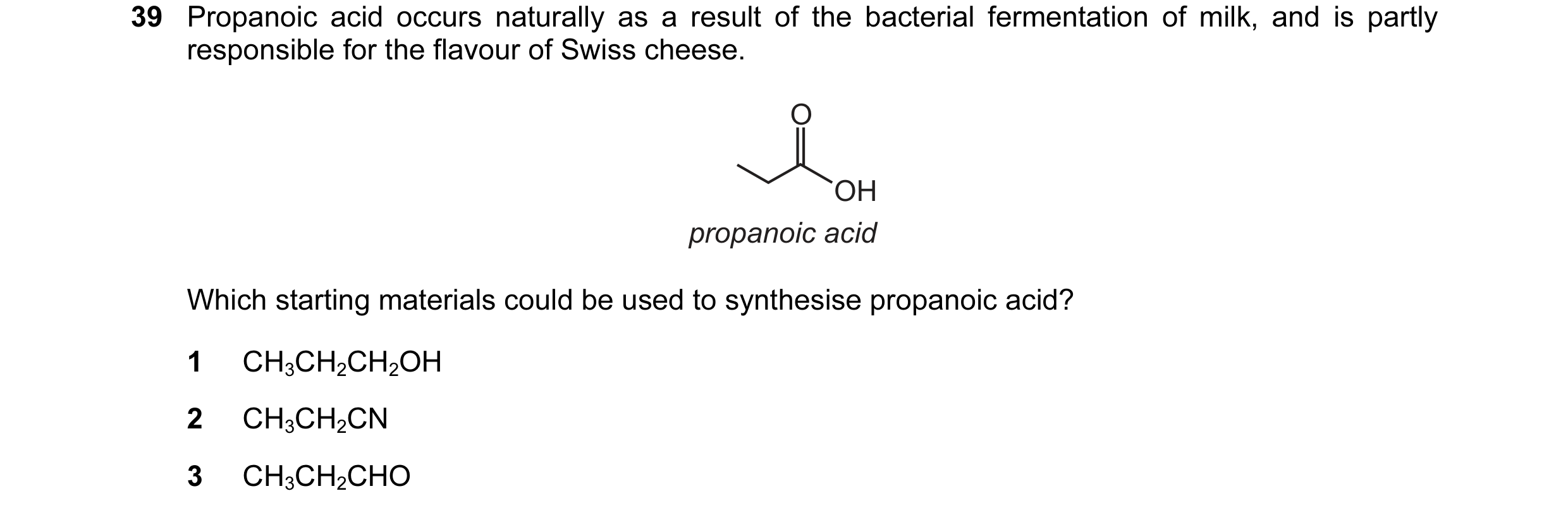
Q14 · Propanoic acid occurs naturally as a result of the bacterial fermentation of milk, and is… 9701/13 May/June 2010
39 Propanoic acid occurs naturally as a result of the bacterial fermentation of milk, and is partly responsible for the flavour of Swiss cheese. O OH propanoic acid Which starting materials could be used to synthesise propanoic acid? 1 CH3CH2CH2OH 2 CH3CH2CN 3 CH3CH2CHO
1 marks
Answer: A
This question in 9701/13 May/June 2010
Q15 · A compound Y has all of the properties below 9701/11 Oct/Nov 2010
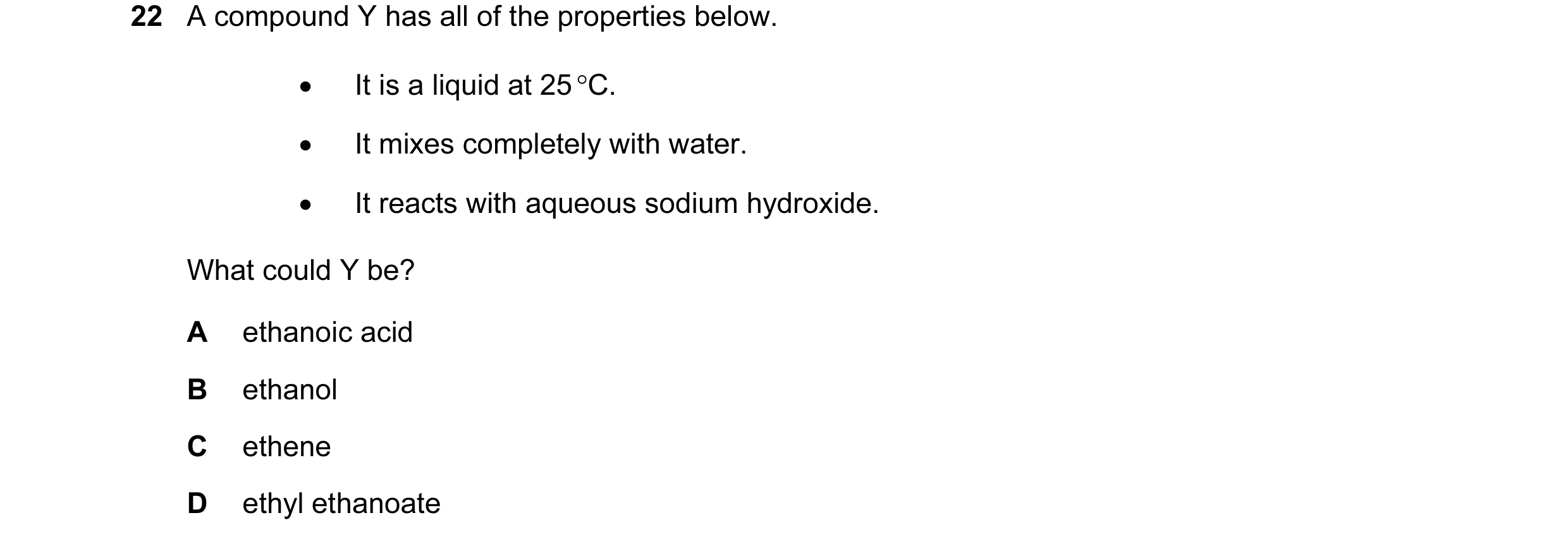
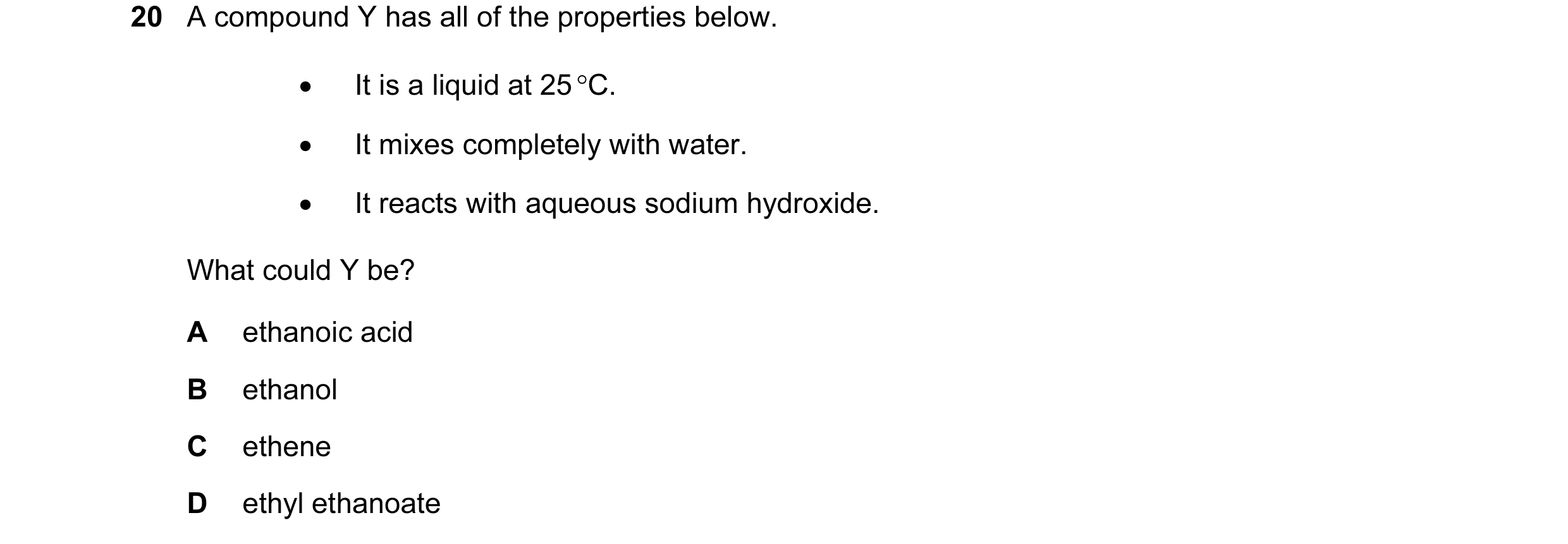
22 A compound Y has all of the properties below. • It is a liquid at 25 °C. • It mixes completely with water. • It reacts with aqueous sodium hydroxide. What could Y be? A ethanoic acid B ethanol C ethene D ethyl ethanoate
1 marks
Answer: A
This question in 9701/11 Oct/Nov 2010
Q16 · Lactic acid occurs naturally, for example in sour milk 9701/11 Oct/Nov 2010
26 Lactic acid occurs naturally, for example in sour milk. H H O O H C C C H H O H lactic acid What is a property of lactic acid? A It decolourises aqueous bromine rapidly. B It is insoluble in water. C It reduces Fehling’s reagent. D Two molecules react with each other in the presence of a strong acid.
1 marks
Answer: D
This question in 9701/11 Oct/Nov 2010
Q17 · An organic compound decolourises aqueous bromine and reacts with sodium to produce… 9701/11 Oct/Nov 2010
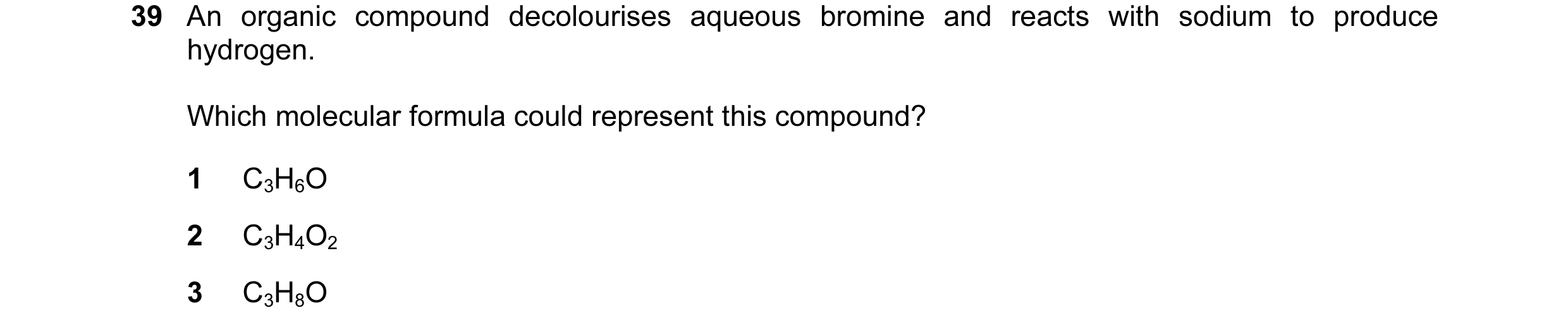
39 An organic compound decolourises aqueous bromine and reacts with sodium to produce hydrogen. Which molecular formula could represent this compound? 1 C3H6O 2 C3H4O2 3 C3H8O
1 marks
Answer: B
This question in 9701/11 Oct/Nov 2010
Q18 · When ethanal, CH3CHO, reacts with HCN and the organic product is hydrolysed by aqueous… 9701/12 Oct/Nov 2010
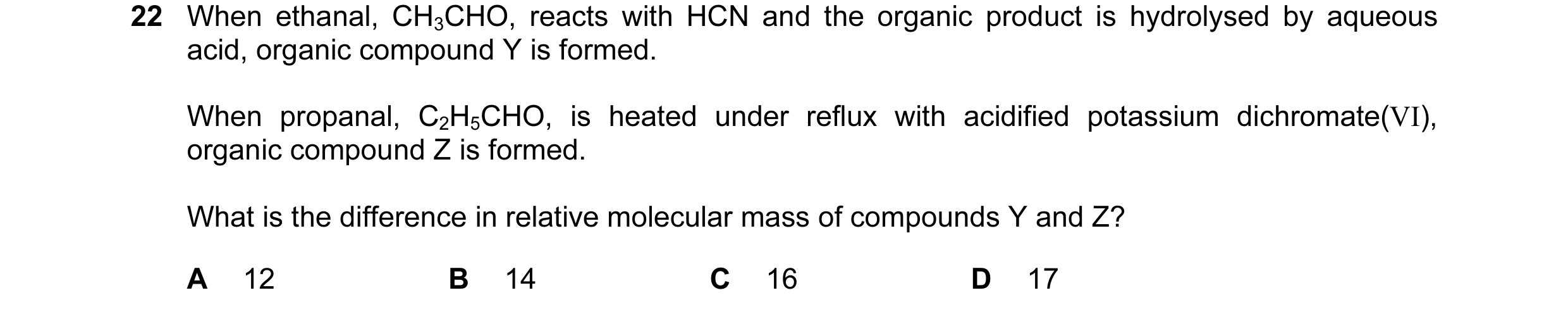
22 When ethanal, CH3CHO, reacts with HCN and the organic product is hydrolysed by aqueous acid, organic compound Y is formed. When propanal, C2H5CHO, is heated under reflux with acidified potassium dichromate(VI), organic compound Z is formed. What is the difference in relative molecular mass of compounds Y and Z? A 12 B 14 C 16 D 17
1 marks
Answer: C
This question in 9701/12 Oct/Nov 2010
Q19 · A compound Y has all of the properties below 9701/13 Oct/Nov 2010
20 A compound Y has all of the properties below. • It is a liquid at 25 °C. • It mixes completely with water. • It reacts with aqueous sodium hydroxide. What could Y be? A ethanoic acid B ethanol C ethene D ethyl ethanoate
1 marks
Answer: A
This question in 9701/13 Oct/Nov 2010
Q20 · Lactic acid occurs naturally, for example in sour milk 9701/13 Oct/Nov 2010
26 Lactic acid occurs naturally, for example in sour milk. H H O O H C C C H H O H lactic acid What is a property of lactic acid? A It decolourises aqueous bromine rapidly. B It is insoluble in water. C It reduces Fehling’s reagent. D Two molecules react with each other in the presence of a strong acid.
1 marks
Answer: D
This question in 9701/13 Oct/Nov 2010
Q21 · An organic compound, X, will react with an excess of calcium metal to produce a salt with… 9701/12 May/June 2011
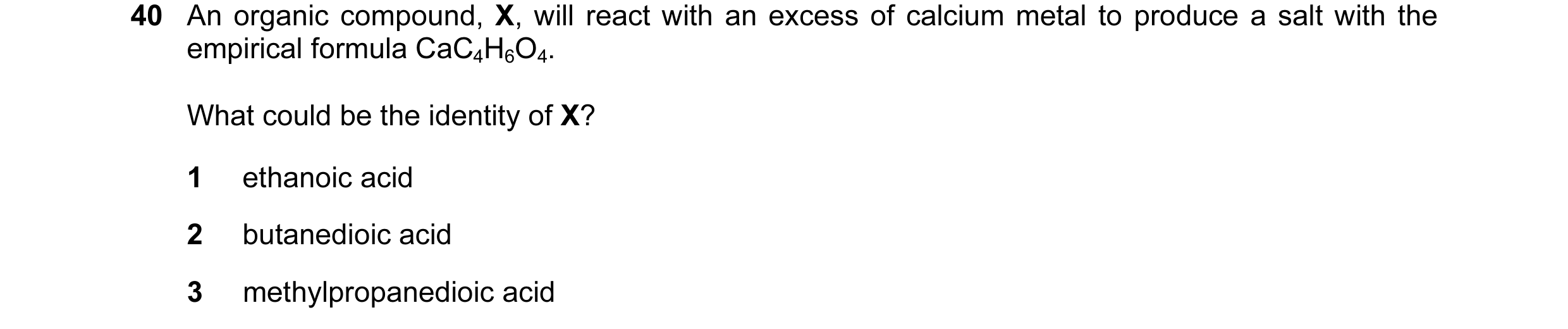
40 An organic compound, X, will react with an excess of calcium metal to produce a salt with the empirical formula CaC4H6O4. What could be the identity of X? 1 ethanoic acid 2 butanedioic acid 3 methylpropanedioic acid
1 marks
Answer: D
This question in 9701/12 May/June 2011
Q22 · Butanedioic acid occurs in amber, algae, lichens, sugar cane and beets 9701/13 May/June 2011
19 Butanedioic acid occurs in amber, algae, lichens, sugar cane and beets. It may be synthesised in two steps from 1,2-dibromoethane. step 1 step 2 BrCH2CH2Br X HO2CCH2CH2CO2H Which reagents could be used for this synthesis? step 1 step 2 A HCN(g) HCl (aq) B HCO2Na(aq) HCl (aq) C KCN(aq / alcoholic) H2SO4(aq) D NaOH(aq) K2Cr2O7 / H2SO4(aq)
1 marks
Answer: C
This question in 9701/13 May/June 2011
Q23 · Sorbitol is an artificial sweetener used to sweeten chocolate which is suitable for… 9701/13 May/June 2011
39 Sorbitol is an artificial sweetener used to sweeten chocolate which is suitable for diabetics. OH H C H H C OH HO C H H C OH H C OH H C H OH sorbitol Which functional groups can be produced when this molecule is subjected to oxidation under suitable conditions? 1 aldehyde 2 carboxylic acid 3 ketone
1 marks
Answer: A
This question in 9701/13 May/June 2011
Q24 · Which pairs of homologous series have the same C:H ratio in their general formulae? 9701/12 Oct/Nov 2011
40 Which pairs of homologous series have the same C:H ratio in their general formulae? 1 aldehydes and ketones 2 carboxylic acids and esters 3 alkenes and ketones
1 marks
This question in 9701/12 Oct/Nov 2011
Q25 · An organic compound J reacts with sodium to produce an organic ion with a charge of –3 9701/11 May/June 2012
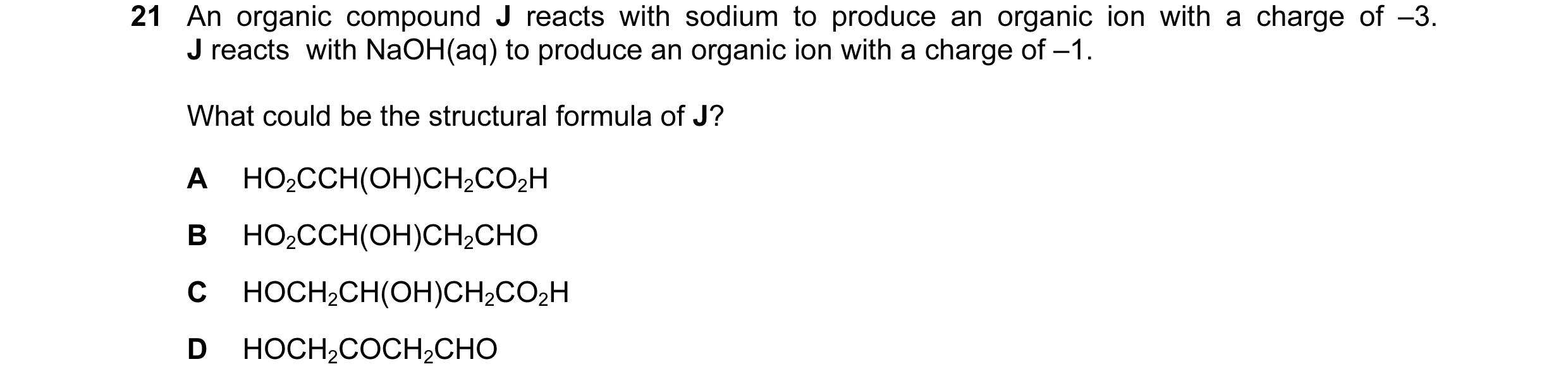
21 An organic compound J reacts with sodium to produce an organic ion with a charge of –3. J reacts with NaOH(aq) to produce an organic ion with a charge of –1. What could be the structural formula of J? A HO2CCH(OH)CH2CO2H B HO2CCH(OH)CH2CHO C HOCH2CH(OH)CH2CO2H D HOCH2COCH2CHO
1 marks
Answer: C
This question in 9701/11 May/June 2012
Q26 · Complete combustion of compound X gives carbon dioxide and water only 9701/12 May/June 2012
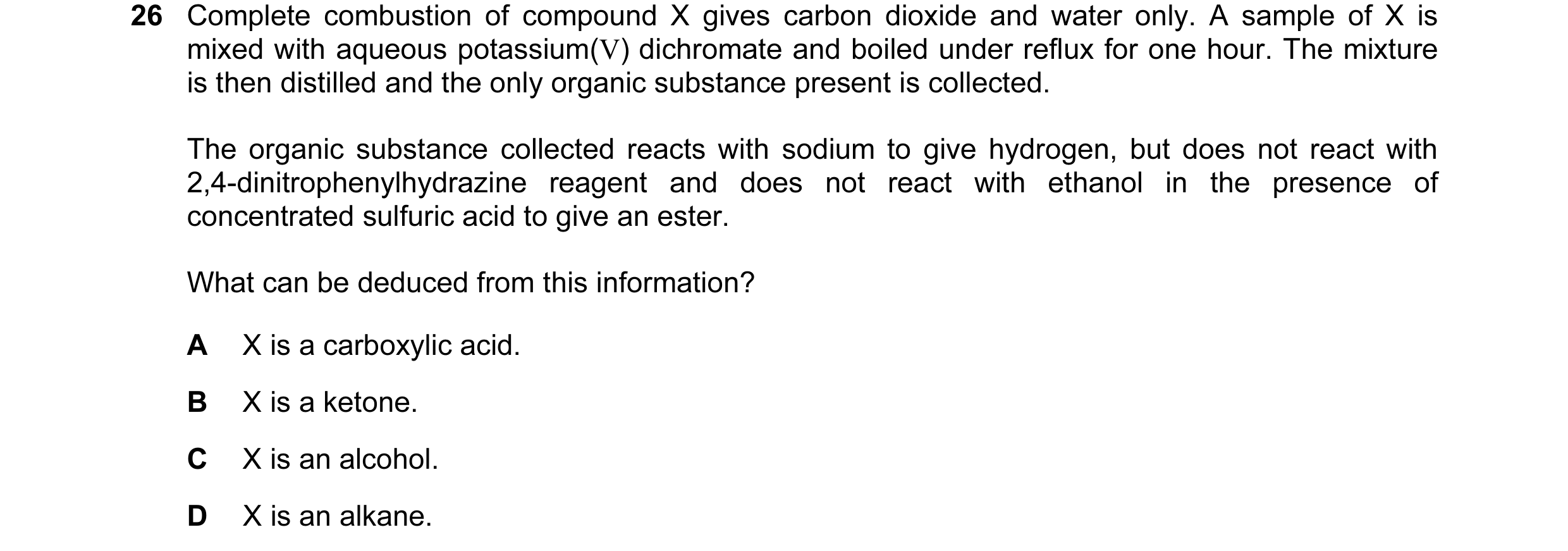
26 Complete combustion of compound X gives carbon dioxide and water only. A sample of X is mixed with aqueous potassium(V) dichromate and boiled under reflux for one hour. The mixture is then distilled and the only organic substance present is collected. The organic substance collected reacts with sodium to give hydrogen, but does not react with 2,4-dinitrophenylhydrazine reagent and does not react with ethanol in the presence of concentrated sulfuric acid to give an ester. What can be deduced from this information? A X is a carboxylic acid. B X is a ketone. C X is an alcohol. D X is an alkane.
1 marks
Answer: C
This question in 9701/12 May/June 2012
Q27 · An organic compound J reacts with sodium to produce an organic ion with a charge of –3 9701/13 May/June 2012
21 An organic compound J reacts with sodium to produce an organic ion with a charge of –3. J reacts with NaOH(aq) to produce an organic ion with a charge of –1. What could be the structural formula of J? A HO2CCH(OH)CH2CO2H B HO2CCH(OH)CH2CHO C HOCH2CH(OH)CH2CO2H D HOCH2COCH2CHO
1 marks
Answer: C
This question in 9701/13 May/June 2012
Q28 · Which reagent reacts with ethanol and also reacts with ethanoic acid? 9701/11 Oct/Nov 2012
27 Which reagent reacts with ethanol and also reacts with ethanoic acid? A acidified potassium dichromate(VI) B sodium C sodium carbonate D sodium hydroxide
1 marks
Answer: B
This question in 9701/11 Oct/Nov 2012
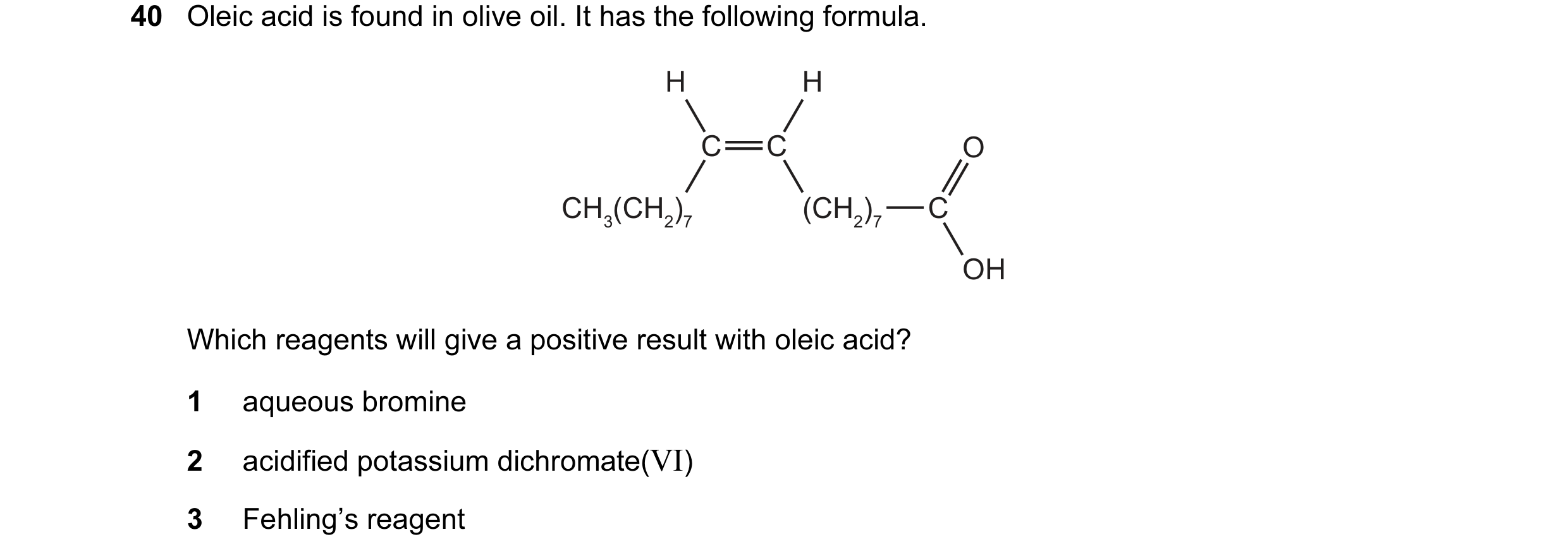
Q29 · Oleic acid is found in olive oil 9701/11 Oct/Nov 2012
40 Oleic acid is found in olive oil. It has the following formula. H H C C O CH3(CH2)7 (CH2)7 C OH Which reagents will give a positive result with oleic acid? 1 aqueous bromine 2 acidified potassium dichromate(VI) 3 Fehling’s reagent
1 marks
Answer: D
This question in 9701/11 Oct/Nov 2012
Q30 · Which reagent reacts with ethanol and also reacts with ethanoic acid? 9701/12 Oct/Nov 2012
27 Which reagent reacts with ethanol and also reacts with ethanoic acid? A acidified potassium dichromate(VI) B sodium C sodium carbonate D sodium hydroxide
1 marks
Answer: B
This question in 9701/12 Oct/Nov 2012
Q31 · Oleic acid is found in olive oil 9701/12 Oct/Nov 2012
40 Oleic acid is found in olive oil. It has the following formula. H H C C O CH3(CH2)7 (CH2)7 C OH Which reagents will give a positive result with oleic acid? 1 aqueous bromine 2 acidified potassium dichromate(VI) 3 Fehling’s reagent
1 marks
Answer: D
This question in 9701/12 Oct/Nov 2012
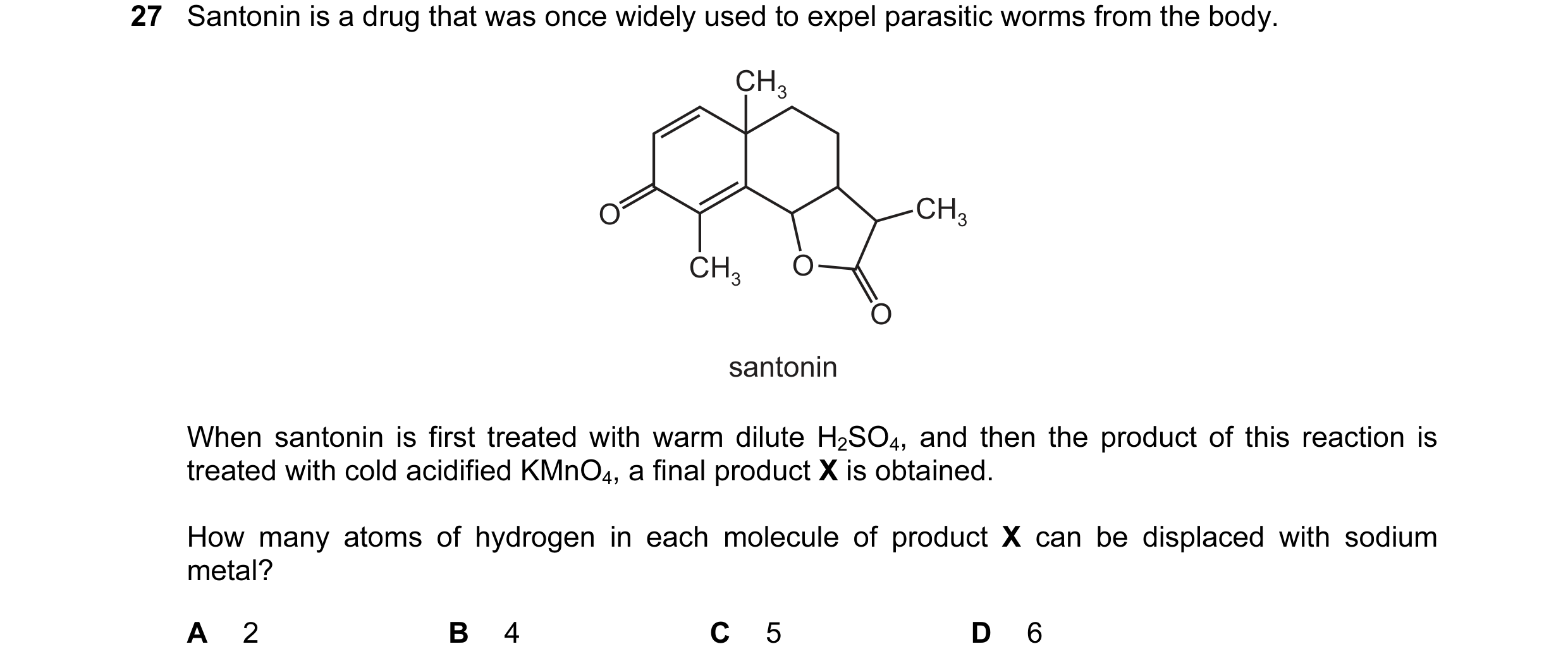
Q32 · Santonin is a drug that was once widely used to expel parasitic worms from the body 9701/13 Oct/Nov 2012
27 Santonin is a drug that was once widely used to expel parasitic worms from the body. CH3 O CH3 CH3 O O santonin When santonin is first treated with warm dilute H2SO4, and then the product of this reaction is treated with cold acidified KMnO4, a final product X is obtained. How many atoms of hydrogen in each molecule of product X can be displaced with sodium metal? A 2 B 4 C 5 D 6
1 marks
Answer: D
This question in 9701/13 Oct/Nov 2012
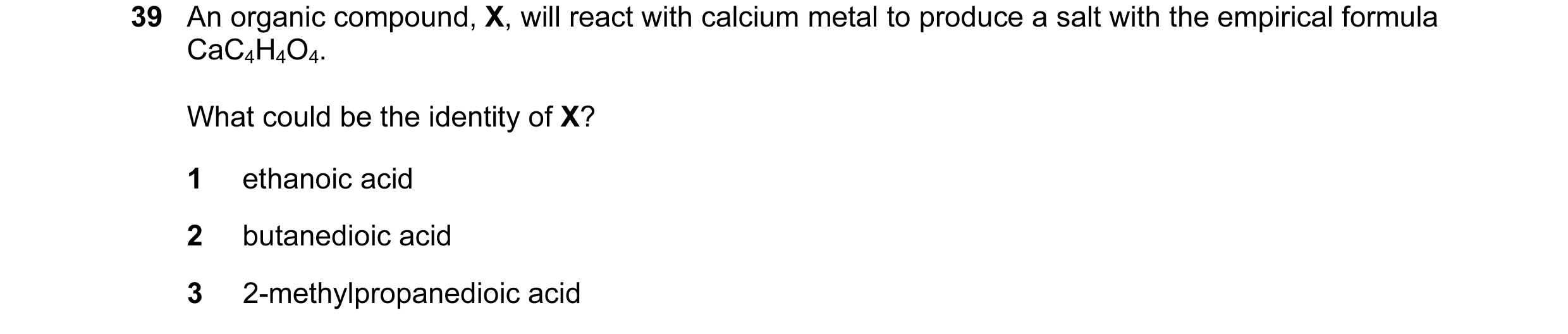
Q33 · An organic compound, X, will react with calcium metal to produce a salt with the… 9701/13 Oct/Nov 2012
39 An organic compound, X, will react with calcium metal to produce a salt with the empirical formula CaC4H4O4. What could be the identity of X? 1 ethanoic acid 2 butanedioic acid 3 2-methylpropanedioic acid
1 marks
Answer: C
This question in 9701/13 Oct/Nov 2012
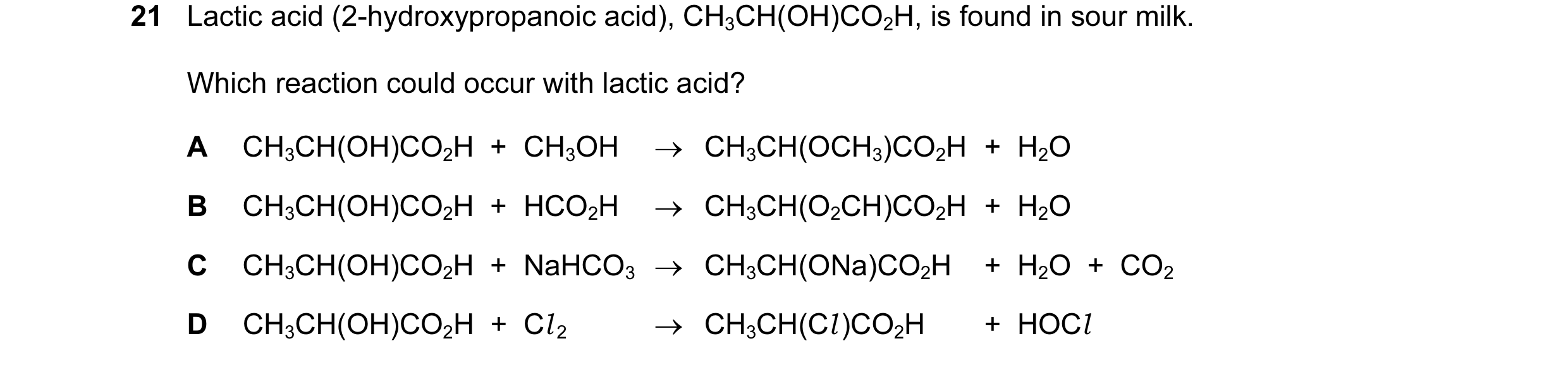
Q34 · Lactic acid (2-hydroxypropanoic acid), CH3CH(OH)CO2H, is found in sour milk 9701/11 May/June 2013
21 Lactic acid (2-hydroxypropanoic acid), CH3CH(OH)CO2H, is found in sour milk. Which reaction could occur with lactic acid? A CH3CH(OH)CO2H + CH3OH → CH3CH(OCH3)CO2H + H2O B CH3CH(OH)CO2H + HCO2H → CH3CH(O2CH)CO2H + H2O C CH3CH(OH)CO2H + NaHCO3 → CH3CH(ONa)CO2H + H2O + CO2 D CH3CH(OH)CO2H + Cl 2 → CH3CH(Cl )CO2H + HOCl
1 marks
Answer: B
This question in 9701/11 May/June 2013
Q35 · Which reagents, when used in an excess, can be used to make sodium lactate… 9701/11 May/June 2013
40 Which reagents, when used in an excess, can be used to make sodium lactate, CH3CH(OH)CO2Na, from lactic acid, CH3CH(OH)CO2H? 1 Na 2 NaHCO3 3 NaOH
1 marks
Answer: C
This question in 9701/11 May/June 2013
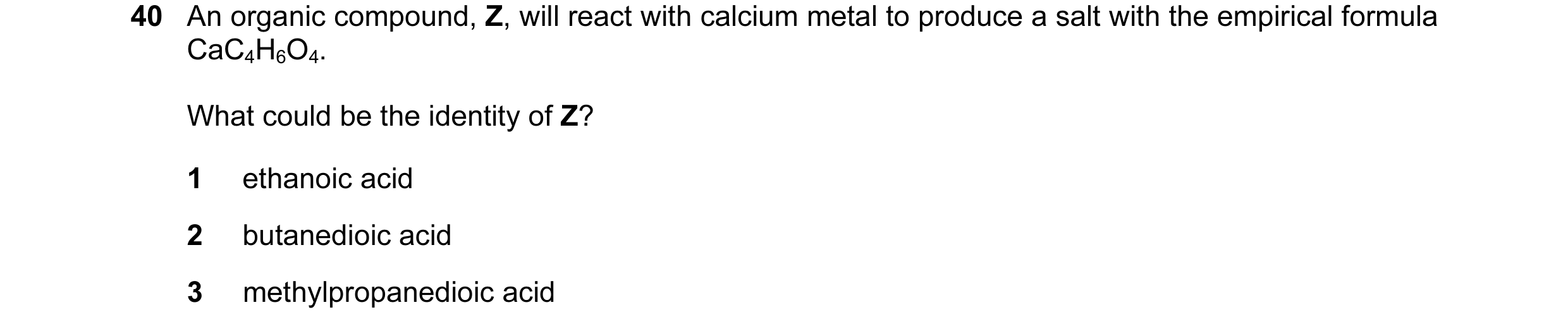
Q36 · An organic compound, Z, will react with calcium metal to produce a salt with the… 9701/12 May/June 2013
40 An organic compound, Z, will react with calcium metal to produce a salt with the empirical formula CaC4H6O4. What could be the identity of Z? 1 ethanoic acid 2 butanedioic acid 3 methylpropanedioic acid
1 marks
Answer: D
This question in 9701/12 May/June 2013
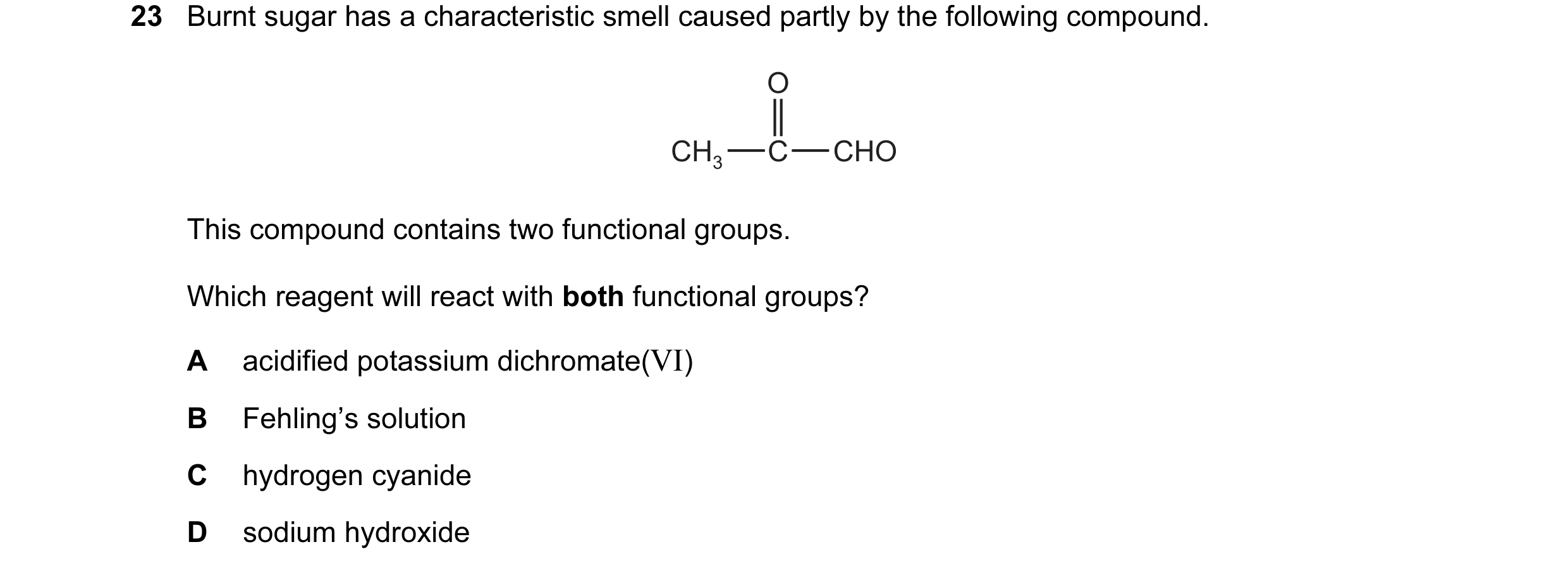
Q37 · Burnt sugar has a characteristic smell caused partly by the following compound 9701/13 May/June 2013
23 Burnt sugar has a characteristic smell caused partly by the following compound. O CH3 C CHO This compound contains two functional groups. Which reagent will react with both functional groups? A acidified potassium dichromate(VI) B Fehling’s solution C hydrogen cyanide D sodium hydroxide
1 marks
Answer: C
This question in 9701/13 May/June 2013
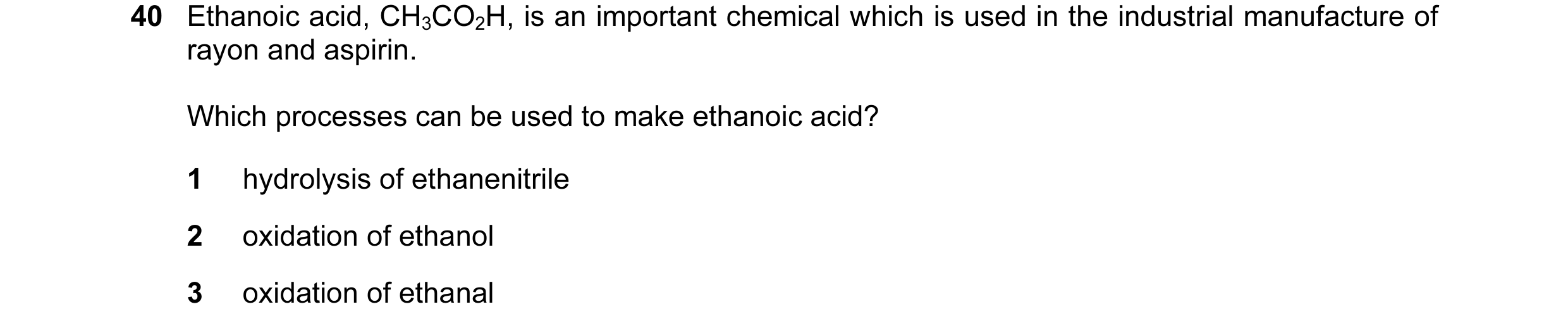
Q38 · Ethanoic acid, CH3CO2H, is an important chemical which is used in the industrial… 9701/13 May/June 2013
40 Ethanoic acid, CH3CO2H, is an important chemical which is used in the industrial manufacture of rayon and aspirin. Which processes can be used to make ethanoic acid? 1 hydrolysis of ethanenitrile 2 oxidation of ethanol 3 oxidation of ethanal
1 marks
Answer: A
This question in 9701/13 May/June 2013
Q39 · The compound ‘leaf alcohol’ is partly responsible for the smell of new-mown grass 9701/11 Oct/Nov 2013
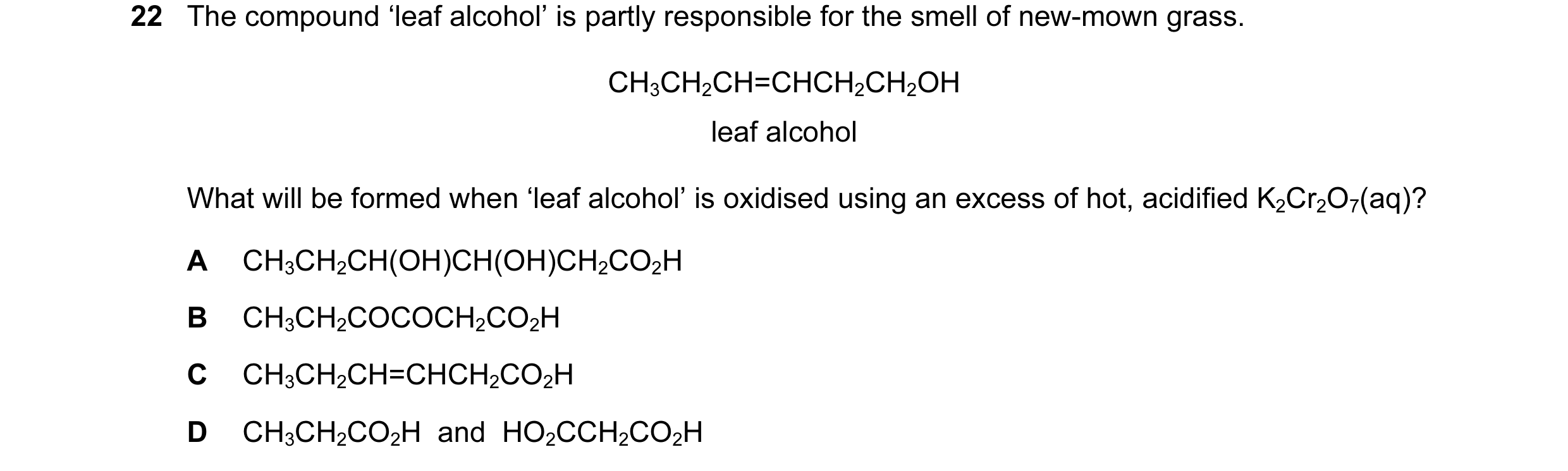
22 The compound ‘leaf alcohol’ is partly responsible for the smell of new-mown grass. CH3CH2CH=CHCH2CH2OH leaf alcohol What will be formed when ‘leaf alcohol’ is oxidised using an excess of hot, acidified K2Cr2O7(aq)? A CH3CH2CH(OH)CH(OH)CH2CO2H B CH3CH2COCOCH2CO2H C CH3CH2CH=CHCH2CO2H D CH3CH2CO2H and HO2CCH2CO2H
1 marks
Answer: C
This question in 9701/11 Oct/Nov 2013
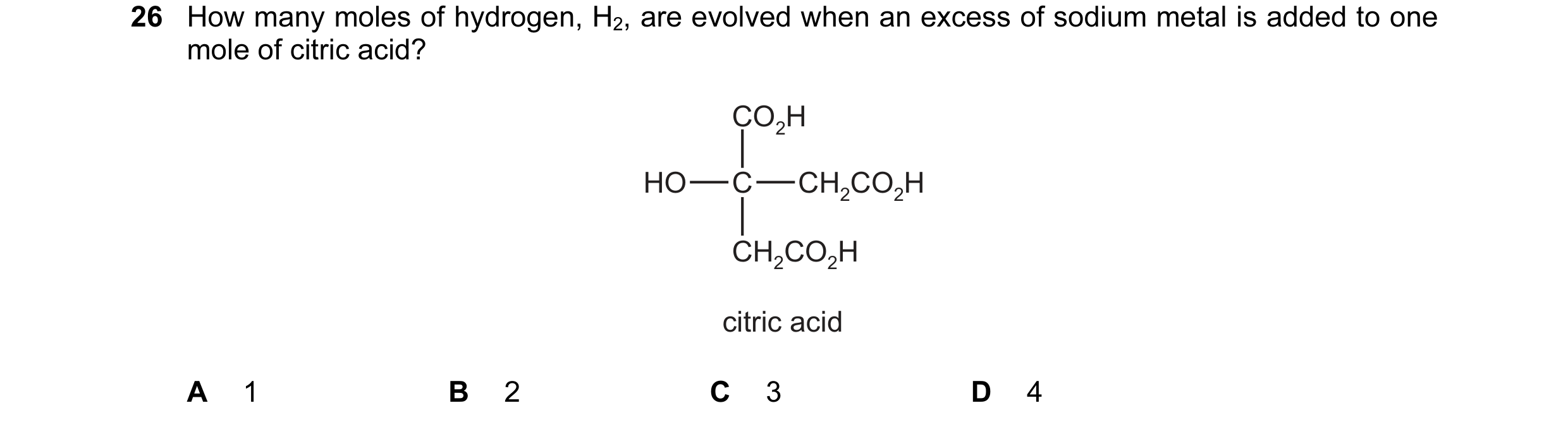
Q40 · How many moles of hydrogen, H2, are evolved when an excess of sodium metal is added to… 9701/11 Oct/Nov 2013
26 How many moles of hydrogen, H2, are evolved when an excess of sodium metal is added to one mole of citric acid? CO2H HO C CH2CO2H CH2CO2H citric acid A 1 B 2 C 3 D 4
1 marks
Answer: B
This question in 9701/11 Oct/Nov 2013
Q41 · An organic compound Y, molecular formula C6H14O, may be oxidised to compound Z, molecular… 9701/11 Oct/Nov 2013
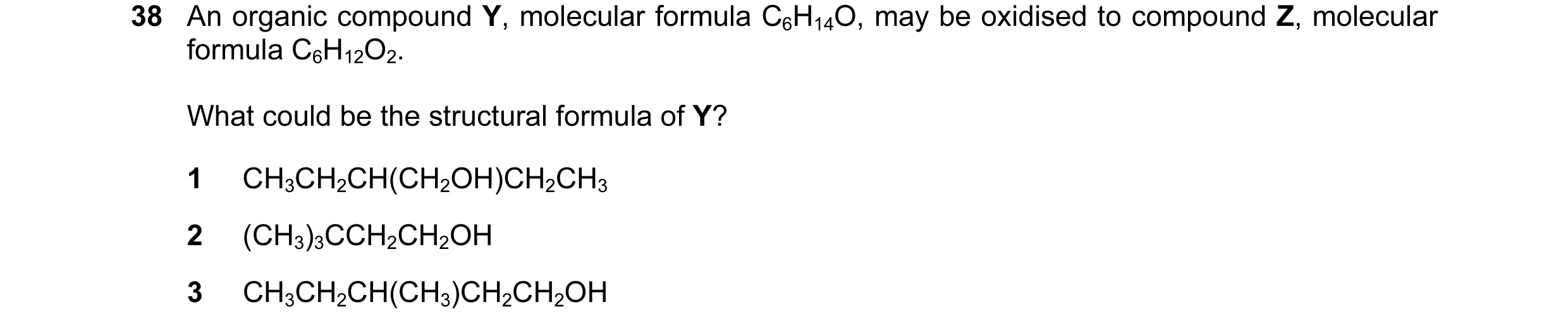
38 An organic compound Y, molecular formula C6H14O, may be oxidised to compound Z, molecular formula C6H12O2. What could be the structural formula of Y? 1 CH3CH2CH(CH2OH)CH2CH3 2 (CH3)3CCH2CH2OH 3 CH3CH2CH(CH3)CH2CH2OH
1 marks
Answer: A
This question in 9701/11 Oct/Nov 2013
Q42 · The compound ‘leaf alcohol’ is partly responsible for the smell of new-mown grass 9701/12 Oct/Nov 2013
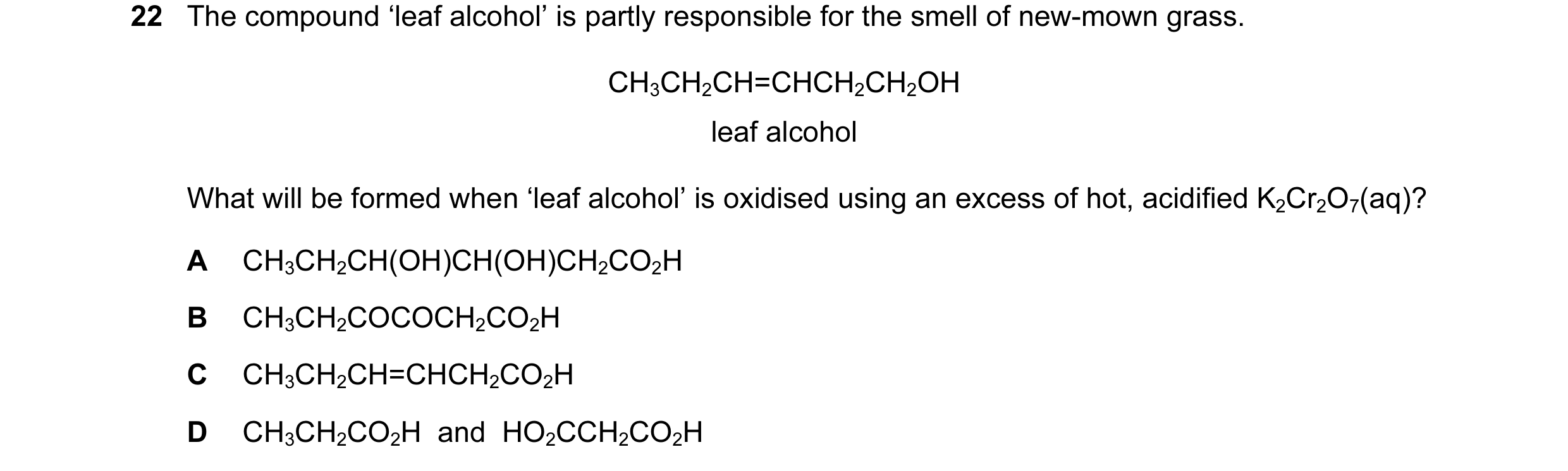
22 The compound ‘leaf alcohol’ is partly responsible for the smell of new-mown grass. CH3CH2CH=CHCH2CH2OH leaf alcohol What will be formed when ‘leaf alcohol’ is oxidised using an excess of hot, acidified K2Cr2O7(aq)? A CH3CH2CH(OH)CH(OH)CH2CO2H B CH3CH2COCOCH2CO2H C CH3CH2CH=CHCH2CO2H D CH3CH2CO2H and HO2CCH2CO2H
1 marks
Answer: C
This question in 9701/12 Oct/Nov 2013
Q43 · How many moles of hydrogen, H2, are evolved when an excess of sodium metal is added to… 9701/12 Oct/Nov 2013
26 How many moles of hydrogen, H2, are evolved when an excess of sodium metal is added to one mole of citric acid? CO2H HO C CH2CO2H CH2CO2H citric acid A 1 B 2 C 3 D 4
1 marks
Answer: B
This question in 9701/12 Oct/Nov 2013
Q44 · The structural formulae of two compounds are shown below 9701/13 Oct/Nov 2013
40 The structural formulae of two compounds are shown below. O O CH3CH2CH2CH2CH2C CH3CH2CH2CH2CH2OC OH H Which statements about these compounds are correct? 1 The two compounds are structural isomers of each other. 2 The empirical formula of both compounds is C3H6O. 3 Both compounds are carboxylic acids.
1 marks
Answer: B
This question in 9701/13 Oct/Nov 2013
Q45 · Propanoic acid occurs naturally as a result of the bacterial fermentation of milk, and is… 9701/12 May/June 2014
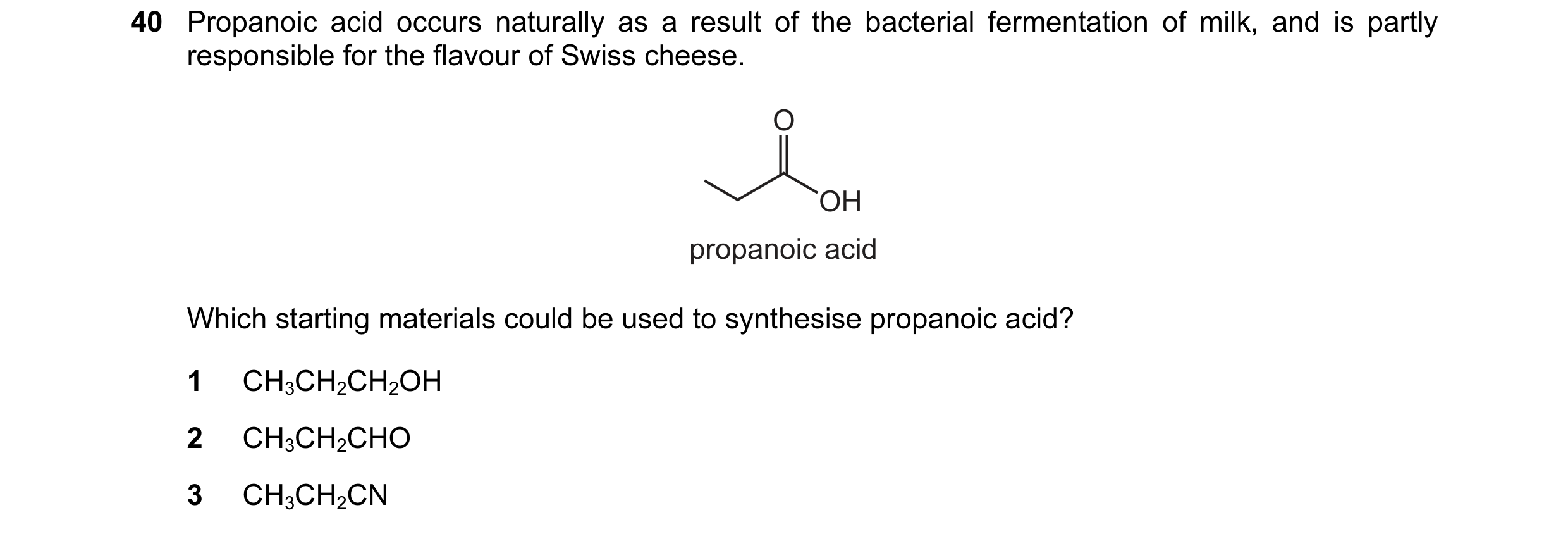
40 Propanoic acid occurs naturally as a result of the bacterial fermentation of milk, and is partly responsible for the flavour of Swiss cheese. O OH propanoic acid Which starting materials could be used to synthesise propanoic acid? 1 CH3CH2CH2OH 2 CH3CH2CHO 3 CH3CH2CN
1 marks
Answer: A
This question in 9701/12 May/June 2014
Q46 · When hydrolysed with dilute sulfuric acid, which compounds produce propanoic acid? 9701/13 May/June 2014
38 When hydrolysed with dilute sulfuric acid, which compounds produce propanoic acid? 1 CH3CH2CO2CH3 2 CH3CH2CH2CN 3 CH3CH2CH2Cl
1 marks
Answer: D
This question in 9701/13 May/June 2014
Q47 · Propane-1,2,3-triol is the raw material for many important industrial chemical processes 9701/13 May/June 2014
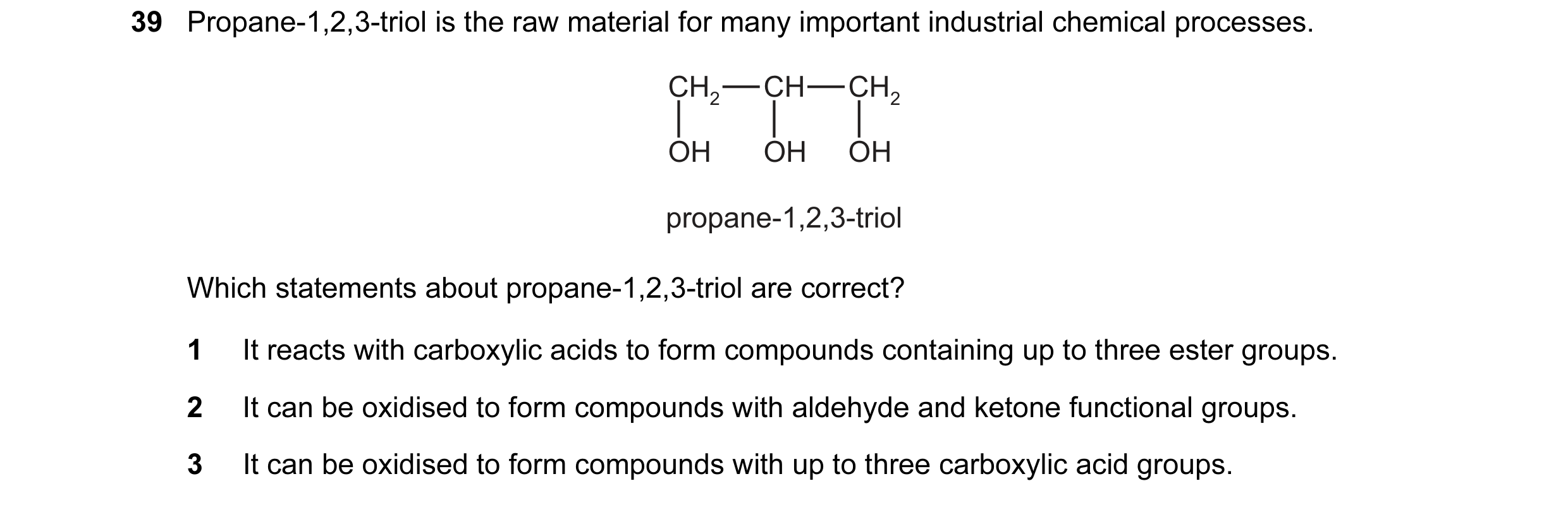
39 Propane-1,2,3-triol is the raw material for many important industrial chemical processes. CH2 CH CH2 OH OH OH propane-1,2,3-triol Which statements about propane-1,2,3-triol are correct? 1 It reacts with carboxylic acids to form compounds containing up to three ester groups. 2 It can be oxidised to form compounds with aldehyde and ketone functional groups. 3 It can be oxidised to form compounds with up to three carboxylic acid groups.
1 marks
Answer: B
This question in 9701/13 May/June 2014
Q48 · Lactic acid, CH3CH(OH)CO2H, causes pain when it builds up in muscles 9701/11 Oct/Nov 2014
24 Lactic acid, CH3CH(OH)CO2H, causes pain when it builds up in muscles. Which reagent reacts with both of the –OH groups in lactic acid? A acidified potassium dichromate(VI) B ethanol C sodium D sodium hydroxide
1 marks
Answer: C
This question in 9701/11 Oct/Nov 2014
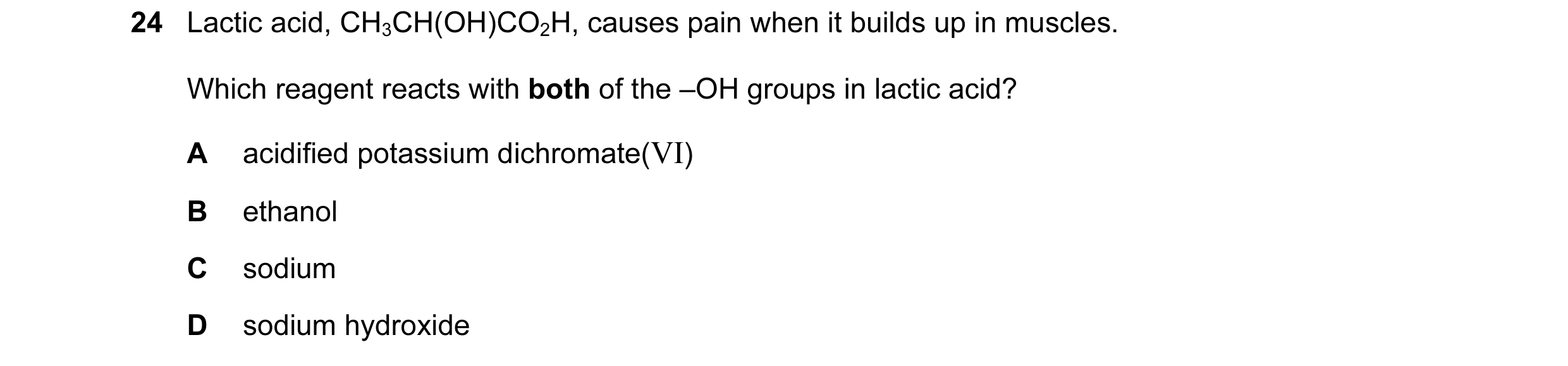
Q49 · Lactic acid, CH3CH(OH)CO2H, causes pain when it builds up in muscles 9701/12 Oct/Nov 2014
24 Lactic acid, CH3CH(OH)CO2H, causes pain when it builds up in muscles. Which reagent reacts with both of the –OH groups in lactic acid? A acidified potassium dichromate(VI) B ethanol C sodium D sodium hydroxide
1 marks
Answer: C
This question in 9701/12 Oct/Nov 2014
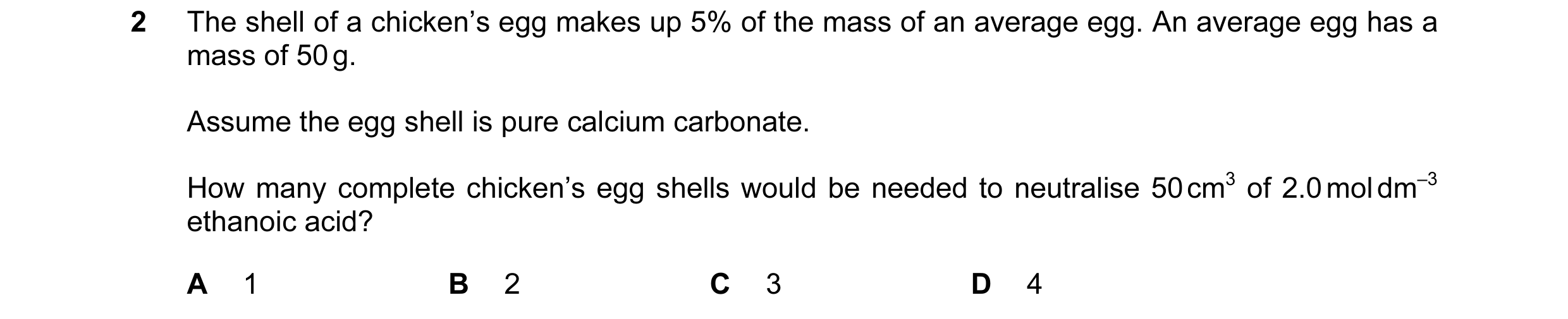
Q50 · The shell of a chicken’s egg makes up 5% of the mass of an average egg 9701/12 May/June 2015
2 The shell of a chicken’s egg makes up 5% of the mass of an average egg. An average egg has a mass of 50 g. Assume the egg shell is pure calcium carbonate. How many complete chicken’s egg shells would be needed to neutralise 50 cm3 of 2.0 mol dm–3 ethanoic acid? A 1 B 2 C 3 D 4
1 marks
Answer: B
This question in 9701/12 May/June 2015
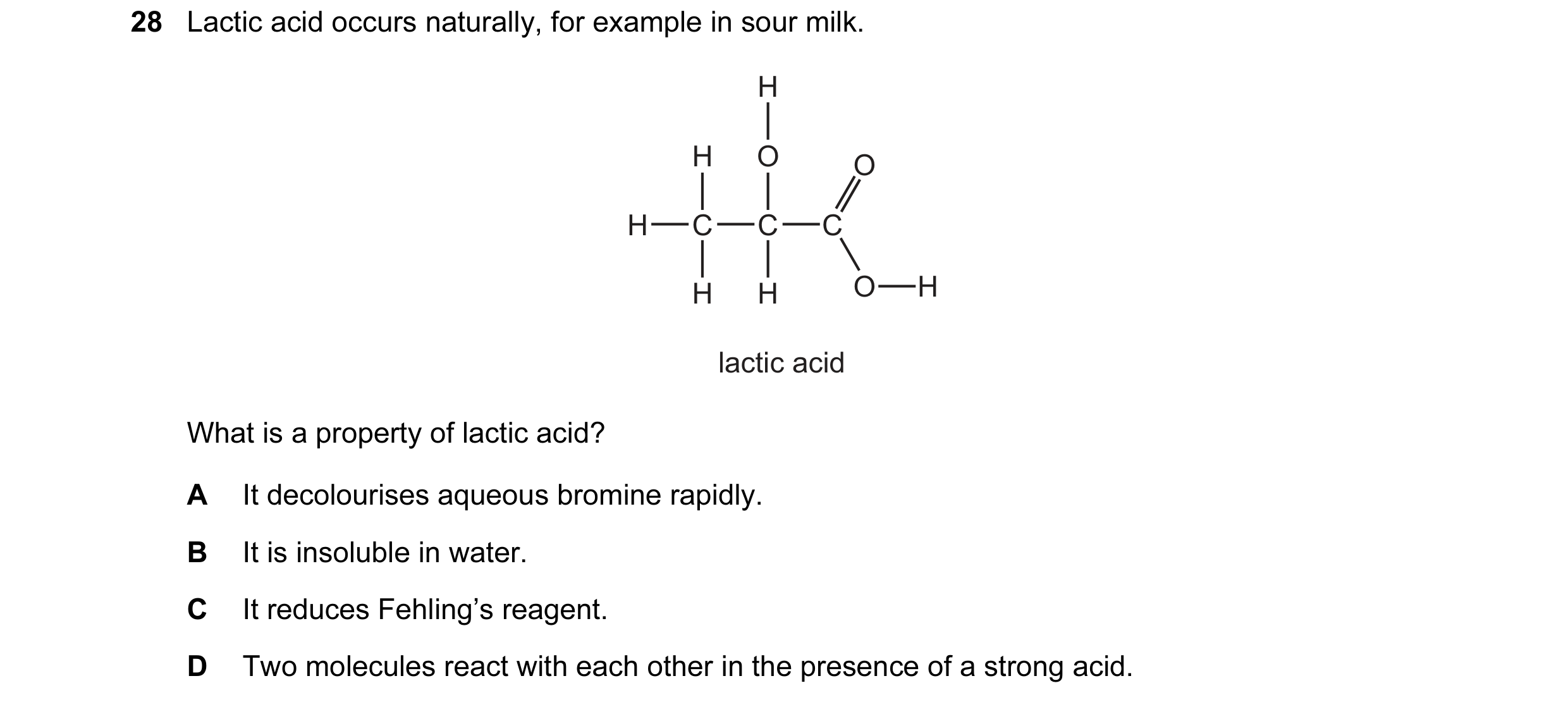
Q51 · Lactic acid occurs naturally, for example in sour milk 9701/12 May/June 2015
28 Lactic acid occurs naturally, for example in sour milk. H H O O H C C C H H O H lactic acid What is a property of lactic acid? A It decolourises aqueous bromine rapidly. B It is insoluble in water. C It reduces Fehling’s reagent. D Two molecules react with each other in the presence of a strong acid.
1 marks
Answer: D
This question in 9701/12 May/June 2015
Q52 · Citric acid is found in lemon juice 9701/12 May/June 2015
29 Citric acid is found in lemon juice. HO2CCH2C(OH)(CO2H)CH2CO2H citric acid What is the volume of 0.4 mol dm–3 sodium hydroxide solution required to neutralise a solution containing 0.005 mol of citric acid? A 12.5 cm3 B 25.0 cm3 C 37.5 cm3 D 50.0 cm3
1 marks
Answer: C
This question in 9701/12 May/June 2015
Q53 · Monopotassium citrate is used as an emulsifying agent in powdered milk and in powdered… 9701/12 May/June 2015
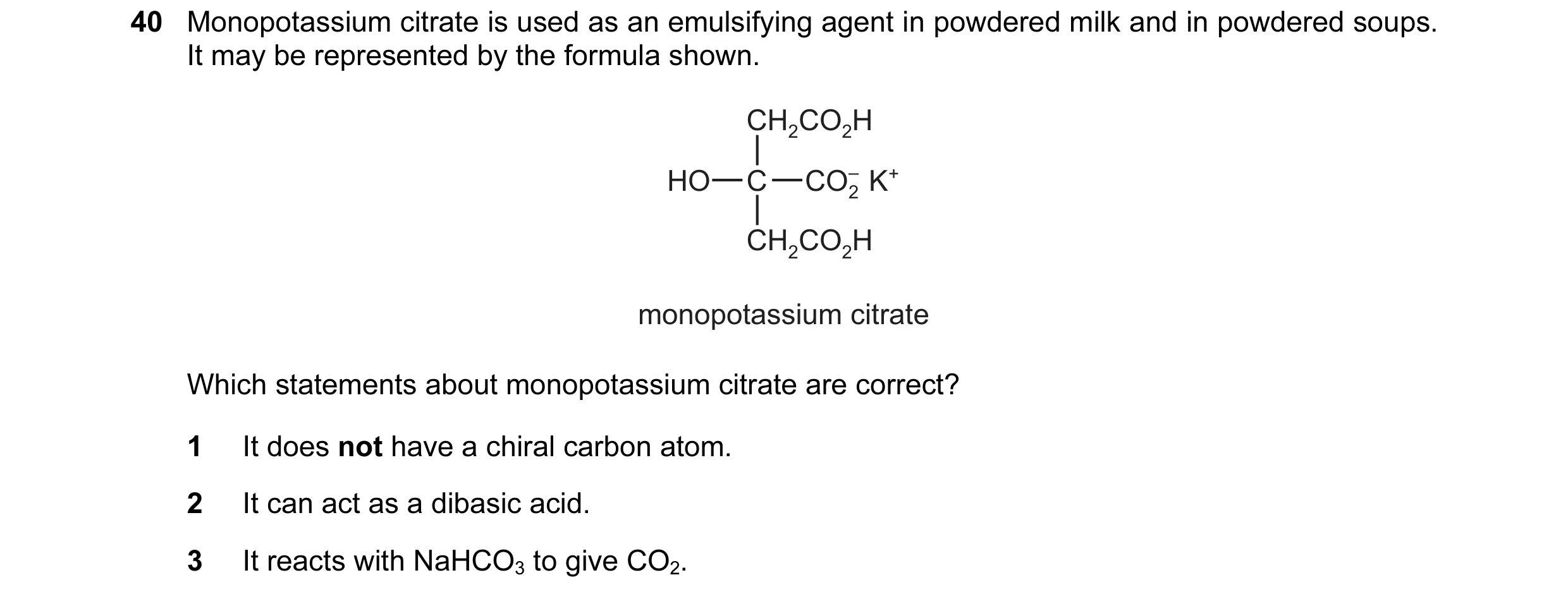
40 Monopotassium citrate is used as an emulsifying agent in powdered milk and in powdered soups. It may be represented by the formula shown. CH2CO2H HO C CO2 K+ – CH2CO2H monopotassium citrate Which statements about monopotassium citrate are correct? 1 It does not have a chiral carbon atom. 2 It can act as a dibasic acid. 3 It reacts with NaHCO3 to give CO2.
1 marks
Answer: A
This question in 9701/12 May/June 2015
Q54 · Methanoic acid, HCO2H, has acidic properties similar to those of other carboxylic acids 9701/12 Oct/Nov 2015
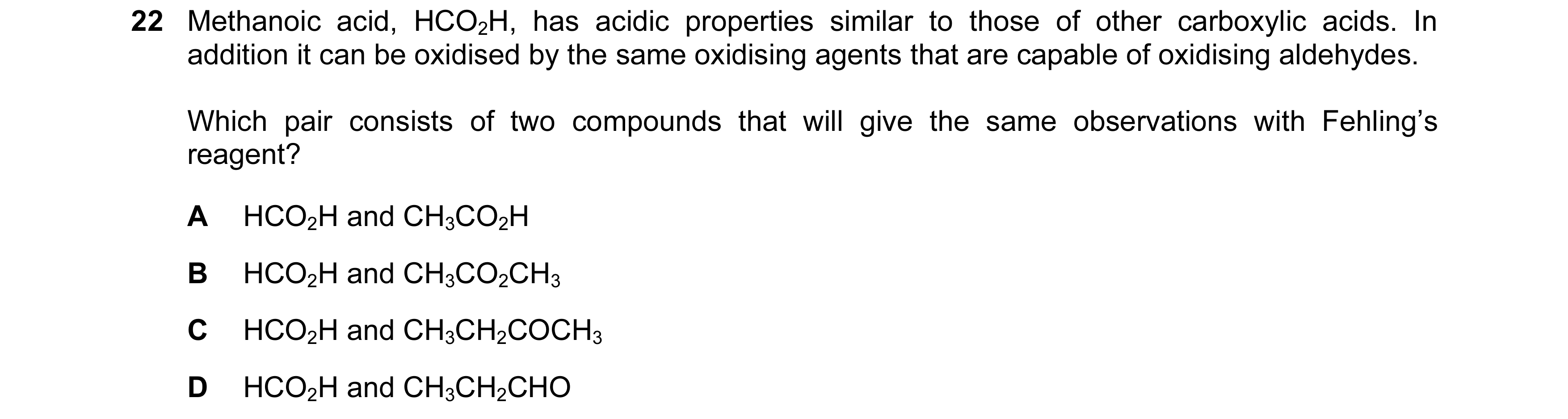
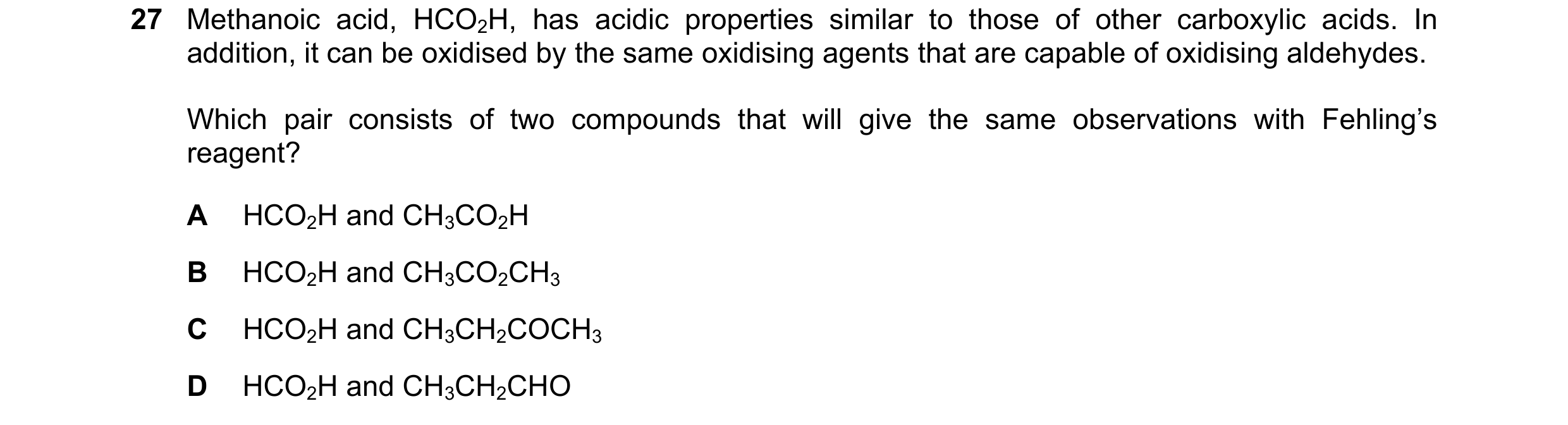
22 Methanoic acid, HCO2H, has acidic properties similar to those of other carboxylic acids. In addition it can be oxidised by the same oxidising agents that are capable of oxidising aldehydes. Which pair consists of two compounds that will give the same observations with Fehling’s reagent? A HCO2H and CH3CO2H B HCO2H and CH3CO2CH3 C HCO2H and CH3CH2COCH3 D HCO2H and CH3CH2CHO
1 marks
This question in 9701/12 Oct/Nov 2015
Q55 · Which mixture could be used to produce propyl methanoate? 9701/12 Feb/March 2016
28 Which mixture could be used to produce propyl methanoate? A CH3CH2CO2H and CH3OH B CH3CH2CH2CH2OH and HCO2H C CH3CH2CH2OH and HCO2H D CH3CH2CH2CO2H and CH3OH
1 marks
Answer: C
This question in 9701/12 Feb/March 2016
Q56 · Which reagents, when used in an excess, can be used to make sodium lactate… 9701/12 Feb/March 2016
37 Which reagents, when used in an excess, can be used to make sodium lactate, CH3CH(OH)CO2Na, from lactic acid, CH3CH(OH)CO2H? 1 Na 2 NaHCO3 3 NaOH
1 marks
Answer: C
This question in 9701/12 Feb/March 2016
Q57 · An unknown organic compound Z reacts with sodium to give a combustible gas as one product 9701/12 Feb/March 2016
39 An unknown organic compound Z reacts with sodium to give a combustible gas as one product. Z does not give a yellow precipitate with alkaline aqueous iodine. What is a possible identity of Z? 1 ethanoic acid 2 pentan-3-ol 3 propan-1-ol
1 marks
Answer: A
This question in 9701/12 Feb/March 2016
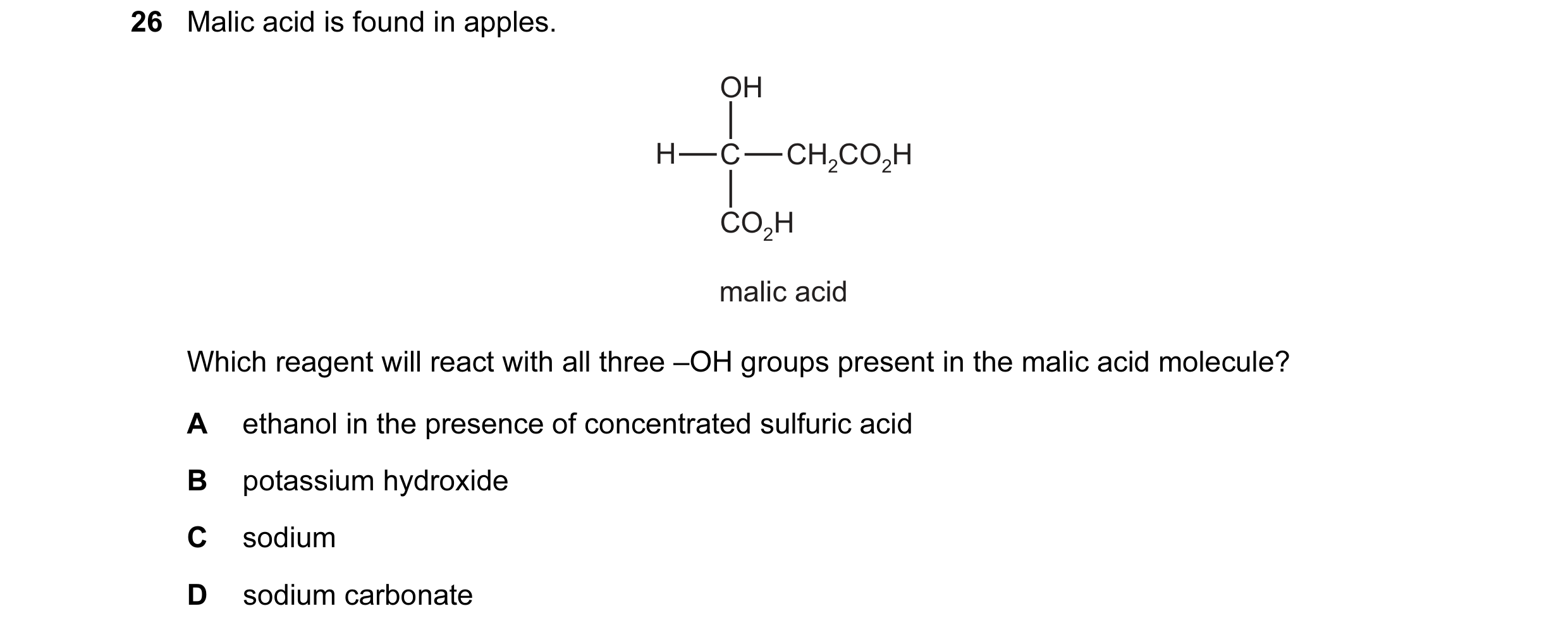
Q58 · Malic acid is found in apples 9701/11 May/June 2016
26 Malic acid is found in apples. OH H C CH2CO2H CO2H malic acid Which reagent will react with all three –OH groups present in the malic acid molecule? A ethanol in the presence of concentrated sulfuric acid B potassium hydroxide C sodium D sodium carbonate
1 marks
Answer: C
This question in 9701/11 May/June 2016
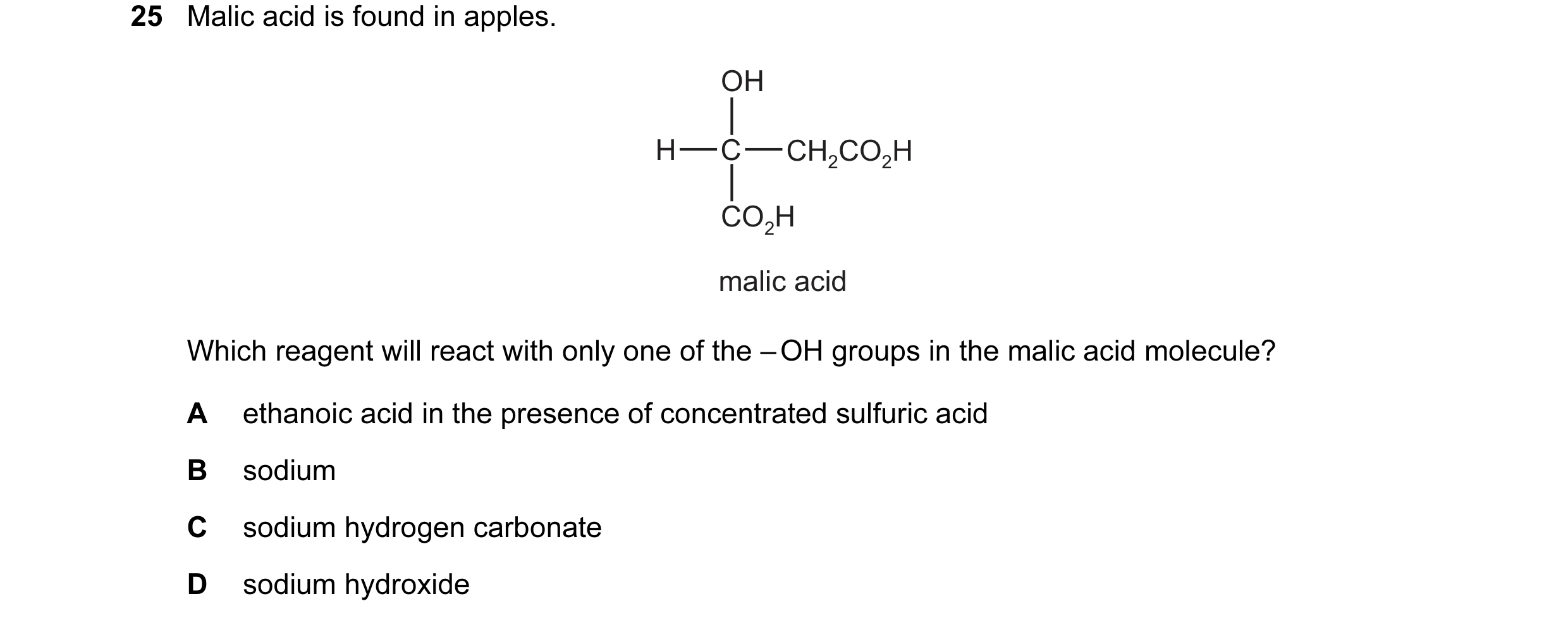
Q59 · Malic acid is found in apples 9701/12 May/June 2016
25 Malic acid is found in apples. OH H C CH2CO2H CO2H malic acid Which reagent will react with only one of the – OH groups in the malic acid molecule? A ethanoic acid in the presence of concentrated sulfuric acid B sodium C sodium hydrogen carbonate D sodium hydroxide
1 marks
Answer: A
This question in 9701/12 May/June 2016
Q60 · Which reaction would not give ethanoic acid? 9701/11 Oct/Nov 2016
28 Which reaction would not give ethanoic acid? A heating ethanenitrile under reflux with dilute sodium hydroxide B heating ethanenitrile under reflux with dilute sulfuric acid C heating ethanal under reflux with acidified sodium dichromate(VI) D heating ethanol under reflux with acidified sodium dichromate(VI)
1 marks
Answer: A
This question in 9701/11 Oct/Nov 2016
Q61 · Several structural isomers of C3H6O3 are listed below 9701/11 Oct/Nov 2016
39 Several structural isomers of C3H6O3 are listed below. HOCH2COCH2OH HOCH2CH(OH)CHO HOCH2CH2CO2H CH3CH(OH)CO2H Which statements about these structural isomers are correct? 1 One mole of each reacts with two moles of sodium. 2 Only one of the isomers contains a tertiary alcohol group. 3 They all contain a primary alcohol group.
1 marks
Answer: D
This question in 9701/11 Oct/Nov 2016
Q62 · Which reaction would not give ethanoic acid? 9701/13 Oct/Nov 2016
28 Which reaction would not give ethanoic acid? A heating ethanenitrile under reflux with dilute sodium hydroxide B heating ethanenitrile under reflux with dilute sulfuric acid C heating ethanal under reflux with acidified sodium dichromate(VI) D heating ethanol under reflux with acidified sodium dichromate(VI)
1 marks
Answer: A
This question in 9701/13 Oct/Nov 2016
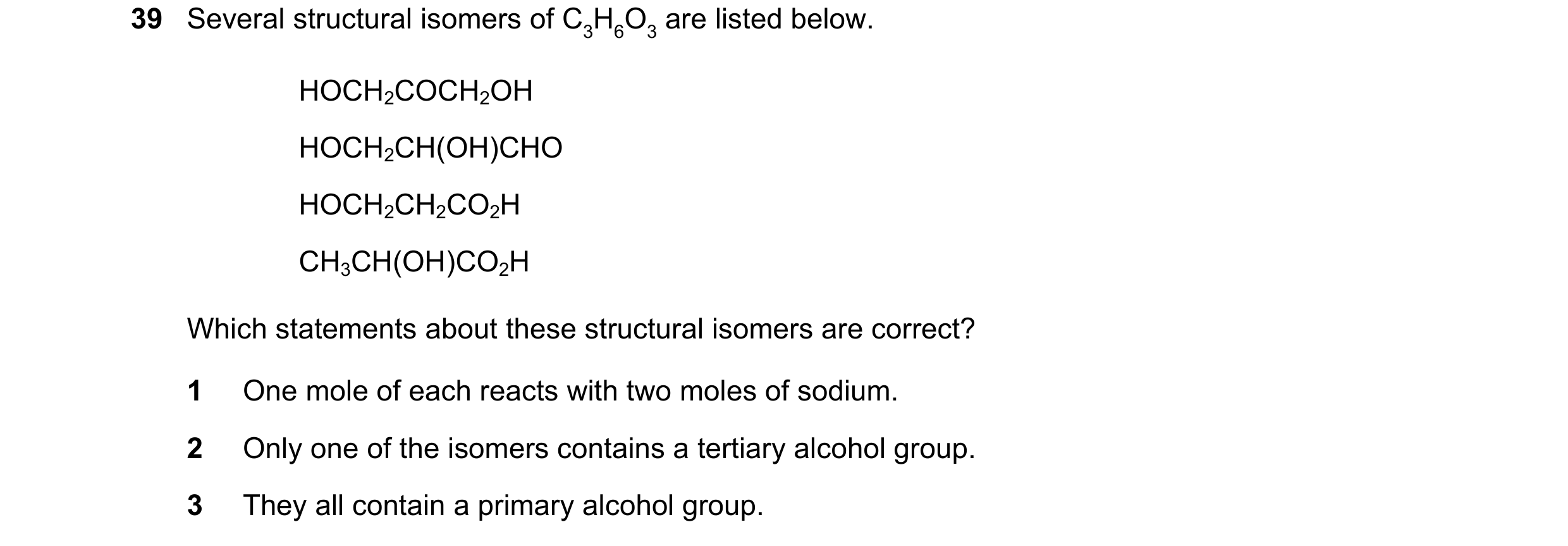
Q63 · Several structural isomers of C3H6O3 are listed below 9701/13 Oct/Nov 2016
39 Several structural isomers of C3H6O3 are listed below. HOCH2COCH2OH HOCH2CH(OH)CHO HOCH2CH2CO2H CH3CH(OH)CO2H Which statements about these structural isomers are correct? 1 One mole of each reacts with two moles of sodium. 2 Only one of the isomers contains a tertiary alcohol group. 3 They all contain a primary alcohol group.
1 marks
Answer: D
This question in 9701/13 Oct/Nov 2016
Q64 · A sample of 2.76 g of ethanol was mixed with an excess of aqueous acidified potassium… 9701/12 May/June 2017
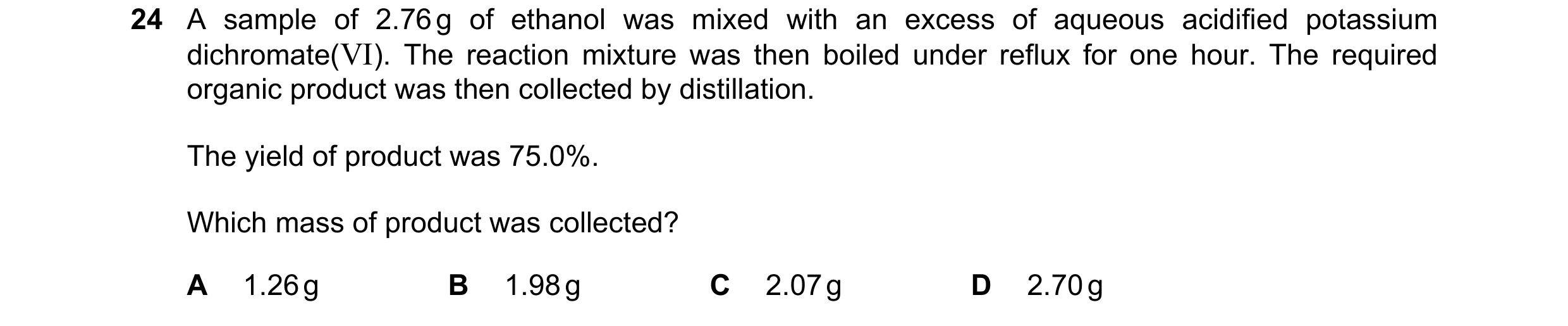
24 A sample of 2.76 g of ethanol was mixed with an excess of aqueous acidified potassium dichromate(VI). The reaction mixture was then boiled under reflux for one hour. The required organic product was then collected by distillation. The yield of product was 75.0%. Which mass of product was collected? A 1.26 g B 1.98 g C 2.07 g D 2.70 g
1 marks
Answer: D
This question in 9701/12 May/June 2017
Q65 · A carboxylic acid, P, has no possible chain isomers 9701/12 May/June 2017
28 A carboxylic acid, P, has no possible chain isomers. It reacts with an alcohol, Q, that has only one positional isomer. What could be the ester formed from a reaction between P and Q? A butyl propanoate B ethyl butanoate C pentyl ethanoate D propyl pentanoate
1 marks
Answer: A
This question in 9701/12 May/June 2017
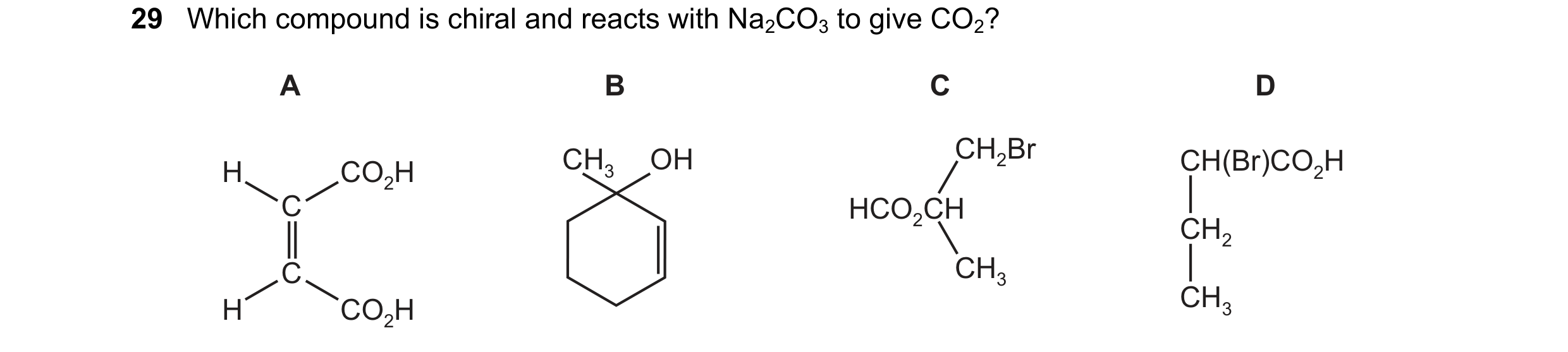
Q66 · Which compound is chiral and reacts with Na2CO3 to give CO2? 9701/12 May/June 2017
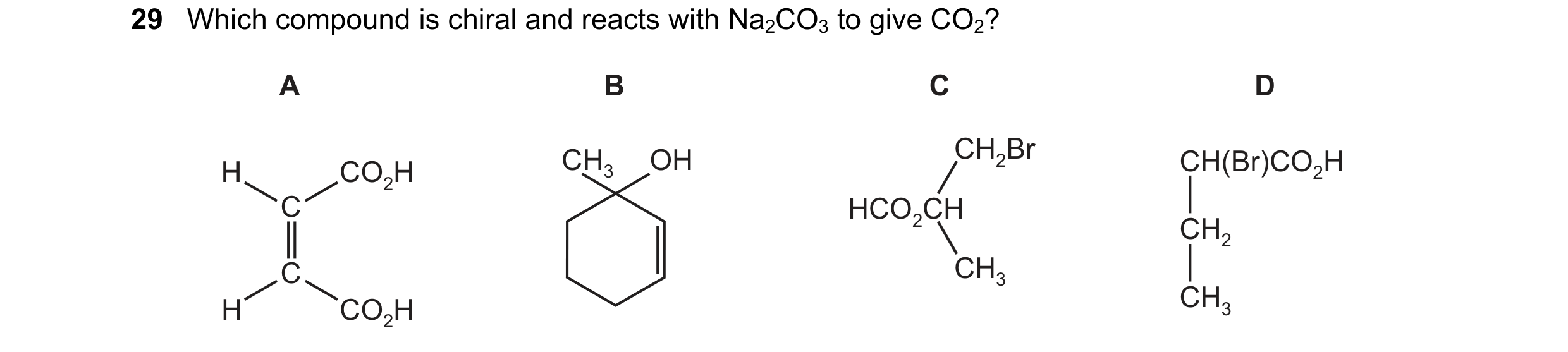
29 Which compound is chiral and reacts with Na2CO3 to give CO2? A B C D CH3 OH CH2Br CH(Br)CO2H H CO2H C HCO2CH CH2 C CH3 H CO2H CH3
1 marks
Answer: D
This question in 9701/12 May/June 2017
Q67 · Carboxylic acids may be prepared by several different methods 9701/13 May/June 2017
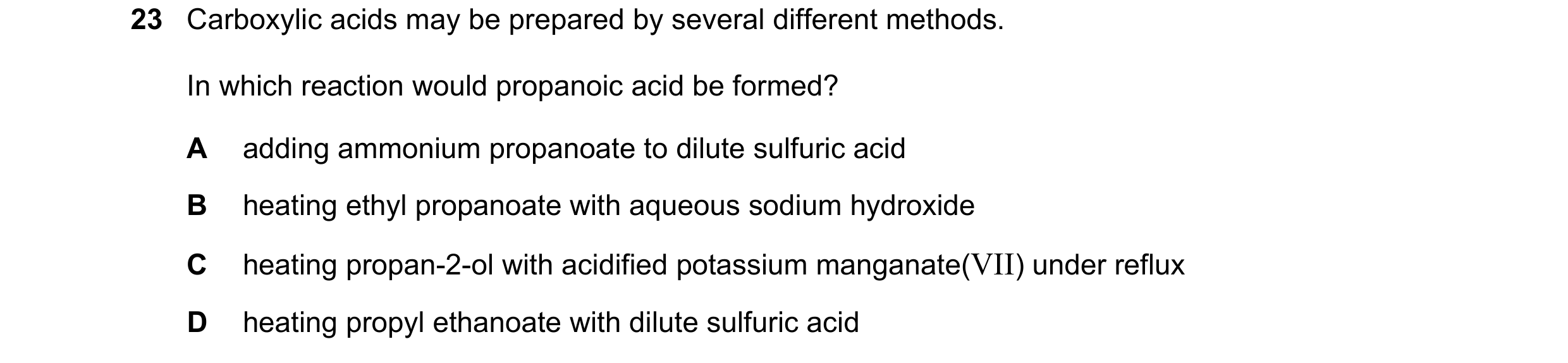
23 Carboxylic acids may be prepared by several different methods. In which reaction would propanoic acid be formed? A adding ammonium propanoate to dilute sulfuric acid B heating ethyl propanoate with aqueous sodium hydroxide C heating propan-2-ol with acidified potassium manganate(VII) under reflux D heating propyl ethanoate with dilute sulfuric acid
1 marks
Answer: A
This question in 9701/13 May/June 2017
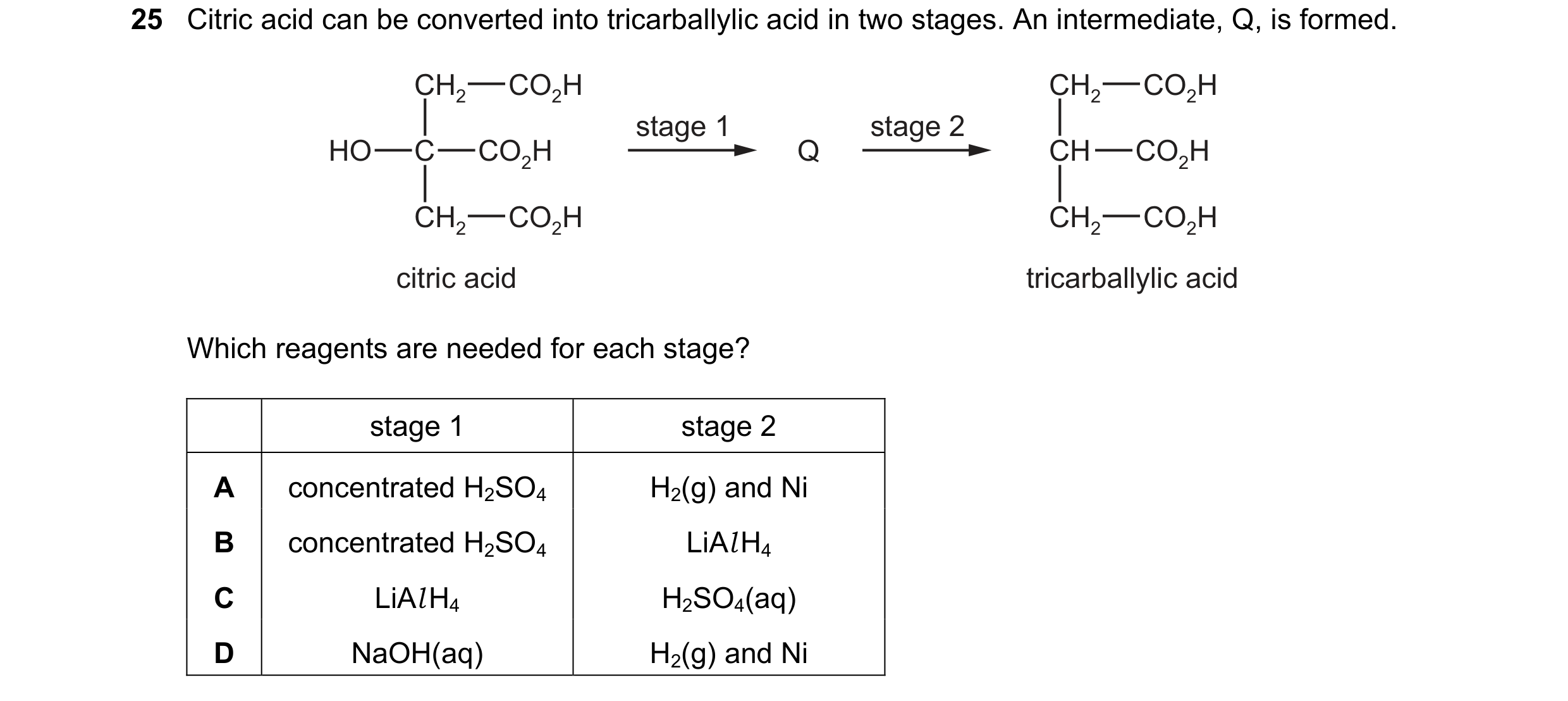
Q68 · Citric acid can be converted into tricarballylic acid in two stages 9701/11 Oct/Nov 2017
25 Citric acid can be converted into tricarballylic acid in two stages. An intermediate, Q, is formed. CH2 CO2H CH2 CO2H stage 1 stage 2 HO C CO2H Q CH CO2H CH2 CO2H CH2 CO2H citric acid tricarballylic acid Which reagents are needed for each stage? stage 1 stage 2 A concentrated H2SO4 H2(g) and Ni B concentrated H2SO4 LiAl H4 C LiAl H4 H2SO4(aq) D NaOH(aq) H2(g) and Ni
1 marks
Answer: A
This question in 9701/11 Oct/Nov 2017
Q69 · At room temperature, propanoic acid was reacted to produce sodium propanoate 9701/11 Oct/Nov 2017
28 At room temperature, propanoic acid was reacted to produce sodium propanoate. No gas was produced during the reaction. What could the propanoic acid have reacted with? A NaHCO3(aq) B NaOH(aq) C Na2CO3(aq) D Na2SO4(aq)
1 marks
Answer: B
This question in 9701/11 Oct/Nov 2017
Q70 · Carboxylic acids can be converted into their salts by a number of reactions at room… 9701/12 Oct/Nov 2017
40 Carboxylic acids can be converted into their salts by a number of reactions at room temperature. Which reactions would produce sodium butanoate and a gas? 1 sodium carbonate + butanoic acid 2 sodium + butanoic acid 3 sodium hydroxide + butanoic acid
1 marks
Answer: B
This question in 9701/12 Oct/Nov 2017
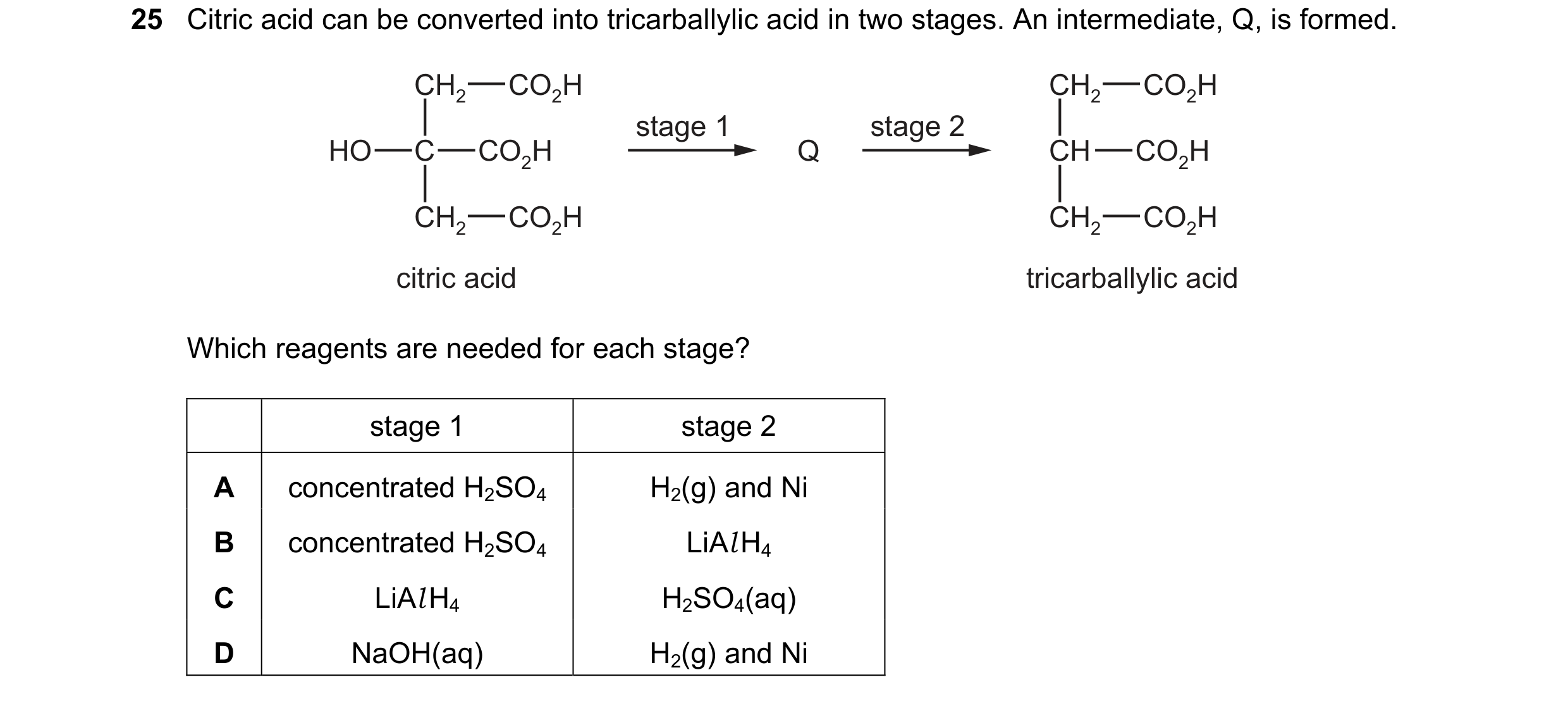
Q71 · Citric acid can be converted into tricarballylic acid in two stages 9701/13 Oct/Nov 2017
25 Citric acid can be converted into tricarballylic acid in two stages. An intermediate, Q, is formed. CH2 CO2H CH2 CO2H stage 1 stage 2 HO C CO2H Q CH CO2H CH2 CO2H CH2 CO2H citric acid tricarballylic acid Which reagents are needed for each stage? stage 1 stage 2 A concentrated H2SO4 H2(g) and Ni B concentrated H2SO4 LiAl H4 C LiAl H4 H2SO4(aq) D NaOH(aq) H2(g) and Ni
1 marks
Answer: A
This question in 9701/13 Oct/Nov 2017
Q72 · At room temperature, propanoic acid was reacted to produce sodium propanoate 9701/13 Oct/Nov 2017
28 At room temperature, propanoic acid was reacted to produce sodium propanoate. No gas was produced during the reaction. What could the propanoic acid have reacted with? A NaHCO3(aq) B NaOH(aq) C Na2CO3(aq) D Na2SO4(aq)
1 marks
Answer: B
This question in 9701/13 Oct/Nov 2017
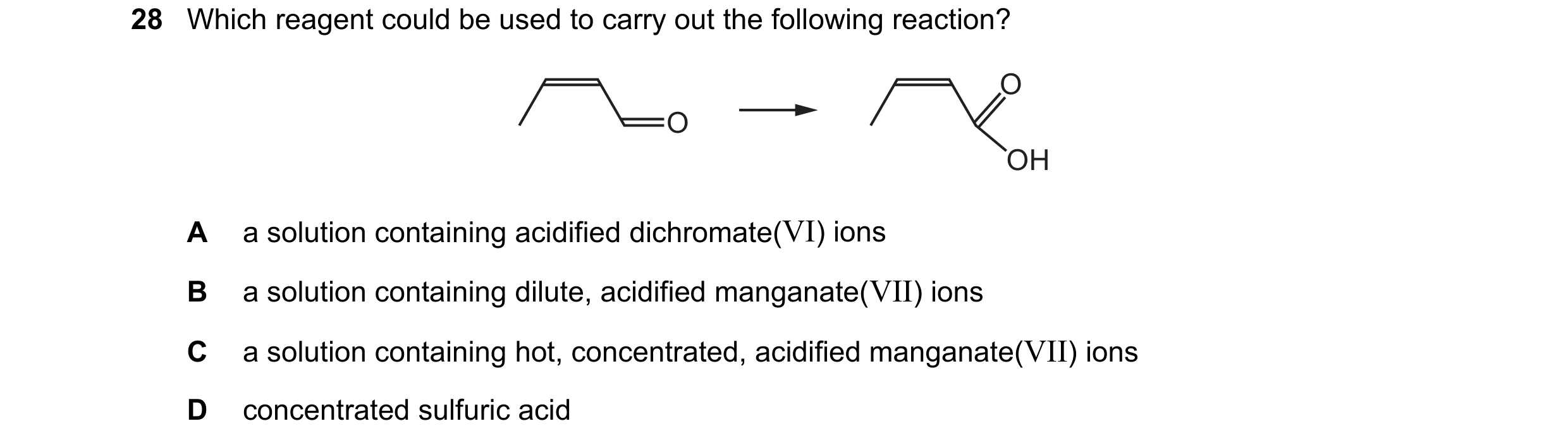
Q73 · Which reagent could be used to carry out the following reaction? 9701/11 May/June 2018
28 Which reagent could be used to carry out the following reaction? O O OH A a solution containing acidified dichromate(VI) ions B a solution containing dilute, acidified manganate(VII) ions C a solution containing hot, concentrated, acidified manganate(VII) ions D concentrated sulfuric acid
1 marks
Answer: A
This question in 9701/11 May/June 2018
Q74 · Four reactions of propanoic acid to form salts and other products are shown 9701/11 May/June 2018
29 Four reactions of propanoic acid to form salts and other products are shown. Which reaction does not show the formulae of all the correct products? A B CH3CH2CO2 – K+(aq) + H2O(l) (CH3CH2CO2 –)2Mg2+(aq) + H2(g) KOH Mg(s) CH3CH2CO2H(aq) propanoic Na2CO3 acid Ca(OH)2 C D CH3CH2CO2 – Na+(aq) + CO2(g) (CH3CH2CO2 –)2Ca2+(aq) + H2O(l)
1 marks
Answer: C
This question in 9701/11 May/June 2018
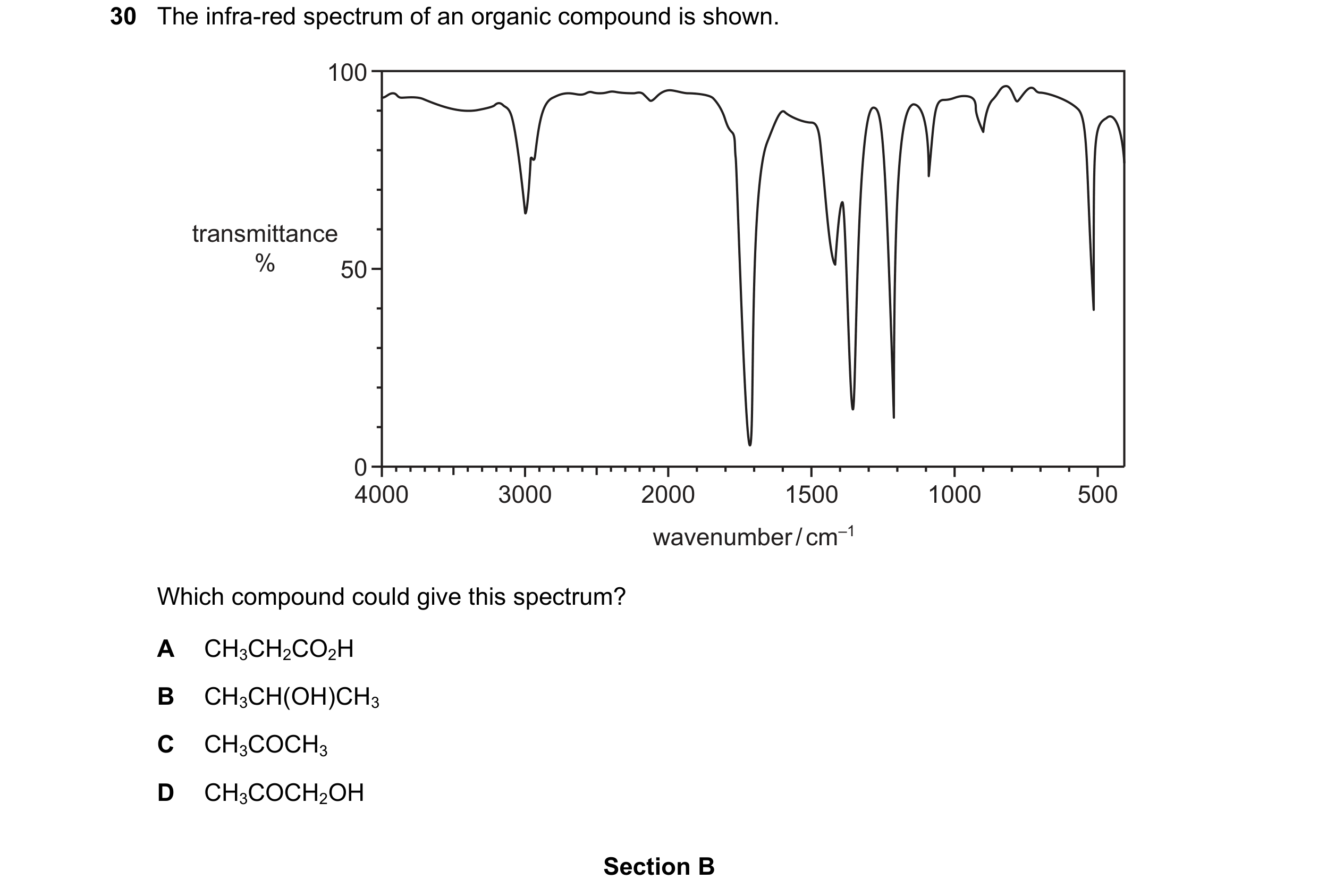
Q75 · The infra-red spectrum of an organic compound is shown 9701/12 May/June 2018
30 The infra-red spectrum of an organic compound is shown. 100 transmittance % 50 0 4000 3000 2000 1500 1000 500 wavenumber / cm–1 Which compound could give this spectrum? A CH3CH2CO2H B CH3CH(OH)CH3 C CH3COCH3 D CH3COCH2OH Section B
1 marks
Answer: C
This question in 9701/12 May/June 2018
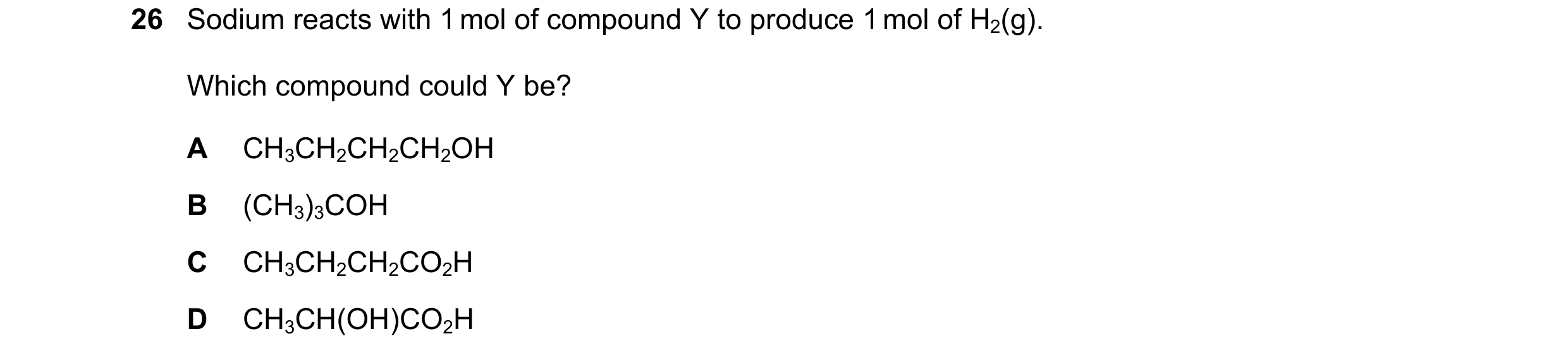
Q76 · Sodium reacts with 1 mol of compound Y to produce 1 mol of H2(g) 9701/11 Oct/Nov 2018
26 Sodium reacts with 1 mol of compound Y to produce 1 mol of H2(g). Which compound could Y be? A CH3CH2CH2CH2OH B (CH3)3COH C CH3CH2CH2CO2H D CH3CH(OH)CO2H
1 marks
Answer: D
This question in 9701/11 Oct/Nov 2018
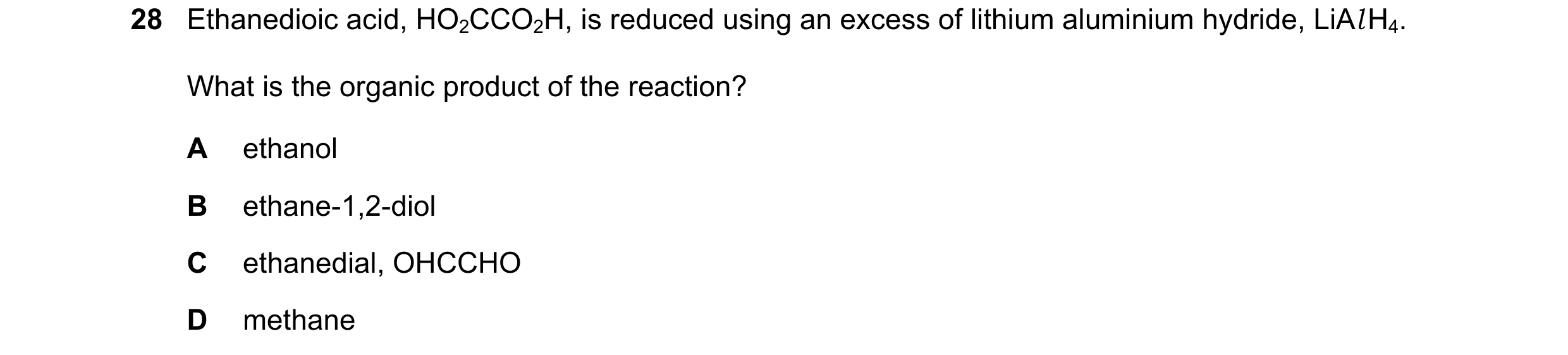
Q77 · Ethanedioic acid, HO2CCO2H, is reduced using an excess of lithium aluminium hydride, LiAl… 9701/11 Oct/Nov 2018
28 Ethanedioic acid, HO2CCO2H, is reduced using an excess of lithium aluminium hydride, LiAl H4. What is the organic product of the reaction? A ethanol B ethane-1,2-diol C ethanedial, OHCCHO D methane
1 marks
Answer: B
This question in 9701/11 Oct/Nov 2018
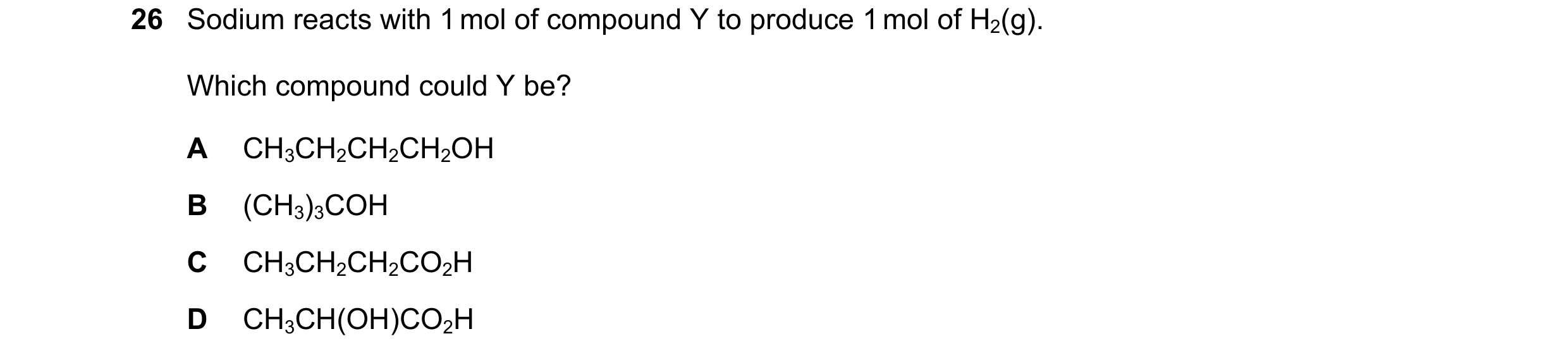
Q78 · Sodium reacts with 1 mol of compound Y to produce 1 mol of H2(g) 9701/13 Oct/Nov 2018
26 Sodium reacts with 1 mol of compound Y to produce 1 mol of H2(g). Which compound could Y be? A CH3CH2CH2CH2OH B (CH3)3COH C CH3CH2CH2CO2H D CH3CH(OH)CO2H
1 marks
Answer: D
This question in 9701/13 Oct/Nov 2018
Q79 · Ethanedioic acid, HO2CCO2H, is reduced using an excess of lithium aluminium hydride, LiAl… 9701/13 Oct/Nov 2018
28 Ethanedioic acid, HO2CCO2H, is reduced using an excess of lithium aluminium hydride, LiAl H4. What is the organic product of the reaction? A ethanol B ethane-1,2-diol C ethanedial, OHCCHO D methane
1 marks
Answer: B
This question in 9701/13 Oct/Nov 2018
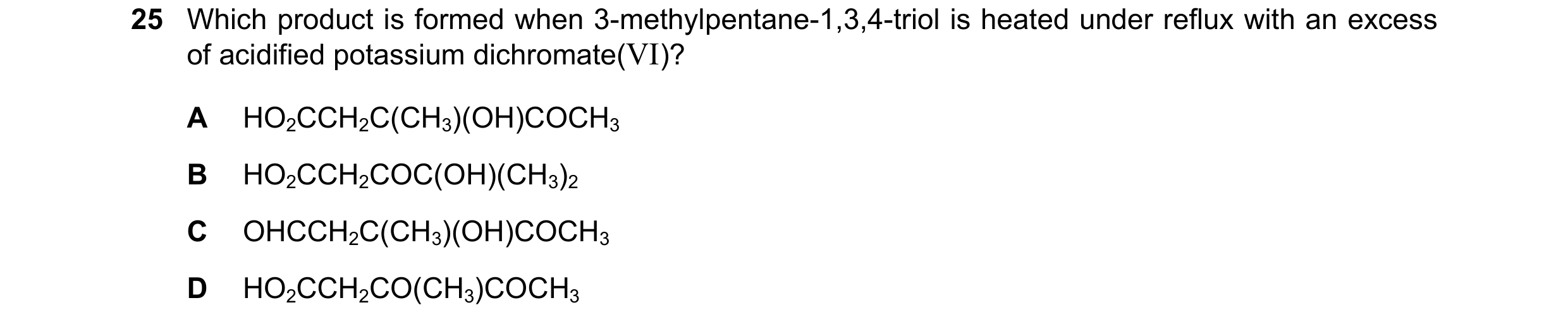
Q80 · Which product is formed when 3-methylpentane-1,3,4-triol is heated under reflux with an… 9701/12 Feb/March 2019
25 Which product is formed when 3-methylpentane-1,3,4-triol is heated under reflux with an excess of acidified potassium dichromate(VI)? A HO2CCH2C(CH3)(OH)COCH3 B HO2CCH2COC(OH)(CH3)2 C OHCCH2C(CH3)(OH)COCH3 D HO2CCH2CO(CH3)COCH3
1 marks
Answer: A
This question in 9701/12 Feb/March 2019
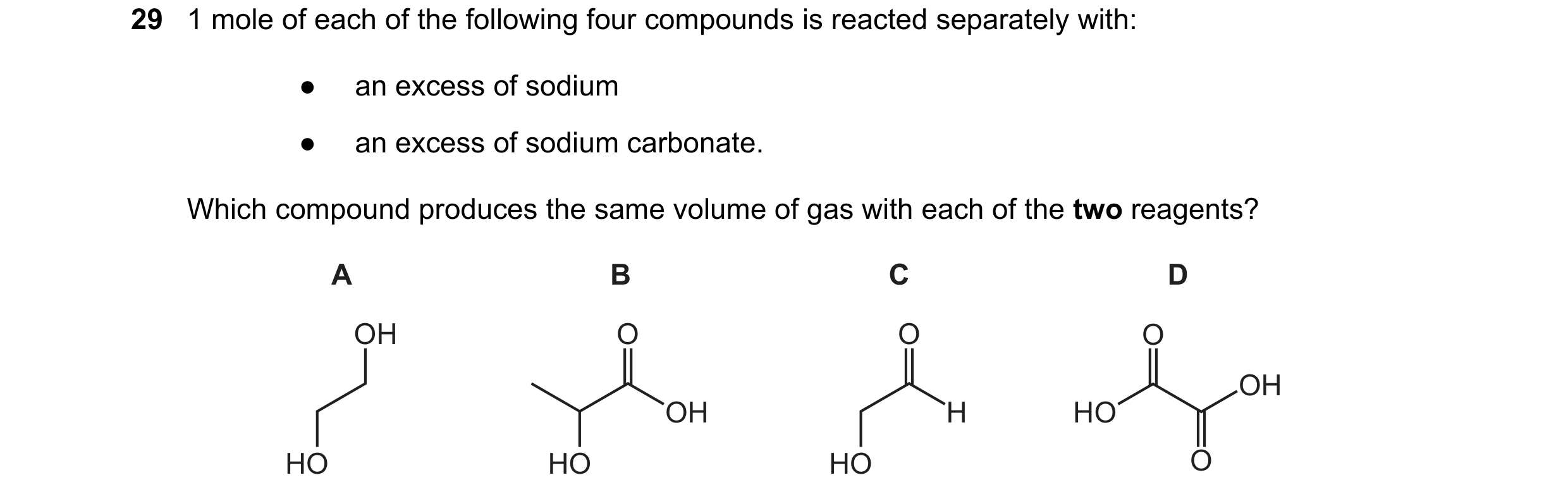
Q81 · 1 mole of each of the following four compounds is reacted separately with: ● an excess of… 9701/12 Feb/March 2019
29 1 mole of each of the following four compounds is reacted separately with: ● an excess of sodium ● an excess of sodium carbonate. Which compound produces the same volume of gas with each of the two reagents? A B C D OH O O O OH OH H HO HO HO HO O
1 marks
Answer: D
This question in 9701/12 Feb/March 2019
Q82 · An infra-red spectrum shows a broad peak at 3000 cm–1 and a strong peak at 1710 cm–1 9701/12 Feb/March 2019
30 An infra-red spectrum shows a broad peak at 3000 cm–1 and a strong peak at 1710 cm–1. Which substance could have produced this spectrum? A methyl propanoate B propan-2-ol C propanoic acid D propanone
1 marks
Answer: C
This question in 9701/12 Feb/March 2019
Q83 · Carboxylic acids can be prepared from alcohols, nitriles or esters 9701/12 Feb/March 2019
40 Carboxylic acids can be prepared from alcohols, nitriles or esters. Which statements are correct? 1 Both primary and secondary alcohols can be oxidised to carboxylic acids. 2 Carboxylic acids can be made from nitriles by hydrolysis. 3 Ethyl propanoate gives propanoic acid when reacted with hydrochloric acid.
1 marks
Answer: C
This question in 9701/12 Feb/March 2019
Q84 · Carboxylic acids can be made by several different reactions 9701/11 May/June 2019
39 Carboxylic acids can be made by several different reactions. Which statements are correct? 1 The acid hydrolysis of CH3CH2CN will make ethanoic acid. 2 The oxidation of CH3CH2CH2CH2OH will make butanoic acid. 3 The oxidation of CH3CH2CHO will make propanoic acid.
1 marks
Answer: C
This question in 9701/11 May/June 2019
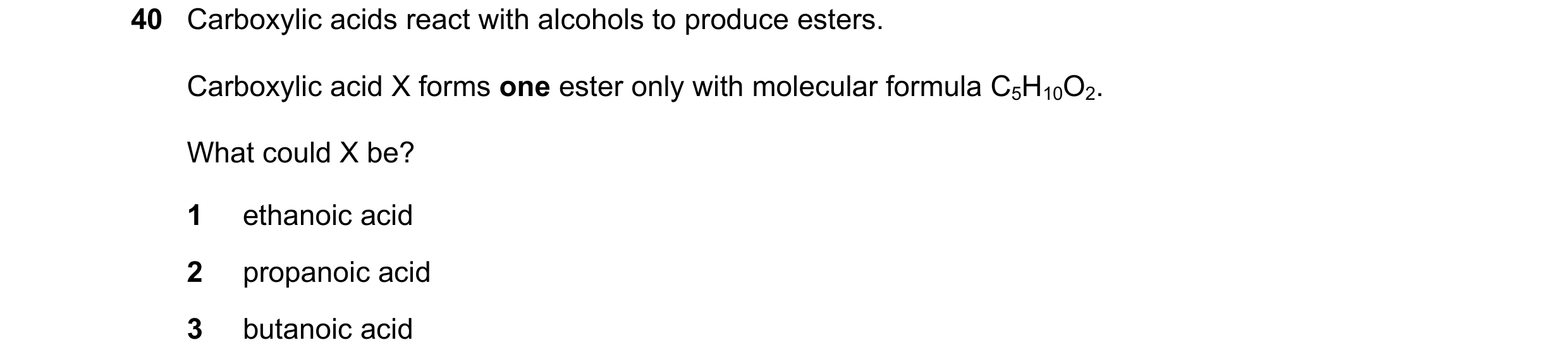
Q85 · Carboxylic acids react with alcohols to produce esters 9701/11 May/June 2019
40 Carboxylic acids react with alcohols to produce esters. Carboxylic acid X forms one ester only with molecular formula C5H10O2. What could X be? 1 ethanoic acid 2 propanoic acid 3 butanoic acid
1 marks
Answer: C
This question in 9701/11 May/June 2019
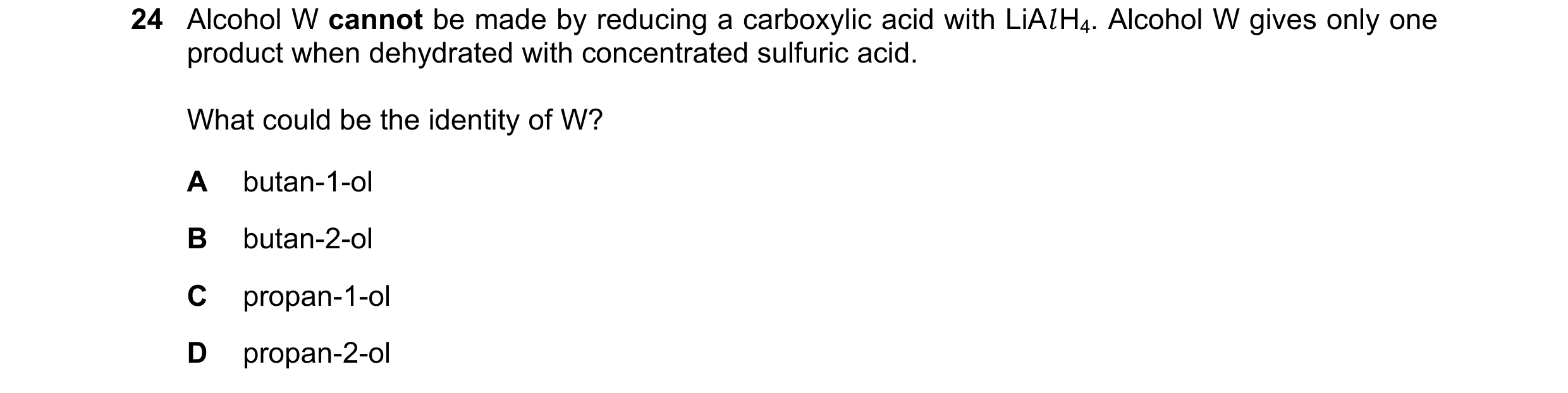
Q86 · Alcohol W cannot be made by reducing a carboxylic acid with LiAl H4 9701/12 May/June 2019
24 Alcohol W cannot be made by reducing a carboxylic acid with LiAl H4. Alcohol W gives only one product when dehydrated with concentrated sulfuric acid. What could be the identity of W? A butan-1-ol B butan-2-ol C propan-1-ol D propan-2-ol
1 marks
Answer: D
This question in 9701/12 May/June 2019
Q87 · The diagram shows that a carboxylic acid P may be formed from X, Y or Z 9701/12 May/June 2019
28 The diagram shows that a carboxylic acid P may be formed from X, Y or Z. alcohol aldehyde X Y carboxylic acid P nitrile Z Which row is correct? the change in Mr alcohol X is is greatest for A primary Y to P B primary Z to P C secondary Y to P D secondary Z to P
1 marks
Answer: B
This question in 9701/12 May/June 2019
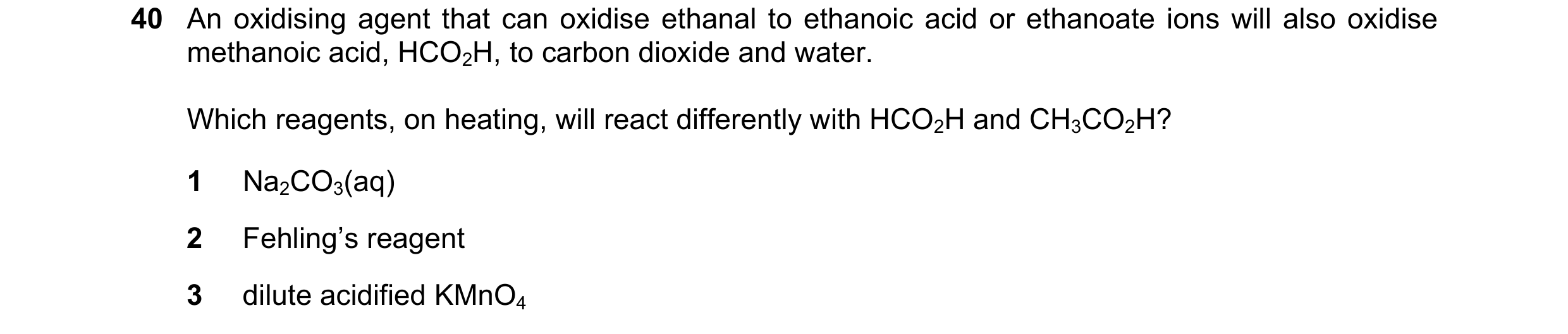
Q88 · An oxidising agent that can oxidise ethanal to ethanoic acid or ethanoate ions will also… 9701/12 May/June 2019
40 An oxidising agent that can oxidise ethanal to ethanoic acid or ethanoate ions will also oxidise methanoic acid, HCO2H, to carbon dioxide and water. Which reagents, on heating, will react differently with HCO2H and CH3CO2H? 1 Na2CO3(aq) 2 Fehling’s reagent 3 dilute acidified KMnO4
1 marks
Answer: C
This question in 9701/12 May/June 2019
Q89 · An ester is shown 9701/13 May/June 2019
30 An ester is shown. O O O H O What is the structure of the carboxylic acid that would be obtained by acid hydrolysis of the ester linkage? A B O O OH O O H OH HO O C D O O O O O O O OH HO O
1 marks
Answer: A
This question in 9701/13 May/June 2019
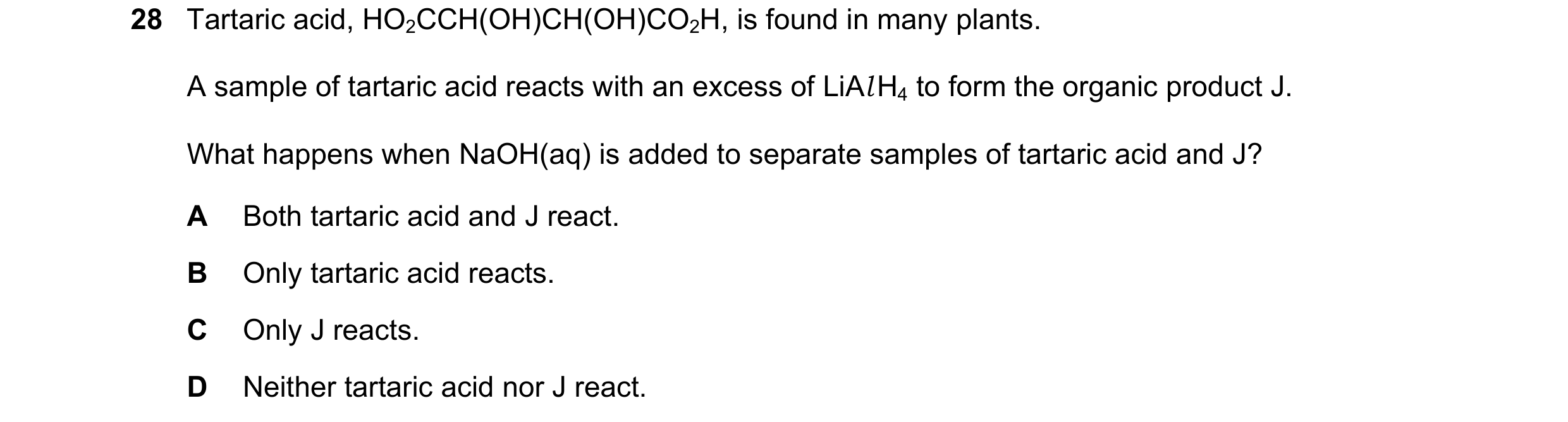
Q90 · Tartaric acid, HO2CCH(OH)CH(OH)CO2H, is found in many plants 9701/11 Oct/Nov 2019
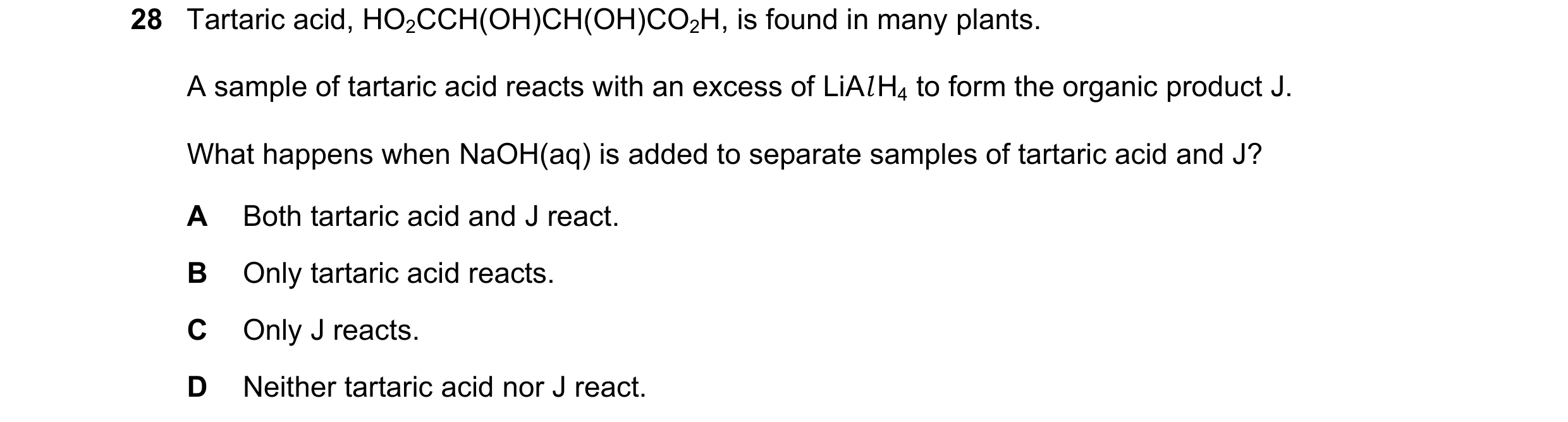
28 Tartaric acid, HO2CCH(OH)CH(OH)CO2H, is found in many plants. A sample of tartaric acid reacts with an excess of LiAl H4 to form the organic product J. What happens when NaOH(aq) is added to separate samples of tartaric acid and J? A Both tartaric acid and J react. B Only tartaric acid reacts. C Only J reacts. D Neither tartaric acid nor J react.
1 marks
Answer: B
This question in 9701/11 Oct/Nov 2019
Q91 · The infra-red spectrum of compound P is shown 9701/11 Oct/Nov 2019
30 The infra-red spectrum of compound P is shown. 100 transmittance / % 50 0 4000 3000 2000 1500 1000 500 wavenumber / cm–1 What could be compound P? A methyl ethanoate B propanal C propanoic acid D propan-2-ol
1 marks
Answer: D
This question in 9701/11 Oct/Nov 2019
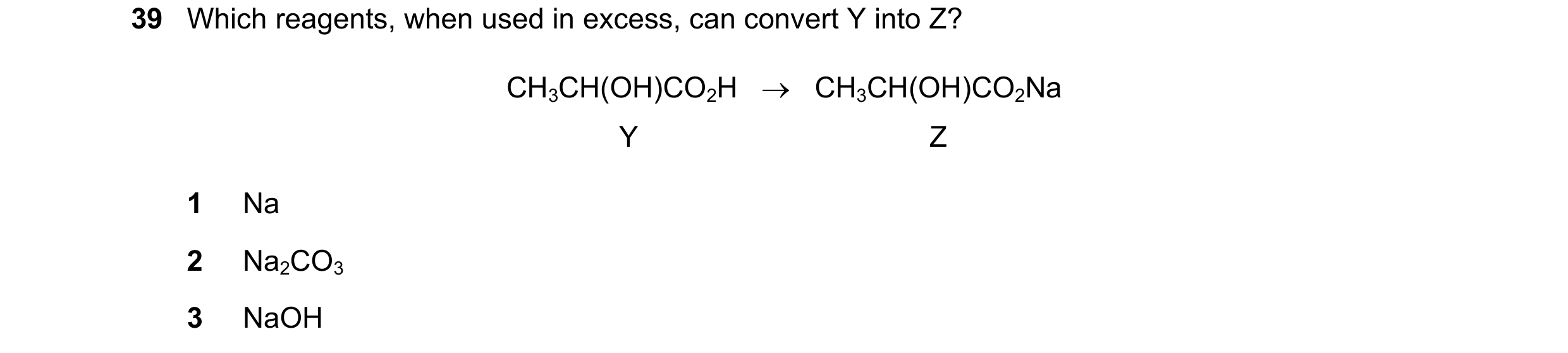
Q92 · Which reagents, when used in excess, can convert Y into Z? 9701/12 Oct/Nov 2019
39 Which reagents, when used in excess, can convert Y into Z? CH3CH(OH)CO2H → CH3CH(OH)CO2Na Y Z 1 Na 2 Na2CO3 3 NaOH
1 marks
Answer: C
This question in 9701/12 Oct/Nov 2019
Q93 · Tartaric acid, HO2CCH(OH)CH(OH)CO2H, is found in many plants 9701/13 Oct/Nov 2019
28 Tartaric acid, HO2CCH(OH)CH(OH)CO2H, is found in many plants. A sample of tartaric acid reacts with an excess of LiAl H4 to form the organic product J. What happens when NaOH(aq) is added to separate samples of tartaric acid and J? A Both tartaric acid and J react. B Only tartaric acid reacts. C Only J reacts. D Neither tartaric acid nor J react.
1 marks
Answer: B
This question in 9701/13 Oct/Nov 2019
Q94 · The infra-red spectrum of compound P is shown 9701/13 Oct/Nov 2019
30 The infra-red spectrum of compound P is shown. 100 transmittance / % 50 0 4000 3000 2000 1500 1000 500 wavenumber / cm–1 What could be compound P? A methyl ethanoate B propanal C propanoic acid D propan-2-ol
1 marks
Answer: D
This question in 9701/13 Oct/Nov 2019
Q95 · Which reaction would produce propanoic acid as one of its products? 9701/12 Feb/March 2020
27 Which reaction would produce propanoic acid as one of its products? A heating (CH3)2C=CHCH2CH3 with concentrated, acidified KMnO4 B heating CH3CH2CO2CH2CH2CH3 with NaOH(aq) C heating CH3CH2OH with acidified K2Cr2O7 under reflux D reacting CH3CHO with HCN then heating the organic product with H2SO4(aq)
1 marks
Answer: A
This question in 9701/12 Feb/March 2020
Q96 · Which statement is correct? 9701/11 May/June 2020
21 Which statement is correct? A 2,2-dimethylpropanoic acid is an isomer of propyl methanoate. B 2-methylbutan-2-ol is an isomer of hexan-3-ol. C 3-methylbutan-2-one is an isomer of pentanal. D 3,3-dimethylbutan-2-one is an isomer of pentan-3-one.
1 marks
Answer: C
This question in 9701/11 May/June 2020
Q97 · Which reaction produces an organic anion with a good yield? 9701/11 May/June 2020
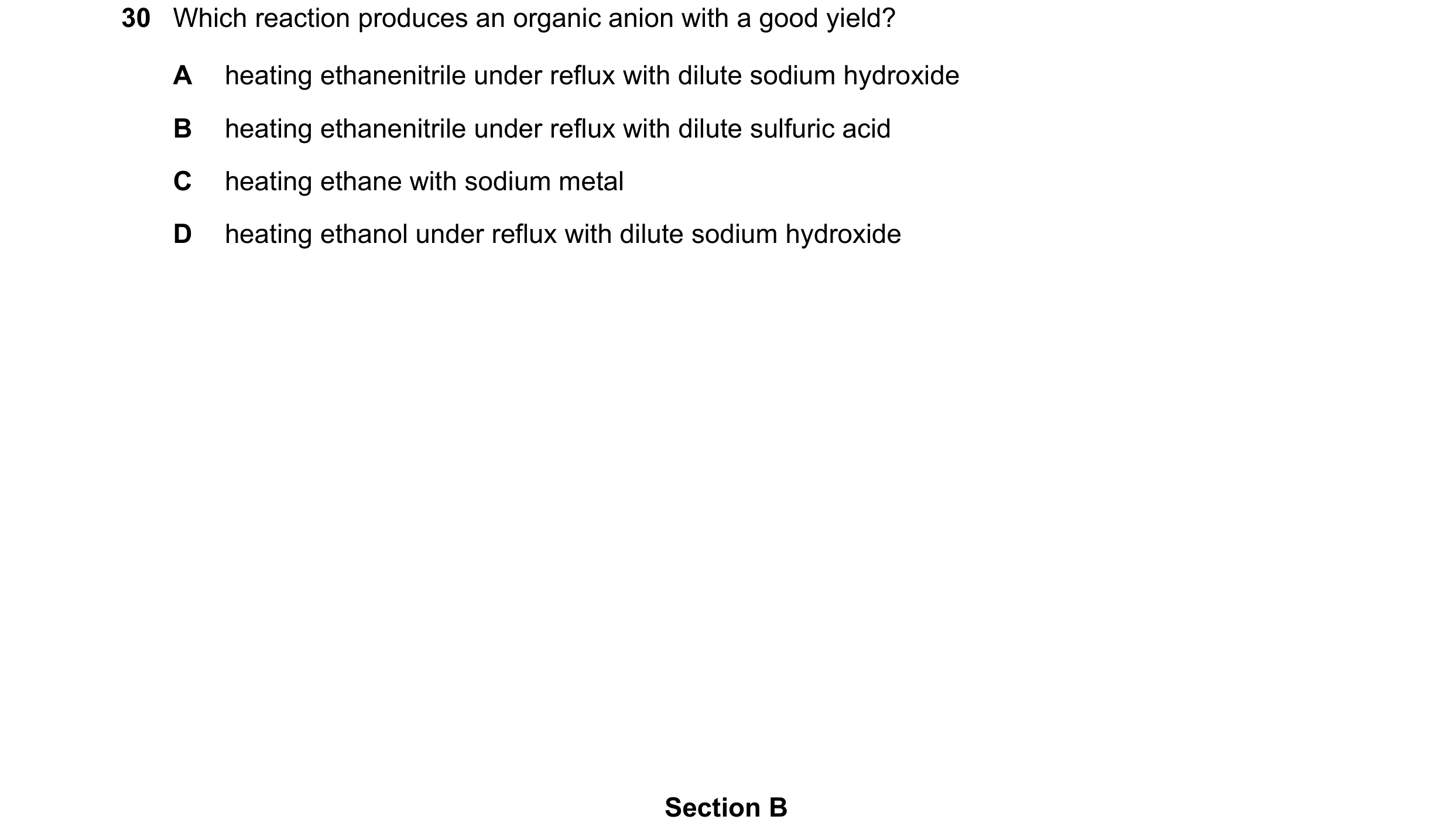
30 Which reaction produces an organic anion with a good yield? A heating ethanenitrile under reflux with dilute sodium hydroxide B heating ethanenitrile under reflux with dilute sulfuric acid C heating ethane with sodium metal D heating ethanol under reflux with dilute sodium hydroxide Section B
1 marks
Answer: A
This question in 9701/11 May/June 2020
Q98 · Compound X is shown 9701/12 May/June 2020
20 Compound X is shown. compound X CO2H OH X is treated separately with NaOH(aq) and LiAl H4 to give Y and Z. CO2H NaOH(aq) LiAl H4 Y Z OH What are Y and Z? Y Z CO2Na CH2OH A OH OH CO2Na CO2H B OH OH CO2Na CH2OH C ONa OH CO2Na CO2H D ONa OH
1 marks
Answer: A
This question in 9701/12 May/June 2020
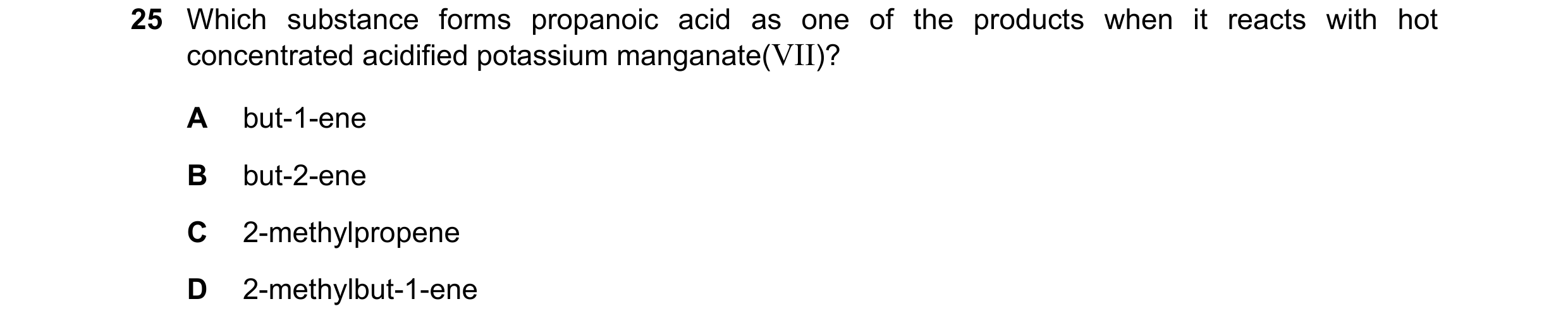
Q99 · Which substance forms propanoic acid as one of the products when it reacts with hot… 9701/12 May/June 2020
25 Which substance forms propanoic acid as one of the products when it reacts with hot concentrated acidified potassium manganate(VII)? A but-1-ene B but-2-ene C 2-methylpropene D 2-methylbut-1-ene
1 marks
Answer: A
This question in 9701/12 May/June 2020
Q100 · The diagram shows the infrared spectrum of an organic compound 9701/13 May/June 2020
25 The diagram shows the infrared spectrum of an organic compound. What could be the identity of this compound? A propan-1-ol B propanal C propanoic acid D propanone
1 marks
Answer: C
This question in 9701/13 May/June 2020
Q101 · Which reagent reacts with both of the –OH groups in lactic acid, CH3CH(OH)CO2H? 9701/13 May/June 2020
26 Which reagent reacts with both of the –OH groups in lactic acid, CH3CH(OH)CO2H? A acidified potassium dichromate(VI) B ethanol C sodium D sodium hydroxide
1 marks
Answer: C
This question in 9701/13 May/June 2020
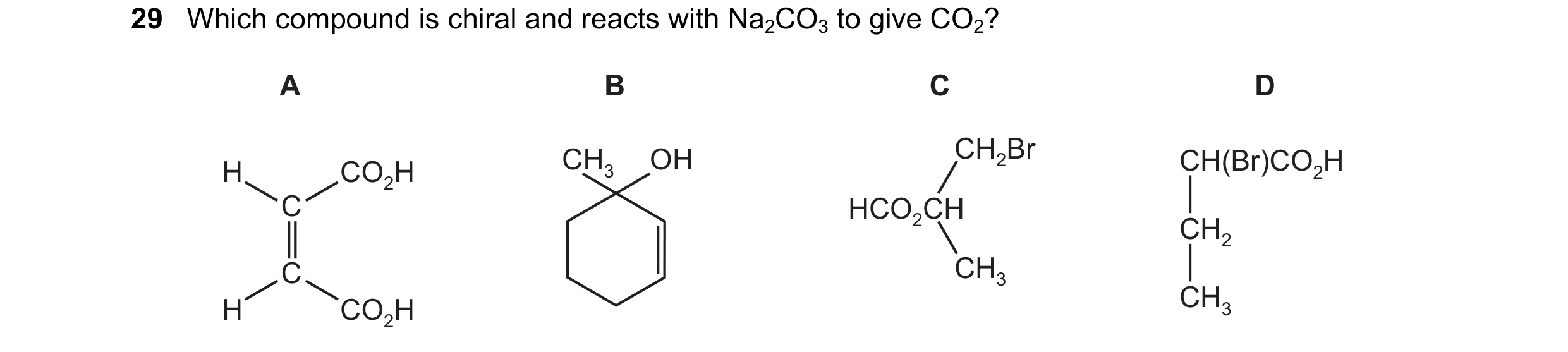
Q102 · Which compound is chiral and reacts with Na2CO3 to give CO2? 9701/11 Oct/Nov 2020
29 Which compound is chiral and reacts with Na2CO3 to give CO2? A B C D CH3 OH CH2Br CH(Br)CO2H H CO2H C HCO2CH CH2 C CH3 H CO2H CH3
1 marks
Answer: D
This question in 9701/11 Oct/Nov 2020
Q103 · The structure of compound R is shown 9701/11 Oct/Nov 2020
37 The structure of compound R is shown. compound R O OH O Which statements about compound R are correct? 1 It has an Mr of 116. 2 It contains two groups that show strong absorptions between 1640 and 1740 cm–1 in its infrared spectrum. 3 Its only infrared absorption between 2500 and 3000 cm–1 is sharp and strong.
1 marks
Answer: B
This question in 9701/11 Oct/Nov 2020
Q104 · Which compound is chiral and reacts with Na2CO3 to give CO2? 9701/13 Oct/Nov 2020
29 Which compound is chiral and reacts with Na2CO3 to give CO2? A B C D CH3 OH CH2Br CH(Br)CO2H H CO2H C HCO2CH CH2 C CH3 H CO2H CH3
1 marks
Answer: D
This question in 9701/13 Oct/Nov 2020
Q105 · Ethanedioic acid has the formula HO2CCO2H 9701/12 Feb/March 2021
28 Ethanedioic acid has the formula HO2CCO2H. What is the formula of aluminium ethanedioate? A Al C2O4 B Al (C2O4)3 C Al 2C2O4 D Al 2(C2O4)3
1 marks
Answer: D
This question in 9701/12 Feb/March 2021
Q106 · Which reaction gives butanoic acid as one of its products? 9701/12 Feb/March 2021
29 Which reaction gives butanoic acid as one of its products? A acid hydrolysis of butyl ethanoate B alkaline hydrolysis of butyl ethanoate C acid hydrolysis of ethyl butanoate D alkaline hydrolysis of ethyl butanoate
1 marks
Answer: C
This question in 9701/12 Feb/March 2021
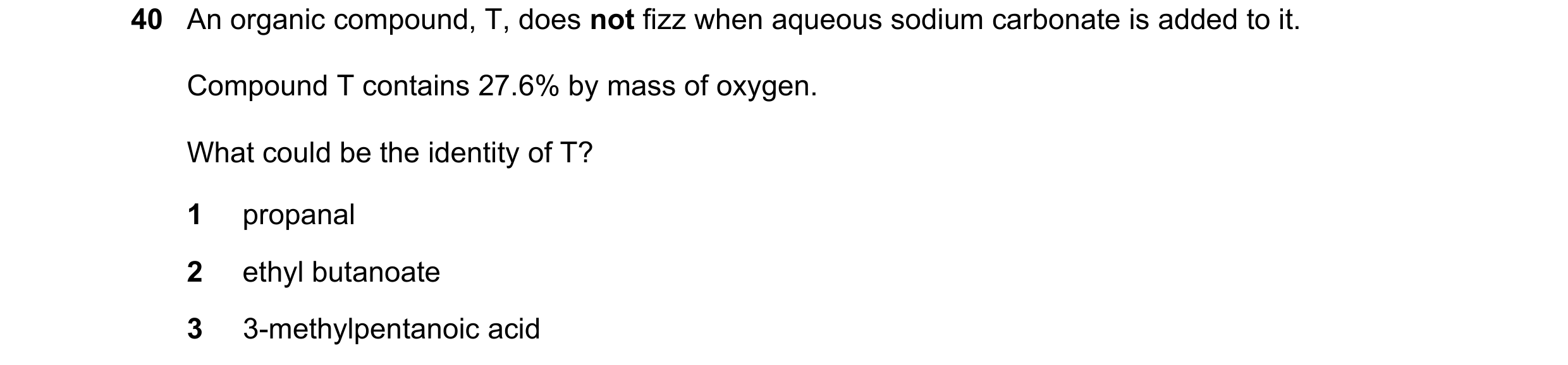
Q107 · An organic compound, T, does not fizz when aqueous sodium carbonate is added to it 9701/12 Feb/March 2021
40 An organic compound, T, does not fizz when aqueous sodium carbonate is added to it. Compound T contains 27.6% by mass of oxygen. What could be the identity of T? 1 propanal 2 ethyl butanoate 3 3-methylpentanoic acid
1 marks
Answer: B
This question in 9701/12 Feb/March 2021
Q108 · How many moles of hydrogen, H2, are evolved when an excess of sodium metal is added to… 9701/11 May/June 2021
27 How many moles of hydrogen, H2, are evolved when an excess of sodium metal is added to one mole of citric acid? citric acid CO2H HO C CH2CO2H CH2CO2H A 0.5 B 1.5 C 2 D 4
1 marks
Answer: C
This question in 9701/11 May/June 2021
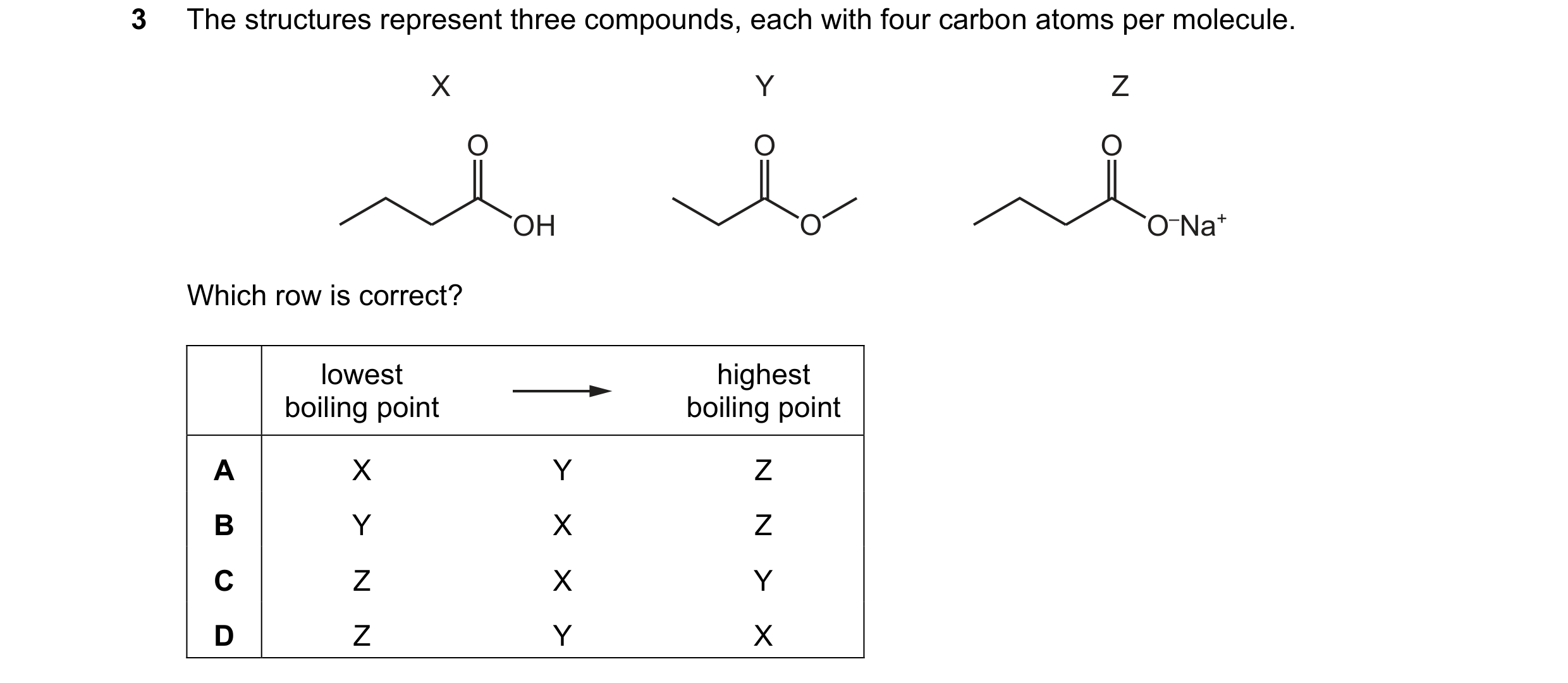
Q109 · The structures represent three compounds, each with four carbon atoms per molecule 9701/12 May/June 2021
3 The structures represent three compounds, each with four carbon atoms per molecule. X Y Z O O O OH O O–Na+ Which row is correct? lowest highest boiling point boiling point A X Y Z B Y X Z C Z X Y D Z Y X
1 marks
Answer: B
This question in 9701/12 May/June 2021
Q110 · Hexadeca-10,12-dien-1-ol is produced by silk moths from hexadecanoic acid in a three-step… 9701/12 May/June 2021
21 Hexadeca-10,12-dien-1-ol is produced by silk moths from hexadecanoic acid in a three-step enzymic process. hexadecanoic acid O OH step 1 O OH step 2 O OH step 3 OH Which row contains correct descriptions of the three steps? step 1 step 2 step 3 A elimination elimination dehydration B elimination reduction reduction C oxidation elimination oxidation D oxidation oxidation reduction
1 marks
Answer: D
This question in 9701/12 May/June 2021
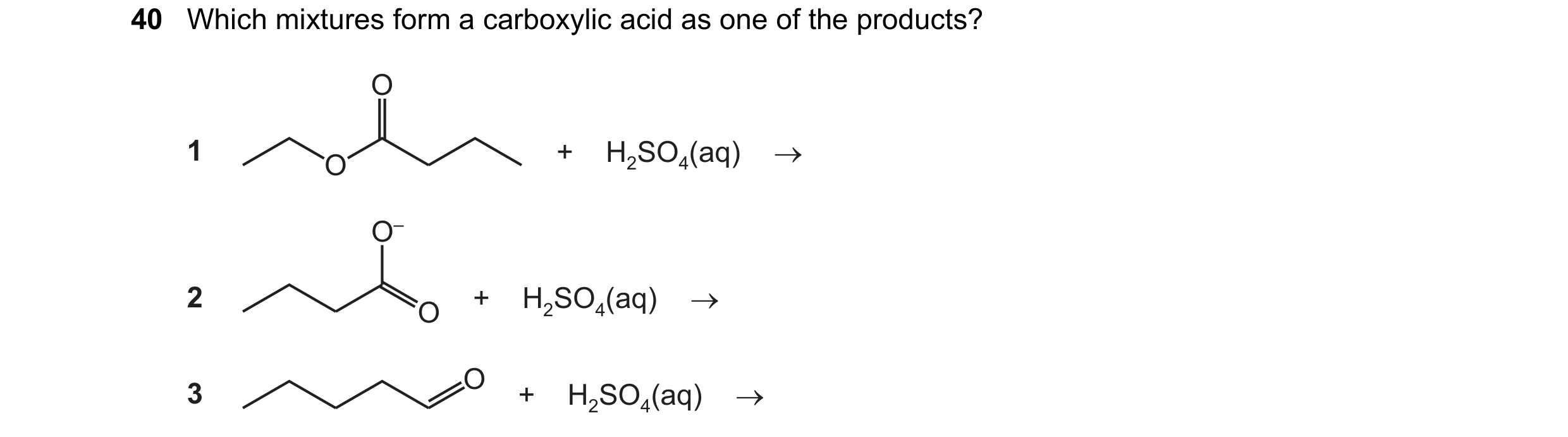
Q111 · Which mixtures form a carboxylic acid as one of the products? 9701/12 May/June 2021
40 Which mixtures form a carboxylic acid as one of the products?
O
1 AK + H,SO,(aq) >
O-
2 AK, + H,SO,(aq) >
3 NRA + H80,(aq) >
1 marks
Answer: B
This question in 9701/12 May/June 2021
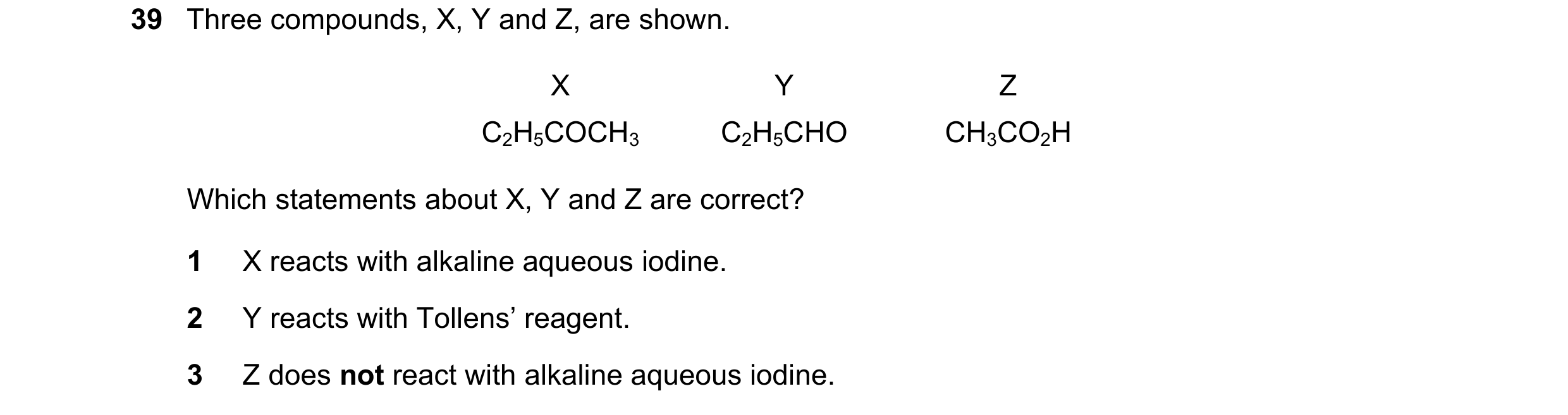
Q112 · Three compounds, X, Y and Z, are shown 9701/13 May/June 2021
39 Three compounds, X, Y and Z, are shown. X Y Z C2H5COCH3 C2H5CHO CH3CO2H Which statements about X, Y and Z are correct? 1 X reacts with alkaline aqueous iodine. 2 Y reacts with Tollens’ reagent. 3 Z does not react with alkaline aqueous iodine.
1 marks
Answer: A
This question in 9701/13 May/June 2021
Q113 · Citric acid is found in lemon juice 9701/11 Oct/Nov 2021
28 Citric acid is found in lemon juice. citric acid HO2CCH2C(OH)(CO2H)CH2CO2H Which volume of 0.40 mol dm–3 sodium hydroxide solution is required to neutralise a solution containing 0.0050 mol of citric acid? A 12.5 cm3 B 25.0 cm3 C 37.5 cm3 D 50.0 cm3
1 marks
Answer: C
This question in 9701/11 Oct/Nov 2021
Q114 · Organic compound Z has an alcohol group and a carboxylic acid group 9701/12 Oct/Nov 2021
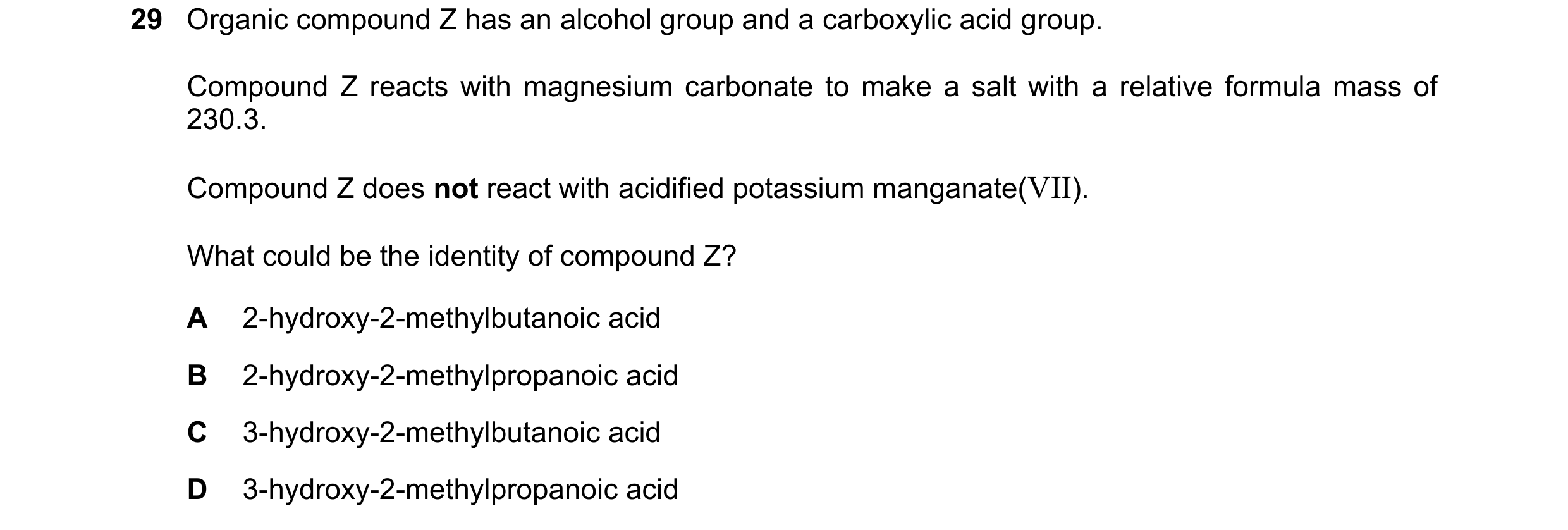
29 Organic compound Z has an alcohol group and a carboxylic acid group. Compound Z reacts with magnesium carbonate to make a salt with a relative formula mass of 230.3. Compound Z does not react with acidified potassium manganate(VII). What could be the identity of compound Z? A 2-hydroxy-2-methylbutanoic acid B 2-hydroxy-2-methylpropanoic acid C 3-hydroxy-2-methylbutanoic acid D 3-hydroxy-2-methylpropanoic acid
1 marks
Answer: B
This question in 9701/12 Oct/Nov 2021
Q115 · The infra-red spectrum of Y is shown 9701/12 Oct/Nov 2021
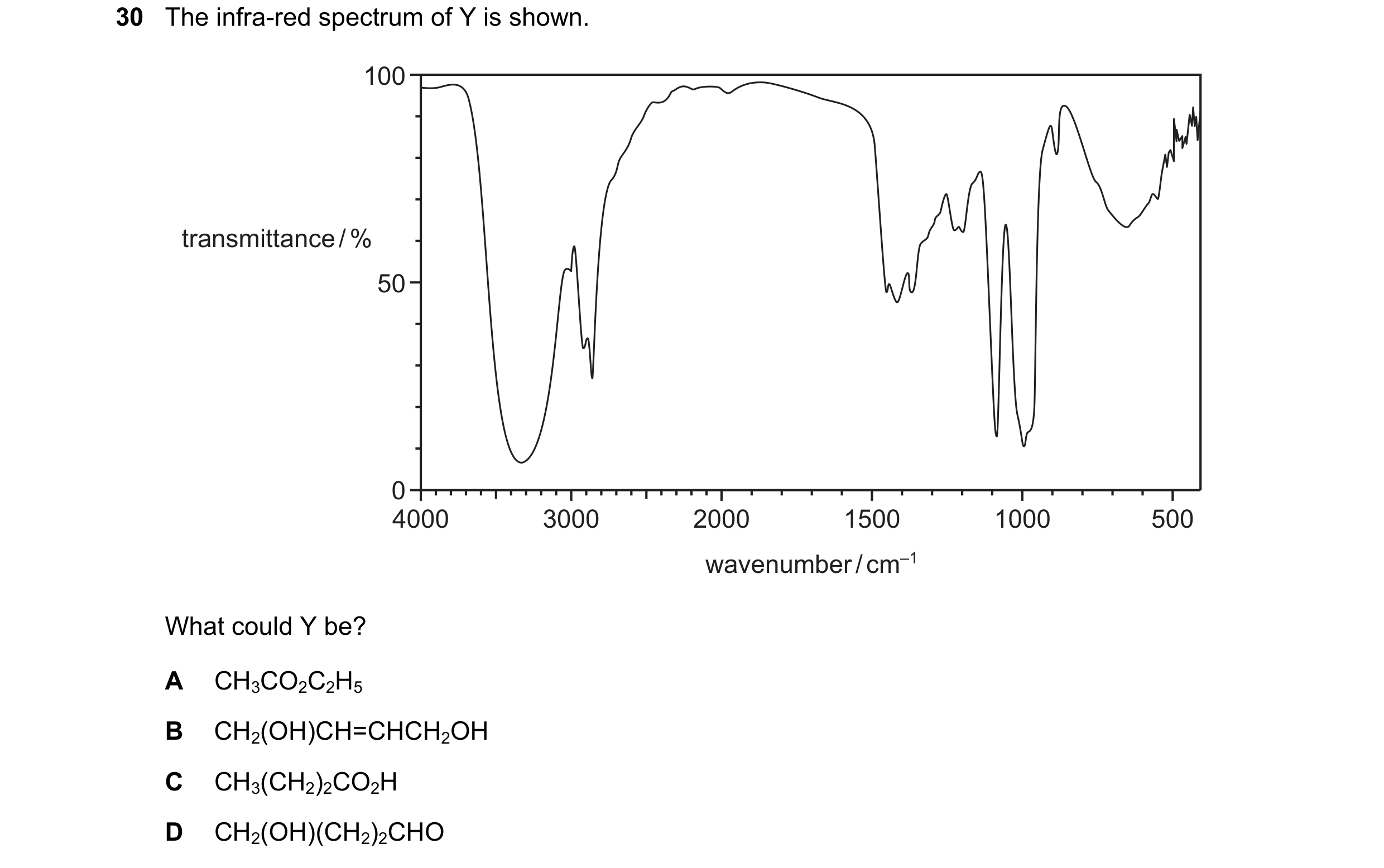
30 The infra-red spectrum of Y is shown. 100 transmittance / % 50 0 4000 3000 2000 1500 1000 500 wavenumber / cm–1 What could Y be? A CH3CO2C2H5 B CH2(OH)CH=CHCH2OH C CH3(CH2)2CO2H D CH2(OH)(CH2)2CHO
1 marks
Answer: B
This question in 9701/12 Oct/Nov 2021
Q116 · Citric acid is found in lemon juice 9701/13 Oct/Nov 2021
28 Citric acid is found in lemon juice. citric acid HO2CCH2C(OH)(CO2H)CH2CO2H Which volume of 0.40 mol dm–3 sodium hydroxide solution is required to neutralise a solution containing 0.0050 mol of citric acid? A 12.5 cm3 B 25.0 cm3 C 37.5 cm3 D 50.0 cm3
1 marks
Answer: C
This question in 9701/13 Oct/Nov 2021
Q117 · Two 1 g samples of Y are reacted separately and completely with sodium and with sodium… 9701/11 May/June 2022
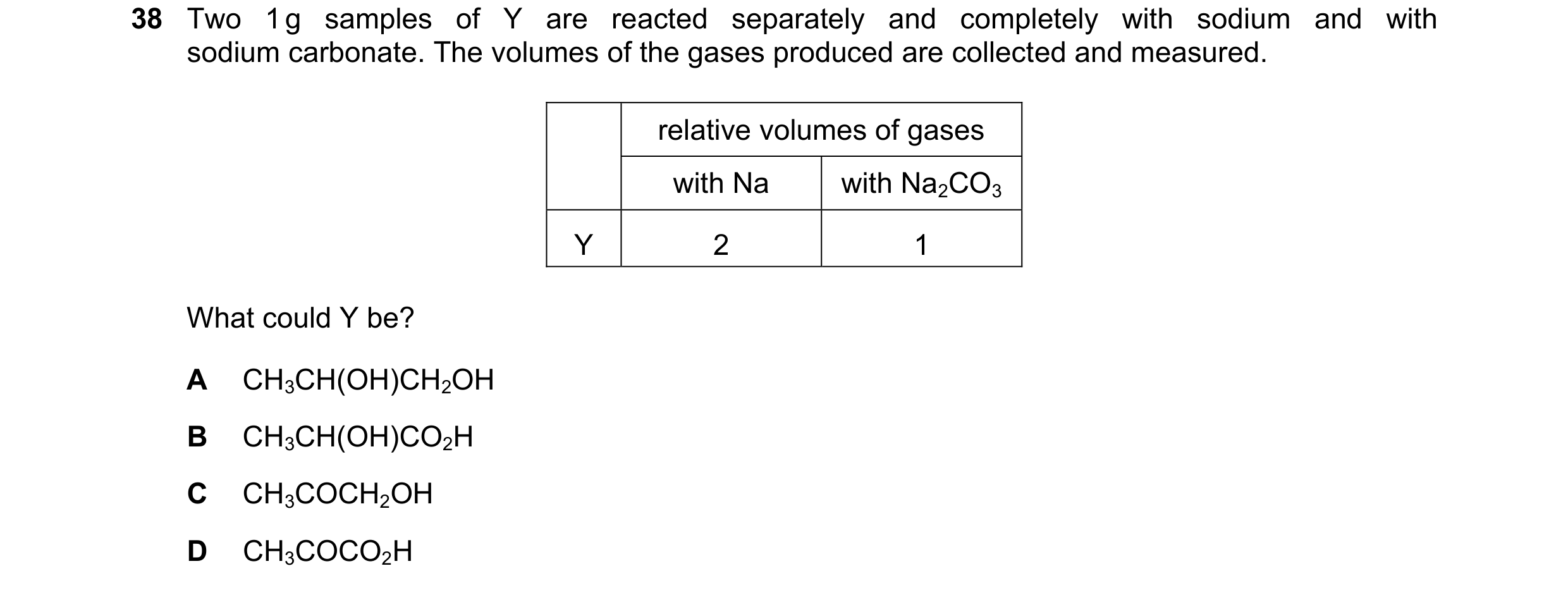
38 Two 1 g samples of Y are reacted separately and completely with sodium and with sodium carbonate. The volumes of the gases produced are collected and measured. relative volumes of gases with Na with Na2CO3 Y 2 1 What could Y be? A CH3CH(OH)CH2OH B CH3CH(OH)CO2H C CH3COCH2OH D CH3COCO2H
1 marks
Answer: B
This question in 9701/11 May/June 2022
Q118 · Which reaction is a redox reaction? 9701/12 May/June 2022
37 Which reaction is a redox reaction? A ethanenitrile heated under reflux with dilute hydrochloric acid B ethanoic acid reacted with aqueous sodium hydroxide C ethanoic acid reacted with sodium D ethyl ethanoate heated under reflux with dilute hydrochloric acid
1 marks
Answer: C
This question in 9701/12 May/June 2022
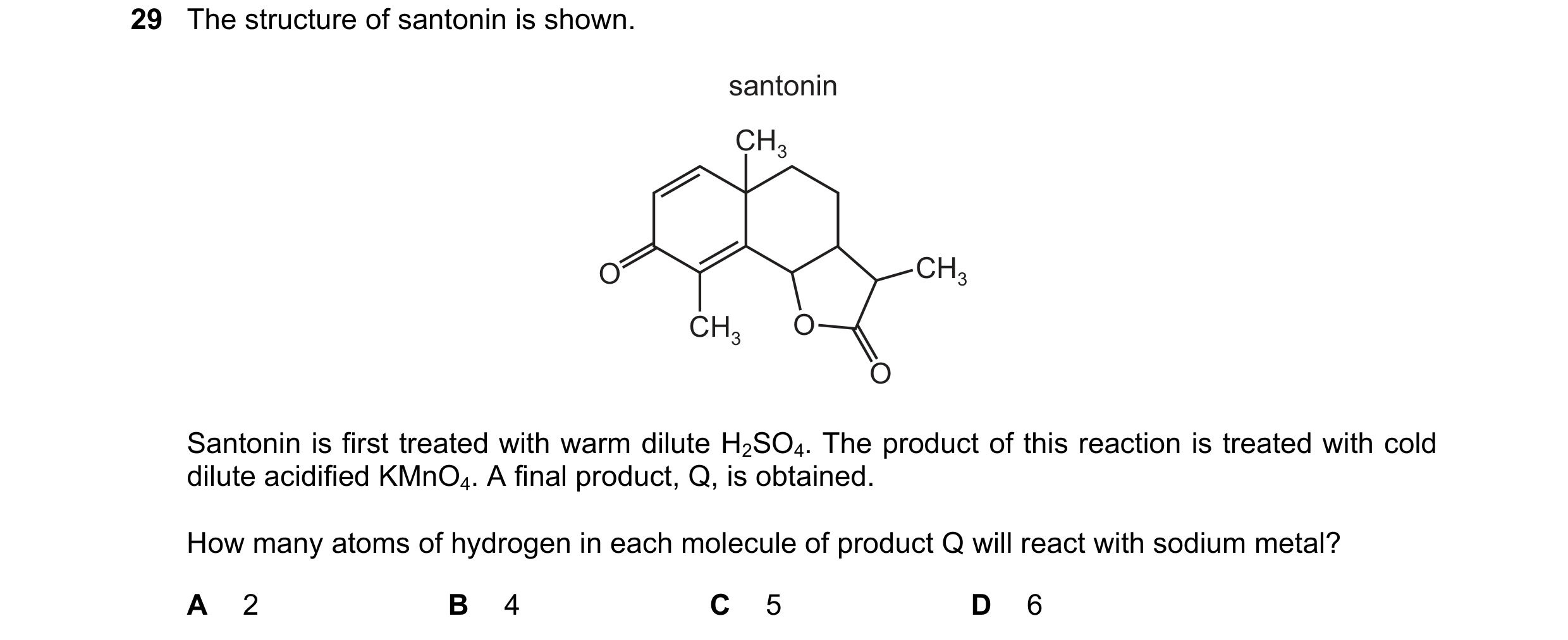
Q119 · The structure of santonin is shown 9701/11 Oct/Nov 2022
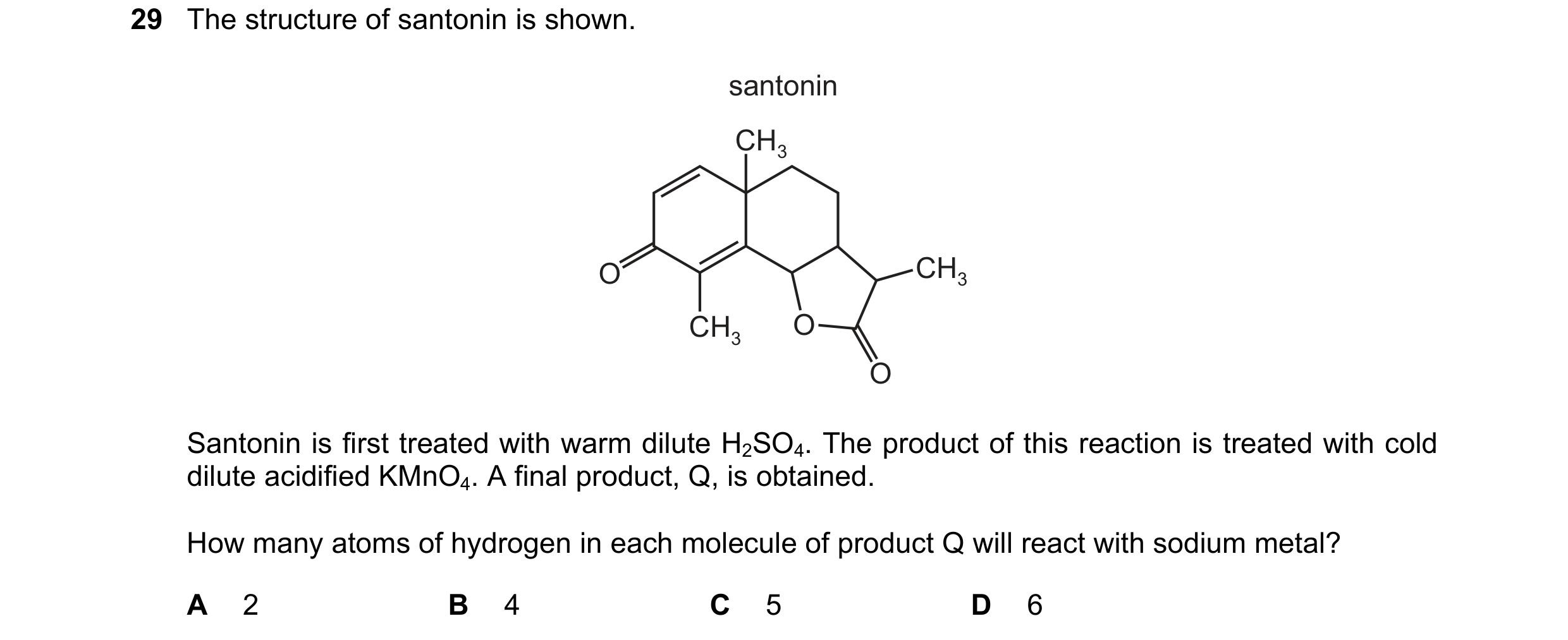
29 The structure of santonin is shown. santonin CH3 O CH3 CH3 O O Santonin is first treated with warm dilute H2SO4. The product of this reaction is treated with cold dilute acidified KMnO4. A final product, Q, is obtained. How many atoms of hydrogen in each molecule of product Q will react with sodium metal? A 2 B 4 C 5 D 6
1 marks
Answer: D
This question in 9701/11 Oct/Nov 2022
Q120 · Three colourless liquids with the following formulae are contained in separate unlabelled… 9701/11 Oct/Nov 2022
31 Three colourless liquids with the following formulae are contained in separate unlabelled bottles. CH3CH2CO2H CH3CH(OH)CO2H CH3COCO2H Which two tests, carried out on separate samples of each liquid, will successfully identify each liquid? test 1 test 2 A NaHCO3 2,4-DNPH reagent B NaHCO3 Tollens’ reagent C warm acidified dichromate 2,4-DNPH reagent D warm acidified dichromate Tollens’ reagent
1 marks
Answer: C
This question in 9701/11 Oct/Nov 2022
Q121 · Structural isomerism and stereoisomerism should be considered when answering this question 9701/11 Oct/Nov 2022
35 Structural isomerism and stereoisomerism should be considered when answering this question. How many isomeric compounds with molecular formula C5H6O4 contain two –CO2H groups and one C=C double bond? A 5 B 6 C 7 D 8
1 marks
Answer: C
This question in 9701/11 Oct/Nov 2022
Q122 · The structure of tartaric acid is shown 9701/12 Oct/Nov 2022
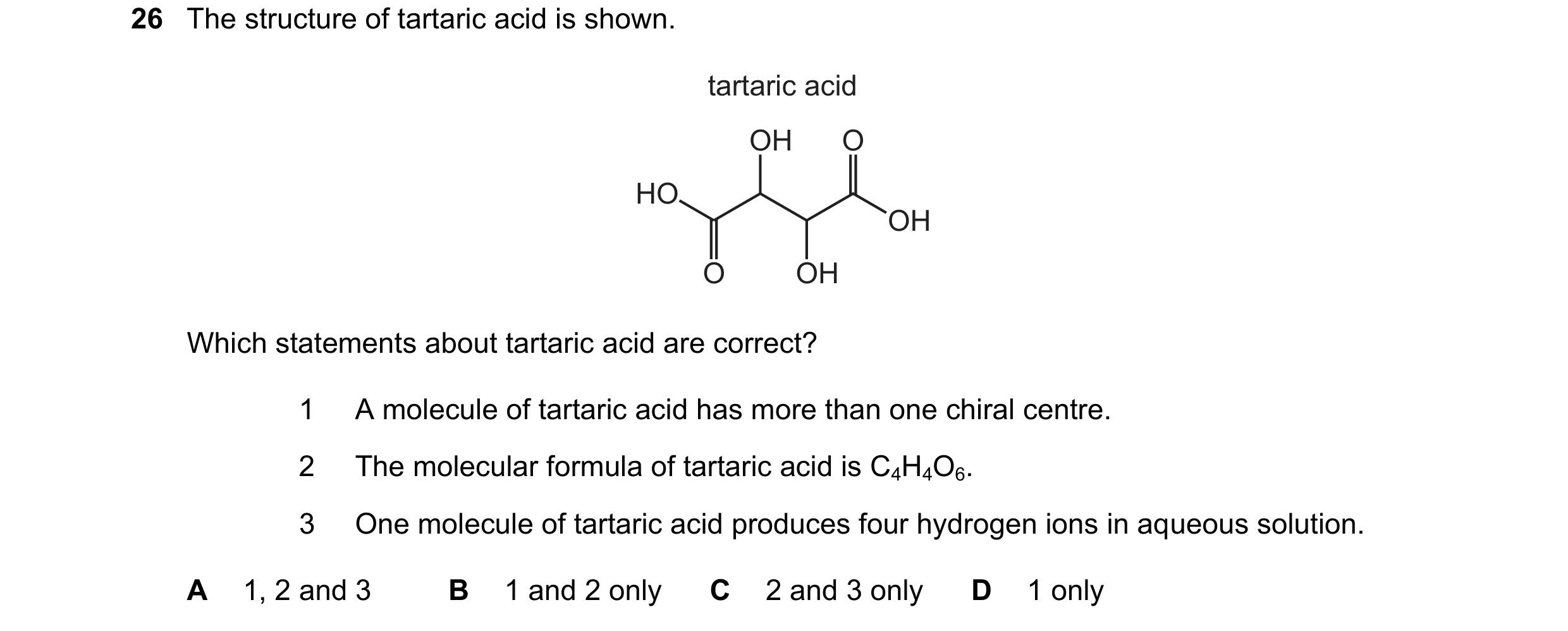
26 The structure of tartaric acid is shown. tartaric acid OH O HO OH O OH Which statements about tartaric acid are correct? 1 A molecule of tartaric acid has more than one chiral centre. 2 The molecular formula of tartaric acid is C4H4O6. 3 One molecule of tartaric acid produces four hydrogen ions in aqueous solution. A 1, 2 and 3 B 1 and 2 only C 2 and 3 only D 1 only
1 marks
Answer: D
This question in 9701/12 Oct/Nov 2022
Q123 · A molecule of an organic compound, P, contains three carbon atoms and shows a strong… 9701/12 Oct/Nov 2022
40 A molecule of an organic compound, P, contains three carbon atoms and shows a strong absorption at 1720 cm–1 in its infrared spectrum. P is reacted with an excess of hot acidified potassium dichromate(VI) forming organic product Q. Q shows a strong absorption at 1700 cm–1 and a strong, broad absorption centred at 2800 cm–1 in its infrared spectrum. bond functional group containing the bond characteristic infrared absorption range (in wavenumbers) / cm–1 C–O hydroxy, ester 1040–1300 C=C aromatic compound, alkene 1500–1680 C=O amide 1640–1690 carbonyl, carboxyl 1670–1740 ester 1710–1750 C≡N nitrile 2200–2250 C–H alkane 2850–2950 N–H amine, amide 3300–3500 O–H carboxyl 2500–3000 hydroxy 3200–3600 What is P? A propanal B propanone C propan-1-ol D propan-2-ol
1 marks
Answer: A
This question in 9701/12 Oct/Nov 2022
Q124 · The structure of santonin is shown 9701/13 Oct/Nov 2022
29 The structure of santonin is shown. santonin CH3 O CH3 CH3 O O Santonin is first treated with warm dilute H2SO4. The product of this reaction is treated with cold dilute acidified KMnO4. A final product, Q, is obtained. How many atoms of hydrogen in each molecule of product Q will react with sodium metal? A 2 B 4 C 5 D 6
1 marks
Answer: D
This question in 9701/13 Oct/Nov 2022
Q125 · Three colourless liquids with the following formulae are contained in separate unlabelled… 9701/13 Oct/Nov 2022
31 Three colourless liquids with the following formulae are contained in separate unlabelled bottles. CH3CH2CO2H CH3CH(OH)CO2H CH3COCO2H Which two tests, carried out on separate samples of each liquid, will successfully identify each liquid? test 1 test 2 A NaHCO3 2,4-DNPH reagent B NaHCO3 Tollens’ reagent C warm acidified dichromate 2,4-DNPH reagent D warm acidified dichromate Tollens’ reagent
1 marks
Answer: C
This question in 9701/13 Oct/Nov 2022
Q126 · Structural isomerism and stereoisomerism should be considered when answering this question 9701/13 Oct/Nov 2022
35 Structural isomerism and stereoisomerism should be considered when answering this question. How many isomeric compounds with molecular formula C5H6O4 contain two –CO2H groups and one C=C double bond? A 5 B 6 C 7 D 8
1 marks
Answer: C
This question in 9701/13 Oct/Nov 2022
Q127 · Propanoic acid is treated with reagent X at room temperature 9701/13 May/June 2023
1 Propanoic acid is treated with reagent X at room temperature. The organic product of the reaction is sodium propanoate. No gas is produced during the reaction. What could be reagent X? A NaHCO3(aq) B NaOH(aq) C Na2CO3(aq) D Na2SO4(aq)
1 marks
Answer: B
This question in 9701/13 May/June 2023
Q128 · The infrared spectrum of compound L is shown 9701/11 Oct/Nov 2023
39 The infrared spectrum of compound L is shown. 100 transmittance % 50 0 4000 3000 2000 1500 1000 500 wavenumber / cm–1 bond functional groups containing the bond characteristic infrared absorption range (in wavenumbers) / cm–1 C–O hydroxy, ester 1040–1300 C=C aromatic compound, alkene 1500–1680 C=O amide 1640–1690 carbonyl, carboxyl 1670–1740 ester 1710–1750 C≡N nitrile 2200–2250 C–H alkane 2850–2950 N–H amine, amide 3300–3500 O–H carboxyl 2500–3000 hydroxy 3200–3600 What is the structure of L? A HOCH2COCH2OH B HOCH2CH(OH)CHO C HOCH2CH(OH)CH2OH D HOCH2CH2COOH
1 marks
Answer: C
This question in 9701/11 Oct/Nov 2023
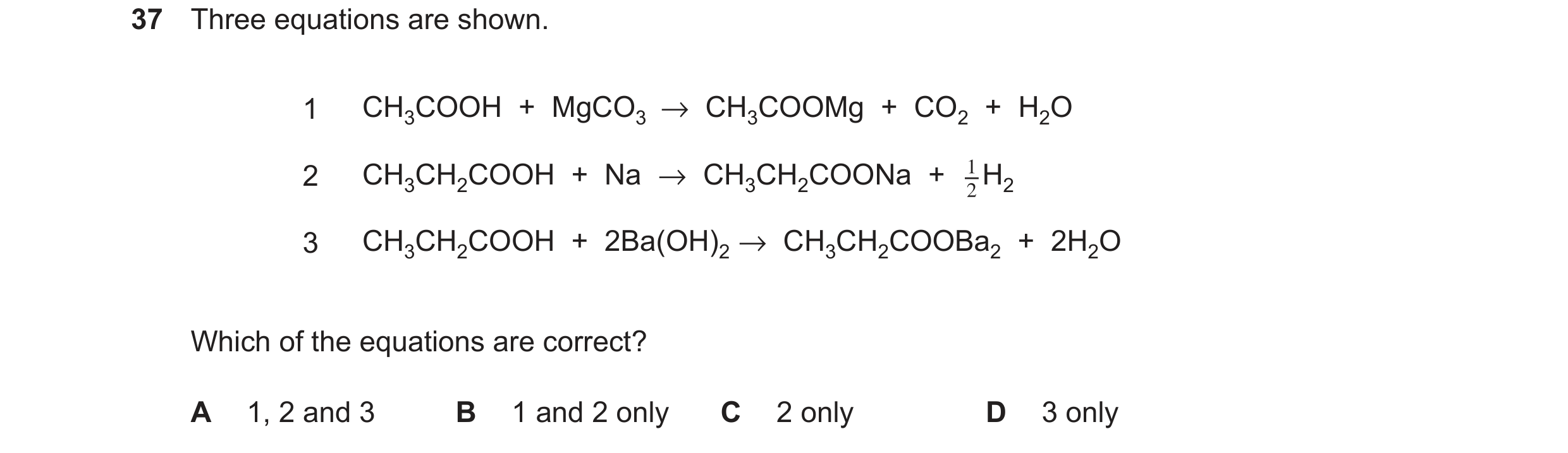
Q129 · Three equations are shown 9701/12 Oct/Nov 2023
37 Three equations are shown. 1 CH3COOH + MgCO3 →CH3COOMg + CO2 + H2O 2 CH3CH2COOH + Na →CH3CH2COONa + H2 3 CH3CH2COOH + 2Ba(OH)2 →CH3CH2COOBa2 + 2H2O Which of the equations are correct? A 1, 2 and 3 B 1 and 2 only C 2 only D 3 only
1 marks
Answer: C
This question in 9701/12 Oct/Nov 2023
Q130 · The diagram shows an ester 9701/12 Oct/Nov 2023
39 The diagram shows an ester. It is heated under reflux with an excess of NaOH(aq). O O Which row shows the 2 products of the reaction? product 1 product 2 A O OH OH B O ONa OH C O OH ONa D O ONa ONa
1 marks
Answer: C
This question in 9701/12 Oct/Nov 2023
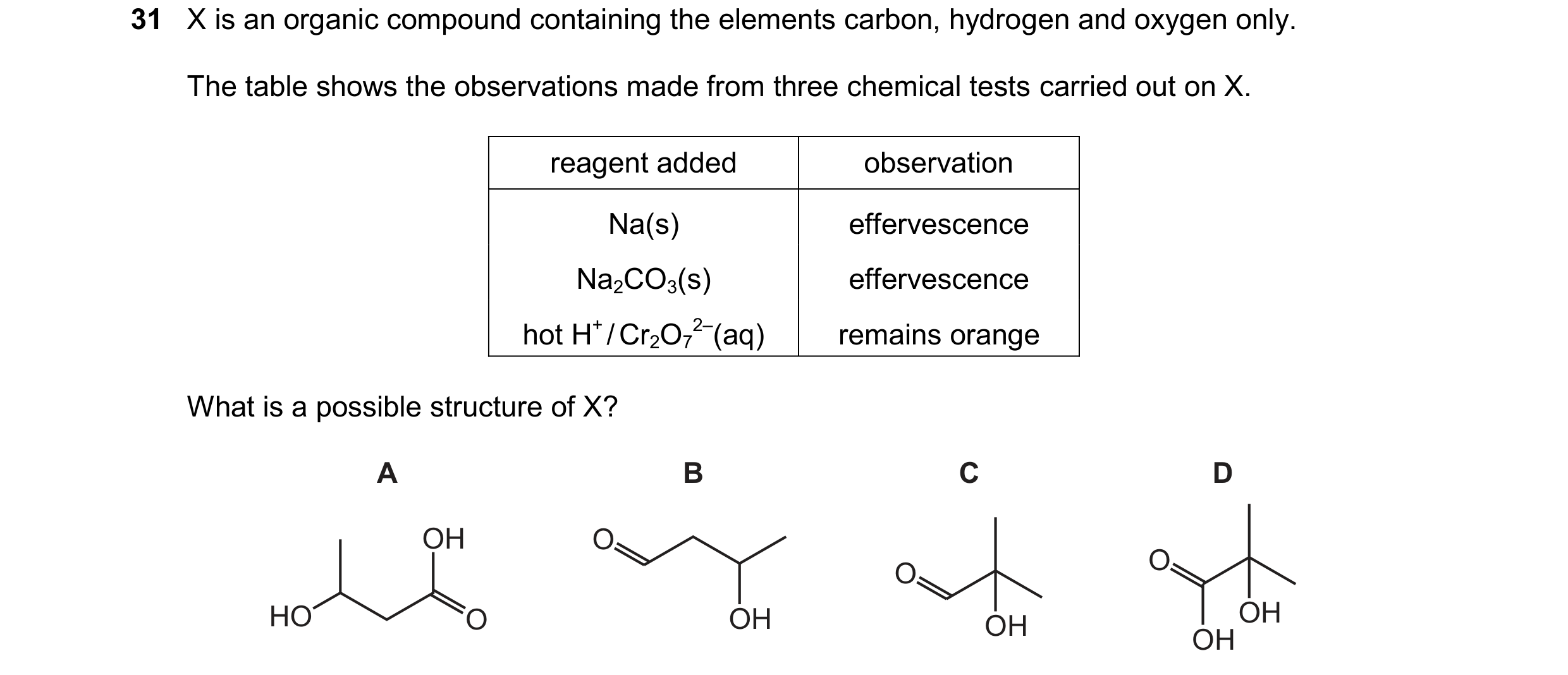
Q131 · X is an organic compound containing the elements carbon, hydrogen and oxygen only 9701/12 Feb/March 2024
31 X is an organic compound containing the elements carbon, hydrogen and oxygen only. The table shows the observations made from three chemical tests carried out on X. reagent added observation Na(s) effervescence Na2CO3(s) effervescence hot H+ / Cr2O7 2–(aq) remains orange What is a possible structure of X? A B C D OH O O O HO O OH OH OH OH
1 marks
Answer: D
This question in 9701/12 Feb/March 2024
Q132 · Compound Z is formed by the reaction scheme shown 9701/12 Feb/March 2024
37 Compound Z is formed by the reaction scheme shown. warm with reflux with CH3CH2Br compound X compound Z KCN in ethanol dilute HCl What is the formula of compound Z? A CH3CH2Cl B CH3CH2CN C CH3COOH D CH3CH2COOH
1 marks
Answer: D
This question in 9701/12 Feb/March 2024
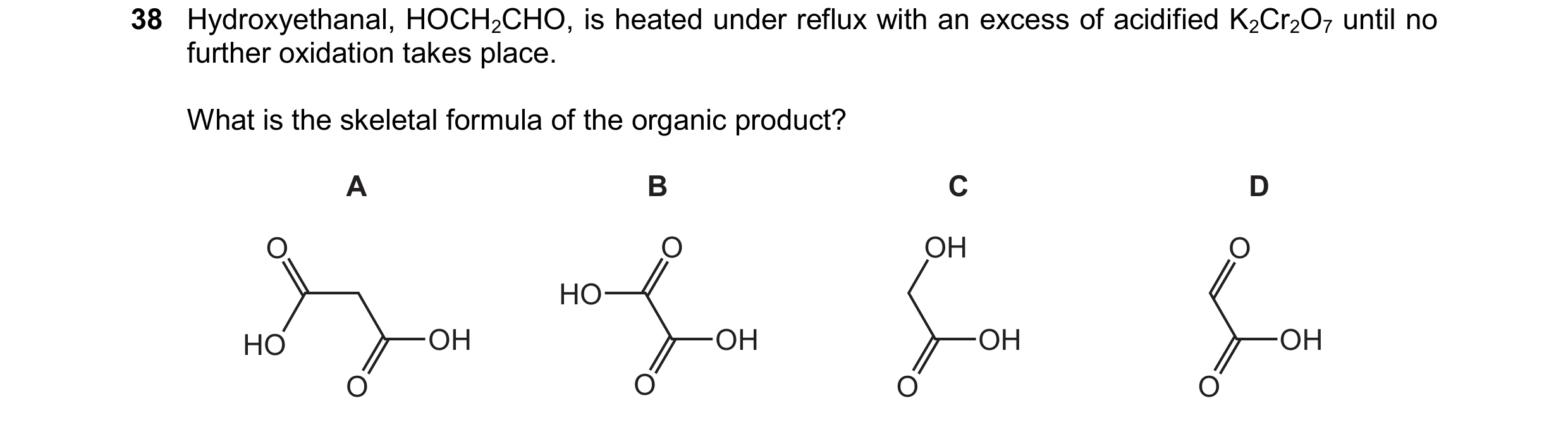
Q133 · Hydroxyethanal, HOCH2CHO, is heated under reflux with an excess of acidified K2Cr2O7… 9701/12 Feb/March 2024
38 Hydroxyethanal, HOCH2CHO, is heated under reflux with an excess of acidified K2Cr2O7 until no further oxidation takes place. What is the skeletal formula of the organic product? A B C D O O OH O HO HO OH OH OH OH O O O O
1 marks
Answer: B
This question in 9701/12 Feb/March 2024
Q134 · The infrared spectrum of a compound is shown 9701/12 Feb/March 2024
40 The infrared spectrum of a compound is shown. 100 transmittance / % 50 0 4000 3000 2000 1500 1000 500 wavenumber / cm–1 characteristic infrared absorption range bond functional groups containing the bond (in wavenumbers) / cm–1 C–O hydroxy, ester 1040–1300 C=C aromatic compound, alkene 1500–1680 C=O amide 1640–1690 carbonyl, carboxyl 1670–1740 ester 1710–1750 C≡N nitrile 2200–2250 C–H alkane 2850–2950 N–H amine, amide 3300–3500 O–H carboxyl 2500–3000 hydroxy 3200–3600 Which functional group could the compound contain? A alcohol B carboxylic acid C ester D nitrile
1 marks
Answer: C
This question in 9701/12 Feb/March 2024
Q135 · The product of the reaction between propanone and hydrogen cyanide is hydrolysed under… 9701/11 May/June 2024
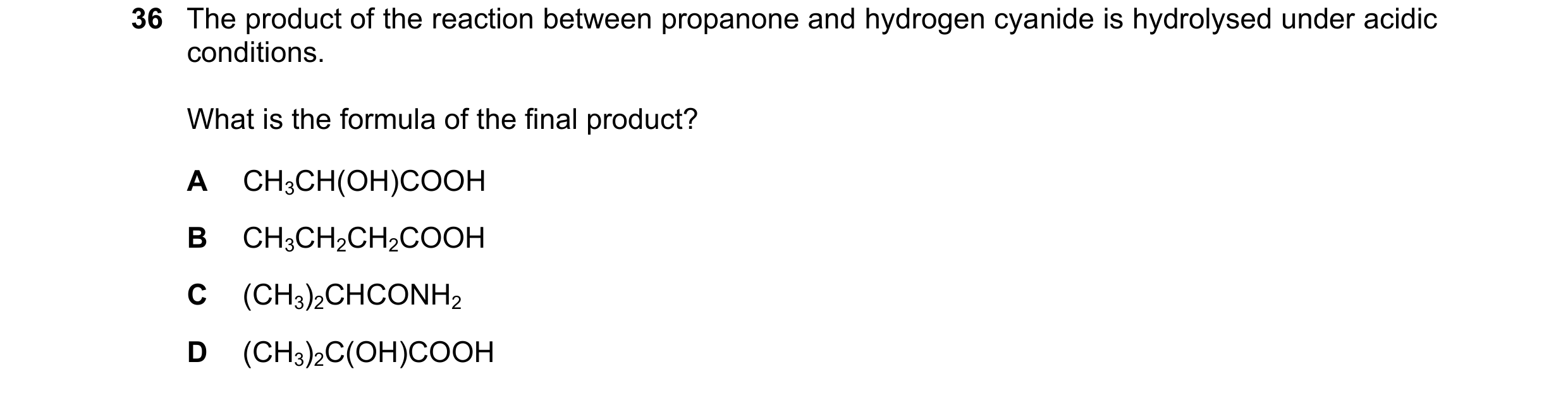
36 The product of the reaction between propanone and hydrogen cyanide is hydrolysed under acidic conditions. What is the formula of the final product? A CH3CH(OH)COOH B CH3CH2CH2COOH C (CH3)2CHCONH2 D (CH3)2C(OH)COOH
1 marks
Answer: D
This question in 9701/11 May/June 2024
Q136 · P is a carboxylic acid with molecular formula C5H10O2 9701/11 May/June 2024
37 P is a carboxylic acid with molecular formula C5H10O2. Carboxylic acid P reacts with an excess of LiAl H4 to form compound Q. Which pairs of molecules could be carboxylic acid P and compound Q? carboxylic acid P compound Q 1 CH3(CH2)3COOH CH3(CH2)3OH 2 CH3(CH2)3COOH CH3(CH2)3CHO 3 (CH3)3CCOOH (CH3)3CCH2OH A 1 and 2 B 1 and 3 C 2 and 3 D 3 only
1 marks
Answer: D
This question in 9701/11 May/June 2024
Q137 · 1 mole of each of the following four compounds is reacted separately with: ● an excess of… 9701/12 May/June 2024
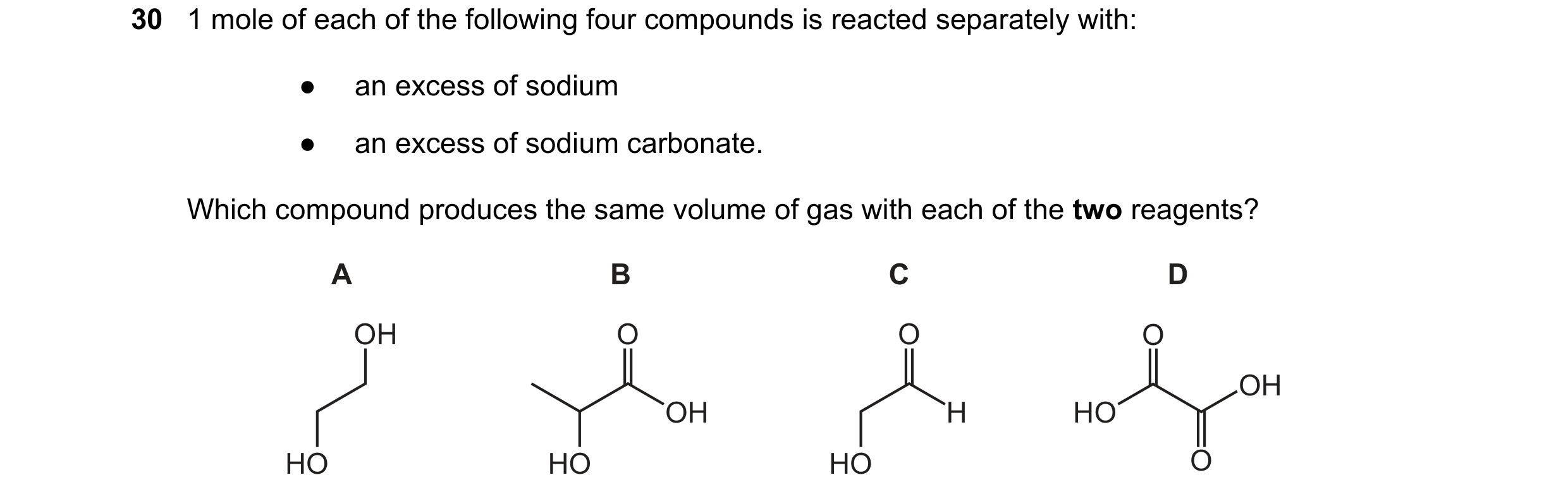
30 1 mole of each of the following four compounds is reacted separately with: ● an excess of sodium ● an excess of sodium carbonate. Which compound produces the same volume of gas with each of the two reagents? A B C D OH O O O OH OH H HO HO HO HO O
1 marks
Answer: D
This question in 9701/12 May/June 2024
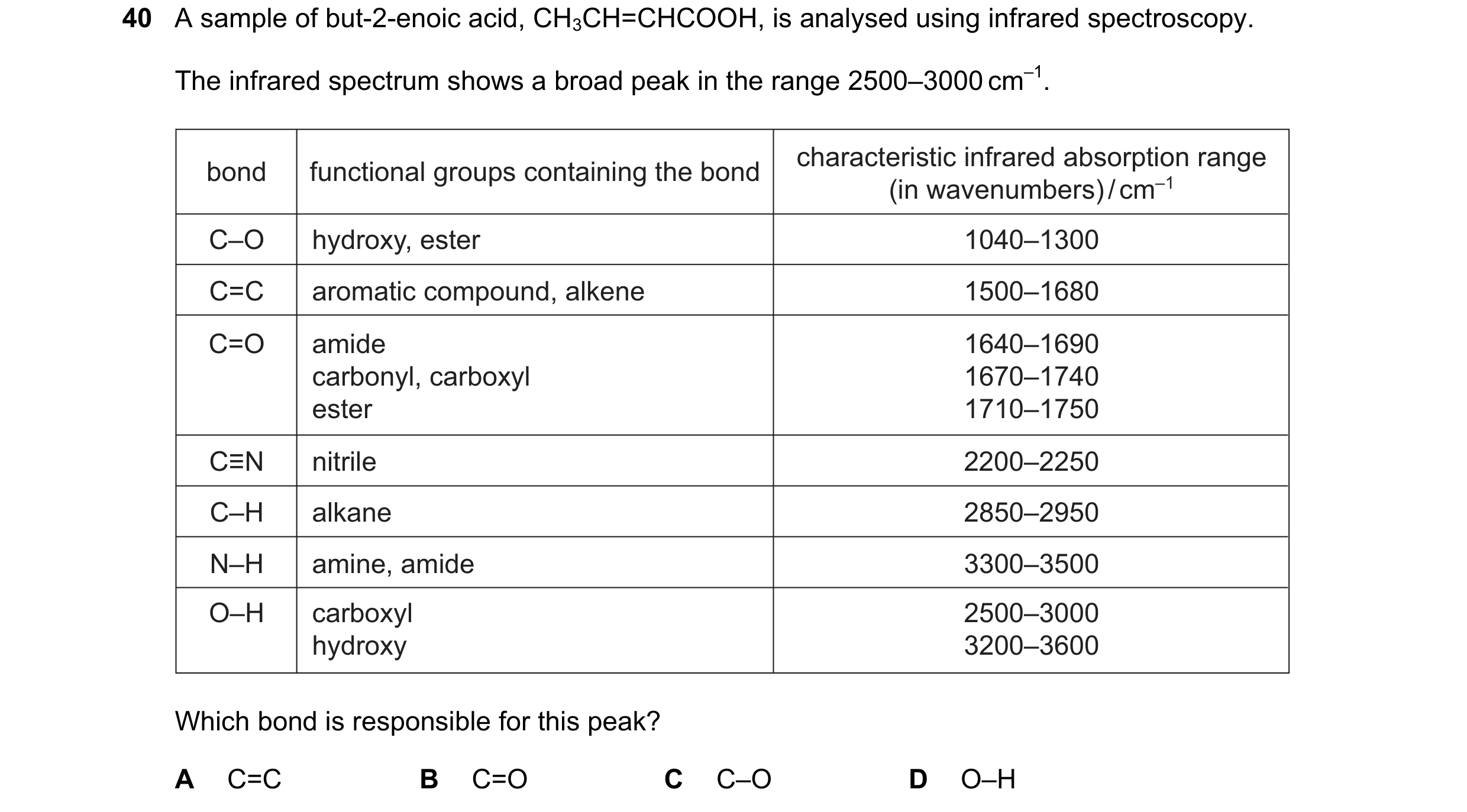
Q138 · A sample of but-2-enoic acid, CH3CH=CHCOOH, is analysed using infrared spectroscopy 9701/13 May/June 2024
40 A sample of but-2-enoic acid, CH3CH=CHCOOH, is analysed using infrared spectroscopy. The infrared spectrum shows a broad peak in the range 2500–3000 cm–1. characteristic infrared absorption range bond functional groups containing the bond (in wavenumbers) / cm–1 C–O hydroxy, ester 1040–1300 C=C aromatic compound, alkene 1500–1680 C=O amide 1640–1690 carbonyl, carboxyl 1670–1740 ester 1710–1750 C≡N nitrile 2200–2250 C–H alkane 2850–2950 N–H amine, amide 3300–3500 O–H carboxyl 2500–3000 hydroxy 3200–3600 Which bond is responsible for this peak? A C=C B C=O C C–O D O–H
1 marks
Answer: D
This question in 9701/13 May/June 2024
Q139 · Vitamin A contains retinol 9701/11 Oct/Nov 2024
29 Vitamin A contains retinol. retinol OH Under appropriate conditions, acidified KMnO4(aq) can be used to break C=C bonds. After these bonds have been broken, further oxidation of the fragments may occur. Under which conditions is the acidified KMnO4(aq) used and what do the final oxidation products include? conditions final oxidation products A cold, dilute aldehydes and carboxylic acids B cold, dilute ketones and carboxylic acids C hot, concentrated aldehydes and carboxylic acids D hot, concentrated ketones and carboxylic acids
1 marks
Answer: D
This question in 9701/11 Oct/Nov 2024
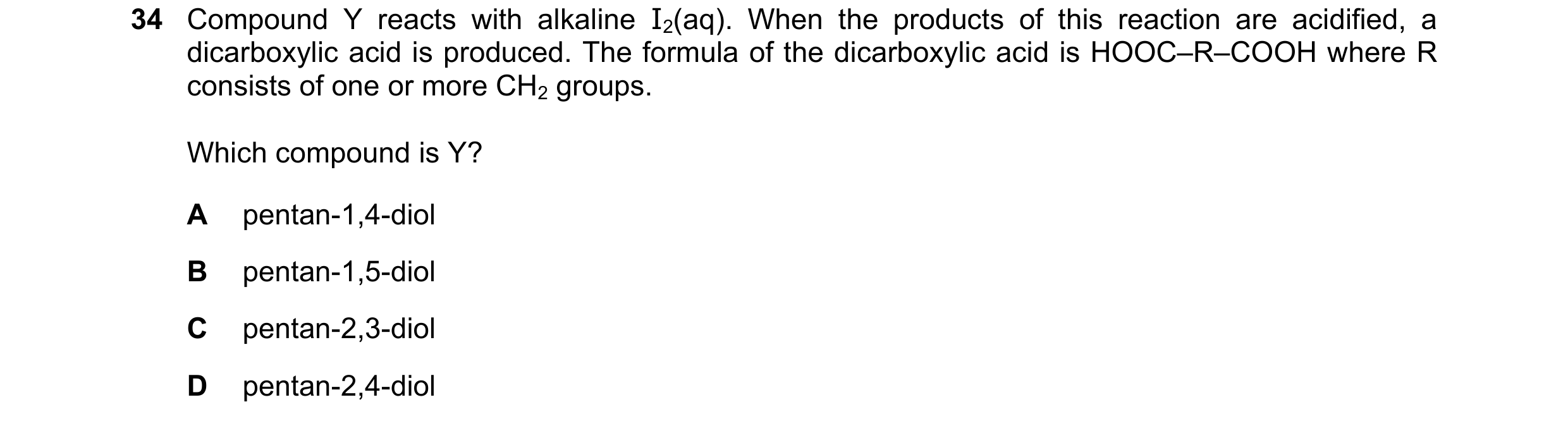
Q140 · Compound Y reacts with alkaline I2(aq) 9701/11 Oct/Nov 2024
34 Compound Y reacts with alkaline I2(aq). When the products of this reaction are acidified, a dicarboxylic acid is produced. The formula of the dicarboxylic acid is HOOC–R–COOH where R consists of one or more CH2 groups. Which compound is Y? A pentan-1,4-diol B pentan-1,5-diol C pentan-2,3-diol D pentan-2,4-diol
1 marks
Answer: D
This question in 9701/11 Oct/Nov 2024
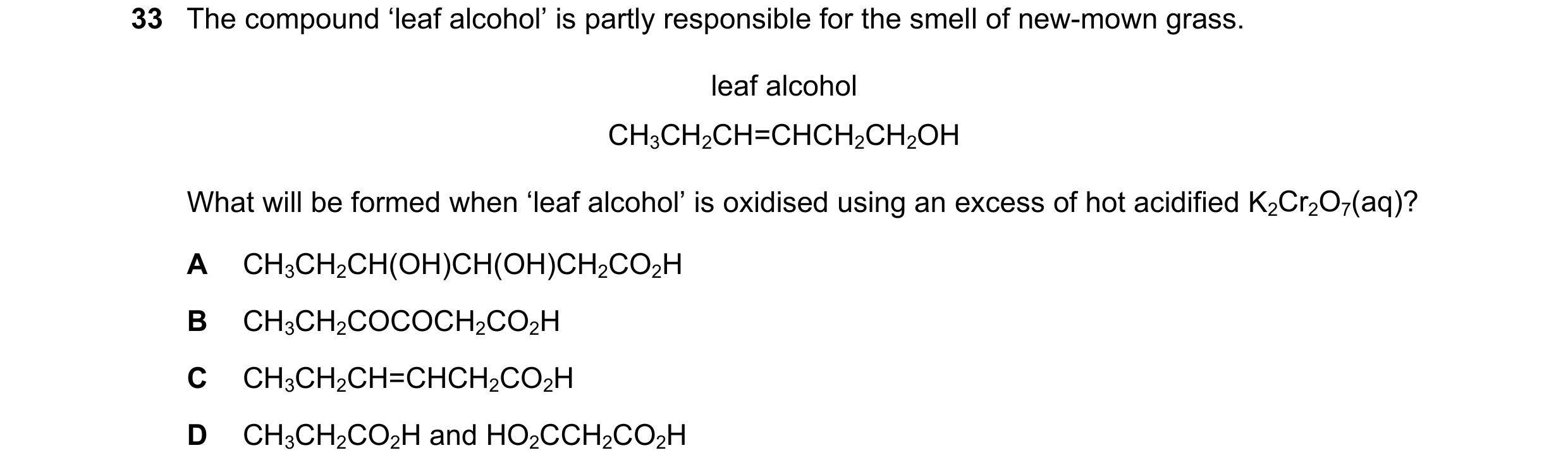
Q141 · The compound ‘leaf alcohol’ is partly responsible for the smell of new-mown grass 9701/12 Oct/Nov 2024
33 The compound ‘leaf alcohol’ is partly responsible for the smell of new-mown grass. leaf alcohol CH3CH2CH=CHCH2CH2OH What will be formed when ‘leaf alcohol’ is oxidised using an excess of hot acidified K2Cr2O7(aq)? A CH3CH2CH(OH)CH(OH)CH2CO2H B CH3CH2COCOCH2CO2H C CH3CH2CH=CHCH2CO2H D CH3CH2CO2H and HO2CCH2CO2H
1 marks
Answer: C
This question in 9701/12 Oct/Nov 2024
Q142 · A sample of propanoic acid of mass 3.70 g reacts with an excess of magnesium 9701/12 Oct/Nov 2024
37 A sample of propanoic acid of mass 3.70 g reacts with an excess of magnesium. A second sample of propanoic acid of mass 3.70 g reacts with an excess of sodium. Both reactions go to completion forming a gas. Which row is correct? volume of gas formed volume of gas formed with magnesium with sodium at s.t.p. / cm3 at s.t.p. / cm3 A 560 560 B 560 1120 C 1120 560 D 1120 1120
1 marks
Answer: A
This question in 9701/12 Oct/Nov 2024
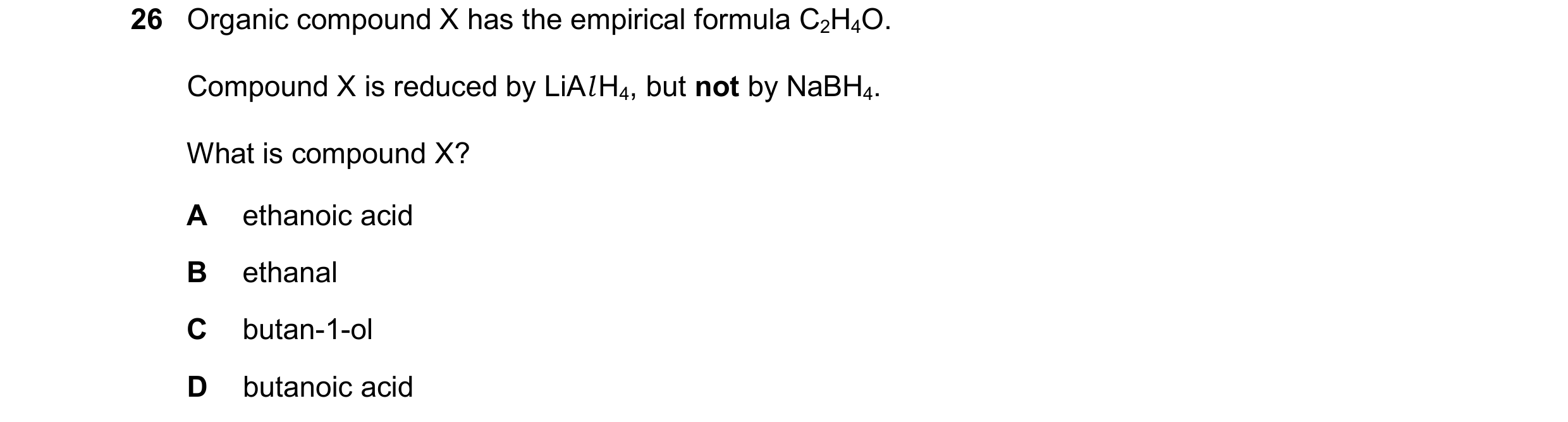
Q143 · Organic compound X has the empirical formula C2H4O 9701/12 Feb/March 2025
26 Organic compound X has the empirical formula C2H4O. Compound X is reduced by LiAl H4, but not by NaBH4. What is compound X? A ethanoic acid B ethanal C butan-1-ol D butanoic acid
1 marks
Answer: D
This question in 9701/12 Feb/March 2025
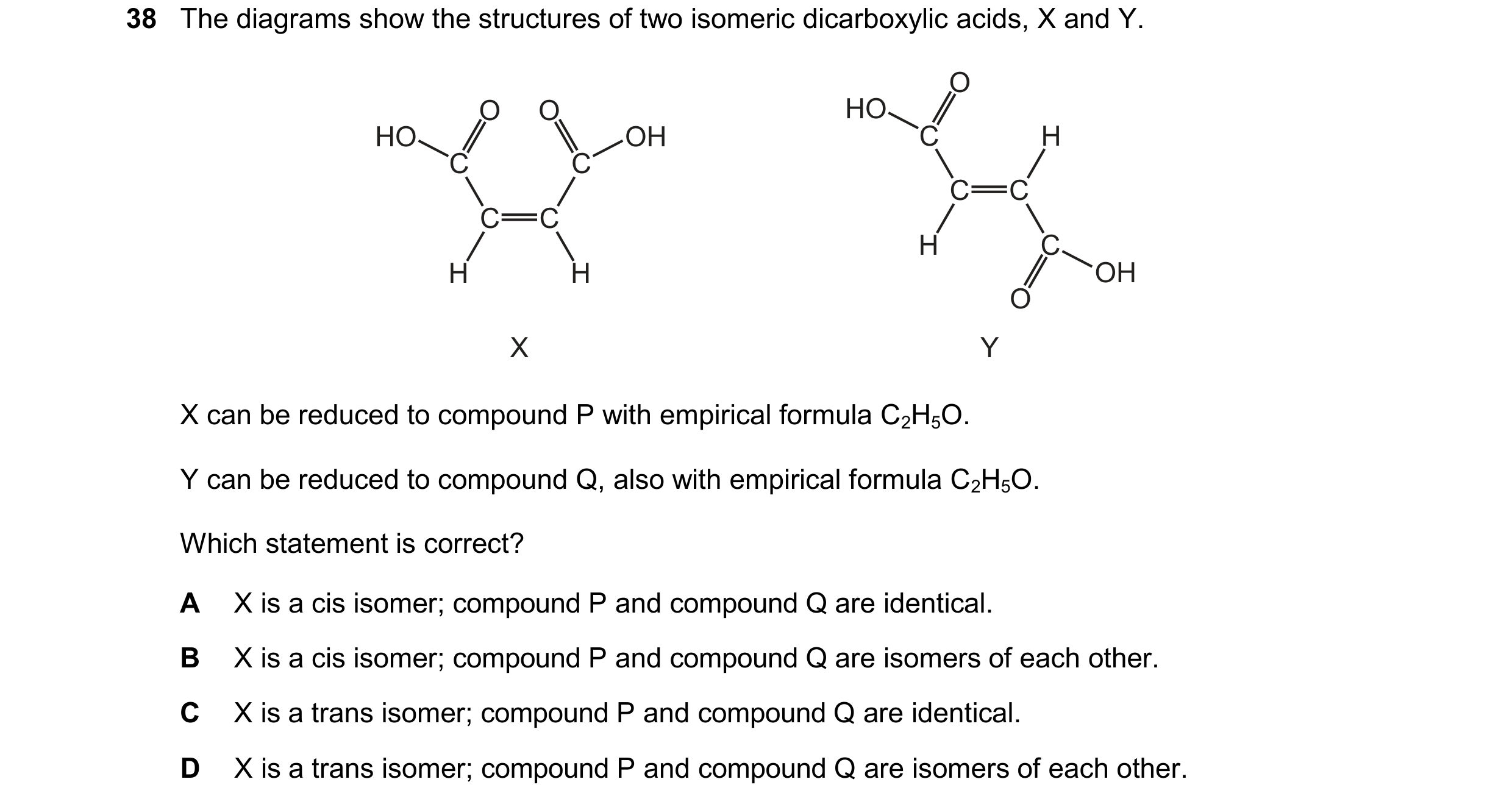
Q144 · The diagrams show the structures of two isomeric dicarboxylic acids, X and Y 9701/12 Feb/March 2025
38 The diagrams show the structures of two isomeric dicarboxylic acids, X and Y. O O O HO HO OH C H C C C C C C H C H H OH O X Y X can be reduced to compound P with empirical formula C2H5O. Y can be reduced to compound Q, also with empirical formula C2H5O. Which statement is correct? A X is a cis isomer; compound P and compound Q are identical. B X is a cis isomer; compound P and compound Q are isomers of each other. C X is a trans isomer; compound P and compound Q are identical. D X is a trans isomer; compound P and compound Q are isomers of each other.
1 marks
Answer: A
This question in 9701/12 Feb/March 2025
Q145 · P is a compound that burns in an excess of oxygen to give carbon dioxide and water only 9701/11 May/June 2025
6 P is a compound that burns in an excess of oxygen to give carbon dioxide and water only. 2.20g of P contains 1.20g of carbon and 0.20g of hydrogen. When P is added to a solution of sodium carbonate, bubbles of gas are seen. What is P? A CH3CHO B CH3CO2H C CH3COCH2CH2OH D CH3CH2CH2CO2H
1 marks
Answer: D
This question in 9701/11 May/June 2025
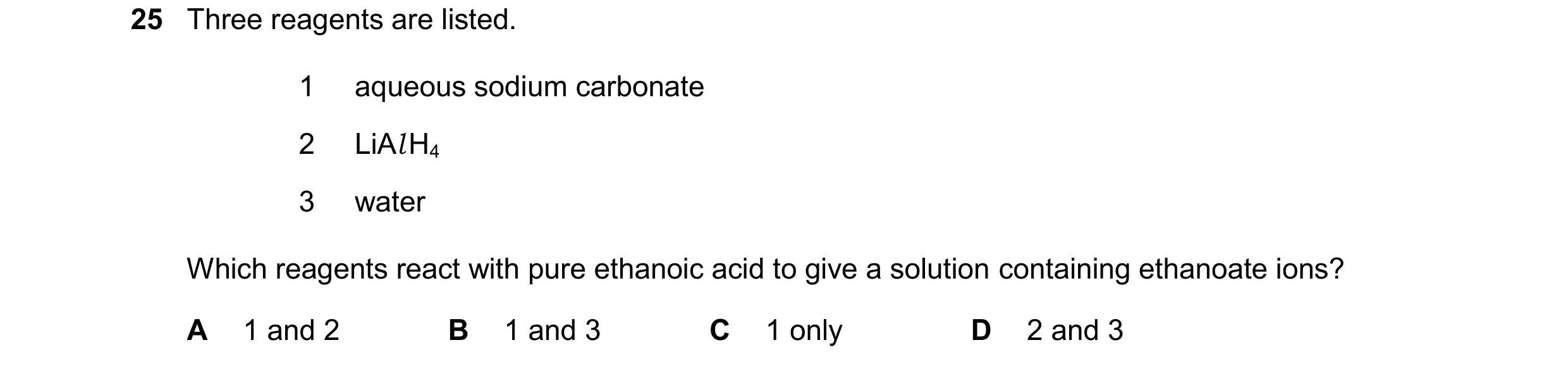
Q146 · Three reagents are listed 9701/11 May/June 2025
25 Three reagents are listed. 1 aqueous sodium carbonate 2 LiAlH4 3 water Which reagents react with pure ethanoic acid to give a solution containing ethanoate ions? A 1 and 2 B 1 and 3 C 1 only D 2 and 3
1 marks
Answer: B
This question in 9701/11 May/June 2025
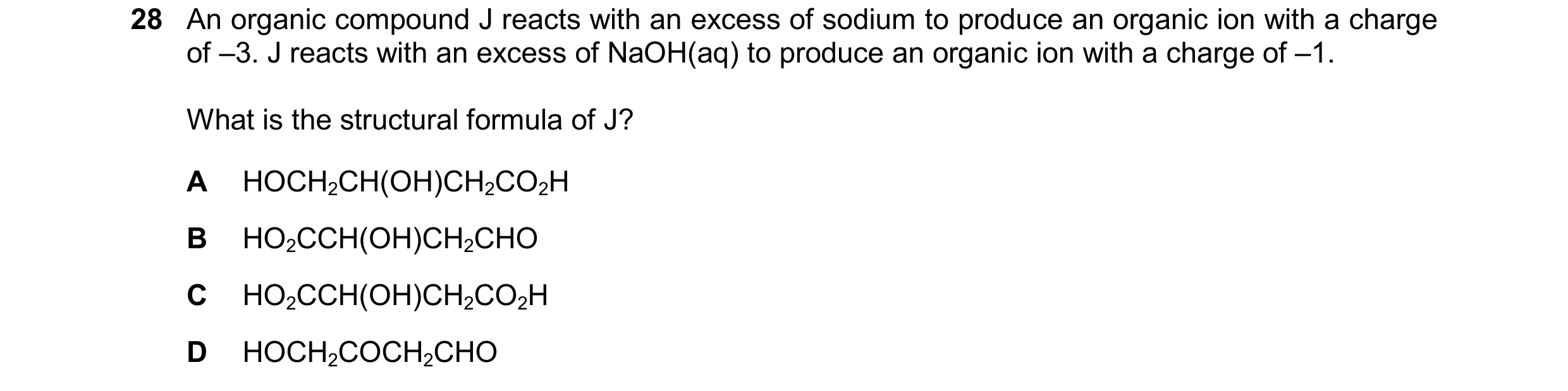
Q147 · An organic compound J reacts with an excess of sodium to produce an organic ion with a… 9701/11 May/June 2025
28 An organic compound J reacts with an excess of sodium to produce an organic ion with a charge of –3. J reacts with an excess of NaOH(aq) to produce an organic ion with a charge of –1. What is the structural formula of J? A HOCH2CH(OH)CH2CO2H B HO2CCH(OH)CH2CHO C HO2CCH(OH)CH2CO2H D HOCH2COCH2CHO
1 marks
Answer: A
This question in 9701/11 May/June 2025
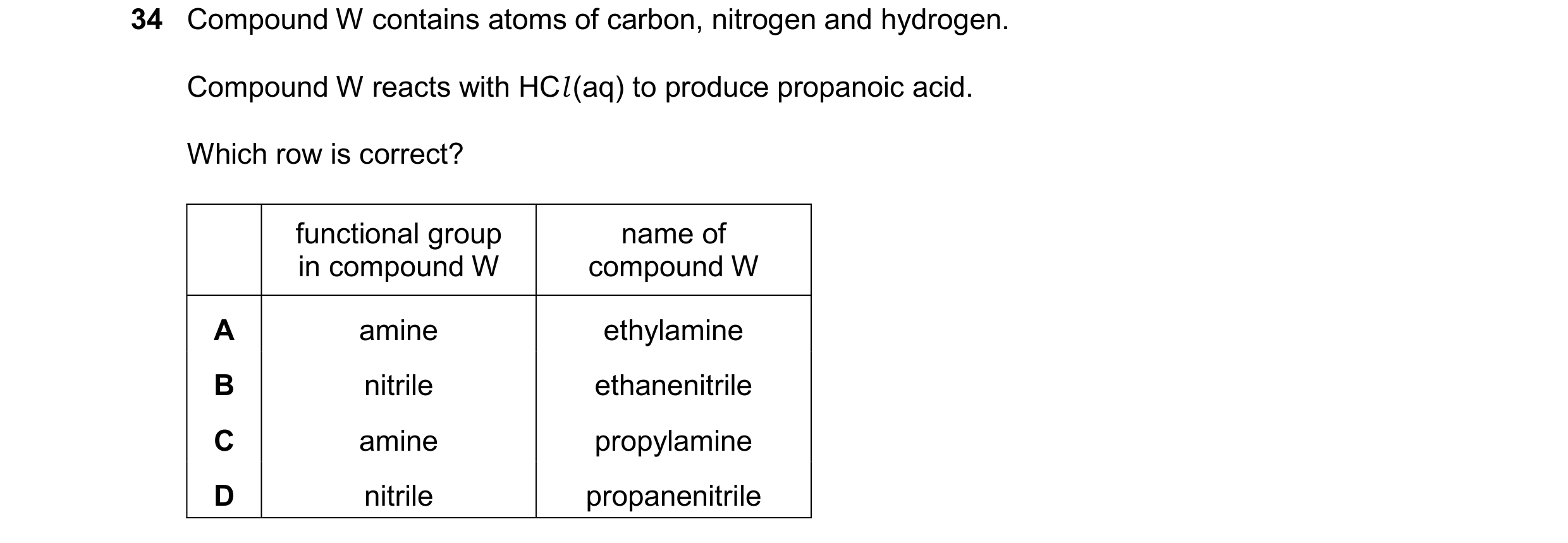
Q148 · Compound W contains atoms of carbon, nitrogen and hydrogen 9701/11 May/June 2025
34 Compound W contains atoms of carbon, nitrogen and hydrogen. Compound W reacts with HCl(aq) to produce propanoic acid. Which row is correct? functional group in compound W name of compound W A amine ethylamine B nitrile ethanenitrile C amine propylamine D nitrile propanenitrile
1 marks
Answer: D
This question in 9701/11 May/June 2025
Q149 · Compound M is a white solid 9701/12 May/June 2025
18 Compound M is a white solid. It is the chloride of a Period 3 element. Information about some reactions starting with compound M is given in the table. reaction observation compound M + non-polar solvent colourless solution compound M added a little at a time to water steamy fumes, Q colourless solution, R fumes Q tested with moist blue litmus paper paper turns red solution R + a few drops of NaOH(aq) white precipitate + excess NaOH(aq) dissolves to give a colourless solution What is compound M? A aluminium chloride B magnesium chloride C phosphorus pentachloride D sodium chloride
1 marks
Answer: A
This question in 9701/12 May/June 2025
Q150 · Methanoic acid, HCO2H, has acidic properties similar to those of other carboxylic acids 9701/12 May/June 2025
27 Methanoic acid, HCO2H, has acidic properties similar to those of other carboxylic acids. In addition, it can be oxidised by the same oxidising agents that are capable of oxidising aldehydes. Which pair consists of two compounds that will give the same observations with Fehling’s reagent? A HCO2H and CH3CO2H B HCO2H and CH3CO2CH3 C HCO2H and CH3CH2COCH3 D HCO2H and CH3CH2CHO
1 marks
Answer: D
This question in 9701/12 May/June 2025
Q151 · What is the empirical formula of butanoic acid? 9701/14 May/June 2025
2 What is the empirical formula of butanoic acid? A C2H4O B C3H6O C C4H8O D C5H10O
1 marks
Answer: A
This question in 9701/14 May/June 2025
Q152 · Three mixtures are heated under reflux 9701/11 Oct/Nov 2025
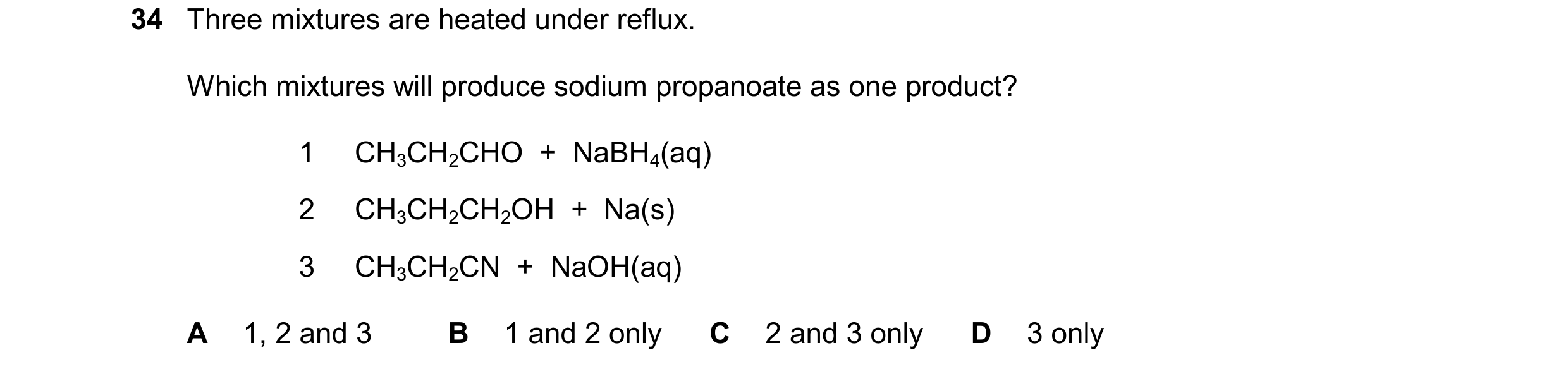
34 Three mixtures are heated under reflux. Which mixtures will produce sodium propanoate as one product? 1 CH3CH2CHO + NaBH4(aq) 2 CH3CH2CH2OH + Na(s) 3 CH3CH2CN + NaOH(aq) A 1, 2 and 3 B 1 and 2 only C 2 and 3 only D 3 only
1 marks
Answer: D
This question in 9701/11 Oct/Nov 2025
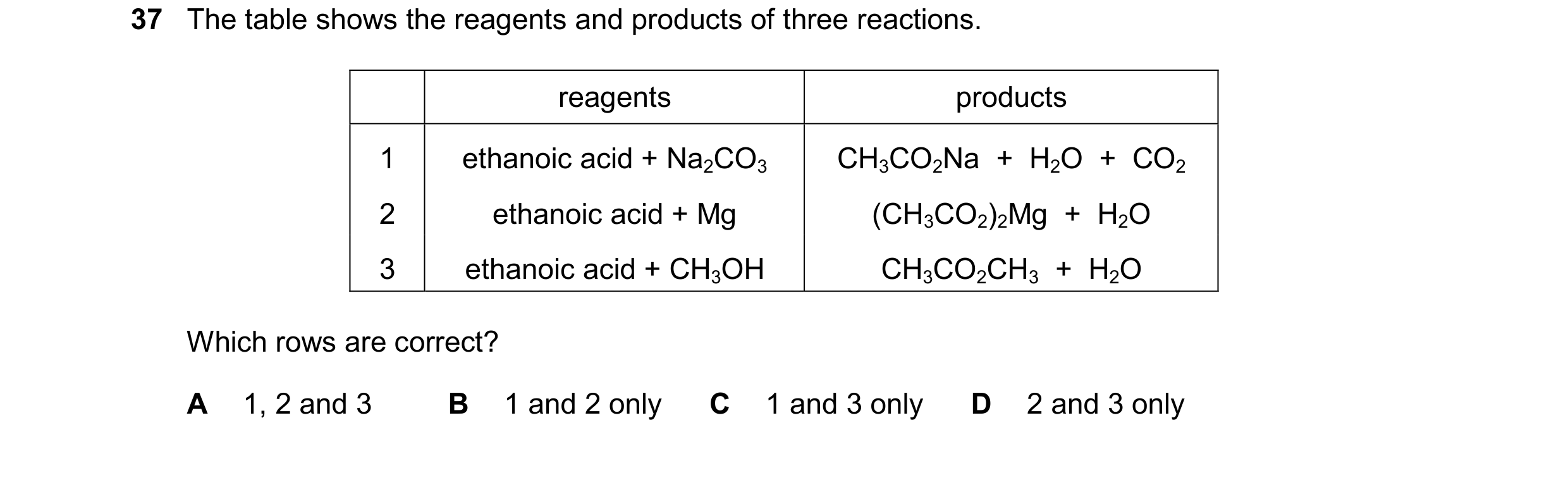
Q153 · The table shows the reagents and products of three reactions 9701/11 Oct/Nov 2025
37 The table shows the reagents and products of three reactions. reagents products 1 ethanoic acid + Na2CO3 CH3CO2Na + H2O + CO2 2 ethanoic acid + Mg (CH3CO2)2Mg + H2O 3 ethanoic acid + CH3OH CH3CO2CH3 + H2O Which rows are correct? A 1, 2 and 3 B 1 and 2 only C 1 and 3 only D 2 and 3 only
1 marks
Answer: C
This question in 9701/11 Oct/Nov 2025
Q154 · HOCH2CHO is heated under reflux with an excess of acidified K2Cr2O7 until there is no… 9701/12 Oct/Nov 2025
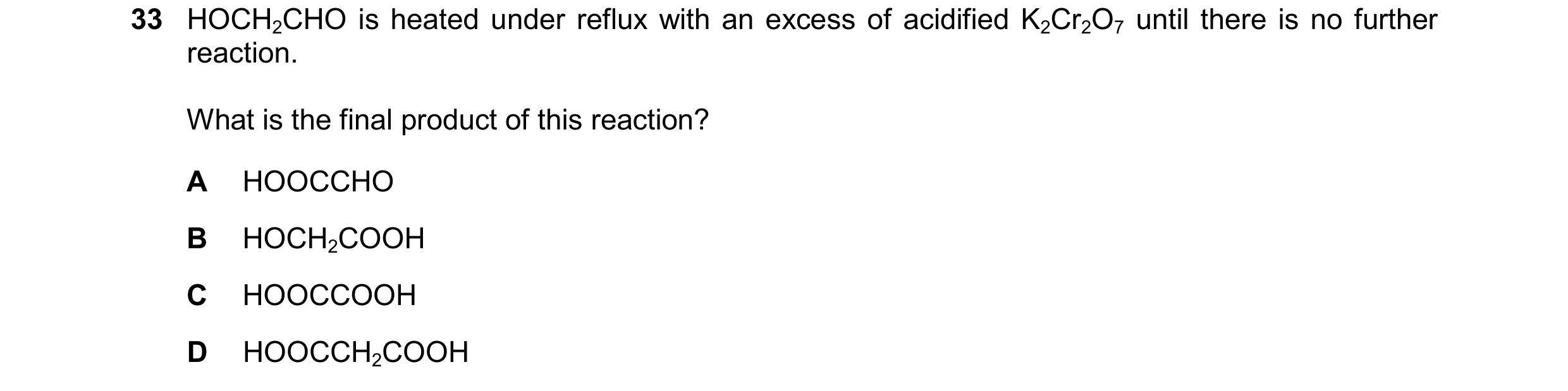
33 HOCH2CHO is heated under reflux with an excess of acidified K2Cr2O7 until there is no further reaction. What is the final product of this reaction? A HOOCCHO B HOCH2COOH C HOOCCOOH D HOOCCH2COOH
1 marks
Answer: C
This question in 9701/12 Oct/Nov 2025
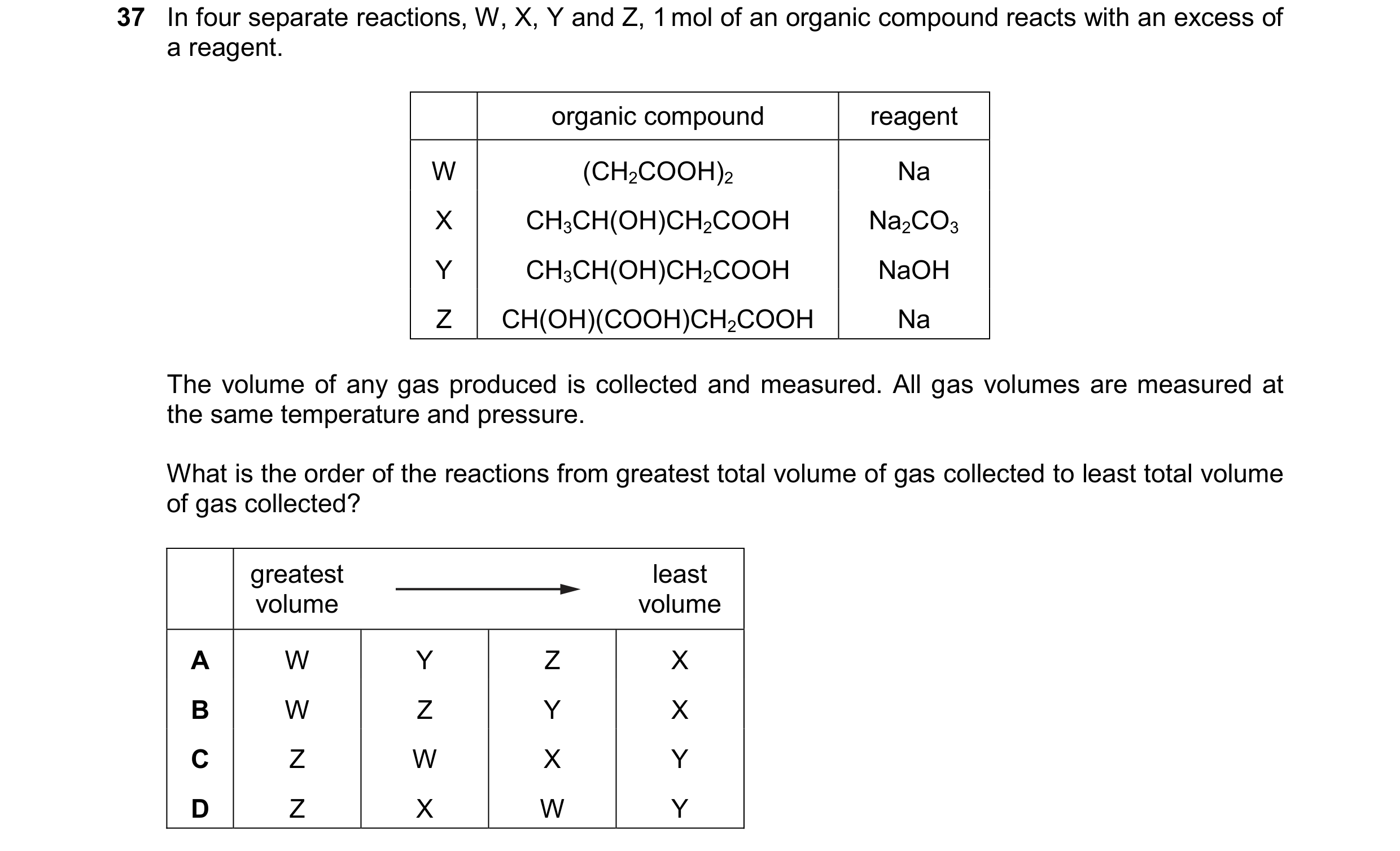
Q155 · In four separate reactions, W, X, Y and Z, 1 mol of an organic compound reacts with an… 9701/12 Oct/Nov 2025
37 In four separate reactions, W, X, Y and Z, 1 mol of an organic compound reacts with an excess of a reagent. organic compound reagent W (CH2COOH)2 Na X CH3CH(OH)CH2COOH Na2CO3 Y CH3CH(OH)CH2COOH NaOH Z CH(OH)(COOH)CH2COOH Na The volume of any gas produced is collected and measured. All gas volumes are measured at the same temperature and pressure. What is the order of the reactions from greatest total volume of gas collected to least total volume of gas collected? greatest least volume volume A W Y Z X B W Z Y X C Z W X Y D Z X W Y
1 marks
Answer: C
This question in 9701/12 Oct/Nov 2025
Q156 · Three mixtures are heated under reflux 9701/13 Oct/Nov 2025
34 Three mixtures are heated under reflux. Which mixtures will produce sodium propanoate as one product? 1 CH3CH2CHO + NaBH4(aq) 2 CH3CH2CH2OH + Na(s) 3 CH3CH2CN + NaOH(aq) A 1, 2 and 3 B 1 and 2 only C 2 and 3 only D 3 only
1 marks
Answer: D
This question in 9701/13 Oct/Nov 2025
Q157 · The table shows the reagents and products of three reactions 9701/13 Oct/Nov 2025
37 The table shows the reagents and products of three reactions. reagents products 1 ethanoic acid + Na2CO3 CH3CO2Na + H2O + CO2 2 ethanoic acid + Mg (CH3CO2)2Mg + H2O 3 ethanoic acid + CH3OH CH3CO2CH3 + H2O Which rows are correct? A 1, 2 and 3 B 1 and 2 only C 1 and 3 only D 2 and 3 only
1 marks
Answer: C
This question in 9701/13 Oct/Nov 2025

 1 / 47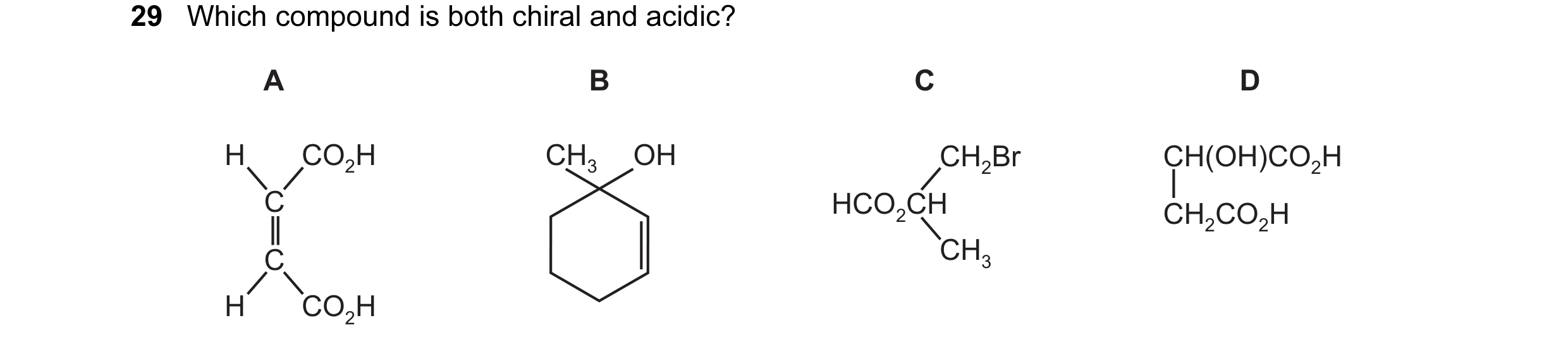
 2 / 47
 3 / 47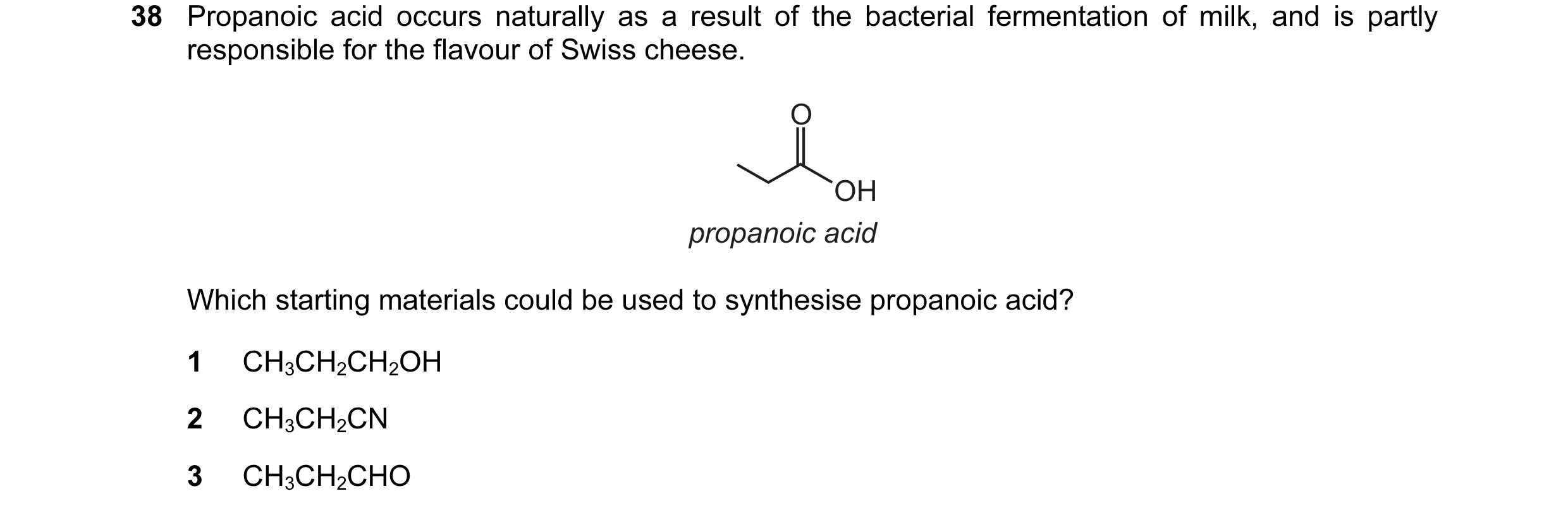
 4 / 47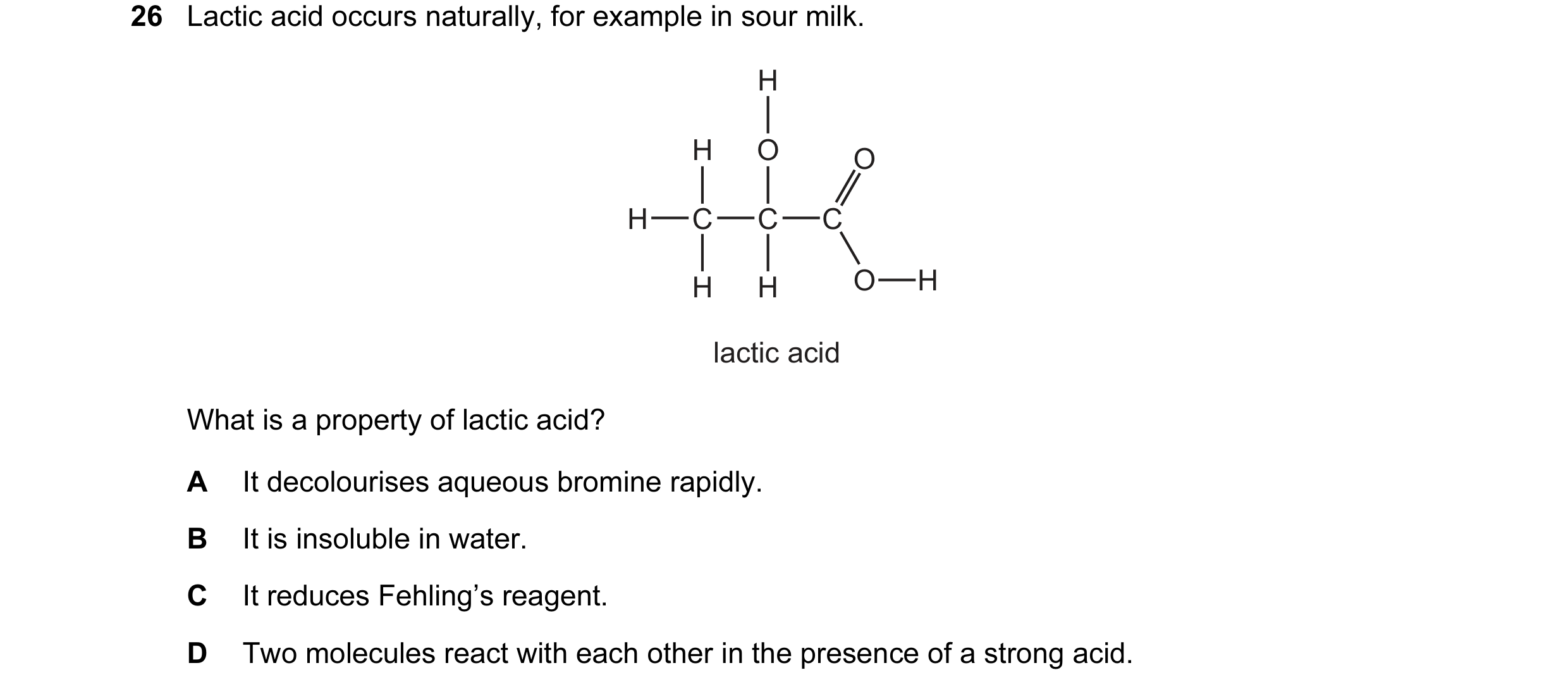
 5 / 47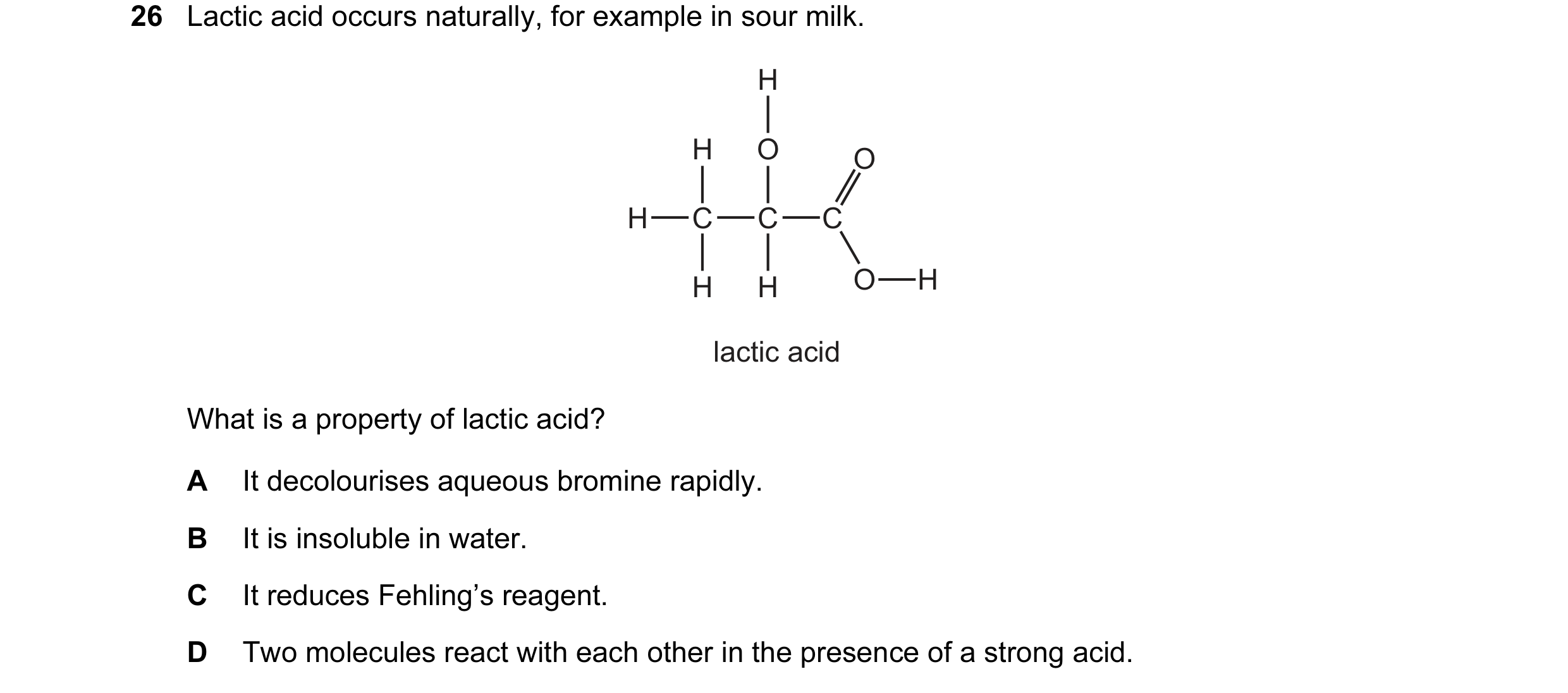
 6 / 47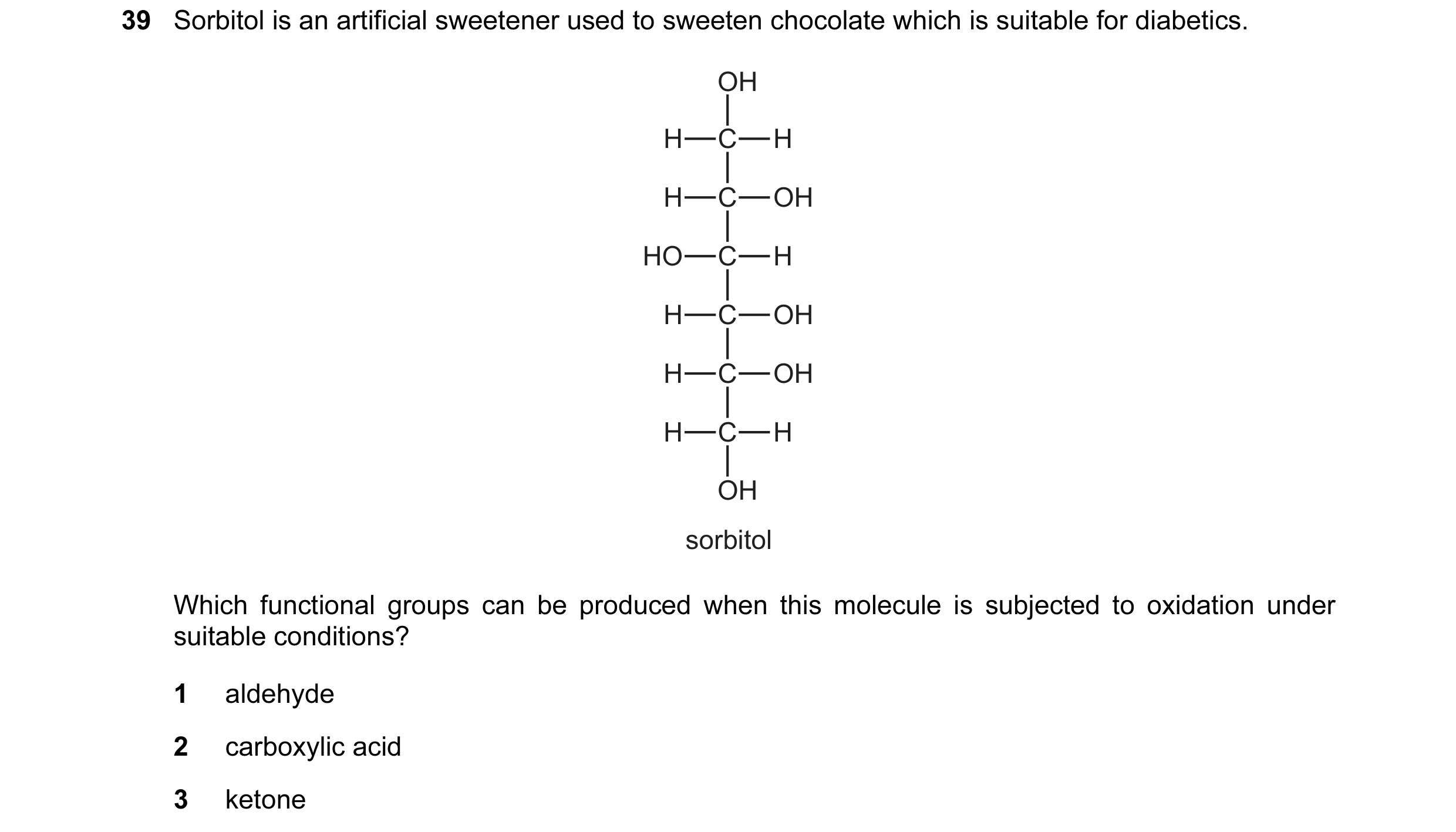

 7 / 47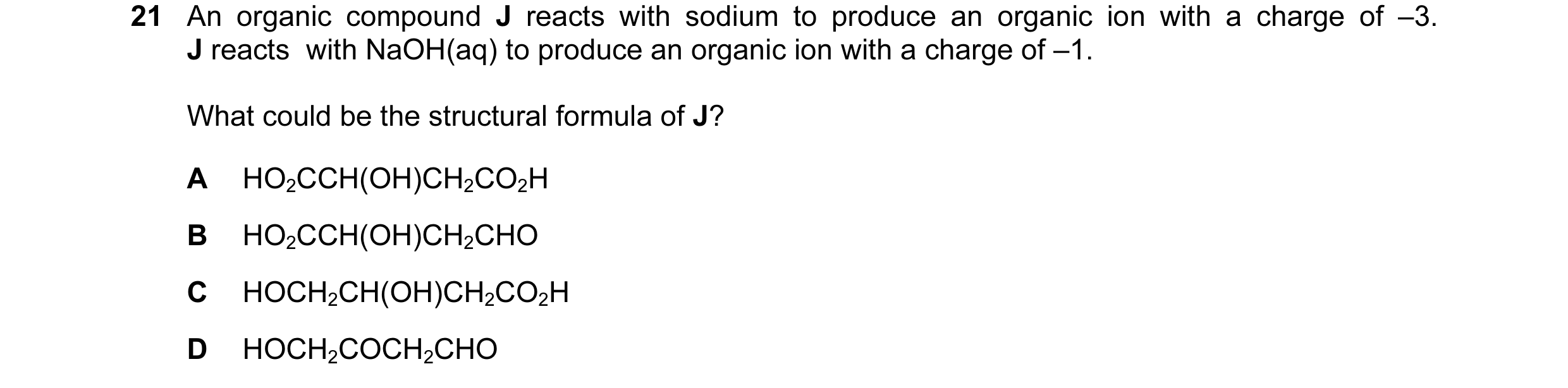

 8 / 47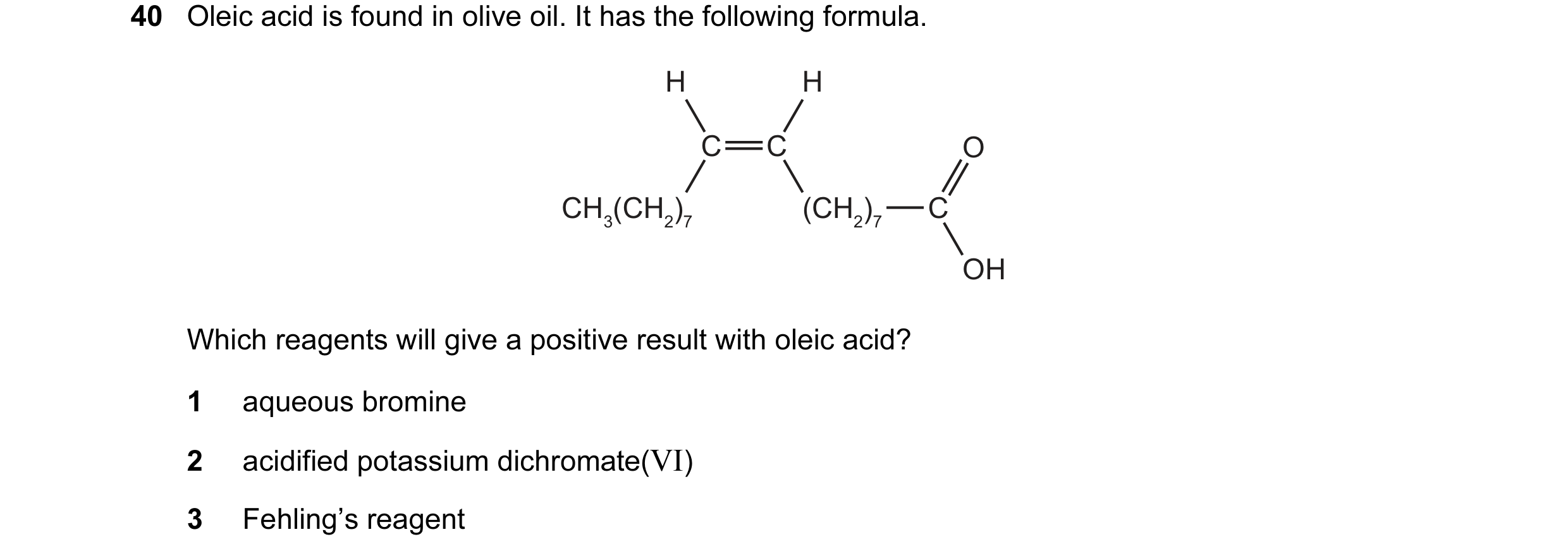
 9 / 47
 10 / 47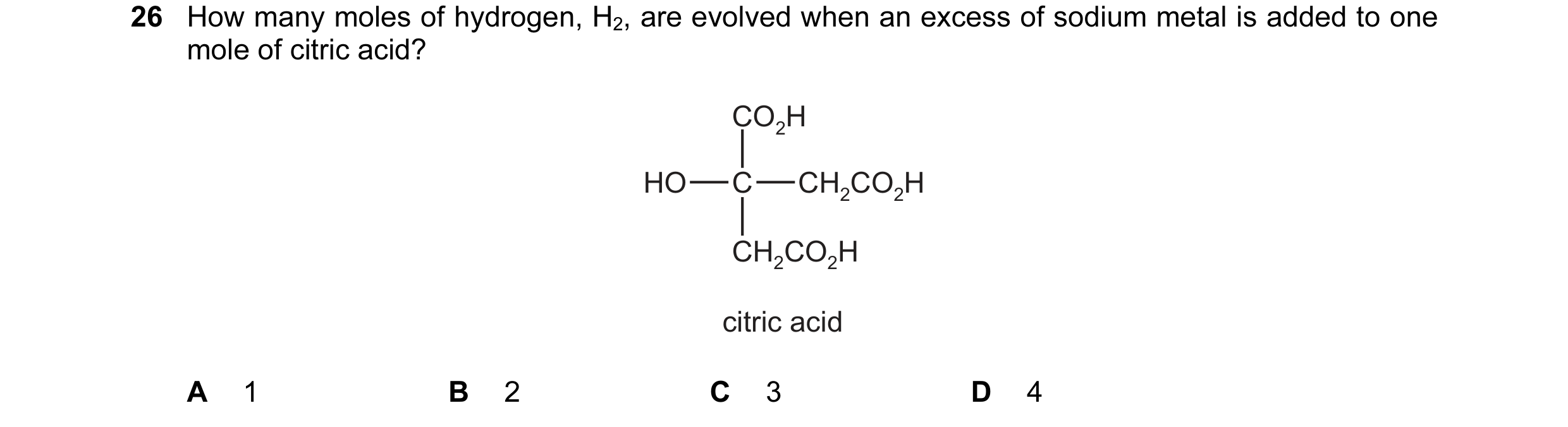
 11 / 47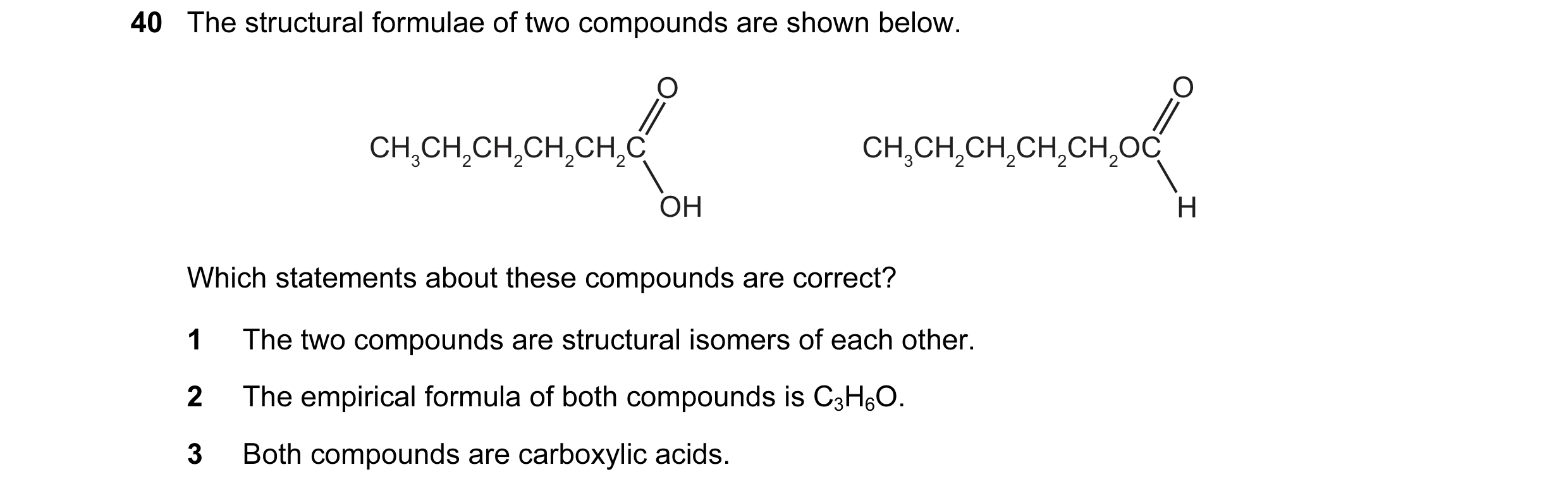

 12 / 47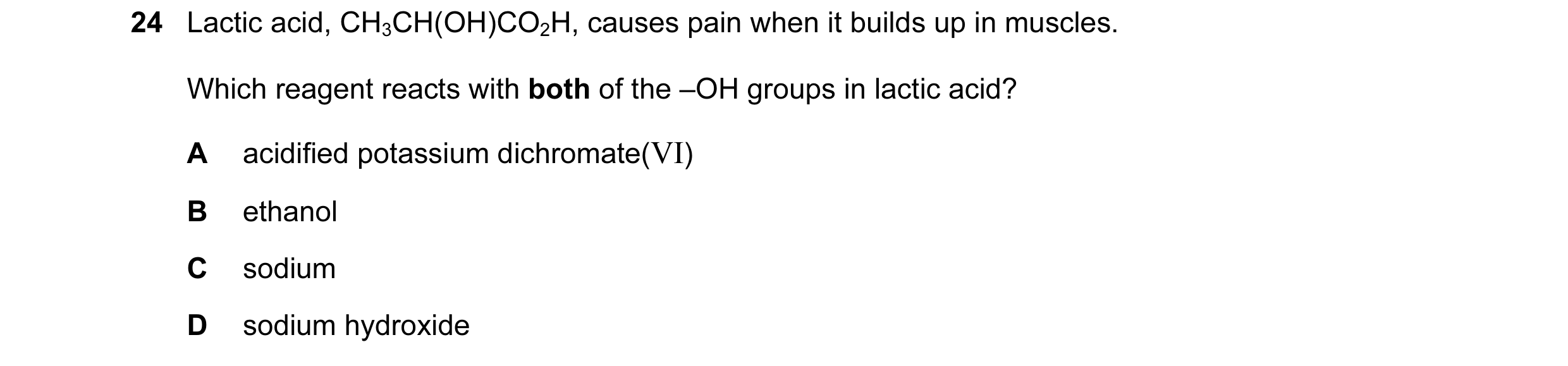
 13 / 47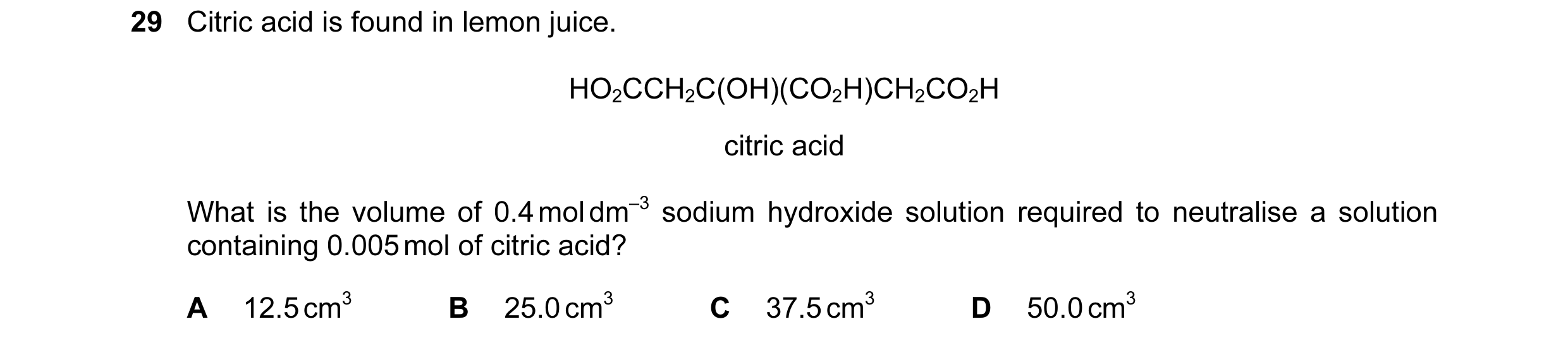

 14 / 47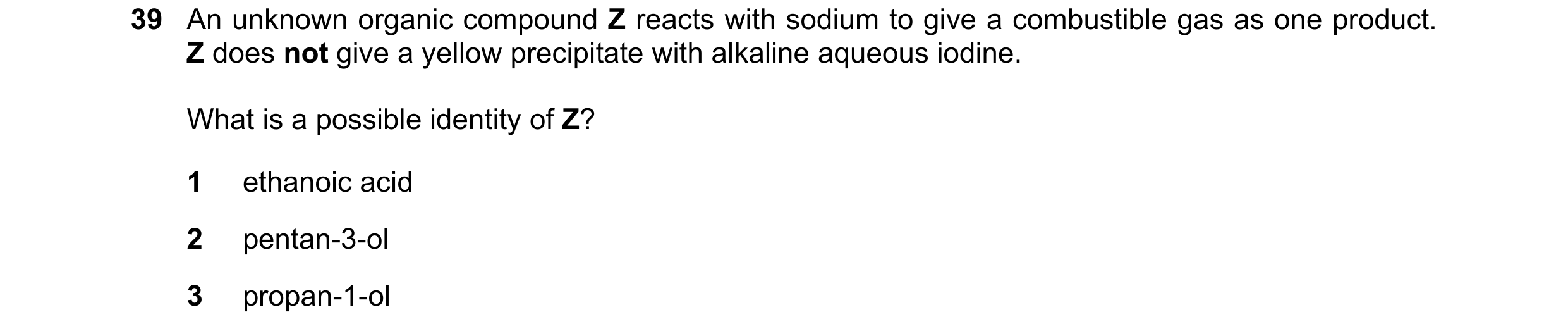
 15 / 47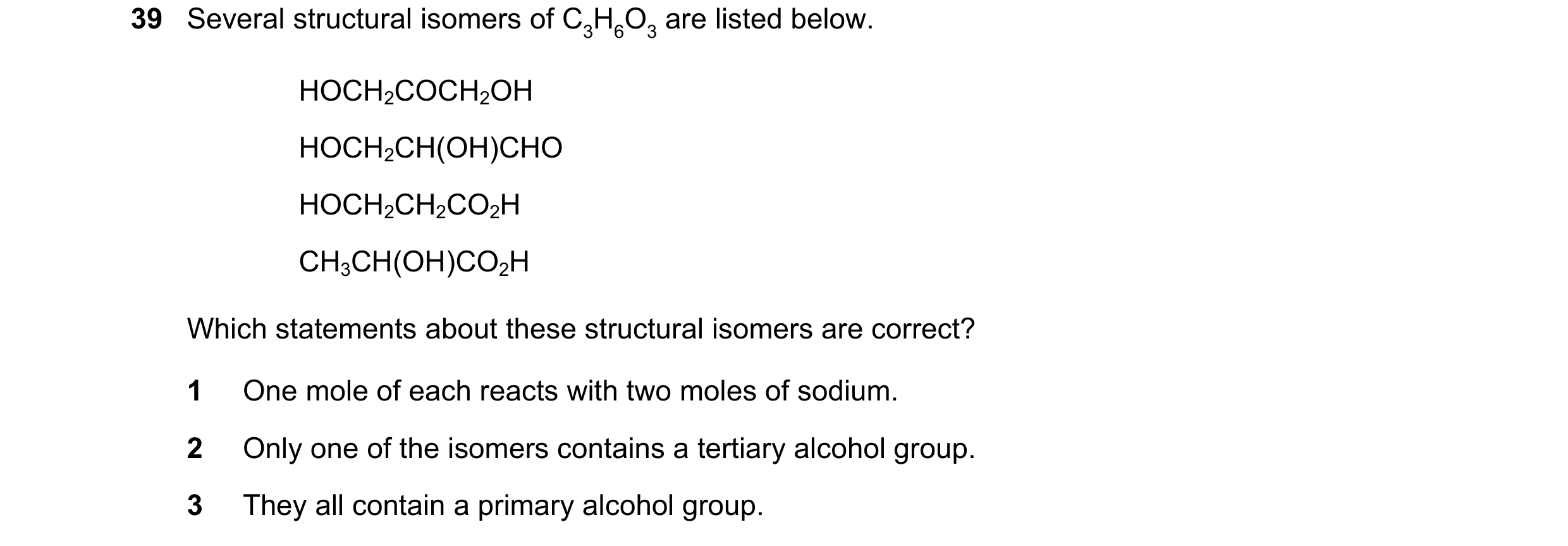

 16 / 47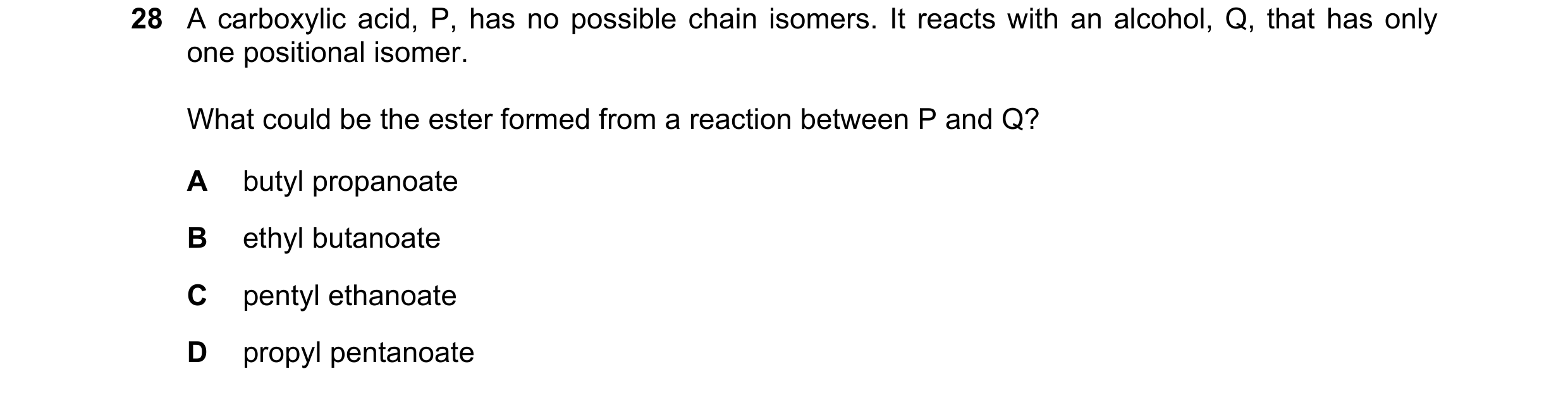
 17 / 47

 18 / 47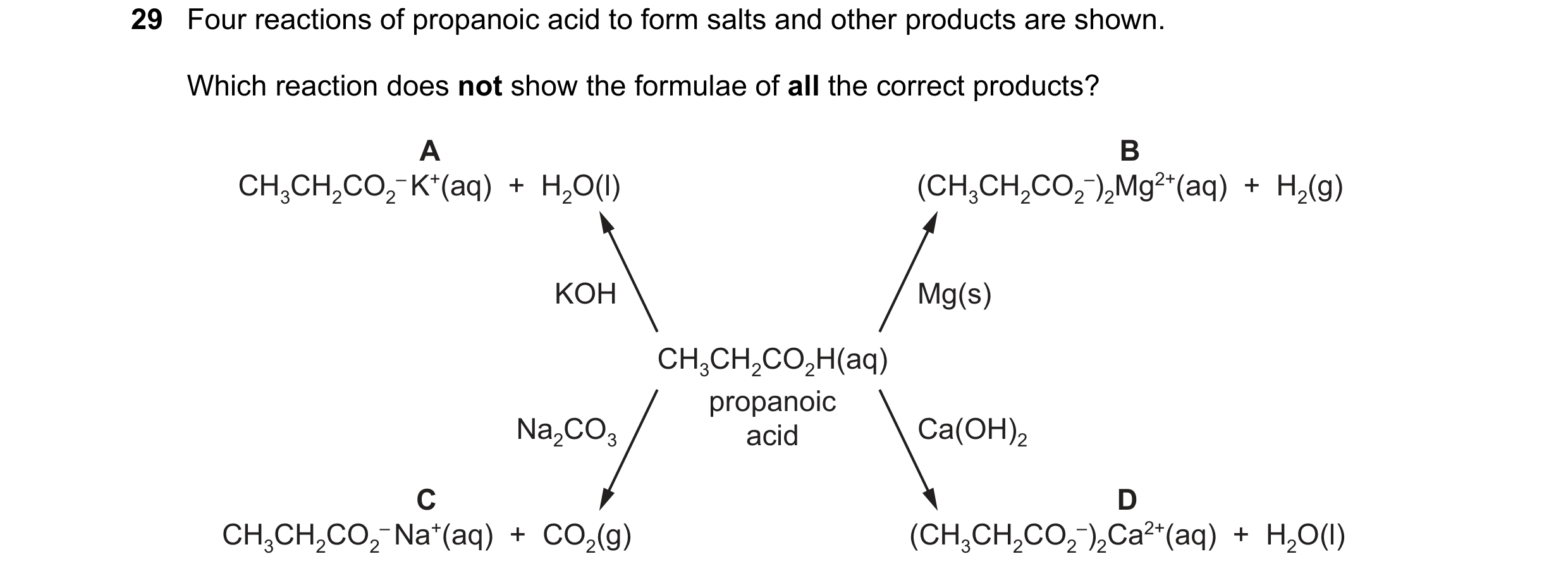
 19 / 47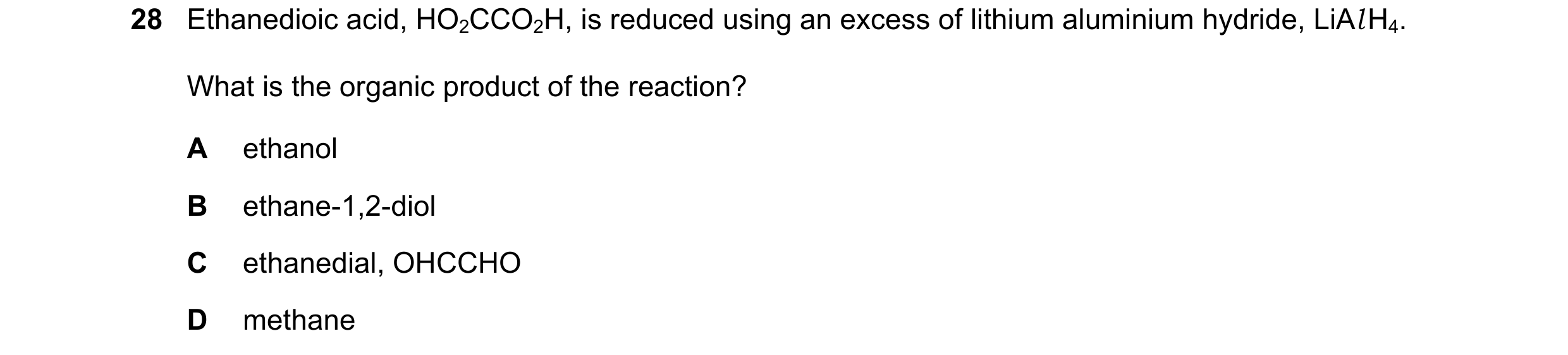
 20 / 47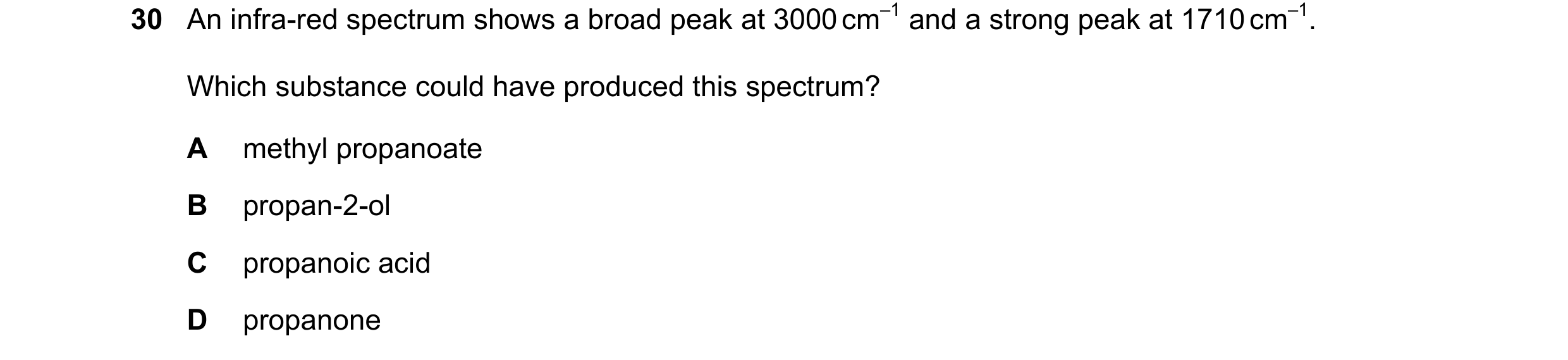


 21 / 47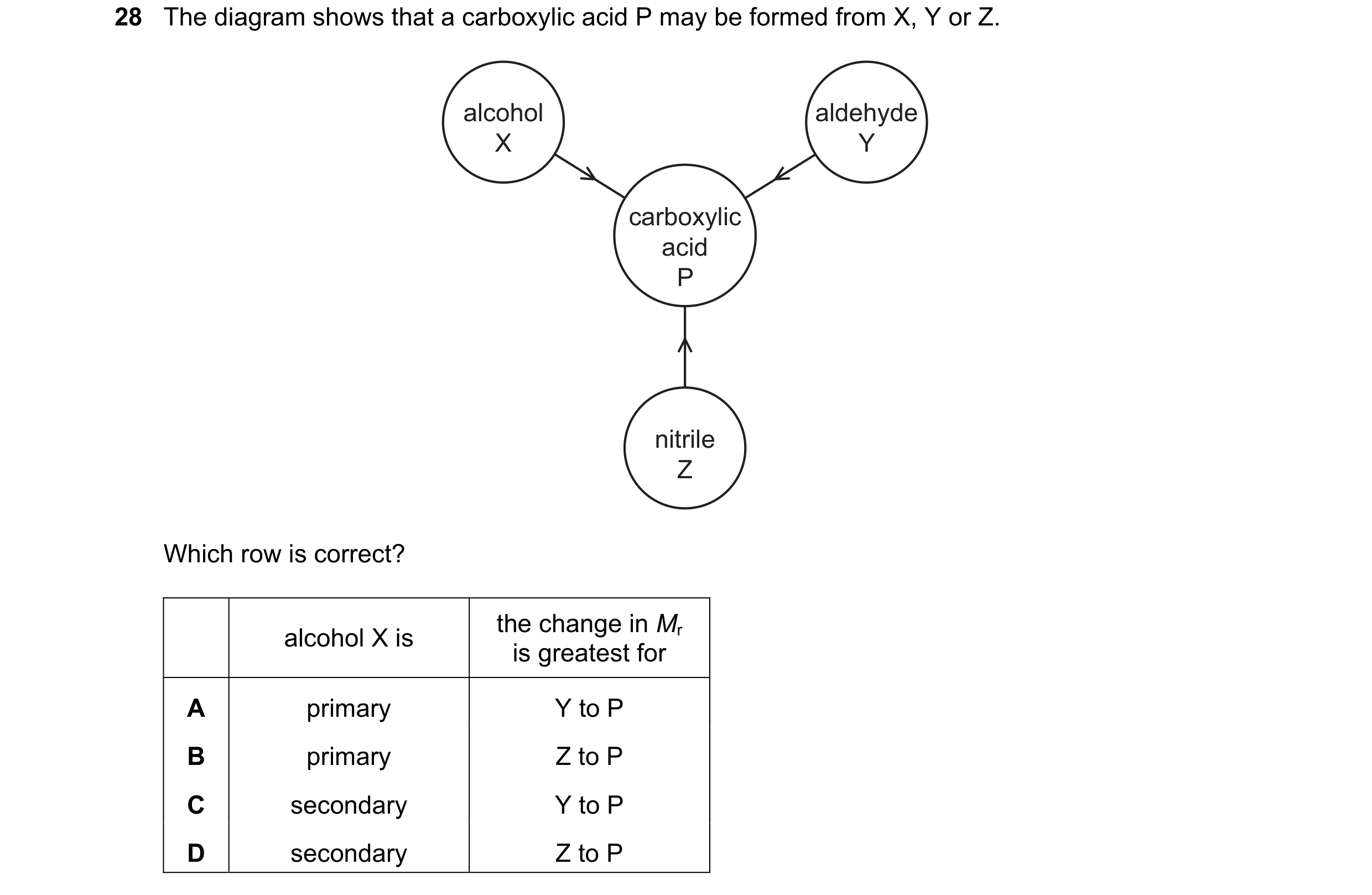
 22 / 47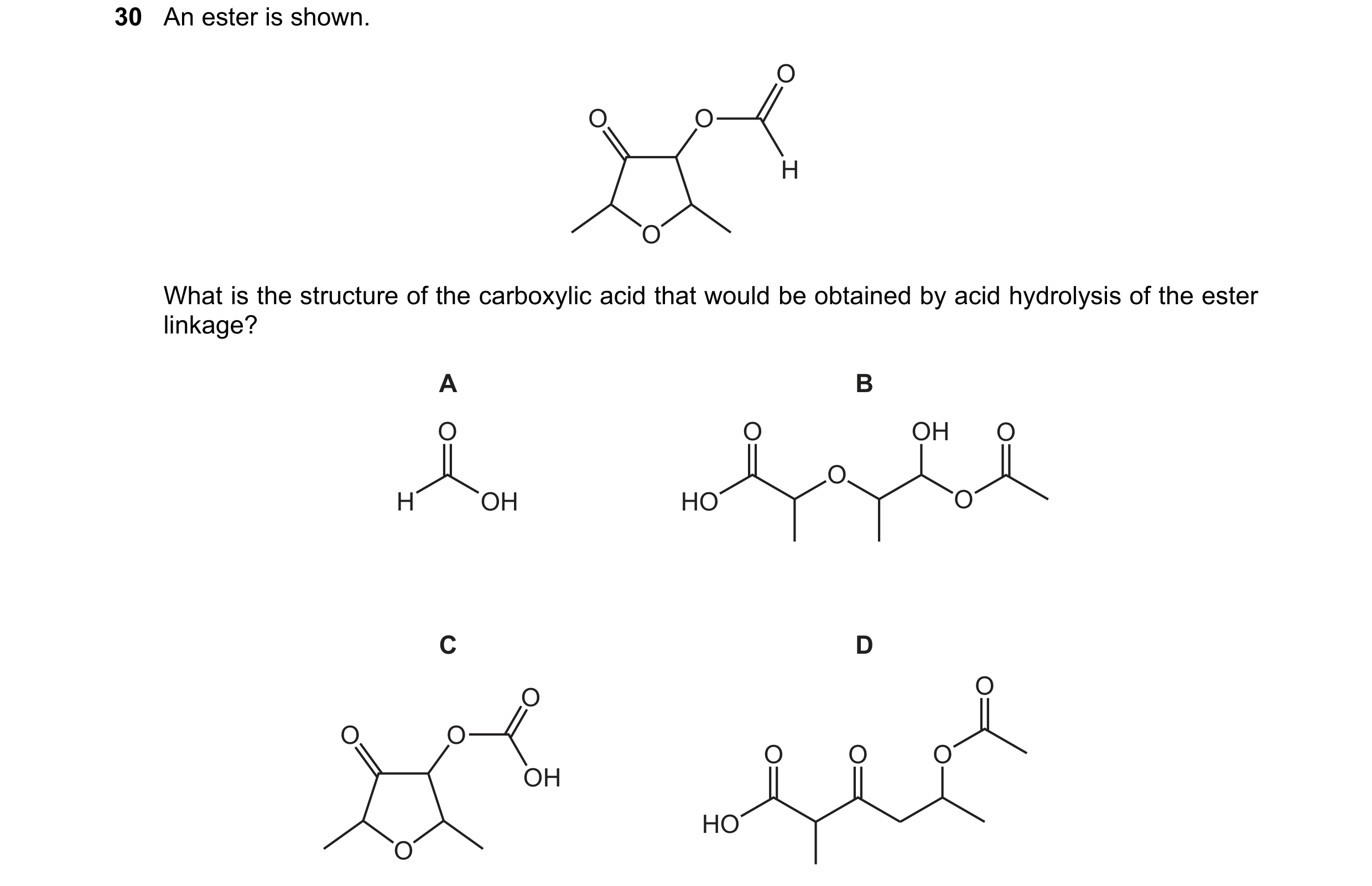
 23 / 47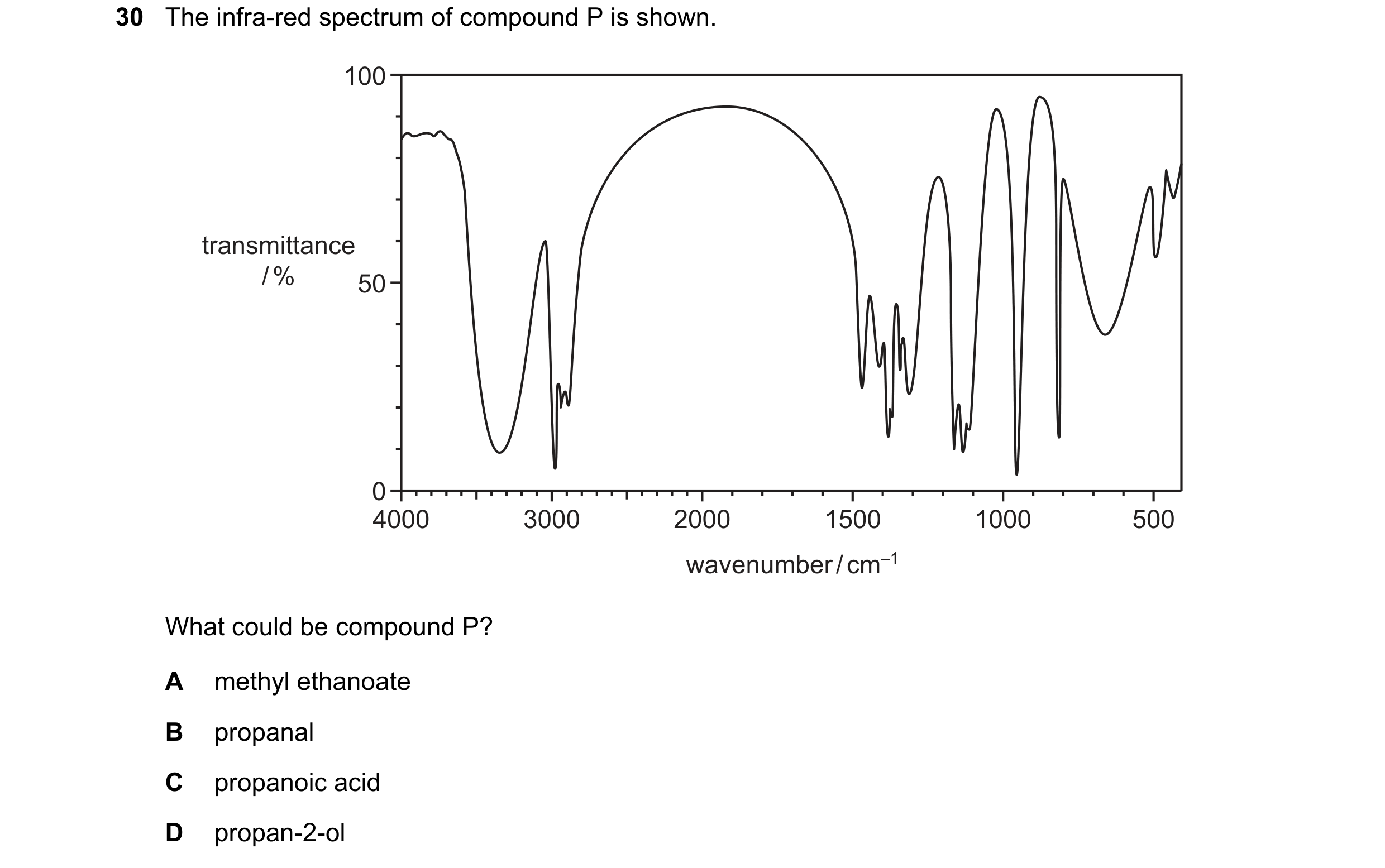
 24 / 47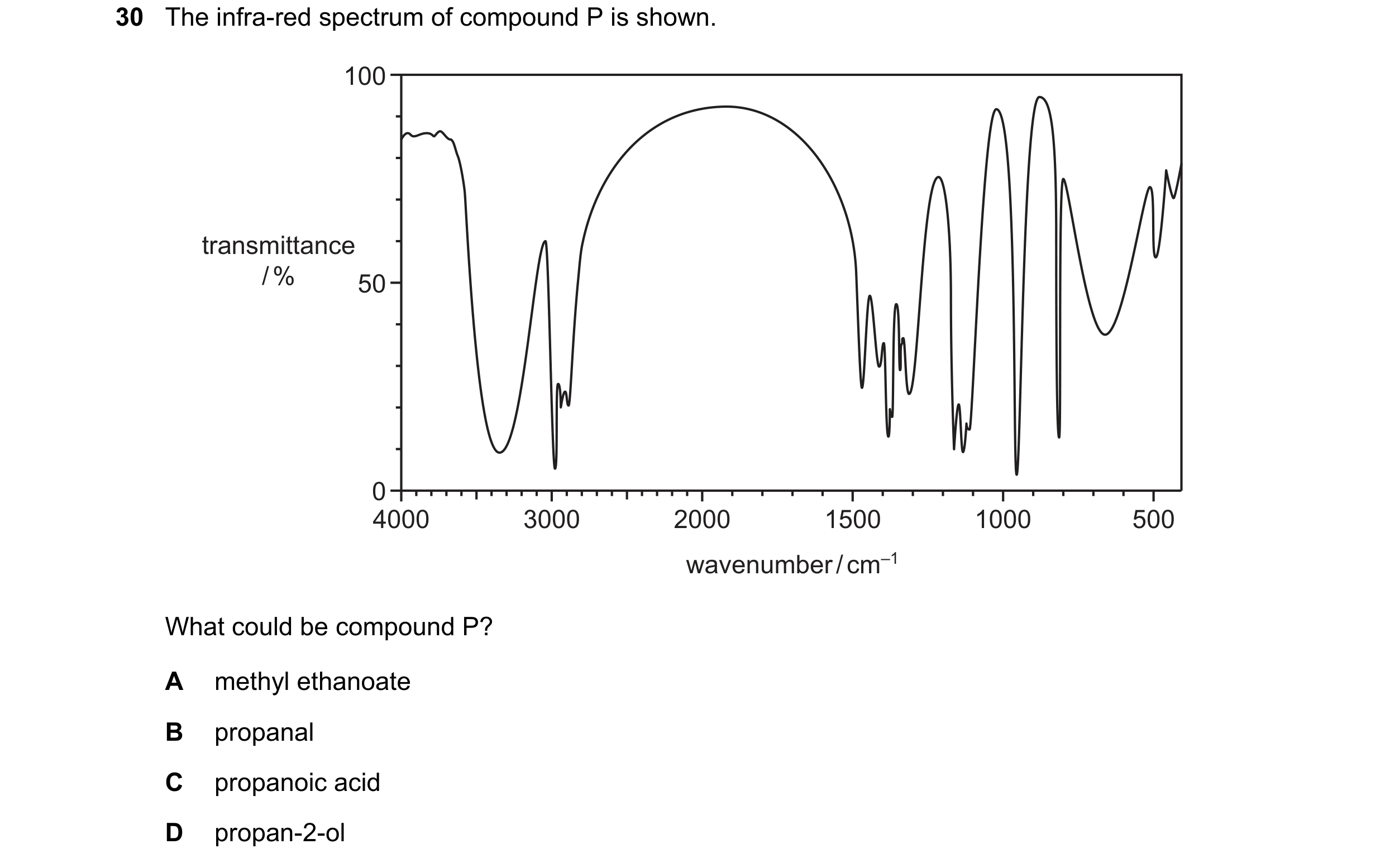

 25 / 47
 26 / 47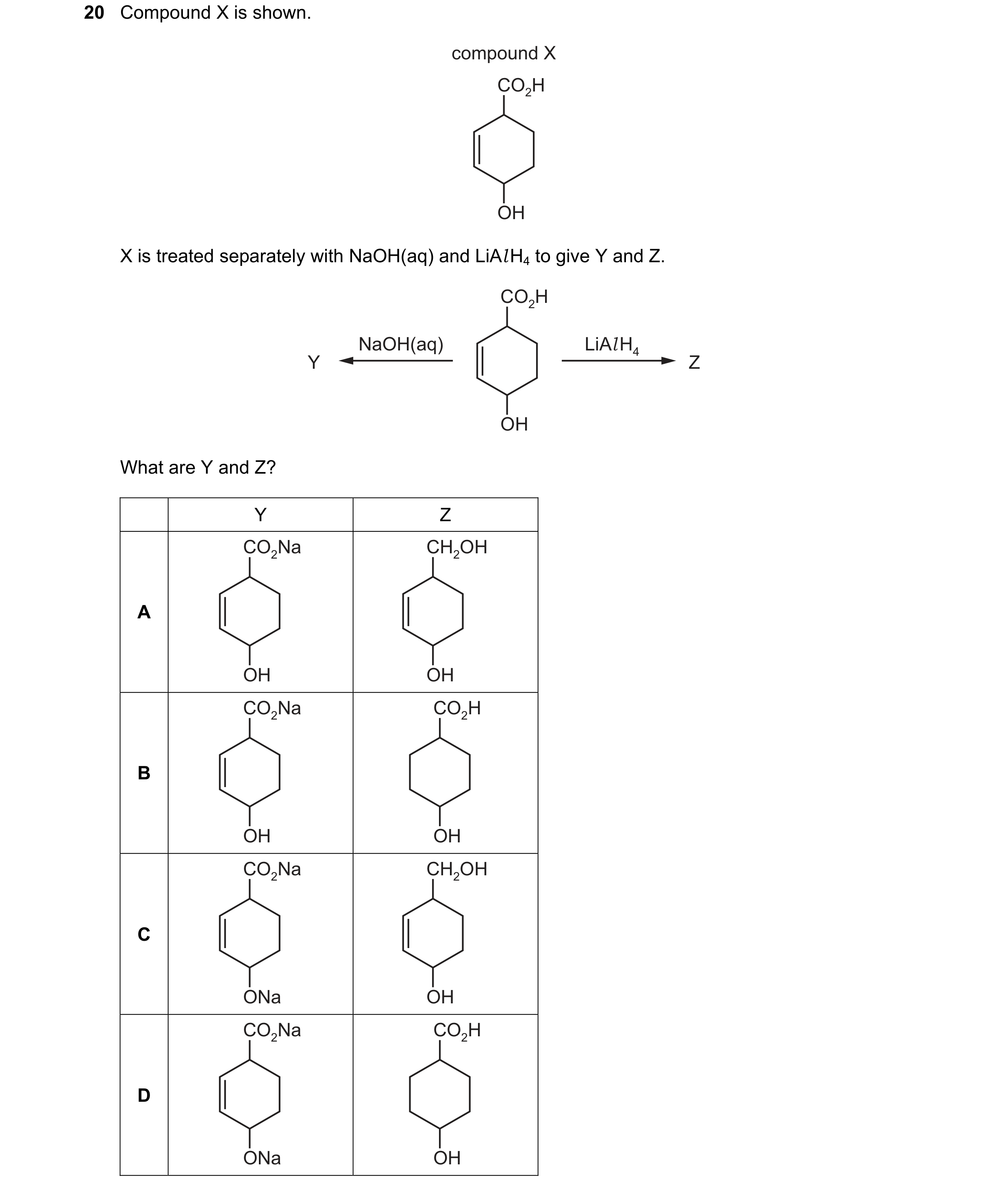
 27 / 47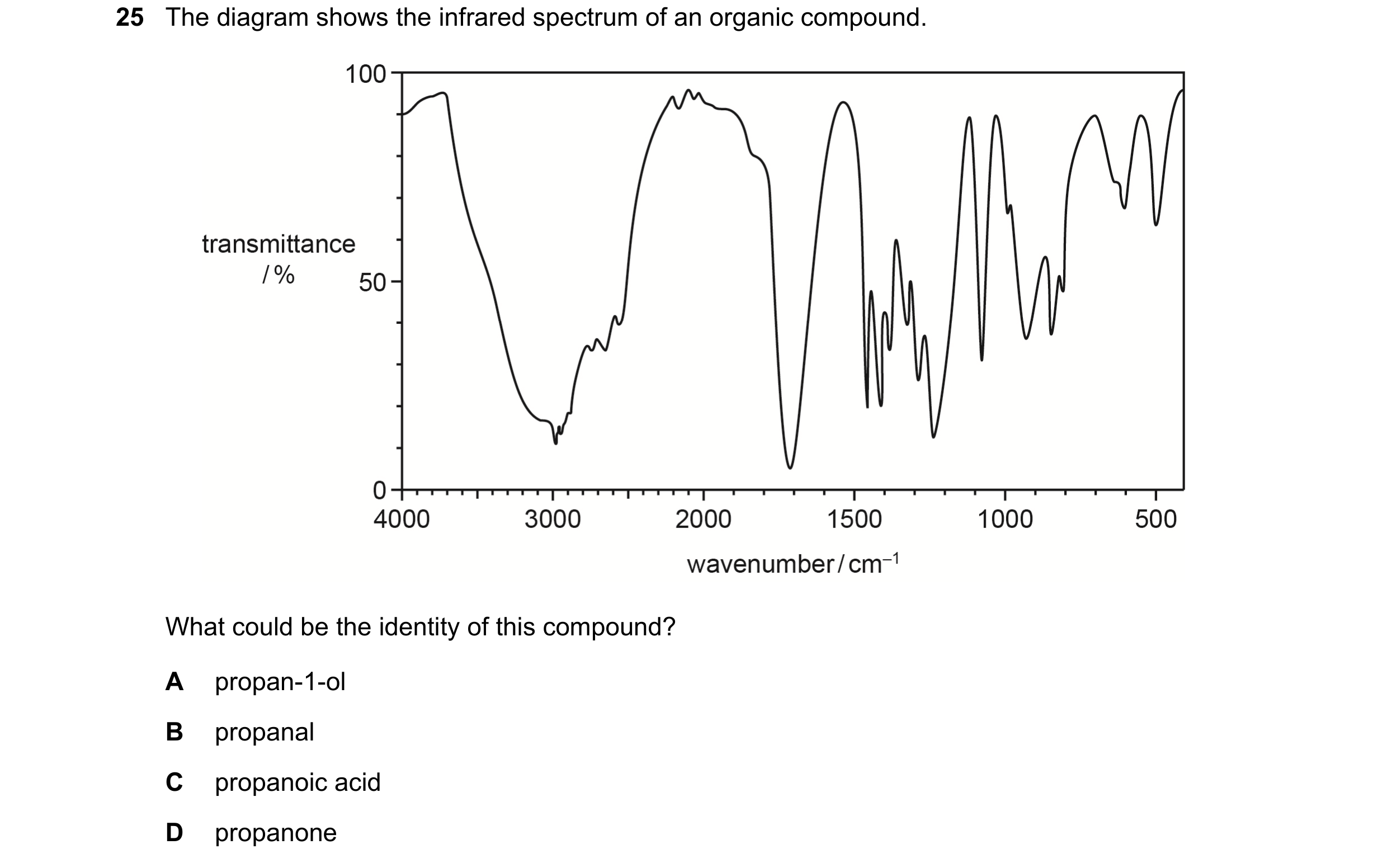

 28 / 47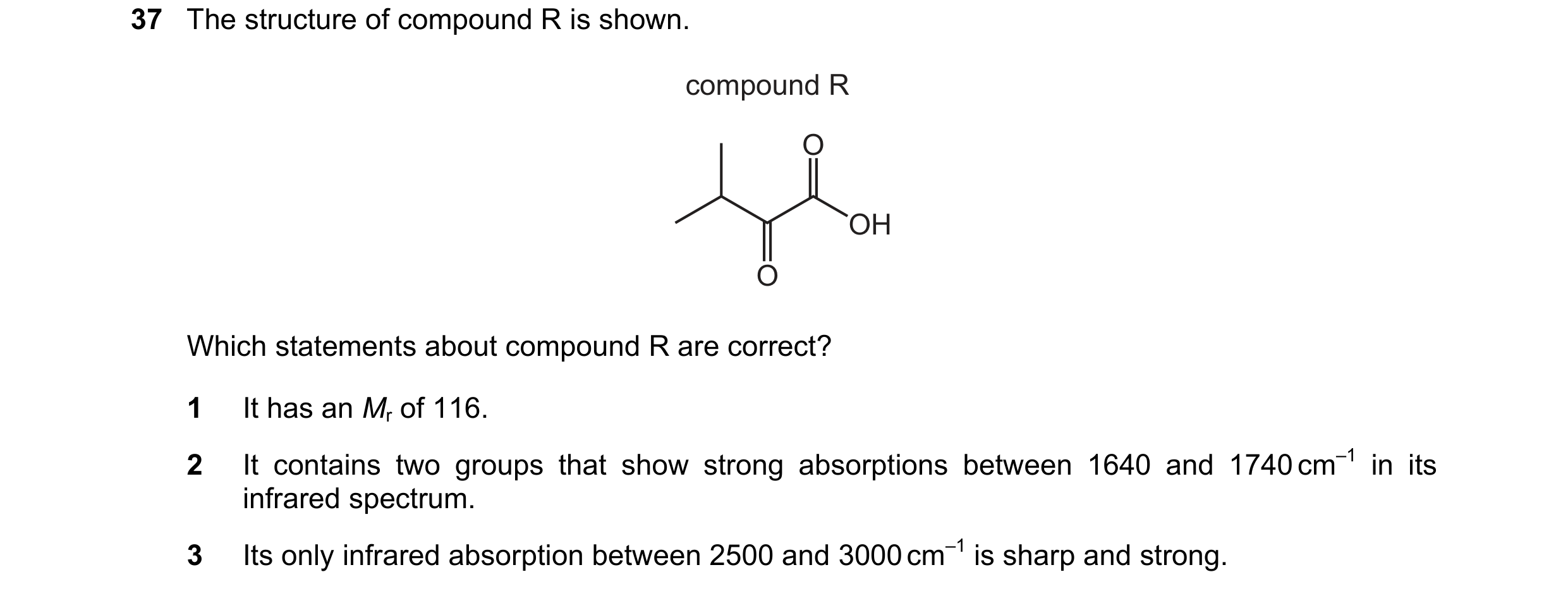


 29 / 47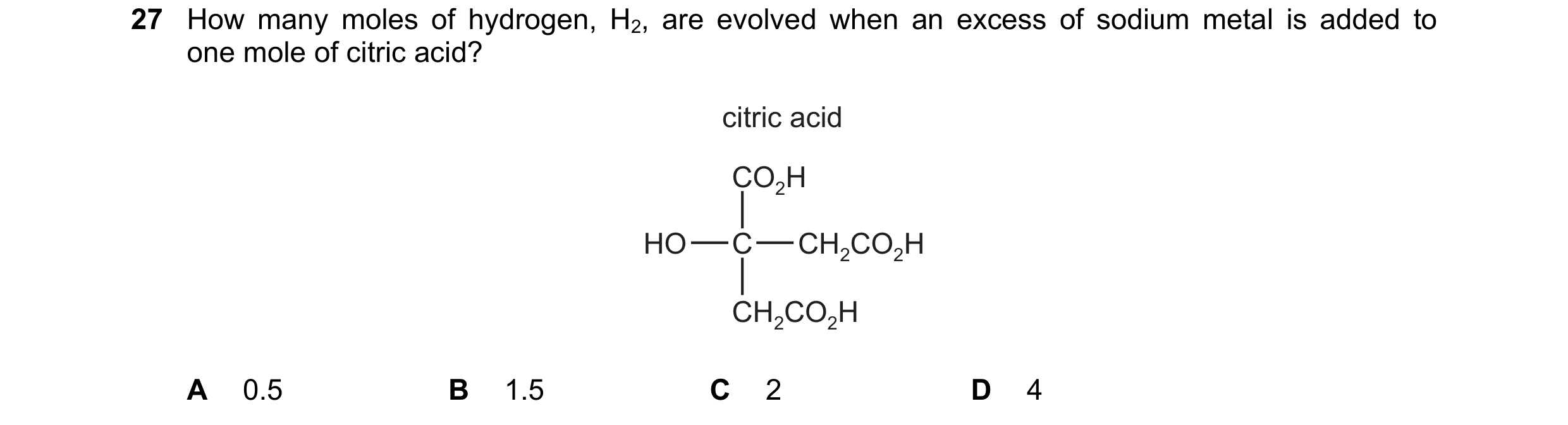
 30 / 47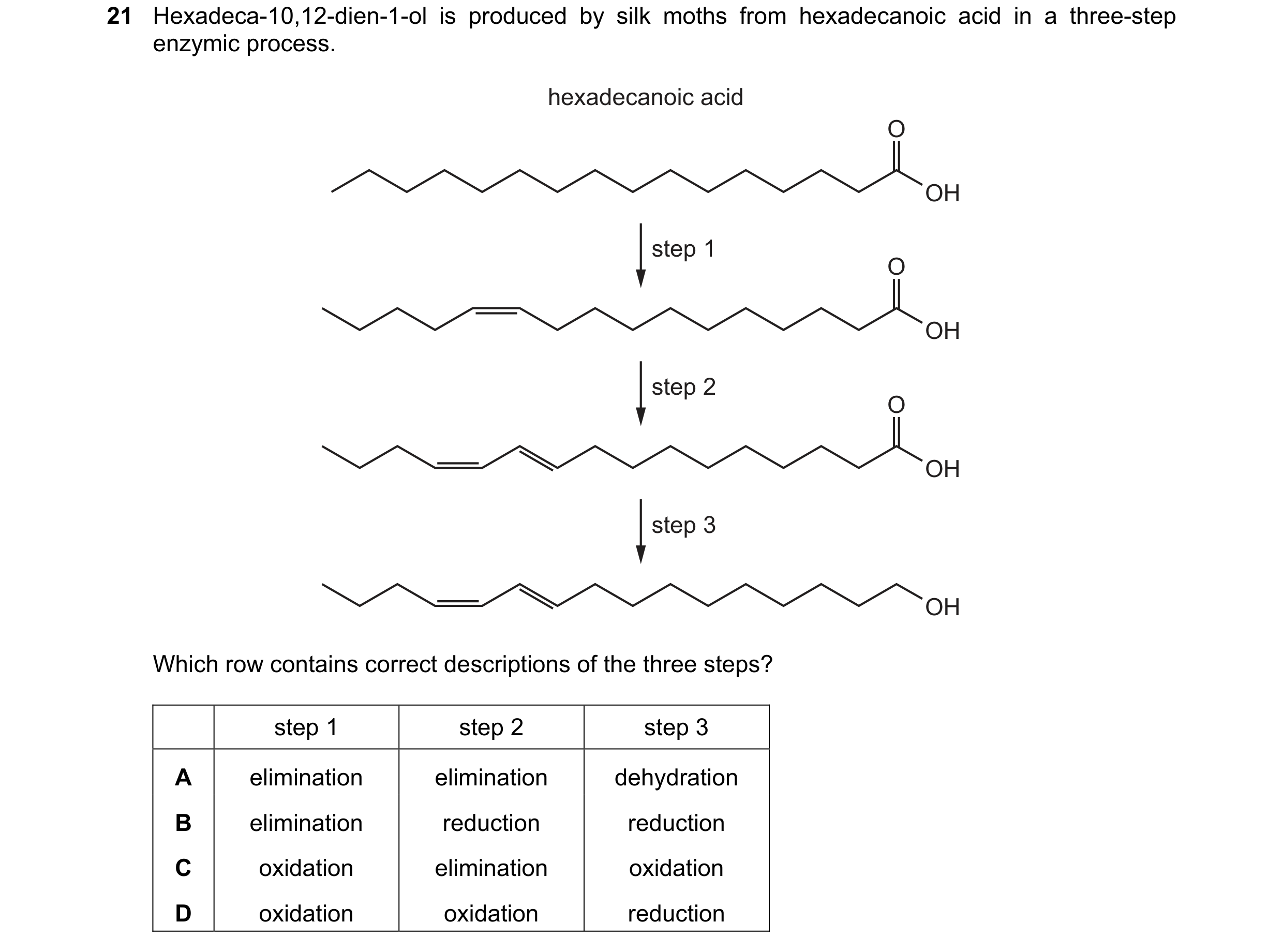
 31 / 47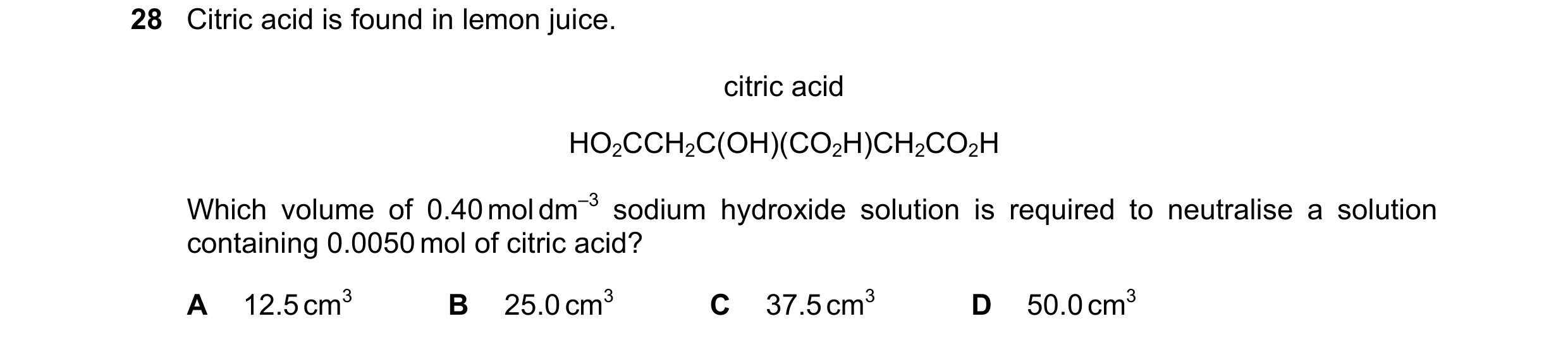
 32 / 47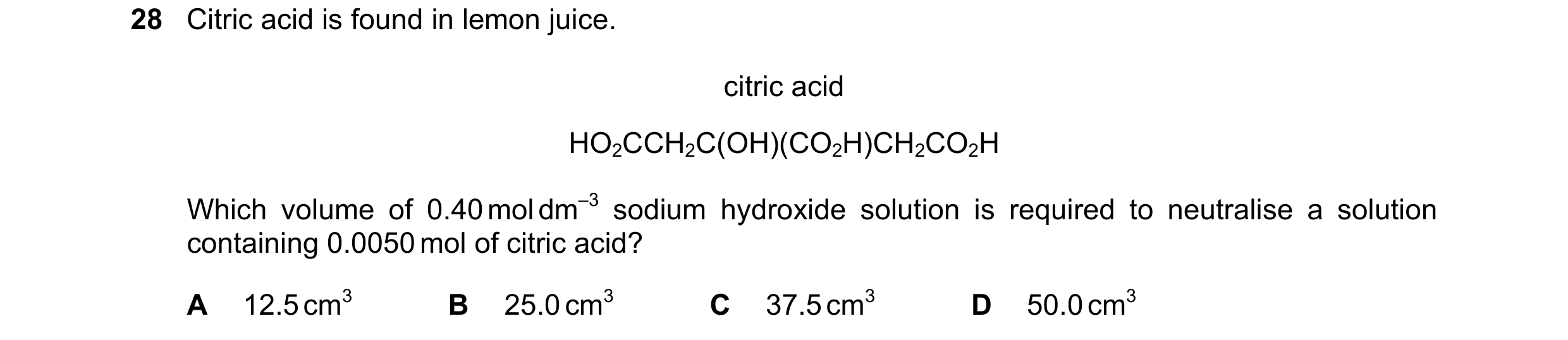

 33 / 47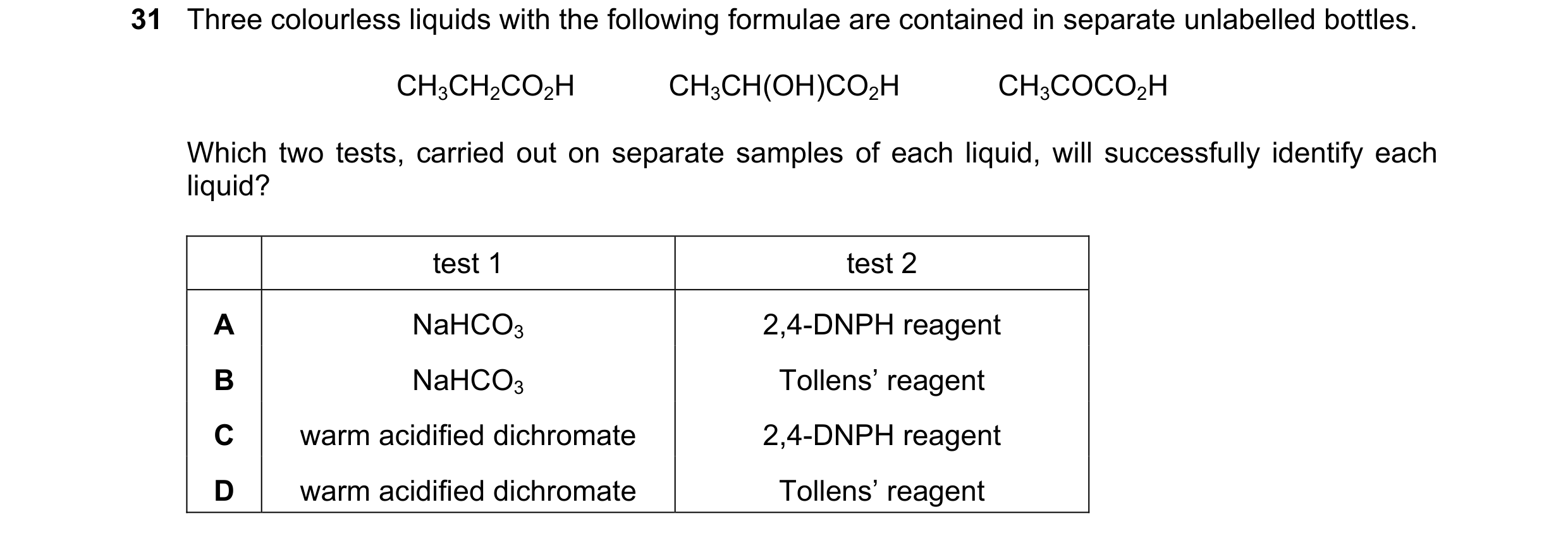

 34 / 47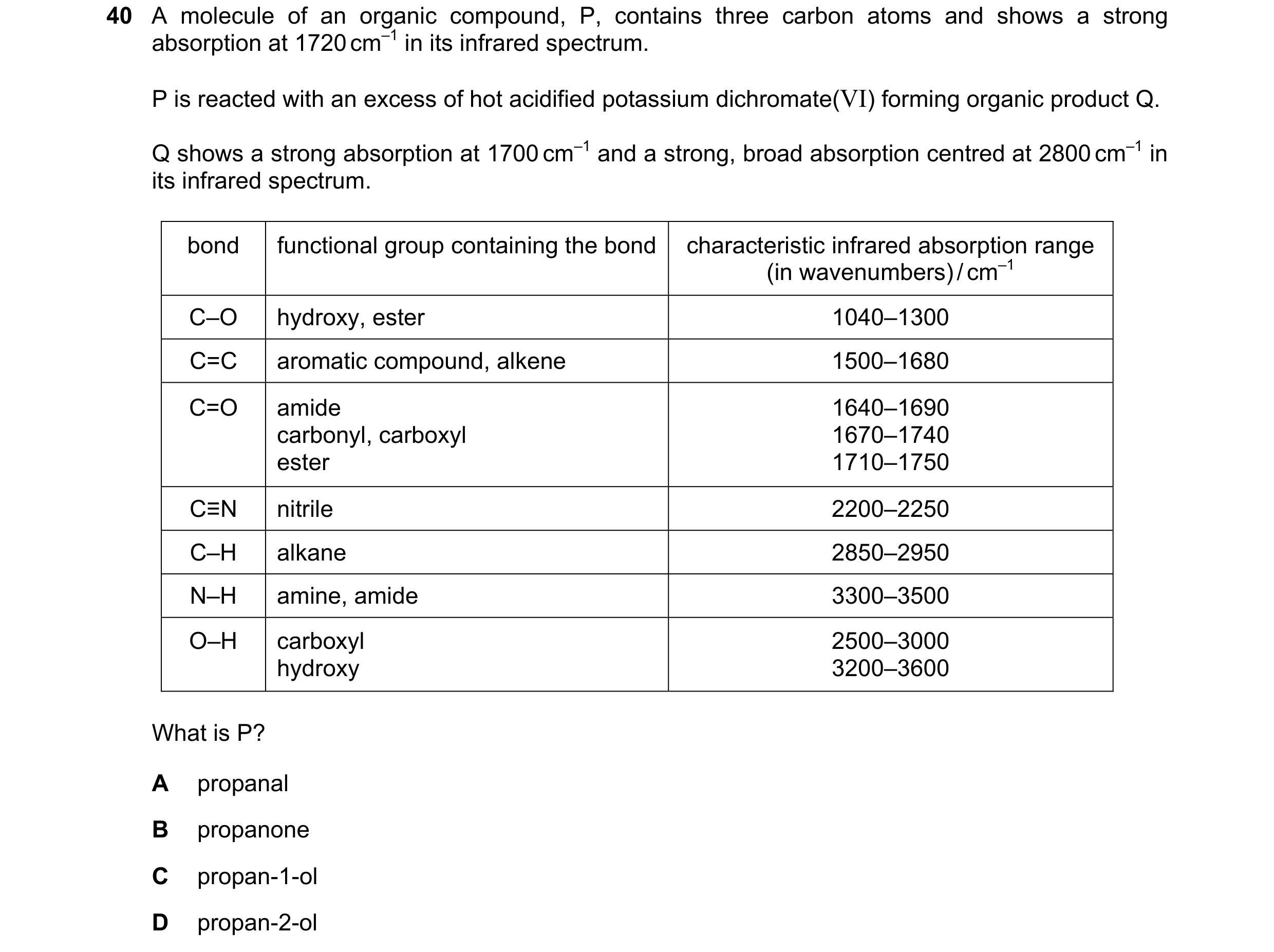
 35 / 47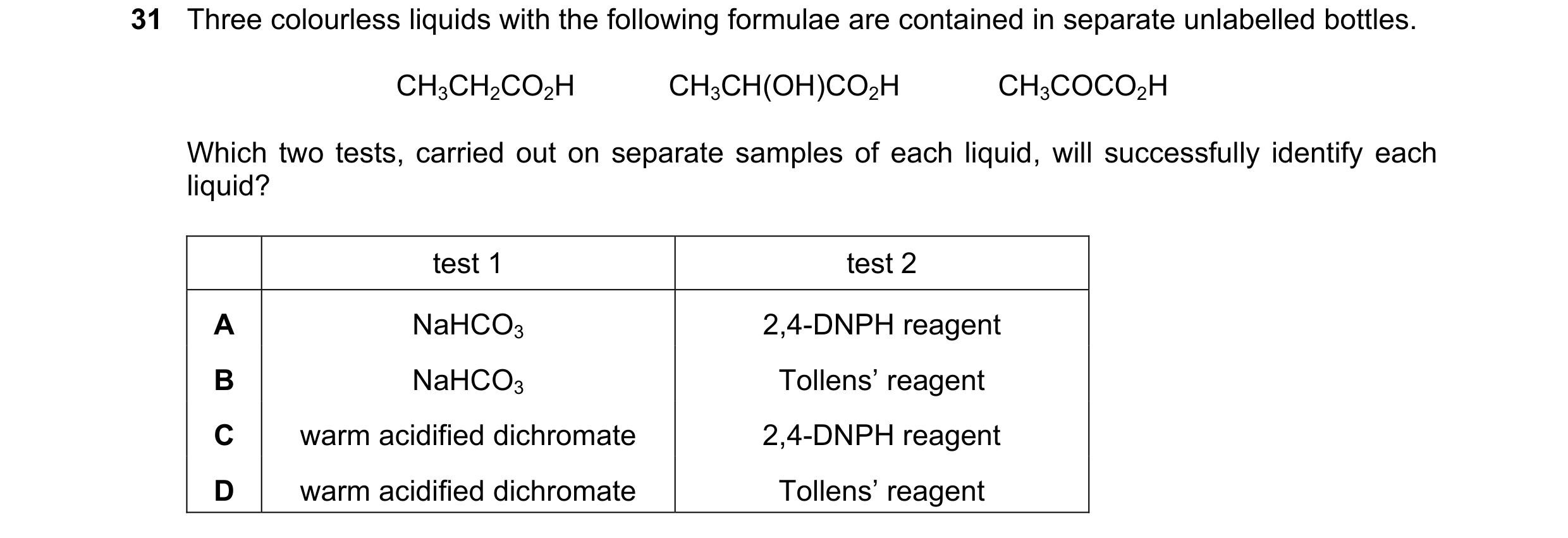

 36 / 47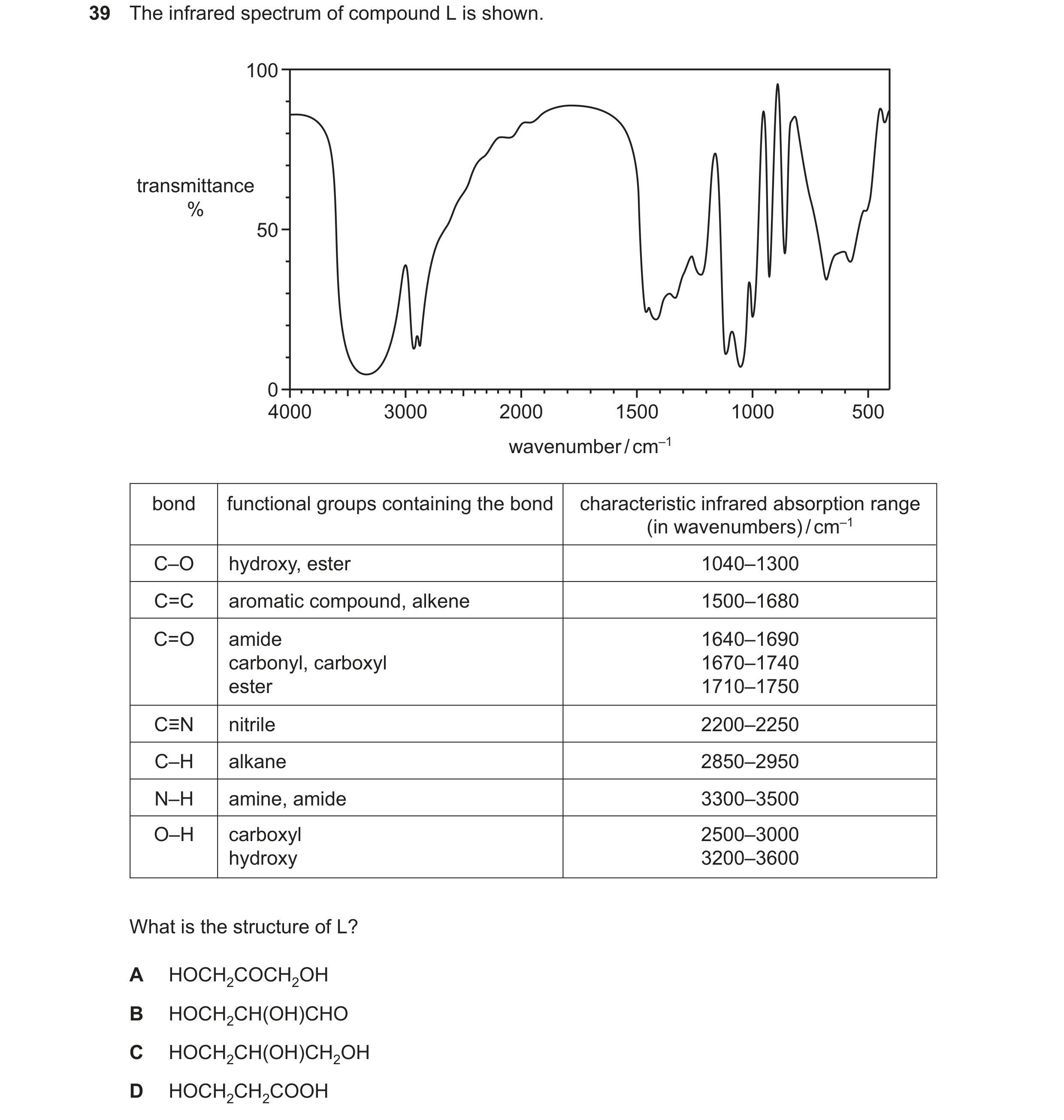
 37 / 47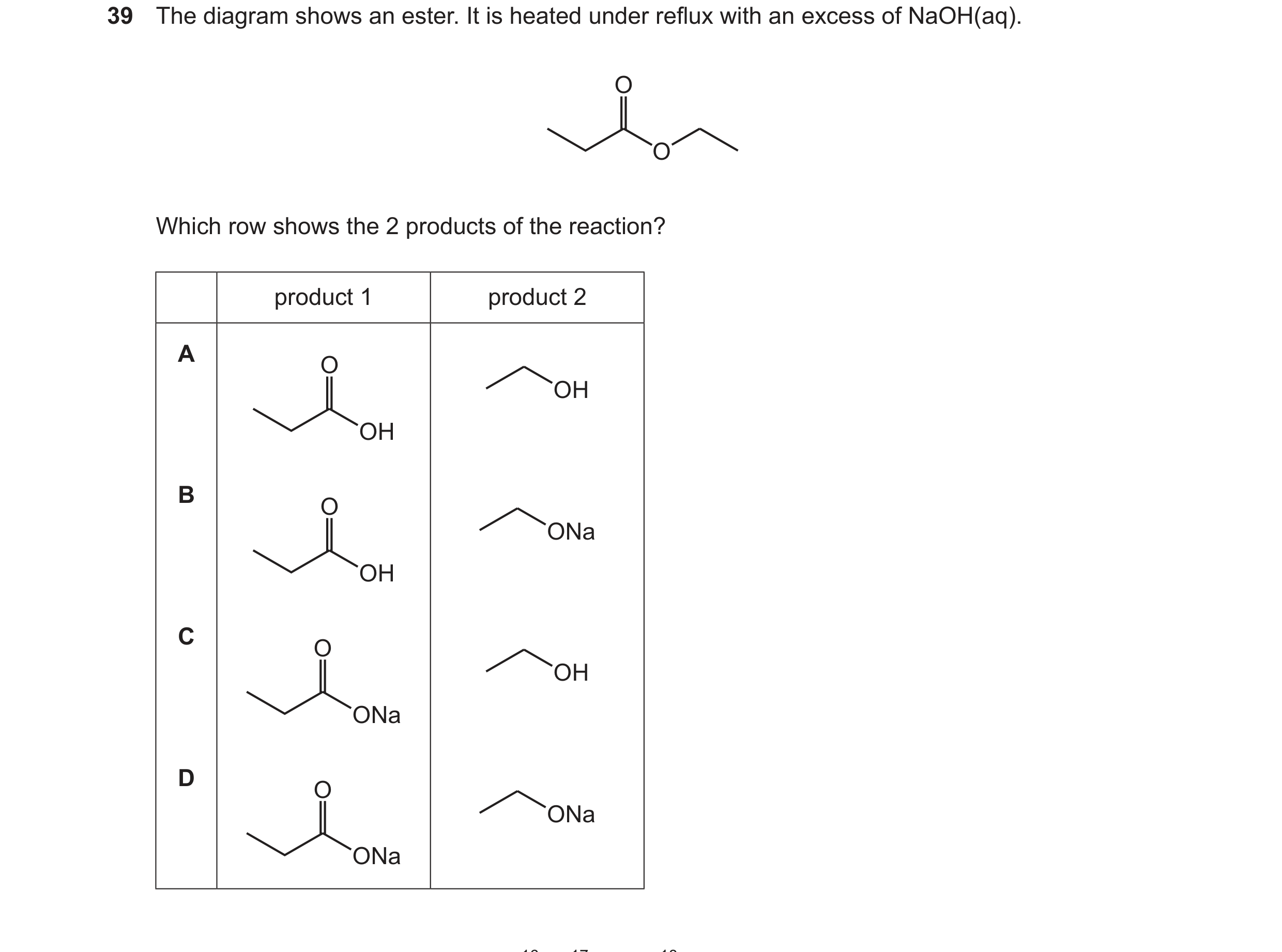
 38 / 47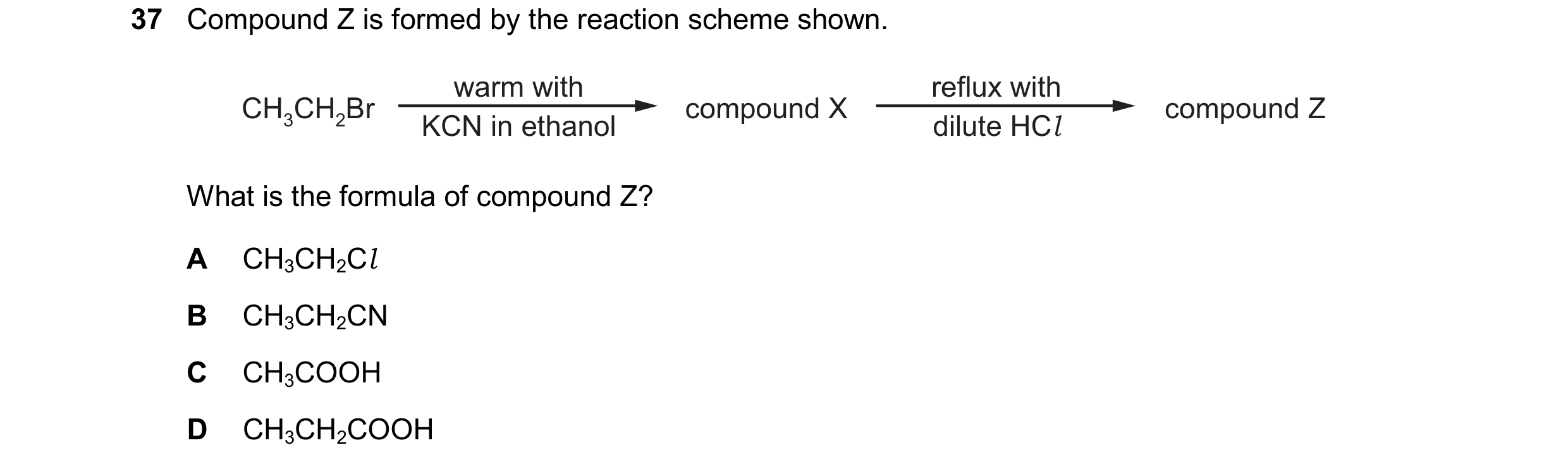
 39 / 47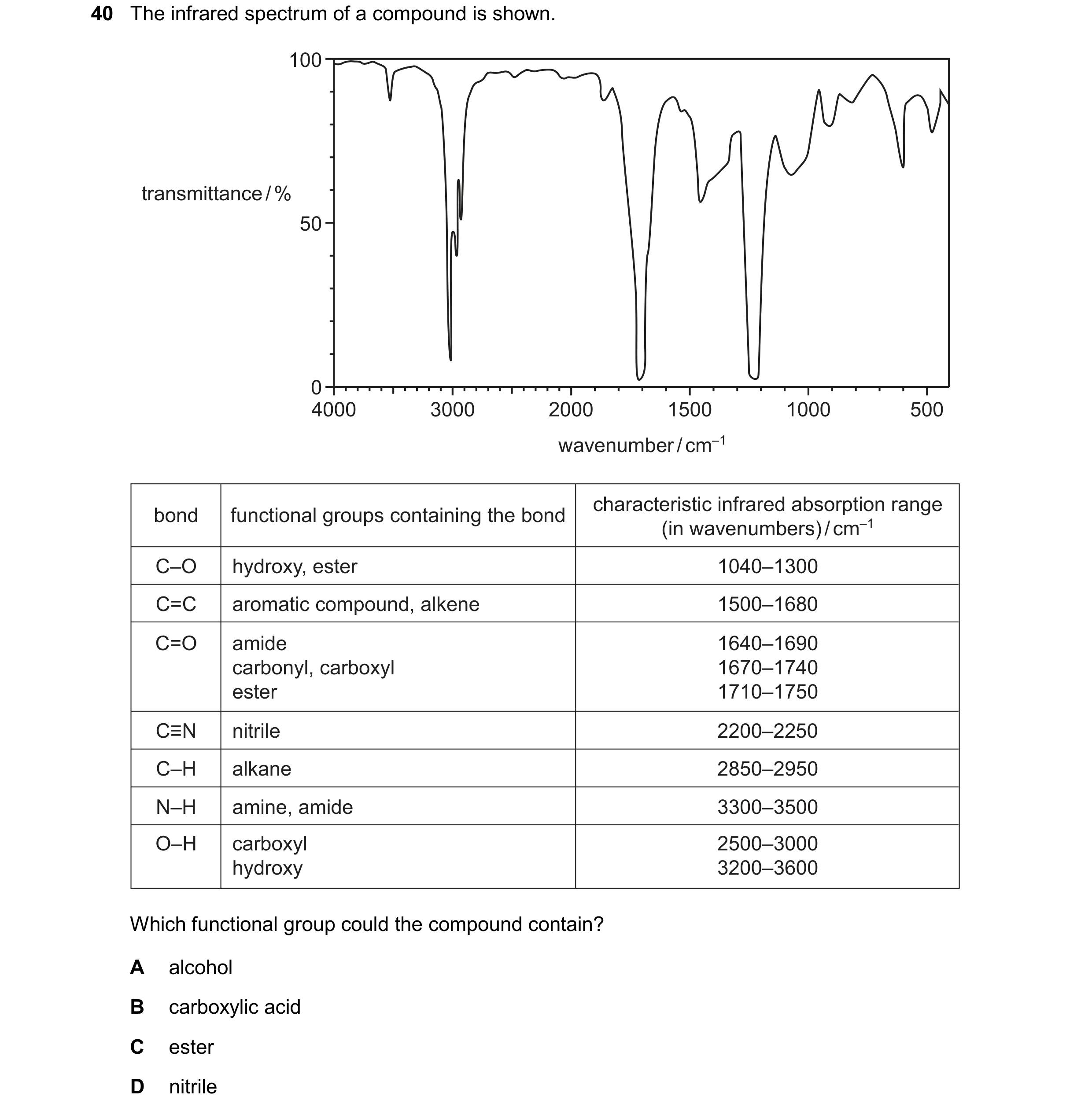
 40 / 47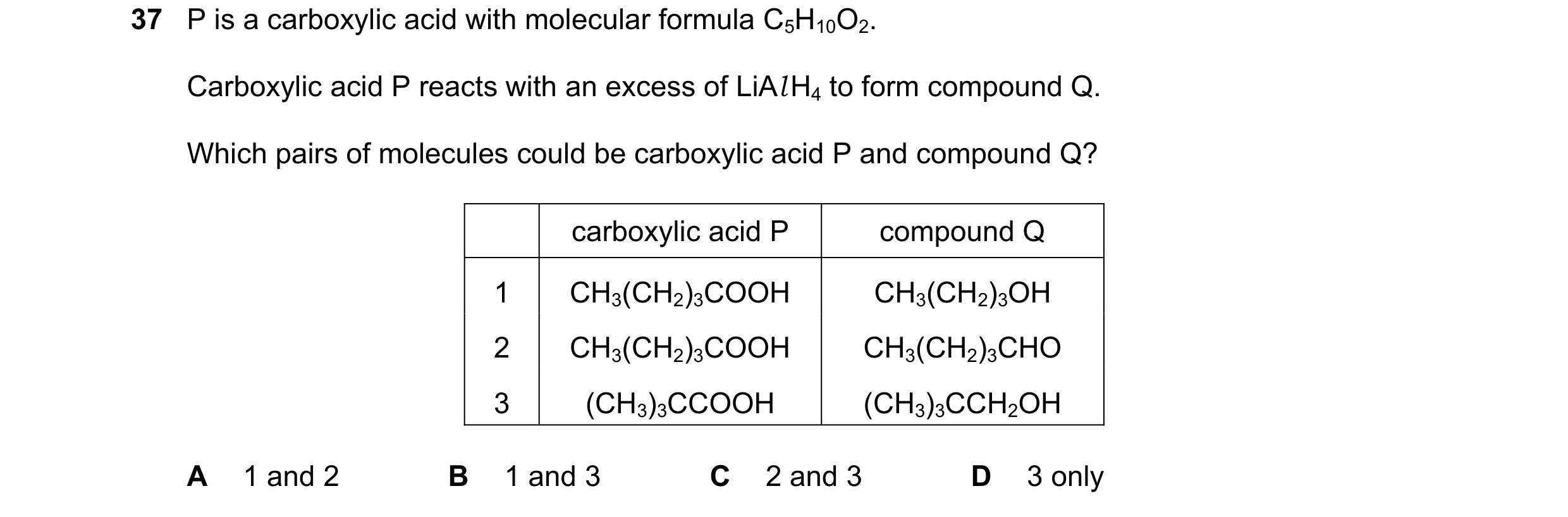
 41 / 47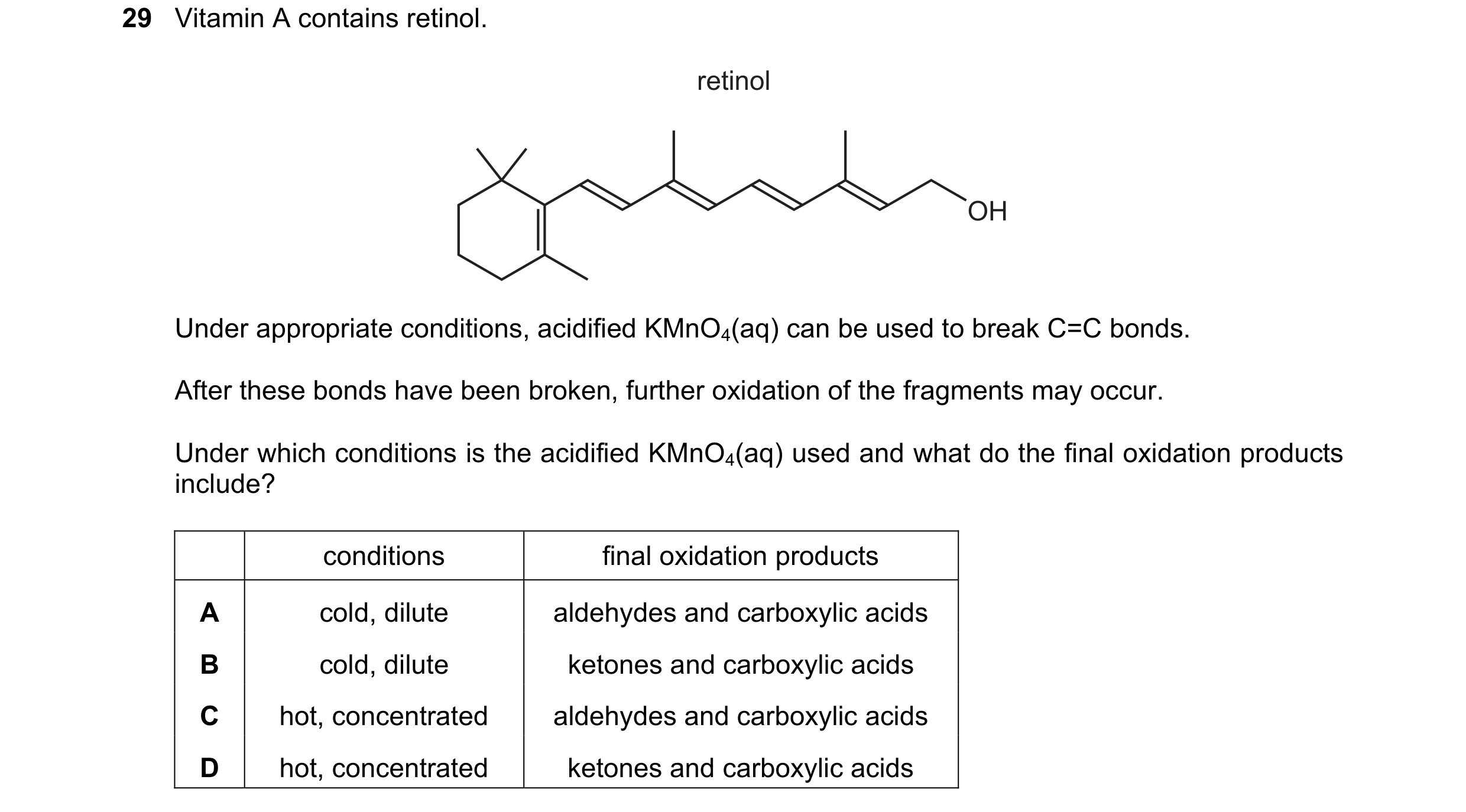
 42 / 47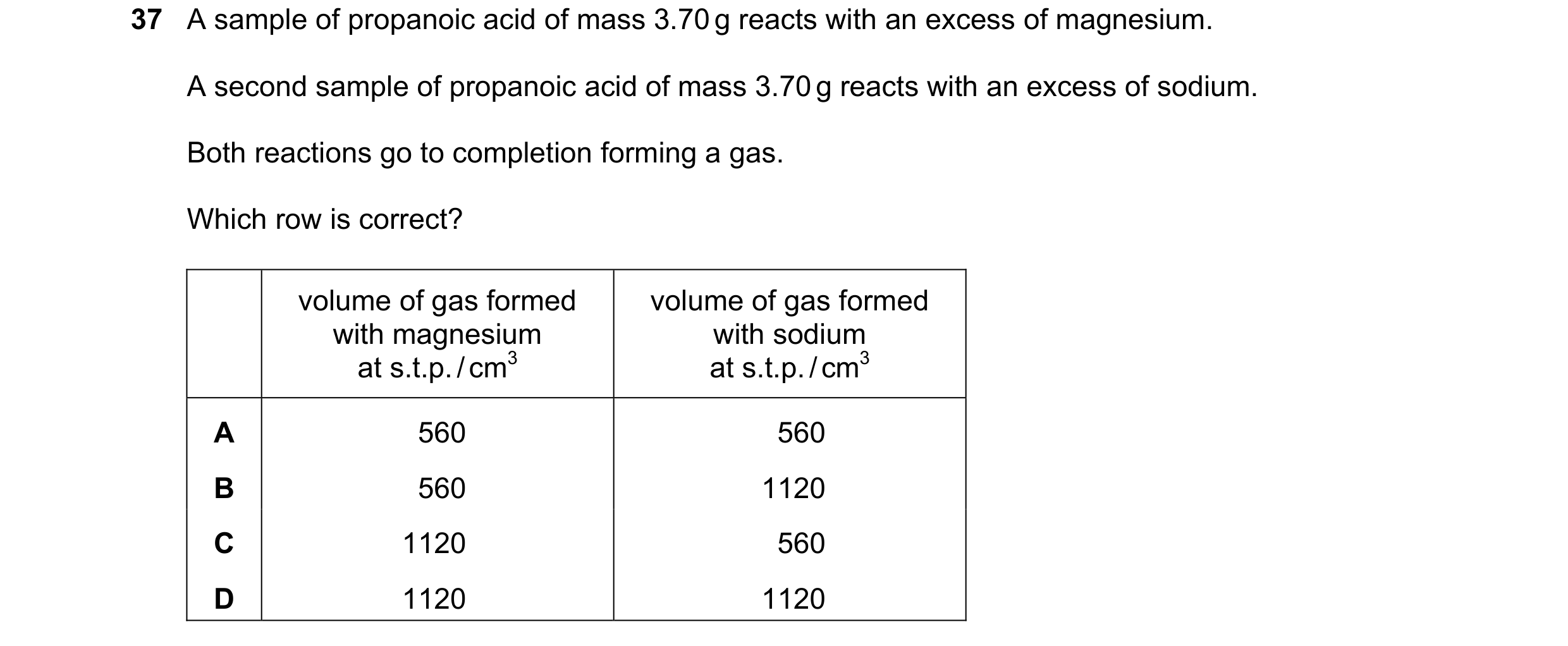
 43 / 47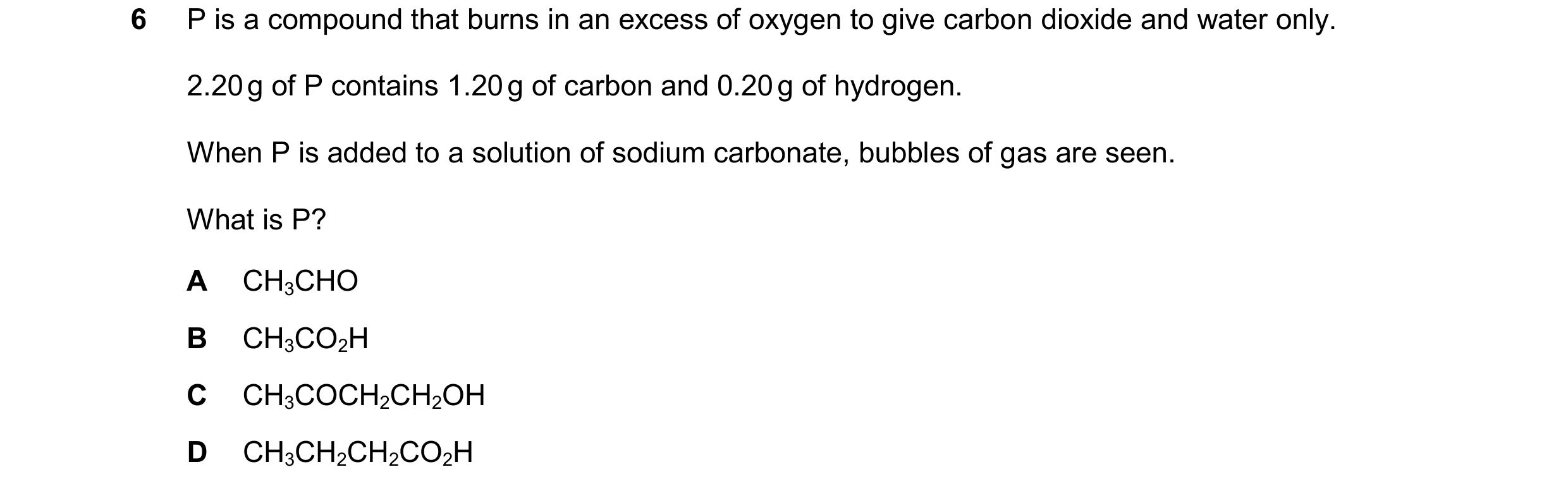
 44 / 47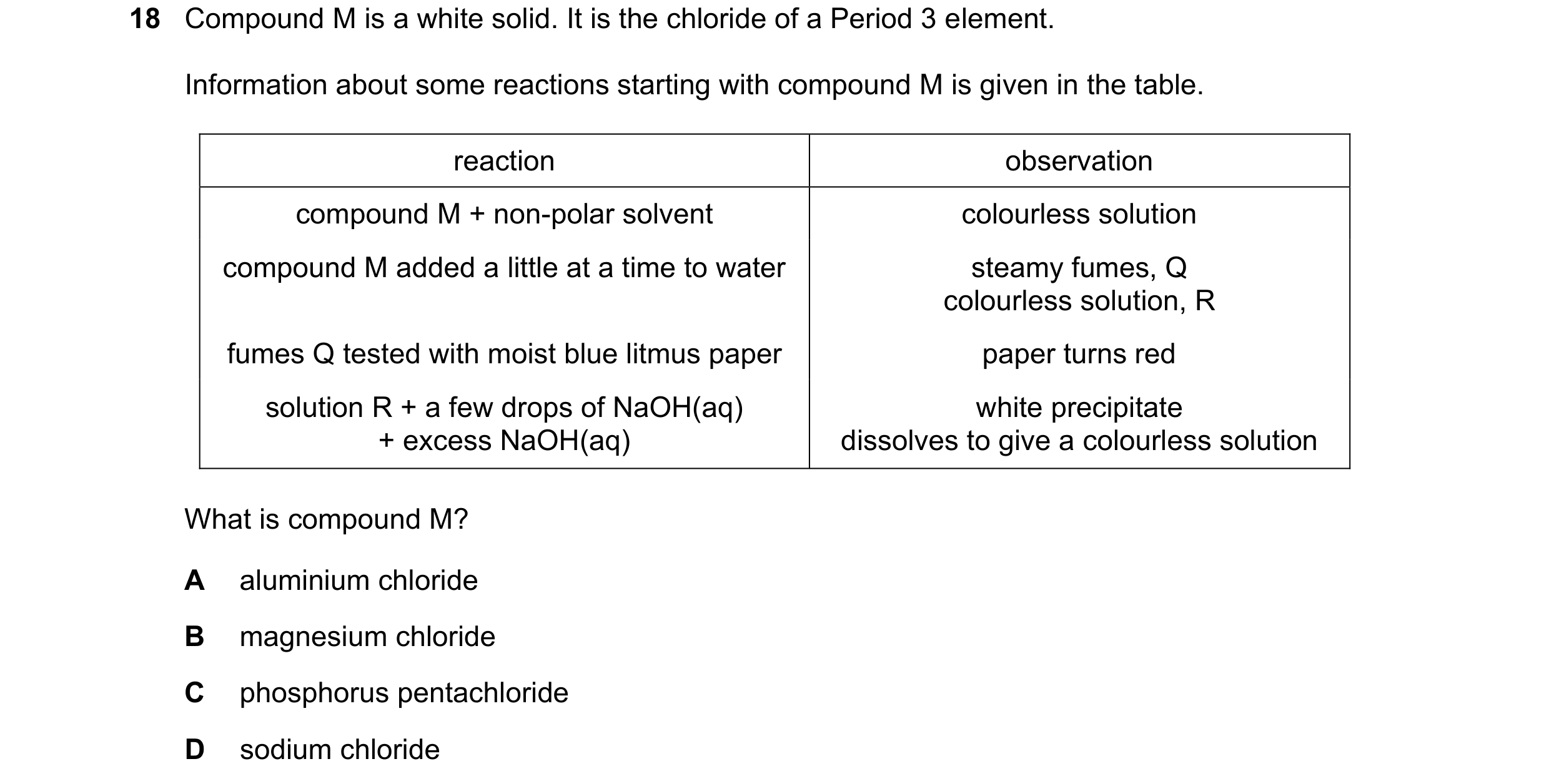

 45 / 47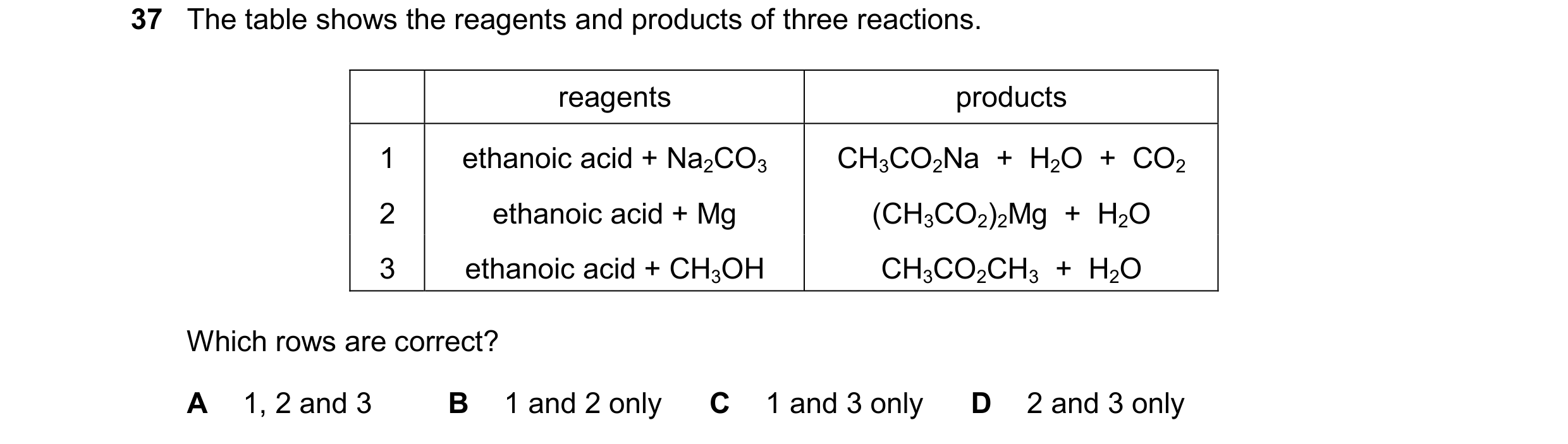
 46 / 47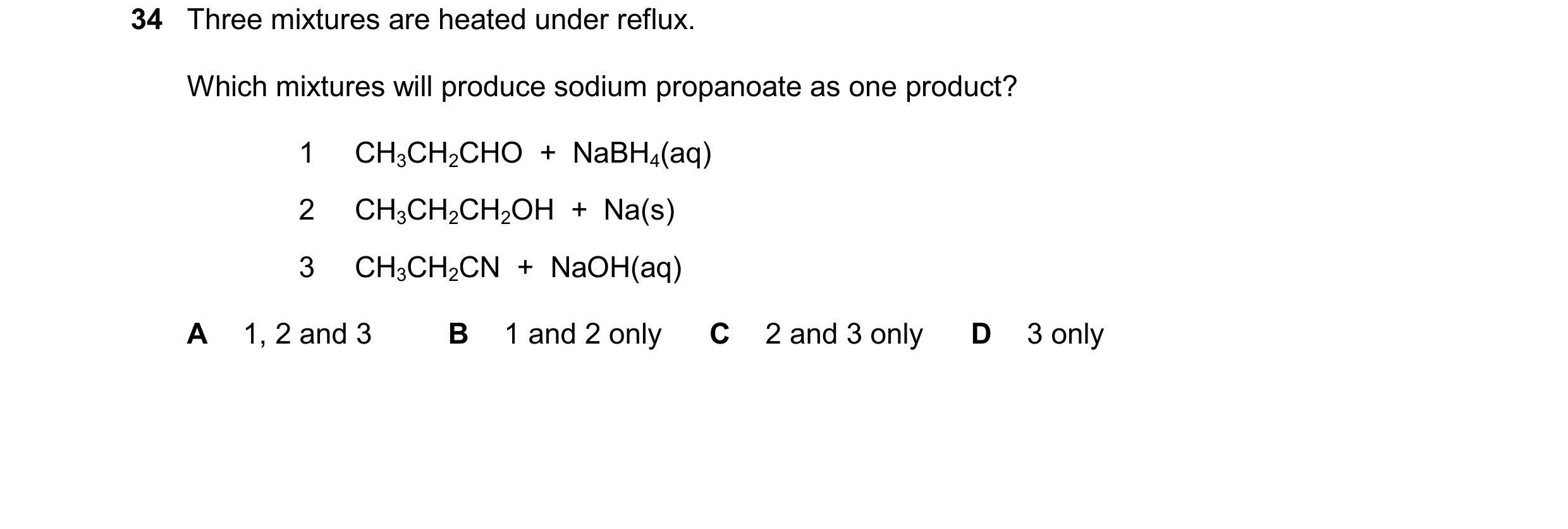
 47 / 47