Questions as text
Q1 · Which description is correct for B-lymphocytes? 9700/11 Oct/Nov 2004
35 Which description is correct for B-lymphocytes?
made from bone processed in release
marrow stem cells the thymus antibodies
Jv Jv Jv
0 Oo WwW >
v v x
v x v
x x v
1 marks
Answer: C
This question in 9700/11 Oct/Nov 2004
Q2 · An antiserum to a snake toxin can be obtained by injecting the toxin into a horse 9700/11 Oct/Nov 2004
36 An antiserum to a snake toxin can be obtained by injecting the toxin into a horse. The antiserum is made from plasma taken from the horse a few weeks later. The antiserum is used to treat a person who has been bitten by the same species of snake. What does the person’s treatment bring about? A artificial active immunity B artificial passive immunity C natural active immunity D natural passive immunity
1 marks
Answer: B
This question in 9700/11 Oct/Nov 2004
Q3 · The diagram shows different elements concerned with the immune response in humans 9700/11 Oct/Nov 2004
37 The diagram shows different elements concerned with the immune response in humans. 4 1 3 2 What are the parts numbered 1 to 4? 1 2 3 4 A lymphocyte antigen pathogen phagocyte B phagocyte antibody pathogen lymphocyte C phagocyte antibody lymphocyte pathogen D pathogen antigen lymphocyte phagocyte
1 marks
Answer: A
This question in 9700/11 Oct/Nov 2004
Q4 · The diagram shows part of the immune response 9700/11 May/June 2006
36 The diagram shows part of the immune response. cell Q pathogen with chemical P cell R with protein on on surface surface to fit P multiplication What are P, Q and R? P Q R A antibody phagocyte T helper cell B antigen T helper cell B-lymphocyte C antibody T helper cell phagocyte D antigen B-lymphocyte T helper cell
1 marks
Answer: B
This question in 9700/11 May/June 2006
Q5 · New-born babies have natural passive immunity 9700/11 May/June 2006
37 New-born babies have natural passive immunity. Why is this only temporary? A No memory cells are produced in the baby. B The antibodies are insufficient in number. C The antibodies only act in the mother. D The immunity is not inherited.
1 marks
Answer: A
This question in 9700/11 May/June 2006
Q6 · The numbers on the diagram refer to different types of immunity 9700/11 Oct/Nov 2006
37 The numbers on the diagram refer to different types of immunity. 1 2 3 4 5 6 by antibodies following injection reaction in the reaction following passing through of antibodies body to infection vaccination placenta in serum Which term is correct for each of these numbers? 1 2 3 4 5 6 A active passive natural artificial natural artificial B active passive artificial natural artificial natural C passive active natural artificial natural artificial D passive active artificial natural artificial natural
1 marks
Answer: C
This question in 9700/11 Oct/Nov 2006
Q7 · Where are antibodies and antigens found? 9700/11 Oct/Nov 2007
37 Where are antibodies and antigens found? on surface of on surface of in blood plasma pathogen macrophage A antibody antibody antigen B antibody antigen antibody C antigen antibody antigen D antigen antigen antibody
1 marks
Answer: D
This question in 9700/11 Oct/Nov 2007
Q8 · Which factors would help prevent which disease? 9700/11 May/June 2008
36 Which factors would help prevent which disease? 1 covering water containers 2 disinfecting and chlorinating water 3 use of antiviral drugs 4 vaccination cholera malaria tuberculosis (TB) A 2 1 4 B 1 and 2 2 3 C 4 2 3 D 3 1 and 2 4
1 marks
Answer: A
This question in 9700/11 May/June 2008
Q9 · Which future development in vaccine production is most important in the fight to… 9700/11 May/June 2008
37 Which future development in vaccine production is most important in the fight to eradicate measles in developing countries? A a combined vaccine to combat it and other diseases B a single vaccine, without the need for boosters C a vaccine containing only live measles viruses D a vaccine produced by genetic engineering techniques
1 marks
Answer: B
This question in 9700/11 May/June 2008
Q10 · The diagram represents the structure of a molecule of antibody 9700/11 Oct/Nov 2008
35 The diagram represents the structure of a molecule of antibody. Y Z X Which arrangement of labels X, Y and Z correctly identifies its different parts? X Y Z A antigen binding site constant region variable region B constant region antigen binding site variable region C constant region variable region antigen binding site D variable region antigen binding site constant region
1 marks
Answer: C
This question in 9700/11 Oct/Nov 2008
Q11 · Which examples show the different types of immunity? 9700/11 Oct/Nov 2008
37 Which examples show the different types of immunity? active artificial passive natural A immunity to measles after infection receiving antibodies to measles in colostrum B immunity to measles after infection receiving antibodies to tetanus by injection C immunity to smallpox after vaccination receiving antibodies to measles in colostrum D immunity to smallpox after vaccination receiving antibodies to tetanus by injection
1 marks
Answer: C
This question in 9700/11 Oct/Nov 2008
Q12 · After an immune response, memory cells remain in the blood for a long time 9700/12 Oct/Nov 2009
34 After an immune response, memory cells remain in the blood for a long time. What is the function of memory cells? A They can ingest invading bacteria. B They contain lots of antibodies. C They divide to make plasma cells. D They kill cells infected with virus.
1 marks
Answer: C
This question in 9700/12 Oct/Nov 2009
Q13 · What are produced by B-lymphocytes? 9700/12 Oct/Nov 2009
35 What are produced by B-lymphocytes?
killer lymphocyte memory cells plasma cell
clones clones
A v v x
B v x v
Cc v v v
D x v v
1 marks
Answer: D
This question in 9700/12 Oct/Nov 2009
Q14 · In an investigation into the immune response, a volunteer was exposed to two different… 9700/11 May/June 2010
37 In an investigation into the immune response, a volunteer was exposed to two different antigens, X and Y. The relative antibody concentration in the blood was measured at regular intervals over 60 days. The graph shows the time when the volunteer was exposed to each antigen and the antibody concentration against time for antigens X and Y. antibody concentration antibody for antigen X / arbitrary units antibody for antigen Y 0 5 10 15 20 25 30 35 40 45 50 55 60 first exposure second exposure time / days to antigen X to antigen X first exposure to antigen Y What is the explanation for the results displayed on the graph? A A primary and secondary immune response against antigen X occurred, with the memory B-lymphocytes inhibiting the secondary immune response against antigen Y. B A primary immune response to antigen Y occurred and memory B-lymphocytes specific to antigen Y enhanced the secondary immune response to antigen X. C Memory B-lymphocytes specific to antigen X enabled a secondary immune response to occur; different B-lymphocytes were activated for a primary immune response for antigen Y. D Plasma cells remaining from the first exposure to antigen X undergo rapid clonal selection to produce high levels of antibody against antigen X and lower levels of antibody against antigen Y.
1 marks
Answer: C
This question in 9700/11 May/June 2010
Q15 · In an investigation into the immune response, a volunteer was exposed to two different… 9700/12 May/June 2010
35 In an investigation into the immune response, a volunteer was exposed to two different antigens, X and Y. The relative antibody concentration in the blood was measured at regular intervals over 60 days. The graph shows the time when the volunteer was exposed to each antigen and the antibody concentration against time for antigens X and Y. antibody concentration antibody for antigen X / arbitrary units antibody for antigen Y 0 5 10 15 20 25 30 35 40 45 50 55 60 first exposure second exposure time / days to antigen X to antigen X first exposure to antigen Y What is the explanation for the results displayed on the graph? A A primary and secondary immune response against antigen X occurred, with the memory B-lymphocytes inhibiting the secondary immune response against antigen Y. B A primary immune response to antigen Y occurred and memory B-lymphocytes specific to antigen Y enhanced the secondary immune response to antigen X. C Memory B-lymphocytes specific to antigen X enabled a secondary immune response to occur; different B-lymphocytes were activated for a primary immune response for antigen Y. D Plasma cells remaining from the first exposure to antigen X undergo rapid clonal selection to produce high levels of antibody against antigen X and lower levels of antibody against antigen Y.
1 marks
Answer: C
This question in 9700/12 May/June 2010
Q16 · In an investigation into the immune response, a volunteer was exposed to two different… 9700/13 May/June 2010
21 In an investigation into the immune response, a volunteer was exposed to two different antigens, X and Y. The relative antibody concentration in the blood was measured at regular intervals over 60 days. The graph shows the time when the volunteer was exposed to each antigen and the antibody concentration against time for antigens X and Y. antibody concentration antibody for antigen X / arbitrary units antibody for antigen Y 0 5 10 15 20 25 30 35 40 45 50 55 60 first exposure second exposure time / days to antigen X to antigen X first exposure to antigen Y What is the explanation for the results displayed on the graph? A A primary and secondary immune response against antigen X occurred, with the memory B-lymphocytes inhibiting the secondary immune response against antigen Y. B A primary immune response to antigen Y occurred and memory B-lymphocytes specific to antigen Y enhanced the secondary immune response to antigen X. C Memory B-lymphocytes specific to antigen X enabled a secondary immune response to occur; different B-lymphocytes were activated for a primary immune response for antigen Y. D Plasma cells remaining from the first exposure to antigen X undergo rapid clonal selection to produce high levels of antibody against antigen X and lower levels of antibody against antigen Y.
1 marks
Answer: C
This question in 9700/13 May/June 2010
Q17 · The diagram shows part of the immune response 9700/11 Oct/Nov 2010
35 The diagram shows part of the immune response. cell Q pathogen with chemical P cell R with protein on on surface surface to fit P multiplication What are P, Q and R? P Q R A antibody B-lymphocyte T helper cell B antibody T helper cell B-lymphocyte C antigen B-lymphocyte T helper cell D antigen T helper cell B-lymphocyte
1 marks
Answer: D
This question in 9700/11 Oct/Nov 2010
Q18 · When a body cell is infected by a pathogen, which describes a correct immune response? 9700/11 Oct/Nov 2010
36 When a body cell is infected by a pathogen, which describes a correct immune response? A Killer T cells punch holes in infected cells, releasing antibodies. B Killer T cells release cytokines, infected body cells release antibodies. C Memory cells release antibodies, killer T cells secrete cytokines. D T helper cells release cytokines, plasma cells release antibodies.
1 marks
Answer: D
This question in 9700/11 Oct/Nov 2010
Q19 · An enzyme hydrolyses the two heavy polypeptide chains of an antibody molecule 9700/12 Oct/Nov 2010
37 An enzyme hydrolyses the two heavy polypeptide chains of an antibody molecule. The hydrolysis occurs at the hinge region and breaks the antibody into three fragments. How many of these fragments are able to bind to antigens? A 0 B 1 C 2 D 3
1 marks
Answer: C
This question in 9700/12 Oct/Nov 2010
Q20 · The diagram shows the response to a pathogen by the immune system 9700/12 Oct/Nov 2010
38 The diagram shows the response to a pathogen by the immune system. some form Q S division Q P Q some release R Q Q Q Which row correctly identifies P, Q, R and S? P Q R S A antibody T-lymphocyte antigen plasma cell B antigen B-lymphocyte antibody memory cell C antigen T-lymphocyte antitoxin B-lymphocyte D bacteria B-lymphocyte antibody T-lymphocyte
1 marks
Answer: B
This question in 9700/12 Oct/Nov 2010
Q21 · Smallpox has been eradicated, but not malaria or cholera 9700/11 May/June 2011
38 Smallpox has been eradicated, but not malaria or cholera. Which statements correctly explain this? 1 Cholera bacteria in the intestines are not destroyed by antibiotics. 2 Plasmodium antigens change during the life cycle. 3 Smallpox antigens remain stable. 4 Vaccines only work against viruses. A 1, 2 and 3 B 1, 2 and 4 C 1, 3 and 4 D 2, 3 and 4
1 marks
Answer: A
This question in 9700/11 May/June 2011
Q22 · The disease smallpox has been eradicated by a worldwide vaccination programme 9700/12 May/June 2011
37 The disease smallpox has been eradicated by a worldwide vaccination programme. Which set of reasons correctly identifies the problems associated with planning vaccination programmes to eradicate other diseases? sickle cell TB malaria cholera anaemia A invade gut cells genetically different poor response where immune inherited vaccines with system less recessive needed for malnourished effective condition active and children; dormant-to- boosters then active forms required B different stages poor response genetically different with different with inherited vaccines antigens; malnourished recessive needed for invades body children; condition active and cells boosters then dormant-to- required active forms C different different stages genetically invade gut cells vaccines with different inherited where immune needed for antigens; recessive system less active and invades body condition effective dormant-to- cells active forms D genetically different invade gut cells different stages inherited vaccines where immune with different recessive needed for system less antigens; condition active and effective invades body dormant-to- cells active forms
1 marks
Answer: C
This question in 9700/12 May/June 2011
Q23 · Smallpox has been eradicated, but not malaria or cholera 9700/13 May/June 2011
37 Smallpox has been eradicated, but not malaria or cholera. Which statements correctly explain this? 1 Cholera bacteria in the intestines are not destroyed by antibiotics. 2 Plasmodium antigens change during the life cycle. 3 Smallpox antigens remain stable. 4 Vaccines only work against viruses. A 1, 2 and 3 B 1, 2 and 4 C 1, 3 and 4 D 2, 3 and 4
1 marks
Answer: A
This question in 9700/13 May/June 2011
Q24 · Breast milk produced by the mother for a new-born baby contains antibodies 9700/11 Oct/Nov 2011
37 Breast milk produced by the mother for a new-born baby contains antibodies. What do these antibodies provide? A artificial active immunity B artificial passive immunity C natural active immunity D natural passive immunity
1 marks
Answer: D
This question in 9700/11 Oct/Nov 2011
Q25 · Breast milk produced by the mother for a new-born baby contains antibodies 9700/13 Oct/Nov 2011
16 Breast milk produced by the mother for a new-born baby contains antibodies. What do these antibodies provide? A artificial active immunity B artificial passive immunity C natural active immunity D natural passive immunity
1 marks
Answer: D
This question in 9700/13 Oct/Nov 2011
Q26 · Antibodies can act in a number of ways to protect the body from pathogenic bacteria 9700/11 May/June 2012
37 Antibodies can act in a number of ways to protect the body from pathogenic bacteria. Which event will not occur following antigen-antibody binding? A agglutination of bacteria to reduce their spread B increased susceptibility to phagocytosis C neutralisation of toxins to make them harmless D secretion of histamine to produce an allergic reaction
1 marks
Answer: D
This question in 9700/11 May/June 2012
Q27 · To prevent a disease, dead bacteria may be injected into the body 9700/12 May/June 2012
34 To prevent a disease, dead bacteria may be injected into the body. What type of immune response is produced? passive artificial A no no B no yes C yes no D yes yes
1 marks
Answer: B
This question in 9700/12 May/June 2012
Q28 · The graph shows the amount of antibody produced in response to an antigen 9700/12 May/June 2012
35 The graph shows the amount of antibody produced in response to an antigen. concentration of antibody in the blood 0 10 20 30 40 time in days first exposure to an antigen From the graph, which statement is correct? A It takes 25 days to achieve active immunity. B Memory cells for this antigen are present in the body within 20 days. C T-helper lymphocytes are activated on day 12. D The second exposure to the antigen occurred on day 25.
1 marks
Answer: B
This question in 9700/12 May/June 2012
Q29 · Antibodies can act in a number of ways to protect the body from pathogenic bacteria 9700/13 May/June 2012
34 Antibodies can act in a number of ways to protect the body from pathogenic bacteria. Which event will not occur following antigen-antibody binding? A agglutination of bacteria to reduce their spread B increased susceptibility to phagocytosis C neutralisation of toxins to make them harmless D secretion of histamine to produce an allergic reaction
1 marks
Answer: D
This question in 9700/13 May/June 2012
Q30 · What happens when people are injected with dead bacteria? 9700/11 Oct/Nov 2012
35 What happens when people are injected with dead bacteria? A B-lymphocytes produce antibodies. B B- lymphocytes produce antigens. C T- lymphocytes produce antibodies. D T- lymphocytes produce antigens.
1 marks
Answer: A
This question in 9700/11 Oct/Nov 2012
Q31 · To prevent a disease, dead bacteria may be injected into the body 9700/12 Oct/Nov 2012
36 To prevent a disease, dead bacteria may be injected into the body. What type of immune response is produced? natural active A no no B no yes C yes no D yes yes
1 marks
Answer: B
This question in 9700/12 Oct/Nov 2012
Q32 · The graph shows the primary and secondary responses of the immune system to antigens 9700/12 Oct/Nov 2012
37 The graph shows the primary and secondary responses of the immune system to antigens. X concentration of antibodies in plasma Y 0 1 2 3 4 5 weeks after first or second exposure to antigen What are responses X and Y? X Y A primary response secondary response caused by cloning of B–lymphocytes formed during the primary response B primary response secondary response caused by cloning of T–lymphocytes formed during the primary response C secondary response caused by cloning primary response of B–lymphocytes formed during the primary response D secondary response caused by cloning primary response of T–lymphocytes formed during the primary response
1 marks
Answer: C
This question in 9700/12 Oct/Nov 2012
Q33 · A child is vaccinated against a viral disease 9700/13 Oct/Nov 2012
35 A child is vaccinated against a viral disease. A few weeks later she is exposed to the same virus. What is the expected response to this exposure? A increased numbers of B-lymphocytes B increased numbers of T-lymphocytes C large numbers of antibodies are released D large numbers of antigens are released
1 marks
Answer: C
This question in 9700/13 Oct/Nov 2012
Q34 · Why has it proved difficult to develop an effective vaccine against malaria? 9700/13 Oct/Nov 2012
36 Why has it proved difficult to develop an effective vaccine against malaria? A Mosquitoes have many stages in their life cycles. B The human immune system does not recognise the antigens of the parasite. C The parasites can only be attacked when outside the liver cells and red blood cells. D Vaccines are rapidly broken down by proteases in the stomach.
1 marks
Answer: C
This question in 9700/13 Oct/Nov 2012
Q35 · Which development in vaccine production would be most important in the fight to eradicate… 9700/11 May/June 2013
36 Which development in vaccine production would be most important in the fight to eradicate measles in developing countries? A a combined vaccine to combat it and other diseases B a single vaccine, without the need for boosters C a vaccine containing only live measles viruses D a vaccine produced by genetic engineering techniques
1 marks
Answer: B
This question in 9700/11 May/June 2013
Q36 · Which statement about both B-lymphocytes and T-lymphocytes is correct? 9700/13 May/June 2013
37 Which statement about both B-lymphocytes and T-lymphocytes is correct? A They become active only when a specific antibody binds to their surface receptor. B They divide to form clones when meeting an antitoxin in a cell. C They produce memory cells to respond to an antigen when exposed in the future. D They release hormone-like cytokines which stimulate release of antibodies.
1 marks
Answer: C
This question in 9700/13 May/June 2013
Q37 · A student wrote down three statements about antibodies 9700/11 Oct/Nov 2013
38 A student wrote down three statements about antibodies. 1 Their structure depends on peptide, hydrogen and disulfide bonds. 2 They are protein molecules with both tertiary and quaternary structure. 3 Four polypeptides provide four antigen binding sites. Which statements are true? A 1, 2 and 3 B 1 and 2 only C 1 and 3 only D 2 and 3 only
1 marks
Answer: B
This question in 9700/11 Oct/Nov 2013
Q38 · New-born babies have natural passive immunity 9700/12 Oct/Nov 2013
35 New-born babies have natural passive immunity.
What is the correct explanation for this?
immunity is
not inherited
antibodies are
broken down
0 Oo WwW >
<< x x
key
Y =correct
X =not correct
~~ { & &
1 marks
Answer: C
This question in 9700/12 Oct/Nov 2013
Q39 · Which is a correct description of different types of immunity? 9700/12 Oct/Nov 2013
36 Which is a correct description of different types of immunity? natural active natural passive artificial active artificial passive A antibodies cross injection of injection of no memory the placenta antigens antibodies cells form B memory antibodies cross injection of injection of cells form the placenta antigens antibodies C injection of memory antibodies cross injection of antibodies cells form the placenta antigens D injection of injection of no memory antibodies cross antigens antibodies cells form the placenta
1 marks
Answer: B
This question in 9700/12 Oct/Nov 2013
Q40 · The World Health Organization (WHO) set a target to eradicate polio, using vaccination… 9700/12 Oct/Nov 2013
37 The World Health Organization (WHO) set a target to eradicate polio, using vaccination, by the year 2000. However, cases are still being reported in some parts of the world after this date. What explains these new cases of polio? 1 Some parts of countries are difficult to reach because of poor transport or wars. 2 There is not enough research to develop more effective vaccines. 3 Records of vaccinated and unvaccinated people are incomplete. A 1 only B 1 and 2 only C 1 and 3 only D 2 and 3 only
1 marks
Answer: C
This question in 9700/12 Oct/Nov 2013
Q41 · What are the function(s) of plasma cells during an immune response? 9700/13 Oct/Nov 2013
36 What are the function(s) of plasma cells during an immune response? 1 destroy cancer cells 2 differentiate into memory cells 3 secrete antibodies A 2 only B 3 only C 2 and 3 only D 1, 2 and 3
1 marks
Answer: B
This question in 9700/13 Oct/Nov 2013
Q42 · Some of the facts about a pathogen, P, are that: 1 it is transmitted in food and water 2… 9700/13 Oct/Nov 2013
37 Some of the facts about a pathogen, P, are that: 1 it is transmitted in food and water 2 it lives in human intestines 3 it has many genes coding for surface proteins 4 it changes its surface antigens 5 it may or may not trigger an immune response. Which explains why it is difficult to develop an effective vaccine for P? A P can mutate to produce different antigens. B P is a eukaryotic cell with many genes. C P is found in contaminated food and water and affects the gut. D People can be infected with P and may not show symptoms.
1 marks
Answer: A
This question in 9700/13 Oct/Nov 2013
Q43 · Which type of immunity occurs as a result of the ingestion of antibodies by an infant… 9700/11 May/June 2014
38 Which type of immunity occurs as a result of the ingestion of antibodies by an infant through its mother’s milk? artificial natural active A B passive C D
1 marks
Answer: D
This question in 9700/11 May/June 2014
Q44 · Which statement concerning the defence in the body against infectious disease is not… 9700/12 May/June 2014
36 Which statement concerning the defence in the body against infectious disease is not correct? A Antibodies against specific antigens are produced by plasma cells in passive immunity, but the protection is short-lived as no memory cells are produced. B A specific immune response involves activation of B-lymphocytes and T-lymphocytes following recognition of, and binding to, a specific antigen. C Following invasion by microorganisms, natural active immunity can be gained by initiating an immune response. D Lysosomes fuse with vacuoles that have been formed by phagocytes and which contain invading microorganisms.
1 marks
Answer: A
This question in 9700/12 May/June 2014
Q45 · An antiserum to a snake toxin can be obtained by injecting the toxin into a horse 9700/12 May/June 2014
37 An antiserum to a snake toxin can be obtained by injecting the toxin into a horse. The antiserum is made from blood plasma taken from the horse a few weeks later. The antiserum is injected into a person who has been bitten by the same species of snake. Which type of immunity occurs as a result of using this antiserum? A artificial active B artificial passive C natural active D natural passive
1 marks
Answer: B
This question in 9700/12 May/June 2014
Q46 · Why has vaccination failed to eradicate cholera? 9700/11 Oct/Nov 2014
36 Why has vaccination failed to eradicate cholera? A The pathogen exists in many strains which mutate. B The pathogen is present in the lumen of the gut. C The pathogen is waterborne. D There is a stage of the life cycle in other mammals.
1 marks
Answer: B
This question in 9700/11 Oct/Nov 2014
Q47 · The statements refer to polio and tuberculosis (TB) 9700/12 Oct/Nov 2014
36 The statements refer to polio and tuberculosis (TB). 1 Macrophages present antigens in vaccines to stimulate an immune response. 2 The TB antigens necessary to produce an immune response are proteins which would be digested in the stomach and small intestine. 3 There are no B-lymphocytes and T-lymphocytes in the stomach. Which explains why polio vaccine can be taken by mouth but TB vaccine has to be injected? A 1, 2 and 3 B 1 and 2 only C 1 and 3 only D 2 only
1 marks
Answer: D
This question in 9700/12 Oct/Nov 2014
Q48 · Which method of gaining immunity can be described as natural active immunity? 9700/12 Oct/Nov 2014
38 Which method of gaining immunity can be described as natural active immunity? A feeding on colostrum B inhaling the chicken pox virus C injection with antibodies D through the placenta
1 marks
Answer: B
This question in 9700/12 Oct/Nov 2014
Q49 · Which statements explain why cholera has not been eradicated by vaccination? 9700/13 Oct/Nov 2014
35 Which statements explain why cholera has not been eradicated by vaccination? 1 Cholera is caused by the bacterium Vibrio cholerae. 2 Many people can have the disease, but show no symptoms. 3 People are mobile due to global trade and tourism. 4 The cholera pathogens target cells in the small intestine. A 1, 2, 3 and 4 B 1 and 2 only C 2 and 4 only D 3 and 4 only
1 marks
Answer: D
This question in 9700/13 Oct/Nov 2014
Q50 · Which type of immunity occurs following infection by a pathogen? 9700/13 Oct/Nov 2014
37 Which type of immunity occurs following infection by a pathogen? natural artificial active A B passive C D
1 marks
Answer: A
This question in 9700/13 Oct/Nov 2014
Q51 · During an outbreak of a very infectious disease, vulnerable people need immediate… 9700/11 May/June 2015
36 During an outbreak of a very infectious disease, vulnerable people need immediate protection. Which type of immunity would be given to these people? natural artificial active A B passive C D
1 marks
Answer: D
This question in 9700/11 May/June 2015
Q52 · The synthesis of specific antibodies in response to vaccination is an example of which… 9700/12 May/June 2015
37 The synthesis of specific antibodies in response to vaccination is an example of which type of immunity? natural artificial active A B passive C D
1 marks
Answer: B
This question in 9700/12 May/June 2015
Q53 · What describes natural passive immunity? 9700/13 May/June 2015
36 What describes natural passive immunity? A protection against a pathogen by an injection of antibodies B protection against a pathogen by drinking colostrum containing antibodies C stimulation of lymphocytes by antigens contained in a vaccine D stimulation of lymphocytes by antigens on the surface of invading pathogens
1 marks
Answer: B
This question in 9700/13 May/June 2015
Q54 · What happens when people are injected with dead bacteria? 9700/13 May/June 2015
37 What happens when people are injected with dead bacteria? A B-lymphocytes produce antibodies. B B-lymphocytes produce antigens. C T-lymphocytes produce antibodies. D T-lymphocytes produce antigens.
1 marks
Answer: A
This question in 9700/13 May/June 2015
Q55 · There has been an increase in the number of cases of the disease whooping cough 9700/11 Oct/Nov 2015
37 There has been an increase in the number of cases of the disease whooping cough. A pregnant woman is vaccinated against whooping cough to protect the new born baby from this disease. How does the immune response of the mother help to protect a new born baby from whooping cough? before birth, baby type of protection receives from mother gained by baby A antibodies natural passive B antigens artificial active C memory cells artificial passive D pathogens natural active
1 marks
Answer: A
This question in 9700/11 Oct/Nov 2015
Q56 · What describes artificial passive immunity? 9700/12 Oct/Nov 2015
36 What describes artificial passive immunity? A protection against a pathogen by an injection of antibodies B protection against a pathogen by drinking colostrum containing antibodies C stimulation of lymphocytes by antigens contained in a vaccine D stimulation of lymphocytes by antigens on the surface of invading pathogens
1 marks
Answer: A
This question in 9700/12 Oct/Nov 2015
Q57 · Which statements correctly describe lymphocytes? 9700/12 Oct/Nov 2015
37 Which statements correctly describe lymphocytes? 1 Each B-lymphocyte has the ability to make several types of antibody molecules. 2 Some B-lymphocytes and T-lymphocytes become memory cells. 3 Plasma cells secrete antibodies into the blood plasma. 4 Some T-lymphocytes stimulate macrophages to kill infected cells. A 1, 2, 3 and 4 B 1, 2 and 3 only C 2, 3 and 4 only D 1 and 4 only
1 marks
Answer: C
This question in 9700/12 Oct/Nov 2015
Q58 · What describes natural active immunity? 9700/13 Oct/Nov 2015
36 What describes natural active immunity? A protection against a pathogen by an injection of antibodies B protection against a pathogen by drinking colostrum containing antibodies C stimulation of lymphocytes by antigens contained in a vaccine D stimulation of lymphocytes by antigens on the surface of invading pathogens
1 marks
Answer: D
This question in 9700/13 Oct/Nov 2015
Q59 · The bacterium that causes the disease tetanus produces a toxin that acts as an antigen 9700/13 Oct/Nov 2015
37 The bacterium that causes the disease tetanus produces a toxin that acts as an antigen. The graph shows the concentration of an antibody in the blood of two people, G and H. On day 0, G was injected with antibodies to the tetanus toxin and H was injected with the vaccine for tetanus. 25 G H 20 antibody 15 concentration / arbitrary units 10 5 0 0 5 10 15 20 time / days time of injection time of infection with tetanus bacteria What would be the result after G and H were infected with the tetanus bacteria on day 20? A concentration of antibodies in H would remain constant B G would fail to produce tetanus antibodies C G would peak in antibody production 12 days after infection D H would produce a new antibody peak 12 days after infection
1 marks
Answer: C
This question in 9700/13 Oct/Nov 2015
Q60 · An enzyme hydrolyses the two heavy polypeptide chains of an antibody molecule 9700/12 Feb/March 2016
40 An enzyme hydrolyses the two heavy polypeptide chains of an antibody molecule. The hydrolysis occurs at the hinge region and breaks the antibody into three fragments. How many of these fragments are able to bind to antigens? A 0 B 1 C 2 D 3
1 marks
Answer: C
This question in 9700/12 Feb/March 2016
Q61 · Rabies is a viral disease which can be spread to humans by a bite from an infected animal 9700/11 May/June 2016
39 Rabies is a viral disease which can be spread to humans by a bite from an infected animal. One method of treatment is to inject the patient with antibodies specific to the rabies virus. Which statements about this treatment are correct? 1 The patient will have natural passive immunity to rabies. 2 The injected antibodies will be broken down by the patient. 3 The patient’s memory cells will be able to produce this antibody more rapidly in the future. 4 The immunity provided will only be of short duration. A 1 and 3 B 1 and 4 C 2 and 3 D 2 and 4
1 marks
Answer: D
This question in 9700/11 May/June 2016
Q62 · Which statement describes how passive natural immunity is obtained? 9700/12 May/June 2016
38 Which statement describes how passive natural immunity is obtained? A A vaccination containing dead microorganisms is given. B An immunisation containing specific antigens is given. C Antibodies are passed from mother to developing baby. D Antibodies from another individual are injected.
1 marks
Answer: C
This question in 9700/12 May/June 2016
Q63 · What explains why monoclonal antibodies can be used to target cancer cells? 9700/12 May/June 2016
40 What explains why monoclonal antibodies can be used to target cancer cells? A Cancer cells have different antigens from normal body cells. B Specific cancer drugs can be attached to the monoclonal antibody. C They are one type of a specific antibody that binds to an antigen. D They are secreted by hybridomas of cancer cells and B-lymphocytes.
1 marks
Answer: A
This question in 9700/12 May/June 2016
Q64 · Which row describes passive immunity? 9700/13 May/June 2016
40 Which row describes passive immunity?
involves an
memory
triggered by immune cells permanent
an antigen protection
response produced
A Jv v v v
B Jv v x x
Cc x x v v
D x x x x
key
J/ = true
X = false
1 marks
This question in 9700/13 May/June 2016
Q65 · Which statement about immunity is correct? 9700/11 Oct/Nov 2016
40 Which statement about immunity is correct? A Antibody donation, but not antibody production, occurs with artificial active and artificial passive immunity. B Artificial active immunity lasts for a greater length of time than natural passive immunity. C Natural active immunity provides a faster response to infection than artificial active immunity. D Recognition and binding by specific B-lymphocytes only occurs with natural immunity.
1 marks
Answer: B
This question in 9700/11 Oct/Nov 2016
Q66 · Which event will occur following antigen-antibody binding? 9700/13 Oct/Nov 2016
38 Which event will occur following antigen-antibody binding? A agglutination of bacteria to reduce their spread B decreased susceptibility to phagocytosis C more helper T cells are activated by the release of cytokines D more plasma cells are cloned to produce more antigens
1 marks
Answer: A
This question in 9700/13 Oct/Nov 2016
Q67 · The graph shows the antibody concentration in blood following vaccination and a booster… 9700/13 Oct/Nov 2016
40 The graph shows the antibody concentration in blood following vaccination and a booster vaccination 28 days later. booster vaccination secondary response vaccination antibody concentration primary response 0 7 14 21 28 35 42 49 56 63 time / days Which statements about the changes in antibody concentration are correct? 1 Antibody concentration falls after the primary response because antibodies are broken down and are no longer being produced. 2 The secondary response is more rapid due to memory B cells produced from activated B cells in the primary response. 3 The secondary response lasts longer than the primary response because memory B cells live longer than plasma B cells. A 1, 2 and 3 B 1 and 2 only C 1 and 3 only D 2 and 3 only
1 marks
Answer: A
This question in 9700/13 Oct/Nov 2016
Q68 · Two people, G and H, were each given an injection to protect them against a particular… 9700/12 Feb/March 2017
40 Two people, G and H, were each given an injection to protect them against a particular pathogen. One person was injected with antibodies. The other person was injected with a vaccine. The graph shows the concentrations of the antibody against this pathogen in the blood of the two people, G and H, over a period of 20 days following the injection. 25 H 20 G antibody 15 concentration / arbitrary units 10 5 0 0 5 10 15 20 time / days time of injection Which row correctly describes the type of immunity shown by G and H? G H A artificial active immunity artificial passive immunity B artificial passive immunity artificial active immunity C natural active immunity natural passive immunity D natural passive immunity artificial active immunity
1 marks
Answer: B
This question in 9700/12 Feb/March 2017
Q69 · Smallpox has been eradicated, but malaria and cholera have not 9700/12 May/June 2017
38 Smallpox has been eradicated, but malaria and cholera have not. Which statements correctly explain this? 1 Cholera pathogens in the intestines are not destroyed by antibiotics. 2 Plasmodium antigens change during the life cycle. 3 Smallpox antigens remain stable. 4 Vaccines only work against viruses. A 1, 2 and 3 B 1, 2 and 4 C 1, 3 and 4 D 2, 3 and 4
1 marks
Answer: A
This question in 9700/12 May/June 2017
Q70 · When a person is given a vaccination immunity to certain pathogens develops 9700/12 May/June 2017
39 When a person is given a vaccination immunity to certain pathogens develops. Which of the effects of vaccination are correct? 1 production of antibodies to protect against future infections 2 results in artificial active immunity 3 stimulation of appropriate lymphocytes A 1, 2 and 3 B 1 and 2 only C 1 and 3 only D 2 and 3 only
1 marks
Answer: A
This question in 9700/12 May/June 2017
Q71 · Which type of new vaccine production would be most important in the fight to eradicate… 9700/13 May/June 2017
38 Which type of new vaccine production would be most important in the fight to eradicate measles in developing countries? A a combined vaccine to combat it and other diseases B a single vaccine, without the need for boosters C a vaccine containing only live measles pathogens D a vaccine containing monoclonal antibodies
1 marks
Answer: B
This question in 9700/13 May/June 2017
Q72 · A monoclonal antibody specific for a virus was produced 9700/13 May/June 2017
40 A monoclonal antibody specific for a virus was produced. This antibody was treated with an enzyme to break the bonds between the variable and constant regions. The separated variable and constant regions were then added to cells infected with the virus. Which statements are correct? 1 The constant regions would bind to different parts of the virus antigens. 2 The viruses could be engulfed by phagocytes if they were present. 3 The variable regions would all bind to the same part of the virus antigens. A 1 and 2 B 1 and 3 C 2 only D 3 only
1 marks
Answer: D
This question in 9700/13 May/June 2017
Q73 · An influenza vaccine can be made by growing the viruses in chicken eggs 9700/12 Oct/Nov 2017
40 An influenza vaccine can be made by growing the viruses in chicken eggs. The viruses are extracted in liquid from the eggs and inactivated. The purified egg extract containing the viruses is then used as the vaccine. What is a side-effect of using this vaccine in some people? A An auto-immune condition could occur. B An immune response to egg antigens could occur. C The egg antigens could cause infections. D The influenza viruses could cause infections.
1 marks
Answer: B
This question in 9700/12 Oct/Nov 2017
Q74 · The flow diagram shows the events following activation of a T-lymphocyte by binding to… 9700/13 Oct/Nov 2017
39 The flow diagram shows the events following activation of a T-lymphocyte by binding to antigens on an infected cell. T-lymphocyte helper cells killer cells B-lymphocytes X Y more activated killer cells Z memory cells Which row correctly identifies X, Y and Z? X Y Z A memory cells macrophages antibodies B memory cells memory cells plasma cells C neutrophils memory cells plasma cells D plasma cells neutrophil memory cells
1 marks
Answer: B
This question in 9700/13 Oct/Nov 2017
Q75 · Smallpox was eradicated from the human population by a worldwide preventative programme 9700/13 Oct/Nov 2017
40 Smallpox was eradicated from the human population by a worldwide preventative programme. Which type of immunity was triggered in people who were treated as part of this programme? A artificial active immunity B artificial passive immunity C natural active immunity D natural passive immunity
1 marks
Answer: A
This question in 9700/13 Oct/Nov 2017
Q76 · The hybridoma method is used for the production of monoclonal antibodies 9700/12 Feb/March 2018
39 The hybridoma method is used for the production of monoclonal antibodies. Which two types of cell are used in this method? A stem cell and B-lymphocyte B stem cell and T-lymphocyte C tumour cell and B-lymphocyte D tumour cell and T-lymphocyte
1 marks
Answer: C
This question in 9700/12 Feb/March 2018
Q77 · A vaccine is used to create artificial active immunity 9700/12 Feb/March 2018
40 A vaccine is used to create artificial active immunity. After being given a vaccine, it will take a period of time before a person develops long-term immunity against the disease. Which statement about this period of time explains this delay? A No memory cells have been produced from B-lymphocytes. B No plasma cells have been produced from B-lymphocytes. C The primary immune response has not produced enough antibodies. D The secondary immune response has not produced enough antibodies.
1 marks
Answer: A
This question in 9700/12 Feb/March 2018
Q78 · Hybridomas are used as a basis for the production of large numbers of monoclonal… 9700/11 May/June 2018
38 Hybridomas are used as a basis for the production of large numbers of monoclonal antibodies. Which statement describes how hybridomas are made? A fusing activated T-lymphocytes with cancer cells B fusing B-lymphocytes with cancer cells C fusing memory cells with cancer cells D fusing T-lymphocytes with cancer cells
1 marks
Answer: B
This question in 9700/11 May/June 2018
Q79 · Which statement about the properties of the antigen binding sites in antibody molecules… 9700/11 May/June 2018
39 Which statement about the properties of the antigen binding sites in antibody molecules is correct? A They are located on the light chains only. B They have a hinge region to give flexibility for different antigens. C They have binding sites for receptors on phagocytes. D They have variable amino acid sequences for different antigens.
1 marks
Answer: D
This question in 9700/11 May/June 2018
Q80 · The statements describe ways in which different types of monoclonal antibodies can work 9700/11 May/June 2018
40 The statements describe ways in which different types of monoclonal antibodies can work. 1 binding to proteins on cell surfaces and triggering the immune system 2 blocking molecules on cell surfaces that inhibit T-cells 3 blocking cell signalling receptors that trigger cell division 4 blocking cell signalling receptors that trigger the immune response Which types of monoclonal antibody could be used to treat cancer? A 1, 2, 3 and 4 B 1, 2 and 3 only C 1 and 4 only D 2, 3 and 4 only
1 marks
Answer: B
This question in 9700/11 May/June 2018
Q81 · How many variable regions are there on a typical Y-shaped antibody molecule? 9700/12 May/June 2018
38 How many variable regions are there on a typical Y-shaped antibody molecule? A 2 B 3 C 4 D 6
1 marks
Answer: C
This question in 9700/12 May/June 2018
Q82 · The diagram allows the identification of different types of immunity 9700/13 May/June 2018
40 The diagram allows the identification of different types of immunity. immunity short term long term 1 acquired by fetus from acquired by injection acquired as a result acquired by injection the maternal circulation of antibodies into of infection by a of an attenuated across the placenta the bloodstream pathogen pathogen 2 3 Which row correctly identifies the types of immunity labelled 1, 2 and 3? 1 2 3 A active artificial natural B active natural artificial C passive artificial natural D passive natural artificial
1 marks
Answer: D
This question in 9700/13 May/June 2018
Q83 · A vaccine is available against most common strains of the influenza virus 9700/11 Oct/Nov 2018
38 A vaccine is available against most common strains of the influenza virus. The virus that causes influenza often undergoes mutation in the gene coding for its antigenic protein. Which statements explain why vaccinated people are not immune to a mutated influenza virus? 1 They will not have primary immune response to the mutated antigen. 2 They will not have a secondary immune response to the mutated antigen. 3 Their memory cells do not recognise the mutated antigen. A 1, 2 and 3 B 1 and 2 only C 1 and 3 only D 2 and 3 only
1 marks
Answer: D
This question in 9700/11 Oct/Nov 2018
Q84 · Which statements about infectious diseases are correct? 9700/12 Oct/Nov 2018
36 Which statements about infectious diseases are correct? 1 Cholera has a vaccine available and is caused by a bacterial pathogen of the Vibrio group. 2 Measles has a vaccine available and is caused by a pathogen called Morbillivirus. 3 Smallpox was eradicated by vaccination and was caused by a bacterial pathogen called Variola. A 1 and 2 B 1 and 3 C 2 and 3 D 2 only
1 marks
Answer: A
This question in 9700/12 Oct/Nov 2018
Q85 · The graph shows how the body reacts following exposure to an antigen for the first and… 9700/12 Oct/Nov 2018
39 The graph shows how the body reacts following exposure to an antigen for the first and second time. first second concentration exposure exposure of antibody time What is the direct cause of the increase in antibody production after the second exposure to antigens? A B-memory cells B macrophages C plasma cells D T-memory cells
1 marks
Answer: C
This question in 9700/12 Oct/Nov 2018
Q86 · Why has it proved difficult to develop an effective vaccine against malaria? 9700/12 Oct/Nov 2018
40 Why has it proved difficult to develop an effective vaccine against malaria? A Mosquitoes have many stages in their life cycles. B The human immune system does not recognise the antigens of the parasite. C The parasites can only be attacked when outside the liver cells and red blood cells. D Vaccines are rapidly broken down by proteases in the stomach.
1 marks
Answer: C
This question in 9700/12 Oct/Nov 2018
Q87 · A West African country introduced a measles vaccination during a measles epidemic 9700/13 Oct/Nov 2018
37 A West African country introduced a measles vaccination during a measles epidemic. Later, it was realised that vaccinated children were more likely to survive childhood than unvaccinated children, even when there were no measles epidemics. The vaccine had given the children some protection against other pathogenic infections. Which statement could account for this extra protection? A B-lymphocytes produced memory cells which gave the children passive immunity to these infections. B Memory cells produced plasma cells which secreted anti-measles antibodies that bound to antigens that closely resembled measles antigens. C Memory cells produced plasma cells which secreted anti-measles antibodies that bound to any antigen. D T-lymphocytes produced memory cells which gave the children natural immunity against these other infections.
1 marks
Answer: B
This question in 9700/13 Oct/Nov 2018
Q88 · Which graph shows the changes in antibody concentration following a second exposure to… 9700/13 Oct/Nov 2018
38 Which graph shows the changes in antibody concentration following a second exposure to the same infection? 1000 antibody 100 A concentration / arbitrary units 10 1 0 10 20 30 40 50 60 70 80 time / days first exposure second exposure 1000 antibody 100 B concentration / arbitrary units 10 1 0 10 20 30 40 50 60 70 80 time / days first exposure second exposure 1000 antibody 100 C concentration / arbitrary units 10 1 0 10 20 30 40 50 60 70 80 time / days first exposure second exposure 1000 antibody 100 D concentration / arbitrary units 10 1 0 10 20 30 40 50 60 70 80 time / days first exposure second exposure
1 marks
Answer: A
This question in 9700/13 Oct/Nov 2018
Q89 · Whooping cough is a highly infectious disease of the gas exchange system, caused by the… 9700/13 Oct/Nov 2018
40 Whooping cough is a highly infectious disease of the gas exchange system, caused by the bacterium Bordetella pertussis. Which method provides protection to infants against whooping cough and reduces the chance of developing this disease later in life? A a short course of more than one type of antibiotic B a six month course of one type of antibiotic C injections of antibody specific to Bordetella pertussis D injections of dead Bordetella pertussis bacteria
1 marks
Answer: D
This question in 9700/13 Oct/Nov 2018
Q90 · Where are antibodies found during an immune response? 9700/12 Feb/March 2019
39 Where are antibodies found during an immune response?
on the surface
of pathogens
~ Kw &
on the surface
of memory cells
x < x
key
JY = antibodies found
X = antibodies not found
1 marks
Answer: B
This question in 9700/12 Feb/March 2019
Q91 · The graph shows the changes that occur in the concentration of antibodies in the blood of… 9700/12 Feb/March 2019
40 The graph shows the changes that occur in the concentration of antibodies in the blood of a baby before birth and during the first few months after birth. birth total antibodies concentration of antibodies antibodies in blood of made by baby baby antibodies from mother 0 2 4 6 8 10 12 14 16 time / months Which description about the changes in immunity during the first few months after birth is correct? A active artificial immunity decreases, active natural immunity increases B active natural immunity decreases, active artificial immunity increases C passive artificial immunity decreases, active natural immunity increases D passive natural immunity decreases, active natural immunity increases
1 marks
Answer: D
This question in 9700/12 Feb/March 2019
Q92 · Which row shows the cells that are able to divide continuously and are involved in… 9700/11 May/June 2019
40 Which row shows the cells that are able to divide continuously and are involved in monoclonal
antibody production?
cancer cells
mouse
B-lymphocyte
plasma cells
hybridoma
cells
v
v
x
v
key
/ = correct
X = not correct
1 marks
Answer: C
This question in 9700/11 May/June 2019
Q93 · Which are specific immune responses? 9700/12 May/June 2019
38 Which are specific immune responses? 1 phagocytosis 2 production of antibodies 3 production of memory cells A 1 and 3 only B 1 only C 2 and 3 only D 2 only
1 marks
Answer: C
This question in 9700/12 May/June 2019
Q94 · Newborn babies have natural passive immunity 9700/12 May/June 2019
39 Newborn babies have natural passive immunity.
What is correct for this type of immunity?
immunity is antibodies are
temporary broken down
A Jv Jv key
B v x ¥ = correct
Cc x v X = not correct
D x x
1 marks
Answer: A
This question in 9700/12 May/June 2019
Q95 · The diagrams show three different types of antibody structure 9700/12 May/June 2019
40 The diagrams show three different types of antibody structure. IgG IgA IgM Which row is correct? IgG IgA IgM A one binding site for two light chains two heavy chains an antigen molecule B two heavy chains four binding sites five hinge regions for antigen molecules C two hinge regions four heavy chains five light chains D two light chains four hinge regions ten binding sites for antigen molecules
1 marks
Answer: B
This question in 9700/12 May/June 2019
Q96 · Growth factors are chemicals that stimulate a cell to divide 9700/13 May/June 2019
39 Growth factors are chemicals that stimulate a cell to divide. Growth factors are transported around the body in the blood, and they attach to cells that have complementary growth factor receptors on their surface. Some cells have too many growth factor receptors on their surface and so the cells continue to divide, forming a tumour. Trastuzumab is used as a treatment for some cancers. Trastuzumab works by binding to a specific growth factor receptor on a tumour cell. This stops the cell dividing and the cell dies. What is trastuzumab? A a monoclonal antibody B a vaccine C an antibiotic D an enzyme inhibitor
1 marks
Answer: A
This question in 9700/13 May/June 2019
Q97 · What describes artificial active immunity? 9700/13 May/June 2019
40 What describes artificial active immunity? A protection against a pathogen by an injection of antibodies B protection against a pathogen by drinking colostrum containing antibodies C stimulation of lymphocytes by antigens contained in a vaccine D stimulation of lymphocytes by antigens on the surface of invading pathogens
1 marks
Answer: C
This question in 9700/13 May/June 2019
Q98 · Which sequence summarises the hybridoma method for the production of monoclonal… 9700/11 Oct/Nov 2019
39 Which sequence summarises the hybridoma method for the production of monoclonal antibodies? A B C D inject mammal inject mammal inject mammal inject mammal with antibodies with antibodies with antigens with antigens ↓ ↓ ↓ ↓ harvest harvest harvest harvest antibodies B-lymphocytes antibodies B-lymphocytes from blood from spleen from blood from spleen ↓ ↓ ↓ ↓ test for fuse with test for fuse with wanted antibody cancer cells wanted antibody cancer cells ↓ ↓ ↓ ↓ fuse with test for fuse with test for cancer cells wanted antibody cancer cells wanted antibody ↓ ↓ ↓ ↓ large scale large scale large scale large scale culture culture culture culture
1 marks
Answer: D
This question in 9700/11 Oct/Nov 2019
Q99 · The vaccination programme for smallpox was a medical success story which resulted in the… 9700/11 Oct/Nov 2019
40 The vaccination programme for smallpox was a medical success story which resulted in the World Health Organisation finally declaring the world free from smallpox in 1980. Which statement correctly identifies the reasons for the success of the smallpox vaccination programme? A The virus also infected animals making it easy to stop the transmission cycle. B The virus remained in the body following infection and could become active later. C The virus was stable and not prone to mutations. D The virus was unstable and prone to mutations.
1 marks
Answer: C
This question in 9700/11 Oct/Nov 2019
Q100 · Immune response to a vaccination against a virus can be assessed by making three… 9700/12 Oct/Nov 2019
38 Immune response to a vaccination against a virus can be assessed by making three measurements: 1 the concentration of anti-virus antibody in the blood 2 the time taken to increase the antibody concentration significantly after a booster vaccination 3 the number of virus-specific lymphocytes per cm 3 blood. What describes the immunity of an individual when the values of 1, 2 and 3 are all low ten years after vaccination? A active immunity due to the presence of memory cells B low immunity due to the absence of antibodies C low immunity due to the absence of memory cells D passive immunity due to the presence of antibodies
1 marks
Answer: A
This question in 9700/12 Oct/Nov 2019
Q101 · Which features of monoclonal antibodies make them useful in the diagnosis and treatment… 9700/12 Oct/Nov 2019
40 Which features of monoclonal antibodies make them useful in the diagnosis and treatment of disease? 1 A particular monoclonal antibody attaches to a specific antigen. 2 Identical monoclonal antibodies can be produced in large numbers. 3 Binding a monoclonal antibody to its specific antigen may mark that antigen for destruction by white blood cells. 4 Fluorescent or radioactive markers can be attached to a monoclonal antibody to show where the antigen is in the body. A 1, 2, 3 and 4 B 1, 2 and 3 only C 2 and 3 only D 3 and 4 only
1 marks
Answer: A
This question in 9700/12 Oct/Nov 2019
Q102 · The enzyme telomerase prevents loss of telomeres after many mitotic cell cycles 9700/13 Oct/Nov 2019
39 The enzyme telomerase prevents loss of telomeres after many mitotic cell cycles. Three types of cell are used to produce monoclonal antibodies. 1 cancer cells undergoing uncontrolled cell division 2 mature B-lymphocytes 3 hybridoma cells Which cells involved in this technique contain active telomerase enzyme? A 1, 2 and 3 B 1 and 2 only C 1 and 3 only D 2 and 3 only
1 marks
Answer: C
This question in 9700/13 Oct/Nov 2019
Q103 · What explains why monoclonal antibodies are useful in the diagnosis of disease? 9700/13 Oct/Nov 2019
40 What explains why monoclonal antibodies are useful in the diagnosis of disease? A They bind to and neutralise one type of antibody. B They bind to and neutralise one type of pathogen. C Their shape is complementary to one specific antibody. D Their shape is complementary to one specific antigen.
1 marks
Answer: D
This question in 9700/13 Oct/Nov 2019
Q104 · A student was asked to explain why vaccination has successfully eradicated smallpox but… 9700/12 Feb/March 2020
40 A student was asked to explain why vaccination has successfully eradicated smallpox but not other diseases, such as measles, malaria and sickle cell anaemia. These are the statements made by the student. 1 The antigens of the virus causing smallpox did not change, unlike the antigens of the virus causing measles. 2 Sickle cell anaemia has many different types of mutation, unlike smallpox, so each would require a vaccine. 3 Unlike smallpox, malaria involves animals as part of the transmission cycle and this makes the cycle harder to break. 4 The vaccine against measles often causes a poor primary immune response so that booster vaccines are required, unlike the vaccine against smallpox. Which statements are possible explanations? A 1, 3 and 4 B 1 and 2 C 1 and 4 only D 2 and 4
1 marks
Answer: A
This question in 9700/12 Feb/March 2020
Q105 · Which row correctly describes the type of immunity gained from being injected with an… 9700/11 May/June 2020
39 Which row correctly describes the type of immunity gained from being injected with an antitoxin?
active artificial passive natural
v Jv x x key
Y =correct
X =not correct
0 0O WwW D>
v x
x v
x x
<< x
KM
1 marks
Answer: C
This question in 9700/11 May/June 2020
Q106 · A monoclonal antibody, specific for a virus, was treated with an enzyme to break the… 9700/12 May/June 2020
40 A monoclonal antibody, specific for a virus, was treated with an enzyme to break the bonds between the variable and constant regions. The separated variable and constant regions were then added to cells infected with the virus. Which statements are correct? 1 The constant regions would bind to different parts of the virus antigens. 2 The viruses could be engulfed by phagocytes if they were present. 3 The variable regions would all bind to the same part of the virus antigens. A 1 and 2 B 1 and 3 C 2 only D 3 only
1 marks
Answer: D
This question in 9700/12 May/June 2020
Q107 · Which method of gaining immunity can be described as natural active immunity? 9700/13 May/June 2020
39 Which method of gaining immunity can be described as natural active immunity? A feeding on colostrum B inhaling the chicken pox virus C injection with antibodies D through the placenta
1 marks
Answer: B
This question in 9700/13 May/June 2020
Q108 · Which statements correctly explain why smallpox has been eradicated, but not malaria or… 9700/13 May/June 2020
40 Which statements correctly explain why smallpox has been eradicated, but not malaria or cholera? 1 Cholera vaccines provide only short-term immunity. 2 Plasmodium antigens change during the life cycle. 3 Smallpox antigens remain stable. 4 Vaccines only work against viruses. A 1, 2 and 3 B 1, 2 and 4 C 1, 3 and 4 D 2, 3 and 4
1 marks
Answer: A
This question in 9700/13 May/June 2020
Q109 · Monoclonal antibodies are produced for use in diagnosis or treatment of disease 9700/11 Oct/Nov 2020
39 Monoclonal antibodies are produced for use in diagnosis or treatment of disease. To obtain the antibodies for an antigen, a mouse is injected with the antigen. Some of the events in the production of the monoclonal antibody are listed. 1 Plasma cells are fused with cancer cells to form a hybridoma. 2 Hybridomas that secrete the required antibody are identified and cloned. 3 B-lymphocytes that recognise the antigen multiply and become plasma cells. 4 Hybridomas divide by mitosis and secrete antibodies. 5 Plasma cells are removed from the mouse spleen. What is the sequence of the first four events in the production of the monoclonal antibody? A 3 5 1 2 B 3 5 1 4 C 5 1 2 4 D 5 1 4 2
1 marks
Answer: B
This question in 9700/11 Oct/Nov 2020
Q110 · Which row describes passive immunity? 9700/11 Oct/Nov 2020
40 Which row describes passive immunity?
involves an
memory
triggered by permanent
: immune cells ;
an antigen protection
response produced
A v v v v
B v v x Xx
Cc x x v v
D x x x Xx
key
Y = correct
X = not correct
1 marks
Answer: D
This question in 9700/11 Oct/Nov 2020
Q111 · The statements are about infectious diseases 9700/13 Oct/Nov 2020
37 The statements are about infectious diseases. 1 Disease may be spread between humans by contact. 2 Disease-causing organism has many antigenic variations. 3 Spread of disease may be influenced by climate. 4 A vaccination programme is available. Which row matches the correct statement numbers with each disease? cholera measles malaria A 1 1 and 2 1 and 3 B 1 and 4 4 2 C 2 and 3 1 and 3 1 and 4 D 4 1 and 4 2 and 3
1 marks
Answer: D
This question in 9700/13 Oct/Nov 2020
Q112 · Muscle cells have cell surface receptors for the neurotransmitter, ACh 9700/13 Oct/Nov 2020
38 Muscle cells have cell surface receptors for the neurotransmitter, ACh. These receptors allow the muscle to respond to a nerve impulse. In the condition myasthenia gravis, the helper T cells stimulate a clone of B cells to become plasma cells and secrete antibodies that bind to and block these ACh receptors. The muscles cannot be stimulated and begin to break down. A short-term treatment for myasthenia gravis is to inject monoclonal antibodies into the blood. What is the target of these monoclonal antibodies? A antibodies that bind to ACh receptors B muscle cell surface ACh receptors C plasma cells secreting anti-ACh receptor antibodies D the stimulating neurotransmitter ACh
1 marks
Answer: A
This question in 9700/13 Oct/Nov 2020
Q113 · The diagram shows the simplified structure of an antibody 9700/13 Oct/Nov 2020
39 The diagram shows the simplified structure of an antibody. X U V W Which statement is correct? A U and X allow the antibody to bind to two different antigens. B V allows the antibody to fit around the antigen. C W can bind to one specific antigen. D X can bind with a specific phagocyte receptor.
1 marks
Answer: B
This question in 9700/13 Oct/Nov 2020
Q114 · Why have vaccination programmes eradicated smallpox but not TB? 9700/13 Oct/Nov 2020
40 Why have vaccination programmes eradicated smallpox but not TB? A Vaccination can provide immunity only for smallpox but not for TB. B Only TB is associated with poor living conditions. C The smallpox virus showed little variation of antigens. D The TB pathogen is a bacterium and the smallpox pathogen is a virus.
1 marks
Answer: C
This question in 9700/13 Oct/Nov 2020
Q115 · Why are spleen cells fused with myeloma cells during monoclonal antibody production? 9700/12 Feb/March 2021
40 Why are spleen cells fused with myeloma cells during monoclonal antibody production? A so that the antibodies become specific for the necessary antigen B so that the resulting hybridoma cells can reproduce indefinitely C to allow antibodies that are not specific for the required antigen to be removed D to increase the rate of production of antibodies produced by the hybridoma cells
1 marks
Answer: B
This question in 9700/12 Feb/March 2021
Q116 · What is correct about the role of memory cells in long-term immunity? 9700/11 May/June 2021
39 What is correct about the role of memory cells in long-term immunity? 1 They divide to form plasma cells and memory cells when the pathogen enters the body a second time. 2 They produce a fast response so that the person infected with the pathogen does not become ill again. 3 They produce more antibodies than were produced during the primary immune response. 4 They remain in the blood and lymphatic system after the pathogen has been destroyed. A 1, 2 and 3 B 1, 2 and 4 C 1 and 3 only D 2 and 4 only
1 marks
Answer: B
This question in 9700/11 May/June 2021
Q117 · Which events result in a person developing actively acquired immunity? 9700/11 May/June 2021
40 Which events result in a person developing actively acquired immunity? 1 becoming infected by TB bacteria 2 drinking breast milk 3 receiving an injection of antigens 4 receiving an injection of antibodies A 1, 2 and 3 B 1, 3 and 4 C 1 and 3 only D 2 and 4
1 marks
Answer: C
This question in 9700/11 May/June 2021
Q118 · Which statement explains why a one-dose vaccination programme for measles has not yet… 9700/12 May/June 2021
36 Which statement explains why a one-dose vaccination programme for measles has not yet eliminated the disease? A Many infants under the age of eight months have passive immunity. B Some children need several booster doses to develop full immunity. C The one-dose measles vaccine has a success rate of 93%. D The virus does not often change its antibodies.
1 marks
Answer: B
This question in 9700/12 May/June 2021
Q119 · What explains why monoclonal antibodies can be used to target cancer cells? 9700/12 May/June 2021
38 What explains why monoclonal antibodies can be used to target cancer cells? A Cancer cells have different antigens from normal body cells. B Specific cancer drugs can be attached to the monoclonal antibody. C They secrete a type of antigen that binds to a specific antibody. D They are secreted by hybridomas of cancer cells and B-lymphocytes.
1 marks
Answer: A
This question in 9700/12 May/June 2021
Q120 · Which statements correctly describe lymphocytes? 9700/12 May/June 2021
39 Which statements correctly describe lymphocytes? 1 Each B-lymphocyte has the ability to make several types of antibody molecules. 2 Some B-lymphocytes and T-lymphocytes become memory cells. 3 Plasma cells secrete antibodies into the blood plasma. 4 Some T-lymphocytes stimulate macrophages to kill infected cells. A 1, 2, 3 and 4 B 1, 2 and 3 only C 1 and 4 only D 2, 3 and 4 only
1 marks
Answer: D
This question in 9700/12 May/June 2021
Q121 · A country introduced a measles vaccination during a measles epidemic 9700/12 May/June 2021
40 A country introduced a measles vaccination during a measles epidemic. Later, it was realised that vaccinated children were more likely to survive childhood than unvaccinated children, even when there were no measles epidemics. The vaccine had given the children some protection against other pathogenic infections. Which statement could account for this extra protection? A B-lymphocytes produced memory cells which gave the children passive immunity to these infections. B Memory cells produced plasma cells which secreted anti-measles antibodies that bound to antigens that closely resembled measles antigens. C Memory cells produced plasma cells which secreted anti-measles antibodies that bound to any antigen. D T-lymphocytes produced memory cells which gave the children natural immunity against these other infections.
1 marks
Answer: B
This question in 9700/12 May/June 2021
Q122 · The diagram shows the immune response following infection by a virus 9700/13 May/June 2021
39 The diagram shows the immune response following infection by a virus. activated cells F activated cell chemical chemical chemical stimulation stimulation stimulation E H G host cell infected with virus secretion of antibodies Which row identifies the cells labelled E, F, G and H? E F G H A B-memory cell T-helper cell T-killer cell plasma cell B B-memory cell T-memory cell macrophage plasma cell C plasma cell T-memory cell T-helper cell B-memory cell D T-killer cell B-memory cell macrophage T-helper cell
1 marks
Answer: A
This question in 9700/13 May/June 2021
Q123 · Monoclonal antibodies are used to test for the presence of the hormone HCG in the urine… 9700/13 May/June 2021
40 Monoclonal antibodies are used to test for the presence of the hormone HCG in the urine of a human female during early pregnancy. Which statements describe how the monoclonal antibodies used in this test are produced? 1 HCG is injected into a mouse, and plasma cells in the mouse produce antibodies specific to HCG. 2 Antibodies are extracted from the mouse and then fused with cancer cells to produce hybridoma cells. 3 Single hybridoma cells are cultured and they divide by mitosis to produce a clone of hybridoma cells. A 1, 2 and 3 B 1 and 2 only C 1 and 3 only D 2 and 3 only
1 marks
Answer: C
This question in 9700/13 May/June 2021
Q124 · Where are antibodies found during an immune response? 9700/11 Oct/Nov 2021
39 Where are antibodies found during an immune response?
on the surface in blood
of memory cells plasma
A J J
B Jv x
Cc x v
D x x
key
JY = antibodies found
X = antibodies not found
1 marks
Answer: A
This question in 9700/11 Oct/Nov 2021
Q125 · Tetanus is a bacterial infection 9700/13 Oct/Nov 2021
40 Tetanus is a bacterial infection. The graph shows the blood antibody concentration of two people. On day 0, person G was injected with antibodies to the tetanus toxin and person H was injected with the vaccine for tetanus. 25 G H 20 antibody 15 concentration / arbitrary units 10 5 0 0 5 10 15 20 time / days time of injection What could be the result if G and H were infected with the tetanus bacteria on day 20? A Tetanus antibodies would not be produced in person G. B Antibody production would peak after day 32 in person G. C Antibody concentration would stay constant in person H. D A second antibody peak would occur in person H that would be lower than the first peak.
1 marks
Answer: B
This question in 9700/13 Oct/Nov 2021
Q126 · In the hybridoma method, what is grown by cell culture to produce monoclonal antibodies? 9700/12 Feb/March 2022
39 In the hybridoma method, what is grown by cell culture to produce monoclonal antibodies? A antigens B clones C lymphocytes D myeloma cells
1 marks
Answer: B
This question in 9700/12 Feb/March 2022
Q127 · Rabies is a viral disease which can be spread to humans by a bite from an infected animal 9700/12 May/June 2022
38 Rabies is a viral disease which can be spread to humans by a bite from an infected animal. One method of treatment is to inject the patient with antibodies specific to the rabies virus. Which statements about this treatment are correct? 1 The patient will have natural passive immunity to rabies. 2 The injected antibodies will be broken down by the patient. 3 The patient’s memory cells will be able to produce this antibody more rapidly in the future. 4 The immunity provided will only last a short time. A 1 and 3 B 1 and 4 C 2 and 3 D 2 and 4
1 marks
Answer: D
This question in 9700/12 May/June 2022
Q128 · A student used a diagram to show four types of cells involved in the primary immune… 9700/12 May/June 2022
40 A student used a diagram to show four types of cells involved in the primary immune response. cell type 4 cell type 1 recognise the foreign release chemicals that antigen, move towards stimulate phagocytes it and surrounds it to engulf antigens unknown antigen enters the body cell type 3 cell type 2 produce the antibodies destroy cells infected required to bind to with viruses which would the antigen be released into the body Which row is correct? cell 1 cell 2 cell 3 cell 4 A B-lymphocyte macrophage T-killer cell T-helper cell B macrophage B-lymphocyte T-helper cell T-killer cell C T-helper cell T-killer cell B-lymphocyte macrophage D T-killer cell T-helper cell B-lymphocyte macrophage
1 marks
Answer: C
This question in 9700/12 May/June 2022
Q129 · Rheumatoid arthritis is a disease which causes the body’s immune system to attack its own… 9700/13 May/June 2022
38 Rheumatoid arthritis is a disease which causes the body’s immune system to attack its own cells. The disease can be treated using monoclonal antibodies. The table shows how five different monoclonal antibodies can work. monoclonal mode of action antibody 1 binding to proteins on cell surfaces and triggering the immune system 2 blocking molecules on cell surfaces that inhibit T-lymphocytes 3 blocking cell signalling receptors that trigger cell division 4 binding to antigens on cell surfaces and releasing a drug 5 blocking cell signalling receptors that trigger the immune response Inflammation and swelling of joints are symptoms of rheumatoid arthritis. The cytokine, TNFalpha, activates cells in the immune system leading to death of cells in the joint. Which types of monoclonal antibody could be used to treat rheumatoid arthritis? A 1, 2, 3, 4 and 5 B 1, 2, 3 and 4 only C 2, 3 and 5 only D 4 and 5 only
1 marks
Answer: D
This question in 9700/13 May/June 2022
Q130 · Which statements explain why some vaccines can be taken by mouth but tuberculosis (TB)… 9700/11 Oct/Nov 2022
39 Which statements explain why some vaccines can be taken by mouth but tuberculosis (TB) vaccine has to be injected? 1 Macrophages present antigens in vaccines to stimulate an immune response. 2 The TB antigens necessary to produce an immune response are proteins which would be digested in the stomach and small intestine. 3 There are no B-lymphocytes and T-lymphocytes in the stomach. A 1, 2 and 3 B 1 and 2 only C 1 and 3 only D 2 only
1 marks
Answer: D
This question in 9700/11 Oct/Nov 2022
Q131 · A student wrote the following statements about the production of monoclonal antibodies 9700/11 Oct/Nov 2022
40 A student wrote the following statements about the production of monoclonal antibodies. Which statement is not correct? A Non-self antigen is injected into a mammal. B Plasma cells secrete the specific antibody in response to a non-self antigen. C Selected hybridoma cells divide by mitosis to form a clone. D T-lymphocytes are fused with cancer cells to form hybridoma cells.
1 marks
Answer: D
This question in 9700/11 Oct/Nov 2022
Q132 · Immunity to certain pathogens develops when a person is given a vaccination 9700/12 Oct/Nov 2022
39 Immunity to certain pathogens develops when a person is given a vaccination. Which effects of vaccination are correct? 1 production of antibodies to protect against future infections 2 results in artificial active immunity 3 stimulation of appropriate lymphocytes A 1, 2 and 3 B 1 and 2 only C 1 and 3 only D 2 and 3 only
1 marks
Answer: A
This question in 9700/12 Oct/Nov 2022
Q133 · Repeated infections with malaria result in more effective immunity to malaria 9700/11 May/June 2023
40 Repeated infections with malaria result in more effective immunity to malaria. Which type of immunity is responsible for the more effective immunity? A artificial active B artificial passive C natural active D natural passive
1 marks
Answer: C
This question in 9700/11 May/June 2023
Q134 · A successful vaccination programme provides a level of immunity where the majority of a… 9700/12 May/June 2023
40 A successful vaccination programme provides a level of immunity where the majority of a
population is protected.
There are several factors that can affect the success of a vaccination programme.
Which row correctly shows the factors that can affect the success of a vaccination programme?
frequent mutation of
the pathogen
vaccination from
eight weeks old
pathogen is able to
invade T-cells
booster vaccinations
needed frequently
A Jv Jv x J
B Jv x J J
Cc x Jv J x
D v x Jv x
key
¥ = affects
X = does not affect
1 marks
Answer: B
This question in 9700/12 May/June 2023
Q135 · Monoclonal antibodies are produced using the hybridoma method 9700/13 May/June 2023
40 Monoclonal antibodies are produced using the hybridoma method. What are removed from the spleen of a mouse to produce monoclonal antibodies? A antigens B clones C lymphocytes D myeloma cells
1 marks
Answer: C
This question in 9700/13 May/June 2023
Q136 · The diagram shows the simplified structure of an antibody 9700/12 Oct/Nov 2023
40 The diagram shows the simplified structure of an antibody. X U V W Which statement is correct? A U and X allow the antibody to bind to two different antigens. B V allows the antibody to be flexible to bind to two antigens. C W can bind to one specific antigen. D X can bind with a specific phagocyte receptor.
1 marks
Answer: B
This question in 9700/12 Oct/Nov 2023
Q137 · Some vaccines do not contain antigens 9700/13 Oct/Nov 2023
40 Some vaccines do not contain antigens. The vaccines contain a molecule of mRNA. Cells in the immune system use the mRNA molecule to make a protein antigen. The statements describe the stages of how mRNA vaccines work when they enter a cell of the immune system. 1 B-lymphocytes and T-lymphocytes with complementary receptors bind to the protein. 2 Lymphocytes differentiate into memory cells that give long lasting immunity. 3 Ribosomes translate the mRNA molecule to make a protein. 4 The cell displays the protein on its cell surface membrane. What is the correct order of the stages of how mRNA vaccines work? A 1 → 2 → 4 → 3 B 3 → 1 → 2 → 4 C 3 → 4 → 1 → 2 D 4 → 1 → 2 → 3
1 marks
Answer: C
This question in 9700/13 Oct/Nov 2023
Q138 · Monoclonal antibodies are now being used to treat some human diseases 9700/12 Feb/March 2024
39 Monoclonal antibodies are now being used to treat some human diseases. What explains why monoclonal antibodies are suitable for this purpose? 1 They can divide by mitosis to produce the large numbers of antibodies required for treatment. 2 They are specific to a particular antigen. 3 They can be modified so that they do not act as antigens themselves. A 1, 2 and 3 B 1 only C 2 and 3 only D 2 only
1 marks
Answer: C
This question in 9700/12 Feb/March 2024
Q139 · Measles is an infectious disease caused by a virus 9700/12 Feb/March 2024
40 Measles is an infectious disease caused by a virus. The graph shows the number of cases of measles each year in a country before and after a vaccine was introduced. 900 000 vaccination introduced 800 000 700 000 600 000 number of 500 000 cases of measles 400 000 300 000 200 000 100 000 0 1950 1960 1970 1980 1990 2000 year What could have caused the decrease in the number of cases of measles after vaccination was introduced? vaccines provided vaccines provided fewer people are artificial active artificial passive able to act as hosts immunity in people immunity in people for the virus A ✓ ✗ ✓ key B ✗ ✓ ✓ ✓= yes C ✗ ✓ ✗ ✗ = no D ✓ ✗ ✗
1 marks
Answer: A
This question in 9700/12 Feb/March 2024
Q140 · Whooping cough is a highly infectious disease of the gas exchange system, caused by the… 9700/11 May/June 2024
37 Whooping cough is a highly infectious disease of the gas exchange system, caused by the bacterium Bordetella pertussis. Which method provides protection to infants against whooping cough and reduces the chance of developing this disease later? A a short course of more than one type of antibiotic B a six-month course of one type of antibiotic C injections of antibodies specific to Bordetella pertussis D injections of antigens from Bordetella pertussis bacteria
1 marks
Answer: D
This question in 9700/11 May/June 2024
Q141 · What is fused with a B-lymphocyte to form a hybridoma cell in monoclonal antibody… 9700/11 May/June 2024
40 What is fused with a B-lymphocyte to form a hybridoma cell in monoclonal antibody production? A antigen B clone C macrophage D myeloma cell
1 marks
Answer: D
This question in 9700/11 May/June 2024
Q142 · Which statement about the properties of the antigen-binding sites in different antibody… 9700/12 May/June 2024
39 Which statement about the properties of the antigen-binding sites in different antibody molecules is correct? A They are located on the light chains only. B They have a hinge region to give flexibility for different antigens. C They have binding sites for receptors on phagocytes. D They have variable amino acid sequences for different antigens.
1 marks
Answer: D
This question in 9700/12 May/June 2024
Q143 · The diagram shows a stage in monoclonal antibody production 9700/12 May/June 2024
40 The diagram shows a stage in monoclonal antibody production. X + cancer cells hybridoma cells What is represented by X? A T-lymphocytes B B-lymphocytes C antigens D antibodies
1 marks
Answer: B
This question in 9700/12 May/June 2024
Q144 · Influenza is an infectious disease caused by a virus 9700/13 May/June 2024
40 Influenza is an infectious disease caused by a virus. It is possible to have influenza more than once. Which statements explain why it is possible to have influenza more than once? 1 The viral antigens change as a result of mutations. 2 The immune system may be weak and make few B-memory cells. 3 Untreated HIV infection has resulted in a low T-helper cell count. A 1, 2 and 3 B 1 and 2 only C 1 and 3 only D 2 and 3 only
1 marks
Answer: A
This question in 9700/13 May/June 2024
Q145 · What will be produced by the division of memory cells during a secondary immune response? 9700/11 Oct/Nov 2024
39 What will be produced by the division of memory cells during a secondary immune response? A macrophages B plasma cells C neutrophils D monocytes
1 marks
Answer: B
This question in 9700/11 Oct/Nov 2024
Q146 · A vaccine is used to give immunity to the virus that causes the disease influenza 9700/11 Oct/Nov 2024
40 A vaccine is used to give immunity to the virus that causes the disease influenza. A new influenza vaccine is needed every year because the virus mutates regularly. What is the reason for needing a new influenza vaccine every year? A Memory cells become less effective as they age. B The primary immune response does not produce enough antibodies. C The secondary immune response does not produce enough antibodies. D The virus antigens change and are not recognised by the immune system.
1 marks
Answer: D
This question in 9700/11 Oct/Nov 2024
Q147 · A bacterial pathogen produces a protein that acts as a toxin 9700/12 Oct/Nov 2024
36 A bacterial pathogen produces a protein that acts as a toxin. This toxin is harmful to humans. Scientists are developing monoclonal antibodies that can be used to detect the presence of the toxin in the body so that early treatment can be given. Which statements describe steps in the development of these monoclonal antibodies? 1 The toxin protein is injected into a mouse and triggers mitosis of specific B-lymphocytes. 2 Antibodies are collected from the spleen of the mouse and fused with myeloma cells. 3 A hybridoma cell produces many antibodies with a variety of different variable regions. A 1 and 2 B 1 only C 2 and 3 D 3 only
1 marks
Answer: B
This question in 9700/12 Oct/Nov 2024
Q148 · Why is passive immunity effective for only a short time? 9700/12 Oct/Nov 2024
38 Why is passive immunity effective for only a short time? A Antibodies are rapidly broken down. B Antigens are rapidly broken down. C Memory cells soon die. D Phagocytes soon die.
1 marks
Answer: A
This question in 9700/12 Oct/Nov 2024
Q149 · Which row is correct? 9700/13 Oct/Nov 2024
39 Which row is correct? involved in secrete phagocytosis antibodies A T-lymphocytes B-lymphocytes B T-lymphocytes T-lymphocytes C B-lymphocytes B-lymphocytes D B-lymphocytes T-lymphocytes
1 marks
Answer: A
This question in 9700/13 Oct/Nov 2024
Q150 · The diagrams show three different bonds 9700/12 Feb/March 2025
38 The diagrams show three different bonds. 1 2 3 O H H N H O C N C S S C H H H Which bonds are found in an antibody molecule? A 1, 2 and 3 B 1 and 2 only C 1 and 3 only D 2 and 3 only
1 marks
Answer: A
This question in 9700/12 Feb/March 2025
Q151 · Specific monoclonal antibodies can be used to treat some forms of cancer 9700/12 Feb/March 2025
39 Specific monoclonal antibodies can be used to treat some forms of cancer. One example is trastuzumab, which can be used in the treatment of tumours caused by cancer. Which statements could help to explain why monoclonal antibodies such as trastuzumab are suitable for this role? 1 The variable regions of monoclonal antibodies such as trastuzumab can change, allowing the antibodies to bind to cancer cells even if their antigens mutate. 2 Monoclonal antibodies such as trastuzumab bind to specific cell surface receptors on cancer cells, which prevents these receptors from receiving signals that are needed for cancer cells to grow and divide. 3 The antigen-binding sites of monoclonal antibodies such as trastuzumab are complementary to antigens found on some cancer cells, and have stable tertiary structures that do not change. A 1, 2 and 3 B 1 and 2 only C 1 and 3 only D 2 and 3 only
1 marks
Answer: D
This question in 9700/12 Feb/March 2025
Q152 · The HIV virus causes illness by infecting and destroying T-helper cells 9700/12 Feb/March 2025
40 The HIV virus causes illness by infecting and destroying T-helper cells. This leads to AIDS and an inability to produce an effective immune response. Which components of the immune system are produced less effectively when AIDS develops? 1 memory cells 2 plasma cells 3 antibodies A 1, 2 and 3 B 1 and 2 only C 1 and 3 only D 2 and 3 only
1 marks
Answer: A
This question in 9700/12 Feb/March 2025
Q153 · Two people, G and H, were each given an injection to protect them against a particular… 9700/12 May/June 2025
40 Two people, G and H, were each given an injection to protect them against a particular pathogen. One person was injected with antibodies. The other person was injected with a vaccine. The graph shows the concentrations of the antibody against this pathogen in the blood of the two people, G and H, during a period of 20 days after their injections. 25 H 20 G antibody 15 concentration / arbitrary units 10 5 0 0 5 10 15 20 time / days time of injection Which row correctly describes the type of immunity shown by G and H? G H A artificial active immunity artificial passive immunity B artificial passive immunity artificial active immunity C natural active immunity natural passive immunity D natural passive immunity natural active immunity
1 marks
Answer: B
This question in 9700/12 May/June 2025
Q154 · The diagram shows the structure of an antibody 9700/13 May/June 2025
36 The diagram shows the structure of an antibody. X Y Z Which statements about the antibody are correct? 1 X has a similar shape to the antigen. 2 Y is the hinge region held by disulfide bonds. 3 Z is a constant region which binds to receptors on B-lymphocytes. A 1 and 2 B 1 and 3 C 2 and 3 D 2 only
1 marks
Answer: C
This question in 9700/13 May/June 2025
Q155 · What are the functions of plasma cells during an immune response? 9700/13 May/June 2025
39 What are the functions of plasma cells during an immune response? 1 to destroy cancer cells 2 to differentiate into memory cells 3 to secrete antibodies A 1, 2 and 3 B 2 and 3 only C 2 only D 3 only
1 marks
Answer: D
This question in 9700/13 May/June 2025
Q156 · Some ways in which different types of monoclonal antibodies can work are described 9700/14 May/June 2025
40 Some ways in which different types of monoclonal antibodies can work are described. 1 binding to proteins on cell surfaces and triggering the immune system 2 blocking molecules on cell surfaces that inhibit T-cells 3 blocking cell signalling receptors that trigger cell division 4 blocking cell signalling receptors that trigger the immune response Which types of monoclonal antibody could be used to treat cancer? A 1, 2, 3 and 4 B 1, 2 and 3 only C 1 and 4 only D 2, 3 and 4 only
1 marks
Answer: B
This question in 9700/14 May/June 2025
Q157 · The photomicrograph shows part of a cell 9700/11 Oct/Nov 2025
4 The photomicrograph shows part of a cell.
Which row is correct?
the organelles
this cell will this could be | shown could be
contain 70S part of a used to make
ribosomes plant cell antibodies
key
¥ = correct
X = not correct
1 marks
Answer: A
This question in 9700/11 Oct/Nov 2025
Q158 · The hybridoma method is used for the production of monoclonal antibodies 9700/11 Oct/Nov 2025
39 The hybridoma method is used for the production of monoclonal antibodies. Which two types of cell are used in this method? A stem cell and B-lymphocyte B stem cell and T-lymphocyte C tumour cell and B-lymphocyte D tumour cell and T-lymphocyte
1 marks
Answer: C
This question in 9700/11 Oct/Nov 2025
Q159 · Four different treatments were tested in a human volunteer during a year 9700/13 Oct/Nov 2025
39 Four different treatments were tested in a human volunteer during a year. One of these treatments was a vaccine. The treatments were injected into the volunteer and blood samples were taken after two weeks. The samples were analysed to obtain a cell count for four types of cell. The results are shown in the table. Which treatment was the vaccine? (Assume the volunteer's baseline blood cell count was the same before each treatment.) cell count / cells per cm3 monocytes neutrophils plasma cells macrophages A 250 180 450 230 B 500 190 220 240 C 260 450 240 250 D 250 190 230 550
1 marks
Answer: A
This question in 9700/13 Oct/Nov 2025
Q160 · A bacterial pathogen produces a protein that acts as a toxin 9700/13 Oct/Nov 2025
40 A bacterial pathogen produces a protein that acts as a toxin. This toxin is harmful to humans. People can be vaccinated to protect them from the effects of this pathogen. Which statement describes the sequences of events that occur in a vaccinated person to protect them from the effects of this pathogen? A Memory cells divide by mitosis and then differentiate into macrophages that engulf and digest the toxin. B Memory cells divide by mitosis and then differentiate into plasma cells that produce antibodies to bind to the toxin. C Macrophages divide by mitosis and then differentiate into memory cells that engulf and digest the toxin. D Plasma cells divide by mitosis and then differentiate into memory cells that produce antibodies to bind to the toxin.
1 marks
Answer: B
This question in 9700/13 Oct/Nov 2025
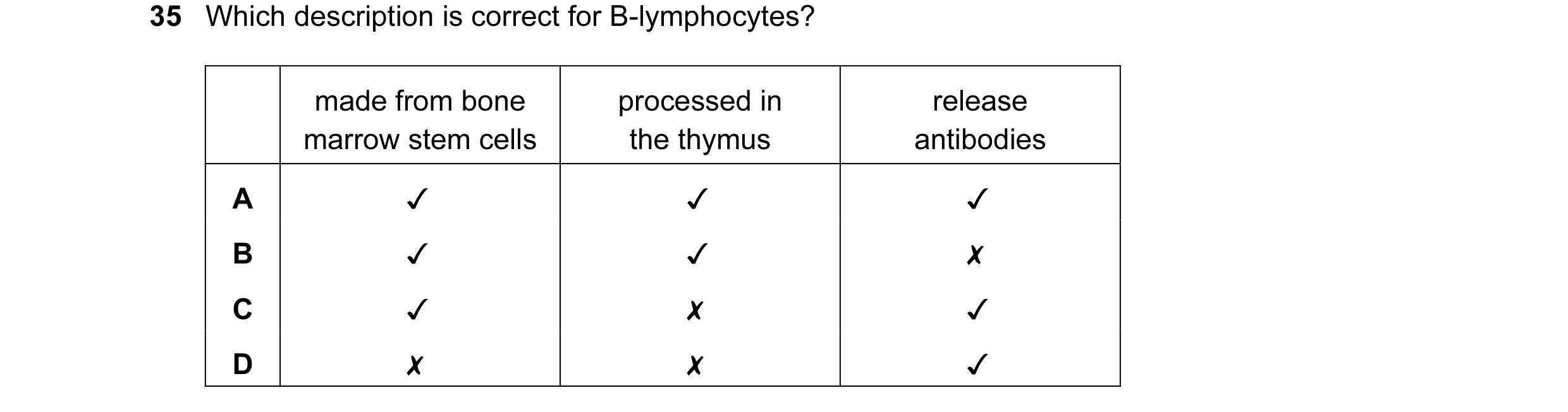
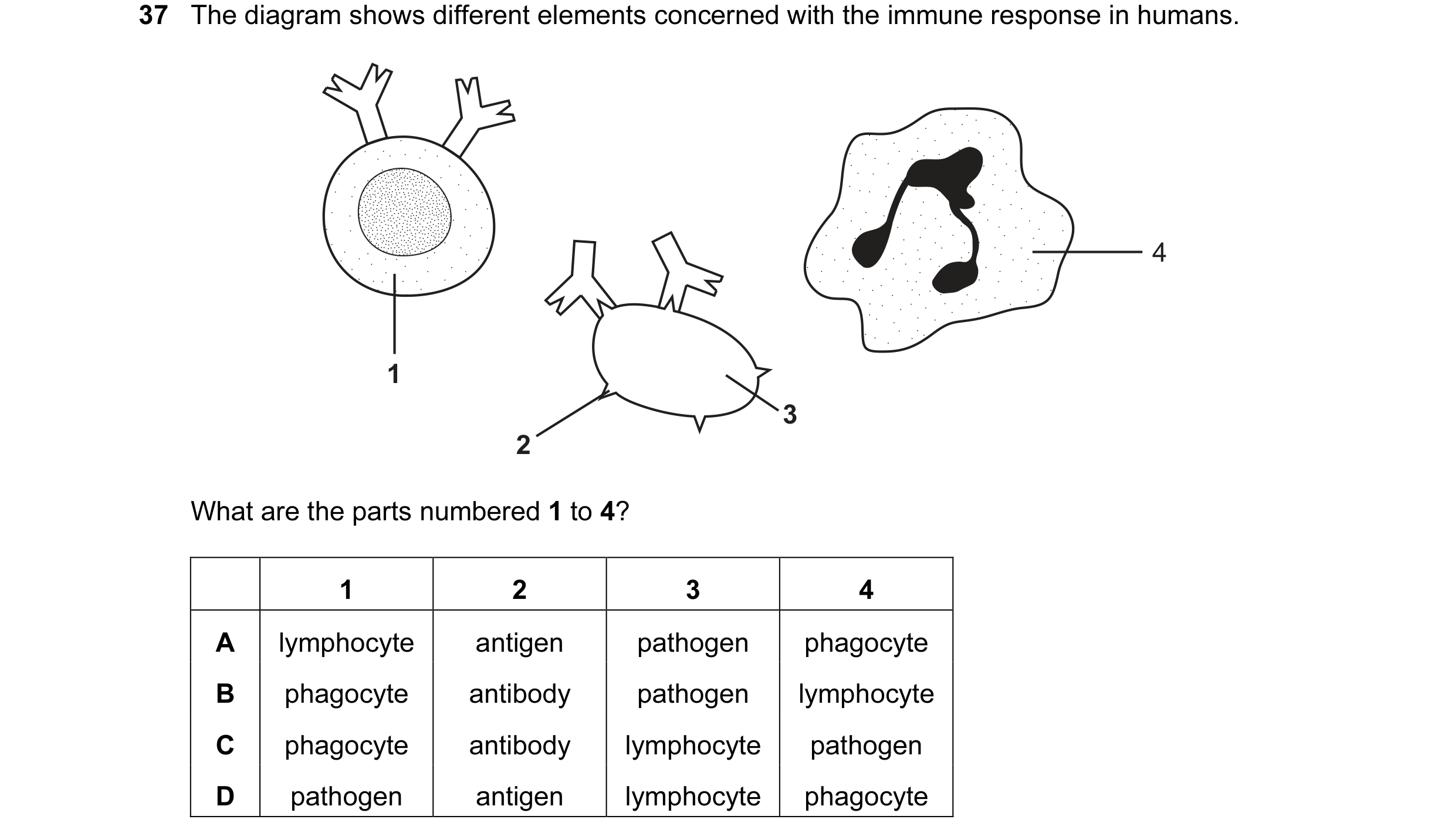 1 / 49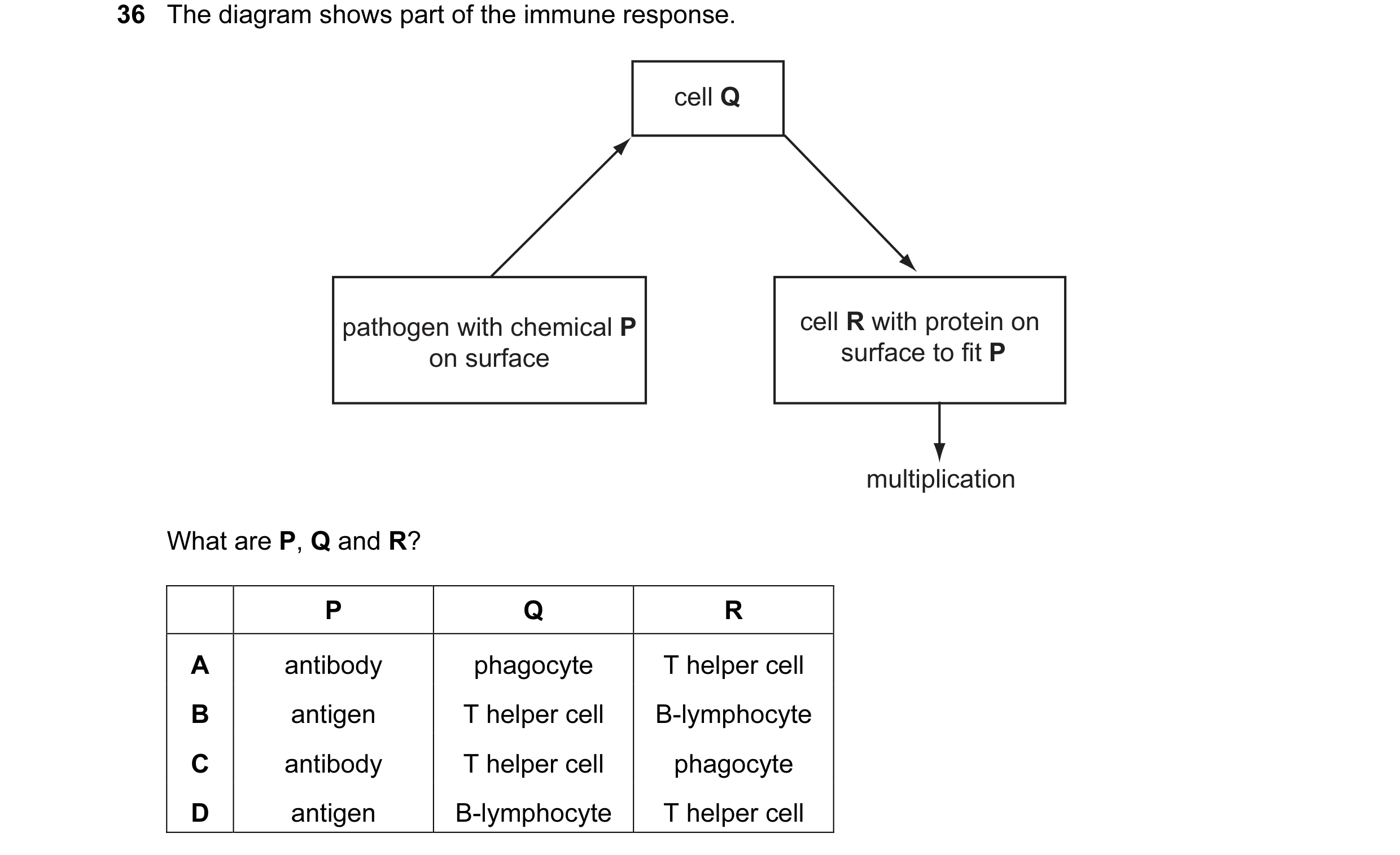
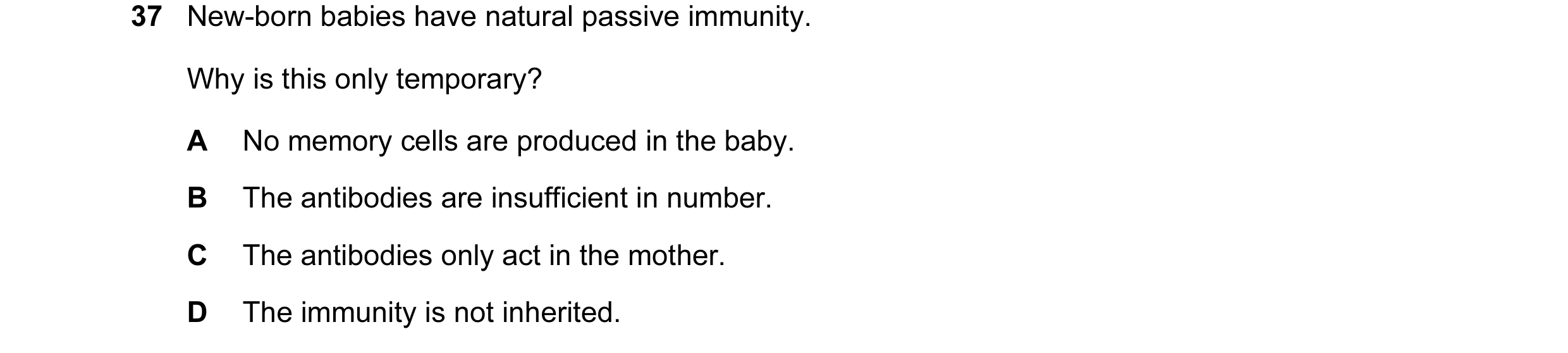
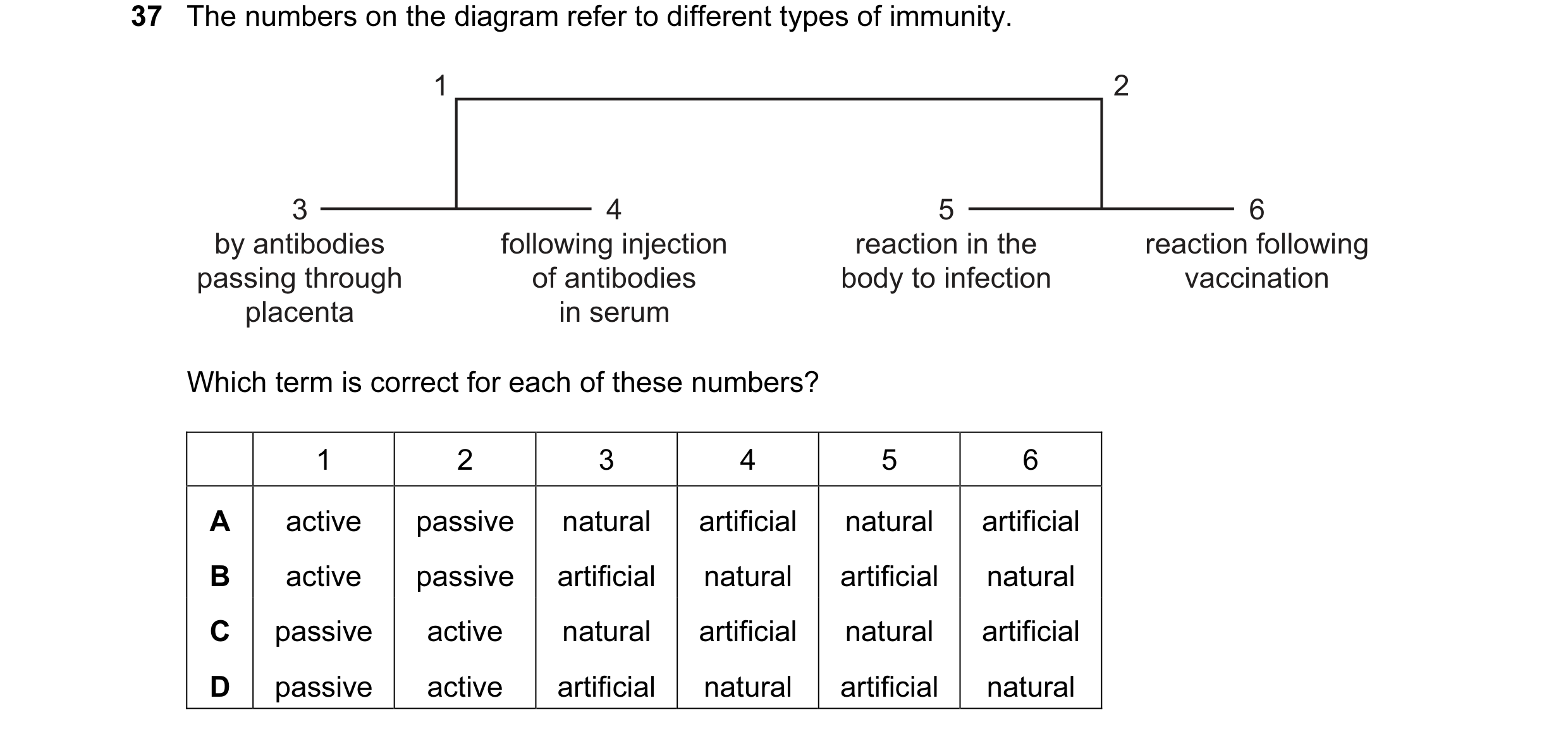 2 / 49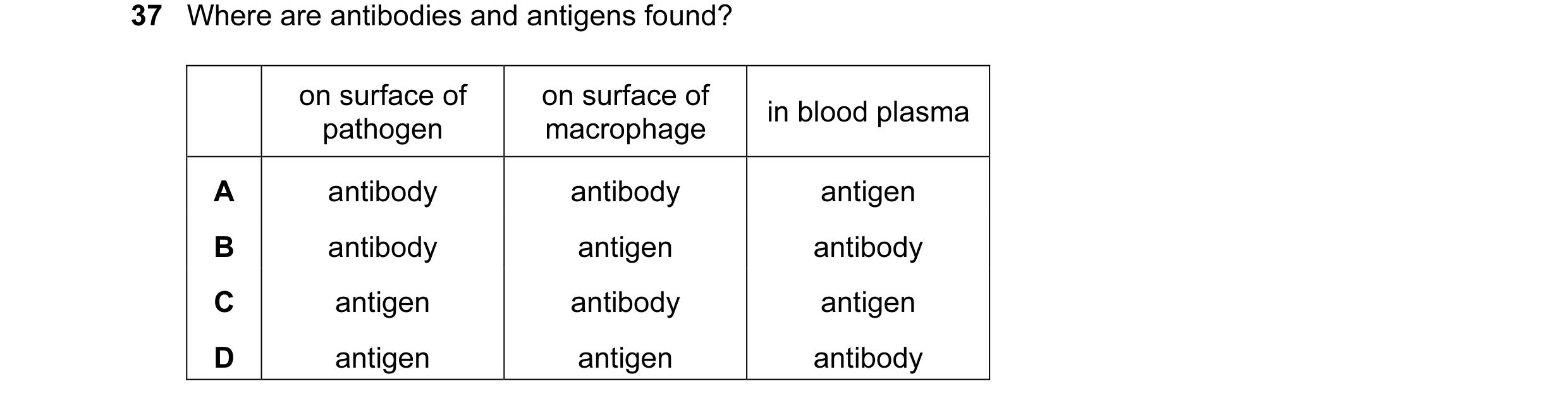
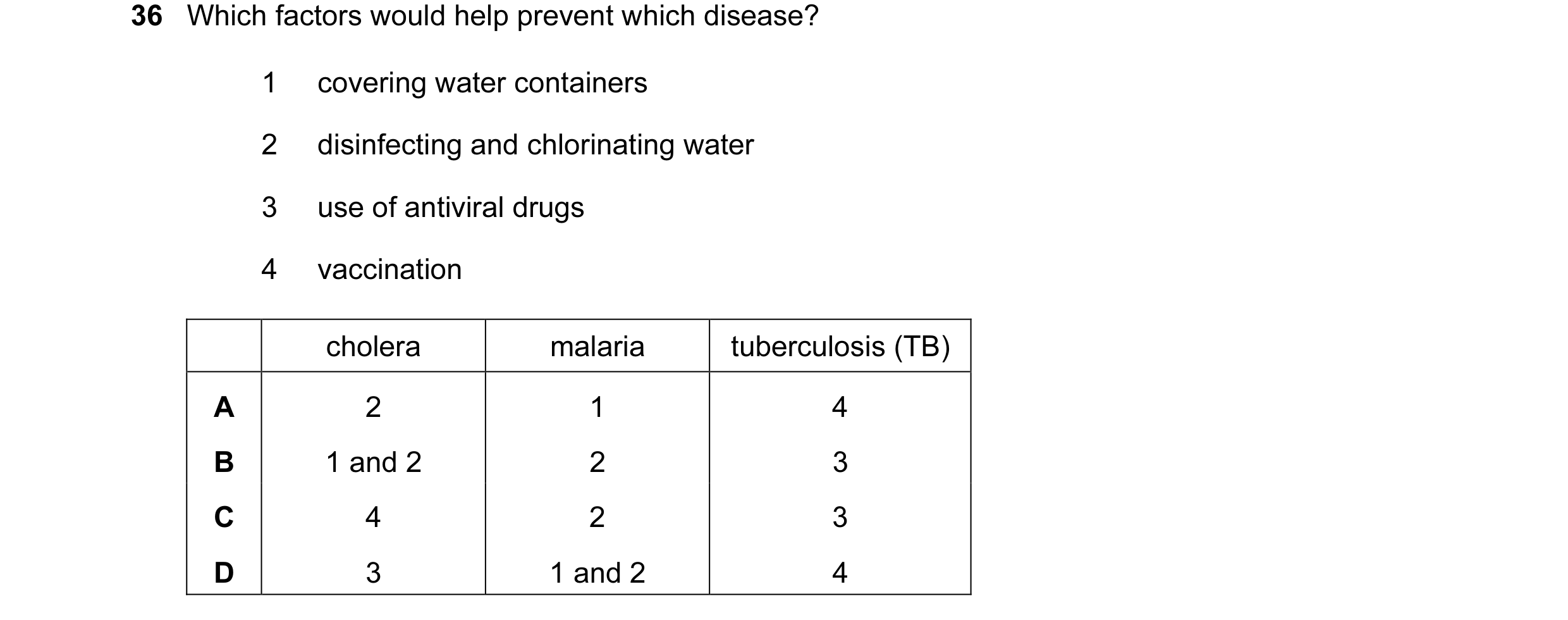
 3 / 49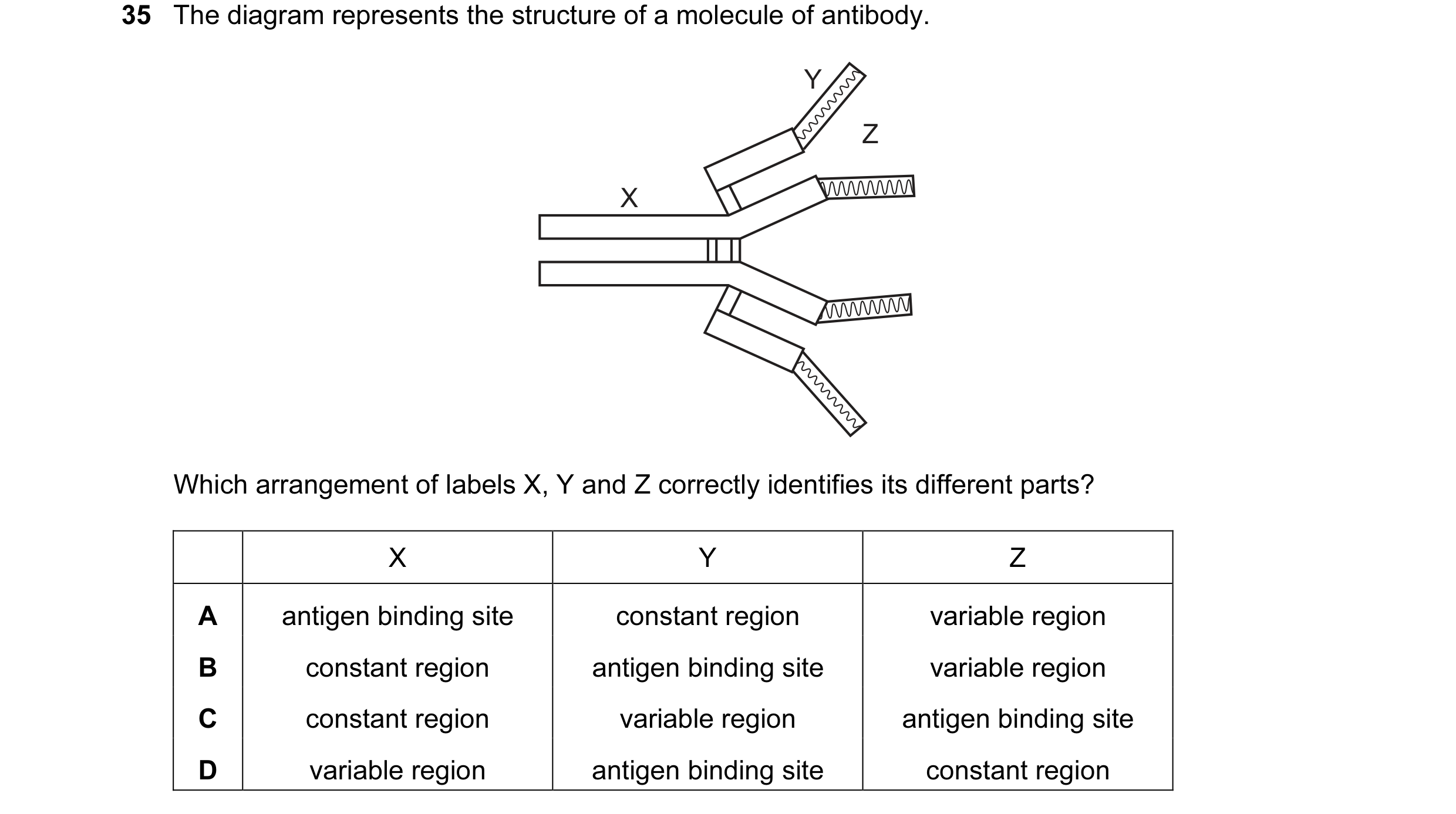
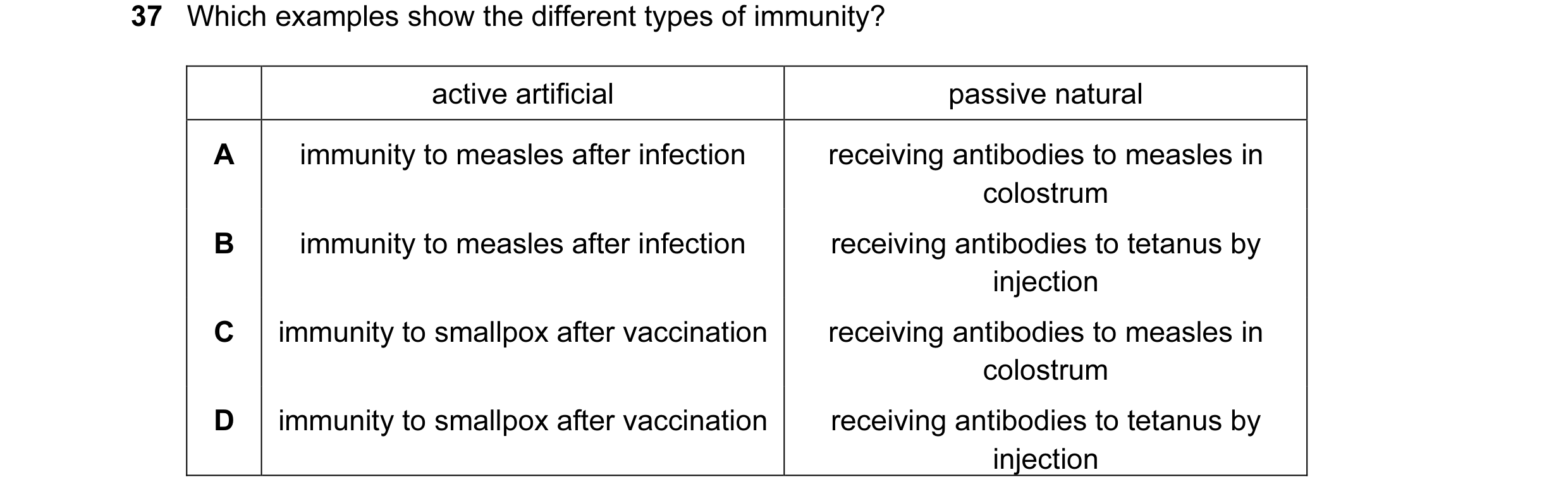
 4 / 49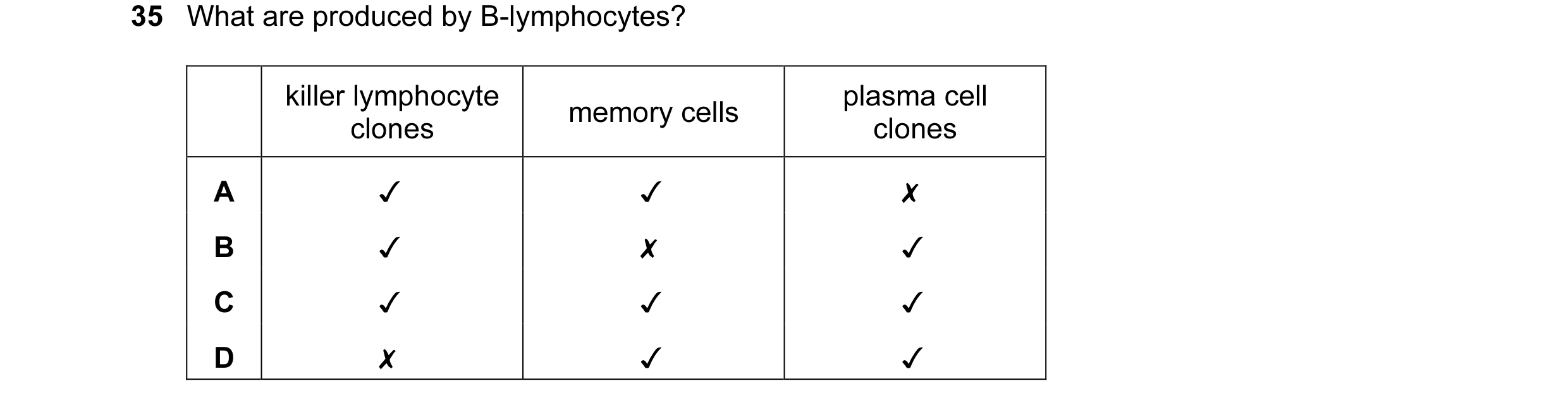
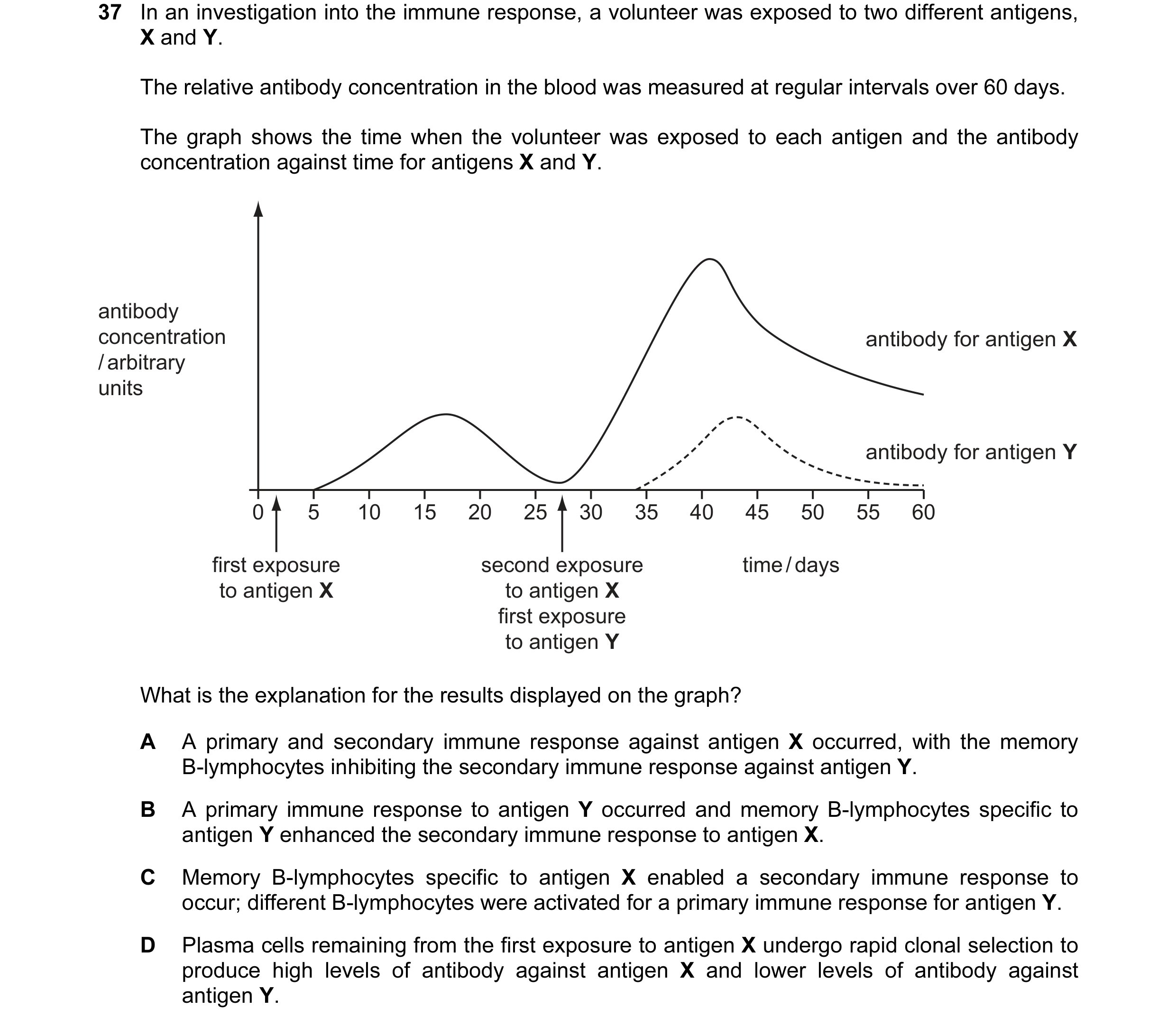 5 / 49
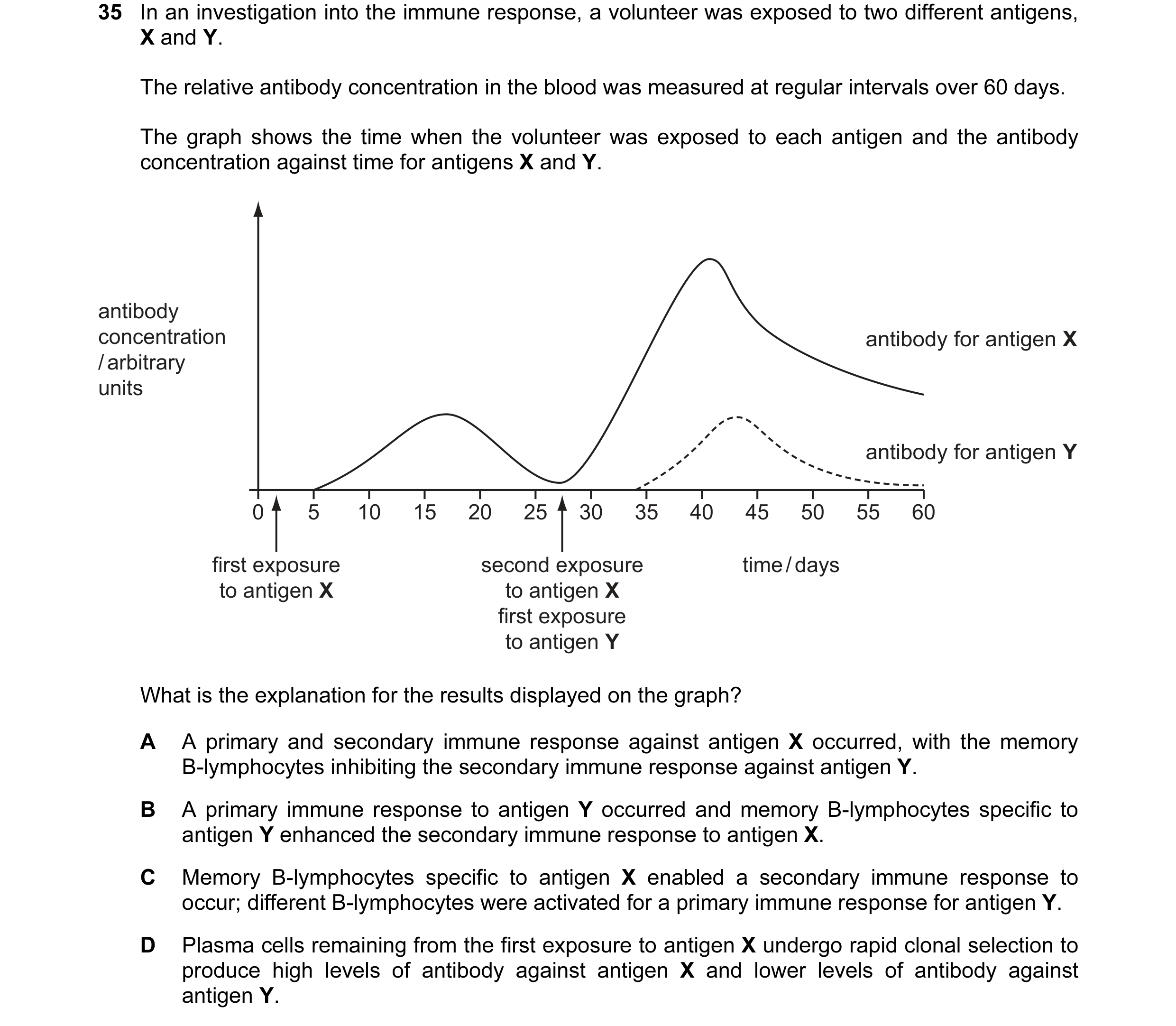 6 / 49
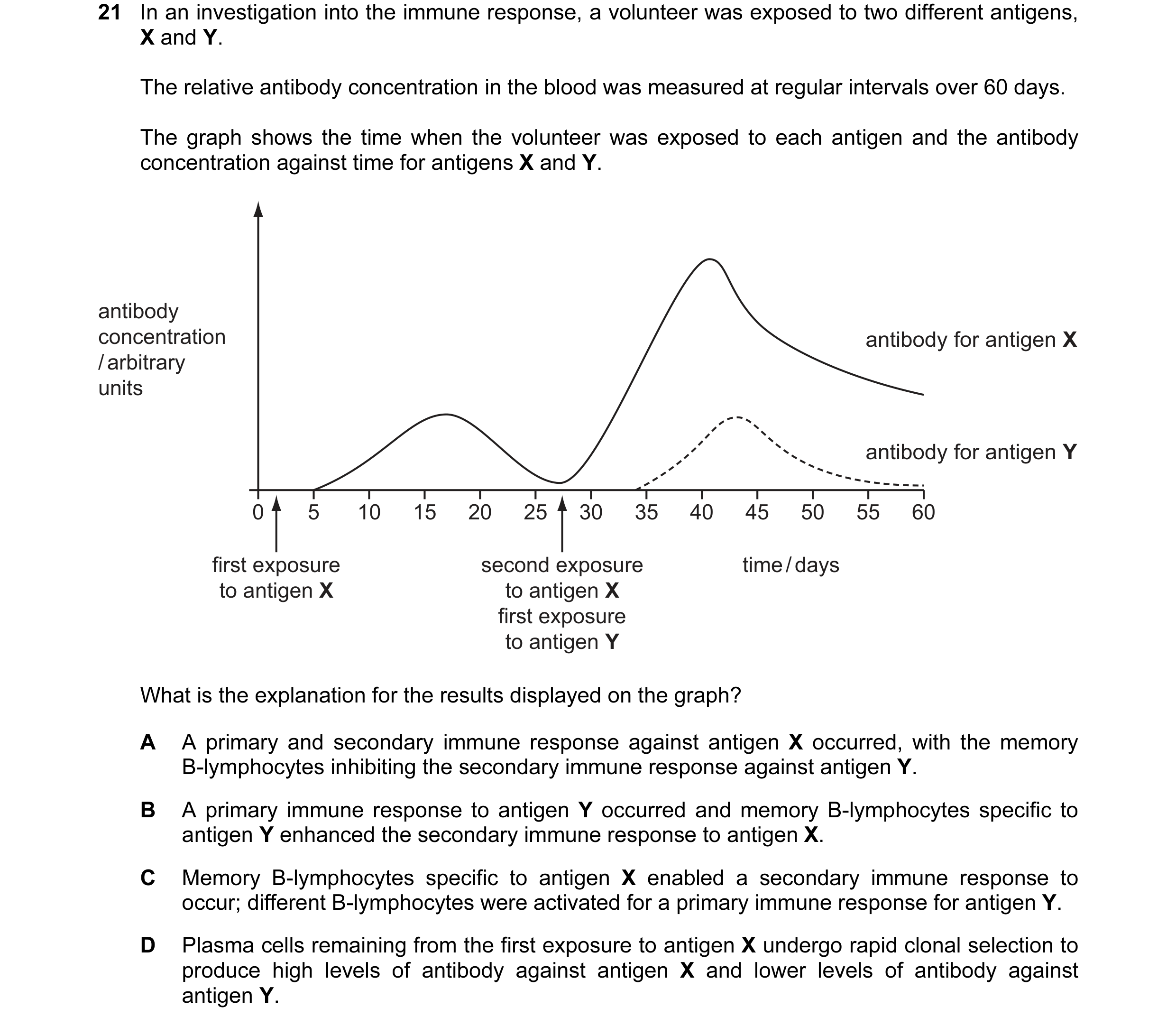 7 / 49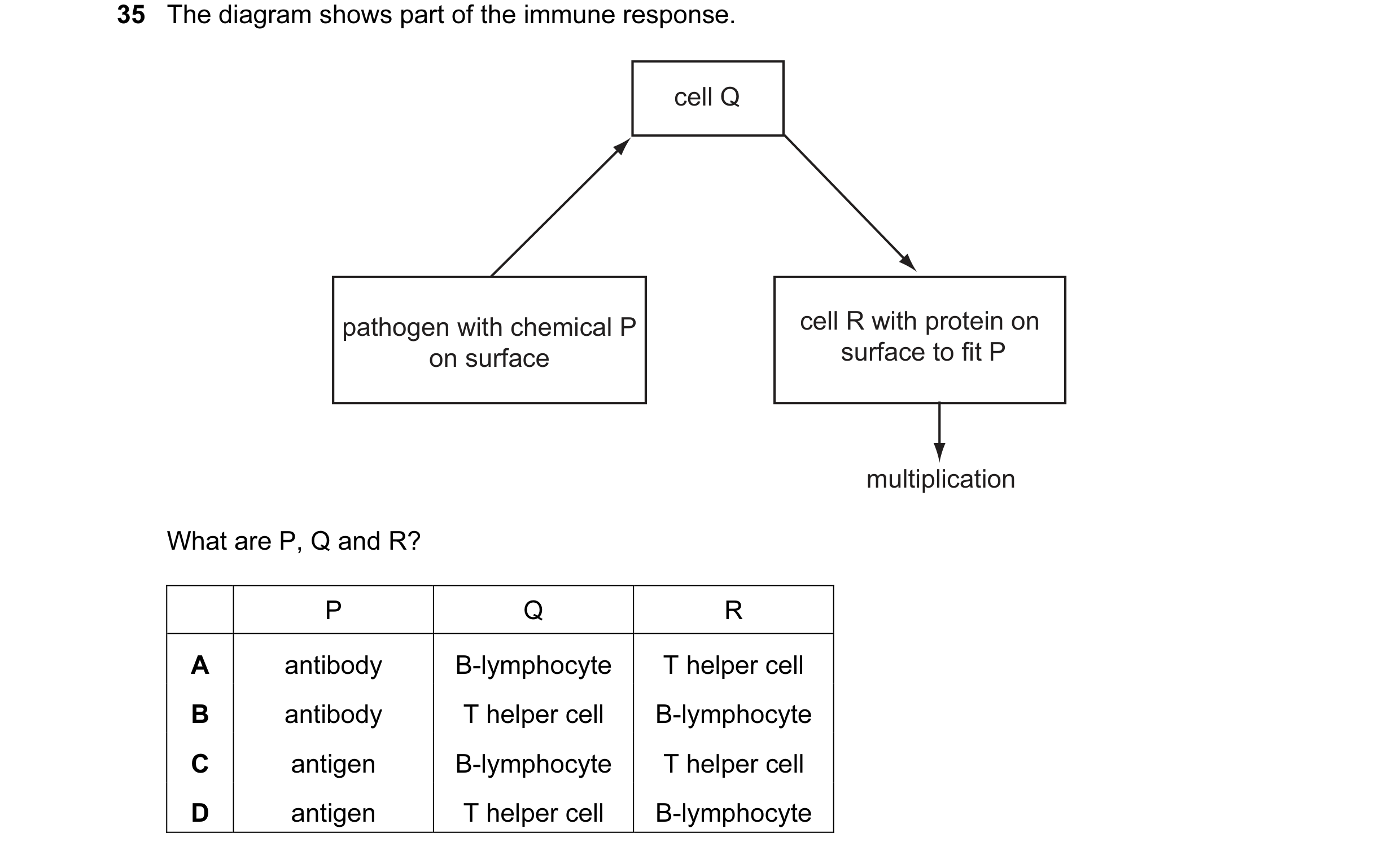

 8 / 49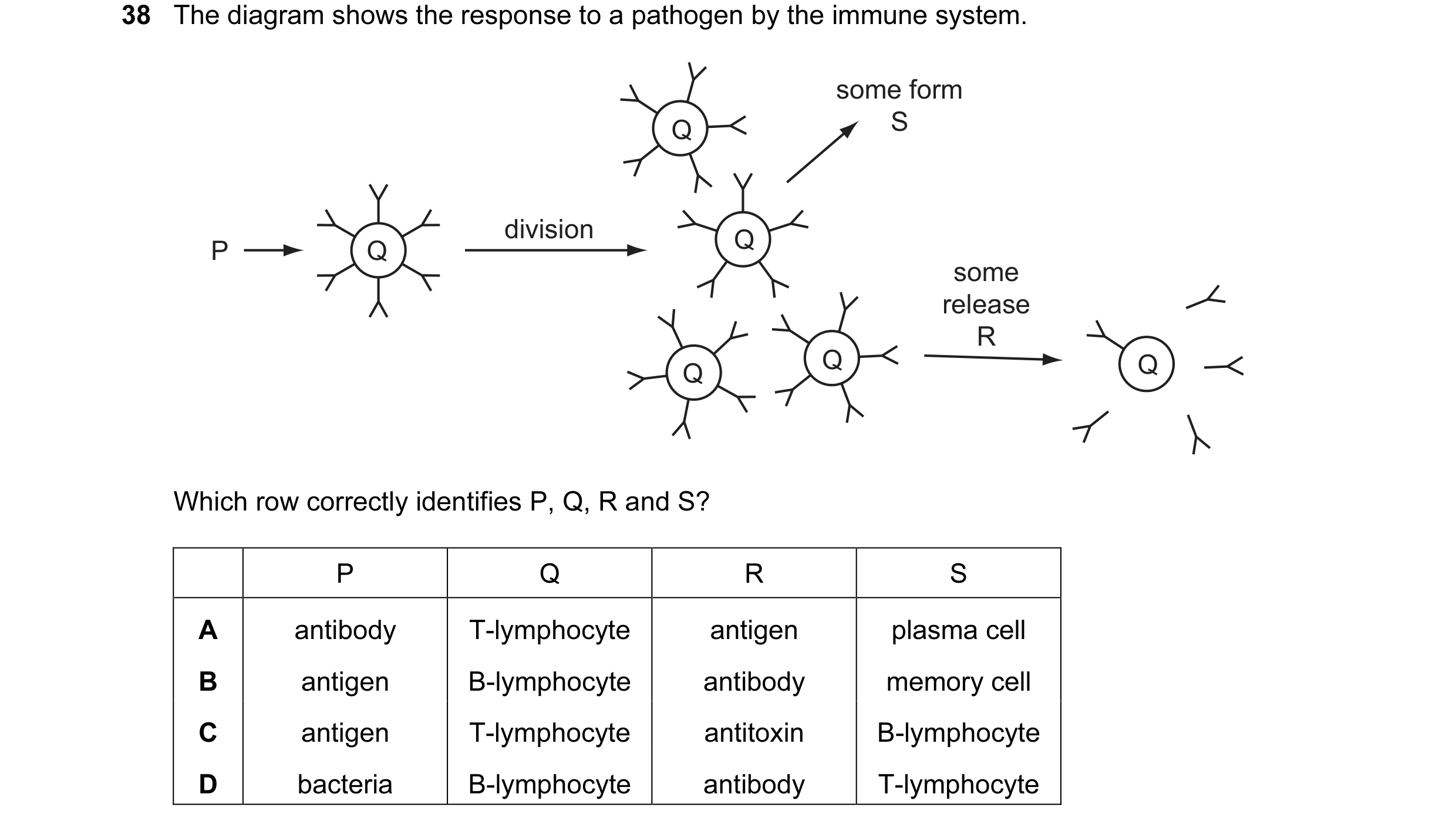
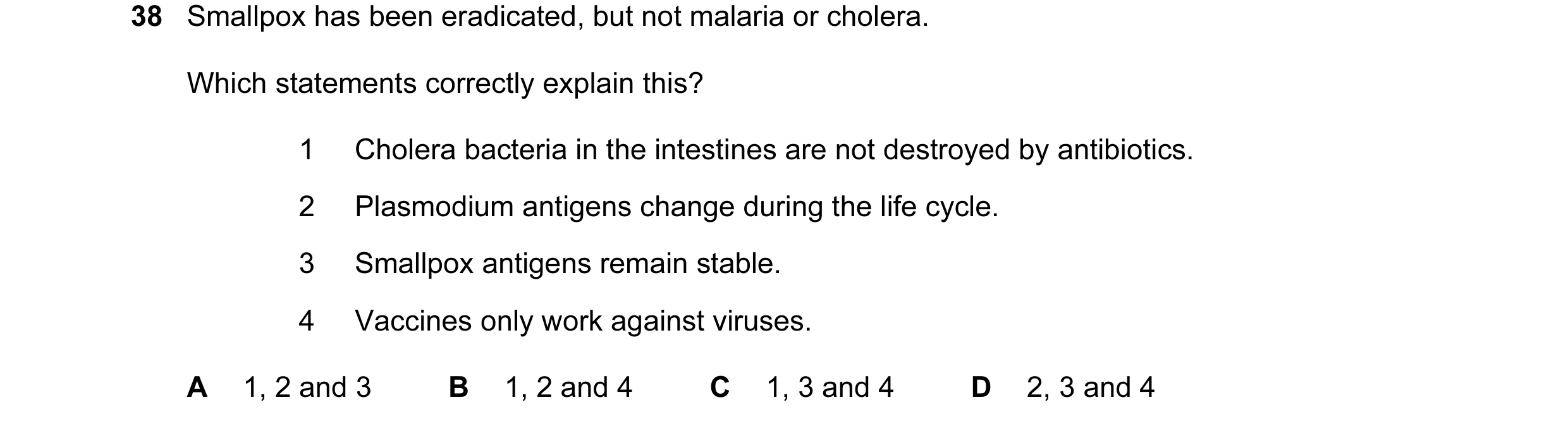 9 / 49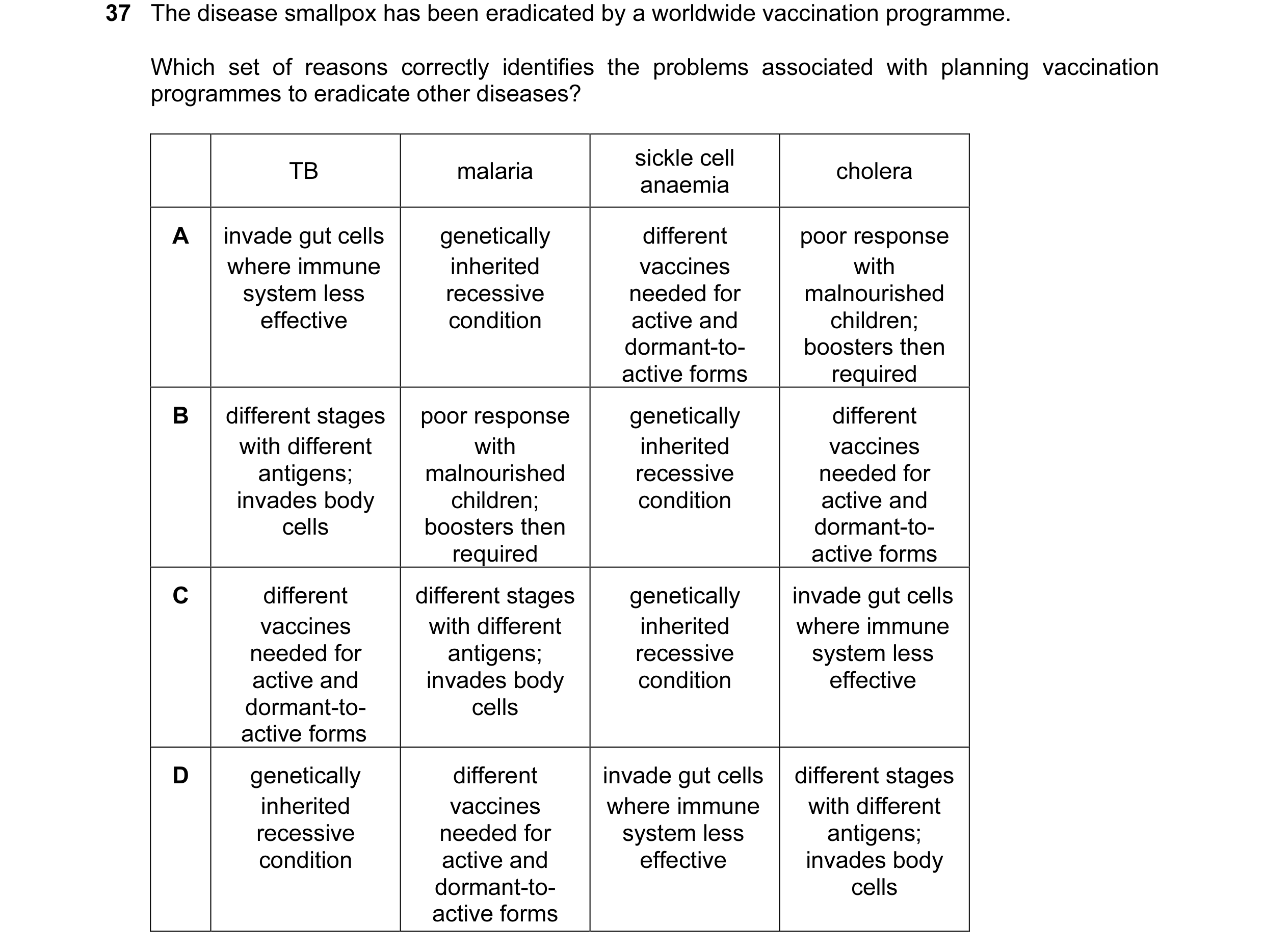
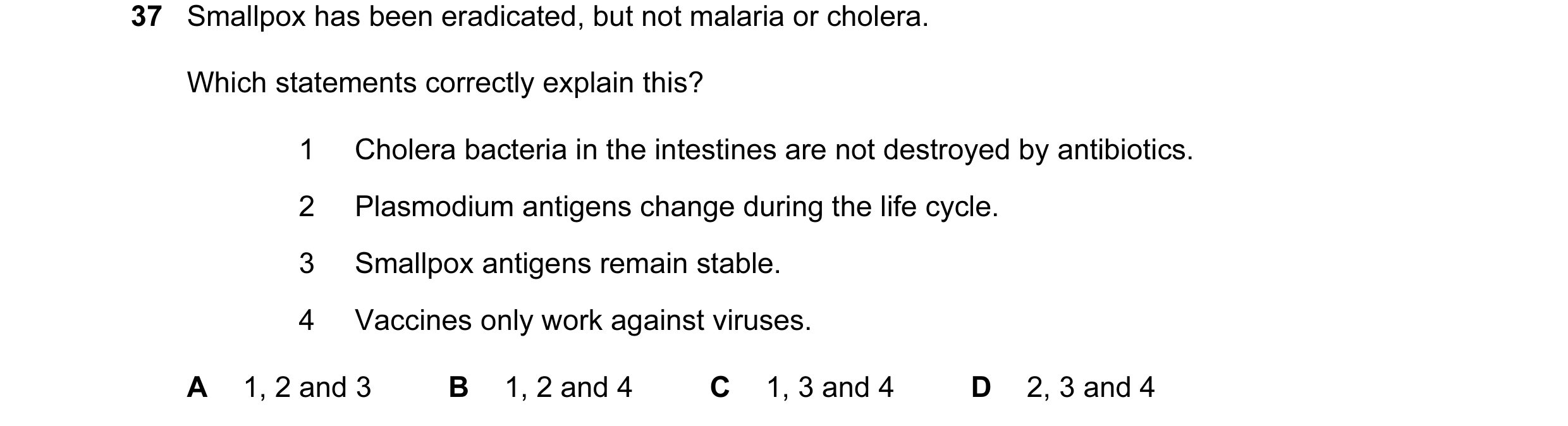
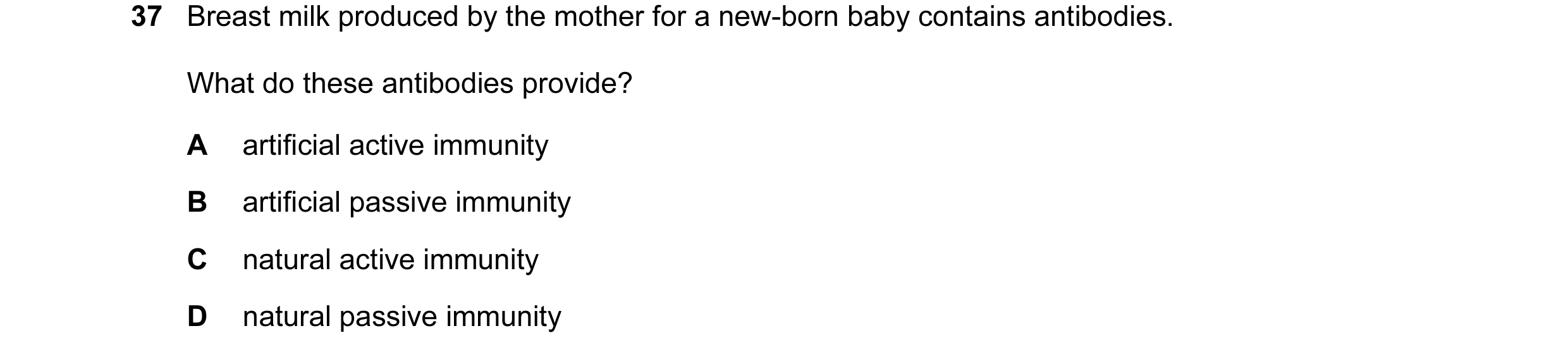 10 / 49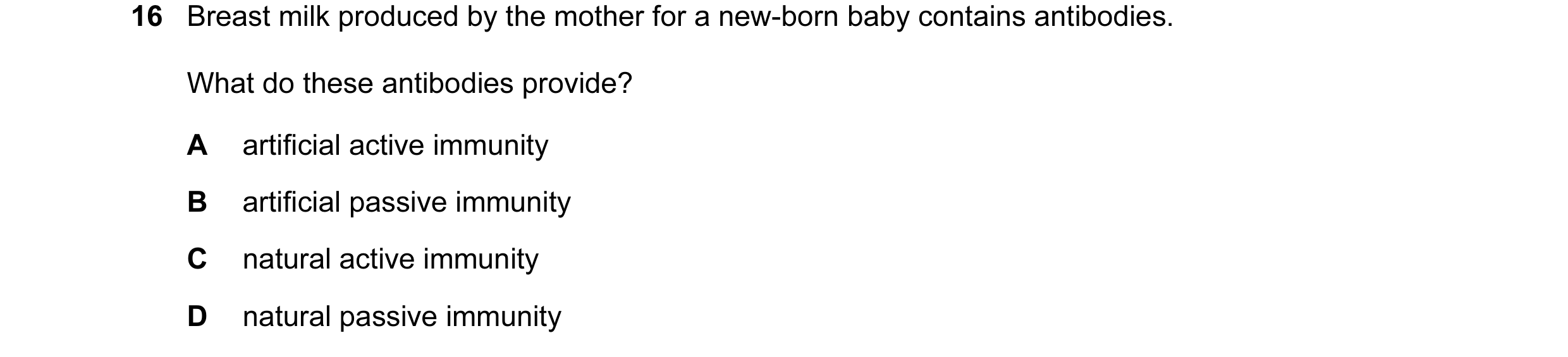
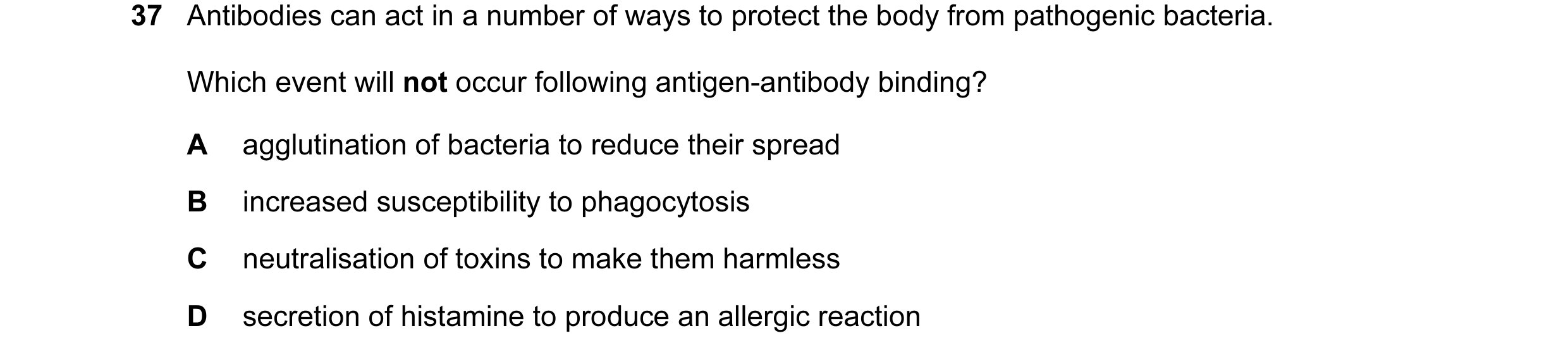
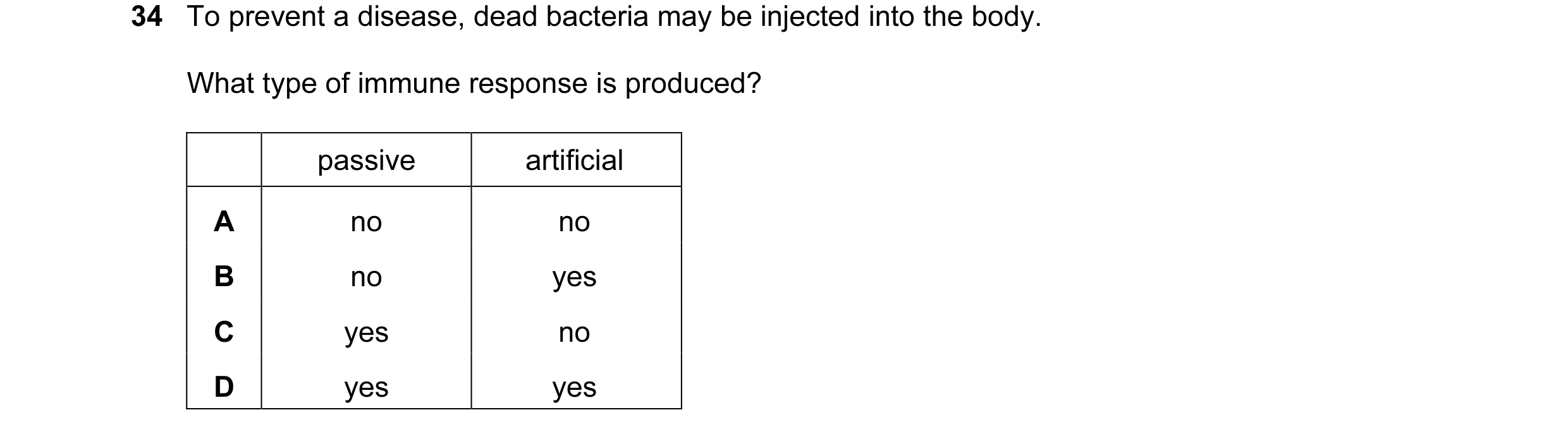 11 / 49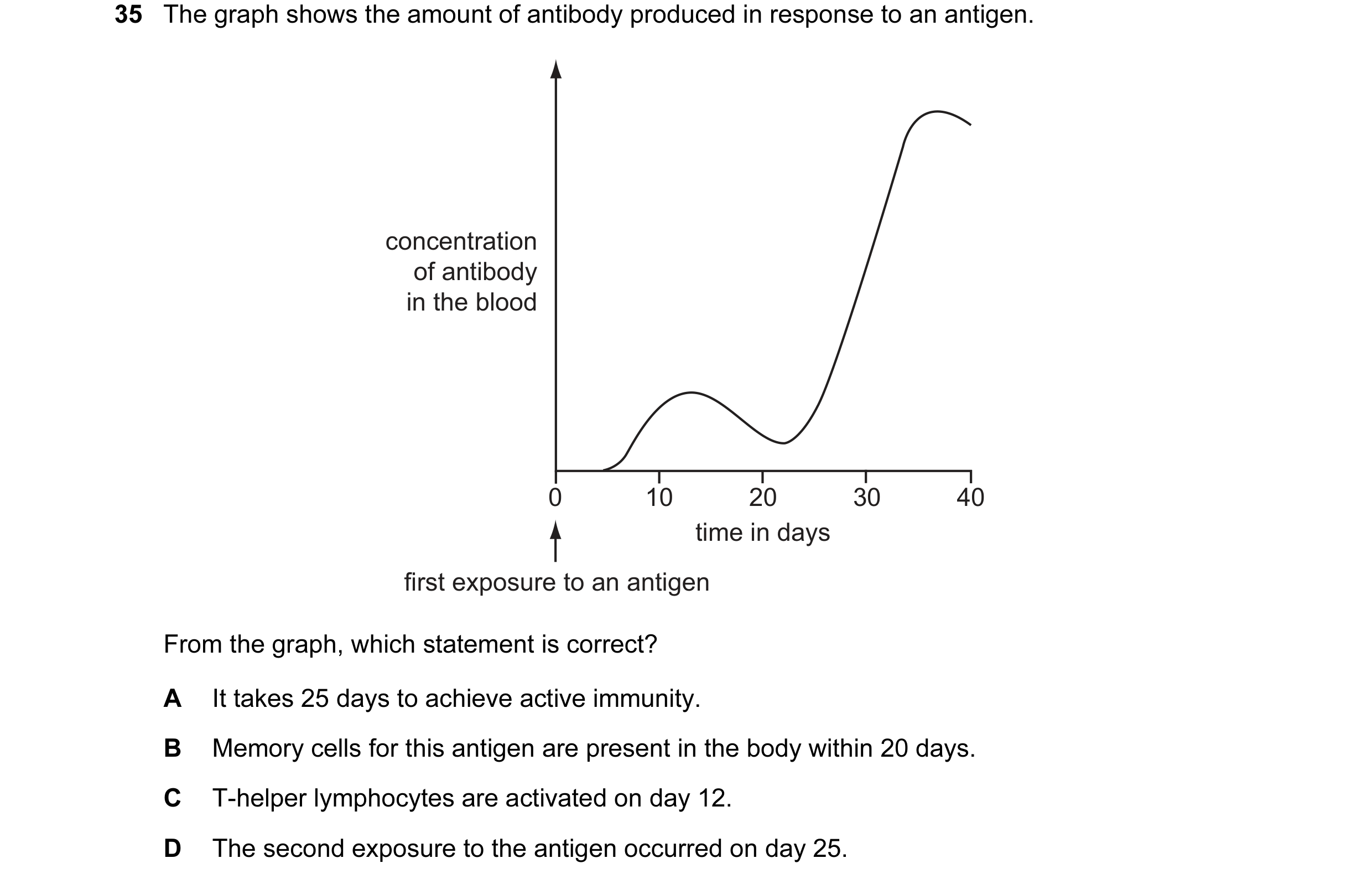
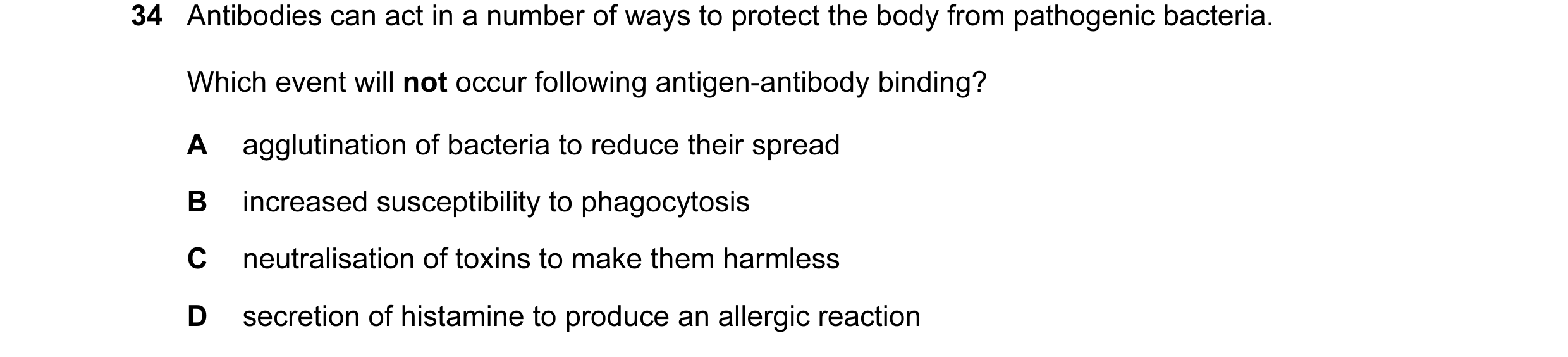

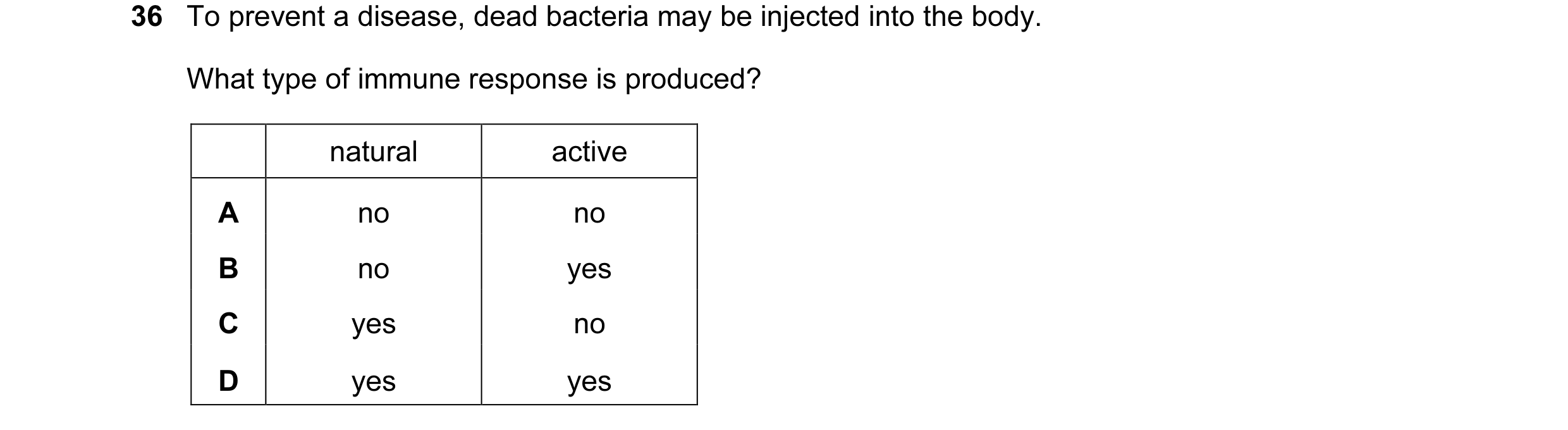 12 / 49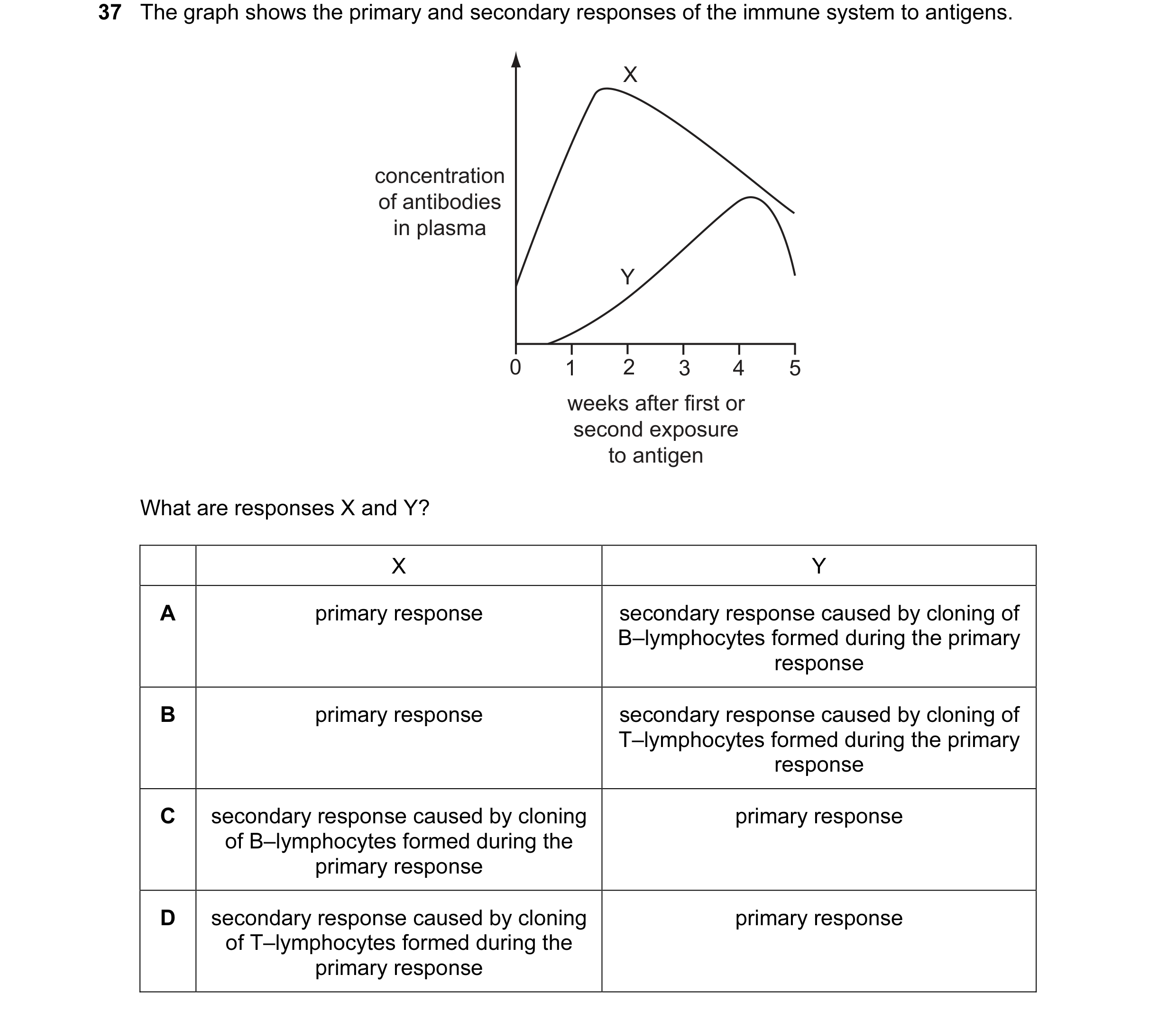
 13 / 49

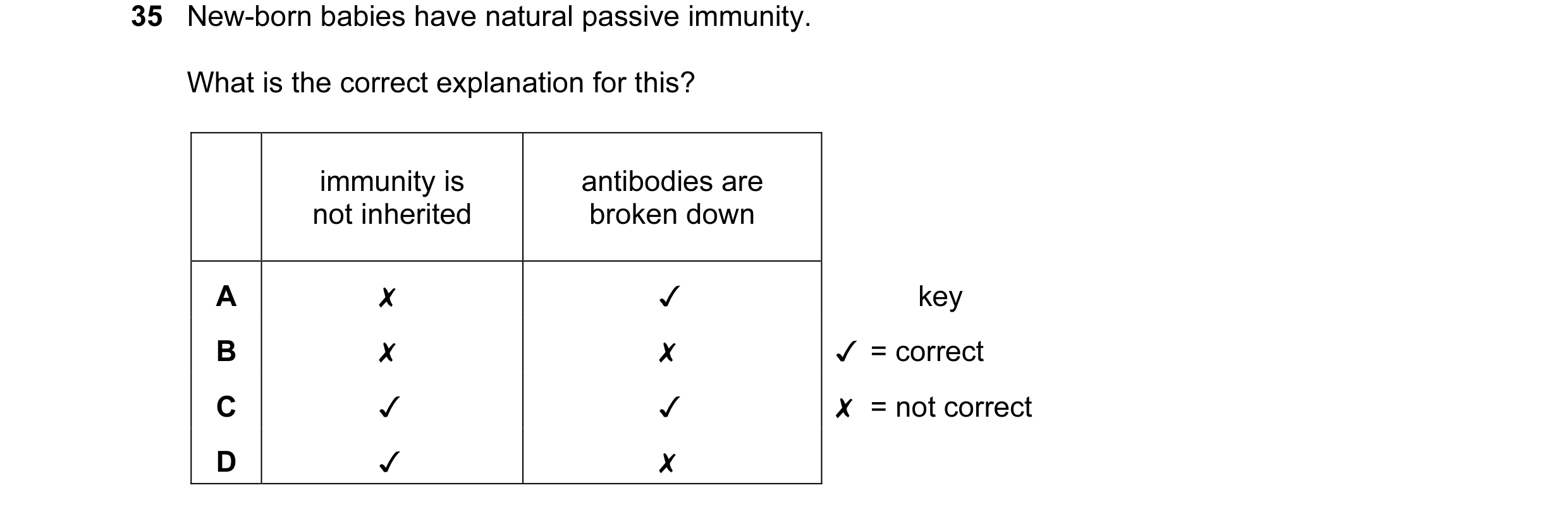 14 / 49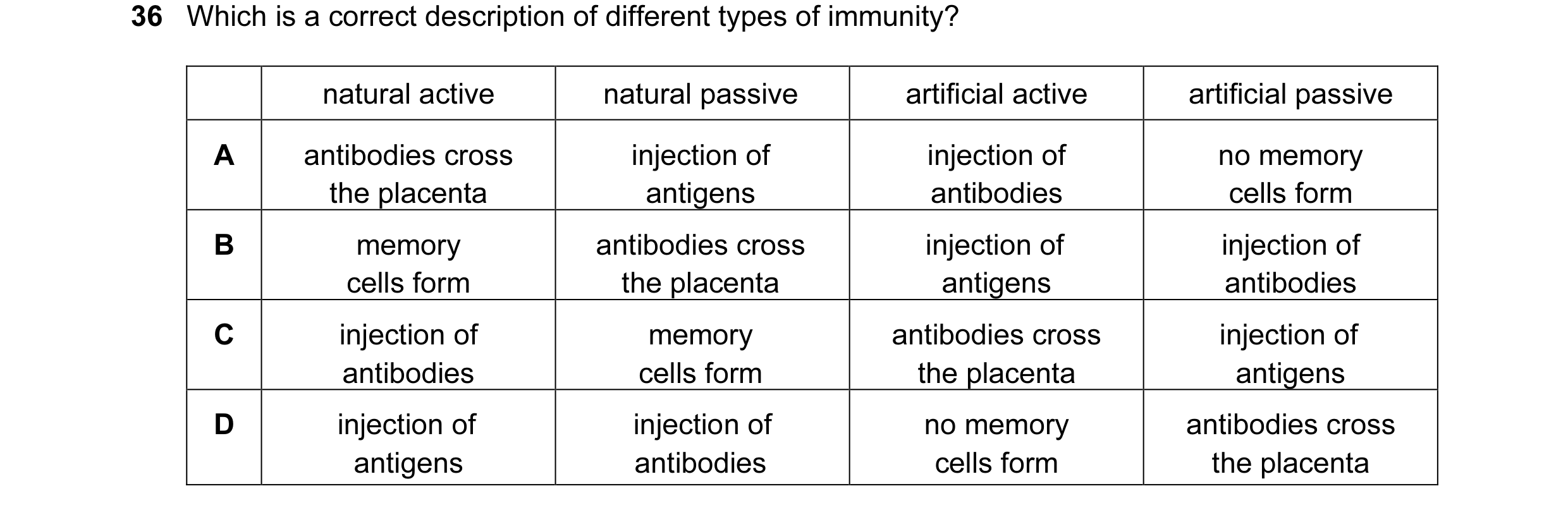
 15 / 49

 16 / 49
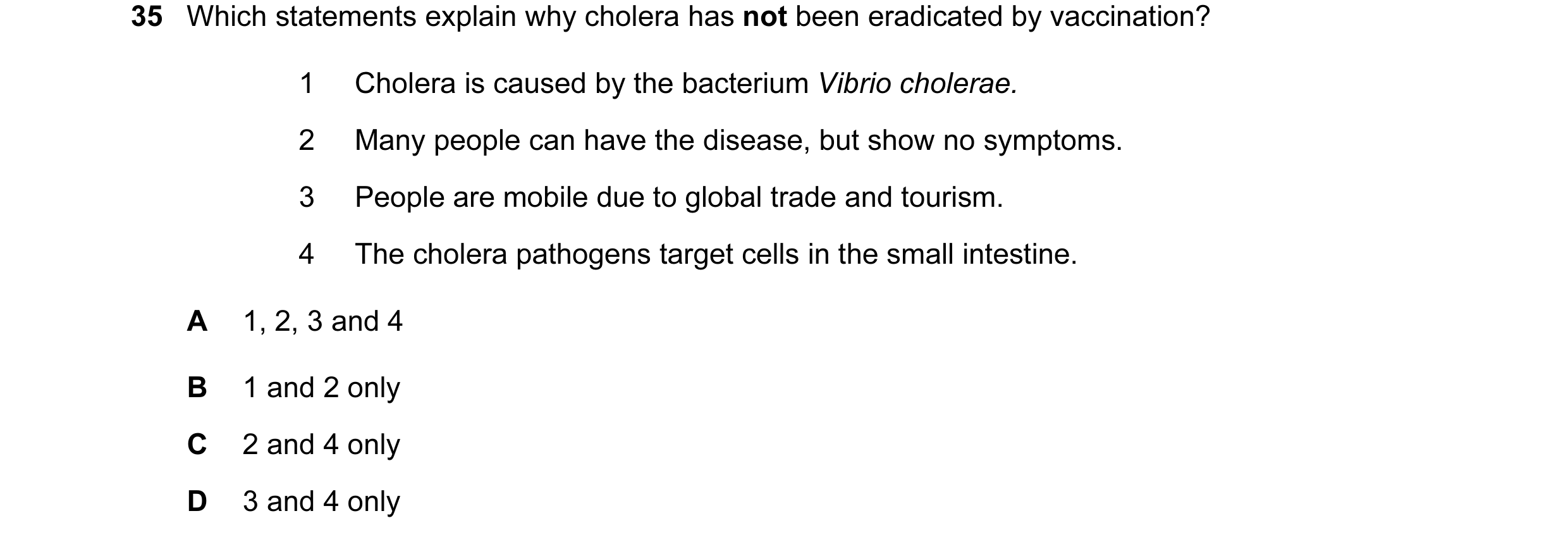

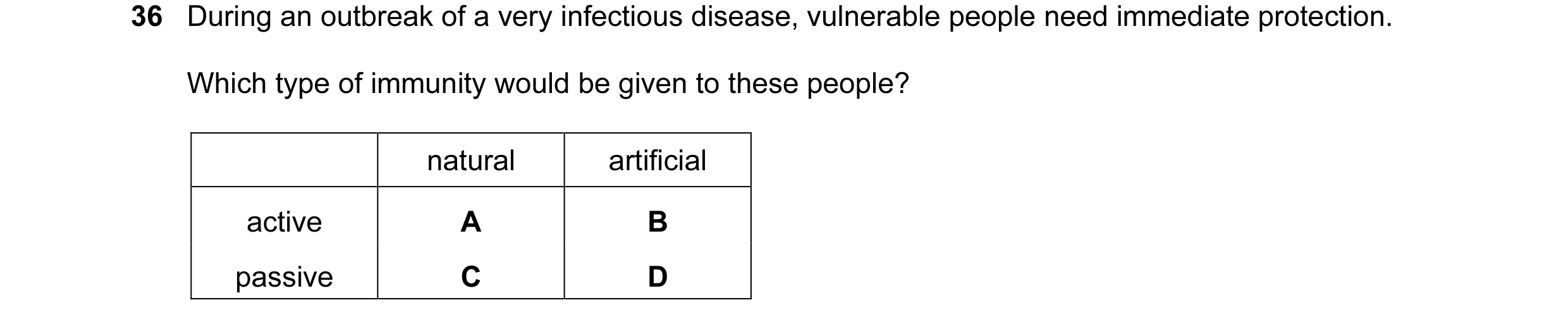

 17 / 49
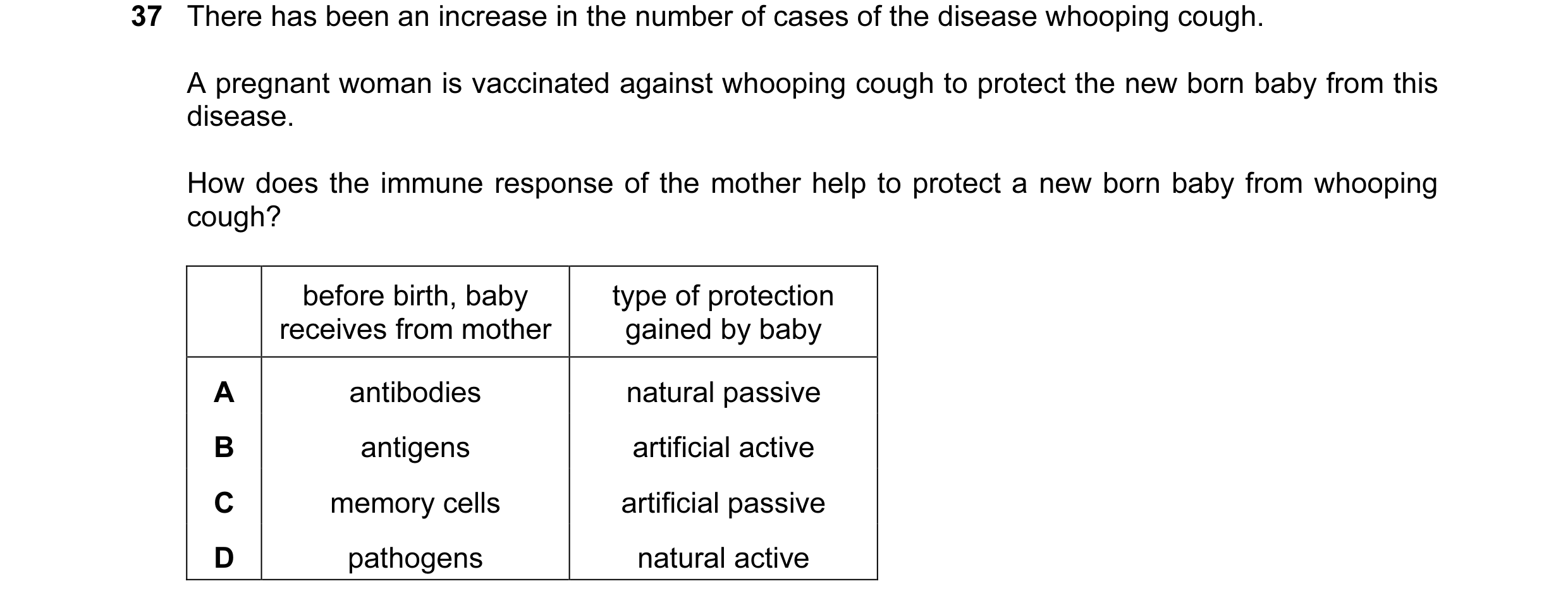

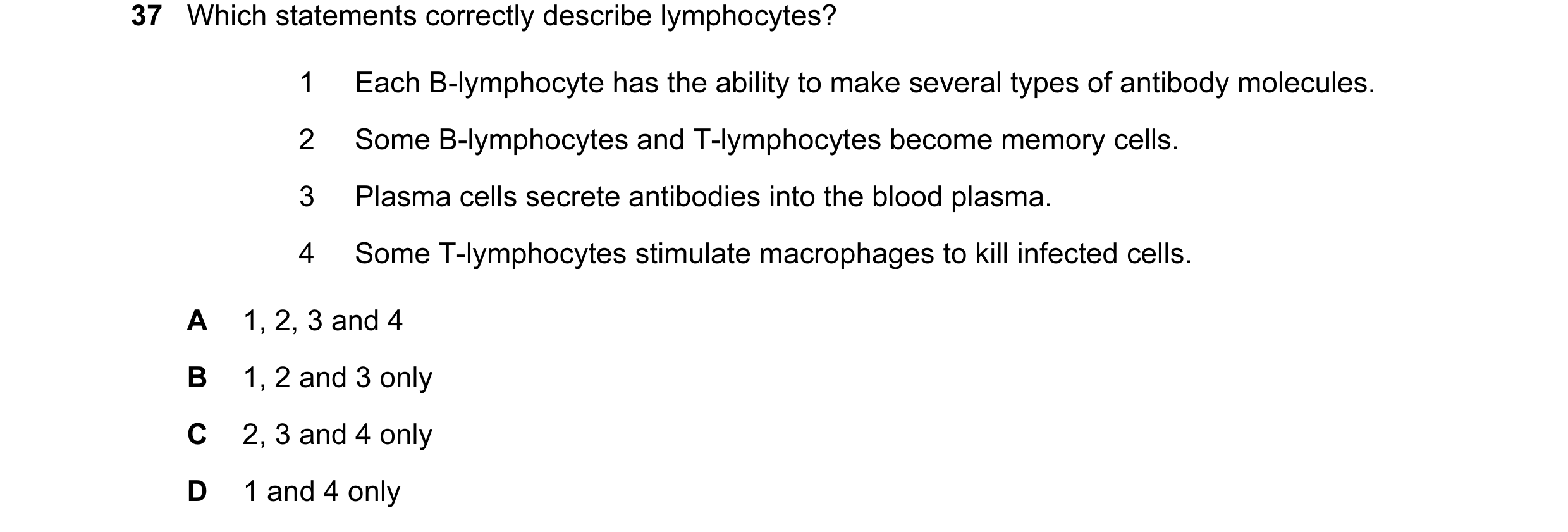
 18 / 49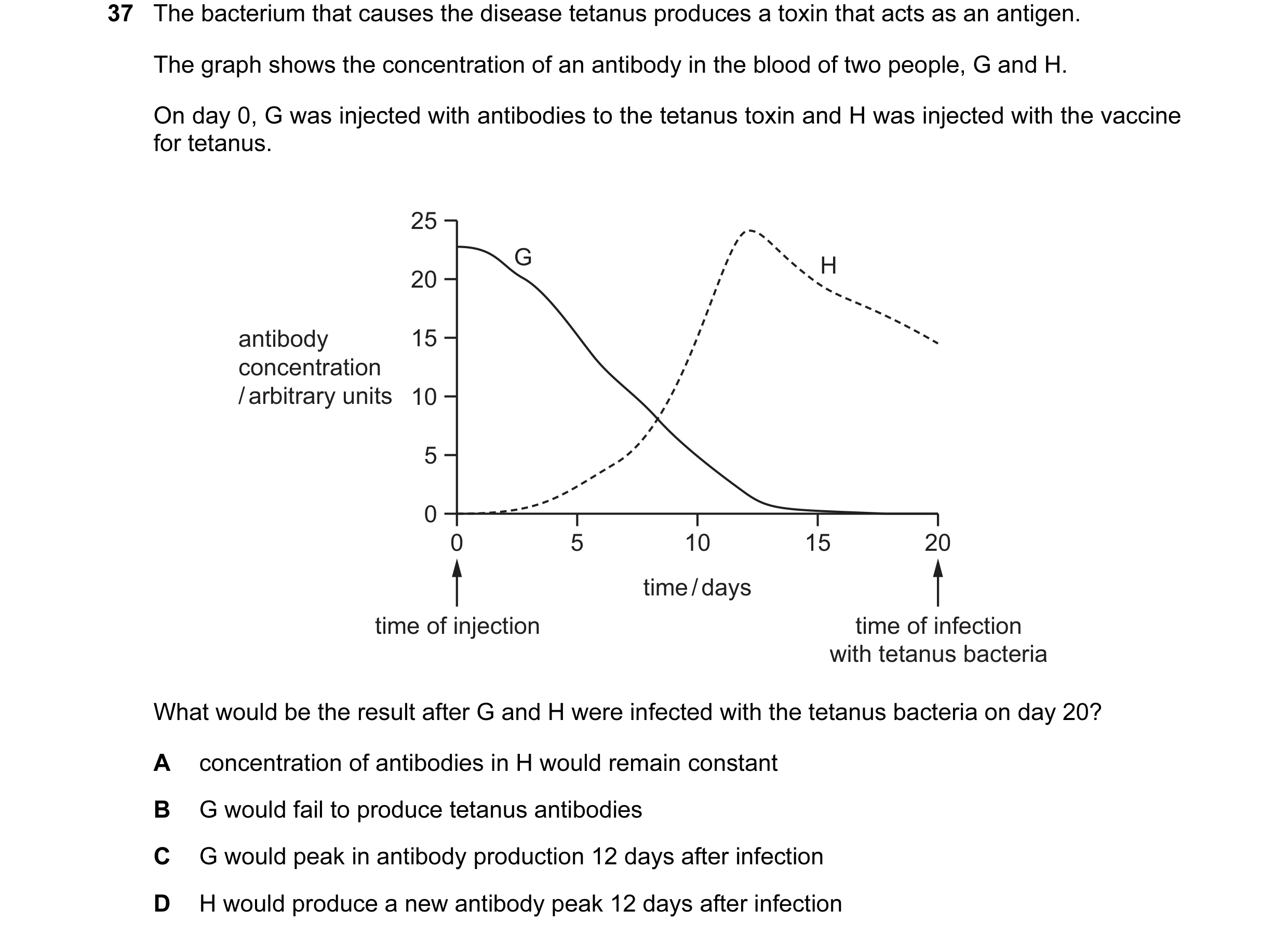

 19 / 49

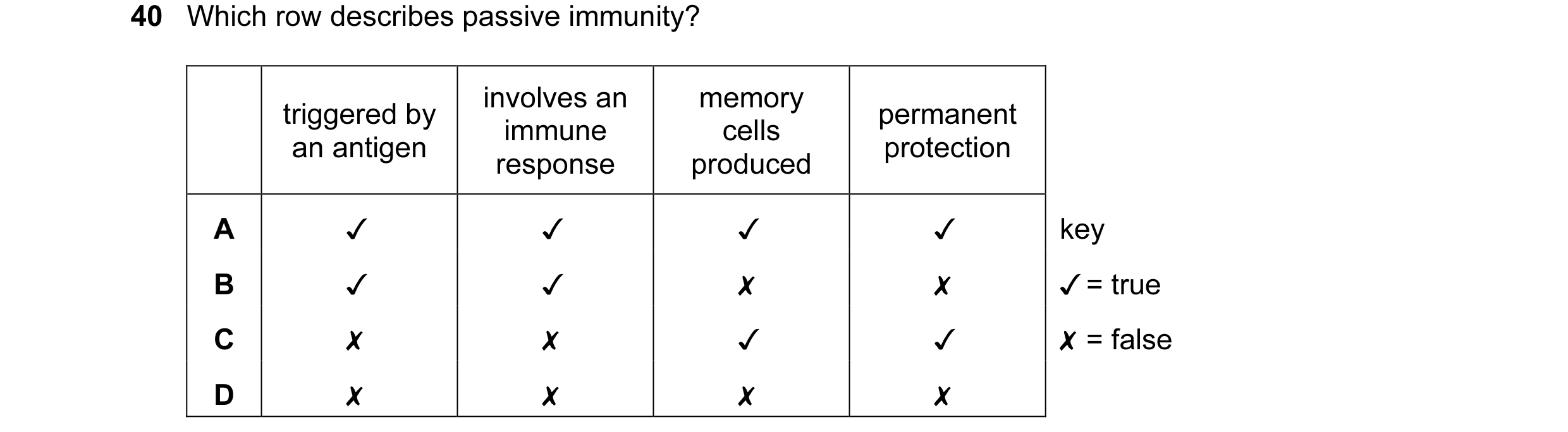
 20 / 49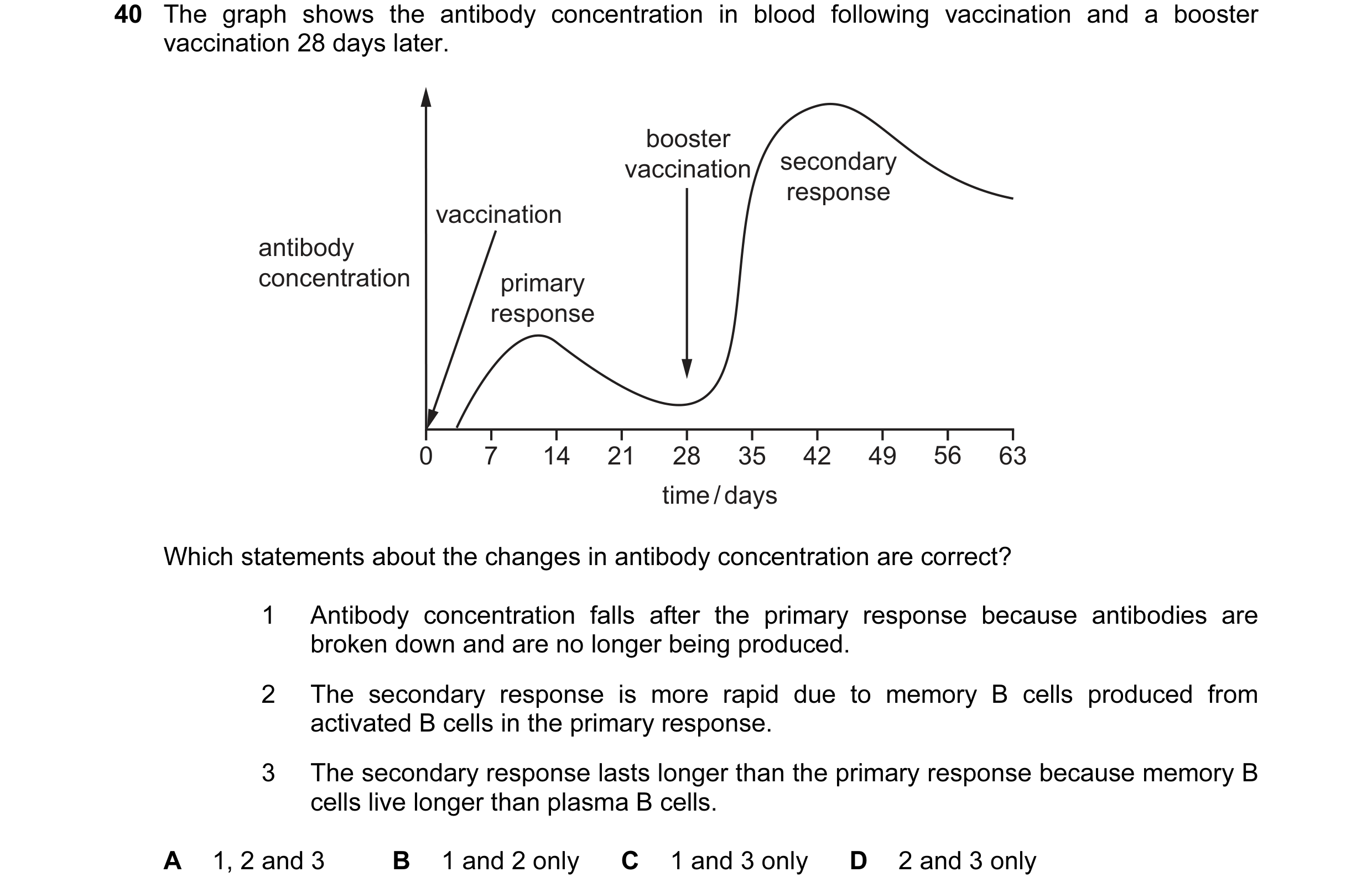
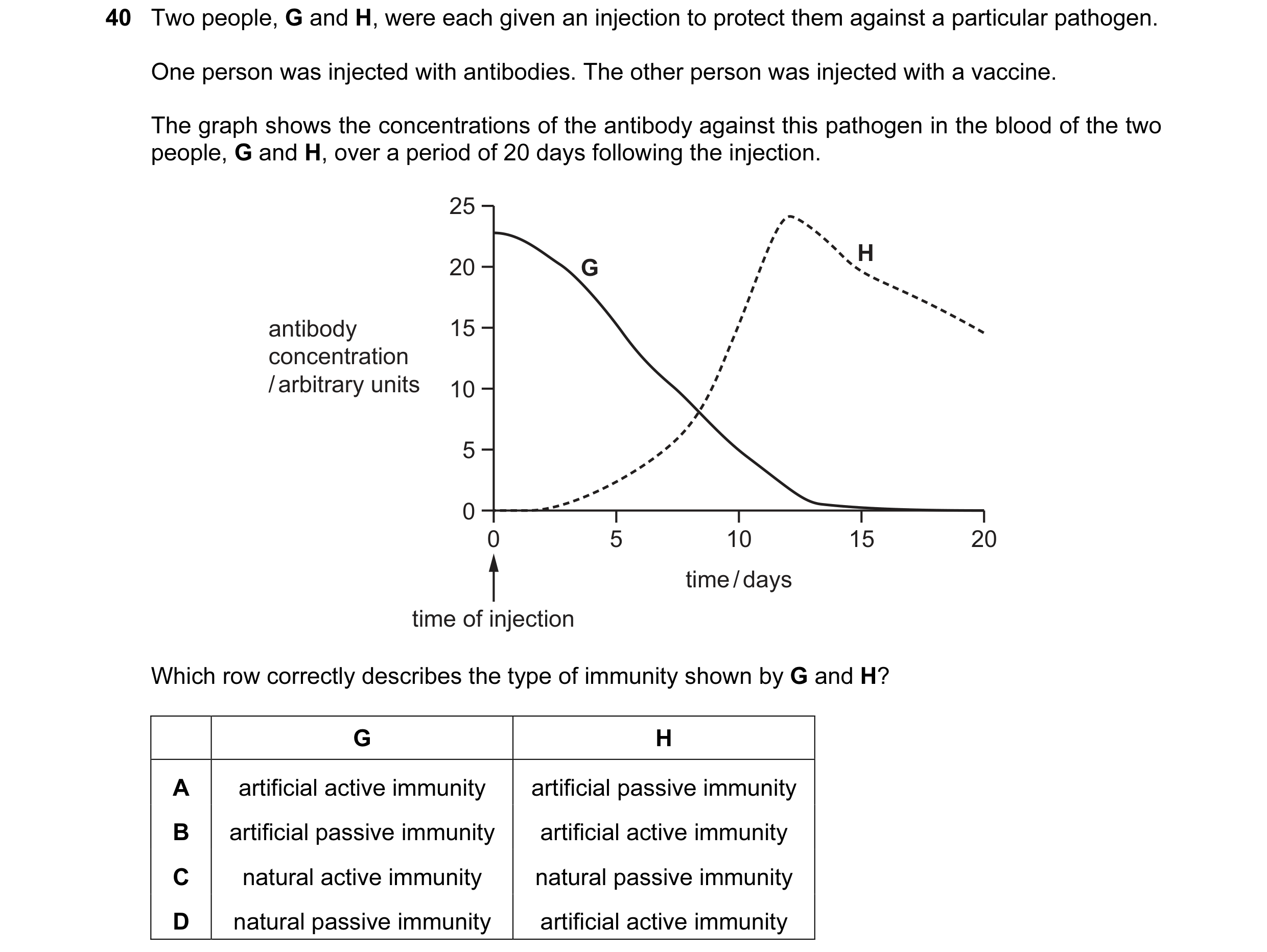 21 / 49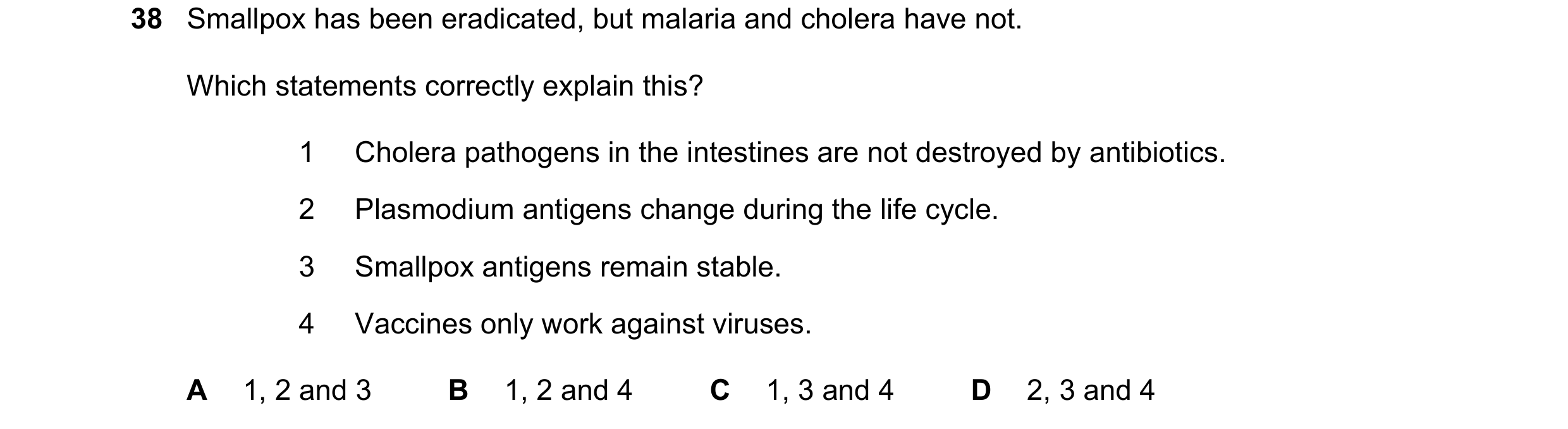
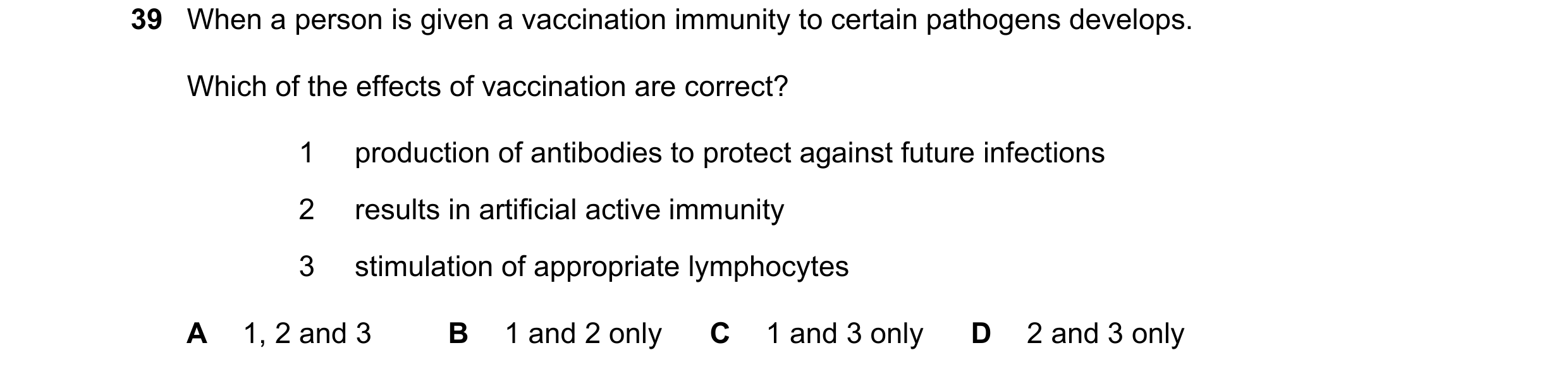
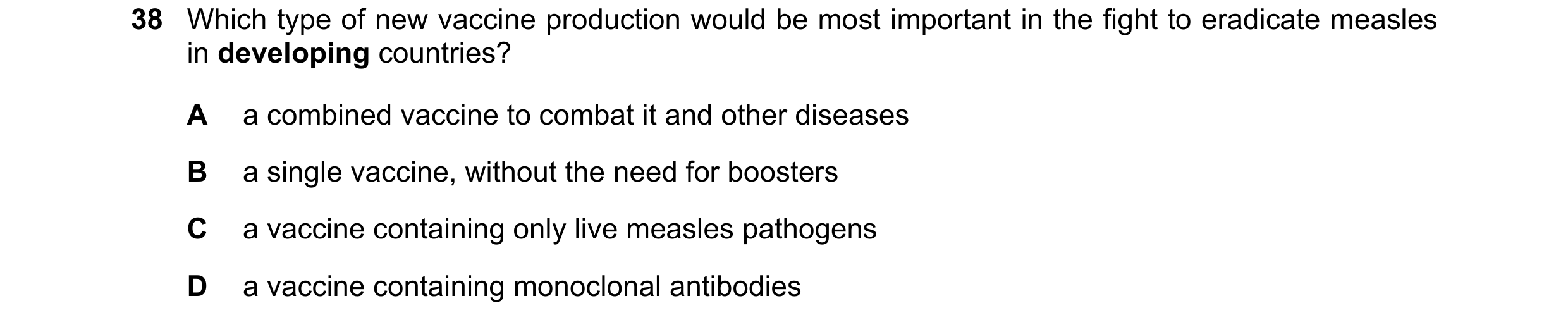
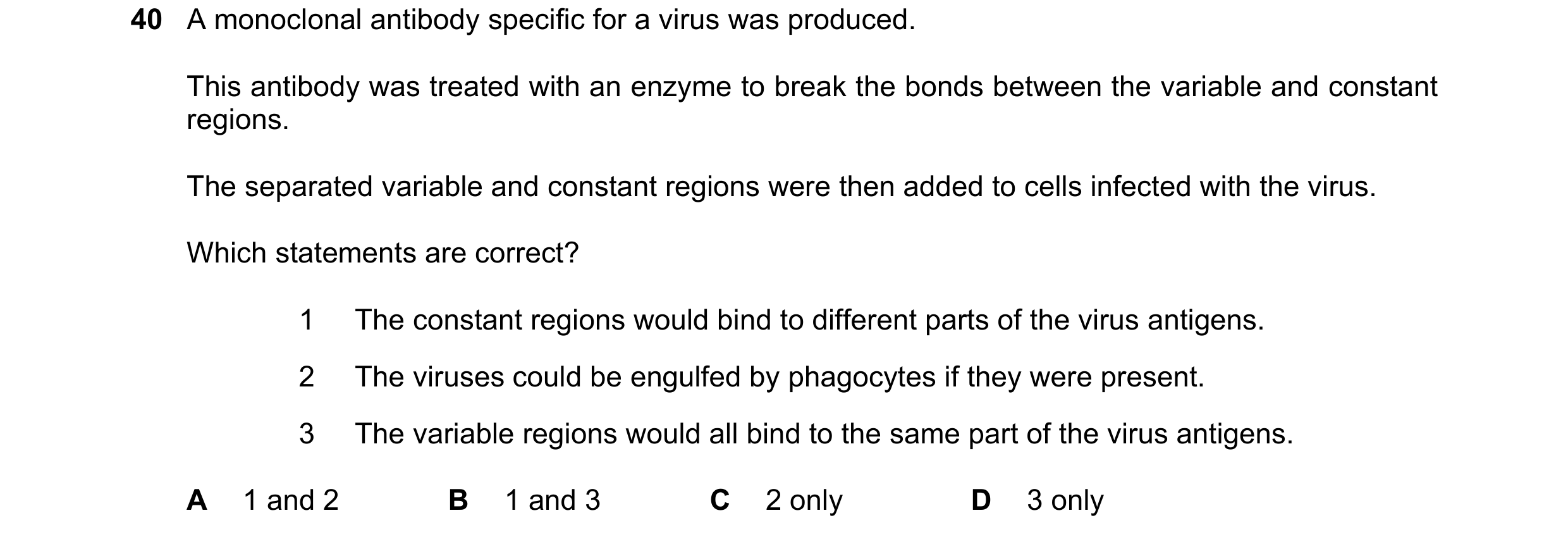 22 / 49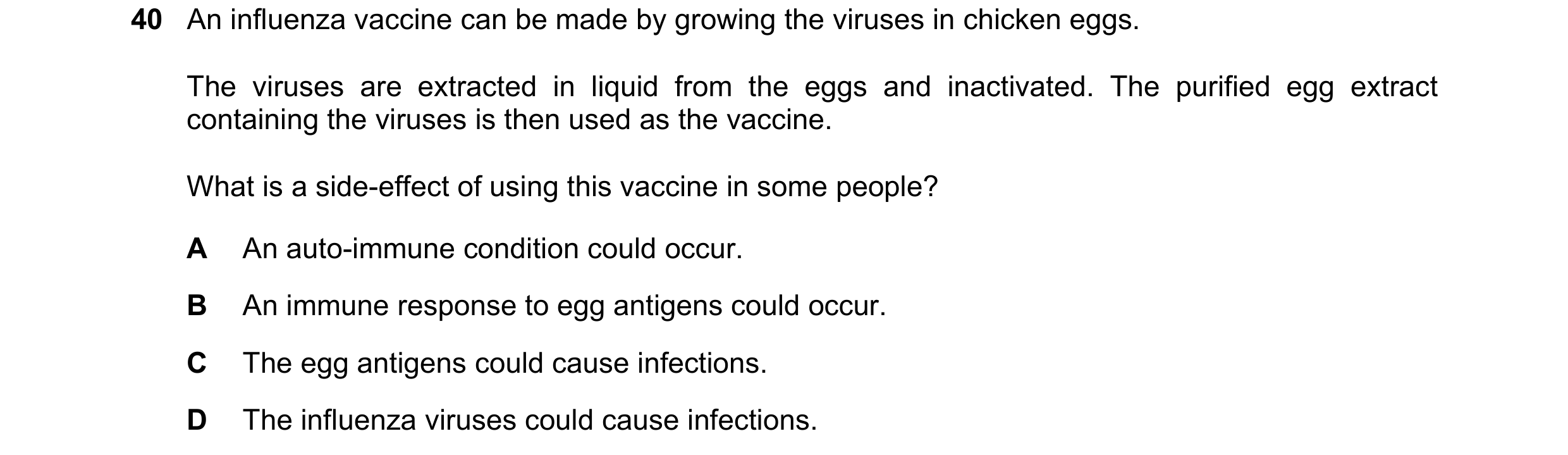
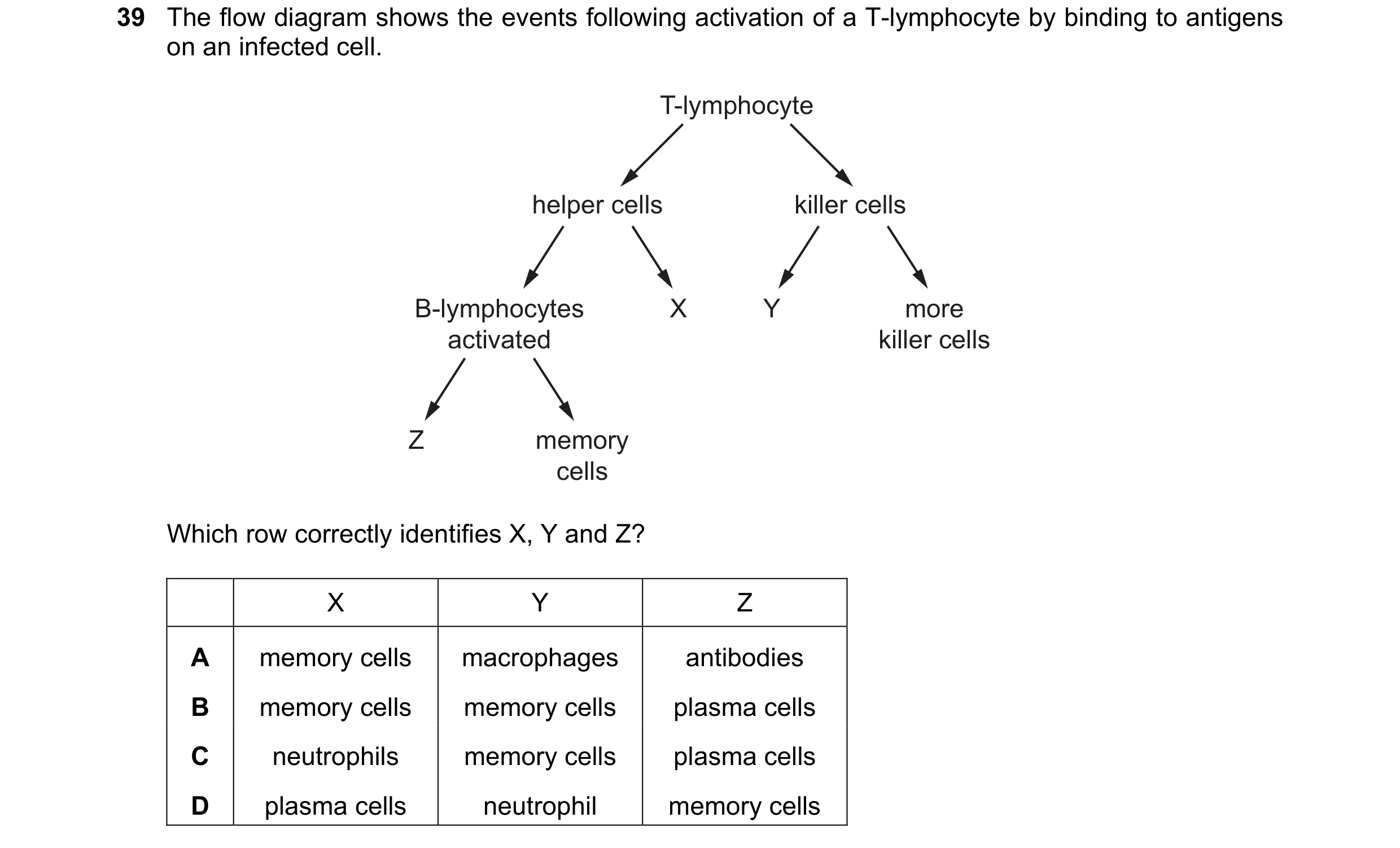
 23 / 49
 24 / 49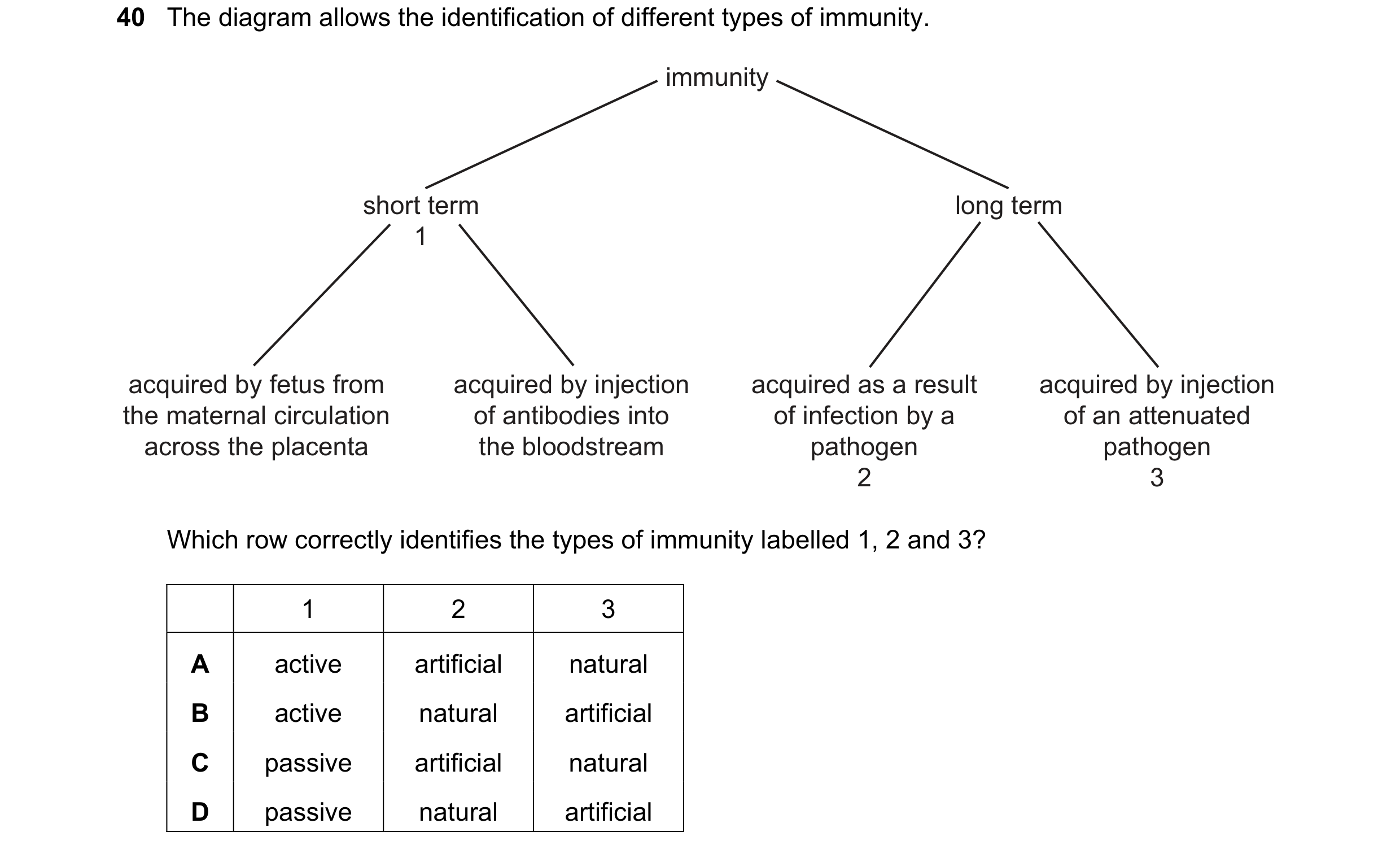
 25 / 49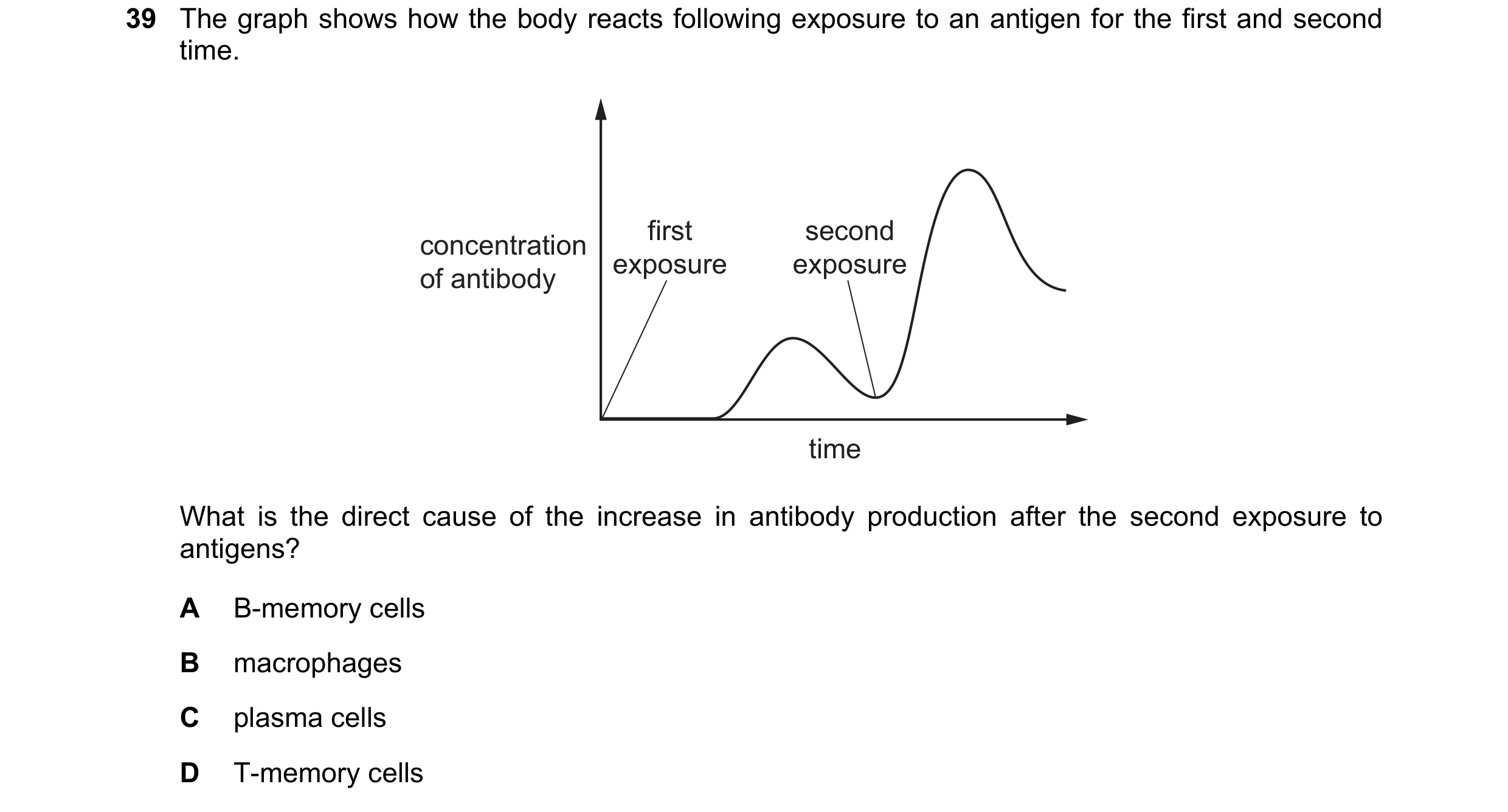

 26 / 49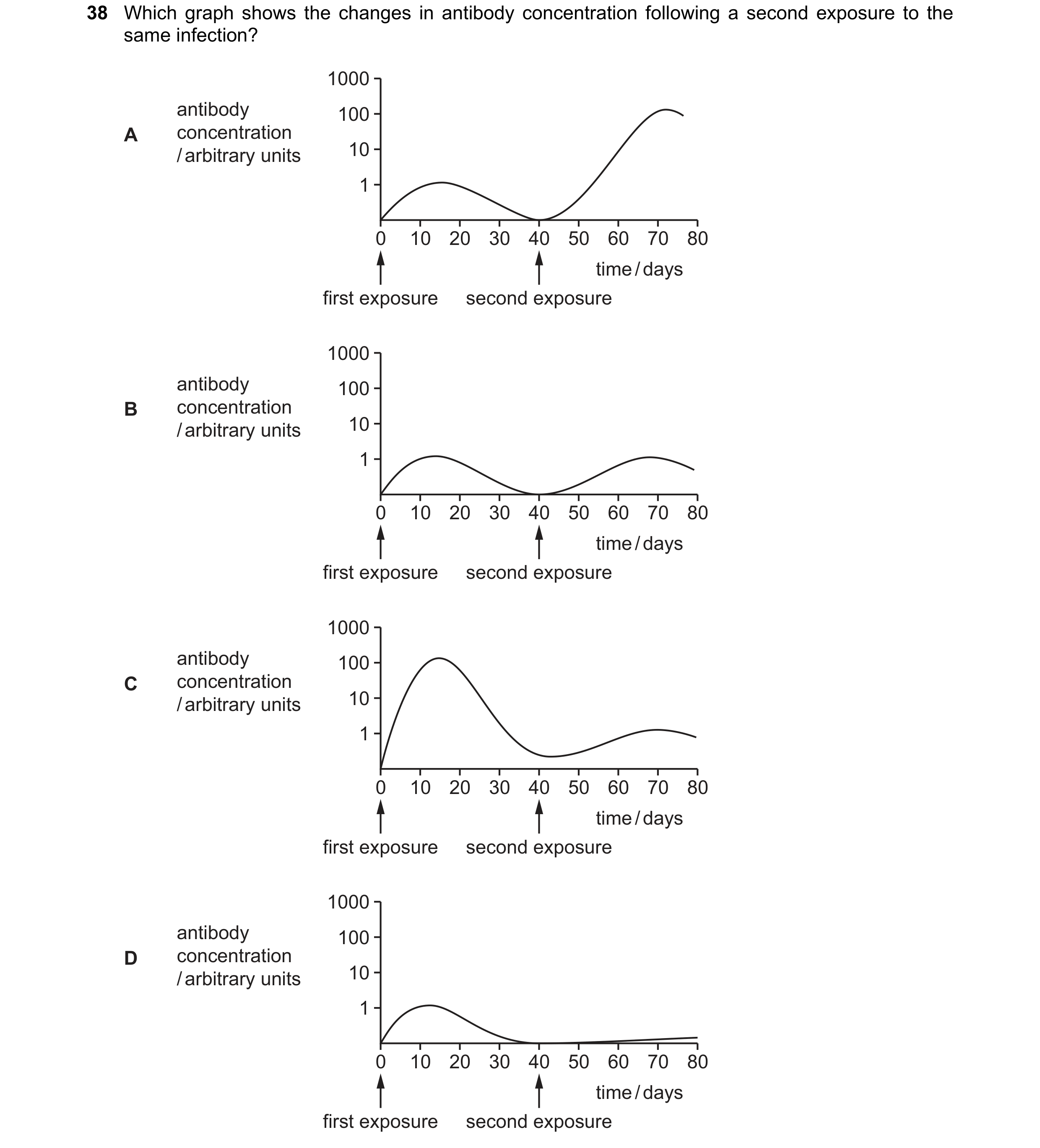
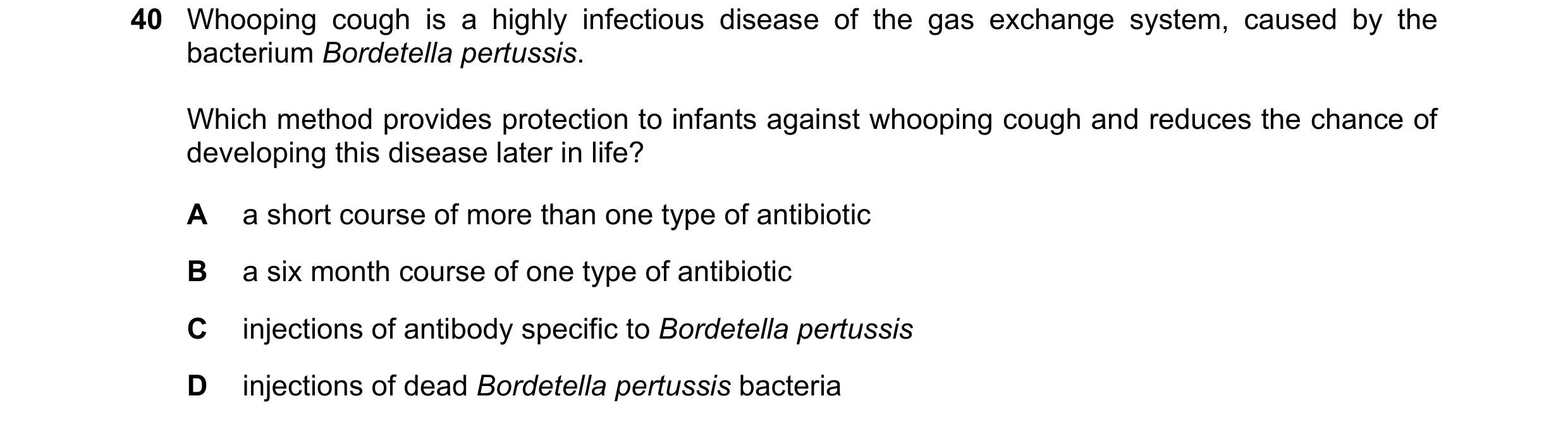 27 / 49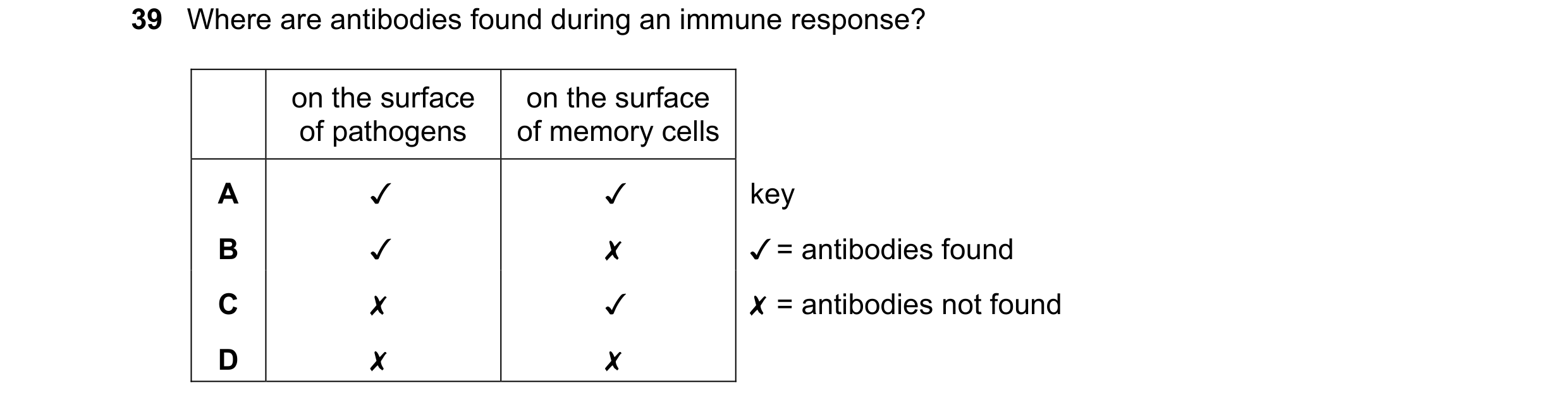
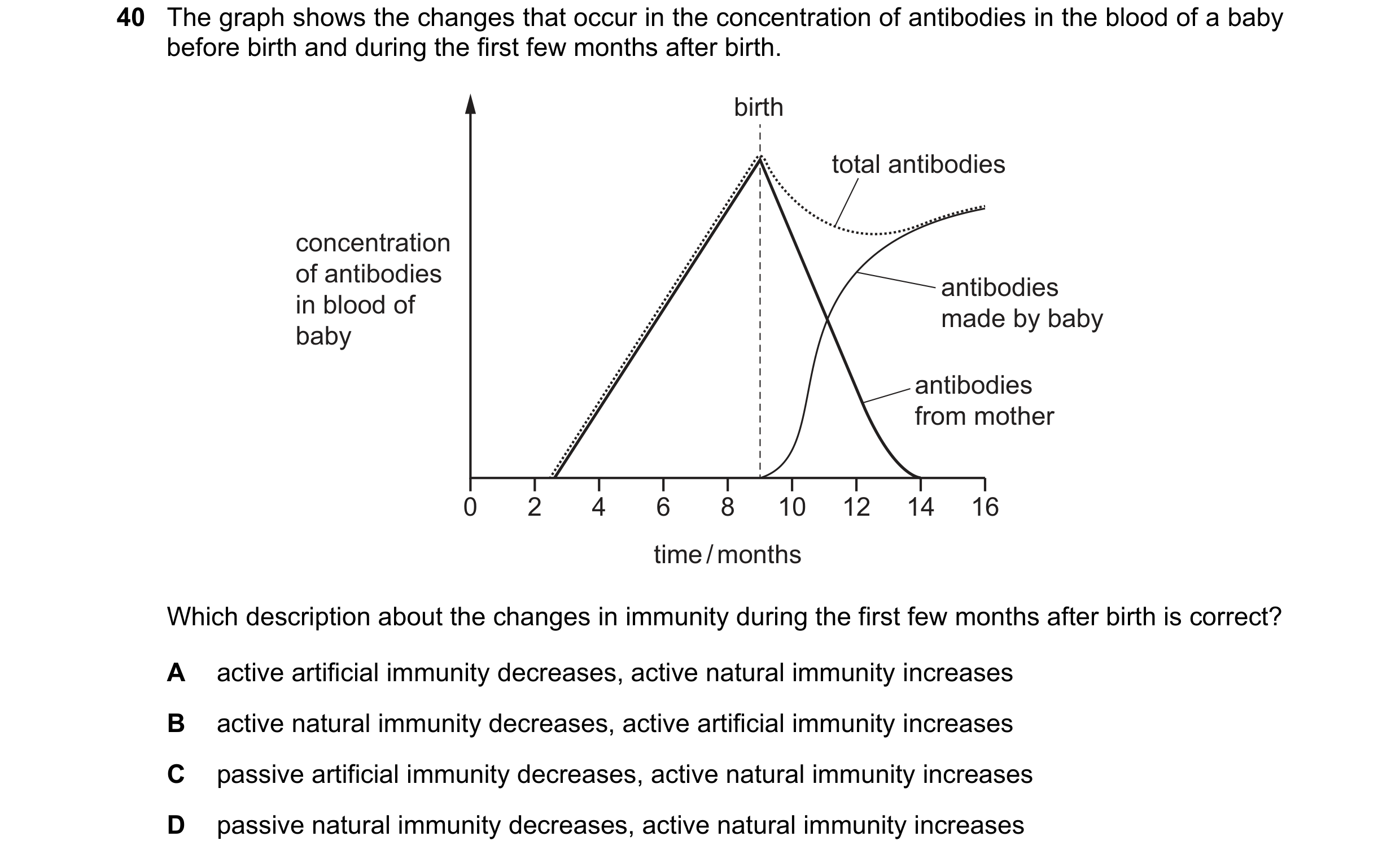
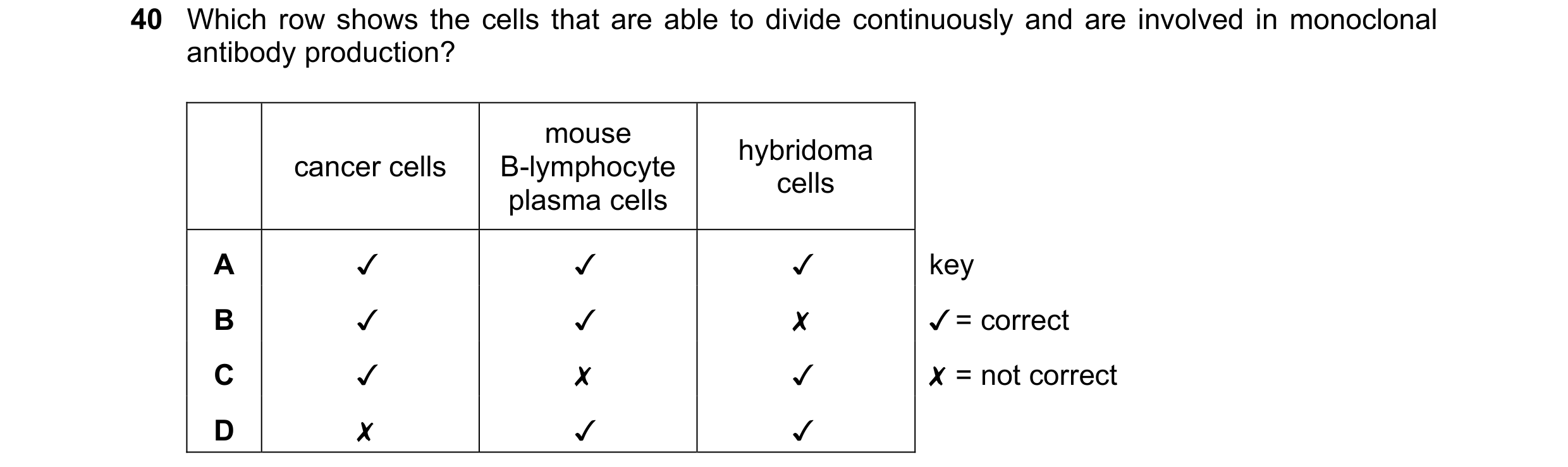 28 / 49
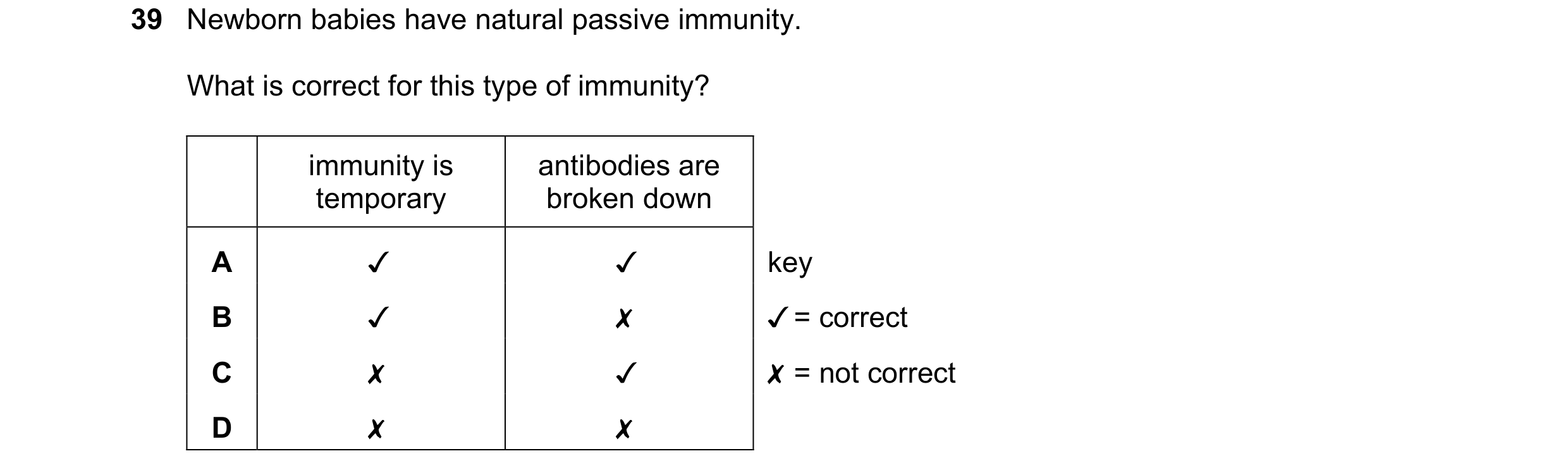
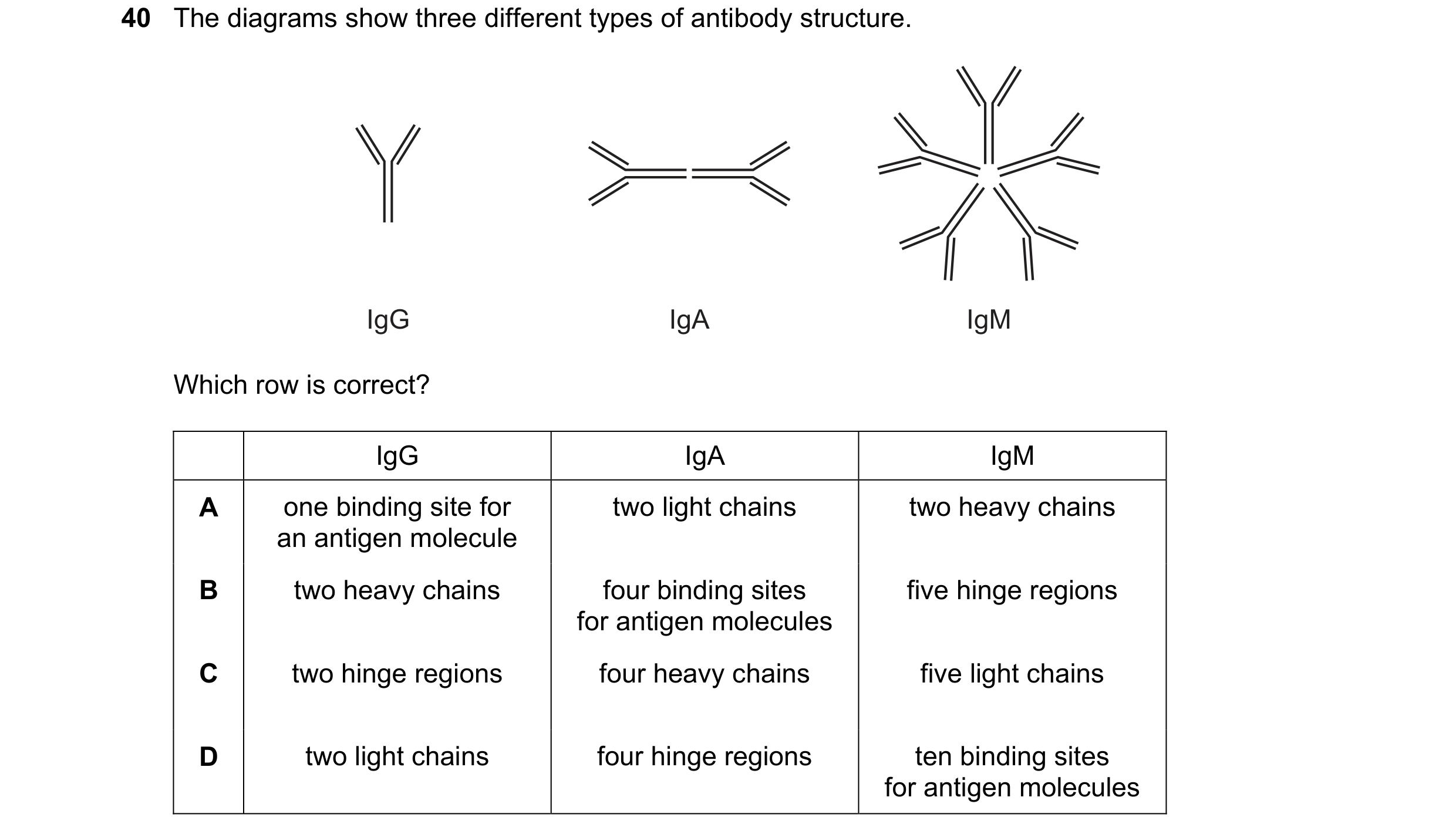 29 / 49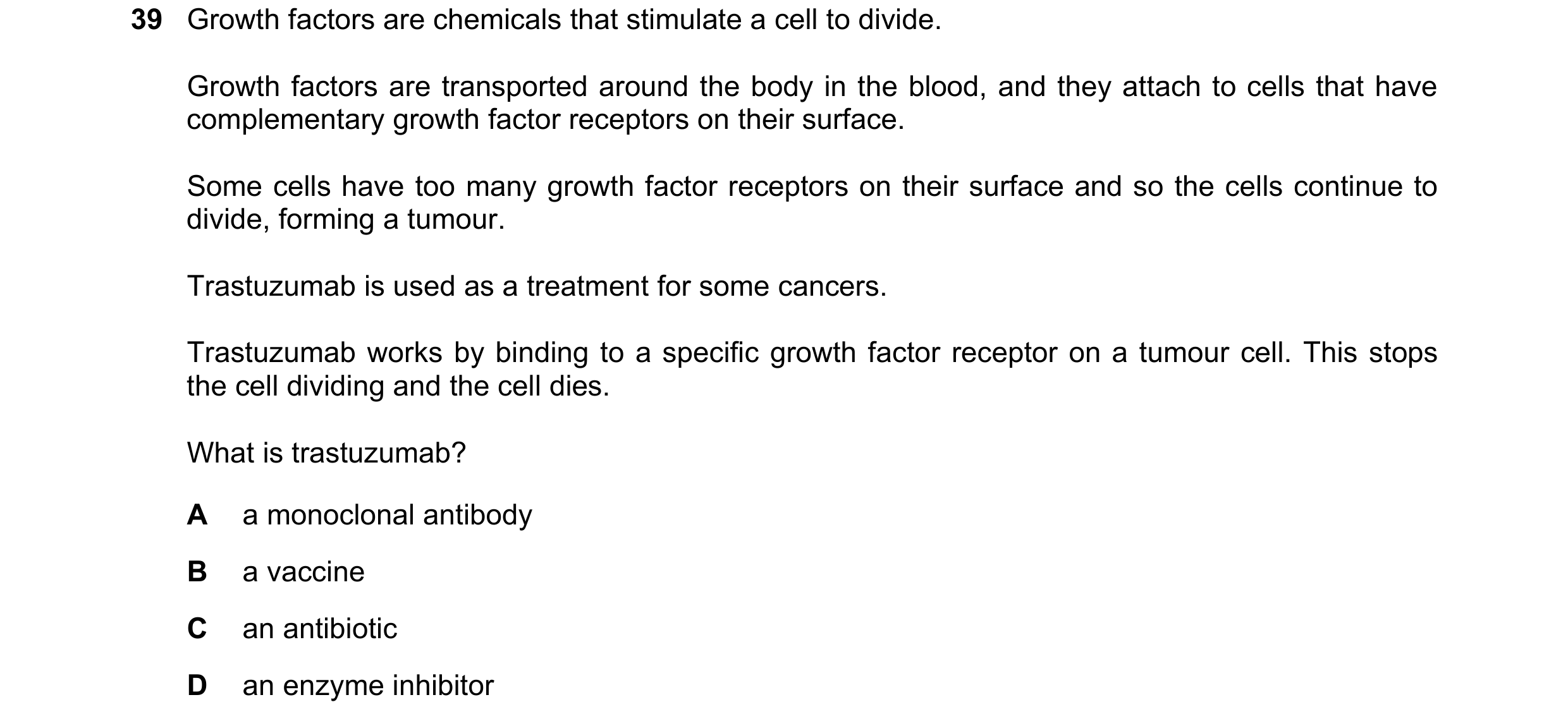

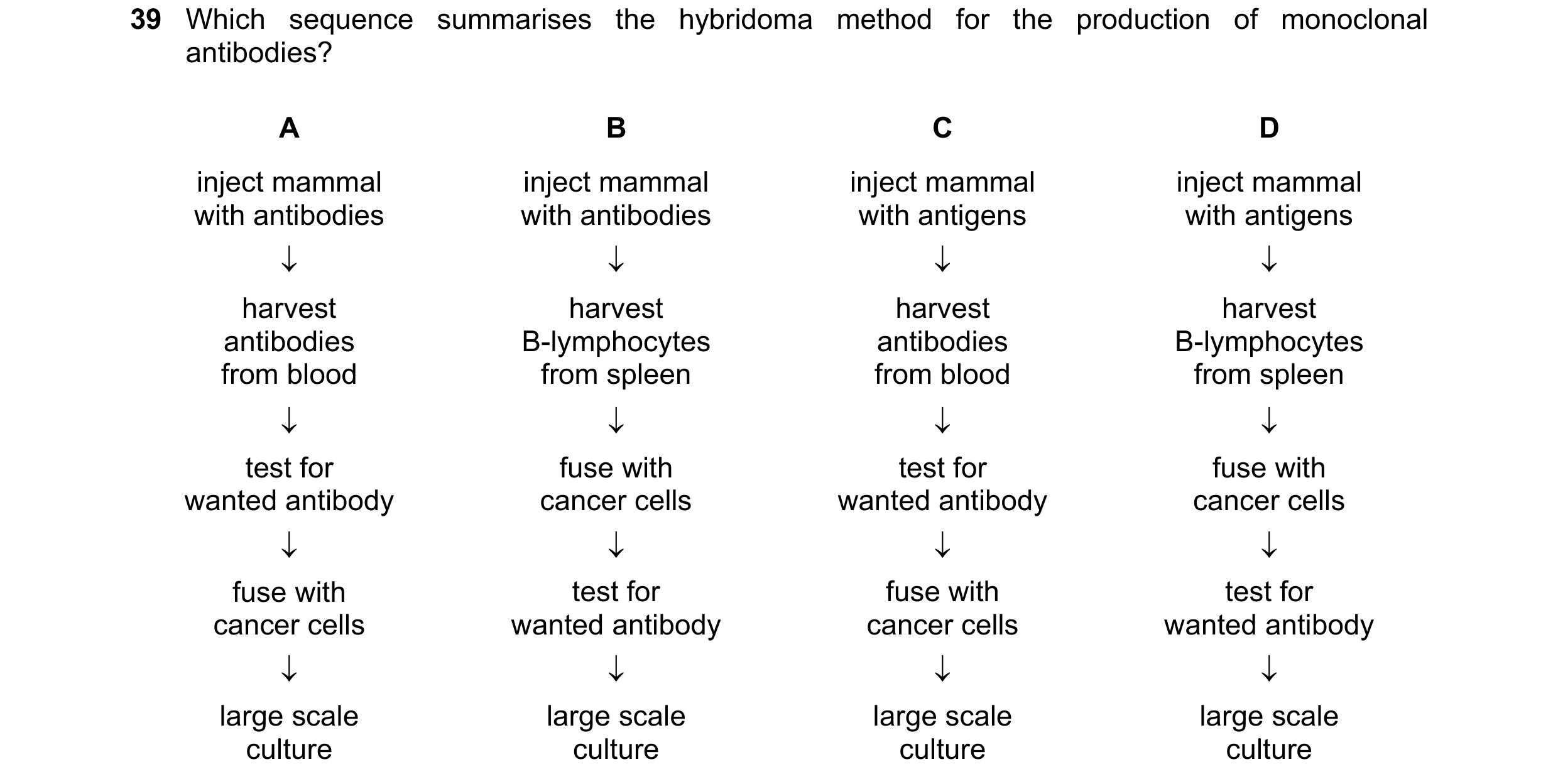 30 / 49
 31 / 49
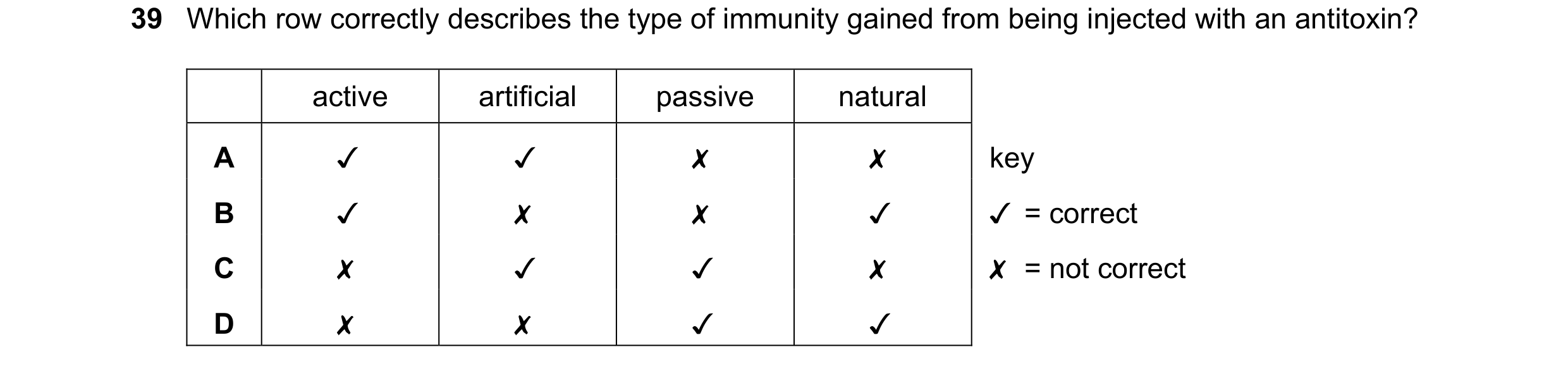
 32 / 49
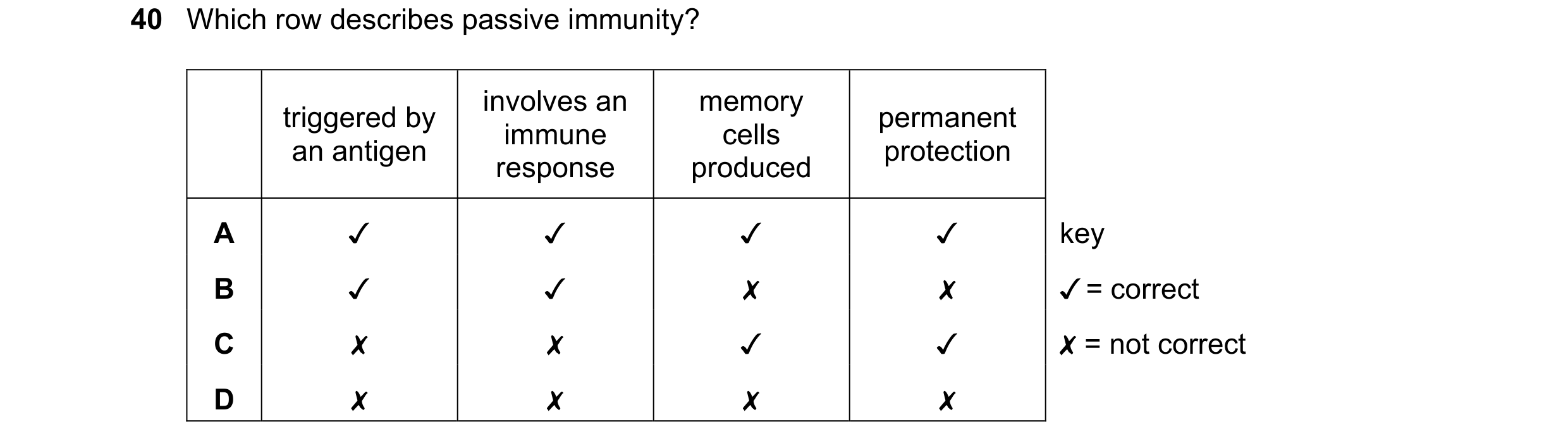 33 / 49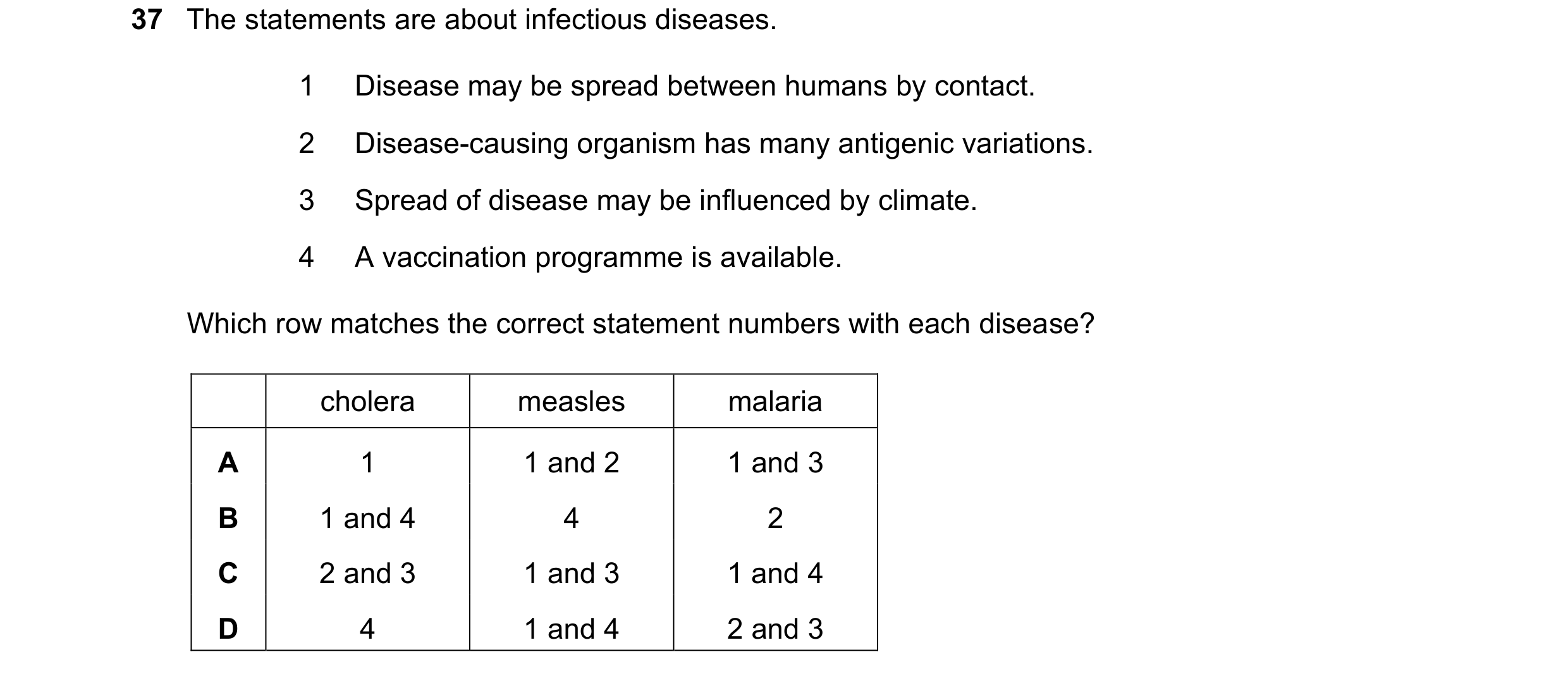
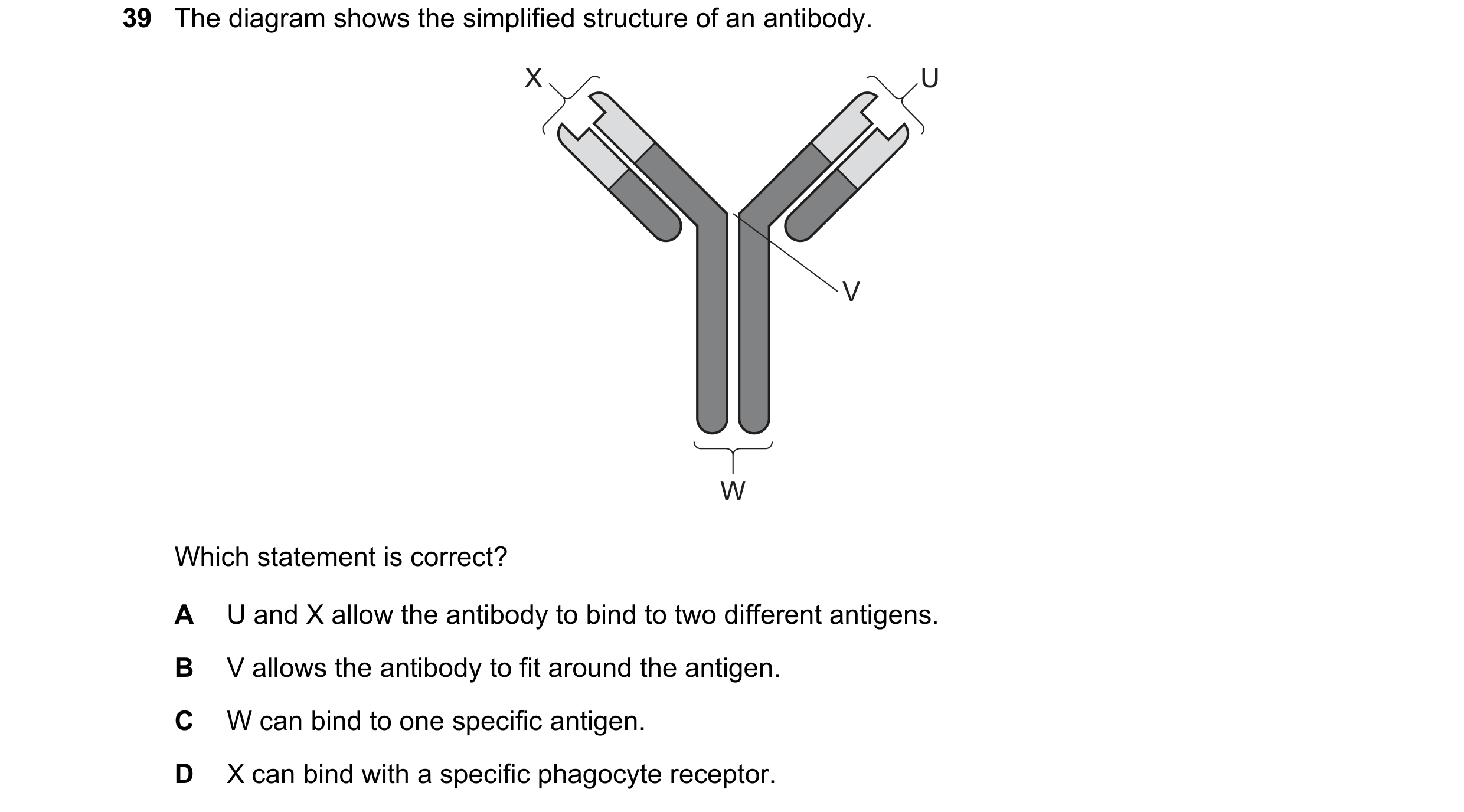 34 / 49

 35 / 49
 36 / 49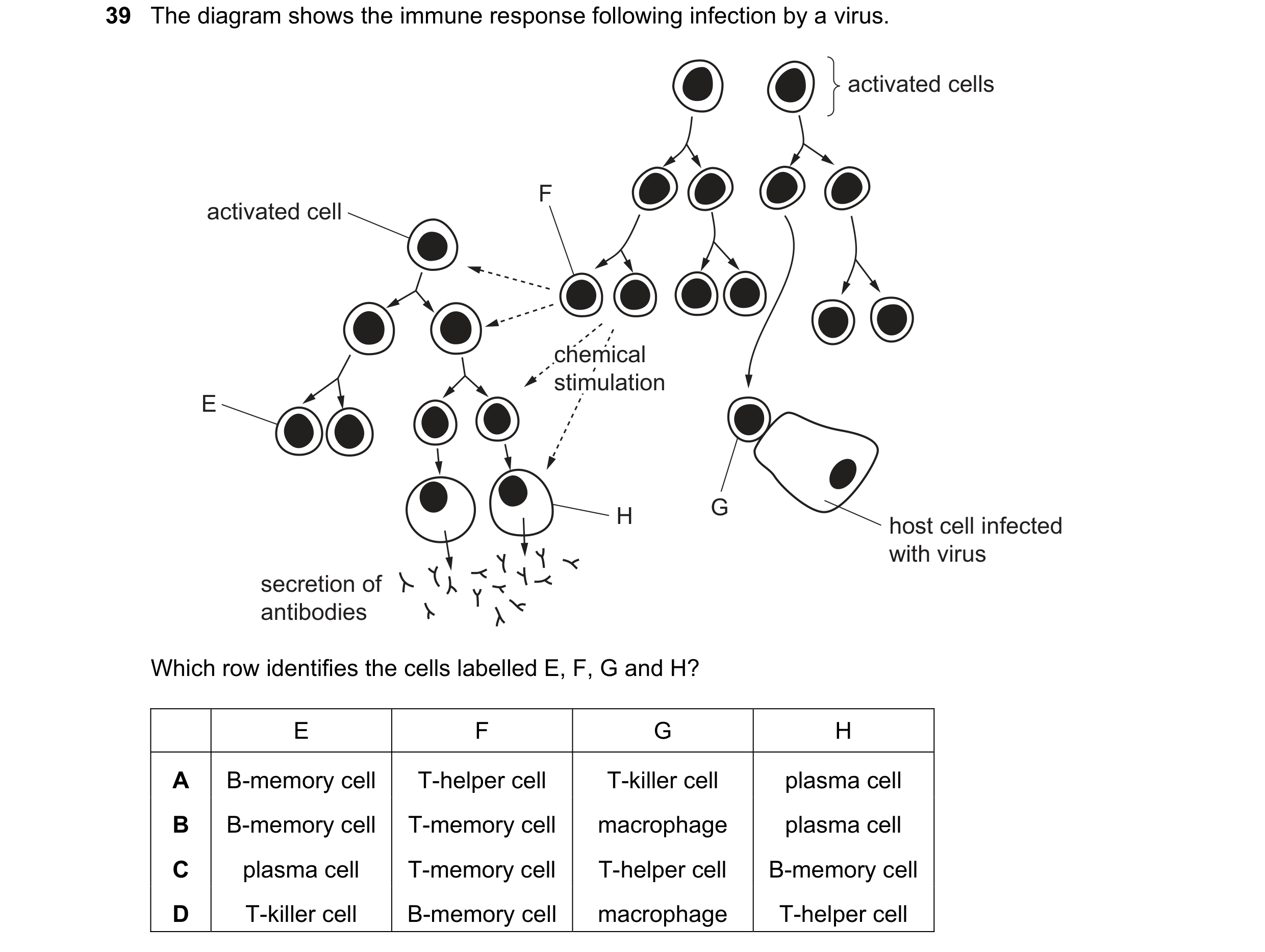
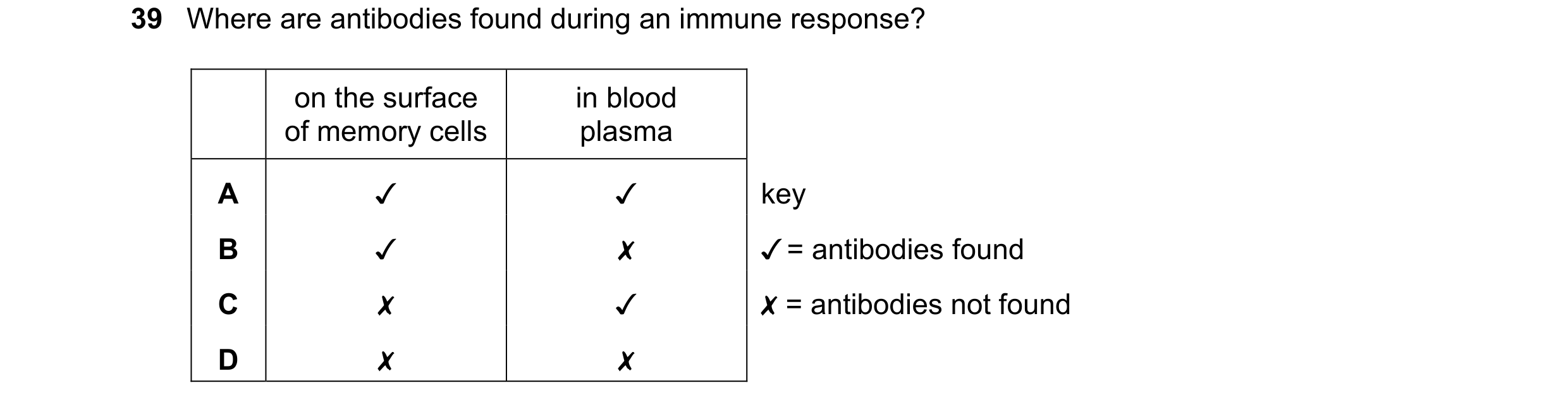 37 / 49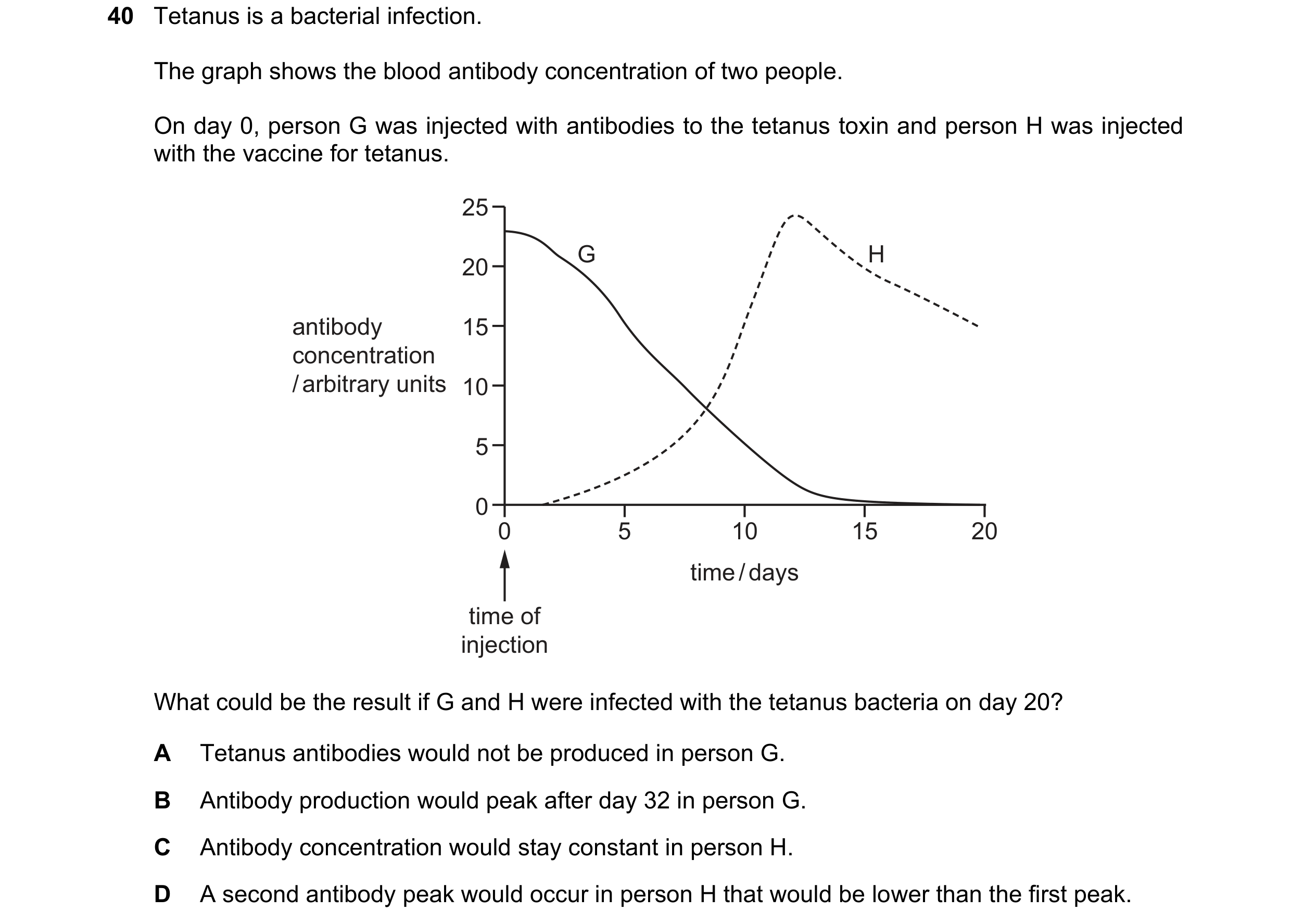

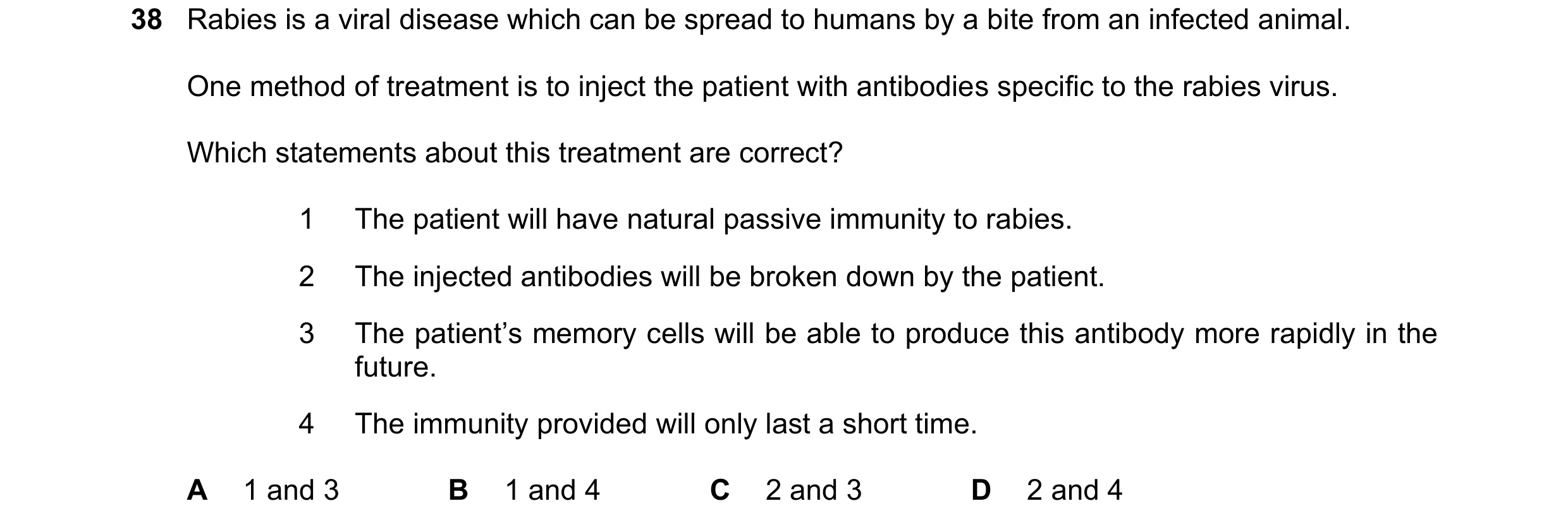 38 / 49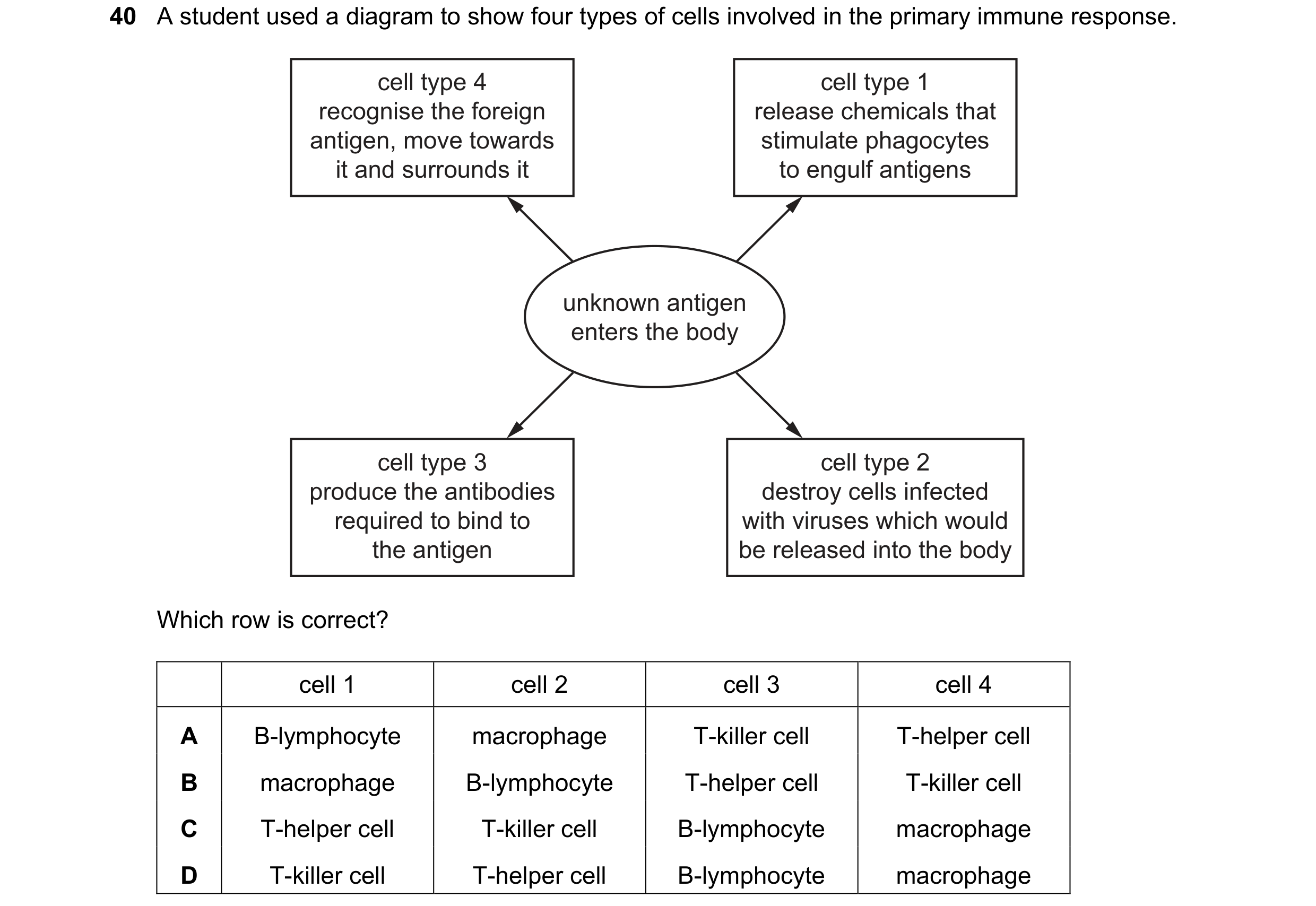
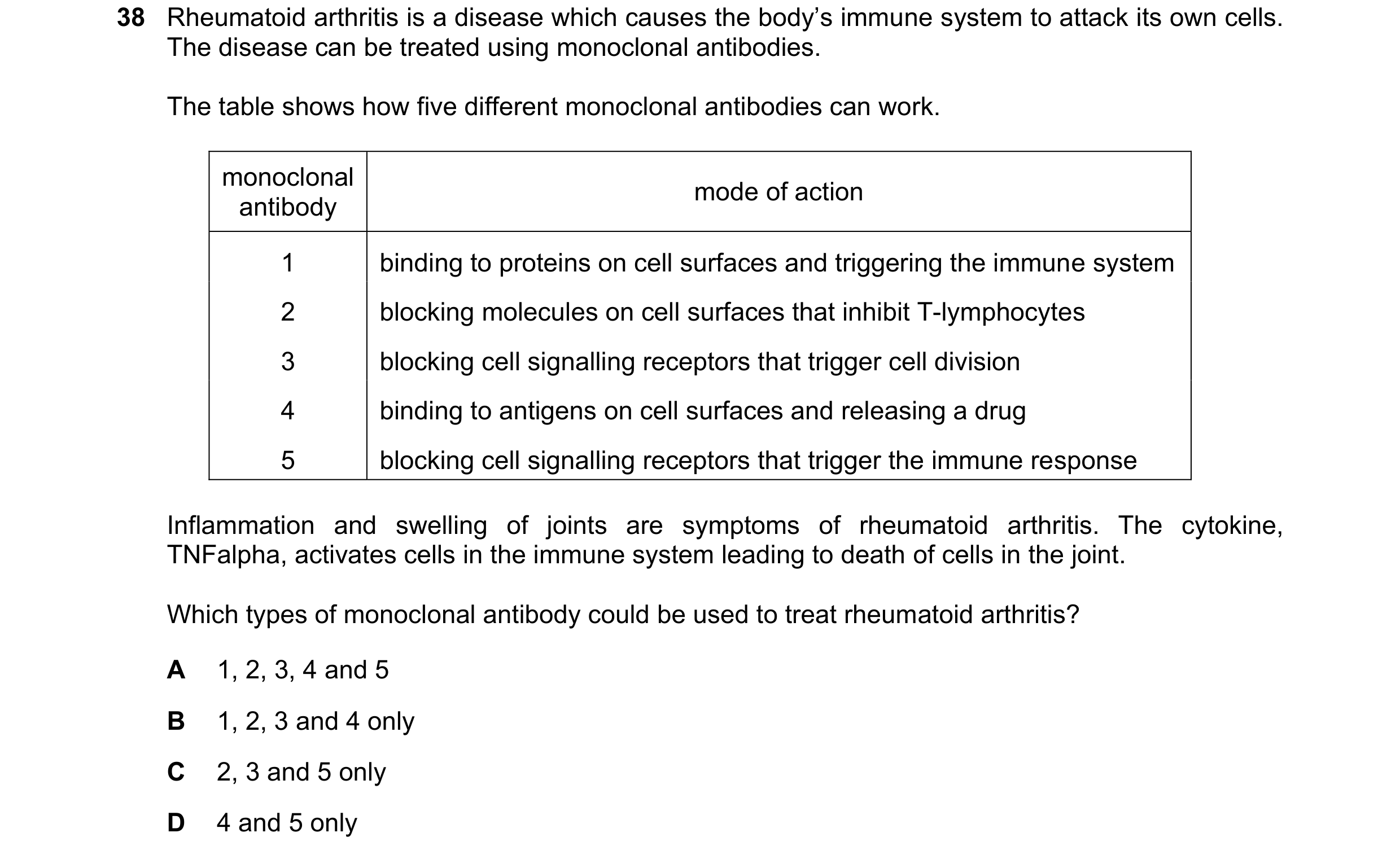 39 / 49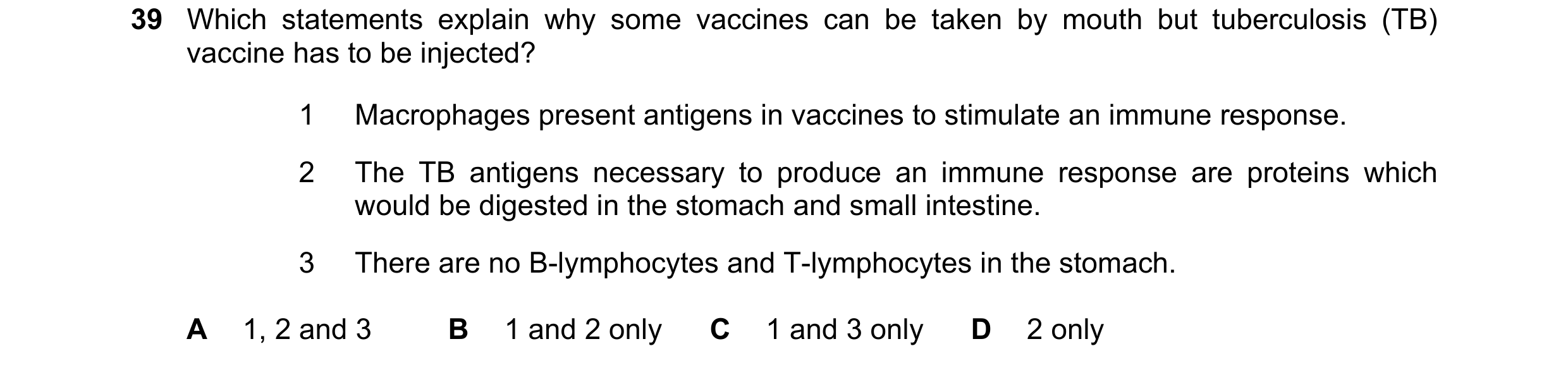
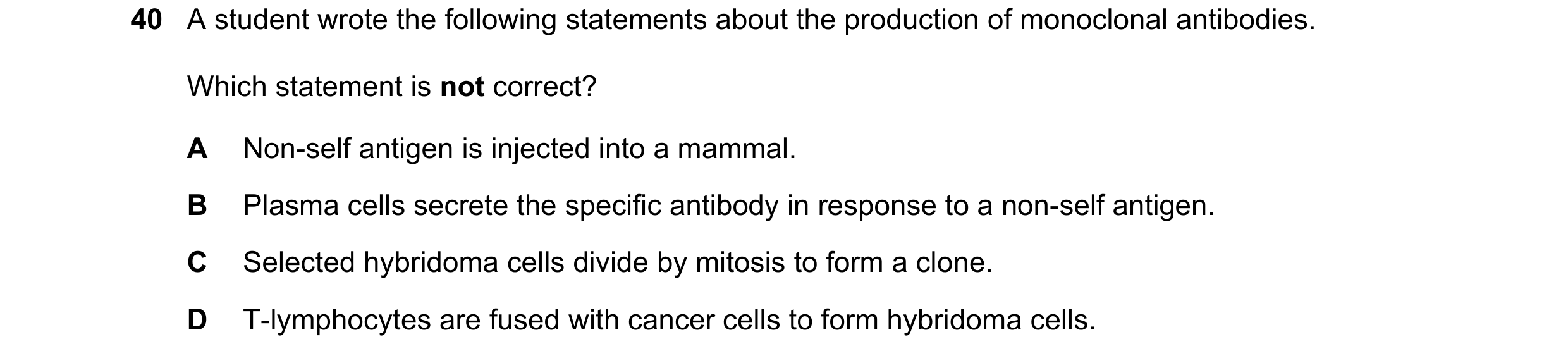
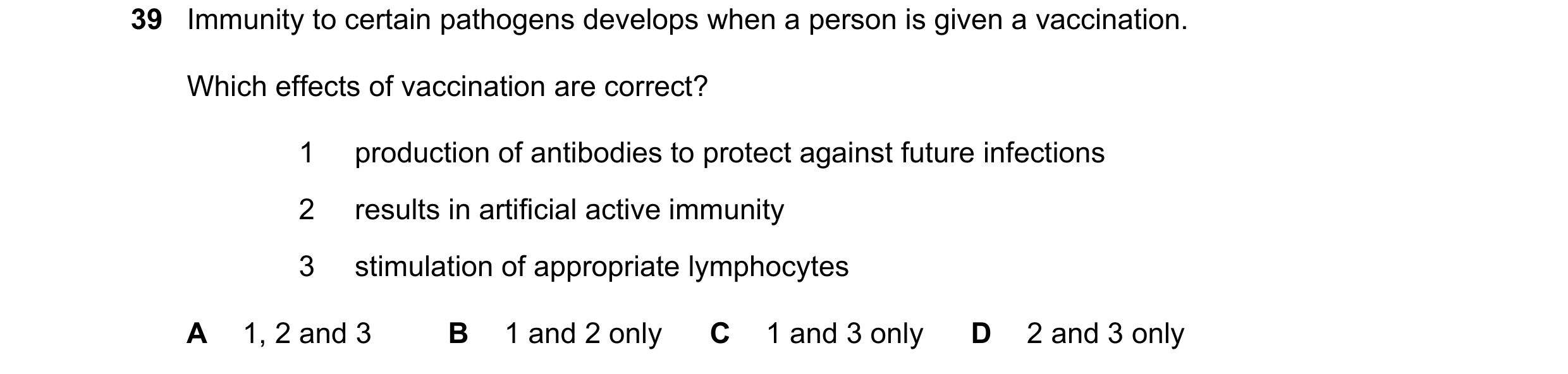
 40 / 49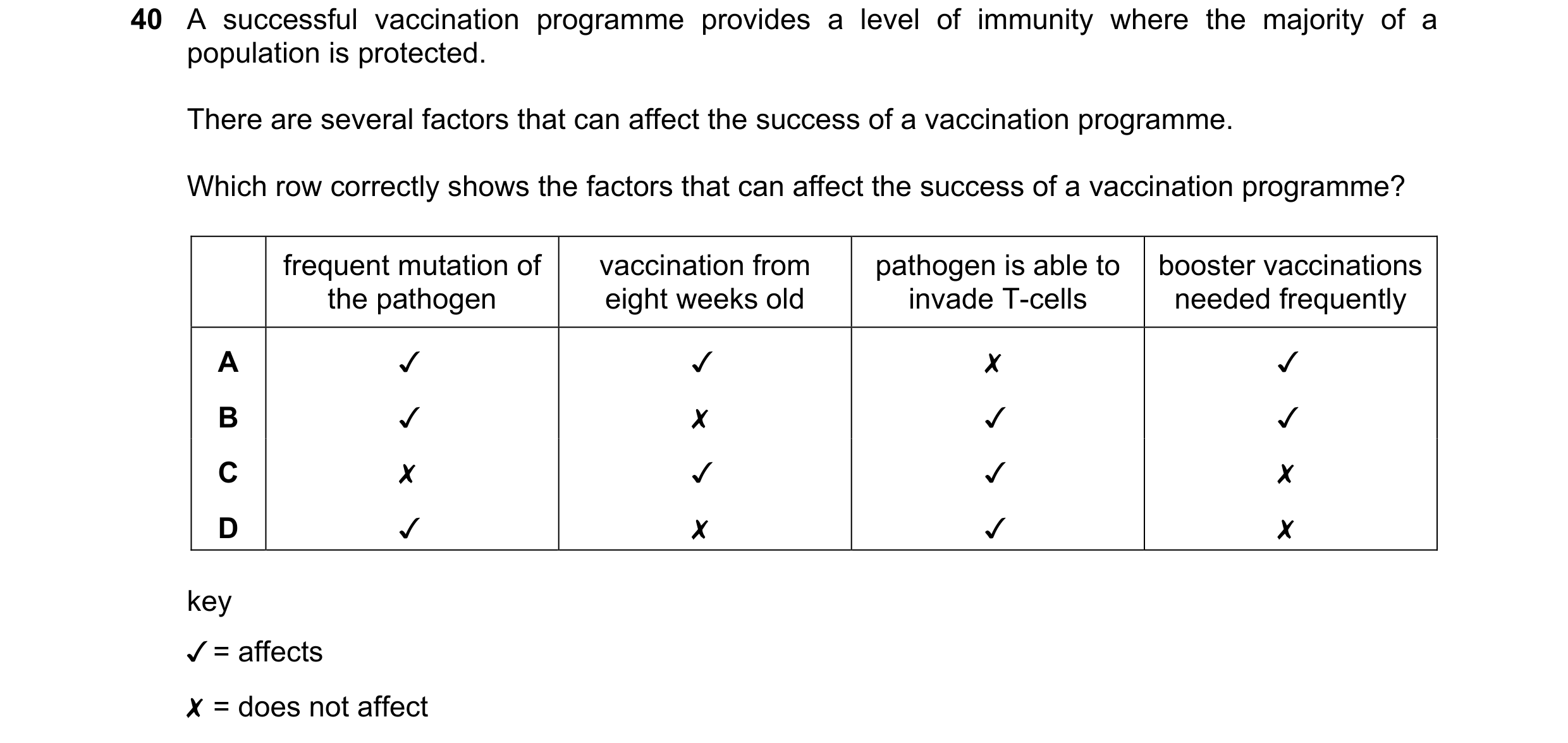
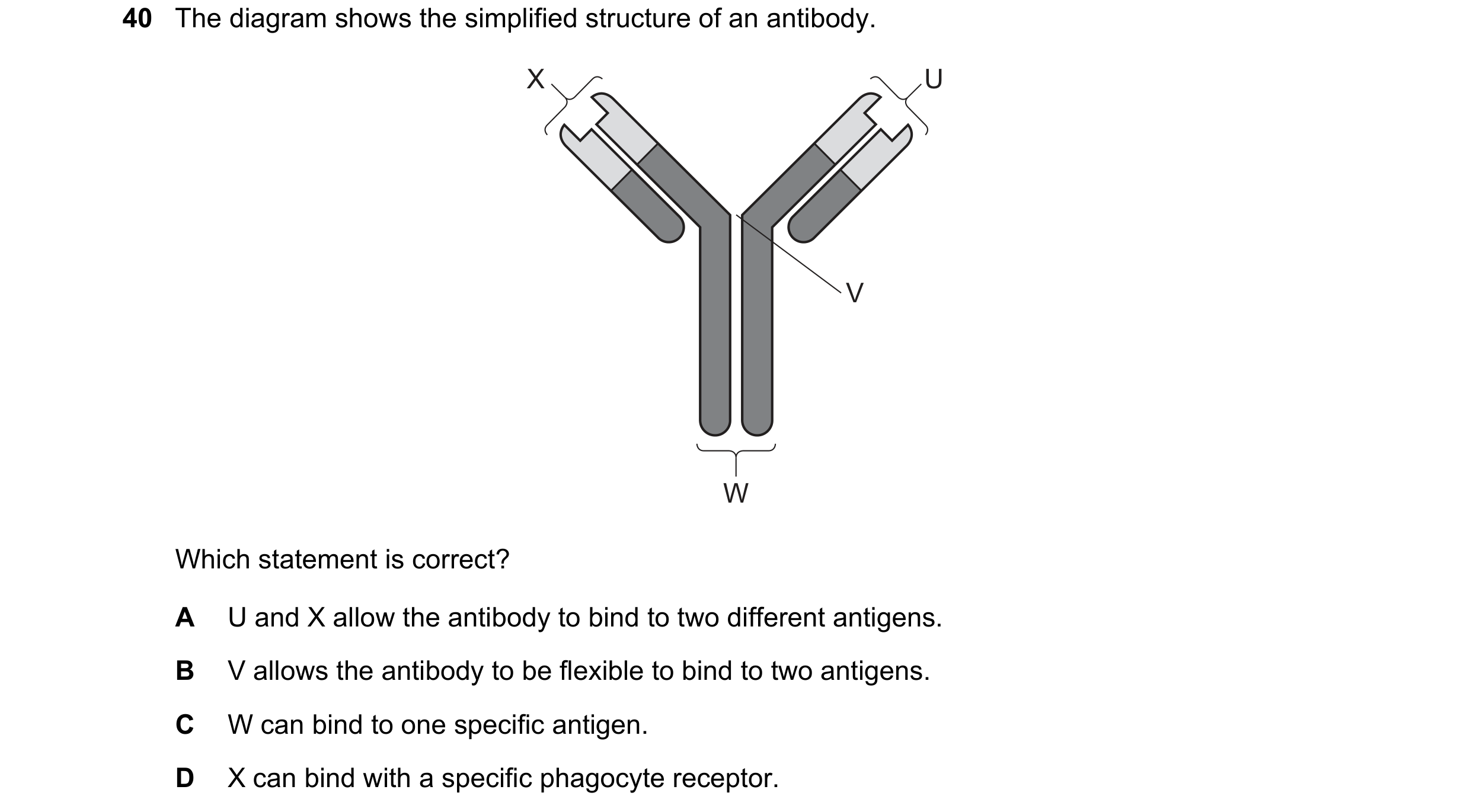 41 / 49
 42 / 49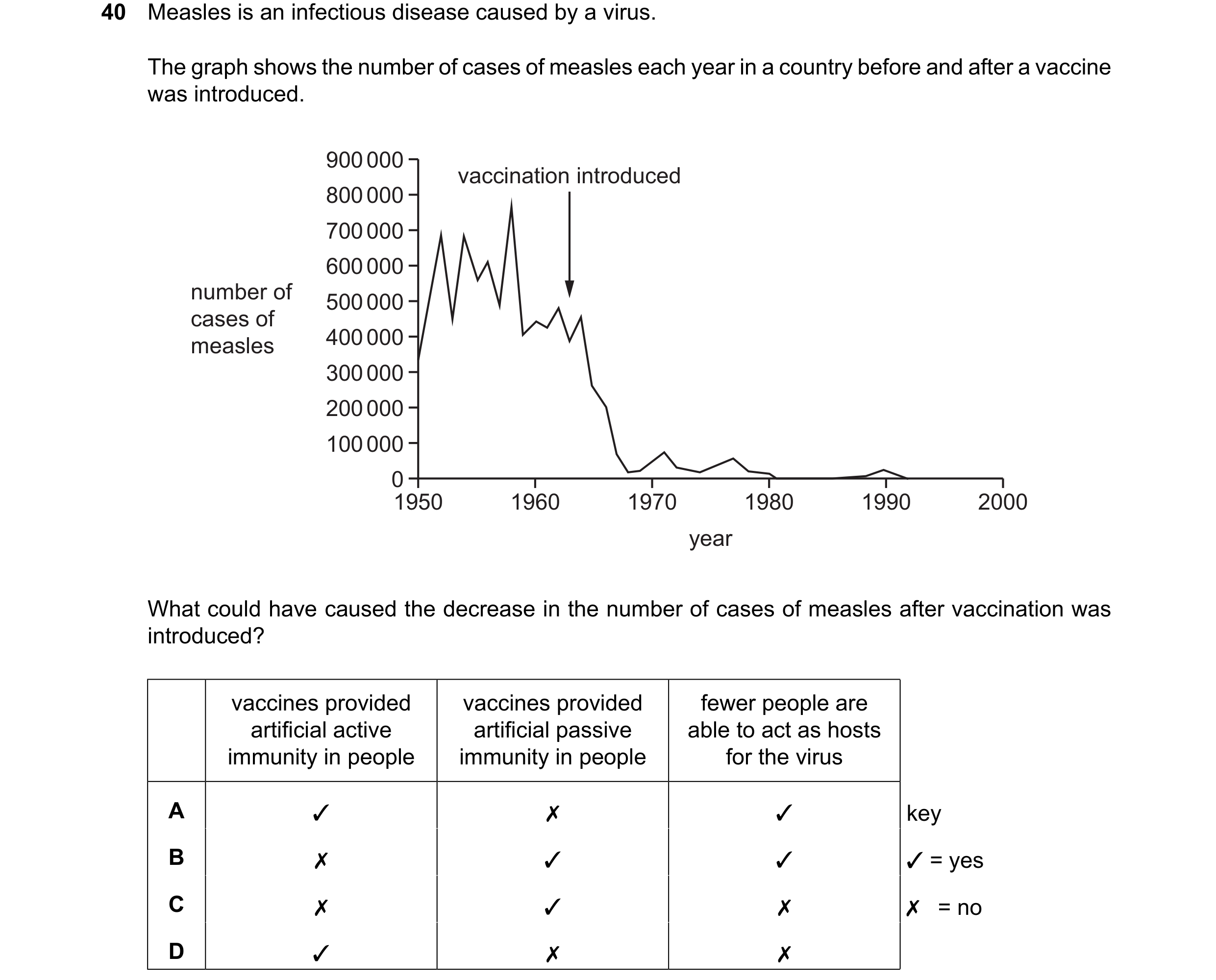
 43 / 49
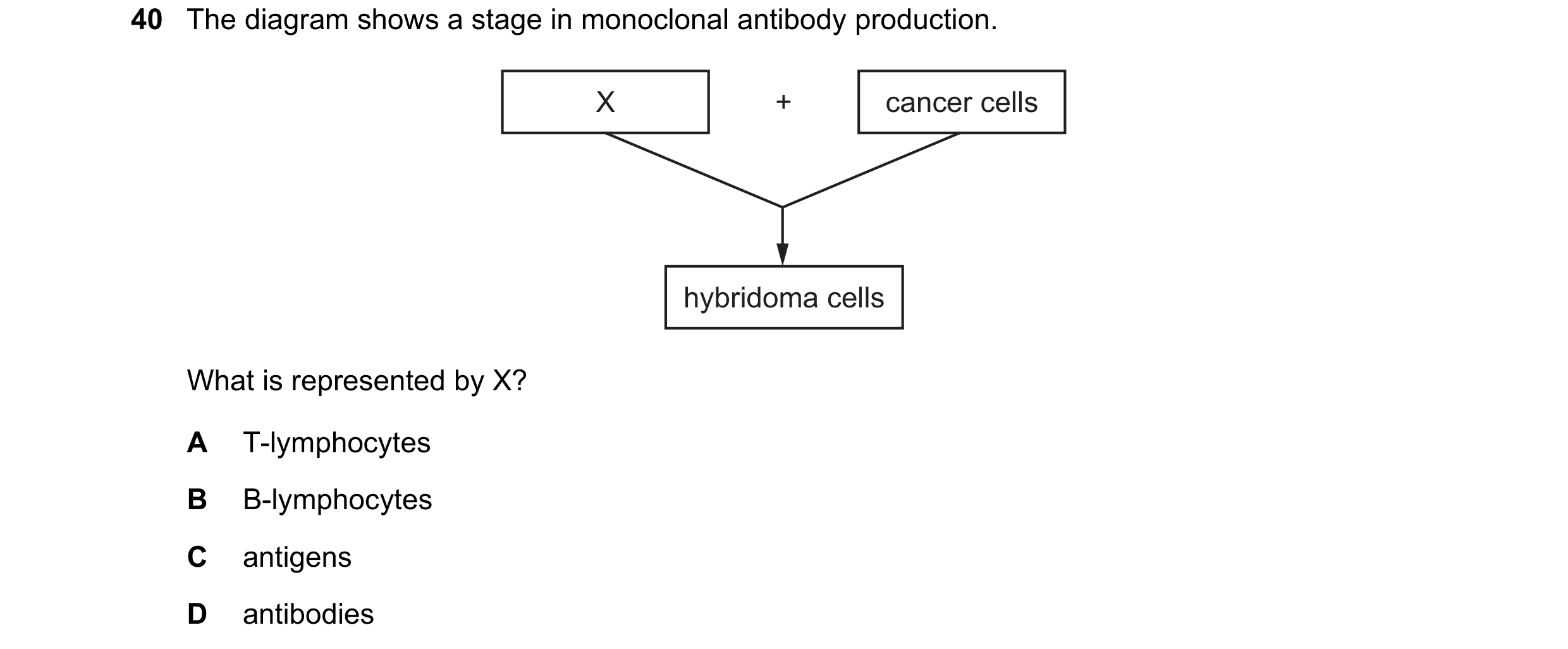
 44 / 49

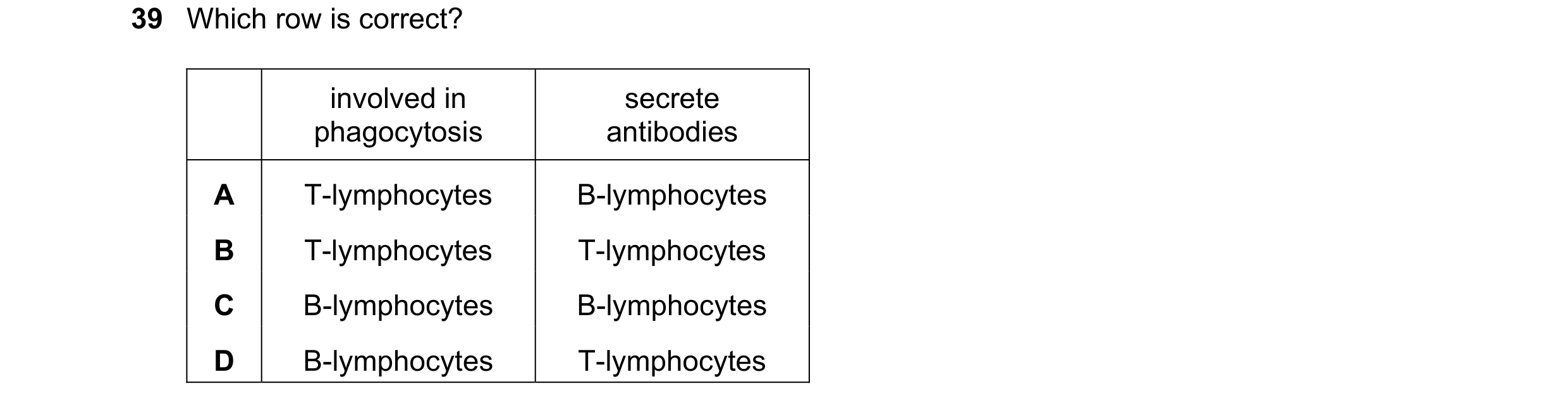 45 / 49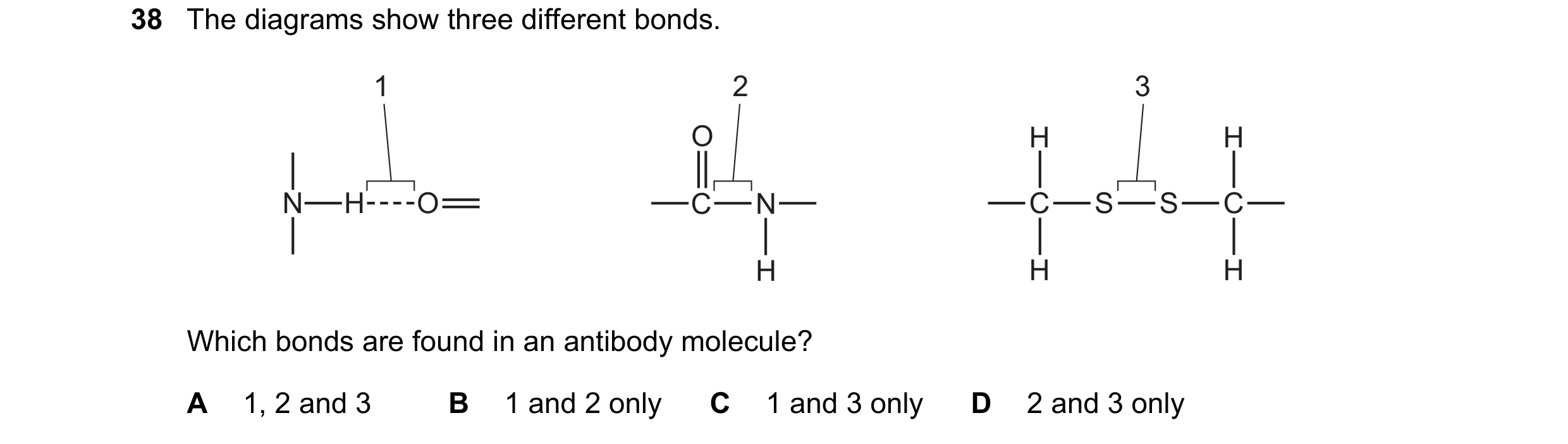
 46 / 49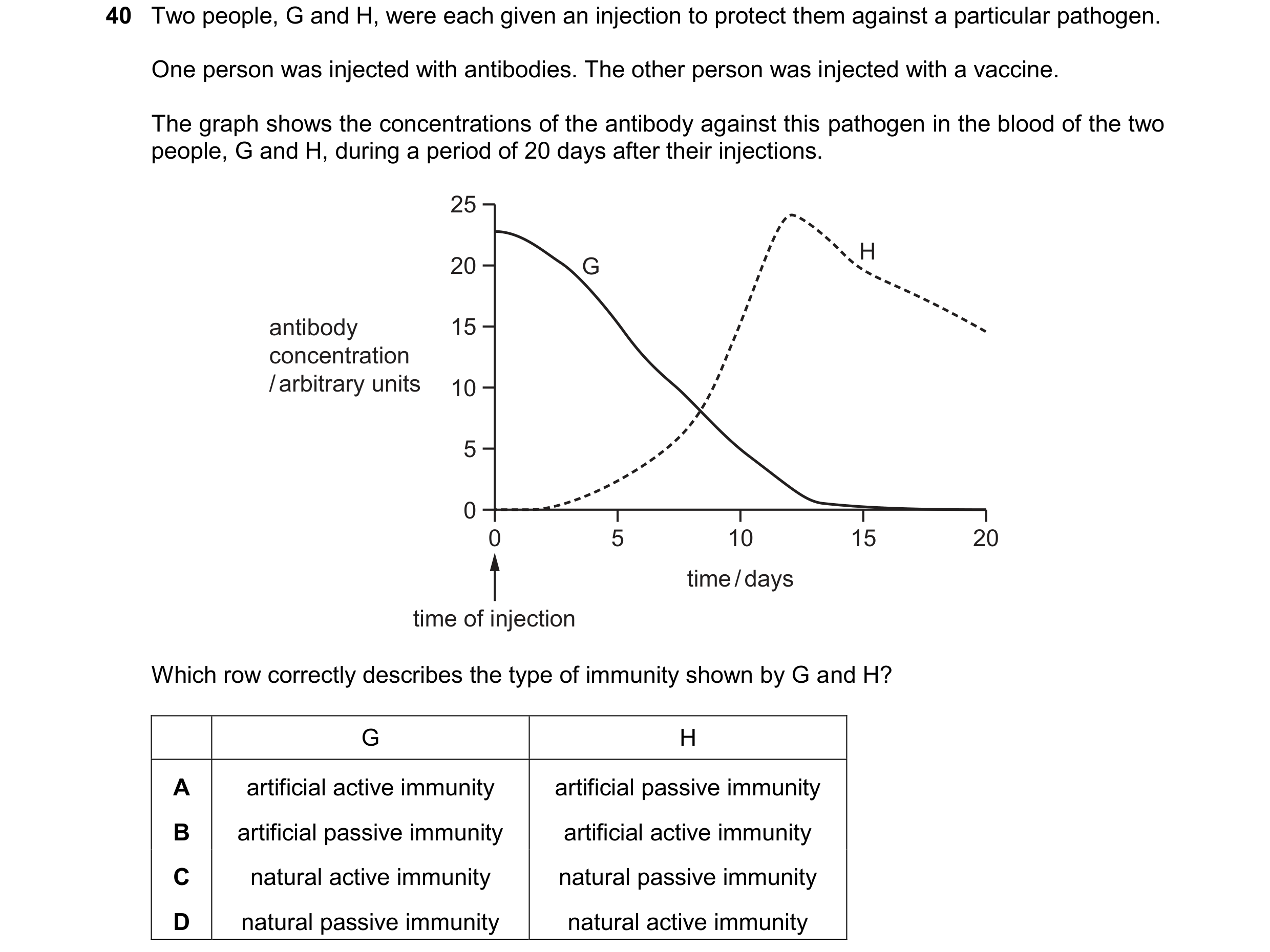
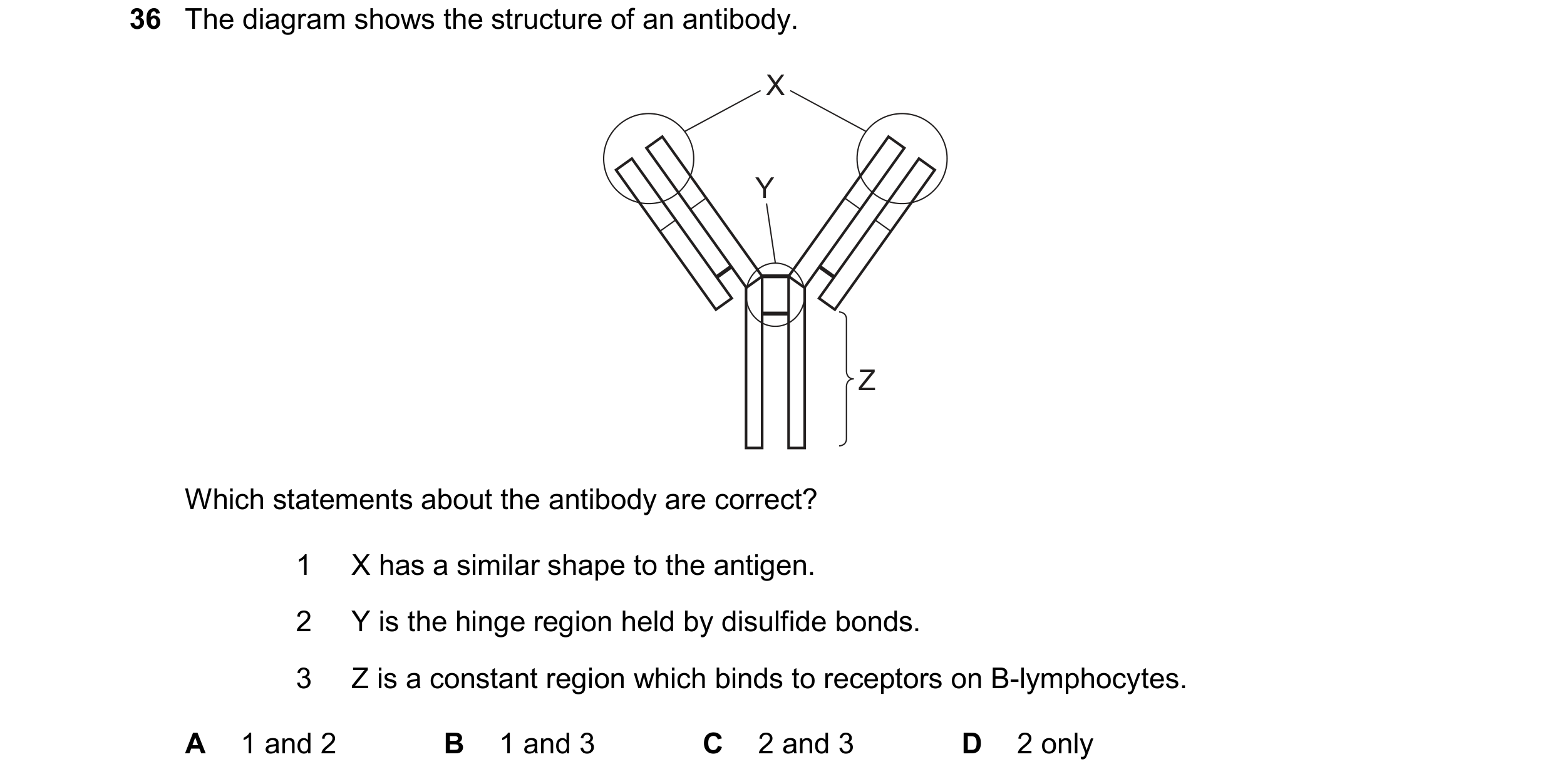 47 / 49
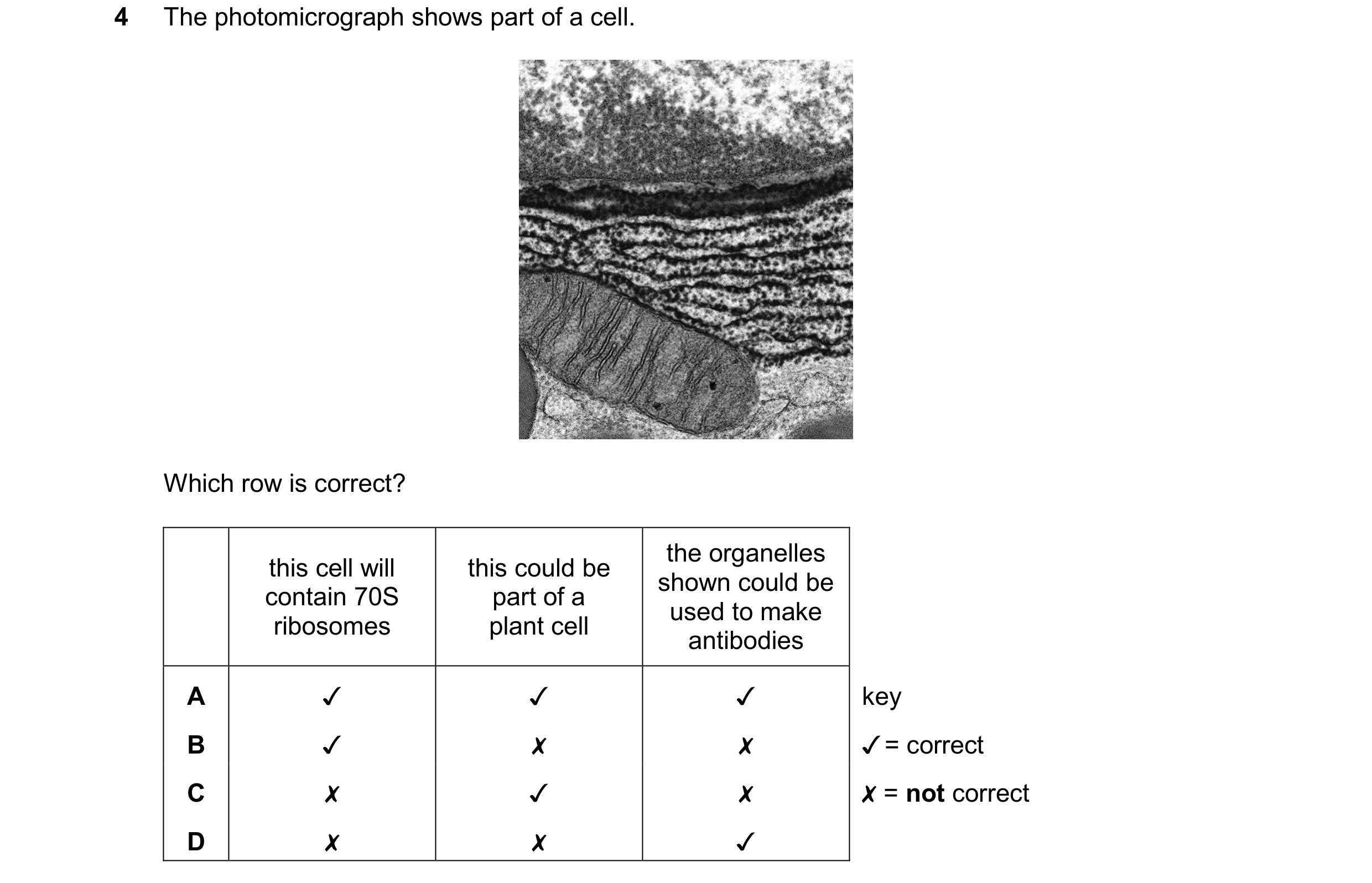 48 / 49
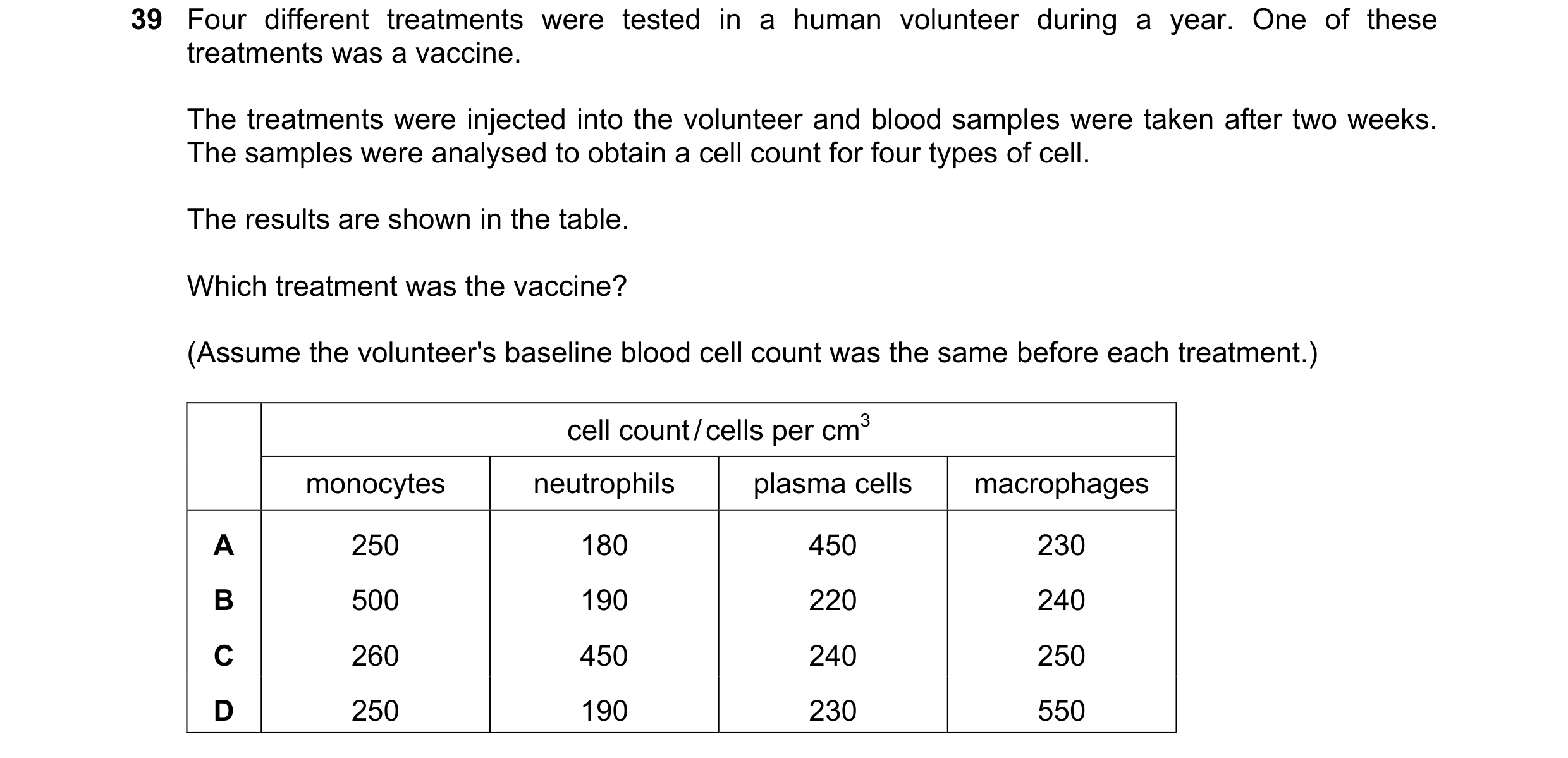
 49 / 49