Cambridge A Level Biology 9700 — 2010 Oct/Nov Paper 1 · Variant 1
9700/11/O/N/10 · 40 questions · 40 marks · ≈45 min
The question paper and its mark scheme, free to read here and free to download. This is Cambridge’s own paper, exactly as it was sat.
Question paper20 pages



Mark scheme2 pages
Answers below. Sit the paper first if you are practising.
Questions as text
Q1 · Which of the cell organelles, when appropriately stained, will be clearly visible under…
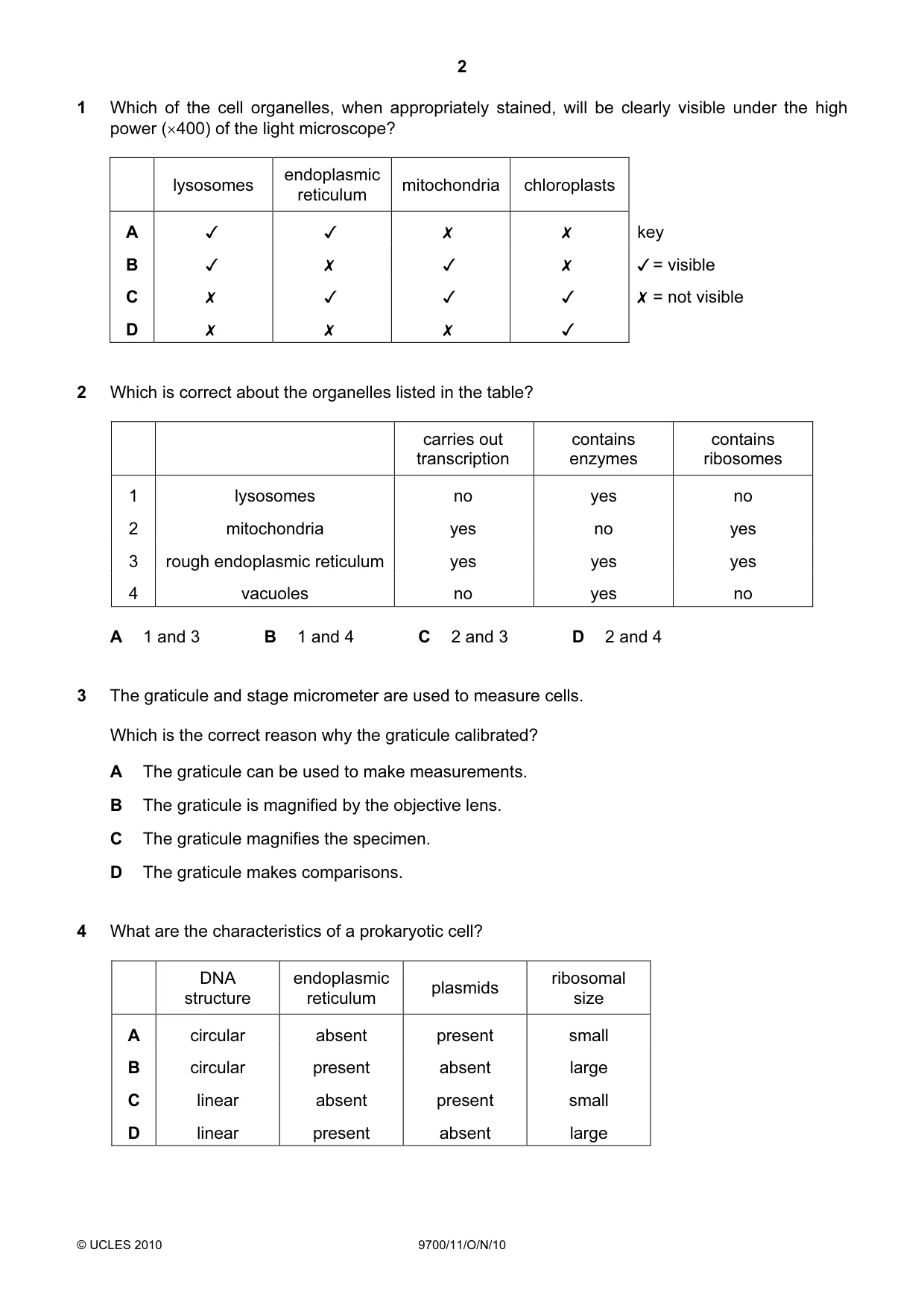
1. Which of the cell organelles, when appropriately stained, will be clearly visible under the high power (x400) of the light microscope? lysosomes oncoplasmic mitochondria | chloroplasts A v v x x key B v x v x ¥ = visible Cc x v v v X = not visible D x x x v
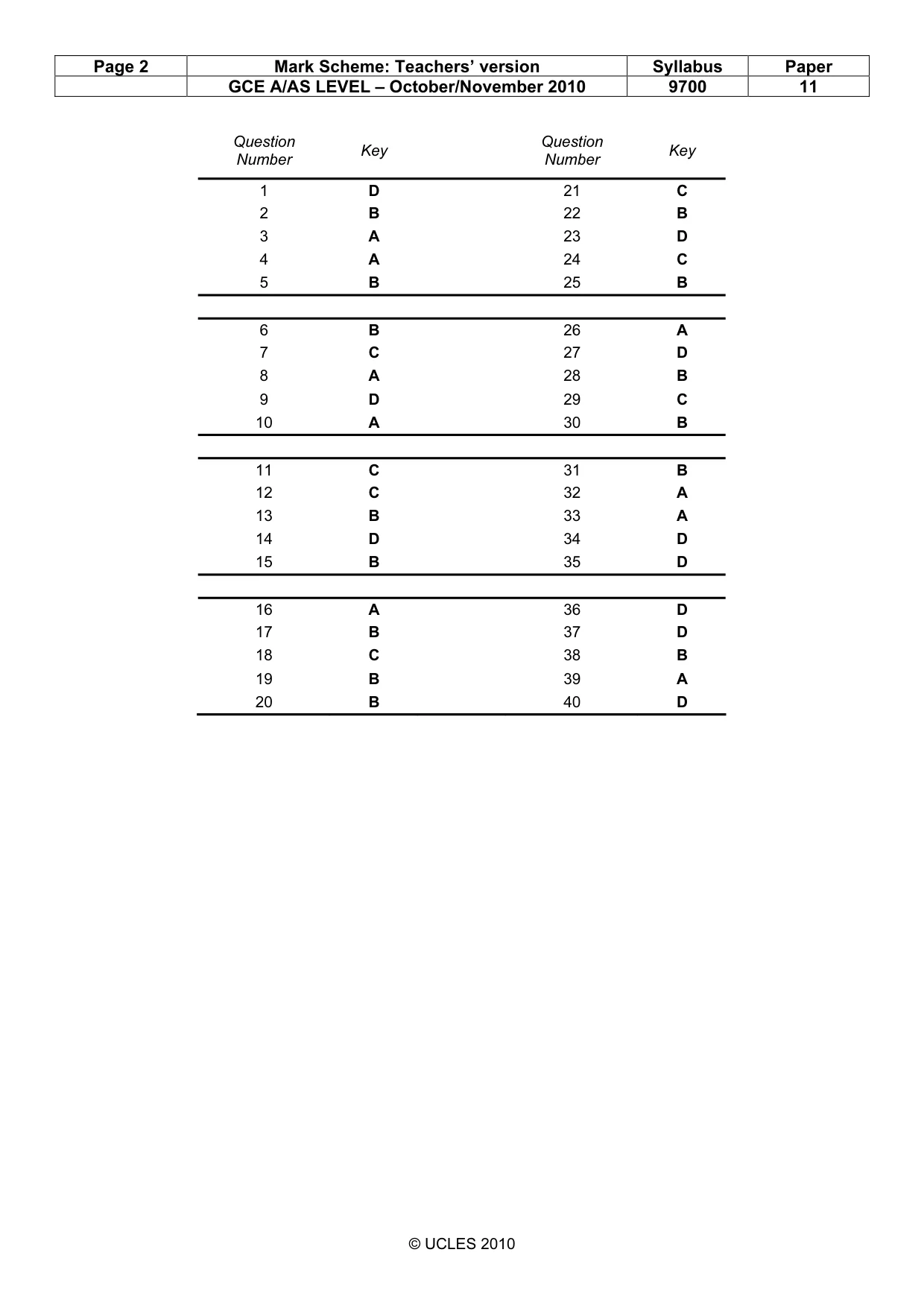
Mark scheme: D
Q2 · Which is correct about the organelles listed in the table?
2 Which is correct about the organelles listed in the table? carries out contains contains transcription enzymes ribosomes 1 lysosomes no yes no 2 mitochondria yes no yes 3 rough endoplasmic reticulum yes yes yes 4 vacuoles no yes no A 1 and 3 B 1 and 4 C 2 and 3 D 2 and 4
Mark scheme: B
More questions on Cells as the basic units of living organisms
Q3 · The graticule and stage micrometer are used to measure cells
3 The graticule and stage micrometer are used to measure cells. Which is the correct reason why the graticule calibrated? A The graticule can be used to make measurements. B The graticule is magnified by the objective lens. C The graticule magnifies the specimen. D The graticule makes comparisons.
Mark scheme: A
Q4 · What are the characteristics of a prokaryotic cell?
4 What are the characteristics of a prokaryotic cell? DNA endoplasmic ribosomal plasmids structure reticulum size A circular absent present small B circular present absent large C linear absent present small D linear present absent large
Mark scheme: A
More questions on Cells as the basic units of living organisms
Q5 · The diagram shows a stage micrometer, with divisions 0.1 mm apart, viewed through an…
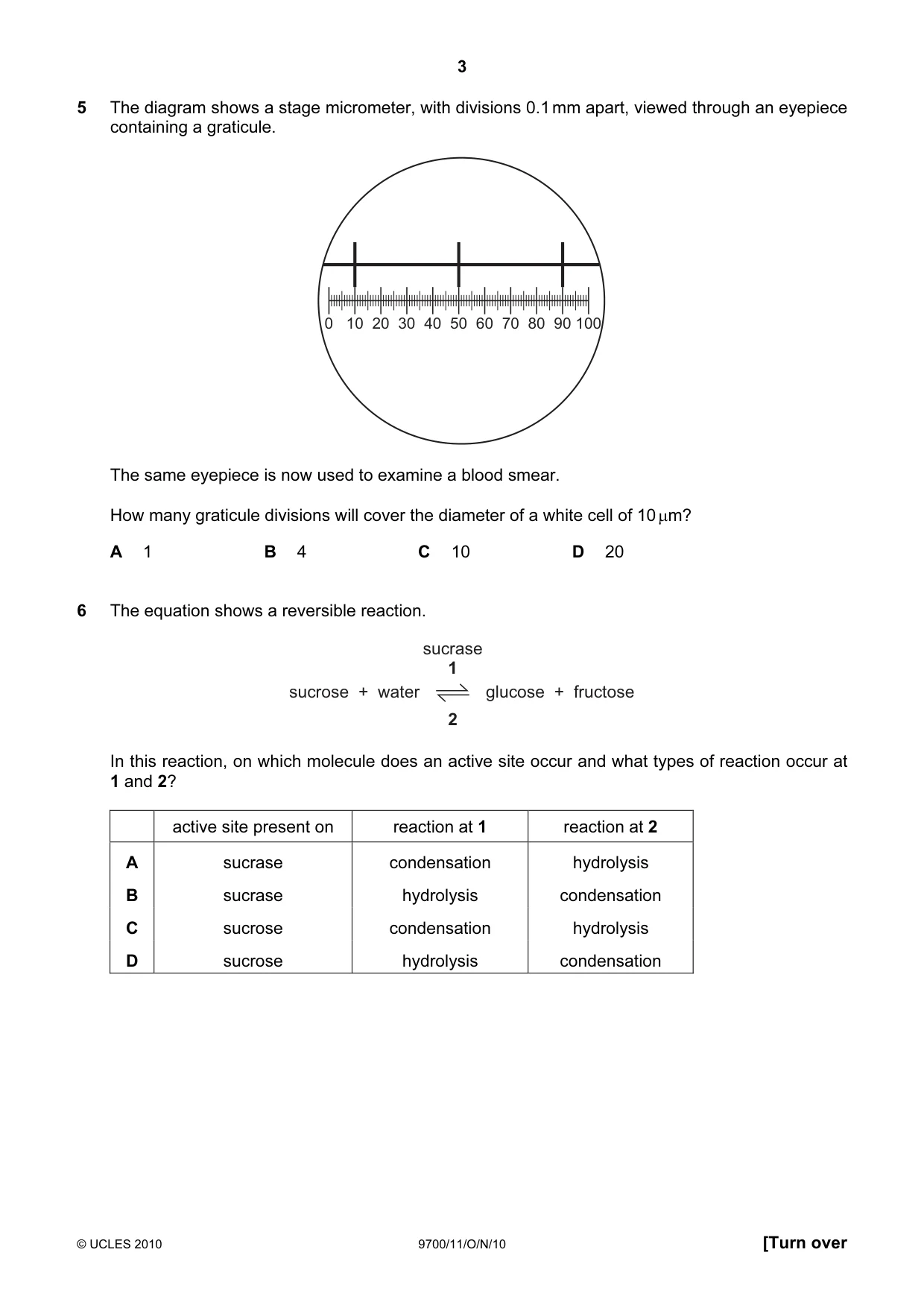
5 The diagram shows a stage micrometer, with divisions 0.1 mm apart, viewed through an eyepiece containing a graticule. 0 10 20 30 40 50 60 70 80 90 100 The same eyepiece is now used to examine a blood smear. How many graticule divisions will cover the diameter of a white cell of 10 µm? A 1 B 4 C 10 D 20
Mark scheme: B
Q6 · The equation shows a reversible reaction
6 The equation shows a reversible reaction. sucrase 1 sucrose + water glucose + fructose 2 In this reaction, on which molecule does an active site occur and what types of reaction occur at 1 and 2? active site present on reaction at 1 reaction at 2 A sucrase condensation hydrolysis B sucrase hydrolysis condensation C sucrose condensation hydrolysis D sucrose hydrolysis condensation
Mark scheme: B
Q7 · What are the features of triglycerides?
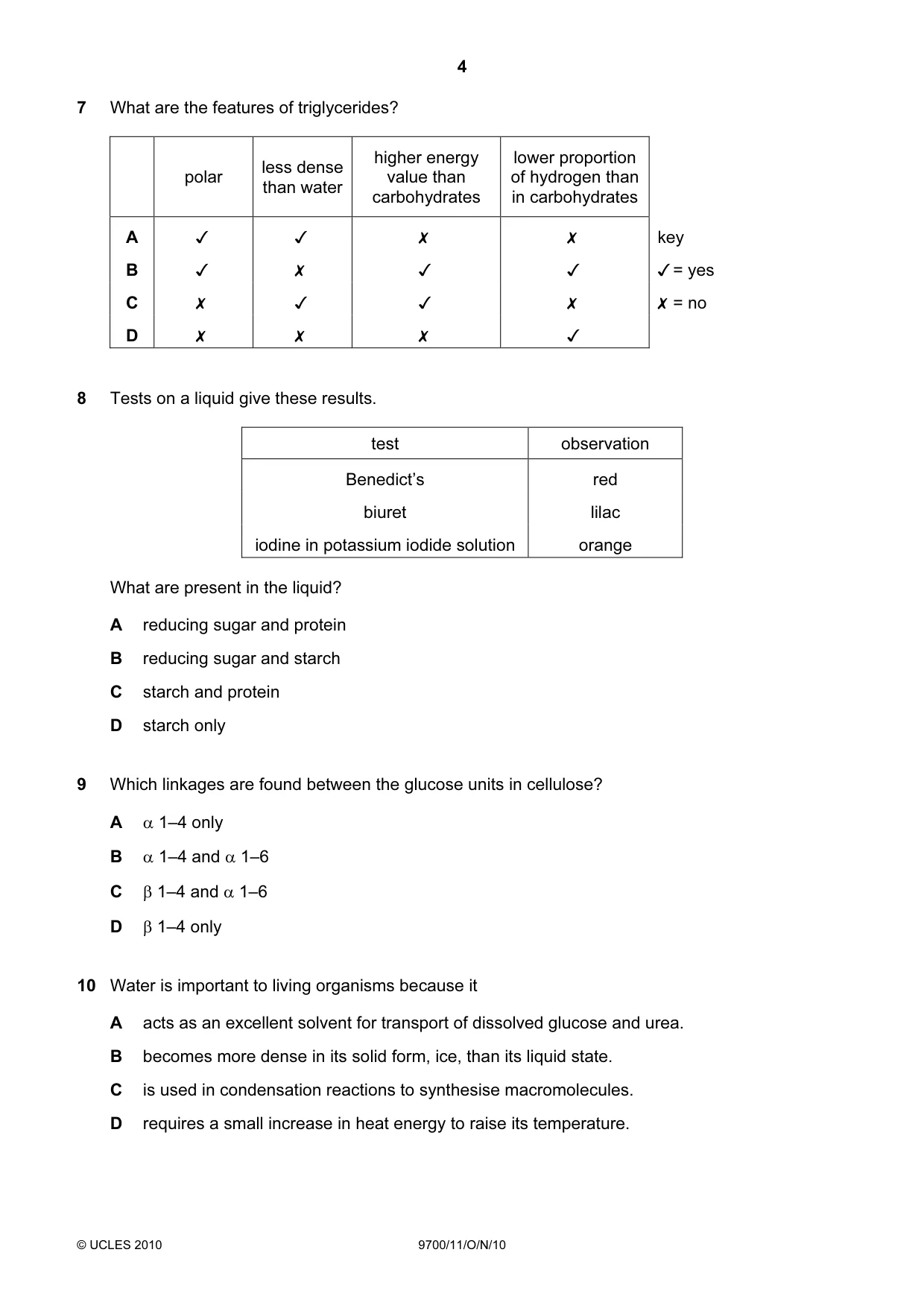
7 What are the features of triglycerides? 0 0O DW > polar x x KOK less dense than water ~ Kw OK higher energy value than carbohydrates x << & x lower proportion of hydrogen than in carbohydrates K & & x key v/=yes xX =no
Mark scheme: C
Q8 · Tests on a liquid give these results
8 Tests on a liquid give these results. test observation Benedict’s red biuret lilac iodine in potassium iodide solution orange What are present in the liquid? A reducing sugar and protein B reducing sugar and starch C starch and protein D starch only
Mark scheme: A
Q9 · Which linkages are found between the glucose units in cellulose?
9 Which linkages are found between the glucose units in cellulose? A α 1–4 only B α 1–4 and α 1–6 C β 1–4 and α 1–6 D β 1–4 only
Mark scheme: D
Q10 · Water is important to living organisms because it A acts as an excellent solvent for…
10 Water is important to living organisms because it A acts as an excellent solvent for transport of dissolved glucose and urea. B becomes more dense in its solid form, ice, than its liquid state. C is used in condensation reactions to synthesise macromolecules. D requires a small increase in heat energy to raise its temperature.
Mark scheme: A
Q11 · Which diagram shows the bond linking the individual units of both cellulose and amylose?
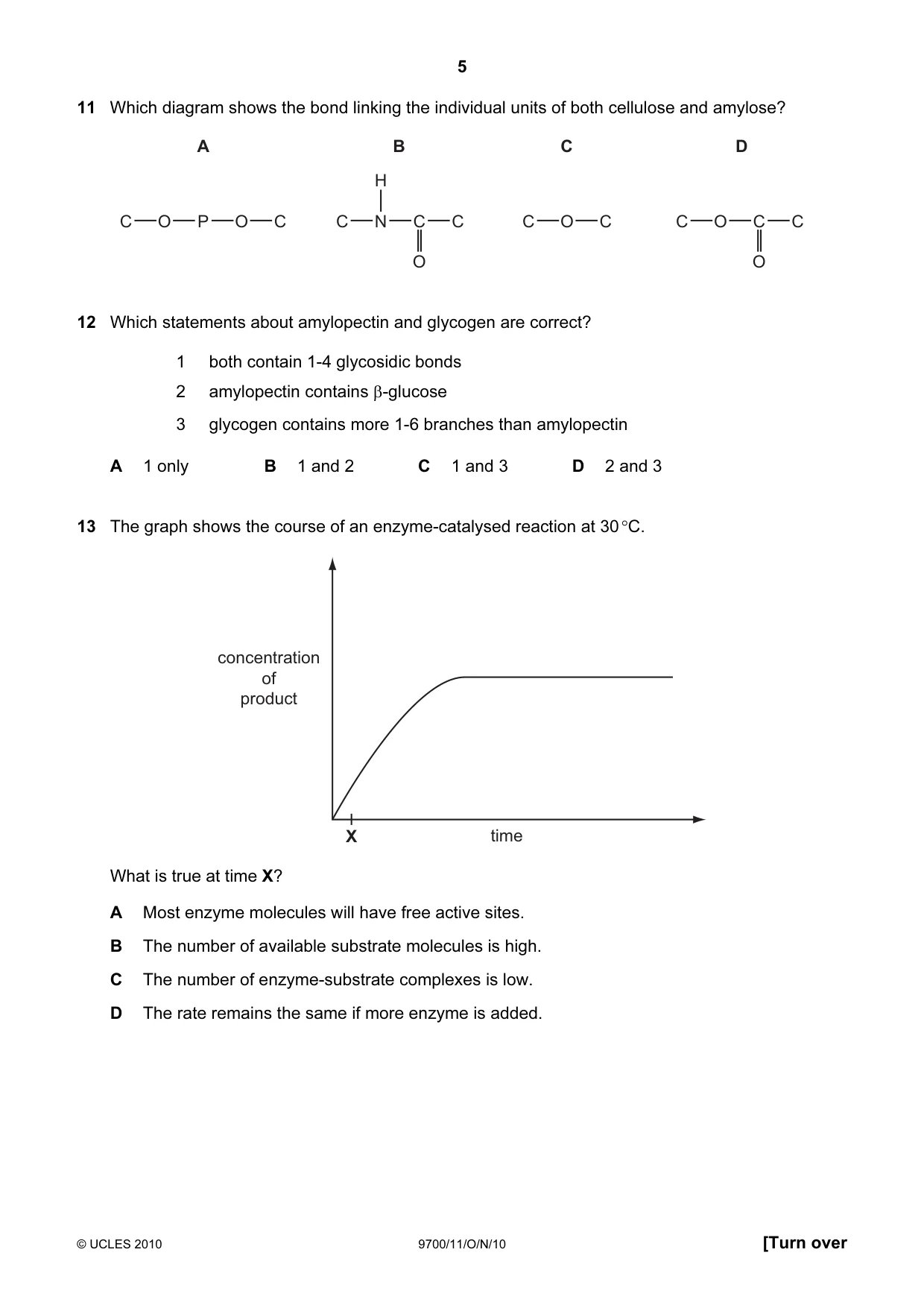
11 Which diagram shows the bond linking the individual units of both cellulose and amylose? A B C D H C O P O C C N C C C O C C O C C O O
Mark scheme: C
Q12 · Which statements about amylopectin and glycogen are correct?
12 Which statements about amylopectin and glycogen are correct? 1 both contain 1-4 glycosidic bonds 2 amylopectin contains β-glucose 3 glycogen contains more 1-6 branches than amylopectin A 1 only B 1 and 2 C 1 and 3 D 2 and 3
Mark scheme: C
Q13 · The graph shows the course of an enzyme-catalysed reaction at 30 °C
13 The graph shows the course of an enzyme-catalysed reaction at 30 °C. concentration of product X time What is true at time X? A Most enzyme molecules will have free active sites. B The number of available substrate molecules is high. C The number of enzyme-substrate complexes is low. D The rate remains the same if more enzyme is added.
Mark scheme: B
Q14 · The rate of enzyme-catalysed reactions in human cells is regulated
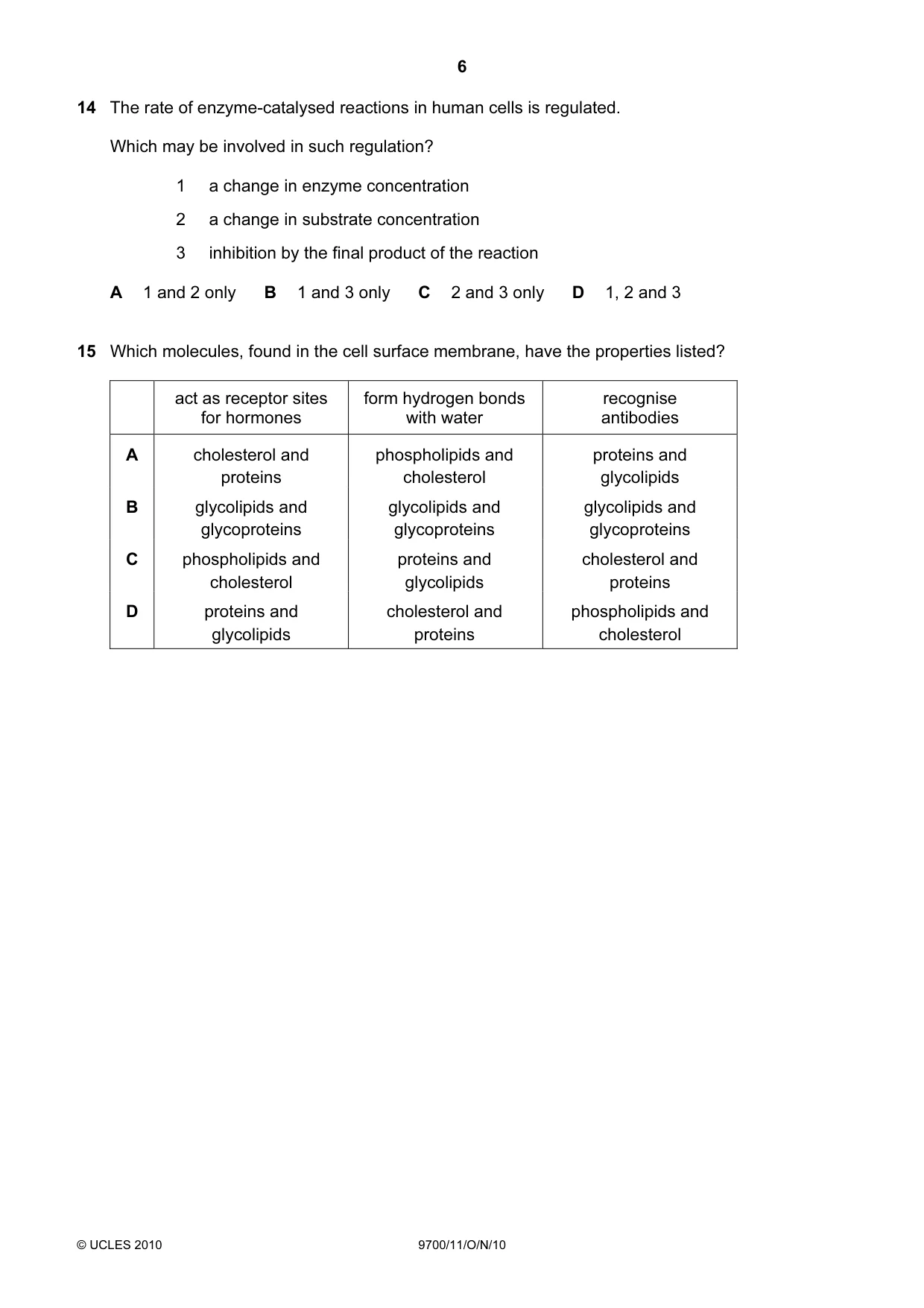
14 The rate of enzyme-catalysed reactions in human cells is regulated. Which may be involved in such regulation? 1 a change in enzyme concentration 2 a change in substrate concentration 3 inhibition by the final product of the reaction A 1 and 2 only B 1 and 3 only C 2 and 3 only D 1, 2 and 3
Mark scheme: D
Q15 · Which molecules, found in the cell surface membrane, have the properties listed?
15 Which molecules, found in the cell surface membrane, have the properties listed? act as receptor sites form hydrogen bonds recognise for hormones with water antibodies A cholesterol and phospholipids and proteins and proteins cholesterol glycolipids B glycolipids and glycolipids and glycolipids and glycoproteins glycoproteins glycoproteins C phospholipids and proteins and cholesterol and cholesterol glycolipids proteins D proteins and cholesterol and phospholipids and glycolipids proteins cholesterol
Mark scheme: B
Q16 · The stalk of a dandelion is a hollow tube
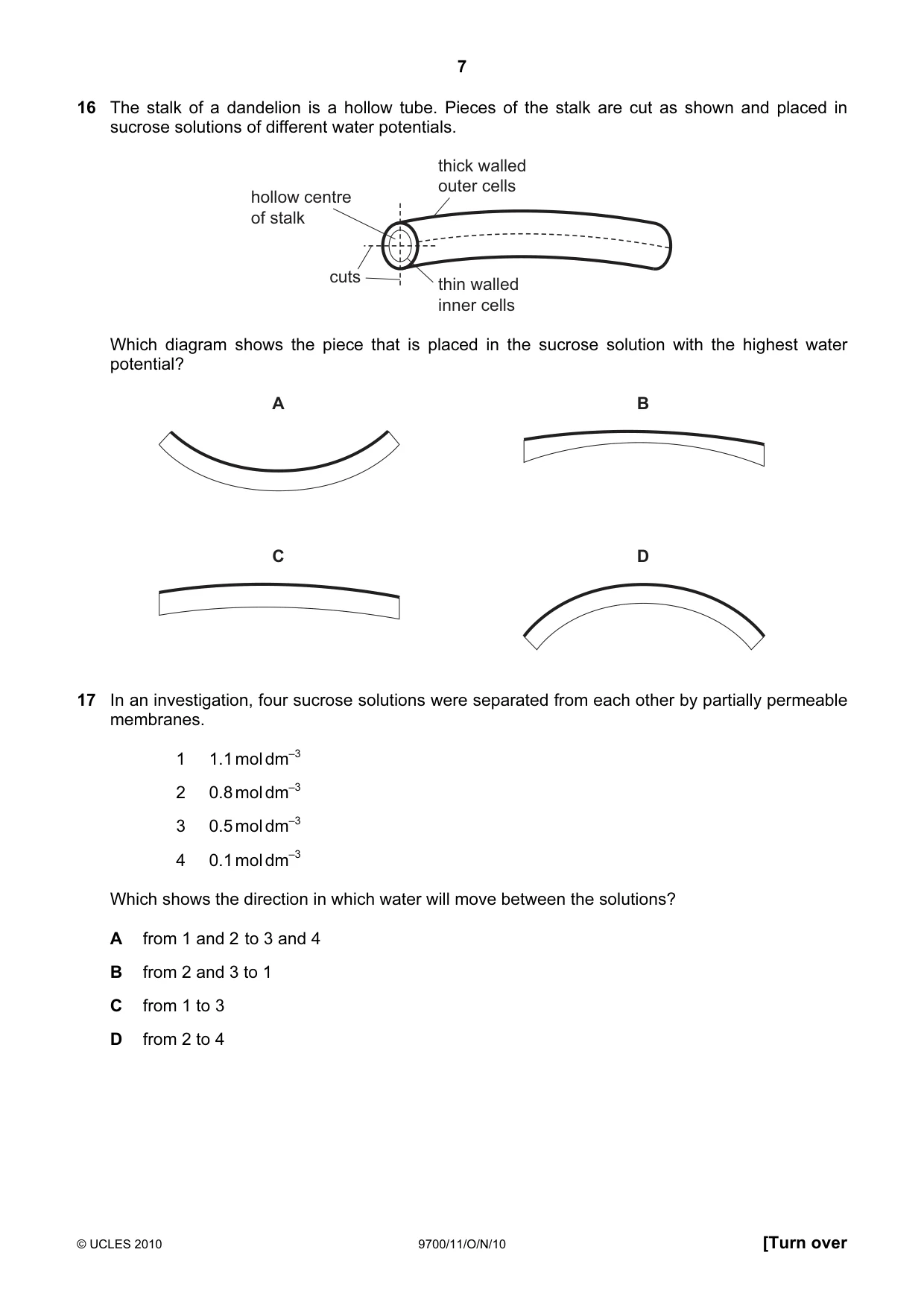
16 The stalk of a dandelion is a hollow tube. Pieces of the stalk are cut as shown and placed in sucrose solutions of different water potentials. thick walled outer cells hollow centre of stalk cuts thin walled inner cells Which diagram shows the piece that is placed in the sucrose solution with the highest water potential? A B C D
Mark scheme: A
Q17 · In an investigation, four sucrose solutions were separated from each other by partially…
17 In an investigation, four sucrose solutions were separated from each other by partially permeable membranes. 1 1.1 mol dm–3 2 0.8 mol dm–3 3 0.5 mol dm–3 4 0.1 mol dm–3 Which shows the direction in which water will move between the solutions? A from 1 and 2 to 3 and 4 B from 2 and 3 to 1 C from 1 to 3 D from 2 to 4
Mark scheme: B
Q18 · Male bees are haploid
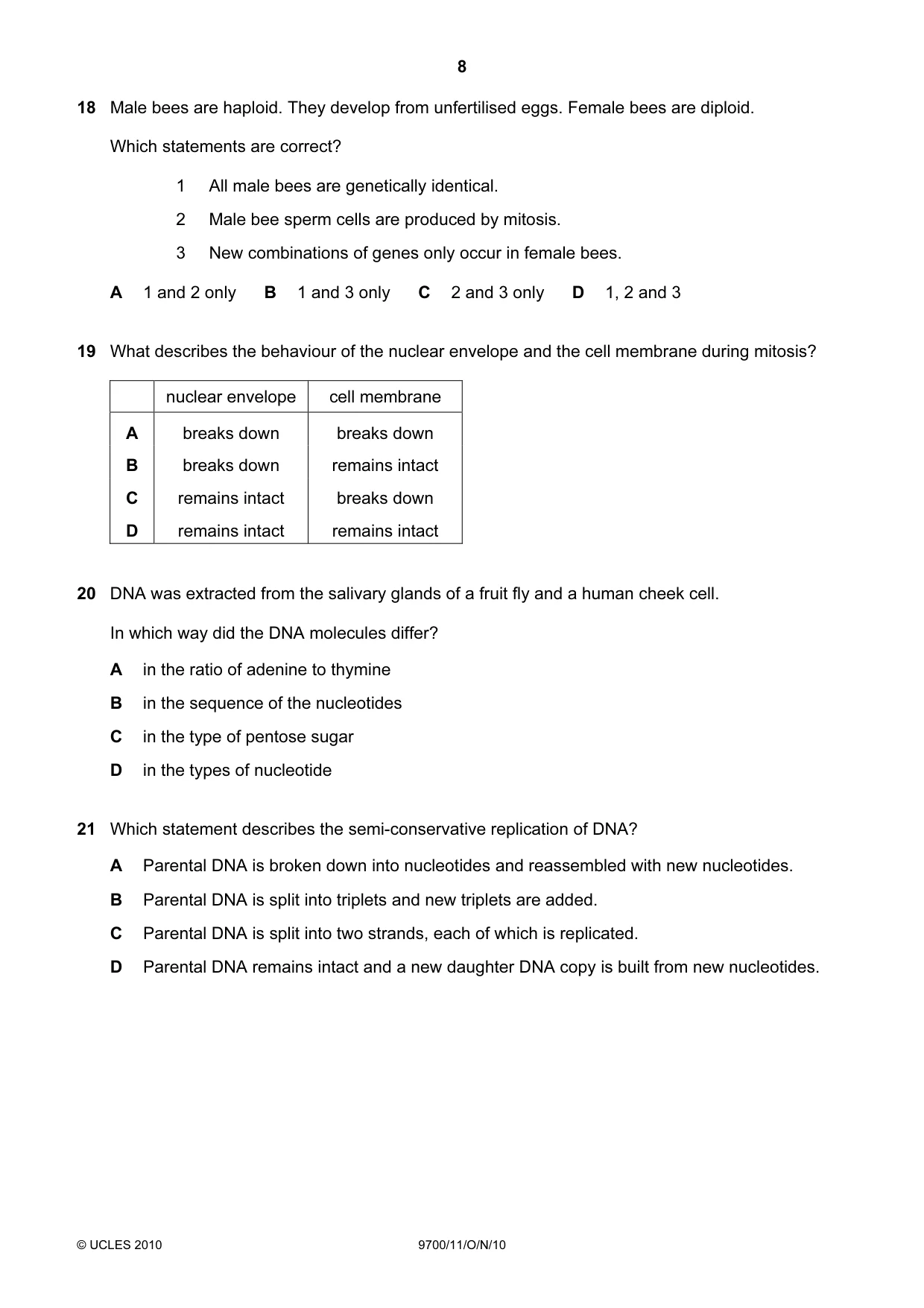
18 Male bees are haploid. They develop from unfertilised eggs. Female bees are diploid. Which statements are correct? 1 All male bees are genetically identical. 2 Male bee sperm cells are produced by mitosis. 3 New combinations of genes only occur in female bees. A 1 and 2 only B 1 and 3 only C 2 and 3 only D 1, 2 and 3
Mark scheme: C
Q19 · What describes the behaviour of the nuclear envelope and the cell membrane during mitosis?
19 What describes the behaviour of the nuclear envelope and the cell membrane during mitosis? nuclear envelope cell membrane A breaks down breaks down B breaks down remains intact C remains intact breaks down D remains intact remains intact
Mark scheme: B
More questions on Replication and division of nuclei and cells
Q20 · DNA was extracted from the salivary glands of a fruit fly and a human cheek cell
20 DNA was extracted from the salivary glands of a fruit fly and a human cheek cell. In which way did the DNA molecules differ? A in the ratio of adenine to thymine B in the sequence of the nucleotides C in the type of pentose sugar D in the types of nucleotide
Mark scheme: B
More questions on Structure of nucleic acids and replication of DNA
Q21 · Which statement describes the semi-conservative replication of DNA?
21 Which statement describes the semi-conservative replication of DNA? A Parental DNA is broken down into nucleotides and reassembled with new nucleotides. B Parental DNA is split into triplets and new triplets are added. C Parental DNA is split into two strands, each of which is replicated. D Parental DNA remains intact and a new daughter DNA copy is built from new nucleotides.
Mark scheme: C
More questions on Structure of nucleic acids and replication of DNA
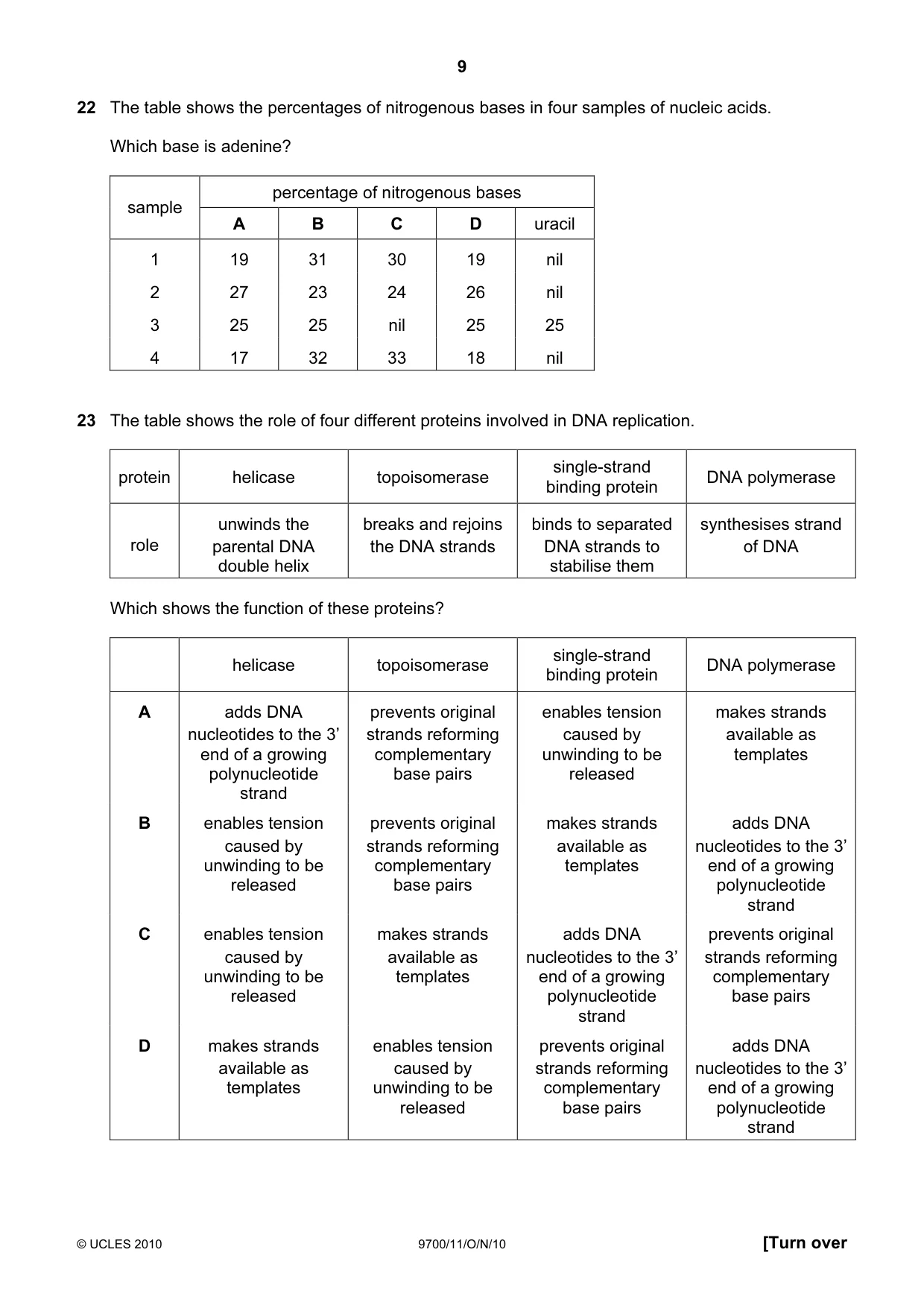
Q22 · The table shows the percentages of nitrogenous bases in four samples of nucleic acids
22 The table shows the percentages of nitrogenous bases in four samples of nucleic acids. Which base is adenine? percentage of nitrogenous bases sample A B C D uracil 1 19 31 30 19 nil 2 27 23 24 26 nil 3 25 25 nil 25 25 4 17 32 33 18 nil
Mark scheme: B
More questions on Structure of nucleic acids and replication of DNA
Q23 · The table shows the role of four different proteins involved in DNA replication
23 The table shows the role of four different proteins involved in DNA replication. single-strand protein helicase topoisomerase DNA polymerase binding protein unwinds the breaks and rejoins binds to separated synthesises strand role parental DNA the DNA strands DNA strands to of DNA double helix stabilise them Which shows the function of these proteins? single-strand helicase topoisomerase DNA polymerase binding protein A adds DNA prevents original enables tension makes strands nucleotides to the 3’ strands reforming caused by available as end of a growing complementary unwinding to be templates polynucleotide base pairs released strand B enables tension prevents original makes strands adds DNA caused by strands reforming available as nucleotides to the 3’ unwinding to be complementary templates end of a growing released base pairs polynucleotide strand C enables tension makes strands adds DNA prevents original caused by available as nucleotides to the 3’ strands reforming unwinding to be templates end of a growing complementary released polynucleotide base pairs strand D makes strands enables tension prevents original adds DNA available as caused by strands reforming nucleotides to the 3’ templates unwinding to be complementary end of a growing released base pairs polynucleotide strand
Mark scheme: D
More questions on Structure of nucleic acids and replication of DNA
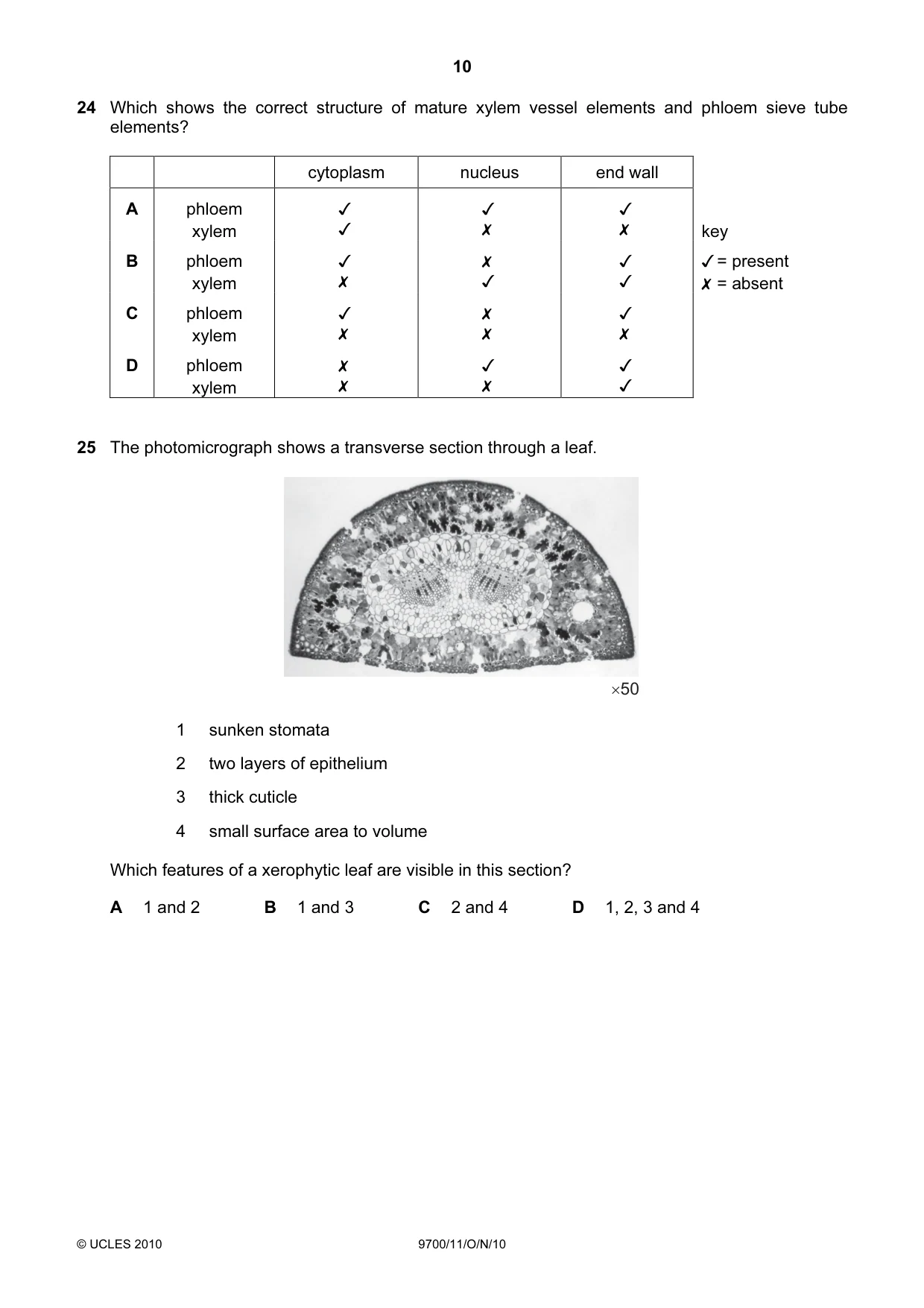
Q24 · Which shows the correct structure of mature xylem vessel elements and phloem sieve tube…
24 Which shows the correct structure of mature xylem vessel elements and phloem sieve tube elements? cytoplasm nucleus end wall A phloem J J v xylem v x x key B phloem J x v / = present xylem x v v X = absent Cc phloem Jv Xx v xylem x x x D phloem x v v xylem x x v
Mark scheme: C
Q25 · The photomicrograph shows a transverse section through a leaf
25 The photomicrograph shows a transverse section through a leaf. ×50 1 sunken stomata 2 two layers of epithelium 3 thick cuticle 4 small surface area to volume Which features of a xerophytic leaf are visible in this section? A 1 and 2 B 1 and 3 C 2 and 4 D 1, 2, 3 and 4
Mark scheme: B
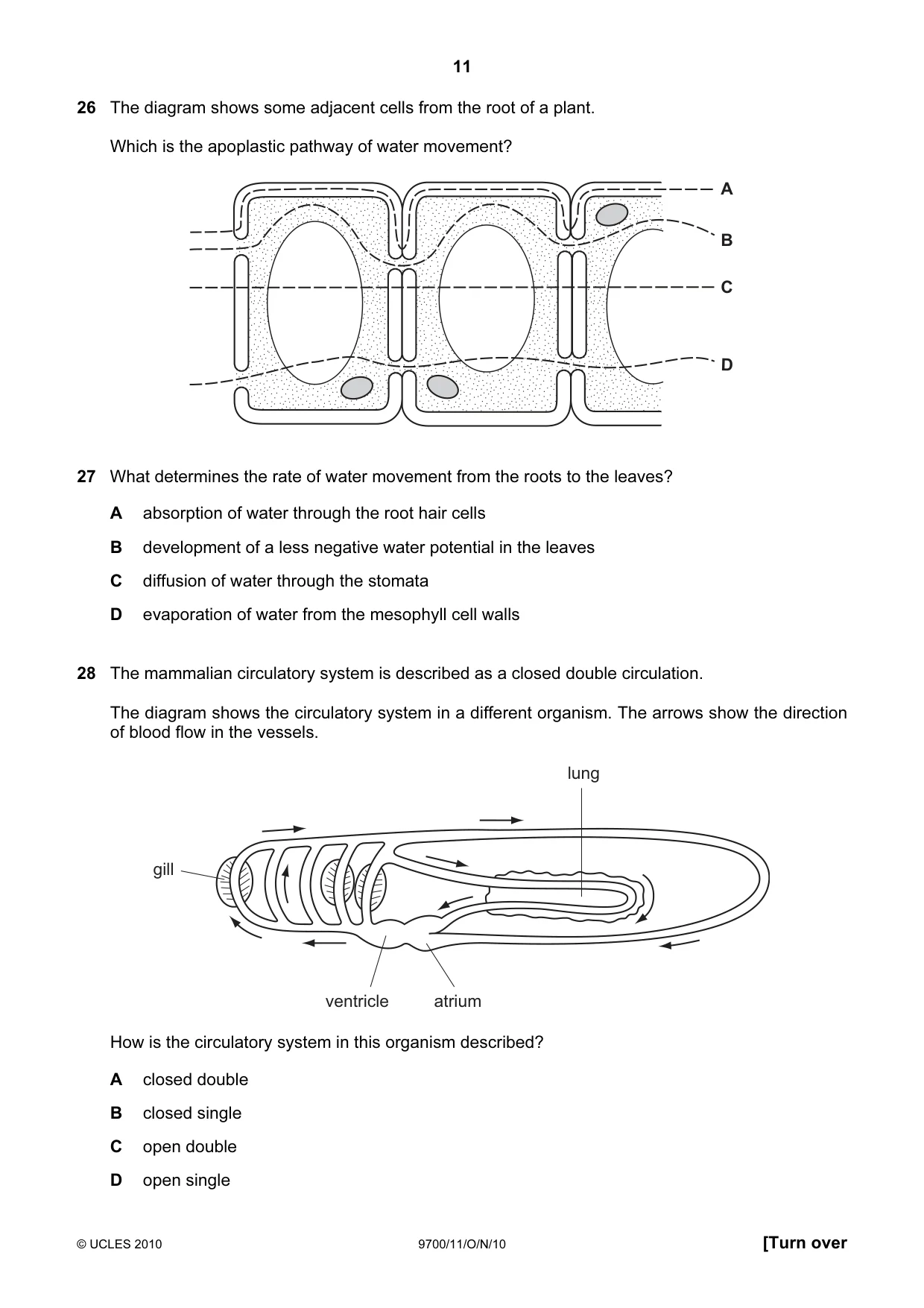
Q26 · The diagram shows some adjacent cells from the root of a plant
26 The diagram shows some adjacent cells from the root of a plant. Which is the apoplastic pathway of water movement? A B C D
Mark scheme: A
Q27 · What determines the rate of water movement from the roots to the leaves?
27 What determines the rate of water movement from the roots to the leaves? A absorption of water through the root hair cells B development of a less negative water potential in the leaves C diffusion of water through the stomata D evaporation of water from the mesophyll cell walls
Mark scheme: D
Q28 · The mammalian circulatory system is described as a closed double circulation
28 The mammalian circulatory system is described as a closed double circulation. The diagram shows the circulatory system in a different organism. The arrows show the direction of blood flow in the vessels. lung gill ventricle atrium How is the circulatory system in this organism described? A closed double B closed single C open double D open single
Mark scheme: B
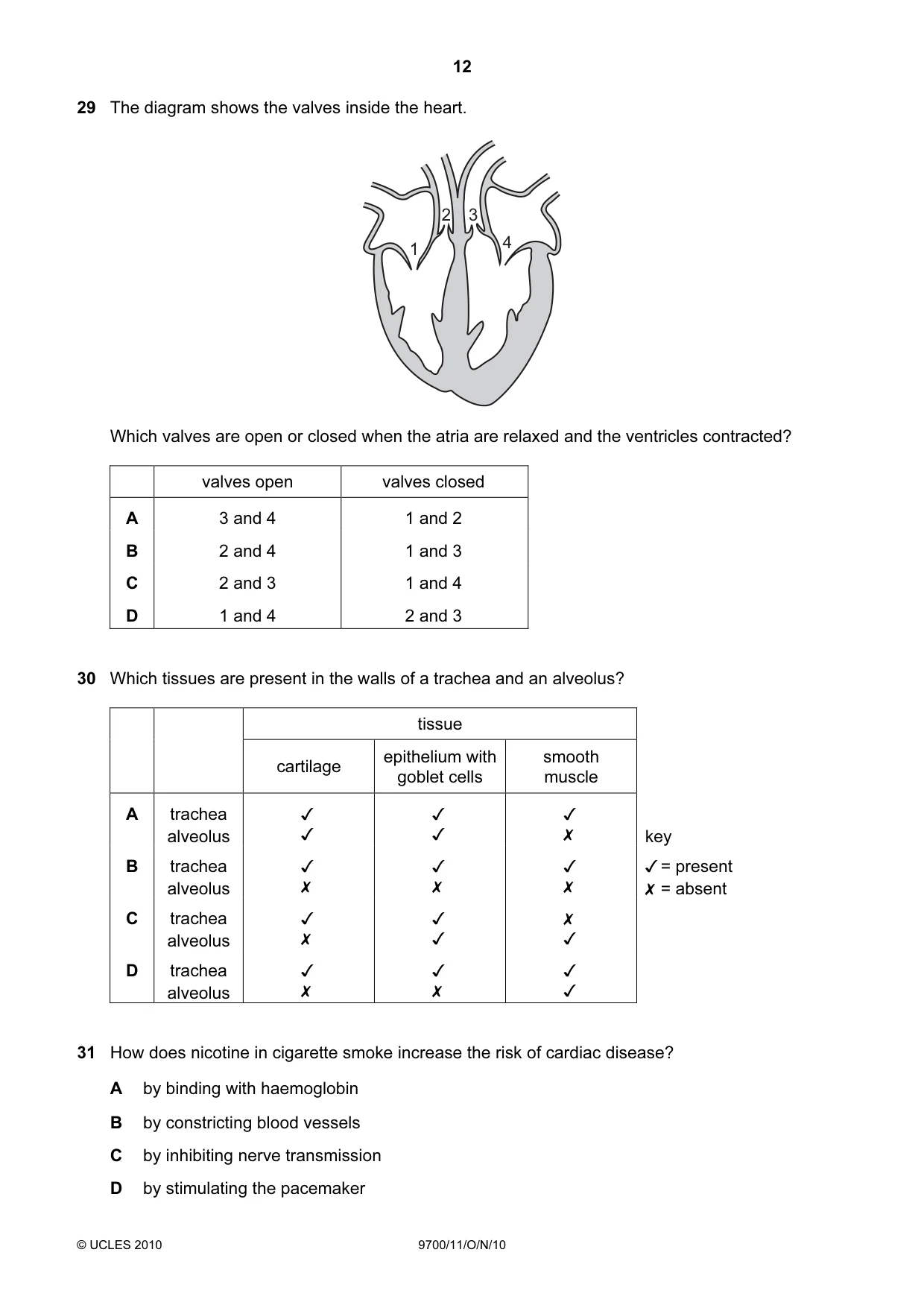
Q29 · The diagram shows the valves inside the heart
29 The diagram shows the valves inside the heart. 2 3 1 4 Which valves are open or closed when the atria are relaxed and the ventricles contracted? valves open valves closed A 3 and 4 1 and 2 B 2 and 4 1 and 3 C 2 and 3 1 and 4 D 1 and 4 2 and 3
Mark scheme: C
Q30 · Which tissues are present in the walls of a trachea and an alveolus?
30 Which tissues are present in the walls of a trachea and an alveolus? tissue . epithelium with smooth cartilage goblet cells muscle A trachea Jv Jv Jv alveolus v v x B trachea Jv Jv Jv alveolus x x x Cc trachea Jv Jv x alveolus x Jv Jv D trachea Jv Jv Jv alveolus x x Jv key / = present X = absent
Mark scheme: B
Q31 · How does nicotine in cigarette smoke increase the risk of cardiac disease?
31 How does nicotine in cigarette smoke increase the risk of cardiac disease? A by binding with haemoglobin B by constricting blood vessels C by inhibiting nerve transmission D by stimulating the pacemaker
Mark scheme: B
Q32 · The diagram shows the volume of air breathed in and out while a person is breathing…
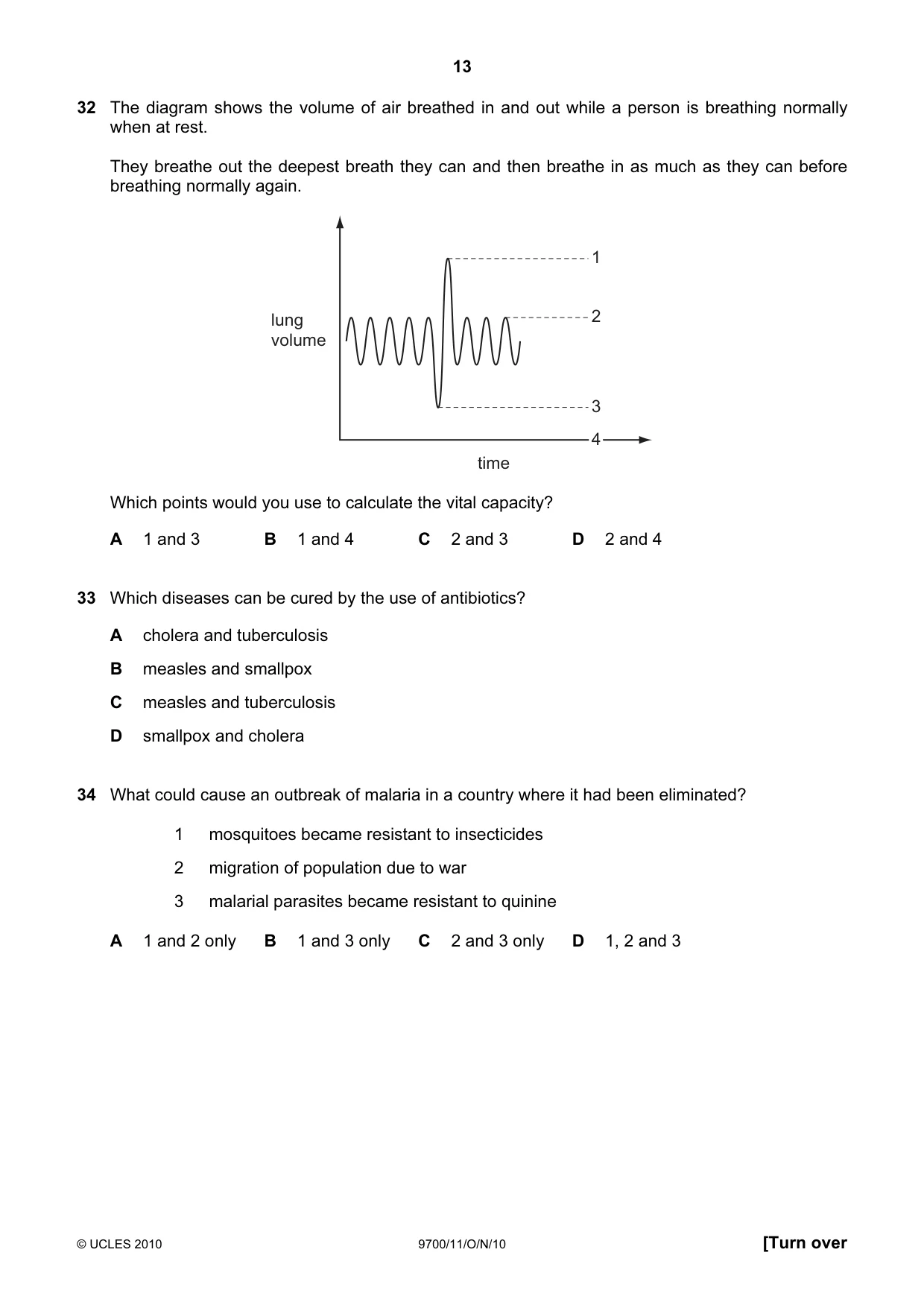
32 The diagram shows the volume of air breathed in and out while a person is breathing normally when at rest. They breathe out the deepest breath they can and then breathe in as much as they can before breathing normally again. 1 lung 2 volume 3 6 6 4 time Which points would you use to calculate the vital capacity? A 1 and 3 B 1 and 4 C 2 and 3 D 2 and 4
Mark scheme: A
Q33 · Which diseases can be cured by the use of antibiotics?
33 Which diseases can be cured by the use of antibiotics? A cholera and tuberculosis B measles and smallpox C measles and tuberculosis D smallpox and cholera
Mark scheme: A
Q34 · What could cause an outbreak of malaria in a country where it had been eliminated?
34 What could cause an outbreak of malaria in a country where it had been eliminated? 1 mosquitoes became resistant to insecticides 2 migration of population due to war 3 malarial parasites became resistant to quinine A 1 and 2 only B 1 and 3 only C 2 and 3 only D 1, 2 and 3
Mark scheme: D
Q35 · The diagram shows part of the immune response
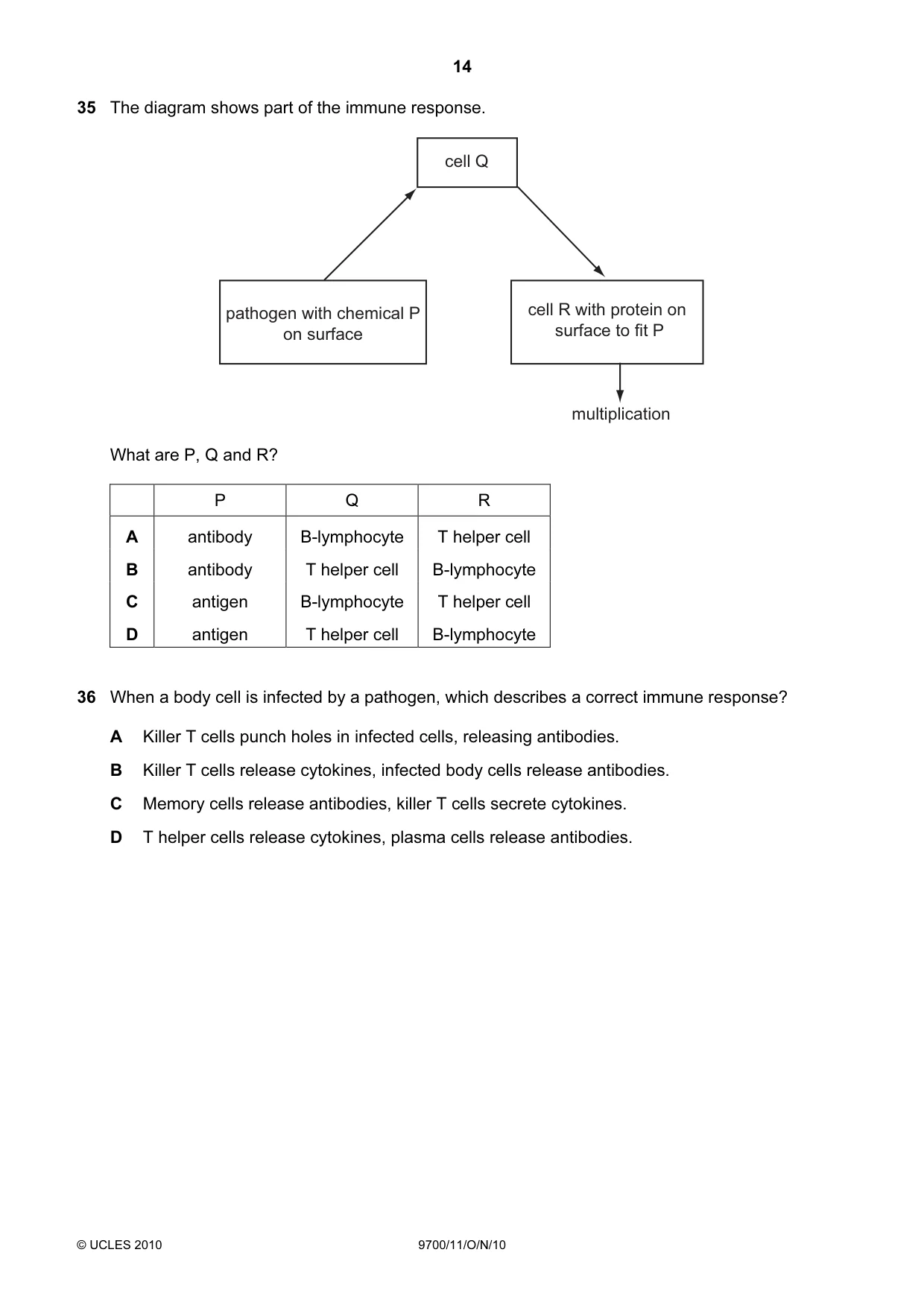
35 The diagram shows part of the immune response. cell Q pathogen with chemical P cell R with protein on on surface surface to fit P multiplication What are P, Q and R? P Q R A antibody B-lymphocyte T helper cell B antibody T helper cell B-lymphocyte C antigen B-lymphocyte T helper cell D antigen T helper cell B-lymphocyte
Mark scheme: D
Q36 · When a body cell is infected by a pathogen, which describes a correct immune response?
36 When a body cell is infected by a pathogen, which describes a correct immune response? A Killer T cells punch holes in infected cells, releasing antibodies. B Killer T cells release cytokines, infected body cells release antibodies. C Memory cells release antibodies, killer T cells secrete cytokines. D T helper cells release cytokines, plasma cells release antibodies.
Mark scheme: D
Q37 · The photomicrograph shows human blood, with three types of white cell labelled
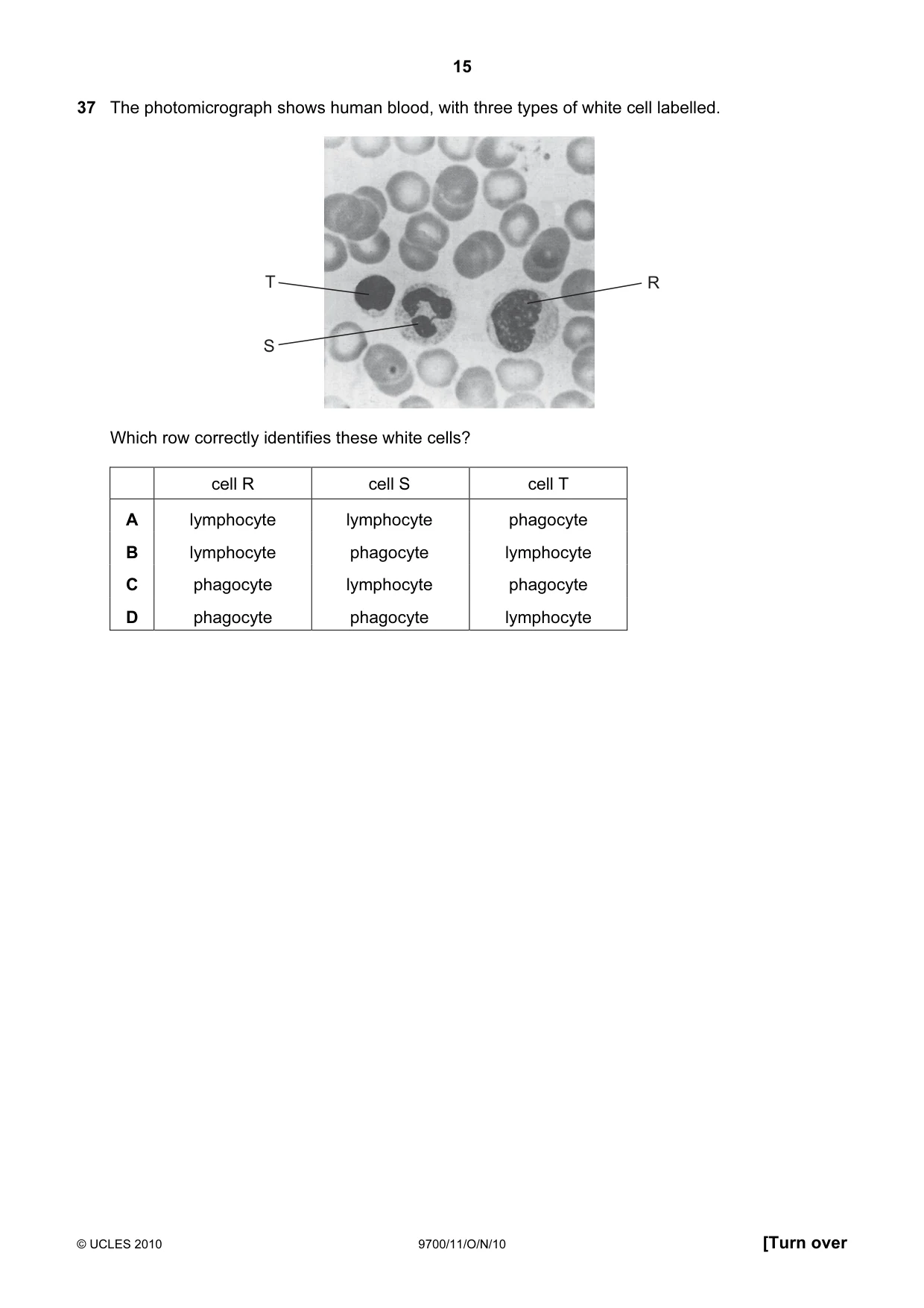
37 The photomicrograph shows human blood, with three types of white cell labelled. T R S Which row correctly identifies these white cells? cell R cell S cell T A lymphocyte lymphocyte phagocyte B lymphocyte phagocyte lymphocyte C phagocyte lymphocyte phagocyte D phagocyte phagocyte lymphocyte
Mark scheme: D
Q38 · The table shows the results of a field study of four species in a food chain in an area…
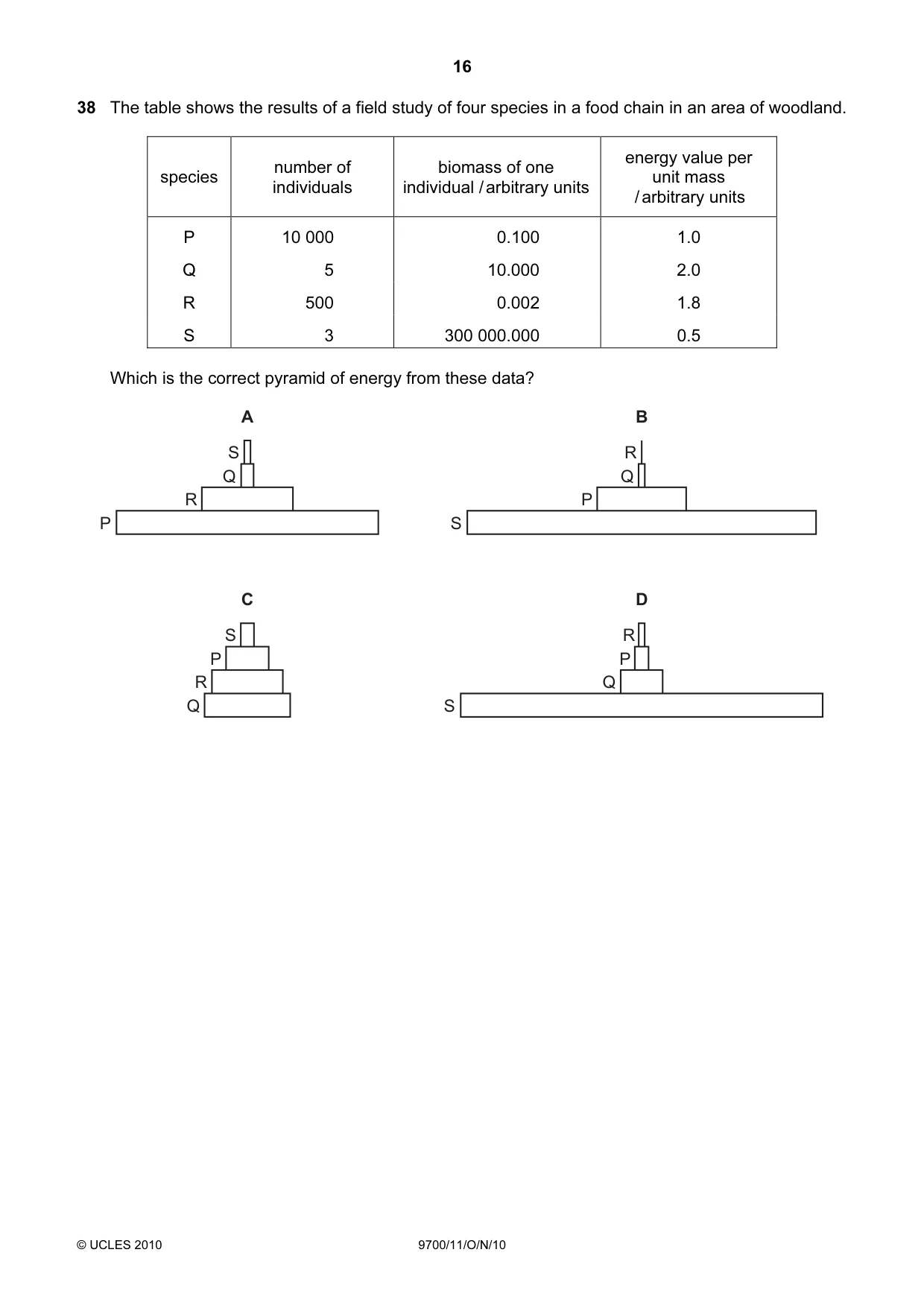
38 The table shows the results of a field study of four species in a food chain in an area of woodland. energy value per number of biomass of one species unit mass individuals individual / arbitrary units / arbitrary units P 10 000 0.100 1.0 Q 5 10.000 2.0 R 500 0.002 1.8 S 3 300 000.000 0.5 Which is the correct pyramid of energy from these data? A B S R Q Q R P P S C D S R P P R Q Q S
Mark scheme: B
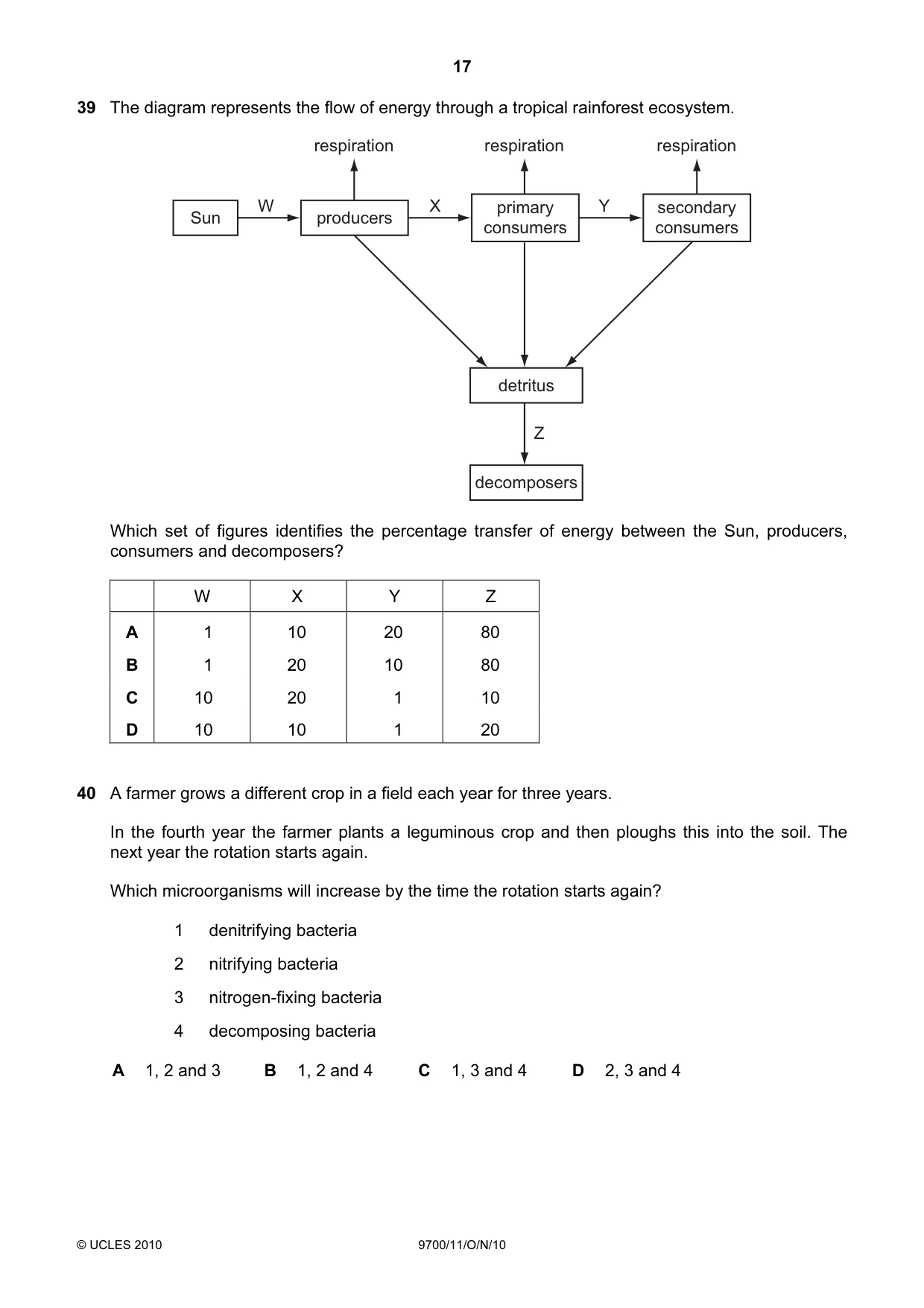
Q39 · The diagram represents the flow of energy through a tropical rainforest ecosystem
39 The diagram represents the flow of energy through a tropical rainforest ecosystem. respiration respiration respiration W X primary Y secondary Sun producers consumers consumers detritus Z decomposers Which set of figures identifies the percentage transfer of energy between the Sun, producers, consumers and decomposers? W X Y Z A 1 10 20 80 B 1 20 10 80 C 10 20 1 10 D 10 10 1 20
Mark scheme: A
Q40 · A farmer grows a different crop in a field each year for three years
40 A farmer grows a different crop in a field each year for three years. In the fourth year the farmer plants a leguminous crop and then ploughs this into the soil. The next year the rotation starts again. Which microorganisms will increase by the time the rotation starts again? 1 denitrifying bacteria 2 nitrifying bacteria 3 nitrogen-fixing bacteria 4 decomposing bacteria A 1, 2 and 3 B 1, 2 and 4 C 1, 3 and 4 D 2, 3 and 4
Mark scheme: D
What was in this paper
The subtopics covered by these 40 questions, and how many questions each got. Open one in a new tab to see every Cambridge question on it.
4Structure of nucleic acids and replication of DNA4The immune system3The microscope in cell studies3Cells as the basic units of living organisms2Energy2Factors that affect enzyme action2Infectious diseases2Movement into and out of cells2Structure of transport tissues2The circulatory system2The gas exchange system2Transport mechanisms2Chromosome behaviour in mitosis1Conservation1Fluid mosaic membranes1Mode of action of enzymes1Replication and division of nuclei and cells1Testing for biological molecules1The heart1Water1What you needed in this session
Cambridge’s own grade thresholds for 2010 Oct/Nov, Paper 1 · Variant 1. A higher threshold means an easier paper — the bar moves with how the cohort did.