Questions as text
Q1 · The three balls shown are dropped from a bench 0625/11 May/June 2005
2 The three balls shown are dropped from a bench. aluminium lead wood Which balls have the same acceleration? A aluminium and lead only B aluminium and wood only C lead and wood only D aluminium, lead and wood
1 marks
Answer: D
This question in 0625/11 May/June 2005
Q2 · Which statement is correct? 0625/11 May/June 2005
4 Which statement is correct? A The mass of a bottle of water at the North Pole is different from its mass at the Equator. B The mass of a bottle of water is measured in newtons. C The weight of a bottle of water and its mass are the same thing. D The weight of a bottle of water is one of the forces acting on it.
1 marks
Answer: D
This question in 0625/11 May/June 2005
Q3 · Two blocks X and Y are placed on a beam as shown 0625/11 May/June 2005
5 Two blocks X and Y are placed on a beam as shown. The beam balances on a pivot at its centre. Y X pivot What does this show about X and Y? A They have the same mass and the same density. B They have the same mass and the same weight. C They have the same volume and the same density. D They have the same volume and the same weight.
1 marks
Answer: B
This question in 0625/11 May/June 2005
Q4 · What is the gravitational force that the Earth exerts on an object? 0625/11 Oct/Nov 2005
4 What is the gravitational force that the Earth exerts on an object? A the density of the object B the mass of the object C the volume of the object D the weight of the object
1 marks
Answer: D
This question in 0625/11 Oct/Nov 2005
Q5 · In an experiment, five identical bags of rice are balanced by a 10 kg mass 0625/11 Oct/Nov 2005
5 In an experiment, five identical bags of rice are balanced by a 10 kg mass. five bags 10 kg mass of rice pivot Two bags of rice are added to the other five. What mass will now balance the bags? A 3.5 kg B 7.0 kg C 10 kg D 14 kg
1 marks
Answer: D
This question in 0625/11 Oct/Nov 2005
Q6 · A simple balance has two pans suspended from the ends of arms of equal length 0625/11 May/June 2006
5 A simple balance has two pans suspended from the ends of arms of equal length. When it is balanced, the pointer is at 0. pivot arm pointer 0 pan X pan Y Four masses (in total) are placed on the pans, with one or more on pan X and the rest on pan Y. Which combination of masses can be used to balance the pans? A 1 g, 1 g, 5 g, 10 g B 1 g, 2 g, 2 g, 5 g C 2 g, 5 g, 5 g, 10 g D 2 g, 5 g, 10 g, 10 g
1 marks
Answer: B
This question in 0625/11 May/June 2006
Q7 · The diagram shows a bird in flight 0625/11 May/June 2007
4 The diagram shows a bird in flight. In which direction does the weight of the bird act? B A C D
1 marks
Answer: D
This question in 0625/11 May/June 2007
Q8 · The mass of a full bottle of cooking oil is 1.30 kg 0625/11 May/June 2007
5 The mass of a full bottle of cooking oil is 1.30 kg. When exactly half of the oil has been used, the mass of the bottle plus the remaining oil is 0.90 kg. What is the mass of the empty bottle? A 0.40 kg B 0.50 kg C 0.65 kg D 0.80 kg
1 marks
Answer: B
This question in 0625/11 May/June 2007
Q9 · What are the correct units for force and for weight? 0625/11 Oct/Nov 2007
4 What are the correct units for force and for weight? force weight A kg kg B kg N C N kg D N N
1 marks
Answer: D
This question in 0625/11 Oct/Nov 2007
Q10 · The table shows the weight of a 10 kg mass on each of five planets 0625/11 Oct/Nov 2007
5 The table shows the weight of a 10 kg mass on each of five planets. planet weight of a 10 kg mass / N Mercury 40 Venus 90 Earth 100 Mars 40 Jupiter 250 On which planets would an astronaut have a smaller weight than on Earth? A Mercury, Mars and Jupiter B Mercury, Venus and Mars C Mercury, Venus and Jupiter D Venus, Mars and Jupiter
1 marks
Answer: B
This question in 0625/11 Oct/Nov 2007
Q11 · The force of gravity acting on an astronaut in an orbiting spacecraft is less than when… 0625/11 May/June 2008
4 The force of gravity acting on an astronaut in an orbiting spacecraft is less than when she is on the Earth’s surface. Compared with being on the Earth’s surface, how do her mass and weight change when she goes into orbit? mass in orbit weight in orbit A decreases decreases B decreases unchanged C unchanged decreases D unchanged unchanged
1 marks
Answer: C
This question in 0625/11 May/June 2008
Q12 · When two blocks X and Y are placed on a uniform beam, the beam balances on a pivot at its… 0625/11 May/June 2008
5 When two blocks X and Y are placed on a uniform beam, the beam balances on a pivot at its centre as shown. Y X pivot What does this show about X and Y? A They have the same mass and the same density. B They have the same mass and the same weight. C They have the same volume and the same density. D They have the same volume and the same weight.
1 marks
Answer: B
This question in 0625/11 May/June 2008
Q13 · What is the meaning of the weight of an object? 0625/11 Oct/Nov 2008
4 What is the meaning of the weight of an object? A the density of the material from which it is made B the force exerted on it by gravity C the mass of the matter it contains D the pressure it exerts on the floor
1 marks
Answer: B
This question in 0625/11 Oct/Nov 2008
Q14 · The weight of an object is to be found using the beam balance shown in the diagram 0625/11 Oct/Nov 2008
5 The weight of an object is to be found using the beam balance shown in the diagram. object ? The object is put in the left-hand pan and various standard weights are put in the right-hand pan, with the following results. weights in the right hand pan effect 0.1 N, 0.1 N, 0.05 N, 0.02 N balance tips down slightly on the left-hand side 0.2 N, 0.1 N, 0.01 N balance tips down slightly on the right-hand side What is the best estimate of the weight of the object? A 0.27 N B 0.29 N C 0.31 N D 0.58 N
1 marks
Answer: B
This question in 0625/11 Oct/Nov 2008
Q15 · Which statement about the masses and weights of objects on the Earth is correct? 0625/11 May/June 2009
4 Which statement about the masses and weights of objects on the Earth is correct? A A balance can only be used to compare weights, not masses. B Heavy objects always have more mass than light ones. C Large objects always have more mass than small ones. D Mass is a force but weight is not.
1 marks
Answer: B
This question in 0625/11 May/June 2009
Q16 · The table shows the weight in newtons of a10 kg mass on each of four planets 0625/11 May/June 2009
5 The table shows the weight in newtons of a10 kg mass on each of four planets. planet weight of a 10 kg mass / N Earth 100 Jupiter 250 Mercury 40 Venus 90 The diagram shows a force meter (spring balance) being used. 18 N 2.0 kg On which planet is the force meter (spring balance) being used? A Earth B Jupiter C Mercury D Venus
1 marks
Answer: D
This question in 0625/11 May/June 2009
Q17 · Which property of an object cannot be changed by a force? 0625/11 May/June 2009
7 Which property of an object cannot be changed by a force? A its mass B its motion C its shape D its size
1 marks
Answer: A
This question in 0625/11 May/June 2009
Q18 · Which property of a body can be measured in newtons? 0625/11 Oct/Nov 2009
4 Which property of a body can be measured in newtons? A density B mass C volume D weight
1 marks
Answer: D
This question in 0625/11 Oct/Nov 2009
Q19 · A cup contains hot liquid 0625/11 Oct/Nov 2009
5 A cup contains hot liquid. Some of the liquid evaporates as it cools. What happens to the mass and to the weight of the liquid in the cup as it cools? mass weight A decreases decreases B decreases stays the same C stays the same decreases D stays the same stays the same
1 marks
Answer: A
This question in 0625/11 Oct/Nov 2009
Q20 · Which property of a body can be measured in newtons? 0625/12 Oct/Nov 2009
2 Which property of a body can be measured in newtons? A density B mass C volume D weight
1 marks
Answer: D
This question in 0625/12 Oct/Nov 2009
Q21 · A cup contains hot liquid 0625/12 Oct/Nov 2009
6 A cup contains hot liquid. Some of the liquid evaporates as it cools. What happens to the mass and to the weight of the liquid in the cup as it cools? mass weight A decreases decreases B decreases stays the same C stays the same decreases D stays the same stays the same
1 marks
Answer: A
This question in 0625/12 Oct/Nov 2009
Q22 · Two blocks of metal X and Y hang from spring balances as shown in the diagram 0625/11 May/June 2010
5 Two blocks of metal X and Y hang from spring balances as shown in the diagram. N 0 N 0 1 1 2 2 3 3 4 4 5 5 X Y What does the diagram show about X and Y? A They have the same mass and the same volume but different weights. B They have the same mass and the same weight but different volumes. C They have the same mass, the same volume and the same weight. D They have the same weight and the same volume but different masses.
1 marks
Answer: B
This question in 0625/11 May/June 2010
Q23 · The graph shows how weight varies with mass on planet P and on planet Q 0625/11 May/June 2010
6 The graph shows how weight varies with mass on planet P and on planet Q. 400 planet P weight / N 300 planet Q 200 100 0 0 20 40 60 80 mass / kg An object weighs 400 N on planet P. The object is taken to planet Q. Which row is correct? mass of object weight of object on planet Q / kg on planet Q / N A 40 200 B 40 400 C 80 200 D 80 400
1 marks
Answer: A
This question in 0625/11 May/June 2010
Q24 · Two blocks of metal X and Y hang from spring balances as shown in the diagram 0625/12 May/June 2010
8 Two blocks of metal X and Y hang from spring balances as shown in the diagram. N 0 N 0 1 1 2 2 3 3 4 4 5 5 X Y What does the diagram show about X and Y? A They have the same mass and the same volume but different weights. B They have the same mass and the same weight but different volumes. C They have the same mass, the same volume and the same weight. D They have the same weight and the same volume but different masses.
1 marks
Answer: B
This question in 0625/12 May/June 2010
Q25 · The graph shows how weight varies with mass on planet P and on planet Q 0625/12 May/June 2010
9 The graph shows how weight varies with mass on planet P and on planet Q. 400 planet P weight / N 300 planet Q 200 100 0 0 20 40 60 80 mass / kg An object weighs 400 N on planet P. The object is taken to planet Q. Which row is correct? mass of object weight of object on planet Q / kg on planet Q / N A 40 200 B 40 400 C 80 200 D 80 400
1 marks
Answer: A
This question in 0625/12 May/June 2010
Q26 · Which list contains the name of a force? 0625/11 Oct/Nov 2010
5 Which list contains the name of a force? A acceleration, charge, temperature B density, resistance, speed C distance, frequency, mass D energy, power, weight
1 marks
Answer: D
This question in 0625/11 Oct/Nov 2010
Q27 · The reading on a spring balance with a holder and eight identical discs is 3.0 N 0625/11 Oct/Nov 2010
6 The reading on a spring balance with a holder and eight identical discs is 3.0 N. Six discs are removed and the reading becomes 1.2 N. N 0 spring N 0 balance 1 1 2 2 3 3 4 4 holder for discs two discs eight discs What is the weight of one disc? A 0.2 N B 0.3 N C 0.5 N D 0.6 N
1 marks
Answer: B
This question in 0625/11 Oct/Nov 2010
Q28 · The reading on a spring balance with a holder and eight identical discs is 3.0 N 0625/12 Oct/Nov 2010
1 The reading on a spring balance with a holder and eight identical discs is 3.0 N. Six discs are removed and the reading becomes 1.2 N. N 0 spring N 0 balance 1 1 2 2 3 3 4 4 holder for discs two discs eight discs What is the weight of one disc? A 0.2 N B 0.3 N C 0.5 N D 0.6 N
1 marks
Answer: B
This question in 0625/12 Oct/Nov 2010
Q29 · Which list contains the name of a force? 0625/12 Oct/Nov 2010
9 Which list contains the name of a force? A acceleration, charge, temperature B density, resistance, speed C distance, frequency, mass D energy, power, weight
1 marks
Answer: D
This question in 0625/12 Oct/Nov 2010
Q30 · The reading on a spring balance with a holder and eight identical discs is 3.0 N 0625/13 Oct/Nov 2010
5 The reading on a spring balance with a holder and eight identical discs is 3.0 N. Six discs are removed and the reading becomes 1.2 N. N 0 spring N 0 balance 1 1 2 2 3 3 4 4 holder for discs two discs eight discs What is the weight of one disc? A 0.2 N B 0.3 N C 0.5 N D 0.6 N
1 marks
Answer: B
This question in 0625/13 Oct/Nov 2010
Q31 · Which list contains the name of a force? 0625/13 Oct/Nov 2010
10 Which list contains the name of a force? A acceleration, charge, temperature B density, resistance, speed C distance, frequency, mass D energy, power, weight
1 marks
Answer: D
This question in 0625/13 Oct/Nov 2010
Q32 · A force acts on a moving rubber ball 0625/13 Oct/Nov 2010
11 A force acts on a moving rubber ball. Which of these changes could not happen to the ball because of the force? A a change in direction B a change in mass C a change in shape D a change in speed
1 marks
Answer: B
This question in 0625/13 Oct/Nov 2010
Q33 · Which statement about mass and weight is correct? 0625/11 May/June 2011
4 Which statement about mass and weight is correct? A Mass and weight are both forces. B Neither mass nor weight is a force. C Only mass is a force. D Only weight is a force.
1 marks
Answer: D
This question in 0625/11 May/June 2011
Q34 · The diagram shows a balance being used to find the weight of a baby 0625/11 May/June 2011
5 The diagram shows a balance being used to find the weight of a baby. The weight of the basket can be ignored. At equilibrium, the pivot is nearer to the weight W than to the baby. centre of mass of beam pivot W baby basket What is the weight of the baby? A less than W B more than W C W D impossible to tell
1 marks
Answer: A
This question in 0625/11 May/June 2011
Q35 · The diagram shows a balance being used to find the weight of a baby 0625/12 May/June 2011
4 The diagram shows a balance being used to find the weight of a baby. The weight of the basket can be ignored. At equilibrium, the pivot is nearer to the weight W than to the baby. centre of mass of beam pivot W baby basket What is the weight of the baby? A less than W B more than W C W D impossible to tell
1 marks
Answer: A
This question in 0625/12 May/June 2011
Q36 · Which statement about mass and weight is correct? 0625/12 May/June 2011
5 Which statement about mass and weight is correct? A Mass and weight are both forces. B Neither mass nor weight is a force. C Only mass is a force. D Only weight is a force.
1 marks
Answer: D
This question in 0625/12 May/June 2011
Q37 · Which statement about mass and weight is correct? 0625/13 May/June 2011
5 Which statement about mass and weight is correct? A Mass and weight are both forces. B Neither mass nor weight is a force. C Only mass is a force. D Only weight is a force.
1 marks
Answer: D
This question in 0625/13 May/June 2011
Q38 · A large bag of feathers and a steel block balance each other on some scales 0625/11 Oct/Nov 2012
4 A large bag of feathers and a steel block balance each other on some scales. bag of steel block feathers What does this show about the masses and the weights of the bag of feathers and the steel block? A It shows that the masses are equal and the weights are equal. B It shows that the masses are equal, but the weights might be different. C It shows that the masses might be different and the weights might be different. D It shows that the weights are equal, but the masses might be different.
1 marks
Answer: A
This question in 0625/11 Oct/Nov 2012
Q39 · A parachutist inside an aeroplane has a mass of 70 kg 0625/11 Oct/Nov 2012
5 A parachutist inside an aeroplane has a mass of 70 kg. What is his mass after he has jumped from the aeroplane? A 0 kg B between 0 kg and 70 kg C 70 kg D greater than 70 kg
1 marks
Answer: C
This question in 0625/11 Oct/Nov 2012
Q40 · A parachutist inside an aeroplane has a mass of 70 kg 0625/12 Oct/Nov 2012
2 A parachutist inside an aeroplane has a mass of 70 kg. What is his mass after he has jumped from the aeroplane? A 0 kg B between 0 kg and 70 kg C 70 kg D greater than 70 kg
1 marks
Answer: C
This question in 0625/12 Oct/Nov 2012
Q41 · A large bag of feathers and a steel block balance each other on some scales 0625/12 Oct/Nov 2012
3 A large bag of feathers and a steel block balance each other on some scales. bag of steel block feathers What does this show about the masses and the weights of the bag of feathers and the steel block? A It shows that the masses are equal and the weights are equal. B It shows that the masses are equal, but the weights might be different. C It shows that the masses might be different and the weights might be different. D It shows that the weights are equal, but the masses might be different.
1 marks
Answer: A
This question in 0625/12 Oct/Nov 2012
Q42 · A large bag of feathers and a steel block balance each other on some scales 0625/13 Oct/Nov 2012
4 A large bag of feathers and a steel block balance each other on some scales. bag of steel block feathers What does this show about the masses and the weights of the bag of feathers and the steel block? A It shows that the masses are equal and the weights are equal. B It shows that the masses are equal, but the weights might be different. C It shows that the masses might be different and the weights might be different. D It shows that the weights are equal, but the masses might be different.
1 marks
Answer: A
This question in 0625/13 Oct/Nov 2012
Q43 · Which row identifies quantities that are measured in newtons? 0625/13 Oct/Nov 2012
5 Which row identifies quantities that are measured in newtons? electromotive force mass weight (e.m.f.) A no no yes B no yes yes C yes no no D yes yes no
1 marks
Answer: A
This question in 0625/13 Oct/Nov 2012
Q44 · Two blocks of metal X and Y hang from spring balances, as shown in the diagrams 0625/11 May/June 2013
4 Two blocks of metal X and Y hang from spring balances, as shown in the diagrams. N N 0 0 1 1 2 2 3 3 4 4 5 5 X Y What does the diagram show about X and Y? A They have the same mass and the same volume but different weights. B They have the same mass and the same weight but different volumes. C They have the same mass, the same volume and the same weight. D They have the same weight and the same volume but different masses.
1 marks
Answer: B
This question in 0625/11 May/June 2013
Q45 · A 1 kg sample of aluminium is stored in a laboratory 0625/11 May/June 2013
5 A 1 kg sample of aluminium is stored in a laboratory. In a different laboratory, in the same town, there is a 1 kg sample of iron. Which quantity must these two samples always have in common? A the same density B the same temperature C the same volume D the same weight
1 marks
Answer: D
This question in 0625/11 May/June 2013
Q46 · Two blocks of metal X and Y hang from spring balances, as shown in the diagrams 0625/12 May/June 2013
4 Two blocks of metal X and Y hang from spring balances, as shown in the diagrams. N N 0 0 1 1 2 2 3 3 4 4 5 5 X Y What does the diagram show about X and Y? A They have the same mass and the same volume but different weights. B They have the same mass and the same weight but different volumes. C They have the same mass, the same volume and the same weight. D They have the same weight and the same volume but different masses.
1 marks
Answer: B
This question in 0625/12 May/June 2013
Q47 · A student stands with both feet on some scales in order to measure his weight 0625/12 May/June 2013
5 A student stands with both feet on some scales in order to measure his weight. The reading on the scales is 500 N. He lifts one foot off the scales and keeps it lifted. What is the new reading on the scales? A 0 B 250 N C 500 N D 1000 N
1 marks
Answer: C
This question in 0625/12 May/June 2013
Q48 · A child sits on a rubber ball and bounces up and down on the ground 0625/12 May/June 2013
7 A child sits on a rubber ball and bounces up and down on the ground. What stays the same when the ball hits the ground? A the acceleration of the ball B the mass of the ball C the shape of the ball D the velocity of the ball
1 marks
Answer: B
This question in 0625/12 May/June 2013
Q49 · A 1 kg sample of aluminium is stored in a laboratory 0625/13 May/June 2013
4 A 1 kg sample of aluminium is stored in a laboratory. In a different laboratory, in the same town, there is a 1 kg sample of iron. Which quantity must these two samples always have in common? A the same density B the same temperature C the same volume D the same weight
1 marks
Answer: D
This question in 0625/13 May/June 2013
Q50 · Two blocks of metal X and Y hang from spring balances, as shown in the diagrams 0625/13 May/June 2013
5 Two blocks of metal X and Y hang from spring balances, as shown in the diagrams. N N 0 0 1 1 2 2 3 3 4 4 5 5 X Y What does the diagram show about X and Y? A They have the same mass and the same volume but different weights. B They have the same mass and the same weight but different volumes. C They have the same mass, the same volume and the same weight. D They have the same weight and the same volume but different masses.
1 marks
Answer: B
This question in 0625/13 May/June 2013
Q51 · Which is the unit for force and which is the unit for weight? 0625/11 Oct/Nov 2013
4 Which is the unit for force and which is the unit for weight? force weight A kg kg B kg N C N kg D N N
1 marks
Answer: D
This question in 0625/11 Oct/Nov 2013
Q52 · A cup contains hot liquid 0625/11 Oct/Nov 2013
5 A cup contains hot liquid. Some of the liquid evaporates. What happens to the mass and to the weight of the liquid in the cup? mass weight A decreases decreases B decreases stays the same C stays the same decreases D stays the same stays the same
1 marks
Answer: A
This question in 0625/11 Oct/Nov 2013
Q53 · Which is the unit for force and which is the unit for weight? 0625/12 Oct/Nov 2013
5 Which is the unit for force and which is the unit for weight? force weight A kg kg B kg N C N kg D N N
1 marks
Answer: D
This question in 0625/12 Oct/Nov 2013
Q54 · A cup contains hot liquid 0625/12 Oct/Nov 2013
6 A cup contains hot liquid. Some of the liquid evaporates. What happens to the mass and to the weight of the liquid in the cup? mass weight A decreases decreases B decreases stays the same C stays the same decreases D stays the same stays the same
1 marks
Answer: A
This question in 0625/12 Oct/Nov 2013
Q55 · Which is the unit for force and which is the unit for weight? 0625/13 Oct/Nov 2013
4 Which is the unit for force and which is the unit for weight? force weight A kg kg B kg N C N kg D N N
1 marks
Answer: D
This question in 0625/13 Oct/Nov 2013
Q56 · A cup contains hot liquid 0625/13 Oct/Nov 2013
5 A cup contains hot liquid. Some of the liquid evaporates. What happens to the mass and to the weight of the liquid in the cup? mass weight A decreases decreases B decreases stays the same C stays the same decreases D stays the same stays the same
1 marks
Answer: A
This question in 0625/13 Oct/Nov 2013
Q57 · Which instrument is used to compare the masses of objects? 0625/11 May/June 2014
4 Which instrument is used to compare the masses of objects? A a balance B a barometer C a manometer D a measuring cylinder
1 marks
Answer: A
This question in 0625/11 May/June 2014
Q58 · A customer goes to a market and buys some rice 0625/12 May/June 2014
4 A customer goes to a market and buys some rice. The stallholder pours rice into a dish that hangs from a spring balance. He records the reading on the spring balance. 0 1 spring balance 6 5 2 4 3 rice dish The customer then buys some pasta and the stallholder notices that the reading on the spring balance, with just pasta in the dish, is the same as it was with just rice in the dish. The rice and the pasta must have the same A density. B temperature. C volume. D weight.
1 marks
Answer: D
This question in 0625/12 May/June 2014
Q59 · Which instrument is used to compare the masses of objects? 0625/13 May/June 2014
1 Which instrument is used to compare the masses of objects? A a balance B a barometer C a manometer D a measuring cylinder
1 marks
Answer: A
This question in 0625/13 May/June 2014
Q60 · The mass of an astronaut is 70 kg on the Moon 0625/11 Oct/Nov 2014
4 The mass of an astronaut is 70 kg on the Moon. What is the mass of the astronaut on the Earth? A 7 kg B 70 kg C 80 kg D 700 kg
1 marks
Answer: B
This question in 0625/11 Oct/Nov 2014
Q61 · The weight of an object is found using the balance shown in the diagram 0625/11 Oct/Nov 2014
5 The weight of an object is found using the balance shown in the diagram. The object is put in the left-hand pan and various weights are put in the right-hand pan. object weights These are the results. weights in the right-hand pan effect 0.1 N, 0.1 N, 0.05 N, 0.02 N balance tips down slightly on the left-hand side 0.2 N, 0.1 N, 0.01 N balance tips down slightly on the right-hand side What is the best estimate of the weight of the object? A 0.27 N B 0.29 N C 0.31 N D 0.58 N
1 marks
Answer: B
This question in 0625/11 Oct/Nov 2014
Q62 · The weight of an object is found using the balance shown in the diagram 0625/12 Oct/Nov 2014
5 The weight of an object is found using the balance shown in the diagram. The object is put in the left-hand pan and various weights are put in the right-hand pan. object weights These are the results. weights in the right-hand pan effect 0.1 N, 0.1 N, 0.05 N, 0.02 N balance tips down slightly on the left-hand side 0.2 N, 0.1 N, 0.01 N balance tips down slightly on the right-hand side What is the best estimate of the weight of the object? A 0.27 N B 0.29 N C 0.31 N D 0.58 N
1 marks
Answer: B
This question in 0625/12 Oct/Nov 2014
Q63 · The mass of an astronaut is 70 kg on the Moon 0625/12 Oct/Nov 2014
6 The mass of an astronaut is 70 kg on the Moon. What is the mass of the astronaut on the Earth? A 7 kg B 70 kg C 80 kg D 700 kg
1 marks
Answer: B
This question in 0625/12 Oct/Nov 2014
Q64 · The mass of an astronaut is 70 kg on the Moon 0625/13 Oct/Nov 2014
4 The mass of an astronaut is 70 kg on the Moon. What is the mass of the astronaut on the Earth? A 7 kg B 70 kg C 80 kg D 700 kg
1 marks
Answer: B
This question in 0625/13 Oct/Nov 2014
Q65 · The weight of an object is found using the balance shown in the diagram 0625/13 Oct/Nov 2014
5 The weight of an object is found using the balance shown in the diagram. The object is put in the left-hand pan and various weights are put in the right-hand pan. object weights These are the results. weights in the right-hand pan effect 0.1 N, 0.1 N, 0.05 N, 0.02 N balance tips down slightly on the left-hand side 0.2 N, 0.1 N, 0.01 N balance tips down slightly on the right-hand side What is the best estimate of the weight of the object? A 0.27 N B 0.29 N C 0.31 N D 0.58 N
1 marks
Answer: B
This question in 0625/13 Oct/Nov 2014
Q66 · Two metal blocks P and Q have identical dimensions 0625/12 Feb/March 2015
4 Two metal blocks P and Q have identical dimensions. They hang on identical spring balances. N N 0 0 1 1 2 2 3 3 4 4 5 5 6 6 P Q What can be deduced about P and Q? A They have different volumes and different weights. B They have different volumes, but equal masses. C They have equal volumes and equal weights. D They have equal volumes, but different masses.
1 marks
Answer: D
This question in 0625/12 Feb/March 2015
Q67 · A piece of foam rubber that contains many pockets of air 0625/11 May/June 2015
4 Diagram 1 shows a piece of foam rubber that contains many pockets of air. Diagram 2 shows the same piece of foam rubber after it has been compressed so that its volume decreases. diagram 1 diagram 2 (before compression) (after compression) What happens to the mass and to the weight of the foam rubber when it is compressed? mass weight A increases increases B increases no change C no change increases D no change no change
1 marks
Answer: D
This question in 0625/11 May/June 2015
Q68 · Weight is an example of which quantity? 0625/13 May/June 2015
4 Weight is an example of which quantity? A acceleration B force C mass D pressure
1 marks
Answer: B
This question in 0625/13 May/June 2015
Q69 · Weight is an example of which quantity? 0625/14 May/June 2015
4 Weight is an example of which quantity? A acceleration B force C mass D pressure
1 marks
Answer: B
This question in 0625/14 May/June 2015
Q70 · The mass of an object is measured on Earth 0625/11 Oct/Nov 2015
4 The mass of an object is measured on Earth. The mass is 5.0 kg. The object is taken to the Moon. The mass of the object is measured on the Moon. What is the mass of the object on the Moon? A 0 kg B more than 0 kg, but less than 5.0 kg C 5.0 kg D more than 5.0 kg
1 marks
Answer: C
This question in 0625/11 Oct/Nov 2015
Q71 · Which statement about mass or weight is correct? 0625/12 Oct/Nov 2015
4 Which statement about mass or weight is correct? A Mass is a force. B Mass is measured in newtons. C Weight is a force. D Weight is measured in kilograms.
1 marks
Answer: C
This question in 0625/12 Oct/Nov 2015
Q72 · What is the weight of an object? 0625/13 Oct/Nov 2015
4 What is the weight of an object? A the force of gravity on the object B the gravitational potential energy of the object C the internal energy of the object D the mass of the object
1 marks
Answer: A
This question in 0625/13 Oct/Nov 2015
Q73 · A cup contains hot liquid 0625/11 May/June 2016
4 A cup contains hot liquid. Some of the liquid evaporates. What happens to the mass and what happens to the weight of the liquid in the cup? mass weight A decreases decreases B decreases stays the same C stays the same decreases D stays the same stays the same
1 marks
Answer: A
This question in 0625/11 May/June 2016
Q74 · An object has a mass of 50 kg 0625/11 May/June 2016
5 An object has a mass of 50 kg. The gravitational field strength on Earth is 10.0 N / kg. The gravitational field strength on a distant planet is 4.0 N / kg. What is the weight of the object on Earth, and what is its weight on the distant planet? on the distant on Earth planet A 5.0 kg 12.5 kg B 5.0 N 12.5 N C 500 kg 200 kg D 500 N 200 N
1 marks
Answer: D
This question in 0625/11 May/June 2016
Q75 · Which is an example of a force? 0625/11 May/June 2016
7 Which is an example of a force? A energy B power C pressure D weight
1 marks
Answer: D
This question in 0625/11 May/June 2016
Q76 · A cup contains hot liquid 0625/12 May/June 2016
4 A cup contains hot liquid. Some of the liquid evaporates. What happens to the mass and what happens to the weight of the liquid in the cup? mass weight A decreases decreases B decreases stays the same C stays the same decreases D stays the same stays the same
1 marks
Answer: A
This question in 0625/12 May/June 2016
Q77 · A cup contains hot liquid 0625/13 May/June 2016
5 A cup contains hot liquid. Some of the liquid evaporates. What happens to the mass and what happens to the weight of the liquid in the cup? mass weight A decreases decreases B decreases stays the same C stays the same decreases D stays the same stays the same
1 marks
Answer: A
This question in 0625/13 May/June 2016
Q78 · What name is given to the gravitational force of the Earth on an object? 0625/11 Oct/Nov 2016
4 What name is given to the gravitational force of the Earth on an object? A density B mass C volume D weight
1 marks
Answer: D
This question in 0625/11 Oct/Nov 2016
Q79 · The diagrams show an empty rectangular box, and the same box filled with liquid 0625/11 Oct/Nov 2016
5 The diagrams show an empty rectangular box, and the same box filled with liquid. The box has a mass of 60 g when empty. When filled with liquid, the total mass of the box and the liquid is 300 g. empty box box filled with liquid 60 g 300 g The density of the liquid is 1.2 g / cm3. What is the volume of the liquid in the box? A 50 cm3 B 200 cm3 C 250 cm3 D 300 cm3
1 marks
Answer: B
This question in 0625/11 Oct/Nov 2016
Q80 · A student writes about mass and weight 0625/12 Oct/Nov 2016
4 A student writes about mass and weight. Which statement is correct? A A ship which is floating has mass but no weight. B Mass is a scientific word that means the same as weight. C Mass is measured in newtons. D The mass of an astronaut is the same on the Moon as on the Earth.
1 marks
Answer: D
This question in 0625/12 Oct/Nov 2016
Q81 · Which statement about mass or weight is not correct? 0625/13 Oct/Nov 2016
4 Which statement about mass or weight is not correct? A Masses can be compared using a balance. B Mass is a force. C Weights can be compared using a balance. D Weight is a force.
1 marks
Answer: B
This question in 0625/13 Oct/Nov 2016
Q82 · Which statement about the masses and weights of objects on the Earth is correct? 0625/12 Feb/March 2017
4 Which statement about the masses and weights of objects on the Earth is correct? A A balance can only be used to compare weights, not masses. B Heavy objects always have more mass than light ones. C Large objects always have more mass than small ones. D Mass is a force but weight is not.
1 marks
Answer: B
This question in 0625/12 Feb/March 2017
Q83 · A stone has a weight of 5.7 N 0625/12 Feb/March 2017
5 A stone has a weight of 5.7 N. The gravitational field strength g is 10 N / kg. What is the mass of the stone? A 0.57 kg B 5.7 kg C 57 kg D 570 kg
1 marks
Answer: A
This question in 0625/12 Feb/March 2017
Q84 · A sealed plastic bottle containing a hollow glass sphere and a steel ball 0625/11 May/June 2017
4 Diagram 1 shows a sealed plastic bottle containing a hollow glass sphere and a steel ball. Diagram 2 shows the same bottle after it has been shaken. Diagram 3 shows the same bottle after it has been shaken again until the broken glass is in tiny pieces. sealed plastic bottle hollow glass tiny pieces broken steel ball sphere steel ball steel ball of broken glass glass diagram 1 diagram 2 diagram 3 The mass of the bottle and contents in diagram 1 is m1. The mass of the bottle and contents in diagram 2 is m2. The mass of the bottle and contents in diagram 3 is m3. Which statement gives the correct relation between m1, m2 and m3? A m1 is equal to m2 and m2 is equal to m3. B m1 is greater than m2 and m2 is greater than m3. C m1 is less than m2 and m2 is greater than m3. D m1 is less than m2 and m2 is less than m3.
1 marks
Answer: A
This question in 0625/11 May/June 2017
Q85 · A student is weighed on laboratory scales 0625/11 May/June 2017
5 A student is weighed on laboratory scales. Which row about weight and mass is correct? unit of weight unit of mass A kg kg B kg N C N kg D N N
1 marks
Answer: C
This question in 0625/11 May/June 2017
Q86 · Which expression is used to find gravitational field strength g? 0625/12 May/June 2017
4 Which expression is used to find gravitational field strength g? A mass × density B mass ÷ weight C weight × mass D weight ÷ mass
1 marks
Answer: D
This question in 0625/12 May/June 2017
Q87 · A block of ice is removed from a freezer 0625/12 May/June 2017
5 A block of ice is removed from a freezer. Some of the ice melts to produce water. Some of the water that is produced evaporates. The original mass of the ice is p. The mass of the ice that has not yet melted is q. The mass of the water is r. The mass of the water vapour is s. The diagram shows these changes. before melting after melting and evaporation ice ice water water vapour mass p mass q mass r mass s Which equation gives the relationship between p, q, r and s? A p = q + r B p = q + r + s C p = q + r – s D p = q + s
1 marks
Answer: B
This question in 0625/12 May/June 2017
Q88 · A shopkeeper pours rice into a dish that hangs from a spring balance 0625/13 May/June 2017
4 A shopkeeper pours rice into a dish that hangs from a spring balance. He records the reading. 0 spring balance 6 1 5 2 4 3 rice dish A customer buys some pasta. The shopkeeper notices that the reading on the spring balance, with just pasta in the dish, is the same as it was with just rice in the dish. Which quantity must be the same for the rice and for the pasta? A density B temperature C volume D weight
1 marks
Answer: D
This question in 0625/13 May/June 2017
Q89 · Four identical steel blocks weigh 120 N in total 0625/13 May/June 2017
5 Four identical steel blocks weigh 120 N in total. The gravitational field strength g is 10 N / kg. What is the mass of one steel block? A 3.0 kg B 12 kg C 30 kg D 48 kg
1 marks
Answer: A
This question in 0625/13 May/June 2017
Q90 · A solid cube has sides 0.50 m long and a mass of 120 kg 0625/13 May/June 2017
12 A solid cube has sides 0.50 m long and a mass of 120 kg. It stands on the ground on one face. What pressure does the cube exert on the ground? A 480 kg / m3 B 960 kg / m3 C 4800 N / m2 D 9600 N / m2
1 marks
Answer: C
This question in 0625/13 May/June 2017
Q91 · A spring is stretched by hanging a piece of metal from it 0625/11 Oct/Nov 2017
4 A spring is stretched by hanging a piece of metal from it. spring metal Which name is given to the force that stretches the spring? A friction B mass C pressure D weight
1 marks
Answer: D
This question in 0625/11 Oct/Nov 2017
Q92 · The graph shows how weight varies with mass on planet P and on planet Q 0625/11 Oct/Nov 2017
5 The graph shows how weight varies with mass on planet P and on planet Q. 400 planet P weight / N 300 planet Q 200 100 0 0 20 40 60 80 mass / kg An object weighs 400 N on planet P. The object is taken to planet Q. Which row is correct? mass of object weight of object on planet Q / kg on planet Q / N A 40 200 B 40 400 C 80 200 D 80 400
1 marks
Answer: A
This question in 0625/11 Oct/Nov 2017
Q93 · A spring is stretched by hanging a piece of metal from it 0625/12 Oct/Nov 2017
4 A spring is stretched by hanging a piece of metal from it. spring metal Which name is given to the force that stretches the spring? A friction B mass C pressure D weight
1 marks
Answer: D
This question in 0625/12 Oct/Nov 2017
Q94 · The graph shows how weight varies with mass on planet P and on planet Q 0625/12 Oct/Nov 2017
5 The graph shows how weight varies with mass on planet P and on planet Q. 400 planet P weight / N 300 planet Q 200 100 0 0 20 40 60 80 mass / kg An object weighs 400 N on planet P. The object is taken to planet Q. Which row is correct? mass of object weight of object on planet Q / kg on planet Q / N A 40 200 B 40 400 C 80 200 D 80 400
1 marks
Answer: A
This question in 0625/12 Oct/Nov 2017
Q95 · A book has a mass of 400 g 0625/12 Oct/Nov 2017
12 A book has a mass of 400 g. One of its surfaces measures 0.10 m × 0.20 m. This surface is in contact with a table. The gravitational field strength g is10 N / kg. What is the pressure exerted on the table due to the book? A 0.08 N / m2 B 8.0 N / m2 C 20 N / m2 D 200 N / m2
1 marks
Answer: D
This question in 0625/12 Oct/Nov 2017
Q96 · A spring is stretched by hanging a piece of metal from it 0625/13 Oct/Nov 2017
4 A spring is stretched by hanging a piece of metal from it. spring metal Which name is given to the force that stretches the spring? A friction B mass C pressure D weight
1 marks
Answer: D
This question in 0625/13 Oct/Nov 2017
Q97 · The graph shows how weight varies with mass on planet P and on planet Q 0625/13 Oct/Nov 2017
5 The graph shows how weight varies with mass on planet P and on planet Q. 400 planet P weight / N 300 planet Q 200 100 0 0 20 40 60 80 mass / kg An object weighs 400 N on planet P. The object is taken to planet Q. Which row is correct? mass of object weight of object on planet Q / kg on planet Q / N A 40 200 B 40 400 C 80 200 D 80 400
1 marks
Answer: A
This question in 0625/13 Oct/Nov 2017
Question 98 0625/11 May/June 2018
4 Diagram 1 shows a beam balance. A beaker with a wire loop balances the standard masses. The beaker is then removed and hung from a spring. The spring extends by 5.0 cm, as in diagram 2. diagram 1 diagram 2 beam beaker with spring standard balance wire loop masses attached beaker with wire loop attached The experiment is repeated with the same apparatus on the Moon, where the acceleration of free fall is less than on Earth. Which statement describes what happens on the Moon? A The beam balance is balanced and the spring extends by 5.0 cm. B The beam balance is balanced and the spring extends by less than 5.0 cm. C The right-hand balance pan is higher and the spring extends by 5.0 cm. D The right-hand balance pan is higher and the spring extends by less than 5.0 cm.
1 marks
Answer: B
This question in 0625/11 May/June 2018
Q99 · An empty beaker is placed on a top-pan balance 0625/11 May/June 2018
5 An empty beaker is placed on a top-pan balance. Some water is now poured into the beaker. 0.062 kg 0.106 kg empty beaker beaker + water What is the weight of the water? A 0.044 kg B 0.168 kg C 0.0044 N D 0.44 N
1 marks
Answer: D
This question in 0625/11 May/June 2018
Q100 · A ball is dropped in an evacuated tube 0625/12 May/June 2018
2 A ball is dropped in an evacuated tube. A series of photographs is taken at equal time intervals from the time of release. Another ball of the same size but twice the mass is also dropped in the same evacuated tube and photographed. Which diagram shows the motion of the heavier ball? heavier ball (mass ×2) first ball A B C D
1 marks
Answer: B
This question in 0625/12 May/June 2018
Q101 · Which statement about the mass and the weight of an object is correct? 0625/12 May/June 2018
4 Which statement about the mass and the weight of an object is correct? A They are both affected by changes in the acceleration of free fall. B They are both forces. C They have different units. D Weight is calculated by dividing mass by the acceleration of free fall.
1 marks
Answer: C
This question in 0625/12 May/June 2018
Q102 · A person steps onto a bathroom scales 0625/13 May/June 2018
4 A person steps onto a bathroom scales. The bathroom scales records both mass and weight. Which row shows the readings on the scales? mass weight A 60 N 600 kg B 60 kg 600 N C 600 kg 60 N D 600 N 60 kg
1 marks
Answer: B
This question in 0625/13 May/June 2018
Q103 · Which quantity is measured in newtons? 0625/11 Oct/Nov 2018
4 Which quantity is measured in newtons? A energy B mass C weight D work
1 marks
Answer: C
This question in 0625/11 Oct/Nov 2018
Q104 · Four identical steel blocks are placed on a balance 0625/11 Oct/Nov 2018
5 Four identical steel blocks are placed on a balance. The reading on the balance is 220 N. What is the mass of one steel block? A 5.5 kg B 22 kg C 55 kg D 88 kg
1 marks
Answer: A
This question in 0625/11 Oct/Nov 2018
Q105 · Which quantity is measured in newtons? 0625/12 Oct/Nov 2018
4 Which quantity is measured in newtons? A energy B mass C weight D work
1 marks
Answer: C
This question in 0625/12 Oct/Nov 2018
Q106 · An object is suspended from a spring balance on the Earth 0625/12 Oct/Nov 2018
5 An object is suspended from a spring balance on the Earth. The same object is suspended from the same spring balance on another planet. 0 0 1 1 2 2 3 3 4 4 reading on reading on Earth another planet Which statement explains the difference between the two readings? A Both the mass and the weight of the object are greater on the other planet. B The mass of the object is greater on the other planet than on Earth, but the weight is unchanged. C The spring stretches more easily when on the other planet. D The weight of the object is greater on the other planet than on Earth, but the mass is unchanged.
1 marks
Answer: D
This question in 0625/12 Oct/Nov 2018
Q107 · Which quantity is measured in newtons? 0625/13 Oct/Nov 2018
4 Which quantity is measured in newtons? A energy B mass C weight D work
1 marks
Answer: C
This question in 0625/13 Oct/Nov 2018
Q108 · The acceleration of free fall on Mars is 3.7 m / s2 0625/13 Oct/Nov 2018
5 The acceleration of free fall on Mars is 3.7 m / s2. What is the weight of a 100 g mass on Mars? A 0.037 N B 0.37 N C 37 N D 370 N
1 marks
Answer: B
This question in 0625/13 Oct/Nov 2018
Q109 · An astronaut in a space station orbits above the Earth 0625/12 Feb/March 2019
4 An astronaut in a space station orbits above the Earth. In the space station, the acceleration due to gravity is 7.5 m / s2. On Earth, the acceleration due to gravity is 10 m / s2. Which statement about the astronaut’s mass and weight in the space station is correct? mass of astronaut weight of astronaut A same as on the Earth less than on the Earth B same as on the Earth greater than on the Earth C lower than on the Earth less than on the Earth D lower than on the Earth greater than on the Earth
1 marks
Answer: A
This question in 0625/12 Feb/March 2019
Q110 · The mass of a full bottle of cooking oil is 1.30 kg 0625/12 Feb/March 2019
5 The mass of a full bottle of cooking oil is 1.30 kg. When exactly half of the oil has been used, the mass of the bottle plus the remaining oil is 0.90 kg. 1.30kg 0.90kg What is the mass of the empty bottle? A 0.40 kg B 0.50 kg C 0.65 kg D 0.80 kg
1 marks
Answer: B
This question in 0625/12 Feb/March 2019
Q111 · An arrow travels horizontally in a straight line at constant speed 0625/11 May/June 2019
4 An arrow travels horizontally in a straight line at constant speed. In which direction does the weight act? C direction of motion B D A ground
1 marks
Answer: A
This question in 0625/11 May/June 2019
Q112 · Two rectangular blocks consist of different materials 0625/11 May/June 2019
5 Two rectangular blocks consist of different materials. Four different methods are suggested to compare the two masses. 1 Compare the accelerations with which they fall freely. 2 Compare the values of their lengths × breadths × heights. 3 Hang each in turn from the same spring. Compare the extensions. 4 Place one in the right-hand pan of a beam balance and the other in the left-hand pan. Which methods give a comparison of the two masses? A 1, 2 and 3 B 1 and 2 only C 3 and 4 only D 4 only
1 marks
Answer: C
This question in 0625/11 May/June 2019
Q113 · A mass of 20 kg is held stationary by a rope passing over a frictionless pulley 0625/11 May/June 2019
7 A mass of 20 kg is held stationary by a rope passing over a frictionless pulley. pulley T 20 kg What is the tension T in the rope? A 10 kg B 20 kg C 100 N D 200 N
1 marks
Answer: D
This question in 0625/11 May/June 2019
Q114 · Which row contains two correct statements about the mass and the weight of an object? 0625/12 May/June 2019
4 Which row contains two correct statements about the mass and the weight of an object? mass of an object weight of an object A is measured using a measuring cylinder is measured using a balance B is the gravitational force exerted on the object is the amount of matter in the object C is measured in newtons is measured in kilograms D is the same everywhere can vary from place to place
1 marks
Answer: D
This question in 0625/12 May/June 2019
Q115 · The table gives approximate values of the acceleration due to gravity and the atmospheric… 0625/12 May/June 2019
5 The table gives approximate values of the acceleration due to gravity and the atmospheric pressure on three planets. Earth Venus Mars acceleration due to gravity 10 9 4 m / s2 atmospheric pressure / kPa 100 9000 1 A body has a mass of 10 kg on Earth. Which statement about the weight of the body is correct? A The weight is greatest on Earth. B The weight is greatest on Mars. C The weight is greatest on Venus. D The weight is the same on each planet.
1 marks
Answer: A
This question in 0625/12 May/June 2019
Q116 · An object which has a mass of 600 kg is on the planet Mars 0625/13 May/June 2019
4 An object which has a mass of 600 kg is on the planet Mars. The acceleration due to gravity on Mars is 4.0 m / s2. What is the weight of the object on Mars? A 60 N B 150 N C 2400 N D 6000 N
1 marks
Answer: C
This question in 0625/13 May/June 2019
Q117 · Two objects are placed on a balance, one on each side: Which properties of the objects… 0625/13 May/June 2019
5 Two objects are placed on a balance, one on each side: Which properties of the objects can be compared using the balance? A weight, mass and volume B weight and mass only C volume and density D density only
1 marks
Answer: B
This question in 0625/13 May/June 2019
Q118 · Which quantity is a force due to a gravitational field? 0625/11 Oct/Nov 2019
4 Which quantity is a force due to a gravitational field? A density B mass C weight D volume
1 marks
Answer: C
This question in 0625/11 Oct/Nov 2019
Q119 · A box is placed on the ground 0625/12 Oct/Nov 2019
4 A box is placed on the ground. An upward force of 15 N is needed to lift the box at constant speed. Which row correctly describes the box? mass of the box weight of the box A 1.5 kg 15 N B 15 N 1.5 kg C 15 N 150 kg D 150 kg 15 N
1 marks
Answer: A
This question in 0625/12 Oct/Nov 2019
Q120 · A metal block of weight W rests on a table 0625/12 Oct/Nov 2019
13 A metal block of weight W rests on a table. In order to calculate the pressure that the block exerts on the table, one other quantity must be known. What is the other quantity? A the area of contact between the block and the table B the density of the block C the mass of the block D the volume of the block
1 marks
Answer: A
This question in 0625/12 Oct/Nov 2019
Q121 · Which equation shows the relationship between the weight W and the mass m of an object? 0625/13 Oct/Nov 2019
4 Which equation shows the relationship between the weight W and the mass m of an object? W = m A g B W = mg C W = m + g W = g D m
1 marks
Answer: B
This question in 0625/13 Oct/Nov 2019
Q122 · Two metal blocks P and Q have identical dimensions 0625/11 May/June 2020
4 Two metal blocks P and Q have identical dimensions. They hang on identical spring balances. N N 0 0 1 1 2 2 3 3 4 4 5 5 6 6 P Q Which statement about P and Q is correct? A They have different volumes and different weights. B They have different volumes and equal weights. C They have equal volumes and equal weights. D They have equal volumes and different weights.
1 marks
Answer: D
This question in 0625/11 May/June 2020
Q123 · A mass of 6.0 kg rests on the surface of a planet 0625/11 May/June 2020
5 A mass of 6.0 kg rests on the surface of a planet. On this planet, g = 20 N / kg. What is the weight of the object? A 0.30 N B 0.60 N C 60 N D 120 N
1 marks
Answer: D
This question in 0625/11 May/June 2020
Q124 · Two metal blocks P and Q have identical dimensions 0625/12 May/June 2020
4 Two metal blocks P and Q have identical dimensions. They hang on identical spring balances. N N 0 0 1 1 2 2 3 3 4 4 5 5 6 6 P Q Which statement about P and Q is correct? A They have different volumes and different weights. B They have different volumes and equal weights. C They have equal volumes and equal weights. D They have equal volumes and different weights.
1 marks
Answer: D
This question in 0625/12 May/June 2020
Q125 · A space probe is taken from the Earth to Mars 0625/12 May/June 2020
5 A space probe is taken from the Earth to Mars. The force of gravity on the surface of Mars is less than the force of gravity on the surface of the Earth. How do the weight and the mass of a space probe on the surface of Mars compare to their values when the probe is on the surface of the Earth? weight on Mars mass on Mars A decreased decreased B decreased unchanged C unchanged decreased D unchanged unchanged
1 marks
Answer: B
This question in 0625/12 May/June 2020
Q126 · Two metal blocks P and Q have identical dimensions 0625/13 May/June 2020
4 Two metal blocks P and Q have identical dimensions. They hang on identical spring balances. N N 0 0 1 1 2 2 3 3 4 4 5 5 6 6 P Q Which statement about P and Q is correct? A They have different volumes and different weights. B They have different volumes and equal weights. C They have equal volumes and equal weights. D They have equal volumes and different weights.
1 marks
Answer: D
This question in 0625/13 May/June 2020
Q127 · Which row gives the correct weight for the mass shown? 0625/13 May/June 2020
5 Which row gives the correct weight for the mass shown? The value of g is 10 N / kg. mass / kg weight / N A 2 20 B 10 1 C 10 10 D 20 2
1 marks
Answer: A
This question in 0625/13 May/June 2020
Q128 · A student compares the weights of different objects 0625/11 Oct/Nov 2020
4 A student compares the weights of different objects. Which apparatus does he use? A balance B measuring cylinder C stop-watch D thermometer
1 marks
Answer: A
This question in 0625/11 Oct/Nov 2020
Q129 · Which quantity is weight an example of? 0625/11 Oct/Nov 2020
5 Which quantity is weight an example of? A acceleration B force C mass D pressure
1 marks
Answer: B
This question in 0625/11 Oct/Nov 2020
Q130 · A rectangular marble block has dimensions 1 m by 1 m by 5 m and weighs 125 000 N 0625/11 Oct/Nov 2020
12 A rectangular marble block has dimensions 1 m by 1 m by 5 m and weighs 125 000 N. The marble block is stored with the long side resting on the ground, as in diagram 1. diagram 1 diagram 2 What is the change in the pressure on the ground due to the block when the block is stored as in diagram 2 rather than diagram 1? A a decrease of 25 000 Pa B an increase of 100 000 Pa C an increase of 125 000 Pa D no change
1 marks
Answer: B
This question in 0625/11 Oct/Nov 2020
Q131 · A stone has a weight of 4.1 N 0625/12 Oct/Nov 2020
4 A stone has a weight of 4.1 N. What is the mass of the stone? A 0.41 kg B 2.4 kg C 4.1 kg D 41 kg
1 marks
Answer: A
This question in 0625/12 Oct/Nov 2020
Q132 · Which quantity is weight an example of? 0625/12 Oct/Nov 2020
5 Which quantity is weight an example of? A acceleration B force C mass D pressure
1 marks
Answer: B
This question in 0625/12 Oct/Nov 2020
Q133 · A man who weighs 540 N stands with both feet on the ground 0625/12 Oct/Nov 2020
13 A man who weighs 540 N stands with both feet on the ground. The area of contact between one foot and the ground is 0.015 m2. What is the pressure exerted on the floor by the man? A 1800 N / m2 B 3600 N / m2 C 18 000 N / m2 D 36 000 N / m2
1 marks
Answer: C
This question in 0625/12 Oct/Nov 2020
Q134 · The diagram shows an object on a balance 0625/13 Oct/Nov 2020
4 The diagram shows an object on a balance. The reading on the balance is shown. object 200 g Which quantity is shown? A the mass of the object B the pressure exerted by the object C the volume of the object D the weight of the object
1 marks
Answer: A
This question in 0625/13 Oct/Nov 2020
Q135 · Which quantity is weight an example of? 0625/13 Oct/Nov 2020
5 Which quantity is weight an example of? A acceleration B force C mass D pressure
1 marks
Answer: B
This question in 0625/13 Oct/Nov 2020
Q136 · A large box has a weight of 700 N 0625/13 Oct/Nov 2020
13 A large box has a weight of 700 N. The box is placed on the floor. 50 cm 70 cm What is the pressure on the floor due to the box? A 0.20 N / m2 B 10 N / m2 C 245 N / m2 D 2000 N / m2
1 marks
Answer: D
This question in 0625/13 Oct/Nov 2020
Question 137 0625/12 Feb/March 2021
4 What is weight? A a frictional force B a magnetic force C a gravitational force D an electromagnetic force
1 marks
Answer: C
This question in 0625/12 Feb/March 2021
Q138 · Which piece of apparatus is the most suitable for measuring the mass of a pencil… 0625/12 May/June 2021
1 Which piece of apparatus is the most suitable for measuring the mass of a pencil sharpener? A digital balance B measuring cylinder C newton meter D ruler
1 marks
Answer: A
This question in 0625/12 May/June 2021
Q139 · Two stones of different weights fall at the same time from a table 0625/12 May/June 2021
3 Two stones of different weights fall at the same time from a table. Air resistance may be ignored. What will happen and why? what will happen why A Both stones hit the floor at the same time. Acceleration of free fall is constant. B Both stones hit the floor at the same time. They fall at constant speed. C The heavier stone hits the floor first. Acceleration increases with weight. D The heavier stone hits the floor first. Speed increases with weight.
1 marks
Answer: A
This question in 0625/12 May/June 2021
Q140 · A sealed plastic bottle containing a hollow glass sphere and a steel ball 0625/12 May/June 2021
4 Diagram 1 shows a sealed plastic bottle containing a hollow glass sphere and a steel ball. Diagram 2 shows the same bottle after it has been shaken. Diagram 3 shows the same bottle after it has been shaken again until the broken glass is in tiny pieces. sealed plastic bottle hollow glass tiny pieces broken steel ball sphere steel ball steel ball of broken glass glass diagram 1 diagram 2 diagram 3 The mass of the bottle and contents in diagram 1 is m1. The mass of the bottle and contents in diagram 2 is m2. The mass of the bottle and contents in diagram 3 is m3. Which statement gives the correct relation between m1, m2 and m3? A m1 is equal to m2 and m2 is equal to m3. B m1 is greater than m2 and m2 is greater than m3. C m1 is less than m2 and m2 is greater than m3. D m1 is less than m2 and m2 is less than m3.
1 marks
Answer: A
This question in 0625/12 May/June 2021
Q141 · An astronaut wants to know how much she would weigh on different moons 0625/12 May/June 2021
5 An astronaut wants to know how much she would weigh on different moons. She measures her mass on Earth to be 82 kg. She researches the values of g on different moons and uses these values to calculate her weight. The results are shown. Which weight is calculated correctly? name g calculated of moon N/kg weight / N A Callisto 1.2 68 B Charon 0.28 23 C Dione 0.23 2.3 D Umbriel 0.23 0.0028
1 marks
Answer: B
This question in 0625/12 May/June 2021
Q142 · A book has a mass of 400 g 0625/12 May/June 2021
12 A book has a mass of 400 g. The surface of the book in contact with a table has dimensions 0.10 m 0.20 m. The gravitational field strength g is 10 N / kg. What is the pressure exerted on the table due to the book? A 0.08 N / m2 B 8.0 N / m2 C 20 N / m2 D 200 N / m2
1 marks
Answer: D
This question in 0625/12 May/June 2021
Q143 · The gravitational field strength on the Moon is smaller than that on the Earth 0625/11 Oct/Nov 2021
3 The gravitational field strength on the Moon is smaller than that on the Earth. A scientist examines a rock which has been brought back from the Moon. He measures three quantities. 1 the density of the rock 2 the mass of the rock 3 the weight of the rock Which quantities are the same size on the surface of the Earth and on the surface of the Moon? A 1 and 2 only B 1 and 3 only C 2 and 3 only D 1, 2 and 3
1 marks
Answer: A
This question in 0625/11 Oct/Nov 2021
Q144 · Which statement about the equation shown is correct? 0625/12 Oct/Nov 2021
3 Which statement about the equation shown is correct? W = mg A g is a force, m and W are not forces. B m is a force, g and W are not forces. C W is a force, g and m are not forces. D None of g, m and W are forces.
1 marks
Answer: C
This question in 0625/12 Oct/Nov 2021
Q145 · A student uses a force meter to measure the weights and a balance to measure the masses… 0625/13 Oct/Nov 2021
3 A student uses a force meter to measure the weights and a balance to measure the masses of four different objects. He puts his measurements in a table. Which row is correctly recorded? mass weight A 1 kg 10 N B 5 g 50 N C 10 N 100 kg D 20 kg 2 N
1 marks
Answer: A
This question in 0625/13 Oct/Nov 2021
Q146 · Liquid is stored in a tank 0625/13 Oct/Nov 2021
11 Liquid is stored in a tank. The area of the base of the tank is 2.2 m2 and the pressure at the base due to the liquid is 15 000 Pa. What is the weight of the liquid? A 3300 N B 6800 N C 15 000 N D 33 000 N
1 marks
Answer: D
This question in 0625/13 Oct/Nov 2021
Q147 · The mass of a full bottle of cooking oil is 1.30 kg 0625/12 Feb/March 2022
4 The mass of a full bottle of cooking oil is 1.30 kg. When exactly half of the oil has been used, the mass of the bottle plus the remaining oil is 0.90 kg. 1.30kg 0.90kg What is the mass of the empty bottle? A 0.40 kg B 0.50 kg C 0.65 kg D 0.80 kg
1 marks
Answer: B
This question in 0625/12 Feb/March 2022
Q148 · Which are examples of friction? 0625/12 Feb/March 2022
7 Which are examples of friction? 1 tension in a spring 2 air resistance 3 weight A 1 only B 1 and 3 C 2 only D 2 and 3
1 marks
Answer: C
This question in 0625/12 Feb/March 2022
Q149 · An object is at rest on a horizontal surface 0625/12 Feb/March 2022
12 An object is at rest on a horizontal surface. Which equation is used to calculate the pressure that the object exerts? mass of the object A area of contact weight of the object B area of contact C mass of the object area of contact D weight of the object area of contact
1 marks
Answer: B
This question in 0625/12 Feb/March 2022
Q150 · A spring balance operates by the compression of a spring 0625/11 May/June 2022
4 A spring balance operates by the compression of a spring. It has been calibrated on the Earth in grams. A beam balance operates by balancing standard masses against the unknown mass to be measured. The same unknown mass is measured with each balance on the Earth and on the Moon. The gravitational field strength on the Earth is greater than that on the Moon. How would the measurements on the Earth compare with those on the Moon? spring balance measurements beam balance measurements A larger on the Earth than on the Moon larger on the Earth than on the Moon B larger on the Earth than on the Moon same on the Earth as on the Moon C same on the Earth as on the Moon larger on the Earth than on the Moon D same on the Earth as on the Moon same on the Earth as on the Moon
1 marks
Answer: B
This question in 0625/11 May/June 2022
Q151 · Liquid of mass 92 kg is contained in a rectangular tank 0625/11 May/June 2022
11 Liquid of mass 92 kg is contained in a rectangular tank. The area of the base of the tank is 0.23 m2. What is the pressure exerted by the liquid on the base of the tank? A 2.5 10– 4 N / m2 B 2.5 10– 3 N / m2 C 400 N / m2 D 4000 N / m2
1 marks
Answer: D
This question in 0625/11 May/June 2022
Q152 · An object is moved from point X to point Y 0625/12 May/June 2022
4 An object is moved from point X to point Y. The acceleration of free fall at X is different from that at Y. Which statement about the object at Y is correct? A Both its mass and its weight are different from those at X. B Both its mass and its weight are the same as those at X. C Its mass is the same as at X but its weight is different. D Its weight is the same as at X but its mass is different.
1 marks
Answer: C
This question in 0625/12 May/June 2022
Q153 · Four students are given two different objects, P and Q 0625/13 May/June 2022
4 Four students are given two different objects, P and Q. Each student measures the mass of P and the weight of Q. The results are shown in the table. Which row gives a possible result? mass of weight of object P object Q A 10 kg 10 kg B 10 kg 10 N C 10 N 10 kg D 10 N 10 N
1 marks
Answer: B
This question in 0625/13 May/June 2022
Q154 · Which row shows the mass and the weight of an object near the Earth’s surface? 0625/12 Oct/Nov 2022
3 Which row shows the mass and the weight of an object near the Earth’s surface? mass / kg weight / N A 0.2 0.2 B 2 0.2 C 2 20 D 20 10
1 marks
Answer: C
This question in 0625/12 Oct/Nov 2022
Q155 · Which statements about weight are correct? 0625/13 Oct/Nov 2022
3 Which statements about weight are correct? 1 Weight is the quantity of matter in an object. 2 Weight is the force due to gravity acting on an object. 3 Weight is measured in kilograms. 4 Weight is measured in newtons. A 1 and 2 B 1 and 4 C 2 and 3 D 2 and 4
1 marks
Answer: D
This question in 0625/13 Oct/Nov 2022
Q156 · Two objects are placed on a balance, one on each side, as shown 0625/12 Feb/March 2023
4 Two objects are placed on a balance, one on each side, as shown. Which properties of the objects can be compared using the balance? A weight, mass and volume B weight and mass only C volume and density D density only
1 marks
Answer: B
This question in 0625/12 Feb/March 2023
Q157 · A rectangular swimming pool is 50 m long and 25 m wide 0625/12 Feb/March 2023
5 A rectangular swimming pool is 50 m long and 25 m wide. It contains water at a depth of 2 m. The density of the water is 1000 kg / m3. What is the mass of the water in the pool? A 2.5 kg B 2500 kg C 77 000 kg D 2 500 000 kg
1 marks
Answer: D
This question in 0625/12 Feb/March 2023
Q158 · The diagram shows a rectangular block of weight 16 N 0625/12 Feb/March 2023
13 The diagram shows a rectangular block of weight 16 N. It is resting on a flat surface. 4.0 cm 5.0 cm 9.0 cm What is the pressure at the base of the block due to its weight? A 0.089 N / cm2 B 0.36 N / cm2 C 0.80 N / cm2 D 320 N / cm2
1 marks
Answer: C
This question in 0625/12 Feb/March 2023
Q159 · Which unit is a unit of weight? 0625/11 May/June 2023
1 Which unit is a unit of weight? A kilogram B kilojoule C kilometre D kilonewton
1 marks
Answer: D
This question in 0625/11 May/June 2023
Q160 · A space rocket travels to the Moon 0625/11 May/June 2023
4 A space rocket travels to the Moon. The acceleration of free fall is greater on the Earth than it is on the Moon. How do the mass and weight of the space rocket on the Moon compare with their values on the Earth? mass on the Moon weight on the Moon A less than on the Earth same as on the Earth B less than on the Earth more than on the Earth C same as on the Earth less than on the Earth D same as on the Earth more than on the Earth
1 marks
Answer: C
This question in 0625/11 May/June 2023
Q161 · A shopkeeper pours rice into a dish that hangs from a spring balance 0625/11 May/June 2023
5 A shopkeeper pours rice into a dish that hangs from a spring balance. He records the reading. 0 spring balance 6 1 5 2 4 3 rice dish A customer buys some pasta. The shopkeeper notices that the reading on the spring balance, with just pasta in the dish, is the same as it was with just rice in the dish. Which quantity must be the same for the rice and for the pasta? A density B temperature C volume D weight
1 marks
Answer: D
This question in 0625/11 May/June 2023
Q162 · Which statement about mass or weight is not correct? 0625/12 May/June 2023
4 Which statement about mass or weight is not correct? A Masses can be compared using a balance. B Mass is a force. C Weights can be compared using a balance. D Weight is a force.
1 marks
Answer: B
This question in 0625/12 May/June 2023
Q163 · Two rectangular blocks consist of different materials 0625/13 May/June 2023
4 Two rectangular blocks consist of different materials. Four different methods are suggested to compare the two masses. 1 Compare the accelerations with which they fall freely. 2 Compare the values of their lengths breadths heights. 3 Hang each in turn from the same spring. Compare the extensions. 4 Place one in the right-hand pan of a beam balance and the other in the left-hand pan. Which methods give a comparison of the two masses? A 1, 2 and 3 B 1 and 2 only C 3 and 4 only D 4 only
1 marks
Answer: C
This question in 0625/13 May/June 2023
Q164 · An object weighs 19 N on a planet where the acceleration of free fall is 3.8 m / s2 0625/11 Oct/Nov 2023
3 An object weighs 19 N on a planet where the acceleration of free fall is 3.8 m / s2. What is the mass of the object? A 0.20 kg B 1.9 kg C 5.0 kg D 72 kg
1 marks
Answer: C
This question in 0625/11 Oct/Nov 2023
Q165 · An object is suspended from a spring balance on the Earth 0625/11 Oct/Nov 2023
4 An object is suspended from a spring balance on the Earth. The same object is suspended from the same spring balance on another planet. 0 0 1 1 2 2 3 3 4 4 reading on reading on Earth other planet Which statement explains the difference between the two readings? A Both the mass and the weight of the object are greater on the other planet. B The mass of the object is greater on the other planet than on the Earth, but the weight is unchanged. C The spring stretches more easily when on the other planet. D The weight of the object is greater on the other planet than on the Earth, but the mass is unchanged.
1 marks
Answer: D
This question in 0625/11 Oct/Nov 2023
Q166 · A person steps onto a bathroom scale 0625/12 Oct/Nov 2023
4 A person steps onto a bathroom scale. The bathroom scale records both mass and weight. Which row shows the readings on the bathroom scale? mass weight A 60 N 590 kg B 60 kg 590 N C 590 kg 60 N D 590 N 60 kg
1 marks
Answer: B
This question in 0625/12 Oct/Nov 2023
Q167 · A vehicle sent to explore the surface of Mars has a mass of 200 kg 0625/13 Oct/Nov 2023
3 A vehicle sent to explore the surface of Mars has a mass of 200 kg. The acceleration of free fall on Mars is 3.7 m / s2. What is the weight of the vehicle on Mars? A 20 N B 54 N C 740 N D 2000 N
1 marks
Answer: C
This question in 0625/13 Oct/Nov 2023
Q168 · A student writes about mass and weight 0625/13 Oct/Nov 2023
4 A student writes about mass and weight. Which statement is correct? A A ship which is floating has mass but no weight. B Mass is a scientific word that means the same as weight. C Mass is measured in newtons. D The mass of an astronaut is the same on the Moon as on the Earth.
1 marks
Answer: D
This question in 0625/13 Oct/Nov 2023
Q169 · On Mars, the acceleration of free fall is 3.7 m / s2 0625/12 Feb/March 2024
3 On Mars, the acceleration of free fall is 3.7 m / s2. What is the weight of a 2.0 kg mass on Mars? A 0.54 N B 1.9 N C 7.4 N D 20 N
1 marks
Answer: C
This question in 0625/12 Feb/March 2024
Q170 · The diagram shows a rectangular metal block with dimensions 2.5 cm 3.0 cm 4.5 cm 0625/12 Feb/March 2024
8 The diagram shows a rectangular metal block with dimensions 2.5 cm 3.0 cm 4.5 cm. The block is resting on the ground. The block exerts a pressure of 0.23 N / cm2 on the ground. NOT TO SCALE 3.0 cm 2.5 cm 4.5 cm What is the weight of the metal block? A 0.020 N B 1.7 N C 2.6 N D 3.1 N
1 marks
Answer: C
This question in 0625/12 Feb/March 2024
Q171 · The diagram shows two objects, X and Y, suspended from identical springs 0625/11 May/June 2024
2 The diagram shows two objects, X and Y, suspended from identical springs. The extension of each spring is different. object X object Y Which row compares the mass and the weight of the two objects? mass weight A both objects have the same mass both objects have the same weight B both objects have the same mass the weight of X is less than the weight of Y C the mass of X is less than the mass of Y both objects have the same weight D the mass of X is less than the mass of Y the weight of X is less than the weight of Y
1 marks
Answer: D
This question in 0625/11 May/June 2024
Q172 · An object is taken from the Earth to the Moon 0625/13 May/June 2024
4 An object is taken from the Earth to the Moon. The acceleration of free fall is 9.8 m / s2 on the Earth and is 1.6 m / s2 on the Moon. Which row describes the mass and the weight of the object on the Moon compared to on the Earth? mass weight A greater than on the Earth same as on the Earth B less than on the Earth same as on the Earth C same as on the Earth greater than on the Earth D same as on the Earth less than on the Earth
1 marks
Answer: D
This question in 0625/13 May/June 2024
Q173 · Which quantity is equal to gravitational force? 0625/11 Oct/Nov 2024
4 Which quantity is equal to gravitational force? A gravitational field strength mass B gravitational field strength weight C mass per unit weight D weight per unit mass
1 marks
Answer: A
This question in 0625/11 Oct/Nov 2024
Q174 · Which row contains two correct statements about the mass and the weight of an object? 0625/12 Oct/Nov 2024
4 Which row contains two correct statements about the mass and the weight of an object? mass of an object weight of an object A is measured using a measuring cylinder is measured using a balance B is the gravitational force exerted on the object is the quantity of matter in the object C is measured in newtons is measured in kilograms D is the same everywhere can vary from place to place
1 marks
Answer: D
This question in 0625/12 Oct/Nov 2024
Q175 · A builder lifts one concrete block from the ground onto a platform 0625/12 Oct/Nov 2024
8 A builder lifts one concrete block from the ground onto a platform. blocks platform 2.6 m 2.1 m ground The weight of one block is 170 N. What is the useful work done against gravity on one block? A 360 J B 440 J C 360 W D 440 W
1 marks
Answer: A
This question in 0625/12 Oct/Nov 2024
Q176 · Which statement about weight is correct? 0625/13 Oct/Nov 2024
4 Which statement about weight is correct? A It is a measure of the quantity of matter in an object. B It is the gravitational force on an object that has mass. C It is equivalent to the acceleration of free fall. D It is the gravitational force per unit mass. m .
1 marks
Answer: B
This question in 0625/13 Oct/Nov 2024
Q177 · Which property of an object is a gravitational force acting on its mass? 0625/12 Feb/March 2025
5 Which property of an object is a gravitational force acting on its mass? A density B surface area C volume D weight
1 marks
Answer: D
This question in 0625/12 Feb/March 2025
Q178 · A stone has a weight of 5.7 N 0625/12 Feb/March 2025
6 A stone has a weight of 5.7 N. The gravitational field strength g is 9.8 N / kg. What is the mass of the stone? A 0.58 kg B 5.7 kg C 56 kg D 550 kg
1 marks
Answer: A
This question in 0625/12 Feb/March 2025
Q179 · A mass of 20 kg is held stationary by a rope passing over a frictionless pulley 0625/12 Feb/March 2025
9 A mass of 20 kg is held stationary by a rope passing over a frictionless pulley. pulley wheel T 20 kg What is the force T in the rope? A 10 kg B 20 kg C 100 N D 200 N
1 marks
Answer: D
This question in 0625/12 Feb/March 2025
Q180 · A skier is standing still on a flat area of snow 0625/12 Feb/March 2025
13 A skier is standing still on a flat area of snow. skis The total weight of the skier is 550 N. The total area of his skis in contact with the ground is 0.015 m2. What is the pressure exerted on the ground by the skier? A 0.83 N / m2 B 8.3 N / m2 C 3700 N / m2 D 37 000 N / m2
1 marks
Answer: D
This question in 0625/12 Feb/March 2025
Q181 · Which row gives the correct weight for the mass shown when it is at the Earth’s surface? 0625/11 May/June 2025
4 Which row gives the correct weight for the mass shown when it is at the Earth’s surface? mass / kg weight / N A 2.00 19.6 B 10.0 1.02 C 10.0 9.80 D 20.0 2.04
1 marks
Answer: A
This question in 0625/11 May/June 2025
Q182 · An object with a mass of 6.0 kg rests on the surface of a planet 0625/12 Oct/Nov 2025
4 An object with a mass of 6.0 kg rests on the surface of a planet. On this planet, g = 20 N / kg. What is the weight of the object on this planet? A 0.30 N B 0.60 N C 60 N D 120 N
1 marks
Answer: D
This question in 0625/12 Oct/Nov 2025
Q183 · An arrow travels horizontally in a straight line at constant speed 0625/13 Oct/Nov 2025
3 An arrow travels horizontally in a straight line at constant speed. In which direction does the weight of the arrow act? C direction of motion B D A ground
1 marks
Answer: A
This question in 0625/13 Oct/Nov 2025
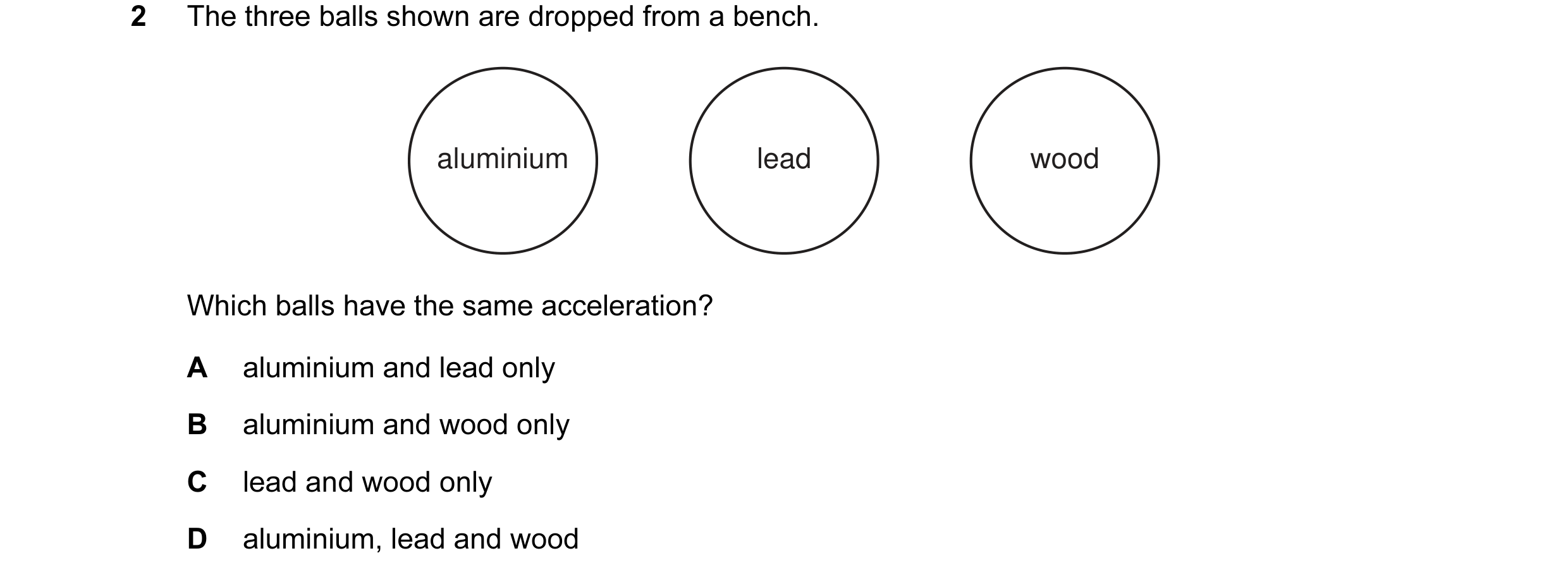

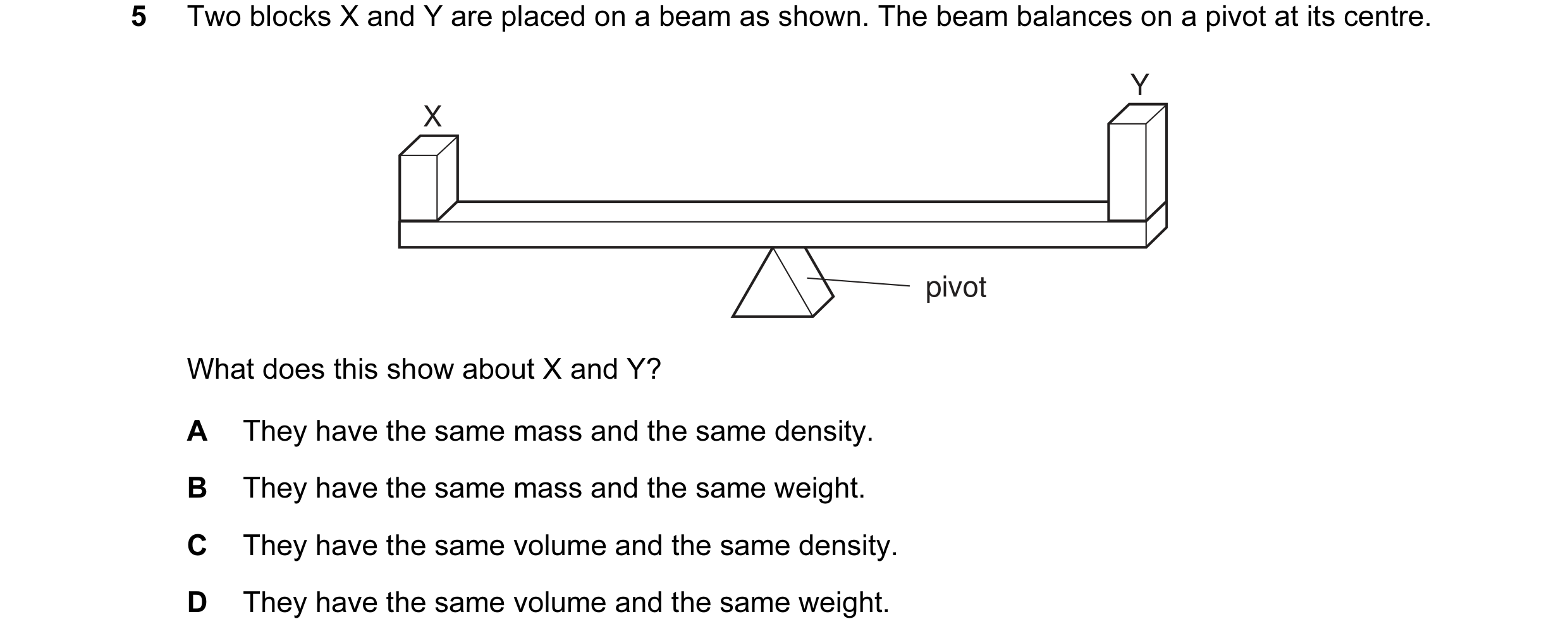
 1 / 54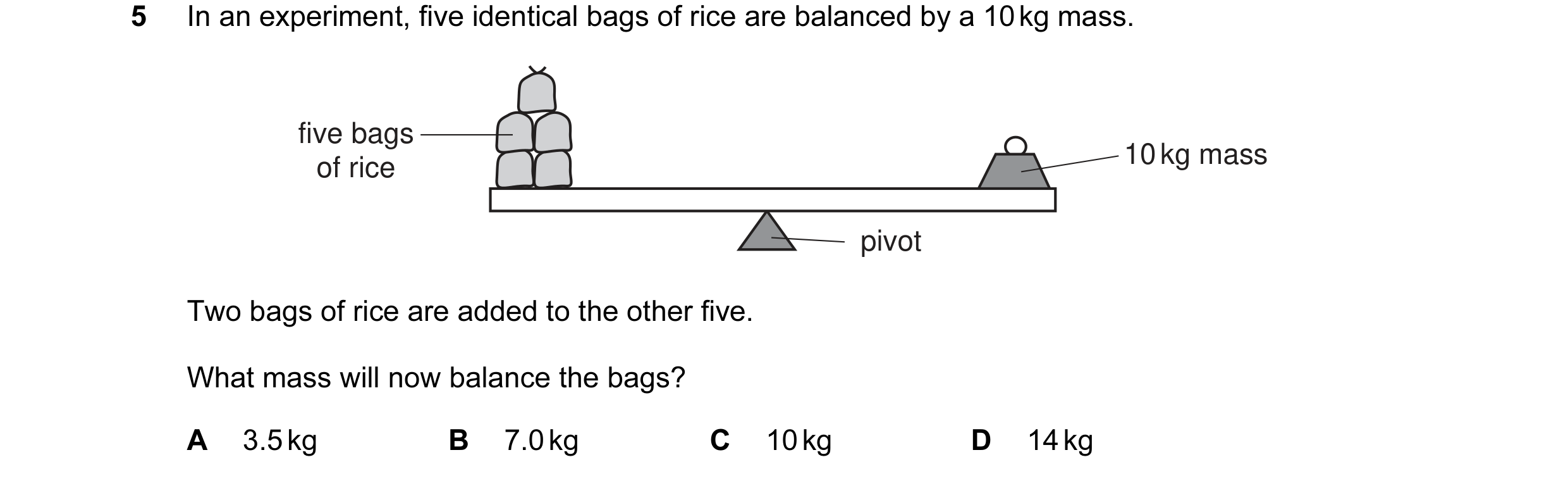
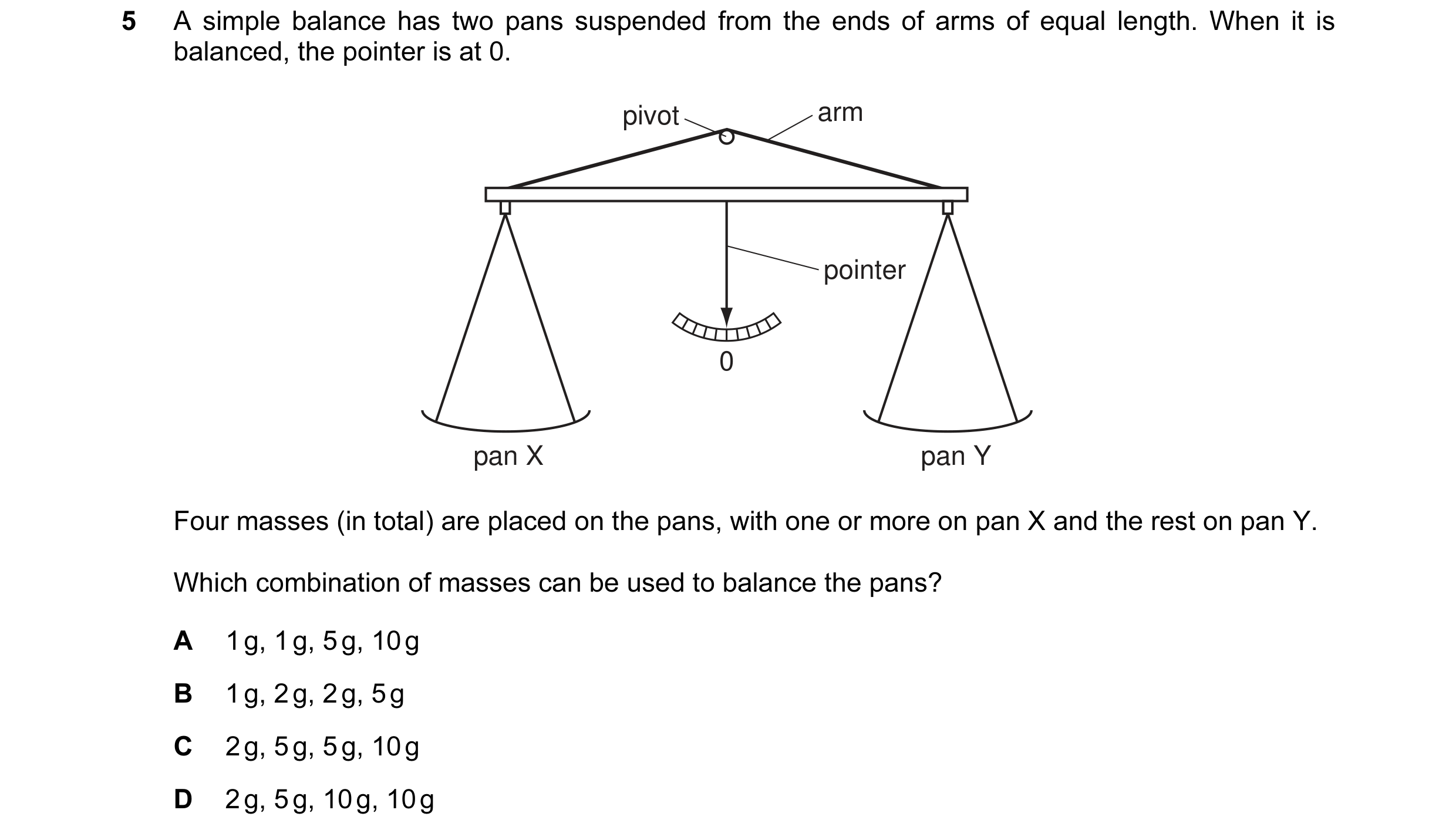
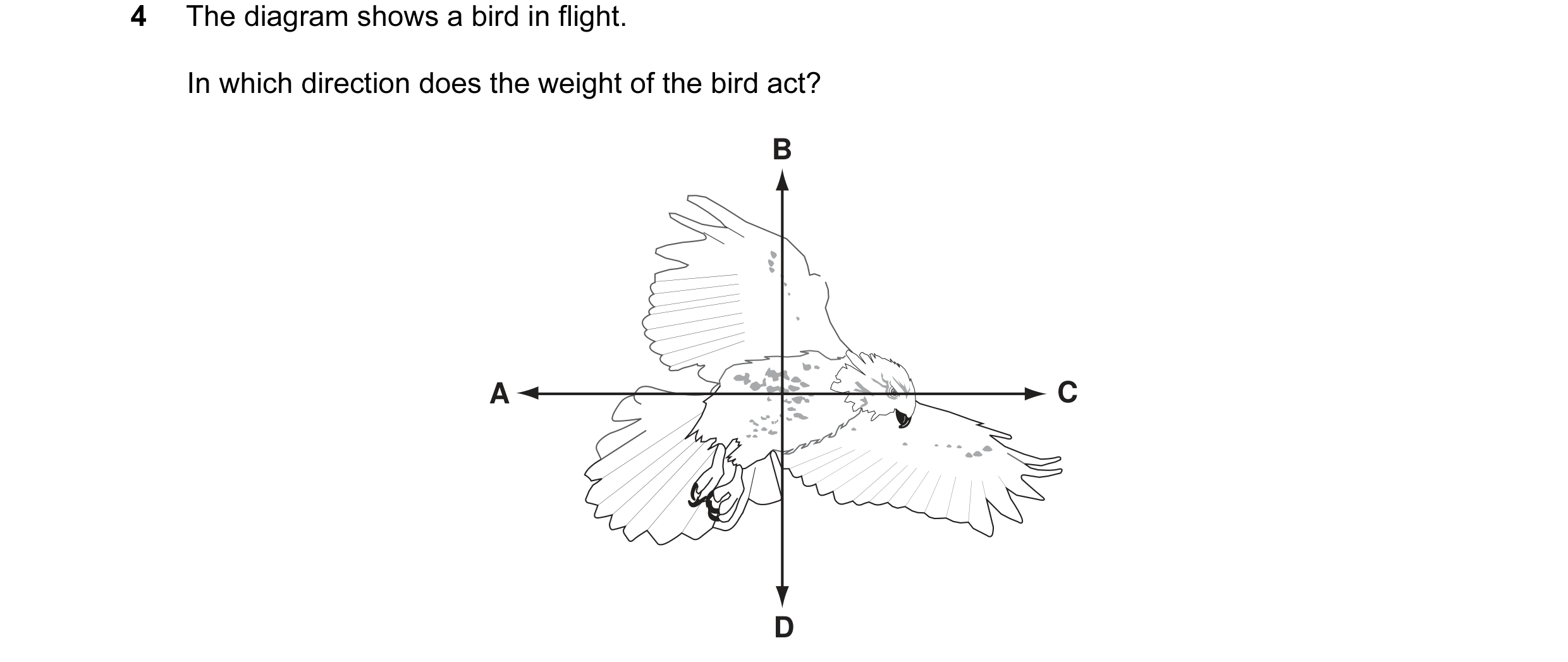 2 / 54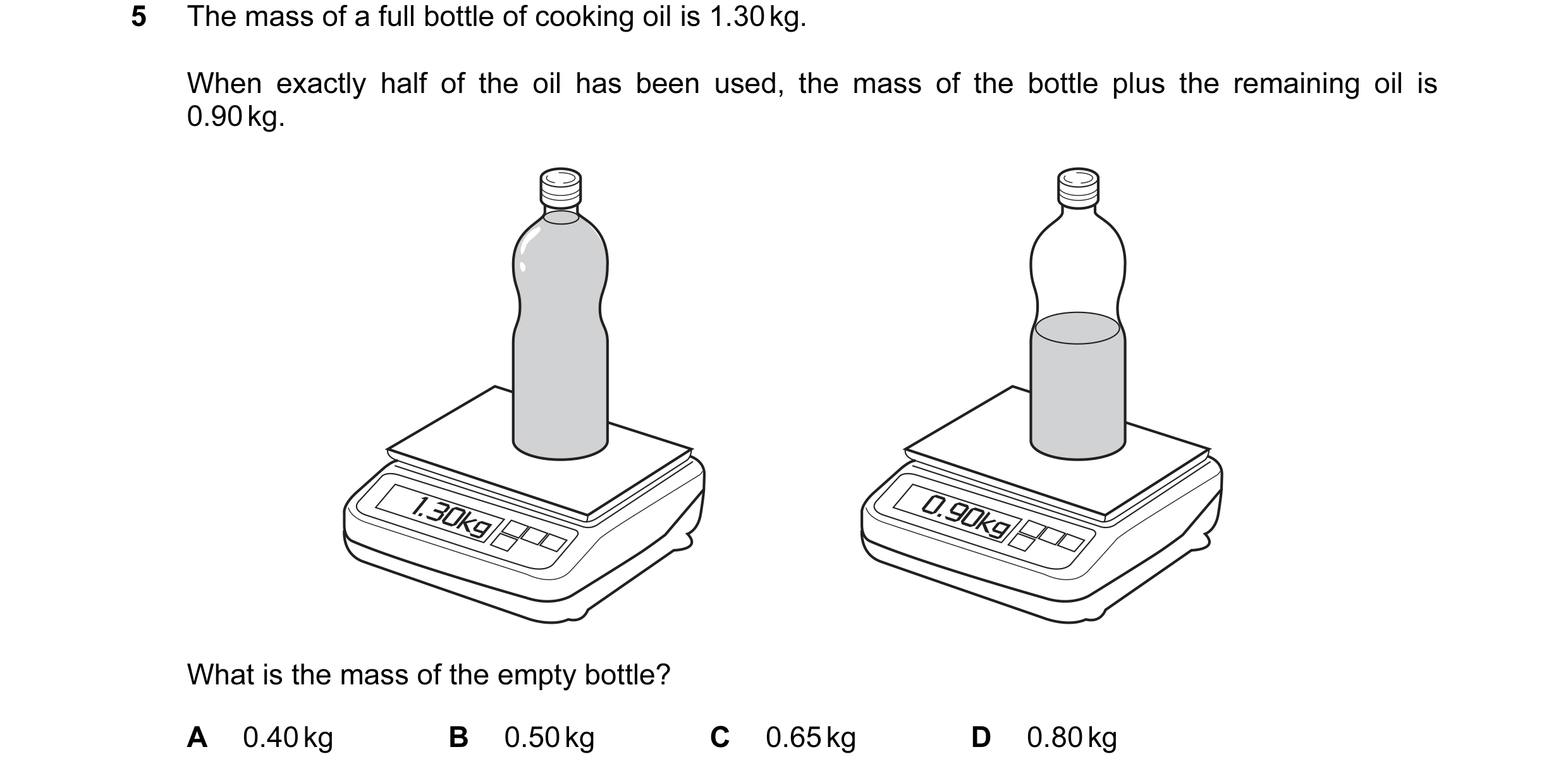
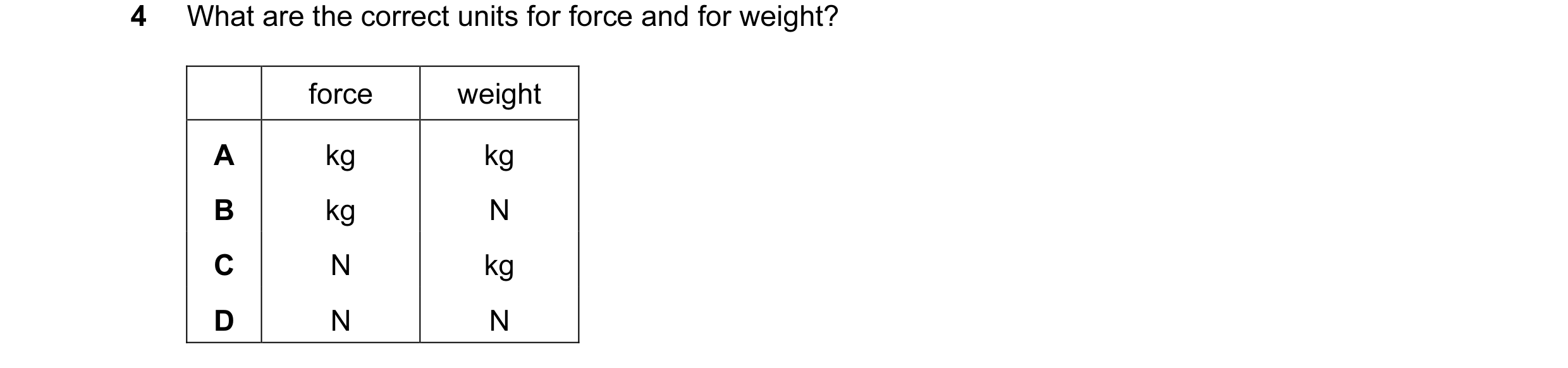
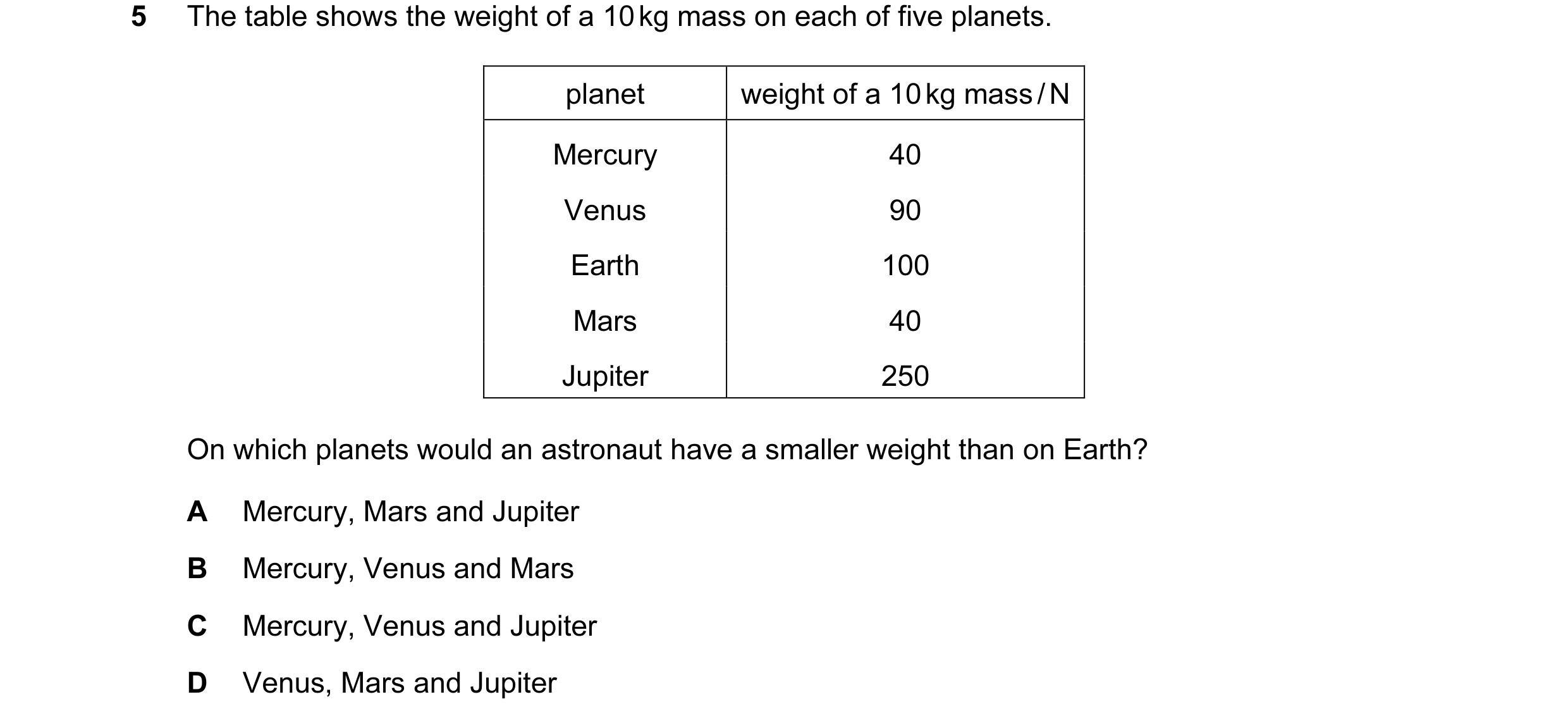 3 / 54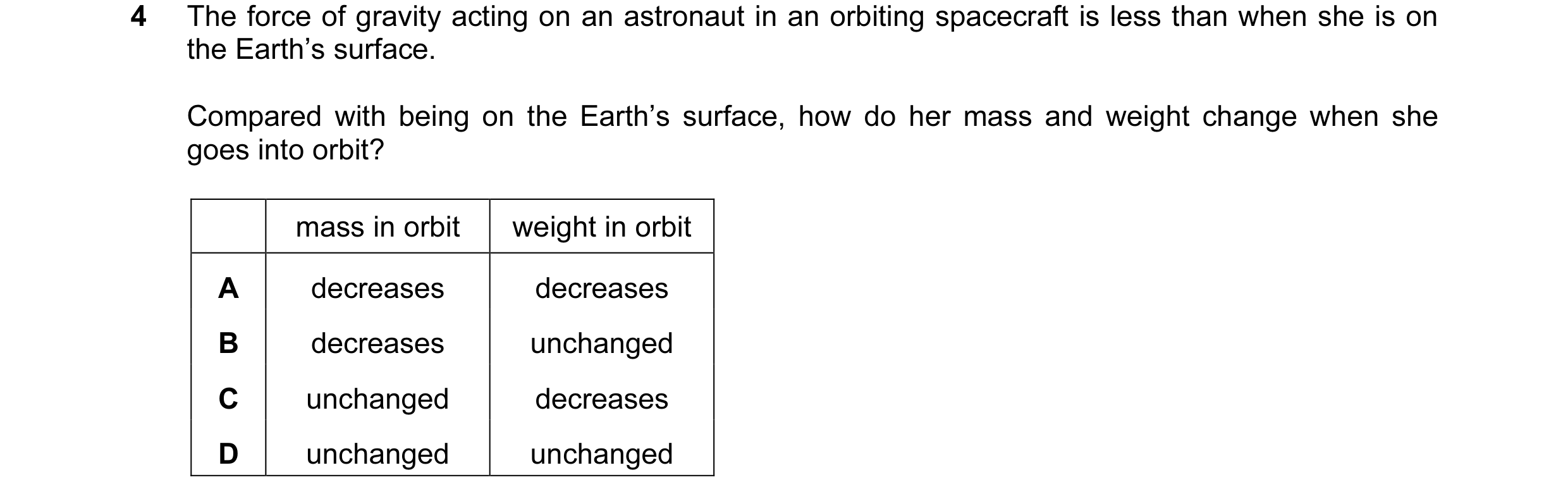
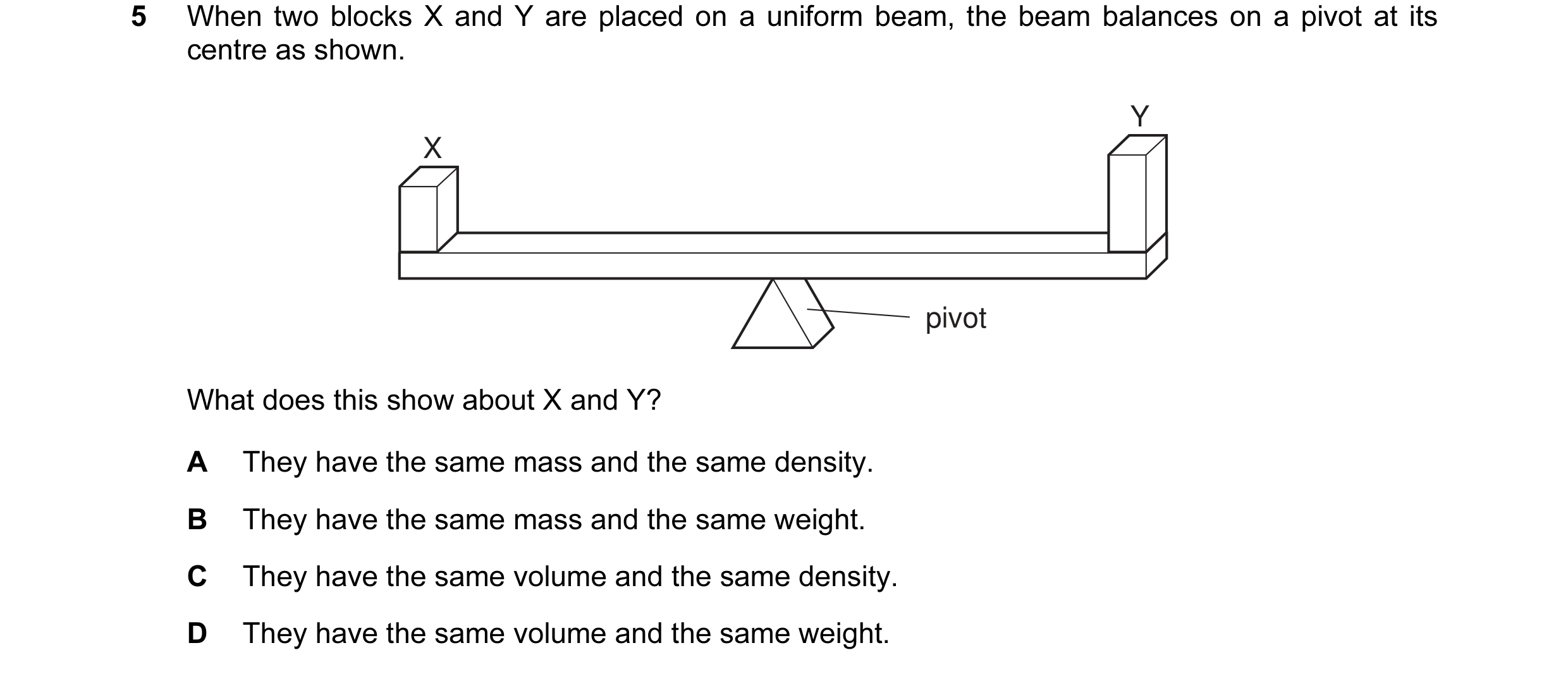
 4 / 54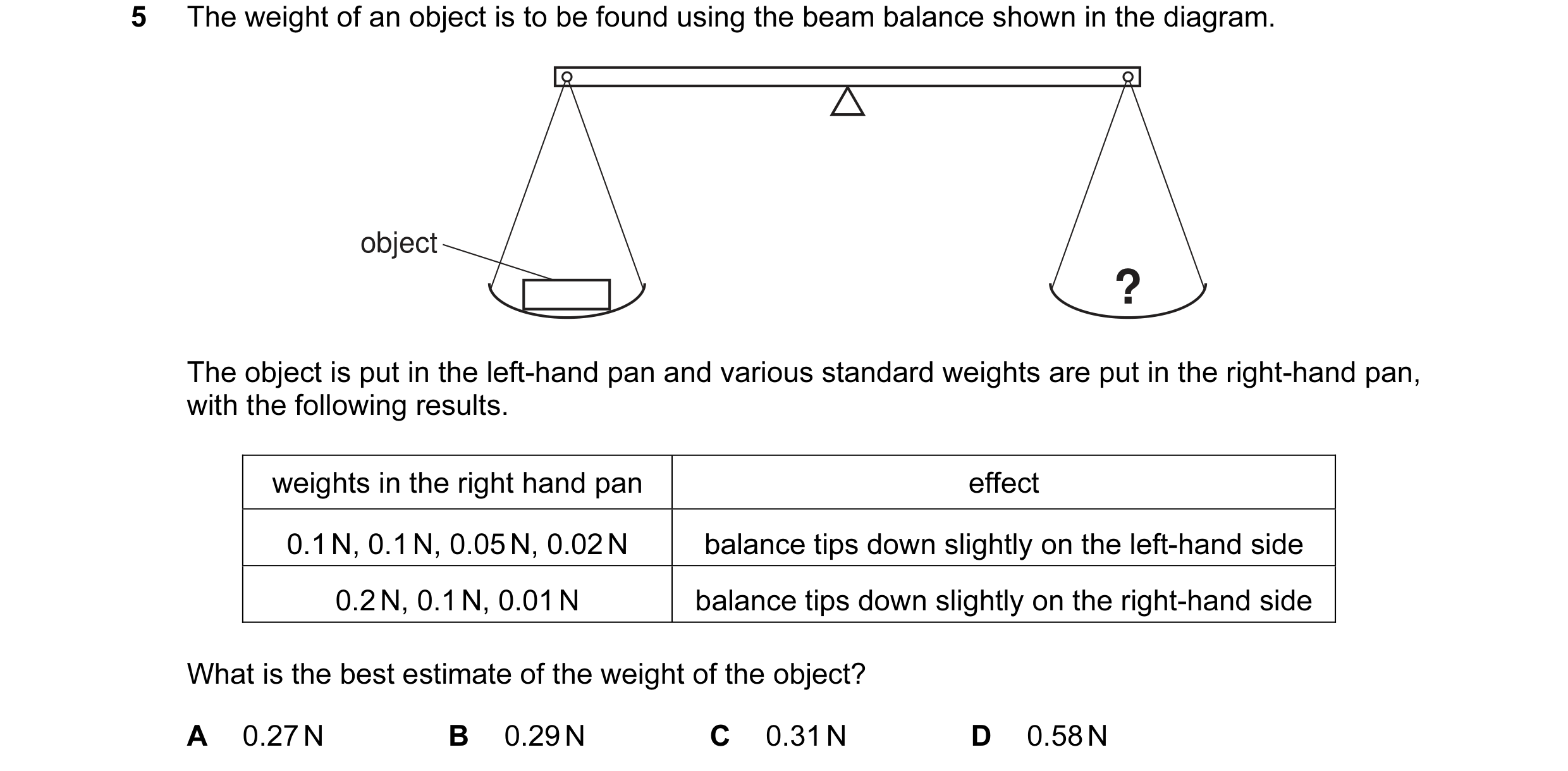
 5 / 54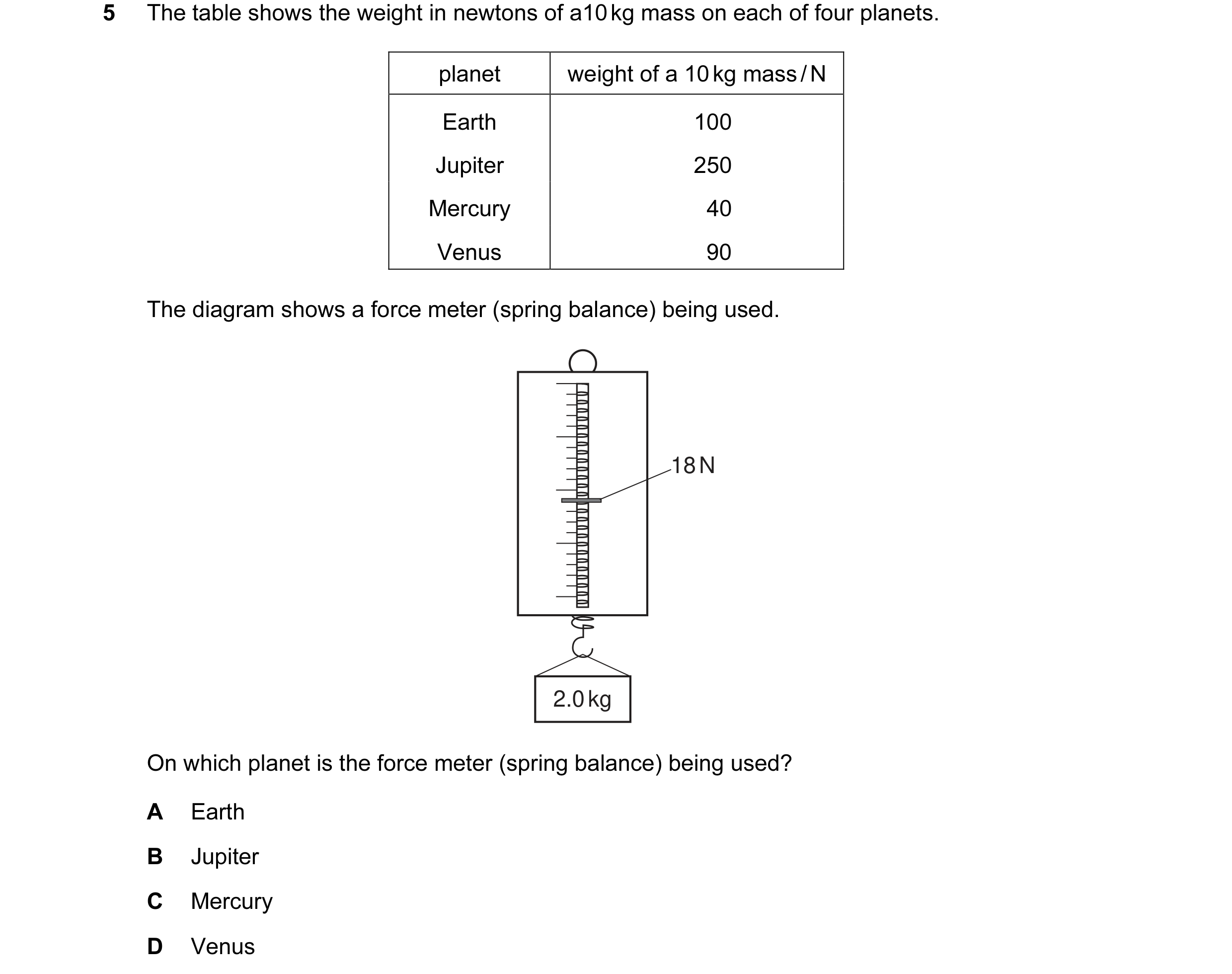

 6 / 54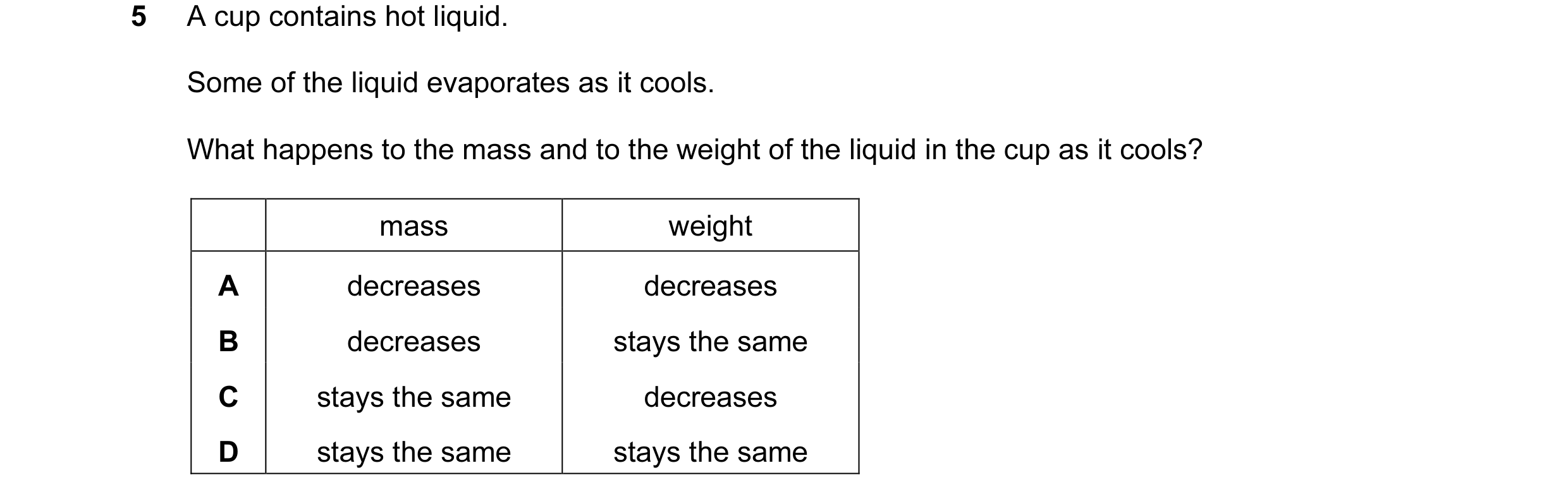

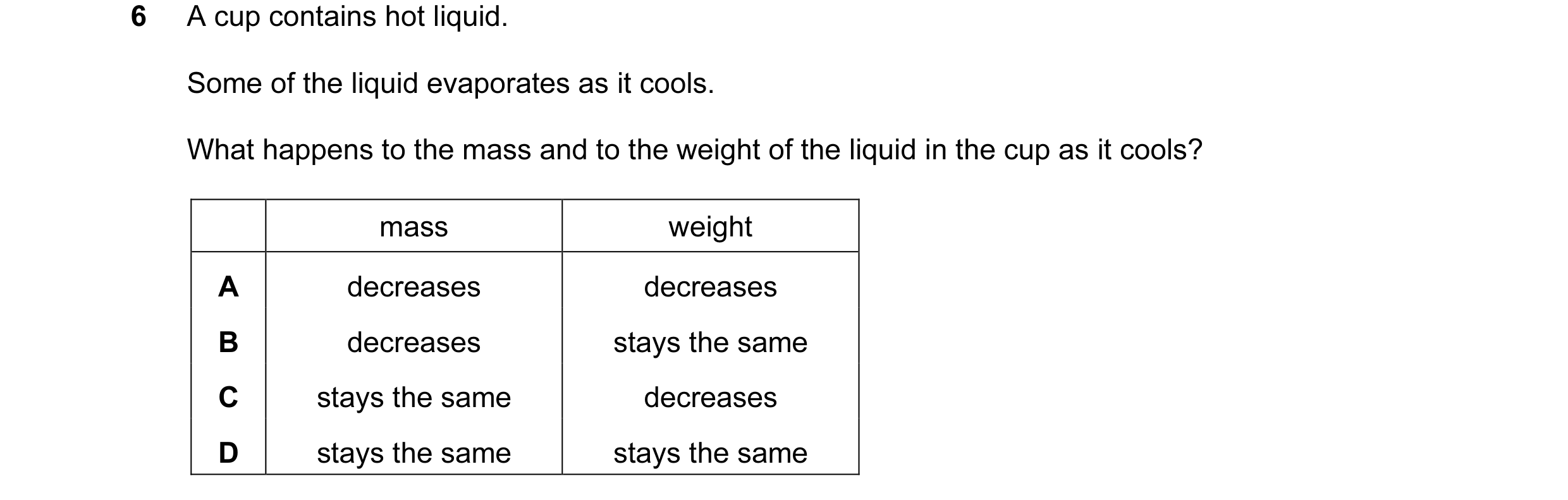 7 / 54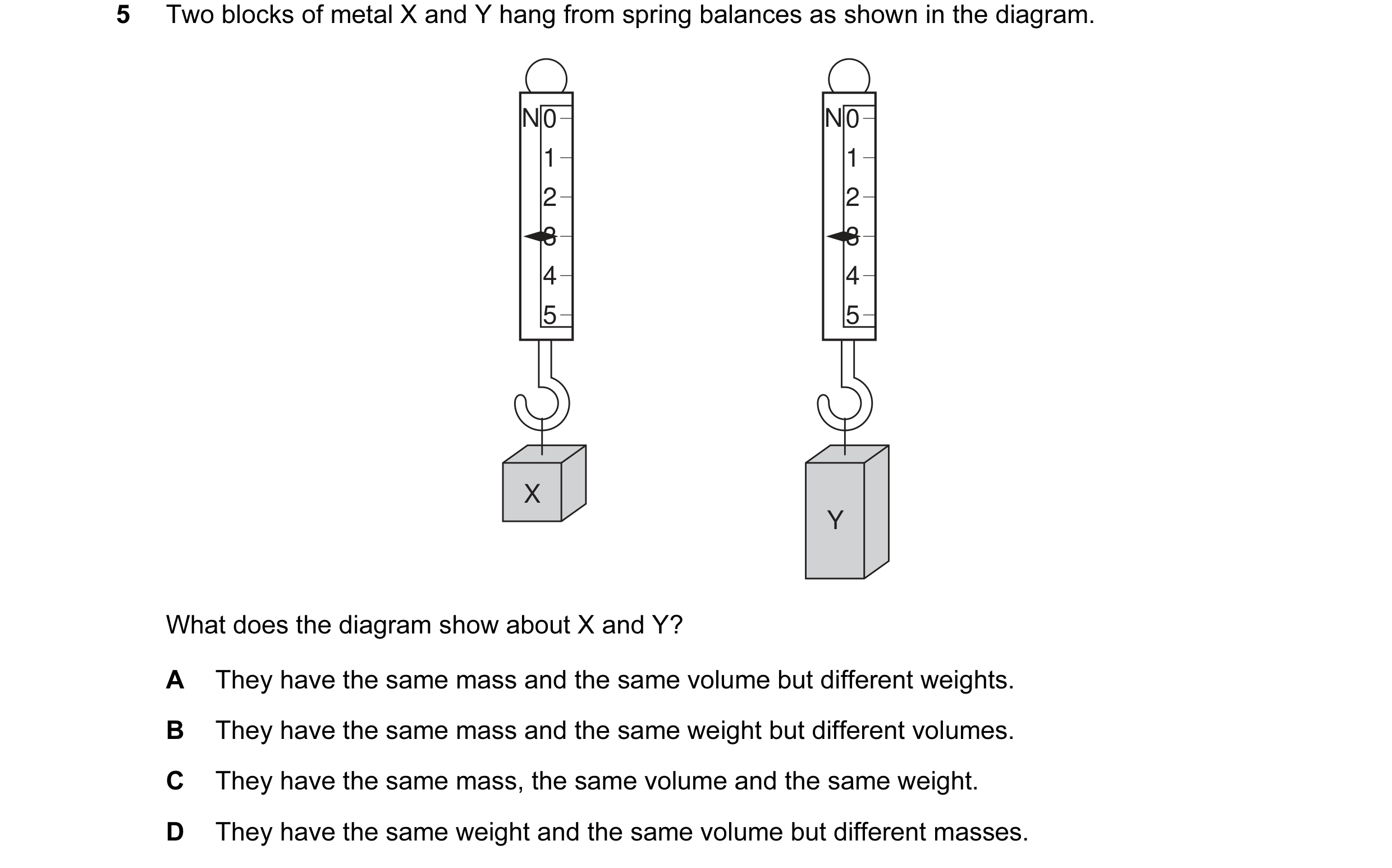
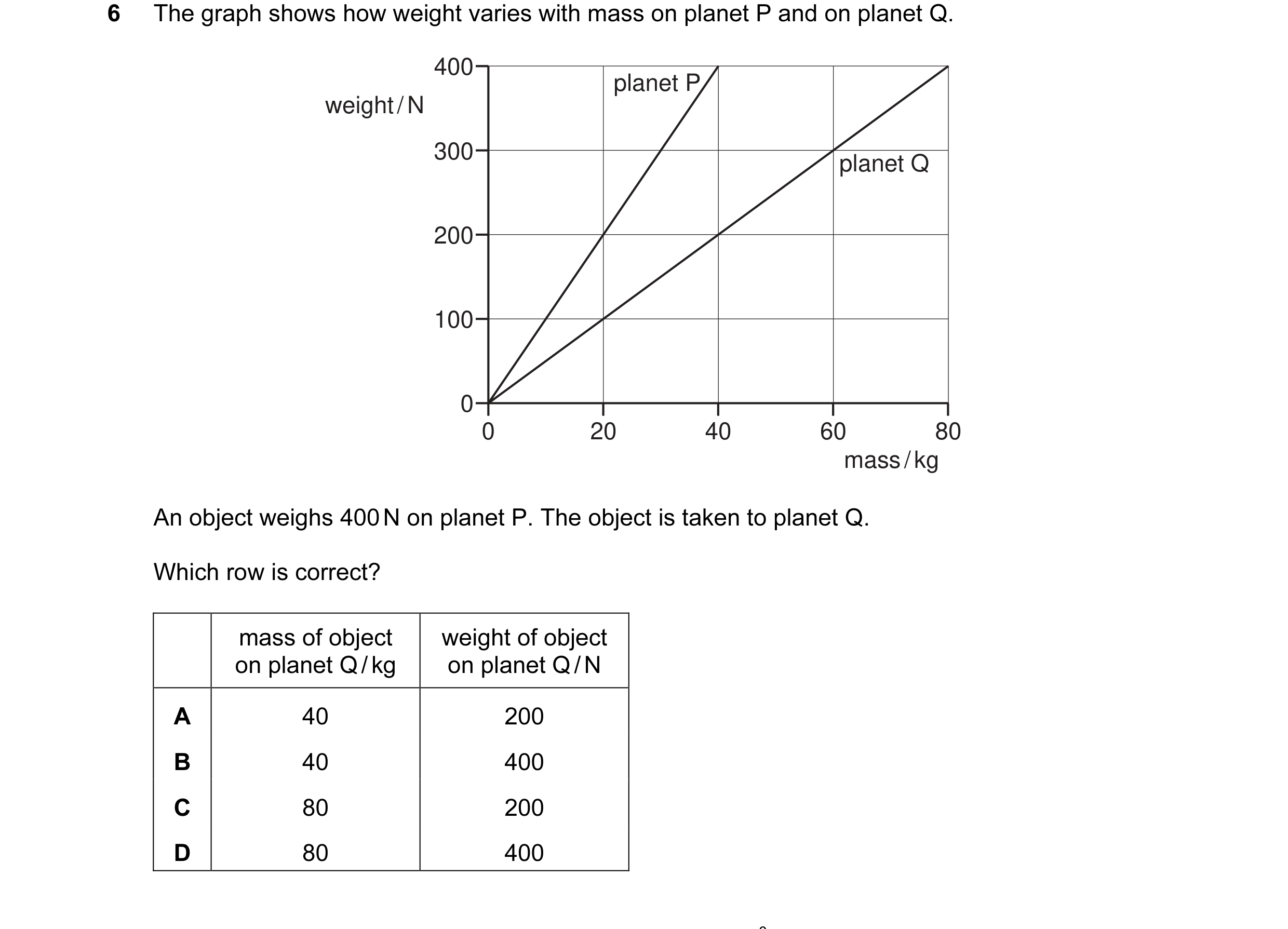 8 / 54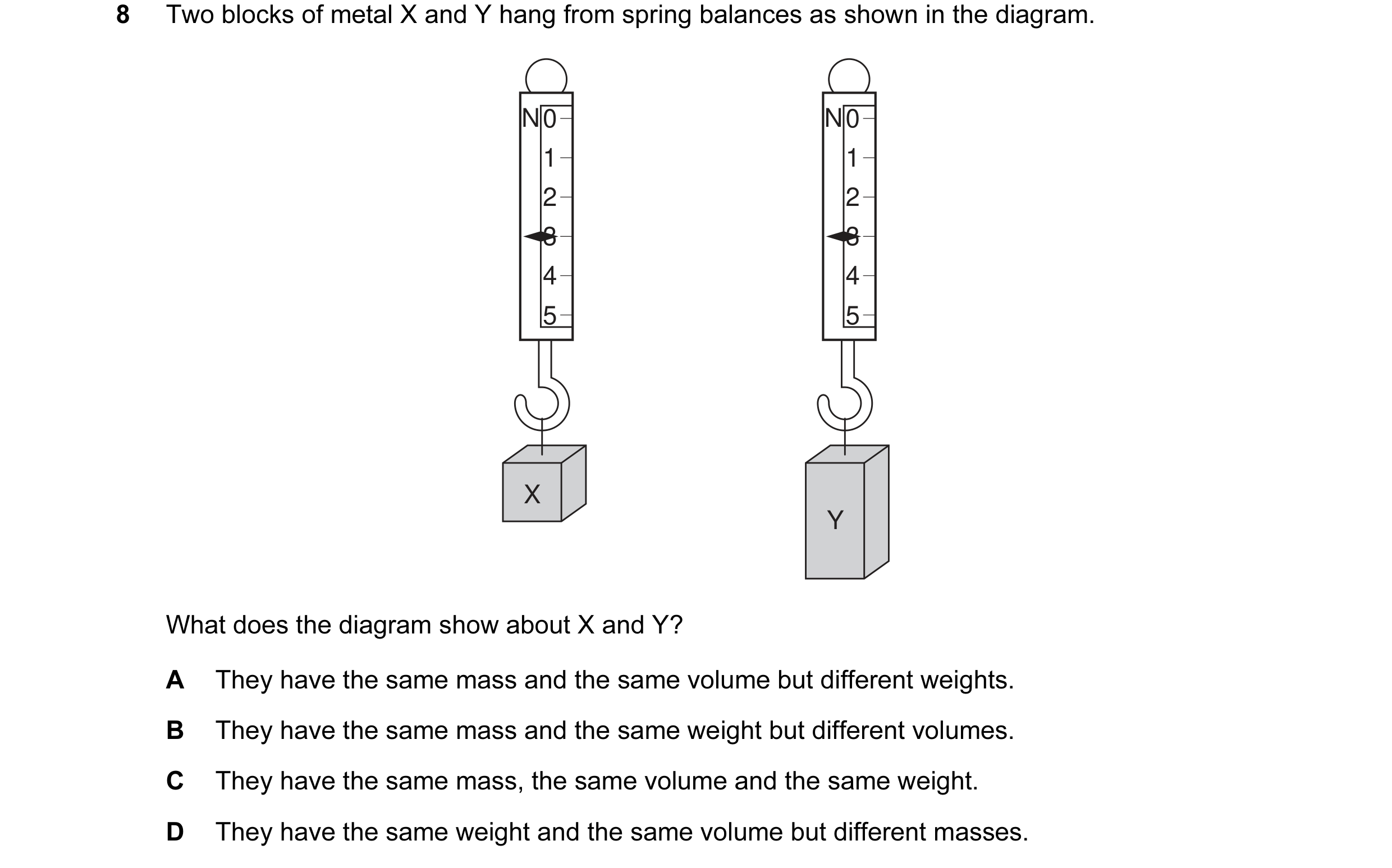
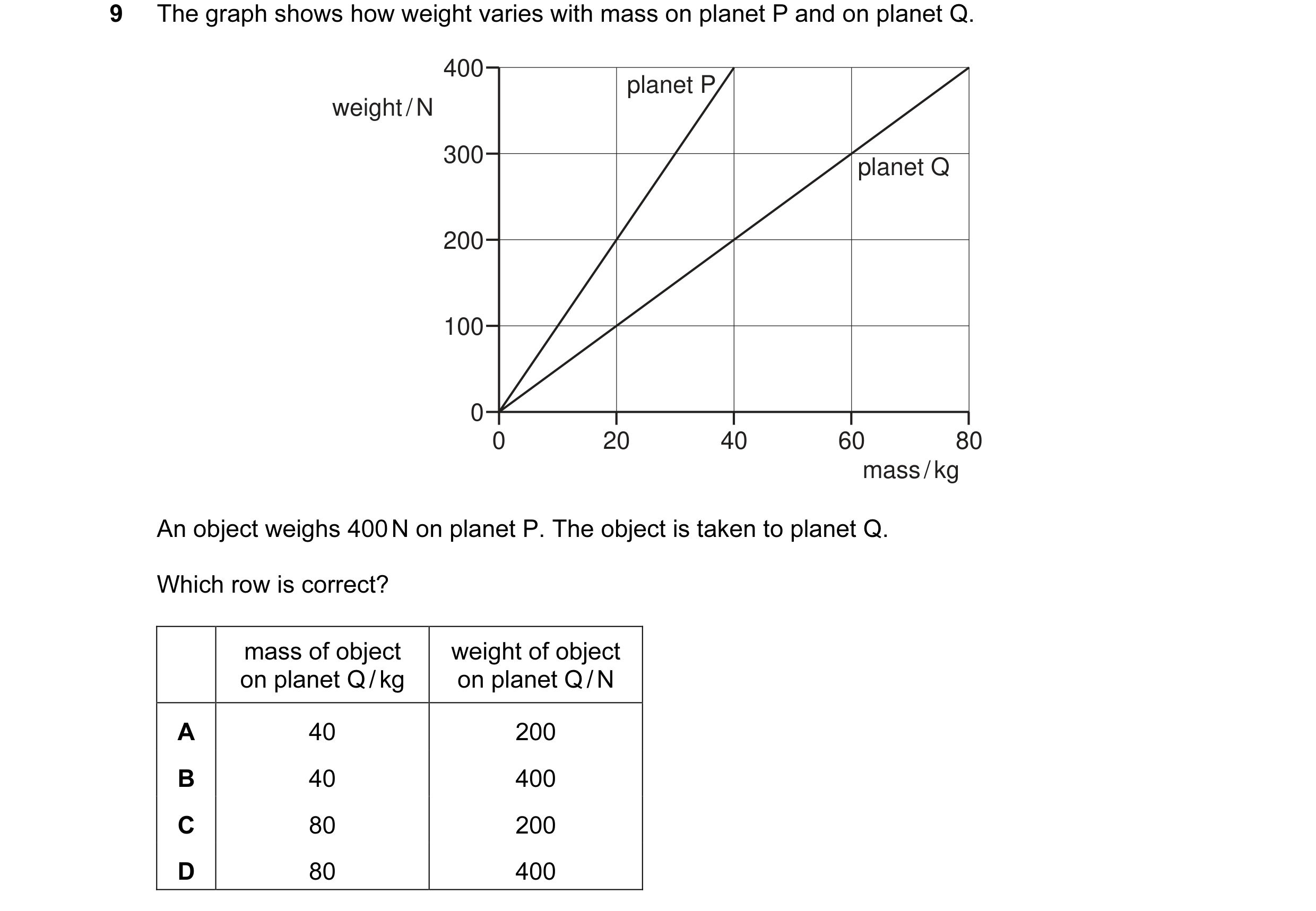 9 / 54
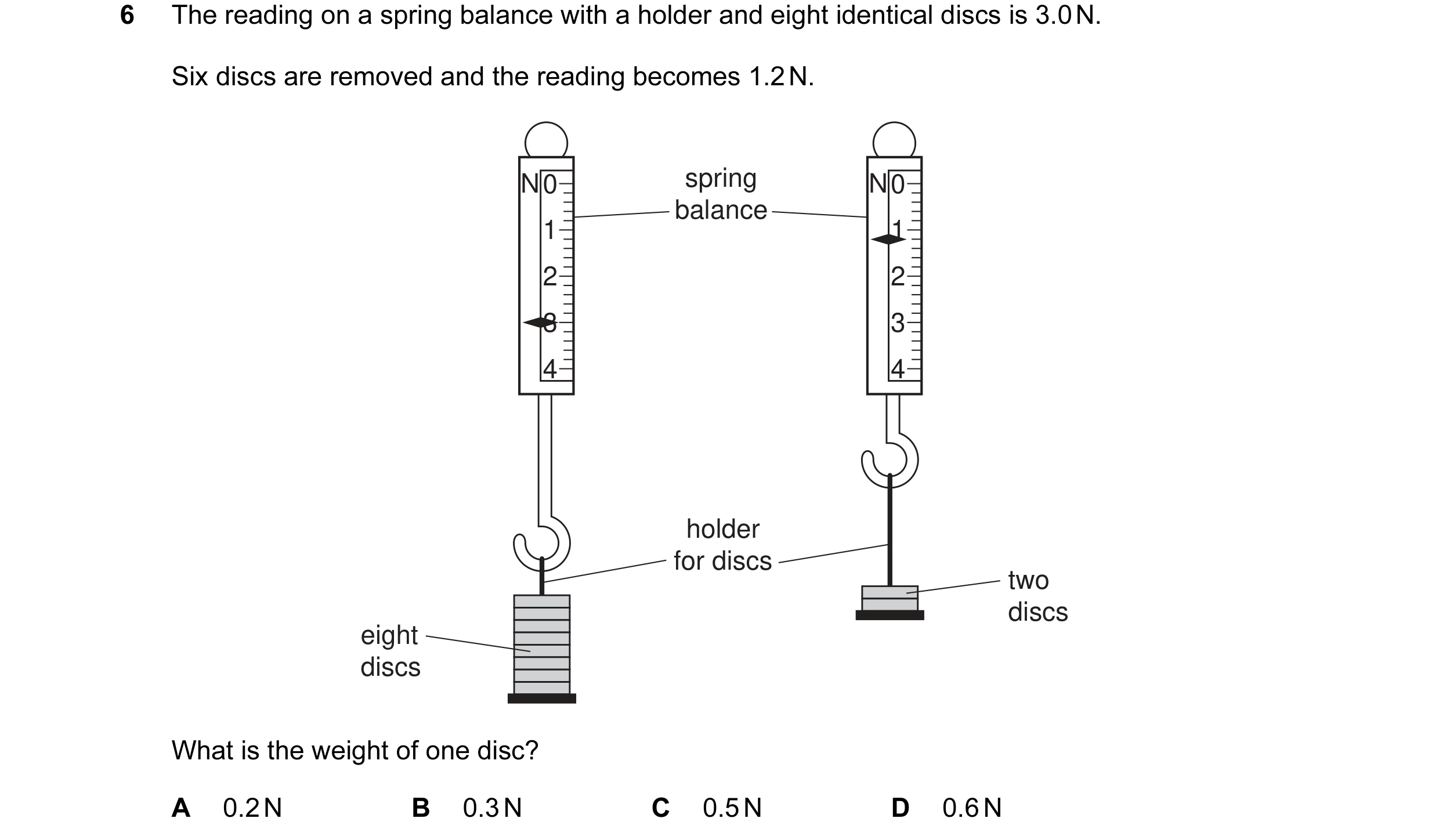
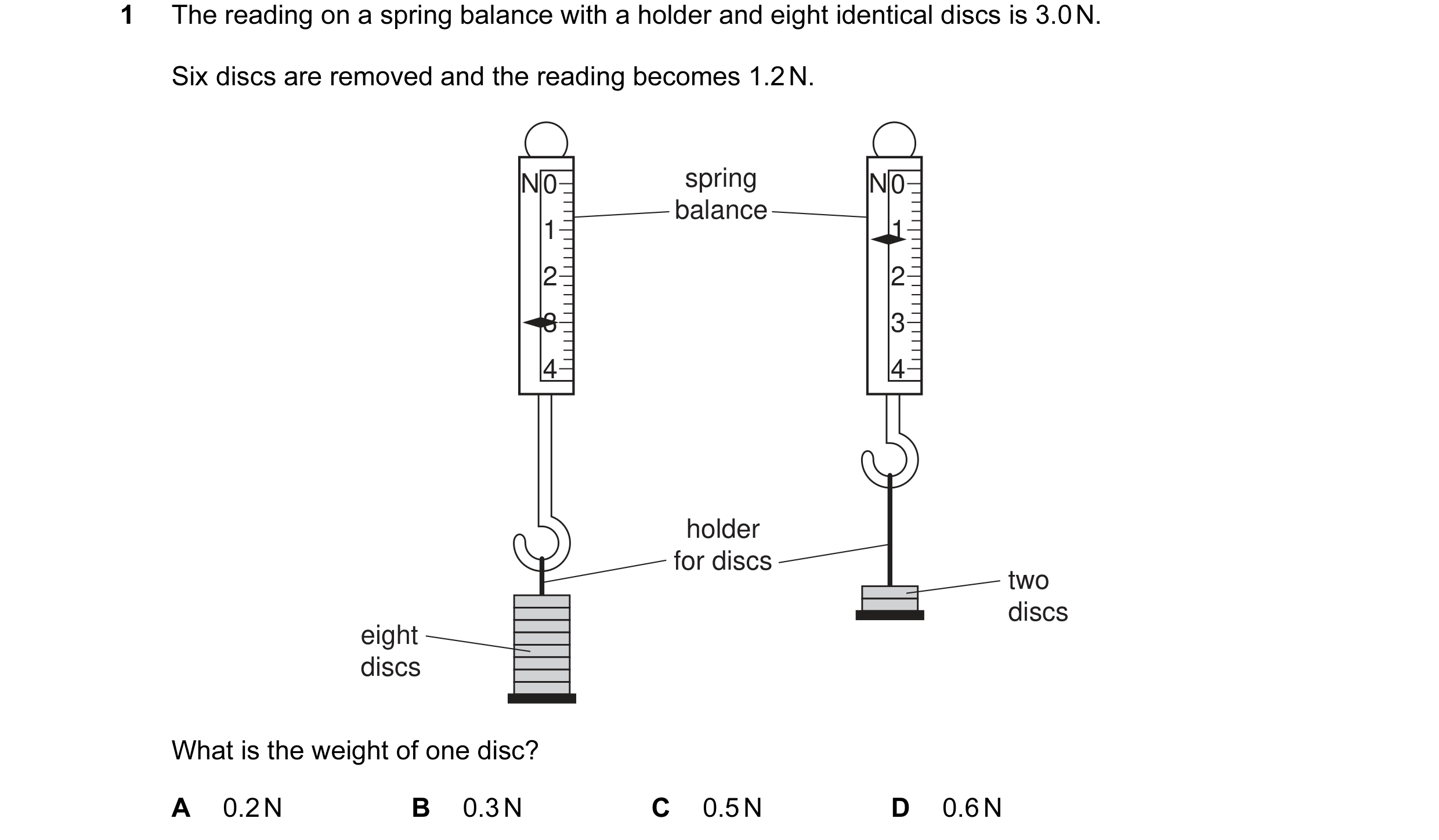 10 / 54
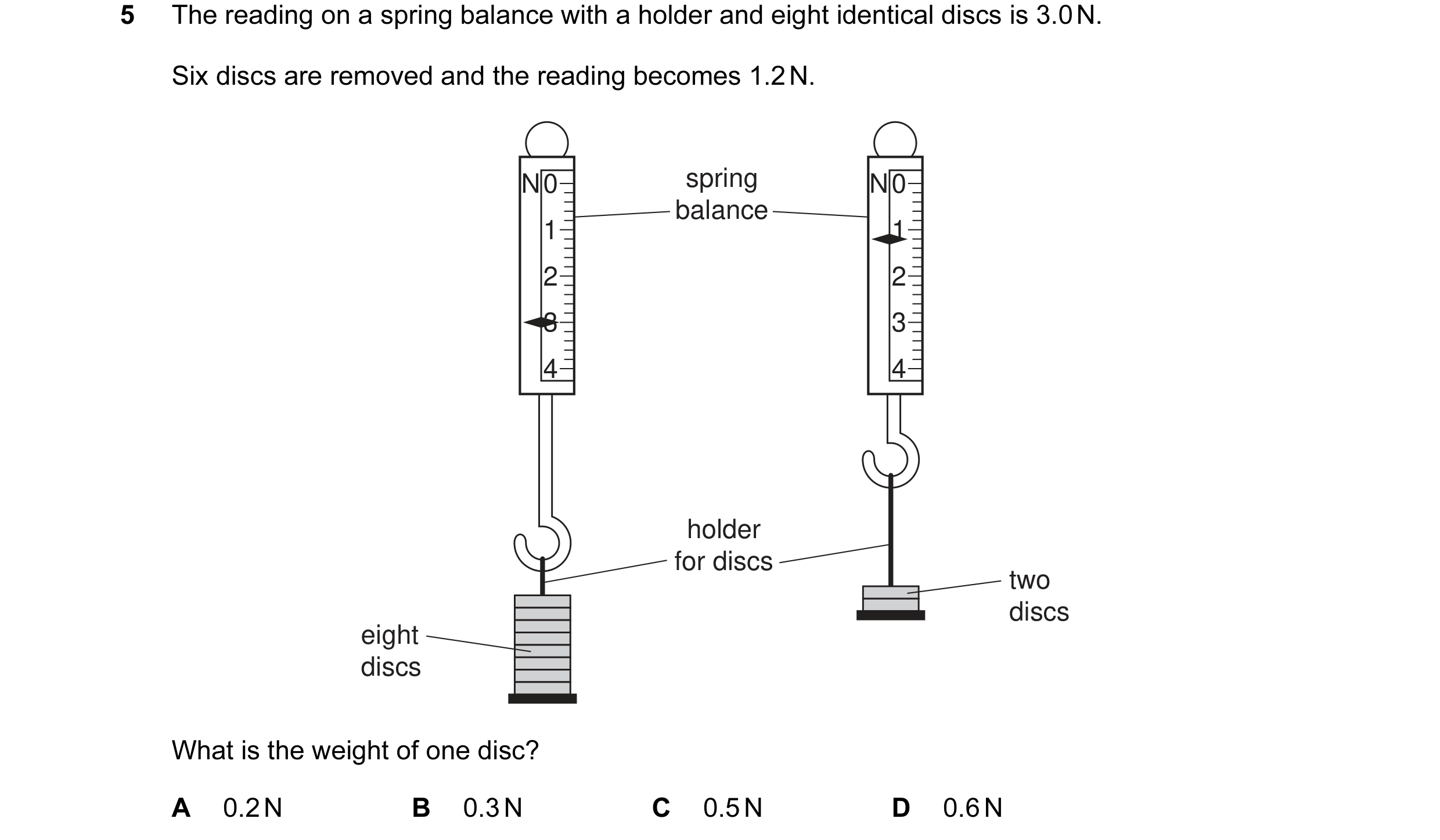

 11 / 54
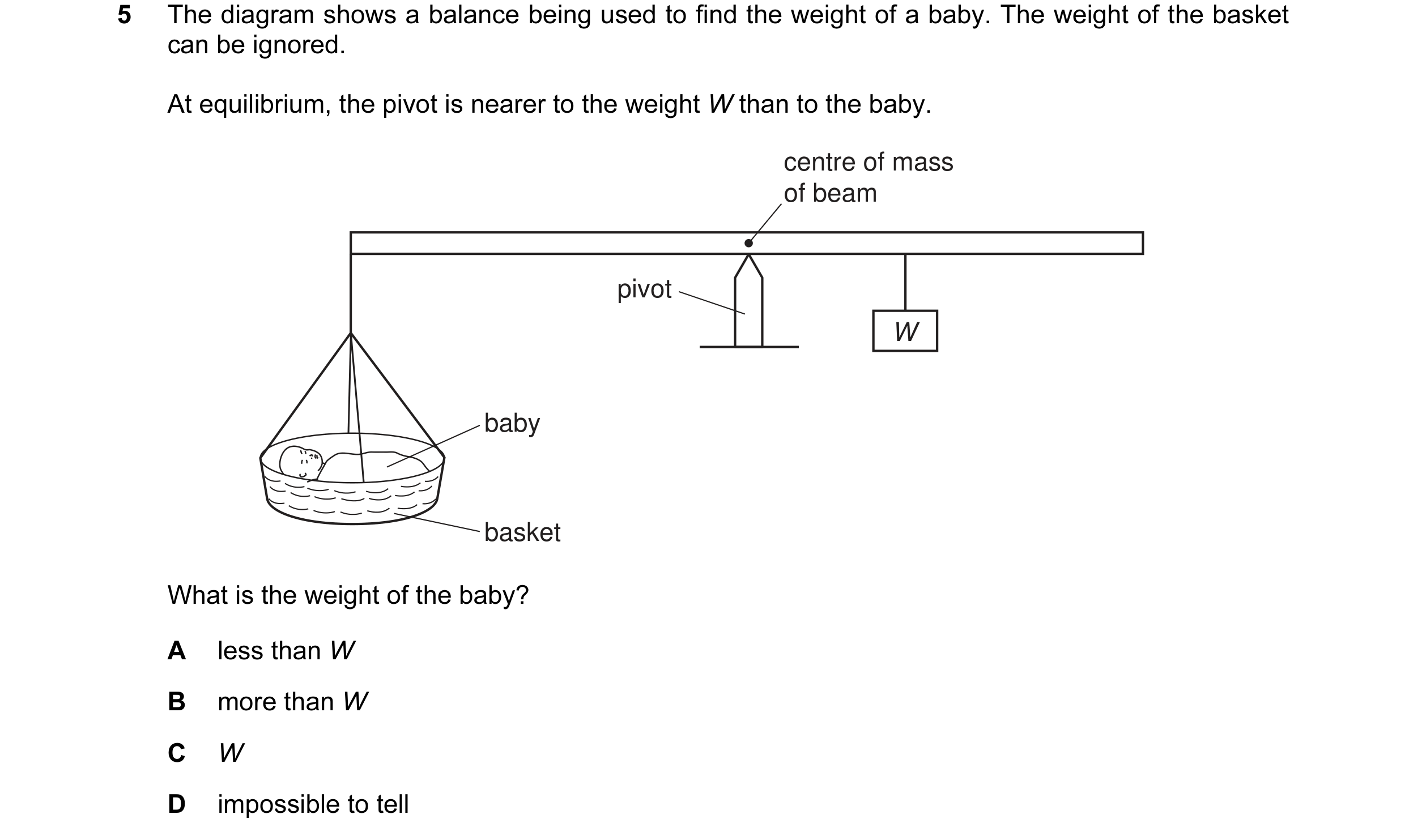
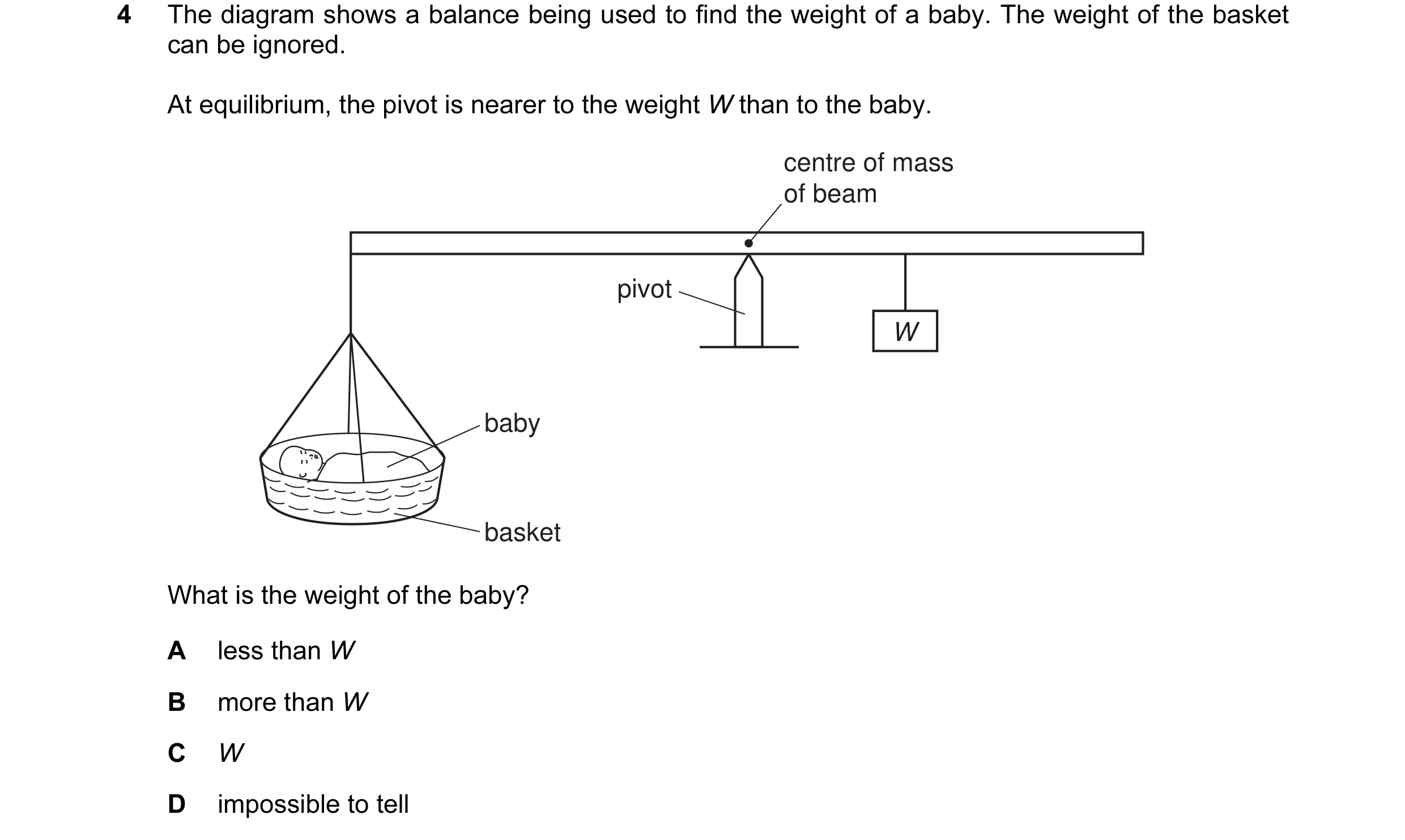 12 / 54

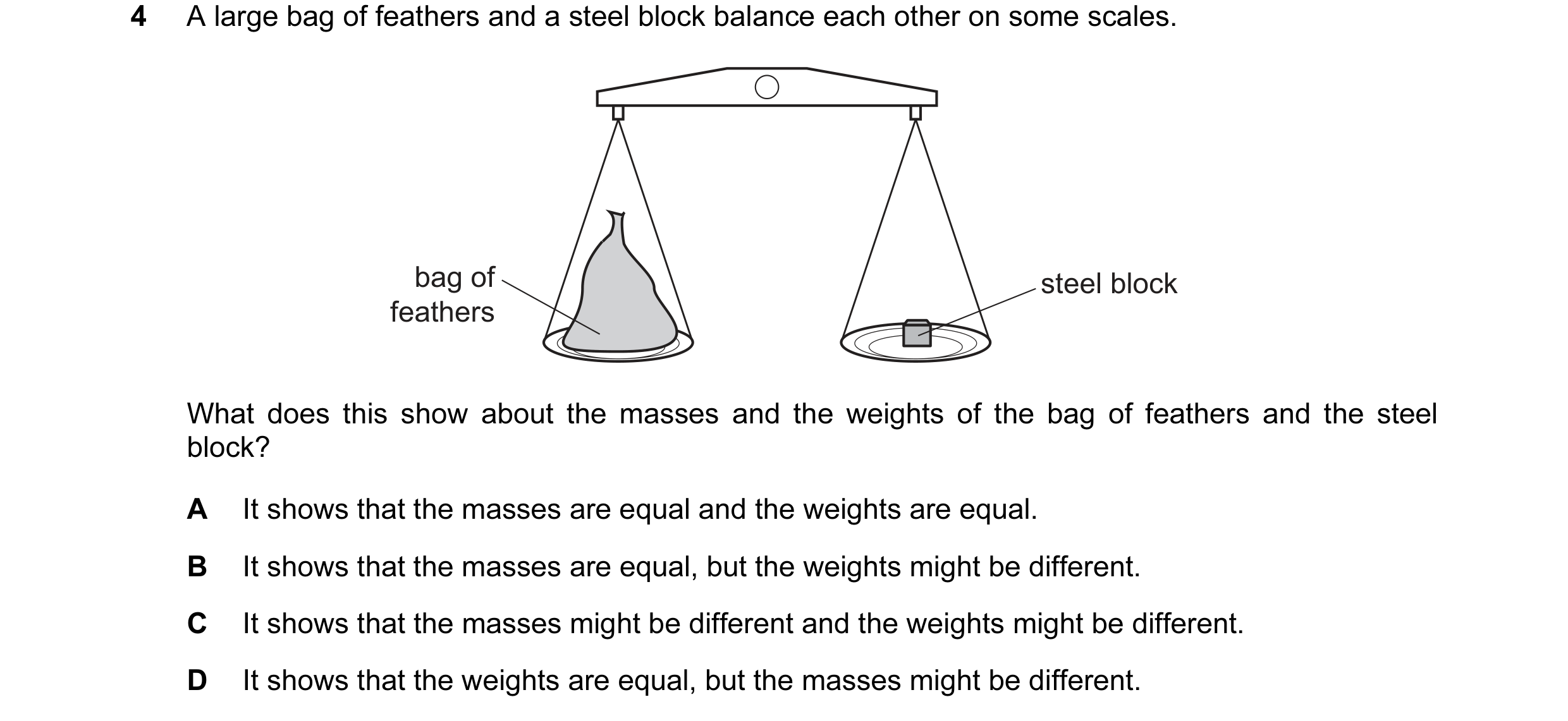 13 / 54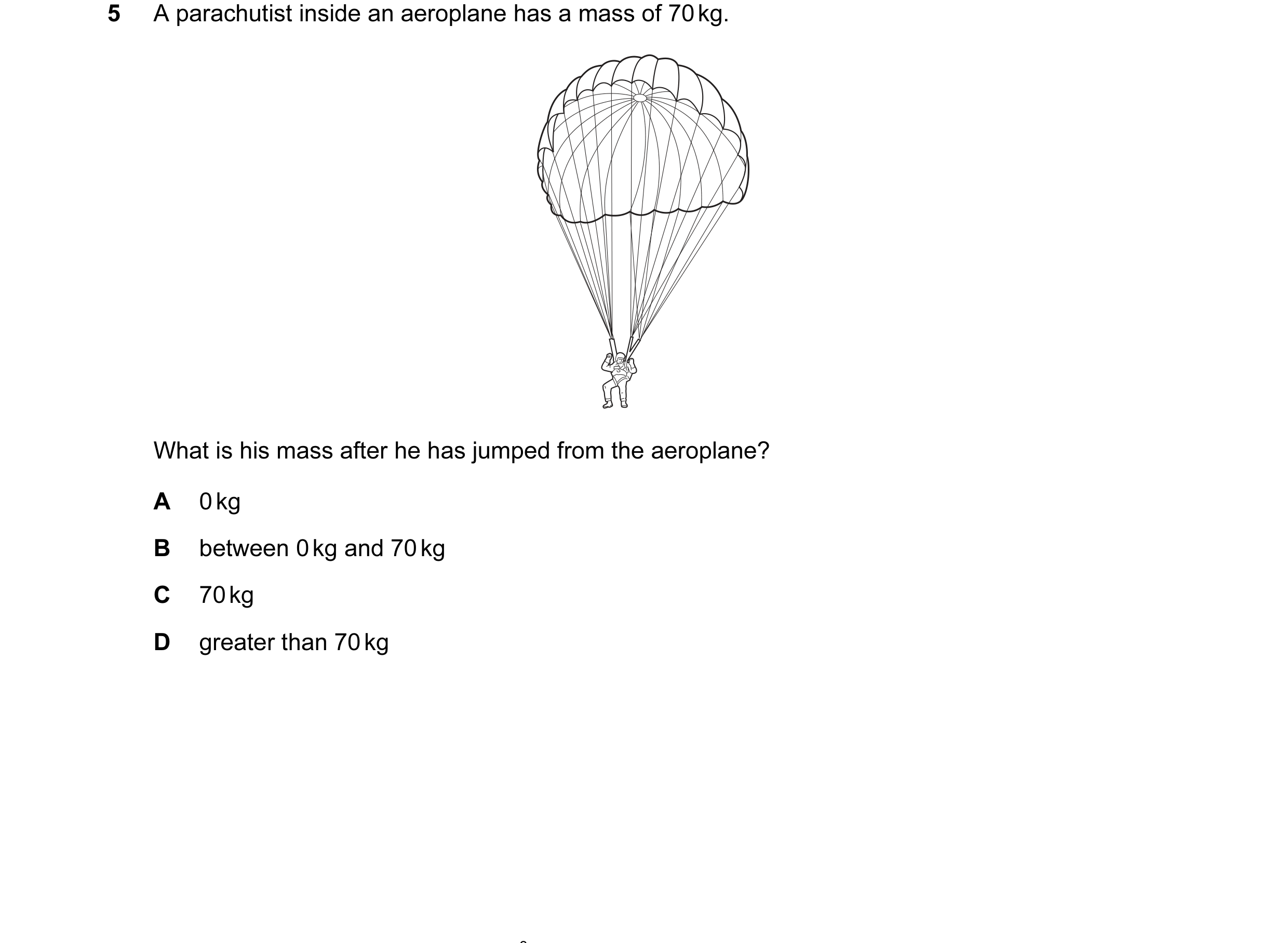
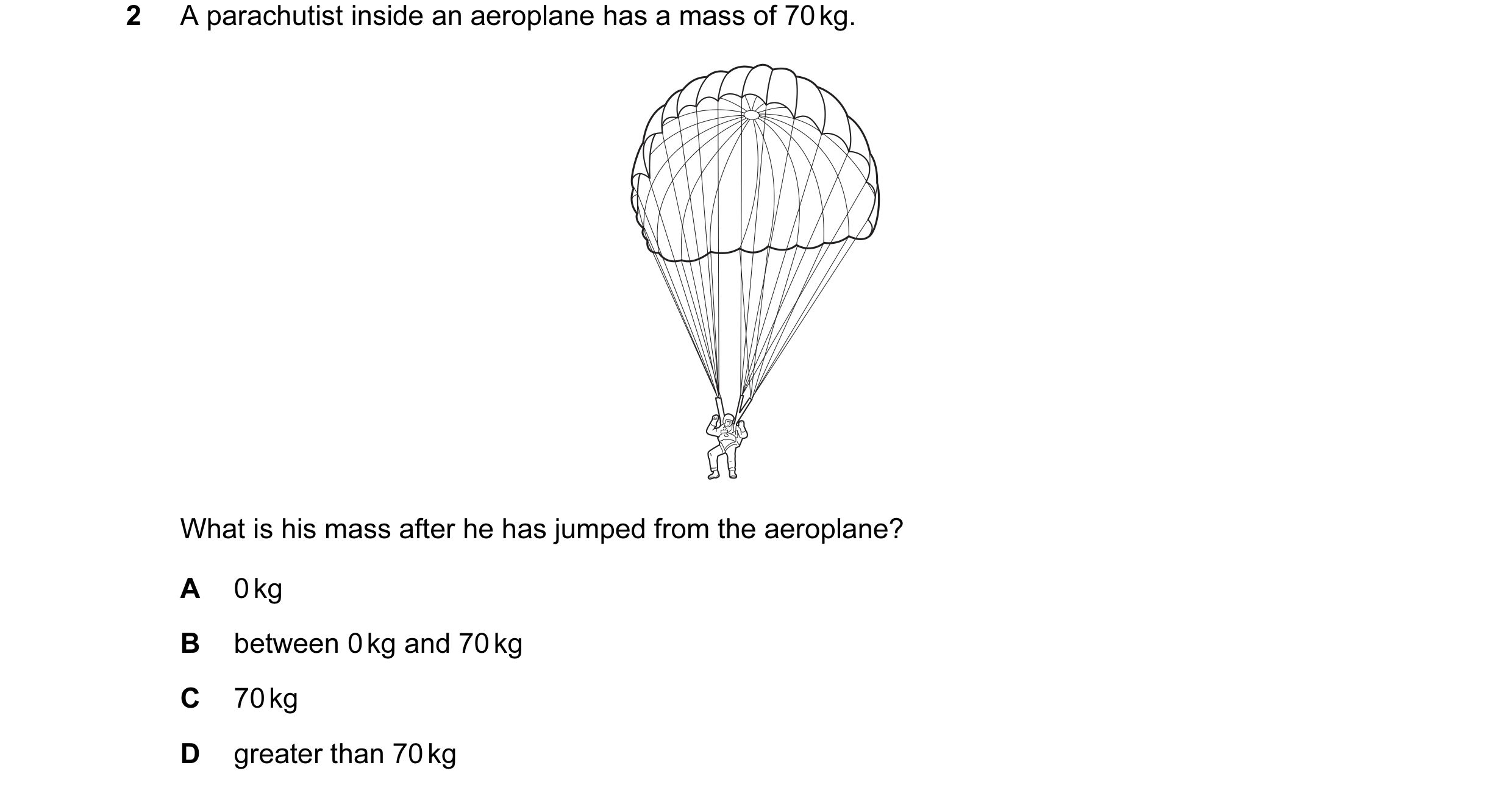 14 / 54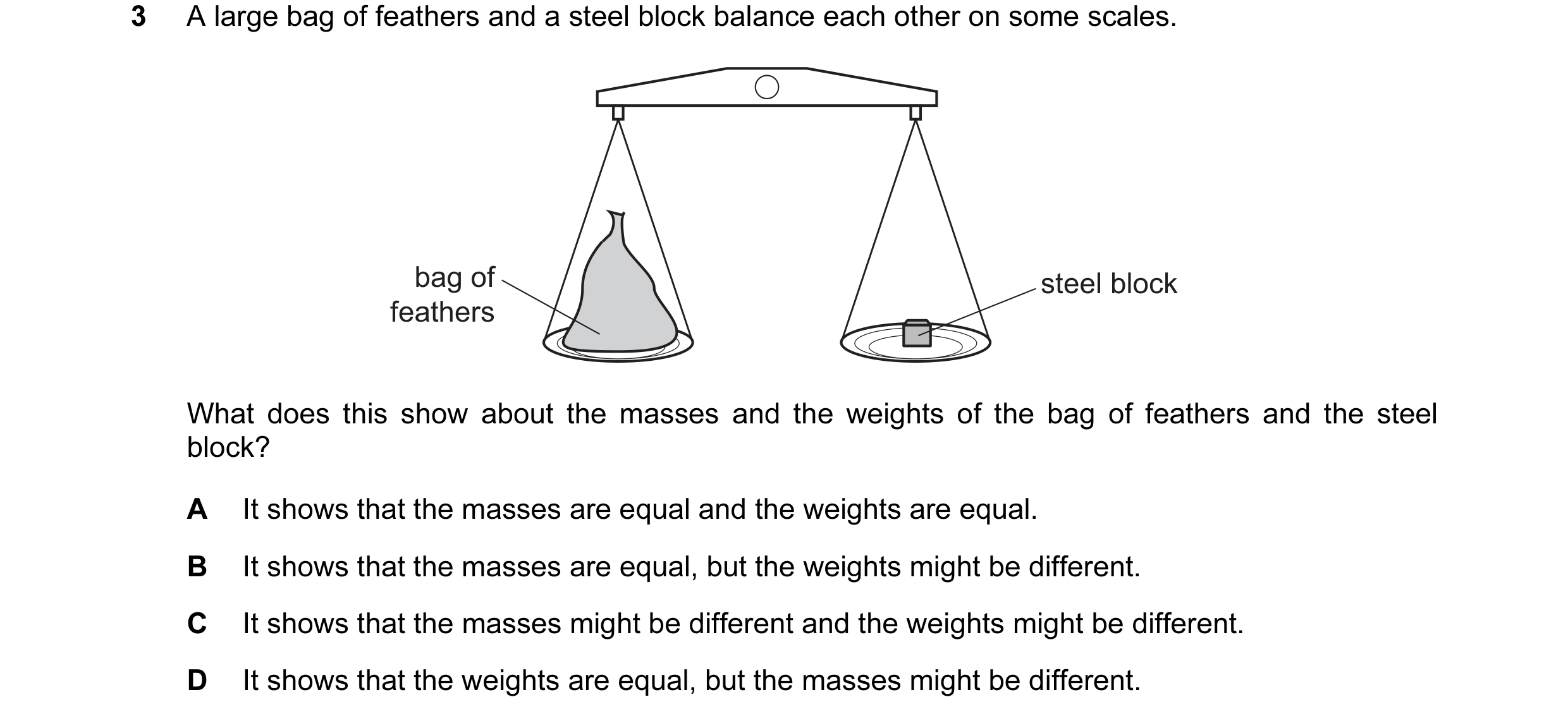
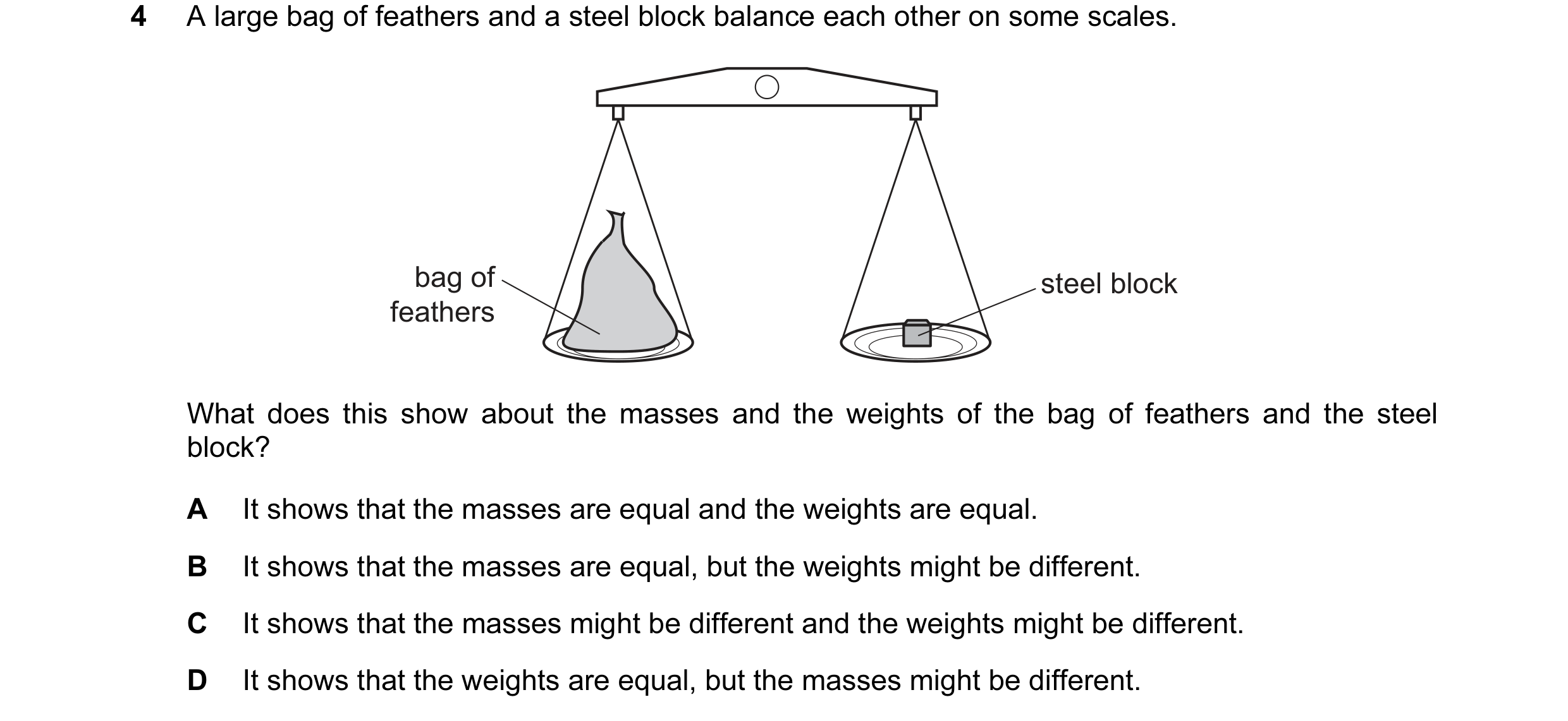
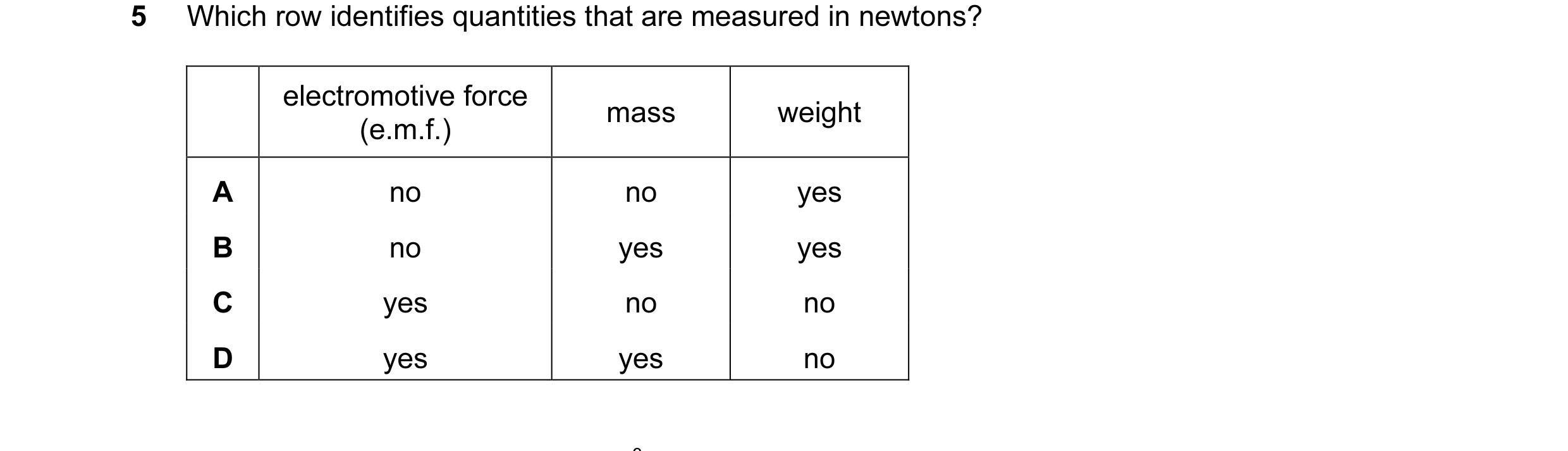 15 / 54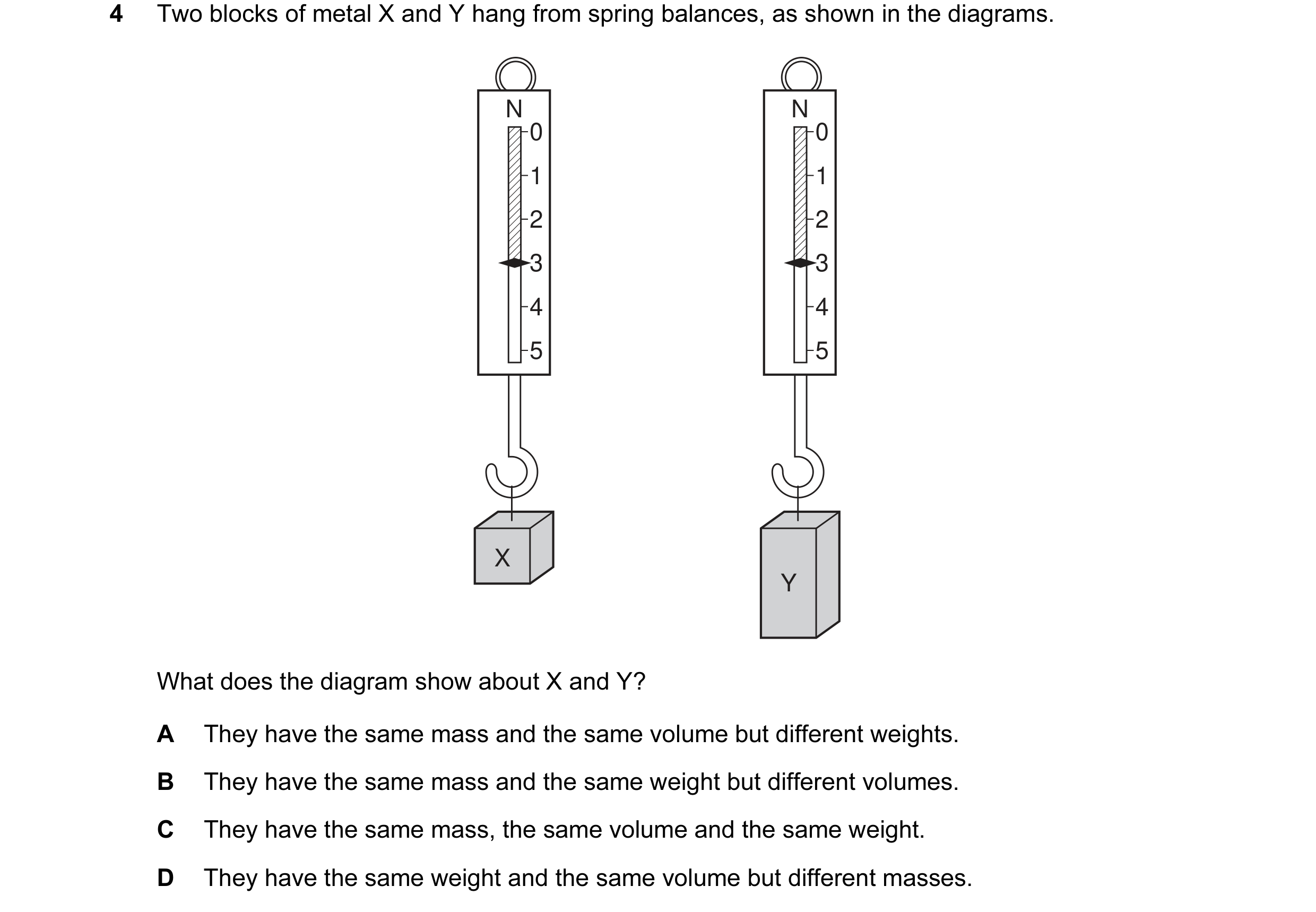
 16 / 54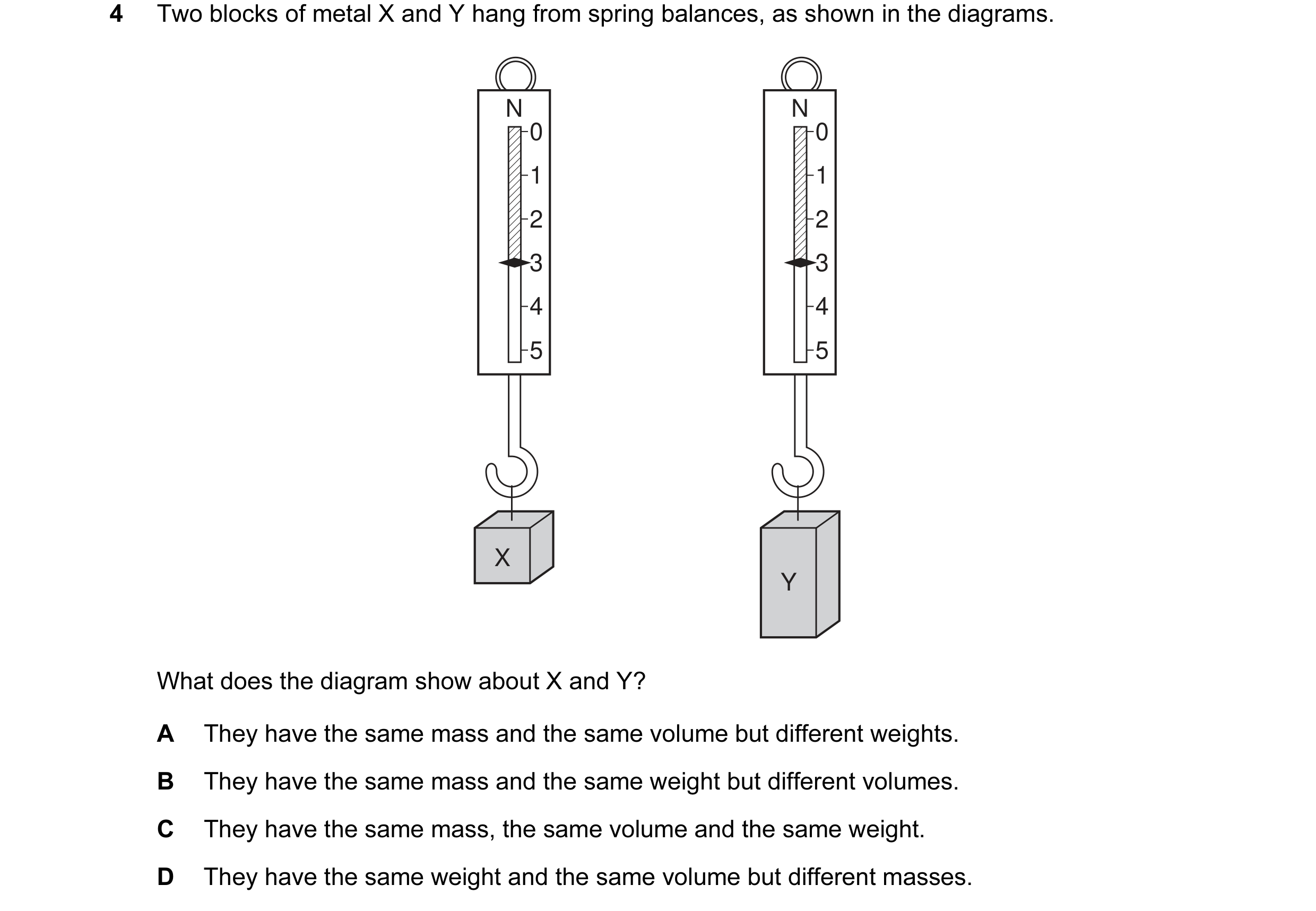

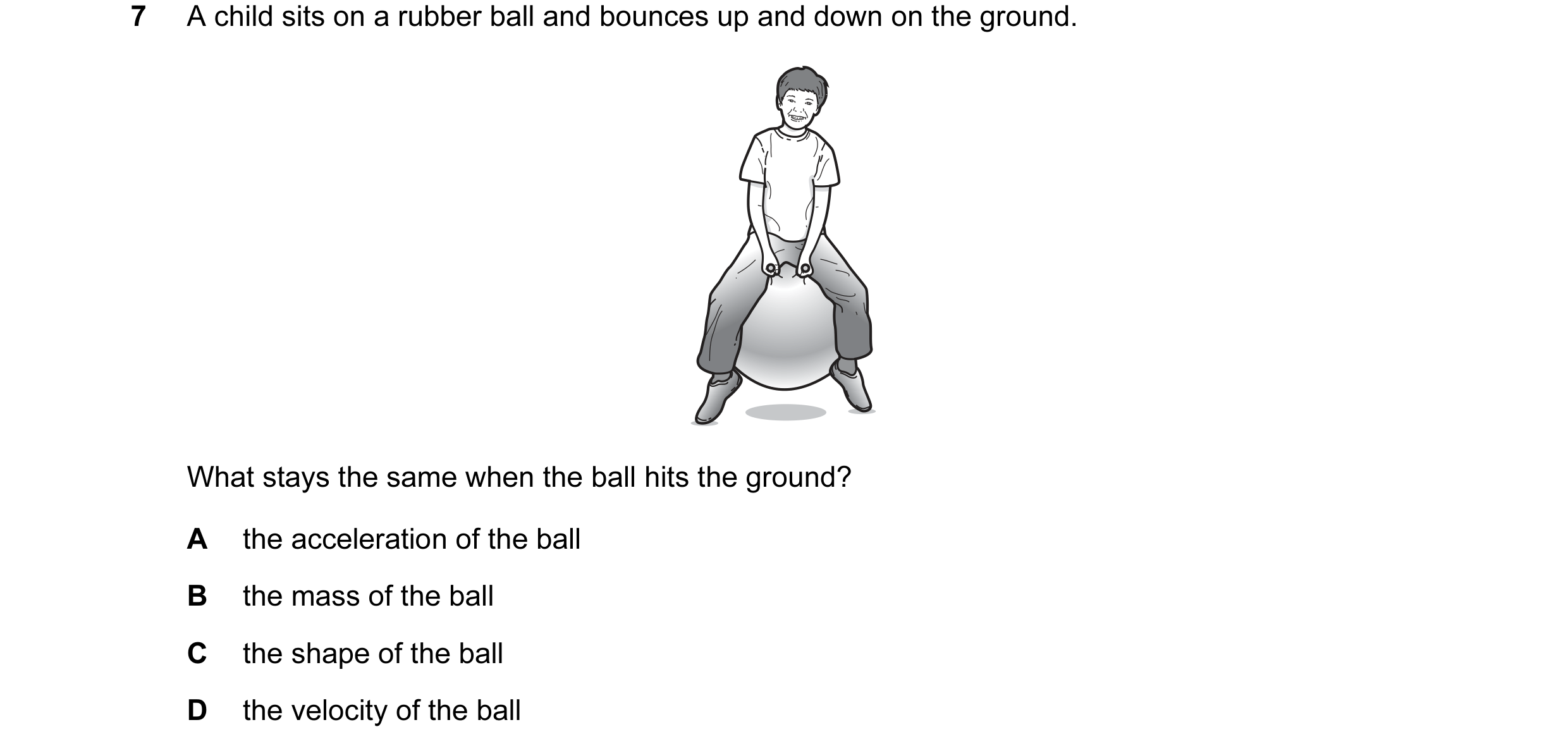 17 / 54
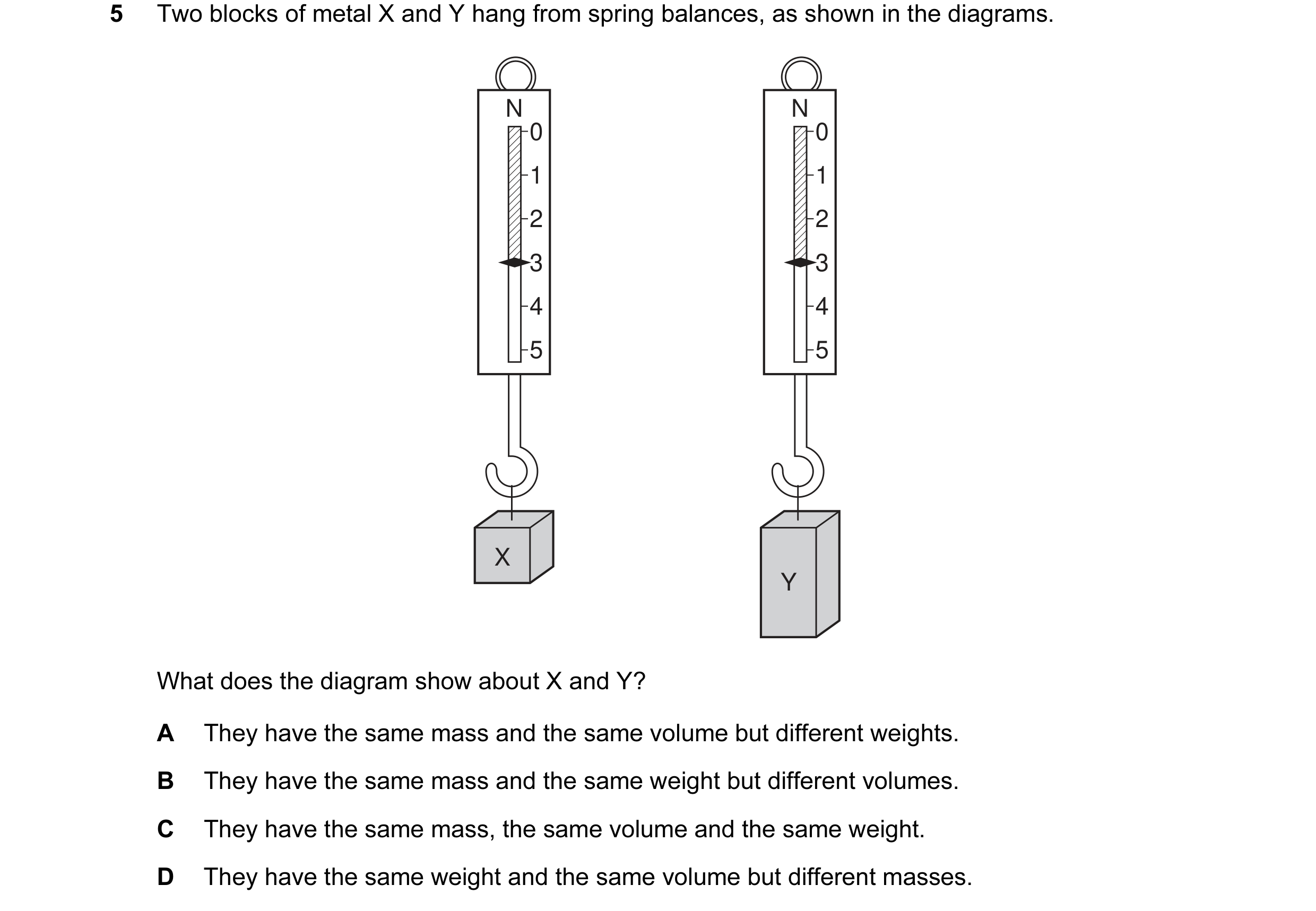
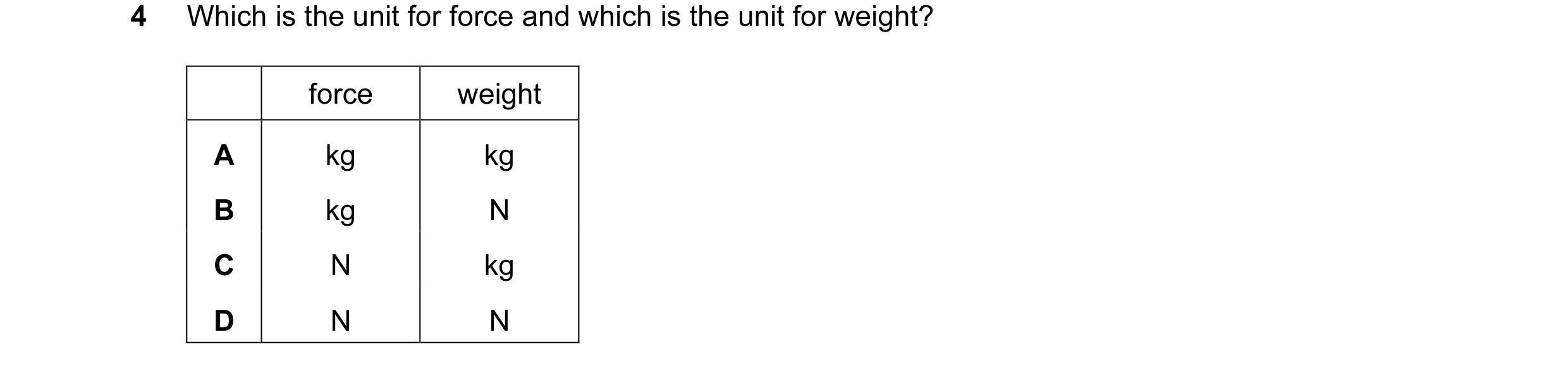 18 / 54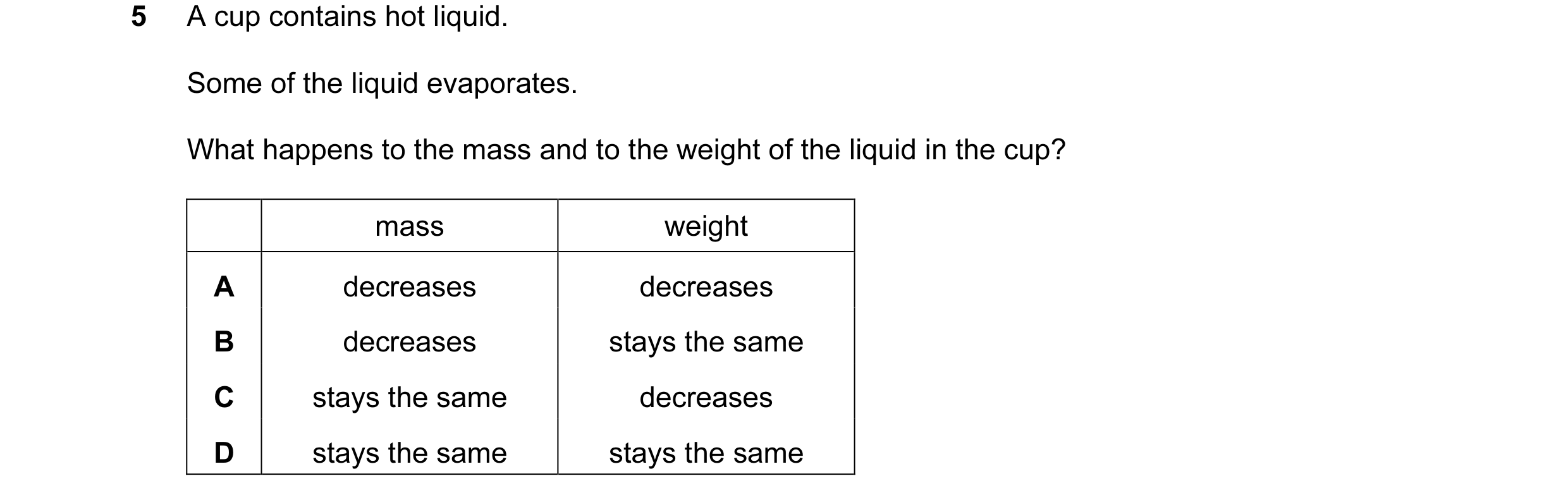
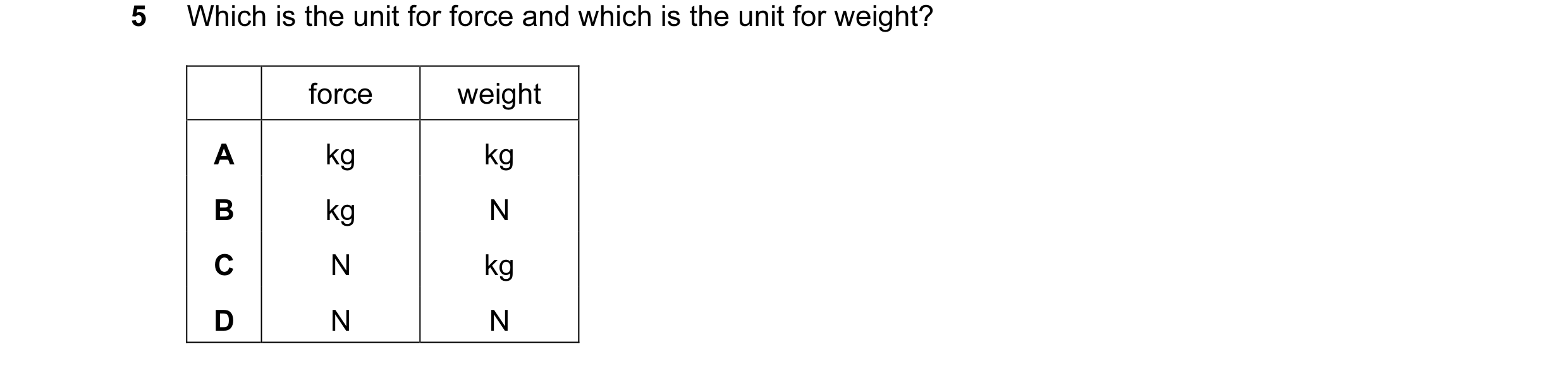
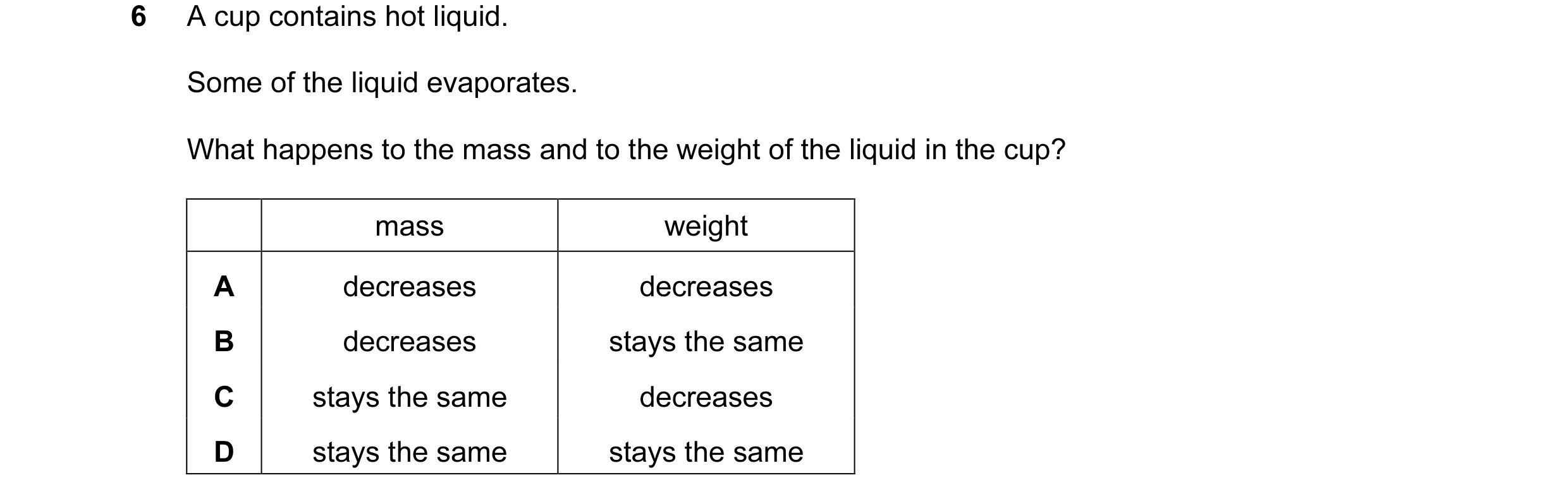
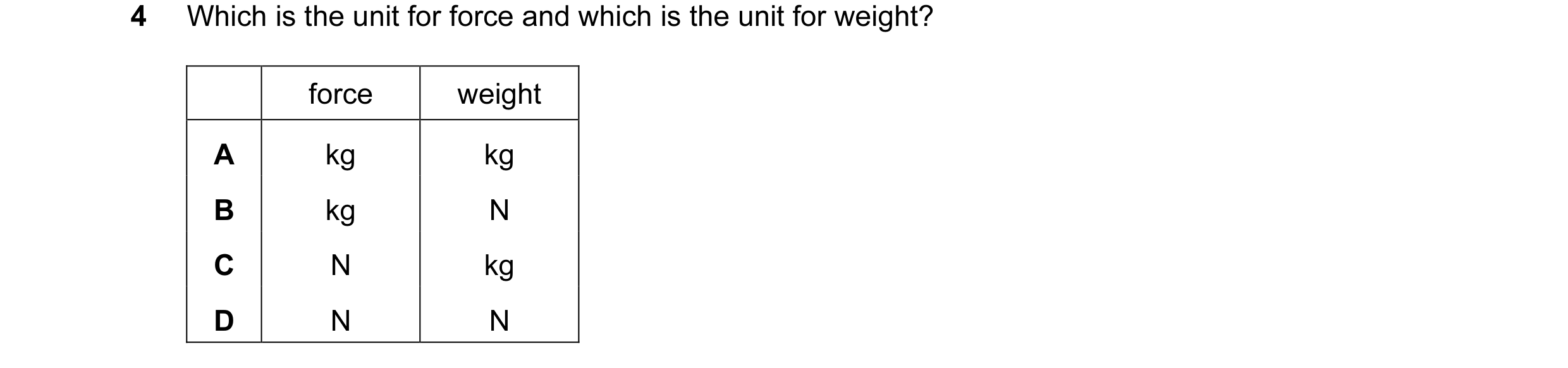 19 / 54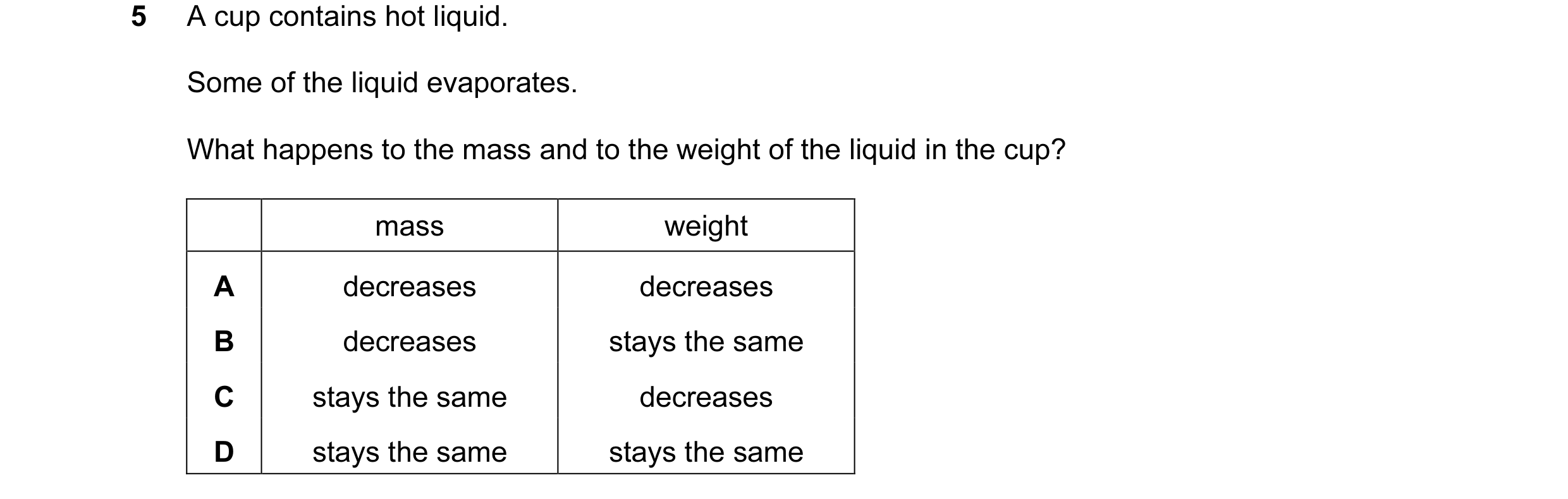
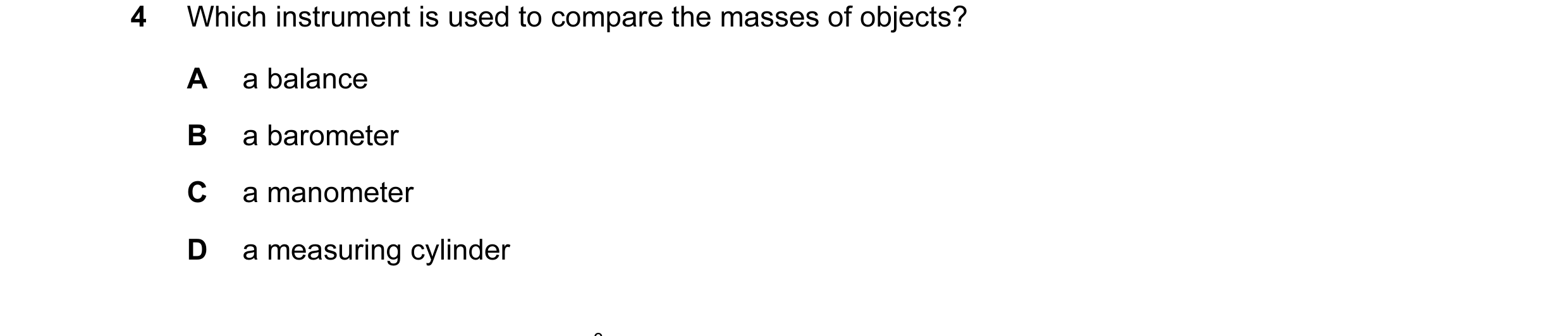
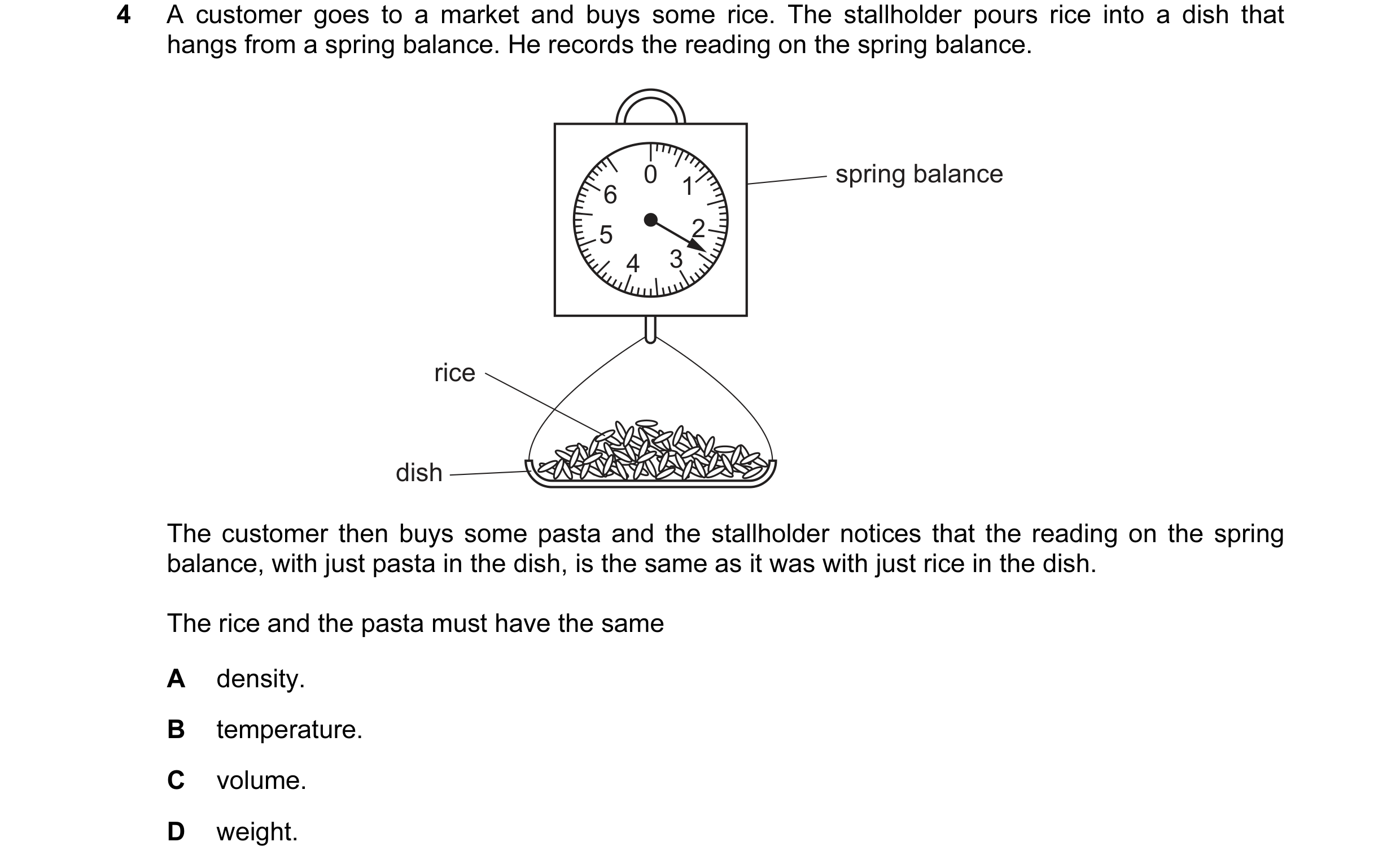
 20 / 54
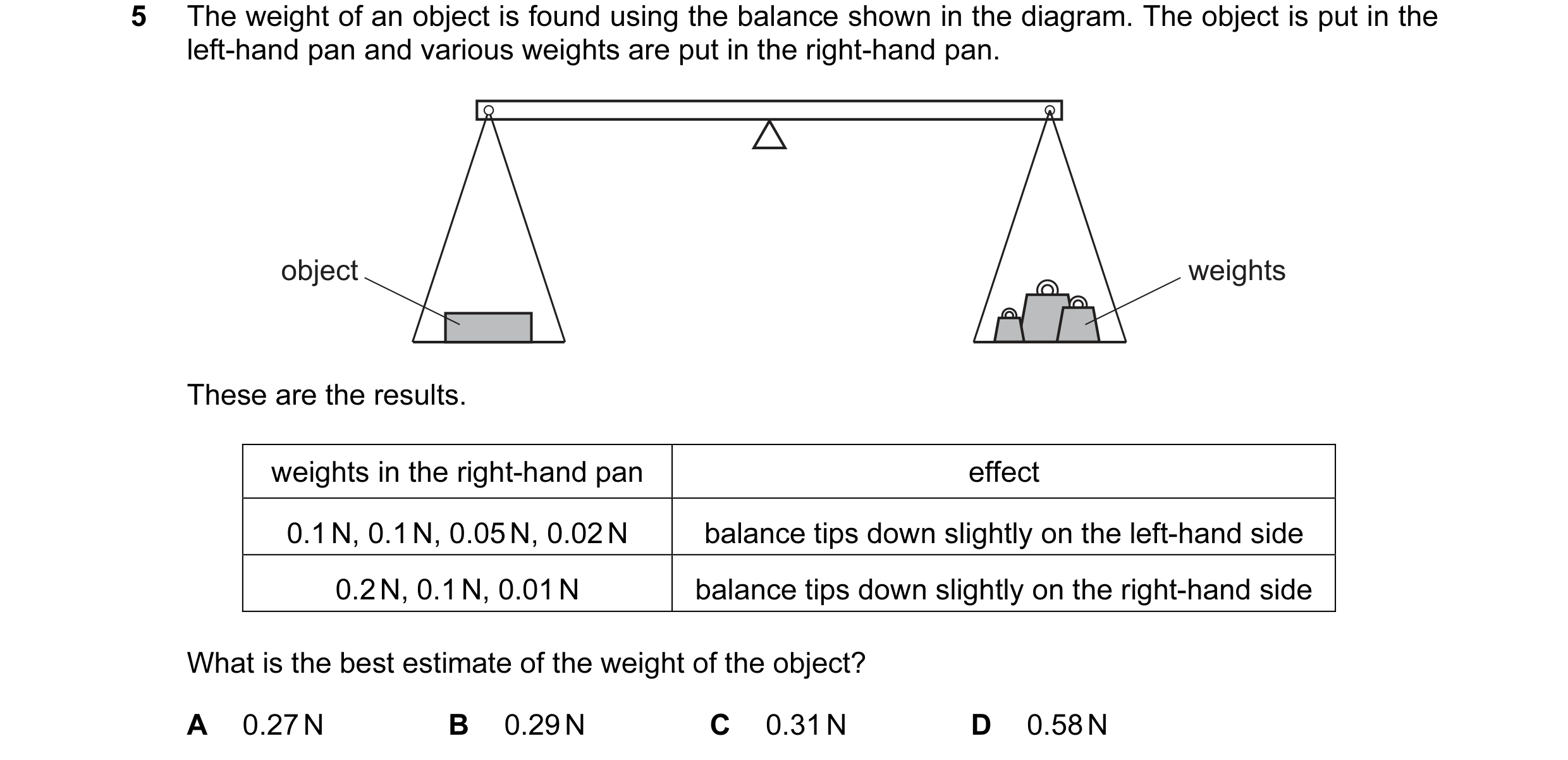
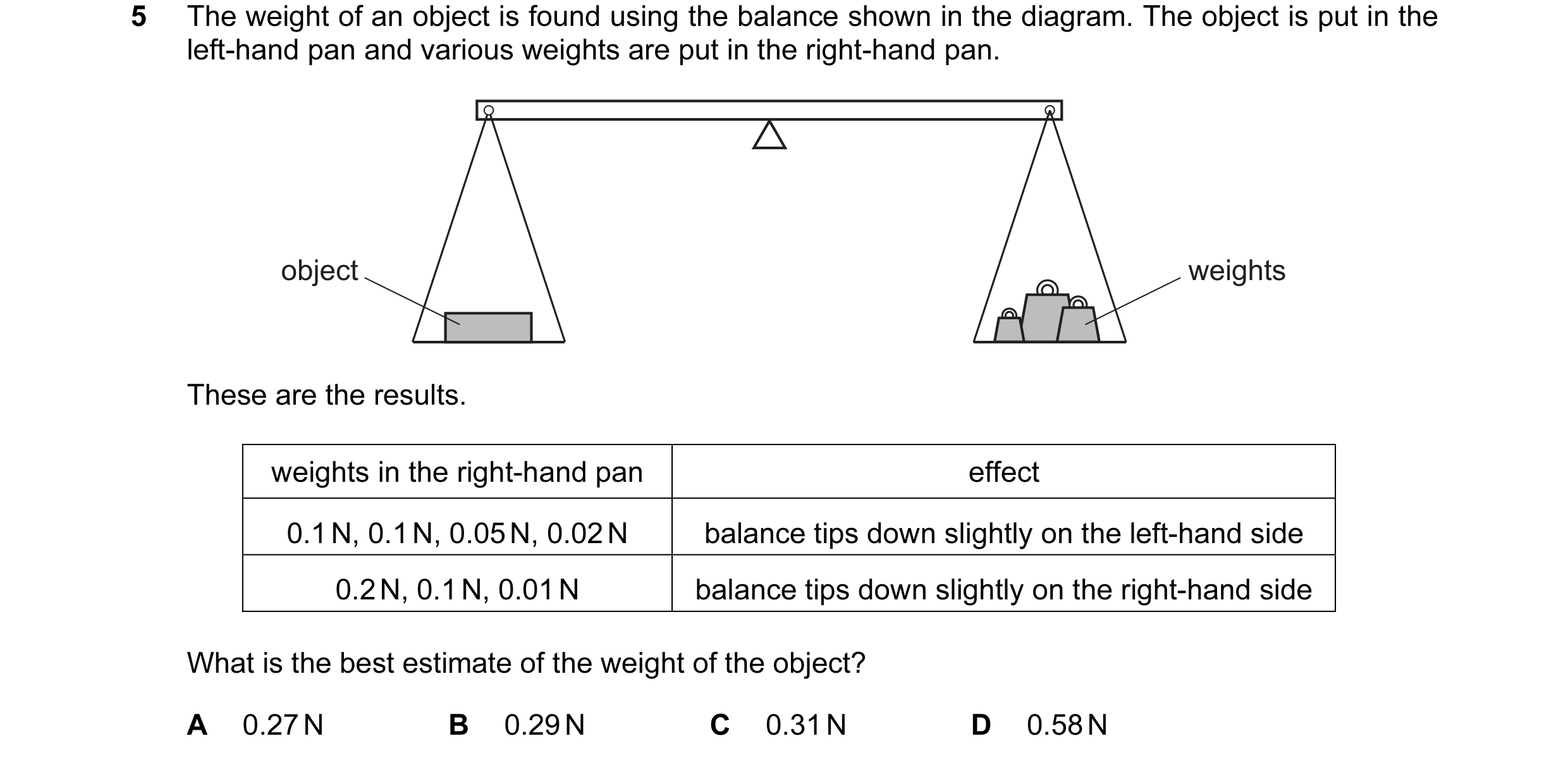
 21 / 54
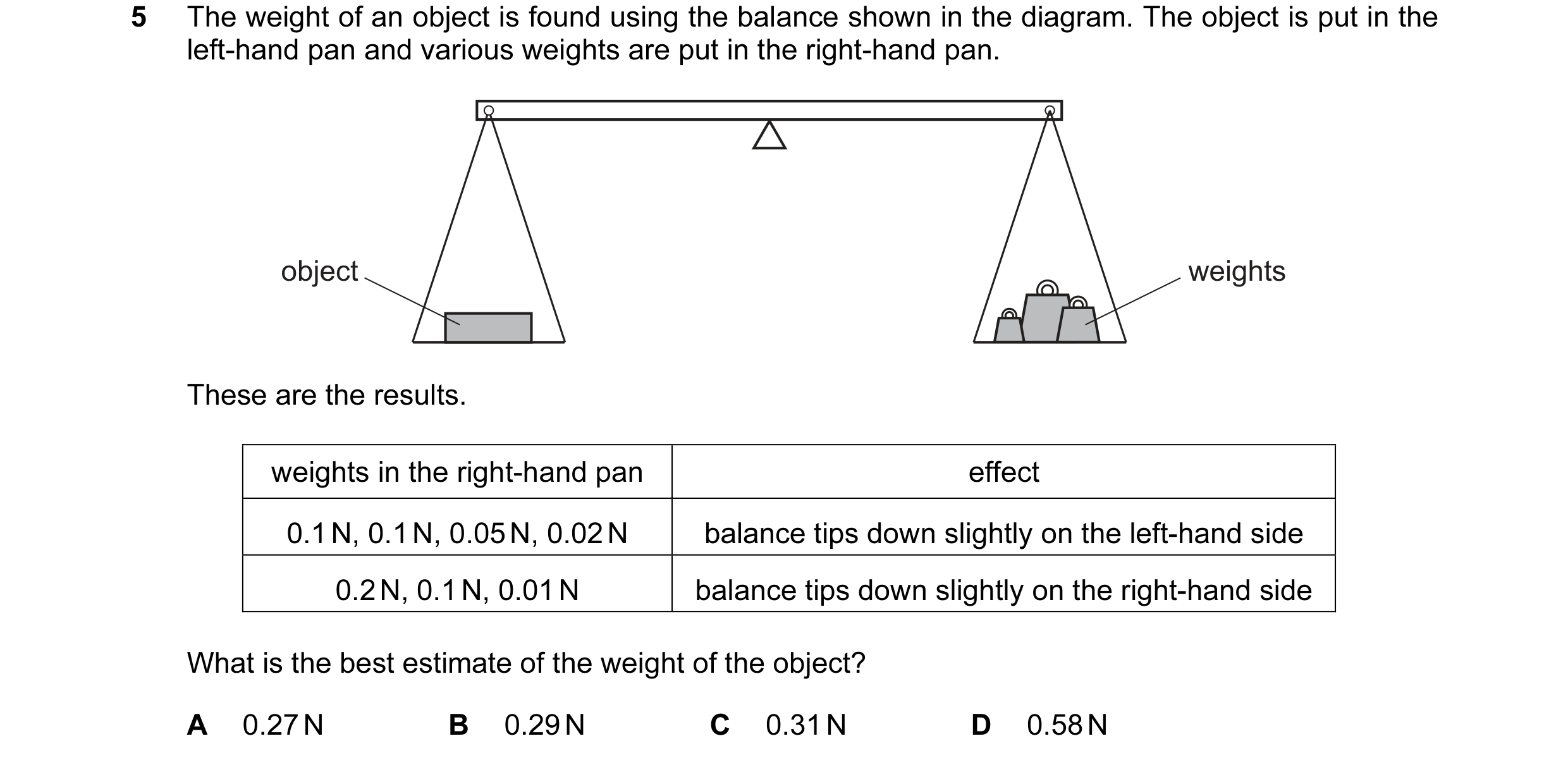
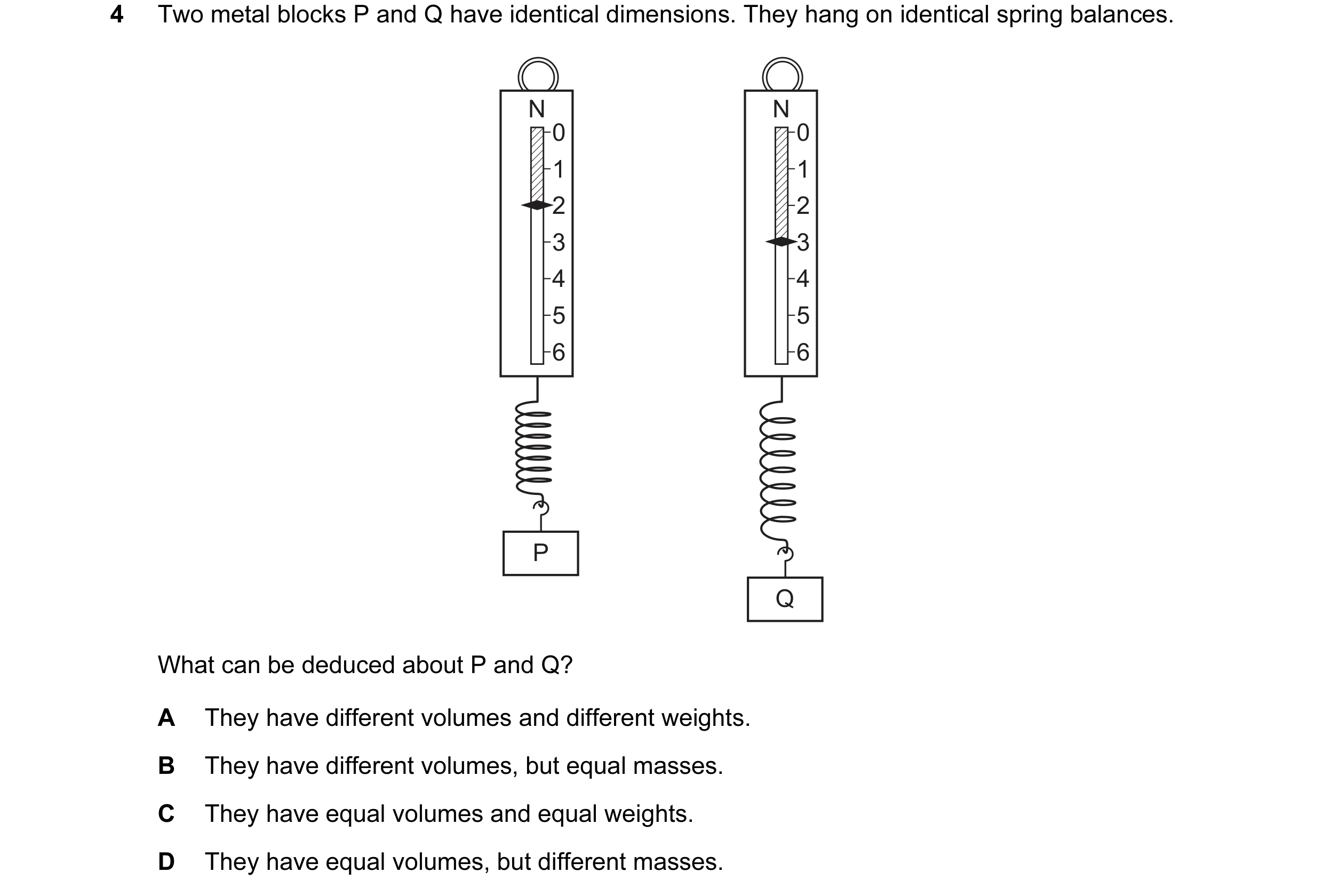 22 / 54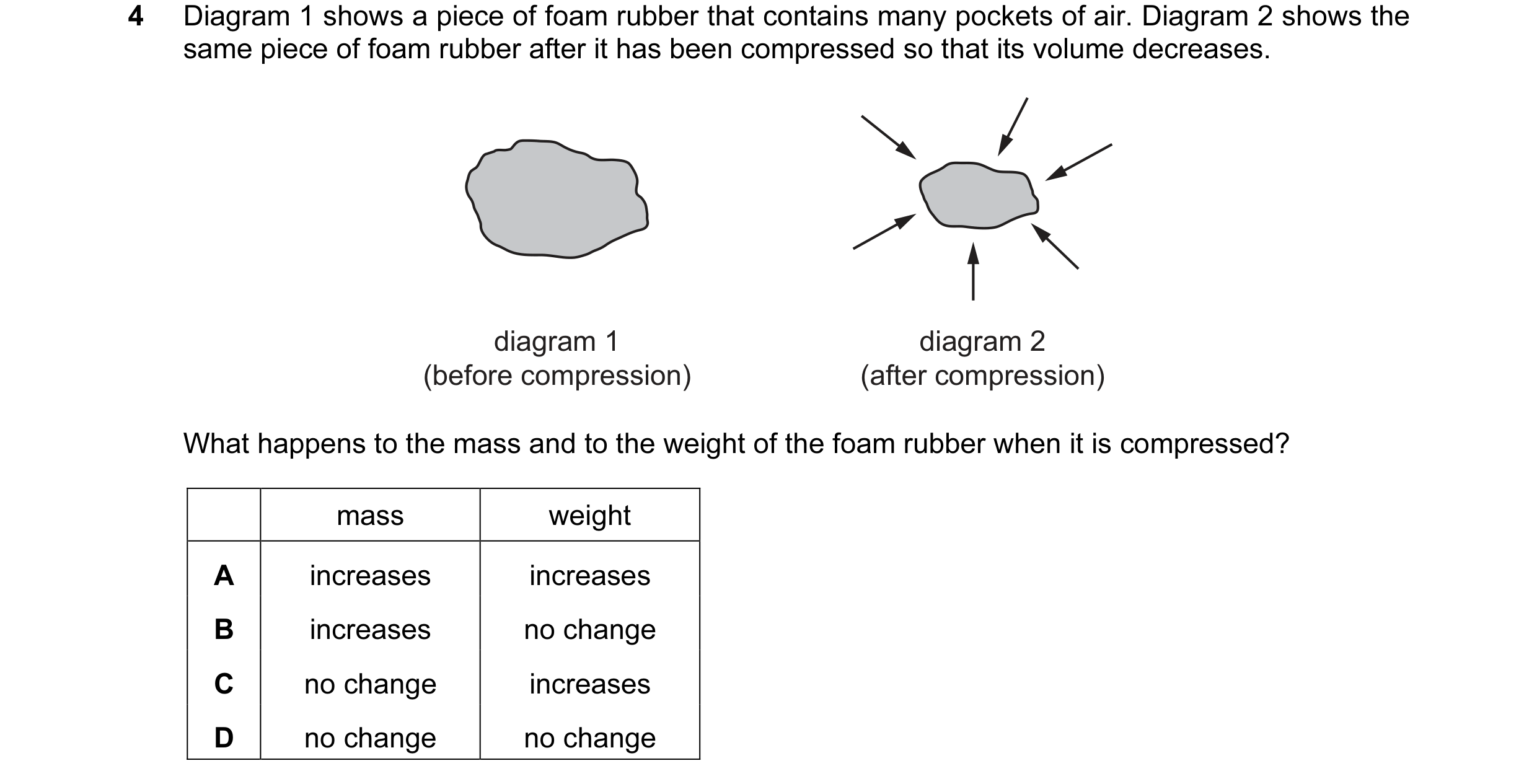


 23 / 54

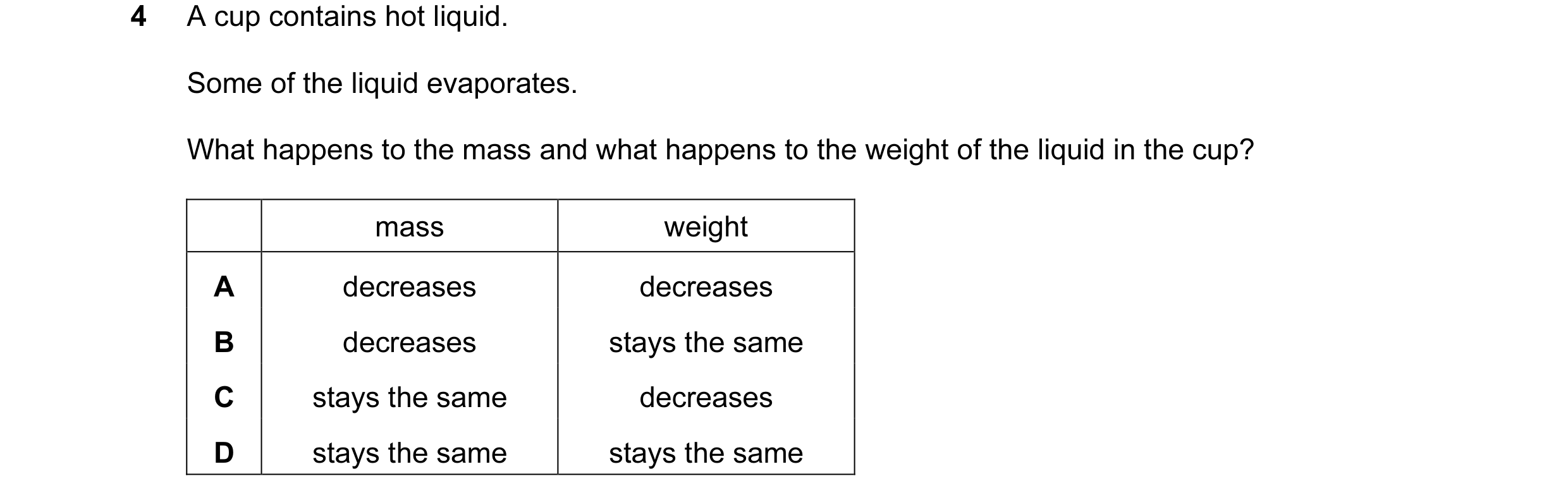
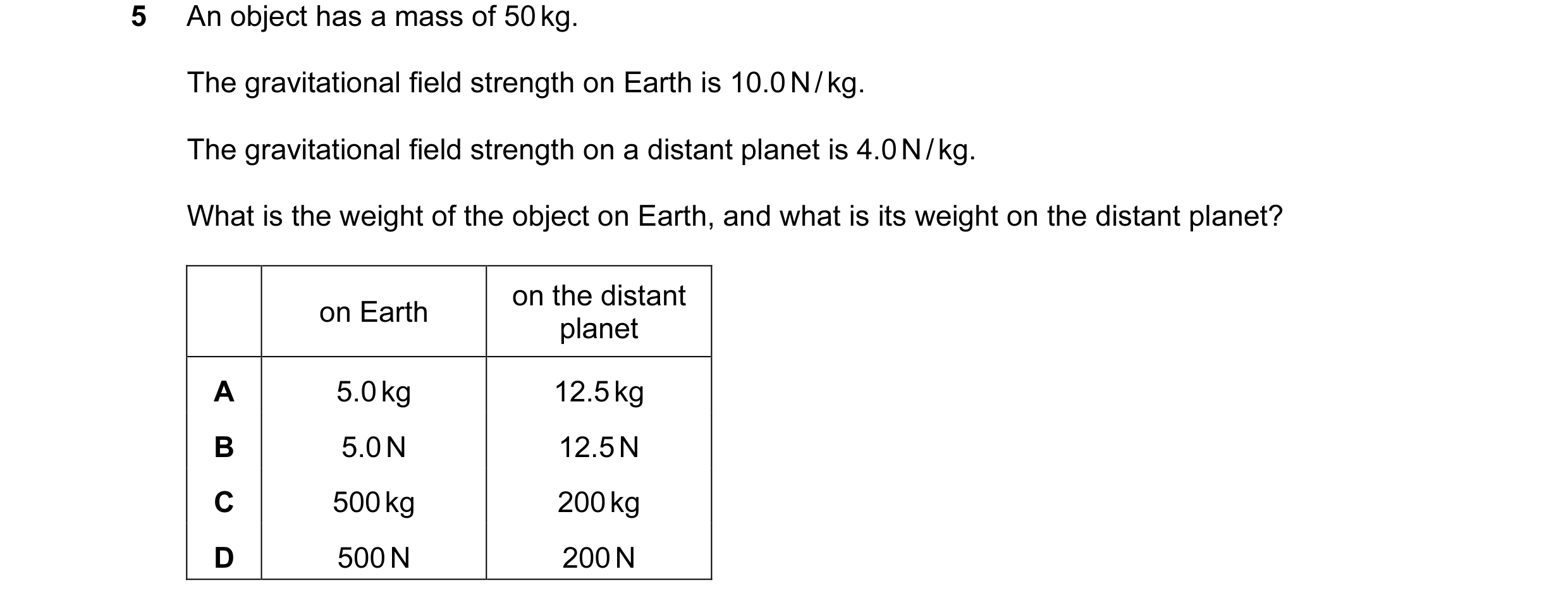
 24 / 54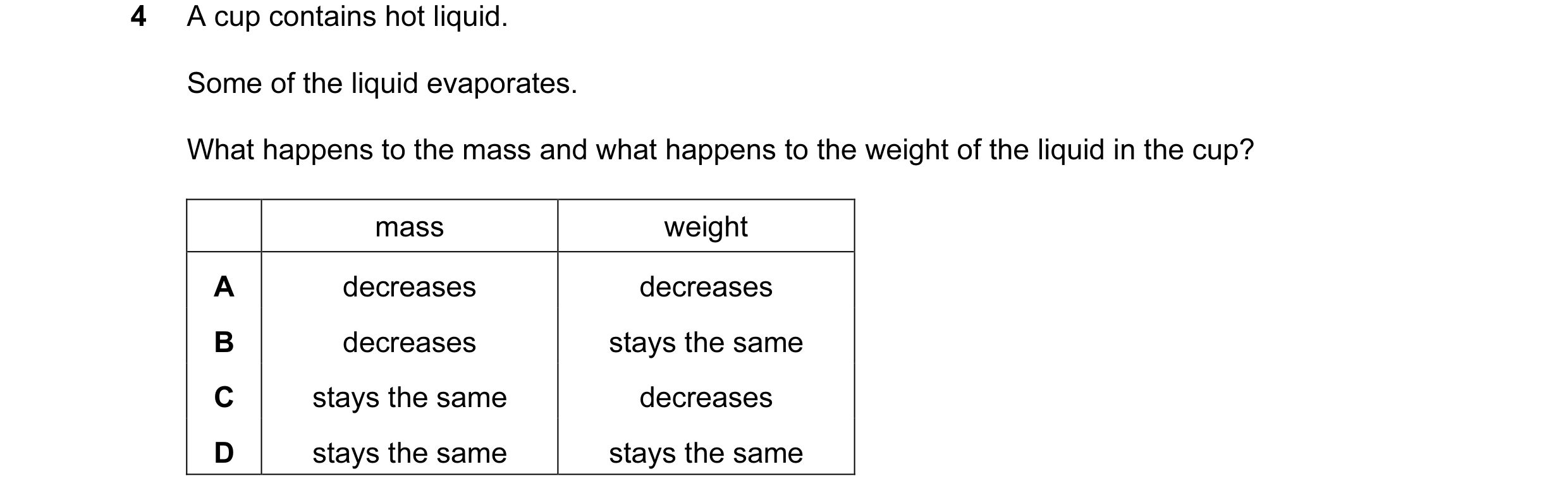
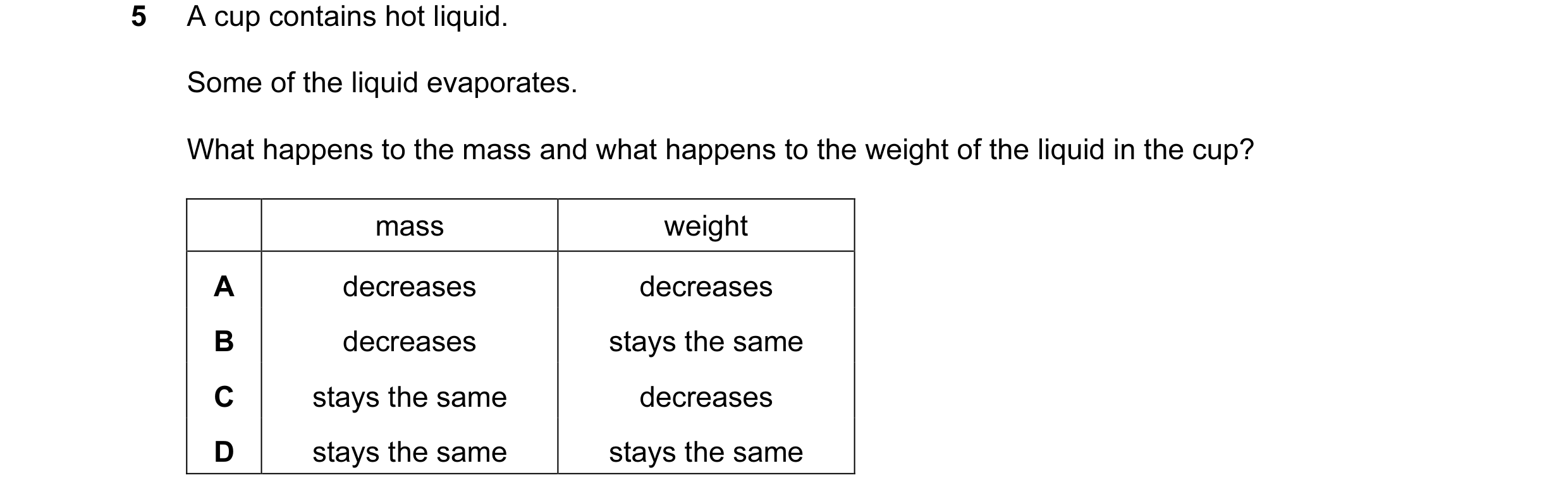

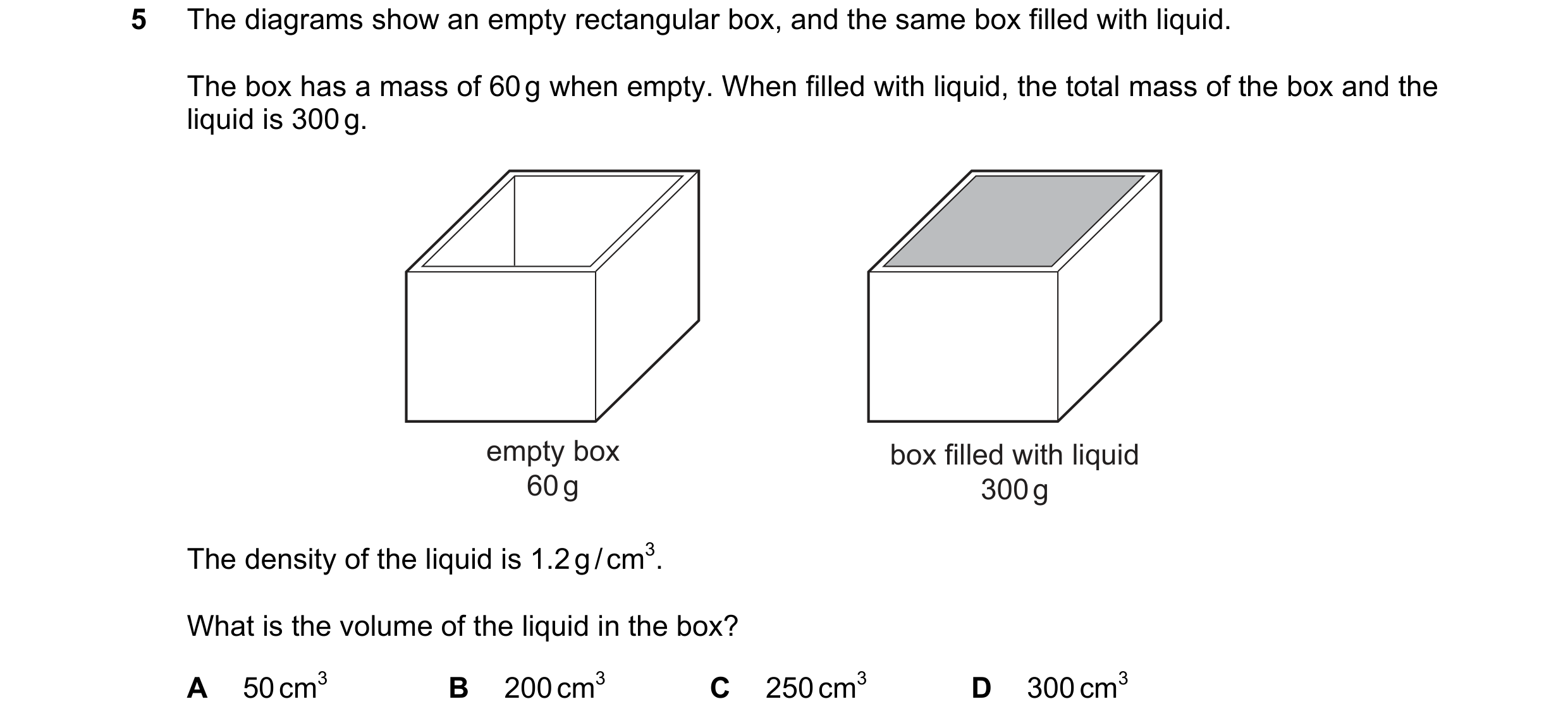 25 / 54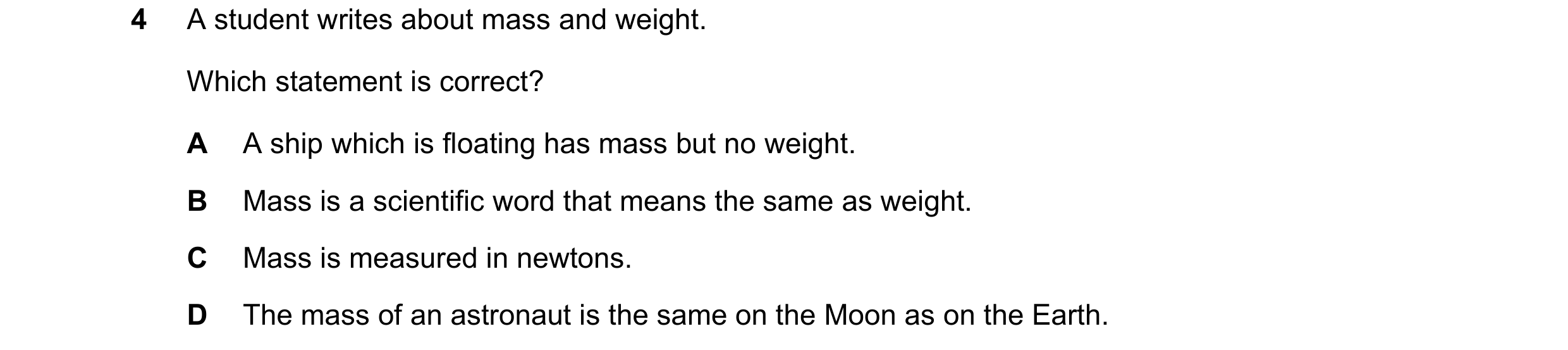


 26 / 54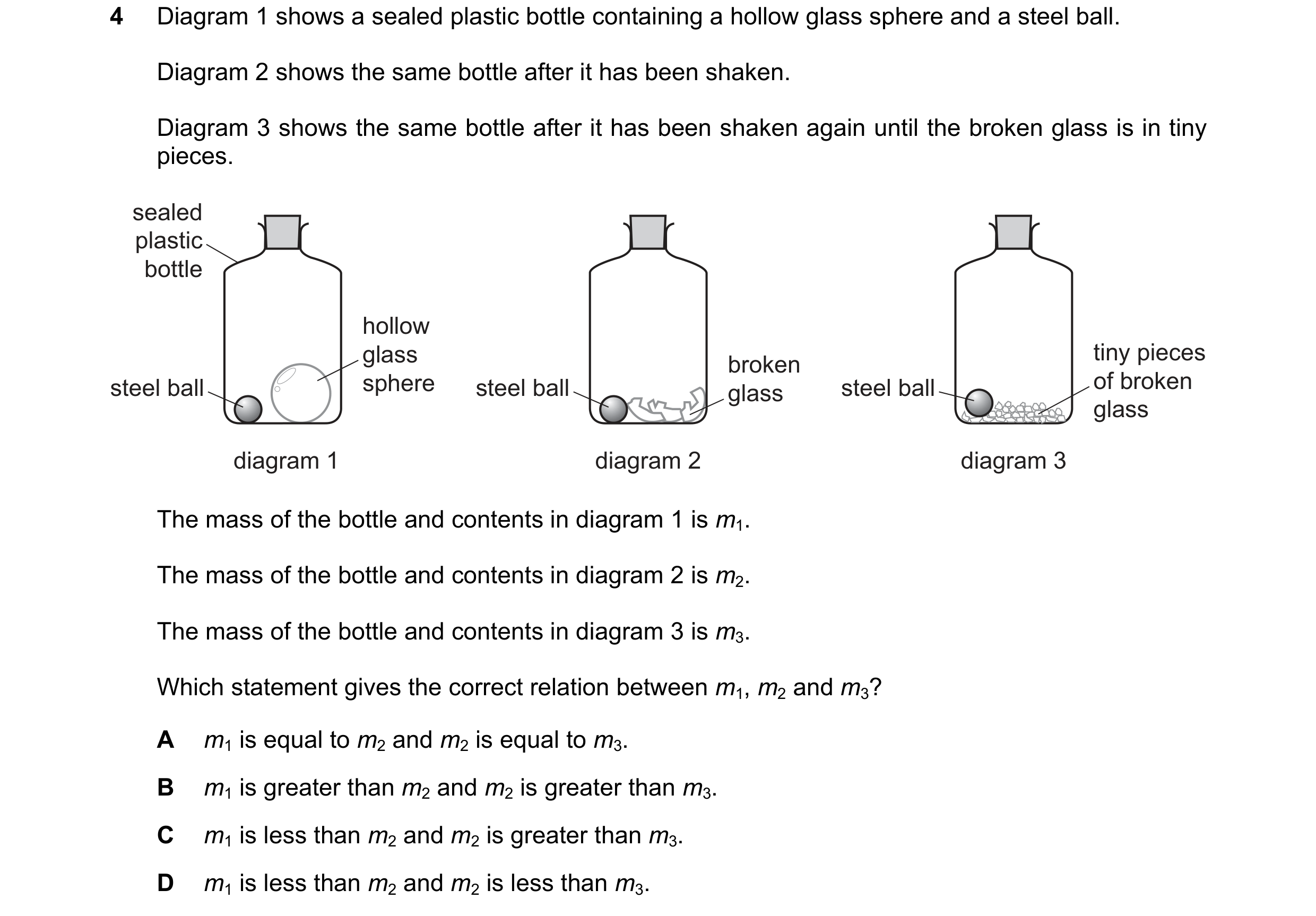
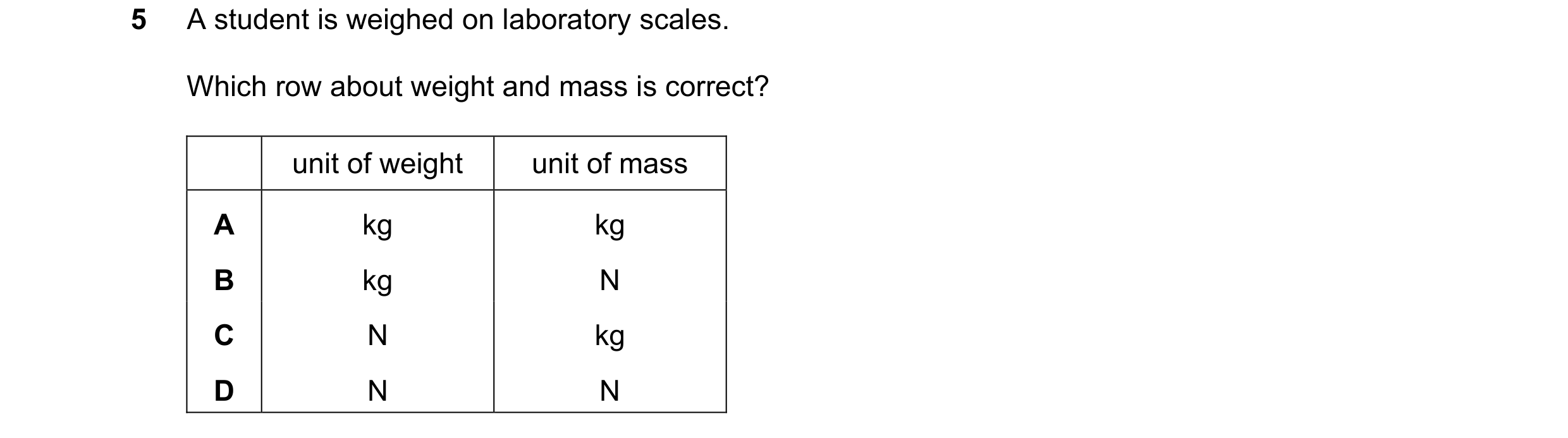
 27 / 54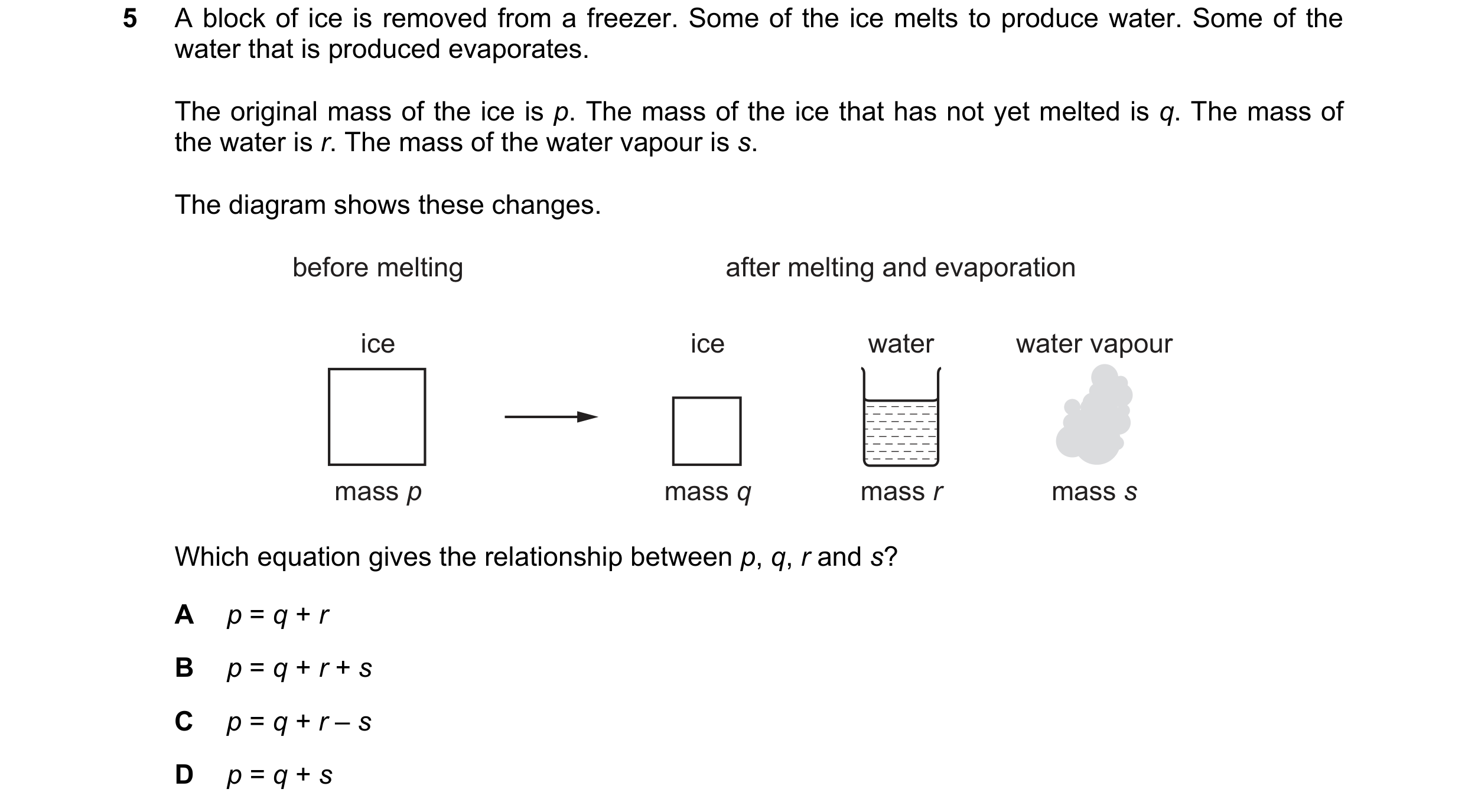
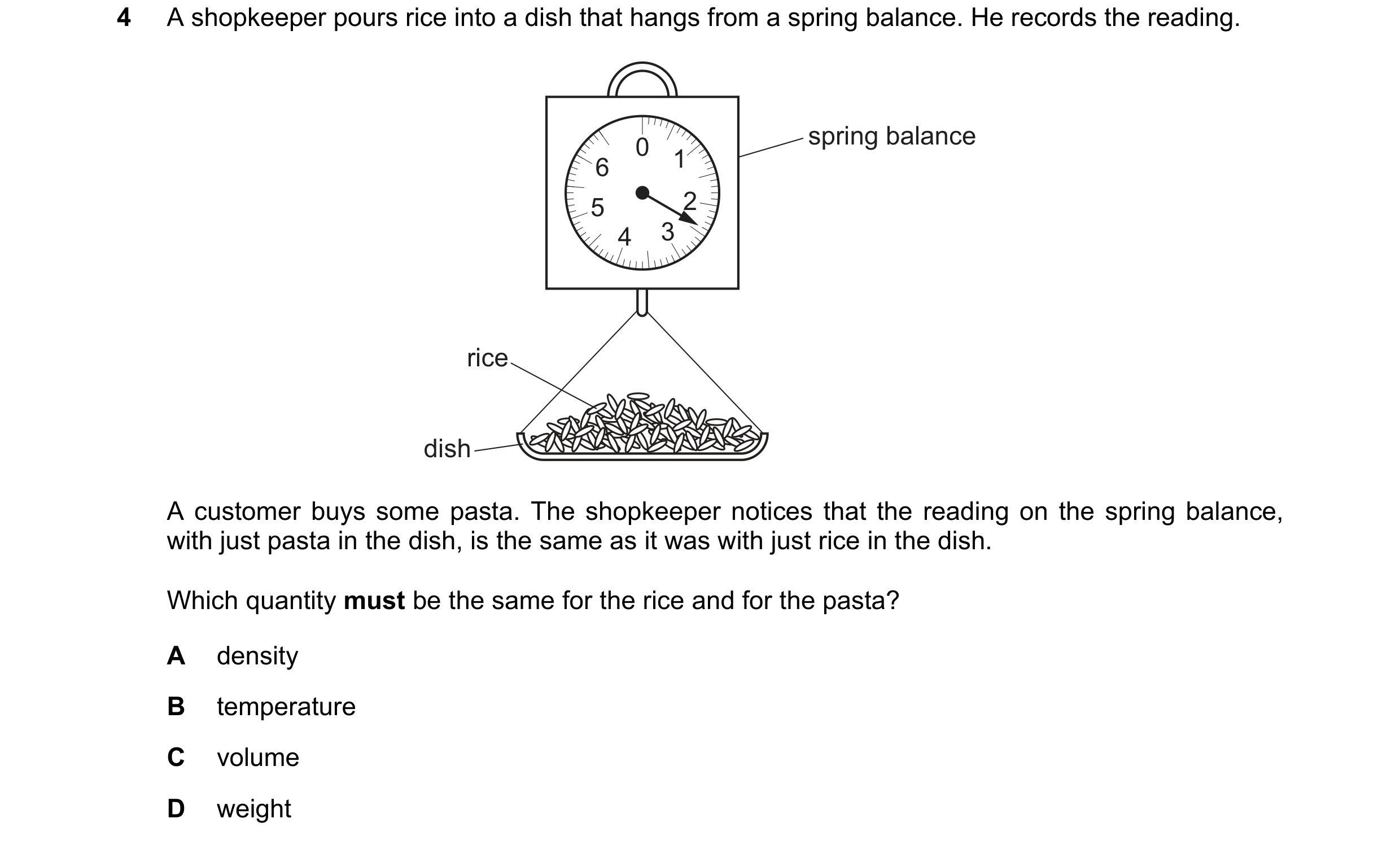
 28 / 54
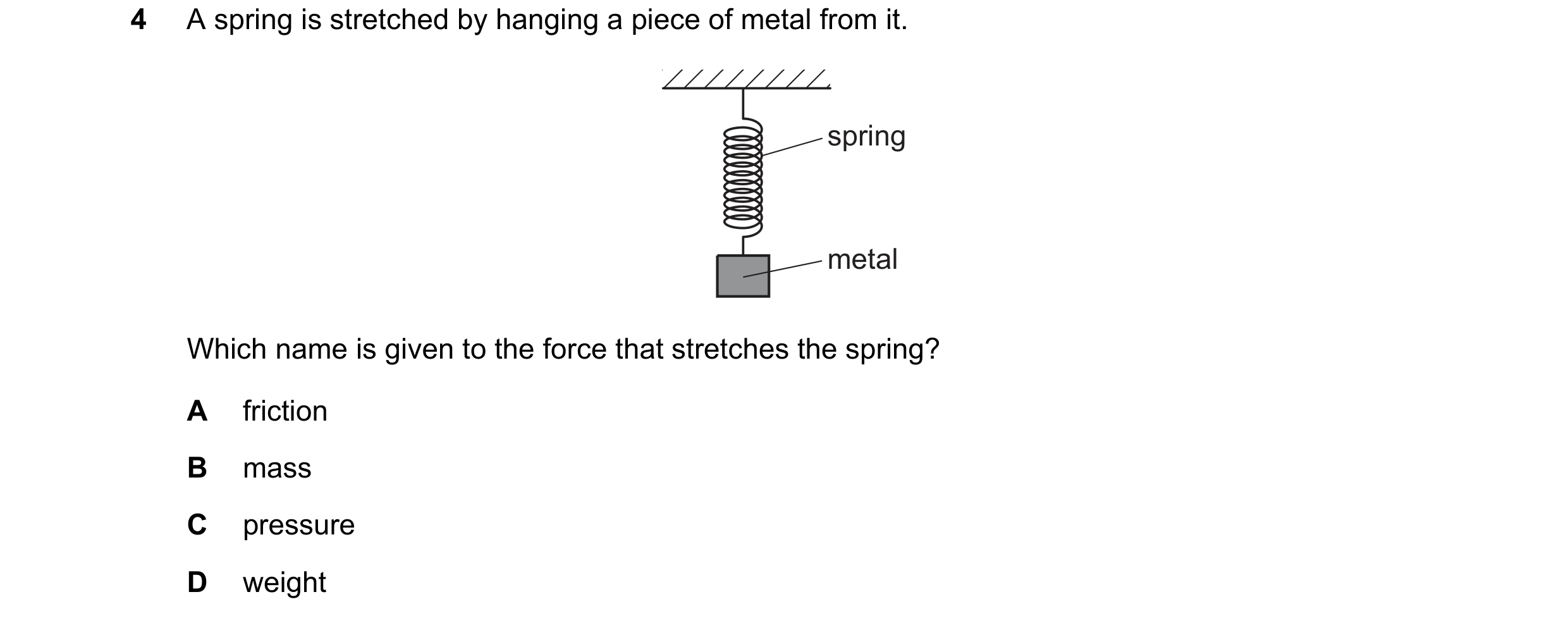
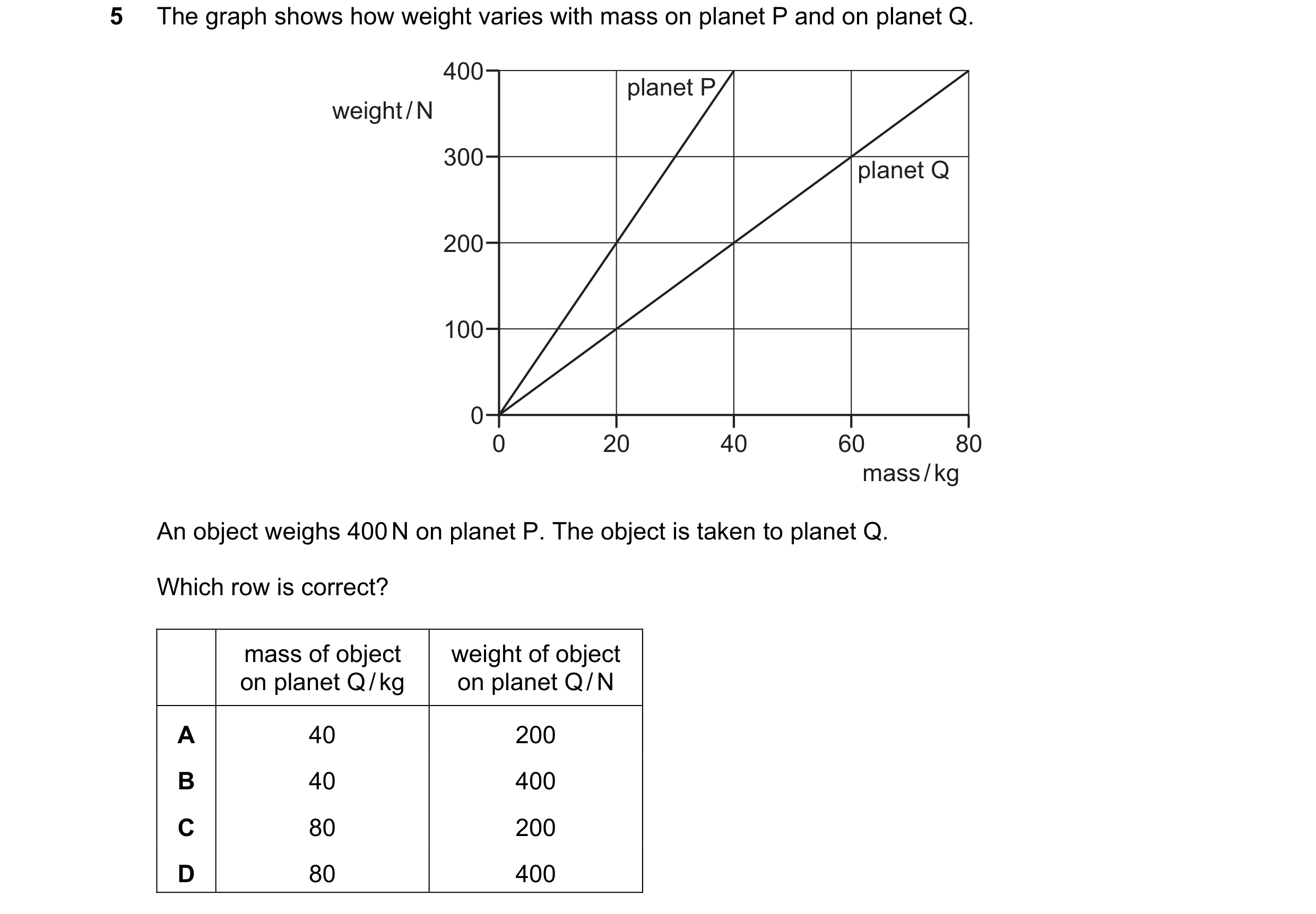 29 / 54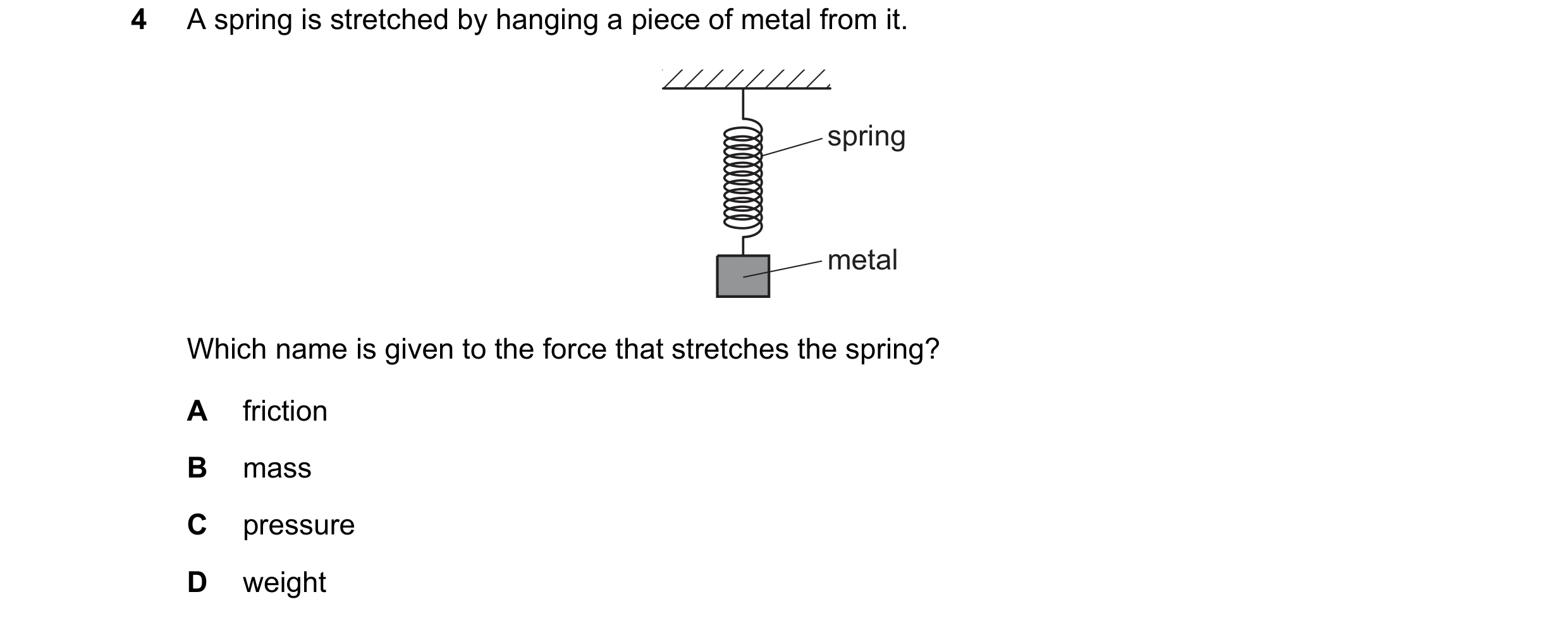
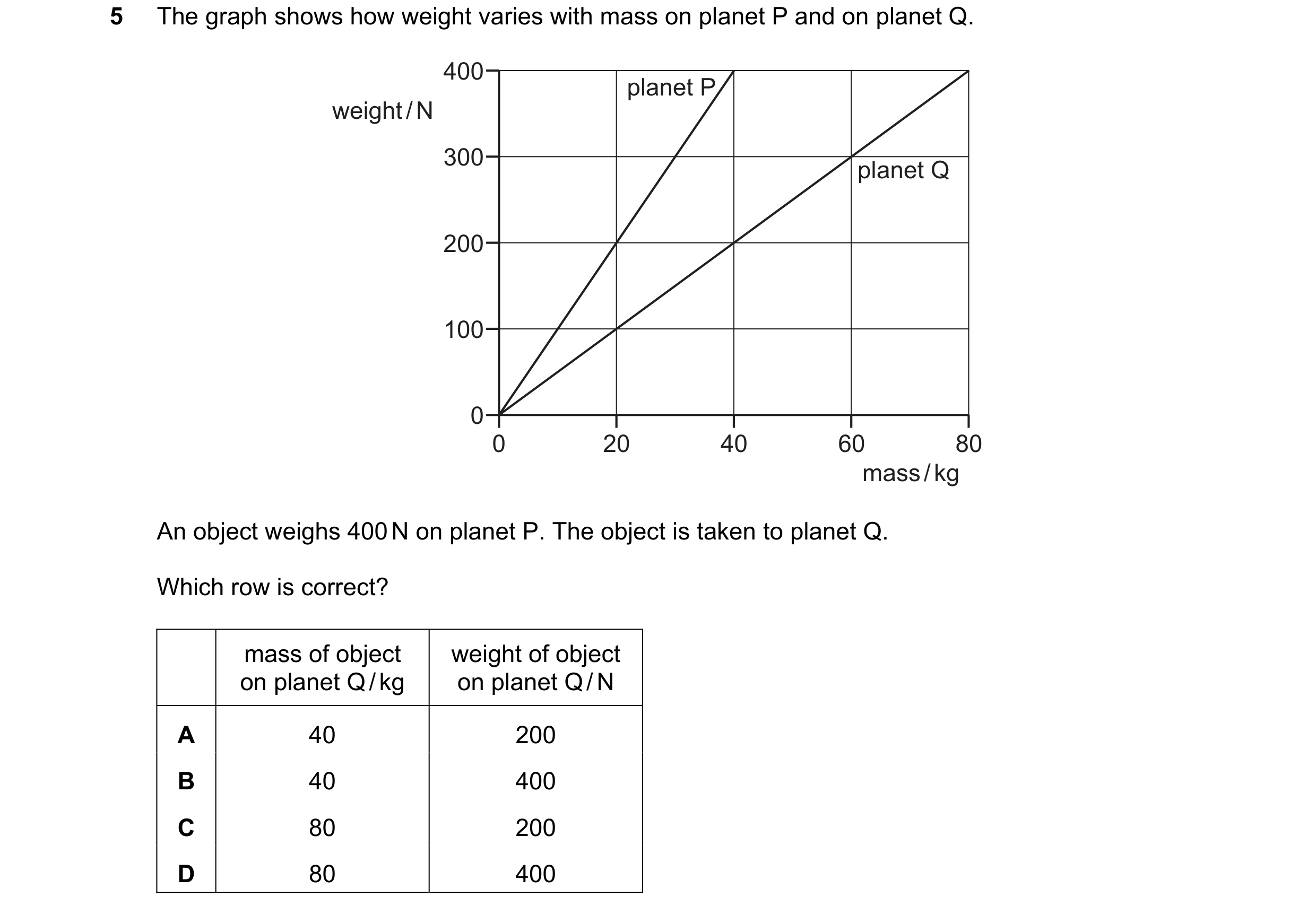
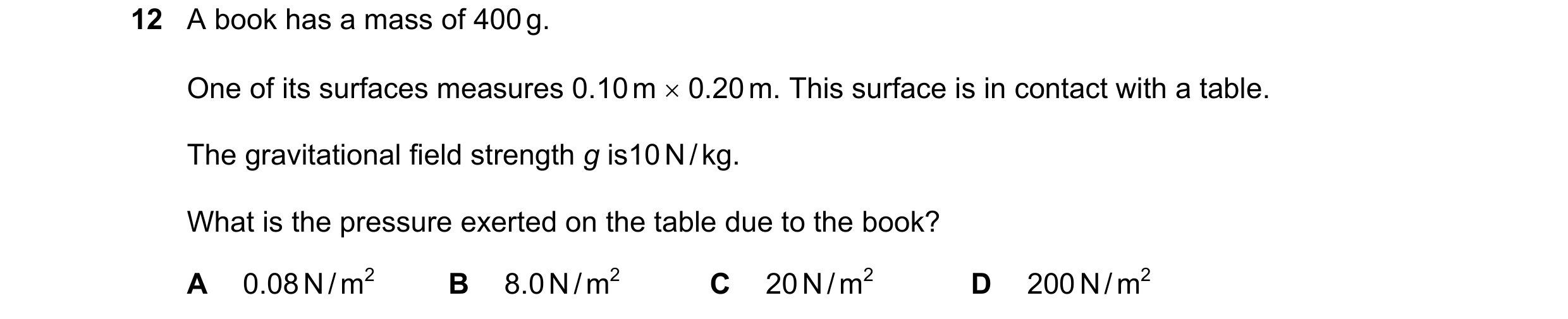 30 / 54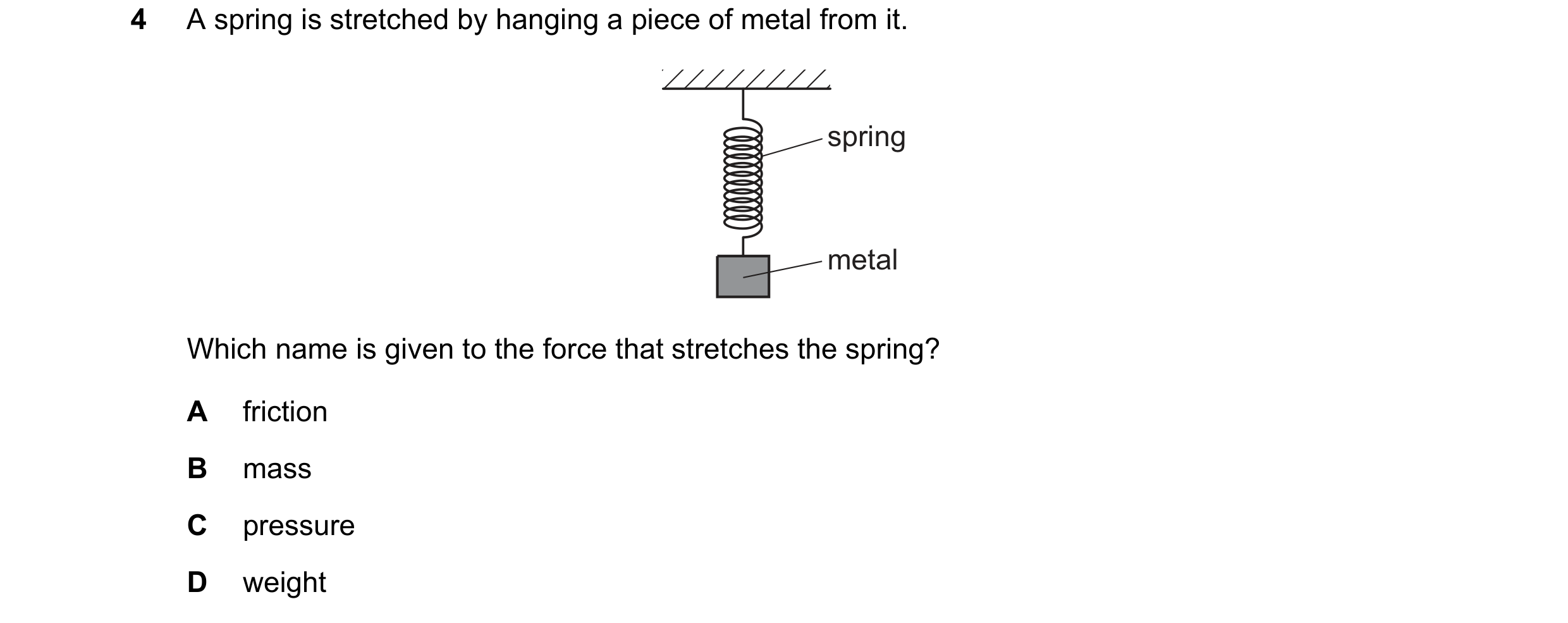
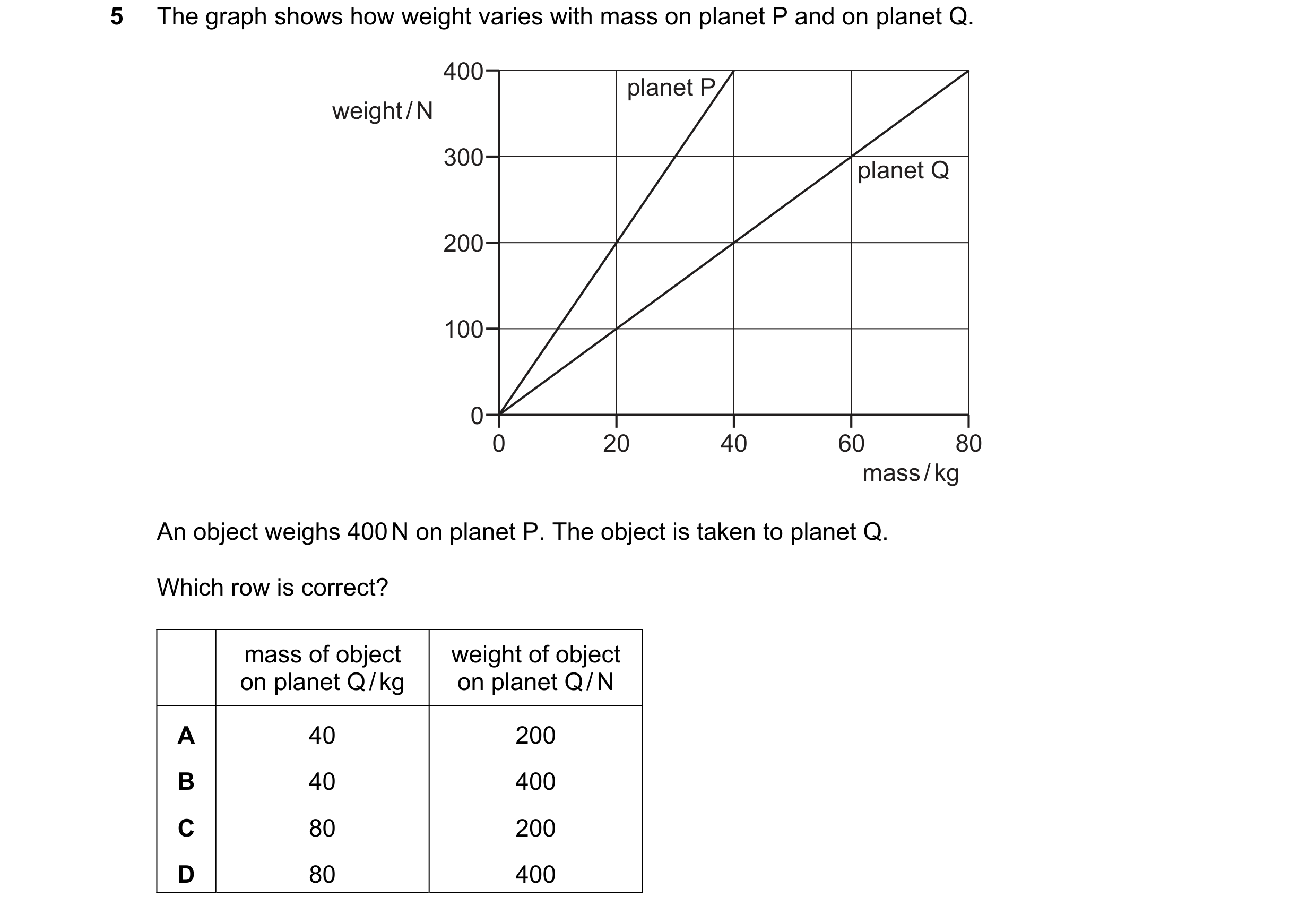 31 / 54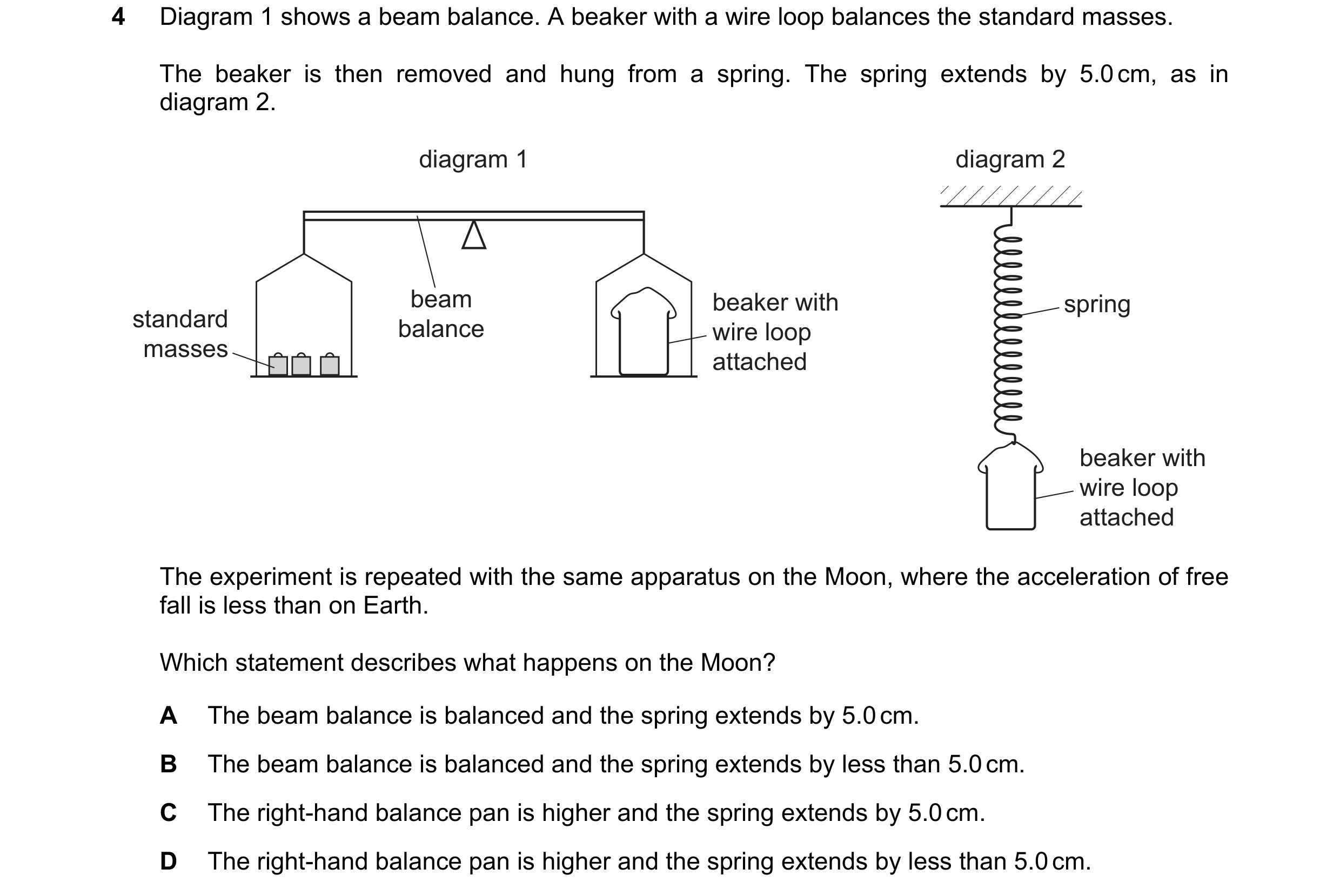
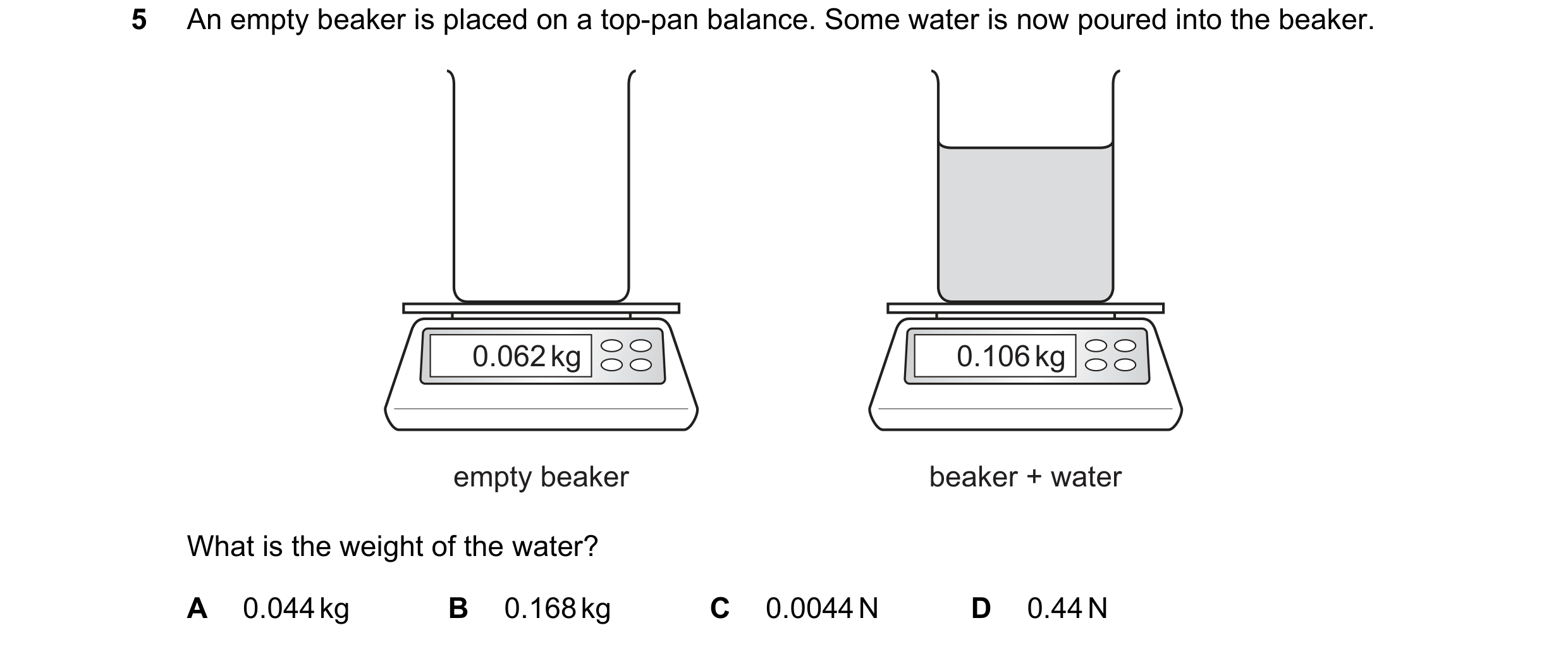 32 / 54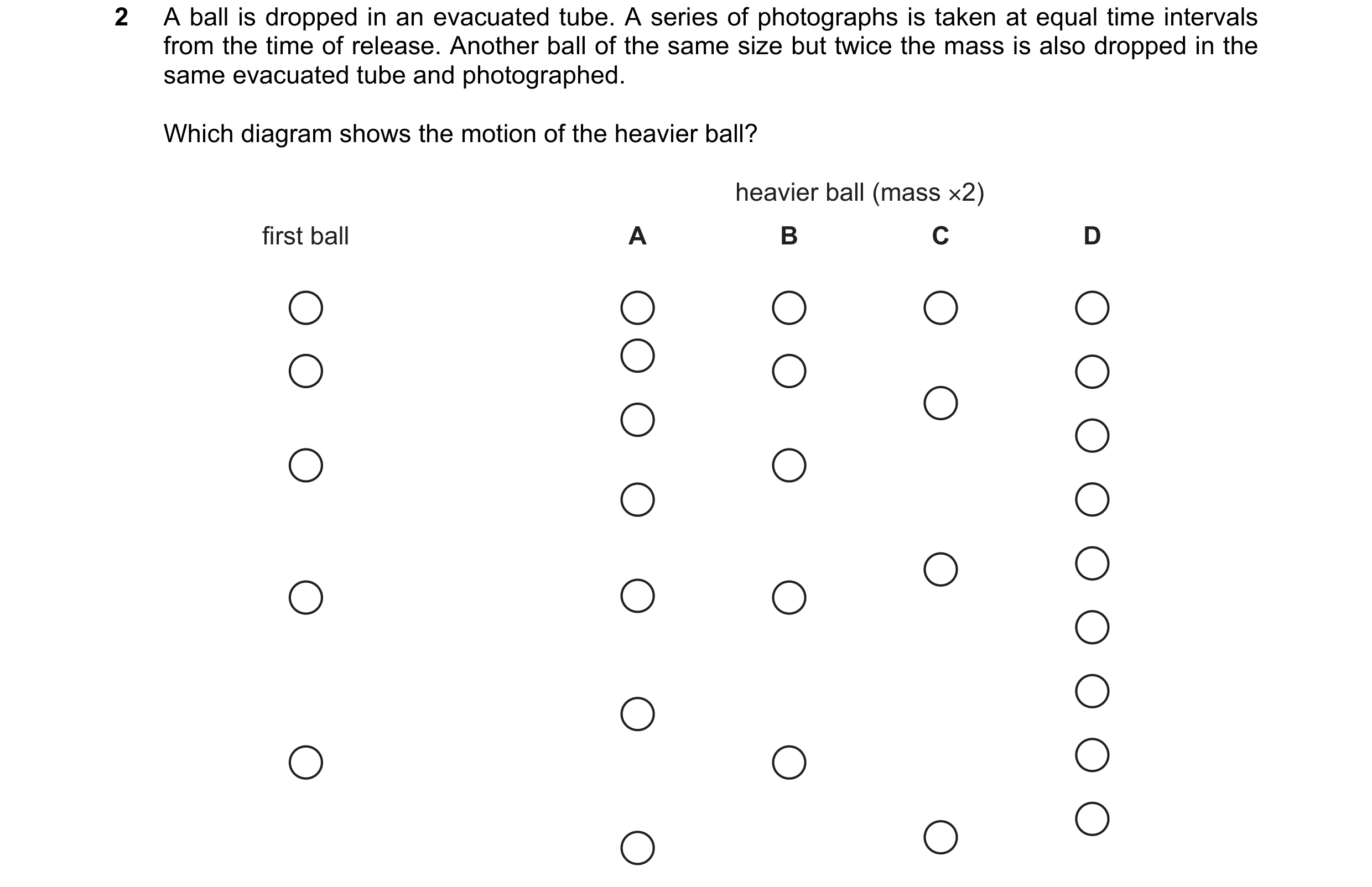

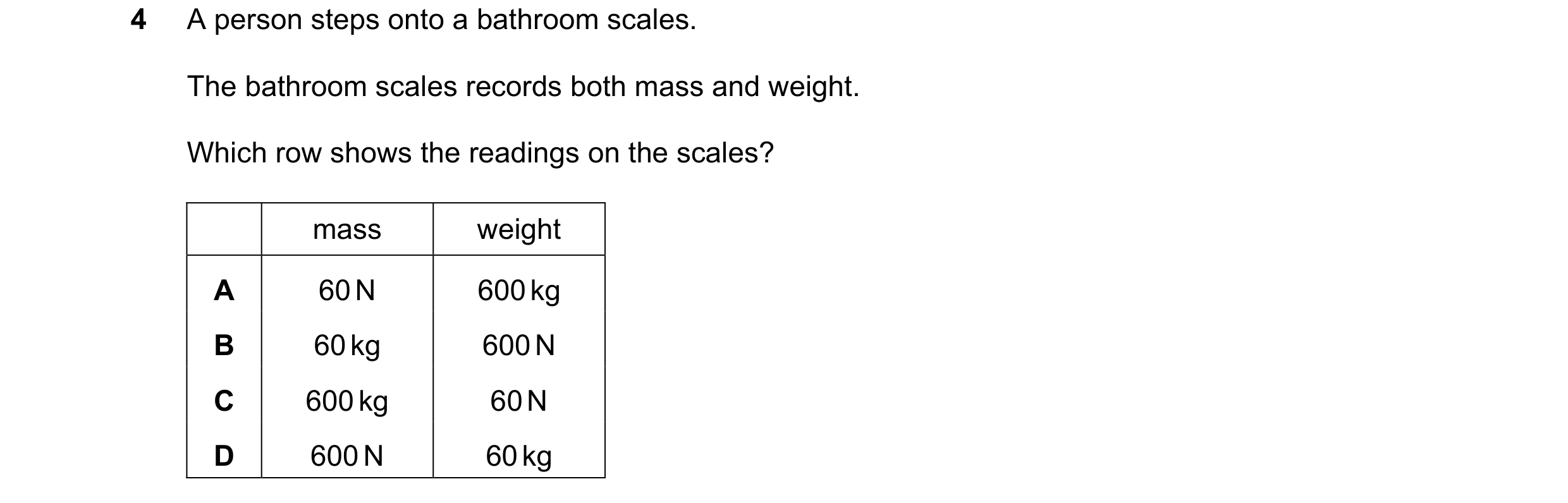
 33 / 54

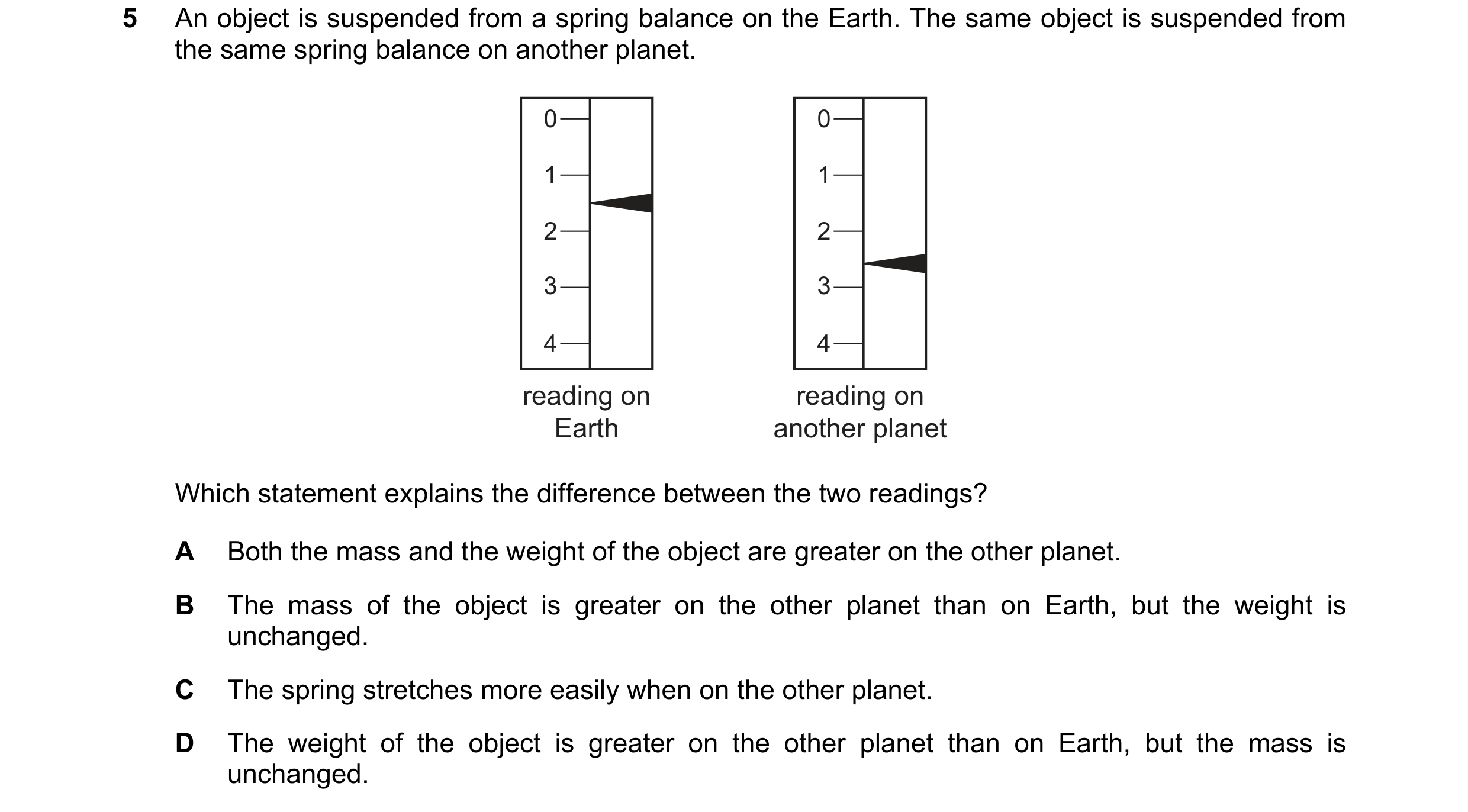

 34 / 54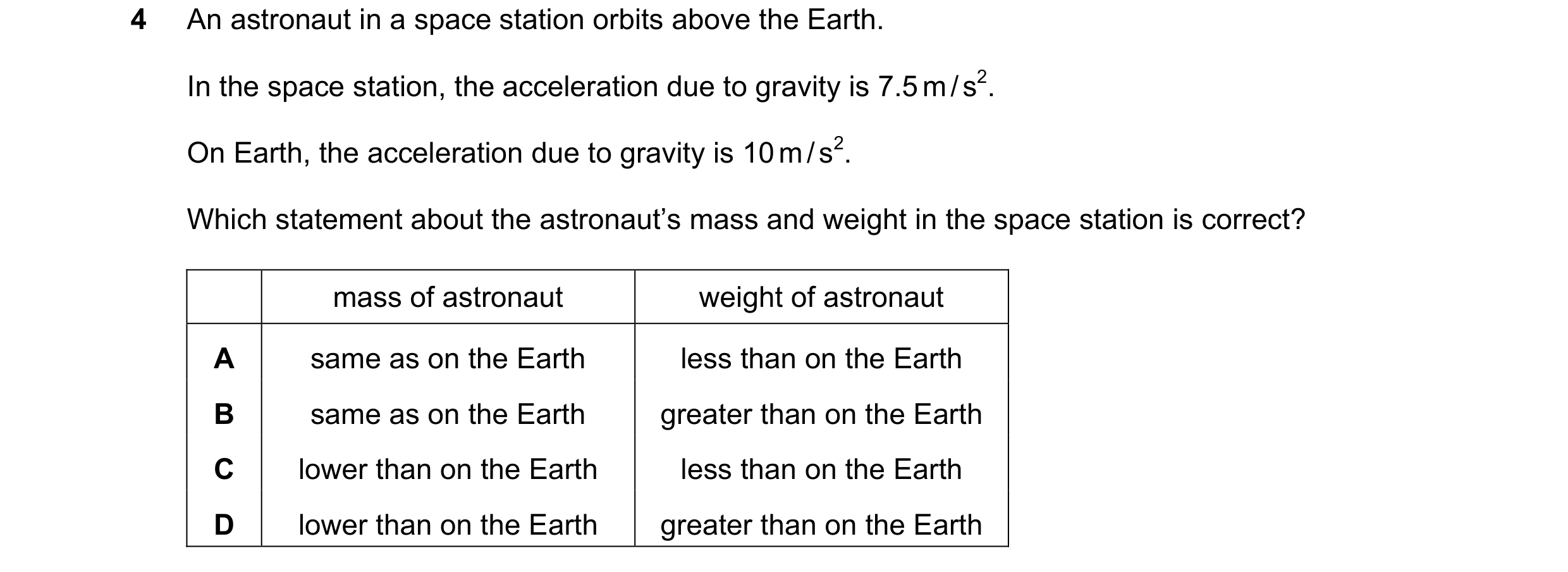
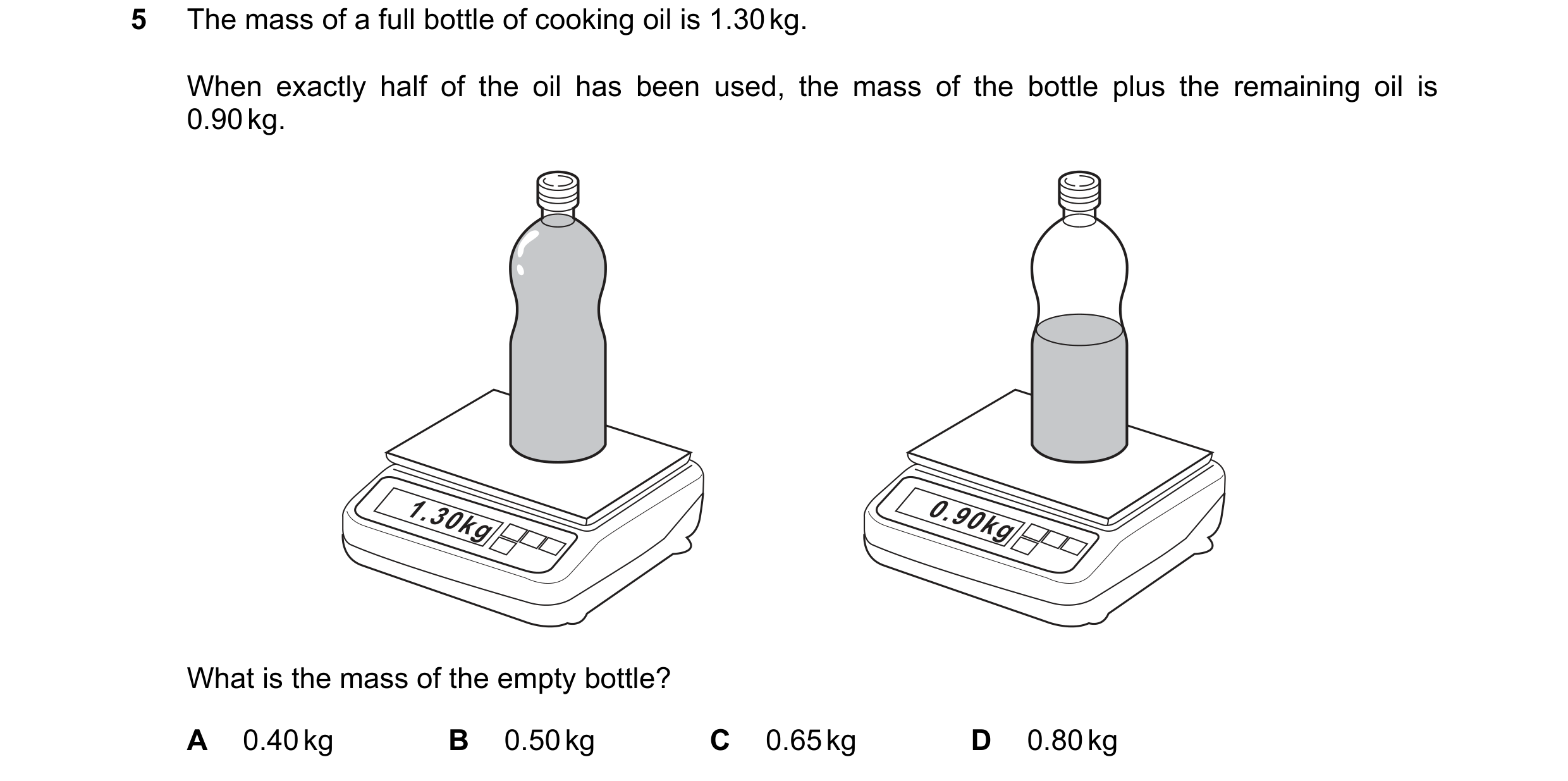
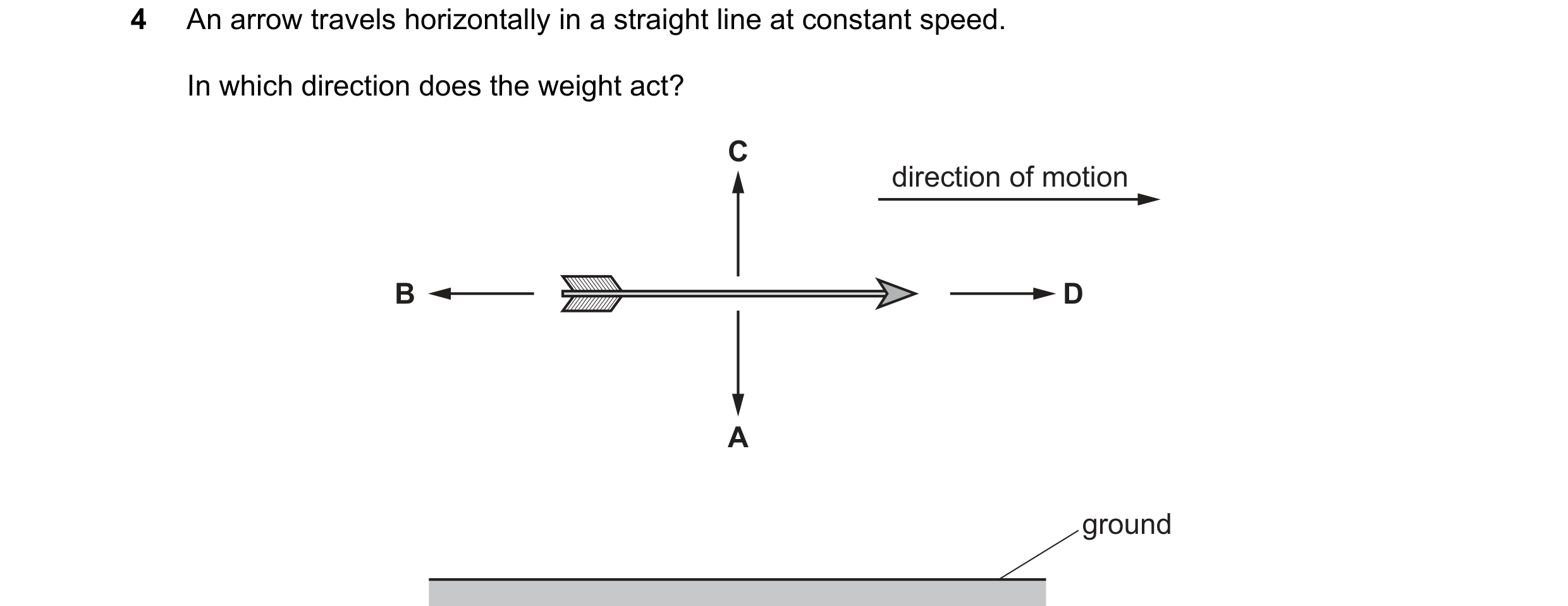 35 / 54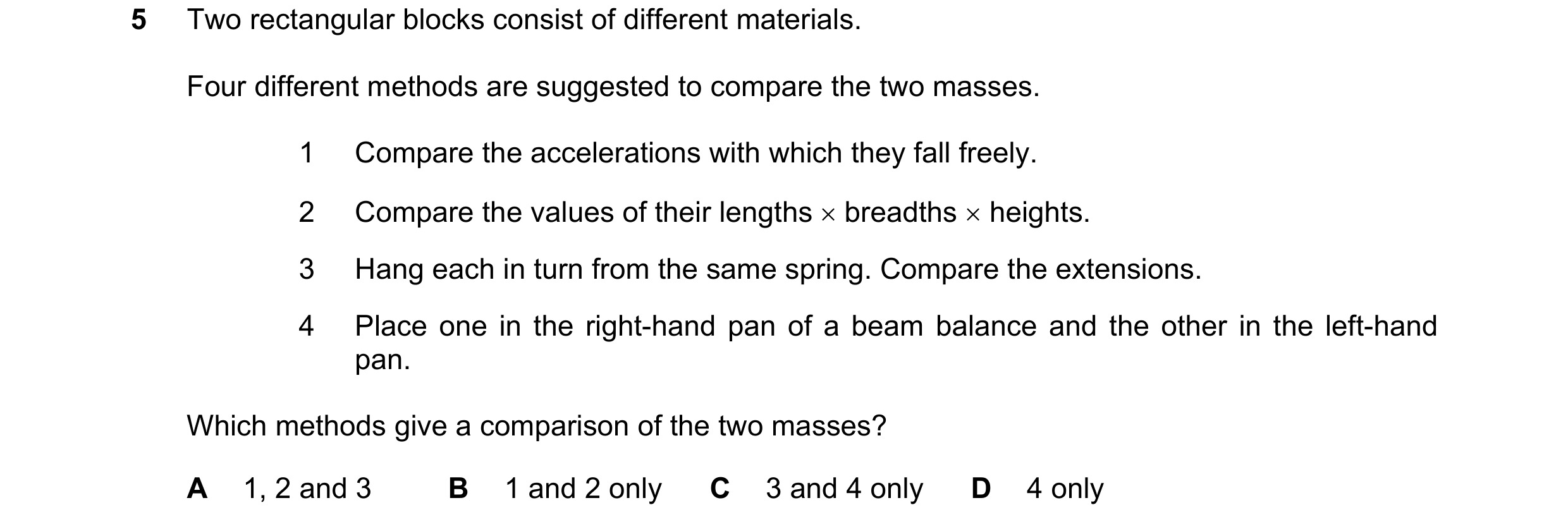
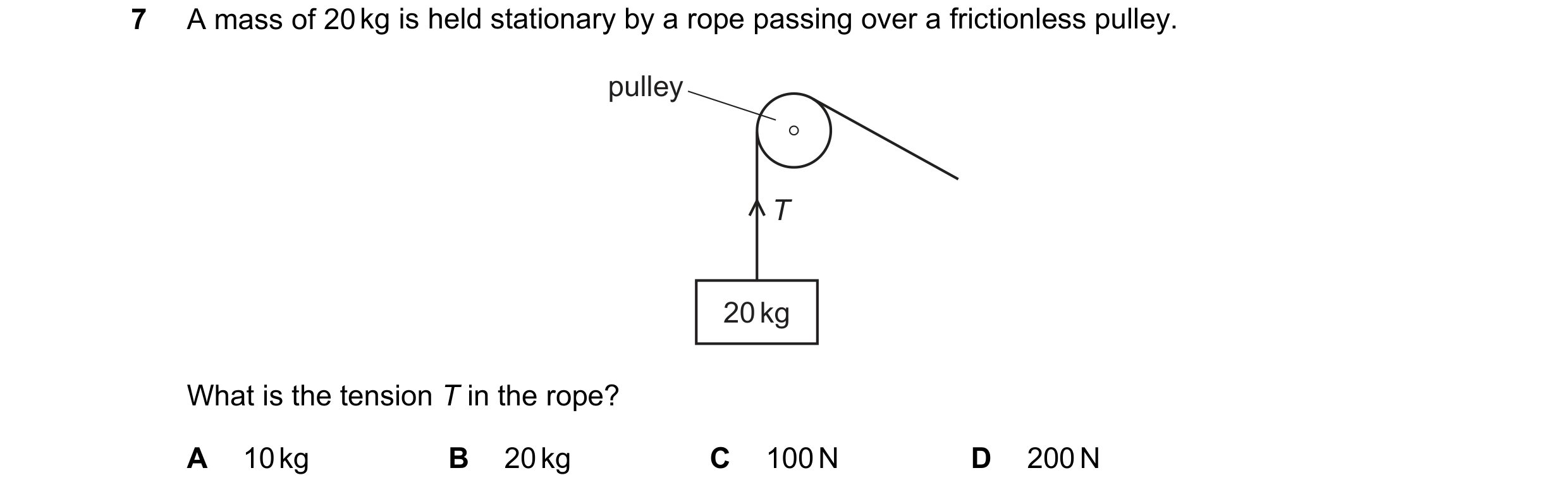
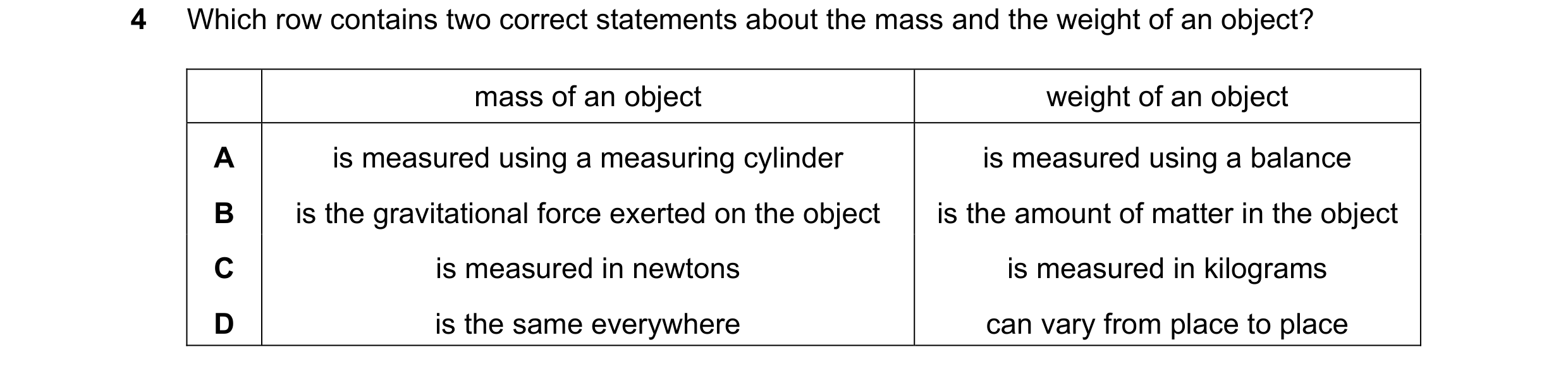
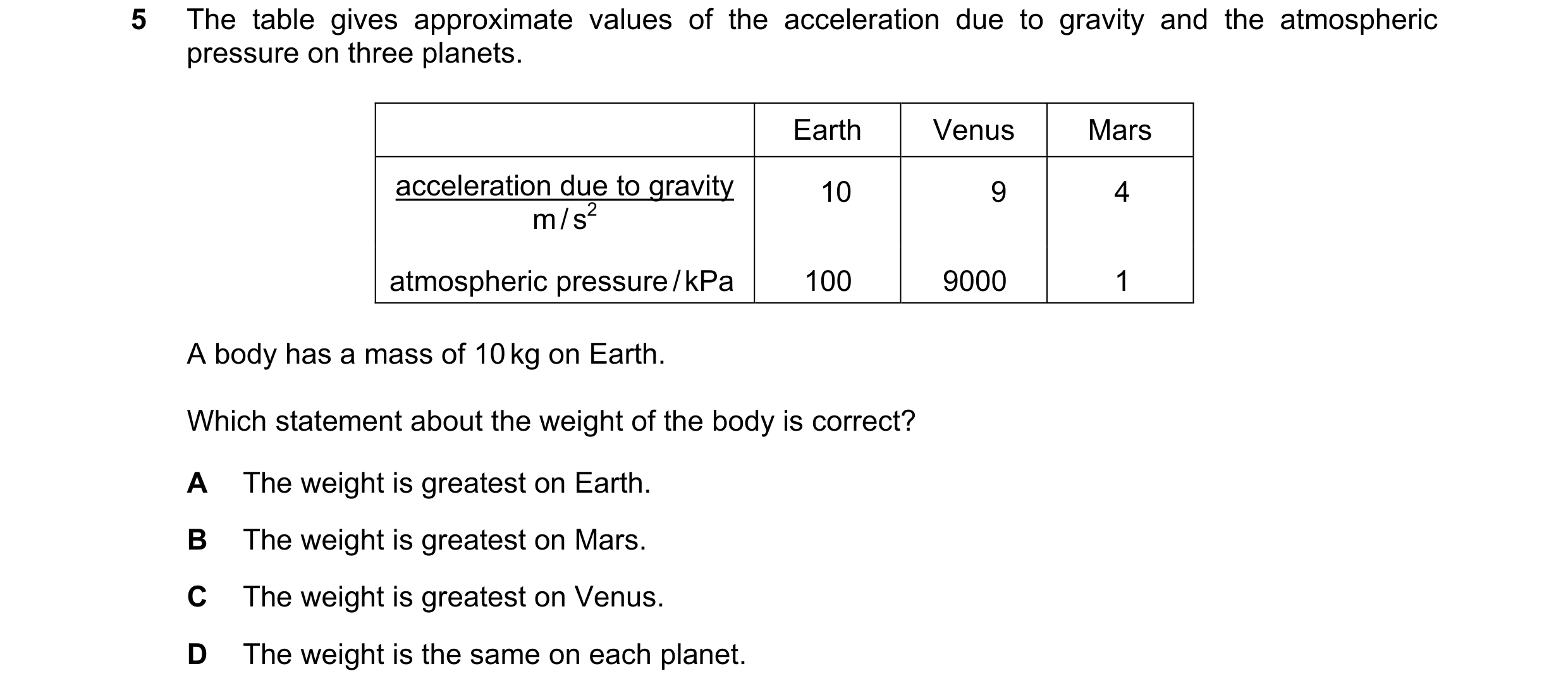 36 / 54
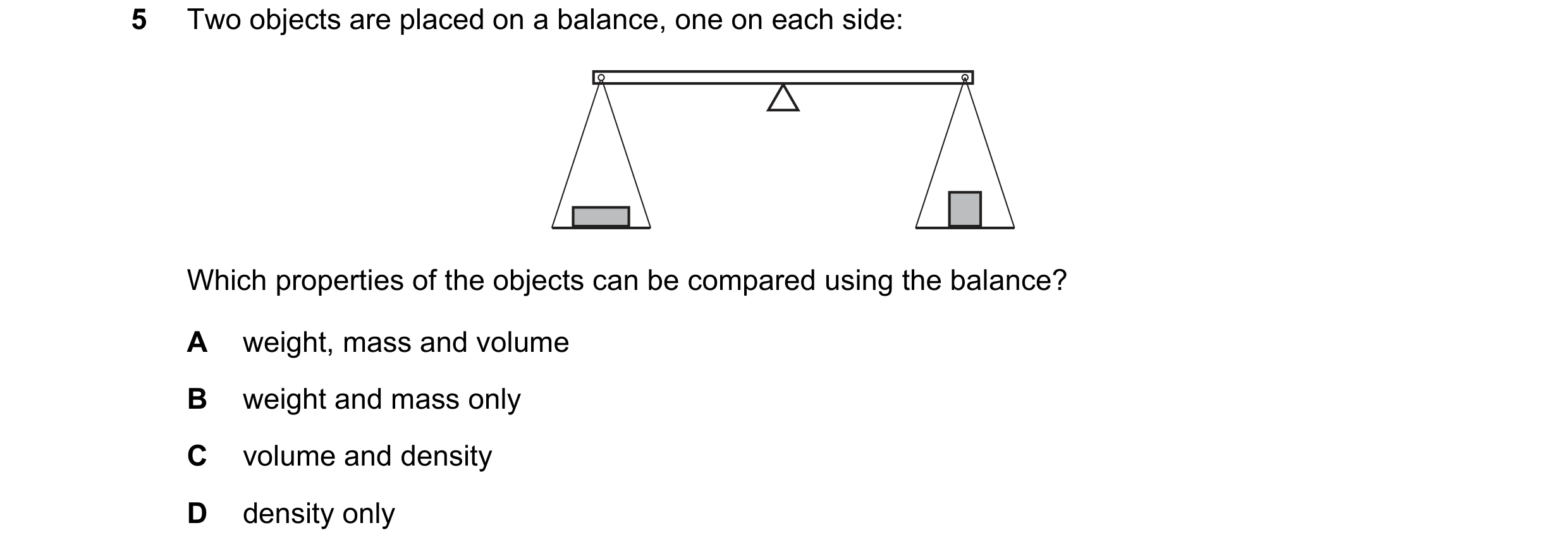

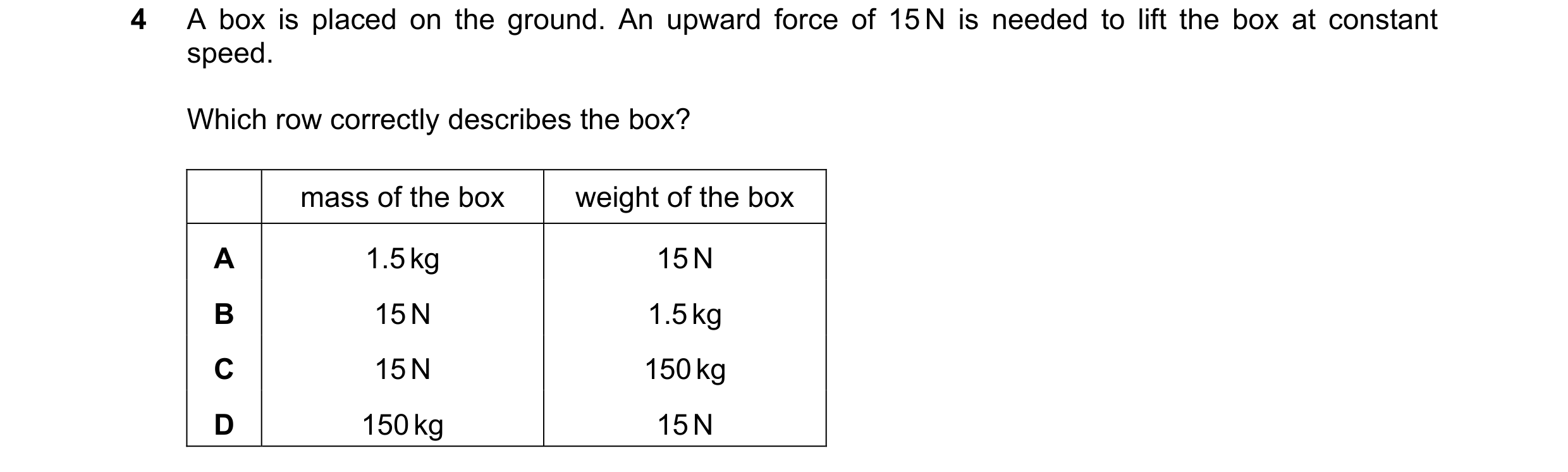
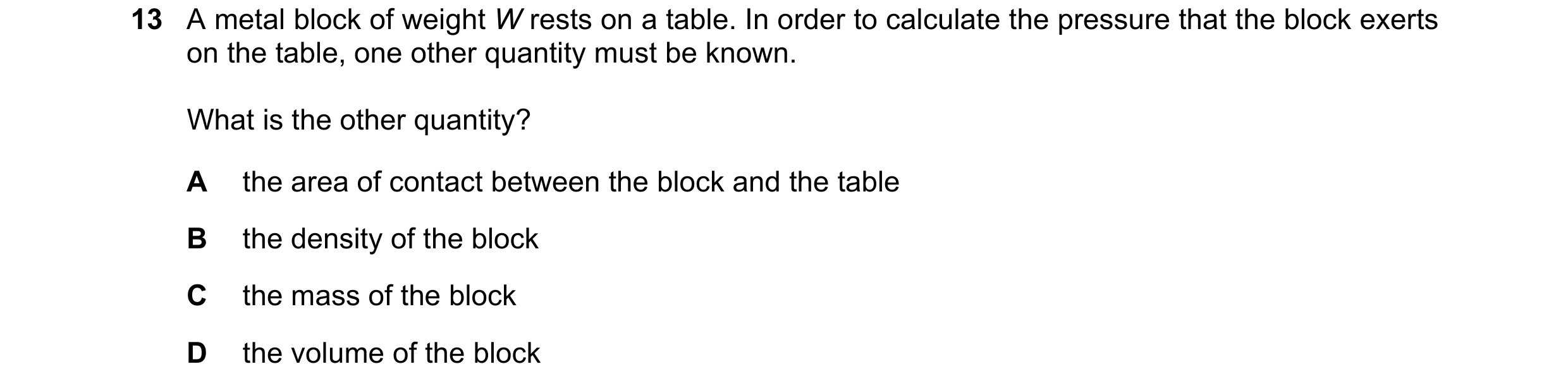 37 / 54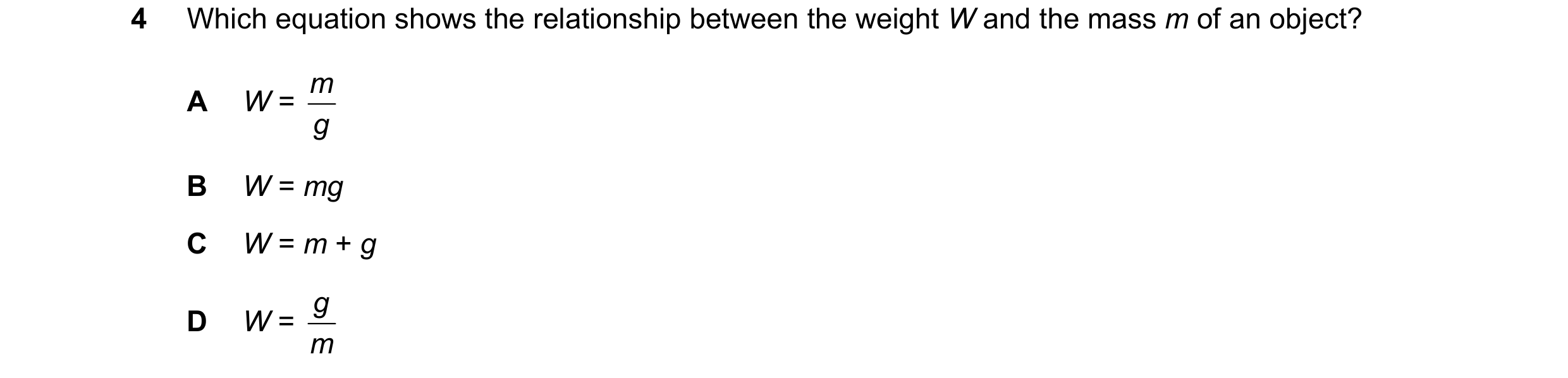
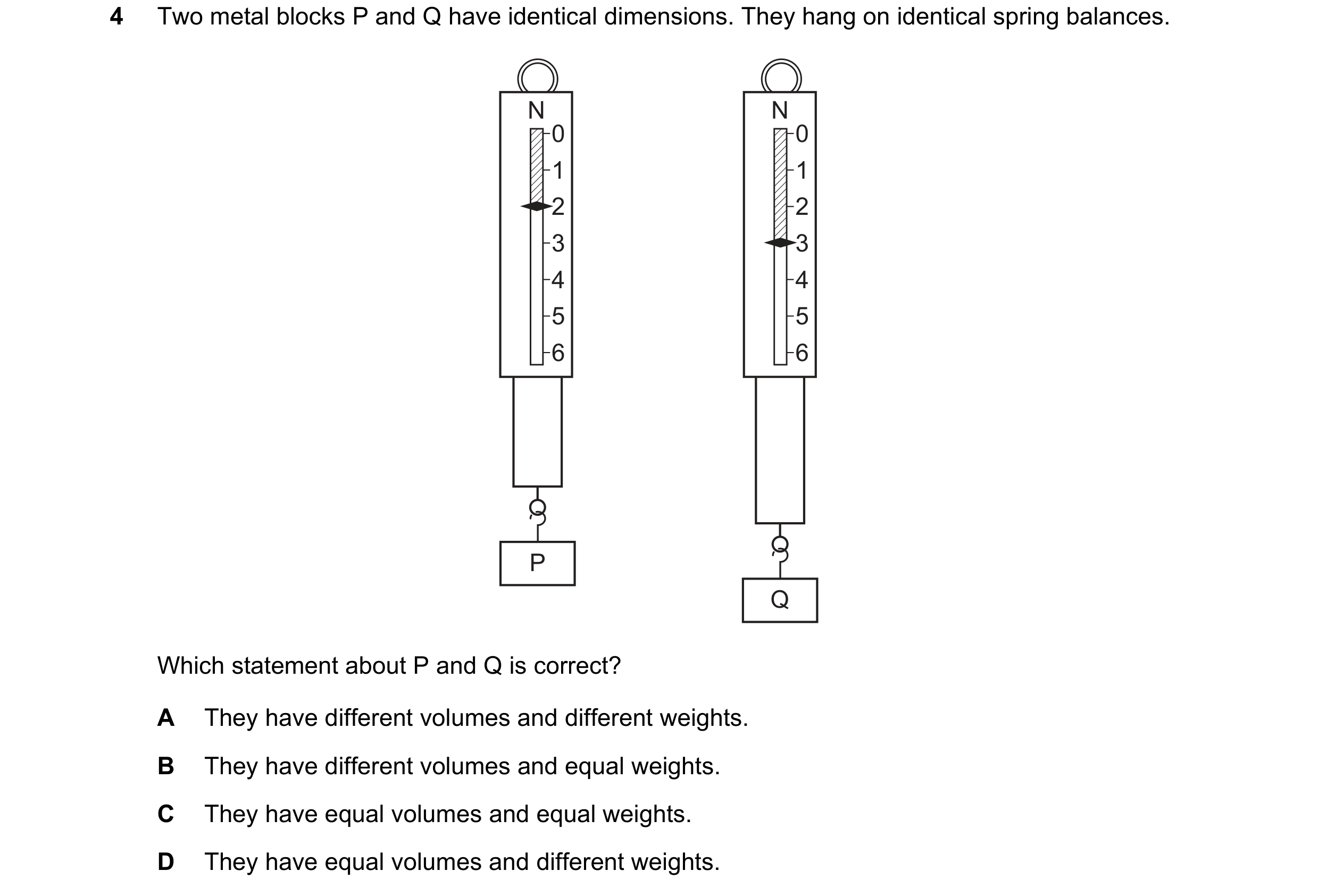
 38 / 54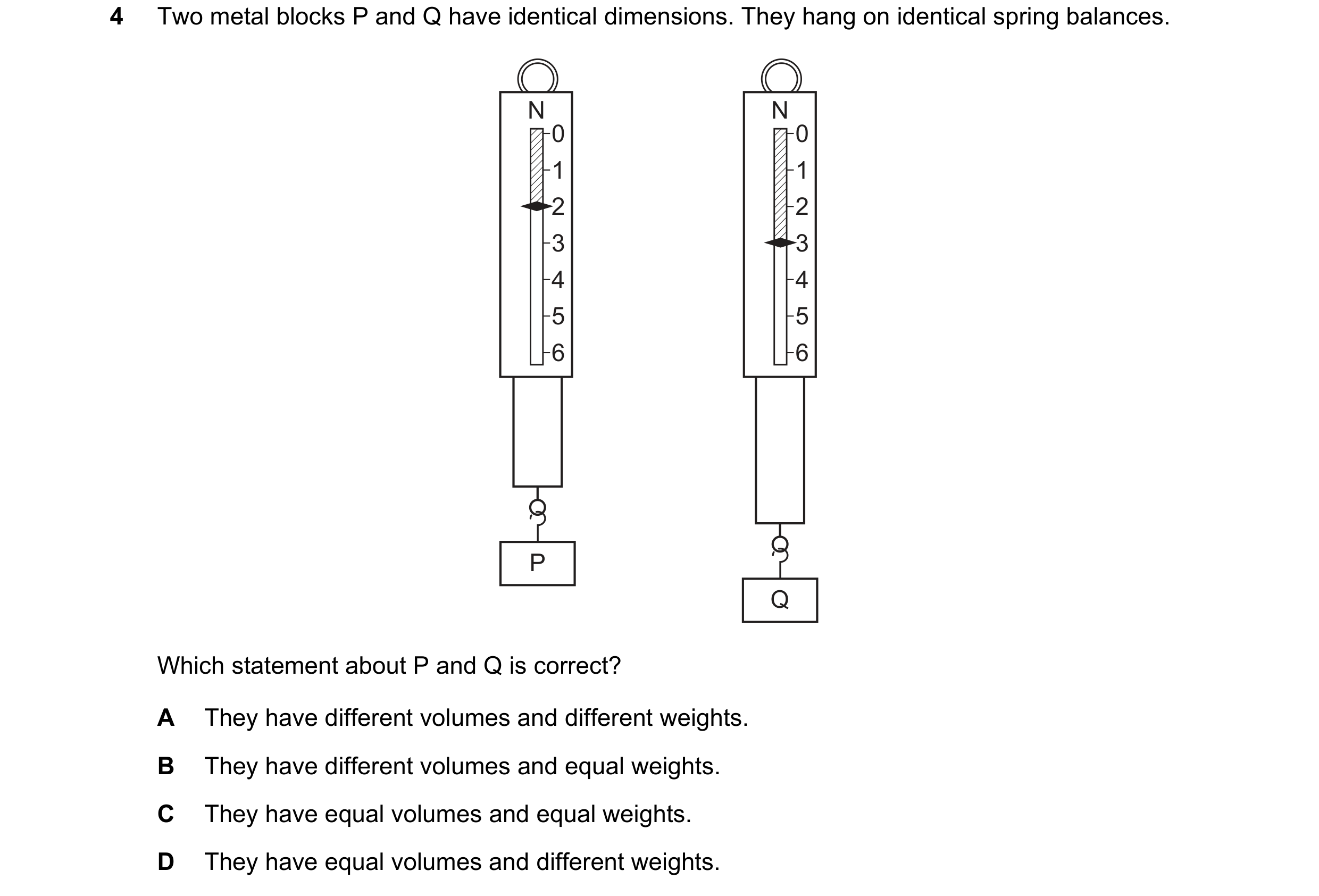
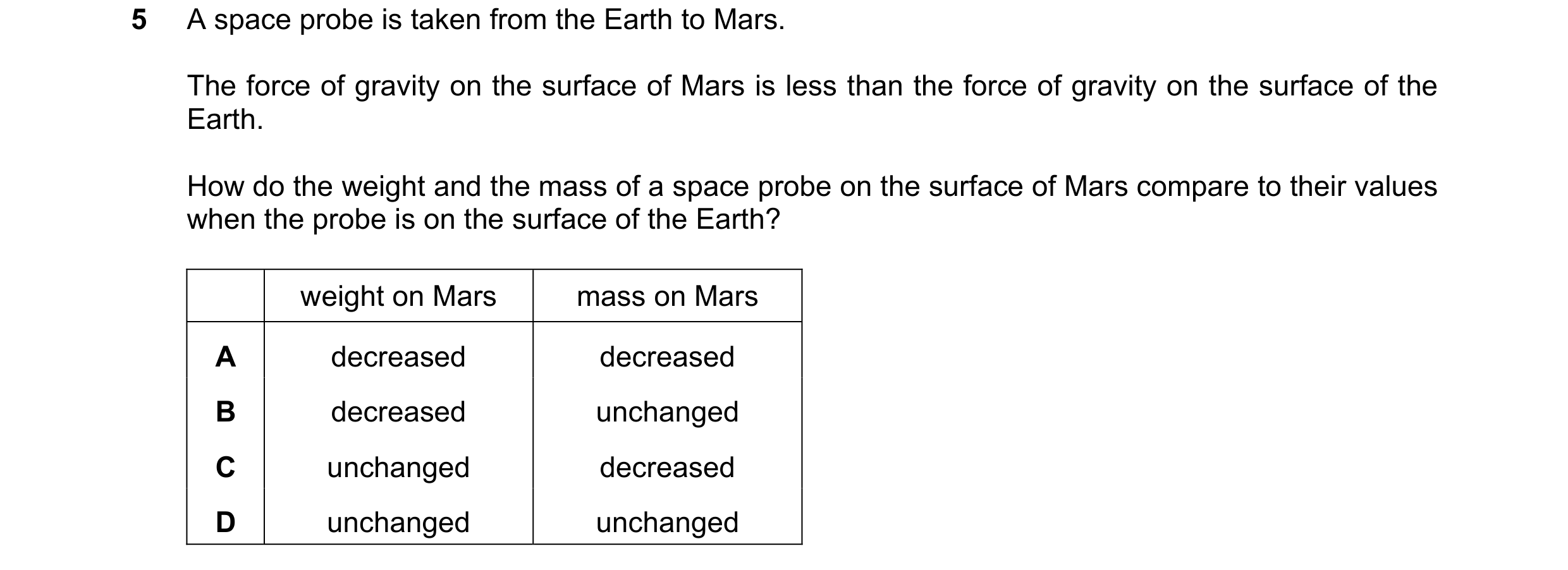 39 / 54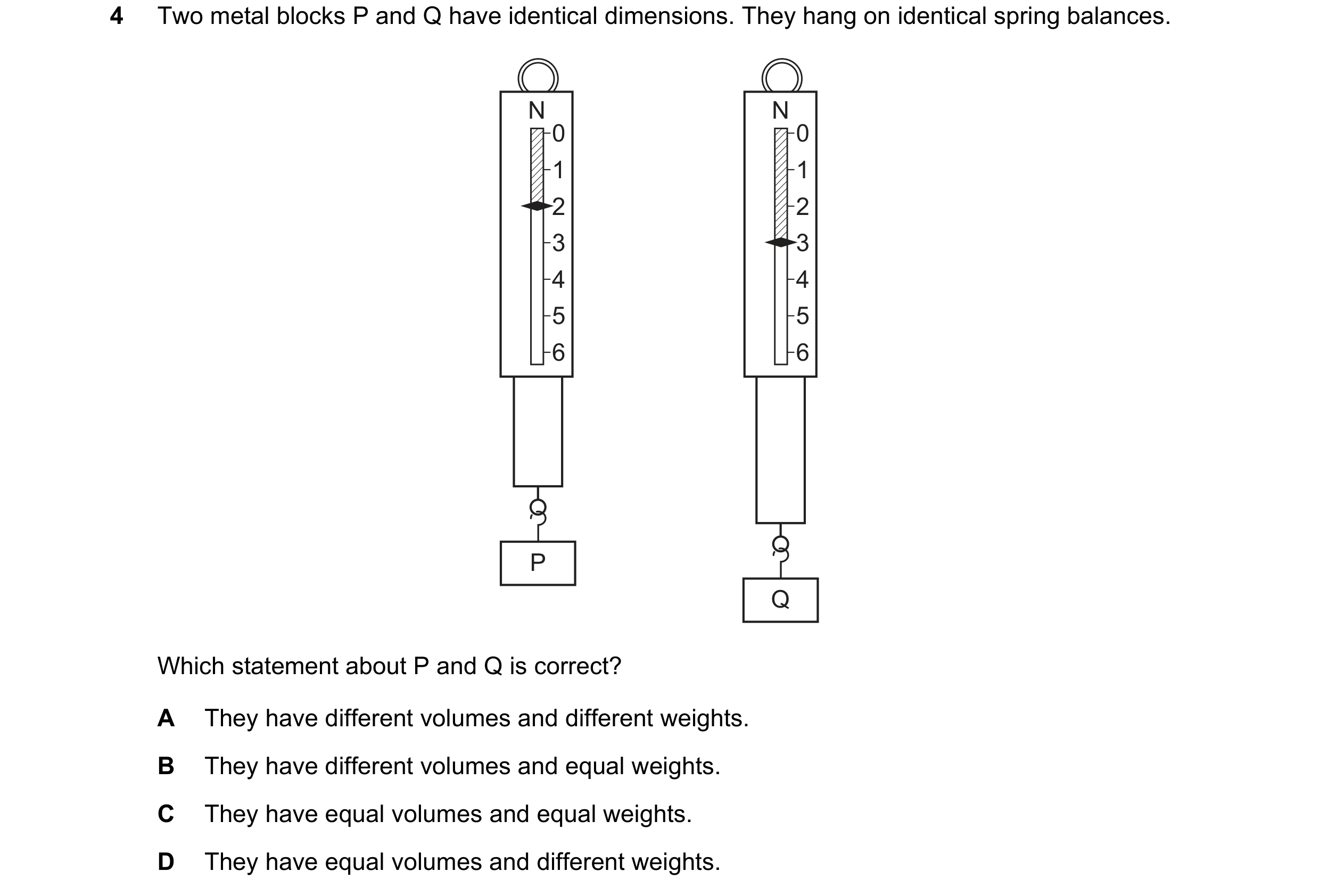
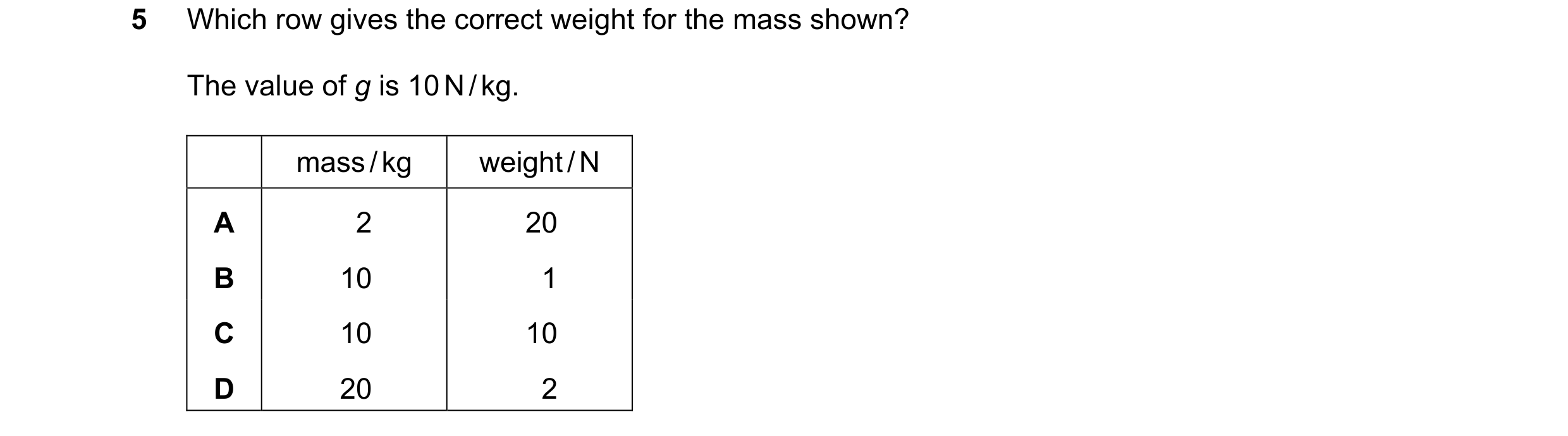
 40 / 54
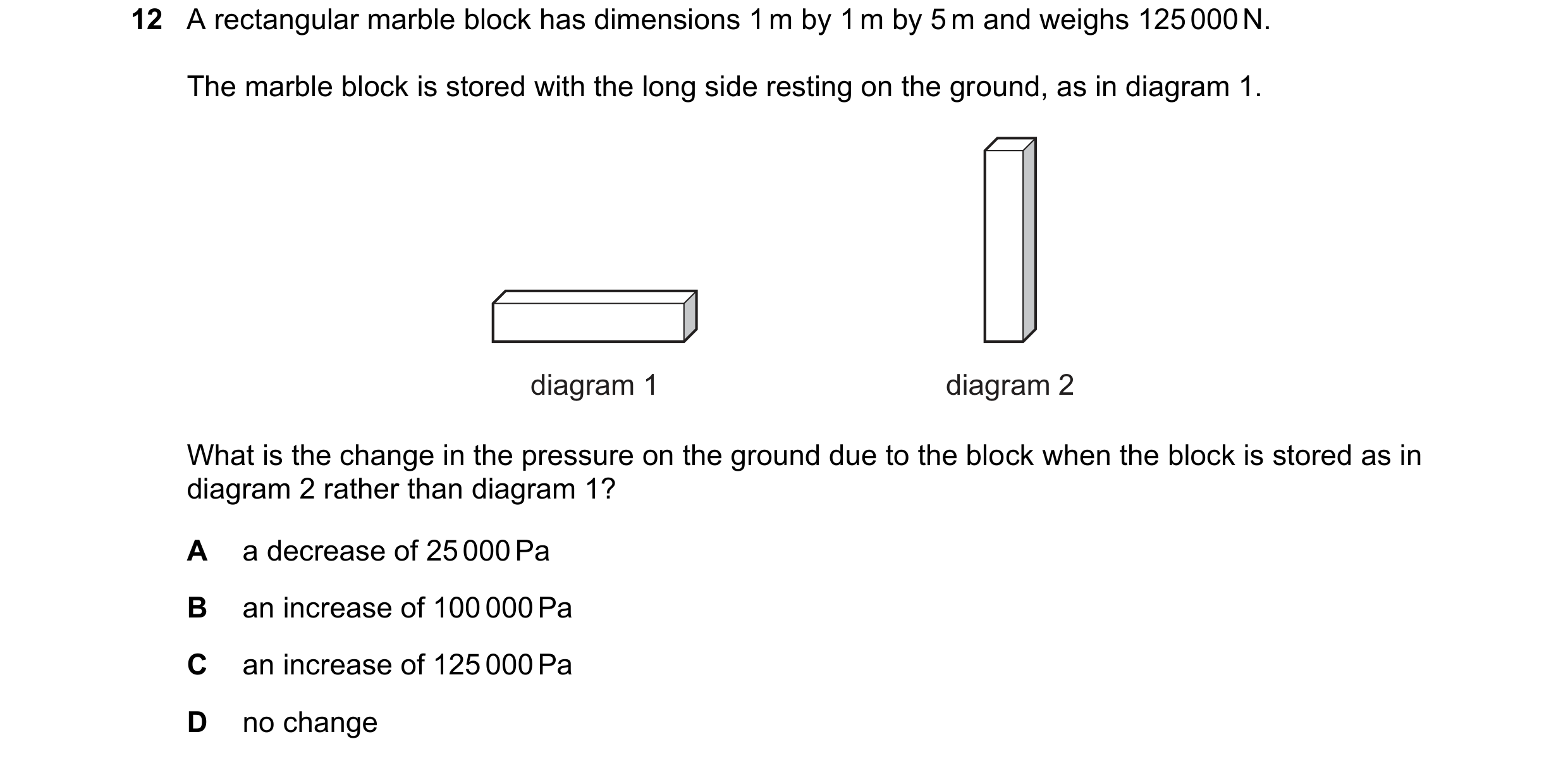


 41 / 54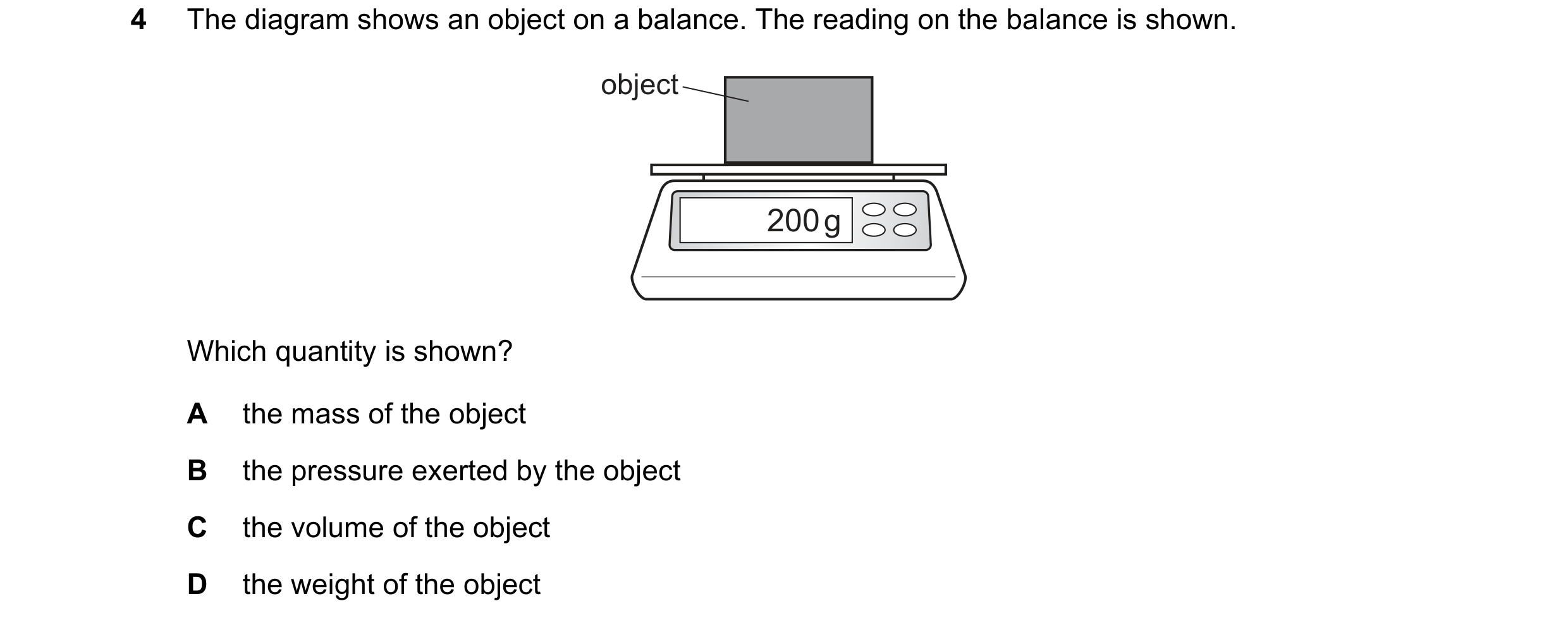

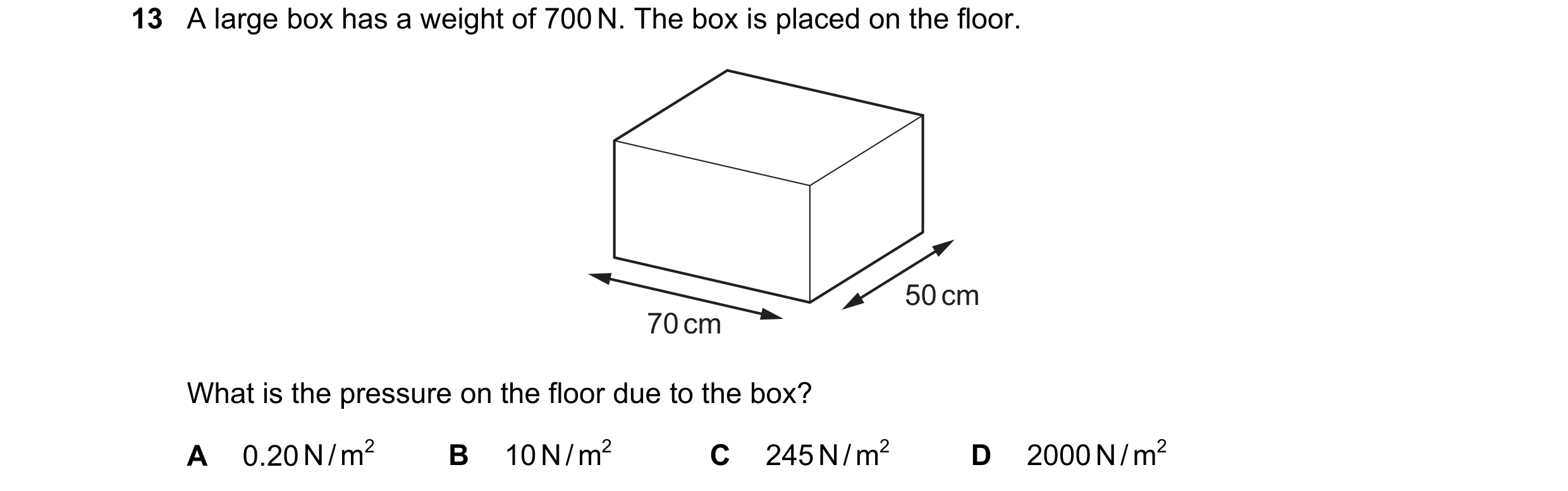

 42 / 54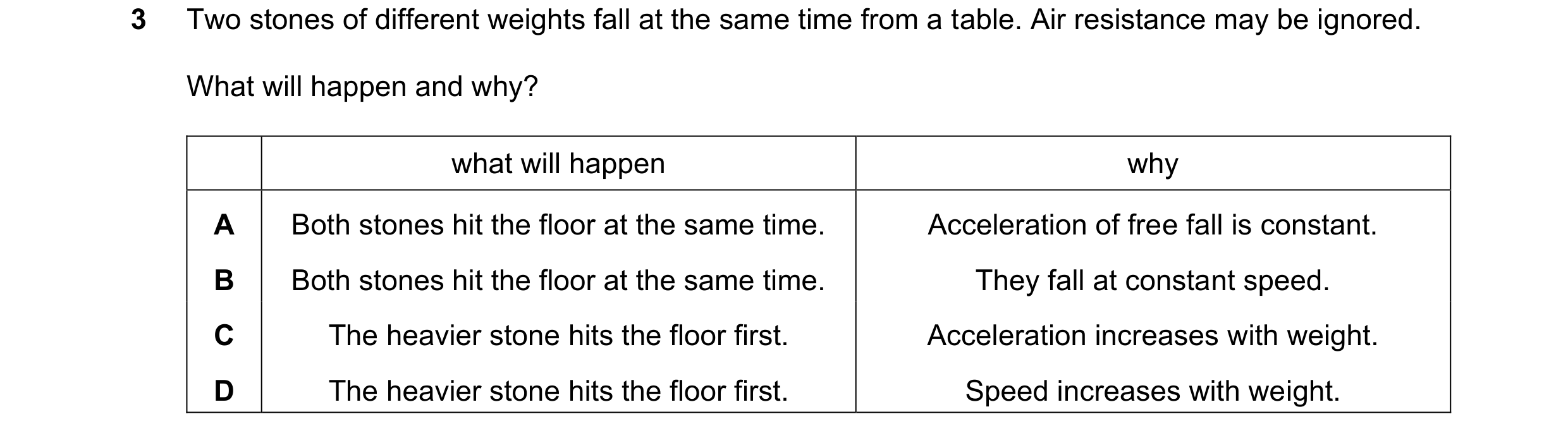
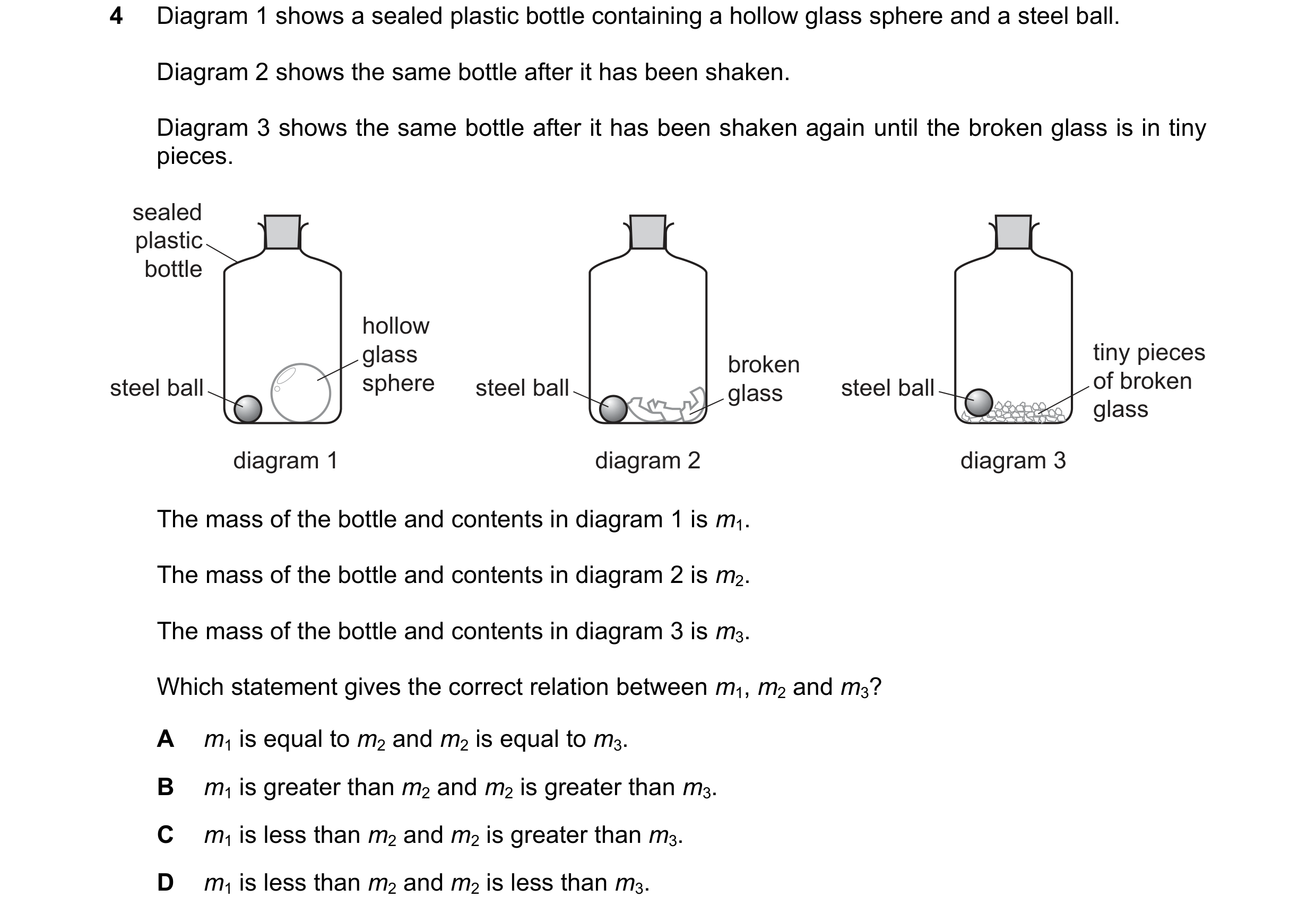
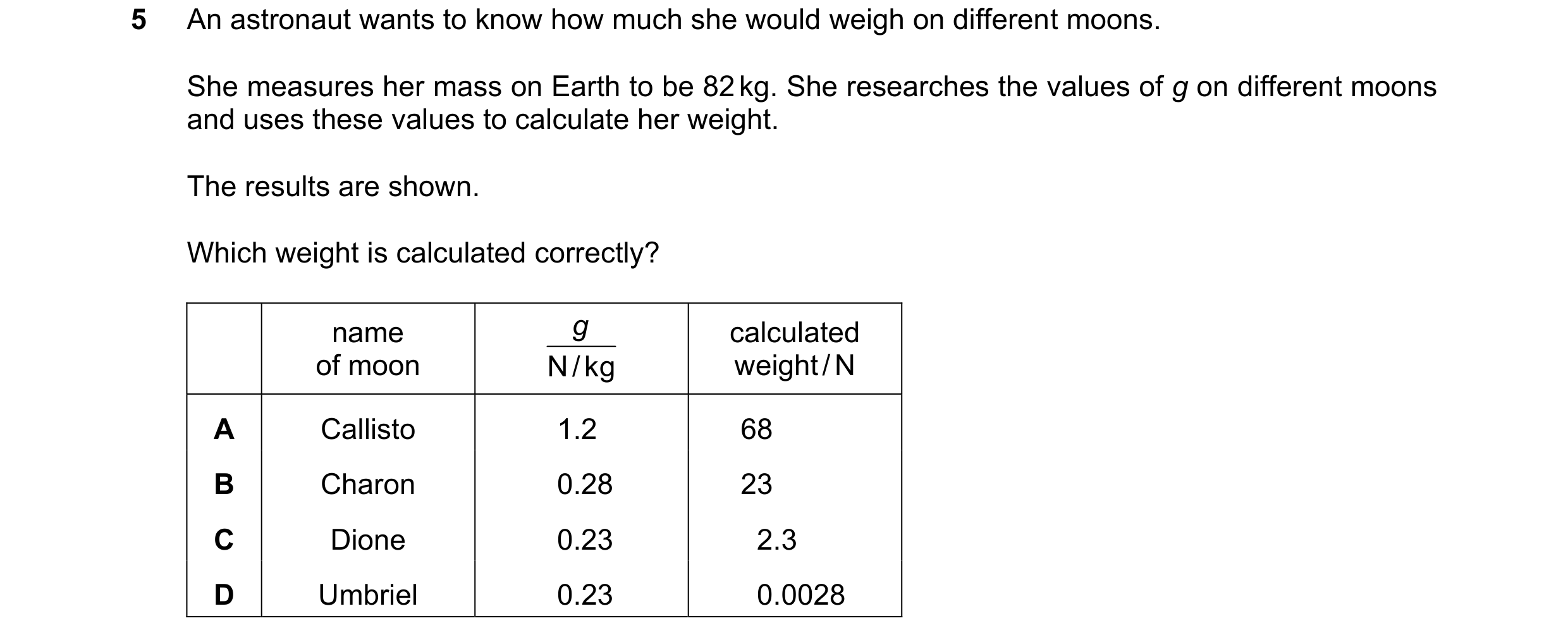 43 / 54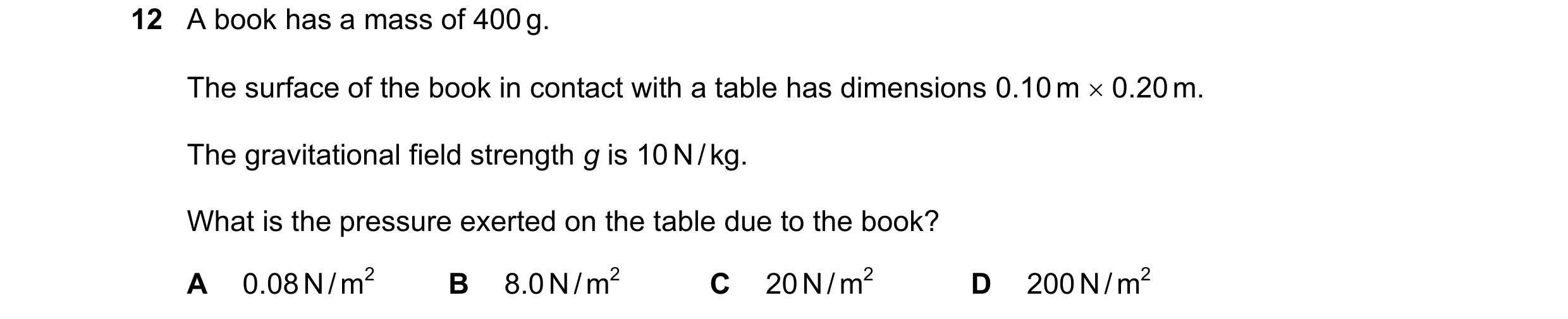
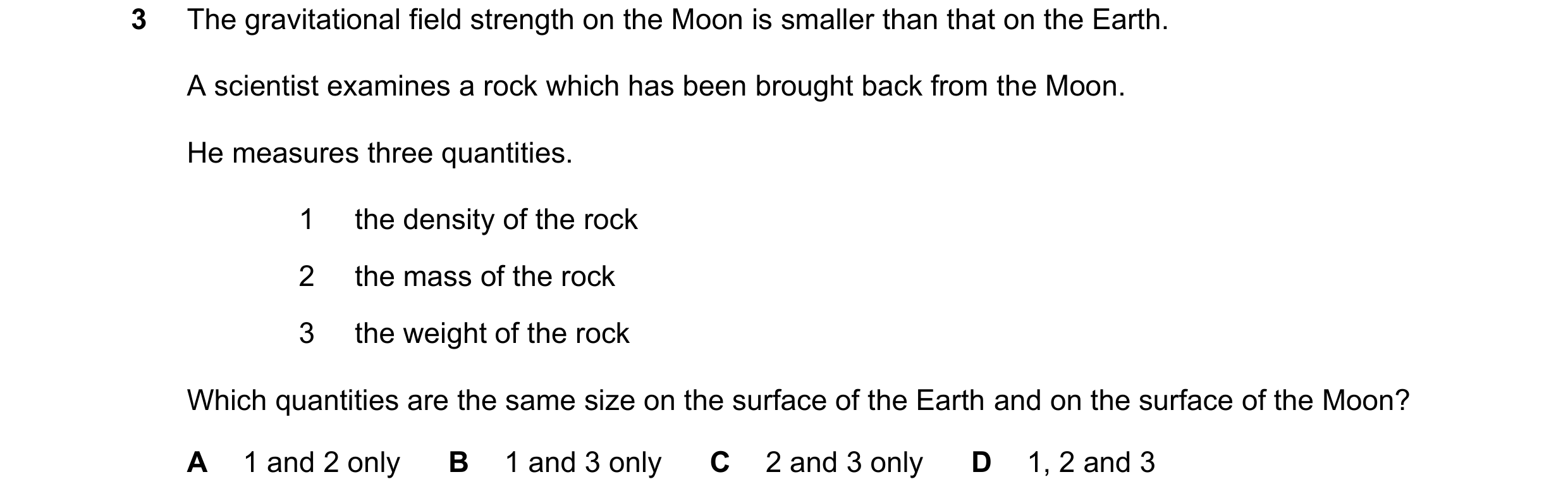
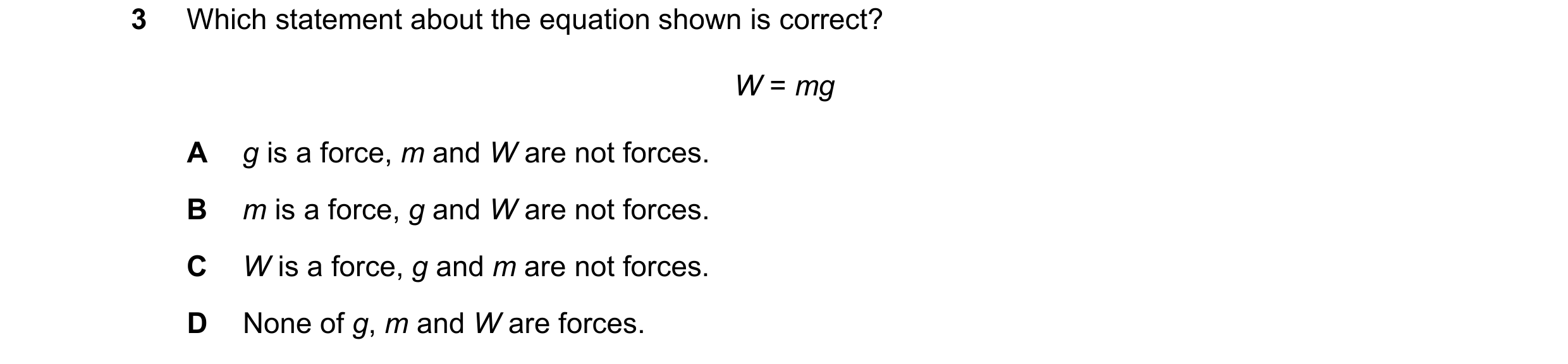
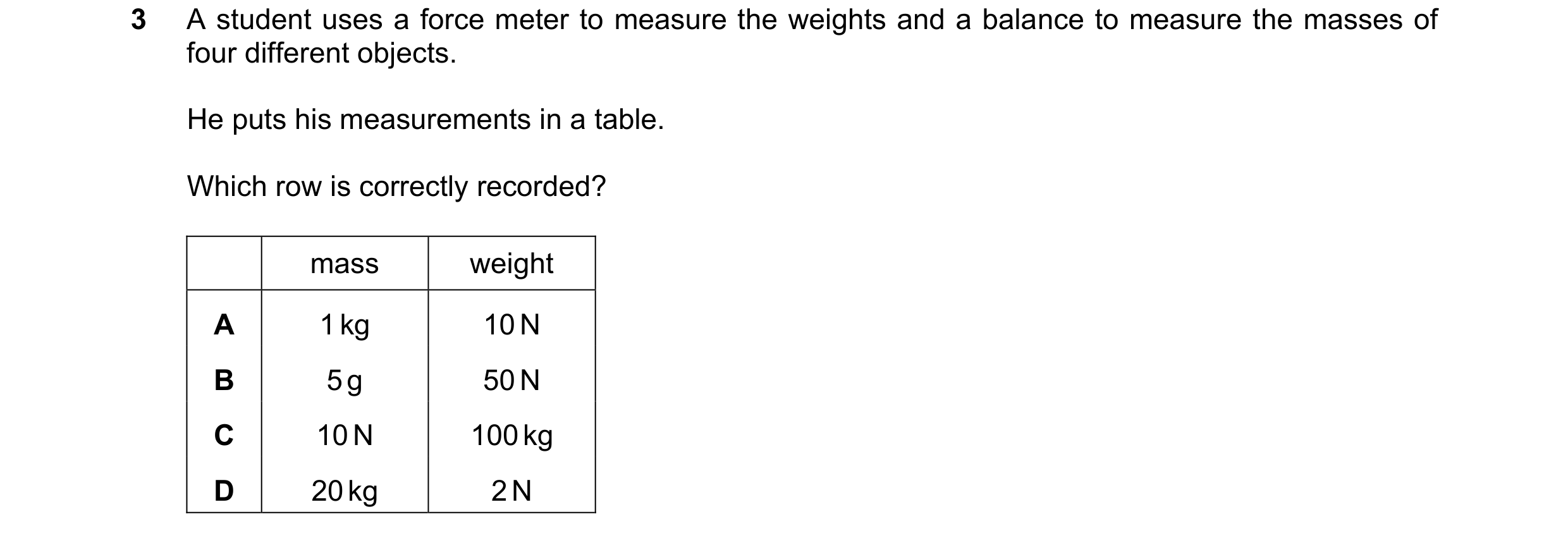
 44 / 54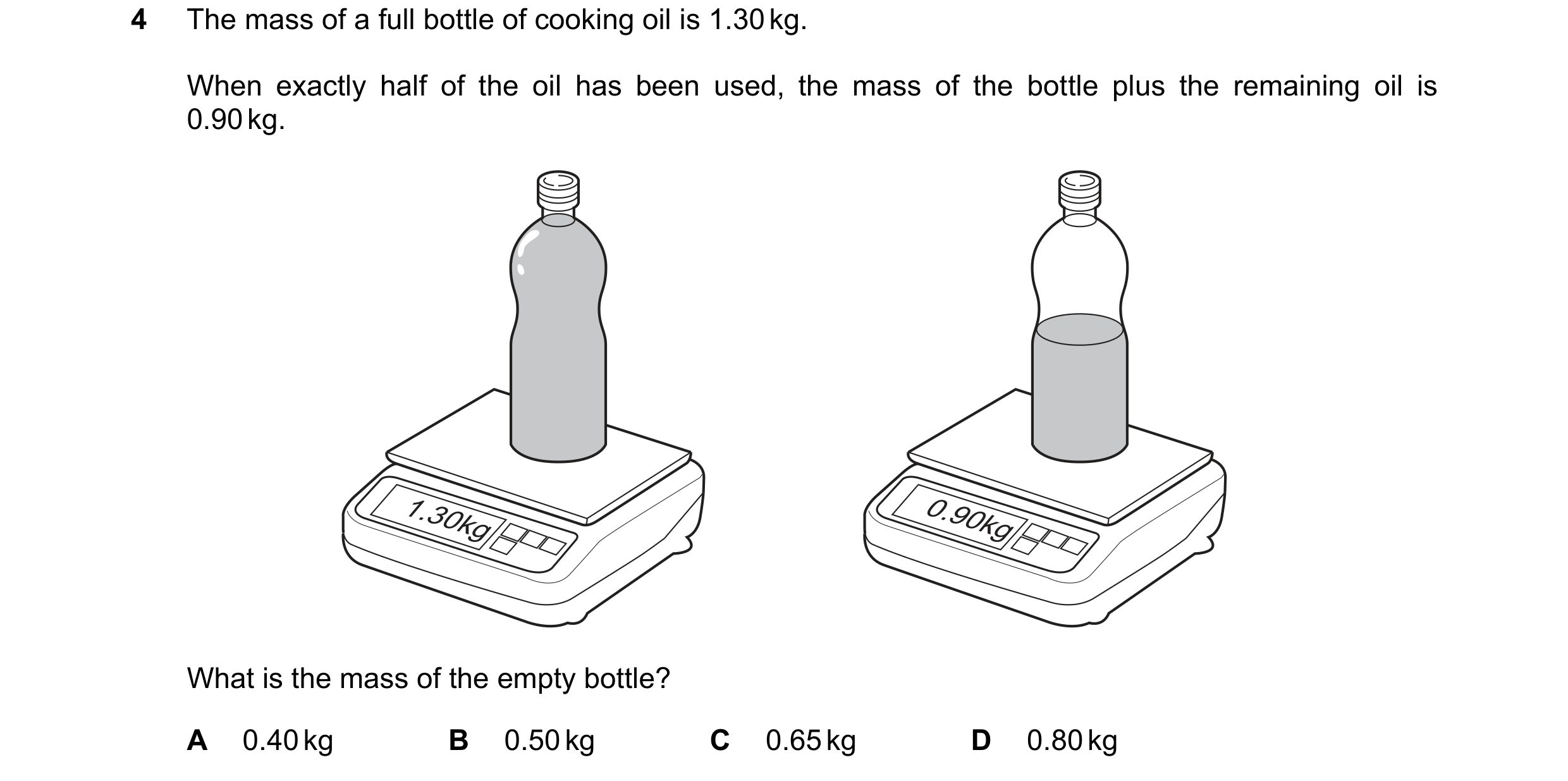

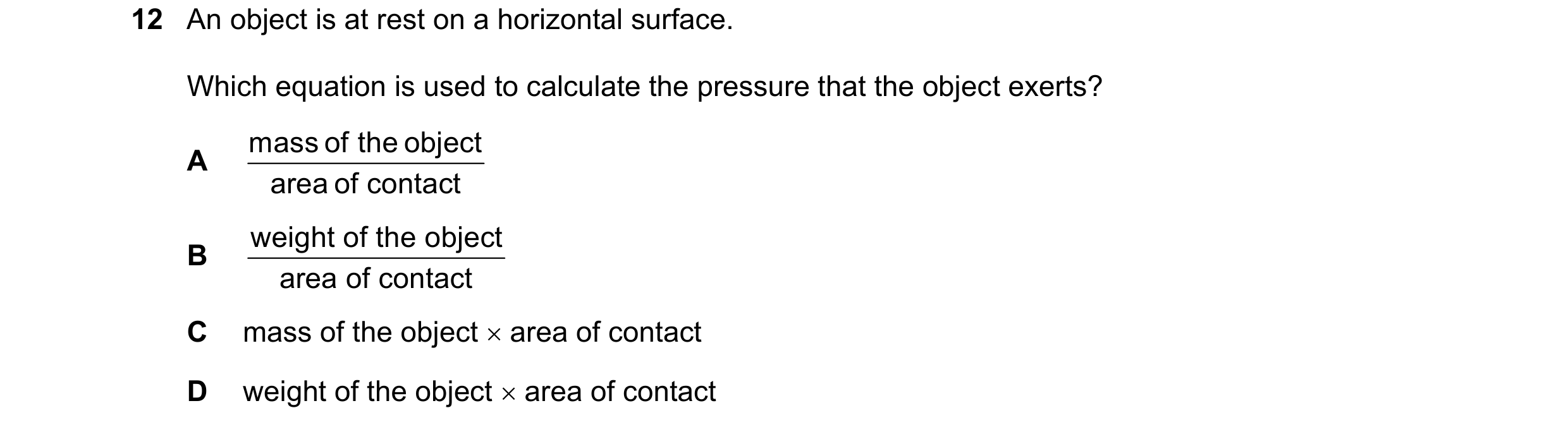 45 / 54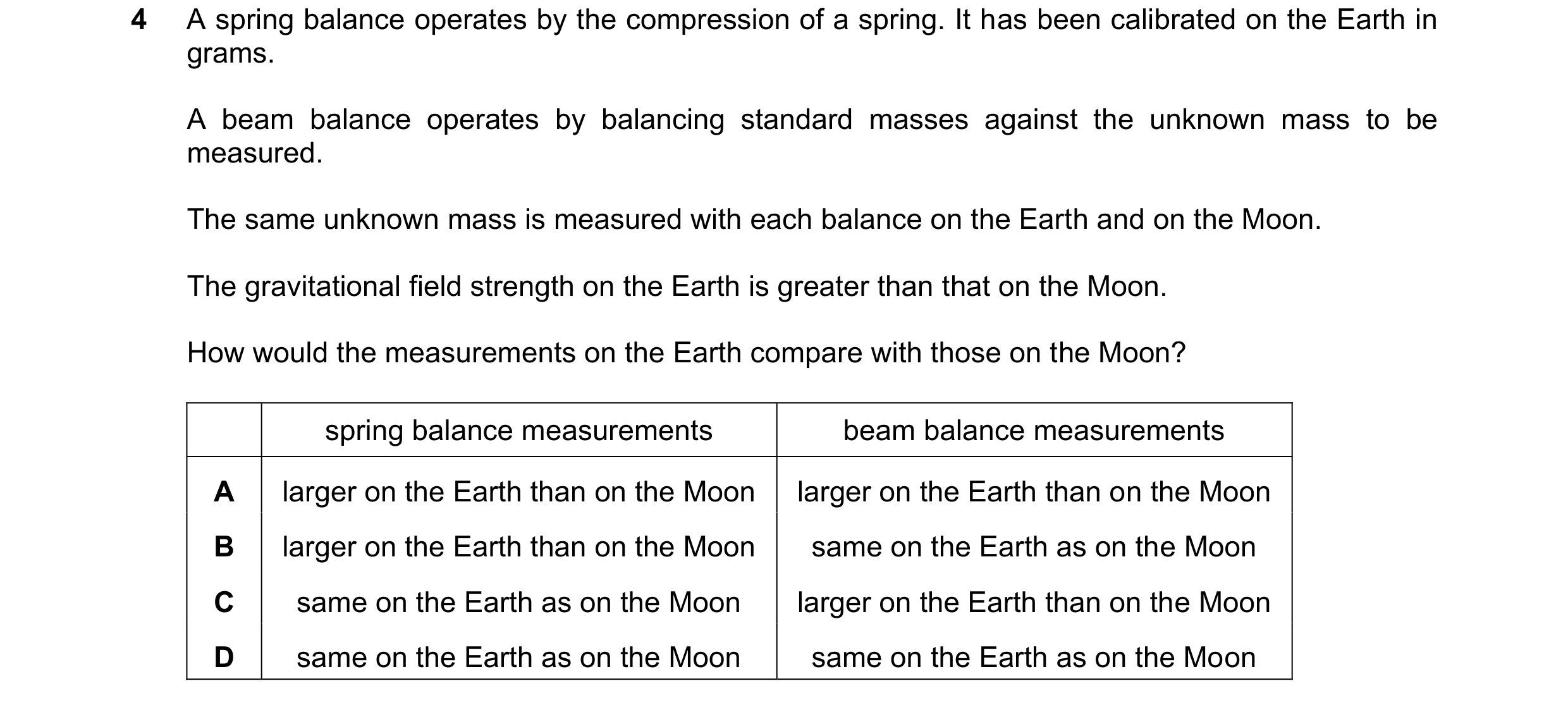
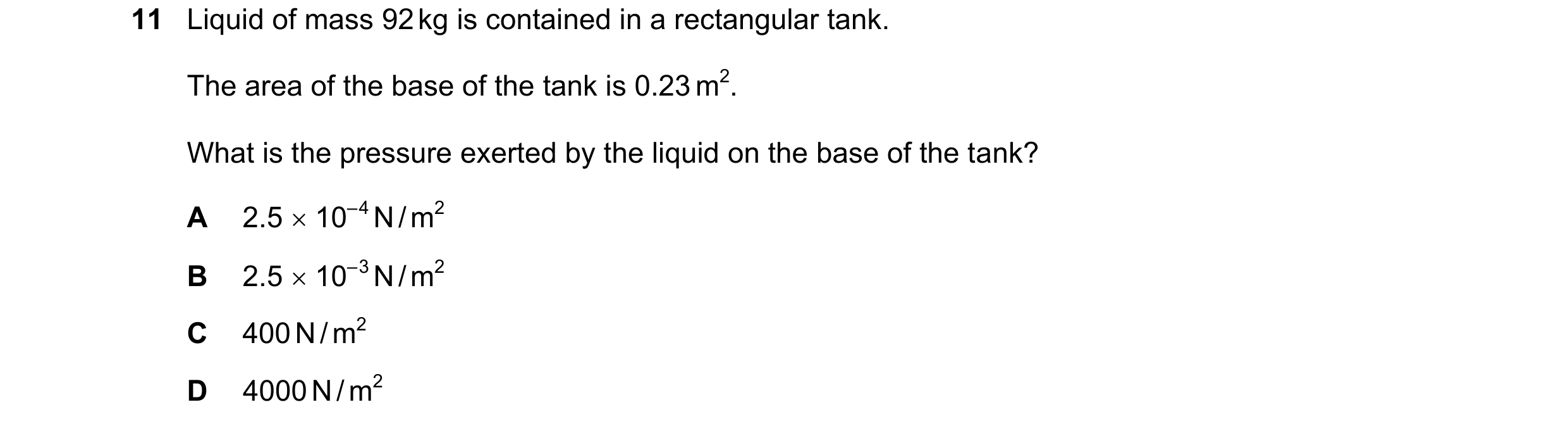
 46 / 54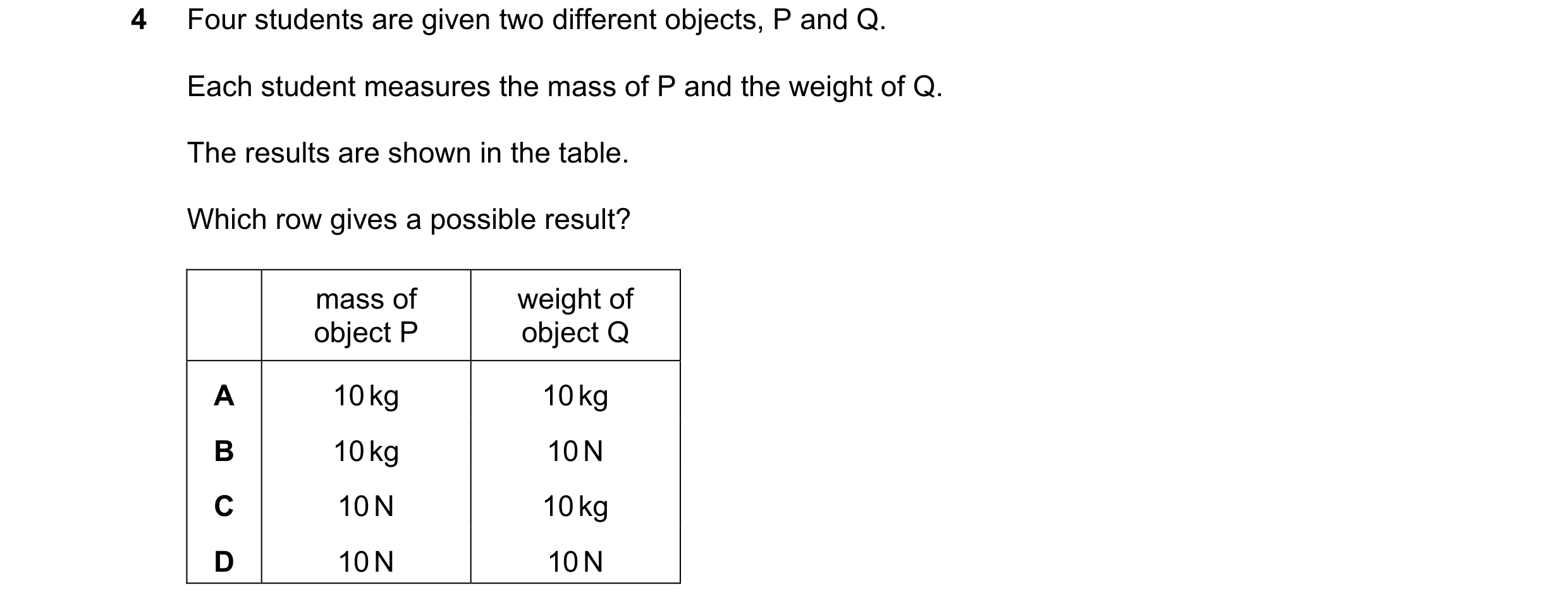
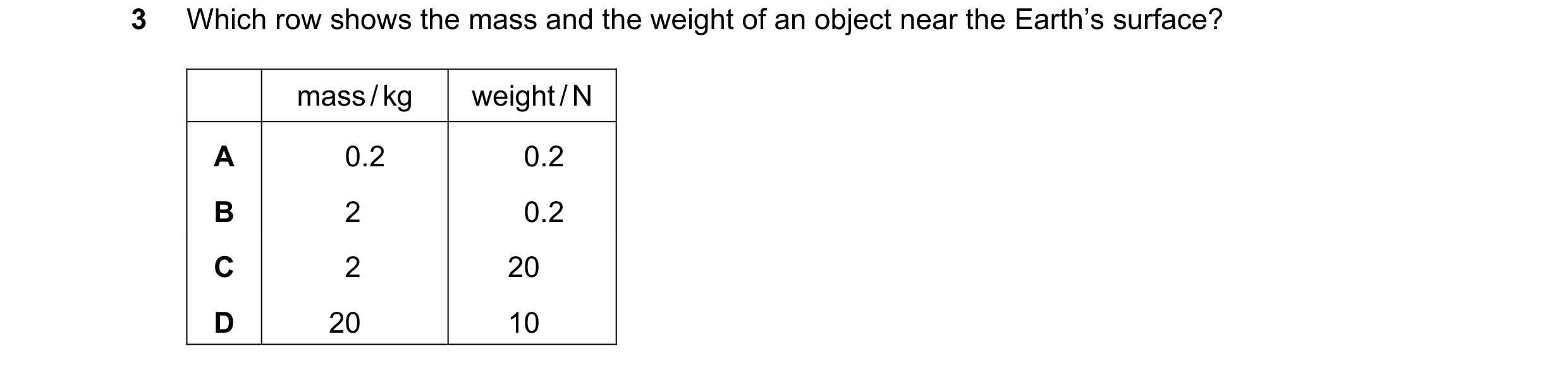
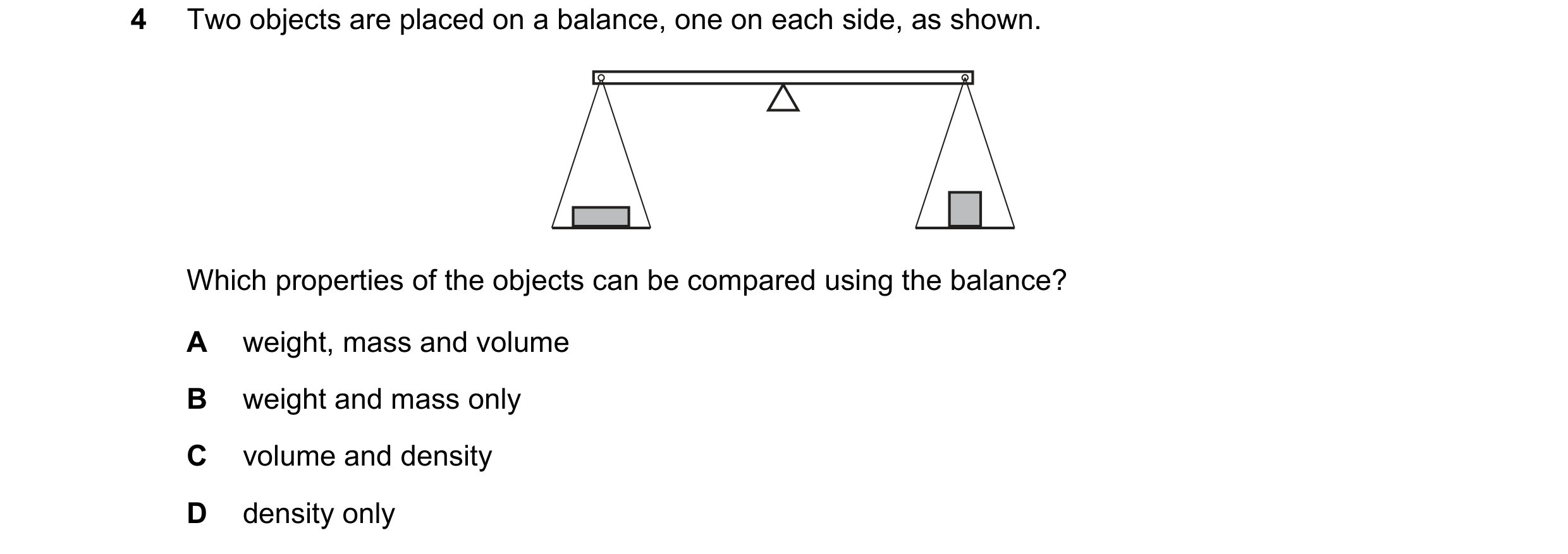 47 / 54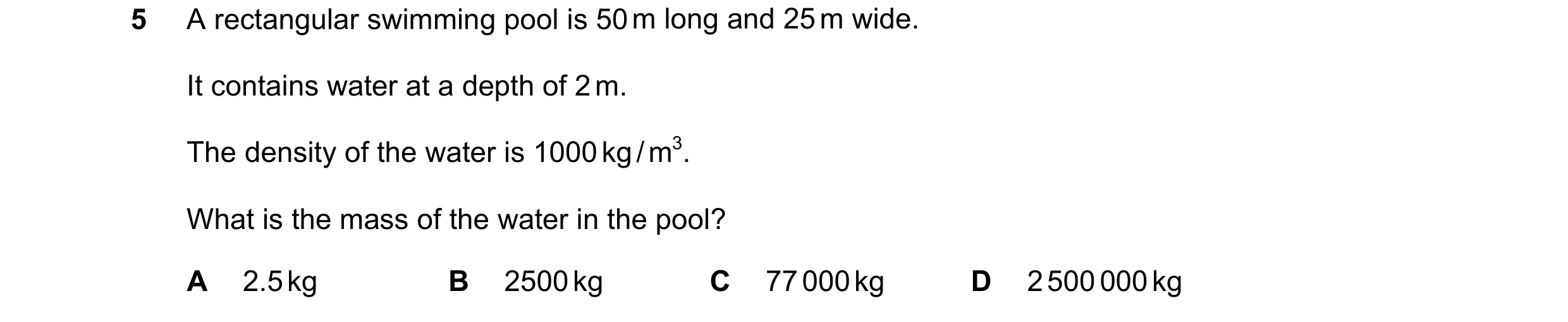
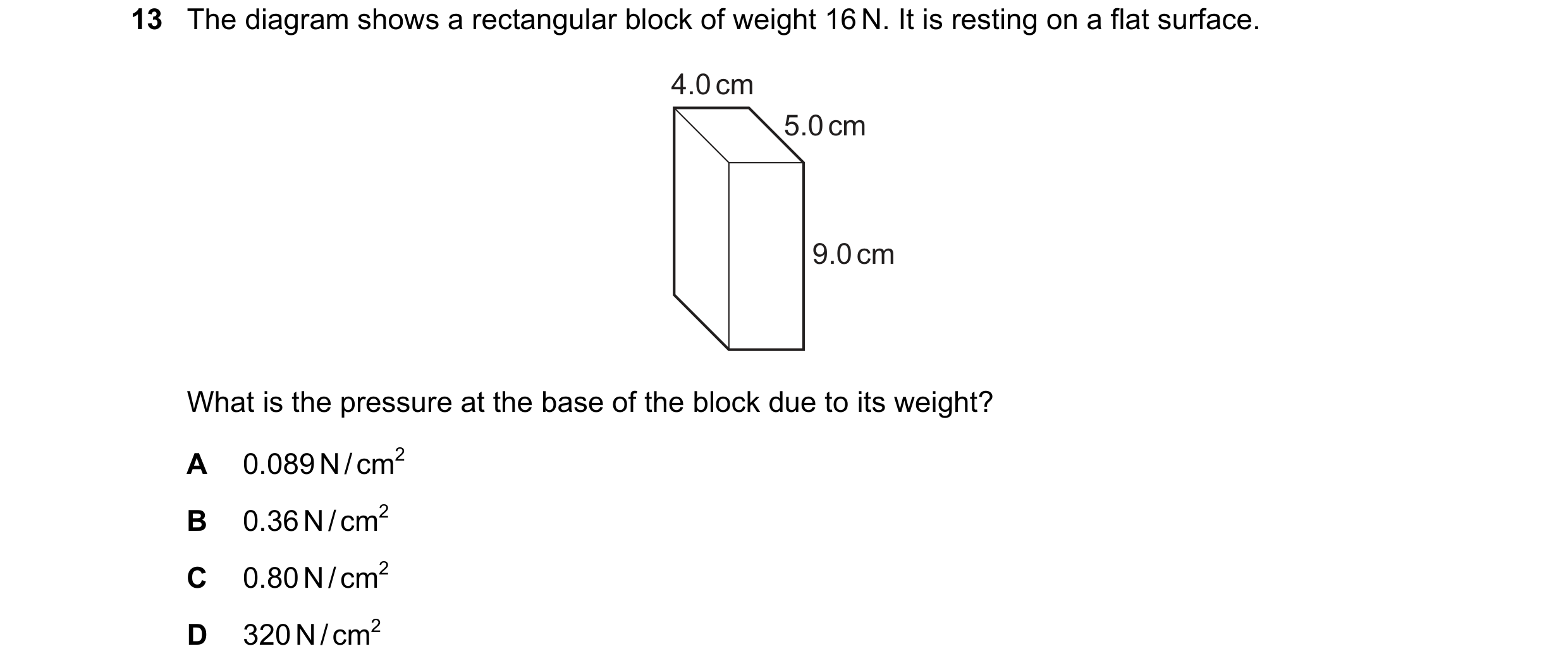

 48 / 54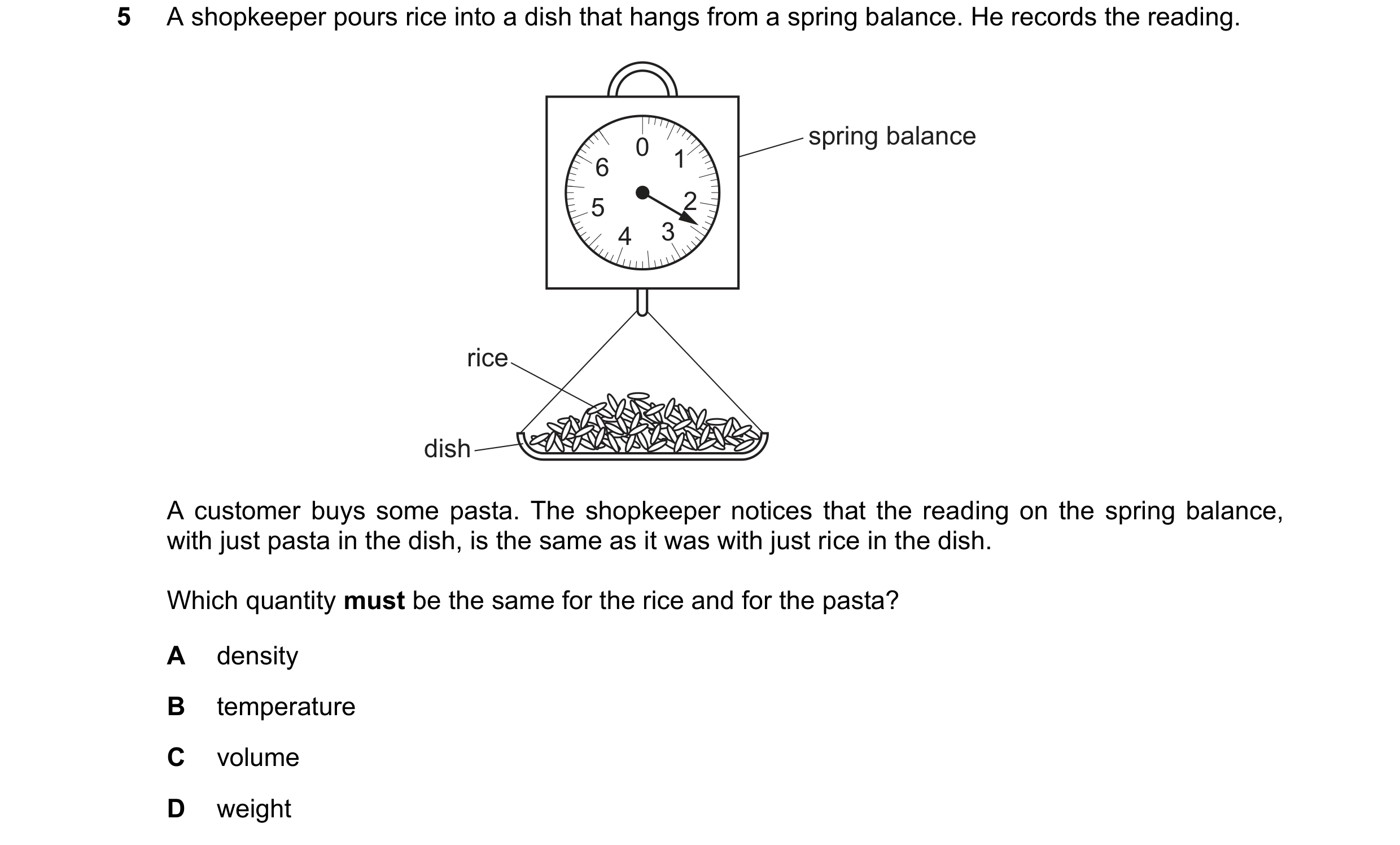

 49 / 54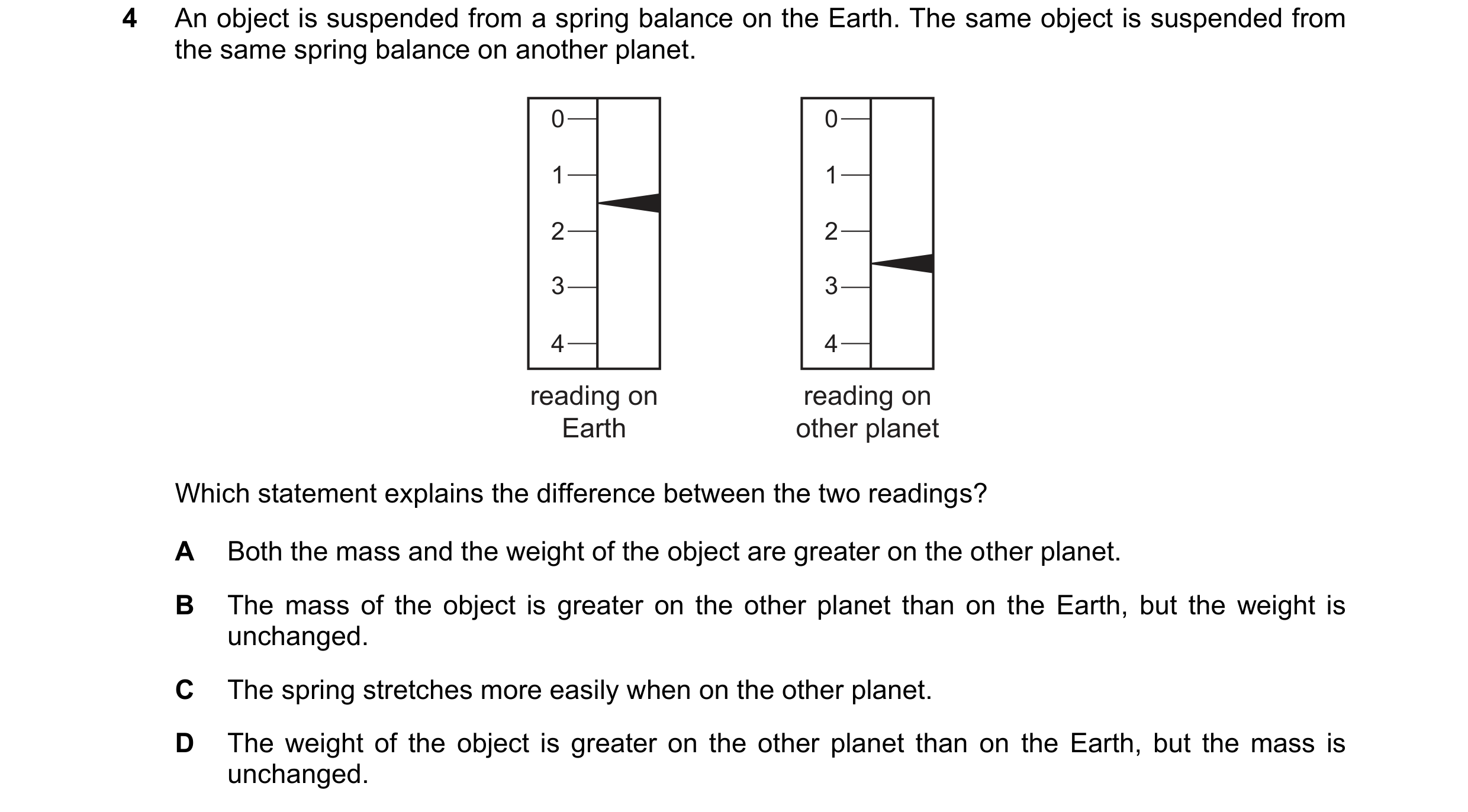

 50 / 54
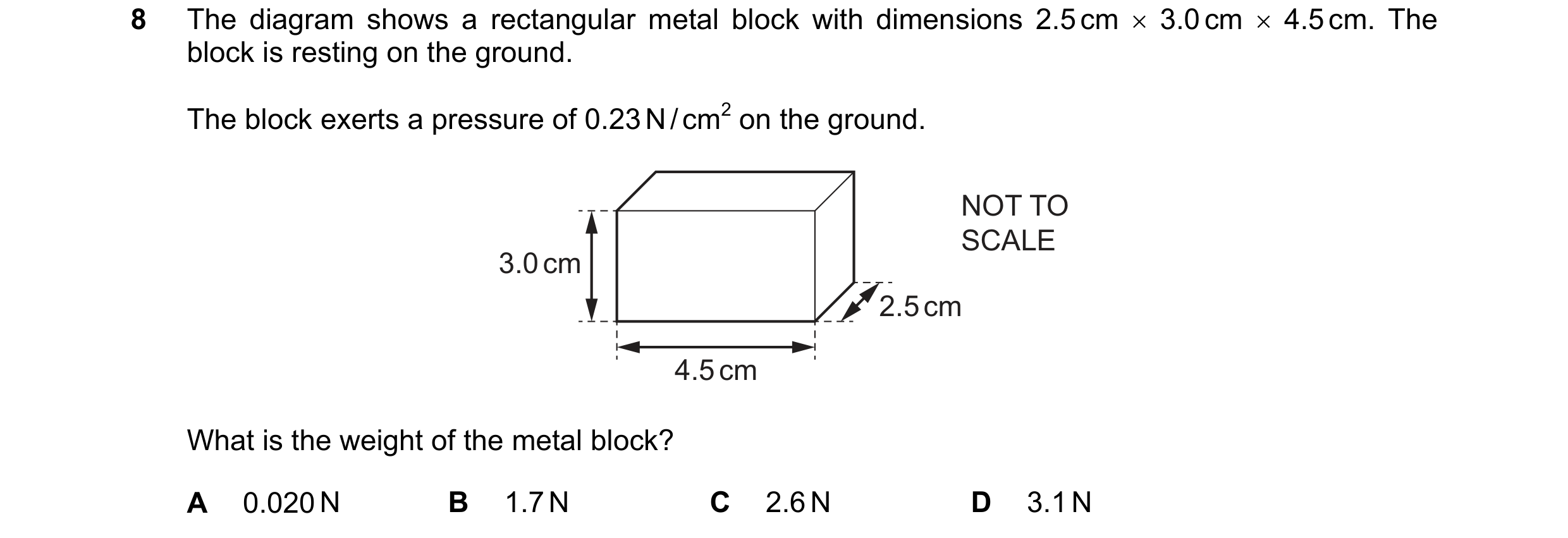
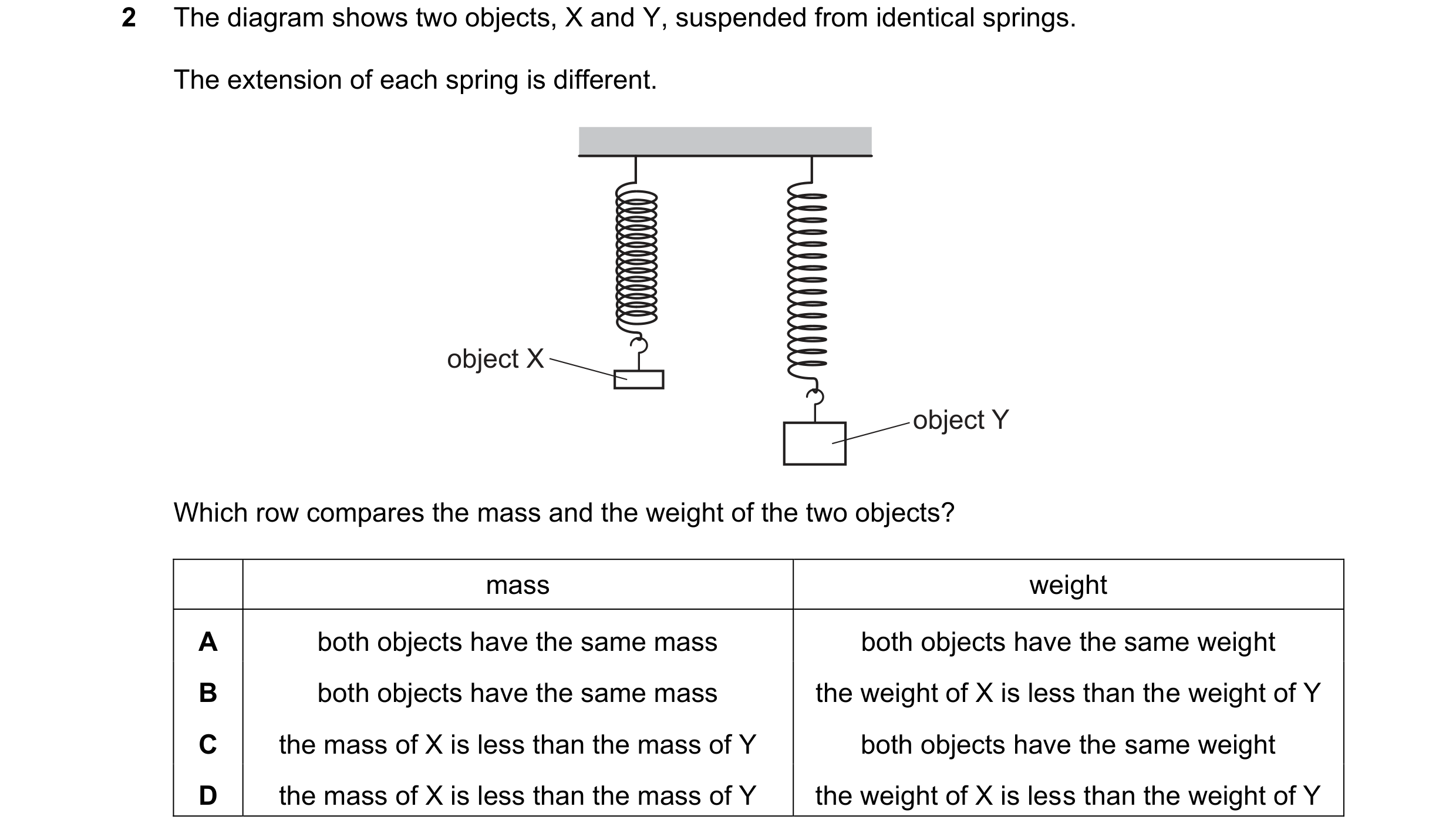 51 / 54

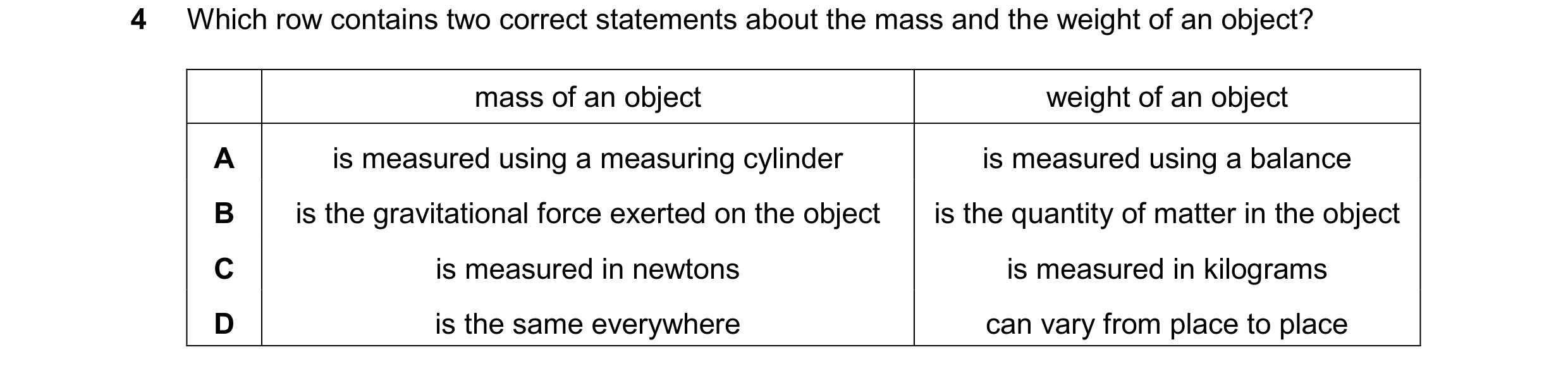
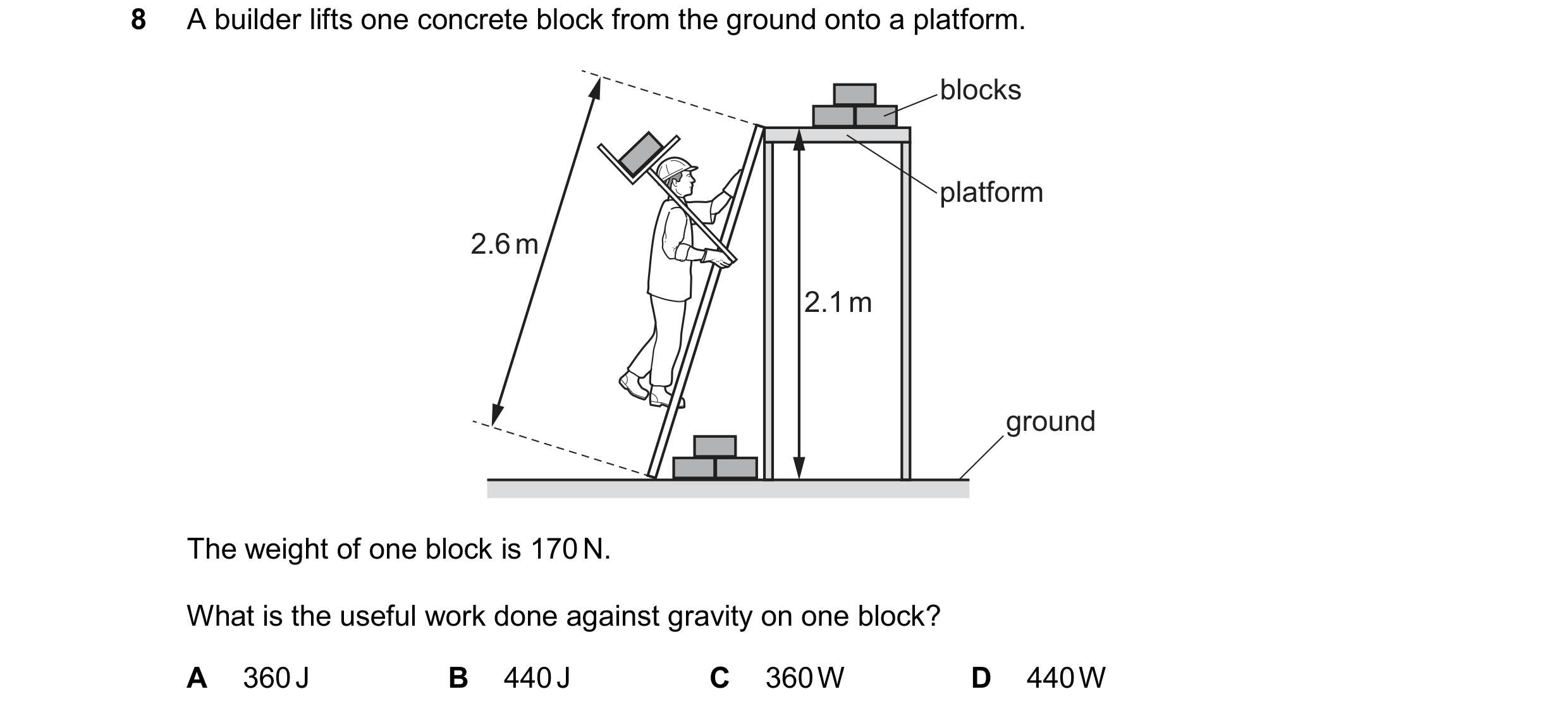 52 / 54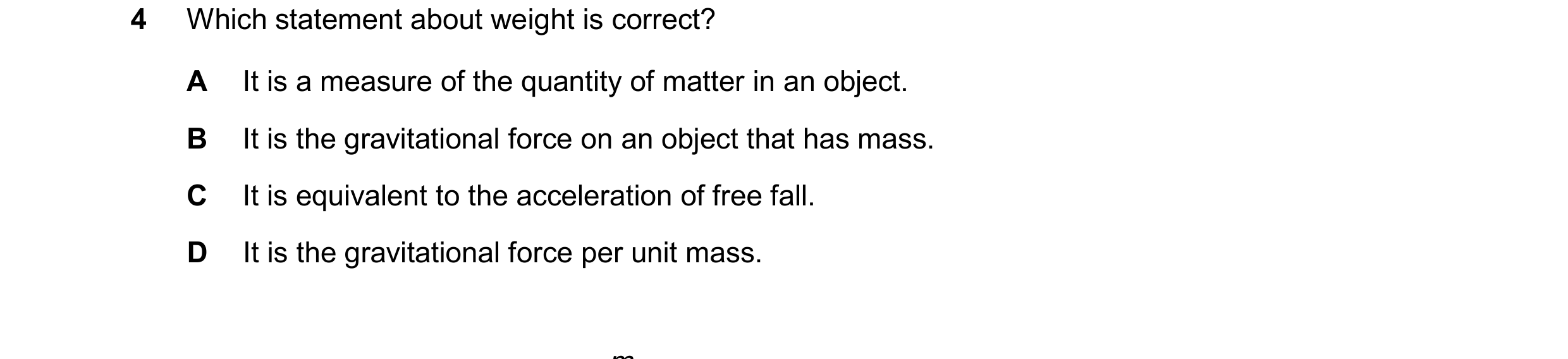


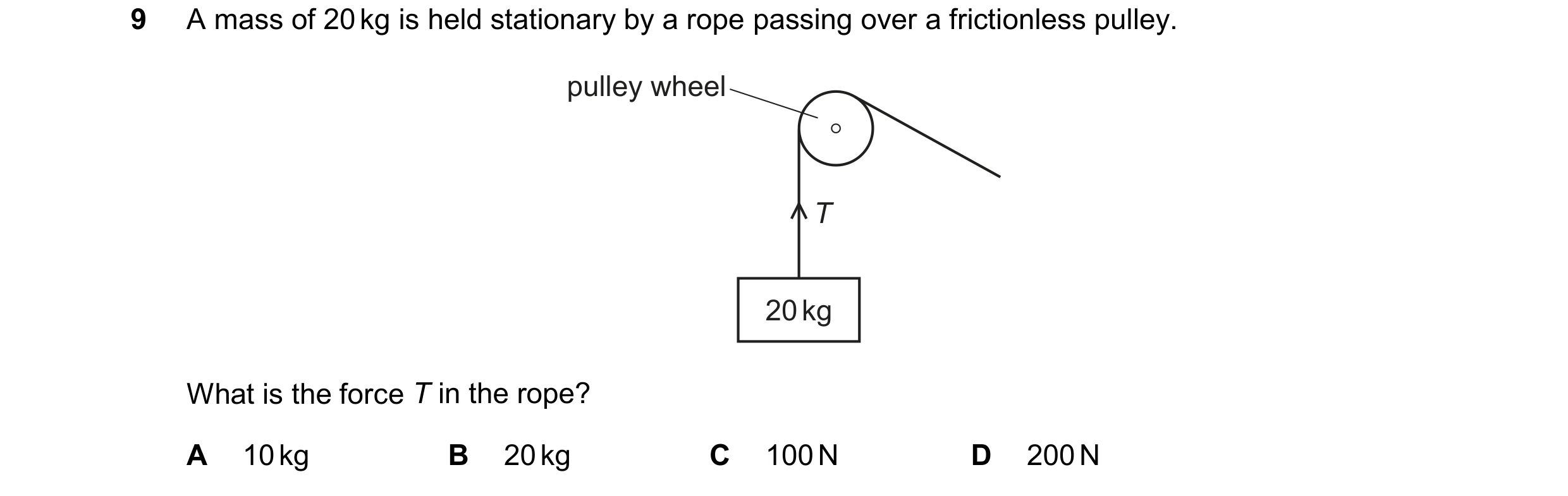
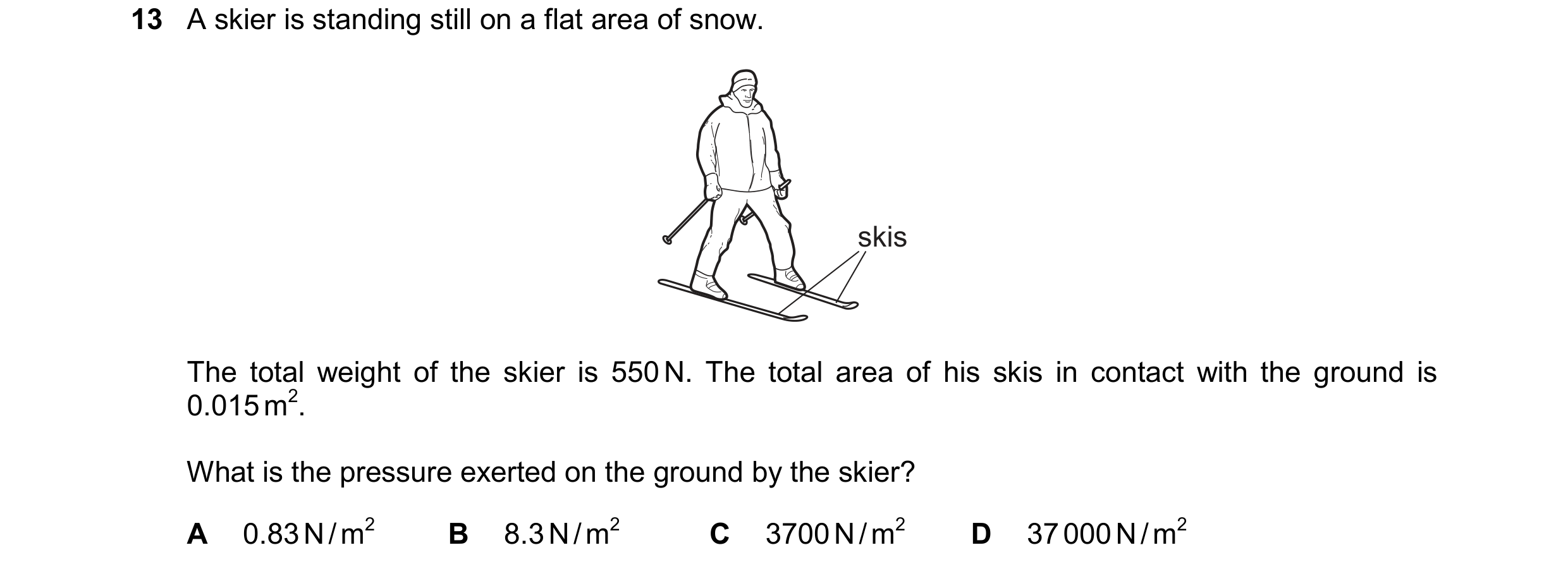 53 / 54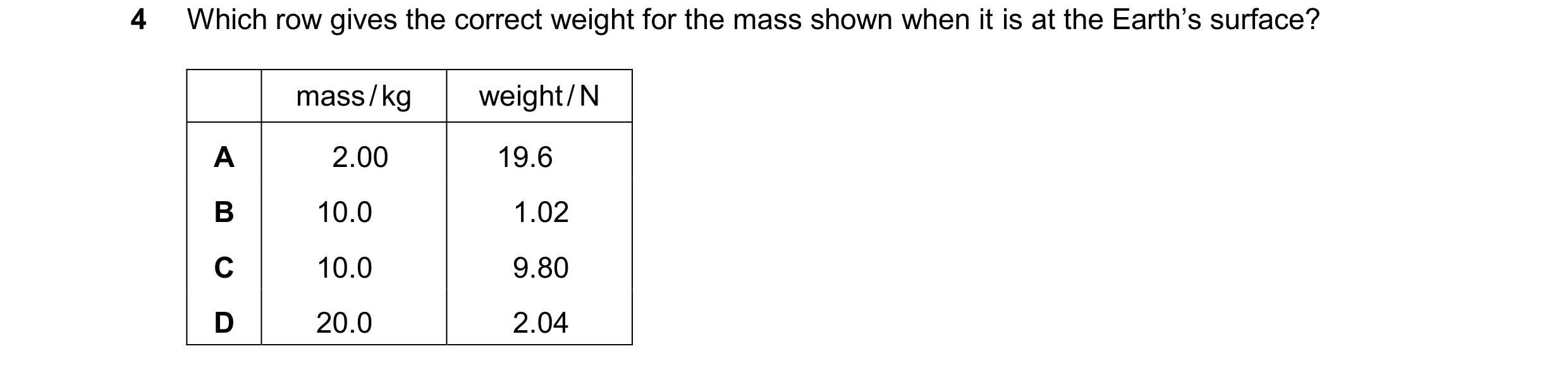

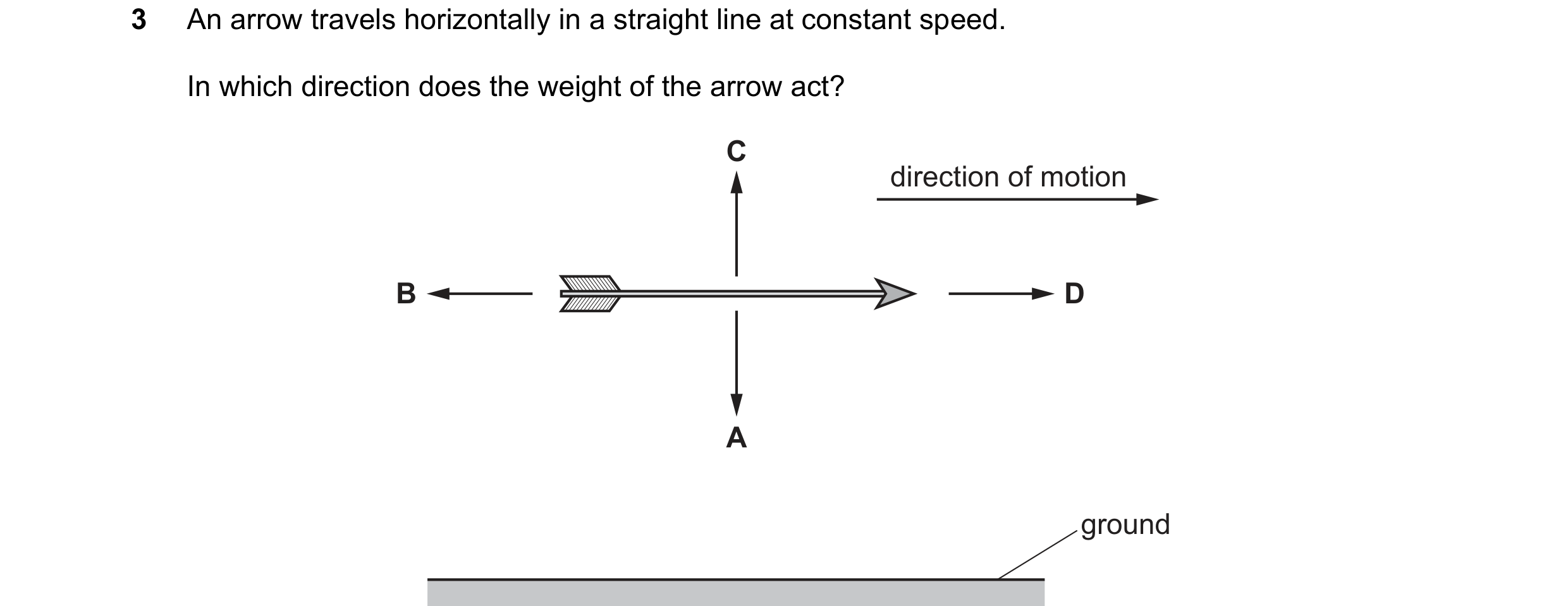 54 / 54