Questions as text
Q1 · A concrete post is carried up a very high mountain 0625/22 Feb/March 2016
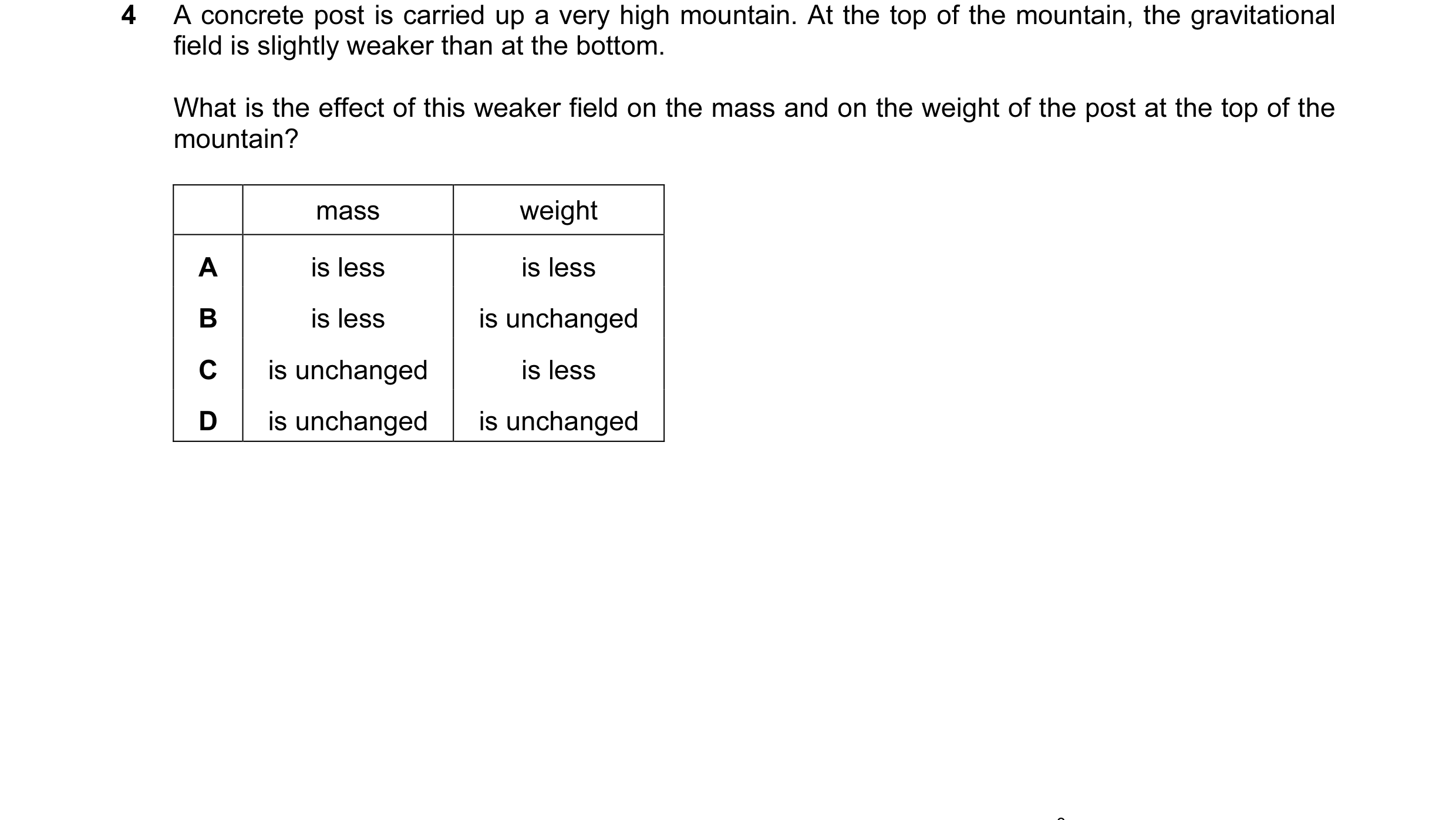
4 A concrete post is carried up a very high mountain. At the top of the mountain, the gravitational field is slightly weaker than at the bottom. What is the effect of this weaker field on the mass and on the weight of the post at the top of the mountain? mass weight A is less is less B is less is unchanged C is unchanged is less D is unchanged is unchanged
1 marks
Answer: C
This question in 0625/22 Feb/March 2016
Q2 · A cup contains hot liquid 0625/21 May/June 2016
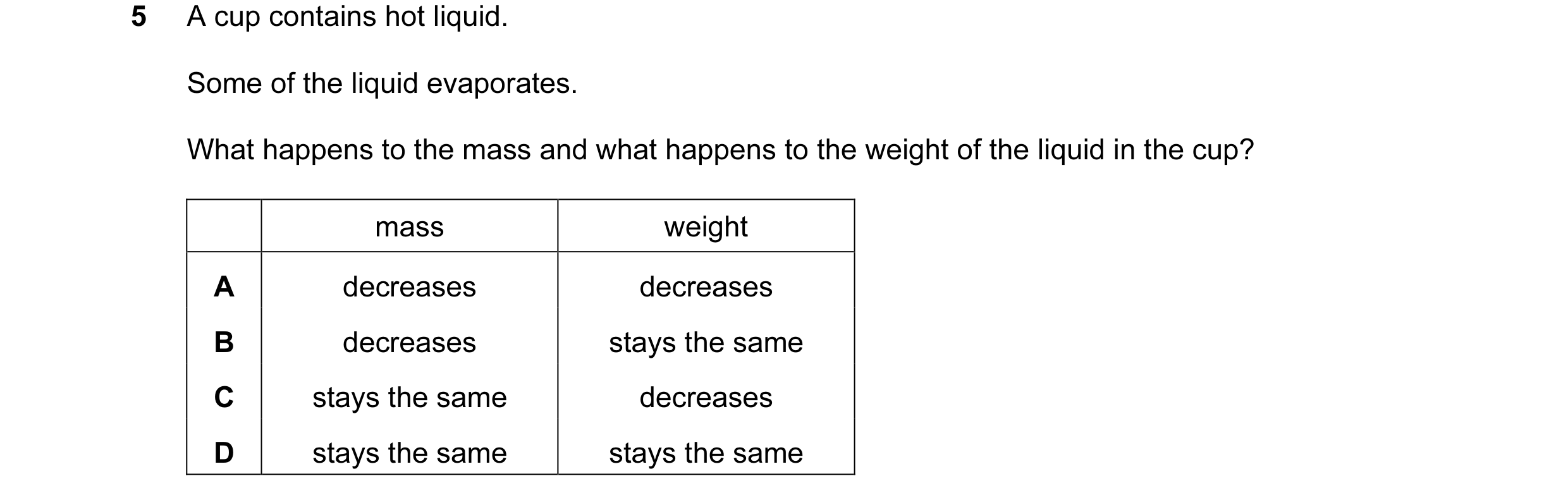
5 A cup contains hot liquid. Some of the liquid evaporates. What happens to the mass and what happens to the weight of the liquid in the cup? mass weight A decreases decreases B decreases stays the same C stays the same decreases D stays the same stays the same
1 marks
Answer: A
This question in 0625/21 May/June 2016
Q3 · A cup contains hot liquid 0625/22 May/June 2016
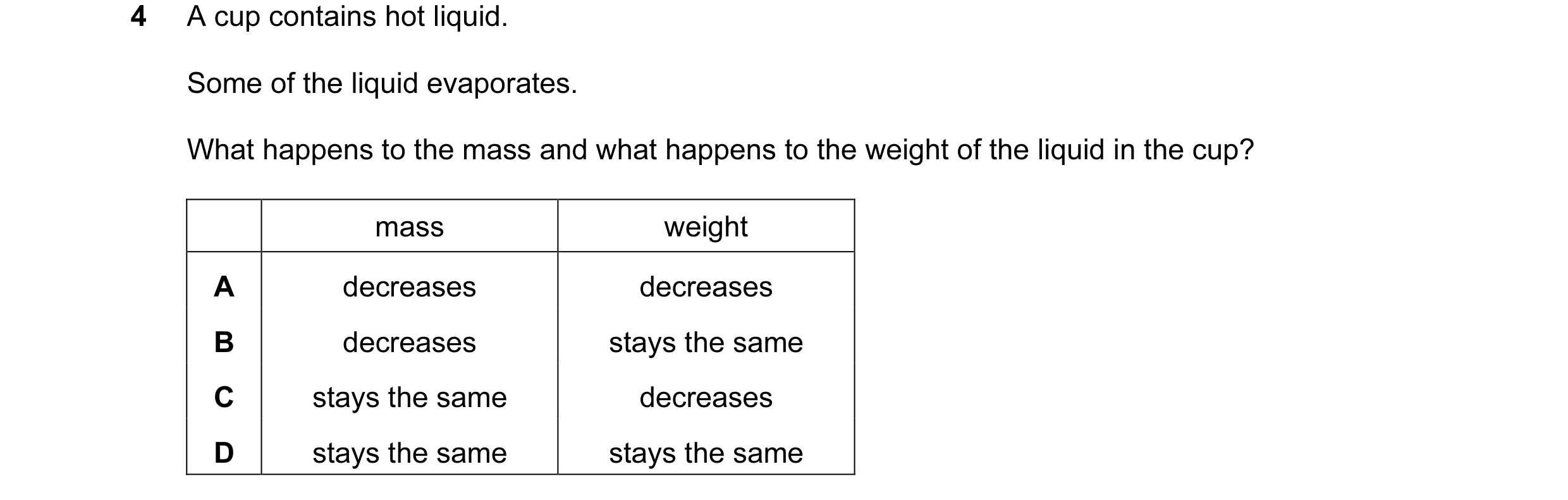
4 A cup contains hot liquid. Some of the liquid evaporates. What happens to the mass and what happens to the weight of the liquid in the cup? mass weight A decreases decreases B decreases stays the same C stays the same decreases D stays the same stays the same
1 marks
Answer: A
This question in 0625/22 May/June 2016
Q4 · A cup contains hot liquid 0625/23 May/June 2016
4 A cup contains hot liquid. Some of the liquid evaporates. What happens to the mass and what happens to the weight of the liquid in the cup? mass weight A decreases decreases B decreases stays the same C stays the same decreases D stays the same stays the same
1 marks
Answer: A
This question in 0625/23 May/June 2016
Q5 · A spaceship approaches the Earth from deep space 0625/21 Oct/Nov 2016
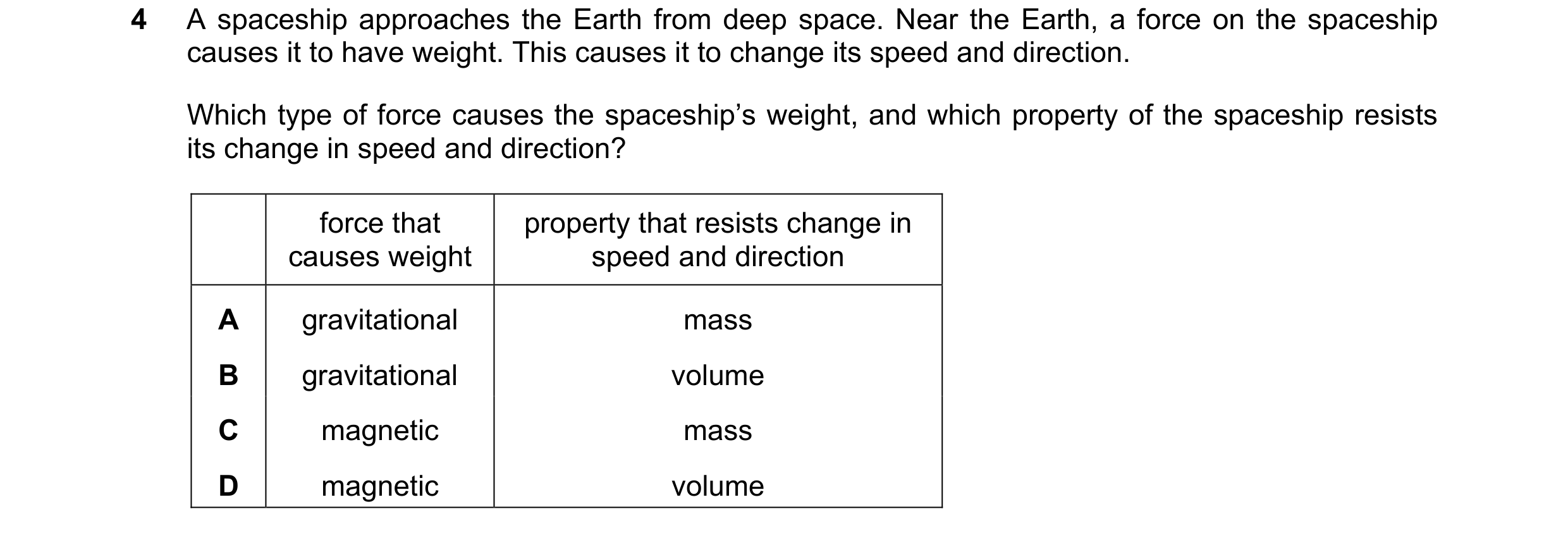
4 A spaceship approaches the Earth from deep space. Near the Earth, a force on the spaceship causes it to have weight. This causes it to change its speed and direction. Which type of force causes the spaceship’s weight, and which property of the spaceship resists its change in speed and direction? force that property that resists change in causes weight speed and direction A gravitational mass B gravitational volume C magnetic mass D magnetic volume
1 marks
Answer: A
This question in 0625/21 Oct/Nov 2016
Q6 · An object tends to keep moving with the same speed and in the same direction due to a… 0625/22 Oct/Nov 2016
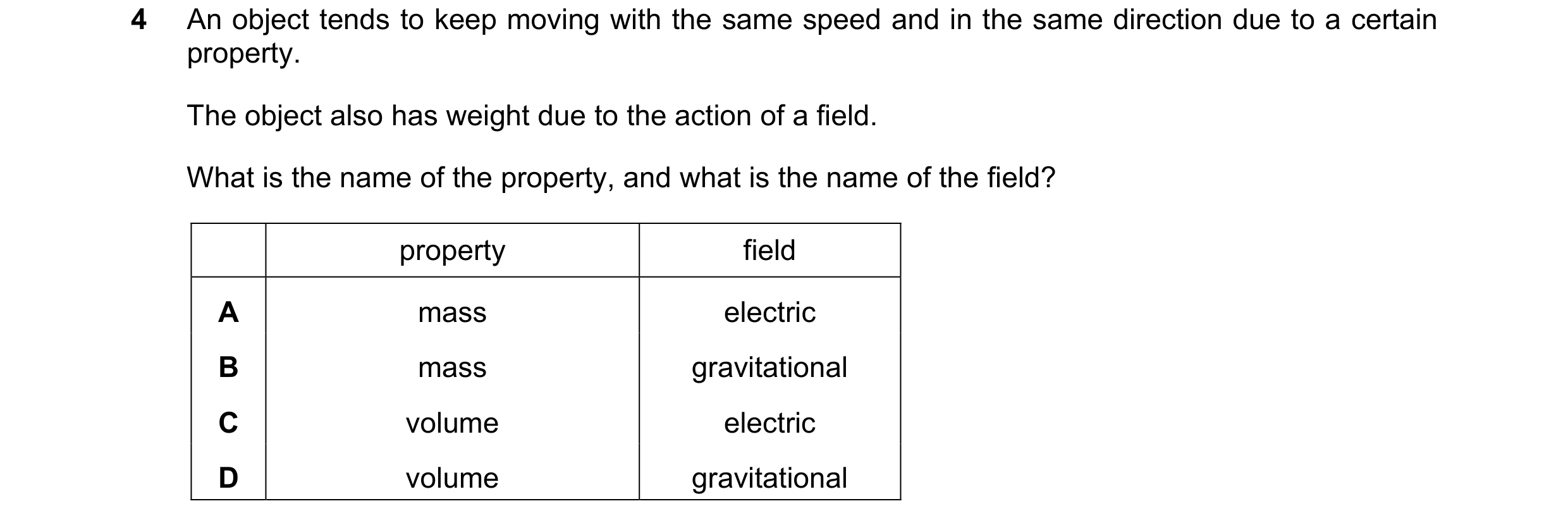
4 An object tends to keep moving with the same speed and in the same direction due to a certain property. The object also has weight due to the action of a field. What is the name of the property, and what is the name of the field? property field A mass electric B mass gravitational C volume electric D volume gravitational
1 marks
Answer: B
This question in 0625/22 Oct/Nov 2016
Q7 · An astronaut on the Moon weighs less than on Earth 0625/23 Oct/Nov 2016
4 An astronaut on the Moon weighs less than on Earth. What is the reason for this difference, and how does his mass on the Moon compare with his mass on Earth? reason for weight difference mass on Moon the Moon has a weaker A less than on Earth gravitational field the Moon has a weaker B same as on Earth gravitational field the Moon has a weaker C less than on Earth magnetic field the Moon has a weaker D same as on Earth magnetic field
1 marks
Answer: B
This question in 0625/23 Oct/Nov 2016
Q8 · Which statement about the masses and weights of objects on the Earth is correct? 0625/22 Feb/March 2017
4 Which statement about the masses and weights of objects on the Earth is correct? A A balance can only be used to compare weights, not masses. B Heavy objects always have more mass than light ones. C Large objects always have more mass than small ones. D Mass is a force but weight is not.
1 marks
Answer: B
This question in 0625/22 Feb/March 2017
Q9 · An object in a space probe above the Earth weighs 3.5 N 0625/22 Feb/March 2017
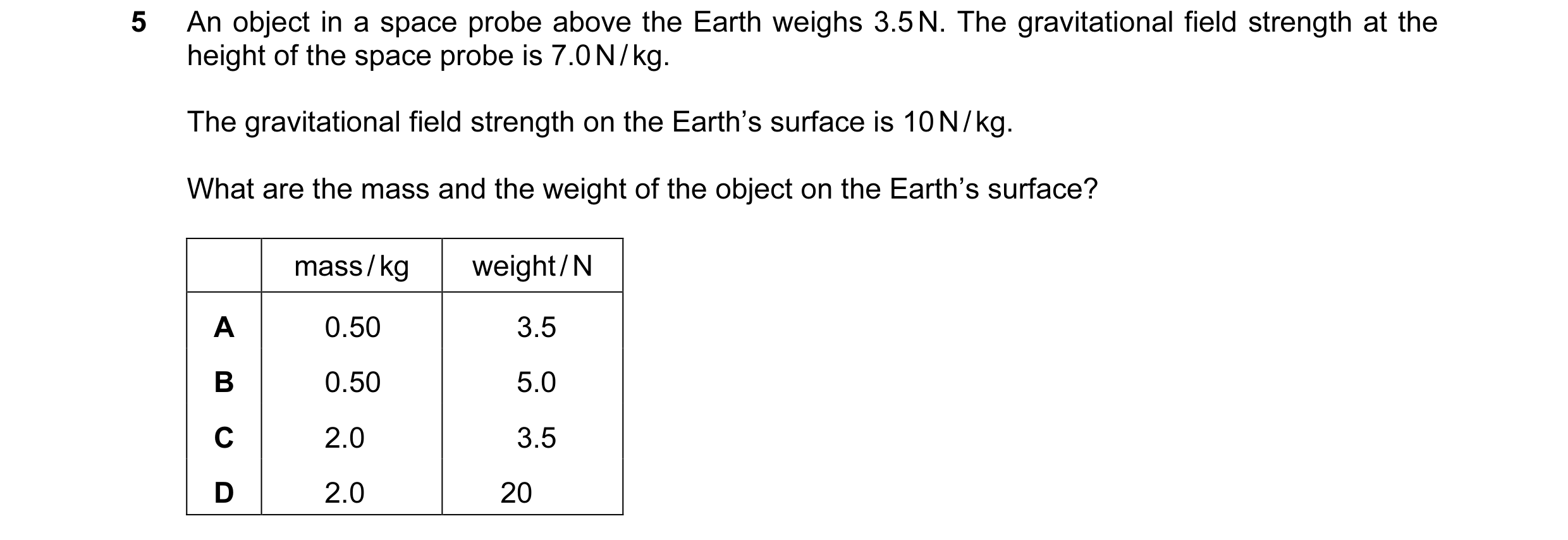
5 An object in a space probe above the Earth weighs 3.5 N. The gravitational field strength at the height of the space probe is 7.0 N / kg. The gravitational field strength on the Earth’s surface is 10 N / kg. What are the mass and the weight of the object on the Earth’s surface? mass / kg weight / N A 0.50 3.5 B 0.50 5.0 C 2.0 3.5 D 2.0 20
1 marks
Answer: B
This question in 0625/22 Feb/March 2017
Q10 · A piece of steel is taken from the Earth to the Moon for an experiment 0625/21 May/June 2017
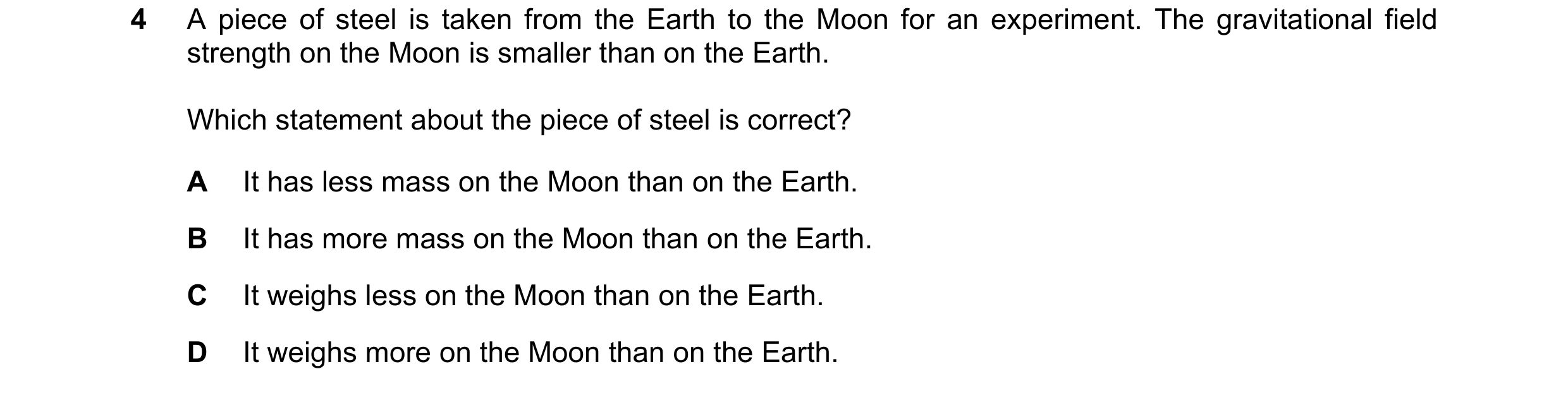
4 A piece of steel is taken from the Earth to the Moon for an experiment. The gravitational field strength on the Moon is smaller than on the Earth. Which statement about the piece of steel is correct? A It has less mass on the Moon than on the Earth. B It has more mass on the Moon than on the Earth. C It weighs less on the Moon than on the Earth. D It weighs more on the Moon than on the Earth.
1 marks
Answer: C
This question in 0625/21 May/June 2017
Q11 · In which pair are both quantities measured in newtons? 0625/22 May/June 2017
4 In which pair are both quantities measured in newtons? A force and pressure B force and weight C mass and pressure D mass and weight
1 marks
Answer: B
This question in 0625/22 May/June 2017
Q12 · Which object has the greatest weight? 0625/21 Oct/Nov 2017
5 Which object has the greatest weight? A an object of mass 10 kg in a 15 N / kg gravitational field B an object of mass 15 kg in a 13 N / kg gravitational field C an object of mass 20 kg in a 9.0 N / kg gravitational field D an object of mass 50 kg in a 3.0 N / kg gravitational field
1 marks
Answer: B
This question in 0625/21 Oct/Nov 2017
Q13 · Four balls with different masses are dropped simultaneously from the heights shown 0625/22 Oct/Nov 2017
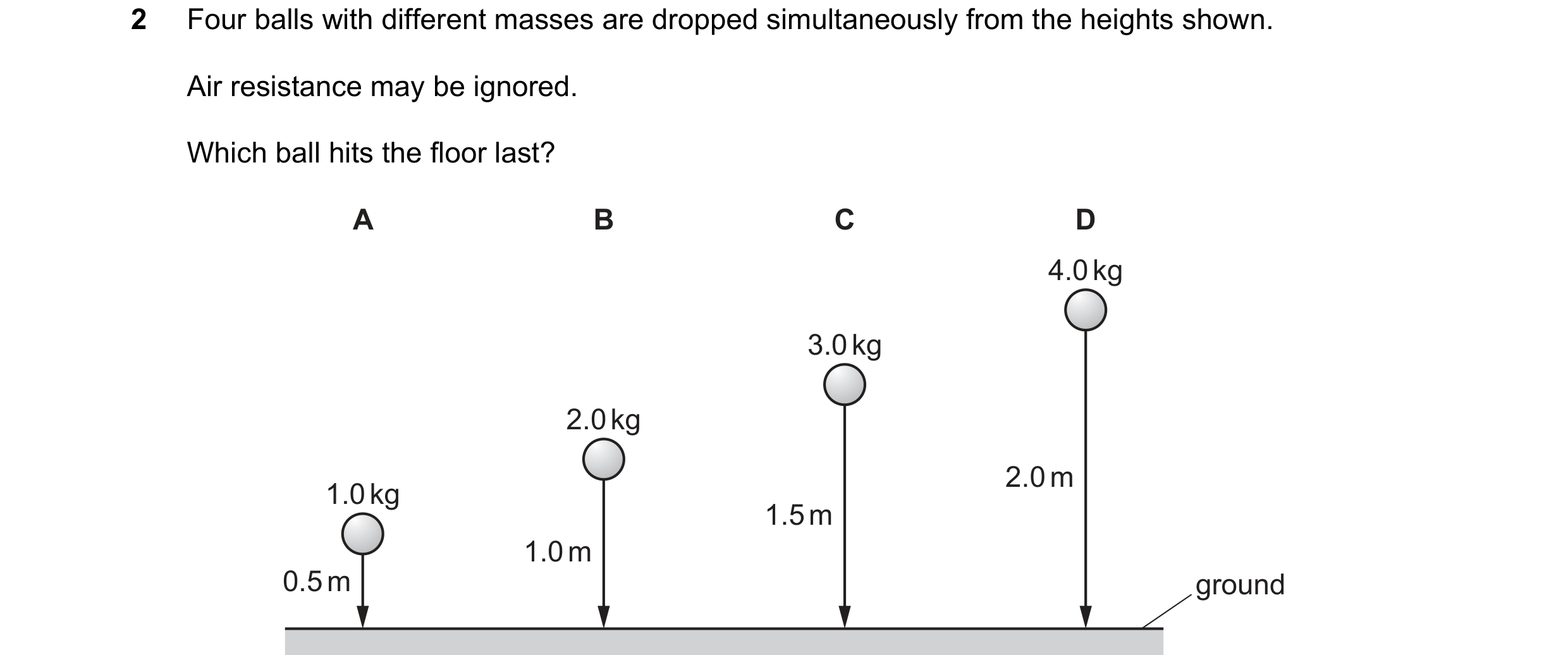
2 Four balls with different masses are dropped simultaneously from the heights shown. Air resistance may be ignored. Which ball hits the floor last? A B C D 4.0 kg 3.0 kg 2.0 kg 2.0 m 1.0 kg 1.5 m 1.0 m 0.5 m ground
1 marks
Answer: D
This question in 0625/22 Oct/Nov 2017
Q14 · A spring is stretched by hanging a piece of metal from it 0625/22 Oct/Nov 2017
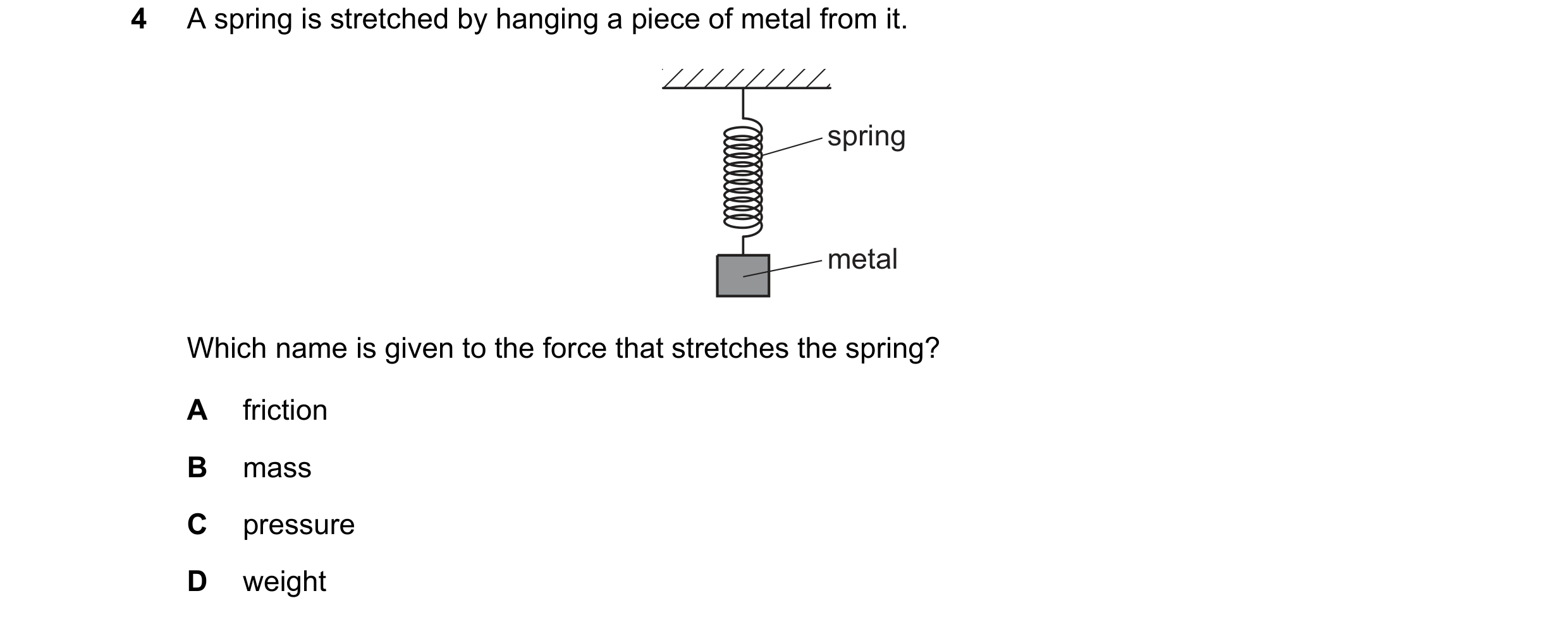
4 A spring is stretched by hanging a piece of metal from it. spring metal Which name is given to the force that stretches the spring? A friction B mass C pressure D weight
1 marks
Answer: D
This question in 0625/22 Oct/Nov 2017
Q15 · A body of mass m has a weight W in a location where the gravitational field strength is g 0625/22 Oct/Nov 2017
5 A body of mass m has a weight W in a location where the gravitational field strength is g. Which statement about these quantities is correct? A m and W are both forces. B m and W are both vector quantities. W = g. C m and W are related by the equation m D m and W have the same unit.
1 marks
Answer: C
This question in 0625/22 Oct/Nov 2017
Q16 · On the Moon, all objects fall with the same acceleration 0625/23 Oct/Nov 2017
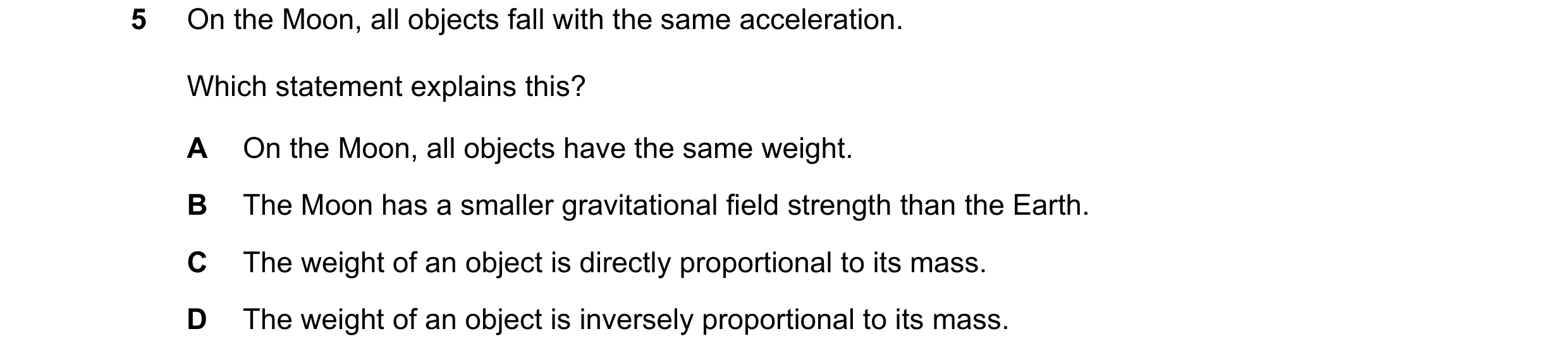
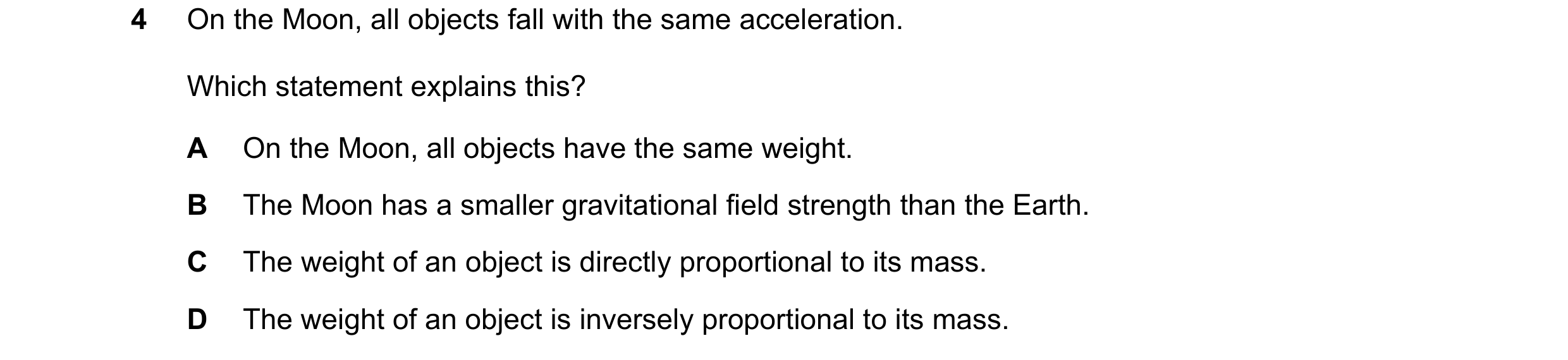
5 On the Moon, all objects fall with the same acceleration. Which statement explains this? A On the Moon, all objects have the same weight. B The Moon has a smaller gravitational field strength than the Earth. C The weight of an object is directly proportional to its mass. D The weight of an object is inversely proportional to its mass.
1 marks
Answer: C
This question in 0625/23 Oct/Nov 2017
Question 17 0625/21 May/June 2018
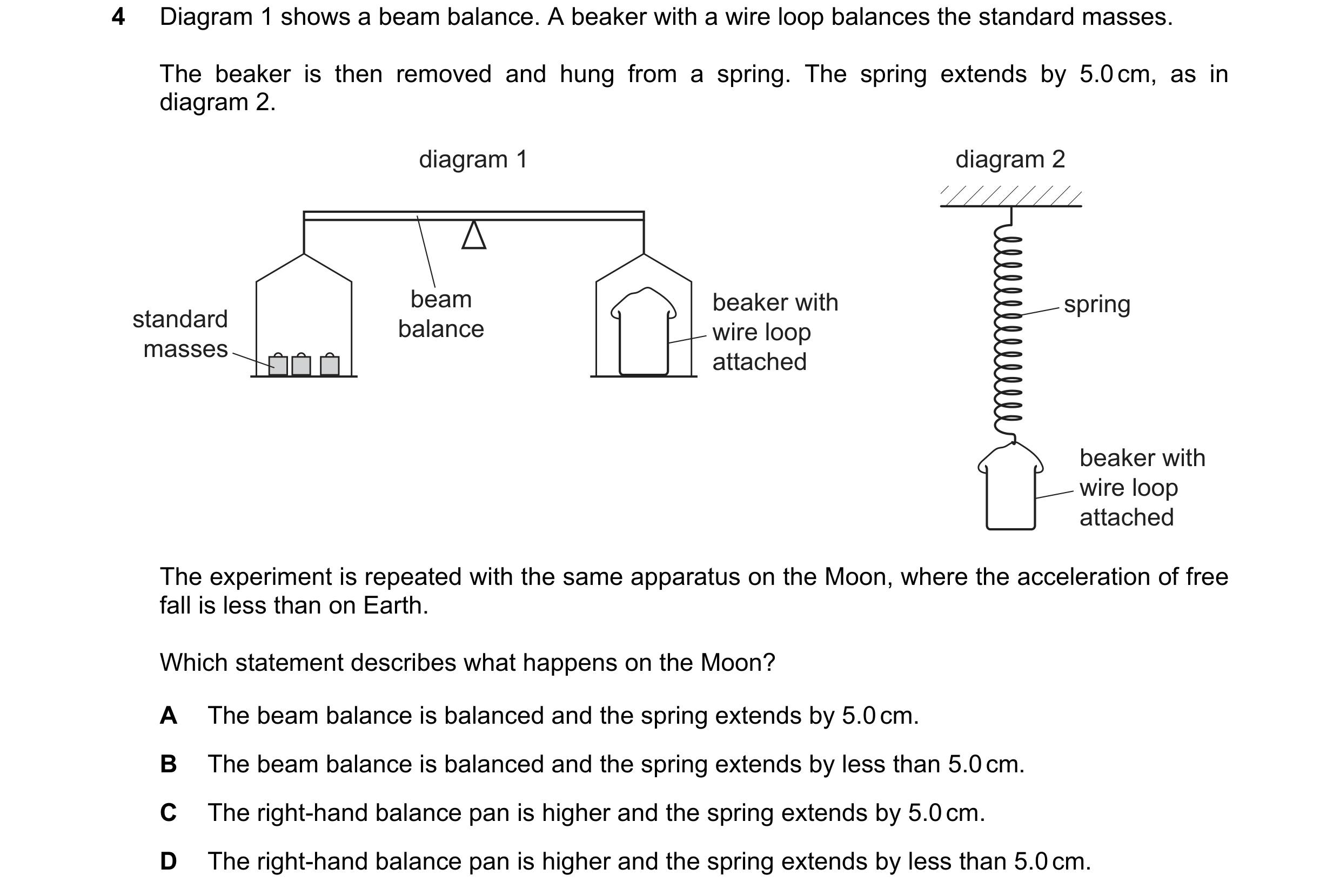
4 Diagram 1 shows a beam balance. A beaker with a wire loop balances the standard masses. The beaker is then removed and hung from a spring. The spring extends by 5.0 cm, as in diagram 2. diagram 1 diagram 2 beam beaker with spring standard balance wire loop masses attached beaker with wire loop attached The experiment is repeated with the same apparatus on the Moon, where the acceleration of free fall is less than on Earth. Which statement describes what happens on the Moon? A The beam balance is balanced and the spring extends by 5.0 cm. B The beam balance is balanced and the spring extends by less than 5.0 cm. C The right-hand balance pan is higher and the spring extends by 5.0 cm. D The right-hand balance pan is higher and the spring extends by less than 5.0 cm.
1 marks
Answer: B
This question in 0625/21 May/June 2018
Q18 · An object always has mass but does not always have weight 0625/21 May/June 2018
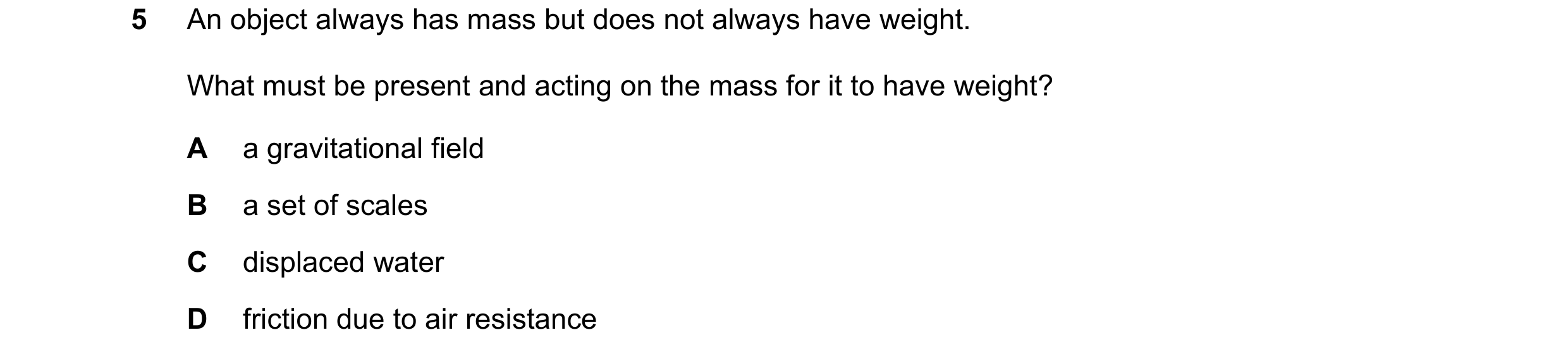
5 An object always has mass but does not always have weight. What must be present and acting on the mass for it to have weight? A a gravitational field B a set of scales C displaced water D friction due to air resistance
1 marks
Answer: A
This question in 0625/21 May/June 2018
Q19 · Which statement about the mass and the weight of an object is correct? 0625/22 May/June 2018
4 Which statement about the mass and the weight of an object is correct? A They are both affected by changes in the acceleration of free fall. B They are both forces. C They have different units. D Weight is calculated by dividing mass by the acceleration of free fall.
1 marks
Answer: C
This question in 0625/22 May/June 2018
Q20 · Which statement about the mass of an object is correct? 0625/22 May/June 2018
5 Which statement about the mass of an object is correct? A It is equal to the density divided by the volume. B It is equal to weight multiplied by the gravitational field strength. C It is the effect of a gravitational field on the object. D It is the property that resists a change in velocity.
1 marks
Answer: D
This question in 0625/22 May/June 2018
Q21 · A person steps onto a bathroom scales 0625/23 May/June 2018
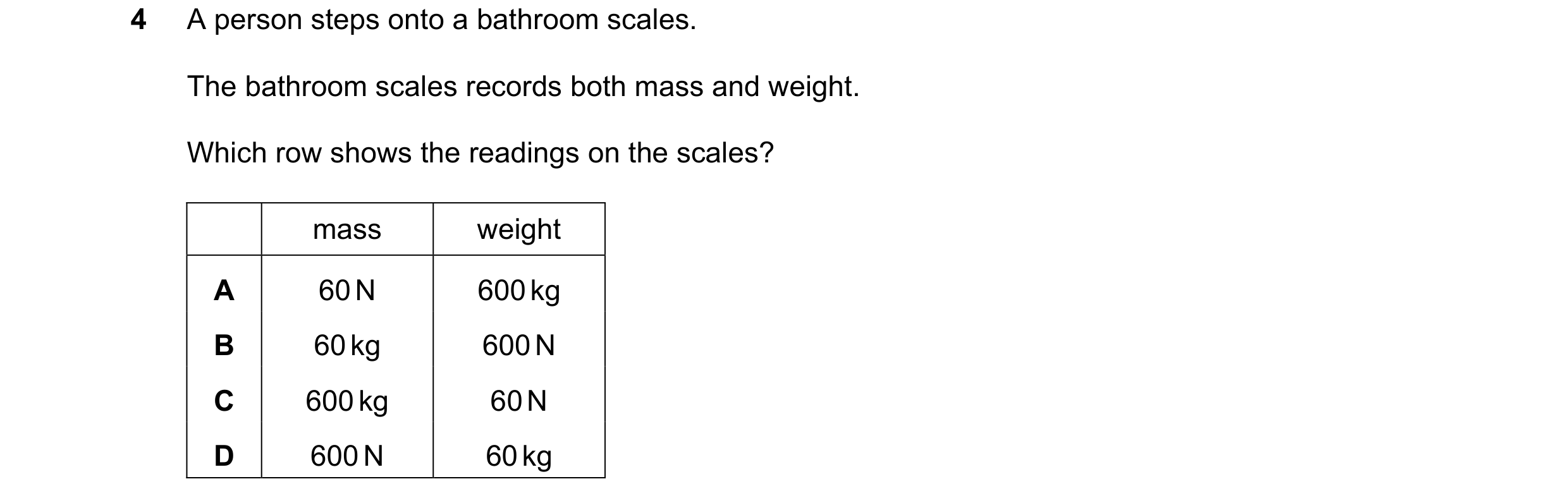
4 A person steps onto a bathroom scales. The bathroom scales records both mass and weight. Which row shows the readings on the scales? mass weight A 60 N 600 kg B 60 kg 600 N C 600 kg 60 N D 600 N 60 kg
1 marks
Answer: B
This question in 0625/23 May/June 2018
Q22 · An object has a weight of 7600 N in a gravitational field of strength 100 N / kg 0625/23 May/June 2018
5 An object has a weight of 7600 N in a gravitational field of strength 100 N / kg. What is the mass of the object? A 76 kg B 760 N C 7600 g D 76 000 N
1 marks
Answer: A
This question in 0625/23 May/June 2018
Q23 · A helium balloon is tied to a top-pan balance 0625/21 Oct/Nov 2018
4 A helium balloon is tied to a top-pan balance. A metal block of mass 100 g is placed on the balance. The reading on the balance is 91 g. helium balloon metal block 91 g Which statement can be deduced from this experiment? A The balloon exerts a downward force of 0.09 N on the top-pan balance. B The helium has a mass of –9 g. C The helium has a mass of +9 g. D The resultant downward force on the top-pan balance is 0.91 N.
1 marks
Answer: D
This question in 0625/21 Oct/Nov 2018
Q24 · A helium balloon is tied to a top-pan balance 0625/22 Oct/Nov 2018
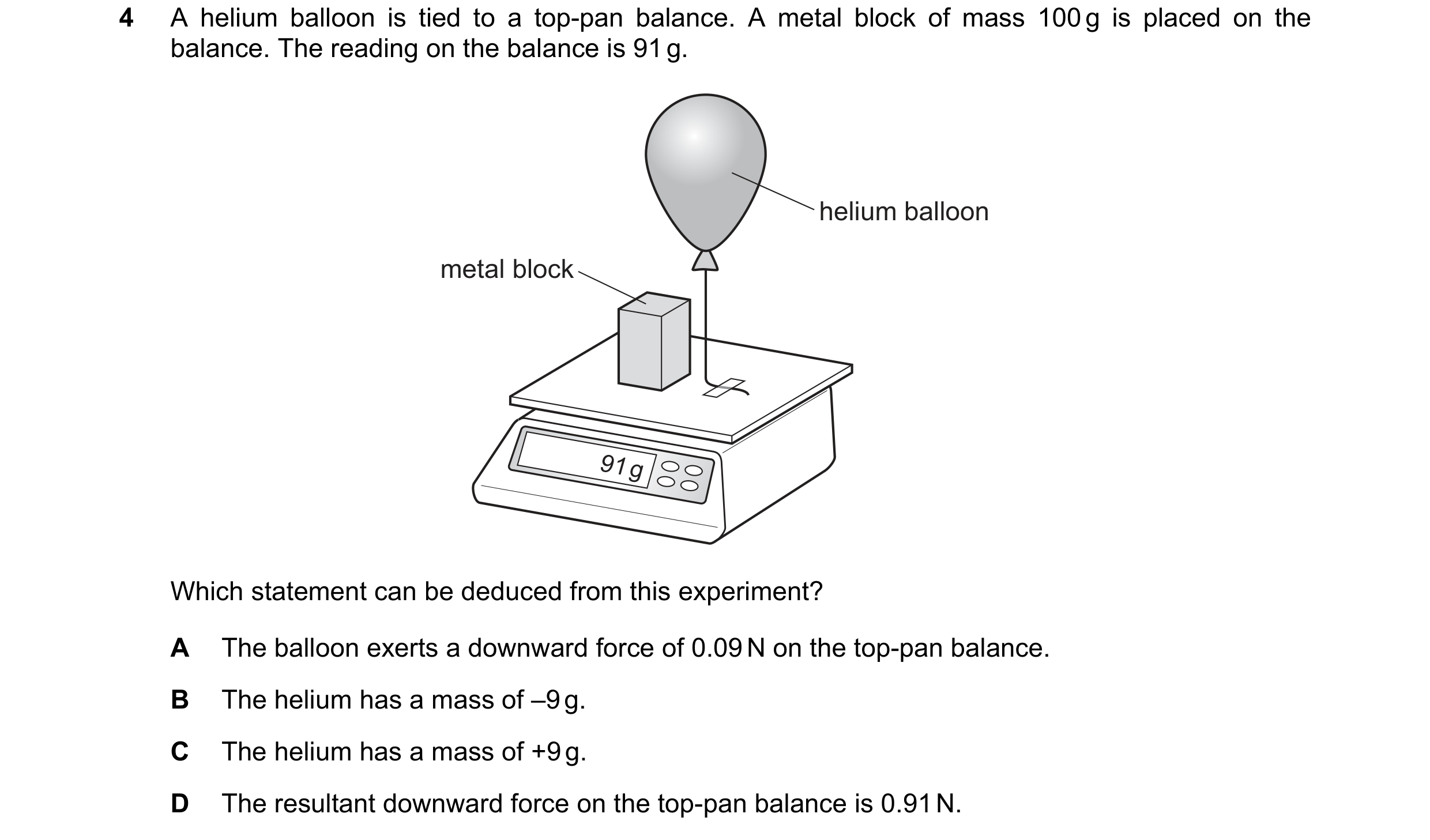
4 A helium balloon is tied to a top-pan balance. A metal block of mass 100 g is placed on the balance. The reading on the balance is 91 g. helium balloon metal block 91 g Which statement can be deduced from this experiment? A The balloon exerts a downward force of 0.09 N on the top-pan balance. B The helium has a mass of –9 g. C The helium has a mass of +9 g. D The resultant downward force on the top-pan balance is 0.91 N.
1 marks
Answer: D
This question in 0625/22 Oct/Nov 2018
Q25 · A helium balloon is tied to a top-pan balance 0625/23 Oct/Nov 2018
4 A helium balloon is tied to a top-pan balance. A metal block of mass 100 g is placed on the balance. The reading on the balance is 91 g. helium balloon metal block 91 g Which statement can be deduced from this experiment? A The balloon exerts a downward force of 0.09 N on the top-pan balance. B The helium has a mass of –9 g. C The helium has a mass of +9 g. D The resultant downward force on the top-pan balance is 0.91 N.
1 marks
Answer: D
This question in 0625/23 Oct/Nov 2018
Q26 · The gravitational field strength on the Moon is less than on the Earth 0625/22 Feb/March 2019
4 The gravitational field strength on the Moon is less than on the Earth. Which of these is different when done on the Moon compared with when done on the Earth? A the gravitational potential energy gained by a stone lifted through the same vertical height B the kinetic energy gained by a ball when hit with the same force for the same period of time C the momentum gained by a bullet when fired from the same gun D the work done in accelerating a stone from rest to the same speed
1 marks
Answer: A
This question in 0625/22 Feb/March 2019
Q27 · The mass of a full bottle of cooking oil is 1.30 kg 0625/22 Feb/March 2019
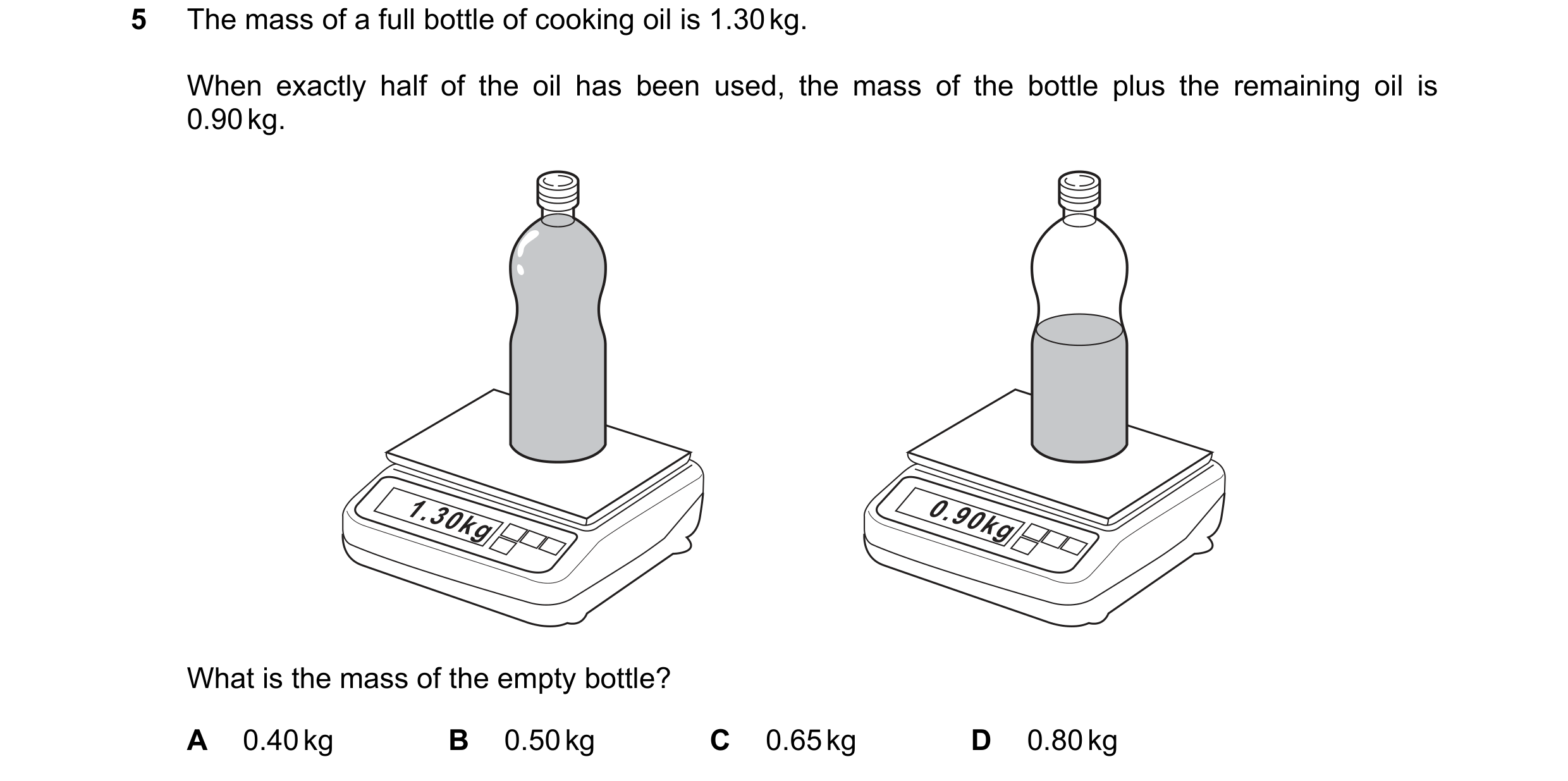
5 The mass of a full bottle of cooking oil is 1.30 kg. When exactly half of the oil has been used, the mass of the bottle plus the remaining oil is 0.90 kg. 1.30kg 0.90kg What is the mass of the empty bottle? A 0.40 kg B 0.50 kg C 0.65 kg D 0.80 kg
1 marks
Answer: B
This question in 0625/22 Feb/March 2019
Q28 · A body is moved from place X to place Y where the gravitational field strength is… 0625/21 May/June 2019
4 A body is moved from place X to place Y where the gravitational field strength is different. What happens to its mass and to its weight due to the move? mass weight A changes changes B changes stays the same C stays the same changes D stays the same stays the same
1 marks
Answer: C
This question in 0625/21 May/June 2019
Q29 · A mass of 20 kg is held stationary by a rope passing over a frictionless pulley 0625/21 May/June 2019
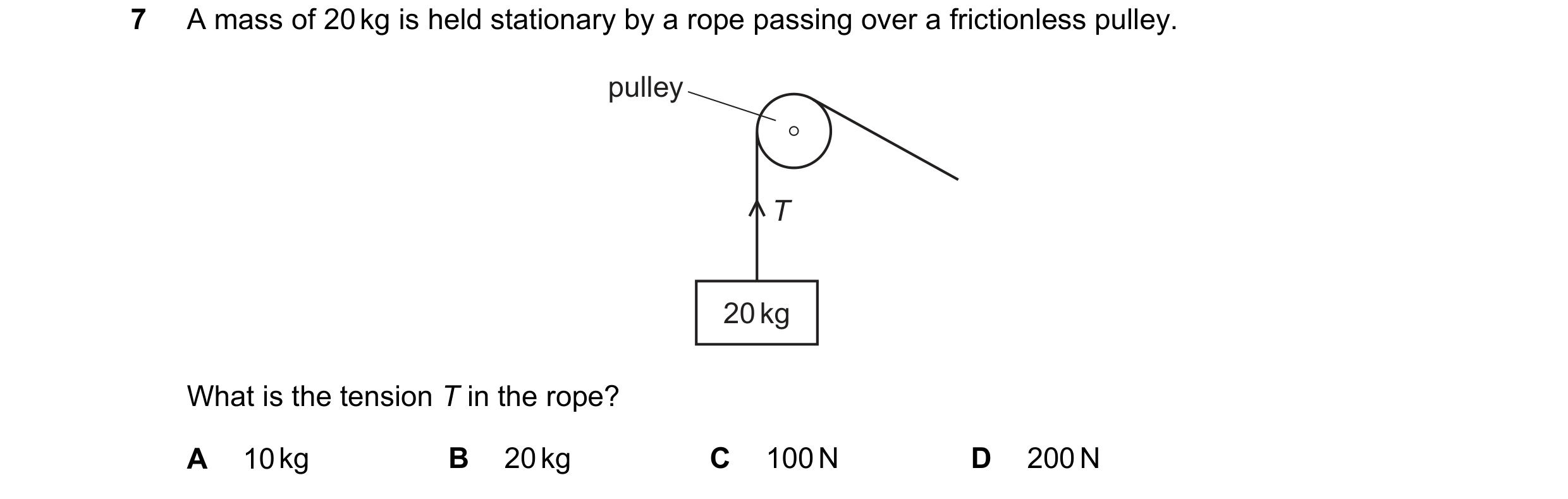
7 A mass of 20 kg is held stationary by a rope passing over a frictionless pulley. pulley T 20 kg What is the tension T in the rope? A 10 kg B 20 kg C 100 N D 200 N
1 marks
Answer: D
This question in 0625/21 May/June 2019
Q30 · Four students make statements about the mass of an object 0625/22 May/June 2019
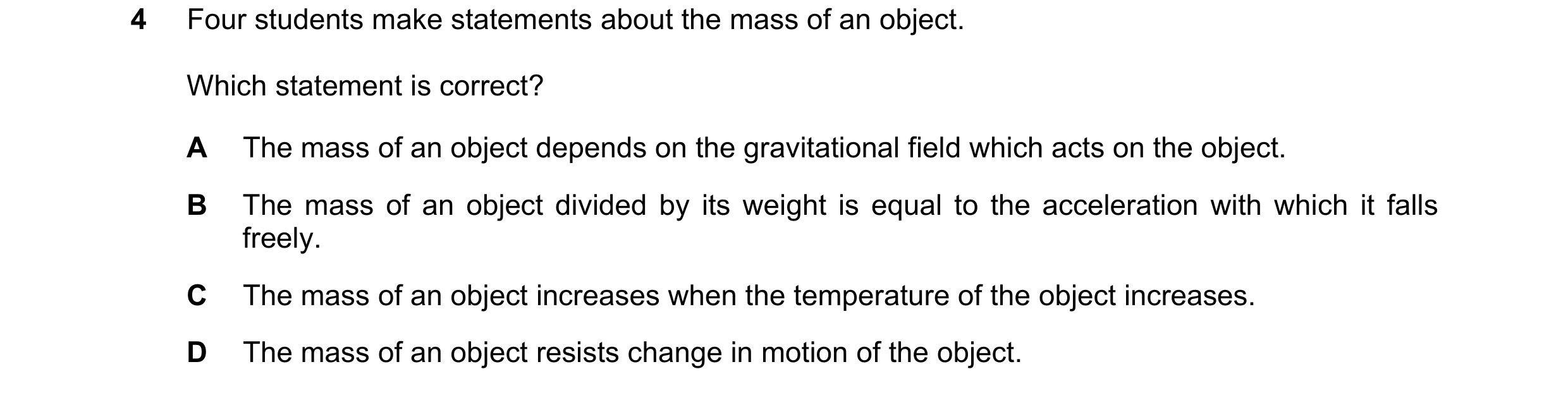
4 Four students make statements about the mass of an object. Which statement is correct? A The mass of an object depends on the gravitational field which acts on the object. B The mass of an object divided by its weight is equal to the acceleration with which it falls freely. C The mass of an object increases when the temperature of the object increases. D The mass of an object resists change in motion of the object.
1 marks
Answer: D
This question in 0625/22 May/June 2019
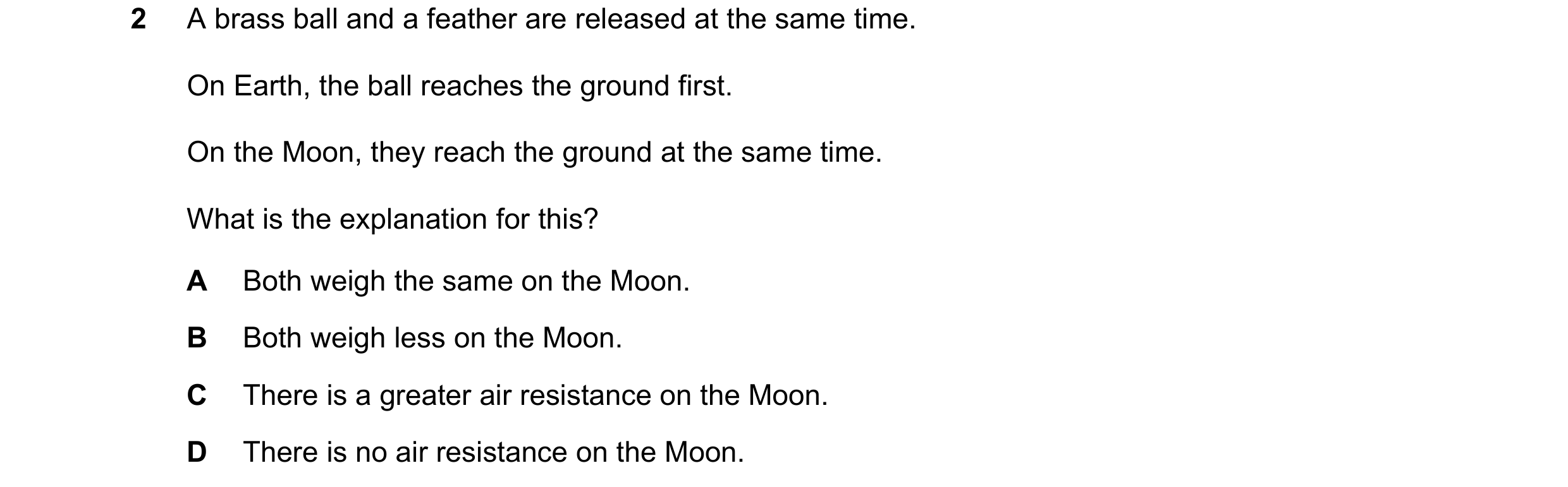
Q31 · A brass ball and a feather are released at the same time 0625/23 May/June 2019
2 A brass ball and a feather are released at the same time. On Earth, the ball reaches the ground first. On the Moon, they reach the ground at the same time. What is the explanation for this? A Both weigh the same on the Moon. B Both weigh less on the Moon. C There is a greater air resistance on the Moon. D There is no air resistance on the Moon.
1 marks
Answer: D
This question in 0625/23 May/June 2019
Q32 · On Earth, a spring stretches by 5.0 cm when a mass of 3.0 kg is suspended from one end 0625/23 May/June 2019
4 On Earth, a spring stretches by 5.0 cm when a mass of 3.0 kg is suspended from one end. The gravitational field strength on the Moon is 1 6 of that on Earth. Which mass, on the Moon, would stretch the spring by the same extension? A 0.50 kg B 3.0 kg C 5.0 kg D 18 kg
1 marks
Answer: D
This question in 0625/23 May/June 2019
Q33 · An object is in free fall 0625/23 May/June 2019
10 An object is in free fall. The change in gravitational potential energy of the body depends upon its mass m, the change in height ∆h and the gravitational field strength g. What is the correct expression for the change in gravitational potential energy? gm g∆ h m∆ h A gm∆h B C D ∆ h m g
1 marks
Answer: A
This question in 0625/23 May/June 2019
Q34 · Which quantity is a force due to a gravitational field? 0625/21 Oct/Nov 2019
4 Which quantity is a force due to a gravitational field? A density B mass C weight D volume
1 marks
Answer: C
This question in 0625/21 Oct/Nov 2019
Q35 · A man carries 20 tiles from the ground to the roof of a house 0625/21 Oct/Nov 2019
11 A man carries 20 tiles from the ground to the roof of a house. Each tile has a mass of 1.2 kg. The roof of the house is 15 m above the ground. How much work does the man do against gravity on the tiles in carrying them to the roof? A 36 J B 180 J C 360 J D 3600 J
1 marks
Answer: D
This question in 0625/21 Oct/Nov 2019
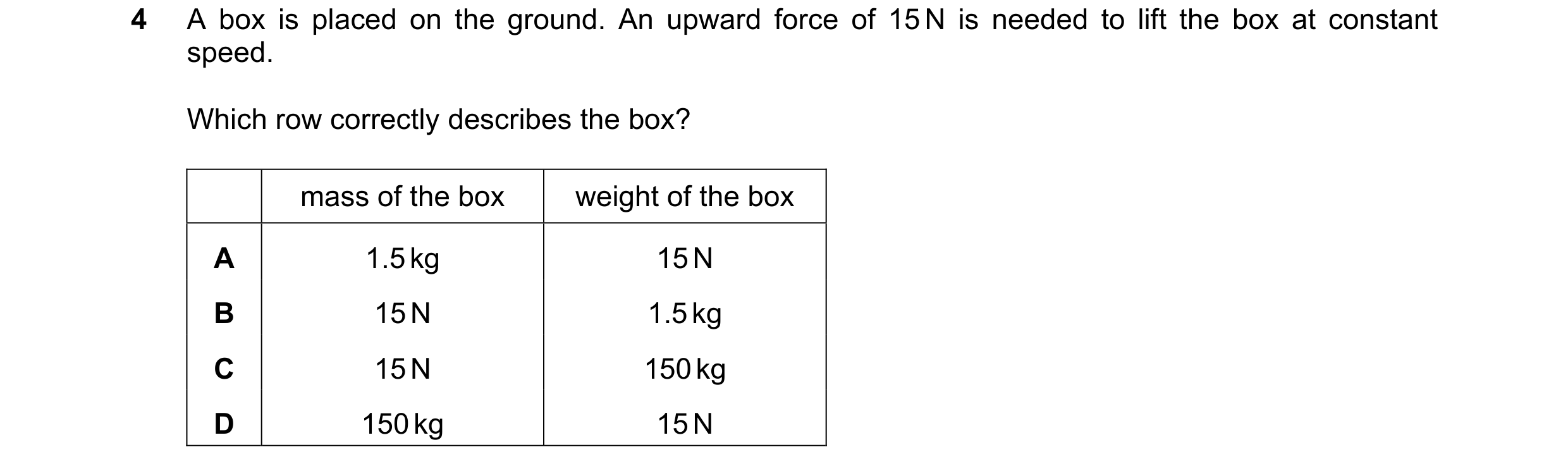
Q36 · A box is placed on the ground 0625/22 Oct/Nov 2019
4 A box is placed on the ground. An upward force of 15 N is needed to lift the box at constant speed. Which row correctly describes the box? mass of the box weight of the box A 1.5 kg 15 N B 15 N 1.5 kg C 15 N 150 kg D 150 kg 15 N
1 marks
Answer: A
This question in 0625/22 Oct/Nov 2019
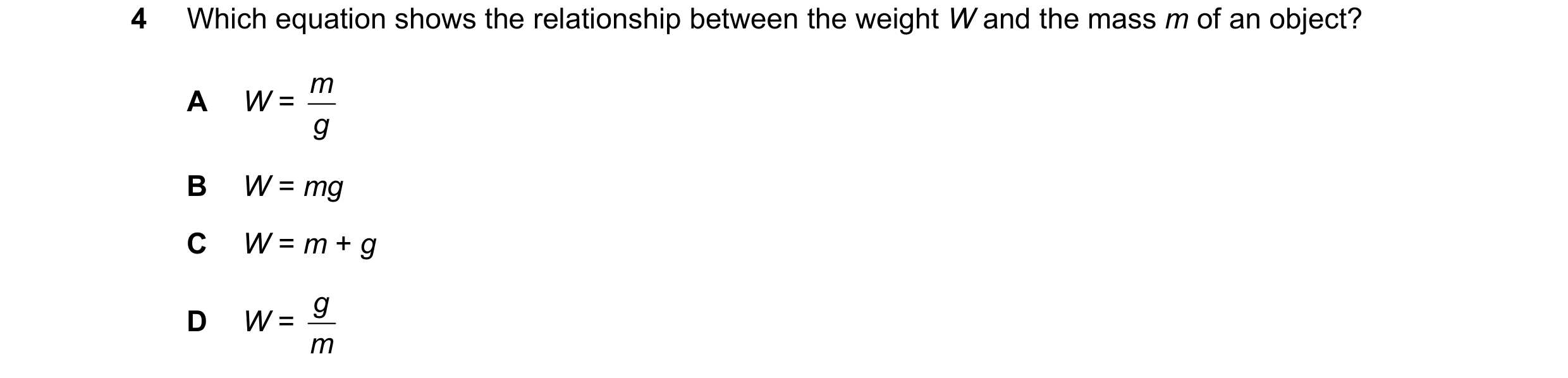
Q37 · Which equation shows the relationship between the weight W and the mass m of an object? 0625/23 Oct/Nov 2019
4 Which equation shows the relationship between the weight W and the mass m of an object? W = m A g B W = mg C W = m + g W = g D m
1 marks
Answer: B
This question in 0625/23 Oct/Nov 2019
Q38 · A compressed spring projects a ball horizontally in a vacuum chamber 0625/22 Feb/March 2020
3 A compressed spring projects a ball horizontally in a vacuum chamber. On the Earth, the ball reaches the chamber floor 4.0 m in front of the spring. An identical experiment is done on the Moon. The gravitational field strength is lower on the Moon than on the Earth. The experimental results on the Moon are compared with those on the Earth. Which statement is correct? A The horizontal speed is greater on the Moon and the ball hits the floor 4.0 m in front of the spring. B The horizontal speed is greater on the Moon and the ball hits the floor more than 4.0 m in front of the spring. C The horizontal speed is the same on the Moon and the ball hits the floor 4.0 m in front of the spring. D The horizontal speed is the same on the Moon and the ball hits the floor more than 4.0 m in front of the spring.
1 marks
Answer: D
This question in 0625/22 Feb/March 2020
Q39 · A piece of flexible material that contains many pockets of air 0625/22 Feb/March 2020
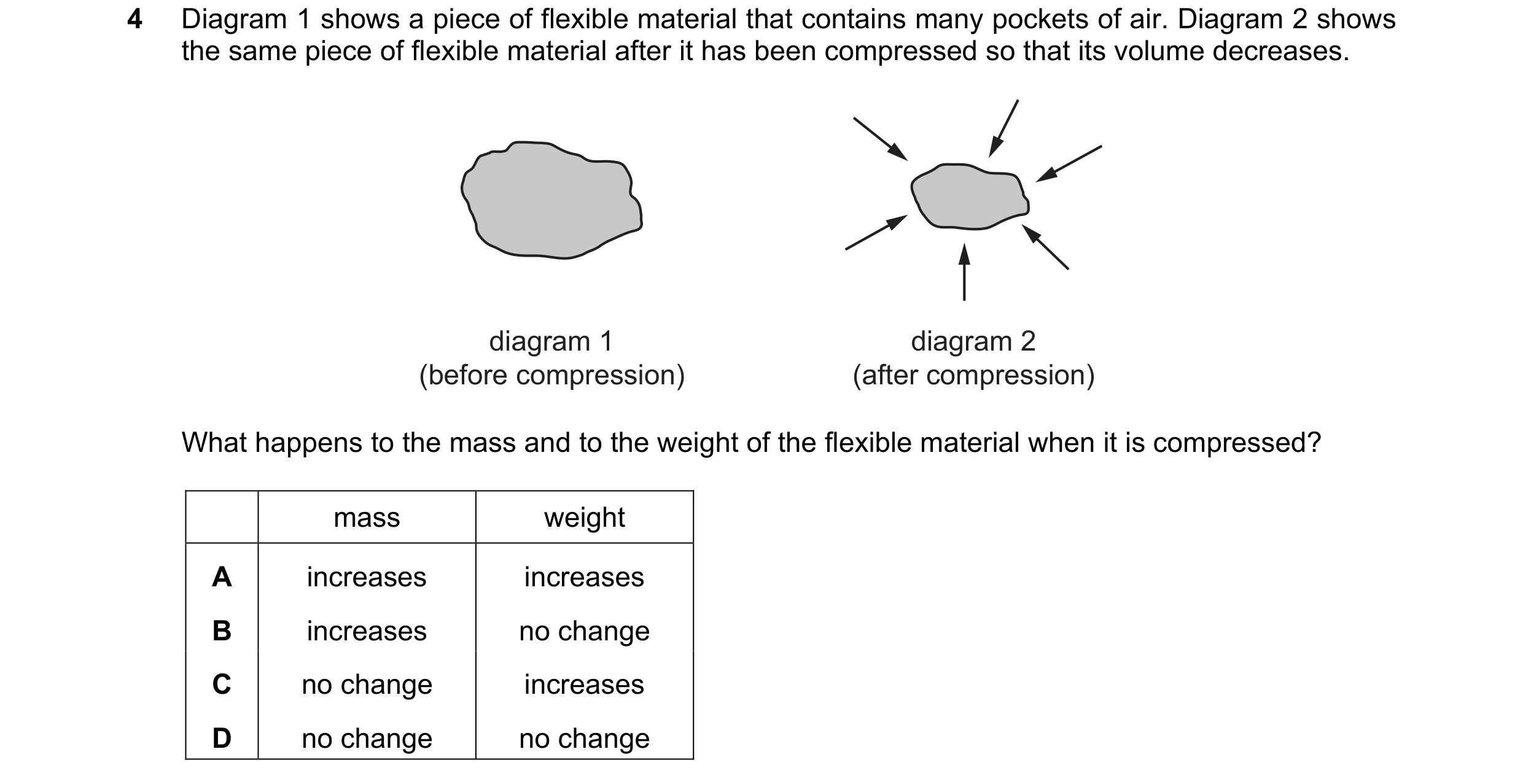
4 Diagram 1 shows a piece of flexible material that contains many pockets of air. Diagram 2 shows the same piece of flexible material after it has been compressed so that its volume decreases. diagram 1 diagram 2 (before compression) (after compression) What happens to the mass and to the weight of the flexible material when it is compressed? mass weight A increases increases B increases no change C no change increases D no change no change
1 marks
Answer: D
This question in 0625/22 Feb/March 2020
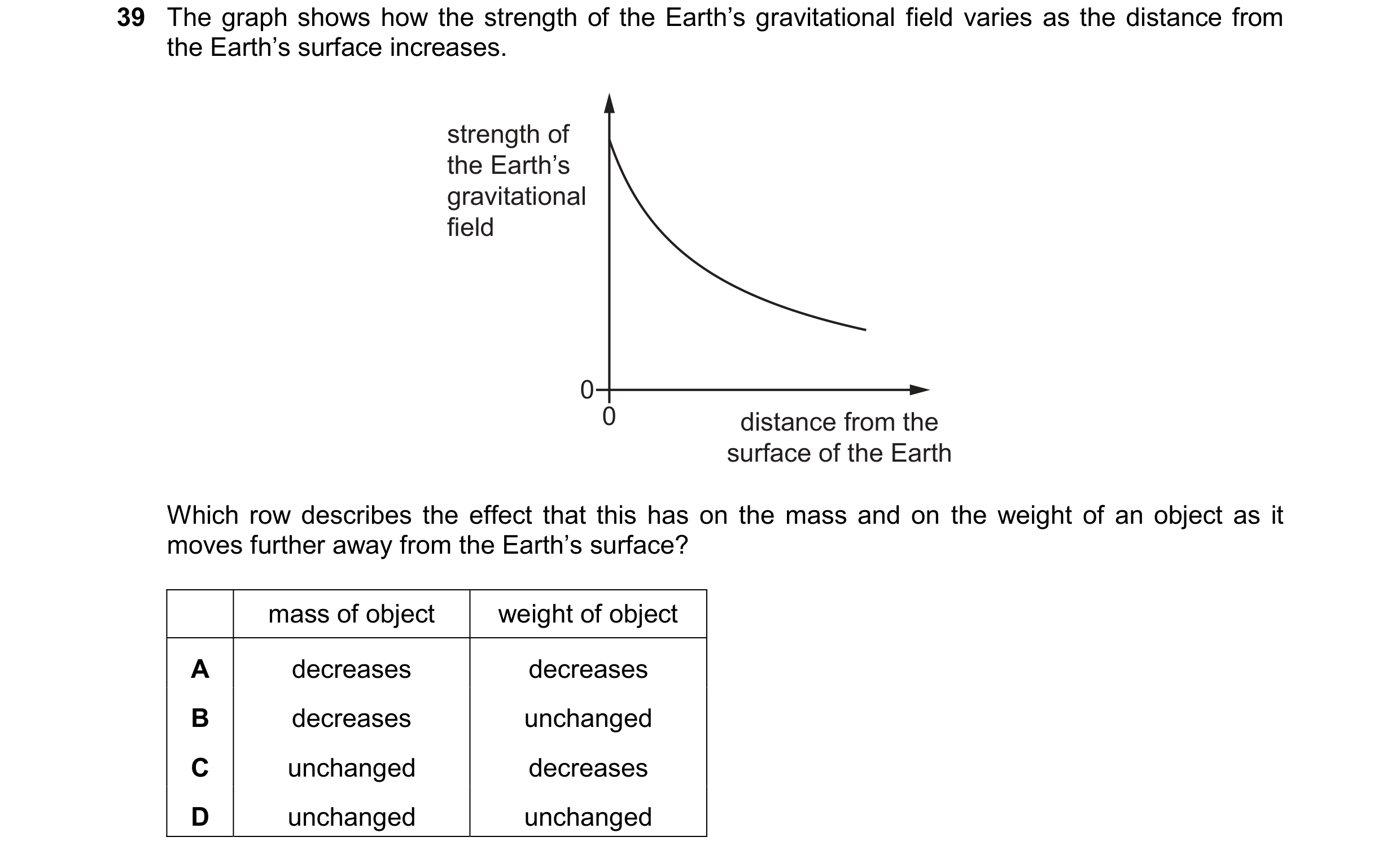
Q40 · The graph shows how the strength of the Earth’s gravitational field varies as the… 0625/22 Feb/March 2020
5 The graph shows how the strength of the Earth’s gravitational field varies as the distance from the Earth’s surface increases. strength of the Earth’s gravitational field 0 0 distance from the surface of the Earth Which row describes the effect that this has on the mass and on the weight of an object as it moves further away from the Earth’s surface? mass of object weight of object A decreases decreases B decreases unchanged C unchanged decreases D unchanged unchanged
1 marks
Answer: C
This question in 0625/22 Feb/March 2020
Q41 · A skier is standing still on a flat area of snow 0625/22 Feb/March 2020
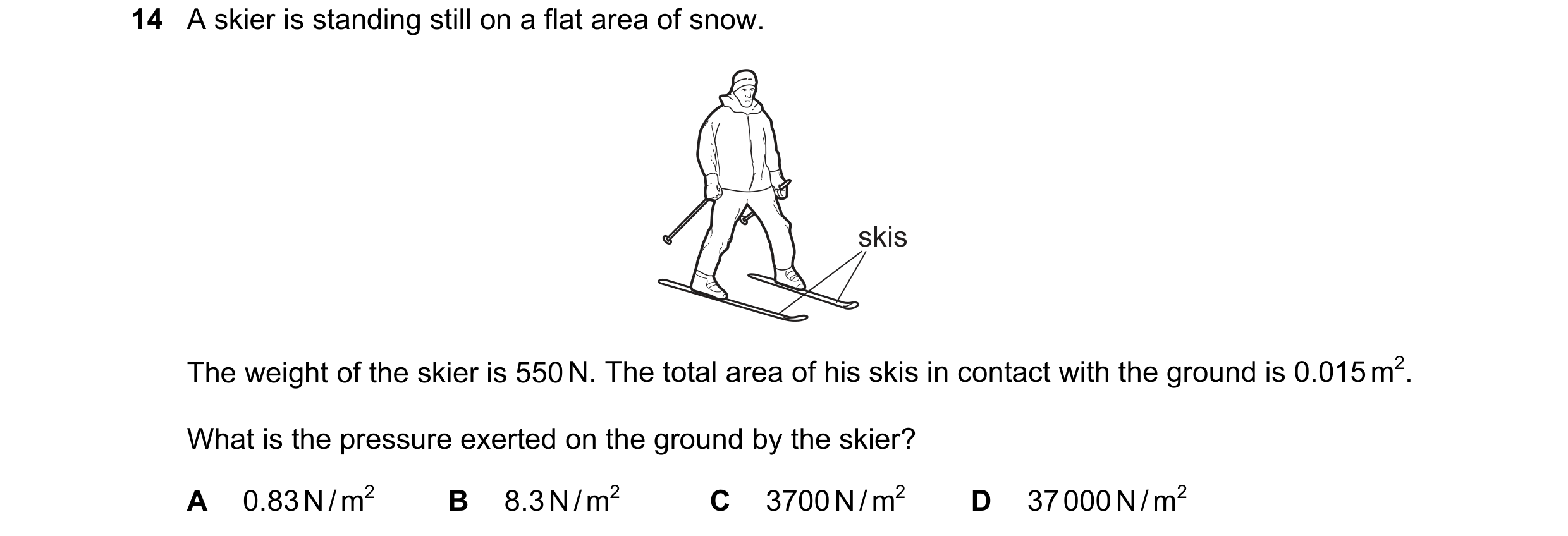
14 A skier is standing still on a flat area of snow. skis The weight of the skier is 550 N. The total area of his skis in contact with the ground is 0.015 m2. What is the pressure exerted on the ground by the skier? A 0.83 N / m2 B 8.3 N / m2 C 3700 N / m2 D 37 000 N / m2
1 marks
Answer: D
This question in 0625/22 Feb/March 2020
Q42 · Which statement correctly describes the effects of placing a heavy load in a car? 0625/21 May/June 2020
4 Which statement correctly describes the effects of placing a heavy load in a car? A It is easier to accelerate the car and easier to bring the car to rest. B It is easier to accelerate the car but more difficult to bring the car to rest. C It is more difficult to accelerate the car and more difficult to bring the car to rest. D It is more difficult to accelerate the car but easier to bring the car to rest.
1 marks
Answer: C
This question in 0625/21 May/June 2020
Q43 · A mass of 6.0 kg rests on the surface of a planet 0625/21 May/June 2020
5 A mass of 6.0 kg rests on the surface of a planet. On this planet, g = 20 N / kg. What is the weight of the object? A 0.30 N B 0.60 N C 60 N D 120 N
1 marks
Answer: D
This question in 0625/21 May/June 2020
Q44 · The diagrams show four blocks of steel 0625/21 May/June 2020
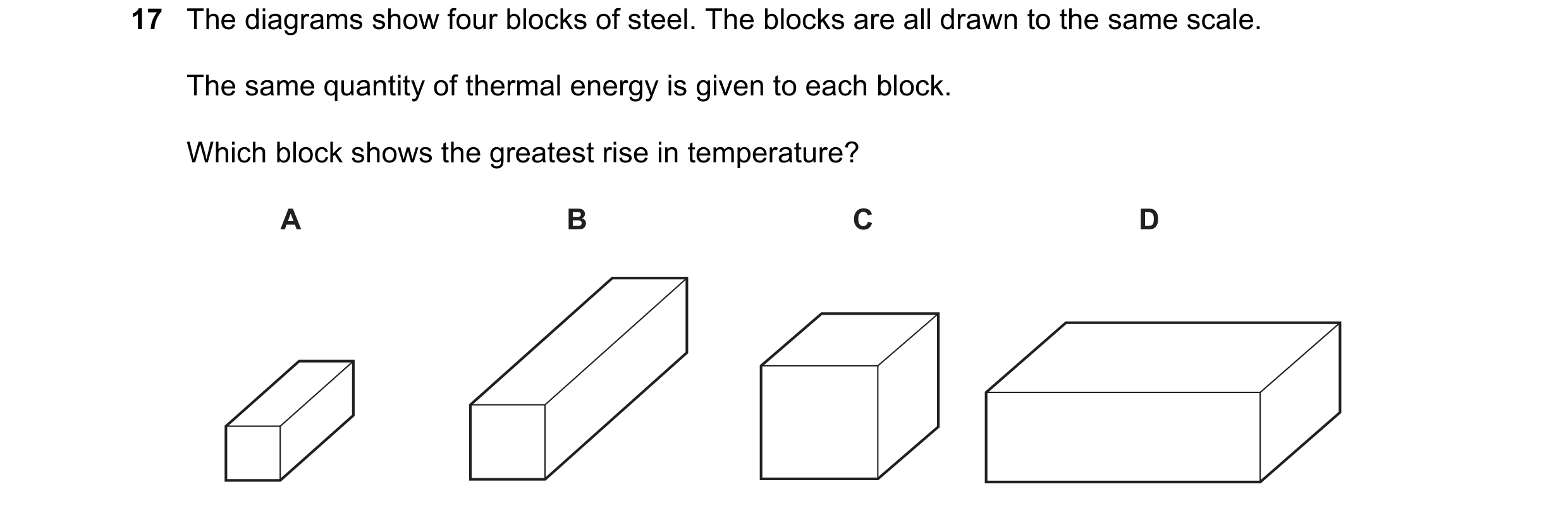
17 The diagrams show four blocks of steel. The blocks are all drawn to the same scale. The same quantity of thermal energy is given to each block. Which block shows the greatest rise in temperature? A B C D
1 marks
Answer: A
This question in 0625/21 May/June 2020
Q45 · Which statement correctly describes the effects of placing a heavy load in a car? 0625/22 May/June 2020
4 Which statement correctly describes the effects of placing a heavy load in a car? A It is easier to accelerate the car and easier to bring the car to rest. B It is easier to accelerate the car but more difficult to bring the car to rest. C It is more difficult to accelerate the car and more difficult to bring the car to rest. D It is more difficult to accelerate the car but easier to bring the car to rest.
1 marks
Answer: C
This question in 0625/22 May/June 2020
Q46 · A space probe is taken from the Earth to Mars 0625/22 May/June 2020
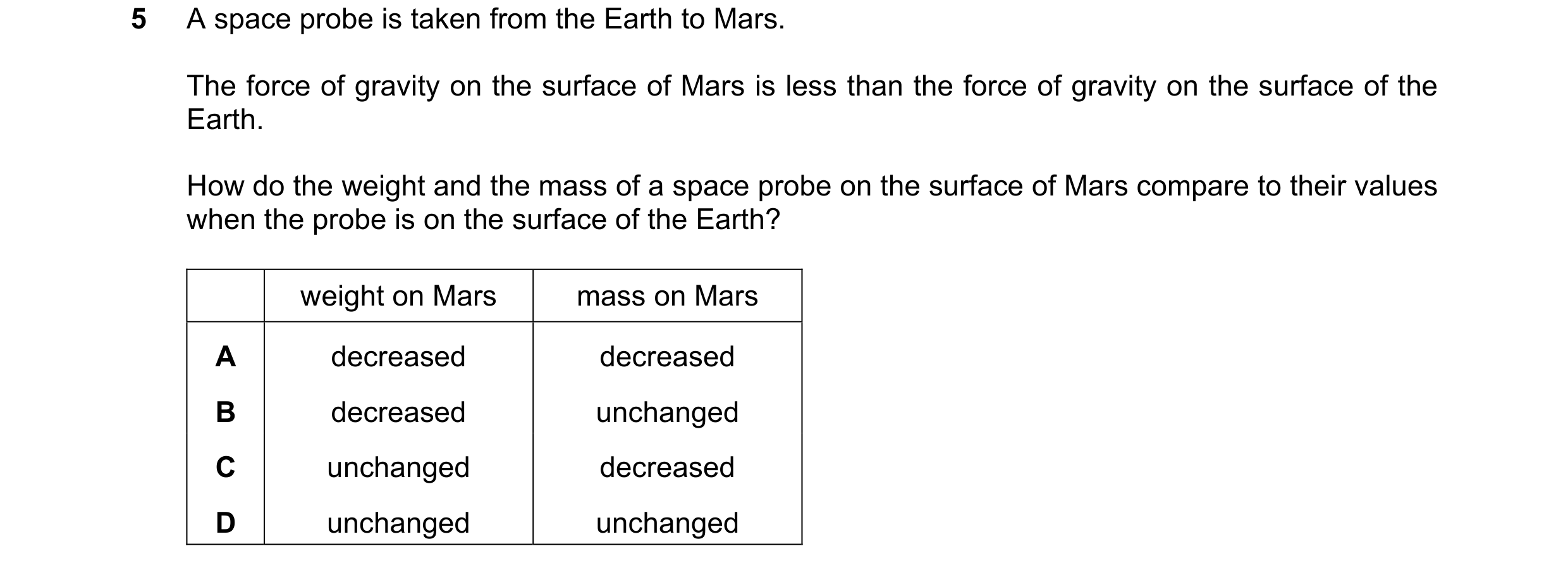
5 A space probe is taken from the Earth to Mars. The force of gravity on the surface of Mars is less than the force of gravity on the surface of the Earth. How do the weight and the mass of a space probe on the surface of Mars compare to their values when the probe is on the surface of the Earth? weight on Mars mass on Mars A decreased decreased B decreased unchanged C unchanged decreased D unchanged unchanged
1 marks
Answer: B
This question in 0625/22 May/June 2020
Q47 · Which statement correctly describes the effects of placing a heavy load in a car? 0625/23 May/June 2020
4 Which statement correctly describes the effects of placing a heavy load in a car? A It is easier to accelerate the car and easier to bring the car to rest. B It is easier to accelerate the car but more difficult to bring the car to rest. C It is more difficult to accelerate the car and more difficult to bring the car to rest. D It is more difficult to accelerate the car but easier to bring the car to rest.
1 marks
Answer: C
This question in 0625/23 May/June 2020
Q48 · Which row gives the correct weight for the mass shown? 0625/23 May/June 2020
5 Which row gives the correct weight for the mass shown? The value of g is 10 N / kg. mass / kg weight / N A 2 20 B 10 1 C 10 10 D 20 2
1 marks
Answer: A
This question in 0625/23 May/June 2020
Q49 · Which quantity is weight an example of? 0625/21 Oct/Nov 2020
4 Which quantity is weight an example of? A acceleration B force C mass D pressure
1 marks
Answer: B
This question in 0625/21 Oct/Nov 2020
Q50 · A sphere P, made of steel, has a weight of 10 N on Earth 0625/21 Oct/Nov 2020
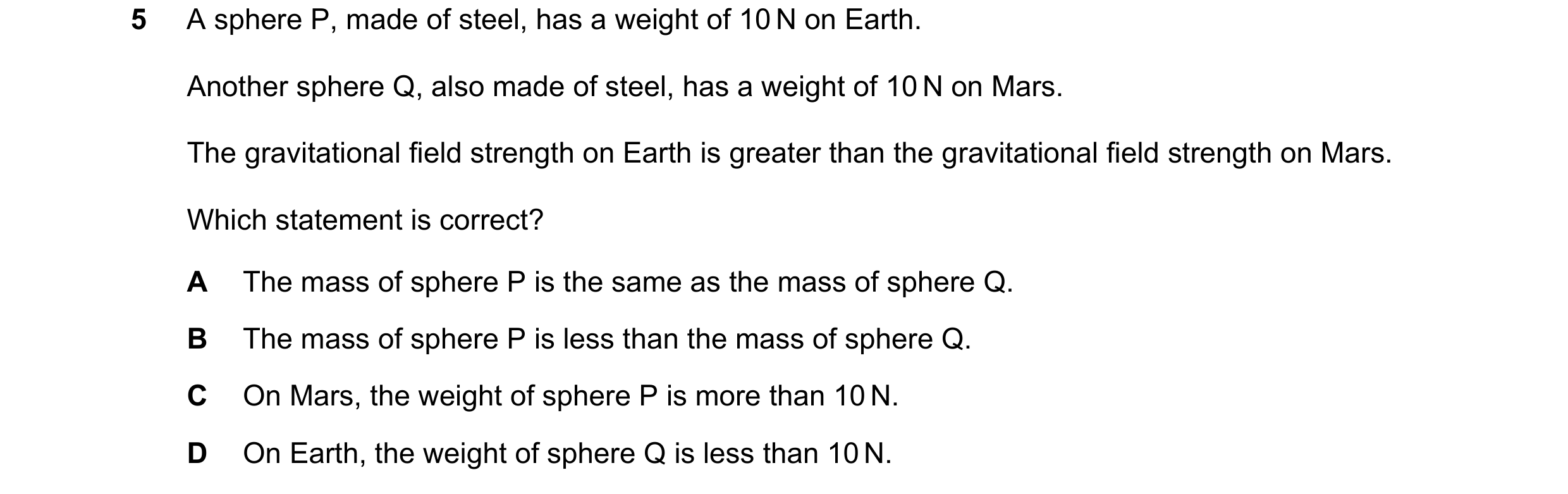
5 A sphere P, made of steel, has a weight of 10 N on Earth. Another sphere Q, also made of steel, has a weight of 10 N on Mars. The gravitational field strength on Earth is greater than the gravitational field strength on Mars. Which statement is correct? A The mass of sphere P is the same as the mass of sphere Q. B The mass of sphere P is less than the mass of sphere Q. C On Mars, the weight of sphere P is more than 10 N. D On Earth, the weight of sphere Q is less than 10 N.
1 marks
Answer: B
This question in 0625/21 Oct/Nov 2020
Q51 · Which quantity is weight an example of? 0625/22 Oct/Nov 2020
4 Which quantity is weight an example of? A acceleration B force C mass D pressure
1 marks
Answer: B
This question in 0625/22 Oct/Nov 2020
Q52 · Which statement about the mass of an object is correct? 0625/22 Oct/Nov 2020
5 Which statement about the mass of an object is correct? A It changes when the object is lifted further from the ground. B It is the gravitational force on the object. C It is zero if the object is in orbit around the Earth. D It resists any change in motion of the object.
1 marks
Answer: D
This question in 0625/22 Oct/Nov 2020
Q53 · Which quantity is weight an example of? 0625/23 Oct/Nov 2020
4 Which quantity is weight an example of? A acceleration B force C mass D pressure
1 marks
Answer: B
This question in 0625/23 Oct/Nov 2020
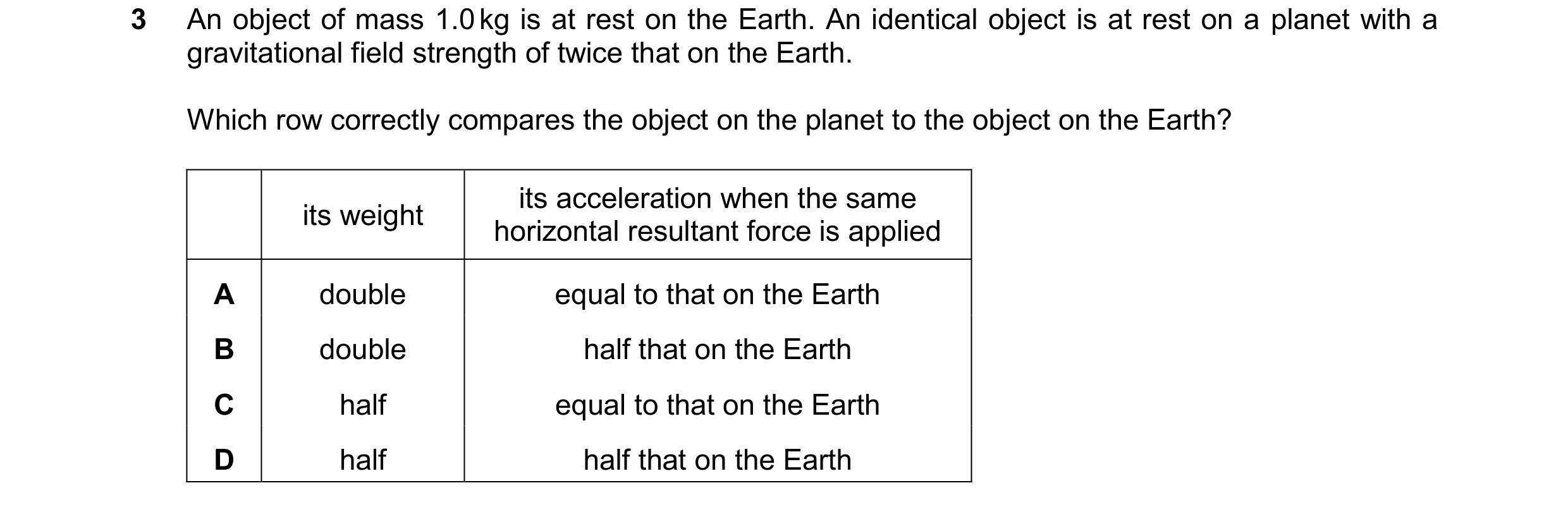
Q54 · An object of mass 1.0 kg is at rest on Earth 0625/23 Oct/Nov 2020
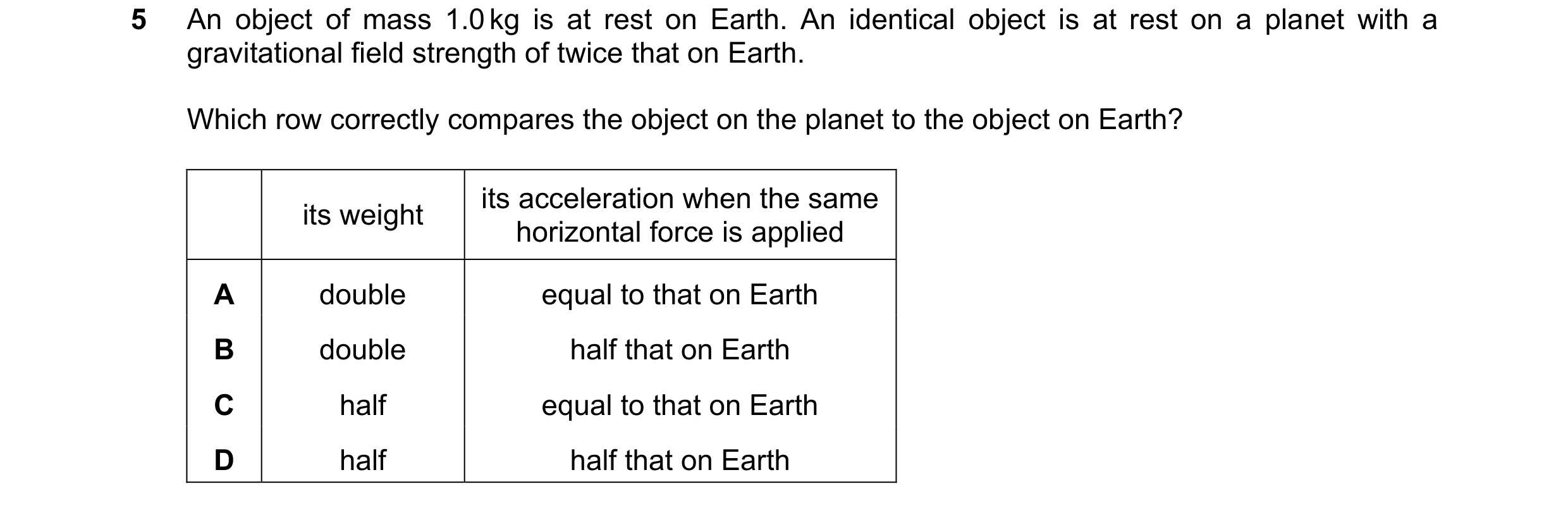
5 An object of mass 1.0 kg is at rest on Earth. An identical object is at rest on a planet with a gravitational field strength of twice that on Earth. Which row correctly compares the object on the planet to the object on Earth? its acceleration when the same its weight horizontal force is applied A double equal to that on Earth B double half that on Earth C half equal to that on Earth D half half that on Earth
1 marks
Answer: A
This question in 0625/23 Oct/Nov 2020
Q55 · Which statement about mass is correct? 0625/22 Feb/March 2021
4 Which statement about mass is correct? A A mass of 10 kg weighs 1 N near the Earth’s surface. B Mass is a gravitational force. C Mass increases when the gravitational field strength increases. D The greater the mass of a body, the more it resists a change in its motion.
1 marks
Answer: D
This question in 0625/22 Feb/March 2021
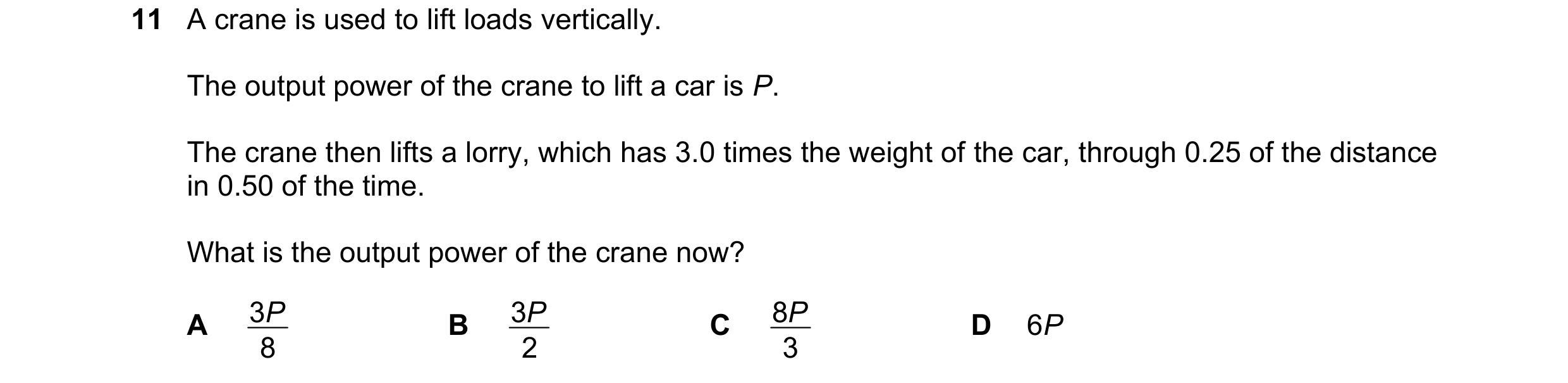
Q56 · A crane is used to lift loads vertically 0625/22 Feb/March 2021
11 A crane is used to lift loads vertically. The output power of the crane to lift a car is P. The crane then lifts a lorry, which has 3.0 times the weight of the car, through 0.25 of the distance in 0.50 of the time. What is the output power of the crane now? A 3 P B 3 P C 8 P D 6P 8 2 3
1 marks
Answer: B
This question in 0625/22 Feb/March 2021
Q57 · The diagram shows a box of dimensions 6.0 cm 8.0 cm 4.0 cm 0625/22 Feb/March 2021
13 The diagram shows a box of dimensions 6.0 cm 8.0 cm 4.0 cm. 6.0 cm X Z 4.0 cm Y 8.0 cm The box rests on a flat horizontal surface. On which face must the box rest in order to exert the least pressure? A face X B face Y C face Z D The pressure is the same for all the faces.
1 marks
Answer: A
This question in 0625/22 Feb/March 2021
Q58 · What is the best description of the meaning of the ‘mass’ of an object? 0625/22 May/June 2021
4 What is the best description of the meaning of the ‘mass’ of an object? A the space occupied by the object B the force that gravity exerts on the object C the resistance of the object to changes in motion D the closeness of packing of the molecules in the object
1 marks
Answer: C
This question in 0625/22 May/June 2021
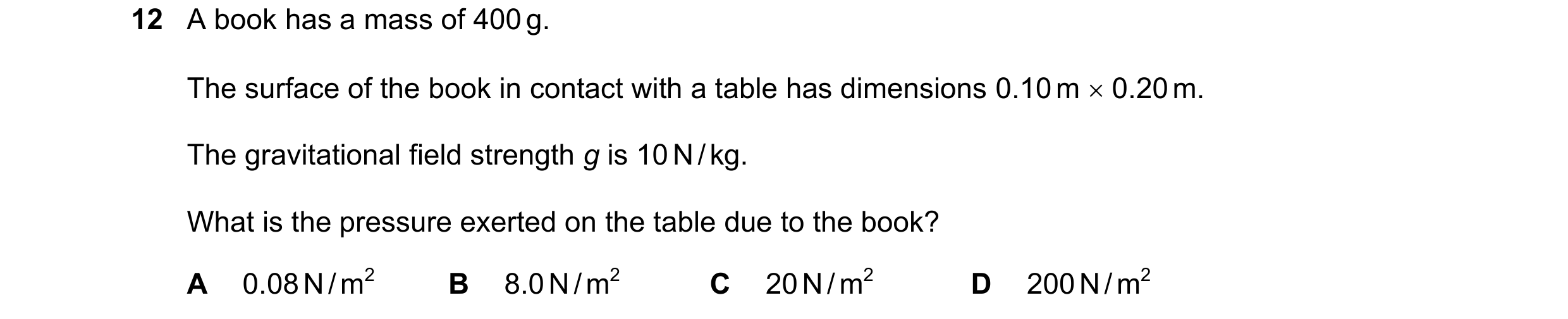
Q59 · A book has a mass of 400 g 0625/22 May/June 2021
12 A book has a mass of 400 g. The surface of the book in contact with a table has dimensions 0.10 m 0.20 m. The gravitational field strength g is 10 N / kg. What is the pressure exerted on the table due to the book? A 0.08 N / m2 B 8.0 N / m2 C 20 N / m2 D 200 N / m2
1 marks
Answer: D
This question in 0625/22 May/June 2021
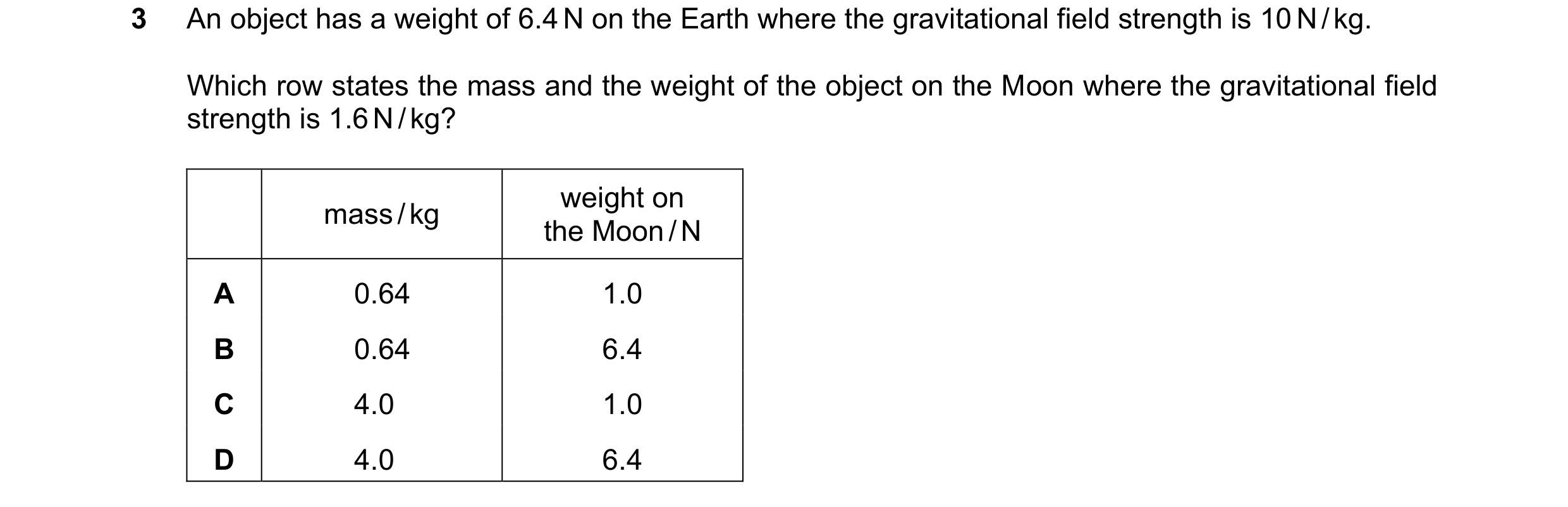
Q60 · An object has a weight of 6.4 N on the Earth where the gravitational field strength is 10… 0625/21 Oct/Nov 2021
3 An object has a weight of 6.4 N on the Earth where the gravitational field strength is 10 N / kg. Which row states the mass and the weight of the object on the Moon where the gravitational field strength is 1.6 N / kg? weight on mass / kg the Moon / N A 0.64 1.0 B 0.64 6.4 C 4.0 1.0 D 4.0 6.4
1 marks
Answer: A
This question in 0625/21 Oct/Nov 2021
Q61 · In which situation does object X have a greater mass than object Y? 0625/22 Oct/Nov 2021
3 In which situation does object X have a greater mass than object Y? A Object X is in a larger gravitational field than object Y and both have the same weight. B Object X shows a greater resistance to change in motion than object Y and both experience the same resultant force. C Object X has a lower density than object Y and both occupy the same volume. D Object X moves at a greater speed than object Y and both possess the same kinetic energy.
1 marks
Answer: B
This question in 0625/22 Oct/Nov 2021
Q62 · Which statement about mass and weight is correct? 0625/23 Oct/Nov 2021
3 Which statement about mass and weight is correct? A Mass is a property that causes change in motion. B Mass is caused by a gravitational field acting on a weight. C Weight is a property that resists change in motion. D Weight is caused by a gravitational field acting on a mass.
1 marks
Answer: D
This question in 0625/23 Oct/Nov 2021
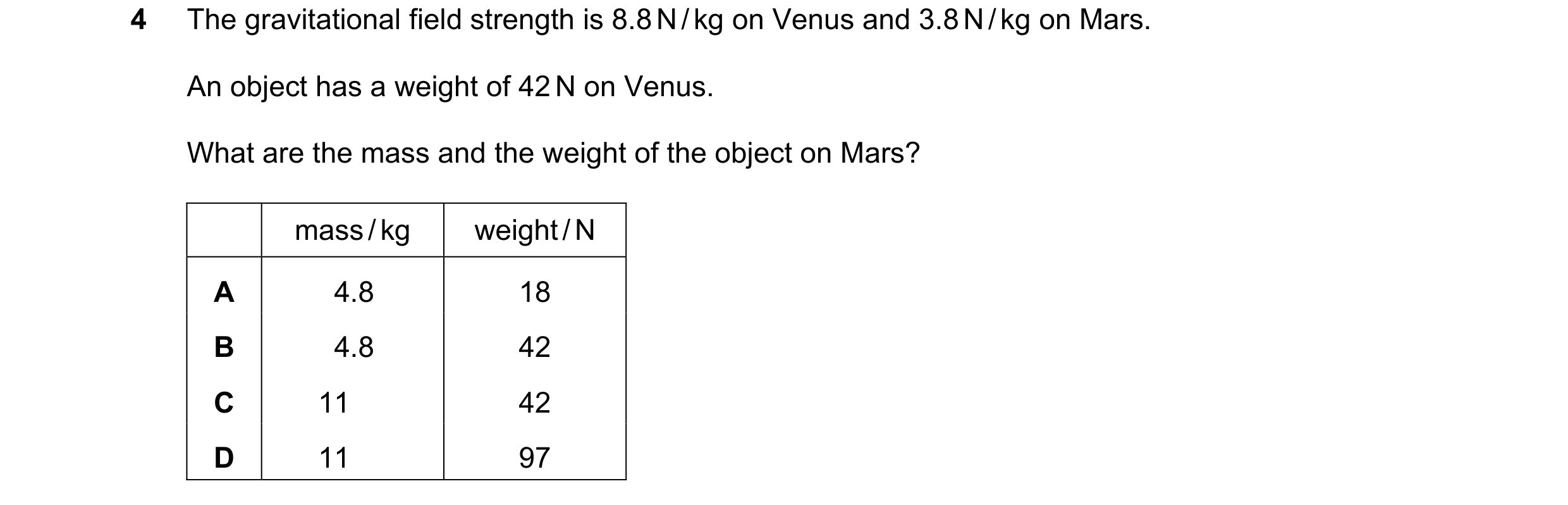
Q63 · The gravitational field strength is 8.8 N / kg on Venus and 3.8 N / kg on Mars 0625/22 Feb/March 2022
4 The gravitational field strength is 8.8 N / kg on Venus and 3.8 N / kg on Mars. An object has a weight of 42 N on Venus. What are the mass and the weight of the object on Mars? mass / kg weight / N A 4.8 18 B 4.8 42 C 11 42 D 11 97
1 marks
Answer: A
This question in 0625/22 Feb/March 2022
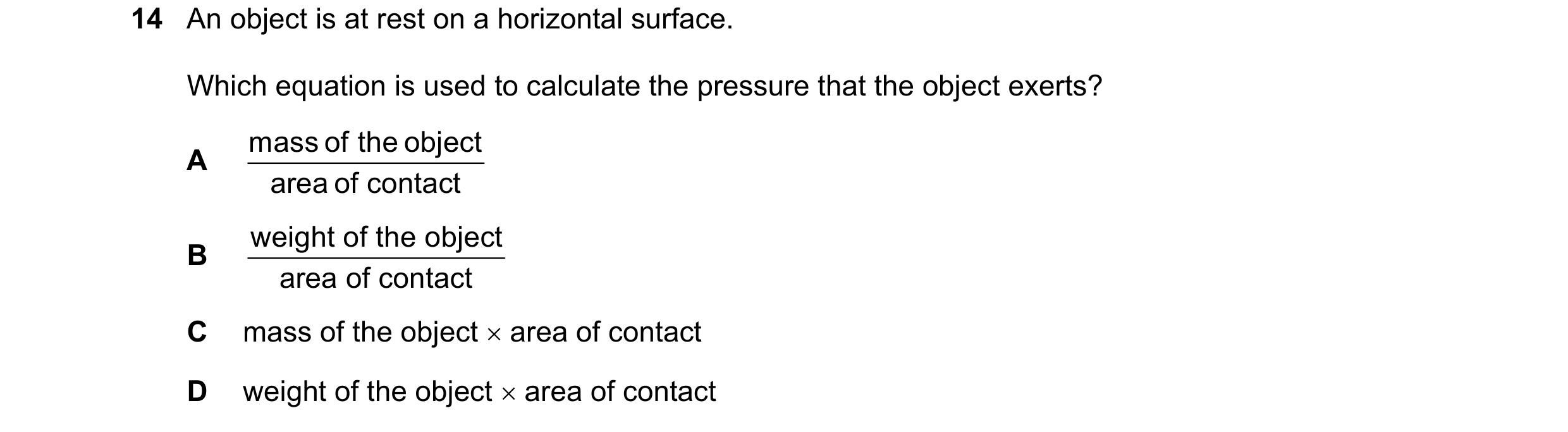
Q64 · An object is at rest on a horizontal surface 0625/22 Feb/March 2022
14 An object is at rest on a horizontal surface. Which equation is used to calculate the pressure that the object exerts? mass of the object A area of contact weight of the object B area of contact C mass of the object area of contact D weight of the object area of contact
1 marks
Answer: B
This question in 0625/22 Feb/March 2022
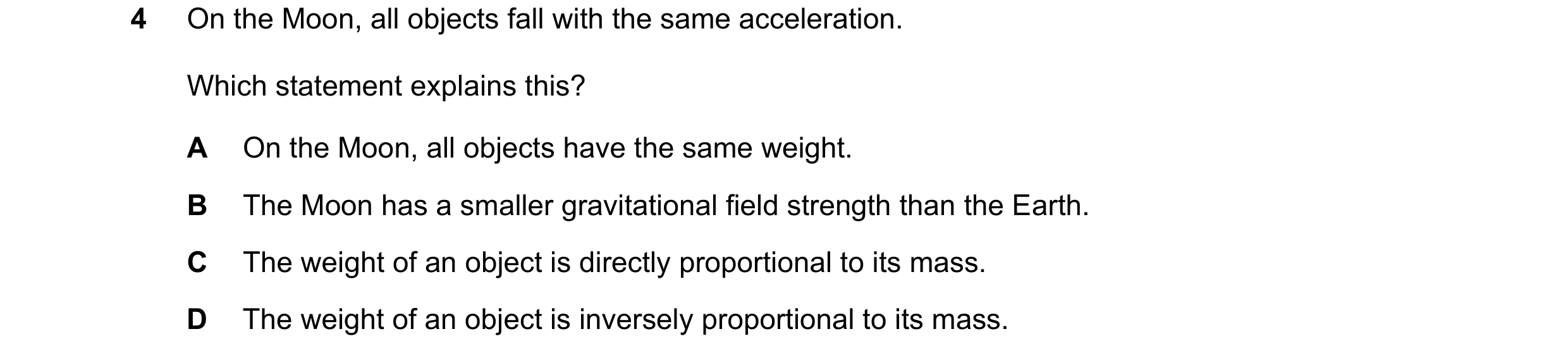
Q65 · On the Moon, all objects fall with the same acceleration 0625/21 May/June 2022
4 On the Moon, all objects fall with the same acceleration. Which statement explains this? A On the Moon, all objects have the same weight. B The Moon has a smaller gravitational field strength than the Earth. C The weight of an object is directly proportional to its mass. D The weight of an object is inversely proportional to its mass.
1 marks
Answer: C
This question in 0625/21 May/June 2022
Q66 · On the Moon, all objects fall with the same acceleration 0625/22 May/June 2022
4 On the Moon, all objects fall with the same acceleration. Which statement explains this? A On the Moon, all objects have the same weight. B The Moon has a smaller gravitational field strength than the Earth. C The weight of an object is directly proportional to its mass. D The weight of an object is inversely proportional to its mass.
1 marks
Answer: C
This question in 0625/22 May/June 2022
Q67 · On the Moon, all objects fall with the same acceleration 0625/23 May/June 2022
4 On the Moon, all objects fall with the same acceleration. Which statement explains this? A On the Moon, all objects have the same weight. B The Moon has a smaller gravitational field strength than the Earth. C The weight of an object is directly proportional to its mass. D The weight of an object is inversely proportional to its mass.
1 marks
Answer: C
This question in 0625/23 May/June 2022
Q68 · Which property of an object is a consequence of the effect of a gravitational field… 0625/21 Oct/Nov 2022
3 Which property of an object is a consequence of the effect of a gravitational field acting on it? A density B mass C volume D weight
1 marks
Answer: D
This question in 0625/21 Oct/Nov 2022
Q69 · Which statement describes the relationship between mass and weight? 0625/22 Oct/Nov 2022
3 Which statement describes the relationship between mass and weight? A Mass is the effect of a gravitational field on a weight. B Mass is the effect of a magnetic field on a weight. C Weight is the effect of a gravitational field on a mass. D Weight is the effect of a magnetic field on a mass.
1 marks
Answer: C
This question in 0625/22 Oct/Nov 2022
Q70 · Which property of a body results from the effect of a gravitational field on its mass? 0625/23 Oct/Nov 2022
3 Which property of a body results from the effect of a gravitational field on its mass? A the ability of the body to resist a change in motion B the density of the body C the volume of the body D the weight of the body
1 marks
Answer: D
This question in 0625/23 Oct/Nov 2022
Q71 · A metal rod of length 80 cm is pivoted at point O 0625/23 Oct/Nov 2022
5 A metal rod of length 80 cm is pivoted at point O. Its centre of mass is at its mid-point. Four pulley wheels are indicated by the letter P. P P P P cords 20 cm 20 cm O metal rod 0.10 kg 0.10 kg The rod is in equilibrium, as shown. What is the weight of the rod? A 0.20 N B 1.0 N C 2.0 N D 4.0 N
1 marks
Answer: C
This question in 0625/23 Oct/Nov 2022
Q72 · The equation used to find the change in gravitational potential energy of an object can… 0625/22 Feb/March 2023
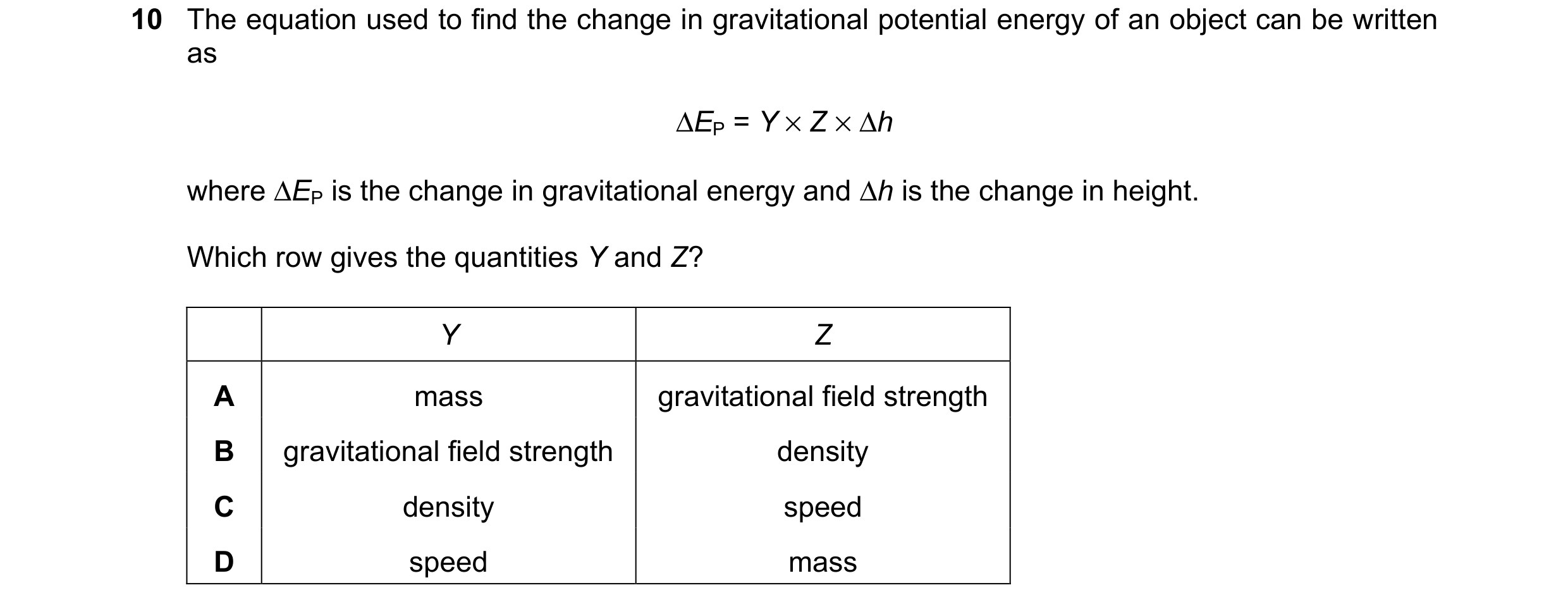
10 The equation used to find the change in gravitational potential energy of an object can be written as ∆EP = Y × Z × ∆h where ∆EP is the change in gravitational energy and ∆h is the change in height. Which row gives the quantities Y and Z? Y Z A mass gravitational field strength B gravitational field strength density C density speed D speed mass
1 marks
Answer: A
This question in 0625/22 Feb/March 2023
Q73 · On the Earth, a spring stretches by 5.0 cm when a mass of 3.0 kg is suspended from one end 0625/21 May/June 2023
4 On the Earth, a spring stretches by 5.0 cm when a mass of 3.0 kg is suspended from one end. The gravitational field strength on the Moon is 1 6 of that on the Earth. Which mass, on the Moon, would stretch the spring by the same extension? A 0.50 kg B 3.0 kg C 5.0 kg D 18 kg
1 marks
Answer: D
This question in 0625/21 May/June 2023
Q74 · A shopkeeper pours rice into a dish that hangs from a spring balance 0625/21 May/June 2023
5 A shopkeeper pours rice into a dish that hangs from a spring balance. He records the reading. 0 spring balance 6 1 5 2 4 3 rice dish A customer buys some pasta. The shopkeeper notices that the reading on the spring balance, with just pasta in the dish, is the same as it was with just rice in the dish. Which quantity must be the same for the rice and for the pasta? A density B temperature C volume D weight
1 marks
Answer: D
This question in 0625/21 May/June 2023
Q75 · Which statement about mass or weight is not correct? 0625/22 May/June 2023
4 Which statement about mass or weight is not correct? A Masses can be compared using a balance. B Mass is a force. C Weights can be compared using a balance. D Weight is a force.
1 marks
Answer: B
This question in 0625/22 May/June 2023
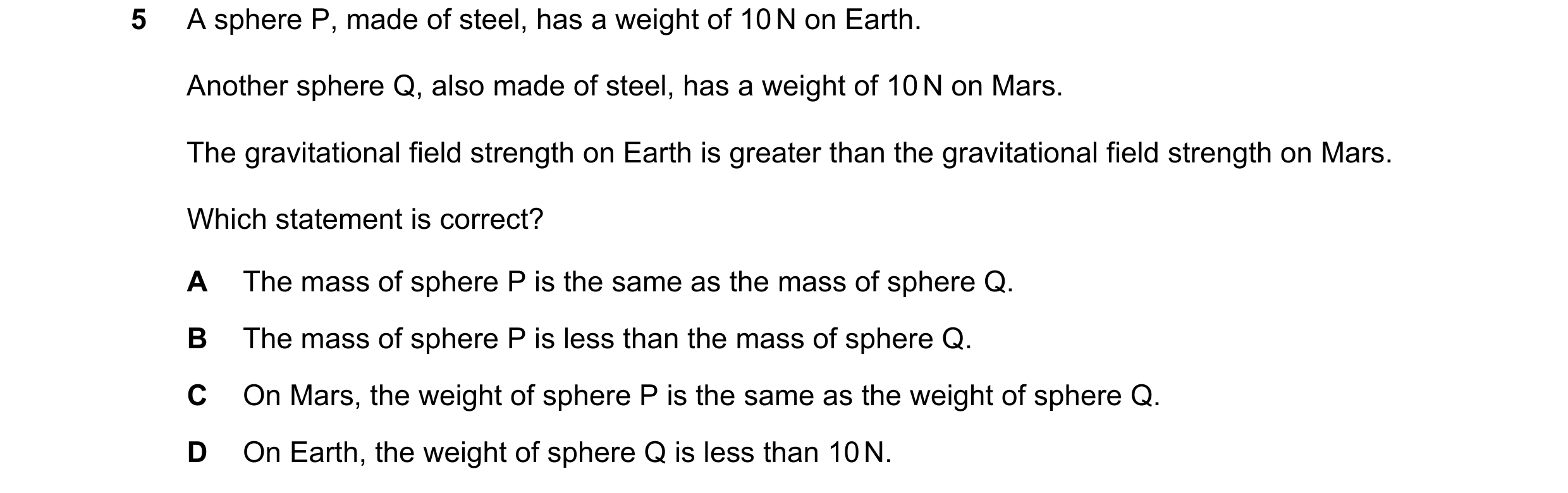
Q76 · A sphere P, made of steel, has a weight of 10 N on Earth 0625/22 May/June 2023
5 A sphere P, made of steel, has a weight of 10 N on Earth. Another sphere Q, also made of steel, has a weight of 10 N on Mars. The gravitational field strength on Earth is greater than the gravitational field strength on Mars. Which statement is correct? A The mass of sphere P is the same as the mass of sphere Q. B The mass of sphere P is less than the mass of sphere Q. C On Mars, the weight of sphere P is the same as the weight of sphere Q. D On Earth, the weight of sphere Q is less than 10 N.
1 marks
Answer: B
This question in 0625/22 May/June 2023
Q77 · Two rectangular blocks consist of different materials 0625/23 May/June 2023
4 Two rectangular blocks consist of different materials. Four different methods are suggested to compare the two masses. 1 Compare the accelerations with which they fall freely. 2 Compare the values of their lengths breadths heights. 3 Hang each in turn from the same spring. Compare the extensions. 4 Place one in the right-hand pan of a beam balance and the other in the left-hand pan. Which methods give a comparison of the two masses? A 1, 2 and 3 B 1 and 2 only C 3 and 4 only D 4 only
1 marks
Answer: C
This question in 0625/23 May/June 2023
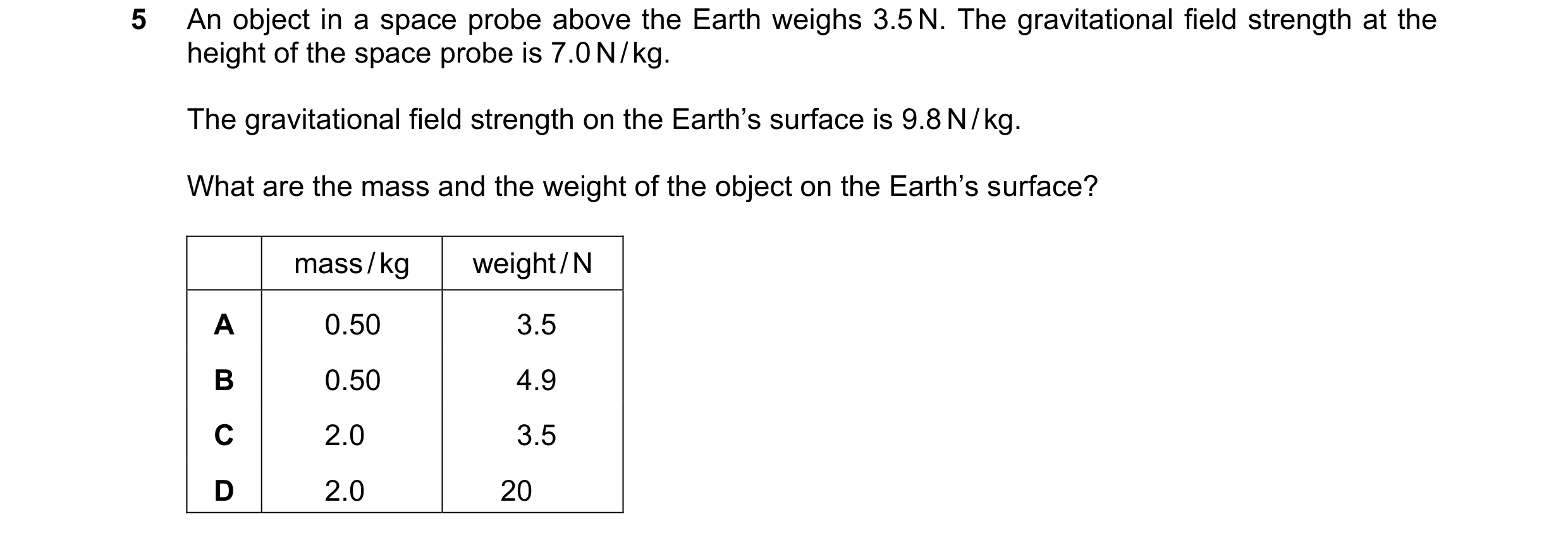
Q78 · An object in a space probe above the Earth weighs 3.5 N 0625/23 May/June 2023
5 An object in a space probe above the Earth weighs 3.5 N. The gravitational field strength at the height of the space probe is 7.0 N / kg. The gravitational field strength on the Earth’s surface is 9.8 N / kg. What are the mass and the weight of the object on the Earth’s surface? mass / kg weight / N A 0.50 3.5 B 0.50 4.9 C 2.0 3.5 D 2.0 20
1 marks
Answer: B
This question in 0625/23 May/June 2023
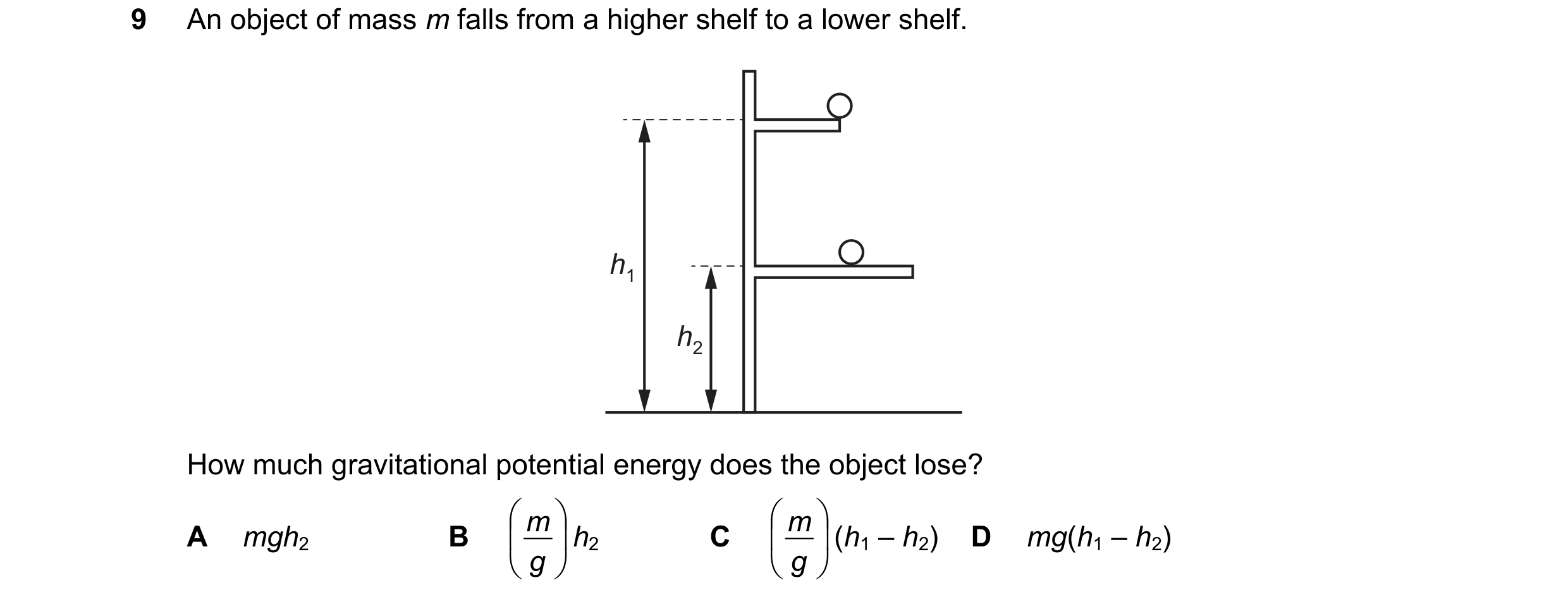
Q79 · An object of mass m falls from a higher shelf to a lower shelf 0625/21 Oct/Nov 2023
9 An object of mass m falls from a higher shelf to a lower shelf. h1 h2 How much gravitational potential energy does the object lose? m h2 m (h1 – h2) A mgh2 B C D mg(h1 – h2) g g
1 marks
Answer: D
This question in 0625/21 Oct/Nov 2023
Q80 · Which name is given to the quantity of matter in an object? 0625/21 May/June 2024
2 Which name is given to the quantity of matter in an object? A density B mass C volume D weight
1 marks
Answer: B
This question in 0625/21 May/June 2024
Q81 · A body is moved from place X to place Y where the gravitational field strength is… 0625/21 May/June 2024
3 A body is moved from place X to place Y where the gravitational field strength is different. What happens to its mass and to its weight due to the move? mass weight A changes changes B changes stays the same C stays the same changes D stays the same stays the same
1 marks
Answer: C
This question in 0625/21 May/June 2024
Q82 · An astronaut of mass 80 kg is standing on a planet with gravitational field strength g =… 0625/22 May/June 2024
3 An astronaut of mass 80 kg is standing on a planet with gravitational field strength g = 3.8 N / kg. What is the weight of the astronaut on this planet? A 780 N B 300 N C 210 N D 21 N
1 marks
Answer: B
This question in 0625/22 May/June 2024
Q83 · Which statement about gravitational field strength g is correct? 0625/23 May/June 2024
5 Which statement about gravitational field strength g is correct? mass A g = weight B g = mass weight C g is defined as the mass per unit force D g is equal to the acceleration of free fall
1 marks
Answer: D
This question in 0625/23 May/June 2024
Q84 · Which statement about gravitational field strength is not correct? 0625/22 Oct/Nov 2024
4 Which statement about gravitational field strength is not correct? A It changes the mass of an object. B It is equivalent to the acceleration of free fall. C It is measured in N / kg. D Its magnitude is different on other planets in our Solar system.
1 marks
Answer: A
This question in 0625/22 Oct/Nov 2024
Q85 · An object of mass 1.0 kg is at rest on the Earth 0625/23 Oct/Nov 2024
3 An object of mass 1.0 kg is at rest on the Earth. An identical object is at rest on a planet with a gravitational field strength of twice that on the Earth. Which row correctly compares the object on the planet to the object on the Earth? its acceleration when the same its weight horizontal resultant force is applied A double equal to that on the Earth B double half that on the Earth C half equal to that on the Earth D half half that on the Earth
1 marks
Answer: A
This question in 0625/23 Oct/Nov 2024
Q86 · The acceleration of free fall on the Moon has one sixth of its value on the Earth 0625/22 Feb/March 2025
4 The acceleration of free fall on the Moon has one sixth of its value on the Earth. On the Earth, an astronaut’s mass is measured as 60 kg. Which row gives the mass and weight of the astronaut on the Earth and on the Moon? Earth Moon mass weight mass weight / kg / N / kg / N A 60 6.1 10 1.0 B 60 6.1 60 6.1 C 60 590 10 16 D 60 590 60 98
1 marks
Answer: D
This question in 0625/22 Feb/March 2025
Q87 · The graph shows how the strength of the Earth’s gravitational field varies as the… 0625/22 Feb/March 2025
39 The graph shows how the strength of the Earth’s gravitational field varies as the distance from the Earth’s surface increases. strength of the Earth’s gravitational field 0 0 distance from the surface of the Earth Which row describes the effect that this has on the mass and on the weight of an object as it moves further away from the Earth’s surface? mass of object weight of object A decreases decreases B decreases unchanged C unchanged decreases D unchanged unchanged
1 marks
Answer: C
This question in 0625/22 Feb/March 2025
Q88 · The diagrams show two metal blocks, X and Y, suspended from identical force meters 0625/21 May/June 2025
3 The diagrams show two metal blocks, X and Y, suspended from identical force meters. X and Y have identical dimensions. N N 0 0 1 1 2 2 3 3 4 4 5 5 6 6 X Y Which statement about X and Y is correct? A They have different volumes and different weights. B They have different volumes and equal weights. C They have equal volumes and equal weights. D They have equal volumes and different weights.
1 marks
Answer: D
This question in 0625/21 May/June 2025
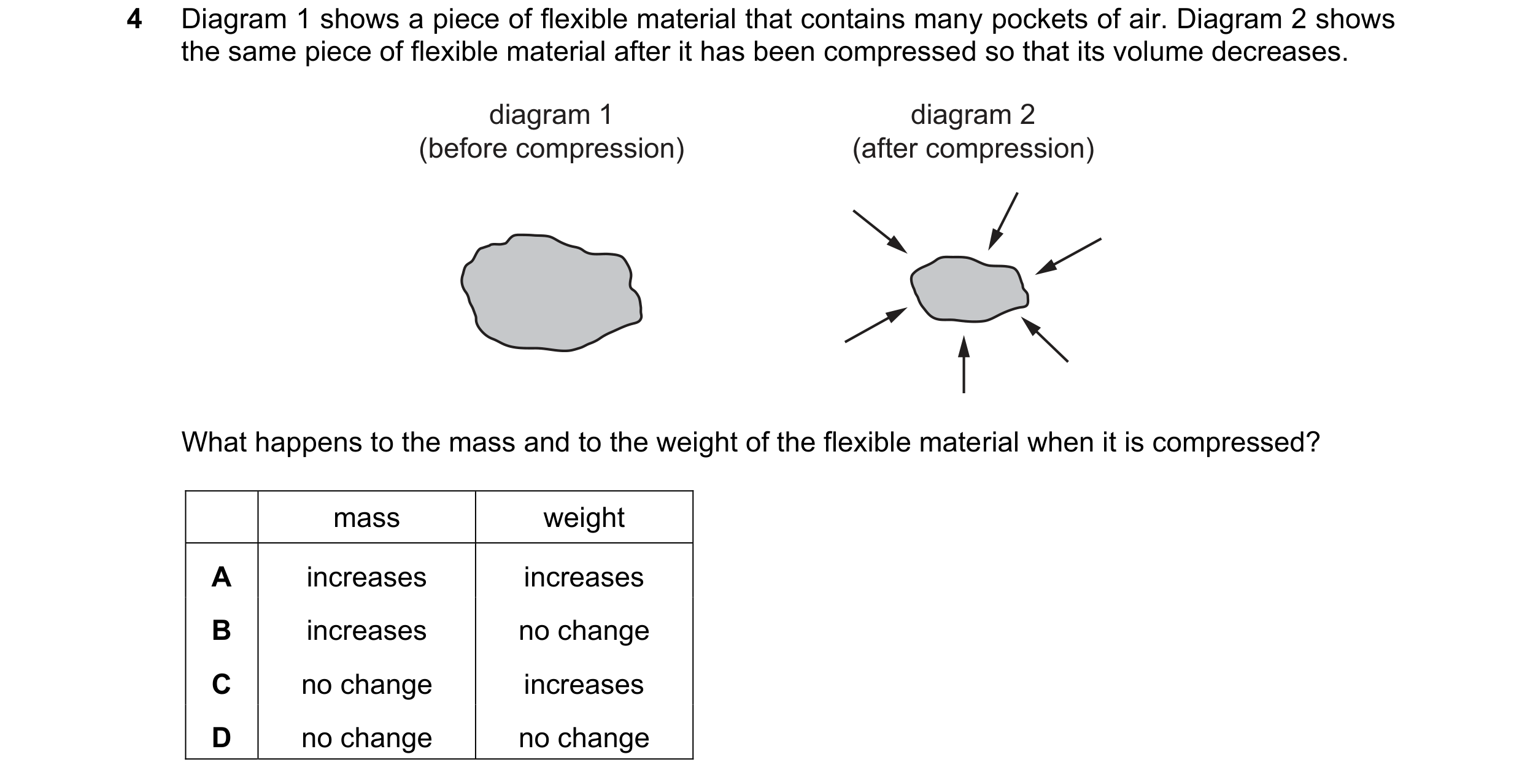
Q89 · A piece of flexible material that contains many pockets of air 0625/22 May/June 2025
4 Diagram 1 shows a piece of flexible material that contains many pockets of air. Diagram 2 shows the same piece of flexible material after it has been compressed so that its volume decreases. diagram 1 diagram 2 (before compression) (after compression) What happens to the mass and to the weight of the flexible material when it is compressed? mass weight A increases increases B increases no change C no change increases D no change no change
1 marks
Answer: D
This question in 0625/22 May/June 2025
Q90 · Students are asked for a statement about the weight of an object 0625/23 May/June 2025
4 Students are asked for a statement about the weight of an object. Three of the statements are listed. 1 The weight is the quantity of matter in the object. 2 The weight is the effect of a gravitational field on the object. 3 The weight is the force of attraction between the object and the Earth. Which statements describe the weight of the object? A 1, 2 and 3 B 1 and 2 only C 1 and 3 only D 2 and 3 only
1 marks
Answer: D
This question in 0625/23 May/June 2025
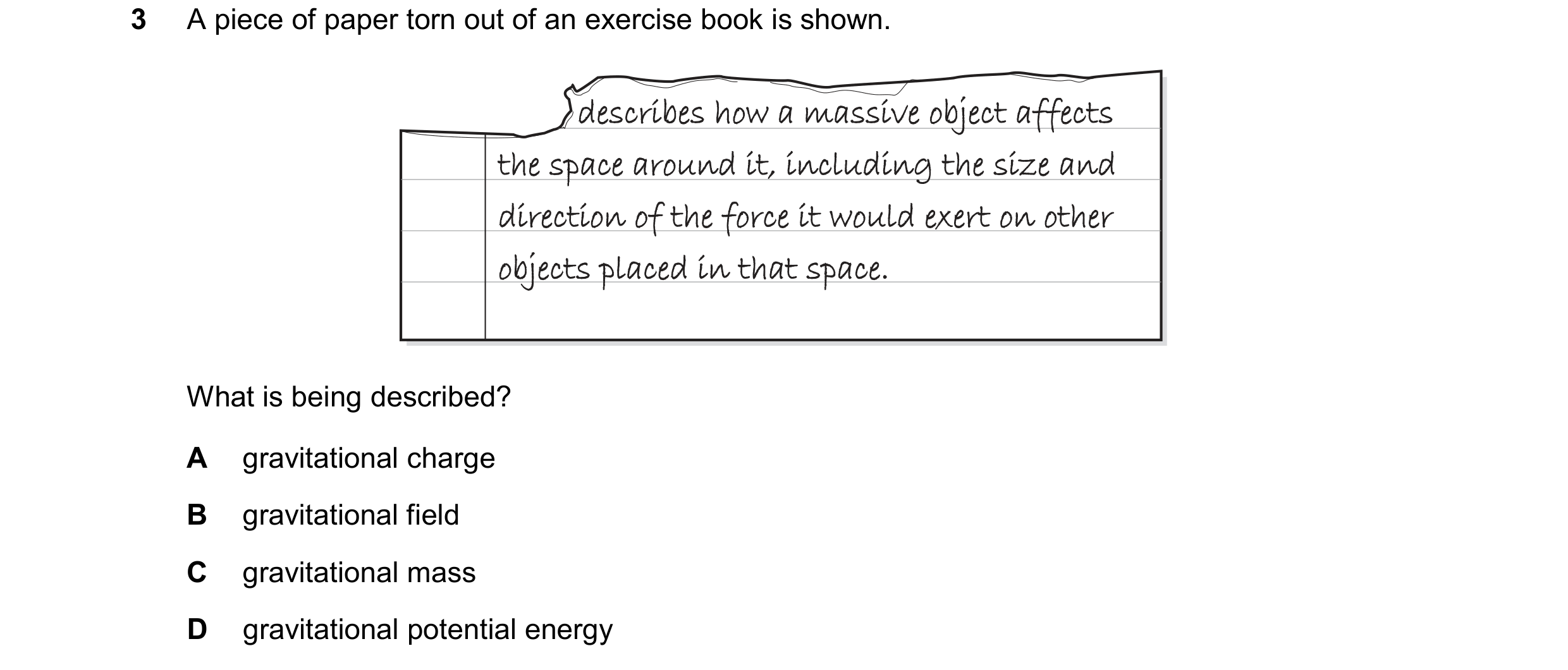
Q91 · A piece of paper torn out of an exercise book is shown 0625/21 Oct/Nov 2025
3 A piece of paper torn out of an exercise book is shown. What is being described? A gravitational charge B gravitational field C gravitational mass D gravitational potential energy
1 marks
Answer: B
This question in 0625/21 Oct/Nov 2025
Q92 · A space probe that has a mass of 600 kg is on the planet Mars 0625/22 Oct/Nov 2025
3 A space probe that has a mass of 600 kg is on the planet Mars. The acceleration of free fall on Mars is 4.0 m / s2. What is the weight of the space probe on Mars? A 60 N B 150 N C 2400 N D 6000 N
1 marks
Answer: C
This question in 0625/22 Oct/Nov 2025
Q93 · Which measuring instrument is used to compare masses? 0625/23 Oct/Nov 2025
4 Which measuring instrument is used to compare masses? A balance B protractor C stop-watch D voltmeter
1 marks
Answer: A
This question in 0625/23 Oct/Nov 2025
 1 / 25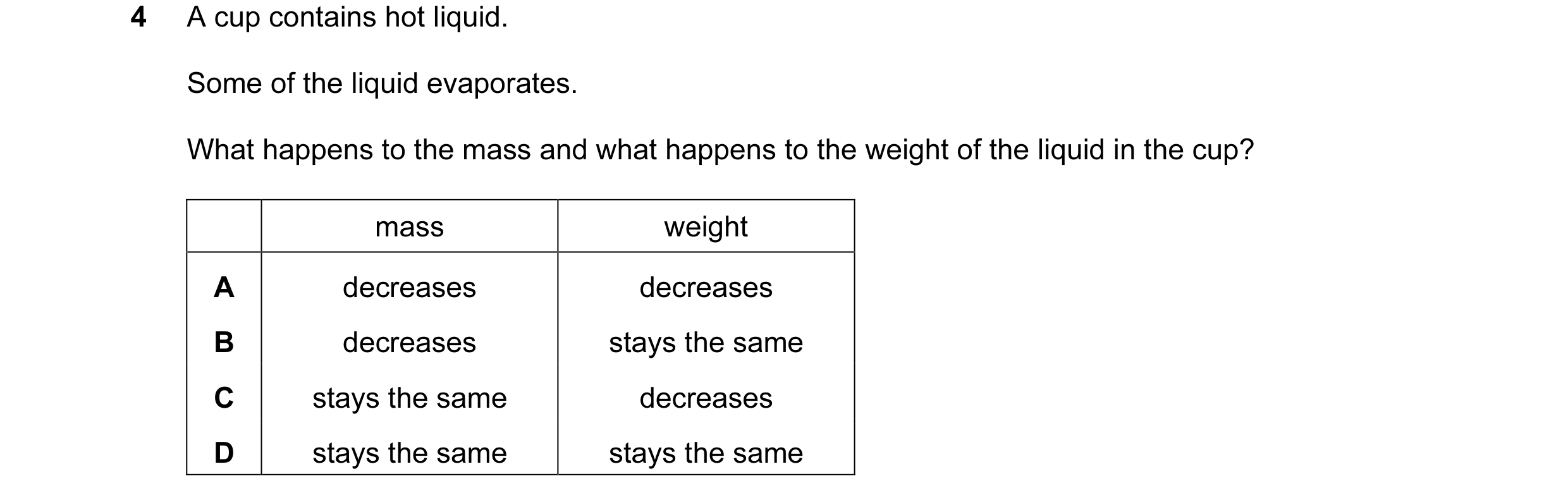
 2 / 25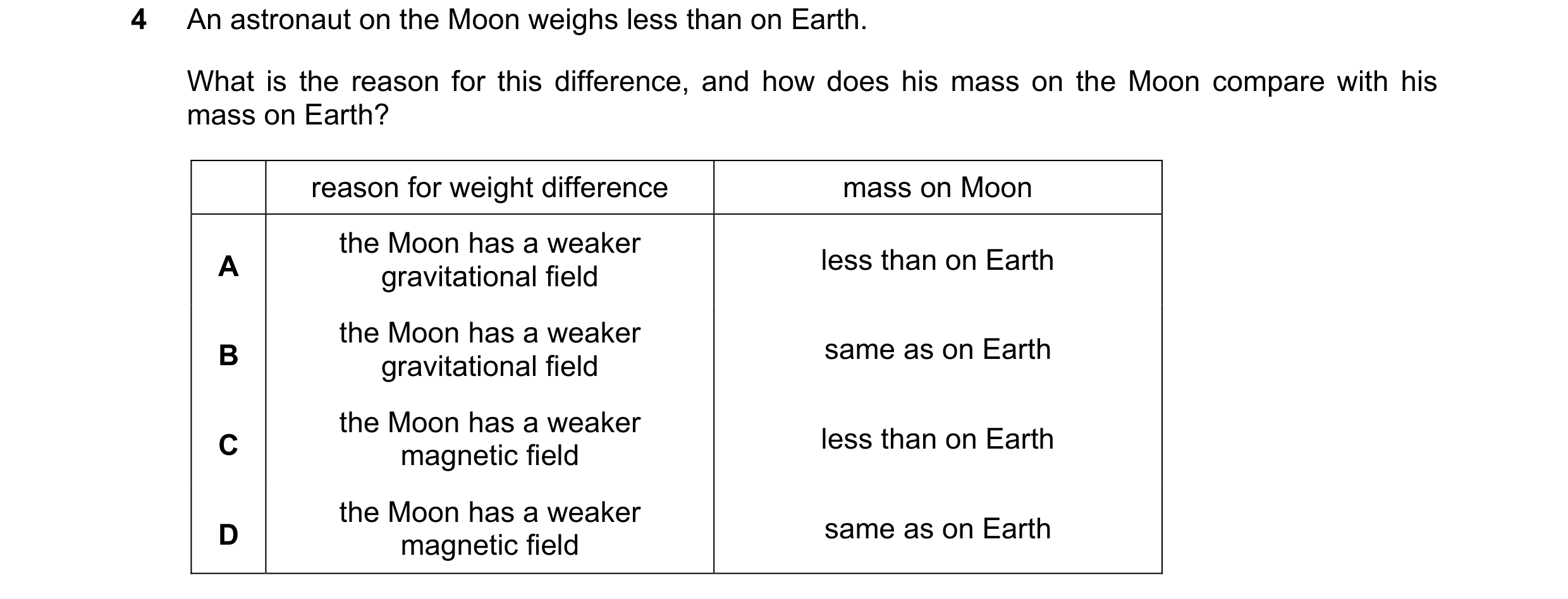

 3 / 25

 4 / 25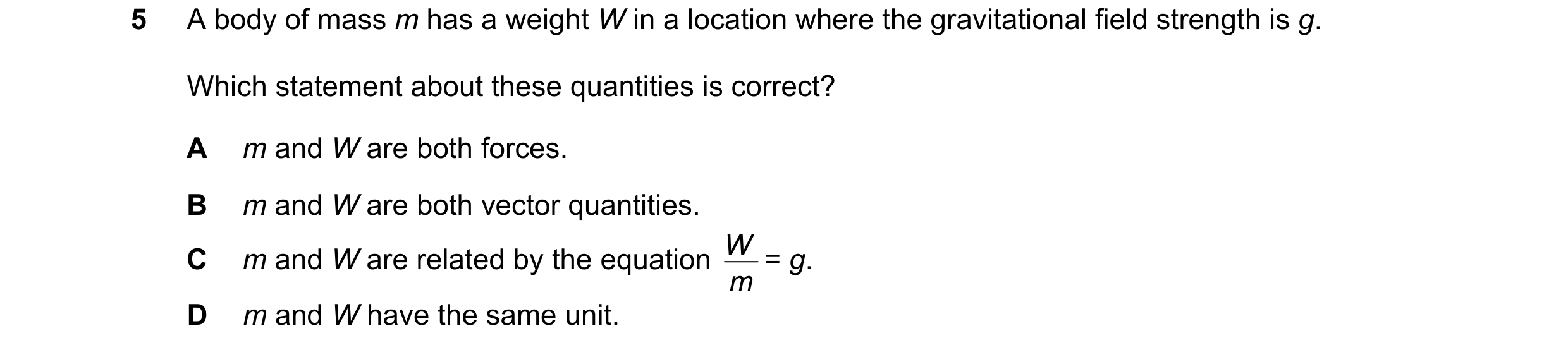
 5 / 25

 6 / 25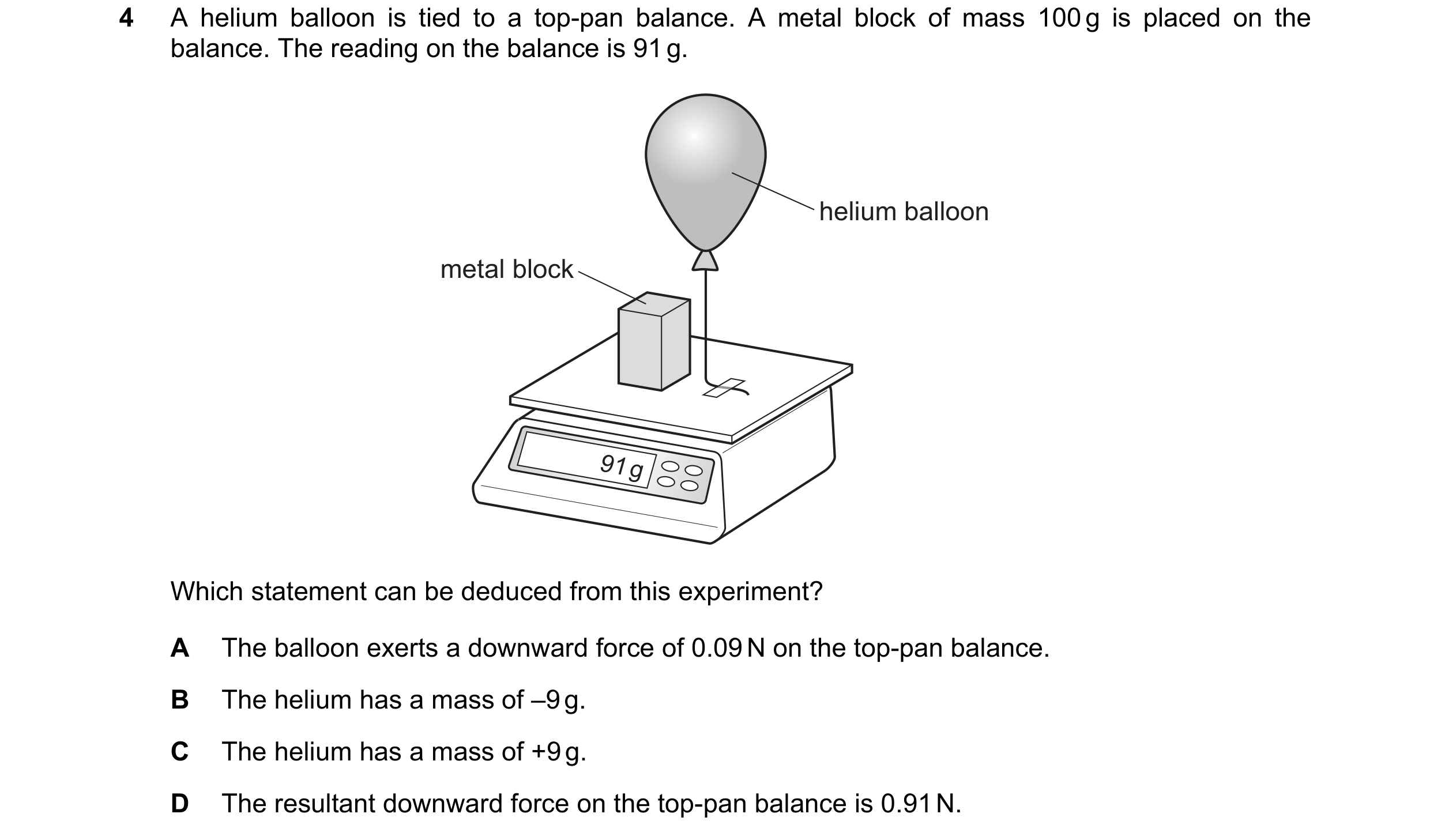
 7 / 25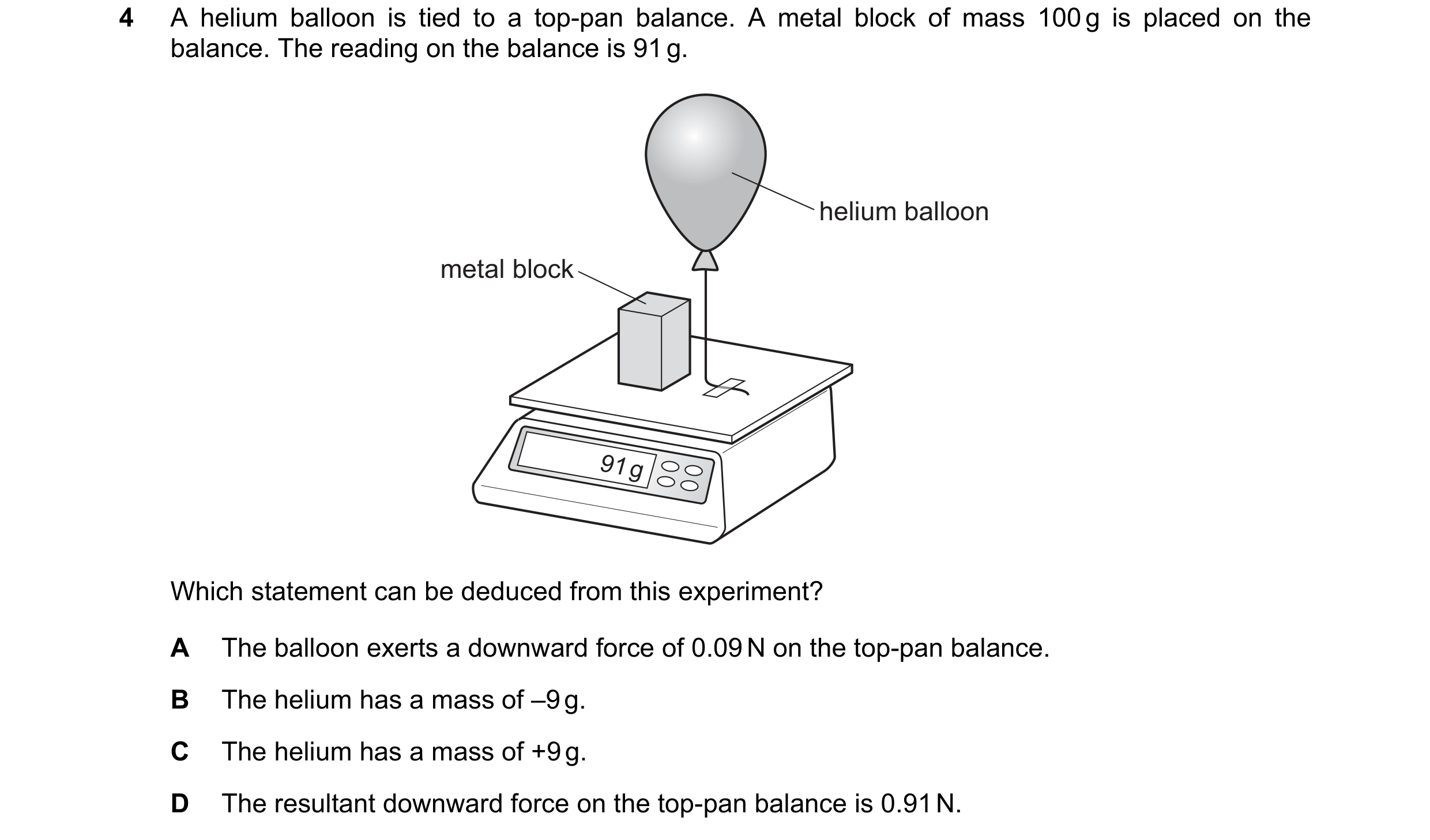
 8 / 25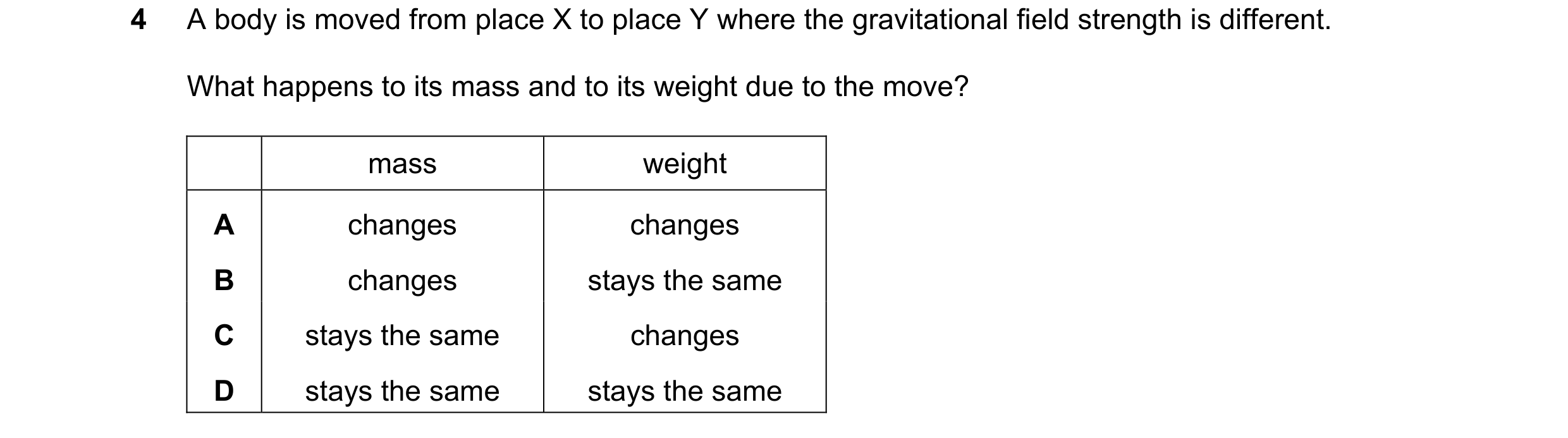
 9 / 25



 10 / 25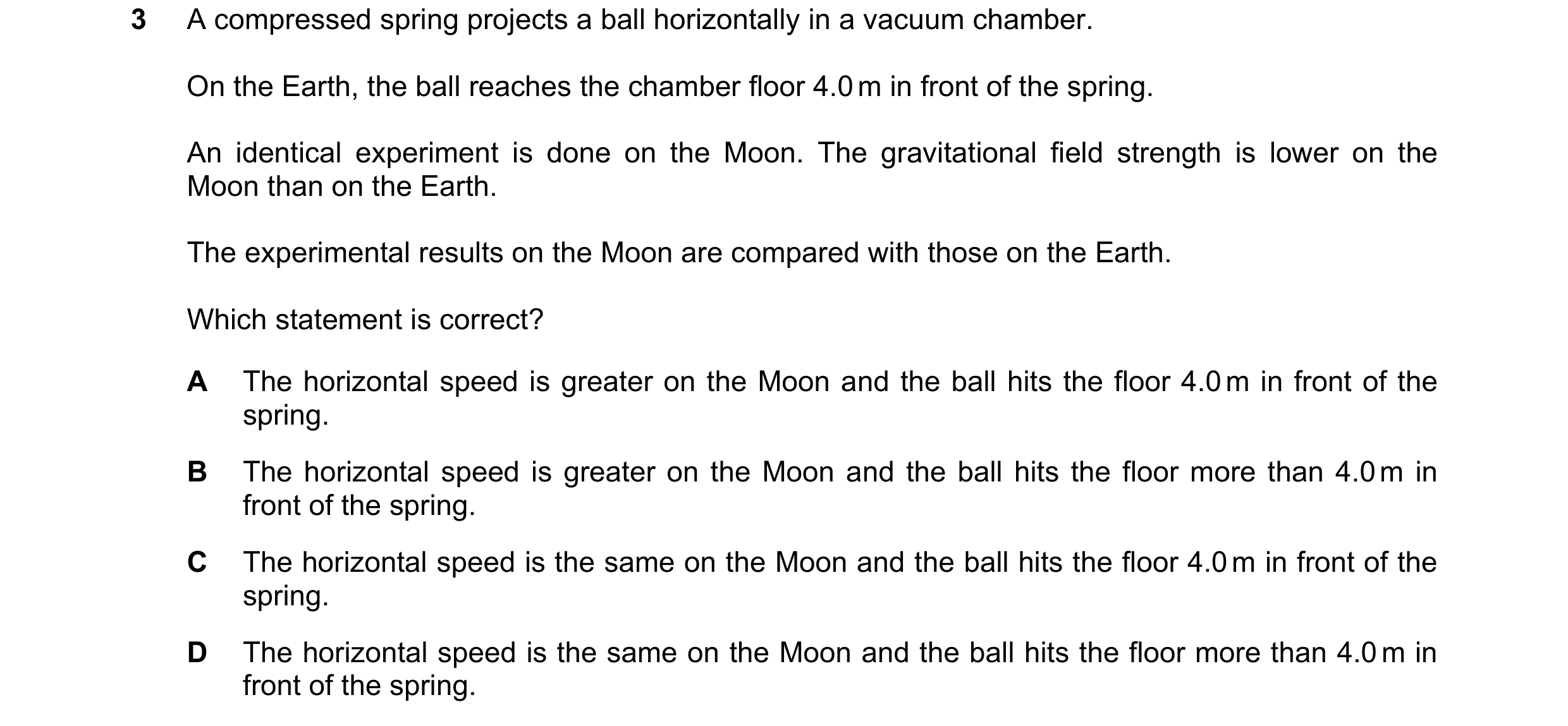
 11 / 25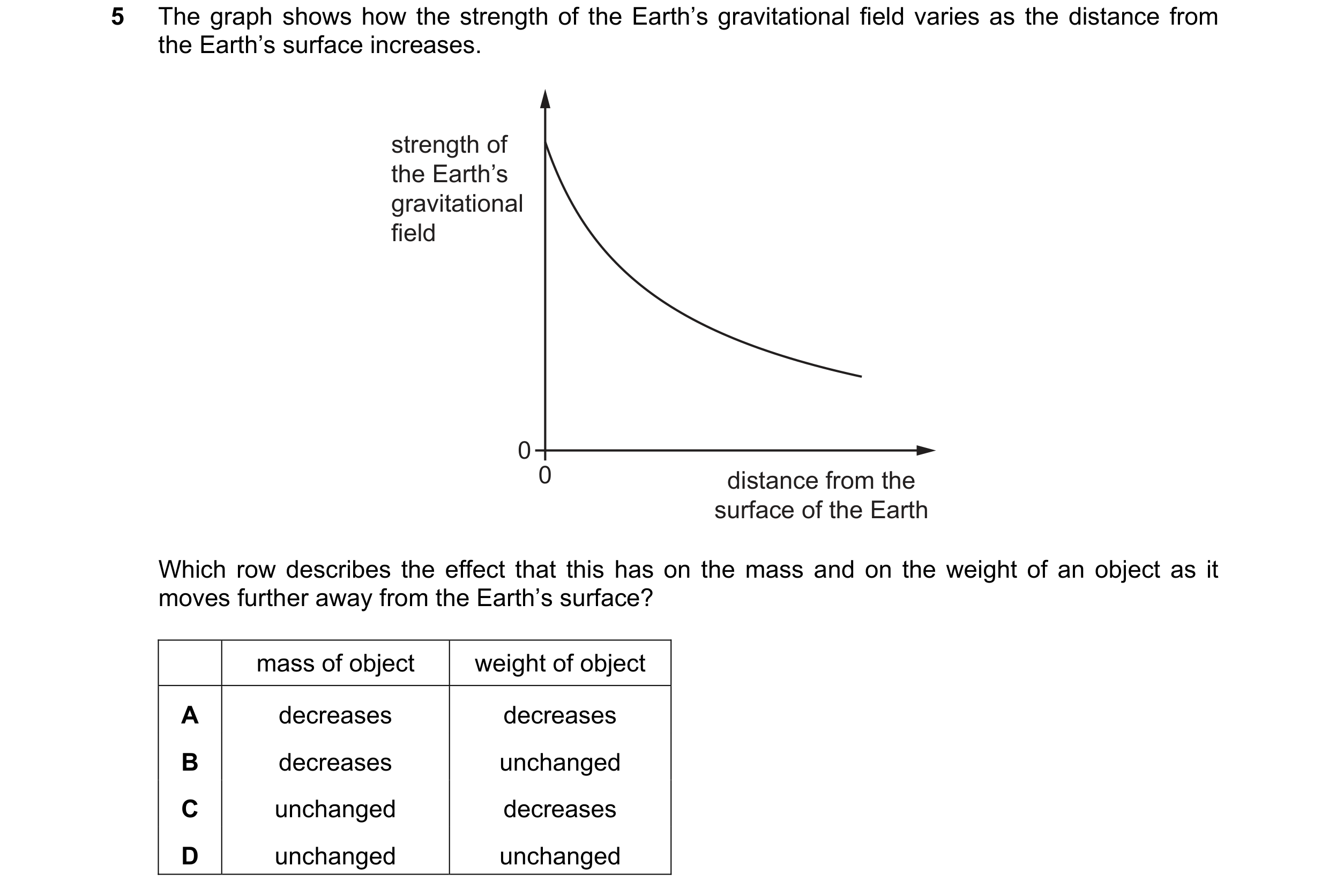
 12 / 25

 13 / 25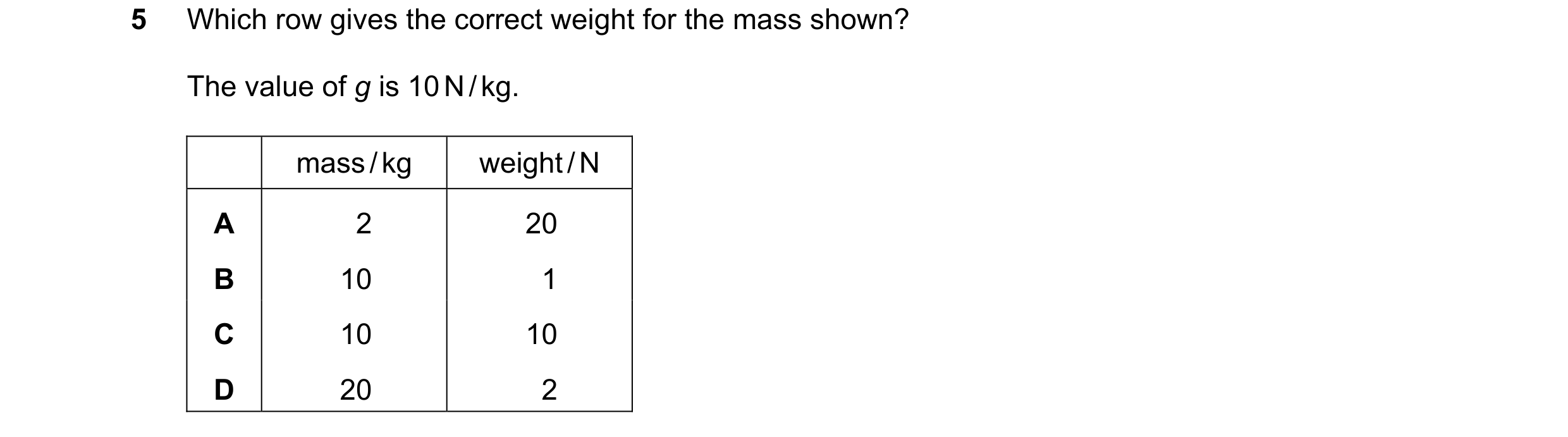


 14 / 25

 15 / 25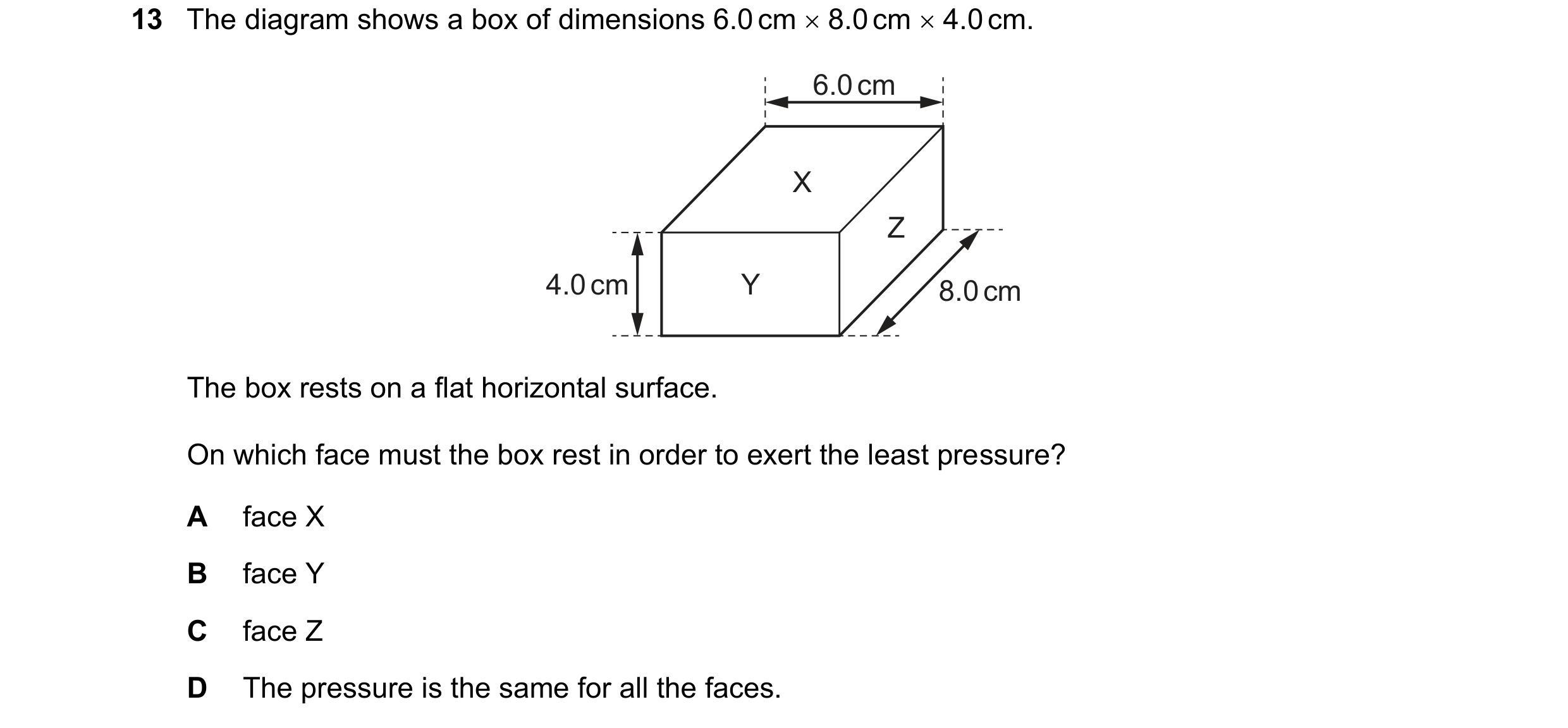

 16 / 25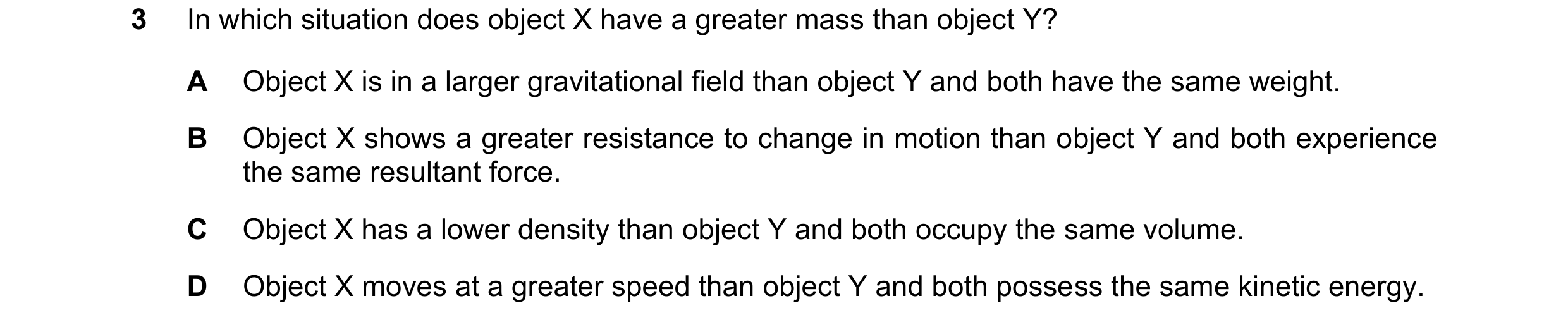

 17 / 25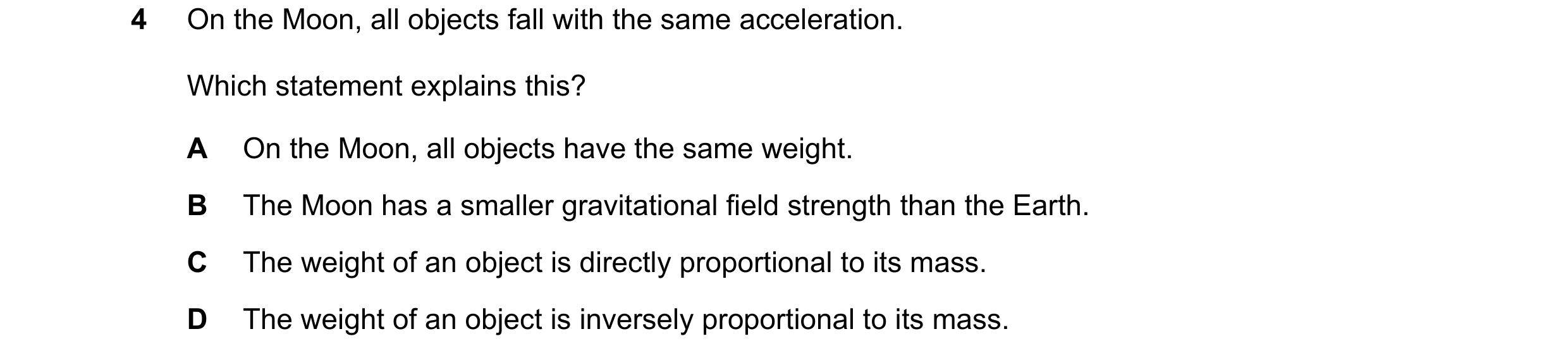


 18 / 25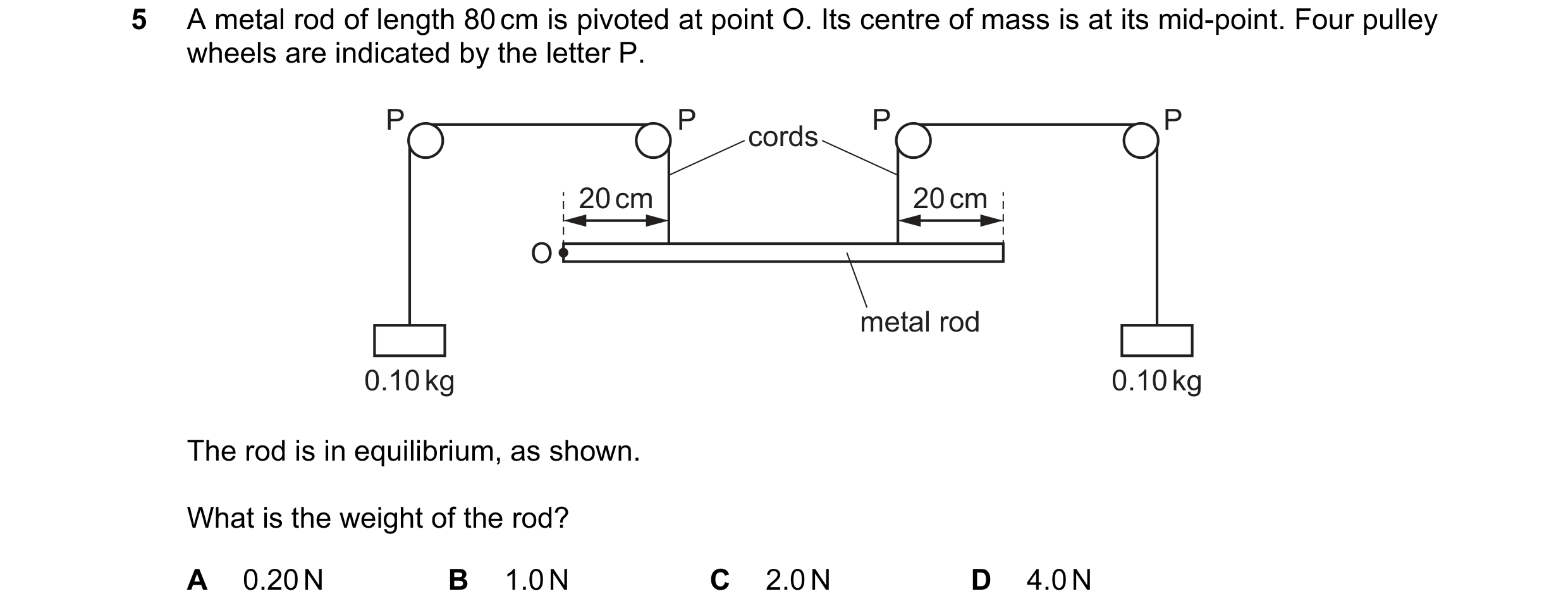
 19 / 25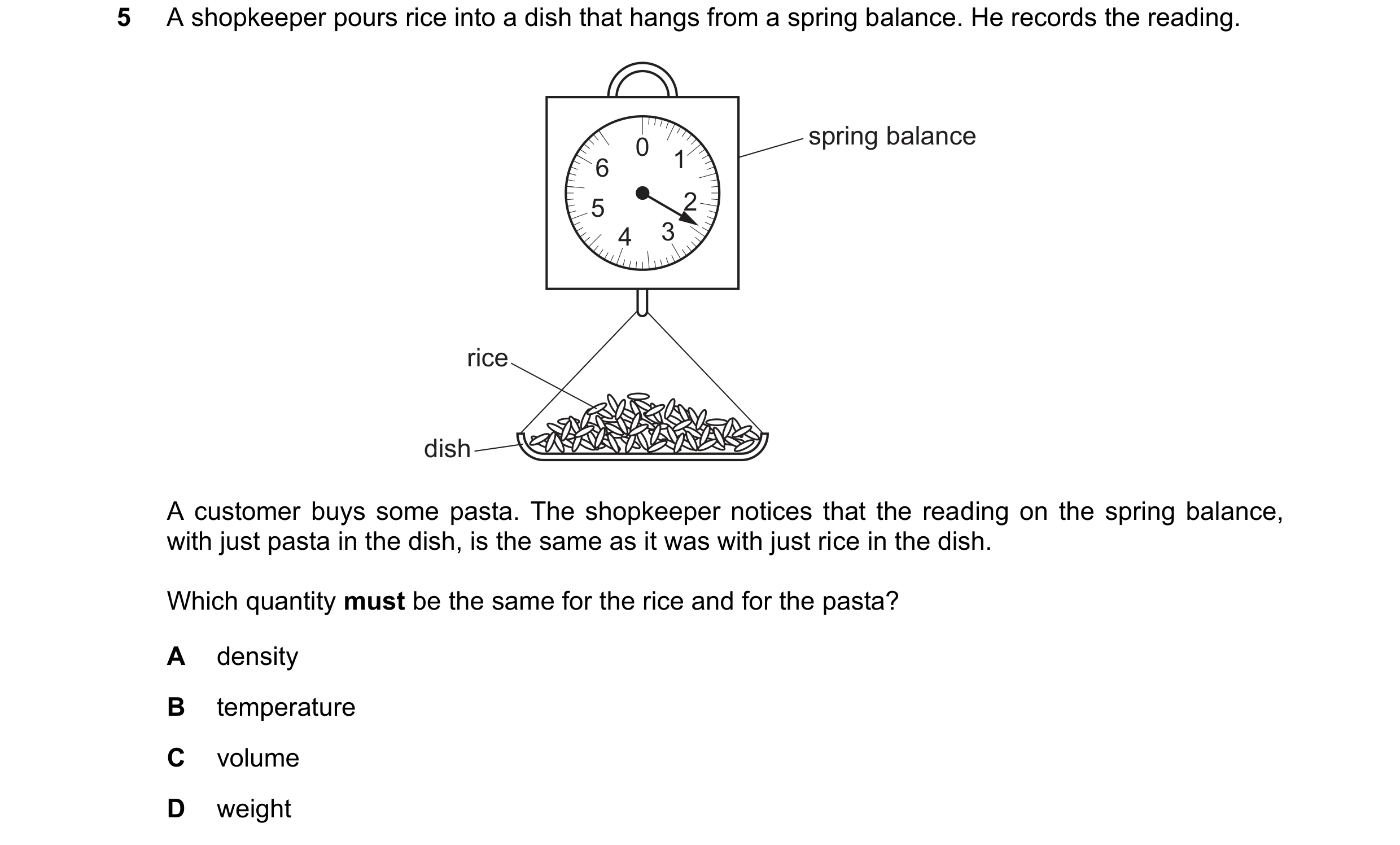

 20 / 25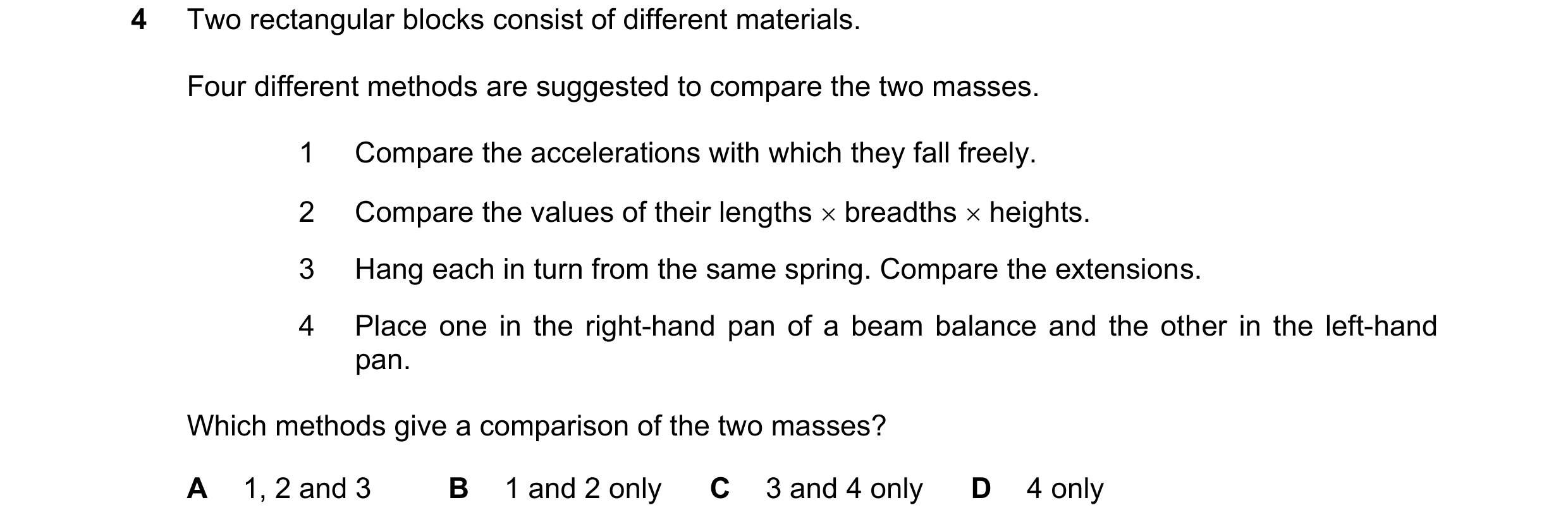
 21 / 25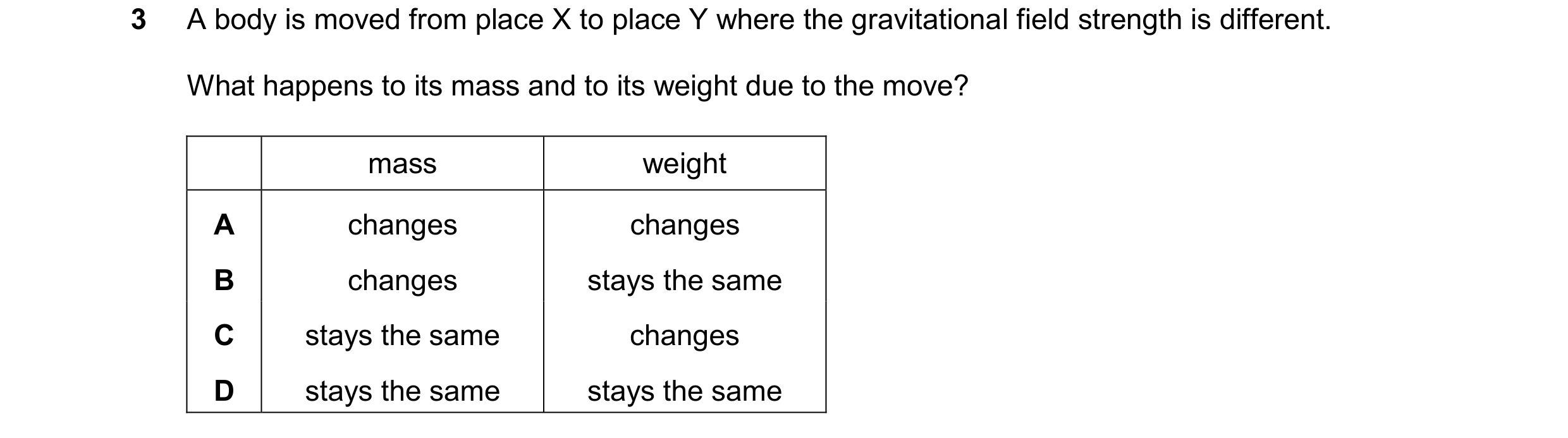



 22 / 25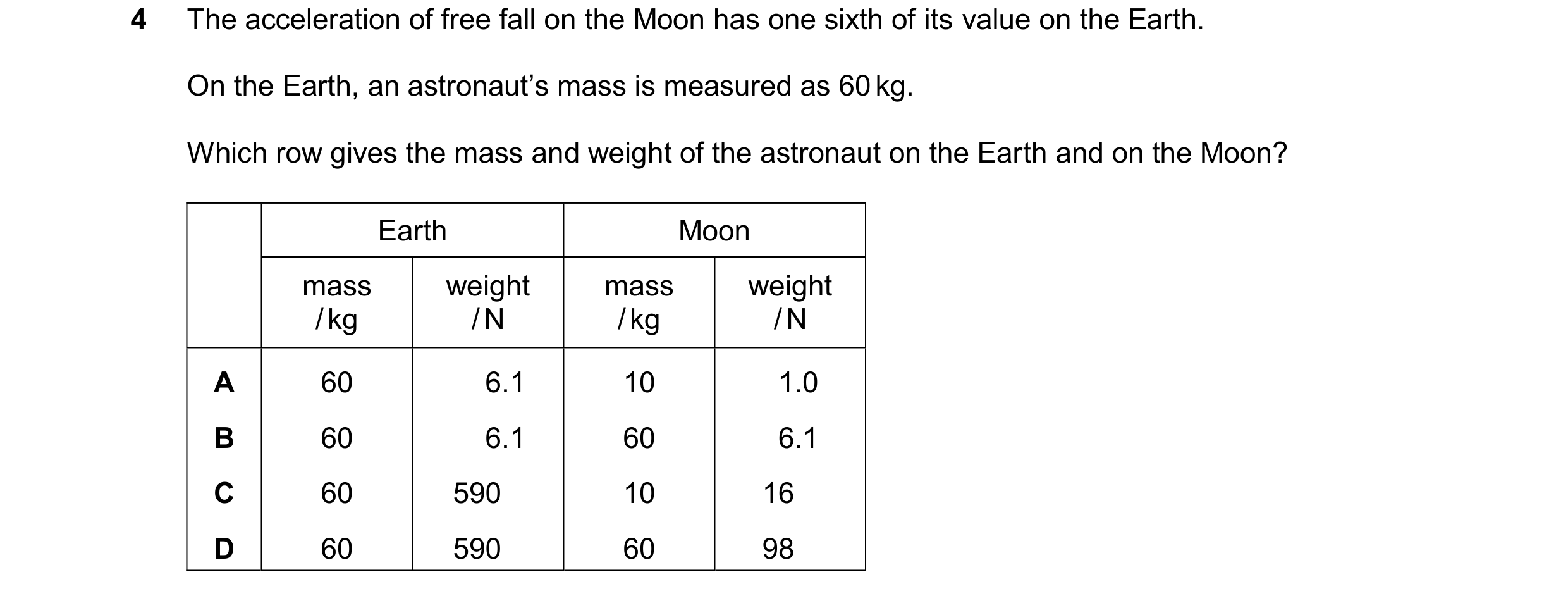
 23 / 25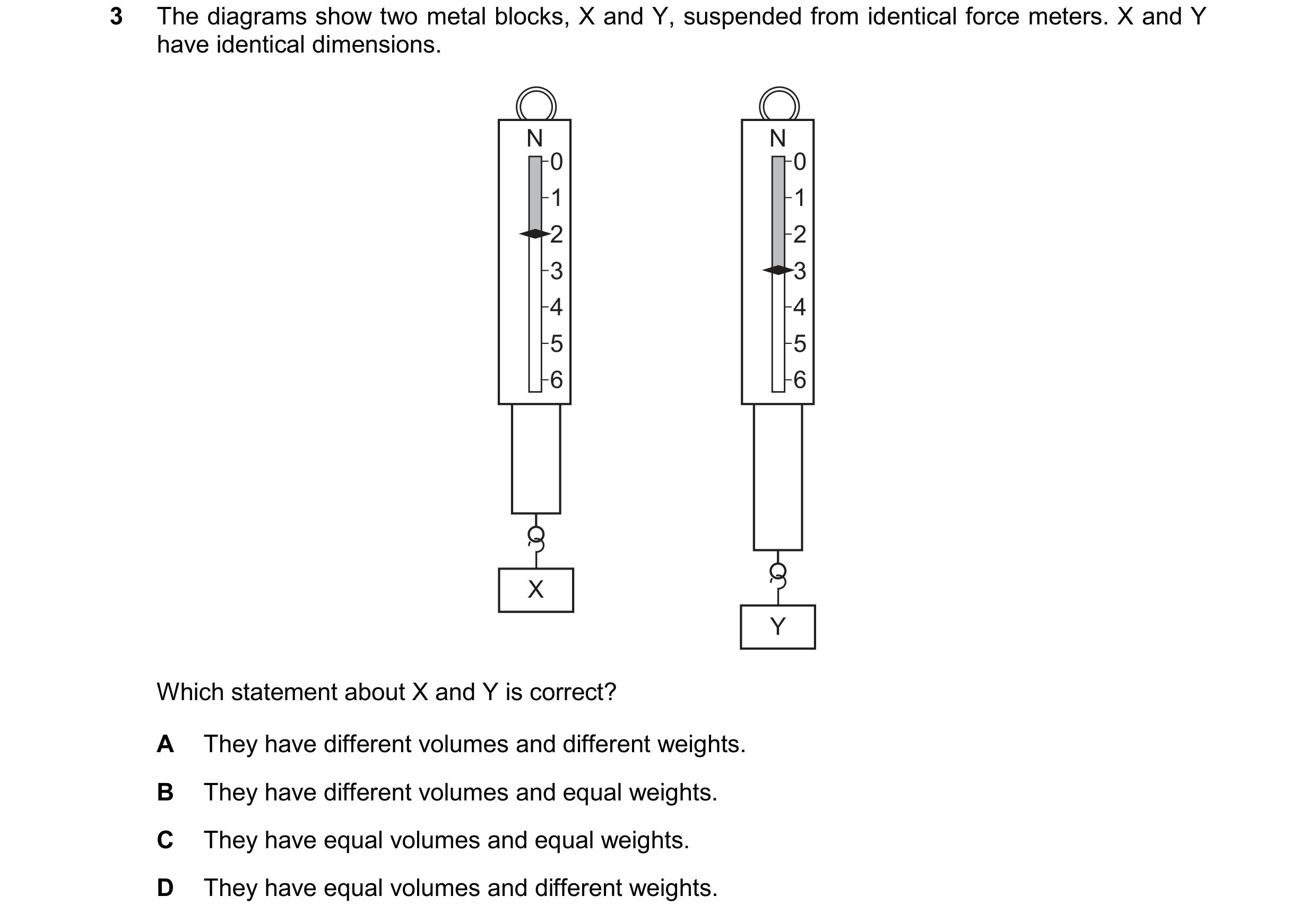
 24 / 25

 25 / 25