Questions as text
Q1 · A force acting on an object causes the object to accelerate 0625/31 Oct/Nov 2009
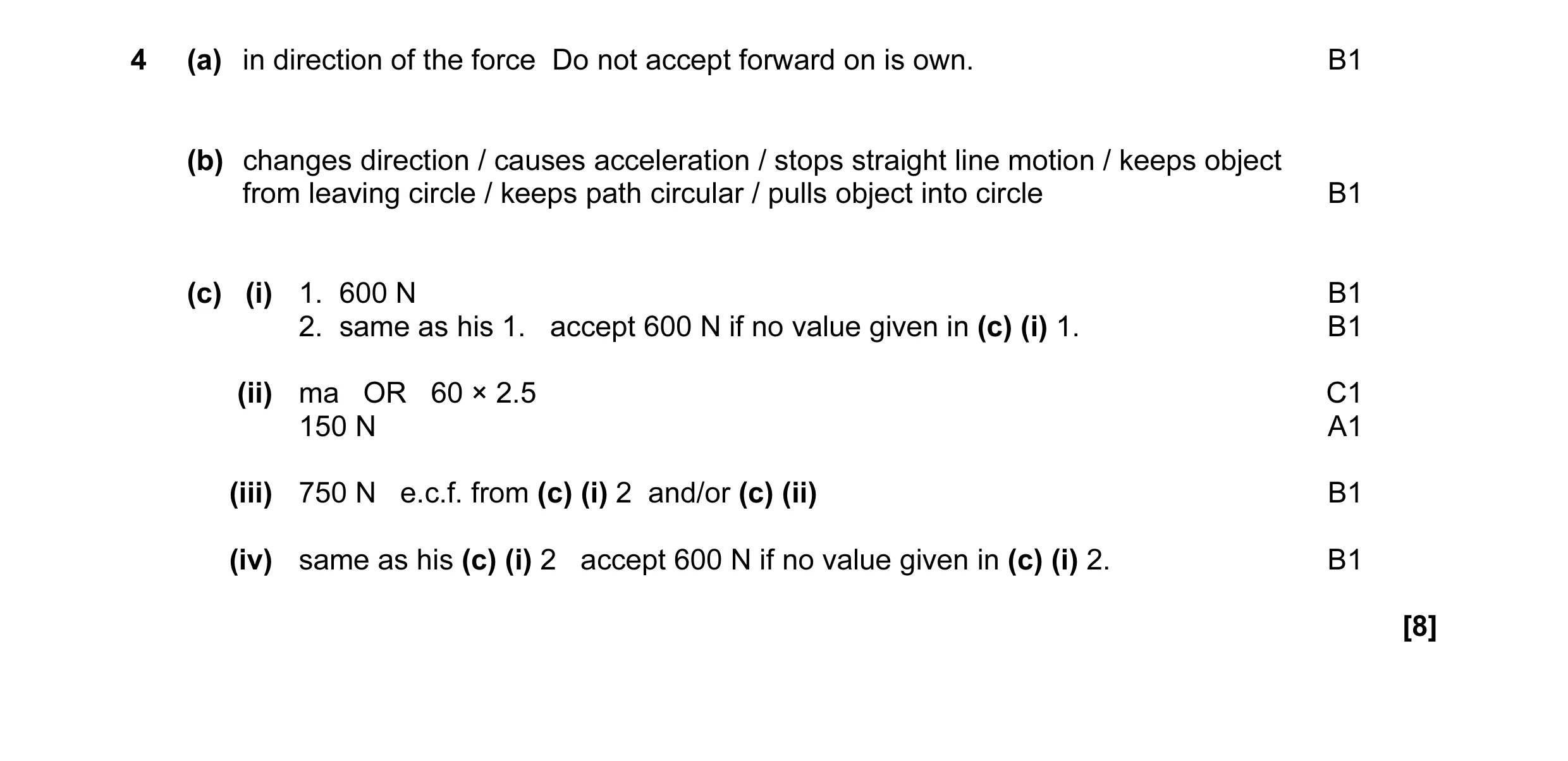
4 (a) A force acting on an object causes the object to accelerate. For Examiner’s In which direction is the acceleration? Use … [1] (b) Any object moving in a circle has a force acting on it towards the centre of the circle. What does this force do to the object? … [1] (c) A woman of mass 60 kg is standing in a lift at a shopping centre. (i) The lift is at rest. 1. State the value of the weight of the woman. … [1] 2. State the value of the force exerted on the woman by the floor of the lift. … [1] (ii) Calculate the force required to accelerate a mass of 60 kg at 2.5 m / s2. force = … [2] (iii) The lift accelerates upwards at 2.5 m / s2. Calculate the force exerted on the woman by the floor when the lift is accelerating. force = … [1] (iv) The lift reaches a steady upward speed. State the value of the force exerted on the woman by the floor at this steady speed. … [1] [Total: 8]
8 marks
Mark scheme: 4 (a) in direction of the force Do not accept forward on is own. B1 (b) changes direction / causes acceleration / stops straight line motion / keeps object from leaving circle / keeps path circular / pulls object into circle B1 (c) (i) 1. 600 N B1 2. same as his 1. accept 600 N if no value given in (c) (i) 1. B1 (ii) ma OR 60 × 2.5 C1 150 N A1 (iii) 750 N e.c.f. from (c) (i) 2 and/or (c) (ii) B1 (iv) same as his (c) (i) 2 accept 600 N if no value given in (c) (i) 2. B1 [8]
This question in 0625/31 Oct/Nov 2009
Q2 · An object of weight W is suspended by two ropes from a beam, as shown in Fig 0625/31 Oct/Nov 2010
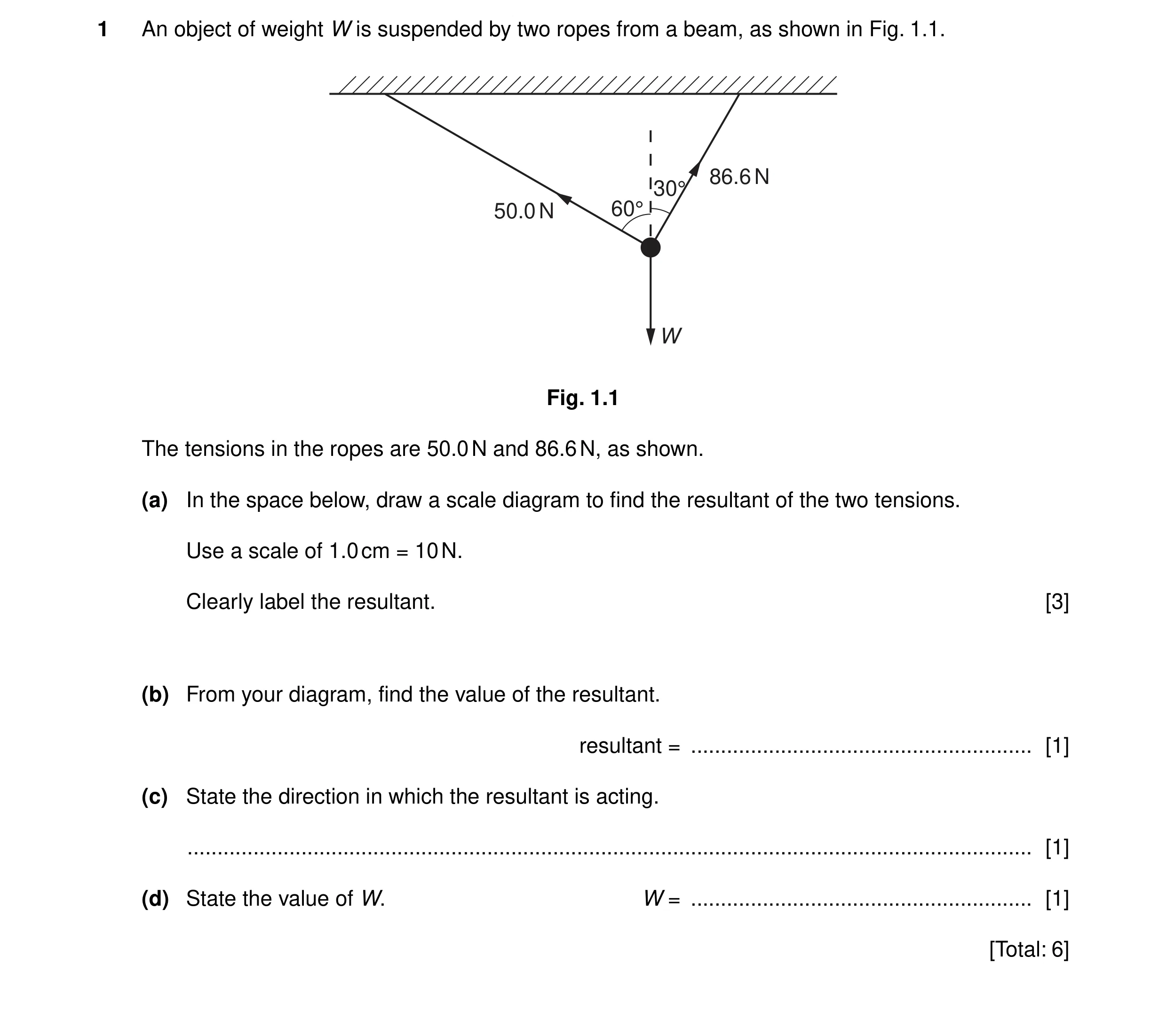
1 An object of weight W is suspended by two ropes from a beam, as shown in Fig. 1.1. 86.6 N 30° 50.0 N 60° W Fig. 1.1 The tensions in the ropes are 50.0 N and 86.6 N, as shown. (a) In the space below, draw a scale diagram to find the resultant of the two tensions. Use a scale of 1.0 cm = 10 N. Clearly label the resultant. [3] (b) From your diagram, find the value of the resultant. resultant = … [1] (c) State the direction in which the resultant is acting. … [1] (d) State the value of W. W = … [1] [Total: 6]
6 marks
Mark scheme: 1 (a) (parallelogram or triangle may have any orientation) NOT a copy of Fig. 1.1 two sides at right angles, by eye B1 one side longer than the other B1 diagonal or completion of triangle drawn and labelled “resultant” OR R Ignore numerical values. Condone arrows in wrong direction B1 (b) 98 N – 102 N B1 (accept value found by calculation) (c) (vertically) up/opposite to W NOT North B1 (d) his (b) OR correct value calculated B1 ignore mass [Total: 6]
This question in 0625/31 Oct/Nov 2010
Q3 · An astronaut has a mass of 65 kg on Earth, where the gravitational field strength is 10 N… 0625/33 Oct/Nov 2011
1 An astronaut has a mass of 65 kg on Earth, where the gravitational field strength is 10 N / kg. (a) Calculate the astronaut’s weight on Earth. weight on Earth = … [2] (b) Complete the following sentence. The astronaut’s weight on Earth is the … force between the astronaut and … . [1] (c) The astronaut undertakes a Moon landing. On the Moon the gravitational field strength is 1.6 N / kg. (i) State the astronaut’s mass on the Moon. mass = … (ii) Calculate the weight of the astronaut on the Moon. weight on Moon = … [2] [Total: 5]
5 marks
Mark scheme: 1 (a) mg in any form C1 650 N A1 (b) gravitational / attractive and the Earth B1 (c) (i) 65 kg B1 (ii) 104 OR 100 N ecf (i) B1 [5]
This question in 0625/33 Oct/Nov 2011
Q4 · A large crane has a mass of 8500 kg 0625/33 May/June 2013
4 A large crane has a mass of 8500 kg. Fig. 4.1 shows the crane on a muddy building-site. For Examiner’s Use lifting-arm hook axle caterpillar tracks Fig. 4.1 (a) Calculate the weight of the crane. weight = … [1] (b) The crane rests on two caterpillar tracks each of which has a contact area with the ground of 3.4 m2. (i) Calculate the pressure that the crane exerts on the ground. pressure = … [2] (ii) As the crane driver walks towards the crane, he starts to sink into the mud. He lays a wide plank of wood on the mud and he walks along the plank. Explain why he does not sink into the mud when he walks along the plank. … … … [2] (c) When the crane lifts a heavy load with its hook, the load exerts a moment on the For lifting-arm about the axle. Examiner’s Use (i) Explain what is meant by moment of a force. … … [1] (ii) Despite the moment exerted on the lifting-arm, the crane remains in equilibrium. State the two conditions required for any object to be in equilibrium. 1. … 2. … [2] [Total: 8]
8 marks
Mark scheme: 4 (a) 85 000 N (accept 83 300 N) B1 (b) (i) (P = )F/A OR 85 000/3.4 OR 85 000/3.4 × 2 OR 85 000/6.8 (e.c.f. from (a)(i)) C1 1.2/1.25/1.3 × 104 Pa (e.c.f. from (a)(i)) A1 (ii) larger area M1 smaller pressure A1 (c) (i) (measure of) turning effect OR F × x B1 (ii) no resultant/net force B1 no resultant/net turning effect/moment B1 [8]
This question in 0625/33 May/June 2013
Q5 · A model fire engine used by a student to take measurements of force and For motion 0625/32 Oct/Nov 2013
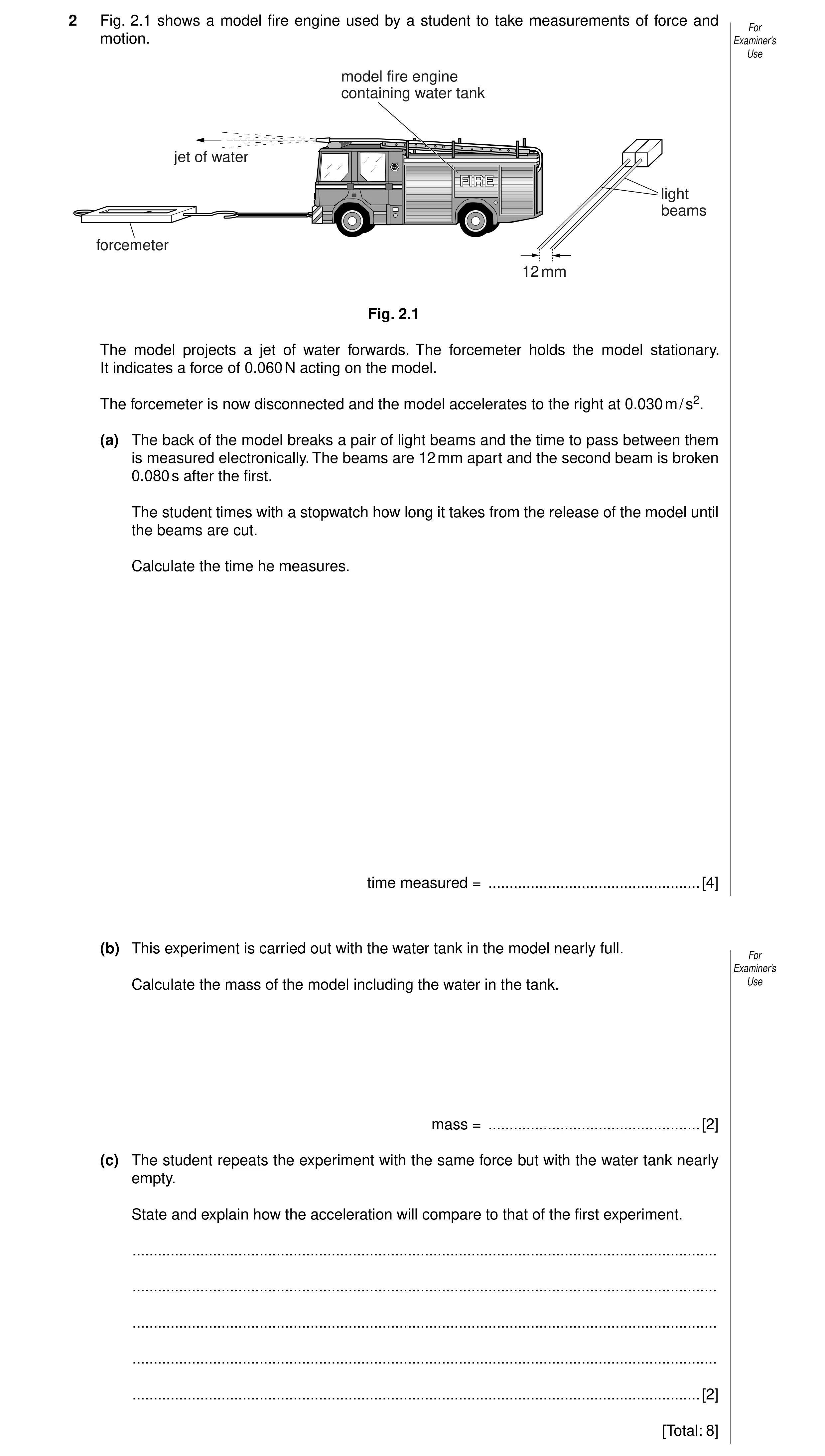
2 Fig. 2.1 shows a model fire engine used by a student to take measurements of force and For motion. Examiner’s Use model fire engine containing water tank jet of water FIRE light beams forcemeter 12 mm Fig. 2.1 The model projects a jet of water forwards. The forcemeter holds the model stationary. It indicates a force of 0.060 N acting on the model. The forcemeter is now disconnected and the model accelerates to the right at 0.030 m / s2. (a) The back of the model breaks a pair of light beams and the time to pass between them is measured electronically. The beams are 12 mm apart and the second beam is broken 0.080 s after the first. The student times with a stopwatch how long it takes from the release of the model until the beams are cut. Calculate the time he measures. time measured = … [4] (b) This experiment is carried out with the water tank in the model nearly full. For Examiner’s Calculate the mass of the model including the water in the tank. Use mass = … [2] (c) The student repeats the experiment with the same force but with the water tank nearly empty. State and explain how the acceleration will compare to that of the first experiment. … … … … … [2] [Total: 8]
8 marks
Mark scheme: 2 (a) evidence of division of 12 mm by 0.080 s C1 (v =) 0.15 m / s or 150 mm / s C1 uses t = his (∆)v/a in any form C1 (t = [0.15 – 0] / 0.03 = 0.15 / 0.03) = 5(.0) s accept 1sig. fig. allow e.c.f. from clearly identifiable wrong speed A1 [4] (b) use of F / a OR F = ma in any form, numbers or symbols, ignore g C1 (0.06/0.03=) 2(.0) kg accept 1 significant figure A1 [2] (c) greater M1 because mass is less, ignore comments about force A1 [2] [Total: 8]
This question in 0625/32 Oct/Nov 2013
Q6 · A spring S is suspended from a clamp stand in a school laboratory 0625/33 Oct/Nov 2013
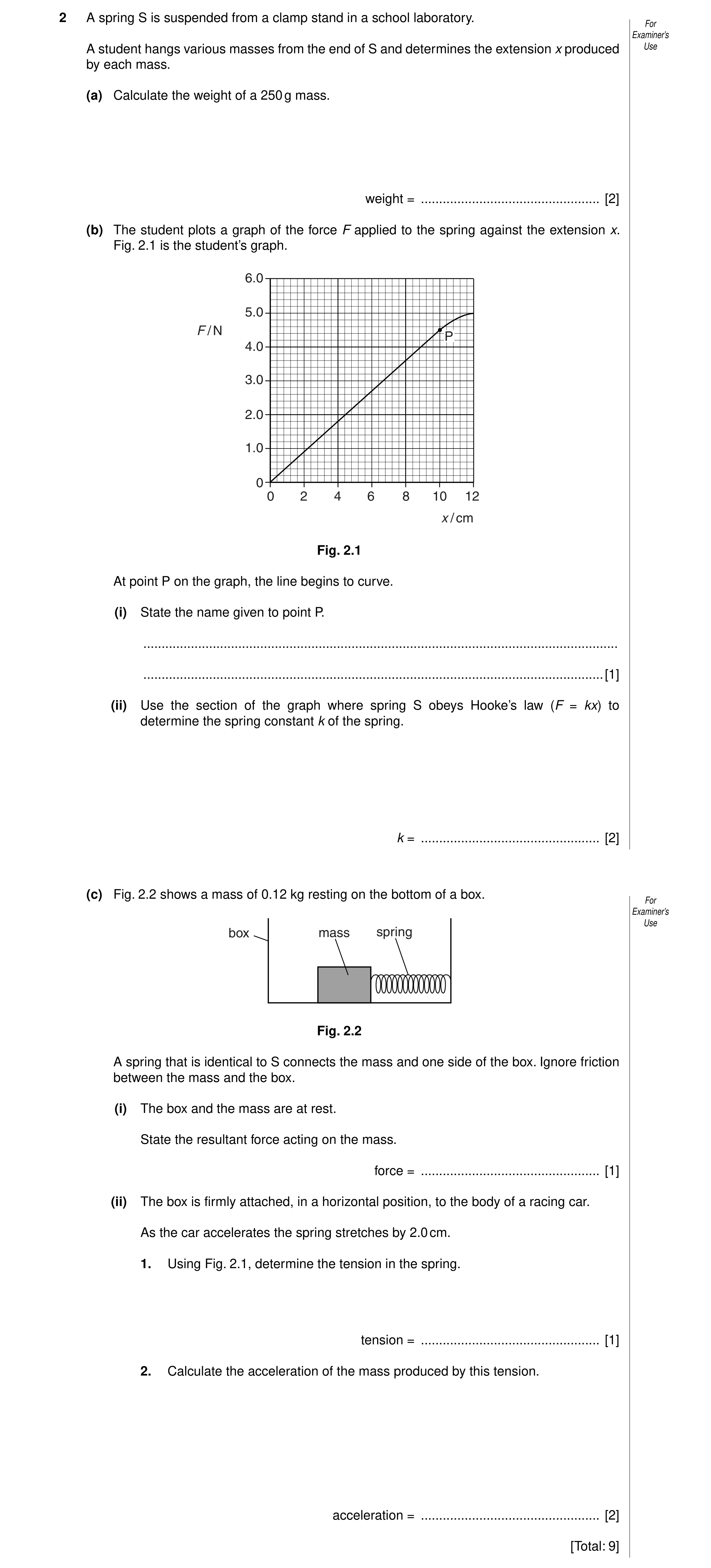
2 A spring S is suspended from a clamp stand in a school laboratory. For Examiner’s A student hangs various masses from the end of S and determines the extension x produced Use by each mass. (a) Calculate the weight of a 250 g mass. weight = … [2] (b) The student plots a graph of the force F applied to the spring against the extension x. Fig. 2.1 is the student’s graph. 6.0 5.0 F / N P 4.0 3.0 2.0 1.0 0 0 2 4 6 8 10 12 x / cm Fig. 2.1 At point P on the graph, the line begins to curve. (i) State the name given to point P. … … [1] (ii) Use the section of the graph where spring S obeys Hooke’s law (F = kx) to determine the spring constant k of the spring. k = … [2] (c) Fig. 2.2 shows a mass of 0.12 kg resting on the bottom of a box. For Examiner’s Use box mass spring Fig. 2.2 A spring that is identical to S connects the mass and one side of the box. Ignore friction between the mass and the box. (i) The box and the mass are at rest. State the resultant force acting on the mass. force = … [1] (ii) The box is firmly attached, in a horizontal position, to the body of a racing car. As the car accelerates the spring stretches by 2.0 cm. 1. Using Fig. 2.1, determine the tension in the spring. tension = … [1] 2. Calculate the acceleration of the mass produced by this tension. acceleration = … [2] [Total: 9]
9 marks
Mark scheme: 2 (a) (W =) mg or 0.25 × 10 or 250 × 10 or 2500 C1 2.5 N A1 [2] (b) (i) limit of proportionality or (the point where) proportionality between force and extension stops or Hooke’s Law no longer obeyed (condone elastic limit) B1 [1] (ii) gradient or numbers from graph divided e.g. 4.5 ÷ 10 C1 0.45 N / cm or 45 N / m A1 [2] (c) (i) 0 (N) or zero or no net force etc. (ignore absent unit; wrong unit loses mark) B1 [1] (ii) 1. 0.9 N (accept 0.8 N < value < 1.0 N) B1 [1] 2. (a =) F/m or 0.90/0.12 (e.c.f. from 2(c)(i)) C1 7.5 m / s2 (e.c.f. from 2(c)(i)) A1 [2] [Total: 9]
This question in 0625/33 Oct/Nov 2013
Q7 · A water tank has a rectangular base of dimensions 1.5 m by 1.2 m and contains 1440 kg of… 0625/31 May/June 2014
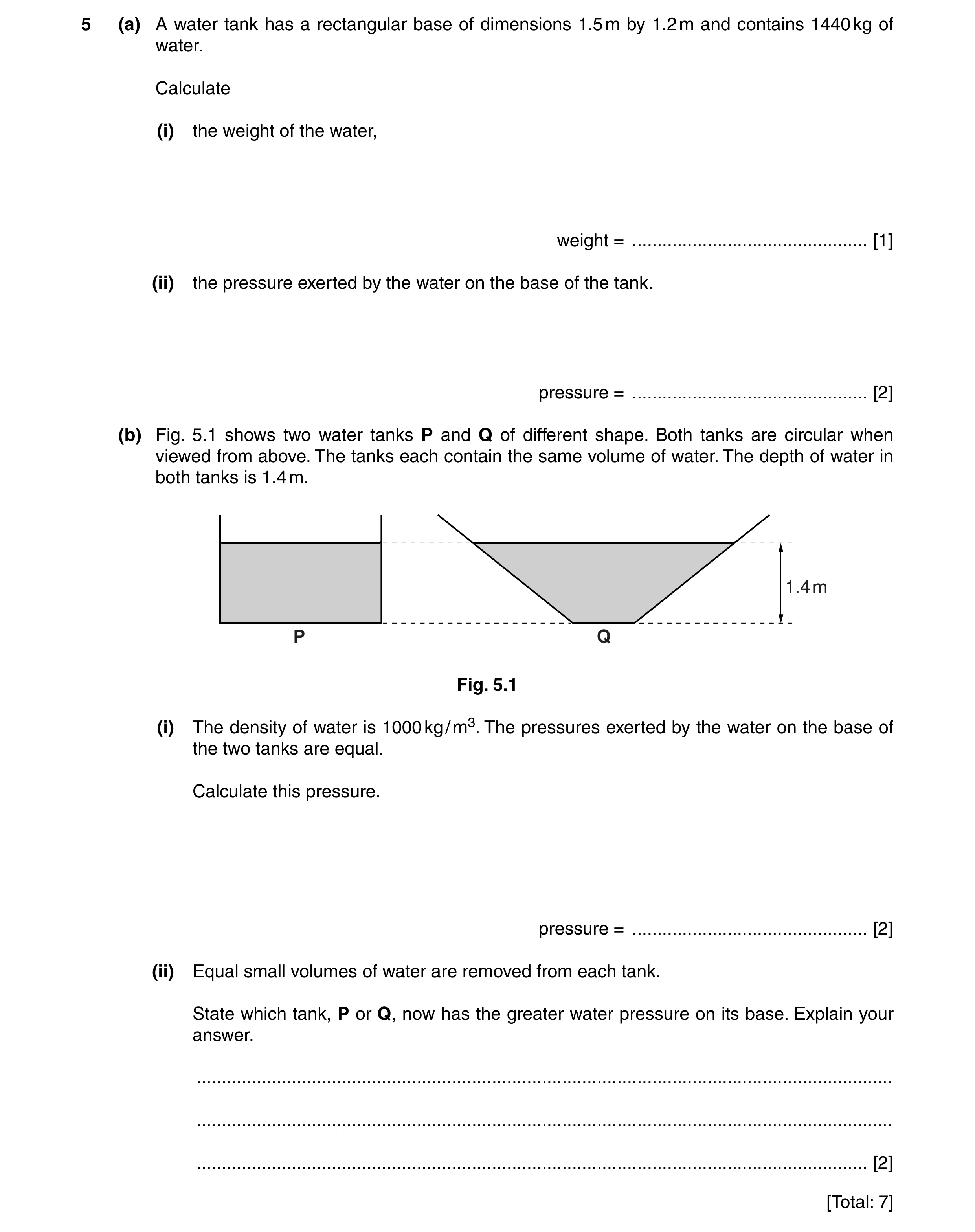
5 (a) A water tank has a rectangular base of dimensions 1.5 m by 1.2 m and contains 1440 kg of water. Calculate (i) the weight of the water, weight = … [1] (ii) the pressure exerted by the water on the base of the tank. pressure = … [2] (b) Fig. 5.1 shows two water tanks P and Q of different shape. Both tanks are circular when viewed from above. The tanks each contain the same volume of water. The depth of water in both tanks is 1.4 m. 1.4 m P Q Fig. 5.1 (i) The density of water is 1000 kg / m3. The pressures exerted by the water on the base of the two tanks are equal. Calculate this pressure. pressure = … [2] (ii) Equal small volumes of water are removed from each tank. State which tank, P or Q, now has the greater water pressure on its base. Explain your answer. … … … [2] [Total: 7]
7 marks
Mark scheme: 5 (a) (i) (W = mg =1440 × 10 =) 14 400 N B1 (ii) (P =) F / A OR 14 400 / (1.5 × 1.2) C1 8000 Pa OR N / m2 A1 (b) (i) (P =) hρg OR 1.4 × 1000 × 10 C1 14 000 Pa OR N / m2 A1 (b) (ii) pressure on base of P smaller / Q greater M1 (with same volume removed) smaller decrease in depth in Q OR height in Q is greater A1 [Total: 7]
This question in 0625/31 May/June 2014
Q8 · A metre rule balances when the 50 cm mark is directly above a pivot 0625/33 May/June 2014
3 A metre rule balances when the 50 cm mark is directly above a pivot. (a) State where in the rule its centre of mass is located. … … [1] (b) Fig. 3.1 shows an apple and a 0.40 N weight placed on the rule so that the rule remains balanced at the 50 cm mark. 0.40 N weight apple 50 cm mark 25 cm 45 cm pivot Fig. 3.1 (not to scale) The centre of mass of the apple is 25 cm from the pivot and the centre of mass of the weight is 45 cm from the pivot. Calculate (i) the weight of the apple, weight = … [2] (ii) the mass of the apple. mass = … [1] (c) The apple is not moved. The weight is removed from the rule and the pivot is moved to the left until the rule balances as shown in Fig. 3.2. apple 50 cm mark pivot Fig. 3.2 (not to scale) (i) Explain why the arrangement in Fig. 3.2 balances. … … … [2] (ii) The pivot in Fig. 3.2 is closer to the 50 cm mark than to the centre of mass of the apple. Compare the weight of the rule to the weight of the apple. … … [1] [Total: 7]
7 marks
Mark scheme: 3 (a) (immediately below / above the / at) 50 cm mark OR at pivot B1 IGCSE – May/June 2014 0625 33 (b) (i) anticlockwise moment = clockwise moment OR 45 × 0.40 = 25 × W C1 0.72 N A1 (ii) 0.072 kg OR 72 g e.c.f from (b)(i) B1 (c) (i) no net moment OR two moments cancel C1 moment due to weight of rule cancels moment due to weight of apple A1 (ii) weight of the rule / it is bigger B1 [Total: 7]
This question in 0625/33 May/June 2014
Q9 · A uniform, rectangular slab of concrete ABCD standing upright on the ground 0625/33 Oct/Nov 2014
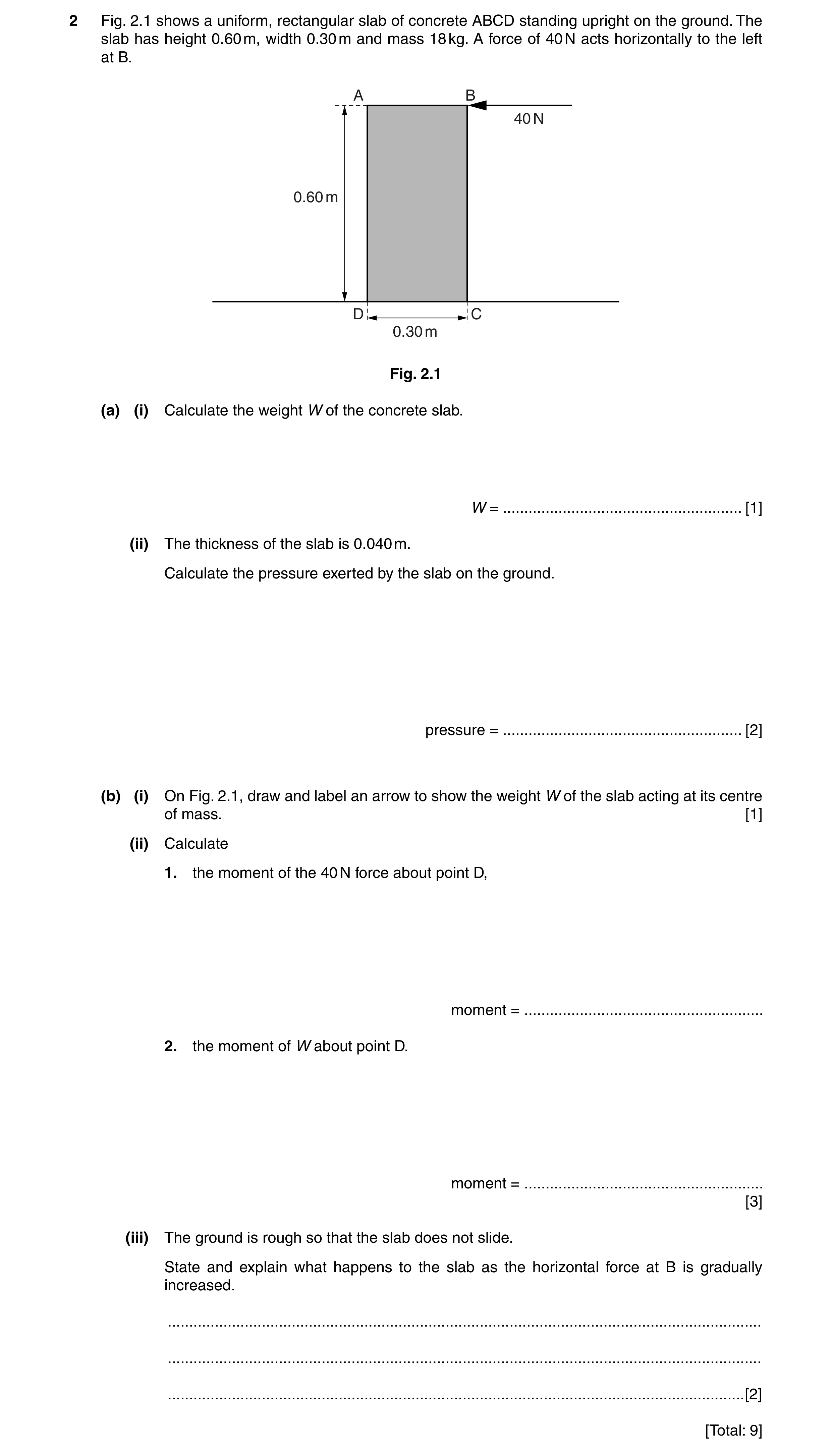
2 Fig. 2.1 shows a uniform, rectangular slab of concrete ABCD standing upright on the ground. The slab has height 0.60 m, width 0.30 m and mass 18 kg. A force of 40 N acts horizontally to the left at B. A B 40 N 0.60 m D C 0.30 m Fig. 2.1 (a) (i) Calculate the weight W of the concrete slab. W = … [1] (ii) The thickness of the slab is 0.040 m. Calculate the pressure exerted by the slab on the ground. pressure = … [2] (b) (i) On Fig. 2.1, draw and label an arrow to show the weight W of the slab acting at its centre of mass. [1] (ii) Calculate 1. the moment of the 40 N force about point D, moment = … 2. the moment of W about point D. moment = … [3] (iii) The ground is rough so that the slab does not slide. State and explain what happens to the slab as the horizontal force at B is gradually increased. … … … [2] [Total: 9]
9 marks
Mark scheme: 2 (a) (i) 180 N B1 (ii) (P =) F ÷ A OR 180÷(0.30 × 0.04) C1 15 000 Pa A1 (b) (i) arrow (labelled W) from / to correct centre of mass B1 (ii) 1. force × (perpendicular) distance OR 40 × 0.60 OR 180 × 0.15 in 2. C1 24 N m A1 2. 27 N m e.c.f. from (a)(i) A1 (iii) slab topples / rotates (about point D) OR corner C lifts from ground OR falls over B1 moment of force at B becomes bigger than moment of weight / W OR anticlockwise moment becomes bigger than clockwise moment OR weight/centre of mass outside base B1 [Total: 9]
This question in 0625/33 Oct/Nov 2014
Q10 · The rocket shown in Fig 0625/32 Feb/March 2015
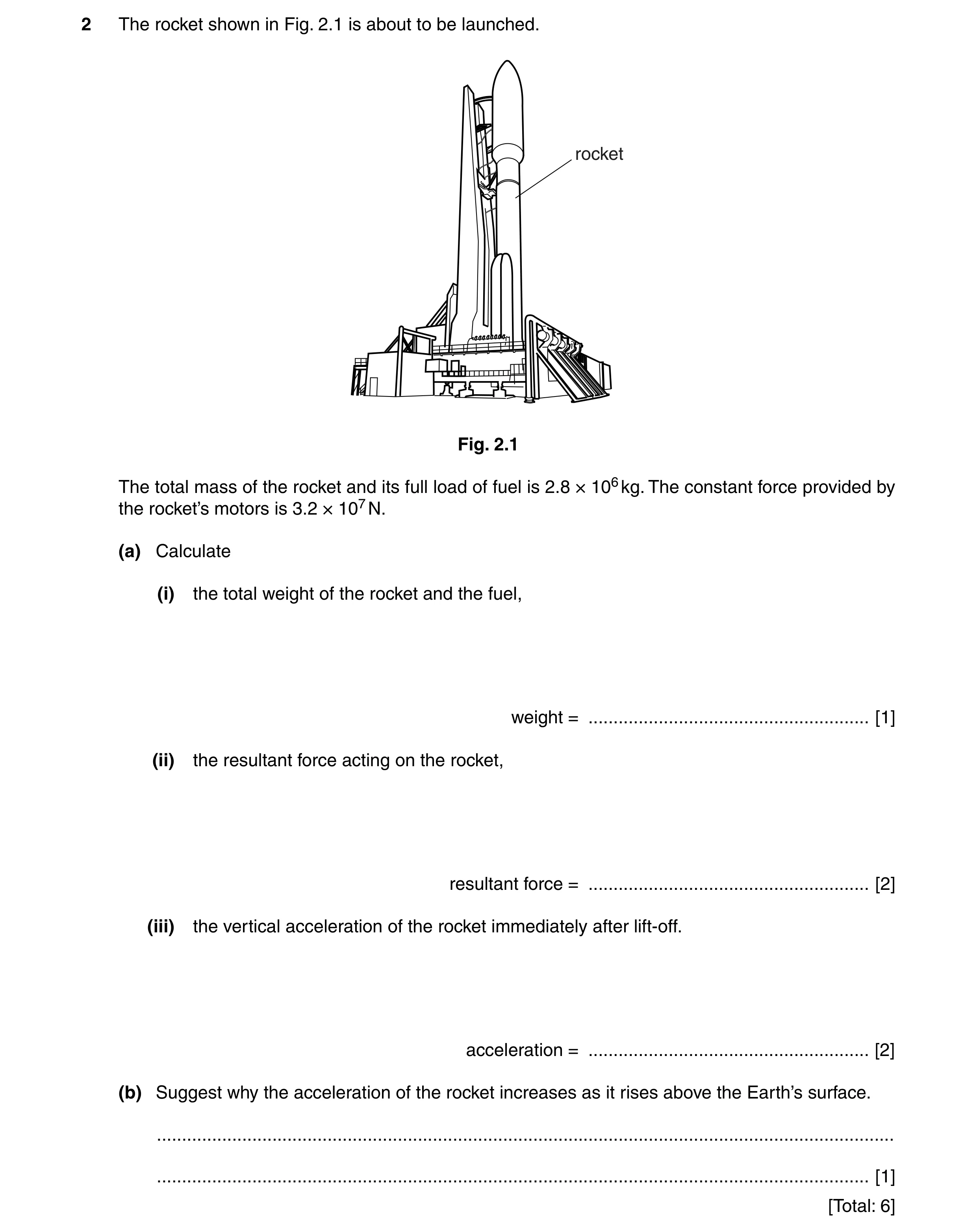
2 The rocket shown in Fig. 2.1 is about to be launched. rocket Fig. 2.1 The total mass of the rocket and its full load of fuel is 2.8 × 10⁶ kg. The constant force provided by the rocket’s motors is 3.2 × 10⁷ N. (a) Calculate (i) the total weight of the rocket and the fuel, weight = … [1] (ii) the resultant force acting on the rocket, resultant force = … [2] (iii) the vertical acceleration of the rocket immediately after lift-off. acceleration = … [2] (b) Suggest why the acceleration of the rocket increases as it rises above the Earth’s surface. … … [1] [Total: 6]
6 marks
Mark scheme: 2 (a) (i) (W = mg = 2.8 × 106 × 10 =) 2.8 × 10⁷ N B1 (ii) 3.2 × 10⁷ – 2.8 × 10⁷ C1 4.0 × 10⁶ OR 0.4 × 10⁷ N A1 (iii) F = ma in any form OR (a =) F÷m OR 4.0 × 10⁶÷(2.8 × 10⁶) C1 1.4 m / s2 A1 (b) Mass of rocket decreases (as fuel is used up) OR Value of g/gravitational force on rocket decreases as rocket rises B1 OR Air resistance decreases [Total: 6]
This question in 0625/32 Feb/March 2015
Q11 · An early water-powered device used to raise a heavy load 0625/31 May/June 2015
3 Fig. 3.1 shows an early water-powered device used to raise a heavy load. The heavy load rests on piston B. cylinder A cylinder B water load piston A piston B connecting rod connecting rod pivot beam Fig. 3.1 (not to scale) Initially, a large weight of water in cylinder A pushes piston A down. This causes the left-hand end of the beam to move down and the right-hand end of the beam to move up. Piston B rises, lifting the heavy load. (a) The weight of water in cylinder A is 80 kN. Calculate the mass of water in cylinder A. mass = … [2] (b) The density of water is 1000 kg / m3. Calculate the volume of water in cylinder A. volume = … [2] (c) Piston A moves down a distance of 4.0 m. Calculate the gravitational potential energy lost by the water. loss of gravitational potential energy = … [2] (d) The heavy load lifted by piston B gains 96 kJ of gravitational potential energy. Calculate the efficiency of the device. efficiency = … [2] [Total: 8]
8 marks
Mark scheme: 3 (a) W = m g in any form OR (m =) W ÷ g OR 80 000 ÷ 10 C1 8000 kg A1 (b) ρ = m ÷ V in any form OR (V =) m ÷ ρ OR 8000 ÷ 1000 C1 = 8.0 m3 ecf (a) A1 (c) m g h OR weight × h OR 8000 × 10 × 4 C1 = 320 000 J OR 320 kJ ecf (a) A1 (d) (efficiency = ) output (energy) ÷ input (energy) (× 100) OR 96 ÷ 320 (× 100) C1 = 0.30 OR 30% ecf (c) A1 [Total: 8]
This question in 0625/31 May/June 2015
Q12 · The boxes on the left contain the names of some sources of energy 0625/33 May/June 2015
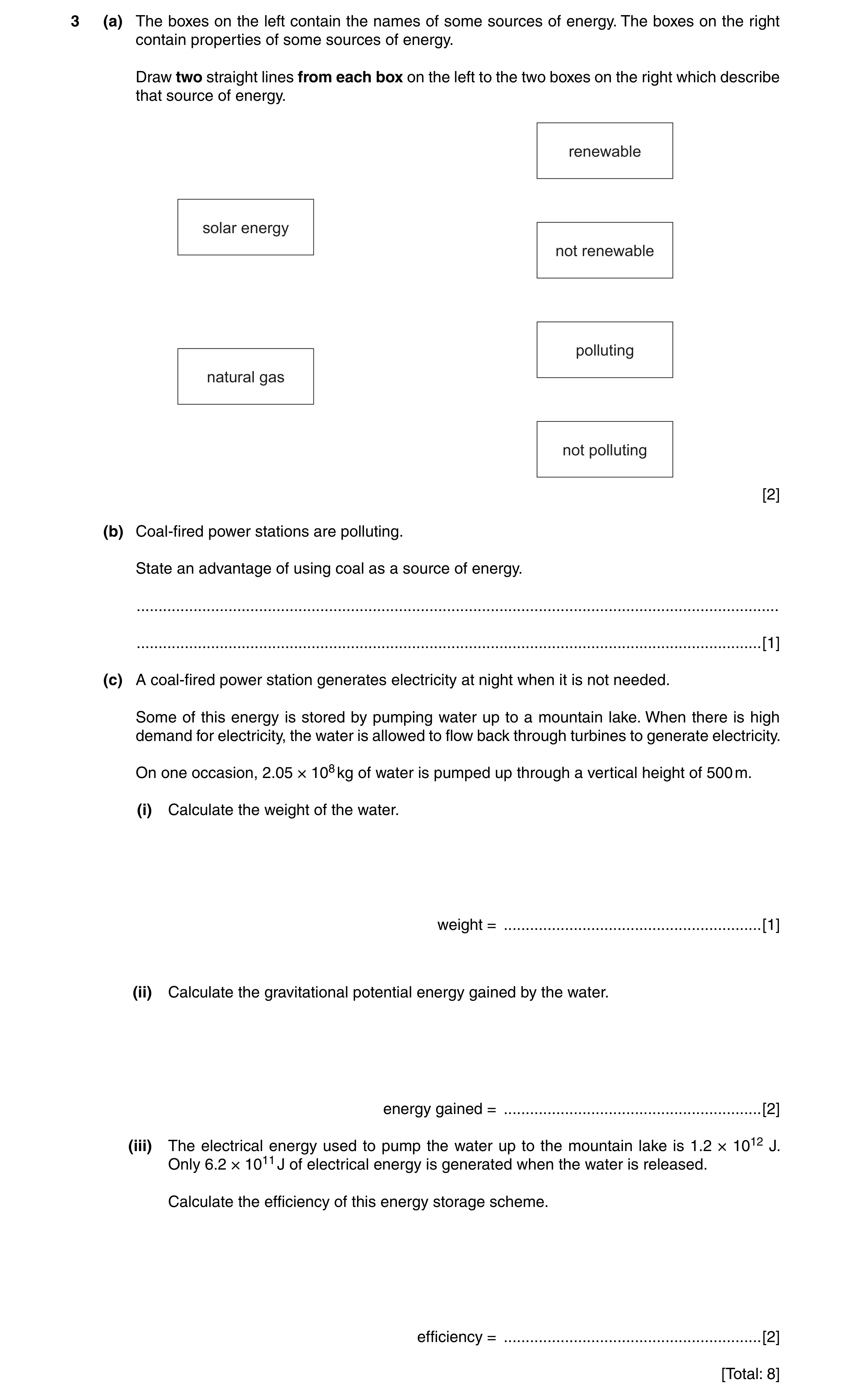
3 (a) The boxes on the left contain the names of some sources of energy. The boxes on the right contain properties of some sources of energy. Draw two straight lines from each box on the left to the two boxes on the right which describe that source of energy. renewable solar energy not renewable polluting natural gas not polluting [2] (b) Coal-fired power stations are polluting. State an advantage of using coal as a source of energy. … … [1] (c) A coal-fired power station generates electricity at night when it is not needed. Some of this energy is stored by pumping water up to a mountain lake. When there is high demand for electricity, the water is allowed to flow back through turbines to generate electricity. On one occasion, 2.05 × 10⁸ kg of water is pumped up through a vertical height of 500 m. (i) Calculate the weight of the water. weight = … [1] (ii) Calculate the gravitational potential energy gained by the water. energy gained = … [2] (iii) The electrical energy used to pump the water up to the mountain lake is 1.2 × 10¹² J. Only 6.2 × 10¹¹ J of electrical energy is generated when the water is released. Calculate the efficiency of this energy storage scheme. efficiency = … [2] [Total: 8]
8 marks
Mark scheme: 3 (a) lines from solar energy to boxes 1 AND 4 only B1 lines from natural gas to boxes 2 AND 3 only B1 (b) (relatively) cheap OR widely available OR can be used on a large scale OR always available B1 (c) (i) 2.05 × 10⁹ N B1 (ii) use of mgh OR weight × h C1 1.03 × 10¹² J NOT ecf from (i) A1 (iii) output energy ÷ input energy OR 6.2 × 10¹¹ ÷ 1.2 × 10¹² C1 0.52 OR 52 % A1 [Total: 8]
This question in 0625/33 May/June 2015
Q13 · A student has 500 identical, rectangular sheets of paper 0625/33 Oct/Nov 2015
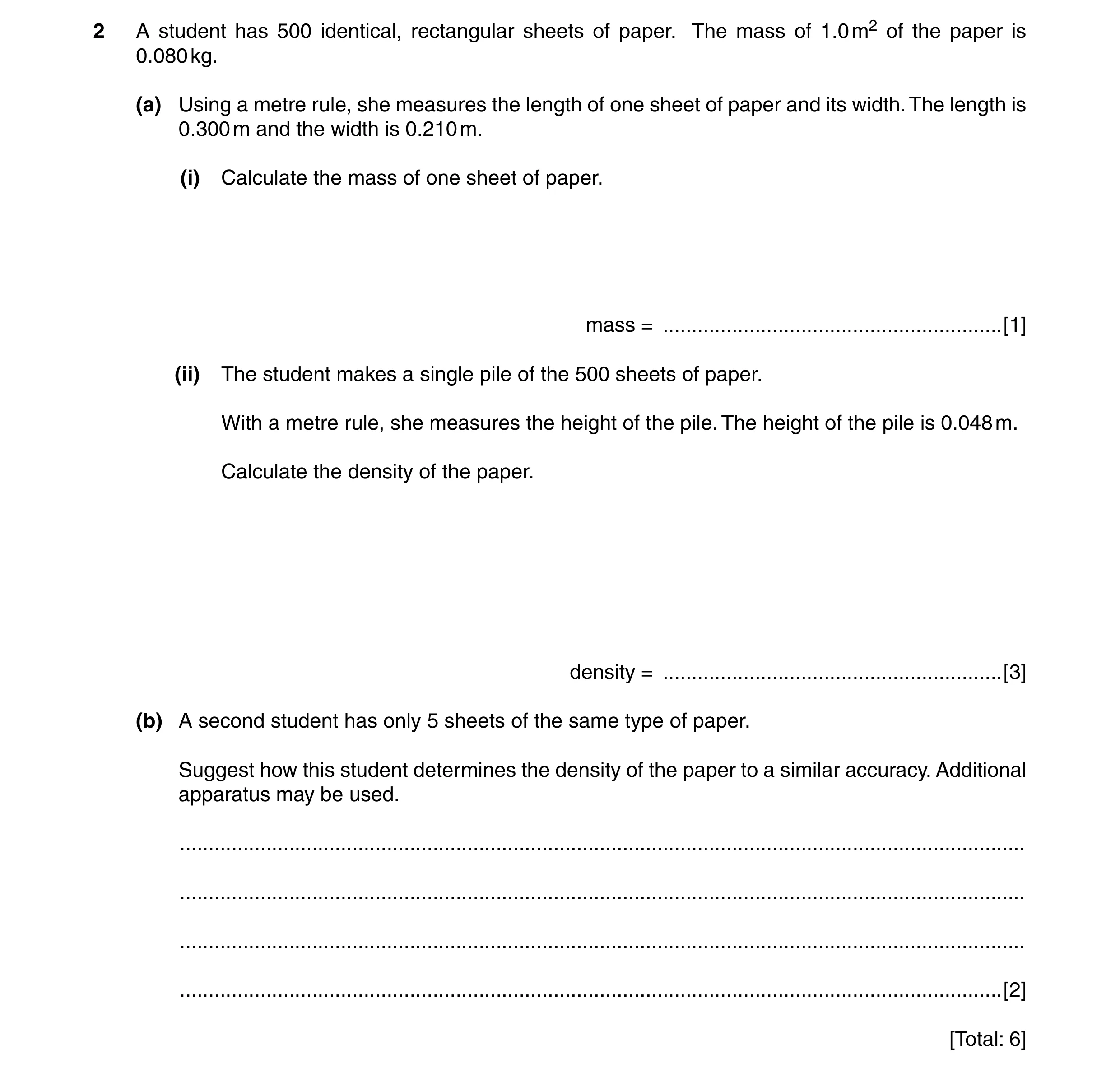
2 A student has 500 identical, rectangular sheets of paper. The mass of 1.0 m2 of the paper is 0.080 kg. (a) Using a metre rule, she measures the length of one sheet of paper and its width. The length is 0.300 m and the width is 0.210 m. (i) Calculate the mass of one sheet of paper. mass = … [1] (ii) The student makes a single pile of the 500 sheets of paper. With a metre rule, she measures the height of the pile. The height of the pile is 0.048 m. Calculate the density of the paper. density = … [3] (b) A second student has only 5 sheets of the same type of paper. Suggest how this student determines the density of the paper to a similar accuracy. Additional apparatus may be used. … … … … [2] [Total: 6]
6 marks
Mark scheme: 2 (a) (i) 5.0(4) × 10–3 OR 0.0050(4) kg OR 5.0(4) g B1 (ii) (ρ =) m / V OR 0.00504 / (0.30 × 0.21 × 0.048) OR 0.080 / (1 × 0.048) C1 0.00504 × 500 / (0.30 × 0.21 × 0.048) OR 0.080 / (1 × 0.048 / 500)) C1 8.3(3333) × 102 kg / m3 A1 (b) micrometer OR screw gauge OR digital / electronic caliper B1 practical detail of use of micrometer OR micrometer (much) more precise than rule OR repeat and average OR measure mass with balance / scale B1 OR tear into 500 pieces (B1) pile up and press down OR measure mass with balance / scale (B1) [Total: 6]
This question in 0625/33 Oct/Nov 2015
Q14 · A student is investigating volume and density 0625/32 Feb/March 2016
1 A student is investigating volume and density. The student has a box, as shown in Fig. 1.1, a balance, a rule and some dry sand. (a) Fig. 1.1 shows the dimensions of the inside of the box. 4.0 cm 4.0 cm 5.0 cm Fig. 1.1 (not to scale) Calculate the volume of sand needed to fill the box. volume of sand = … cm3 [1] (b) The student measures the mass of the box when empty and when filled with sand. quantity mass / g mass of box filled with sand 216.0 mass of empty box 40.0 Calculate the mass of the sand in the box, using her results. mass of sand = … g [1] (c) Calculate the density of the sand. density of sand = … g / cm3 [3] (d) A miner has a bag containing a mixture of gold dust and sand. Gold has a density of 19.3 g / cm3. He heats the mixture until the gold melts. Predict whether the sand will float on top of the molten gold. Explain your answer. … … … [2] [Total: 7]
7 marks
Mark scheme: 1 (a) 80 (cm3) B1 (b) 176.0 (g) B1 (c) D = M / V in words, numbers or symbols C1 176 ÷ 80 C1 2.2 (g / cm3) A1 (d) (sand) will float C1 sand is less dense than gold A1 [Total: 7]
This question in 0625/32 Feb/March 2016
Q15 · A boy steps off a high board into a swimming pool 0625/31 May/June 2016
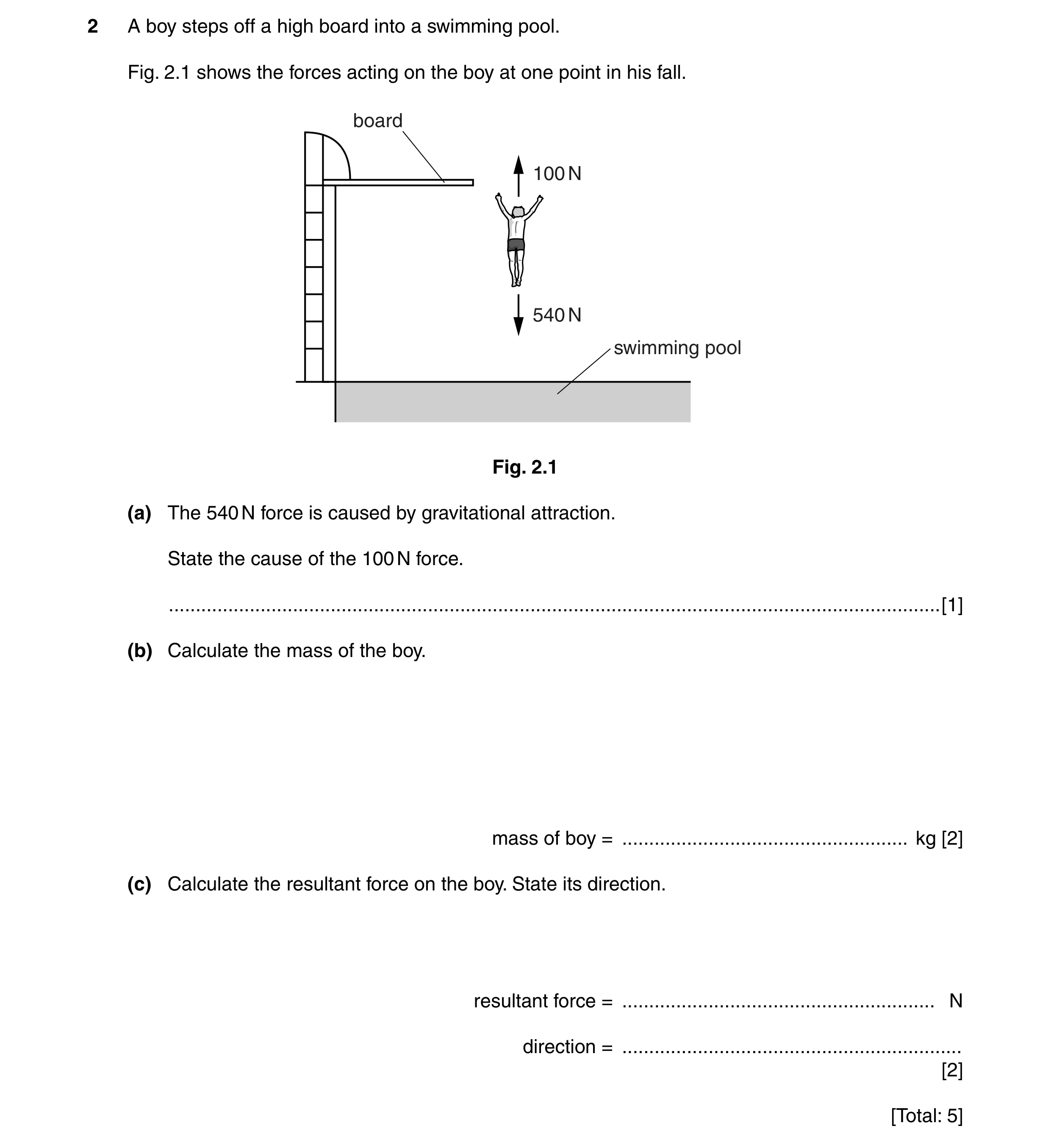
2 A boy steps off a high board into a swimming pool. Fig. 2.1 shows the forces acting on the boy at one point in his fall. board 100 N 540 N swimming pool Fig. 2.1 (a) The 540 N force is caused by gravitational attraction. State the cause of the 100 N force. … [1] (b) Calculate the mass of the boy. mass of boy = … kg [2] (c) Calculate the resultant force on the boy. State its direction. resultant force = … N direction = … [2] [Total: 5]
5 marks
Mark scheme: 2(a) air resistance B1 2(b) W = m × g in any form B1 54(kg) B1 2(c) (540 – 100) = 440(N) B1 downwards B1 Total: 5
This question in 0625/31 May/June 2016
Q16 · A car parked on a road 0625/33 Oct/Nov 2016
4 Fig. 4.1 shows a car parked on a road. Fig. 4.1 (a) The car has a mass of 1000 kg. Calculate the weight of the car. weight of car = … N [2] (b) (i) The combined weight of the car and its driver is 10 500 N. The area of each tyre in contact with the road is 125 cm2. Each tyre supports a quarter of the combined weight of the car and driver. Calculate the pressure that each tyre exerts on the ground. pressure = … N / cm2 [3] (ii) Later, the car is parked on some long wooden planks on a muddy field. Explain why the planks prevent the car from sinking into the mud. … … … … [2] (c) (i) A driver needs to remove a wheel from the car. To undo the wheel nuts the driver uses a wrench, as shown in Fig. 4.2. 200200200 NNN mm 0.250.25 wrench wheel nut Fig. 4.2 A force of 200 N is applied perpendicular to the wrench. The force is applied 0.25 m from the centre of a wheel nut. Calculate the moment produced by this force. Include the unit. moment = … [3] (ii) One of the wheel nuts is difficult to turn. Describe how the driver can increase the moment when using the same force of 200 N applied to the wrench. … … [1] [Total: 11]
11 marks
Mark scheme: 4(a) C1 10 000 (N) A1 4(b)(i) pressure = force/area in any form C1 (10 500 / 4) / 125 C1 21 (N/cm2) A1 4(b)(ii) (weight spread over) larger area owtte B1 pressure reduced B1 4(c)(i) moment = force × distance from pivot in any form C1 200 × 0.25 OR 50 A1 Nm B1 4(c)(ii) force applied further away from wheel nut owtte B1 Total: 11
This question in 0625/33 Oct/Nov 2016
Q17 · A tyre hanging from the branch of a tree 0625/31 May/June 2017
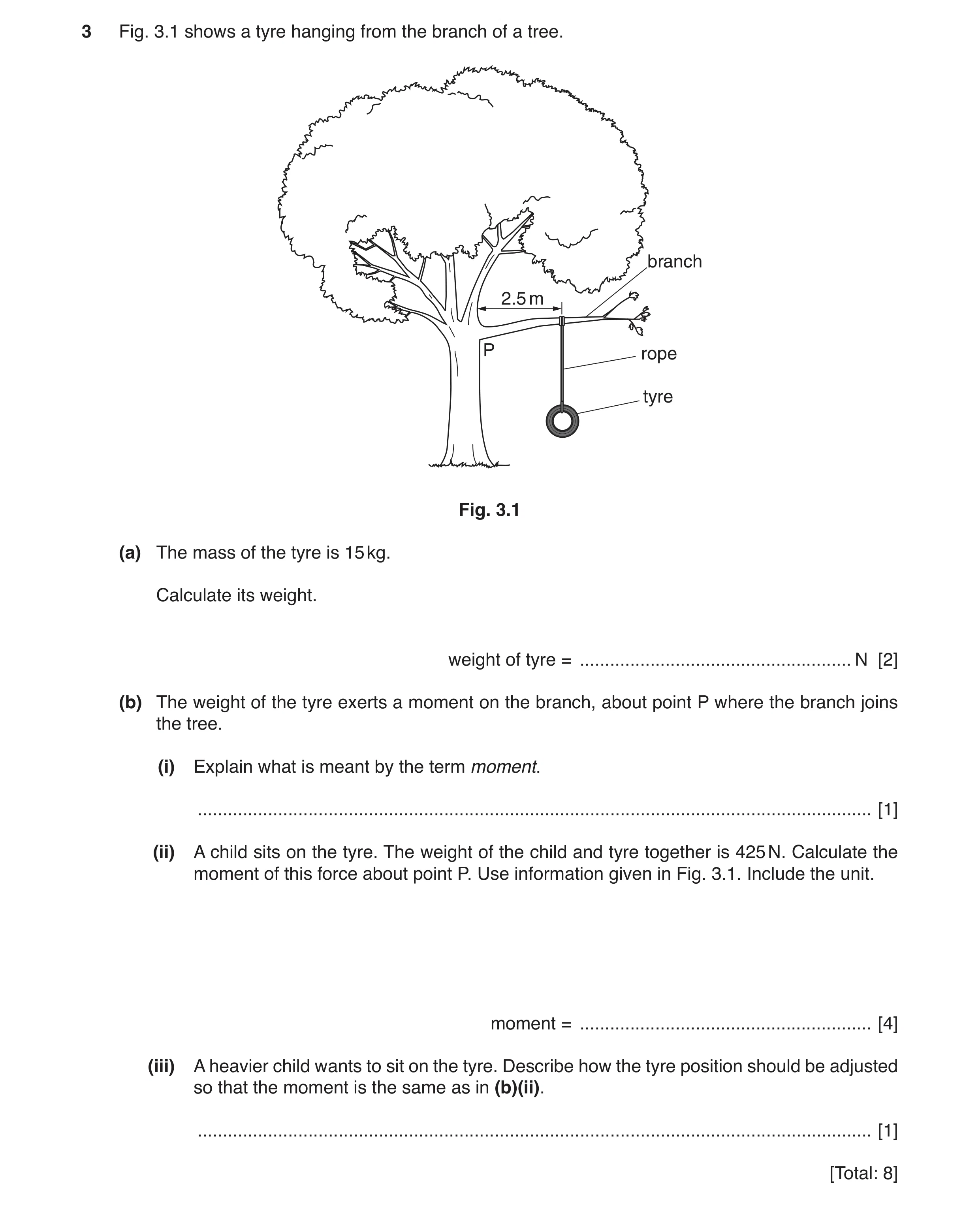
3 Fig. 3.1 shows a tyre hanging from the branch of a tree. branch 2.5 m P rope tyre Fig. 3.1 (a) The mass of the tyre is 15 kg. Calculate its weight. weight of tyre = … N [2] (b) The weight of the tyre exerts a moment on the branch, about point P where the branch joins the tree. (i) Explain what is meant by the term moment. … [1] (ii) A child sits on the tyre. The weight of the child and tyre together is 425 N. Calculate the moment of this force about point P. Use information given in Fig. 3.1. Include the unit. moment = … [4] (iii) A heavier child wants to sit on the tyre. Describe how the tyre position should be adjusted so that the moment is the same as in (b)(ii). … [1] [Total: 8]
8 marks
Mark scheme: 3(a) C1 150 (N) A1 3(b)(i) turning effect (of a force) B1 3(b)(ii) moment = force × distance C1 425 × 2.5 C1 1062.5 OR 1063 A1 N m B1 3(b)(iii) (move rope/tyre) closer to trunk owtte B1 Total: 8
This question in 0625/31 May/June 2017
Question 18 0625/32 May/June 2017
3 Fig. 3.1 shows a large sunshade. arm sunshade pivot support base Fig. 3.1 The arm holding the sunshade pivots about the end of a support. (a) The sunshade has a mass of 20.0 kg. Calculate the weight of the sunshade. weight = … N [3] (b) (i) Another sunshade is shown in Fig. 3.2. This sunshade weighs 180 N. The arm holding the sunshade extends 2.5 m from the pivot. 2.5 m pivot support 180 N base Fig. 3.2 Calculate the moment of the sunshade about the pivot. moment = … N m [3] (ii) How can the moment produced by the sunshade be reduced? Tick one box. by decreasing the height of the support by decreasing the length of the arm holding the sunshade by increasing the weight of the base by increasing the weight of the sunshade [1] [Total: 7]
7 marks
Mark scheme: 3(a) C1 20.0 × 10.0 C1 200 (N) A1 3(b)(i) moment = force × (perpendicular) distance (from pivot) in any form C1 180.0 × 2.5 C1 450 (N m) A1 3(b)(ii) 2nd box down ticked decrease the length of the arm holding the sun-shade B1 Total: 7
This question in 0625/32 May/June 2017
Q19 · A student measures a book 0625/33 May/June 2017
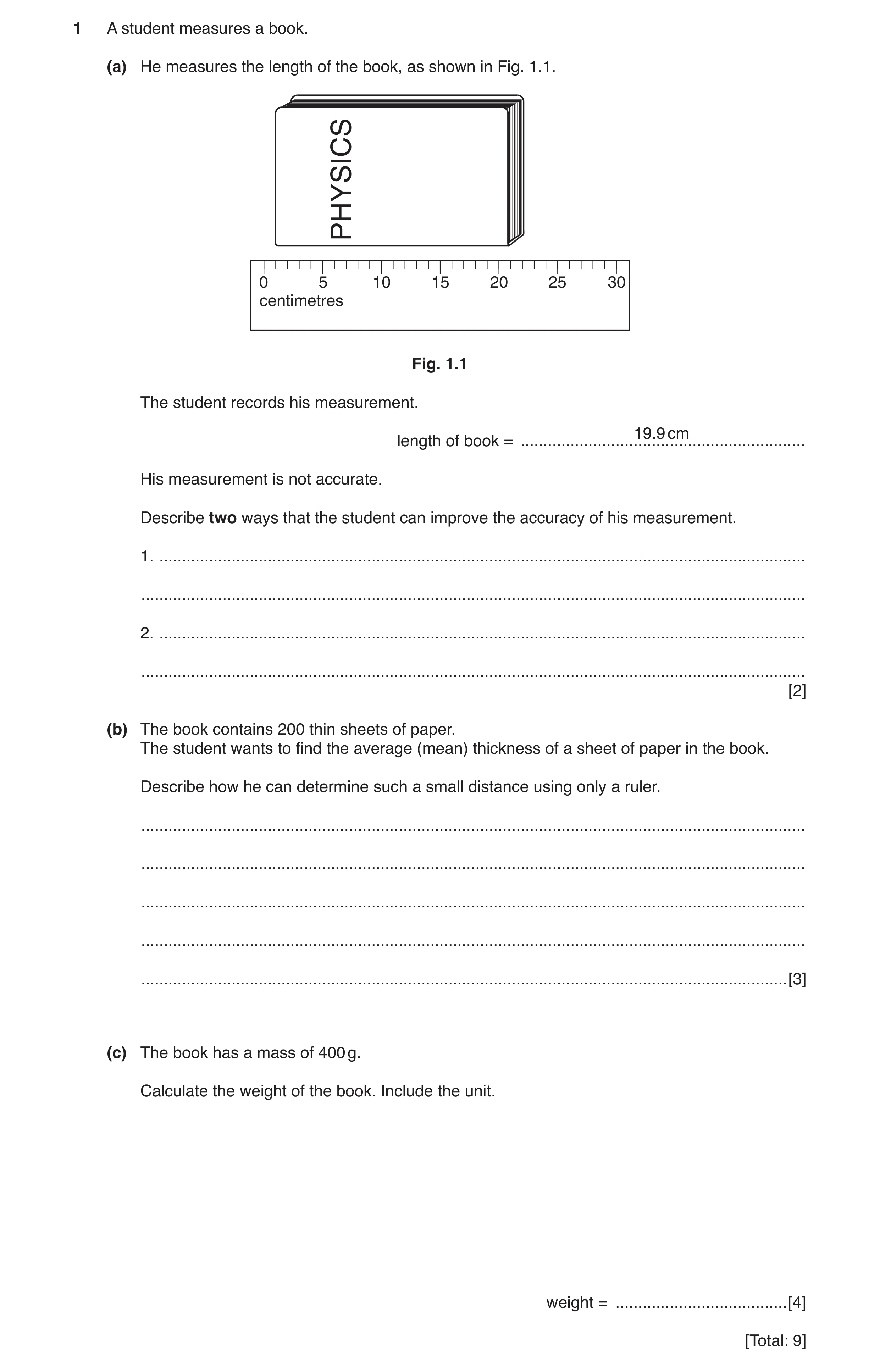
1 A student measures a book. (a) He measures the length of the book, as shown in Fig. 1.1. PHYSICS 0 5 10 15 20 25 30 centimetres Fig. 1.1 The student records his measurement. 19.9 cm length of book = … His measurement is not accurate. Describe two ways that the student can improve the accuracy of his measurement. 1. … … 2. … … [2] (b) The book contains 200 thin sheets of paper. The student wants to find the average (mean) thickness of a sheet of paper in the book. Describe how he can determine such a small distance using only a ruler. … … … … … [3] (c) The book has a mass of 400 g. Calculate the weight of the book. Include the unit. weight = … [4] [Total: 9]
9 marks
Mark scheme: 1(a) any two from: use a ruler with mm (scale) ruler close(r) to book/no space between book and ruler have zero on ruler at one end of book take reading with eye in line with end of book owtte B2 1(b) use large number of pages i.e. more than 50 B1 measure (total) thickness (with ruler) B1 divide (total) thickness by number of pages B1 1(c) convert g to kg or 400 ÷ 1000 B1 Weight = mass × gravitational field strength in any form C1 (weight = ) 4.0 A1 (unit) N or newtons B1 Total: 9
This question in 0625/33 May/June 2017
Q20 · A large box with a heavy lid 0625/33 Oct/Nov 2017
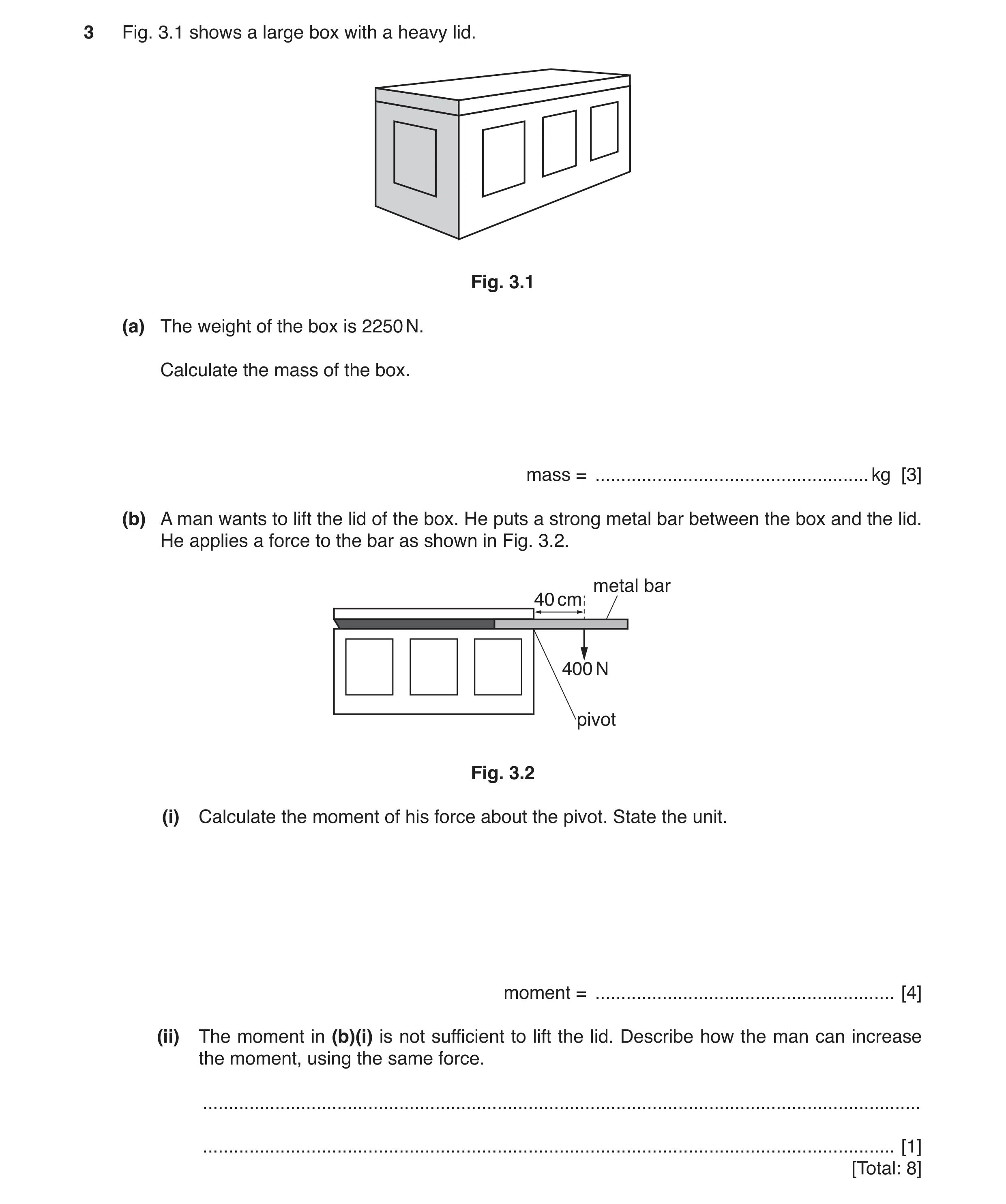
3 Fig. 3.1 shows a large box with a heavy lid. Fig. 3.1 (a) The weight of the box is 2250 N. Calculate the mass of the box. mass = … kg [3] (b) A man wants to lift the lid of the box. He puts a strong metal bar between the box and the lid. He applies a force to the bar as shown in Fig. 3.2. metal bar 40 cm 400 N pivot Fig. 3.2 (i) Calculate the moment of his force about the pivot. State the unit. moment = … [4] (ii) The moment in (b)(i) is not sufficient to lift the lid. Describe how the man can increase the moment, using the same force. … … [1] [Total: 8]
8 marks
Mark scheme: 3(a) C1 2250 / 10 C1 225 (kg) A1 3(b)(i) moment = force × distance from pivot in any recognised form C1 400 × 0.4 OR 400 × 40 C1 160 OR 16 000 A1 Nm OR Ncm B1 3(b)(ii) apply force further from pivot owtte B1
This question in 0625/33 Oct/Nov 2017
Question 21 0625/32 May/June 2018
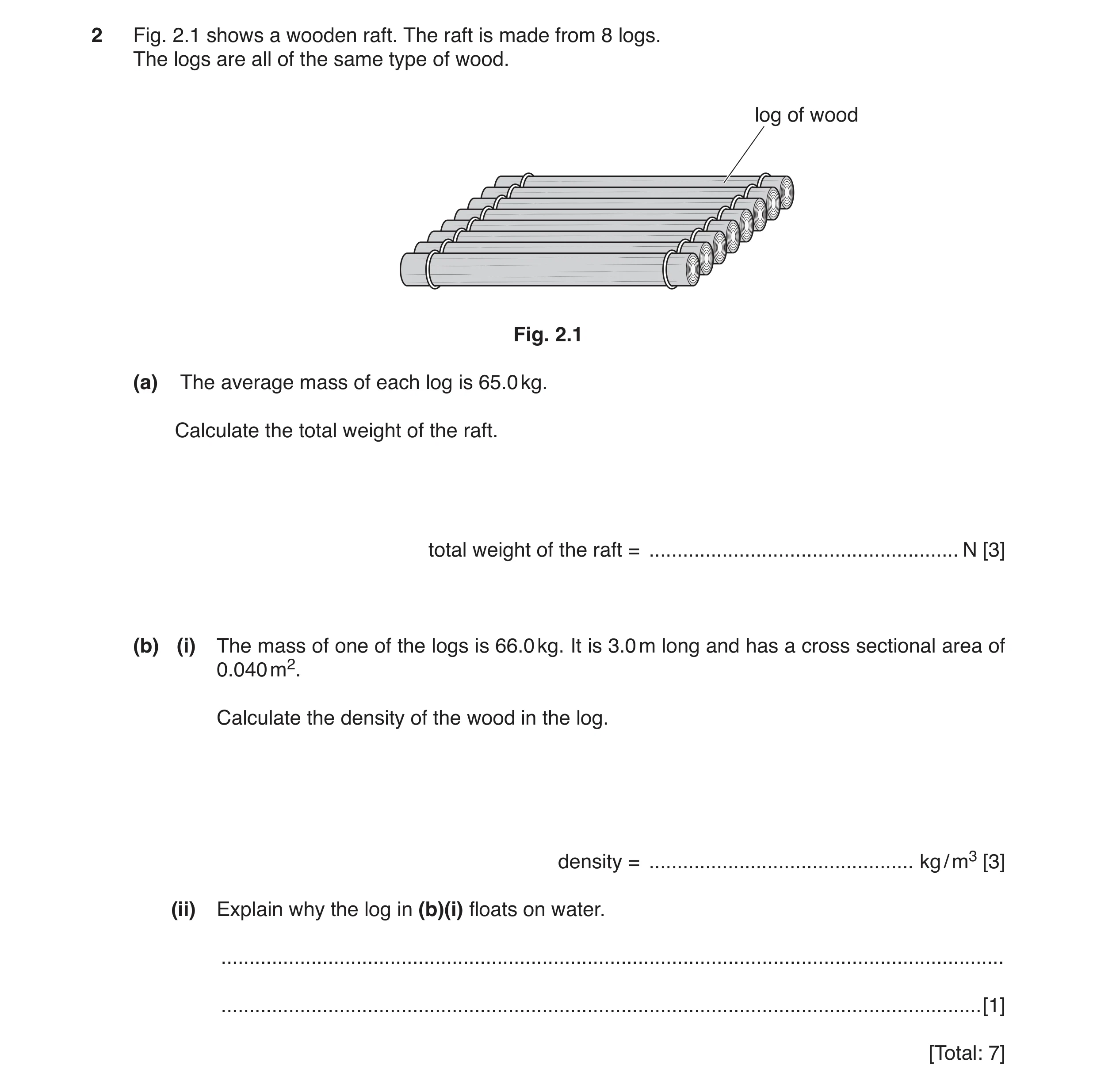
2 Fig. 2.1 shows a wooden raft. The raft is made from 8 logs. The logs are all of the same type of wood. log of wood Fig. 2.1 (a) The average mass of each log is 65.0 kg. Calculate the total weight of the raft. total weight of the raft = … N [3] (b) (i) The mass of one of the logs is 66.0 kg. It is 3.0 m long and has a cross sectional area of 0.040 m2. Calculate the density of the wood in the log. density = … kg / m3 [3] (ii) Explain why the log in (b)(i) floats on water. … … [1] [Total: 7]
7 marks
Mark scheme: 2(a) 1 650 × 8 1 5200 (N) 1 2(b)(i) (volume of log =) 3 × 0.04 = 0.12 (m3) 1 D = M / V OR (D =) M / V 1 550 (kg / m3) 1 2(b)(ii) The density of logs is less than density of water owtte. 1
This question in 0625/32 May/June 2018
Q22 · A student is using some 50 g masses 0625/33 May/June 2018
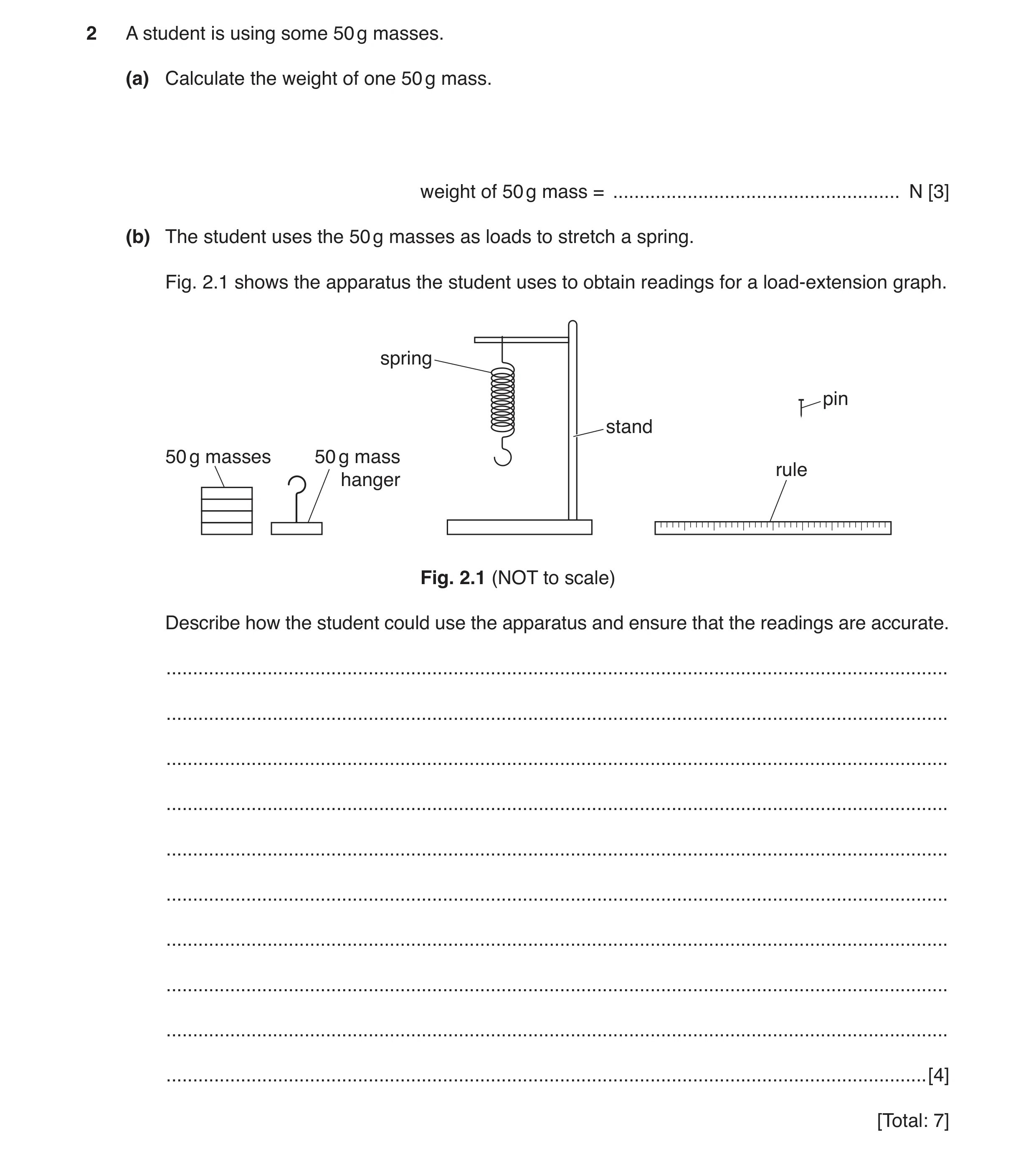
2 A student is using some 50 g masses. (a) Calculate the weight of one 50 g mass. weight of 50 g mass = … N [3] (b) The student uses the 50 g masses as loads to stretch a spring. Fig. 2.1 shows the apparatus the student uses to obtain readings for a load-extension graph. spring pin stand 50 g masses 50 g mass rule hanger Fig. 2.1 (NOT to scale) Describe how the student could use the apparatus and ensure that the readings are accurate. … … … … … … … … … … [4] [Total: 7]
7 marks
Mark scheme: 2(a) W = m × g 1 50 ÷ 1000 OR 0.05 seen 1 0.5 (N) 1 2(b) any 4 from: fix ruler vertically add weight/hanger to spring fix pin (horizontally) to (top/bottom) of weight hanger pin arranged so near ruler scale ensure load stationary eye level with pin to take reading (of length) determine extension for given load repeat for different loads 4
This question in 0625/33 May/June 2018
Q23 · A raft floating on water 0625/31 Oct/Nov 2018
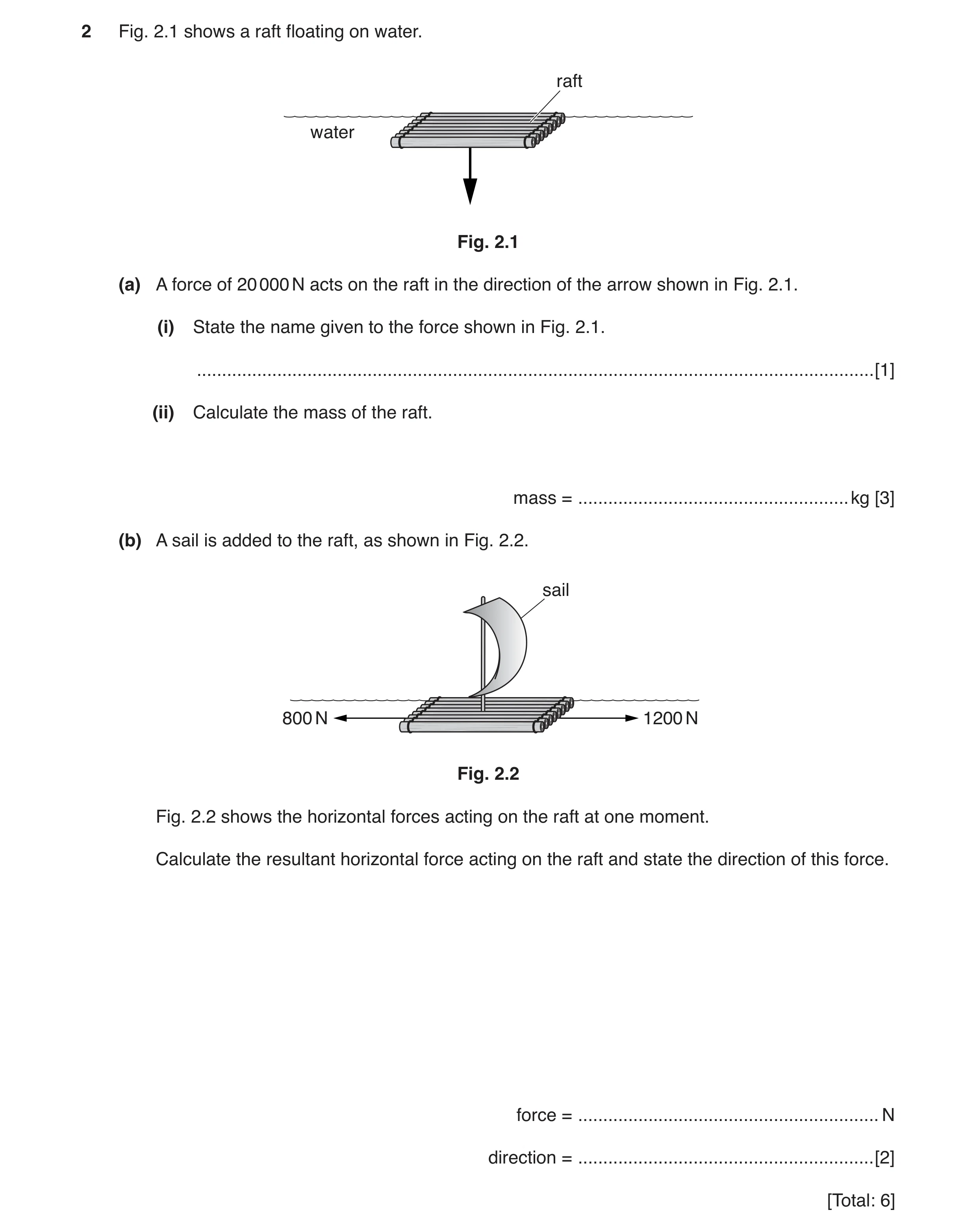
2 Fig. 2.1 shows a raft floating on water. raft water Fig. 2.1 (a) A force of 20 000 N acts on the raft in the direction of the arrow shown in Fig. 2.1. (i) State the name given to the force shown in Fig. 2.1. … [1] (ii) Calculate the mass of the raft. mass = … kg [3] (b) A sail is added to the raft, as shown in Fig. 2.2. sail 800 N 1200 N Fig. 2.2 Fig. 2.2 shows the horizontal forces acting on the raft at one moment. Calculate the resultant horizontal force acting on the raft and state the direction of this force. force = … N direction = … [2] [Total: 6]
6 marks
Mark scheme: 2(a)(i) weight B1 2(a)(ii) W = m × g C1 m = 20 000 ÷ 10 C1 2000 (kg) A1 2(b) 400 (N) B1 forwards / to the right B1
This question in 0625/31 Oct/Nov 2018
Q24 · A student has a piece of metal that has an irregular shape 0625/33 Oct/Nov 2018
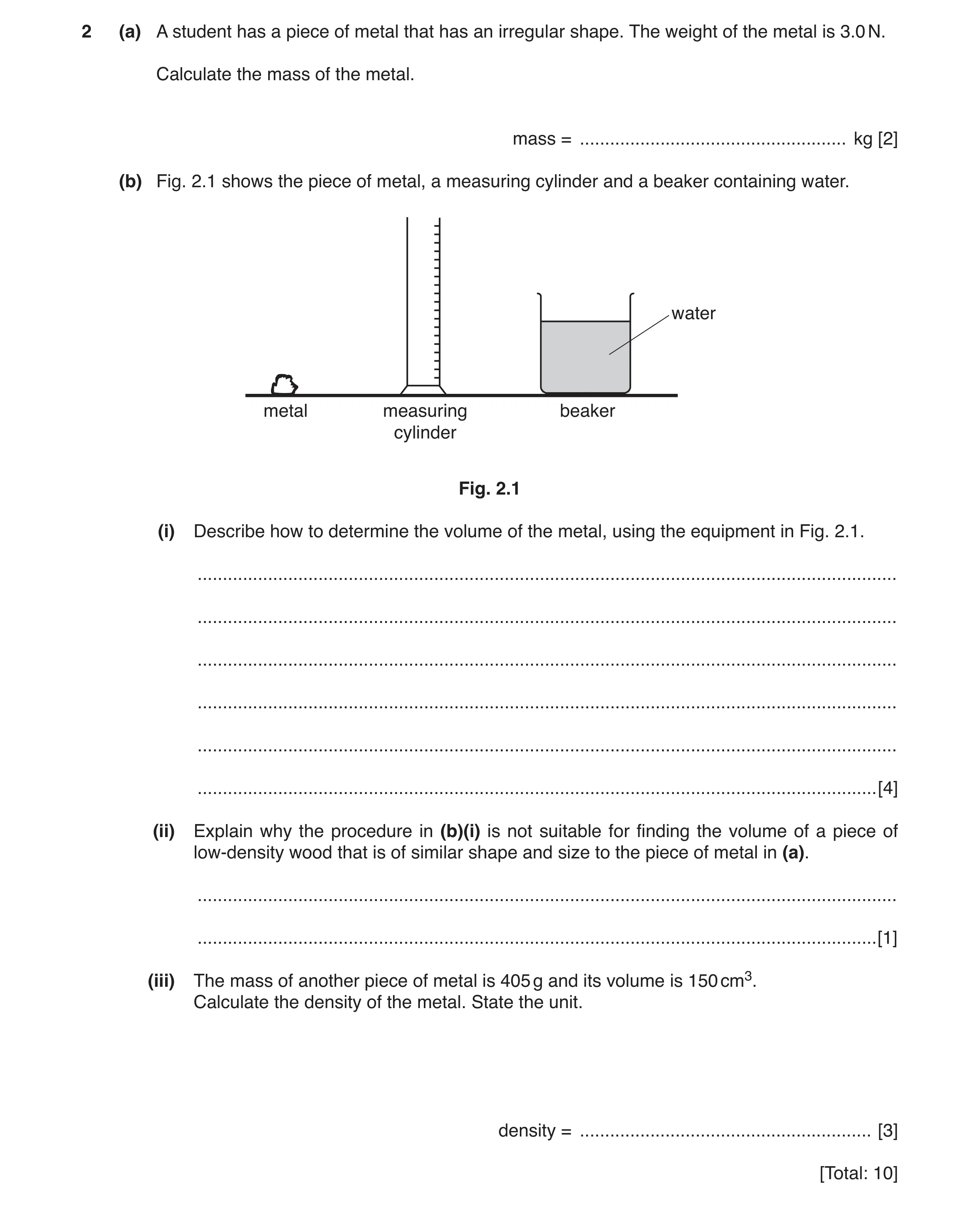
2 (a) A student has a piece of metal that has an irregular shape. The weight of the metal is 3.0 N. Calculate the mass of the metal. mass = … kg [2] (b) Fig. 2.1 shows the piece of metal, a measuring cylinder and a beaker containing water. water metal measuring beaker cylinder Fig. 2.1 (i) Describe how to determine the volume of the metal, using the equipment in Fig. 2.1. … … … … … … [4] (ii) Explain why the procedure in (b)(i) is not suitable for finding the volume of a piece of low-density wood that is of similar shape and size to the piece of metal in (a). … … [1] (iii) The mass of another piece of metal is 405 g and its volume is 150 cm3. Calculate the density of the metal. State the unit. density = … [3] [Total: 10]
10 marks
Mark scheme: 2(a) W = m g OR (m =) W / g OR 3.0 ÷ 10 C1 0.3 (kg) A1 2(b)(i) determine / read volume of water in measuring cylinder B1 (submerge / sink) metal in water / measuring cylinder B1 determine / read new volume of water (and metal) B1 find difference between final and initial volumes B1 2(b)(ii) wood floats OR does not sink B1 2(b)(iii) D = M / V OR 405 ÷ 150 C1 2.7 A1 g / cm3 B1
This question in 0625/33 Oct/Nov 2018
Q25 · A set of masses made from the same material 0625/32 Feb/March 2019
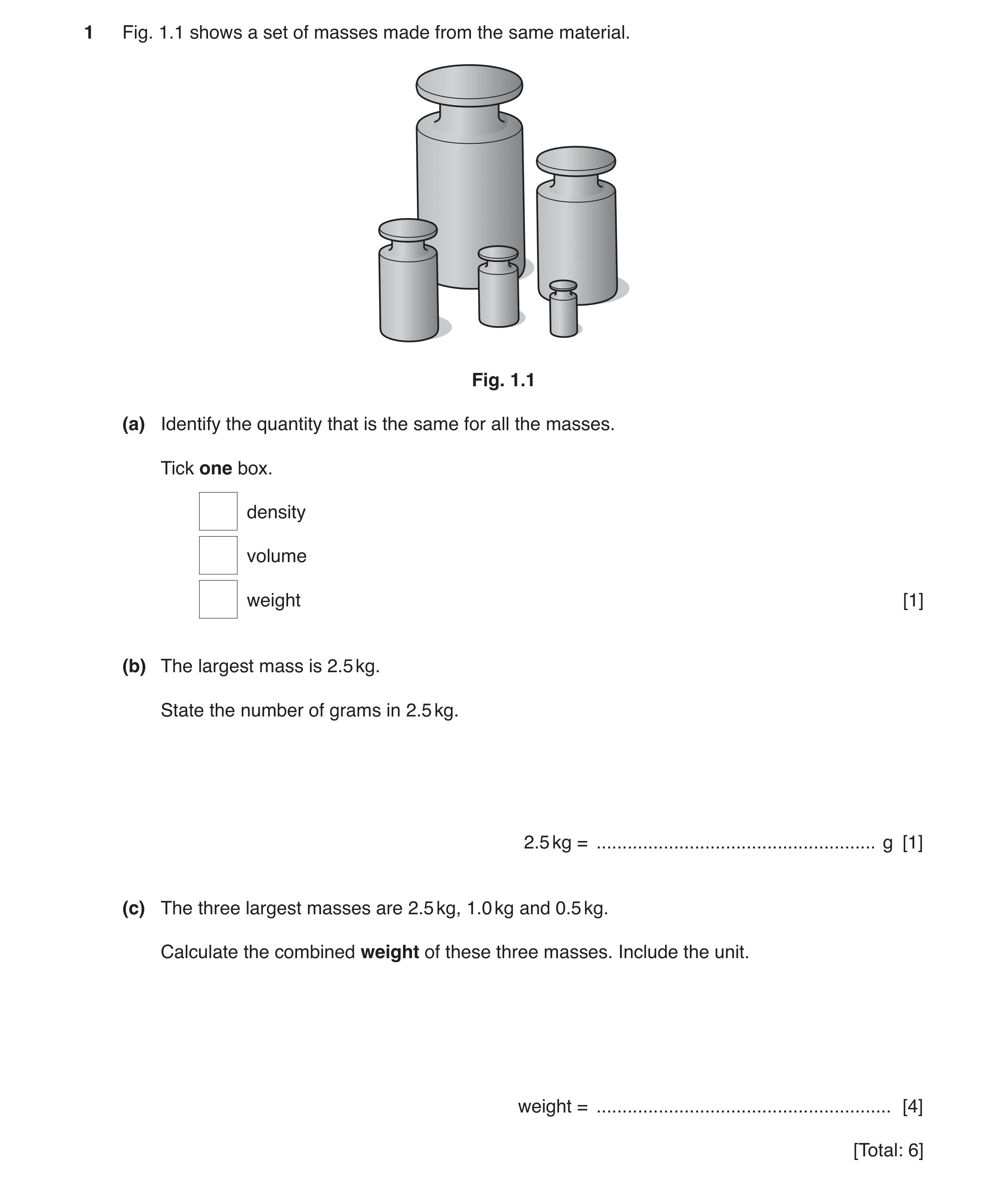
1 Fig. 1.1 shows a set of masses made from the same material. Fig. 1.1 (a) Identify the quantity that is the same for all the masses. Tick one box. density volume weight [1] (b) The largest mass is 2.5 kg. State the number of grams in 2.5 kg. 2.5 kg = … g [1] (c) The three largest masses are 2.5 kg, 1.0 kg and 0.5 kg. Calculate the combined weight of these three masses. Include the unit. weight = … [4] [Total: 6]
6 marks
Mark scheme: 1(a) top box ticked: density B1 1(b) 2500 (g) B1 1(c) W = mg in any form C1 (2.5 + 1.0 + 0.5) = 4 C1 40 A1 N or newtons B1
This question in 0625/32 Feb/March 2019
Q26 · A load is attached to a spring, as shown in Fig 0625/32 Feb/March 2019
3 A load is attached to a spring, as shown in Fig. 3.1. Two arrows indicate the vertical forces acting on the load. The spring and the load are stationary. support spring 4.0 N load Fig. 3.1 (a) (i) State the name of the force acting vertically downwards. … [1] (ii) The vertical force that acts upwards is 4.0 N. State the value of the force acting vertically downwards. force = … N [1] (b) The load is pulled downwards and then released. The load moves up and down. Fig. 3.2 represents the vertical forces acting on the load at some time after it is released. 7.6 N 2.8 N Fig. 3.2 Calculate the resultant force on the load and state its direction. resultant force = … N direction = … [2] (c) (i) State the principle of conservation of energy. … … [1] (ii) Eventually the load stops moving up and down. Describe and explain why the load stops moving. Use your ideas about conservation of energy. … … … … [2] [Total: 7]
7 marks
Mark scheme: 3(a)(i) gravity OR weight B1 3(a)(ii) 4.0 (N) B1 Question Answer Marks 3(b) 4.8 (N) B1 Up(wards) B1 3(c)(i) energy cannot be created or destroyed (but can be transformed) B1 3(c)(ii) PE / KE / elastic energy of load / spring decreases / is transformed B1 Any one from: to thermal energy (which is) dissipated (to surroundings) B1
This question in 0625/32 Feb/March 2019
Q27 · A bottle contains some oil 0625/32 May/June 2019
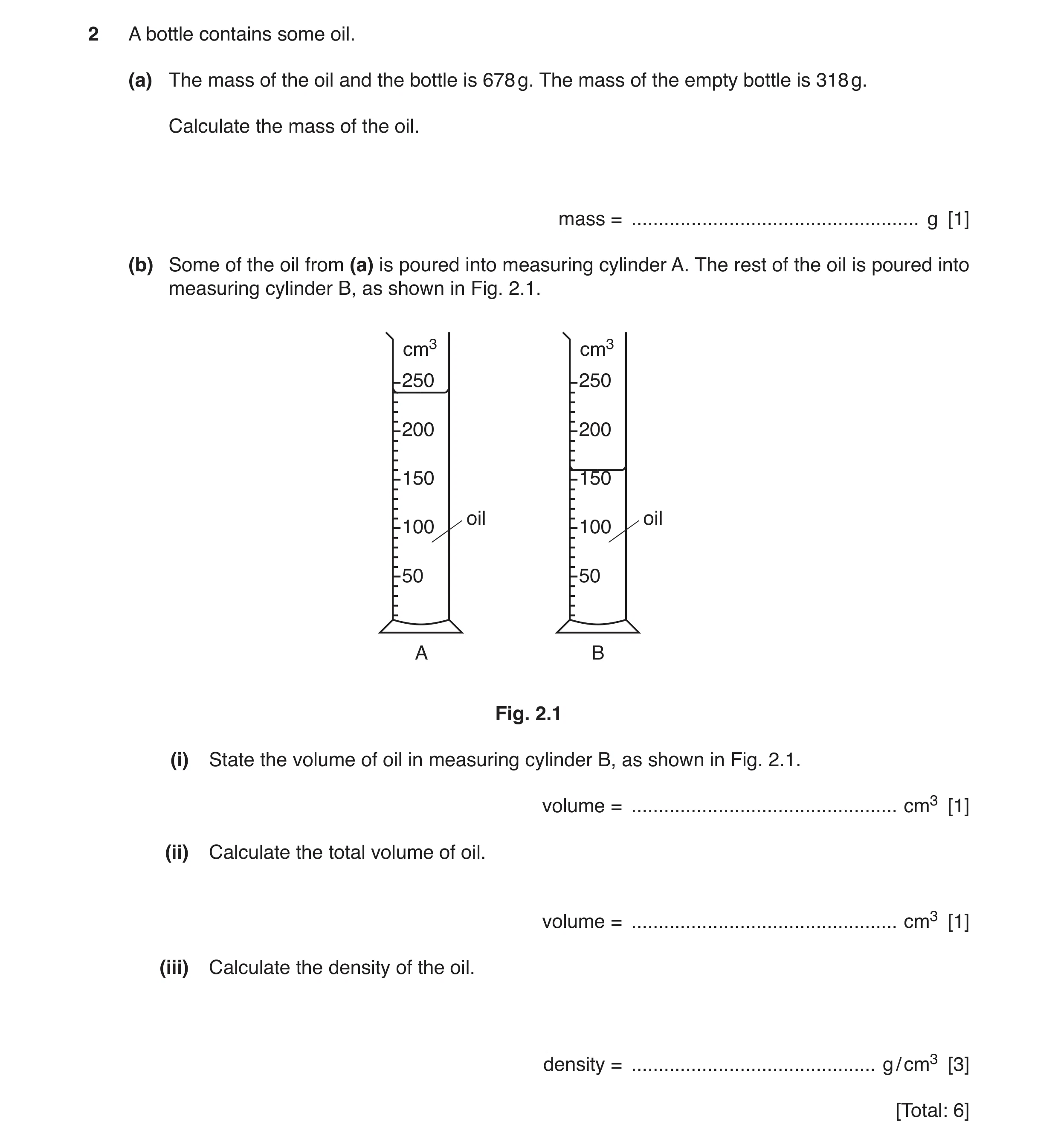
2 A bottle contains some oil. (a) The mass of the oil and the bottle is 678 g. The mass of the empty bottle is 318 g. Calculate the mass of the oil. mass = … g [1] (b) Some of the oil from (a) is poured into measuring cylinder A. The rest of the oil is poured into measuring cylinder B, as shown in Fig. 2.1. cm3 cm3 250 250 200 200 150 150 oil oil 100 100 50 50 A B Fig. 2.1 (i) State the volume of oil in measuring cylinder B, as shown in Fig. 2.1. volume = … cm3 [1] (ii) Calculate the total volume of oil. volume = … cm3 [1] (iii) Calculate the density of the oil. density = … g / cm3 [3] [Total: 6]
6 marks
Mark scheme: 2(a) (678 – 318 = ) 360 (g) B1 2(b)(i) 160 (cm3) B1 2(b)(ii) 400 (cm3) B1 2(b)(iii) D = m/v in any form C1 360 ÷ 400 C1 0.9 (g/cm3) A1
This question in 0625/32 May/June 2019
Q28 · A wheelbarrow and Fig 0625/33 May/June 2019
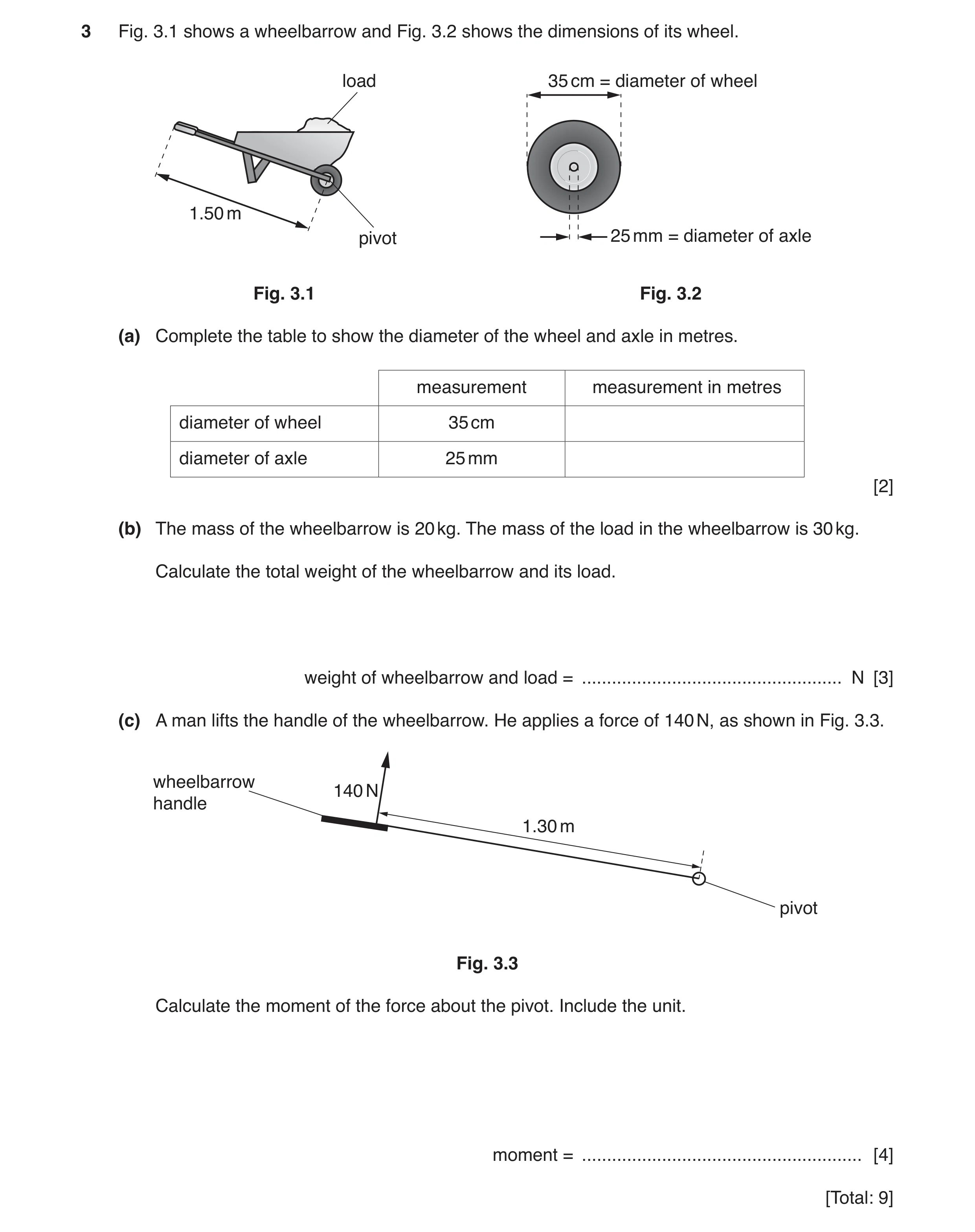
3 Fig. 3.1 shows a wheelbarrow and Fig. 3.2 shows the dimensions of its wheel. load 35 cm = diameter of wheel 1.50 m pivot 25 mm = diameter of axle Fig. 3.1 Fig. 3.2 (a) Complete the table to show the diameter of the wheel and axle in metres. measurement measurement in metres diameter of wheel 35 cm diameter of axle 25 mm [2] (b) The mass of the wheelbarrow is 20 kg. The mass of the load in the wheelbarrow is 30 kg. Calculate the total weight of the wheelbarrow and its load. weight of wheelbarrow and load = … N [3] (c) A man lifts the handle of the wheelbarrow. He applies a force of 140 N, as shown in Fig. 3.3. wheelbarrow 140 N handle 1.30 m pivot Fig. 3.3 Calculate the moment of the force about the pivot. Include the unit. moment = … [4] [Total: 9]
9 marks
Mark scheme: 3(a) 0.35 (m) B1 0.025 (m) B1 3(b) (weight =) mass × gravity in any form C1 50 × 10 OR (20 × 10) + (30 × 10) C1 500 (N) A1 3(c) moment = force × distance from pivot C1 140 × 1.3 C1 180 A1 Nm B1
This question in 0625/33 May/June 2019
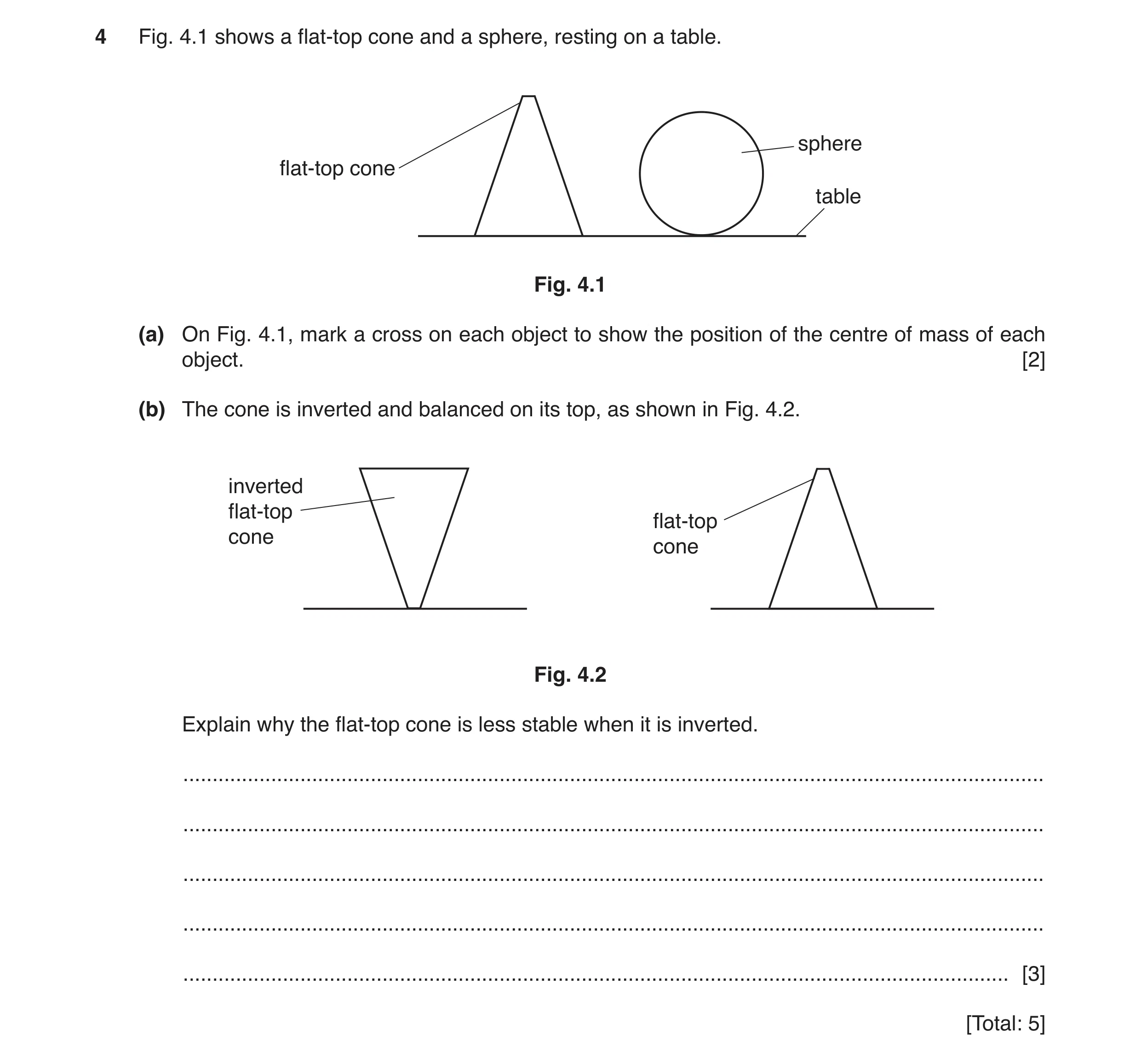
Q29 · A flat-top cone and a sphere, resting on a table 0625/33 May/June 2019
4 Fig. 4.1 shows a flat-top cone and a sphere, resting on a table. sphere flat-top cone table Fig. 4.1 (a) On Fig. 4.1, mark a cross on each object to show the position of the centre of mass of each object. [2] (b) The cone is inverted and balanced on its top, as shown in Fig. 4.2. inverted flat-top flat-top cone cone Fig. 4.2 Explain why the flat-top cone is less stable when it is inverted. … … … … … [3] [Total: 5]
5 marks
Mark scheme: 4(a) centre of cone nearer base than apex B1 centre of sphere B1 4(b) any three from: centre of mass is higher surface (area in contact with table) is smaller (so a) small displacement causes toppling (because with a small displacement the) vertical line through centre of mass is outside the base owtte B3
This question in 0625/33 May/June 2019
Q30 · A spring with no load attached 0625/31 Oct/Nov 2019
3 Fig. 3.1 shows a spring with no load attached. Fig. 3.2 shows the same spring with a load attached. stand spring load Fig. 3.1 Fig. 3.2 (a) Describe how a student can determine the extension of the spring. You may draw on Fig. 3.1 and Fig. 3.2 as part of your answer. … … … … … [3] (b) The student plots a graph of load against extension, as shown in Fig. 3.3. 10.0 load / N 9.0 8.0 7.0 6.0 5.0 4.0 3.0 2.0 1.0 0.0 0 4 8 12 16 20 24 28 32 36 40 extension / cm Fig. 3.3 (i) Determine the extension produced by a load of 7.5 N. extension = … cm [1] (ii) Determine the load that would produce an extension of 10.0 cm. load = … N [1] (c) Calculate the mass that has a weight of 6.0 N. mass = … kg [3] [Total: 8]
8 marks
Mark scheme: 3(a) measure without any load / weights AND measure with load / weights B1 measure length OR ruler stated or seen B1 (extension =) difference in two values B1 3(b)(i) 30 (cm) B1 3(b)(ii) 2.5 (N) B1 3(c) W = m × g OR W = m × 10 OR (m =) W ÷ g in any form C1 6.0 ÷ 10 C1 0.6(0) (kg) A1
This question in 0625/31 Oct/Nov 2019
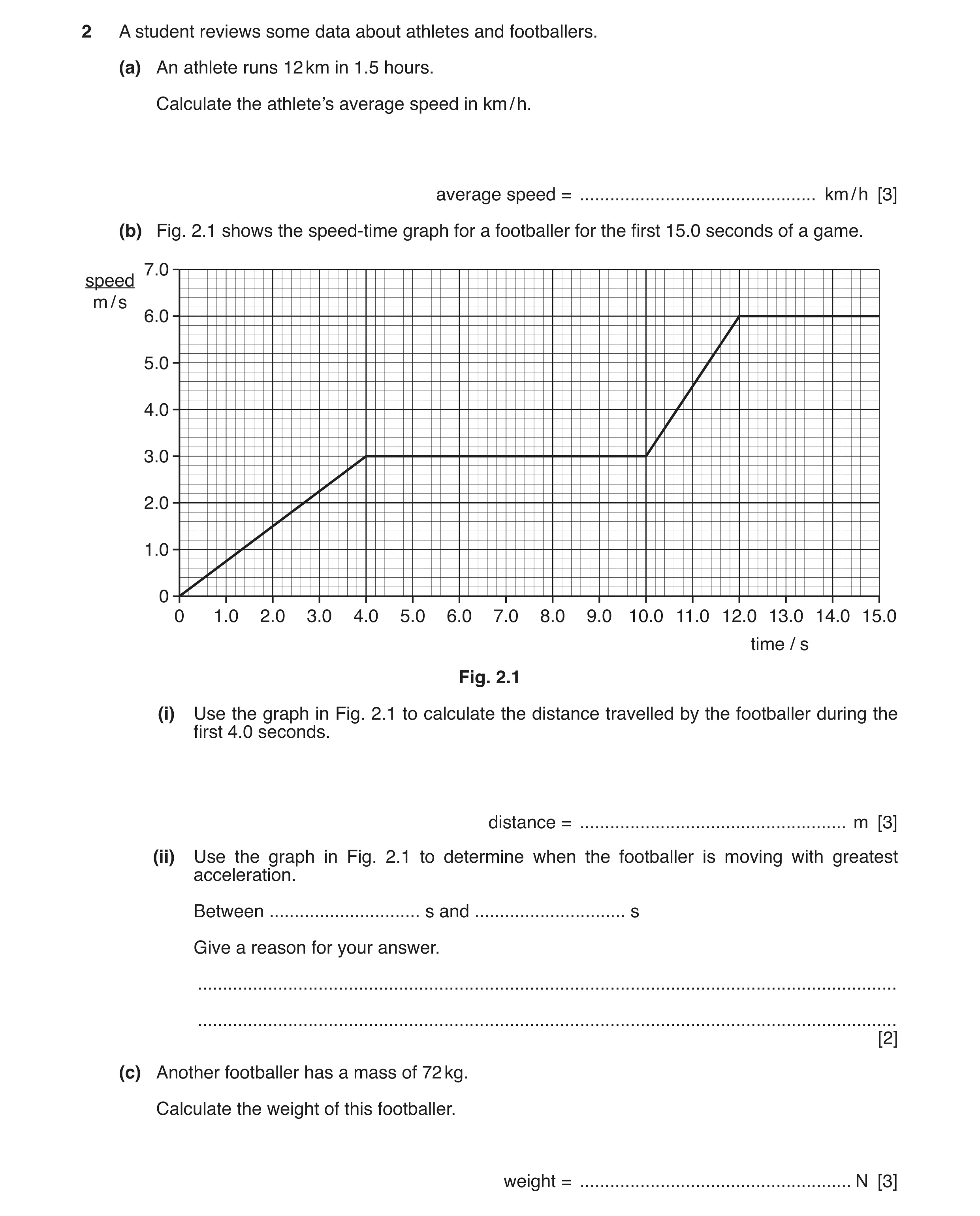
Q31 · A student reviews some data about athletes and footballers 0625/33 Oct/Nov 2019
2 A student reviews some data about athletes and footballers. (a) An athlete runs 12 km in 1.5 hours. Calculate the athlete’s average speed in km / h. average speed = … km / h [3] (b) Fig. 2.1 shows the speed-time graph for a footballer for the first 15.0 seconds of a game. 7.0speed m / s 6.0 5.0 4.0 3.0 2.0 1.0 0 0 1.0 2.0 3.0 4.0 5.0 6.0 7.0 8.0 9.0 10.0 11.0 12.0 13.0 14.0 15.0 time / s Fig. 2.1 (i) Use the graph in Fig. 2.1 to calculate the distance travelled by the footballer during the first 4.0 seconds. distance = … m [3] (ii) Use the graph in Fig. 2.1 to determine when the footballer is moving with greatest acceleration. Between … s and … s Give a reason for your answer. … … [2] (c) Another footballer has a mass of 72 kg. Calculate the weight of this footballer. weight = … N [3]
11 marks
Mark scheme: 2(a) speed = (total) distance ÷ time in any form 12 ÷ 1.5 8 (km / h) C1 C1 A1 2(b)(i) distance = area under graph OR area = ½ × base × height ½ × 3.0 × 4.0 6(.0) (m) C1 C1 A1 2(b)(ii) (between) 10(.0) and 12(.0) steepest section of graph / greatest gradient M1 A1 2(c) W = mg in any form 72 × 10 720 (N) C1 C1 A1
This question in 0625/33 Oct/Nov 2019
Q32 · A student drops a ball from a high window 0625/32 Feb/March 2020
3 A student drops a ball from a high window. (a) The mass of the ball is 0.12 kg. Calculate the weight of the ball. weight = … N [3] (b) Fig. 3.1 shows the speed of the ball while it is falling. The points S, T, U, V and W are shown on the graph. 25 speed 20 U V W m / s 15 10 T 5 S 0 0 1.0 2.0 3.0 4.0 5.0 time / s Fig. 3.1 Draw one line from each section of the graph to the correct description of the motion. One has been drawn for you. section of graph description of motion at rest S – T decreasing acceleration T – U constant acceleration moving with constant speed U – V slowing down [2] (c) Determine the distance fallen by the ball in section U – V of the graph. distance = … m [3] (d) State the distance fallen by the ball in section V – W of the graph. distance = … m [1] [Total: 9]
9 marks
Mark scheme: 3(a) W = m × g in any form C1 0.12 × 10 C1 (weight =) 1.2 (N) A1 3(b) Line from T–U to decreasing acceleration B1 Line from U–V to moving with constant speed B1 3(c) (distance travelled =) area under the graph C1 2 × 20 C1 40 (m) A1 3(d) 20 OR answer = (c) answer ÷ 2 B1
This question in 0625/32 Feb/March 2020
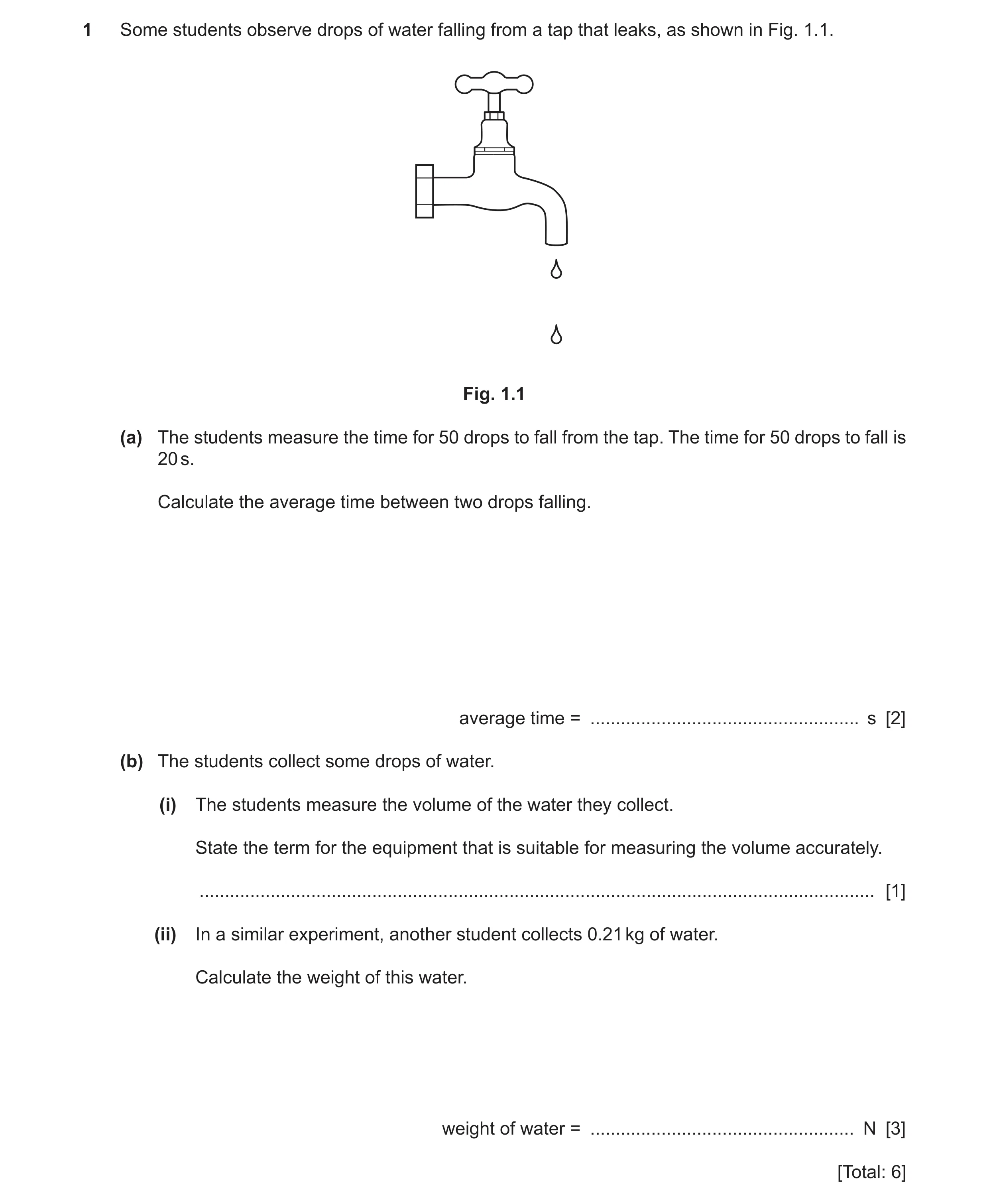
Q33 · Some students observe drops of water falling from a tap that leaks, as shown in Fig 0625/32 May/June 2020
1 Some students observe drops of water falling from a tap that leaks, as shown in Fig. 1.1. Fig. 1.1 (a) The students measure the time for 50 drops to fall from the tap. The time for 50 drops to fall is 20 s. Calculate the average time between two drops falling. average time = … s [2] (b) The students collect some drops of water. (i) The students measure the volume of the water they collect. State the term for the equipment that is suitable for measuring the volume accurately. … [1] (ii) In a similar experiment, another student collects 0.21 kg of water. Calculate the weight of this water. weight of water = … N [3] [Total: 6]
6 marks
Mark scheme: 1(a) (time =) 20 ÷ 50 C1 0.4 (s) A1 1(b)(i) measuring cylinder B1 1(b)(ii) W = m x g C1 (W =) 0.21 × 10 C1 2.1 (N) A1
This question in 0625/32 May/June 2020
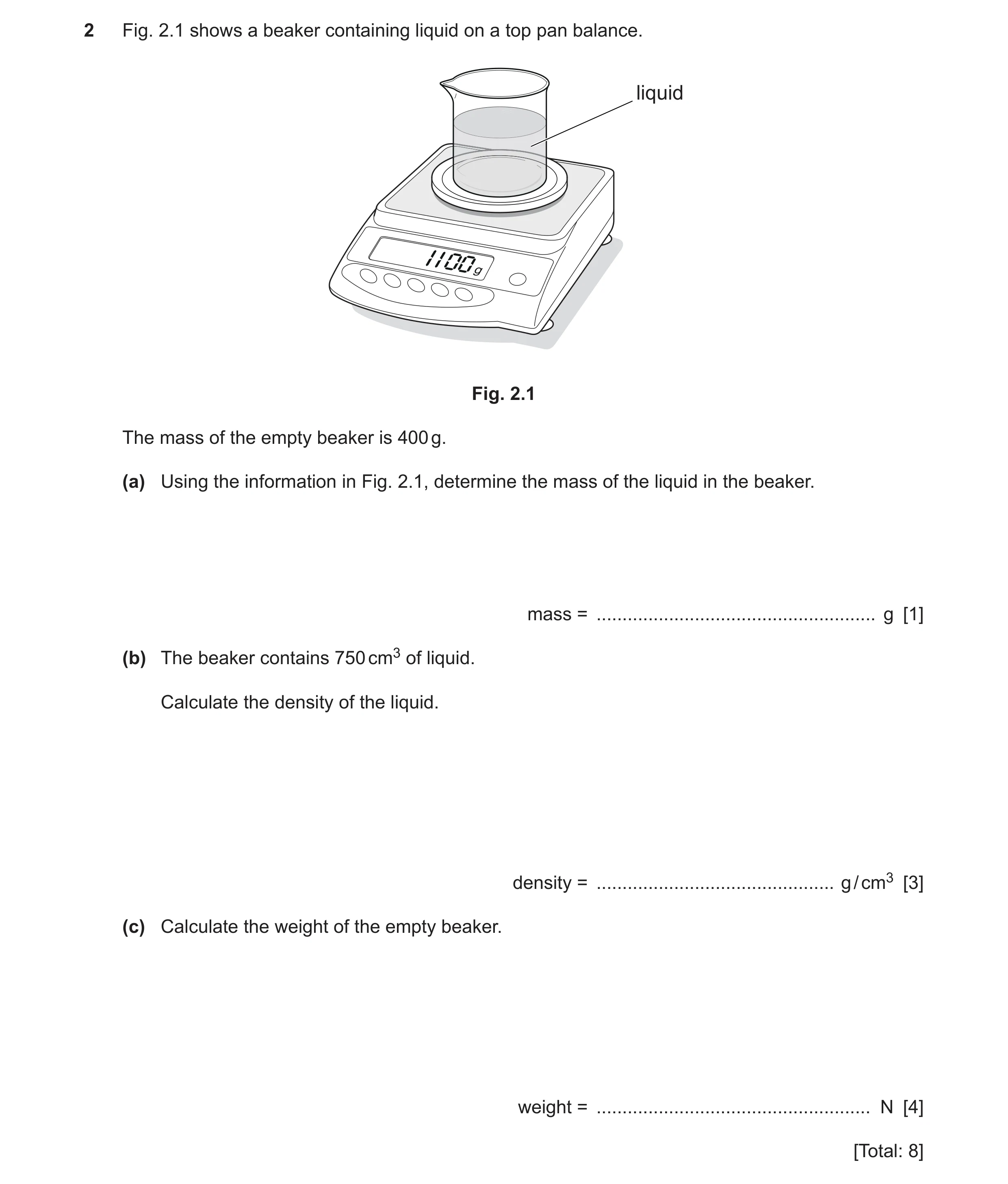
Q34 · A beaker containing liquid on a top pan balance 0625/31 Oct/Nov 2020
2 Fig. 2.1 shows a beaker containing liquid on a top pan balance. liquid Fig. 2.1 The mass of the empty beaker is 400 g. (a) Using the information in Fig. 2.1, determine the mass of the liquid in the beaker. mass = … g [1] (b) The beaker contains 750 cm3 of liquid. Calculate the density of the liquid. density = … g / cm3 [3] (c) Calculate the weight of the empty beaker. weight = … N [4] [Total: 8]
8 marks
Mark scheme: 2(a) (1100 – 400 =) 700 (g) B1 2(b) density = mass ÷ volume OR ρ = m ÷ V in any form C1 (ρ =) 700 ÷ 750 C1 (ρ =) 0.93 (g / cm3) A1 2(c) 400 (g) = 0.4 (kg) B1 w = m × g in any form C1 0.4 × 10 C1 (weight =) 4(.0) (N) A1
This question in 0625/31 Oct/Nov 2020
Q35 · Two children sitting on a see-saw 0625/33 Oct/Nov 2020
2 (a) Fig. 2.1 shows two children sitting on a see-saw. child A child B X 0.5 m beam 125 N pivot 250 N Fig. 2.1 (not to scale) (i) The weight of child A is 125 N. Calculate the mass of child A. Include the unit in your answer. mass of child A = … unit … [3] (ii) Fig. 2.1 shows child A and child B sitting in positions which balance the see-saw horizontally. Using the information in Fig. 2.1, determine the distance X. distance X = … m [3] (b) The person in Fig. 2.2 is pushing a child on a swing. Fig. 2.2 State the name of the force that acts against the motion of the swing. … [1] [Total: 7]
7 marks
Mark scheme: 2(a)(i) W = mg OR W = 10 × m C1 12.5 A1 kg B1 2(a)(ii) 250 × 0.5 OR X × 125 C1 clockwise moment = anticlockwise moment C1 (X=) 1.0 (m) A1 2(b) air resistance / drag B1
This question in 0625/33 Oct/Nov 2020
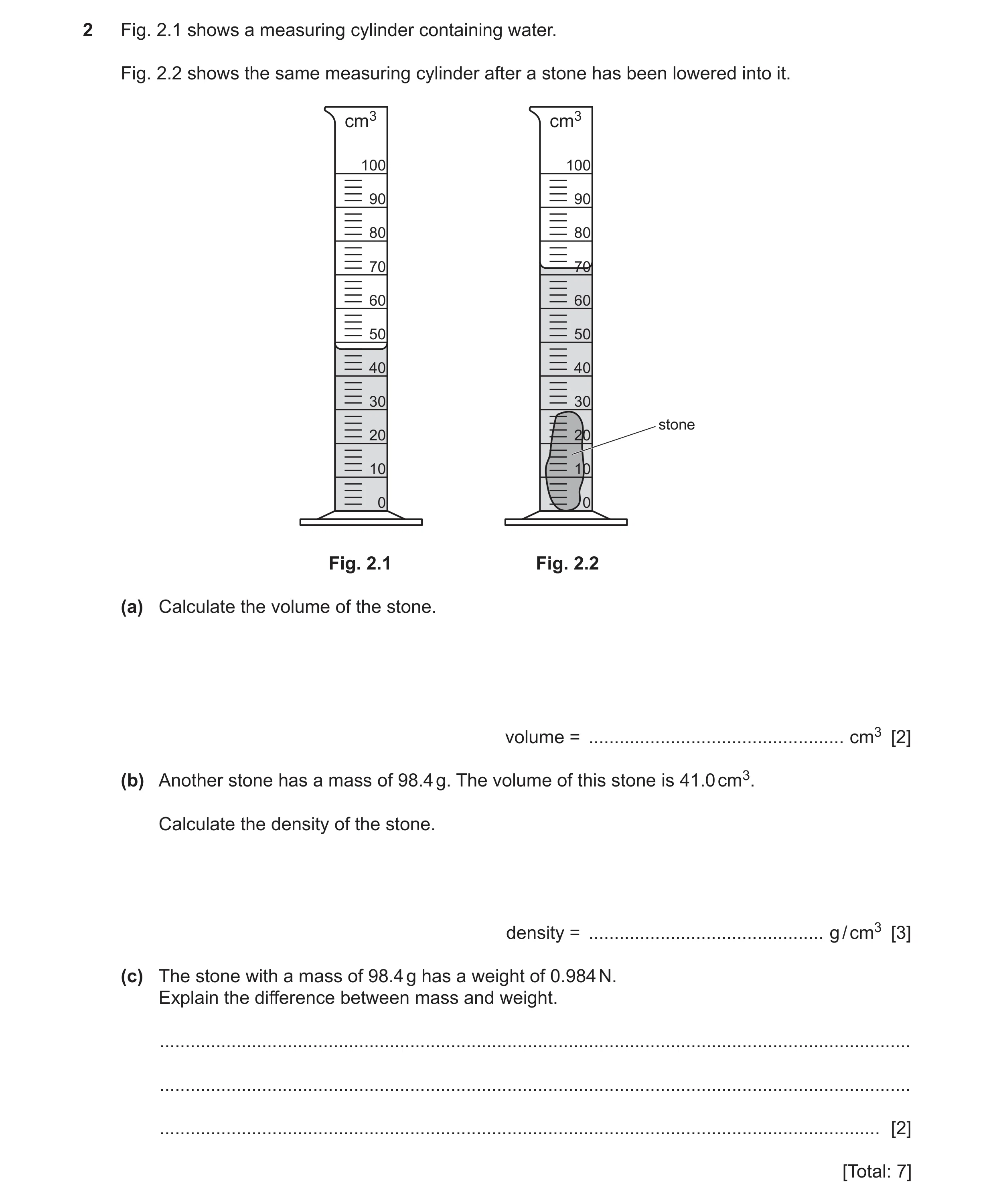
Q36 · A measuring cylinder containing water 0625/32 Feb/March 2021
2 Fig. 2.1 shows a measuring cylinder containing water. Fig. 2.2 shows the same measuring cylinder after a stone has been lowered into it. cm3 cm3 100 100 90 90 80 80 70 70 60 60 50 50 40 40 30 30 stone 20 20 10 10 0 0 Fig. 2.1 Fig. 2.2 (a) Calculate the volume of the stone. volume = … cm3 [2] (b) Another stone has a mass of 98.4 g. The volume of this stone is 41.0 cm3. Calculate the density of the stone. density = … g / cm3 [3] (c) The stone with a mass of 98.4 g has a weight of 0.984 N. Explain the difference between mass and weight. … … … [2] [Total: 7]
7 marks
Mark scheme: 2(a) (volume =) difference in candidate’s readings C1 24 (cm3) A1 2(b) (density =) mass ÷ volume C1 (density =) 98.4 ÷ 41.0 C1 2.4(0) (g / cm3) A1 Question Answer Marks 2(c) idea that mass is (a measure of) amount of matter in a body B1 idea that weight is a gravitational force B1
This question in 0625/32 Feb/March 2021
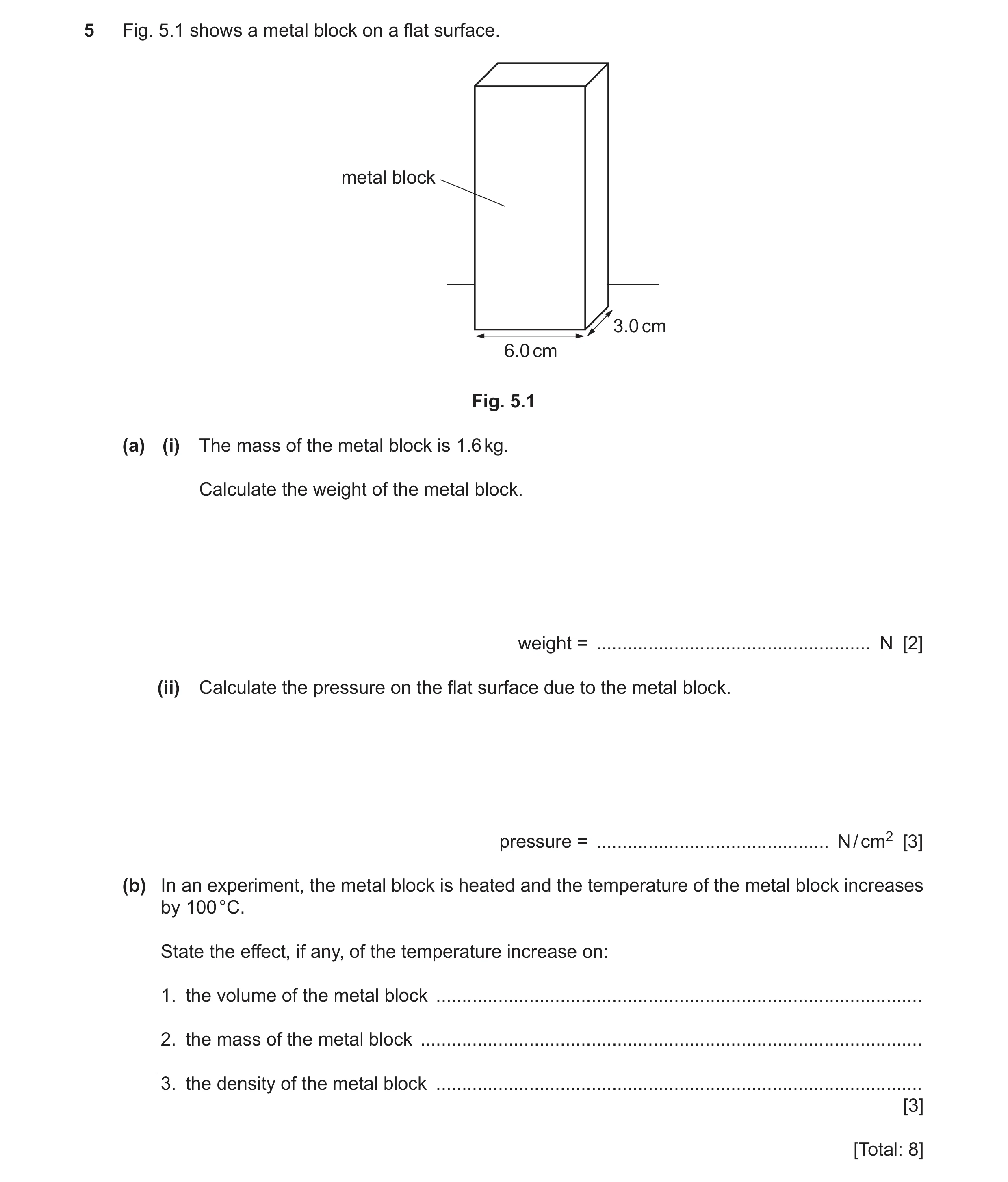
Q37 · A metal block on a flat surface 0625/32 Feb/March 2021
5 Fig. 5.1 shows a metal block on a flat surface. metal block 3.0 cm 6.0 cm Fig. 5.1 (a) (i) The mass of the metal block is 1.6 kg. Calculate the weight of the metal block. weight = … N [2] (ii) Calculate the pressure on the flat surface due to the metal block. pressure = … N / cm2 [3] (b) In an experiment, the metal block is heated and the temperature of the metal block increases by 100 °C. State the effect, if any, of the temperature increase on: 1. the volume of the metal block … 2. the mass of the metal block … 3. the density of the metal block … [3] [Total: 8]
8 marks
Mark scheme: 5(a)(i) (weight =) mass × g OR 1.6 × 10 OR mass = W ÷ g C1 (weight =) 16 (N) A1 5(a)(ii) (pressure =) force ÷ area C1 (pressure =) 16 ÷ 18 C1 (pressure =) 0.89 (N / cm2) A1 5(b) 1 (volume of block) increases B1 2 (mass) remains constant owtte B1 3 (density) decreases B1
This question in 0625/32 Feb/March 2021
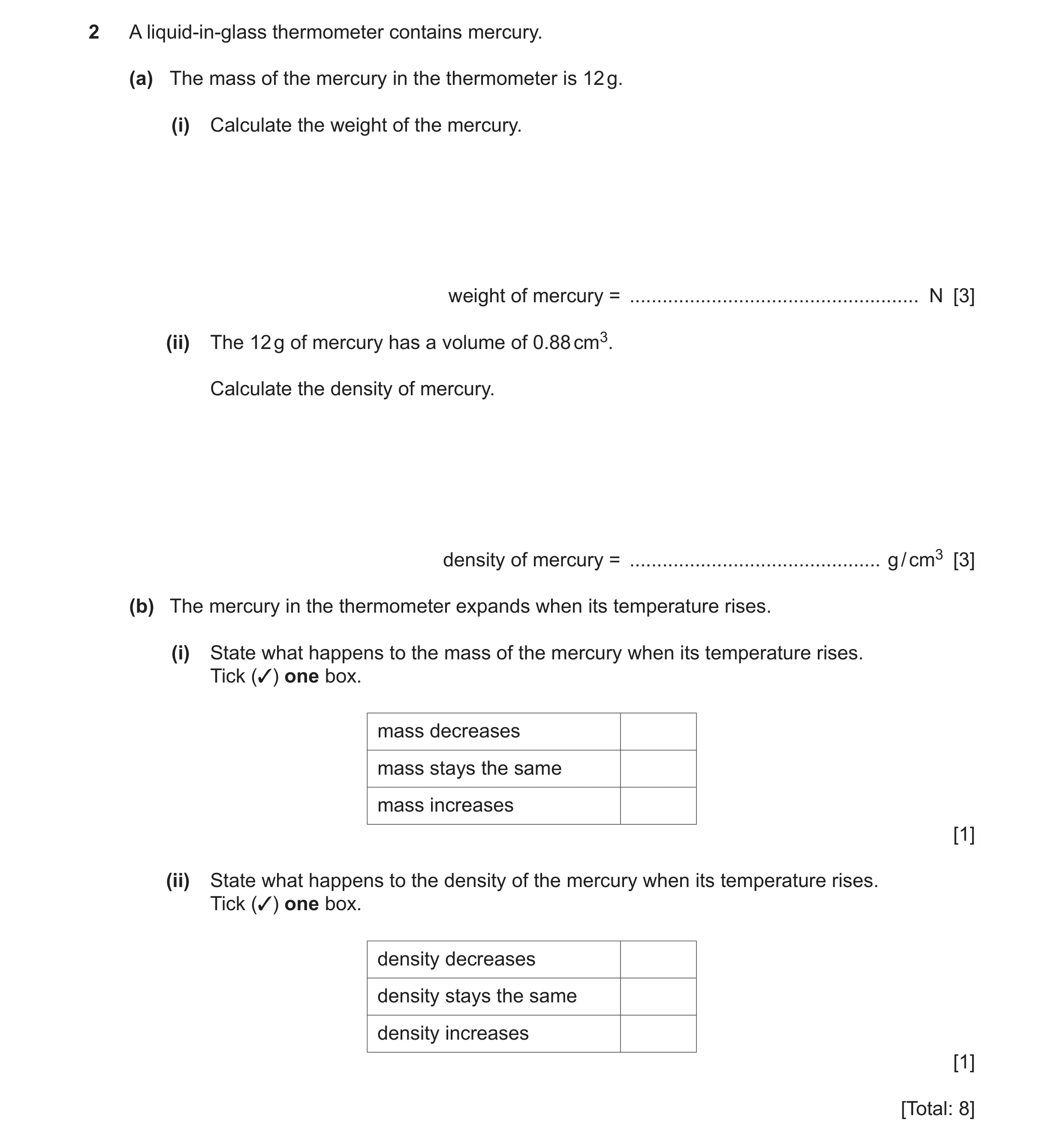
Q38 · A liquid-in-glass thermometer contains mercury 0625/31 May/June 2021
2 A liquid-in-glass thermometer contains mercury. (a) The mass of the mercury in the thermometer is 12 g. (i) Calculate the weight of the mercury. weight of mercury = … N [3] (ii) The 12 g of mercury has a volume of 0.88 cm3. Calculate the density of mercury. density of mercury = … g / cm3 [3] (b) The mercury in the thermometer expands when its temperature rises. (i) State what happens to the mass of the mercury when its temperature rises. Tick (3) one box. mass decreases mass stays the same mass increases [1] (ii) State what happens to the density of the mercury when its temperature rises. Tick (3) one box. density decreases density stays the same density increases [1] [Total: 8]
8 marks
Mark scheme: 2(a)(i) 12 ÷ 1000 = 0.012 (kg) C1 0.012 × 10 C1 = 0.12 (N) A1 2(a)(ii) (density = ) mass ÷ volume OR ( d =) m ÷ v C1 12 ÷ 0.88 C1 14 (g / cm3) A1 Question Answer Marks 2(b)(i) middle box ticked (mass stays the same) B1 2(b)(ii) top box ticked (density decreases) B1
This question in 0625/31 May/June 2021
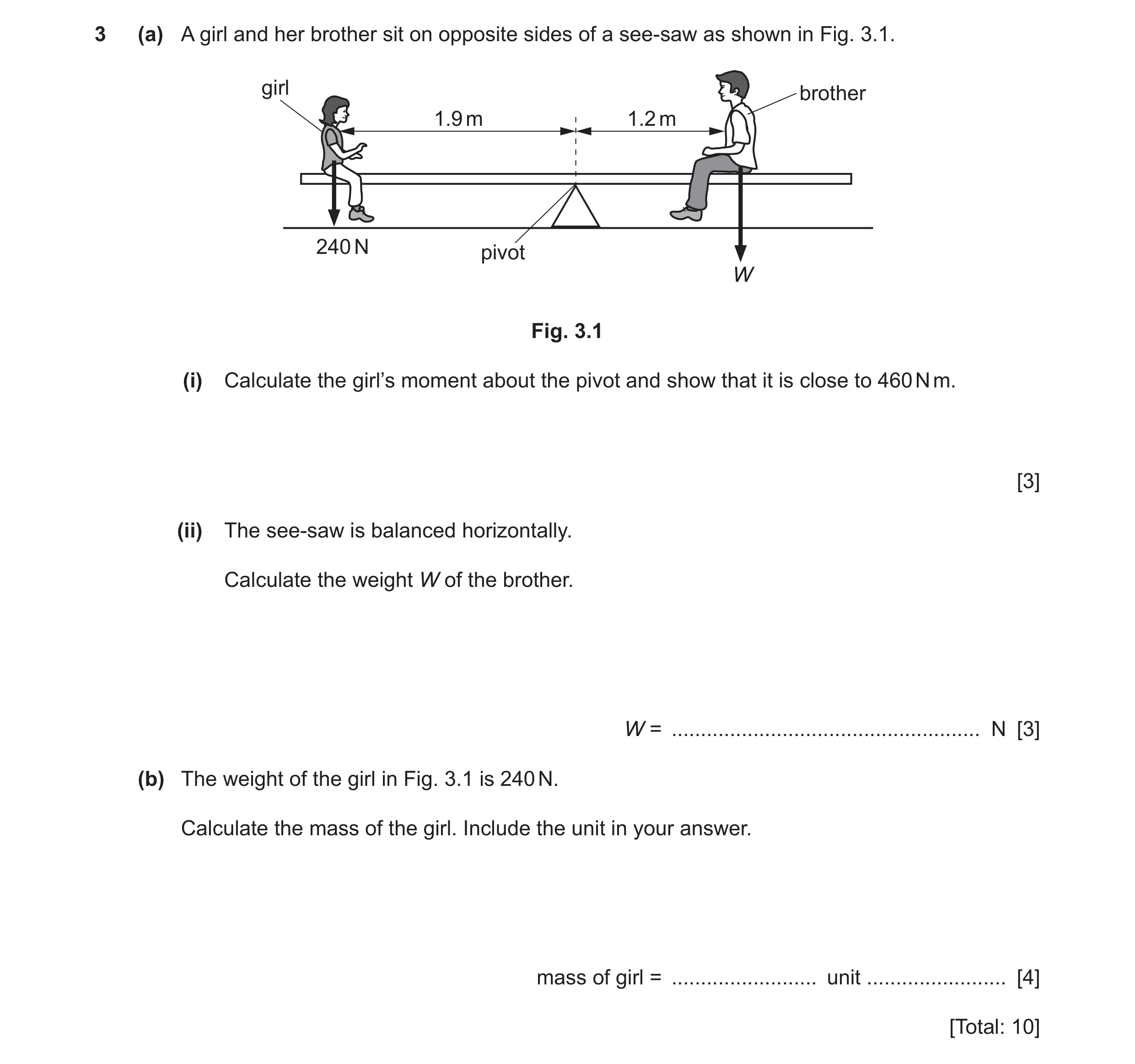
Q39 · A girl and her brother sit on opposite sides of a see-saw as shown in Fig 0625/33 May/June 2021
3 (a) A girl and her brother sit on opposite sides of a see-saw as shown in Fig. 3.1. girl brother 1.9 m 1.2 m 240 N pivot W Fig. 3.1 (i) Calculate the girl’s moment about the pivot and show that it is close to 460 N m. [3] (ii) The see-saw is balanced horizontally. Calculate the weight W of the brother. W = … N [3] (b) The weight of the girl in Fig. 3.1 is 240 N. Calculate the mass of the girl. Include the unit in your answer. mass of girl = … unit … [4] [Total: 10]
10 marks
Mark scheme: 3(a)(i) force × (perp) distance C1 240 × 1.9 C1 456 (Nm) (which is close to 460 Nm) A1 3(a)(ii) c.w. moment = a.c.w moment OR girl’s moment = brother’s moment C1 240 × 1.9 = W × 1.2 OR 456 ÷ 1.2 OR 460 ÷ 1.2 C1 380 (N) A1 3(b) W = mg in any form OR (m =) W ÷ g C1 240 ÷ 10 C1 24 A1 kg B1
This question in 0625/33 May/June 2021
Q40 · A teacher wants to measure the mass of a block of metal 0625/32 Oct/Nov 2021
4 (a) A teacher wants to measure the mass of a block of metal. She also wants to measure the length, width and height of the block. Fig. 4.1 shows the block of metal. length width height Fig. 4.1 Complete each sentence using a word from the list. balance barometer protractor ruler voltmeter (i) To find the mass of the metal block, the teacher uses a … [1] (ii) To measure the length, width and height of the metal block, she uses a … [1] (b) The mass of the block is 5000 g. Calculate the weight of the block. weight = … N [3] (c) Fig. 4.2 shows another block of metal on a solid surface. 20 cm 12 cm solid surface 2.0 cm Fig. 4.2 (not to scale) (i) Calculate the area of the block of metal in contact with the solid surface. area = … cm2 [1] (ii) The weight of the block of metal in Fig. 4.2 is 60 N. Calculate the pressure of the block of metal on the solid surface. pressure = … N / cm2 [3] [Total: 9]
9 marks
Mark scheme: 4(a)(i) balance B1 4(a)(ii) ruler B1 4(b) mass = 5(.0) kg B1 (W =) m × g OR 5(.0) × 10 C1 50 (N) A1 4(c)(i) 240 (cm2) B1 4(c)(ii) (P =) F ÷ A in any form C1 60 ÷ (20 × 12) OR 60 ÷ 240 C1 0.25 (N / cm2) A1
This question in 0625/32 Oct/Nov 2021
Q41 · A student determines the centre of mass of a piece of wood 0625/32 Oct/Nov 2021
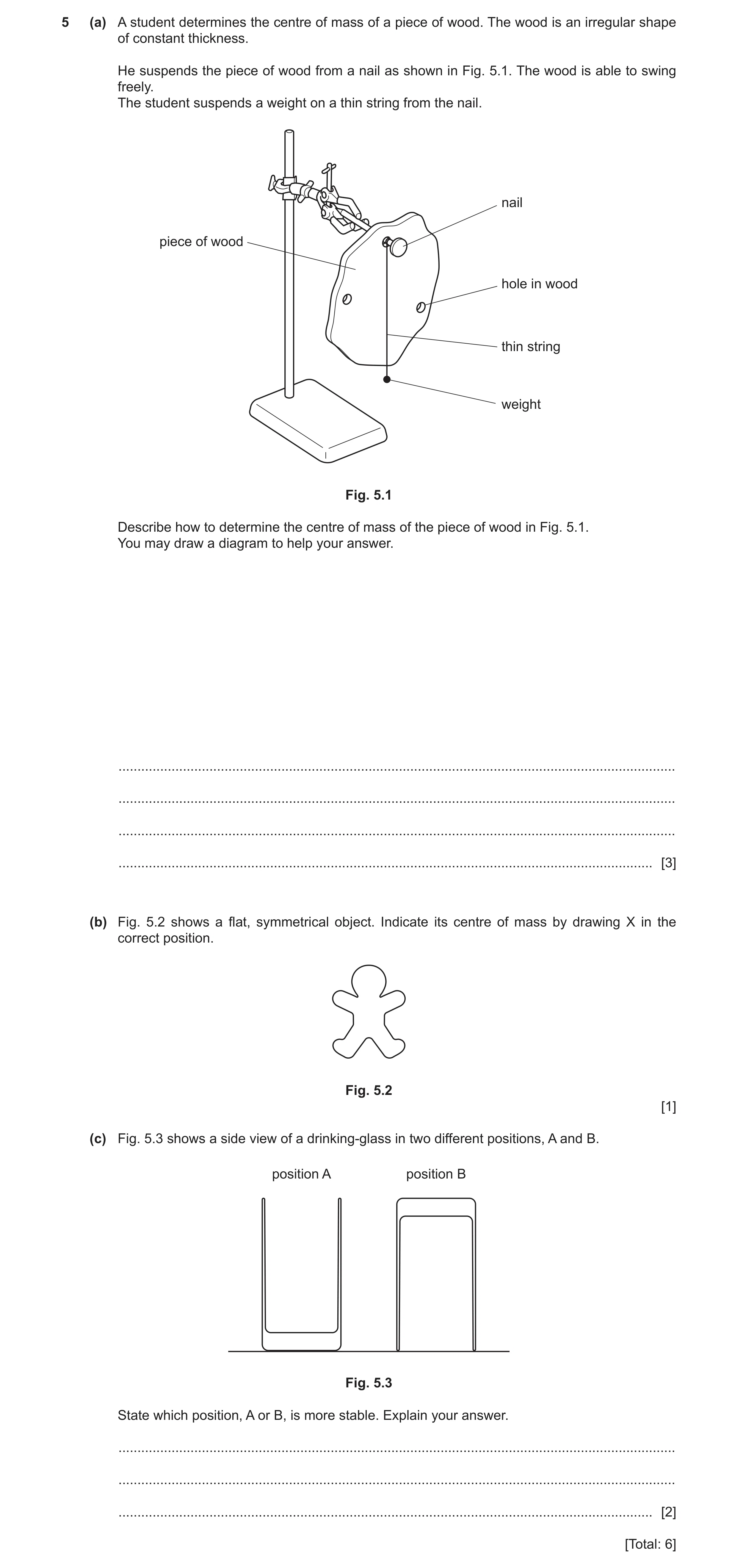
5 (a) A student determines the centre of mass of a piece of wood. The wood is an irregular shape of constant thickness. He suspends the piece of wood from a nail as shown in Fig. 5.1. The wood is able to swing freely. The student suspends a weight on a thin string from the nail. nail piece of wood hole in wood thin string weight Fig. 5.1 Describe how to determine the centre of mass of the piece of wood in Fig. 5.1. You may draw a diagram to help your answer. … … … … [3] (b) Fig. 5.2 shows a flat, symmetrical object. Indicate its centre of mass by drawing X in the correct position. Fig. 5.2 [1] (c) Fig. 5.3 shows a side view of a drinking-glass in two different positions, A and B. position A position B Fig. 5.3 State which position, A or B, is more stable. Explain your answer. … … … [2] [Total: 6]
6 marks
Mark scheme: 5(a) any three from: mark 2 x’s behind string AND join x’s with a line suspend from different hole repeat step 1 owtte centre of mass is where lines cross B3 5(b) marked on line of symmetry approximately where navel located B1 5(c) A M1 lower centre of mass owtte A1
This question in 0625/32 Oct/Nov 2021
Q42 · A plant pot falling from an upstairs balcony 0625/33 Oct/Nov 2021
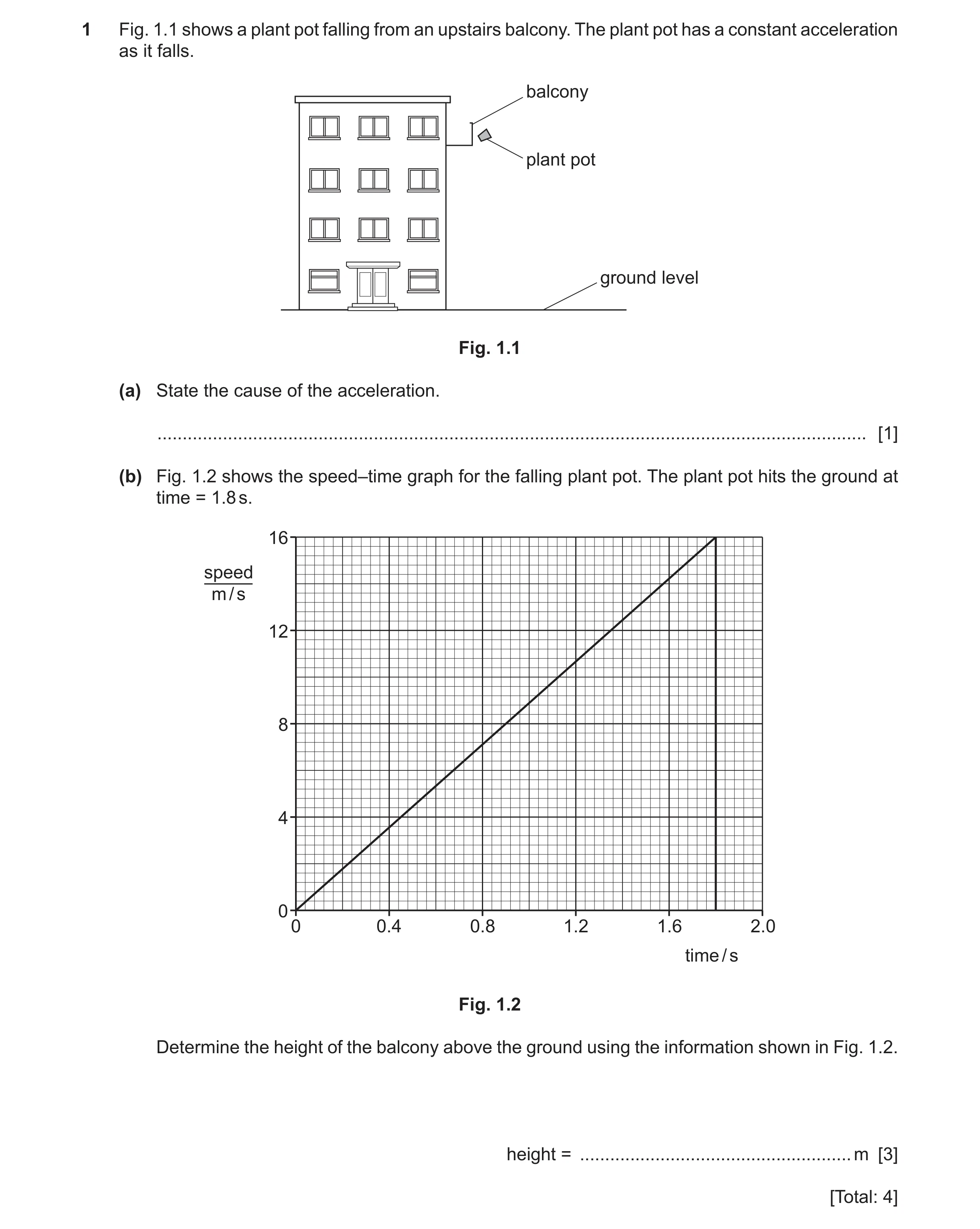
1 Fig. 1.1 shows a plant pot falling from an upstairs balcony. The plant pot has a constant acceleration as it falls. balcony plant pot ground level Fig. 1.1 (a) State the cause of the acceleration. … [1] (b) Fig. 1.2 shows the speed–time graph for the falling plant pot. The plant pot hits the ground at time = 1.8 s. 16 speed m / s 12 8 4 0 0 0.4 0.8 1.2 1.6 2.0 time / s Fig. 1.2 Determine the height of the balcony above the ground using the information shown in Fig. 1.2. height = … m [3] [Total: 4]
4 marks
Mark scheme: 1(a) weight / gravitational force / attraction (acting downwards) B1 1(b) area under the graph / line C1 ½ × 1.8 × 16 C1 14 (m) A1
This question in 0625/33 Oct/Nov 2021
Q43 · Some masses on a mass hanger attached to an elastic band 0625/32 Feb/March 2022
1 Fig. 1.1 shows some masses on a mass hanger attached to an elastic band. The elastic band is stretched by the masses. rigid support elastic band mass hanger masses Fig. 1.1 (a) The total mass of the masses and the mass hanger is 300 g. Calculate the total weight of the masses and the mass hanger. total weight = … N [3] (b) A student pulls the mass hanger down and then releases it. The mass hanger and masses oscillate up and down. The student uses a stop-watch to time 20 oscillations. Fig. 1.2 shows the time reading on the stop-watch after the 20th oscillation. s min s 1001 Fig. 1.2 (i) Determine the time in seconds for 20 oscillations from the time shown in Fig. 1.2. time for 20 oscillations = … s [1] (ii) Calculate the time in seconds for one oscillation. time for one oscillation = … s [2] (c) When the student pulls the mass hanger down, energy is stored in the elastic band as elastic potential energy. Describe what happens to this energy store when the student releases the mass hanger and it moves upwards. … … [2] [Total: 8]
8 marks
Mark scheme: 1(a) (weight =) 3(.0) (N) A3 300 g = 0.3 kg (B1) (weight =) mass × g (C1) 1(b)(i) 66.4(0) (s) B1 1(b)(ii) 3.3(2) (s) A2 66.4 ÷ 20 (C1) 1(c) any two from: (stored energy OR elastic potential energy OR it) decreases kinetic energy (of masses) increases gravitational potential energy increases B2
This question in 0625/32 Feb/March 2022
Question 44 0625/32 May/June 2022
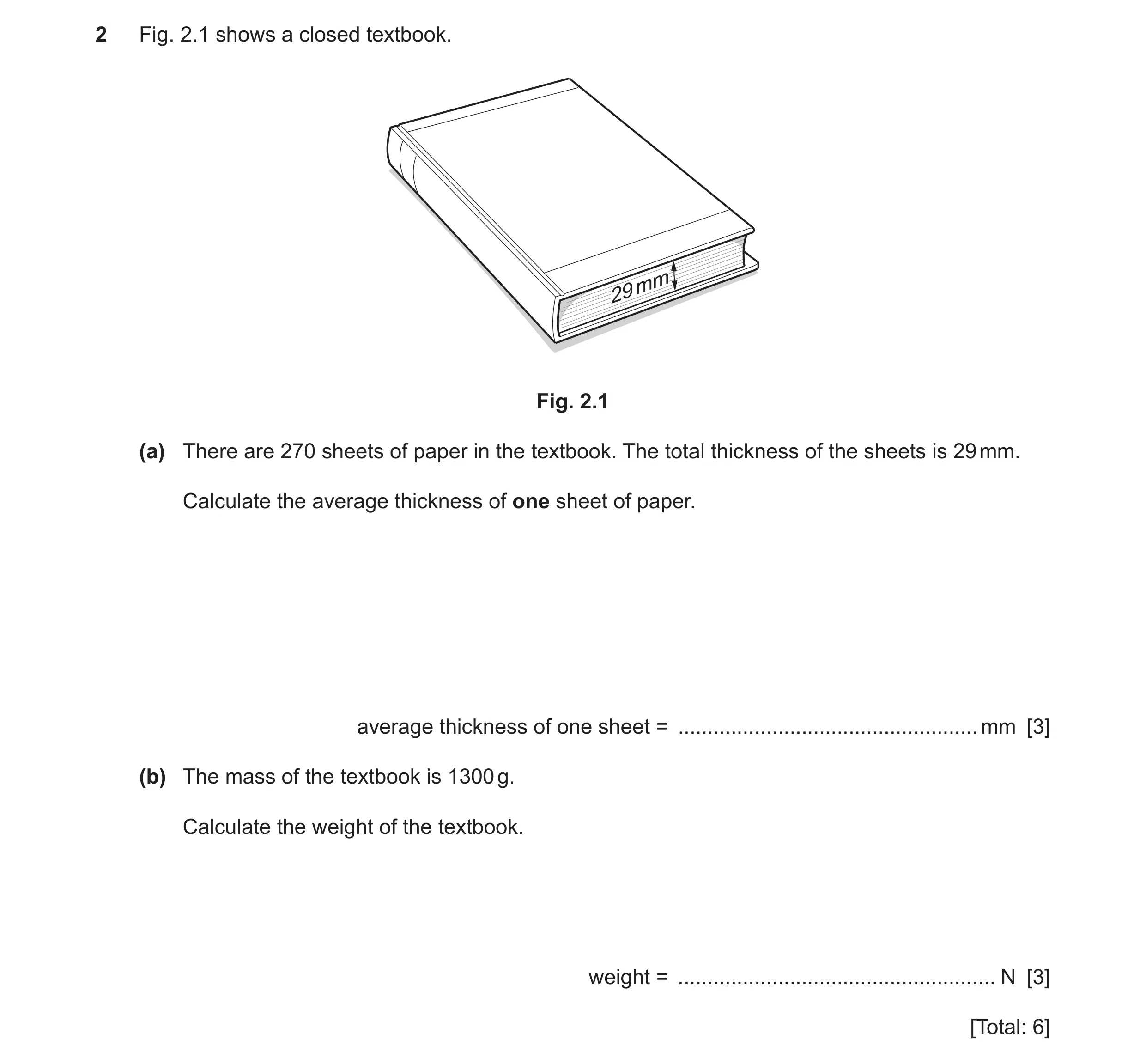
2 Fig. 2.1 shows a closed textbook. mm 29 Fig. 2.1 (a) There are 270 sheets of paper in the textbook. The total thickness of the sheets is 29 mm. Calculate the average thickness of one sheet of paper. average thickness of one sheet = … mm [3] (b) The mass of the textbook is 1300 g. Calculate the weight of the textbook. weight = … N [3] [Total: 6]
6 marks
Mark scheme: 2(a) 0.11 (mm) A3 (average thickness =) 29 ÷ 270 (C2) (average thickness =) total thickness ÷ number of sheets (C1) 2(b) (1300 g = ) 1.3 kg (B1) (weight =) 13(.0) N A3 (weight =) mass g OR mass 10 (C1)
This question in 0625/32 May/June 2022
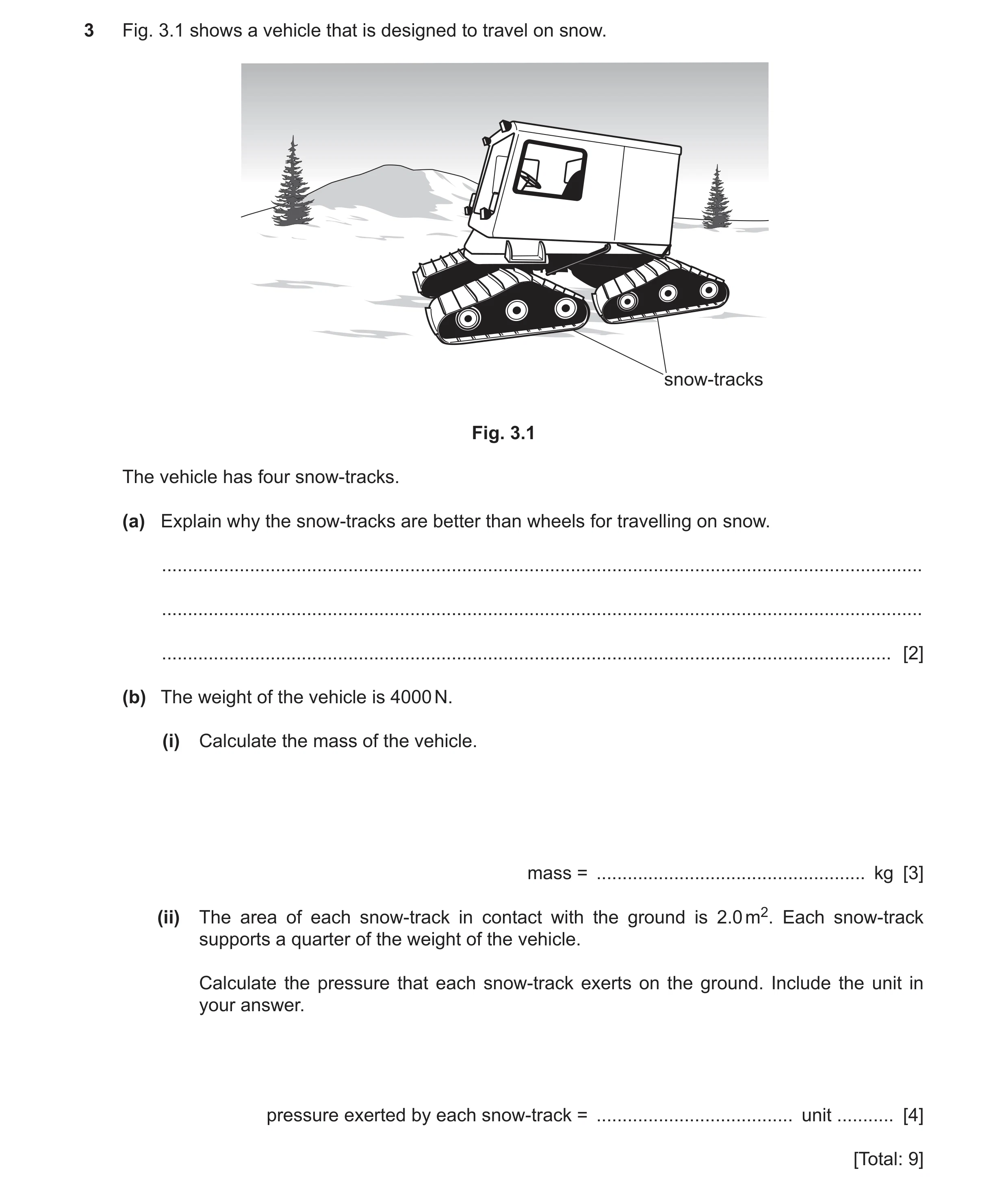
Q45 · A vehicle that is designed to travel on snow 0625/33 May/June 2022
3 Fig. 3.1 shows a vehicle that is designed to travel on snow. snow-tracks Fig. 3.1 The vehicle has four snow-tracks. (a) Explain why the snow-tracks are better than wheels for travelling on snow. … … … [2] (b) The weight of the vehicle is 4000 N. (i) Calculate the mass of the vehicle. mass = … kg [3] (ii) The area of each snow-track in contact with the ground is 2.0 m2. Each snow-track supports a quarter of the weight of the vehicle. Calculate the pressure that each snow-track exerts on the ground. Include the unit in your answer. pressure exerted by each snow-track = … unit … [4] [Total: 9]
9 marks
Mark scheme: 3(a) any two from larger area lower pressure (on ground) does not sink in 3(b)(i) 400 A3 4000 ÷ 10 OR 4000 ÷ 9.8 (C2) (mass =) weight ÷ g OR weight ÷ 10 weight ÷ 9.8 in any form (C1) 3(b)(ii) 500 A3 1000 ÷ 2.0 OR 4000 ÷ (4 2.0) (C2) (pressure = ) force ÷ area in any form (C1) N / m2 OR Pa B1
This question in 0625/33 May/June 2022
Q46 · A student has an object with a mass of 5.0 kg 0625/31 Oct/Nov 2022
4 (a) A student has an object with a mass of 5.0 kg. Calculate the weight of the object. weight of object = … N [2] (b) The student lifts the 5.0 kg object from the floor onto a table. He does 75 J of work on the object in lifting it onto the table. State the amount of gravitational potential energy gained by the object due to being lifted onto the table. gravitational potential energy gained by object = … J [1] (c) The weight of a table is 280 N. The table has four legs. The area of each table leg in contact with the floor is 18 cm2. Calculate the pressure of the table on the floor. Give the correct unit. pressure on the floor = … unit … [5] [Total: 8]
8 marks
Mark scheme: 4(a) (weight =) 50 (N) A2 (weight =) mass g OR 5 10 C1 4(b) 75 (J) B1 4(c) 3.9 A4 280 / 72 C3 (P =) F / A OR (pressure =) force / area C1 (area = 4 18 =) 72 (cm2) C1 N / cm2 B1
This question in 0625/31 Oct/Nov 2022
Q47 · A skydiver jumps from an aeroplane 0625/32 Oct/Nov 2022
1 A skydiver jumps from an aeroplane. She falls freely with her parachute closed; then she opens her parachute. Fig. 1.1 shows the skydiver falling freely with her parachute closed. Fig. 1.2 shows the skydiver falling with the parachute open. Fig. 1.1 Fig. 1.2 Fig. 1.3 shows the speed–time graph for the skydiver’s vertical motion, from leaving the aeroplane to landing on the ground. 60 vertical speed m / s BB CC 50 40 30 20 10 DD EE A 0 0 10 20 30 40 50 60 70 80 time / s Fig. 1.3 (a) Using the information from Fig. 1.3: (i) Describe the vertical motion of the skydiver between time = 0 and time = 20 s. … [1] (ii) Determine the maximum vertical speed of the skydiver. maximum speed = … m / s [1] (iii) Determine the point, A, B, C, D or E, at which the skydiver opens her parachute. … [1] (iv) Determine the distance the skydiver falls between time = 50 s and time = 80 s. distance = … m [3] (b) The weight of the skydiver is 750 N. The weight of the skydiver acts downwards, as shown in Fig. 1.4. While the skydiver is falling, another force acts upwards. The upward force varies as the skydiver falls. … weight = 750 N Fig. 1.4 (not to scale) (i) On Fig. 1.4, write the name of the upward force on the dotted line above the upward force. [1] (ii) Suggest a value for the upward force on the skydiver at time = 10 s. … N [1] (iii) Determine the value of the upward force on the skydiver at time = 30 s. … N [1] (c) The weight of the skydiver is 750 N. Calculate the mass of the skydiver. mass = … kg [3] [Total: 12]
12 marks
Mark scheme: Question Answer Marks 1(a)(i) accelerating / increasing speed B1 1(a)(ii) 50 (m / s) B1 1(a)(iii) C B1 1(a)(iv) 150 (m) A3 5 30 (C2) (distance =) area under graph (C1) 1(b)(i) friction / air resistance / drag B1 1(b)(ii) number greater than 0 AND smaller than 750 (N) B1 1(b)(iii) 750 (N) B1 1(c) 75 (kg) A3 750 ÷ 10 (C2) W = mg OR (m =) W ÷ g OR W ÷ 10 in any form (C1)
This question in 0625/32 Oct/Nov 2022
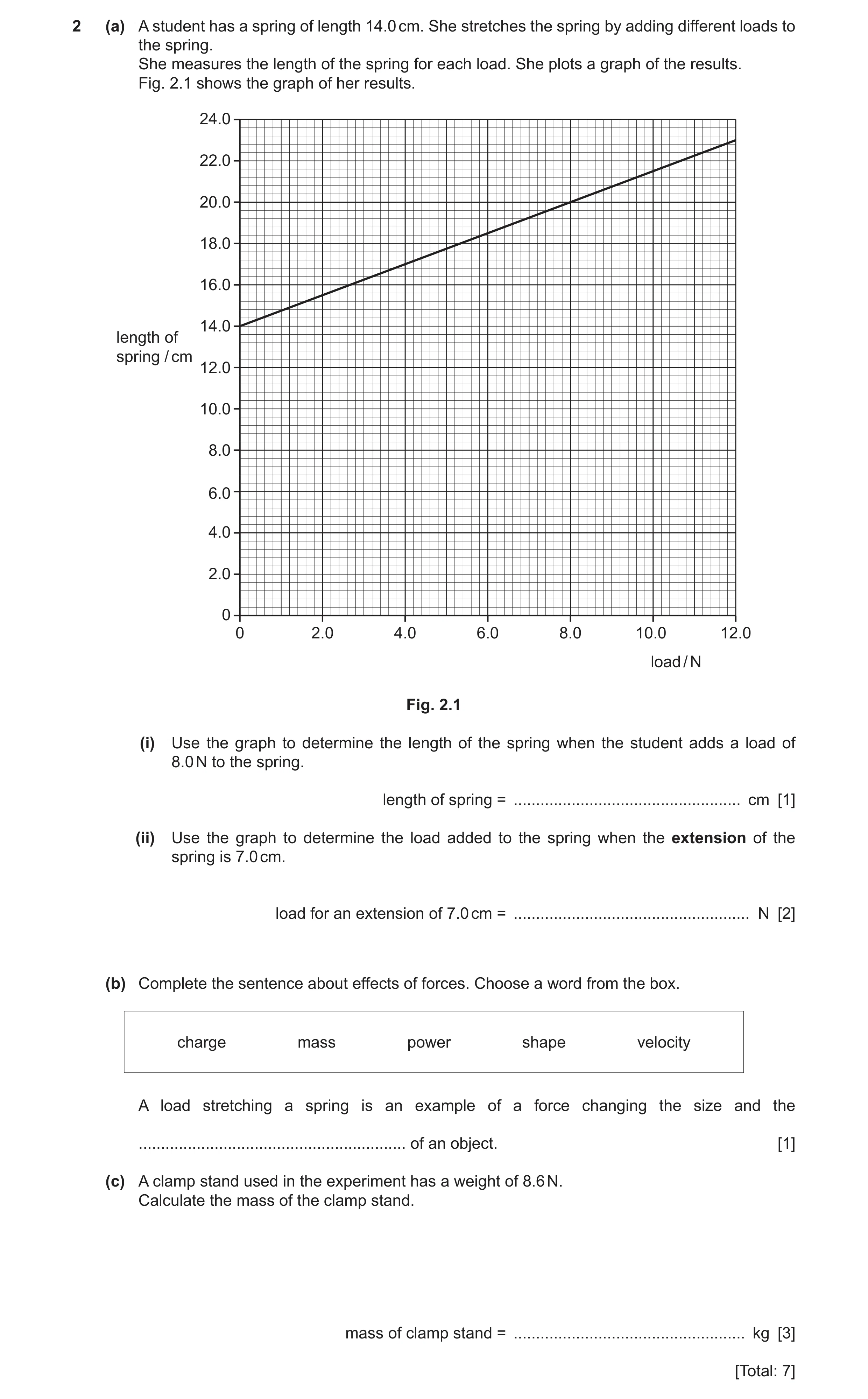
Q48 · A student has a spring of length 14.0 cm 0625/32 Feb/March 2023
2 (a) A student has a spring of length 14.0 cm. She stretches the spring by adding different loads to the spring. She measures the length of the spring for each load. She plots a graph of the results. Fig. 2.1 shows the graph of her results. 24.0 22.0 20.0 18.0 16.0 14.0 length of spring / cm 12.0 10.0 8.0 6.0 4.0 2.0 0 0 2.0 4.0 6.0 8.0 10.0 12.0 load / N Fig. 2.1 (i) Use the graph to determine the length of the spring when the student adds a load of 8.0 N to the spring. length of spring = … cm [1] (ii) Use the graph to determine the load added to the spring when the extension of the spring is 7.0 cm. load for an extension of 7.0 cm = … N [2] (b) Complete the sentence about effects of forces. Choose a word from the box. charge mass power shape velocity A load stretching a spring is an example of a force changing the size and the … of an object. [1] (c) A clamp stand used in the experiment has a weight of 8.6 N. Calculate the mass of the clamp stand. mass of clamp stand = … kg [3] [Total: 7]
7 marks
Mark scheme: 2(a)(i) (length of spring with 8.0 N load =) 20 (cm) B1 2(a)(ii) (load for length of 21 cm =) 9.3 (N) A2 (extension of 7 cm = length of) 21 cm (C1) 2(b) shape B1 2(c) (m = ) 0.88 (kg) A3 (m = ) 8.6 ÷ 9.8 (C2) W = mg OR (m =) W ÷ g (C1)
This question in 0625/32 Feb/March 2023
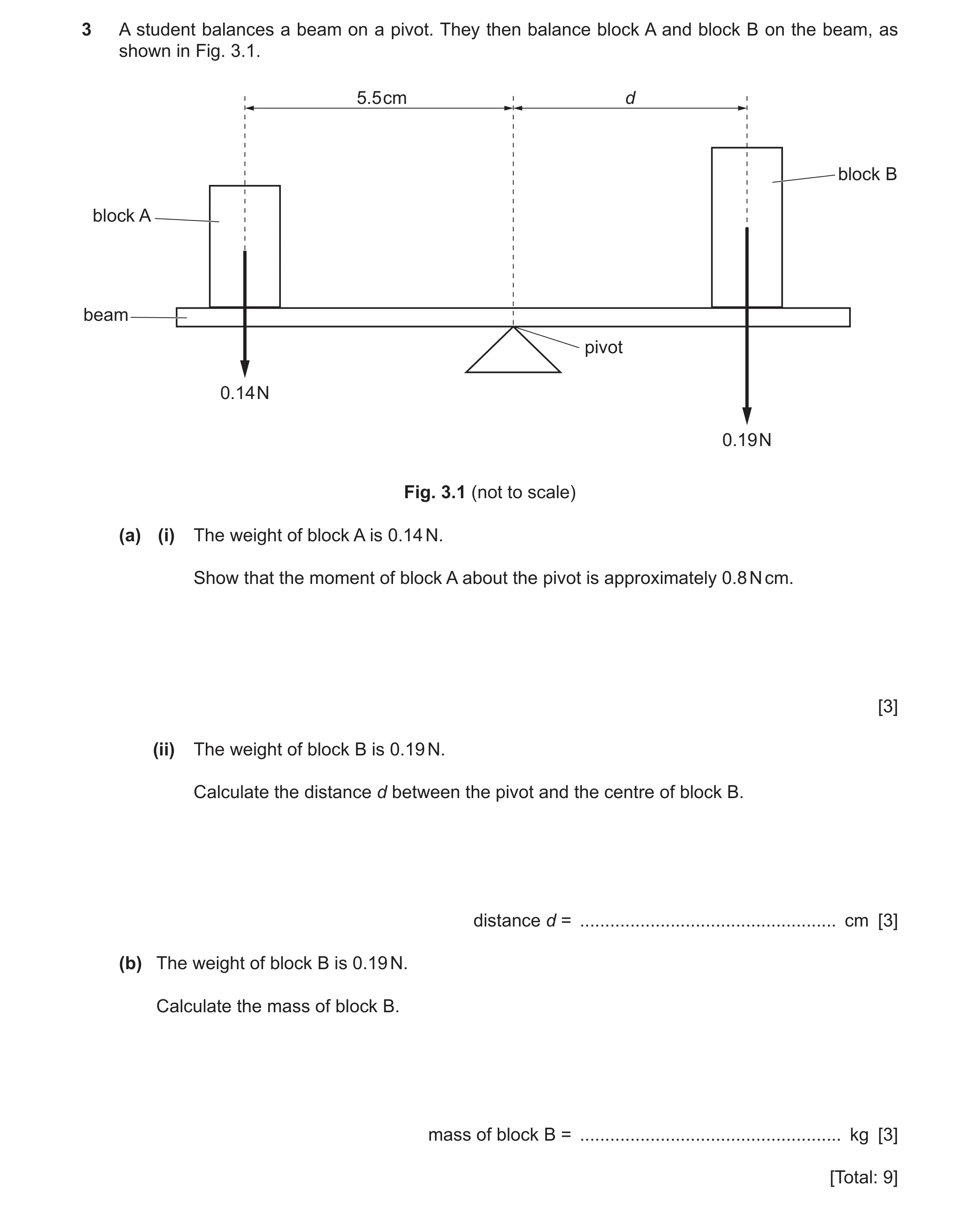
Q49 · A student balances a beam on a pivot 0625/33 May/June 2023
3 A student balances a beam on a pivot. They then balance block A and block B on the beam, as shown in Fig. 3.1. 5.5 cm d block B block A beam pivot 0.14 N 0.19 N Fig. 3.1 (not to scale) (a) (i) The weight of block A is 0.14 N. Show that the moment of block A about the pivot is approximately 0.8 N cm. [3] (ii) The weight of block B is 0.19 N. Calculate the distance d between the pivot and the centre of block B. distance d = … cm [3] (b) The weight of block B is 0.19 N. Calculate the mass of block B. mass of block B = … kg [3] [Total: 9]
9 marks
Mark scheme: 3(a)(i) C1 0.14 5.5 C1 0.77 (N cm) A1 3(a)(ii) (sum of) ACM = (sum of) CM C1 0.19 X = 0.77 OR 0.19 X = 0.8 OR 0.19 X = 0.14 5.5 C1 4.1 (cm) OR 4.2 (cm) A1 3(b) (m =) W ÷ g OR W ÷ 9.8 in any form C1 0.19 ÷ 9.8 C1 0.019 (kg) A1
This question in 0625/33 May/June 2023
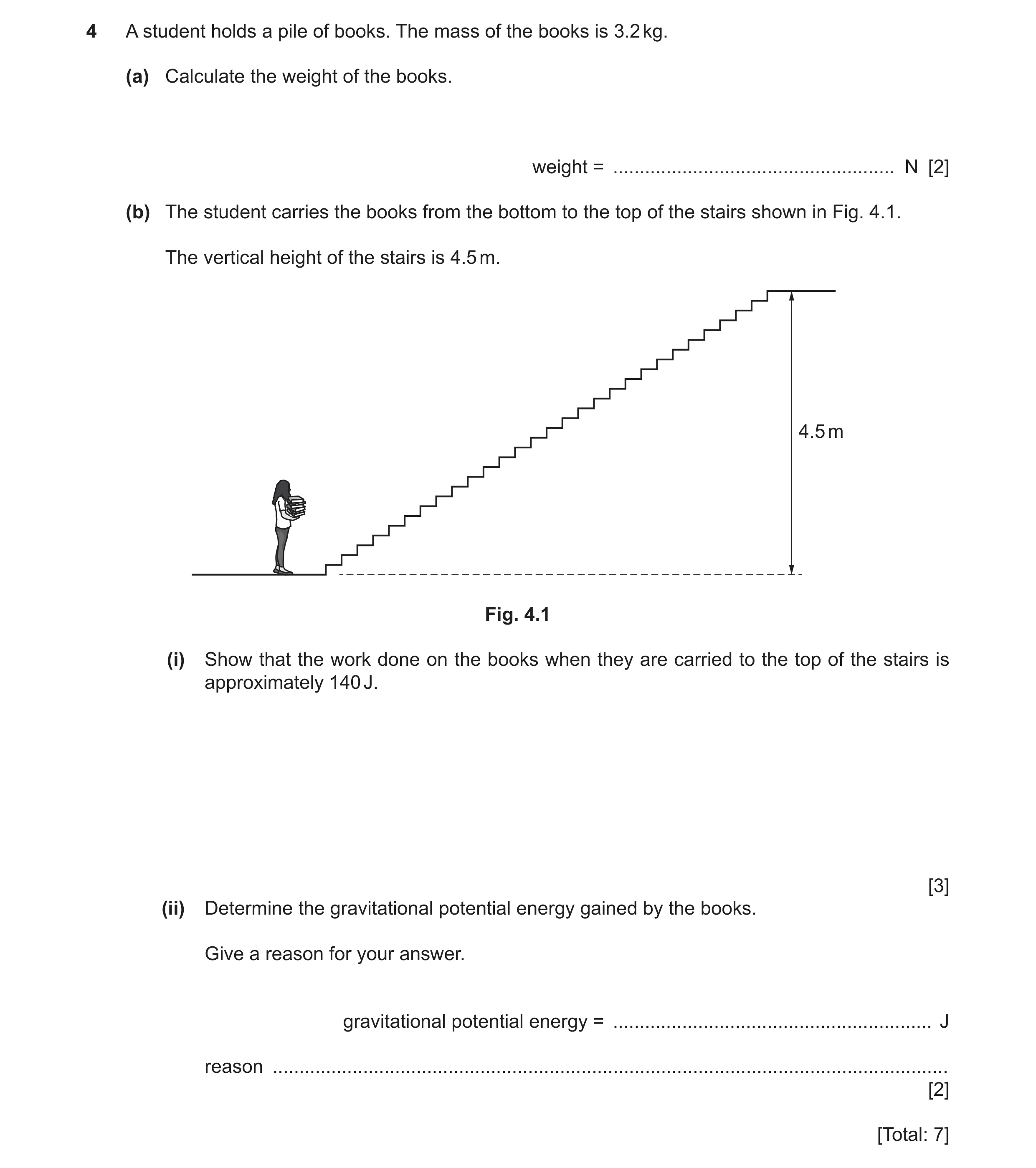
Q50 · A student holds a pile of books 0625/32 Oct/Nov 2023
4 A student holds a pile of books. The mass of the books is 3.2 kg. (a) Calculate the weight of the books. weight = … N [2] (b) The student carries the books from the bottom to the top of the stairs shown in Fig. 4.1. The vertical height of the stairs is 4.5 m. 4.5 m Fig. 4.1 (i) Show that the work done on the books when they are carried to the top of the stairs is approximately 140 J. [3] (ii) Determine the gravitational potential energy gained by the books. Give a reason for your answer. gravitational potential energy = … J reason … [2] [Total: 7]
7 marks
Mark scheme: 4(a) 31 (N) A2 (weight =) mass gravitation field strength OR m g OR m 9.8 OR 3.2 9.8 (C1) 4(b)(i) 141(.12) (J) OR 139(.5) (J) B1 3.2 9.8 4.5 OR 31.36 4.5 OR 31 4.5 B1 (work =) force distance OR (W =) F × d B1 4(b)(ii) 141(.12) (J) OR 139(.5) (J) OR 140 (J) B1 work done = gain in (g)PE B1
This question in 0625/32 Oct/Nov 2023
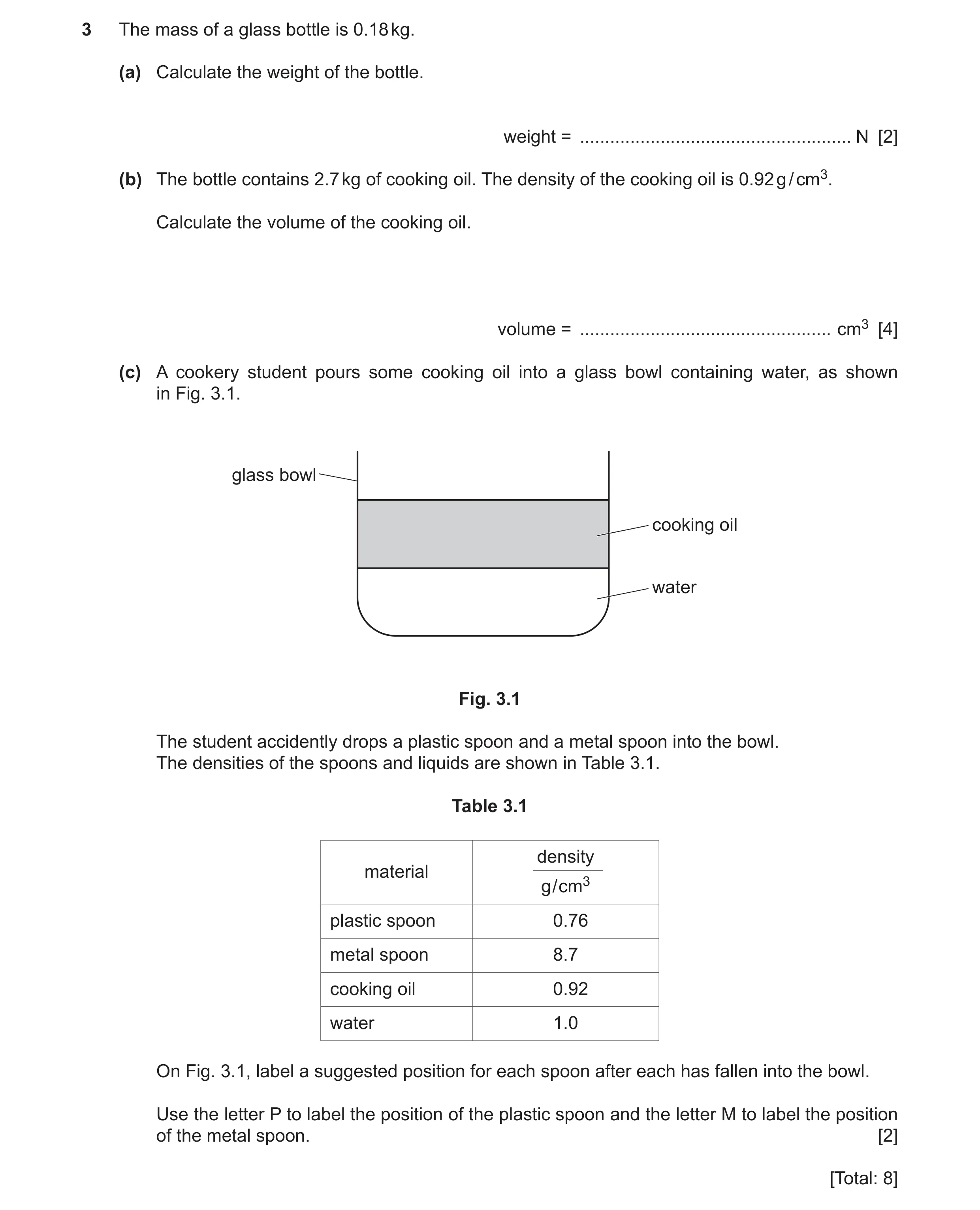
Q51 · The mass of a glass bottle is 0.18 kg 0625/33 Oct/Nov 2023
3 The mass of a glass bottle is 0.18 kg. (a) Calculate the weight of the bottle. weight = … N [2] (b) The bottle contains 2.7 kg of cooking oil. The density of the cooking oil is 0.92 g / cm3. Calculate the volume of the cooking oil. volume = … cm3 [4] (c) A cookery student pours some cooking oil into a glass bowl containing water, as shown in Fig. 3.1. glass bowl cooking oil water Fig. 3.1 The student accidently drops a plastic spoon and a metal spoon into the bowl. The densities of the spoons and liquids are shown in Table 3.1. Table 3.1 density material g / cm3 plastic spoon 0.76 metal spoon 8.7 cooking oil 0.92 water 1.0 On Fig. 3.1, label a suggested position for each spoon after each has fallen into the bowl. Use the letter P to label the position of the plastic spoon and the letter M to label the position of the metal spoon. [2] [Total: 8]
8 marks
Mark scheme: 3(a) 1.8 (N) A2 (weight =) mass gravitational field strength in any form OR m g OR m 9.8 OR 0.18 9.8 (C1) 3(b) 2900 (cm3) A4 2700 / 0.92 (C3) (volume =) mass / density OR V = m / ρ (C1) conversion of 2.7 kg to 2700 g (C1) 3(c) P on top liquid surface B1 M on bottom of bowl B1
This question in 0625/33 Oct/Nov 2023
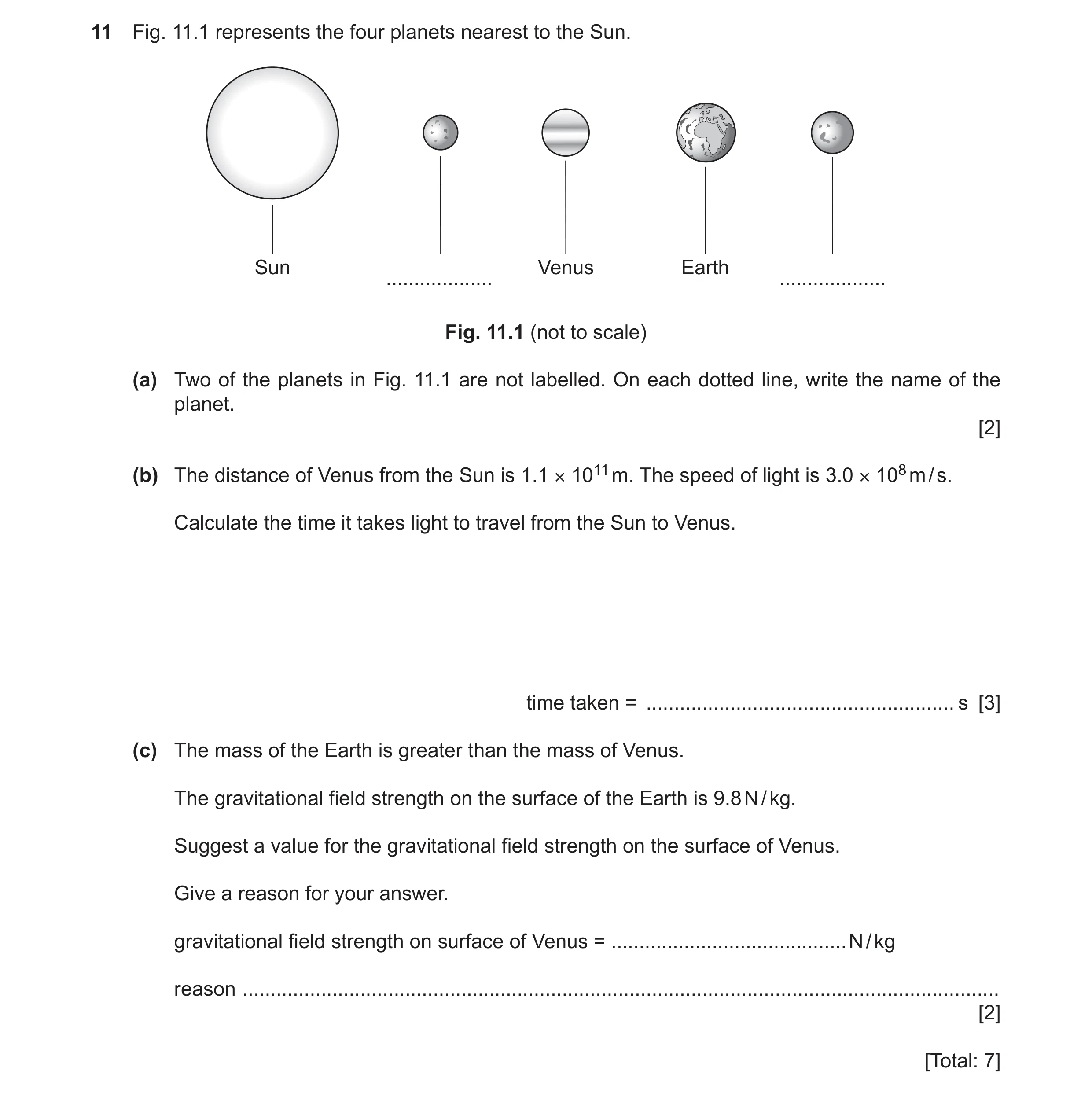
Q52 · The four planets nearest to the Sun 0625/32 Feb/March 2024
11 Fig. 11.1 represents the four planets nearest to the Sun. Sun Venus Earth … … Fig. 11.1 (not to scale) (a) Two of the planets in Fig. 11.1 are not labelled. On each dotted line, write the name of the planet. [2] (b) The distance of Venus from the Sun is 1.1 × 10¹¹ m. The speed of light is 3.0 × 10⁸ m / s. Calculate the time it takes light to travel from the Sun to Venus. time taken = … s [3] (c) The mass of the Earth is greater than the mass of Venus. The gravitational field strength on the surface of the Earth is 9.8 N / kg. Suggest a value for the gravitational field strength on the surface of Venus. Give a reason for your answer. gravitational field strength on surface of Venus = … N / kg reason … [2] [Total: 7]
7 marks
Mark scheme: 11(a) Mercury B1 Mars B1 11(b) 370 (s) A3 1.1 1011 ÷ 3.0 108 (C2) speed = distance ÷ time OR (t = ) d ÷ s (C1) 11(c) value smaller than 9.8 (N / kg) B1 Venus has smaller mass ORA OR B1 gravitational field strength depends on / proportional to mass
This question in 0625/32 Feb/March 2024
Q53 · Two solid shapes, a cylinder and a cone, which are made from the same material 0625/32 May/June 2024
3 Fig. 3.1 shows two solid shapes, a cylinder and a cone, which are made from the same material. cylinder cone Fig. 3.1 (a) State and explain which shape is the more stable. the more stable shape is … explanation … … [1] (b) The mass of the cylinder is 0.25 kg. Calculate the weight of the cylinder. weight = … N [2] (c) A horizontal force of 3.0 N tilts the cone. The cone balances on one edge, as shown in Fig. 3.2. 3.0 N 22 cm pivot Fig. 3.2 (i) Calculate the moment of the 3.0 N force about the pivot in Fig. 3.2. moment = … N cm [3] (ii) Determine the moment of the weight of the cone about the pivot. Use ideas about the principle of moments. moment of weight about pivot = … N cm [1] [Total: 7]
7 marks
Mark scheme: 3(a) cone M0 (because it has) lower centre of mass/gravity A1 3(b) (weight =) 2.5 (N) A2 (weight =) mass g OR 0.25 9.8 (C1) 3(c)(i) (moment =) 66 (N cm) A3 (moment =) 3(.0) 22 (C2) moment = force (perpendicular) distance (from pivot) (C1) 3(c)(ii) (moment of weight =) answer to (c)(i) OR 66 (N cm) B1
This question in 0625/32 May/June 2024
Q54 · Some information about two of the planets in the Solar System 0625/32 May/June 2024
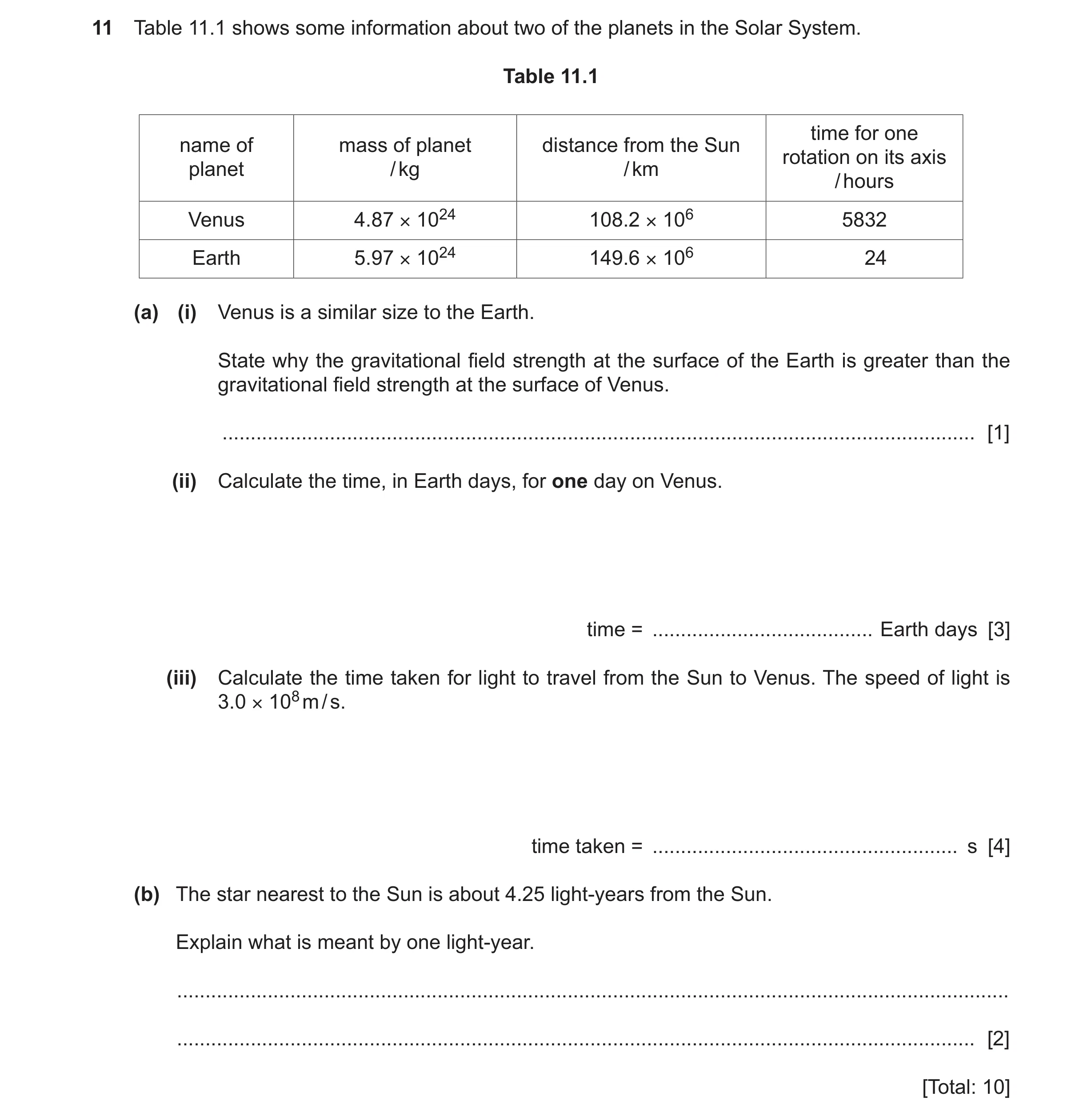
11 Table 11.1 shows some information about two of the planets in the Solar System. Table 11.1 time for one name of mass of planet distance from the Sun rotation on its axis planet / kg / km / hours Venus 4.87 × 1024 108.2 × 10⁶ 5832 Earth 5.97 × 1024 149.6 × 10⁶ 24 (a) (i) Venus is a similar size to the Earth. State why the gravitational field strength at the surface of the Earth is greater than the gravitational field strength at the surface of Venus. … [1] (ii) Calculate the time, in Earth days, for one day on Venus. time = … Earth days [3] (iii) Calculate the time taken for light to travel from the Sun to Venus. The speed of light is 3.0 × 10⁸ m / s. time taken = … s [4] (b) The star nearest to the Sun is about 4.25 light-years from the Sun. Explain what is meant by one light-year. … … [2] [Total: 10]
10 marks
Mark scheme: 11(a)(i) Earth has greater mass ORA B1 11(a)(ii) 243 (Earth days) A3 5832 ÷ 24 (C2) idea that one rotation on its axis equals one day (C1) 11(a)(iii) 360 (s) A4 108.2 109 ÷ 3.0 108 (C3) speed = distance ÷ time OR (t =) s ÷ v (C1) conversion 1 km = 1000 m (C1) 11(b) distance M1 travelled (in space) by light in one year owtte A1
This question in 0625/32 May/June 2024
Q55 · A boy weighs 620 N 0625/33 Oct/Nov 2024
3 (a) A boy weighs 620 N. Calculate the mass of the boy. mass of boy = … kg [3] (b) Fig. 3.1 shows another boy sitting on a solid block of wood. block of wood ground Fig. 3.1 The total weight of the boy and the block is 1200 N. The area of the block of wood in contact with the ground is 0.16 m2. Calculate the pressure exerted on the ground. pressure = … N / m2 [3] [Total: 6]
6 marks
Mark scheme: 3(a) 63 (kg) A3 620 9.8 (C2) weight = mass gravitation field strength OR (m = ) W g (C1) 3(b) 7500 A3 1200 0.16 (C2) (p =) F A (C1)
This question in 0625/33 Oct/Nov 2024
Q56 · A wooden beam is used in a see-saw 0625/31 May/June 2025
3 A wooden beam is used in a see-saw. (a) The mass of the wooden beam is 40 kg. Calculate the weight of the wooden beam. weight of beam = … N [2] (b) Two children balance the wooden beam horizontally on a log. The wooden beam pivots on the log to make the see-saw. Fig. 3.1 shows the children on the see-saw. child B child A 1.6 m 1.2 m wooden beam W 360 N log pivot Fig. 3.1 (not to scale) The see-saw balances horizontally, as shown in Fig. 3.1. The weight of child B is 360 N. Calculate the weight W of child A. State and use the principle of moments in your answer. weight W of child A = … N [4] [Total: 6]
6 marks
Mark scheme: 3(a) 390 (N) A2 (weight =) mass g OR (weight =) 40 9.8 C1 3(b) 270 (N) A4 W 1.6 = 360 1.2 OR (W =) 432 ÷ 1.6 OR (W =) {360 1.2} ÷ 1.6 C3 (clockwise moment OR moment of child B =) 360 1.2 OR 430 OR 432 seen C1 (total) clockwise moment = (total) anticlockwise moment C1
This question in 0625/31 May/June 2025
Q57 · Some buildings are built on large, strong metal rods that are pushed deep into the ground 0625/32 May/June 2025
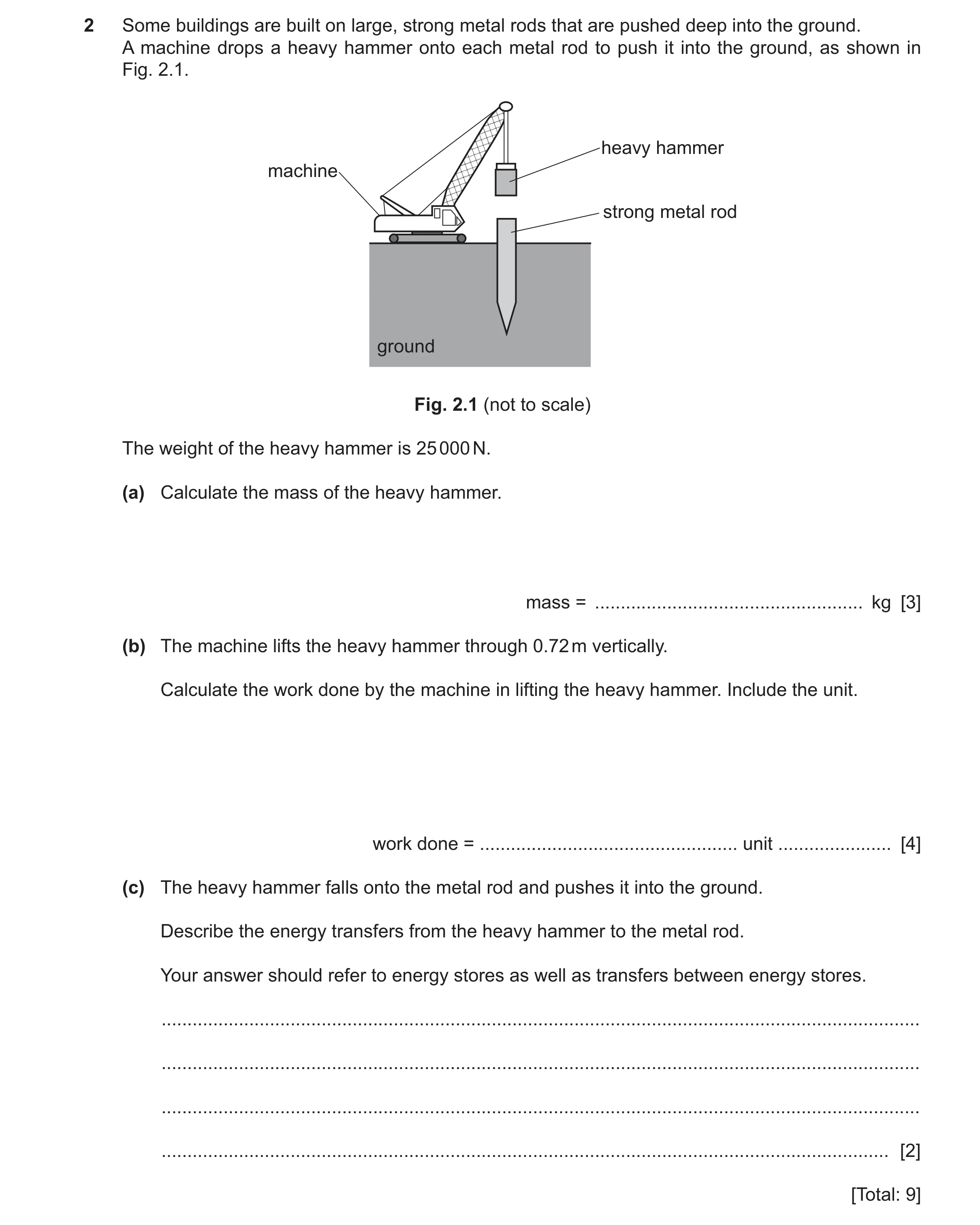
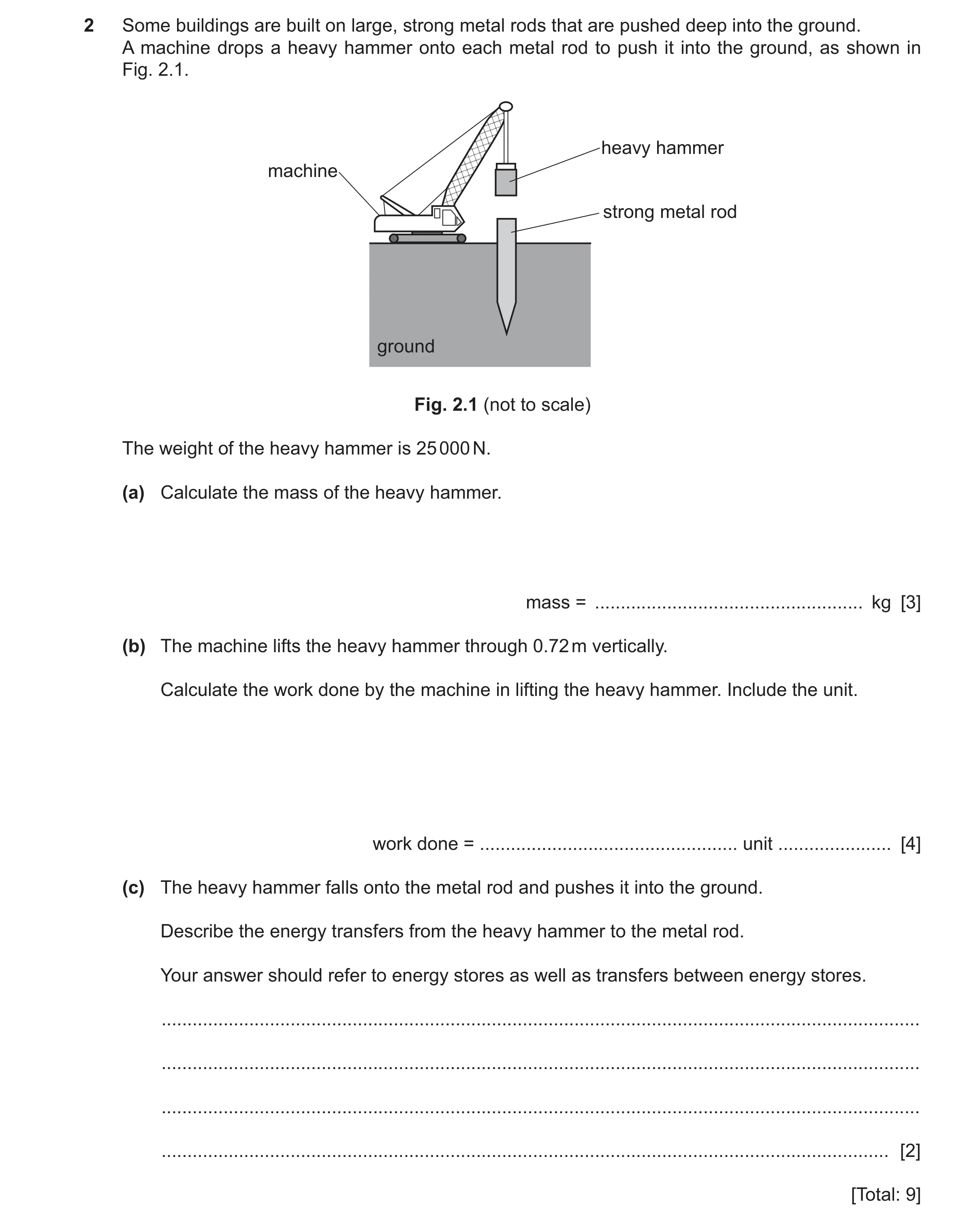
2 Some buildings are built on large, strong metal rods that are pushed deep into the ground. A machine drops a heavy hammer onto each metal rod to push it into the ground, as shown in Fig. 2.1. heavy hammer machine strong metal rod ground Fig. 2.1 (not to scale) The weight of the heavy hammer is 25 000 N. (a) Calculate the mass of the heavy hammer. mass = … kg [3] (b) The machine lifts the heavy hammer through 0.72 m vertically. Calculate the work done by the machine in lifting the heavy hammer. Include the unit. work done = … unit … [4] (c) The heavy hammer falls onto the metal rod and pushes it into the ground. Describe the energy transfers from the heavy hammer to the metal rod. Your answer should refer to energy stores as well as transfers between energy stores. … … … … [2] [Total: 9]
9 marks
Mark scheme: 2(a) 2600 (kg) A3 25 000 ÷ 9.8 C2 (mass =) weight ÷ gravitational field strength OR W ÷ g OR W ÷ 9.8 C1 2(b) 18 000 A3 25 000 0.72 C2 (W =) force distance (moved in direction of force) C1 J OR joule B1 2(c) (initial energy store) gravitational potential (of heavy hammer) B1 (transfers to) any one from: B1 • kinetic (of metal rod) • internal / thermal (of ground) / sound
This question in 0625/32 May/June 2025
Q58 · Some buildings are built on large, strong metal rods that are pushed deep into the ground 0625/33 May/June 2025
2 Some buildings are built on large, strong metal rods that are pushed deep into the ground. A machine drops a heavy hammer onto each metal rod to push it into the ground, as shown in Fig. 2.1. heavy hammer machine strong metal rod ground Fig. 2.1 (not to scale) The weight of the heavy hammer is 25 000 N. (a) Calculate the mass of the heavy hammer. mass = … kg [3] (b) The machine lifts the heavy hammer through 0.72 m vertically. Calculate the work done by the machine in lifting the heavy hammer. Include the unit. work done = … unit … [4] (c) The heavy hammer falls onto the metal rod and pushes it into the ground. Describe the energy transfers from the heavy hammer to the metal rod. Your answer should refer to energy stores as well as transfers between energy stores. … … … … [2] [Total: 9]
9 marks
Mark scheme: 2(a) 2600 (kg) A3 25 000 ÷ 9.8 C2 (mass =) weight ÷ gravitational field strength OR W ÷ g OR W ÷ 9.8 C1 2(b) 18 000 A3 25 000 0.72 C2 (W =) force distance (moved in direction of force) C1 J OR joule B1 2(c) (initial energy store) gravitational potential (of heavy hammer) B1 (transfers to) any one from: B1 • kinetic (of metal rod) • internal / thermal (of ground) / sound
This question in 0625/33 May/June 2025
Q59 · A student stretches a spring by suspending it and attaching metal discs to it, as shown… 0625/31 Oct/Nov 2025
3 A student stretches a spring by suspending it and attaching metal discs to it, as shown in Fig. 3.1. clampstand ruler spring metal discs Fig. 3.1 (a) The mass of a metal disc is 0.25 kg. Calculate the weight of the metal disc. weight of metal disc = … N [2] (b) Fig. 3.2 shows the results from the student’s experiment. 60 50 length of 40 spring / cm 30 20 0 2.0 4.0 6.0 8.0 10 load on spring / N Fig. 3.2 (i) Determine the length of the spring when the load attached to the spring is 7.0 N. Show your working on Fig. 3.2. length of spring = … cm [2] (ii) Determine the length of the spring when the load attached to the spring is zero. Show your working on Fig. 3.2. length of spring when load is zero = … cm [2] [Total: 6]
6 marks
Mark scheme: 3(a) 2.5 (N) A2 (weight =) mass (in kg) g OR (weight =) 0.25 9.8 (C1) 3(b)(i) (length of spring =) 48.5 (cm) A2 line from 7.0 on x-axis to line on graph OR line from graph to about 48.5 on y-axis (C1) (b)(ii) (length of spring =) 33.5 (cm) A2 graph line extended in straight line to meet y-axis (C1)
This question in 0625/31 Oct/Nov 2025
Q60 · Mars is one of the four rocky planets nearest the Sun 0625/31 Oct/Nov 2025
11 Mars is one of the four rocky planets nearest the Sun. (a) State why the gravitational field strength at the surface of the Earth is greater than the gravitational field strength at the surface of Mars. … [1] (b) State the names of the four gaseous planets further from the Sun than Mars. List the planets in order of increasing distance from the Sun. 1 … 2 … increasing distance from the Sun 3 … 4 … [3] (c) A device on the surface of Mars sends a radio wave to the Earth. The distance from Mars to the Earth is 1.3 × 10¹¹ m. The speed of the radio wave is 3.0 × 10⁸ m / s. Calculate the time taken for the radio wave to travel from Mars to the Earth. time taken = … s [3] [Total: 7]
7 marks
Mark scheme: 11(a) Earth has greater mass ORA B1 11(b) (1) Jupiter B3 (2) Saturn (3) Uranus (4) Neptune 11(c) 430 (s) A3 1.3 (1011) ÷ 3(.0) (108) (C2) speed = distance ÷ time OR (t = ) d ÷ s (C1)
This question in 0625/31 Oct/Nov 2025
Q61 · The horizontal forces acting on an ice skater 0625/32 Oct/Nov 2025
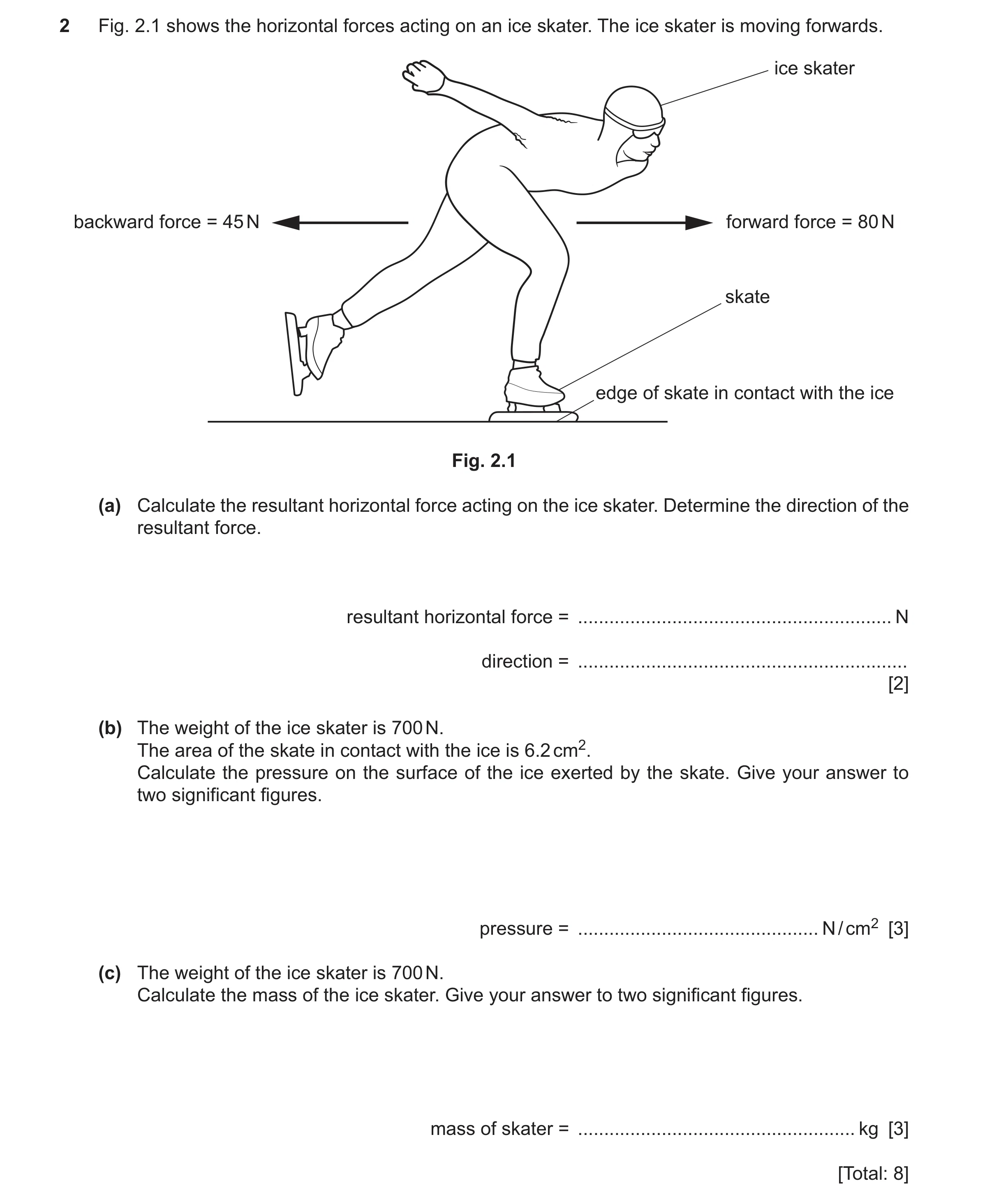
2 Fig. 2.1 shows the horizontal forces acting on an ice skater. The ice skater is moving forwards. ice skater backward force = 45 N forward force = 80 N skate edge of skate in contact with the ice Fig. 2.1 (a) Calculate the resultant horizontal force acting on the ice skater. Determine the direction of the resultant force. resultant horizontal force = … N direction = … [2] (b) The weight of the ice skater is 700 N. The area of the skate in contact with the ice is 6.2 cm2. Calculate the pressure on the surface of the ice exerted by the skate. Give your answer to two significant figures. pressure = … N / cm2 [3] (c) The weight of the ice skater is 700 N. Calculate the mass of the ice skater. Give your answer to two significant figures. mass of skater = … kg [3] [Total: 8]
8 marks
Mark scheme: 2(a) 35 (N) B1 forwards / to the right B1 2(b) 110 (N / cm2) A3 700 ÷ 6.2 C2 (pressure =) force / area C1 2(c) 71 (kg) A3 700 ÷ 9.8 C2 (mass =) weight / gravitational field strength or W / g or W / 9.8 C1
This question in 0625/32 Oct/Nov 2025
Q62 · A stone falling from a cliff to a beach 0625/33 Oct/Nov 2025
1 Fig. 1.1 shows a stone falling from a cliff to a beach. cliff stone beach Fig. 1.1 (a) Fig. 1.2 shows the speed-time graph for the stone. 35 B 30 25 speed m / s 20 15 10 5 A 0 0 0.5 1 1.5 2 2.5 3 3.5 4 time / s Fig. 1.2 (i) Determine the speed of the stone at time = 2.0 s. speed = … m / s [1] (ii) Describe the motion of the stone during section AB of the graph in Fig. 1.2. … [1] (iii) Calculate the distance travelled by the stone between time = 0 and time = 3.4 s. distance = … m [3] (b) The weight of the stone is 0.12 N. Calculate the mass of the stone. mass = … kg [3] [Total: 8]
8 marks
Mark scheme: Question Answer Marks 1(a)(i) 19.5 (m / s) B1 1(a)(ii) acceleration or speeding up owtte B1 1(a)(iii) 56 (m) A3 ½ 3.4 33 C2 (distance =) area under graph or ½ b h C1 1(b) 0.012 (kg) A3 0.12 ÷ 9.8 C2 (mass =) weight / gravitational field strength or w / g or w / 9.8 C1
This question in 0625/33 Oct/Nov 2025
 1 / 78
 2 / 78
 3 / 78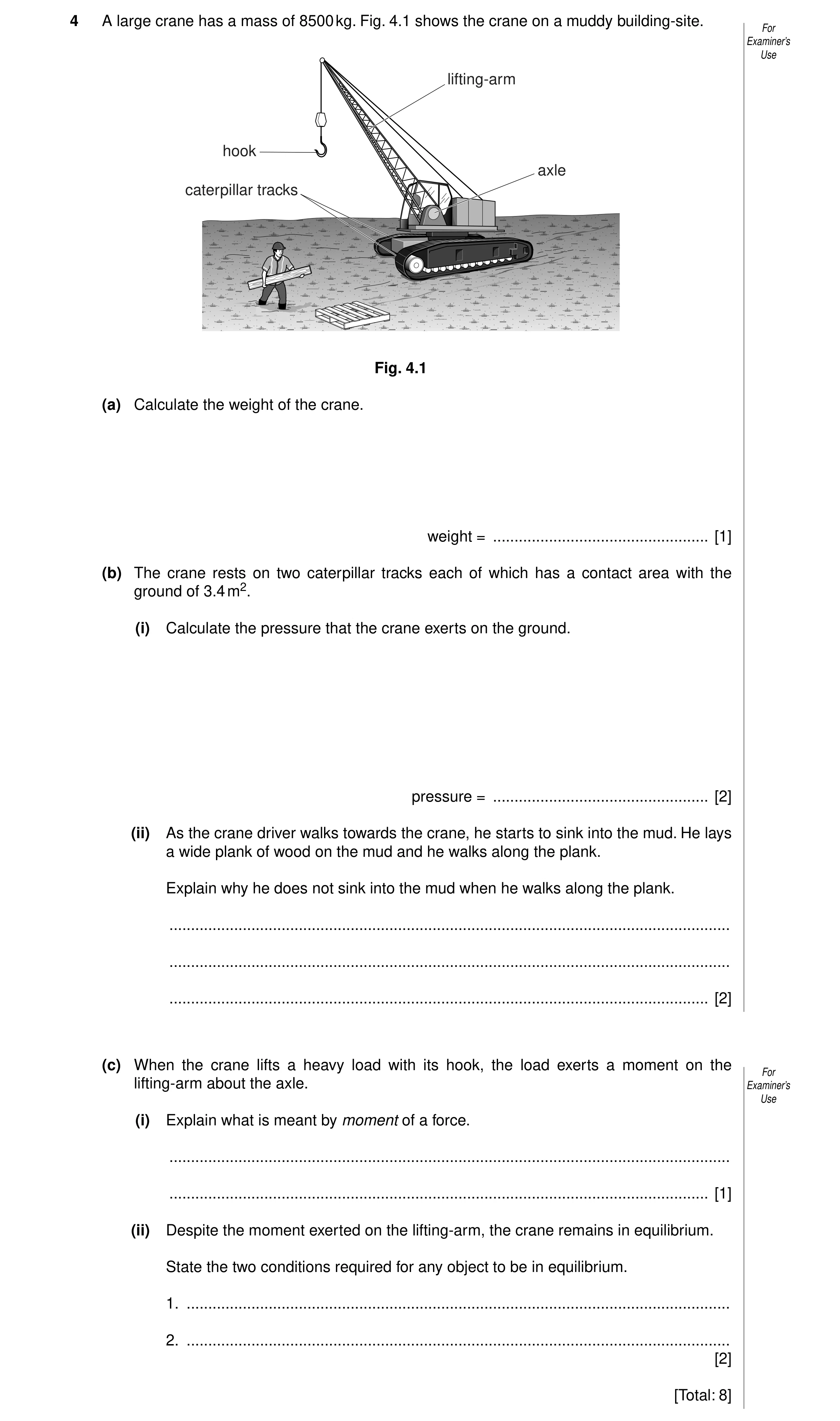
 10 / 78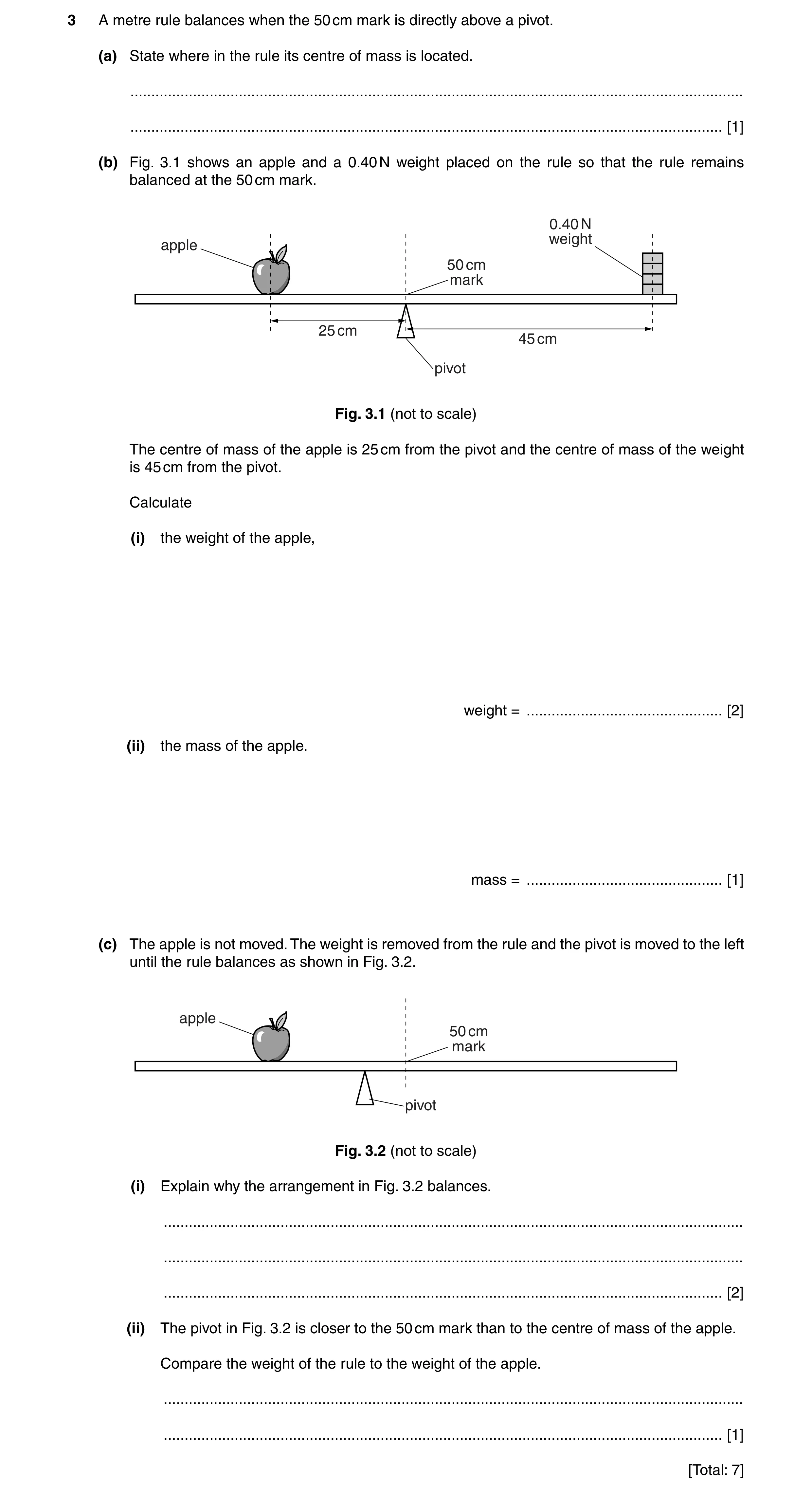
 14 / 78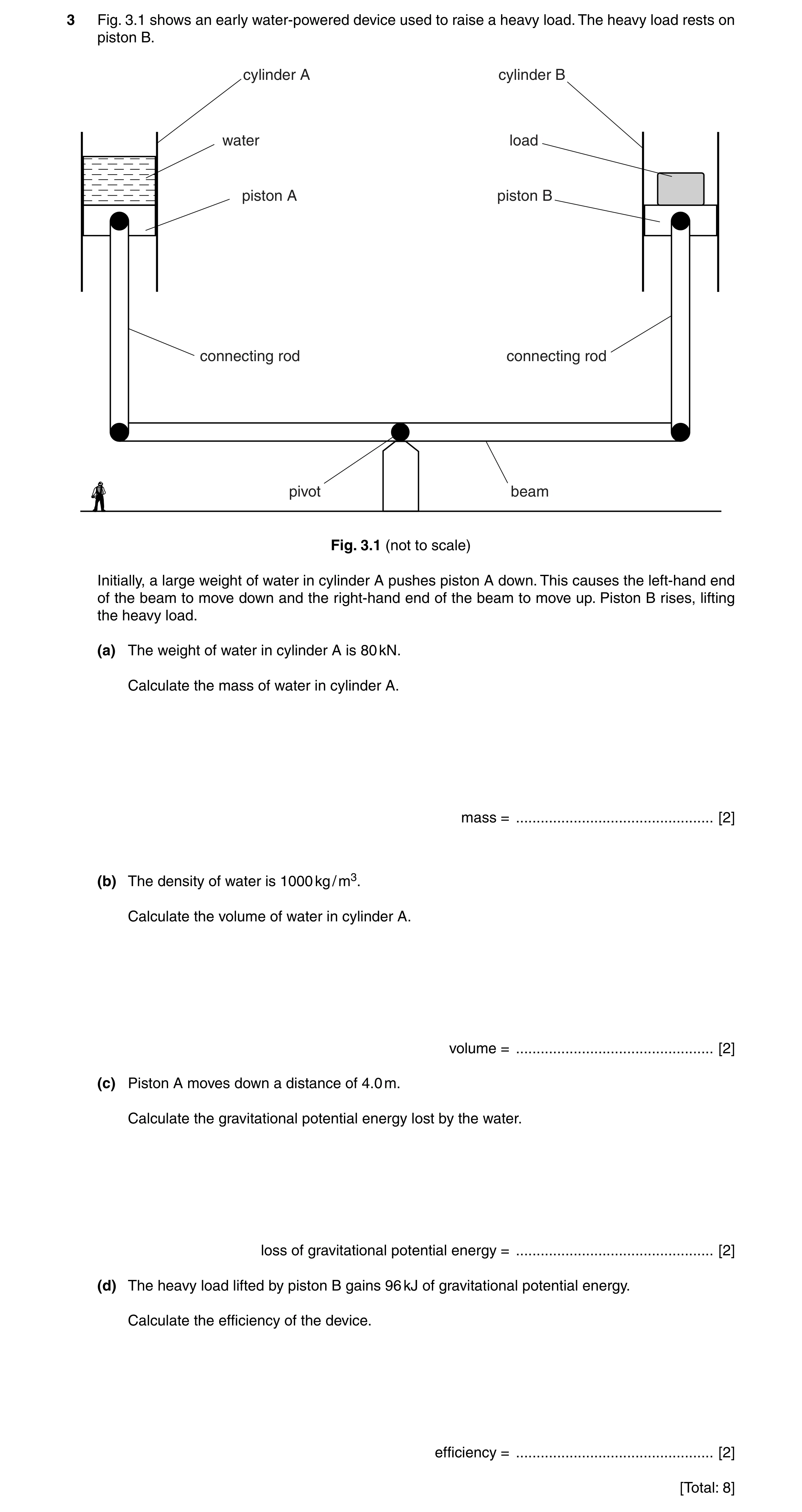
 18 / 78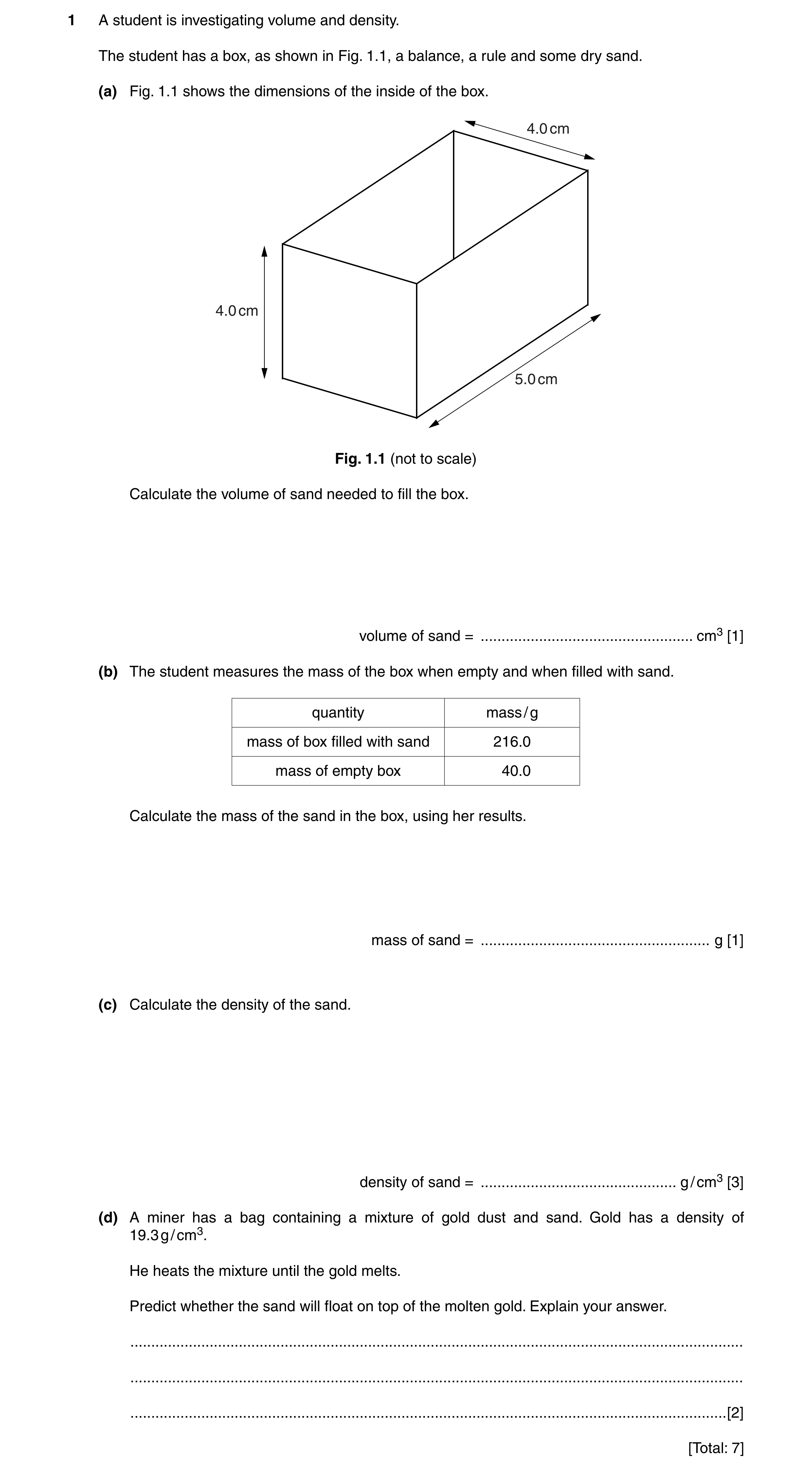
 21 / 78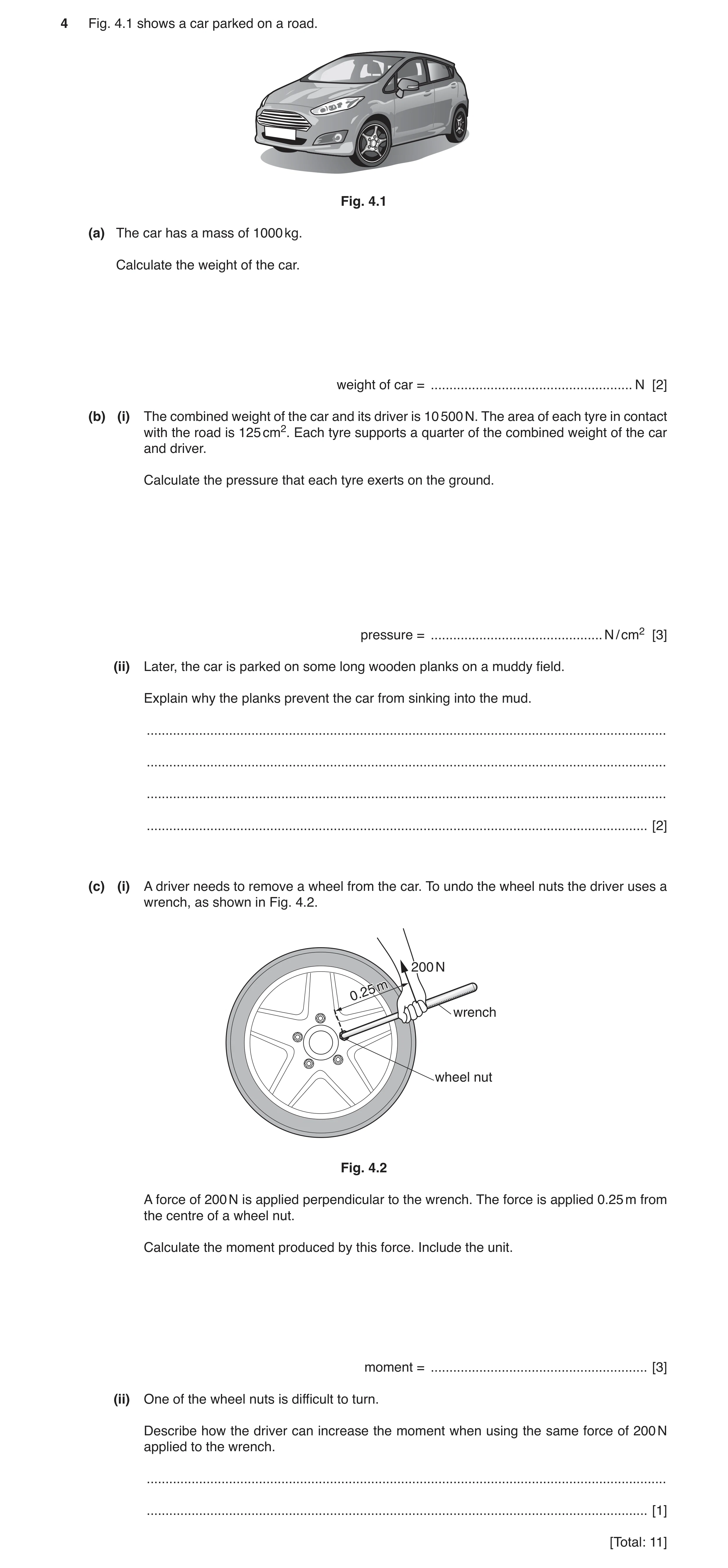
 24 / 78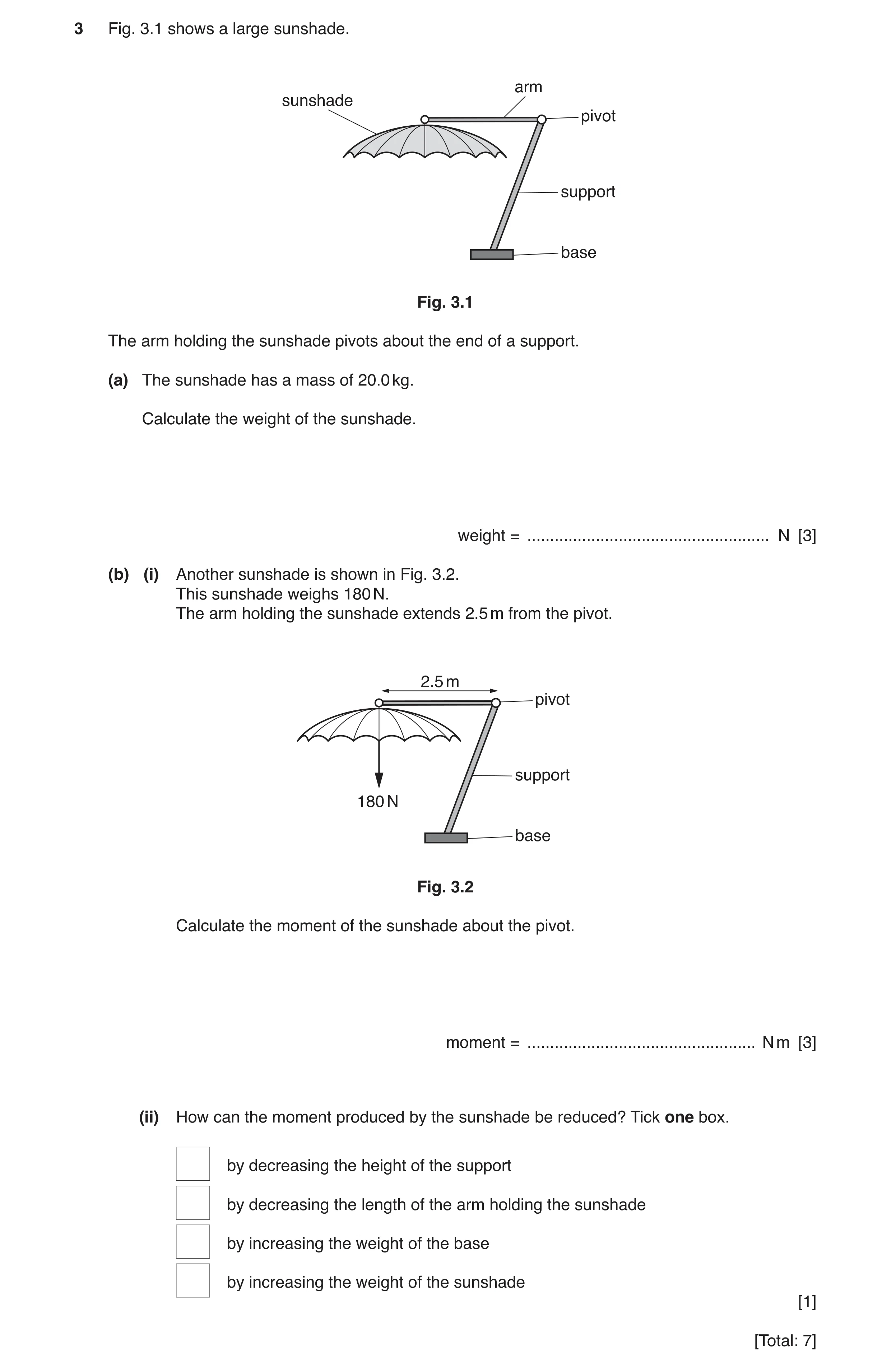
 28 / 78
 29 / 78
 30 / 78
 31 / 78
 32 / 78
 33 / 78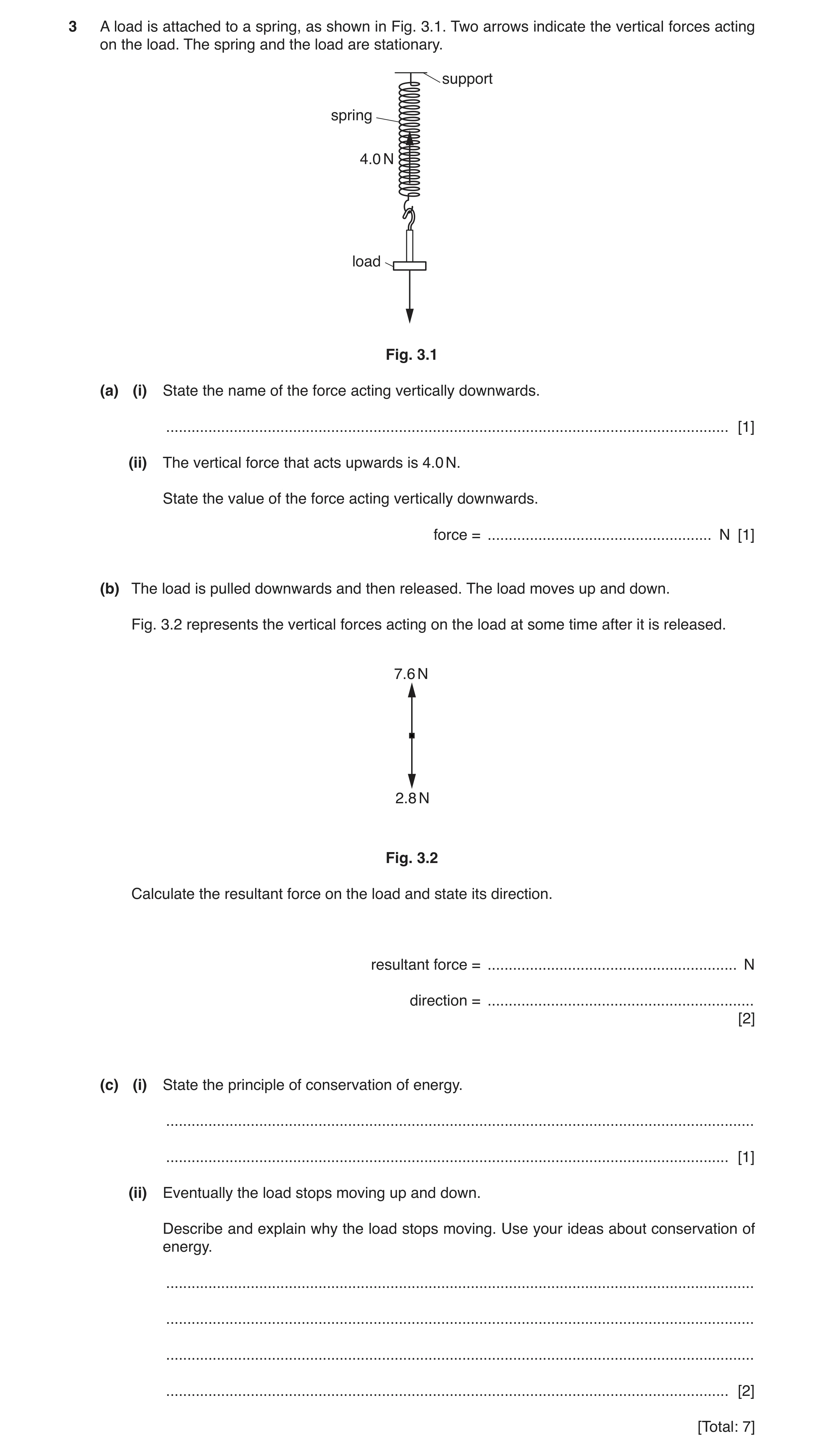
 36 / 78
 37 / 78
 38 / 78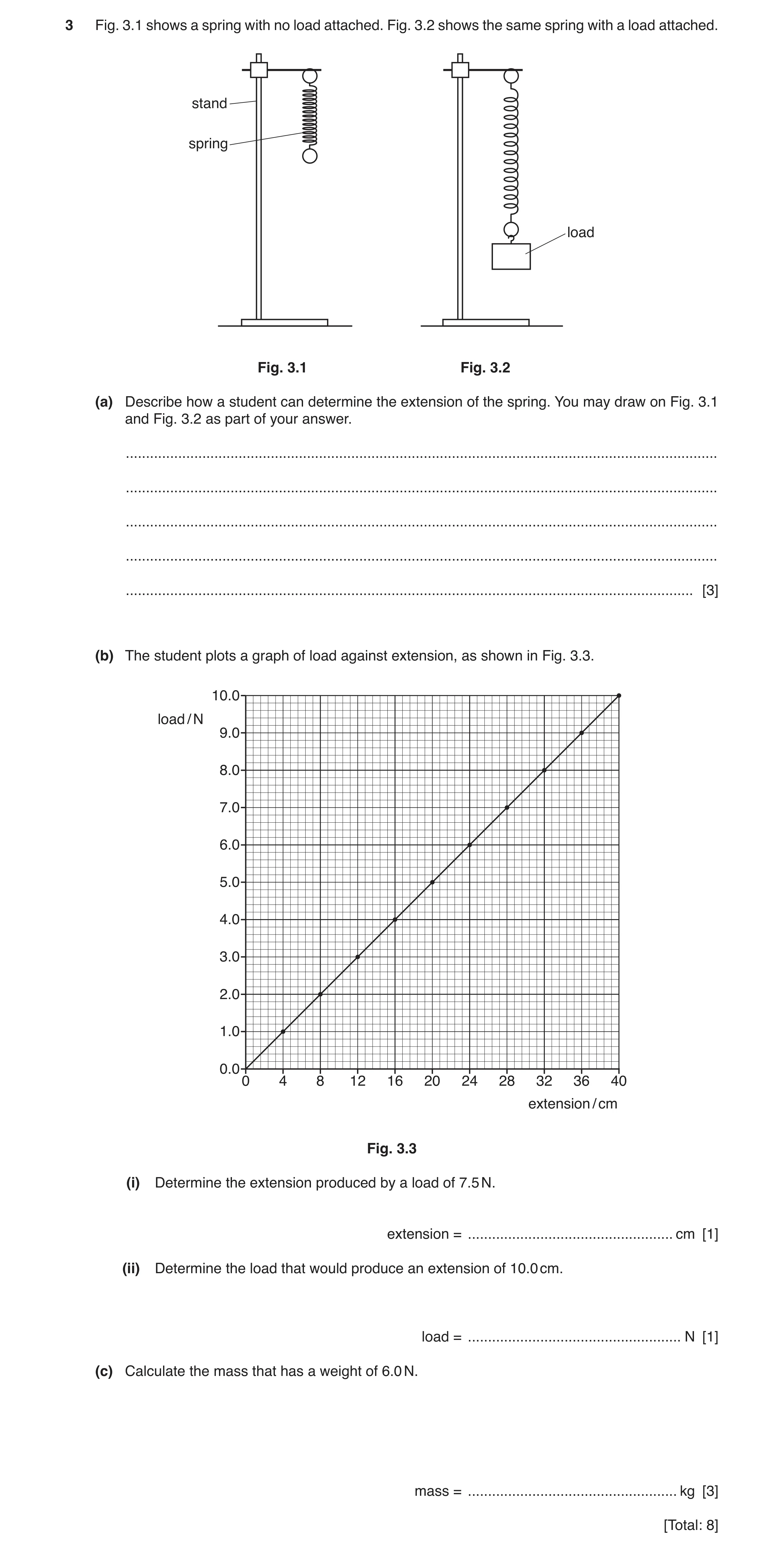
 41 / 78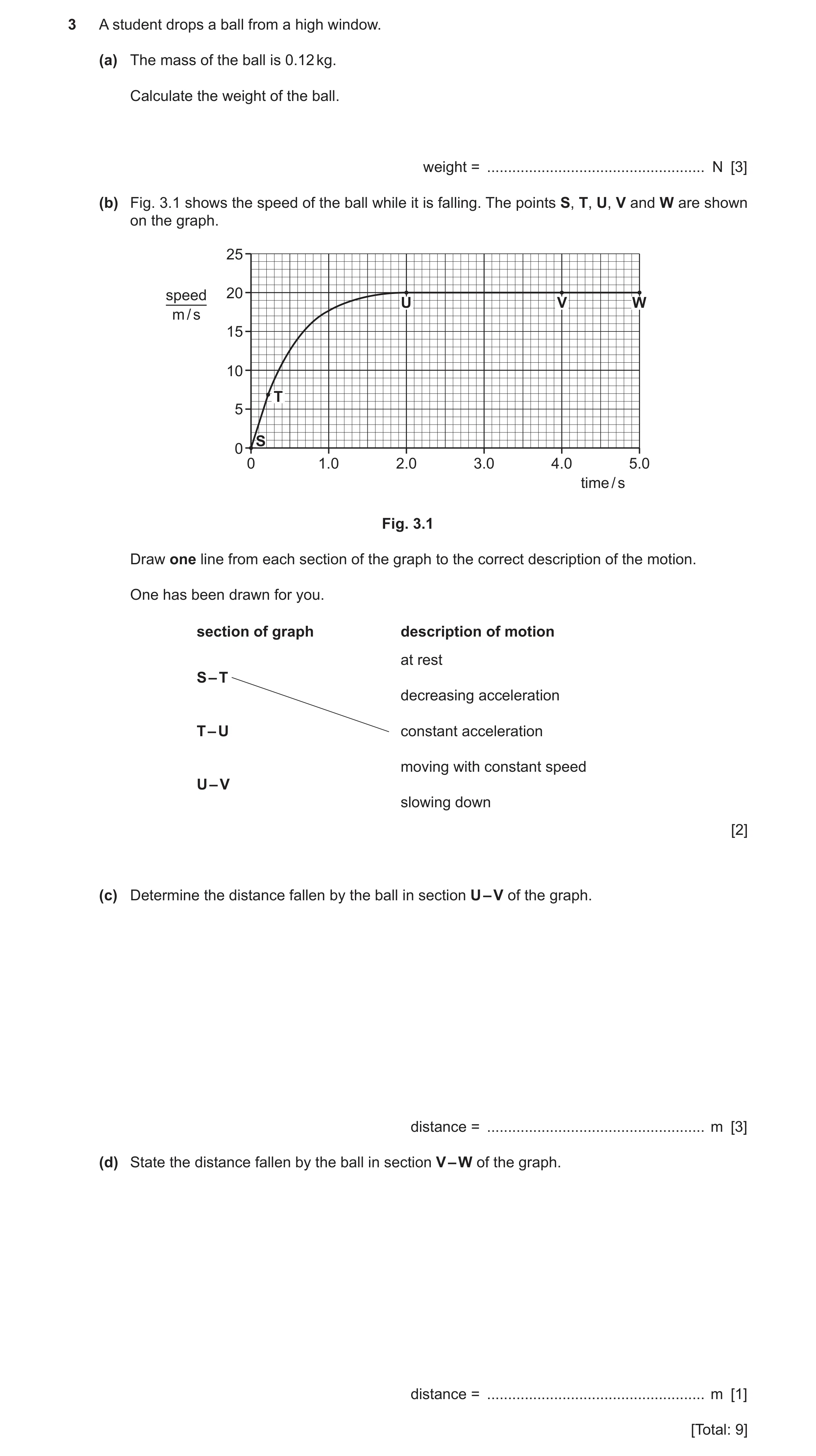
 44 / 78
 45 / 78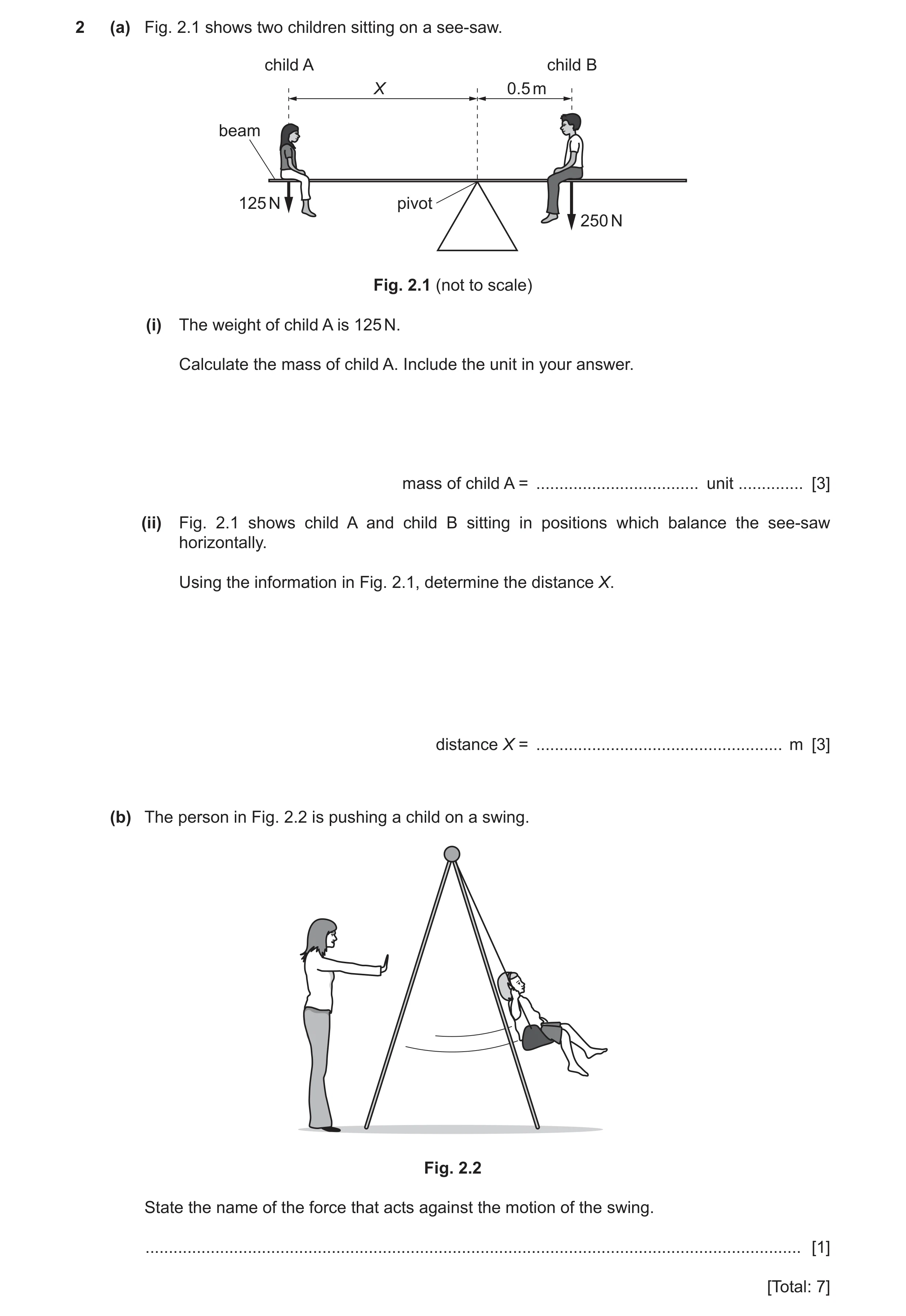
 48 / 78
 49 / 78
 50 / 78
 51 / 78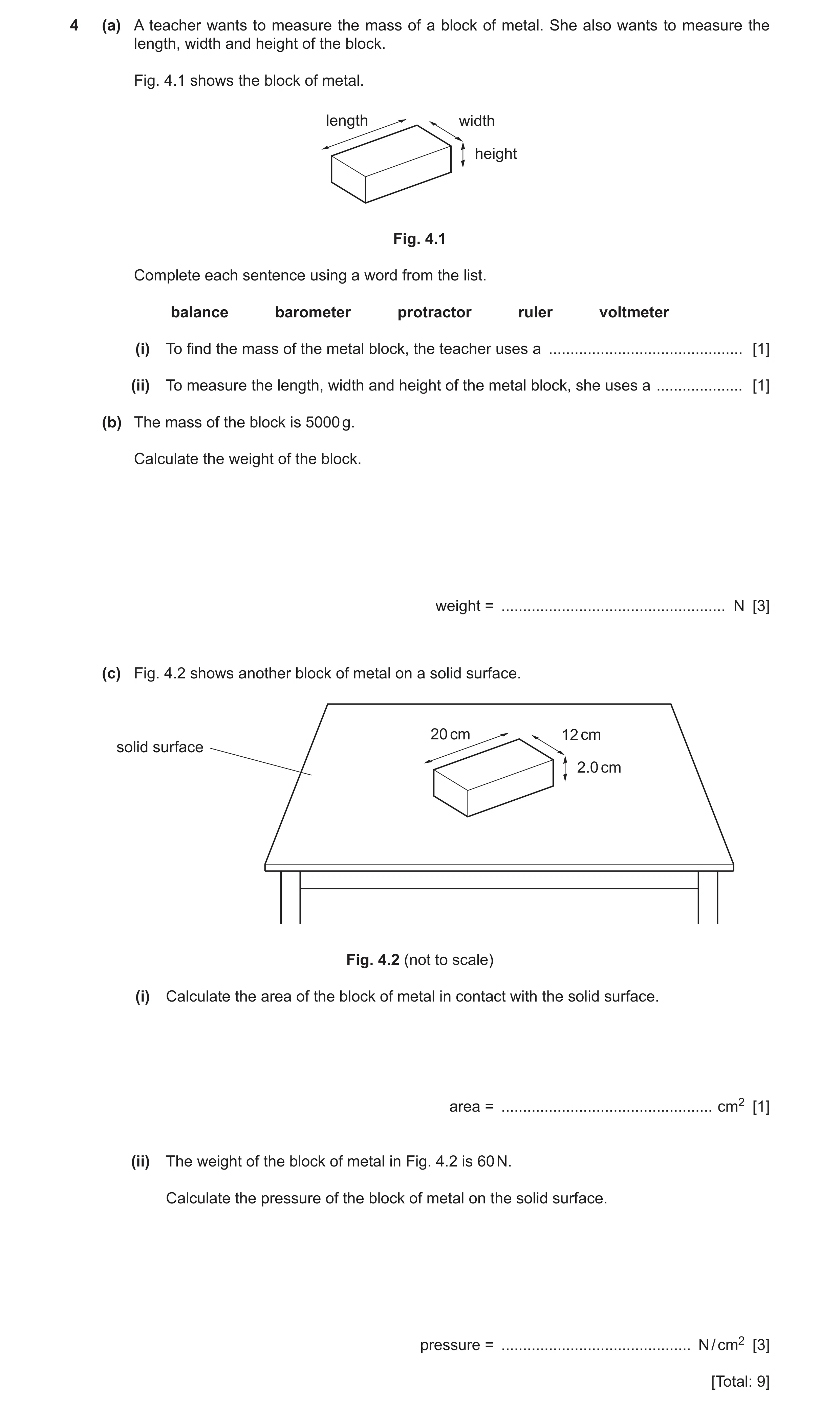
 55 / 78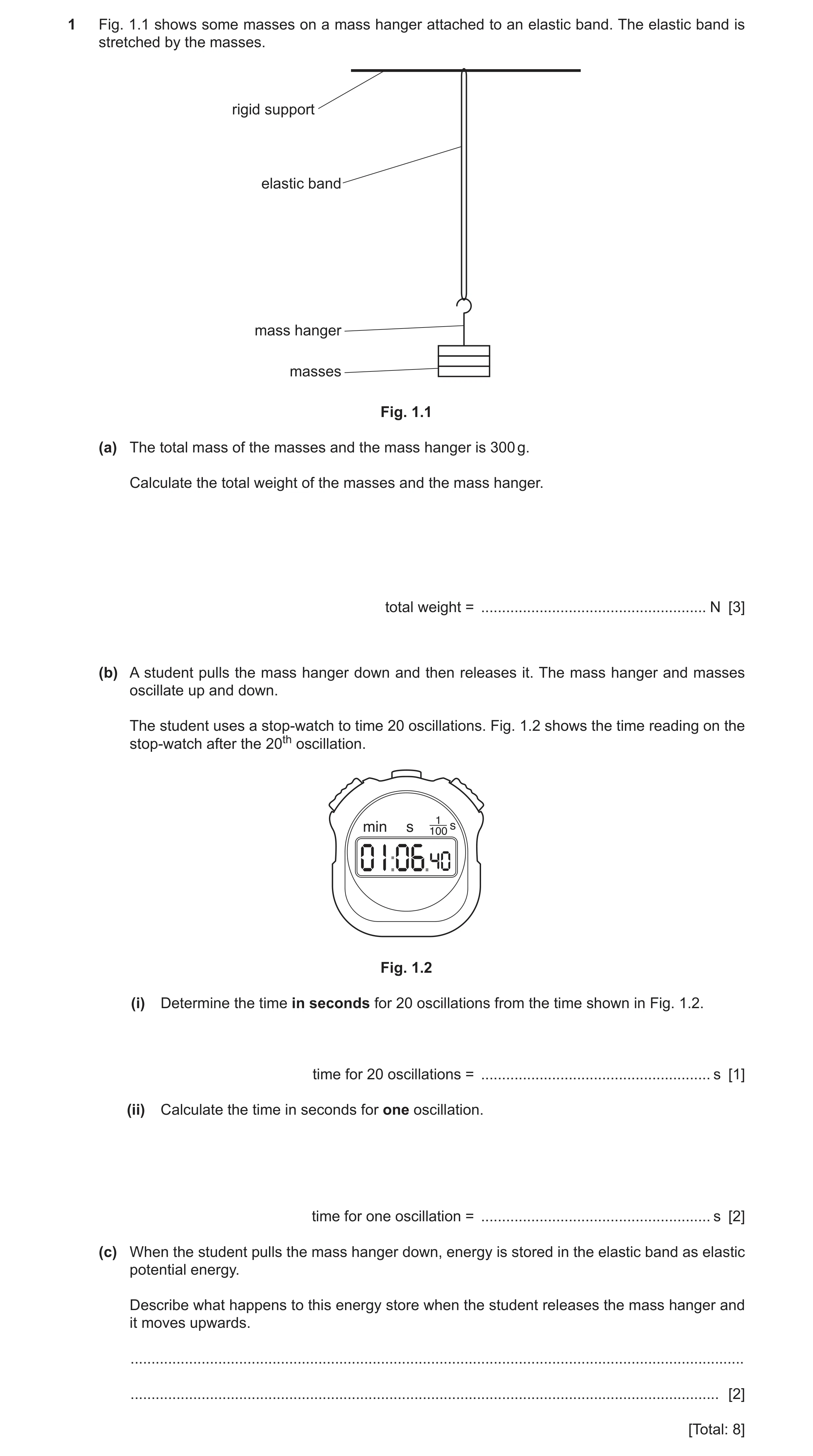
 57 / 78
 58 / 78
 59 / 78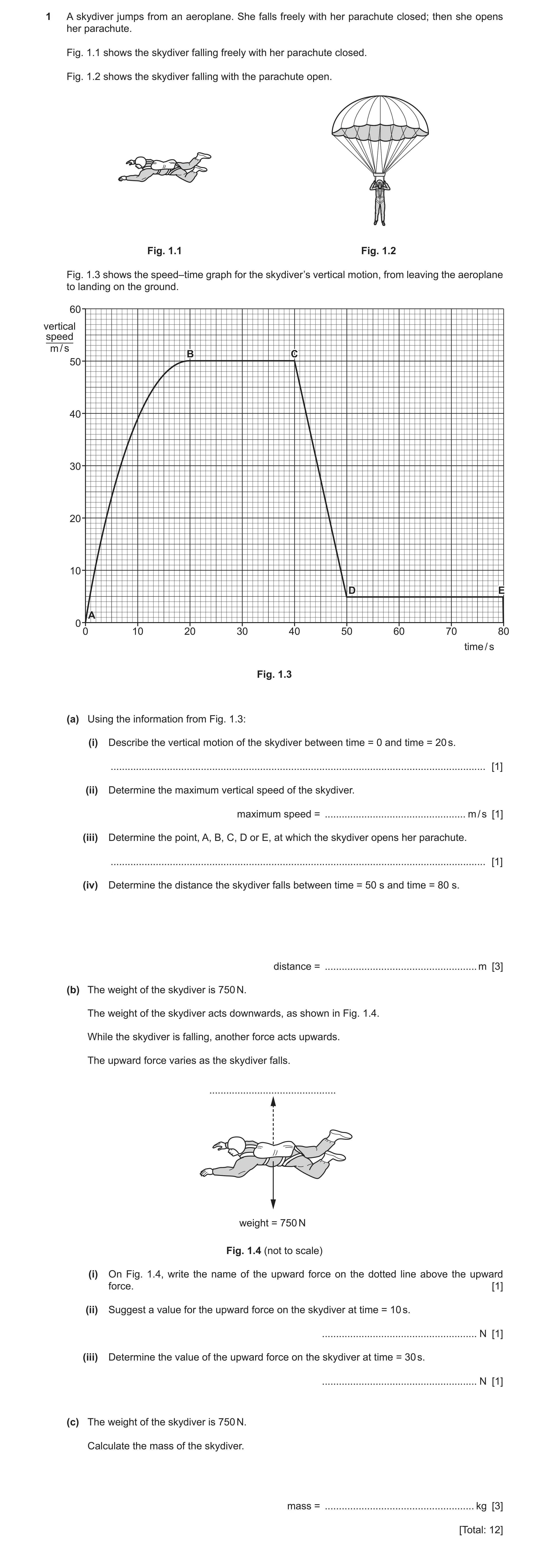
 64 / 78
 65 / 78
 66 / 78
 67 / 78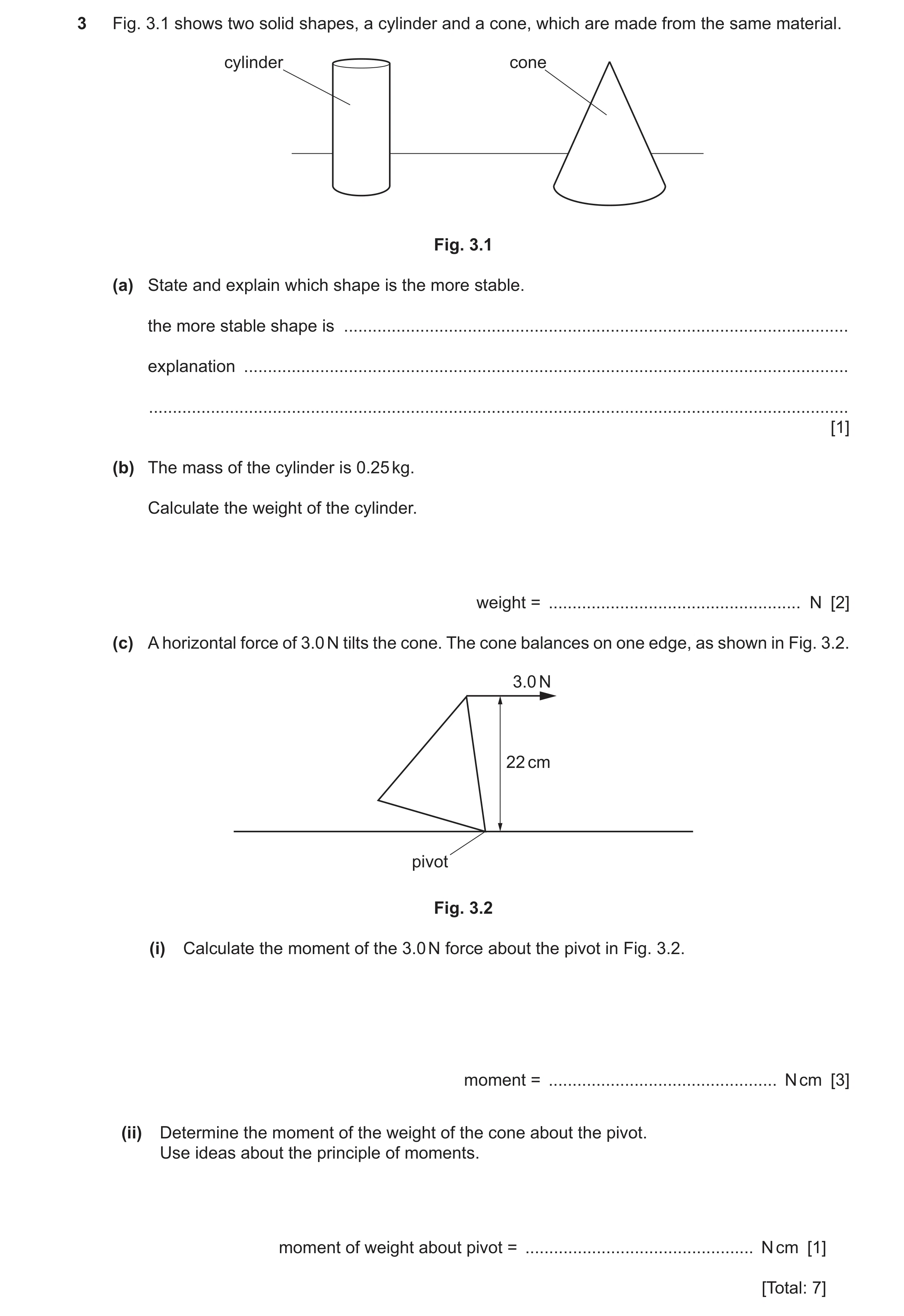
 69 / 78
![Question 55: (a) A boy weighs 620 N. Calculate the mass of the boy. mass of boy = ..................................................... kg [3] (b) Fig. …](https://img.pastlit.com/crops/4e707ada-bb02-4b01-9e87-6d5dcaf9ae31/q3.webp) 70 / 78
70 / 78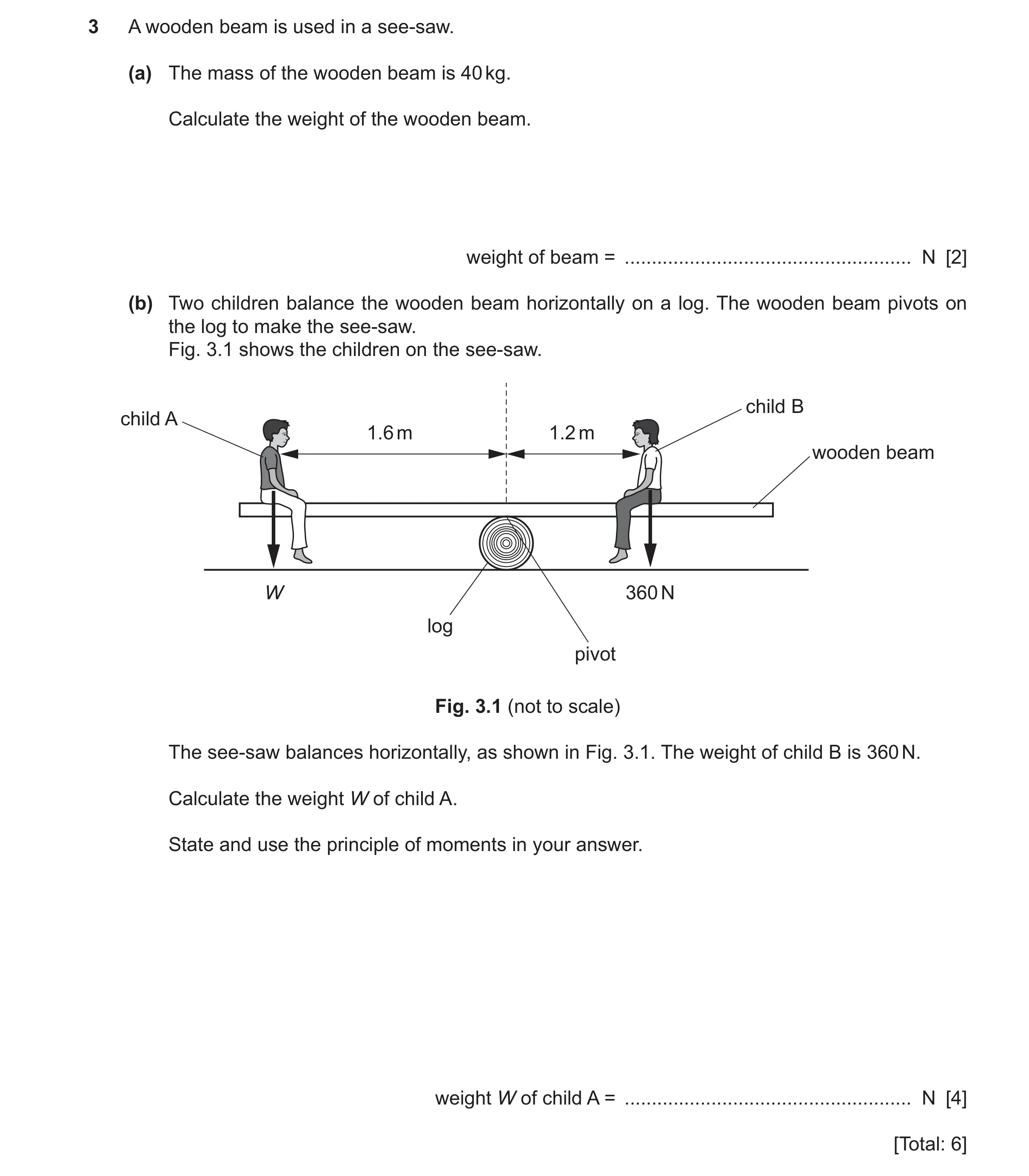 71 / 78
 72 / 78
 73 / 78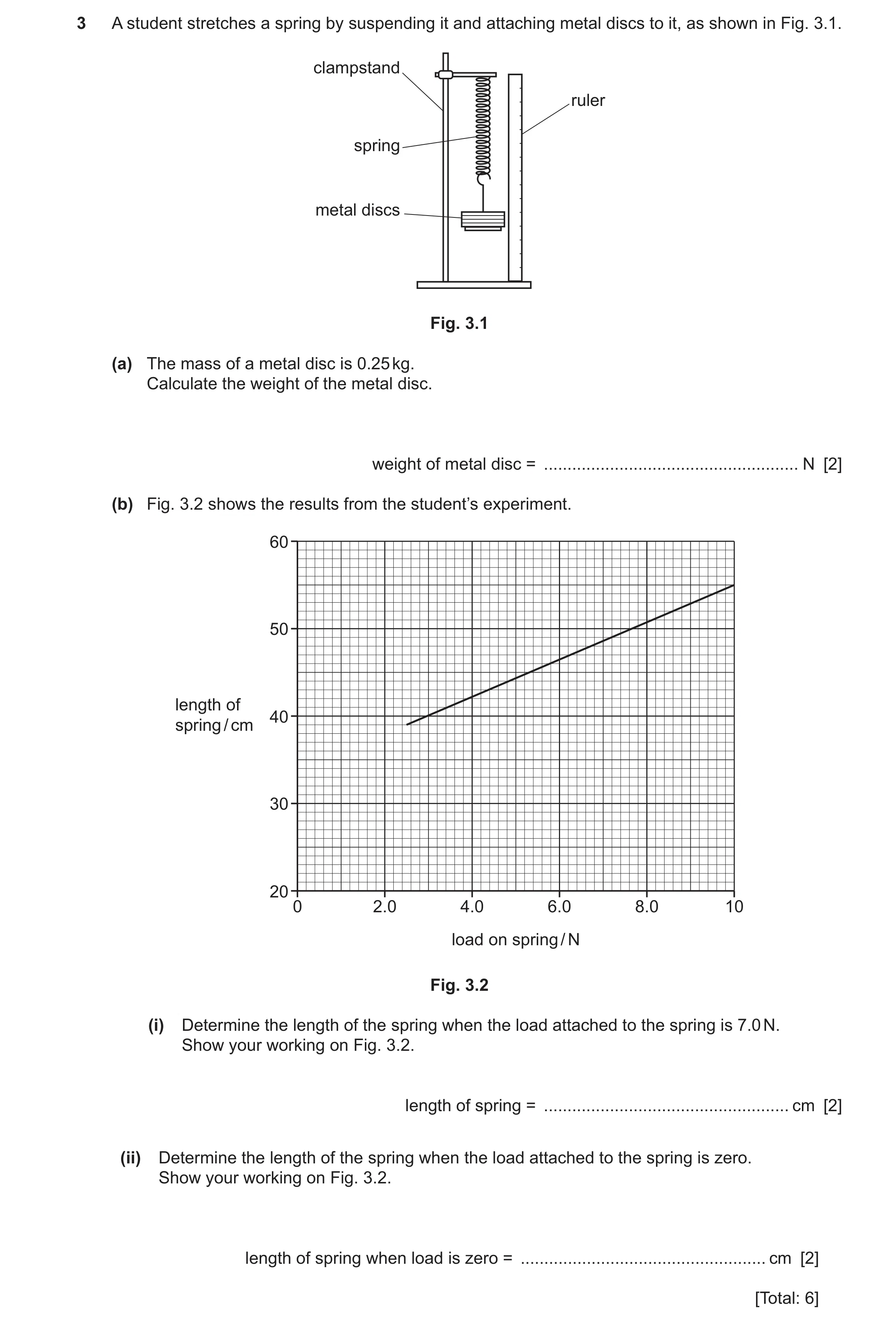
 75 / 78
 76 / 78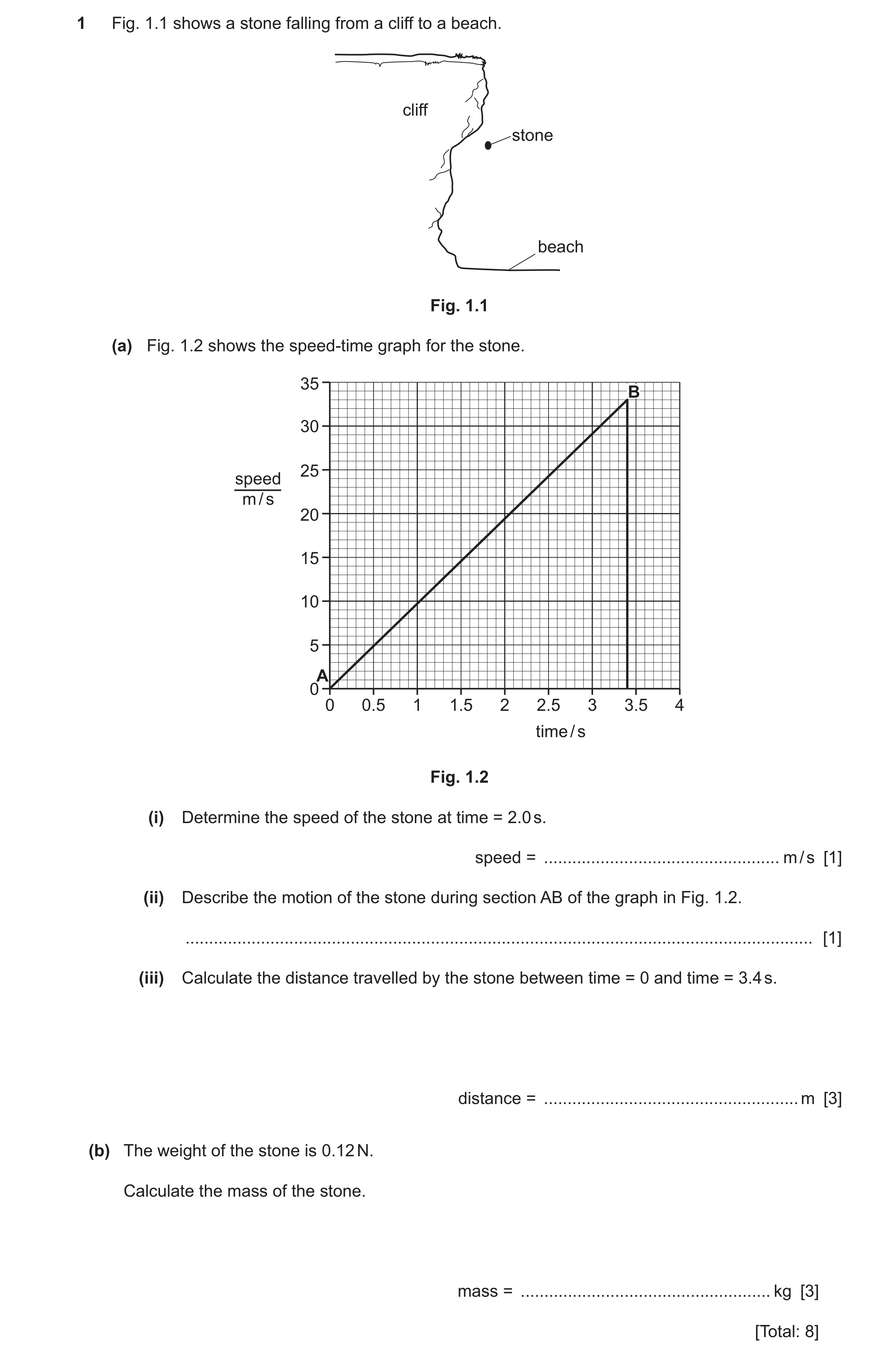
 8
8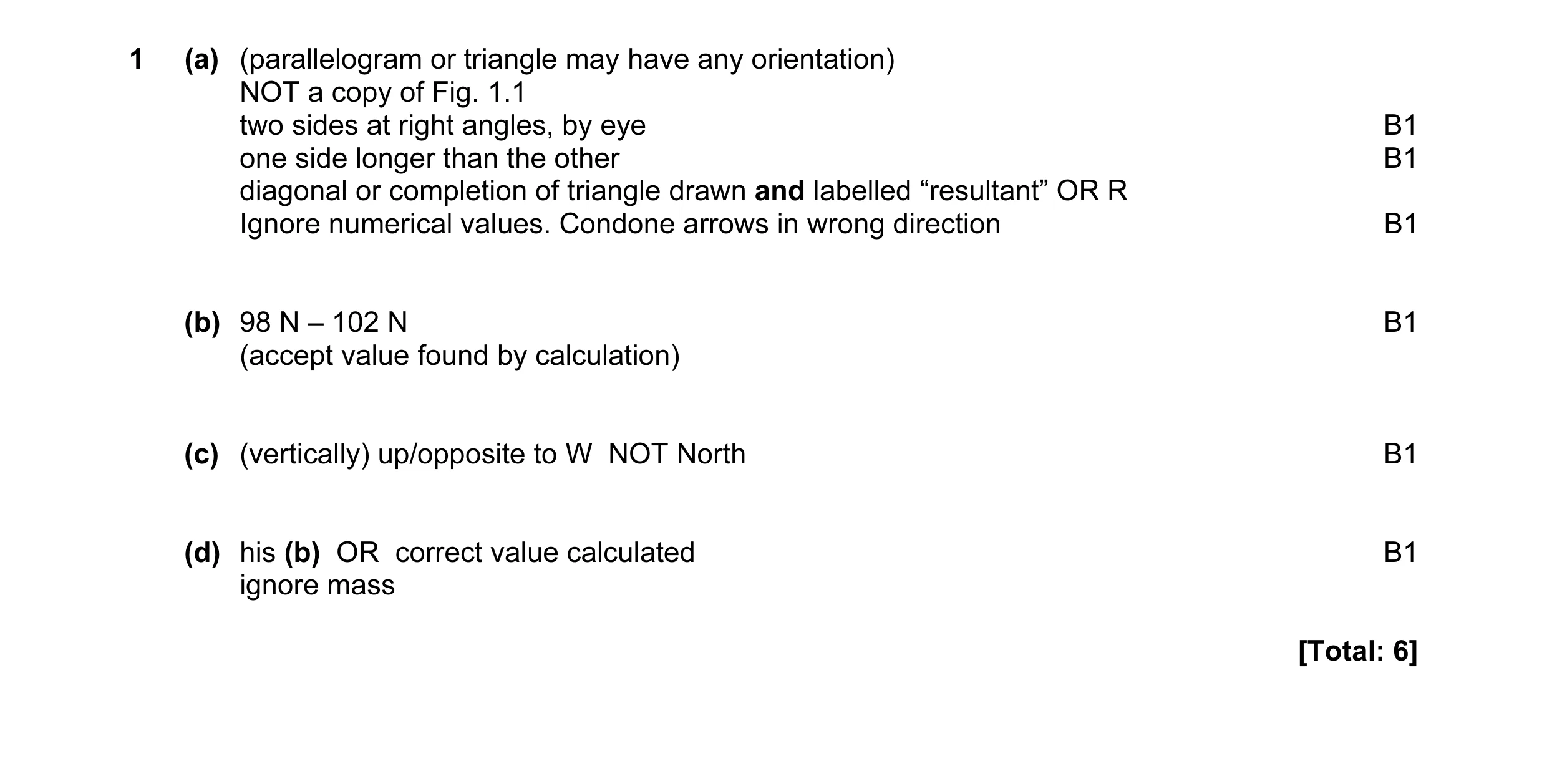 6
6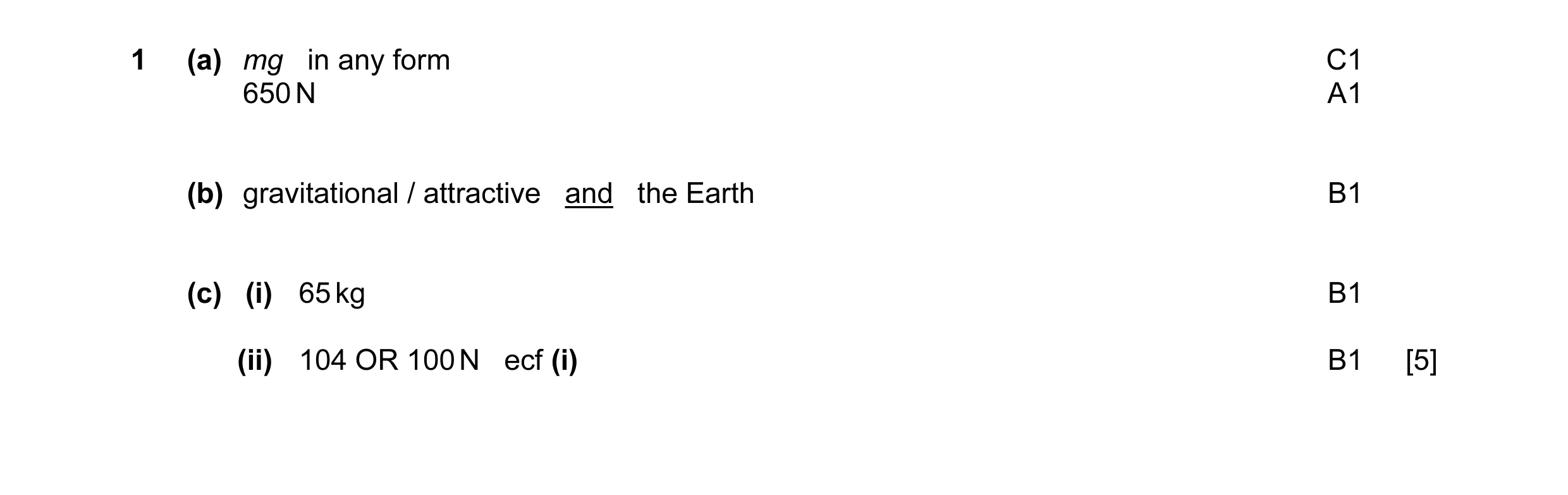 5
5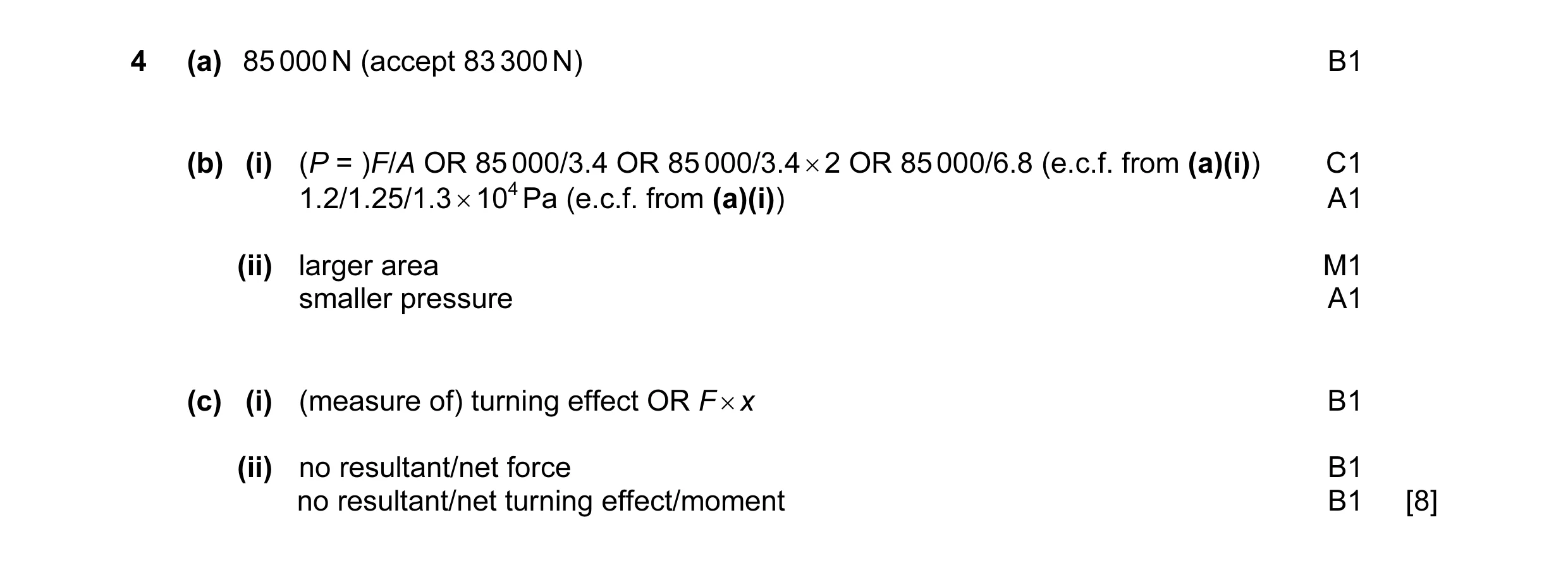 8
8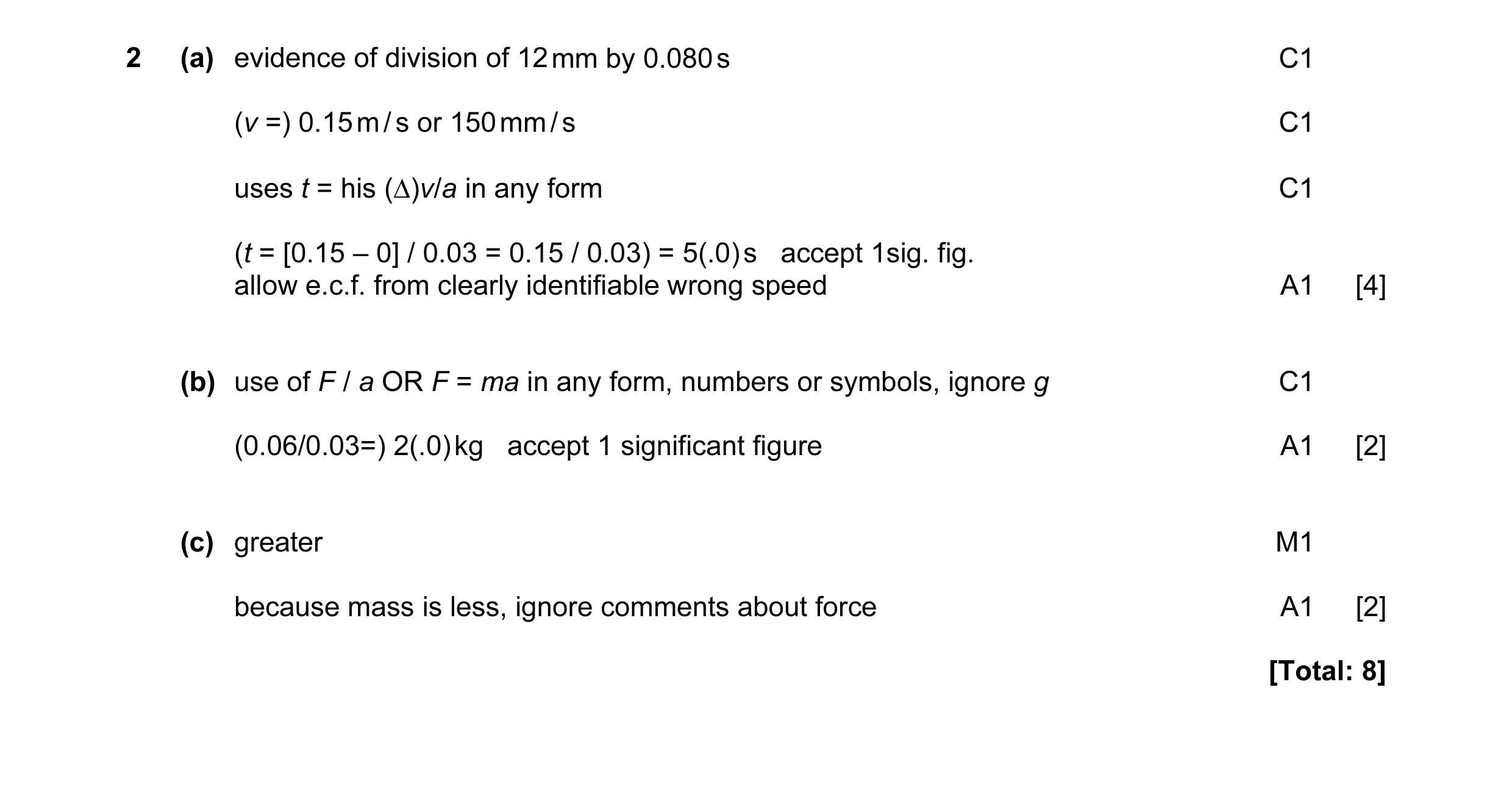 8
8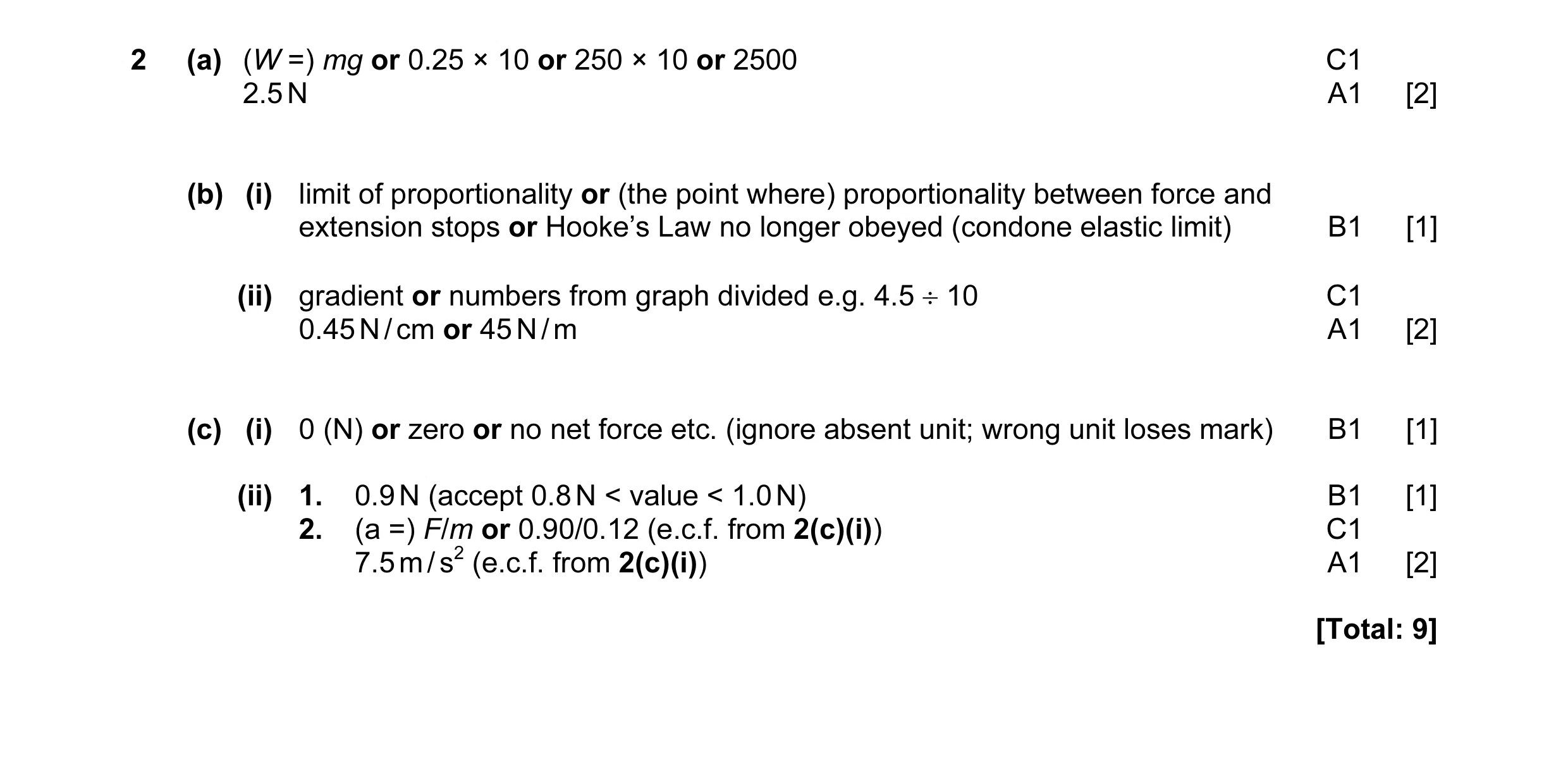 9
9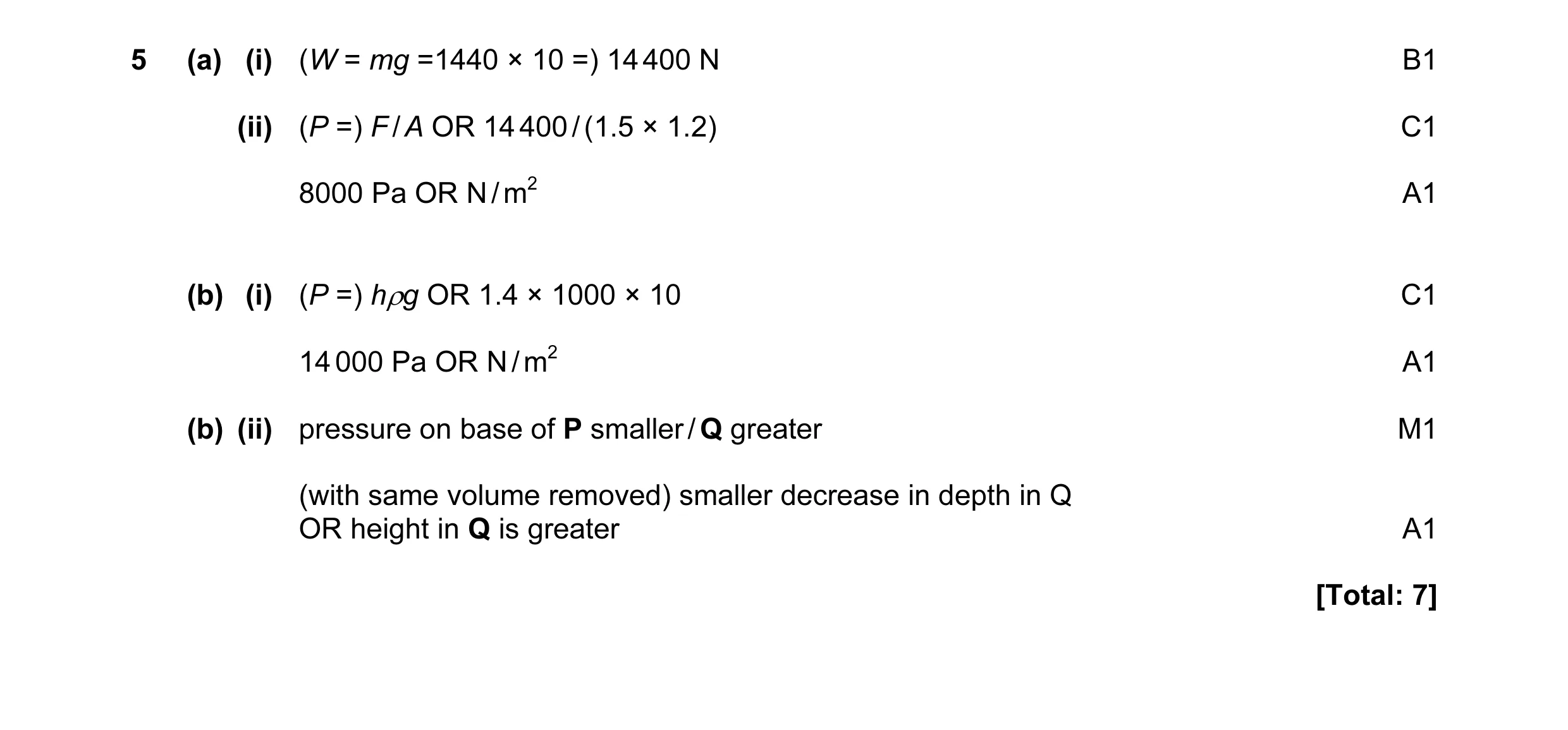 7
7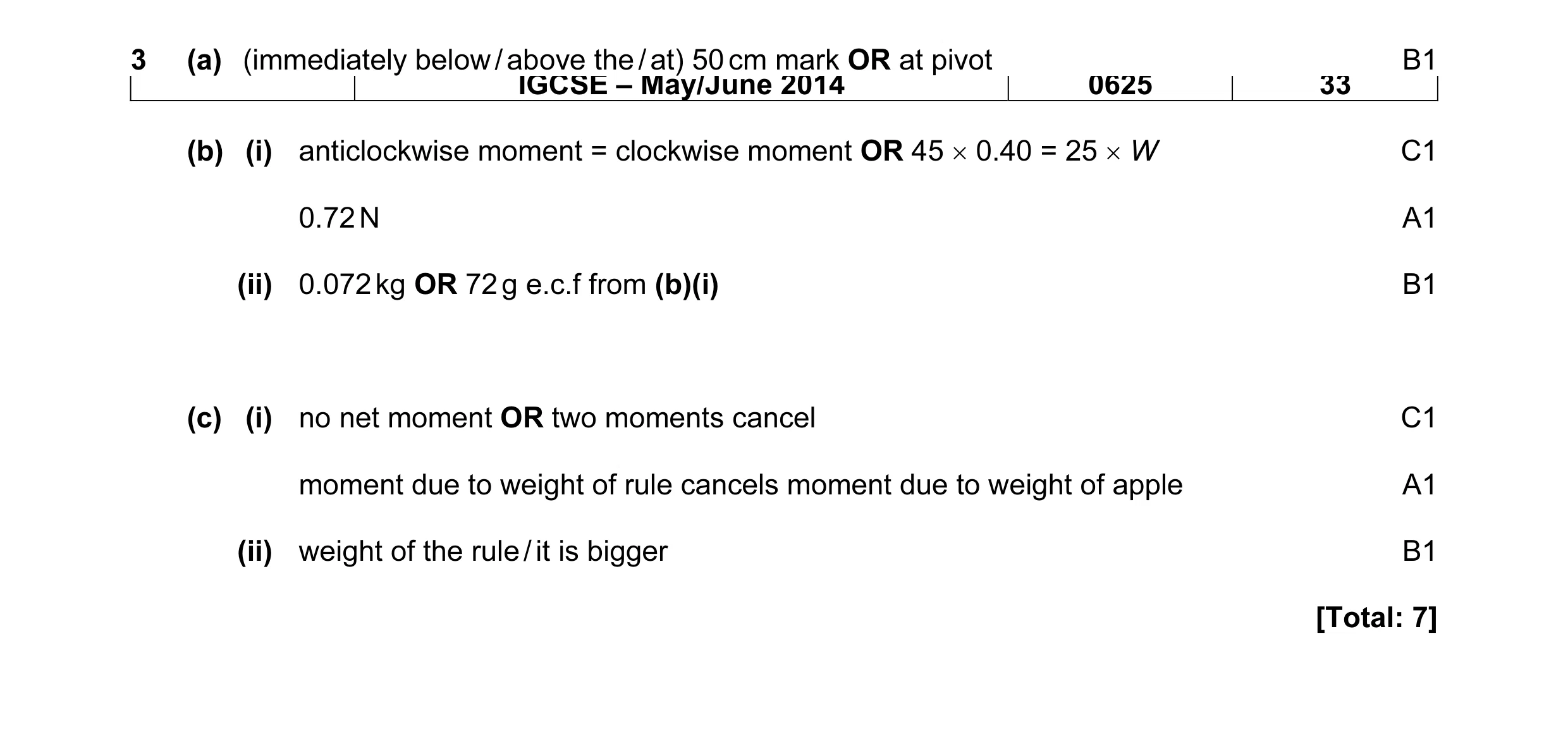 7
7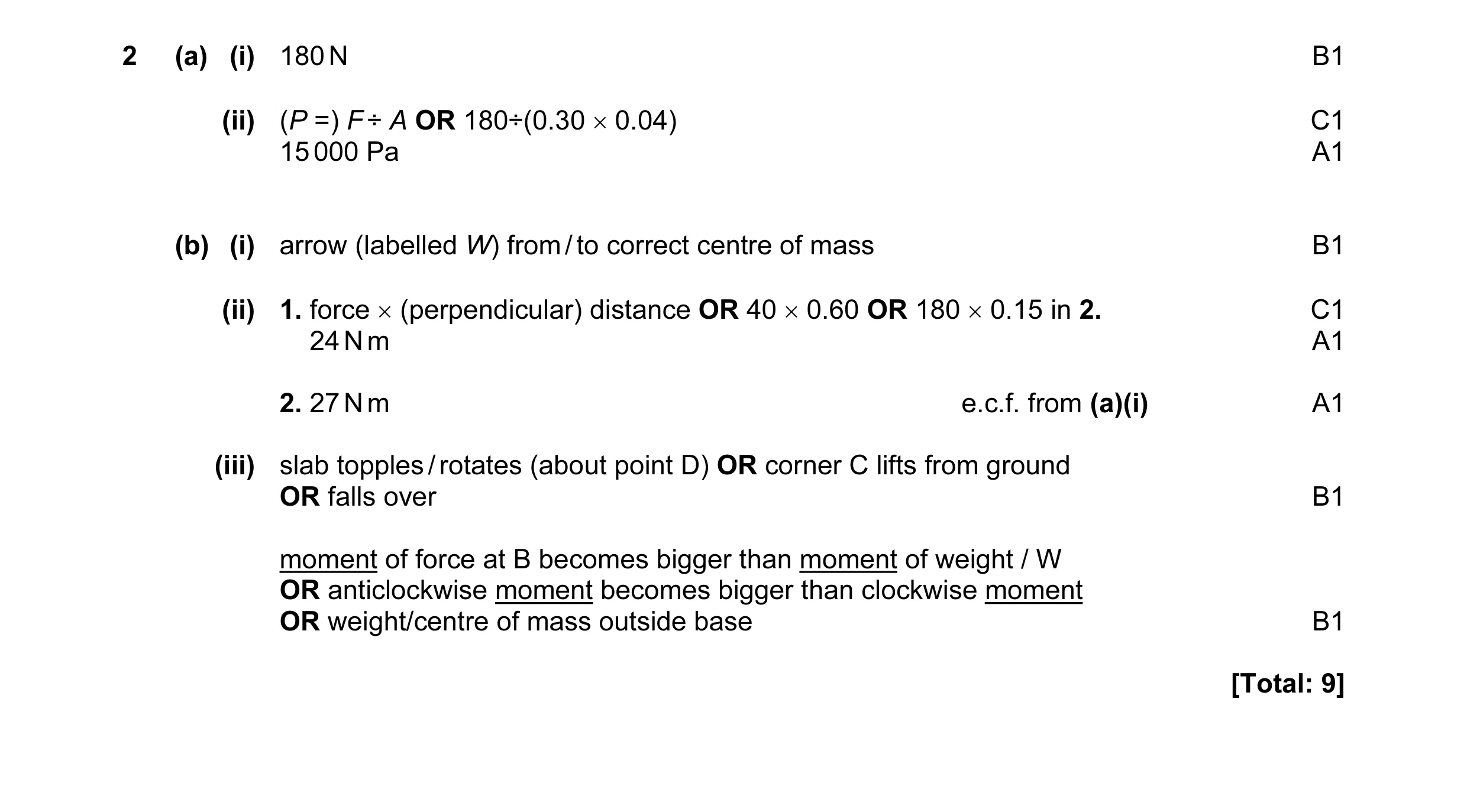 9
9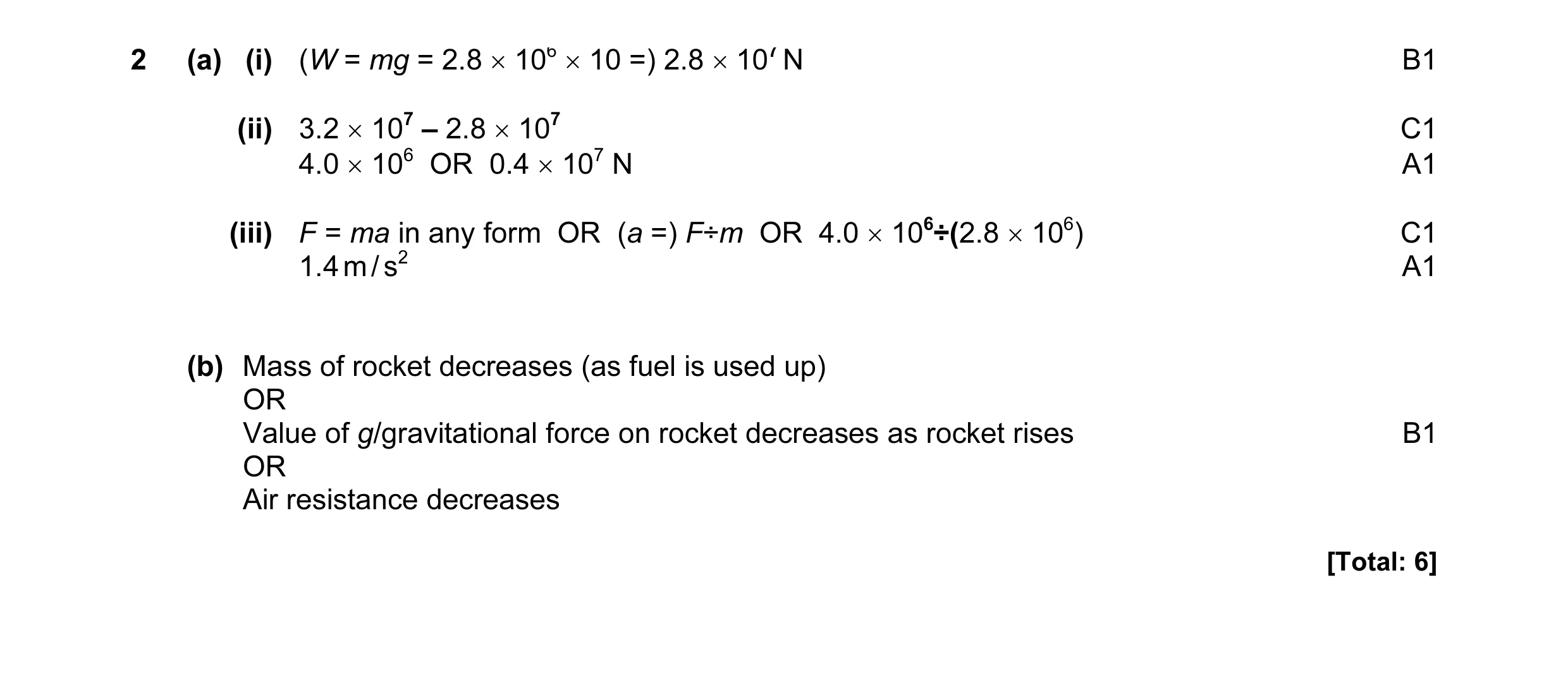 6
6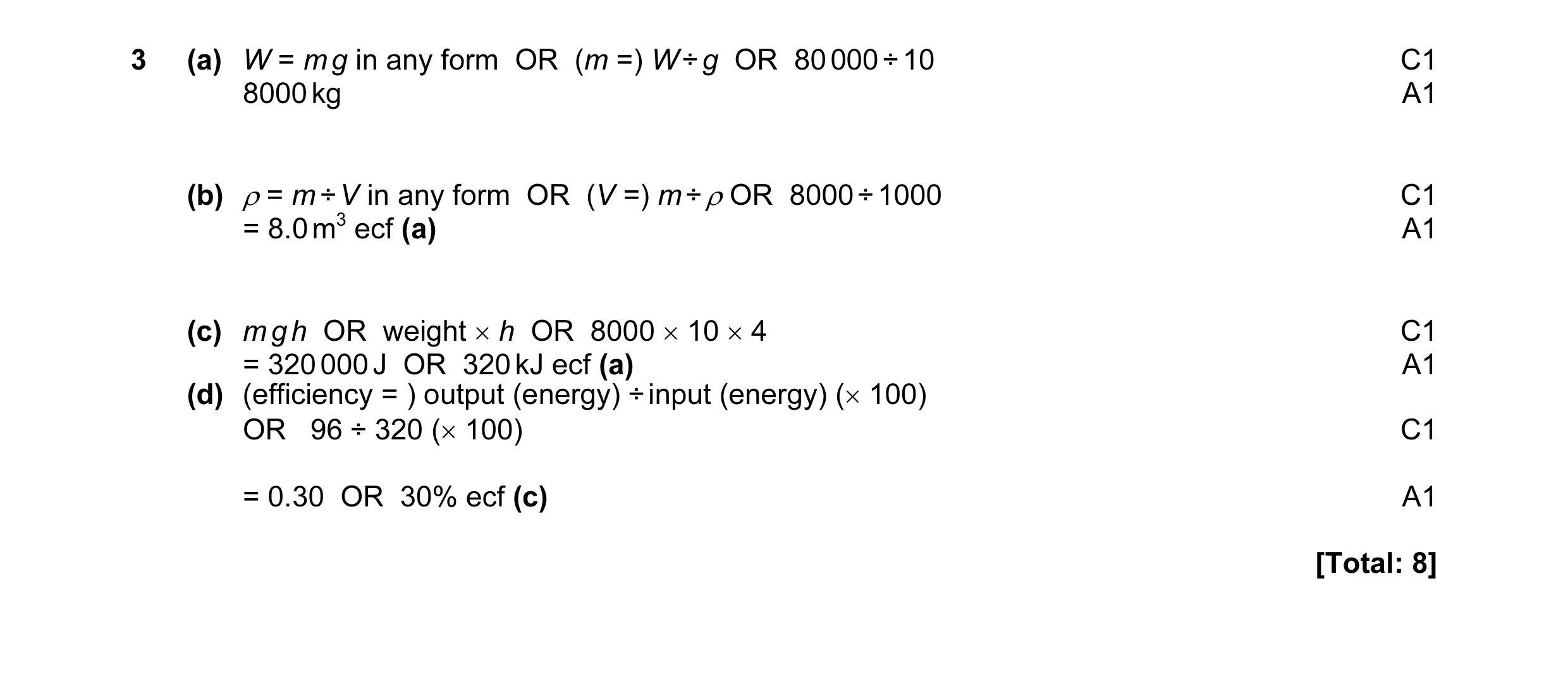 8
8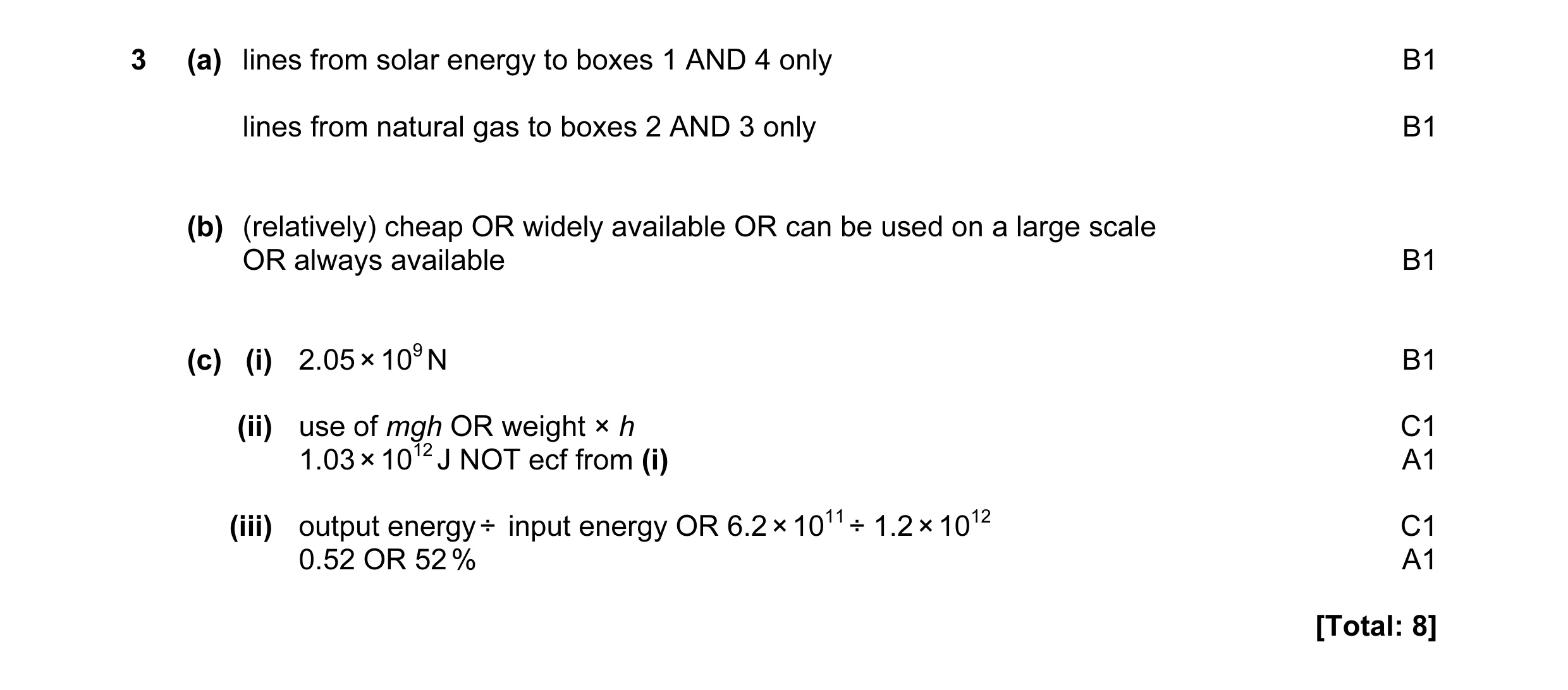 8
8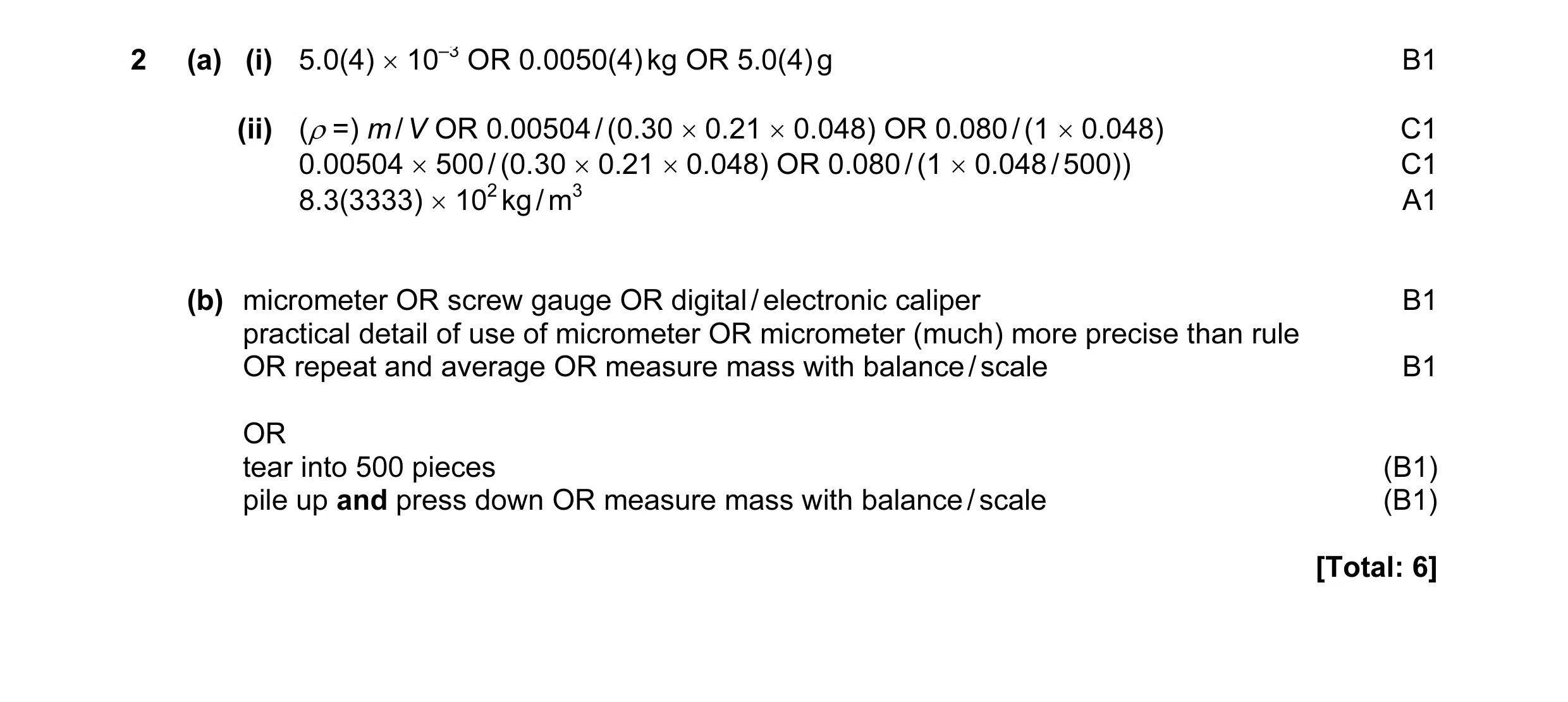 6
6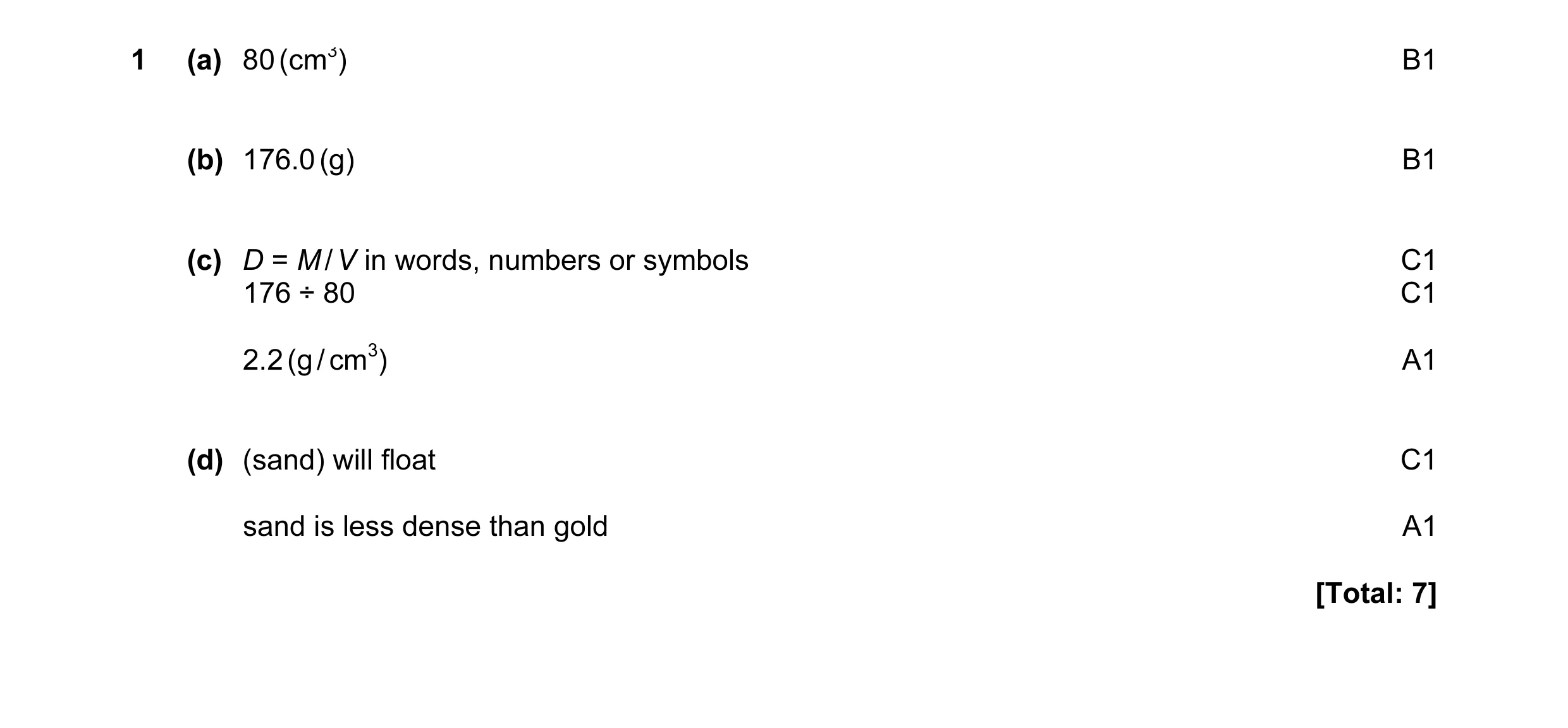 7
7 5
5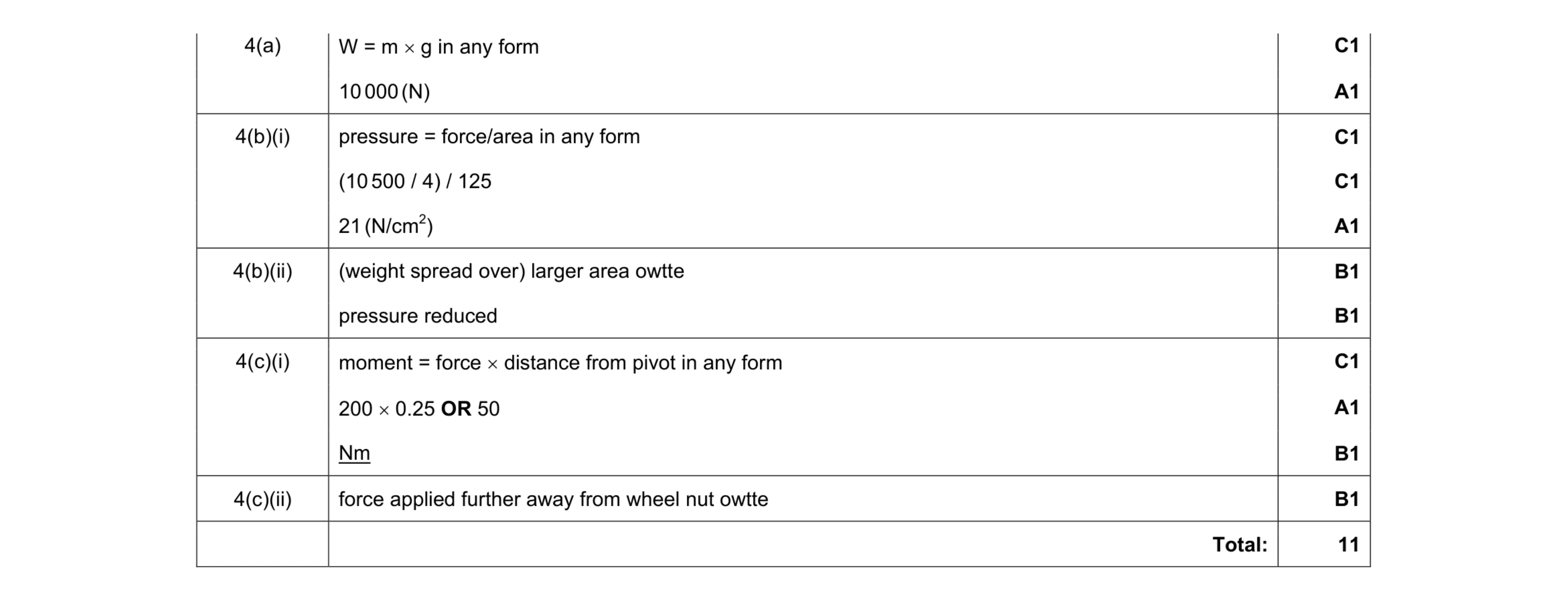 11
11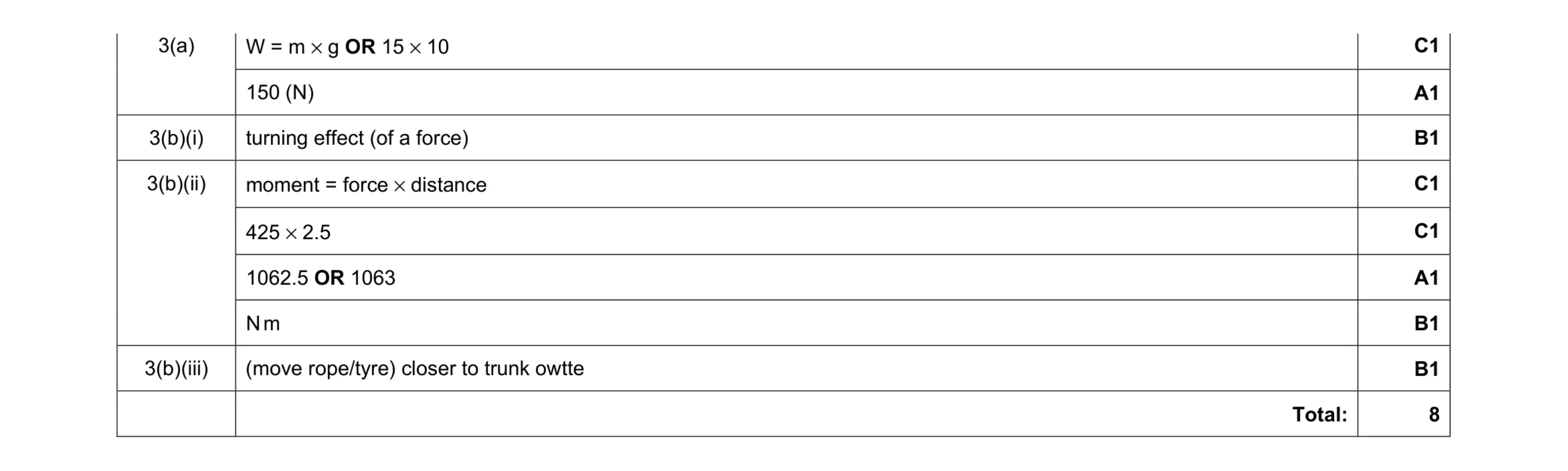 8
8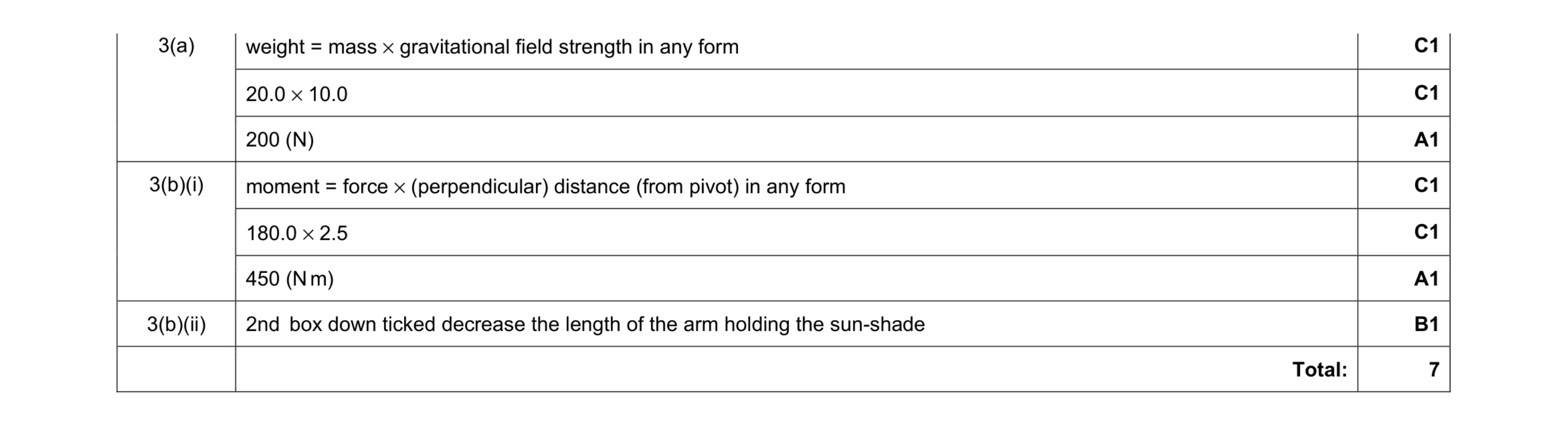 7
7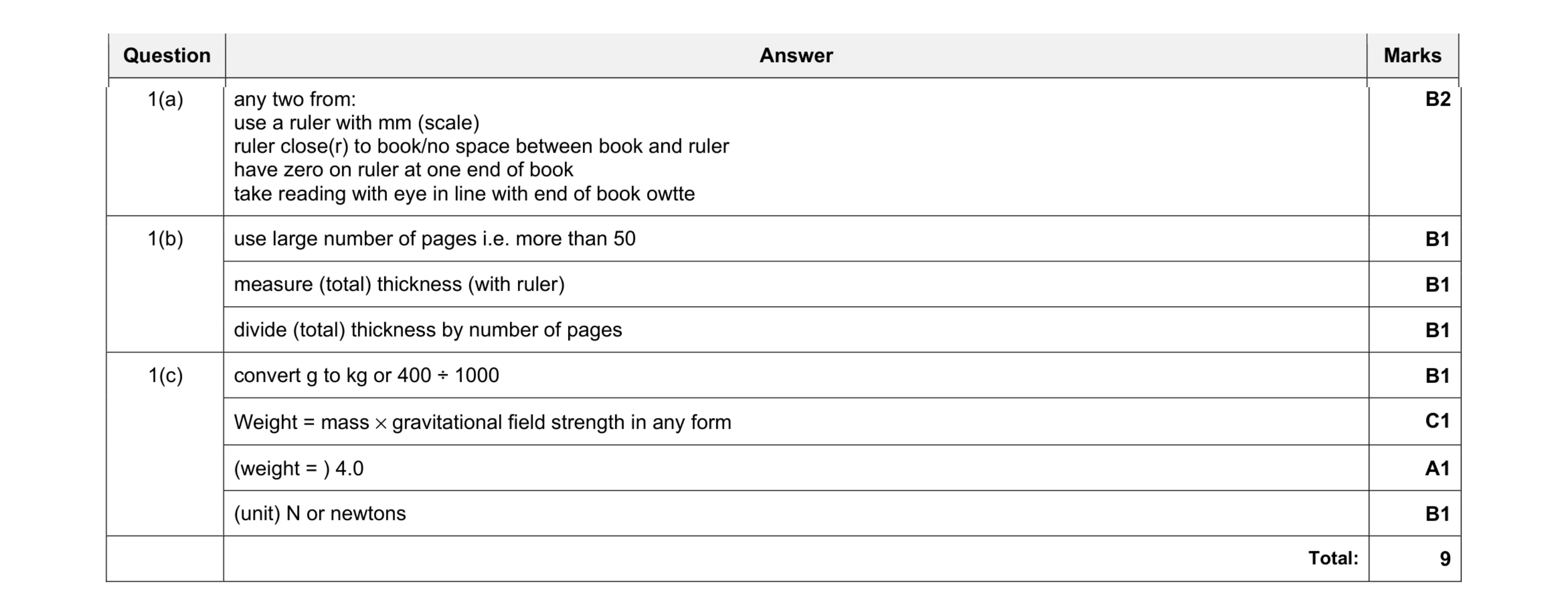 9
9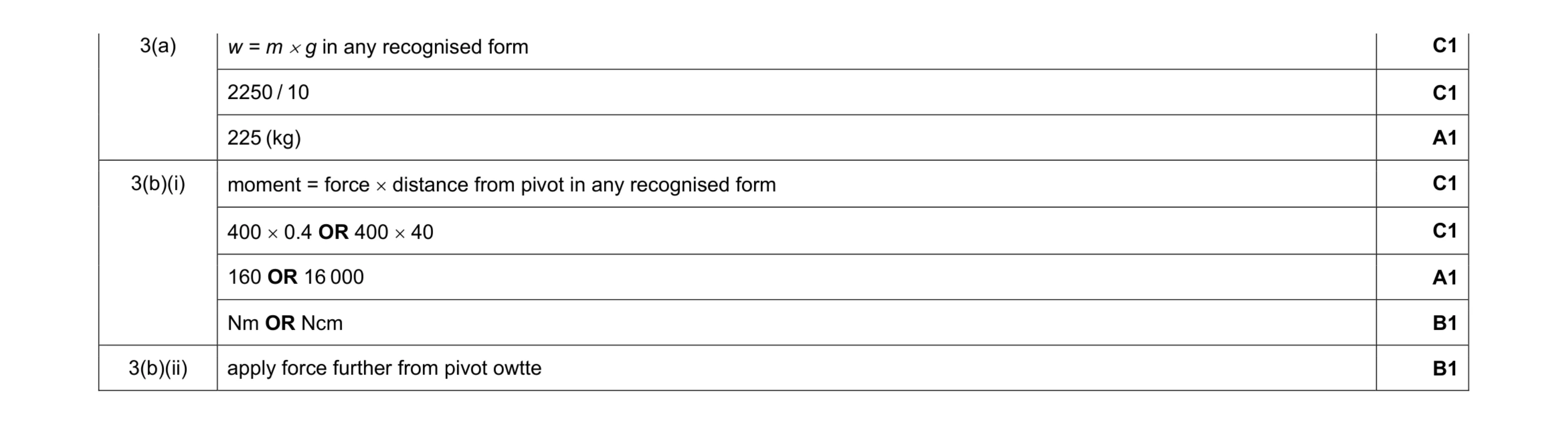 8
8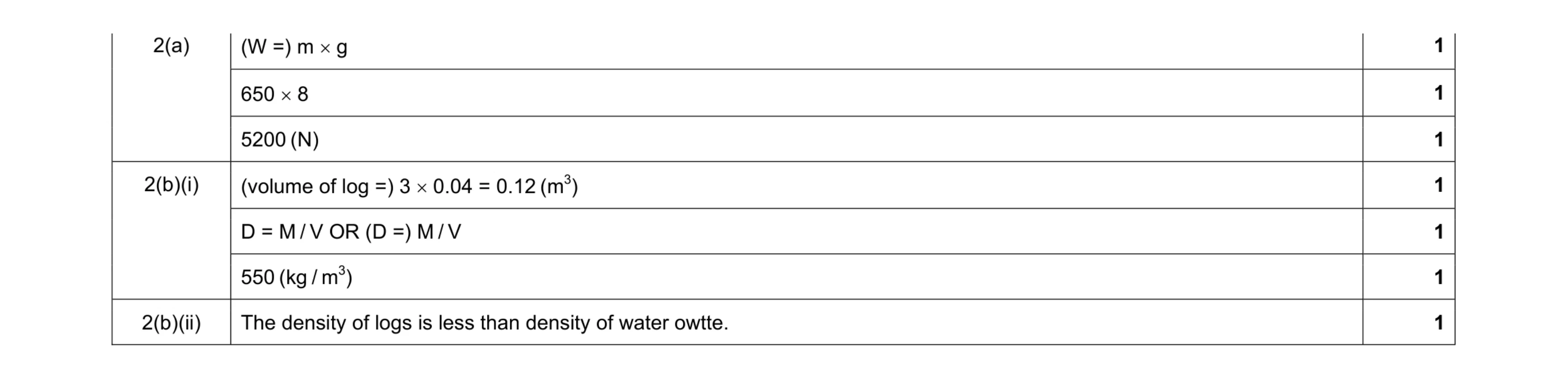 7
7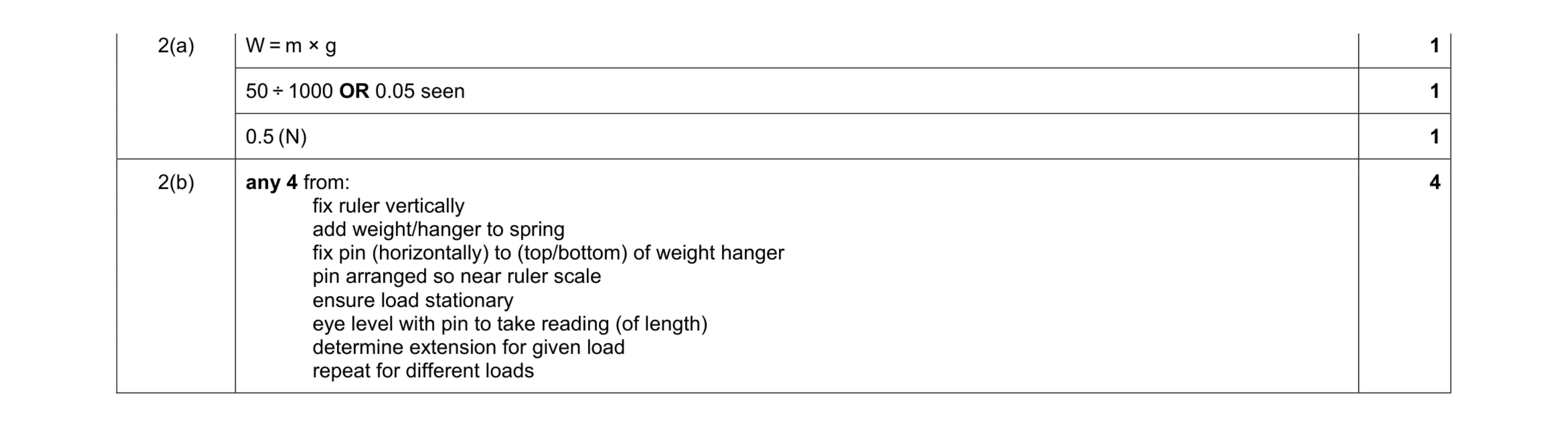 7
7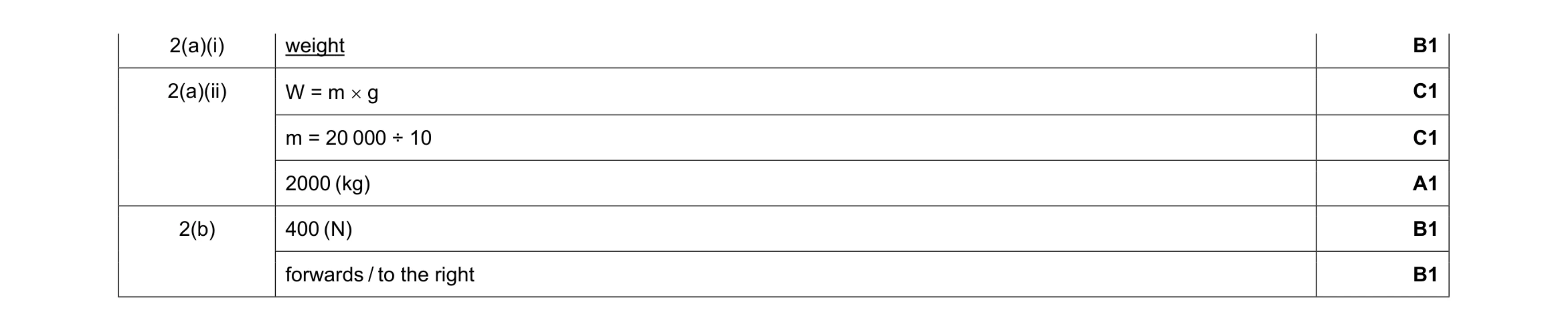 6
6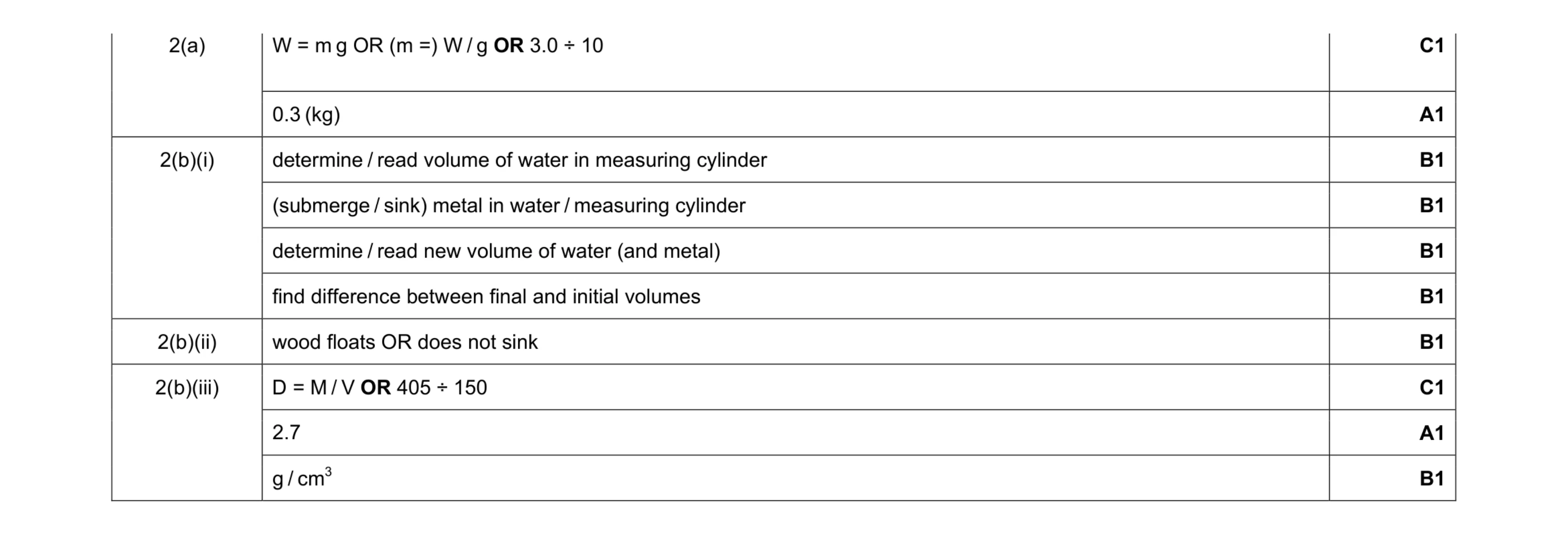 10
10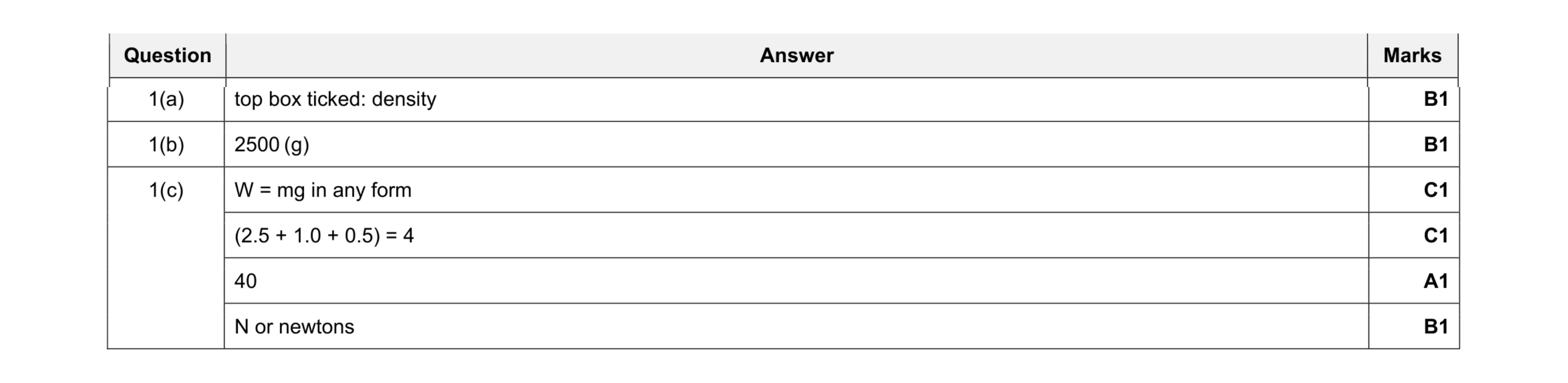 6
6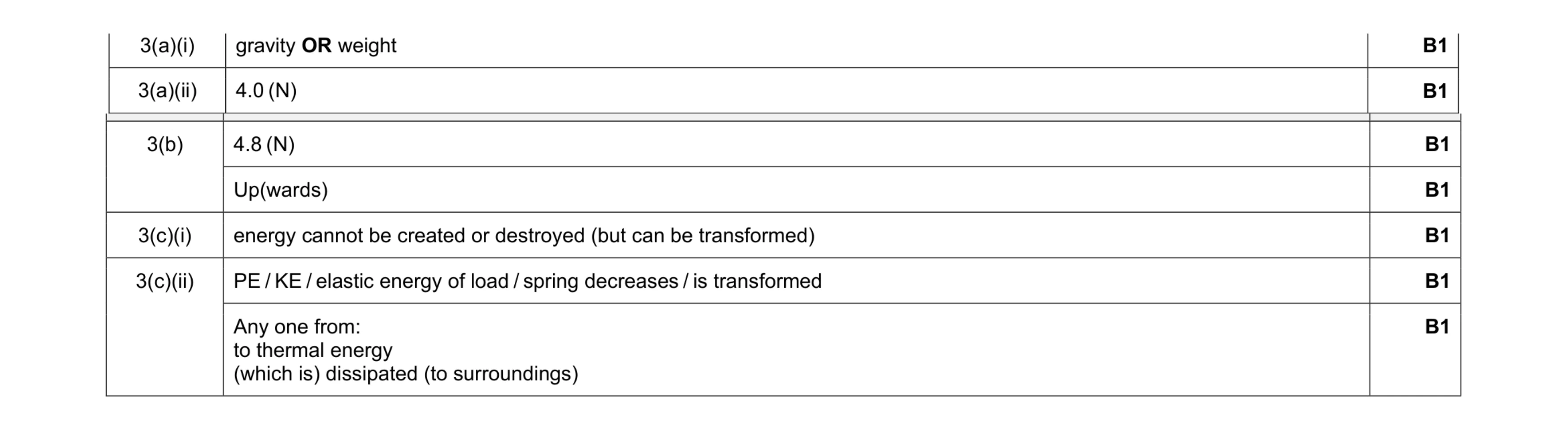 7
7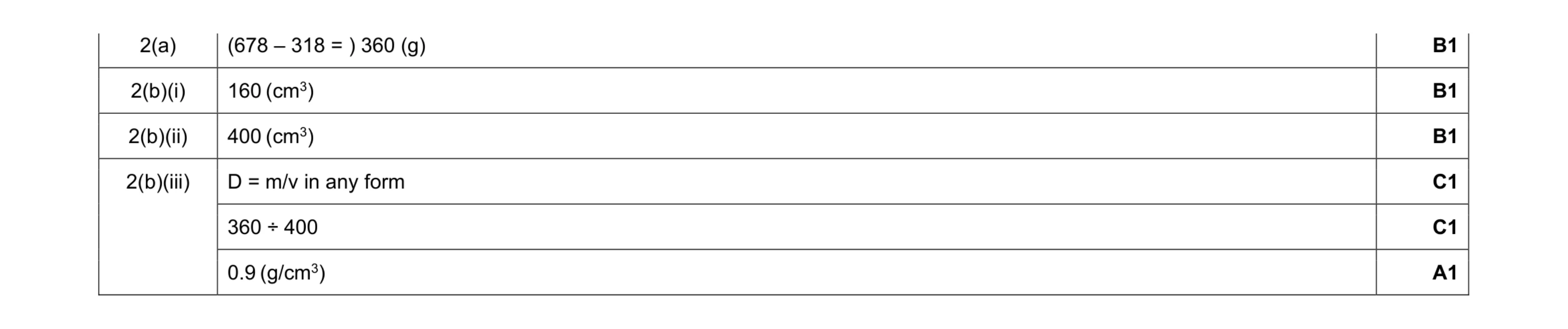 6
6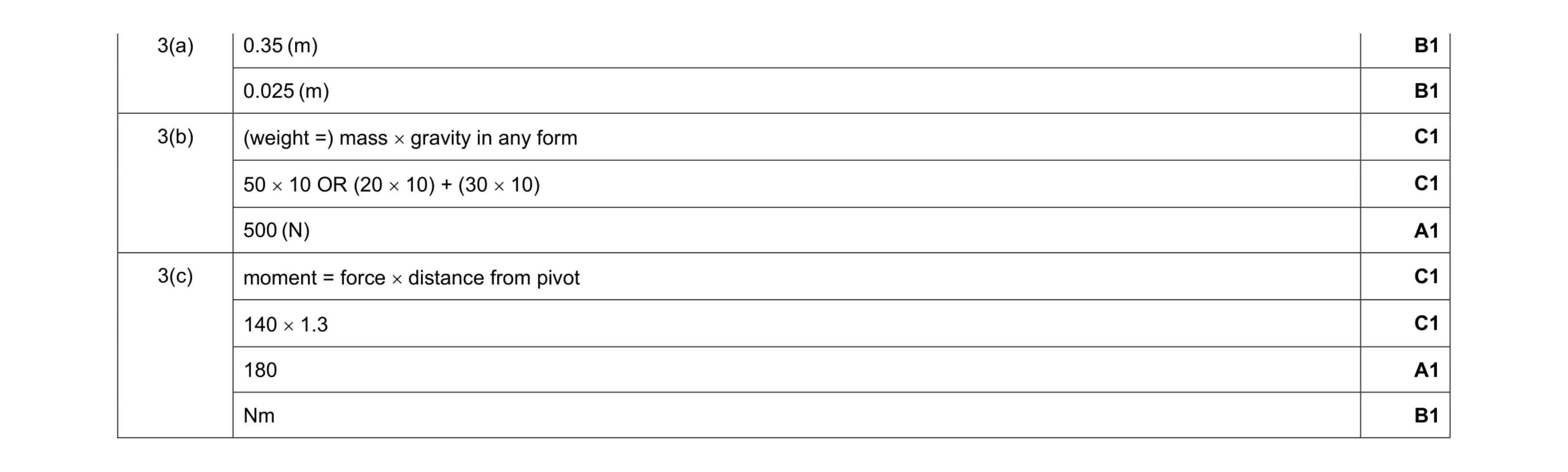 9
9 5
5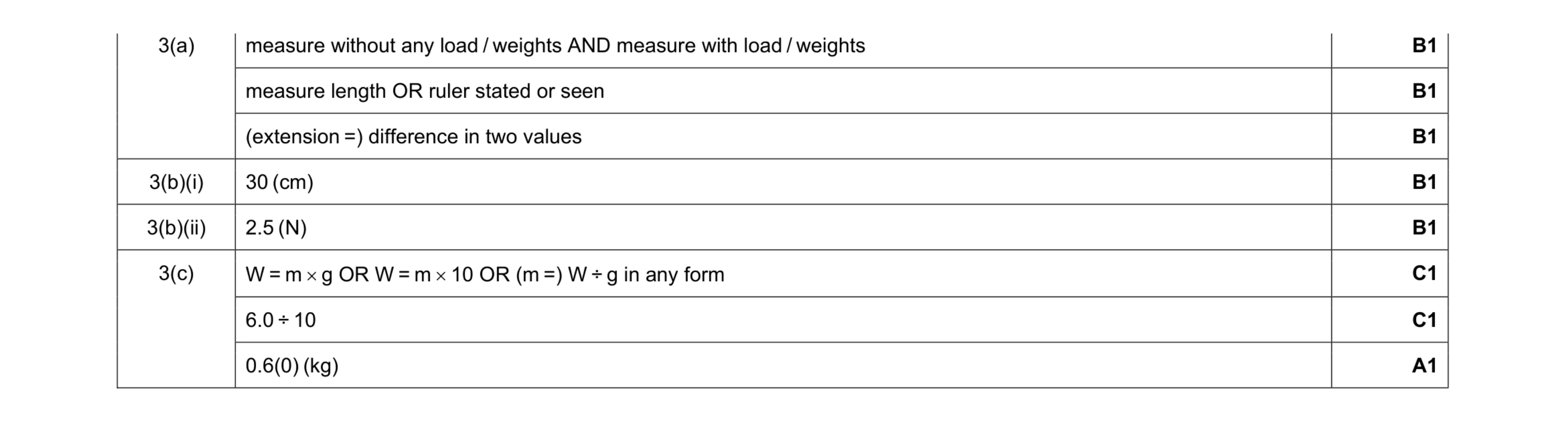 8
8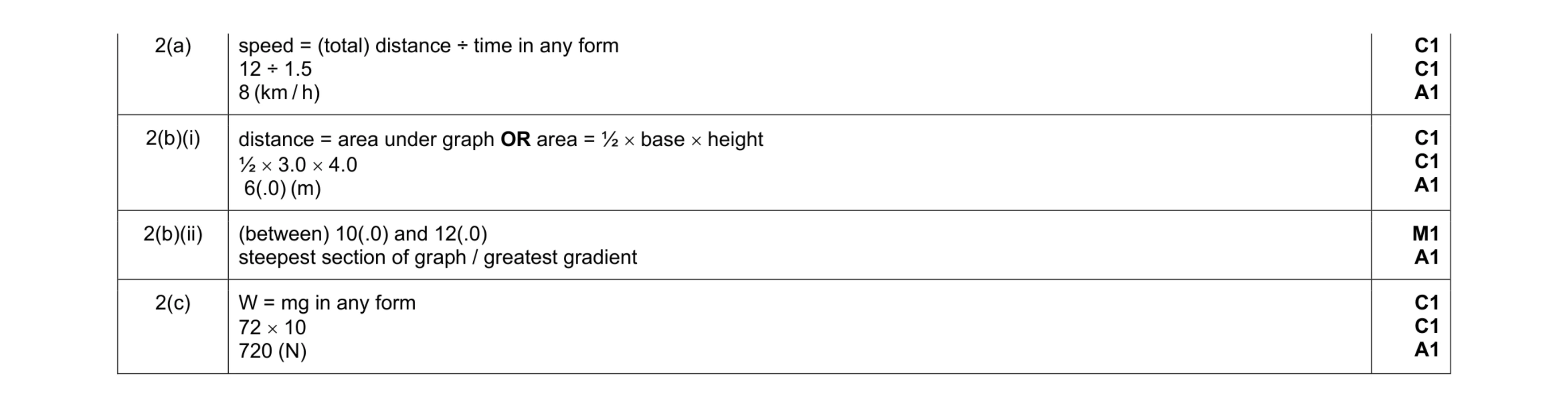 11
11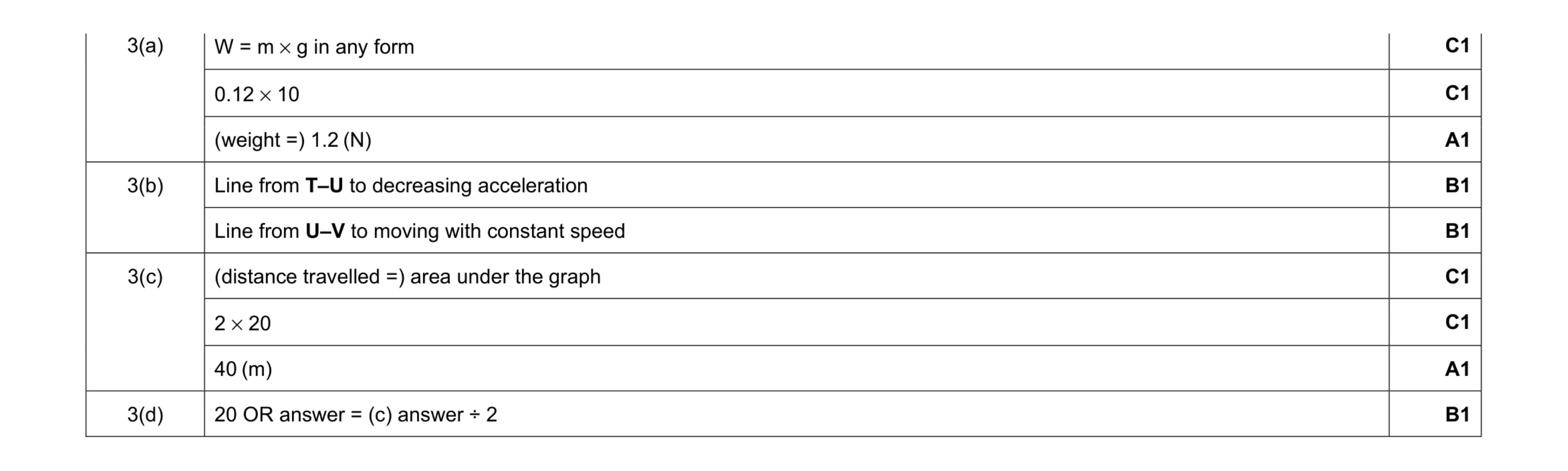 9
9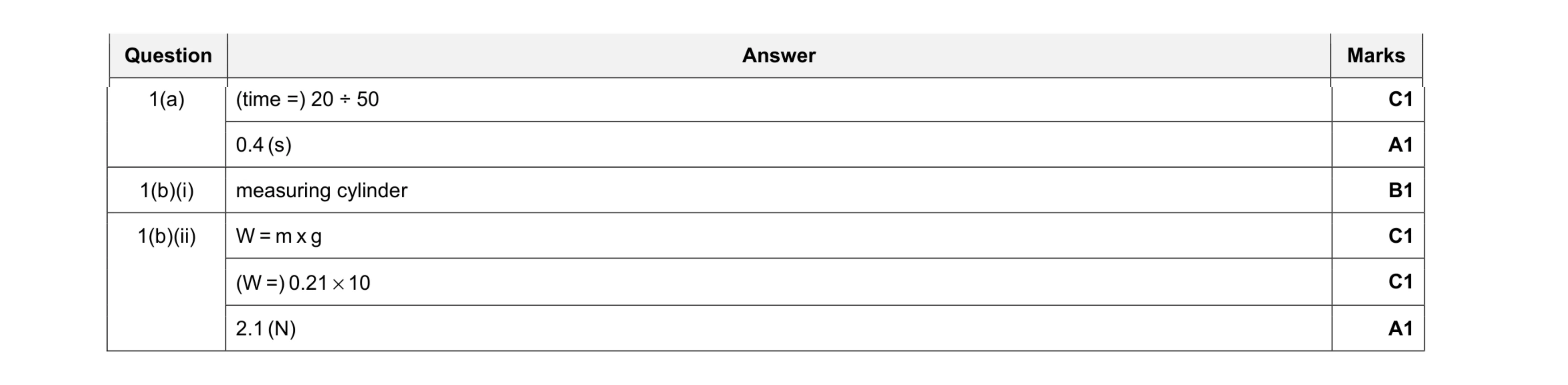 6
6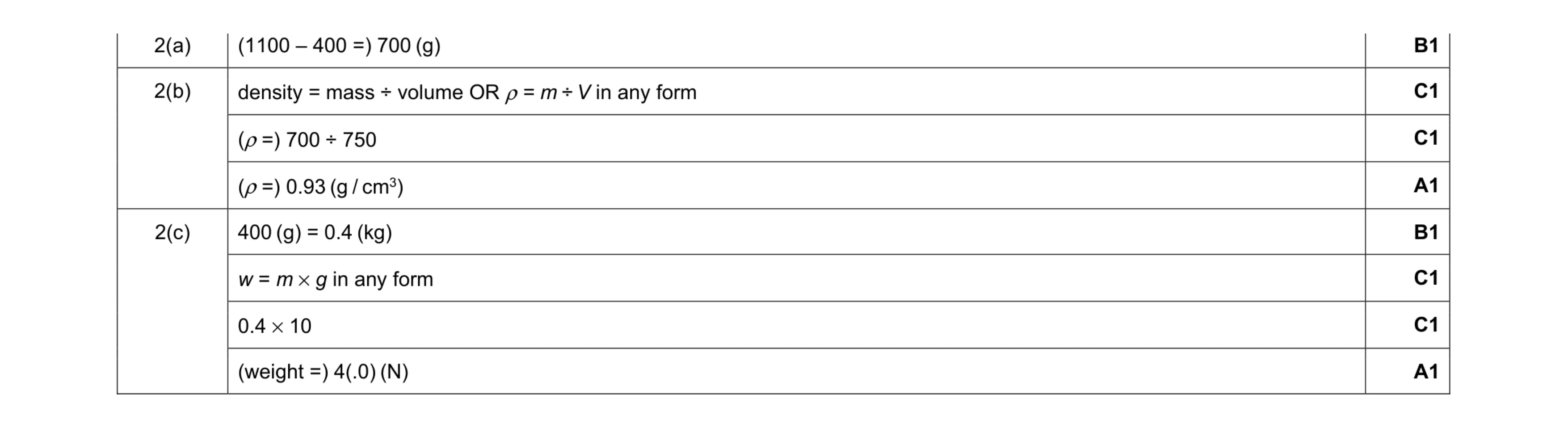 8
8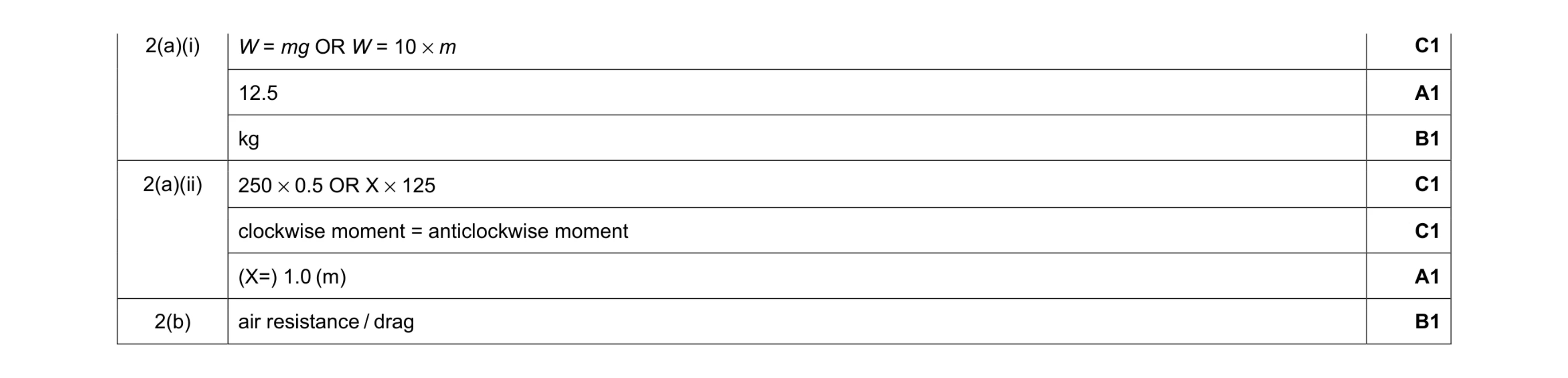 7
7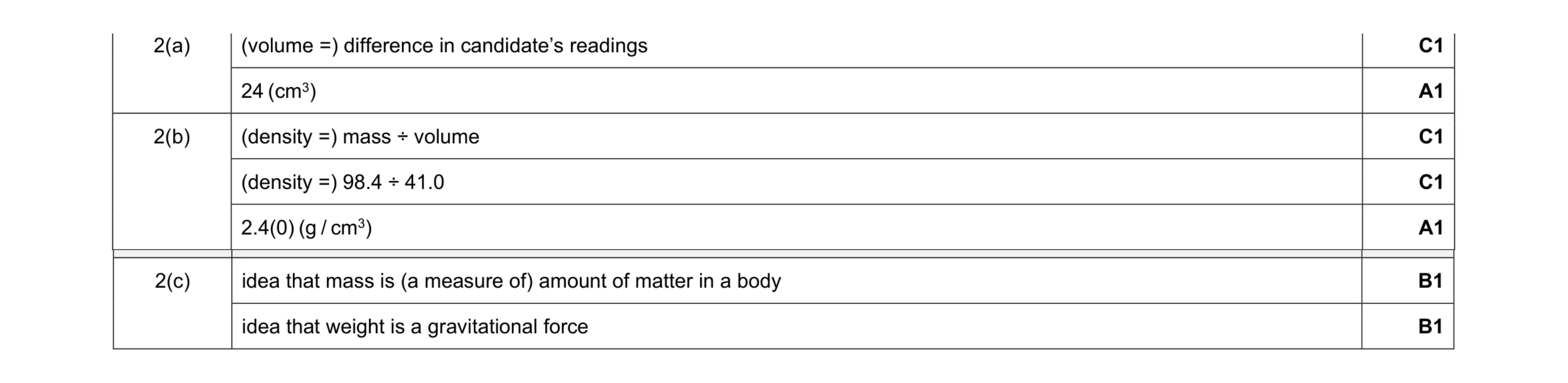 7
7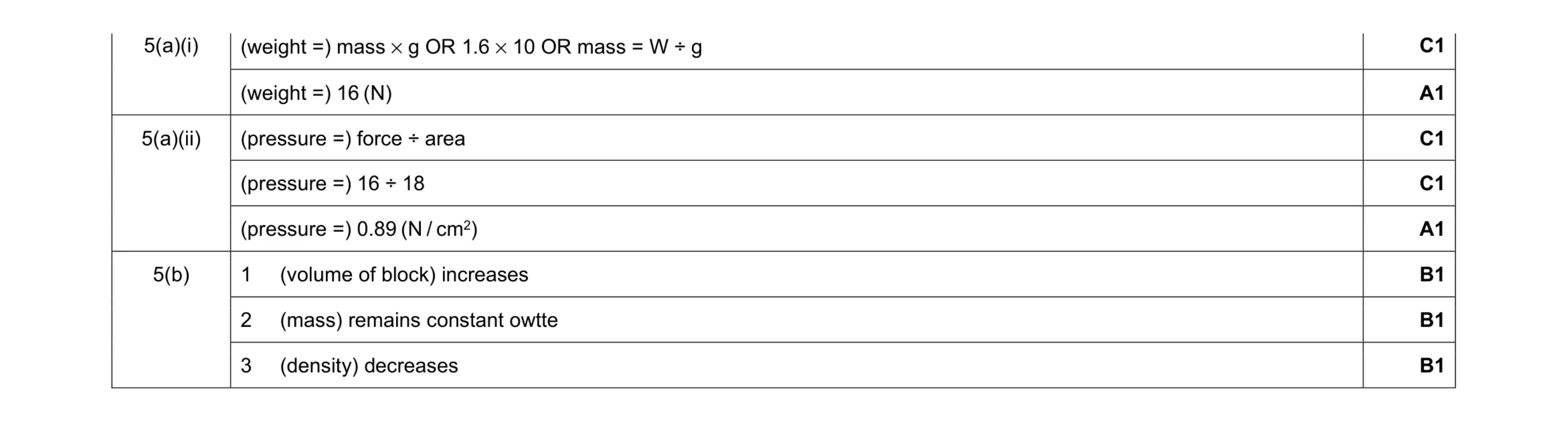 8
8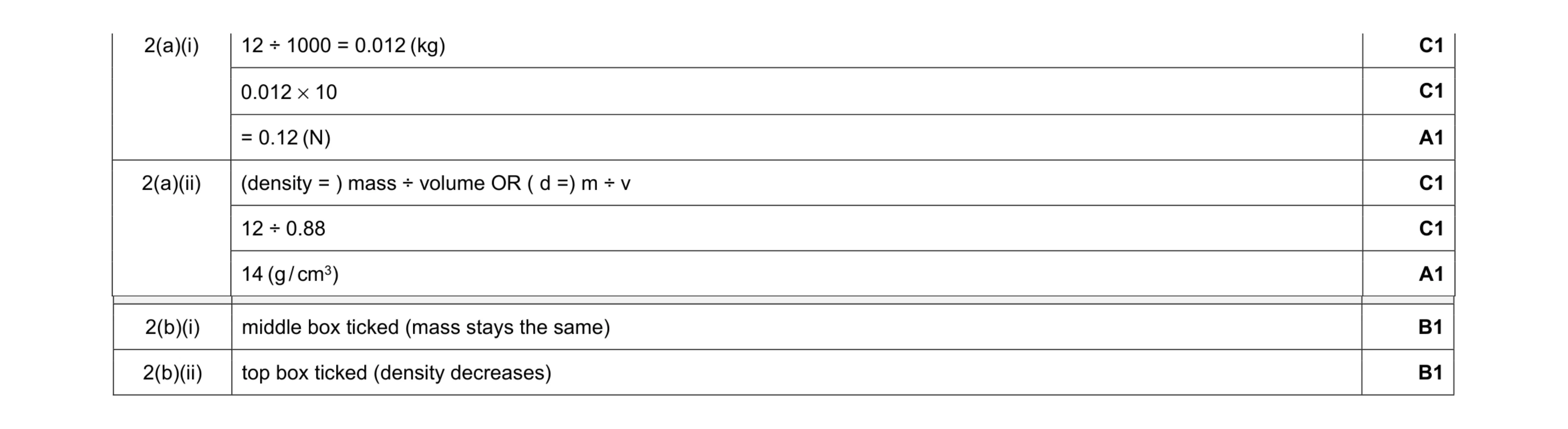 8
8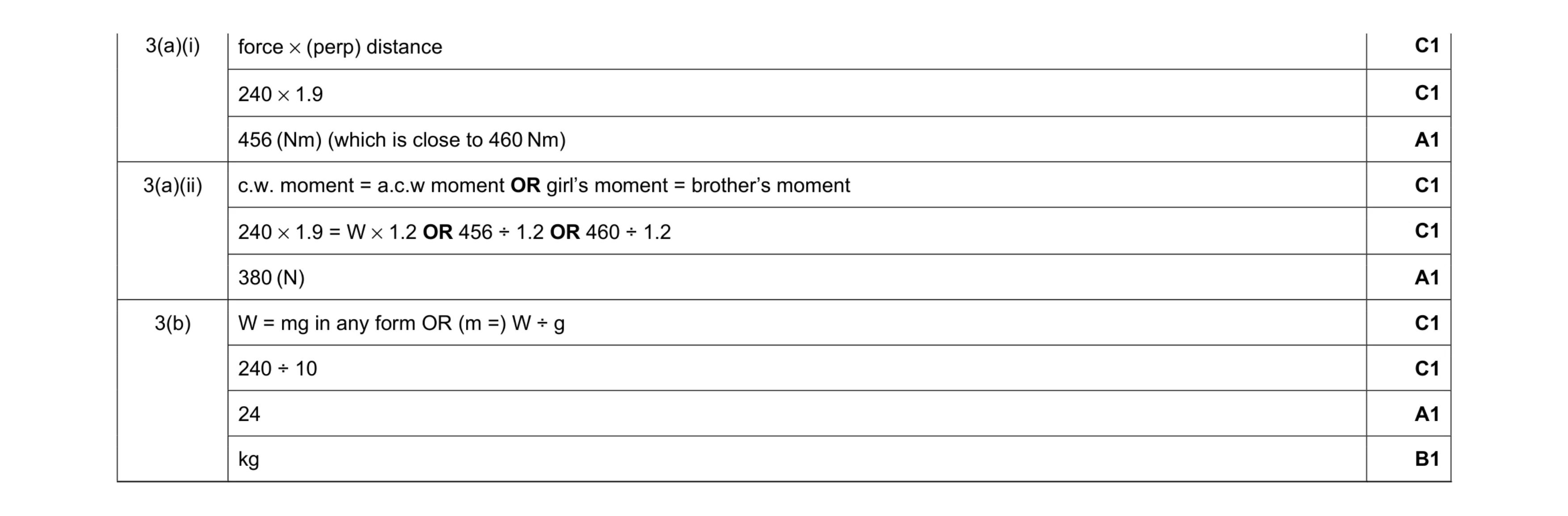 10
10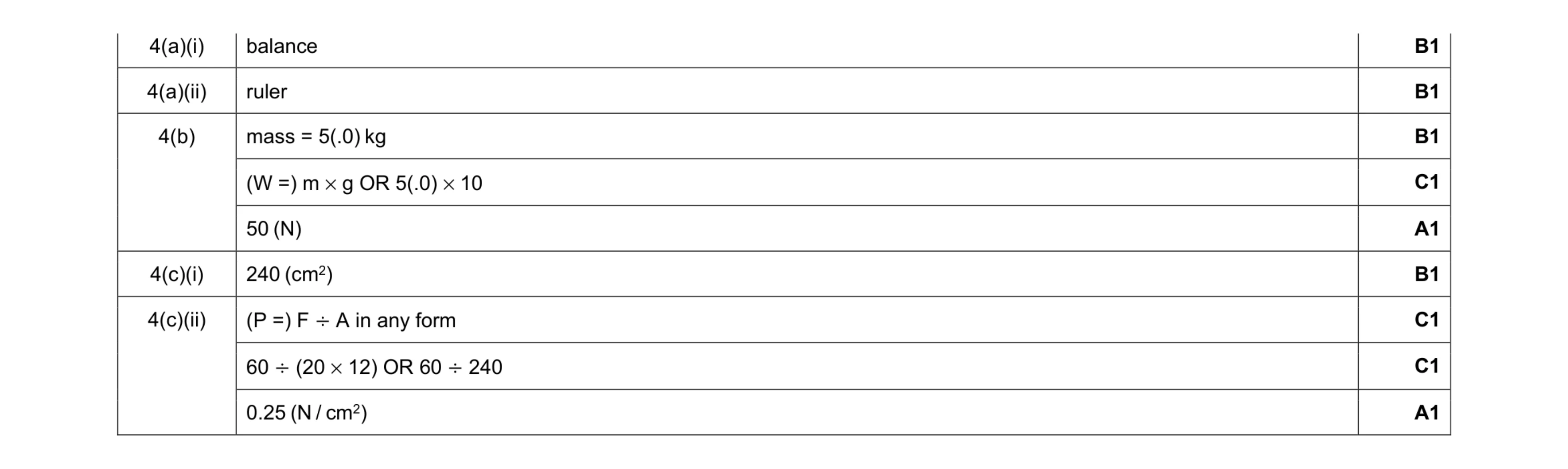 9
9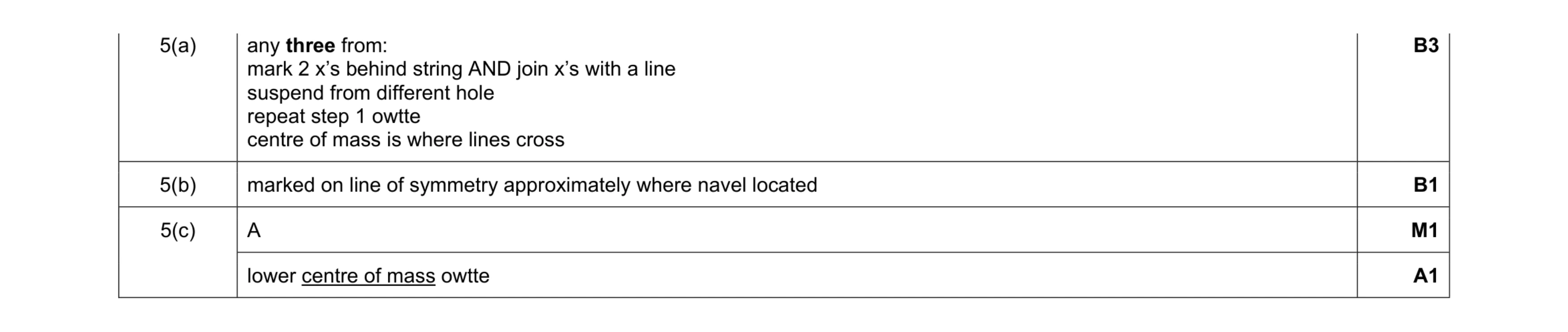 6
6 4
4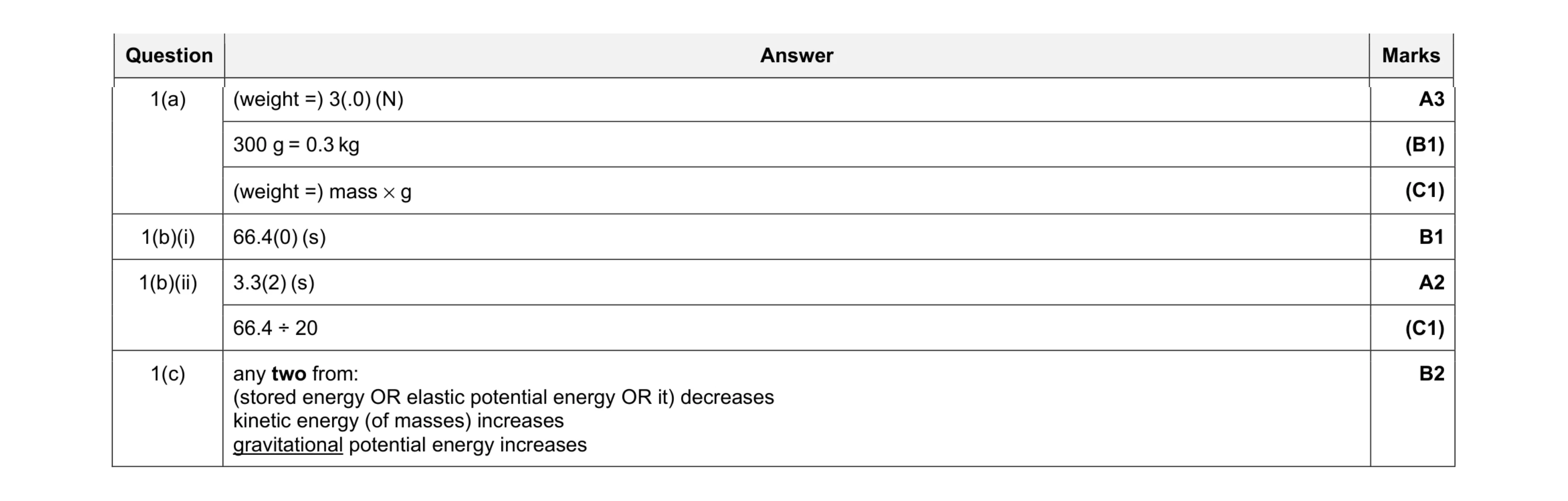 8
8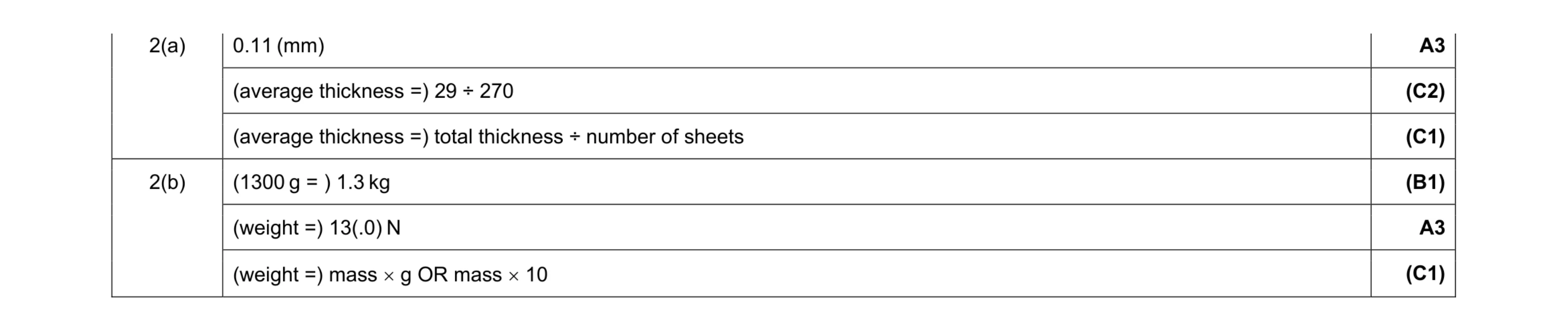 6
6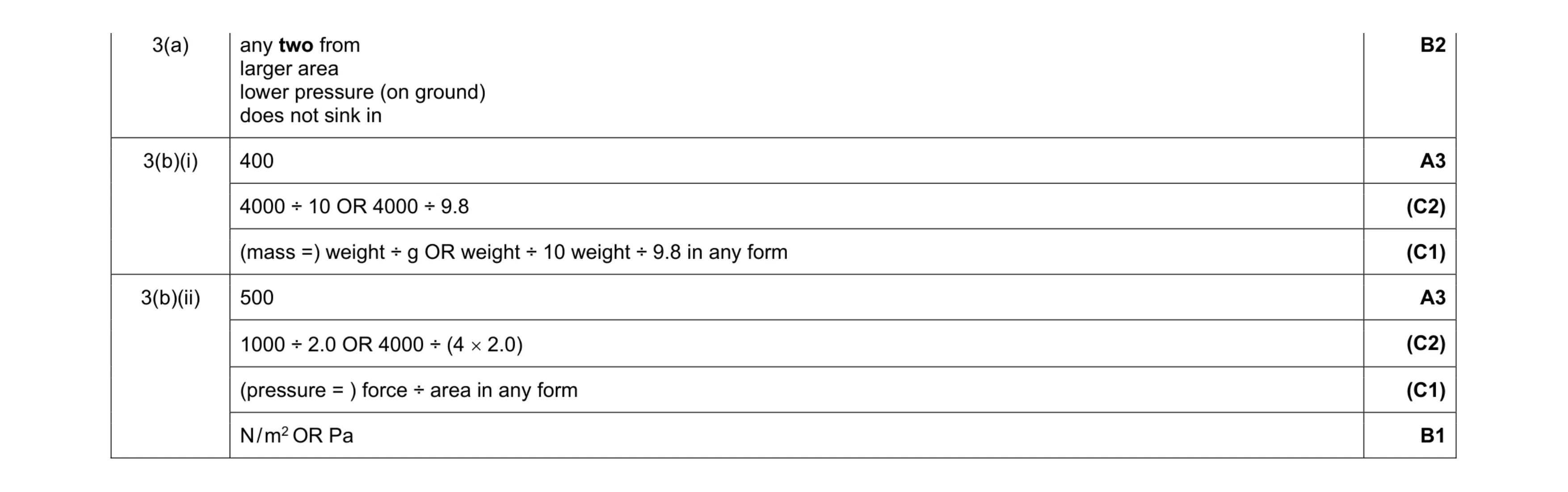 9
9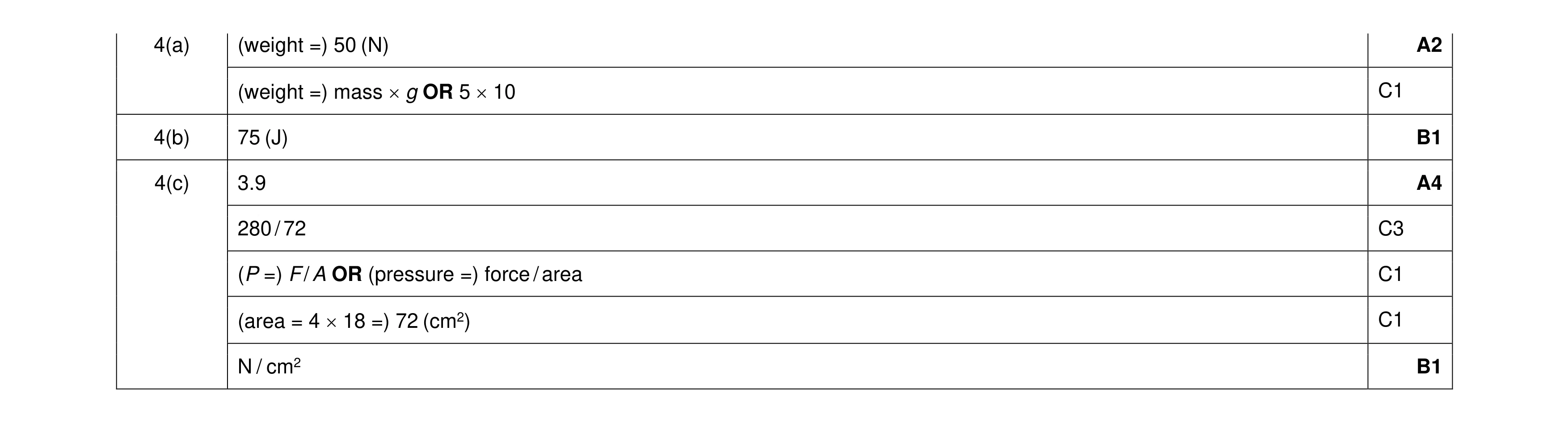 8
8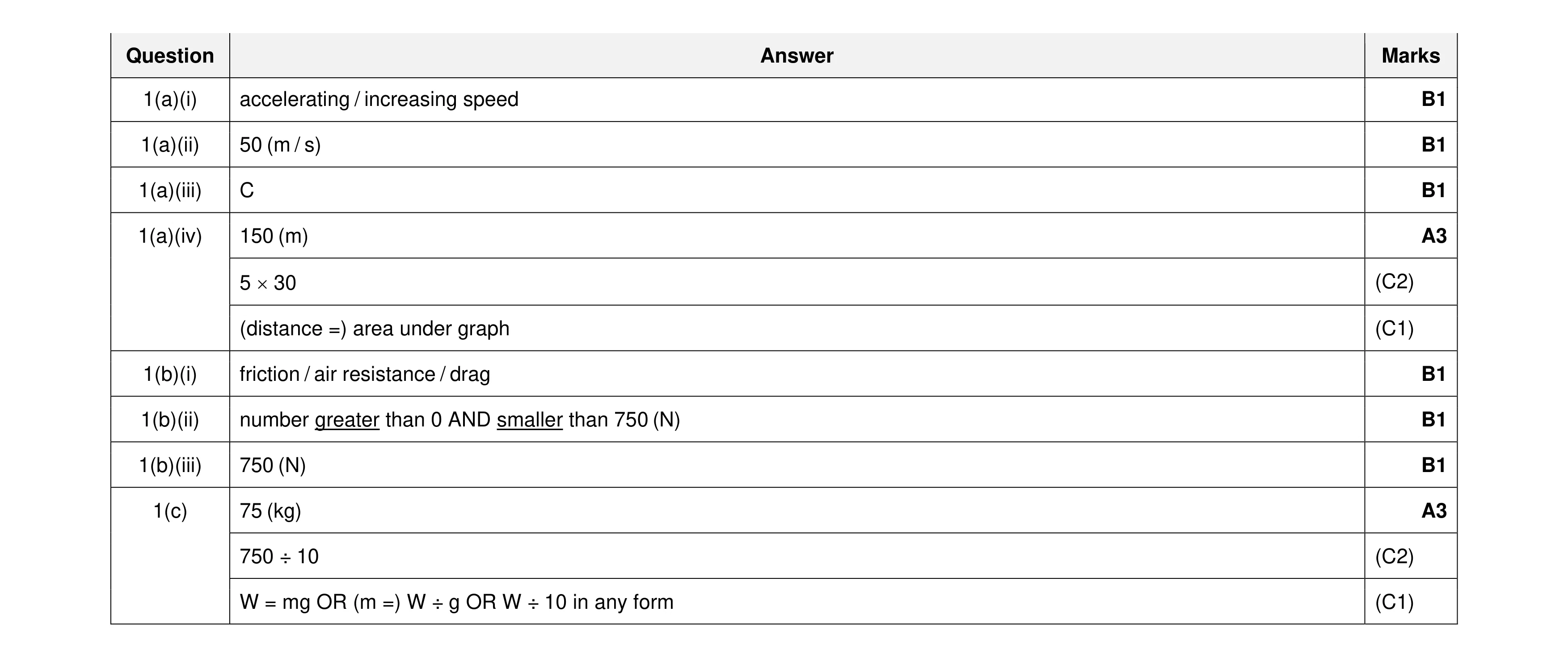 12
12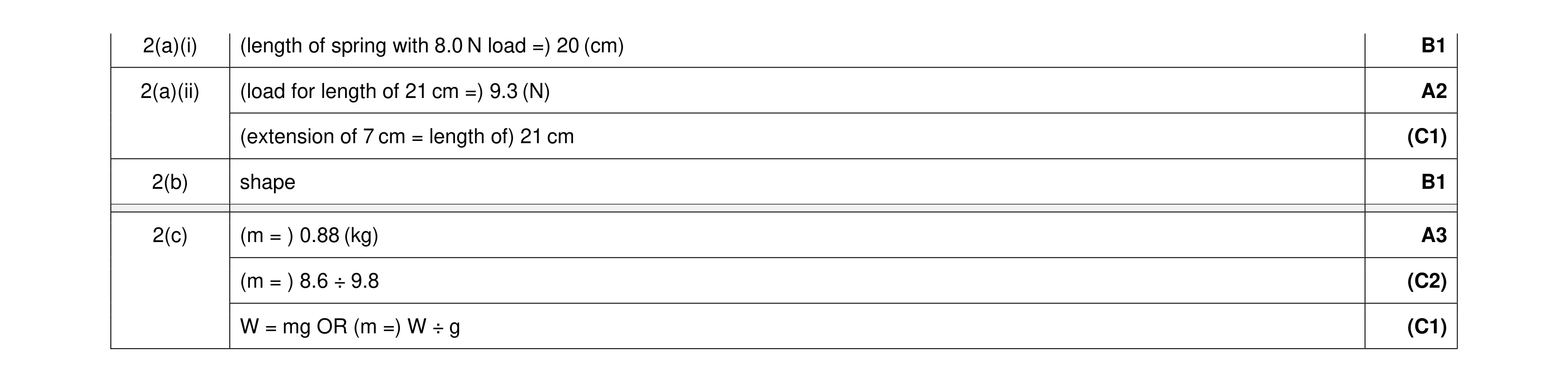 7
7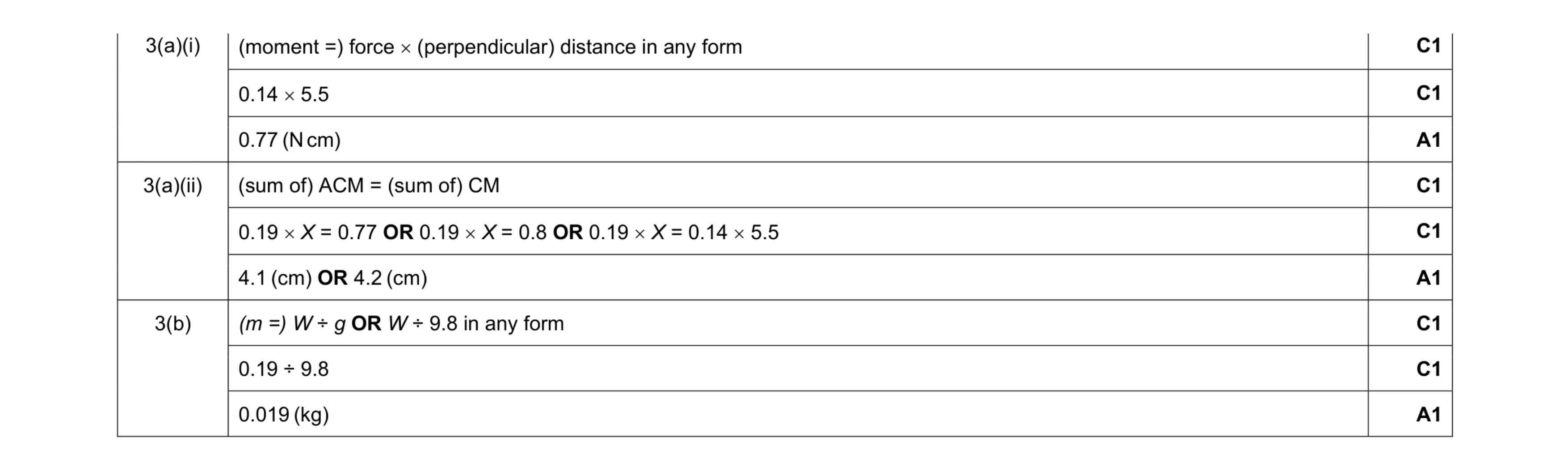 9
9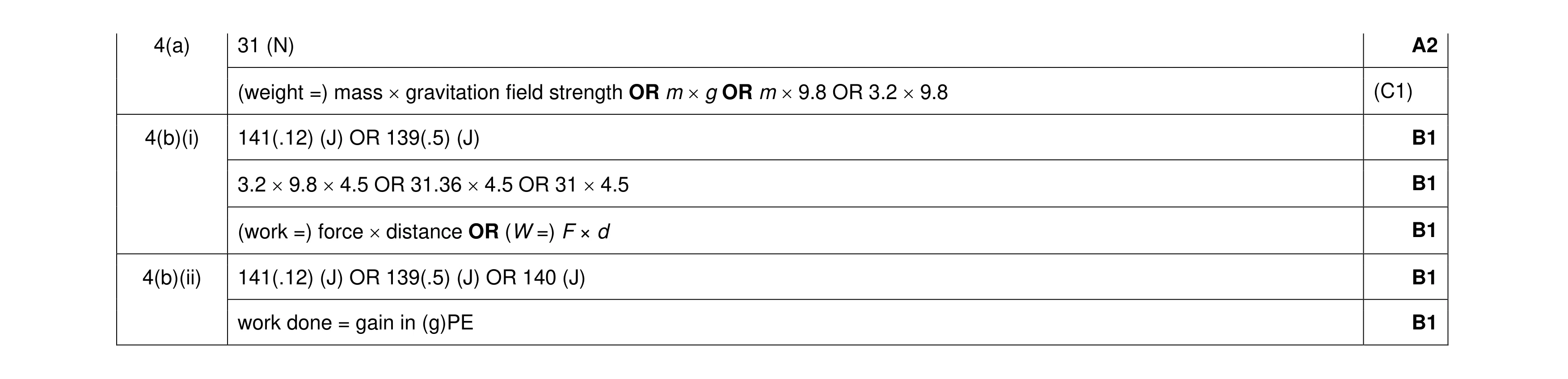 7
7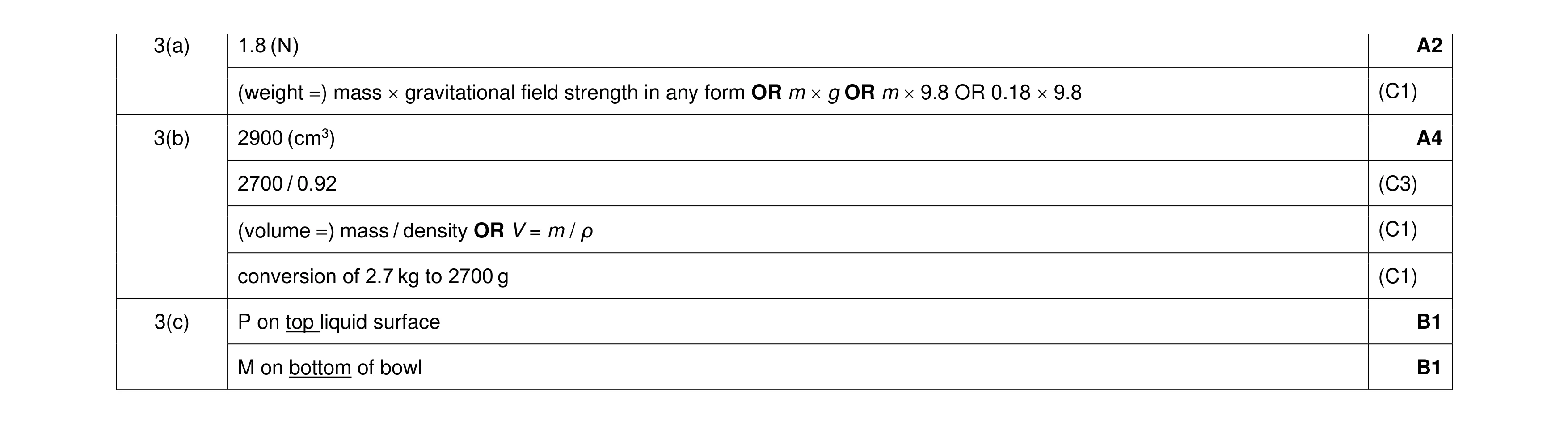 8
8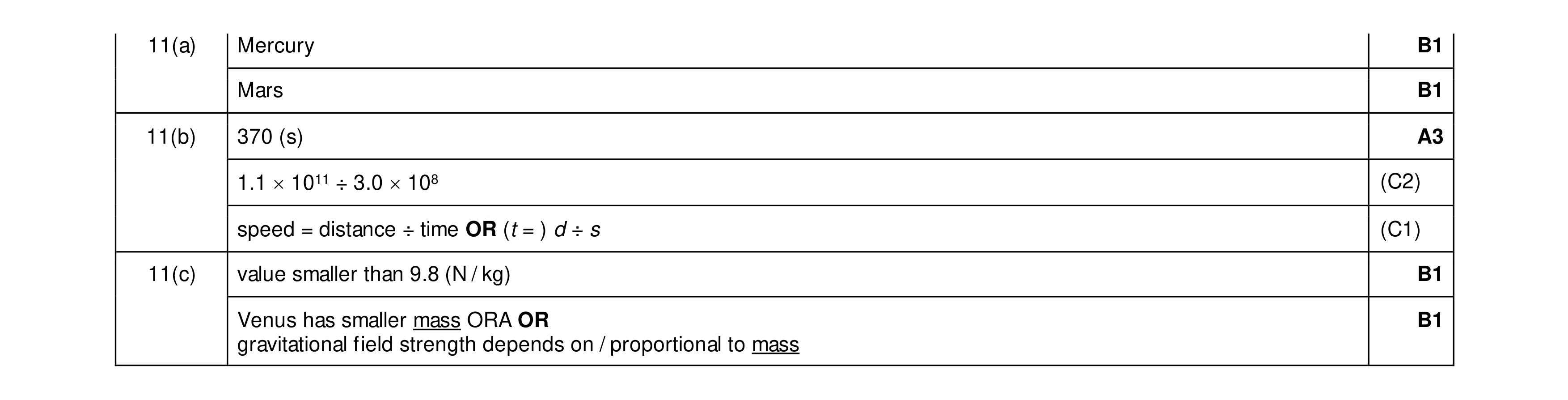 7
7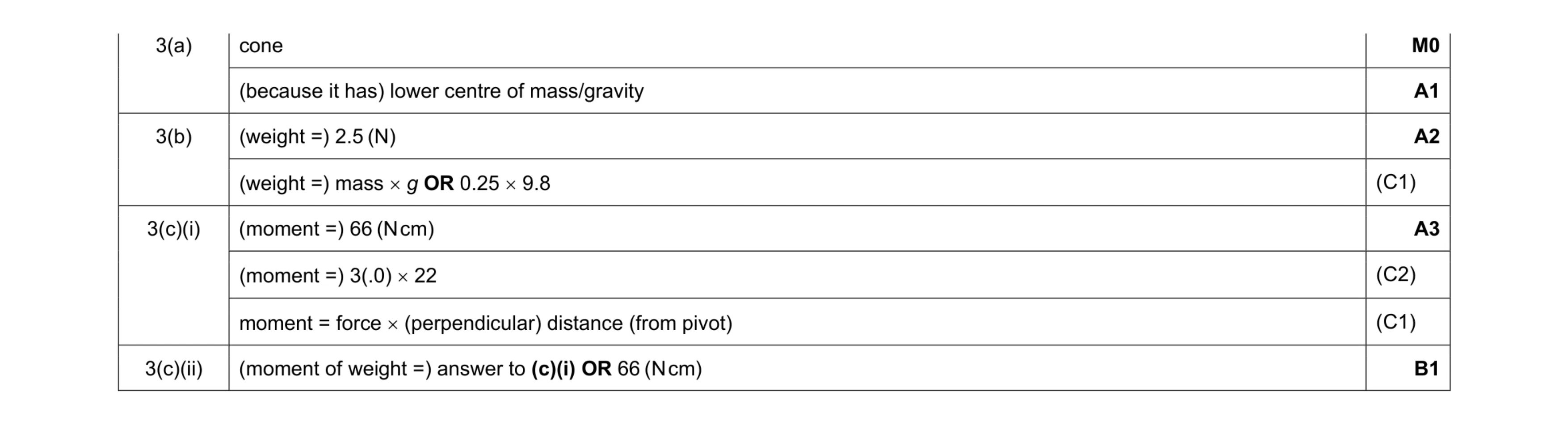 7
7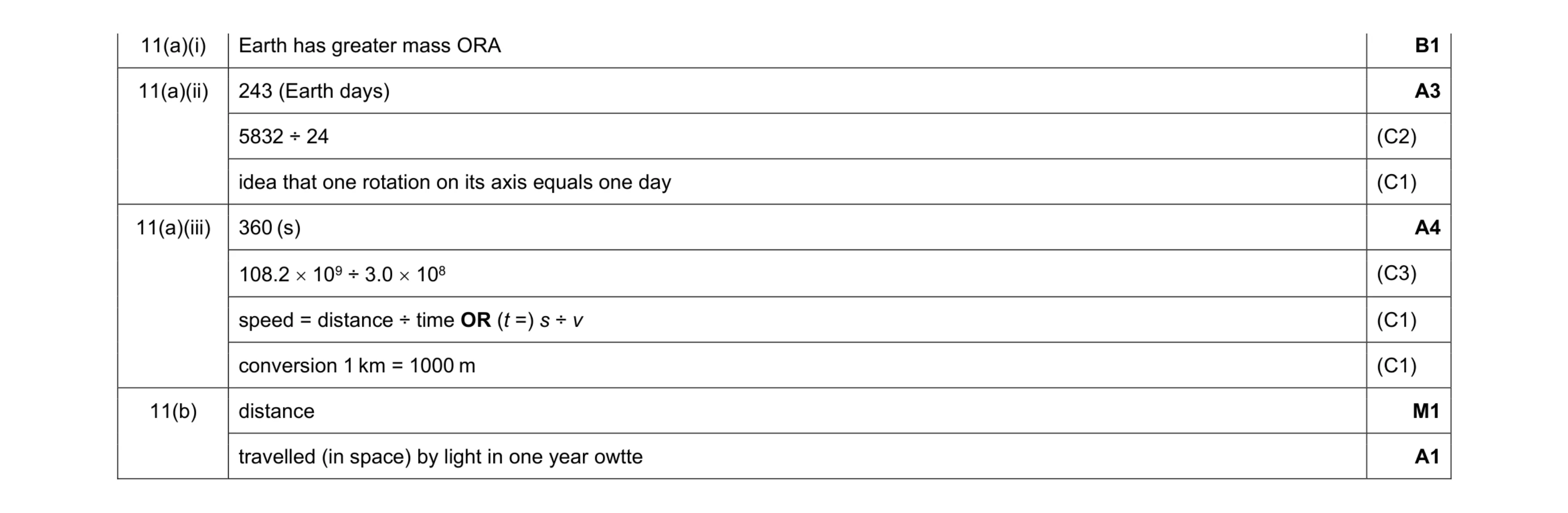 10
10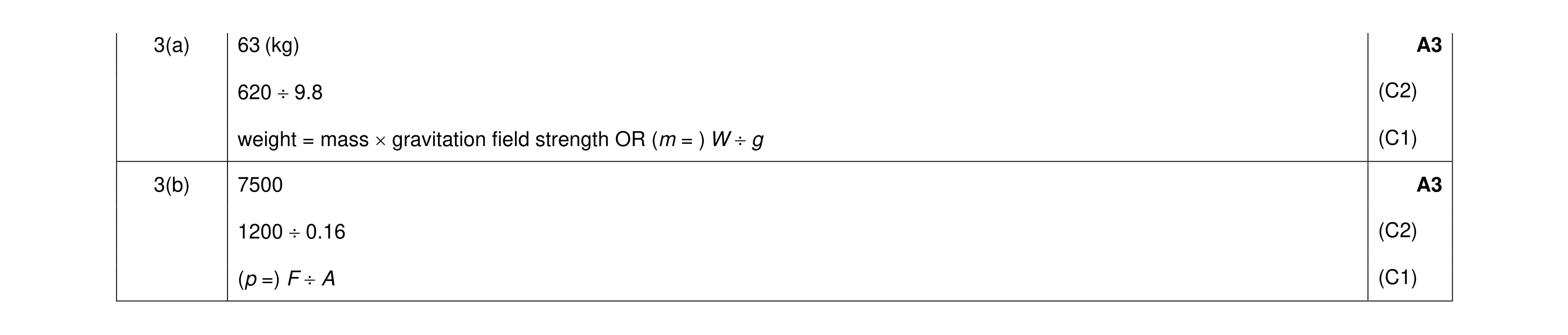 6
6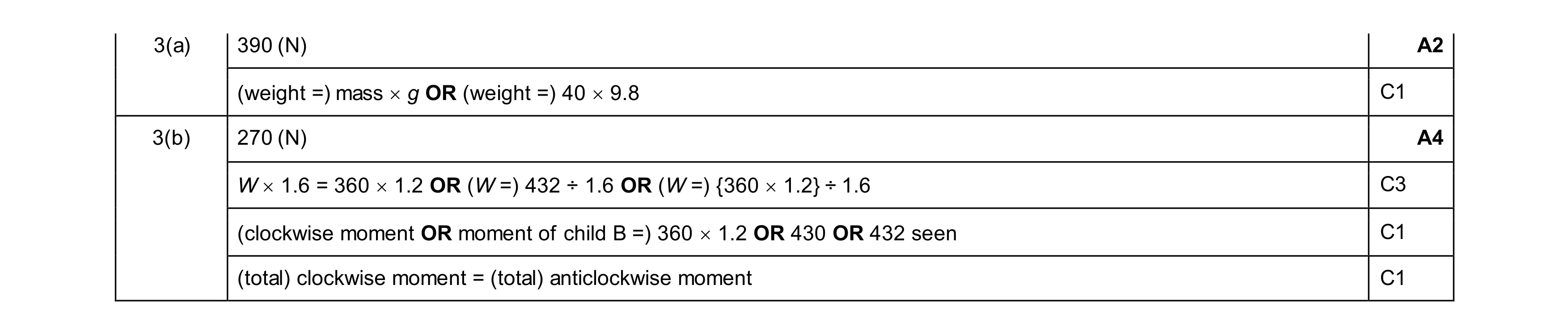 6
6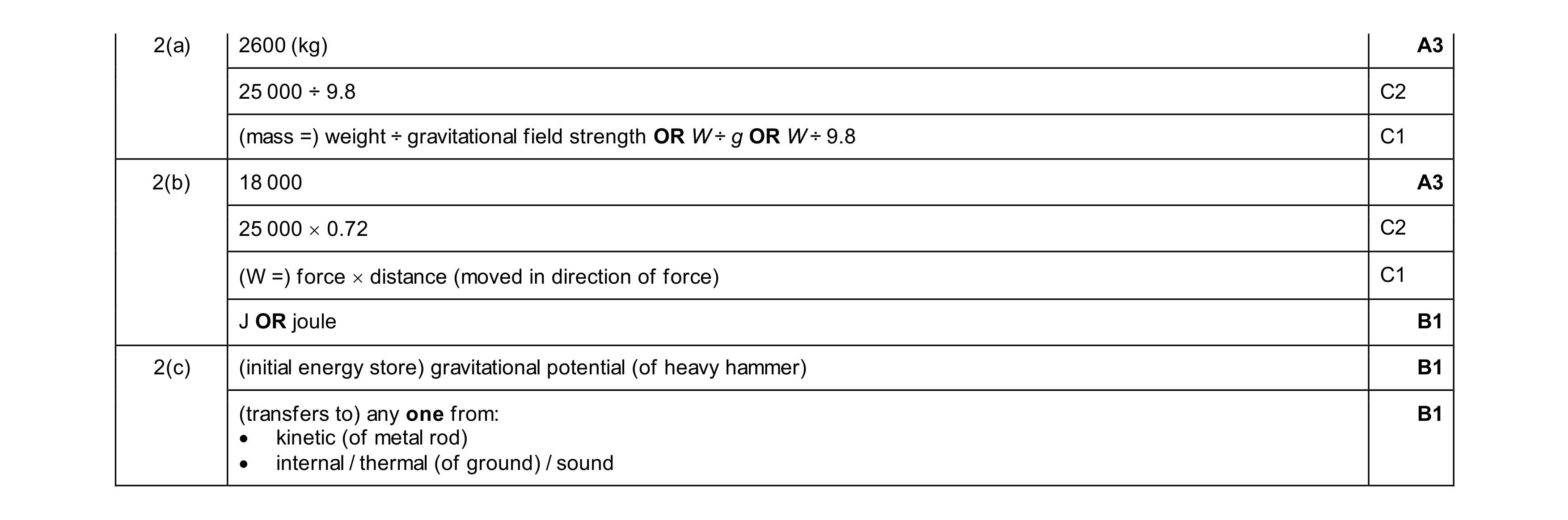 9
9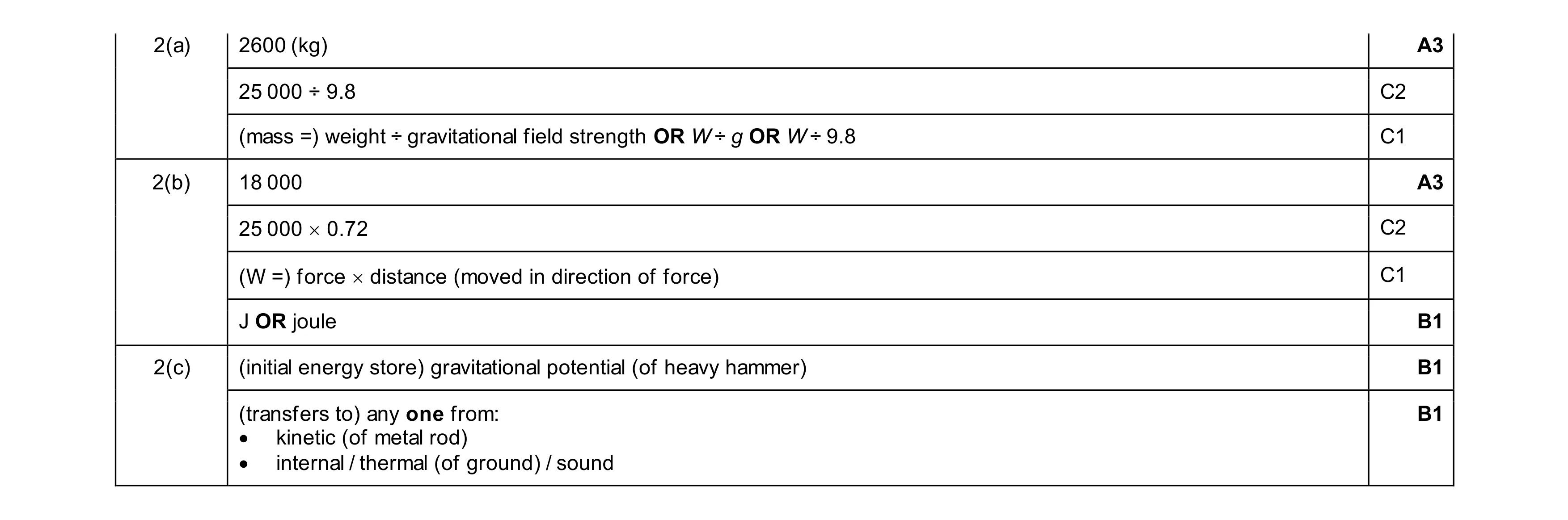 9
9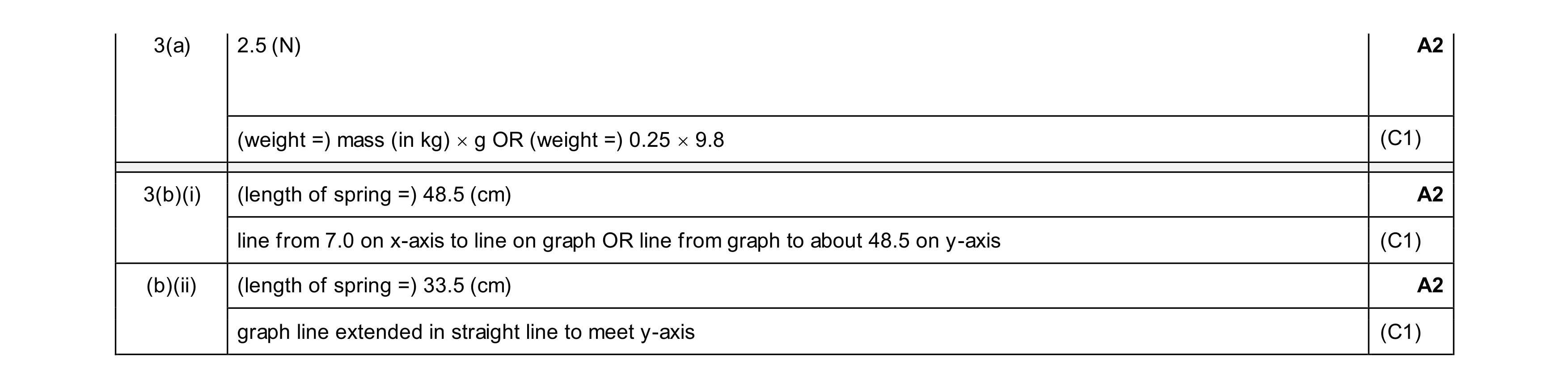 6
6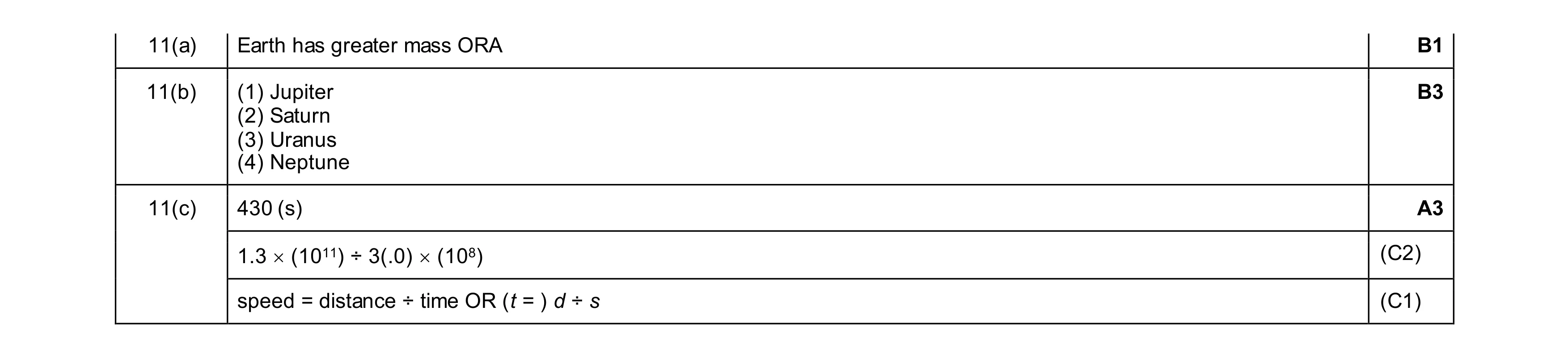 7
7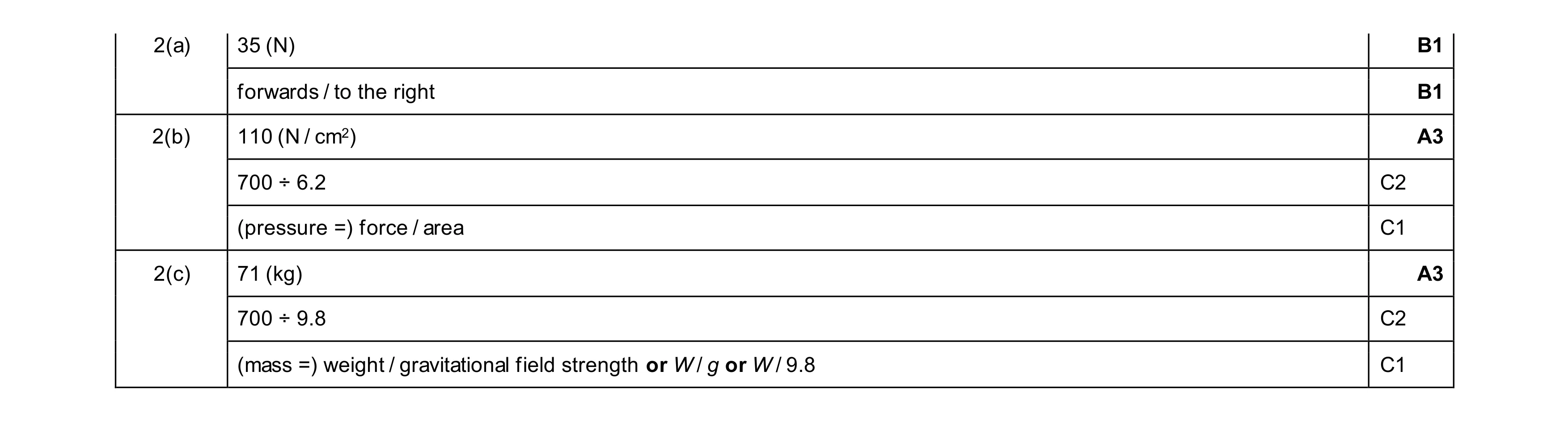 8
8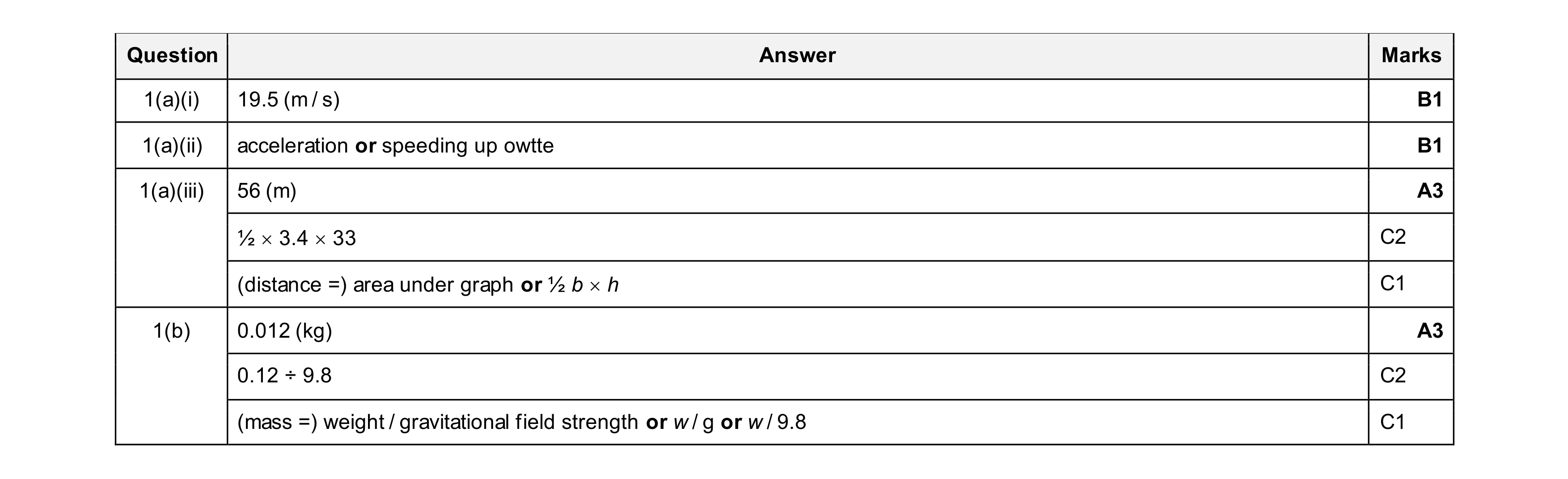 8
8