Questions as text
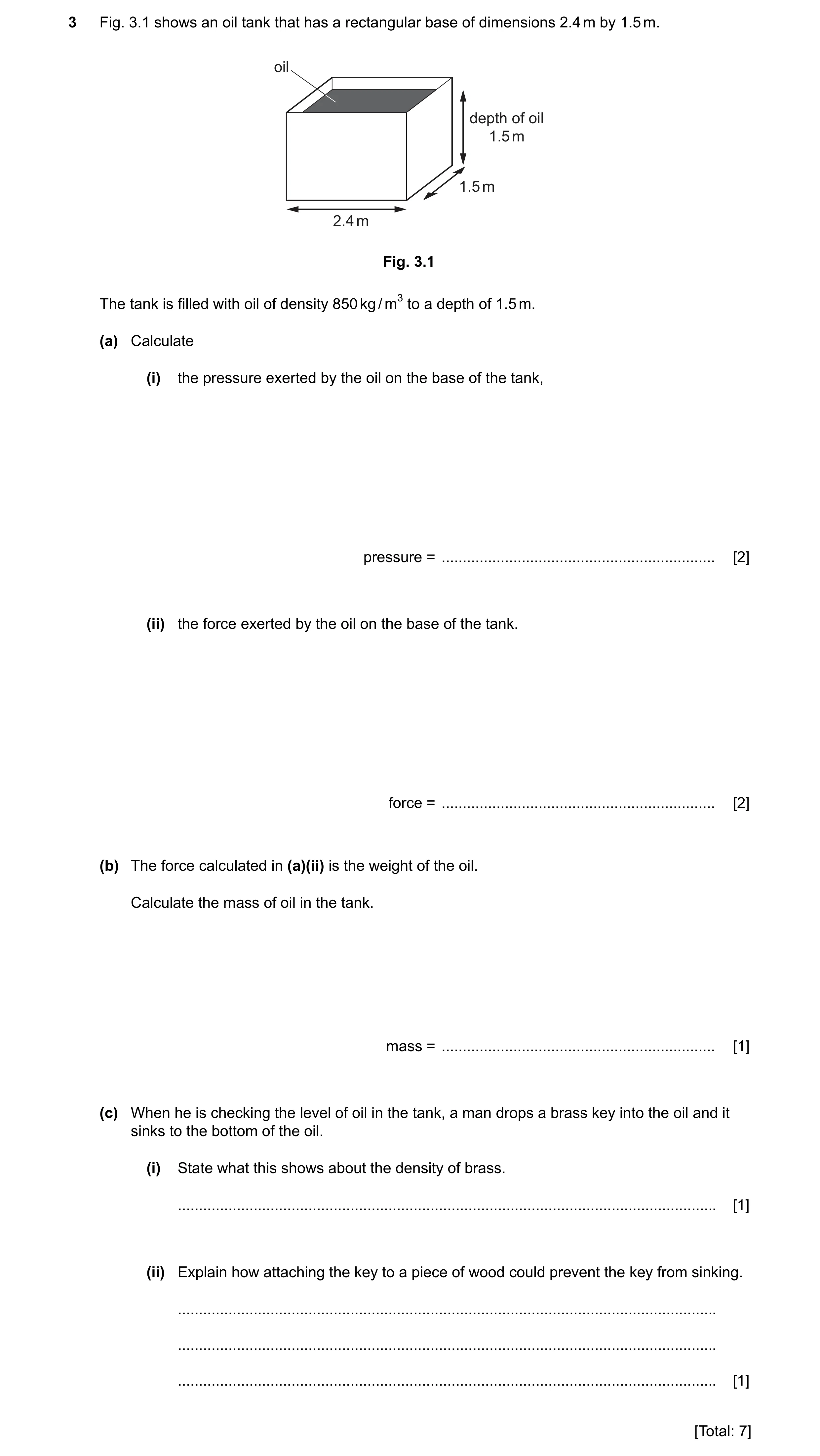
Q1 · An oil tank that has a rectangular base of dimensions 2.4m by 1.5m 0625/41 May/June 2016
3 Fig. 3.1 shows an oil tank that has a rectangular base of dimensions 2.4m by 1.5m. oil depth of oil 1.5 m 1.5 m 2.4 m Fig. 3.1 The tank is filled with oil of density 850kg/m3 to a depth of 1.5m. (a) Calculate (i) the pressure exerted by the oil on the base of the tank, pressure = … [2] (ii) the force exerted by the oil on the base of the tank. force = … [2] (b) The force calculated in (a)(ii) is the weight of the oil. Calculate the mass of oil in the tank. mass = … [1] (c) When he is checking the level of oil in the tank, a man drops a brass key into the oil and it sinks to the bottom of the oil. (i) State what this shows about the density of brass. … [1] (ii) Explain how attaching the key to a piece of wood could prevent the key from sinking. … … … [1] [Total: 7]
7 marks
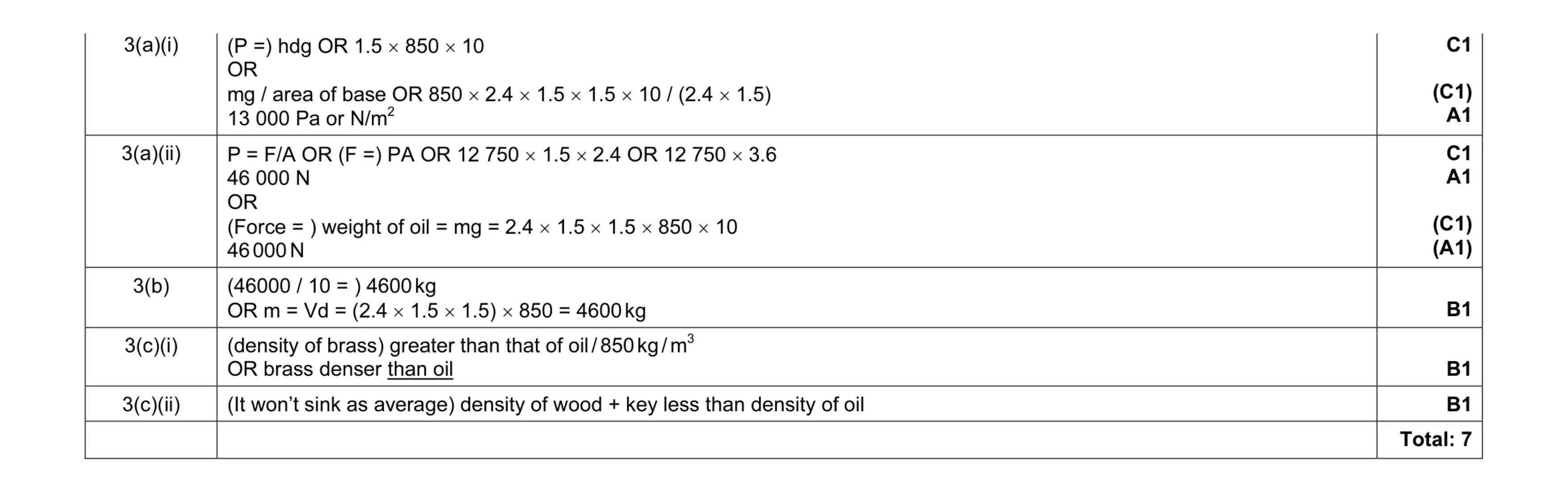
Mark scheme: 3(a)(i) (P =) hdg OR 1.5 × 850 × 10 OR mg / area of base OR 850 × 2.4 × 1.5 × 1.5 × 10 / (2.4 × 1.5) 13 000 Pa or N/m2 C1 (C1) A1 3(a)(ii) P = F/A OR (F =) PA OR 12 750 × 1.5 × 2.4 OR 12 750 × 3.6 46 000 N OR (Force = ) weight of oil = mg = 2.4 × 1.5 × 1.5 × 850 × 10 46 000 N C1 A1 (C1) (A1) 3(b) (46000 / 10 = ) 4600 kg OR m = Vd = (2.4 × 1.5 × 1.5) × 850 = 4600 kg B1 3(c)(i) (density of brass) greater than that of oil / 850 kg / m3 OR brass denser than oil B1 3(c)(ii) (It won’t sink as average) density of wood + key less than density of oil B1 Total: 7
This question in 0625/41 May/June 2016
Q2 · Remote sensing equipment on the surface of a distant planet 0625/41 May/June 2017
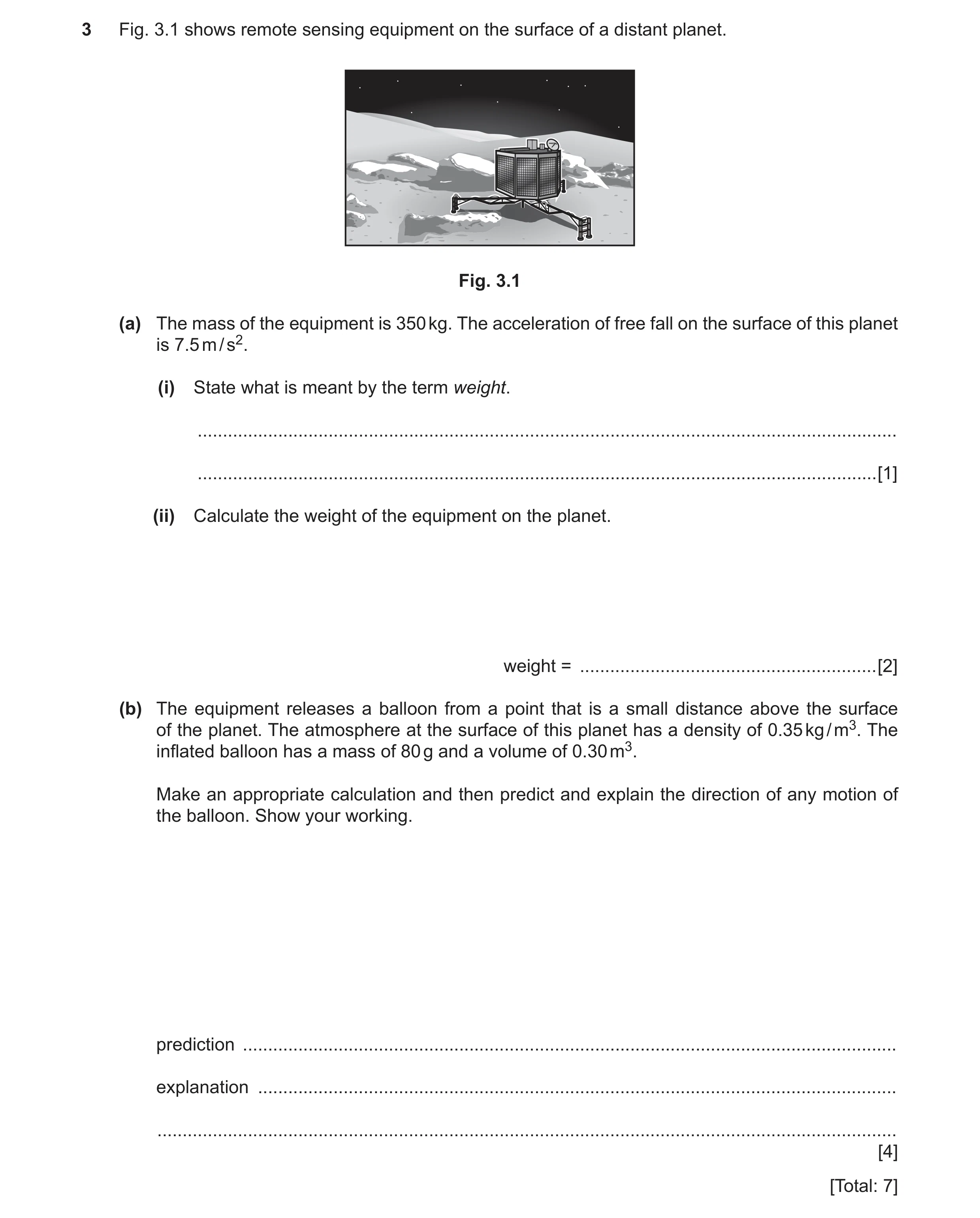
3 Fig. 3.1 shows remote sensing equipment on the surface of a distant planet. Fig. 3.1 (a) The mass of the equipment is 350 kg. The acceleration of free fall on the surface of this planet is 7.5 m / s2. (i) State what is meant by the term weight. … … [1] (ii) Calculate the weight of the equipment on the planet. weight = … [2] (b) The equipment releases a balloon from a point that is a small distance above the surface of the planet. The atmosphere at the surface of this planet has a density of 0.35 kg / m3. The inflated balloon has a mass of 80 g and a volume of 0.30 m3. Make an appropriate calculation and then predict and explain the direction of any motion of the balloon. Show your working. prediction … explanation … … [4] [Total: 7]
7 marks
Mark scheme: 3(a)(i) (Weight is) force/pull of gravity (acting on an object) B1 3(a)(ii) Mass × acceleration due to gravity OR mg OR 350 × 7.5 C1 2600 N A1 3(b) (ρ =) m / V in any form C1 0.27 (kg / m3) OR 270 (g / m3) A1 Balloon moves/floats up B1 (Floats when) density of balloon less than density of atmosphere OR (sinks when) density of balloon greater than atmosphere B1 OR (ρ =) m / V in any form (C1) 110 g (A1) Balloon rises (B1) (Floats when) mass/weight of balloon less than mass/weight of atmosphere (of same volume as balloon) (Sinks when) mass/weight of balloon greater than mass/weight of atmosphere (of same volume as balloon) (B1) Total: 7
This question in 0625/41 May/June 2017
Q3 · A vehicle designed to be used on the Moon 0625/42 May/June 2017
2 Fig. 2.1 shows a vehicle designed to be used on the Moon. Fig. 2.1 The brakes of the vehicle are tested on Earth. 1 (a) The acceleration of free fall on the Moon is one sixth ( ) of its value on Earth. 6 Tick one box in each column of the table to predict the value of that quantity when the vehicle is used on the Moon, compared to the test on Earth. mass of vehicle on weight of vehicle on deceleration of vehicle Moon Moon on Moon with same braking force 10 # value on Earth 6 # value on Earth same as value on Earth 1 # value on Earth 6 1 # value on Earth 10 [3] (b) Fig. 2.2 shows the brake pedal of the vehicle. pivot piston cylinder 7.0 cm 24 cm link oil force exerted by driver pedal Fig. 2.2 (not to scale) The driver exerts a force on the pedal, which increases the pressure in the oil to operate the brakes. The area of the piston in the cylinder is 6.5 # 10–4 m2 (0.00065 m2). The pressure increase in the oil is 5.0 # 105 Pa (500 000 Pa). Calculate the force exerted by the driver on the brake pedal. force = … [4] [Total: 7]
7 marks
Mark scheme: 2(a) Column 1 Box 3 mass same B1 Column 2 Box 4 weight 1/6 B1 Column 3 Box 3 deceleration same B1 2(b) P=F / A in any form or (F=) PA C1 (F1 = 500 000 × 0.00065 = ) 330 (N) C1 F1d1 = F2d2 in any form or F1d1/d2 C1 (F2 = 325 × 7/24 = ) 95 N A1 Total: 7
This question in 0625/42 May/June 2017
Q4 · All the sides of a plastic cube are 8.0 cm long 0625/41 Oct/Nov 2017
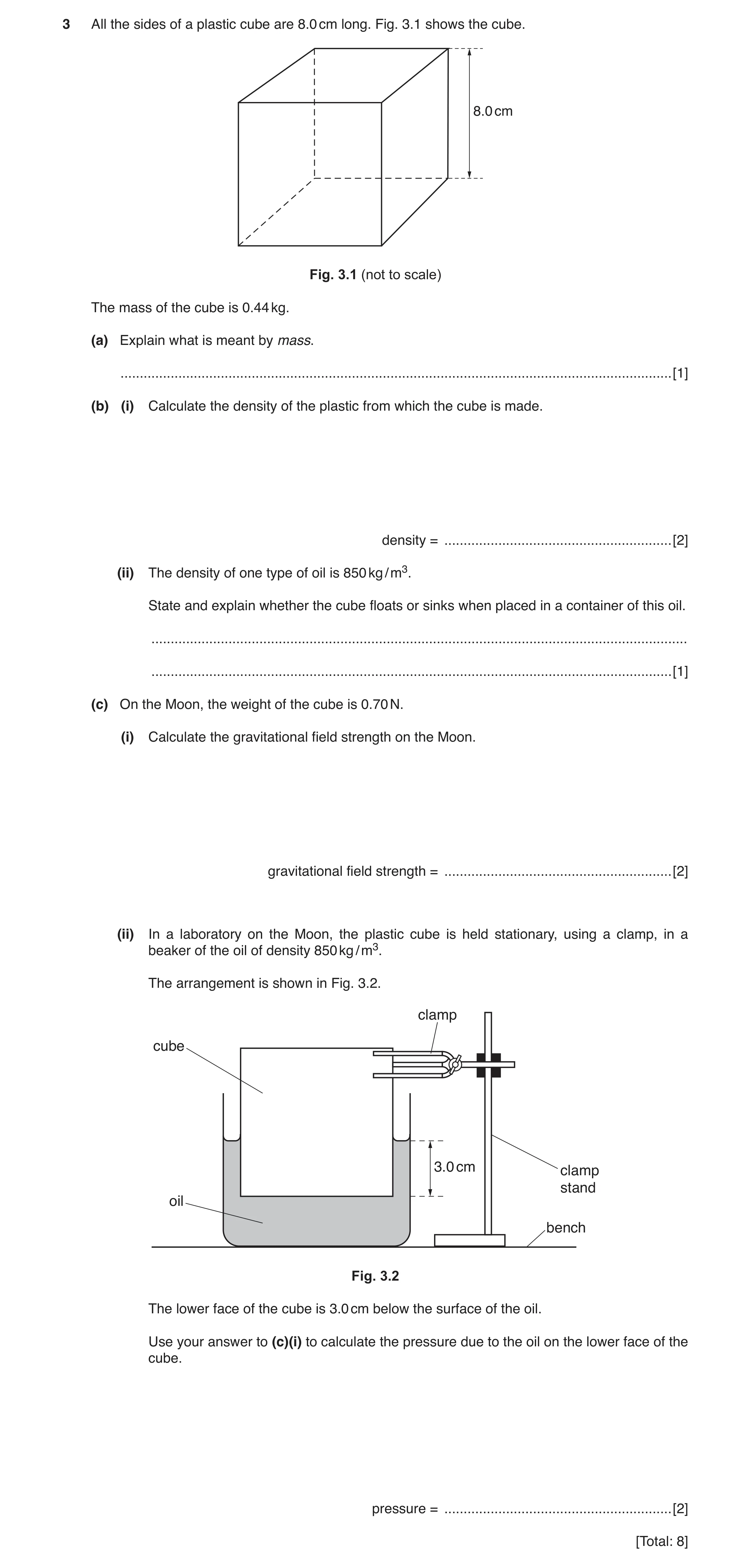
3 All the sides of a plastic cube are 8.0 cm long. Fig. 3.1 shows the cube. 8.0 cm Fig. 3.1 (not to scale) The mass of the cube is 0.44 kg. (a) Explain what is meant by mass. … [1] (b) (i) Calculate the density of the plastic from which the cube is made. density = … [2] (ii) The density of one type of oil is 850 kg / m3. State and explain whether the cube floats or sinks when placed in a container of this oil. … … [1] (c) On the Moon, the weight of the cube is 0.70 N. (i) Calculate the gravitational field strength on the Moon. gravitational field strength = … [2] (ii) In a laboratory on the Moon, the plastic cube is held stationary, using a clamp, in a beaker of the oil of density 850 kg / m3. The arrangement is shown in Fig. 3.2. clamp cube 3.0 cm clamp stand oil bench Fig. 3.2 The lower face of the cube is 3.0 cm below the surface of the oil. Use your answer to (c)(i) to calculate the pressure due to the oil on the lower face of the cube. pressure = … [2] [Total: 8]
8 marks
Mark scheme: 3(a) (Measure of) quantity / amount of matter OR (property) that resists change in motion / speed / momentum OR measure of a body’s inertia B1 3(b)(i) d = m / V OR in words OR 0.44 / 0.0803 OR 0.44 / 5.12 × 10⁻⁴ OR 440 / 83 OR 440 / 512 OR 0.44 / 83 OR 0.44 / 512 C1 0.86 g / cm3 OR 860 kg / m3 OR 8.6 × 10⁻⁴ kg / cm3 A1 3(b)(ii) Sinks OR does not float AND (cube) denser (than oil) B1 3(c)(i) W = mg OR (g =) W / m OR 0.70 / 0.44 C1 1.6 N / kg A1 3(c)(ii) (P =) hdg OR 0.030 × 850 × 1.6 C1 41 Pa A1
This question in 0625/41 Oct/Nov 2017
Q5 · A cylinder made from copper of density 9000 kg / m3 0625/42 Oct/Nov 2017
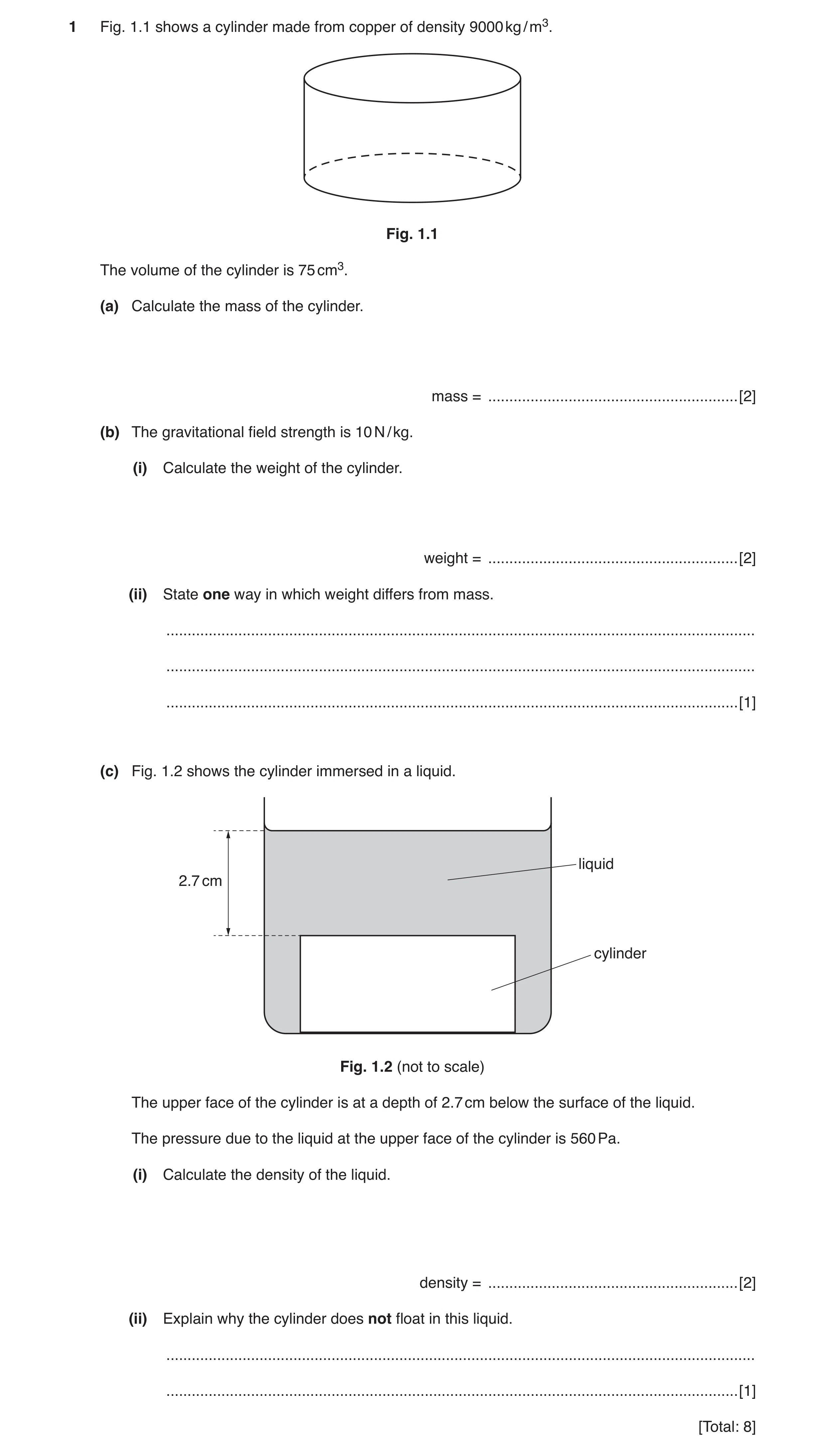
1 Fig. 1.1 shows a cylinder made from copper of density 9000 kg / m3. Fig. 1.1 The volume of the cylinder is 75 cm3. (a) Calculate the mass of the cylinder. mass = … [2] (b) The gravitational field strength is 10 N / kg. (i) Calculate the weight of the cylinder. weight = … [2] (ii) State one way in which weight differs from mass. … … … [1] (c) Fig. 1.2 shows the cylinder immersed in a liquid. liquid 2.7 cm cylinder Fig. 1.2 (not to scale) The upper face of the cylinder is at a depth of 2.7 cm below the surface of the liquid. The pressure due to the liquid at the upper face of the cylinder is 560 Pa. (i) Calculate the density of the liquid. density = … [2] (ii) Explain why the cylinder does not float in this liquid. … … [1] [Total: 8]
8 marks
Mark scheme: 1(a) OR (m =) 9000 × 7.5 × 10–5 C1 (m =) 0.68 kg accept 680 g A1 1(b)(i) W = m g in any form or (W = ) m g OR (W =) 0. 68 × 10 C1 (W =) 6.8 N A1 1(b)(ii) any one of: weight has direction / mass does not weight is a vector / mass is not weight varies / mass does not mass is amount of matter weight is a force / mass is not B1 1(c)(i) ρ = h ρ g in any form OR (ρ = ) ρ / h g OR (ρ =) 560 / (0.027 × 10) C1 (ρ =) 2.1 × 10³ kg / m3 A1 1(c)(ii) explains why there is a resultant downward force B1
This question in 0625/42 Oct/Nov 2017
Q6 · A rectangular container has a base of dimensions 0.12 m × 0.16 m 0625/41 May/June 2018
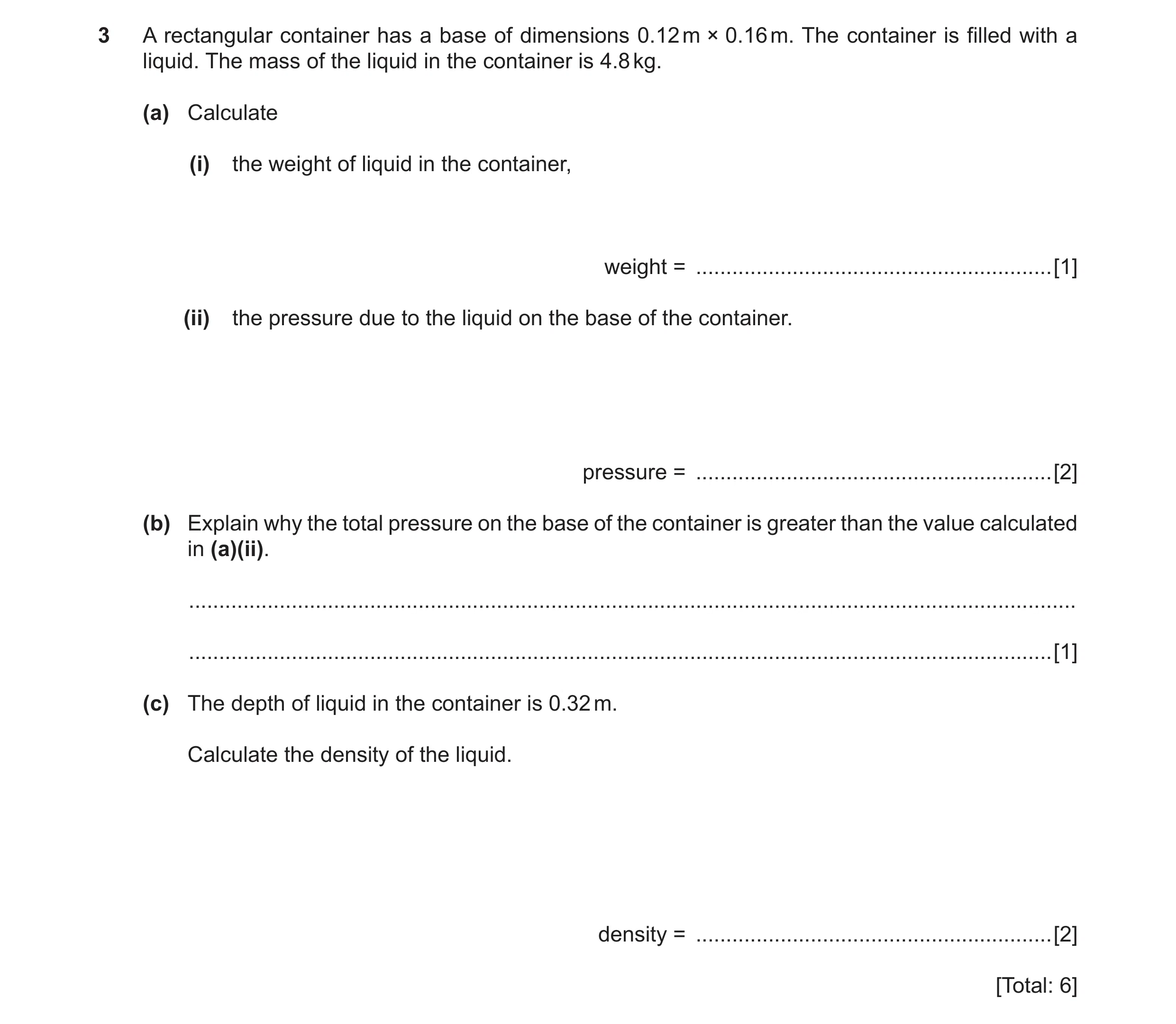
3 A rectangular container has a base of dimensions 0.12 m × 0.16 m. The container is filled with a liquid. The mass of the liquid in the container is 4.8 kg. (a) Calculate (i) the weight of liquid in the container, weight = … [1] (ii) the pressure due to the liquid on the base of the container. pressure = … [2] (b) Explain why the total pressure on the base of the container is greater than the value calculated in (a)(ii). … … [1] (c) The depth of liquid in the container is 0.32 m. Calculate the density of the liquid. density = … [2] [Total: 6]
6 marks
Mark scheme: 3(a)(i) 1 3(a)(ii) (P = ) F ÷ A OR 48 ÷ (0.12 × 0.16) 1 2500 Pa 1 3(b) Atmospheric pressure (in addition to liquid pressure) 1 3(c) P = hdg or in words OR (d =) P ÷ hg OR 2500 ÷ (0.32 × 10) 1 780 kg / m3 1 OR d = M ÷ V = 4.8 ÷ (0.12 × 0.16 × 0.32) (1) 780 kg / m3 (1)
This question in 0625/41 May/June 2018
Q7 · The density of mercury is 1.4 × 10⁴ kg / m3 0625/43 Oct/Nov 2018
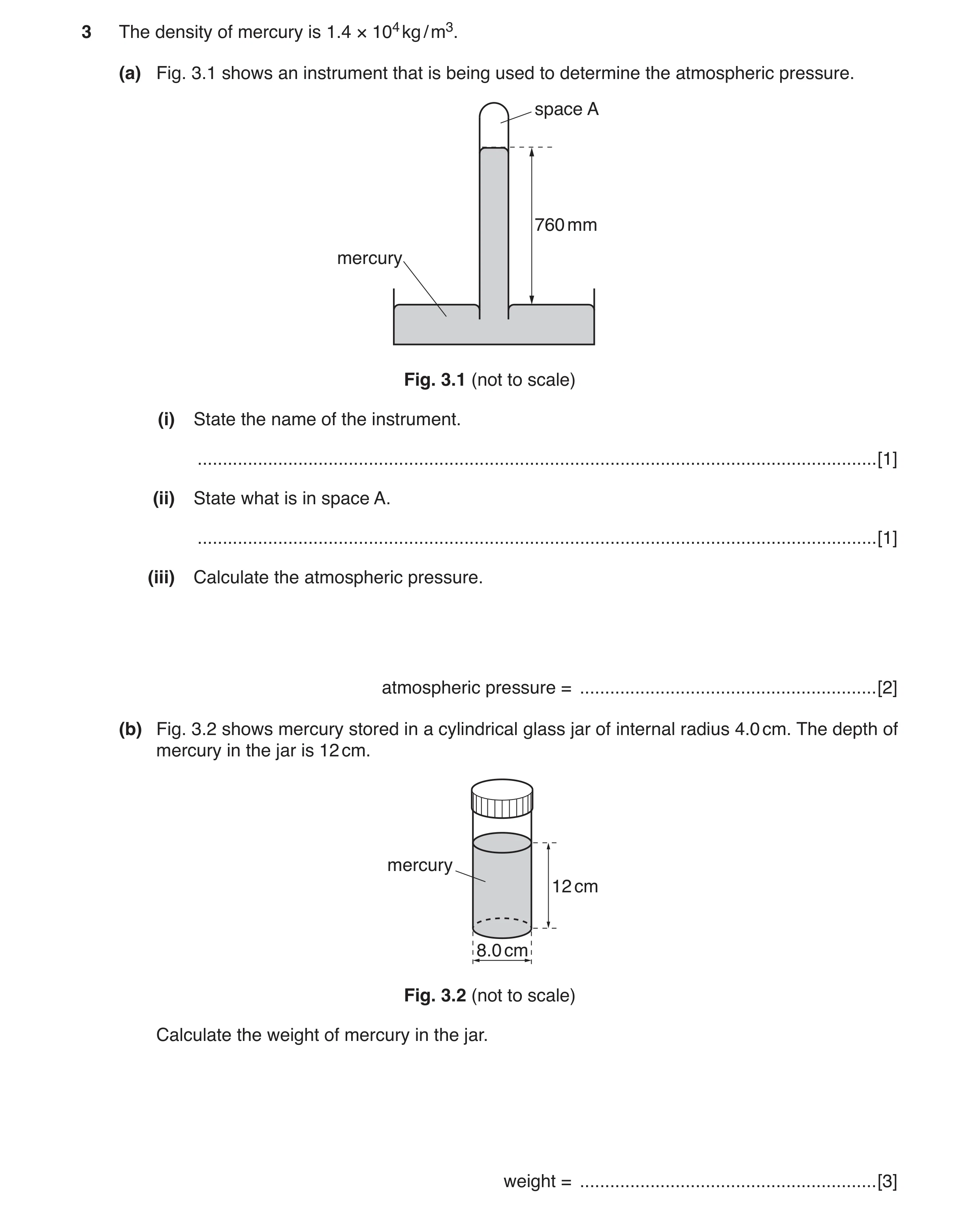
3 The density of mercury is 1.4 × 10⁴ kg / m3. (a) Fig. 3.1 shows an instrument that is being used to determine the atmospheric pressure. space A 760 mm mercury Fig. 3.1 (not to scale) (i) State the name of the instrument. … [1] (ii) State what is in space A. … [1] (iii) Calculate the atmospheric pressure. atmospheric pressure = … [2] (b) Fig. 3.2 shows mercury stored in a cylindrical glass jar of internal radius 4.0 cm. The depth of mercury in the jar is 12 cm. mercury 12 cm 8.0 cm Fig. 3.2 (not to scale) Calculate the weight of mercury in the jar. weight = … [3]
7 marks
Mark scheme: 3(a)(i) (mercury) barometer B1 3(a)(ii) vacuum or nothing or (low pressure) mercury vapour B1 3(a)(iii) (p) = hρ g or 0.76 × 1.4 × 104 × 10 C1 1.1 × 10⁵ Pa A1 3(b) (m =)ρ V or ρ πr 2l or ρ πd2l / 4 or in numbers C1 (W =)ρ Vg or ρ πr 2l g or ρ πd 2l g / 4 or in numbers C1 84 N A1
This question in 0625/43 Oct/Nov 2018
Q8 · A sign that extends over a road 0625/41 May/June 2019
2 Fig. 2.1 shows a sign that extends over a road. support post ACCIDENT SLOW DOWN sign 1.8 m concrete block W 1.3 m P 70 cm Fig. 2.1 The mass of the sign is 3.4 × 10³ kg. (a) Calculate the weight W of the sign. W = … [2] (b) The weight of the sign acts at a horizontal distance of 1.8 m from the centre of the support post and it produces a turning effect about point P. Point P is a horizontal distance of 1.3 m from the centre of the support post. (i) Calculate the moment about P due to the weight of the sign. moment = … [3] (ii) A concrete block is positioned on the other side of the support post with its centre of mass a horizontal distance of 70 cm from the centre of the support post. 1. State what is meant by centre of mass. … … [1] 2. The weight of the concrete block produces a moment about point P that exactly cancels the moment caused by the weight W. Calculate the weight of the concrete block. weight = … [2] (c) The concrete block is removed. The sign and support post rotate about point P in a clockwise direction. State and explain what happens to the moment about point P due to the weight of the sign as it rotates. … … … [2] [Total: 10]
10 marks
Mark scheme: 2(a) C1 3.4 × 10⁴ N A1 2(b)(i) moment = Fx in any form OR (moment) = Fx OR 0.50 (seen) C1 3.4 × 104 × (1.8 – 1.3) OR 3.4 × 104 × 0.50 C1 1.7 × 10⁴ N m A1 2(b)(ii) 1. (the point) where (all) the mass can be considered to be concentrated B1 2. 1.7 × 10⁴ / (1.3 + 0.70) OR 1.7 × 10⁴ / (2.0) C1 8.5 × 10³ N A1 2(c) (moment / it) increases B1 perpendicular distance (between P and line of action of) W increases B1
This question in 0625/41 May/June 2019
Q9 · A piece of glass of thickness 2.0 cm and area 0.15 m2 0625/42 Feb/March 2021
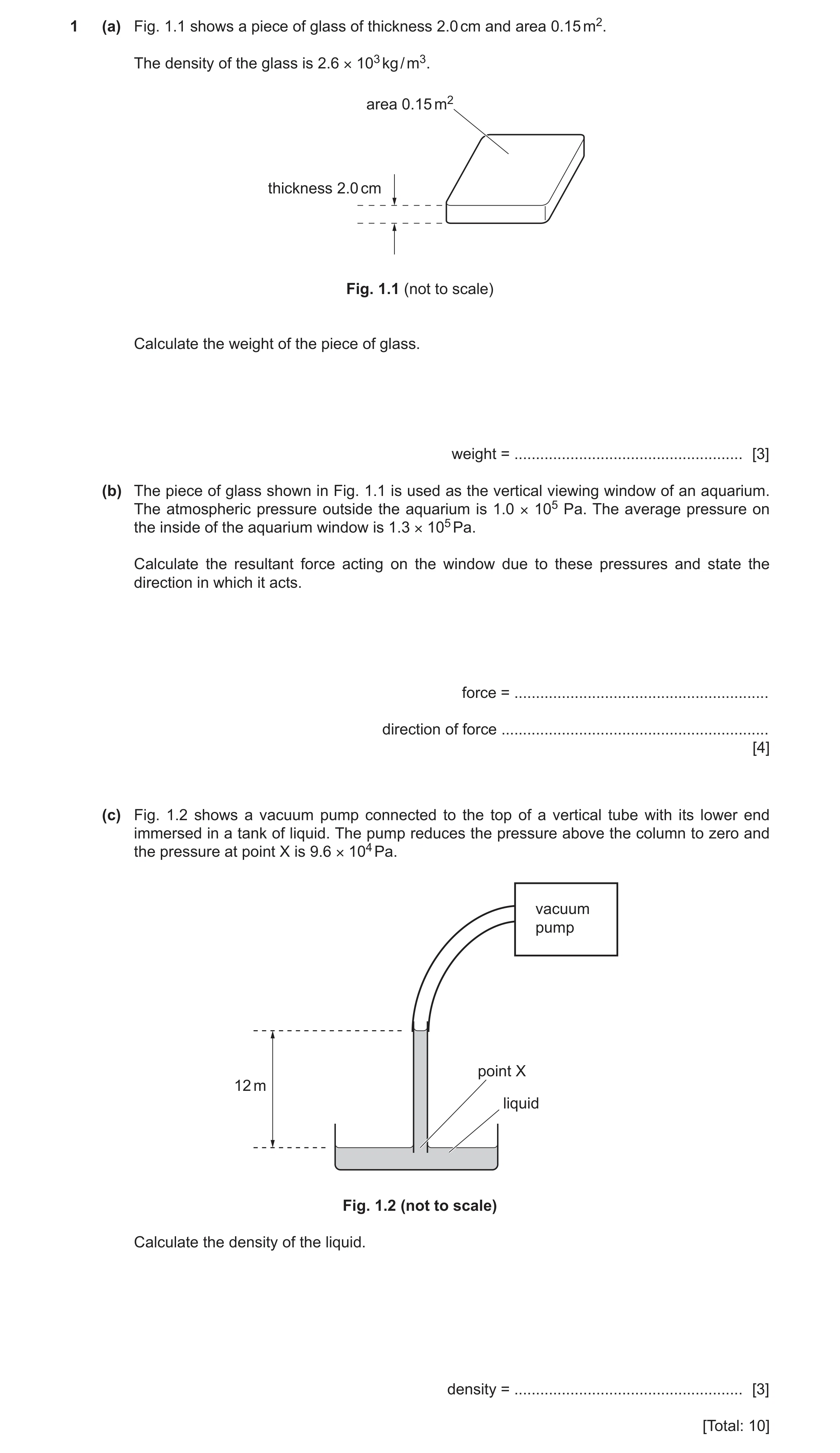
1 (a) Fig. 1.1 shows a piece of glass of thickness 2.0 cm and area 0.15 m2. The density of the glass is 2.6 × 10³ kg / m3. area 0.15 m2 thickness 2.0 cm Fig. 1.1 (not to scale) Calculate the weight of the piece of glass. weight = … [3] (b) The piece of glass shown in Fig. 1.1 is used as the vertical viewing window of an aquarium. The atmospheric pressure outside the aquarium is 1.0 × 10⁵ Pa. The average pressure on the inside of the aquarium window is 1.3 × 10⁵ Pa. Calculate the resultant force acting on the window due to these pressures and state the direction in which it acts. force = … direction of force … [4] (c) Fig. 1.2 shows a vacuum pump connected to the top of a vertical tube with its lower end immersed in a tank of liquid. The pump reduces the pressure above the column to zero and the pressure at point X is 9.6 × 10⁴ Pa. vacuum pump point X 12 m liquid Fig. 1.2 (not to scale) Calculate the density of the liquid. density = … [3] [Total: 10]
10 marks
Mark scheme: 1(a) 78 N A3 (m=) ρV OR ρ = m / V in any form C1 W = mg C1 1(b) 4.5 × 10³ N A3 (F=) (Δ)PA OR P = F / A in any form C1 (ΔP = 1.3 × 10⁵ – 1.0 × 105 = ) 3 × 10⁴ C1 outwards B1 1(c) (ρ =) 800 kg / m3 A3 (ρ =) P / gh OR P= ρ gh in any form C1 (ρ =) 9.6 × 10⁴/ (10 × 12) C1
This question in 0625/42 Feb/March 2021
Question 10 0625/42 Oct/Nov 2021
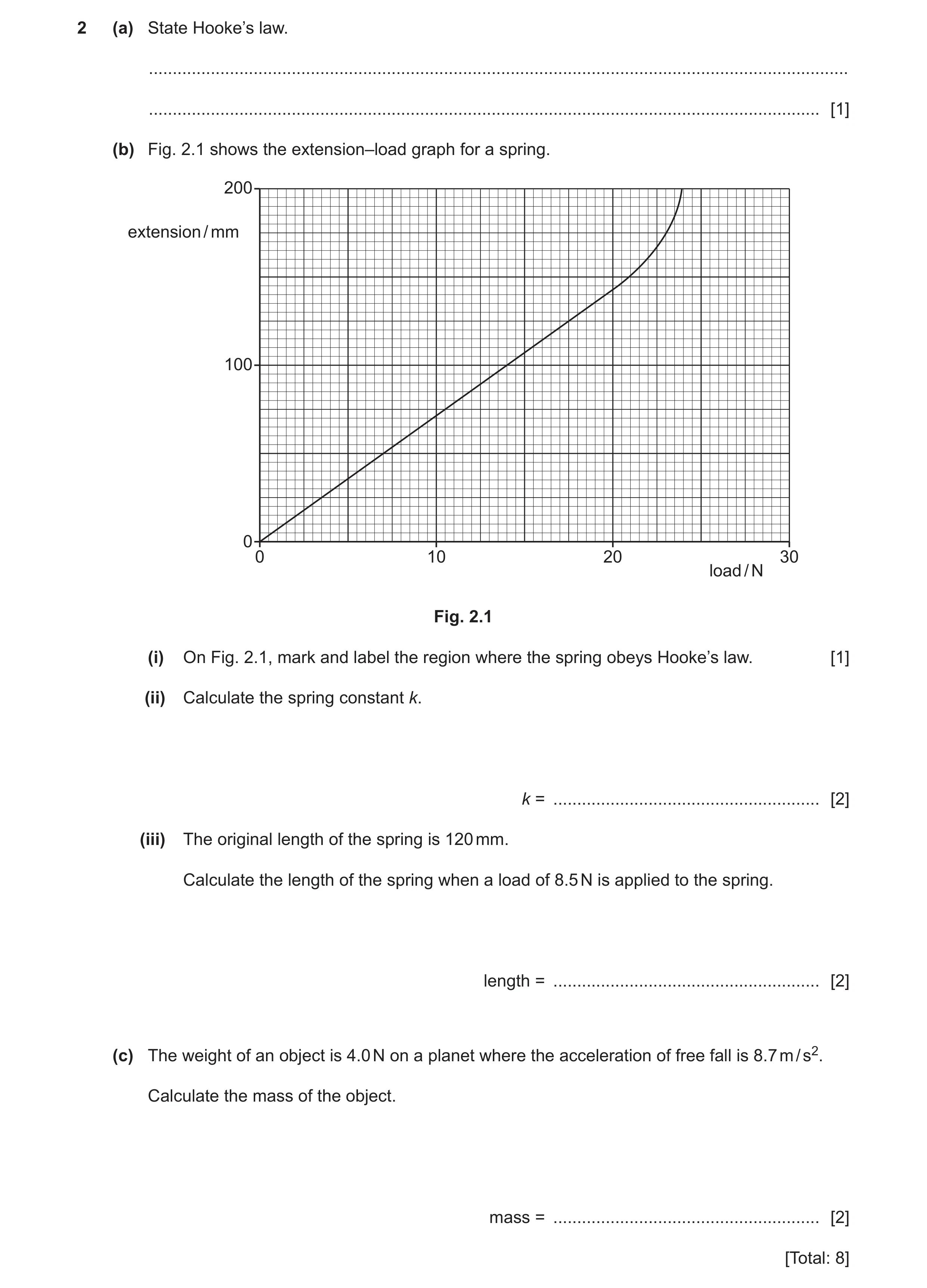
2 (a) State Hooke’s law. … … [1] (b) Fig. 2.1 shows the extension–load graph for a spring. 200 extension / mm 100 0 0 10 20 30 load / N Fig. 2.1 (i) On Fig. 2.1, mark and label the region where the spring obeys Hooke’s law. [1] (ii) Calculate the spring constant k. k = … [2] (iii) The original length of the spring is 120 mm. Calculate the length of the spring when a load of 8.5 N is applied to the spring. length = … [2] (c) The weight of an object is 4.0 N on a planet where the acceleration of free fall is 8.7 m / s2. Calculate the mass of the object. mass = … [2] [Total: 8]
8 marks
Mark scheme: 2(a) extension is (directly) proportional to load (if elastic limit is not exceeded) B1 2(b)(i) 0 to 20.5 + / – 0.5 N B1 2(b)(ii) (k = ) F / x OR (k =) 1 / gradient C1 140 N / m OR 0.14 N / mm A1 2(b)(iii) 60 OR 61 OR 62 OR 63 (mm) seen C1 180 mm OR 0.18 m A1 2(c) W = mg in any form OR (m =) W / g OR (m) = 4 / 8.7 C1 0.46 kg A1
This question in 0625/42 Oct/Nov 2021
Q11 · A spring balance used to measure the weight of a baby 0625/42 Feb/March 2022
2 Fig. 2.1 shows a spring balance used to measure the weight of a baby. The spring inside the balance extends when a mass is suspended from it. The dial shows the extension of spring as a value of mass in kg. dial cradle with negligible mass Fig. 2.1 The spring obeys Hooke’s law up to a weight of 175 N. (a) (i) State Hooke’s law. … … [1] (ii) State the relationship between the mass of the baby and the force exerted on the spring due to the baby. … … [1] (iii) The reading on the spring balance is 8.0 kg. Determine the force exerted on the spring due to the baby. force = … [1] (b) The limit of proportionality for the spring is at a force of 175 N. Sketch the extension–load graph for the spring. The sketch must continue beyond a force of 175 N. extension 0 0 175 load / N [2] (c) The baby is carried from the ground floor to the bedroom. The vertical height of the bedroom above the ground floor is 3.5 m. Calculate the change in gravitational potential energy of the baby when it is carried from the ground floor to the bedroom. change in gravitational potential energy = … [2] [Total: 7]
7 marks
Mark scheme: 2(a)(i) extension (of the spring) is (directly) proportional to the force / load (applied to the spring, up to the limit of proportionality) B1 2(a)(ii) W=mg in any form OR force is (directly) proportional to mass B1 2(a)(iii) 80 N B1 2(b) straight line through / from origin with positive gradient up to 175 N B1 smooth curve after 175 N with increasing positive gradient B1 2(c) (80 N × 3.5 m =) 280 J A2 ΔE = Fxd in any form OR GPE= mgh in any form (C1)
This question in 0625/42 Feb/March 2022
Q12 · A rock climber, of total mass 62 kg, holds herself in horizontal equilibrium against a… 0625/41 Oct/Nov 2022
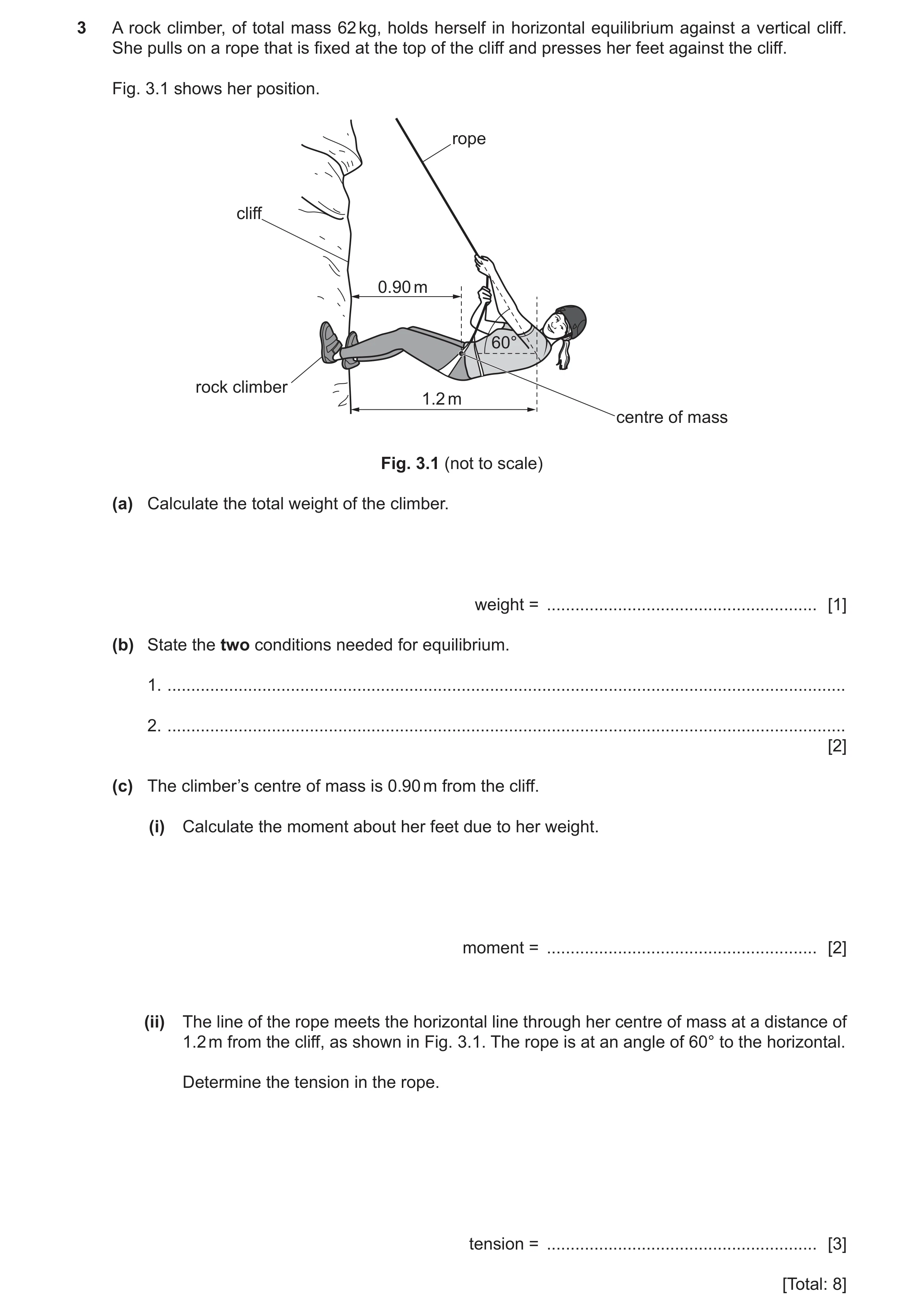
3 A rock climber, of total mass 62 kg, holds herself in horizontal equilibrium against a vertical cliff. She pulls on a rope that is fixed at the top of the cliff and presses her feet against the cliff. Fig. 3.1 shows her position. rope cliff 0.90 m 60° rock climber 1.2 m centre of mass Fig. 3.1 (not to scale) (a) Calculate the total weight of the climber. weight = … [1] (b) State the two conditions needed for equilibrium. 1. … 2. … [2] (c) The climber’s centre of mass is 0.90 m from the cliff. (i) Calculate the moment about her feet due to her weight. moment = … [2] (ii) The line of the rope meets the horizontal line through her centre of mass at a distance of 1.2 m from the cliff, as shown in Fig. 3.1. The rope is at an angle of 60° to the horizontal. Determine the tension in the rope. tension = … [3] [Total: 8]
8 marks
Mark scheme: 3(a) 620 N B1 3(b) B2 no resultant force (on object in equilibrium) B1 no resultant moment (on object in equilibrium) B1 3(c)(i) 560 N m A2 (=) Fx┴r or 620 0.90 C1 3(c)(ii) 540 N A3 use of any moment C1 T 1.2 sin 60° (= 560) or (T =) 560 / (1.2 sin 60°) C1
This question in 0625/41 Oct/Nov 2022
Q13 · A balloon filled with helium gas 0625/43 May/June 2023
1 Fig. 1.1 shows a balloon filled with helium gas. Fig. 1.1 The mass of the balloon is 120 kg. (a) Calculate the weight of the balloon. Show your working. weight = … [1] (b) The resultant force on the balloon is 54 N. Show that the acceleration of the balloon is 0.45 m / s2. [2] (c) The balloon accelerates upwards from rest at 0.45 m / s2 for 8.0 s. Calculate the velocity of the balloon after 8.0 s. velocity = … [2] (d) Calculate the distance travelled by the balloon in the first 8.0 s. distance = … [2] [Total: 7]
7 marks
Mark scheme: 1(a) 1200 N AND g = W / m OR (W =) mg OR (W =) 120 9.8 B1 1(b) F = ma OR (a =) F / m B1 (a =) 54 / 120 B1 1(c) (v =) 3.6 m / s A2 a = (∆)v / t OR (∆v =) at OR (∆v =) 0.45 8(.0) C1 1(d) (d =) 14 m A2 average speed = (total) distance travelled / (total) time taken OR 1.8 8 OR 3.6 8 2 C1
This question in 0625/43 May/June 2023
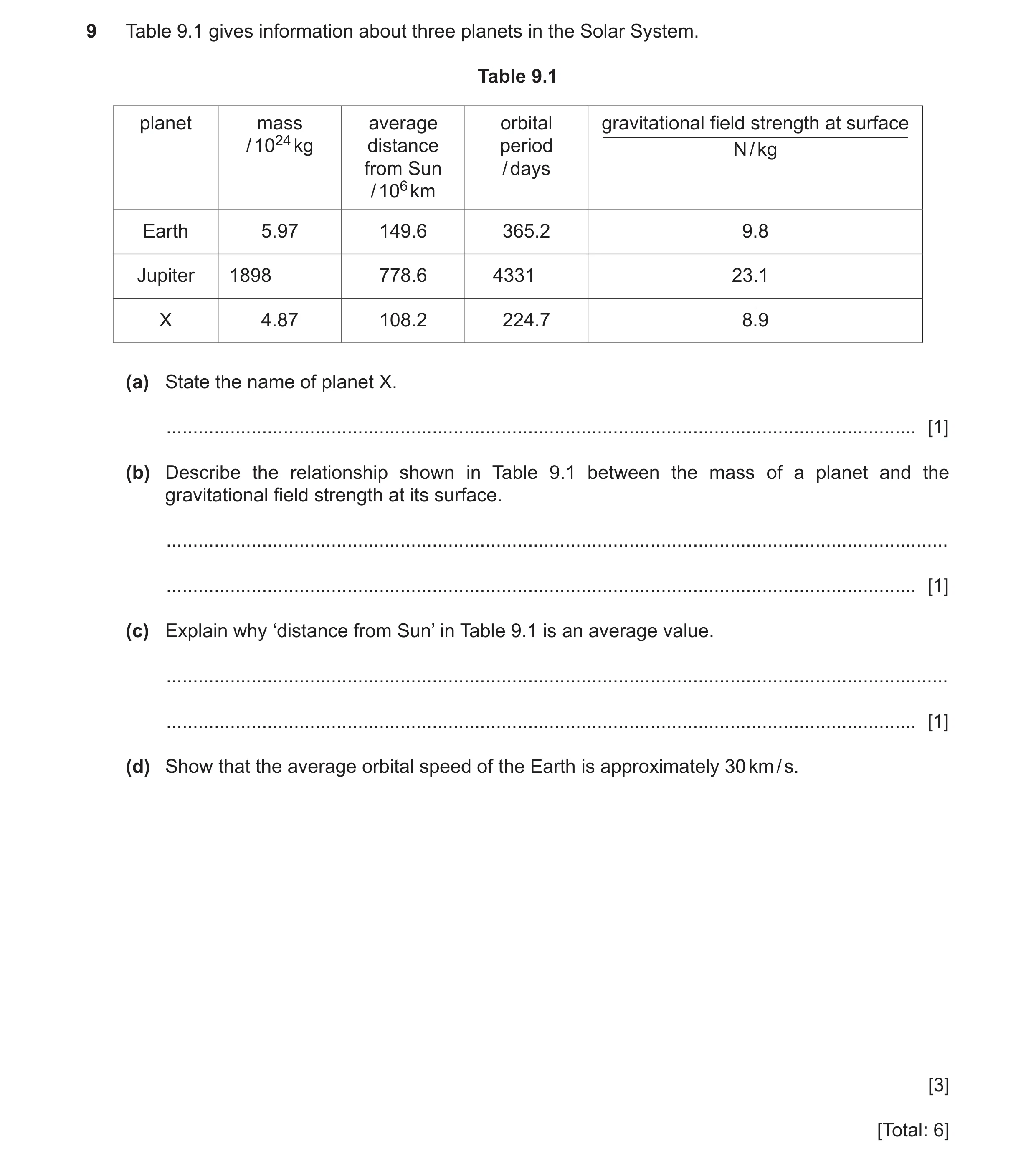
Q14 · Information about three planets in the Solar System 0625/42 Oct/Nov 2023
9 Table 9.1 gives information about three planets in the Solar System. Table 9.1 planet mass average orbital gravitational field strength at surface / 1024 kg distance period N / kg from Sun / days / 106 km Earth 5.97 149.6 365.2 9.8 Jupiter 1898 778.6 4331 23.1 X 4.87 108.2 224.7 8.9 (a) State the name of planet X. … [1] (b) Describe the relationship shown in Table 9.1 between the mass of a planet and the gravitational field strength at its surface. … … [1] (c) Explain why ‘distance from Sun’ in Table 9.1 is an average value. … … [1] (d) Show that the average orbital speed of the Earth is approximately 30 km / s. [3] [Total: 6]
6 marks
Mark scheme: 9(a) Venus B1 9(b) The larger the mass (of the planet), the larger the gravitational field strength (at the surface) B1 9(c) orbit of planets is elliptical / is not circular owtte B1 9(d) correct conversion of T into seconds i.e. 365.2 (24 60 60) OR 3.2 107 B1 (v =) {2r} / T B1 2 149.6 106 / 365.2 24 60 60 B1
This question in 0625/42 Oct/Nov 2023
Q15 · A load is suspended from a thread 0625/42 May/June 2024
1 A load is suspended from a thread. The vertical force on the thread due to the load is 0.75 N. (a) Calculate the mass of the load. mass = … [2] (b) Fig. 1.1 shows the load suspended from the thread. thread X load Fig. 1.1 A wire is attached to the load at point X and pulled horizontally to the right. The tension in the horizontal wire is 1.2 N. By drawing a scale diagram or by calculation, determine: • the magnitude of the resultant of the force at X due to the load and due to the tension in the wire • the direction of the resultant relative to the vertical direction. Show your working. magnitude of resultant force = … N direction of resultant relative to vertical = … ° [4] (c) Forces may produce changes in the size and the shape of an object. State two other changes that forces may produce. 1 … 2 … [2] [Total: 8]
8 marks
Mark scheme: 1(a) 0.077 kg OR 77 g A2 g = W / m OR (m =) W / g OR 0.75 / 9.8 C1 1(b) 2 vectors at right angles OR use of Pythagoras’ theorem e.g. a2 + b2 = c2 OR (force =) √(1.22 + 0.752) B1 1.4 (N) B1 58(°) A2 resultant force including correct direction of arrow OR use of trigonometry to find angle e.g. tan = 1.2 / 0.75 C1 1(c) any two from: velocity speed direction acceleration / deceleration moment B2
This question in 0625/42 May/June 2024
Q16 · Jupiter and the Earth are planets in our Solar System 0625/41 May/June 2025
10 Jupiter and the Earth are planets in our Solar System. (a) Describe the composition of Jupiter and the Earth. Jupiter … the Earth … [2] (b) The gravitational field strength at the surface of the Earth is approximately 9.8 N / kg. The gravitational field strength at the surface of Jupiter is approximately 23 N / kg. (i) Define gravitational field strength. … … [2] (ii) State one factor which causes the difference between the gravitational field strength at the surface of Jupiter and the gravitational field strength at the surface of the Earth. … … [1] (c) State and explain the difference between the orbital speed of Jupiter and the orbital speed of the Earth. statement … explanation … … [3] [Total: 8]
8 marks
Mark scheme: 10(a) Jupiter is gaseous B1 Earth is rocky B1 10(b)(i) weight A2 (gravitational) force per unit mass OR (g =) in this form mass (gravitational) force on a mass OR W = mg C1 10(b)(ii) mass B1 10(c) (orbital speed of) Jupiter is slower ORA B1 Jupiter is further from the Sun ORA OR orbital speeds of planets decrease as distance from the Sun increases ORA B1 gravitational field (strength) of Sun decreases with distance (from Sun) ORA B1
This question in 0625/41 May/June 2025
Q17 · A space vehicle which consists of a capsule and a nose cone 0625/43 May/June 2025
2 Fig. 2.1 shows a space vehicle which consists of a capsule and a nose cone. The space vehicle is moving at a velocity of 7800 m / s. The mass of the space vehicle is 840 kg. capsule nose cone 7800 m / s Fig. 2.1 (a) Show that the momentum of the space vehicle is approximately 6.55 × 10⁶ kg m / s. [1] (b) The capsule ejects the nose cone, as shown in Fig. 2.2. v 7850 m / s mass = 120 kg mass = 720 kg Fig. 2.2 (not to scale) Determine the velocity v of the capsule after the nose cone is ejected. Give your answer to 3 significant figures. velocity v of the capsule = … [3] (c) A different space capsule returns to Earth. Fig. 2.3 shows this capsule just before it lands in the sea. The capsule travels at terminal velocity. parachute capsule sea Fig. 2.3 The upward vertical force acting on the capsule is 120 kN. Calculate the mass of the capsule. mass of the capsule = … [2] [Total: 6]
6 marks
Mark scheme: 2(a) (p =) mv OR mass velocity B1 2(b) 7790 m / s A3 momentum before (collision) = momentum after (collision) C1 OR mcvc + mnvn = 6.55 106 OR (momentum of cone =) 120 7850 OR 9.42 105 720v + {120 7850} = 6.55 106 C1 OR (momentum after collision =) 6.55 106 – 9.42 105 OR 5.6 106 2(c) 12 000 kg A2 120 000 (N) OR (m =) W ÷ g OR (m =) 1.2 10N ÷ 9.8 C1
This question in 0625/43 May/June 2025
Q18 · Table 2.1 contains information about the planet Mars 0625/41 Oct/Nov 2025
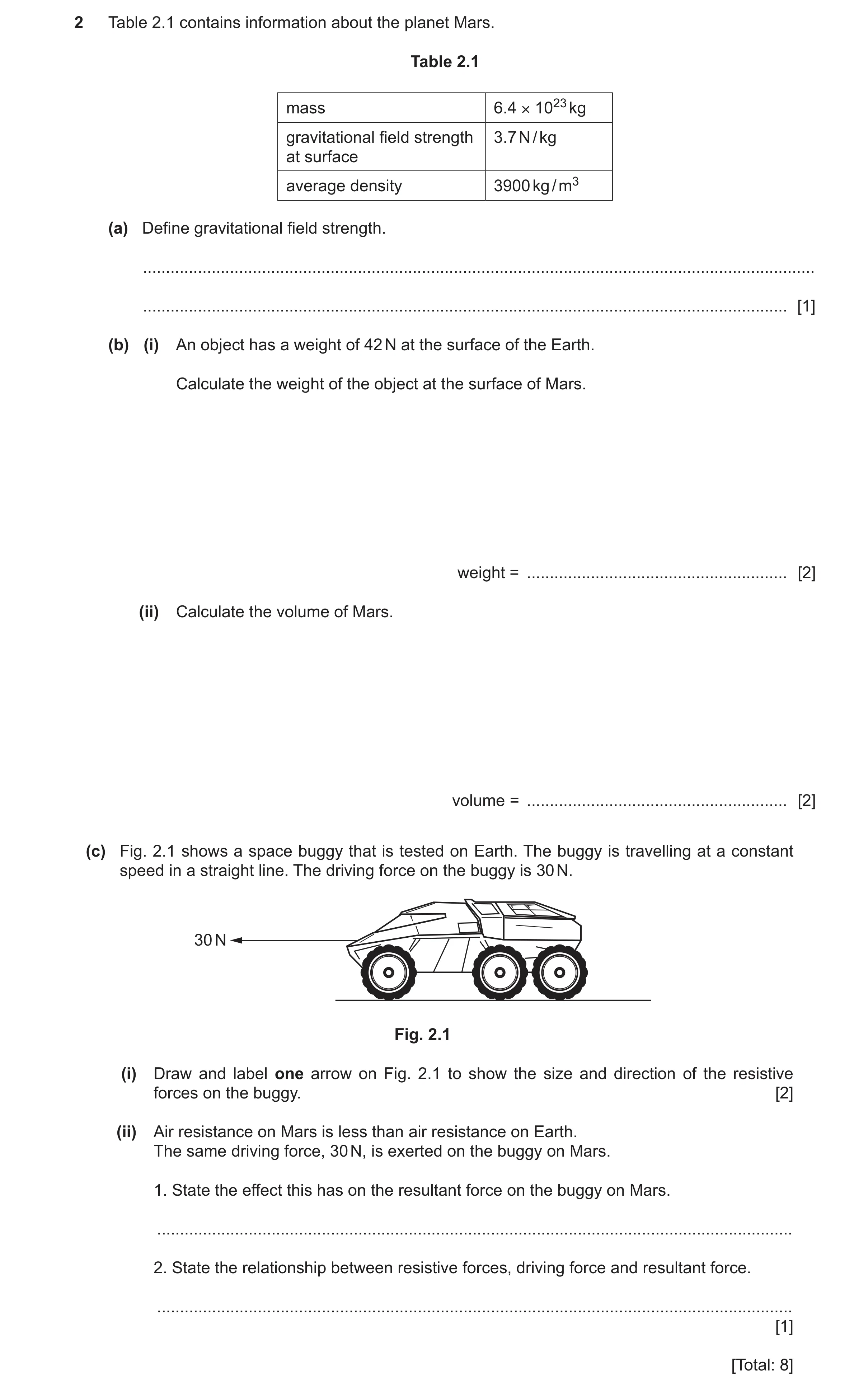
2 Table 2.1 contains information about the planet Mars. Table 2.1 mass 6.4 × 10²³ kg gravitational field strength 3.7 N / kg at surface average density 3900 kg / m3 (a) Define gravitational field strength. … … [1] (b) (i) An object has a weight of 42 N at the surface of the Earth. Calculate the weight of the object at the surface of Mars. weight = … [2] (ii) Calculate the volume of Mars. volume = … [2] (c) Fig. 2.1 shows a space buggy that is tested on Earth. The buggy is travelling at a constant speed in a straight line. The driving force on the buggy is 30 N. 30N Fig. 2.1 (i) Draw and label one arrow on Fig. 2.1 to show the size and direction of the resistive forces on the buggy. [2] (ii) Air resistance on Mars is less than air resistance on Earth. The same driving force, 30 N, is exerted on the buggy on Mars. 1. State the effect this has on the resultant force on the buggy on Mars. … 2. State the relationship between resistive forces, driving force and resultant force. … [1] [Total: 8]
8 marks
Mark scheme: 2(a) (gravitational field strength is) force per unit mass (on an object in a gravitational field) B1 2(b)(i) 16 N A2 W = mg OR (m =) W÷g OR 42 / 9.8 OR (mass of object =) 4.3 (kg) C1 2(b)(ii) 1.6 1020 m3 A2 (V =) m / ρ OR (V =) 6.4 1023 / 3900 C1 2(c)(i) arrow parallel to driving force AND pointing to the right B1 2(c)(i) (arrow pointing to the right) labelled 30 N B1 2(c)(ii) 1 (resultant force) increases OR there is a resultant force (in the direction of the driving force) B1 OR 2 resultant force = driving force – resistive force(s)
This question in 0625/41 Oct/Nov 2025
 3 / 24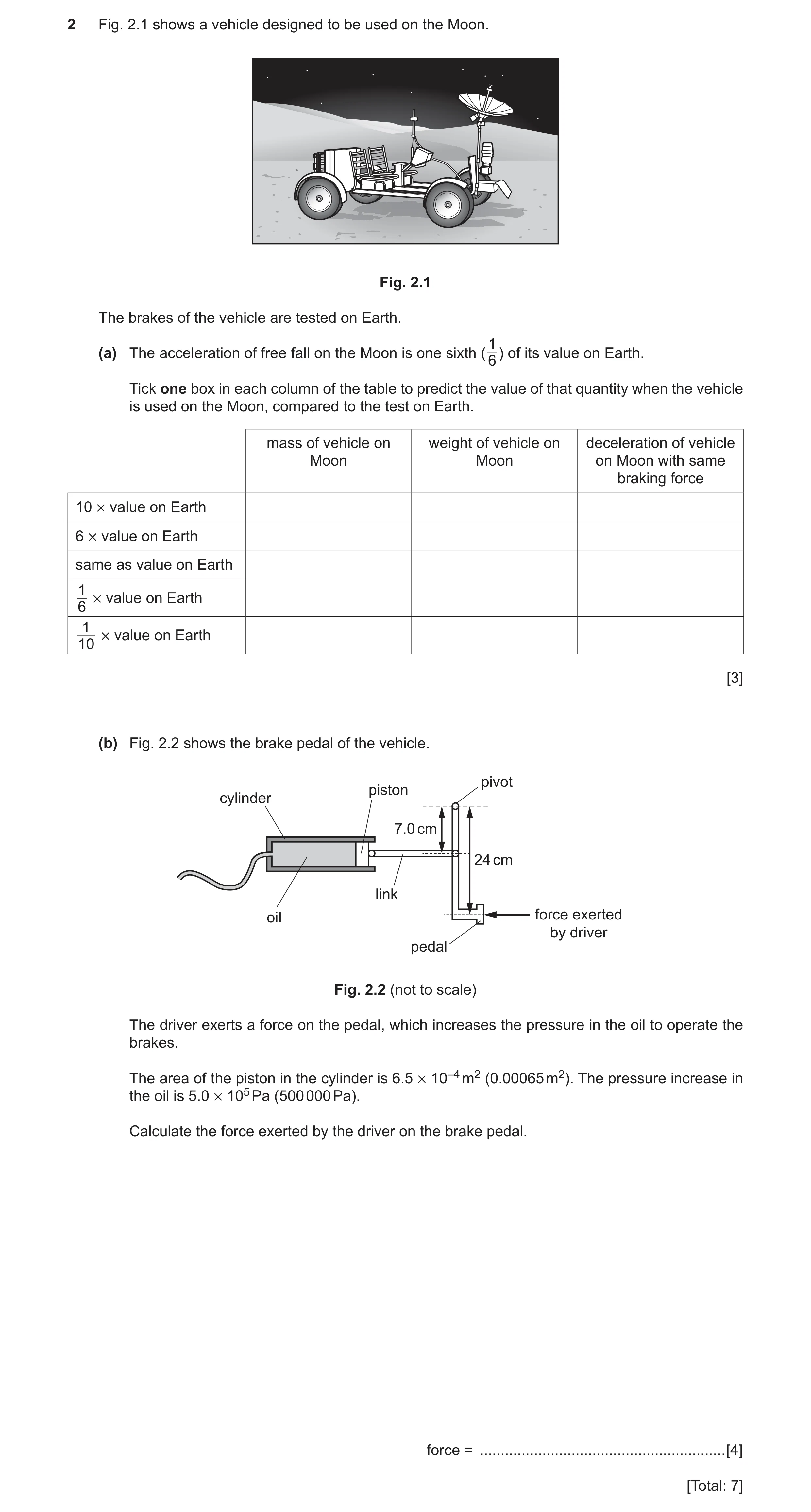
 8 / 24
 9 / 24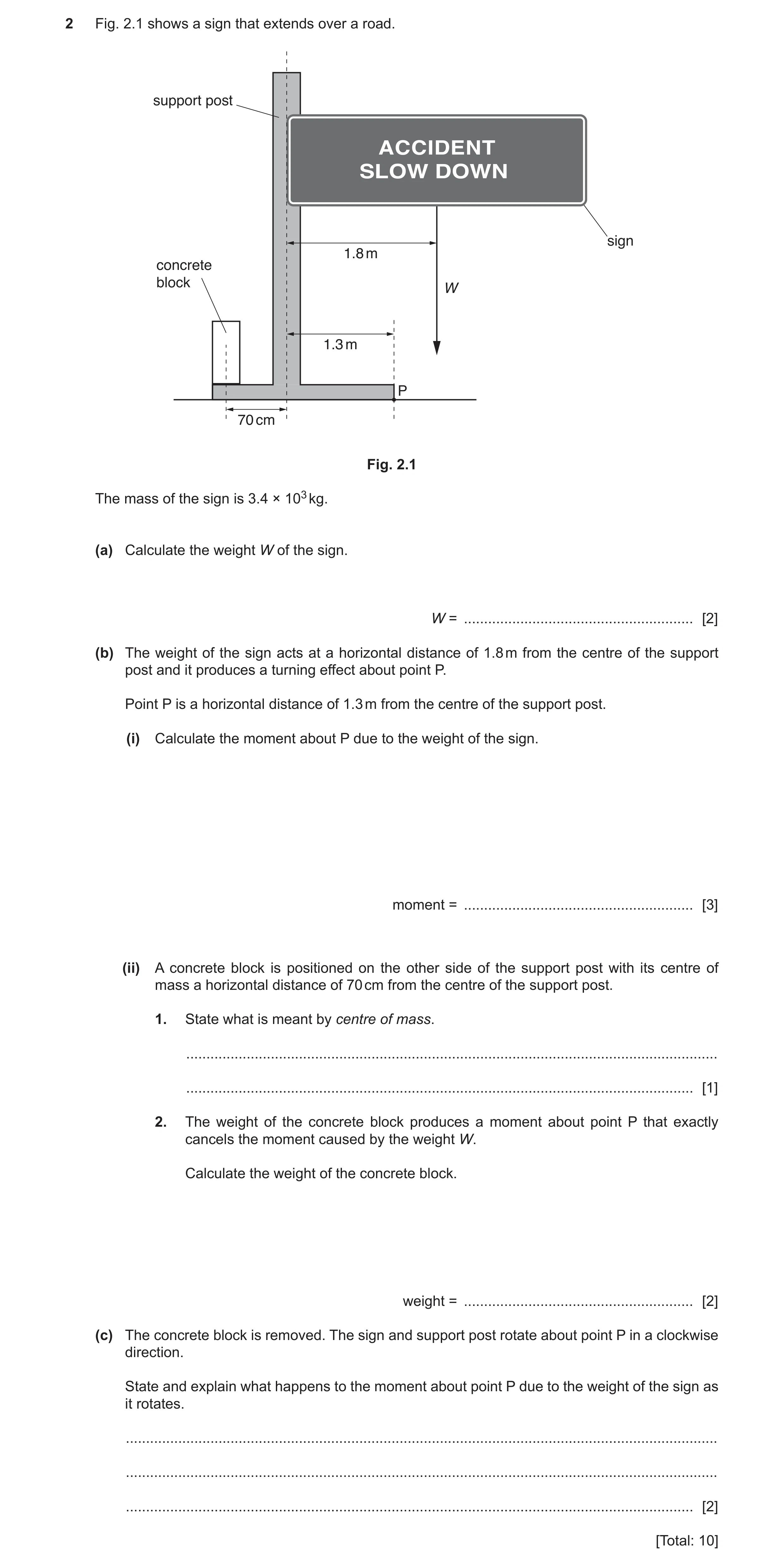
 13 / 24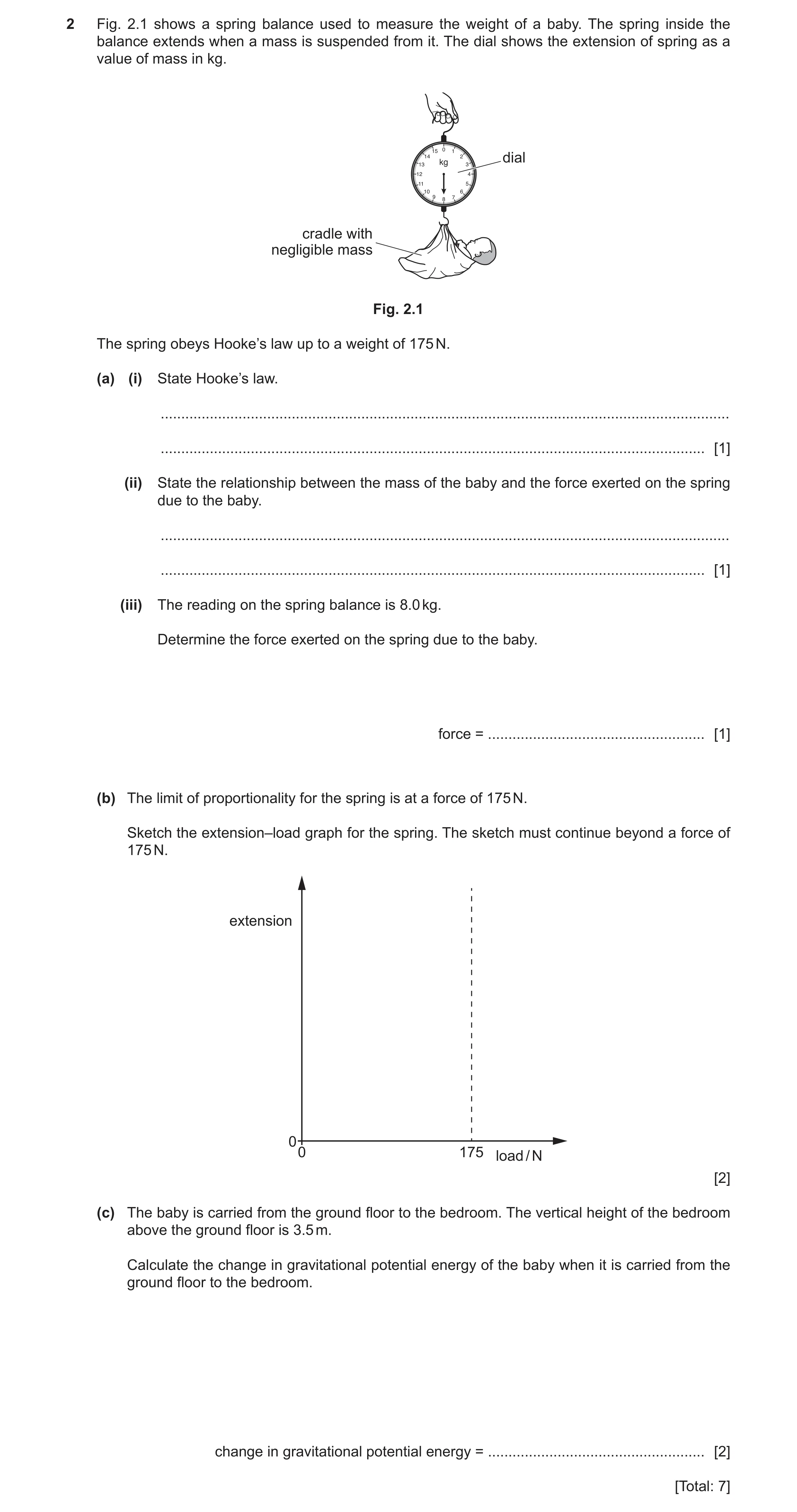
 16 / 24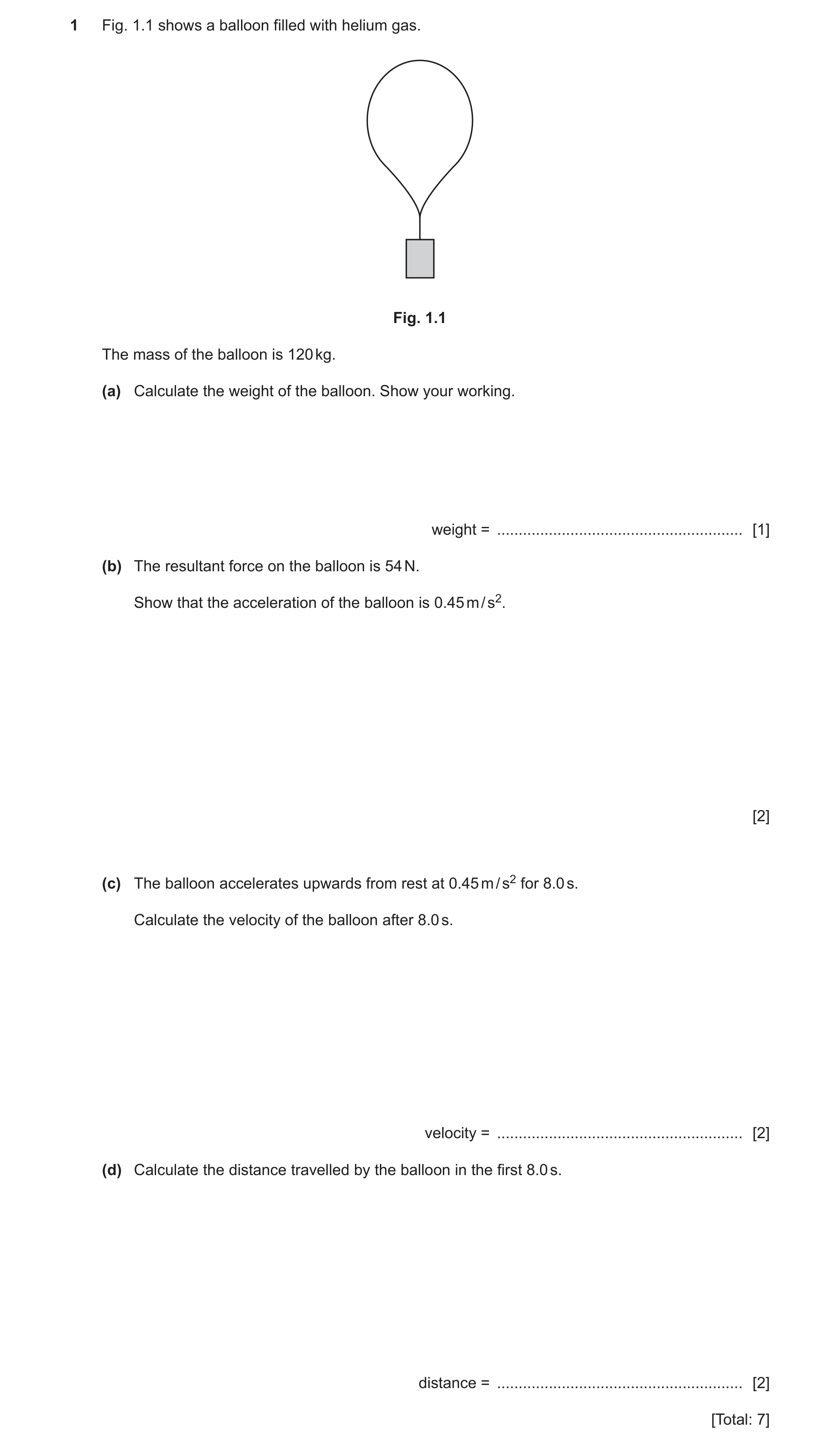
 19 / 24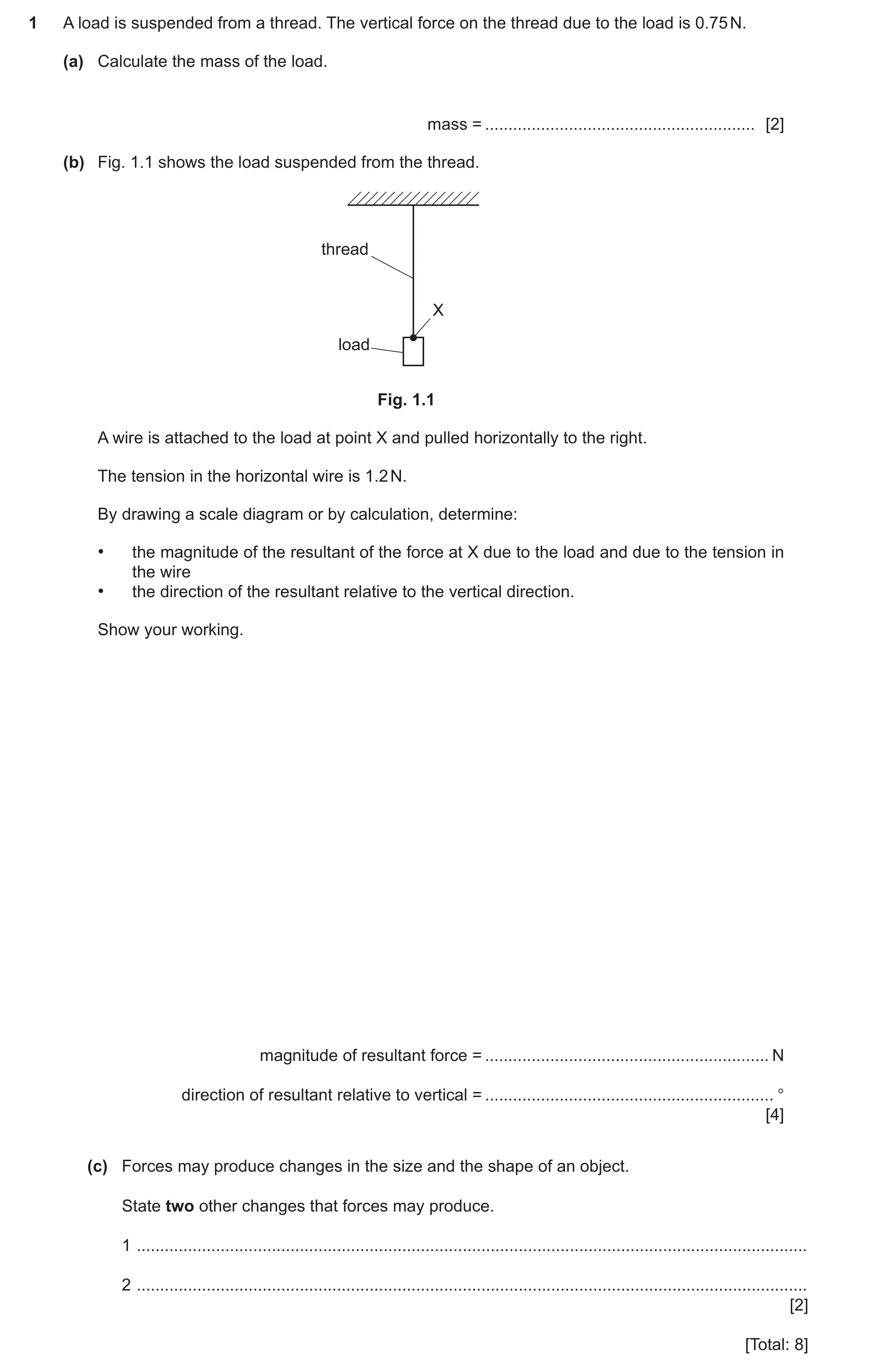
 21 / 24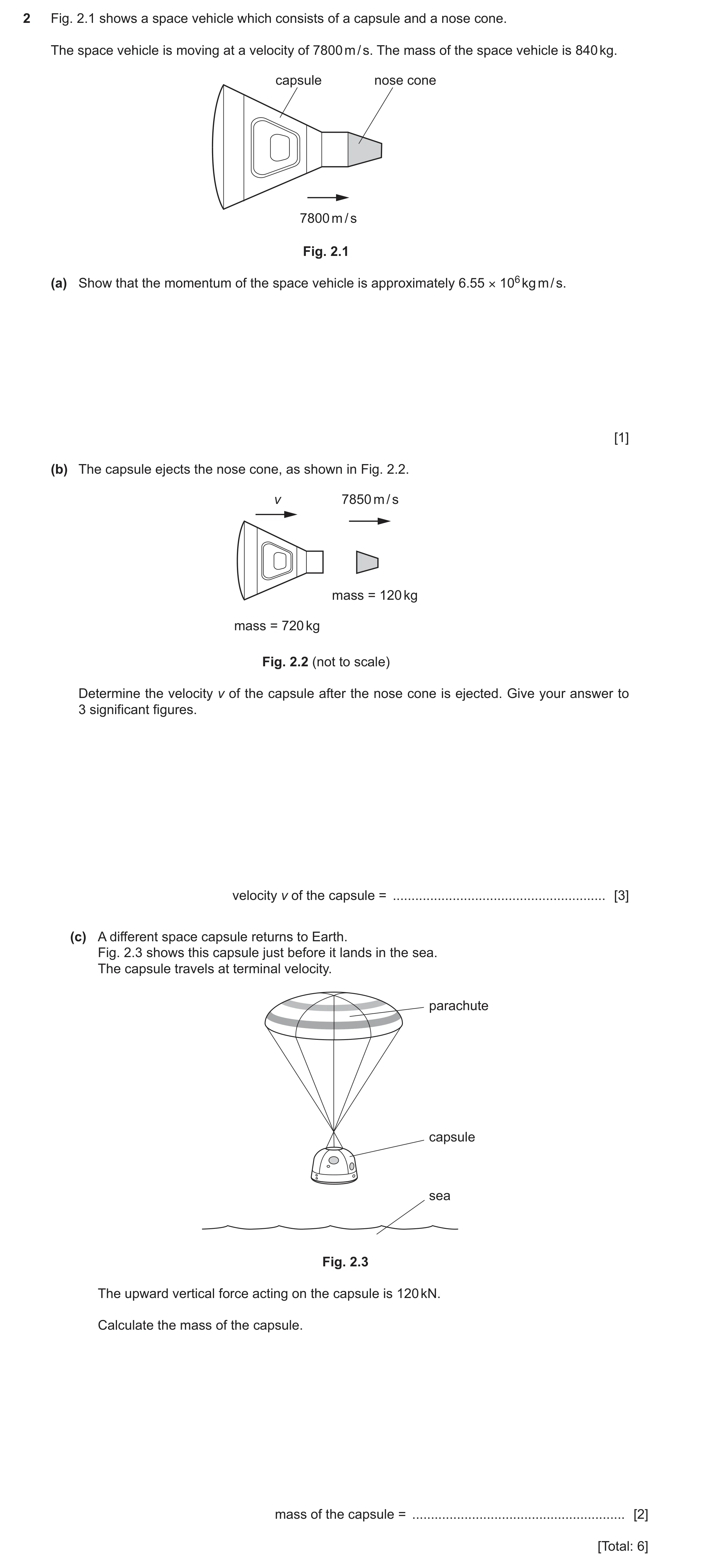
 7
7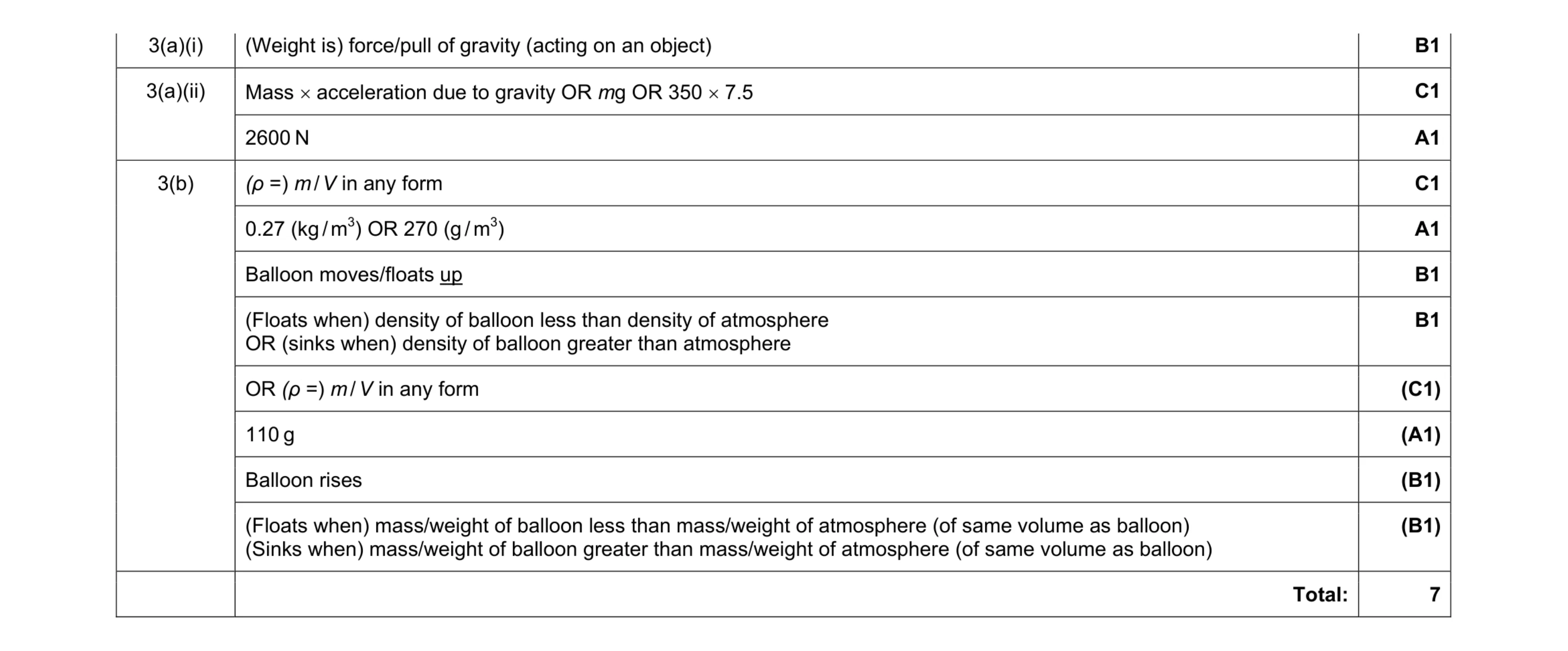 7
7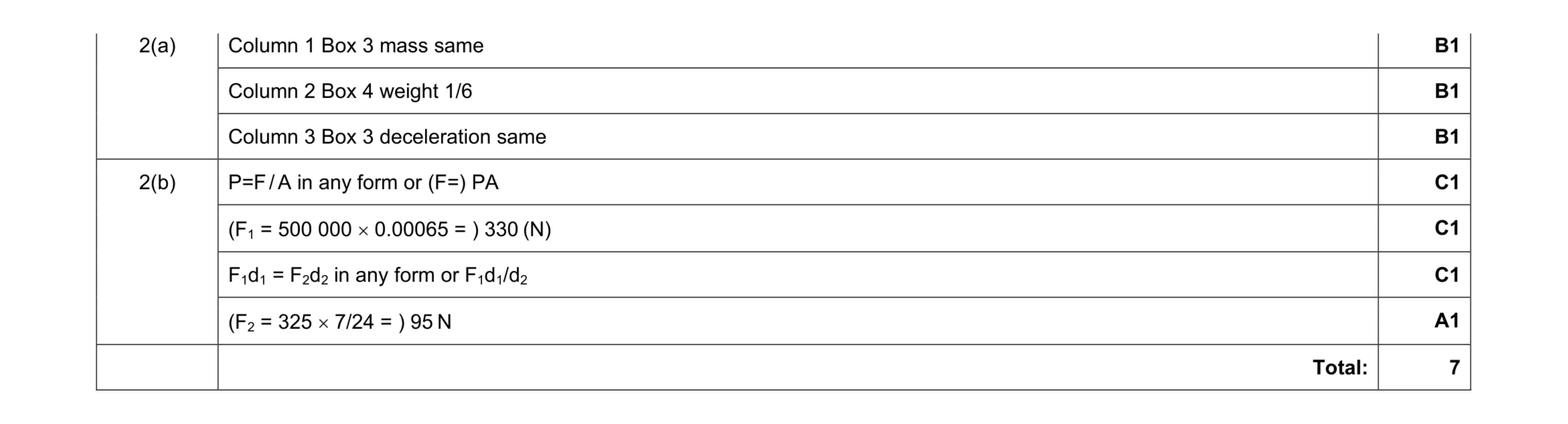 7
7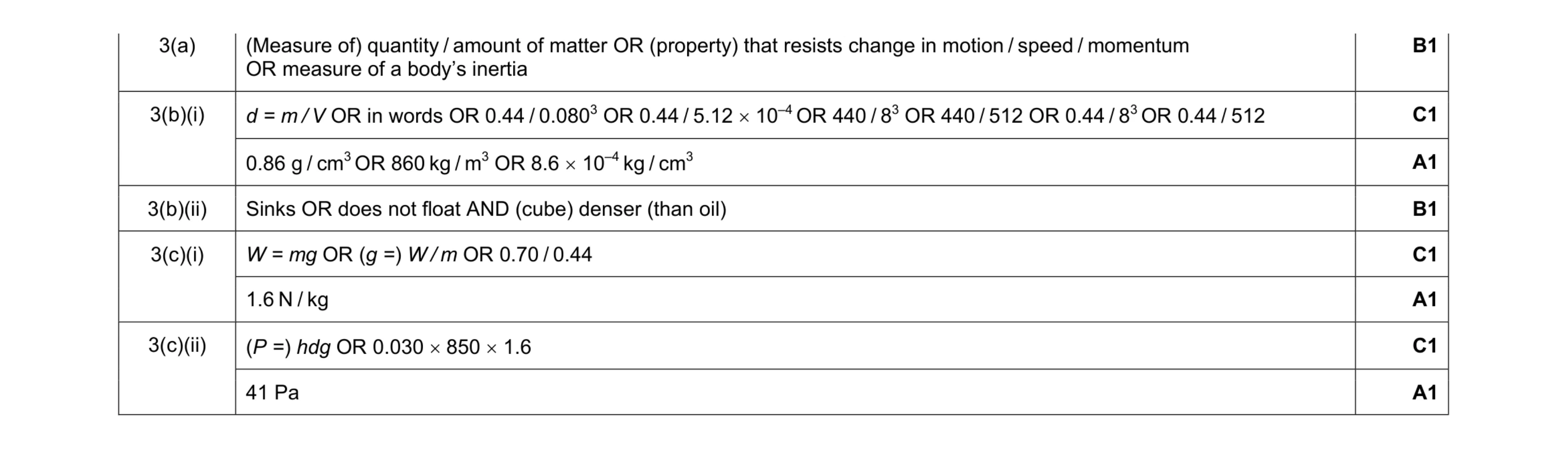 8
8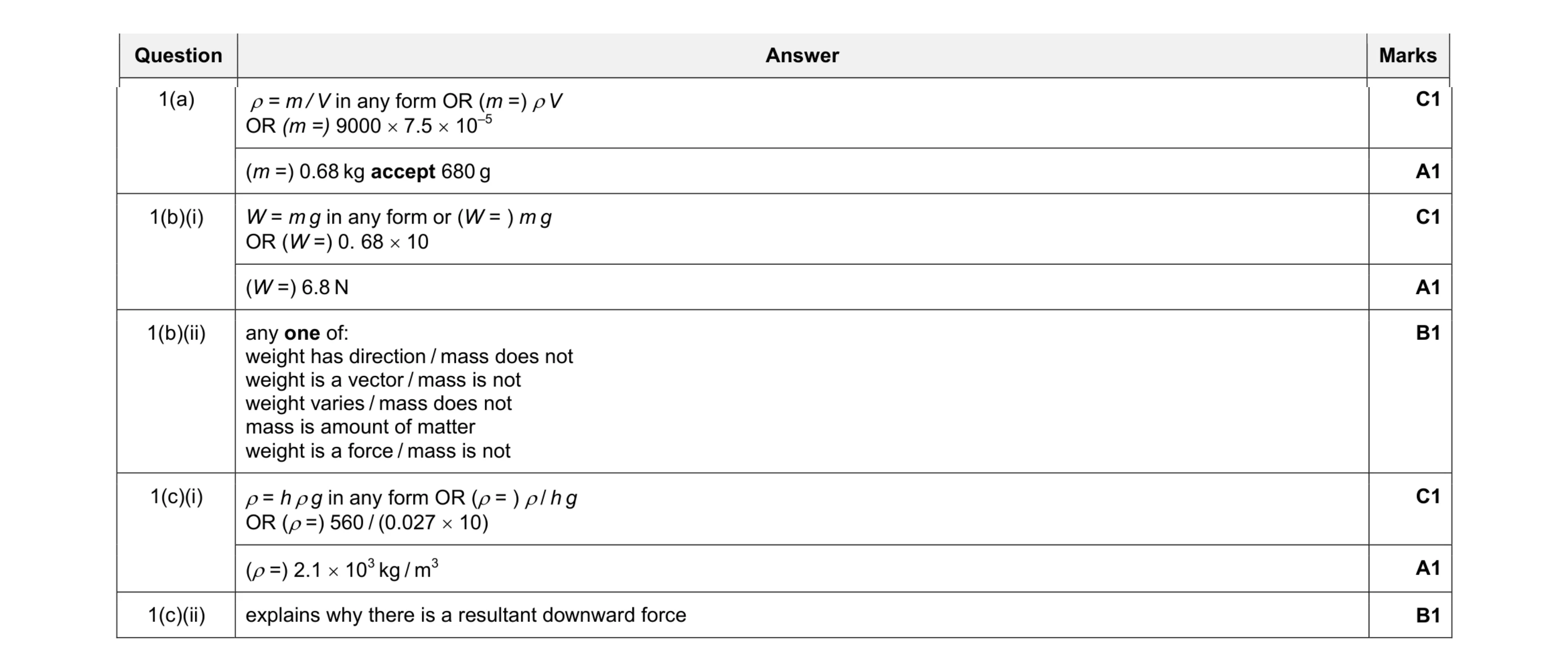 8
8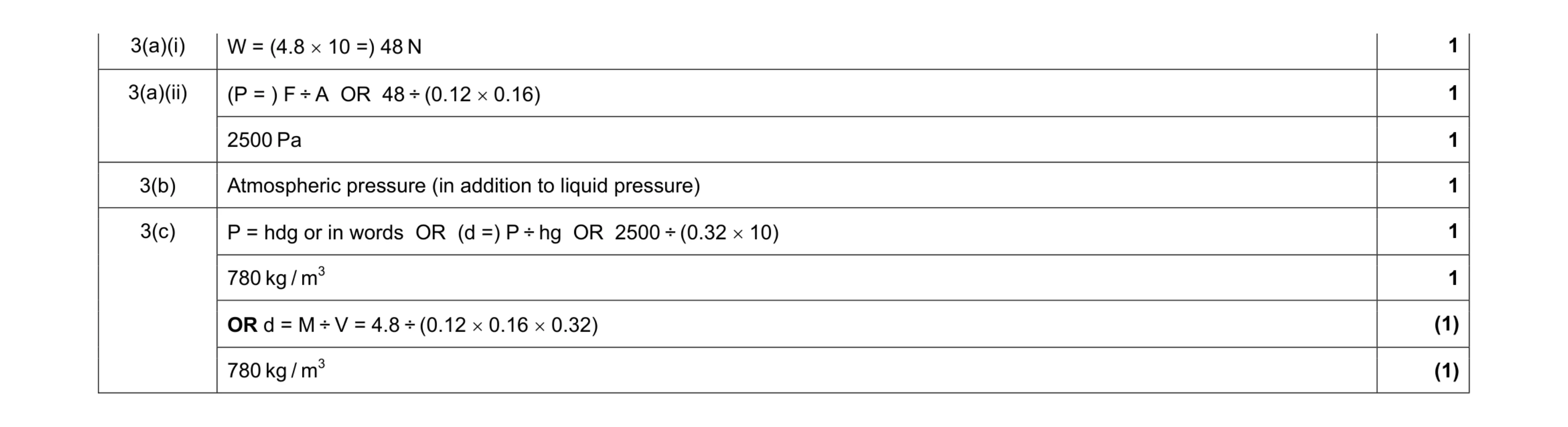 6
6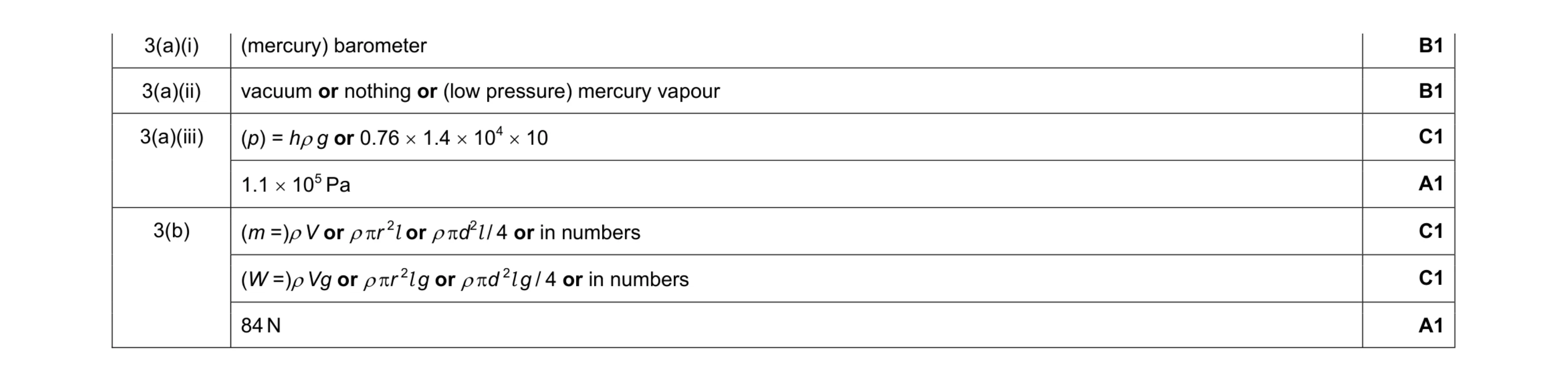 7
7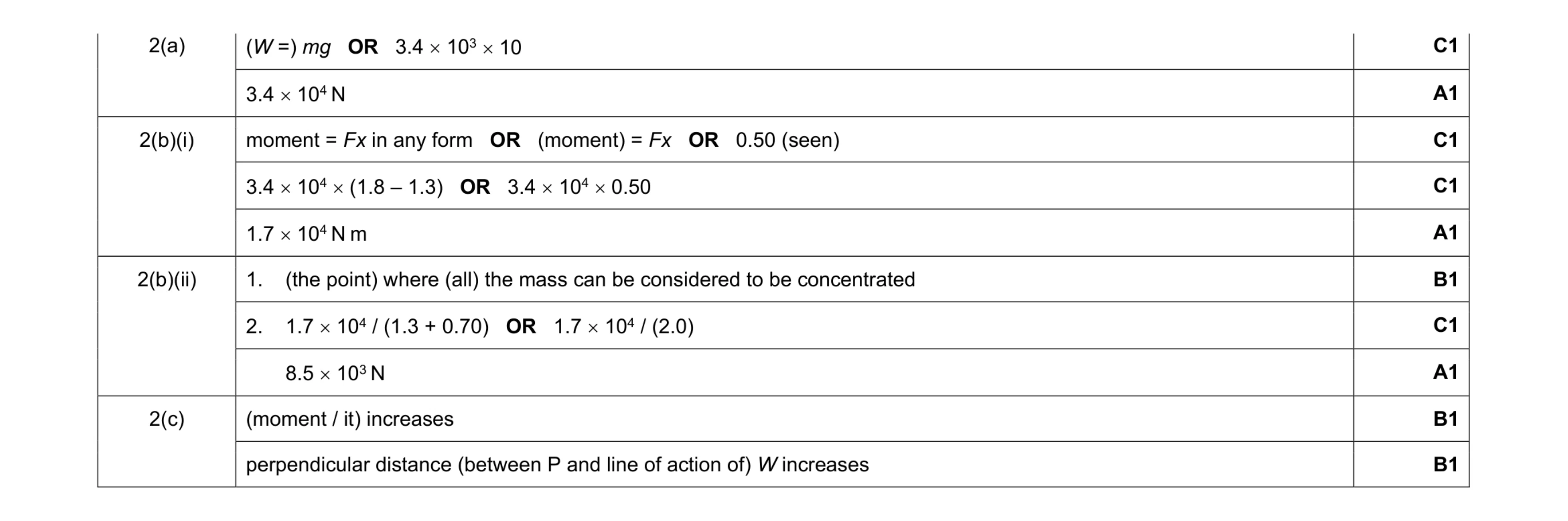 10
10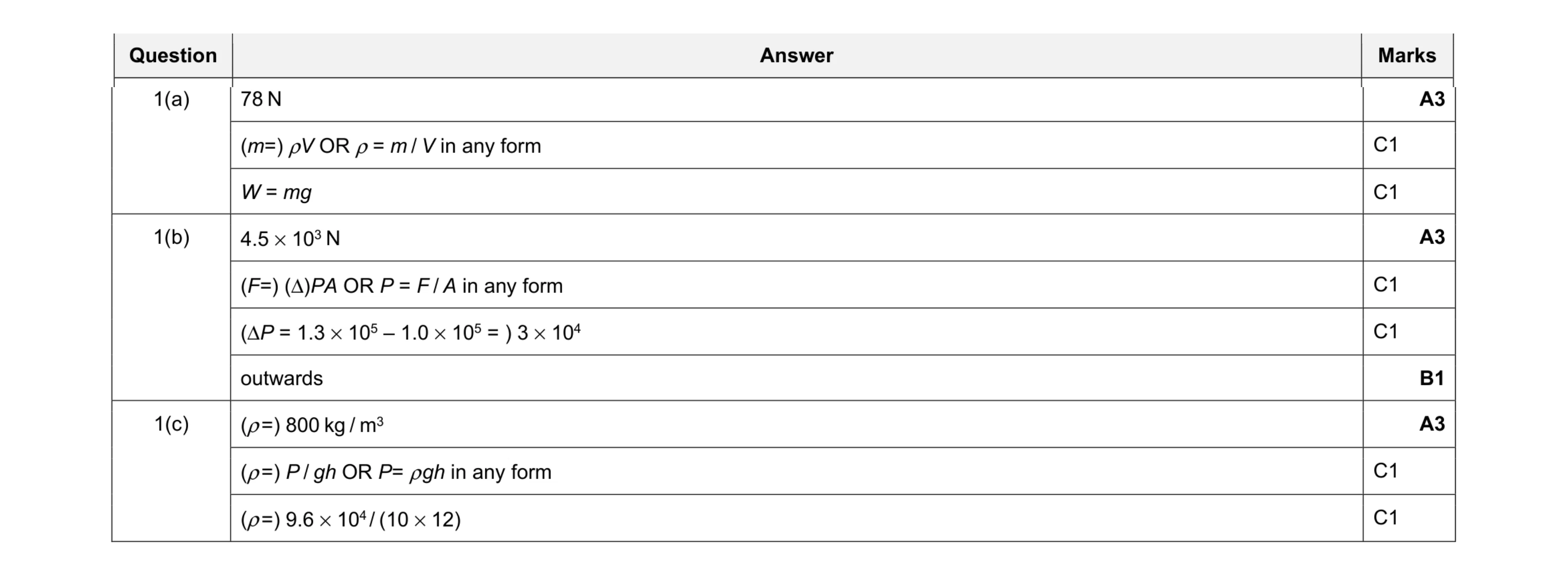 10
10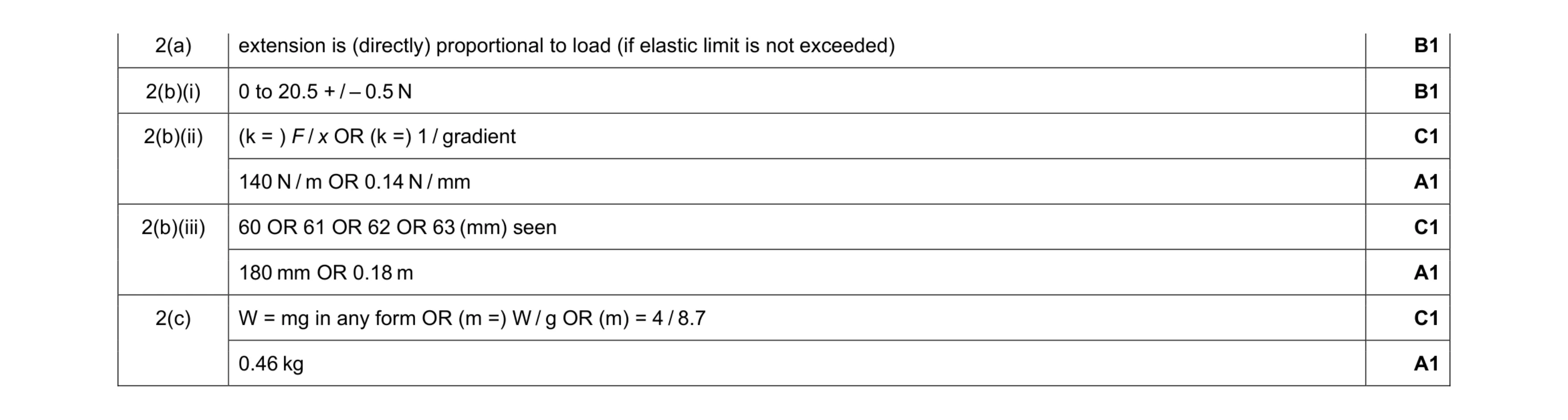 8
8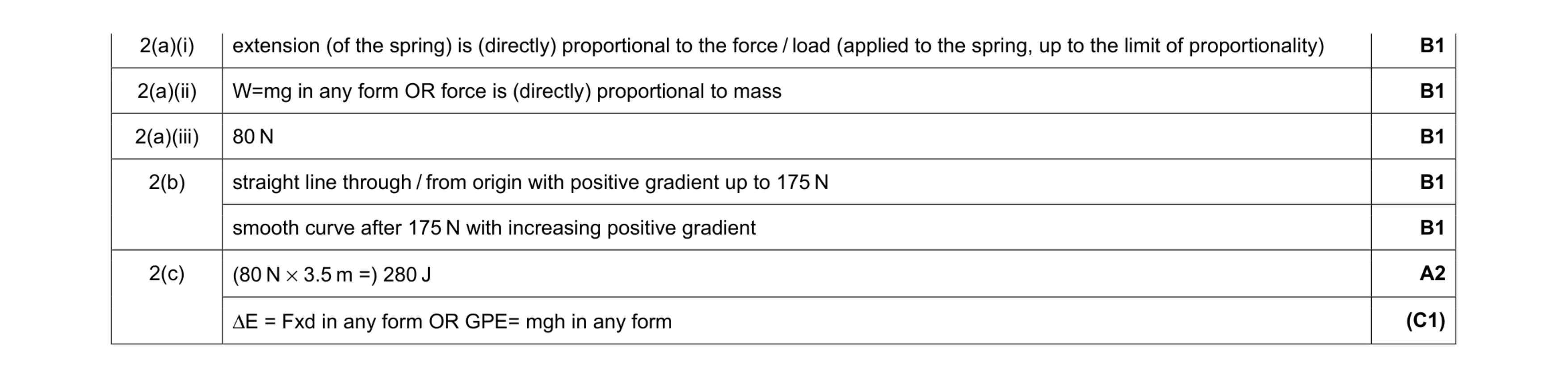 7
7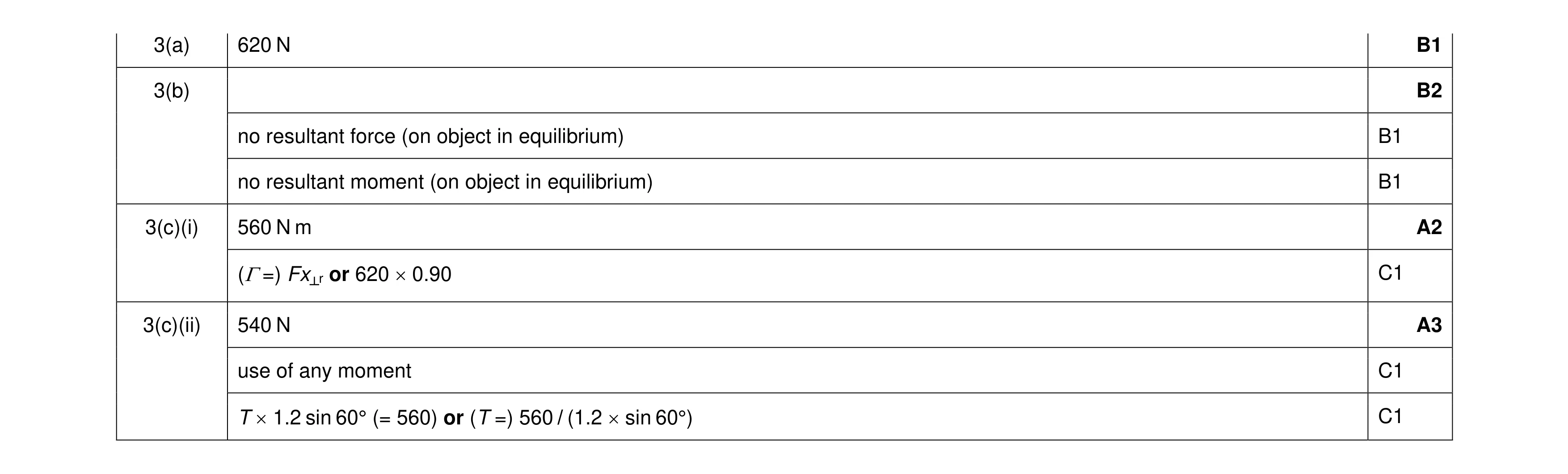 8
8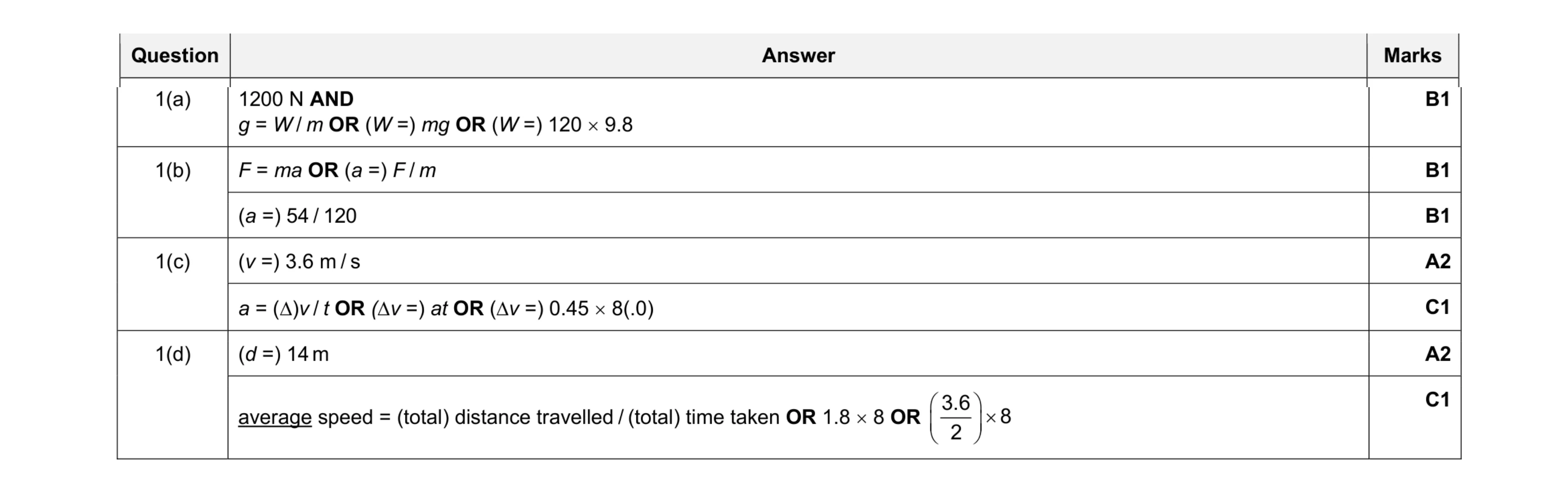 7
7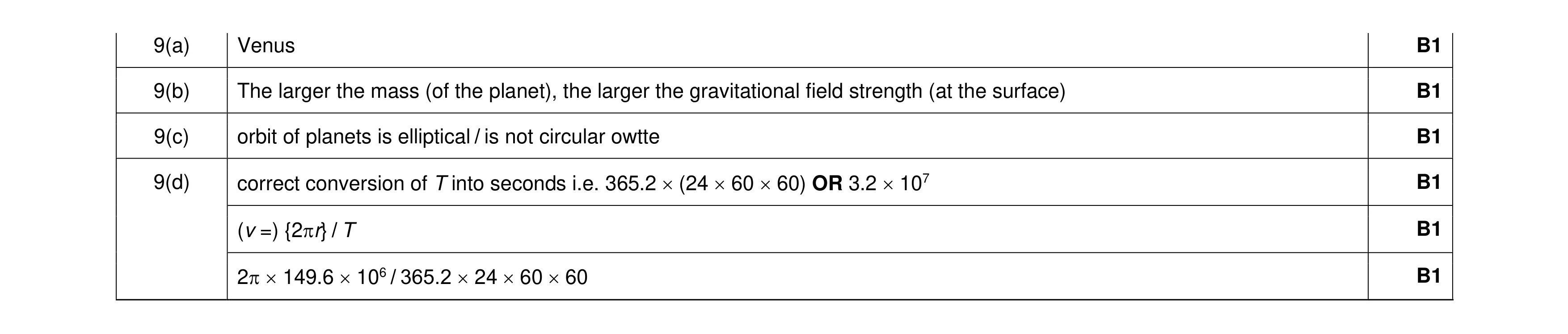 6
6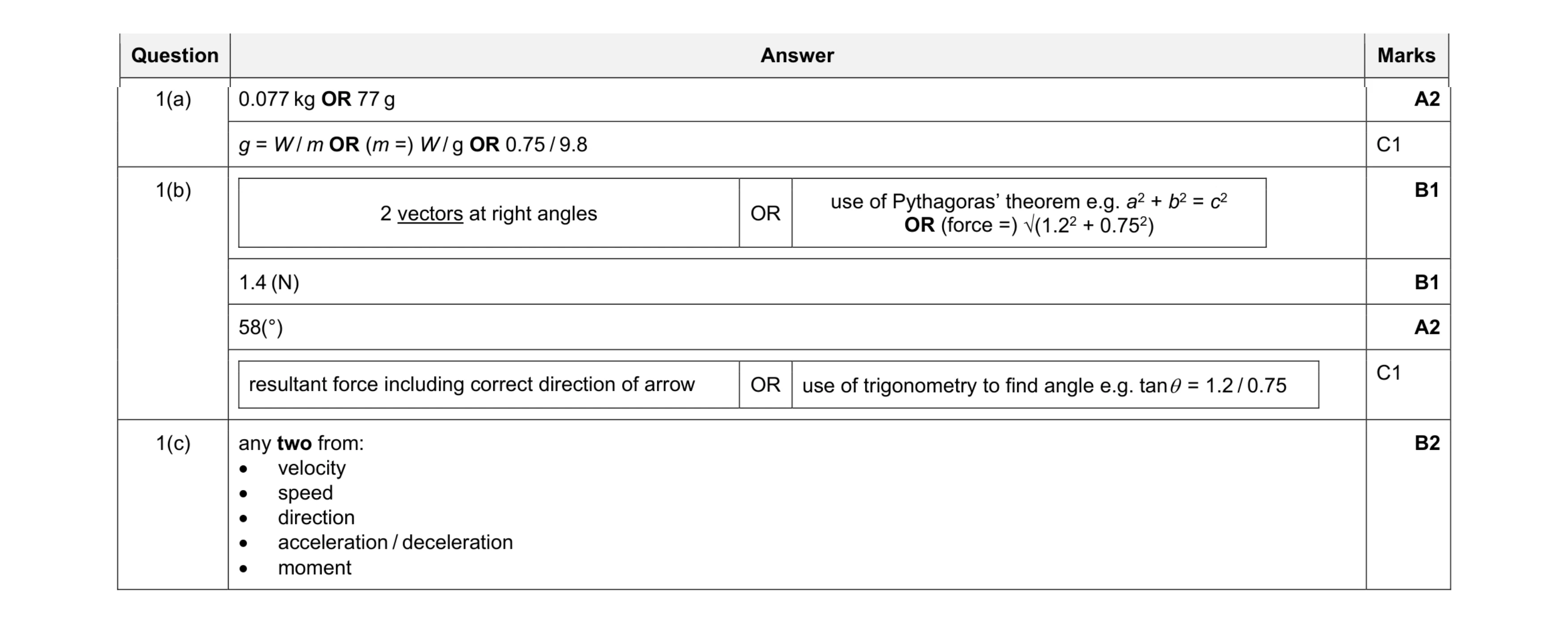 8
8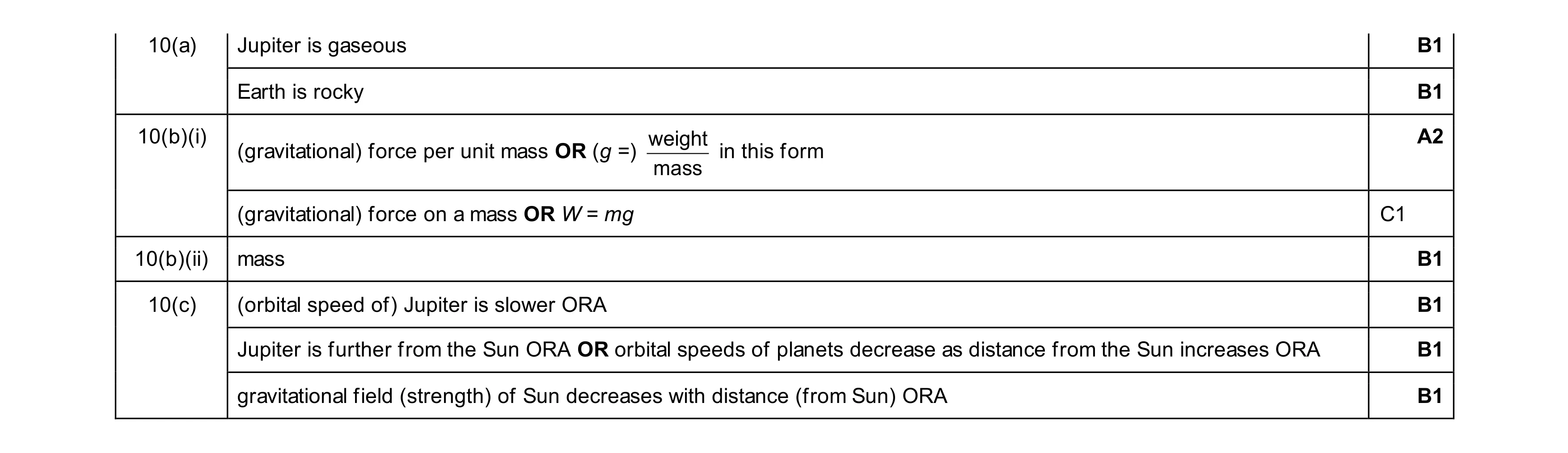 8
8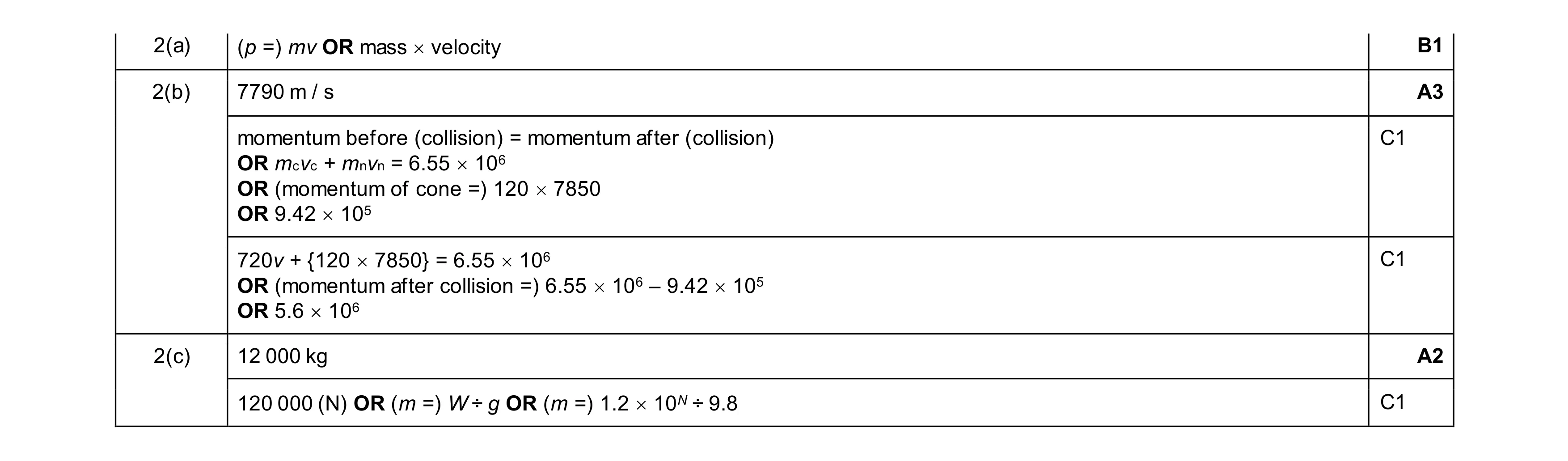 6
6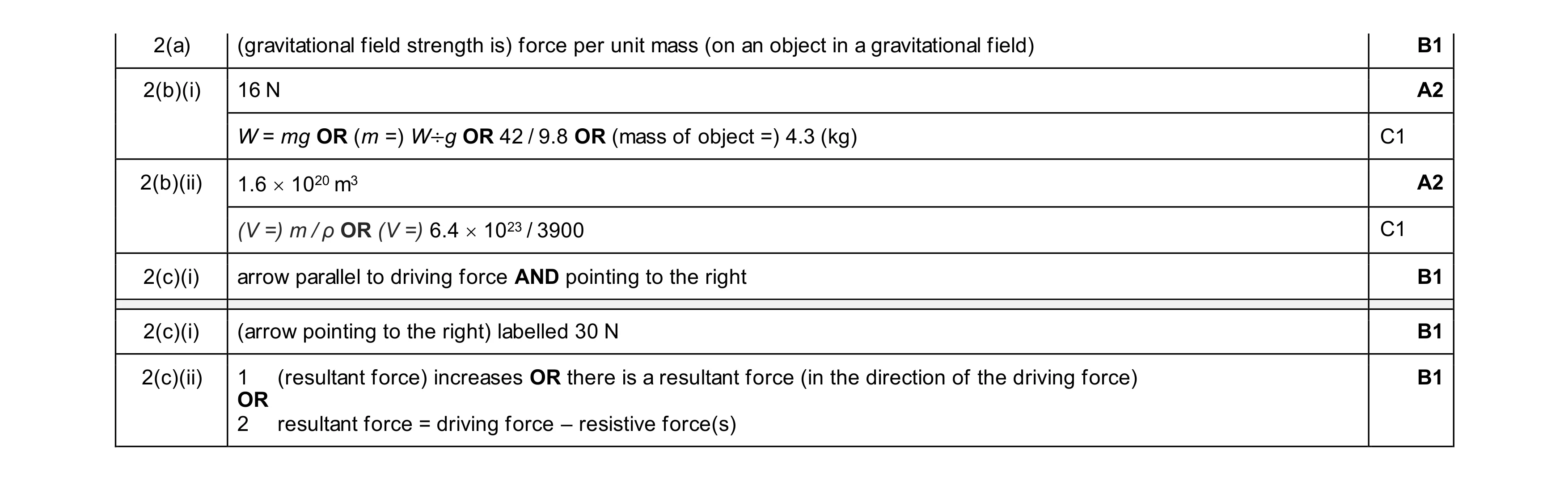 8
8