Questions as text
Q1 · A smoker secretes excess mucus from the epithelial lining of the respiratory system 9700/11 Oct/Nov 2004
33 A smoker secretes excess mucus from the epithelial lining of the respiratory system. Which disease is likely to develop? A asthma B bronchitis C emphysema D lung cancer
1 marks
Answer: B
This question in 9700/11 Oct/Nov 2004
Q2 · What are the causative agent and method of infection for cholera? 9700/11 Oct/Nov 2004
34 What are the causative agent and method of infection for cholera? causative agent method of infection A bacterium direct contact B bacterium food and water C virus inhalation D virus faeces
1 marks
Answer: B
This question in 9700/11 Oct/Nov 2004
Q3 · The diagram shows stages in the development of the disease emphysema 9700/11 May/June 2006
32 The diagram shows stages in the development of the disease emphysema. chronic infection causing inflammation increased number of macrophages cells 1 invade tissue 2 walls releasing enzyme 3 which digests a molecule in the wall What is correct for 1, 2 and 3? 1 2 3 A lymphocytes alveoli elastase B lymphocytes bronchiole ligase C phagocytes alveoli elastase D phagocytes bronchiole ligase
1 marks
Answer: C
This question in 9700/11 May/June 2006
Q4 · What do the causative agents of HIV/AIDS, malaria and TB have in common? 9700/11 May/June 2006
34 What do the causative agents of HIV/AIDS, malaria and TB have in common?
they have a cell they have they have th ;
; ey respire
surface membrane genes ribosomes
A v Jv v v
B v x x v
Cc x v x v
D x v x x
1 marks
Answer: D
This question in 9700/11 May/June 2006
Q5 · The antibiotic streptomycin is now proving to be less effective in reducing the incidence… 9700/11 May/June 2006
35 The antibiotic streptomycin is now proving to be less effective in reducing the incidence of tuberculosis (TB) worldwide. What is the reason for this observation? A Antibiotics such as streptomycin are not effective as antiviral drugs. B Fewer people are living in isolated rural areas and overcrowding occurs in inner cities. C The incidence of HIV infection is increasing, activating previously inactive Mycobacterium. D There is an increase in the number of people infected with drug resistant strains.
1 marks
Answer: D
This question in 9700/11 May/June 2006
Q6 · Some studies suggest that smoking increases the risk of developing lung cancer 9700/11 Oct/Nov 2006
32 Some studies suggest that smoking increases the risk of developing lung cancer. The two graphs show the percentage of smokers and the deaths from lung cancer in men of two age groups between 1950 and 1998. 500 90 450 80 400 70 350 smokers / 60 deaths per 300 50 100 000 of 250 % of age 40 age group 200 group 30 150 20 100 10 50 0 0 1950 1960 1970 1980 1990 2000 1950 1960 1970 1980 1990 2000 year year key aged 35 – 59 aged 60 – 74 Which statement is not supported by the data in the graphs? A Deaths from lung cancer in men 35-59 decreased by 50 % over the period of the study. B Deaths from lung cancer in men 60-74 increased up to 1970. C The data for men 60-74 between 1950 to 1970 suggests that lung cancer takes up to 20 years to develop. D The number of men aged 35-59 who were smokers decreased by approximately 60 % over the period of the study.
1 marks
Answer: D
This question in 9700/11 Oct/Nov 2006
Q7 · The table shows four infectious diseases and the pathogen responsible 9700/11 Oct/Nov 2006
33 The table shows four infectious diseases and the pathogen responsible. Which row in the table is correct? disease cholera malaria TB AIDS A bacterium bacterium virus protoctista B bacterium protoctista bacterium virus C virus protoctista protoctista virus D protoctista virus bacterium bacterium
1 marks
Answer: B
This question in 9700/11 Oct/Nov 2006
Q8 · Which statement is an example of epidemiological evidence linking smoking to lung cancer? 9700/11 Oct/Nov 2007
32 Which statement is an example of epidemiological evidence linking smoking to lung cancer? A Chemical analysis of tar from cigarettes shows that it contains carcinogens. B Dogs made to inhale the smoke from cigarettes develop lung tumours. C The incidence of lung cancer increases in a population as more cigarettes are smoked. D When tar from cigarettes is rubbed onto the skin of mice, the mice develop skin tumours.
1 marks
Answer: C
This question in 9700/11 Oct/Nov 2007
Q9 · Some facts about diseases are listed 9700/11 Oct/Nov 2007
33 Some facts about diseases are listed. 1 may be inherited from a parent 2 may be carried by a vector 3 may be caused by stress 4 may be passed on by contact 5 may enter through the mouth with food Which numbered statements apply to infectious diseases? A 1, 2 and 3 B 1, 3 and 5 C 2, 3 and 4 D 2, 4 and 5
1 marks
Answer: D
This question in 9700/11 Oct/Nov 2007
Q10 · Which disease is not likely to be passed directly from parent to child? 9700/11 Oct/Nov 2007
34 Which disease is not likely to be passed directly from parent to child? A cholera B HIV / AIDS C malaria D tuberculosis
1 marks
Answer: C
This question in 9700/11 Oct/Nov 2007
Q11 · Between 1954 and 1958 many doctors read a report that linked smoking cigarettes to deaths… 9700/11 May/June 2008
31 Between 1954 and 1958 many doctors read a report that linked smoking cigarettes to deaths from lung cancer. The graph shows deaths from lung cancer among male doctors and ‘all other men’ in England and Wales between 1954 and 1962. 120 all other men +7 % 90 deaths from lung 60 cancer per male doctors 100 000 –38 % 30 0 1954 1958 1962 year Which statements best explain the changes in deaths from lung cancer between 1954 and 1962? 1 ‘All other men’ are more at risk of dying from lung cancer then male doctors. 2 Male doctors are more at risk of dying from lung cancer than ‘all other men’. 3 Proportionally more ‘all other men’ gave up smoking than male doctors. 4 Proportionally more male doctors gave up smoking cigarettes than ‘all other men’. A 1 and 3 B 2 and 3 C 2 and 4 D 1 and 4
1 marks
Answer: D
This question in 9700/11 May/June 2008
Q12 · Which factors would help prevent which disease? 9700/11 May/June 2008
36 Which factors would help prevent which disease? 1 covering water containers 2 disinfecting and chlorinating water 3 use of antiviral drugs 4 vaccination cholera malaria tuberculosis (TB) A 2 1 4 B 1 and 2 2 3 C 4 2 3 D 3 1 and 2 4
1 marks
Answer: A
This question in 9700/11 May/June 2008
Q13 · Which of the following are increasing the spread of malaria? 9700/11 Oct/Nov 2008
36 Which of the following are increasing the spread of malaria? 1 continued migration of people due to war and civil unrest 2 increasing carbon dioxide levels causing global warming 3 increasing resistance to antibiotics and other drugs A 1 and 2 only B 1 and 3 only C 2 and 3 only D 1, 2 and 3
1 marks
Answer: D
This question in 9700/11 Oct/Nov 2008
Q14 · Scientists are concerned that avian (bird) flu caused by the H5N1 virus, could infect… 9700/12 Oct/Nov 2009
36 Scientists are concerned that avian (bird) flu caused by the H5N1 virus, could infect humans and cause a pandemic. If this occurs, which factors could help prevent humans spreading the disease? 1 killing all poultry 2 reducing all air flights 3 taking a course of antibiotics A 1 only B 2 only C 3 only D 1, 2 and 3
1 marks
Answer: B
This question in 9700/12 Oct/Nov 2009
Q15 · A country has fewer than 2.5 deaths per 100 000 people from TB in one year and the next… 9700/12 Oct/Nov 2009
37 A country has fewer than 2.5 deaths per 100 000 people from TB in one year and the next year this rose to 25 deaths per 100 000. What may have contributed to this change? 1 decrease in contact tracing 2 increase in refugee camps 3 water supply contaminated by sewage A 1 and 2 B 1 and 3 C 2 and 3 D 1, 2 and 3
1 marks
Answer: A
This question in 9700/12 Oct/Nov 2009
Q16 · Which statement is an example of epidemiological evidence linking smoking to lung cancer? 9700/11 May/June 2010
32 Which statement is an example of epidemiological evidence linking smoking to lung cancer? A Chemical analysis of tar from cigarettes shows that it contains carcinogens. B Dogs made to inhale the smoke from cigarettes develop lung tumours. C The incidence of lung cancer increases in a population as more cigarettes are smoked. D When tar from cigarettes is rubbed onto the skin of mice, the mice develop skin tumours.
1 marks
Answer: C
This question in 9700/11 May/June 2010
Q17 · What are the causative agents of cholera, malaria and TB? 9700/11 May/June 2010
34 What are the causative agents of cholera, malaria and TB? cholera malaria TB A bacterium insect virus B bacterium protoctist bacterium C virus insect virus D virus protoctist bacterium
1 marks
Answer: B
This question in 9700/11 May/June 2010
Q18 · 40 % of the world’s population live in an area where malaria is a threat to health 9700/11 May/June 2010
35 40 % of the world’s population live in an area where malaria is a threat to health. In recent years there have been many more cases in Africa. What is the social factor that is letting the spread of malaria get out of control? A an increase in drug resistant forms of malaria B climate change C difficulty in producing a vaccine D migration of people because of wars
1 marks
Answer: D
This question in 9700/11 May/June 2010
Q19 · Which statement is an example of epidemiological evidence linking smoking to lung cancer? 9700/12 May/June 2010
2 Which statement is an example of epidemiological evidence linking smoking to lung cancer? A Chemical analysis of tar from cigarettes shows that it contains carcinogens. B Dogs made to inhale the smoke from cigarettes develop lung tumours. C The incidence of lung cancer increases in a population as more cigarettes are smoked. D When tar from cigarettes is rubbed onto the skin of mice, the mice develop skin tumours.
1 marks
Answer: C
This question in 9700/12 May/June 2010
Q20 · What are the causative agents of cholera, malaria and TB? 9700/12 May/June 2010
33 What are the causative agents of cholera, malaria and TB? cholera malaria TB A bacterium insect virus B bacterium protoctist bacterium C virus insect virus D virus protoctist bacterium
1 marks
Answer: B
This question in 9700/12 May/June 2010
Q21 · 40 % of the world’s population live in an area where malaria is a threat to health 9700/12 May/June 2010
36 40 % of the world’s population live in an area where malaria is a threat to health. In recent years there have been many more cases in Africa. What is the social factor that is letting the spread of malaria get out of control? A an increase in drug resistant forms of malaria B climate change C difficulty in producing a vaccine D migration of people because of wars
1 marks
Answer: D
This question in 9700/12 May/June 2010
Q22 · What are the causative agents of cholera, malaria and TB? 9700/13 May/June 2010
23 What are the causative agents of cholera, malaria and TB? cholera malaria TB A bacterium insect virus B bacterium protoctist bacterium C virus insect virus D virus protoctist bacterium
1 marks
Answer: B
This question in 9700/13 May/June 2010
Q23 · 40 % of the world’s population live in an area where malaria is a threat to health 9700/13 May/June 2010
24 40 % of the world’s population live in an area where malaria is a threat to health. In recent years there have been many more cases in Africa. What is the social factor that is letting the spread of malaria get out of control? A an increase in drug resistant forms of malaria B climate change C difficulty in producing a vaccine D migration of people because of wars
1 marks
Answer: D
This question in 9700/13 May/June 2010
Q24 · Which statement is an example of epidemiological evidence linking smoking to lung cancer? 9700/13 May/June 2010
32 Which statement is an example of epidemiological evidence linking smoking to lung cancer? A Chemical analysis of tar from cigarettes shows that it contains carcinogens. B Dogs made to inhale the smoke from cigarettes develop lung tumours. C The incidence of lung cancer increases in a population as more cigarettes are smoked. D When tar from cigarettes is rubbed onto the skin of mice, the mice develop skin tumours.
1 marks
Answer: C
This question in 9700/13 May/June 2010
Q25 · Which diseases can be cured by the use of antibiotics? 9700/11 Oct/Nov 2010
33 Which diseases can be cured by the use of antibiotics? A cholera and tuberculosis B measles and smallpox C measles and tuberculosis D smallpox and cholera
1 marks
Answer: A
This question in 9700/11 Oct/Nov 2010
Q26 · What could cause an outbreak of malaria in a country where it had been eliminated? 9700/11 Oct/Nov 2010
34 What could cause an outbreak of malaria in a country where it had been eliminated? 1 mosquitoes became resistant to insecticides 2 migration of population due to war 3 malarial parasites became resistant to quinine A 1 and 2 only B 1 and 3 only C 2 and 3 only D 1, 2 and 3
1 marks
Answer: D
This question in 9700/11 Oct/Nov 2010
Q27 · Which of the effects listed occur as a result of inhaling both carbon monoxide and… 9700/12 Oct/Nov 2010
34 Which of the effects listed occur as a result of inhaling both carbon monoxide and nicotine from cigarette smoke? 1 increased heart rate 2 increased risk of cardiovascular disease 3 increased risk of emphysema 4 increased risk of lung cancer A 1, 2 and 3 B 1 and 2 only C 2, 3 and 4 D 3 and 4 only
1 marks
Answer: B
This question in 9700/12 Oct/Nov 2010
Q28 · Which disease is not likely to be passed directly from parents to child? 9700/11 May/June 2011
36 Which disease is not likely to be passed directly from parents to child? A cholera B malaria C sickle cell anaemia D tuberculosis
1 marks
Answer: B
This question in 9700/11 May/June 2011
Q29 · Smallpox has been eradicated, but not malaria or cholera 9700/11 May/June 2011
38 Smallpox has been eradicated, but not malaria or cholera. Which statements correctly explain this? 1 Cholera bacteria in the intestines are not destroyed by antibiotics. 2 Plasmodium antigens change during the life cycle. 3 Smallpox antigens remain stable. 4 Vaccines only work against viruses. A 1, 2 and 3 B 1, 2 and 4 C 1, 3 and 4 D 2, 3 and 4
1 marks
Answer: A
This question in 9700/11 May/June 2011
Q30 · Which of the diseases listed in the table are only treatable using antibiotics? 9700/12 May/June 2011
35 Which of the diseases listed in the table are only treatable using antibiotics?
cholera | measles TB
v v key
JY = treatable
X = not treatable
0 ONO DW >
Ke 4K
v x
v v
x v
1 marks
Answer: B
This question in 9700/12 May/June 2011
Q31 · The diagram shows properties of diseases 9700/12 May/June 2011
36 The diagram shows properties of diseases. Which area of the diagram shows the properties that are common to both cholera and tuberculosis? A bacterial infectious D C B transmitted by airborne droplets
1 marks
Answer: A
This question in 9700/12 May/June 2011
Q32 · The disease smallpox has been eradicated by a worldwide vaccination programme 9700/12 May/June 2011
37 The disease smallpox has been eradicated by a worldwide vaccination programme. Which set of reasons correctly identifies the problems associated with planning vaccination programmes to eradicate other diseases? sickle cell TB malaria cholera anaemia A invade gut cells genetically different poor response where immune inherited vaccines with system less recessive needed for malnourished effective condition active and children; dormant-to- boosters then active forms required B different stages poor response genetically different with different with inherited vaccines antigens; malnourished recessive needed for invades body children; condition active and cells boosters then dormant-to- required active forms C different different stages genetically invade gut cells vaccines with different inherited where immune needed for antigens; recessive system less active and invades body condition effective dormant-to- cells active forms D genetically different invade gut cells different stages inherited vaccines where immune with different recessive needed for system less antigens; condition active and effective invades body dormant-to- cells active forms
1 marks
Answer: C
This question in 9700/12 May/June 2011
Q33 · Smallpox has been eradicated, but not malaria or cholera 9700/13 May/June 2011
37 Smallpox has been eradicated, but not malaria or cholera. Which statements correctly explain this? 1 Cholera bacteria in the intestines are not destroyed by antibiotics. 2 Plasmodium antigens change during the life cycle. 3 Smallpox antigens remain stable. 4 Vaccines only work against viruses. A 1, 2 and 3 B 1, 2 and 4 C 1, 3 and 4 D 2, 3 and 4
1 marks
Answer: A
This question in 9700/13 May/June 2011
Q34 · Which disease is not likely to be passed directly from parents to child? 9700/13 May/June 2011
38 Which disease is not likely to be passed directly from parents to child? A cholera B malaria C sickle cell anaemia D tuberculosis
1 marks
Answer: B
This question in 9700/13 May/June 2011
Q35 · Which details are correct? 9700/11 Oct/Nov 2011
35 Which details are correct? method of controlling disease treatment causative agent spread A AIDS use condoms during antibiotics virus sexual intercourse B cholera water treatment oral rehydration bacterium C malaria quinine vaccination protoctist D TB isolate patients antibiotics virus
1 marks
Answer: B
This question in 9700/11 Oct/Nov 2011
Q36 · Which details are correct? 9700/13 Oct/Nov 2011
14 Which details are correct? method of controlling disease treatment causative agent spread A AIDS use condoms during antibiotics virus sexual intercourse B cholera water treatment oral rehydration bacterium C malaria quinine vaccination protoctist D TB isolate patients antibiotics virus
1 marks
Answer: B
This question in 9700/13 Oct/Nov 2011
Q37 · Which of the following increases the risk of contracting cholera? 9700/11 May/June 2012
35 Which of the following increases the risk of contracting cholera? 1 drinking unpasteurised milk 2 eating shellfish which have fed on raw sewage 3 living in overcrowded conditions A 2 only B 1 and 2 C 1 and 3 D 2 and 3
1 marks
Answer: A
This question in 9700/11 May/June 2012
Q38 · Which of the following two diseases are caused by viruses? 9700/12 May/June 2012
36 Which of the following two diseases are caused by viruses? A HIV and cholera B malaria and cholera C measles and smallpox D TB and HIV
1 marks
Answer: C
This question in 9700/12 May/June 2012
Q39 · Cholera is no longer common in many countries 9700/12 May/June 2012
37 Cholera is no longer common in many countries. What is the reason for this? A education of the citizens about the spread of the disease B routine vaccination by local health authorities C treatment of water supplies and separate sewage treatment D treatment of water to control mosquitoes
1 marks
Answer: C
This question in 9700/12 May/June 2012
Q40 · Which of the following increases the risk of contracting cholera? 9700/13 May/June 2012
31 Which of the following increases the risk of contracting cholera? 1 drinking unpasteurised milk 2 eating shellfish which have fed on raw sewage 3 living in overcrowded conditions A 2 only B 1 and 2 C 1 and 3 D 2 and 3
1 marks
Answer: A
This question in 9700/13 May/June 2012
Q41 · Which of the following increase the risk of contracting TB? 9700/11 Oct/Nov 2012
37 Which of the following increase the risk of contracting TB? 1 drinking unpasteurised milk 2 eating shellfish which have fed on raw sewage 3 living in overcrowded conditions A 2 only B 1 and 2 C 1 and 3 D 2 and 3
1 marks
Answer: C
This question in 9700/11 Oct/Nov 2012
Q42 · Which of the following increases the risk of contracting measles? 9700/12 Oct/Nov 2012
35 Which of the following increases the risk of contracting measles? 1 drinking unpasteurised milk 2 eating shellfish which have fed on raw sewage 3 living in overcrowded conditions A 3 only B 1 and 2 C 1 and 3 D 2 and 3
1 marks
Answer: A
This question in 9700/12 Oct/Nov 2012
Q43 · For some diseases, one of the most effective measures for prevention and control is… 9700/13 Oct/Nov 2012
34 For some diseases, one of the most effective measures for prevention and control is tracing people who have been in contact with infected people. For which disease would tracing the contacts of infected people help in its prevention and control? A Cholera, as it can be treated successfully with carefully selected antibiotics. B Malaria, as it is transmitted by animals, so the transmission cycle of the pathogen can be broken. C Measles, as it can cause an epidemic and can be controlled by other methods. D Sickle cell anaemia, as it is genetically inherited, so there is time to act before more individuals are affected.
1 marks
Answer: C
This question in 9700/13 Oct/Nov 2012
Q44 · What could cause an outbreak of malaria in a country where it had been eliminated? 9700/11 May/June 2013
37 What could cause an outbreak of malaria in a country where it had been eliminated? 1 mosquitoes became resistant to insecticides 2 migration of population due to war 3 malarial parasites became resistant to quinine A 1 and 2 only B 1 and 3 only C 2 and 3 only D 1, 2 and 3
1 marks
Answer: D
This question in 9700/11 May/June 2013
Q45 · There is a lot of epidemiological evidence linking smoking to disease and early death 9700/12 May/June 2013
34 There is a lot of epidemiological evidence linking smoking to disease and early death. Which is the best description of ‘epidemiological’? A Disease and deaths are not randomly distributed in small populations. B Disease and deaths are not randomly distributed in the whole population. C Disease and deaths are only randomly distributed in large populations. D Disease and deaths are randomly distributed in the whole population.
1 marks
Answer: B
This question in 9700/12 May/June 2013
Q46 · A country had fewer than 2.5 deaths per 100 000 people from TB in one year and the next… 9700/12 May/June 2013
36 A country had fewer than 2.5 deaths per 100 000 people from TB in one year and the next year this rose to 25 deaths per 100 000. What may have contributed to this change? 1 decrease in contact tracing 2 increase in refugee camps 3 water supply contaminated by sewage A 1 and 2 only B 1 and 3 only C 2 and 3 only D 1, 2 and 3
1 marks
Answer: A
This question in 9700/12 May/June 2013
Q47 · Which is correct for TB, measles and malaria? 9700/11 Oct/Nov 2013
34 Which is correct for TB, measles and malaria? TB measles malaria causative causative causative transmission transmission transmission agent agent agent A bacteria air-borne virus air-borne protoctist insect vector B bacteria water-borne protoctist air-borne virus insect vector C virus air-borne bacteria water-borne protoctist insect vector D virus insect vector protoctist insect vector bacteria water-borne
1 marks
Answer: A
This question in 9700/11 Oct/Nov 2013
Q48 · What do the causative agents of HIV/AIDS, malaria and TB have in common? 9700/11 Oct/Nov 2013
35 What do the causative agents of HIV/AIDS, malaria and TB have in common?
they have a cell they have they have
; they respire key
surface membrane genes ribosomes
¥ present in each
v v v
causative agent
X not present in
each causative
agent
0 Oo WwW PY
a CS
v x x
x v x
x v x
1 marks
Answer: D
This question in 9700/11 Oct/Nov 2013
Q49 · The diagram shows the relationship between cholera, measles and TB 9700/12 Oct/Nov 2013
34 The diagram shows the relationship between cholera, measles and TB. 1 2 3 4 5 Which is correct? 1 2 3 4 5 A cholera bacteria TB airborne measles B cholera virus measles waterborne TB C measles airborne cholera bacteria TB D measles waterborne TB virus cholera
1 marks
Answer: A
This question in 9700/12 Oct/Nov 2013
Q50 · Which row is correct? 9700/13 Oct/Nov 2013
34 Which row is correct? causative method method disease agent of transmission of control A AIDS HIV intimate contact antibiotics B cholera virus waterborne oral rehydration therapy (ORT) C malaria bacterium insect vector antimalarial drugs D tuberculosis (TB) bacterium airborne vaccination
1 marks
Answer: D
This question in 9700/13 Oct/Nov 2013
Q51 · Scientists are concerned that avian (bird) flu caused by the H5N1 virus could infect… 9700/13 Oct/Nov 2013
35 Scientists are concerned that avian (bird) flu caused by the H5N1 virus could infect humans and cause a pandemic. What could help prevent humans from spreading the disease? 1 killing all poultry 2 reducing the number of air flights 3 taking a course of antibiotics A 1 only B 2 only C 3 only D 1, 2 and 3
1 marks
Answer: B
This question in 9700/13 Oct/Nov 2013
Q52 · The statements refer to the disease tuberculosis (TB) 9700/11 May/June 2014
35 The statements refer to the disease tuberculosis (TB). 1 The pathogen lives inside human cells so is not accessible to the immune system. 2 The bacterial pathogen reproduces slowly. 3 The pathogen is not very sensitive to antibiotics. Which explains why antibiotic treatment for TB takes a long time? A 1, 2 and 3 B 1 and 2 only C 1 and 3 only D 2 and 3 only
1 marks
Answer: D
This question in 9700/11 May/June 2014
Q53 · The first column in the table contains statements about disease 9700/11 May/June 2014
36 The first column in the table contains statements about disease. Columns headed 1-4 represent
four different named diseases.
disease
statement about disease 1 2 3
infectious disease v v
can be treated with antibiotics v
caused by a bacterium v
degeneration of lung tissue v
Which is the correct set of column headings for the diseases in the table?
disease
0 0O DW >
bronchitis
emphysema
emphysema
lung cancer
measles
malaria
smallpox
smallpox
malaria
HIV/AIDS
cholera
HIV/AIDS
smallpox
cholera
HIV/AIDS
cholera
key
/ =true
1 marks
Answer: C
This question in 9700/11 May/June 2014
Q54 · The malarial parasite, Plasmodium, infects red blood cells and breaks down haemoglobin 9700/12 May/June 2014
34 The malarial parasite, Plasmodium, infects red blood cells and breaks down haemoglobin. Free haem groups are toxic to Plasmodium and the parasite converts them into non-toxic, crystalline haematozoin, using an enzyme, HDP, which is found in all species of Plasmodium. What will be the long term result of giving patients with malaria a drug which inhibits HDP? A a decreased concentration of free haem groups in infected red blood cells B a decreased concentration of haemoglobin in infected red blood cells C more rapid reproduction of some species of Plasmodium in infected red blood cells D slower reproduction of all species of Plasmodium in infected red blood cells
1 marks
Answer: D
This question in 9700/12 May/June 2014
Q55 · Which factors may increase the risk of cholera in refugee camps? 9700/13 May/June 2014
36 Which factors may increase the risk of cholera in refugee camps? 1 no refrigeration of food 2 increase in the number of people 3 lack of hand washing facilities A 1, 2 and 3 B 1 and 2 only C 1 and 3 only D 2 and 3 only
1 marks
Answer: D
This question in 9700/13 May/June 2014
Q56 · The following are all methods of transmission of infectious diseases 9700/11 Oct/Nov 2014
32 The following are all methods of transmission of infectious diseases. 1 droplet 2 food 3 contact 4 vector Which row shows the correct organism and method of transmission of each disease? malaria TB HIV A bacterium virus virus 4 1 and 2 3 and 4 B protoctist bacterium virus 4 1 and 2 3 C protoctist virus bacterium 3 1 3 D bacterium protoctist bacterium 3 1 1 and 3
1 marks
Answer: B
This question in 9700/11 Oct/Nov 2014
Q57 · 40% of the world’s population live in an area where malaria is a threat to health 9700/11 Oct/Nov 2014
33 40% of the world’s population live in an area where malaria is a threat to health. In recent years there have been many more cases of malaria in Africa. What is the social factor that is letting the spread of malaria get out of control? A an increase in drug resistant forms of malaria B climate change C difficulty in producing a vaccine D migration of people because of wars
1 marks
Answer: D
This question in 9700/11 Oct/Nov 2014
Q58 · Which flow diagram correctly describes the effect of tar entering the lungs? 9700/12 Oct/Nov 2014
34 Which flow diagram correctly describes the effect of tar entering the lungs? carcinogens A uncontrolled → mass of cells come into contact → mutation occurs → cell division produced with DNA mucus goblet cells phagocytes B accumulates causes irritation secrete more → → attracted by → causing and coughing mucus inflammation infection goblet cells phagocytes C mass of cells secrete more → mutation occurs → attracted by → produced mucus inflammation phagocytes D uncontrolled elastase destroys attracted by → mutation occurs → → cell division the alveolar walls inflammation
1 marks
Answer: A
This question in 9700/12 Oct/Nov 2014
Q59 · Which statements about people infected with HIV / AIDS are correct? 9700/12 Oct/Nov 2014
35 Which statements about people infected with HIV / AIDS are correct? 1 They can be treated and completely cured. 2 They may live for many years after infection. 3 They will have symptoms. A 1, 2 and 3 B 1 and 3 only C 2 only D 3 only
1 marks
Answer: C
This question in 9700/12 Oct/Nov 2014
Q60 · The statements refer to polio and tuberculosis (TB) 9700/12 Oct/Nov 2014
36 The statements refer to polio and tuberculosis (TB). 1 Macrophages present antigens in vaccines to stimulate an immune response. 2 The TB antigens necessary to produce an immune response are proteins which would be digested in the stomach and small intestine. 3 There are no B-lymphocytes and T-lymphocytes in the stomach. Which explains why polio vaccine can be taken by mouth but TB vaccine has to be injected? A 1, 2 and 3 B 1 and 2 only C 1 and 3 only D 2 only
1 marks
Answer: D
This question in 9700/12 Oct/Nov 2014
Q61 · A person who returns home after a visit to a foreign country starts to have fevers at… 9700/13 Oct/Nov 2014
33 A person who returns home after a visit to a foreign country starts to have fevers at regular intervals. Blood tests taken between the fevers and during the fevers show a decrease in the number of red blood cells (anaemia). Which disease does this person have? A cholera B HIV / AIDS C malaria D TB
1 marks
Answer: C
This question in 9700/13 Oct/Nov 2014
Q62 · Why do people in refugee camps have a high risk of being infected by cholera? 9700/13 Oct/Nov 2014
34 Why do people in refugee camps have a high risk of being infected by cholera? A Drinking water is likely to be contaminated with sewage. B People live in close contact, increasing the risk of droplet infection. C There is a shortage of antibiotics. D There is a shortage of food and water.
1 marks
Answer: A
This question in 9700/13 Oct/Nov 2014
Q63 · Which statements explain why cholera has not been eradicated by vaccination? 9700/13 Oct/Nov 2014
35 Which statements explain why cholera has not been eradicated by vaccination? 1 Cholera is caused by the bacterium Vibrio cholerae. 2 Many people can have the disease, but show no symptoms. 3 People are mobile due to global trade and tourism. 4 The cholera pathogens target cells in the small intestine. A 1, 2, 3 and 4 B 1 and 2 only C 2 and 4 only D 3 and 4 only
1 marks
Answer: D
This question in 9700/13 Oct/Nov 2014
Q64 · The first column in the table contains statements about disease 9700/11 May/June 2015
34 The first column in the table contains statements about disease. Columns headed 1-4 represent
four different named diseases.
statements 1
infectious disease v v v
can be treated with antibiotics v v key
caused by a virus v ¥ =true
degeneration of lung tissue v v
What is the correct set of column headings for the table above?
1 2 3 4
A bronchitis measles TB smallpox
B emphysema HIV/AIDS cholera TB
Cc emphysema measles cholera lung cancer
D lung cancer HIV/AIDS measles TB
1 marks
Answer: B
This question in 9700/11 May/June 2015
Q65 · Which row is correct for malaria? 9700/11 May/June 2015
35 Which row is correct for malaria? nature of disease method of transmission pathogen A infectious insect vector species of Plasmodium B infectious water-borne species of Vibrio C non-infectious insect vector species of Plasmodium D non-infectious water-borne species of Vibrio
1 marks
Answer: A
This question in 9700/11 May/June 2015
Q66 · The graph shows the fall in cases of tuberculosis (TB) in a country between 1910 and 2000 9700/12 May/June 2015
34 The graph shows the fall in cases of tuberculosis (TB) in a country between 1910 and 2000. 90 000 80 000 70 000 60 000 50 000 number of cases per year 40 000 30 000 20 000 10 000 0 1910 1920 1940 1960 1980 2000 year Which factors could have contributed to the fall over this period? 1 pasteurisation of milk 2 the provision of new housing 3 chemical treatment of sewage 4 identification of contacts of people infected with TB A 1, 2 and 4 B 2, 3 and 4 C 1 and 3 only D 1 and 4 only
1 marks
Answer: A
This question in 9700/12 May/June 2015
Q67 · Which row is correct for cholera? 9700/12 May/June 2015
35 Which row is correct for cholera? nature of disease method of transmission causative agent (pathogen) A infectious insect vector species of Plasmodium B infectious water-borne species of Vibrio C non-infectious insect vector species of Plasmodium D non-infectious water-borne species of Vibrio
1 marks
Answer: B
This question in 9700/12 May/June 2015
Q68 · The diagram shows properties of diseases 9700/13 May/June 2015
34 The diagram shows properties of diseases. What shows the properties that are common to both tuberculosis (TB) and measles? bacterial A infectious B C D transmitted by airborne droplets
1 marks
Answer: D
This question in 9700/13 May/June 2015
Q69 · Which of the following increase the risk of contracting TB? 9700/12 Feb/March 2016
35 Which of the following increase the risk of contracting TB? 1 drinking unpasteurised milk 2 eating shellfish which have fed on raw sewage 3 living in overcrowded conditions A 1 and 2 B 1 and 3 C 2 and 3 D 3 only
1 marks
Answer: B
This question in 9700/12 Feb/March 2016
Q70 · One control method to reduce the spread of malaria is to use an insecticide 9700/12 Feb/March 2016
36 One control method to reduce the spread of malaria is to use an insecticide. It can be used to treat mosquito nets. Another control method is to completely cover areas of water with insoluble polystyrene balls that float on the surface. Using this information, what are the reasons for these control methods? nets treated with insecticide polystyrene balls A kills all male mosquitoes prevents adult mosquitoes from laying eggs B kills all mosquitoes releases toxins that kill mosquito larvae C kills some mosquitoes restricts the breathing of the mosquito larvae D prevents mosquitoes reduces nutrient supply from breeding for mosquito larvae
1 marks
Answer: C
This question in 9700/12 Feb/March 2016
Q71 · Which short-term effects of smoking are caused by carbon monoxide? 9700/11 May/June 2016
36 Which short-term effects of smoking are caused by carbon monoxide? 1 formation of carboxyhaemoglobin 2 increased risk of blood clotting 3 narrowing the lumen of arteries A 1 and 2 B 1 and 3 C 2 and 3 D 1 only
1 marks
Answer: D
This question in 9700/11 May/June 2016
Q72 · A person whose immune system is suppressed may become more susceptible to certain diseases 9700/11 May/June 2016
37 A person whose immune system is suppressed may become more susceptible to certain diseases. Which disease will this person not become more susceptible to? A cholera B measles C sickle cell anaemia D TB
1 marks
Answer: C
This question in 9700/11 May/June 2016
Q73 · The table shows the names of five pathogens 9700/12 May/June 2016
35 The table shows the names of five pathogens. Which row matches the pathogens with the diseases they cause? Morbillivirus Mycobacterium Plasmodium Variola Vibrio A cholera measles TB malaria smallpox B malaria smallpox cholera measles TB C measles TB malaria smallpox cholera D TB malaria smallpox cholera measles
1 marks
Answer: C
This question in 9700/12 May/June 2016
Q74 · Which disease exhibits all the following features? 9700/12 May/June 2016
36 Which disease exhibits all the following features? • It can be transmitted by animals to other animals, including humans. • One mode of transmission is by transfusion with contaminated blood. • The causative organism can show multiple drug resistance. • The majority of humans who die from the disease are children. A cholera B HIV / AIDS C malaria D tuberculosis
1 marks
Answer: C
This question in 9700/12 May/June 2016
Q75 · The proportion of the local population who have malaria in area R is higher than the… 9700/12 May/June 2016
37 The proportion of the local population who have malaria in area R is higher than the proportion in area S. Which factor causes this difference? A Area R has a more humid climate than area S. B Area R is nearer the equator than area S. C There is a higher population in area R than area S. D There is less sewage treatment in area R than area S.
1 marks
Answer: A
This question in 9700/12 May/June 2016
Q76 · More people are exposed to the risk of contracting malaria due to an increase in the… 9700/13 May/June 2016
36 More people are exposed to the risk of contracting malaria due to an increase in the distribution of Anopheles mosquitoes. What could be the cause of this increase? A drug resistance in Plasmodium B global warming C insecticide resistance D no effective vaccine
1 marks
This question in 9700/13 May/June 2016
Q77 · Which of these pathogens can be transmitted by air? 9700/13 May/June 2016
38 Which of these pathogens can be transmitted by air? 1 Plasmodium 2 Morbillivirus 3 Mycobacterium 4 Vibrio A 1 and 2 B 2 and 3 C 2 and 4 D 3 and 4
1 marks
This question in 9700/13 May/June 2016
Q78 · Why is it difficult to control the spread of malaria? 9700/11 Oct/Nov 2016
36 Why is it difficult to control the spread of malaria? 1 Global air travel for commerce and tourism has increased. 2 The mosquito vector rapidly evolves resistance to insecticides. 3 The Plasmodium pathogen shows great antigenic variability. 4 Civil unrest and poverty result in overcrowded living conditions. A 1, 2 and 3 B 1, 2 and 4 C 2 and 3 only D 3 only
1 marks
Answer: C
This question in 9700/11 Oct/Nov 2016
Q79 · Which description gives the correct cause and transmission for TB, measles and HIV / AIDS? 9700/11 Oct/Nov 2016
37 Which description gives the correct cause and transmission for TB, measles and HIV / AIDS? TB measles HIV / AIDS cause transmission cause transmission cause transmission A bacteria airborne virus airborne virus bodily fluids droplets droplets B bacteria water bacteria airborne protoctist insect vector borne droplets C protoctist airborne bacteria insect vector virus airborne droplets droplets D virus bodily fluids protoctist bodily fluids bacteria bodily fluids
1 marks
Answer: A
This question in 9700/11 Oct/Nov 2016
Q80 · Which row is correct? 9700/13 Oct/Nov 2016
35 Which row is correct? disease pathogen method of infection A cholera bacterium food borne B malaria prokaryote insect bite C measles bacterium water borne D tuberculosis (TB) virus airborne
1 marks
Answer: A
This question in 9700/13 Oct/Nov 2016
Q81 · What do pathogens of HIV/AIDS, malaria and TB have in common? 9700/13 Oct/Nov 2016
36 What do pathogens of HIV/AIDS, malaria and TB have in common?
they have a cell they have they have
surface membrane genes ribosomes
A v v v
B v x x
Cc x v v
D x v x
key
¥ present in each causative agent
X not present in each causative agent
1 marks
Answer: D
This question in 9700/13 Oct/Nov 2016
Q82 · Which factor might have contributed to the spread of HIV / AIDS? 9700/13 Oct/Nov 2016
37 Which factor might have contributed to the spread of HIV / AIDS? A few clinics and hospitals B insufficient education C malnutrition D poor sanitation
1 marks
Answer: B
This question in 9700/13 Oct/Nov 2016
Q83 · The global mortality figures for some diseases in 2002 are shown in the table 9700/12 Feb/March 2017
38 The global mortality figures for some diseases in 2002 are shown in the table. cause of millions of percentage of death deaths all deaths HIV/AIDS 2.8 4.4 TB 1.6 2.7 malaria 1.3 2.2 measles 0.6 1.1 How many millions of people died from viral diseases listed in the table in 2002? A 2.2 B 3.4 C 3.8 D 4.4
1 marks
Answer: B
This question in 9700/12 Feb/March 2017
Q84 · The global mortality figures for some diseases in 2002 are shown in the table 9700/11 May/June 2017
39 The global mortality figures for some diseases in 2002 are shown in the table. cause of millions of percentage death deaths of all deaths HIV / AIDS 2.8 4.4 TB 1.6 2.7 malaria 1.3 2.2 measles 0.6 1.1 How many millions of people died in 2002 from the bacterial diseases listed in the table? A 0.6 B 1.6 C 2.2 D 2.7
1 marks
Answer: B
This question in 9700/11 May/June 2017
Q85 · What could cause an outbreak of malaria in a country after it had been eliminated? 9700/12 May/June 2017
36 What could cause an outbreak of malaria in a country after it had been eliminated? 1 mosquitoes become resistant to insecticides 2 migration of population due to war 3 malarial parasites become resistant to quinine A 1, 2 and 3 B 1 and 2 only C 1 and 3 only D 2 and 3 only
1 marks
Answer: A
This question in 9700/12 May/June 2017
Q86 · Which disease is caused by a bacterium and can be spread by airborne droplets? 9700/12 May/June 2017
37 Which disease is caused by a bacterium and can be spread by airborne droplets? A cholera B measles C smallpox D tuberculosis (TB)
1 marks
Answer: D
This question in 9700/12 May/June 2017
Q87 · Smallpox has been eradicated, but malaria and cholera have not 9700/12 May/June 2017
38 Smallpox has been eradicated, but malaria and cholera have not. Which statements correctly explain this? 1 Cholera pathogens in the intestines are not destroyed by antibiotics. 2 Plasmodium antigens change during the life cycle. 3 Smallpox antigens remain stable. 4 Vaccines only work against viruses. A 1, 2 and 3 B 1, 2 and 4 C 1, 3 and 4 D 2, 3 and 4
1 marks
Answer: A
This question in 9700/12 May/June 2017
Q88 · Which is correct for measles? 9700/13 May/June 2017
35 Which is correct for measles? airborne virus transmission A B C D rash
1 marks
Answer: D
This question in 9700/13 May/June 2017
Q89 · What is the causative agent and method of transmission of smallpox? 9700/12 Oct/Nov 2017
37 What is the causative agent and method of transmission of smallpox? method of causative agent transmission A Morbillivirus direct contact B Morbillivirus waterborne C Variola direct contact D Variola waterborne
1 marks
Answer: C
This question in 9700/12 Oct/Nov 2017
Q90 · Which pathogens are spread by droplet infection? 9700/13 Oct/Nov 2017
38 Which pathogens are spread by droplet infection? 1 Mycobacterium tuberculosis 2 Vibrio cholerae 3 Morbillivirus A 1, 2 and 3 B 1 and 2 only C 1 and 3 only D 2 and 3 only
1 marks
Answer: C
This question in 9700/13 Oct/Nov 2017
Q91 · Which of these terms can be used to describe the role of mosquitoes in the transmission… 9700/12 Feb/March 2018
36 Which of these terms can be used to describe the role of mosquitoes in the transmission of malaria? 1 malarial parasite 2 pathogen 3 vector A 1, 2 and 3 B 1 and 2 only C 1 and 3 only D 3 only
1 marks
Answer: D
This question in 9700/12 Feb/March 2018
Q92 · Which statements about a non-infectious disease may be correct? 9700/11 May/June 2018
35 Which statements about a non-infectious disease may be correct? 1 It can result from a mutation. 2 It can be transmitted by an insect vector. 3 It can be transmitted from mother to child. A 1, 2 and 3 B 1 and 2 only C 1 and 3 only D 2 and 3 only
1 marks
Answer: C
This question in 9700/11 May/June 2018
Q93 · Which row identifies both the type of pathogen that causes cholera and the way in which… 9700/12 May/June 2018
36 Which row identifies both the type of pathogen that causes cholera and the way in which cholera is transmitted from person to person? type of pathogen method of transmission A bacteria drinking water contaminated with the pathogen B bacteria inhaling water droplets contaminated with the pathogen C virus drinking water contaminated with the pathogen D virus inhaling water droplets contaminated with the pathogen
1 marks
Answer: A
This question in 9700/12 May/June 2018
Q94 · Why do people with HIV/AIDS have a higher occurrence of malaria than people without… 9700/12 May/June 2018
37 Why do people with HIV/AIDS have a higher occurrence of malaria than people without HIV/AIDS? A HIV/AIDS and malaria are both diseases where the pathogen travels in blood. B HIV/AIDS and malaria are both transmitted in blood. C HIV/AIDS infects T-lymphocytes which are used by the malaria pathogen. D HIV/AIDS suppresses the immune response to the malaria pathogen.
1 marks
Answer: D
This question in 9700/12 May/June 2018
Q95 · Which list contains only infectious diseases? 9700/11 Oct/Nov 2018
36 Which list contains only infectious diseases? A cholera, HIV / AIDS, lung cancer and malaria B cholera, malaria, tuberculosis (TB) and sickle cell anaemia C HIV / AIDS, malaria, measles and tuberculosis (TB) D lung cancer, measles, sickle cell anaemia and tuberculosis (TB)
1 marks
Answer: C
This question in 9700/11 Oct/Nov 2018
Q96 · Which disease is caused by a eukaryote? 9700/11 Oct/Nov 2018
37 Which disease is caused by a eukaryote? A cholera B malaria C measles D smallpox
1 marks
Answer: B
This question in 9700/11 Oct/Nov 2018
Q97 · Which statements about infectious diseases are correct? 9700/12 Oct/Nov 2018
36 Which statements about infectious diseases are correct? 1 Cholera has a vaccine available and is caused by a bacterial pathogen of the Vibrio group. 2 Measles has a vaccine available and is caused by a pathogen called Morbillivirus. 3 Smallpox was eradicated by vaccination and was caused by a bacterial pathogen called Variola. A 1 and 2 B 1 and 3 C 2 and 3 D 2 only
1 marks
Answer: A
This question in 9700/12 Oct/Nov 2018
Q98 · Chronic obstructive pulmonary disease (COPD) includes bronchitis and emphysema 9700/13 Oct/Nov 2018
34 Chronic obstructive pulmonary disease (COPD) includes bronchitis and emphysema. Which row shows the effects of bronchitis? T-helper cells bronchioles infection A destroyed inflamed absent B destroyed narrowed present C increased scarred present D increased stiffened absent
1 marks
Answer: C
This question in 9700/13 Oct/Nov 2018
Q99 · Which factors affect the distribution of the disease malaria? 9700/13 Oct/Nov 2018
35 Which factors affect the distribution of the disease malaria? 1 draining swamps 2 vaccination 3 antibiotics 4 migration of people due to conflict 5 climate A 1, 2 and 4 B 1, 4 and 5 C 2, 3 and 5 D 3, 4 and 5
1 marks
Answer: B
This question in 9700/13 Oct/Nov 2018
Q100 · Which two diseases are transmitted by airborne droplets? 9700/12 Feb/March 2019
35 Which two diseases are transmitted by airborne droplets? A cholera and malaria B malaria and measles C measles and tuberculosis (TB) D tuberculosis (TB) and cholera
1 marks
Answer: C
This question in 9700/12 Feb/March 2019
Q101 · Which features do the causative agents of measles, malaria and tuberculosis (TB) have in… 9700/12 Feb/March 2019
36 Which features do the causative agents of measles, malaria and tuberculosis (TB) have in
common?
cytoplasm sroduce ATP sntigons
A v v x key
B v x v v = have in common
Cc x v x X = do not have in common
D x x Jv
1 marks
Answer: D
This question in 9700/12 Feb/March 2019
Q102 · The diagram shows some of the pathogens that cause disease in humans and some of the ways… 9700/11 May/June 2019
37 The diagram shows some of the pathogens that cause disease in humans and some of the ways they are transmitted. 1 2 W bacterium protoctist contaminated water pathogen method of transmission 3 Y X Morbillivirus contaminated coughs and food sneezes What is the correct pathogen and method of transmission for measles? A 1 and X B 2 and W C 3 and W D 3 and X
1 marks
Answer: D
This question in 9700/11 May/June 2019
Q103 · Which row is correct for each disease? 9700/11 May/June 2019
38 Which row is correct for each disease? cholera HIV / AIDS malaria measles A caused by a can be transmitted eradication caused by bacterium in breast milk programme a virus and across placenta unsuccessful B eating raw may be carried carried by male can cause shellfish can be by a vector Anopheles blindness a source of infection mosquitoes C air borne caused by causative agent is a symptoms usually infection a retrovirus eukaryote include a rash D can be caught by causes reduction mainly kills children no effective swimming in in number of under five years vaccination available contaminated water T-lymphocytes
1 marks
Answer: A
This question in 9700/11 May/June 2019
Q104 · The diagram shows some of the effects of nicotine and carbon monoxide in cigarette smoke 9700/12 May/June 2019
34 The diagram shows some of the effects of nicotine and carbon monoxide in cigarette smoke. 2 3 1 carbon nicotine monoxide Which row is correct? 1 2 3 A increase in heart rate short-term effect on combines more readily with cardiovascular system haemoglobin than oxygen B increases diameter can cause combines irreversibly of small arteries chronic bronchitis with haemoglobin C reduces the oxygen short-term effect on reduces the blood carrying capacity of blood gas exchange system supply to hands and feet D stimulates goblet cells highly addictive increases risk to secrete more mucus of blood clotting
1 marks
Answer: A
This question in 9700/12 May/June 2019
Q105 · Which row correctly identifies the causative organism of each disease? 9700/12 May/June 2019
35 Which row correctly identifies the causative organism of each disease? cholera measles smallpox tuberculosis A Variola Morbillivirus Vibrio Mycobacterium B Variola Mycobacterium Vibrio Morbillivirus C Vibrio Morbillivirus Variola Mycobacterium D Vibrio Mycobacterium Variola Morbillivirus
1 marks
Answer: C
This question in 9700/12 May/June 2019
Q106 · The following advice was given to a person travelling to a country where there had been… 9700/12 May/June 2019
36 The following advice was given to a person travelling to a country where there had been an outbreak of an infectious disease. ● cook food well and eat it hot ● peel fruit and vegetables ● drink only cool, boiled water ● wash hands often with soap and cool, boiled water Which infectious disease would this advice help to protect against? A cholera B malaria C measles D tuberculosis
1 marks
Answer: A
This question in 9700/12 May/June 2019
Q107 · What is a social factor that affects the spread of malaria? 9700/12 May/June 2019
37 What is a social factor that affects the spread of malaria? A an increase in drug resistant forms of malaria B climate change C difficulty in producing a vaccine D migration of people because of wars
1 marks
Answer: D
This question in 9700/12 May/June 2019
Q108 · The diagram has been used to identify four infectious diseases 9700/13 May/June 2019
37 The diagram has been used to identify four infectious diseases. infectious disease waterborne not waterborne 1 virus not a virus 4 airborne not airborne 2 3 Which row correctly identifies the infectious diseases? 1 2 3 4 A cholera measles HIV / AIDS TB B cholera smallpox malaria measles C malaria HIV / AIDS TB cholera D malaria TB measles cholera
1 marks
Answer: A
This question in 9700/13 May/June 2019
Q109 · Outbreaks of cholera commonly occur in refugee camps that are set up after a major… 9700/11 Oct/Nov 2019
36 Outbreaks of cholera commonly occur in refugee camps that are set up after a major natural disaster such as earthquakes. The list shows some measures that can be taken to limit the spread of cholera in the refugee camps. 1 treating all drinking water supplies with a high concentration of chlorine 2 setting up an emergency treatment centre to isolate cases of cholera and treat them with antibiotics 3 using concentrated disinfectant to clean sewage disposal areas and infected bedding 4 health workers visiting regularly to detect cases 5 keeping good records of the number of cases and deaths at treatment centres Which features of these control measures involve an economic factor? A 1, 2, 3, 4 and 5 B 1, 3 and 5 only C 2, 3, 4 and 5 only D 2 and 4 only
1 marks
Answer: A
This question in 9700/11 Oct/Nov 2019
Q110 · The diagram shows properties of diseases 9700/12 Oct/Nov 2019
35 The diagram shows properties of diseases. Which shows the properties that are common to tuberculosis (TB) and measles? bacterial infectious A B C D transmitted by airborne droplets
1 marks
Answer: D
This question in 9700/12 Oct/Nov 2019
Q111 · The diagram shows some of the pathogens that cause disease in humans and some of the ways… 9700/12 Oct/Nov 2019
36 The diagram shows some of the pathogens that cause disease in humans and some of the ways they are transmitted. 1 2 W bacterium protoctist contaminated water pathogen method of transmission 3 X Y Morbillivirus mosquito bite coughs and sneezes What is the correct pathogen and method of transmission for cholera? A 1 and W B 1 and X C 2 and X D 3 and Y
1 marks
Answer: A
This question in 9700/12 Oct/Nov 2019
Q112 · The statements refer to the disease tuberculosis (TB) 9700/13 Oct/Nov 2019
36 The statements refer to the disease tuberculosis (TB). 1 The pathogen lives inside human cells so is not accessible to the immune system. 2 The bacterial pathogen reproduces slowly. 3 The pathogen is not very sensitive to antibiotics. Which explains why antibiotic treatment for TB takes a long time? A 1, 2 and 3 B 1 and 2 only C 1 only D 2 and 3 only
1 marks
Answer: D
This question in 9700/13 Oct/Nov 2019
Q113 · What would change the ratio of red blood cells to white blood cells in the blood of a… 9700/12 Feb/March 2020
31 What would change the ratio of red blood cells to white blood cells in the blood of a healthy human? 1 development of leukaemia 2 infection with Variola 3 living for six months at high altitude A 1, 2 and 3 B 1 and 2 only C 1 and 3 only D 2 and 3 only
1 marks
Answer: A
This question in 9700/12 Feb/March 2020
Q114 · A disease is an abnormal disruption to the functioning of an organism or part of an… 9700/12 Feb/March 2020
35 A disease is an abnormal disruption to the functioning of an organism or part of an organism. Which disruption to function is an example of an infectious disease? A Airflow to one lung is disrupted by uncontrolled cell division forming a mass of cells. B Airways become inflamed due to exposure to smoke. C Oxygen transport is disrupted due to changes in protein shape in red blood cells. D Lung tissue is disrupted by the multiplication of prokaryotic cells.
1 marks
Answer: D
This question in 9700/12 Feb/March 2020
Q115 · The number of people at risk of contracting malaria has increased due to an increase in… 9700/12 Feb/March 2020
36 The number of people at risk of contracting malaria has increased due to an increase in the distribution of Anopheles mosquitoes. What could be the cause of this increase in the distribution of Anopheles mosquitoes? A antibiotic resistance B drug resistance in Plasmodium C no effective vaccine D global warming
1 marks
Answer: D
This question in 9700/12 Feb/March 2020
Q116 · The diagram shows some of the pathogens that cause disease in humans and some of the ways… 9700/11 May/June 2020
36 The diagram shows some of the pathogens that cause disease in humans and some of the ways they are transmitted. X 1 2 contaminated bacterium protoctist water pathogen method of transmission 3 Z Y virus using a coughs and vector sneezes Which row matches the correct number for the pathogen with the correct letter for their mode of transmission for cholera and measles? cholera measles A 1 and X 3 and Y B 1 and Y 3 and Y C 2 and X 2 and Z D 3 and Z 1 and X
1 marks
Answer: A
This question in 9700/11 May/June 2020
Q117 · Which factors would increase the global distribution of malaria? 9700/11 May/June 2020
37 Which factors would increase the global distribution of malaria? 1 a fall in annual rainfall 2 an increase in the use of antibiotics 3 a rise in global air temperatures 4 increasing irrigation of land for farming A 1, 2 and 3 B 1 and 2 only C 2, 3 and 4 D 3 and 4 only
1 marks
Answer: D
This question in 9700/11 May/June 2020
Q118 · Which of these causative agents of disease can be transmitted by droplet infection? 9700/12 May/June 2020
35 Which of these causative agents of disease can be transmitted by droplet infection? 1 Vibrio 2 Mycobacterium 3 Morbillivirus A 1, 2 and 3 B 1 and 2 only C 1 and 3 only D 2 and 3 only
1 marks
Answer: D
This question in 9700/12 May/June 2020
Q119 · Cigarette smoke contains carbon monoxide, nicotine and tar 9700/13 May/June 2020
34 Cigarette smoke contains carbon monoxide, nicotine and tar. Which row correctly describes how these substances affect the body? carbon monoxide nicotine tar A stimulates stimulates the nervous leads to obstructive nerve endings system to reduce the lung disease diameter of the arteries B forms increases the risk blocks goblet cells carbaminohaemoglobin of blood clots C causes increased combines with increases the risk blood pressure haemoglobin of blood clots D combines with stimulates carcinogenic haemoglobin nerve endings
1 marks
Answer: D
This question in 9700/13 May/June 2020
Q120 · Chronic obstructive pulmonary disease (COPD) includes chronic bronchitis and emphysema 9700/13 May/June 2020
35 Chronic obstructive pulmonary disease (COPD) includes chronic bronchitis and emphysema. In what order do these events occur as emphysema develops? 1 Macrophages move into alveolar air spaces. 2 Tar paralyses cilia. 3 Macrophages secrete elastase. 4 Bacteria accumulate in alveoli. A 2 → 4 → 1 → 3 B 2 → 4 → 3 → 1 C 4 → 1 → 3 → 2 D 4 → 2 → 3 → 1
1 marks
Answer: B
This question in 9700/13 May/June 2020
Q121 · What is correct for tuberculosis (TB)? 9700/13 May/June 2020
37 What is correct for tuberculosis (TB)? airborne transmission virus A B C D rash
1 marks
Answer: A
This question in 9700/13 May/June 2020
Q122 · Which statements correctly explain why smallpox has been eradicated, but not malaria or… 9700/13 May/June 2020
40 Which statements correctly explain why smallpox has been eradicated, but not malaria or cholera? 1 Cholera vaccines provide only short-term immunity. 2 Plasmodium antigens change during the life cycle. 3 Smallpox antigens remain stable. 4 Vaccines only work against viruses. A 1, 2 and 3 B 1, 2 and 4 C 1, 3 and 4 D 2, 3 and 4
1 marks
Answer: A
This question in 9700/13 May/June 2020
Q123 · The diagrams show some of the pathogens that cause disease in humans and some of the ways… 9700/11 Oct/Nov 2020
35 The diagrams show some of the pathogens that cause disease in humans and some of the ways they are transmitted. 1 2 W bacterium protoctist contaminated water pathogens method of transmission 3 Y X Morbillivirus contaminated coughs and food sneezes What is the correct pathogen and method of transmission for the disease TB? A 1 and W B 1 and X C 2 and X D 3 and Y
1 marks
Answer: B
This question in 9700/11 Oct/Nov 2020
Q124 · The proportion of the local population who have malaria in area R is higher than the… 9700/11 Oct/Nov 2020
36 The proportion of the local population who have malaria in area R is higher than the proportion in area S. Which factor causes this difference? A Area R has a more humid climate than area S. B Area R is nearer the equator than area S. C There is a higher population in area R than area S. D There is less sewage treatment in area R than area S.
1 marks
Answer: A
This question in 9700/11 Oct/Nov 2020
Q125 · Which row is correct? 9700/13 Oct/Nov 2020
35 Which row is correct? infectious or disease transmission non-infectious A HIV/AIDS genetic infectious B lung cancer pathogen infectious C sickle cell anemia genetic non-infectious D TB pathogen non-infectious
1 marks
Answer: C
This question in 9700/13 Oct/Nov 2020
Q126 · The statements are about infectious diseases 9700/13 Oct/Nov 2020
37 The statements are about infectious diseases. 1 Disease may be spread between humans by contact. 2 Disease-causing organism has many antigenic variations. 3 Spread of disease may be influenced by climate. 4 A vaccination programme is available. Which row matches the correct statement numbers with each disease? cholera measles malaria A 1 1 and 2 1 and 3 B 1 and 4 4 2 C 2 and 3 1 and 3 1 and 4 D 4 1 and 4 2 and 3
1 marks
Answer: D
This question in 9700/13 Oct/Nov 2020
Q127 · Which factors contribute to outbreaks of measles after natural disasters? 9700/12 Feb/March 2021
37 Which factors contribute to outbreaks of measles after natural disasters? 1 contamination of drinking water with untreated sewage 2 lack of effective vaccination coverage in the population before the disaster 3 people living in overcrowded accommodation A 1, 2 and 3 B 1 and 2 only C 1 and 3 only D 2 and 3 only
1 marks
Answer: D
This question in 9700/12 Feb/March 2021
Q128 · Which row shows the correct methods of transmission of the named pathogens? 9700/11 May/June 2021
35 Which row shows the correct methods of transmission of the named pathogens? method of transmission airborne droplets insect vector water A Morbillivirus Mycobacterium Vibrio B Mycobacterium Plasmodium Vibrio C Plasmodium Vibrio Morbillivirus D Vibrio Plasmodium Mycobacterium
1 marks
Answer: B
This question in 9700/11 May/June 2021
Q129 · Which disease is caused by a eukaryote? 9700/11 May/June 2021
36 Which disease is caused by a eukaryote? A cholera B malaria C measles D smallpox
1 marks
Answer: B
This question in 9700/11 May/June 2021
Q130 · Which disease is spread by a vector? 9700/12 May/June 2021
35 Which disease is spread by a vector? A AIDS / HIV B cholera C malaria D measles
1 marks
Answer: C
This question in 9700/12 May/June 2021
Q131 · Disease transmission can be reduced in different ways 9700/13 May/June 2021
37 Disease transmission can be reduced in different ways. antibiotic therapy for sufferers vaccination for non-sufferers more living space per person The transmission of which disease can be reduced by all of these methods? A cholera B TB C malaria D measles
1 marks
Answer: B
This question in 9700/13 May/June 2021
Q132 · What do pathogens of HIV/AIDS, malaria and TB have in common? 9700/13 May/June 2021
38 What do pathogens of HIV/AIDS, malaria and TB have in common?
cel Sirtace genes ribosomes
A v v Y
B v x x
c x v Y
D x v x
key
“= common to all three pathogens
X = not common to all three pathogens
1 marks
Answer: D
This question in 9700/13 May/June 2021
Q133 · Some features of a disease are listed 9700/11 Oct/Nov 2021
35 Some features of a disease are listed. ● It can be transmitted by animals to other animals, including humans. ● One mode of transmission is by transfusion with contaminated blood. ● The causative organism can show multiple drug resistance. ● The majority of humans who die from the disease are children. Which disease has all these features? A cholera B HIV / AIDS C malaria D tuberculosis
1 marks
Answer: C
This question in 9700/11 Oct/Nov 2021
Q134 · The following advice was given to a person travelling to a country where there had been… 9700/11 Oct/Nov 2021
36 The following advice was given to a person travelling to a country where there had been an outbreak of an infectious disease. ● Cook food well and eat it hot. ● Peel fruit and vegetables. ● Drink only cool, boiled water. ● Wash hands often with soap and cool, boiled water. Which infectious disease would this advice help to protect against? A cholera B malaria C measles D tuberculosis
1 marks
Answer: A
This question in 9700/11 Oct/Nov 2021
Q135 · Which control measures would reduce the transmission of tuberculosis (TB)? 9700/12 Oct/Nov 2021
37 Which control measures would reduce the transmission of tuberculosis (TB)? boiling water antibiotics vaccination before drinking it A yes no no B yes yes yes C no yes no D no yes yes
1 marks
Answer: D
This question in 9700/12 Oct/Nov 2021
Q136 · Comorbidity is where an individual has two or more diseases or medical conditions at the… 9700/12 Oct/Nov 2021
38 Comorbidity is where an individual has two or more diseases or medical conditions at the same time. Some medical conditions are particularly likely to result in comorbidity. In one example, initial infection with one pathogen can increase the risk of developing a second disease by a factor of 15 or more. The second disease is then the major cause of death for these people. Which description could fit this example? A cholera infection followed by development of malaria B cholera infection followed by development of AIDS C HIV infection followed by development of TB D malaria infection followed by development of TB
1 marks
Answer: C
This question in 9700/12 Oct/Nov 2021
Q137 · Which conditions are infectious and result in a high white blood cell count? 9700/12 Oct/Nov 2021
39 Which conditions are infectious and result in a high white blood cell count? 1 leukaemia 2 myasthenia gravis 3 TB A 1, 2 and 3 B 1 and 2 only C 1 and 3 only D 3 only
1 marks
Answer: D
This question in 9700/12 Oct/Nov 2021
Q138 · In a country where malaria has successfully been eliminated, an outbreak of malaria can… 9700/13 Oct/Nov 2021
37 In a country where malaria has successfully been eliminated, an outbreak of malaria can occur years later. What could allow this later outbreak of malaria to occur? 1 mosquitoes become resistant to insecticides 2 migration of the population due to war 3 malarial parasites become resistant to quinine A 1, 2 and 3 B 1 and 2 only C 1 and 3 only D 2 and 3 only
1 marks
Answer: A
This question in 9700/13 Oct/Nov 2021
Q139 · Which feature of the disease cholera decreases the spread of the pathogen Vibrio cholerae? 9700/12 Feb/March 2022
37 Which feature of the disease cholera decreases the spread of the pathogen Vibrio cholerae? A Immunity to cholera after vaccination is short lived, lasting less than two years after vaccination in 50% of people. B Up to 98% of people infected with Vibrio cholerae are symptomless carriers. C Cholera rapidly kills up to 50% of people with symptoms if they are not treated. D Simple rehydration therapy successfully treats about 99% of people with symptoms of cholera.
1 marks
Answer: C
This question in 9700/12 Feb/March 2022
Q140 · Why is it difficult to control the spread of tuberculosis? 9700/12 May/June 2022
37 Why is it difficult to control the spread of tuberculosis? 1 Global air travel for commerce and tourism has increased. 2 The bacterium that causes tuberculosis has evolved resistance to some antibiotics. 3 The bacterium that causes tuberculosis shows great antigenic variability. 4 Civil unrest and poverty result in overcrowded living conditions. A 1, 2 and 4 B 1 and 4 only C 2 and 3 D 4 only
1 marks
Answer: A
This question in 9700/12 May/June 2022
Q141 · Which terms can be used to describe the role of mosquitoes in the transmission of malaria? 9700/13 May/June 2022
37 Which terms can be used to describe the role of mosquitoes in the transmission of malaria? 1 malarial parasite 2 pathogen 3 vector A 1, 2 and 3 B 1 and 2 only C 1 and 3 only D 3 only
1 marks
Answer: D
This question in 9700/13 May/June 2022
Q142 · Cholera and tuberculosis are infectious diseases that can spread when people have to live… 9700/12 Oct/Nov 2022
38 Cholera and tuberculosis are infectious diseases that can spread when people have to live in overcrowded conditions. Which strategies would help control the spread of cholera and tuberculosis? 1 covering food to prevent flies landing on it 2 providing chlorinated drinking water 3 treating severe cases with antibiotics A 1, 2 and 3 B 1 only C 2 and 3 only D 3 only
1 marks
Answer: D
This question in 9700/12 Oct/Nov 2022
Q143 · What defines infectious diseases? 9700/12 Feb/March 2023
37 What defines infectious diseases? A Symptoms are caused by a bacterium that passes from contaminated air, soil or water to a host. B Symptoms are caused by a pathogen that is transmitted from one host to another. C Symptoms are caused by a microorganism that is carried by a vector. D Symptoms are caused by a virus that mutates to infect a new species.
1 marks
Answer: B
This question in 9700/12 Feb/March 2023
Q144 · A hurricane destroys a large town on an island 9700/12 Feb/March 2023
38 A hurricane destroys a large town on an island. People move away from the town and set up tents, where sanitation is poor. Which disease is most likely to spread within a week of the change in living conditions? A cholera B HIV C malaria D TB
1 marks
Answer: A
This question in 9700/12 Feb/March 2023
Q145 · The diagram shows some of the pathogens that cause disease in humans and some of the ways… 9700/11 May/June 2023
36 The diagram shows some of the pathogens that cause disease in humans and some of the ways they are transmitted. 1 2 W bacterium protoctist contaminated water pathogen method of transmission 3 X Y virus mosquito bite coughs and sneezes What is the correct pathogen and method of transmission for malaria? A 1 and X B 2 and W C 2 and X D 3 and Y
1 marks
Answer: C
This question in 9700/11 May/June 2023
Q146 · The statements refer to the disease tuberculosis (TB) 9700/12 May/June 2023
38 The statements refer to the disease tuberculosis (TB). 1 The pathogen is not accessible to the immune system. 2 The bacterial pathogen reproduces slowly. 3 The pathogen is not very sensitive to antibiotics. Which statements explain why antibiotic treatment for TB takes a long time? A 1, 2 and 3 B 1 and 2 only C 1 only D 2 and 3 only TURN OVER FOR QUESTIONS 39 AND 40.
1 marks
Answer: D
This question in 9700/12 May/June 2023
Q147 · The average sizes of some pathogens are shown 9700/12 May/June 2023
39 The average sizes of some pathogens are shown.
pathogen average size
HIV particle 100
Mycobacterium tuberculosis 3000
Plasmodium 20000
Vibrio cholerae 1500
One type of air filter has been shown to be effective at preventing any pathogens of 1um or
larger from entering the air system of a room.
Based on their size and mode of transmission, which diseases would the air filter prevent from
entering the air system of a room?
HIV
infection
malaria cholera
key
/ = prevented
X = not prevented
x KOK
1 marks
Answer: D
This question in 9700/12 May/June 2023
Q148 · A student wrote four statements about cholera 9700/13 May/June 2023
39 A student wrote four statements about cholera. Which statement is not correct? A It can be controlled by vaccination. B It is caused by bacteria spread by ingestion. C HIV/AIDS increases the risk of infection. D It may be transmitted by animal vectors.
1 marks
Answer: D
This question in 9700/13 May/June 2023
Q149 · Which statement correctly describes infectious diseases? 9700/12 Oct/Nov 2023
36 Which statement correctly describes infectious diseases? A They are diseases caused by environmental factors that are not passed from one person to another. B They are diseases caused by a fault in the DNA that can be passed from a parent to their offspring. C They are diseases caused by a lack of a nutrient in the diet, such as a vitamin or mineral. D They are diseases caused by a pathogen such as a bacterium, fungus, protoctist or virus.
1 marks
Answer: D
This question in 9700/12 Oct/Nov 2023
Q150 · Which statements correctly identify why it is difficult to eliminate TB? 9700/13 Oct/Nov 2023
36 Which statements correctly identify why it is difficult to eliminate TB? 1 Humans have limited access to clean water. 2 Humans can be infected but the pathogen can be inactive. 3 A number of drug-resistant strains of the pathogen have evolved. A 1, 2 and 3 B 1 and 2 only C 1 and 3 only D 2 and 3 only
1 marks
Answer: D
This question in 9700/13 Oct/Nov 2023
Q151 · Whooping cough is a highly infectious disease of the gas exchange system, caused by the… 9700/11 May/June 2024
37 Whooping cough is a highly infectious disease of the gas exchange system, caused by the bacterium Bordetella pertussis. Which method provides protection to infants against whooping cough and reduces the chance of developing this disease later? A a short course of more than one type of antibiotic B a six-month course of one type of antibiotic C injections of antibodies specific to Bordetella pertussis D injections of antigens from Bordetella pertussis bacteria
1 marks
Answer: D
This question in 9700/11 May/June 2024
Q152 · Which disease does Mycobacterium bovis cause? 9700/12 May/June 2024
35 Which disease does Mycobacterium bovis cause? A cholera B HIV / AIDS C malaria D tuberculosis
1 marks
Answer: D
This question in 9700/12 May/June 2024
Q153 · Which facts relate to the disease TB or its pathogen? 9700/13 May/June 2024
38 Which facts relate to the disease TB or its pathogen? 1 Viruses change their antigens to a limited extent. 2 TB is caused by only one species of pathogen. 3 HIV / AIDS makes the bacterial infection worse. 4 The pathogen may be transmitted by ingestion. 5 The pathogen may be transmitted from animals. 6 Multi-drug resistance occurs. A 1, 4, 5 and 6 B 1, 2 and 6 C 2, 3 and 5 D 3, 4, 5 and 6
1 marks
Answer: D
This question in 9700/13 May/June 2024
Q154 · Influenza is an infectious disease caused by a virus 9700/13 May/June 2024
40 Influenza is an infectious disease caused by a virus. It is possible to have influenza more than once. Which statements explain why it is possible to have influenza more than once? 1 The viral antigens change as a result of mutations. 2 The immune system may be weak and make few B-memory cells. 3 Untreated HIV infection has resulted in a low T-helper cell count. A 1, 2 and 3 B 1 and 2 only C 1 and 3 only D 2 and 3 only
1 marks
Answer: A
This question in 9700/13 May/June 2024
Q155 · Three statements about cholera and its transmission are listed 9700/11 Oct/Nov 2024
38 Three statements about cholera and its transmission are listed. 1 The pathogen causes watery faeces. 2 Frequent air flight has led to mobile populations. 3 The pathogen is transmitted through water. Which statements are reasons why outbreaks of cholera are likely to occur? A 1, 2 and 3 B 1 and 2 only C 1 and 3 only D 2 and 3 only
1 marks
Answer: A
This question in 9700/11 Oct/Nov 2024
Q156 · Which row is correct for the control or prevention methods for each disease? 9700/12 Oct/Nov 2024
39 Which row is correct for the control or prevention methods for each disease? TB malaria cholera A vaccination chlorination of water vaccination B chlorination of water contact tracing destruction of the vector C contact tracing destruction of the vector chlorination of water D destruction of the vector vaccination contact tracing
1 marks
Answer: C
This question in 9700/12 Oct/Nov 2024
Q157 · Peptidoglycan is stained purple by the chemical crystal violet 9700/12 Oct/Nov 2024
40 Peptidoglycan is stained purple by the chemical crystal violet. Which cells would stain purple in the presence of crystal violet? A palisade mesophyll cells B Vibrio cholerae cells C Plasmodium falciparum cells D endothelial cells
1 marks
Answer: B
This question in 9700/12 Oct/Nov 2024
Q158 · Each year, there are 462 000 deaths from malaria in children under 5 years old globally 9700/13 Oct/Nov 2024
38 Each year, there are 462 000 deaths from malaria in children under 5 years old globally. Insecticide-treated nets could prevent 50% of malaria cases and reduce deaths of children under 5 years old by 18%. How many children could be saved by using insecticide-treated nets? A 41 580 B 83 160 C 231 000 D 332 640
1 marks
Answer: B
This question in 9700/13 Oct/Nov 2024
Q159 · Which row shows the type of pathogen that causes cholera and its mode of transmission? 9700/12 Feb/March 2025
35 Which row shows the type of pathogen that causes cholera and its mode of transmission? pathogen mode of transmission A protoctist contaminated food or water B protoctist airborne droplets C bacterium contaminated food or water D bacterium airborne droplets
1 marks
Answer: C
This question in 9700/12 Feb/March 2025
Q160 · Which statement about tuberculosis (TB) is not correct? 9700/12 Feb/March 2025
36 Which statement about tuberculosis (TB) is not correct? A TB can be controlled by vaccination. B TB is caused by a virus spread by droplet infection. C HIV/AIDS increases the risk of developing TB. D TB may be transmitted by eating contaminated meat.
1 marks
Answer: B
This question in 9700/12 Feb/March 2025
Q161 · More cases of malaria are being reported in Europe 9700/12 Feb/March 2025
37 More cases of malaria are being reported in Europe. Other diseases, formerly confined to tropical countries and transmitted in the same way as malaria, have also spread to parts of Europe. Tropical countries have higher mean temperatures and humidity than Europe. What could explain the increase in the number of cases of these diseases in Europe? 1 rising temperatures and humidity in Europe as a result of climate change 2 increased travel between Europe and tropical countries 3 creation of wetland areas such as marshes to increase biodiversity A 1, 2 and 3 B 1 and 2 only C 1 and 3 only D 2 and 3 only
1 marks
Answer: A
This question in 9700/12 Feb/March 2025
Q162 · A student made notes about two diseases: hand, foot and mouth disease (HFMD) and Lyme… 9700/12 May/June 2025
37 A student made notes about two diseases: hand, foot and mouth disease (HFMD) and Lyme disease. HFMD is caused by a viral pathogen and is transmitted in a variety of ways including: ● ingestion of water contaminated with faeces ● inhalation of droplets containing the pathogen. Lyme disease is caused by a bacterial pathogen and is transmitted by the bite of an infected insect. Which statement makes a correct comparison between the diseases the student wrote about and cholera, malaria or tuberculosis (TB)? A Antibiotics can be used to kill the vector of the pathogen that causes malaria and the vector of the pathogen that causes Lyme disease. B HFMD can be transmitted in a similiar way to either cholera or TB. C The cells of the pathogen that causes HFMD and the cells of the pathogen that causes TB are prokaryotic. D Transmission of TB and HFMD could be reduced by chlorinating drinking water.
1 marks
Answer: B
This question in 9700/12 May/June 2025
Q163 · Which disease is caused by a eukaryotic pathogen? 9700/13 May/June 2025
40 Which disease is caused by a eukaryotic pathogen? A cholera B HIV/AIDS C malaria D tuberculosis
1 marks
Answer: C
This question in 9700/13 May/June 2025
Q164 · Outbreaks of cholera commonly occur in camps that are set up after a major natural… 9700/14 May/June 2025
37 Outbreaks of cholera commonly occur in camps that are set up after a major natural disaster. The list shows some control measures that can be taken to limit the spread of cholera in the camps. 1 treating all drinking water supplies with a high concentration of chlorine 2 setting up an emergency treatment centre to isolate cases of cholera and treat them with antibiotics 3 using concentrated disinfectant to clean sewage disposal areas and infected bedding 4 health workers visiting regularly to detect cases 5 keeping good records of the number of cases and deaths at treatment centres Which features of these control measures involve an economic factor? A 1, 2, 3, 4 and 5 B 1, 3 and 5 only C 2, 3, 4 and 5 only D 2 and 4 only
1 marks
Answer: A
This question in 9700/14 May/June 2025
Q165 · The graph shows the decrease in cases of tuberculosis (TB) in a country between 1910 and… 9700/11 Oct/Nov 2025
36 The graph shows the decrease in cases of tuberculosis (TB) in a country between 1910 and 2000. 90 000 80 000 70 000 60 000 number 50 000 of cases per year 40 000 30 000 20 000 10 000 0 1910 1920 1940 1960 1980 2000 year Which factors could have contributed to the fall over this period? 1 pasteurisation of milk 2 the provision of new housing to reduce overcrowding 3 removing large pools of stagnant water 4 identification of contacts of people infected with TB A 1, 2 and 4 B 1 and 3 C 1 and 4 only D 2, 3 and 4
1 marks
Answer: A
This question in 9700/11 Oct/Nov 2025
Q166 · The pathogens for some diseases are transmitted by vectors 9700/11 Oct/Nov 2025
37 The pathogens for some diseases are transmitted by vectors. Which disease is transmitted with the help of a vector that could be controlled by the removal of pools of water? A cholera B HIV/AIDS C malaria D tuberculosis
1 marks
Answer: C
This question in 9700/11 Oct/Nov 2025
Q167 · Which row correctly identifies the pathogens causing malaria and TB? 9700/13 Oct/Nov 2025
36 Which row correctly identifies the pathogens causing malaria and TB? malaria TB A protoctist virus B protoctist bacterium C prokaryote bacterium D prokaryote virus
1 marks
Answer: B
This question in 9700/13 Oct/Nov 2025
Q168 · What could be used to help prevent an outbreak of cholera in a town? 9700/13 Oct/Nov 2025
37 What could be used to help prevent an outbreak of cholera in a town? A treatment of sewage waste B spraying still water with insecticides to kill mosquito larvae C increased use of antiviral medicine D preventing the reuse of hypodermic needles
1 marks
Answer: A
This question in 9700/13 Oct/Nov 2025
Q169 · The graph shows the percentage of tuberculosis (TB) patients who were also known to be… 9700/13 Oct/Nov 2025
38 The graph shows the percentage of tuberculosis (TB) patients who were also known to be infected with HIV, from 2004 to 2011. 70 region P 60 50 40 global percentage of TB patients 30 regions outside 20 region P 10 0 2004 2005 2006 2007 2008 2009 2010 2011 year Which statement about the graph is correct? A From 2004 to 2010, the percentage of TB patients with HIV infection in region P increased from 3% to 69%. B From 2005 to 2011, the percentage of TB patients with HIV infection increased more rapidly in region P than in regions outside region P. C From 2006 to 2011, the percentage of TB patients with HIV infection in regions outside region P doubled. D From 2007 to 2011, the percentage of TB patients with HIV infection globally increased from 20% to 30%.
1 marks
Answer: B
This question in 9700/13 Oct/Nov 2025
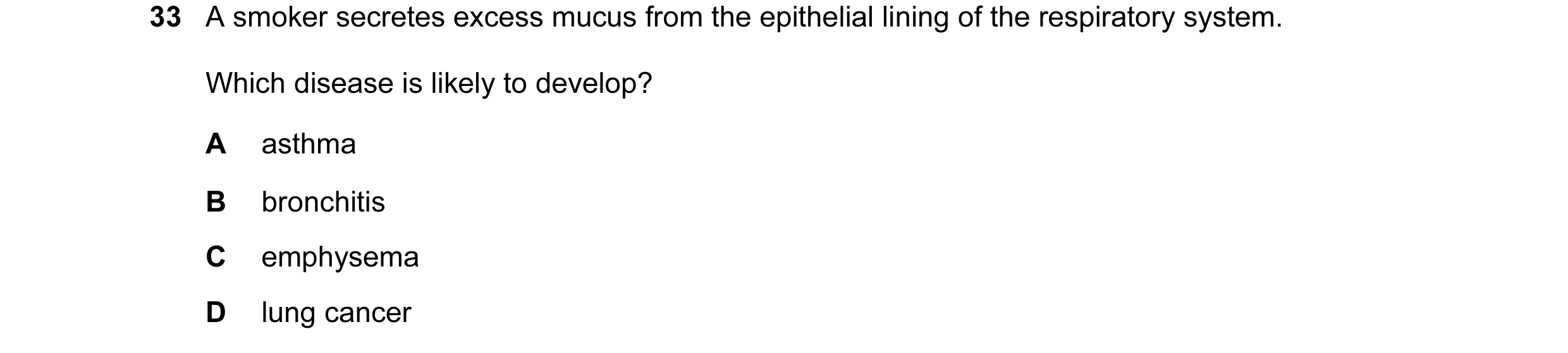
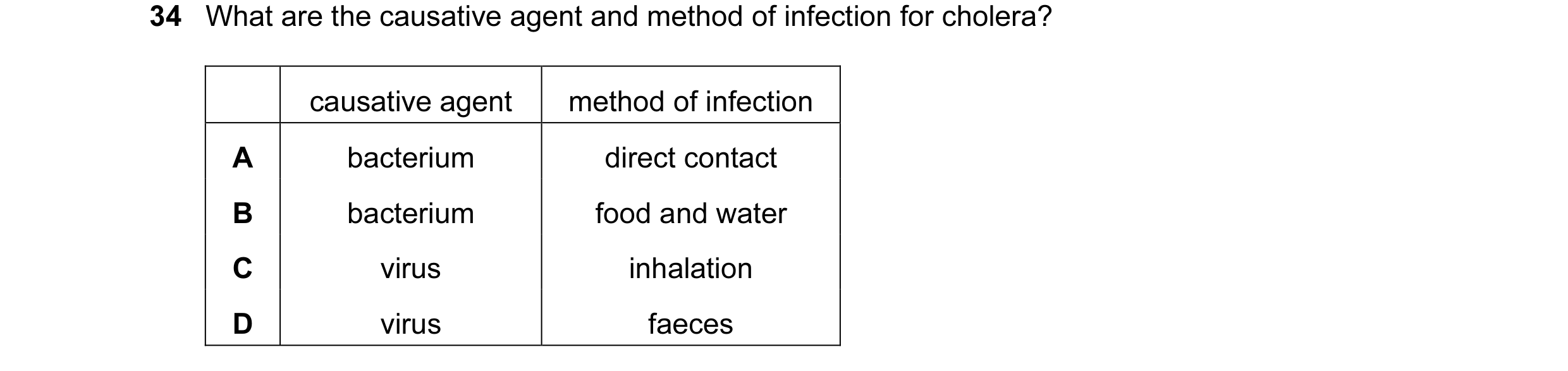
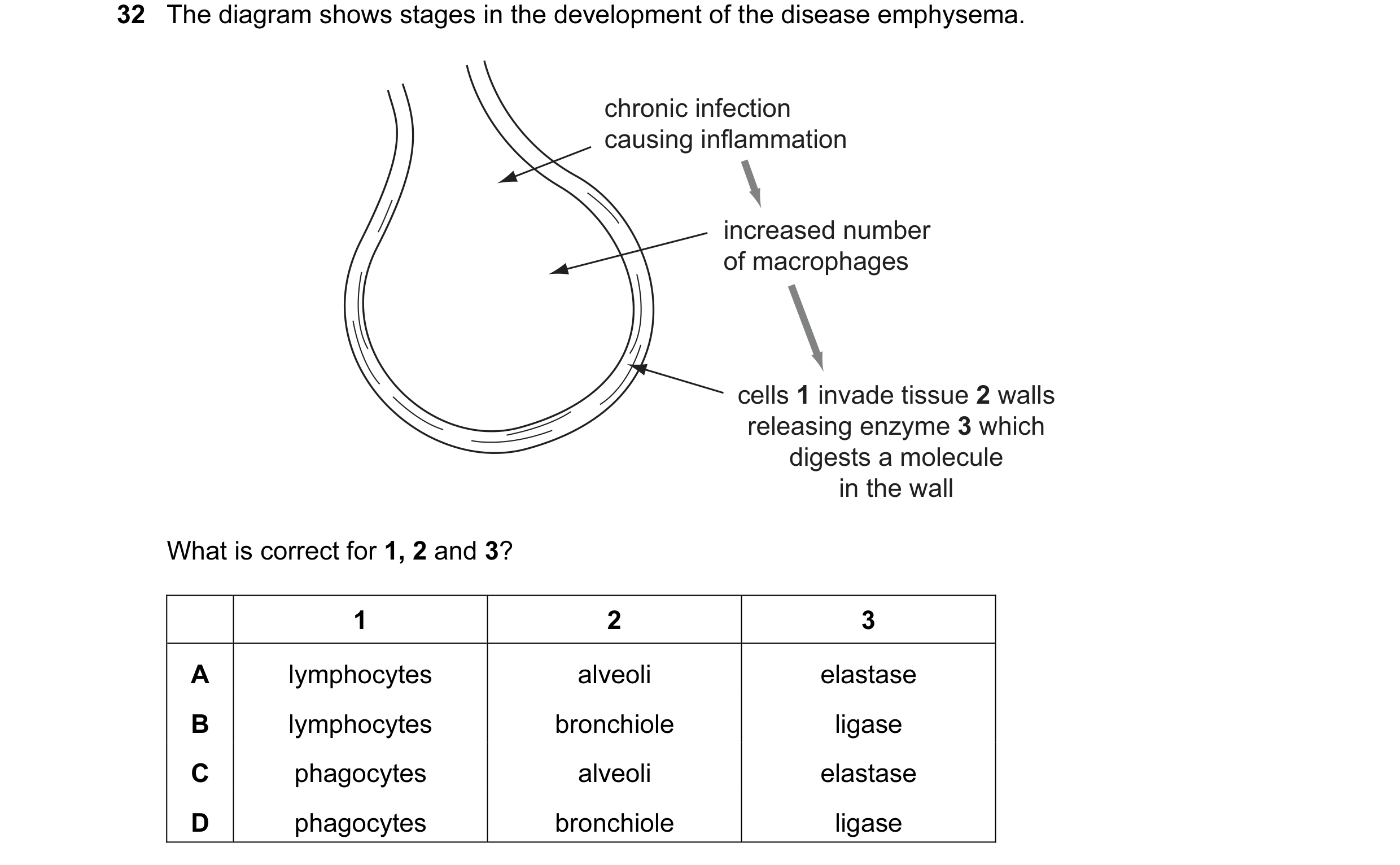
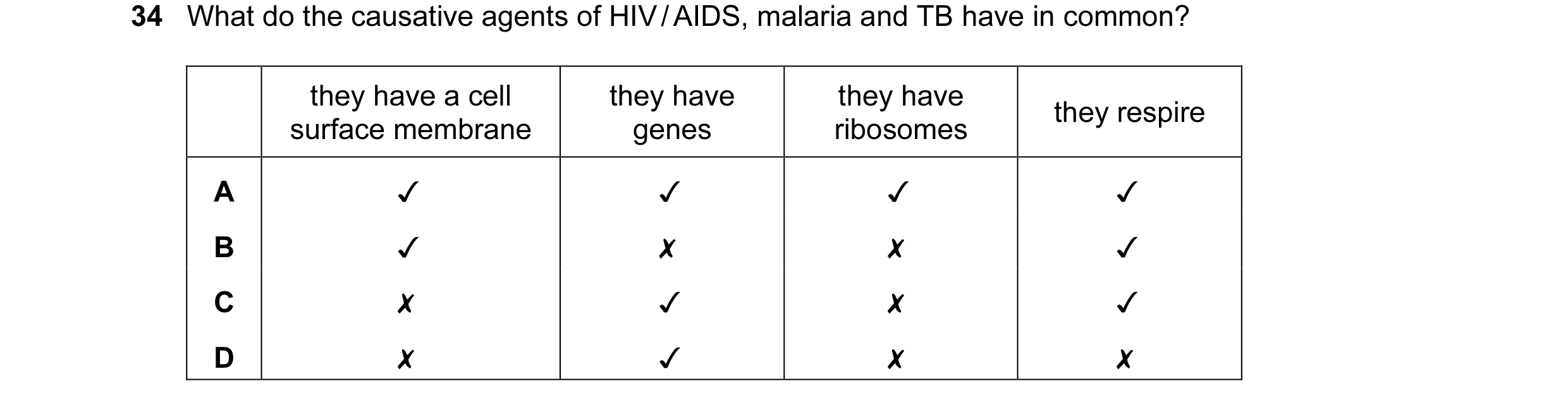 1 / 44
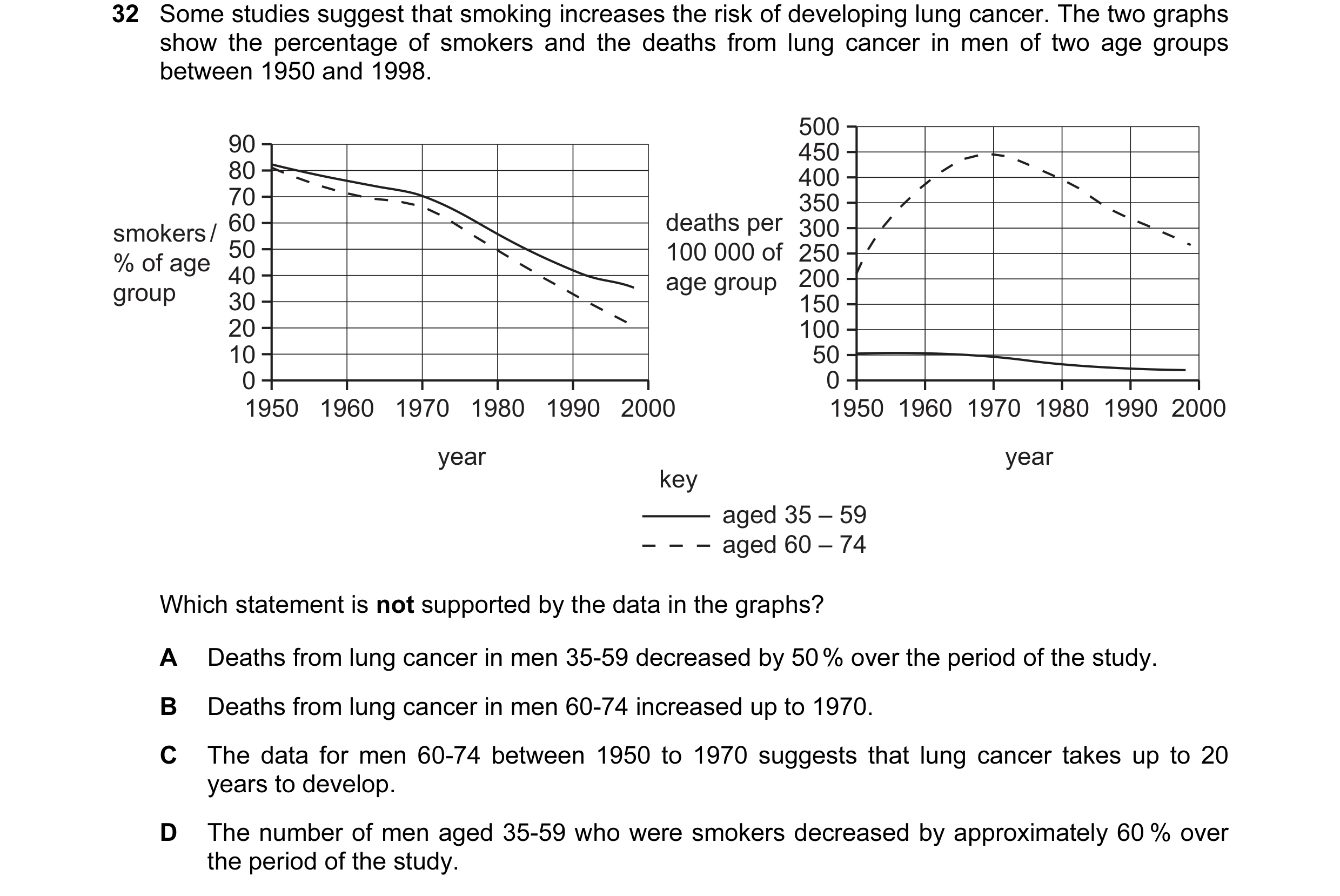
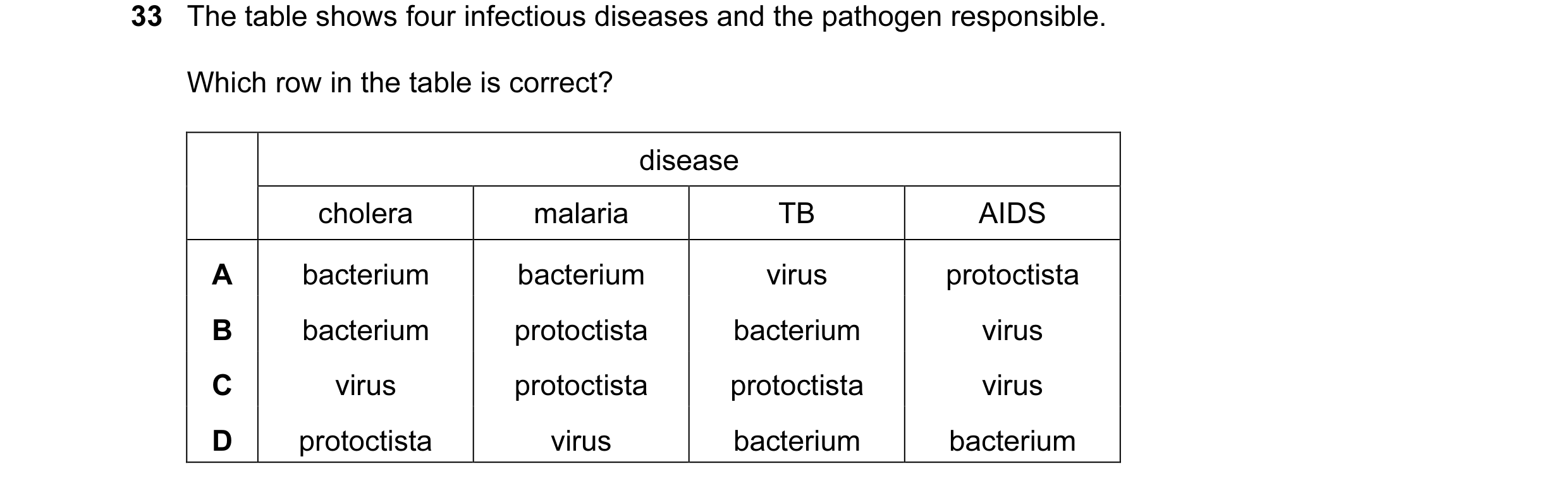 2 / 44
 3 / 44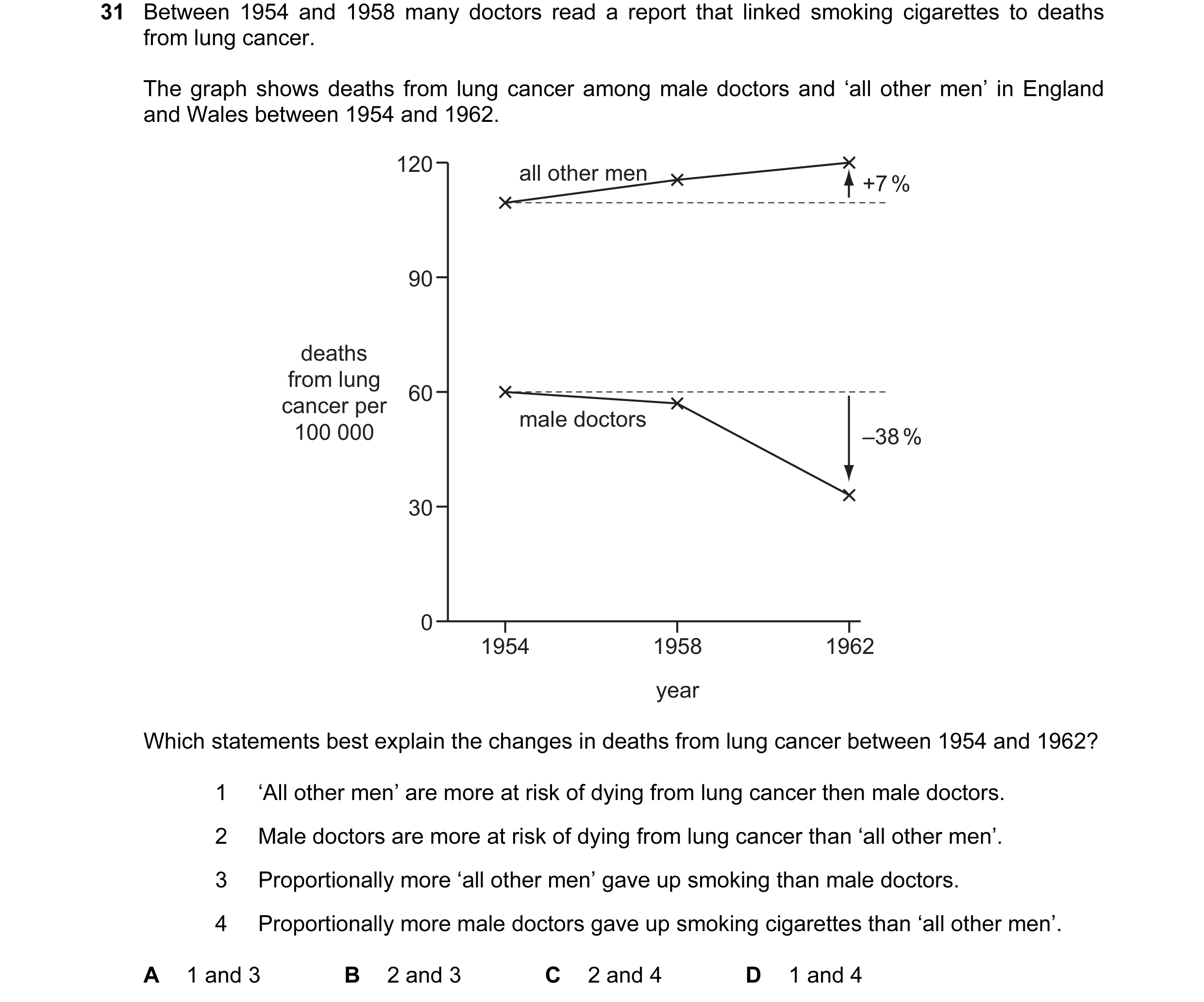
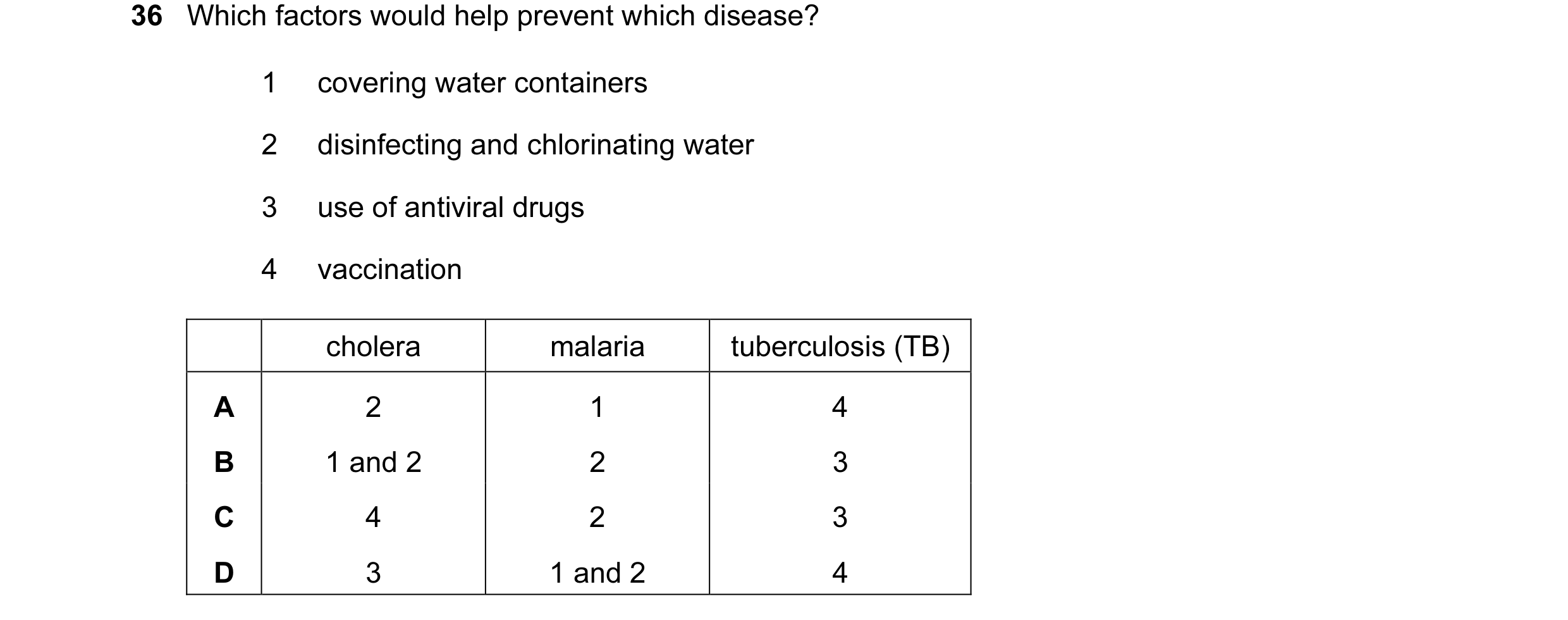 4 / 44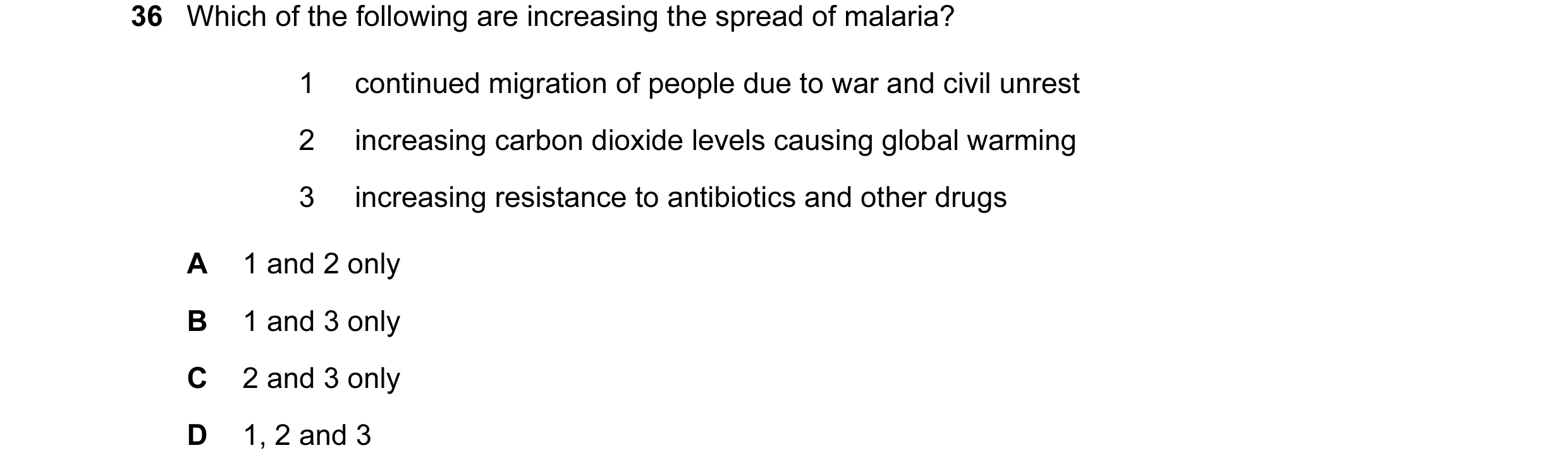
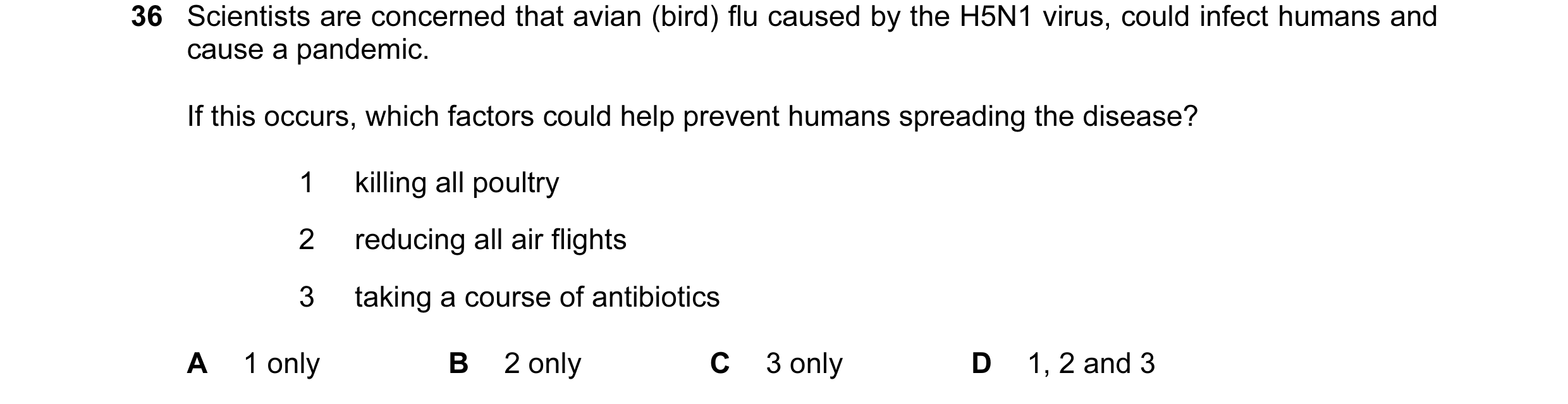
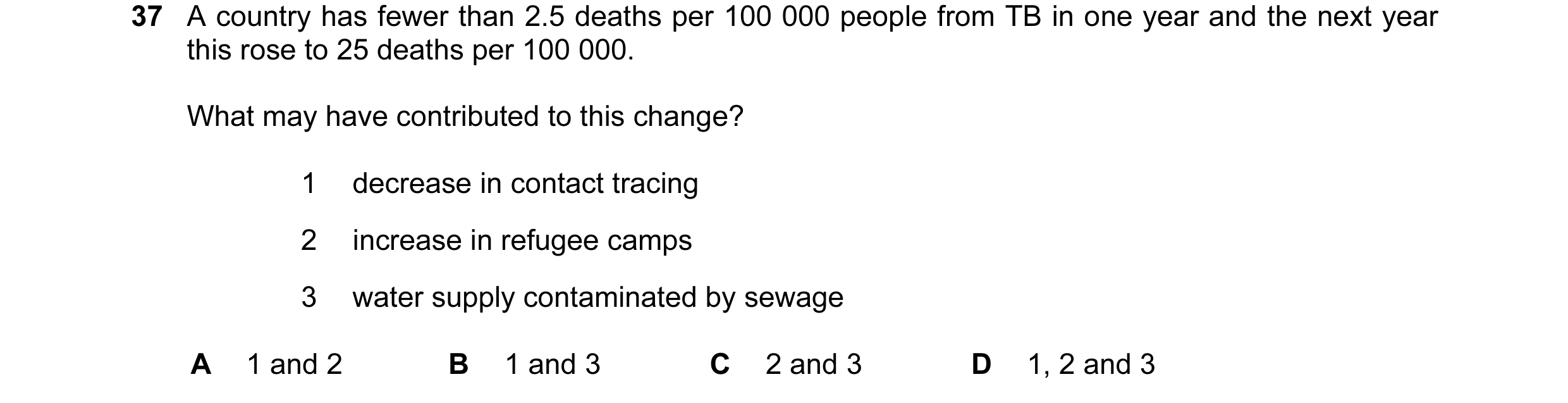

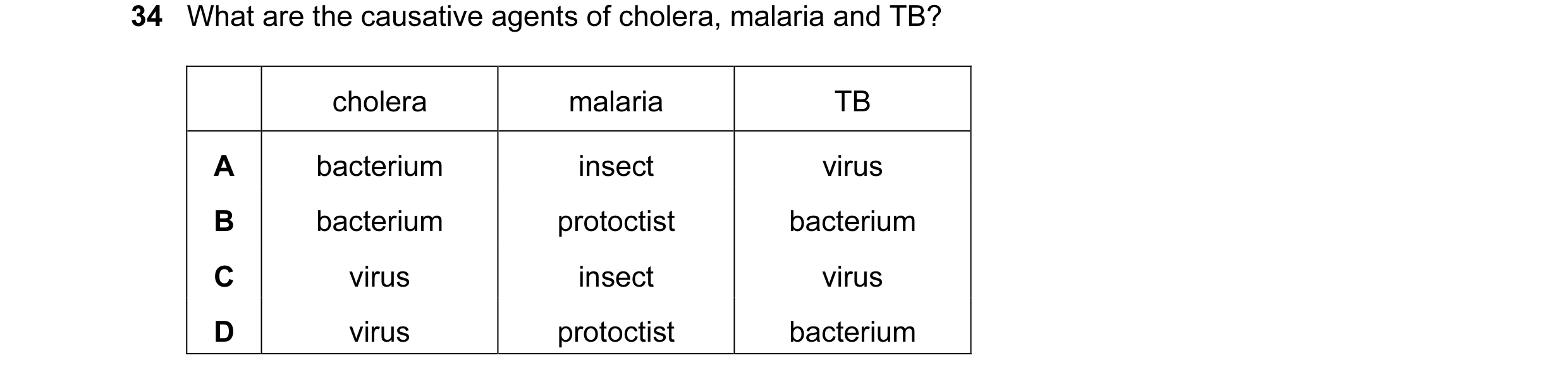 5 / 44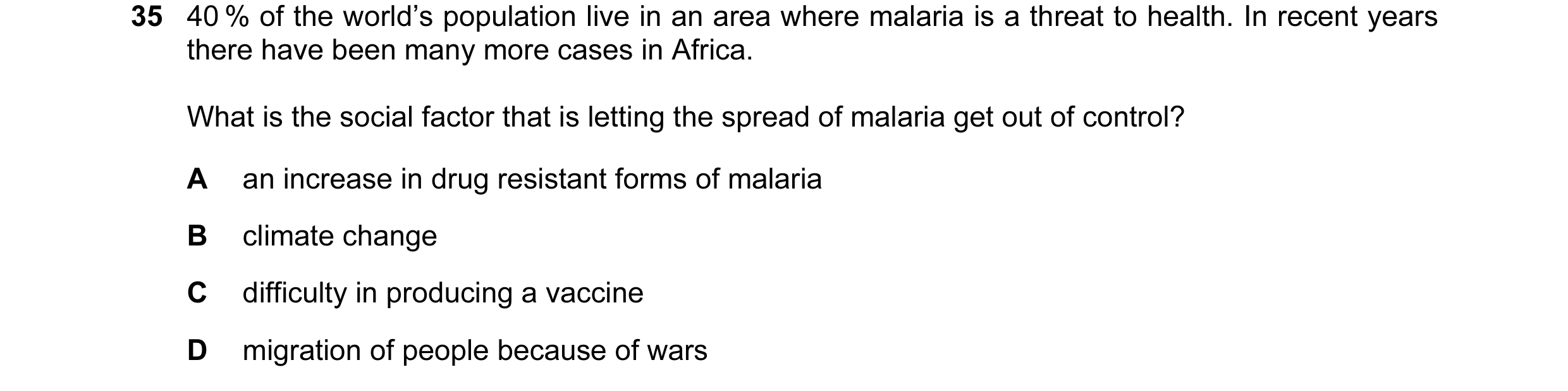

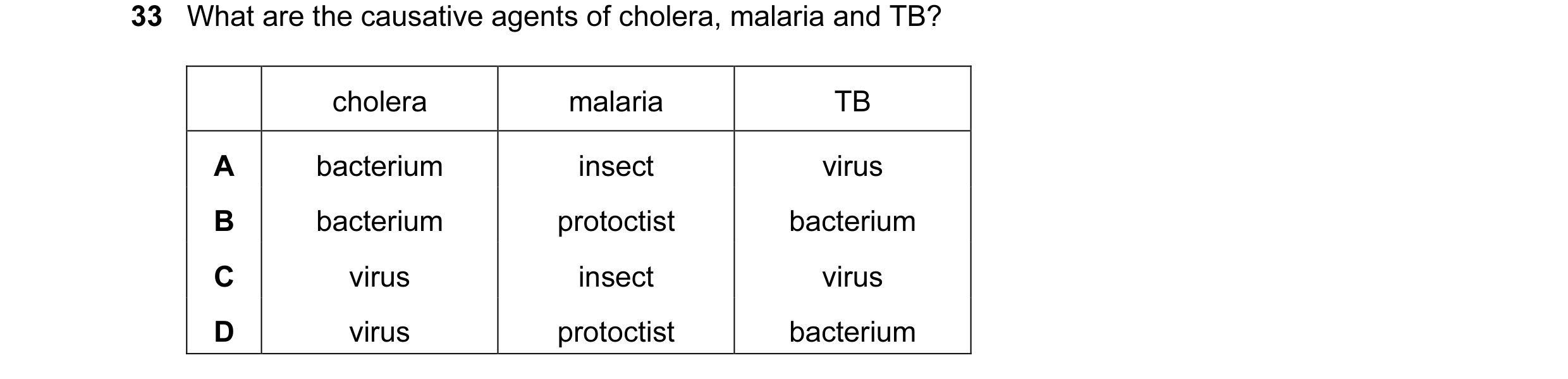
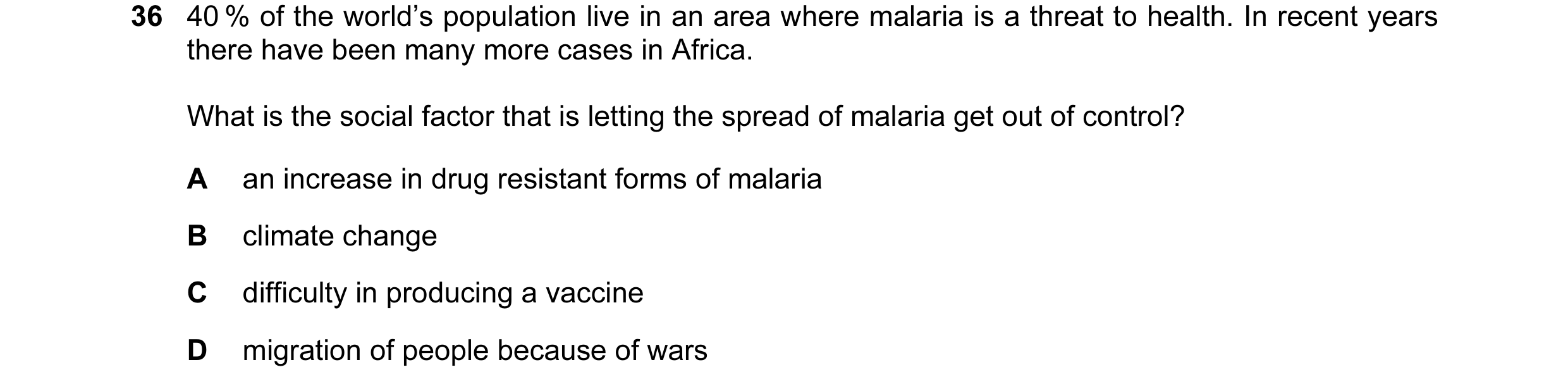
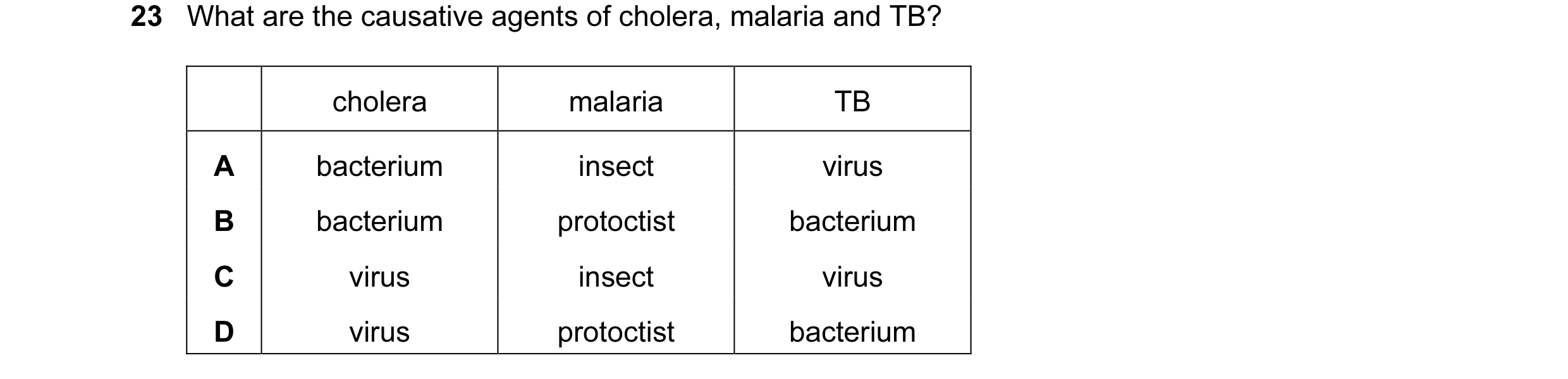 6 / 44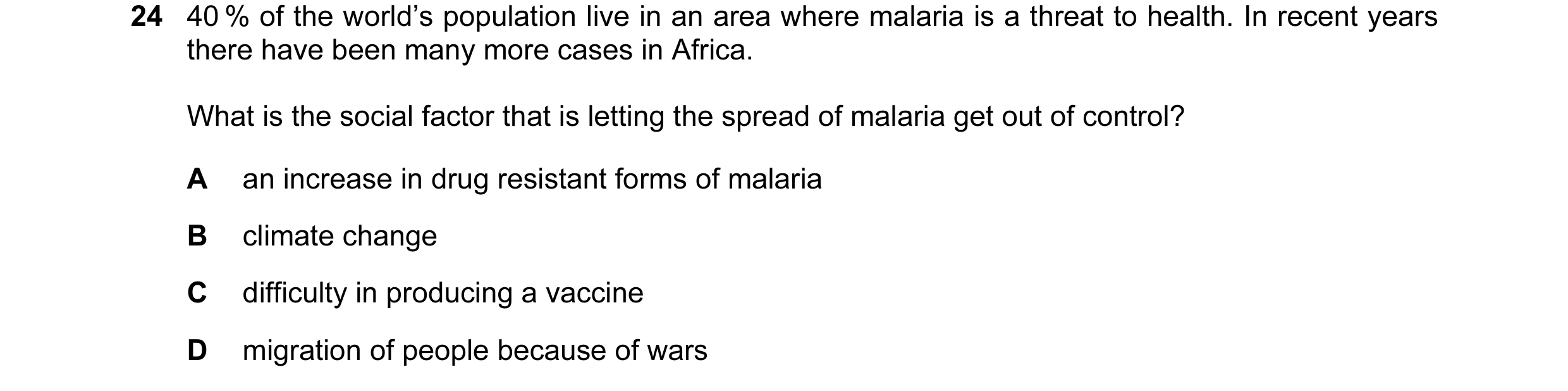



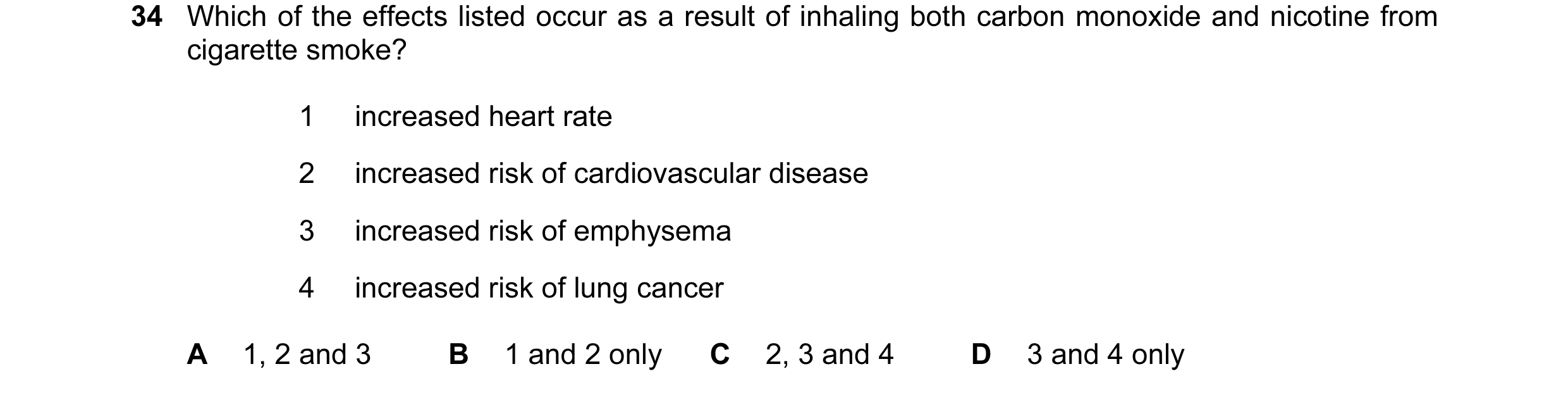
 7 / 44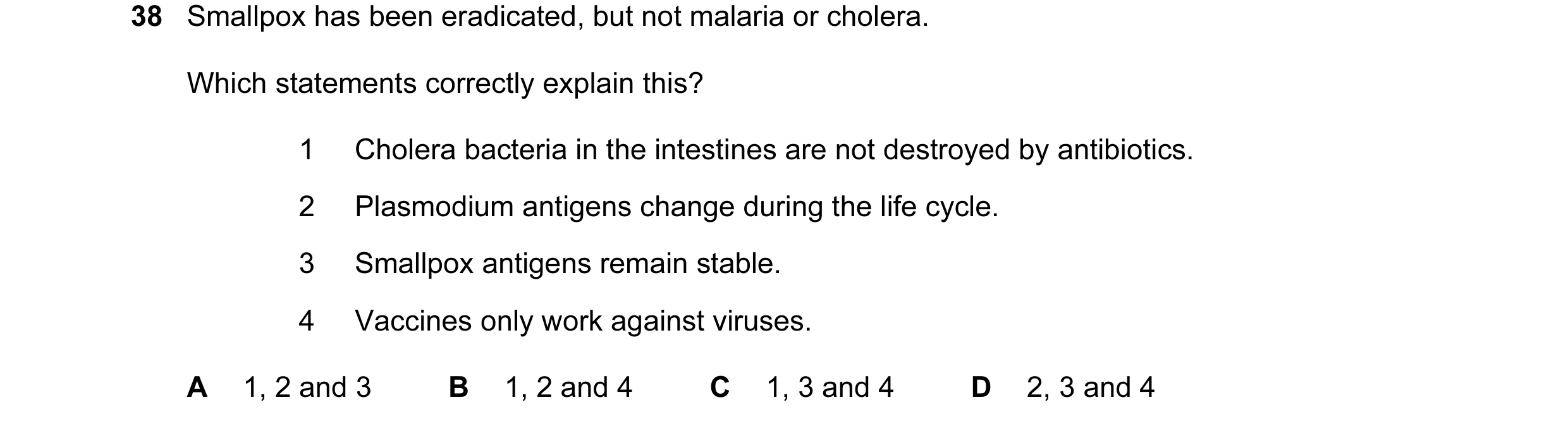
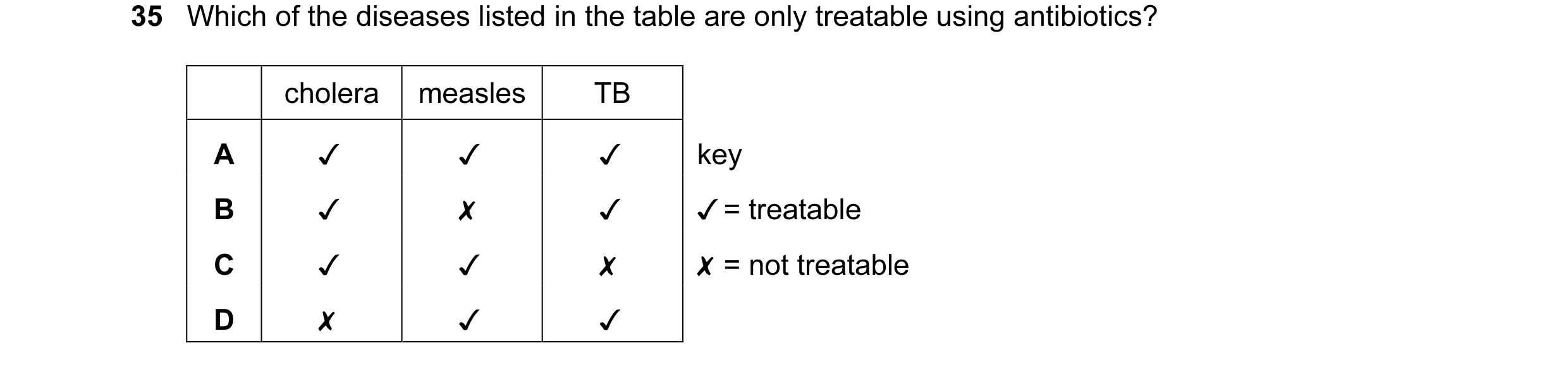
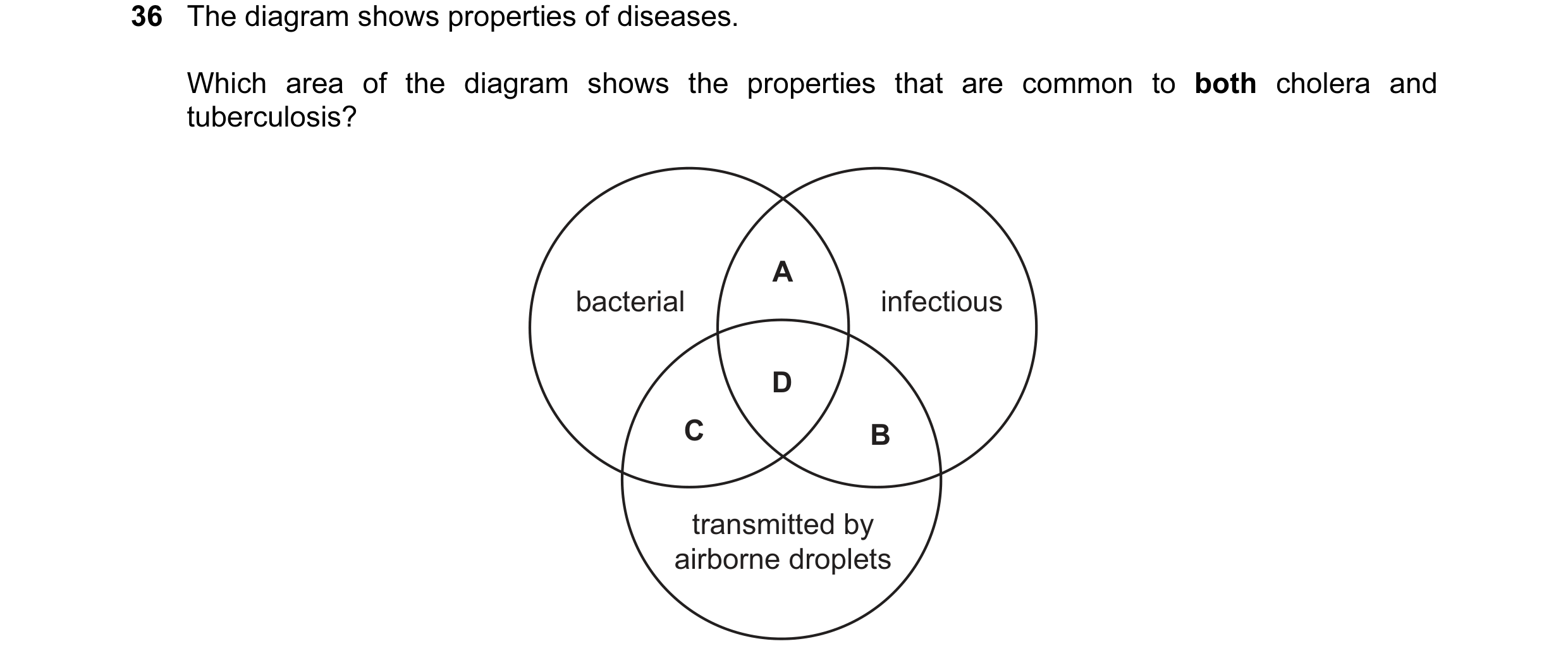 8 / 44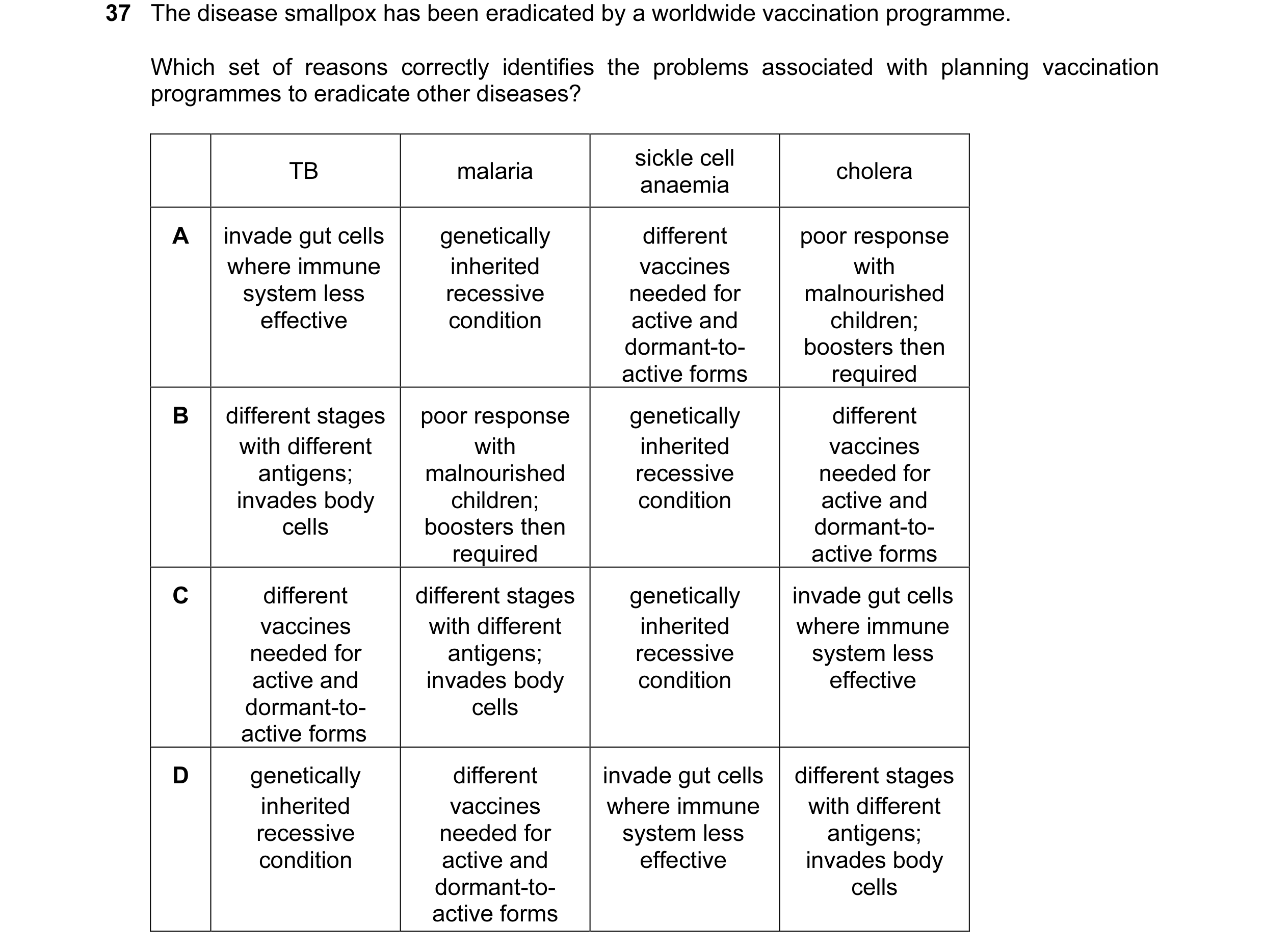
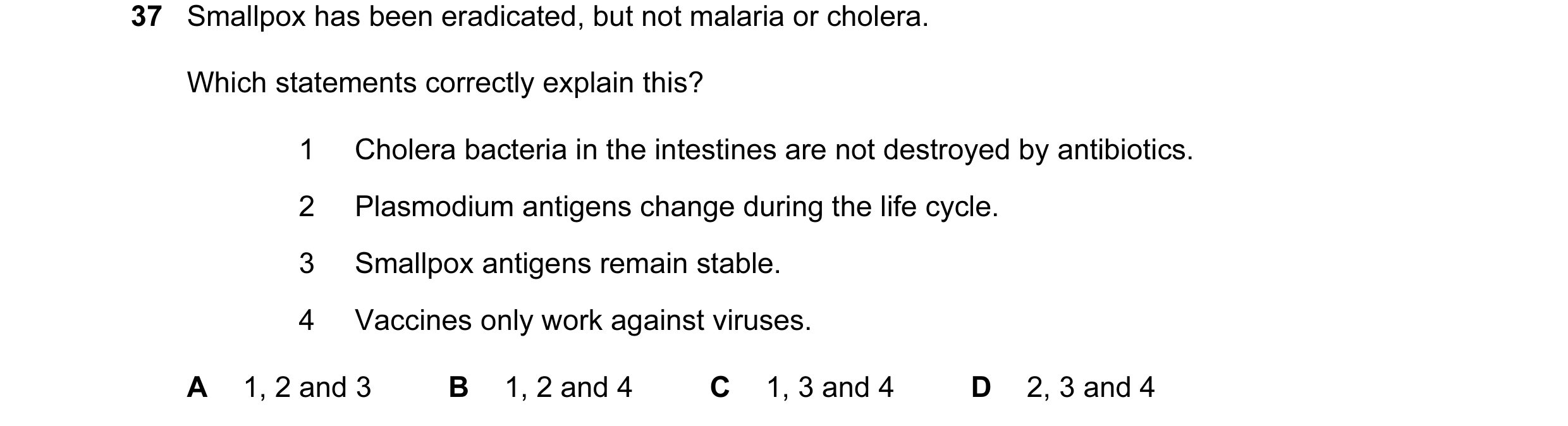
 9 / 44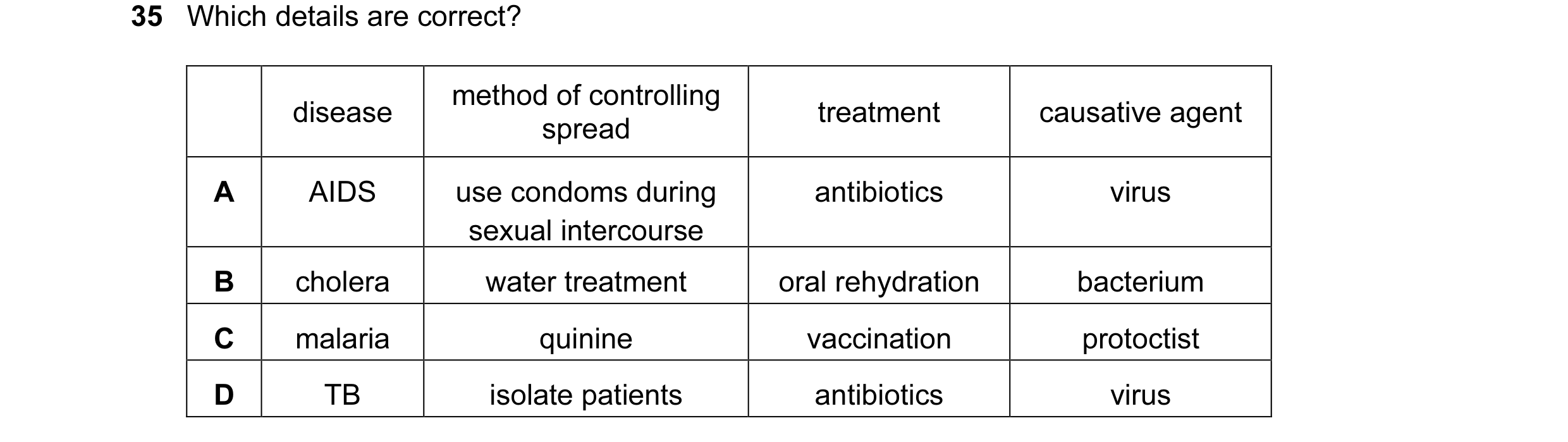
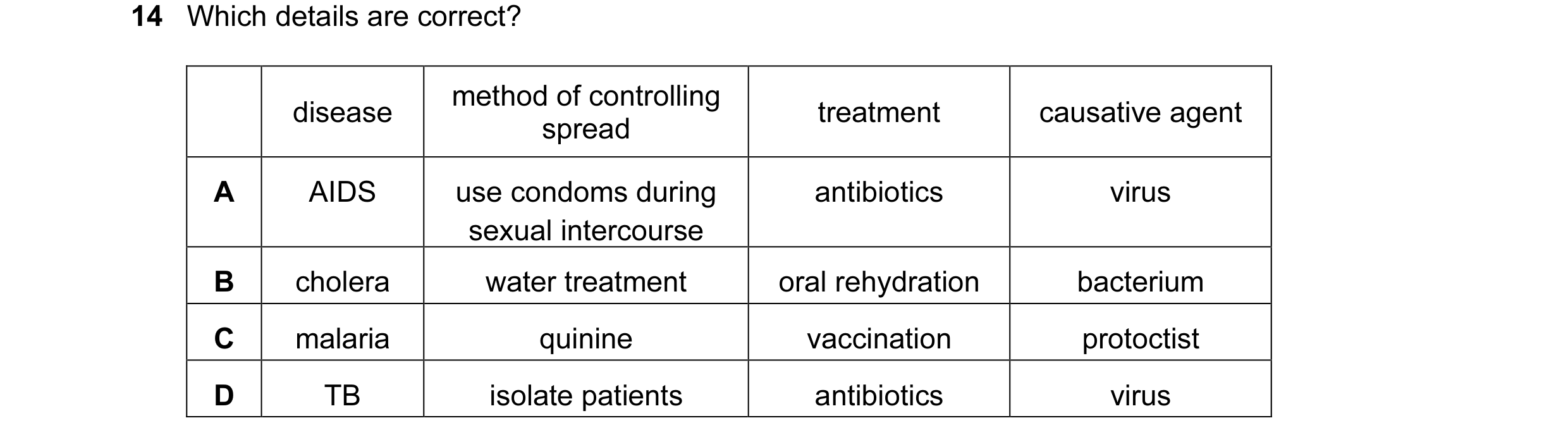
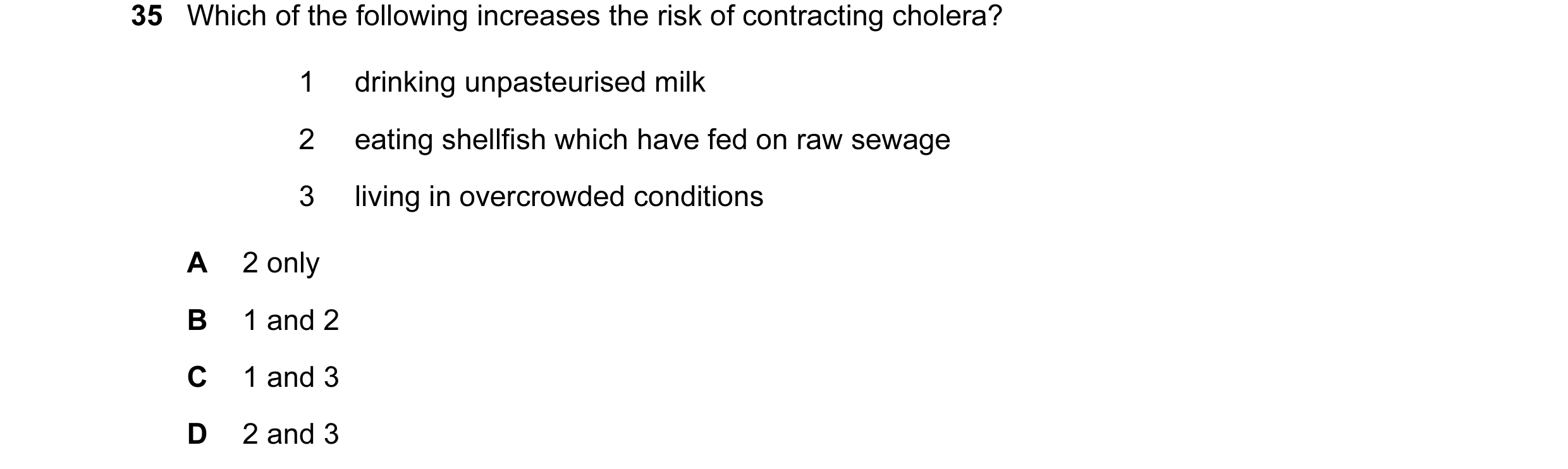

 10 / 44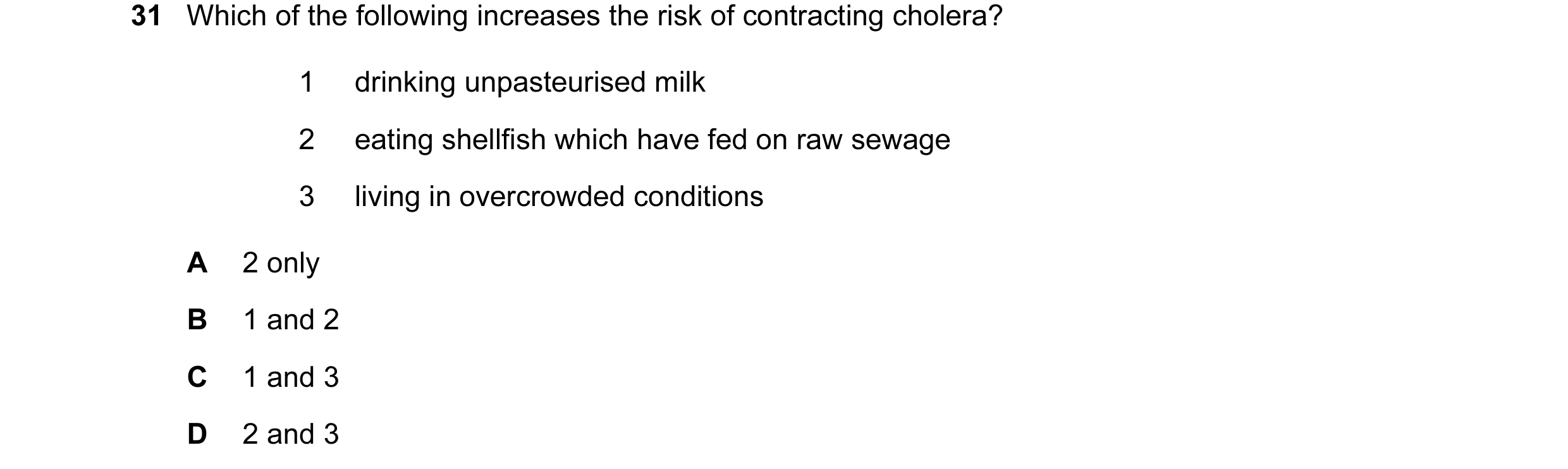
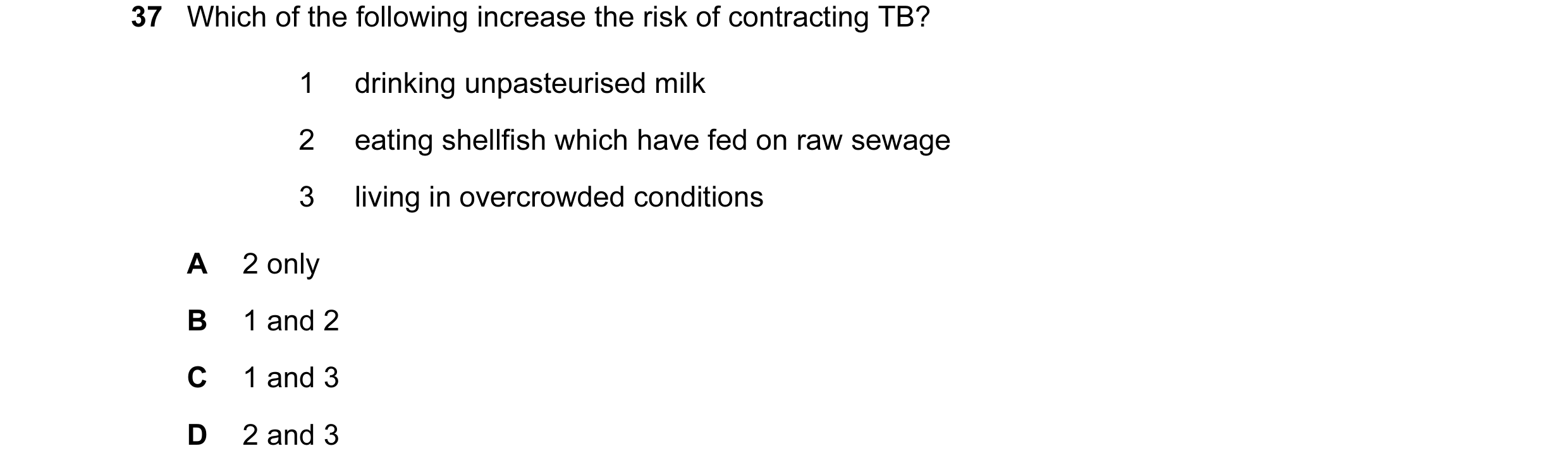
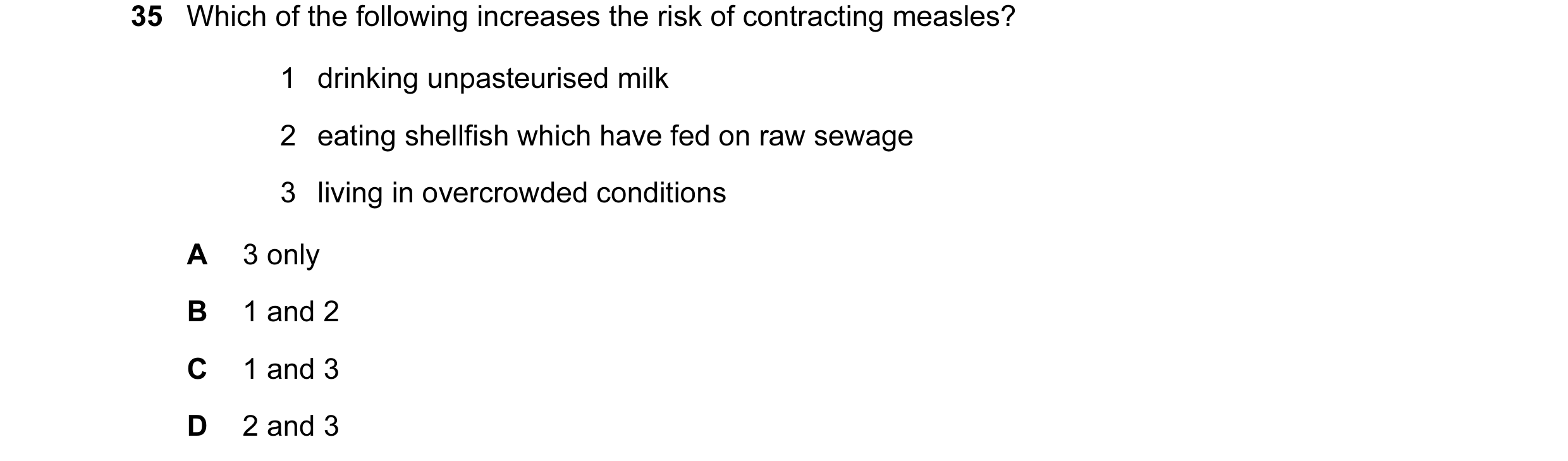
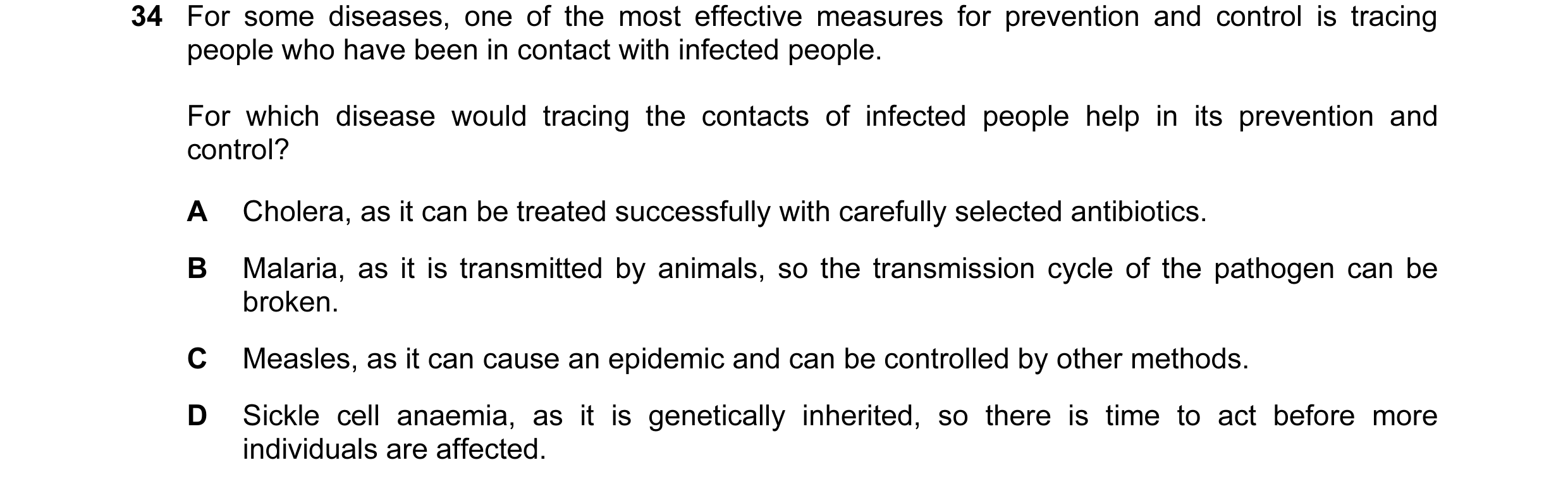 11 / 44
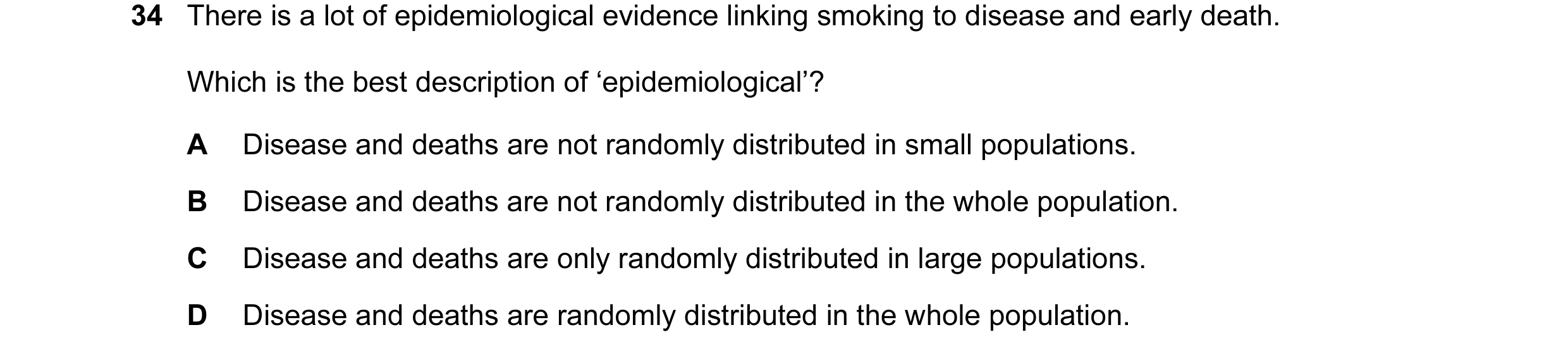
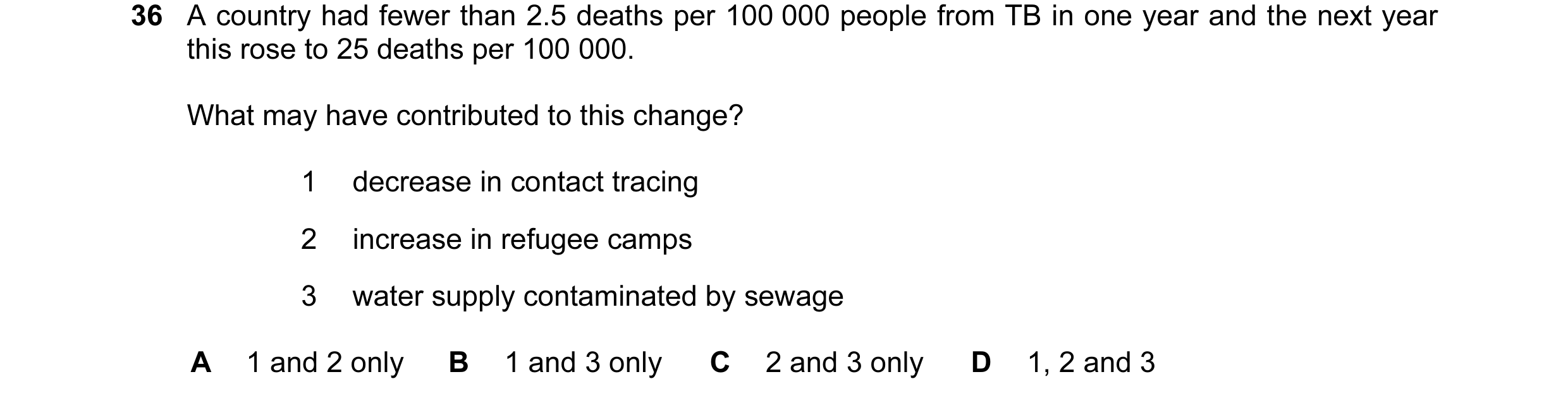
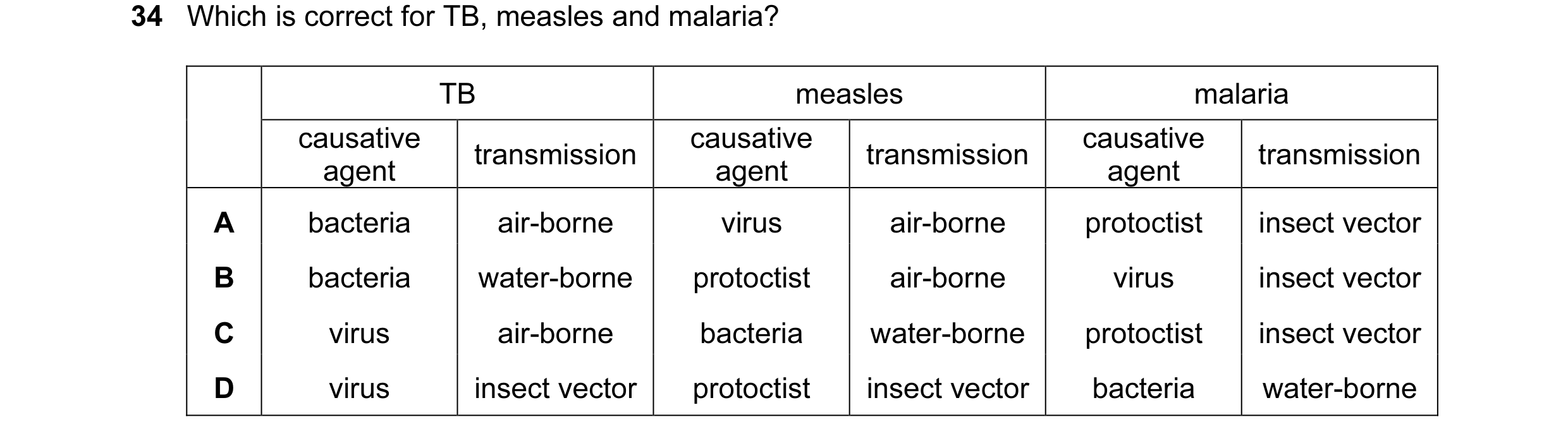
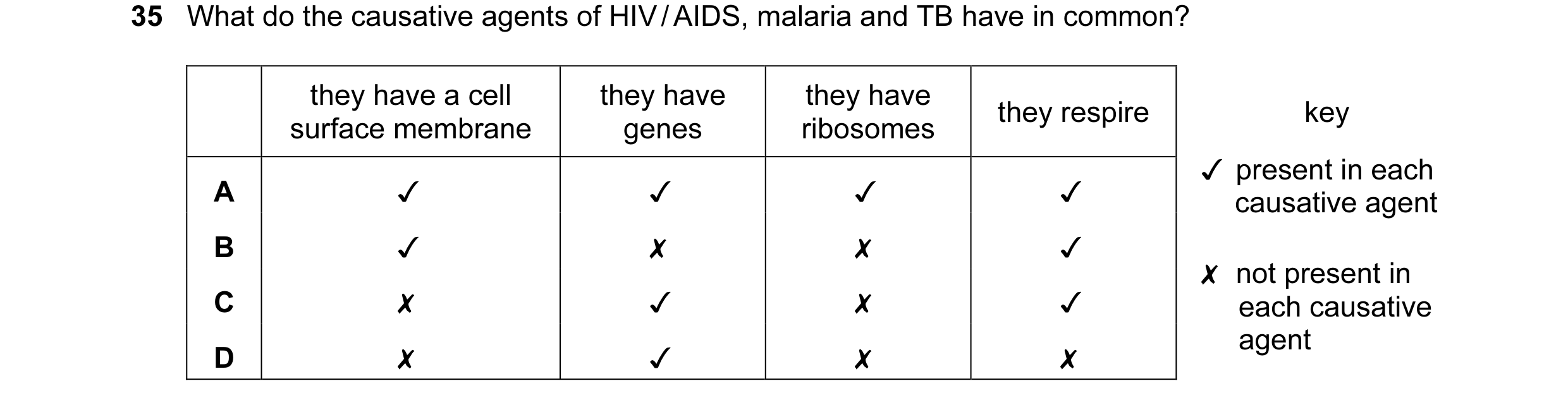 12 / 44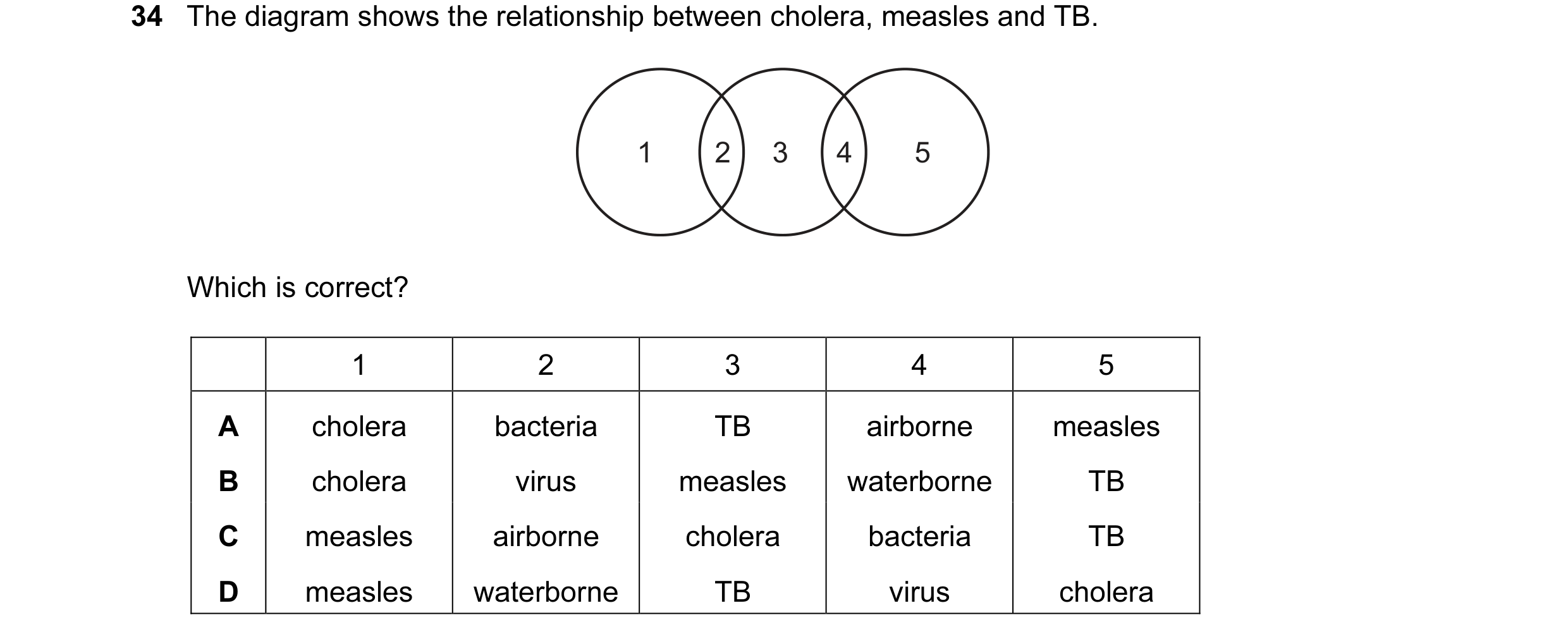
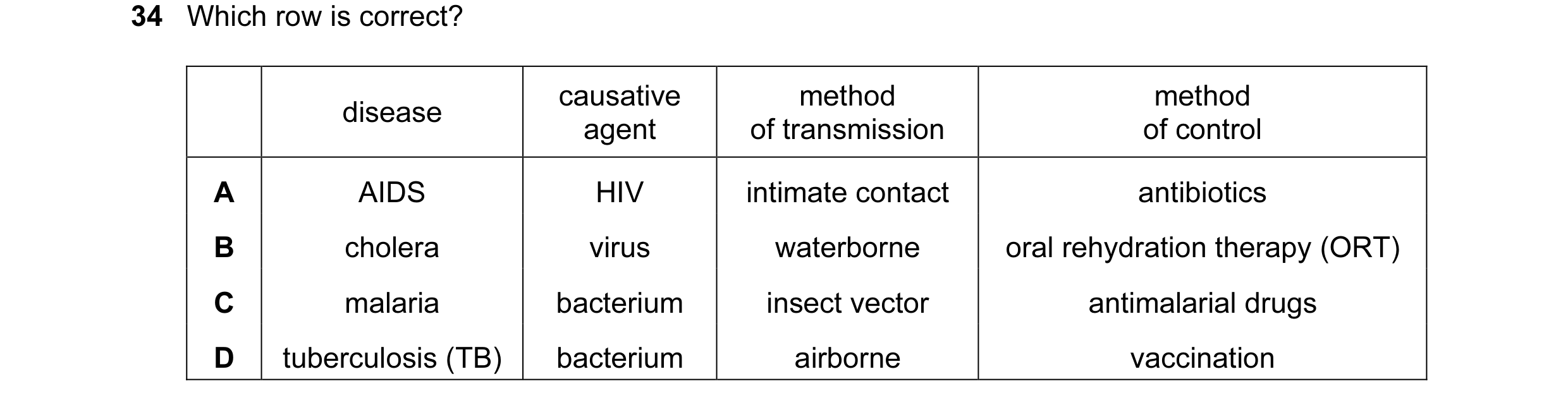
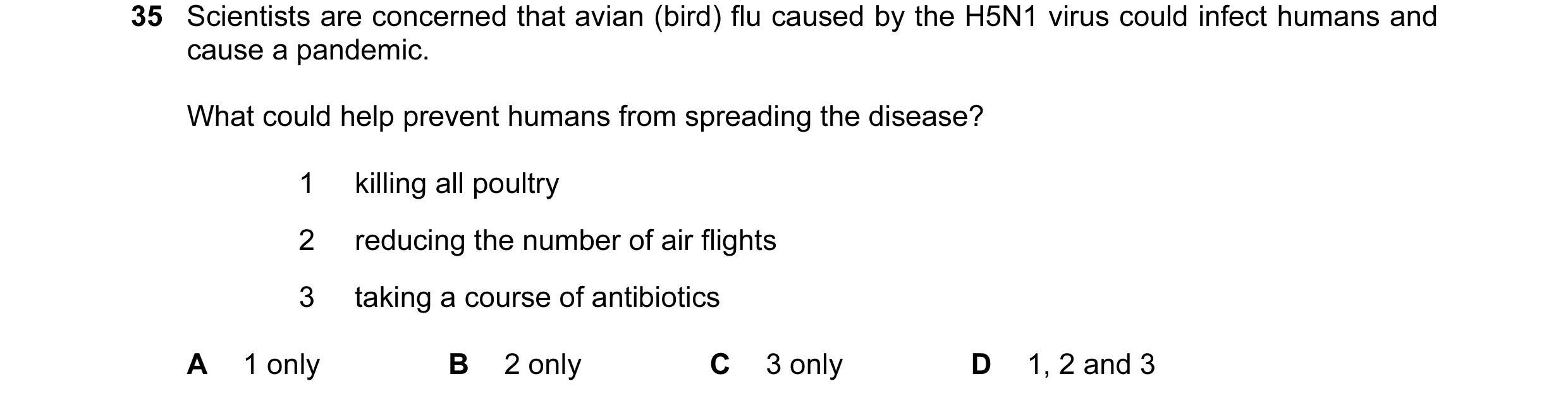
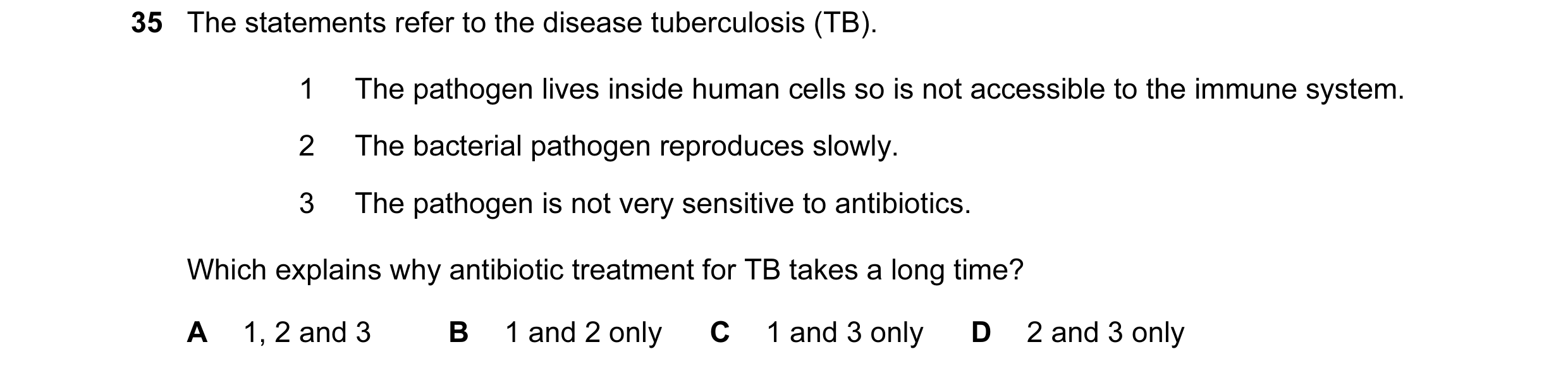 13 / 44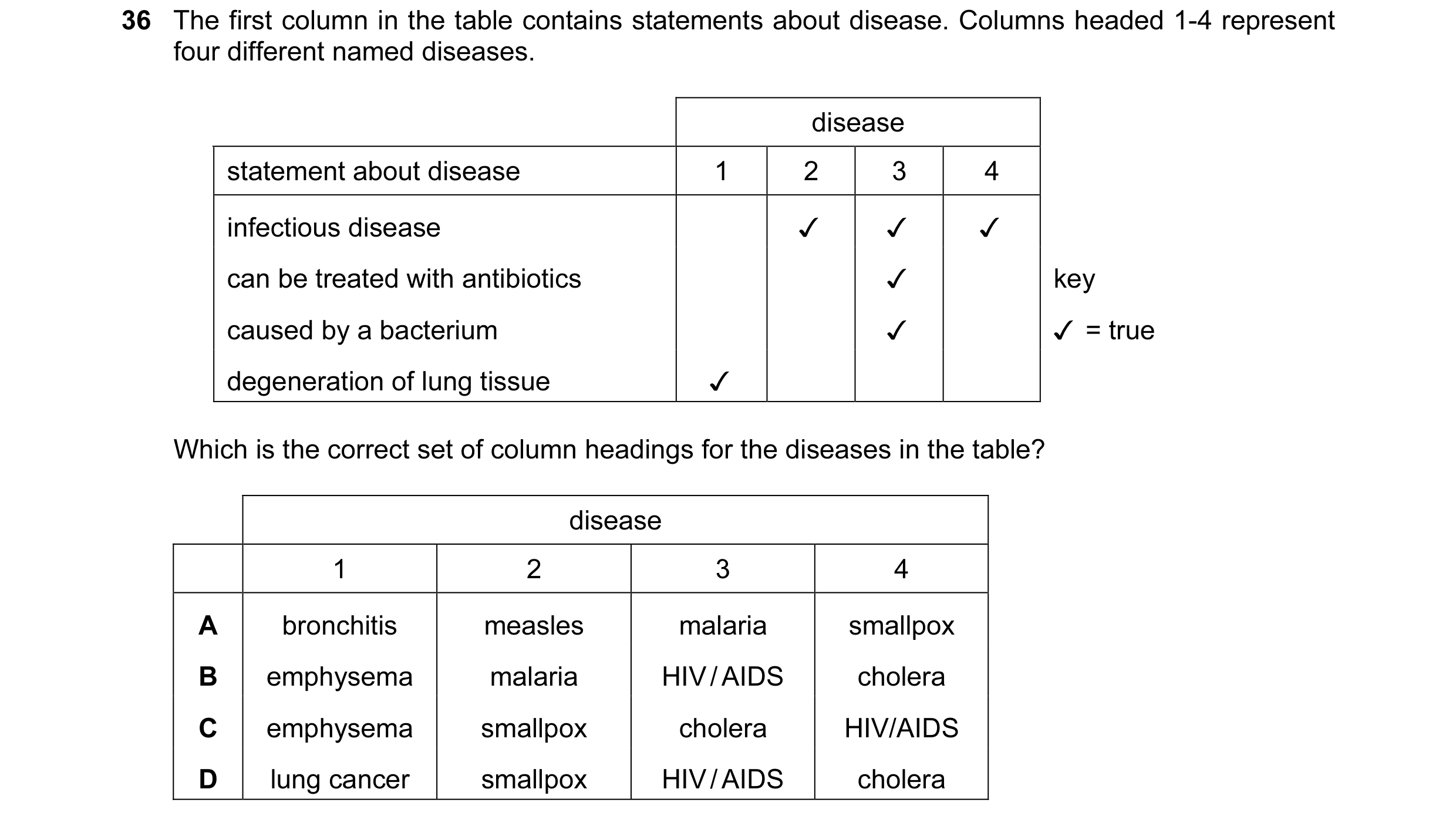
 14 / 44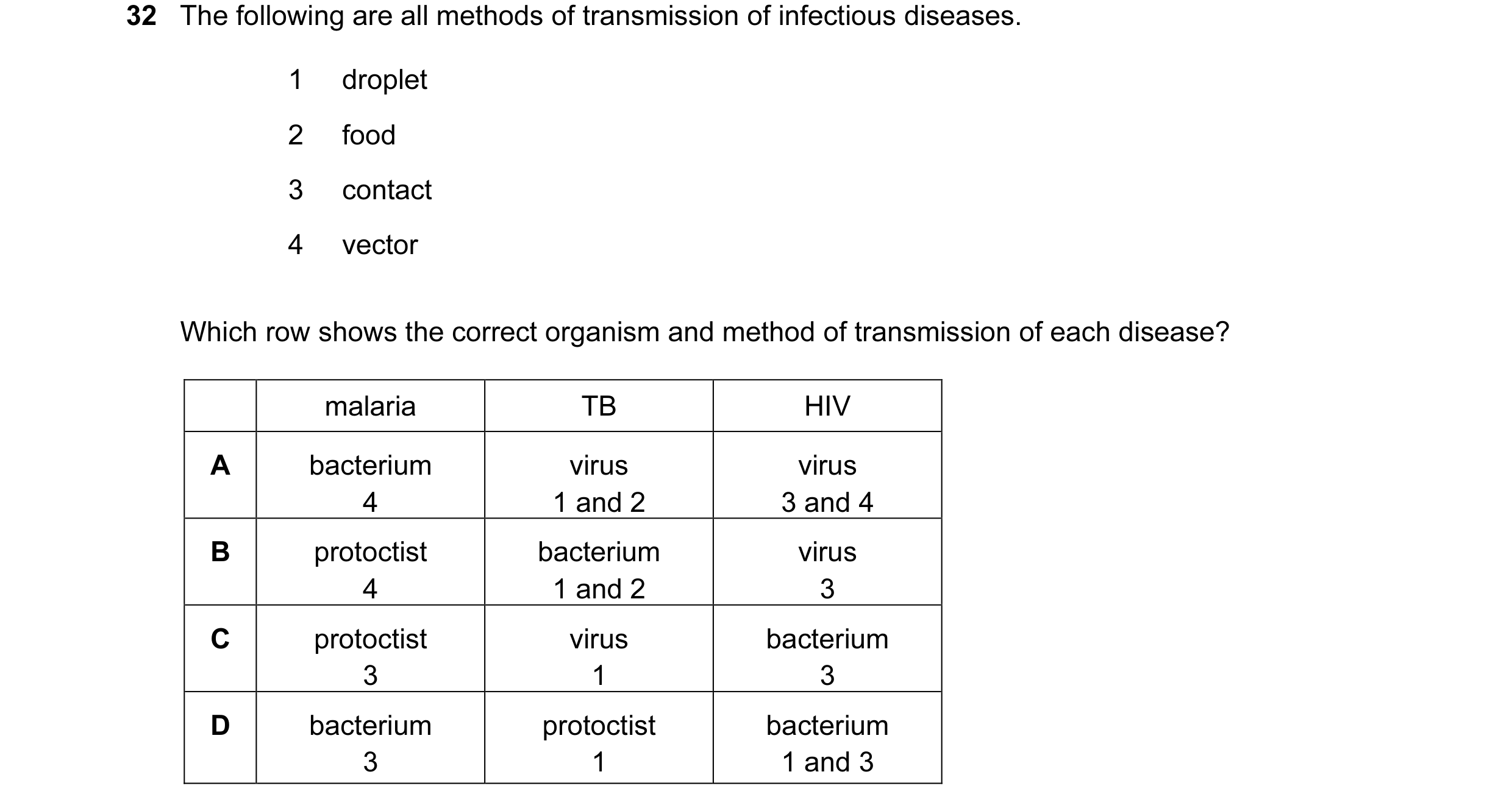
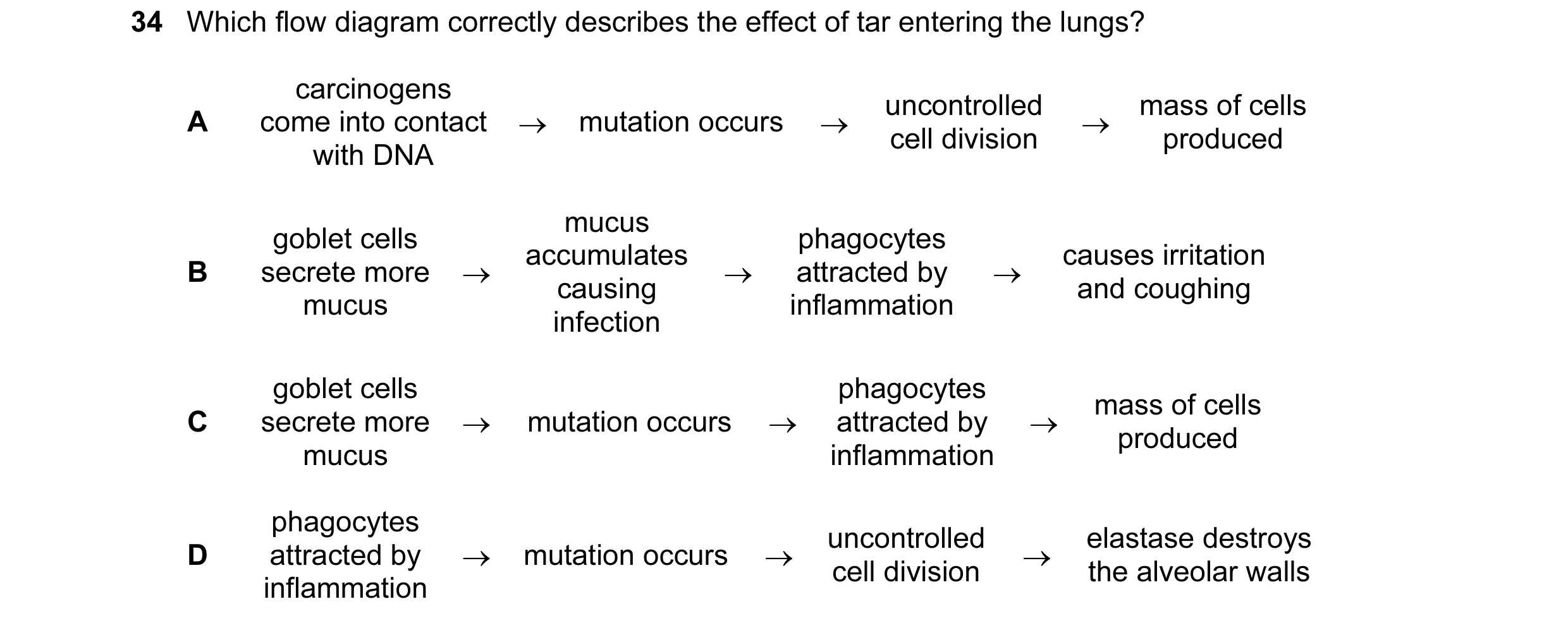 15 / 44
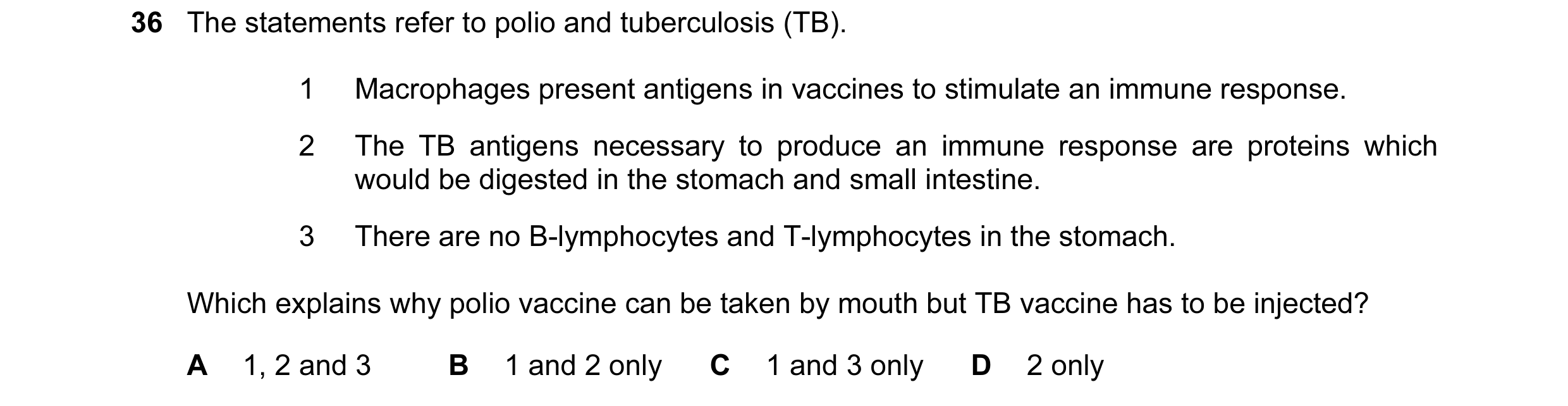
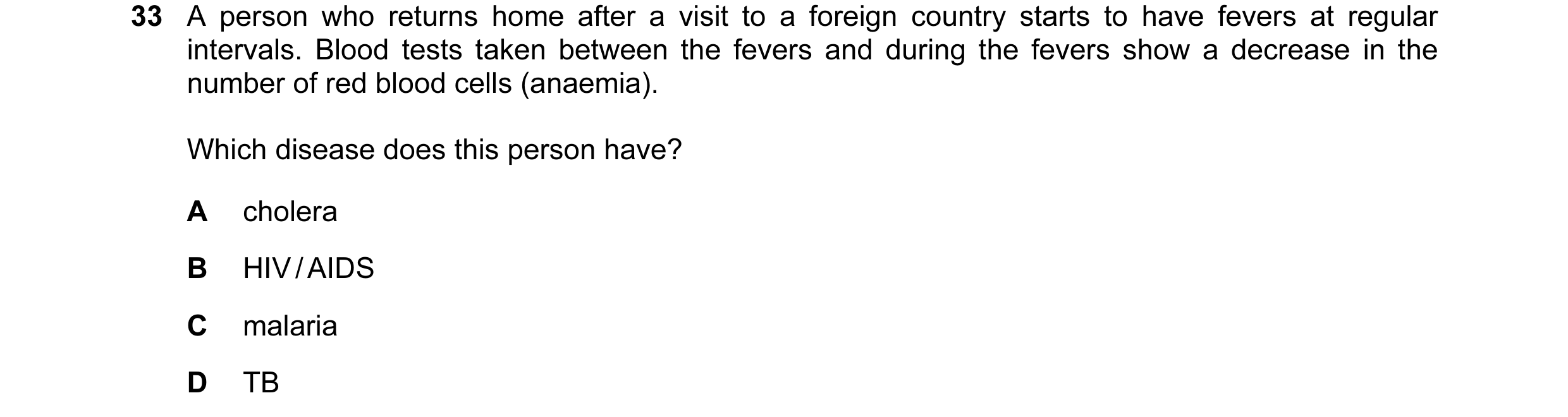

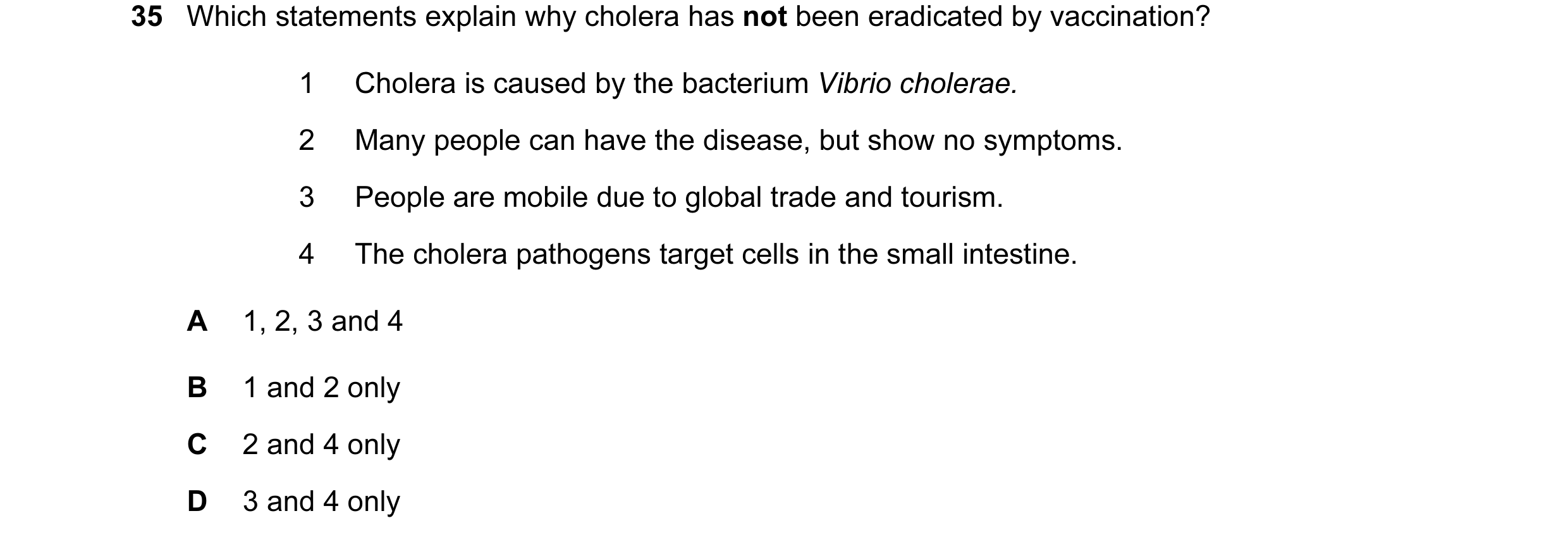 16 / 44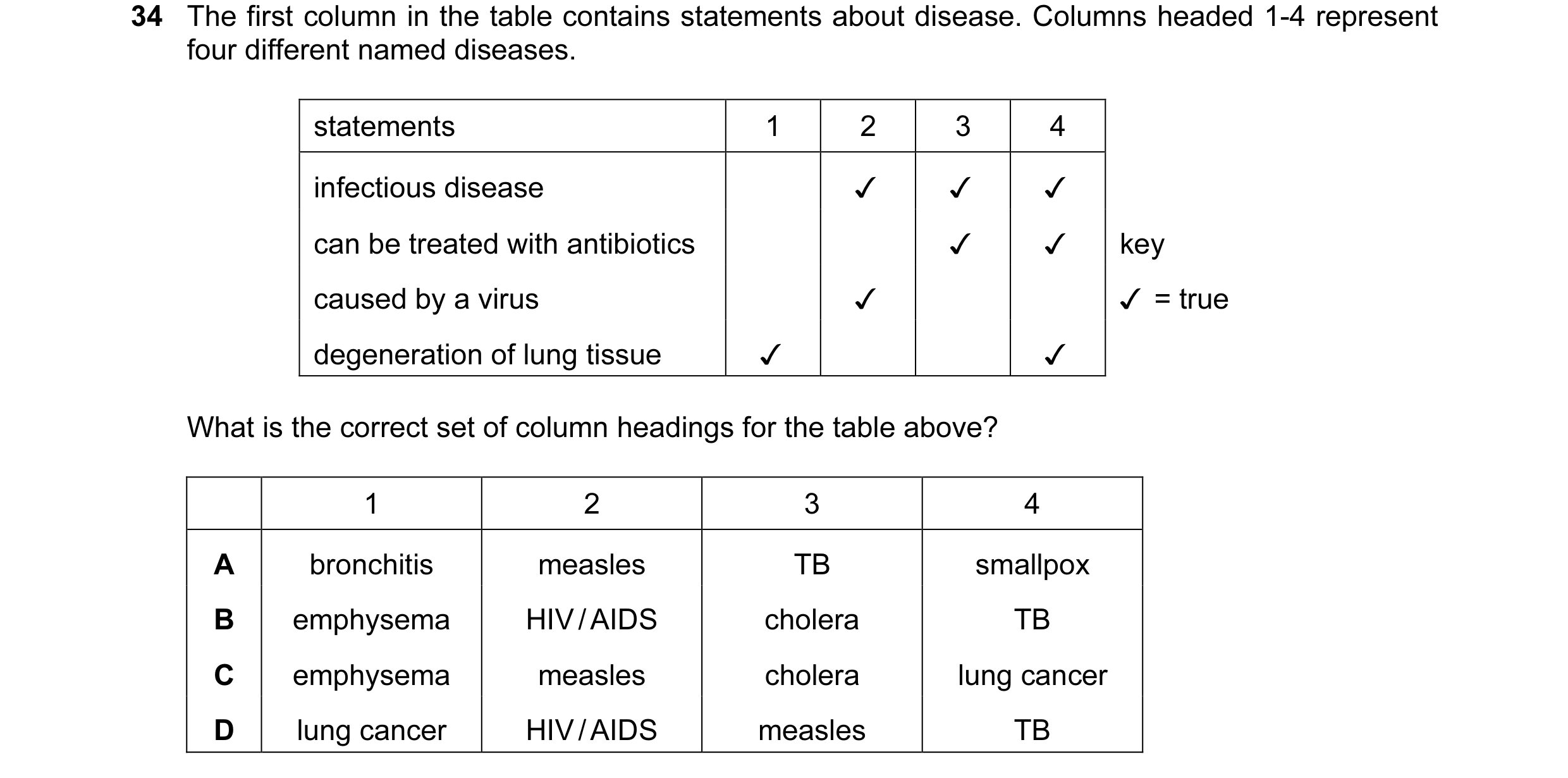
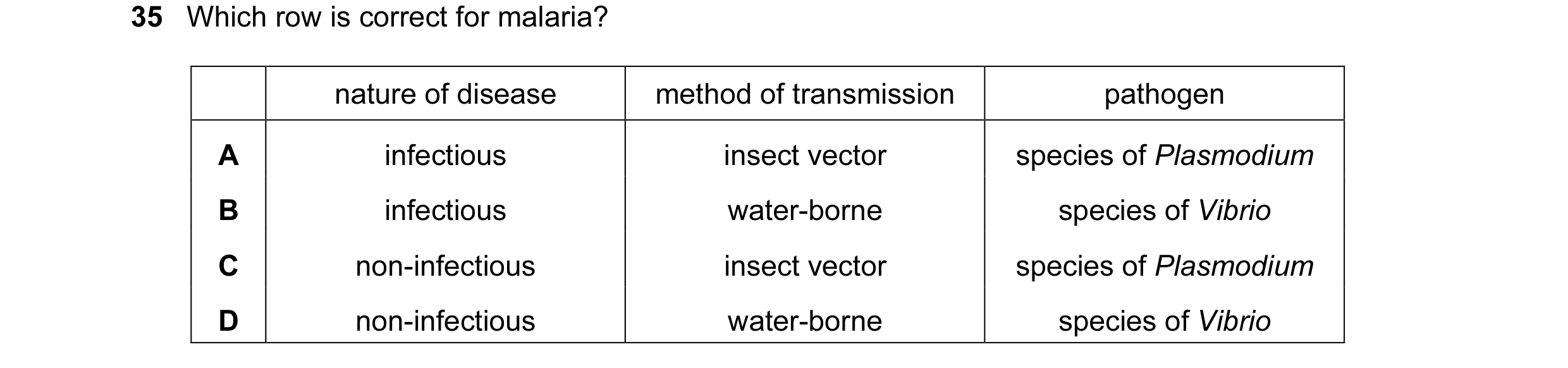 17 / 44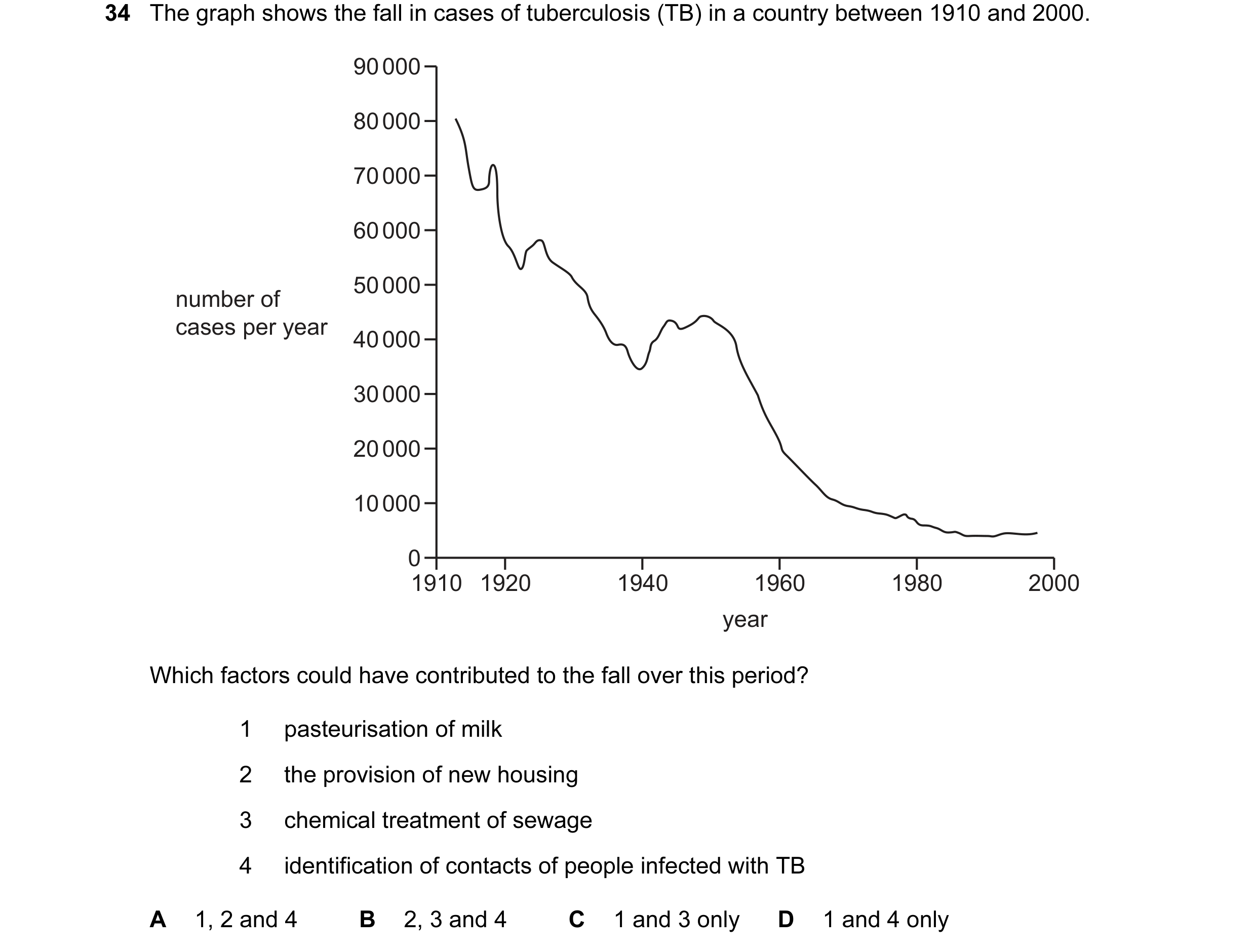
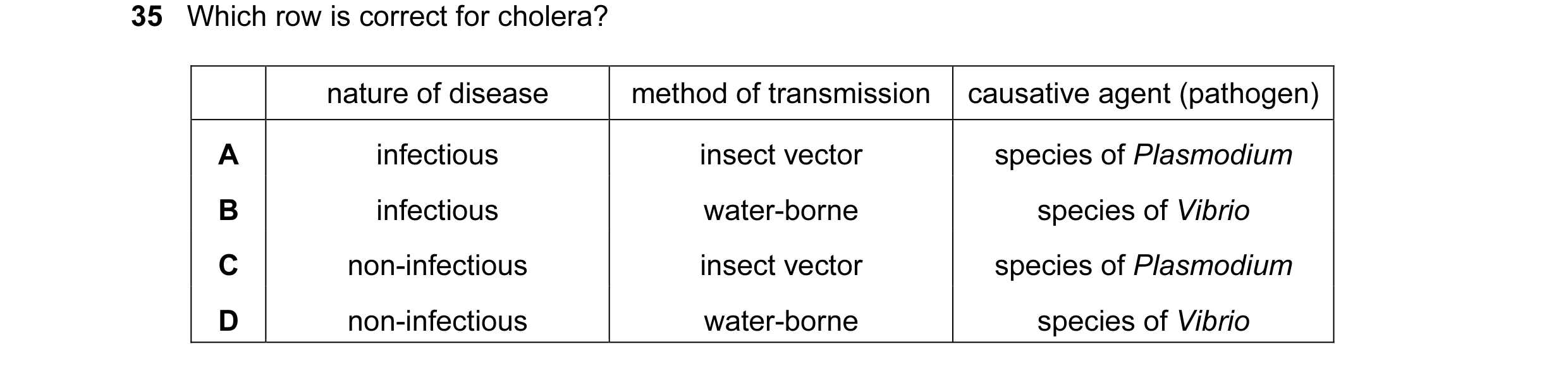
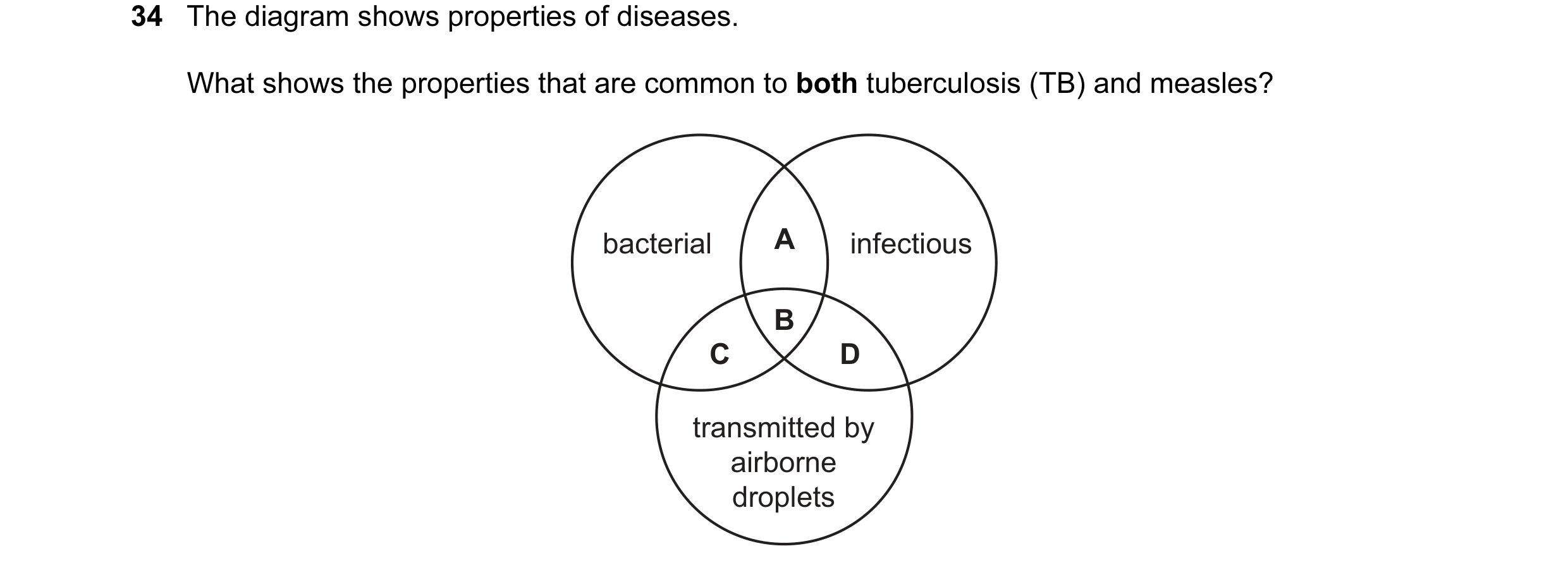 18 / 44
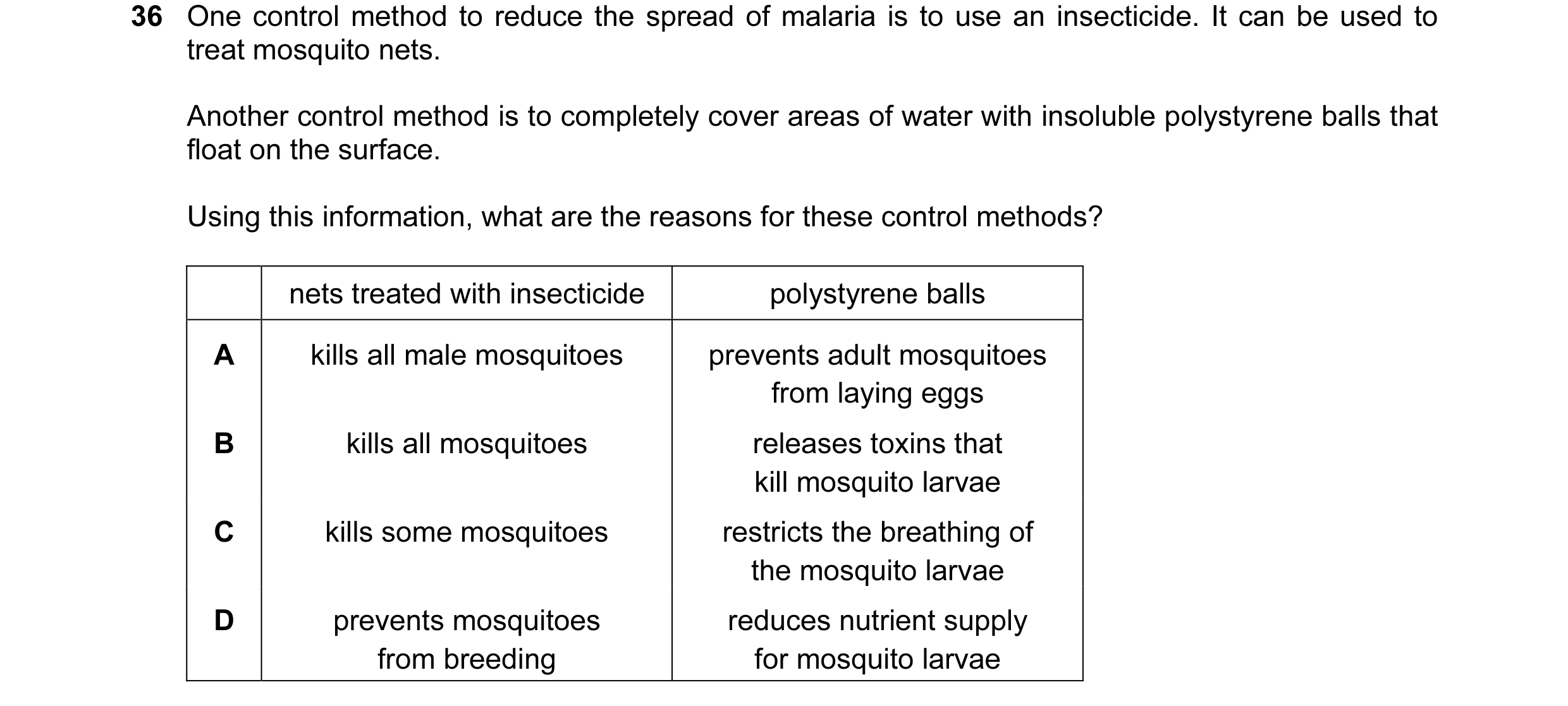

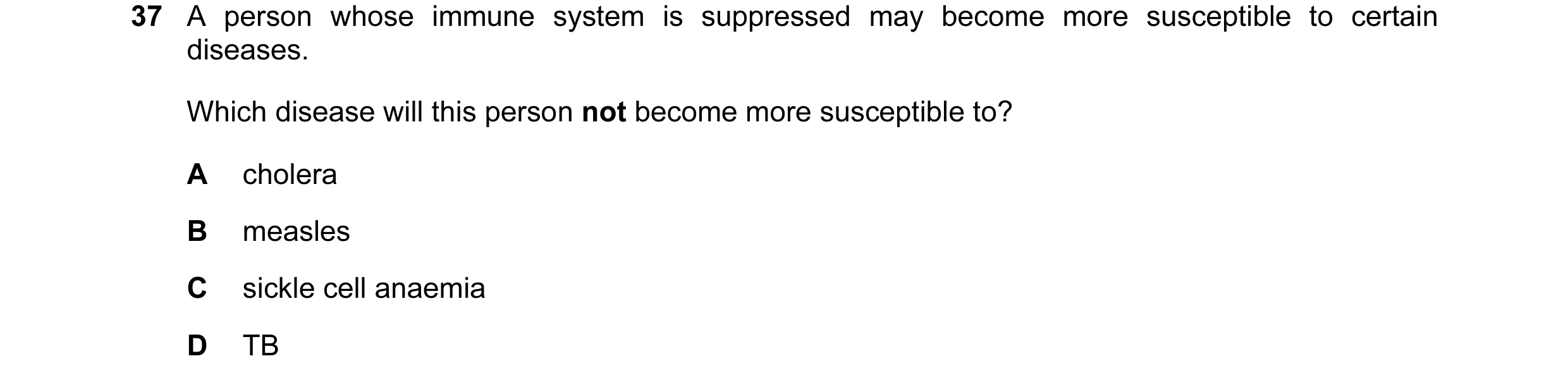 19 / 44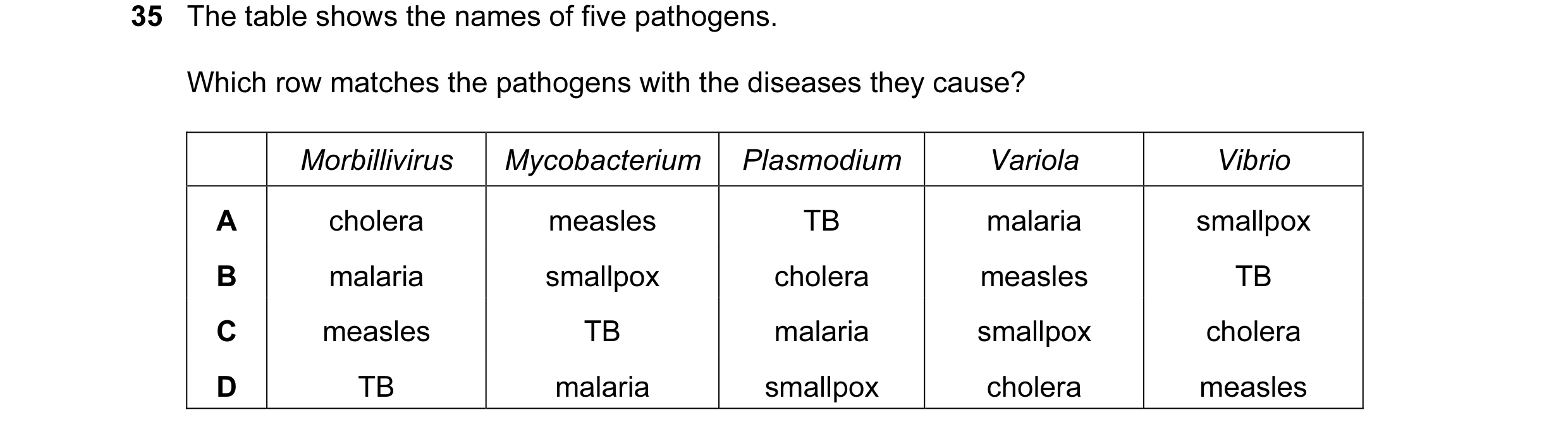
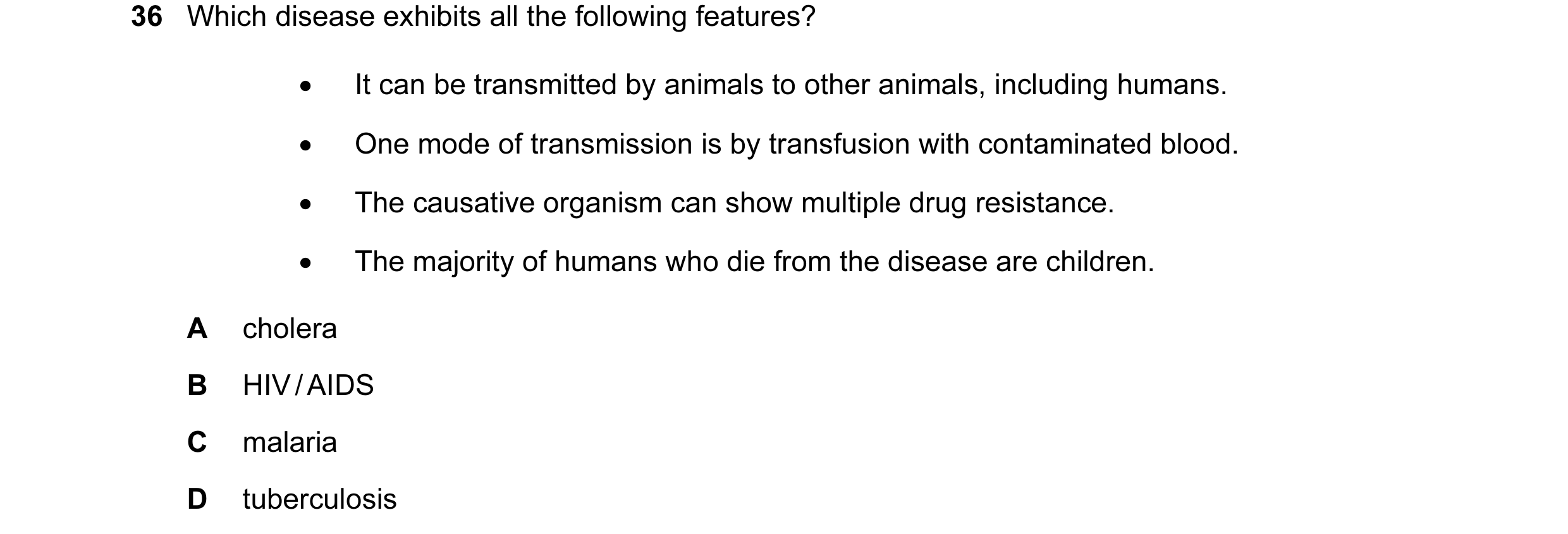
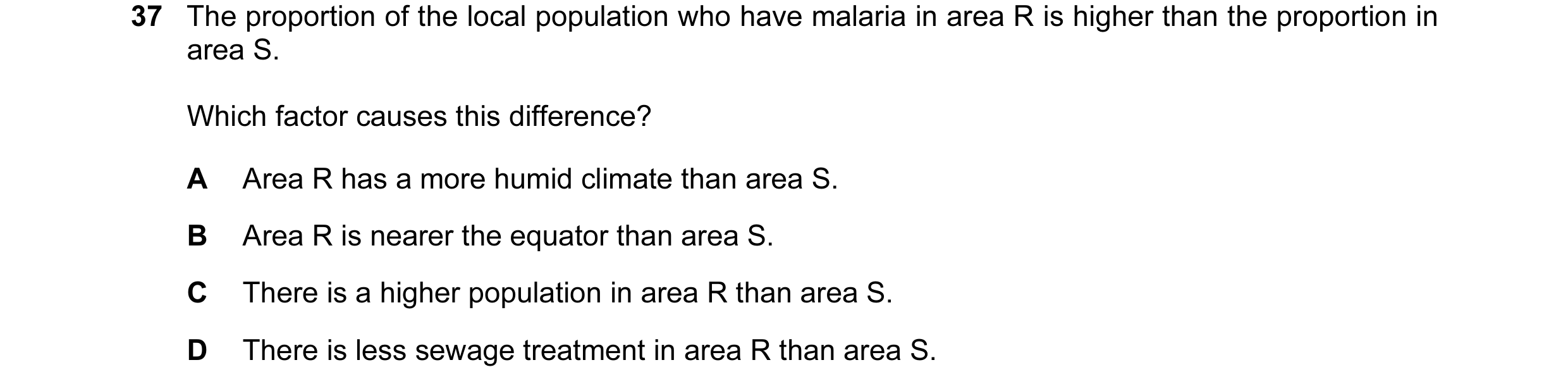
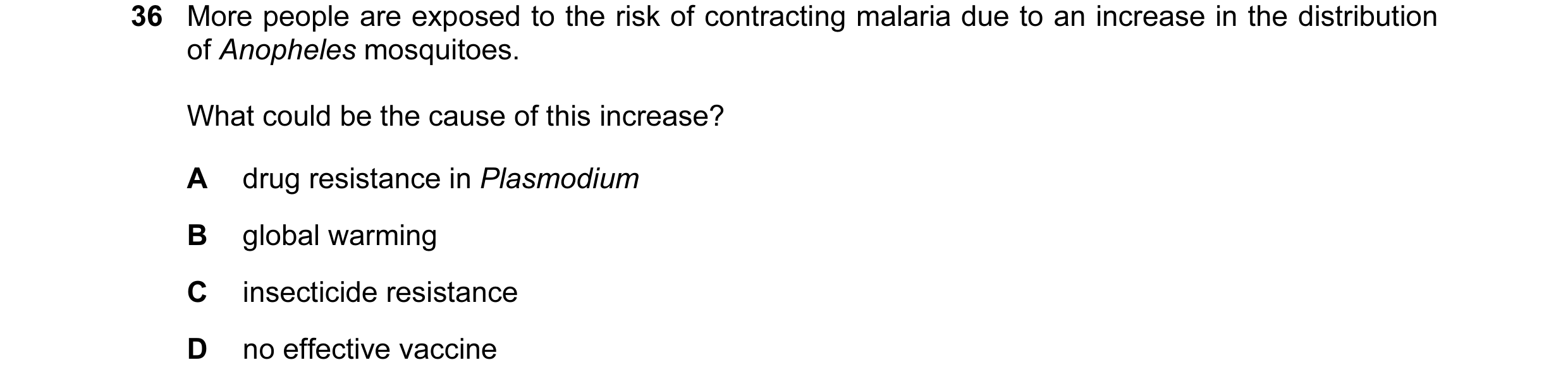 20 / 44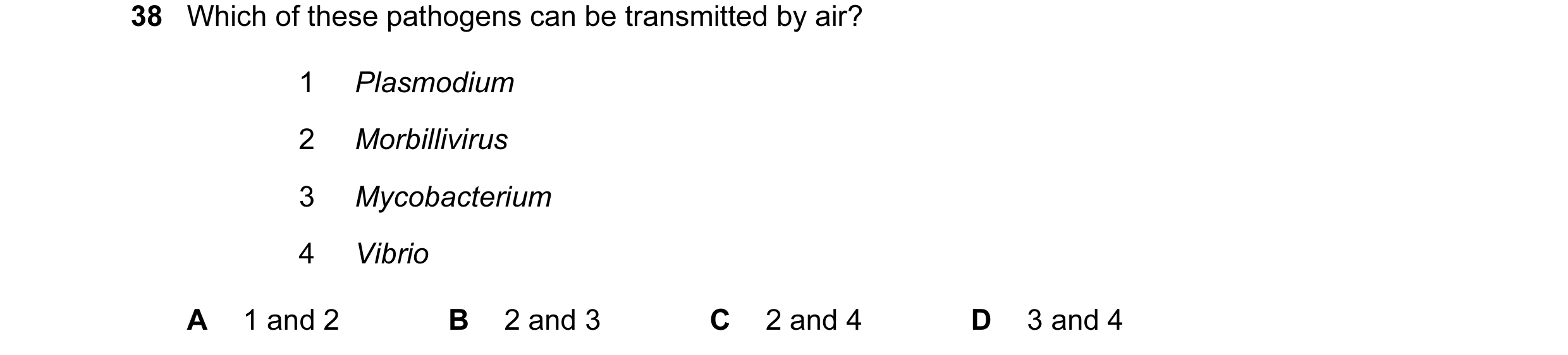
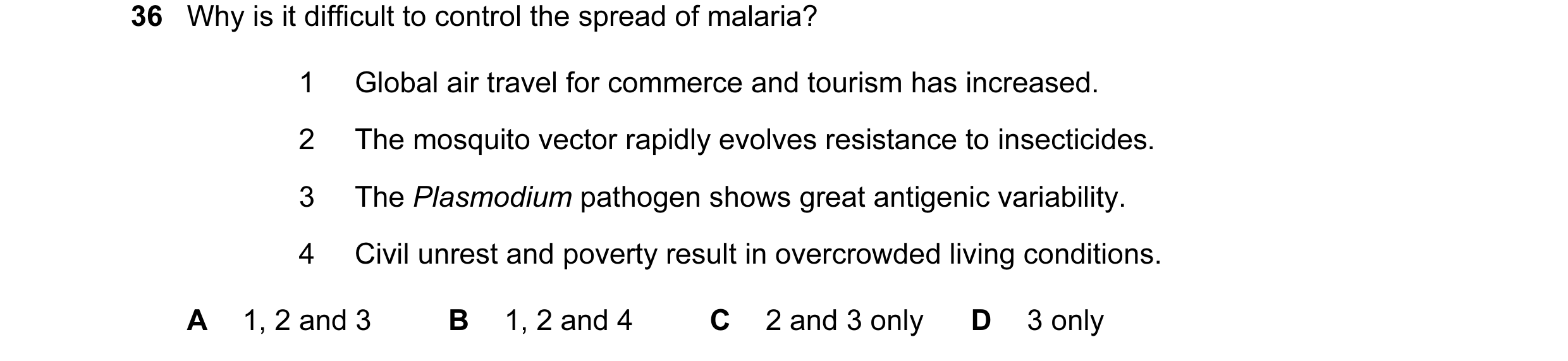
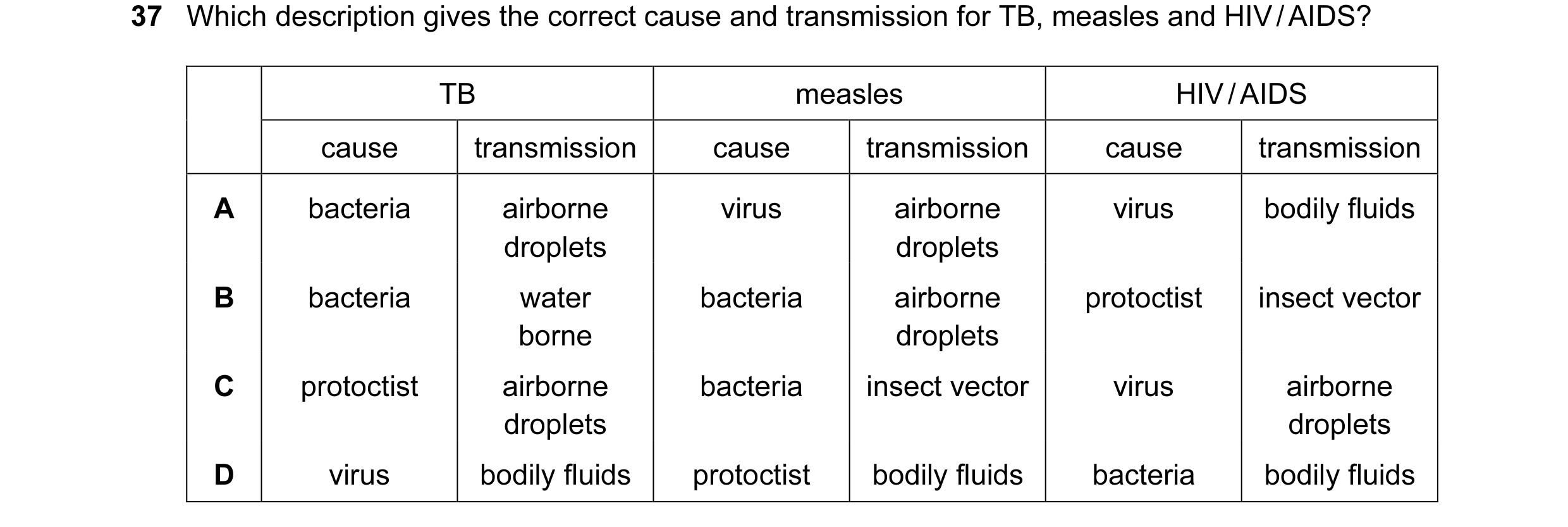
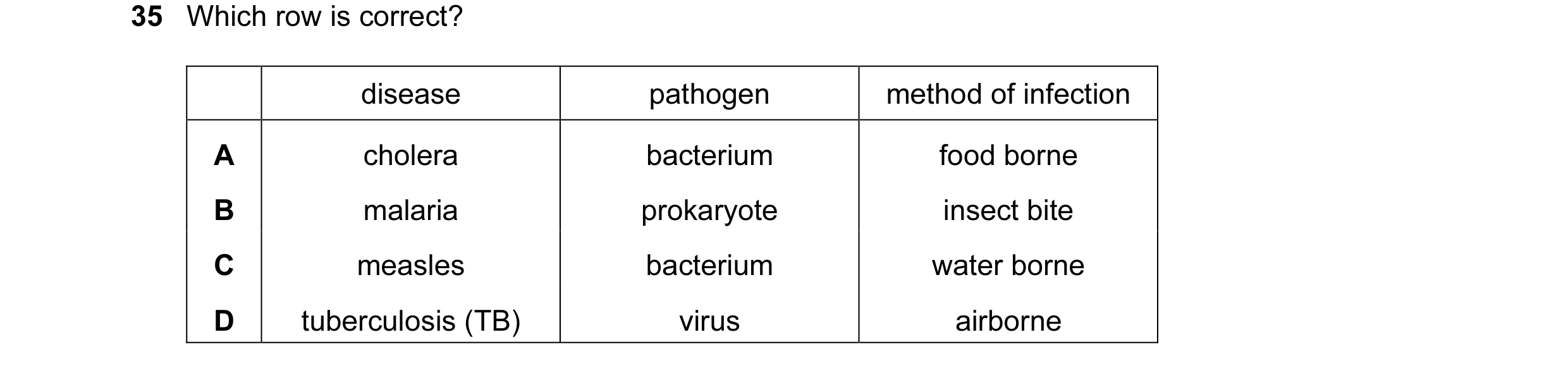
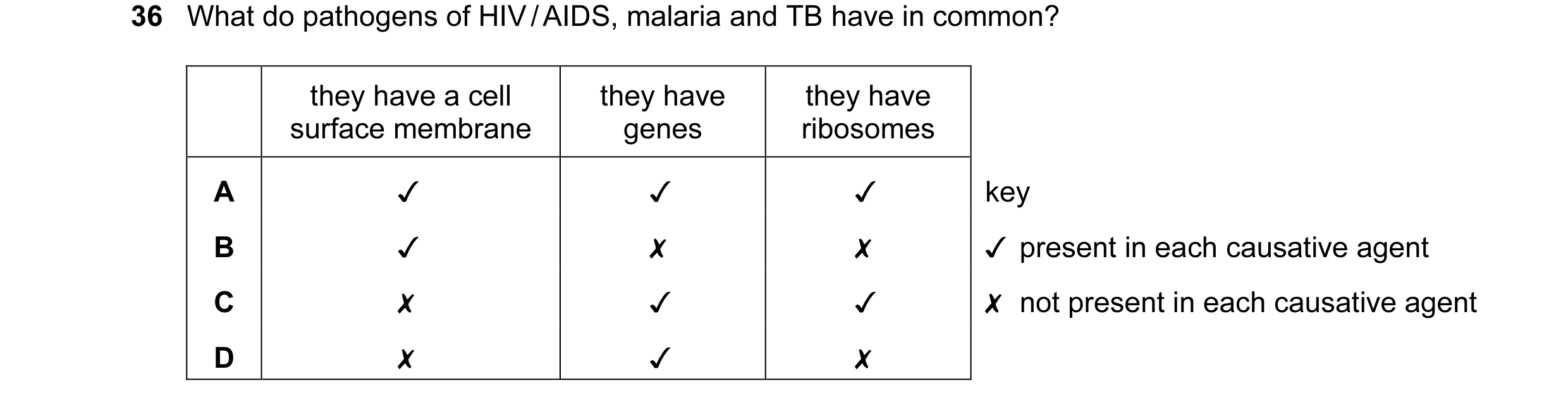 21 / 44
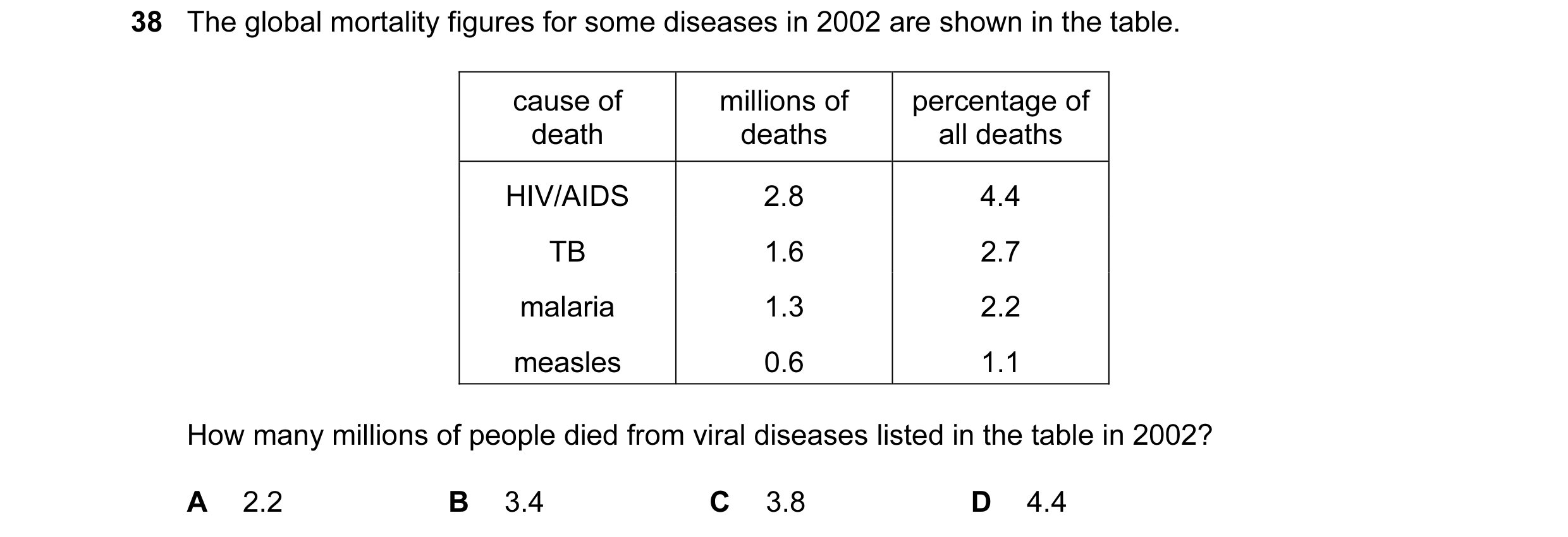
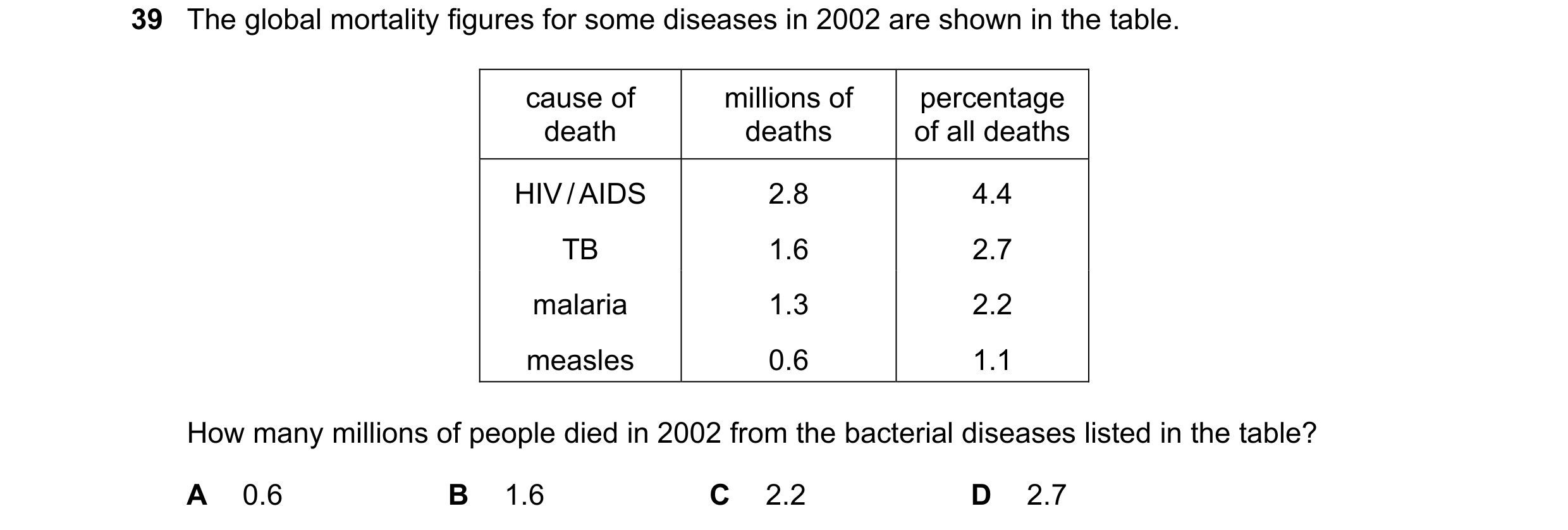

 22 / 44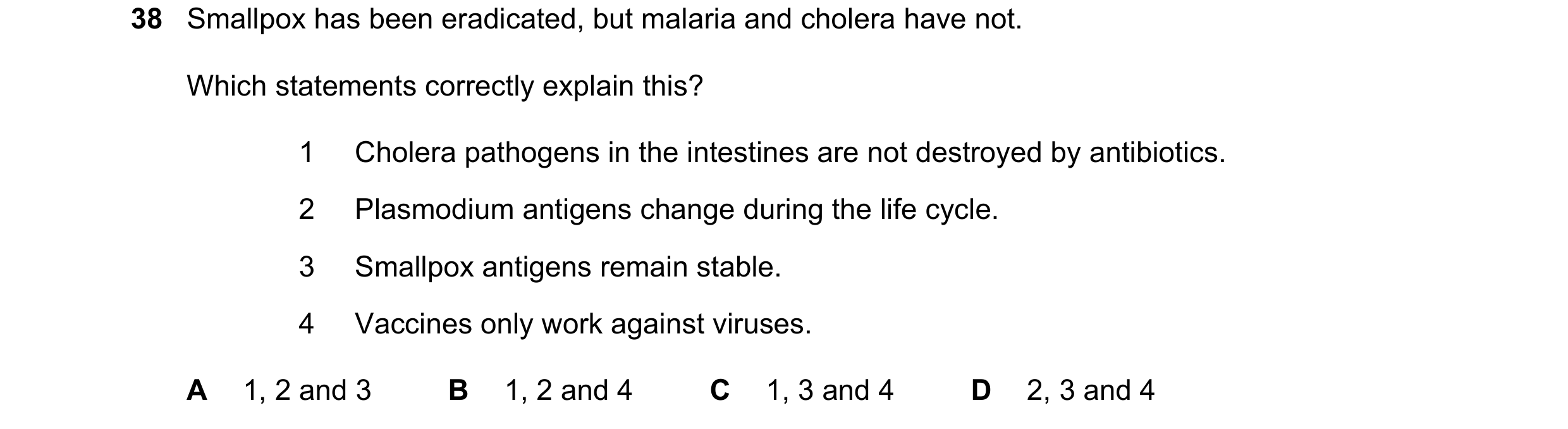

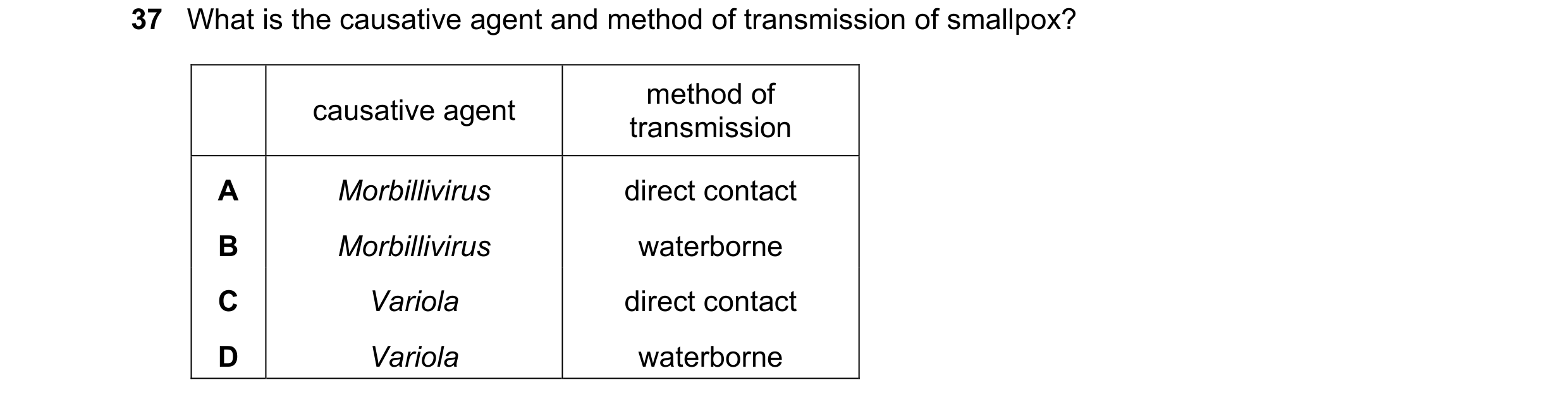
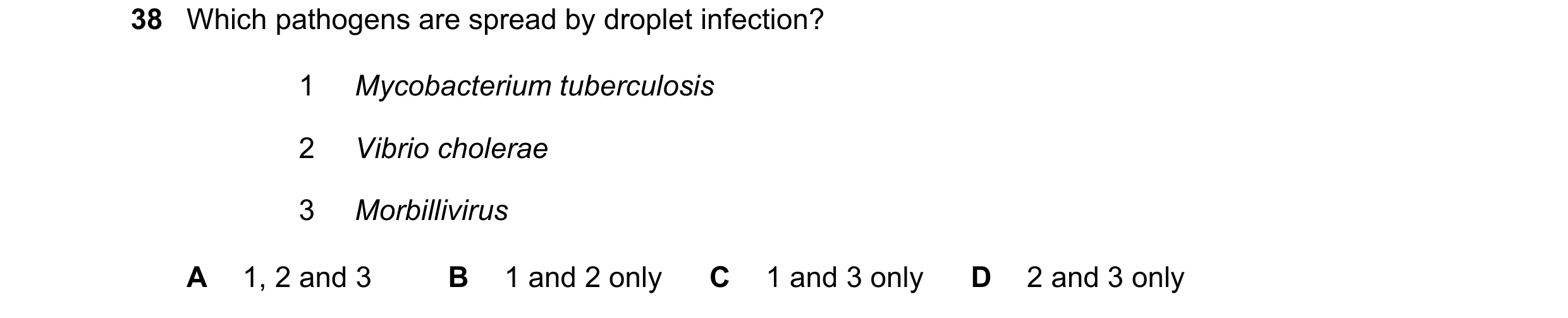
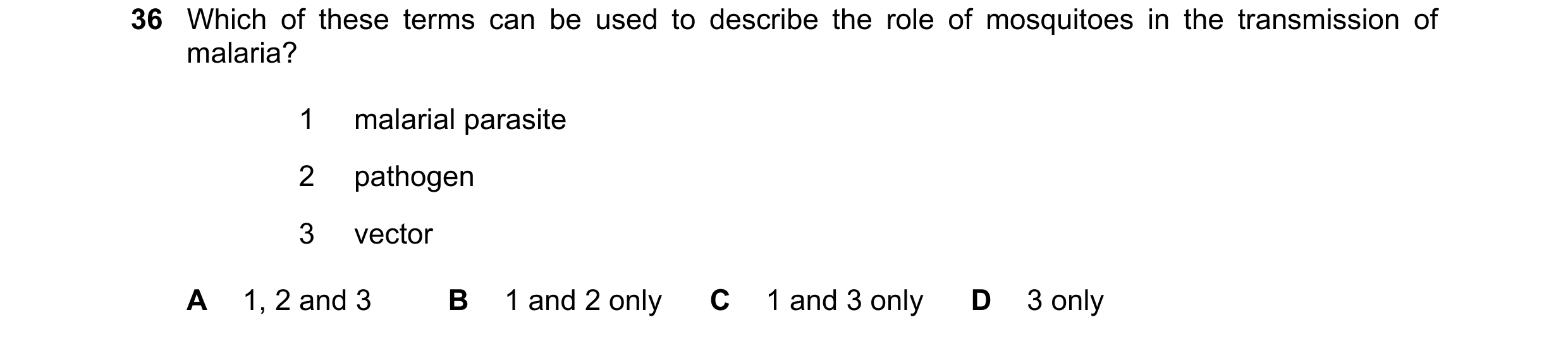 23 / 44
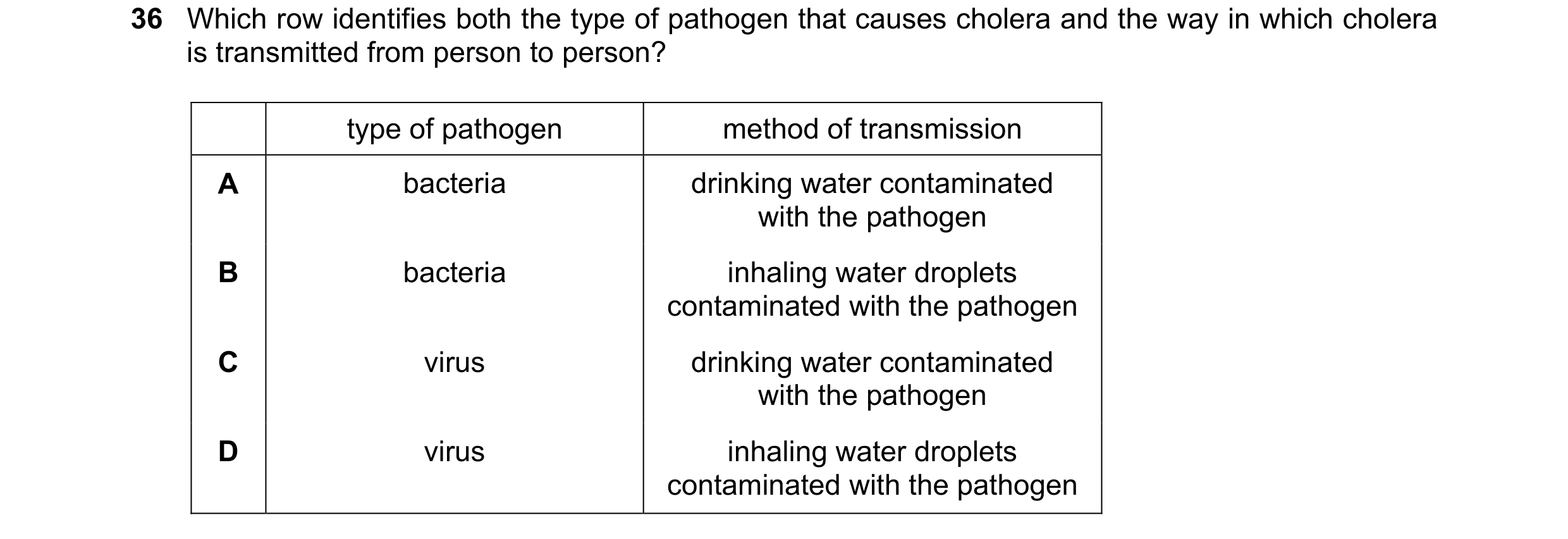
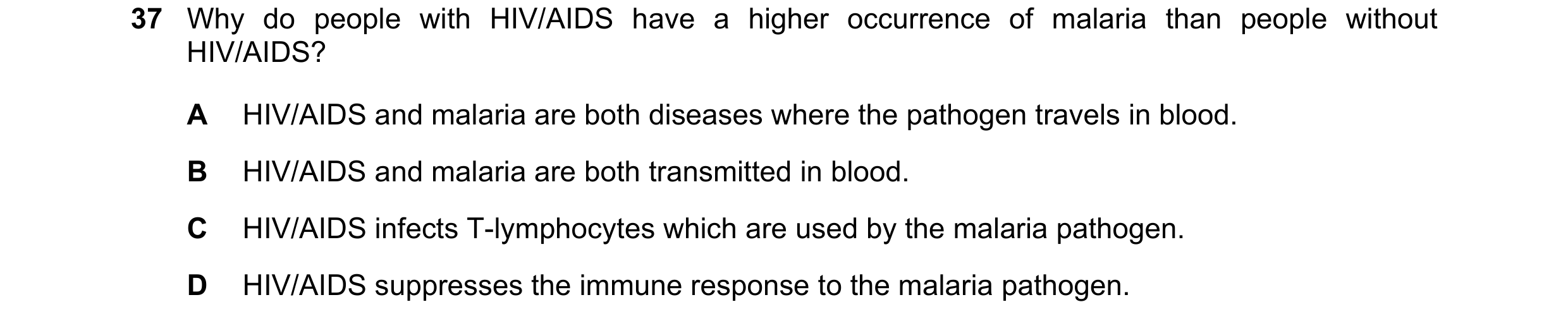

 24 / 44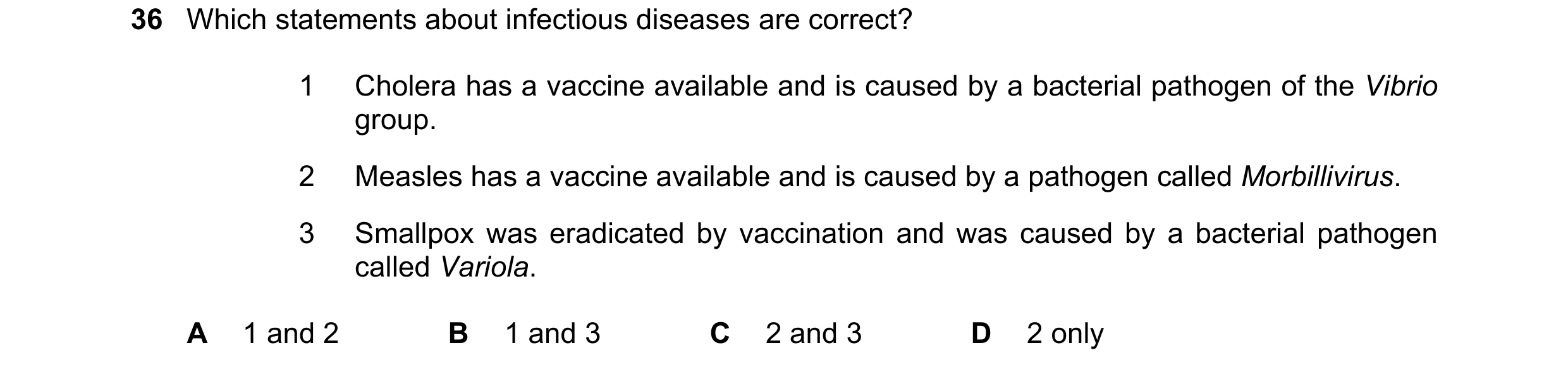
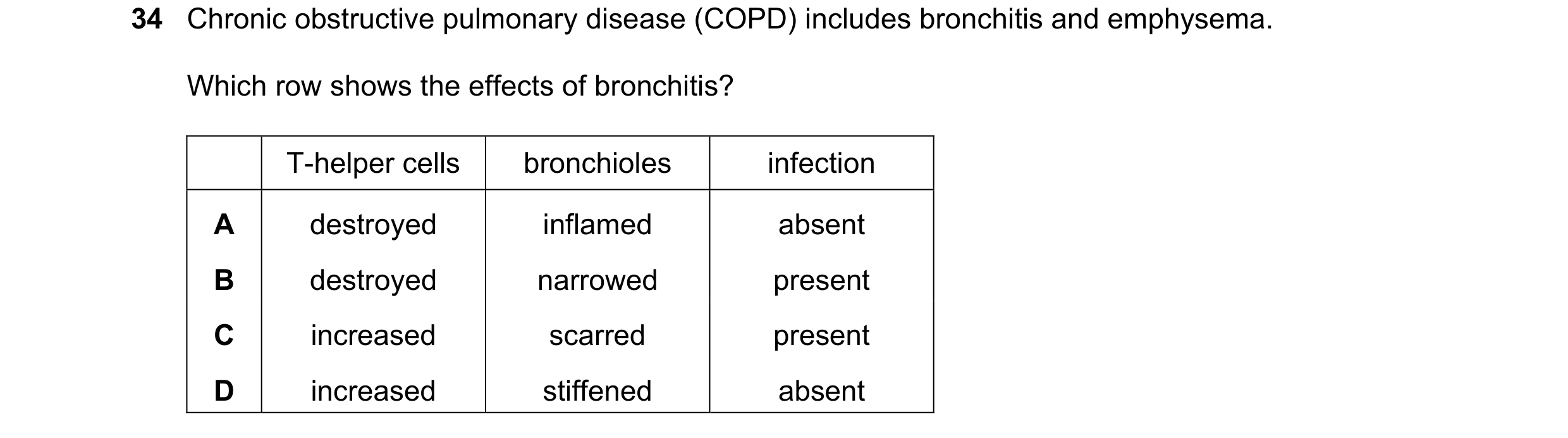
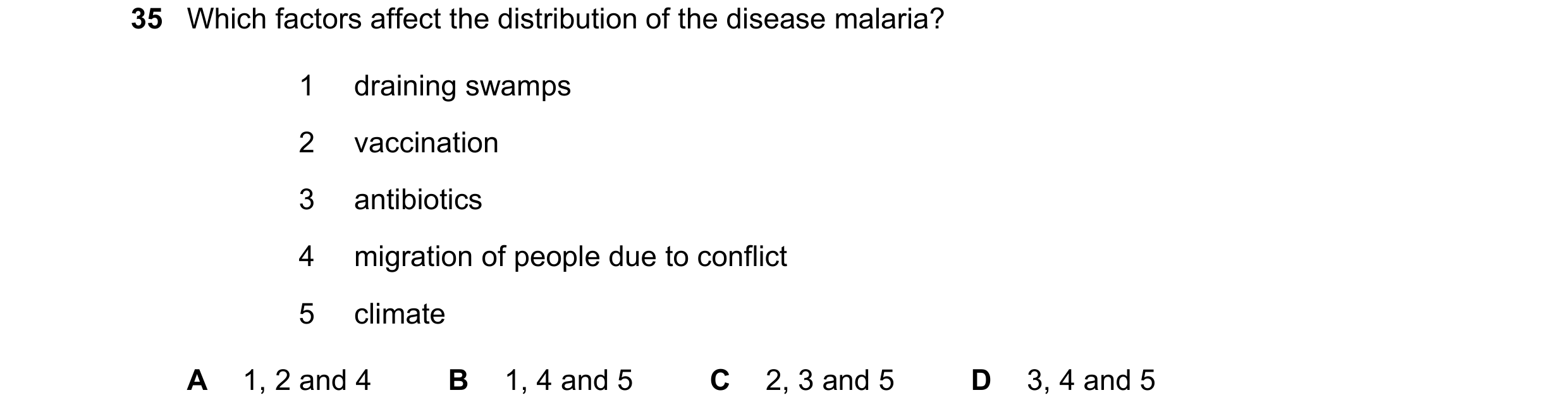

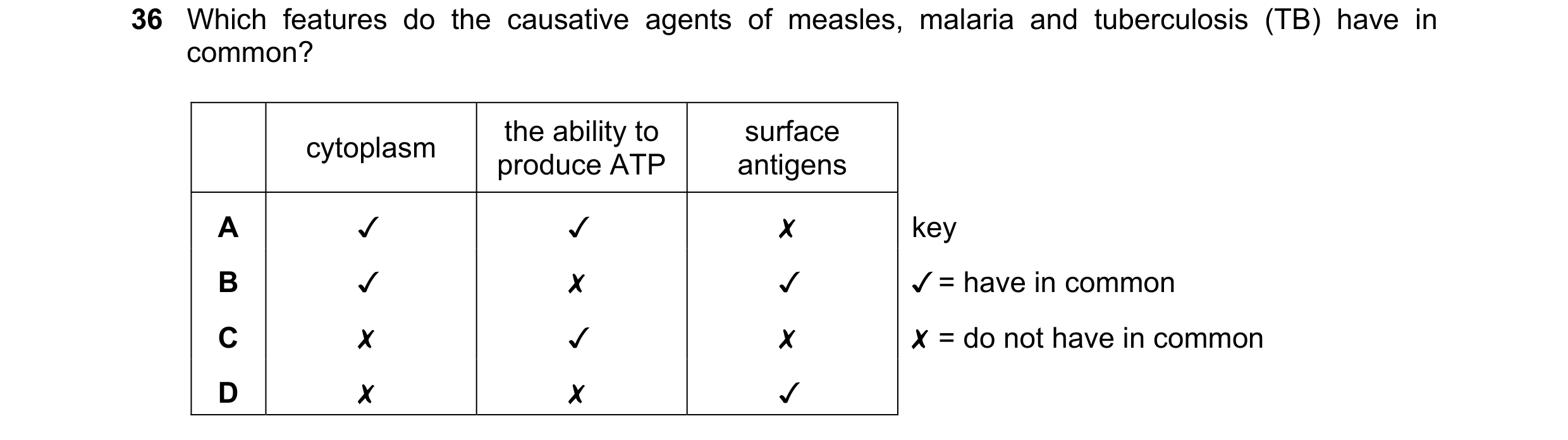 25 / 44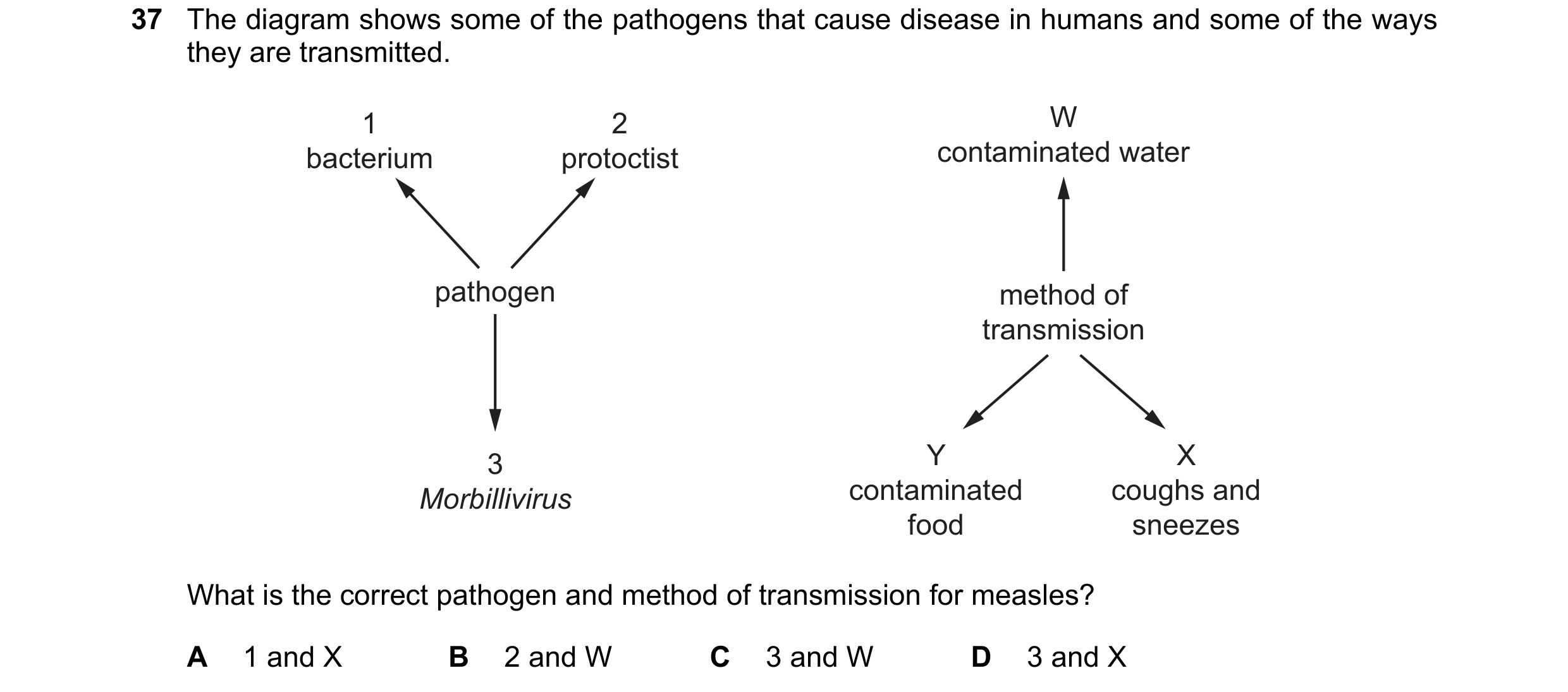
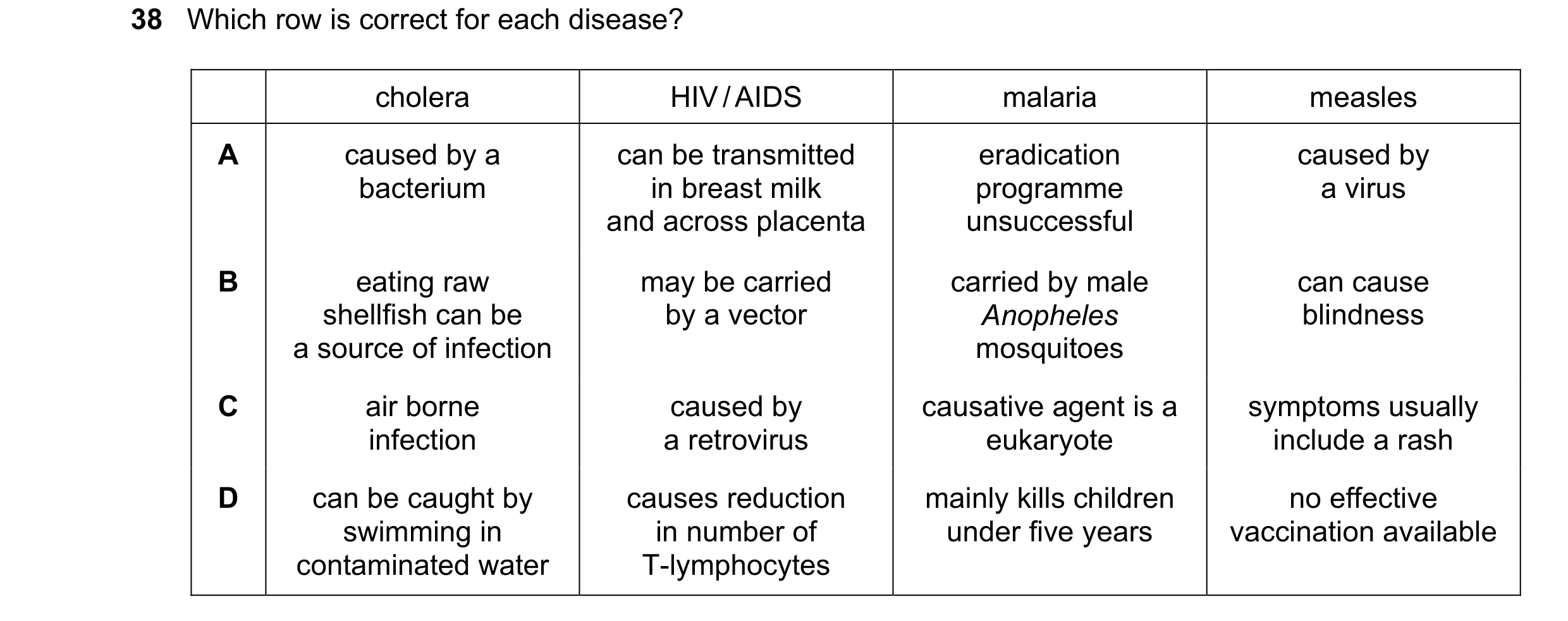 26 / 44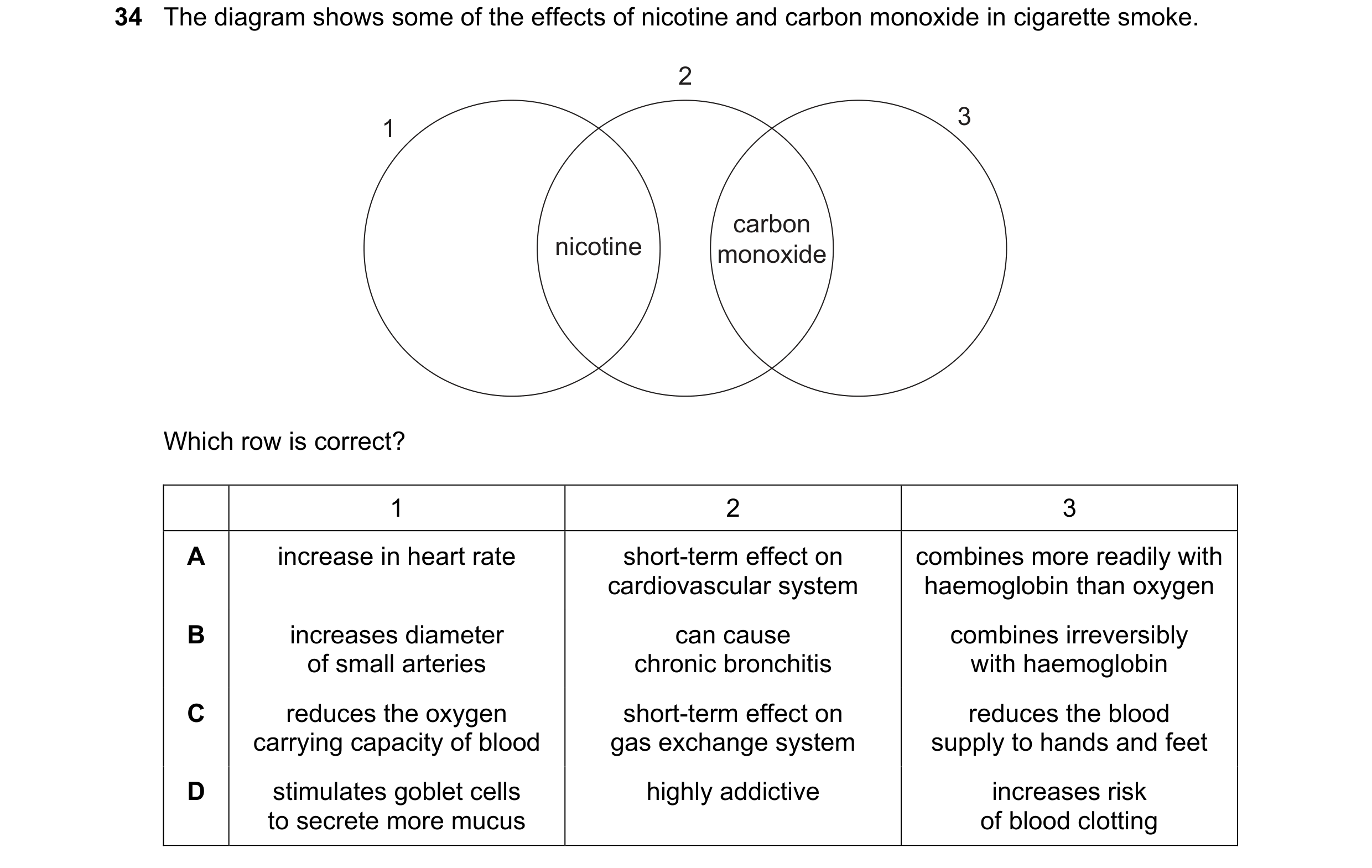
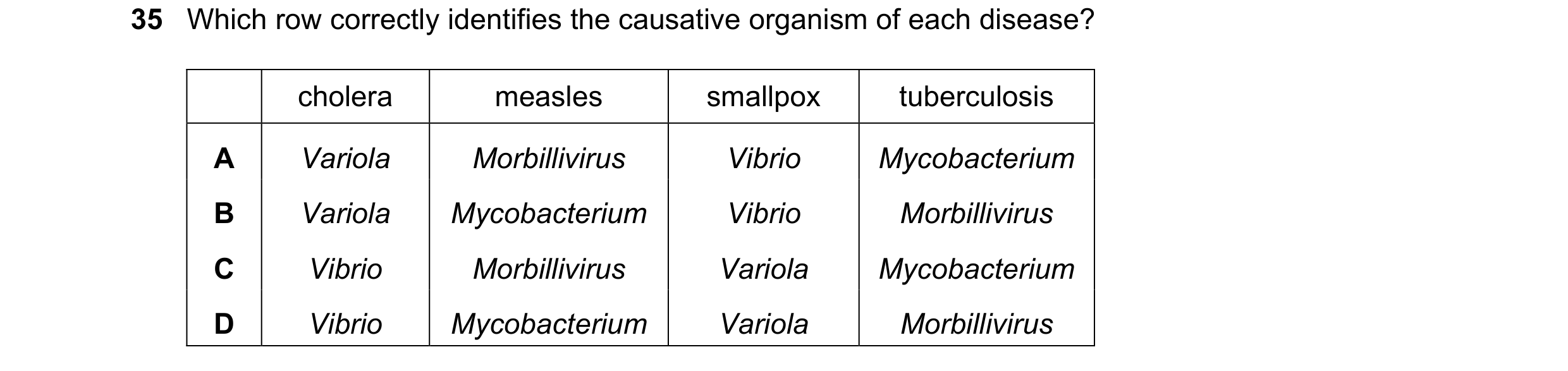
 27 / 44
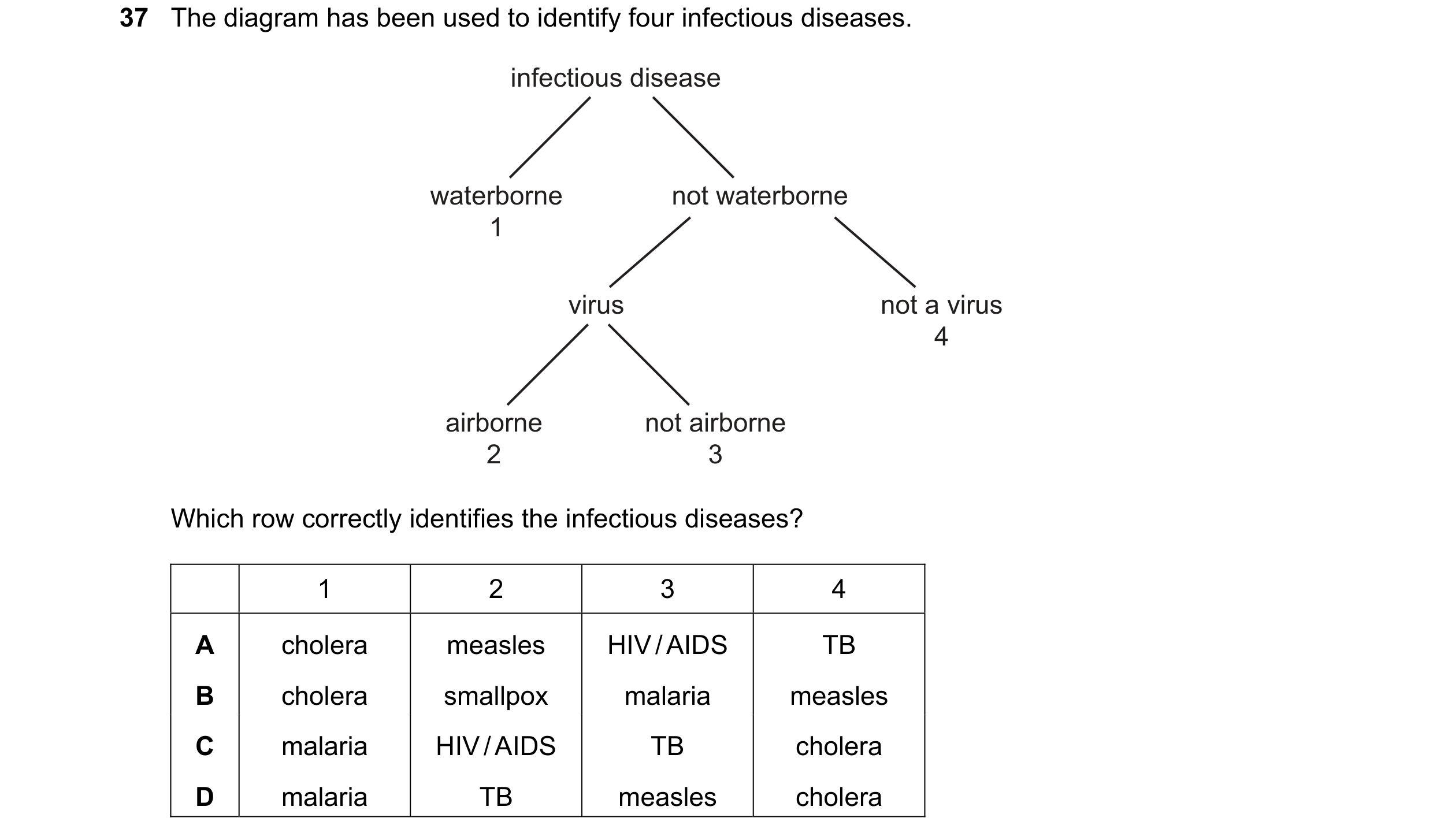
 28 / 44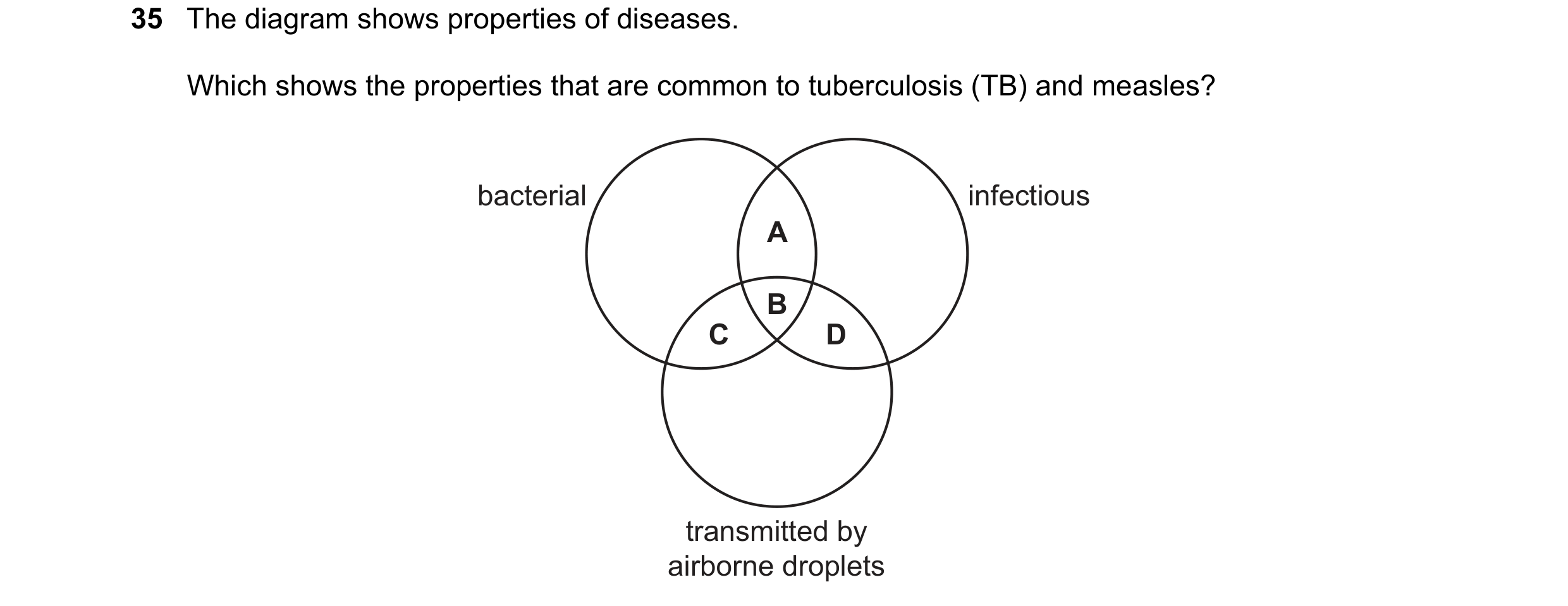
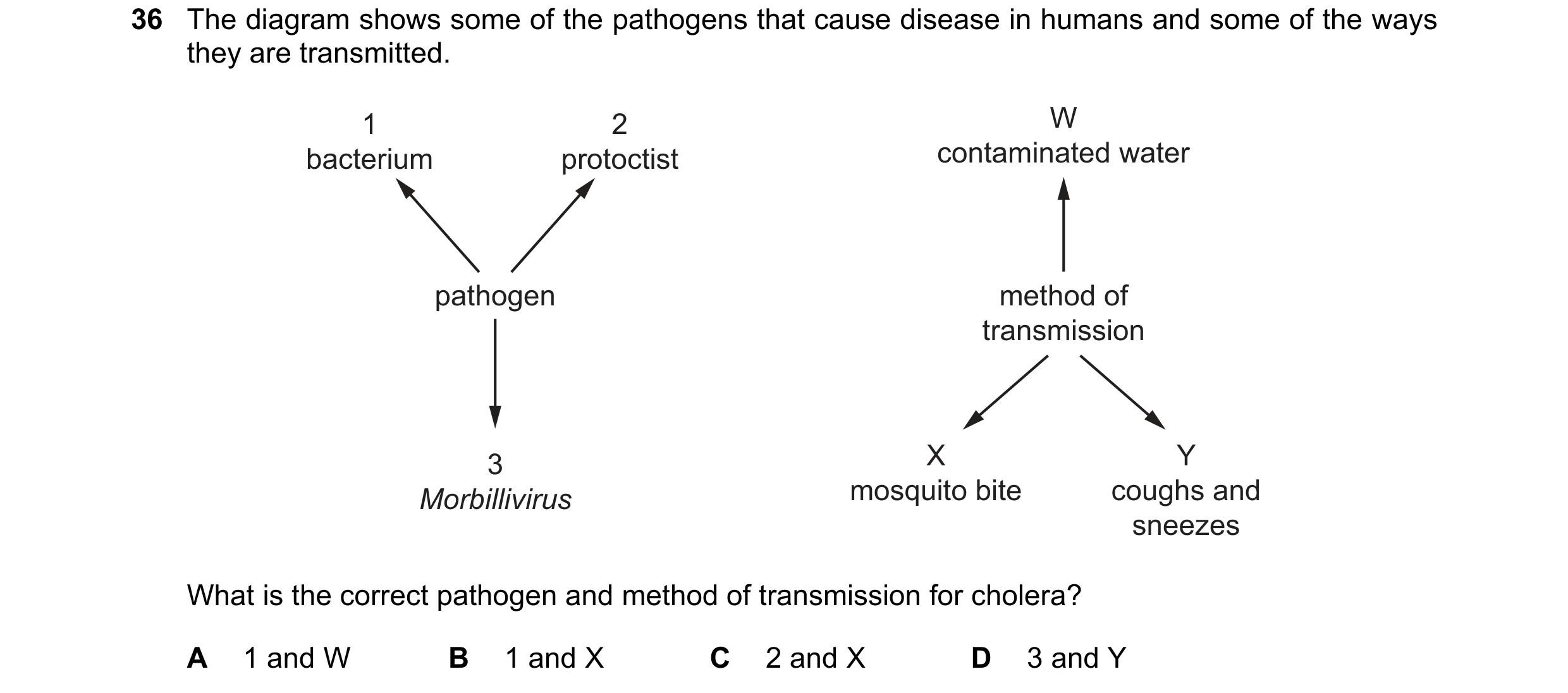
 29 / 44
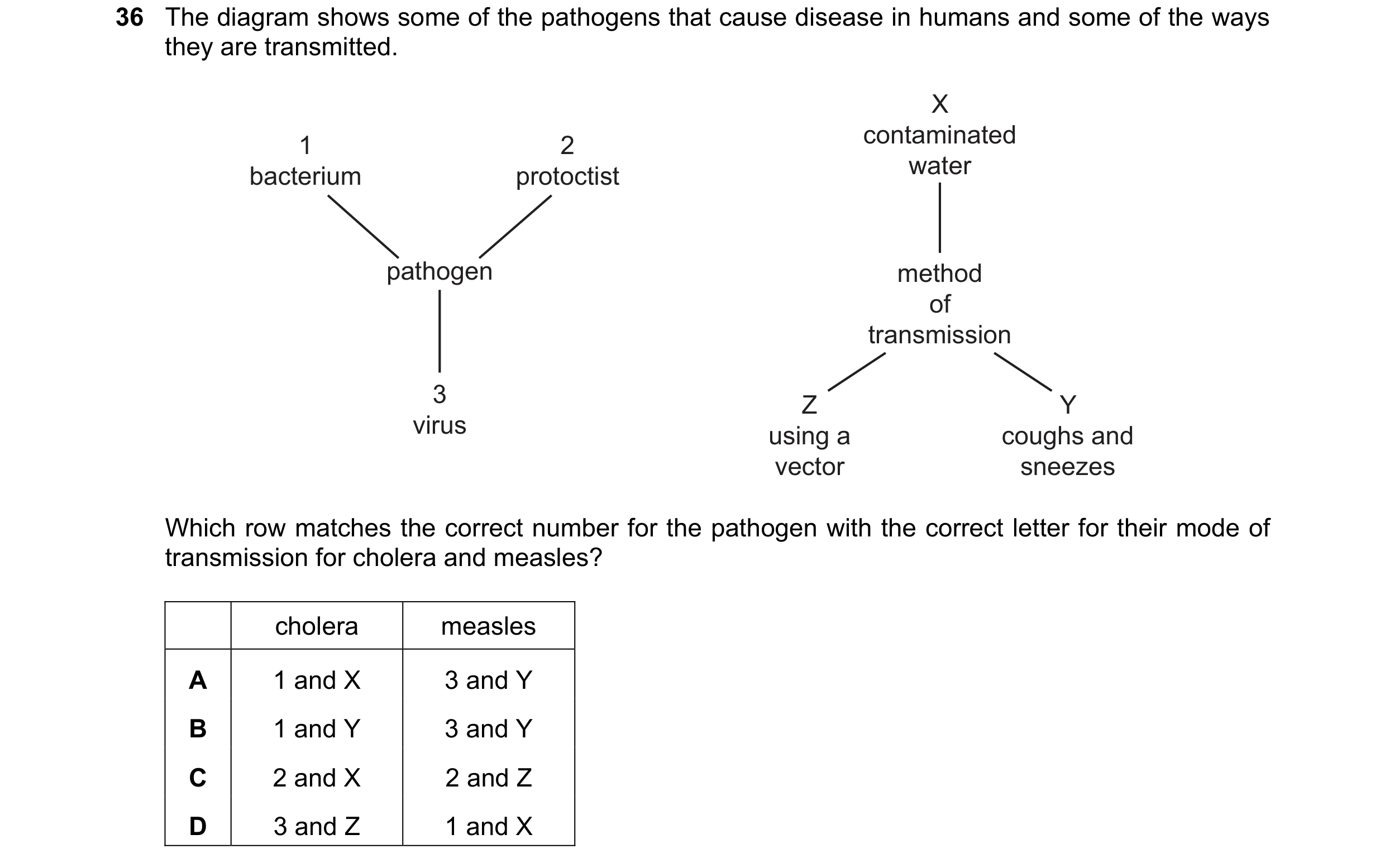
 30 / 44
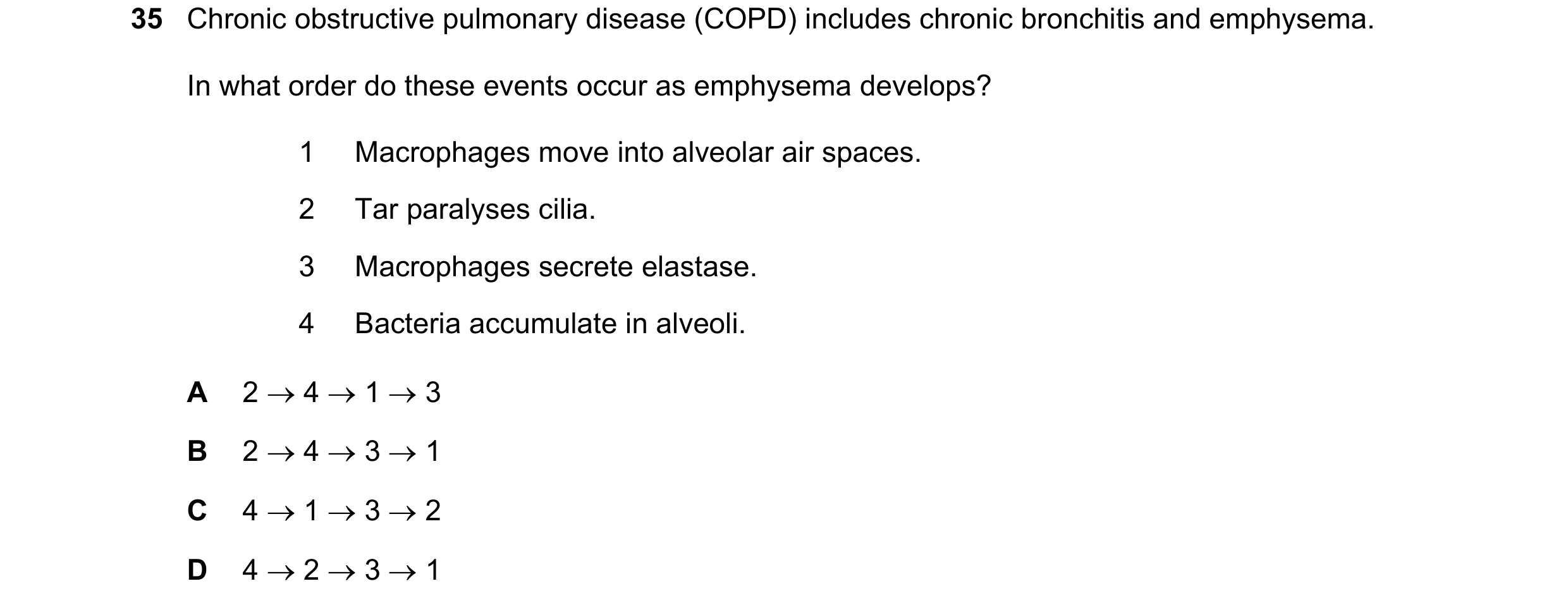
 31 / 44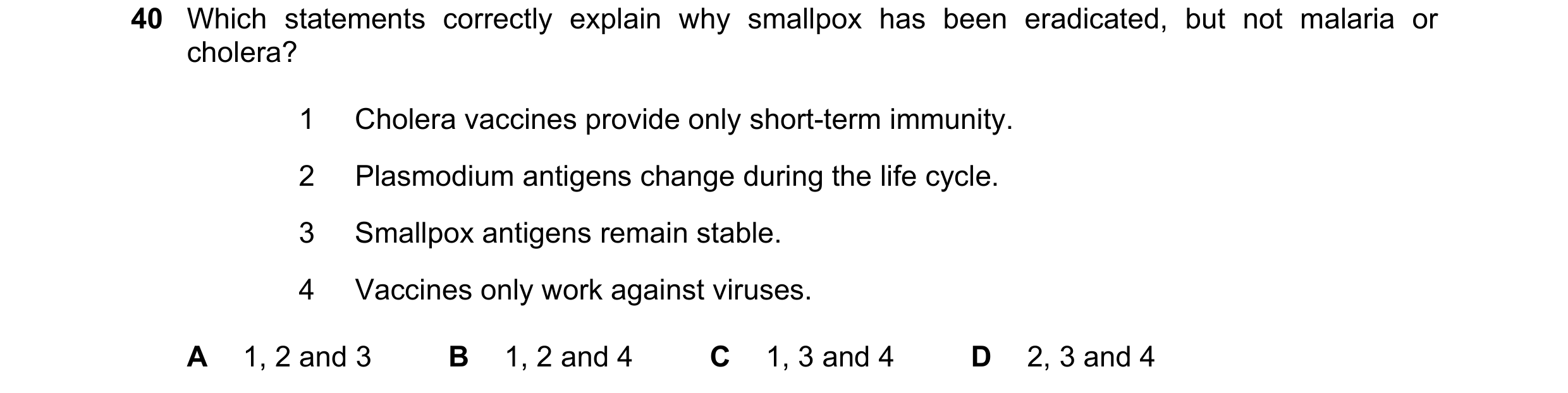
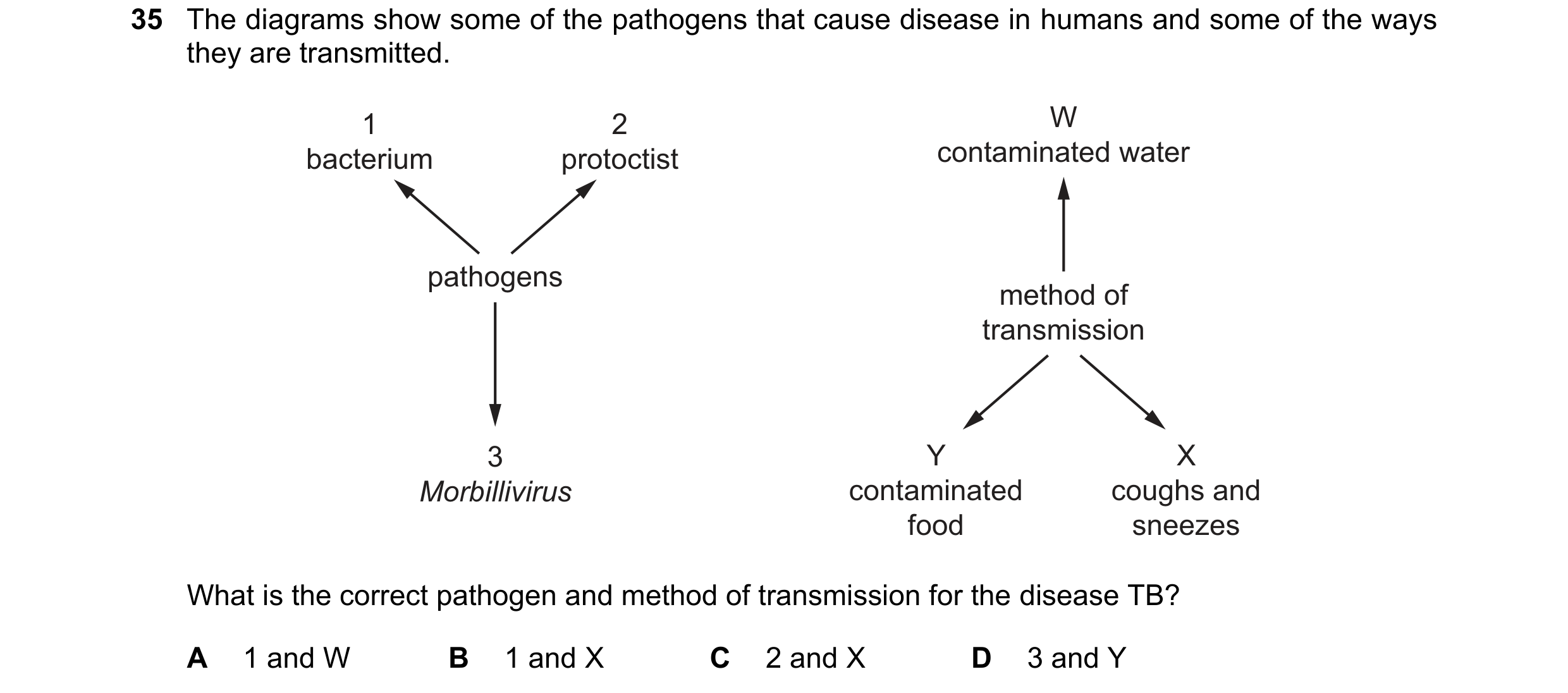
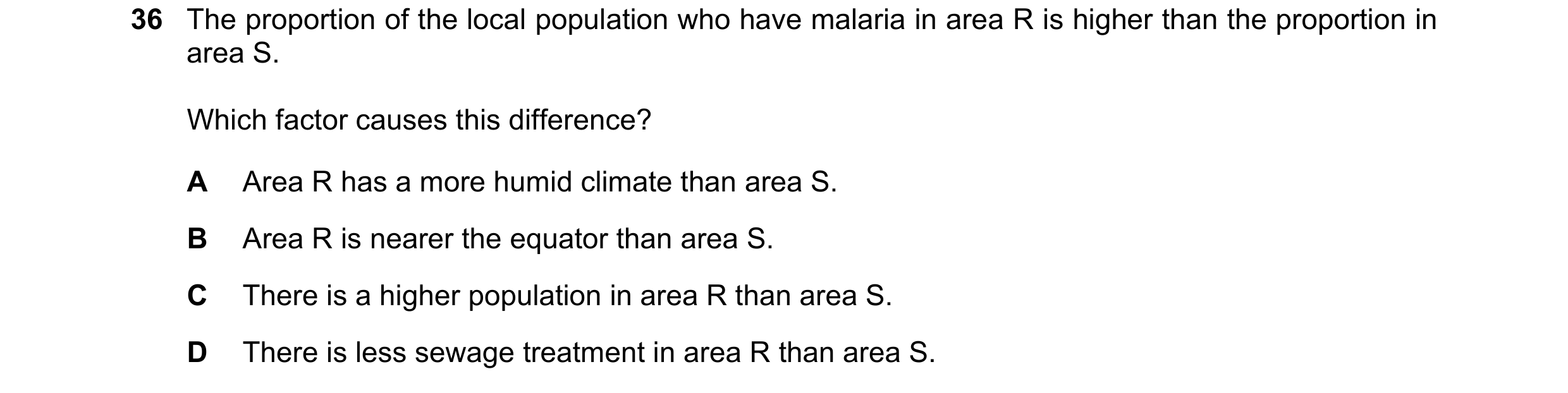
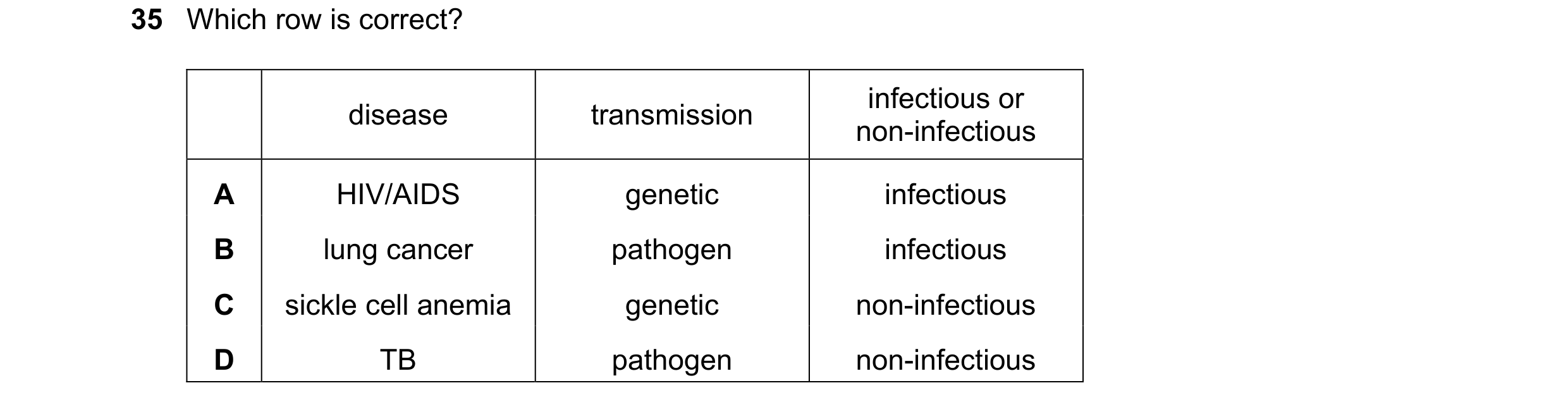 32 / 44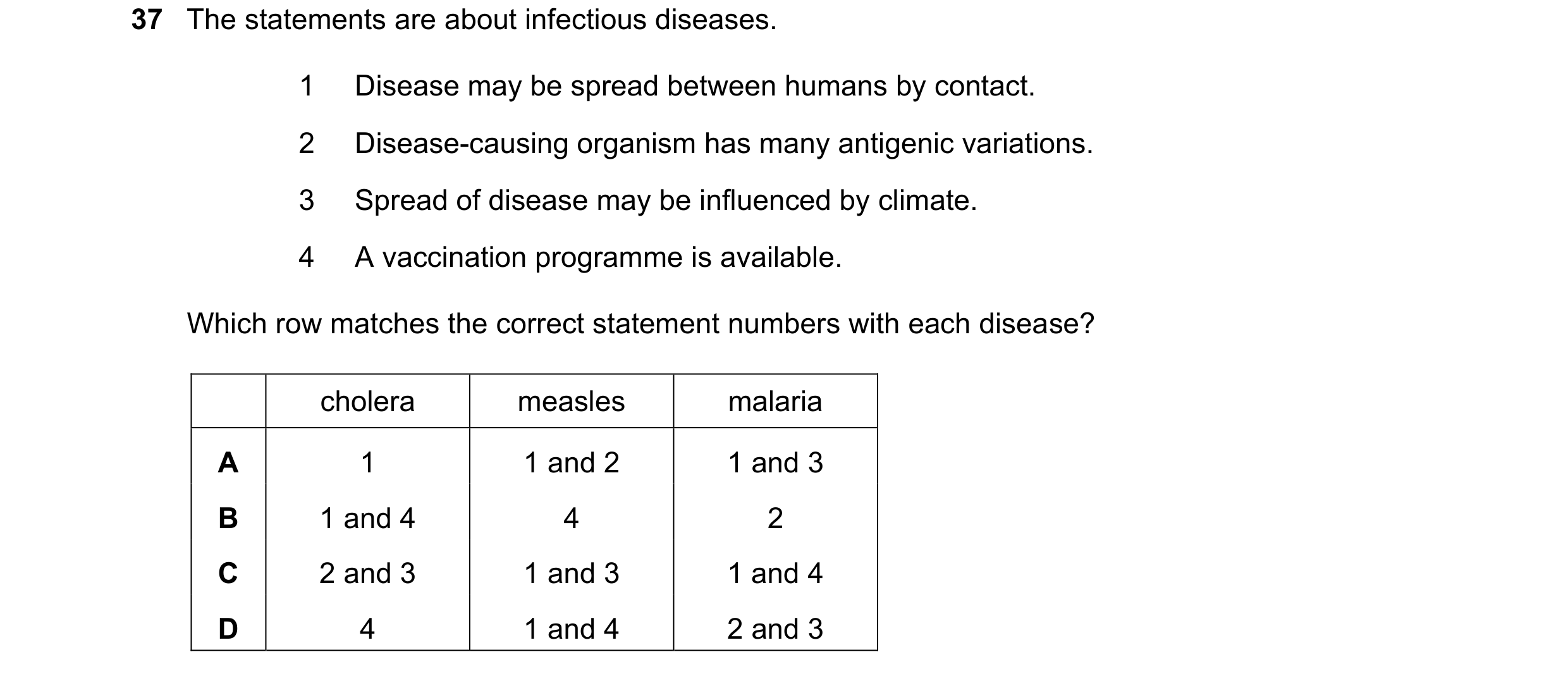

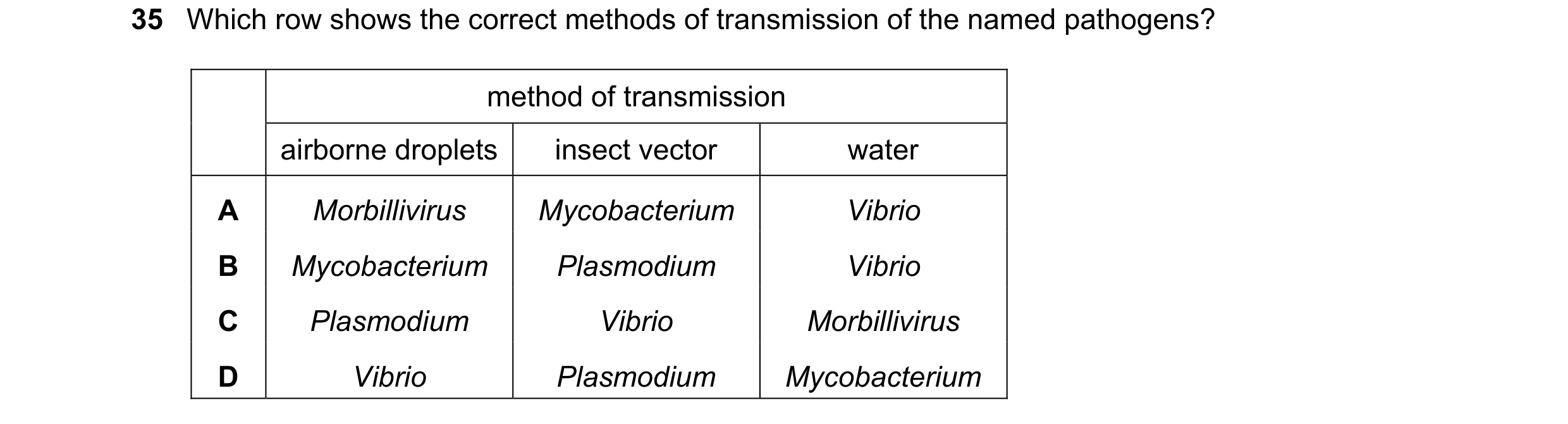

 33 / 44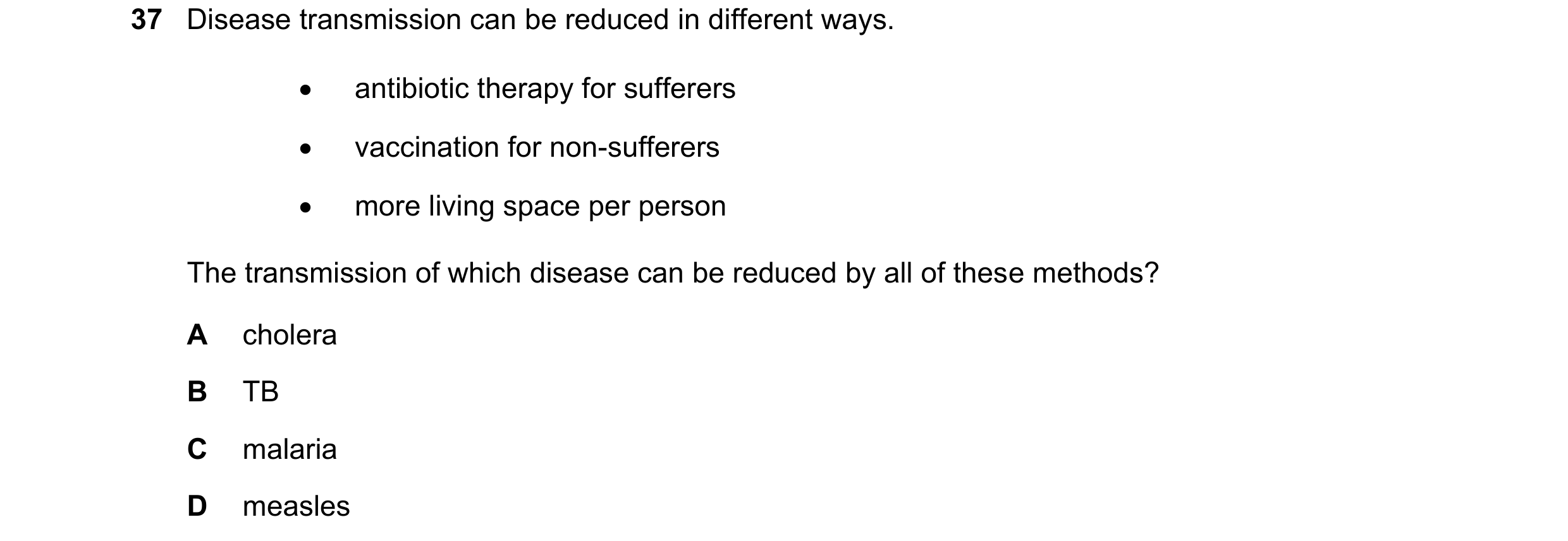
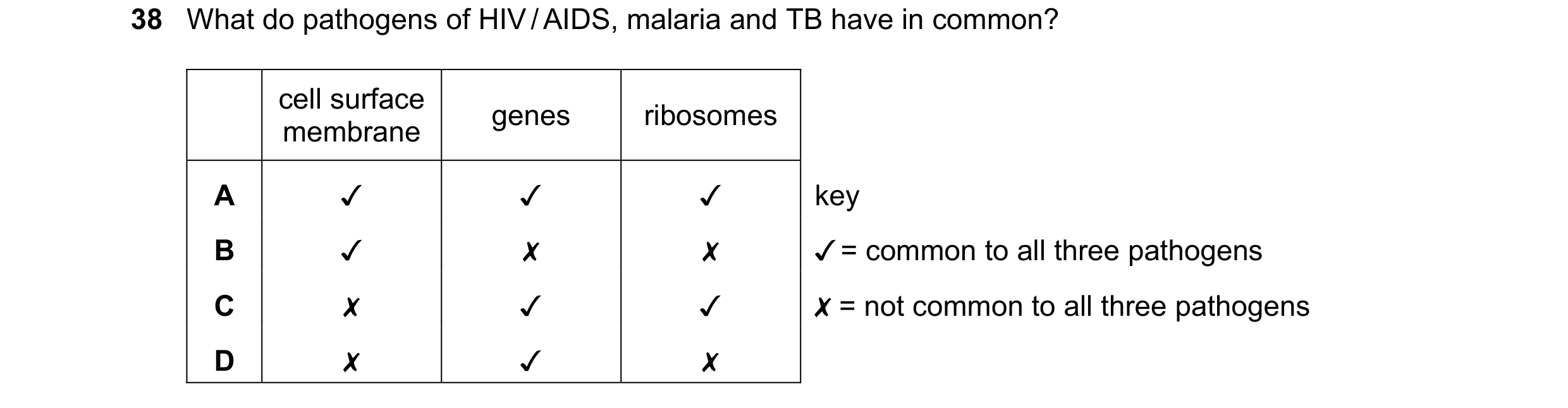
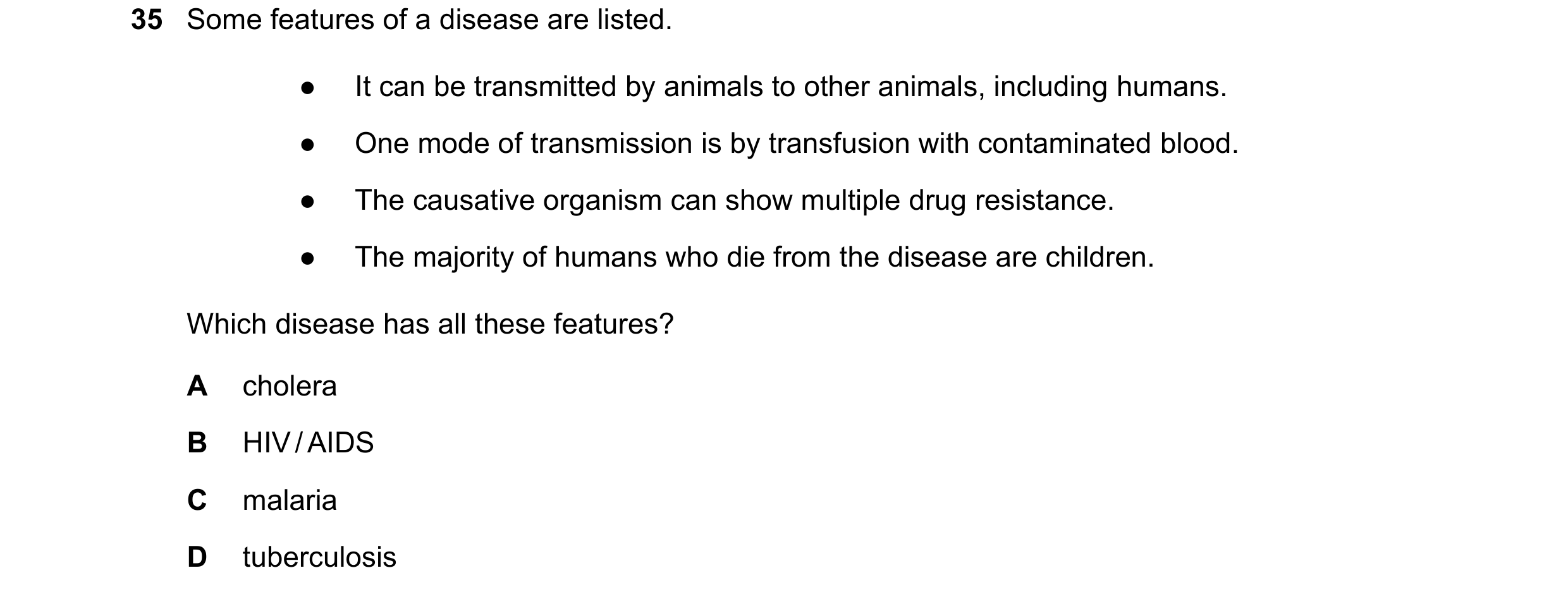 34 / 44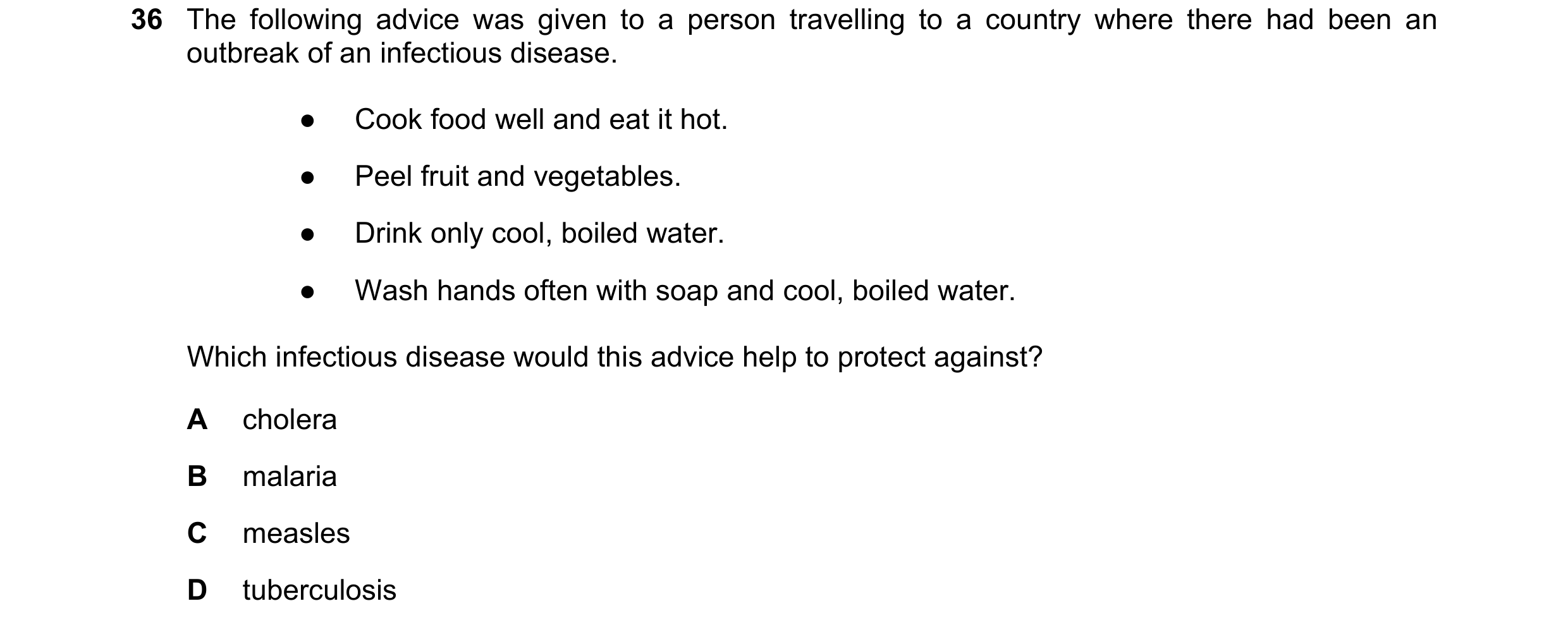
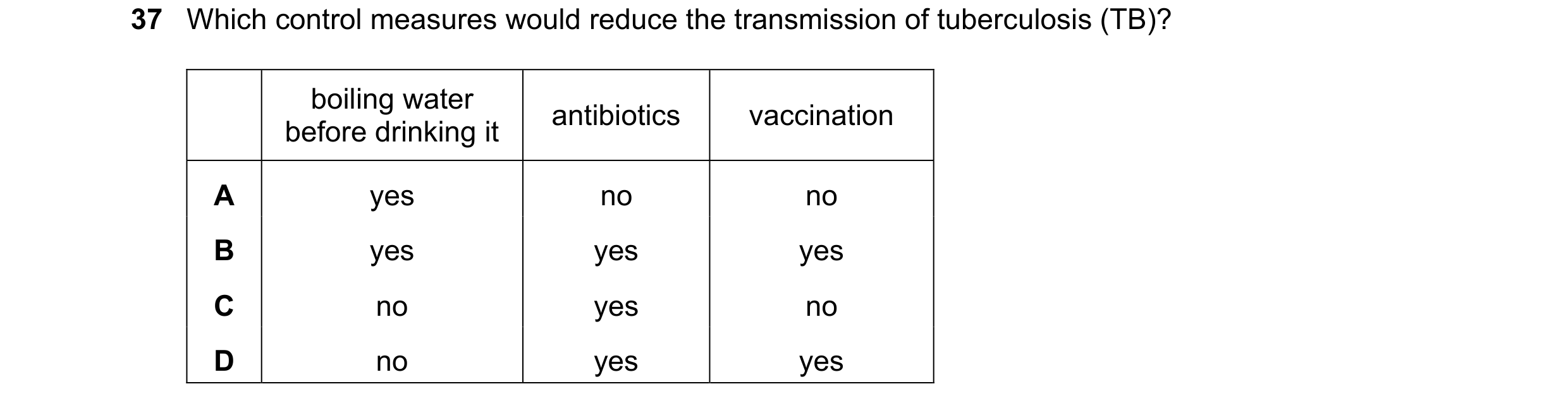
 35 / 44

 36 / 44
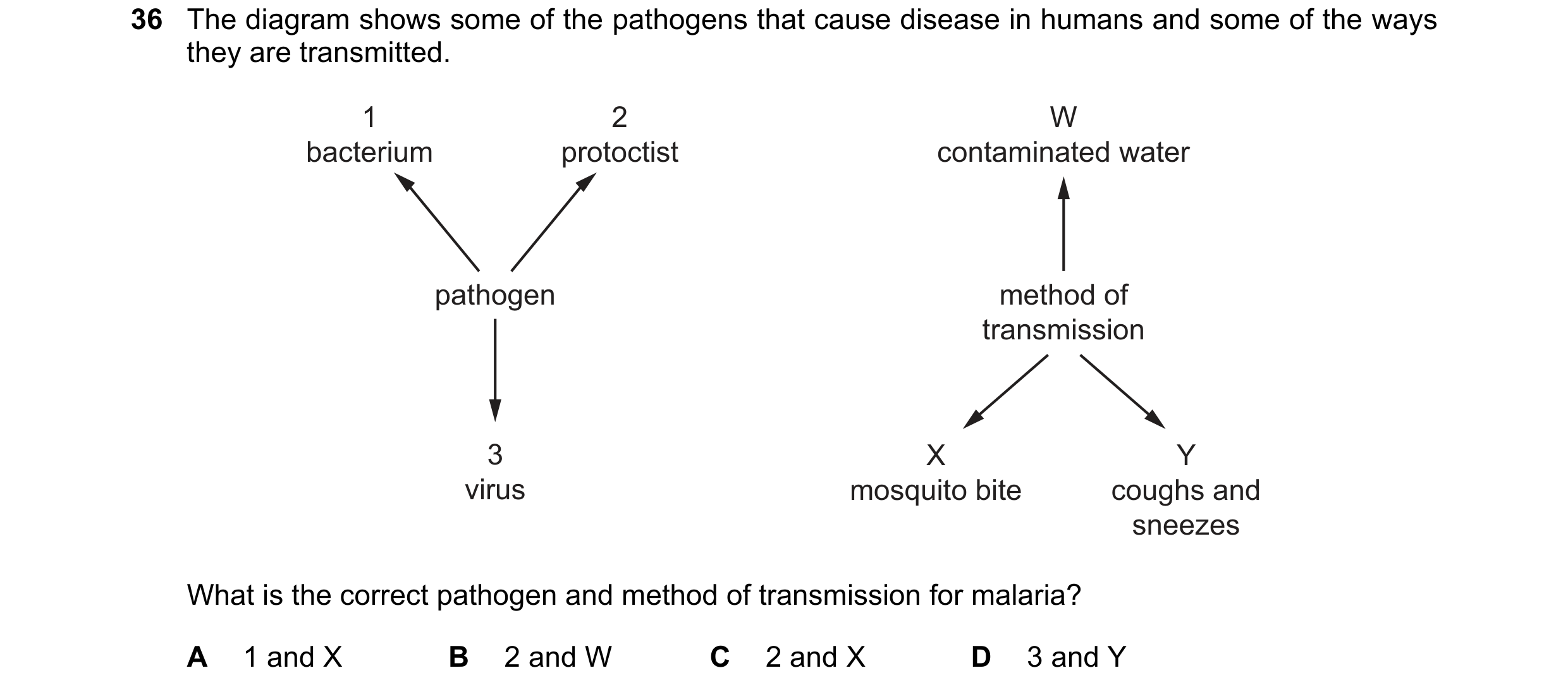 37 / 44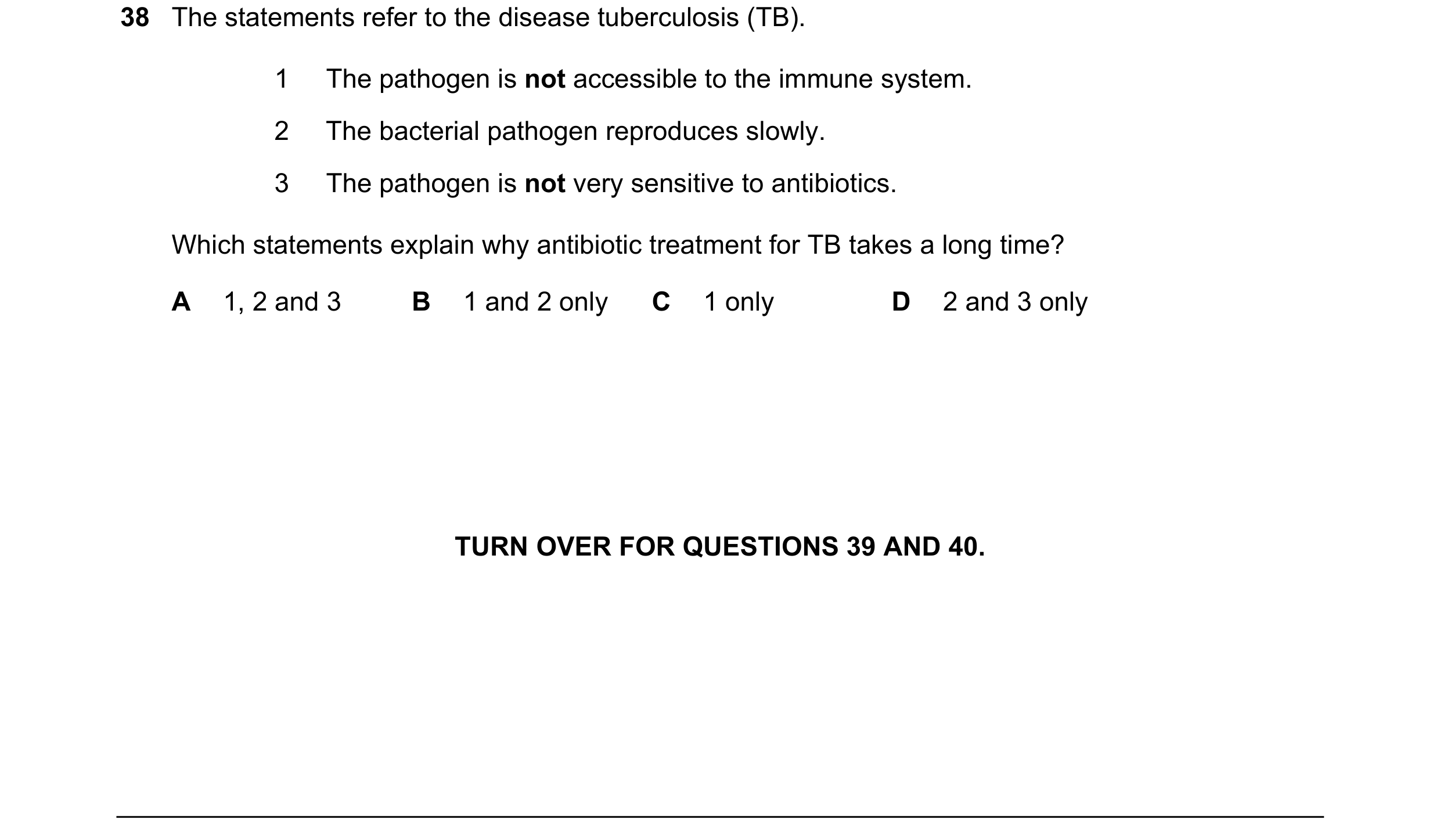
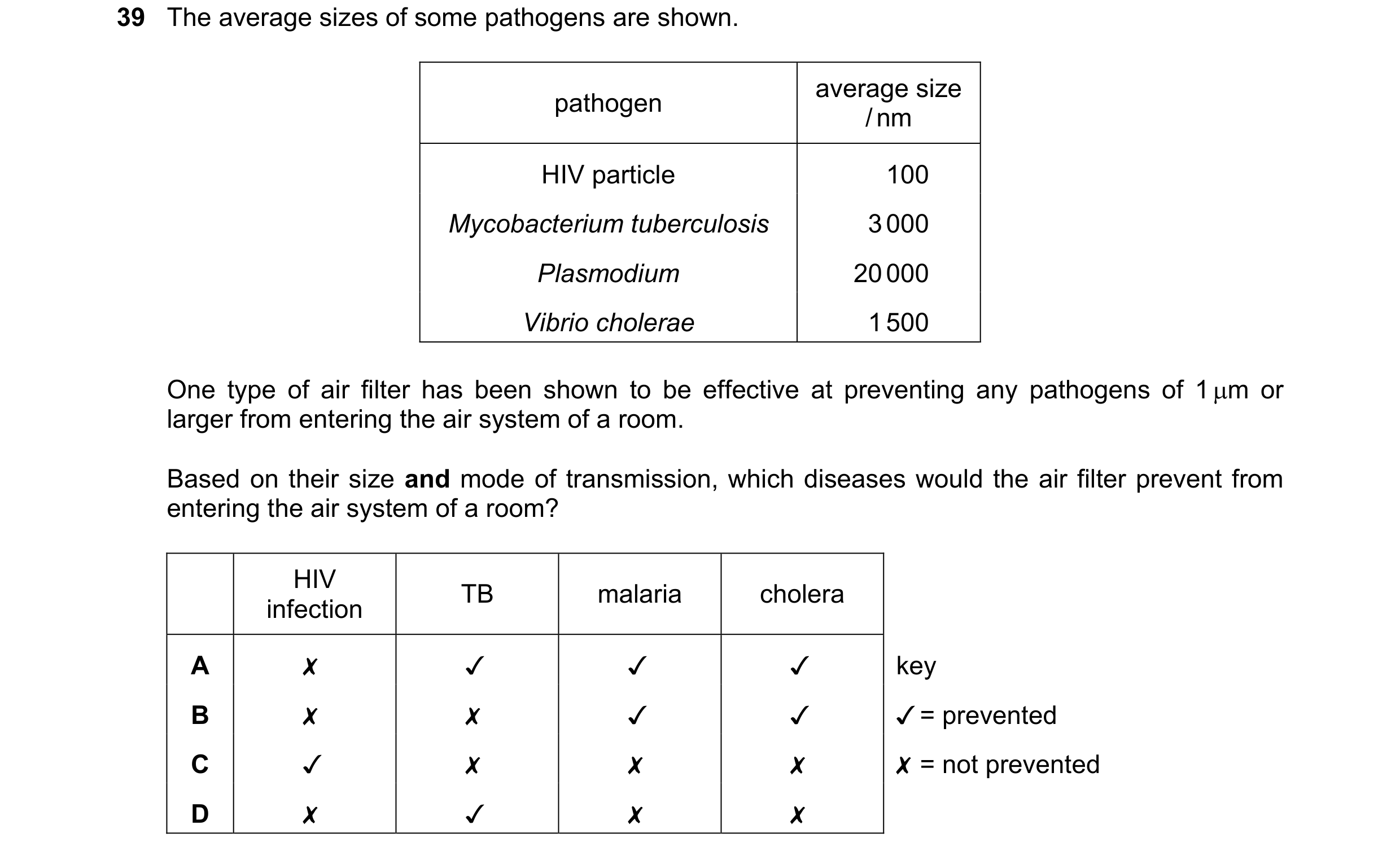 38 / 44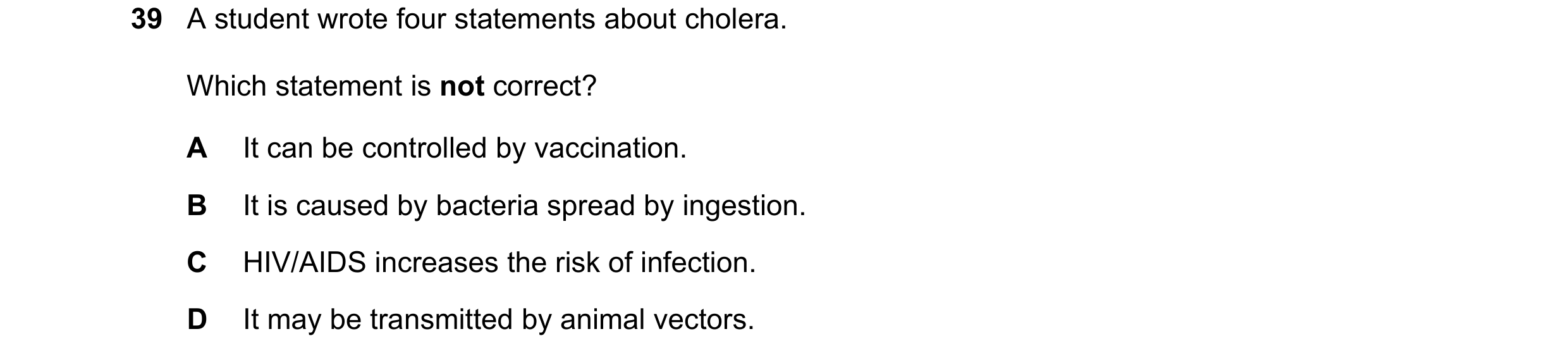
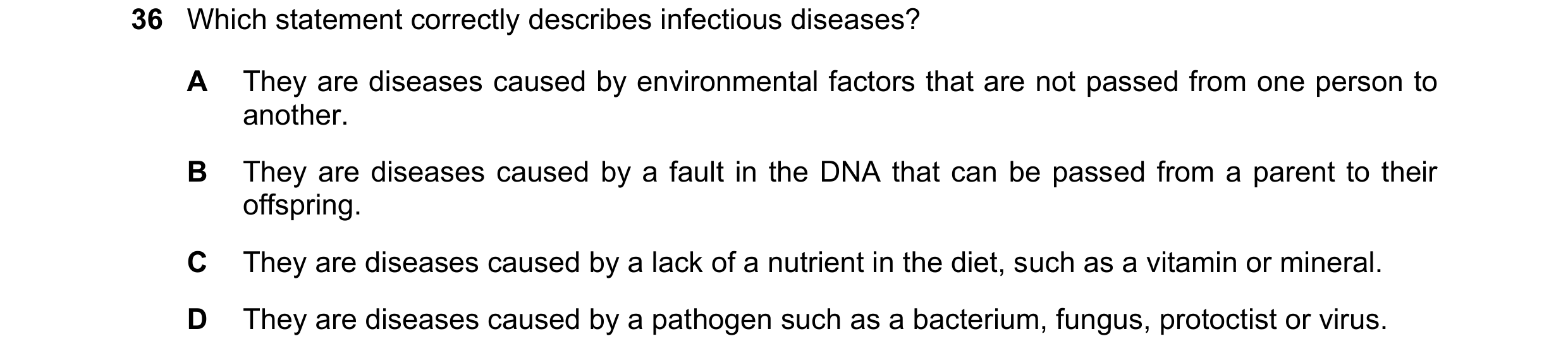

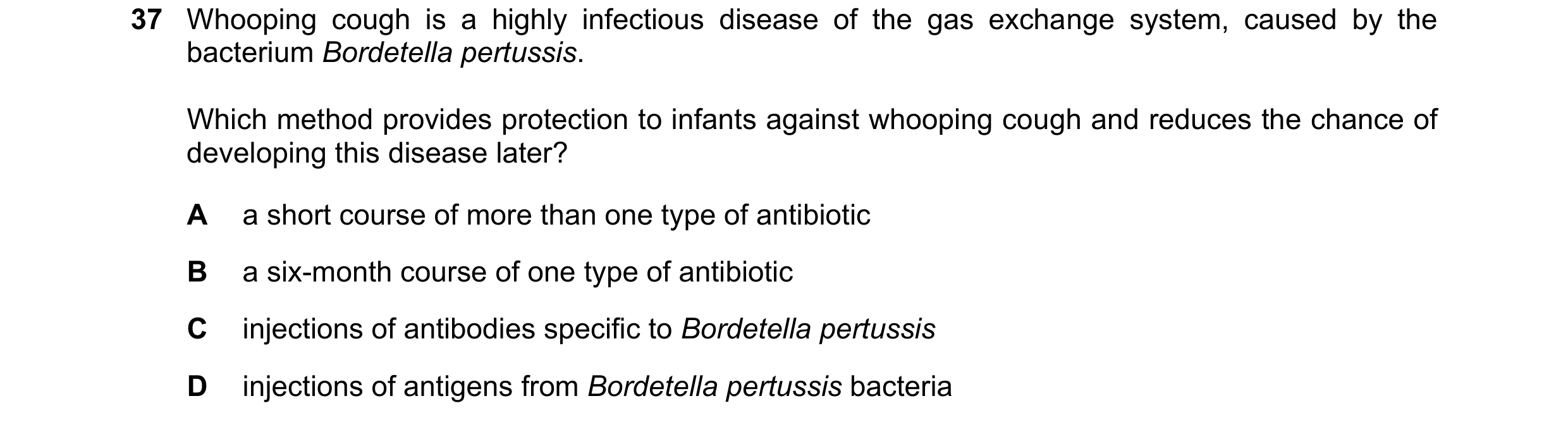
 39 / 44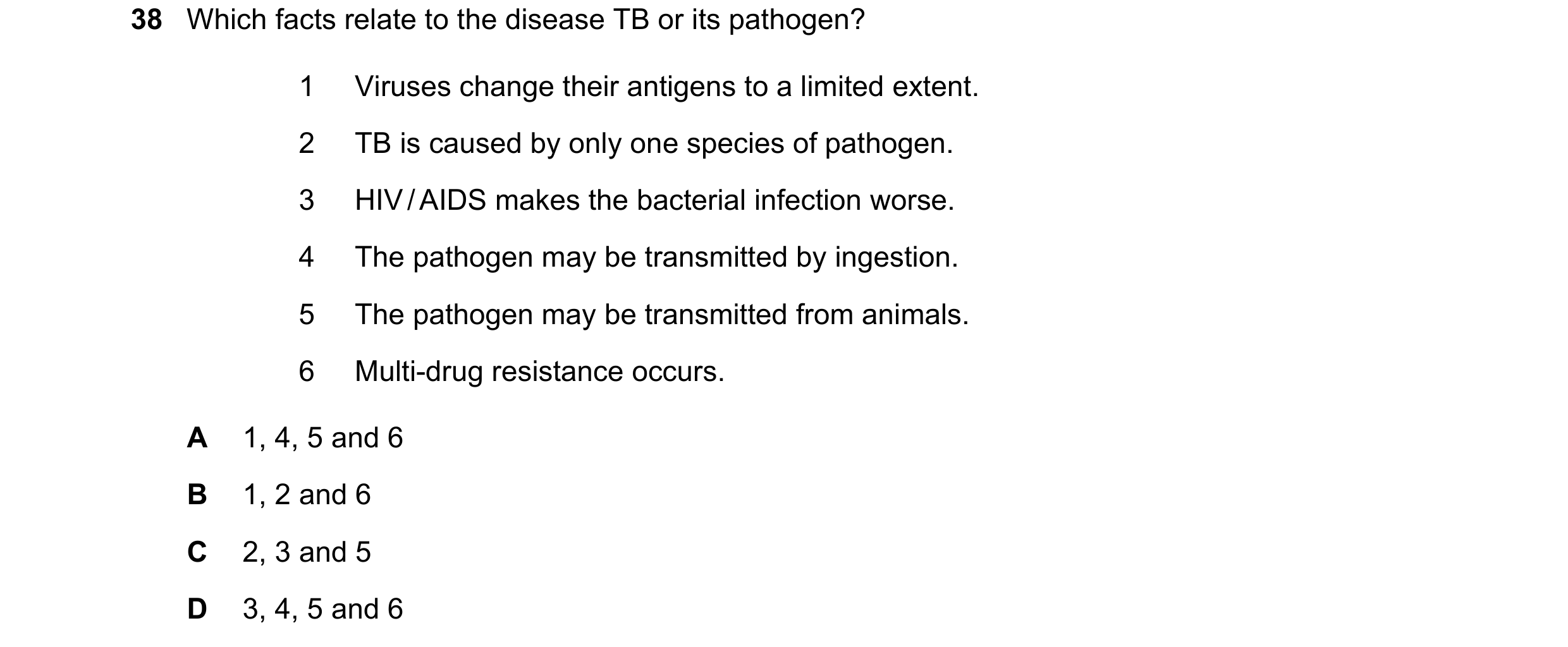
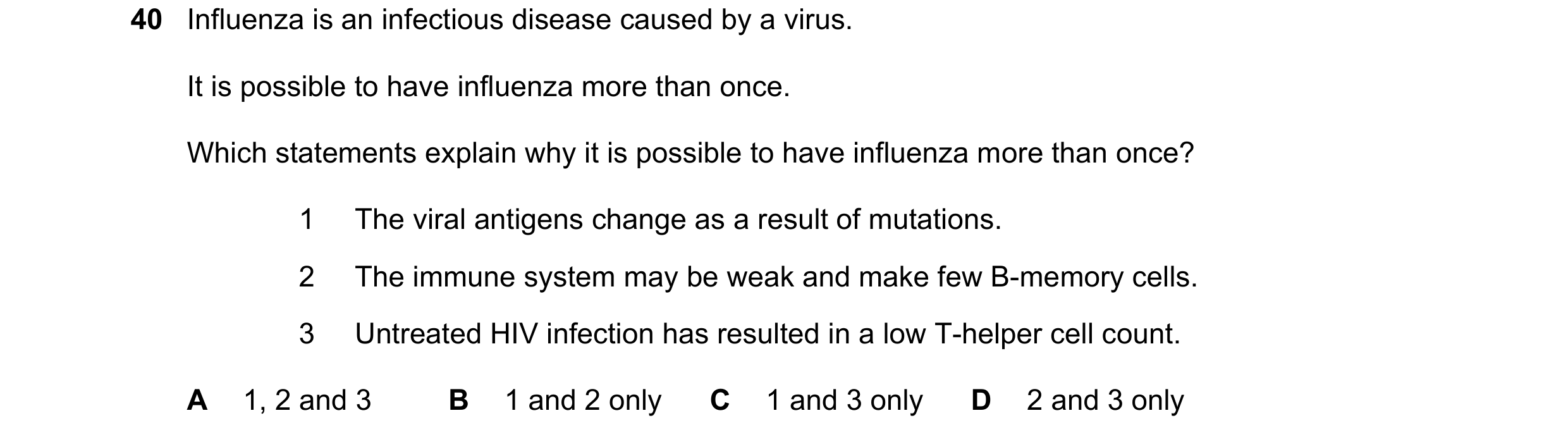

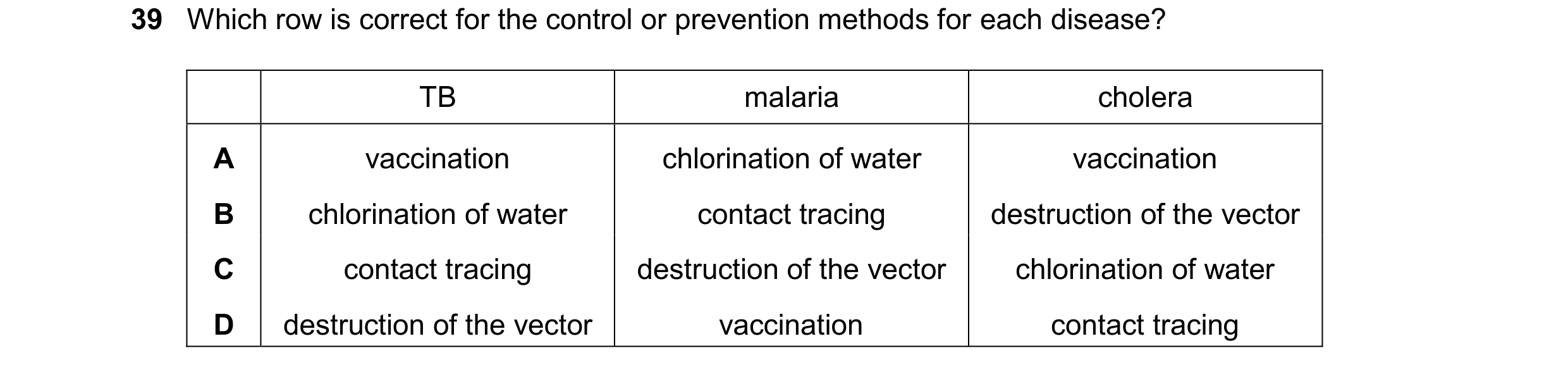 40 / 44


 41 / 44

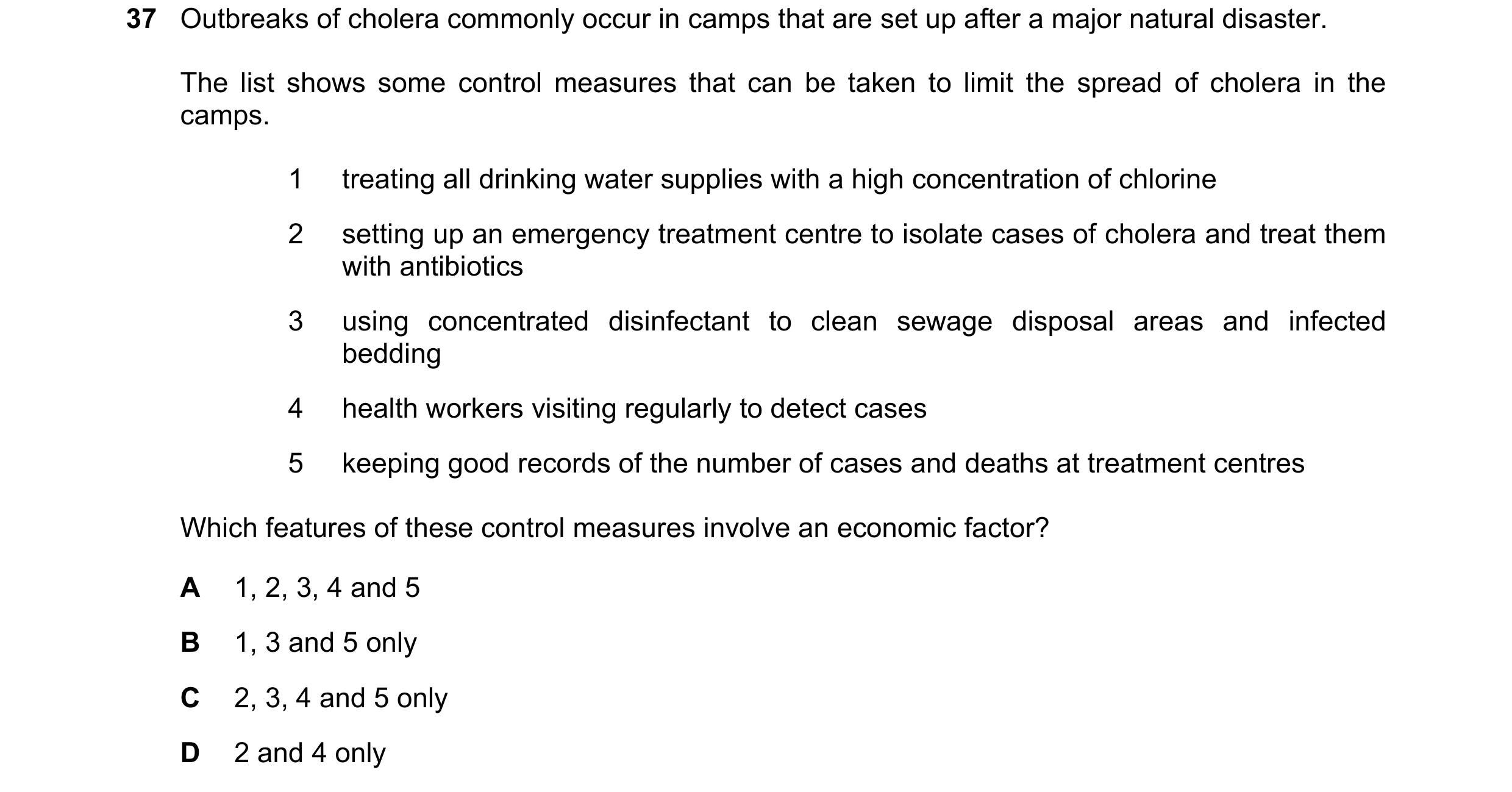 42 / 44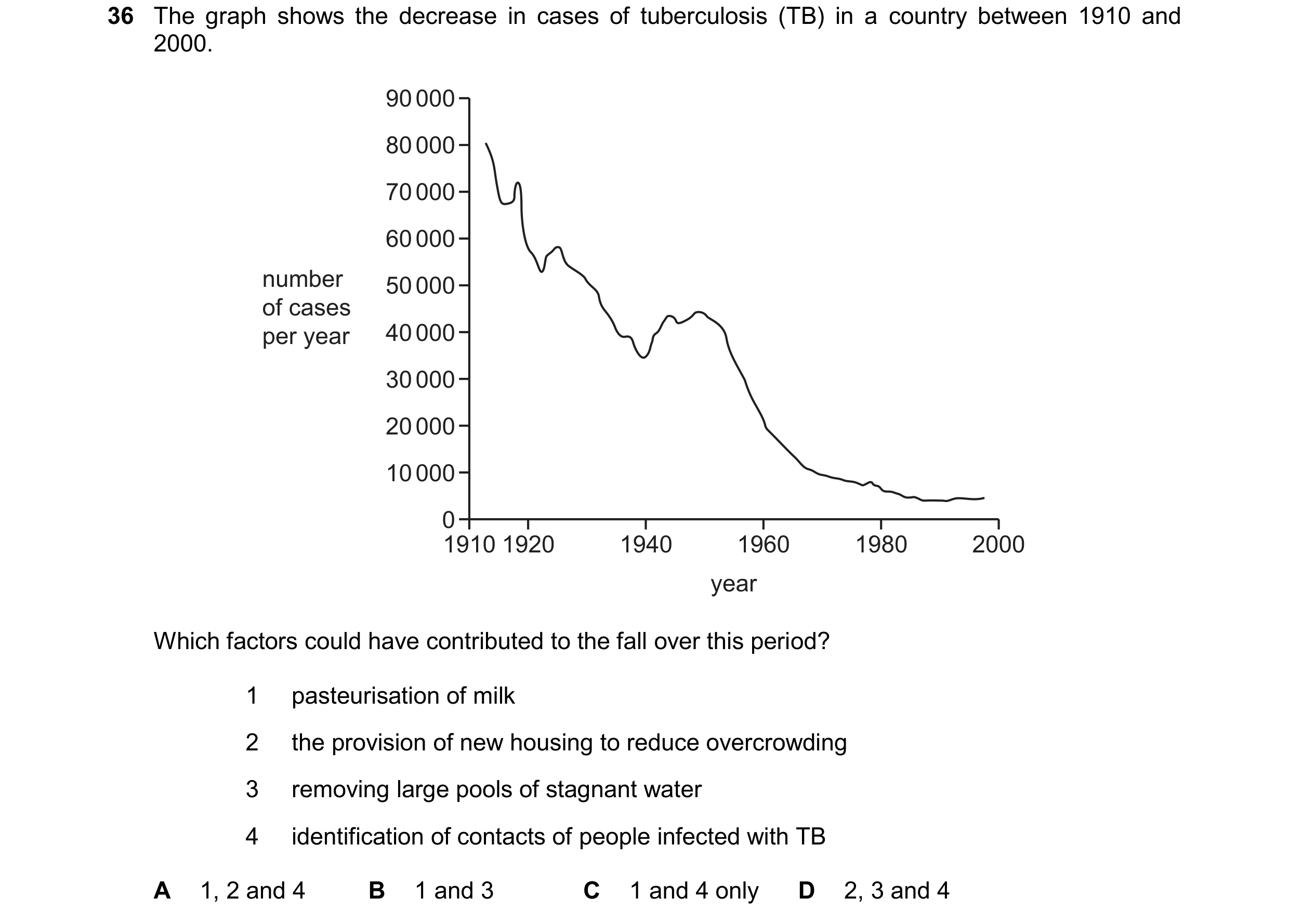
 43 / 44
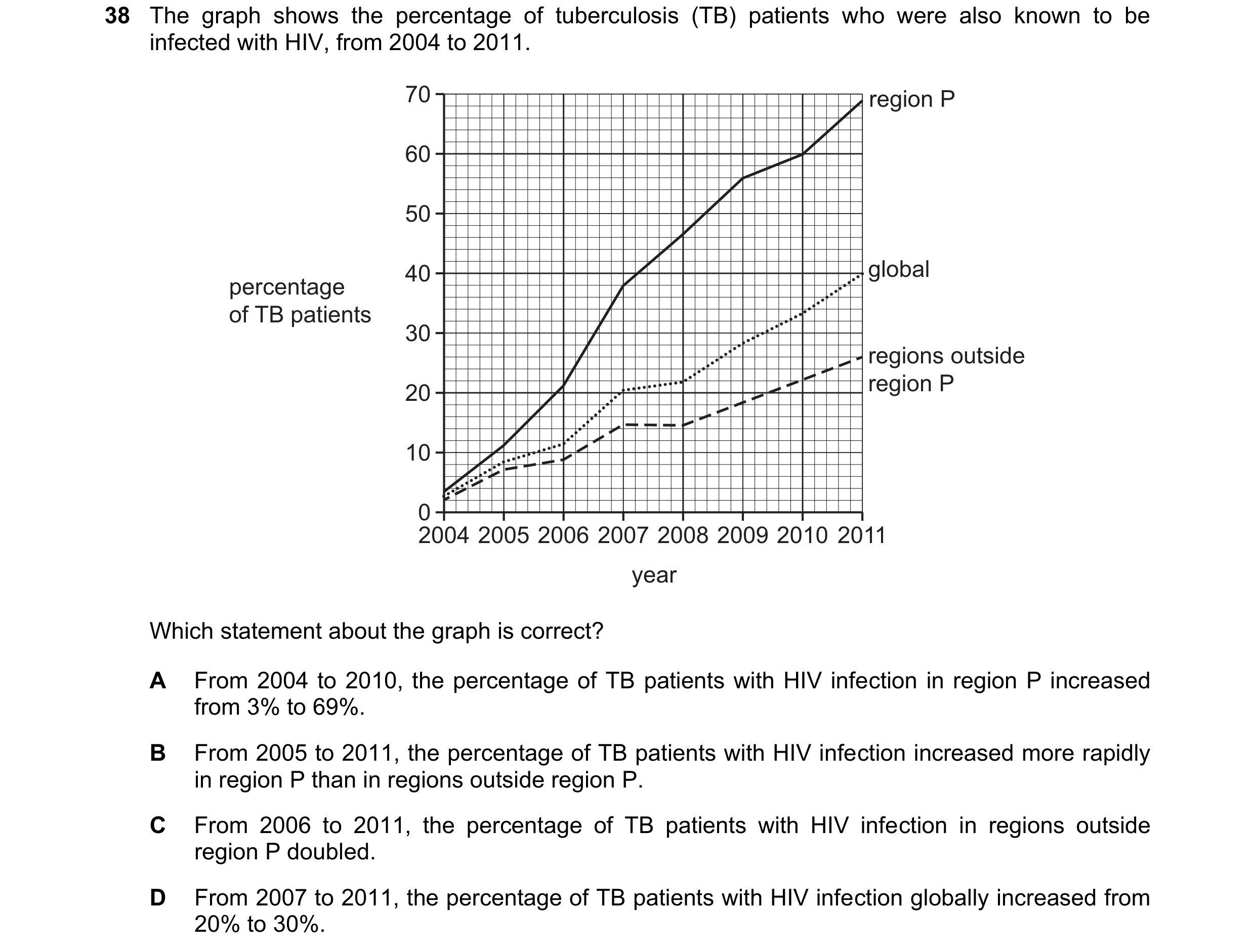 44 / 44