Questions as text
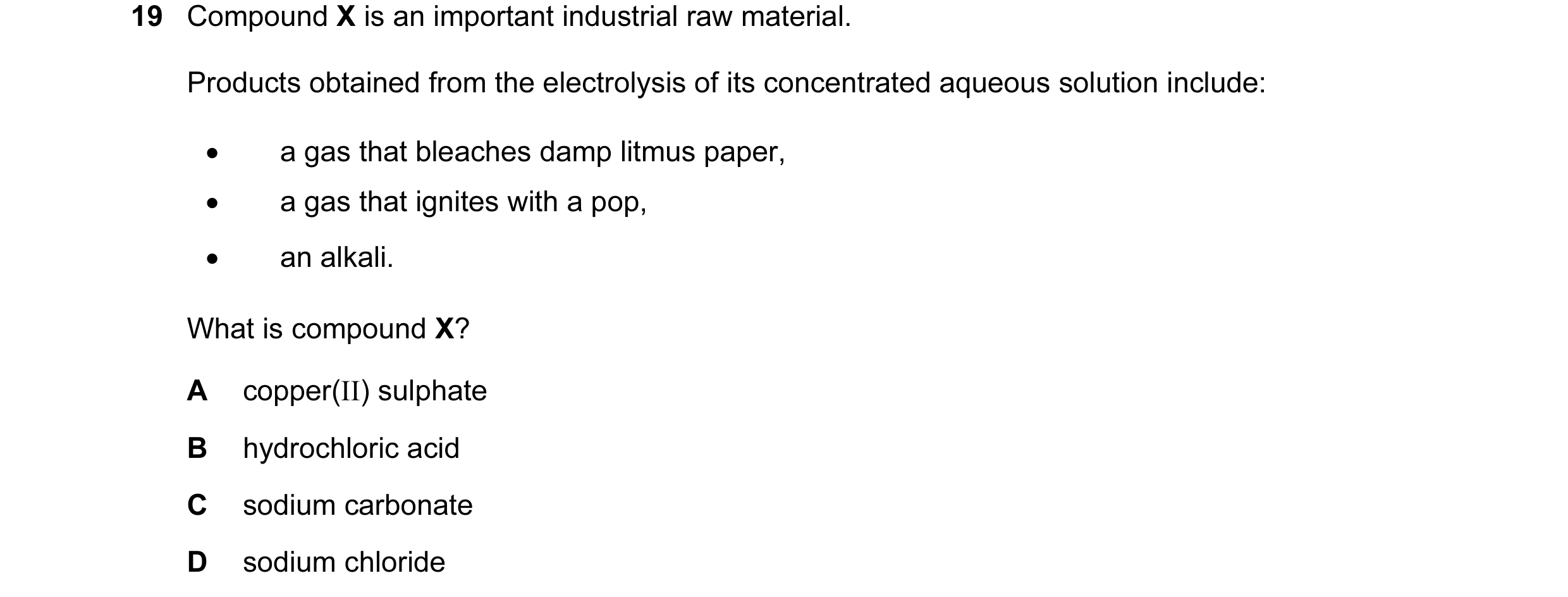
Q1 · Compound X is an important industrial raw material 0654/11 May/June 2006
19 Compound X is an important industrial raw material. Products obtained from the electrolysis of its concentrated aqueous solution include: • a gas that bleaches damp litmus paper, • a gas that ignites with a pop, • an alkali. What is compound X? A copper(II) sulphate B hydrochloric acid C sodium carbonate D sodium chloride
1 marks
Answer: D
This question in 0654/11 May/June 2006
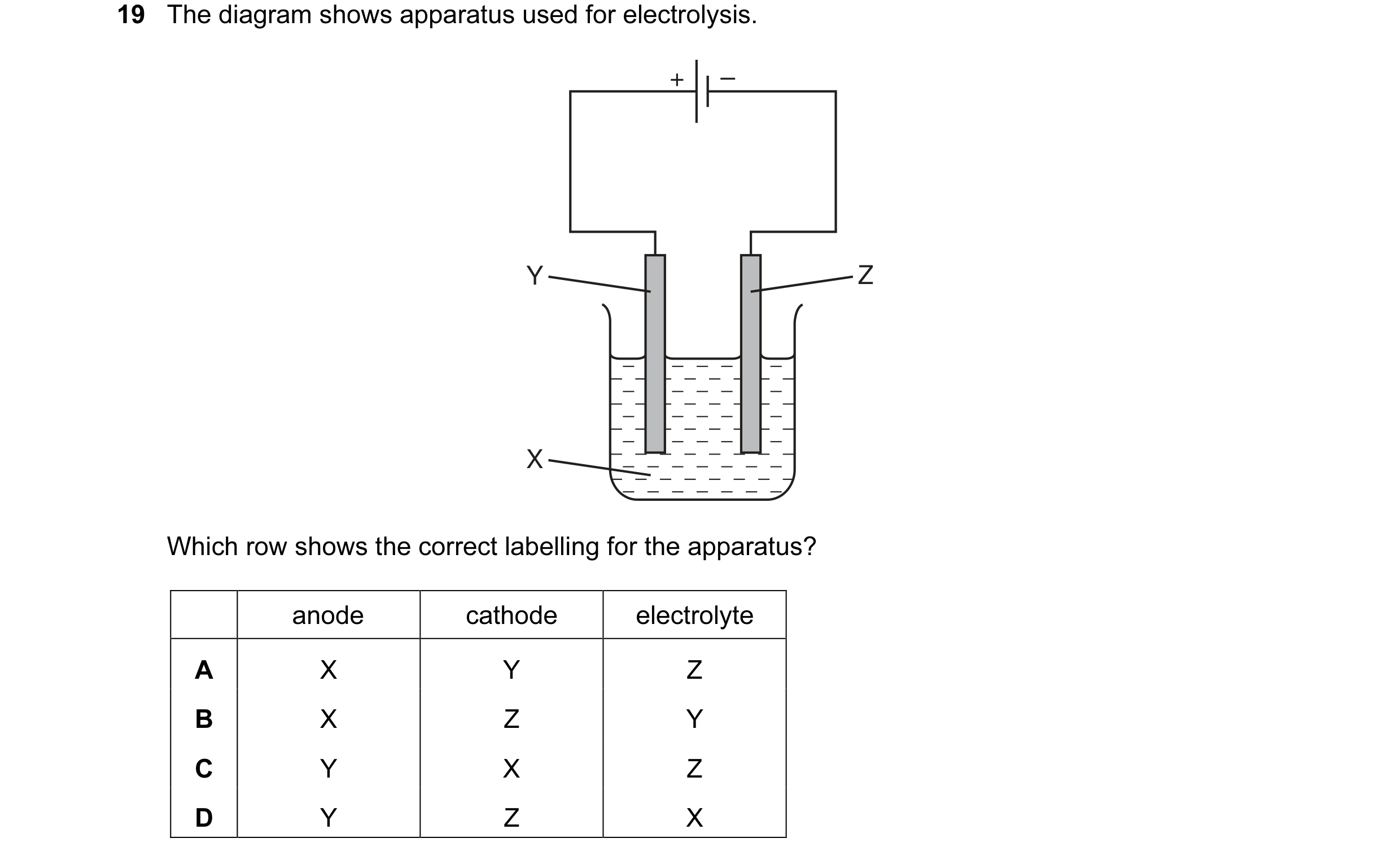
Q2 · The diagram shows apparatus used for electrolysis 0654/11 Oct/Nov 2006
19 The diagram shows apparatus used for electrolysis. + – Y Z X Which row shows the correct labelling for the apparatus? anode cathode electrolyte A X Y Z B X Z Y C Y X Z D Y Z X
1 marks
Answer: D
This question in 0654/11 Oct/Nov 2006
Q3 · The diagram shows the electrolysis of acidified water 0654/11 May/June 2007
22 The diagram shows the electrolysis of acidified water. gas X acidified water + – battery Gas X ignites with a pop when tested with a lighted splint. What is gas X and at which electrode is it formed? X is electrode A hydrogen anode B hydrogen cathode C oxygen anode D oxygen cathode
1 marks
Answer: B
This question in 0654/11 May/June 2007
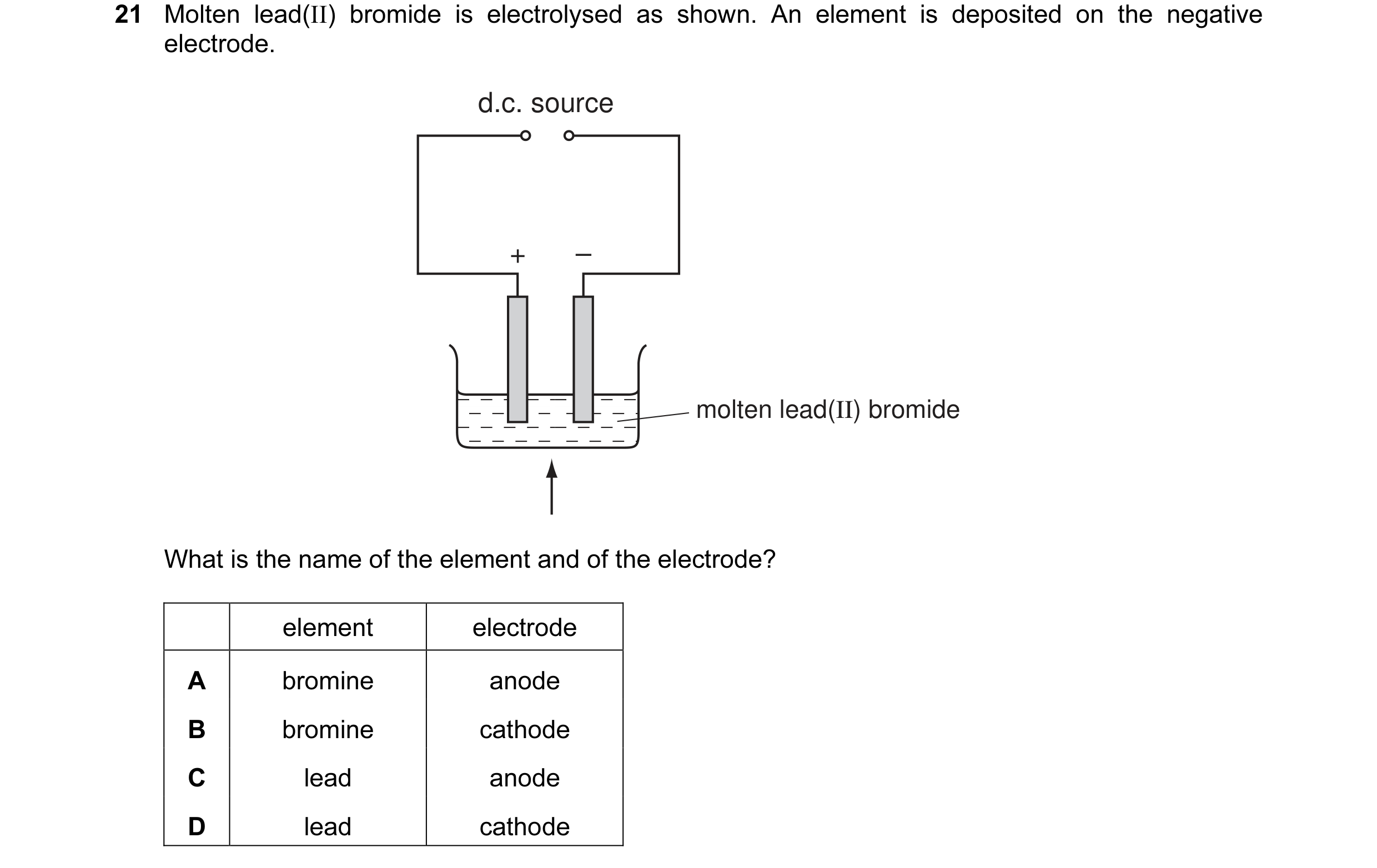
Q4 · Molten lead(II) bromide is electrolysed as shown 0654/11 May/June 2008
21 Molten lead(II) bromide is electrolysed as shown. An element is deposited on the negative electrode. d.c. source + – molten lead(II) bromide What is the name of the element and of the electrode? element electrode A bromine anode B bromine cathode C lead anode D lead cathode
1 marks
Answer: D
This question in 0654/11 May/June 2008
Q5 · Electrolysis of sodium chloride is used to obtain chlorine 0654/11 Oct/Nov 2008
21 Electrolysis of sodium chloride is used to obtain chlorine. In what form is sodium chloride electrolysed and at which electrode is the chlorine obtained? form of electrode at which sodium chloride chlorine is obtained A in aqueous solution anode B in aqueous solution cathode C solid anode D solid cathode
1 marks
Answer: A
This question in 0654/11 Oct/Nov 2008
Q6 · Aqueous sodium chloride is electrolysed on a large scale 0654/11 May/June 2009
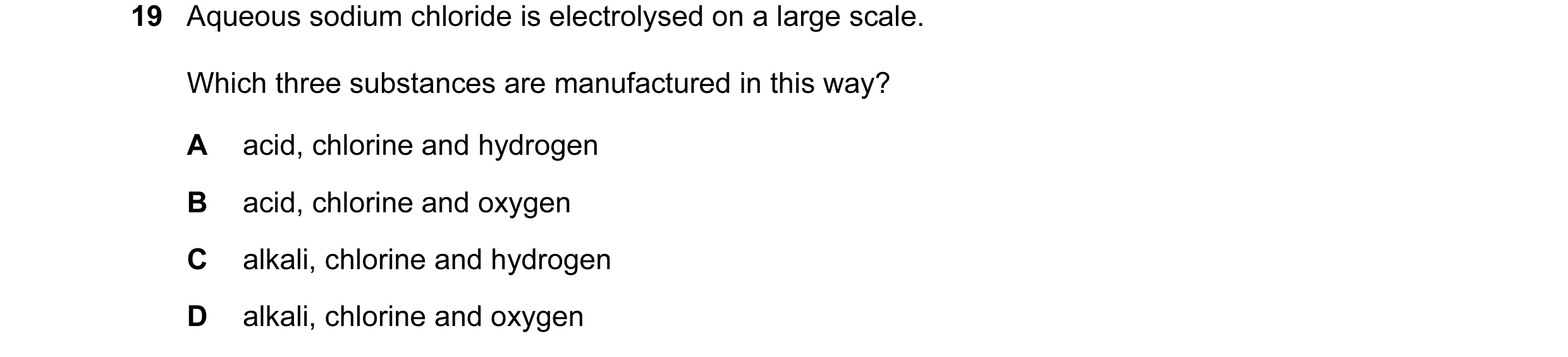
19 Aqueous sodium chloride is electrolysed on a large scale. Which three substances are manufactured in this way? A acid, chlorine and hydrogen B acid, chlorine and oxygen C alkali, chlorine and hydrogen D alkali, chlorine and oxygen
1 marks
Answer: C
This question in 0654/11 May/June 2009
Q7 · The diagram shows a simple cell 0654/11 May/June 2009
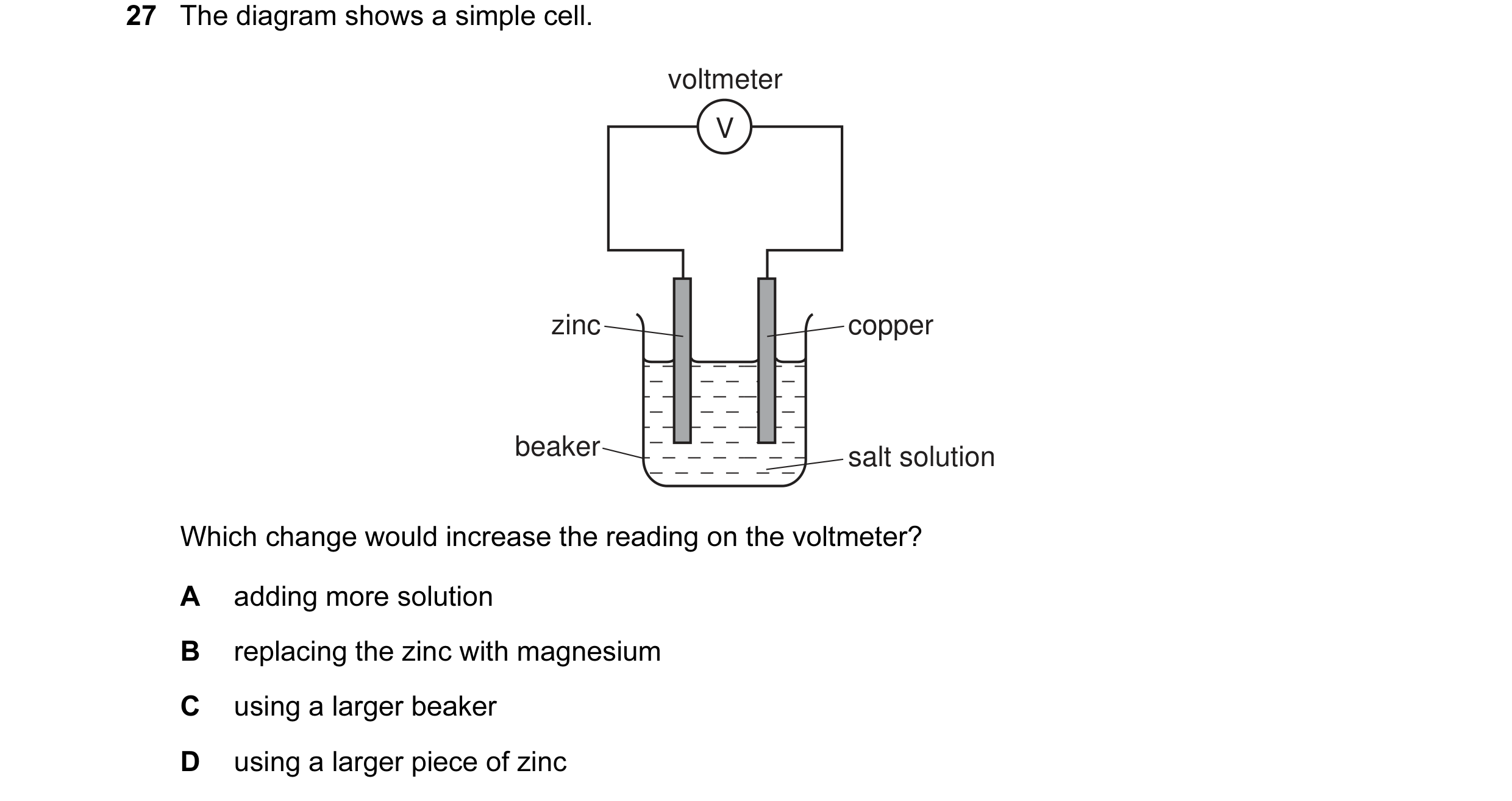
27 The diagram shows a simple cell. voltmeter V zinc copper beaker salt solution Which change would increase the reading on the voltmeter? A adding more solution B replacing the zinc with magnesium C using a larger beaker D using a larger piece of zinc
1 marks
Answer: B
This question in 0654/11 May/June 2009
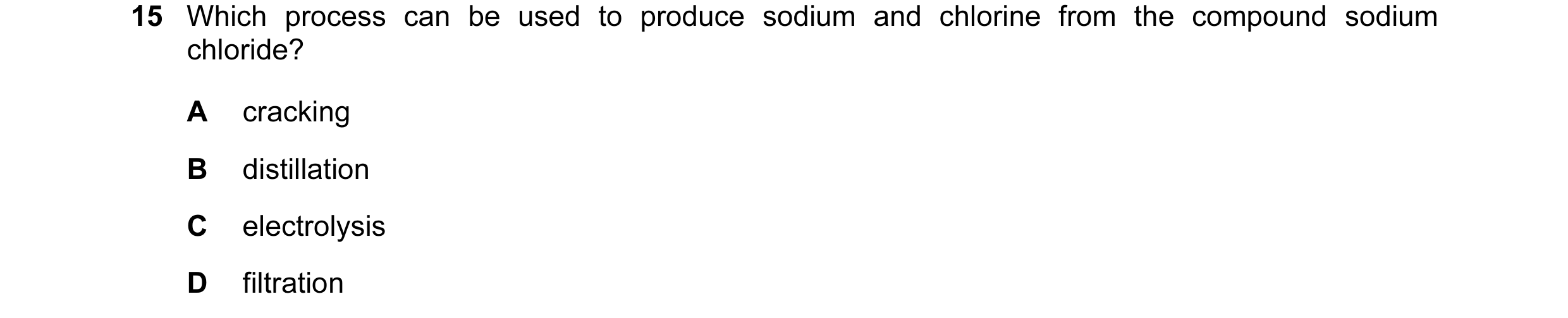
Q8 · Which process can be used to produce sodium and chlorine from the compound sodium… 0654/11 Oct/Nov 2009
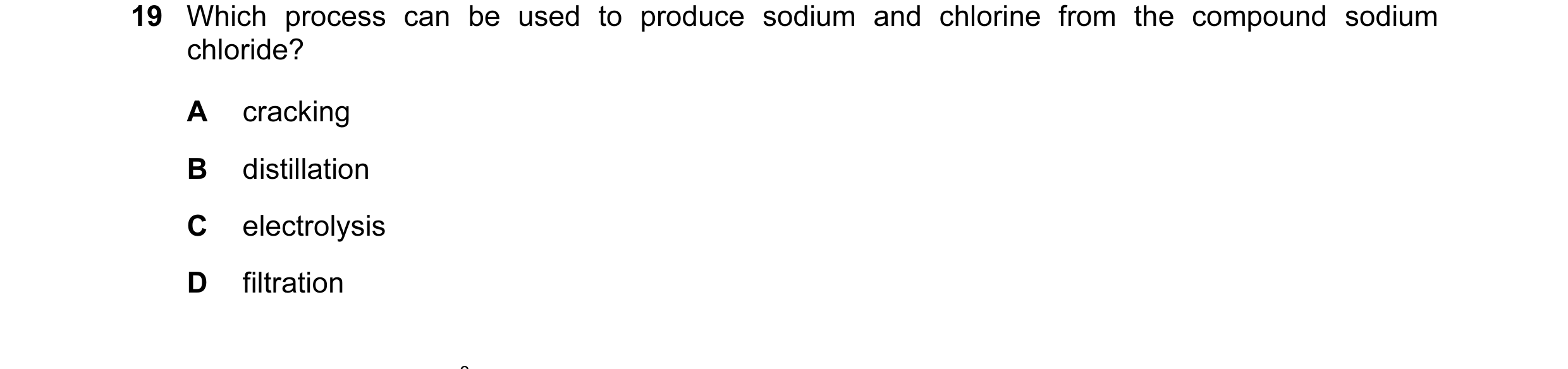
19 Which process can be used to produce sodium and chlorine from the compound sodium chloride? A cracking B distillation C electrolysis D filtration
1 marks
Answer: C
This question in 0654/11 Oct/Nov 2009
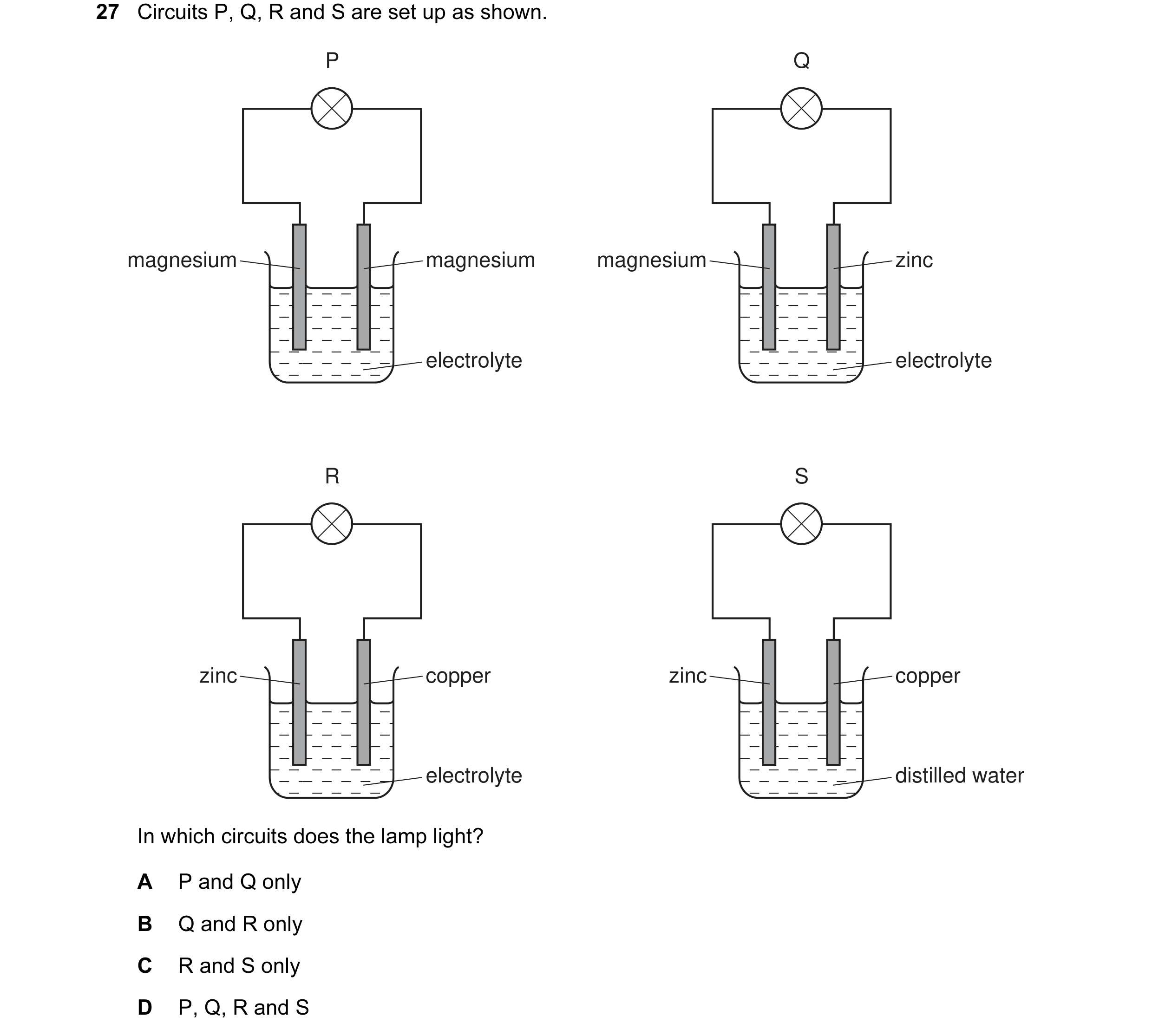
Q9 · Circuits P, Q, R and S are set up as shown 0654/11 Oct/Nov 2009
27 Circuits P, Q, R and S are set up as shown. P Q magnesium magnesium magnesium zinc electrolyte electrolyte R S zinc copper zinc copper electrolyte distilled water In which circuits does the lamp light? A P and Q only B Q and R only C R and S only D P, Q, R and S
1 marks
Answer: B
This question in 0654/11 Oct/Nov 2009
Q10 · When concentrated salt solution is electrolysed, two gases X and Y are formed 0654/11 May/June 2010
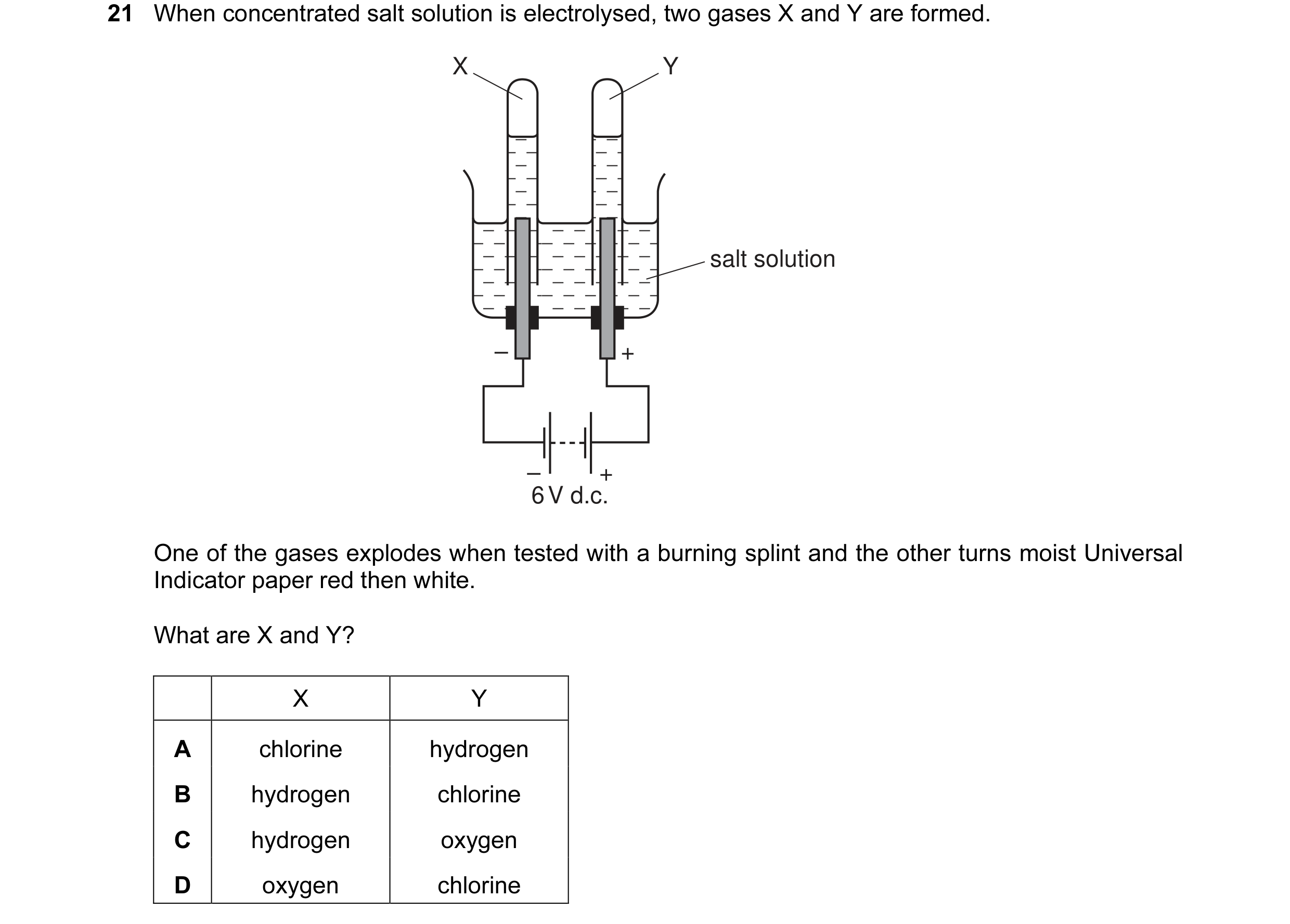
19 When concentrated salt solution is electrolysed, two gases X and Y are formed. X Y salt solution – + – + 6 V d.c. One of the gases explodes when tested with a burning splint and the other turns moist Universal Indicator paper red then white. What are X and Y? X Y A chlorine hydrogen B hydrogen chlorine C hydrogen oxygen D oxygen chlorine
1 marks
Answer: B
This question in 0654/11 May/June 2010
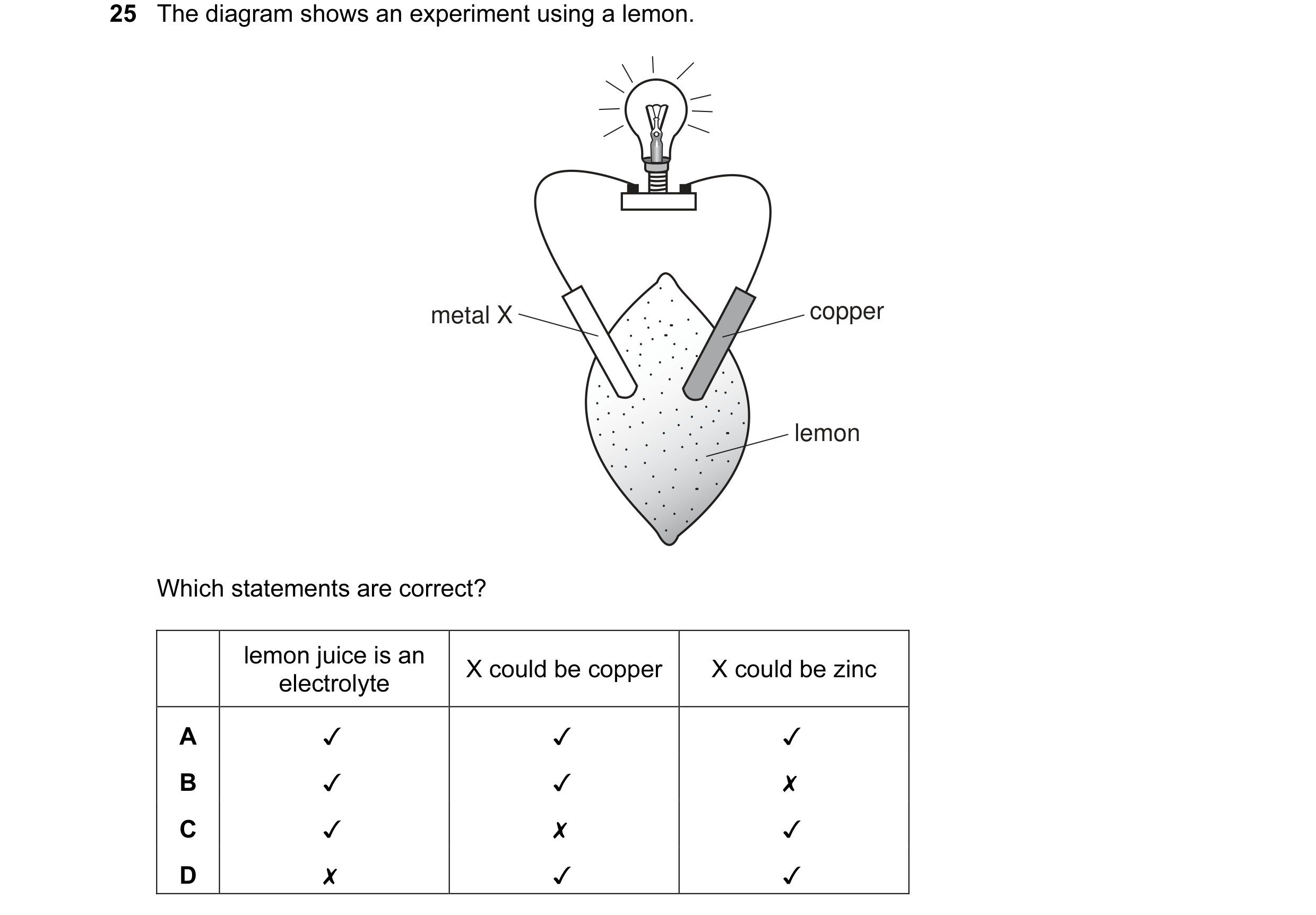
Q11 · The diagram shows an experiment using a lemon 0654/11 May/June 2010
25 The diagram shows an experiment using a lemon.
metal X
Which statements are correct?
copper
lemon
0 0O DW >
lemon juice is an
electrolyte
~~ KOM
X could be copper
Kk 4 4
X could be zinc
a a SN
1 marks
Answer: C
This question in 0654/11 May/June 2010
Q12 · The diagram shows an experiment using a lemon 0654/12 May/June 2010
18 The diagram shows an experiment using a lemon.
metal X
Which statements are correct?
copper
lemon
0 0O DW >
lemon juice is an
electrolyte
~~ KOM
X could be copper
Kk 4 4
X could be zinc
a a SN
1 marks
Answer: C
This question in 0654/12 May/June 2010
Q13 · When concentrated salt solution is electrolysed, two gases X and Y are formed 0654/12 May/June 2010
21 When concentrated salt solution is electrolysed, two gases X and Y are formed. X Y salt solution – + – + 6 V d.c. One of the gases explodes when tested with a burning splint and the other turns moist Universal Indicator paper red then white. What are X and Y? X Y A chlorine hydrogen B hydrogen chlorine C hydrogen oxygen D oxygen chlorine
1 marks
Answer: B
This question in 0654/12 May/June 2010
Q14 · Sodium chloride solution is electrolysed and a gas is collected at each electrode 0654/11 Oct/Nov 2010
20 Sodium chloride solution is electrolysed and a gas is collected at each electrode. One gas decolourises moist litmus paper, the other gas burns with a pop. gas which decolourises gas which burns litmus paper with a pop platinum sodium chloride electrodes solution +ve –ve Which statement is correct? A Chlorine gas is collected at the anode. B Hydrogen gas is collected at the anode. C Oxygen gas is collected at the cathode. D The cathode is the positive electrode.
1 marks
Answer: A
This question in 0654/11 Oct/Nov 2010
Q15 · Sodium chloride solution is electrolysed and a gas is collected at each electrode 0654/12 Oct/Nov 2010
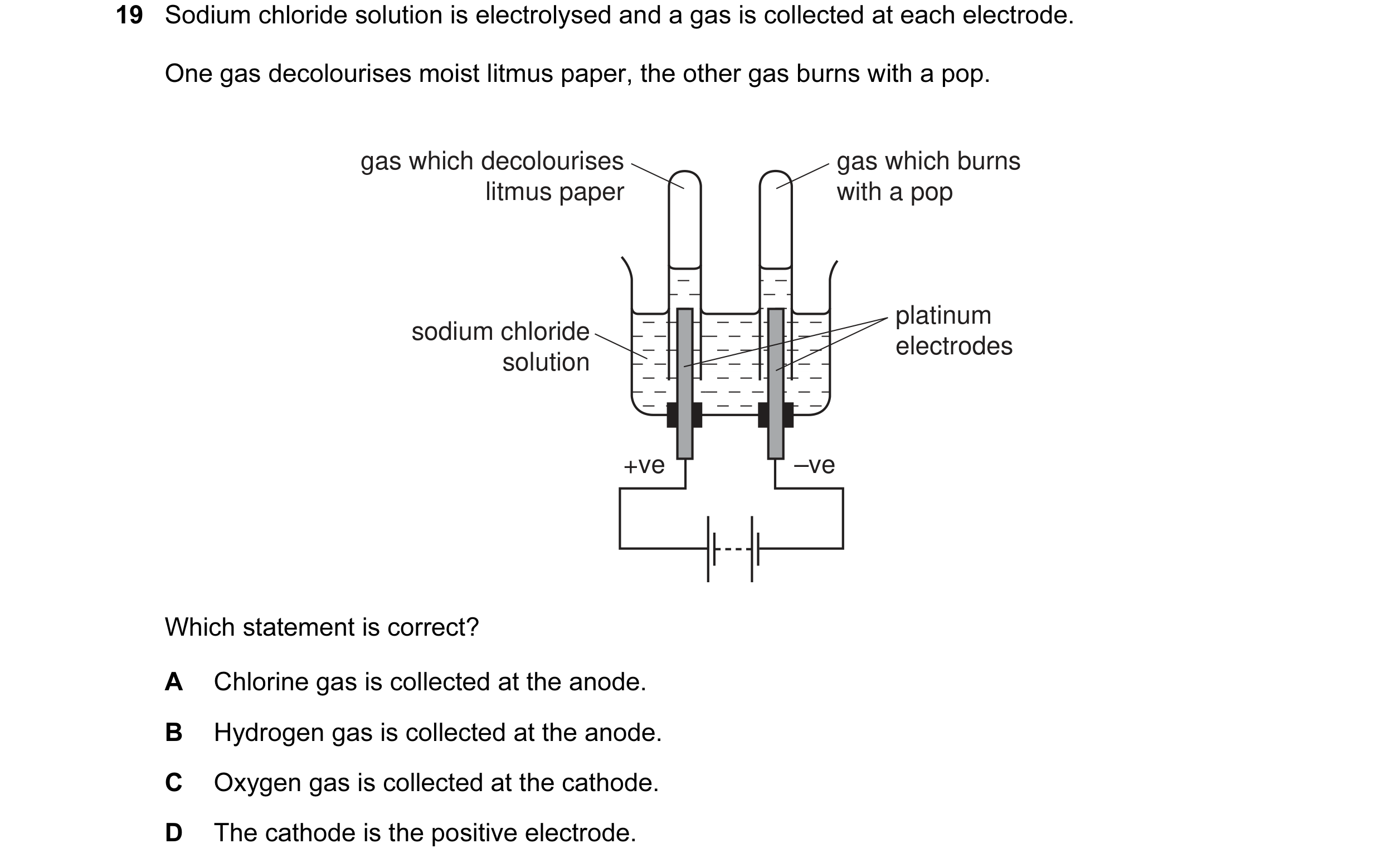
19 Sodium chloride solution is electrolysed and a gas is collected at each electrode. One gas decolourises moist litmus paper, the other gas burns with a pop. gas which decolourises gas which burns litmus paper with a pop platinum sodium chloride electrodes solution +ve –ve Which statement is correct? A Chlorine gas is collected at the anode. B Hydrogen gas is collected at the anode. C Oxygen gas is collected at the cathode. D The cathode is the positive electrode.
1 marks
Answer: A
This question in 0654/12 Oct/Nov 2010
Q16 · Sodium chloride solution is electrolysed and a gas is collected at each electrode 0654/13 Oct/Nov 2010
17 Sodium chloride solution is electrolysed and a gas is collected at each electrode. One gas decolourises moist litmus paper, the other gas burns with a pop. gas which decolourises gas which burns litmus paper with a pop platinum sodium chloride electrodes solution +ve –ve Which statement is correct? A Chlorine gas is collected at the anode. B Hydrogen gas is collected at the anode. C Oxygen gas is collected at the cathode. D The cathode is the positive electrode.
1 marks
Answer: A
This question in 0654/13 Oct/Nov 2010
Q17 · Electrolysis of sodium chloride is used to obtain chlorine 0654/11 May/June 2011
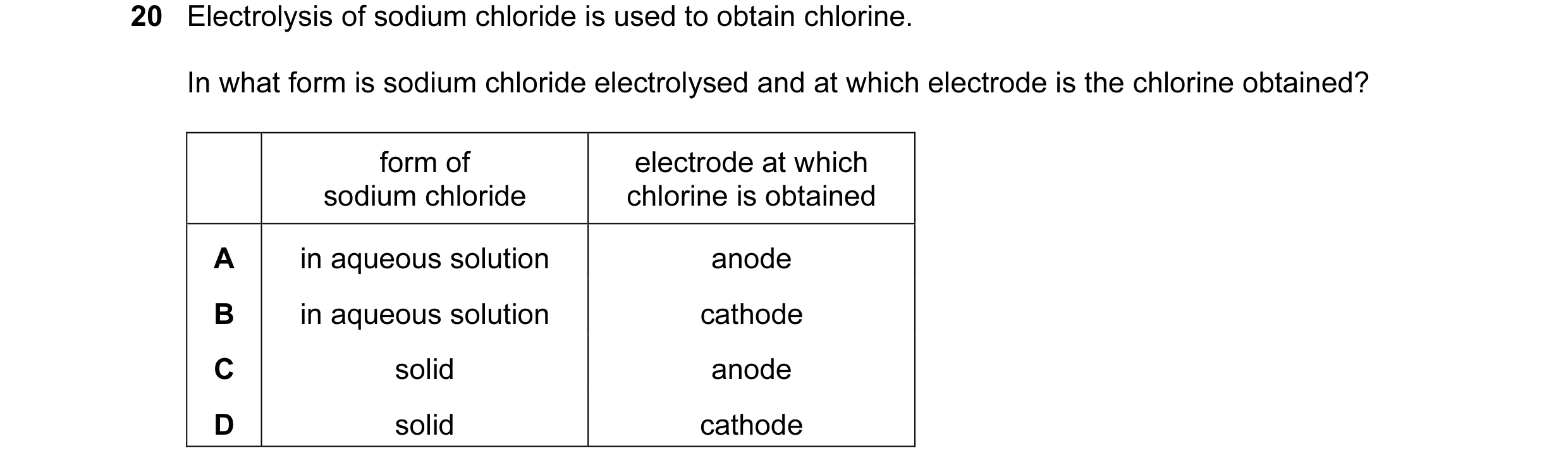
20 Electrolysis of sodium chloride is used to obtain chlorine. In what form is sodium chloride electrolysed and at which electrode is the chlorine obtained? form of electrode at which sodium chloride chlorine is obtained A in aqueous solution anode B in aqueous solution cathode C solid anode D solid cathode
1 marks
Answer: A
This question in 0654/11 May/June 2011
Q18 · Electrolysis of sodium chloride is used to obtain chlorine 0654/12 May/June 2011
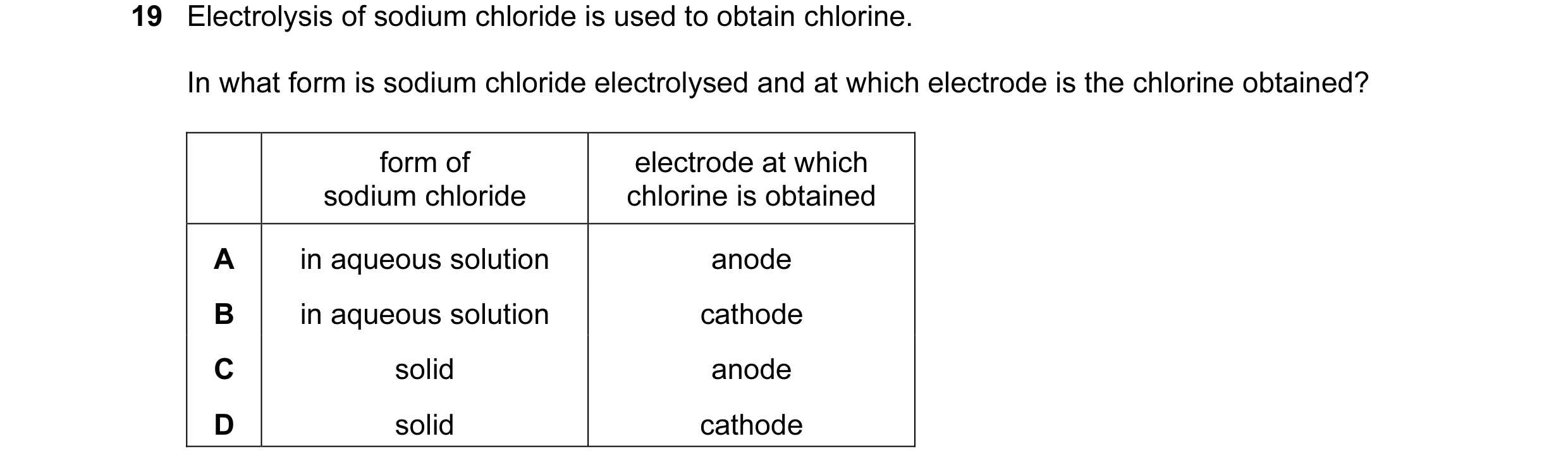
19 Electrolysis of sodium chloride is used to obtain chlorine. In what form is sodium chloride electrolysed and at which electrode is the chlorine obtained? form of electrode at which sodium chloride chlorine is obtained A in aqueous solution anode B in aqueous solution cathode C solid anode D solid cathode
1 marks
Answer: A
This question in 0654/12 May/June 2011
Q19 · Electrolysis of sodium chloride is used to obtain chlorine 0654/13 May/June 2011
19 Electrolysis of sodium chloride is used to obtain chlorine. In what form is sodium chloride electrolysed and at which electrode is the chlorine obtained? form of electrode at which sodium chloride chlorine is obtained A in aqueous solution anode B in aqueous solution cathode C solid anode D solid cathode
1 marks
Answer: A
This question in 0654/13 May/June 2011
Q20 · An experiment is set up to test the effect of electricity on solution Y 0654/11 Oct/Nov 2011
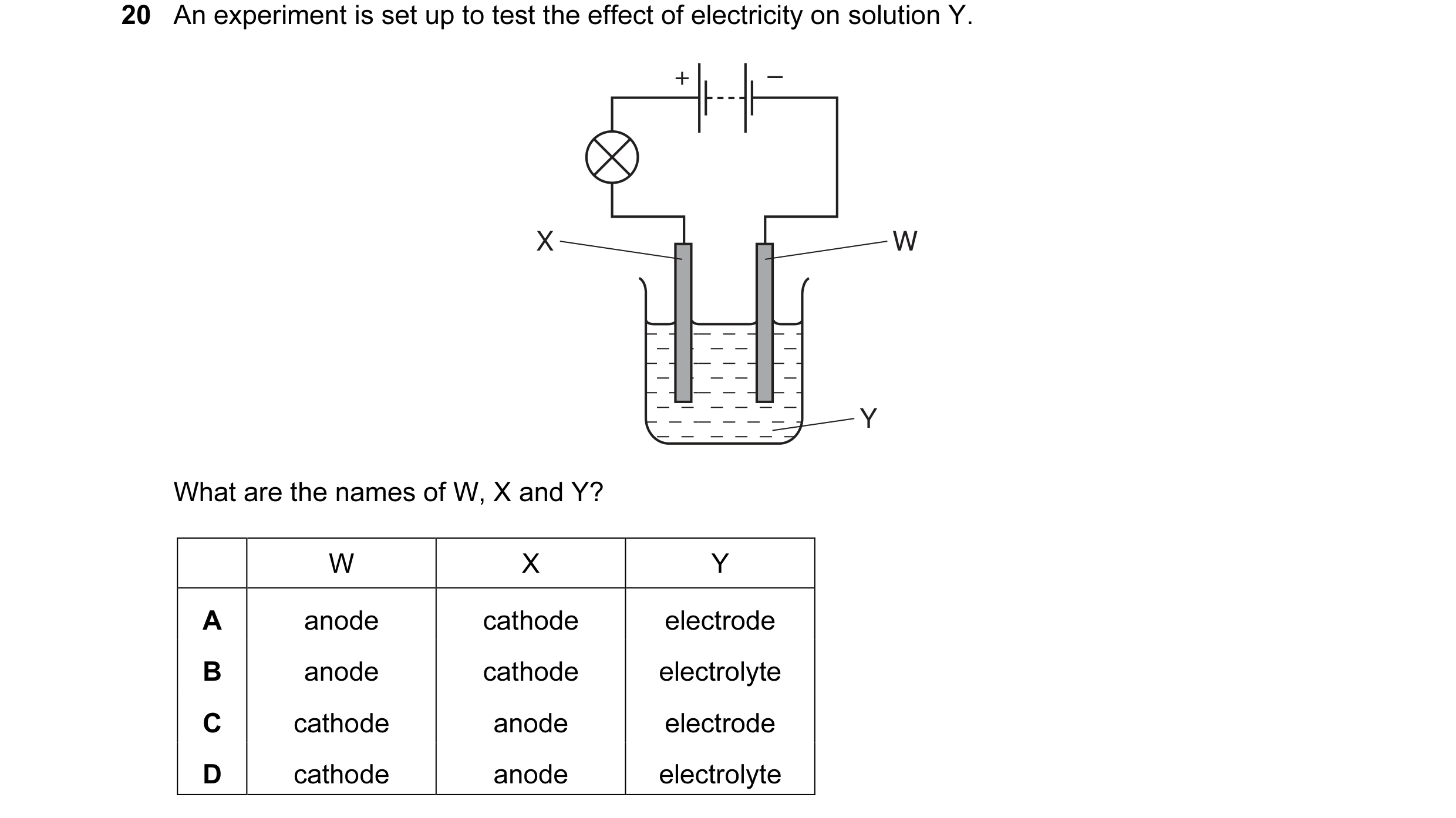
20 An experiment is set up to test the effect of electricity on solution Y. + – X W Y What are the names of W, X and Y? W X Y A anode cathode electrode B anode cathode electrolyte C cathode anode electrode D cathode anode electrolyte
1 marks
Answer: D
This question in 0654/11 Oct/Nov 2011
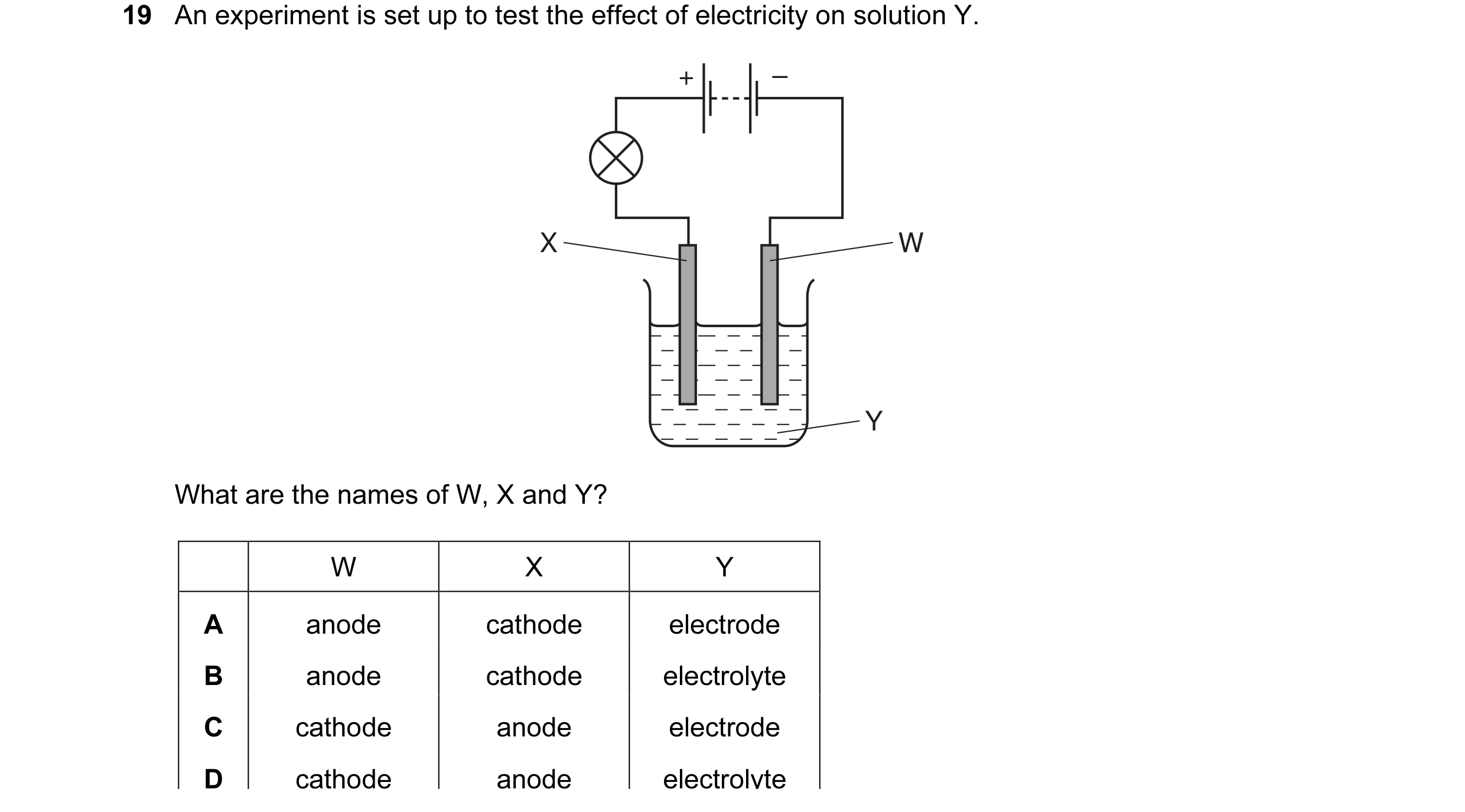
Q21 · An experiment is set up to test the effect of electricity on solution Y 0654/12 Oct/Nov 2011
19 An experiment is set up to test the effect of electricity on solution Y. + – X W Y What are the names of W, X and Y? W X Y A anode cathode electrode B anode cathode electrolyte C cathode anode electrode D cathode anode electrolyte
1 marks
Answer: D
This question in 0654/12 Oct/Nov 2011
Q22 · An experiment is set up to test the effect of electricity on solution Y 0654/13 Oct/Nov 2011
19 An experiment is set up to test the effect of electricity on solution Y. + – X W Y What are the names of W, X and Y? W X Y A anode cathode electrode B anode cathode electrolyte C cathode anode electrode D cathode anode electrolyte
1 marks
Answer: D
This question in 0654/13 Oct/Nov 2011
Q23 · Sodium chloride solution is electrolysed and a gas is collected at each electrode 0654/11 May/June 2013
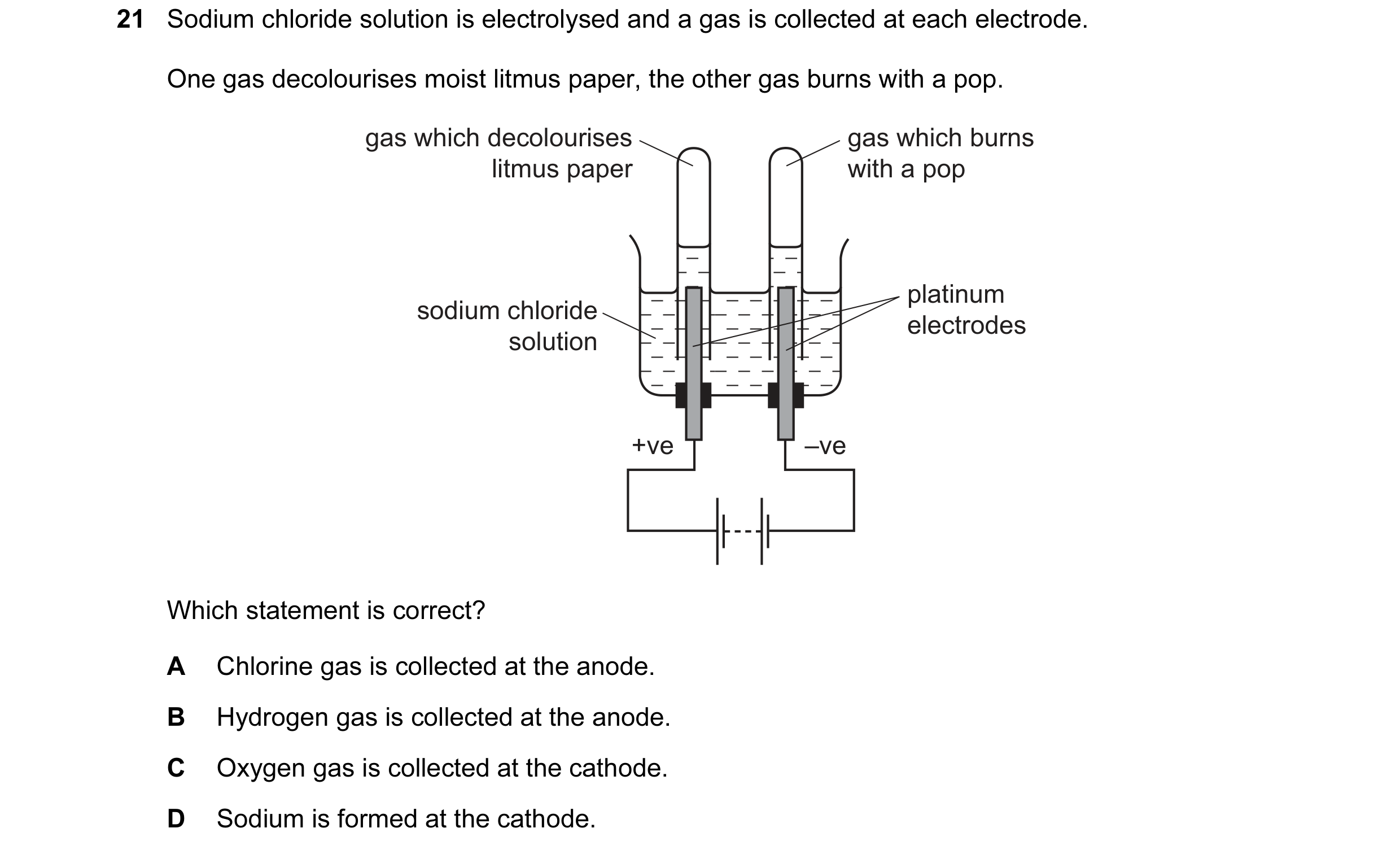
22 Sodium chloride solution is electrolysed and a gas is collected at each electrode. One gas decolourises moist litmus paper, the other gas burns with a pop. gas which decolourises gas which burns litmus paper with a pop platinum sodium chloride electrodes solution +ve –ve Which statement is correct? A Chlorine gas is collected at the anode. B Hydrogen gas is collected at the anode. C Oxygen gas is collected at the cathode. D Sodium is formed at the cathode.
1 marks
Answer: A
This question in 0654/11 May/June 2013
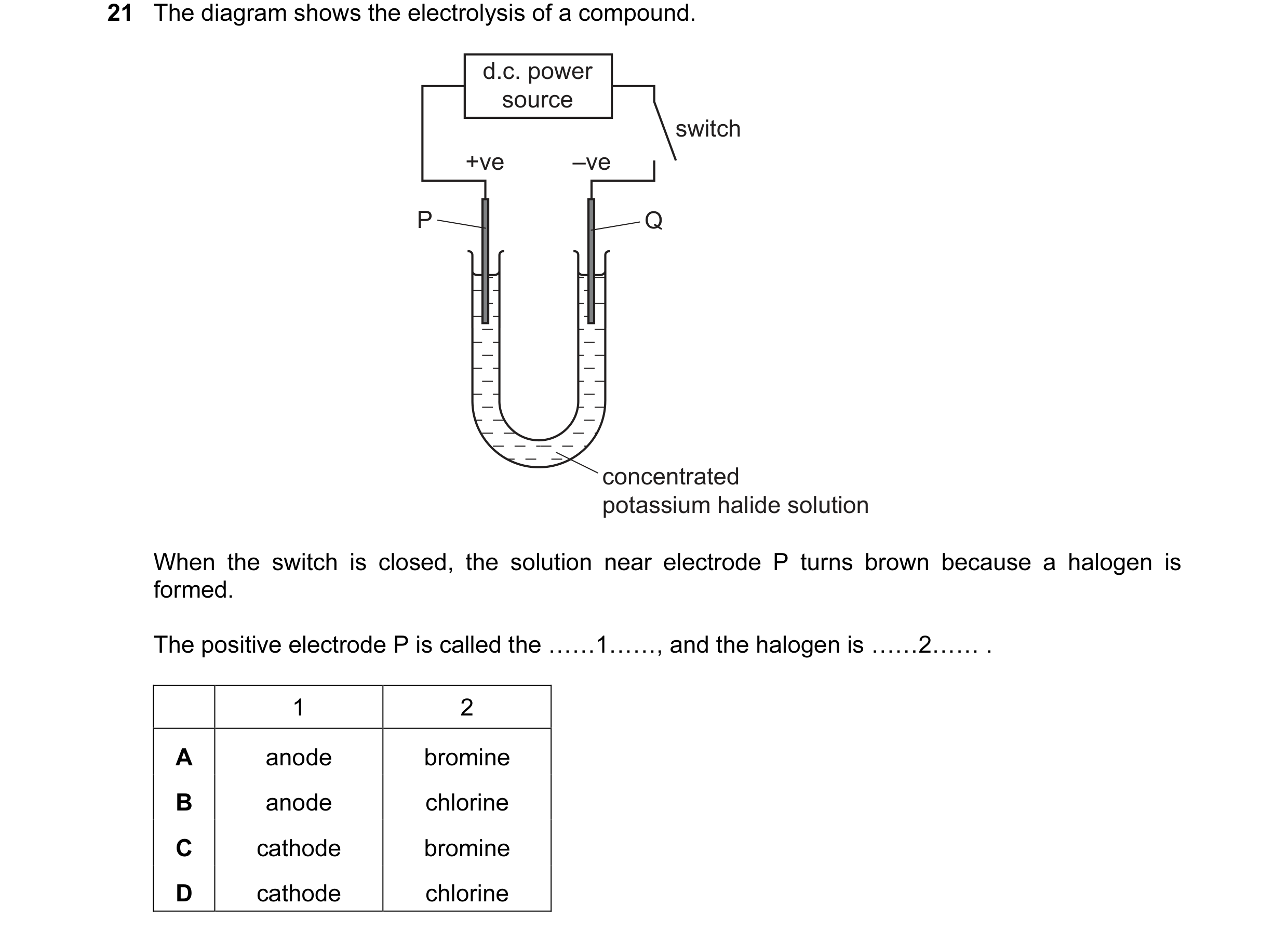
Q24 · The diagram shows the electrolysis of a compound 0654/12 May/June 2013
21 The diagram shows the electrolysis of a compound. d.c. power source switch +ve –ve P Q concentrated potassium halide solution When the switch is closed, the solution near electrode P turns brown because a halogen is formed. The positive electrode P is called the ……1……, and the halogen is ……2…… . 1 2 A anode bromine B anode chlorine C cathode bromine D cathode chlorine
1 marks
Answer: A
This question in 0654/12 May/June 2013
Q25 · Sodium chloride solution is electrolysed and a gas is collected at each electrode 0654/12 May/June 2013
22 Sodium chloride solution is electrolysed and a gas is collected at each electrode. One gas decolourises moist litmus paper, the other gas burns with a pop. gas which decolourises gas which burns litmus paper with a pop platinum sodium chloride electrodes solution +ve –ve Which statement is correct? A Chlorine gas is collected at the anode. B Hydrogen gas is collected at the anode. C Oxygen gas is collected at the cathode. D Sodium is formed at the cathode.
1 marks
Answer: A
This question in 0654/12 May/June 2013
Q26 · Sodium chloride solution is electrolysed and a gas is collected at each electrode 0654/13 May/June 2013
21 Sodium chloride solution is electrolysed and a gas is collected at each electrode. One gas decolourises moist litmus paper, the other gas burns with a pop. gas which decolourises gas which burns litmus paper with a pop platinum sodium chloride electrodes solution +ve –ve Which statement is correct? A Chlorine gas is collected at the anode. B Hydrogen gas is collected at the anode. C Oxygen gas is collected at the cathode. D Sodium is formed at the cathode.
1 marks
Answer: A
This question in 0654/13 May/June 2013
Q27 · The experiment shown is used to investigate the properties of solid X 0654/11 Oct/Nov 2013
16 The experiment shown is used to investigate the properties of solid X. lamp solid X heat At first, the lamp does not light. On heating, solid X melts and the lamp lights. What type of substance is X? A a compound of a metal and a non-metal B a compound of two non-metals C a metallic element D a non-metallic element
1 marks
Answer: A
This question in 0654/11 Oct/Nov 2013
Q28 · The diagram shows the circuit for electrolysing concentrated aqueous copper(II) bromide 0654/11 Oct/Nov 2013
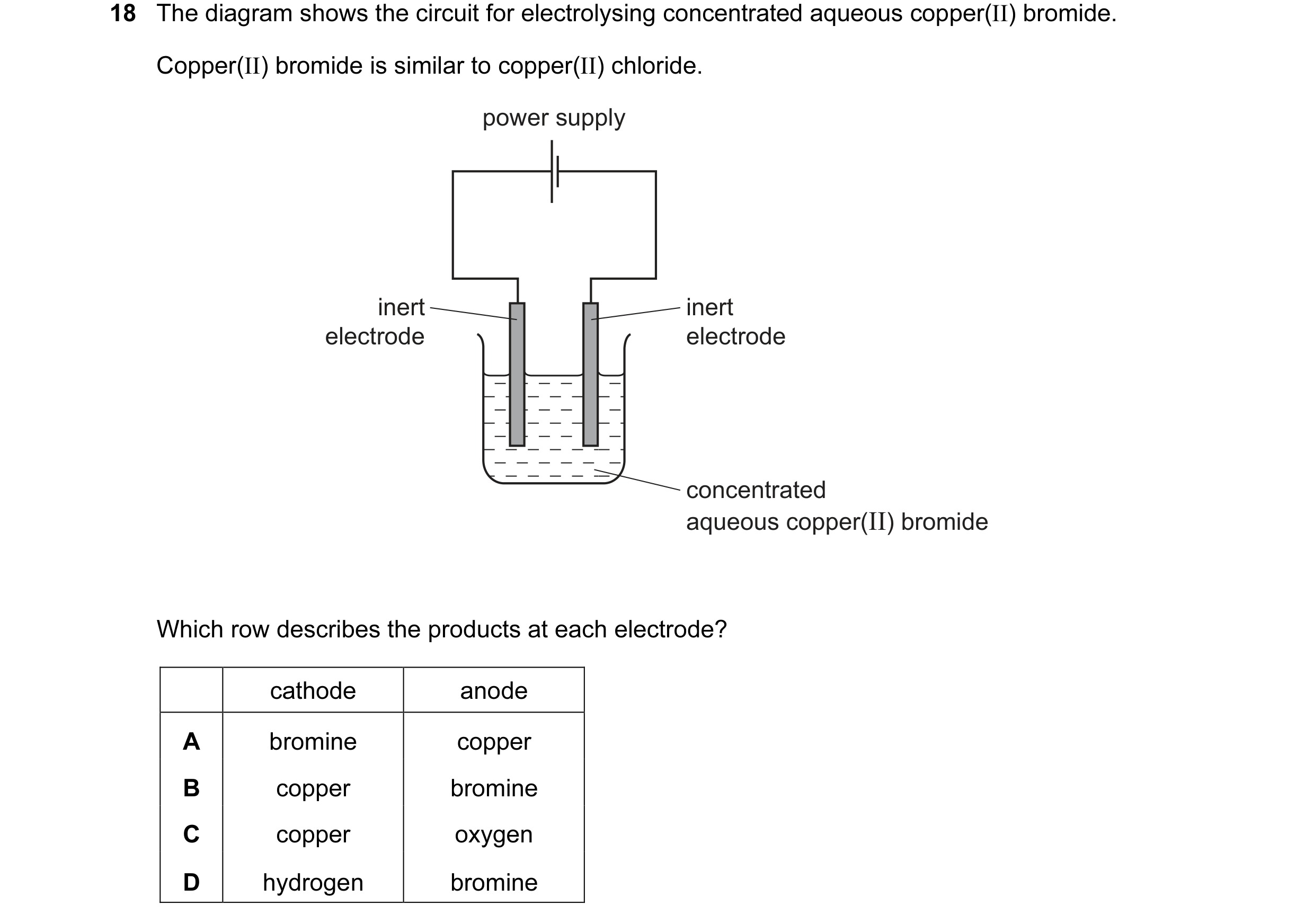
18 The diagram shows the circuit for electrolysing concentrated aqueous copper(II) bromide. Copper(II) bromide is similar to copper(II) chloride. power supply inert inert electrode electrode concentrated aqueous copper(II) bromide Which row describes the products at each electrode? cathode anode A bromine copper B copper bromine C copper oxygen D hydrogen bromine
1 marks
Answer: B
This question in 0654/11 Oct/Nov 2013
Q29 · The diagram shows the circuit for electrolysing concentrated aqueous copper(II) bromide 0654/12 Oct/Nov 2013
17 The diagram shows the circuit for electrolysing concentrated aqueous copper(II) bromide. Copper(II) bromide is similar to copper(II) chloride. power supply inert inert electrode electrode concentrated aqueous copper(II) bromide Which row describes the products at each electrode? cathode anode A bromine copper B copper bromine C copper oxygen D hydrogen bromine
1 marks
Answer: B
This question in 0654/12 Oct/Nov 2013
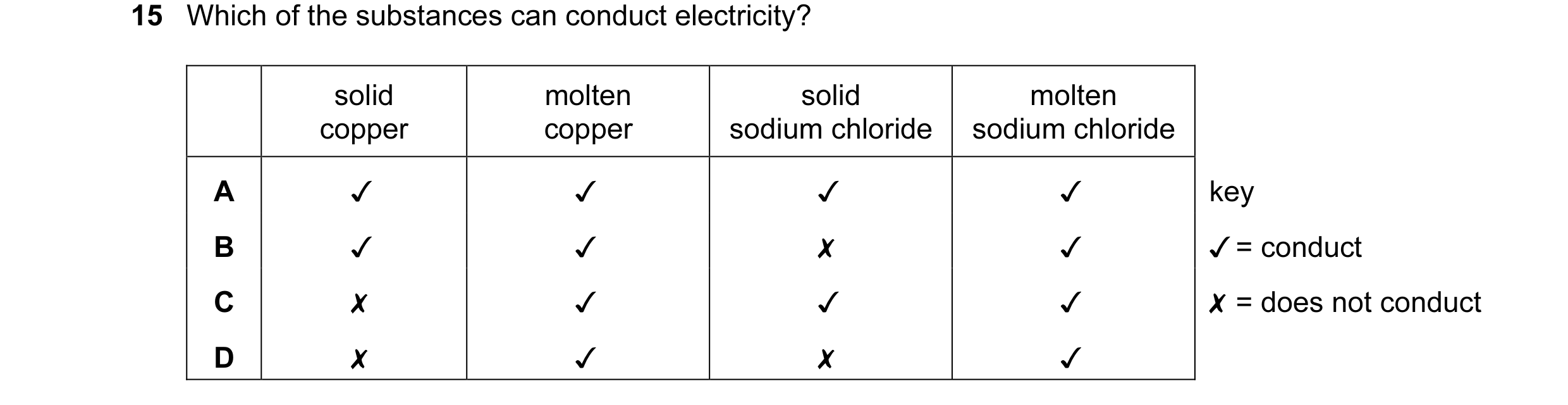
Q30 · Which of the substances can conduct electricity? 0654/13 Oct/Nov 2013
15 Which of the substances can conduct electricity? solid molten solid molten copper copper sodium chloride sodium chloride A ✓ ✓ ✓ ✓ key B ✓ ✓ ✗ ✓ ✓= conduct C ✗ ✓ ✓ ✓ ✗= does not conduct D ✗ ✓ ✗ ✓
1 marks
Answer: B
This question in 0654/13 Oct/Nov 2013
Q31 · When dilute sulfuric acid is electrolysed each electrode gives off a different gas 0654/11 May/June 2014
17 When dilute sulfuric acid is electrolysed each electrode gives off a different gas. + _ positive negative electrode electrode dilute sulfuric acid Which test identifies the gas given off at the positive electrode? A Damp red litmus is bleached. B Damp red litmus turns blue. C A glowing splint relights. D A lighted splint burns with a squeaky pop.
1 marks
Answer: C
This question in 0654/11 May/June 2014
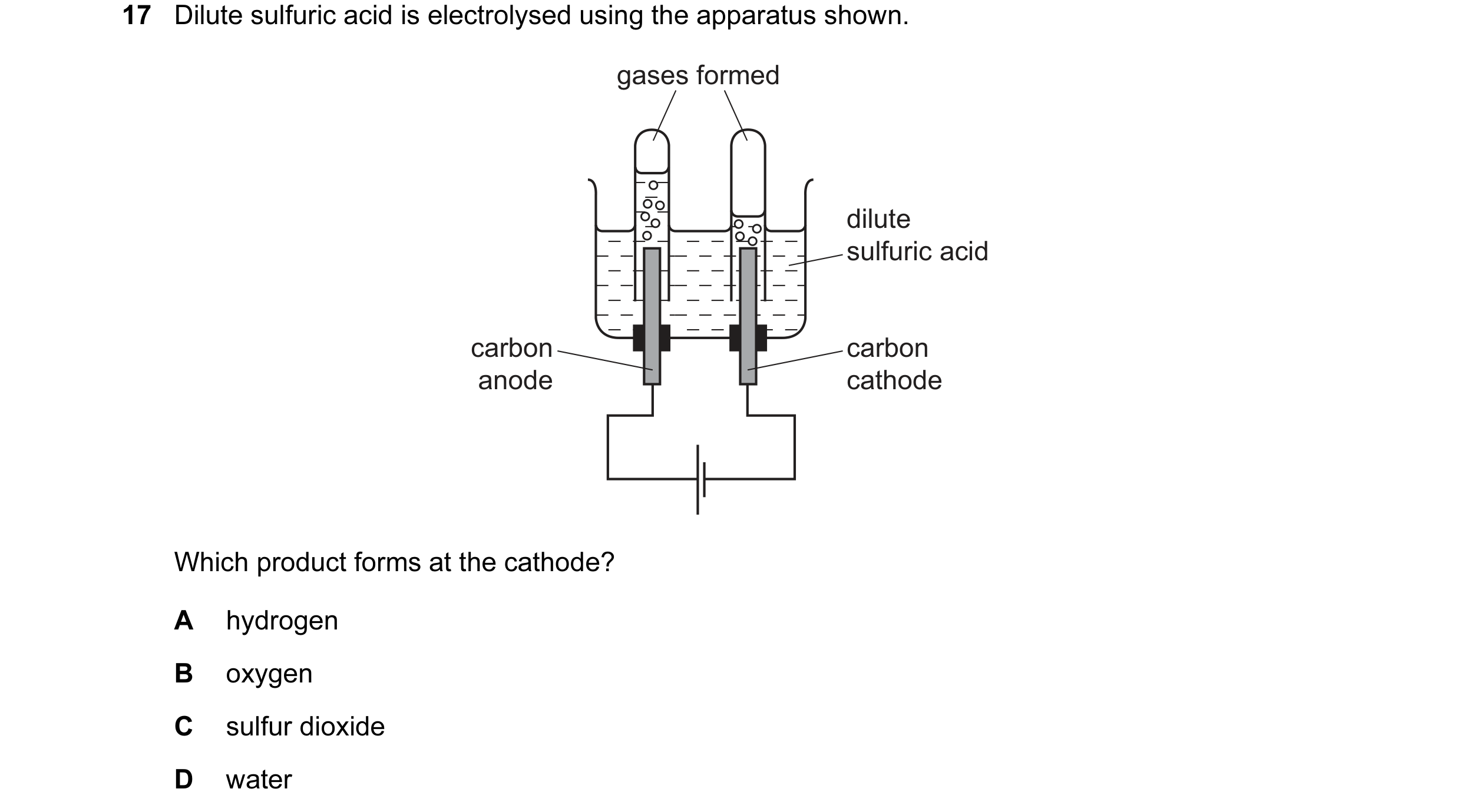
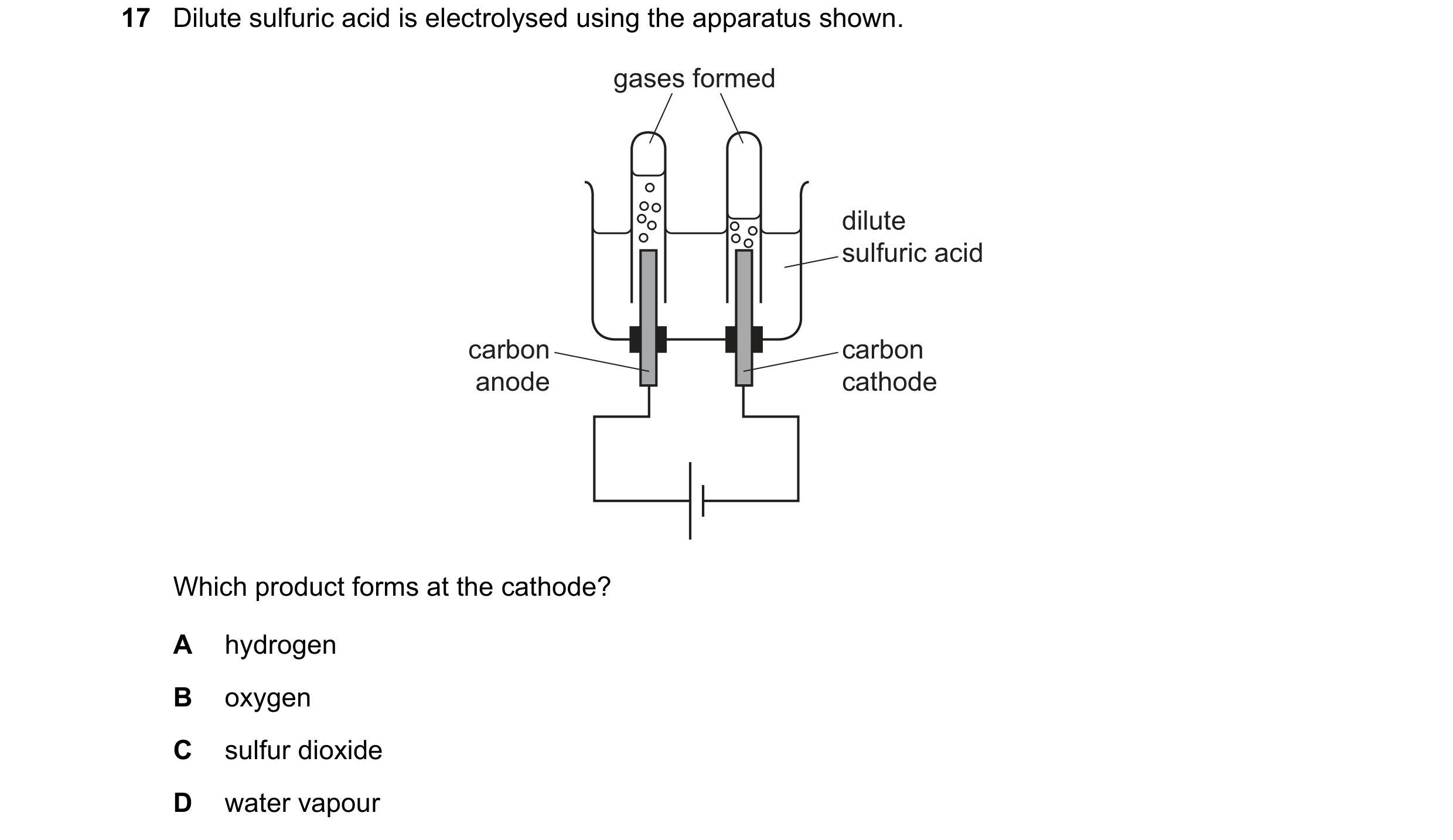
Q32 · Dilute sulfuric acid is electrolysed using the apparatus shown 0654/12 May/June 2014
17 Dilute sulfuric acid is electrolysed using the apparatus shown. gases formed dilute sulfuric acid carbon carbon anode cathode Which product forms at the cathode? A hydrogen B oxygen C sulfur dioxide D water
1 marks
Answer: A
This question in 0654/12 May/June 2014
Q33 · When dilute sulfuric acid is electrolysed each electrode gives off a different gas 0654/13 May/June 2014
16 When dilute sulfuric acid is electrolysed each electrode gives off a different gas. + _ positive negative electrode electrode dilute sulfuric acid Which test identifies the gas given off at the positive electrode? A Damp red litmus is bleached. B Damp red litmus turns blue. C A glowing splint relights. D A lighted splint burns with a squeaky pop.
1 marks
Answer: C
This question in 0654/13 May/June 2014
Q34 · Which process can be used to produce sodium and chlorine from the compound sodium… 0654/11 Oct/Nov 2014
15 Which process can be used to produce sodium and chlorine from the compound sodium chloride? A cracking B distillation C electrolysis D filtration
1 marks
Answer: C
This question in 0654/11 Oct/Nov 2014
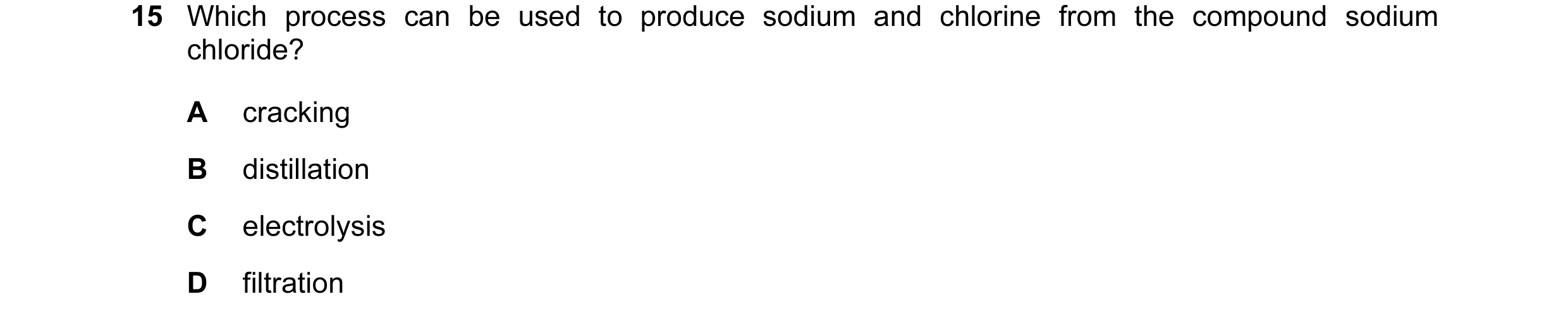
Q35 · Which process can be used to produce sodium and chlorine from the compound sodium… 0654/12 Oct/Nov 2014
15 Which process can be used to produce sodium and chlorine from the compound sodium chloride? A cracking B distillation C electrolysis D filtration
1 marks
Answer: C
This question in 0654/12 Oct/Nov 2014
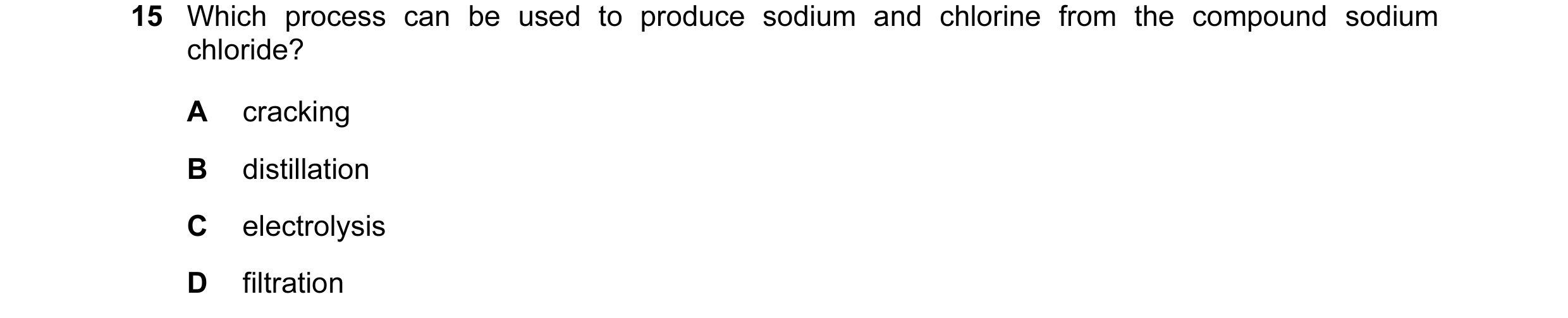
Q36 · Which process can be used to produce sodium and chlorine from the compound sodium… 0654/13 Oct/Nov 2014
15 Which process can be used to produce sodium and chlorine from the compound sodium chloride? A cracking B distillation C electrolysis D filtration
1 marks
Answer: C
This question in 0654/13 Oct/Nov 2014
Q37 · What are the products of the electrolysis of dilute sulfuric acid using inert electrodes? 0654/11 May/June 2015
16 What are the products of the electrolysis of dilute sulfuric acid using inert electrodes? A hydrogen and oxygen B hydrogen and sulfur dioxide C oxygen and sulfur D oxygen and sulfur dioxide
1 marks
Answer: A
This question in 0654/11 May/June 2015
Q38 · When dilute sulfuric acid is electrolysed using inert electrodes two gases are produced 0654/12 May/June 2015
16 When dilute sulfuric acid is electrolysed using inert electrodes two gases are produced. Which two gases are formed? A hydrogen and hydrogen sulfide B hydrogen and oxygen C hydrogen and sulfur dioxide D oxygen and sulfur dioxide
1 marks
Answer: B
This question in 0654/12 May/June 2015
Q39 · The diagram shows an electroplating experiment 0654/13 May/June 2015
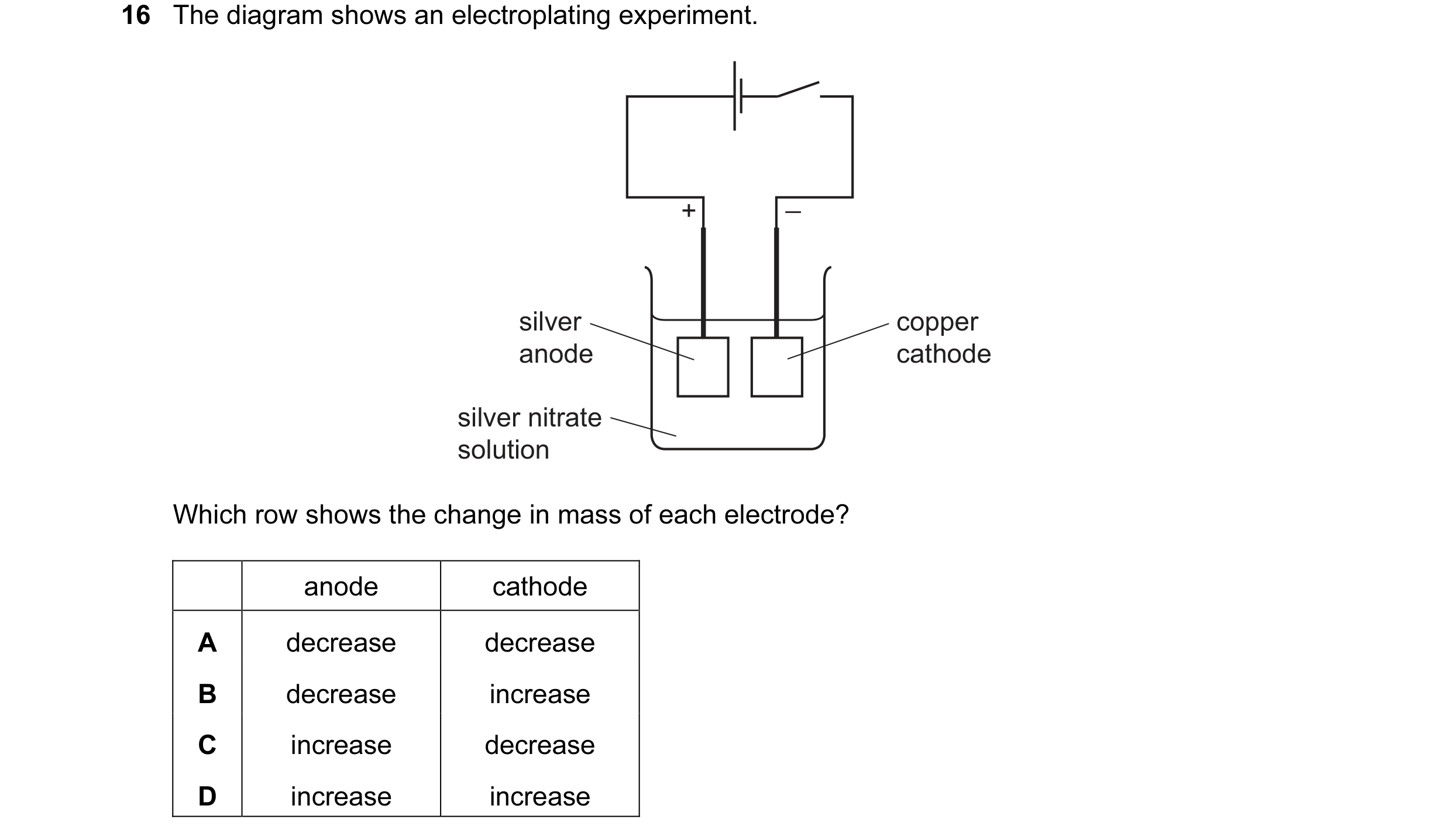
16 The diagram shows an electroplating experiment. + _ silver copper anode cathode silver nitrate solution Which row shows the change in mass of each electrode? anode cathode A decrease decrease B decrease increase C increase decrease D increase increase
1 marks
Answer: B
This question in 0654/13 May/June 2015
Q40 · The diagram shows the electrolysis of dilute sulfuric acid 0654/11 Oct/Nov 2015
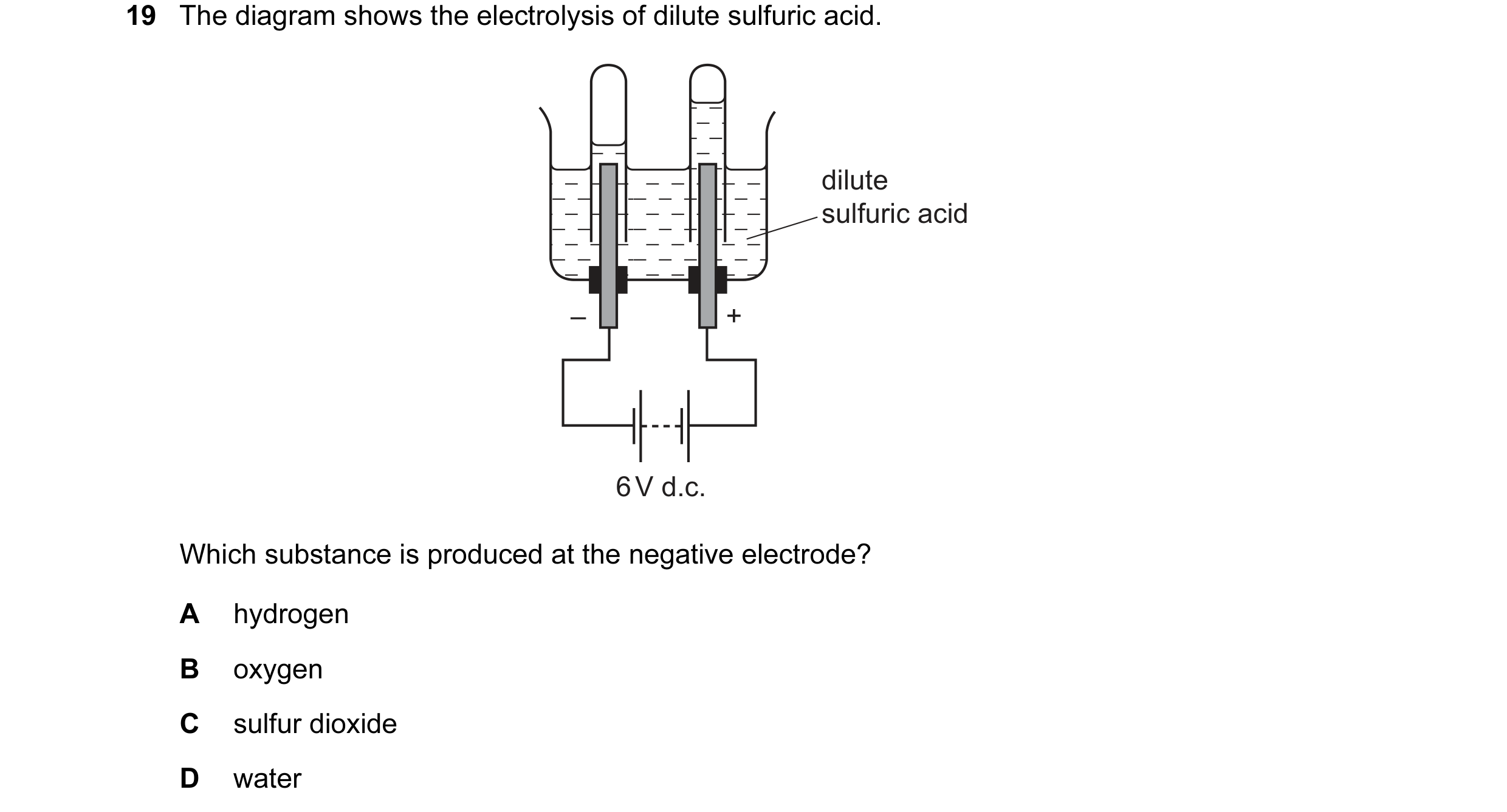
19 The diagram shows the electrolysis of dilute sulfuric acid. dilute sulfuric acid – + 6 V d.c. Which substance is produced at the negative electrode? A hydrogen B oxygen C sulfur dioxide D water
1 marks
Answer: A
This question in 0654/11 Oct/Nov 2015
Q41 · The diagram shows the electrolysis of lead(II) bromide using inert electrodes 0654/12 Oct/Nov 2015
19 The diagram shows the electrolysis of lead(II) bromide using inert electrodes. coloured fumes electrode X electrode Y grey solid electrolyte Which statement about this experiment is correct? A Electrode X is positively charged. B The coloured fumes are produced at the negative electrode. C The electrolyte is lead(II) bromide. D The grey solid is lead(II) bromide.
1 marks
Answer: C
This question in 0654/12 Oct/Nov 2015
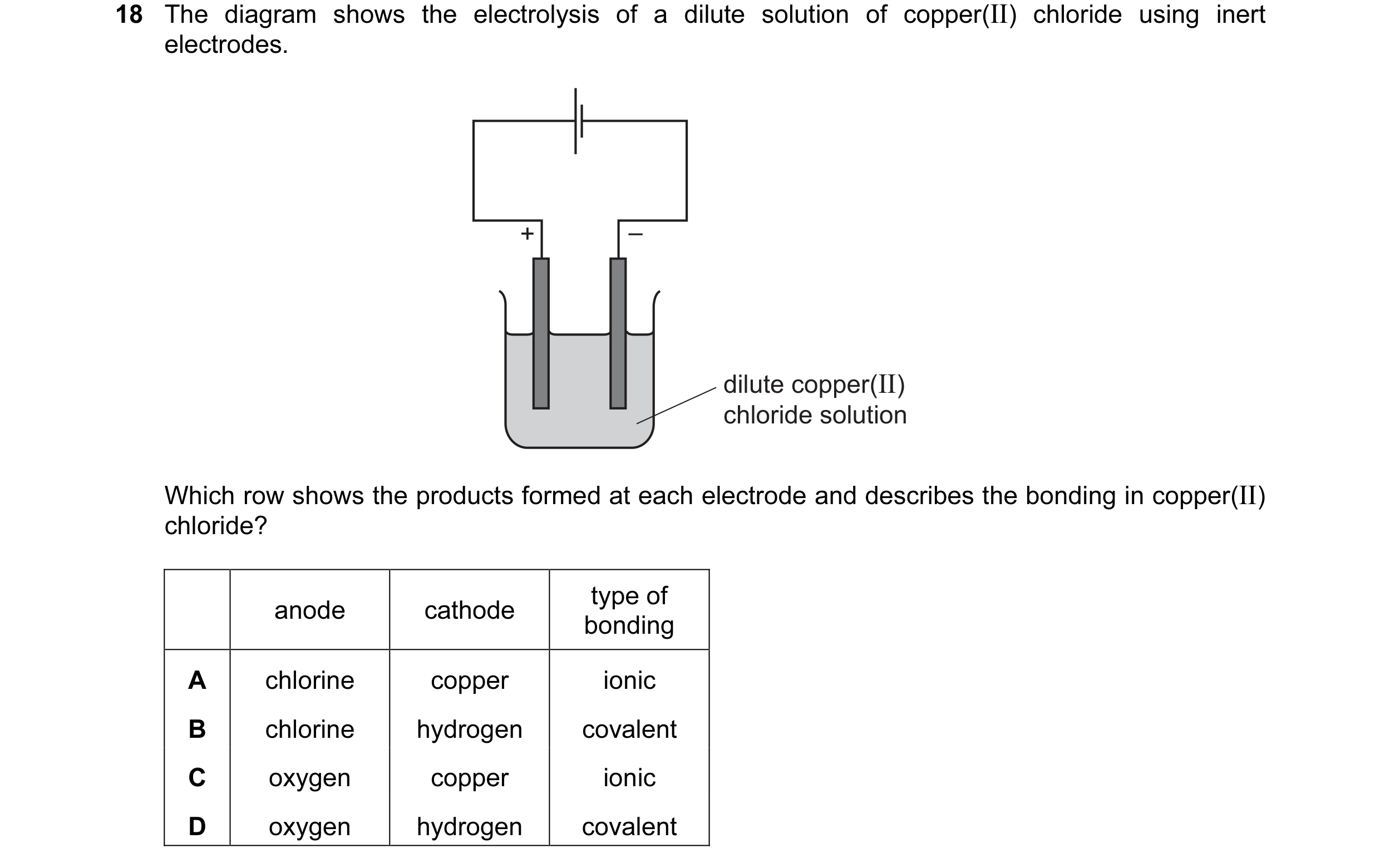
Q42 · The diagram shows the electrolysis of a dilute solution of copper(II) chloride using… 0654/13 Oct/Nov 2015
18 The diagram shows the electrolysis of a dilute solution of copper(II) chloride using inert electrodes. + – dilute copper(II) chloride solution Which row shows the products formed at each electrode and describes the bonding in copper(II) chloride? type of anode cathode bonding A chlorine copper ionic B chlorine hydrogen covalent C oxygen copper ionic D oxygen hydrogen covalent
1 marks
Answer: A
This question in 0654/13 Oct/Nov 2015
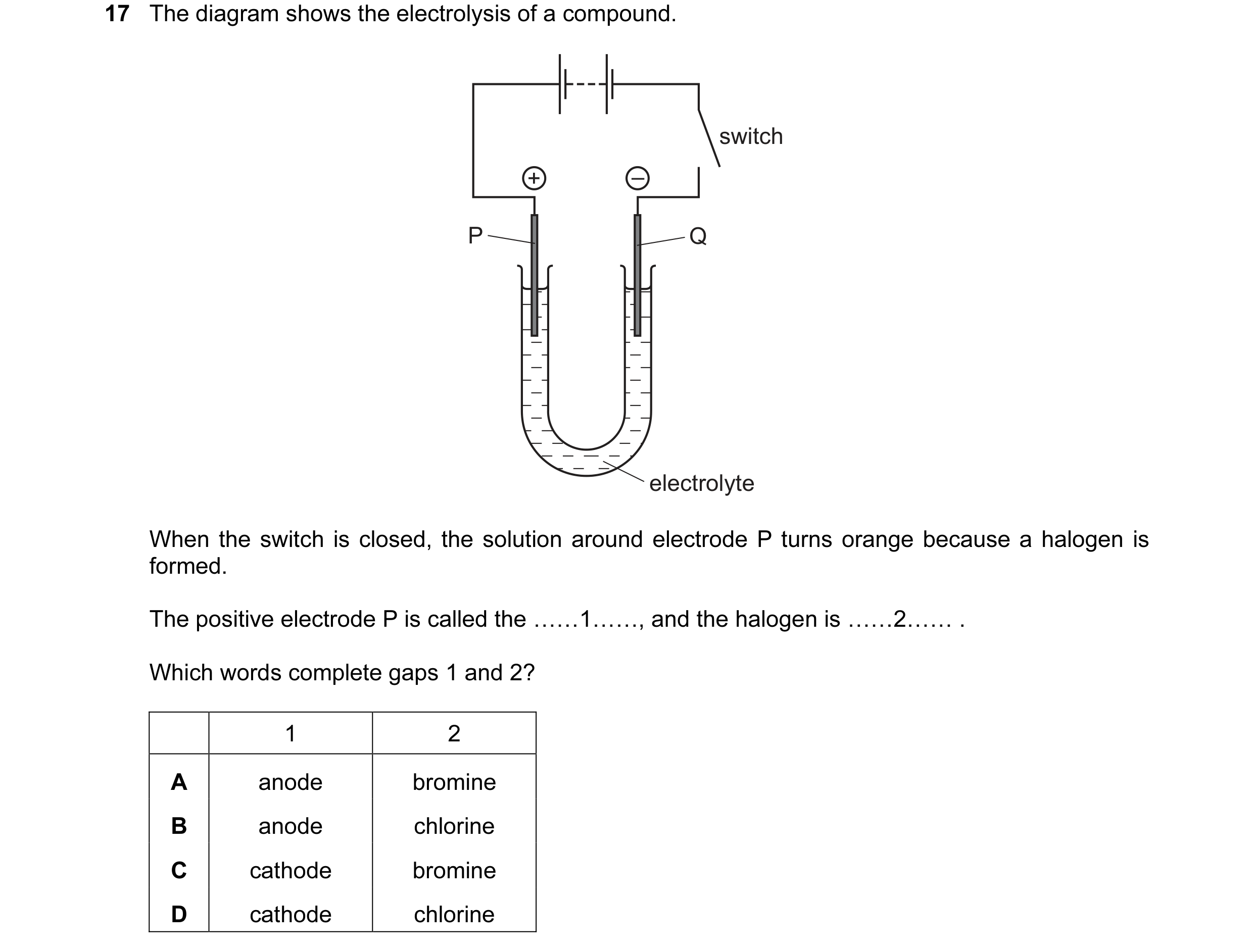
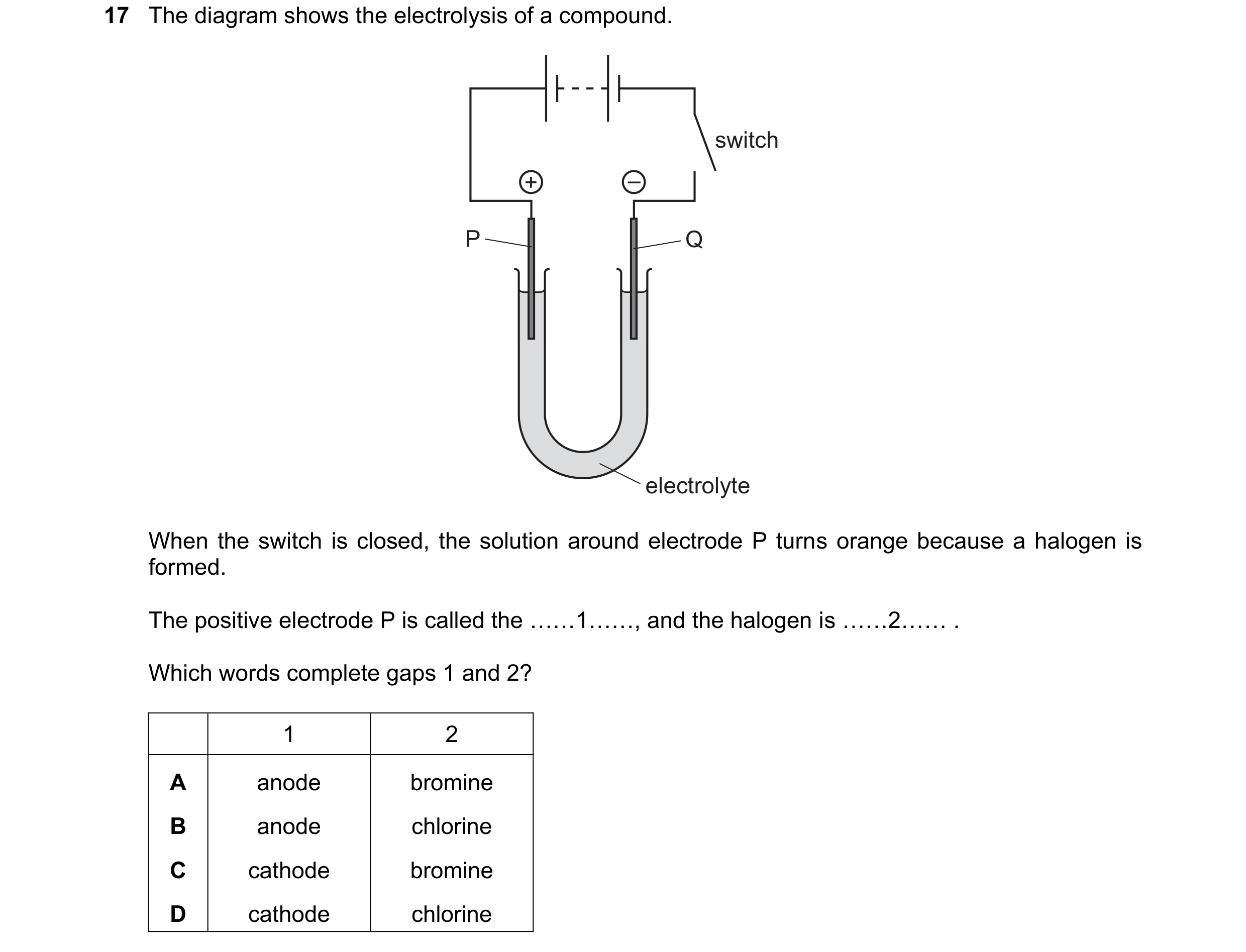
Q43 · The diagram shows the electrolysis of a compound 0654/11 May/June 2016
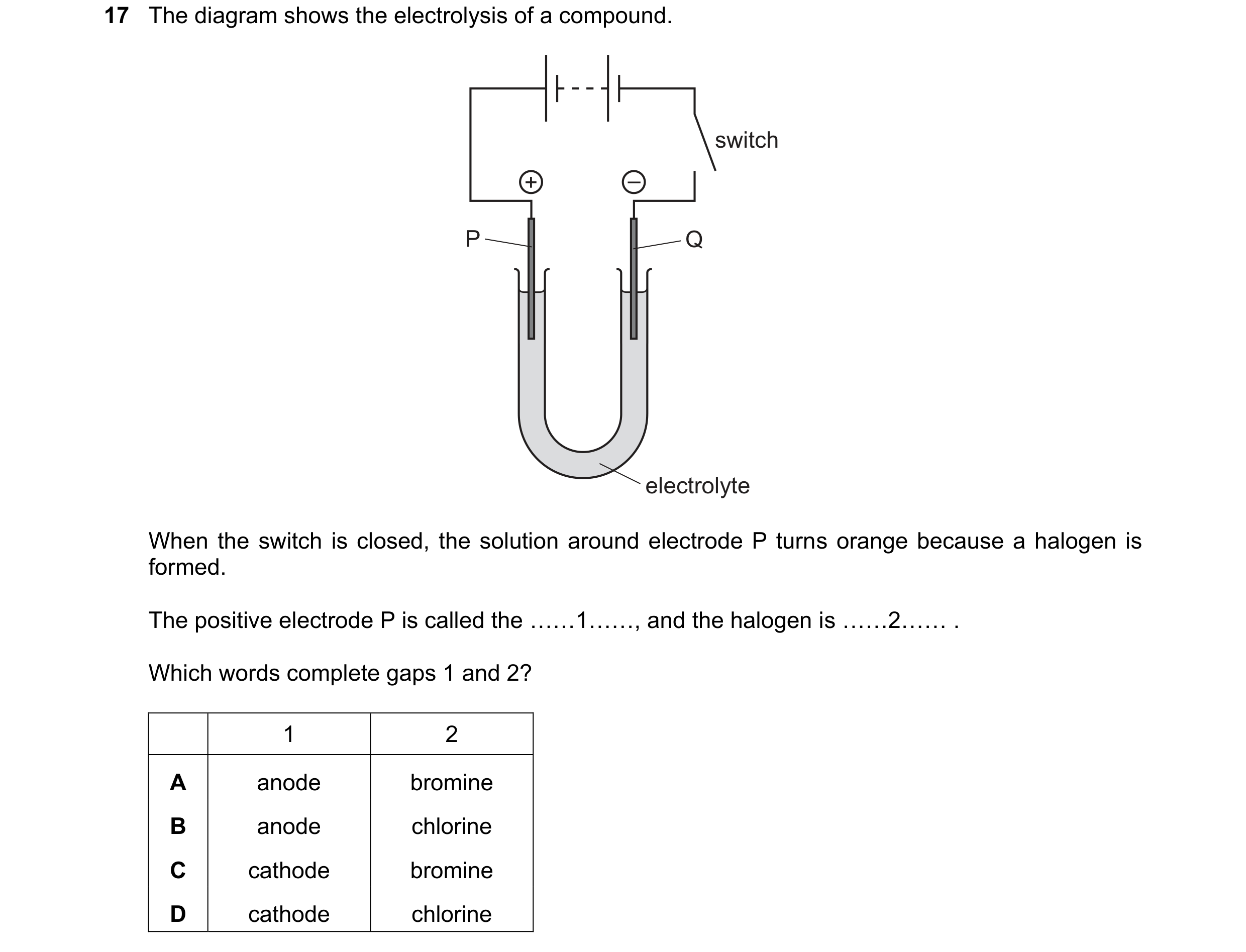
17 The diagram shows the electrolysis of a compound. switch + – P Q electrolyte When the switch is closed, the solution around electrode P turns orange because a halogen is formed. The positive electrode P is called the ……1……, and the halogen is ……2…… . Which words complete gaps 1 and 2? 1 2 A anode bromine B anode chlorine C cathode bromine D cathode chlorine
1 marks
Answer: A
This question in 0654/11 May/June 2016
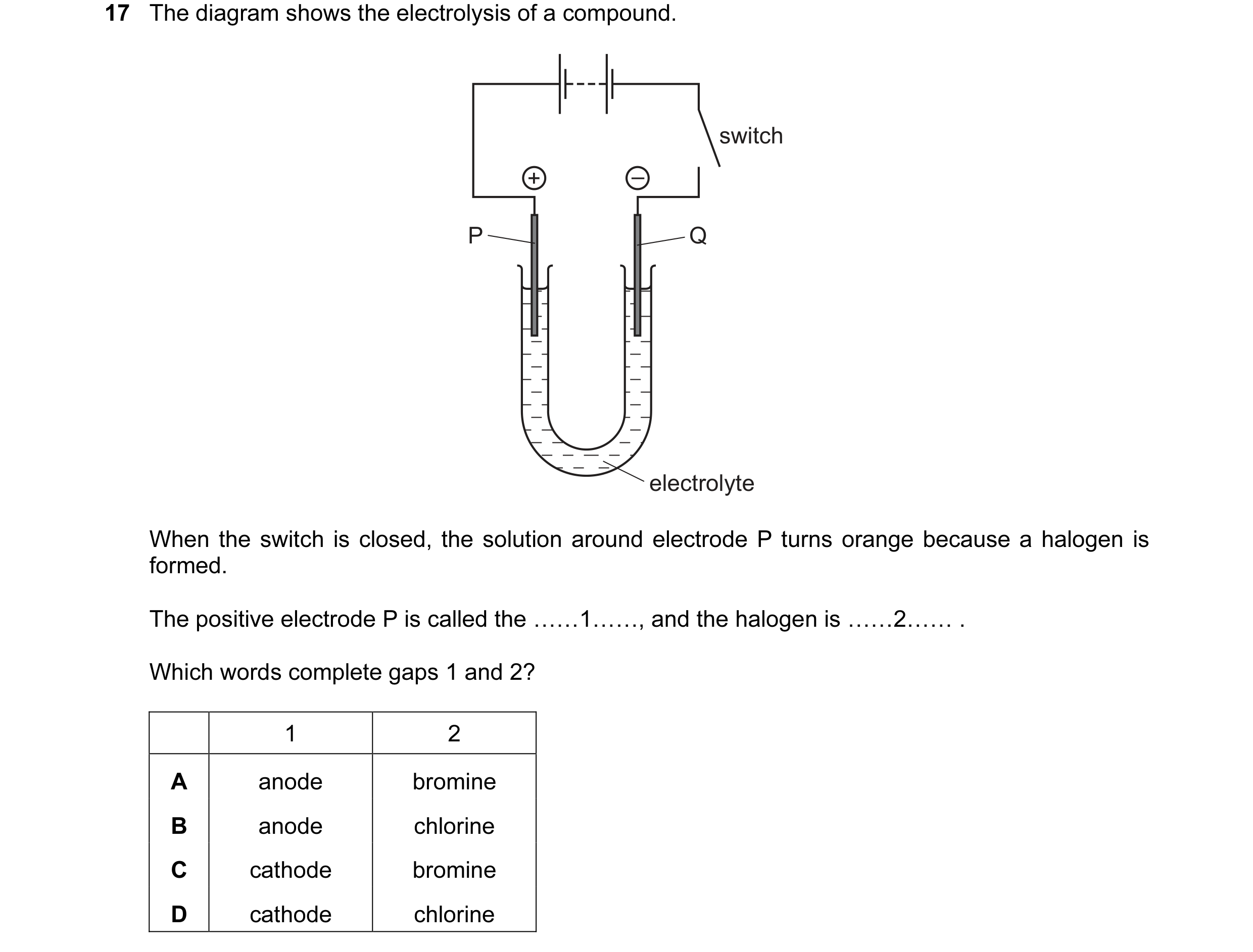
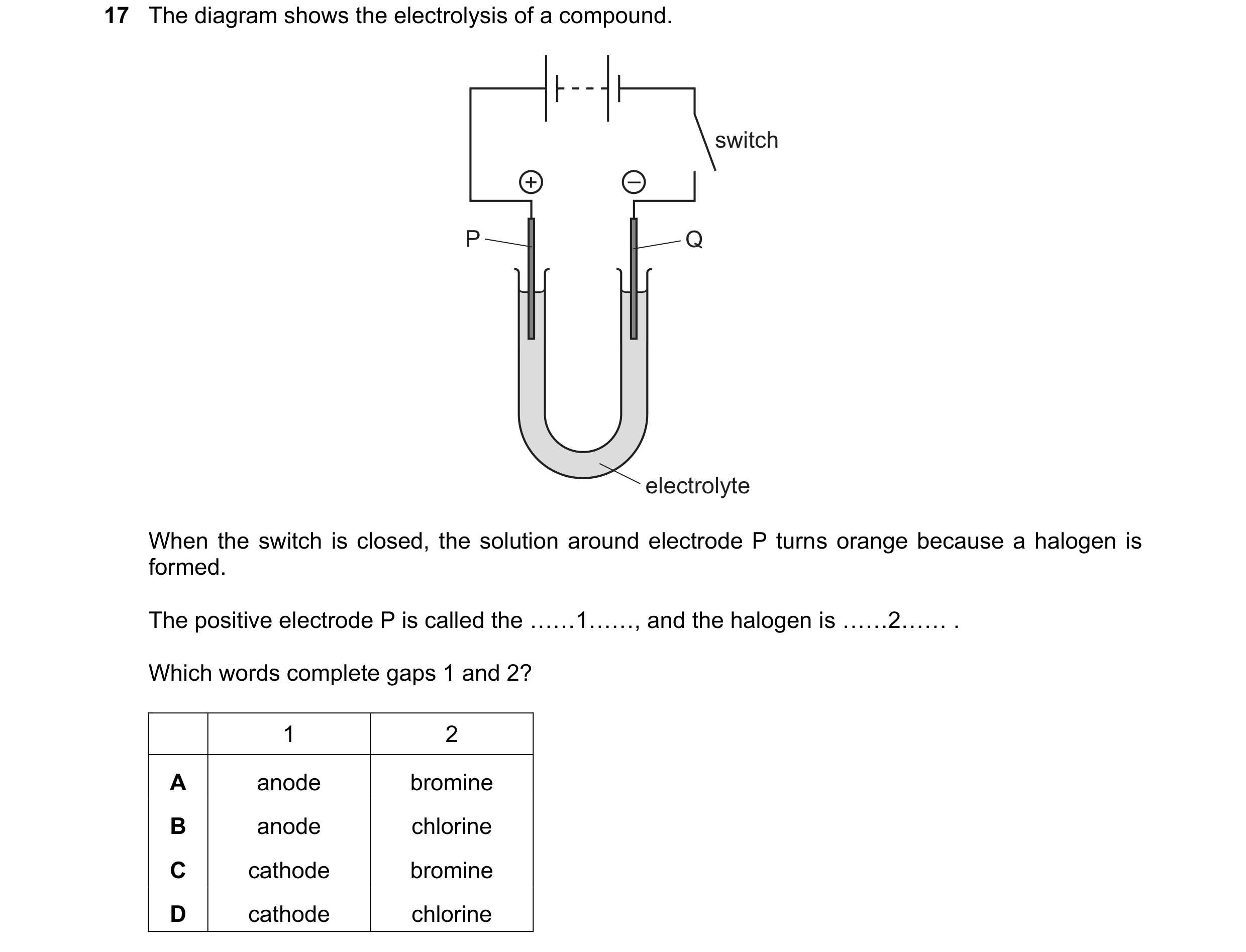
Q44 · The diagram shows the electrolysis of a compound 0654/12 May/June 2016
17 The diagram shows the electrolysis of a compound. switch + – P Q electrolyte When the switch is closed, the solution around electrode P turns orange because a halogen is formed. The positive electrode P is called the ……1……, and the halogen is ……2…… . Which words complete gaps 1 and 2? 1 2 A anode bromine B anode chlorine C cathode bromine D cathode chlorine
1 marks
Answer: A
This question in 0654/12 May/June 2016
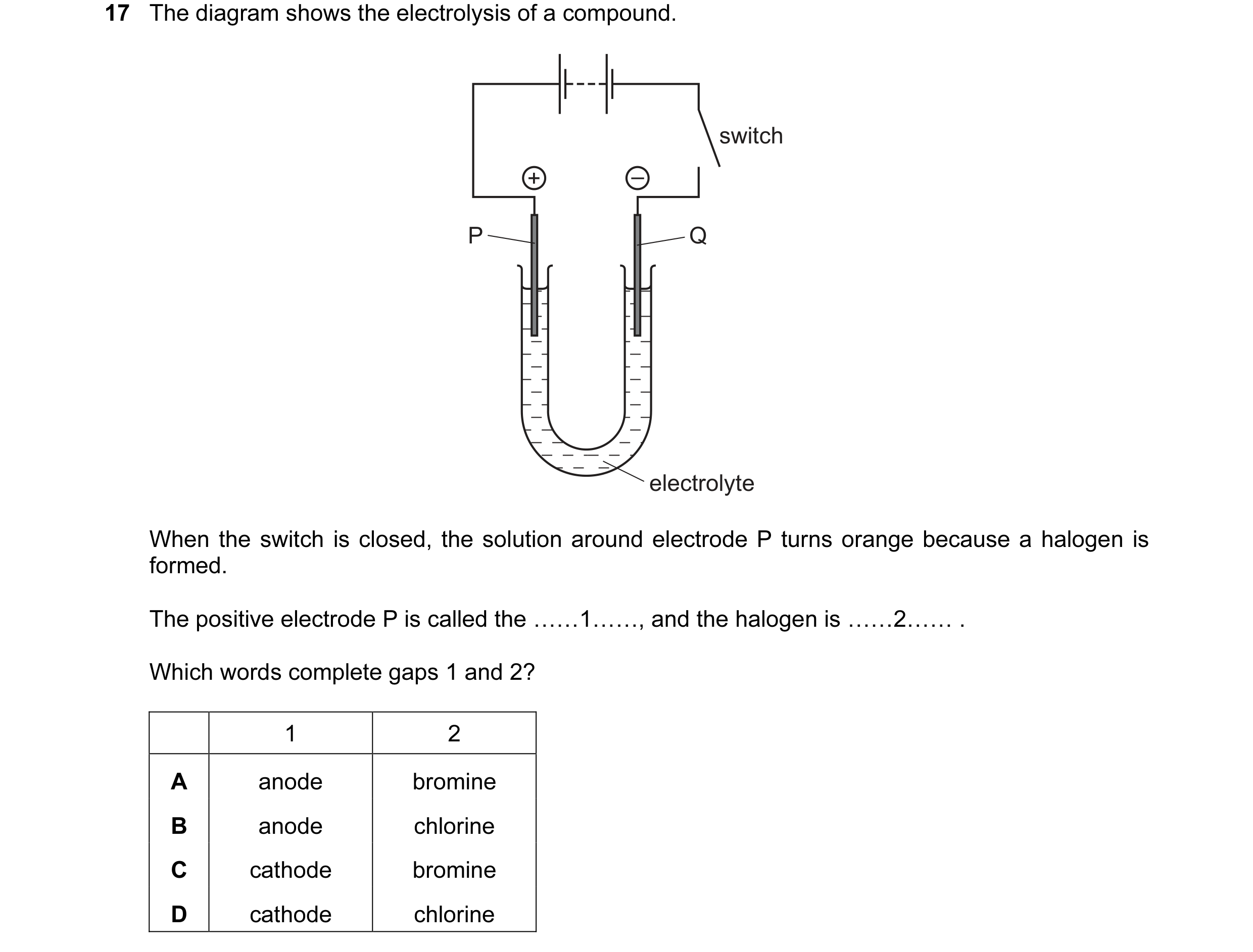
Q45 · The diagram shows the electrolysis of a compound 0654/13 May/June 2016
17 The diagram shows the electrolysis of a compound. switch + – P Q electrolyte When the switch is closed, the solution around electrode P turns orange because a halogen is formed. The positive electrode P is called the ……1……, and the halogen is ……2…… . Which words complete gaps 1 and 2? 1 2 A anode bromine B anode chlorine C cathode bromine D cathode chlorine
1 marks
Answer: A
This question in 0654/13 May/June 2016
Q46 · Apparatus used to electrolyse aqueous copper chloride is shown 0654/11 Oct/Nov 2016
17 Apparatus used to electrolyse aqueous copper chloride is shown. positive electrode negative electrode gas X aqueous copper chloride The negative electrode is called the … 1 … . Gas X turns damp red litmus paper ««2«« . Which words complete gaps 1 and 2? 1 2 A anode blue B anode white C cathode blue D cathode white
1 marks
Answer: D
This question in 0654/11 Oct/Nov 2016
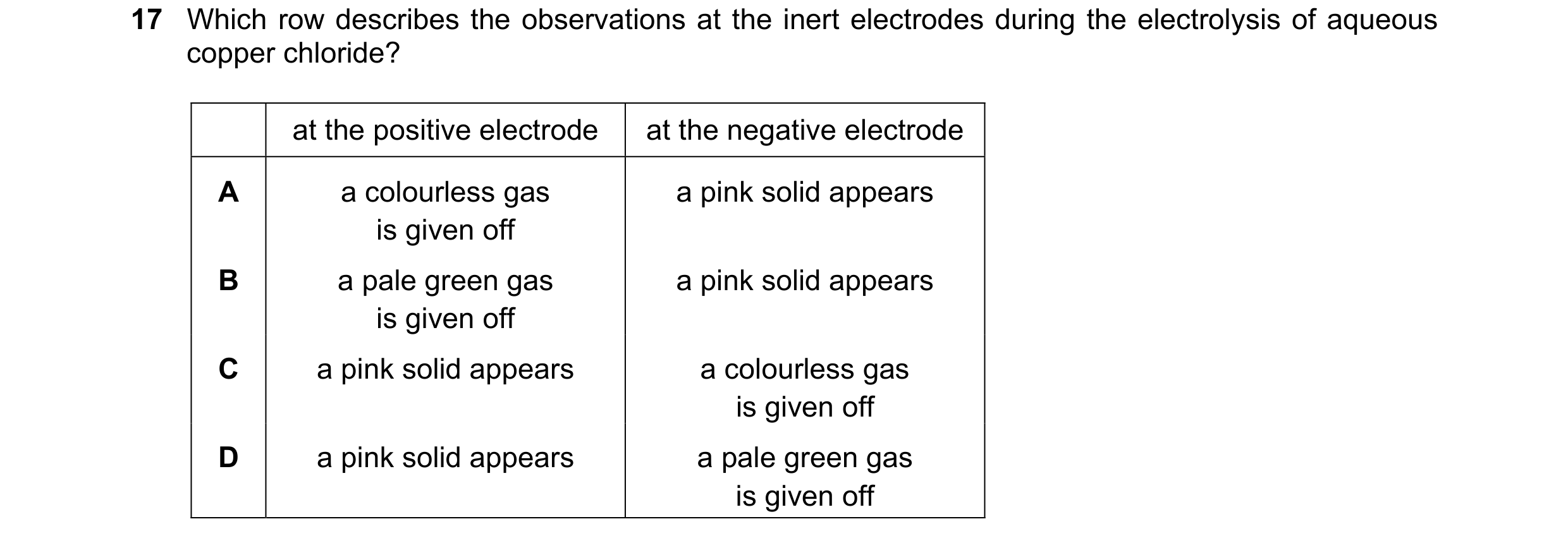
Q47 · Which row describes the observations at the inert electrodes during the electrolysis of… 0654/12 Oct/Nov 2016
17 Which row describes the observations at the inert electrodes during the electrolysis of aqueous copper chloride? at the positive electrode at the negative electrode A a colourless gas a pink solid appears is given off B a pale green gas a pink solid appears is given off C a pink solid appears a colourless gas is given off D a pink solid appears a pale green gas is given off
1 marks
Answer: B
This question in 0654/12 Oct/Nov 2016
Q48 · Which products are formed when dilute sulfuric acid is electrolysed using inert… 0654/13 Oct/Nov 2016
19 Which products are formed when dilute sulfuric acid is electrolysed using inert electrodes? A hydrogen and oxygen B hydrogen and sulfur C hydrogen and sulfur dioxide D oxygen and sulfur dioxide
1 marks
Answer: A
This question in 0654/13 Oct/Nov 2016
Q49 · Molten lead(II) bromide is electrolysed 0654/11 May/June 2017
16 Molten lead(II) bromide is electrolysed. Which row describes one lead ion, Pb2+, and the electrode at which lead is produced? type of ion electrode A anion anode B anion cathode C cation anode D cation cathode
1 marks
Answer: D
This question in 0654/11 May/June 2017
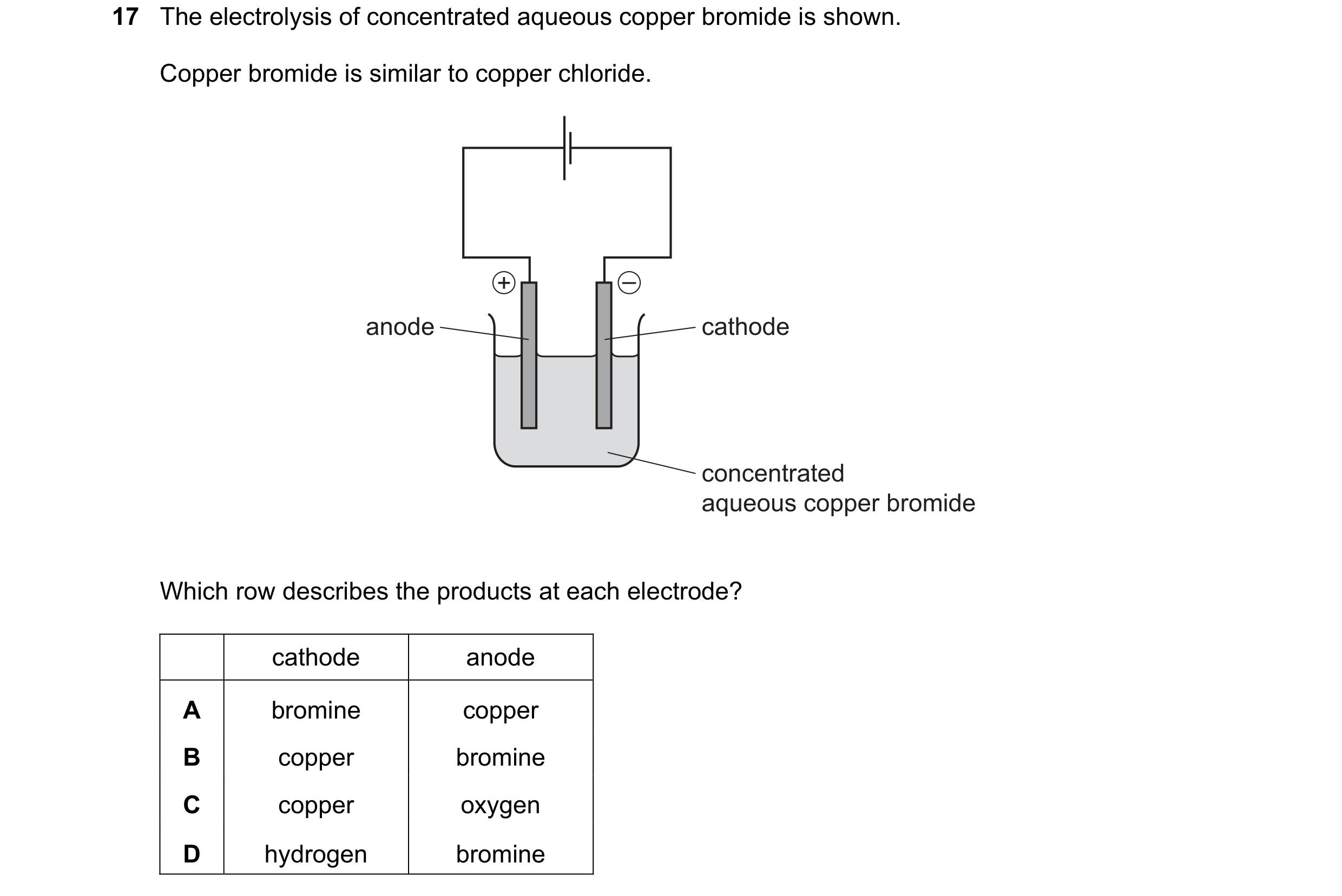
Q50 · The electrolysis of concentrated aqueous copper bromide is shown 0654/12 May/June 2017
17 The electrolysis of concentrated aqueous copper bromide is shown. Copper bromide is similar to copper chloride. + – anode cathode concentrated aqueous copper bromide Which row describes the products at each electrode? cathode anode A bromine copper B copper bromine C copper oxygen D hydrogen bromine
1 marks
Answer: B
This question in 0654/12 May/June 2017
Q51 · The apparatus used for the electrolysis of copper chloride is shown 0654/13 May/June 2017
16 The apparatus used for the electrolysis of copper chloride is shown. + – … 1 … … 2 … … 3 … copper chloride Which words complete labels 1, 2 and 3? 1 2 3 A anode cathode aqueous B anode cathode solid C cathode anode aqueous D cathode anode solid
1 marks
Answer: A
This question in 0654/13 May/June 2017
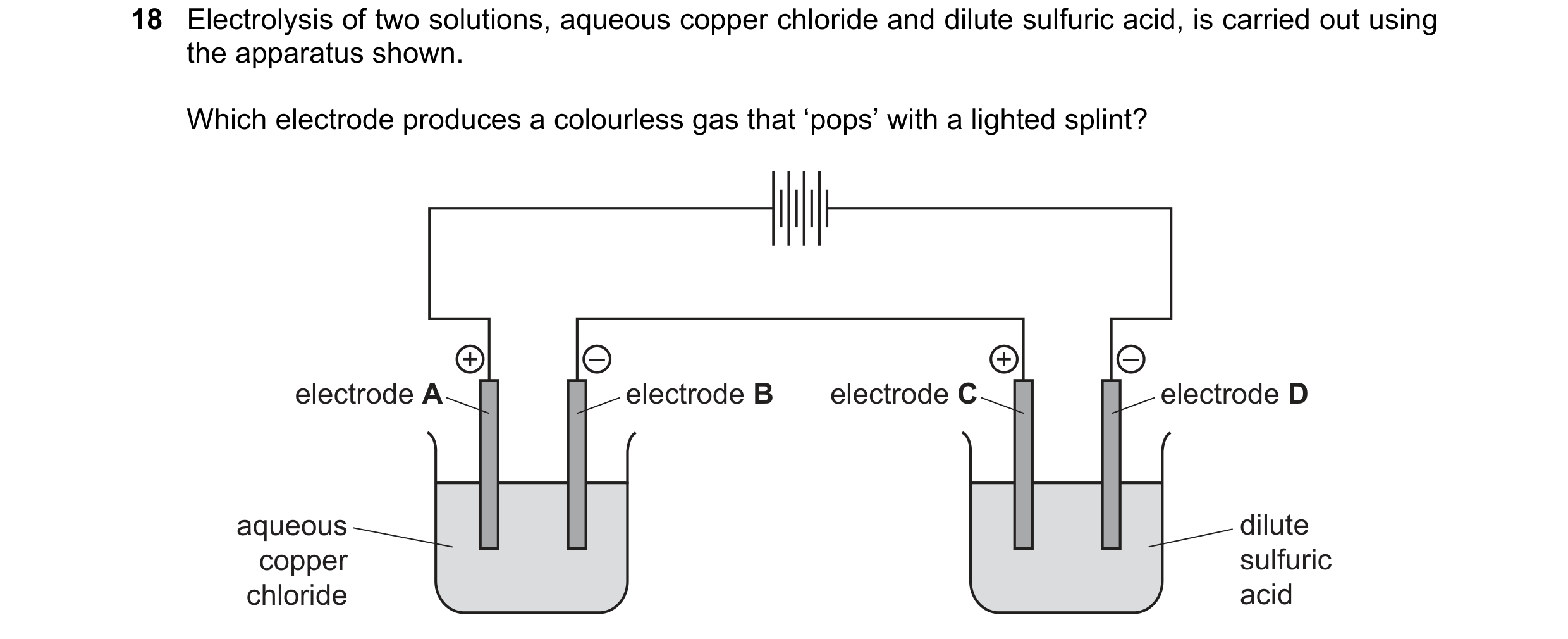
Q52 · Electrolysis of two solutions, aqueous copper chloride and dilute sulfuric acid, is… 0654/11 Oct/Nov 2017
18 Electrolysis of two solutions, aqueous copper chloride and dilute sulfuric acid, is carried out using the apparatus shown. Which electrode produces a colourless gas that ‘pops’ with a lighted splint? + – + – electrode A electrode B electrode C electrode D aqueous dilute copper sulfuric chloride acid
1 marks
Answer: D
This question in 0654/11 Oct/Nov 2017
Q53 · The electrolysis of aqueous copper chloride is shown 0654/12 Oct/Nov 2017
18 The electrolysis of aqueous copper chloride is shown. Inert electrodes are used. bulb anode cathode aqueous copper chloride What is produced at the cathode? A chlorine B copper C hydrogen D oxygen
1 marks
Answer: B
This question in 0654/12 Oct/Nov 2017
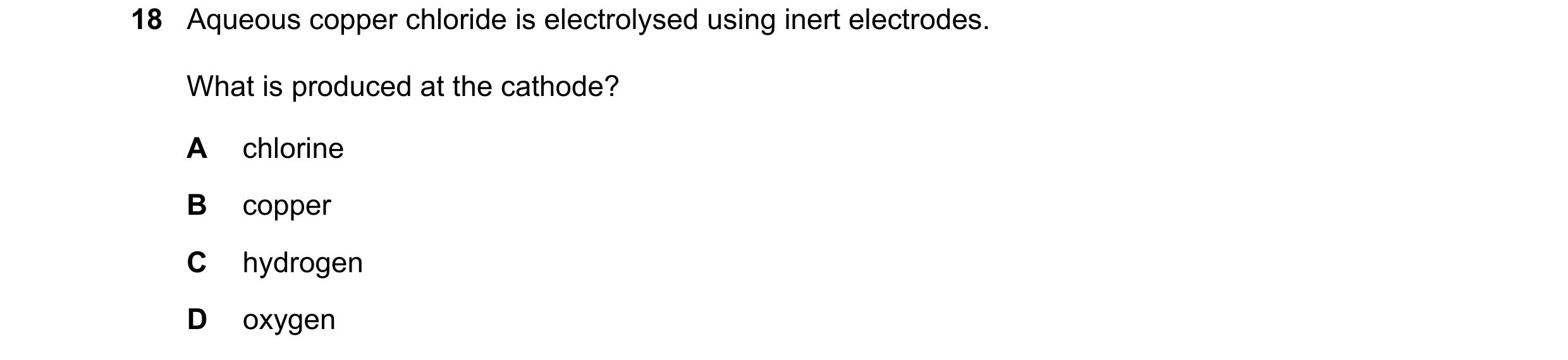
Q54 · Aqueous copper chloride is electrolysed using inert electrodes 0654/13 Oct/Nov 2017
18 Aqueous copper chloride is electrolysed using inert electrodes. What is produced at the cathode? A chlorine B copper C hydrogen D oxygen
1 marks
Answer: B
This question in 0654/13 Oct/Nov 2017
Q55 · Which statement describes what happens during electrolysis? 0654/11 Oct/Nov 2018
17 Which statement describes what happens during electrolysis? A Covalent compounds produce more complex substances. B Covalent compounds produce simpler substances. C Ionic compounds produce more complex substances. D Ionic compounds produce simpler substances.
1 marks
Answer: D
This question in 0654/11 Oct/Nov 2018
Q56 · Which diagram shows equipment used to electroplate nickel with copper? 0654/12 Oct/Nov 2018
18 Which diagram shows equipment used to electroplate nickel with copper? A B power supply power supply + – + – nickel copper nickel copper molten aqueous copper chloride copper chloride C D power supply power supply + – + – copper nickel copper nickel molten aqueous copper chloride copper chloride
1 marks
Answer: D
This question in 0654/12 Oct/Nov 2018
Q57 · Which substance does not undergo electrolysis? 0654/13 Oct/Nov 2018
17 Which substance does not undergo electrolysis? A aqueous copper chloride B copper wire C dilute sulfuric acid D molten lead(II) bromide
1 marks
Answer: B
This question in 0654/13 Oct/Nov 2018
Q58 · What is the electrolyte that is used when a nickel spoon is electroplated with copper? 0654/11 May/June 2019
16 What is the electrolyte that is used when a nickel spoon is electroplated with copper? A copper B copper sulfate solution C nickel sulfate solution D nickel
1 marks
Answer: B
This question in 0654/11 May/June 2019
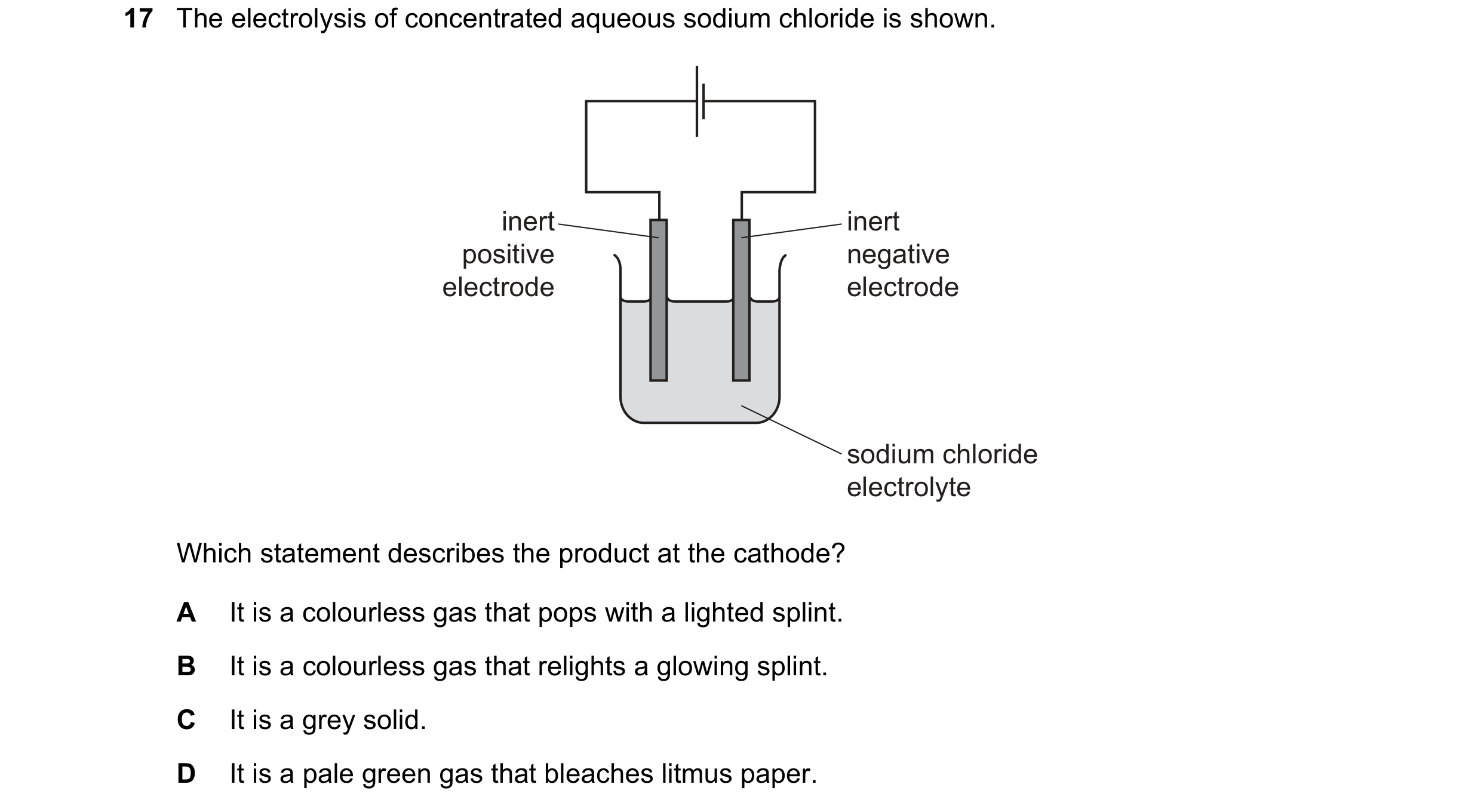
Q59 · The electrolysis of concentrated aqueous sodium chloride is shown 0654/12 May/June 2019
17 The electrolysis of concentrated aqueous sodium chloride is shown. inert inert positive negative electrode electrode sodium chloride electrolyte Which statement describes the product at the cathode? A It is a colourless gas that pops with a lighted splint. B It is a colourless gas that relights a glowing splint. C It is a grey solid. D It is a pale green gas that bleaches litmus paper.
1 marks
Answer: A
This question in 0654/12 May/June 2019
Q60 · The electrolysis of concentrated aqueous sodium chloride is shown 0654/13 May/June 2019
17 The electrolysis of concentrated aqueous sodium chloride is shown. inert inert positive negative electrode electrode sodium chloride electrolyte Which statement describes the product at the cathode? A It is a colourless gas that pops with a lighted splint. B It is a colourless gas that relights a glowing splint. C It is a grey solid. D It is a pale green gas that bleaches litmus paper.
1 marks
Answer: A
This question in 0654/13 May/June 2019
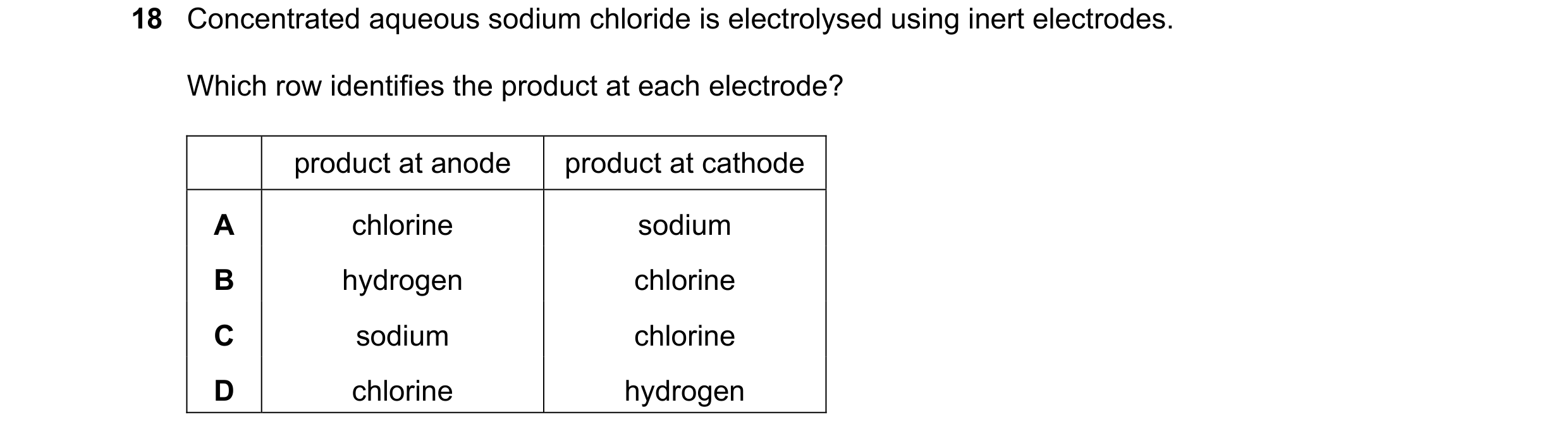
Q61 · Concentrated aqueous sodium chloride is electrolysed using inert electrodes 0654/11 Oct/Nov 2019
18 Concentrated aqueous sodium chloride is electrolysed using inert electrodes. Which row identifies the product at each electrode? product at anode product at cathode A chlorine sodium B hydrogen chlorine C sodium chlorine D chlorine hydrogen
1 marks
Answer: D
This question in 0654/11 Oct/Nov 2019
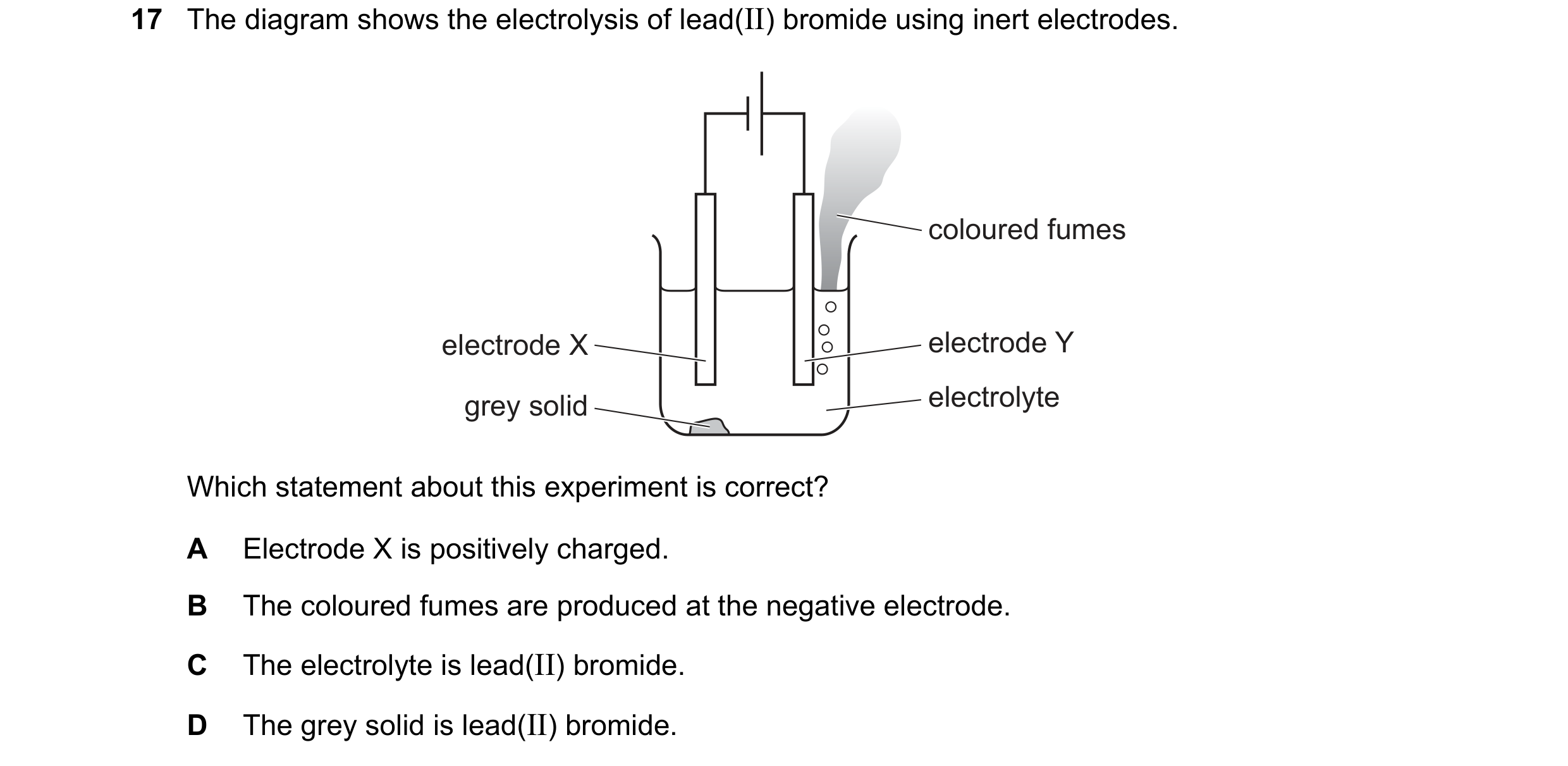
Q62 · The diagram shows the electrolysis of lead(II) bromide using inert electrodes 0654/11 May/June 2020
17 The diagram shows the electrolysis of lead(II) bromide using inert electrodes. coloured fumes electrode X electrode Y grey solid electrolyte Which statement about this experiment is correct? A Electrode X is positively charged. B The coloured fumes are produced at the negative electrode. C The electrolyte is lead(II) bromide. D The grey solid is lead(II) bromide.
1 marks
Answer: C
This question in 0654/11 May/June 2020
Q63 · The diagram shows the electrolysis of lead(II) bromide using inert electrodes 0654/12 May/June 2020
17 The diagram shows the electrolysis of lead(II) bromide using inert electrodes. coloured fumes electrode X electrode Y grey solid electrolyte Which statement about this experiment is correct? A Electrode X is positively charged. B The coloured fumes are produced at the negative electrode. C The electrolyte is lead(II) bromide. D The grey solid is lead(II) bromide.
1 marks
Answer: C
This question in 0654/12 May/June 2020
Q64 · The diagram shows the electrolysis of lead(II) bromide using inert electrodes 0654/13 May/June 2020
17 The diagram shows the electrolysis of lead(II) bromide using inert electrodes. coloured fumes electrode X electrode Y grey solid electrolyte Which statement about this experiment is correct? A Electrode X is positively charged. B The coloured fumes are produced at the negative electrode. C The electrolyte is lead(II) bromide. D The grey solid is lead(II) bromide.
1 marks
Answer: C
This question in 0654/13 May/June 2020
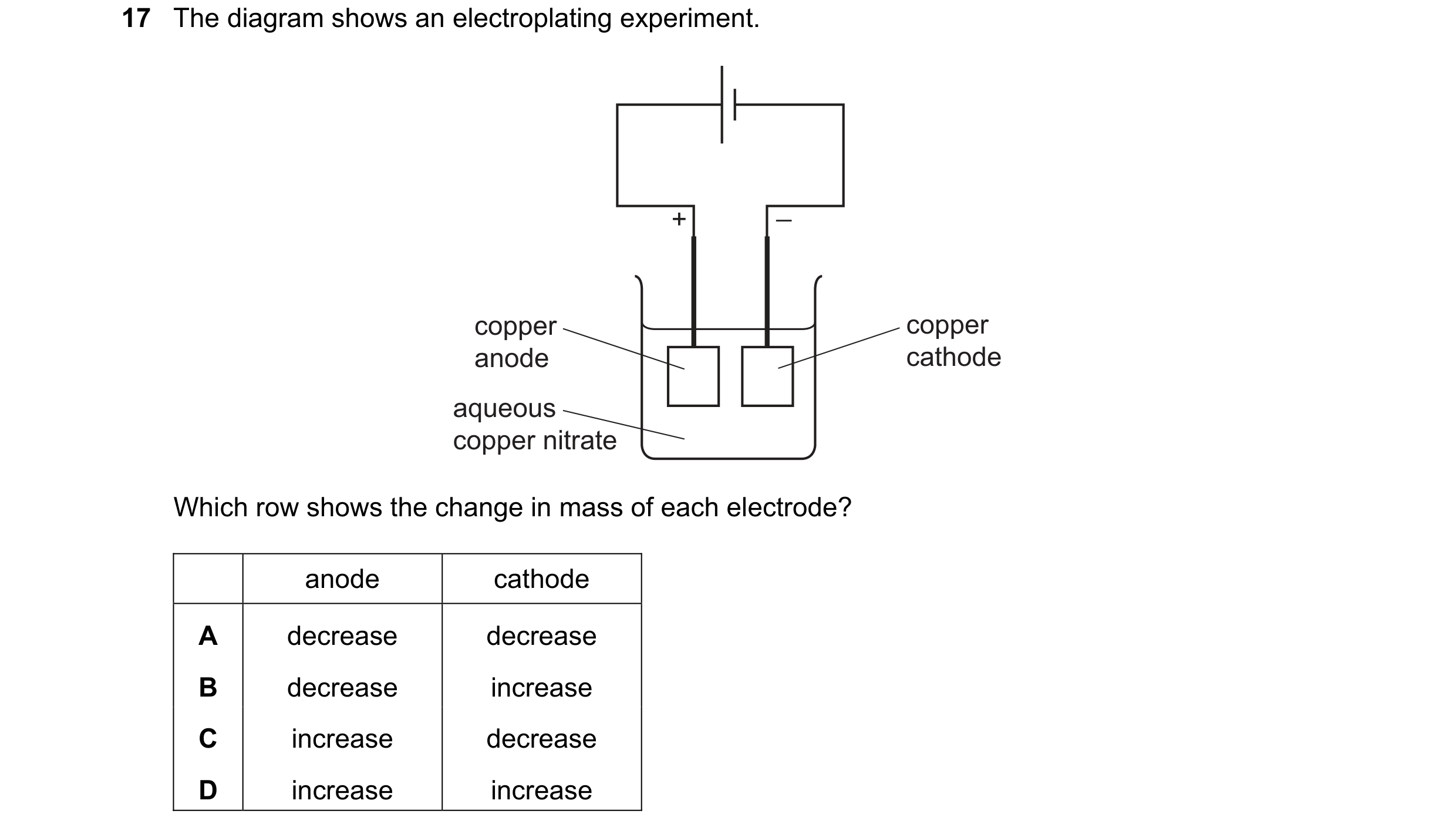
Q65 · The diagram shows an electroplating experiment 0654/11 Oct/Nov 2020
17 The diagram shows an electroplating experiment. + _ copper copper anode cathode aqueous copper nitrate Which row shows the change in mass of each electrode? anode cathode A decrease decrease B decrease increase C increase decrease D increase increase
1 marks
Answer: B
This question in 0654/11 Oct/Nov 2020
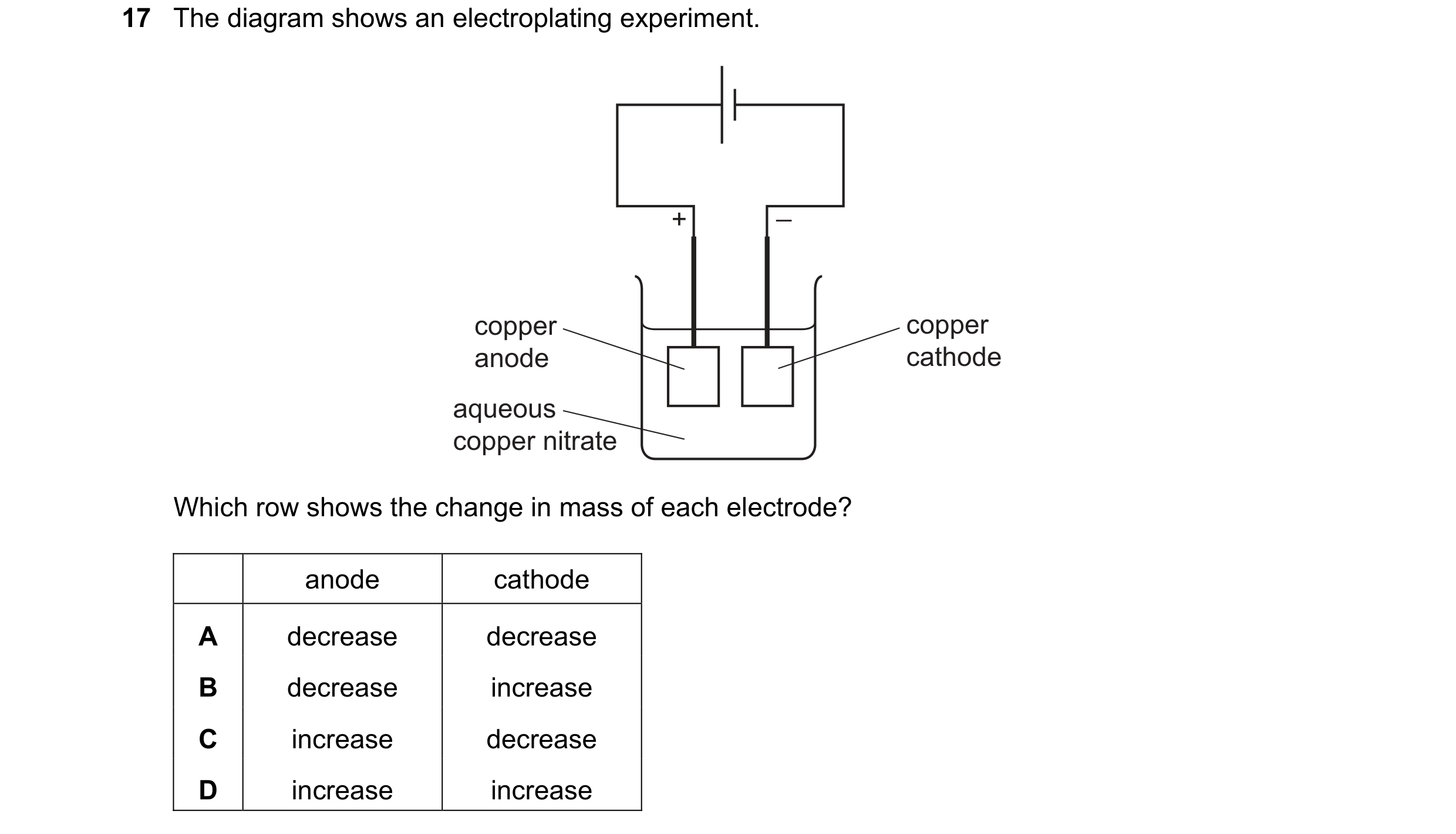
Q66 · The diagram shows an electroplating experiment 0654/12 Oct/Nov 2020
17 The diagram shows an electroplating experiment. + _ copper copper anode cathode aqueous copper nitrate Which row shows the change in mass of each electrode? anode cathode A decrease decrease B decrease increase C increase decrease D increase increase
1 marks
Answer: B
This question in 0654/12 Oct/Nov 2020
Q67 · The diagram shows an electroplating experiment 0654/13 Oct/Nov 2020
17 The diagram shows an electroplating experiment. + _ copper copper anode cathode aqueous copper nitrate Which row shows the change in mass of each electrode? anode cathode A decrease decrease B decrease increase C increase decrease D increase increase
1 marks
Answer: B
This question in 0654/13 Oct/Nov 2020
Q68 · An experiment is set up to test the effect of electricity on solution R 0654/12 Feb/March 2021
16 An experiment is set up to test the effect of electricity on solution R. + – Q P solution R What are the names of P, Q and R? P Q R A anode cathode electrode B anode cathode electrolyte C cathode anode electrode D cathode anode electrolyte
1 marks
Answer: D
This question in 0654/12 Feb/March 2021
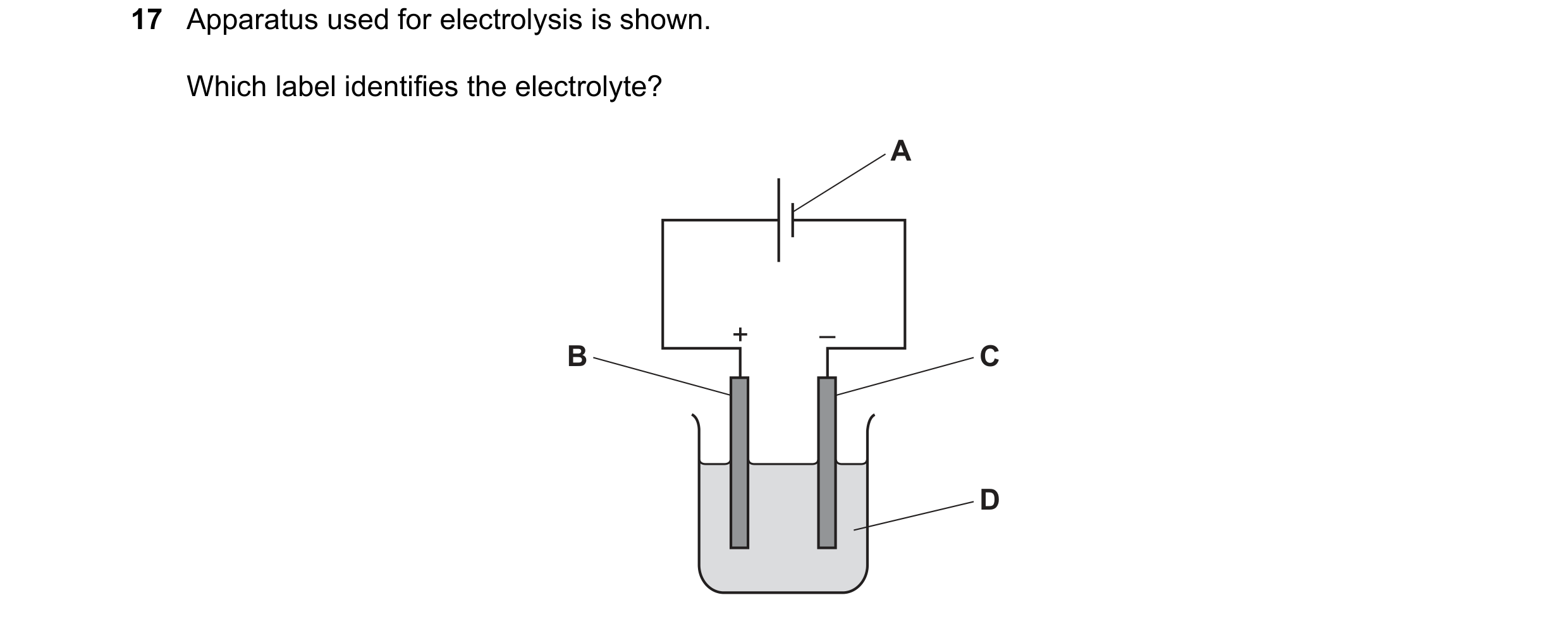
Q69 · Apparatus used for electrolysis is shown 0654/11 May/June 2021
17 Apparatus used for electrolysis is shown. Which label identifies the electrolyte? A + – B C D
1 marks
Answer: D
This question in 0654/11 May/June 2021
Q70 · Bauxite is the main ore of aluminium 0654/12 May/June 2021
22 Bauxite is the main ore of aluminium. Which method is used to extract pure aluminium from bauxite? A fractional distillation B electrolysis C neutralisation D thermal decomposition
1 marks
Answer: B
This question in 0654/12 May/June 2021
Q71 · Bauxite is the main ore of aluminium 0654/13 May/June 2021
22 Bauxite is the main ore of aluminium. Which method is used to extract pure aluminium from bauxite? A fractional distillation B electrolysis C neutralisation D thermal decomposition
1 marks
Answer: B
This question in 0654/13 May/June 2021
Q72 · The diagram shows the electrolysis of a compound 0654/11 Oct/Nov 2021
17 The diagram shows the electrolysis of a compound. switch + – P Q electrolyte When the switch is closed, the solution around electrode P turns orange because a halogen is formed. The positive electrode P is called the ……1……, and the halogen is ……2…… . Which words complete gaps 1 and 2? 1 2 A anode bromine B anode chlorine C cathode bromine D cathode chlorine
1 marks
Answer: A
This question in 0654/11 Oct/Nov 2021
Q73 · The diagram shows the electrolysis of a compound 0654/12 Oct/Nov 2021
17 The diagram shows the electrolysis of a compound. switch + – P Q electrolyte When the switch is closed, the solution around electrode P turns orange because a halogen is formed. The positive electrode P is called the ……1……, and the halogen is ……2…… . Which words complete gaps 1 and 2? 1 2 A anode bromine B anode chlorine C cathode bromine D cathode chlorine
1 marks
Answer: A
This question in 0654/12 Oct/Nov 2021
Q74 · The diagram shows the electrolysis of a compound 0654/13 Oct/Nov 2021
17 The diagram shows the electrolysis of a compound. switch + – P Q electrolyte When the switch is closed, the solution around electrode P turns orange because a halogen is formed. The positive electrode P is called the ……1……, and the halogen is ……2…… . Which words complete gaps 1 and 2? 1 2 A anode bromine B anode chlorine C cathode bromine D cathode chlorine
1 marks
Answer: A
This question in 0654/13 Oct/Nov 2021
Q75 · The diagram shows the electrolysis of dilute sulfuric acid 0654/12 Feb/March 2022
16 The diagram shows the electrolysis of dilute sulfuric acid. gas G dilute sulfuric acid inert electrode inert electrode + – power supply Gas G ignites with a ‘pop’ when it is tested with a lighted splint. What is gas G and at which electrode is it formed? gas G electrode A hydrogen anode B hydrogen cathode C oxygen anode D oxygen cathode
1 marks
Answer: B
This question in 0654/12 Feb/March 2022
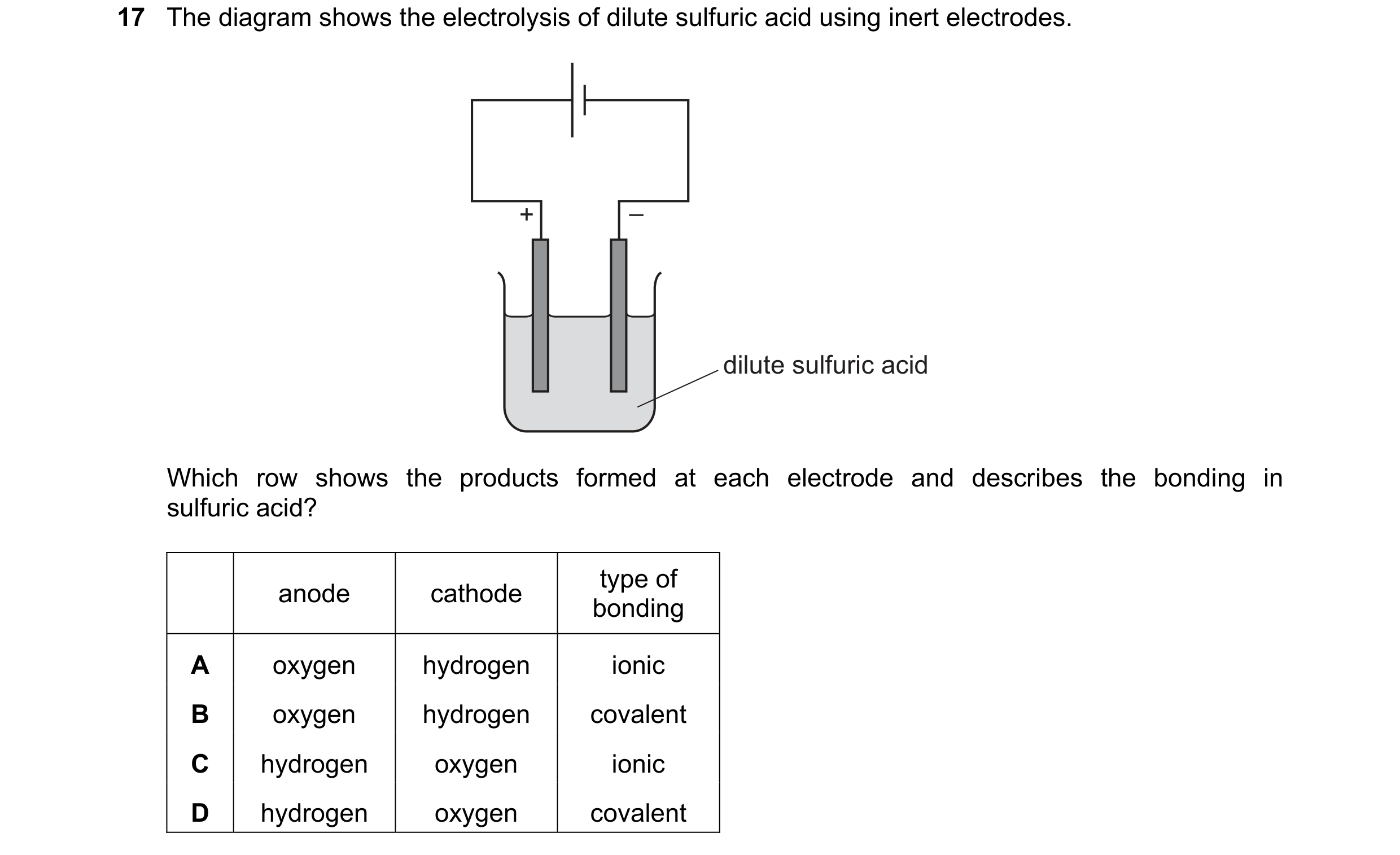
Q76 · The diagram shows the electrolysis of dilute sulfuric acid using inert electrodes 0654/11 May/June 2022
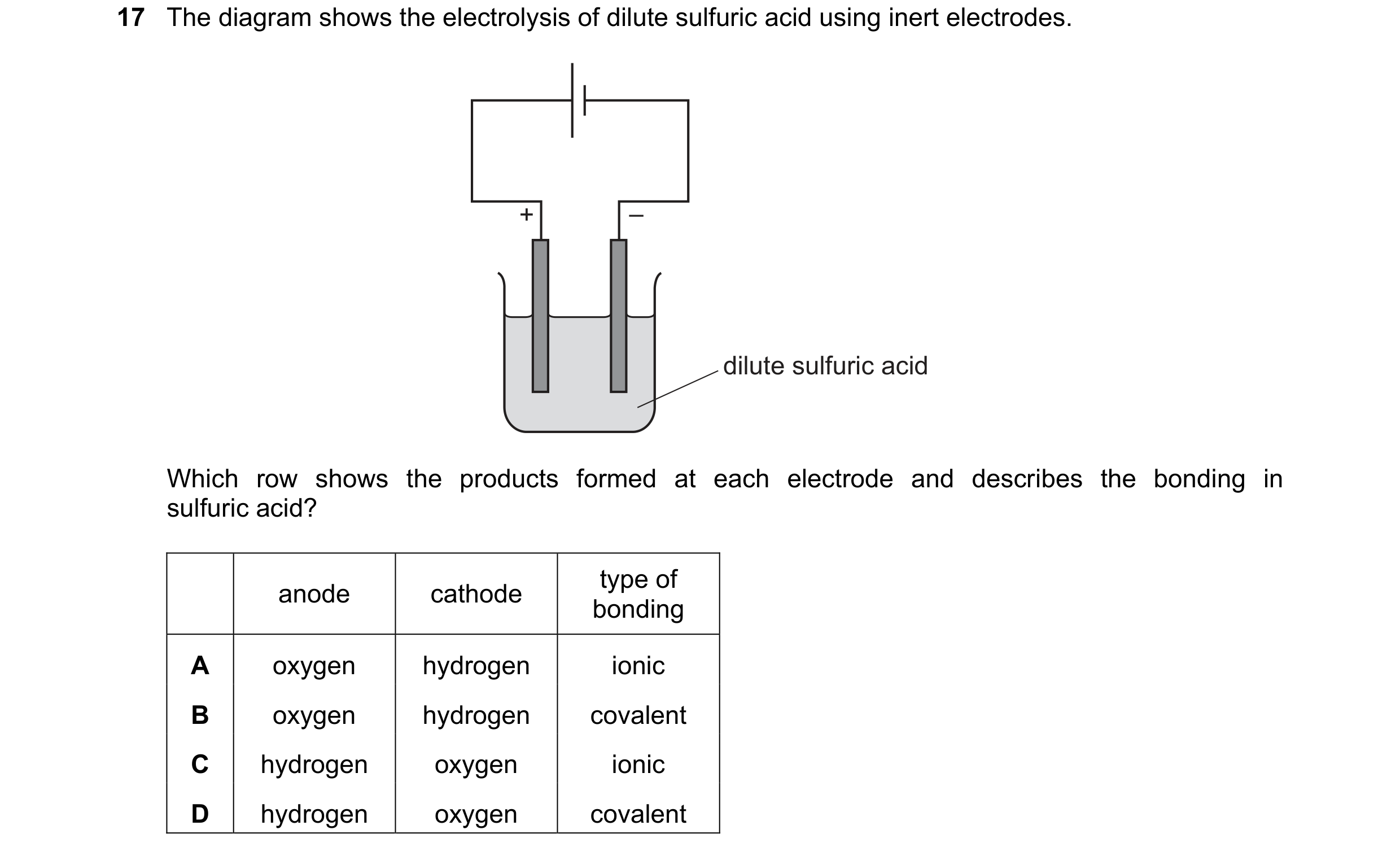
17 The diagram shows the electrolysis of dilute sulfuric acid using inert electrodes. + – dilute sulfuric acid Which row shows the products formed at each electrode and describes the bonding in sulfuric acid? type of anode cathode bonding A oxygen hydrogen ionic B oxygen hydrogen covalent C hydrogen oxygen ionic D hydrogen oxygen covalent
1 marks
Answer: A
This question in 0654/11 May/June 2022
Q77 · The diagram shows the electrolysis of dilute sulfuric acid using inert electrodes 0654/12 May/June 2022
17 The diagram shows the electrolysis of dilute sulfuric acid using inert electrodes. + – dilute sulfuric acid Which row shows the products formed at each electrode and describes the bonding in sulfuric acid? type of anode cathode bonding A oxygen hydrogen ionic B oxygen hydrogen covalent C hydrogen oxygen ionic D hydrogen oxygen covalent
1 marks
Answer: A
This question in 0654/12 May/June 2022
Q78 · The diagram shows the electrolysis of dilute sulfuric acid using inert electrodes 0654/13 May/June 2022
17 The diagram shows the electrolysis of dilute sulfuric acid using inert electrodes. + – dilute sulfuric acid Which row shows the products formed at each electrode and describes the bonding in sulfuric acid? type of anode cathode bonding A oxygen hydrogen ionic B oxygen hydrogen covalent C hydrogen oxygen ionic D hydrogen oxygen covalent
1 marks
Answer: A
This question in 0654/13 May/June 2022
Q79 · Which process is used to produce sodium and chlorine from the compound sodium chloride? 0654/11 Oct/Nov 2022
17 Which process is used to produce sodium and chlorine from the compound sodium chloride? A chromatography B cracking C distillation D electrolysis
1 marks
Answer: D
This question in 0654/11 Oct/Nov 2022
Q80 · Which process is used to produce sodium and chlorine from the compound sodium chloride? 0654/12 Oct/Nov 2022
17 Which process is used to produce sodium and chlorine from the compound sodium chloride? A chromatography B cracking C distillation D electrolysis
1 marks
Answer: D
This question in 0654/12 Oct/Nov 2022
Q81 · Which process is used to produce sodium and chlorine from the compound sodium chloride? 0654/13 Oct/Nov 2022
17 Which process is used to produce sodium and chlorine from the compound sodium chloride? A chromatography B cracking C distillation D electrolysis
1 marks
Answer: D
This question in 0654/13 Oct/Nov 2022
Q82 · Dilute sulfuric acid is electrolysed using the apparatus shown 0654/12 Feb/March 2023
17 Dilute sulfuric acid is electrolysed using the apparatus shown. gases formed dilute sulfuric acid carbon carbon anode cathode Which product forms at the cathode? A hydrogen B oxygen C sulfur dioxide D water vapour
1 marks
Answer: A
This question in 0654/12 Feb/March 2023
Q83 · Which diagram shows equipment used to electroplate nickel with copper? 0654/11 May/June 2023
18 Which diagram shows equipment used to electroplate nickel with copper? A B power supply power supply + – + – nickel copper nickel copper molten aqueous copper chloride copper chloride C D power supply power supply + – + – copper nickel copper nickel molten aqueous copper chloride copper chloride
1 marks
Answer: D
This question in 0654/11 May/June 2023
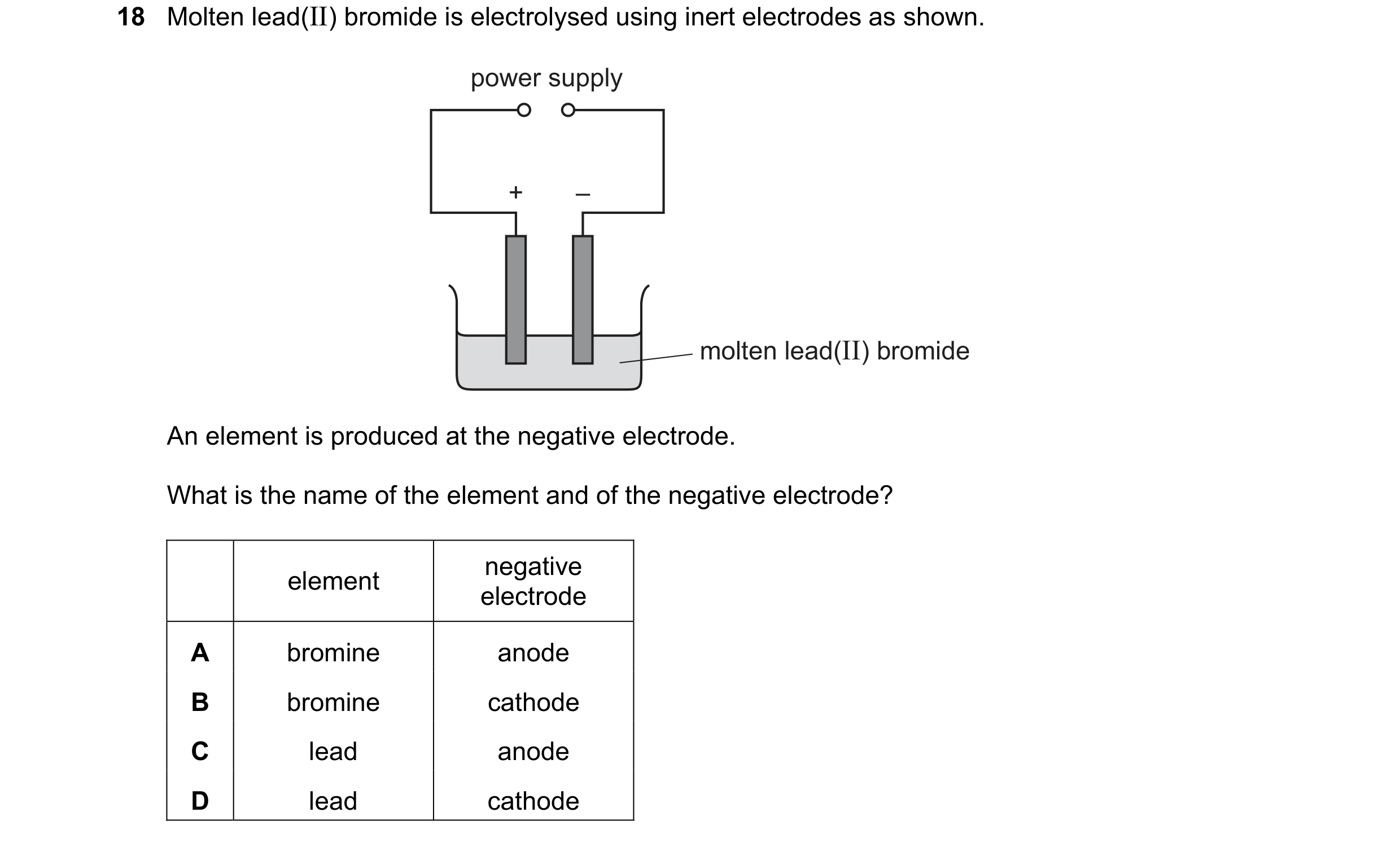
Q84 · Molten lead(II) bromide is electrolysed using inert electrodes as shown 0654/12 May/June 2023
18 Molten lead(II) bromide is electrolysed using inert electrodes as shown. power supply + – molten lead(II) bromide An element is produced at the negative electrode. What is the name of the element and of the negative electrode? negative element electrode A bromine anode B bromine cathode C lead anode D lead cathode
1 marks
Answer: D
This question in 0654/12 May/June 2023
Q85 · Molten lead(II) bromide is electrolysed using inert electrodes as shown 0654/13 May/June 2023
18 Molten lead(II) bromide is electrolysed using inert electrodes as shown. power supply + – molten lead(II) bromide An element is produced at the negative electrode. What is the name of the element and of the negative electrode? negative element electrode A bromine anode B bromine cathode C lead anode D lead cathode
1 marks
Answer: D
This question in 0654/13 May/June 2023
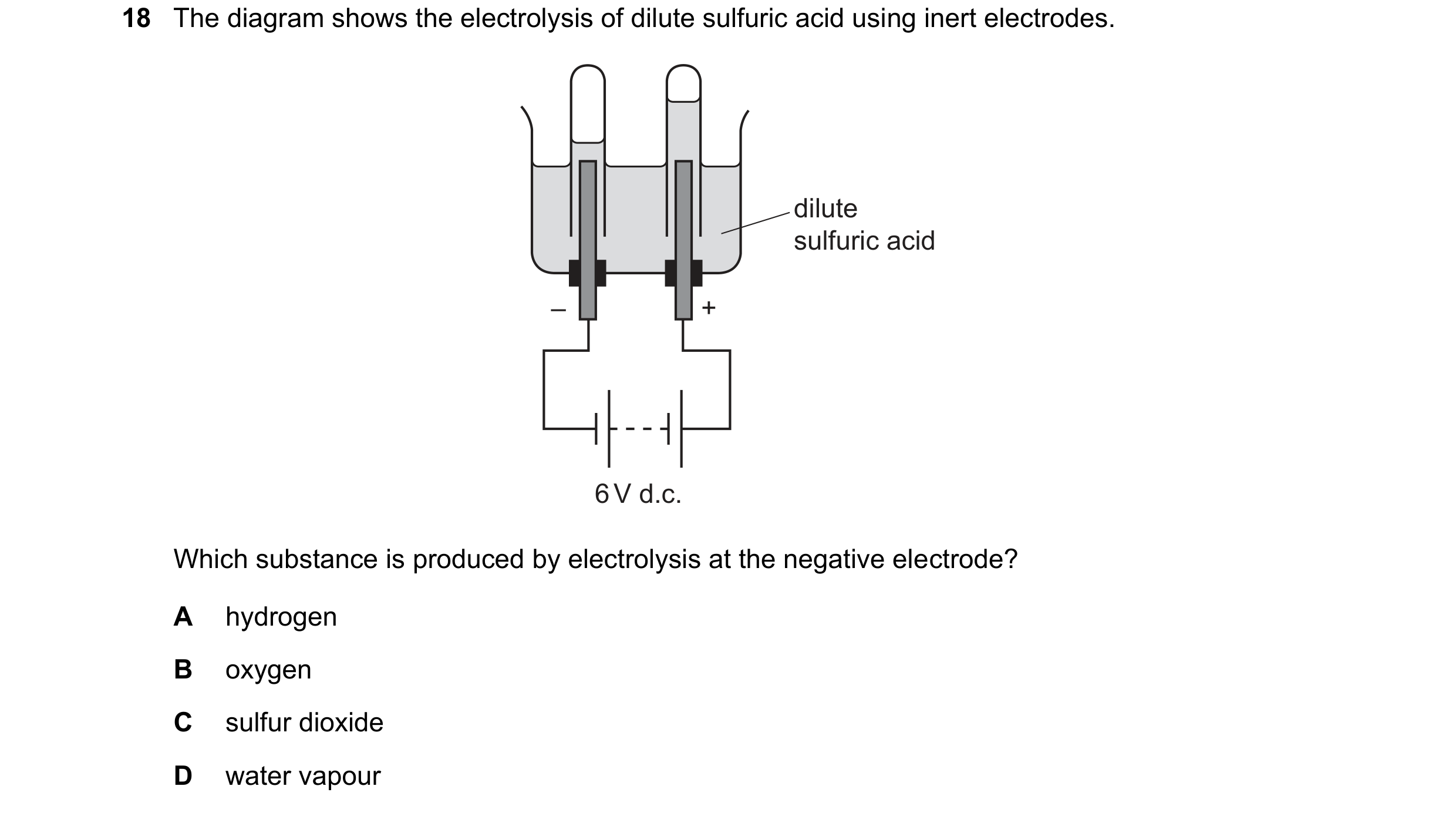
Q86 · The diagram shows the electrolysis of dilute sulfuric acid using inert electrodes 0654/11 Oct/Nov 2023
18 The diagram shows the electrolysis of dilute sulfuric acid using inert electrodes. dilute sulfuric acid – + 6 V d.c. Which substance is produced by electrolysis at the negative electrode? A hydrogen B oxygen C sulfur dioxide D water vapour
1 marks
Answer: A
This question in 0654/11 Oct/Nov 2023
Q87 · Which substance does not undergo electrolysis? 0654/12 Oct/Nov 2023
17 Which substance does not undergo electrolysis? A aqueous copper chloride B copper wire C dilute sulfuric acid D molten lead(II) bromide
1 marks
Answer: B
This question in 0654/12 Oct/Nov 2023
Q88 · The apparatus used for the electrolysis of copper chloride is shown 0654/13 Oct/Nov 2023
18 The apparatus used for the electrolysis of copper chloride is shown. + – … 1 … … 2 … … 3 … copper chloride Which words complete labels 1, 2 and 3? 1 2 3 A anode cathode aqueous B anode cathode solid C cathode anode aqueous D cathode anode solid
1 marks
Answer: A
This question in 0654/13 Oct/Nov 2023
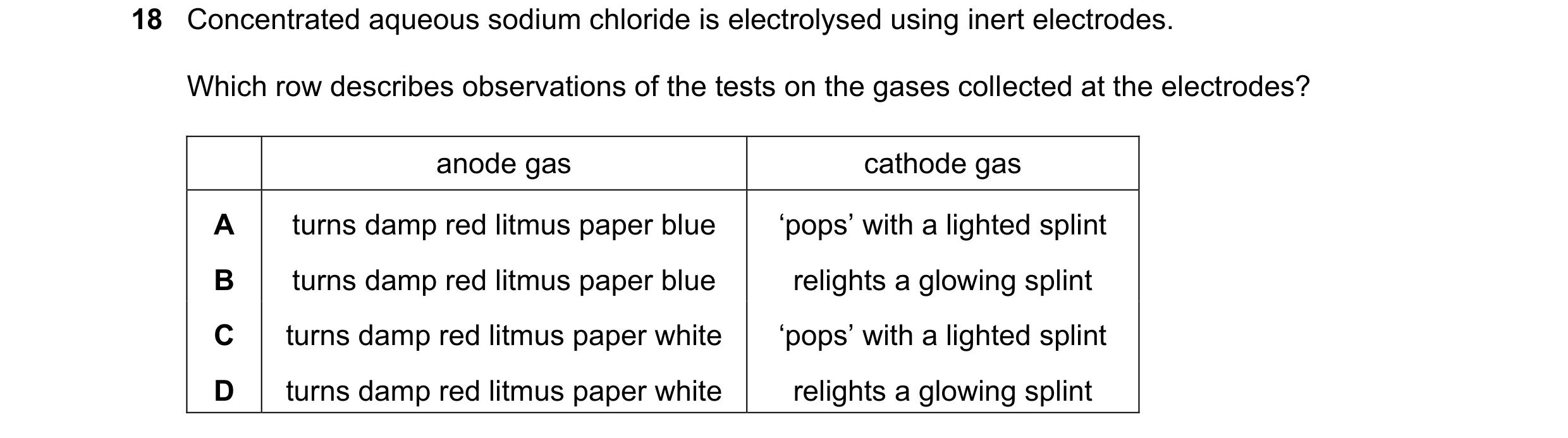
Q89 · Concentrated aqueous sodium chloride is electrolysed using inert electrodes 0654/12 Feb/March 2024
18 Concentrated aqueous sodium chloride is electrolysed using inert electrodes. Which row describes observations of the tests on the gases collected at the electrodes? anode gas cathode gas A turns damp red litmus paper blue ‘pops’ with a lighted splint B turns damp red litmus paper blue relights a glowing splint C turns damp red litmus paper white ‘pops’ with a lighted splint D turns damp red litmus paper white relights a glowing splint
1 marks
Answer: C
This question in 0654/12 Feb/March 2024
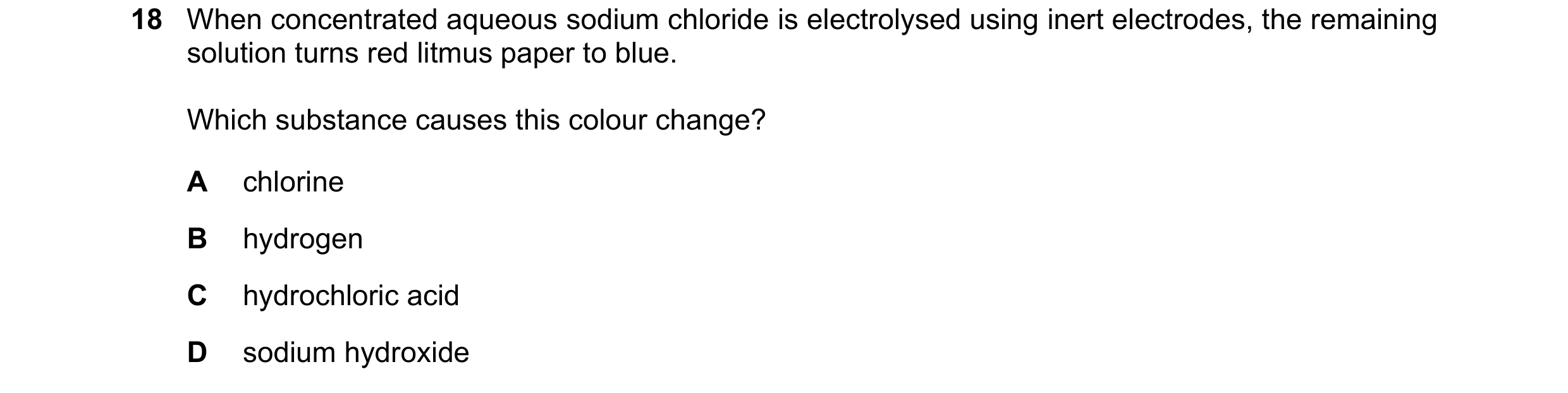
Q90 · When concentrated aqueous sodium chloride is electrolysed using inert electrodes, the… 0654/11 May/June 2024
18 When concentrated aqueous sodium chloride is electrolysed using inert electrodes, the remaining solution turns red litmus paper to blue. Which substance causes this colour change? A chlorine B hydrogen C hydrochloric acid D sodium hydroxide
1 marks
Answer: D
This question in 0654/11 May/June 2024
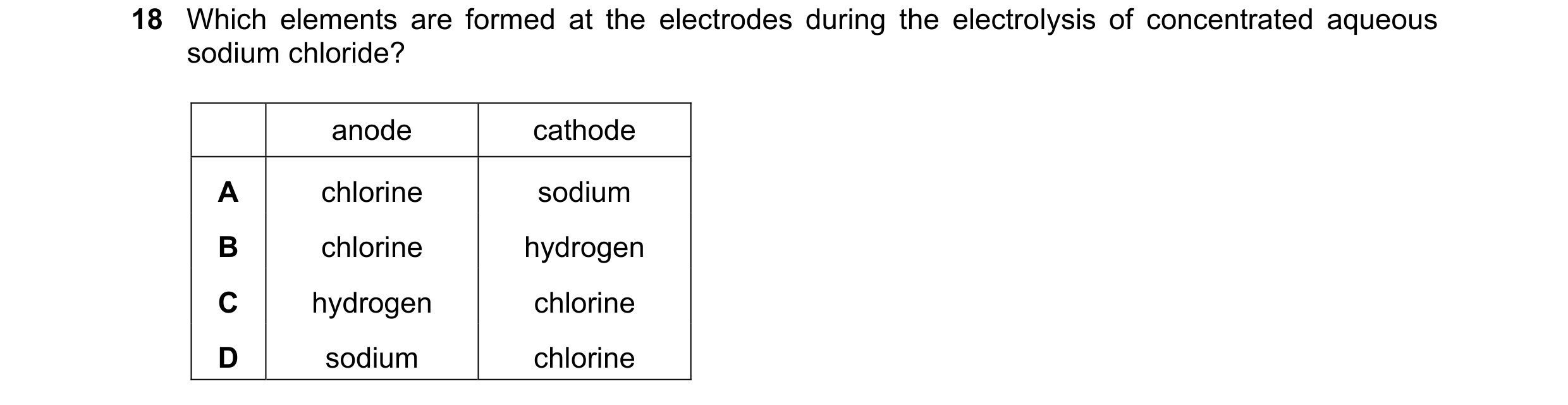
Q91 · Which elements are formed at the electrodes during the electrolysis of concentrated… 0654/11 Oct/Nov 2024
18 Which elements are formed at the electrodes during the electrolysis of concentrated aqueous sodium chloride? anode cathode A chlorine sodium B chlorine hydrogen C hydrogen chlorine D sodium chlorine
1 marks
Answer: B
This question in 0654/11 Oct/Nov 2024
Q92 · What are the products of the electrolysis of dilute sulfuric acid using inert electrodes? 0654/12 Oct/Nov 2024
17 What are the products of the electrolysis of dilute sulfuric acid using inert electrodes? A hydrogen and sulfur dioxide B oxygen and hydrogen C oxygen and sulfur D oxygen and sulfur dioxide
1 marks
Answer: B
This question in 0654/12 Oct/Nov 2024
Q93 · What are the products of the electrolysis of dilute sulfuric acid using inert electrodes? 0654/13 Oct/Nov 2024
17 What are the products of the electrolysis of dilute sulfuric acid using inert electrodes? A hydrogen and sulfur dioxide B oxygen and hydrogen C oxygen and sulfur D oxygen and sulfur dioxide
1 marks
Answer: B
This question in 0654/13 Oct/Nov 2024
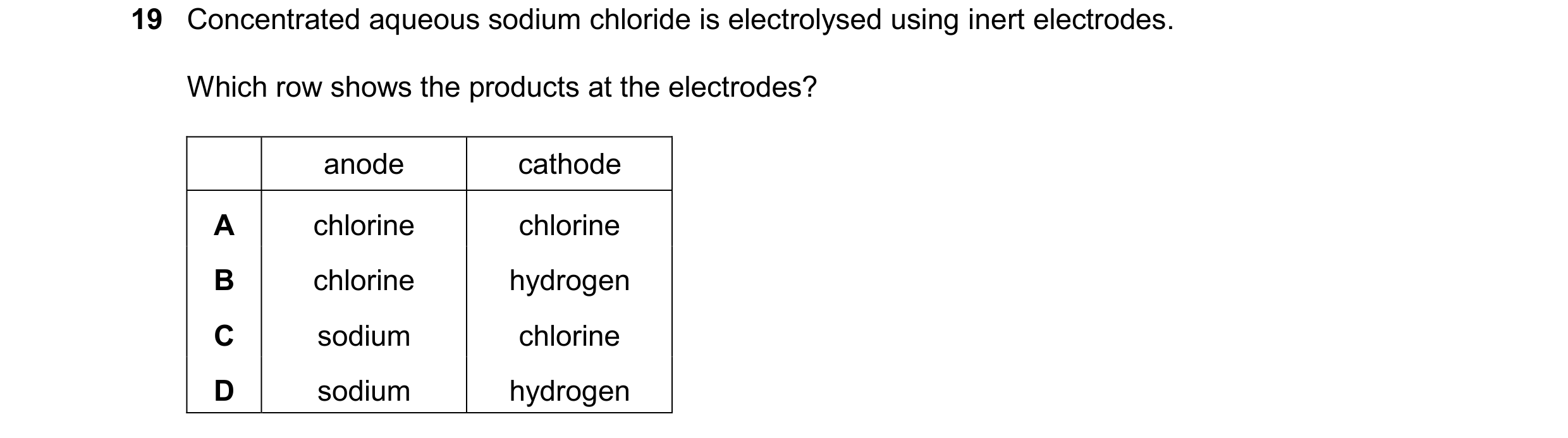
Q94 · Concentrated aqueous sodium chloride is electrolysed using inert electrodes 0654/12 Feb/March 2025
19 Concentrated aqueous sodium chloride is electrolysed using inert electrodes. Which row shows the products at the electrodes? anode cathode A chlorine chlorine B chlorine hydrogen C sodium chlorine D sodium hydrogen
1 marks
Answer: B
This question in 0654/12 Feb/March 2025
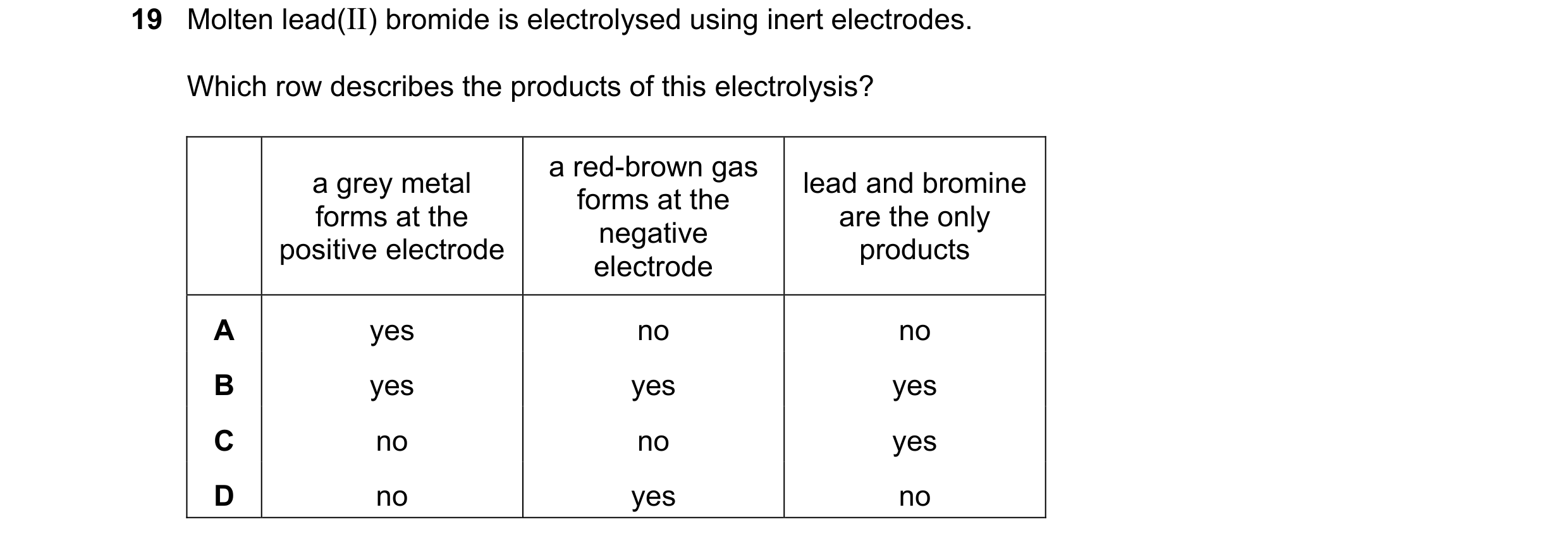
Q95 · Molten lead(II) bromide is electrolysed using inert electrodes 0654/11 May/June 2025
19 Molten lead(II) bromide is electrolysed using inert electrodes. Which row describes the products of this electrolysis? a red-brown gas a grey metal lead and bromine forms at the forms at the are the only negative positive electrode products electrode A yes no no B yes yes yes C no no yes D no yes no
1 marks
Answer: C
This question in 0654/11 May/June 2025
Q96 · The apparatus used in the electrolysis of concentrated aqueous sodium chloride is shown 0654/12 May/June 2025
16 The apparatus used in the electrolysis of concentrated aqueous sodium chloride is shown. 1 + – 3 2 4 Which row identifies the electrolyte and the cathode? electrolyte cathode A 1 2 B 1 3 C 4 2 D 4 3
1 marks
Answer: C
This question in 0654/12 May/June 2025
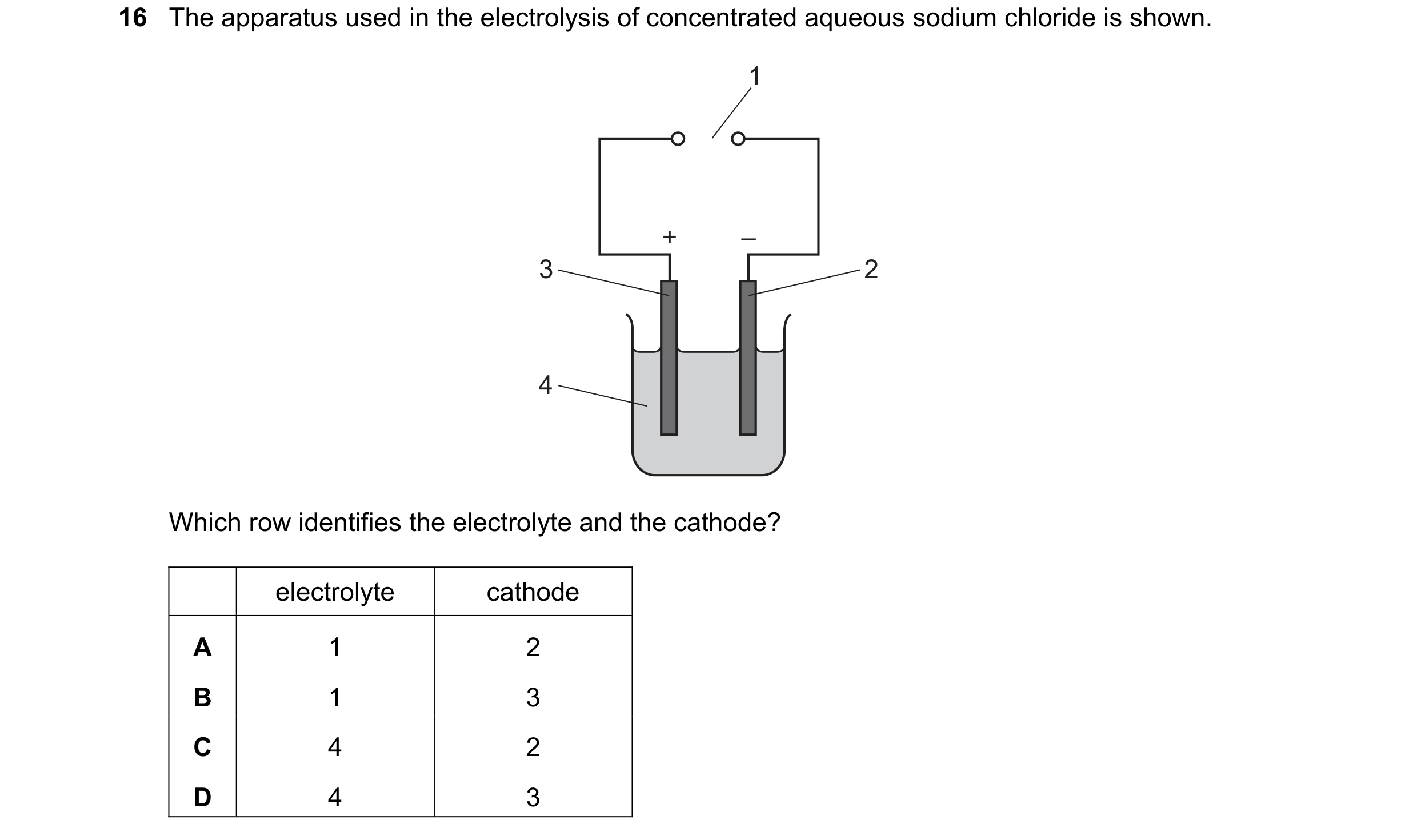
Q97 · The apparatus used in the electrolysis of concentrated aqueous sodium chloride is shown 0654/13 May/June 2025
16 The apparatus used in the electrolysis of concentrated aqueous sodium chloride is shown. 1 + – 3 2 4 Which row identifies the electrolyte and the cathode? electrolyte cathode A 1 2 B 1 3 C 4 2 D 4 3
1 marks
Answer: C
This question in 0654/13 May/June 2025
Q98 · The electrolysis of concentrated aqueous sodium chloride is shown 0654/11 Oct/Nov 2025
19 The electrolysis of concentrated aqueous sodium chloride is shown. inert inert positive negative electrode electrode concentrated aqueous sodium chloride Which statement describes the product at the cathode? A It is a colourless gas that pops with a lighted splint. B It is a colourless gas that relights a glowing splint. C It is a grey-black solid. D It is a pale yellow-green gas that bleaches litmus paper.
1 marks
Answer: A
This question in 0654/11 Oct/Nov 2025
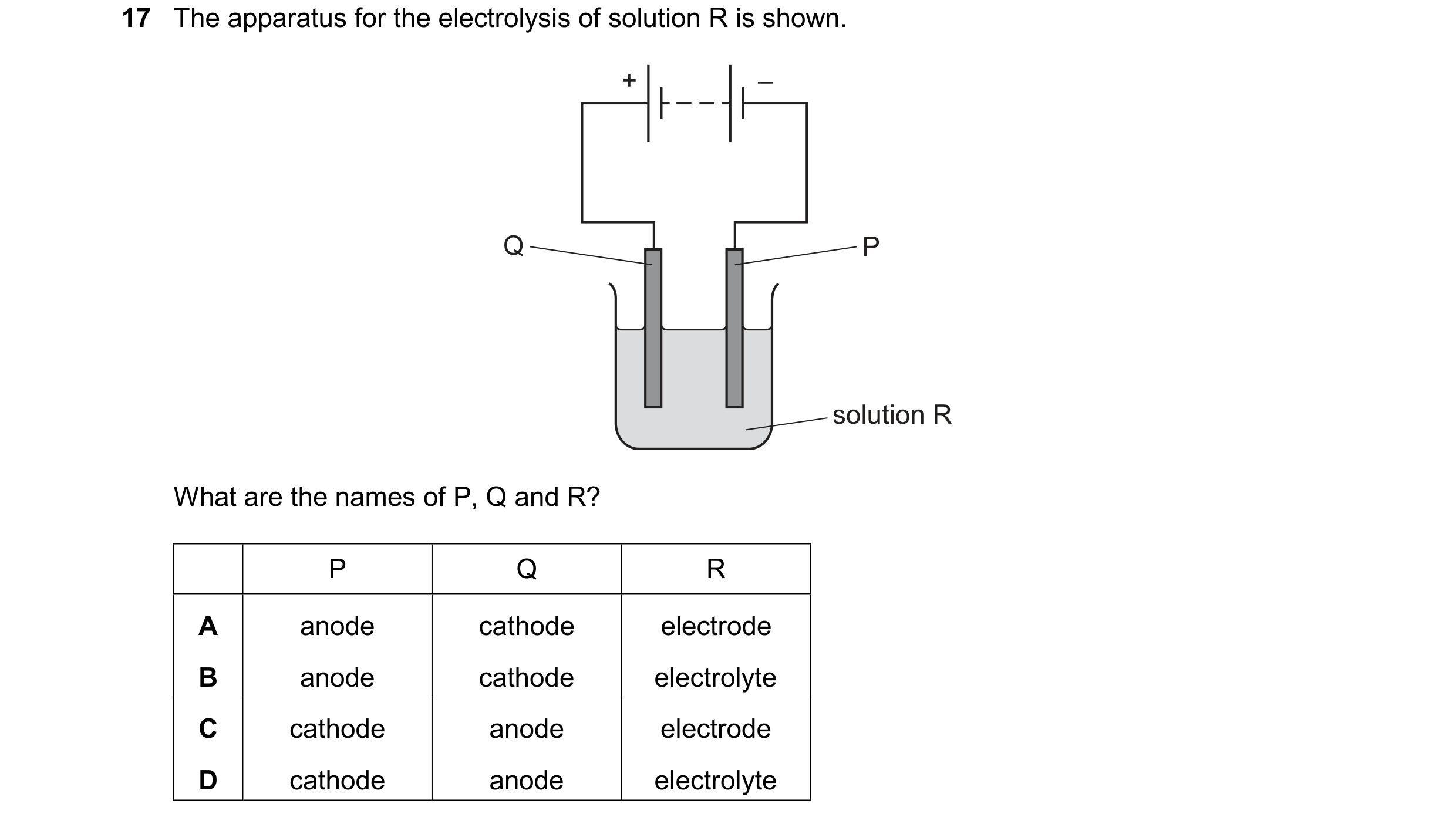
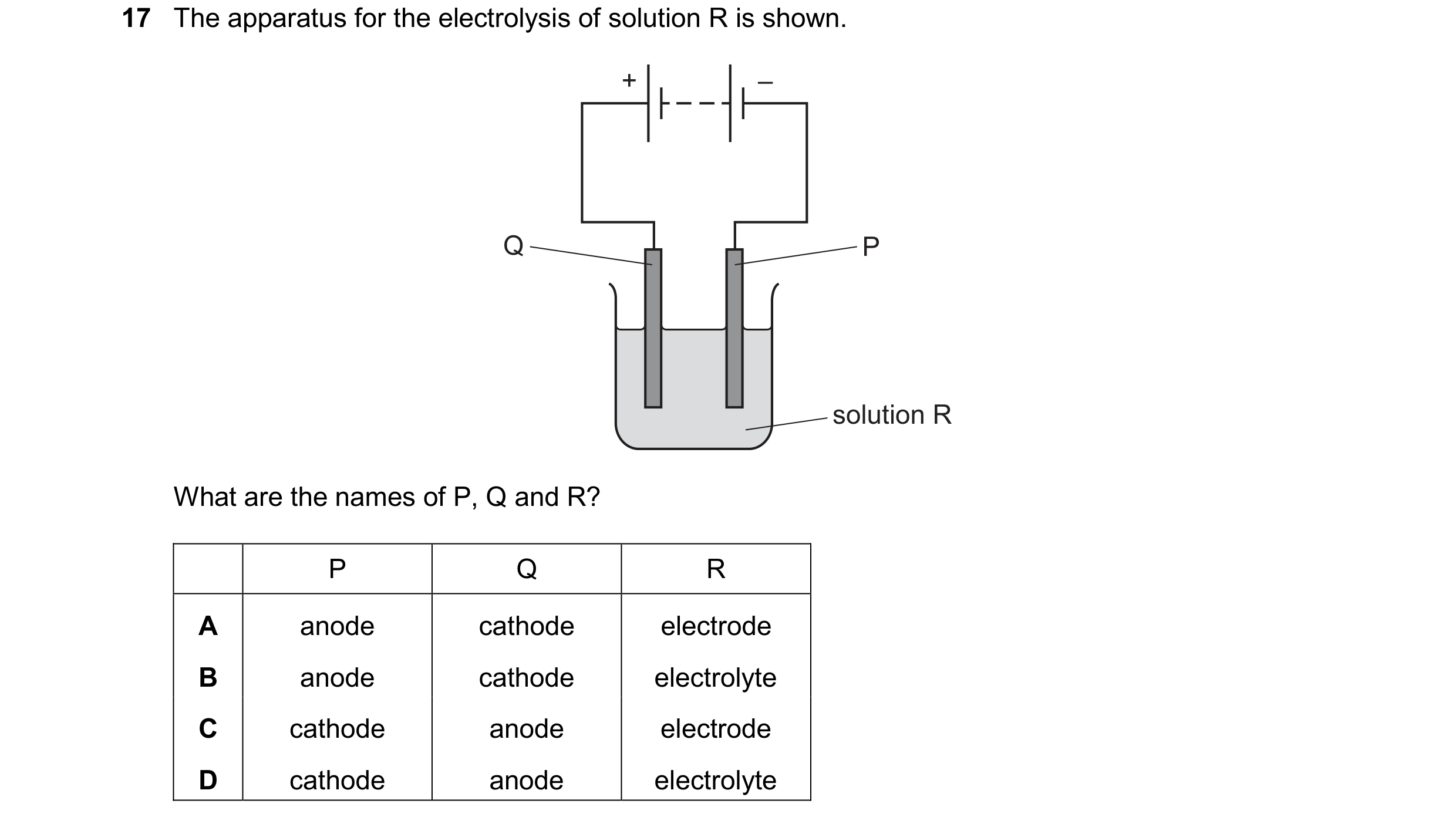
Q99 · The apparatus for the electrolysis of solution R is shown 0654/12 Oct/Nov 2025
17 The apparatus for the electrolysis of solution R is shown. + – Q P solution R What are the names of P, Q and R? P Q R A anode cathode electrode B anode cathode electrolyte C cathode anode electrode D cathode anode electrolyte
1 marks
Answer: D
This question in 0654/12 Oct/Nov 2025
Q100 · The apparatus for the electrolysis of solution R is shown 0654/13 Oct/Nov 2025
17 The apparatus for the electrolysis of solution R is shown. + – Q P solution R What are the names of P, Q and R? P Q R A anode cathode electrode B anode cathode electrolyte C cathode anode electrode D cathode anode electrolyte
1 marks
Answer: D
This question in 0654/13 Oct/Nov 2025
 1 / 44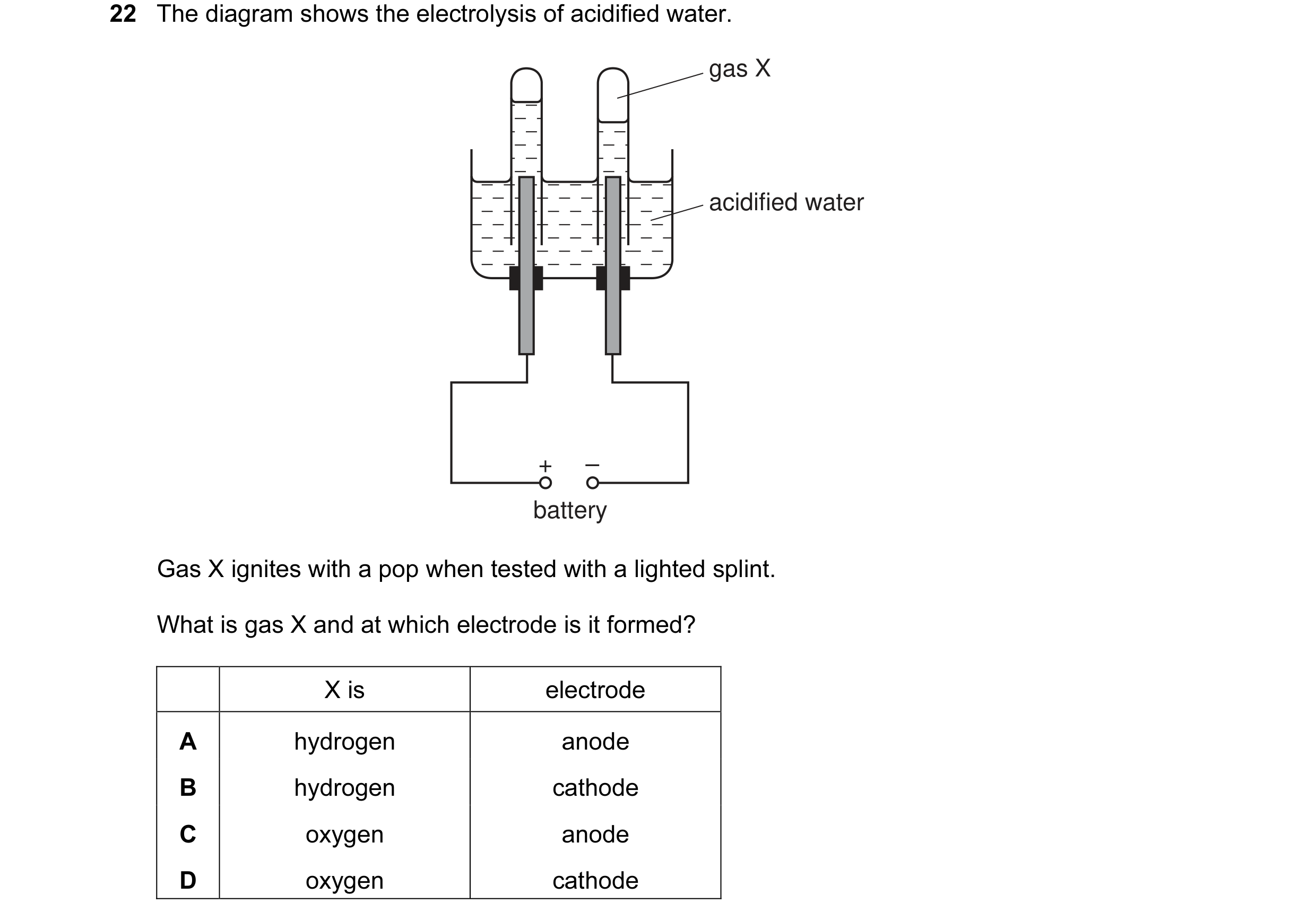
 2 / 44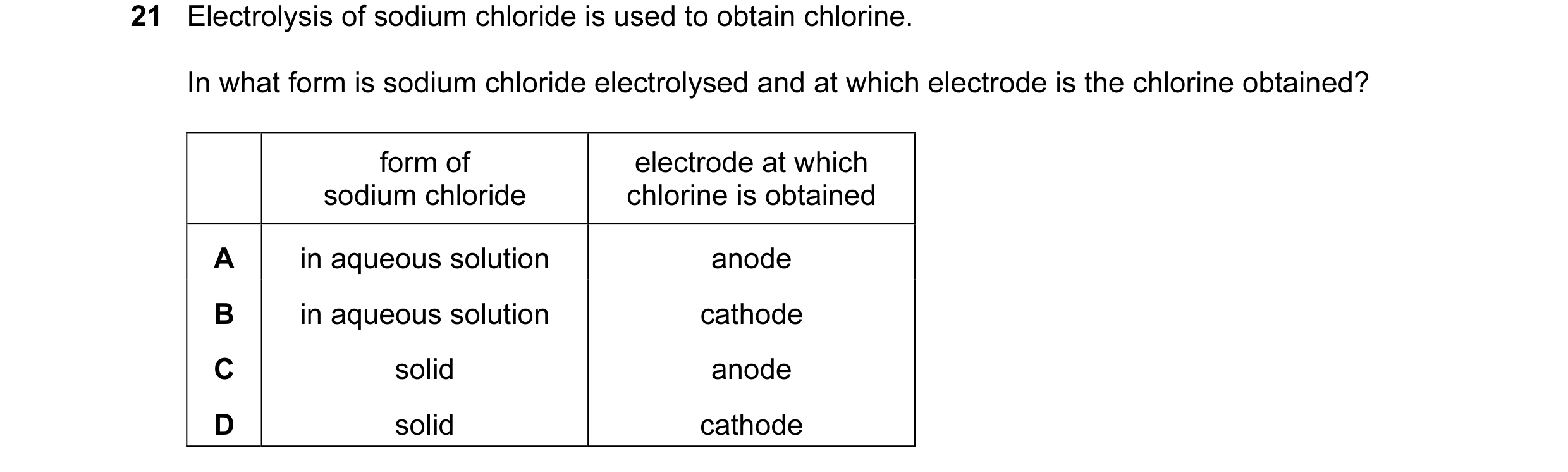
 3 / 44
 4 / 44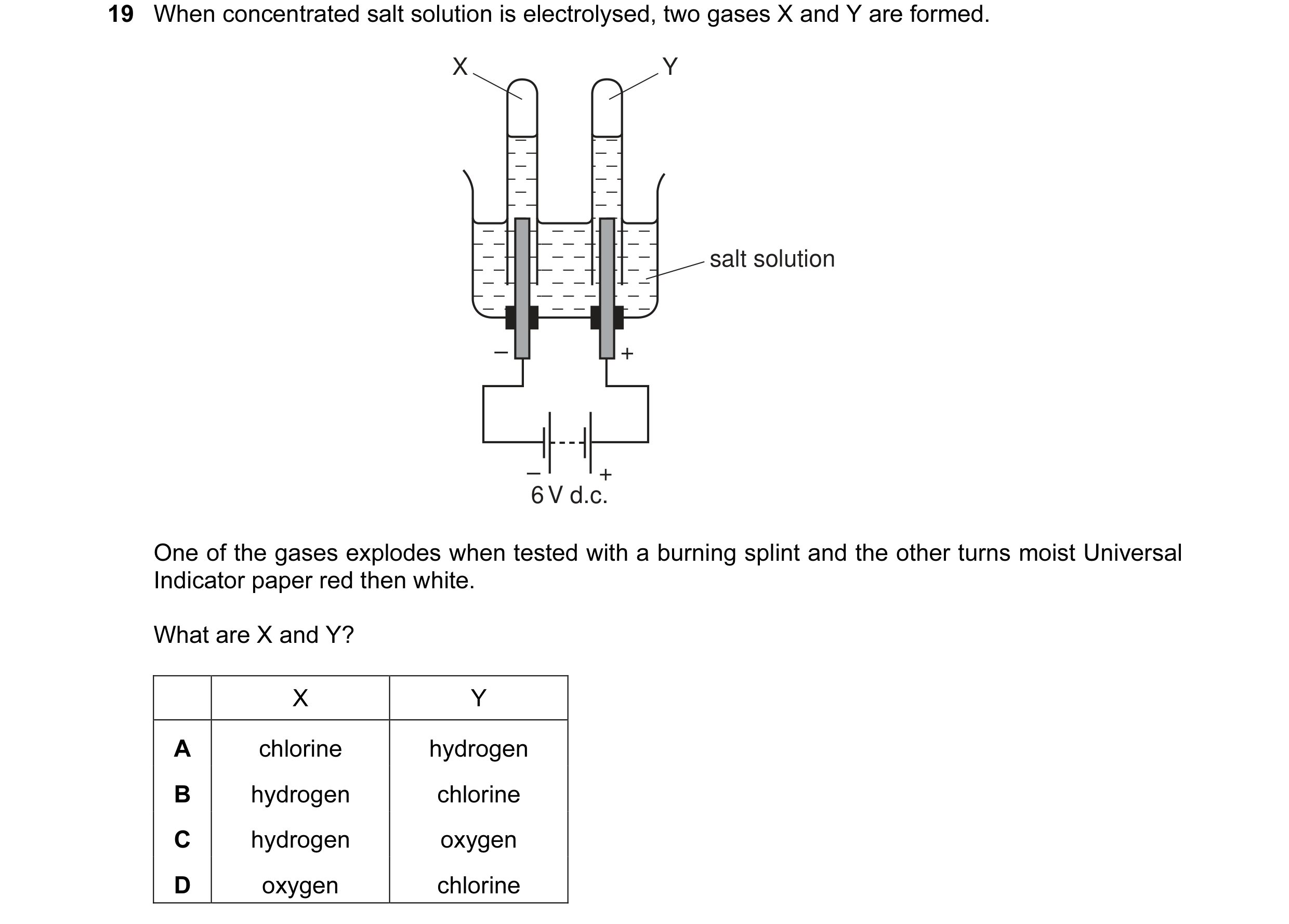
 5 / 44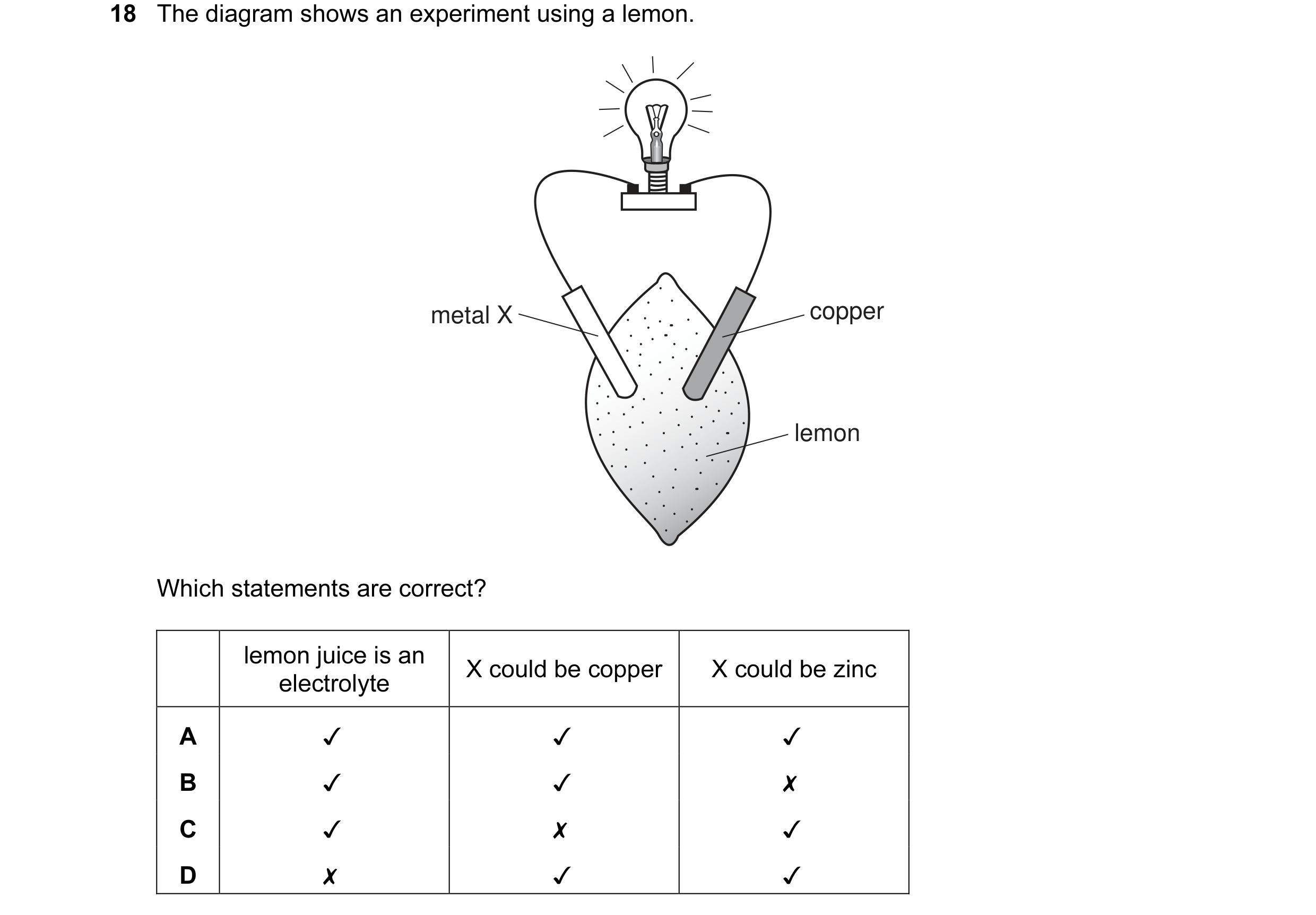
 6 / 44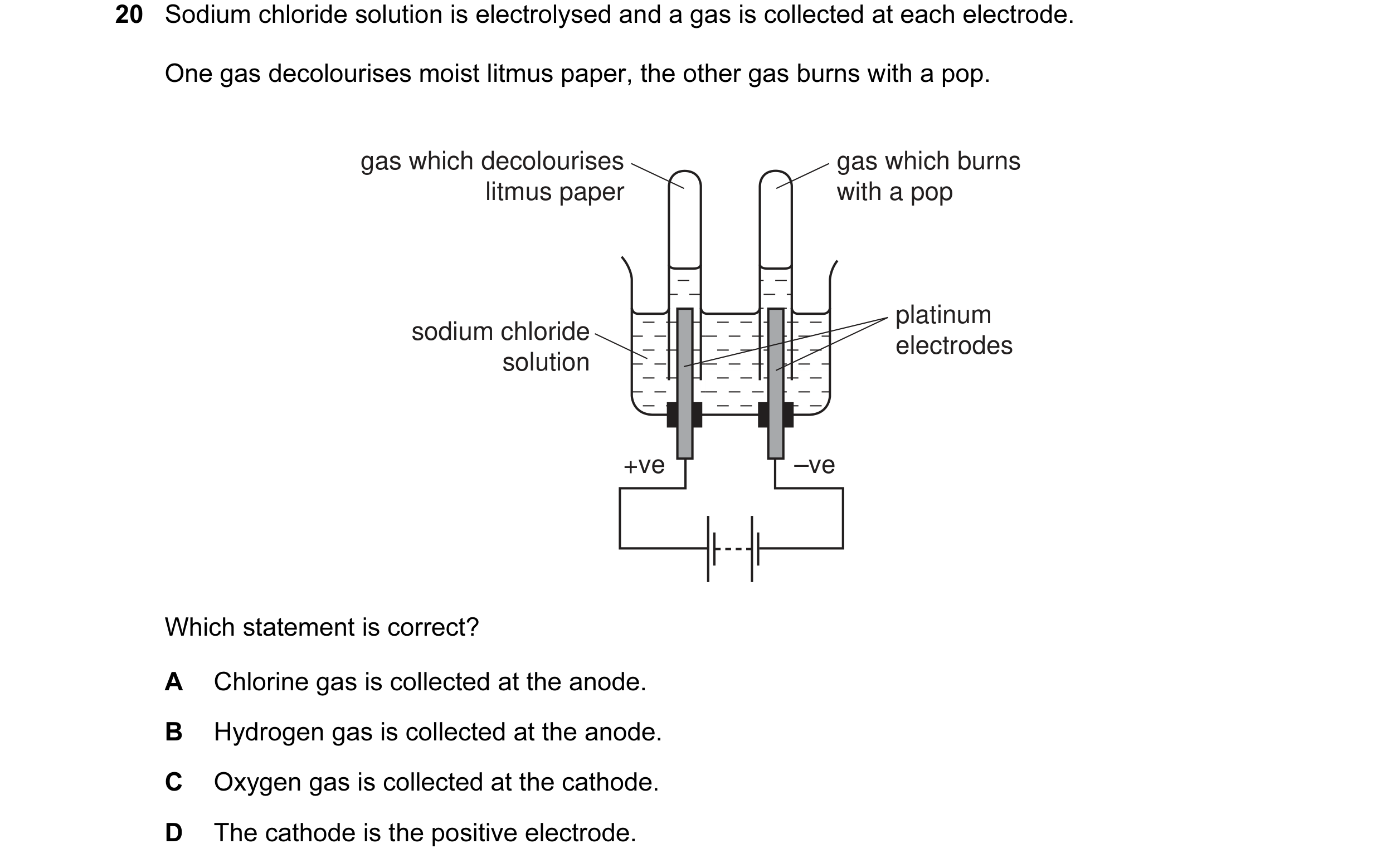
 7 / 44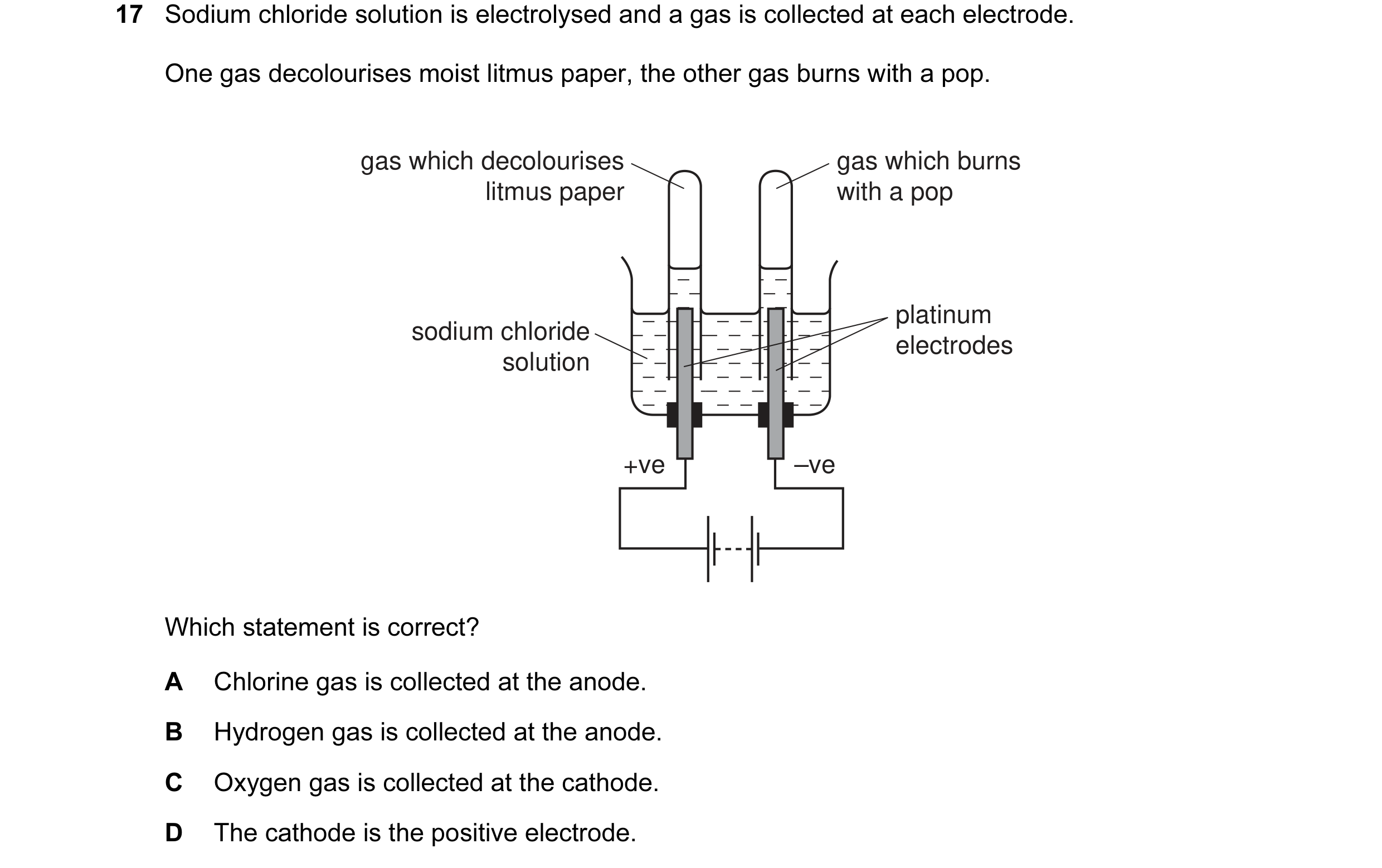
 8 / 44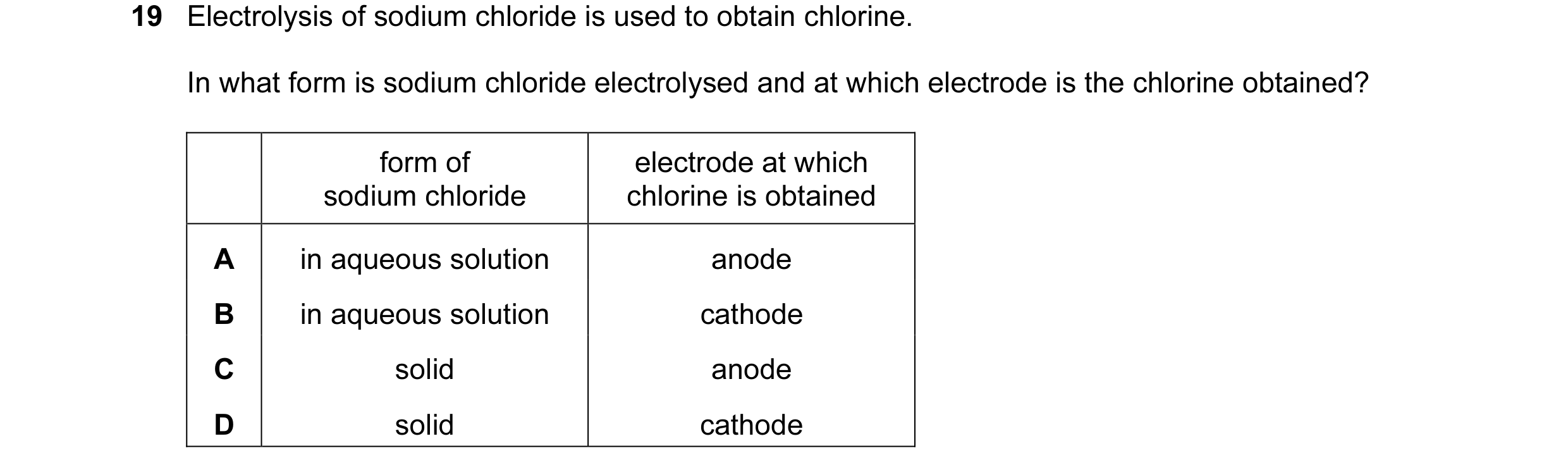
 9 / 44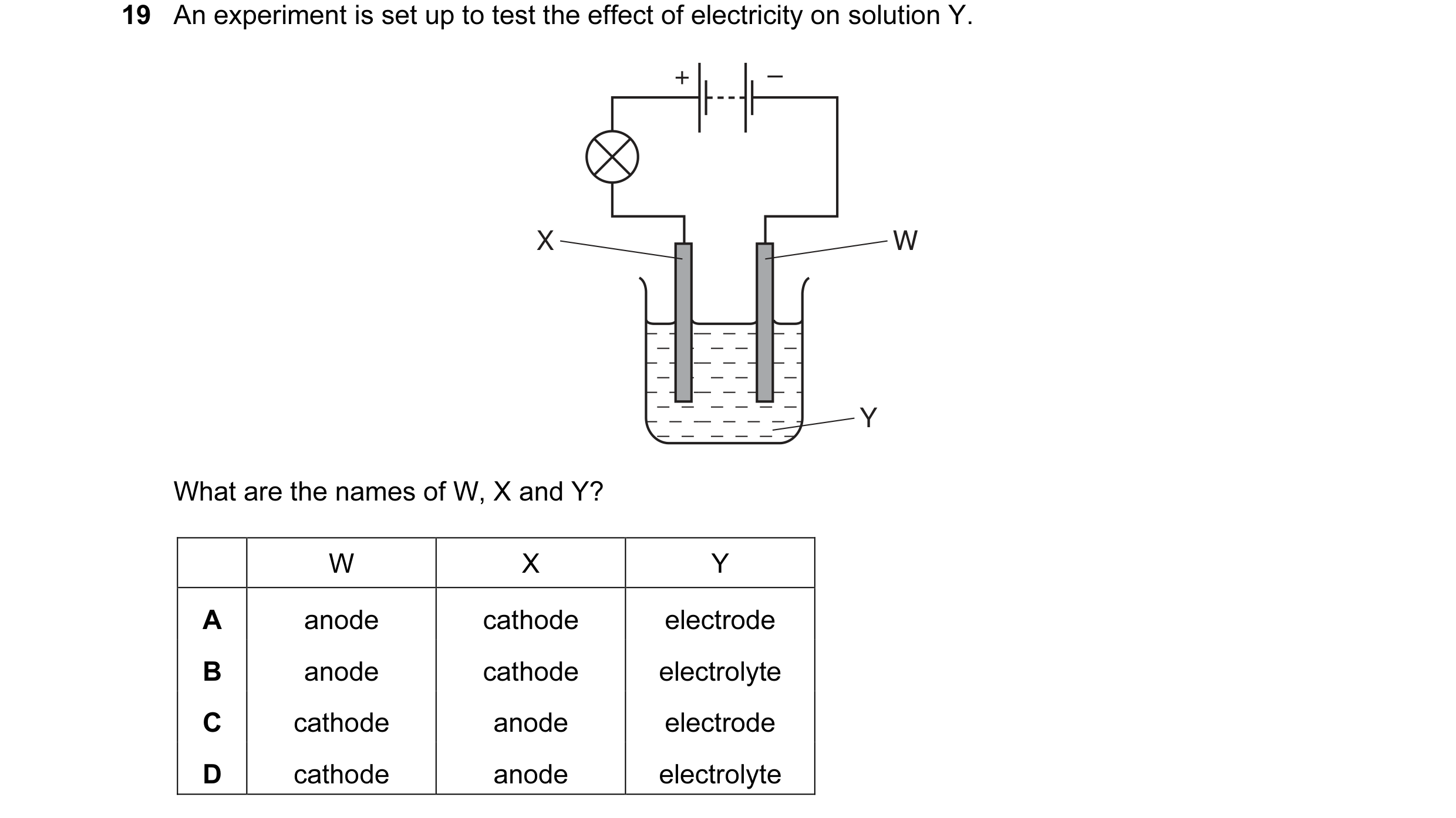
 10 / 44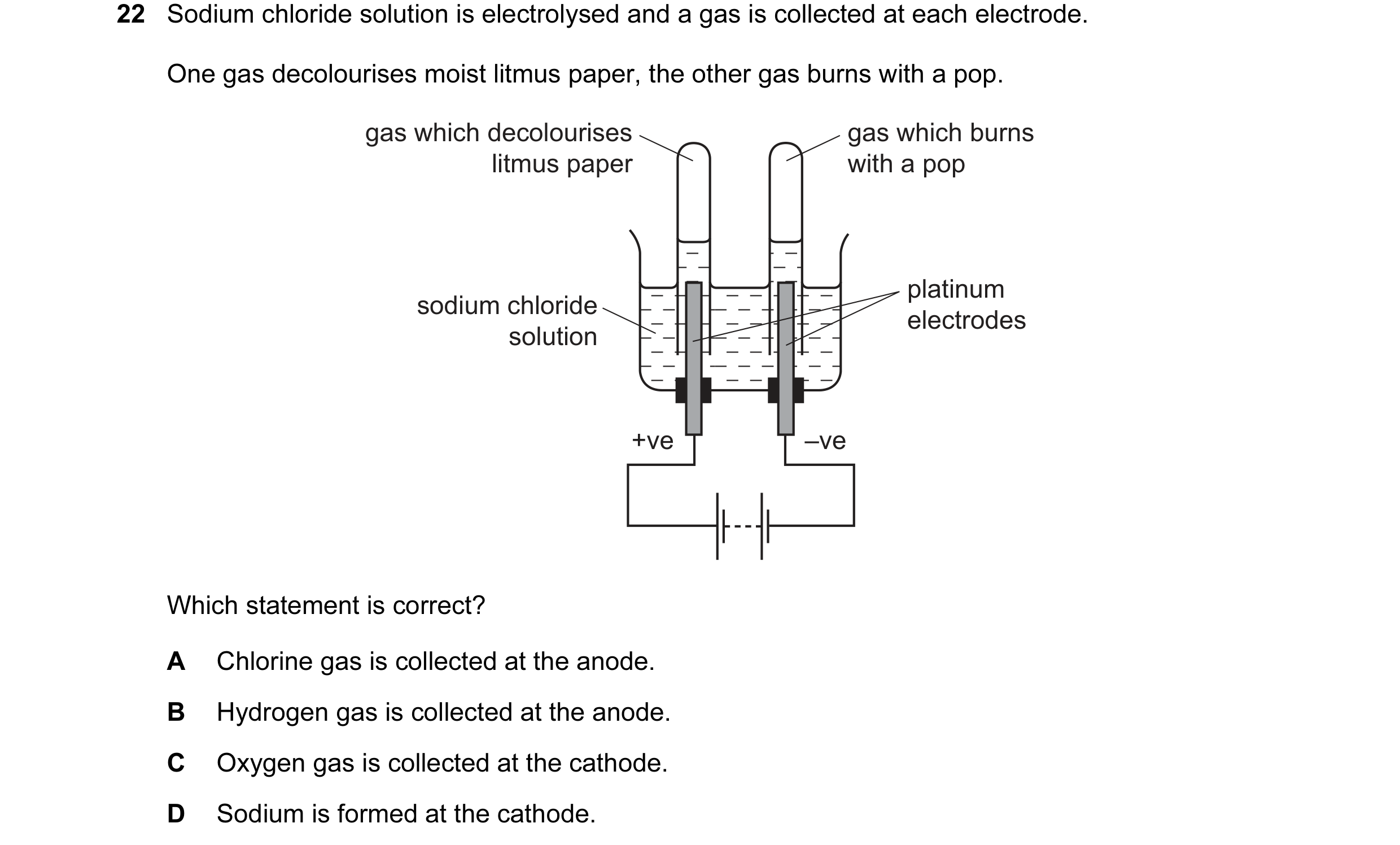
 11 / 44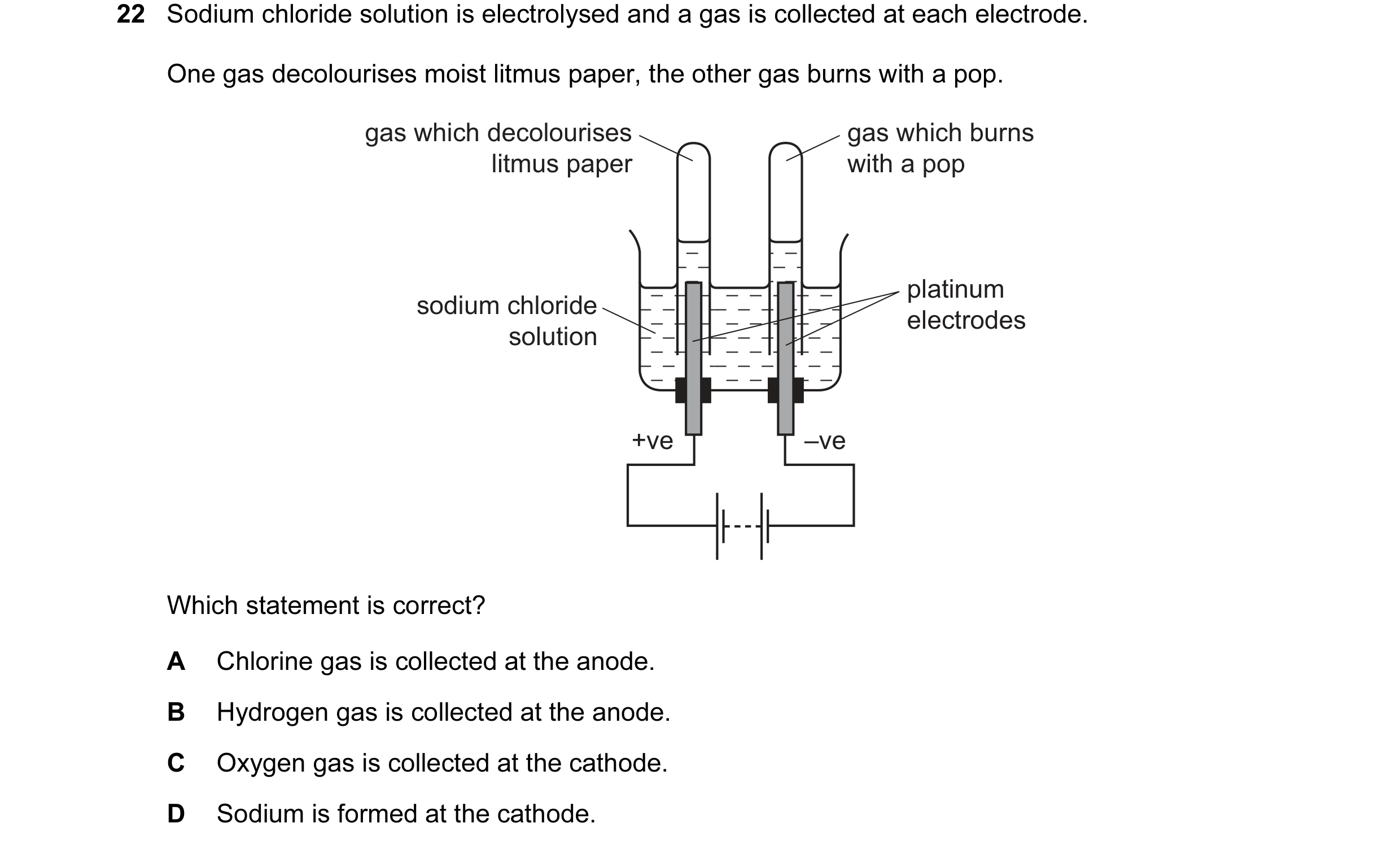
 12 / 44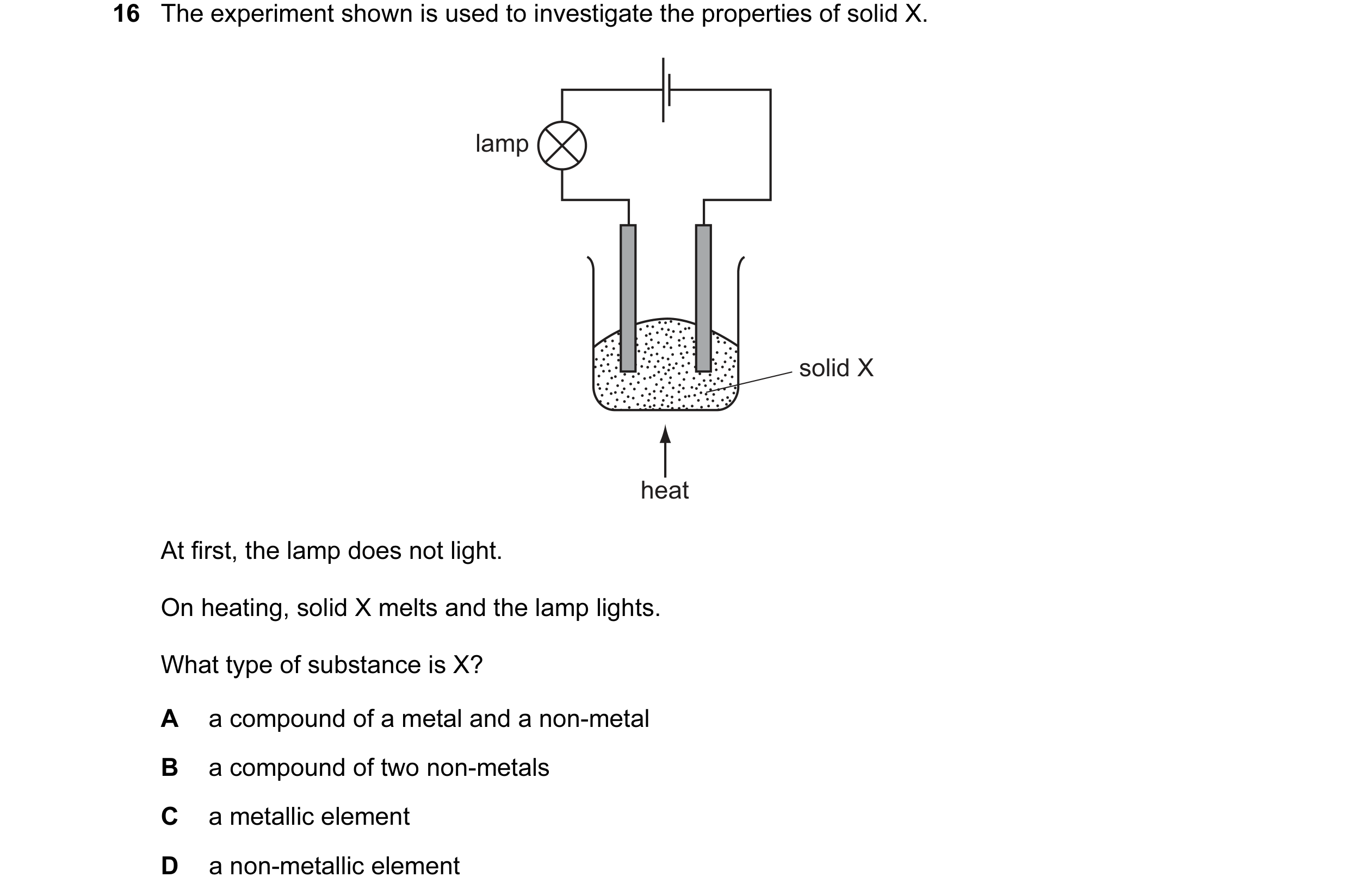
 13 / 44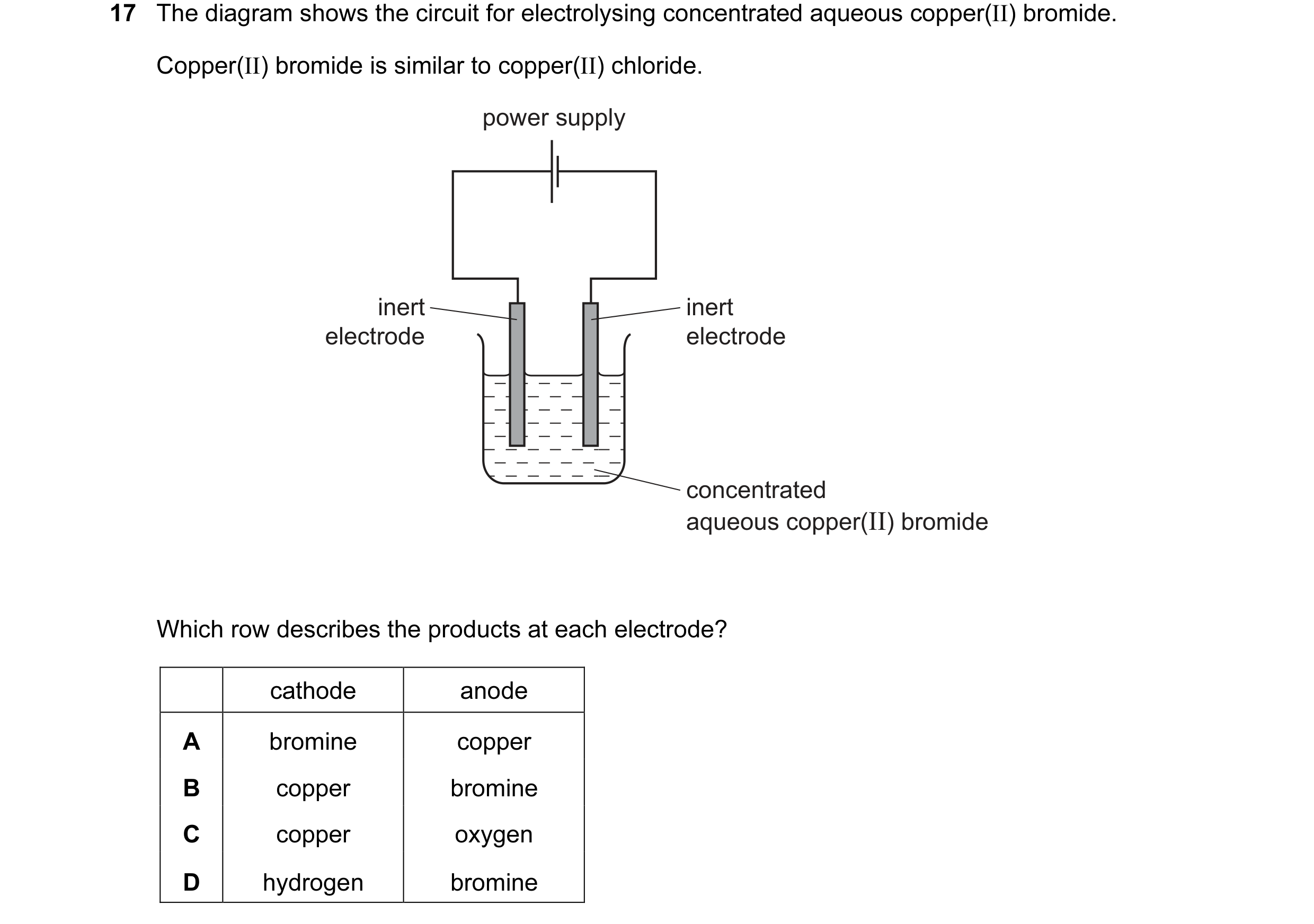
 14 / 44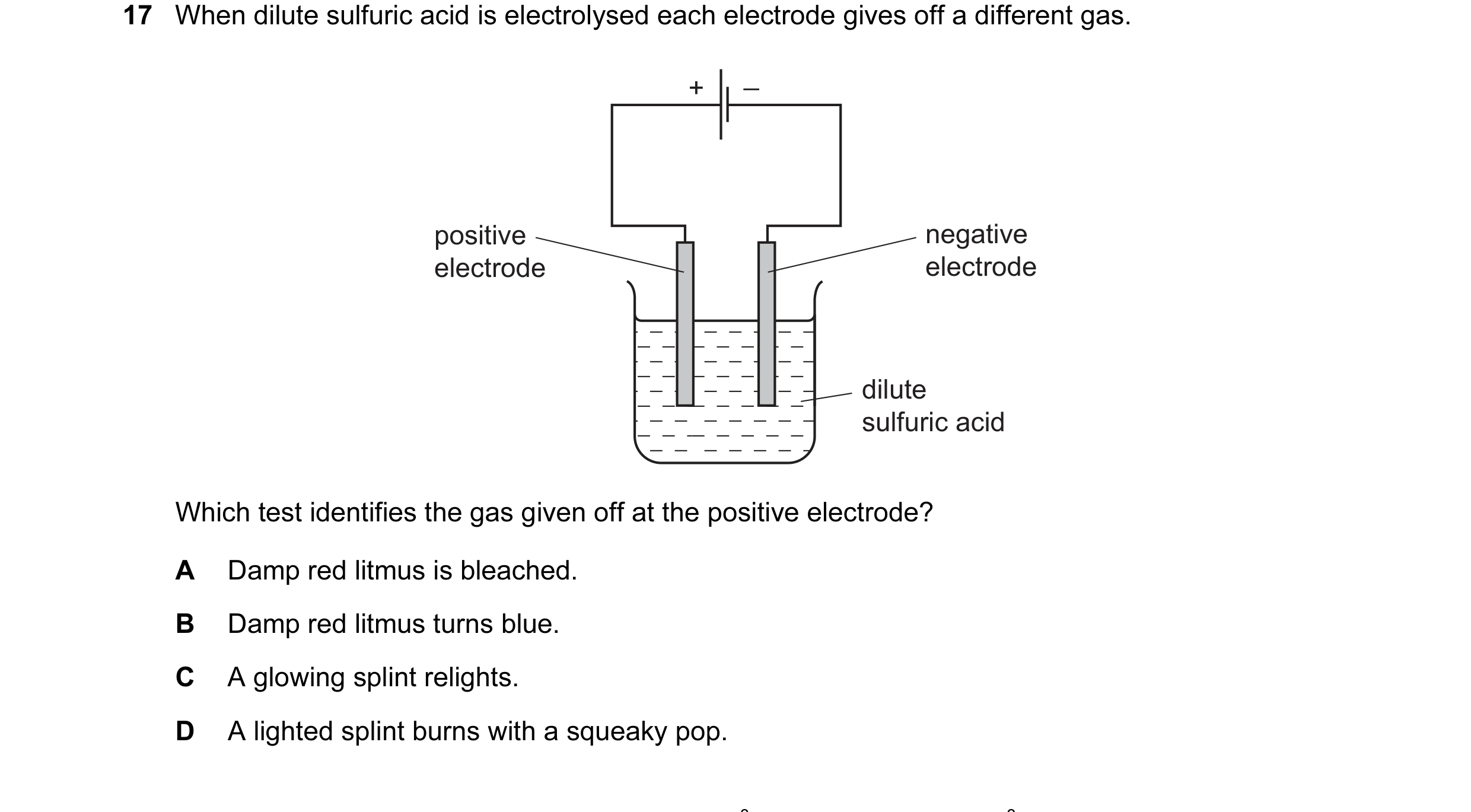
 15 / 44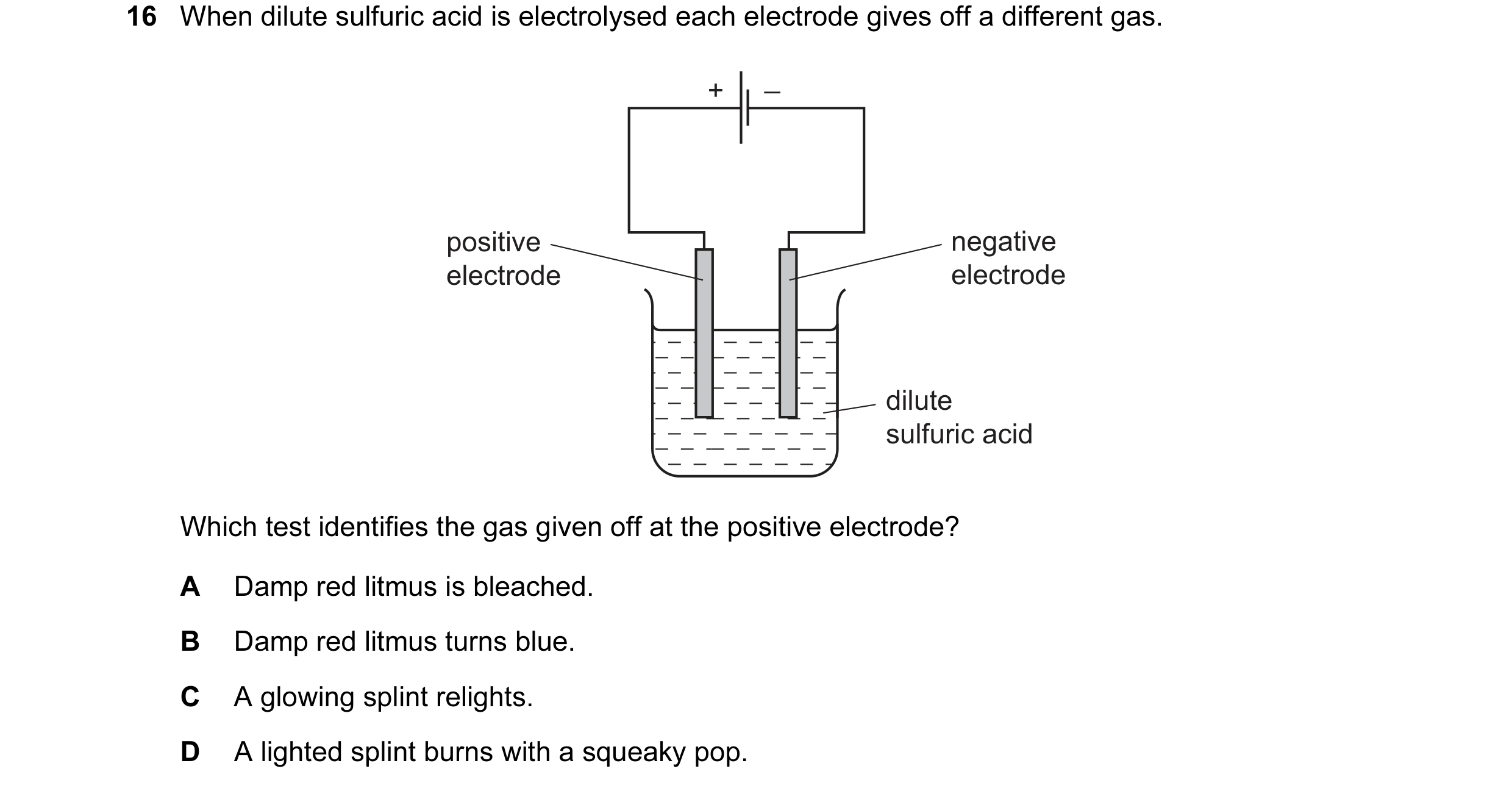
 16 / 44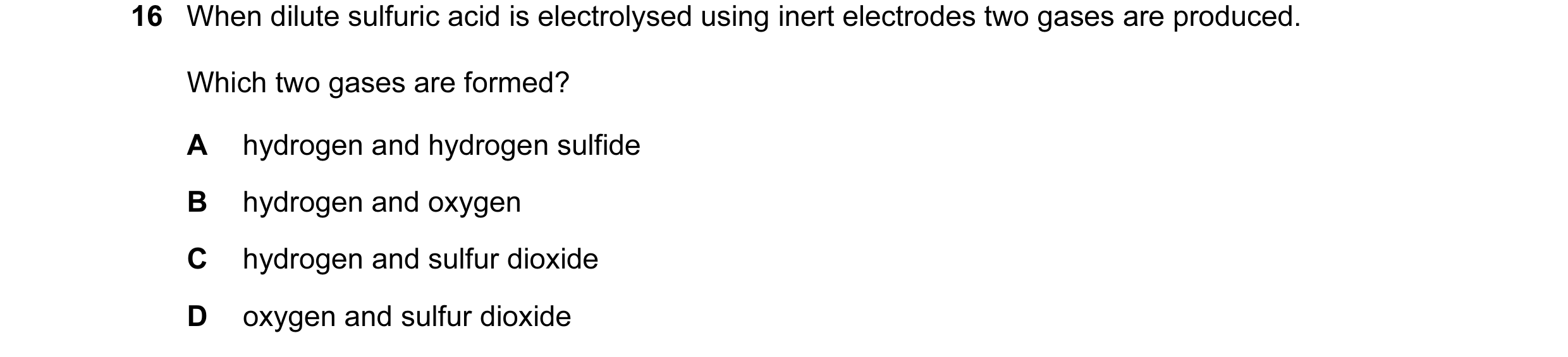
 17 / 44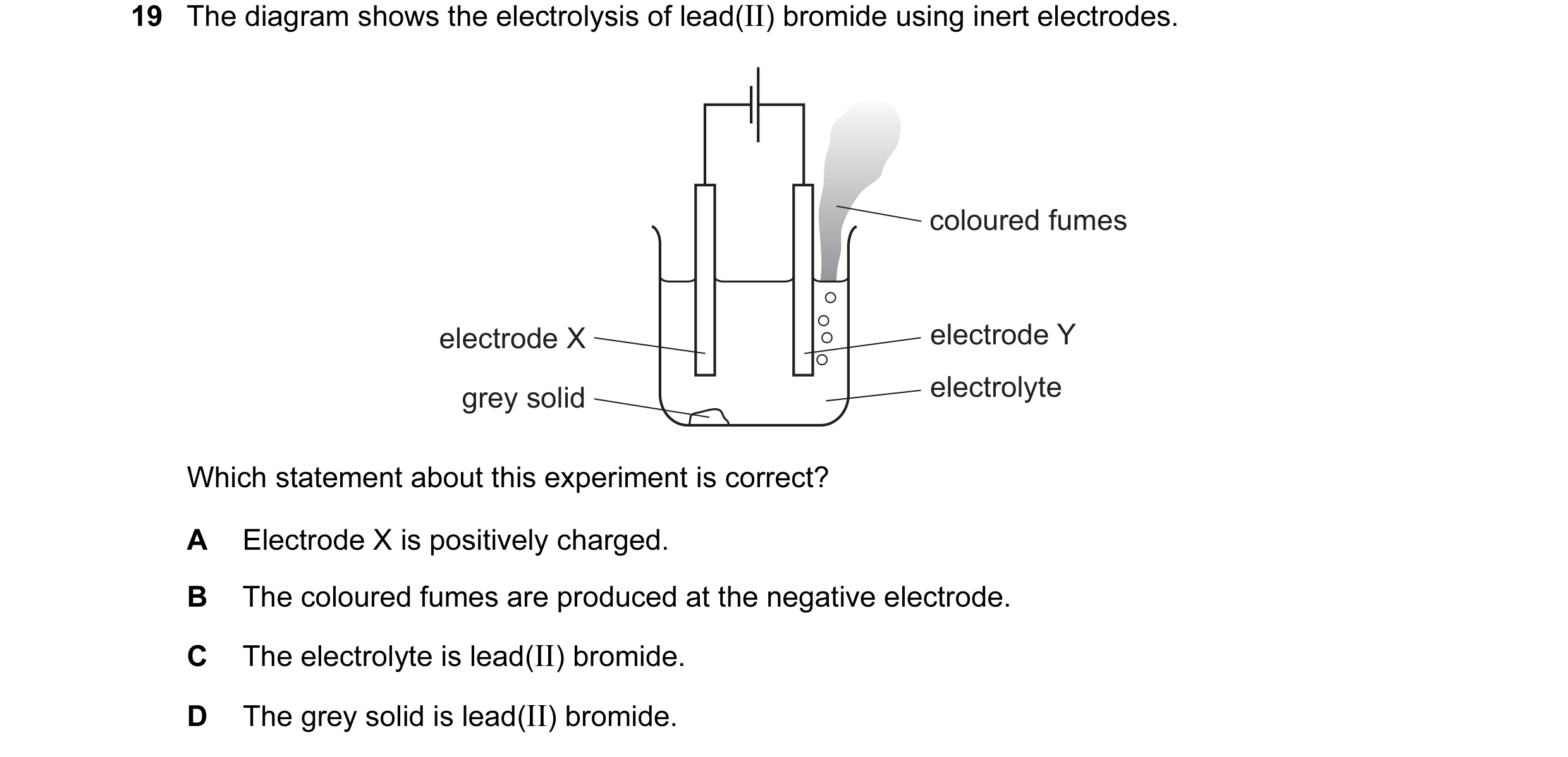
 18 / 44
 19 / 44
 20 / 44
 21 / 44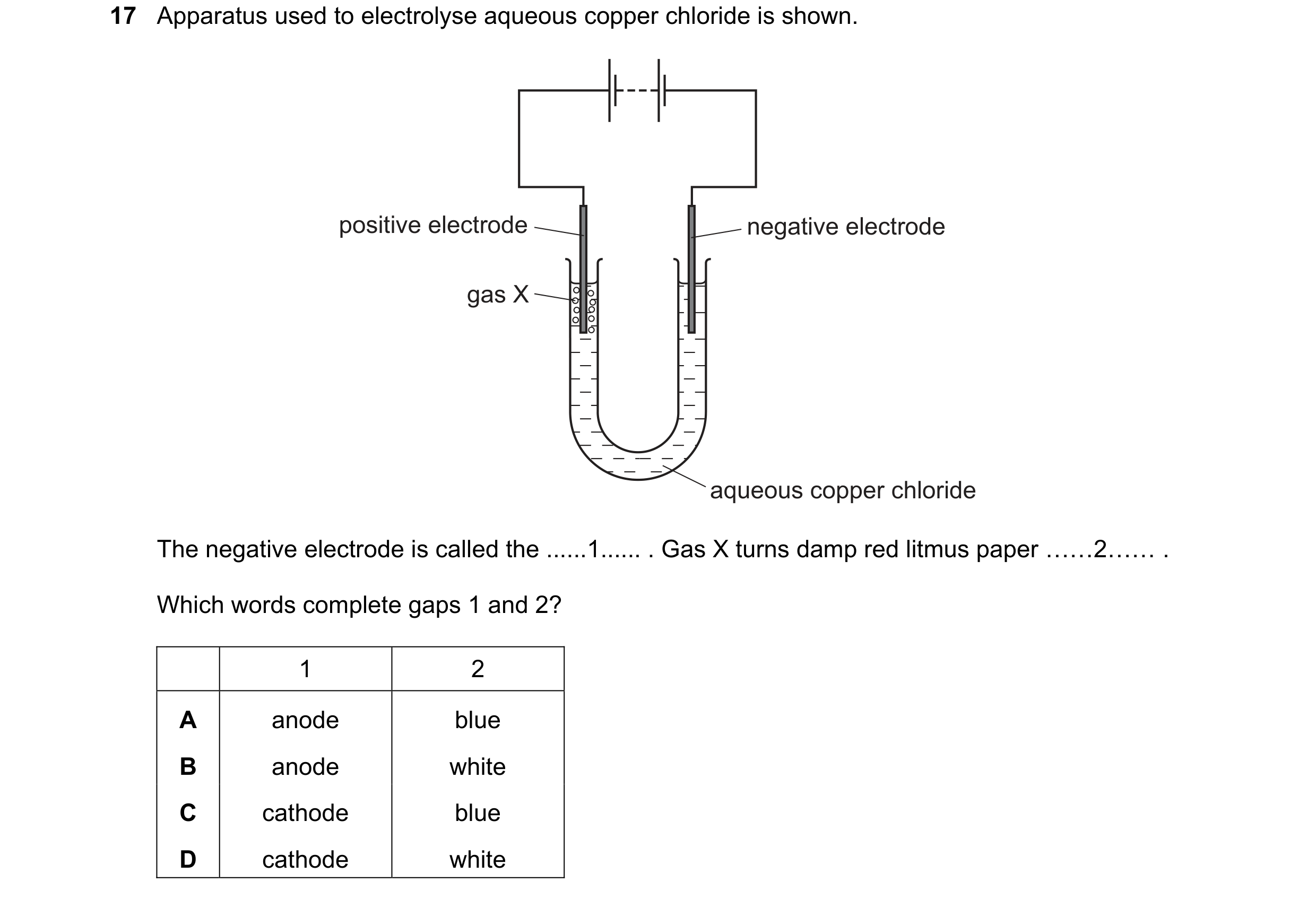
 22 / 44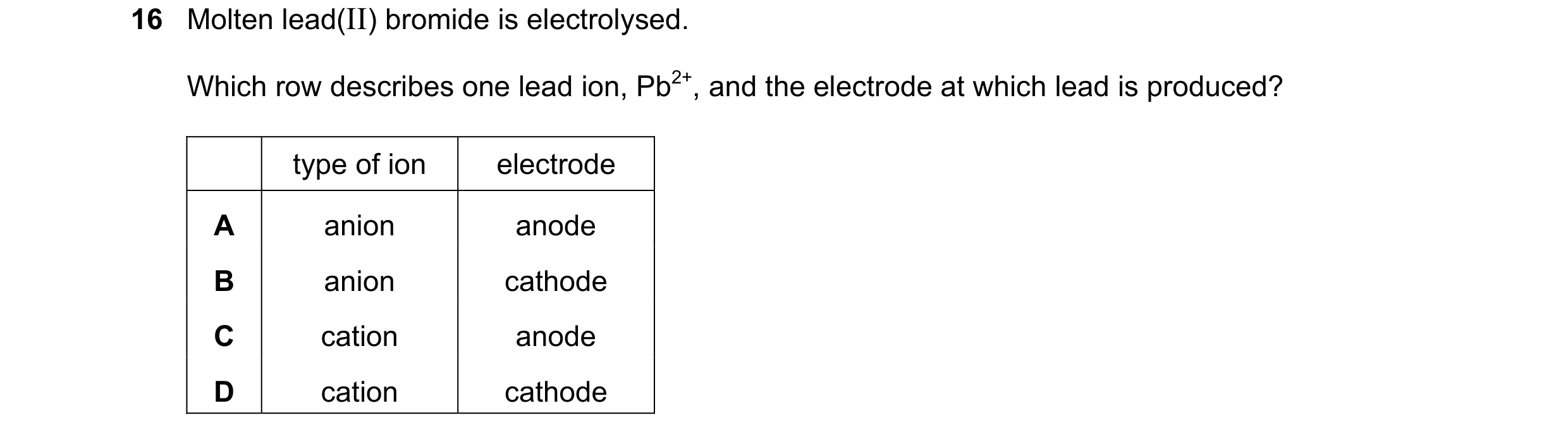
 23 / 44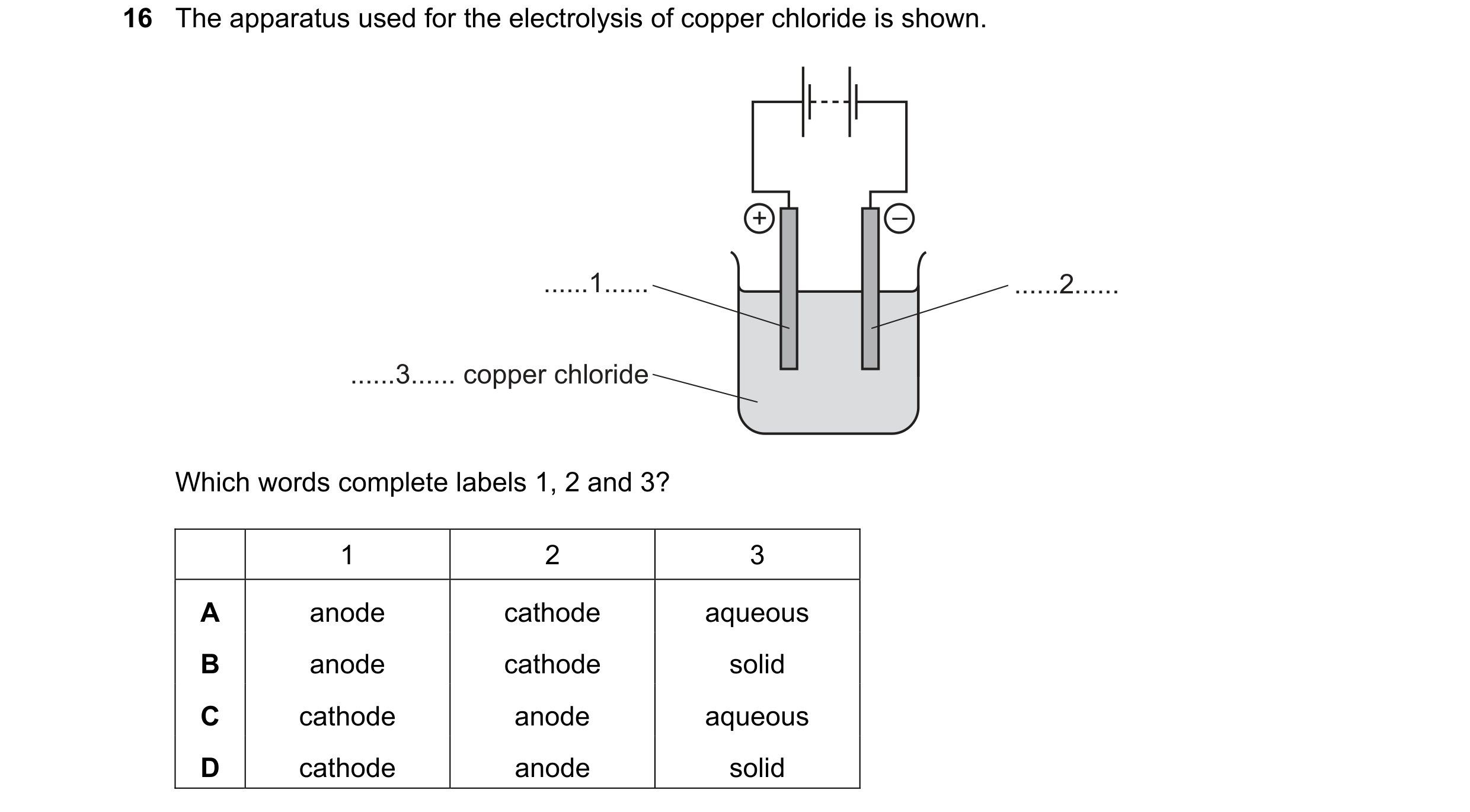
 24 / 44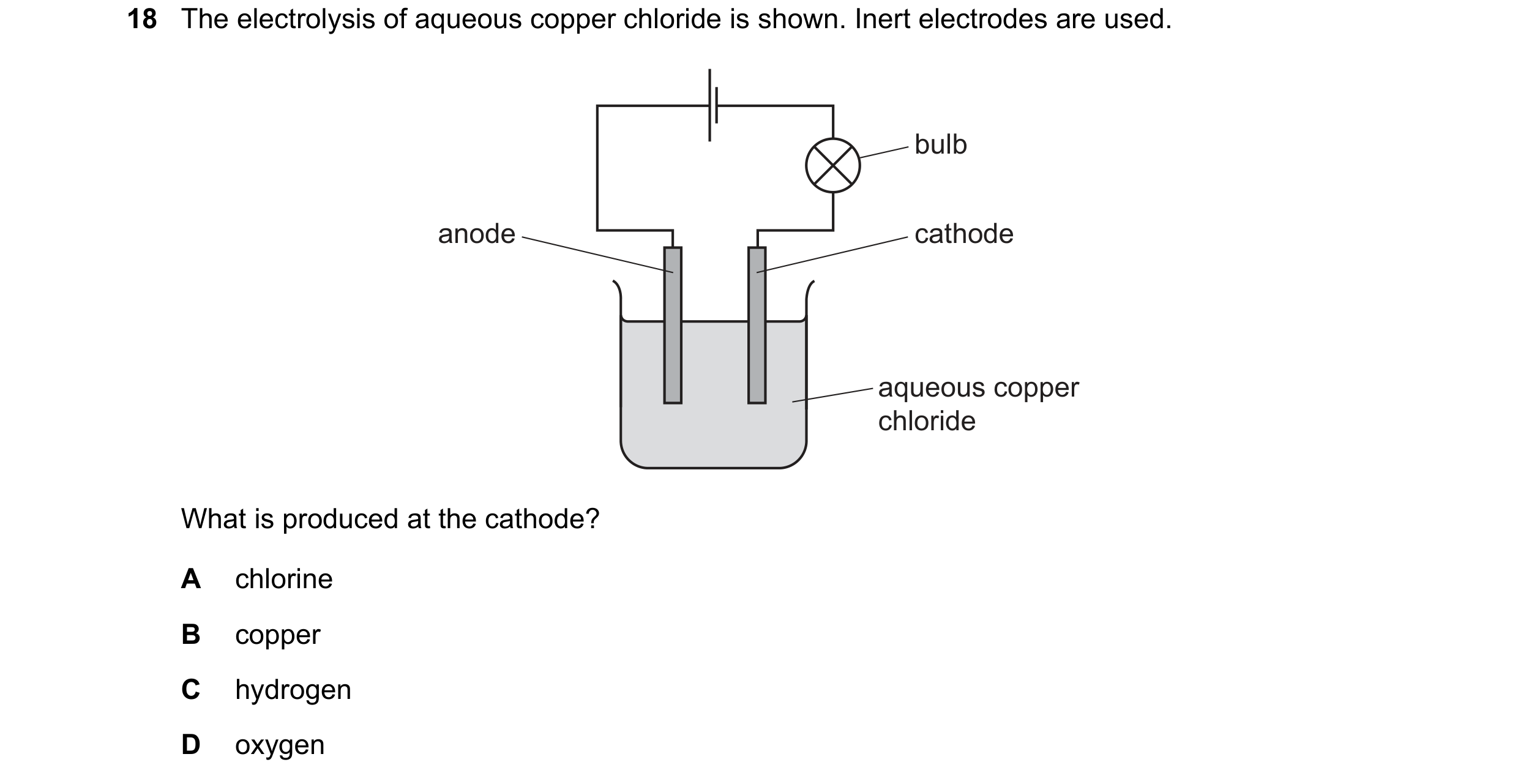
 25 / 44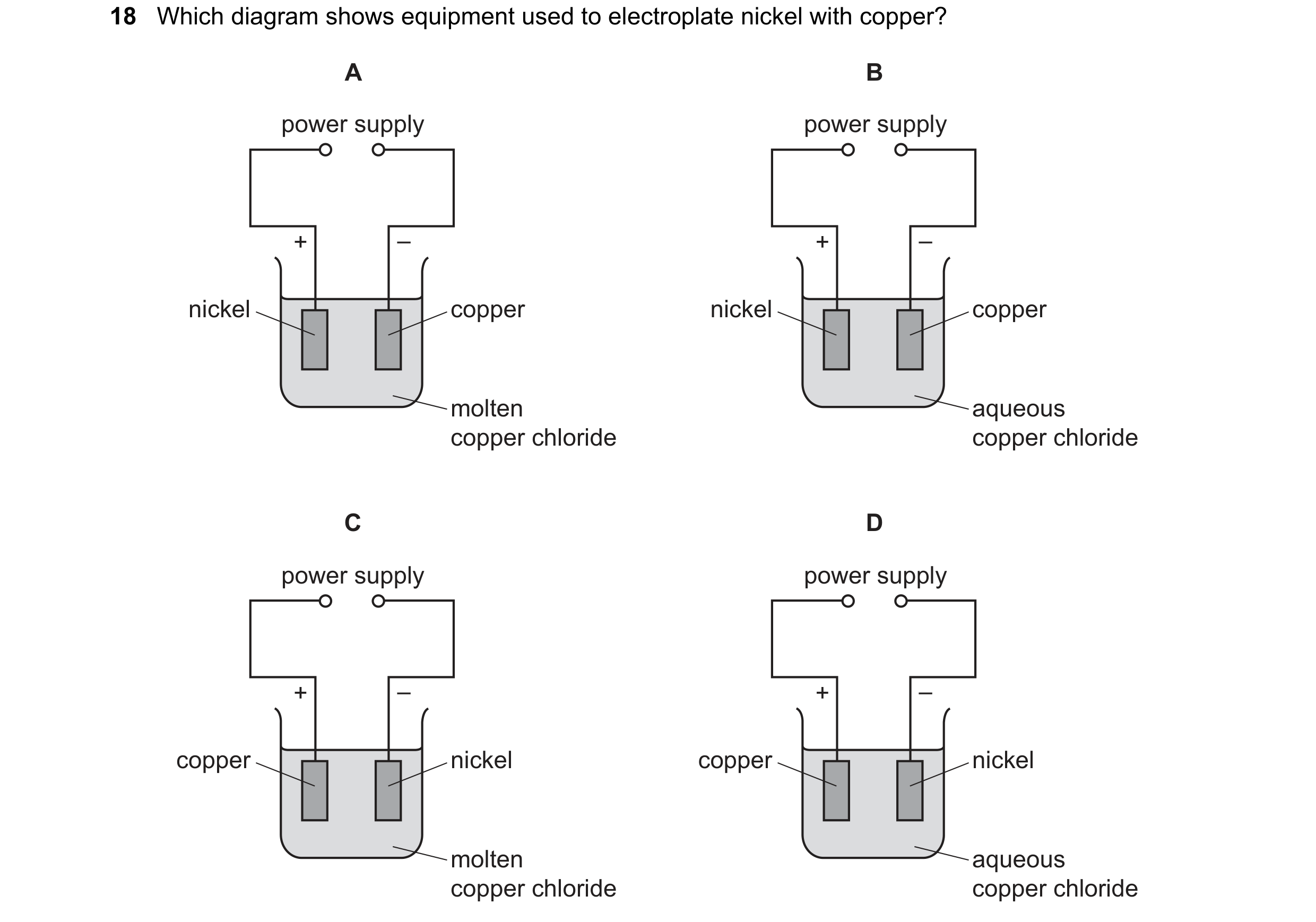

 26 / 44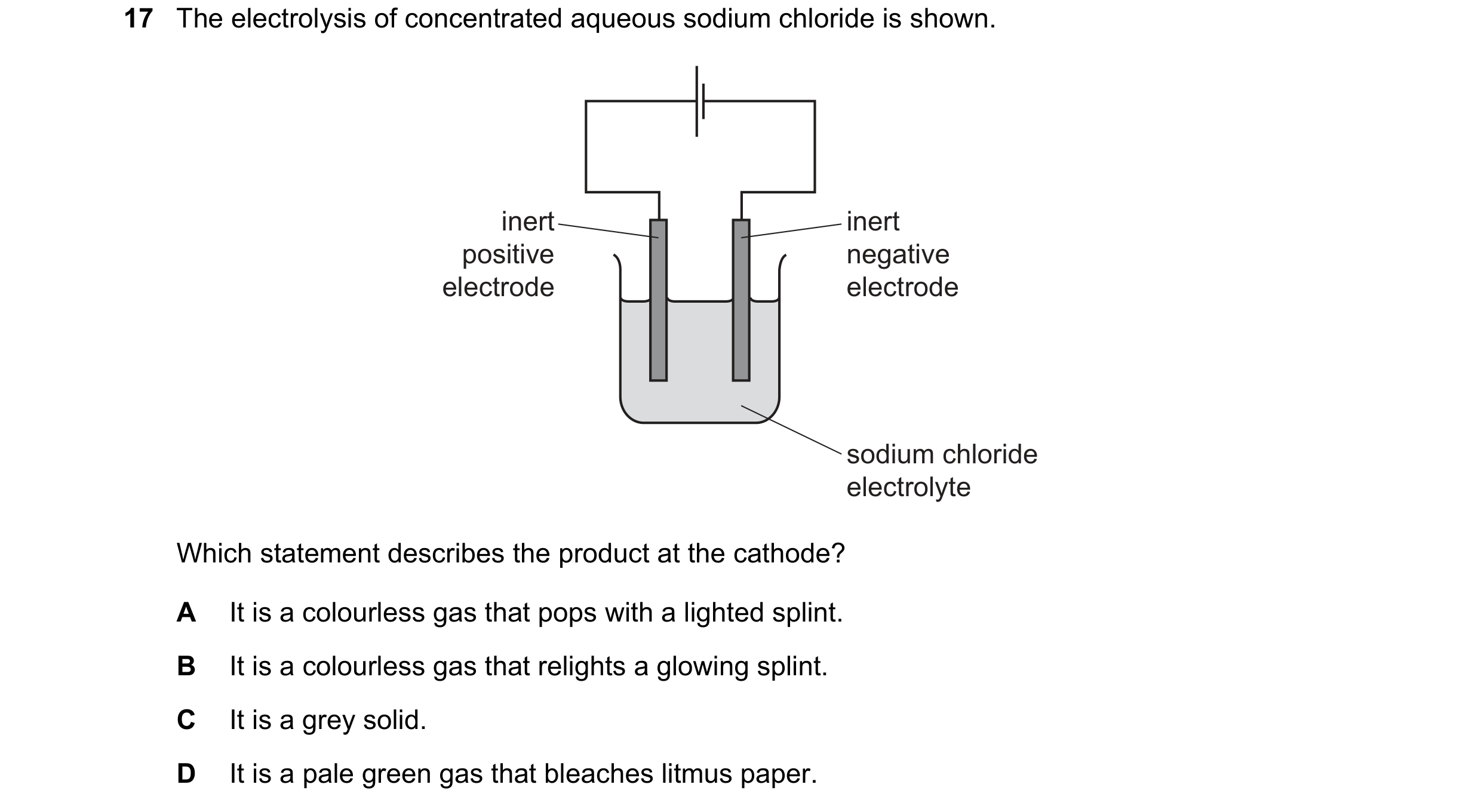
 27 / 44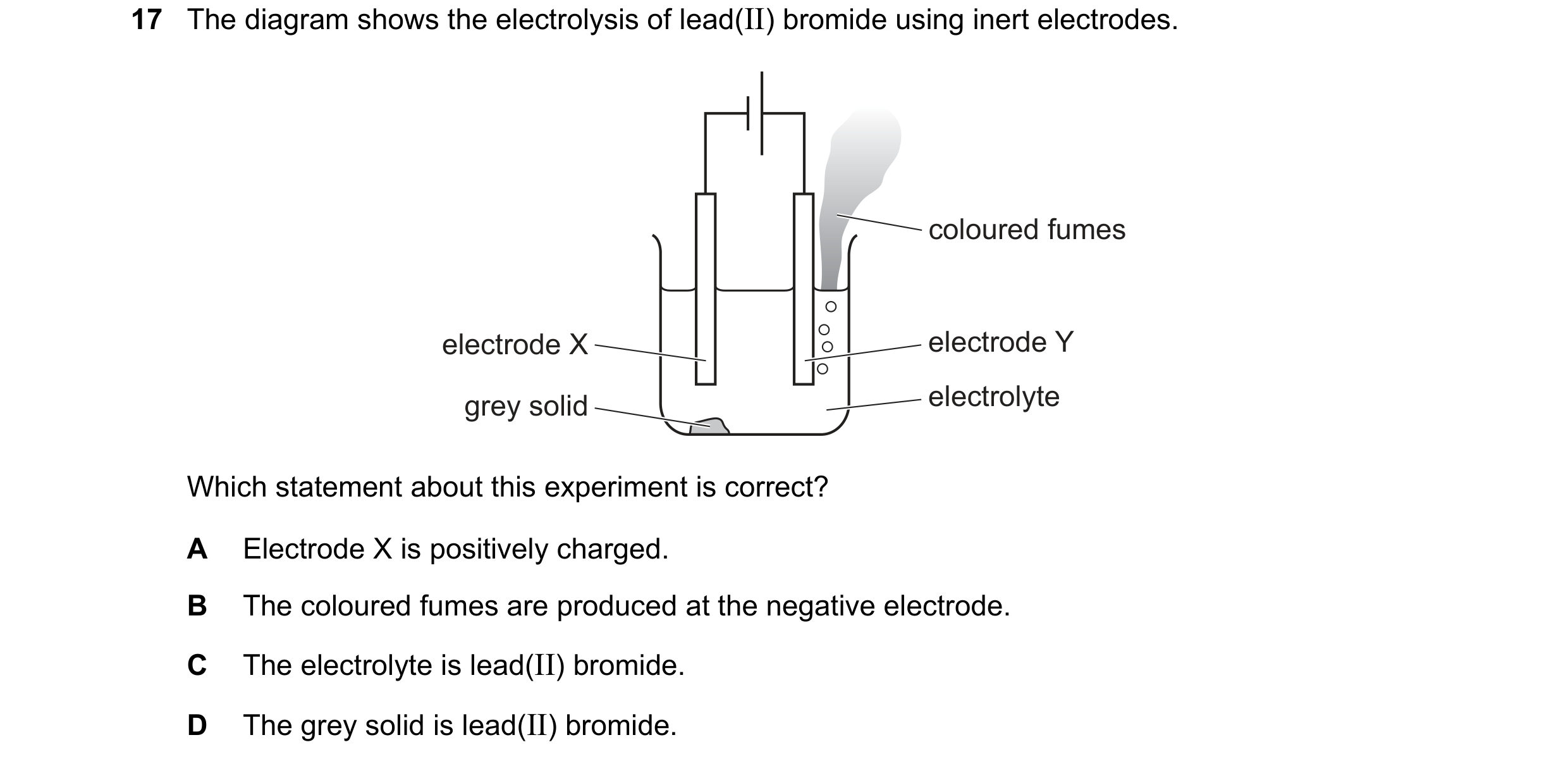
 28 / 44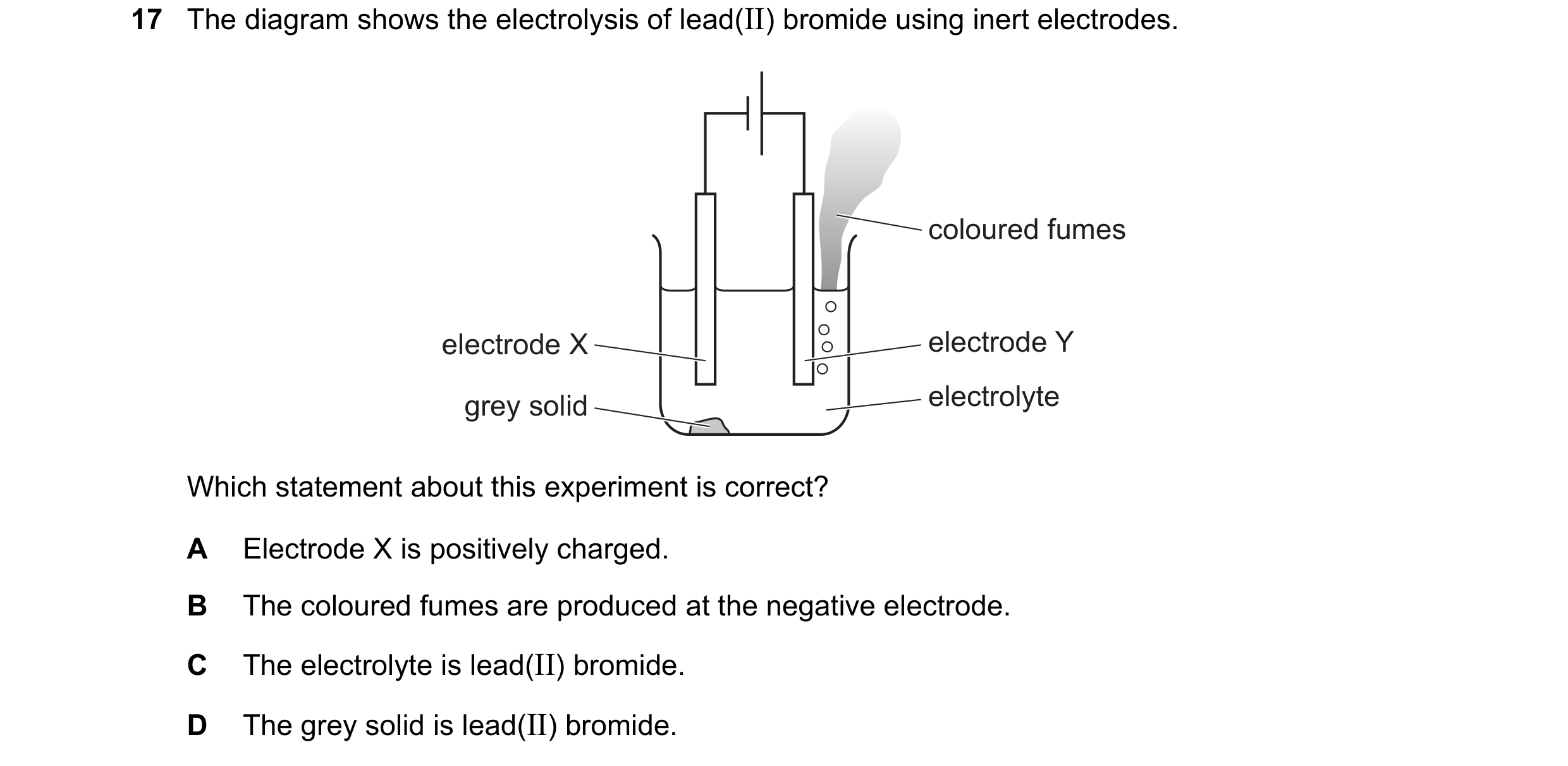
 29 / 44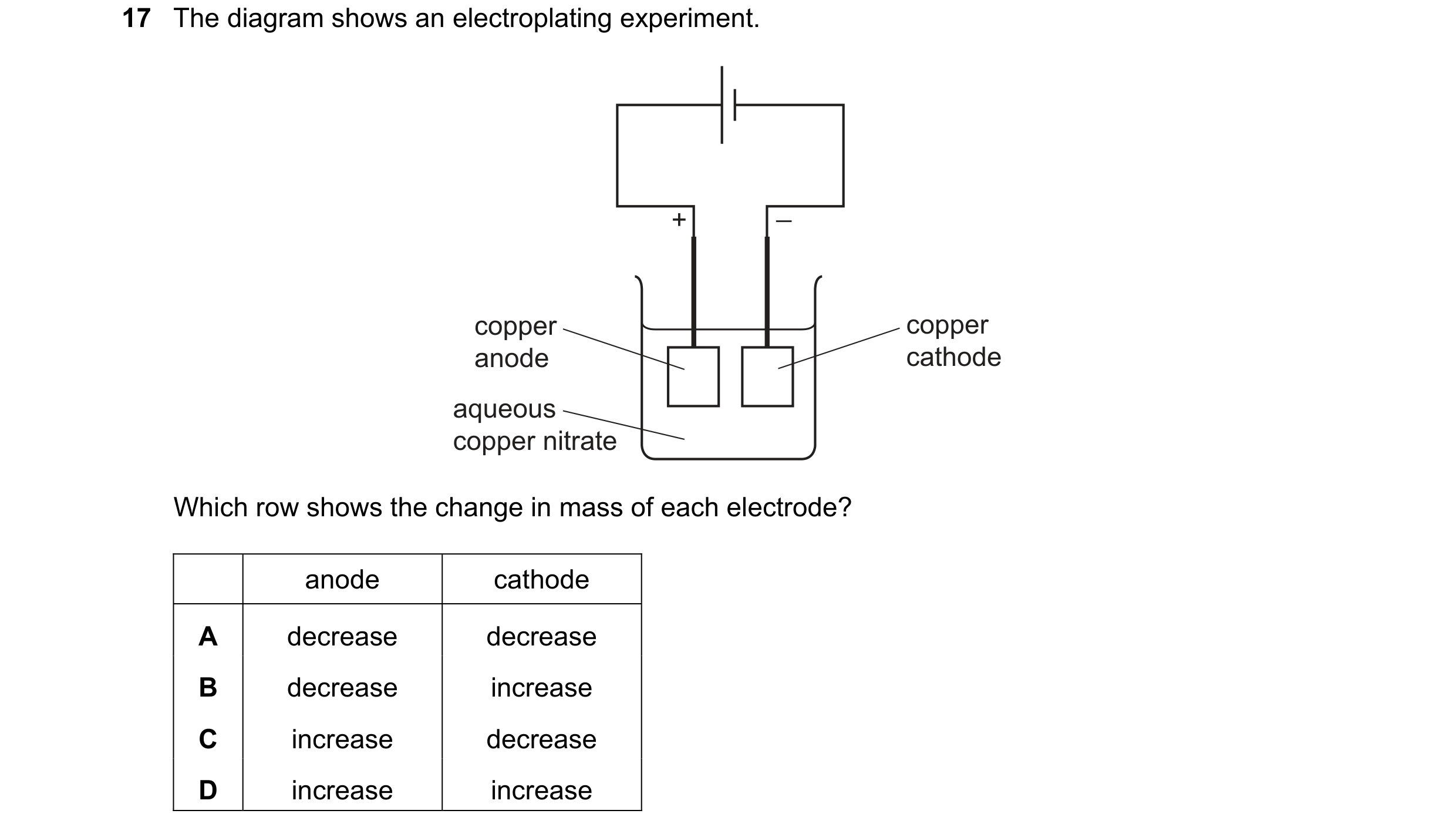
 30 / 44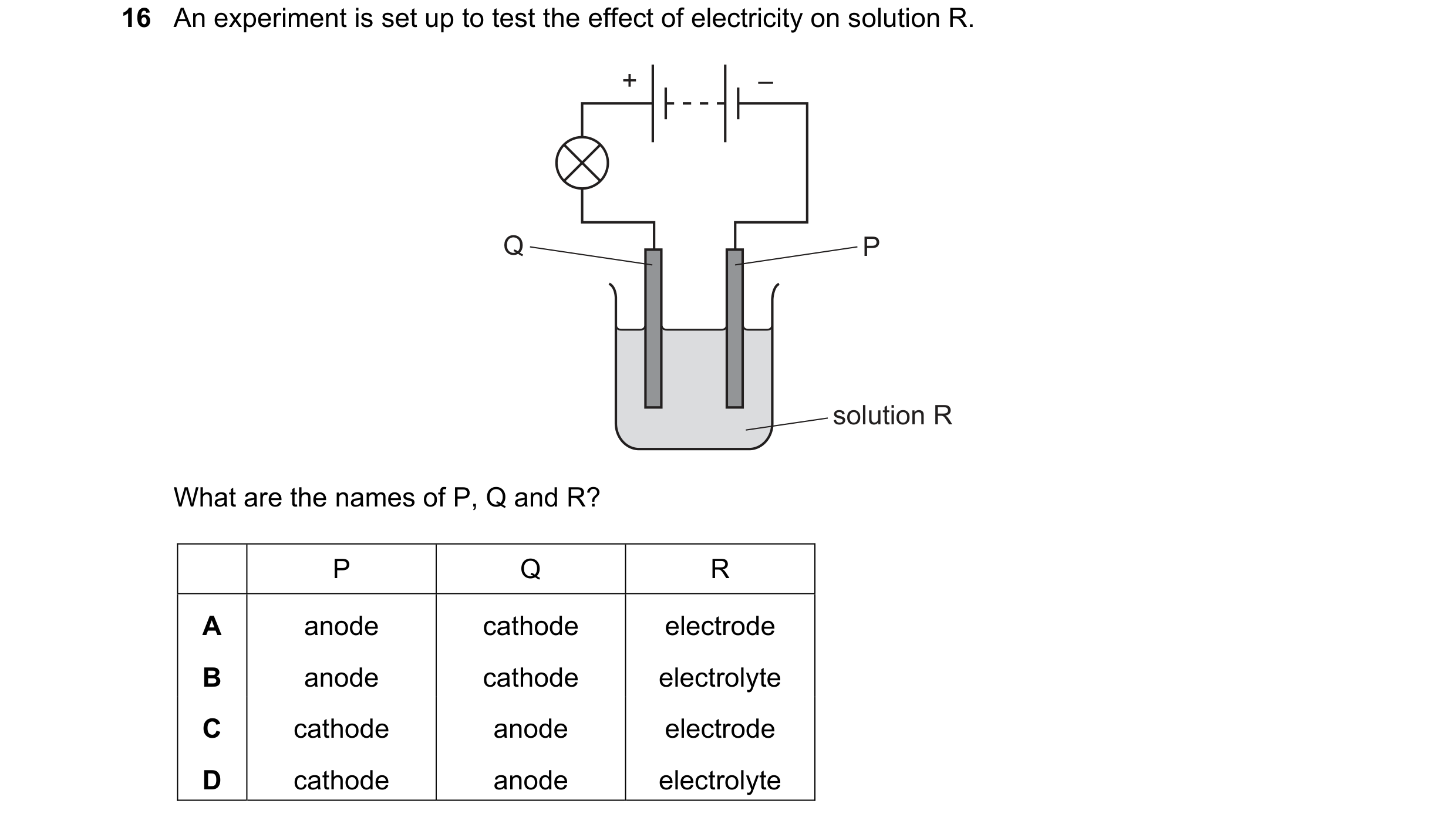
 31 / 44
 32 / 44
 33 / 44
 34 / 44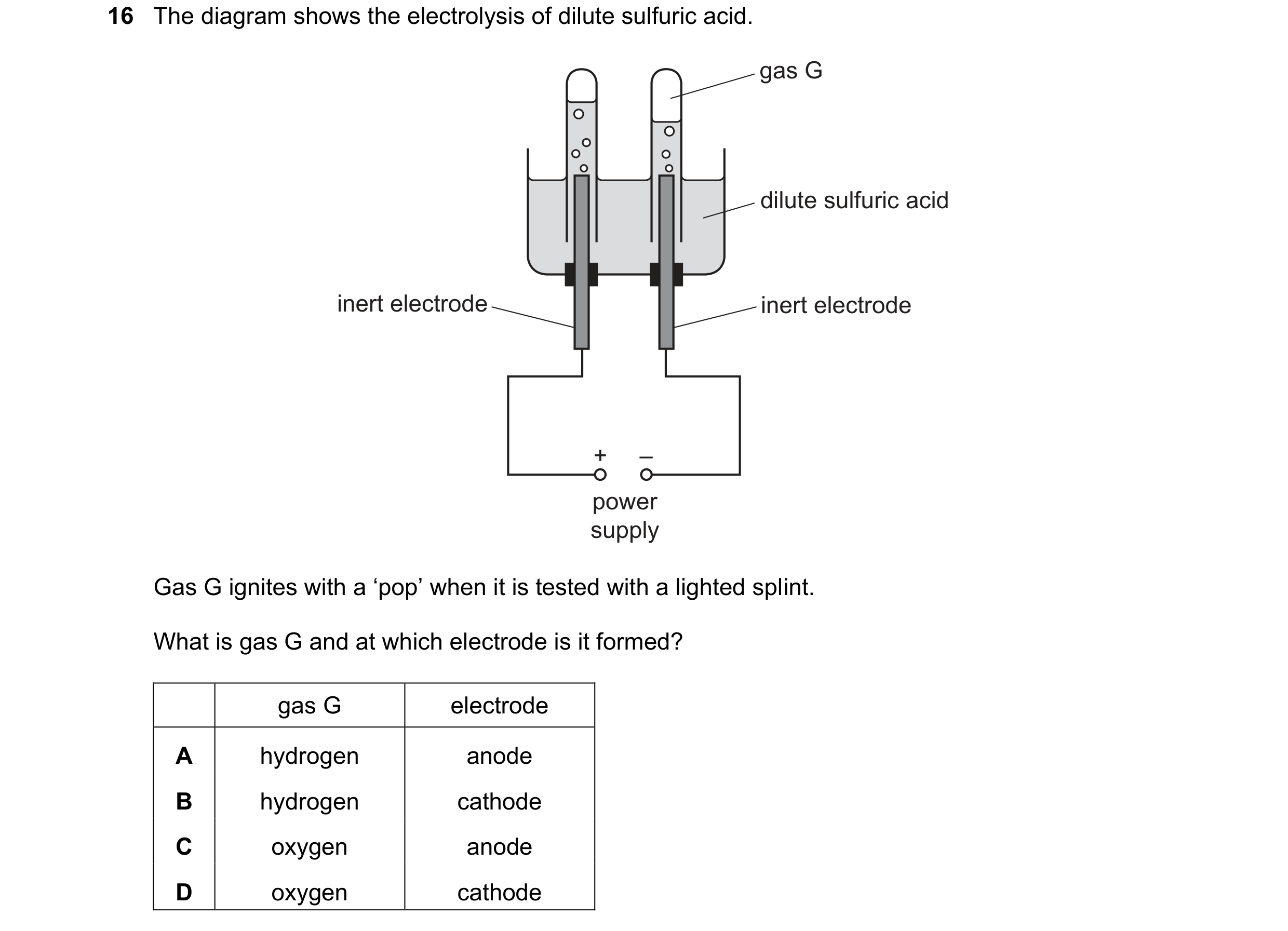
 35 / 44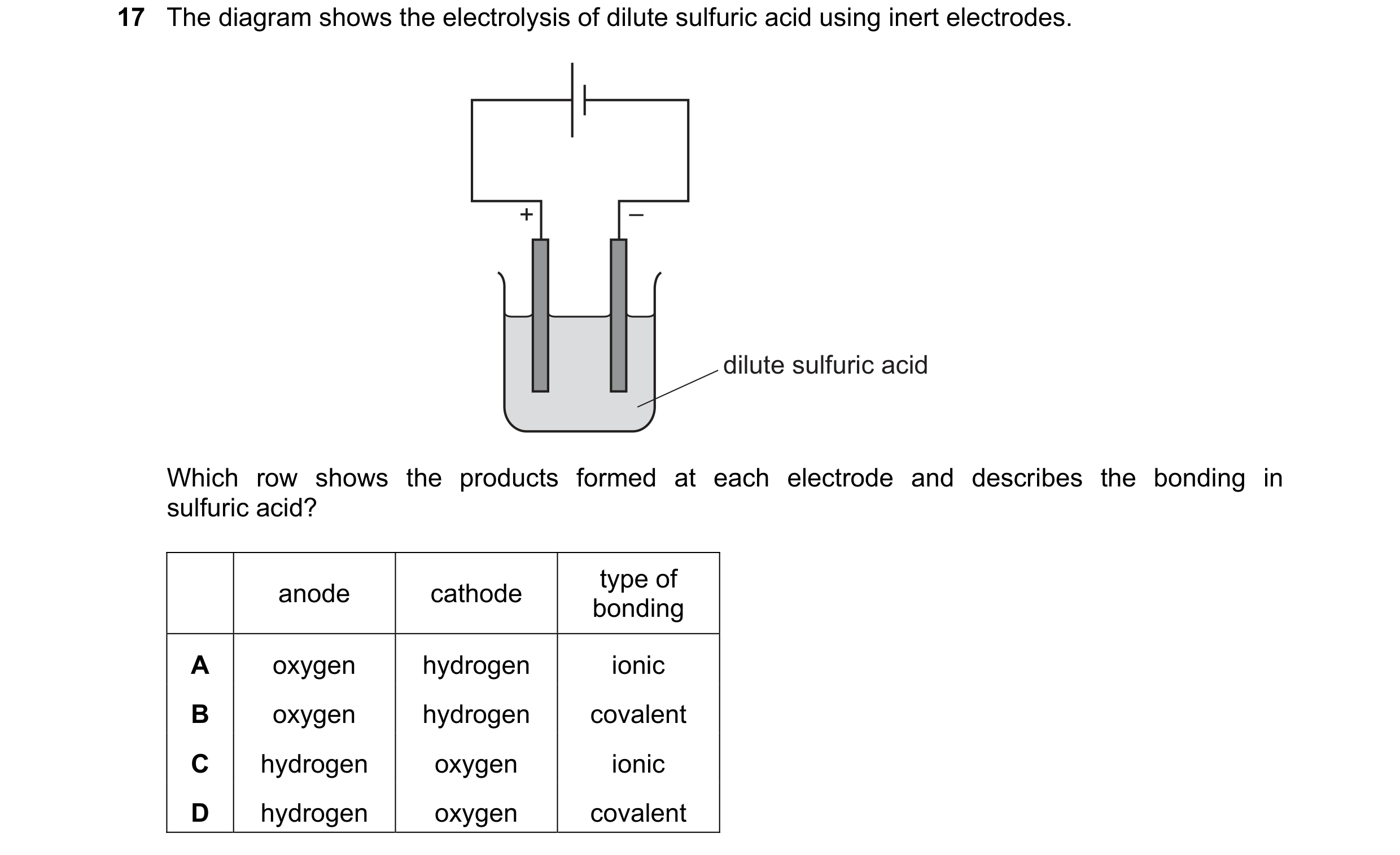
 36 / 44


 37 / 44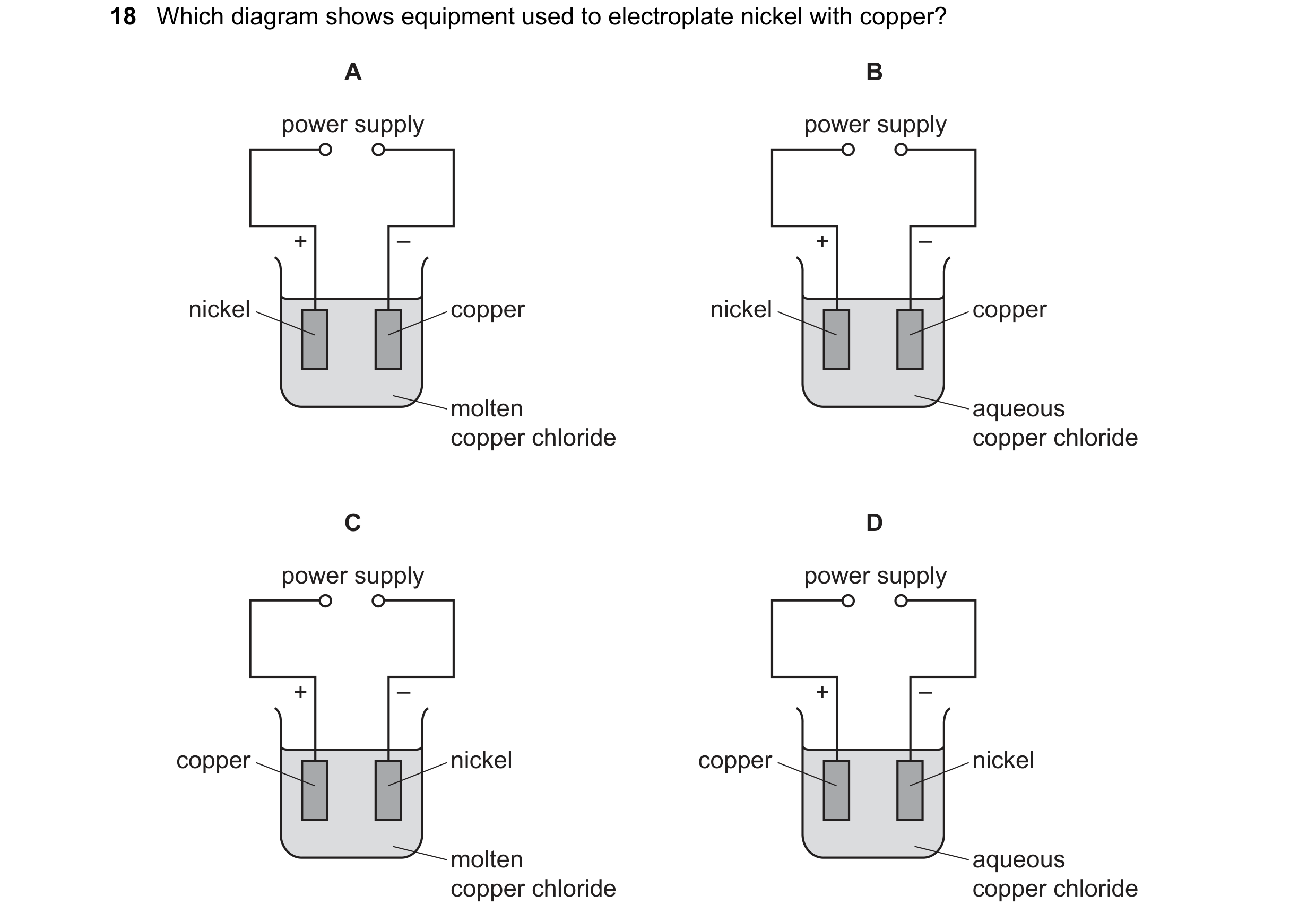
 38 / 44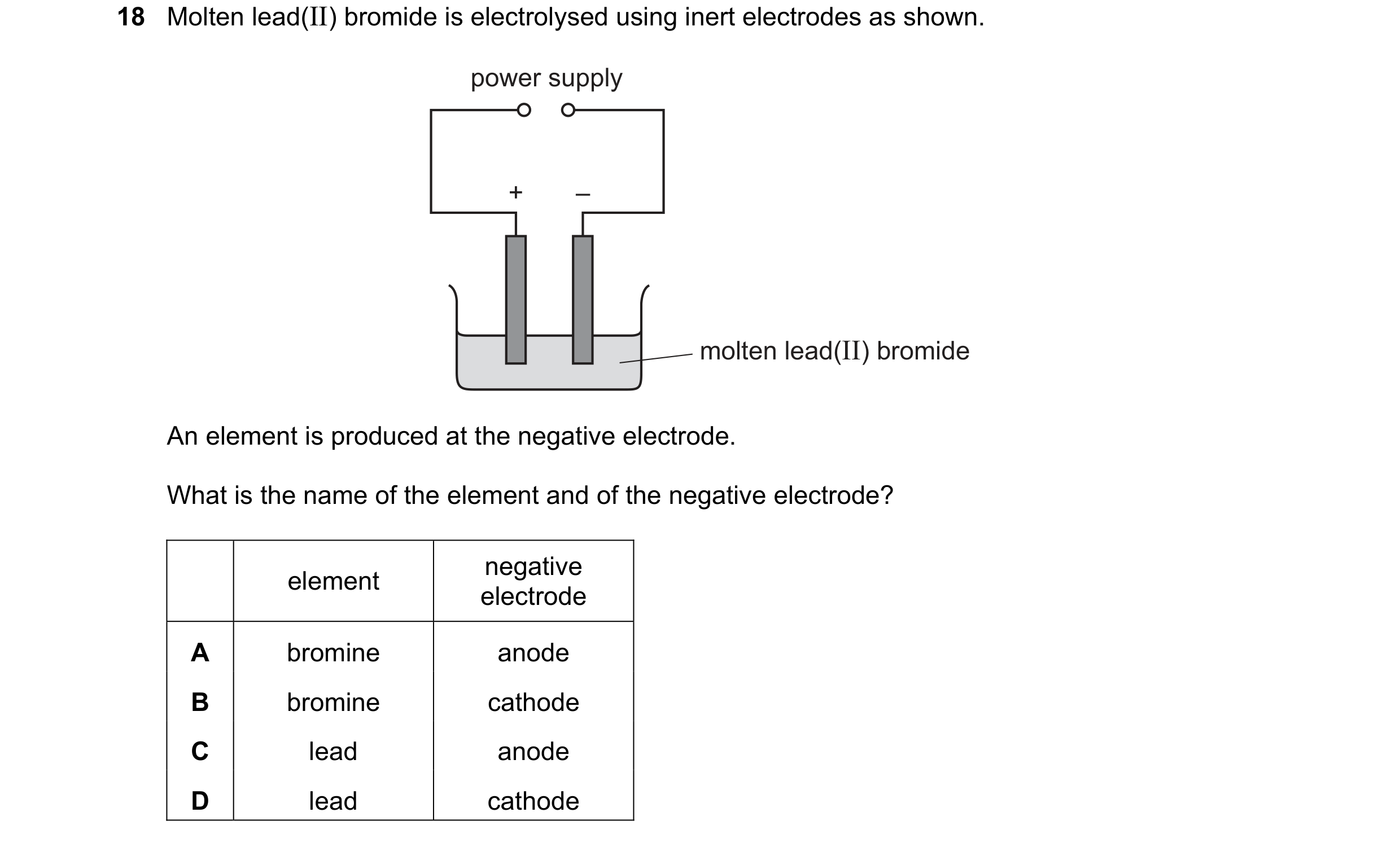
 39 / 44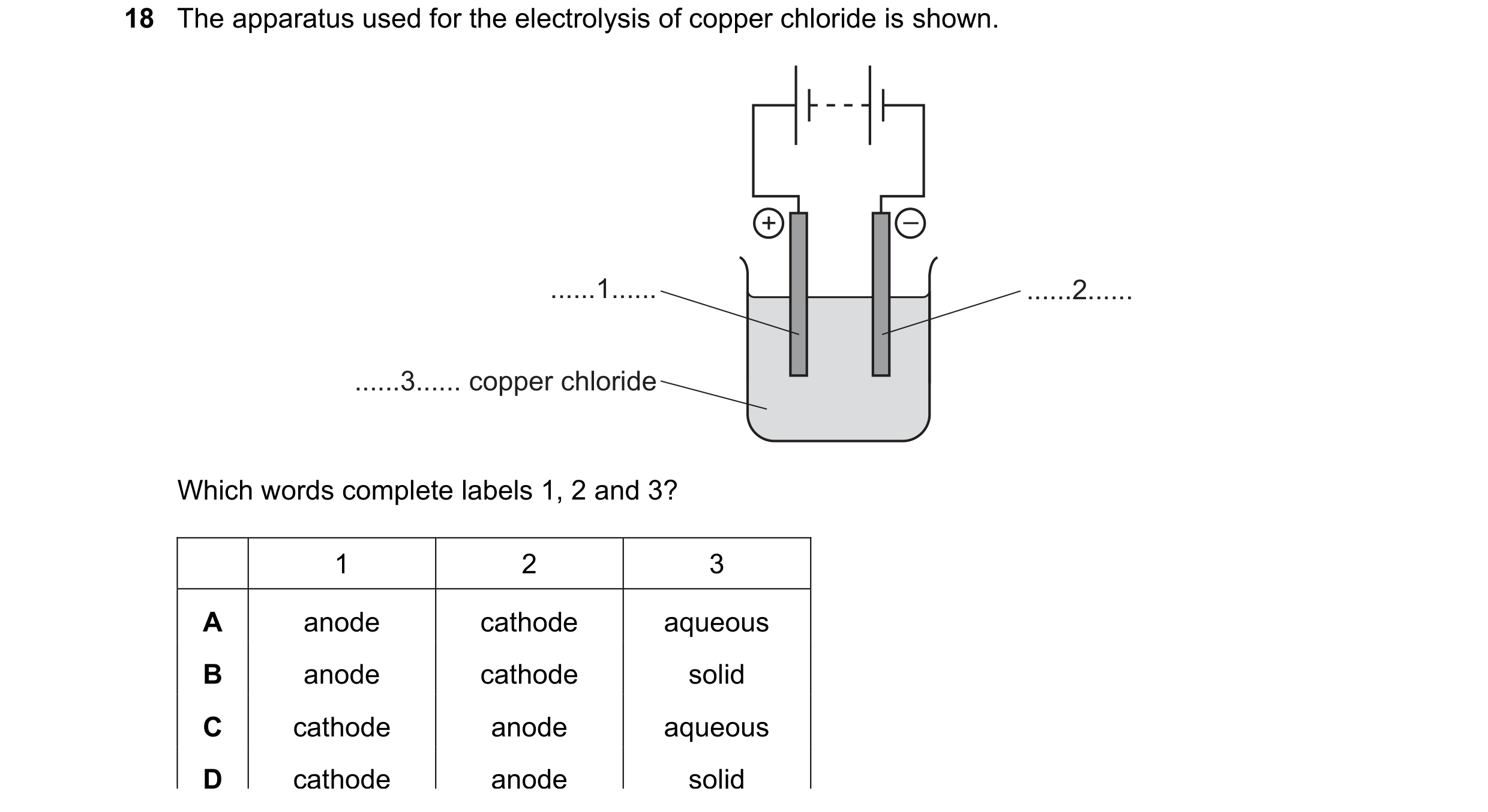
 40 / 44

 41 / 44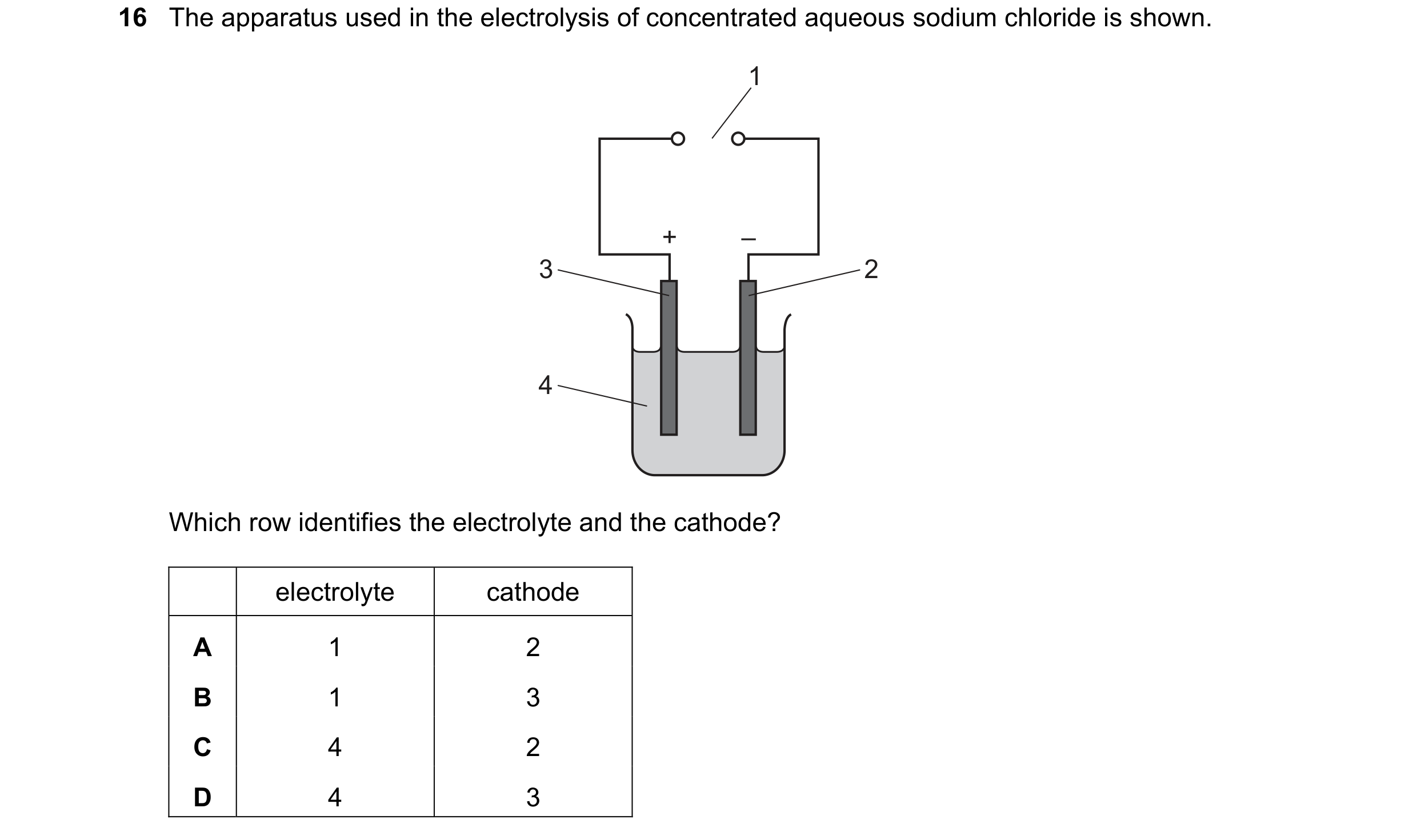
 42 / 44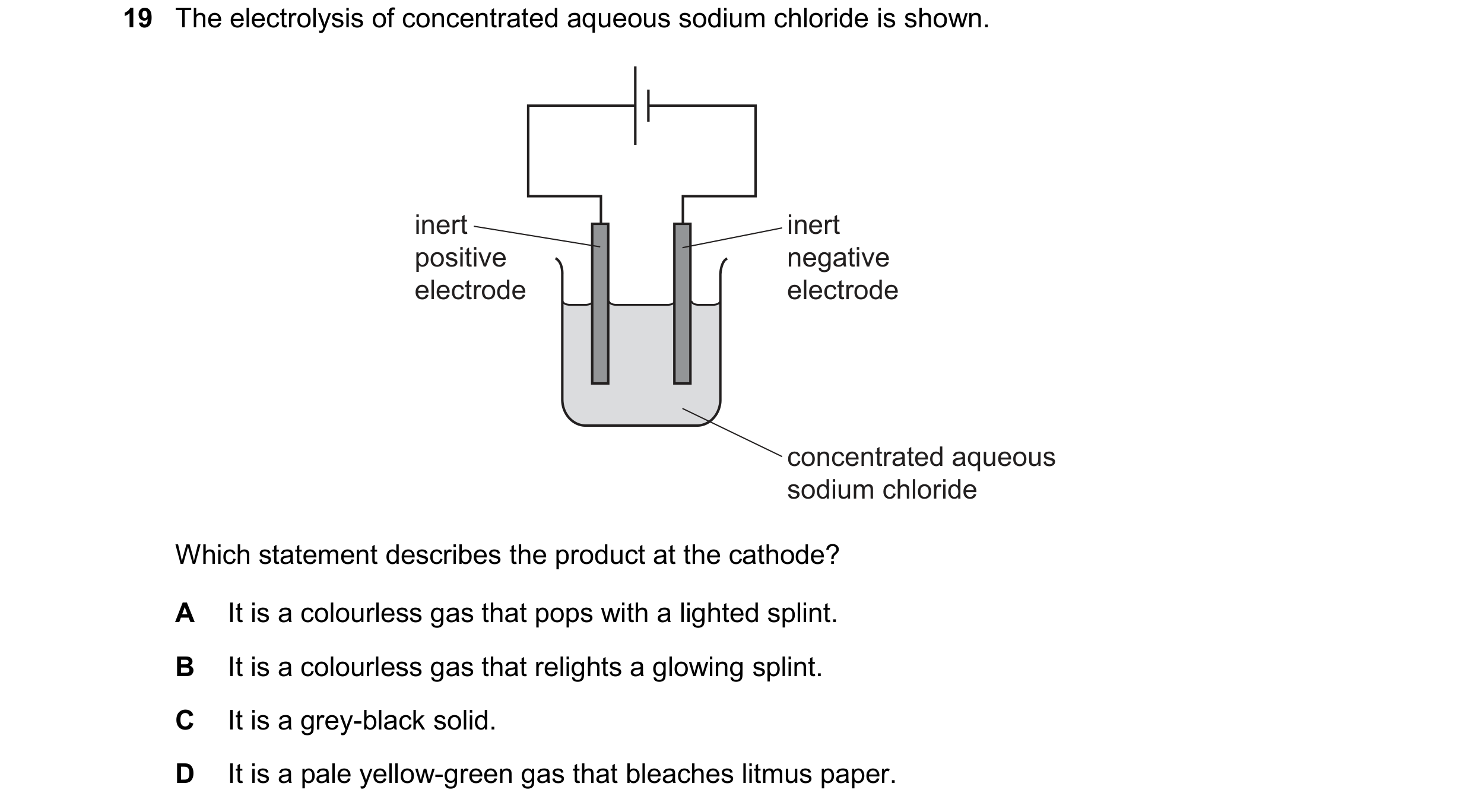
 43 / 44
 44 / 44