Cambridge IGCSE Sciences - Co-ordinated (Double) 0654 — 2006 Oct/Nov Paper 1 · Variant 1
0654/11/O/N/06 · 40 questions · 40 marks · ≈45 min
The question paper and its mark scheme, free to read here and free to download. This is Cambridge’s own paper, exactly as it was sat.
Question paper20 pages


Mark scheme2 pages
Answers below. Sit the paper first if you are practising.
Questions as text
Q1 · A fossil shows evidence of an organism with scaly skin, a tail and four legs
1 A fossil shows evidence of an organism with scaly skin, a tail and four legs. In which group would the organism be classified? A amphibians B fish C mammals D reptiles
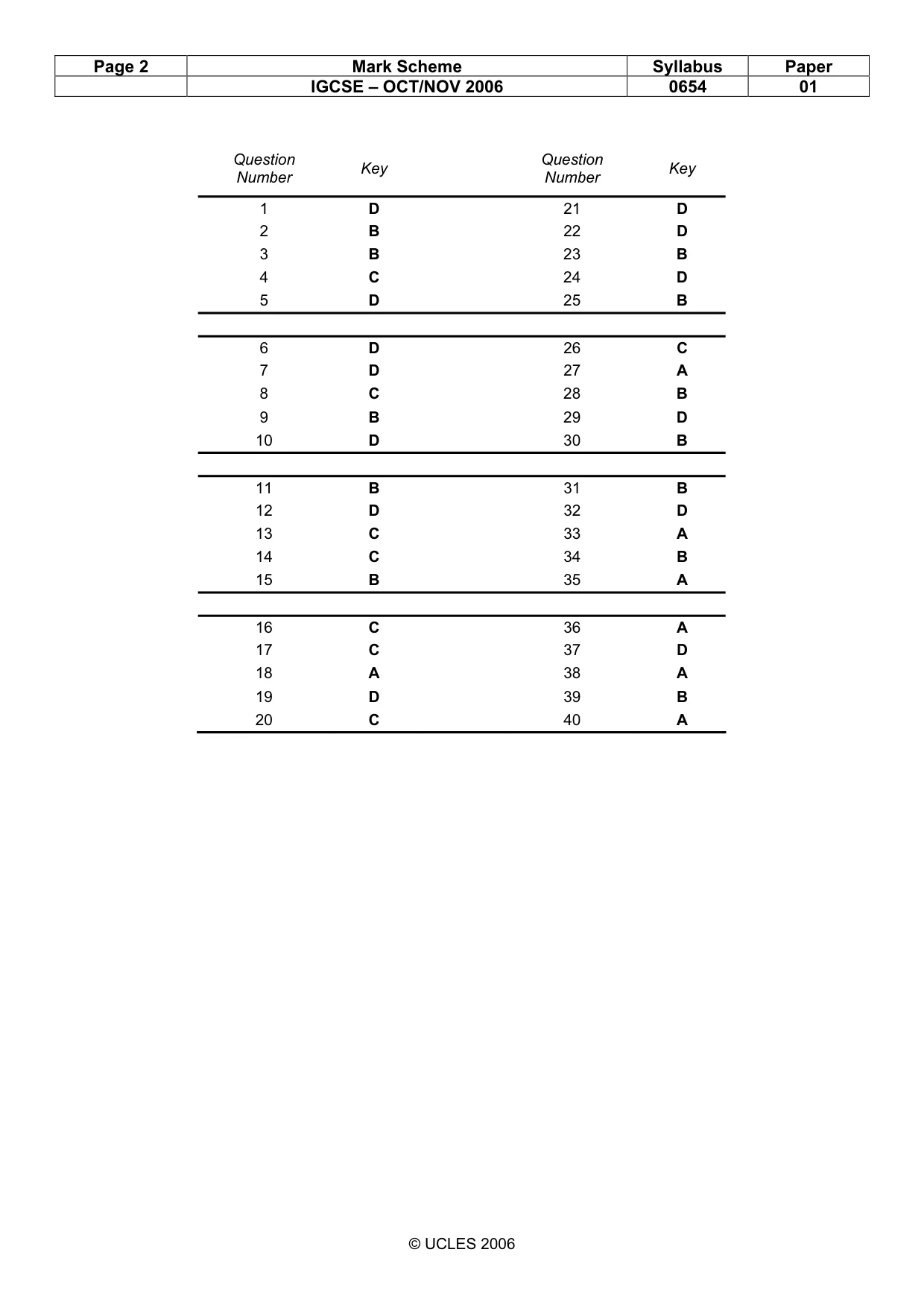
Mark scheme: D
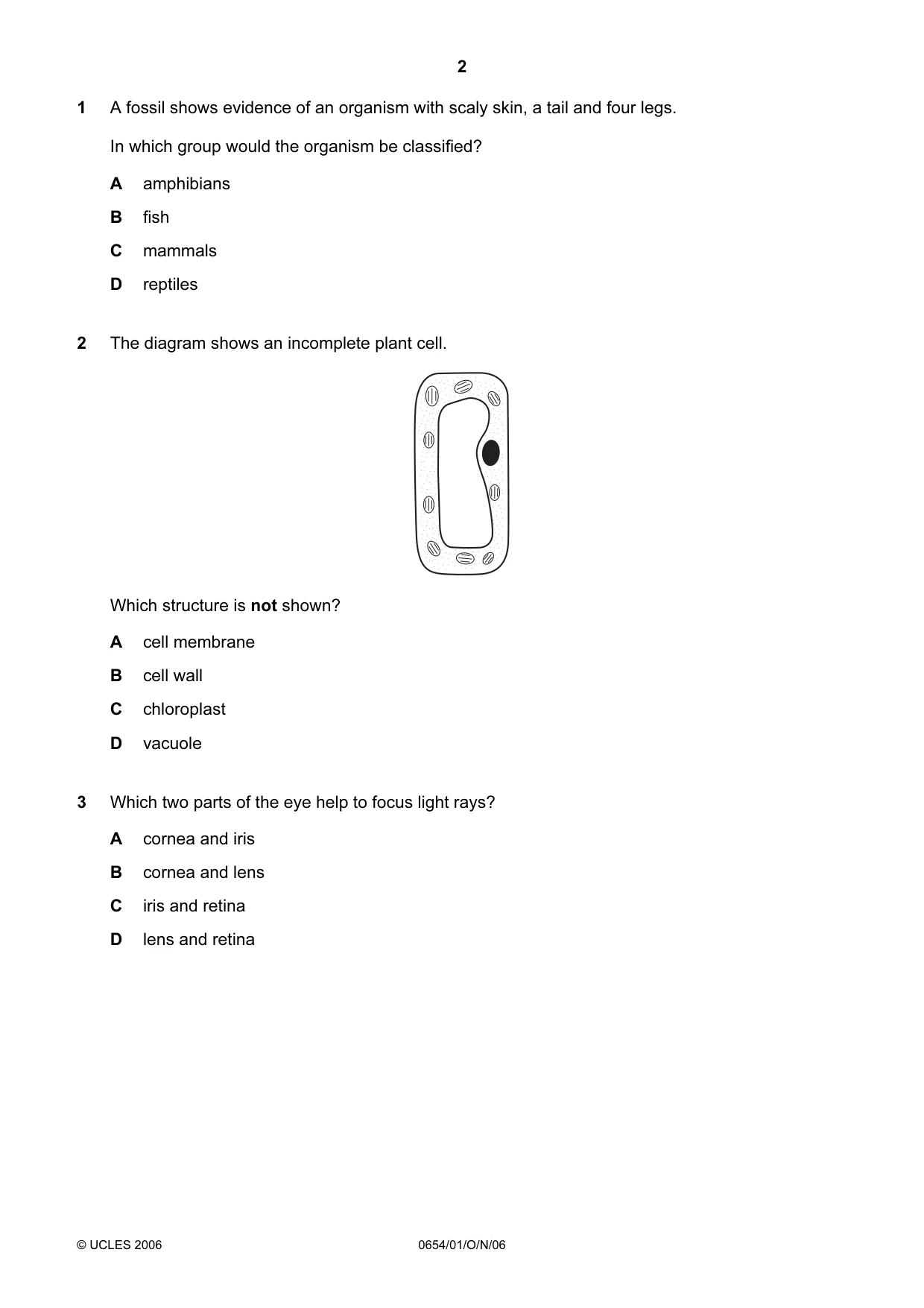
Q2 · The diagram shows an incomplete plant cell
2 The diagram shows an incomplete plant cell. Which structure is not shown? A cell membrane B cell wall C chloroplast D vacuole
Mark scheme: B
Q3 · Which two parts of the eye help to focus light rays?
3 Which two parts of the eye help to focus light rays? A cornea and iris B cornea and lens C iris and retina D lens and retina
Mark scheme: B
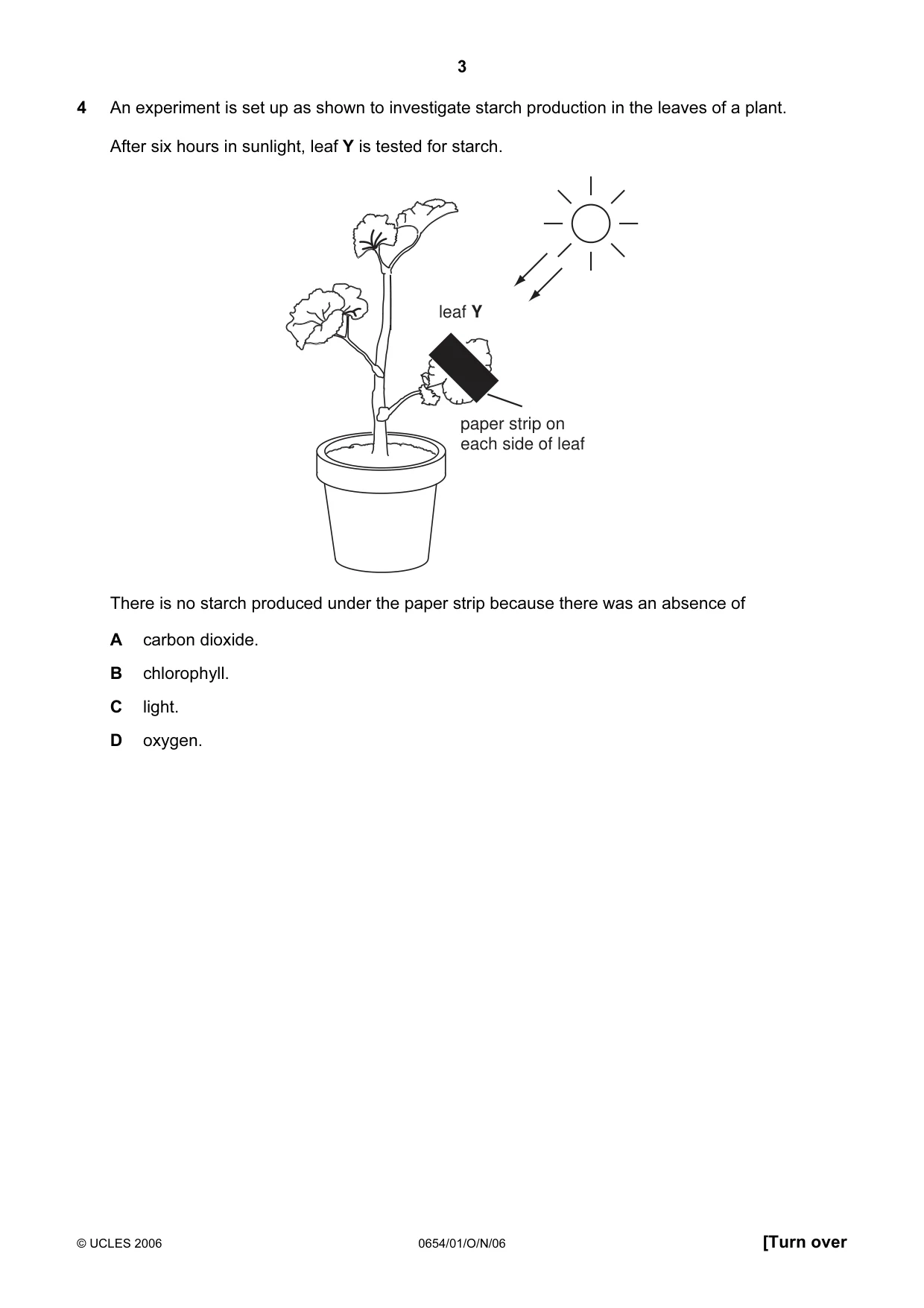
Q4 · An experiment is set up as shown to investigate starch production in the leaves of a plant
4 An experiment is set up as shown to investigate starch production in the leaves of a plant. After six hours in sunlight, leaf Y is tested for starch. leaf Y paper strip on each side of leaf There is no starch produced under the paper strip because there was an absence of A carbon dioxide. B chlorophyll. C light. D oxygen.
Mark scheme: C
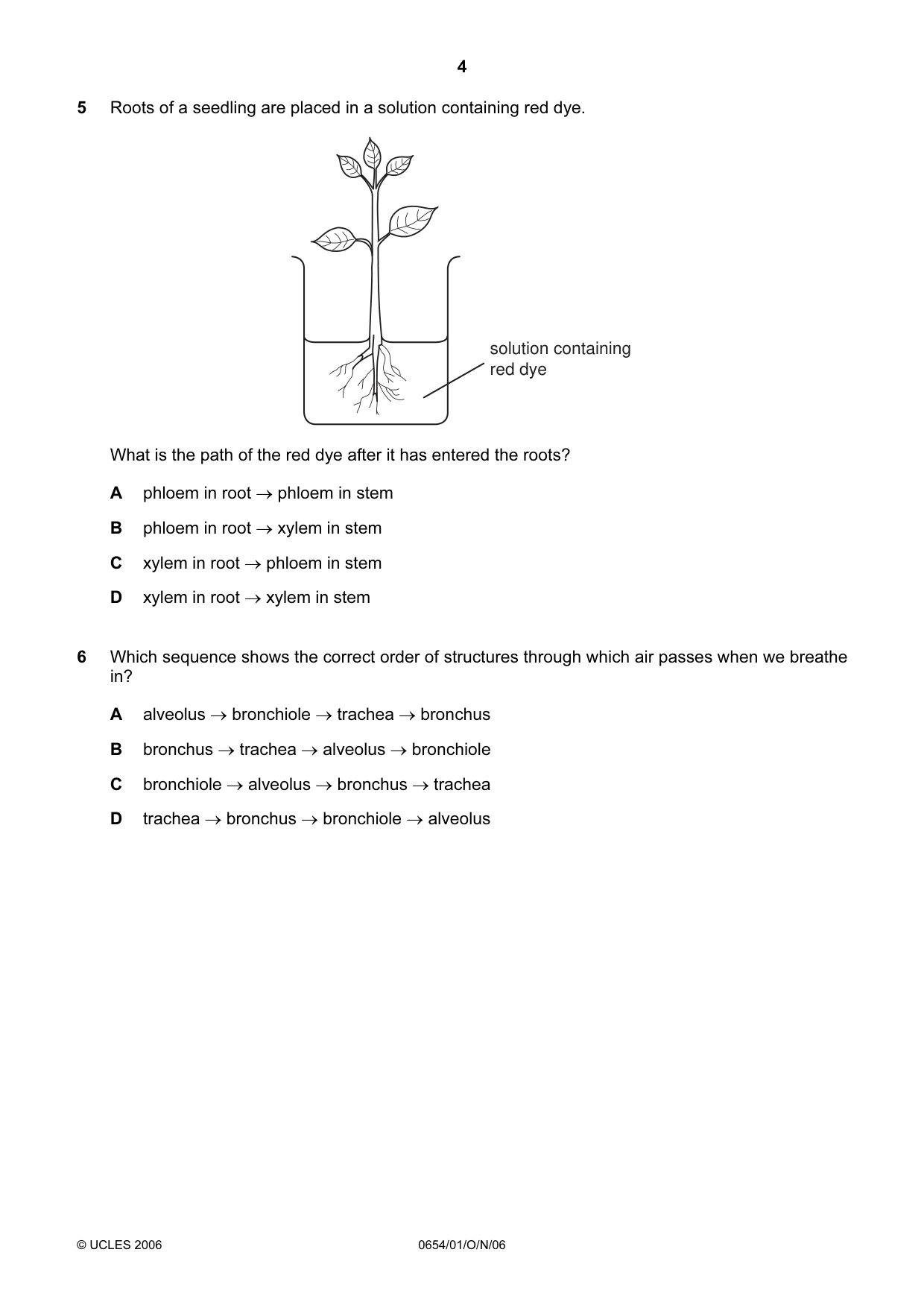
Q5 · Roots of a seedling are placed in a solution containing red dye
5 Roots of a seedling are placed in a solution containing red dye. solution containing red dye What is the path of the red dye after it has entered the roots? A phloem in root → phloem in stem B phloem in root → xylem in stem C xylem in root → phloem in stem D xylem in root → xylem in stem
Mark scheme: D
Q6 · Which sequence shows the correct order of structures through which air passes when we…
6 Which sequence shows the correct order of structures through which air passes when we breathe in? A alveolus → bronchiole → trachea → bronchus B bronchus → trachea → alveolus → bronchiole C bronchiole → alveolus → bronchus → trachea D trachea → bronchus → bronchiole → alveolus
Mark scheme: D
Q7 · The table shows the amount of protein and fat in 100 g samples of different foods
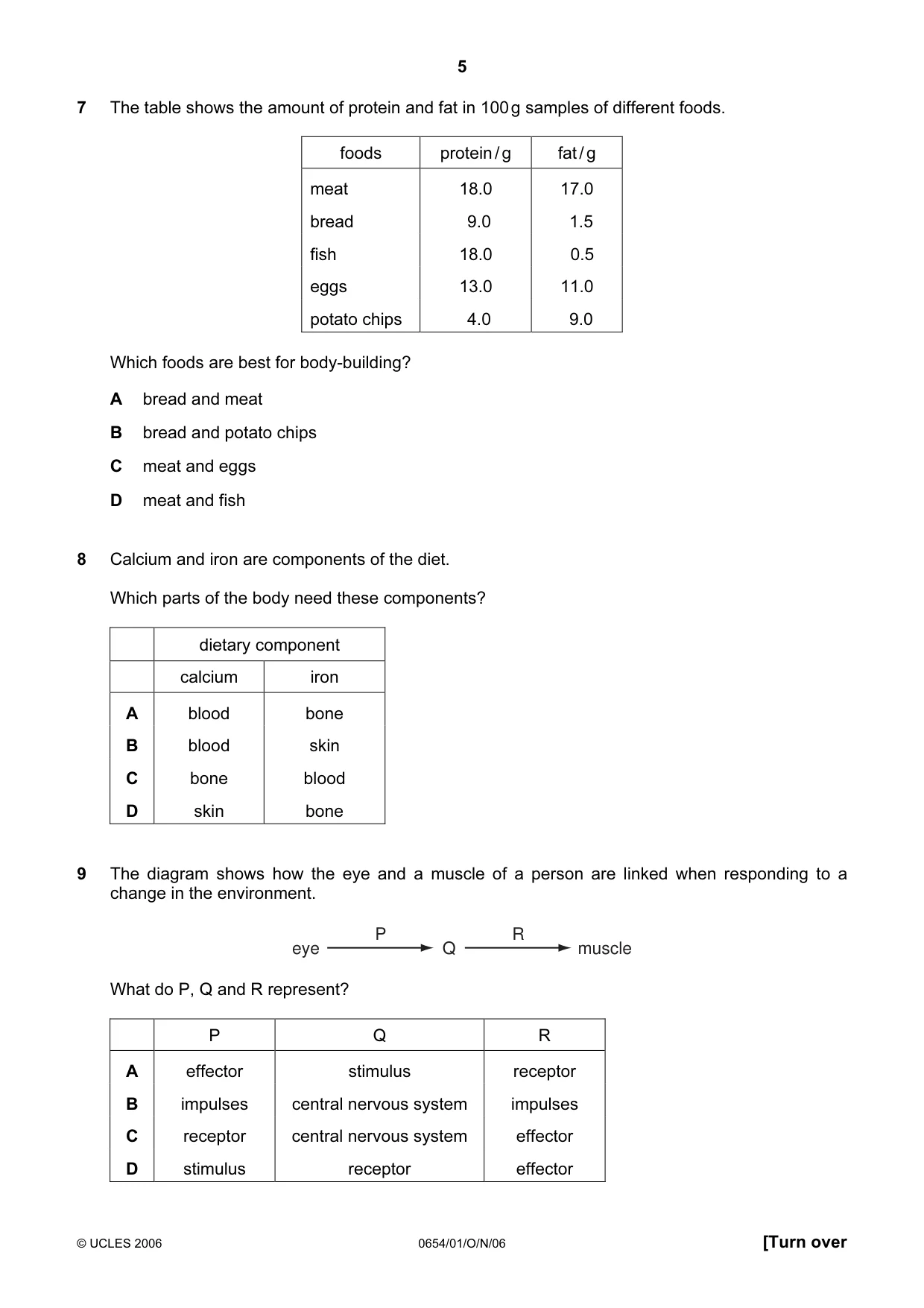
7 The table shows the amount of protein and fat in 100 g samples of different foods. foods protein / g fat / g meat 18.0 17.0 bread 9.0 1.5 fish 18.0 0.5 eggs 13.0 11.0 potato chips 4.0 9.0 Which foods are best for body-building? A bread and meat B bread and potato chips C meat and eggs D meat and fish
Mark scheme: D
Q8 · Calcium and iron are components of the diet
8 Calcium and iron are components of the diet. Which parts of the body need these components? dietary component calcium iron A blood bone B blood skin C bone blood D skin bone
Mark scheme: C
Q9 · The diagram shows how the eye and a muscle of a person are linked when responding to a…
9 The diagram shows how the eye and a muscle of a person are linked when responding to a change in the environment. P R eye Q muscle What do P, Q and R represent? P Q R A effector stimulus receptor B impulses central nervous system impulses C receptor central nervous system effector D stimulus receptor effector
Mark scheme: B
Q10 · The diagram shows the male reproductive system
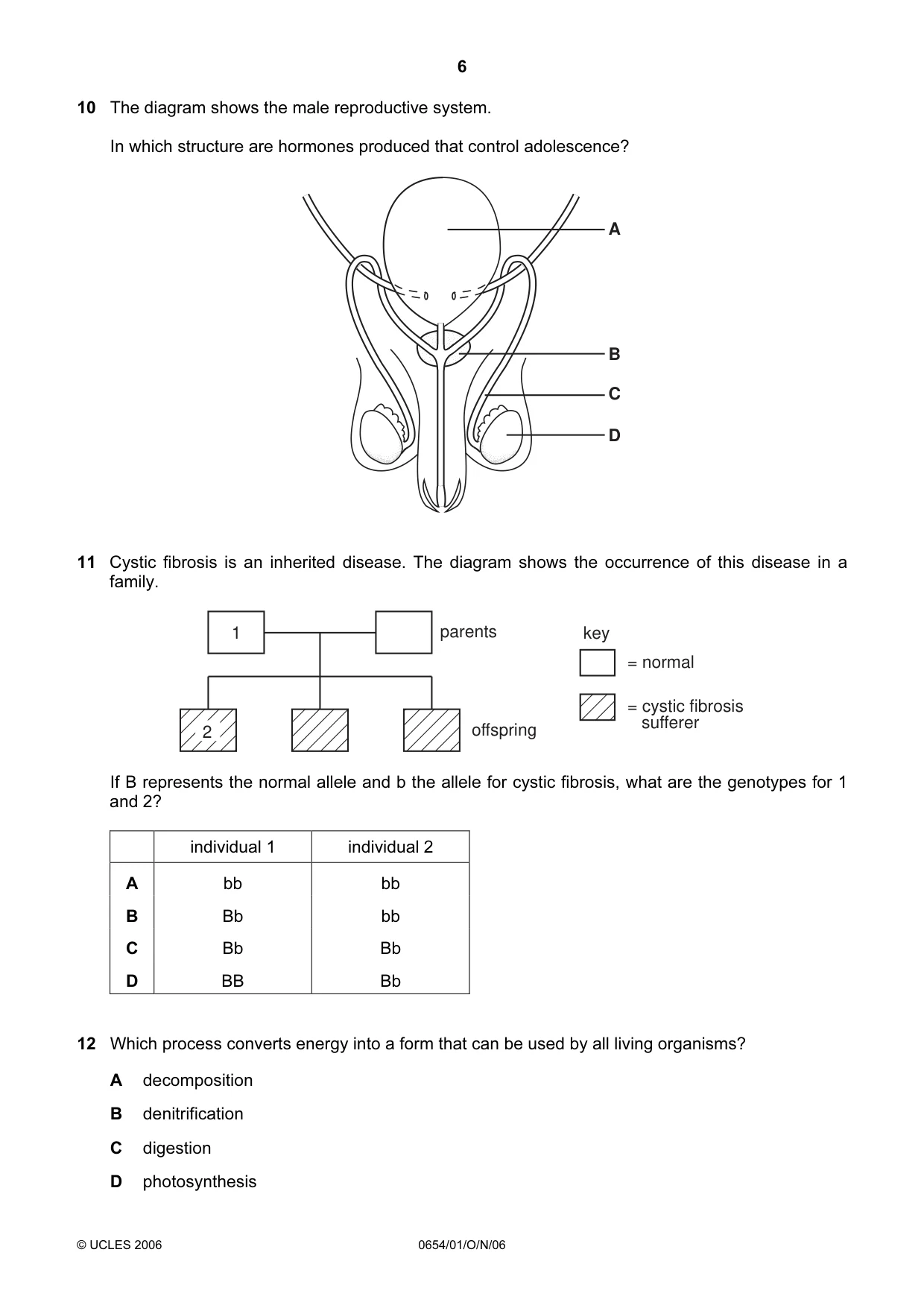
10 The diagram shows the male reproductive system. In which structure are hormones produced that control adolescence? A B C D
Mark scheme: D
Q11 · Cystic fibrosis is an inherited disease
11 Cystic fibrosis is an inherited disease. The diagram shows the occurrence of this disease in a family. 1 parents key = normal = cystic fibrosis offspring sufferer 2 If B represents the normal allele and b the allele for cystic fibrosis, what are the genotypes for 1 and 2? individual 1 individual 2 A bb bb B Bb bb C Bb Bb D BB Bb
Mark scheme: B
Q12 · Which process converts energy into a form that can be used by all living organisms?
12 Which process converts energy into a form that can be used by all living organisms? A decomposition B denitrification C digestion D photosynthesis
Mark scheme: D
Q13 · The diagram shows a simple carbon cycle
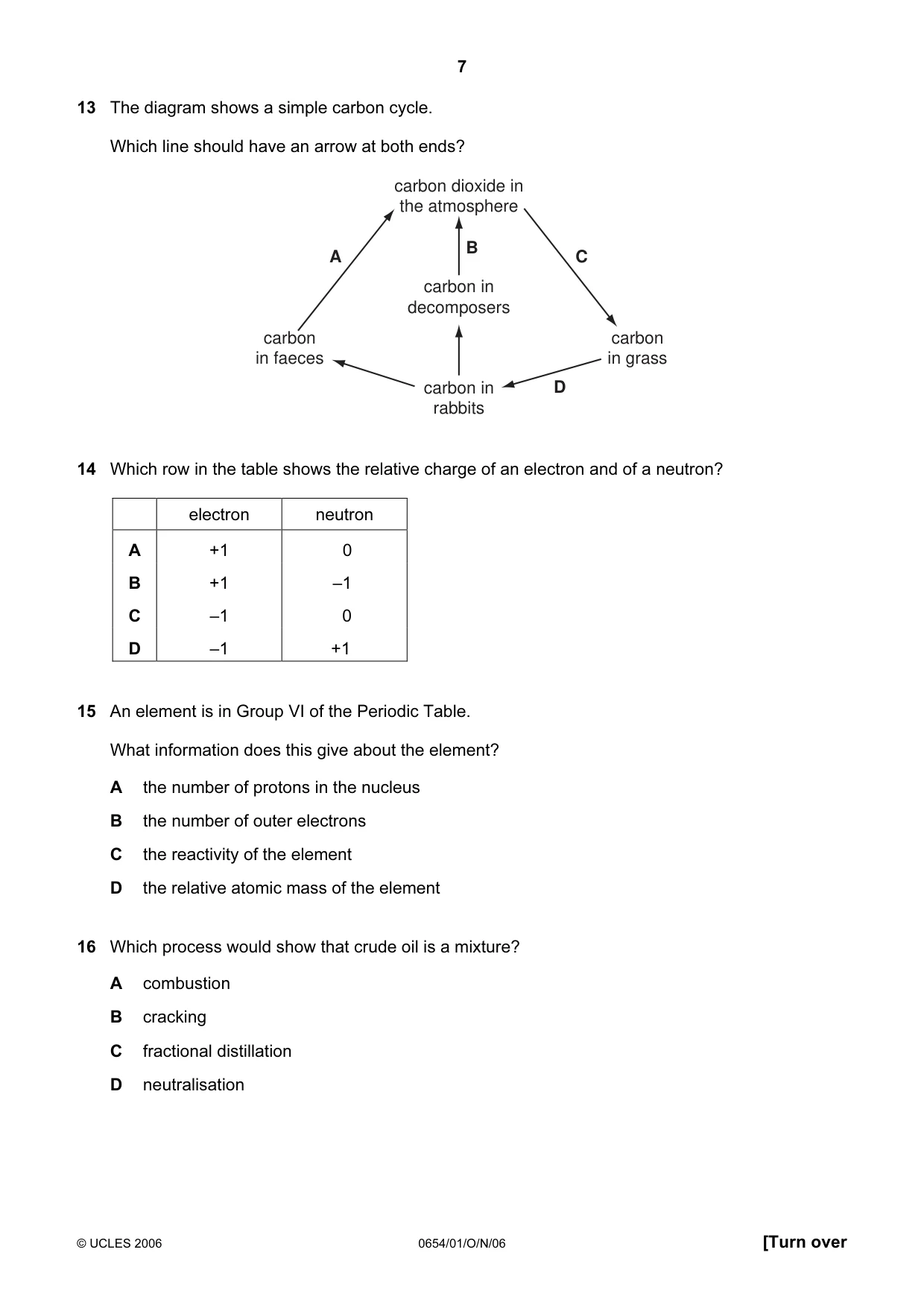
13 The diagram shows a simple carbon cycle. Which line should have an arrow at both ends? carbon dioxide in the atmosphere B A C carbon in decomposers carbon carbon in faeces in grass carbon in D rabbits
Mark scheme: C
Q14 · Which row in the table shows the relative charge of an electron and of a neutron?
14 Which row in the table shows the relative charge of an electron and of a neutron? electron neutron A +1 0 B +1 –1 C –1 0 D –1 +1
Mark scheme: C
Q15 · An element is in Group VI of the Periodic Table
15 An element is in Group VI of the Periodic Table. What information does this give about the element? A the number of protons in the nucleus B the number of outer electrons C the reactivity of the element D the relative atomic mass of the element
Mark scheme: B
Q16 · Which process would show that crude oil is a mixture?
16 Which process would show that crude oil is a mixture? A combustion B cracking C fractional distillation D neutralisation
Mark scheme: C
Q17 · Crude oil, salt and wood are important raw materials used in industry
17 Crude oil, salt and wood are important raw materials used in industry. Which of these raw materials is used to make alkali, paper and plastics? alkali paper plastics A crude oil wood salt B salt crude oil wood C salt wood crude oil D wood salt crude oil
Mark scheme: C
Q18 · Which diagrams show a giant molecular structure?
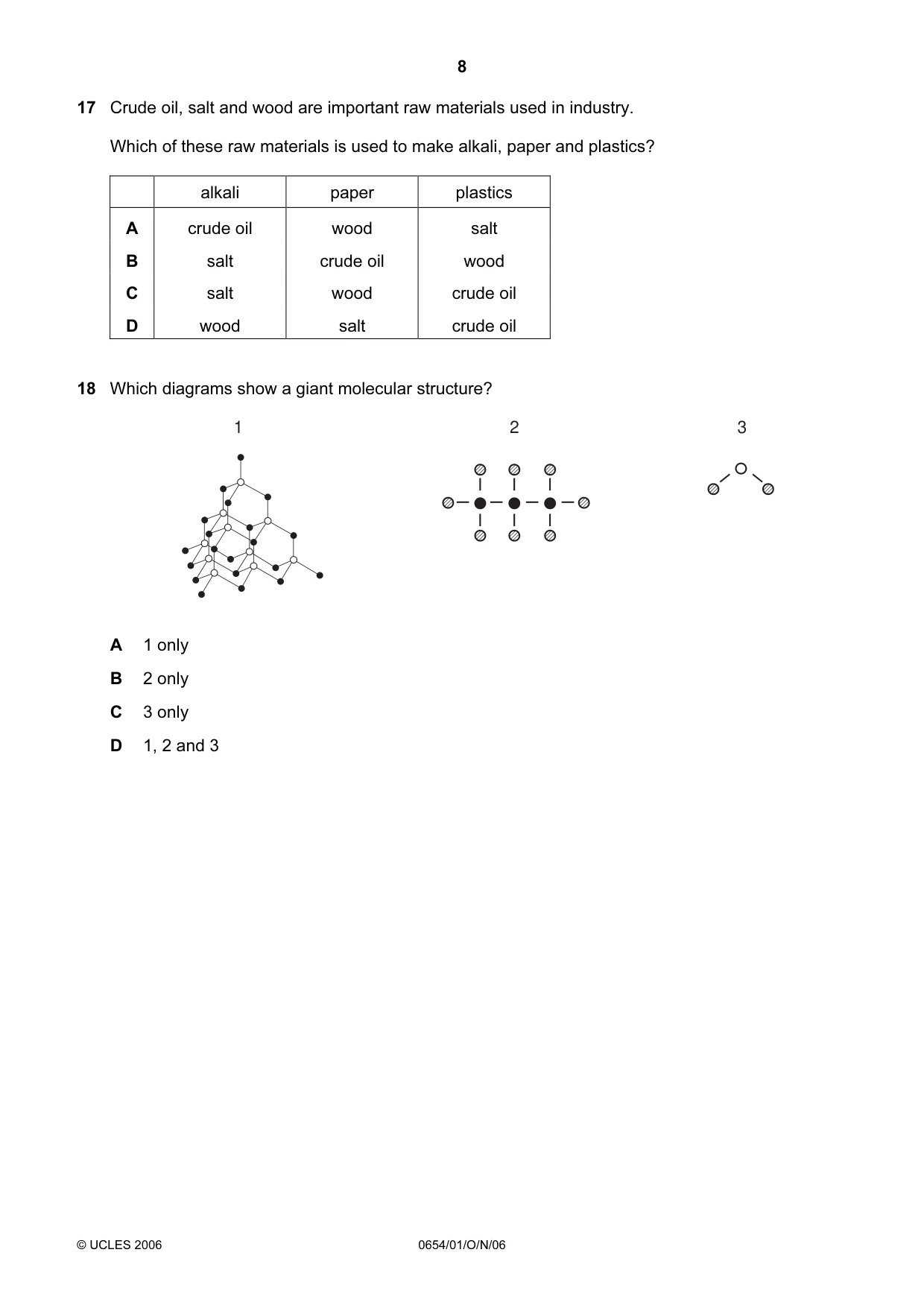
18 Which diagrams show a giant molecular structure? 1 2 3 A 1 only B 2 only C 3 only D 1, 2 and 3
Mark scheme: A
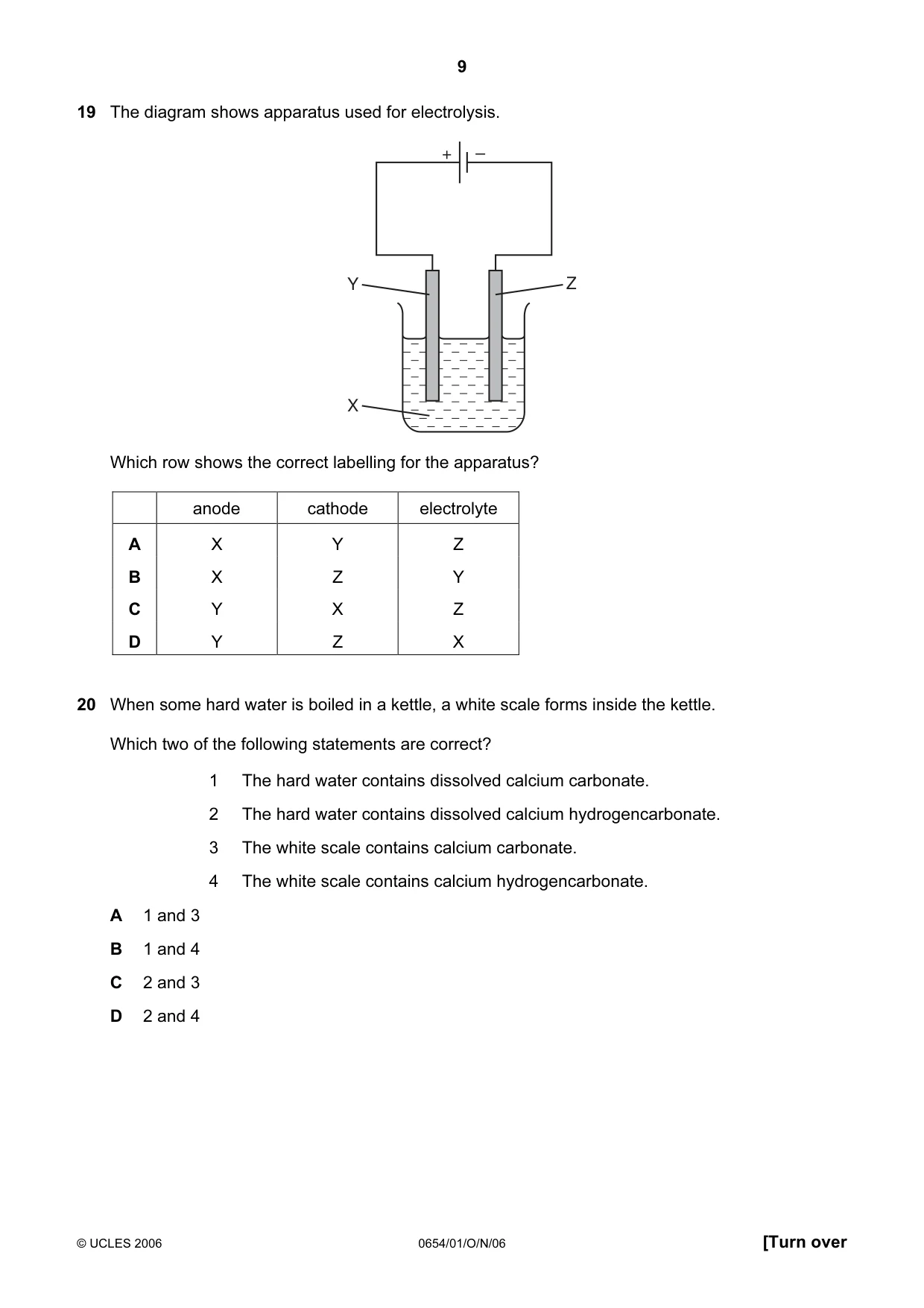
Q19 · The diagram shows apparatus used for electrolysis
19 The diagram shows apparatus used for electrolysis. + – Y Z X Which row shows the correct labelling for the apparatus? anode cathode electrolyte A X Y Z B X Z Y C Y X Z D Y Z X
Mark scheme: D
Q20 · When some hard water is boiled in a kettle, a white scale forms inside the kettle
20 When some hard water is boiled in a kettle, a white scale forms inside the kettle. Which two of the following statements are correct? 1 The hard water contains dissolved calcium carbonate. 2 The hard water contains dissolved calcium hydrogencarbonate. 3 The white scale contains calcium carbonate. 4 The white scale contains calcium hydrogencarbonate. A 1 and 3 B 1 and 4 C 2 and 3 D 2 and 4
Mark scheme: C
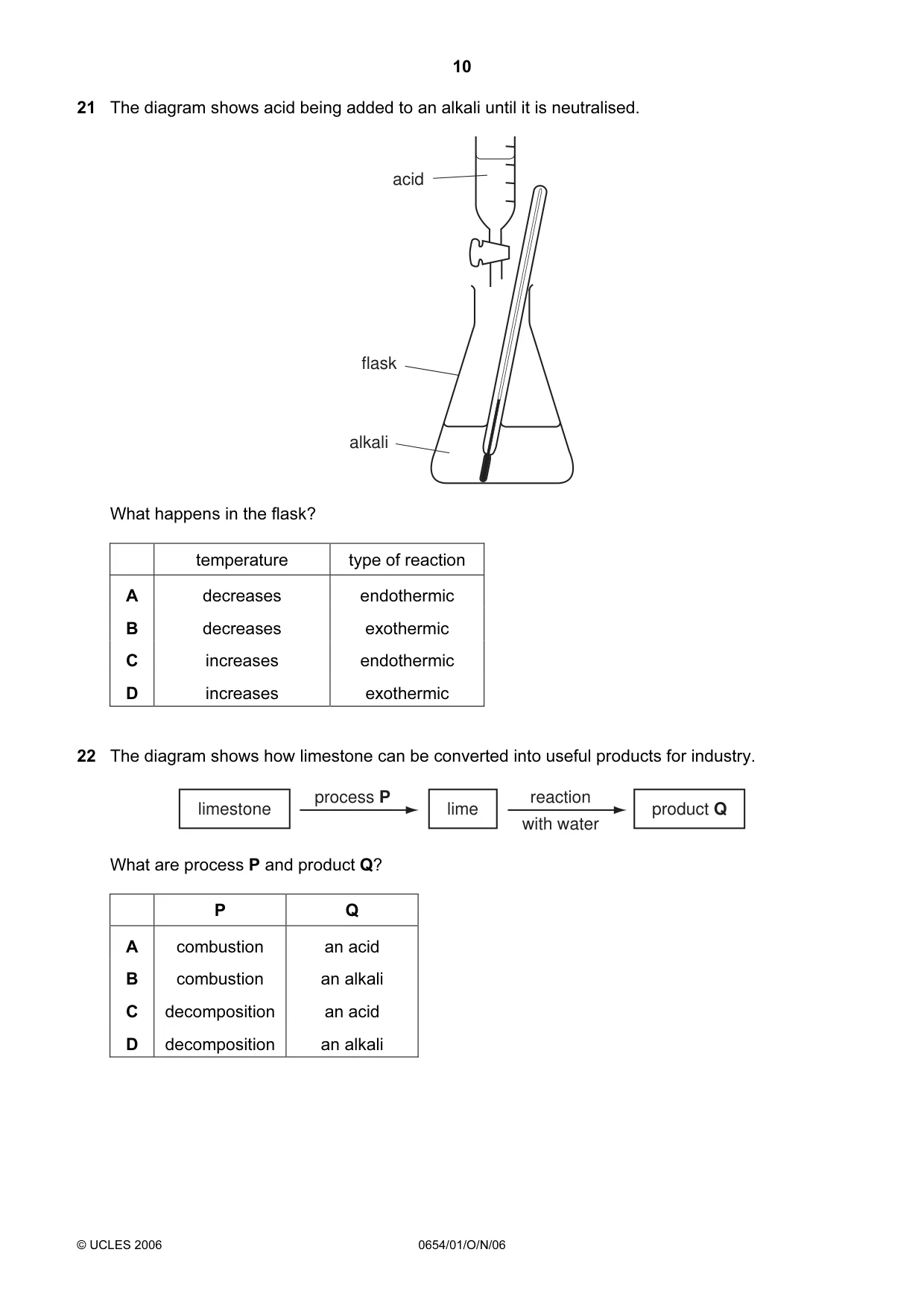
Q21 · The diagram shows acid being added to an alkali until it is neutralised
21 The diagram shows acid being added to an alkali until it is neutralised. acid flask alkali What happens in the flask? temperature type of reaction A decreases endothermic B decreases exothermic C increases endothermic D increases exothermic
Mark scheme: D
Q22 · The diagram shows how limestone can be converted into useful products for industry
22 The diagram shows how limestone can be converted into useful products for industry. process P reaction limestone lime product Q with water What are process P and product Q? P Q A combustion an acid B combustion an alkali C decomposition an acid D decomposition an alkali
Mark scheme: D
Q23 · A small amount of ammonia is present in a sample of hydrogen
23 A small amount of ammonia is present in a sample of hydrogen. What would be the results of tests on the mixture? damp blue litmus lighted splint A stays blue no effect B stays blue pops C turns red no effect D turns red pops
Mark scheme: B
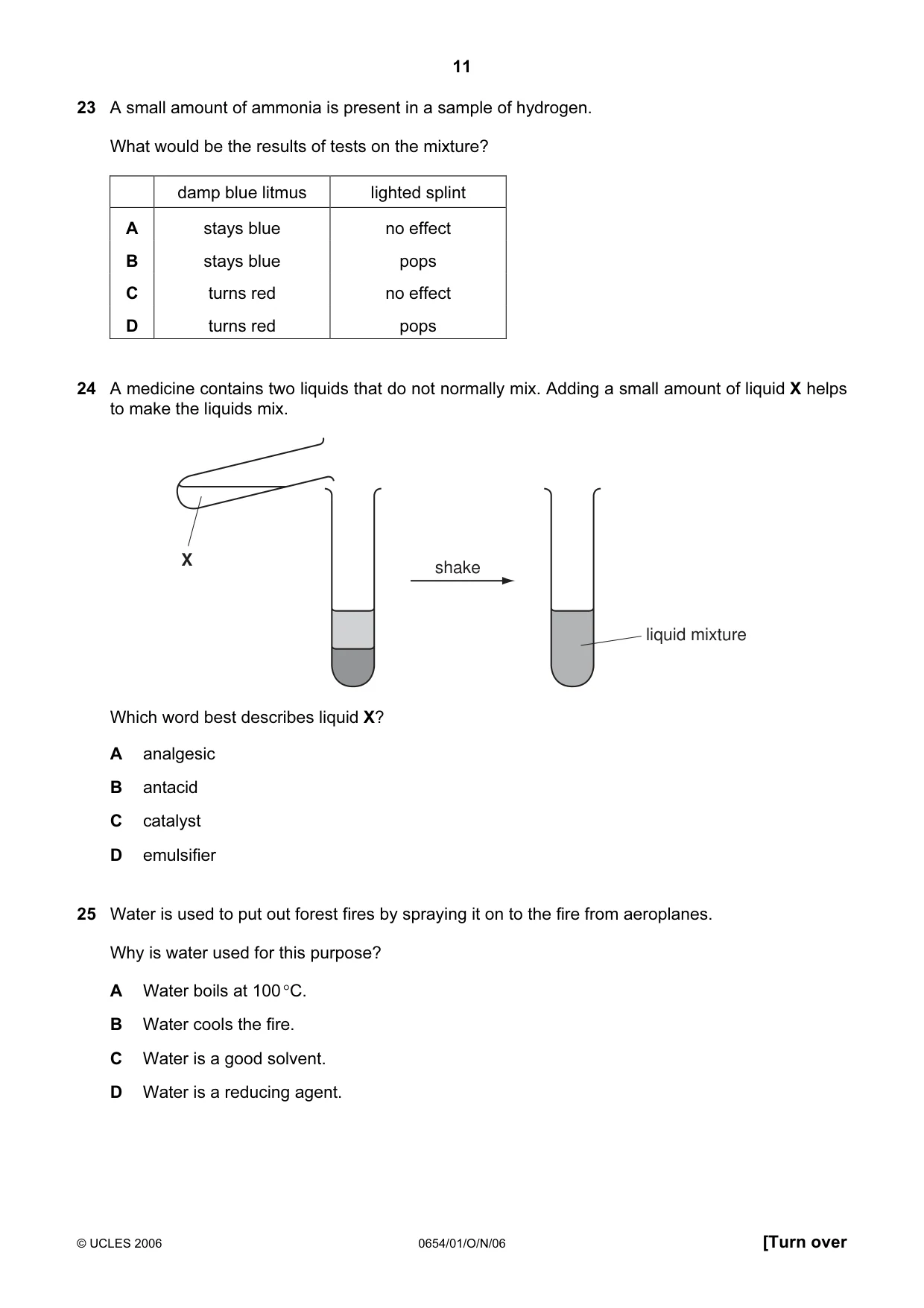
Q24 · A medicine contains two liquids that do not normally mix
24 A medicine contains two liquids that do not normally mix. Adding a small amount of liquid X helps to make the liquids mix. X shake liquid mixture Which word best describes liquid X? A analgesic B antacid C catalyst D emulsifier
Mark scheme: D
Q25 · Water is used to put out forest fires by spraying it on to the fire from aeroplanes
25 Water is used to put out forest fires by spraying it on to the fire from aeroplanes. Why is water used for this purpose? A Water boils at 100 °C. B Water cools the fire. C Water is a good solvent. D Water is a reducing agent.
Mark scheme: B
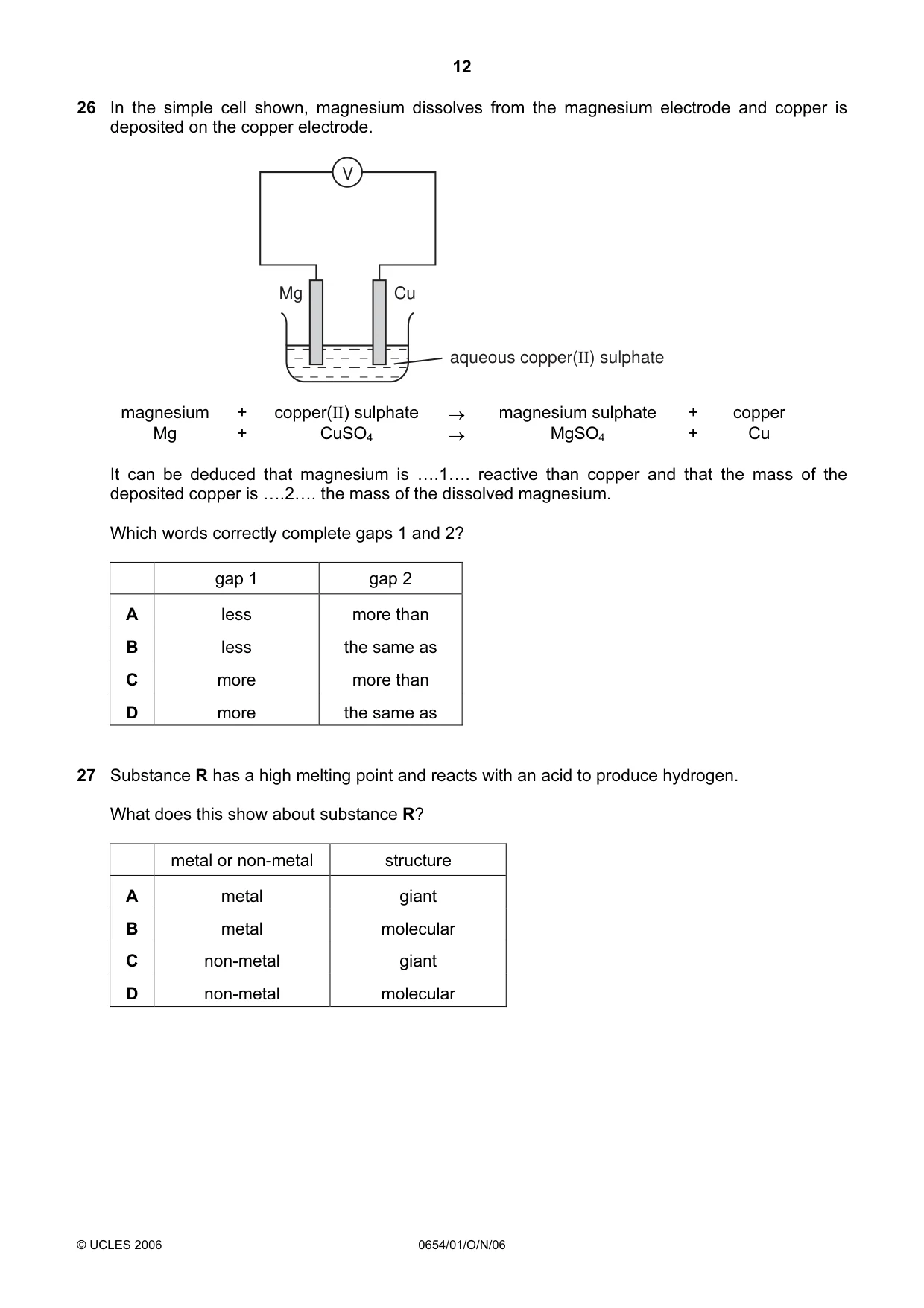
Q26 · In the simple cell shown, magnesium dissolves from the magnesium electrode and copper is…
26 In the simple cell shown, magnesium dissolves from the magnesium electrode and copper is deposited on the copper electrode. V Mg Cu aqueous copper(II) sulphate magnesium + copper(II) sulphate → magnesium sulphate + copper Mg + CuSO4 → MgSO4 + Cu It can be deduced that magnesium is ….1…. reactive than copper and that the mass of the deposited copper is ….2…. the mass of the dissolved magnesium. Which words correctly complete gaps 1 and 2? gap 1 gap 2 A less more than B less the same as C more more than D more the same as
Mark scheme: C
Q27 · Substance R has a high melting point and reacts with an acid to produce hydrogen
27 Substance R has a high melting point and reacts with an acid to produce hydrogen. What does this show about substance R? metal or non-metal structure A metal giant B metal molecular C non-metal giant D non-metal molecular
Mark scheme: A
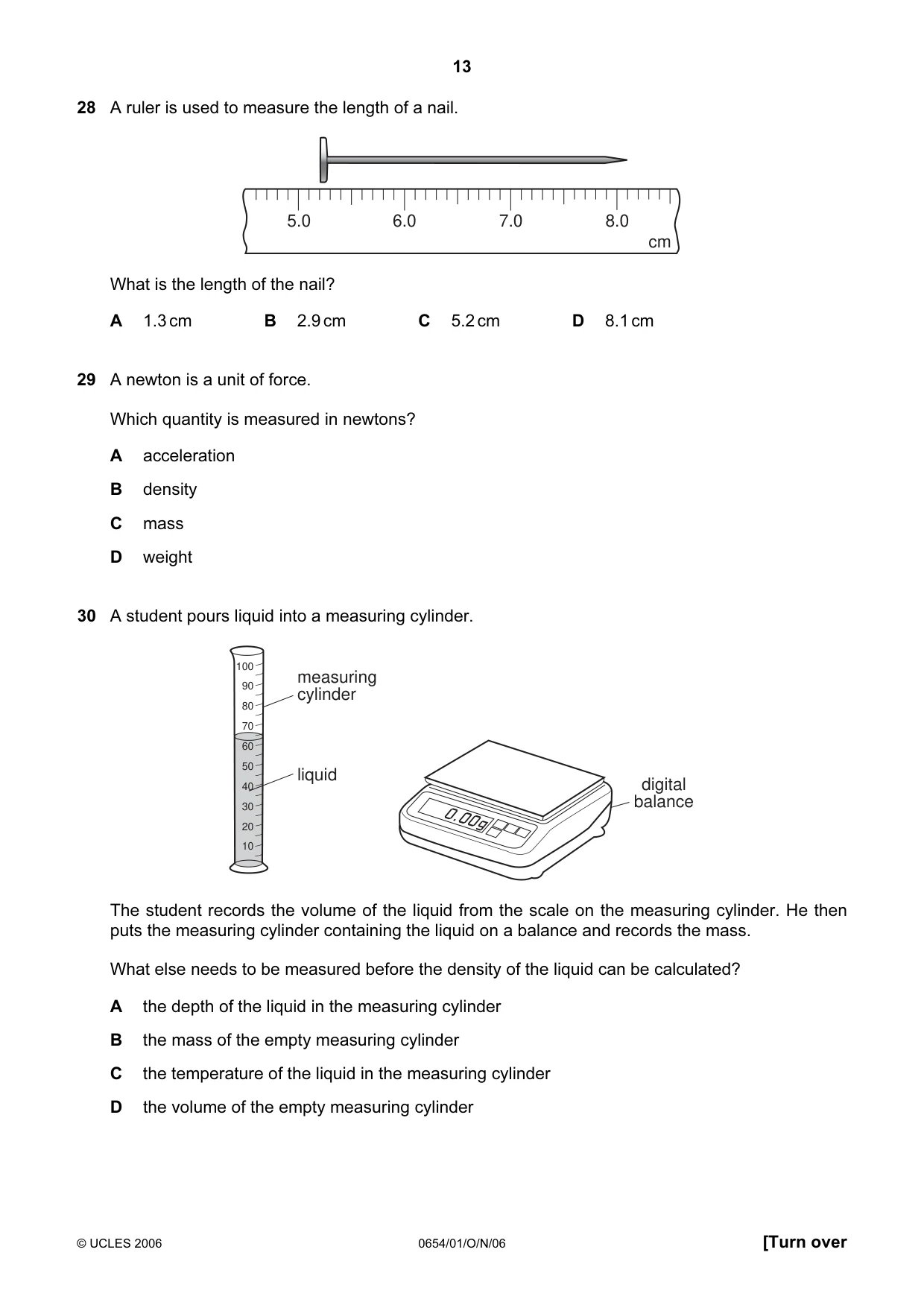
Q28 · A ruler is used to measure the length of a nail
28 A ruler is used to measure the length of a nail. 5.0 6.0 7.0 8.0 cm What is the length of the nail? A 1.3 cm B 2.9 cm C 5.2 cm D 8.1 cm
Mark scheme: B
More questions on Physical quantities and measurement techniques
Q29 · A newton is a unit of force
29 A newton is a unit of force. Which quantity is measured in newtons? A acceleration B density C mass D weight
Mark scheme: D
Q30 · A student pours liquid into a measuring cylinder
30 A student pours liquid into a measuring cylinder. 100 measuring 90 cylinder 80 70 60 50 liquid 40 digital balance 30 20 10 The student records the volume of the liquid from the scale on the measuring cylinder. He then puts the measuring cylinder containing the liquid on a balance and records the mass. What else needs to be measured before the density of the liquid can be calculated? A the depth of the liquid in the measuring cylinder B the mass of the empty measuring cylinder C the temperature of the liquid in the measuring cylinder D the volume of the empty measuring cylinder
Mark scheme: B
Q31 · Which source of energy uses the production of steam to generate electricity?
31 Which source of energy uses the production of steam to generate electricity? A hydroelectric B nuclear C tides D waves
Mark scheme: B
Q32 · A cyclist travels down a hill from rest at point X without pedalling
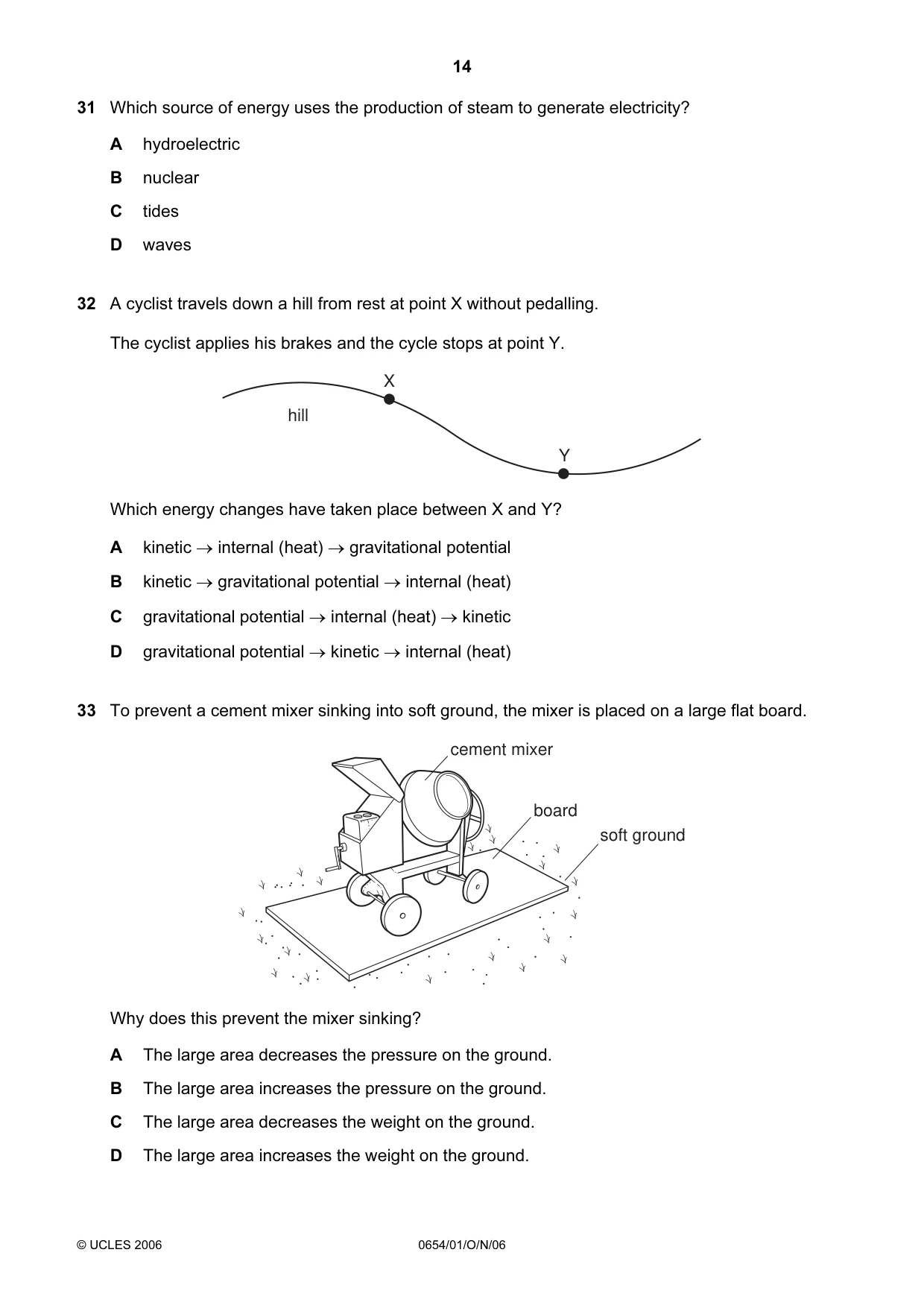
32 A cyclist travels down a hill from rest at point X without pedalling. The cyclist applies his brakes and the cycle stops at point Y. X hill Y Which energy changes have taken place between X and Y? A kinetic → internal (heat) → gravitational potential B kinetic → gravitational potential → internal (heat) C gravitational potential → internal (heat) → kinetic D gravitational potential → kinetic → internal (heat)
Mark scheme: D
Q33 · To prevent a cement mixer sinking into soft ground, the mixer is placed on a large flat…
33 To prevent a cement mixer sinking into soft ground, the mixer is placed on a large flat board. cement mixer board soft ground Why does this prevent the mixer sinking? A The large area decreases the pressure on the ground. B The large area increases the pressure on the ground. C The large area decreases the weight on the ground. D The large area increases the weight on the ground.
Mark scheme: A
Q34 · Which line in the table is correct about conduction and convection?
34 Which line in the table is correct about conduction and convection? conduction convection A can happen in a solid can happen in a solid B can happen in a solid only happens in fluids C only happens in fluids can happen in a solid D only happens in fluids only happens in fluids
Mark scheme: B
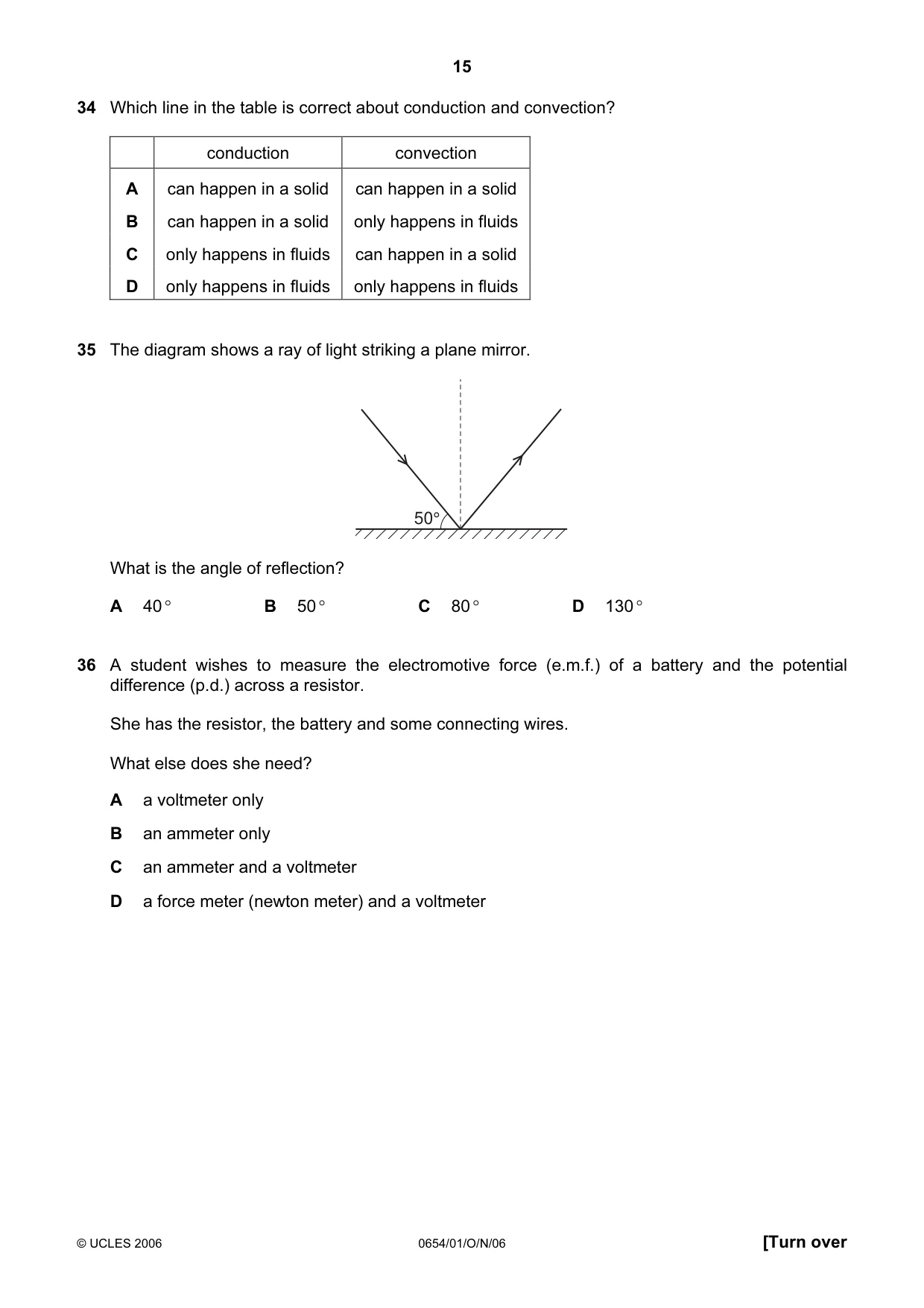
Q35 · The diagram shows a ray of light striking a plane mirror
35 The diagram shows a ray of light striking a plane mirror. 50° What is the angle of reflection? A 40 ° B 50 ° C 80 ° D 130 °
Mark scheme: A
Q36 · A student wishes to measure the electromotive force (e.m.f.) of a battery and the…
36 A student wishes to measure the electromotive force (e.m.f.) of a battery and the potential difference (p.d.) across a resistor. She has the resistor, the battery and some connecting wires. What else does she need? A a voltmeter only B an ammeter only C an ammeter and a voltmeter D a force meter (newton meter) and a voltmeter
Mark scheme: A
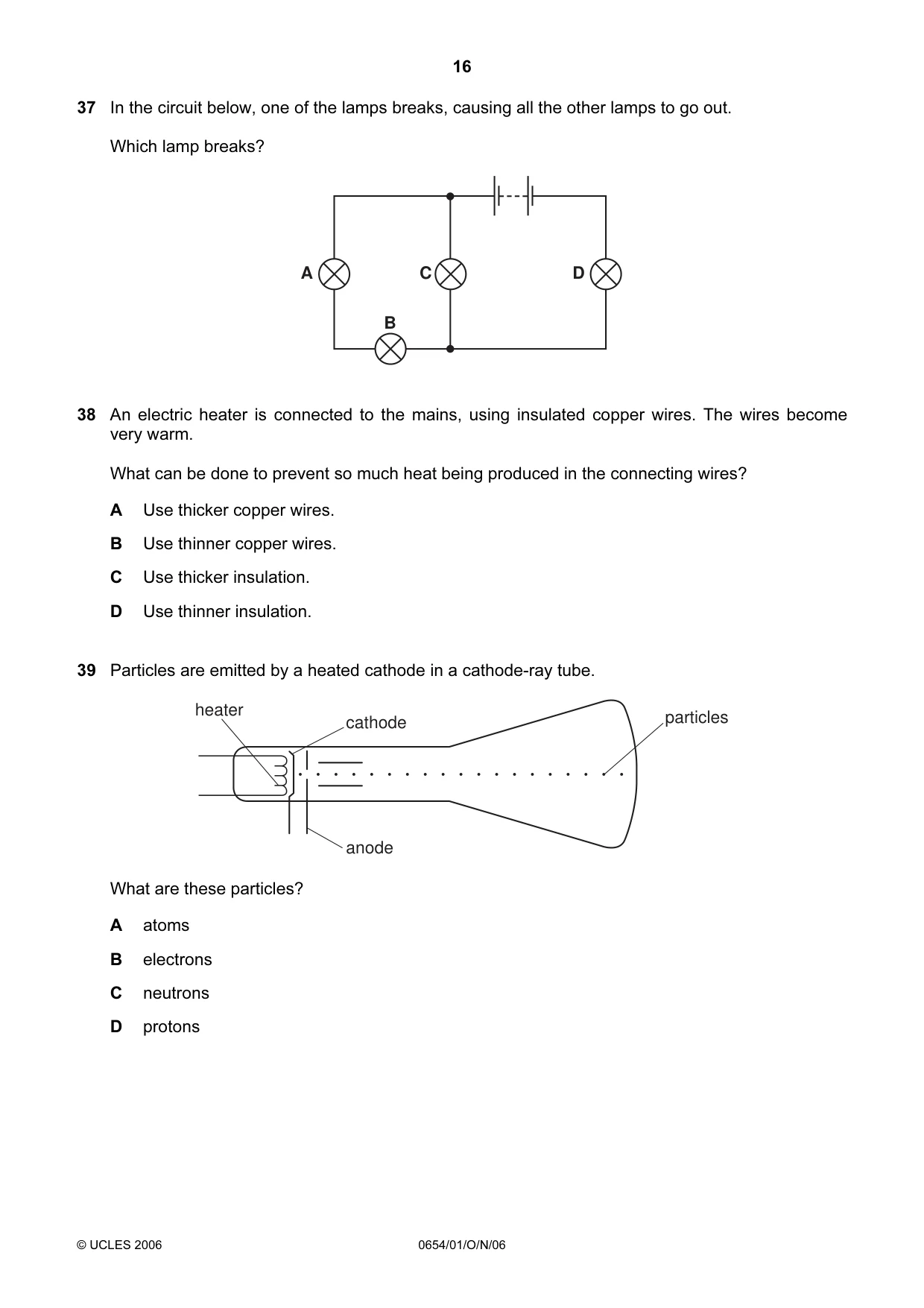
Q37 · In the circuit below, one of the lamps breaks, causing all the other lamps to go out
37 In the circuit below, one of the lamps breaks, causing all the other lamps to go out. Which lamp breaks? A C D B
Mark scheme: D
Q38 · An electric heater is connected to the mains, using insulated copper wires
38 An electric heater is connected to the mains, using insulated copper wires. The wires become very warm. What can be done to prevent so much heat being produced in the connecting wires? A Use thicker copper wires. B Use thinner copper wires. C Use thicker insulation. D Use thinner insulation.
Mark scheme: A
Q39 · Particles are emitted by a heated cathode in a cathode-ray tube
39 Particles are emitted by a heated cathode in a cathode-ray tube. heater particles cathode anode What are these particles? A atoms B electrons C neutrons D protons
Mark scheme: B
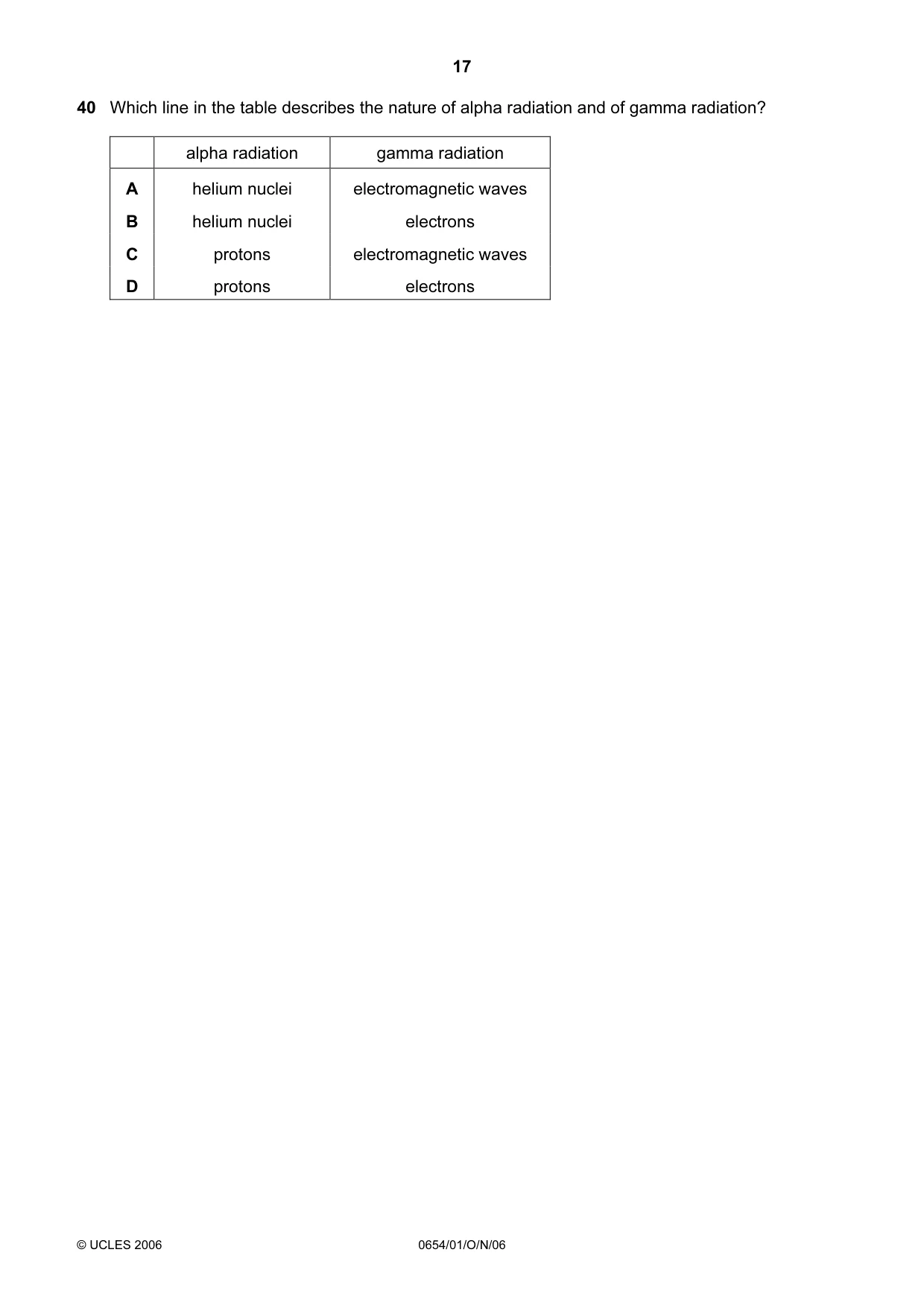
Q40 · Which line in the table describes the nature of alpha radiation and of gamma radiation?
40 Which line in the table describes the nature of alpha radiation and of gamma radiation? alpha radiation gamma radiation A helium nuclei electromagnetic waves B helium nuclei electrons C protons electromagnetic waves D protons electrons
Mark scheme: A
What was in this paper
The subtopics covered by these 40 questions, and how many questions each got. Open one in a new tab to see every Cambridge question on it.
2Diet2Electrical circuits2Energy, work and power2Photosynthesis2Radioactivity2Water2Arrangement of elements1Atomic structure and the Periodic Table1Carbon cycle1Cell structure1Characteristics of living organisms1Density1Electrical quantities1Electrolysis1Exothermic and endothermic reactions1Fuels1Gas exchange in humans1Giant covalent structures1Hormones1Identification of ions and gases1Light1Mass and weight1Monohybrid inheritance1Oxides1Physical quantities and measurement techniques1Pressure1Properties of metals1Reactivity series1Separation and purification1Solids, liquids and gases1Transfer of thermal energy1Xylem and phloem1What you needed in this session
Cambridge’s own grade thresholds for 2006 Oct/Nov, Paper 1 · Variant 1. A higher threshold means an easier paper — the bar moves with how the cohort did.