Cambridge IGCSE Sciences - Co-ordinated (Double) 0654 — 2023 Oct/Nov Paper 1 · Variant 2
0654/12/O/N/23 · 40 questions · 40 marks · ≈45 min
The question paper and its mark scheme, free to read here and free to download. This is Cambridge’s own paper, exactly as it was sat.
Question paper16 pages

Mark scheme3 pages
Answers below. Sit the paper first if you are practising.
Questions as text
Q1 · Which statement about the characteristics of living organisms is correct?
1 Which statement about the characteristics of living organisms is correct? A Excretion is the removal of excess substances and toxic materials. B Movement is the ability to detect and respond to environmental changes. C Nutrition is the breaking down of molecules to release energy. D Respiration is the manufacture of carbohydrates from raw materials.
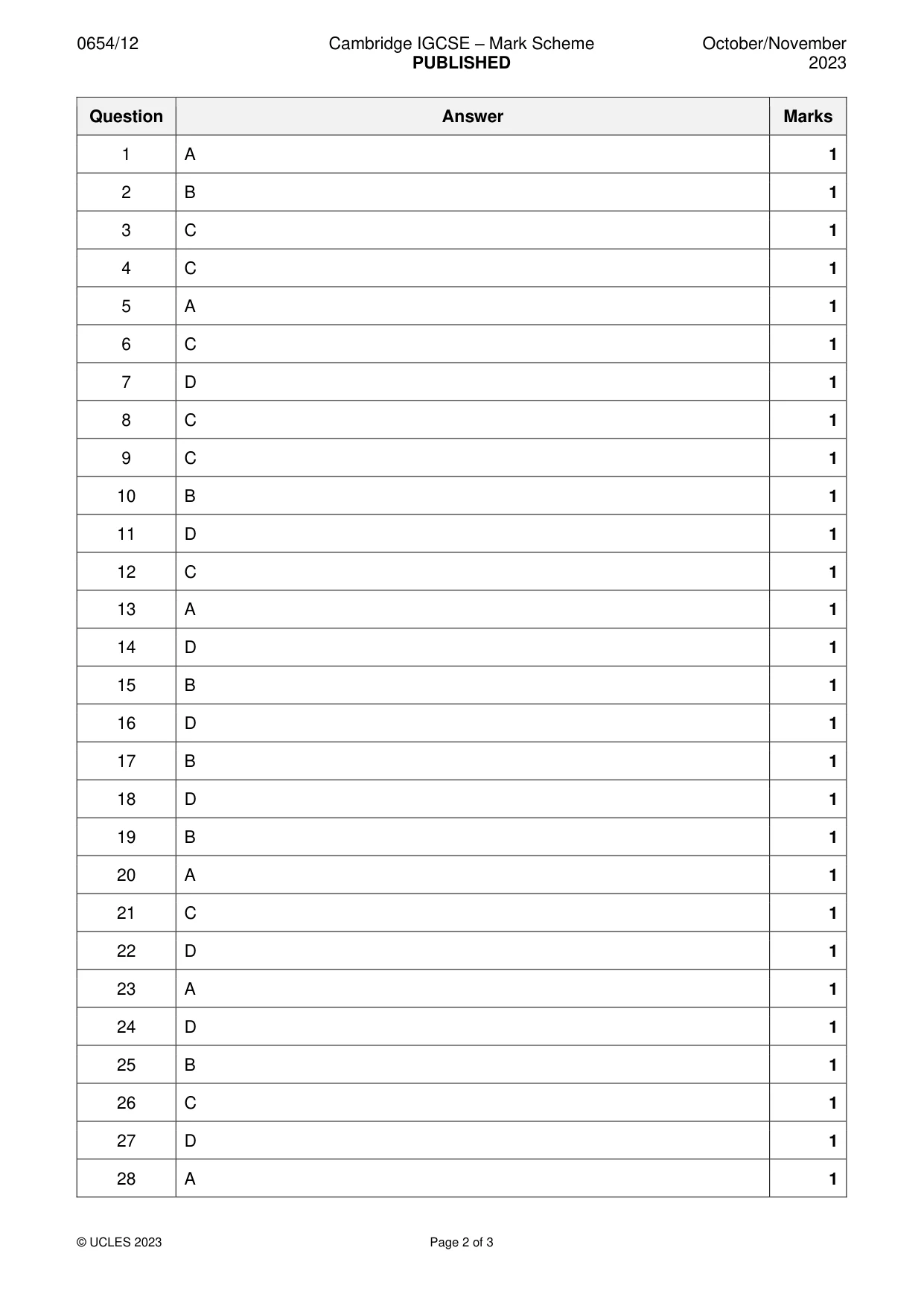
Mark scheme: A
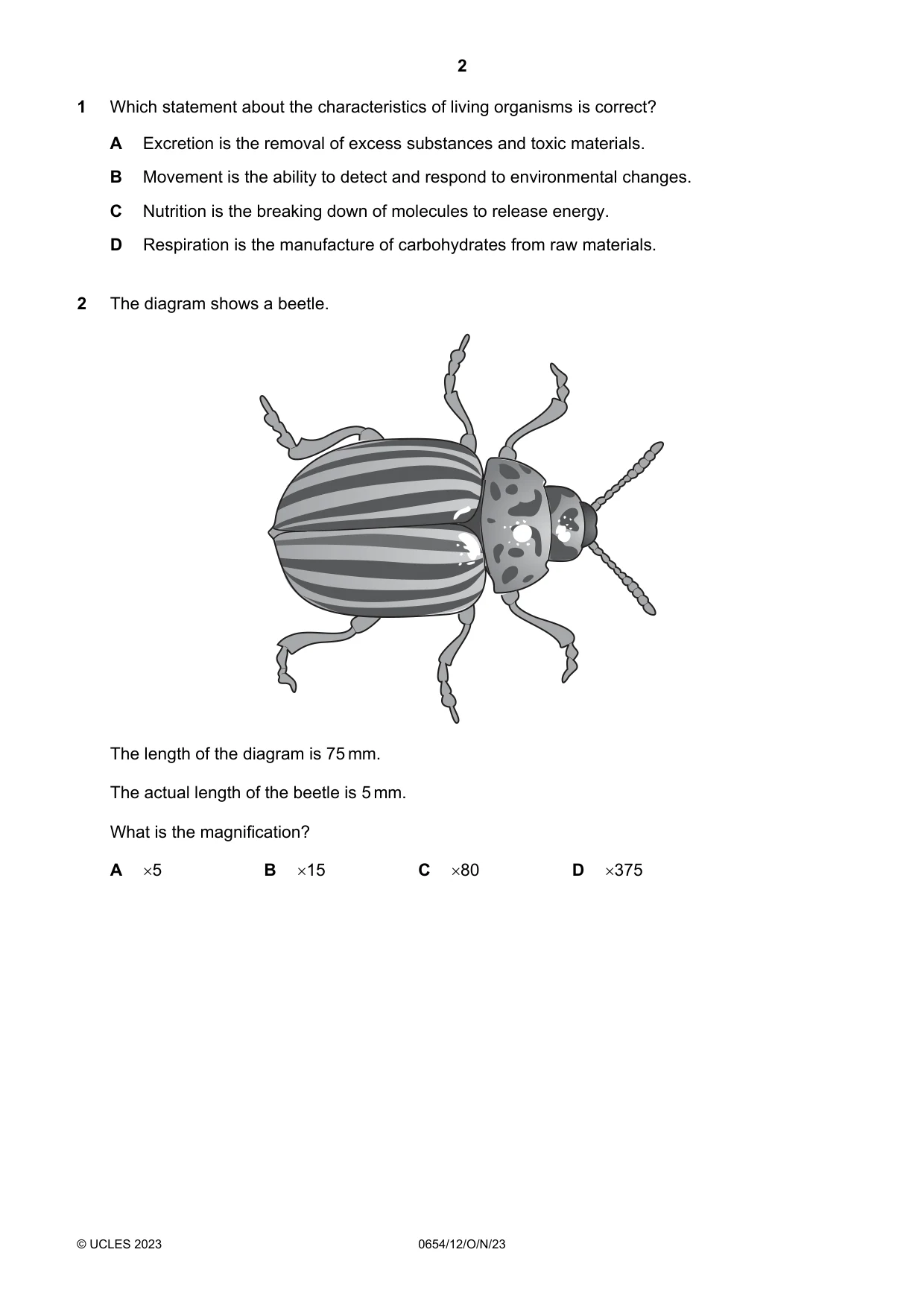
Q2 · The diagram shows a beetle
2 The diagram shows a beetle. The length of the diagram is 75 mm. The actual length of the beetle is 5 mm. What is the magnification? A 5 B 15 C 80 D 375
Mark scheme: B
Q3 · A colourless liquid gives the test results shown
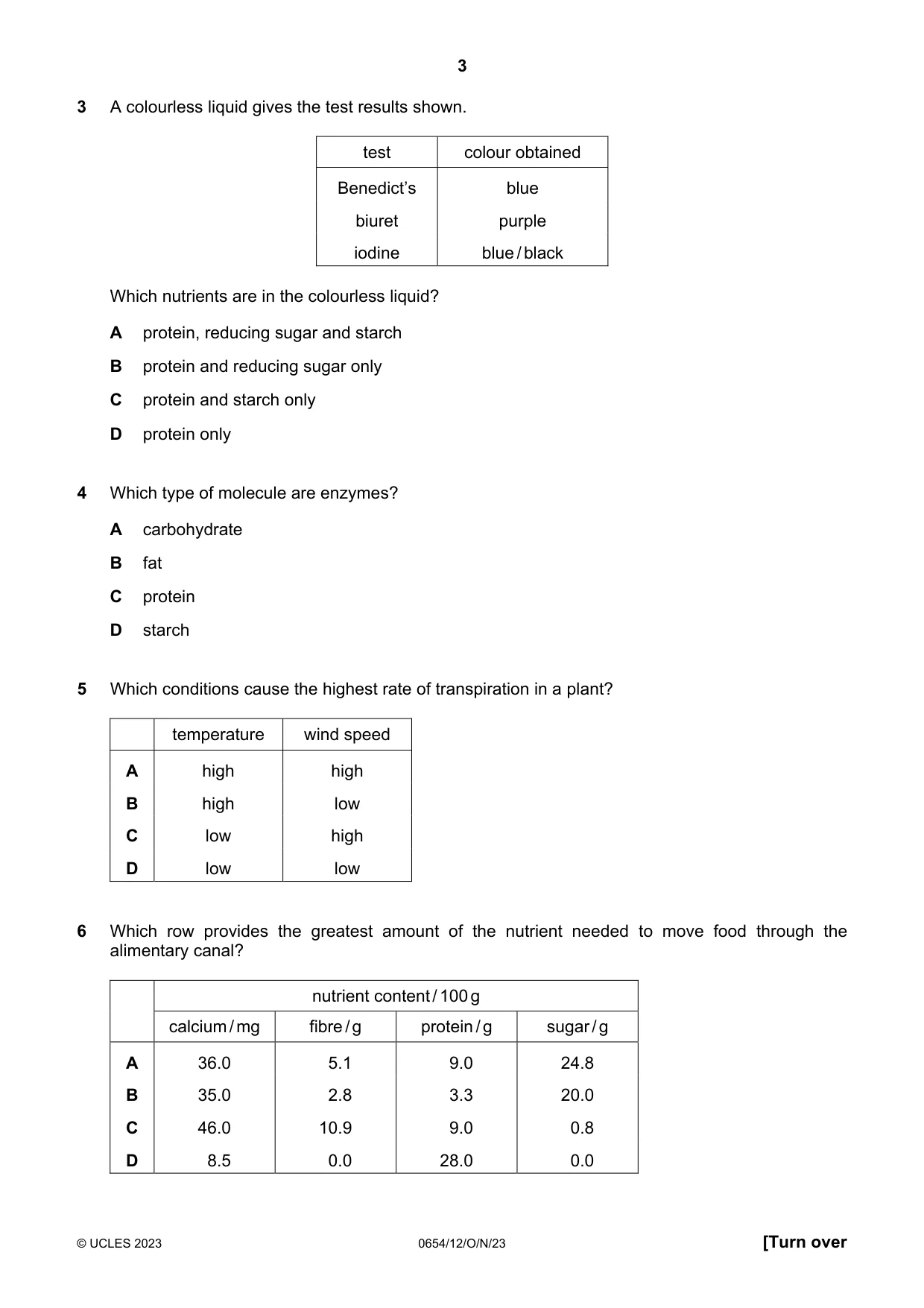
3 A colourless liquid gives the test results shown. test colour obtained Benedict’s blue biuret purple iodine blue / black Which nutrients are in the colourless liquid? A protein, reducing sugar and starch B protein and reducing sugar only C protein and starch only D protein only
Mark scheme: C
Q4 · Which type of molecule are enzymes?
4 Which type of molecule are enzymes? A carbohydrate B fat C protein D starch
Mark scheme: C
Q5 · Which conditions cause the highest rate of transpiration in a plant?
5 Which conditions cause the highest rate of transpiration in a plant? temperature wind speed A high high B high low C low high D low low
Mark scheme: A
Q6 · Which row provides the greatest amount of the nutrient needed to move food through the…
6 Which row provides the greatest amount of the nutrient needed to move food through the alimentary canal? nutrient content / 100 g calcium / mg fibre / g protein / g sugar / g A 36.0 5.1 9.0 24.8 B 35.0 2.8 3.3 20.0 C 46.0 10.9 9.0 0.8 D 8.5 0.0 28.0 0.0
Mark scheme: C
Q7 · The rates of water uptake and loss are measured in four leaves
7 The rates of water uptake and loss are measured in four leaves. The results are shown in the table. Which leaf is least likely to wilt? rate of water uptake rate of water loss / mm3 per minute / mm3 per minute A 8 15 B 9 11 C 12 13 D 15 10
Mark scheme: D
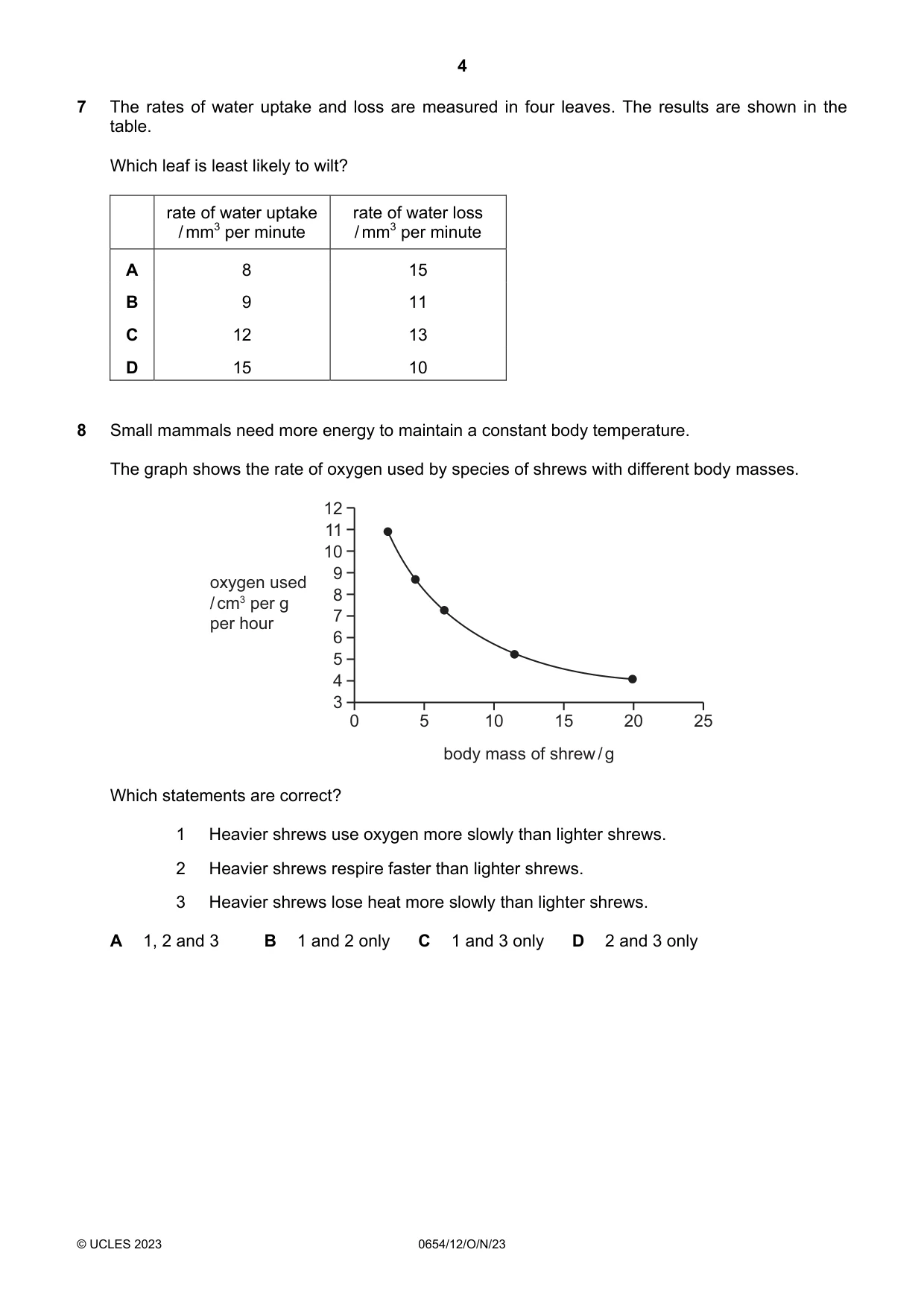
Q8 · Small mammals need more energy to maintain a constant body temperature
8 Small mammals need more energy to maintain a constant body temperature. The graph shows the rate of oxygen used by species of shrews with different body masses. 12 11 10 9 oxygen used 8 / cm3 per g per hour 7 6 5 4 3 0 5 10 15 20 25 body mass of shrew / g Which statements are correct? 1 Heavier shrews use oxygen more slowly than lighter shrews. 2 Heavier shrews respire faster than lighter shrews. 3 Heavier shrews lose heat more slowly than lighter shrews. A 1, 2 and 3 B 1 and 2 only C 1 and 3 only D 2 and 3 only
Mark scheme: C
Q9 · The diagram shows a section through the skin
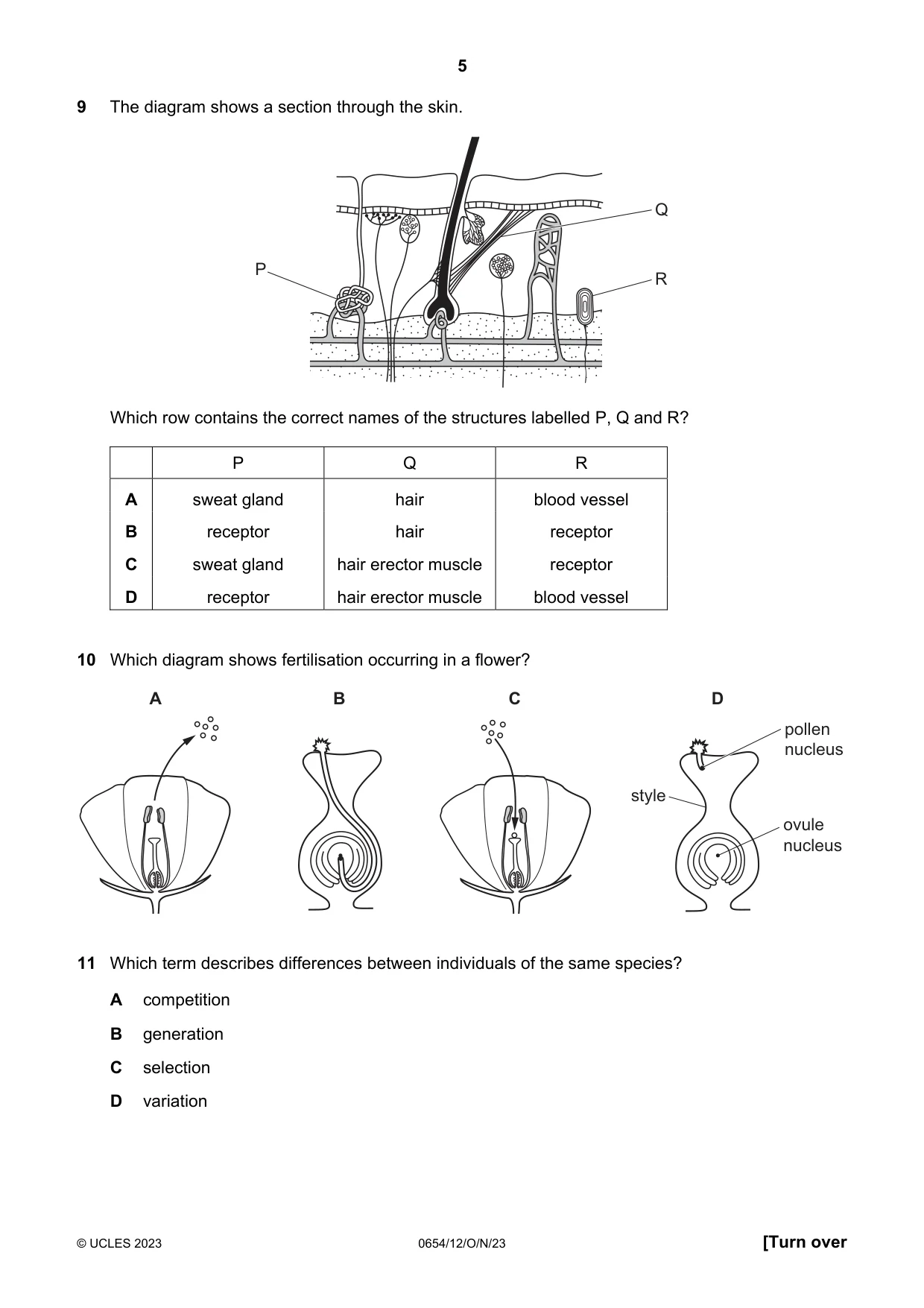
9 The diagram shows a section through the skin. Q P R Which row contains the correct names of the structures labelled P, Q and R? P Q R A sweat gland hair blood vessel B receptor hair receptor C sweat gland hair erector muscle receptor D receptor hair erector muscle blood vessel
Mark scheme: C
Q10 · Which diagram shows fertilisation occurring in a flower?
10 Which diagram shows fertilisation occurring in a flower? A B C D pollen nucleus style ovule nucleus
Mark scheme: B
Q11 · Which term describes differences between individuals of the same species?
11 Which term describes differences between individuals of the same species? A competition B generation C selection D variation
Mark scheme: D
Q12 · Which type of organism gets its energy from breaking down dead or waste organic matter?
12 Which type of organism gets its energy from breaking down dead or waste organic matter? A carnivore B consumer C decomposer D producer
Mark scheme: C
Q13 · The concentration of carbon dioxide in the atmosphere has increased during the last 200…
13 The concentration of carbon dioxide in the atmosphere has increased during the last 200 years. What has contributed to this increase? A burning large areas of forest B increasing use of pesticides C planting more crops D using fewer fossil fuels
Mark scheme: A
Q14 · A sample of water contains two useful substances, insoluble chalk and a soluble salt
14 A sample of water contains two useful substances, insoluble chalk and a soluble salt. Which two processes are used to individually separate the insoluble chalk from the soluble salt and from the water? A distillation and chromatography B distillation and crystallisation C filtration and chromatography D filtration and crystallisation
Mark scheme: D
Q15 · Which statement about isotopes of the same element is correct?
15 Which statement about isotopes of the same element is correct? A They have the same number of protons but different number of electrons. B They have the same number of protons but different number of neutrons. C They have the same number of neutrons but different number of electrons. D They have the same number of neutrons but different number of protons.
Mark scheme: B
Q16 · Which equation represents the reaction between aluminium and oxygen?
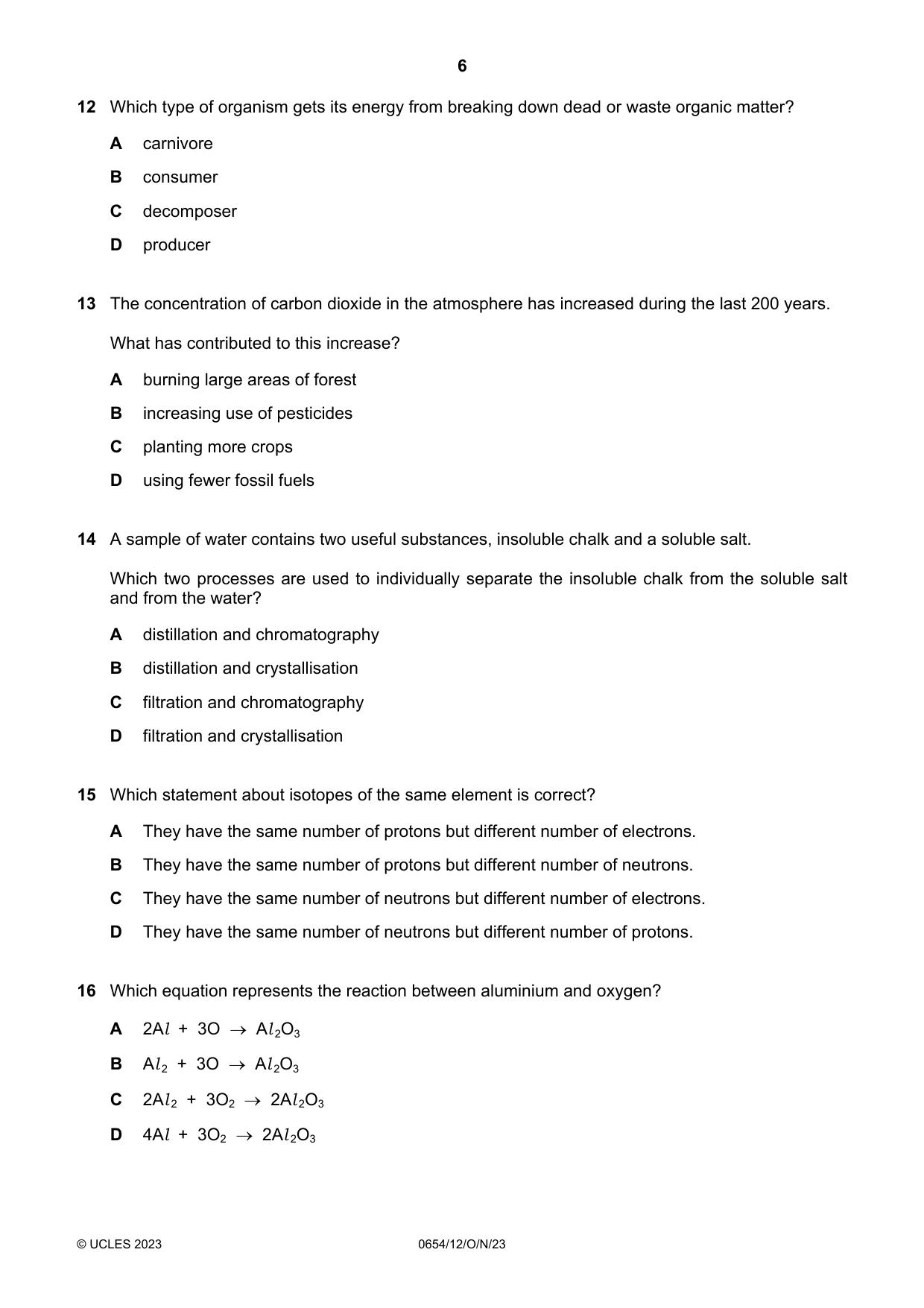
16 Which equation represents the reaction between aluminium and oxygen? A 2Al + 3O Al 2O3 B Al 2 + 3O Al 2O3 C 2Al 2 + 3O2 2Al 2O3 D 4Al + 3O2 2Al 2O3
Mark scheme: D
Q17 · Which substance does not undergo electrolysis?
17 Which substance does not undergo electrolysis? A aqueous copper chloride B copper wire C dilute sulfuric acid D molten lead(II) bromide
Mark scheme: B
Q18 · To extract a metal from its ore, a metal oxide is mixed with carbon and heated as shown
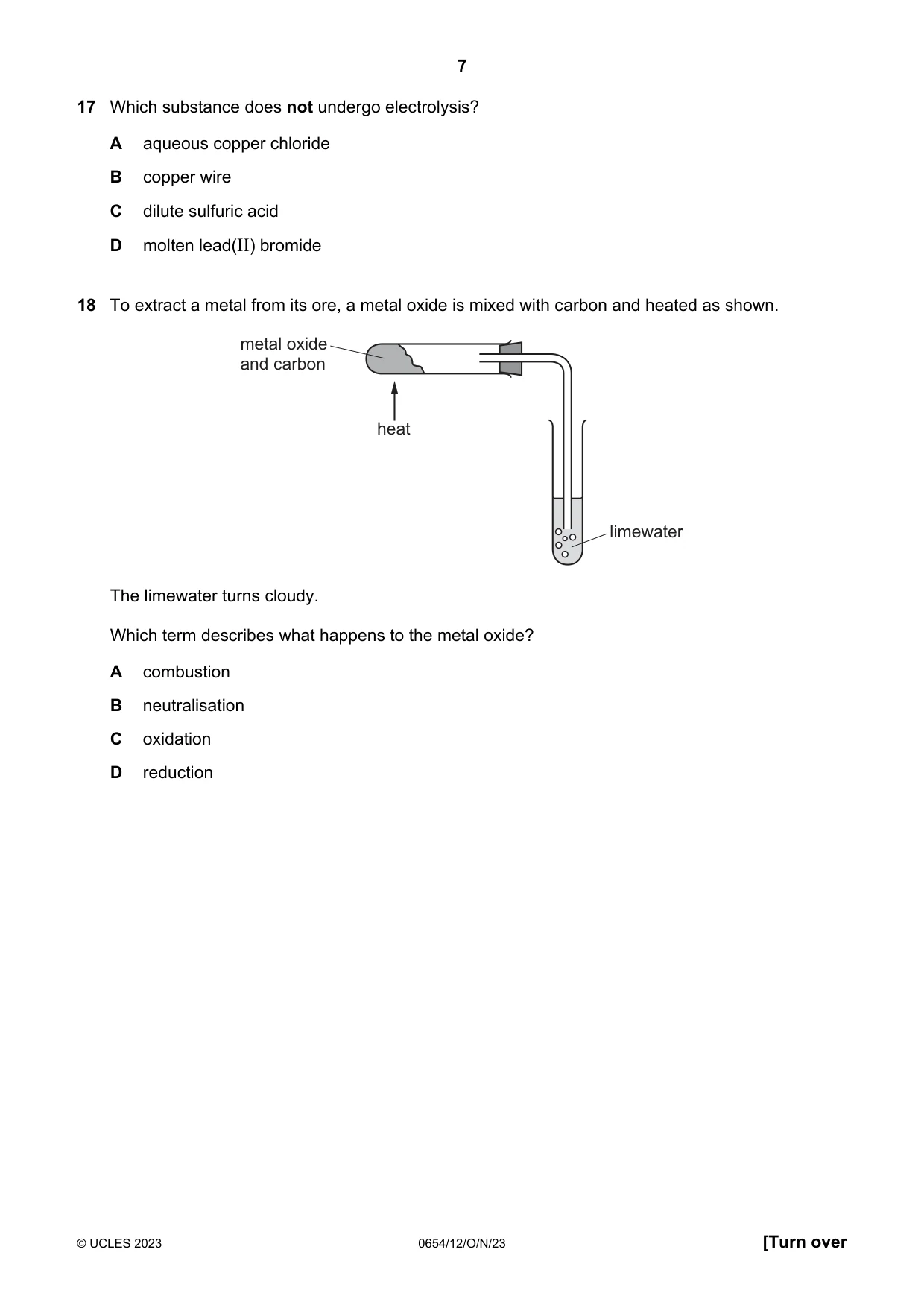
18 To extract a metal from its ore, a metal oxide is mixed with carbon and heated as shown. metal oxide and carbon heat limewater The limewater turns cloudy. Which term describes what happens to the metal oxide? A combustion B neutralisation C oxidation D reduction
Mark scheme: D
Q19 · Solid S is added to dilute hydrochloric acid in the apparatus shown
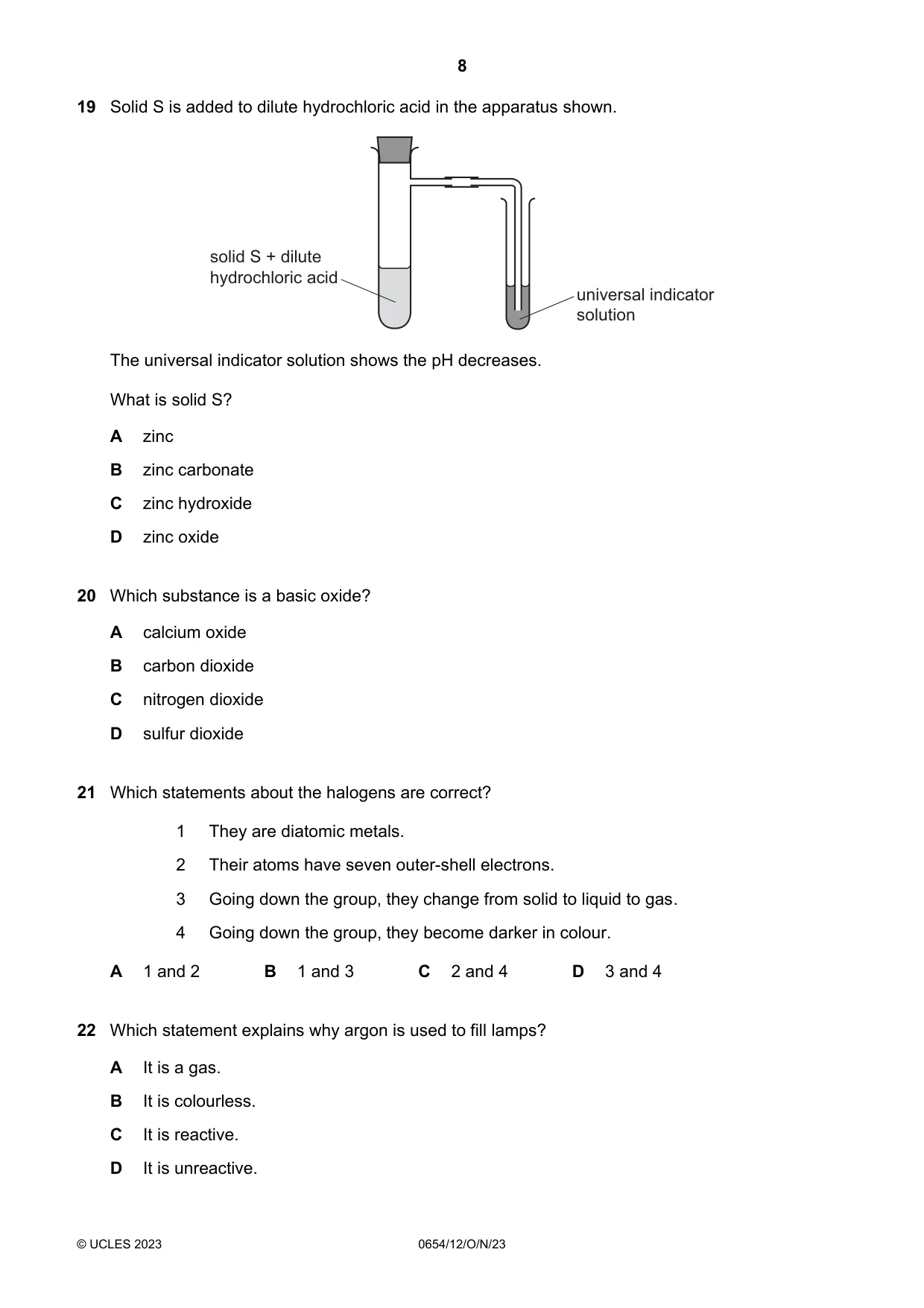
19 Solid S is added to dilute hydrochloric acid in the apparatus shown. solid S + dilute hydrochloric acid universal indicator solution The universal indicator solution shows the pH decreases. What is solid S? A zinc B zinc carbonate C zinc hydroxide D zinc oxide
Mark scheme: B
More questions on The characteristic properties of acids and bases
Q20 · Which substance is a basic oxide?
20 Which substance is a basic oxide? A calcium oxide B carbon dioxide C nitrogen dioxide D sulfur dioxide
Mark scheme: A
Q21 · Which statements about the halogens are correct?
21 Which statements about the halogens are correct? 1 They are diatomic metals. 2 Their atoms have seven outer-shell electrons. 3 Going down the group, they change from solid to liquid to gas. 4 Going down the group, they become darker in colour. A 1 and 2 B 1 and 3 C 2 and 4 D 3 and 4
Mark scheme: C
Q22 · Which statement explains why argon is used to fill lamps?
22 Which statement explains why argon is used to fill lamps? A It is a gas. B It is colourless. C It is reactive. D It is unreactive.
Mark scheme: D
Q23 · Aluminium is a ......1.....
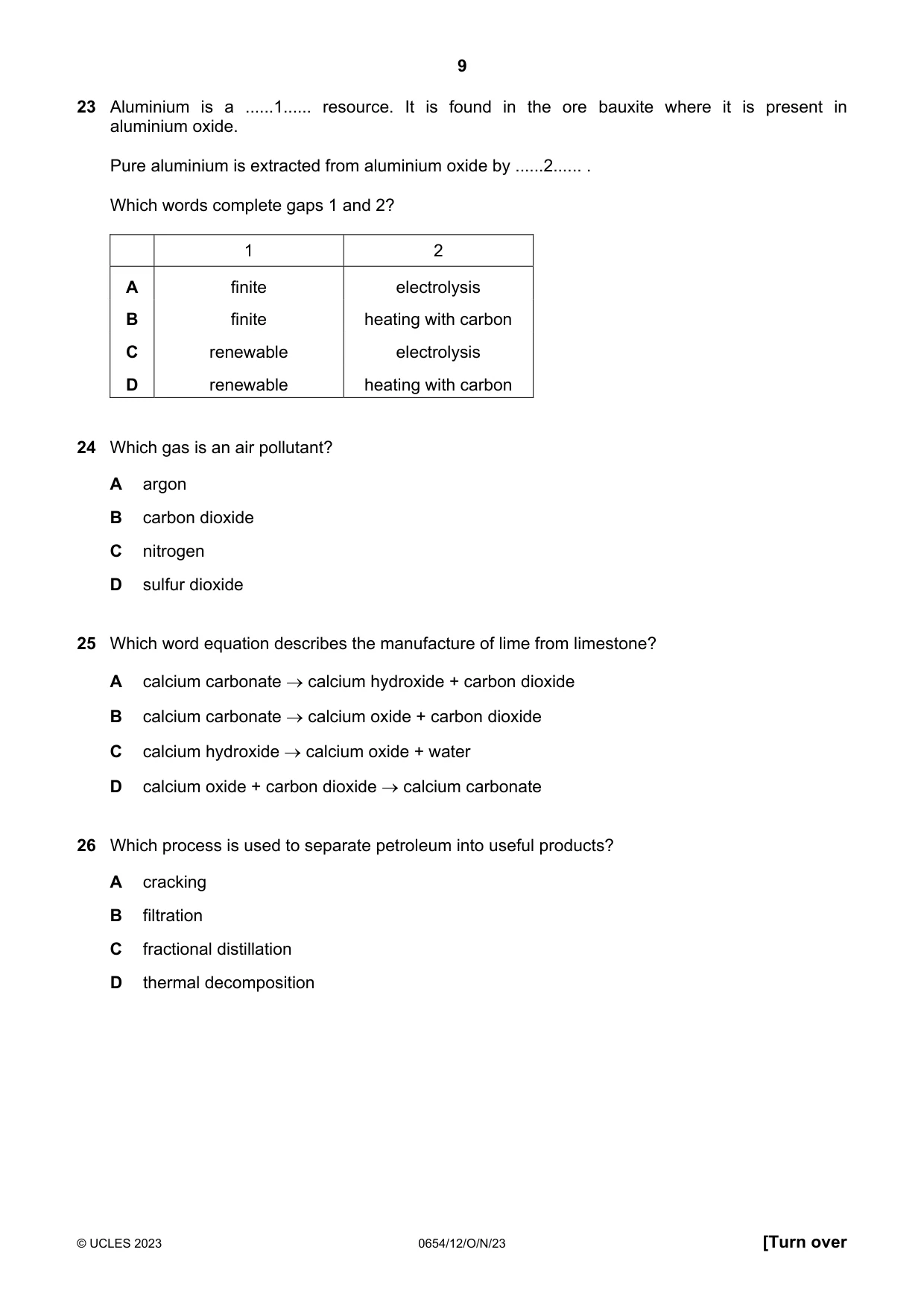
23 Aluminium is a ......1...... resource. It is found in the ore bauxite where it is present in aluminium oxide. Pure aluminium is extracted from aluminium oxide by ......2...... . Which words complete gaps 1 and 2? 1 2 A finite electrolysis B finite heating with carbon C renewable electrolysis D renewable heating with carbon
Mark scheme: A
Q24 · Which gas is an air pollutant?
24 Which gas is an air pollutant? A argon B carbon dioxide C nitrogen D sulfur dioxide
Mark scheme: D
Q25 · Which word equation describes the manufacture of lime from limestone?
25 Which word equation describes the manufacture of lime from limestone? A calcium carbonate calcium hydroxide + carbon dioxide B calcium carbonate calcium oxide + carbon dioxide C calcium hydroxide calcium oxide + water D calcium oxide + carbon dioxide calcium carbonate
Mark scheme: B
Q26 · Which process is used to separate petroleum into useful products?
26 Which process is used to separate petroleum into useful products? A cracking B filtration C fractional distillation D thermal decomposition
Mark scheme: C
Q27 · Polymers are long chain molecules made from smaller molecules
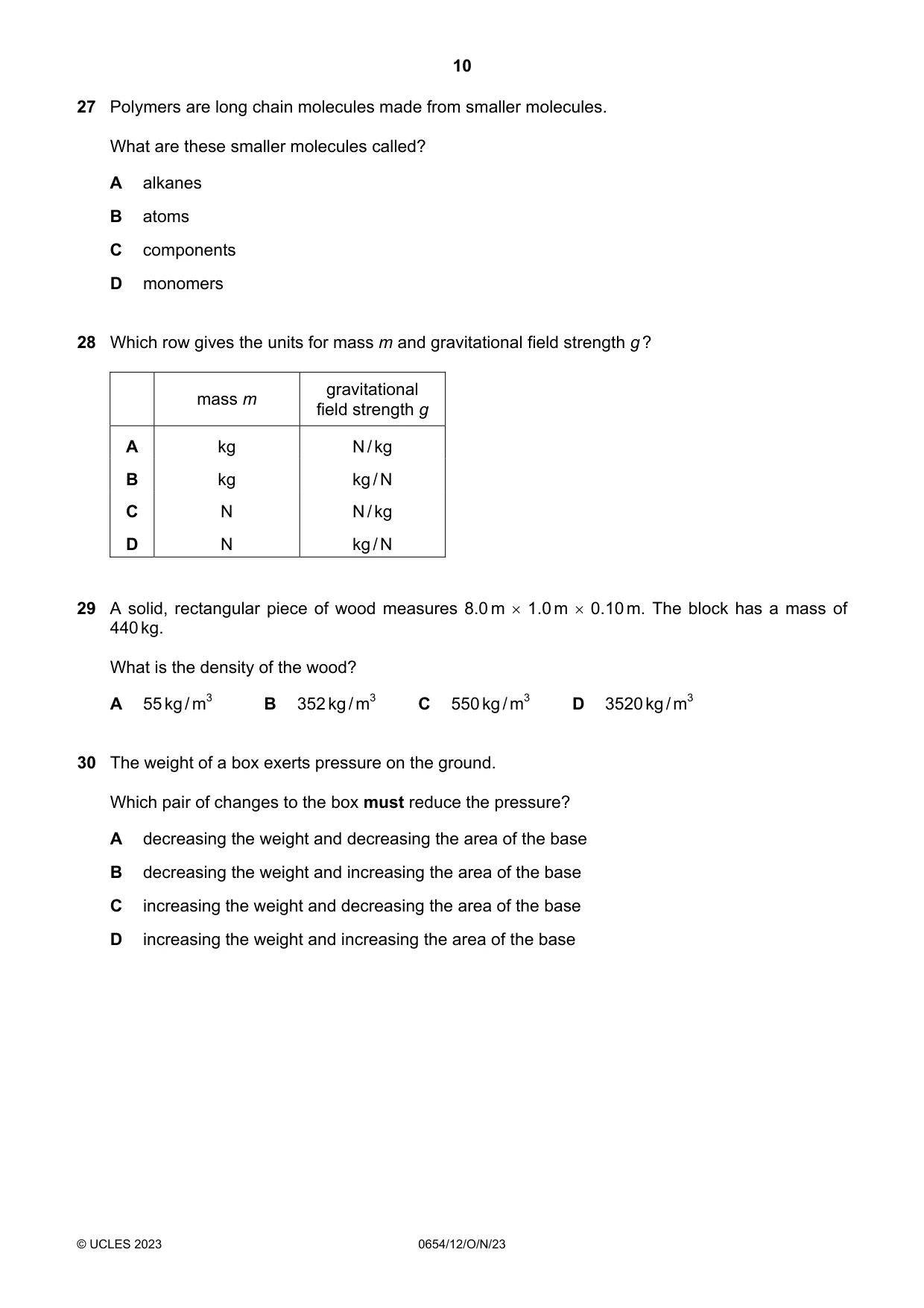
27 Polymers are long chain molecules made from smaller molecules. What are these smaller molecules called? A alkanes B atoms C components D monomers
Mark scheme: D
Q28 · Which row gives the units for mass m and gravitational field strength g ?
28 Which row gives the units for mass m and gravitational field strength g ? gravitational mass m field strength g A kg N / kg B kg kg / N C N N / kg D N kg / N
Mark scheme: A
More questions on Physical quantities and measurement techniques
Q29 · A solid, rectangular piece of wood measures 8.0 m 1.0 m 0.10 m
29 A solid, rectangular piece of wood measures 8.0 m 1.0 m 0.10 m. The block has a mass of 440 kg. What is the density of the wood? A 55 kg / m3 B 352 kg / m3 C 550 kg / m3 D 3520 kg / m3
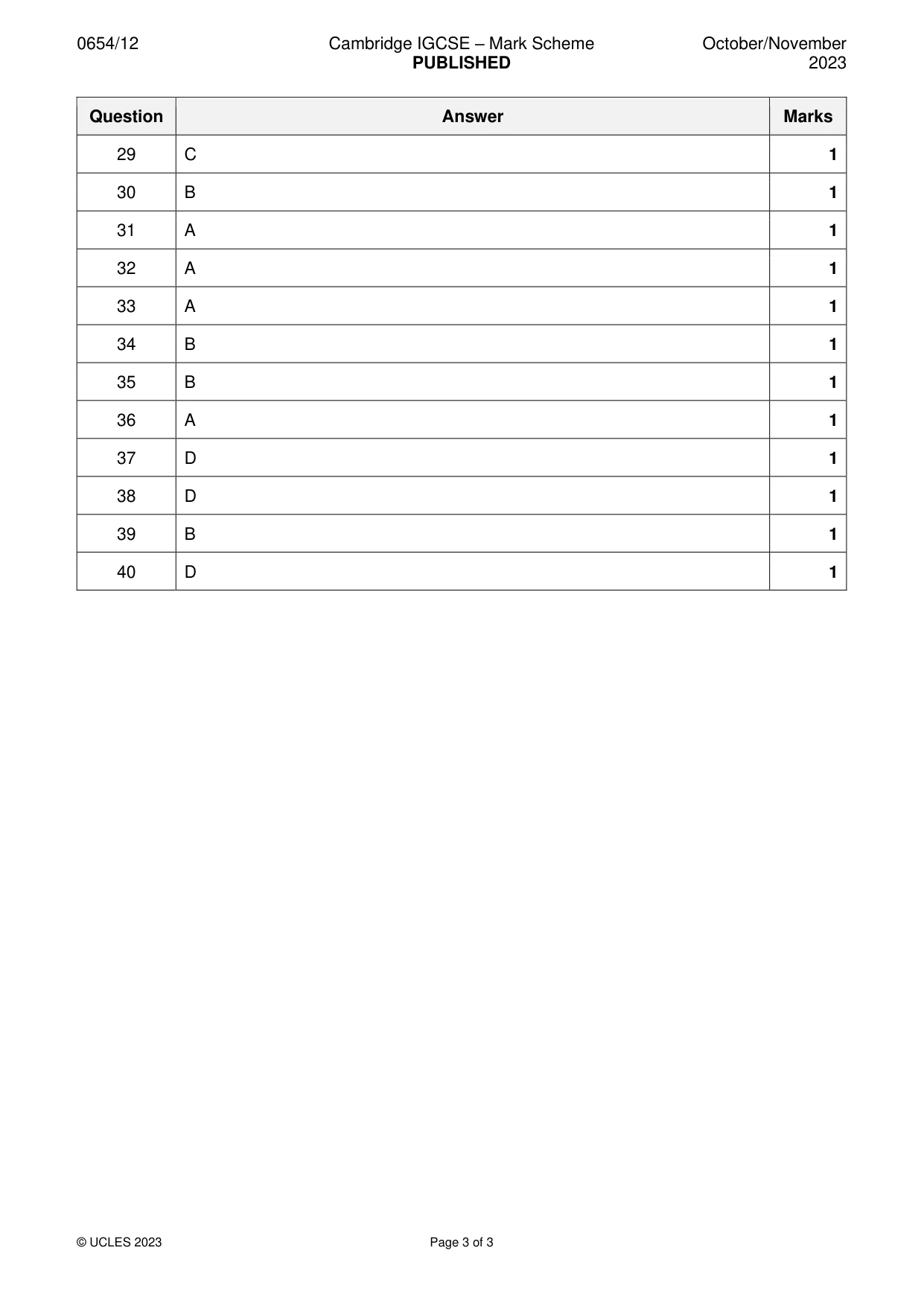
Mark scheme: C
Q30 · The weight of a box exerts pressure on the ground
30 The weight of a box exerts pressure on the ground. Which pair of changes to the box must reduce the pressure? A decreasing the weight and decreasing the area of the base B decreasing the weight and increasing the area of the base C increasing the weight and decreasing the area of the base D increasing the weight and increasing the area of the base
Mark scheme: B
Q31 · A horizontal force acts on a block
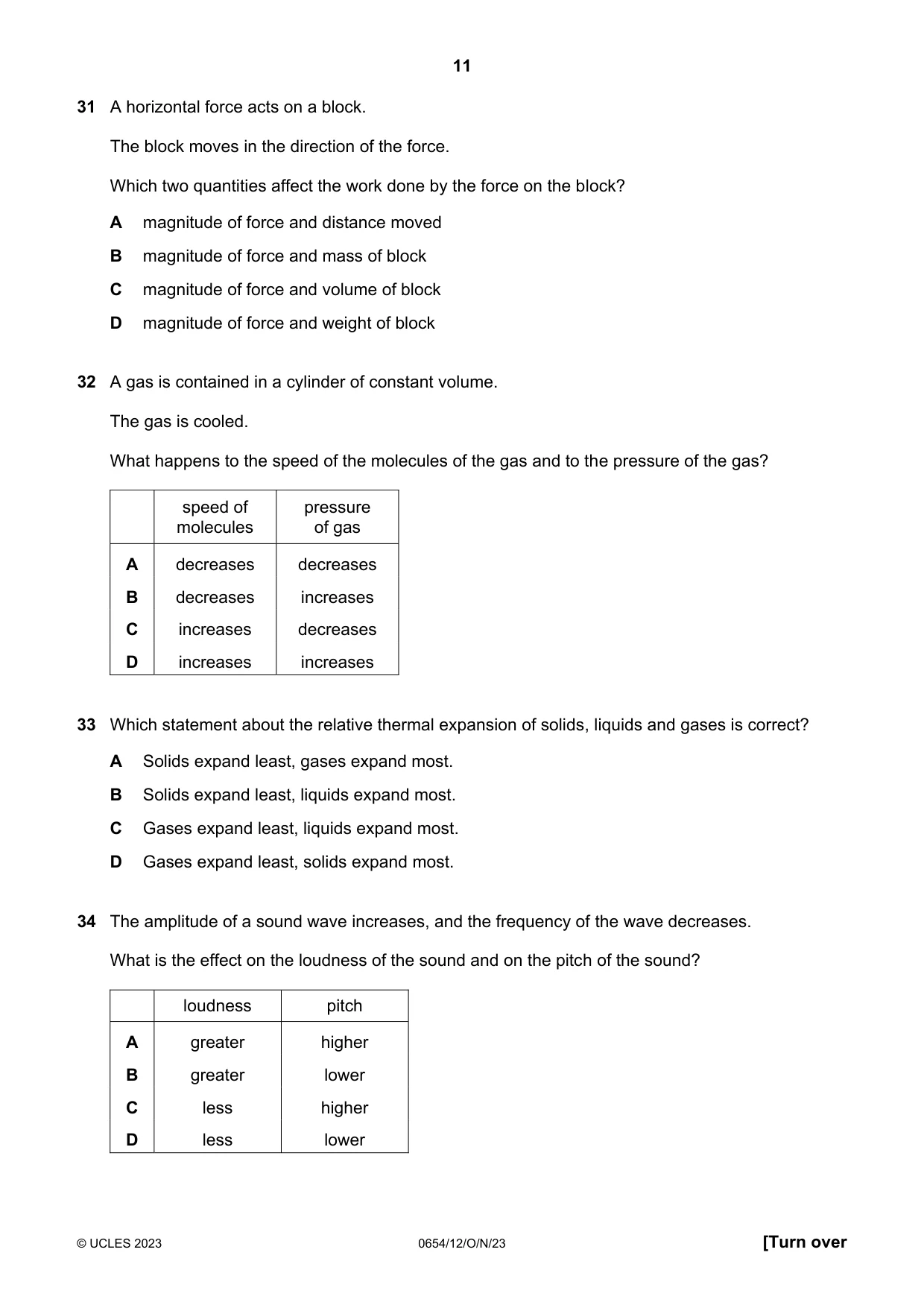
31 A horizontal force acts on a block. The block moves in the direction of the force. Which two quantities affect the work done by the force on the block? A magnitude of force and distance moved B magnitude of force and mass of block C magnitude of force and volume of block D magnitude of force and weight of block
Mark scheme: A
Q32 · A gas is contained in a cylinder of constant volume
32 A gas is contained in a cylinder of constant volume. The gas is cooled. What happens to the speed of the molecules of the gas and to the pressure of the gas? speed of pressure molecules of gas A decreases decreases B decreases increases C increases decreases D increases increases
Mark scheme: A
Q33 · Which statement about the relative thermal expansion of solids, liquids and gases is…
33 Which statement about the relative thermal expansion of solids, liquids and gases is correct? A Solids expand least, gases expand most. B Solids expand least, liquids expand most. C Gases expand least, liquids expand most. D Gases expand least, solids expand most.
Mark scheme: A
Q34 · The amplitude of a sound wave increases, and the frequency of the wave decreases
34 The amplitude of a sound wave increases, and the frequency of the wave decreases. What is the effect on the loudness of the sound and on the pitch of the sound? loudness pitch A greater higher B greater lower C less higher D less lower
Mark scheme: B
Q35 · A plastic rod is rubbed with a cloth
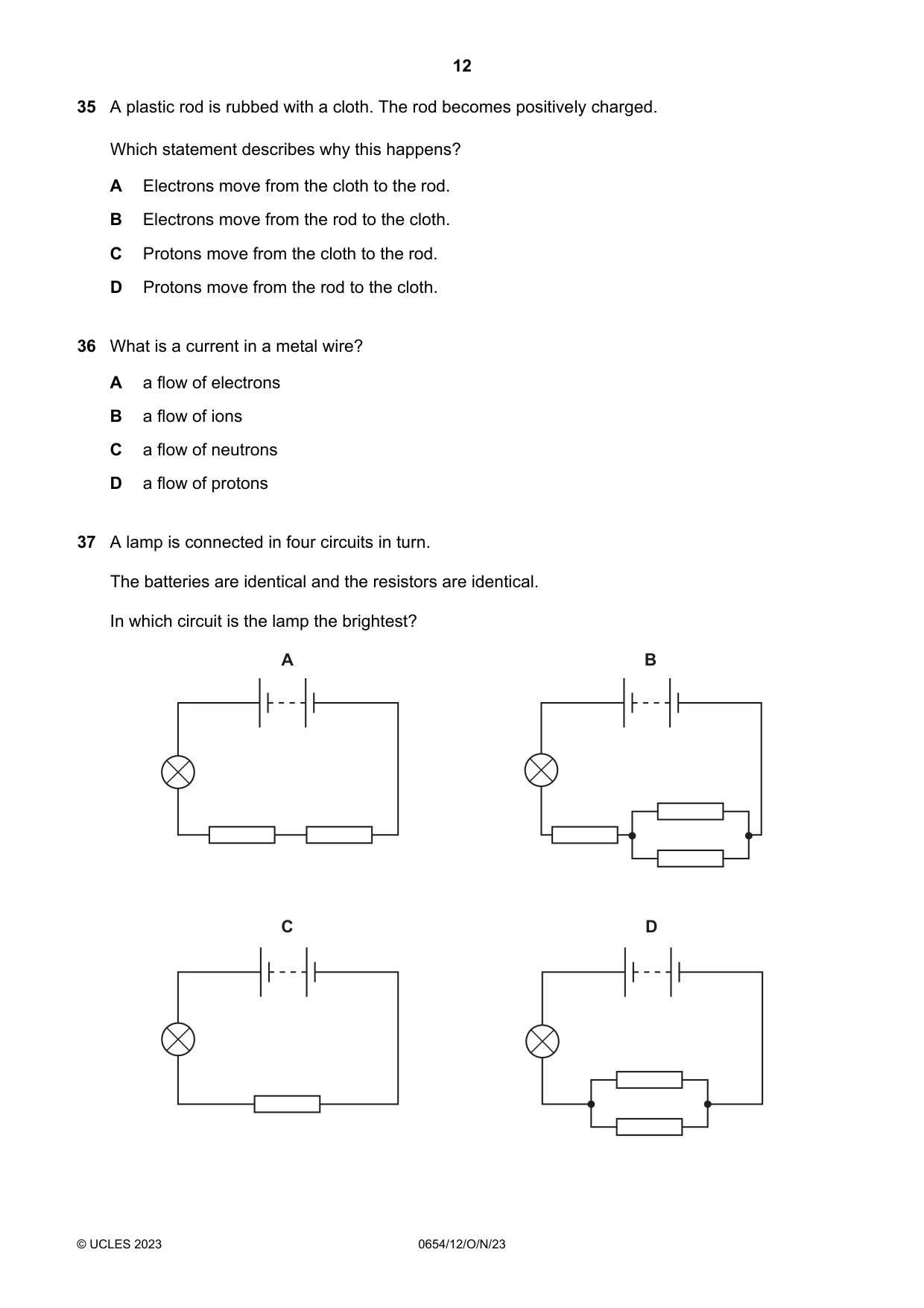
35 A plastic rod is rubbed with a cloth. The rod becomes positively charged. Which statement describes why this happens? A Electrons move from the cloth to the rod. B Electrons move from the rod to the cloth. C Protons move from the cloth to the rod. D Protons move from the rod to the cloth.
Mark scheme: B
Q36 · What is a current in a metal wire?
36 What is a current in a metal wire? A a flow of electrons B a flow of ions C a flow of neutrons D a flow of protons
Mark scheme: A
Q37 · A lamp is connected in four circuits in turn
37 A lamp is connected in four circuits in turn. The batteries are identical and the resistors are identical. In which circuit is the lamp the brightest? A B C D
Mark scheme: D
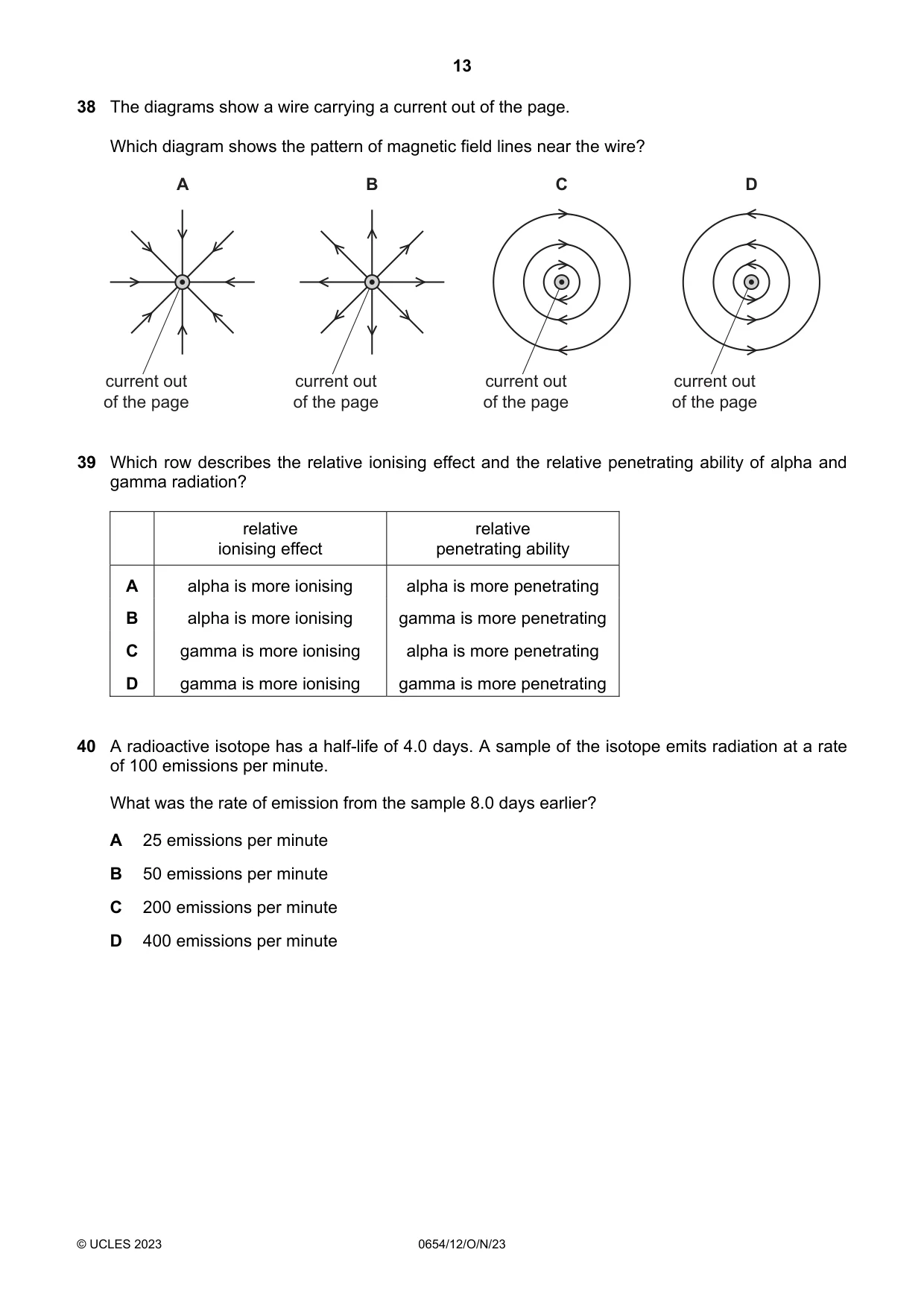
Q38 · The diagrams show a wire carrying a current out of the page
38 The diagrams show a wire carrying a current out of the page. Which diagram shows the pattern of magnetic field lines near the wire? A B C D current out current out current out current out of the page of the page of the page of the page
Mark scheme: D
Q39 · Which row describes the relative ionising effect and the relative penetrating ability of…
39 Which row describes the relative ionising effect and the relative penetrating ability of alpha and gamma radiation? relative relative ionising effect penetrating ability A alpha is more ionising alpha is more penetrating B alpha is more ionising gamma is more penetrating C gamma is more ionising alpha is more penetrating D gamma is more ionising gamma is more penetrating
Mark scheme: B
Q40 · A radioactive isotope has a half-life of 4.0 days
40 A radioactive isotope has a half-life of 4.0 days. A sample of the isotope emits radiation at a rate of 100 emissions per minute. What was the rate of emission from the sample 8.0 days earlier? A 25 emissions per minute B 50 emissions per minute C 200 emissions per minute D 400 emissions per minute
Mark scheme: D
What was in this paper
The subtopics covered by these 40 questions, and how many questions each got. Open one in a new tab to see every Cambridge question on it.
2Oxides2Radioactivity2Separation and purification2Simple phenomena of magnetism2Transpiration2Air quality and climate1Biological molecules1Carbon cycle1Characteristics of living organisms1Coordination and response1Density1Diet1Electrical circuits1Electrical quantities1Electrolysis1Energy, work and power1Enzymes1Food chains and food webs1Formulas1Group VII properties1Isotopes1Kinetic particle model of matter1Noble gases1Physical quantities and measurement techniques1Polymers1Pressure1Respiration1Sexual reproduction in plants1Size of specimens1Sound1The characteristic properties of acids and bases1Thermal properties and temperature1Variation1What you needed in this session
Cambridge’s own grade thresholds for 2023 Oct/Nov, Paper 1 · Variant 2. A higher threshold means an easier paper — the bar moves with how the cohort did.