Cambridge IGCSE Sciences - Co-ordinated (Double) 0654 — 2020 Oct/Nov Paper 1 · Variant 1
0654/11/O/N/20 · 40 questions · 40 marks · ≈45 min
The question paper and its mark scheme, free to read here and free to download. This is Cambridge’s own paper, exactly as it was sat.
Question paper16 pages
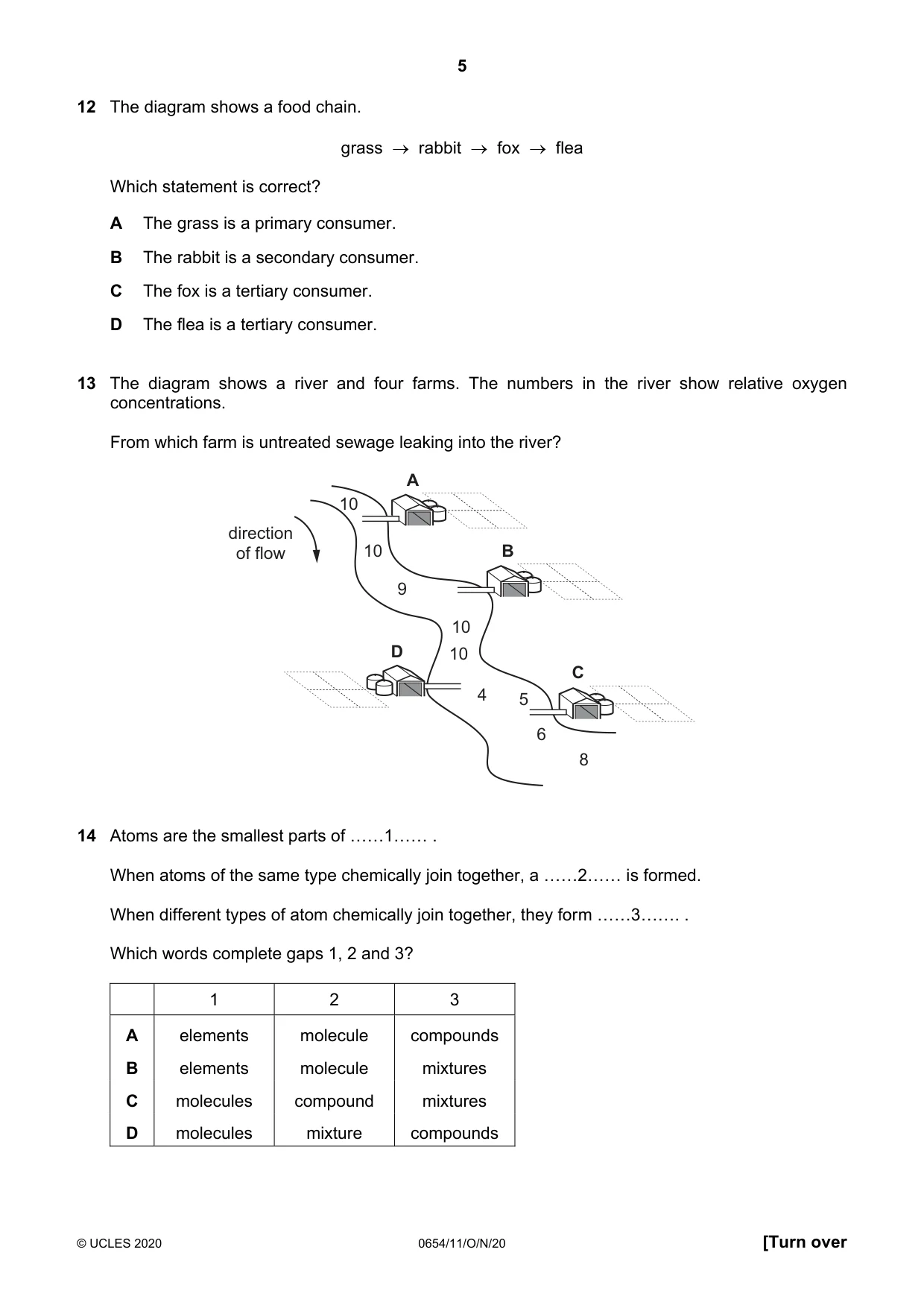
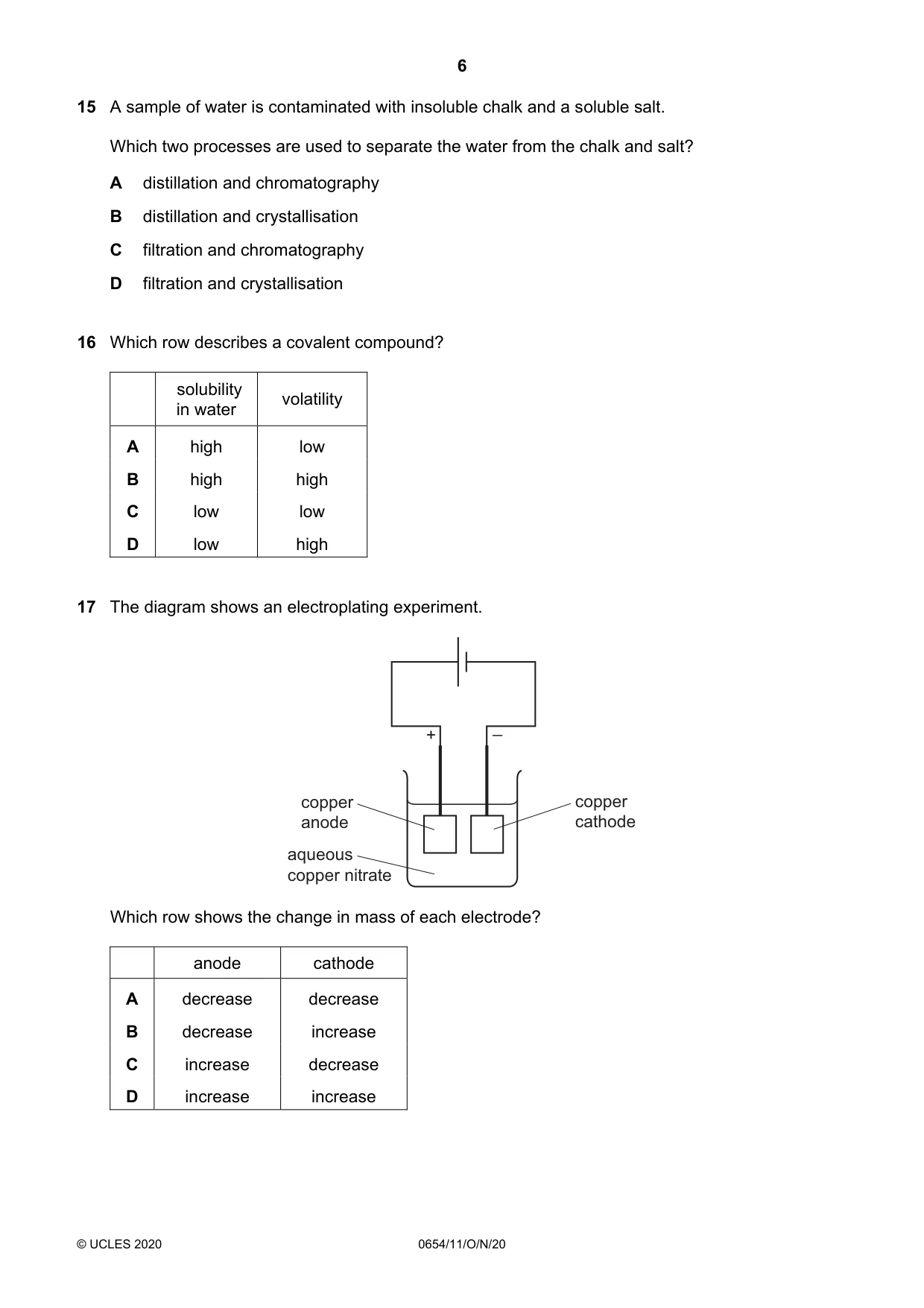
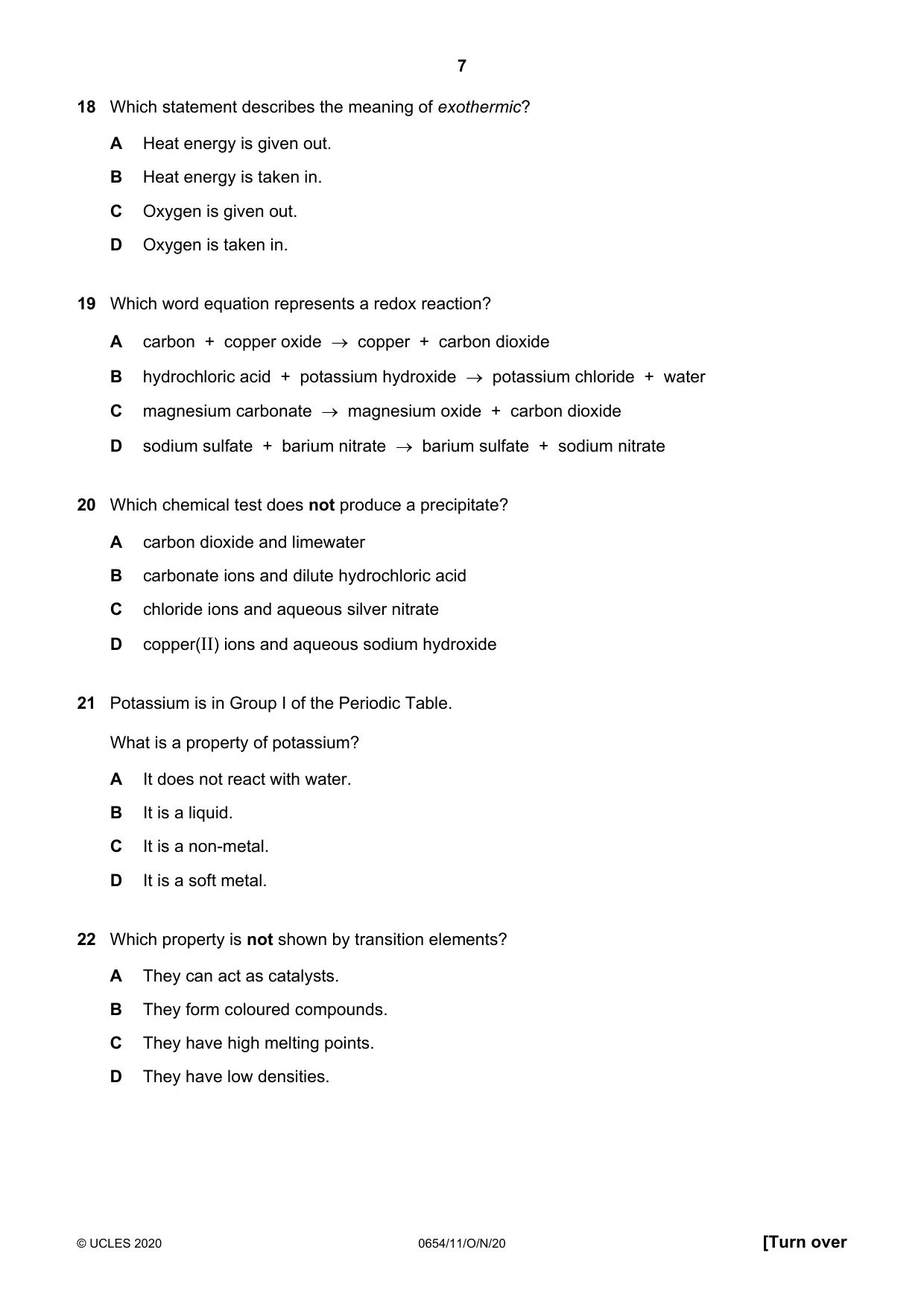
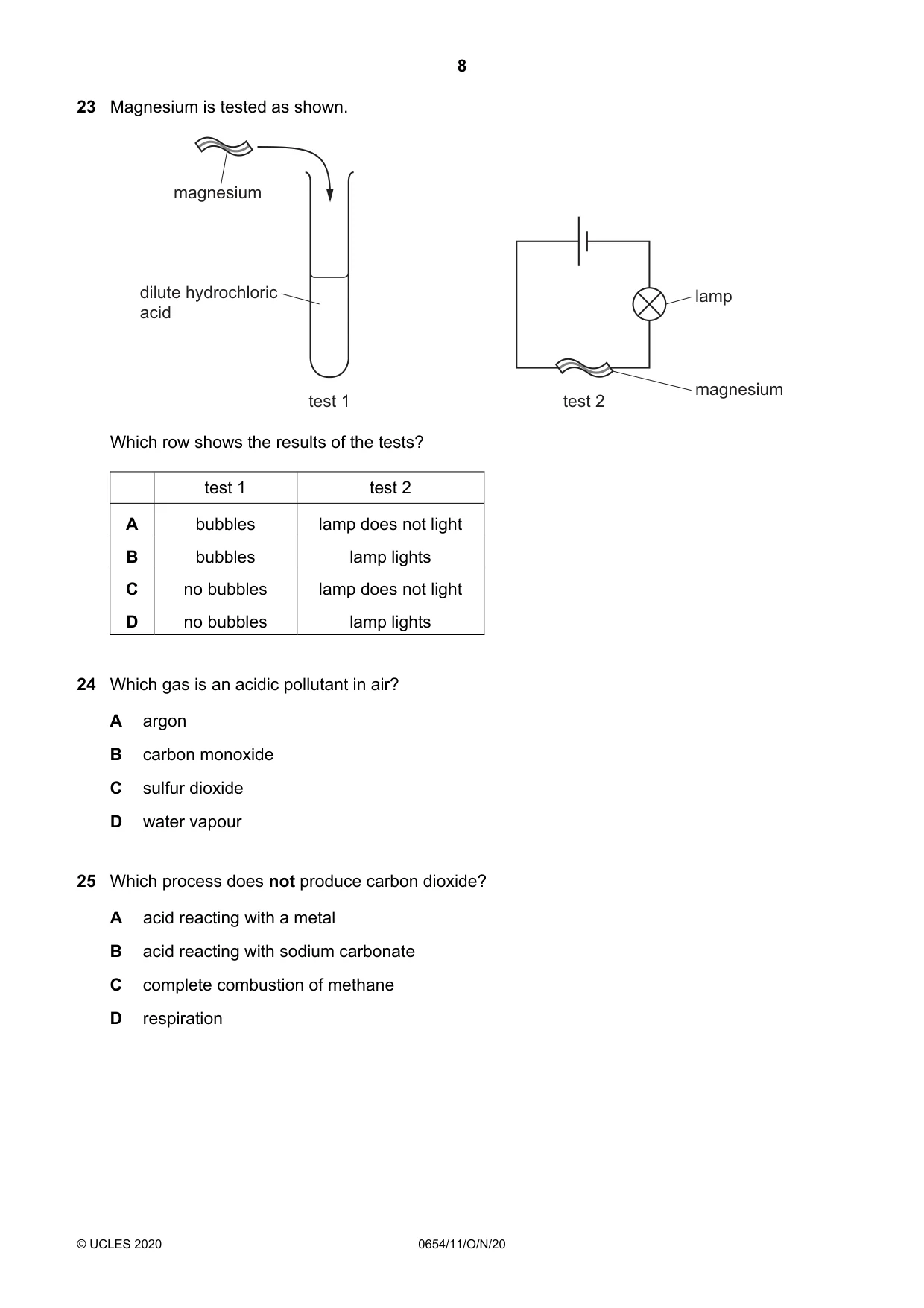



Mark scheme3 pages
Answers below. Sit the paper first if you are practising.
Questions as text
Q1 · Lions are carnivores that chase, catch and eat zebra
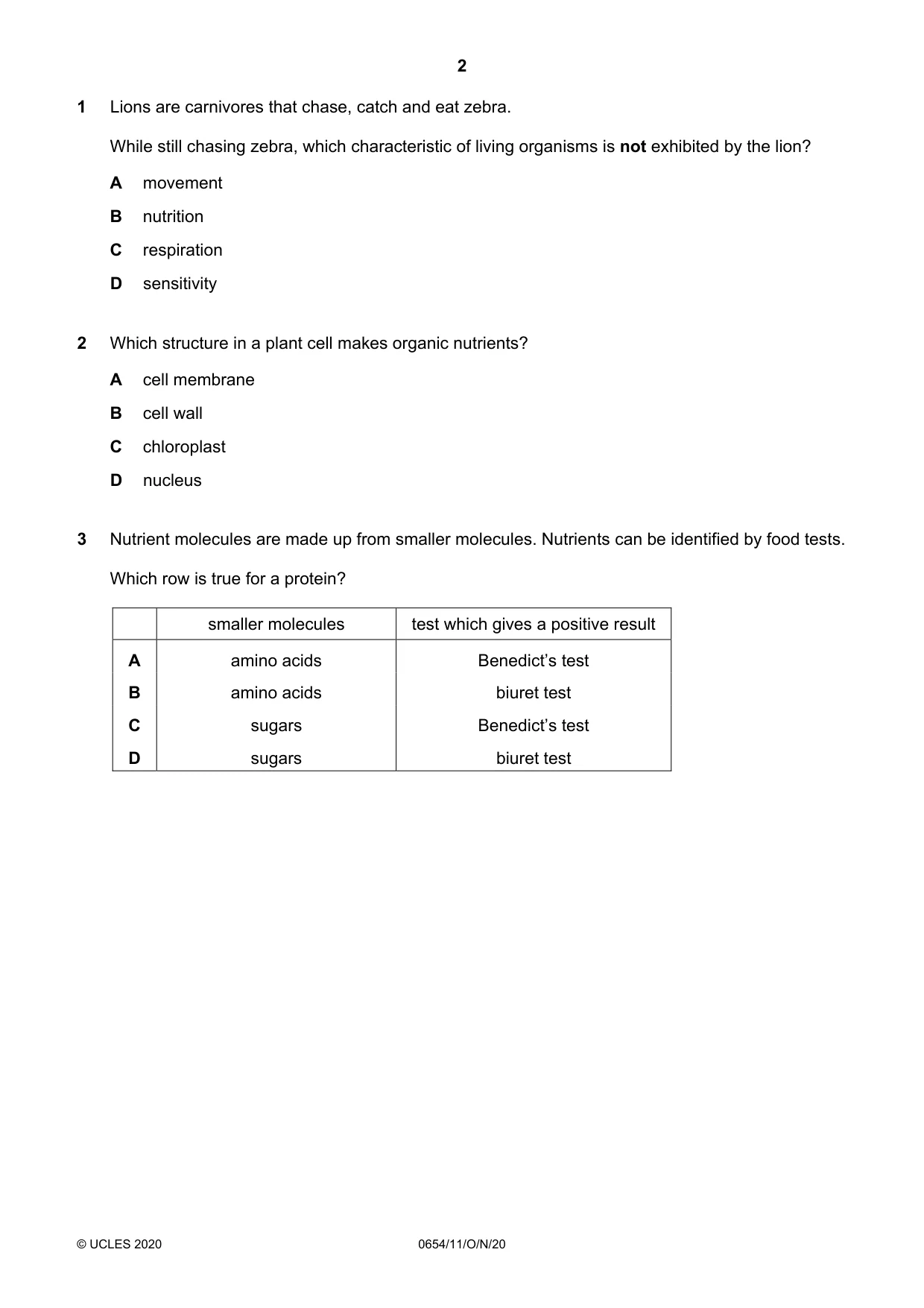
1 Lions are carnivores that chase, catch and eat zebra. While still chasing zebra, which characteristic of living organisms is not exhibited by the lion? A movement B nutrition C respiration D sensitivity
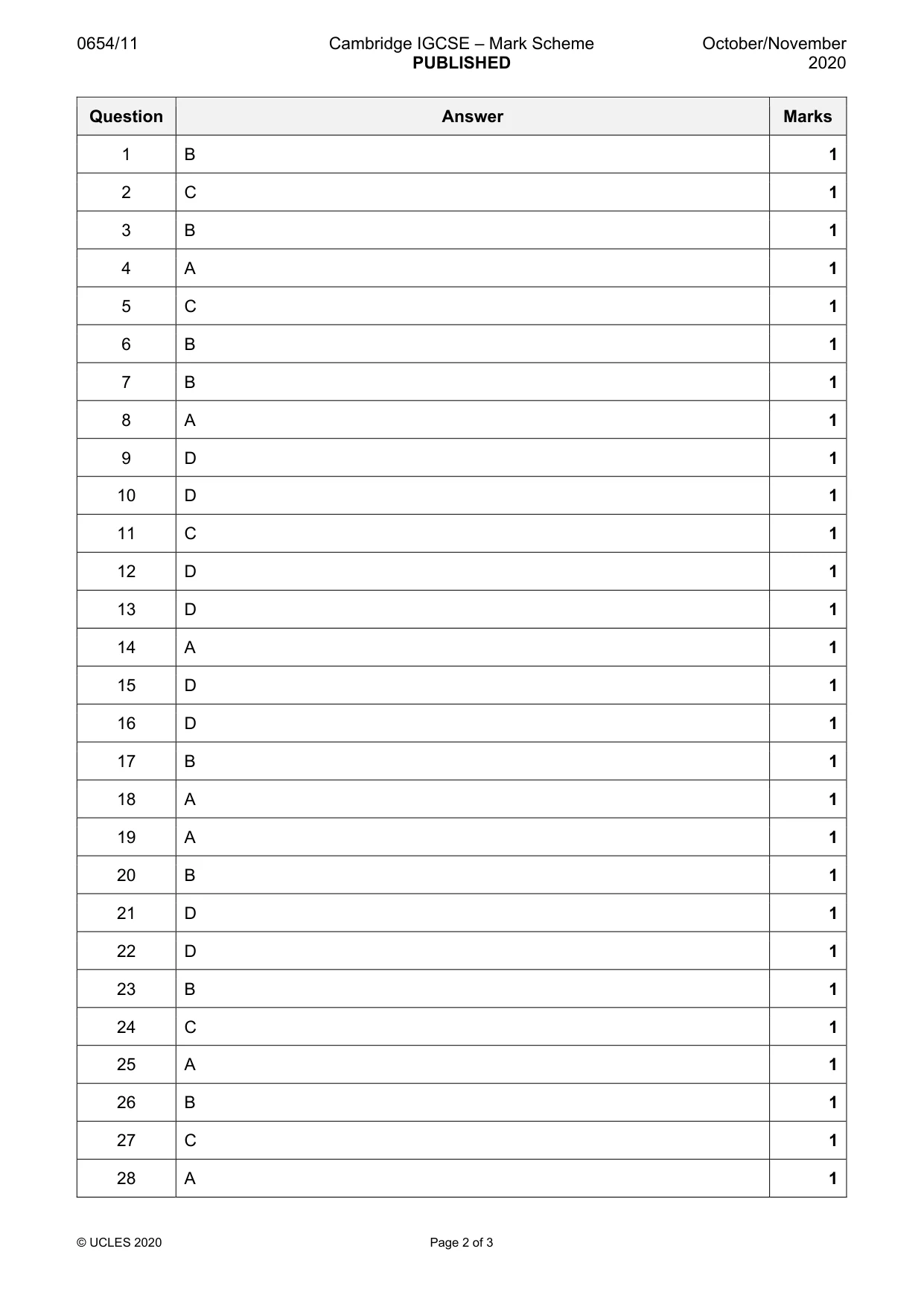
Mark scheme: B
Q2 · Which structure in a plant cell makes organic nutrients?
2 Which structure in a plant cell makes organic nutrients? A cell membrane B cell wall C chloroplast D nucleus
Mark scheme: C
Q3 · Nutrient molecules are made up from smaller molecules
3 Nutrient molecules are made up from smaller molecules. Nutrients can be identified by food tests. Which row is true for a protein? smaller molecules test which gives a positive result A amino acids Benedict’s test B amino acids biuret test C sugars Benedict’s test D sugars biuret test
Mark scheme: B
Q4 · A mixture of starch and saliva was set up at four different temperatures
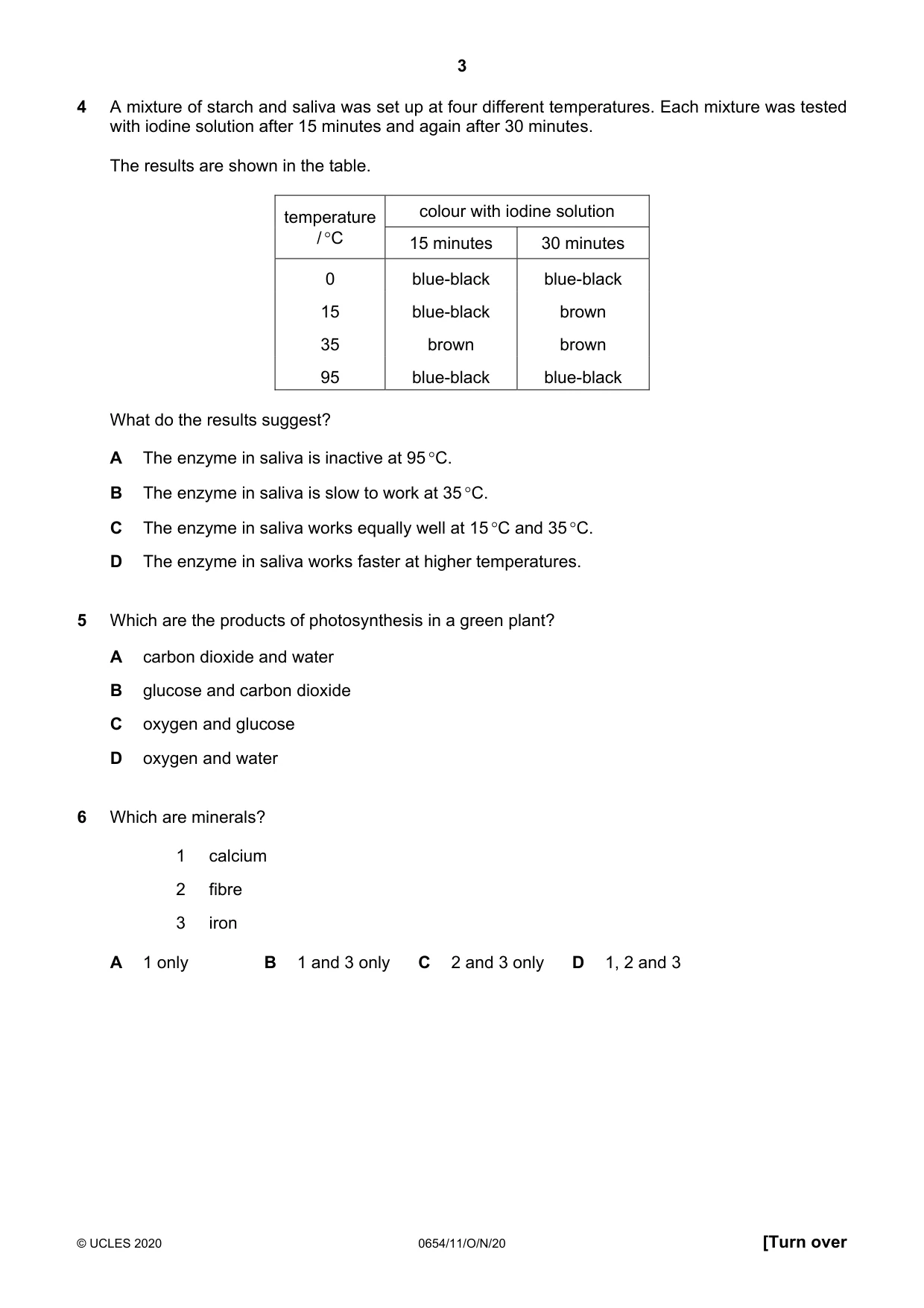
4 A mixture of starch and saliva was set up at four different temperatures. Each mixture was tested with iodine solution after 15 minutes and again after 30 minutes. The results are shown in the table. temperature colour with iodine solution / C 15 minutes 30 minutes 0 blue-black blue-black 15 blue-black brown 35 brown brown 95 blue-black blue-black What do the results suggest? A The enzyme in saliva is inactive at 95 C. B The enzyme in saliva is slow to work at 35 C. C The enzyme in saliva works equally well at 15 C and 35 C. D The enzyme in saliva works faster at higher temperatures.
Mark scheme: A
Q5 · Which are the products of photosynthesis in a green plant?
5 Which are the products of photosynthesis in a green plant? A carbon dioxide and water B glucose and carbon dioxide C oxygen and glucose D oxygen and water
Mark scheme: C
Question 6
6 Which are minerals? 1 calcium 2 fibre 3 iron A 1 only B 1 and 3 only C 2 and 3 only D 1, 2 and 3
Mark scheme: B
Q7 · Under which conditions will transpiration from a plant be fastest?
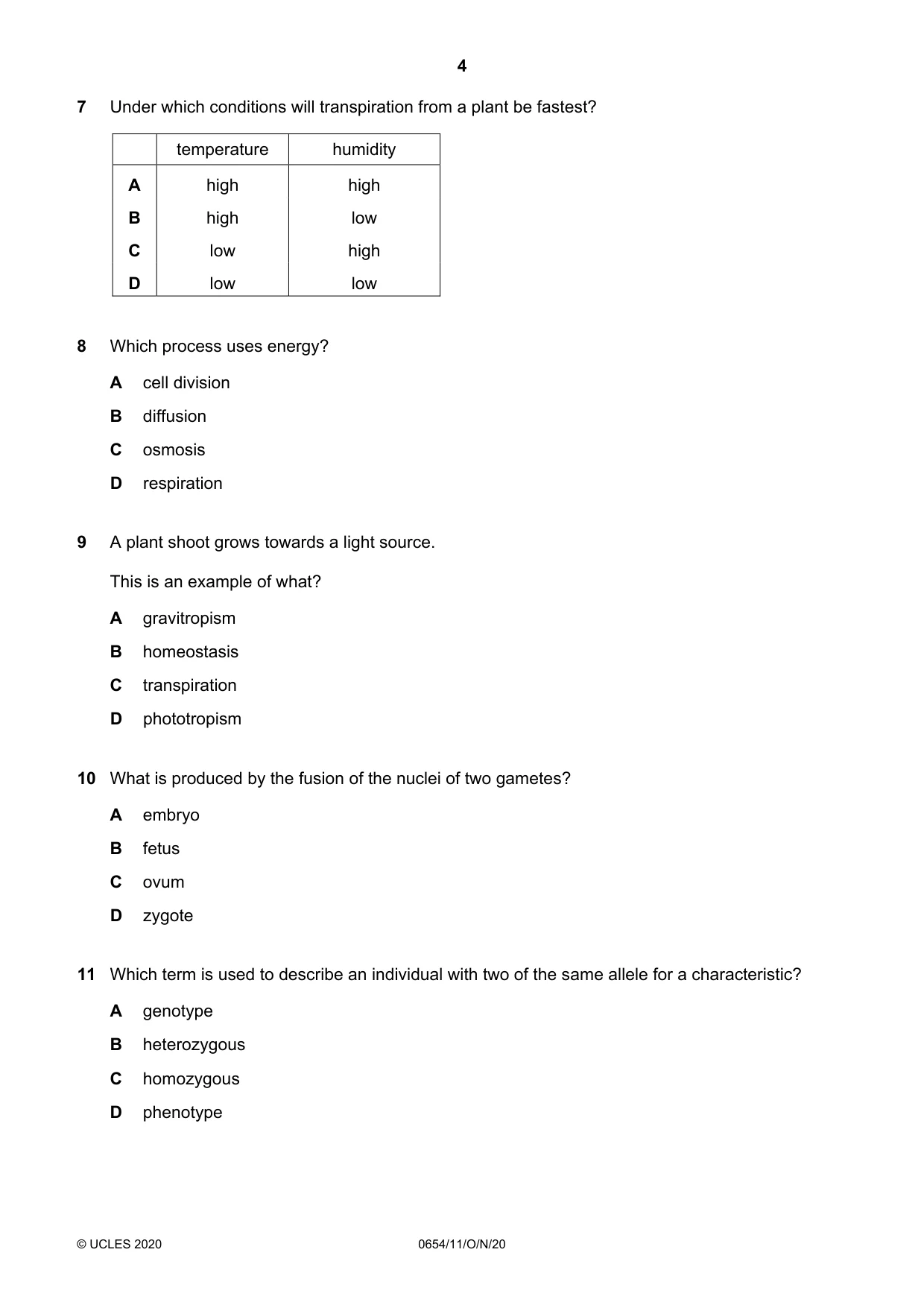
7 Under which conditions will transpiration from a plant be fastest? temperature humidity A high high B high low C low high D low low
Mark scheme: B
Q8 · Which process uses energy?
8 Which process uses energy? A cell division B diffusion C osmosis D respiration
Mark scheme: A
Q9 · A plant shoot grows towards a light source
9 A plant shoot grows towards a light source. This is an example of what? A gravitropism B homeostasis C transpiration D phototropism
Mark scheme: D
Q10 · What is produced by the fusion of the nuclei of two gametes?
10 What is produced by the fusion of the nuclei of two gametes? A embryo B fetus C ovum D zygote
Mark scheme: D
Q11 · Which term is used to describe an individual with two of the same allele for a…
11 Which term is used to describe an individual with two of the same allele for a characteristic? A genotype B heterozygous C homozygous D phenotype
Mark scheme: C
Q12 · The diagram shows a food chain
12 The diagram shows a food chain. grass rabbit fox flea Which statement is correct? A The grass is a primary consumer. B The rabbit is a secondary consumer. C The fox is a tertiary consumer. D The flea is a tertiary consumer.
Mark scheme: D
Q13 · The diagram shows a river and four farms
13 The diagram shows a river and four farms. The numbers in the river show relative oxygen concentrations. From which farm is untreated sewage leaking into the river? A 10 direction of flow 10 B 9 10 D 10 C 4 5 6 8
Mark scheme: D
Q14 · Atoms are the smallest parts of ……1……
14 Atoms are the smallest parts of ……1…… . When atoms of the same type chemically join together, a ……2…… is formed. When different types of atom chemically join together, they form ……3……. . Which words complete gaps 1, 2 and 3? 1 2 3 A elements molecule compounds B elements molecule mixtures C molecules compound mixtures D molecules mixture compounds
Mark scheme: A
Q15 · A sample of water is contaminated with insoluble chalk and a soluble salt
15 A sample of water is contaminated with insoluble chalk and a soluble salt. Which two processes are used to separate the water from the chalk and salt? A distillation and chromatography B distillation and crystallisation C filtration and chromatography D filtration and crystallisation
Mark scheme: D
Q16 · Which row describes a covalent compound?
16 Which row describes a covalent compound? solubility volatility in water A high low B high high C low low D low high
Mark scheme: D
Q17 · The diagram shows an electroplating experiment
17 The diagram shows an electroplating experiment. + _ copper copper anode cathode aqueous copper nitrate Which row shows the change in mass of each electrode? anode cathode A decrease decrease B decrease increase C increase decrease D increase increase
Mark scheme: B
Q18 · Which statement describes the meaning of exothermic?
18 Which statement describes the meaning of exothermic? A Heat energy is given out. B Heat energy is taken in. C Oxygen is given out. D Oxygen is taken in.
Mark scheme: A
Q19 · Which word equation represents a redox reaction?
19 Which word equation represents a redox reaction? A carbon + copper oxide copper + carbon dioxide B hydrochloric acid + potassium hydroxide potassium chloride + water C magnesium carbonate magnesium oxide + carbon dioxide D sodium sulfate + barium nitrate barium sulfate + sodium nitrate
Mark scheme: A
Q20 · Which chemical test does not produce a precipitate?
20 Which chemical test does not produce a precipitate? A carbon dioxide and limewater B carbonate ions and dilute hydrochloric acid C chloride ions and aqueous silver nitrate D copper(II) ions and aqueous sodium hydroxide
Mark scheme: B
Q21 · Potassium is in Group I of the Periodic Table
21 Potassium is in Group I of the Periodic Table. What is a property of potassium? A It does not react with water. B It is a liquid. C It is a non-metal. D It is a soft metal.
Mark scheme: D
Q22 · Which property is not shown by transition elements?
22 Which property is not shown by transition elements? A They can act as catalysts. B They form coloured compounds. C They have high melting points. D They have low densities.
Mark scheme: D
Q23 · Magnesium is tested as shown
23 Magnesium is tested as shown. magnesium dilute hydrochloric lamp acid magnesium test 1 test 2 Which row shows the results of the tests? test 1 test 2 A bubbles lamp does not light B bubbles lamp lights C no bubbles lamp does not light D no bubbles lamp lights
Mark scheme: B
Q24 · Which gas is an acidic pollutant in air?
24 Which gas is an acidic pollutant in air? A argon B carbon monoxide C sulfur dioxide D water vapour
Mark scheme: C
Q25 · Which process does not produce carbon dioxide?
25 Which process does not produce carbon dioxide? A acid reacting with a metal B acid reacting with sodium carbonate C complete combustion of methane D respiration
Mark scheme: A
Q26 · Methane is a covalent compound
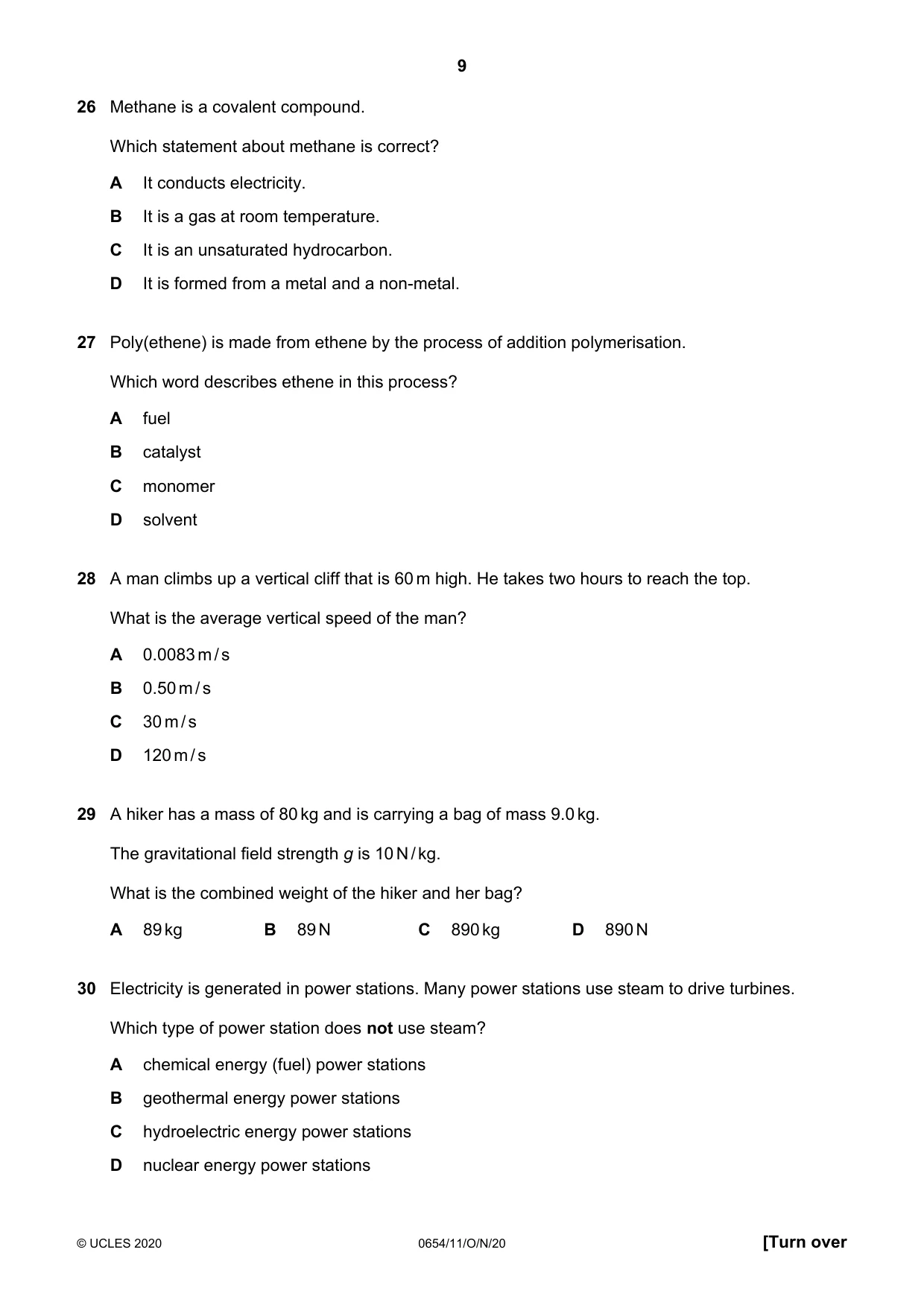
26 Methane is a covalent compound. Which statement about methane is correct? A It conducts electricity. B It is a gas at room temperature. C It is an unsaturated hydrocarbon. D It is formed from a metal and a non-metal.
Mark scheme: B
Q27 · Poly(ethene) is made from ethene by the process of addition polymerisation
27 Poly(ethene) is made from ethene by the process of addition polymerisation. Which word describes ethene in this process? A fuel B catalyst C monomer D solvent
Mark scheme: C
Q28 · A man climbs up a vertical cliff that is 60 m high
28 A man climbs up a vertical cliff that is 60 m high. He takes two hours to reach the top. What is the average vertical speed of the man? A 0.0083 m / s B 0.50 m / s C 30 m / s D 120 m / s
Mark scheme: A
Q29 · A hiker has a mass of 80 kg and is carrying a bag of mass 9.0 kg
29 A hiker has a mass of 80 kg and is carrying a bag of mass 9.0 kg. The gravitational field strength g is 10 N / kg. What is the combined weight of the hiker and her bag? A 89 kg B 89 N C 890 kg D 890 N
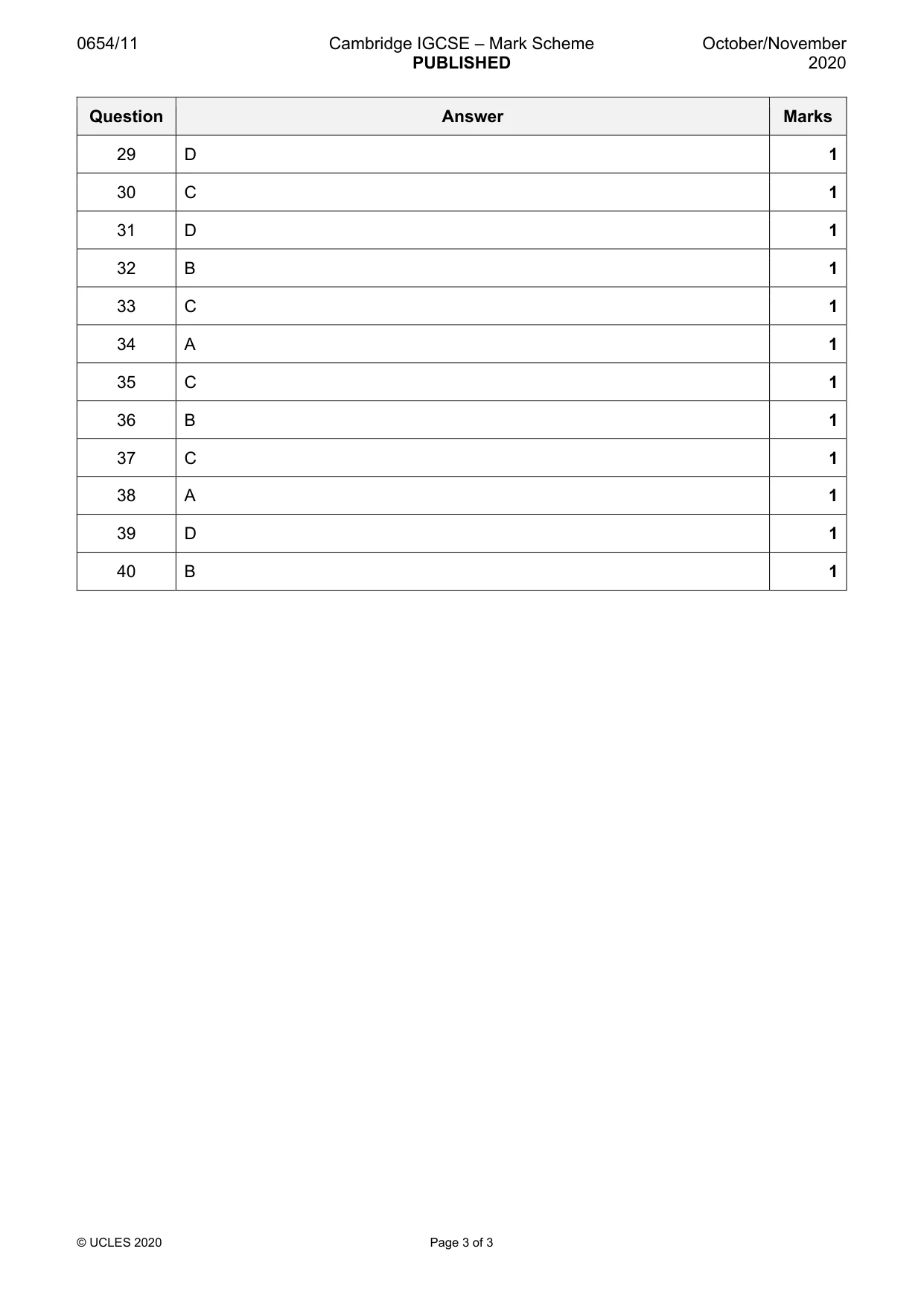
Mark scheme: D
Q30 · Electricity is generated in power stations
30 Electricity is generated in power stations. Many power stations use steam to drive turbines. Which type of power station does not use steam? A chemical energy (fuel) power stations B geothermal energy power stations C hydroelectric energy power stations D nuclear energy power stations
Mark scheme: C
Q31 · Which material is a bad thermal conductor?
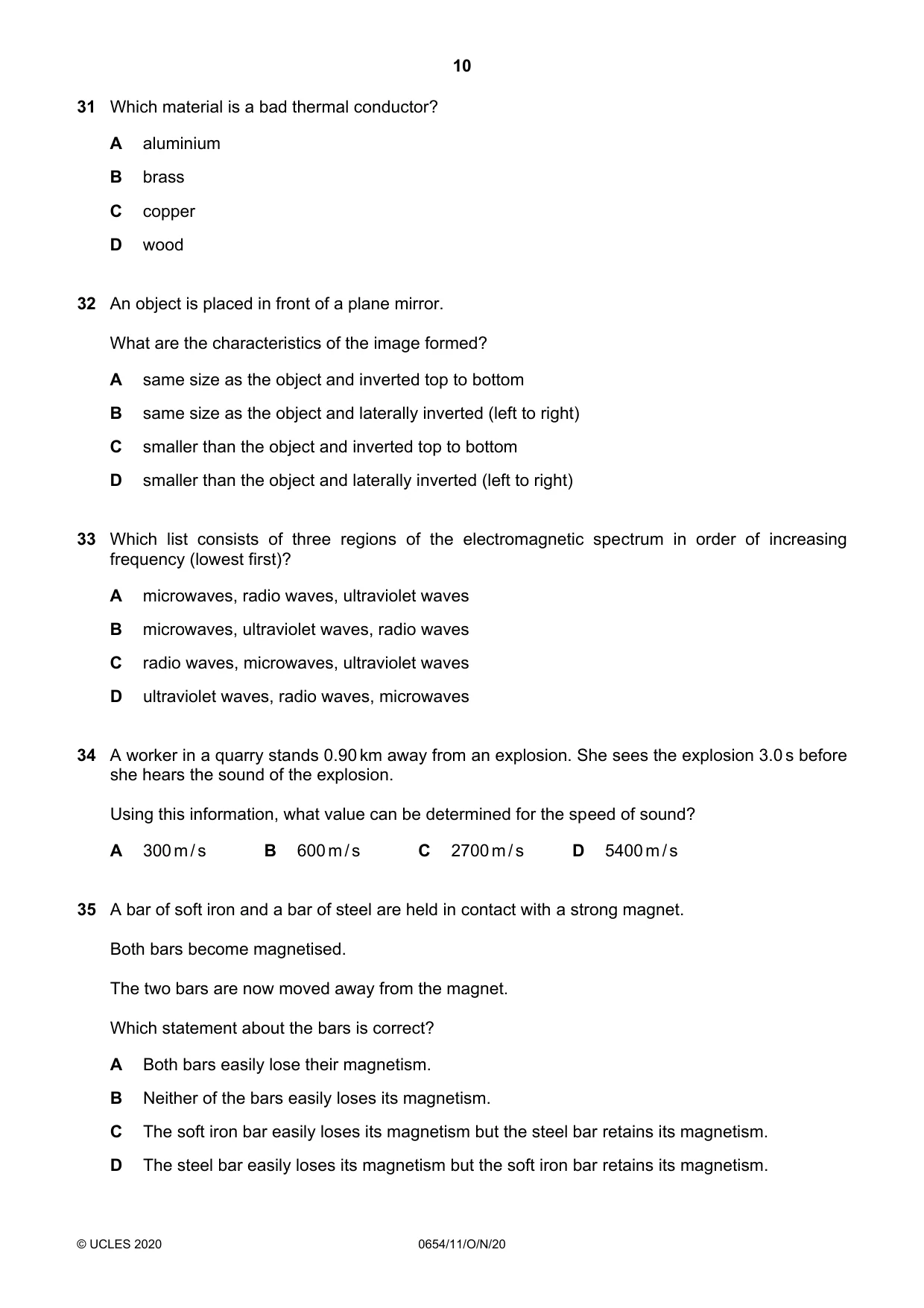
31 Which material is a bad thermal conductor? A aluminium B brass C copper D wood
Mark scheme: D
Q32 · An object is placed in front of a plane mirror
32 An object is placed in front of a plane mirror. What are the characteristics of the image formed? A same size as the object and inverted top to bottom B same size as the object and laterally inverted (left to right) C smaller than the object and inverted top to bottom D smaller than the object and laterally inverted (left to right)
Mark scheme: B
Q33 · Which list consists of three regions of the electromagnetic spectrum in order of…
33 Which list consists of three regions of the electromagnetic spectrum in order of increasing frequency (lowest first)? A microwaves, radio waves, ultraviolet waves B microwaves, ultraviolet waves, radio waves C radio waves, microwaves, ultraviolet waves D ultraviolet waves, radio waves, microwaves
Mark scheme: C
Q34 · A worker in a quarry stands 0.90 km away from an explosion
34 A worker in a quarry stands 0.90 km away from an explosion. She sees the explosion 3.0 s before she hears the sound of the explosion. Using this information, what value can be determined for the speed of sound? A 300 m / s B 600 m / s C 2700 m / s D 5400 m / s
Mark scheme: A
Q35 · A bar of soft iron and a bar of steel are held in contact with a strong magnet
35 A bar of soft iron and a bar of steel are held in contact with a strong magnet. Both bars become magnetised. The two bars are now moved away from the magnet. Which statement about the bars is correct? A Both bars easily lose their magnetism. B Neither of the bars easily loses its magnetism. C The soft iron bar easily loses its magnetism but the steel bar retains its magnetism. D The steel bar easily loses its magnetism but the soft iron bar retains its magnetism.
Mark scheme: C
Q36 · A resistor R is connected to a 12 V battery and an ammeter as shown
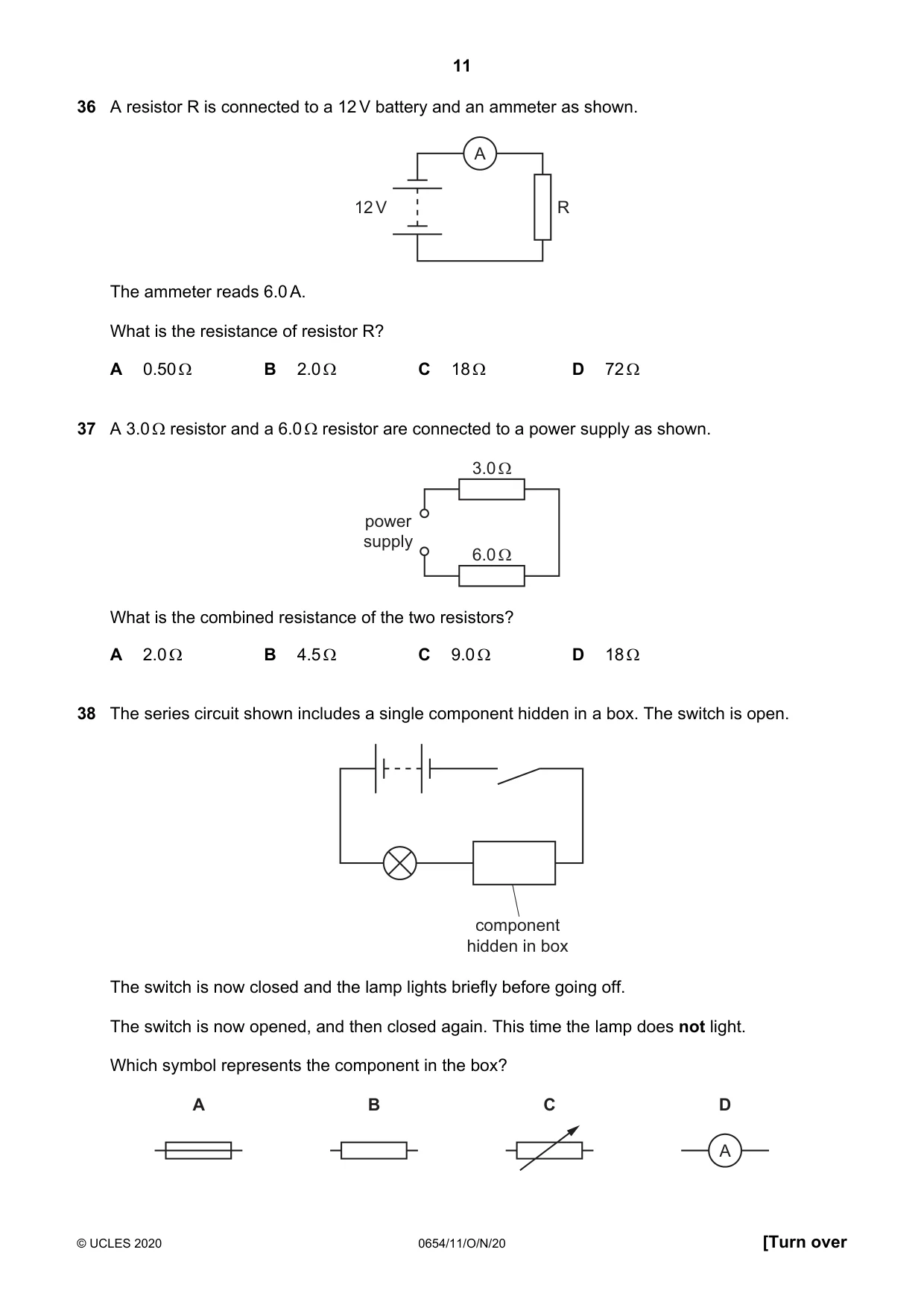
36 A resistor R is connected to a 12 V battery and an ammeter as shown. A 12 V R The ammeter reads 6.0 A. What is the resistance of resistor R? A 0.50 B 2.0 C 18 D 72
Mark scheme: B
Q37 · A 3.0 resistor and a 6.0 resistor are connected to a power supply as shown
37 A 3.0 resistor and a 6.0 resistor are connected to a power supply as shown. 3.0 Ω power supply 6.0 Ω What is the combined resistance of the two resistors? A 2.0 B 4.5 C 9.0 D 18
Mark scheme: C
Q38 · The series circuit shown includes a single component hidden in a box
38 The series circuit shown includes a single component hidden in a box. The switch is open. component hidden in box The switch is now closed and the lamp lights briefly before going off. The switch is now opened, and then closed again. This time the lamp does not light. Which symbol represents the component in the box? A B C D A
Mark scheme: A
Q39 · A solenoid carrying a current produces a magnetic field
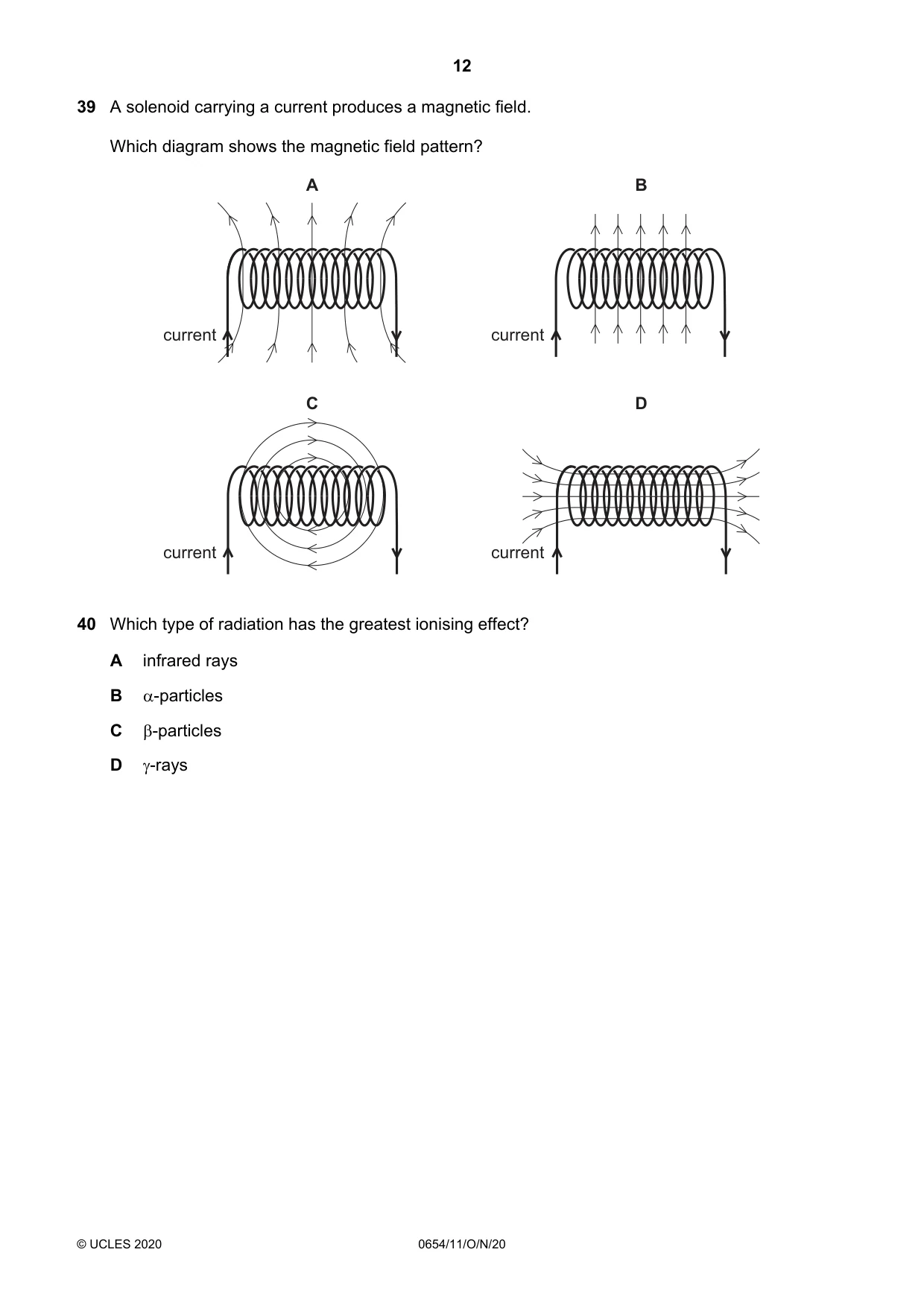
39 A solenoid carrying a current produces a magnetic field. Which diagram shows the magnetic field pattern? A B current current C D current current
Mark scheme: D
Q40 · Which type of radiation has the greatest ionising effect?
40 Which type of radiation has the greatest ionising effect? A infrared rays B -particles C -particles D -rays
Mark scheme: B
What was in this paper
The subtopics covered by these 40 questions, and how many questions each got. Open one in a new tab to see every Cambridge question on it.
2Active transport1Air quality and climate1Alkanes1Biological molecules1Cell structure1Characteristics of living organisms1Coordination and response1Diet1Electrical quantities1Electrolysis1Electromagnetic effects1Electromagnetic spectrum1Elements, compounds and mixtures1Energy, work and power1Enzymes1Exothermic and endothermic reactions1Food chains and food webs1Group I properties1Habitat destruction1Identification of ions and gases1Light1Mass and weight1Monohybrid inheritance1Motion1Photosynthesis1Physical and chemical changes1Polymers1Radioactivity1Reactivity series1Redox1Separation and purification1Sexual reproduction in humans1Simple molecules and covalent bonds1Simple phenomena of magnetism1Sound1Transfer of thermal energy1Transition elements1Transpiration1What you needed in this session
Cambridge’s own grade thresholds for 2020 Oct/Nov, Paper 1 · Variant 1. A higher threshold means an easier paper — the bar moves with how the cohort did.