Cambridge IGCSE Sciences - Co-ordinated (Double) 0654 — 2013 May/June Paper 1 · Variant 1
0654/11/M/J/13 · 40 questions · 40 marks · ≈45 min
The question paper and its mark scheme, free to read here and free to download. This is Cambridge’s own paper, exactly as it was sat.
Question paper20 pages
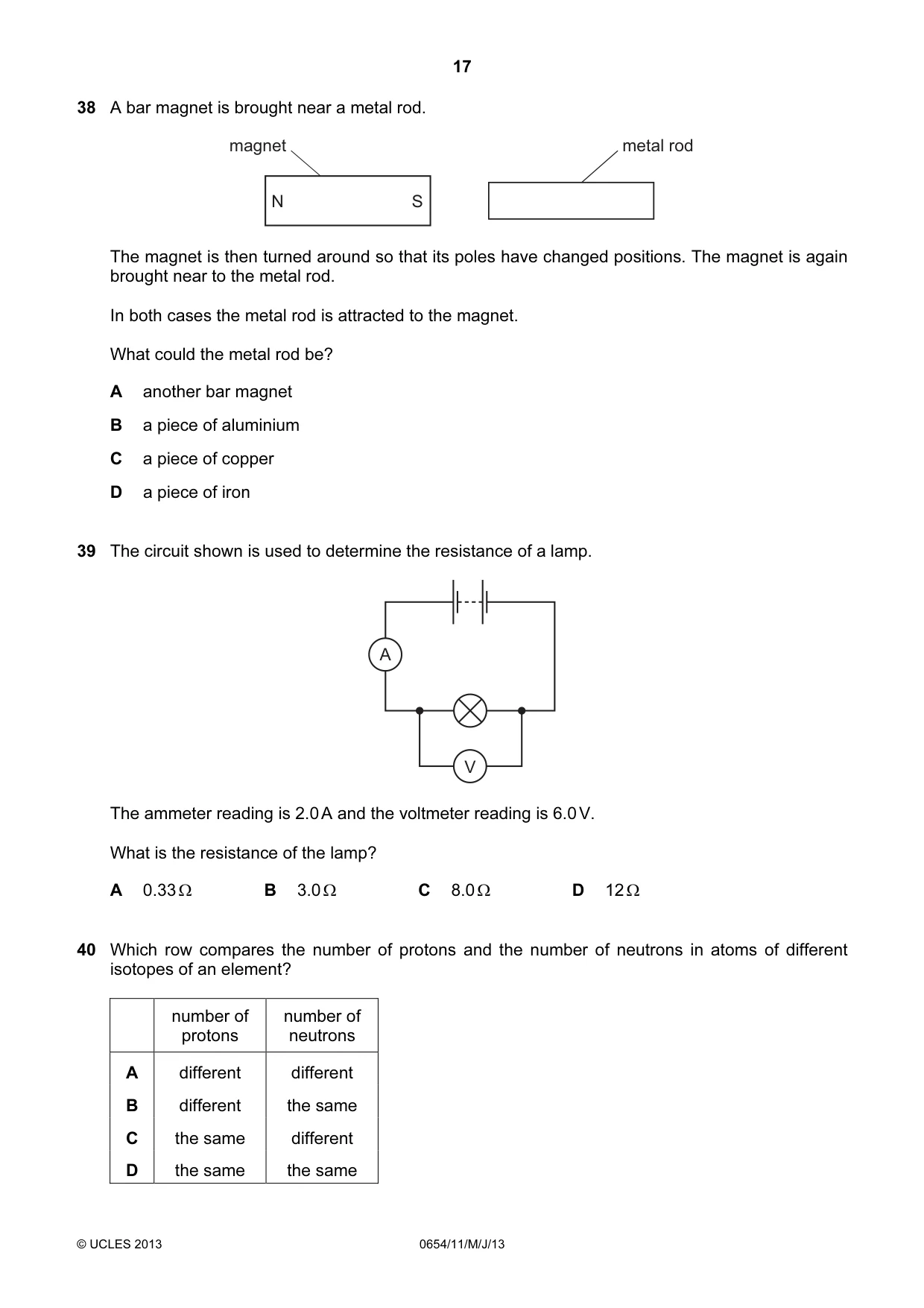


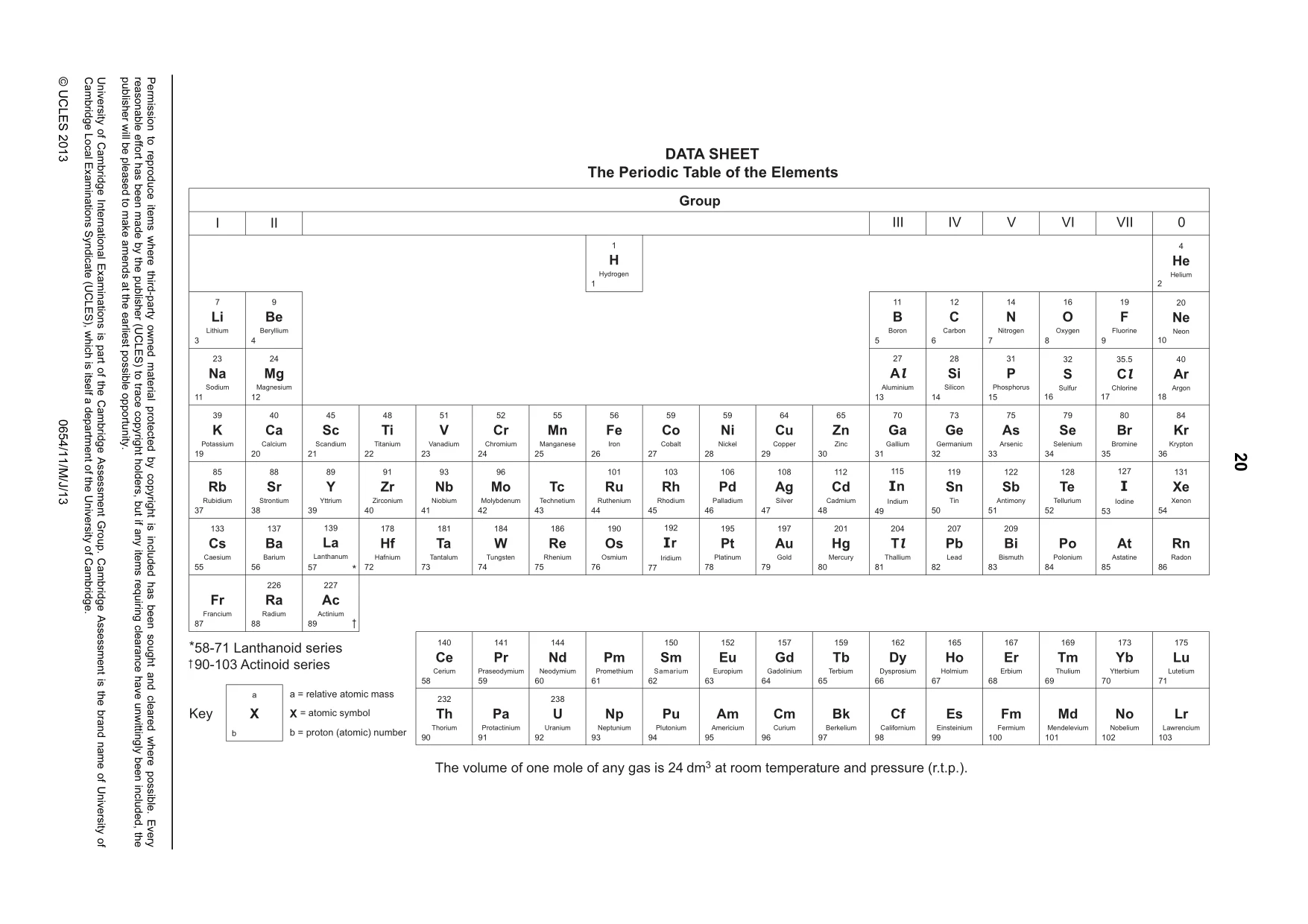
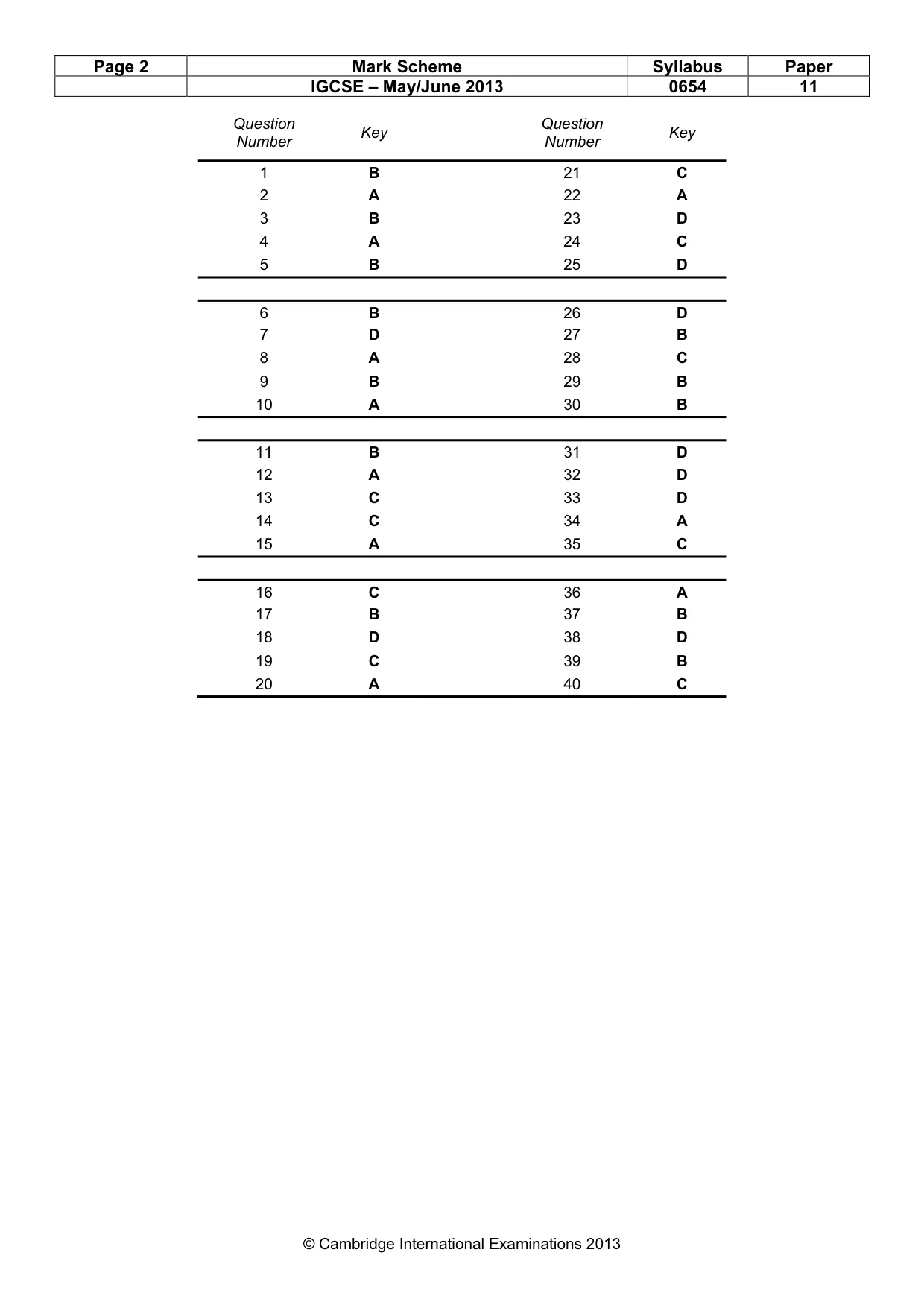
Mark scheme2 pages
Answers below. Sit the paper first if you are practising.
Questions as text
Question 1
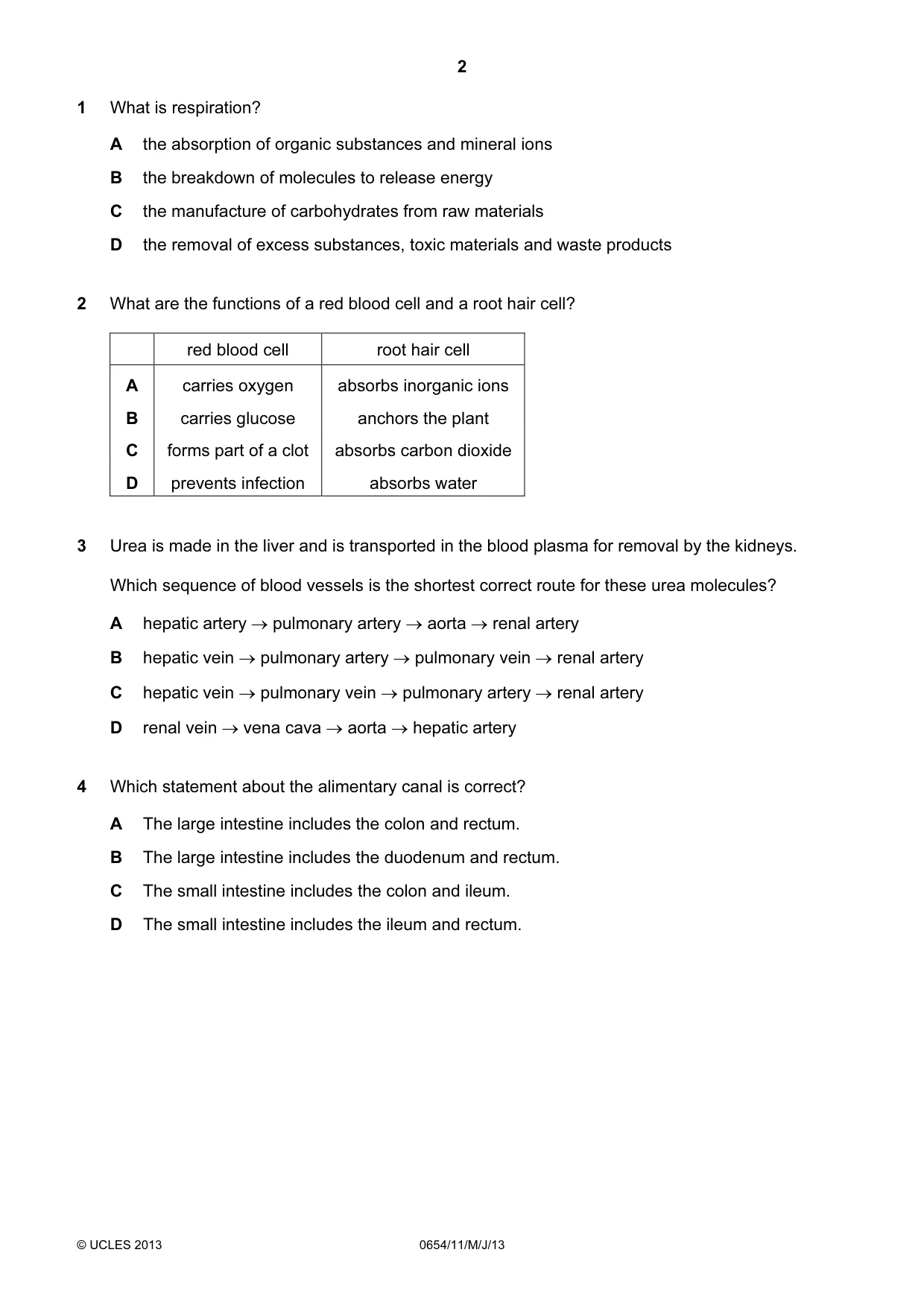
1 What is respiration? A the absorption of organic substances and mineral ions B the breakdown of molecules to release energy C the manufacture of carbohydrates from raw materials D the removal of excess substances, toxic materials and waste products
Mark scheme: B
Q2 · What are the functions of a red blood cell and a root hair cell?
2 What are the functions of a red blood cell and a root hair cell? red blood cell root hair cell A carries oxygen absorbs inorganic ions B carries glucose anchors the plant C forms part of a clot absorbs carbon dioxide D prevents infection absorbs water
Mark scheme: A
Q3 · Urea is made in the liver and is transported in the blood plasma for removal by the…
3 Urea is made in the liver and is transported in the blood plasma for removal by the kidneys. Which sequence of blood vessels is the shortest correct route for these urea molecules? A hepatic artery → pulmonary artery → aorta → renal artery B hepatic vein → pulmonary artery → pulmonary vein → renal artery C hepatic vein → pulmonary vein → pulmonary artery → renal artery D renal vein → vena cava → aorta → hepatic artery
Mark scheme: B
Q4 · Which statement about the alimentary canal is correct?
4 Which statement about the alimentary canal is correct? A The large intestine includes the colon and rectum. B The large intestine includes the duodenum and rectum. C The small intestine includes the colon and ileum. D The small intestine includes the ileum and rectum.
Mark scheme: A
Q5 · The amounts of four dietary constituents are shown for four different foods
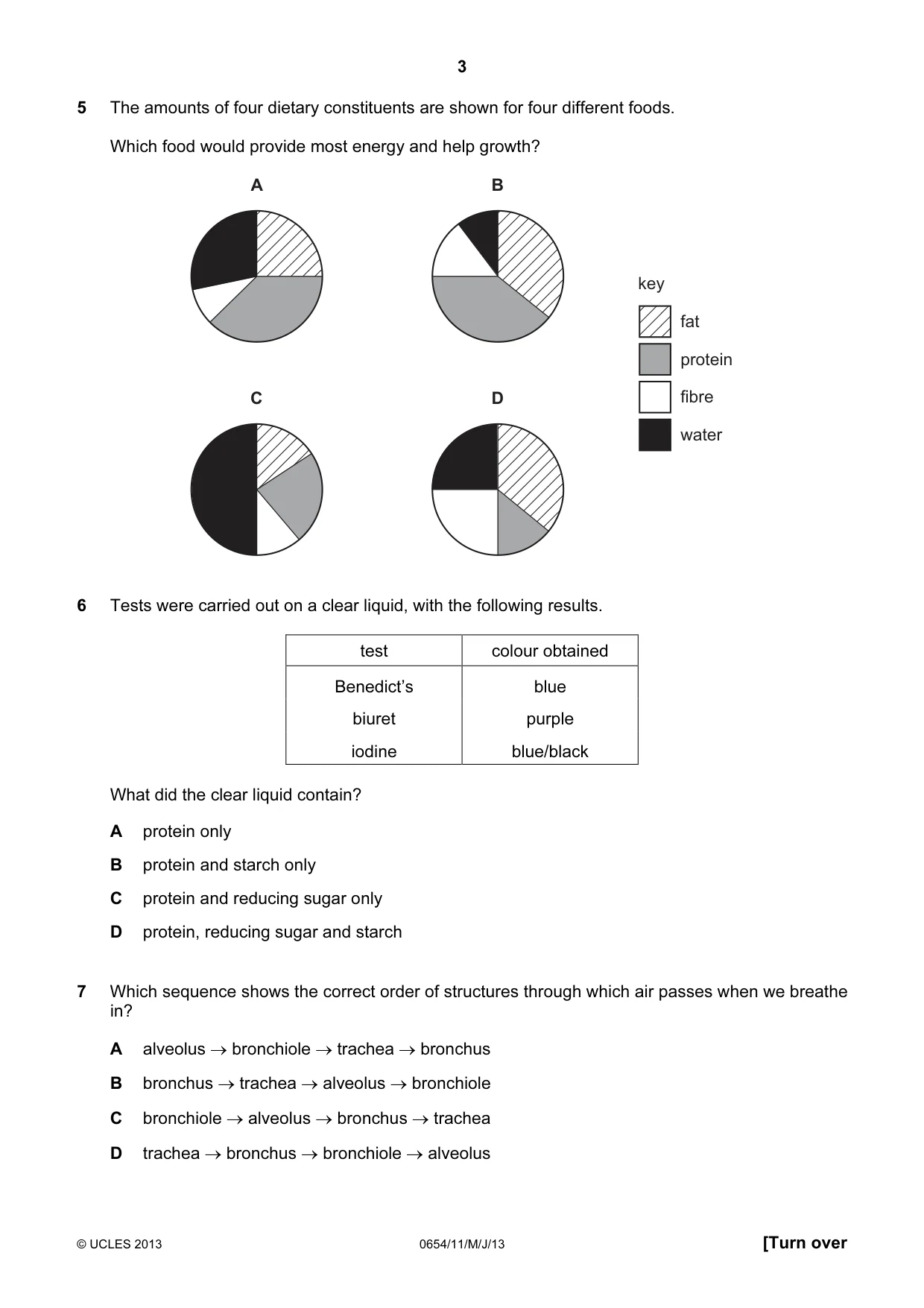
5 The amounts of four dietary constituents are shown for four different foods. Which food would provide most energy and help growth? A B key fat protein C D fibre water
Mark scheme: B
Q6 · Tests were carried out on a clear liquid, with the following results
6 Tests were carried out on a clear liquid, with the following results. test colour obtained Benedict’s blue biuret purple iodine blue/black What did the clear liquid contain? A protein only B protein and starch only C protein and reducing sugar only D protein, reducing sugar and starch
Mark scheme: B
Q7 · Which sequence shows the correct order of structures through which air passes when we…
7 Which sequence shows the correct order of structures through which air passes when we breathe in? A alveolus → bronchiole → trachea → bronchus B bronchus → trachea → alveolus → bronchiole C bronchiole → alveolus → bronchus → trachea D trachea → bronchus → bronchiole → alveolus
Mark scheme: D
Q8 · The graph shows changes in breathing rate as a boy runs a race
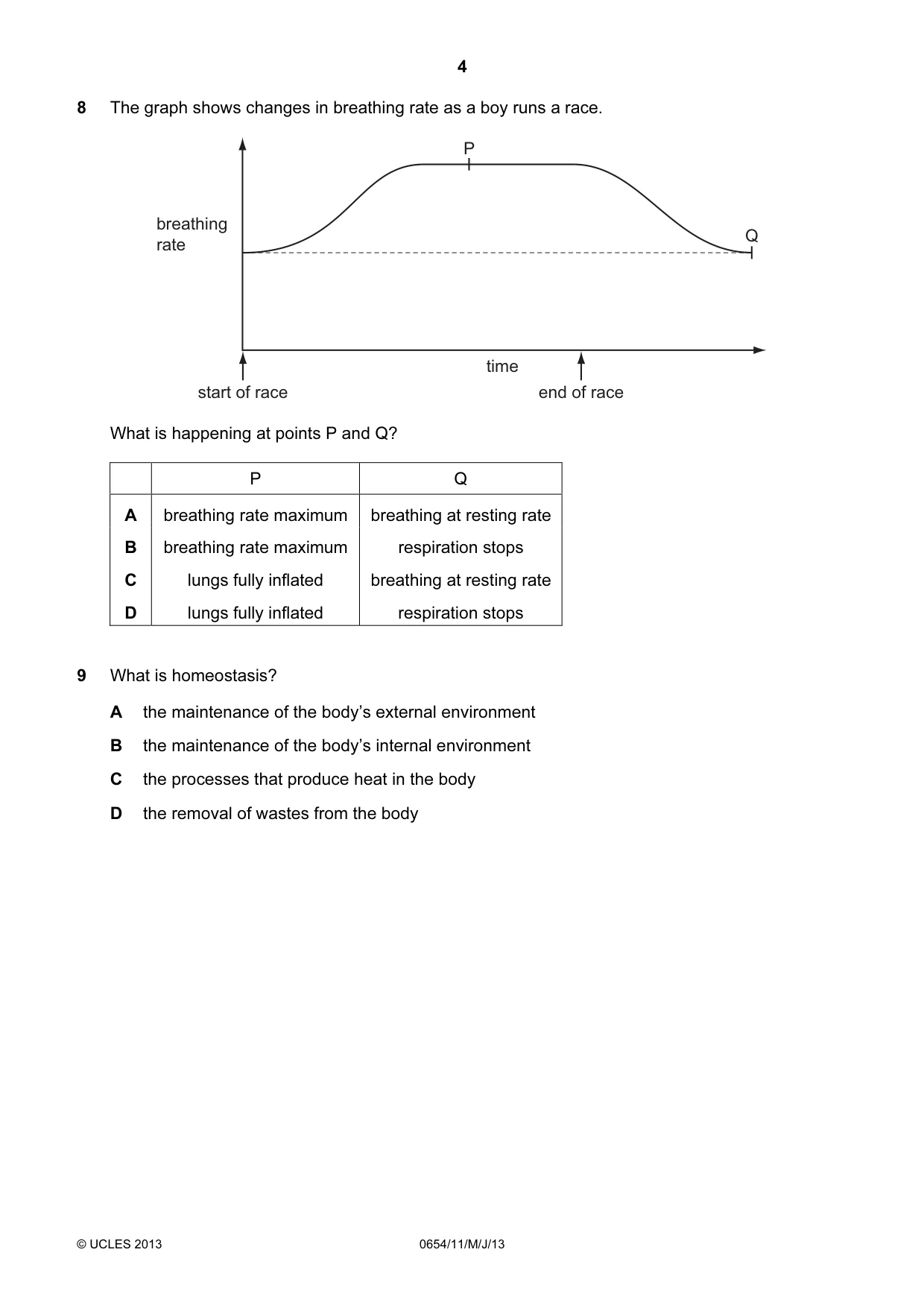
8 The graph shows changes in breathing rate as a boy runs a race. P breathing Q rate time start of race end of race What is happening at points P and Q? P Q A breathing rate maximum breathing at resting rate B breathing rate maximum respiration stops C lungs fully inflated breathing at resting rate D lungs fully inflated respiration stops
Mark scheme: A
Question 9
9 What is homeostasis? A the maintenance of the body’s external environment B the maintenance of the body’s internal environment C the processes that produce heat in the body D the removal of wastes from the body
Mark scheme: B
Q10 · The diagram shows a calendar for February and March with four days shaded
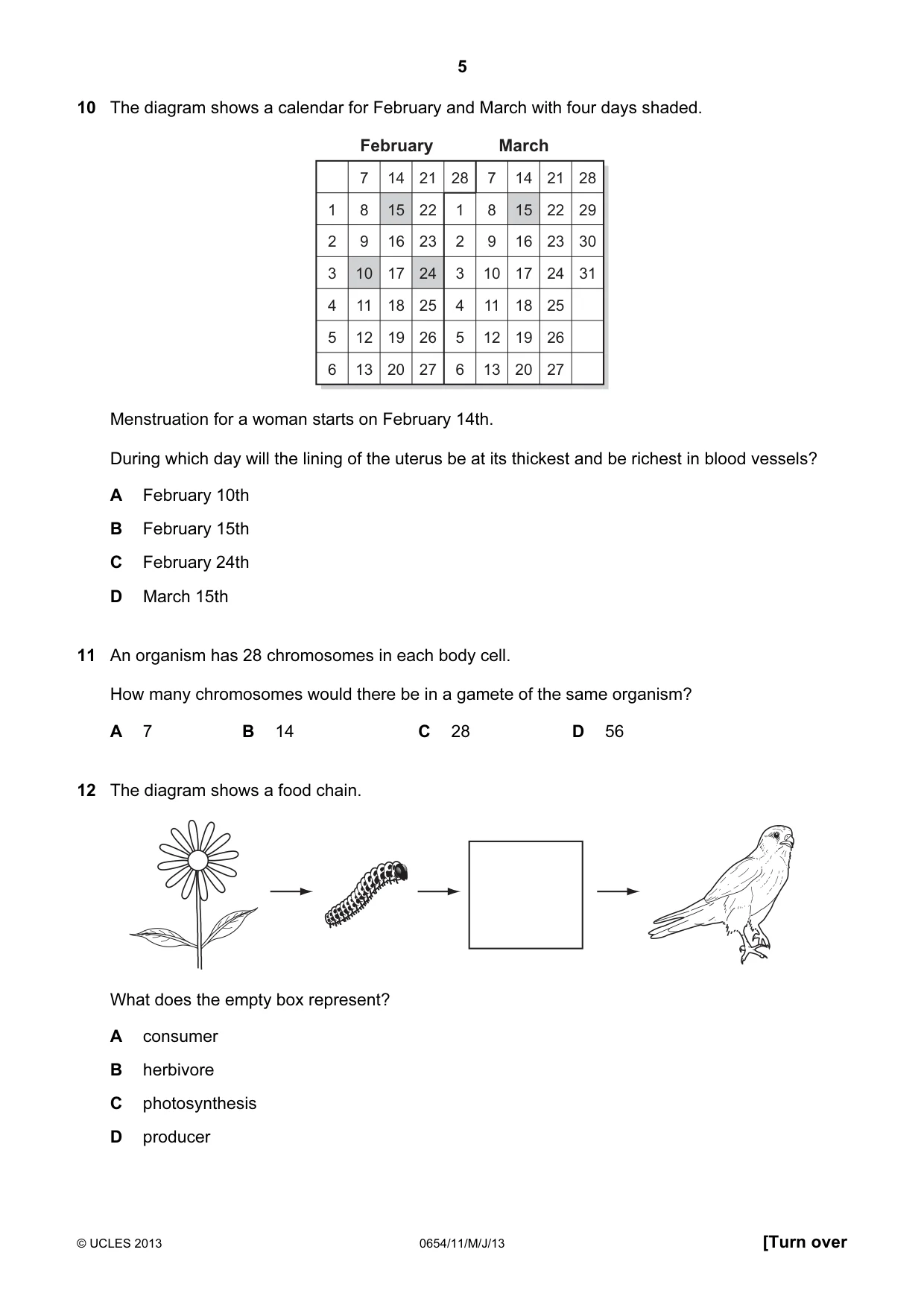
10 The diagram shows a calendar for February and March with four days shaded. February March 7 14 21 28 7 14 21 28 1 8 15 22 1 8 15 22 29 2 9 16 23 2 9 16 23 30 3 10 17 24 3 10 17 24 31 4 11 18 25 4 11 18 25 5 12 19 26 5 12 19 26 6 13 20 27 6 13 20 27 Menstruation for a woman starts on February 14th. During which day will the lining of the uterus be at its thickest and be richest in blood vessels? A February 10th B February 15th C February 24th D March 15th
Mark scheme: A
Q11 · An organism has 28 chromosomes in each body cell
11 An organism has 28 chromosomes in each body cell. How many chromosomes would there be in a gamete of the same organism? A 7 B 14 C 28 D 56
Mark scheme: B
Q12 · The diagram shows a food chain
12 The diagram shows a food chain. What does the empty box represent? A consumer B herbivore C photosynthesis D producer
Mark scheme: A
Q13 · The diagram shows part of the carbon cycle
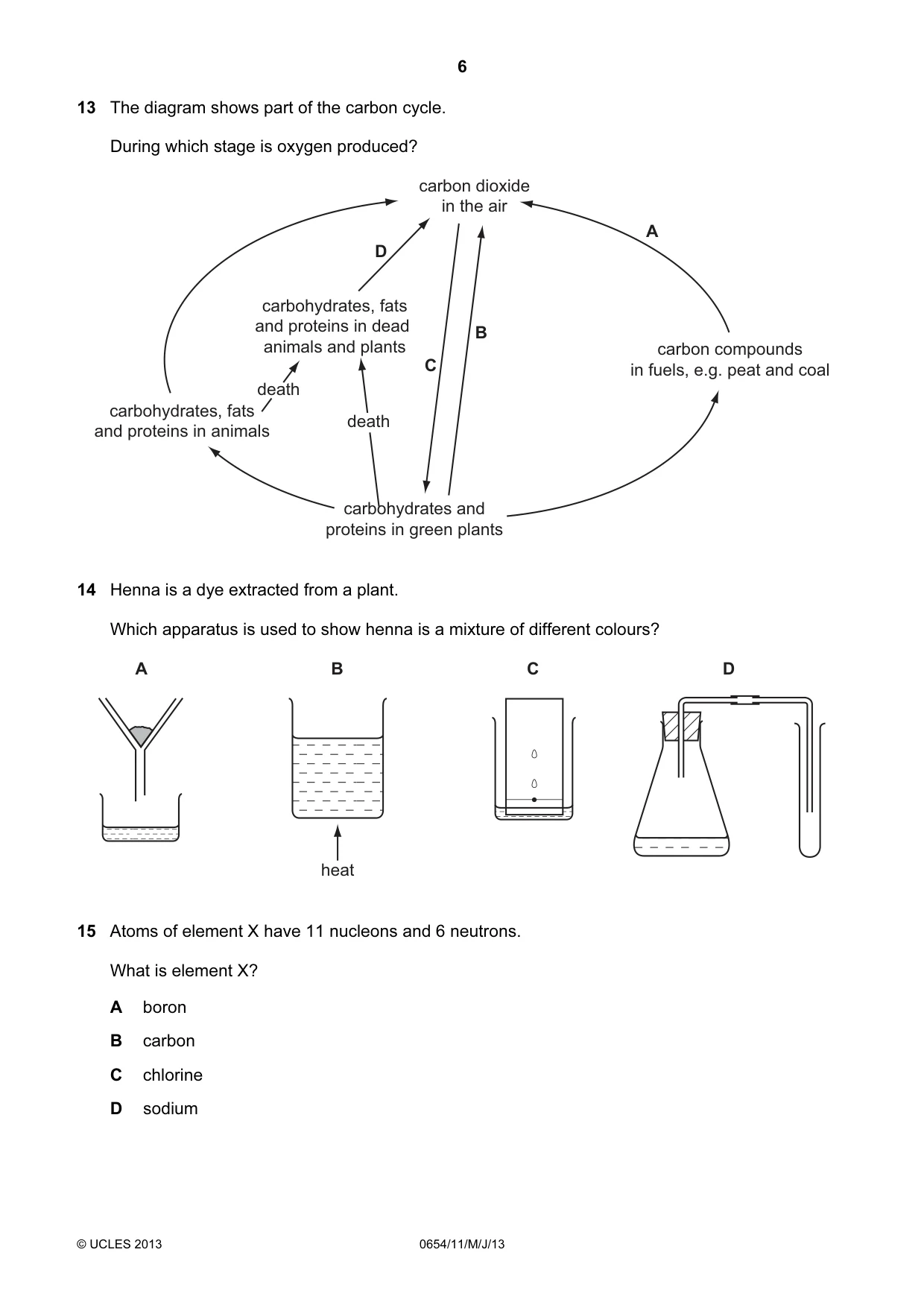
13 The diagram shows part of the carbon cycle. During which stage is oxygen produced? carbon dioxide in the air A D carbohydrates, fats and proteins in dead B animals and plants carbon compounds C in fuels, e.g. peat and coal death carbohydrates, fats death and proteins in animals carbohydrates and proteins in green plants
Mark scheme: C
Q14 · Henna is a dye extracted from a plant
14 Henna is a dye extracted from a plant. Which apparatus is used to show henna is a mixture of different colours? A B C D heat
Mark scheme: C
Q15 · Atoms of element X have 11 nucleons and 6 neutrons
15 Atoms of element X have 11 nucleons and 6 neutrons. What is element X? A boron B carbon C chlorine D sodium
Mark scheme: A
Q16 · The diagram shows overlapping circles into which different chemical formulae can be placed
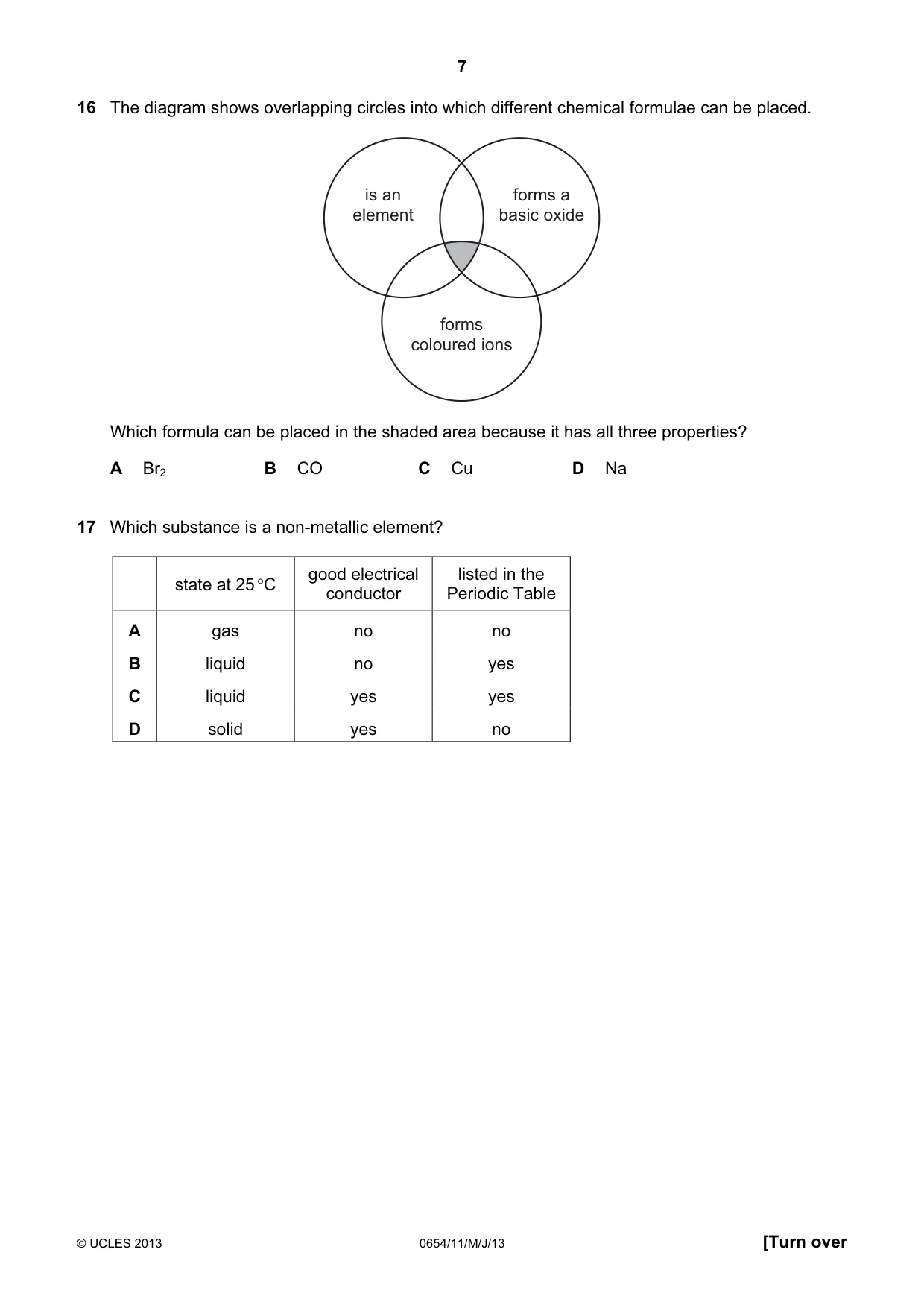
16 The diagram shows overlapping circles into which different chemical formulae can be placed. is an forms a element basic oxide forms coloured ions Which formula can be placed in the shaded area because it has all three properties? A Br2 B CO C Cu D Na
Mark scheme: C
Q17 · Which substance is a non-metallic element?
17 Which substance is a non-metallic element? state at 25 °C good electrical listed in the conductor Periodic Table A gas no no B liquid no yes C liquid yes yes D solid yes no
Mark scheme: B
Q18 · When ammonium sulfate is heated with solution X, ammonia gas is given off
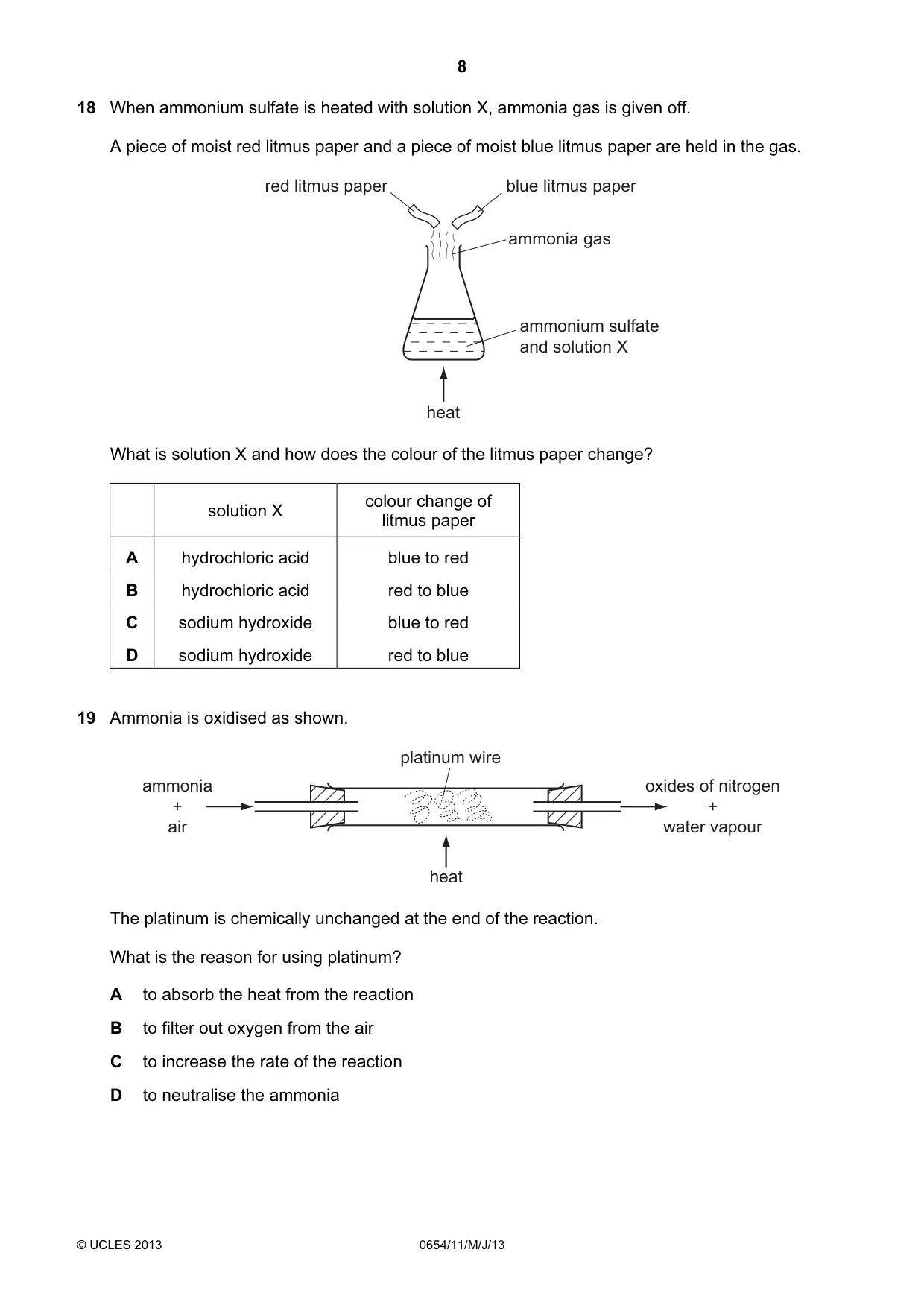
18 When ammonium sulfate is heated with solution X, ammonia gas is given off. A piece of moist red litmus paper and a piece of moist blue litmus paper are held in the gas. red litmus paper blue litmus paper ammonia gas ammonium sulfate and solution X heat What is solution X and how does the colour of the litmus paper change? colour change of solution X litmus paper A hydrochloric acid blue to red B hydrochloric acid red to blue C sodium hydroxide blue to red D sodium hydroxide red to blue
Mark scheme: D
Q19 · Ammonia is oxidised as shown
19 Ammonia is oxidised as shown. platinum wire ammonia oxides of nitrogen + + air water vapour heat The platinum is chemically unchanged at the end of the reaction. What is the reason for using platinum? A to absorb the heat from the reaction B to filter out oxygen from the air C to increase the rate of the reaction D to neutralise the ammonia
Mark scheme: C
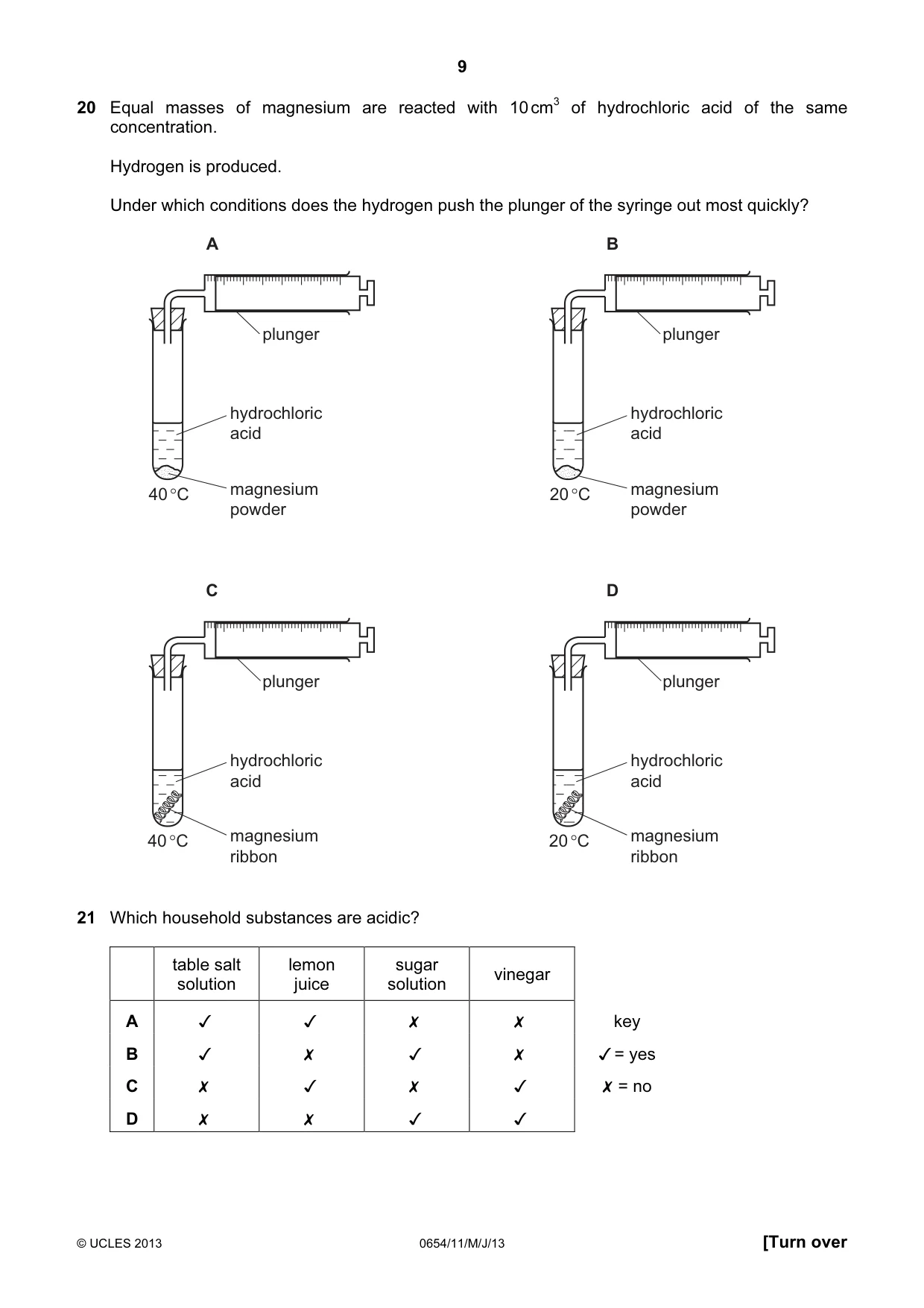
Q20 · Equal masses of magnesium are reacted with 10 cm3 of hydrochloric acid of the same…
20 Equal masses of magnesium are reacted with 10 cm3 of hydrochloric acid of the same concentration. Hydrogen is produced. Under which conditions does the hydrogen push the plunger of the syringe out most quickly? A B plunger plunger hydrochloric hydrochloric acid acid 40 °C magnesium 20 °C magnesium powder powder C D plunger plunger hydrochloric hydrochloric acid acid 40 °C magnesium 20 °C magnesium ribbon ribbon
Mark scheme: A
Q21 · Which household substances are acidic?
21 Which household substances are acidic? table salt lemon sugar vinegar solution juice solution A ✓ ✓ ✗ ✗ key B ✓ ✗ ✓ ✗ ✓= yes C ✗ ✓ ✗ ✓ ✗= no D ✗ ✗ ✓ ✓
Mark scheme: C
More questions on The characteristic properties of acids and bases
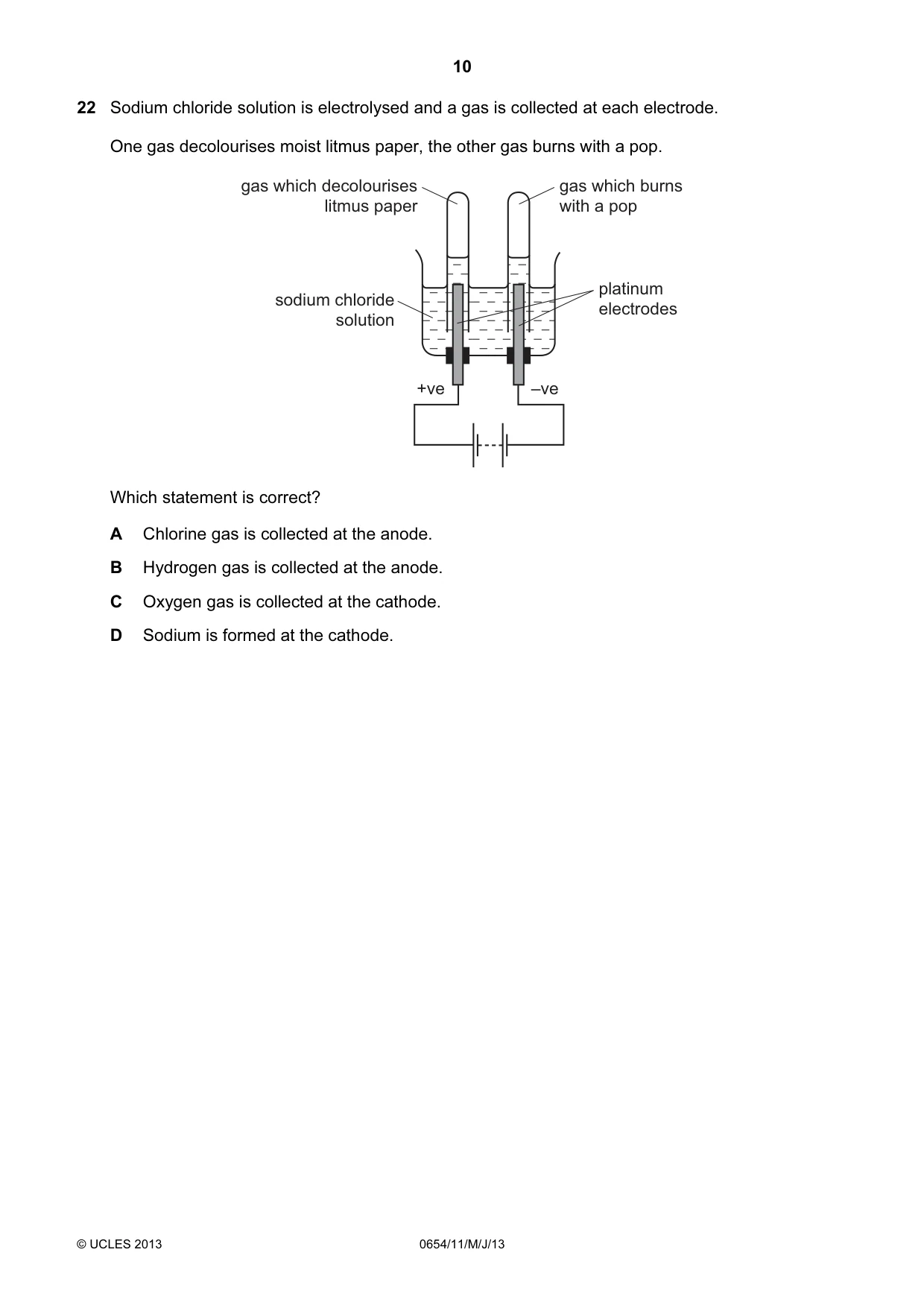
Q22 · Sodium chloride solution is electrolysed and a gas is collected at each electrode
22 Sodium chloride solution is electrolysed and a gas is collected at each electrode. One gas decolourises moist litmus paper, the other gas burns with a pop. gas which decolourises gas which burns litmus paper with a pop platinum sodium chloride electrodes solution +ve –ve Which statement is correct? A Chlorine gas is collected at the anode. B Hydrogen gas is collected at the anode. C Oxygen gas is collected at the cathode. D Sodium is formed at the cathode.
Mark scheme: A
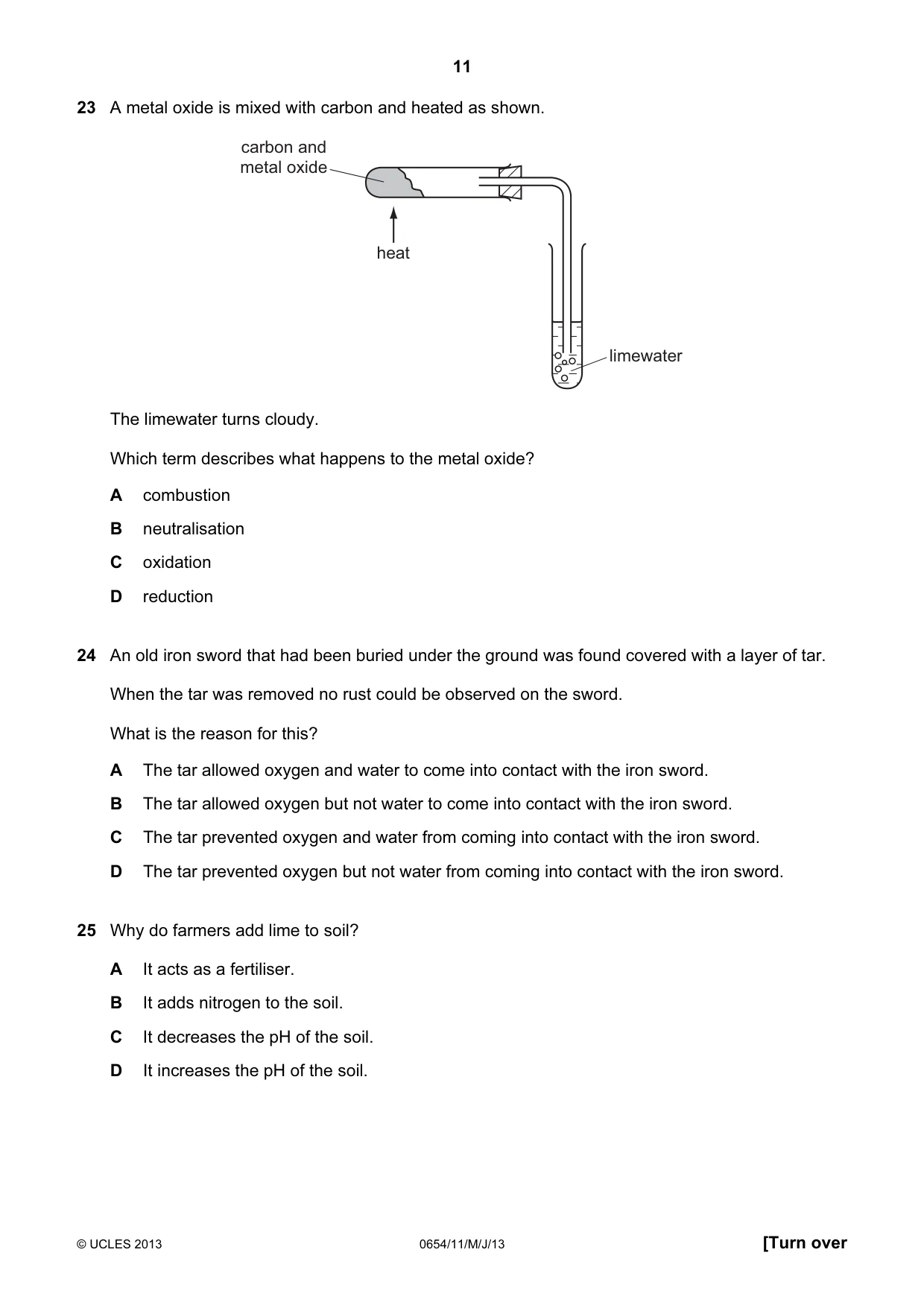
Q23 · A metal oxide is mixed with carbon and heated as shown
23 A metal oxide is mixed with carbon and heated as shown. carbon and metal oxide heat limewater The limewater turns cloudy. Which term describes what happens to the metal oxide? A combustion B neutralisation C oxidation D reduction
Mark scheme: D
Q24 · An old iron sword that had been buried under the ground was found covered with a layer of…
24 An old iron sword that had been buried under the ground was found covered with a layer of tar. When the tar was removed no rust could be observed on the sword. What is the reason for this? A The tar allowed oxygen and water to come into contact with the iron sword. B The tar allowed oxygen but not water to come into contact with the iron sword. C The tar prevented oxygen and water from coming into contact with the iron sword. D The tar prevented oxygen but not water from coming into contact with the iron sword.
Mark scheme: C
Q25 · Why do farmers add lime to soil?
25 Why do farmers add lime to soil? A It acts as a fertiliser. B It adds nitrogen to the soil. C It decreases the pH of the soil. D It increases the pH of the soil.
Mark scheme: D
More questions on The characteristic properties of acids and bases
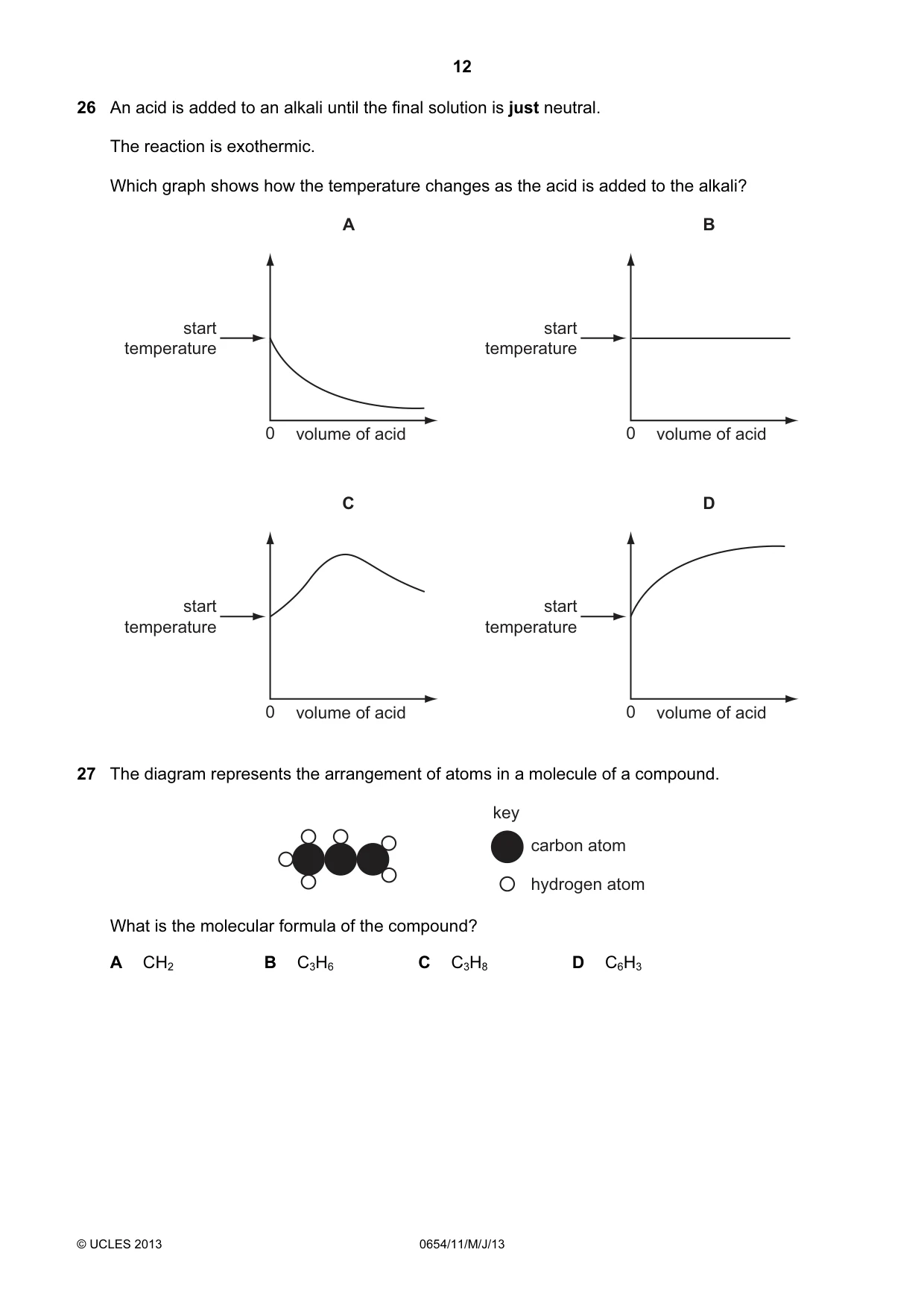
Q26 · An acid is added to an alkali until the final solution is just neutral
26 An acid is added to an alkali until the final solution is just neutral. The reaction is exothermic. Which graph shows how the temperature changes as the acid is added to the alkali? A B start start temperature temperature 0 volume of acid 0 volume of acid C D start start temperature temperature 0 volume of acid 0 volume of acid
Mark scheme: D
Q27 · The diagram represents the arrangement of atoms in a molecule of a compound
27 The diagram represents the arrangement of atoms in a molecule of a compound. key carbon atom hydrogen atom What is the molecular formula of the compound? A CH2 B C3H6 C C3H8 D C6H3
Mark scheme: B
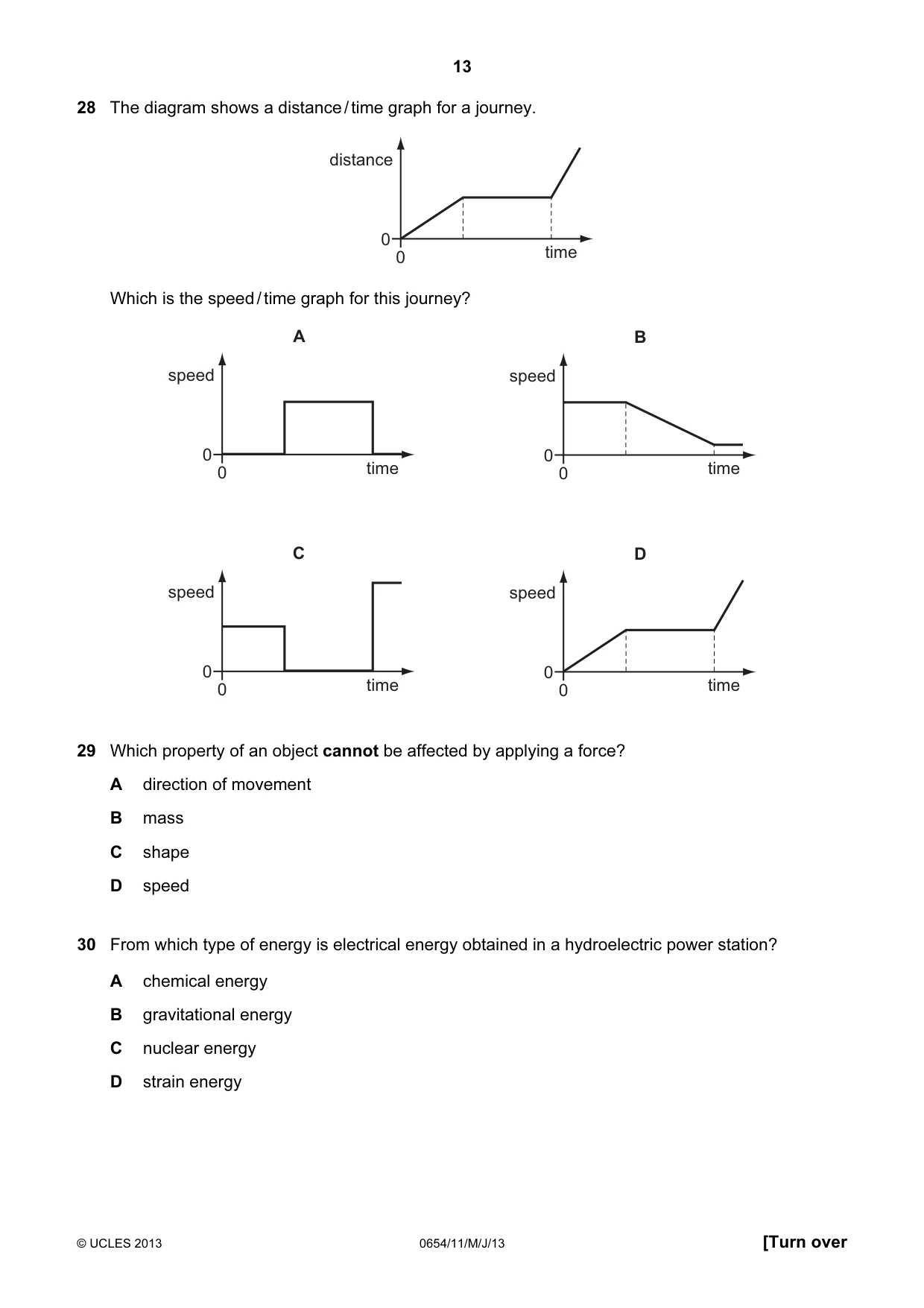
Q28 · The diagram shows a distance / time graph for a journey
28 The diagram shows a distance / time graph for a journey. distance 0 0 time Which is the speed / time graph for this journey? A B speed speed 0 0 0 time 0 time C D speed speed 0 0 0 time 0 time
Mark scheme: C
Q29 · Which property of an object cannot be affected by applying a force?
29 Which property of an object cannot be affected by applying a force? A direction of movement B mass C shape D speed
Mark scheme: B
Q30 · From which type of energy is electrical energy obtained in a hydroelectric power station?
30 From which type of energy is electrical energy obtained in a hydroelectric power station? A chemical energy B gravitational energy C nuclear energy D strain energy
Mark scheme: B
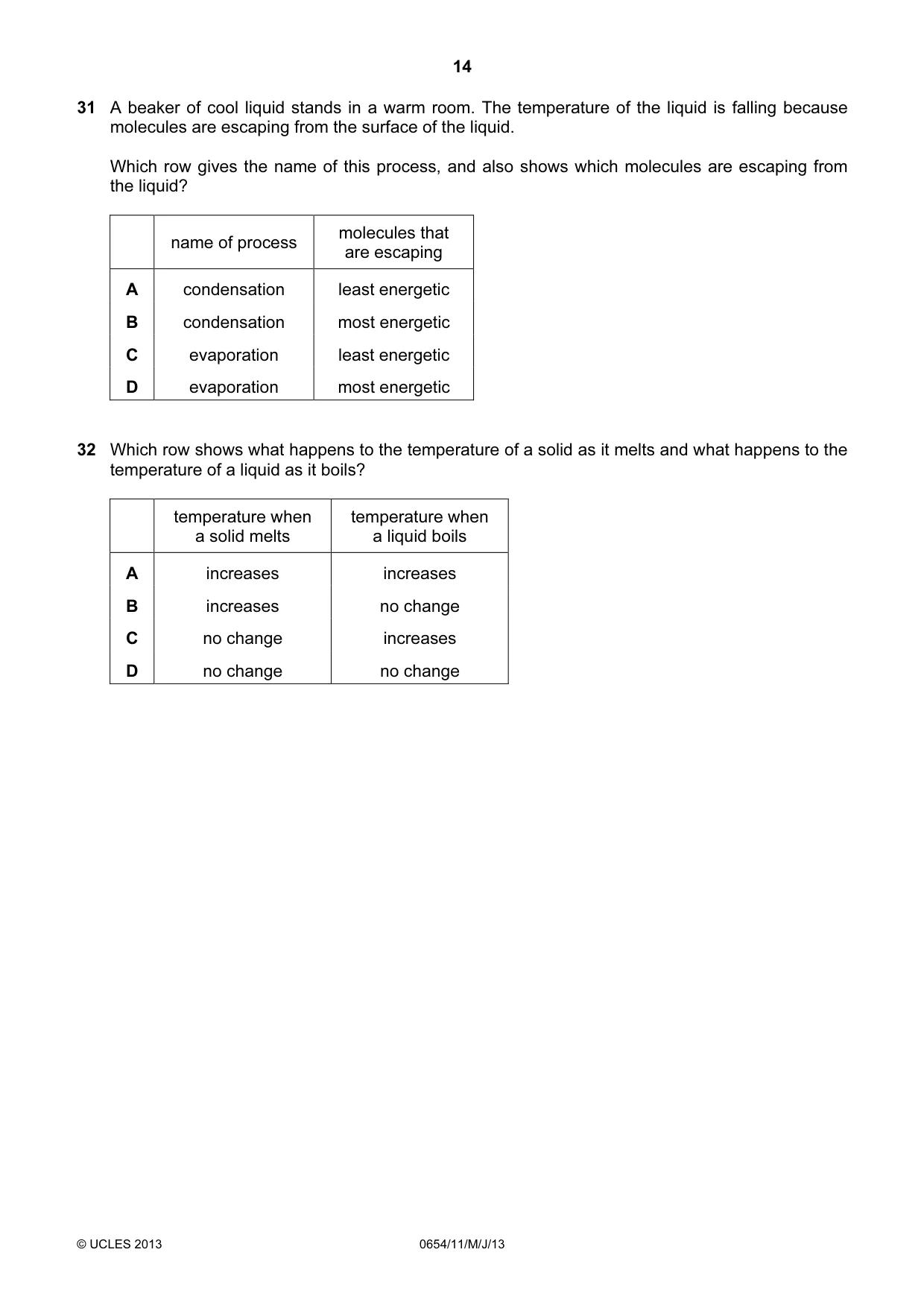
Q31 · A beaker of cool liquid stands in a warm room
31 A beaker of cool liquid stands in a warm room. The temperature of the liquid is falling because molecules are escaping from the surface of the liquid. Which row gives the name of this process, and also shows which molecules are escaping from the liquid? molecules that name of process are escaping A condensation least energetic B condensation most energetic C evaporation least energetic D evaporation most energetic
Mark scheme: D
Q32 · Which row shows what happens to the temperature of a solid as it melts and what happens…
32 Which row shows what happens to the temperature of a solid as it melts and what happens to the temperature of a liquid as it boils? temperature when temperature when a solid melts a liquid boils A increases increases B increases no change C no change increases D no change no change
Mark scheme: D
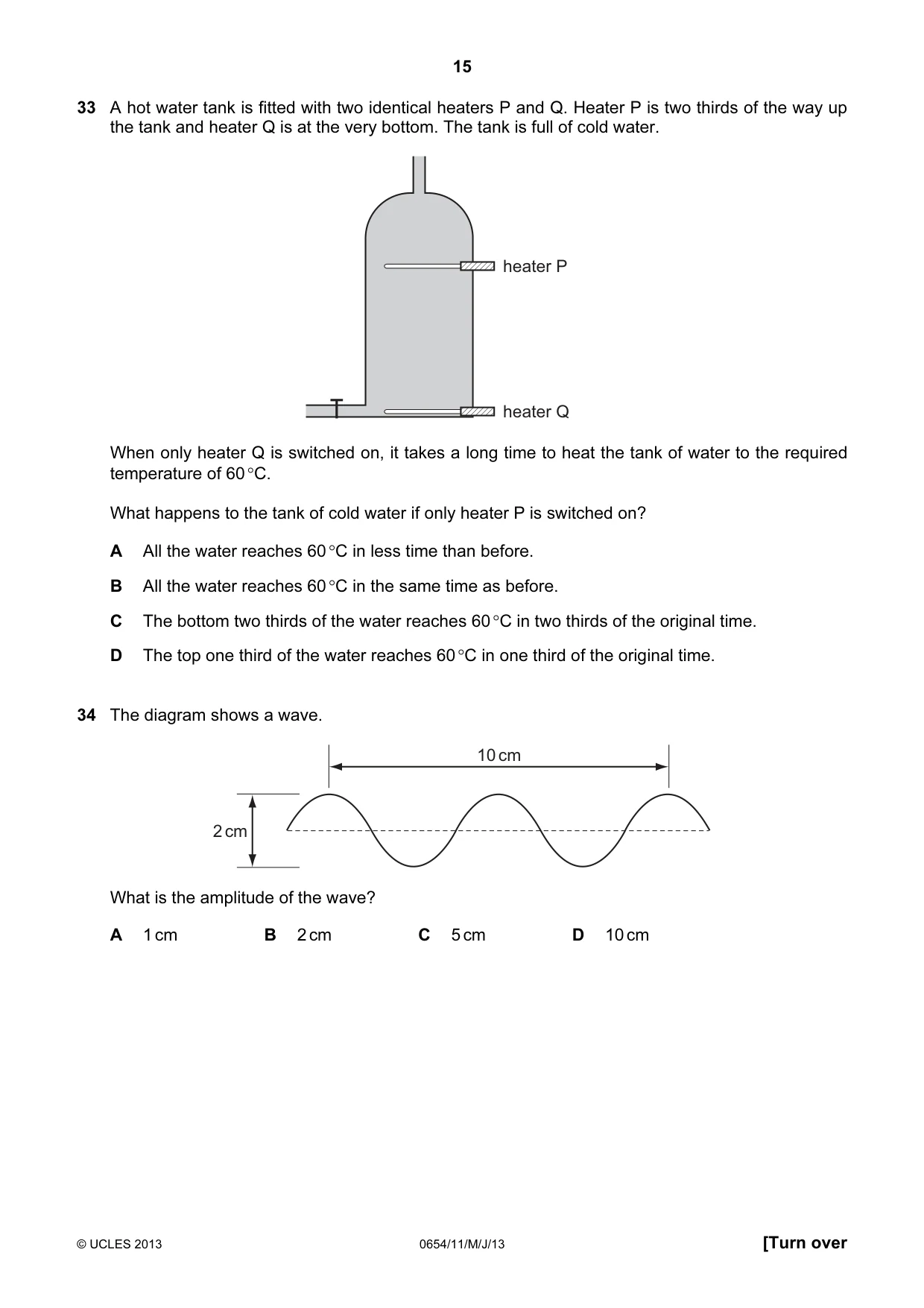
Q33 · A hot water tank is fitted with two identical heaters P and Q
33 A hot water tank is fitted with two identical heaters P and Q. Heater P is two thirds of the way up the tank and heater Q is at the very bottom. The tank is full of cold water. heater P heater Q When only heater Q is switched on, it takes a long time to heat the tank of water to the required temperature of 60 °C. What happens to the tank of cold water if only heater P is switched on? A All the water reaches 60 °C in less time than before. B All the water reaches 60 °C in the same time as before. C The bottom two thirds of the water reaches 60 °C in two thirds of the original time. D The top one third of the water reaches 60 °C in one third of the original time.
Mark scheme: D
Q34 · The diagram shows a wave
34 The diagram shows a wave. 10 cm 2 cm What is the amplitude of the wave? A 1 cm B 2 cm C 5 cm D 10 cm
Mark scheme: A
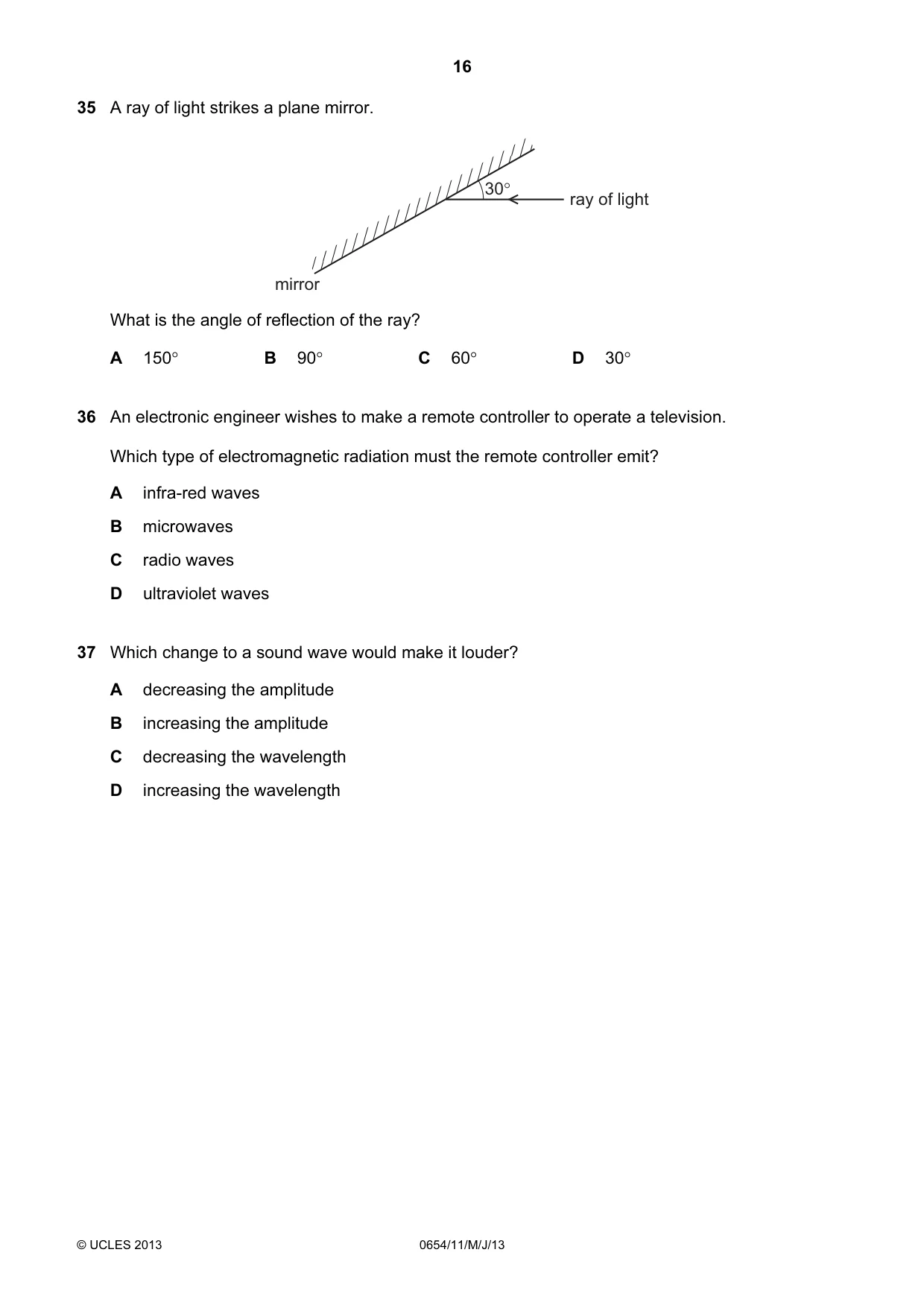
Q35 · A ray of light strikes a plane mirror
35 A ray of light strikes a plane mirror. 30° ray of light mirror What is the angle of reflection of the ray? A 150° B 90° C 60° D 30°
Mark scheme: C
Q36 · An electronic engineer wishes to make a remote controller to operate a television
36 An electronic engineer wishes to make a remote controller to operate a television. Which type of electromagnetic radiation must the remote controller emit? A infra-red waves B microwaves C radio waves D ultraviolet waves
Mark scheme: A
Q37 · Which change to a sound wave would make it louder?
37 Which change to a sound wave would make it louder? A decreasing the amplitude B increasing the amplitude C decreasing the wavelength D increasing the wavelength
Mark scheme: B
Q38 · A bar magnet is brought near a metal rod
38 A bar magnet is brought near a metal rod. magnet metal rod N S The magnet is then turned around so that its poles have changed positions. The magnet is again brought near to the metal rod. In both cases the metal rod is attracted to the magnet. What could the metal rod be? A another bar magnet B a piece of aluminium C a piece of copper D a piece of iron
Mark scheme: D
Q39 · The circuit shown is used to determine the resistance of a lamp
39 The circuit shown is used to determine the resistance of a lamp. A V The ammeter reading is 2.0 A and the voltmeter reading is 6.0 V. What is the resistance of the lamp? A 0.33 Ω B 3.0 Ω C 8.0 Ω D 12 Ω
Mark scheme: B
Q40 · Which row compares the number of protons and the number of neutrons in atoms of different…
40 Which row compares the number of protons and the number of neutrons in atoms of different isotopes of an element? number of number of protons neutrons A different different B different the same C the same different D the same the same
Mark scheme: C
What was in this paper
The subtopics covered by these 40 questions, and how many questions each got. Open one in a new tab to see every Cambridge question on it.
2Rate of reaction2The characteristic properties of acids and bases2Atomic structure and the Periodic Table1Biological molecules1Carbon cycle1Cell division1Cell structure1Chromatography1Circulatory systems1Corrosion of metals1Diet1Digestive system1Electrical quantities1Electrolysis1Electromagnetic spectrum1Energy, work and power1Exothermic and endothermic reactions1Extraction of metals1Food chains and food webs1Forces1Formulas1General properties of waves1Homeostasis1Identification of ions and gases1Isotopes1Kinetic particle model of matter1Light1Motion1Properties of metals1Respiration1Sexual reproduction in humans1Simple phenomena of magnetism1Sound1Thermal properties and temperature1Transfer of thermal energy1Transition elements1What you needed in this session
Cambridge’s own grade thresholds for 2013 May/June, Paper 1 · Variant 1. A higher threshold means an easier paper — the bar moves with how the cohort did.