Cambridge IGCSE Sciences - Co-ordinated (Double) 0654 — 2021 Oct/Nov Paper 1 · Variant 2
0654/12/O/N/21 · 40 questions · 40 marks · ≈45 min
The question paper and its mark scheme, free to read here and free to download. This is Cambridge’s own paper, exactly as it was sat.
Question paper20 pages


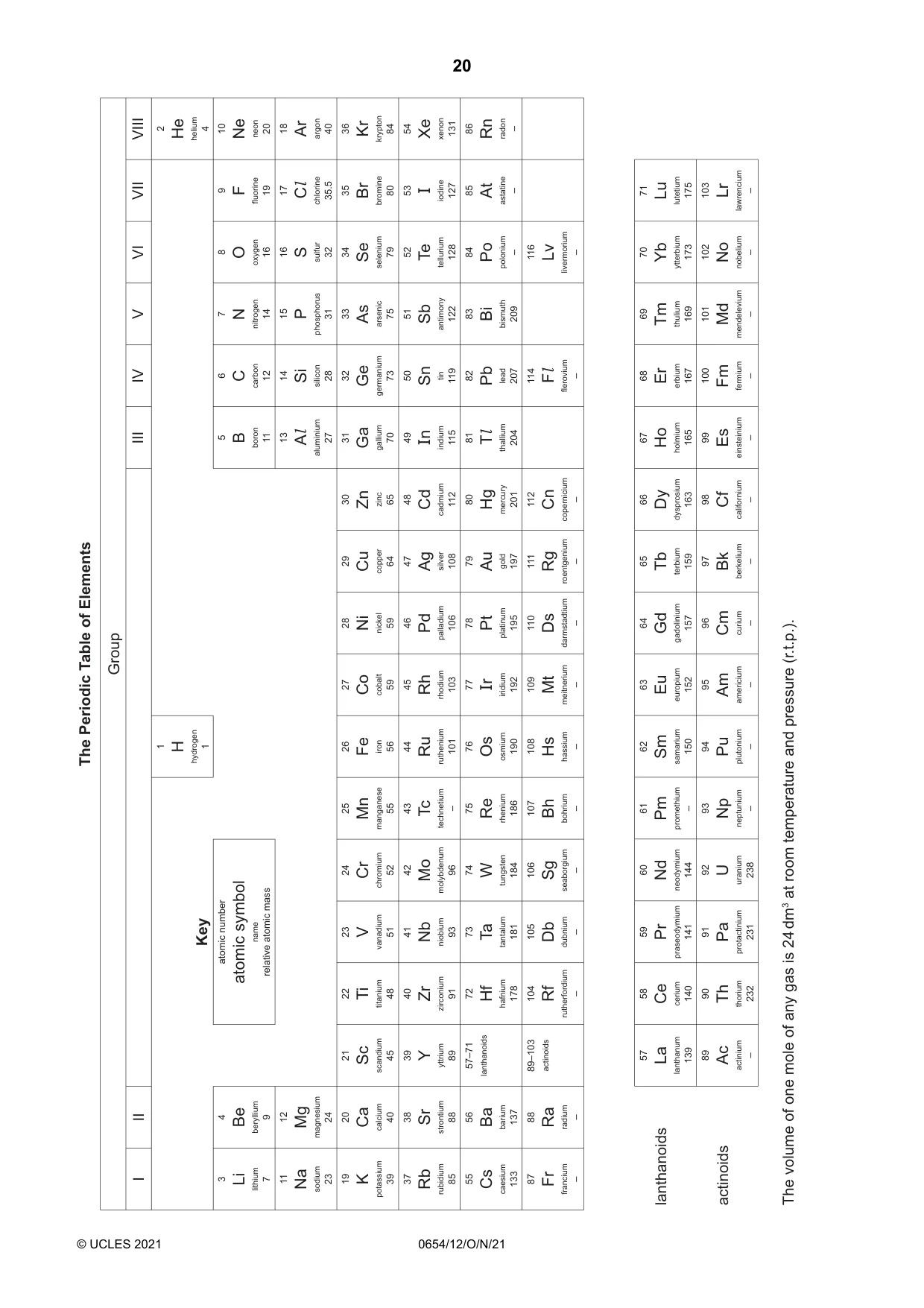
Mark scheme3 pages
Answers below. Sit the paper first if you are practising.
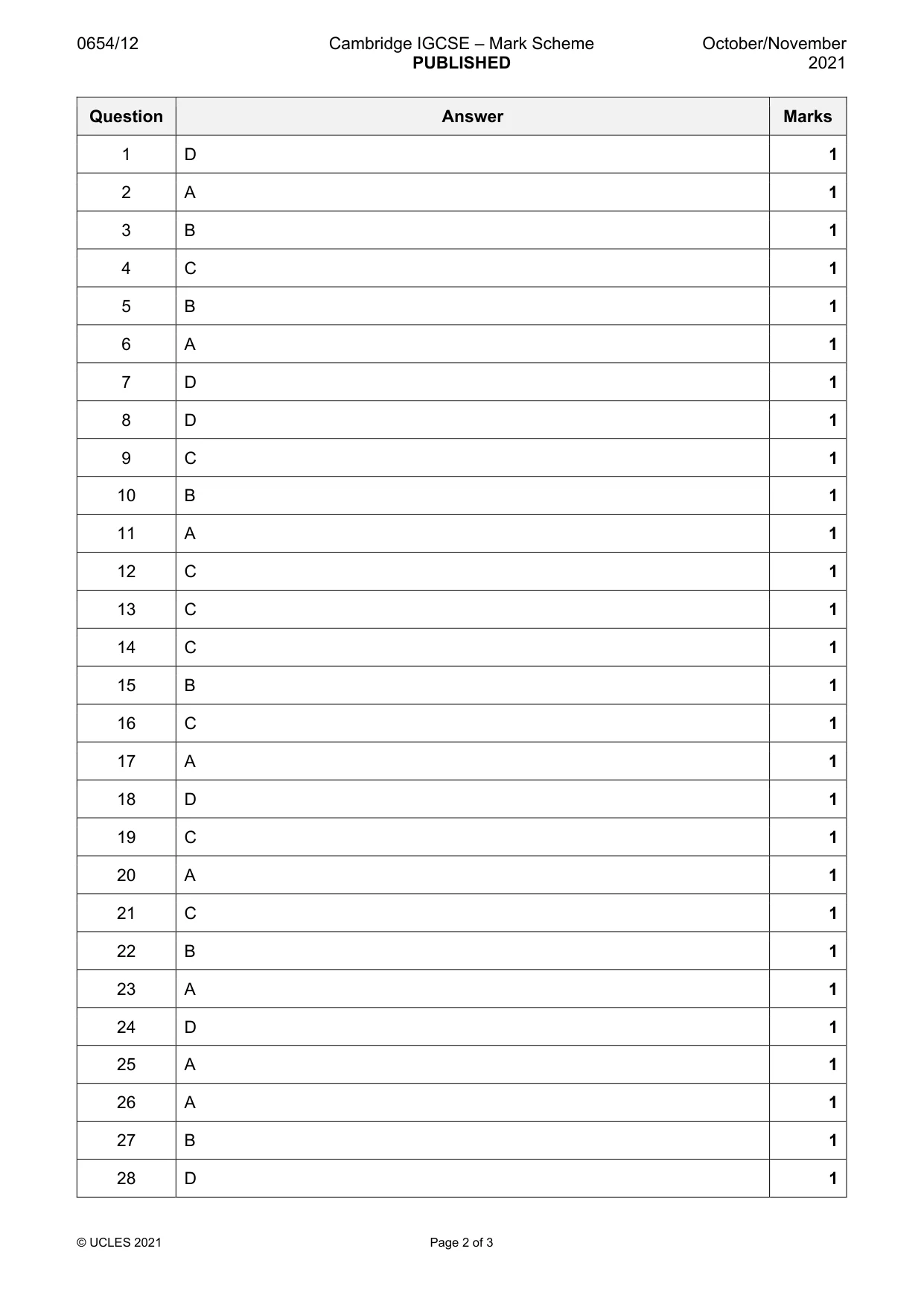
Questions as text
Q1 · All living organisms can break down nutrient molecules to release energy
1 All living organisms can break down nutrient molecules to release energy. What is this process? A excretion B growth C nutrition D respiration
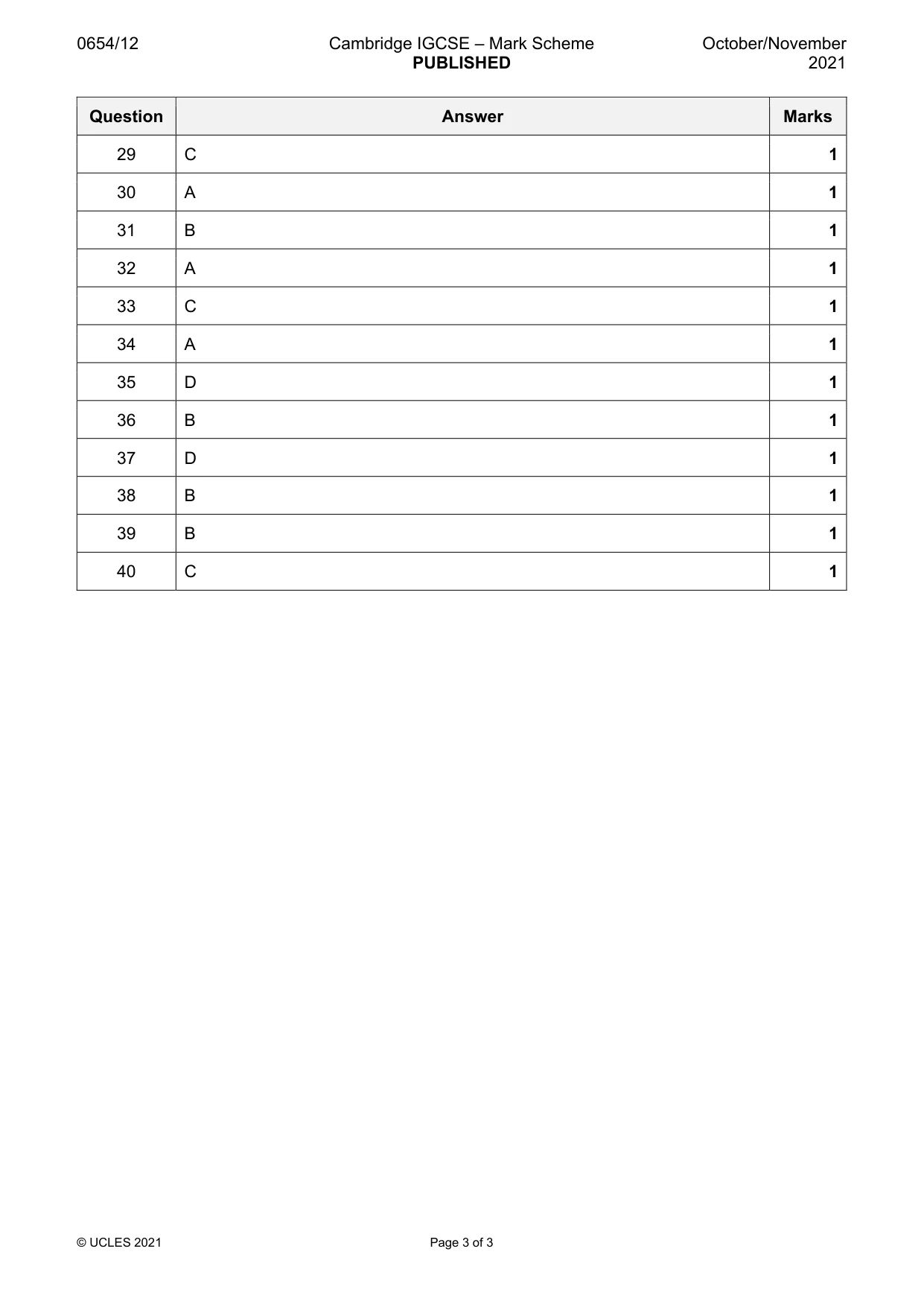
Mark scheme: D
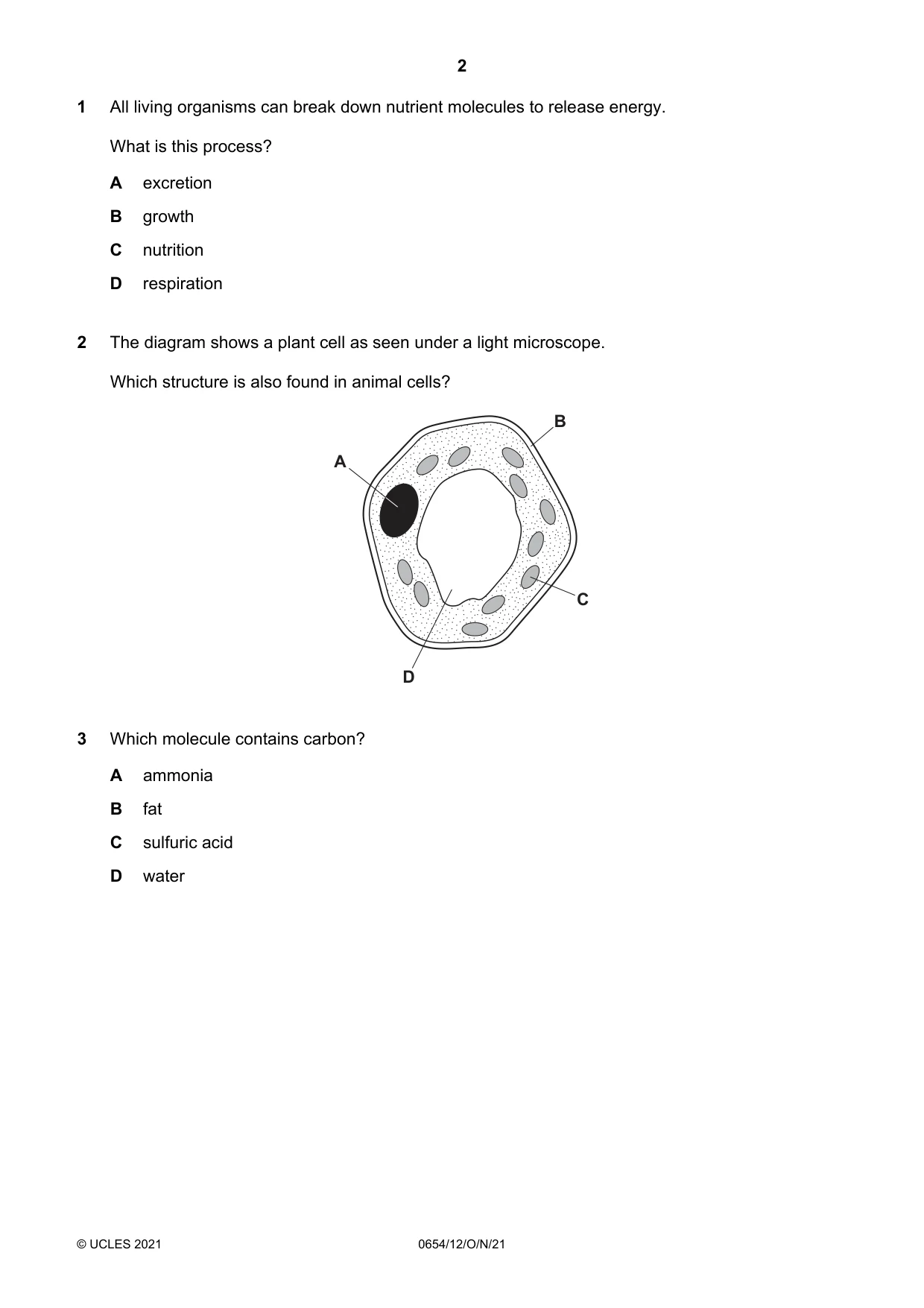
Q2 · The diagram shows a plant cell as seen under a light microscope
2 The diagram shows a plant cell as seen under a light microscope. Which structure is also found in animal cells? B A C D
Mark scheme: A
Q3 · Which molecule contains carbon?
3 Which molecule contains carbon? A ammonia B fat C sulfuric acid D water
Mark scheme: B
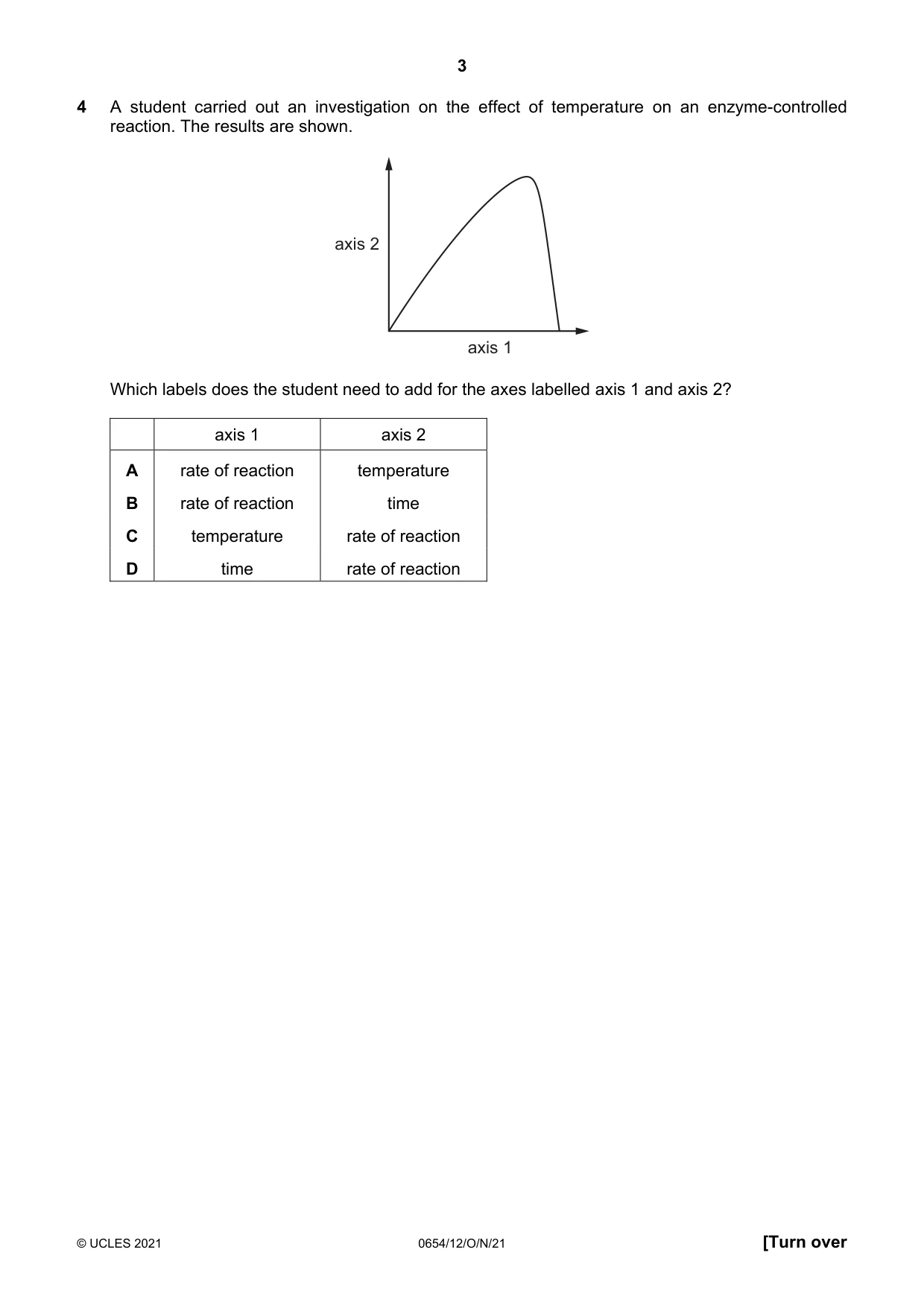
Q4 · A student carried out an investigation on the effect of temperature on an…
4 A student carried out an investigation on the effect of temperature on an enzyme-controlled reaction. The results are shown. axis 2 axis 1 Which labels does the student need to add for the axes labelled axis 1 and axis 2? axis 1 axis 2 A rate of reaction temperature B rate of reaction time C temperature rate of reaction D time rate of reaction
Mark scheme: C
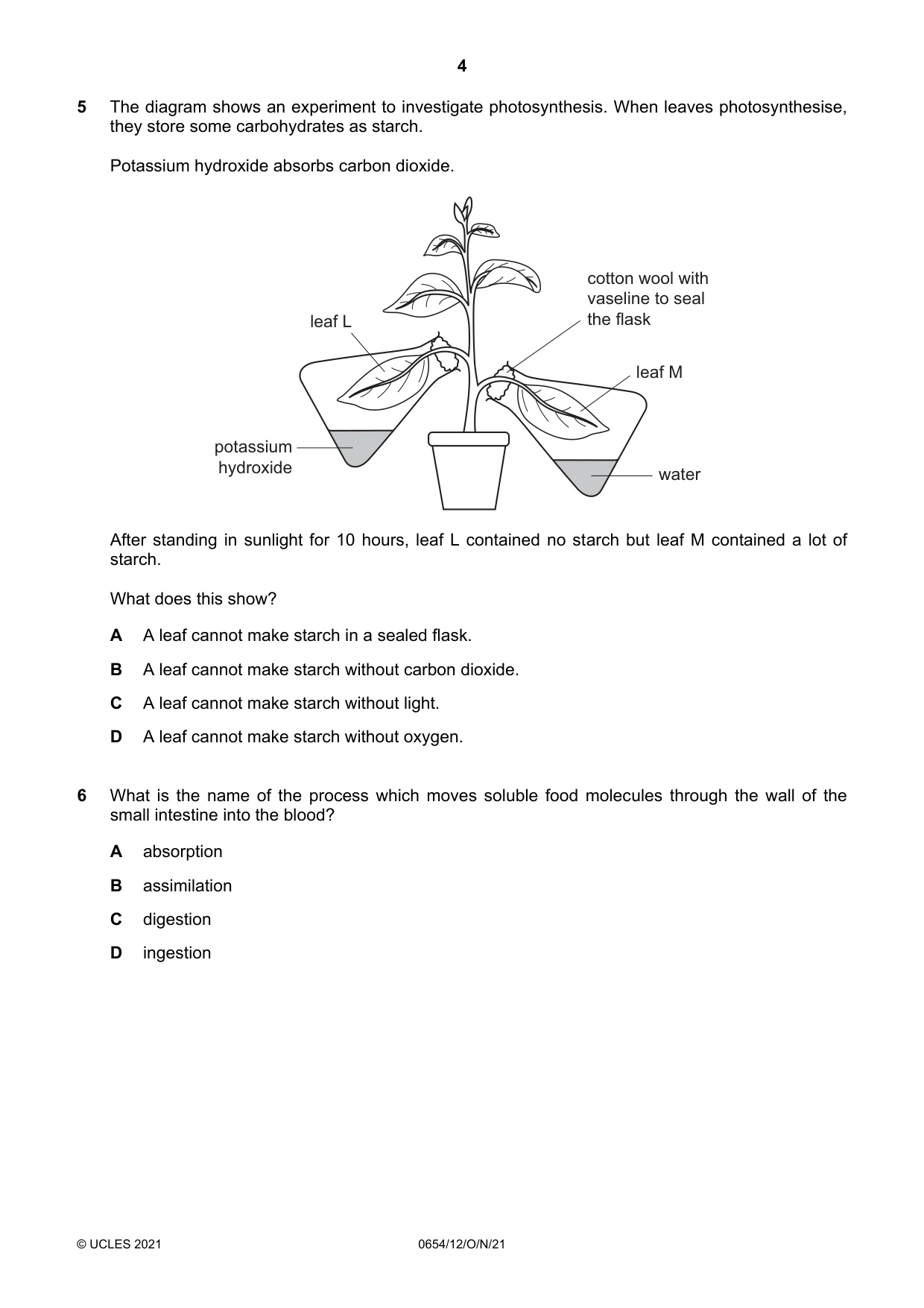
Q5 · The diagram shows an experiment to investigate photosynthesis
5 The diagram shows an experiment to investigate photosynthesis. When leaves photosynthesise, they store some carbohydrates as starch. Potassium hydroxide absorbs carbon dioxide. cotton wool with vaseline to seal leaf L the flask leaf M potassium hydroxide water After standing in sunlight for 10 hours, leaf L contained no starch but leaf M contained a lot of starch. What does this show? A A leaf cannot make starch in a sealed flask. B A leaf cannot make starch without carbon dioxide. C A leaf cannot make starch without light. D A leaf cannot make starch without oxygen.
Mark scheme: B
Q6 · What is the name of the process which moves soluble food molecules through the wall of…
6 What is the name of the process which moves soluble food molecules through the wall of the small intestine into the blood? A absorption B assimilation C digestion D ingestion
Mark scheme: A
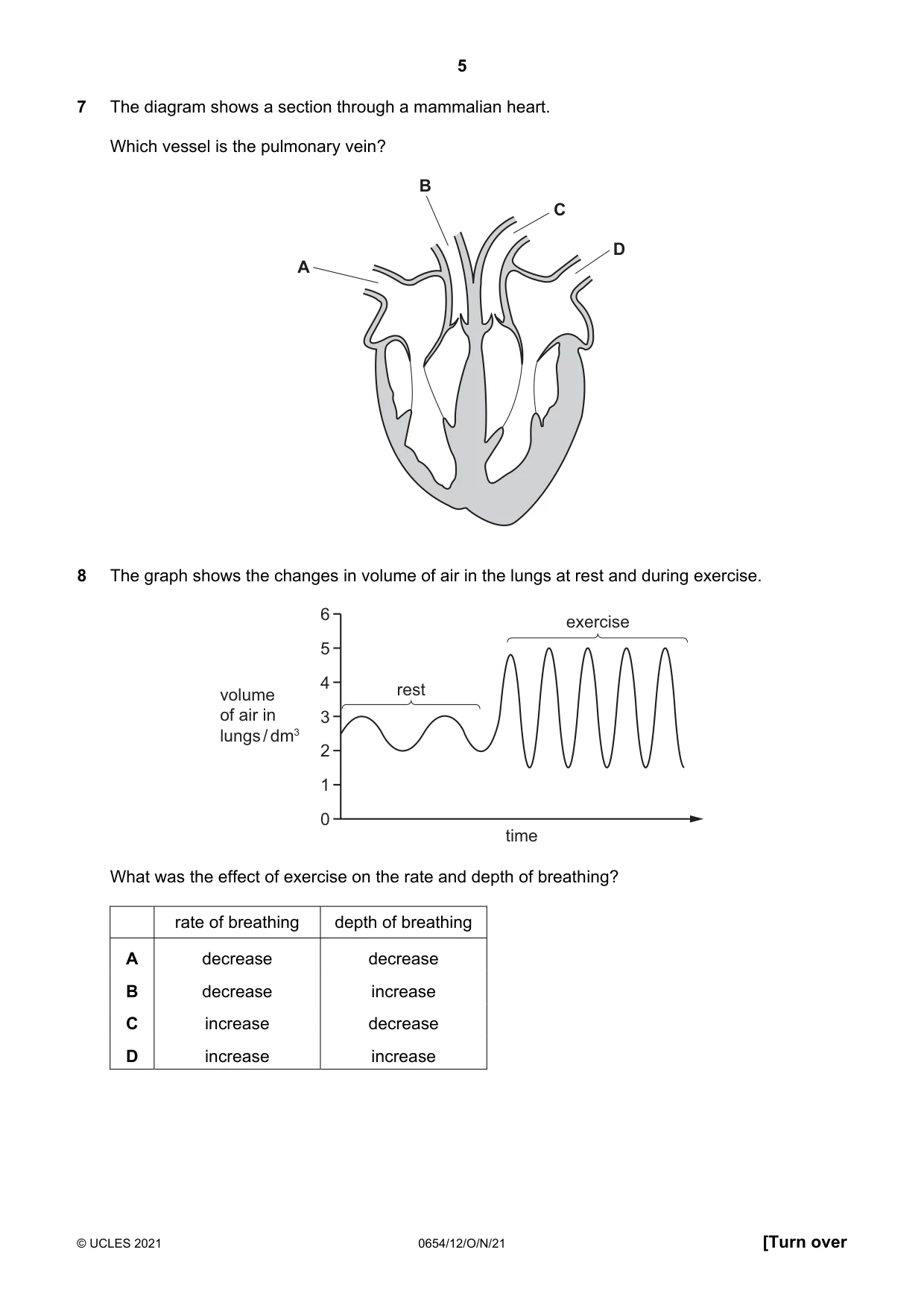
Q7 · The diagram shows a section through a mammalian heart
7 The diagram shows a section through a mammalian heart. Which vessel is the pulmonary vein? B C D A
Mark scheme: D
Q8 · The graph shows the changes in volume of air in the lungs at rest and during exercise
8 The graph shows the changes in volume of air in the lungs at rest and during exercise. 6 exercise 5 4 rest volume of air in 3 lungs / dm3 2 1 0 time What was the effect of exercise on the rate and depth of breathing? rate of breathing depth of breathing A decrease decrease B decrease increase C increase decrease D increase increase
Mark scheme: D
Q9 · Adrenaline is injected into the blood to treat some medical conditions
9 Adrenaline is injected into the blood to treat some medical conditions. What would happen as a result of injecting adrenaline? 1 narrowing of the pupil in the eye 2 increased breathing rate 3 increased pulse rate A 1 and 2 only B 1 and 3 only C 2 and 3 only D 1, 2 and 3
Mark scheme: C
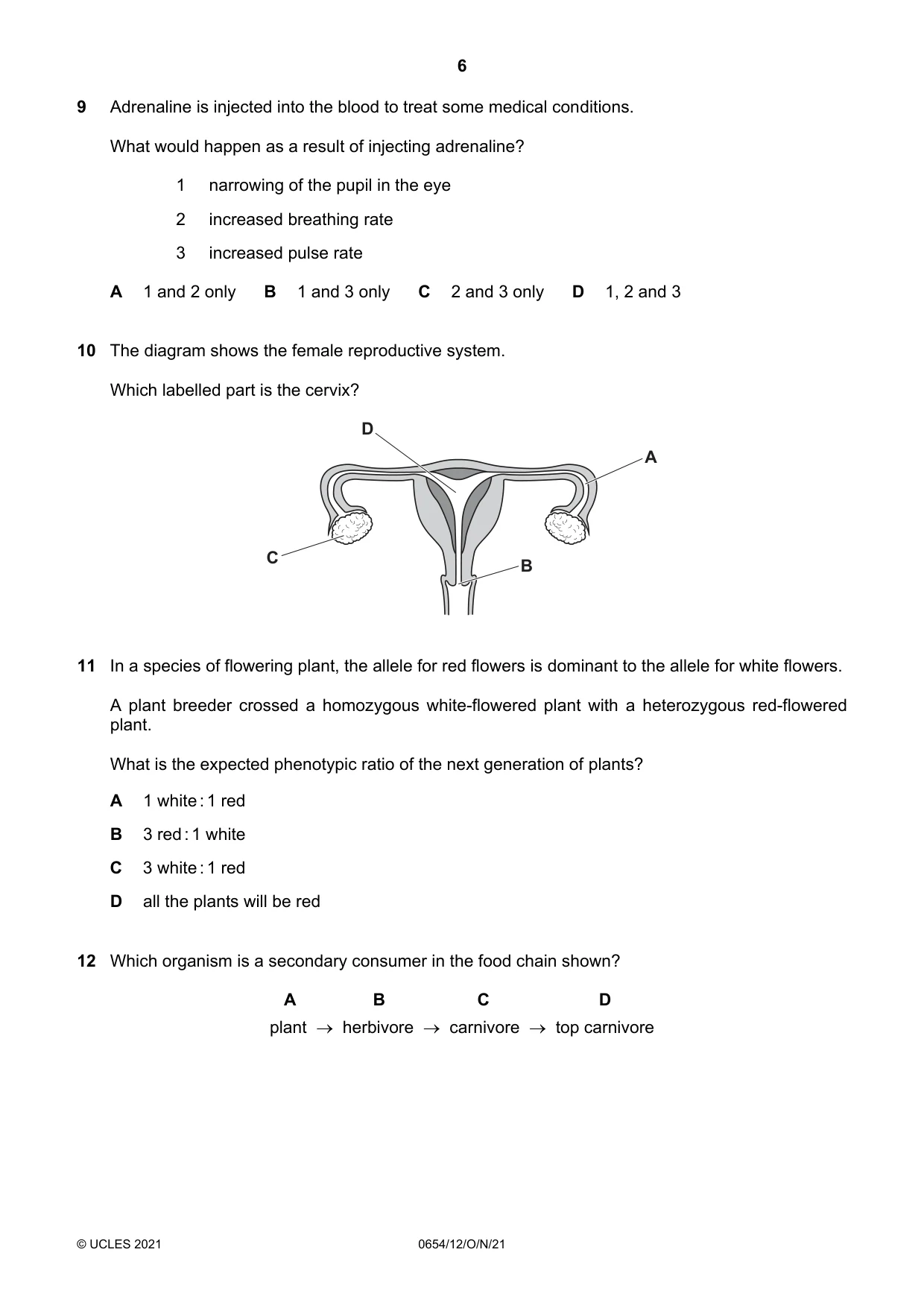
Q10 · The diagram shows the female reproductive system
10 The diagram shows the female reproductive system. Which labelled part is the cervix? D A C B
Mark scheme: B
Q11 · In a species of flowering plant, the allele for red flowers is dominant to the allele for…
11 In a species of flowering plant, the allele for red flowers is dominant to the allele for white flowers. A plant breeder crossed a homozygous white-flowered plant with a heterozygous red-flowered plant. What is the expected phenotypic ratio of the next generation of plants? A 1 white : 1 red B 3 red : 1 white C 3 white : 1 red D all the plants will be red
Mark scheme: A
Q12 · Which organism is a secondary consumer in the food chain shown?
12 Which organism is a secondary consumer in the food chain shown? A B C D plant herbivore carnivore top carnivore
Mark scheme: C
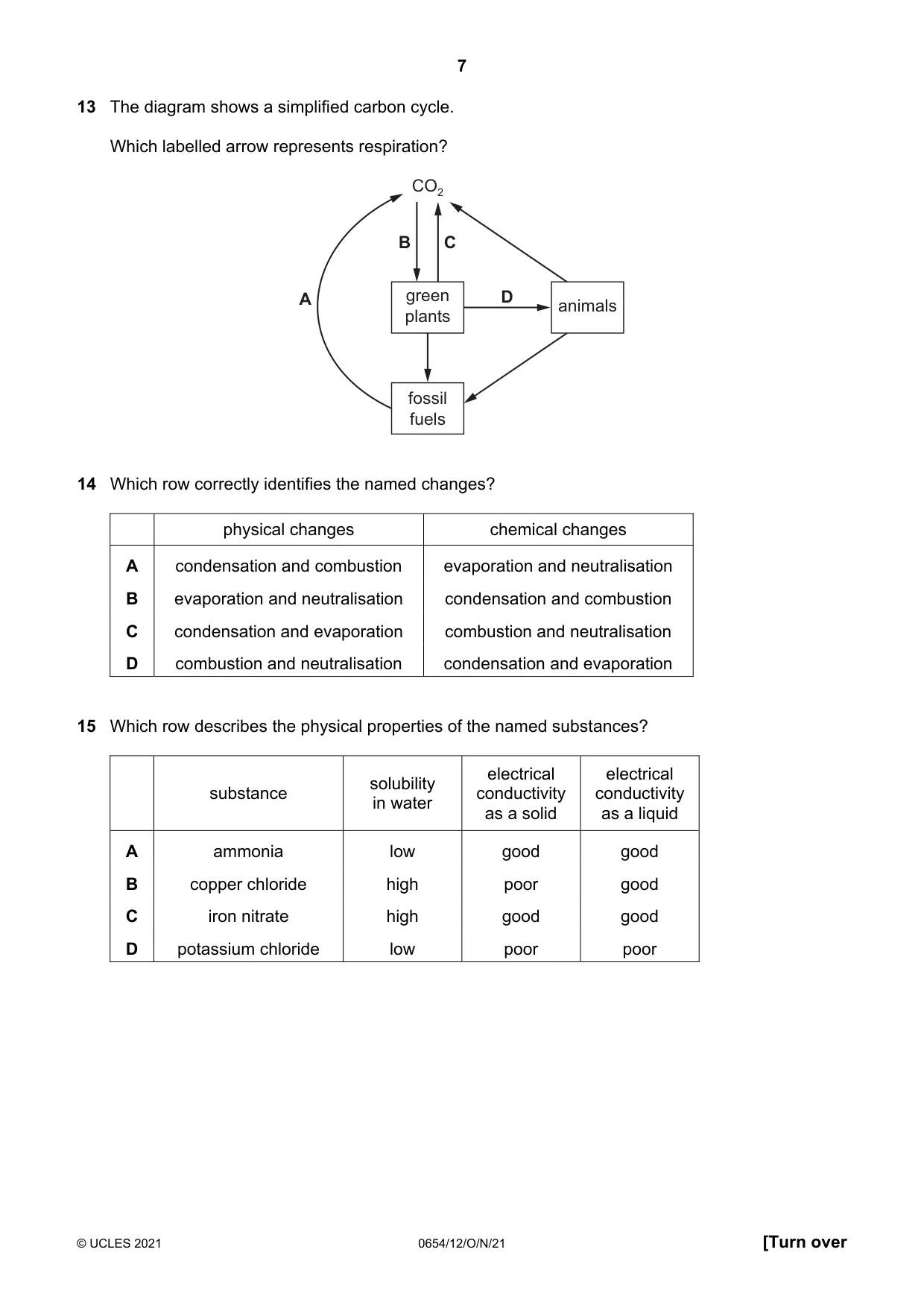
Q13 · The diagram shows a simplified carbon cycle
13 The diagram shows a simplified carbon cycle. Which labelled arrow represents respiration? CO2 B C A green D animals plants fossil fuels
Mark scheme: C
Q14 · Which row correctly identifies the named changes?
14 Which row correctly identifies the named changes? physical changes chemical changes A condensation and combustion evaporation and neutralisation B evaporation and neutralisation condensation and combustion C condensation and evaporation combustion and neutralisation D combustion and neutralisation condensation and evaporation
Mark scheme: C
Q15 · Which row describes the physical properties of the named substances?
15 Which row describes the physical properties of the named substances? electrical electrical solubility substance conductivity conductivity in water as a solid as a liquid A ammonia low good good B copper chloride high poor good C iron nitrate high good good D potassium chloride low poor poor
Mark scheme: B
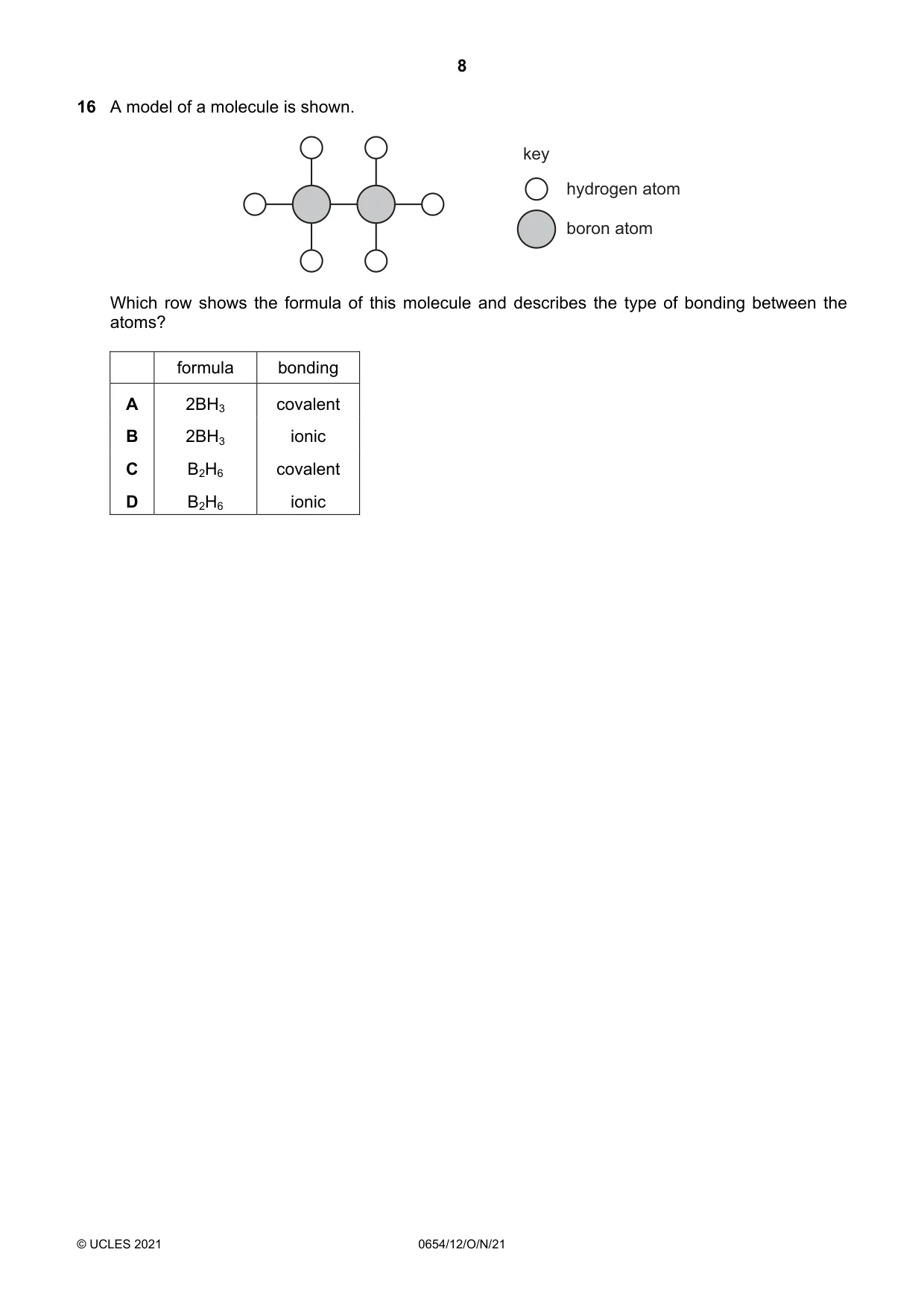
Q16 · A model of a molecule is shown
16 A model of a molecule is shown. key hydrogen atom boron atom Which row shows the formula of this molecule and describes the type of bonding between the atoms? formula bonding A 2BH3 covalent B 2BH3 ionic C B2H6 covalent D B2H6 ionic
Mark scheme: C
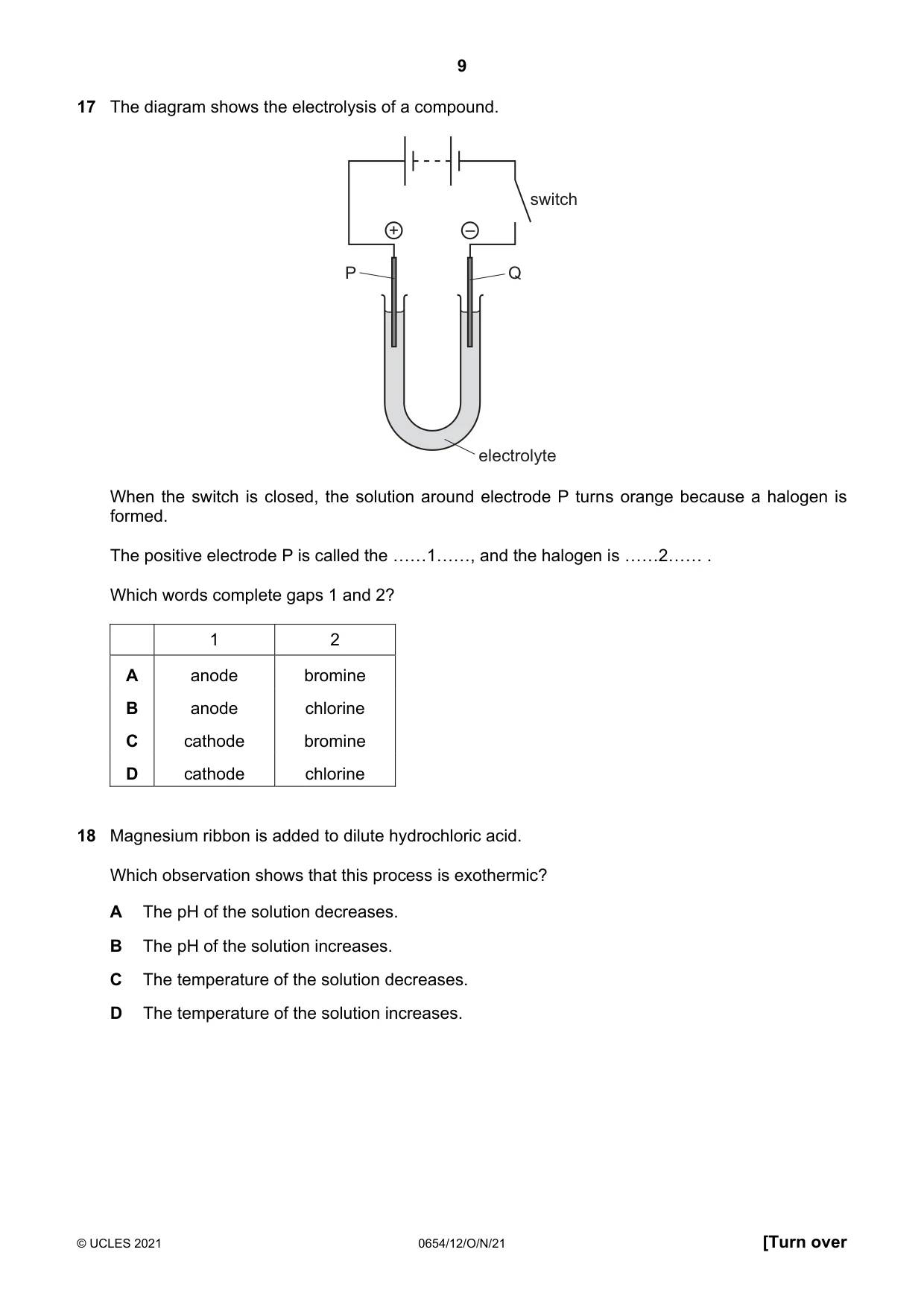
Q17 · The diagram shows the electrolysis of a compound
17 The diagram shows the electrolysis of a compound. switch + – P Q electrolyte When the switch is closed, the solution around electrode P turns orange because a halogen is formed. The positive electrode P is called the ……1……, and the halogen is ……2…… . Which words complete gaps 1 and 2? 1 2 A anode bromine B anode chlorine C cathode bromine D cathode chlorine
Mark scheme: A
Q18 · Magnesium ribbon is added to dilute hydrochloric acid
18 Magnesium ribbon is added to dilute hydrochloric acid. Which observation shows that this process is exothermic? A The pH of the solution decreases. B The pH of the solution increases. C The temperature of the solution decreases. D The temperature of the solution increases.
Mark scheme: D
Q19 · A known mass of solid sodium carbonate is added to excess hydrochloric acid
19 A known mass of solid sodium carbonate is added to excess hydrochloric acid. Which conditions give the shortest reaction time? solid particle acid size concentration A large high B large low C small high D small low
Mark scheme: C
Q20 · A white solid X dissolves in dilute hydrochloric acid
20 A white solid X dissolves in dilute hydrochloric acid. A gas is produced which turns limewater milky. A flame test is carried out on solid X and produces a red coloured flame. What is X? A lithium carbonate B lithium chloride C potassium carbonate D potassium chloride
Mark scheme: A
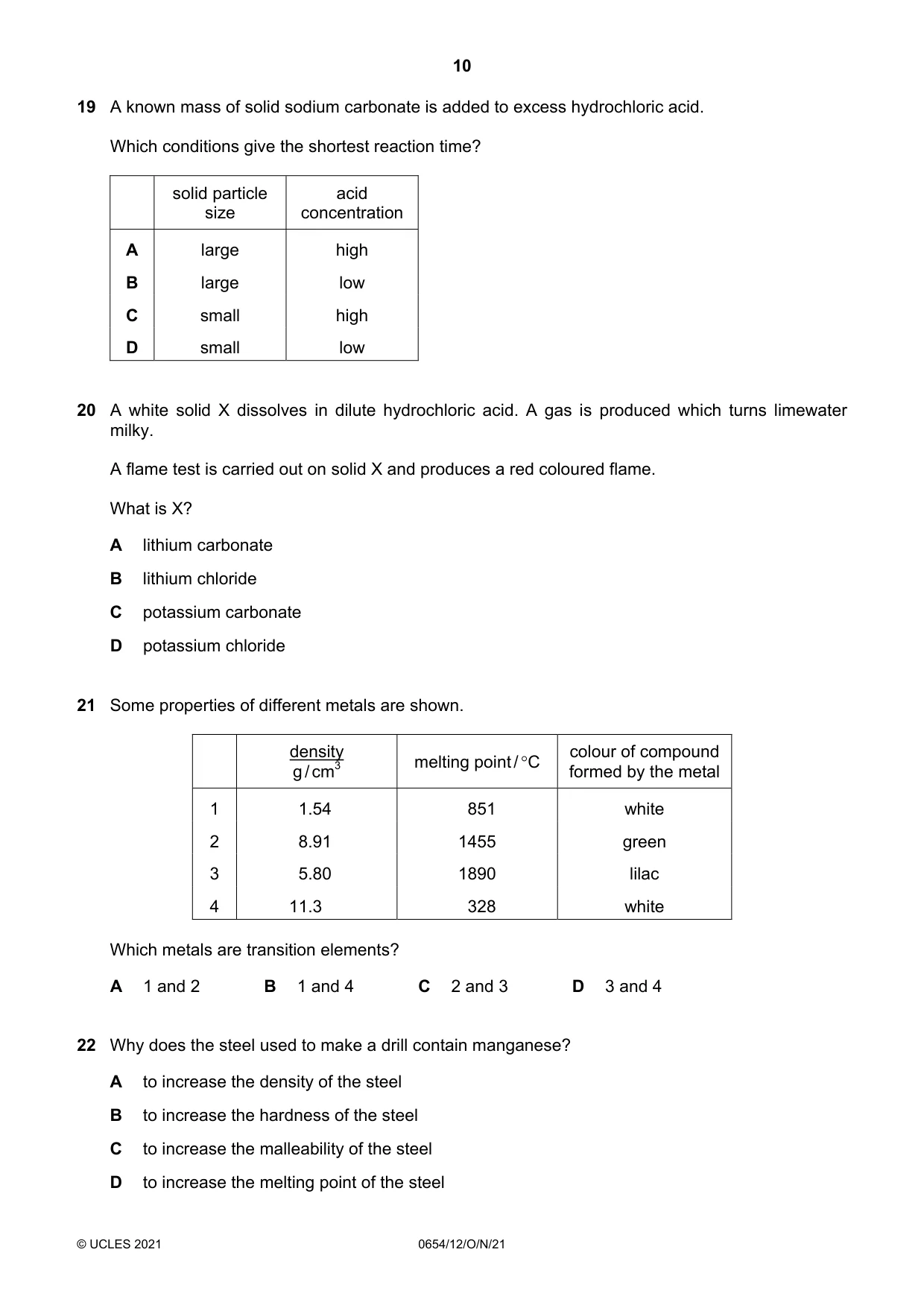
Q21 · Some properties of different metals are shown
21 Some properties of different metals are shown. density colour of compound melting point / C g / cm3 formed by the metal 1 1.54 851 white 2 8.91 1455 green 3 5.80 1890 lilac 4 11.3 328 white Which metals are transition elements? A 1 and 2 B 1 and 4 C 2 and 3 D 3 and 4
Mark scheme: C
Q22 · Why does the steel used to make a drill contain manganese?
22 Why does the steel used to make a drill contain manganese? A to increase the density of the steel B to increase the hardness of the steel C to increase the malleability of the steel D to increase the melting point of the steel
Mark scheme: B
Q23 · Which colour is observed when water is added to anhydrous copper(II) sulfate?
23 Which colour is observed when water is added to anhydrous copper(II) sulfate? A blue B green C pink D white
Mark scheme: A
Q24 · Which process does not produce carbon dioxide?
24 Which process does not produce carbon dioxide? A complete combustion of fossil fuels B reaction of an acid with a carbonate C respiration in plants D rusting iron
Mark scheme: D
Q25 · Which compound is used to neutralise acidic gases?
25 Which compound is used to neutralise acidic gases? A calcium carbonate B calcium chloride C calcium phosphate D calcium sulfate
Mark scheme: A
More questions on The characteristic properties of acids and bases
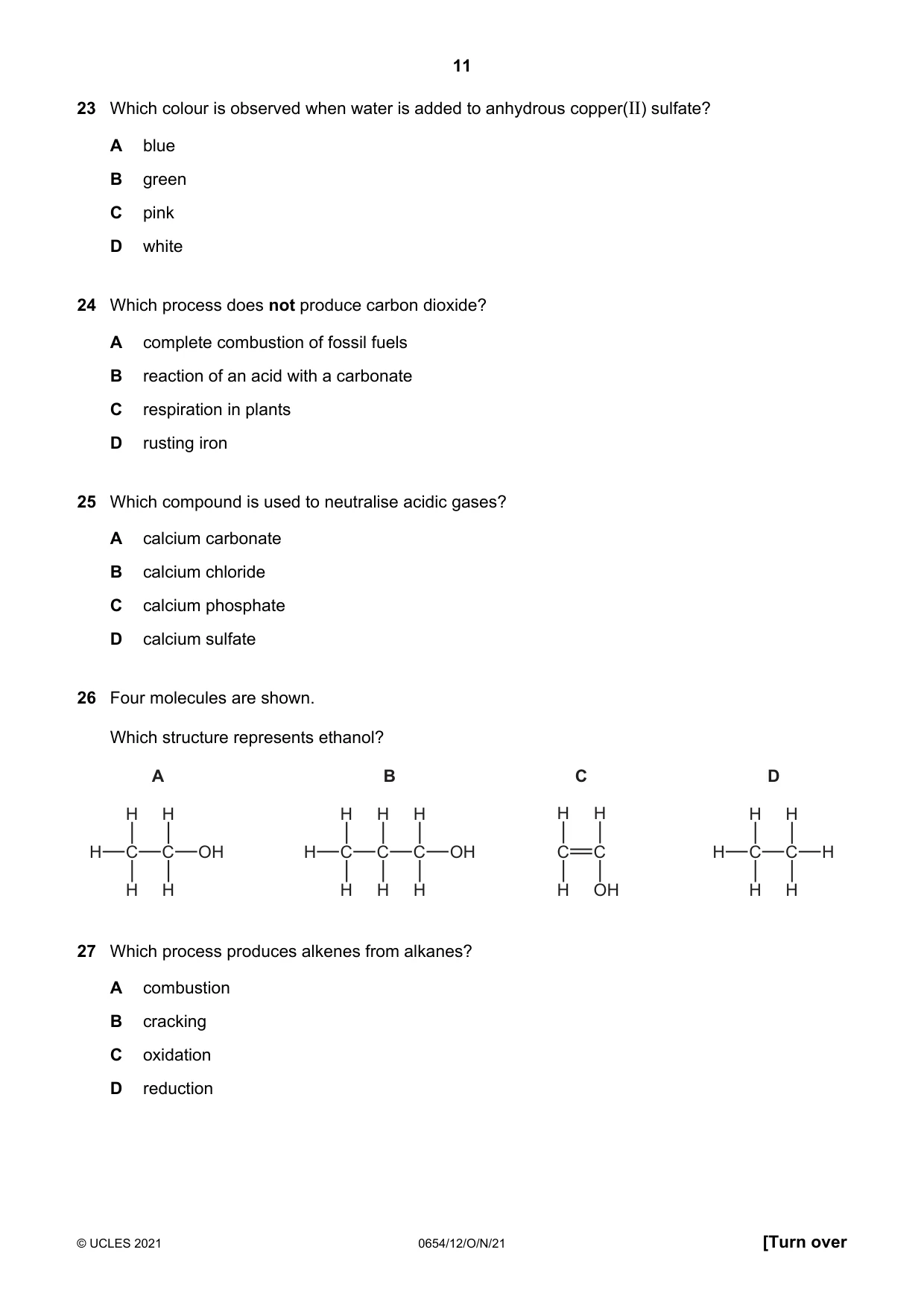
Q26 · Four molecules are shown
26 Four molecules are shown. Which structure represents ethanol? A B C D H H H H H H H H H H C C OH H C C C OH C C H C C H H H H H H H OH H H
Mark scheme: A
Q27 · Which process produces alkenes from alkanes?
27 Which process produces alkenes from alkanes? A combustion B cracking C oxidation D reduction
Mark scheme: B
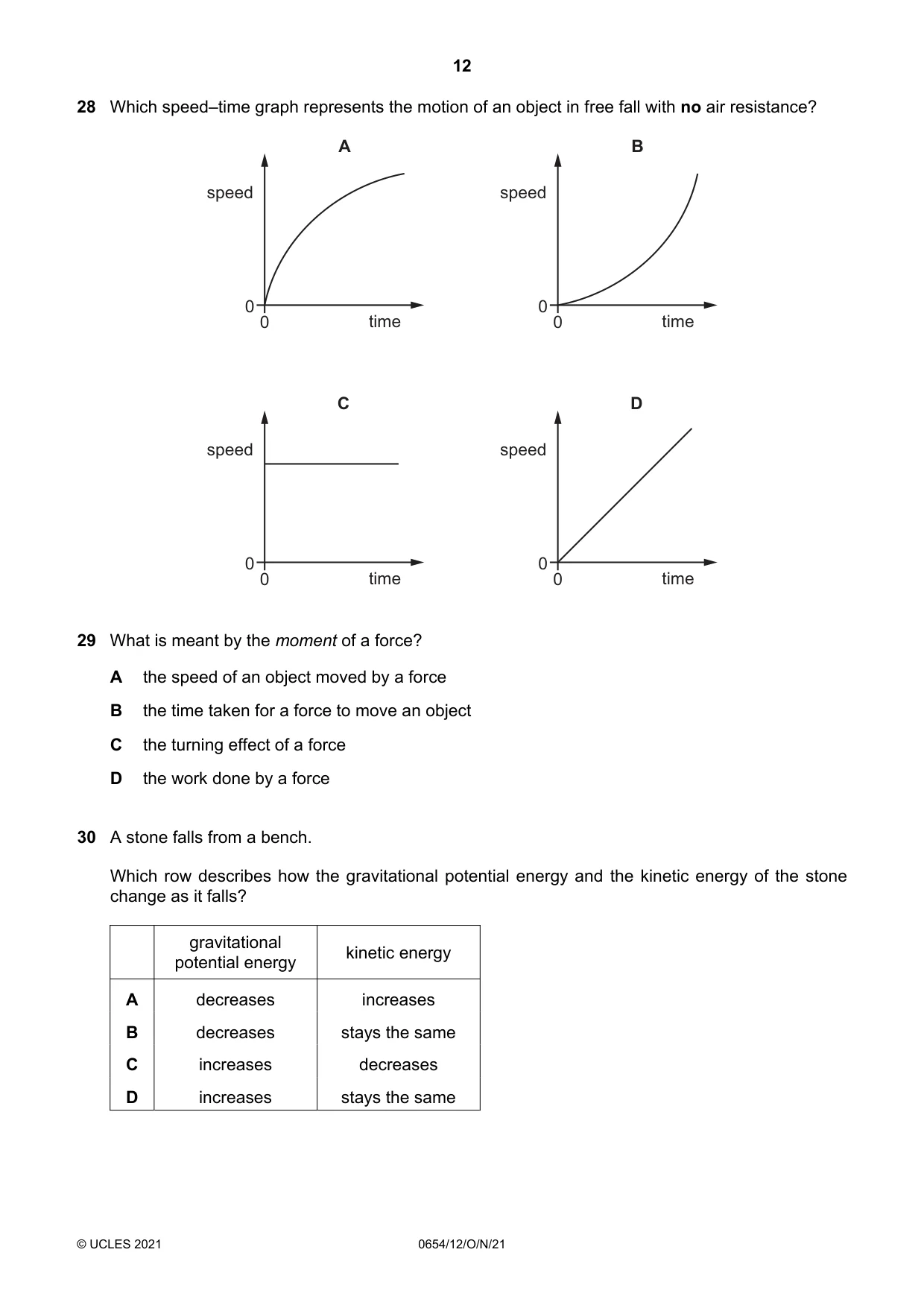
Q28 · Which speed–time graph represents the motion of an object in free fall with no air…
28 Which speed–time graph represents the motion of an object in free fall with no air resistance? A B speed speed 0 0 0 time 0 time C D speed speed 0 0 0 time 0 time
Mark scheme: D
Q29 · What is meant by the moment of a force?
29 What is meant by the moment of a force? A the speed of an object moved by a force B the time taken for a force to move an object C the turning effect of a force D the work done by a force
Mark scheme: C
Q30 · A stone falls from a bench
30 A stone falls from a bench. Which row describes how the gravitational potential energy and the kinetic energy of the stone change as it falls? gravitational kinetic energy potential energy A decreases increases B decreases stays the same C increases decreases D increases stays the same
Mark scheme: A
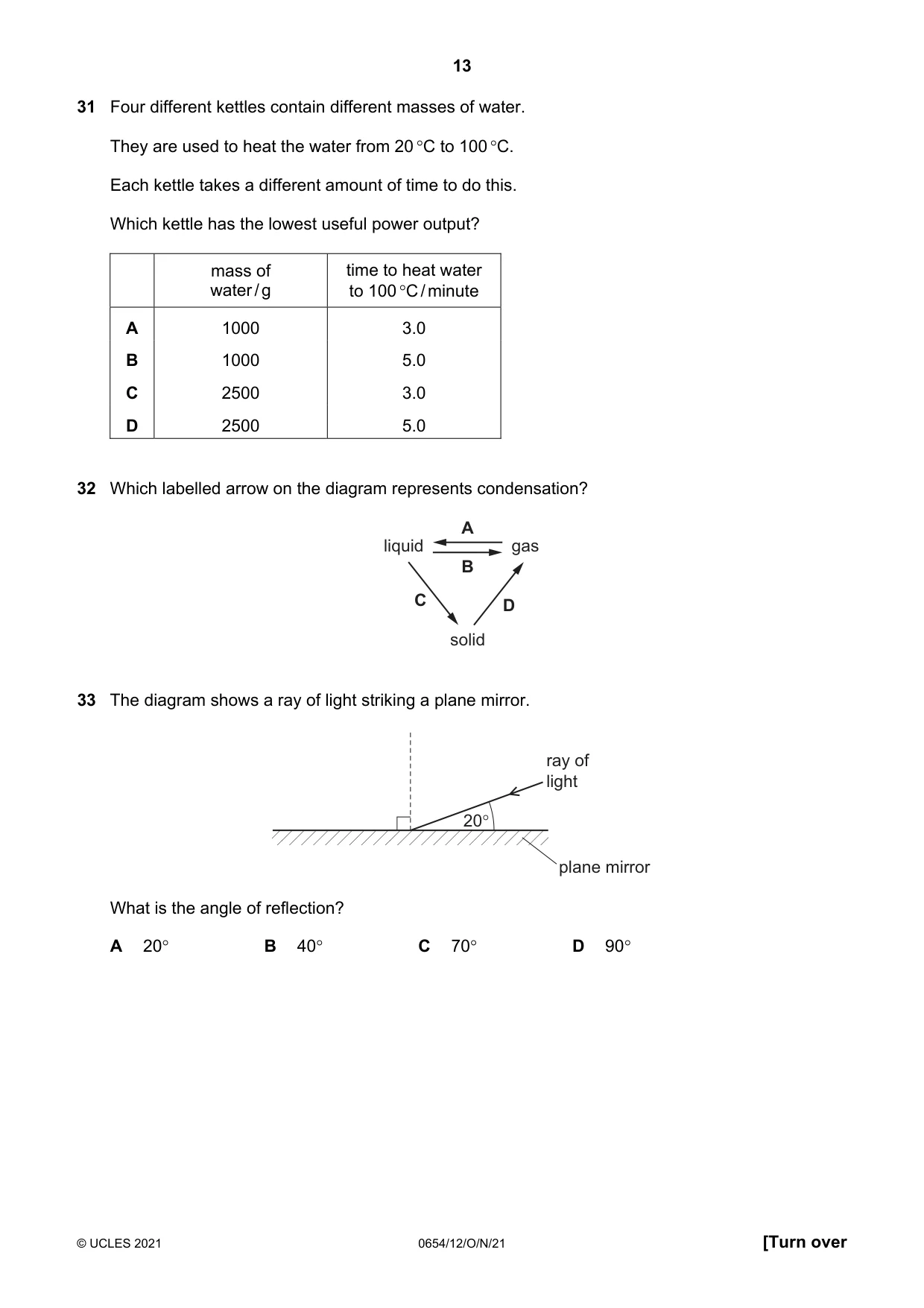
Q31 · Four different kettles contain different masses of water
31 Four different kettles contain different masses of water. They are used to heat the water from 20 C to 100 C. Each kettle takes a different amount of time to do this. Which kettle has the lowest useful power output? mass of time to heat water water / g to 100 C / minute A 1000 3.0 B 1000 5.0 C 2500 3.0 D 2500 5.0
Mark scheme: B
Q32 · Which labelled arrow on the diagram represents condensation?
32 Which labelled arrow on the diagram represents condensation? A liquid gas B C D solid
Mark scheme: A
Q33 · The diagram shows a ray of light striking a plane mirror
33 The diagram shows a ray of light striking a plane mirror. ray of light 20° plane mirror What is the angle of reflection? A 20 B 40 C 70 D 90
Mark scheme: C
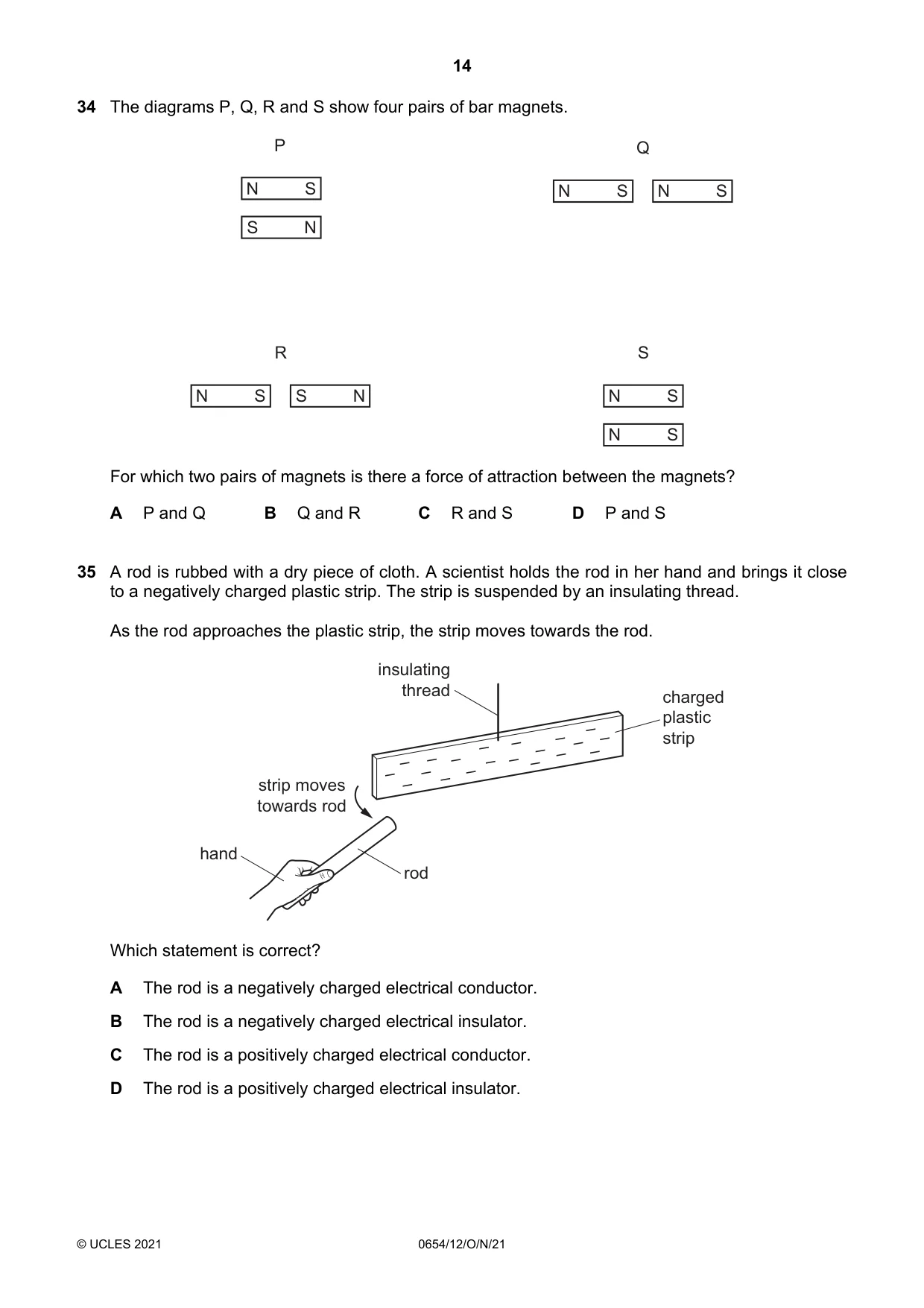
Q34 · The diagrams P, Q, R and S show four pairs of bar magnets
34 The diagrams P, Q, R and S show four pairs of bar magnets. P Q N S N S N S S N R S N S S N N S N S For which two pairs of magnets is there a force of attraction between the magnets? A P and Q B Q and R C R and S D P and S
Mark scheme: A
Q35 · A rod is rubbed with a dry piece of cloth
35 A rod is rubbed with a dry piece of cloth. A scientist holds the rod in her hand and brings it close to a negatively charged plastic strip. The strip is suspended by an insulating thread. As the rod approaches the plastic strip, the strip moves towards the rod. insulating thread charged plastic – – – – – –– strip – – – – – – – – – – – – strip moves – towards rod hand rod Which statement is correct? A The rod is a negatively charged electrical conductor. B The rod is a negatively charged electrical insulator. C The rod is a positively charged electrical conductor. D The rod is a positively charged electrical insulator.
Mark scheme: D
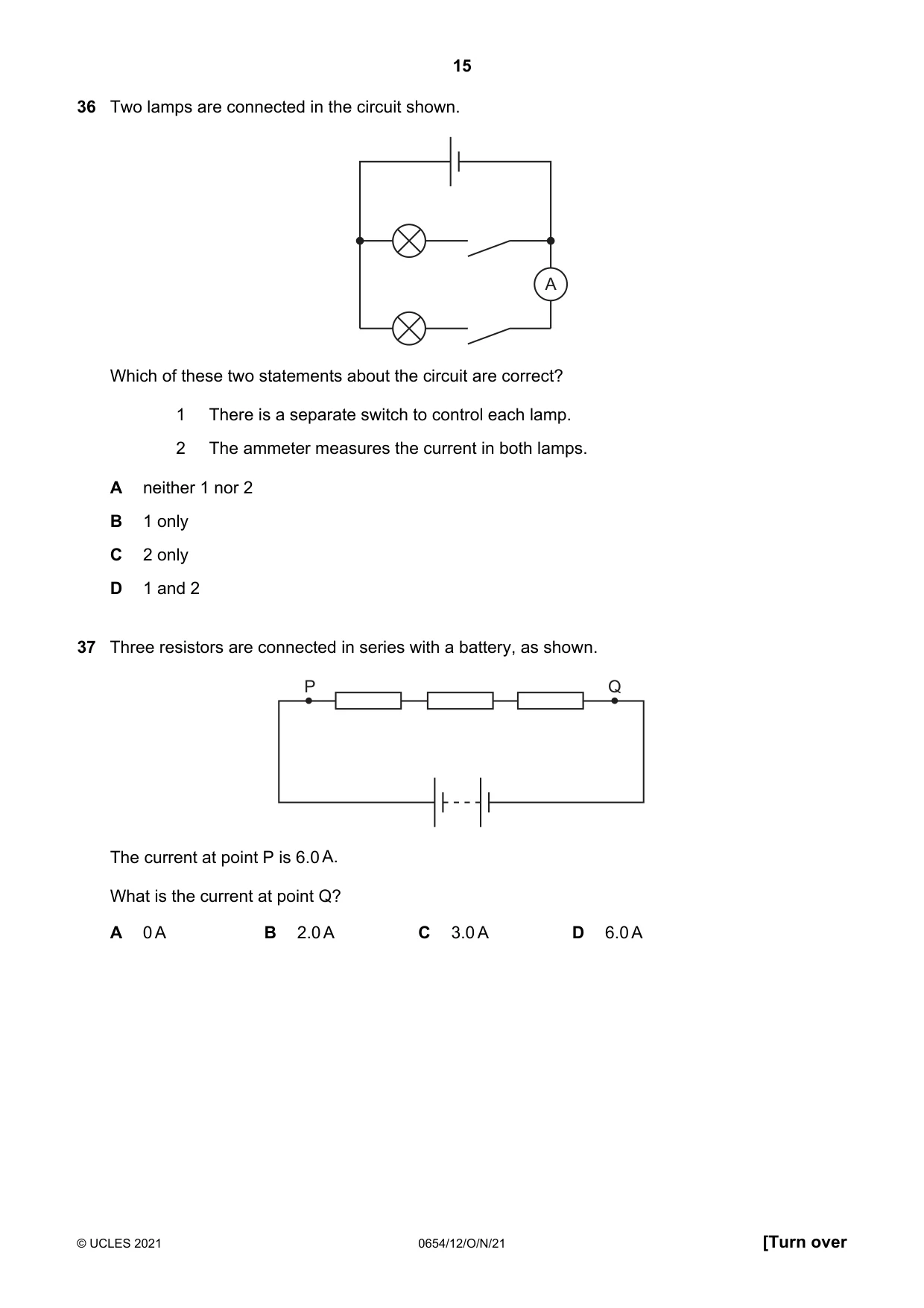
Q36 · Two lamps are connected in the circuit shown
36 Two lamps are connected in the circuit shown. A Which of these two statements about the circuit are correct? 1 There is a separate switch to control each lamp. 2 The ammeter measures the current in both lamps. A neither 1 nor 2 B 1 only C 2 only D 1 and 2
Mark scheme: B
Q37 · Three resistors are connected in series with a battery, as shown
37 Three resistors are connected in series with a battery, as shown. P Q The current at point P is 6.0 A. What is the current at point Q? A 0 A B 2.0 A C 3.0 A D 6.0 A
Mark scheme: D
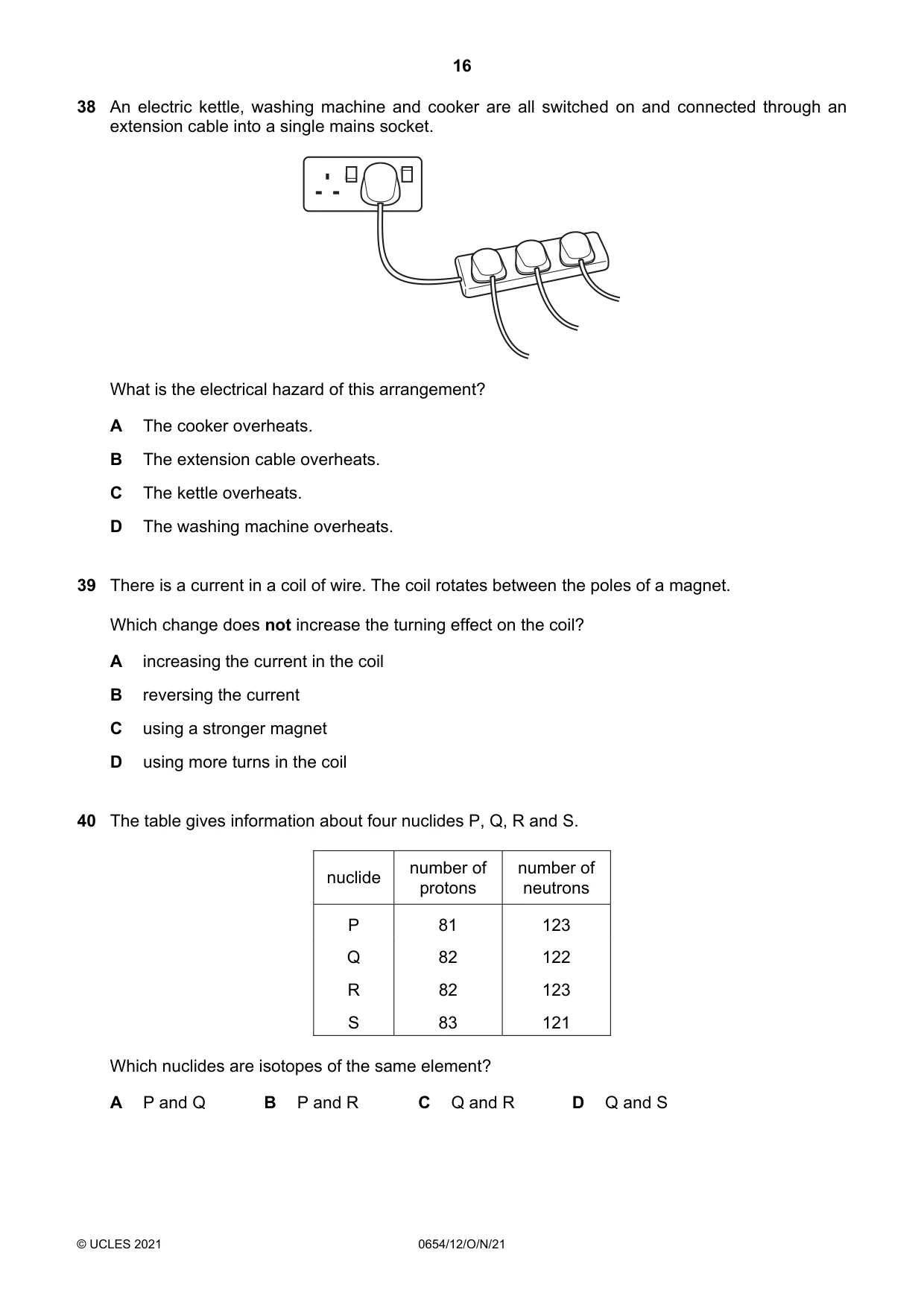
Q38 · An electric kettle, washing machine and cooker are all switched on and connected through…
38 An electric kettle, washing machine and cooker are all switched on and connected through an extension cable into a single mains socket. What is the electrical hazard of this arrangement? A The cooker overheats. B The extension cable overheats. C The kettle overheats. D The washing machine overheats.
Mark scheme: B
Q39 · There is a current in a coil of wire
39 There is a current in a coil of wire. The coil rotates between the poles of a magnet. Which change does not increase the turning effect on the coil? A increasing the current in the coil B reversing the current C using a stronger magnet D using more turns in the coil
Mark scheme: B
Q40 · The table gives information about four nuclides P, Q, R and S
40 The table gives information about four nuclides P, Q, R and S. number of number of nuclide protons neutrons P 81 123 Q 82 122 R 82 123 S 83 121 Which nuclides are isotopes of the same element? A P and Q B P and R C Q and R D Q and S
Mark scheme: C
What was in this paper
The subtopics covered by these 40 questions, and how many questions each got. Open one in a new tab to see every Cambridge question on it.
2Energy, work and power2Simple phenomena of magnetism2Air quality and climate1Alcohols1Alkenes1Alloys and their properties1Biological molecules1Carbon cycle1Cell structure1Digestion1Electrical safety1Electrolysis1Electromagnetic effects1Enzymes1Exothermic and endothermic reactions1Food chains and food webs1Forces1Gas exchange in humans1Heart1Hormones1Identification of ions and gases1Ions and ionic bonds1Kinetic particle model of matter1Light1Monohybrid inheritance1Motion1Photosynthesis1Physical and chemical changes1Rate of reaction1Respiration1Sexual reproduction in humans1Simple molecules and covalent bonds1The characteristic properties of acids and bases1The nucleus1Transition elements1Water1What you needed in this session
Cambridge’s own grade thresholds for 2021 Oct/Nov, Paper 1 · Variant 2. A higher threshold means an easier paper — the bar moves with how the cohort did.