Cambridge IGCSE Sciences - Co-ordinated (Double) 0654 — 2017 May/June Paper 1 · Variant 1
0654/11/M/J/17 · 40 questions · 40 marks · ≈45 min
The question paper and its mark scheme, free to read here and free to download. This is Cambridge’s own paper, exactly as it was sat.
Question paper16 pages
Mark scheme3 pages
Answers below. Sit the paper first if you are practising.
Questions as text
Q1 · What is not produced by artificial selection?
1 What is not produced by artificial selection? A bacteria with antibiotic resistance B cows with high milk yield C sheep with thick wool D wheat with resistance to disease
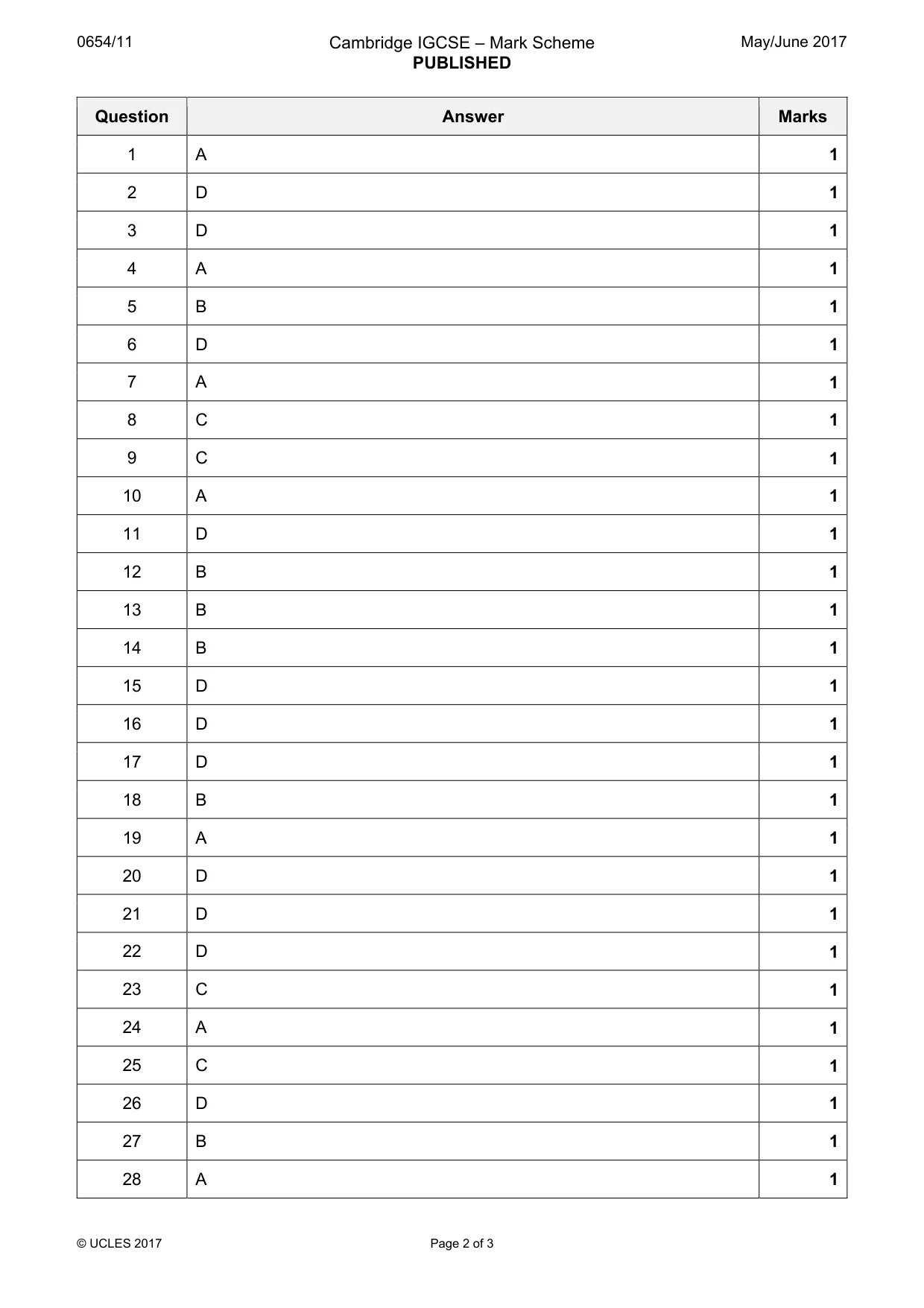
Mark scheme: A
Q2 · Which food is high in iron?
2 Which food is high in iron? A citrus fruit B milk C oily fish D red meat
Mark scheme: D
Q3 · Catalase is an enzyme that breaks down hydrogen peroxide to water and oxygen
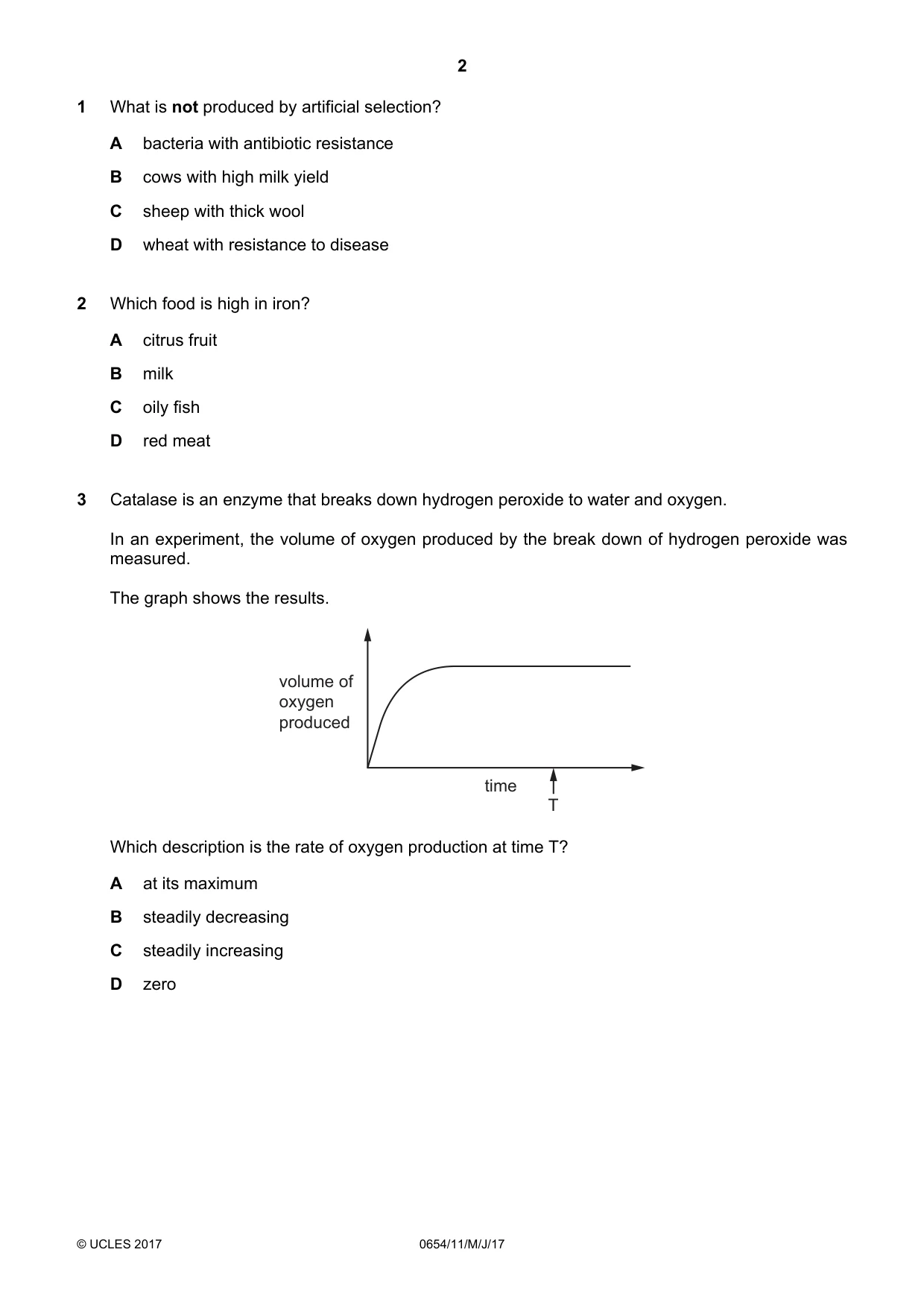
3 Catalase is an enzyme that breaks down hydrogen peroxide to water and oxygen. In an experiment, the volume of oxygen produced by the break down of hydrogen peroxide was measured. The graph shows the results. volume of oxygen produced time T Which description is the rate of oxygen production at time T? A at its maximum B steadily decreasing C steadily increasing D zero
Mark scheme: D
Q4 · In a plant, what leads to offspring that are identical to the parent?
4 In a plant, what leads to offspring that are identical to the parent? A asexual reproduction B insect pollination C seed germination D sexual reproduction
Mark scheme: A
Q5 · The ribs are lowered as we breathe out
5 The ribs are lowered as we breathe out. Which characteristic of living organisms does this illustrate? A growth B movement C respiration D sensitivity
Mark scheme: B
Q6 · Which tissue carries water up the stem of a plant?
6 Which tissue carries water up the stem of a plant? A epidermis B phloem C spongy mesophyll D xylem
Mark scheme: D
Q7 · Which structure carries nerve impulses away from the central nervous system?
7 Which structure carries nerve impulses away from the central nervous system? A motor neurone B relay neurone C sensory neurone D spinal cord
Mark scheme: A
Q8 · What is the order of decreasing diameter of the structures found in the breathing system?
8 What is the order of decreasing diameter of the structures found in the breathing system? A alveoli → bronchi → capillaries B alveoli → capillaries → bronchi C bronchi → alveoli → capillaries D capillaries → bronchi → alveoli
Mark scheme: C
Q9 · What would be the effects of deforestation on the level of atmospheric carbon dioxide and…
9 What would be the effects of deforestation on the level of atmospheric carbon dioxide and the amount of soil? carbon dioxide amount of soil level A decreases decreases B decreases increases C increases decreases D increases increases
Mark scheme: C
Q10 · A frightened animal may need to run away suddenly
10 A frightened animal may need to run away suddenly. Which substance is released to stimulate an increase in blood glucose concentration? A adrenaline B haemoglobin C plasma D platelets
Mark scheme: A
Q11 · The diagram shows a cross-section of a flower
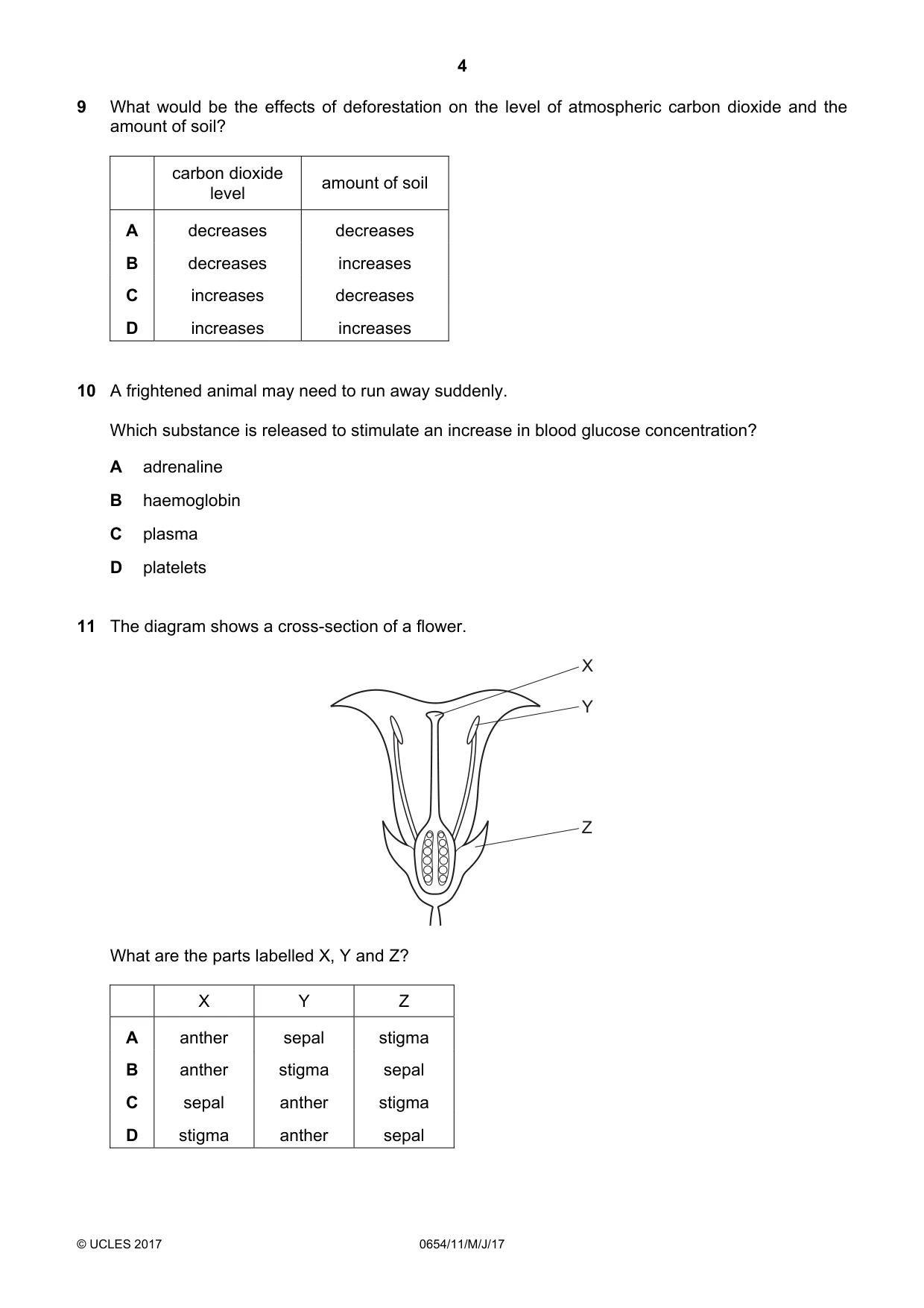
11 The diagram shows a cross-section of a flower. X Y Z What are the parts labelled X, Y and Z? X Y Z A anther sepal stigma B anther stigma sepal C sepal anther stigma D stigma anther sepal
Mark scheme: D
Q12 · Which cross results in all possible offspring having the same genotype?
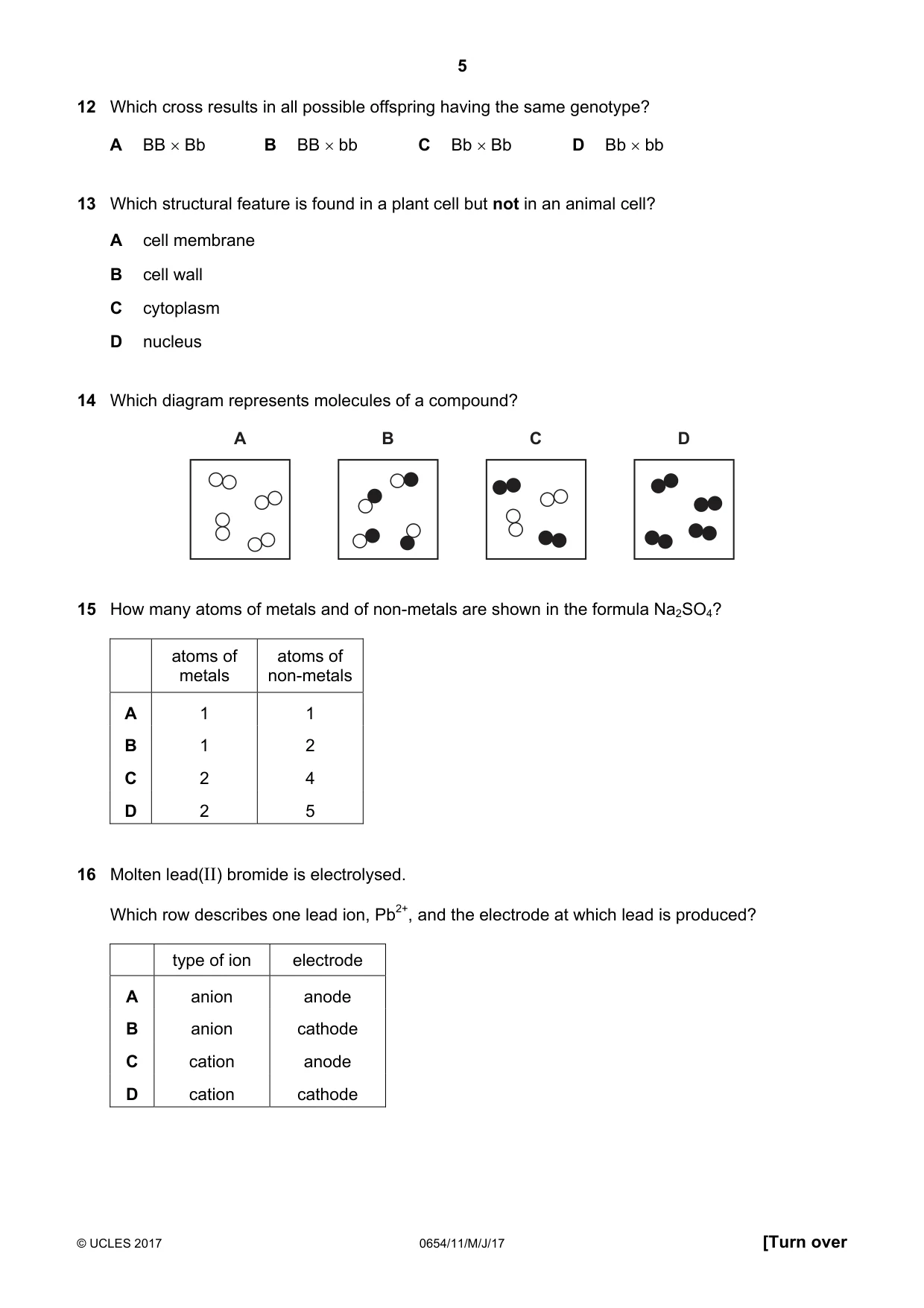
12 Which cross results in all possible offspring having the same genotype? A BB × Bb B BB × bb C Bb × Bb D Bb × bb
Mark scheme: B
Q13 · Which structural feature is found in a plant cell but not in an animal cell?
13 Which structural feature is found in a plant cell but not in an animal cell? A cell membrane B cell wall C cytoplasm D nucleus
Mark scheme: B
Q14 · Which diagram represents molecules of a compound?
14 Which diagram represents molecules of a compound? A B C D
Mark scheme: B
Q15 · How many atoms of metals and of non-metals are shown in the formula Na2SO4?
15 How many atoms of metals and of non-metals are shown in the formula Na2SO4? atoms of atoms of metals non-metals A 1 1 B 1 2 C 2 4 D 2 5
Mark scheme: D
Q16 · Molten lead(II) bromide is electrolysed
16 Molten lead(II) bromide is electrolysed. Which row describes one lead ion, Pb2+, and the electrode at which lead is produced? type of ion electrode A anion anode B anion cathode C cation anode D cation cathode
Mark scheme: D
Q17 · When sodium is added to water it reacts violently and melts
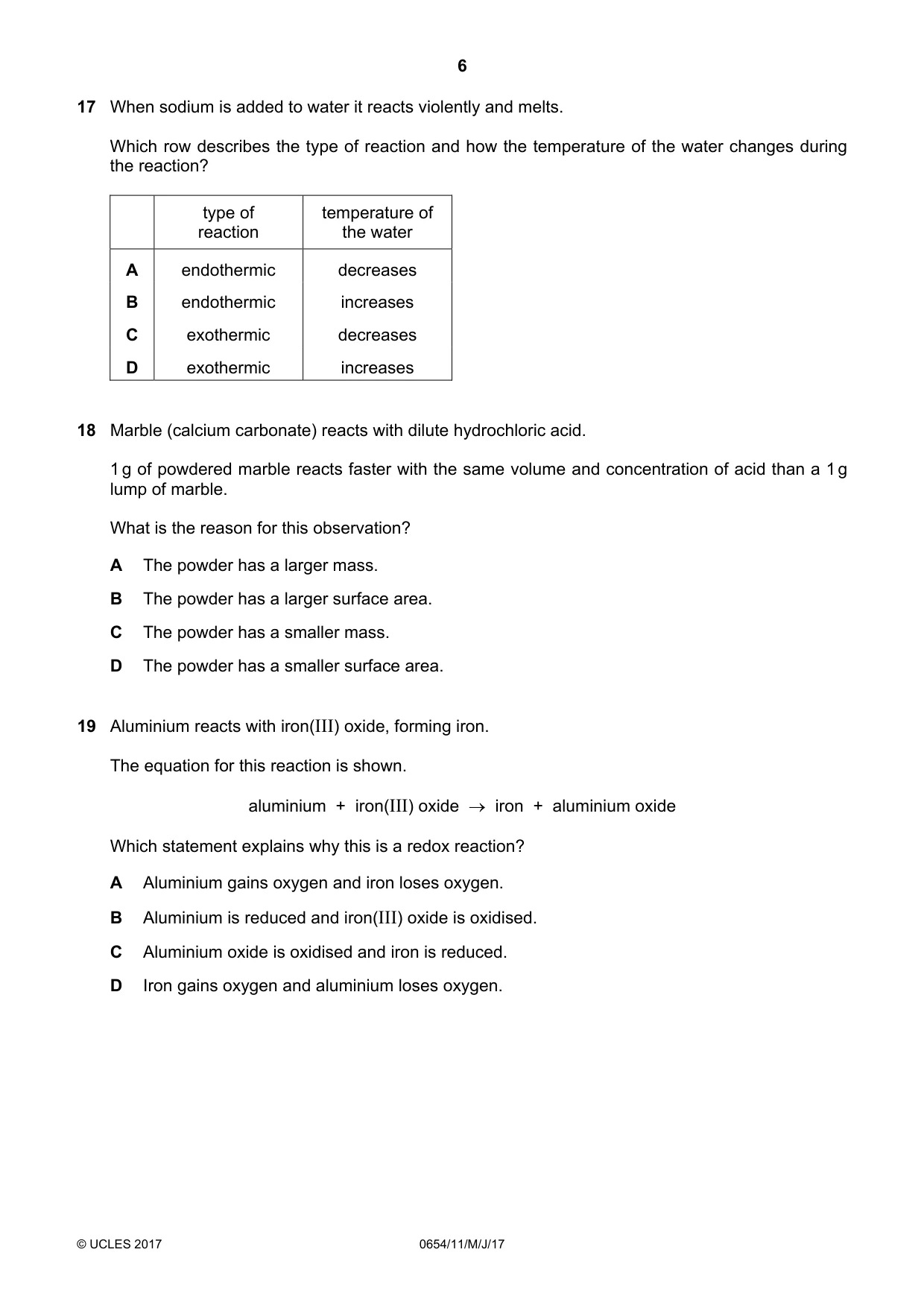
17 When sodium is added to water it reacts violently and melts. Which row describes the type of reaction and how the temperature of the water changes during the reaction? type of temperature of reaction the water A endothermic decreases B endothermic increases C exothermic decreases D exothermic increases
Mark scheme: D
Q18 · Marble (calcium carbonate) reacts with dilute hydrochloric acid
18 Marble (calcium carbonate) reacts with dilute hydrochloric acid. 1 g of powdered marble reacts faster with the same volume and concentration of acid than a 1 g lump of marble. What is the reason for this observation? A The powder has a larger mass. B The powder has a larger surface area. C The powder has a smaller mass. D The powder has a smaller surface area.
Mark scheme: B
Q19 · Aluminium reacts with iron(III) oxide, forming iron
19 Aluminium reacts with iron(III) oxide, forming iron. The equation for this reaction is shown. aluminium + iron(III) oxide → iron + aluminium oxide Which statement explains why this is a redox reaction? A Aluminium gains oxygen and iron loses oxygen. B Aluminium is reduced and iron(III) oxide is oxidised. C Aluminium oxide is oxidised and iron is reduced. D Iron gains oxygen and aluminium loses oxygen.
Mark scheme: A
Q20 · The pH of water changes when ammonia is bubbled into it
20 The pH of water changes when ammonia is bubbled into it. What happens to the pH and why? pH ammonia is A decreases acidic B decreases alkaline C increases acidic D increases alkaline
Mark scheme: D
More questions on The characteristic properties of acids and bases
Q21 · Copper(II) sulfate is made by adding an excess of solid copper(II) oxide to dilute…
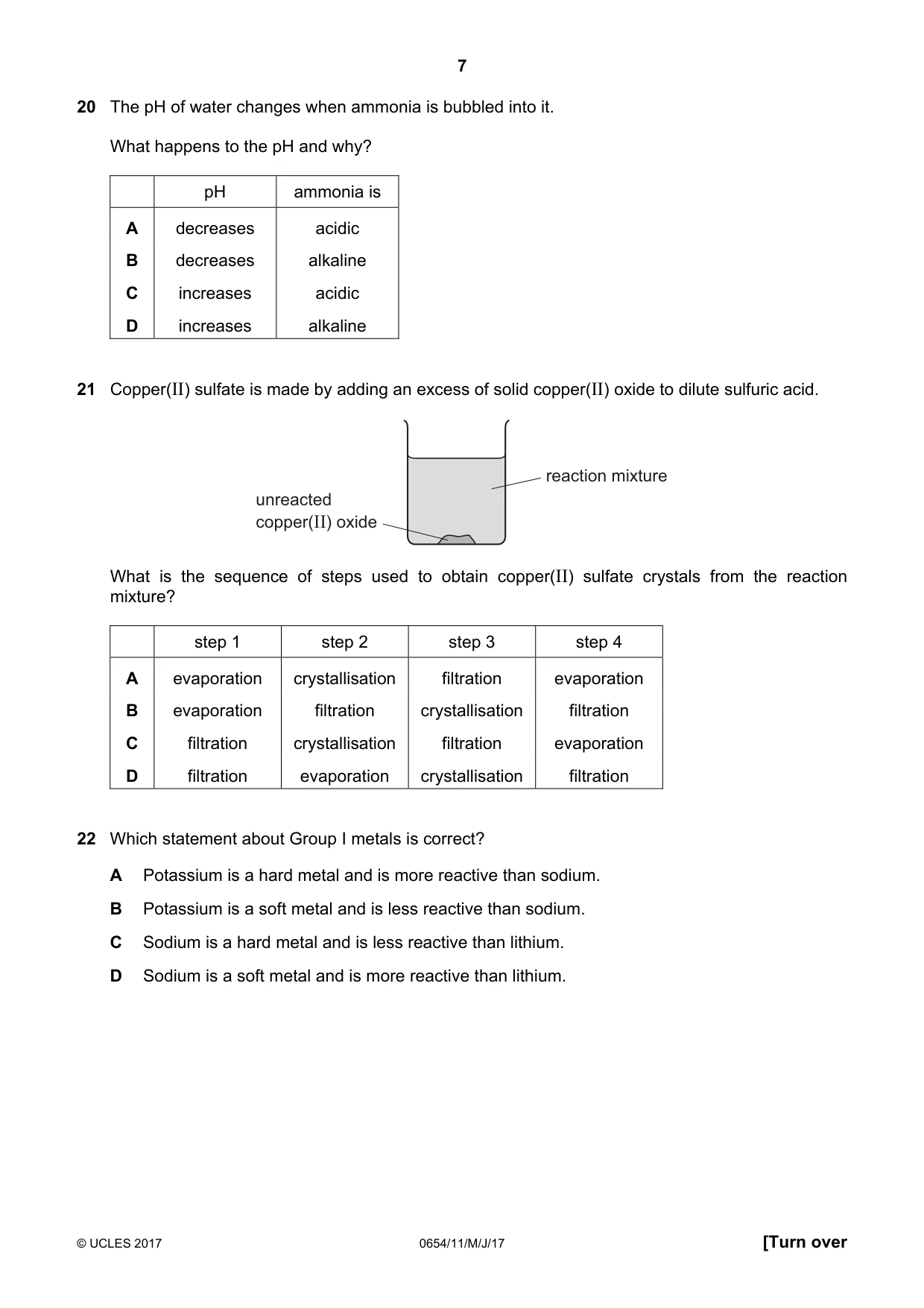
21 Copper(II) sulfate is made by adding an excess of solid copper(II) oxide to dilute sulfuric acid. reaction mixture unreacted copper(II) oxide What is the sequence of steps used to obtain copper(II) sulfate crystals from the reaction mixture? step 1 step 2 step 3 step 4 A evaporation crystallisation filtration evaporation B evaporation filtration crystallisation filtration C filtration crystallisation filtration evaporation D filtration evaporation crystallisation filtration
Mark scheme: D
Q22 · Which statement about Group I metals is correct?
22 Which statement about Group I metals is correct? A Potassium is a hard metal and is more reactive than sodium. B Potassium is a soft metal and is less reactive than sodium. C Sodium is a hard metal and is less reactive than lithium. D Sodium is a soft metal and is more reactive than lithium.
Mark scheme: D
Q23 · What is a use for argon?
23 What is a use for argon? A as a catalyst B in alloys C in lamps D neutralising chemical waste
Mark scheme: C
Q24 · Which element is used to extract some metals from their ores?
24 Which element is used to extract some metals from their ores? A carbon B copper C iron D nitrogen
Mark scheme: A
Q25 · Four solutions are tested with Universal Indicator paper and with anhydrous copper(II)…
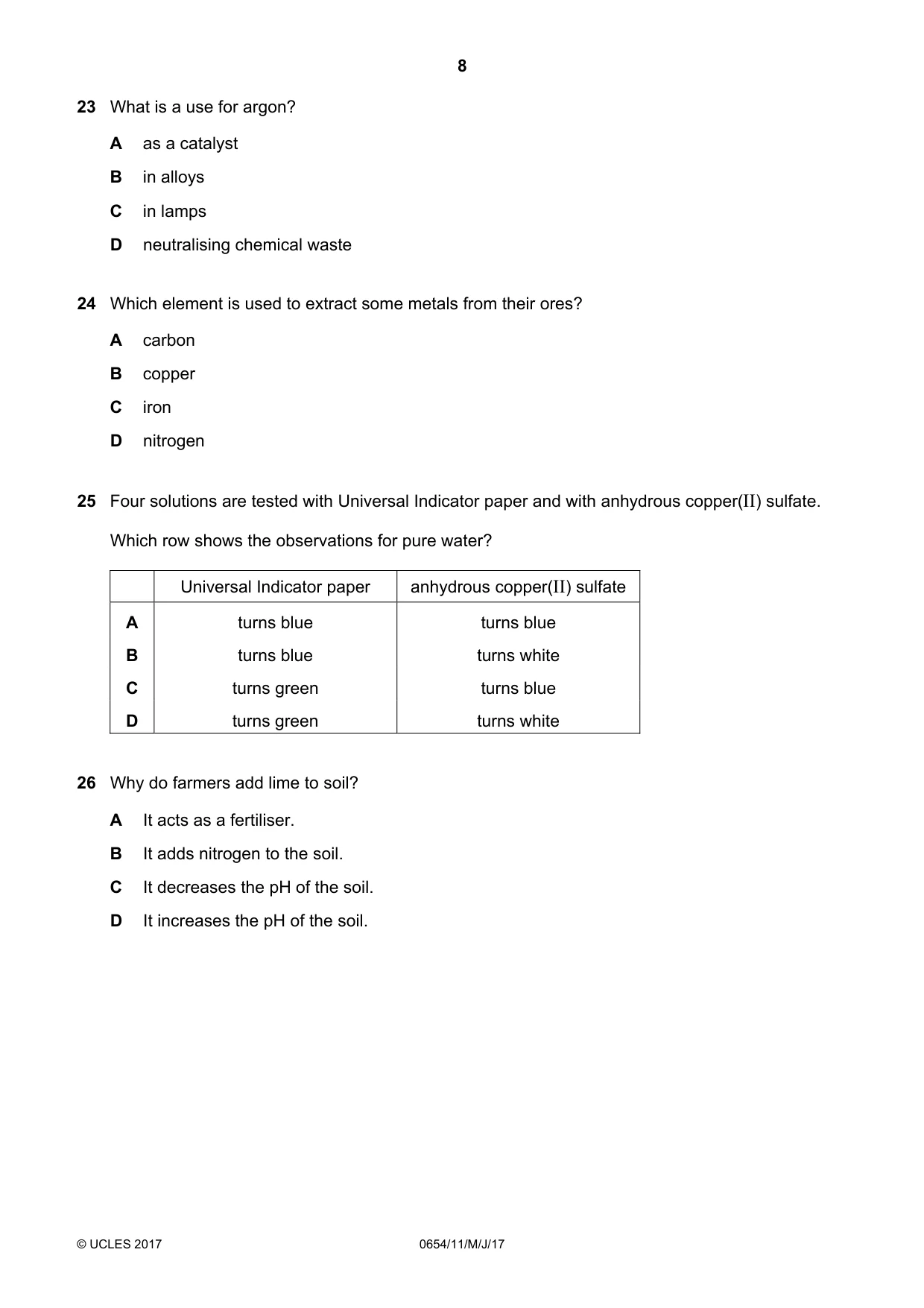
25 Four solutions are tested with Universal Indicator paper and with anhydrous copper(II) sulfate. Which row shows the observations for pure water? Universal Indicator paper anhydrous copper(II) sulfate A turns blue turns blue B turns blue turns white C turns green turns blue D turns green turns white
Mark scheme: C
Q26 · Why do farmers add lime to soil?
26 Why do farmers add lime to soil? A It acts as a fertiliser. B It adds nitrogen to the soil. C It decreases the pH of the soil. D It increases the pH of the soil.
Mark scheme: D
More questions on The characteristic properties of acids and bases
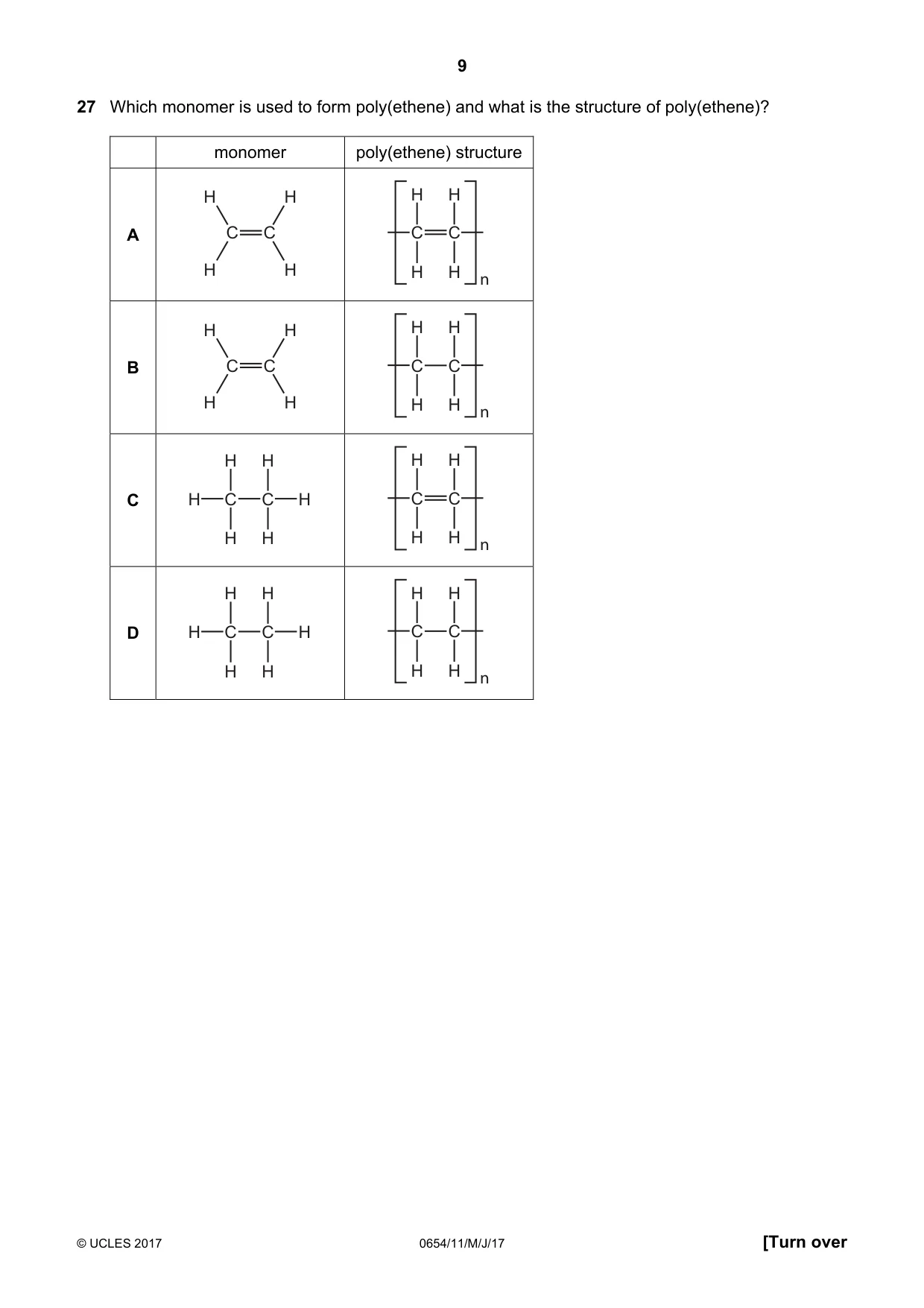
Q27 · Which monomer is used to form poly(ethene) and what is the structure of poly(ethene)?
27 Which monomer is used to form poly(ethene) and what is the structure of poly(ethene)? monomer poly(ethene) structure H H H H A C C C C H H H H n H H H H B C C C C H H H H n H H H H C H C C H C C H H H H n H H H H D H C C H C C H H H H n
Mark scheme: B
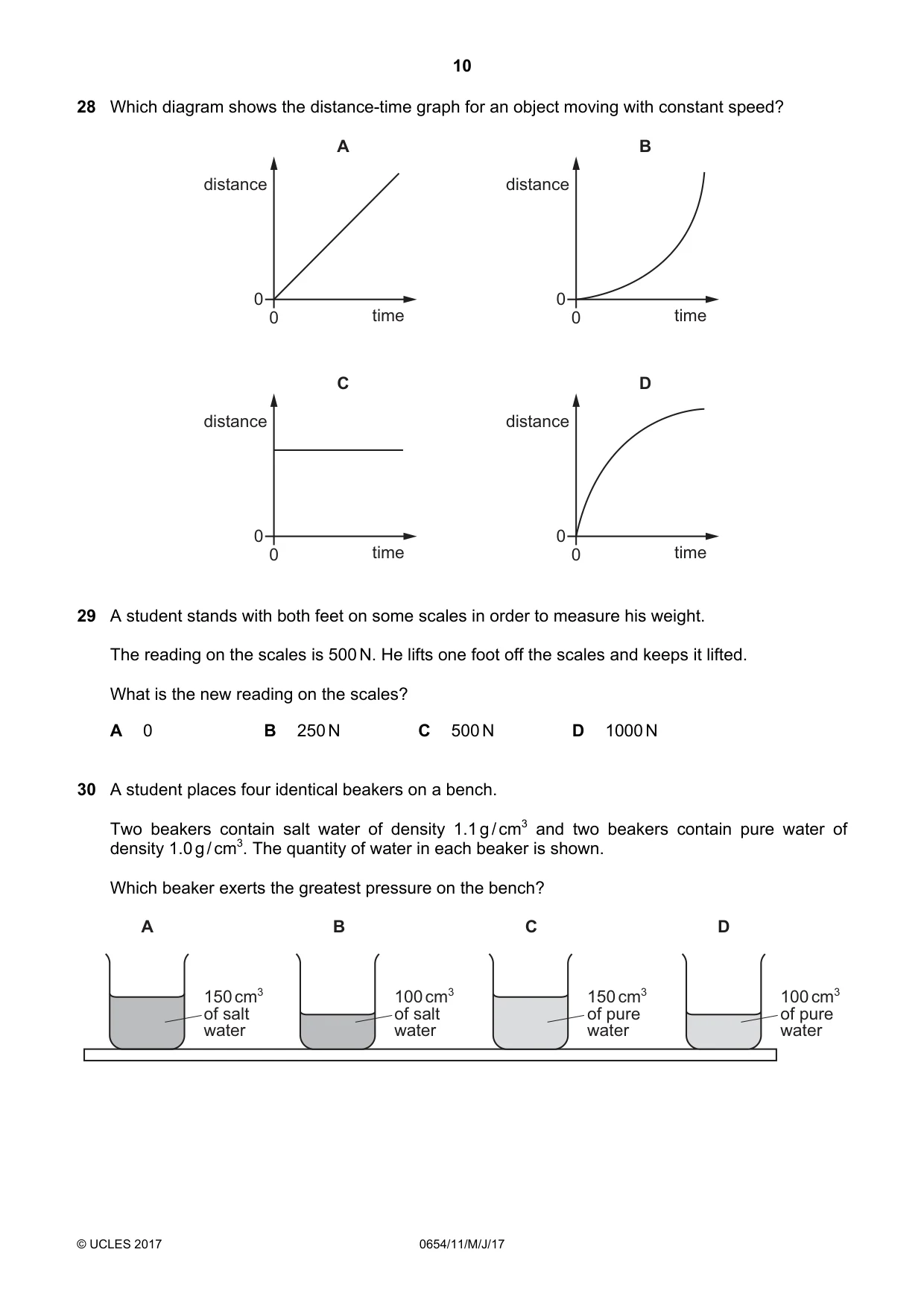
Q28 · Which diagram shows the distance-time graph for an object moving with constant speed?
28 Which diagram shows the distance-time graph for an object moving with constant speed? A B distance distance 0 0 0 time 0 time C D distance distance 0 0 0 time 0 time
Mark scheme: A
Q29 · A student stands with both feet on some scales in order to measure his weight
29 A student stands with both feet on some scales in order to measure his weight. The reading on the scales is 500 N. He lifts one foot off the scales and keeps it lifted. What is the new reading on the scales? A 0 B 250 N C 500 N D 1000 N
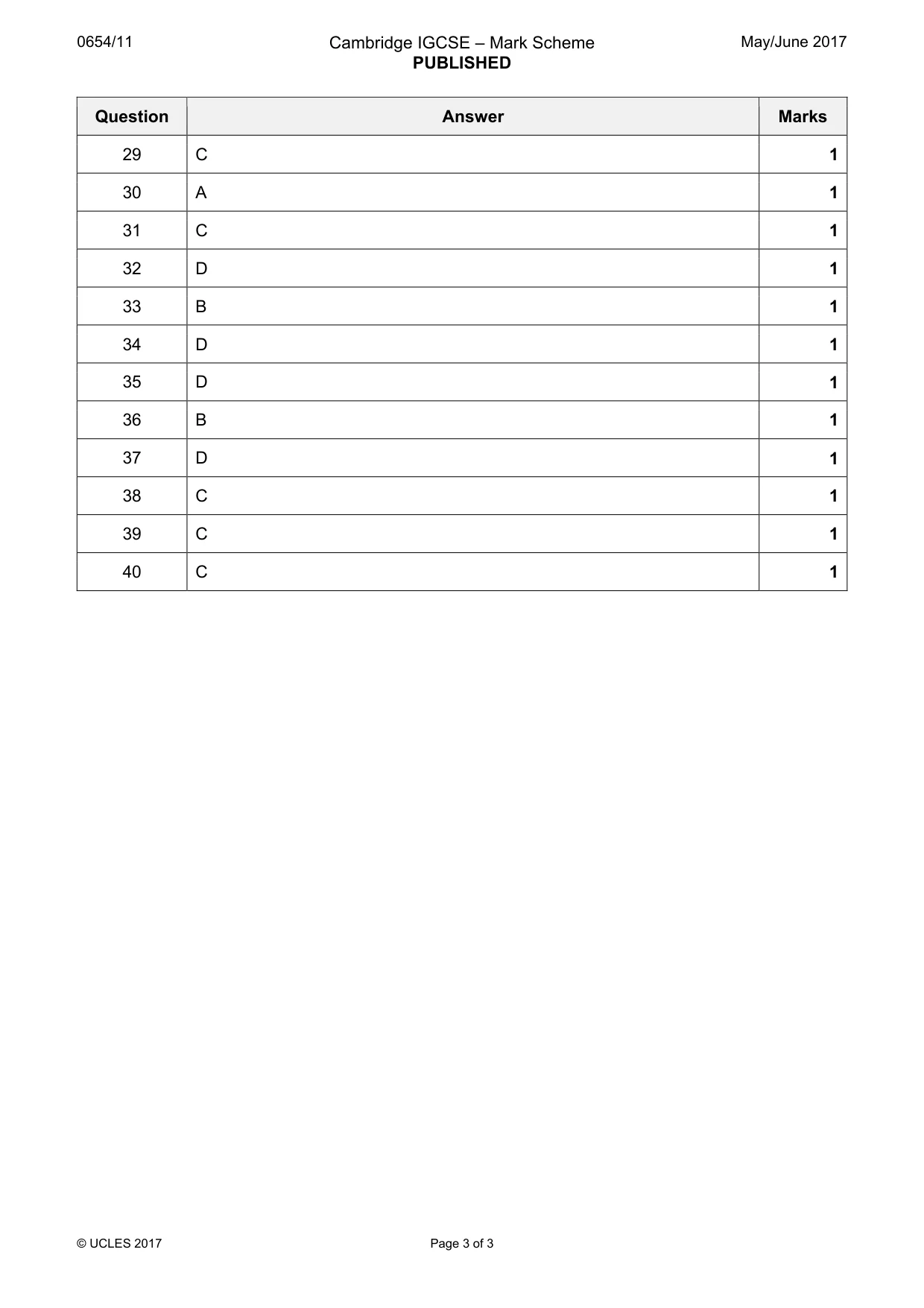
Mark scheme: C
Q30 · A student places four identical beakers on a bench
30 A student places four identical beakers on a bench. Two beakers contain salt water of density 1.1 g / cm3 and two beakers contain pure water of density 1.0 g / cm3. The quantity of water in each beaker is shown. Which beaker exerts the greatest pressure on the bench? A B C D 150 cm3 100 cm3 150 cm3 100 cm3 of salt of salt of pure of pure water water water water
Mark scheme: A
Q31 · The list contains three energy resources, P, Q and R
31 The list contains three energy resources, P, Q and R. P geothermal energy from hot rocks Q nuclear fission in reactors R sunlight on solar panels Which of these resources are renewable? A P, Q and R B P and Q only C P and R only D Q and R only
Mark scheme: C
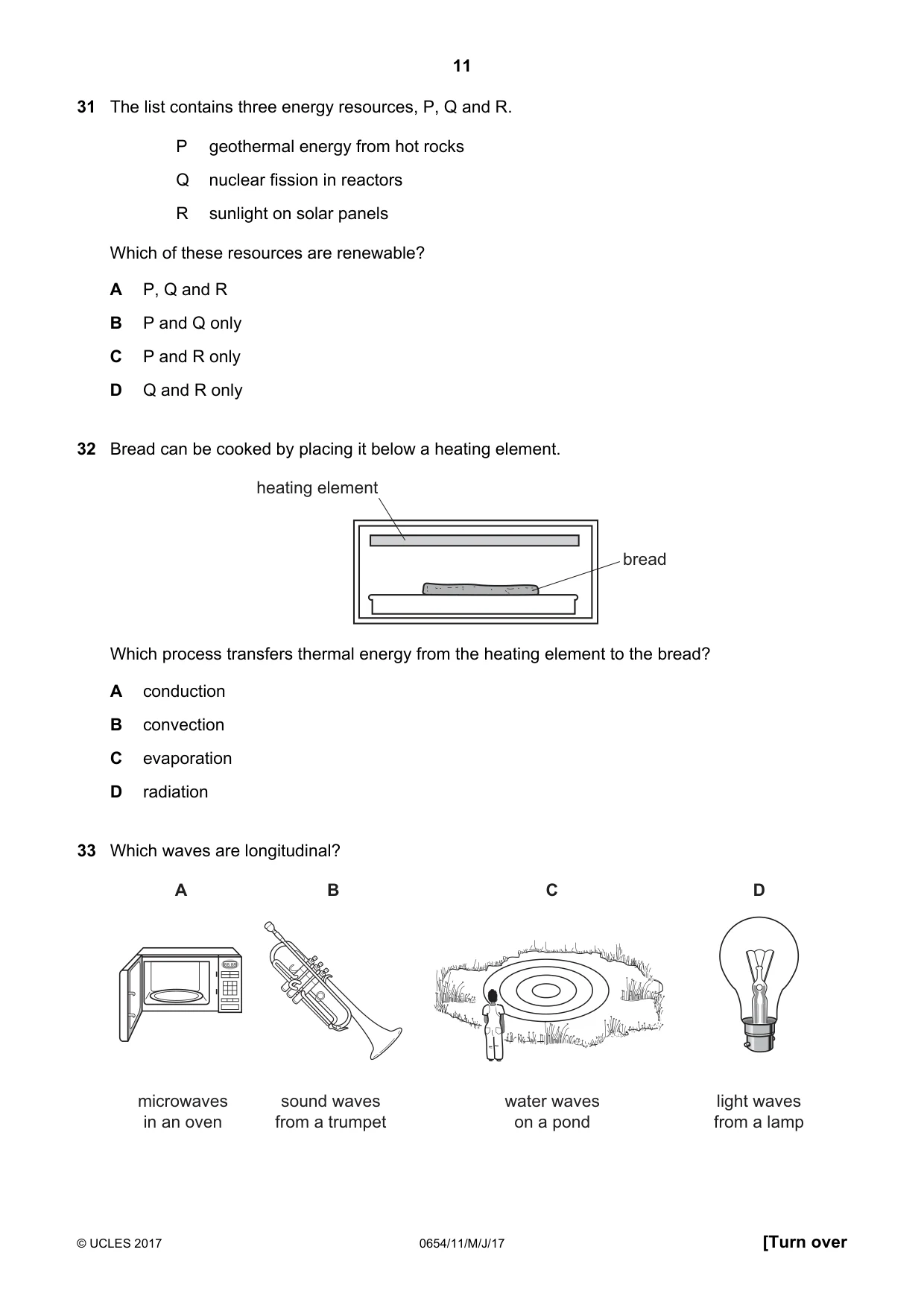
Q32 · Bread can be cooked by placing it below a heating element
32 Bread can be cooked by placing it below a heating element. heating element bread Which process transfers thermal energy from the heating element to the bread? A conduction B convection C evaporation D radiation
Mark scheme: D
Q33 · Which waves are longitudinal?
33 Which waves are longitudinal? A B C D 88:88 microwaves sound waves water waves light waves in an oven from a trumpet on a pond from a lamp
Mark scheme: B
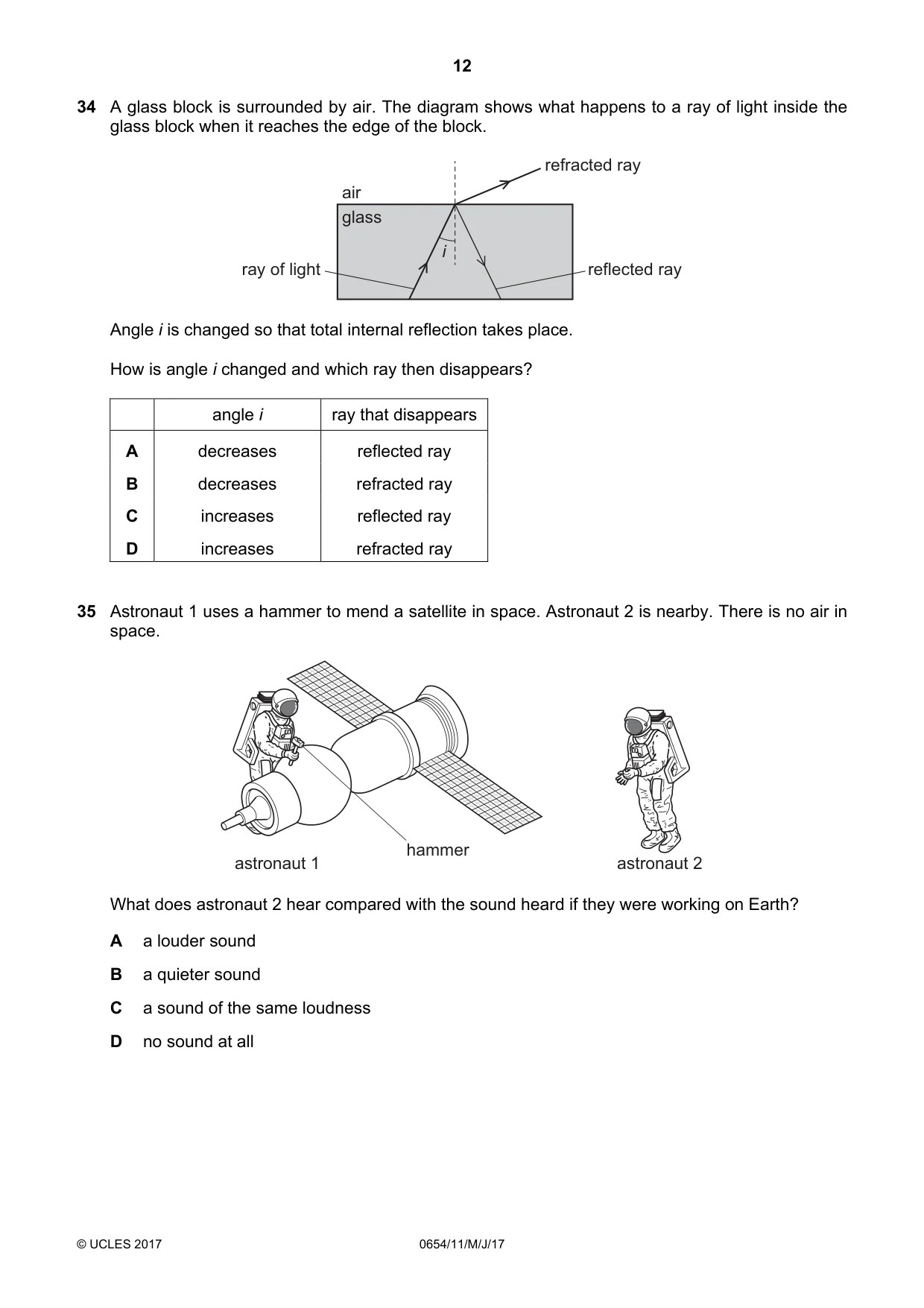
Q34 · A glass block is surrounded by air
34 A glass block is surrounded by air. The diagram shows what happens to a ray of light inside the glass block when it reaches the edge of the block. refracted ray air glass i ray of light reflected ray Angle i is changed so that total internal reflection takes place. How is angle i changed and which ray then disappears? angle i ray that disappears A decreases reflected ray B decreases refracted ray C increases reflected ray D increases refracted ray
Mark scheme: D
Q35 · Astronaut 1 uses a hammer to mend a satellite in space
35 Astronaut 1 uses a hammer to mend a satellite in space. Astronaut 2 is nearby. There is no air in space. hammer astronaut 1 astronaut 2 What does astronaut 2 hear compared with the sound heard if they were working on Earth? A a louder sound B a quieter sound C a sound of the same loudness D no sound at all
Mark scheme: D
Q36 · The N-pole of a magnet repels one end of bar X
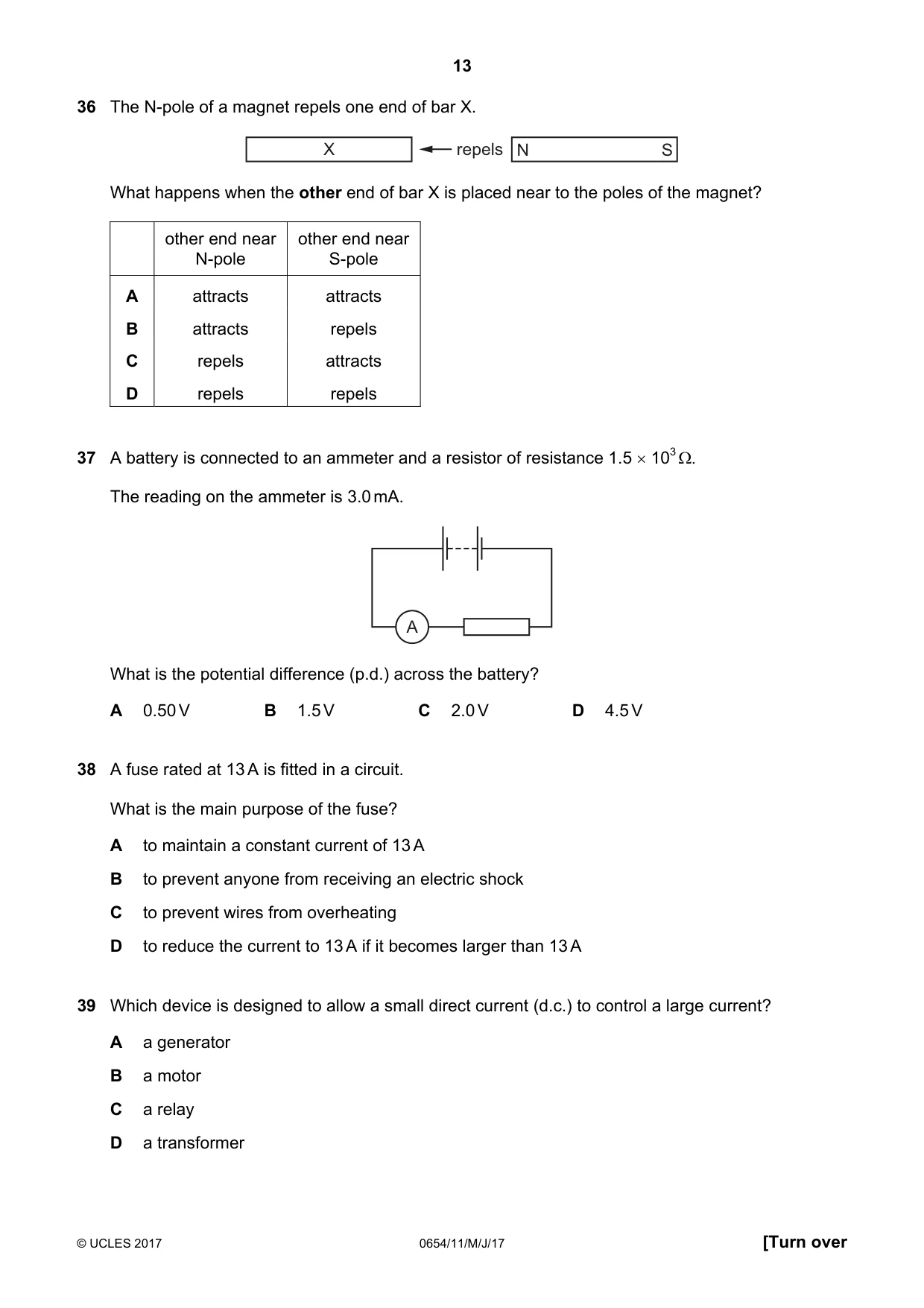
36 The N-pole of a magnet repels one end of bar X. X repels N S What happens when the other end of bar X is placed near to the poles of the magnet? other end near other end near N-pole S-pole A attracts attracts B attracts repels C repels attracts D repels repels
Mark scheme: B
Q37 · A battery is connected to an ammeter and a resistor of resistance 1.5 × 10³ Ω
37 A battery is connected to an ammeter and a resistor of resistance 1.5 × 10³ Ω. The reading on the ammeter is 3.0 mA. A What is the potential difference (p.d.) across the battery? A 0.50 V B 1.5 V C 2.0 V D 4.5 V
Mark scheme: D
Q38 · A fuse rated at 13 A is fitted in a circuit
38 A fuse rated at 13 A is fitted in a circuit. What is the main purpose of the fuse? A to maintain a constant current of 13 A B to prevent anyone from receiving an electric shock C to prevent wires from overheating D to reduce the current to 13 A if it becomes larger than 13 A
Mark scheme: C
Q39 · Which device is designed to allow a small direct current (d.c.) to control a large…
39 Which device is designed to allow a small direct current (d.c.) to control a large current? A a generator B a motor C a relay D a transformer
Mark scheme: C
Q40 · Which row compares the number of protons and the number of neutrons in atoms of different…
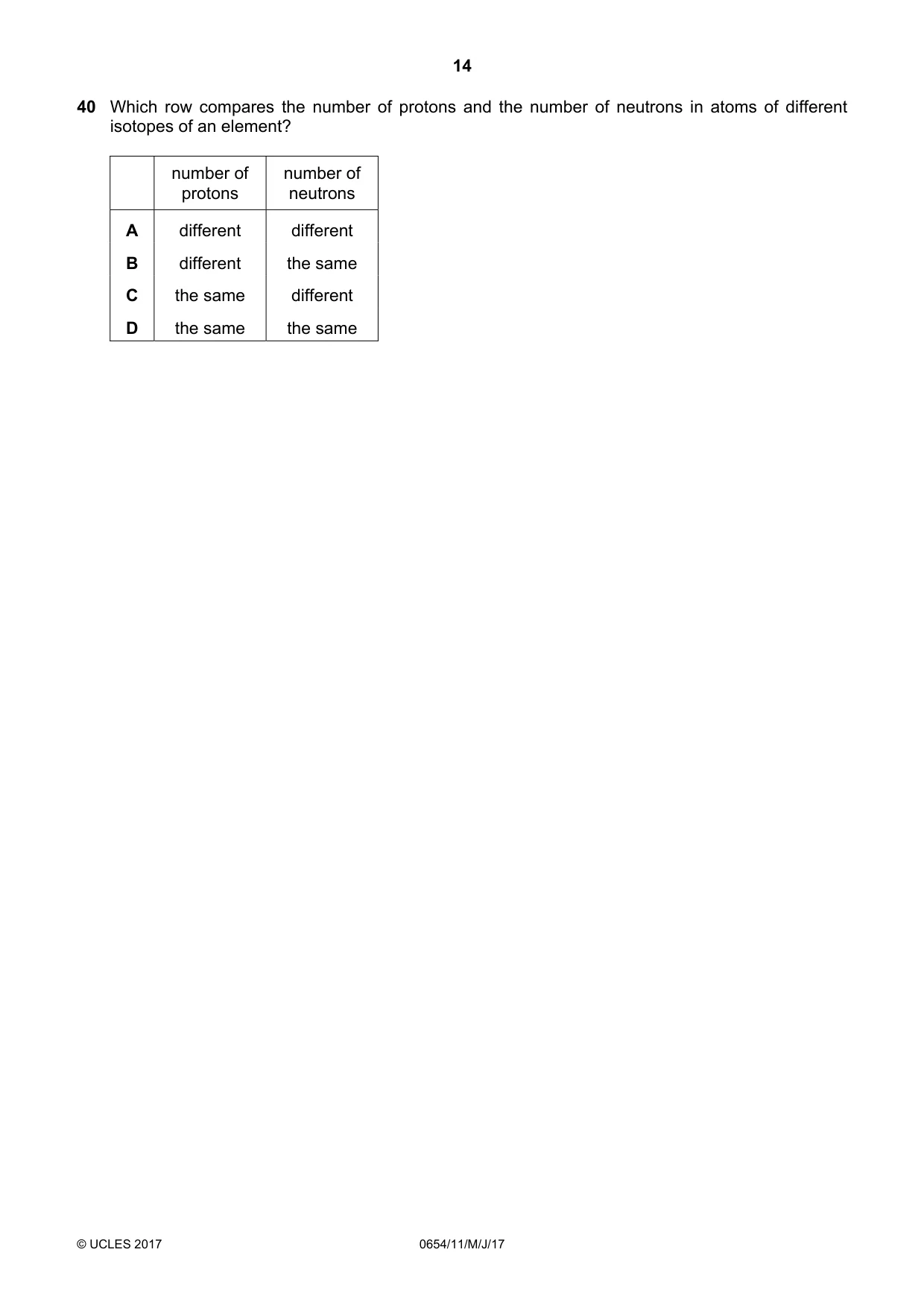
40 Which row compares the number of protons and the number of neutrons in atoms of different isotopes of an element? number of number of protons neutrons A different different B different the same C the same different D the same the same
Mark scheme: C
What was in this paper
The subtopics covered by these 40 questions, and how many questions each got. Open one in a new tab to see every Cambridge question on it.
2The characteristic properties of acids and bases2Asexual reproduction1Cell structure1Characteristics of living organisms1Coordination and response1Diet1Electrical quantities1Electrical safety1Electrolysis1Electromagnetic effects1Elements, compounds and mixtures1Energy, work and power1Enzymes1Exothermic and endothermic reactions1Extraction of metals1Formulas1Gas exchange in humans1Group I properties1Habitat destruction1Hormones1Isotopes1Light1Mass and weight1Monohybrid inheritance1Motion1Noble gases1Polymers1Pressure1Rate of reaction1Redox1Selection1Separation and purification1Sexual reproduction in plants1Simple phenomena of magnetism1Transfer of thermal energy1Water1Xylem and phloem1What you needed in this session
Cambridge’s own grade thresholds for 2017 May/June, Paper 1 · Variant 1. A higher threshold means an easier paper — the bar moves with how the cohort did.