Cambridge IGCSE Sciences - Co-ordinated (Double) 0654 — 2009 May/June Paper 1 · Variant 1
0654/11/M/J/09 · 40 questions · 40 marks · ≈45 min
The question paper and its mark scheme, free to read here and free to download. This is Cambridge’s own paper, exactly as it was sat.
Question paper20 pages


Mark scheme2 pages
Answers below. Sit the paper first if you are practising.
Questions as text
Q1 · Which characteristic is shown by members of the same species?
1 Which characteristic is shown by members of the same species? A They all live in the same place. B They are all identical in appearance. C They breed with each other to produce fertile offspring. D They cannot form clones.
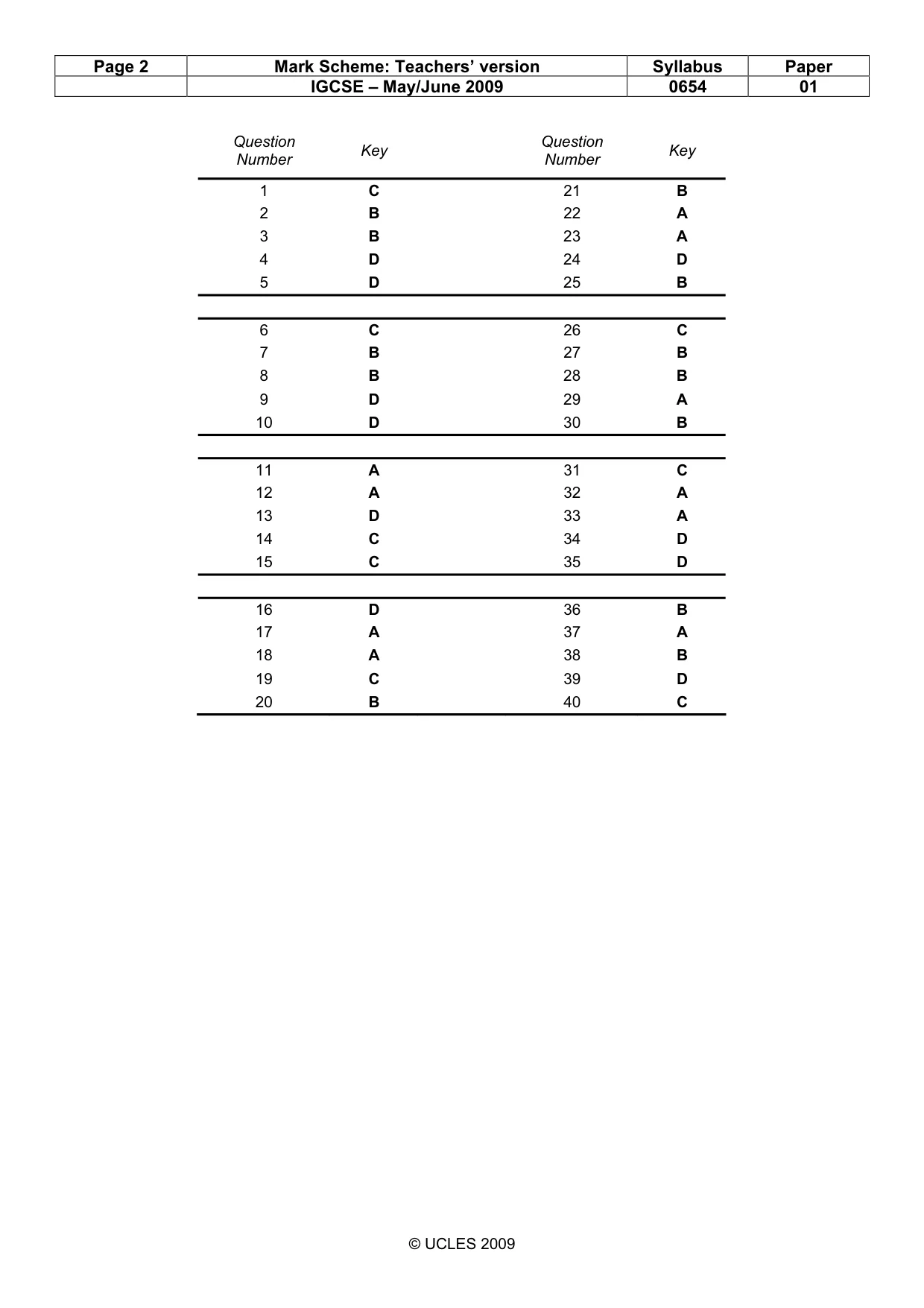
Mark scheme: C
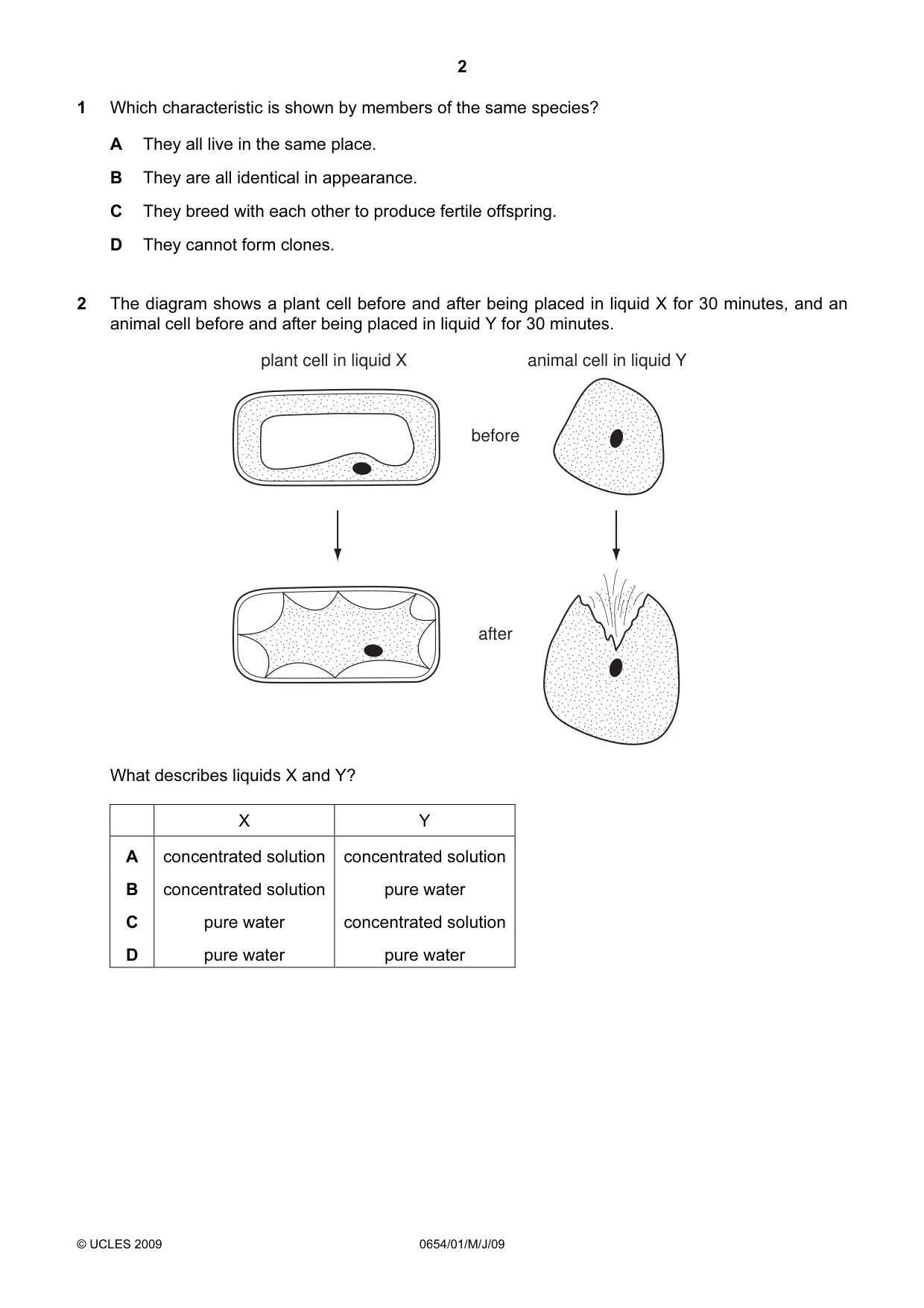
Q2 · The diagram shows a plant cell before and after being placed in liquid X for 30 minutes…
2 The diagram shows a plant cell before and after being placed in liquid X for 30 minutes, and an animal cell before and after being placed in liquid Y for 30 minutes. plant cell in liquid X animal cell in liquid Y before after What describes liquids X and Y? X Y A concentrated solution concentrated solution B concentrated solution pure water C pure water concentrated solution D pure water pure water
Mark scheme: B
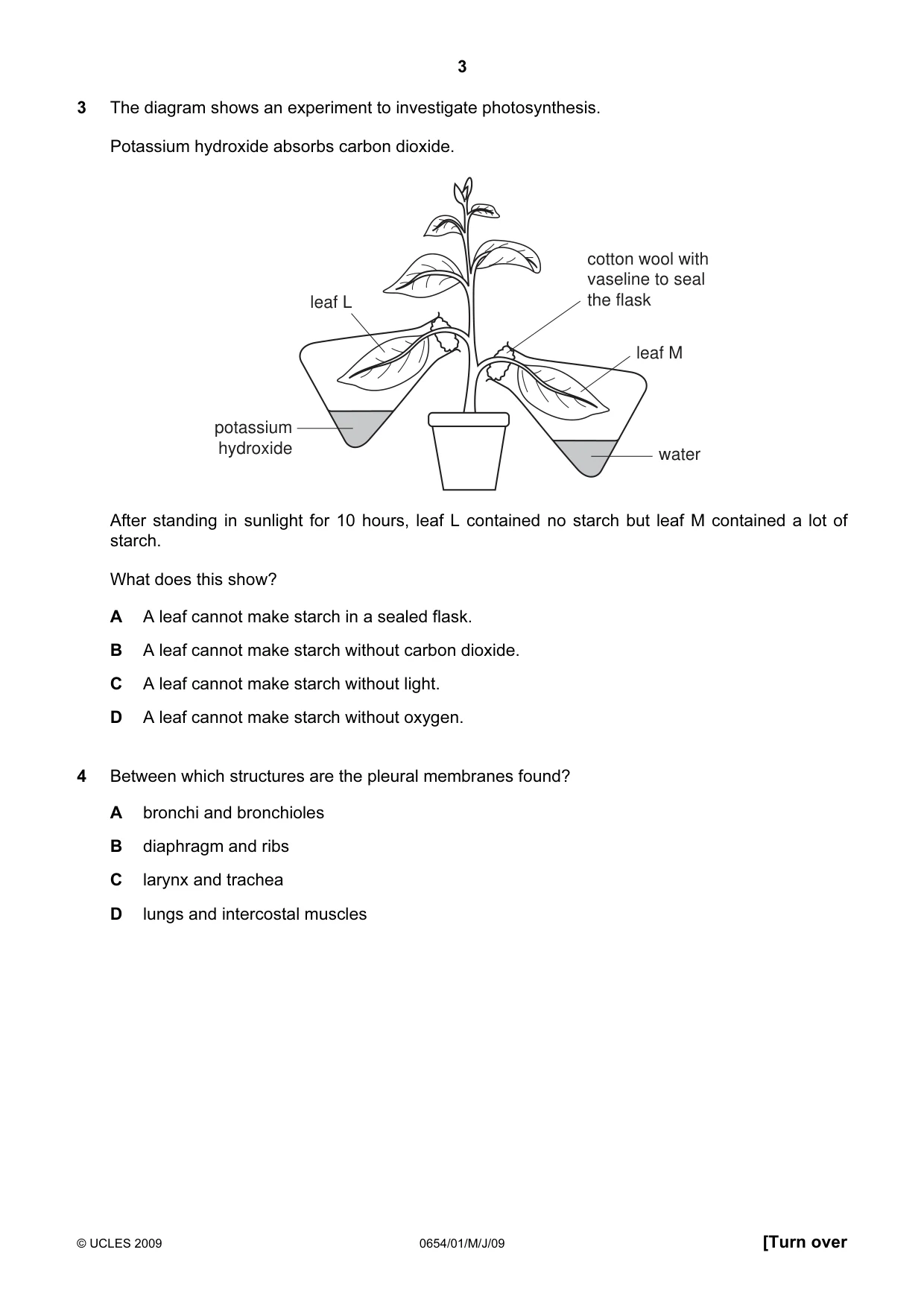
Q3 · The diagram shows an experiment to investigate photosynthesis
3 The diagram shows an experiment to investigate photosynthesis. Potassium hydroxide absorbs carbon dioxide. cotton wool with vaseline to seal leaf L the flask leaf M potassium hydroxide water After standing in sunlight for 10 hours, leaf L contained no starch but leaf M contained a lot of starch. What does this show? A A leaf cannot make starch in a sealed flask. B A leaf cannot make starch without carbon dioxide. C A leaf cannot make starch without light. D A leaf cannot make starch without oxygen.
Mark scheme: B
Q4 · Between which structures are the pleural membranes found?
4 Between which structures are the pleural membranes found? A bronchi and bronchioles B diaphragm and ribs C larynx and trachea D lungs and intercostal muscles
Mark scheme: D
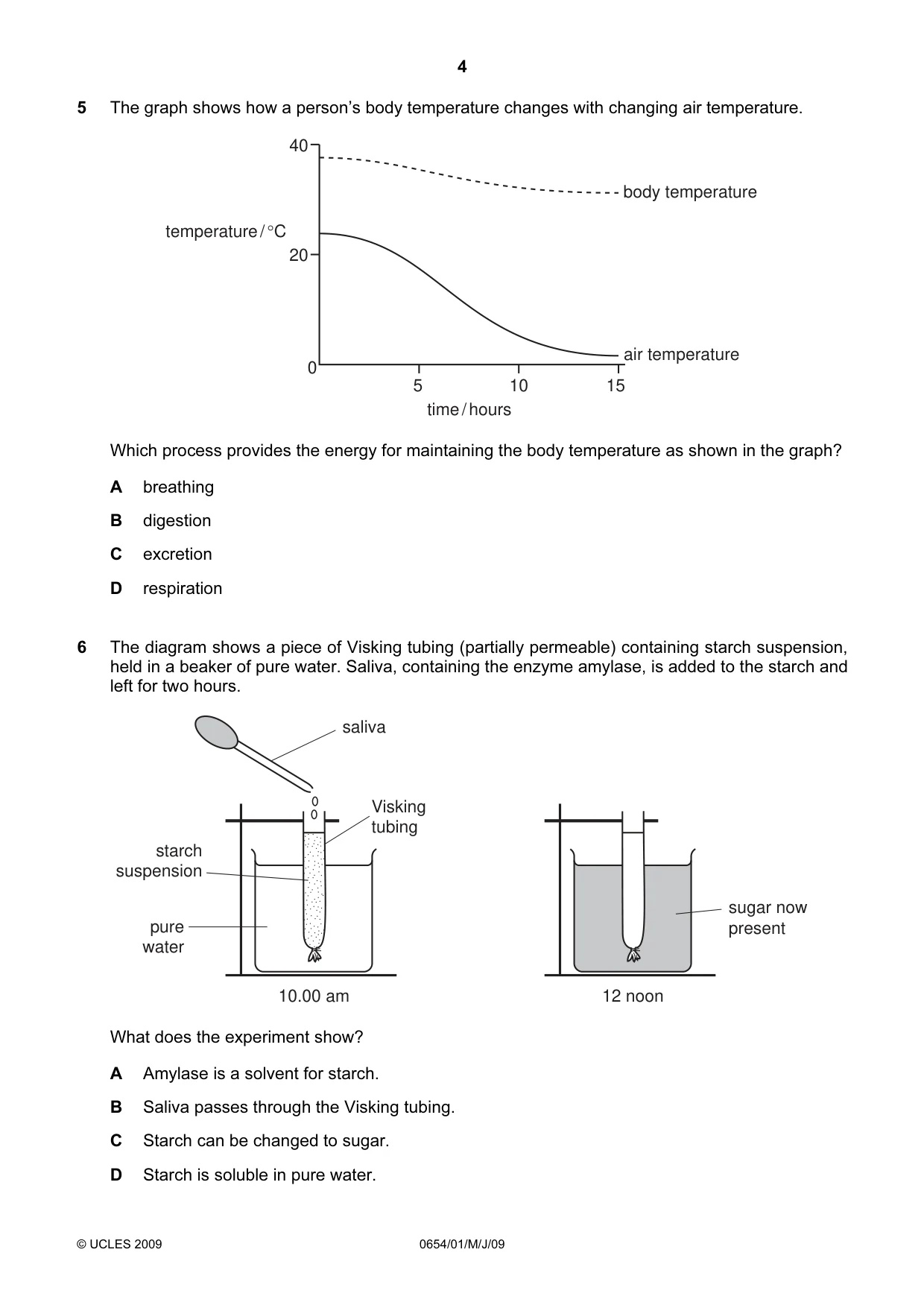
Q5 · The graph shows how a person’s body temperature changes with changing air temperature
5 The graph shows how a person’s body temperature changes with changing air temperature. 40 body temperature temperature / °C 20 air temperature 0 5 10 15 time / hours Which process provides the energy for maintaining the body temperature as shown in the graph? A breathing B digestion C excretion D respiration
Mark scheme: D
Q6 · The diagram shows a piece of Visking tubing (partially permeable) containing starch…
6 The diagram shows a piece of Visking tubing (partially permeable) containing starch suspension, held in a beaker of pure water. Saliva, containing the enzyme amylase, is added to the starch and left for two hours. saliva Visking tubing starch suspension sugar now pure present water 10.00 am 12 noon What does the experiment show? A Amylase is a solvent for starch. B Saliva passes through the Visking tubing. C Starch can be changed to sugar. D Starch is soluble in pure water.
Mark scheme: C
Q7 · Which substance is needed in the diet so that red blood cells can carry oxygen?
7 Which substance is needed in the diet so that red blood cells can carry oxygen? A calcium B iron C vitamin C D vitamin D
Mark scheme: B
Q8 · What is most likely to happen after a person eats a meal high in protein?
8 What is most likely to happen after a person eats a meal high in protein? A The amount of water in the blood would decrease. B The concentration of urea in the urine would increase. C The level of insulin in the blood would increase. D The temperature of the body would decrease.
Mark scheme: B
Q9 · In which part of a seed is the micropyle found?
9 In which part of a seed is the micropyle found? A cotyledon B plumule C radicle D testa
Mark scheme: D
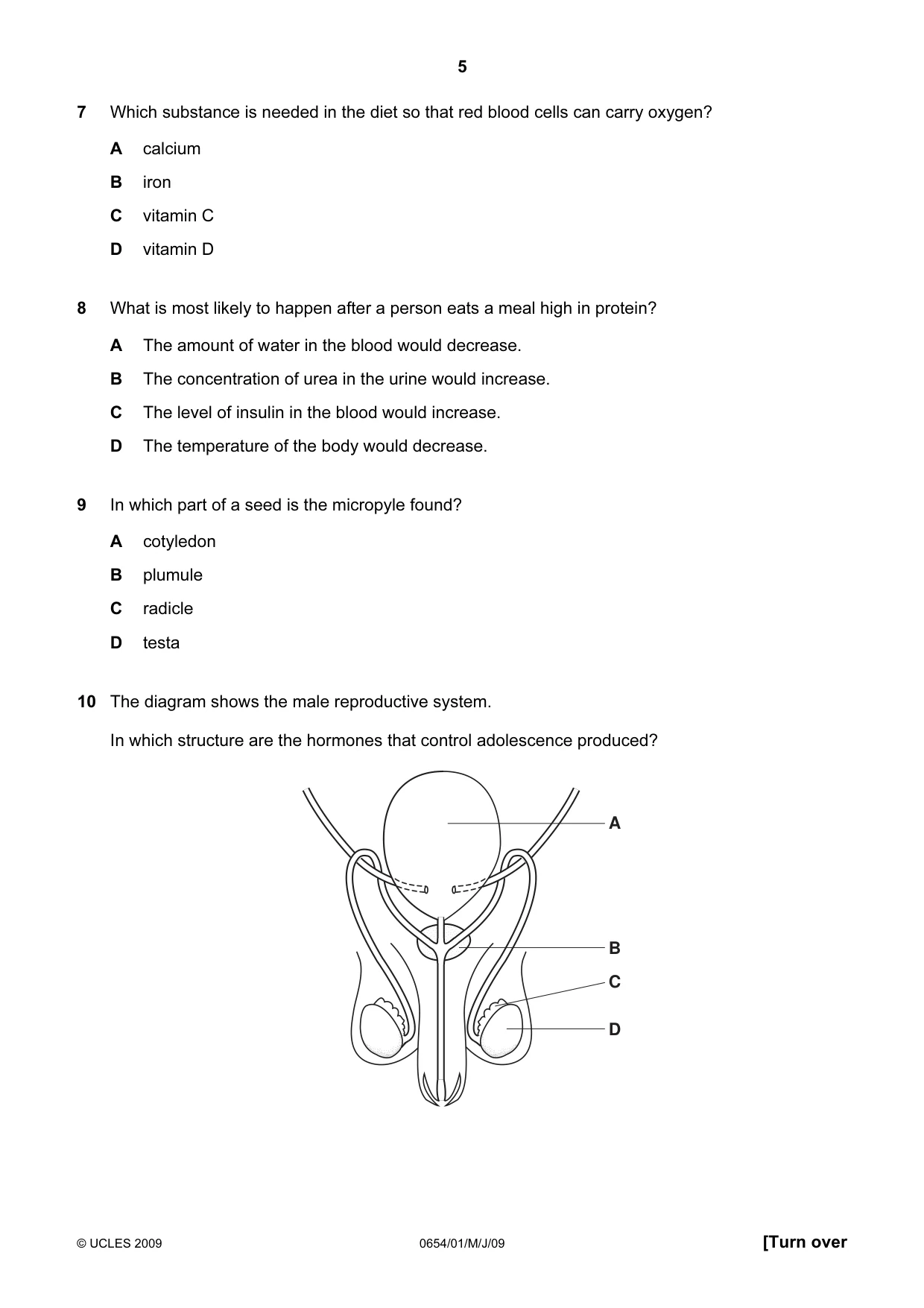
Q10 · The diagram shows the male reproductive system
10 The diagram shows the male reproductive system. In which structure are the hormones that control adolescence produced? A B C D
Mark scheme: D
Q11 · Black coat colour in mice is dominant to white coat colour
11 Black coat colour in mice is dominant to white coat colour. A pure-bred black mouse mates with a white mouse. What colour are the offspring? A black only B black and white C grey D white only
Mark scheme: A
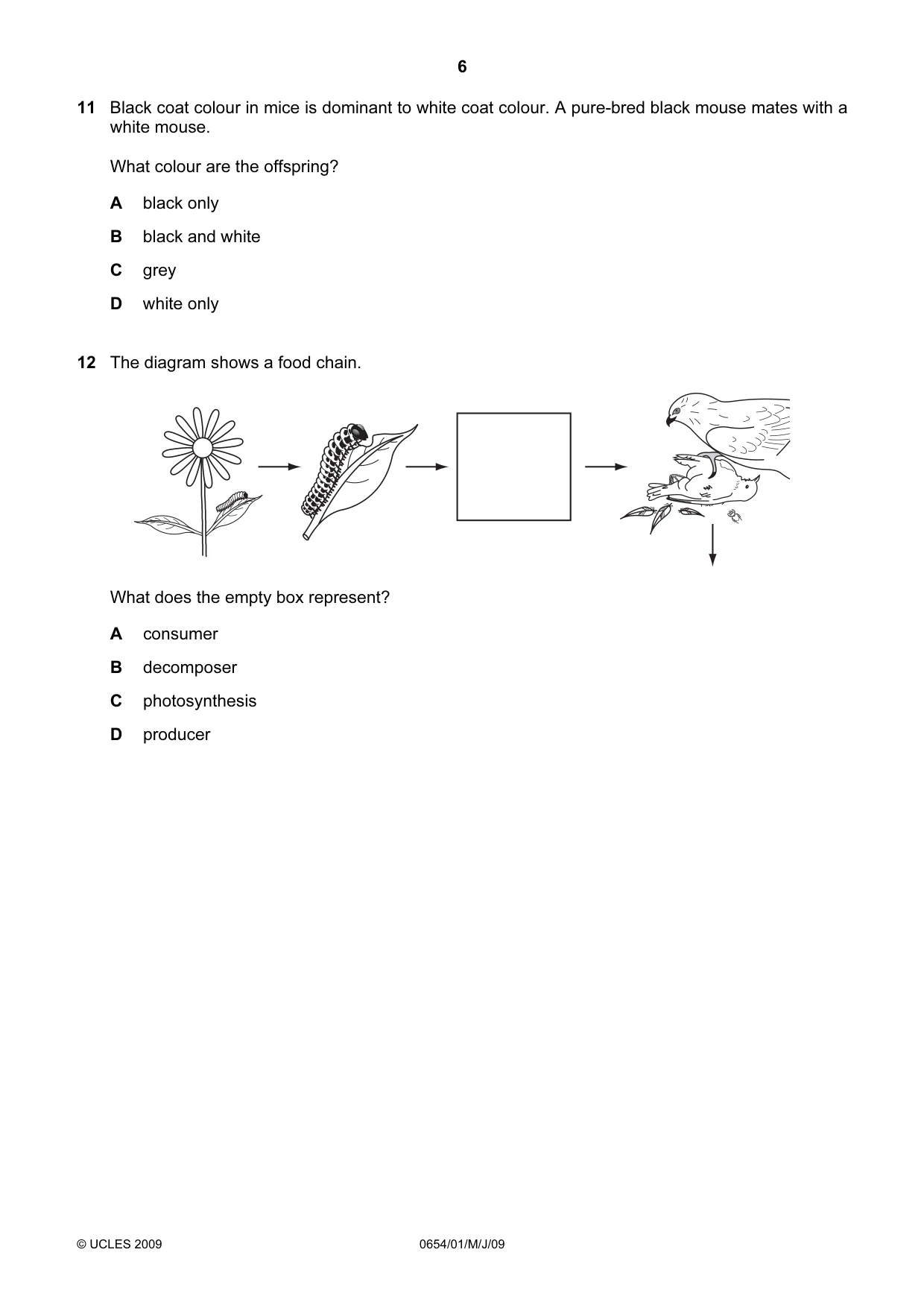
Q12 · The diagram shows a food chain
12 The diagram shows a food chain. What does the empty box represent? A consumer B decomposer C photosynthesis D producer
Mark scheme: A
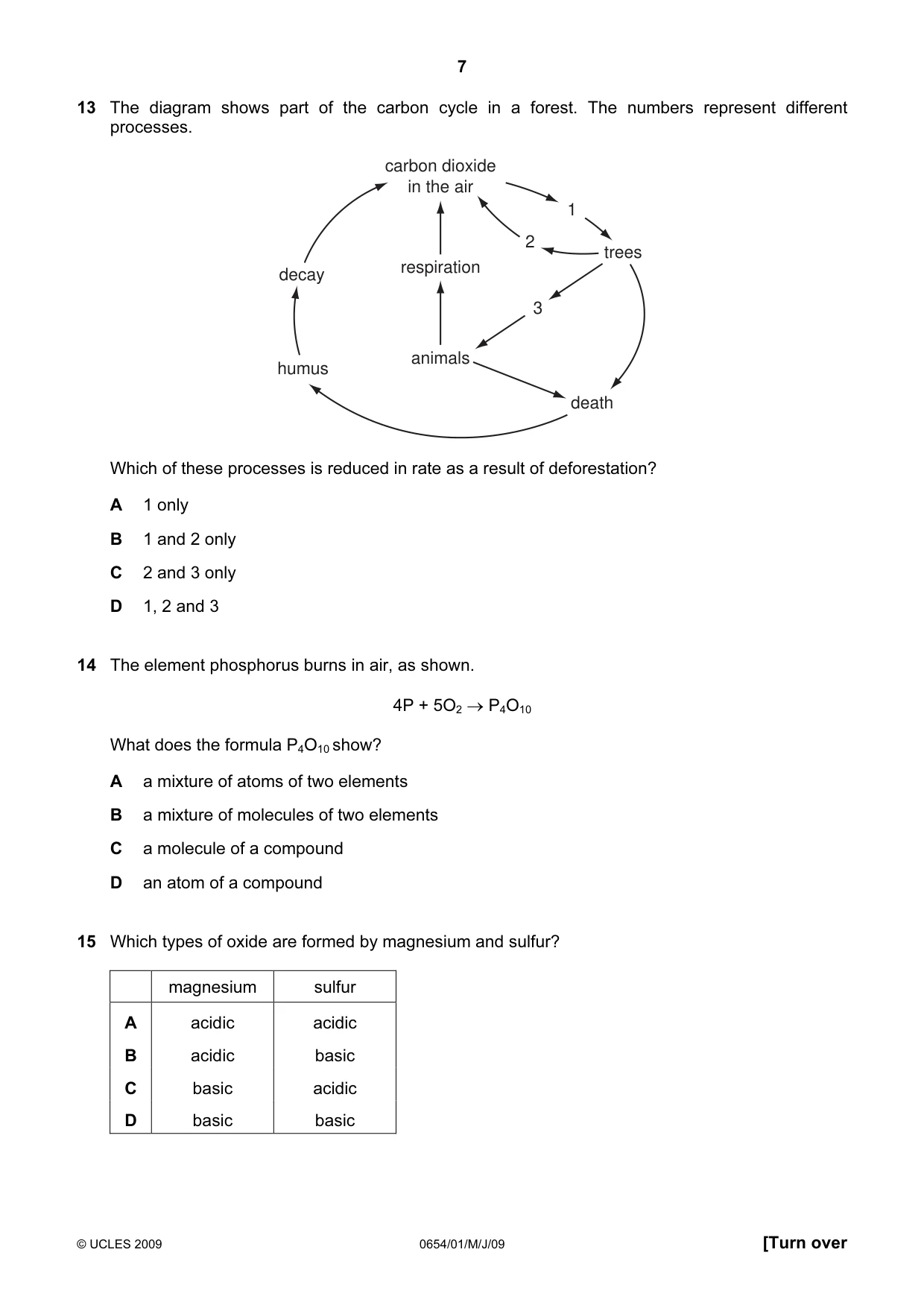
Q13 · The diagram shows part of the carbon cycle in a forest
13 The diagram shows part of the carbon cycle in a forest. The numbers represent different processes. carbon dioxide in the air 1 2 trees respiration decay 3 animals humus death Which of these processes is reduced in rate as a result of deforestation? A 1 only B 1 and 2 only C 2 and 3 only D 1, 2 and 3
Mark scheme: D
Q14 · The element phosphorus burns in air, as shown
14 The element phosphorus burns in air, as shown. 4P + 5O2 → P4O10 What does the formula P4O10 show? A a mixture of atoms of two elements B a mixture of molecules of two elements C a molecule of a compound D an atom of a compound
Mark scheme: C
Q15 · Which types of oxide are formed by magnesium and sulfur?
15 Which types of oxide are formed by magnesium and sulfur? magnesium sulfur A acidic acidic B acidic basic C basic acidic D basic basic
Mark scheme: C
Q16 · Which process produces molecules with longer chains?
16 Which process produces molecules with longer chains? A combustion of hydrocarbon B cracking C fractional distillation of crude oil D polymerisation
Mark scheme: D
Q17 · Proteins consist of long chains of …...1…..
17 Proteins consist of long chains of …...1…... molecules and always contain the elements carbon, hydrogen, nitrogen and …...2…... . Which words correctly complete gaps 1 and 2? 1 2 A amino acid oxygen B amino acid sulfur C glucose oxygen D glucose sulfur
Mark scheme: A
Q18 · The equation for the extraction of a metal from its oxide can be written as shown
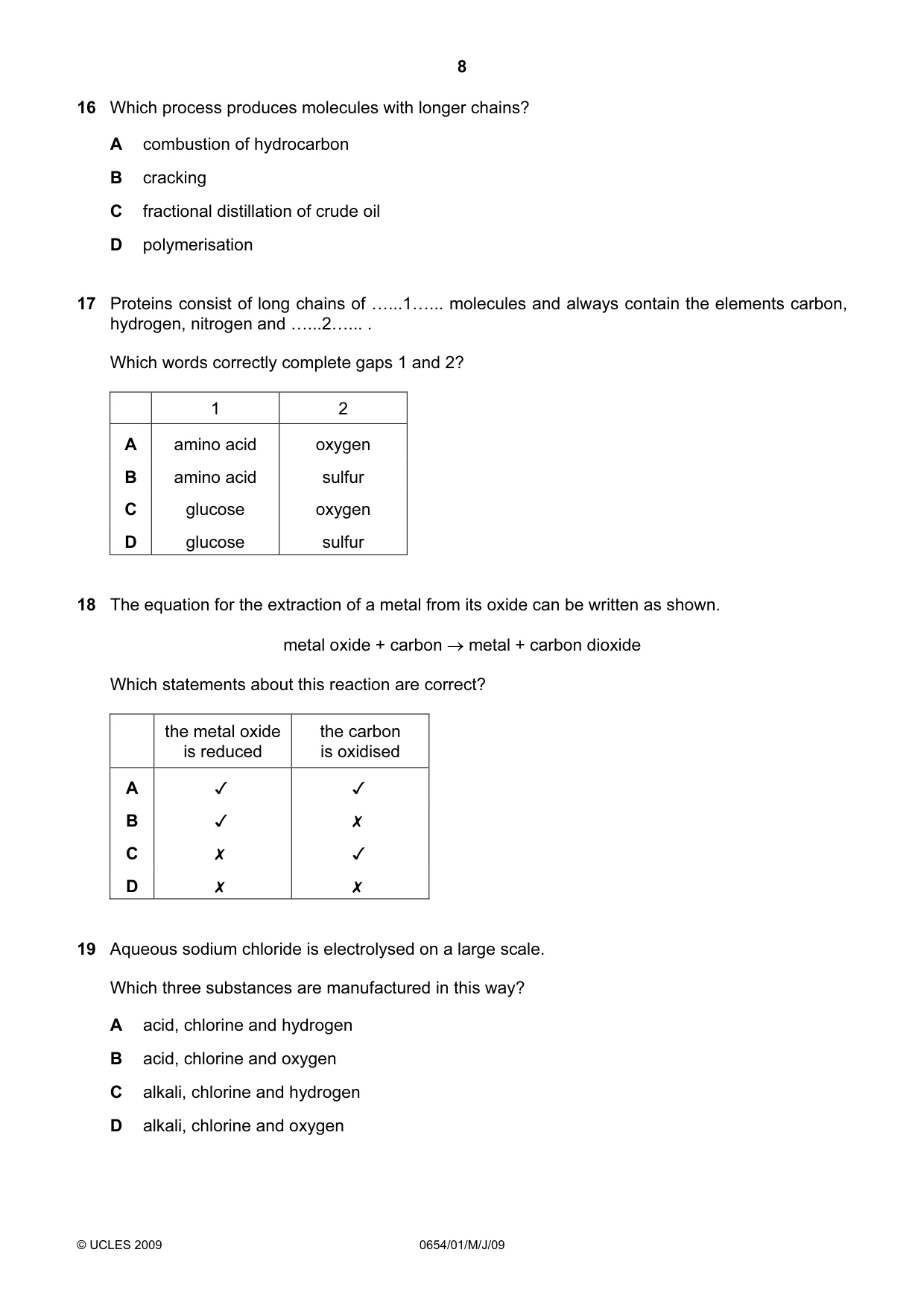
18 The equation for the extraction of a metal from its oxide can be written as shown. metal oxide + carbon — metal + carbon dioxide Which statements about this reaction are correct? the metal oxide the carbon is reduced is oxidised A v v B v x Cc x v D x x
Mark scheme: A
Q19 · Aqueous sodium chloride is electrolysed on a large scale
19 Aqueous sodium chloride is electrolysed on a large scale. Which three substances are manufactured in this way? A acid, chlorine and hydrogen B acid, chlorine and oxygen C alkali, chlorine and hydrogen D alkali, chlorine and oxygen
Mark scheme: C
Q20 · The diagram shows an experiment to test the hardness of separate samples of distilled…
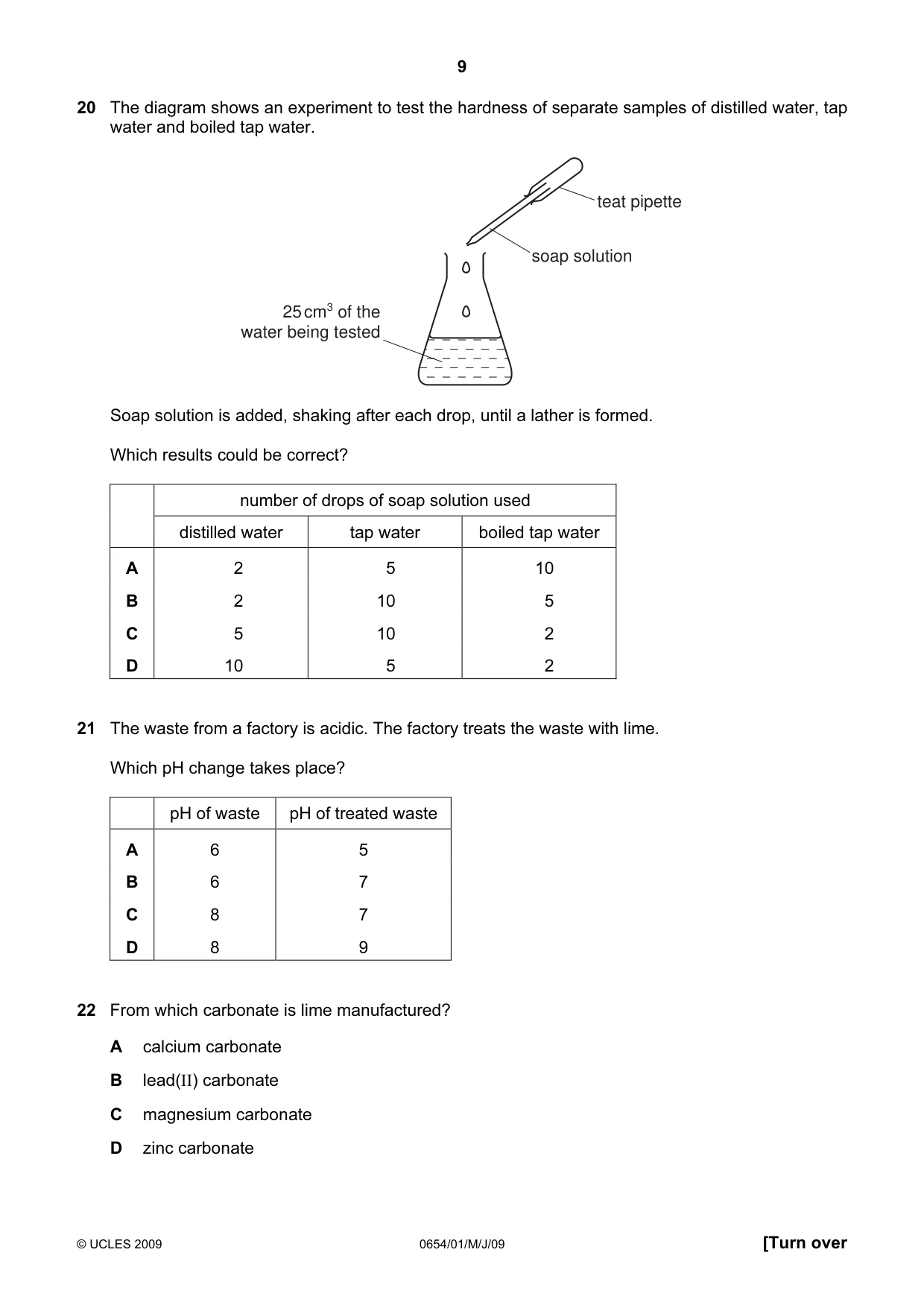
20 The diagram shows an experiment to test the hardness of separate samples of distilled water, tap water and boiled tap water. teat pipette soap solution 25 cm3 of the water being tested Soap solution is added, shaking after each drop, until a lather is formed. Which results could be correct? number of drops of soap solution used distilled water tap water boiled tap water A 2 5 10 B 2 10 5 C 5 10 2 D 10 5 2
Mark scheme: B
Q21 · The waste from a factory is acidic
21 The waste from a factory is acidic. The factory treats the waste with lime. Which pH change takes place? pH of waste pH of treated waste A 6 5 B 6 7 C 8 7 D 8 9
Mark scheme: B
More questions on The characteristic properties of acids and bases
Q22 · From which carbonate is lime manufactured?
22 From which carbonate is lime manufactured? A calcium carbonate B lead(II) carbonate C magnesium carbonate D zinc carbonate
Mark scheme: A
Q23 · Which metal is used with aqueous sodium hydroxide to test for nitrate ions in solution?
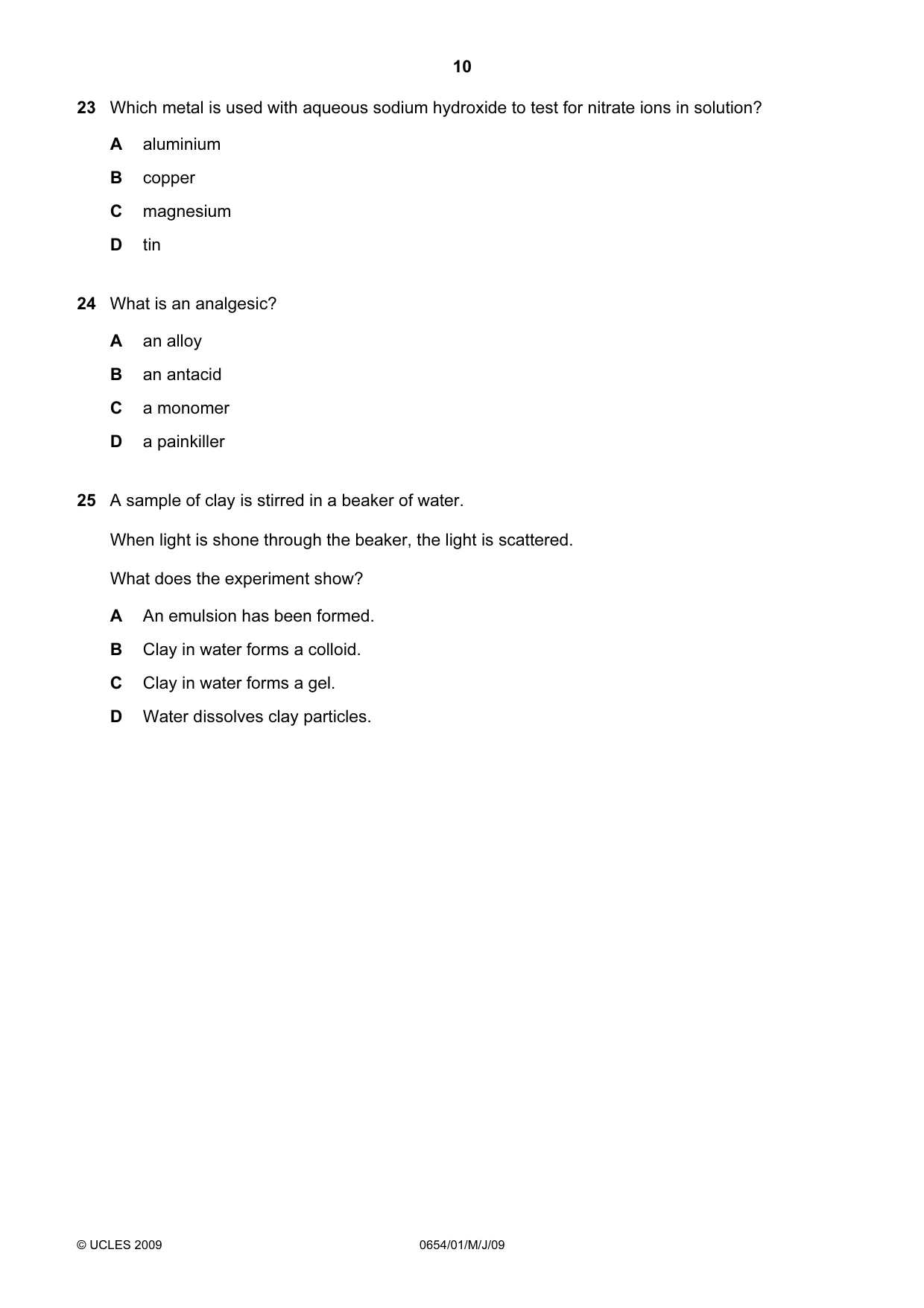
23 Which metal is used with aqueous sodium hydroxide to test for nitrate ions in solution? A aluminium B copper C magnesium D tin
Mark scheme: A
Q24 · What is an analgesic?
24 What is an analgesic? A an alloy B an antacid C a monomer D a painkiller
Mark scheme: D
Q25 · A sample of clay is stirred in a beaker of water
25 A sample of clay is stirred in a beaker of water. When light is shone through the beaker, the light is scattered. What does the experiment show? A An emulsion has been formed. B Clay in water forms a colloid. C Clay in water forms a gel. D Water dissolves clay particles.
Mark scheme: B
Q26 · A liquid fuel is burned using the following apparatus
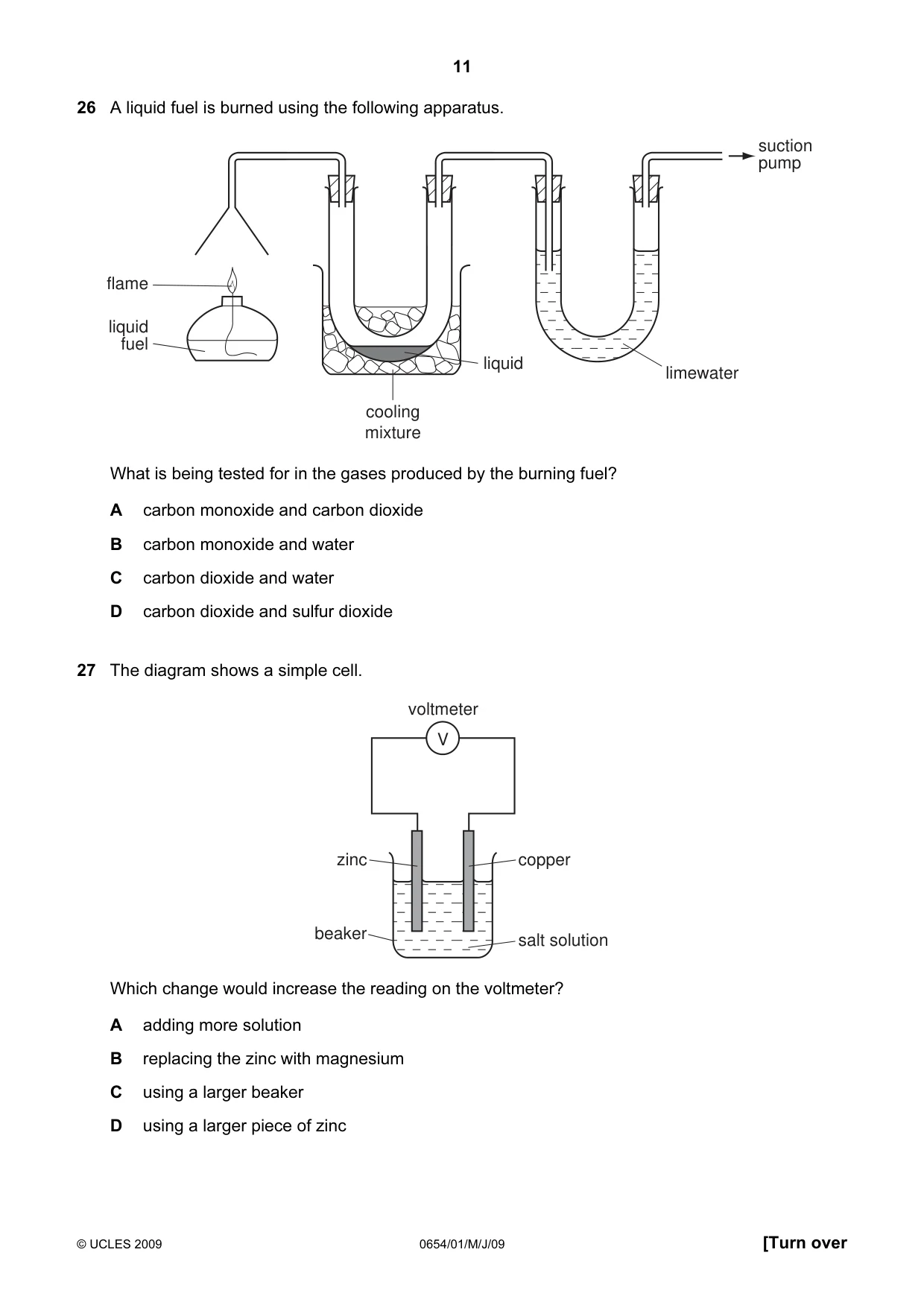
26 A liquid fuel is burned using the following apparatus. suction pump flame liquid fuel liquid limewater cooling mixture What is being tested for in the gases produced by the burning fuel? A carbon monoxide and carbon dioxide B carbon monoxide and water C carbon dioxide and water D carbon dioxide and sulfur dioxide
Mark scheme: C
Q27 · The diagram shows a simple cell
27 The diagram shows a simple cell. voltmeter V zinc copper beaker salt solution Which change would increase the reading on the voltmeter? A adding more solution B replacing the zinc with magnesium C using a larger beaker D using a larger piece of zinc
Mark scheme: B
Q28 · A car travels 100 km
28 A car travels 100 km. The highest speed of the car is 90 km/h, and the lowest speed is 30 km/h. The journey takes two hours. What is the average speed for the journey? A 30 km / h B 50 km / h C 60 km / h D 90 km / h
Mark scheme: B
Q29 · Which items of apparatus are required to determine the density of a liquid?
29 Which items of apparatus are required to determine the density of a liquid? A balance and measuring cylinder B balance and thermometer C metre rule and measuring cylinder D metre rule and thermometer
Mark scheme: A
Q30 · A wooden plank rests in equilibrium on two boulders on opposite sides of a narrow stream
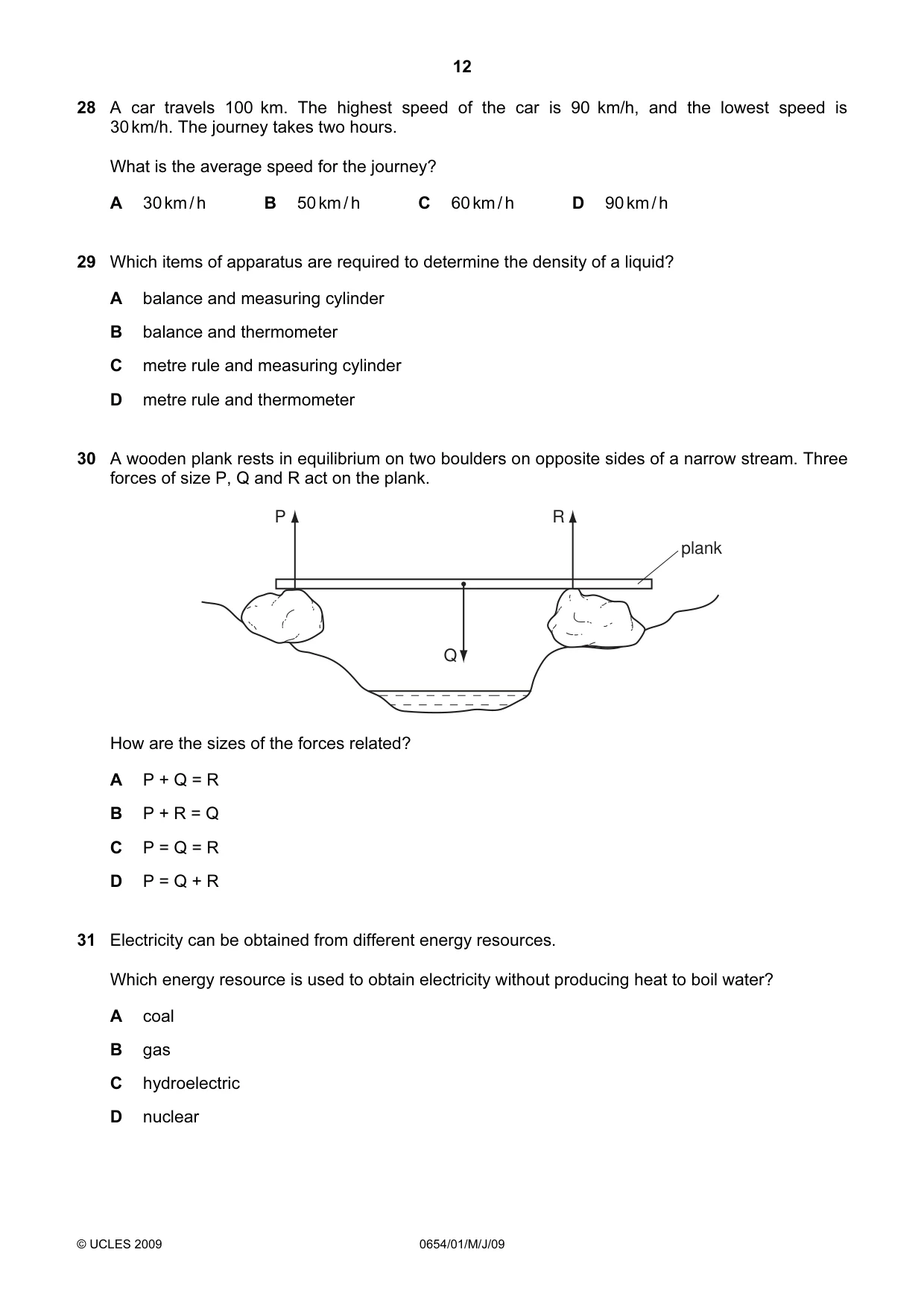
30 A wooden plank rests in equilibrium on two boulders on opposite sides of a narrow stream. Three forces of size P, Q and R act on the plank. P R plank Q How are the sizes of the forces related? A P + Q = R B P + R = Q C P = Q = R D P = Q + R
Mark scheme: B
Q31 · Electricity can be obtained from different energy resources
31 Electricity can be obtained from different energy resources. Which energy resource is used to obtain electricity without producing heat to boil water? A coal B gas C hydroelectric D nuclear
Mark scheme: C
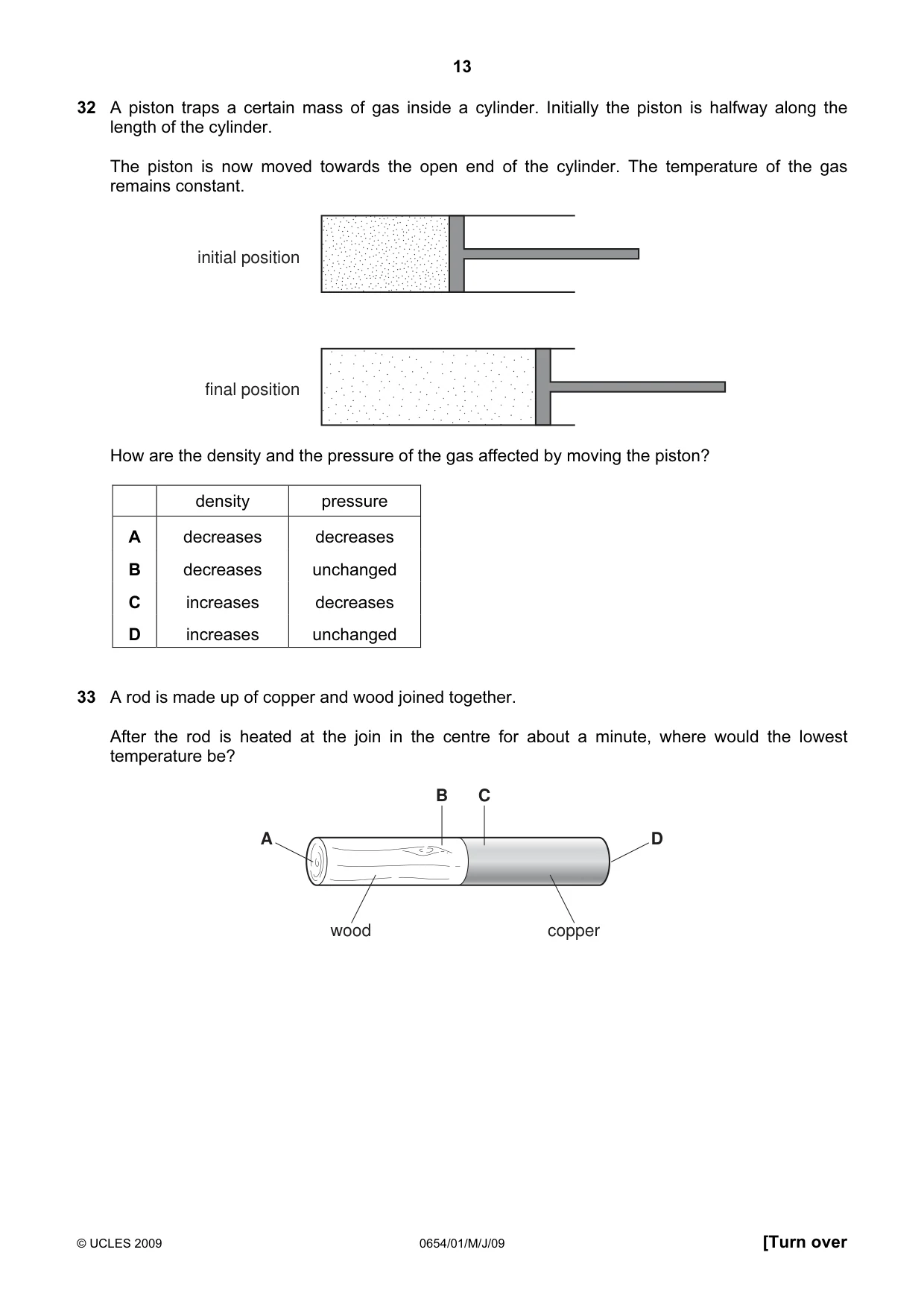
Q32 · A piston traps a certain mass of gas inside a cylinder
32 A piston traps a certain mass of gas inside a cylinder. Initially the piston is halfway along the length of the cylinder. The piston is now moved towards the open end of the cylinder. The temperature of the gas remains constant. initial position final position How are the density and the pressure of the gas affected by moving the piston? density pressure A decreases decreases B decreases unchanged C increases decreases D increases unchanged
Mark scheme: A
Q33 · A rod is made up of copper and wood joined together
33 A rod is made up of copper and wood joined together. After the rod is heated at the join in the centre for about a minute, where would the lowest temperature be? B C A D wood copper
Mark scheme: A
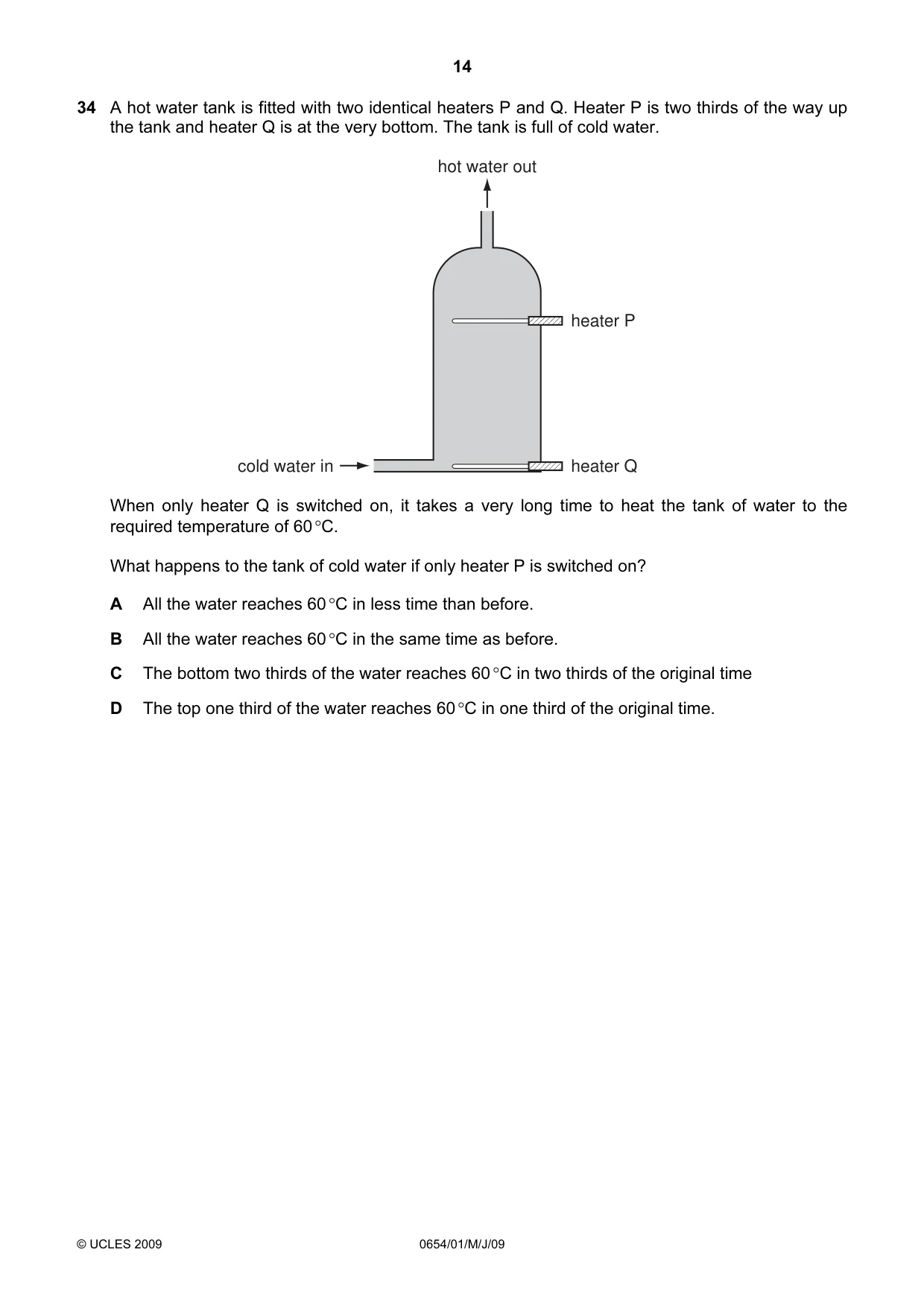
Q34 · A hot water tank is fitted with two identical heaters P and Q
34 A hot water tank is fitted with two identical heaters P and Q. Heater P is two thirds of the way up the tank and heater Q is at the very bottom. The tank is full of cold water. hot water out heater P cold water in heater Q When only heater Q is switched on, it takes a very long time to heat the tank of water to the required temperature of 60 °C. What happens to the tank of cold water if only heater P is switched on? A All the water reaches 60 °C in less time than before. B All the water reaches 60 °C in the same time as before. C The bottom two thirds of the water reaches 60 °C in two thirds of the original time D The top one third of the water reaches 60 °C in one third of the original time.
Mark scheme: D
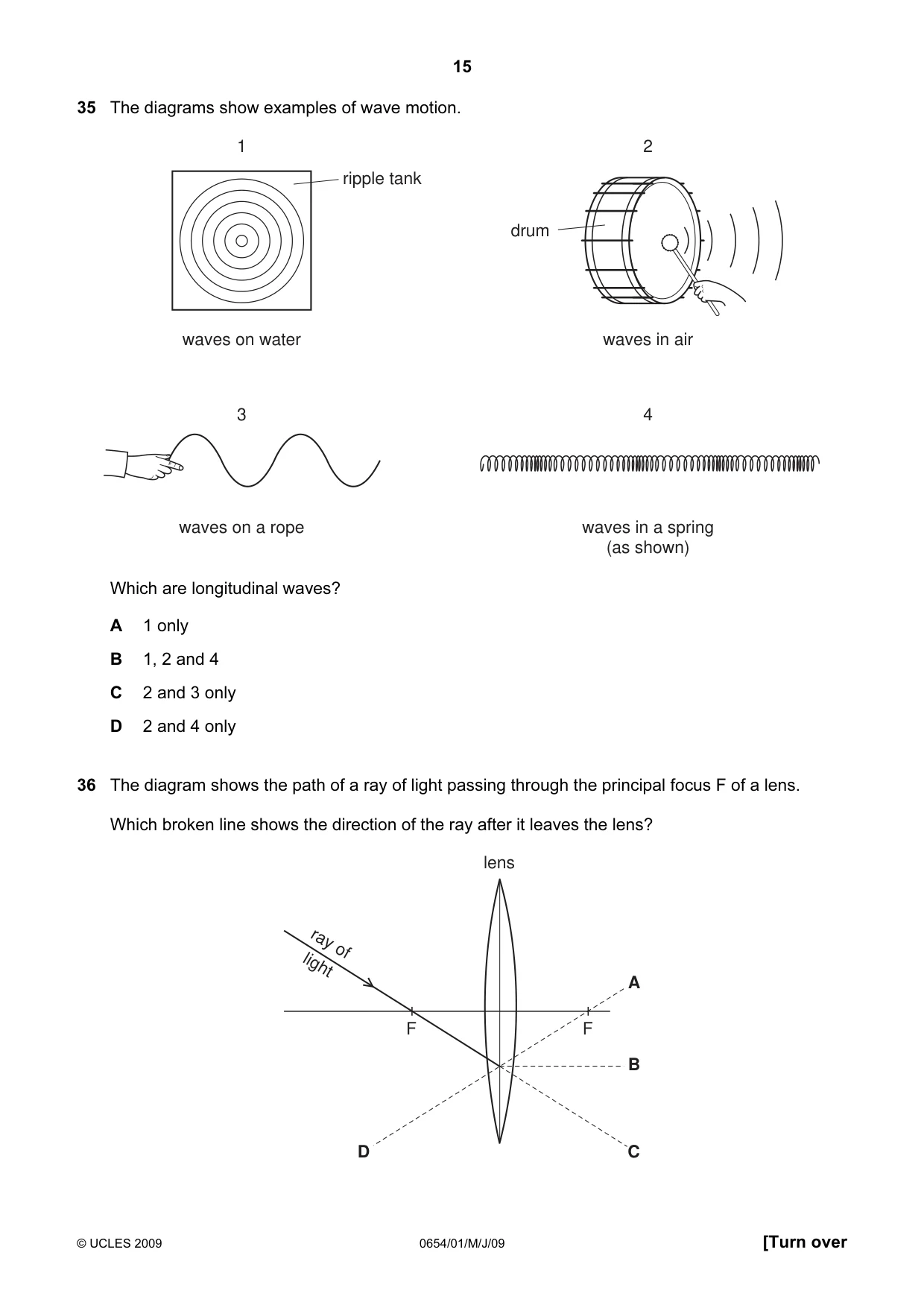
Q35 · The diagrams show examples of wave motion
35 The diagrams show examples of wave motion. 1 2 ripple tank drum waves on water waves in air 3 4 waves on a rope waves in a spring (as shown) Which are longitudinal waves? A 1 only B 1, 2 and 4 C 2 and 3 only D 2 and 4 only
Mark scheme: D
Q36 · The diagram shows the path of a ray of light passing through the principal focus F of a…
36 The diagram shows the path of a ray of light passing through the principal focus F of a lens. Which broken line shows the direction of the ray after it leaves the lens? lens ray of light A F F’ B D C
Mark scheme: B
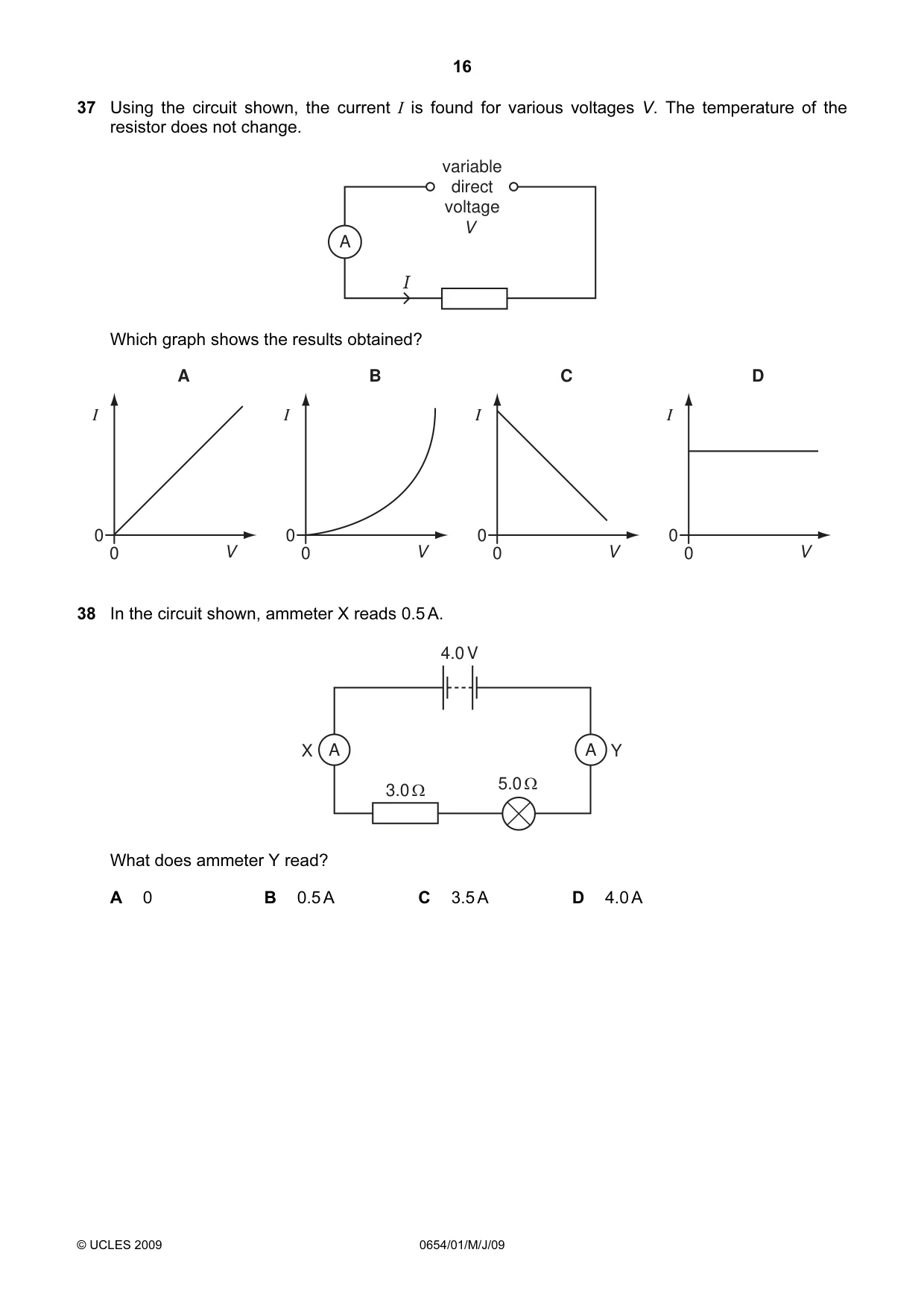
Q37 · Using the circuit shown, the current I is found for various voltages V
37 Using the circuit shown, the current I is found for various voltages V. The temperature of the resistor does not change. variable direct voltage V A I Which graph shows the results obtained? A B C D I I I I 0 0 0 0 0 V 0 V 0 V 0 V
Mark scheme: A
Q38 · In the circuit shown, ammeter X reads 0.5 A
38 In the circuit shown, ammeter X reads 0.5 A. 4.0 V X A A Y 3.0 Ω 5.0 Ω What does ammeter Y read? A 0 B 0.5 A C 3.5 A D 4.0 A
Mark scheme: B
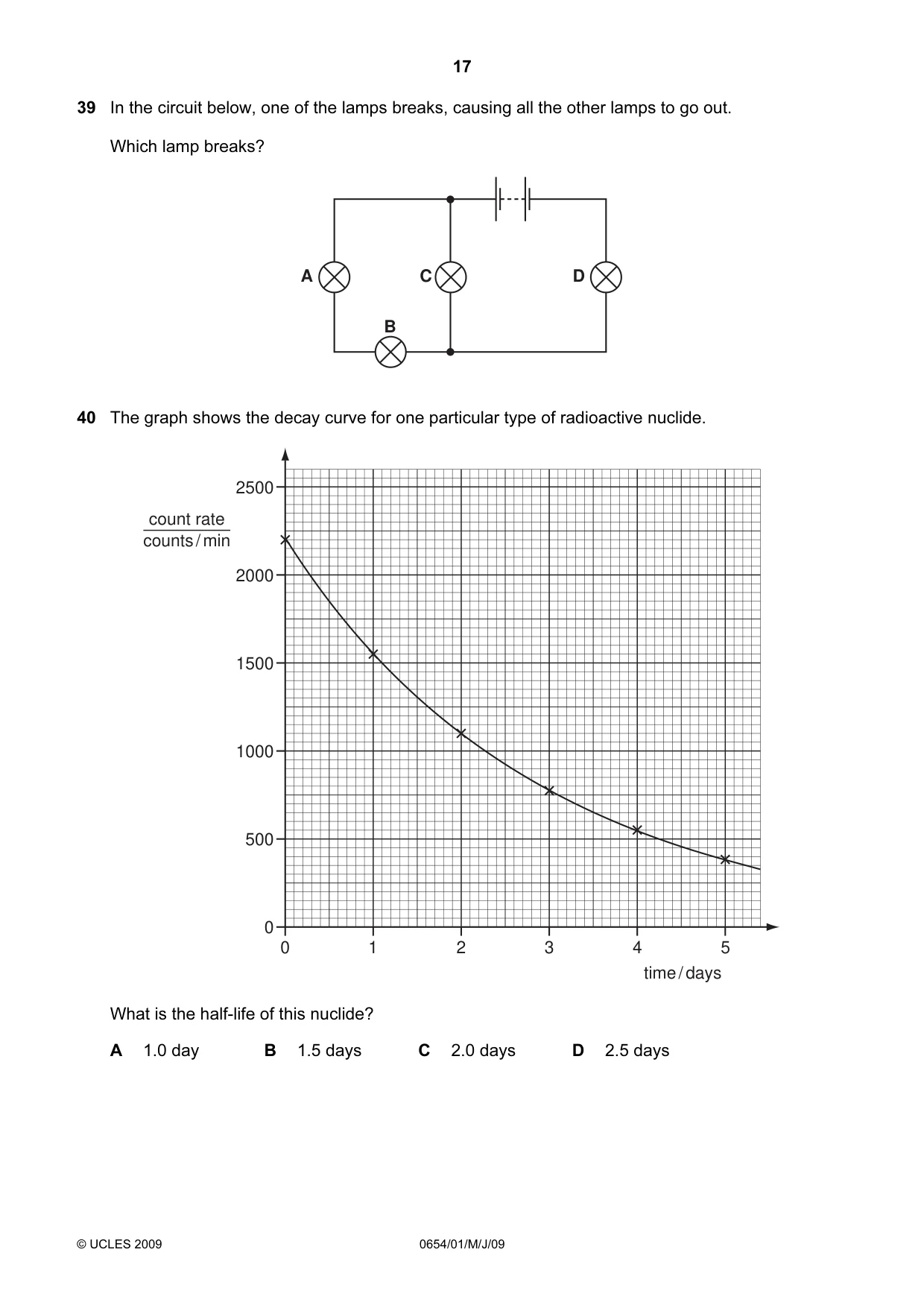
Q39 · In the circuit below, one of the lamps breaks, causing all the other lamps to go out
39 In the circuit below, one of the lamps breaks, causing all the other lamps to go out. Which lamp breaks? A C D B
Mark scheme: D
Q40 · The graph shows the decay curve for one particular type of radioactive nuclide
40 The graph shows the decay curve for one particular type of radioactive nuclide. 2500 count rate counts / min 2000 1500 1000 500 0 0 1 2 3 4 5 time / days What is the half-life of this nuclide? A 1.0 day B 1.5 days C 2.0 days D 2.5 days
Mark scheme: C
What was in this paper
The subtopics covered by these 40 questions, and how many questions each got. Open one in a new tab to see every Cambridge question on it.
2Electrolysis2Identification of ions and gases2Transfer of thermal energy2Biological molecules1Carbon cycle1Characteristics of living organisms1Density1Diet1Digestion1Drugs1Electrical quantities1Elements, compounds and mixtures1Energy, work and power1Enzymes1Food chains and food webs1Forces1Gas exchange in humans1General properties of waves1Homeostasis1Hormones1Kinetic particle model of matter1Light1Monohybrid inheritance1Motion1Osmosis1Oxides1Photosynthesis1Polymers1Preparation of salts1Radioactivity1Reactivity series1Sexual reproduction in plants1Simple molecules and covalent bonds1The characteristic properties of acids and bases1Water1What you needed in this session
Cambridge’s own grade thresholds for 2009 May/June, Paper 1 · Variant 1. A higher threshold means an easier paper — the bar moves with how the cohort did.