Cambridge IGCSE Sciences - Co-ordinated (Double) 0654 — 2016 Oct/Nov Paper 1 · Variant 3
0654/13/O/N/16 · 40 questions · 40 marks · ≈45 min
The question paper and its mark scheme, free to read here and free to download. This is Cambridge’s own paper, exactly as it was sat.
Question paper20 pages


Mark scheme2 pages
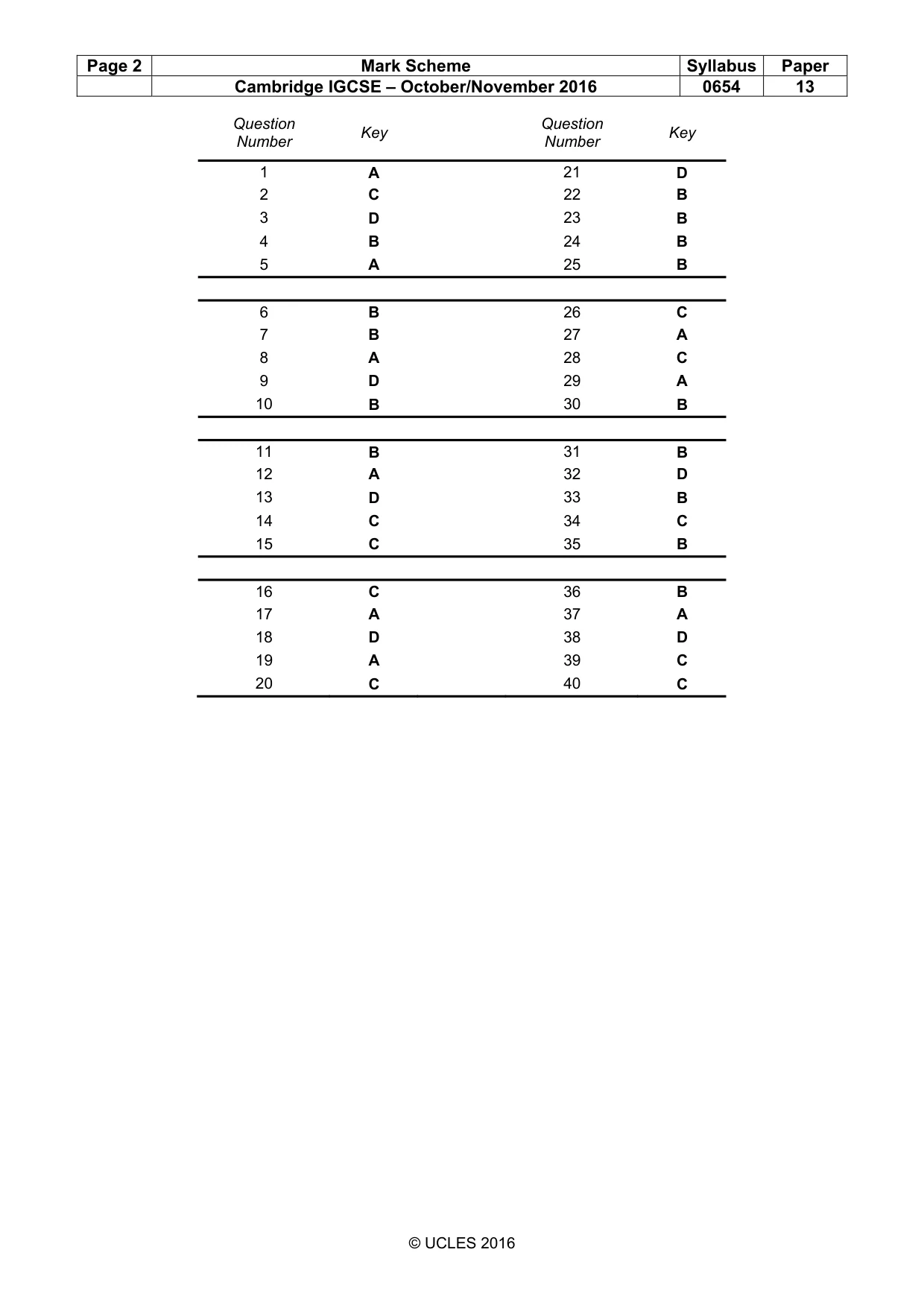
Answers below. Sit the paper first if you are practising.
Questions as text
Q1 · The diagram shows a plant cell
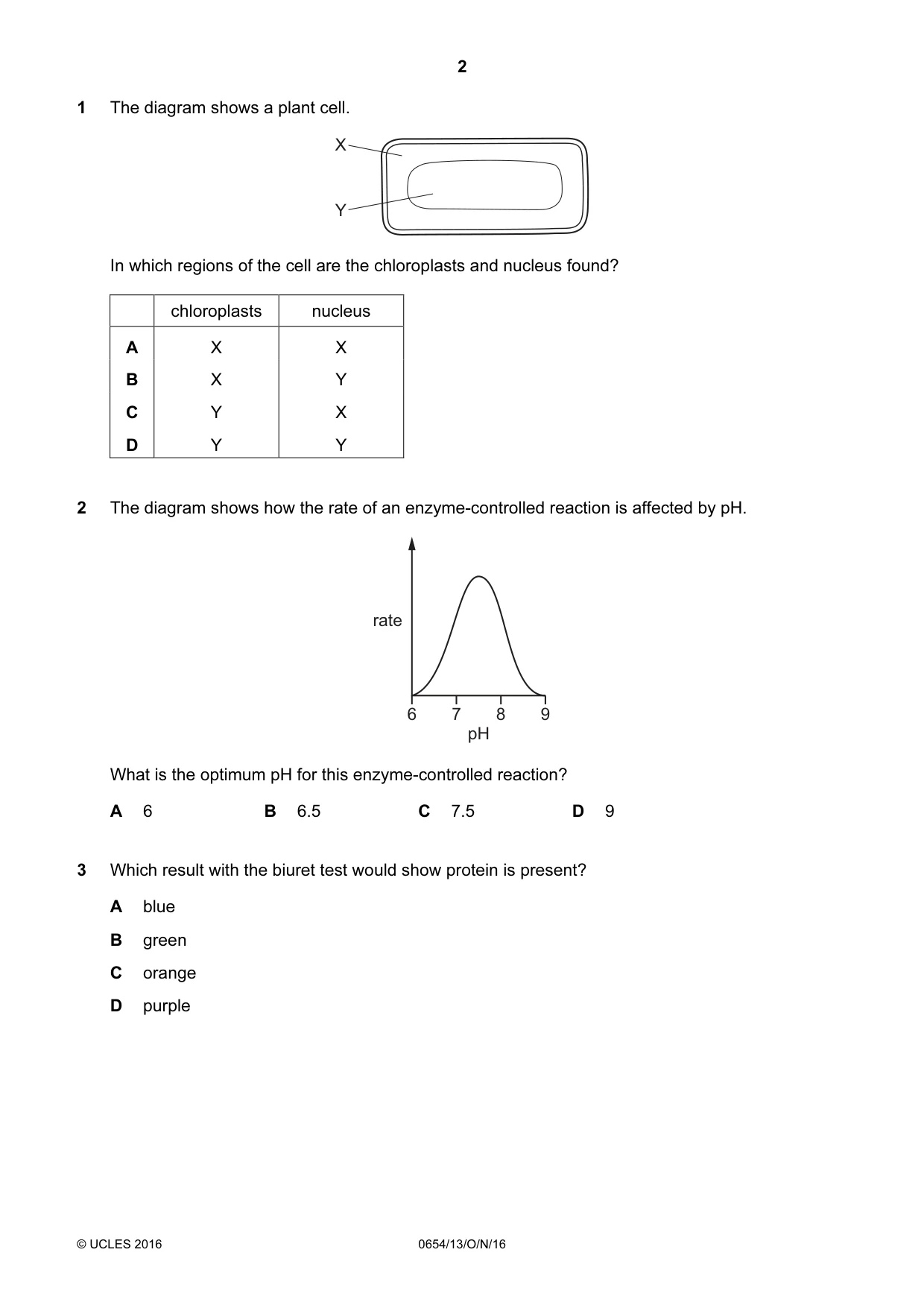
1 The diagram shows a plant cell. X Y In which regions of the cell are the chloroplasts and nucleus found? chloroplasts nucleus A X X B X Y C Y X D Y Y
Mark scheme: A
Q2 · The diagram shows how the rate of an enzyme-controlled reaction is affected by pH
2 The diagram shows how the rate of an enzyme-controlled reaction is affected by pH. rate 6 7 8 9 pH What is the optimum pH for this enzyme-controlled reaction? A 6 B 6.5 C 7.5 D 9
Mark scheme: C
Q3 · Which result with the biuret test would show protein is present?
3 Which result with the biuret test would show protein is present? A blue B green C orange D purple
Mark scheme: D
Q4 · The diagram shows a section through the human heart
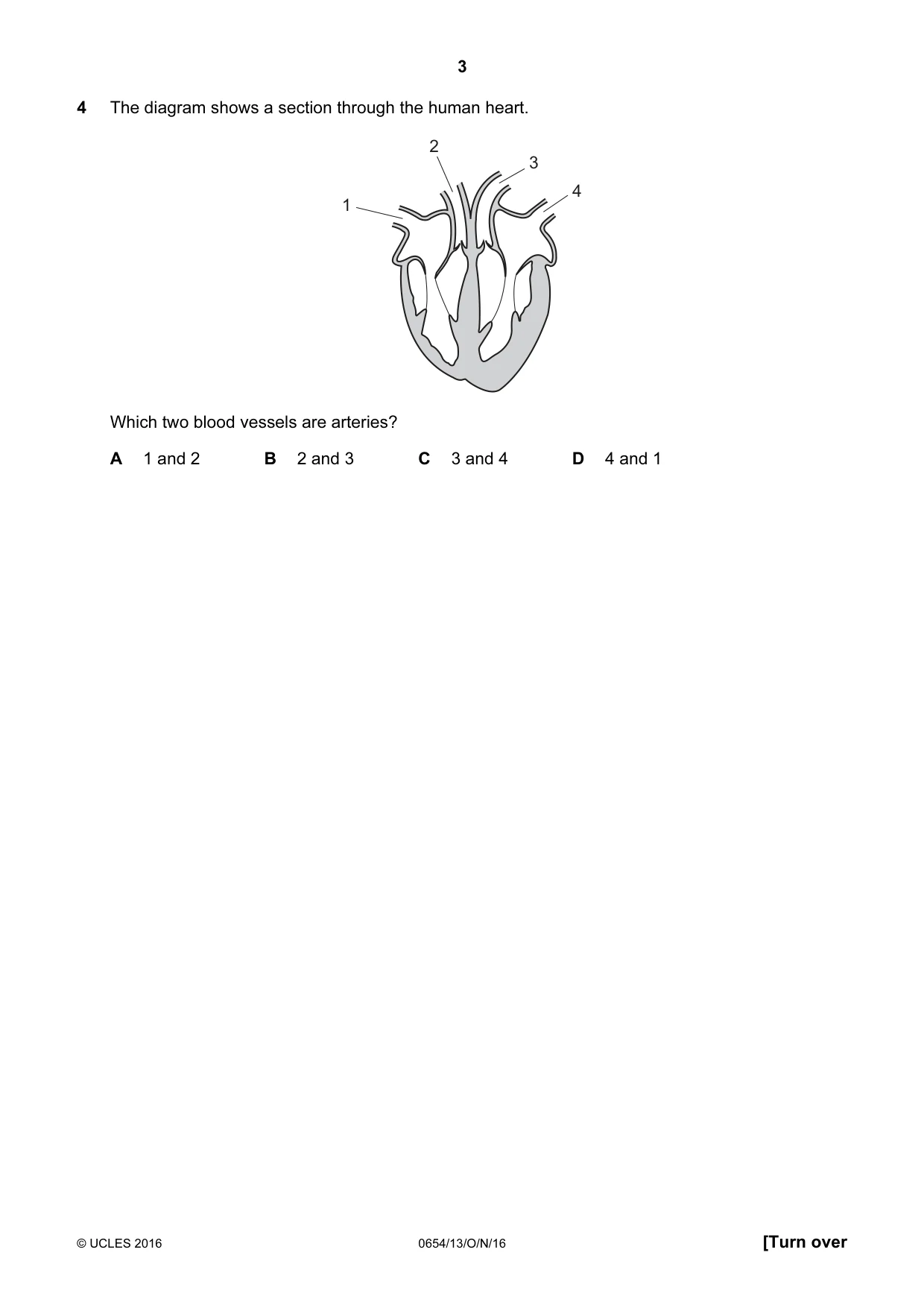
4 The diagram shows a section through the human heart. 2 3 4 1 Which two blood vessels are arteries? A 1 and 2 B 2 and 3 C 3 and 4 D 4 and 1
Mark scheme: B
Q5 · The diagram shows two stages in an experiment on water uptake in two shoots from the same…
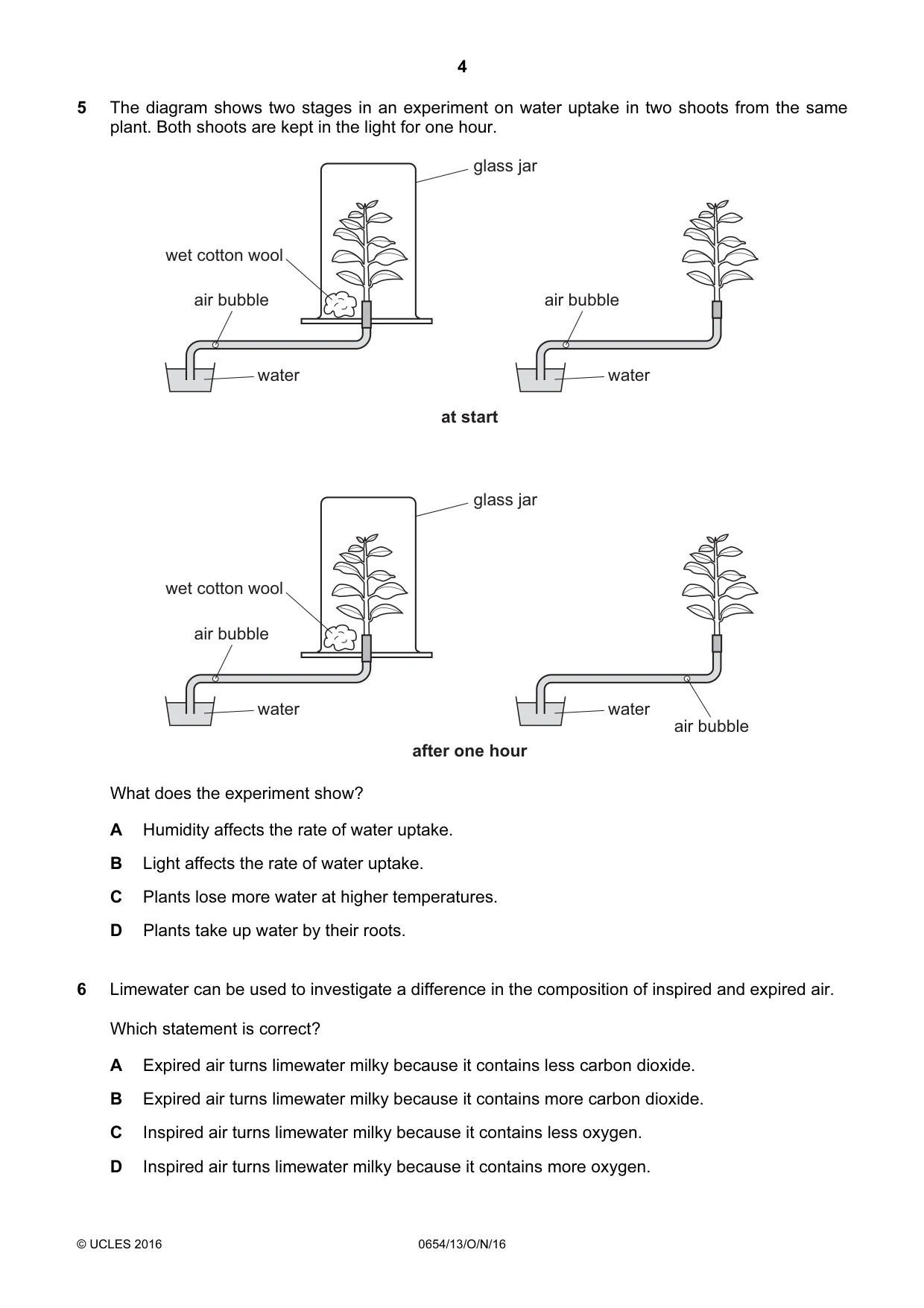
5 The diagram shows two stages in an experiment on water uptake in two shoots from the same plant. Both shoots are kept in the light for one hour. glass jar wet cotton wool air bubble air bubble water water at start glass jar wet cotton wool air bubble water water air bubble after one hour What does the experiment show? A Humidity affects the rate of water uptake. B Light affects the rate of water uptake. C Plants lose more water at higher temperatures. D Plants take up water by their roots.
Mark scheme: A
Q6 · Limewater can be used to investigate a difference in the composition of inspired and…
6 Limewater can be used to investigate a difference in the composition of inspired and expired air. Which statement is correct? A Expired air turns limewater milky because it contains less carbon dioxide. B Expired air turns limewater milky because it contains more carbon dioxide. C Inspired air turns limewater milky because it contains less oxygen. D Inspired air turns limewater milky because it contains more oxygen.
Mark scheme: B
Q7 · What could be measured to determine the rate of aerobic respiration of a plant?
7 What could be measured to determine the rate of aerobic respiration of a plant? A the rate of production of alcohol in the dark B the rate of production of carbon dioxide in the dark C the rate of production of glucose in the light D the rate of production of oxygen in the light
Mark scheme: B
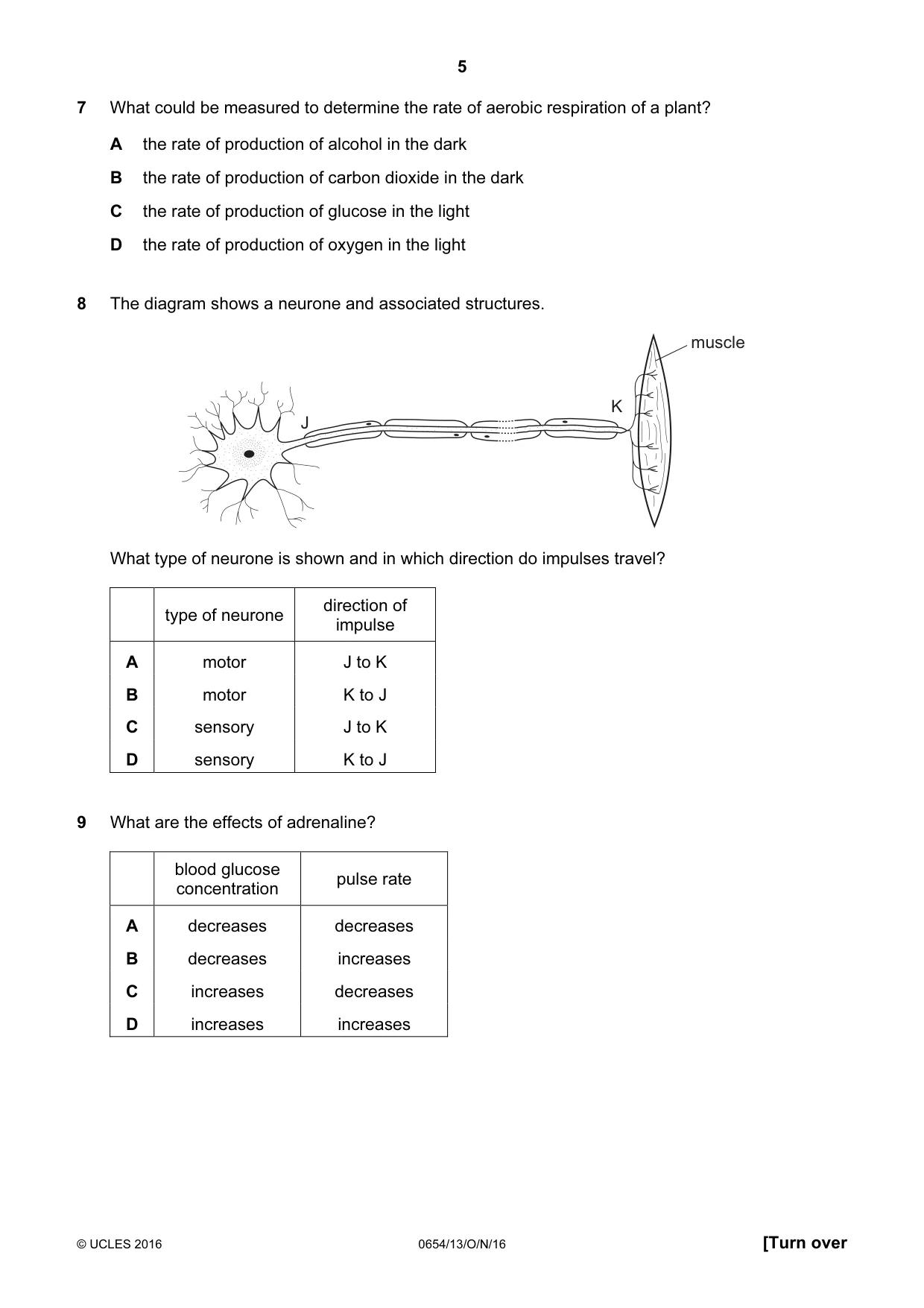
Q8 · The diagram shows a neurone and associated structures
8 The diagram shows a neurone and associated structures. muscle K J What type of neurone is shown and in which direction do impulses travel? direction of type of neurone impulse A motor J to K B motor K to J C sensory J to K D sensory K to J
Mark scheme: A
Q9 · What are the effects of adrenaline?
9 What are the effects of adrenaline? blood glucose pulse rate concentration A decreases decreases B decreases increases C increases decreases D increases increases
Mark scheme: D
Q10 · In a human female, where is the egg usually fertilised?
10 In a human female, where is the egg usually fertilised? A ovary B oviduct C uterus D vagina
Mark scheme: B
Q11 · Which aspect of human reproduction defines it as sexual reproduction?
11 Which aspect of human reproduction defines it as sexual reproduction? A A man and woman must have sexual intercourse to produce a baby naturally. B Genetic material from each parent combines to produce a zygote. C Human babies are naturally fed on breast milk. D Young women have menstrual periods when they are not pregnant.
Mark scheme: B
Q12 · The diagram shows a food chain
12 The diagram shows a food chain. Which organisms pass the greatest amount of energy along the food chain? A B C D shrubs insects birds mammals
Mark scheme: A
Q13 · Which natural resource is renewable?
13 Which natural resource is renewable? A coal B natural gas C oil D wood
Mark scheme: D
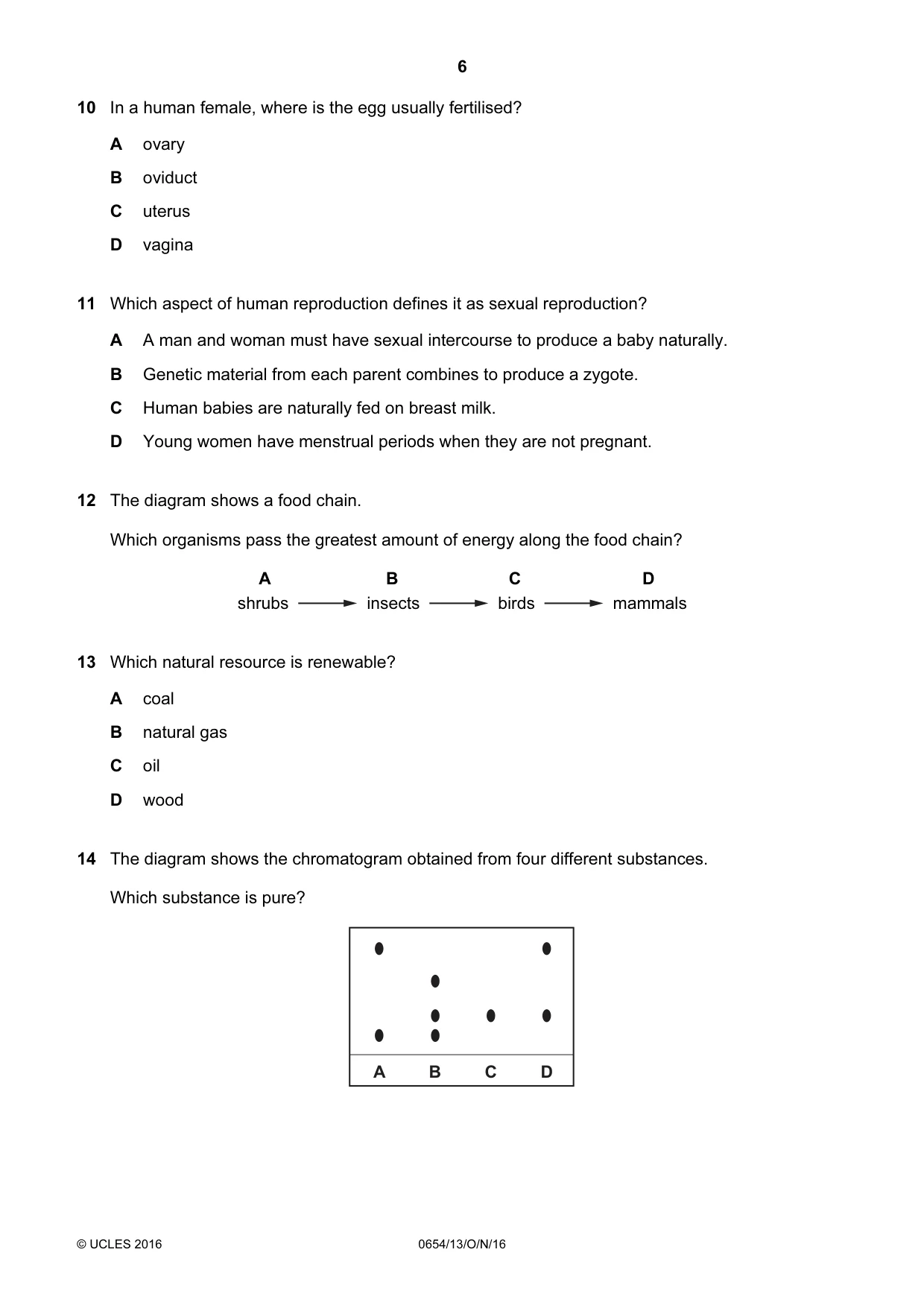
Q14 · The diagram shows the chromatogram obtained from four different substances
14 The diagram shows the chromatogram obtained from four different substances. Which substance is pure? A B C D
Mark scheme: C
Q15 · Which statements about atomic structure are correct?
15 Which statements about atomic structure are correct? 1 A neutron is a particle with negligible mass. 2 The nucleus is at the centre of the atom and contains only protons and neutrons. 3 The nucleon number is the total number of protons and neutrons in an atom. A 1 and 2 only B 1 and 3 only C 2 and 3 only D 1, 2 and 3
Mark scheme: C
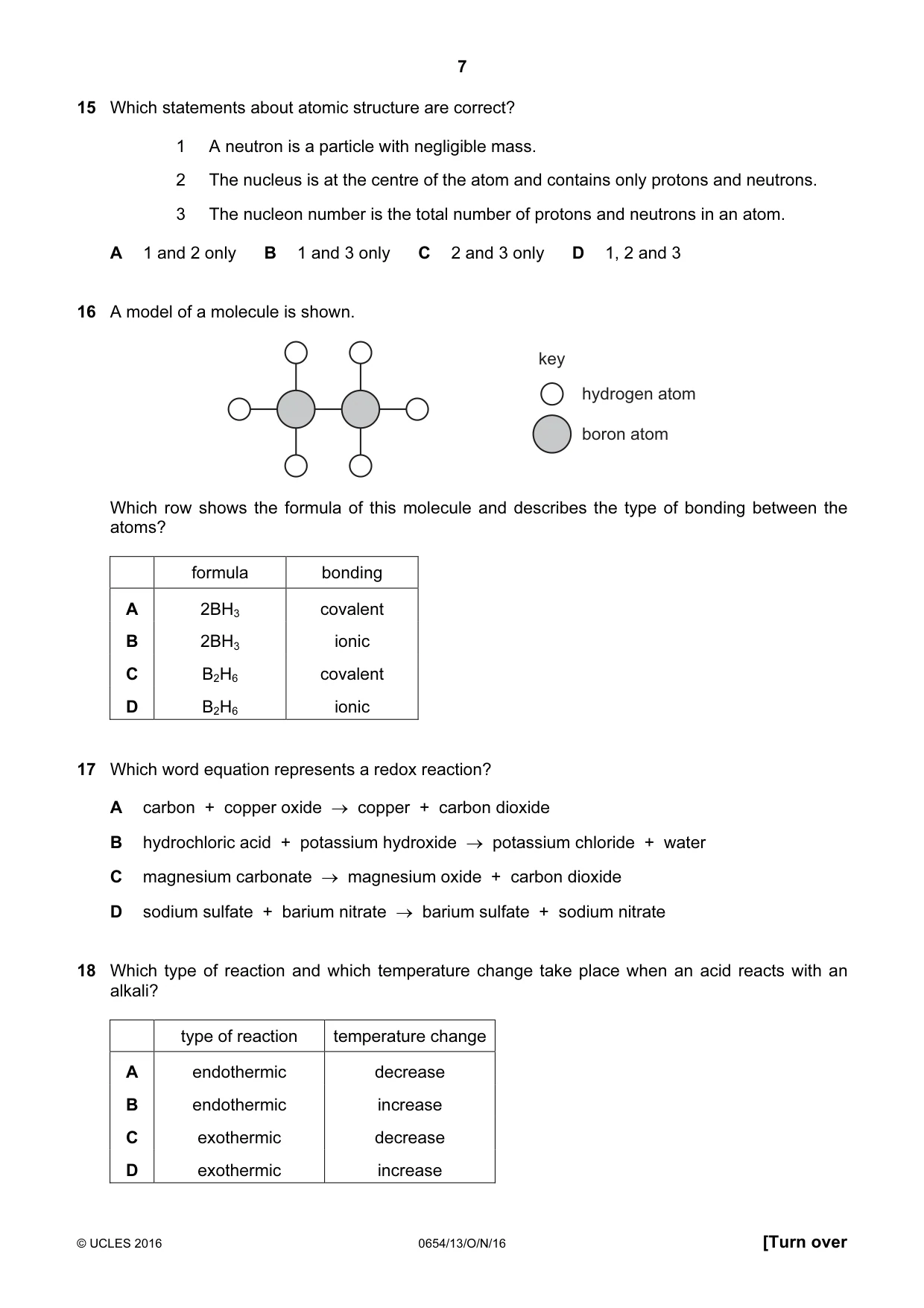
Q16 · A model of a molecule is shown
16 A model of a molecule is shown. key hydrogen atom boron atom Which row shows the formula of this molecule and describes the type of bonding between the atoms? formula bonding A 2BH3 covalent B 2BH3 ionic C B2H6 covalent D B2H6 ionic
Mark scheme: C
Q17 · Which word equation represents a redox reaction?
17 Which word equation represents a redox reaction? A carbon + copper oxide → copper + carbon dioxide B hydrochloric acid + potassium hydroxide → potassium chloride + water C magnesium carbonate → magnesium oxide + carbon dioxide D sodium sulfate + barium nitrate → barium sulfate + sodium nitrate
Mark scheme: A
Q18 · Which type of reaction and which temperature change take place when an acid reacts with…
18 Which type of reaction and which temperature change take place when an acid reacts with an alkali? type of reaction temperature change A endothermic decrease B endothermic increase C exothermic decrease D exothermic increase
Mark scheme: D
Q19 · Which products are formed when dilute sulfuric acid is electrolysed using inert…
19 Which products are formed when dilute sulfuric acid is electrolysed using inert electrodes? A hydrogen and oxygen B hydrogen and sulfur C hydrogen and sulfur dioxide D oxygen and sulfur dioxide
Mark scheme: A
Q20 · A piece of magnesium ribbon is placed in dilute hydrochloric acid
20 A piece of magnesium ribbon is placed in dilute hydrochloric acid. The magnesium reacts and bubbles of a colourless gas are formed. What is the word equation for this reaction? A magnesium + hydrochloric acid → magnesium chloride + carbon dioxide B magnesium + hydrochloric acid → magnesium chloride + carbon dioxide + water C magnesium + hydrochloric acid → magnesium chloride + hydrogen D magnesium + hydrochloric acid → magnesium chloride + hydrogen + water
Mark scheme: C
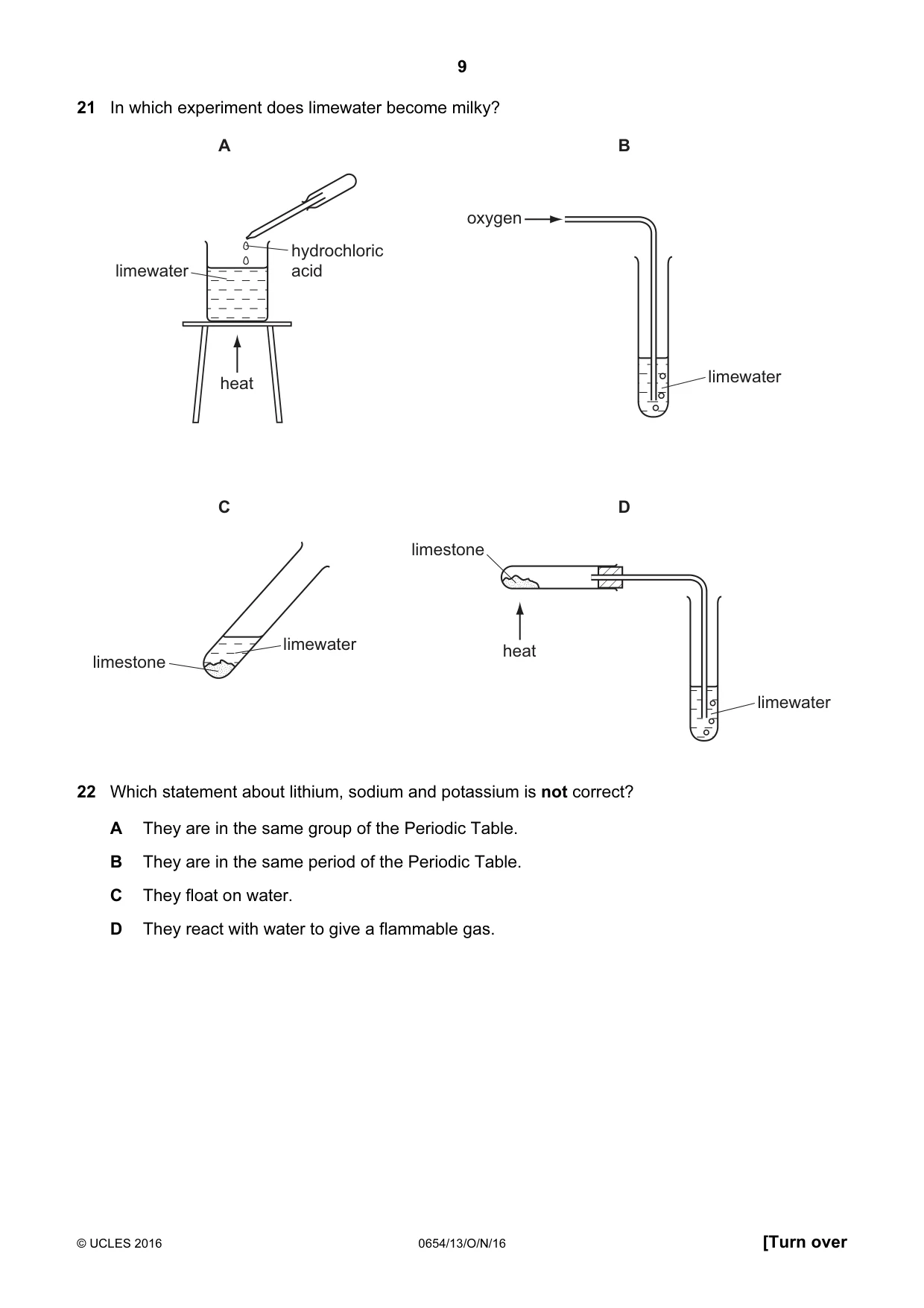
Q21 · In which experiment does limewater become milky?
21 In which experiment does limewater become milky? A B oxygen hydrochloric limewater acid heat limewater C D limestone limewater heat limestone limewater
Mark scheme: D
Q22 · Which statement about lithium, sodium and potassium is not correct?
22 Which statement about lithium, sodium and potassium is not correct? A They are in the same group of the Periodic Table. B They are in the same period of the Periodic Table. C They float on water. D They react with water to give a flammable gas.
Mark scheme: B
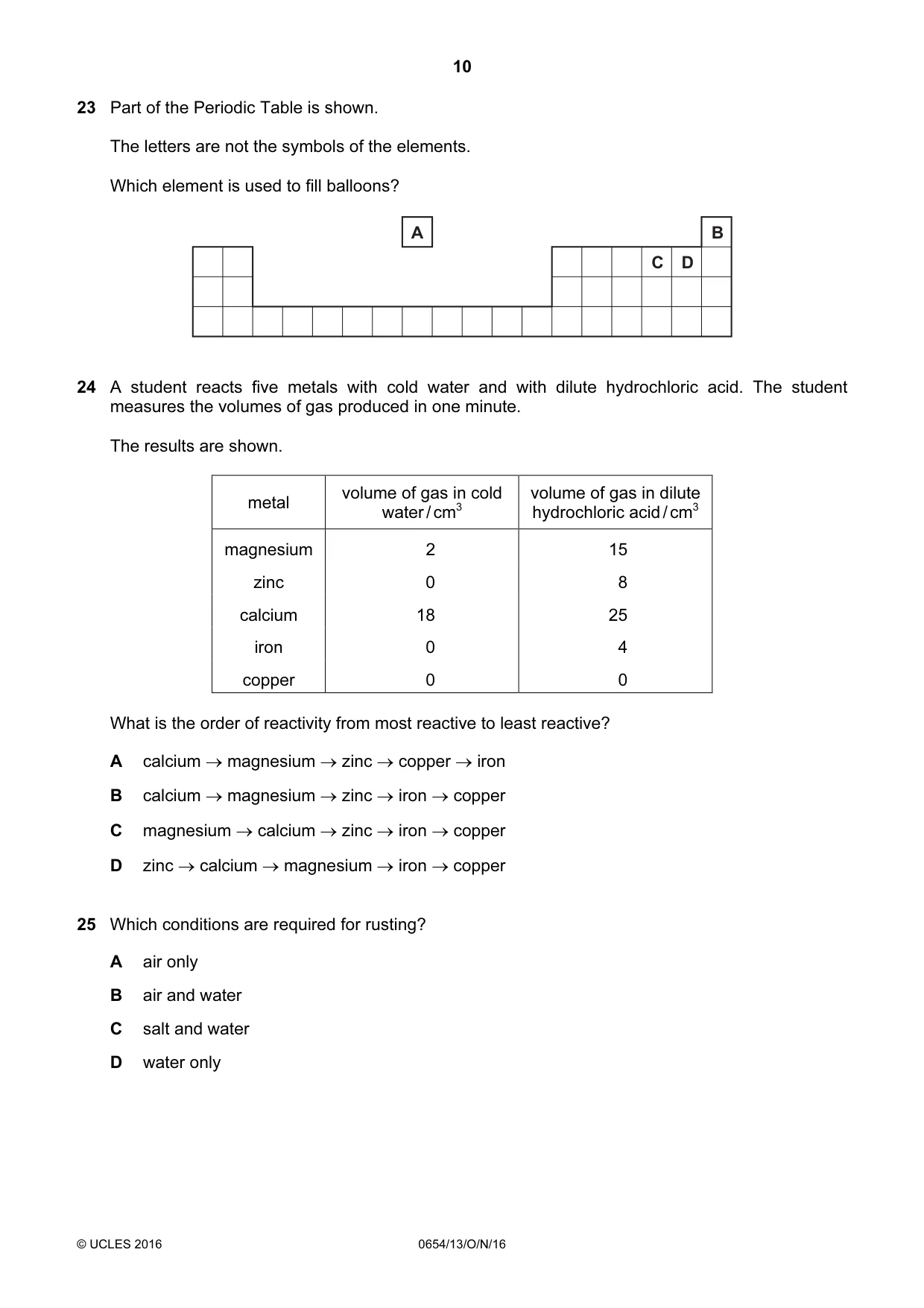
Q23 · Part of the Periodic Table is shown
23 Part of the Periodic Table is shown. The letters are not the symbols of the elements. Which element is used to fill balloons? A B C D
Mark scheme: B
Q24 · A student reacts five metals with cold water and with dilute hydrochloric acid
24 A student reacts five metals with cold water and with dilute hydrochloric acid. The student measures the volumes of gas produced in one minute. The results are shown. volume of gas in cold volume of gas in dilute metal water / cm3 hydrochloric acid / cm3 magnesium 2 15 zinc 0 8 calcium 18 25 iron 0 4 copper 0 0 What is the order of reactivity from most reactive to least reactive? A calcium → magnesium → zinc → copper → iron B calcium → magnesium → zinc → iron → copper C magnesium → calcium → zinc → iron → copper D zinc → calcium → magnesium → iron → copper
Mark scheme: B
Q25 · Which conditions are required for rusting?
25 Which conditions are required for rusting? A air only B air and water C salt and water D water only
Mark scheme: B
Q26 · Lime is manufactured from limestone
26 Lime is manufactured from limestone. limestone → lime + carbon dioxide The limestone undergoes ......1...... during the reaction. The chemical name for lime is ......2...... . Lime is used to treat ......3...... industrial waste. Which words complete gaps 1, 2 and 3? 1 2 3 A reduction calcium oxide acidic B thermal decomposition calcium carbonate acidic C thermal decomposition calcium oxide acidic D thermal decomposition calcium oxide basic
Mark scheme: C
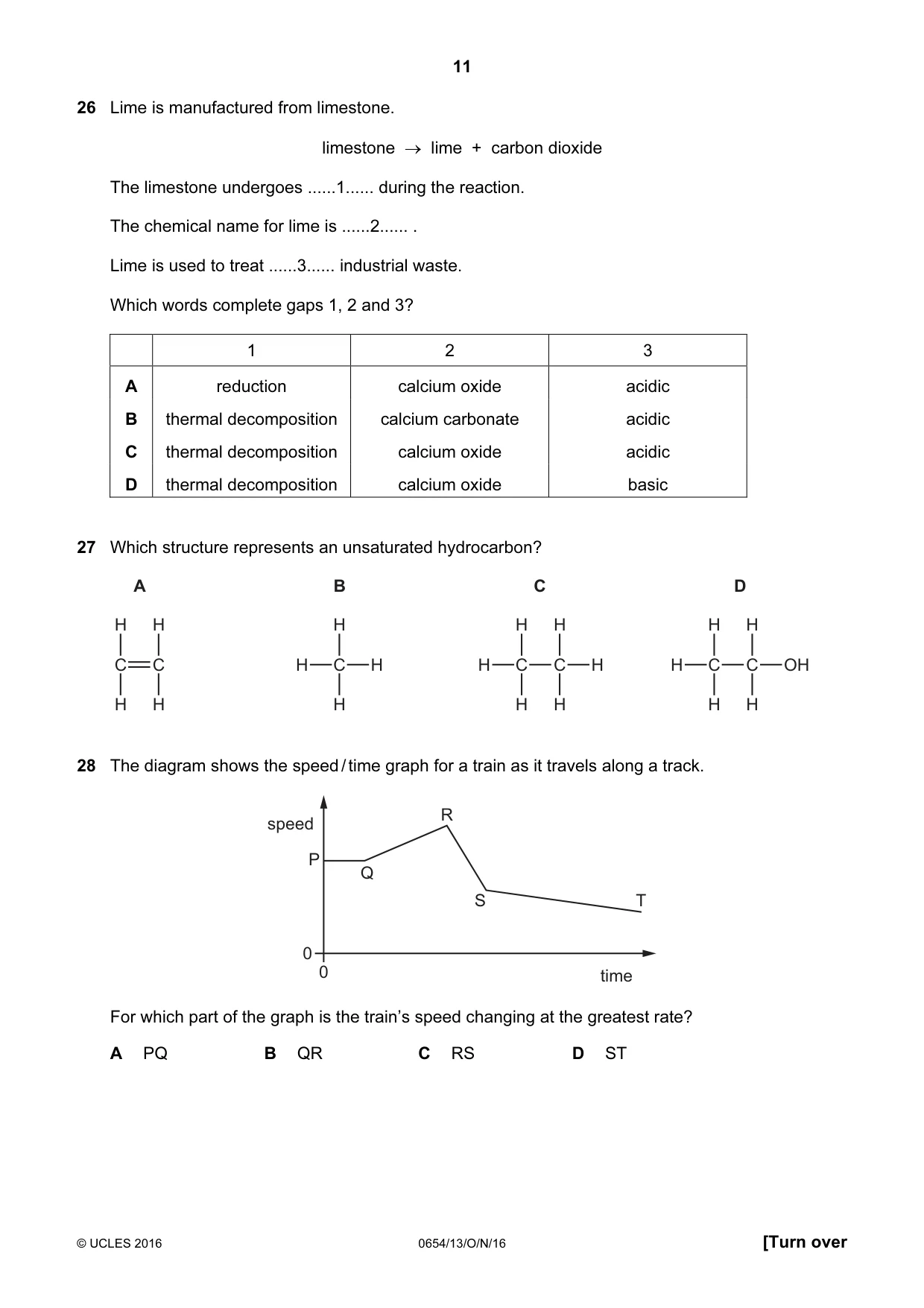
Q27 · Which structure represents an unsaturated hydrocarbon?
27 Which structure represents an unsaturated hydrocarbon? A B C D H H H H H H H C C H C H H C C H H C C OH H H H H H H H
Mark scheme: A
Q28 · The diagram shows the speed / time graph for a train as it travels along a track
28 The diagram shows the speed / time graph for a train as it travels along a track. R speed P Q S T 0 0 time For which part of the graph is the train’s speed changing at the greatest rate? A PQ B QR C RS D ST
Mark scheme: C
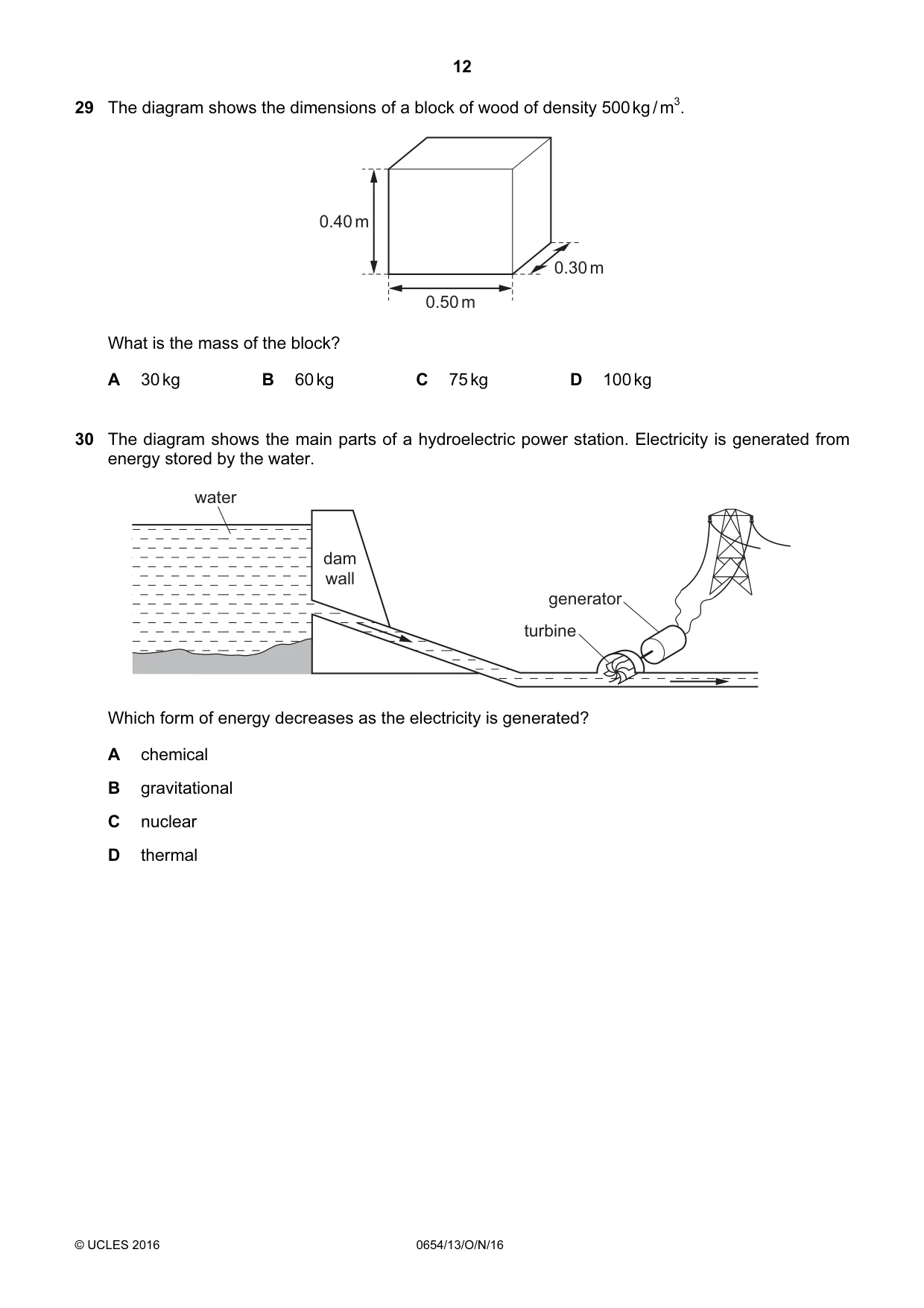
Q29 · The diagram shows the dimensions of a block of wood of density 500 kg / m3
29 The diagram shows the dimensions of a block of wood of density 500 kg / m3. 0.40 m 0.30 m 0.50 m What is the mass of the block? A 30 kg B 60 kg C 75 kg D 100 kg
Mark scheme: A
Q30 · The diagram shows the main parts of a hydroelectric power station
30 The diagram shows the main parts of a hydroelectric power station. Electricity is generated from energy stored by the water. water dam wall generator turbine Which form of energy decreases as the electricity is generated? A chemical B gravitational C nuclear D thermal
Mark scheme: B
Q31 · The diagram shows a bridge on a cold day
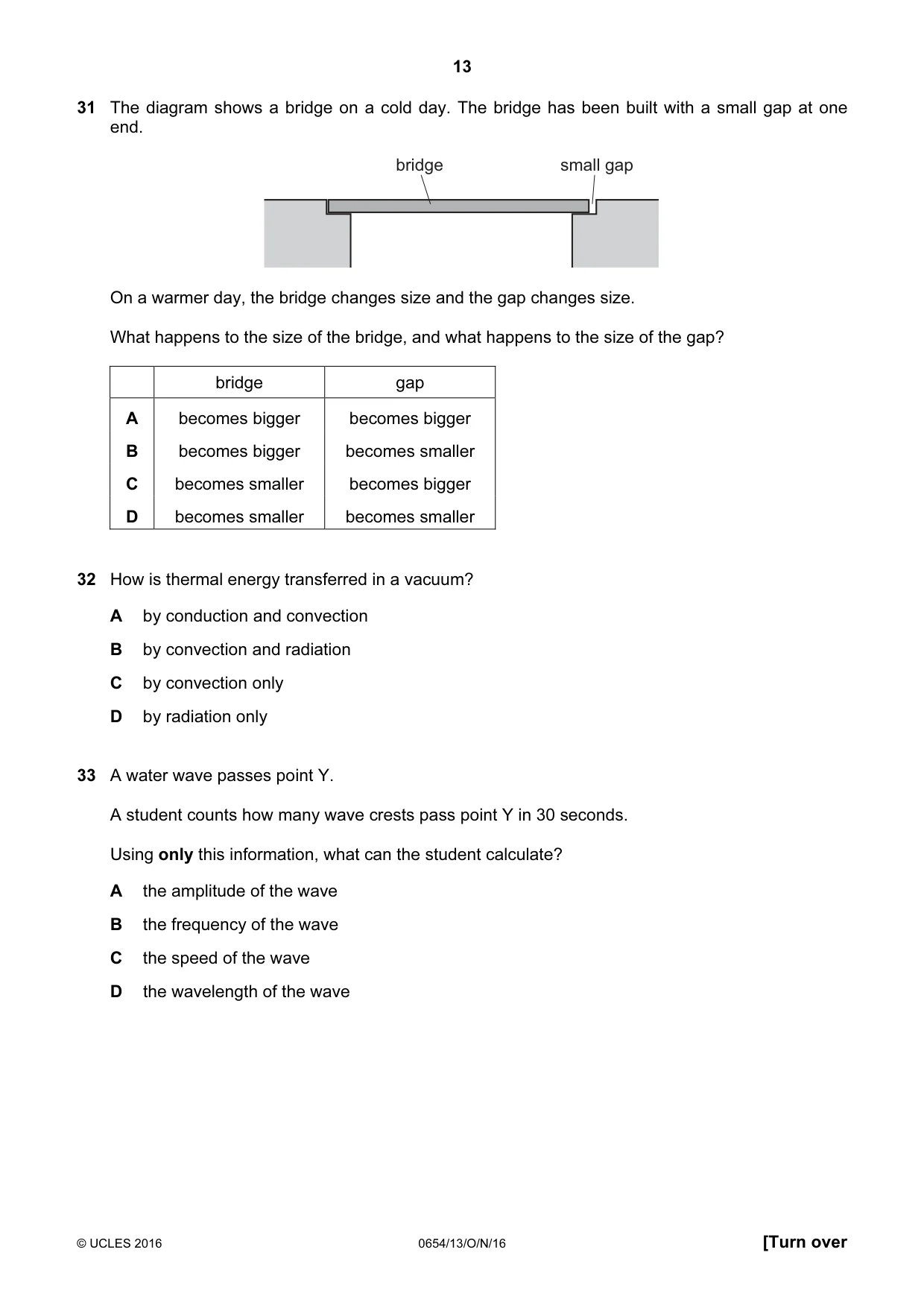
31 The diagram shows a bridge on a cold day. The bridge has been built with a small gap at one end. bridge small gap On a warmer day, the bridge changes size and the gap changes size. What happens to the size of the bridge, and what happens to the size of the gap? bridge gap A becomes bigger becomes bigger B becomes bigger becomes smaller C becomes smaller becomes bigger D becomes smaller becomes smaller
Mark scheme: B
Q32 · How is thermal energy transferred in a vacuum?
32 How is thermal energy transferred in a vacuum? A by conduction and convection B by convection and radiation C by convection only D by radiation only
Mark scheme: D
Q33 · A water wave passes point Y
33 A water wave passes point Y. A student counts how many wave crests pass point Y in 30 seconds. Using only this information, what can the student calculate? A the amplitude of the wave B the frequency of the wave C the speed of the wave D the wavelength of the wave
Mark scheme: B
Q34 · A converging lens in a projector is used to make an enlarged (magnified) image of an…
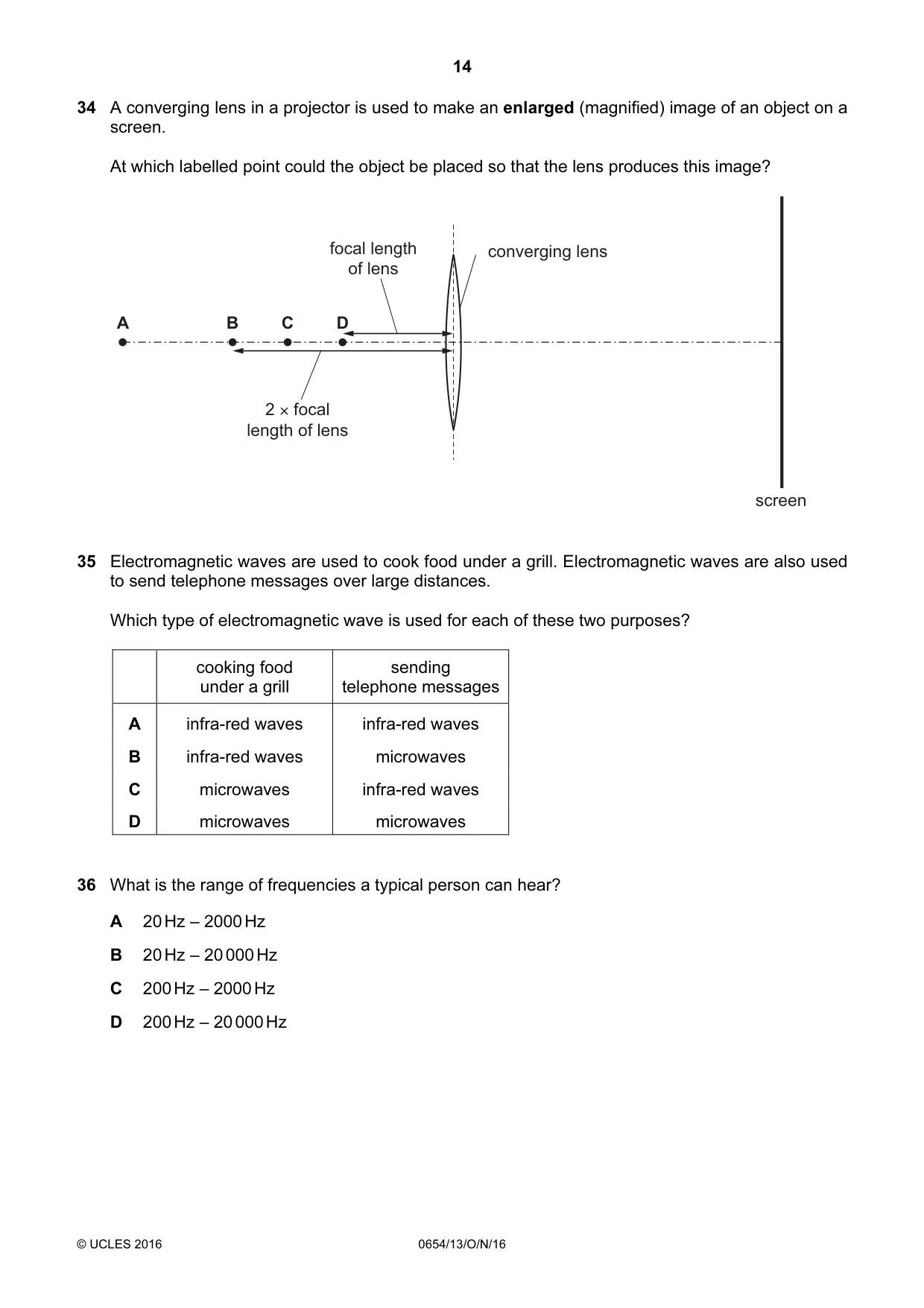
34 A converging lens in a projector is used to make an enlarged (magnified) image of an object on a screen. At which labelled point could the object be placed so that the lens produces this image? focal length converging lens of lens A B C D 2 × focal length of lens screen
Mark scheme: C
Q35 · Electromagnetic waves are used to cook food under a grill
35 Electromagnetic waves are used to cook food under a grill. Electromagnetic waves are also used to send telephone messages over large distances. Which type of electromagnetic wave is used for each of these two purposes? cooking food sending under a grill telephone messages A infra-red waves infra-red waves B infra-red waves microwaves C microwaves infra-red waves D microwaves microwaves
Mark scheme: B
Q36 · What is the range of frequencies a typical person can hear?
36 What is the range of frequencies a typical person can hear? A 20 Hz – 2000 Hz B 20 Hz – 20 000 Hz C 200 Hz – 2000 Hz D 200 Hz – 20 000 Hz
Mark scheme: B
Q37 · The diagram shows a battery connected to a 0.50 Ω resistor and an ammeter
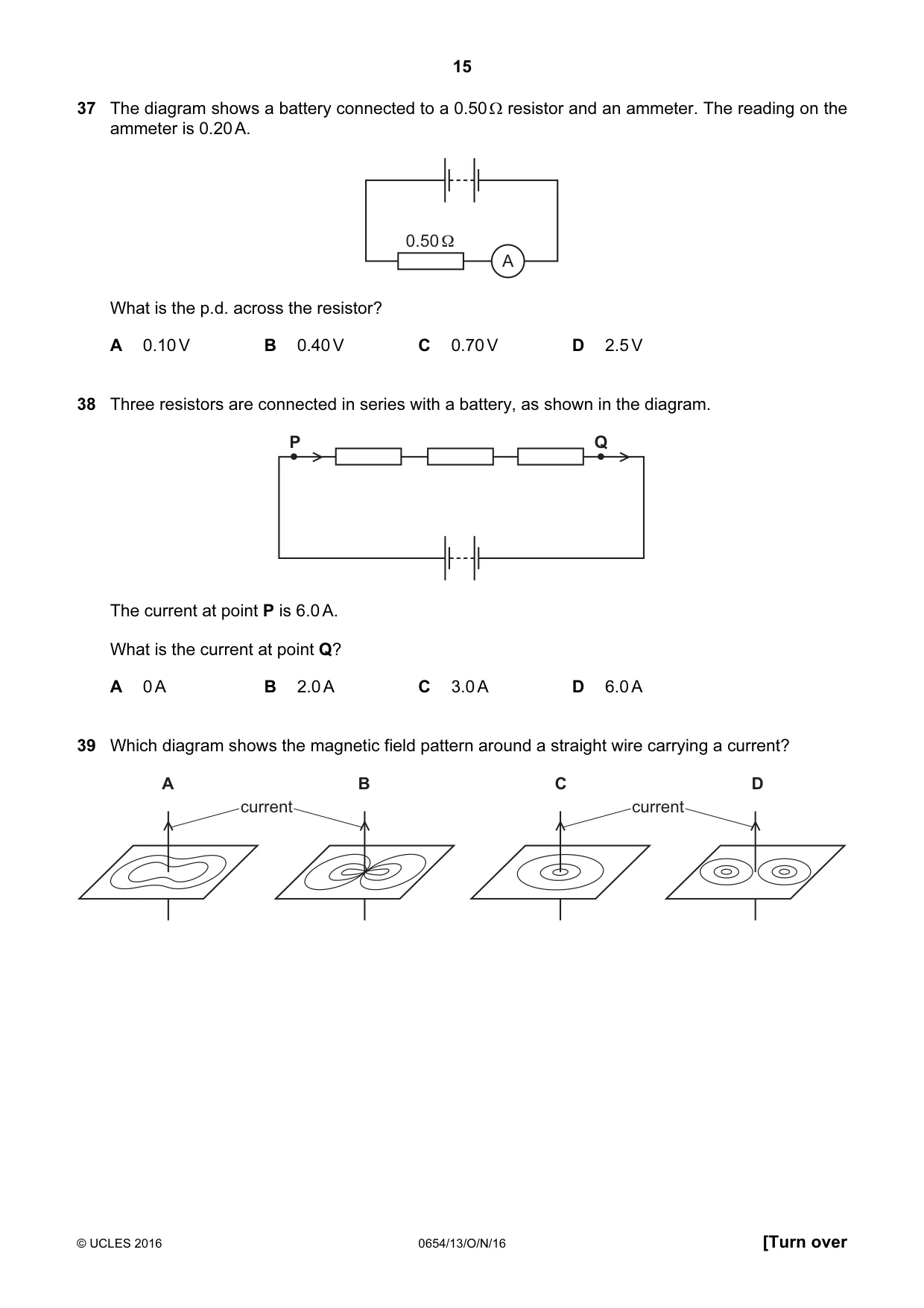
37 The diagram shows a battery connected to a 0.50 Ω resistor and an ammeter. The reading on the ammeter is 0.20 A. 0.50 Ω A What is the p.d. across the resistor? A 0.10 V B 0.40 V C 0.70 V D 2.5 V
Mark scheme: A
Q38 · Three resistors are connected in series with a battery, as shown in the diagram
38 Three resistors are connected in series with a battery, as shown in the diagram. P Q The current at point P is 6.0 A. What is the current at point Q? A 0 A B 2.0 A C 3.0 A D 6.0 A
Mark scheme: D
Q39 · Which diagram shows the magnetic field pattern around a straight wire carrying a current?
39 Which diagram shows the magnetic field pattern around a straight wire carrying a current? A B C D current current
Mark scheme: C
Q40 · The diagrams represent the nuclei of four different atoms V, W, X and Y
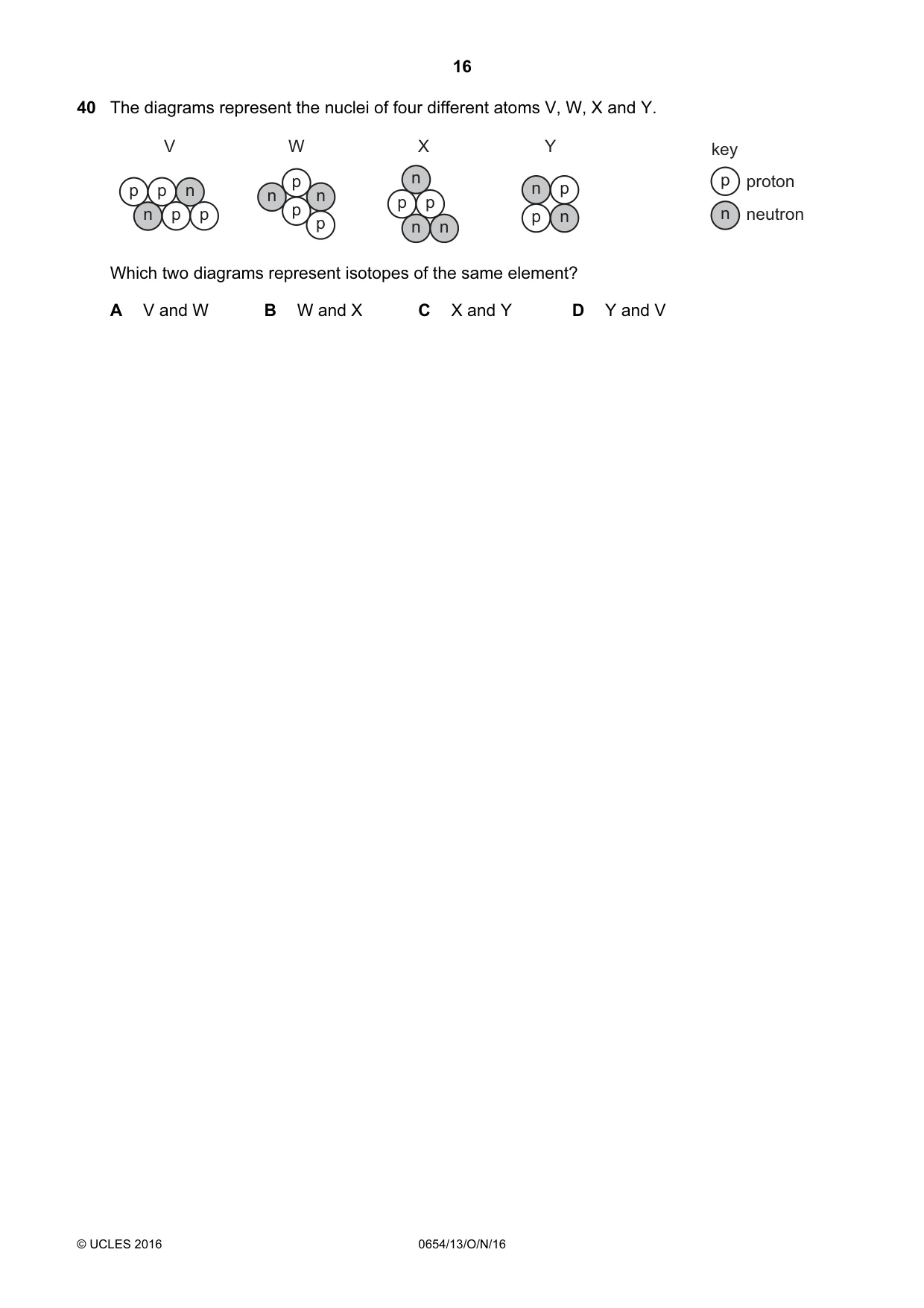
40 The diagrams represent the nuclei of four different atoms V, W, X and Y. V W X Y key p n p proton p p n n n n p p p p n p p p n n neutron p n n Which two diagrams represent isotopes of the same element? A V and W B W and X C X and Y D Y and V
Mark scheme: C
What was in this paper
The subtopics covered by these 40 questions, and how many questions each got. Open one in a new tab to see every Cambridge question on it.
2Alkenes1Atomic structure and the Periodic Table1Biological molecules1Blood vessels1Cell structure1Chromatography1Conservation1Coordination and response1Corrosion of metals1Density1Electrical circuits1Electrical quantities1Electrolysis1Electromagnetic spectrum1Energy, work and power1Enzymes1Exothermic and endothermic reactions1Food chains and food webs1Gas exchange in humans1General properties of waves1Group I properties1Hormones1Identification of ions and gases1Isotopes1Light1Motion1Noble gases1Oxides1Redox1Respiration1Sexual reproduction1Sexual reproduction in humans1Simple molecules and covalent bonds1Simple phenomena of magnetism1Sound1Thermal properties and temperature1Transfer of thermal energy1Transpiration1What you needed in this session
Cambridge’s own grade thresholds for 2016 Oct/Nov, Paper 1 · Variant 3. A higher threshold means an easier paper — the bar moves with how the cohort did.