Cambridge IGCSE Sciences - Co-ordinated (Double) 0654 — 2025 May/June Paper 1 · Variant 2
0654/12/M/J/25 · 40 questions · 40 marks · 45 min
The question paper and its mark scheme, free to read here and free to download. This is Cambridge’s own paper, exactly as it was sat.
Question paper16 pages
Mark scheme3 pages
Answers below. Sit the paper first if you are practising.
Questions as text
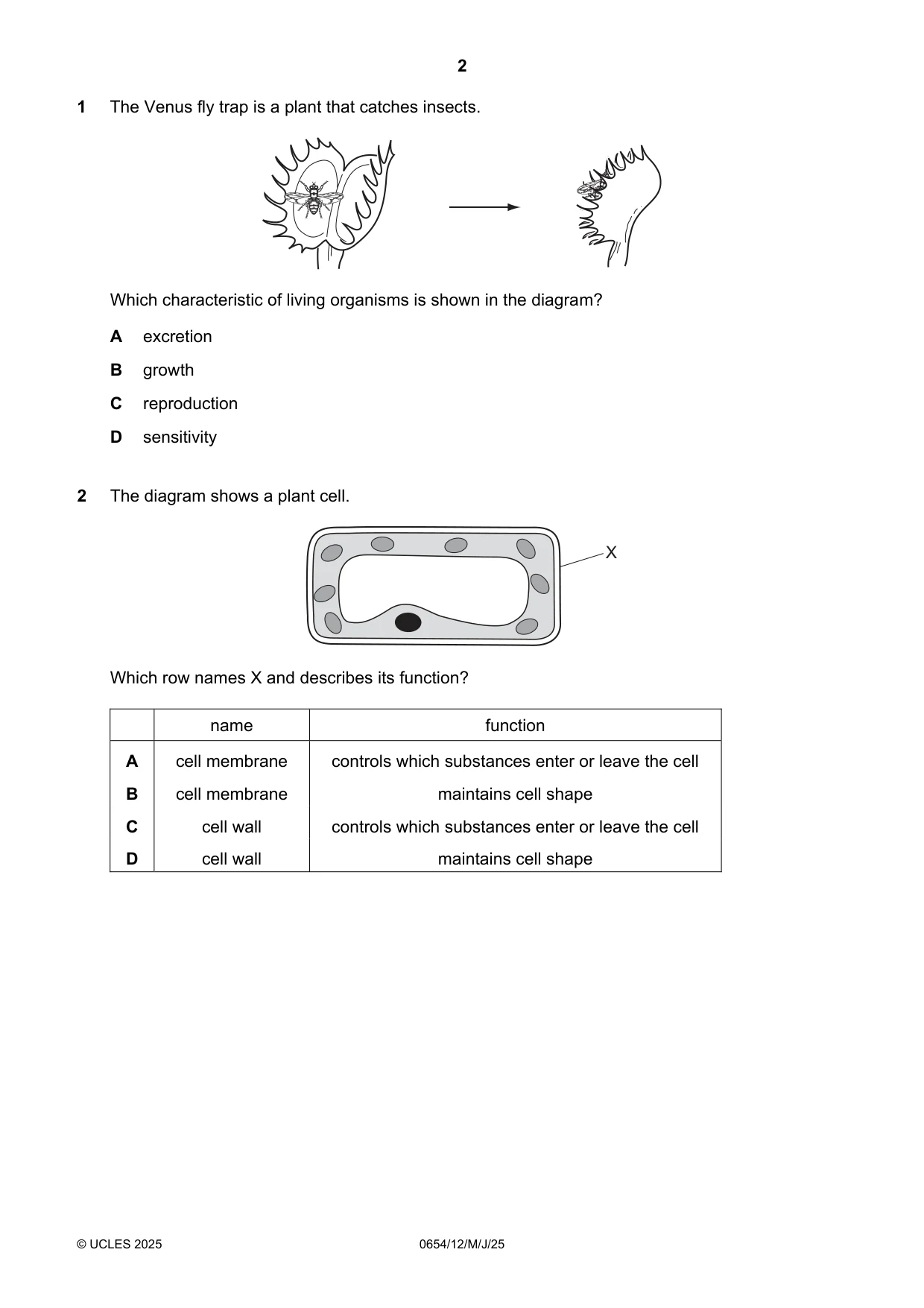
Q1 · The Venus fly trap is a plant that catches insects
1 The Venus fly trap is a plant that catches insects. Which characteristic of living organisms is shown in the diagram? A excretion B growth C reproduction D sensitivity
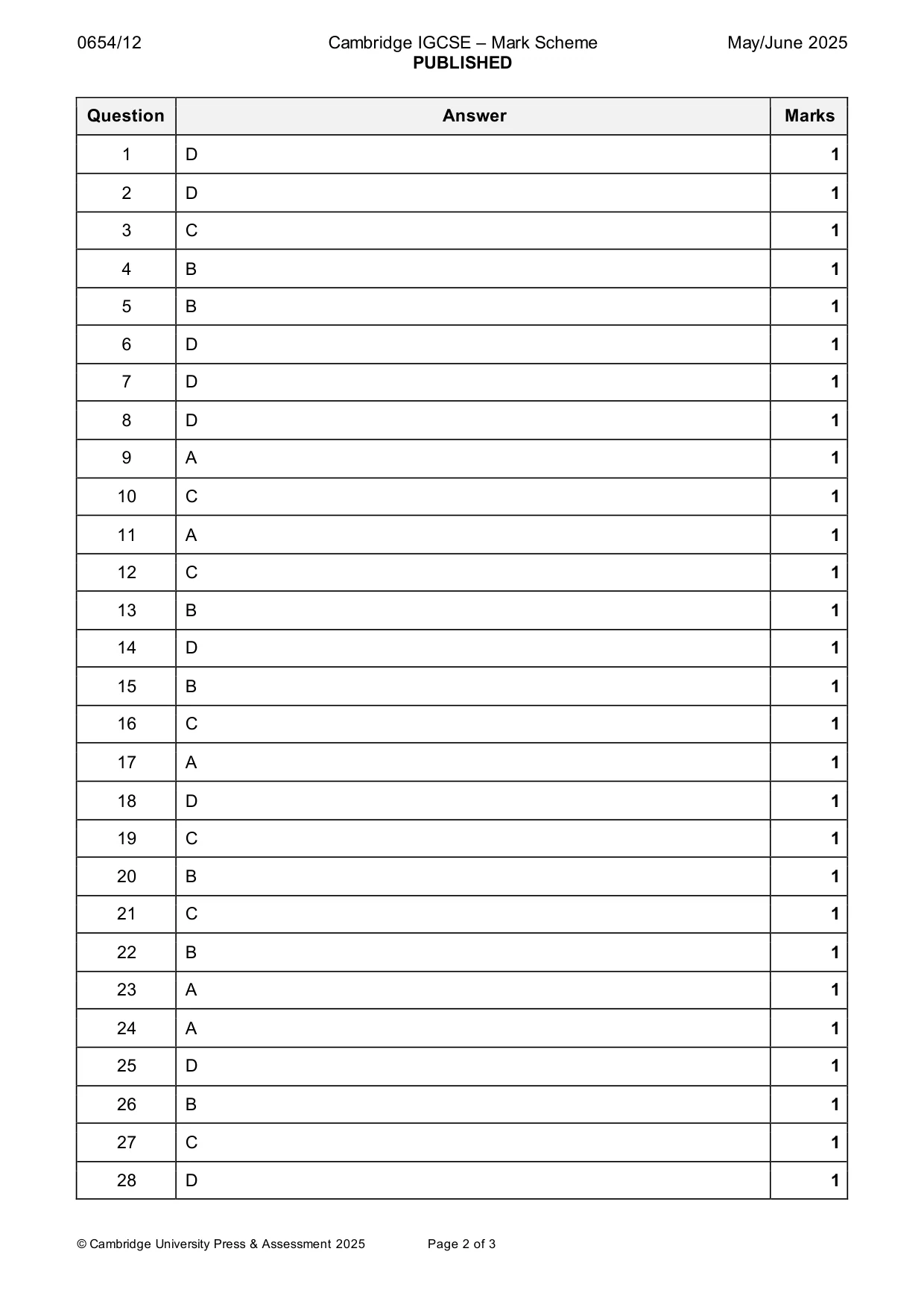
Mark scheme: D
Q2 · The diagram shows a plant cell
2 The diagram shows a plant cell. X Which row names X and describes its function? name function A cell membrane controls which substances enter or leave the cell B cell membrane maintains cell shape C cell wall controls which substances enter or leave the cell D cell wall maintains cell shape
Mark scheme: D
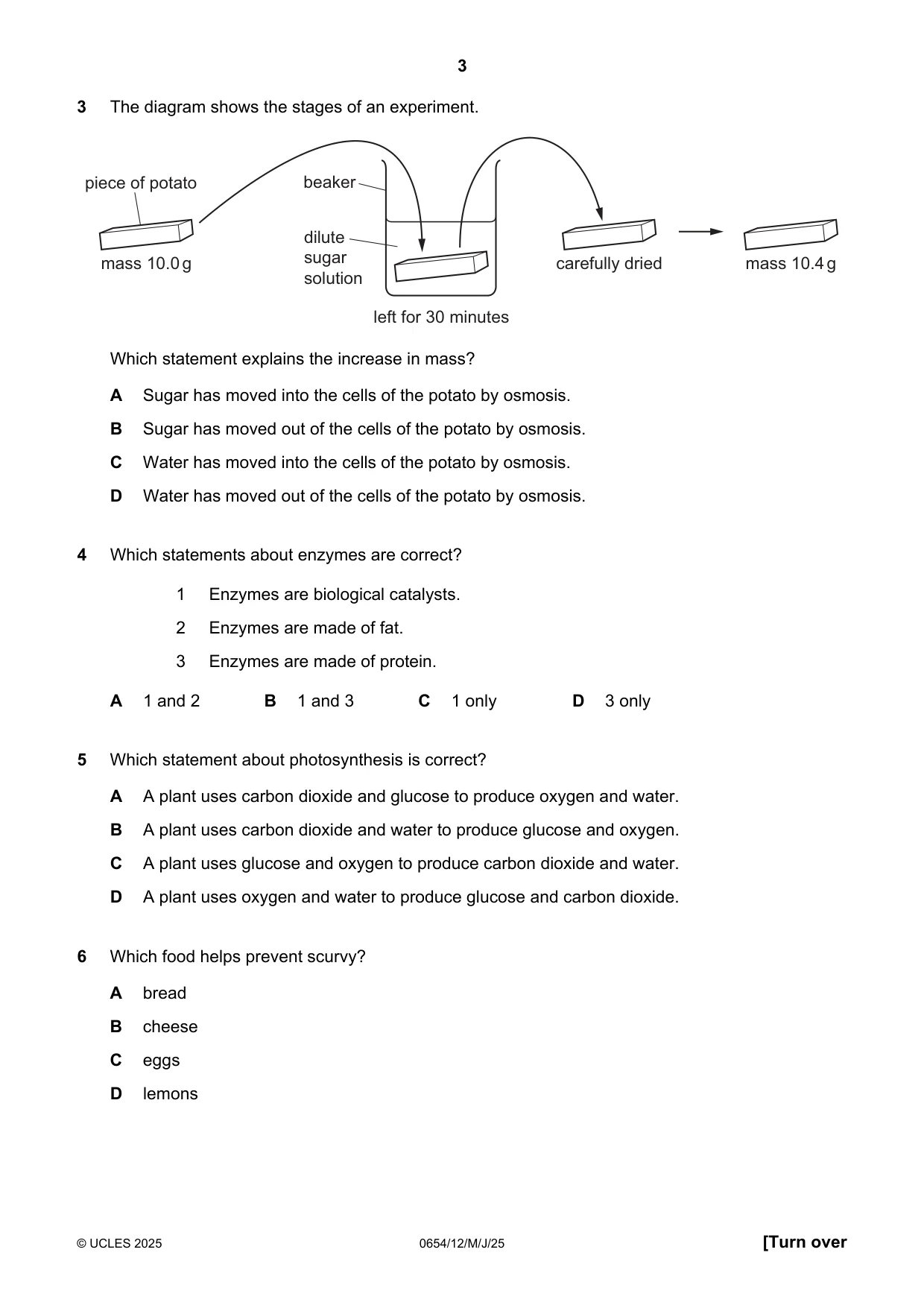
Q3 · The diagram shows the stages of an experiment
3 The diagram shows the stages of an experiment. piece of potato beaker dilute mass 10.0 g sugar carefully dried mass 10.4 g solution left for 30 minutes Which statement explains the increase in mass? A Sugar has moved into the cells of the potato by osmosis. B Sugar has moved out of the cells of the potato by osmosis. C Water has moved into the cells of the potato by osmosis. D Water has moved out of the cells of the potato by osmosis.
Mark scheme: C
Q4 · Which statements about enzymes are correct?
4 Which statements about enzymes are correct? 1 Enzymes are biological catalysts. 2 Enzymes are made of fat. 3 Enzymes are made of protein. A 1 and 2 B 1 and 3 C 1 only D 3 only
Mark scheme: B
Q5 · Which statement about photosynthesis is correct?
5 Which statement about photosynthesis is correct? A A plant uses carbon dioxide and glucose to produce oxygen and water. B A plant uses carbon dioxide and water to produce glucose and oxygen. C A plant uses glucose and oxygen to produce carbon dioxide and water. D A plant uses oxygen and water to produce glucose and carbon dioxide.
Mark scheme: B
Q6 · Which food helps prevent scurvy?
6 Which food helps prevent scurvy? A bread B cheese C eggs D lemons
Mark scheme: D
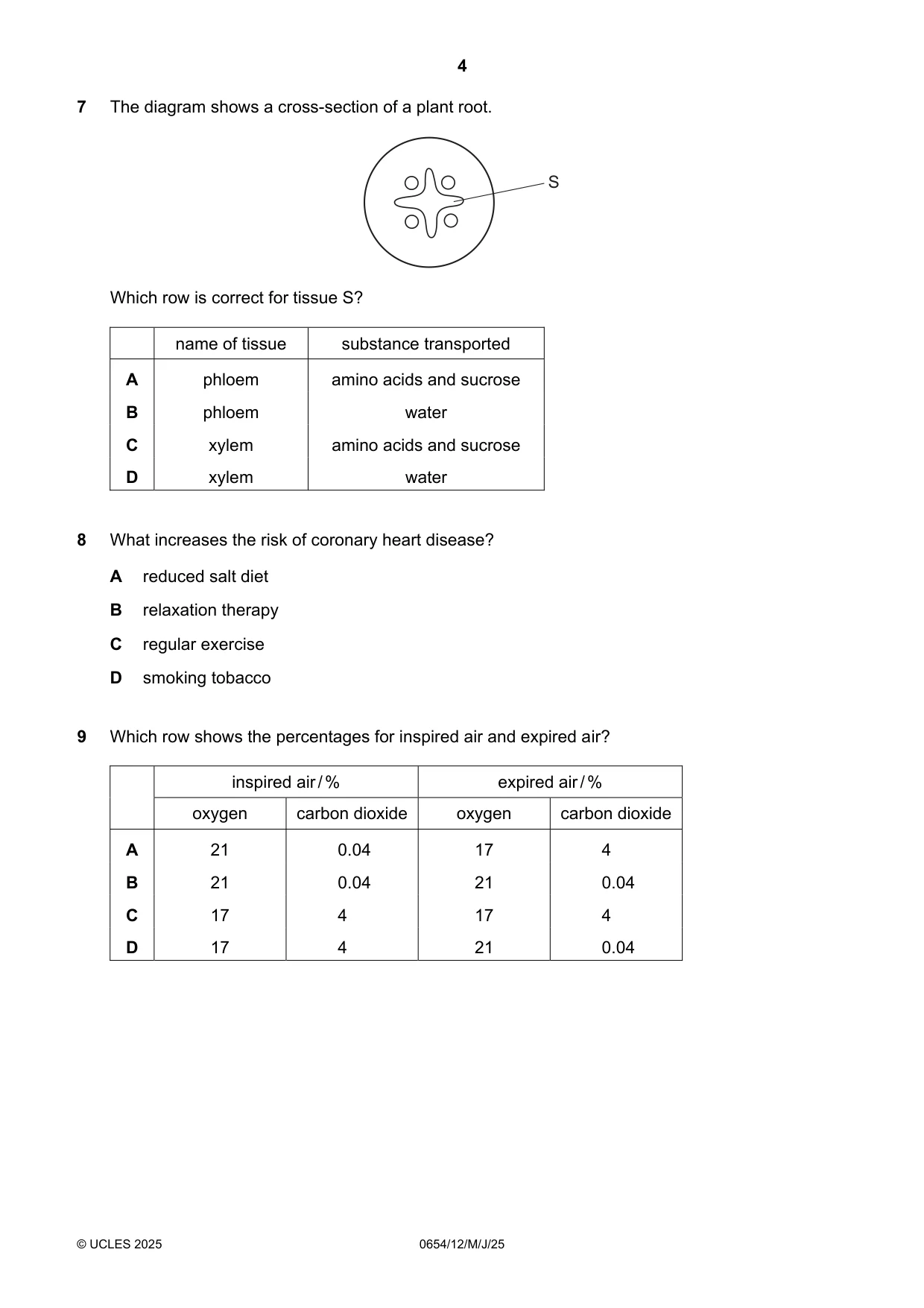
Q7 · The diagram shows a cross-section of a plant root
7 The diagram shows a cross-section of a plant root. S Which row is correct for tissue S? name of tissue substance transported A phloem amino acids and sucrose B phloem water C xylem amino acids and sucrose D xylem water
Mark scheme: D
Q8 · What increases the risk of coronary heart disease?
8 What increases the risk of coronary heart disease? A reduced salt diet B relaxation therapy C regular exercise D smoking tobacco
Mark scheme: D
Q9 · Which row shows the percentages for inspired air and expired air?
9 Which row shows the percentages for inspired air and expired air? inspired air / % expired air / % oxygen carbon dioxide oxygen carbon dioxide A 21 0.04 17 4 B 21 0.04 21 0.04 C 17 4 17 4 D 17 4 21 0.04
Mark scheme: A
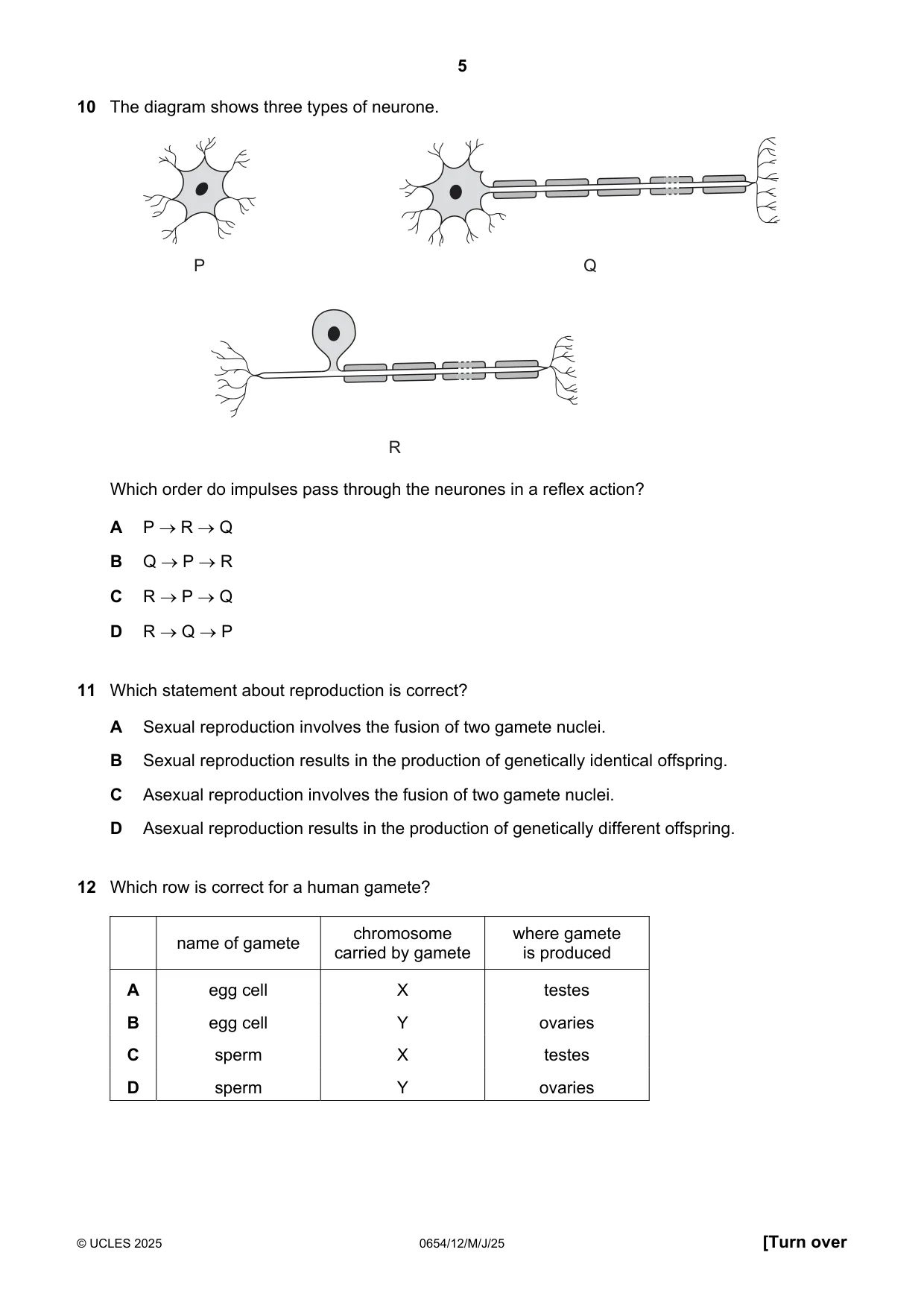
Q10 · The diagram shows three types of neurone
10 The diagram shows three types of neurone. P Q R Which order do impulses pass through the neurones in a reflex action? A P R Q B Q P R C R P Q D R Q P
Mark scheme: C
Q11 · Which statement about reproduction is correct?
11 Which statement about reproduction is correct? A Sexual reproduction involves the fusion of two gamete nuclei. B Sexual reproduction results in the production of genetically identical offspring. C Asexual reproduction involves the fusion of two gamete nuclei. D Asexual reproduction results in the production of genetically different offspring.
Mark scheme: A
Q12 · Which row is correct for a human gamete?
12 Which row is correct for a human gamete? chromosome where gamete name of gamete carried by gamete is produced A egg cell X testes B egg cell Y ovaries C sperm X testes D sperm Y ovaries
Mark scheme: C
Q13 · Which statement describes a producer?
13 Which statement describes a producer? A an organism that obtains its energy from dead or waste organic matter B an organism that makes its own organic nutrients using energy from sunlight C an organism that obtains its energy from feeding on other organisms D an animal that obtains its energy from eating plants
Mark scheme: B
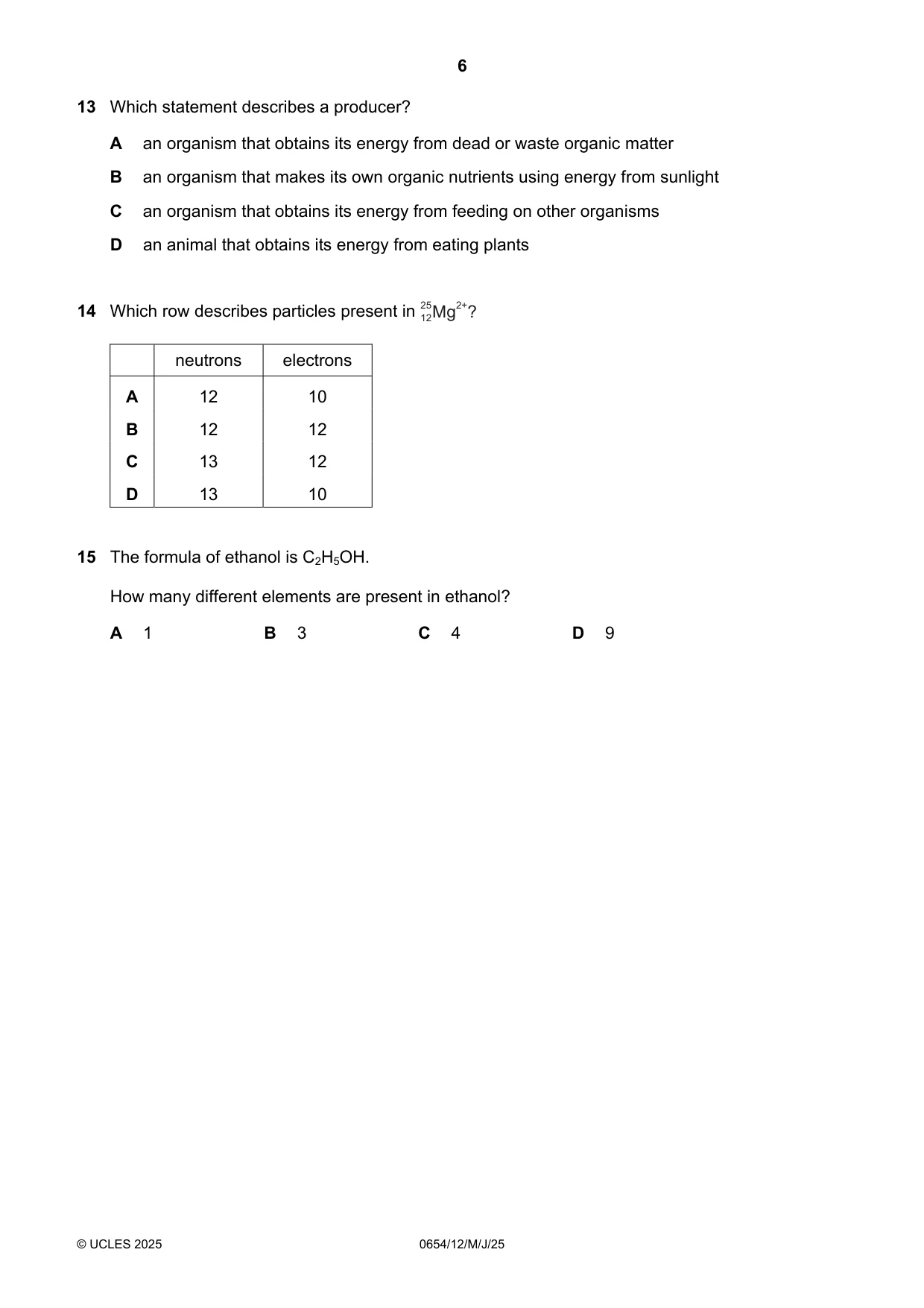
Q14 · Which row describes particles present in Mg 25 2+?
14 Which row describes particles present in Mg 25 2+? 12 neutrons electrons A 12 10 B 12 12 C 13 12 D 13 10
Mark scheme: D
Q15 · The formula of ethanol is C2H5OH
15 The formula of ethanol is C2H5OH. How many different elements are present in ethanol? A 1 B 3 C 4 D 9
Mark scheme: B
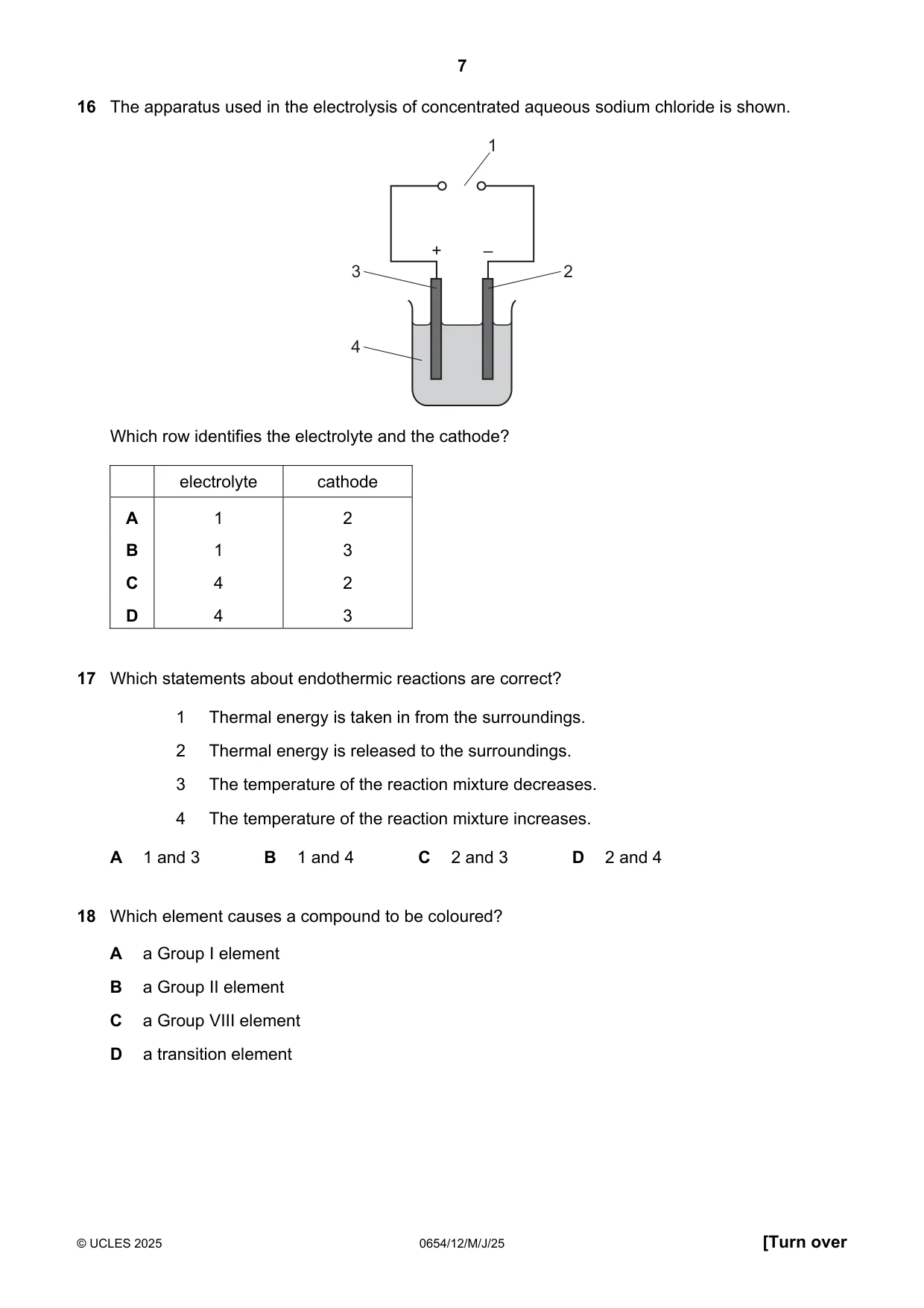
Q16 · The apparatus used in the electrolysis of concentrated aqueous sodium chloride is shown
16 The apparatus used in the electrolysis of concentrated aqueous sodium chloride is shown. 1 + – 3 2 4 Which row identifies the electrolyte and the cathode? electrolyte cathode A 1 2 B 1 3 C 4 2 D 4 3
Mark scheme: C
Q17 · Which statements about endothermic reactions are correct?
17 Which statements about endothermic reactions are correct? 1 Thermal energy is taken in from the surroundings. 2 Thermal energy is released to the surroundings. 3 The temperature of the reaction mixture decreases. 4 The temperature of the reaction mixture increases. A 1 and 3 B 1 and 4 C 2 and 3 D 2 and 4
Mark scheme: A
Q18 · Which element causes a compound to be coloured?
18 Which element causes a compound to be coloured? A a Group I element B a Group II element C a Group VIII element D a transition element
Mark scheme: D
Q19 · Which property explains why aluminium is used to make food containers?
19 Which property explains why aluminium is used to make food containers? A low density B high strength C resistant to corrosion D shiny
Mark scheme: C
Q20 · What is an alloy?
20 What is an alloy? A a compound B a mixture C a metallic element D a non-metallic element
Mark scheme: B
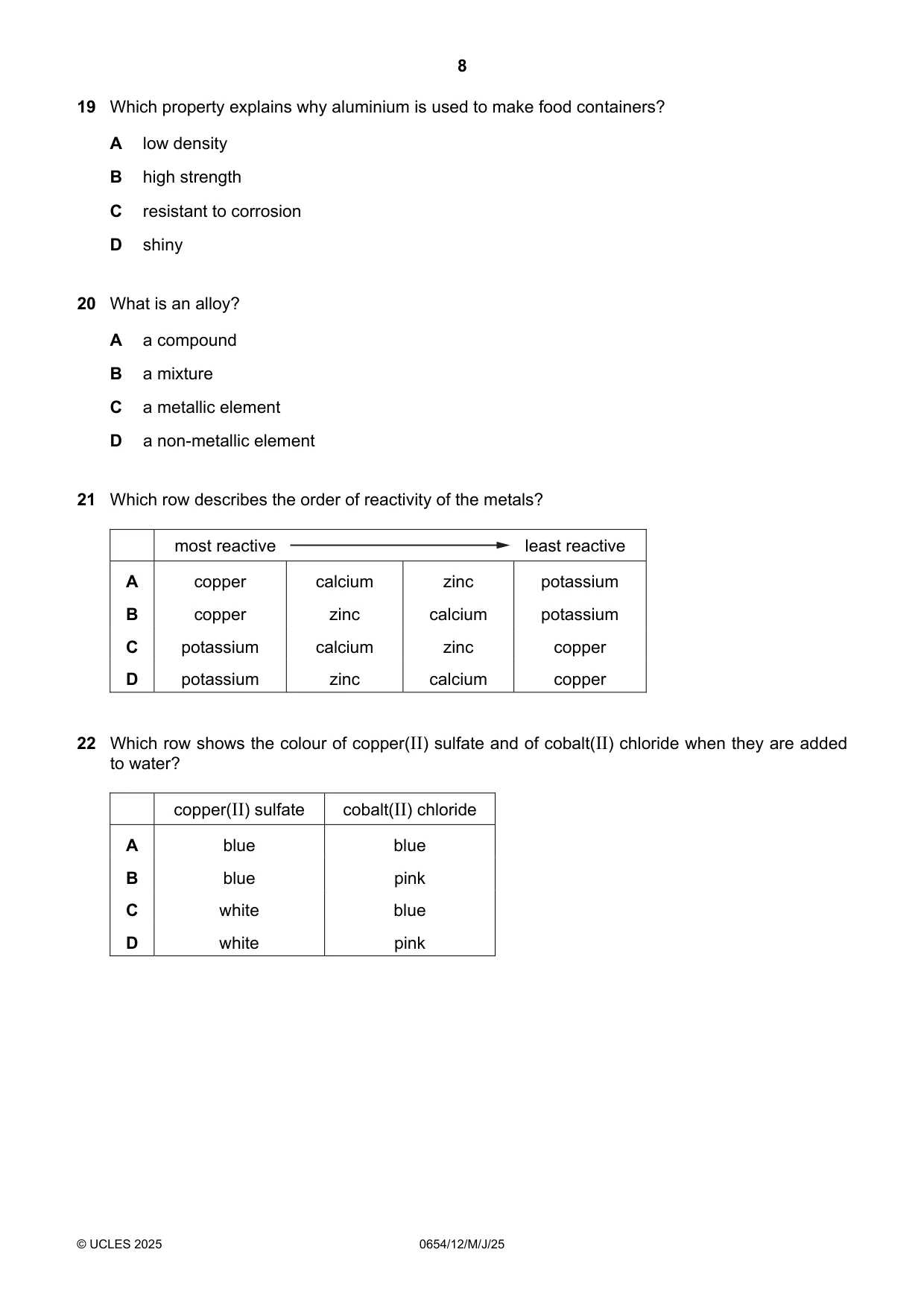
Q21 · Which row describes the order of reactivity of the metals?
21 Which row describes the order of reactivity of the metals? most reactive least reactive A copper calcium zinc potassium B copper zinc calcium potassium C potassium calcium zinc copper D potassium zinc calcium copper
Mark scheme: C
Q22 · Which row shows the colour of copper(II) sulfate and of cobalt(II) chloride when they are…
22 Which row shows the colour of copper(II) sulfate and of cobalt(II) chloride when they are added to water? copper(II) sulfate cobalt(II) chloride A blue blue B blue pink C white blue D white pink
Mark scheme: B
Q23 · The diagram represents the composition of clean, dry air
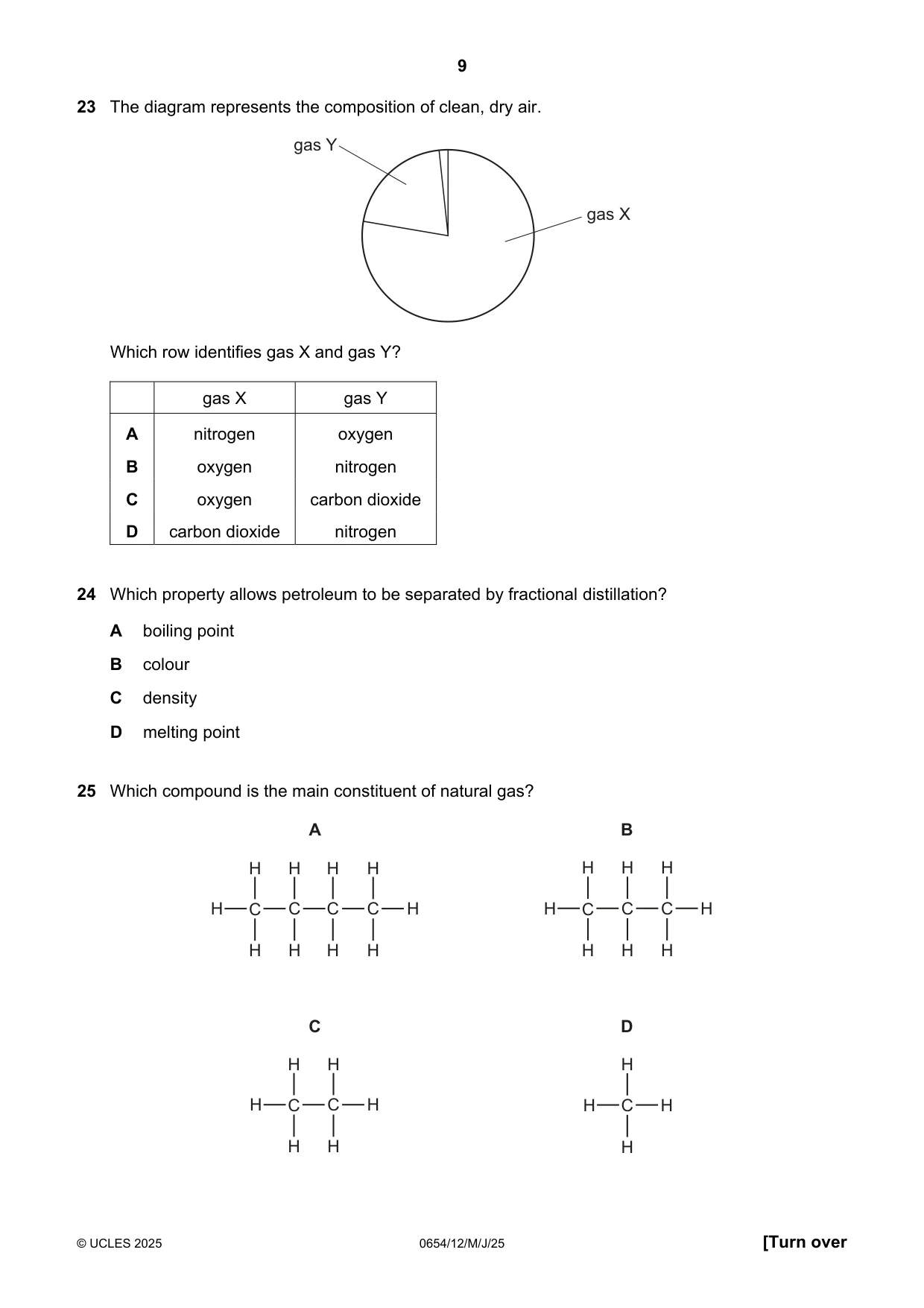
23 The diagram represents the composition of clean, dry air. gas Y gas X Which row identifies gas X and gas Y? gas X gas Y A nitrogen oxygen B oxygen nitrogen C oxygen carbon dioxide D carbon dioxide nitrogen
Mark scheme: A
Q24 · Which property allows petroleum to be separated by fractional distillation?
24 Which property allows petroleum to be separated by fractional distillation? A boiling point B colour C density D melting point
Mark scheme: A
Q25 · Which compound is the main constituent of natural gas?
25 Which compound is the main constituent of natural gas? A B H H H H H H H H C C C C H H C C C H H H H H H H H C D H H H H C C H H C H H H H
Mark scheme: D
Q26 · Which statement about alkanes is correct?
26 Which statement about alkanes is correct? A They contain one double covalent bond. B They contain only single covalent bonds. C They form polymers. D They react with aqueous bromine.
Mark scheme: B
Q27 · When aqueous copper(II) sulfate reacts with aqueous sodium hydroxide, a blue precipitate…
27 When aqueous copper(II) sulfate reacts with aqueous sodium hydroxide, a blue precipitate forms. Which method is used to remove the precipitate from the reaction mixture? A chromatography B distillation C filtration D crystallisation
Mark scheme: C
Q28 · The diagrams show the only forces acting on each of four objects moving in a straight line
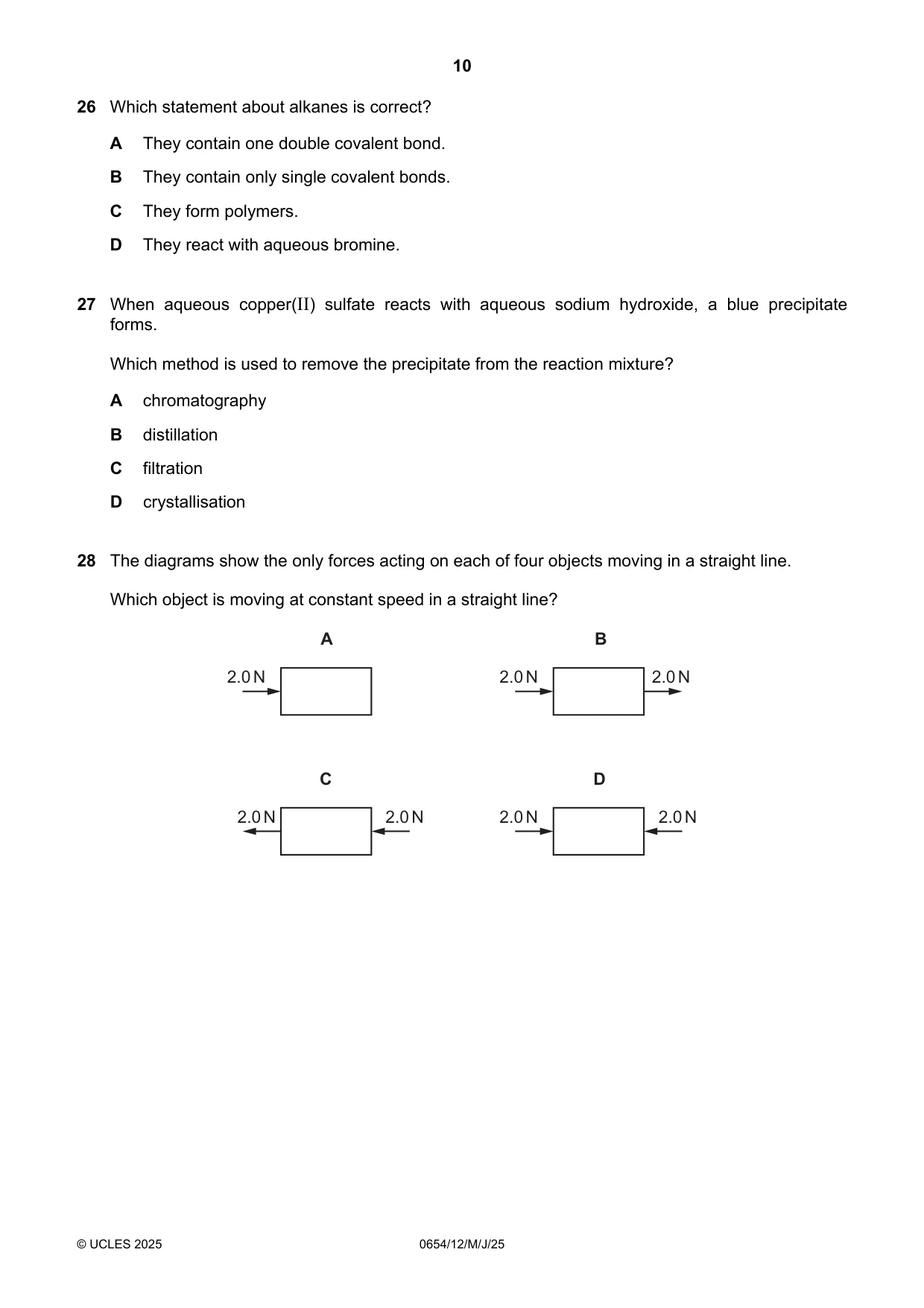
28 The diagrams show the only forces acting on each of four objects moving in a straight line. Which object is moving at constant speed in a straight line? A B 2.0 N 2.0 N 2.0 N C D 2.0 N 2.0 N 2.0 N 2.0 N
Mark scheme: D
Q29 · A person pushes a drawing pin into a cork with their thumb
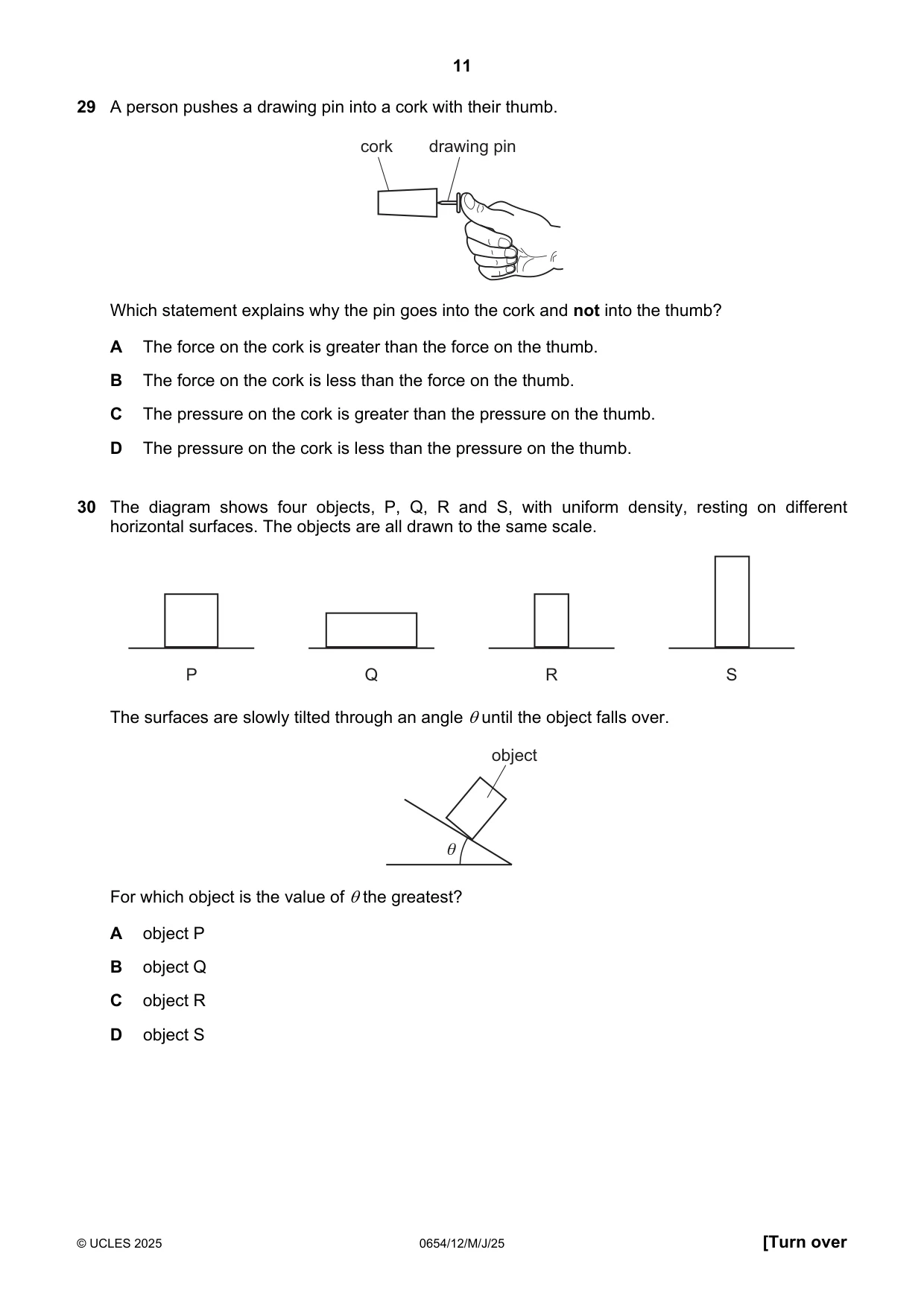
29 A person pushes a drawing pin into a cork with their thumb. cork drawing pin Which statement explains why the pin goes into the cork and not into the thumb? A The force on the cork is greater than the force on the thumb. B The force on the cork is less than the force on the thumb. C The pressure on the cork is greater than the pressure on the thumb. D The pressure on the cork is less than the pressure on the thumb.
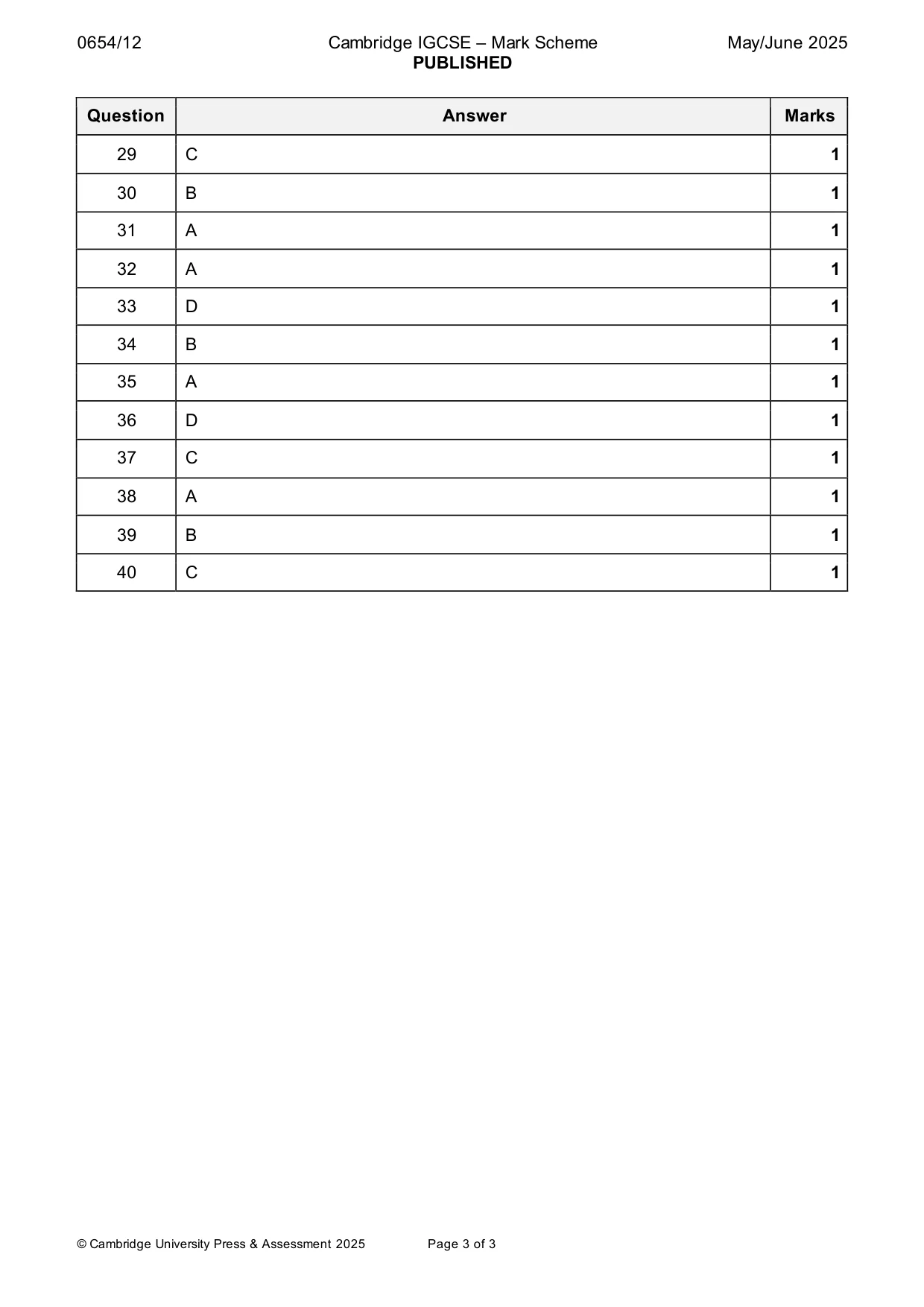
Mark scheme: C
Q30 · The diagram shows four objects, P, Q, R and S, with uniform density, resting on different…
30 The diagram shows four objects, P, Q, R and S, with uniform density, resting on different horizontal surfaces. The objects are all drawn to the same scale. P Q R S The surfaces are slowly tilted through an angle until the object falls over. object θ For which object is the value of the greatest? A object P B object Q C object R D object S
Mark scheme: B
Q31 · Liquid in a beaker evaporates quickly
31 Liquid in a beaker evaporates quickly. Which row shows what happens to the mass and to the temperature of the liquid remaining in the beaker? mass temperature A decreases decreases B decreases increases C increases decreases D increases increases
Mark scheme: A
Q32 · The diagram shows a type of double glazing in a window
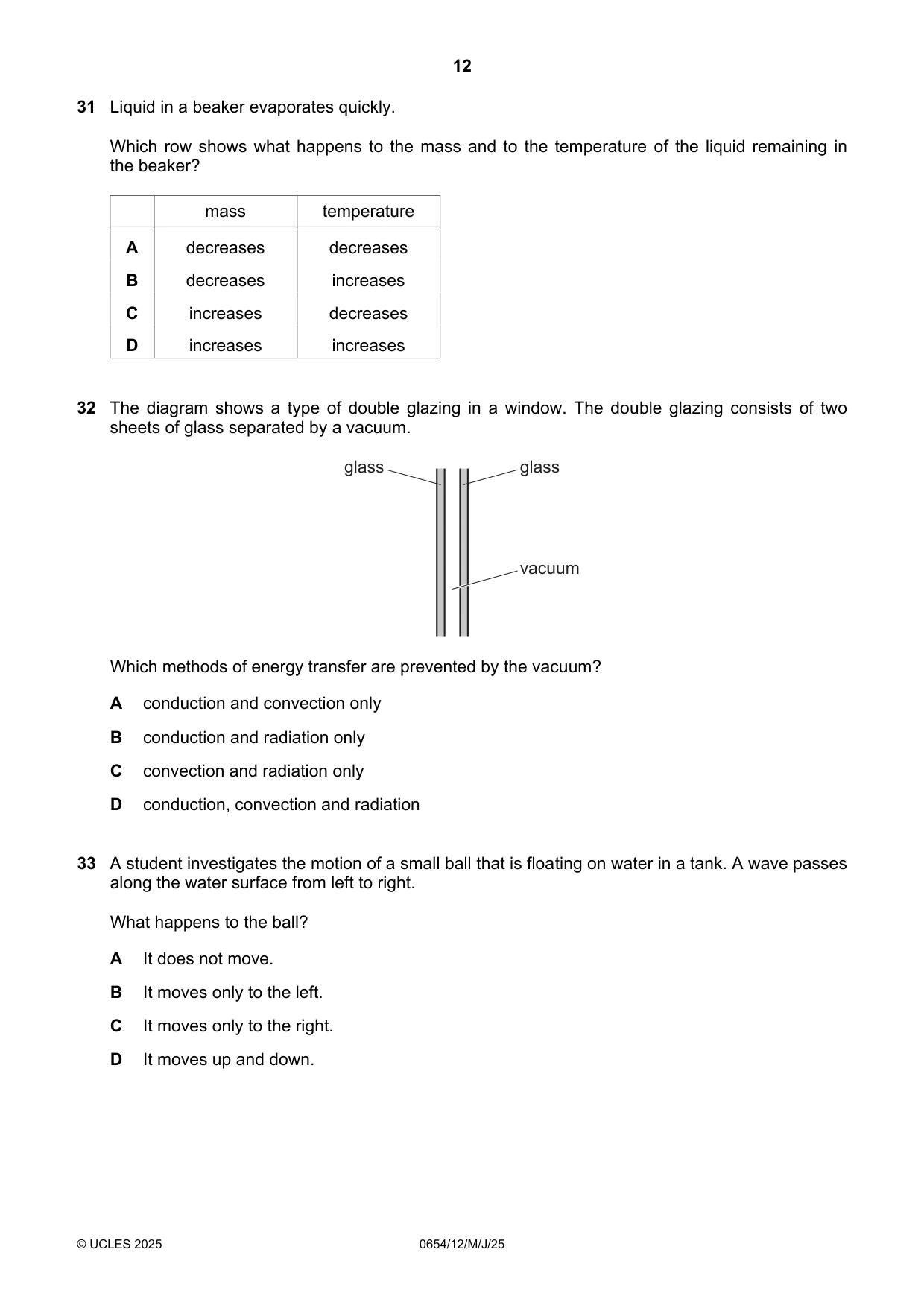
32 The diagram shows a type of double glazing in a window. The double glazing consists of two sheets of glass separated by a vacuum. glass glass vacuum Which methods of energy transfer are prevented by the vacuum? A conduction and convection only B conduction and radiation only C convection and radiation only D conduction, convection and radiation
Mark scheme: A
Q33 · A student investigates the motion of a small ball that is floating on water in a tank
33 A student investigates the motion of a small ball that is floating on water in a tank. A wave passes along the water surface from left to right. What happens to the ball? A It does not move. B It moves only to the left. C It moves only to the right. D It moves up and down.
Mark scheme: D
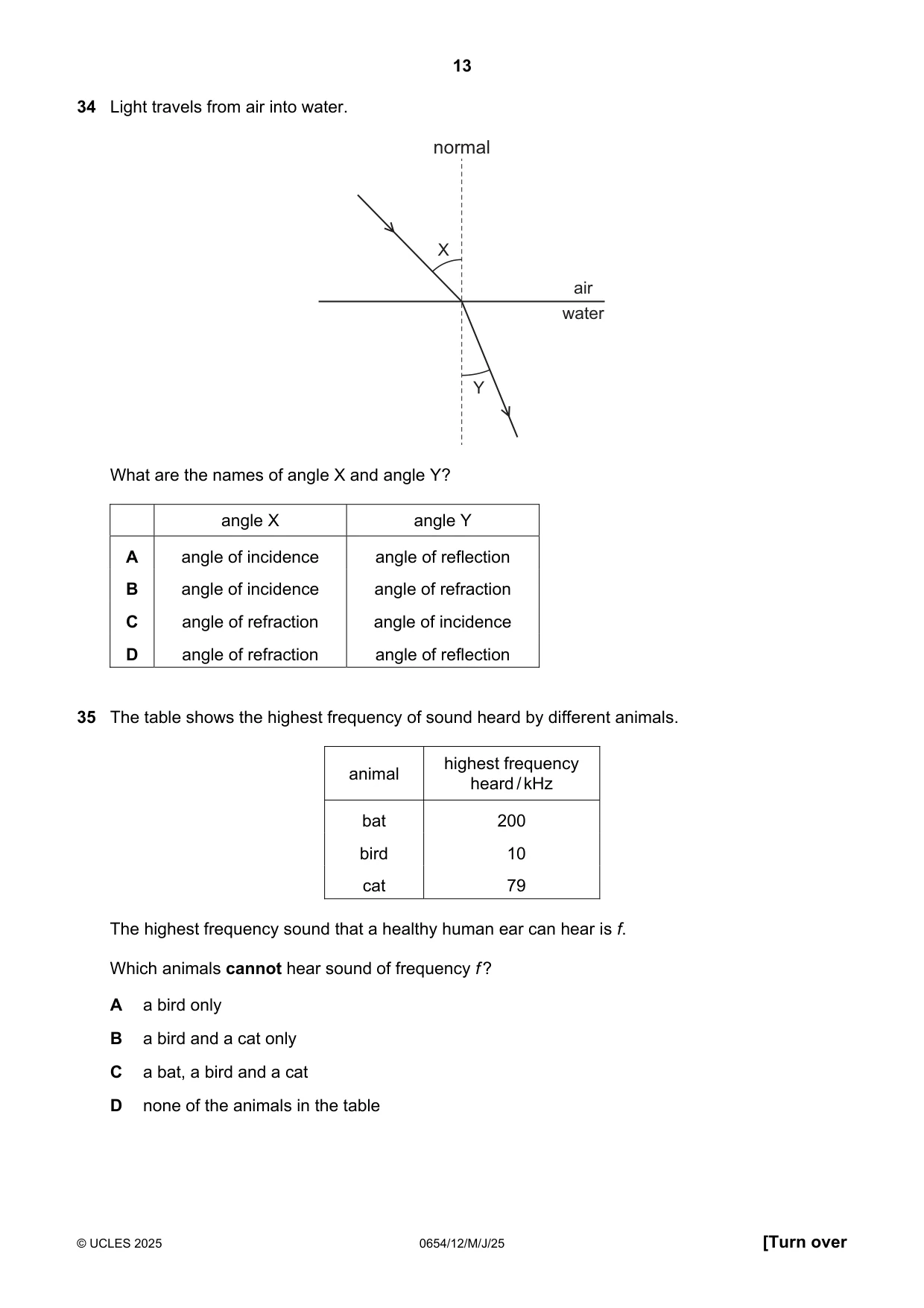
Q34 · Light travels from air into water
34 Light travels from air into water. normal X air water Y What are the names of angle X and angle Y? angle X angle Y A angle of incidence angle of reflection B angle of incidence angle of refraction C angle of refraction angle of incidence D angle of refraction angle of reflection
Mark scheme: B
Q35 · The table shows the highest frequency of sound heard by different animals
35 The table shows the highest frequency of sound heard by different animals. highest frequency animal heard / kHz bat 200 bird 10 cat 79 The highest frequency sound that a healthy human ear can hear is f. Which animals cannot hear sound of frequency f ? A a bird only B a bird and a cat only C a bat, a bird and a cat D none of the animals in the table
Mark scheme: A
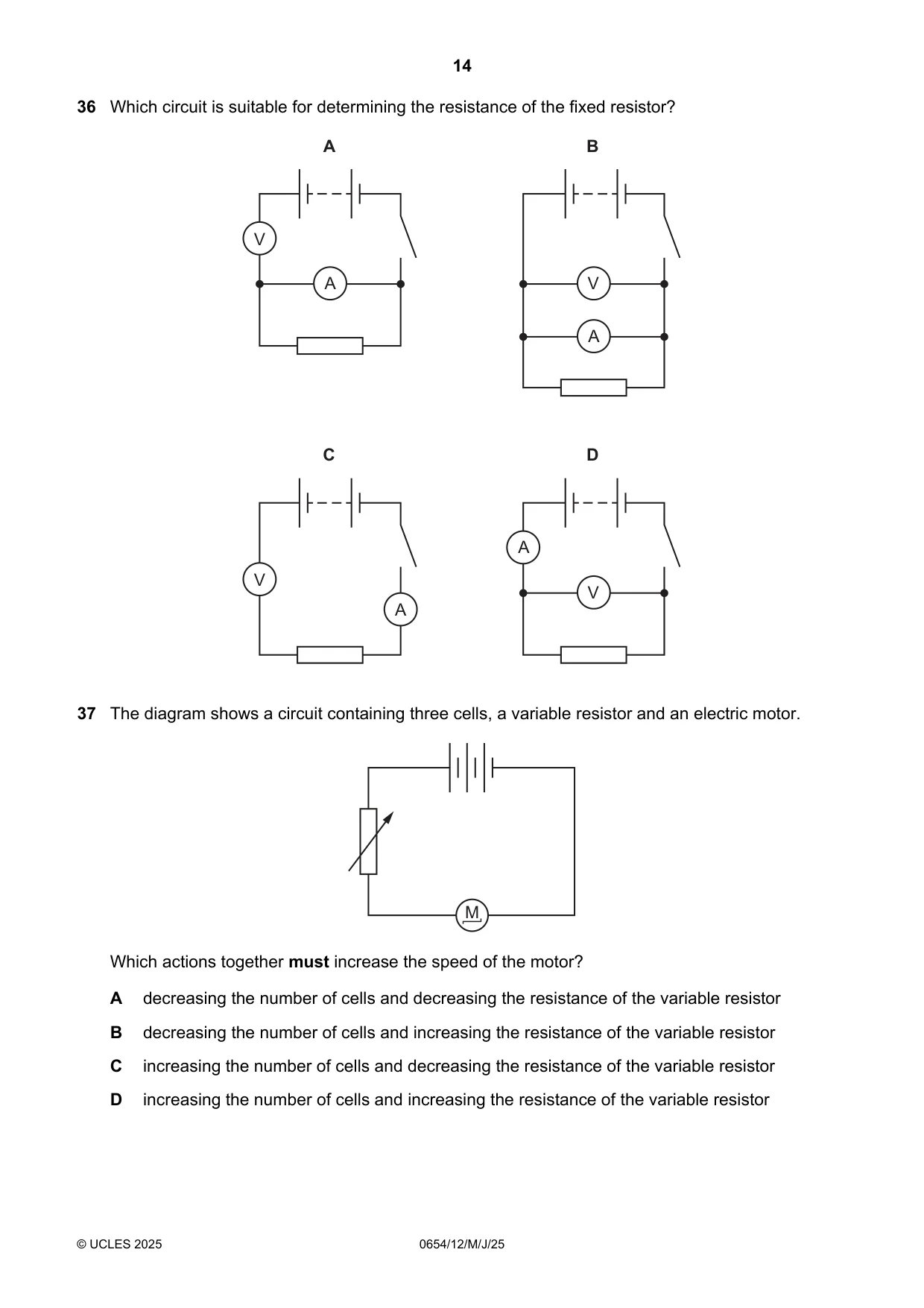
Q36 · Which circuit is suitable for determining the resistance of the fixed resistor?
36 Which circuit is suitable for determining the resistance of the fixed resistor? A B V A V A C D A V V A
Mark scheme: D
Q37 · The diagram shows a circuit containing three cells, a variable resistor and an electric…
37 The diagram shows a circuit containing three cells, a variable resistor and an electric motor. M Which actions together must increase the speed of the motor? A decreasing the number of cells and decreasing the resistance of the variable resistor B decreasing the number of cells and increasing the resistance of the variable resistor C increasing the number of cells and decreasing the resistance of the variable resistor D increasing the number of cells and increasing the resistance of the variable resistor
Mark scheme: C
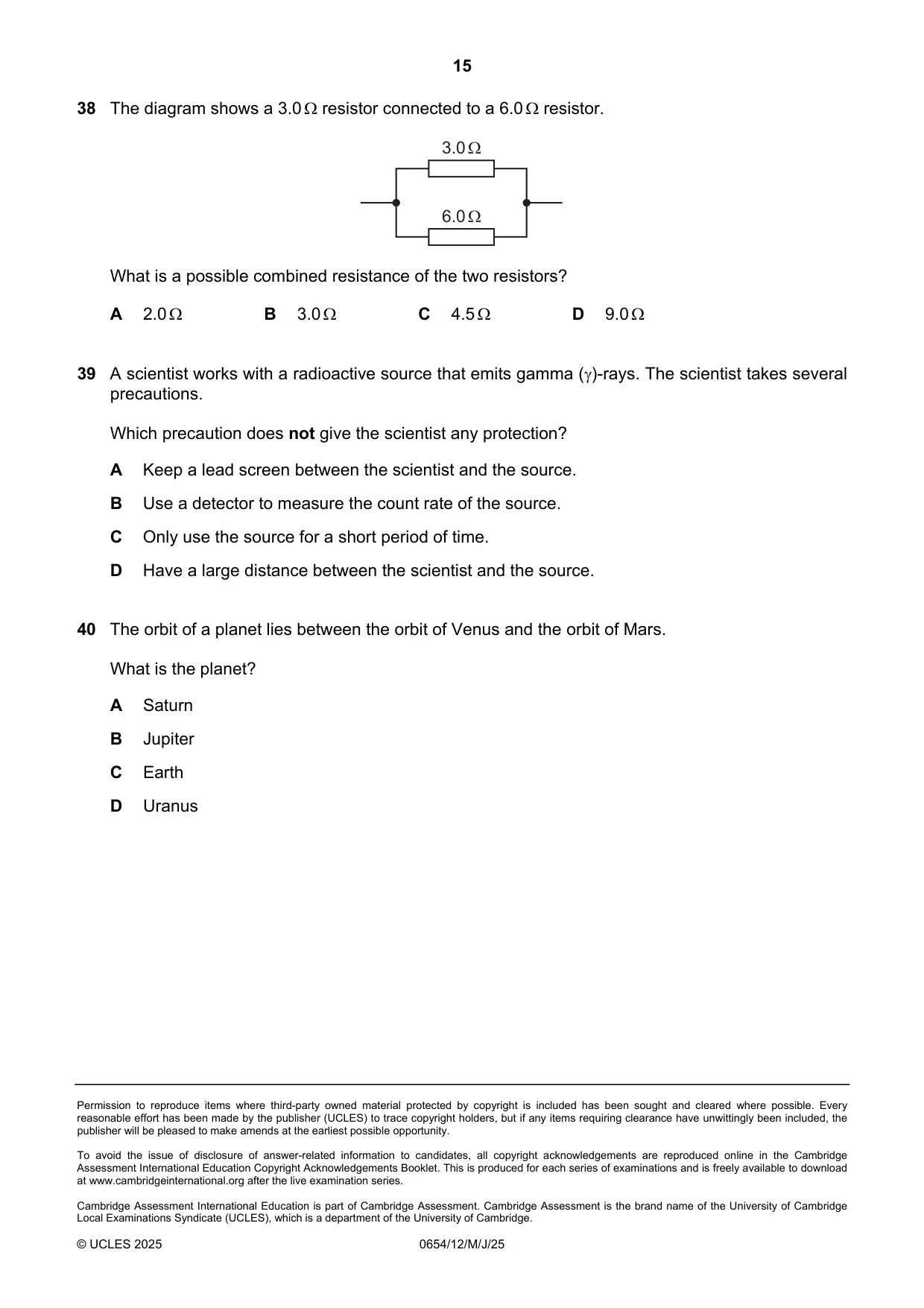
Q38 · The diagram shows a 3.0 resistor connected to a 6.0 resistor
38 The diagram shows a 3.0 resistor connected to a 6.0 resistor. 3.0 Ω 6.0 Ω What is a possible combined resistance of the two resistors? A 2.0 B 3.0 C 4.5 D 9.0
Mark scheme: A
Q39 · A scientist works with a radioactive source that emits gamma ()-rays
39 A scientist works with a radioactive source that emits gamma ()-rays. The scientist takes several precautions. Which precaution does not give the scientist any protection? A Keep a lead screen between the scientist and the source. B Use a detector to measure the count rate of the source. C Only use the source for a short period of time. D Have a large distance between the scientist and the source.
Mark scheme: B
Q40 · The orbit of a planet lies between the orbit of Venus and the orbit of Mars
40 The orbit of a planet lies between the orbit of Venus and the orbit of Mars. What is the planet? A Saturn B Jupiter C Earth D Uranus
Mark scheme: C
What was in this paper
The subtopics covered by these 40 questions, and how many questions each got. Open one in a new tab to see every Cambridge question on it.
3Alkanes2Forces2Separation and purification2Air quality and climate1Alloys and their properties1Atomic structure and the Periodic Table1Cell structure1Characteristics of living organisms1Coordination and response1Diet1Diseases and immunity1Electrolysis1Elements, compounds and mixtures1Enzymes1Exothermic and endothermic reactions1Food chains and food webs1Gas exchange in humans1General properties of waves1Identification of ions and gases1Kinetic particle model of matter1Light1Osmosis1Photosynthesis1Pressure1Radioactivity1Reactivity series1Sexual reproduction1Sexual reproduction in humans1Sound1The Solar System1Transfer of thermal energy1Transition elements1Uses of metals1Xylem and phloem1What you needed in this session
Cambridge’s own grade thresholds for 2025 May/June, Paper 1 · Variant 2. A higher threshold means an easier paper — the bar moves with how the cohort did.