Cambridge IGCSE Sciences - Co-ordinated (Double) 0654 — 2006 May/June Paper 1 · Variant 1
0654/11/M/J/06 · 40 questions · 40 marks · ≈45 min
The question paper and its mark scheme, free to read here and free to download. This is Cambridge’s own paper, exactly as it was sat.
Question paper20 pages
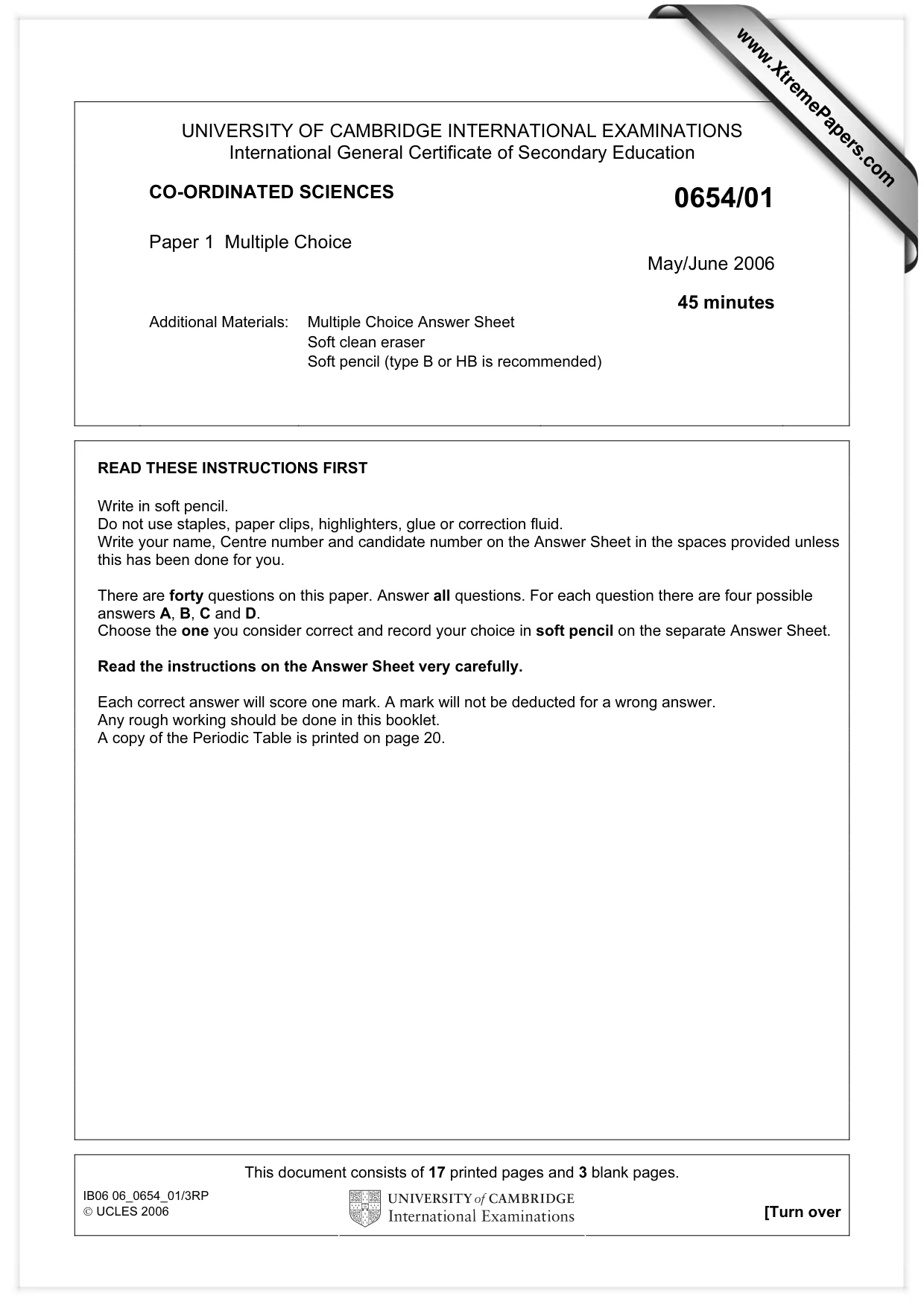



Mark scheme2 pages
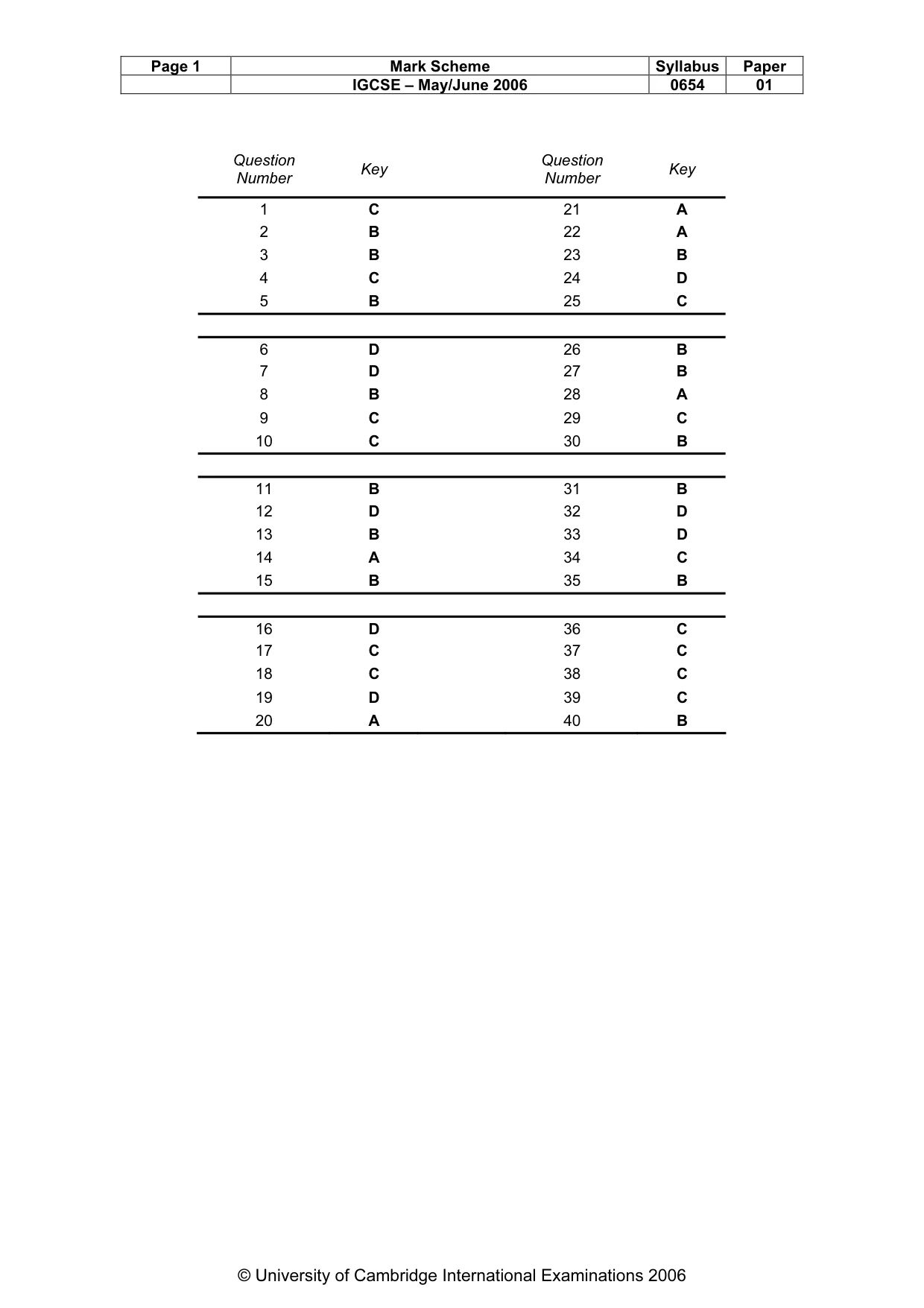
Answers below. Sit the paper first if you are practising.
Questions as text
Q1 · The diagram shows a bone from the human arm
1 The diagram shows a bone from the human arm. Use the key to identify the bone. i Has a distinct socket at one end…………………. go to ii Has no distinct socket at one end..………………. go to iii ii Broad and flat in shape……………………………. A Rod-like in shape…………………………………… B iii Has a rounded structure that fits into a socket….. C Has no rounded structure…………………………. D
Mark scheme: C
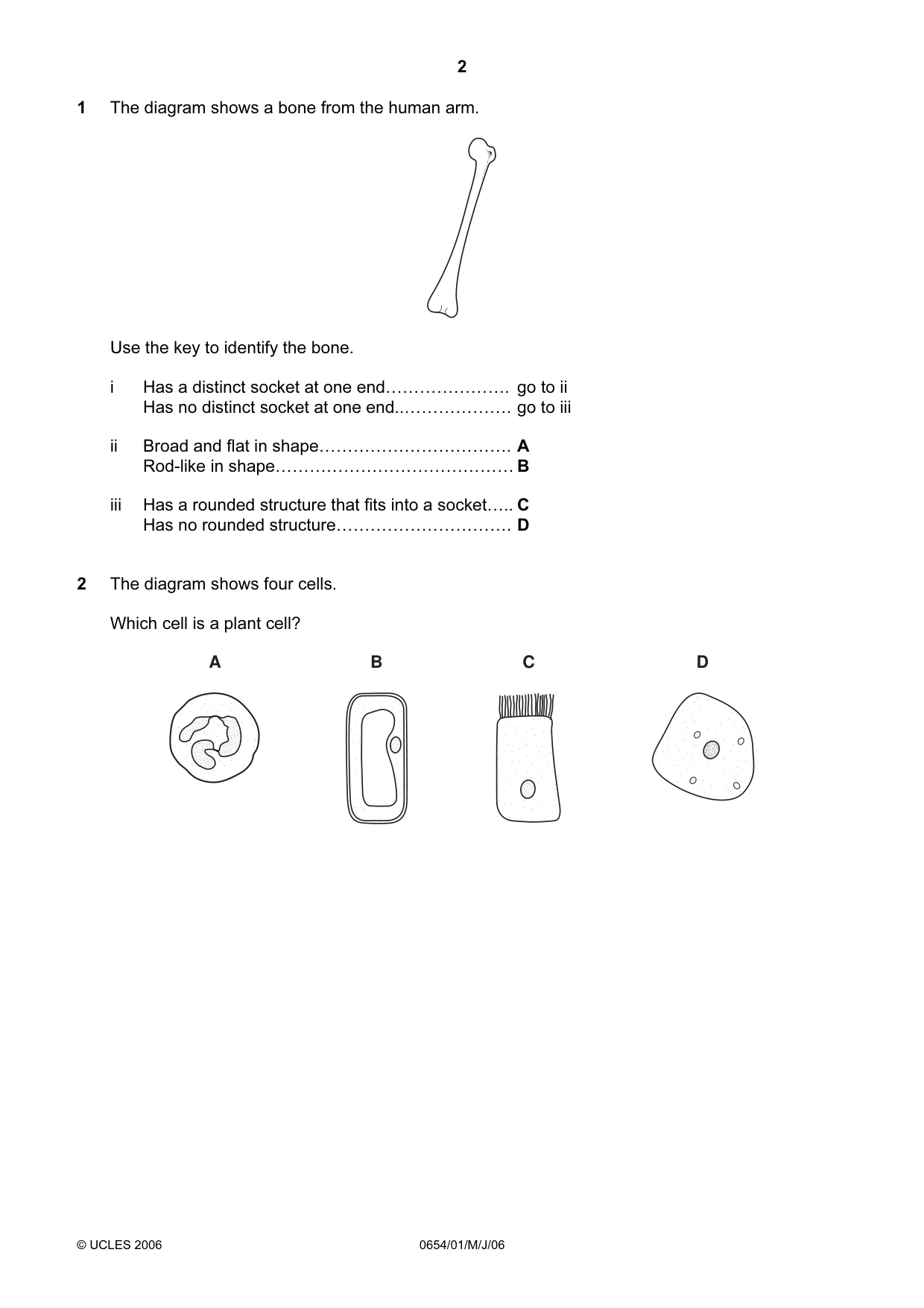
Q2 · The diagram shows four cells
2 The diagram shows four cells. Which cell is a plant cell? A B C D
Mark scheme: B
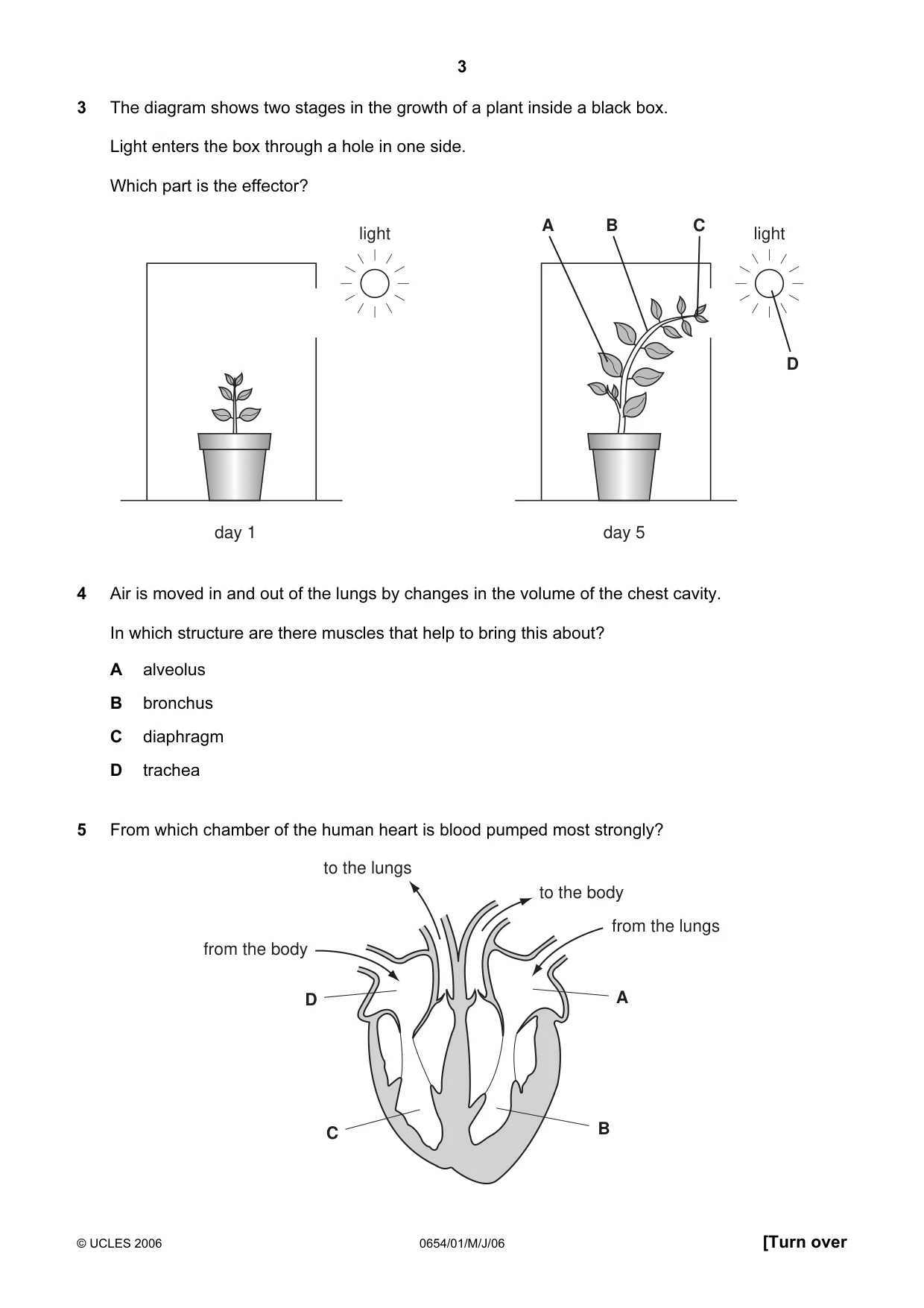
Q3 · The diagram shows two stages in the growth of a plant inside a black box
3 The diagram shows two stages in the growth of a plant inside a black box. Light enters the box through a hole in one side. Which part is the effector? A B C light light D day 1 day 5
Mark scheme: B
Q4 · Air is moved in and out of the lungs by changes in the volume of the chest cavity
4 Air is moved in and out of the lungs by changes in the volume of the chest cavity. In which structure are there muscles that help to bring this about? A alveolus B bronchus C diaphragm D trachea
Mark scheme: C
Q5 · From which chamber of the human heart is blood pumped most strongly?
5 From which chamber of the human heart is blood pumped most strongly? to the lungs to the body from the lungs from the body D A C B
Mark scheme: B
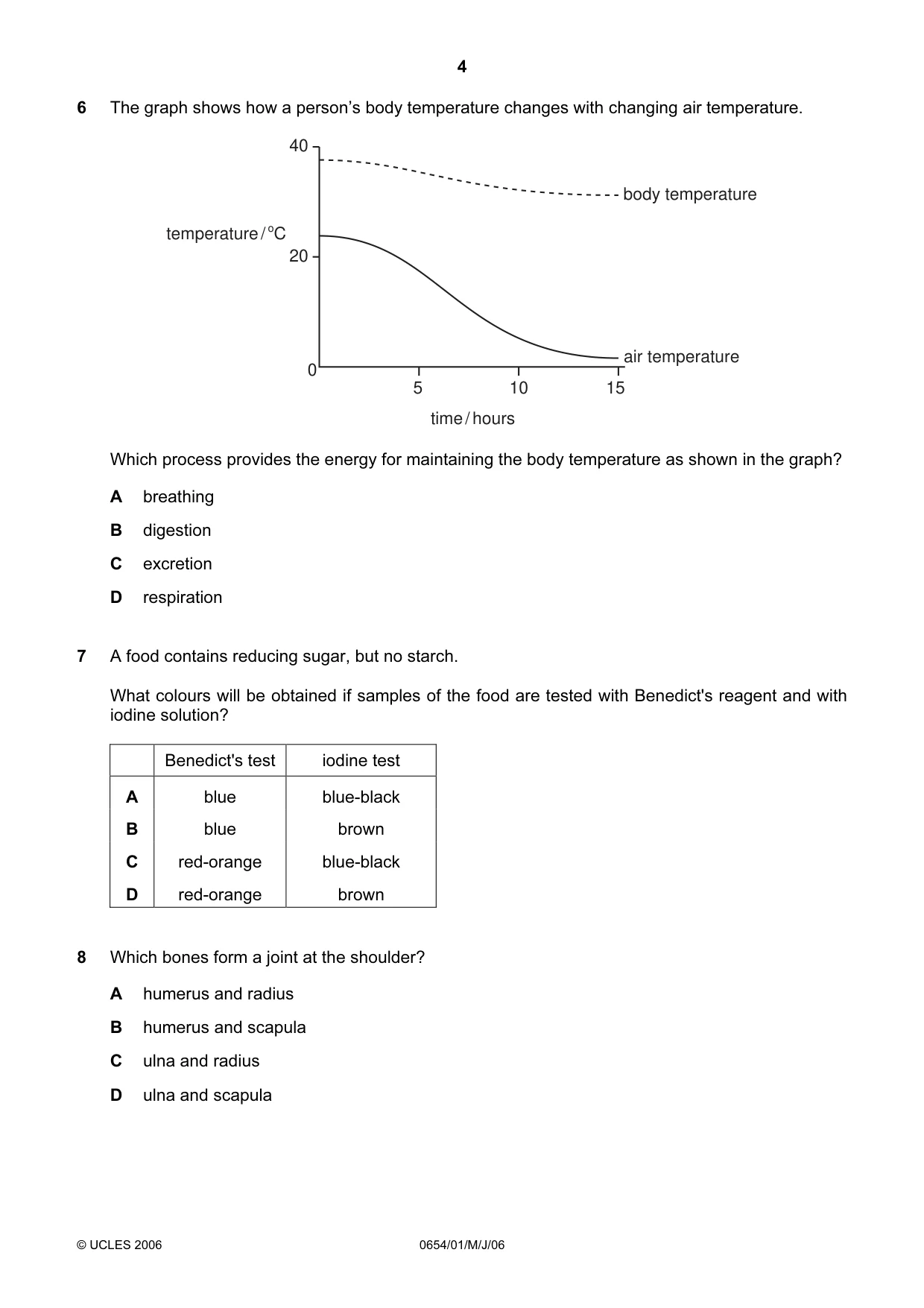
Q6 · The graph shows how a person’s body temperature changes with changing air temperature
6 The graph shows how a person’s body temperature changes with changing air temperature. 40 body temperature temperature / oC 20 air temperature 0 5 10 15 time / hours Which process provides the energy for maintaining the body temperature as shown in the graph? A breathing B digestion C excretion D respiration
Mark scheme: D
Q7 · A food contains reducing sugar, but no starch
7 A food contains reducing sugar, but no starch. What colours will be obtained if samples of the food are tested with Benedict's reagent and with iodine solution? Benedict's test iodine test A blue blue-black B blue brown C red-orange blue-black D red-orange brown
Mark scheme: D
Q8 · Which bones form a joint at the shoulder?
8 Which bones form a joint at the shoulder? A humerus and radius B humerus and scapula C ulna and radius D ulna and scapula
Mark scheme: B
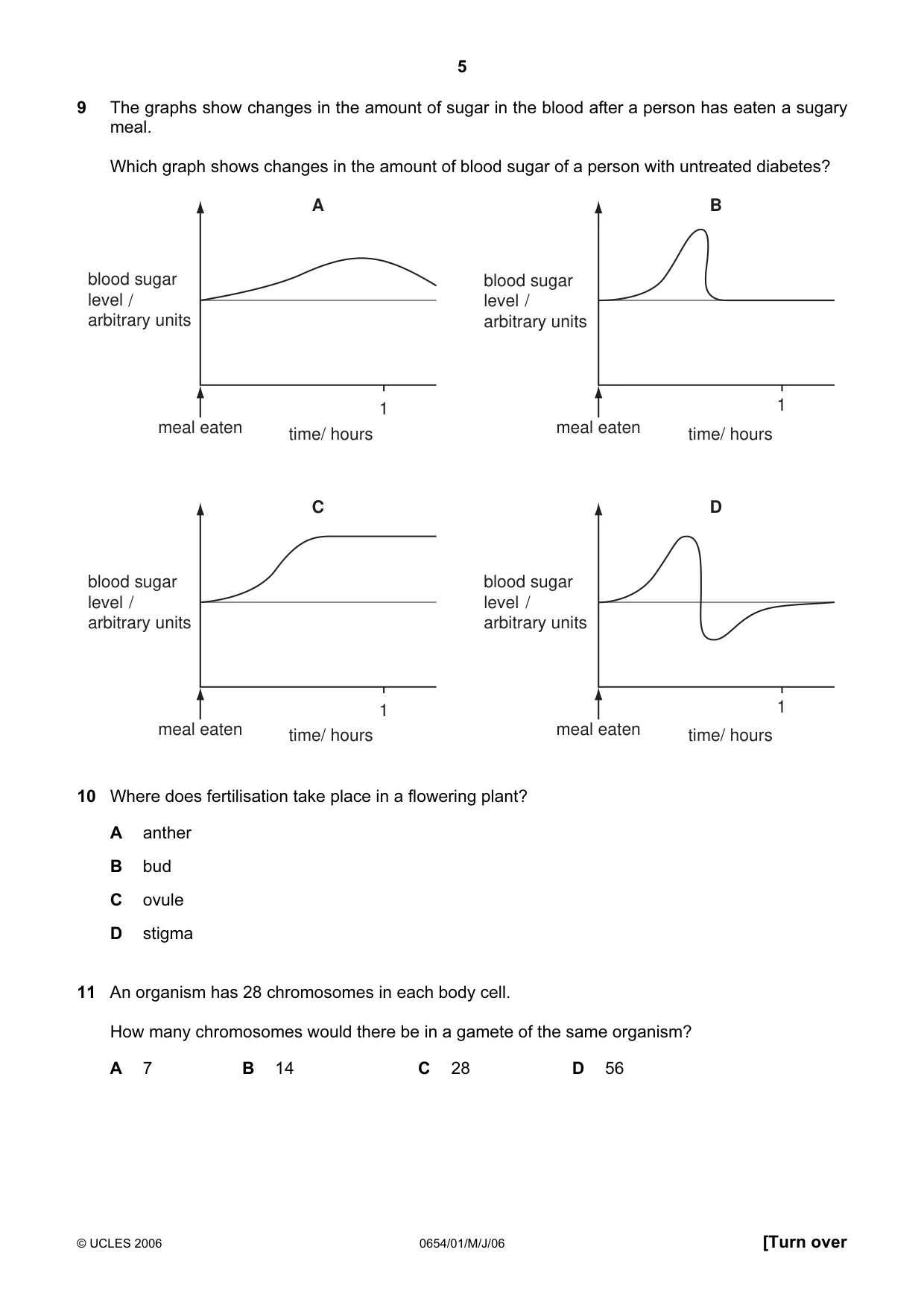
Q9 · The graphs show changes in the amount of sugar in the blood after a person has eaten a…
9 The graphs show changes in the amount of sugar in the blood after a person has eaten a sugary meal. Which graph shows changes in the amount of blood sugar of a person with untreated diabetes? A B blood sugar blood sugar level / level / arbitrary units arbitrary units 1 1 meal eaten time/ hours meal eaten time/ hours C D blood sugar blood sugar level / level / arbitrary units arbitrary units 1 1 meal eaten time/ hours meal eaten time/ hours
Mark scheme: C
Q10 · Where does fertilisation take place in a flowering plant?
10 Where does fertilisation take place in a flowering plant? A anther B bud C ovule D stigma
Mark scheme: C
Q11 · An organism has 28 chromosomes in each body cell
11 An organism has 28 chromosomes in each body cell. How many chromosomes would there be in a gamete of the same organism? A 7 B 14 C 28 D 56
Mark scheme: B
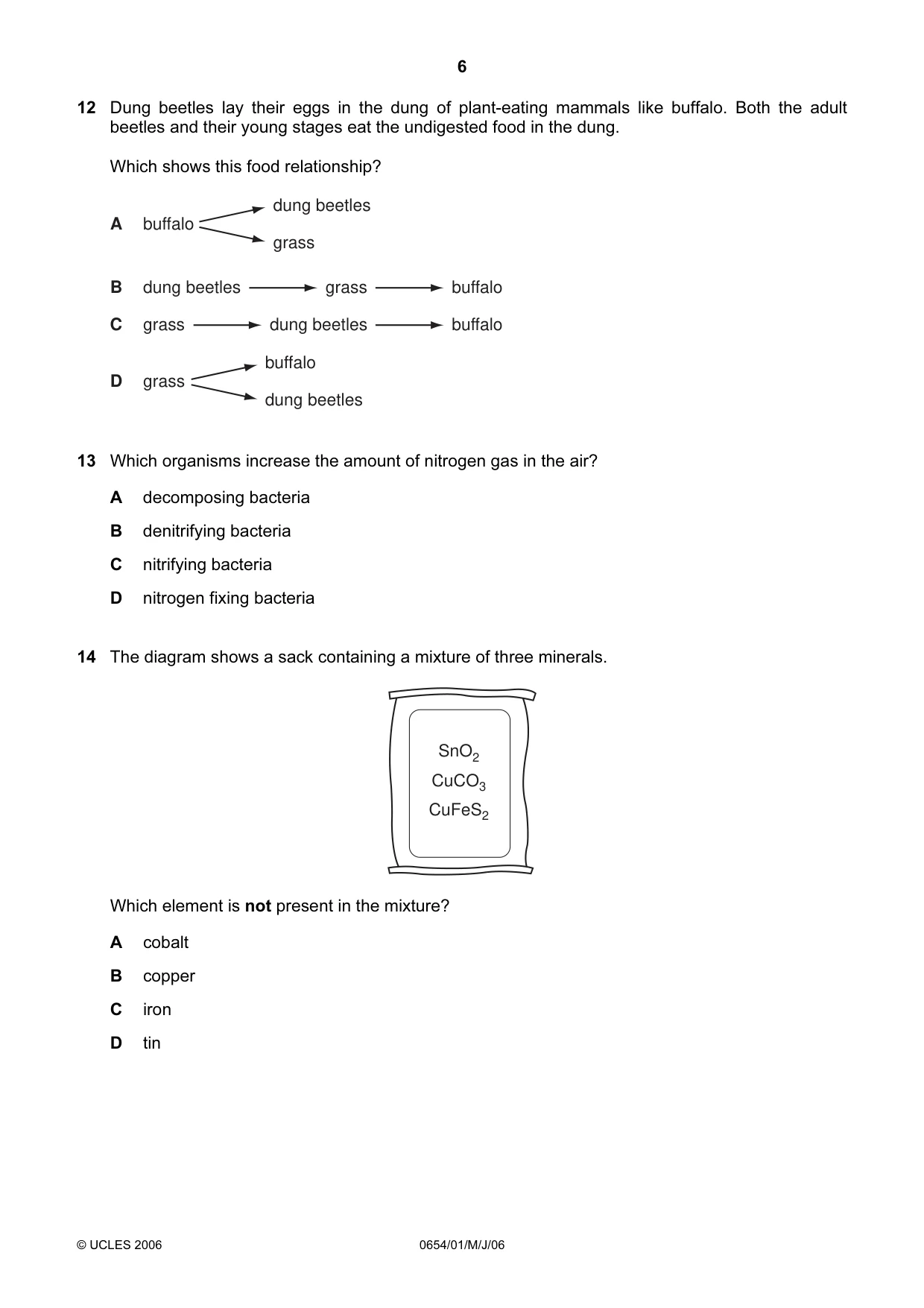
Q12 · Dung beetles lay their eggs in the dung of plant-eating mammals like buffalo
12 Dung beetles lay their eggs in the dung of plant-eating mammals like buffalo. Both the adult beetles and their young stages eat the undigested food in the dung. Which shows this food relationship? dung beetles A buffalo grass B dung beetles grass buffalo C grass dung beetles buffalo buffalo D grass dung beetles
Mark scheme: D
Q13 · Which organisms increase the amount of nitrogen gas in the air?
13 Which organisms increase the amount of nitrogen gas in the air? A decomposing bacteria B denitrifying bacteria C nitrifying bacteria D nitrogen fixing bacteria
Mark scheme: B
Q14 · The diagram shows a sack containing a mixture of three minerals
14 The diagram shows a sack containing a mixture of three minerals. SnO2 CuCO3 CuFeS2 Which element is not present in the mixture? A cobalt B copper C iron D tin
Mark scheme: A
Q15 · Heating a metal compound in a Bunsen flame turns the flame green
15 Heating a metal compound in a Bunsen flame turns the flame green. Which metal ion is present in the compound? A calcium B copper C potassium D sodium
Mark scheme: B
Q16 · Which process produces molecules with longer chains?
16 Which process produces molecules with longer chains? A combustion of hydrocarbon B cracking C fractional distillation of crude oil D polymerisation
Mark scheme: D
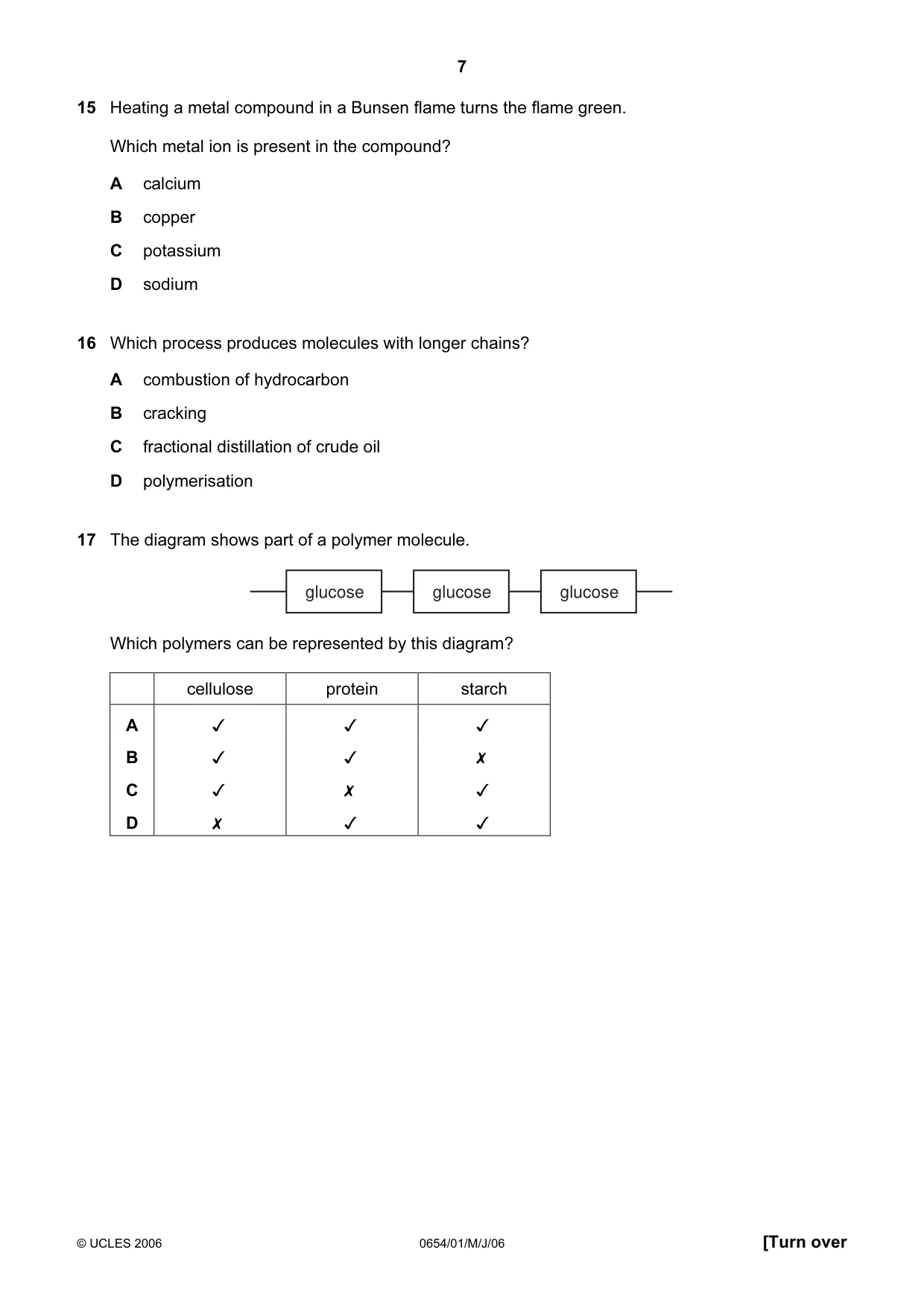
Q17 · The diagram shows part of a polymer molecule
17 The diagram shows part of a polymer molecule. glucose glucose glucose Which polymers can be represented by this diagram? cellulose protein starch v v v 0 0O WwW D> v v v x x v \ 4 x
Mark scheme: C
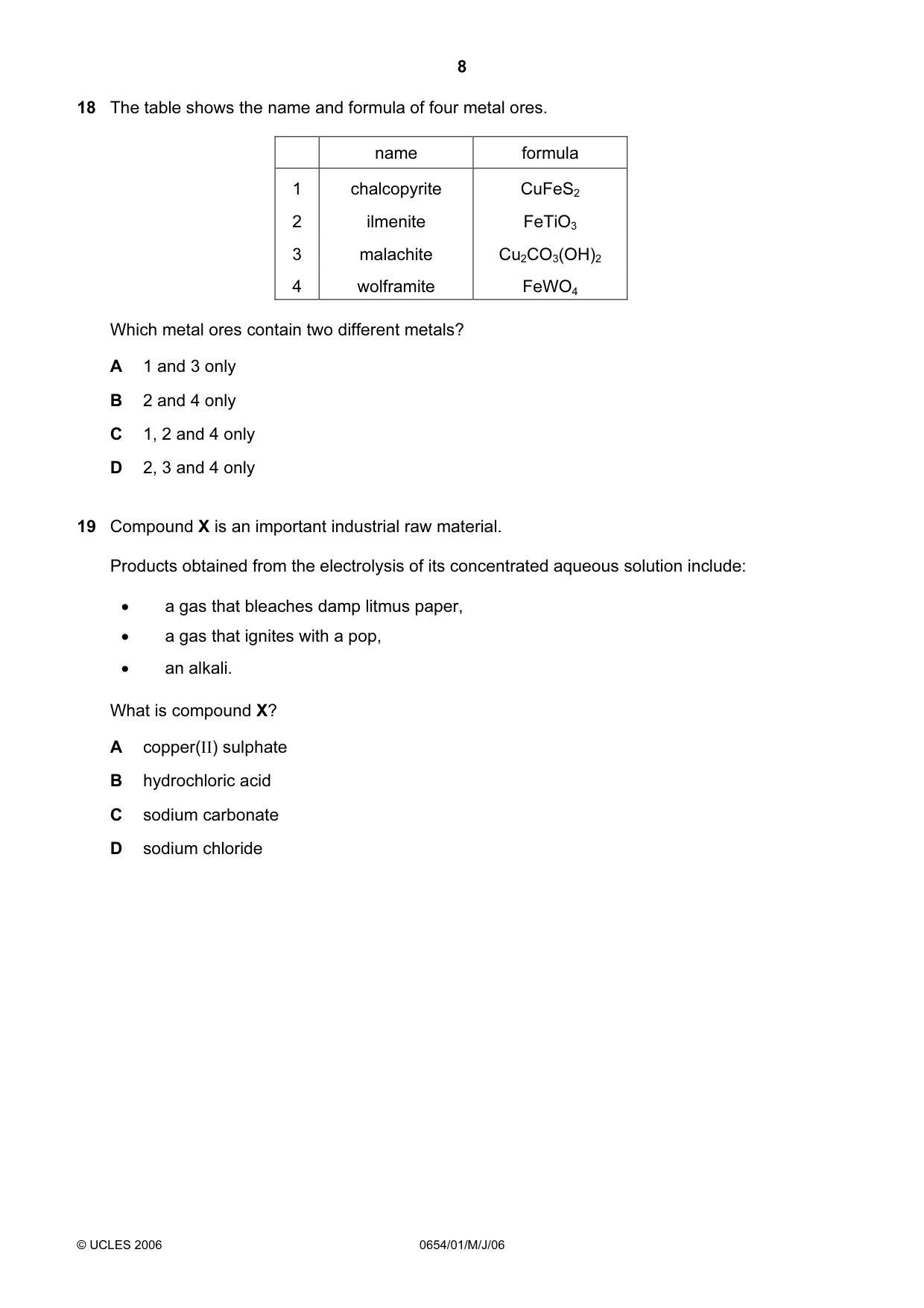
Q18 · The table shows the name and formula of four metal ores
18 The table shows the name and formula of four metal ores. name formula 1 chalcopyrite CuFeS2 2 ilmenite FeTiO3 3 malachite Cu2CO3(OH)2 4 wolframite FeWO4 Which metal ores contain two different metals? A 1 and 3 only B 2 and 4 only C 1, 2 and 4 only D 2, 3 and 4 only
Mark scheme: C
Q19 · Compound X is an important industrial raw material
19 Compound X is an important industrial raw material. Products obtained from the electrolysis of its concentrated aqueous solution include: • a gas that bleaches damp litmus paper, • a gas that ignites with a pop, • an alkali. What is compound X? A copper(II) sulphate B hydrochloric acid C sodium carbonate D sodium chloride
Mark scheme: D
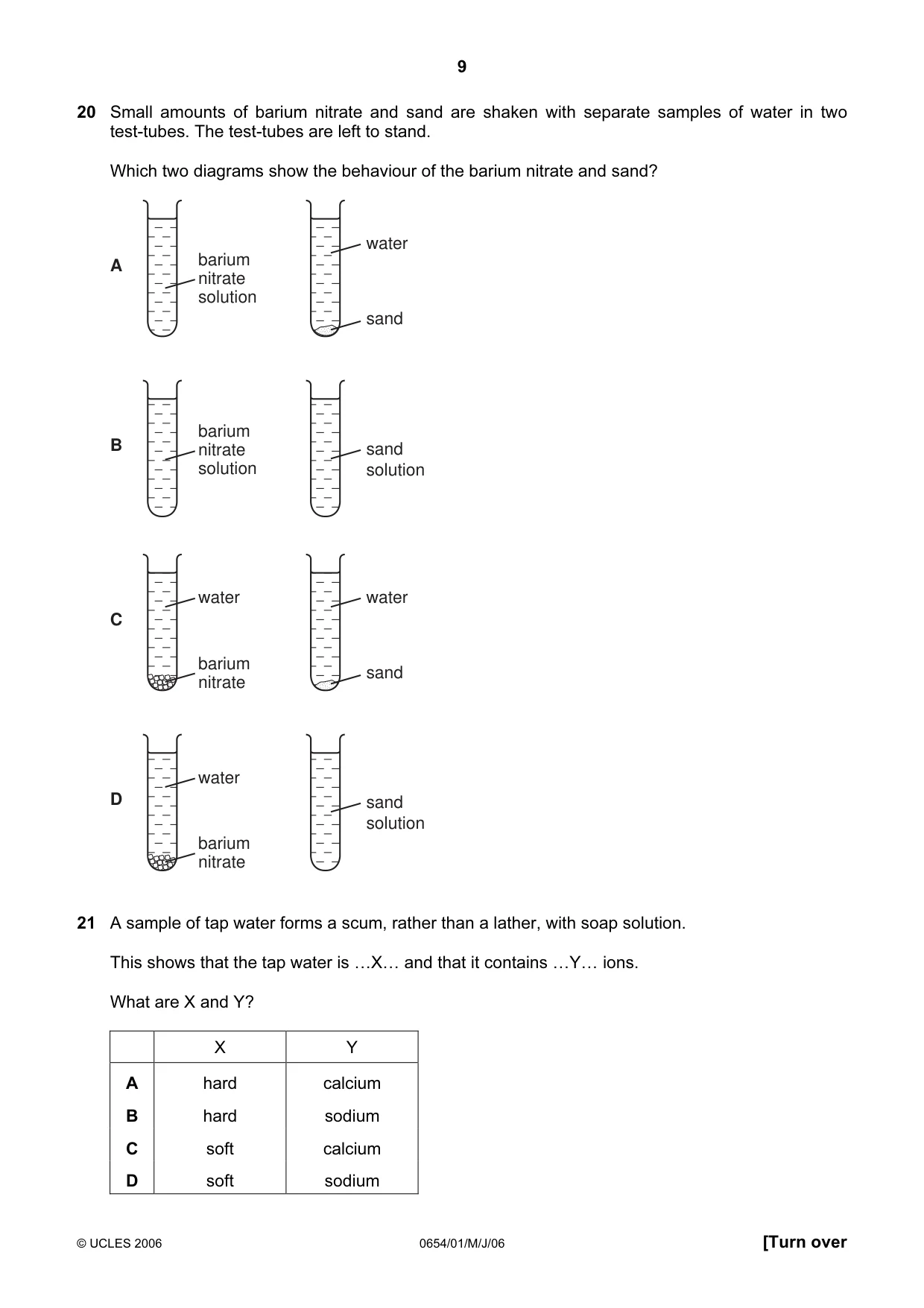
Q20 · Small amounts of barium nitrate and sand are shaken with separate samples of water in two…
20 Small amounts of barium nitrate and sand are shaken with separate samples of water in two test-tubes. The test-tubes are left to stand. Which two diagrams show the behaviour of the barium nitrate and sand? water A barium nitrate solution sand barium B nitrate sand solution solution water water C barium sand nitrate water D sand solution barium nitrate
Mark scheme: A
Q21 · A sample of tap water forms a scum, rather than a lather, with soap solution
21 A sample of tap water forms a scum, rather than a lather, with soap solution. This shows that the tap water is …X… and that it contains …Y… ions. What are X and Y? X Y A hard calcium B hard sodium C soft calcium D soft sodium
Mark scheme: A
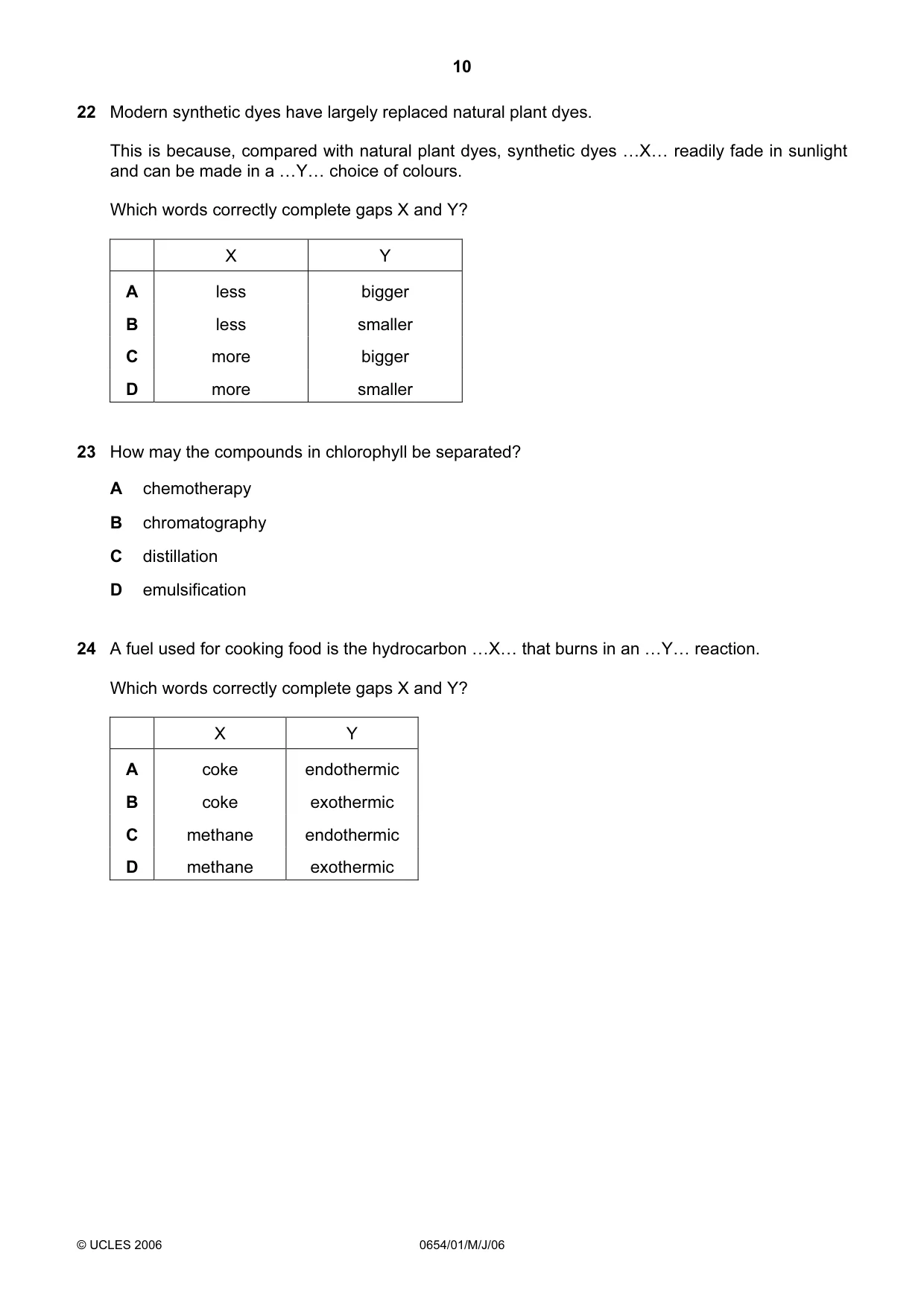
Q22 · Modern synthetic dyes have largely replaced natural plant dyes
22 Modern synthetic dyes have largely replaced natural plant dyes. This is because, compared with natural plant dyes, synthetic dyes …X… readily fade in sunlight and can be made in a …Y… choice of colours. Which words correctly complete gaps X and Y? X Y A less bigger B less smaller C more bigger D more smaller
Mark scheme: A
Q23 · How may the compounds in chlorophyll be separated?
23 How may the compounds in chlorophyll be separated? A chemotherapy B chromatography C distillation D emulsification
Mark scheme: B
Q24 · A fuel used for cooking food is the hydrocarbon …X… that burns in an …Y… reaction
24 A fuel used for cooking food is the hydrocarbon …X… that burns in an …Y… reaction. Which words correctly complete gaps X and Y? X Y A coke endothermic B coke exothermic C methane endothermic D methane exothermic
Mark scheme: D
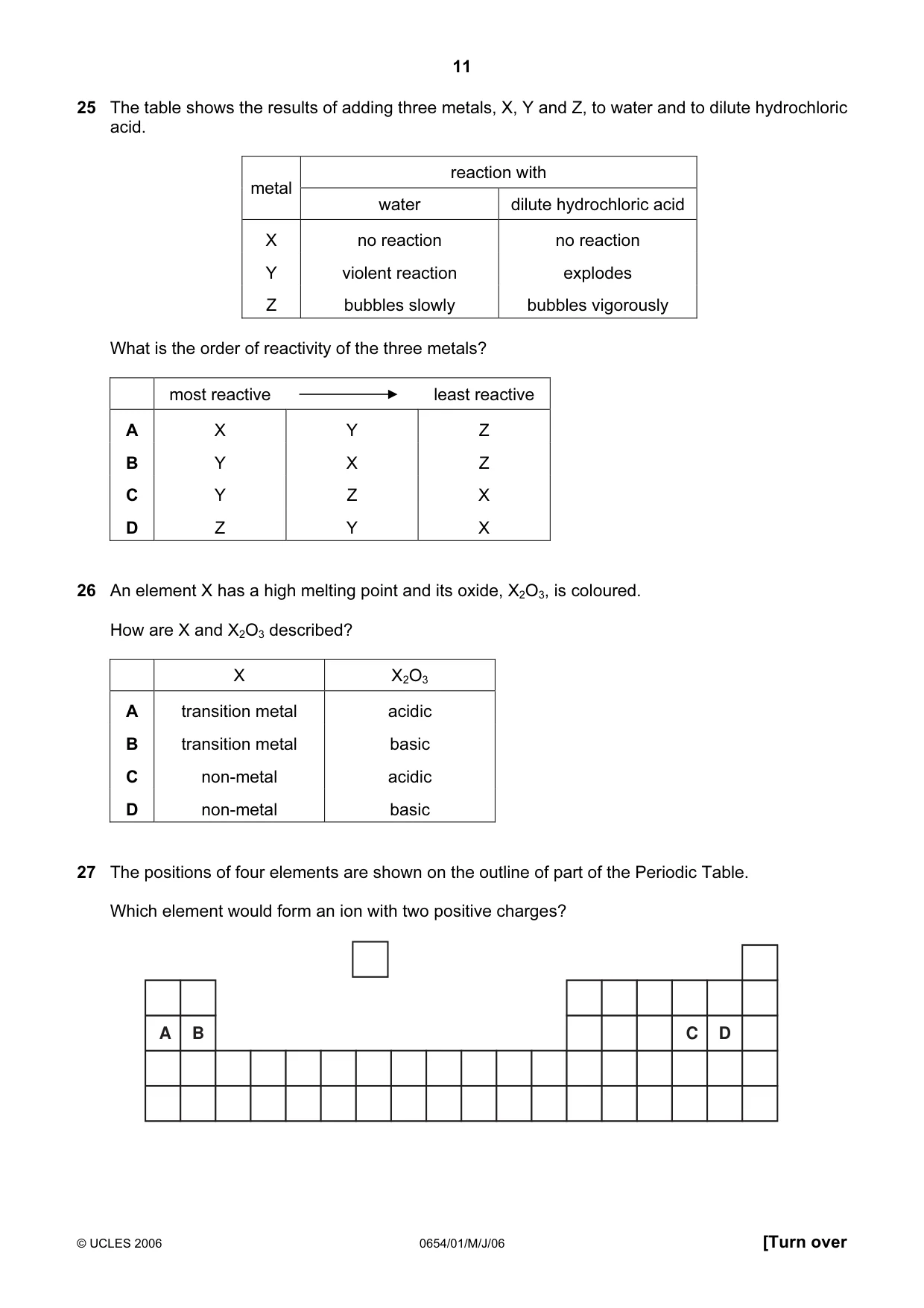
Q25 · The table shows the results of adding three metals, X, Y and Z, to water and to dilute…
25 The table shows the results of adding three metals, X, Y and Z, to water and to dilute hydrochloric acid. reaction with metal water dilute hydrochloric acid X no reaction no reaction Y violent reaction explodes Z bubbles slowly bubbles vigorously What is the order of reactivity of the three metals? most reactive least reactive A X Y Z B Y X Z C Y Z X D Z Y X
Mark scheme: C
Q26 · An element X has a high melting point and its oxide, X2O3, is coloured
26 An element X has a high melting point and its oxide, X2O3, is coloured. How are X and X2O3 described? X X2O3 A transition metal acidic B transition metal basic C non-metal acidic D non-metal basic
Mark scheme: B
Q27 · The positions of four elements are shown on the outline of part of the Periodic Table
27 The positions of four elements are shown on the outline of part of the Periodic Table. Which element would form an ion with two positive charges? A B C D
Mark scheme: B
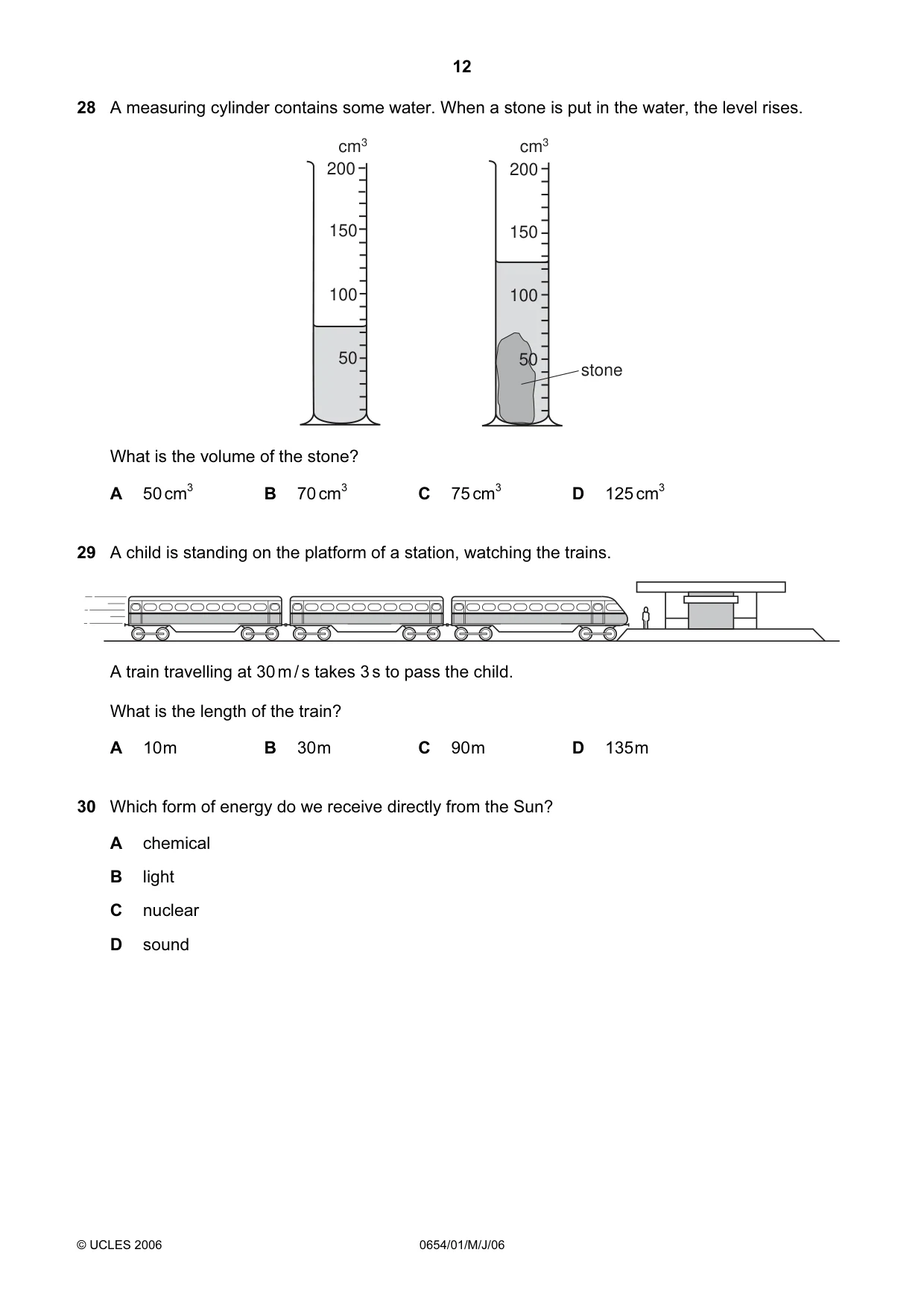
Q28 · A measuring cylinder contains some water
28 A measuring cylinder contains some water. When a stone is put in the water, the level rises. cm3 cm3 200 200 150 150 100 100 50 50 stone What is the volume of the stone? A 50 cm3 B 70 cm3 C 75 cm3 D 125 cm3
Mark scheme: A
More questions on Physical quantities and measurement techniques
Q29 · A child is standing on the platform of a station, watching the trains
29 A child is standing on the platform of a station, watching the trains. A train travelling at 30 m / s takes 3 s to pass the child. What is the length of the train? A 10 m B 30 m C 90 m D 135 m
Mark scheme: C
Q30 · Which form of energy do we receive directly from the Sun?
30 Which form of energy do we receive directly from the Sun? A chemical B light C nuclear D sound
Mark scheme: B
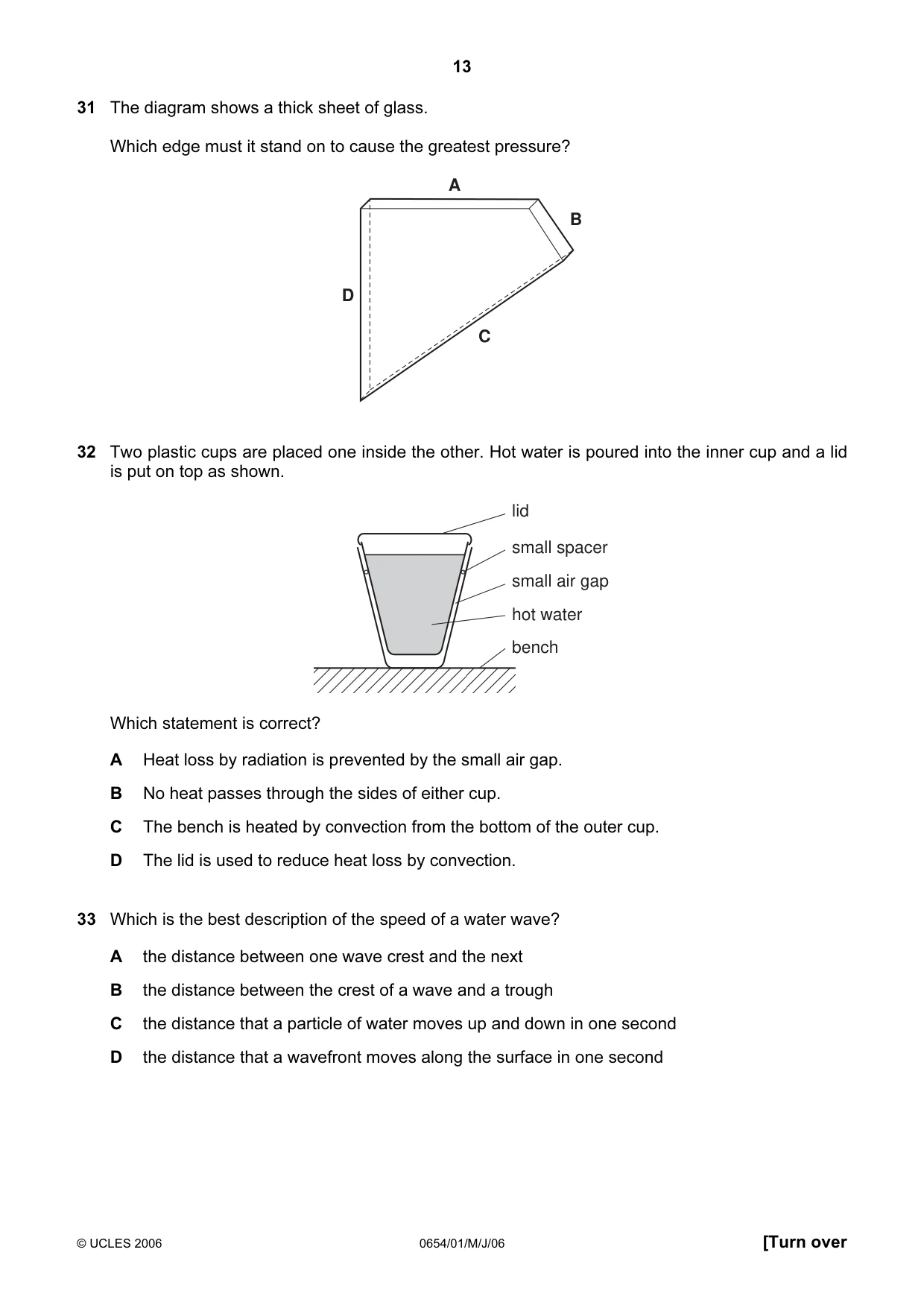
Q31 · The diagram shows a thick sheet of glass
31 The diagram shows a thick sheet of glass. Which edge must it stand on to cause the greatest pressure? A B D C
Mark scheme: B
Q32 · Two plastic cups are placed one inside the other
32 Two plastic cups are placed one inside the other. Hot water is poured into the inner cup and a lid is put on top as shown. lid small spacer small air gap hot water bench Which statement is correct? A Heat loss by radiation is prevented by the small air gap. B No heat passes through the sides of either cup. C The bench is heated by convection from the bottom of the outer cup. D The lid is used to reduce heat loss by convection.
Mark scheme: D
Q33 · Which is the best description of the speed of a water wave?
33 Which is the best description of the speed of a water wave? A the distance between one wave crest and the next B the distance between the crest of a wave and a trough C the distance that a particle of water moves up and down in one second D the distance that a wavefront moves along the surface in one second
Mark scheme: D
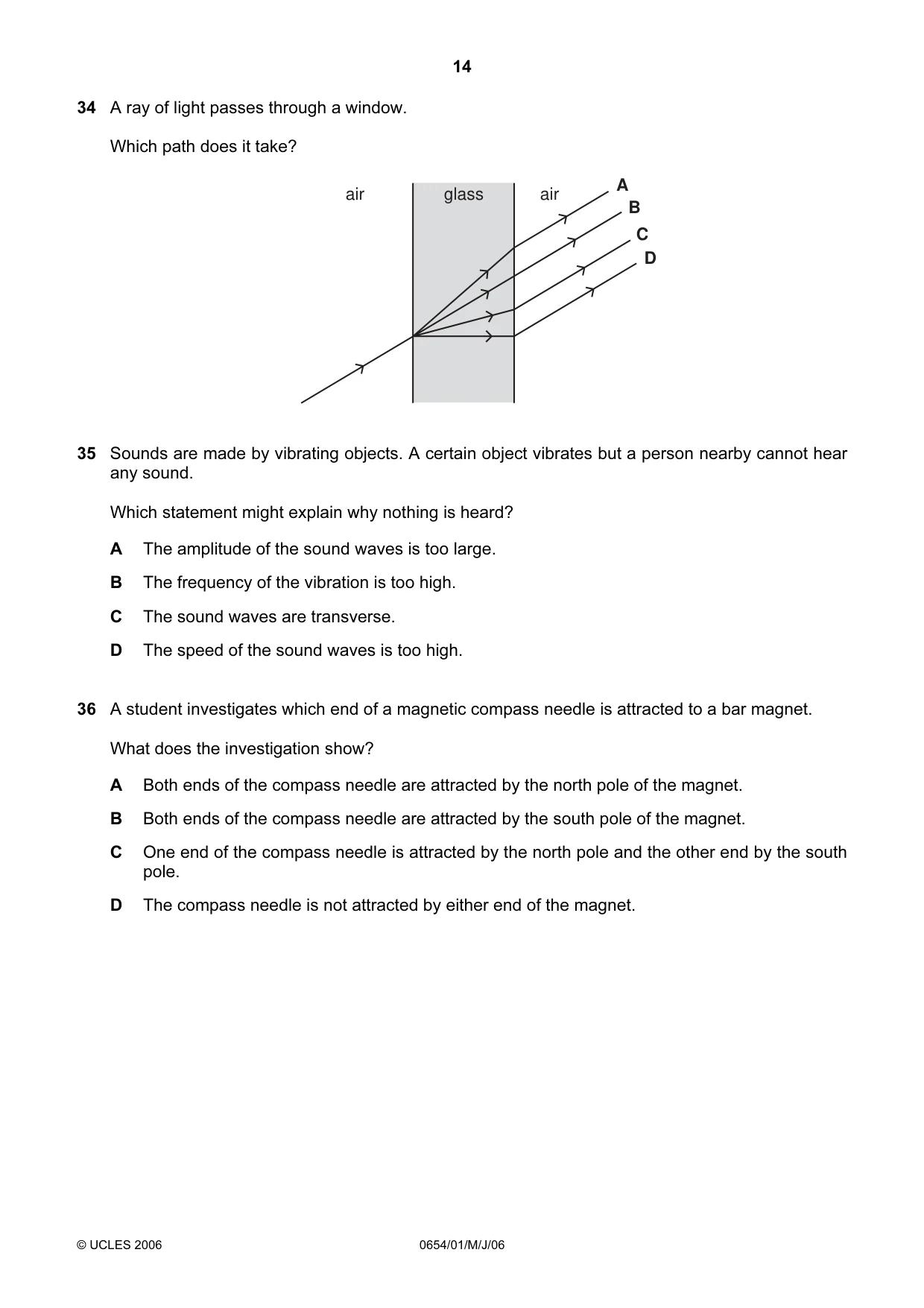
Q34 · A ray of light passes through a window
34 A ray of light passes through a window. Which path does it take? A air glass air B C D
Mark scheme: C
Q35 · Sounds are made by vibrating objects
35 Sounds are made by vibrating objects. A certain object vibrates but a person nearby cannot hear any sound. Which statement might explain why nothing is heard? A The amplitude of the sound waves is too large. B The frequency of the vibration is too high. C The sound waves are transverse. D The speed of the sound waves is too high.
Mark scheme: B
Q36 · A student investigates which end of a magnetic compass needle is attracted to a bar magnet
36 A student investigates which end of a magnetic compass needle is attracted to a bar magnet. What does the investigation show? A Both ends of the compass needle are attracted by the north pole of the magnet. B Both ends of the compass needle are attracted by the south pole of the magnet. C One end of the compass needle is attracted by the north pole and the other end by the south pole. D The compass needle is not attracted by either end of the magnet.
Mark scheme: C
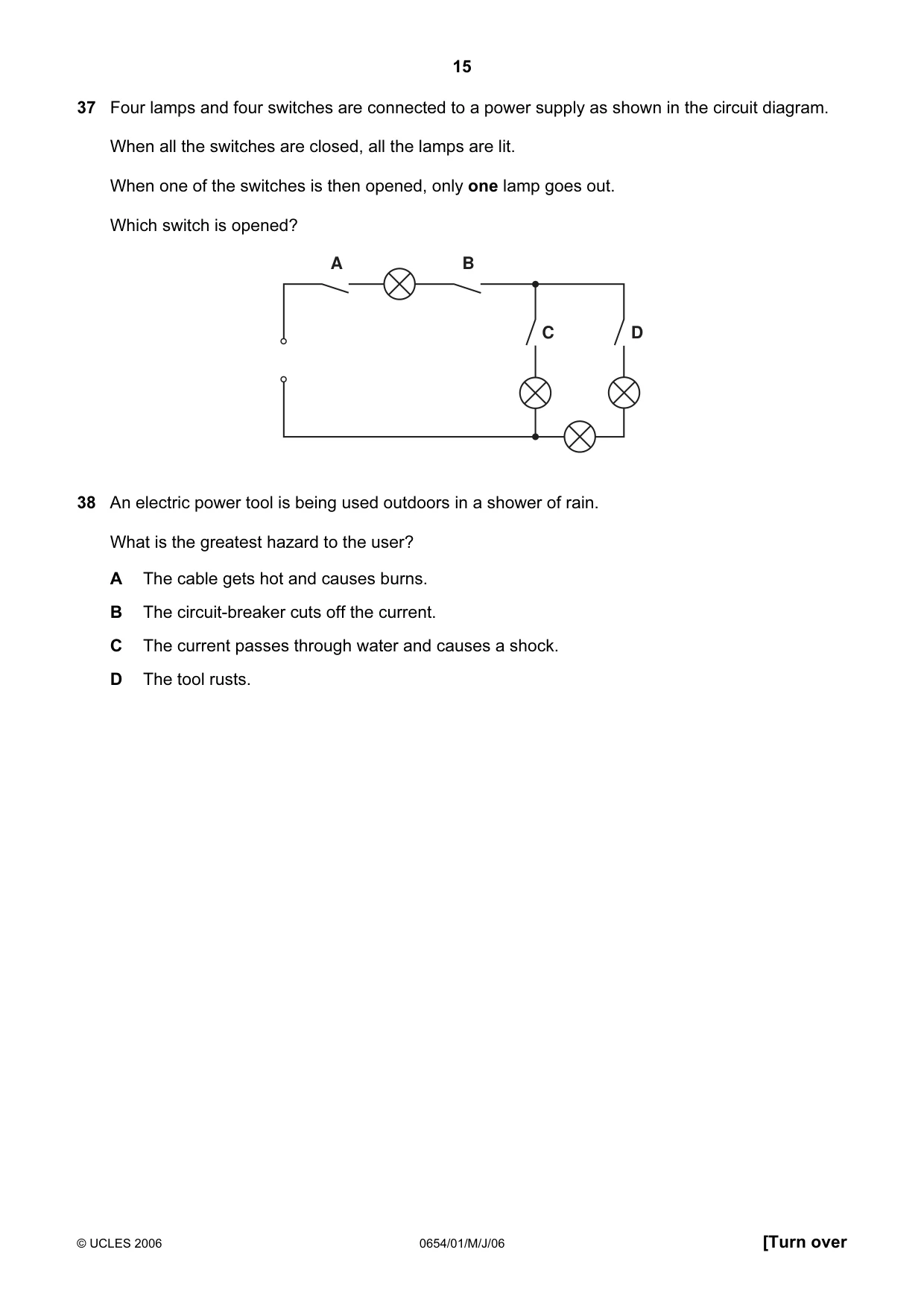
Q37 · Four lamps and four switches are connected to a power supply as shown in the circuit…
37 Four lamps and four switches are connected to a power supply as shown in the circuit diagram. When all the switches are closed, all the lamps are lit. When one of the switches is then opened, only one lamp goes out. Which switch is opened? A B C D
Mark scheme: C
Q38 · An electric power tool is being used outdoors in a shower of rain
38 An electric power tool is being used outdoors in a shower of rain. What is the greatest hazard to the user? A The cable gets hot and causes burns. B The circuit-breaker cuts off the current. C The current passes through water and causes a shock. D The tool rusts.
Mark scheme: C
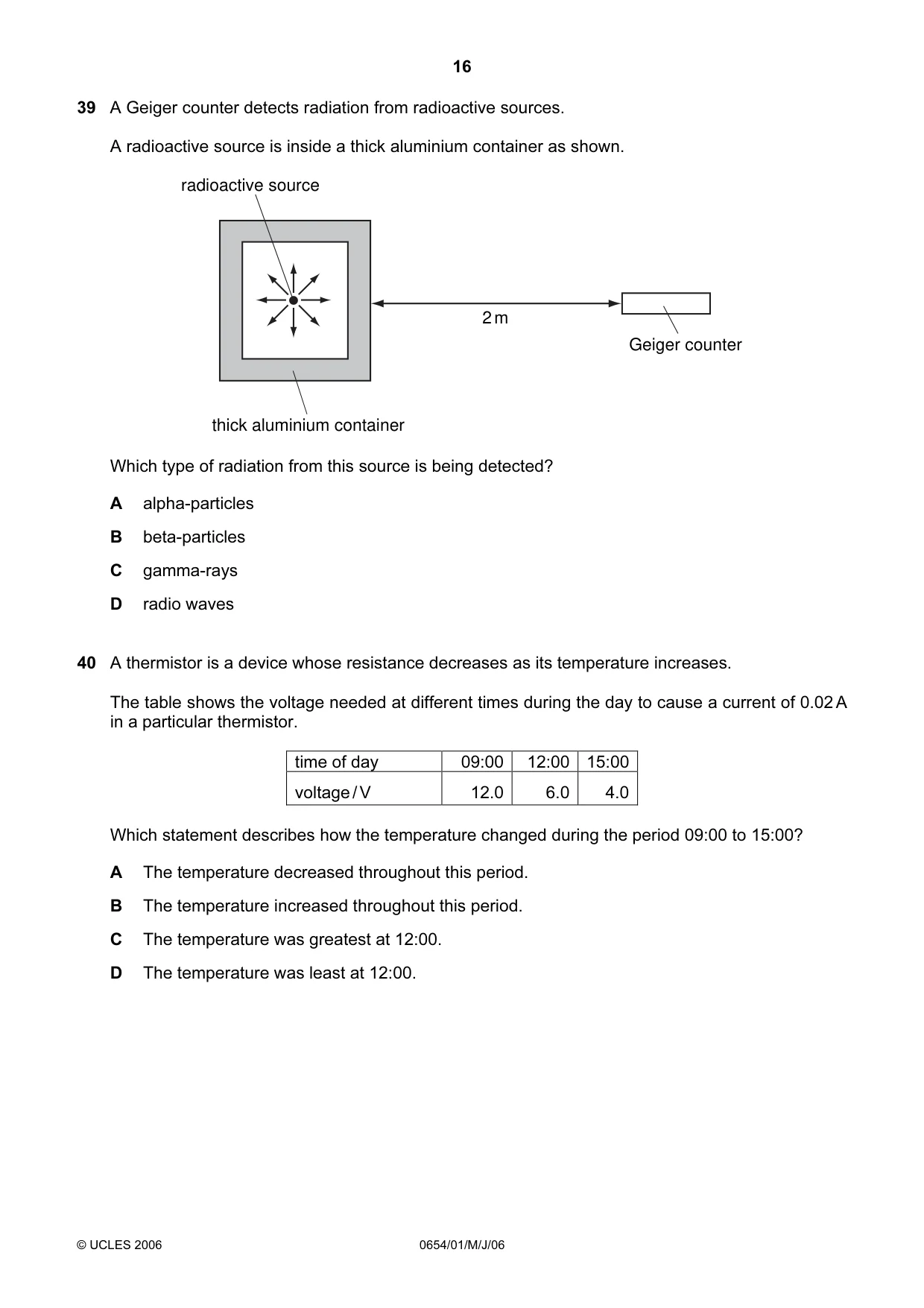
Q39 · A Geiger counter detects radiation from radioactive sources
39 A Geiger counter detects radiation from radioactive sources. A radioactive source is inside a thick aluminium container as shown. radioactive source 2 m Geiger counter thick aluminium container Which type of radiation from this source is being detected? A alpha-particles B beta-particles C gamma-rays D radio waves
Mark scheme: C
Q40 · A thermistor is a device whose resistance decreases as its temperature increases
40 A thermistor is a device whose resistance decreases as its temperature increases. The table shows the voltage needed at different times during the day to cause a current of 0.02 A in a particular thermistor. time of day 09:00 12:00 15:00 voltage / V 12.0 6.0 4.0 Which statement describes how the temperature changed during the period 09:00 to 15:00? A The temperature decreased throughout this period. B The temperature increased throughout this period. C The temperature was greatest at 12:00. D The temperature was least at 12:00.
Mark scheme: B
What was in this paper
The subtopics covered by these 40 questions, and how many questions each got. Open one in a new tab to see every Cambridge question on it.
2Elements, compounds and mixtures2Polymers2Biological molecules1Carbon cycle1Cell division1Cell structure1Chromatography1Coordination and response1Electrical circuits1Electrical quantities1Electrical safety1Electrolysis1Electromagnetic spectrum1Food chains and food webs1Formulas and terminology1Fuels1Gas exchange in humans1General properties of waves1Heart1Homeostasis1Hormones1Identification of ions and gases1Ions and ionic bonds1Light1Motion1Physical quantities and measurement techniques1Pressure1Radioactivity1Reactivity series1Separation and purification1Sexual reproduction in plants1Simple phenomena of magnetism1Sound1Transfer of thermal energy1Transition elements1Water1What you needed in this session
Cambridge’s own grade thresholds for 2006 May/June, Paper 1 · Variant 1. A higher threshold means an easier paper — the bar moves with how the cohort did.