Cambridge IGCSE Sciences - Co-ordinated (Double) 0654 — 2007 May/June Paper 1 · Variant 1
0654/11/M/J/07 · 40 questions · 40 marks · ≈45 min
The question paper and its mark scheme, free to read here and free to download. This is Cambridge’s own paper, exactly as it was sat.
Question paper20 pages



Mark scheme2 pages
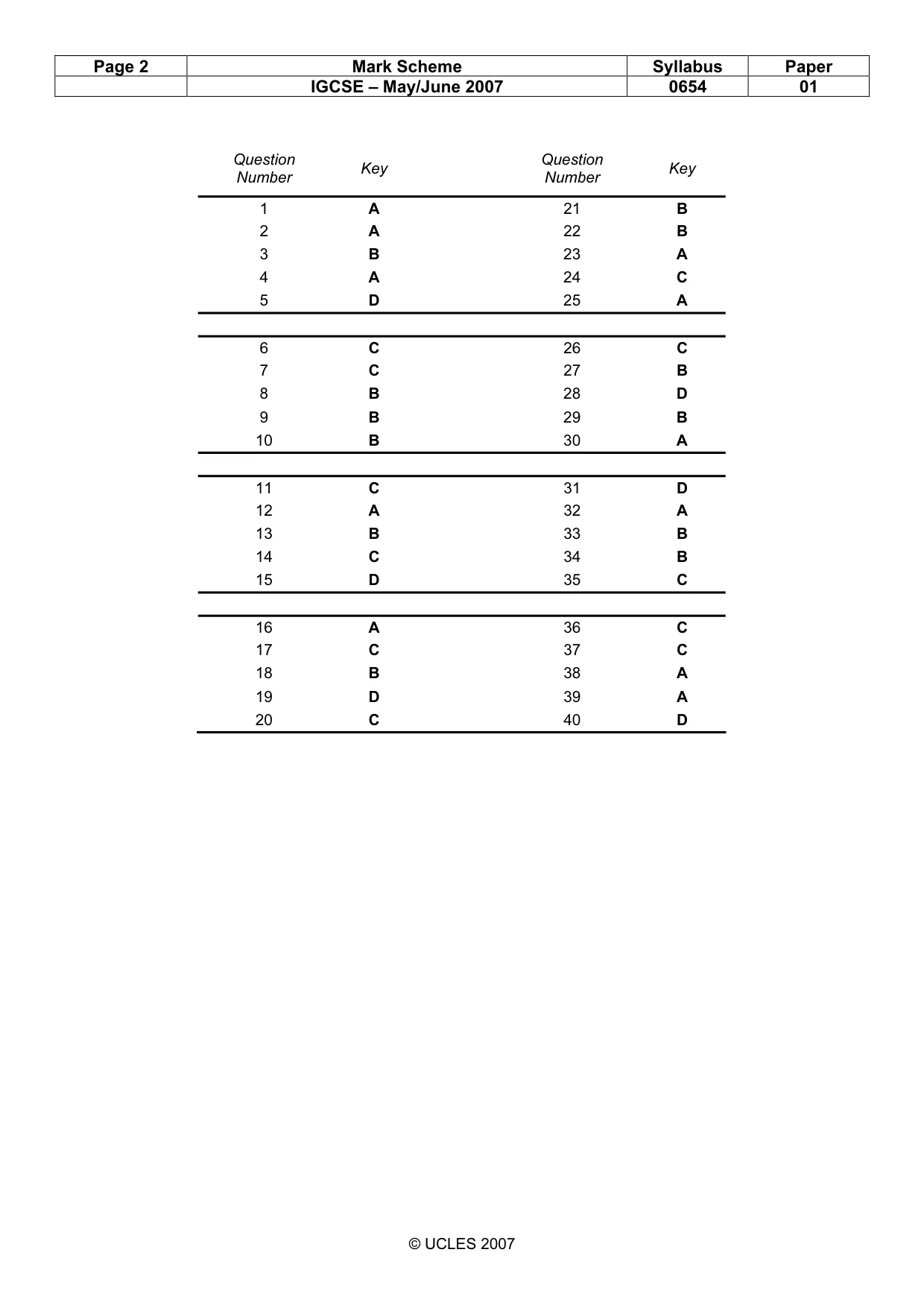
Answers below. Sit the paper first if you are practising.
Questions as text
Q1 · Which system is used for naming and classifying living organisms?
1 Which system is used for naming and classifying living organisms? A binomial B biological C scientific D specific
Mark scheme: A
Q2 · The diagram shows a freshly cut potato chip, a chip suspended in liquid X and a chip…
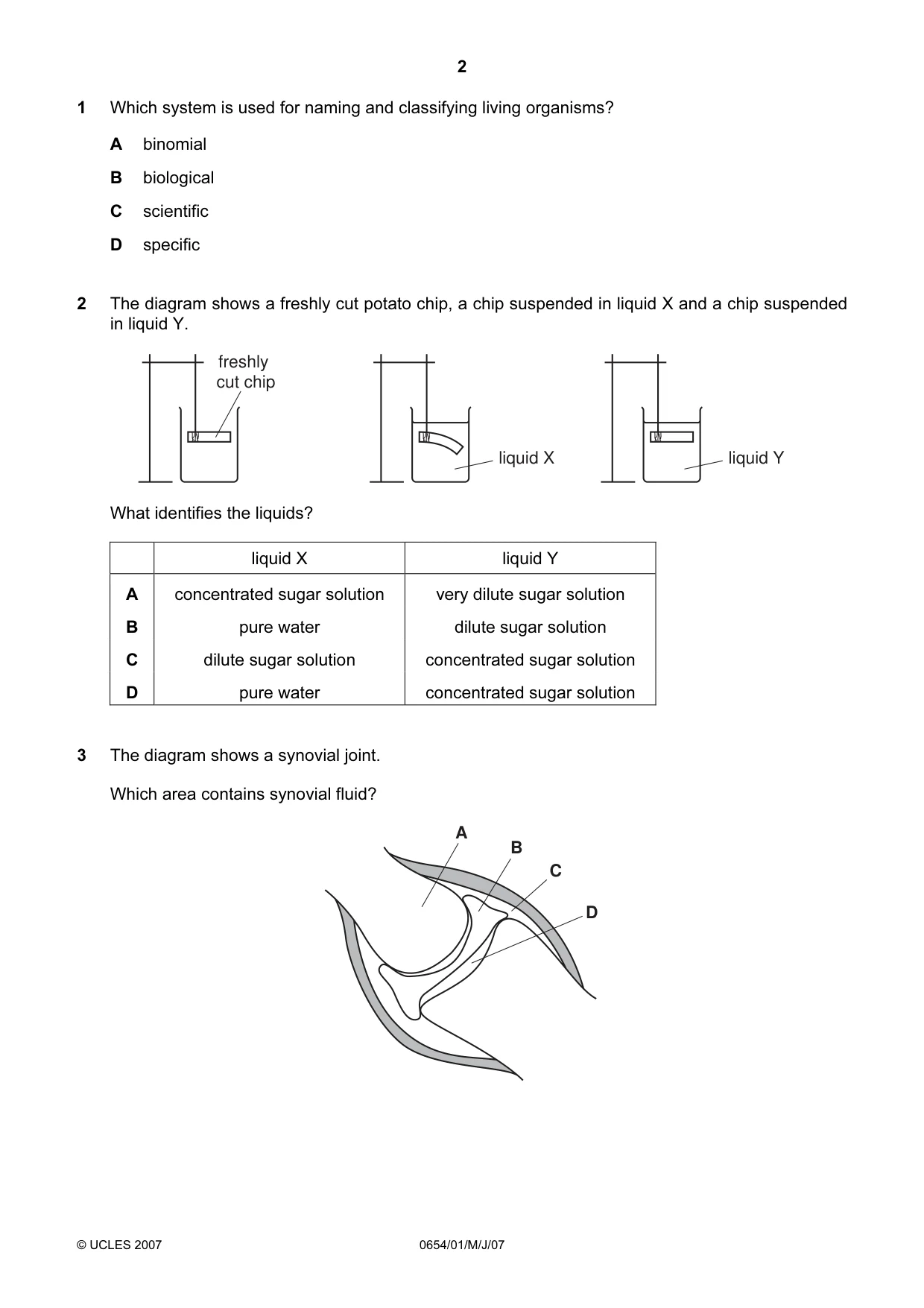
2 The diagram shows a freshly cut potato chip, a chip suspended in liquid X and a chip suspended in liquid Y. freshly cut chip liquid X liquid Y What identifies the liquids? liquid X liquid Y A concentrated sugar solution very dilute sugar solution B pure water dilute sugar solution C dilute sugar solution concentrated sugar solution D pure water concentrated sugar solution
Mark scheme: A
Q3 · The diagram shows a synovial joint
3 The diagram shows a synovial joint. Which area contains synovial fluid? A B C D
Mark scheme: B
Q4 · What is used to remove the colour from a leaf in the starch test?
4 What is used to remove the colour from a leaf in the starch test? A alcohol (methylated spirits) B cold water C hot water D iodine solution
Mark scheme: A
Q5 · Which structures carry blood towards the heart?
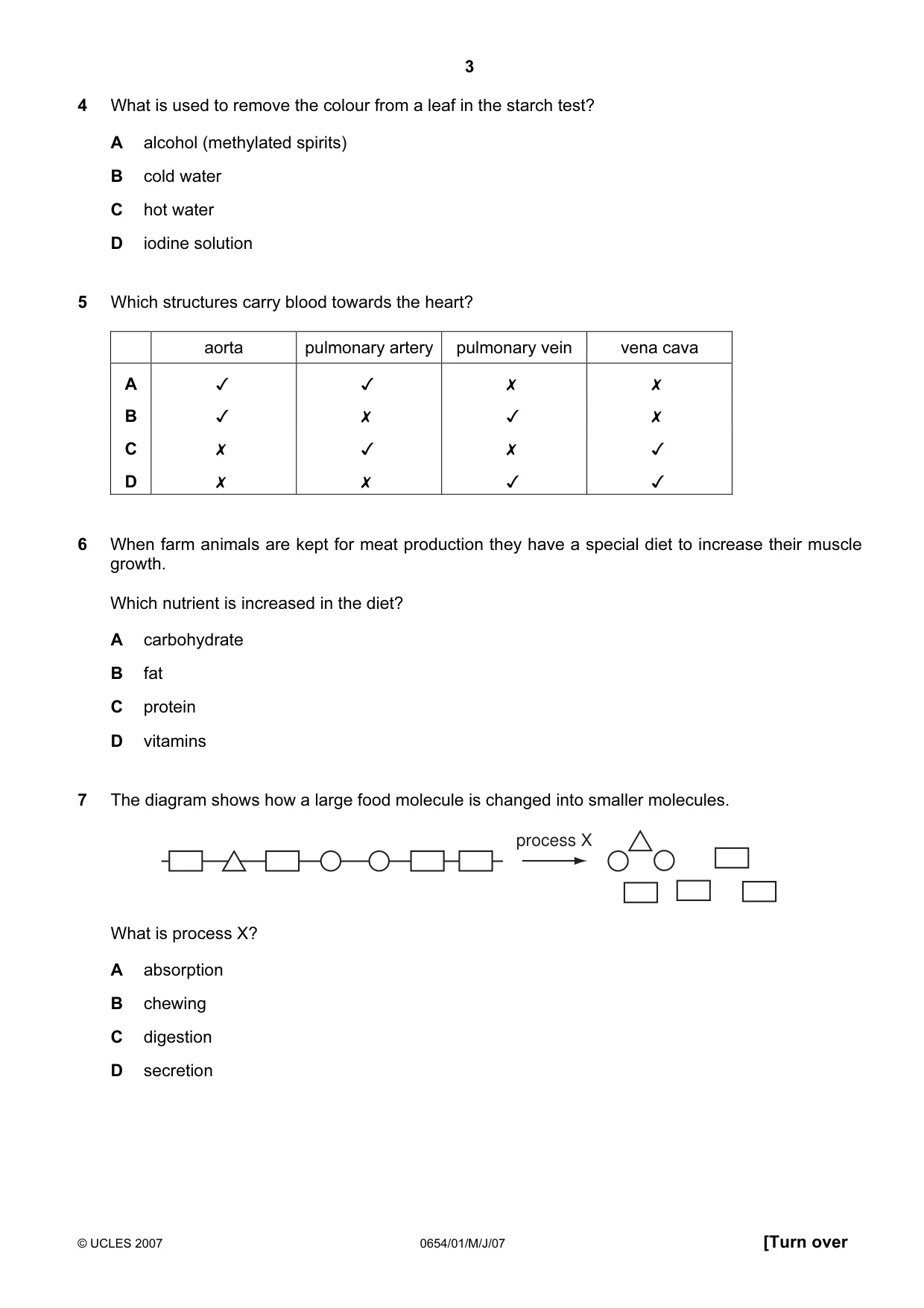
5 Which structures carry blood towards the heart? aorta pulmonary artery | pulmonary vein vena cava v x x x v x
Mark scheme: D
Q6 · When farm animals are kept for meat production they have a special diet to increase their…
6 When farm animals are kept for meat production they have a special diet to increase their muscle growth. Which nutrient is increased in the diet? A carbohydrate B fat C protein D vitamins
Mark scheme: C
Q7 · The diagram shows how a large food molecule is changed into smaller molecules
7 The diagram shows how a large food molecule is changed into smaller molecules. process X What is process X? A absorption B chewing C digestion D secretion
Mark scheme: C
Q8 · An elderly person has broken several bones
8 An elderly person has broken several bones. The doctor advises him to drink more milk. What is the reason for this advice? A Milk helps to prevent dehydration. B Milk is a good source of calcium. C Milk is a good source of iron. D Milk is low in fat.
Mark scheme: B
Question 9
9 What is homeostasis? A the maintenance of the body’s external environment B the maintenance of the body’s internal environment C the processes that produce heat in the body D the removal of wastes from the body
Mark scheme: B
Q10 · After a plant has produced flowers, what is the correct sequence of events leading to…
10 After a plant has produced flowers, what is the correct sequence of events leading to reproduction in that plant? A fertilisation, pollination, seed formation B pollination, fertilisation, seed formation C seed formation, fertilisation, pollination D seed formation, pollination, fertilisation
Mark scheme: B
Q11 · What is the name of the organ in which a human baby grows until it is born?
11 What is the name of the organ in which a human baby grows until it is born? A ovary B oviduct C uterus D vagina
Mark scheme: C
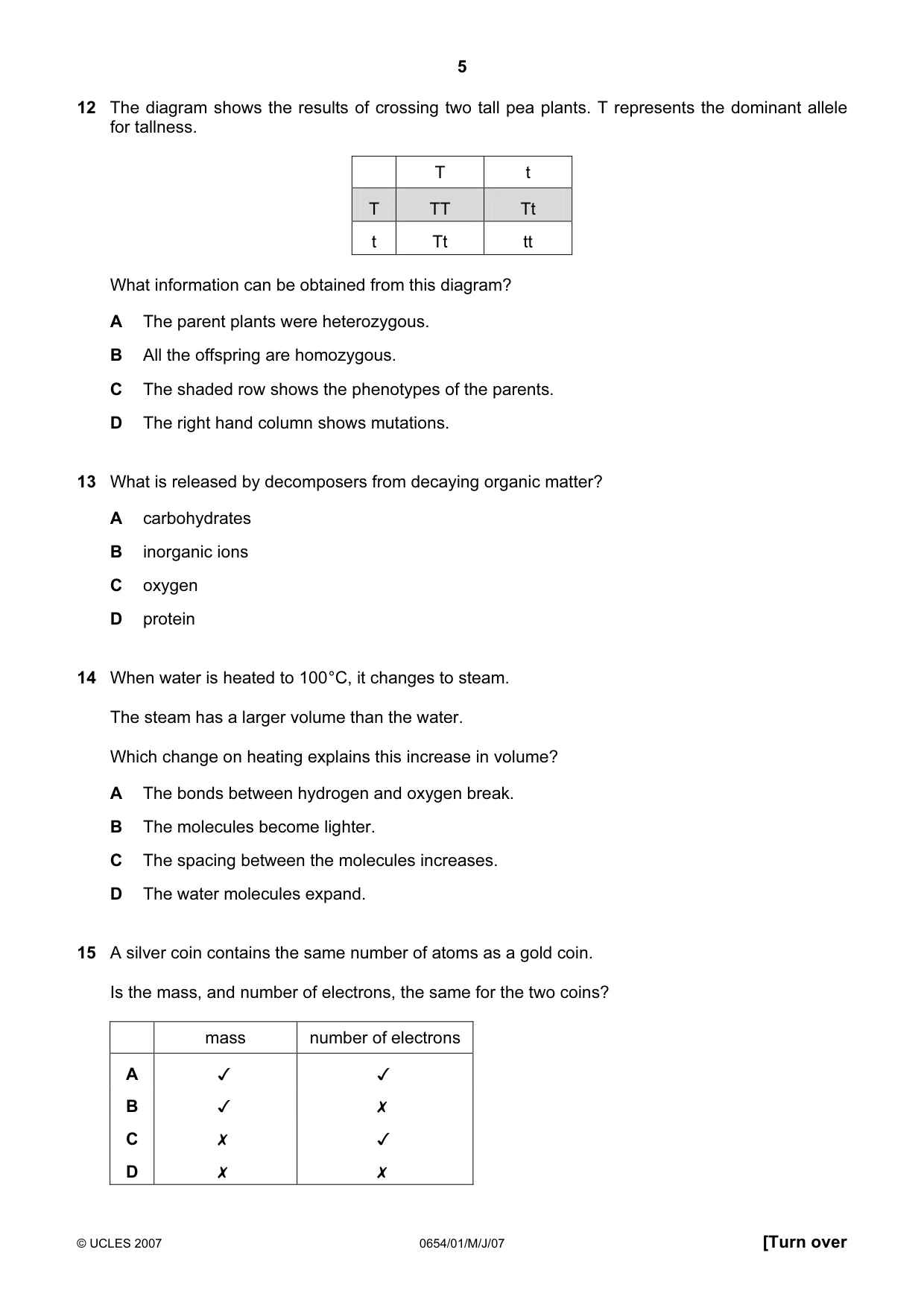
Q12 · The diagram shows the results of crossing two tall pea plants
12 The diagram shows the results of crossing two tall pea plants. T represents the dominant allele for tallness. T t T TT Tt t Tt tt What information can be obtained from this diagram? A The parent plants were heterozygous. B All the offspring are homozygous. C The shaded row shows the phenotypes of the parents. D The right hand column shows mutations.
Mark scheme: A
Q13 · What is released by decomposers from decaying organic matter?
13 What is released by decomposers from decaying organic matter? A carbohydrates B inorganic ions C oxygen D protein
Mark scheme: B
Q14 · When water is heated to 100 °C, it changes to steam
14 When water is heated to 100 °C, it changes to steam. The steam has a larger volume than the water. Which change on heating explains this increase in volume? A The bonds between hydrogen and oxygen break. B The molecules become lighter. C The spacing between the molecules increases. D The water molecules expand.
Mark scheme: C
Q15 · A silver coin contains the same number of atoms as a gold coin
15 A silver coin contains the same number of atoms as a gold coin. Is the mass, and number of electrons, the same for the two coins? number of electrons v v x v x
Mark scheme: D
Q16 · A small piece of element X is dropped into a bowl of water
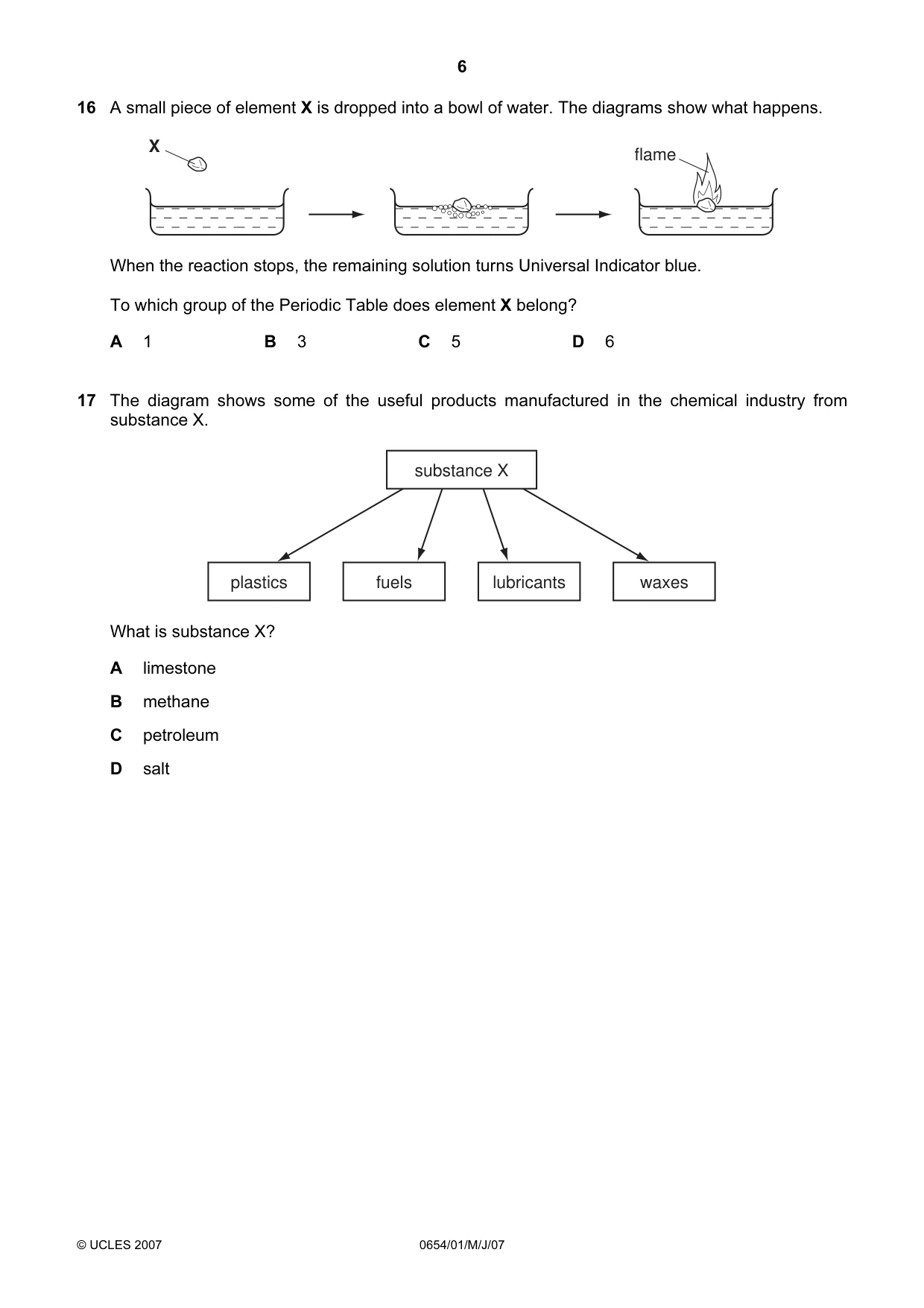
16 A small piece of element X is dropped into a bowl of water. The diagrams show what happens. X flame When the reaction stops, the remaining solution turns Universal Indicator blue. To which group of the Periodic Table does element X belong? A 1 B 3 C 5 D 6
Mark scheme: A
Q17 · The diagram shows some of the useful products manufactured in the chemical industry from…
17 The diagram shows some of the useful products manufactured in the chemical industry from substance X. substance X plastics fuels lubricants waxes What is substance X? A limestone B methane C petroleum D salt
Mark scheme: C
Q18 · Which diagram shows how to separate glucose from a mixture of starch and glucose in water?
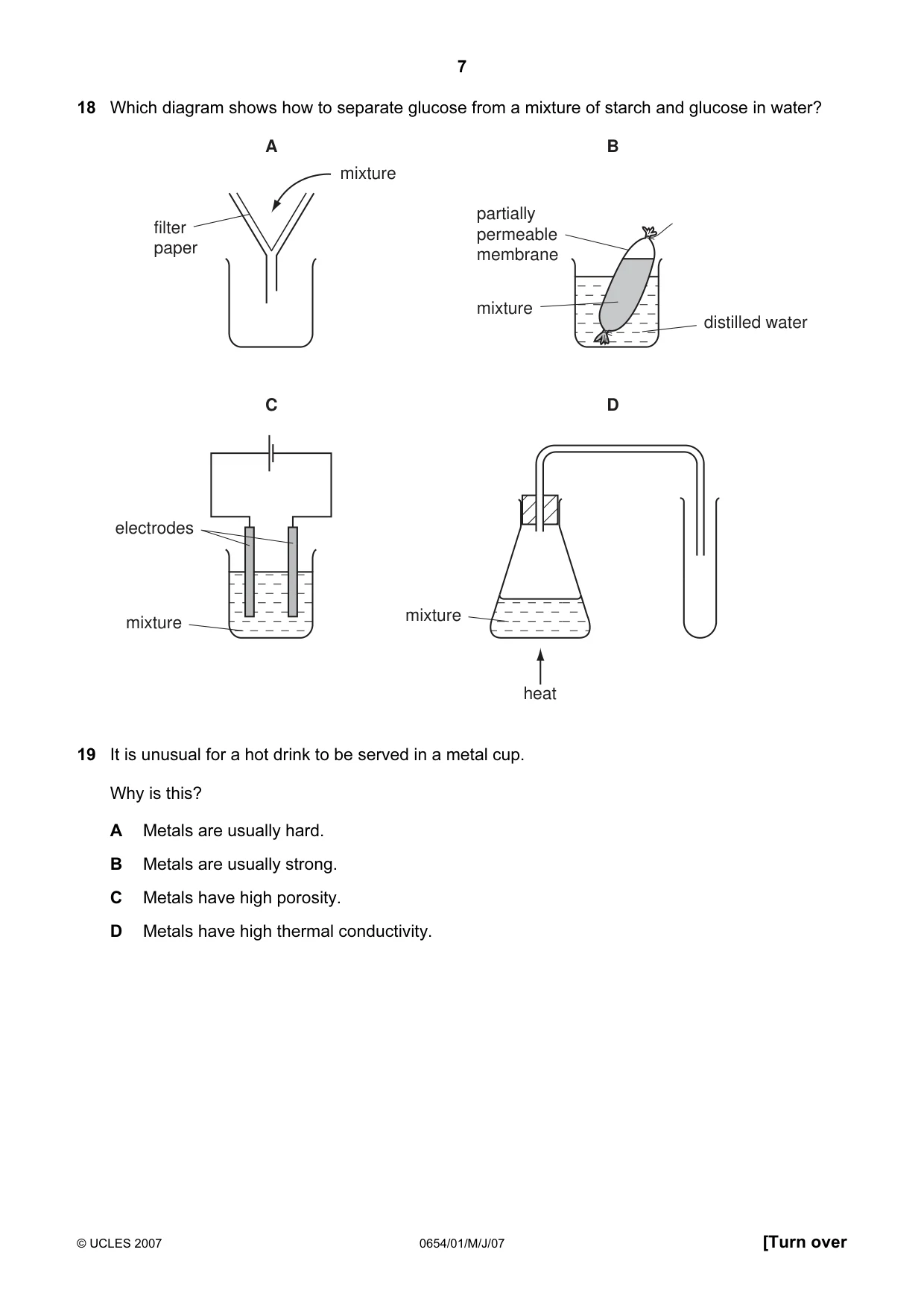
18 Which diagram shows how to separate glucose from a mixture of starch and glucose in water? A B mixture partially filter permeable paper membrane mixture distilled water C D electrodes mixture mixture heat
Mark scheme: B
Q19 · It is unusual for a hot drink to be served in a metal cup
19 It is unusual for a hot drink to be served in a metal cup. Why is this? A Metals are usually hard. B Metals are usually strong. C Metals have high porosity. D Metals have high thermal conductivity.
Mark scheme: D
Q20 · Neon and nitrogen are gaseous non-metals
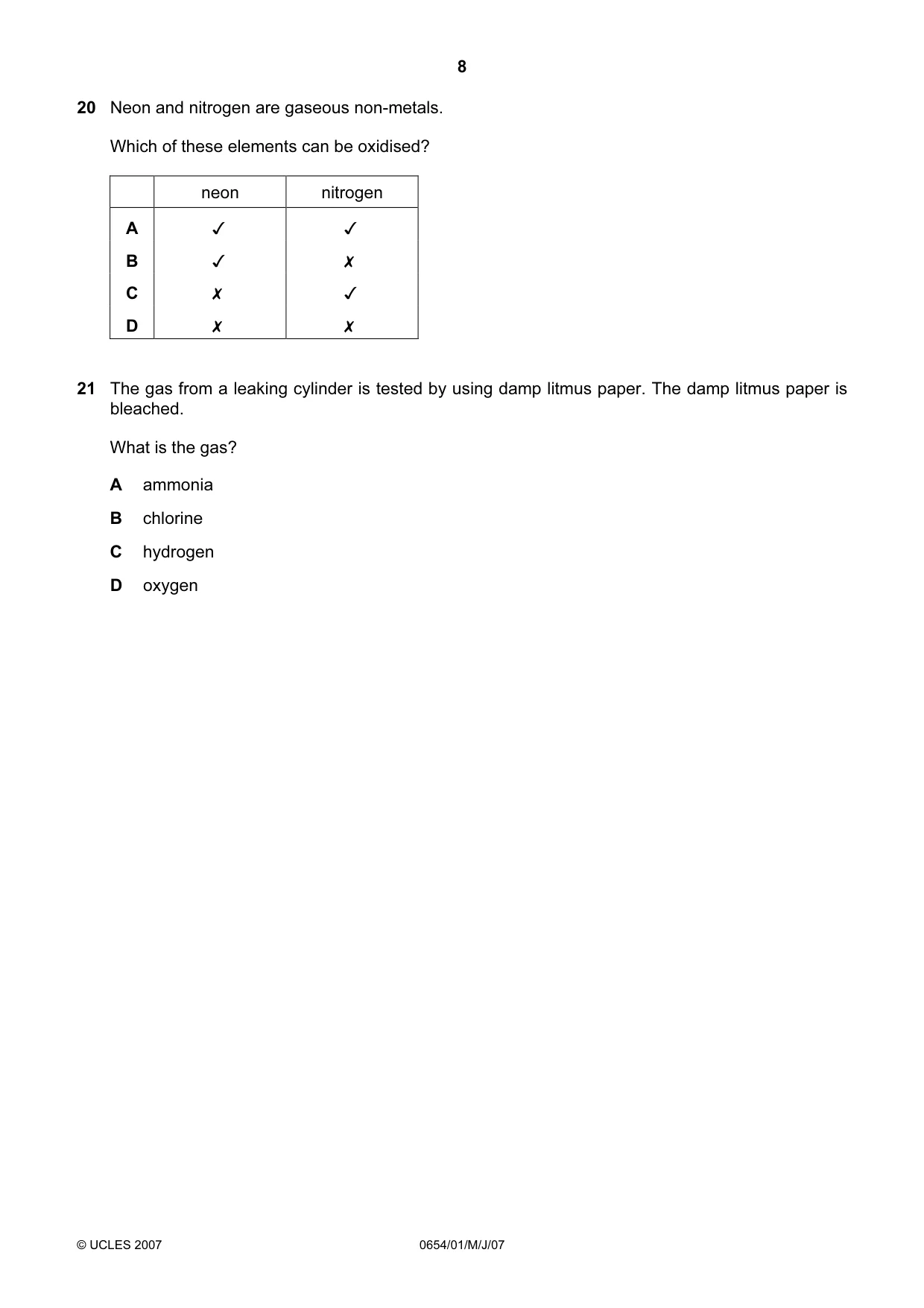
20 Neon and nitrogen are gaseous non-metals. Which of these elements can be oxidised? neon nitrogen A v v B v x Cc x v D x x
Mark scheme: C
Q21 · The gas from a leaking cylinder is tested by using damp litmus paper
21 The gas from a leaking cylinder is tested by using damp litmus paper. The damp litmus paper is bleached. What is the gas? A ammonia B chlorine C hydrogen D oxygen
Mark scheme: B
Q22 · The diagram shows the electrolysis of acidified water
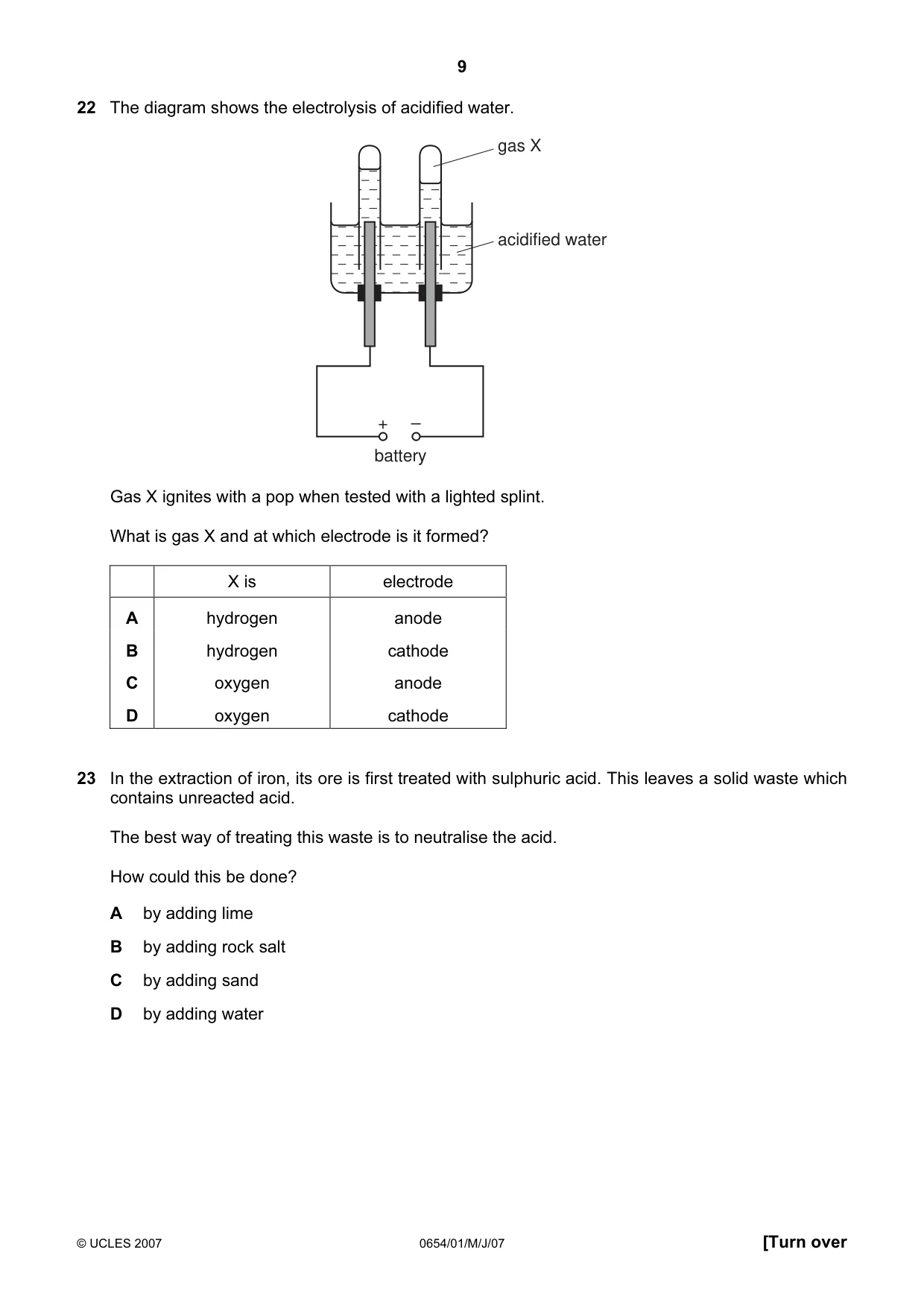
22 The diagram shows the electrolysis of acidified water. gas X acidified water + – battery Gas X ignites with a pop when tested with a lighted splint. What is gas X and at which electrode is it formed? X is electrode A hydrogen anode B hydrogen cathode C oxygen anode D oxygen cathode
Mark scheme: B
Q23 · In the extraction of iron, its ore is first treated with sulphuric acid
23 In the extraction of iron, its ore is first treated with sulphuric acid. This leaves a solid waste which contains unreacted acid. The best way of treating this waste is to neutralise the acid. How could this be done? A by adding lime B by adding rock salt C by adding sand D by adding water
Mark scheme: A
More questions on The characteristic properties of acids and bases
Q24 · The diagram shows apparatus used to investigate the reactivity of metals with a dilute…
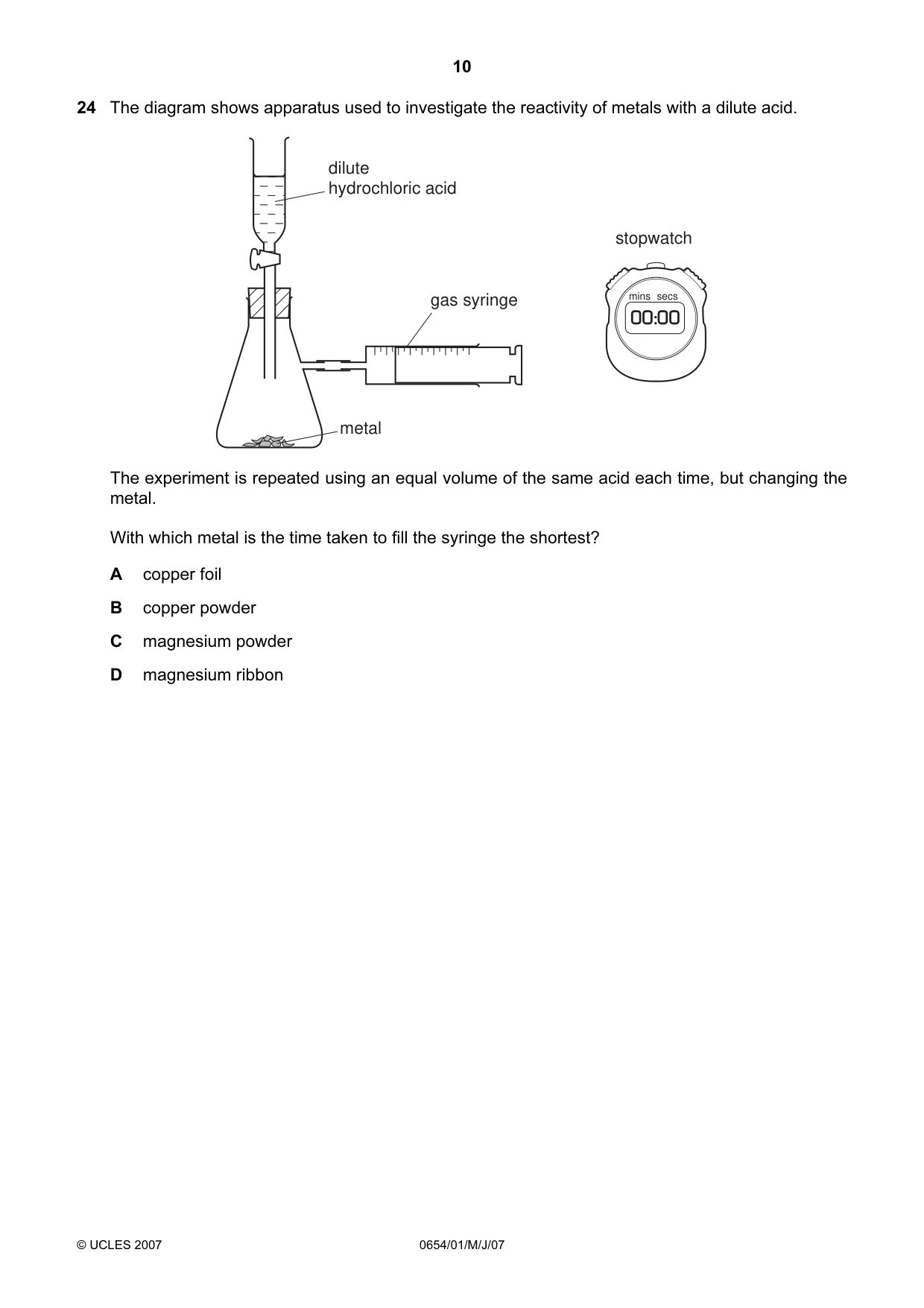
24 The diagram shows apparatus used to investigate the reactivity of metals with a dilute acid. dilute hydrochloric acid stopwatch gas syringe mins secs metal The experiment is repeated using an equal volume of the same acid each time, but changing the metal. With which metal is the time taken to fill the syringe the shortest? A copper foil B copper powder C magnesium powder D magnesium ribbon
Mark scheme: C
Q25 · It is suggested that the colour of a dye fades over time because sunlight causes the dye…
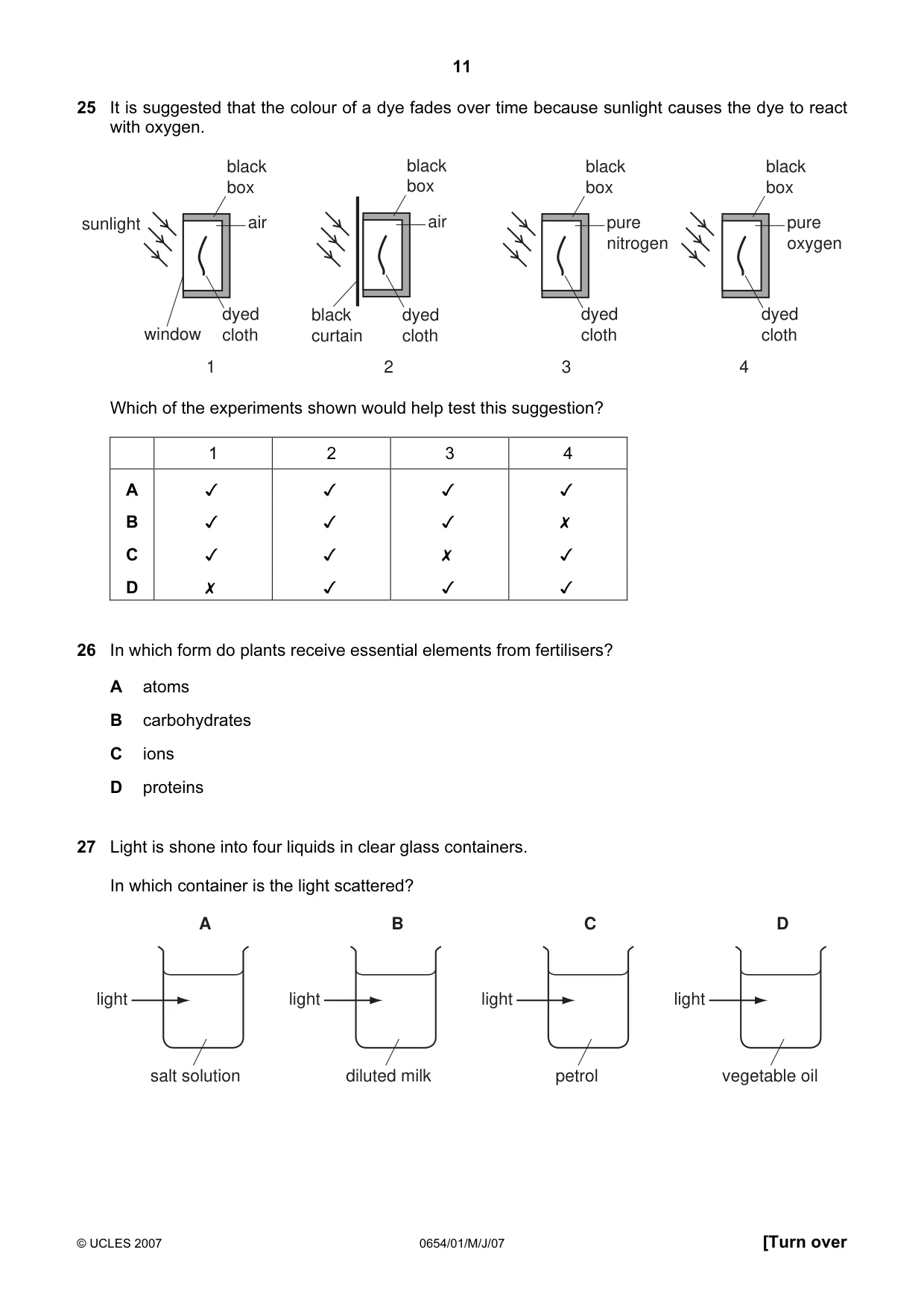
25 It is suggested that the colour of a dye fades over time because sunlight causes the dye to react with oxygen. black black black black box box box box sunlight RN 4 — air pure pure WA ( nitrogen \\ oxygen dyed black Ned Wy ed Wy ed window _ cloth curtain cloth cloth cloth 1 2 3 4 Which of the experiments shown would help test this suggestion? Kx \ low << & <a S44 A In 0 Oo WwW PY a CS
Mark scheme: A
Q26 · In which form do plants receive essential elements from fertilisers?
26 In which form do plants receive essential elements from fertilisers? A atoms B carbohydrates C ions D proteins
Mark scheme: C
Q27 · Light is shone into four liquids in clear glass containers
27 Light is shone into four liquids in clear glass containers. In which container is the light scattered? A B C D light light light light salt solution diluted milk petrol vegetable oil
Mark scheme: B
Q28 · The diagram shows a bird in flight
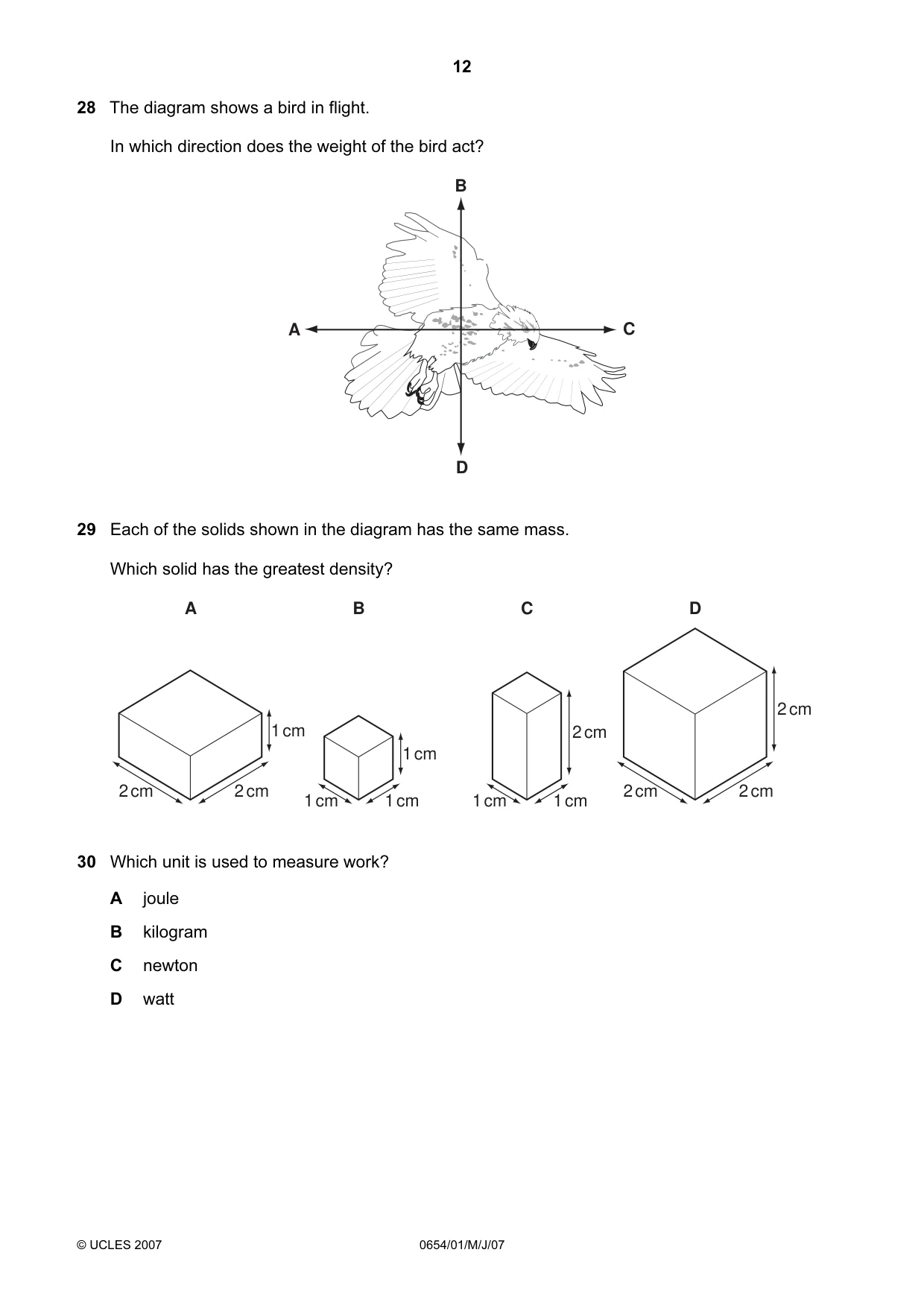
28 The diagram shows a bird in flight. In which direction does the weight of the bird act? B A C D
Mark scheme: D
Q29 · Each of the solids shown in the diagram has the same mass
29 Each of the solids shown in the diagram has the same mass. Which solid has the greatest density? A B C D 2 cm 1 cm 2 cm 1 cm 2 cm 2 cm 2 cm 2 cm 1 cm 1 cm 1 cm 1 cm
Mark scheme: B
Q30 · Which unit is used to measure work?
30 Which unit is used to measure work? A joule B kilogram C newton D watt
Mark scheme: A
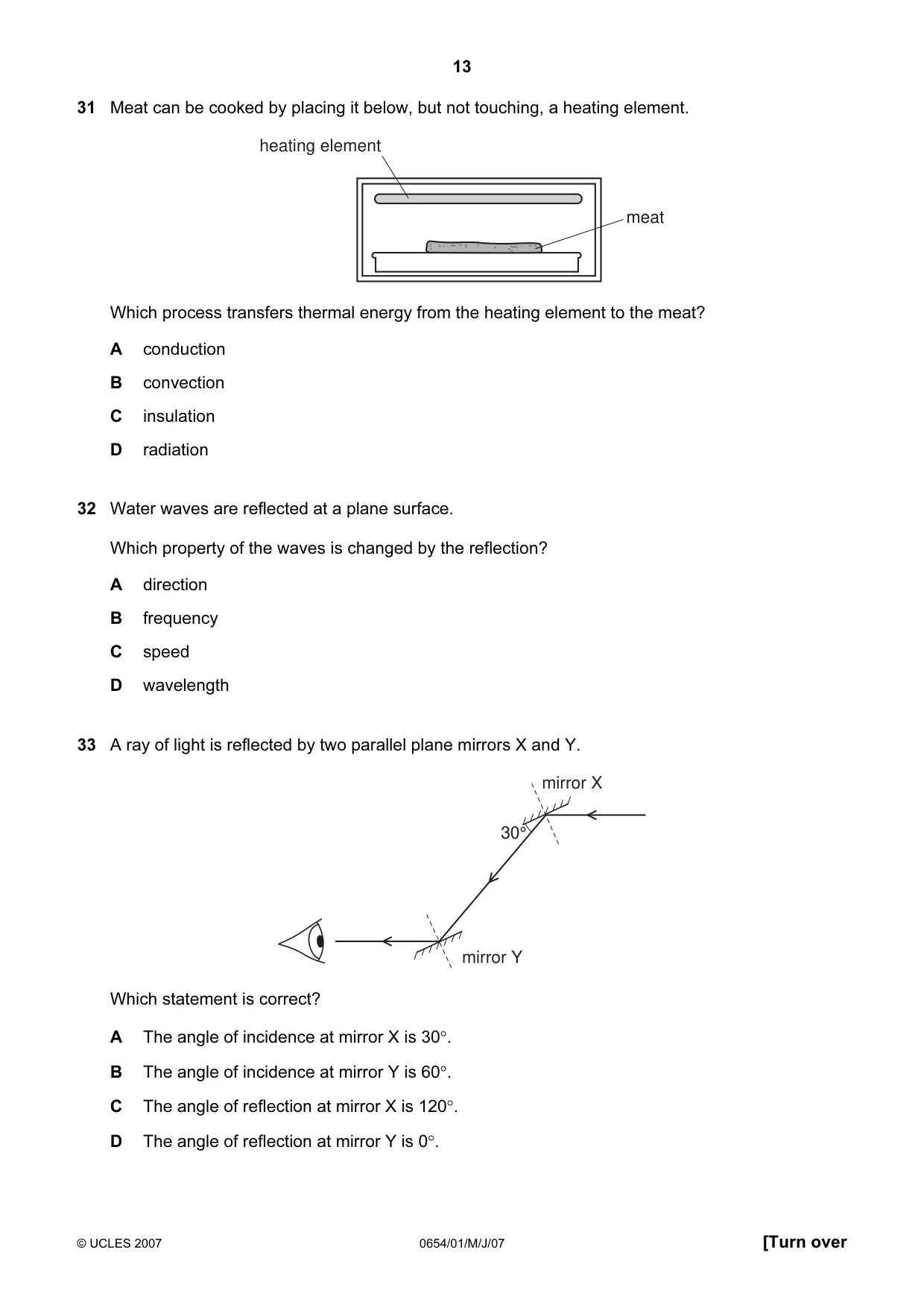
Q31 · Meat can be cooked by placing it below, but not touching, a heating element
31 Meat can be cooked by placing it below, but not touching, a heating element. heating element meat Which process transfers thermal energy from the heating element to the meat? A conduction B convection C insulation D radiation
Mark scheme: D
Q32 · Water waves are reflected at a plane surface
32 Water waves are reflected at a plane surface. Which property of the waves is changed by the reflection? A direction B frequency C speed D wavelength
Mark scheme: A
Q33 · A ray of light is reflected by two parallel plane mirrors X and Y
33 A ray of light is reflected by two parallel plane mirrors X and Y. mirror X 30° mirror Y Which statement is correct? A The angle of incidence at mirror X is 30°. B The angle of incidence at mirror Y is 60°. C The angle of reflection at mirror X is 120°. D The angle of reflection at mirror Y is 0°.
Mark scheme: B
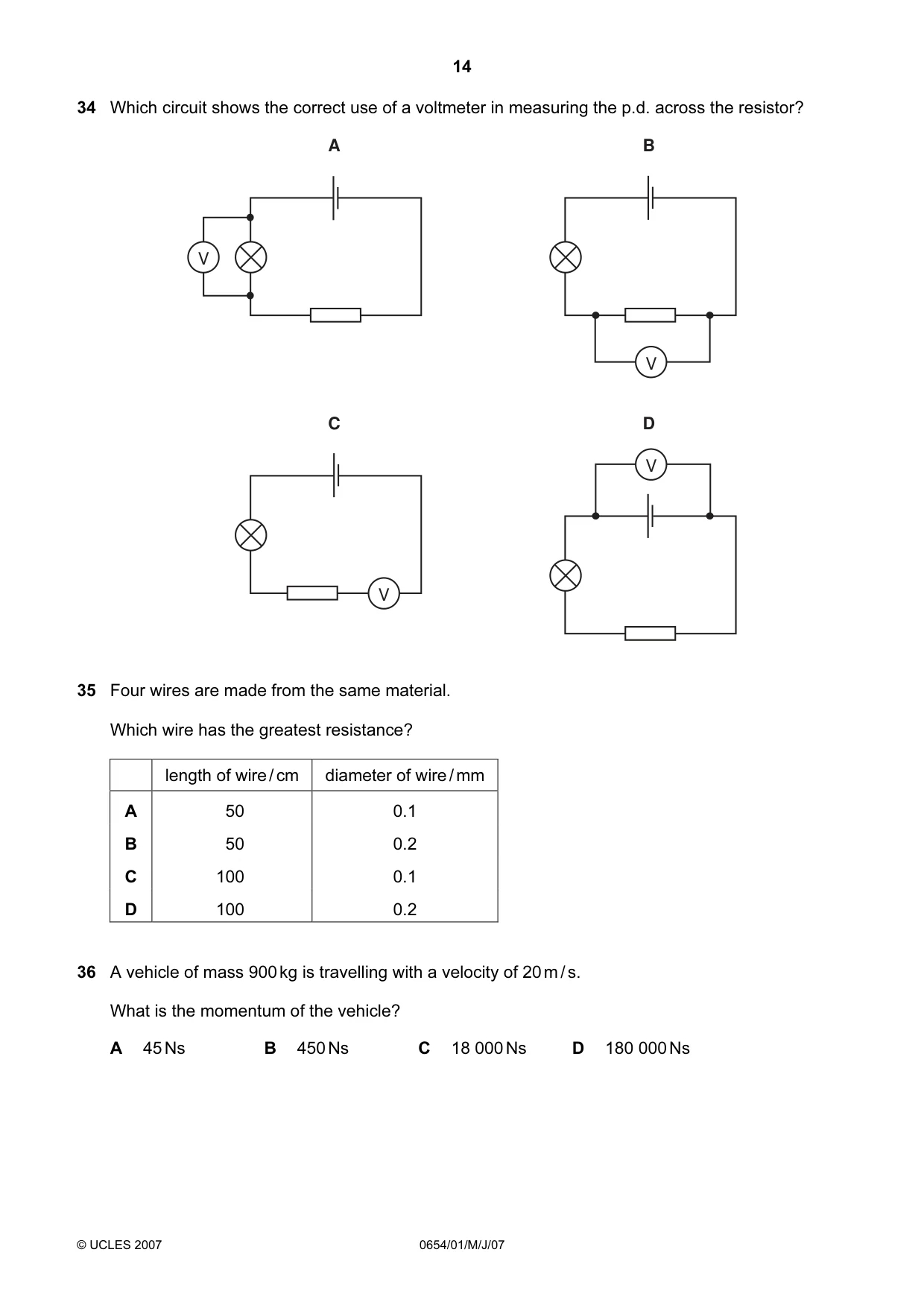
Q34 · Which circuit shows the correct use of a voltmeter in measuring the p.d
34 Which circuit shows the correct use of a voltmeter in measuring the p.d. across the resistor? A B V V C D V V
Mark scheme: B
Q35 · Four wires are made from the same material
35 Four wires are made from the same material. Which wire has the greatest resistance? length of wire / cm diameter of wire / mm A 50 0.1 B 50 0.2 C 100 0.1 D 100 0.2
Mark scheme: C
Q36 · A vehicle of mass 900 kg is travelling with a velocity of 20 m / s
36 A vehicle of mass 900 kg is travelling with a velocity of 20 m / s. What is the momentum of the vehicle? A 45 Ns B 450 Ns C 18 000 Ns D 180 000 Ns
Mark scheme: C
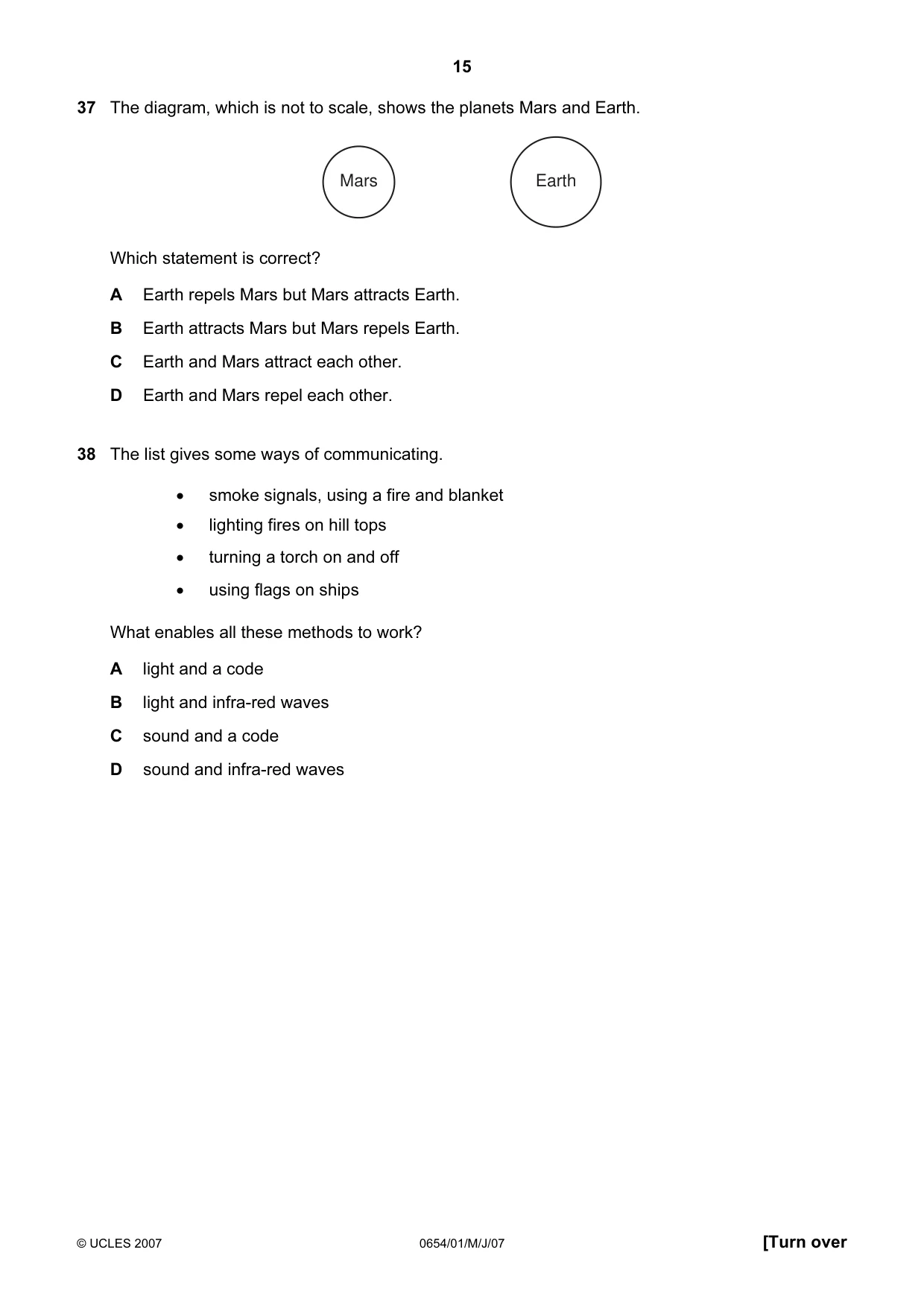
Q37 · The diagram, which is not to scale, shows the planets Mars and Earth
37 The diagram, which is not to scale, shows the planets Mars and Earth. Mars Earth Which statement is correct? A Earth repels Mars but Mars attracts Earth. B Earth attracts Mars but Mars repels Earth. C Earth and Mars attract each other. D Earth and Mars repel each other.
Mark scheme: C
Q38 · The list gives some ways of communicating
38 The list gives some ways of communicating. • smoke signals, using a fire and blanket • lighting fires on hill tops • turning a torch on and off • using flags on ships What enables all these methods to work? A light and a code B light and infra-red waves C sound and a code D sound and infra-red waves
Mark scheme: A
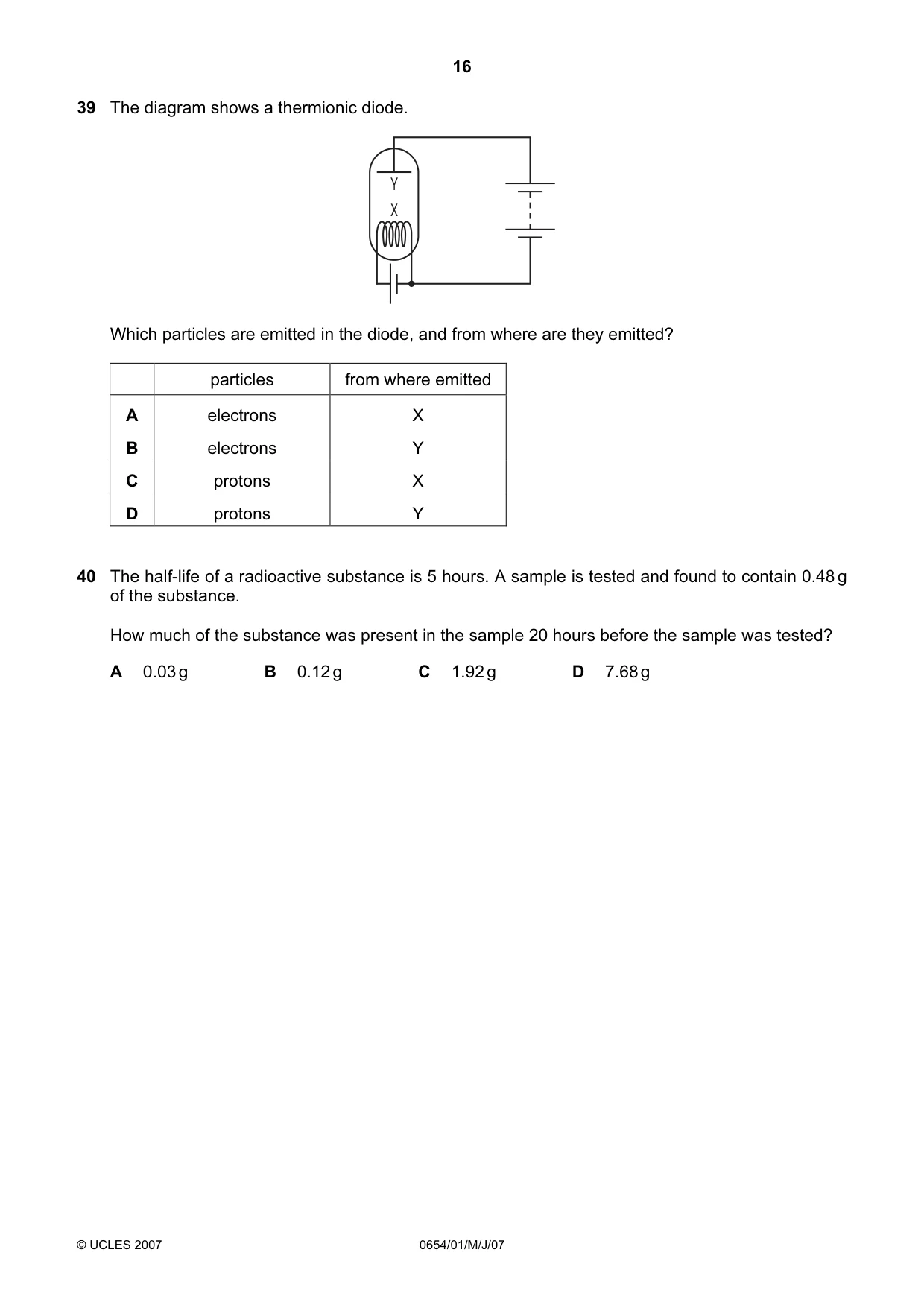
Q39 · The diagram shows a thermionic diode
39 The diagram shows a thermionic diode. Y X Which particles are emitted in the diode, and from where are they emitted? particles from where emitted A electrons X B electrons Y C protons X D protons Y
Mark scheme: A
Q40 · The half-life of a radioactive substance is 5 hours
40 The half-life of a radioactive substance is 5 hours. A sample is tested and found to contain 0.48 g of the substance. How much of the substance was present in the sample 20 hours before the sample was tested? A 0.03 g B 0.12 g C 1.92 g D 7.68 g
Mark scheme: D
What was in this paper
The subtopics covered by these 40 questions, and how many questions each got. Open one in a new tab to see every Cambridge question on it.
2Forces2Light2Transfer of thermal energy2Atomic structure and the Periodic Table1Blood vessels1Characteristics of living organisms1Coordination and response1Density1Digestion1Electrical circuits1Electrical quantities1Electrolysis1Electromagnetic effects1Electromagnetic spectrum1Energy flow1Energy, work and power1Experimental design1Fuels1General properties of waves1Group I properties1Group VII properties1Homeostasis1Kinetic particle model of matter1Mass and weight1Monohybrid inheritance1Osmosis1Photosynthesis1Radioactivity1Reactivity series1Redox1Separation and purification1Sexual reproduction in humans1Sexual reproduction in plants1The characteristic properties of acids and bases1Water1What you needed in this session
Cambridge’s own grade thresholds for 2007 May/June, Paper 1 · Variant 1. A higher threshold means an easier paper — the bar moves with how the cohort did.