Cambridge IGCSE Sciences - Co-ordinated (Double) 0654 — 2015 Oct/Nov Paper 1 · Variant 1
0654/11/O/N/15 · 40 questions · 40 marks · ≈45 min
The question paper and its mark scheme, free to read here and free to download. This is Cambridge’s own paper, exactly as it was sat.
Question paper20 pages



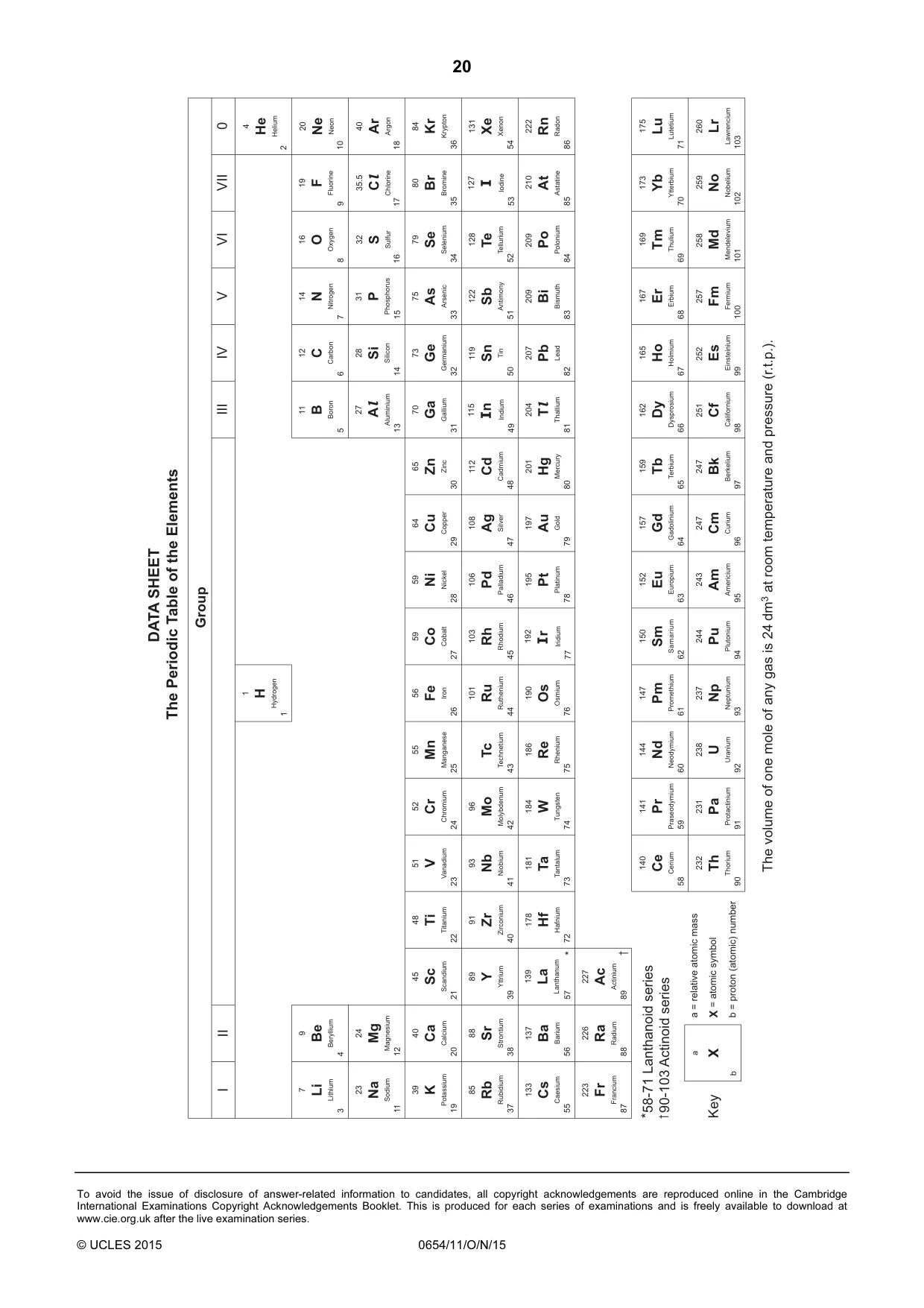
Mark scheme2 pages
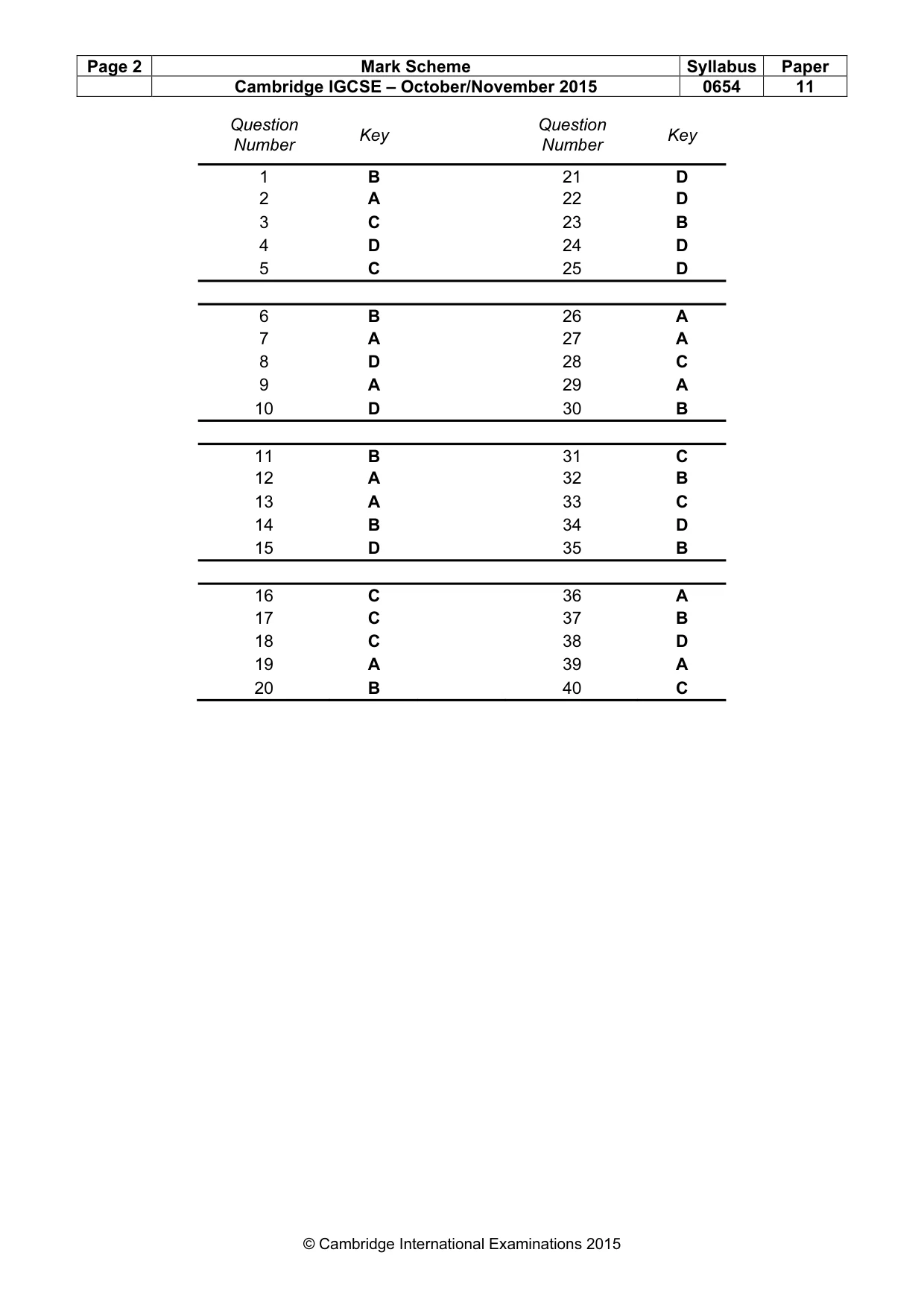
Answers below. Sit the paper first if you are practising.
Questions as text
Q1 · The following three equations represent metabolic processes
1 The following three equations represent metabolic processes. 1 glucose → glycogen 2 carbon dioxide + water → glucose + oxygen 3 oxygen + glucose → carbon dioxide + water Which equations represent nutrition and respiration? nutrition respiration A 1 2 B 2 3 C 3 1 D 3 2
Mark scheme: B
Q2 · What is correct for all living organisms?
2 What is correct for all living organisms? A They are sensitive to changes in their environment. B They excrete solid waste from their bodies. C They feed on other living organisms. D They grow larger by increasing their cell number.
Mark scheme: A
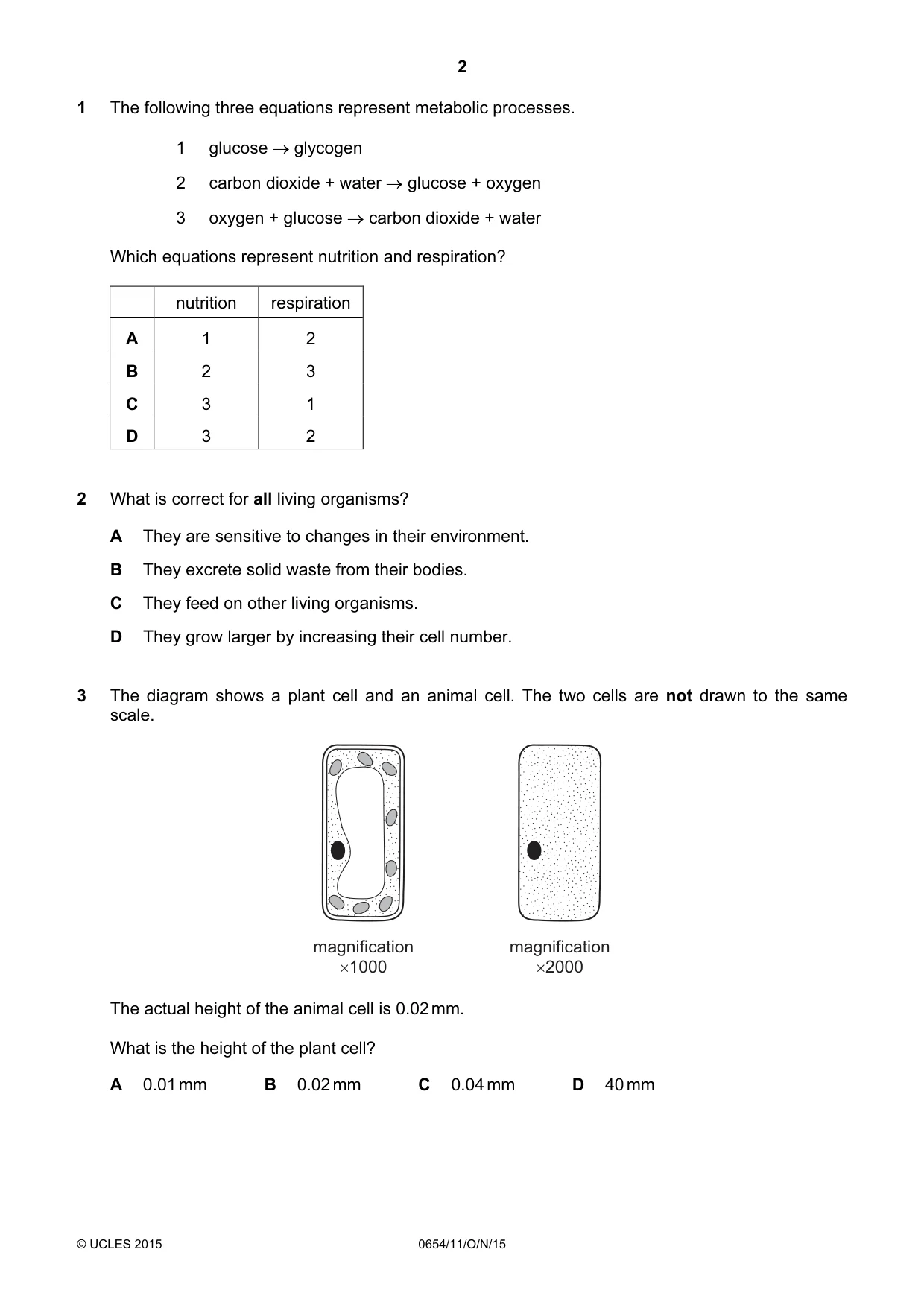
Q3 · The diagram shows a plant cell and an animal cell
3 The diagram shows a plant cell and an animal cell. The two cells are not drawn to the same scale. magnification magnification ×1000 ×2000 The actual height of the animal cell is 0.02 mm. What is the height of the plant cell? A 0.01 mm B 0.02 mm C 0.04 mm D 40 mm
Mark scheme: C
Q4 · What would be capable of digesting an enzyme?
4 What would be capable of digesting an enzyme? A amylase B bile C lipase D protease
Mark scheme: D
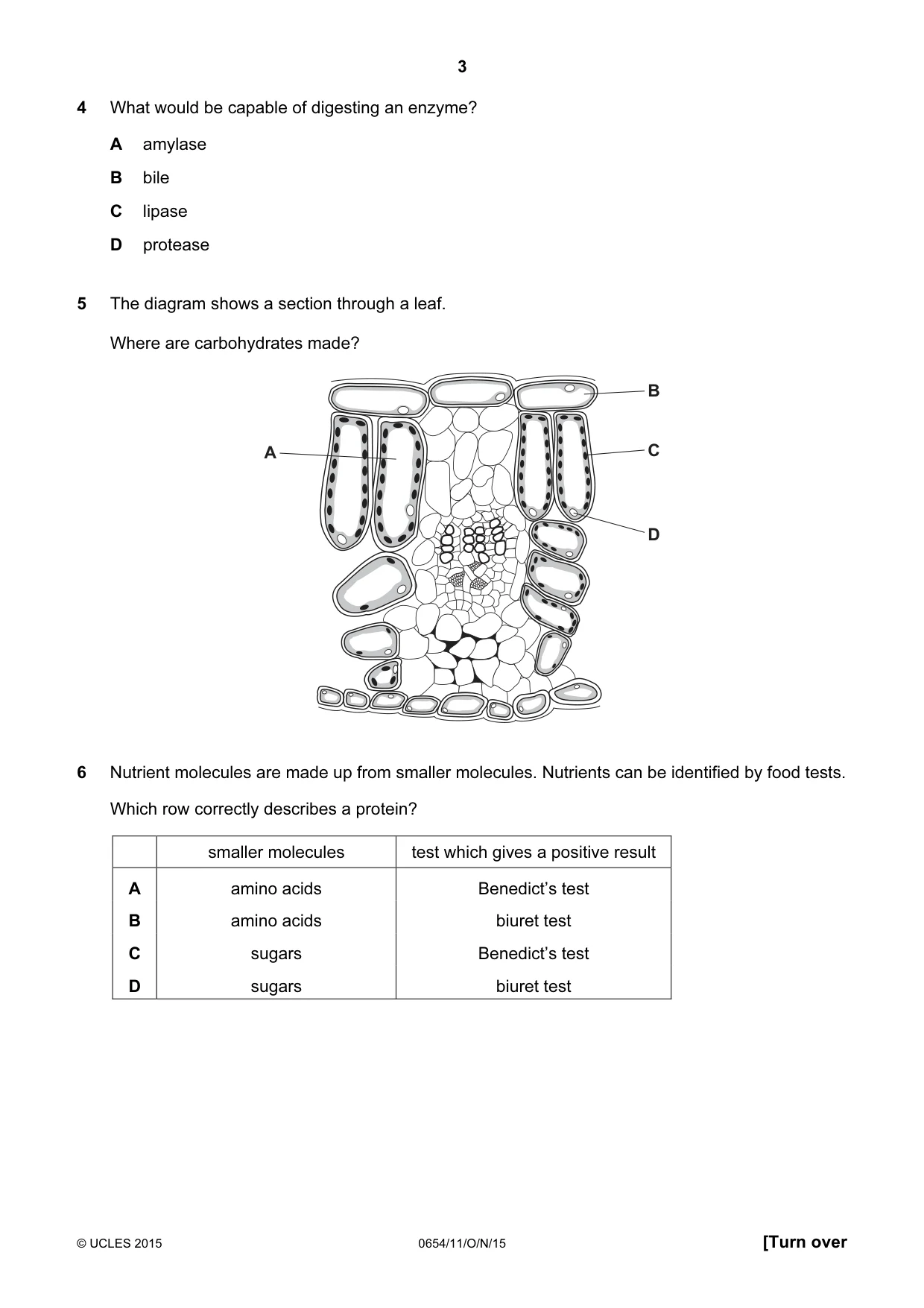
Q5 · The diagram shows a section through a leaf
5 The diagram shows a section through a leaf. Where are carbohydrates made? B A C D
Mark scheme: C
Q6 · Nutrient molecules are made up from smaller molecules
6 Nutrient molecules are made up from smaller molecules. Nutrients can be identified by food tests. Which row correctly describes a protein? smaller molecules test which gives a positive result A amino acids Benedict’s test B amino acids biuret test C sugars Benedict’s test D sugars biuret test
Mark scheme: B
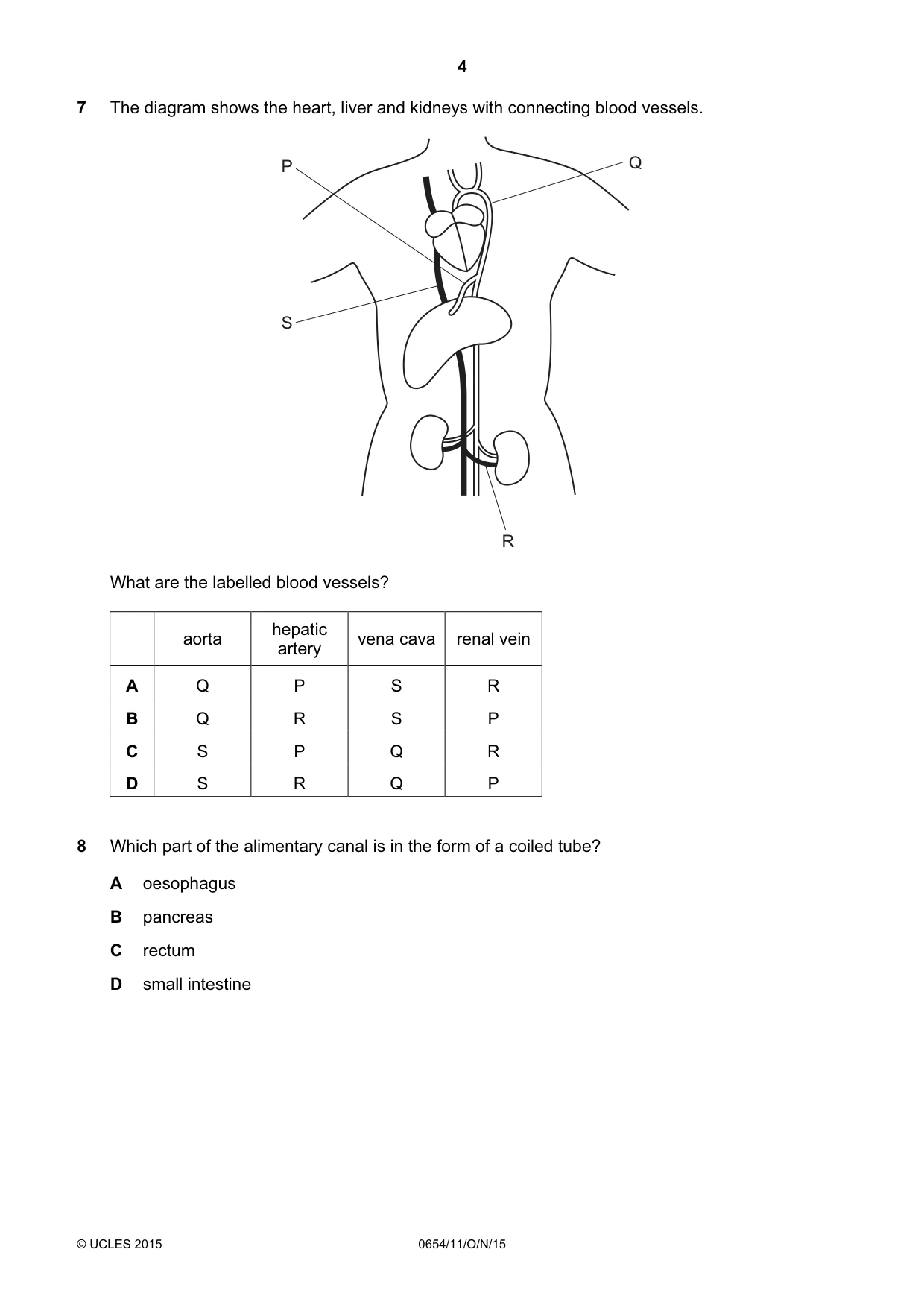
Q7 · The diagram shows the heart, liver and kidneys with connecting blood vessels
7 The diagram shows the heart, liver and kidneys with connecting blood vessels. P Q S R What are the labelled blood vessels? hepatic aorta vena cava renal vein artery A Q P S R B Q R S P C S P Q R D S R Q P
Mark scheme: A
Q8 · Which part of the alimentary canal is in the form of a coiled tube?
8 Which part of the alimentary canal is in the form of a coiled tube? A oesophagus B pancreas C rectum D small intestine
Mark scheme: D
Q9 · Which row shows the changes that occur during exercise?
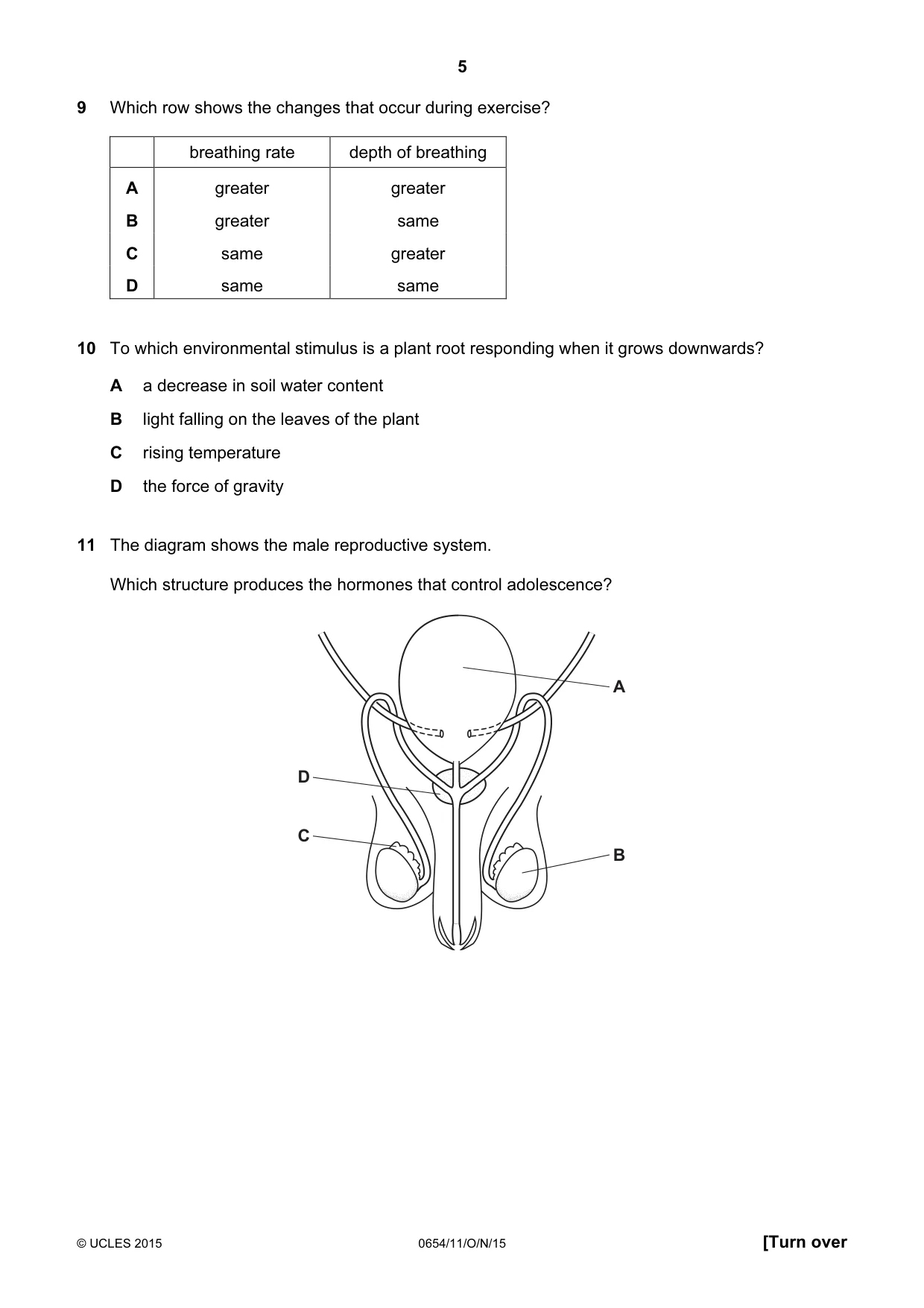
9 Which row shows the changes that occur during exercise? breathing rate depth of breathing A greater greater B greater same C same greater D same same
Mark scheme: A
Q10 · To which environmental stimulus is a plant root responding when it grows downwards?
10 To which environmental stimulus is a plant root responding when it grows downwards? A a decrease in soil water content B light falling on the leaves of the plant C rising temperature D the force of gravity
Mark scheme: D
Q11 · The diagram shows the male reproductive system
11 The diagram shows the male reproductive system. Which structure produces the hormones that control adolescence? A D C B
Mark scheme: B
Q12 · What are the features of human reproduction?
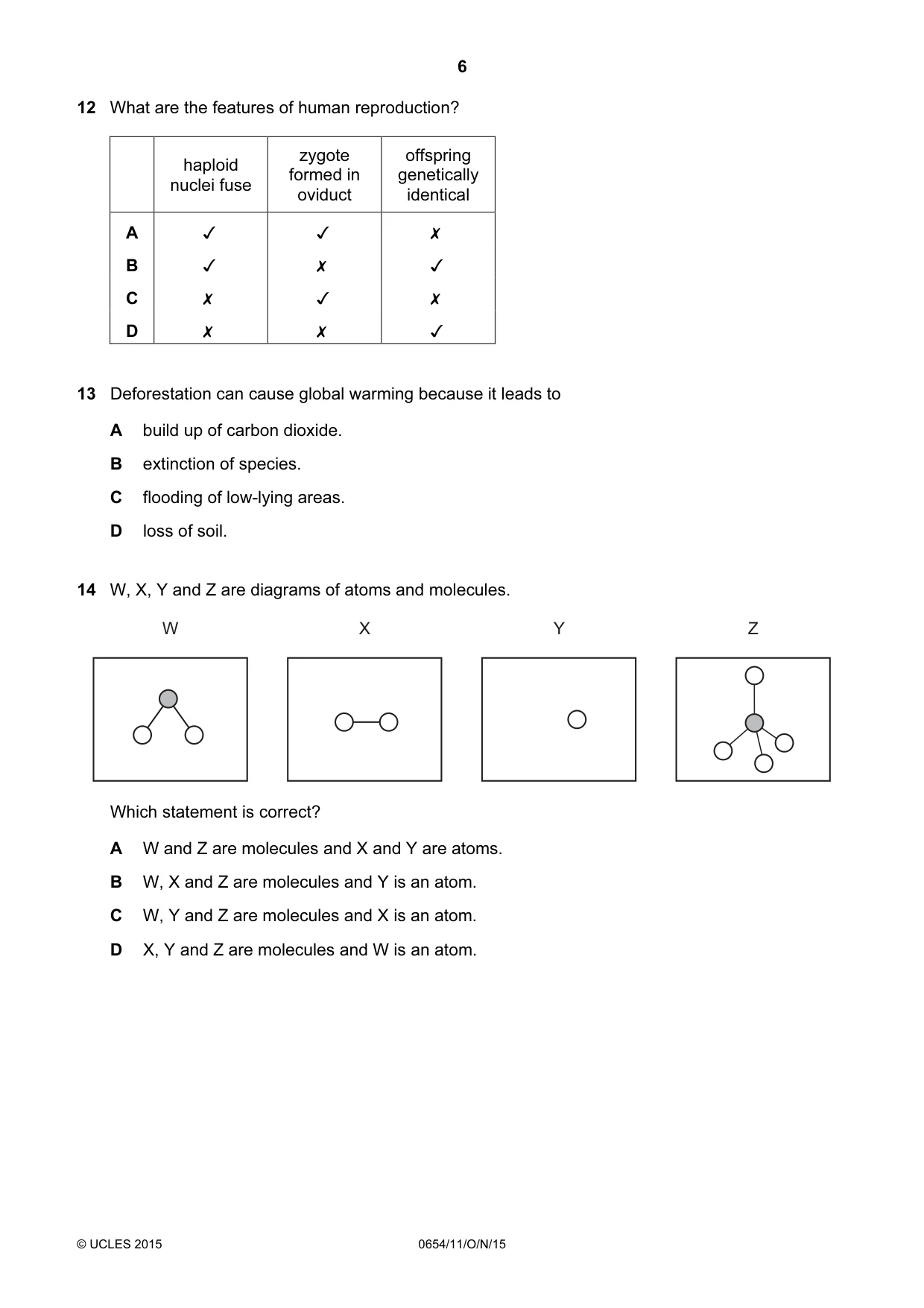
12 What are the features of human reproduction? haploid zygote offspring ; formed in genetically nuclei fuse . ; oviduct identical A v v x B v x v Cc x v x D x x v
Mark scheme: A
Q13 · Deforestation can cause global warming because it leads to A build up of carbon dioxide
13 Deforestation can cause global warming because it leads to A build up of carbon dioxide. B extinction of species. C flooding of low-lying areas. D loss of soil.
Mark scheme: A
Q14 · W, X, Y and Z are diagrams of atoms and molecules
14 W, X, Y and Z are diagrams of atoms and molecules. W X Y Z Which statement is correct? A W and Z are molecules and X and Y are atoms. B W, X and Z are molecules and Y is an atom. C W, Y and Z are molecules and X is an atom. D X, Y and Z are molecules and W is an atom.
Mark scheme: B
Q15 · Hexane and octane are liquid hydrocarbons that mix together
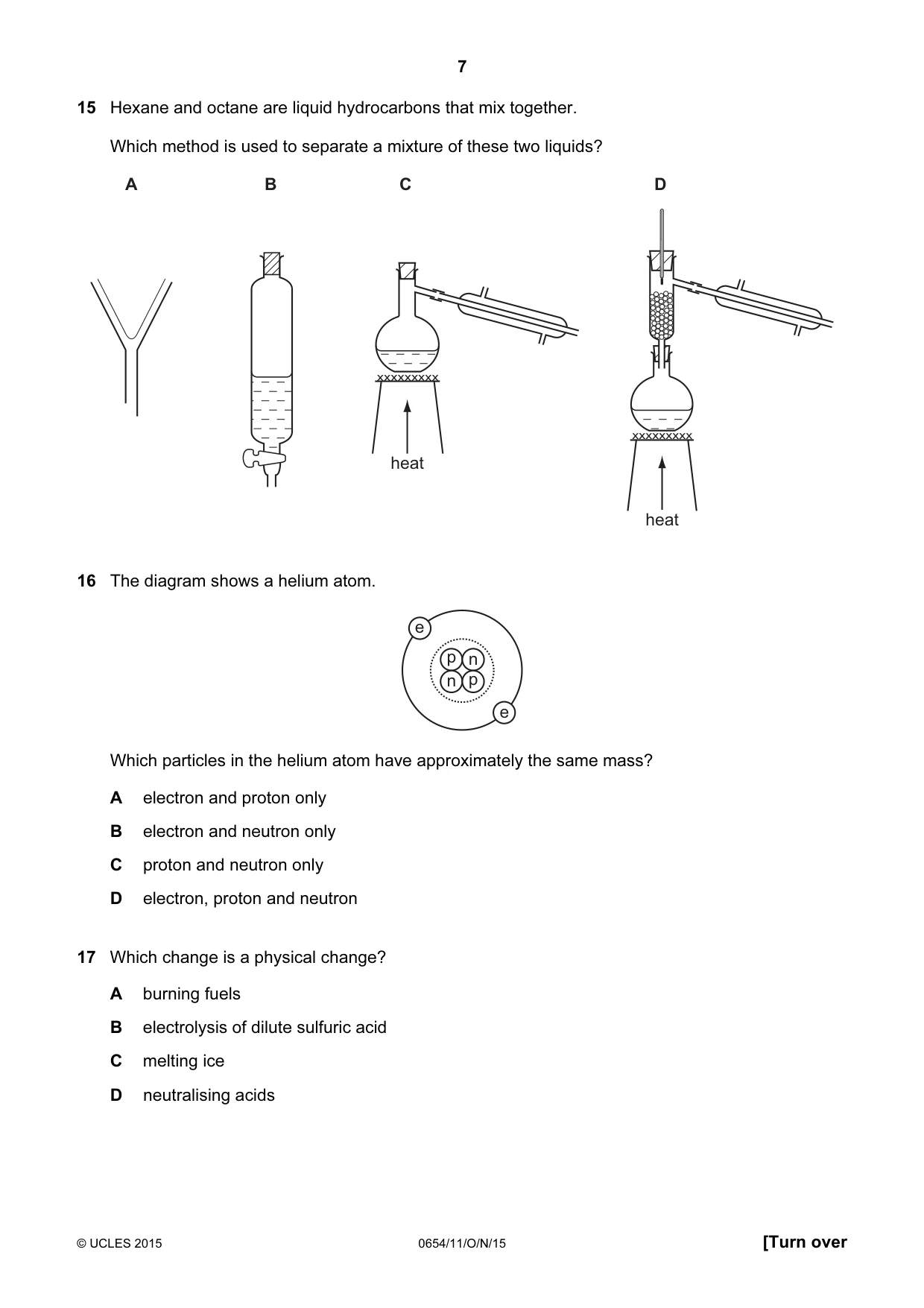
15 Hexane and octane are liquid hydrocarbons that mix together. Which method is used to separate a mixture of these two liquids? A B C D xxxxxxxxx xxxxxxxxx heat heat
Mark scheme: D
Q16 · The diagram shows a helium atom
16 The diagram shows a helium atom. e p n n p e Which particles in the helium atom have approximately the same mass? A electron and proton only B electron and neutron only C proton and neutron only D electron, proton and neutron
Mark scheme: C
Q17 · Which change is a physical change?
17 Which change is a physical change? A burning fuels B electrolysis of dilute sulfuric acid C melting ice D neutralising acids
Mark scheme: C
Q18 · Diagrams W, X, Y and Z represent the structures of four different compounds
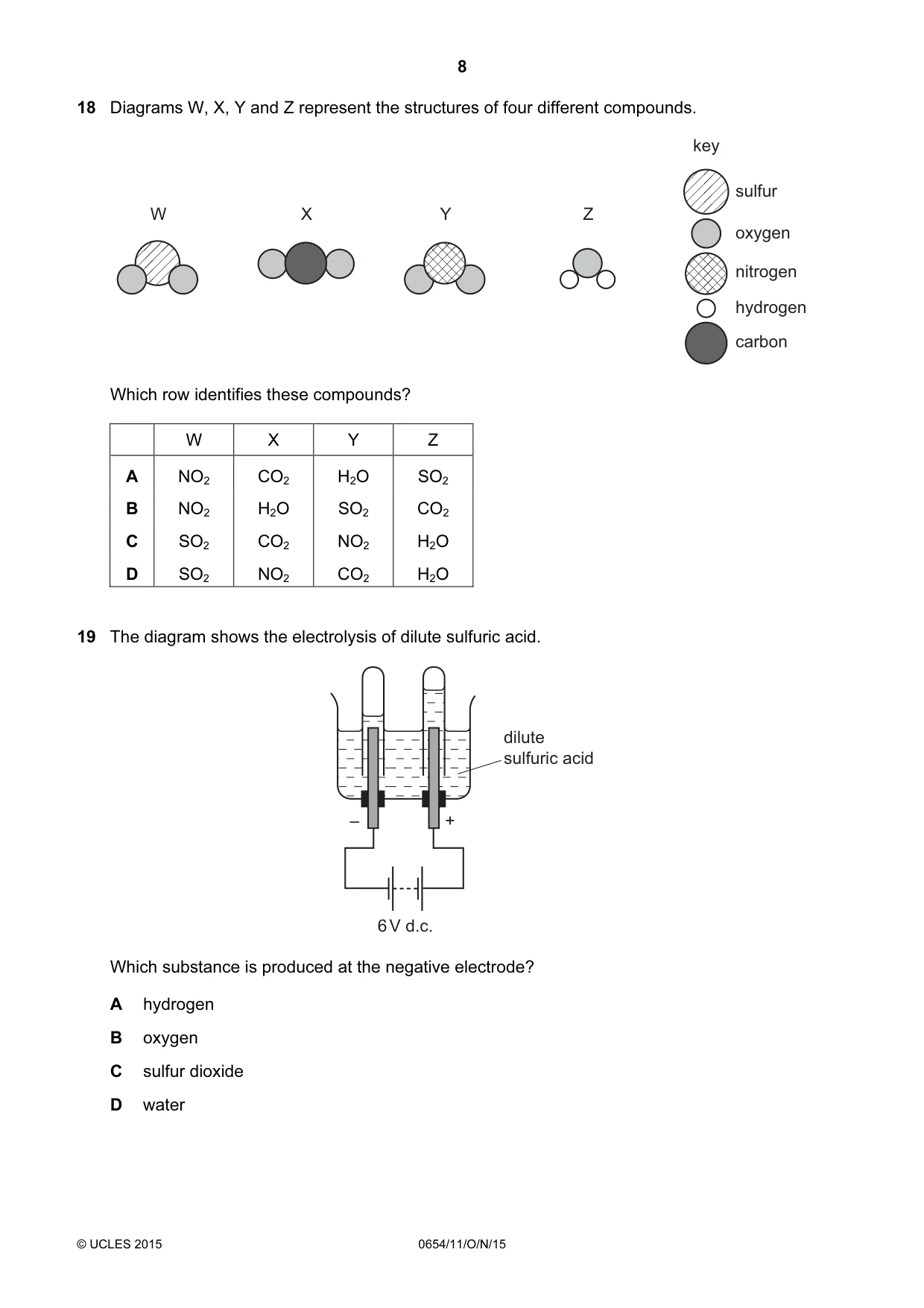
18 Diagrams W, X, Y and Z represent the structures of four different compounds. key sulfur W X Y Z oxygen nitrogen hydrogen carbon Which row identifies these compounds? W X Y Z A NO2 CO2 H2O SO2 B NO2 H2O SO2 CO2 C SO2 CO2 NO2 H2O D SO2 NO2 CO2 H2O
Mark scheme: C
Q19 · The diagram shows the electrolysis of dilute sulfuric acid
19 The diagram shows the electrolysis of dilute sulfuric acid. dilute sulfuric acid – + 6 V d.c. Which substance is produced at the negative electrode? A hydrogen B oxygen C sulfur dioxide D water
Mark scheme: A
Q20 · Lime is manufactured by heating limestone
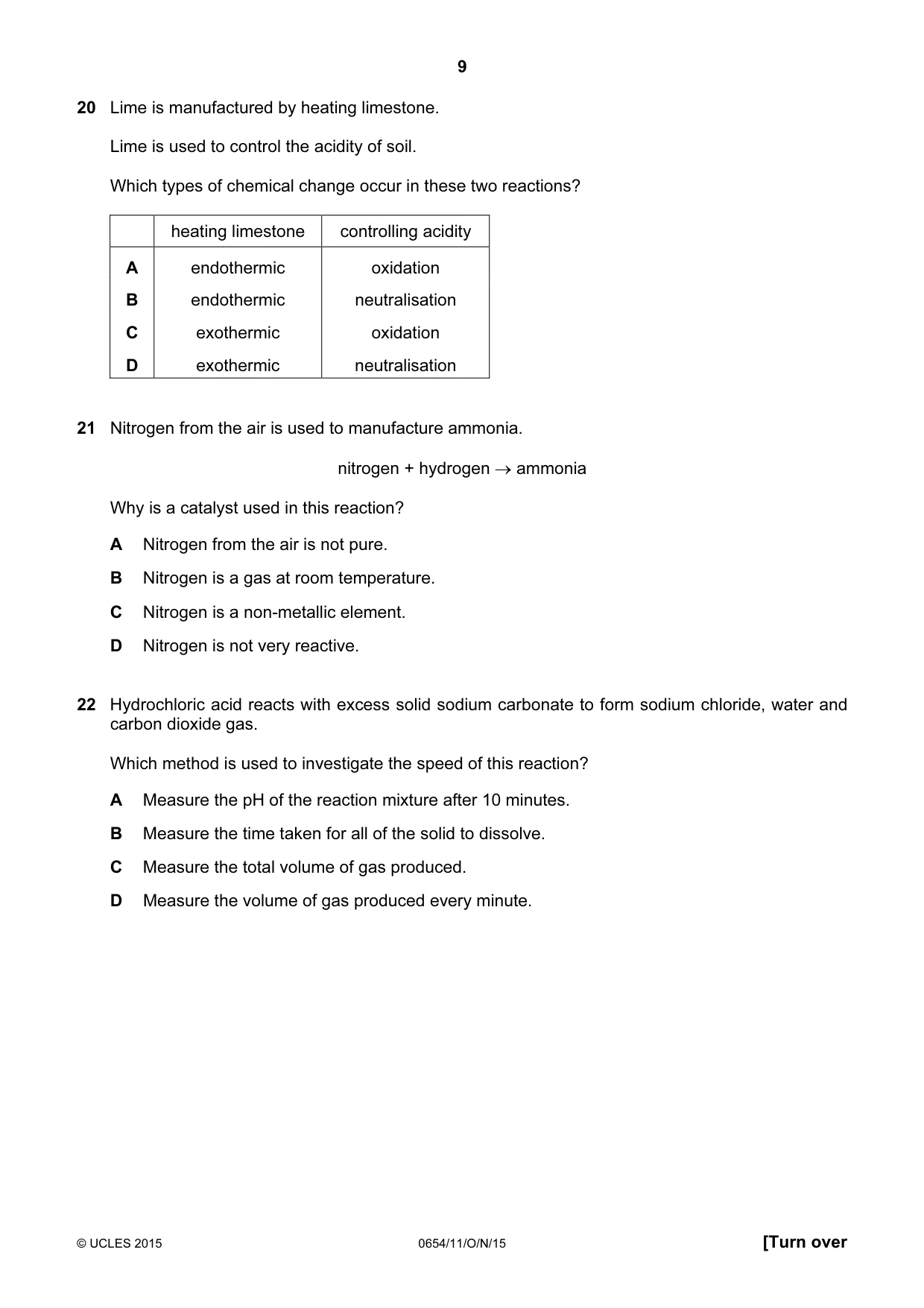
20 Lime is manufactured by heating limestone. Lime is used to control the acidity of soil. Which types of chemical change occur in these two reactions? heating limestone controlling acidity A endothermic oxidation B endothermic neutralisation C exothermic oxidation D exothermic neutralisation
Mark scheme: B
Q21 · Nitrogen from the air is used to manufacture ammonia
21 Nitrogen from the air is used to manufacture ammonia. nitrogen + hydrogen → ammonia Why is a catalyst used in this reaction? A Nitrogen from the air is not pure. B Nitrogen is a gas at room temperature. C Nitrogen is a non-metallic element. D Nitrogen is not very reactive.
Mark scheme: D
Q22 · Hydrochloric acid reacts with excess solid sodium carbonate to form sodium chloride…
22 Hydrochloric acid reacts with excess solid sodium carbonate to form sodium chloride, water and carbon dioxide gas. Which method is used to investigate the speed of this reaction? A Measure the pH of the reaction mixture after 10 minutes. B Measure the time taken for all of the solid to dissolve. C Measure the total volume of gas produced. D Measure the volume of gas produced every minute.
Mark scheme: D
Q23 · The table shows the results of some tests on a compound
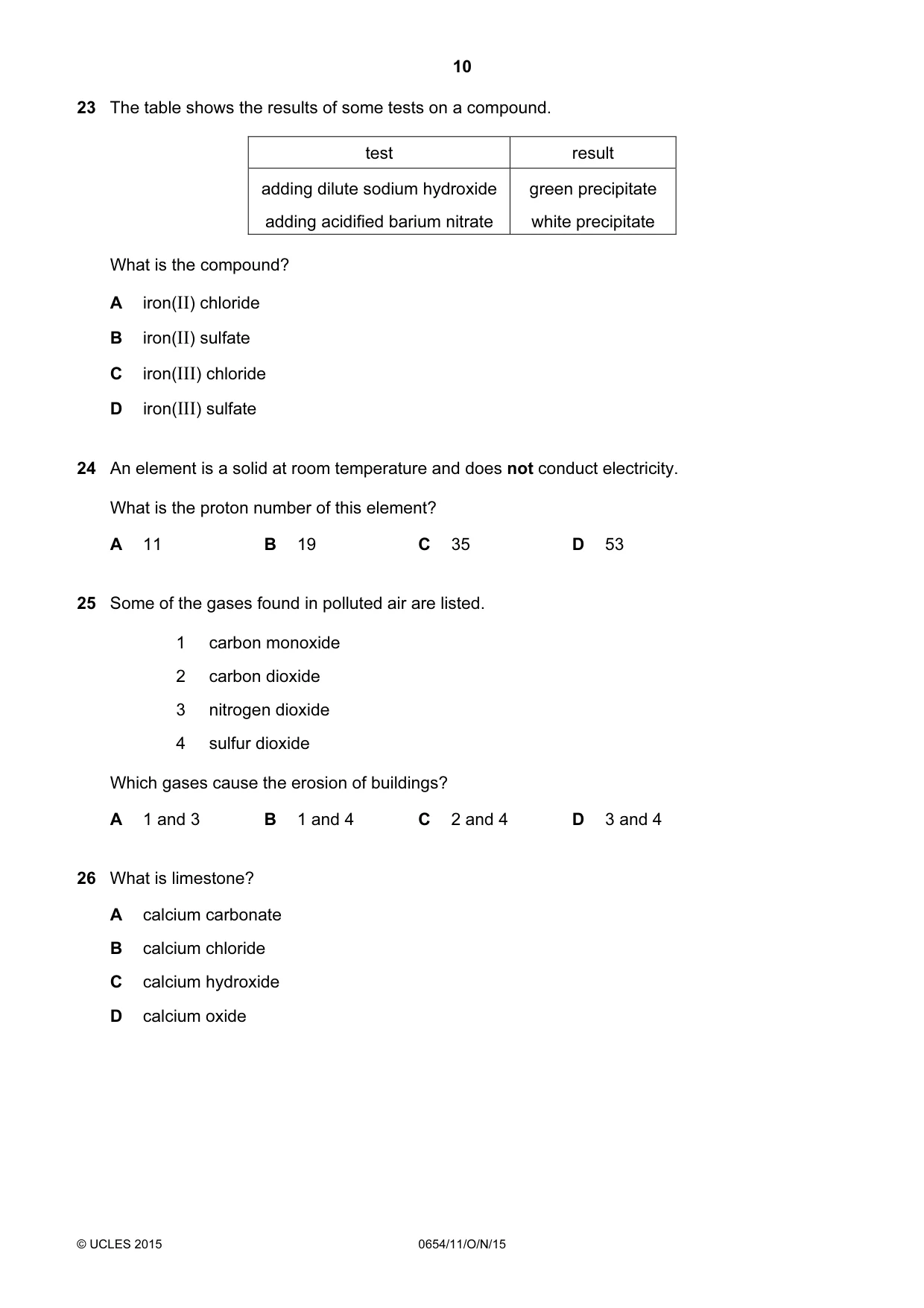
23 The table shows the results of some tests on a compound. test result adding dilute sodium hydroxide green precipitate adding acidified barium nitrate white precipitate What is the compound? A iron(II) chloride B iron(II) sulfate C iron(III) chloride D iron(III) sulfate
Mark scheme: B
Q24 · An element is a solid at room temperature and does not conduct electricity
24 An element is a solid at room temperature and does not conduct electricity. What is the proton number of this element? A 11 B 19 C 35 D 53
Mark scheme: D
Q25 · Some of the gases found in polluted air are listed
25 Some of the gases found in polluted air are listed. 1 carbon monoxide 2 carbon dioxide 3 nitrogen dioxide 4 sulfur dioxide Which gases cause the erosion of buildings? A 1 and 3 B 1 and 4 C 2 and 4 D 3 and 4
Mark scheme: D
Question 26
26 What is limestone? A calcium carbonate B calcium chloride C calcium hydroxide D calcium oxide
Mark scheme: A
Q27 · Four molecules are shown
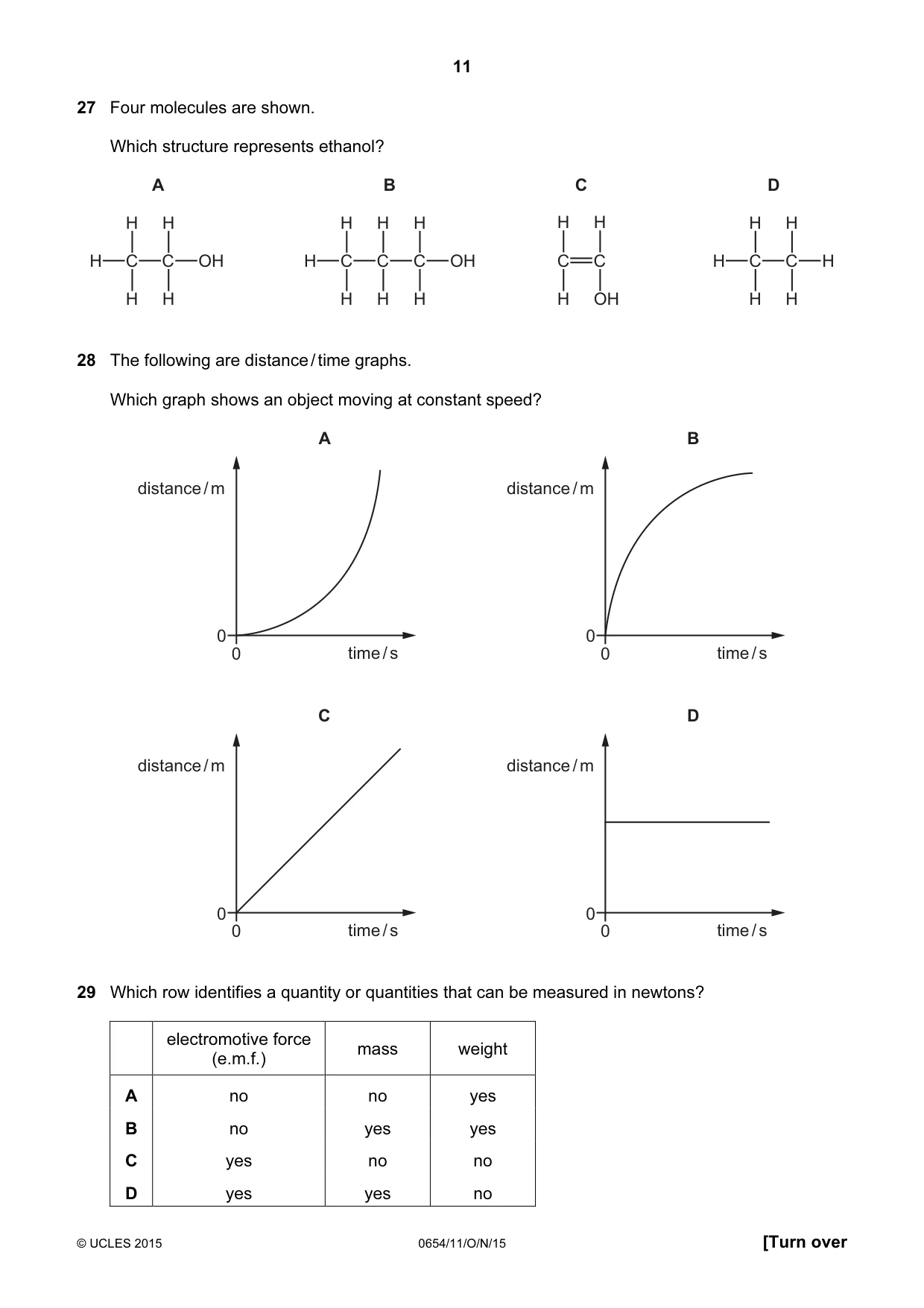
27 Four molecules are shown. Which structure represents ethanol? A B C D H H H H H H H H H H C C OH H C C C OH C C H C C H H H H H H H OH H H
Mark scheme: A
Q28 · The following are distance / time graphs
28 The following are distance / time graphs. Which graph shows an object moving at constant speed? A B distance / m distance / m 0 0 0 time / s 0 time / s C D distance / m distance / m 0 0 0 time / s 0 time / s
Mark scheme: C
Q29 · Which row identifies a quantity or quantities that can be measured in newtons?
29 Which row identifies a quantity or quantities that can be measured in newtons? electromotive force mass weight (e.m.f.) A no no yes B no yes yes C yes no no D yes yes no
Mark scheme: A
Q30 · A student pours liquid into a measuring cylinder
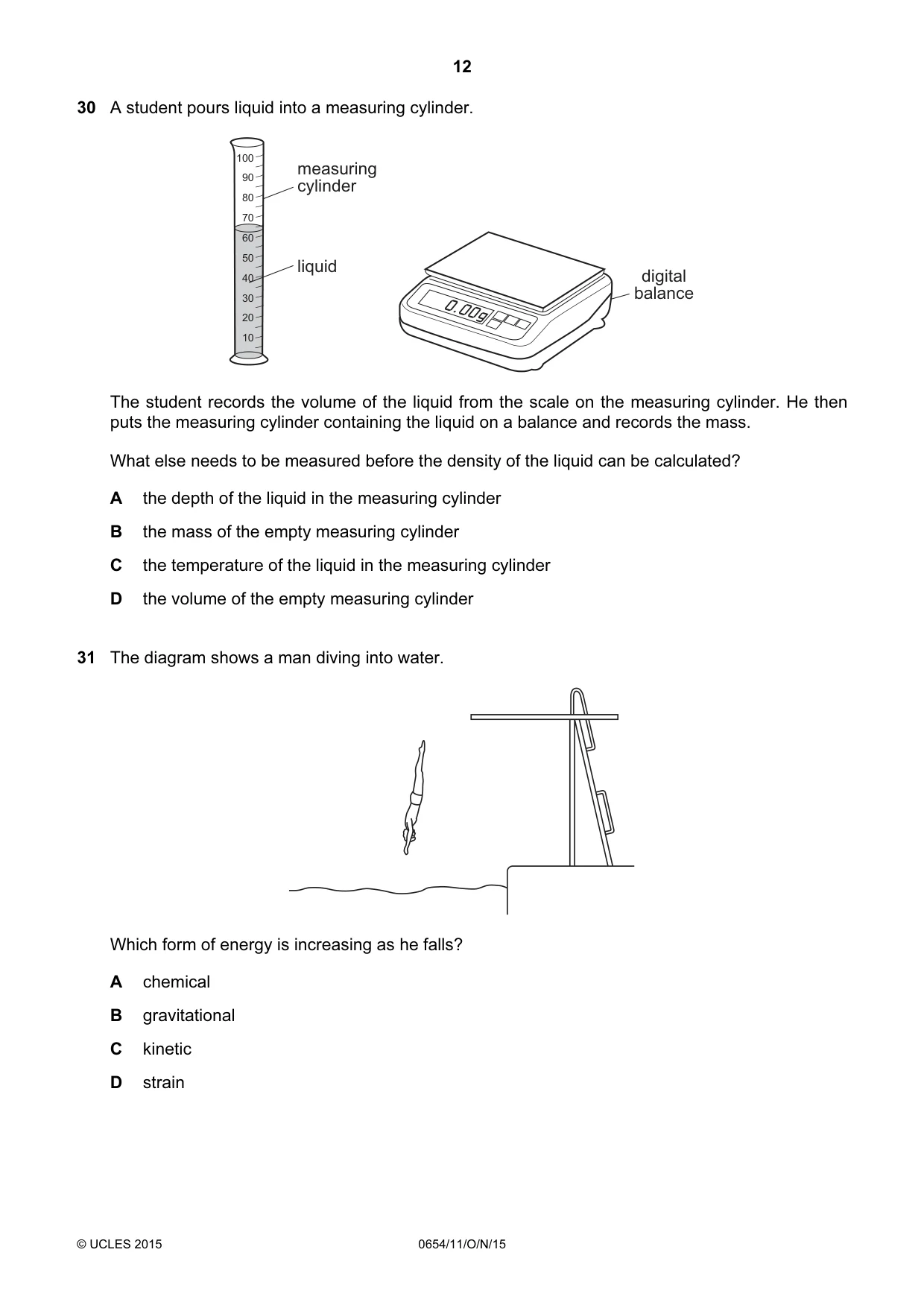
30 A student pours liquid into a measuring cylinder. 100 measuring 90 cylinder 80 70 60 50 liquid 40 digital balance 30 20 10 The student records the volume of the liquid from the scale on the measuring cylinder. He then puts the measuring cylinder containing the liquid on a balance and records the mass. What else needs to be measured before the density of the liquid can be calculated? A the depth of the liquid in the measuring cylinder B the mass of the empty measuring cylinder C the temperature of the liquid in the measuring cylinder D the volume of the empty measuring cylinder
Mark scheme: B
Q31 · The diagram shows a man diving into water
31 The diagram shows a man diving into water. Which form of energy is increasing as he falls? A chemical B gravitational C kinetic D strain
Mark scheme: C
Q32 · Some air is trapped inside a metal can with a tightly-fitting lid
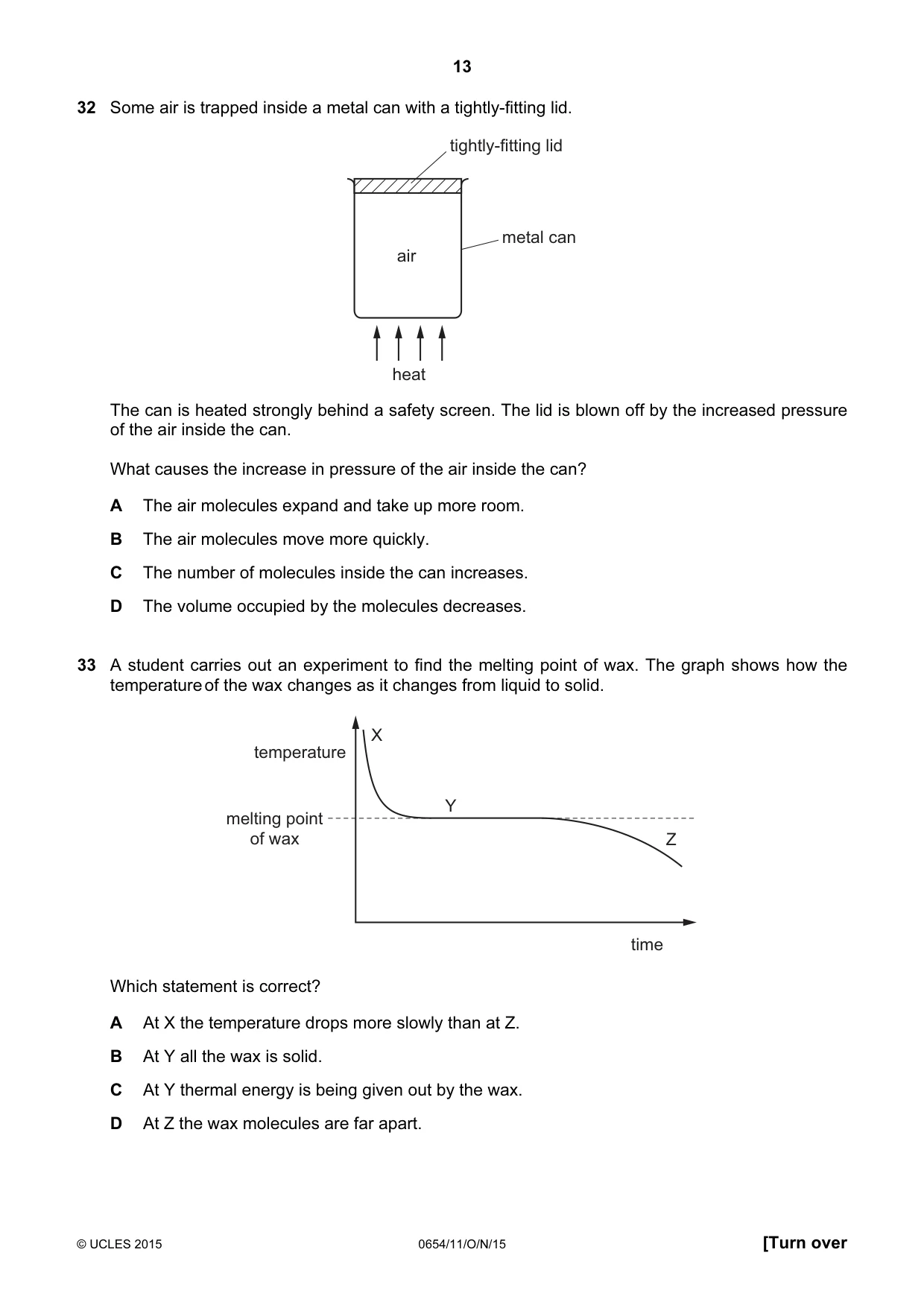
32 Some air is trapped inside a metal can with a tightly-fitting lid. tightly-fitting lid metal can air heat The can is heated strongly behind a safety screen. The lid is blown off by the increased pressure of the air inside the can. What causes the increase in pressure of the air inside the can? A The air molecules expand and take up more room. B The air molecules move more quickly. C The number of molecules inside the can increases. D The volume occupied by the molecules decreases.
Mark scheme: B
Q33 · A student carries out an experiment to find the melting point of wax
33 A student carries out an experiment to find the melting point of wax. The graph shows how the temperature of the wax changes as it changes from liquid to solid. X temperature Y melting point of wax Z time Which statement is correct? A At X the temperature drops more slowly than at Z. B At Y all the wax is solid. C At Y thermal energy is being given out by the wax. D At Z the wax molecules are far apart.
Mark scheme: C
Q34 · A teacher demonstrates convection currents using a lighted candle in a box with two…
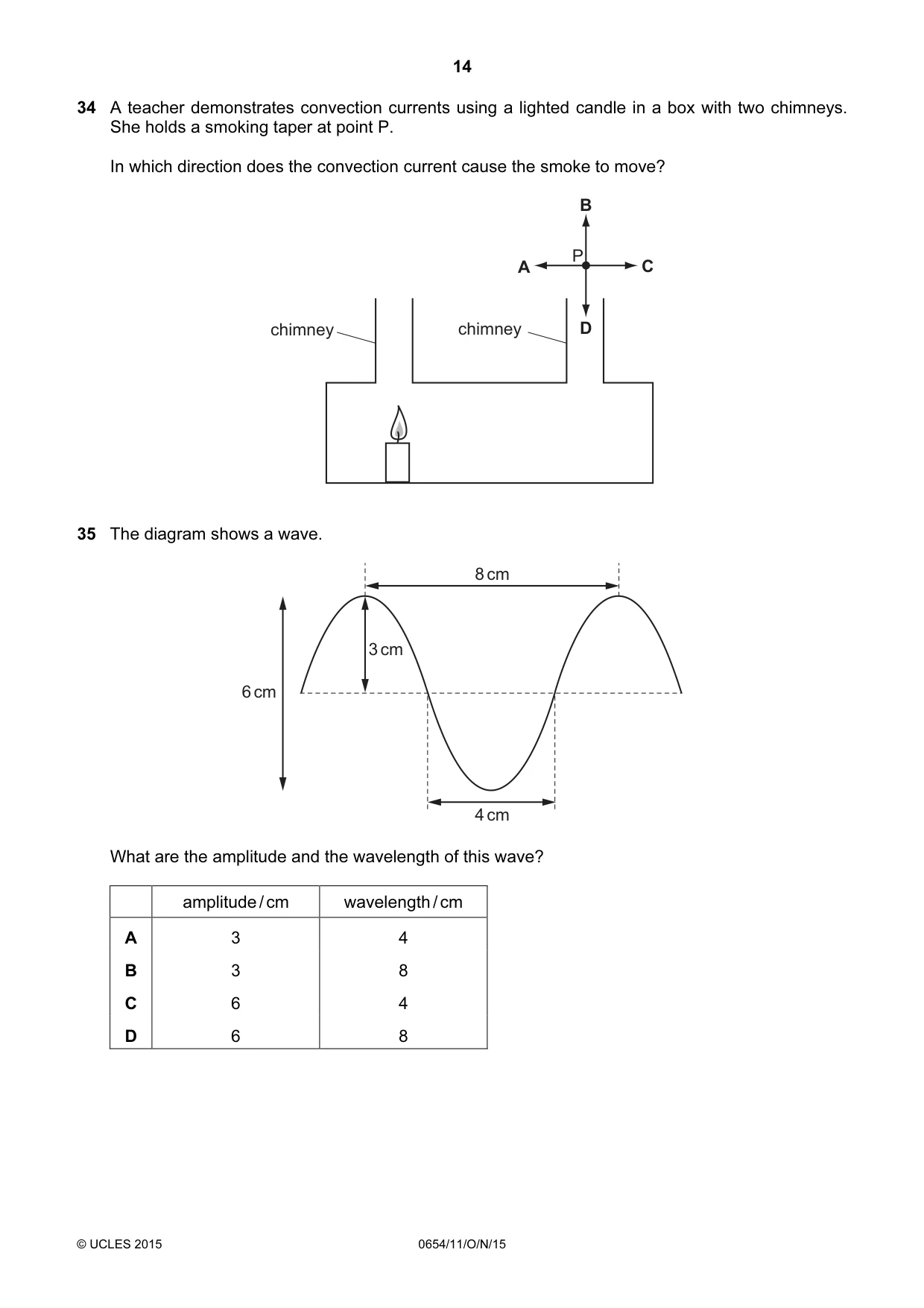
34 A teacher demonstrates convection currents using a lighted candle in a box with two chimneys. She holds a smoking taper at point P. In which direction does the convection current cause the smoke to move? B P A C chimney chimney D
Mark scheme: D
Q35 · The diagram shows a wave
35 The diagram shows a wave. 8 cm 3 cm 6 cm 4 cm What are the amplitude and the wavelength of this wave? amplitude / cm wavelength / cm A 3 4 B 3 8 C 6 4 D 6 8
Mark scheme: B
Q36 · The converging lens in a camera is used to make an image on a film
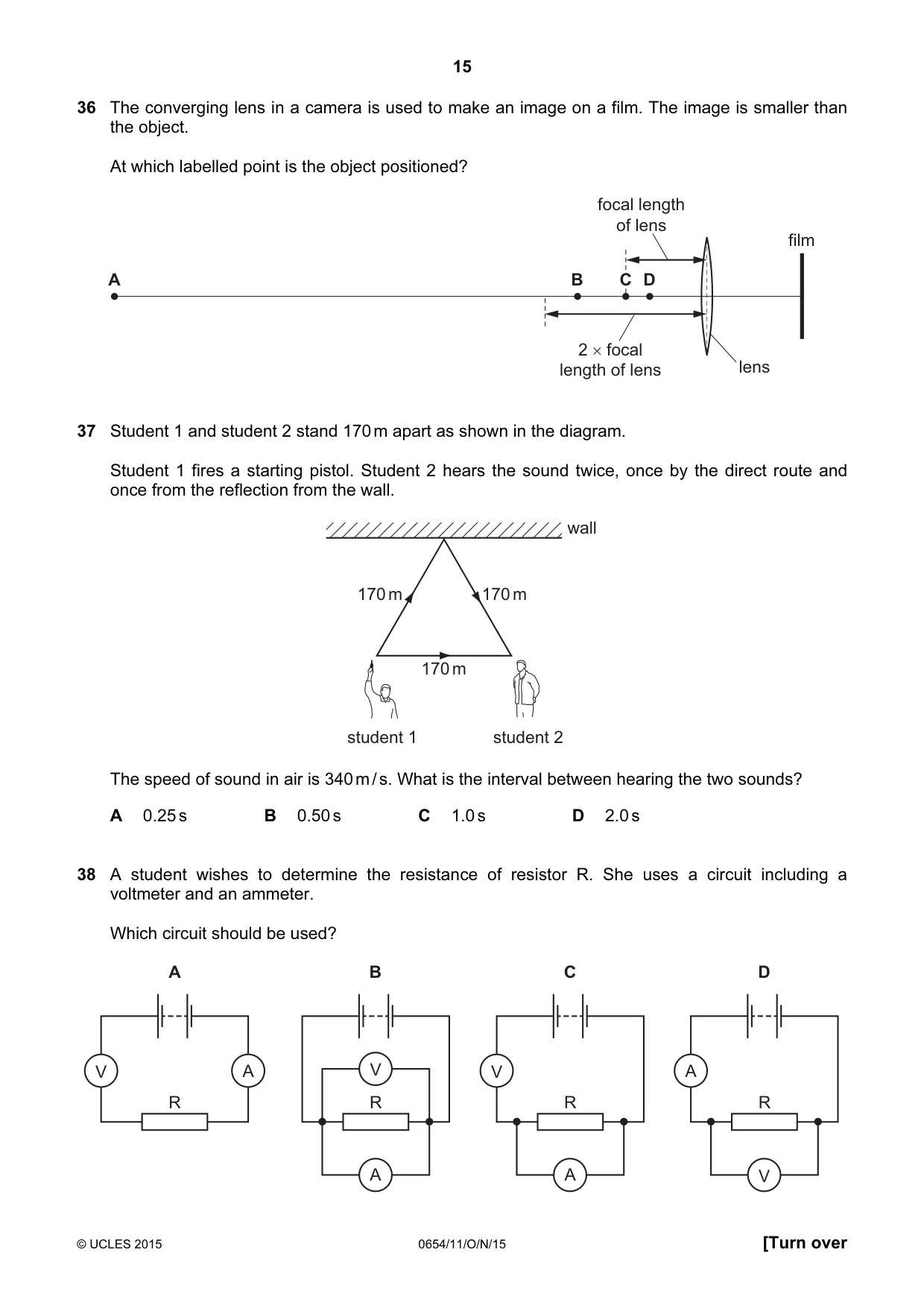
36 The converging lens in a camera is used to make an image on a film. The image is smaller than the object. At which labelled point is the object positioned? focal length of lens film A B C D 2 × focal length of lens lens
Mark scheme: A
Q37 · Student 1 and student 2 stand 170 m apart as shown in the diagram
37 Student 1 and student 2 stand 170 m apart as shown in the diagram. Student 1 fires a starting pistol. Student 2 hears the sound twice, once by the direct route and once from the reflection from the wall. wall 170 m 170 m 170 m student 1 student 2 The speed of sound in air is 340 m / s. What is the interval between hearing the two sounds? A 0.25 s B 0.50 s C 1.0 s D 2.0 s
Mark scheme: B
Q38 · A student wishes to determine the resistance of resistor R
38 A student wishes to determine the resistance of resistor R. She uses a circuit including a voltmeter and an ammeter. Which circuit should be used? A B C D V A V V A R R R R A A V
Mark scheme: D
Q39 · A student uses four ammeters P, Q, R and S to measure the current in different parts of…
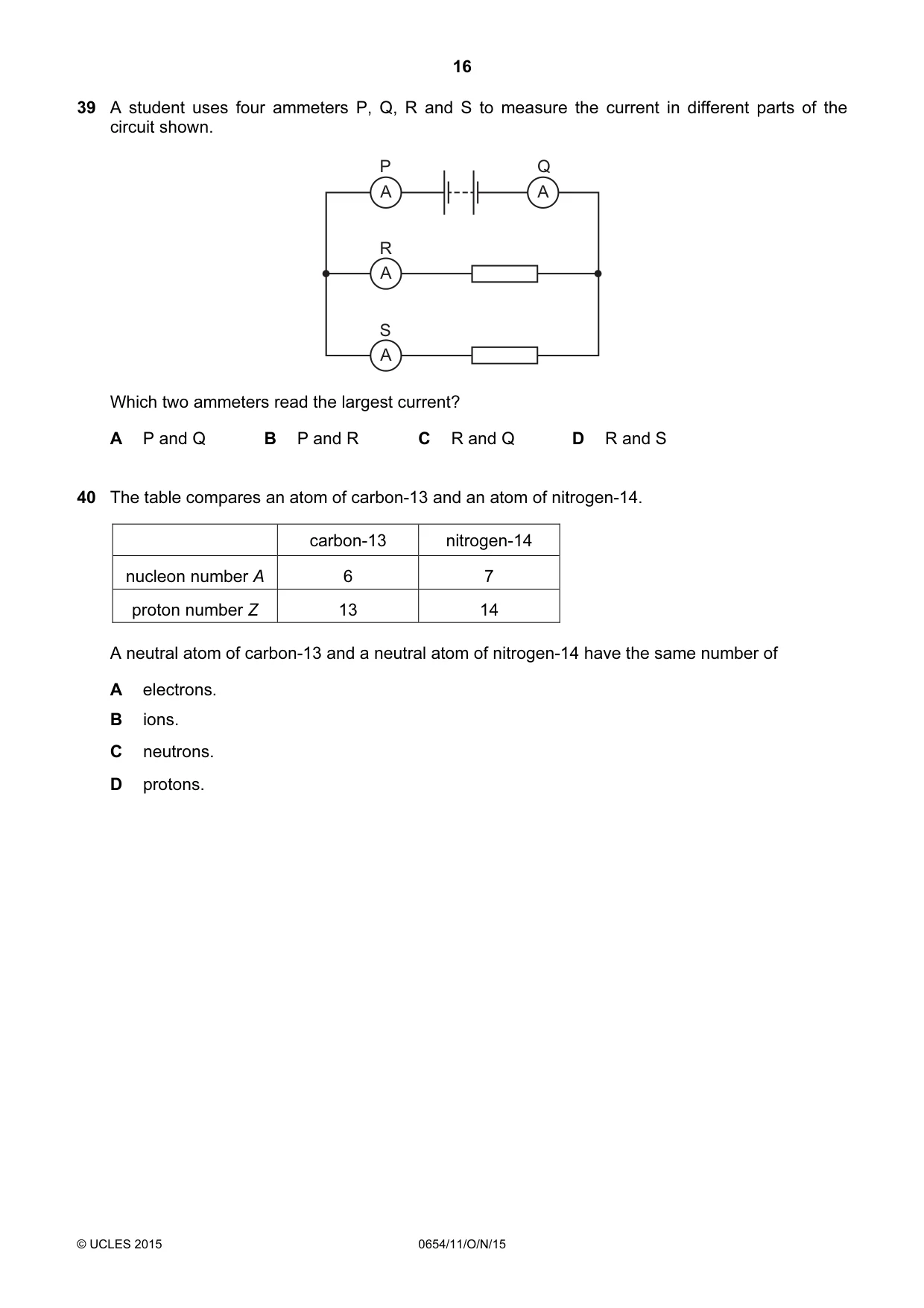
39 A student uses four ammeters P, Q, R and S to measure the current in different parts of the circuit shown. P Q A A R A S A Which two ammeters read the largest current? A P and Q B P and R C R and Q D R and S
Mark scheme: A
Q40 · The table compares an atom of carbon-13 and an atom of nitrogen-14
40 The table compares an atom of carbon-13 and an atom of nitrogen-14. carbon-13 nitrogen-14 nucleon number A 6 7 proton number Z 13 14 A neutral atom of carbon-13 and a neutral atom of nitrogen-14 have the same number of A electrons. B ions. C neutrons. D protons.
Mark scheme: C
What was in this paper
The subtopics covered by these 40 questions, and how many questions each got. Open one in a new tab to see every Cambridge question on it.
2Rate of reaction2Air quality and climate1Alcohols1Arrangement of elements1Atomic structure and the Periodic Table1Biological molecules1Carbon cycle1Characteristics of living organisms1Circulatory systems1Coordination and response1Density1Digestive system1Electrolysis1Elements, compounds and mixtures1Energy, work and power1Enzymes1Exothermic and endothermic reactions1Gas exchange in humans1General properties of waves1Hormones1Identification of ions and gases1Kinetic particle model of matter1Light1Mass and weight1Motion1Photosynthesis1Physical and chemical changes1Respiration1Separation and purification1Sexual reproduction in humans1Simple molecules and covalent bonds1Size of specimens1Sound1The nucleus1Thermal properties and temperature1Transfer of thermal energy1Water1What you needed in this session
Cambridge’s own grade thresholds for 2015 Oct/Nov, Paper 1 · Variant 1. A higher threshold means an easier paper — the bar moves with how the cohort did.