Cambridge IGCSE Sciences - Co-ordinated (Double) 0654 — 2020 May/June Paper 1 · Variant 2
0654/12/M/J/20 · 40 questions · 40 marks · ≈45 min
The question paper and its mark scheme, free to read here and free to download. This is Cambridge’s own paper, exactly as it was sat.
Question paper16 pages

Mark scheme3 pages
Answers below. Sit the paper first if you are practising.
Questions as text
Q1 · Which characteristic of living things is described as the removal of toxic materials and…
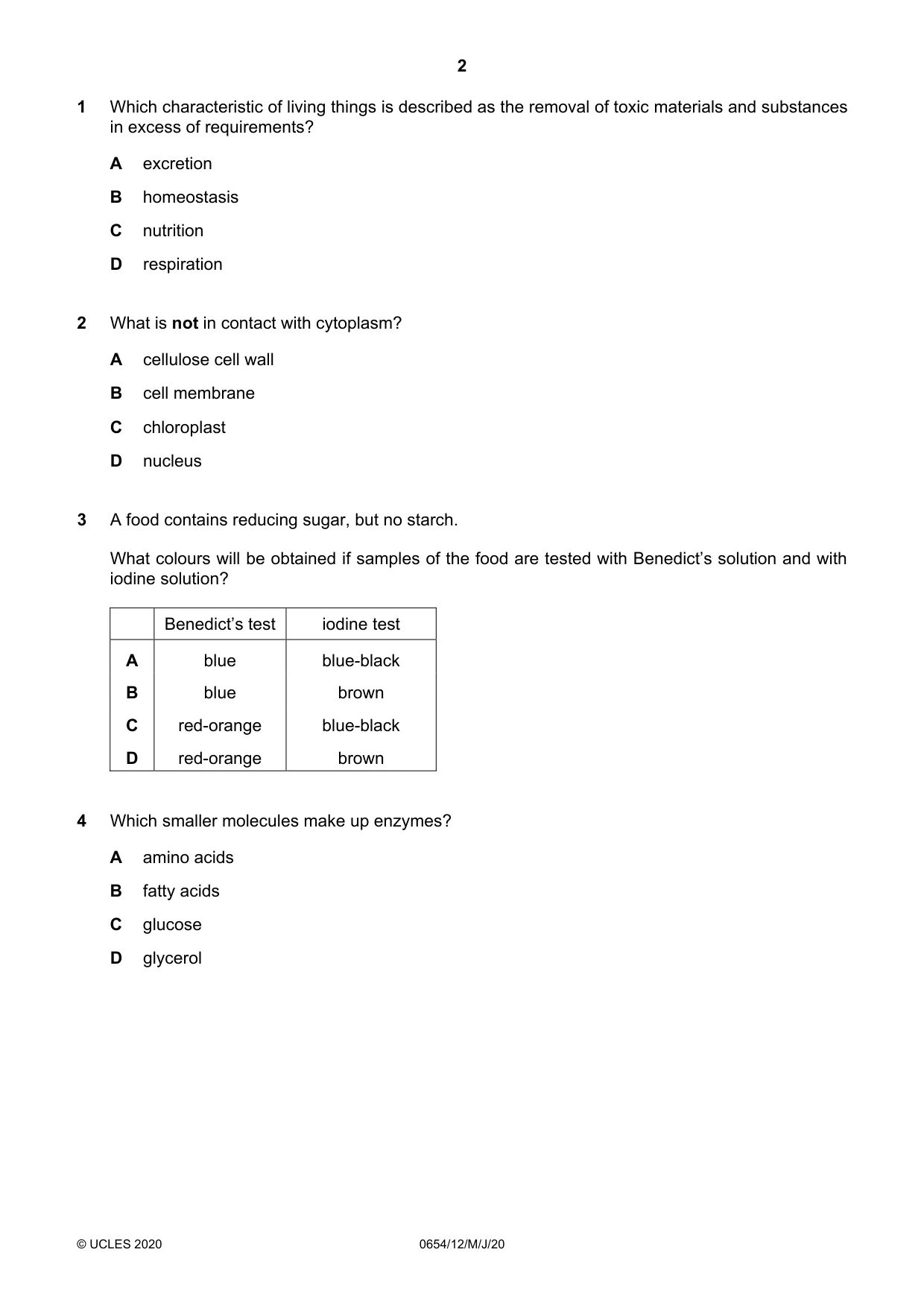
1 Which characteristic of living things is described as the removal of toxic materials and substances in excess of requirements? A excretion B homeostasis C nutrition D respiration
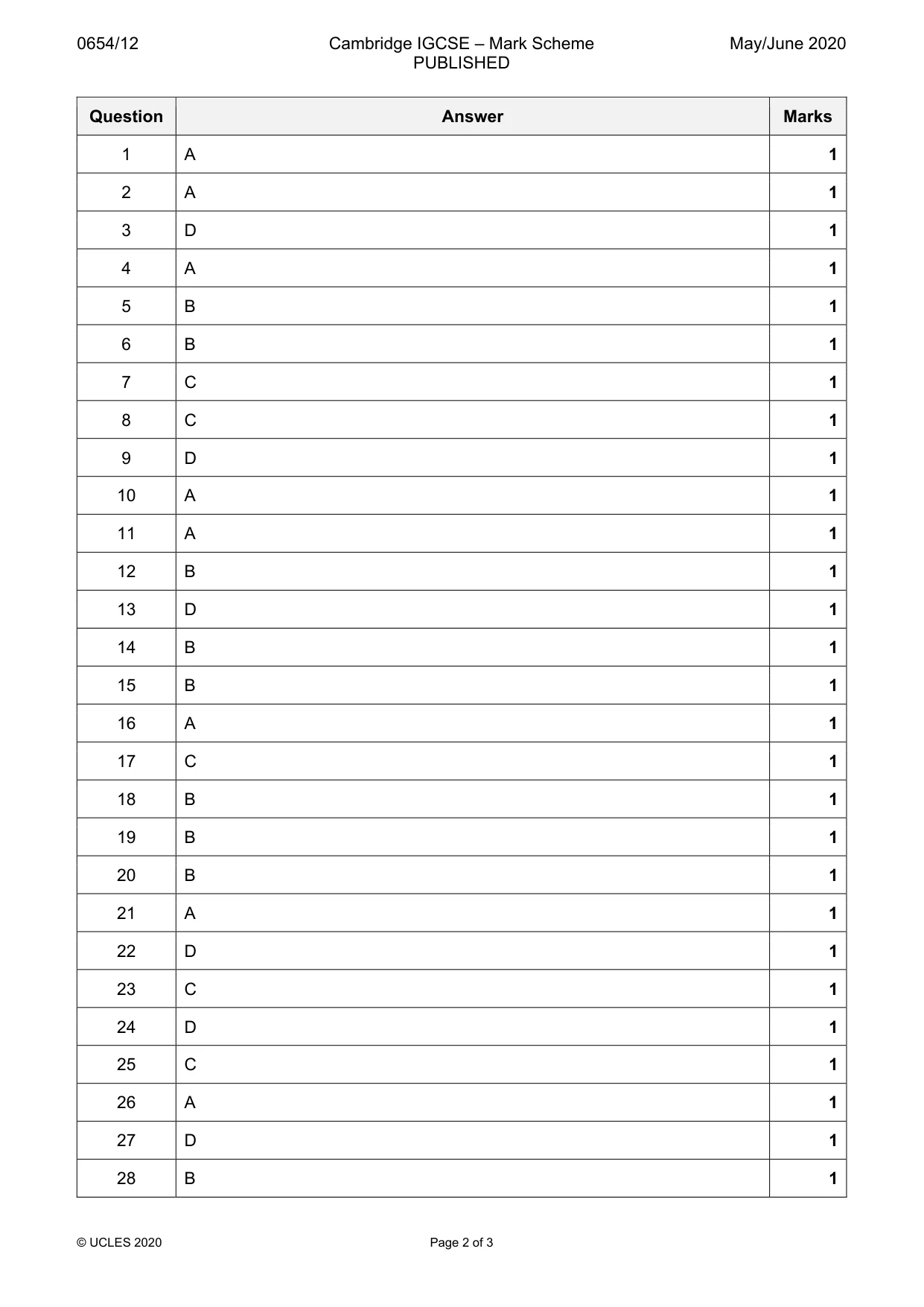
Mark scheme: A
Q2 · What is not in contact with cytoplasm?
2 What is not in contact with cytoplasm? A cellulose cell wall B cell membrane C chloroplast D nucleus
Mark scheme: A
Q3 · A food contains reducing sugar, but no starch
3 A food contains reducing sugar, but no starch. What colours will be obtained if samples of the food are tested with Benedict’s solution and with iodine solution? Benedict’s test iodine test A blue blue-black B blue brown C red-orange blue-black D red-orange brown
Mark scheme: D
Q4 · Which smaller molecules make up enzymes?
4 Which smaller molecules make up enzymes? A amino acids B fatty acids C glucose D glycerol
Mark scheme: A
Q5 · The diagram shows a variegated leaf
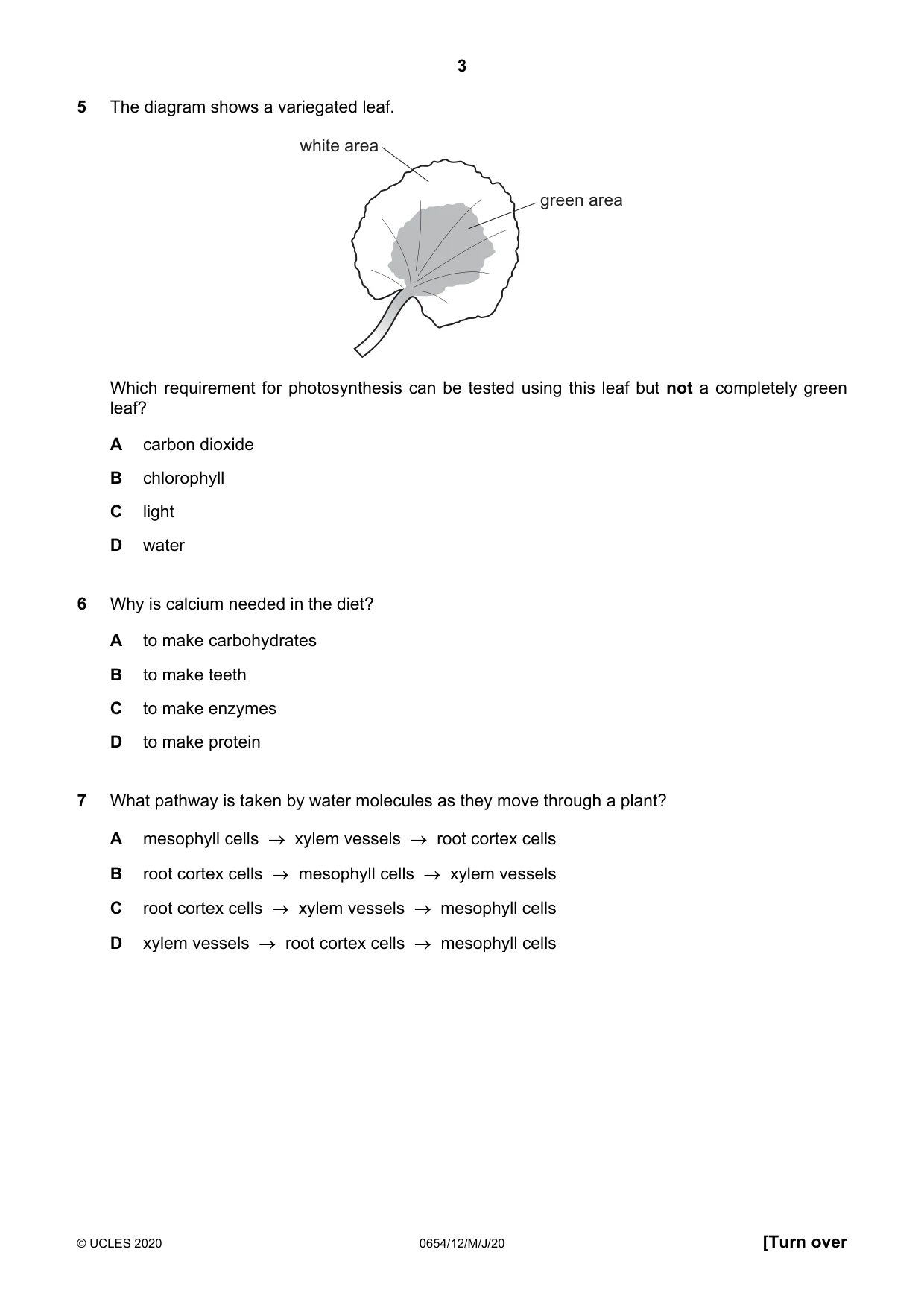
5 The diagram shows a variegated leaf. white area green area Which requirement for photosynthesis can be tested using this leaf but not a completely green leaf? A carbon dioxide B chlorophyll C light D water
Mark scheme: B
Q6 · Why is calcium needed in the diet?
6 Why is calcium needed in the diet? A to make carbohydrates B to make teeth C to make enzymes D to make protein
Mark scheme: B
Q7 · What pathway is taken by water molecules as they move through a plant?
7 What pathway is taken by water molecules as they move through a plant? A mesophyll cells → xylem vessels → root cortex cells B root cortex cells → mesophyll cells → xylem vessels C root cortex cells → xylem vessels → mesophyll cells D xylem vessels → root cortex cells → mesophyll cells
Mark scheme: C
Q8 · Some students investigated aerobic respiration in woodlice
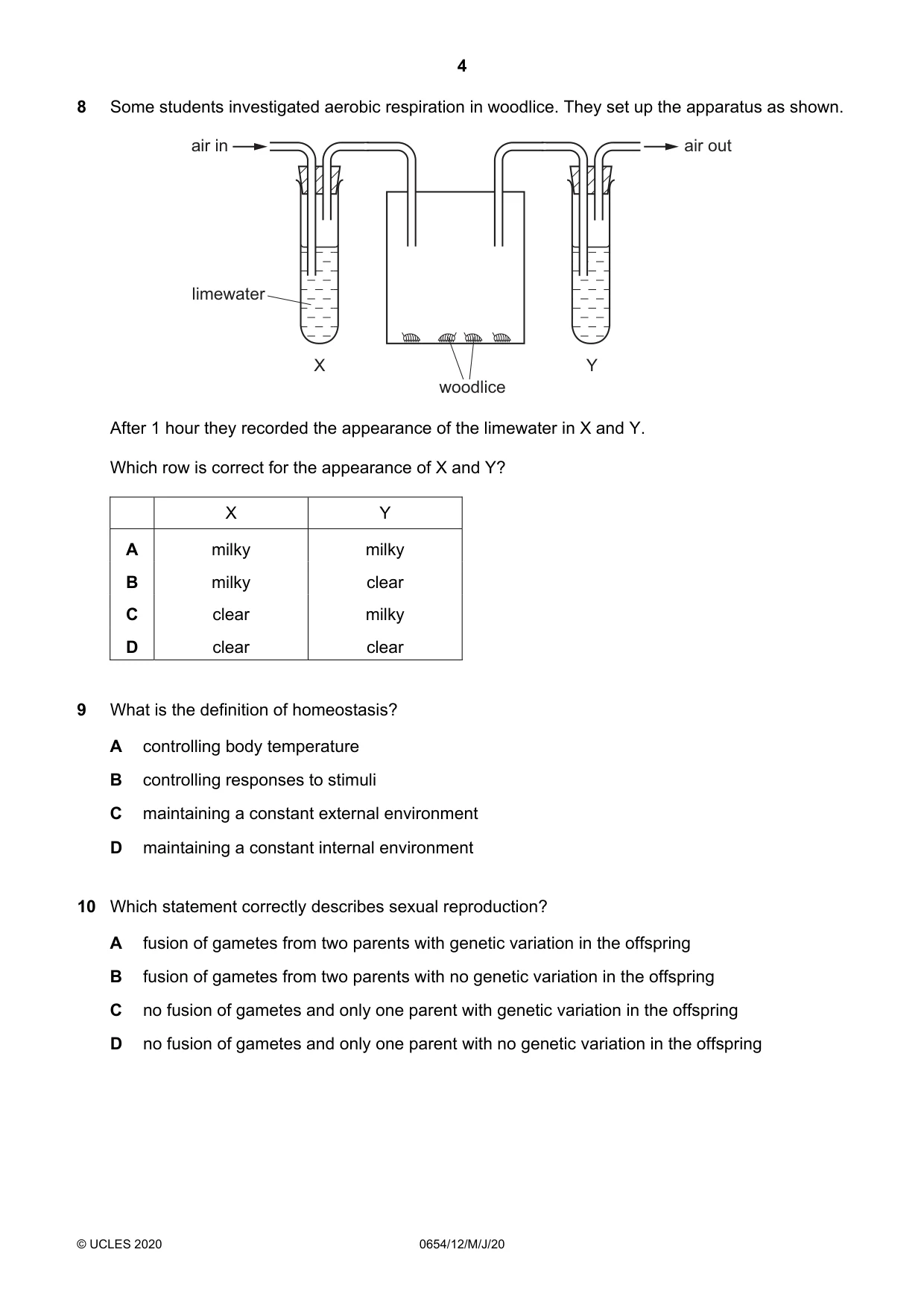
8 Some students investigated aerobic respiration in woodlice. They set up the apparatus as shown. air in air out limewater X Y woodlice After 1 hour they recorded the appearance of the limewater in X and Y. Which row is correct for the appearance of X and Y? X Y A milky milky B milky clear C clear milky D clear clear
Mark scheme: C
Q9 · What is the definition of homeostasis?
9 What is the definition of homeostasis? A controlling body temperature B controlling responses to stimuli C maintaining a constant external environment D maintaining a constant internal environment
Mark scheme: D
Q10 · Which statement correctly describes sexual reproduction?
10 Which statement correctly describes sexual reproduction? A fusion of gametes from two parents with genetic variation in the offspring B fusion of gametes from two parents with no genetic variation in the offspring C no fusion of gametes and only one parent with genetic variation in the offspring D no fusion of gametes and only one parent with no genetic variation in the offspring
Mark scheme: A
Q11 · A farmer wants to breed sheep that will produce a high yield of milk
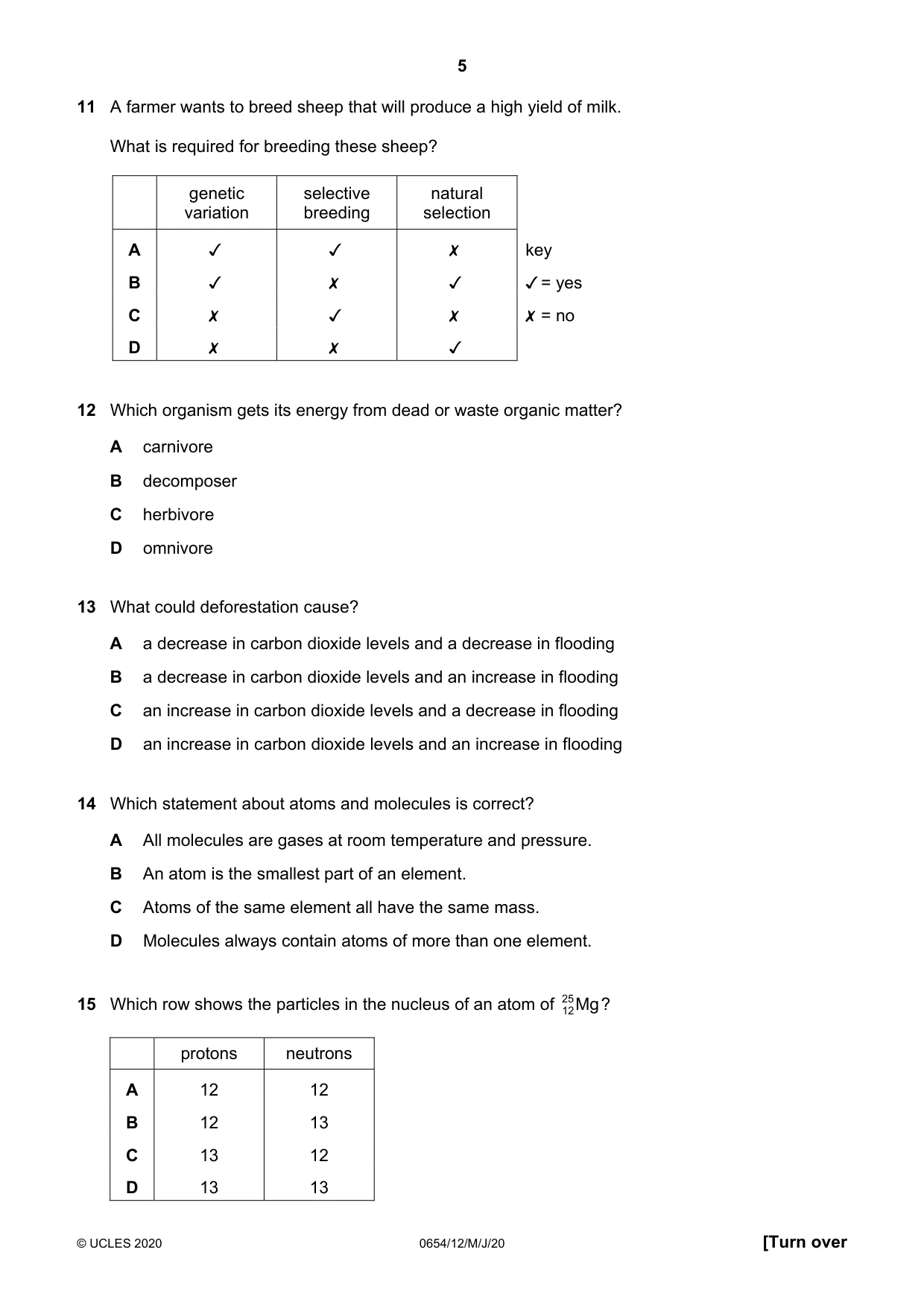
11 A farmer wants to breed sheep that will produce a high yield of milk. What is required for breeding these sheep? genetic selective natural variation breeding selection Jv v x v x v x v x x x v key J/ = yes X =no
Mark scheme: A
Q12 · Which organism gets its energy from dead or waste organic matter?
12 Which organism gets its energy from dead or waste organic matter? A carnivore B decomposer C herbivore D omnivore
Mark scheme: B
Q13 · What could deforestation cause?
13 What could deforestation cause? A a decrease in carbon dioxide levels and a decrease in flooding B a decrease in carbon dioxide levels and an increase in flooding C an increase in carbon dioxide levels and a decrease in flooding D an increase in carbon dioxide levels and an increase in flooding
Mark scheme: D
Q14 · Which statement about atoms and molecules is correct?
14 Which statement about atoms and molecules is correct? A All molecules are gases at room temperature and pressure. B An atom is the smallest part of an element. C Atoms of the same element all have the same mass. D Molecules always contain atoms of more than one element.
Mark scheme: B
Q15 · Which row shows the particles in the nucleus of an atom of 25 Mg ?
15 Which row shows the particles in the nucleus of an atom of 25 Mg ? 12 protons neutrons A 12 12 B 12 13 C 13 12 D 13 13
Mark scheme: B
Q16 · What is a property of a typical covalent compound?
16 What is a property of a typical covalent compound? A electrical insulator B high melting point C low volatility D soluble in water
Mark scheme: A
Q17 · The diagram shows the electrolysis of lead(II) bromide using inert electrodes
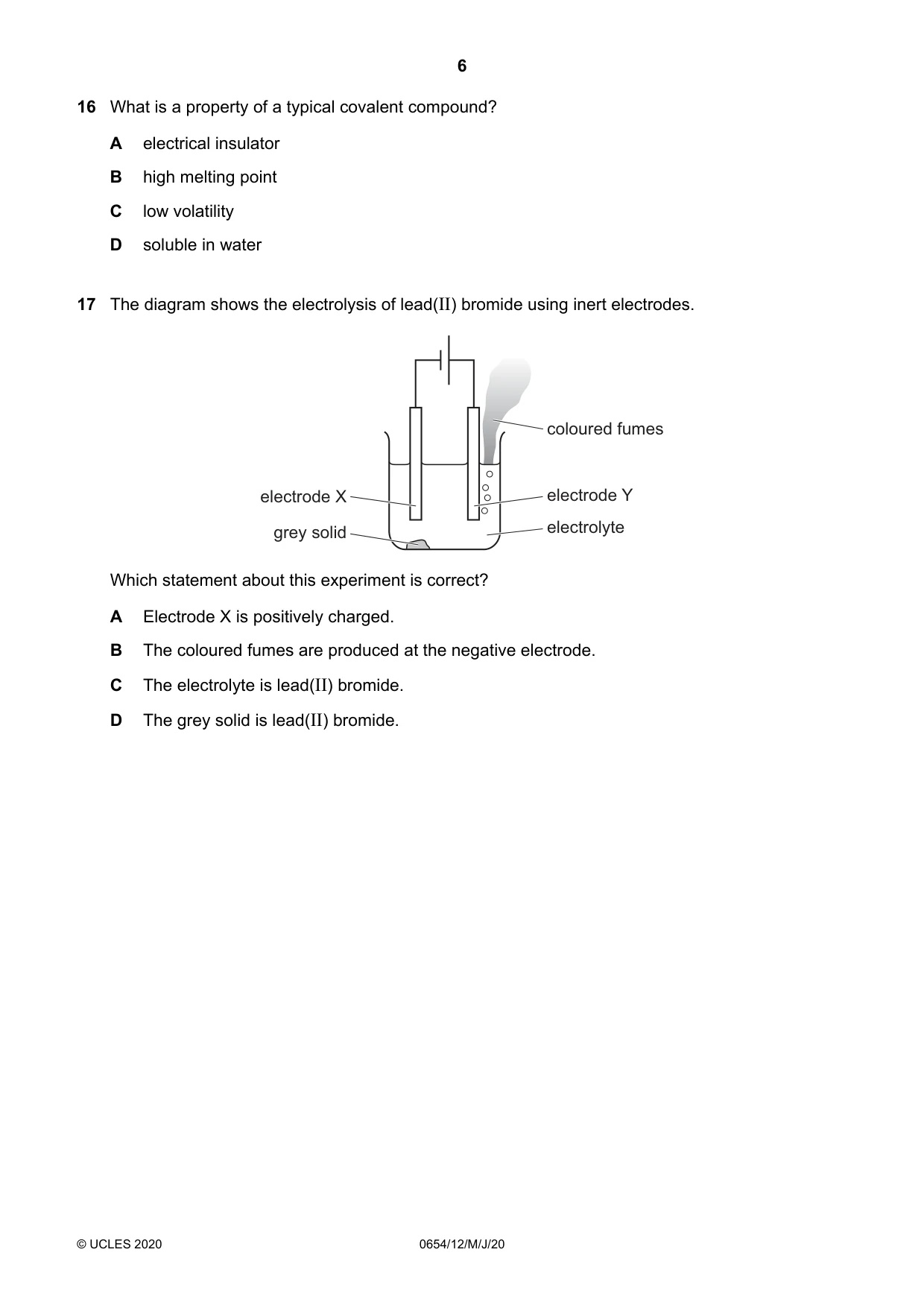
17 The diagram shows the electrolysis of lead(II) bromide using inert electrodes. coloured fumes electrode X electrode Y grey solid electrolyte Which statement about this experiment is correct? A Electrode X is positively charged. B The coloured fumes are produced at the negative electrode. C The electrolyte is lead(II) bromide. D The grey solid is lead(II) bromide.
Mark scheme: C
Q18 · Equal amounts of four different substances are added to equal volumes of the same acid of…
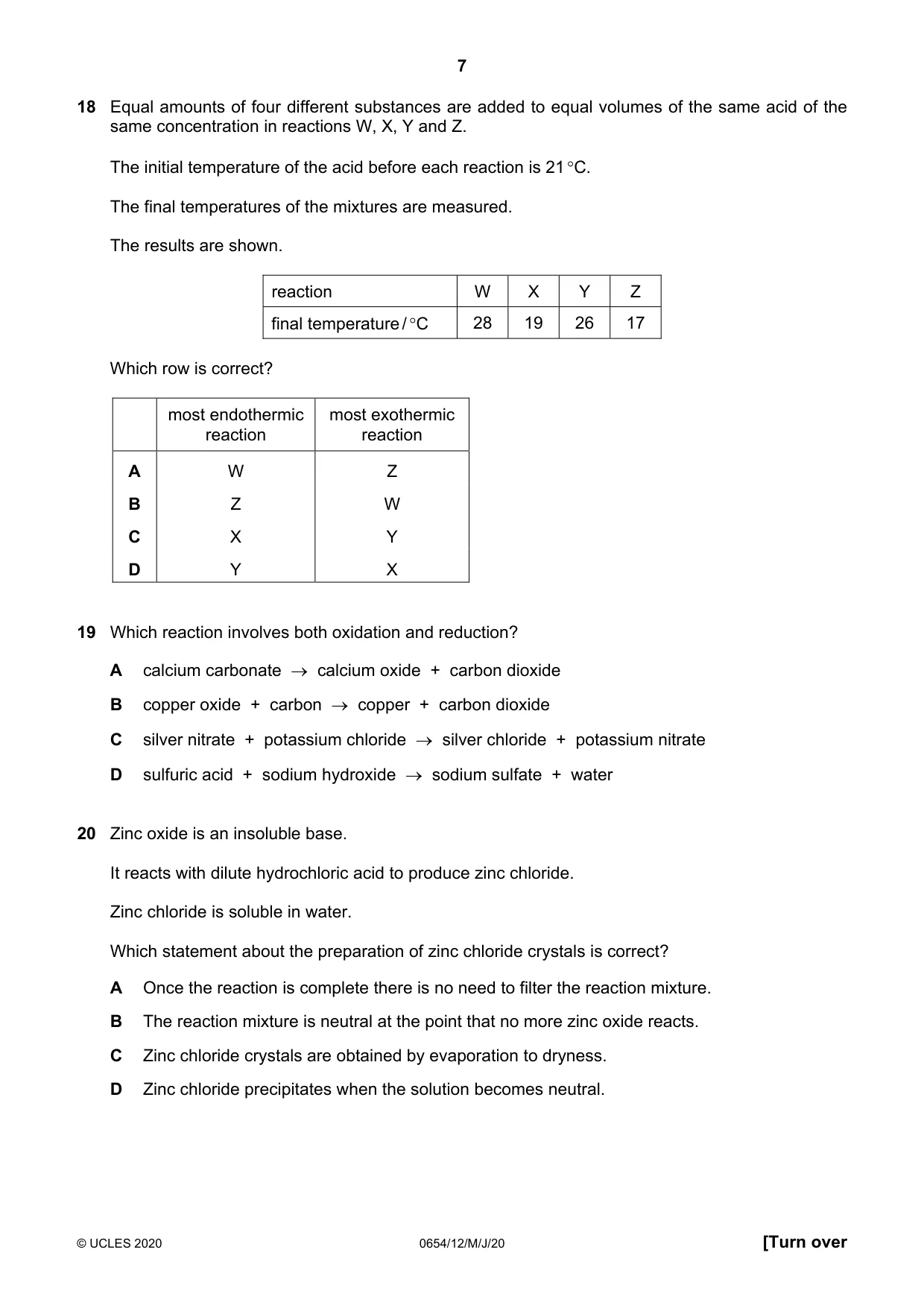
18 Equal amounts of four different substances are added to equal volumes of the same acid of the same concentration in reactions W, X, Y and Z. The initial temperature of the acid before each reaction is 21 °C. The final temperatures of the mixtures are measured. The results are shown. reaction W X Y Z final temperature / °C 28 19 26 17 Which row is correct? most endothermic most exothermic reaction reaction A W Z B Z W C X Y D Y X
Mark scheme: B
Q19 · Which reaction involves both oxidation and reduction?
19 Which reaction involves both oxidation and reduction? A calcium carbonate → calcium oxide + carbon dioxide B copper oxide + carbon → copper + carbon dioxide C silver nitrate + potassium chloride → silver chloride + potassium nitrate D sulfuric acid + sodium hydroxide → sodium sulfate + water
Mark scheme: B
Q20 · Zinc oxide is an insoluble base
20 Zinc oxide is an insoluble base. It reacts with dilute hydrochloric acid to produce zinc chloride. Zinc chloride is soluble in water. Which statement about the preparation of zinc chloride crystals is correct? A Once the reaction is complete there is no need to filter the reaction mixture. B The reaction mixture is neutral at the point that no more zinc oxide reacts. C Zinc chloride crystals are obtained by evaporation to dryness. D Zinc chloride precipitates when the solution becomes neutral.
Mark scheme: B
Q21 · Which test is used to identify sulfate ions?
21 Which test is used to identify sulfate ions? A aqueous barium ions under acidic conditions B aqueous silver nitrate under acidic conditions C dilute acid and then limewater D reduction with aluminium
Mark scheme: A
Q22 · Which statement about the halogens is not correct?
22 Which statement about the halogens is not correct? A They are members of Group VII of the Periodic Table. B They are non-metals. C They become darker in colour down the group. D They exist as monoatomic gases.
Mark scheme: D
Q23 · Which statement is not a reason why aluminium is used in aircraft manufacture?
23 Which statement is not a reason why aluminium is used in aircraft manufacture? A It forms low density alloys. B It is malleable. C It is more reactive than iron. D It is resistant to corrosion.
Mark scheme: C
Q24 · Which statement about fertilisers is correct?
24 Which statement about fertilisers is correct? A They are fed to animals to improve the animals’ growth. B They contain only nitrogen, phosphorus and potassium as elements. C They increase plant growth by adding chemicals directly to plant flowers. D They increase plant growth by adding chemicals to the soil.
Mark scheme: D
Q25 · Which statement about calcium carbonate is not correct?
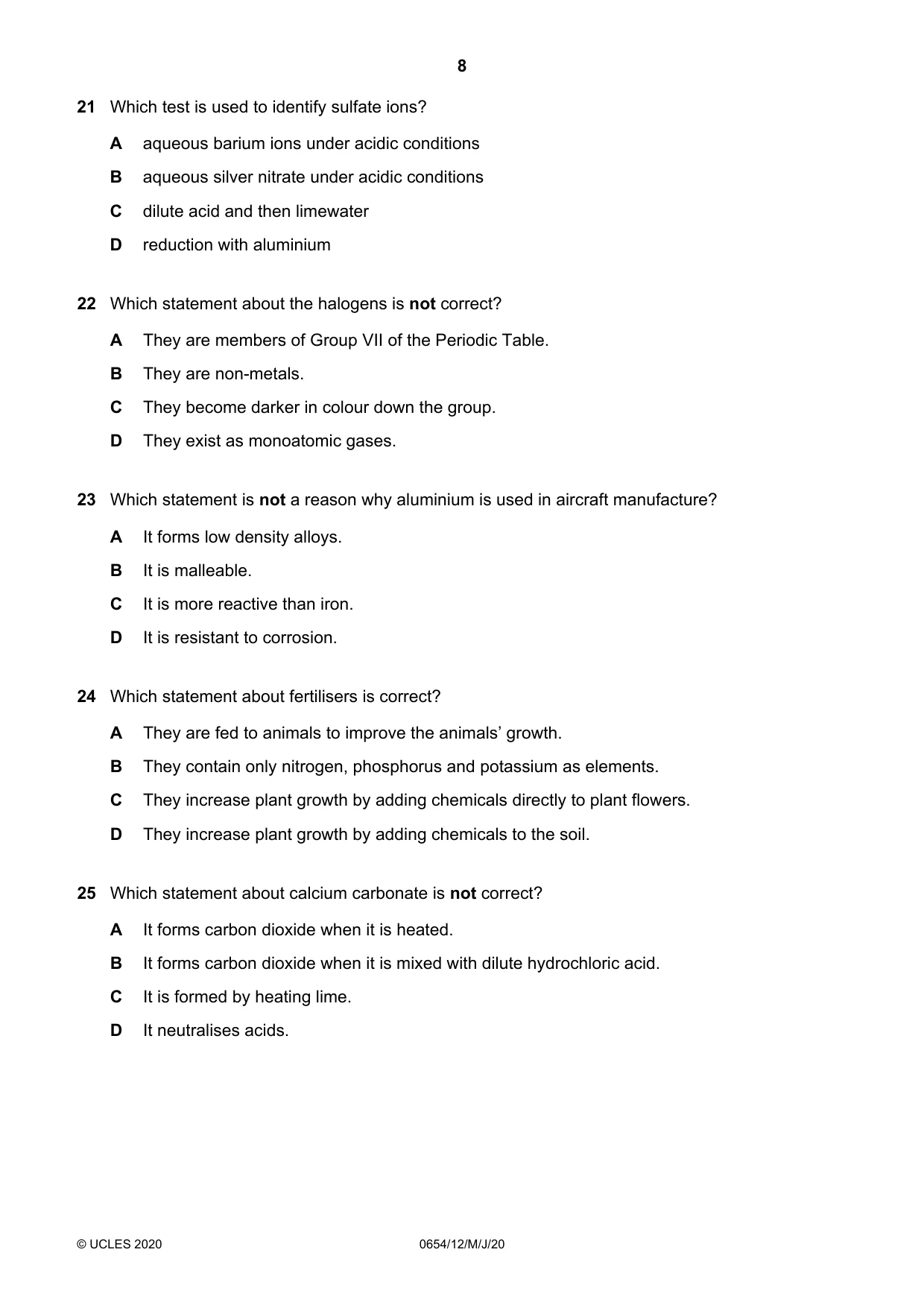
25 Which statement about calcium carbonate is not correct? A It forms carbon dioxide when it is heated. B It forms carbon dioxide when it is mixed with dilute hydrochloric acid. C It is formed by heating lime. D It neutralises acids.
Mark scheme: C
Q26 · Which row describes properties of alkenes?
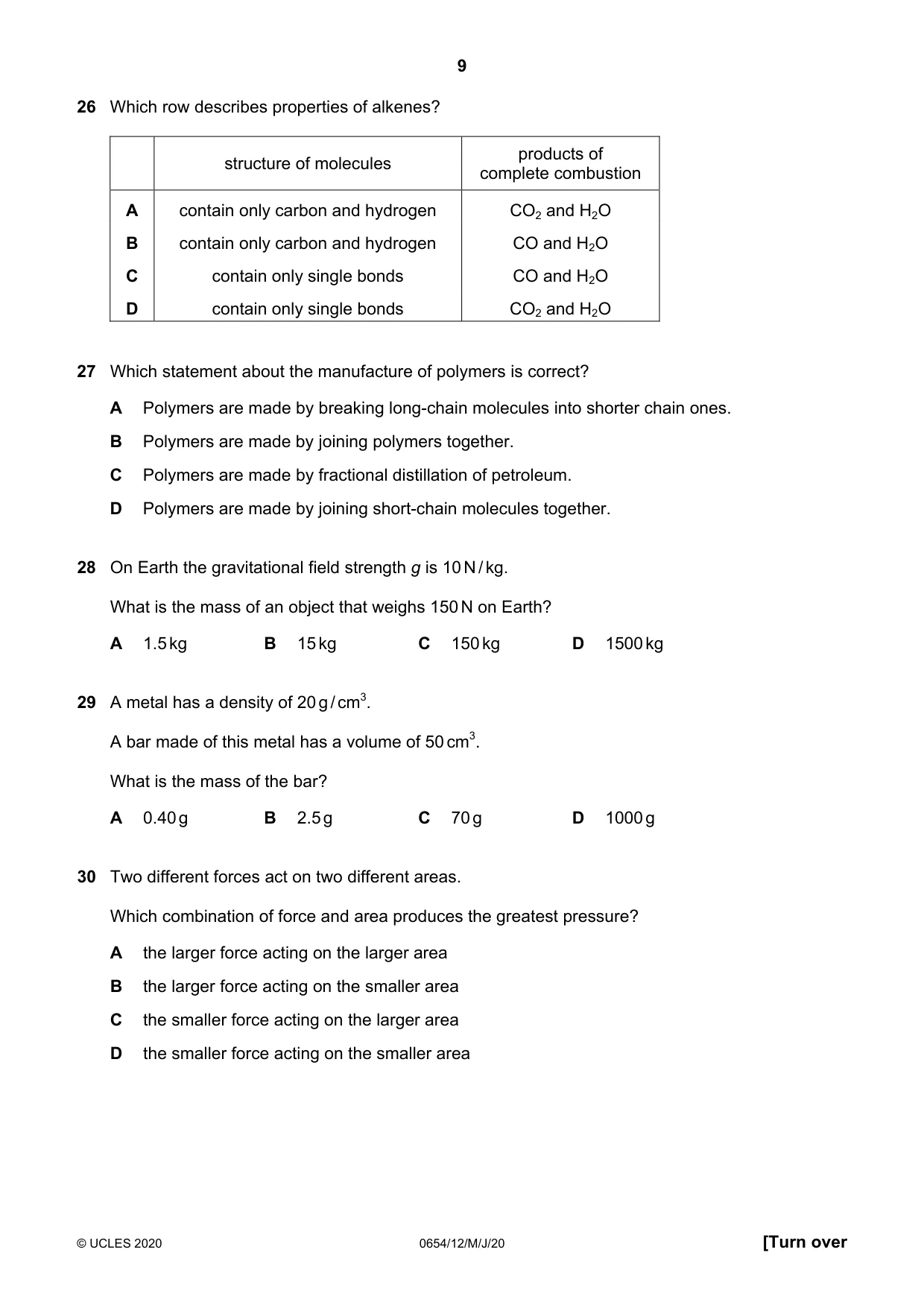
26 Which row describes properties of alkenes? products of structure of molecules complete combustion A contain only carbon and hydrogen CO2 and H2O B contain only carbon and hydrogen CO and H2O C contain only single bonds CO and H2O D contain only single bonds CO2 and H2O
Mark scheme: A
Q27 · Which statement about the manufacture of polymers is correct?
27 Which statement about the manufacture of polymers is correct? A Polymers are made by breaking long-chain molecules into shorter chain ones. B Polymers are made by joining polymers together. C Polymers are made by fractional distillation of petroleum. D Polymers are made by joining short-chain molecules together.
Mark scheme: D
Q28 · On Earth the gravitational field strength g is 10 N / kg
28 On Earth the gravitational field strength g is 10 N / kg. What is the mass of an object that weighs 150 N on Earth? A 1.5 kg B 15 kg C 150 kg D 1500 kg
Mark scheme: B
Q29 · A metal has a density of 20 g / cm3
29 A metal has a density of 20 g / cm3. A bar made of this metal has a volume of 50 cm3. What is the mass of the bar? A 0.40 g B 2.5 g C 70 g D 1000 g
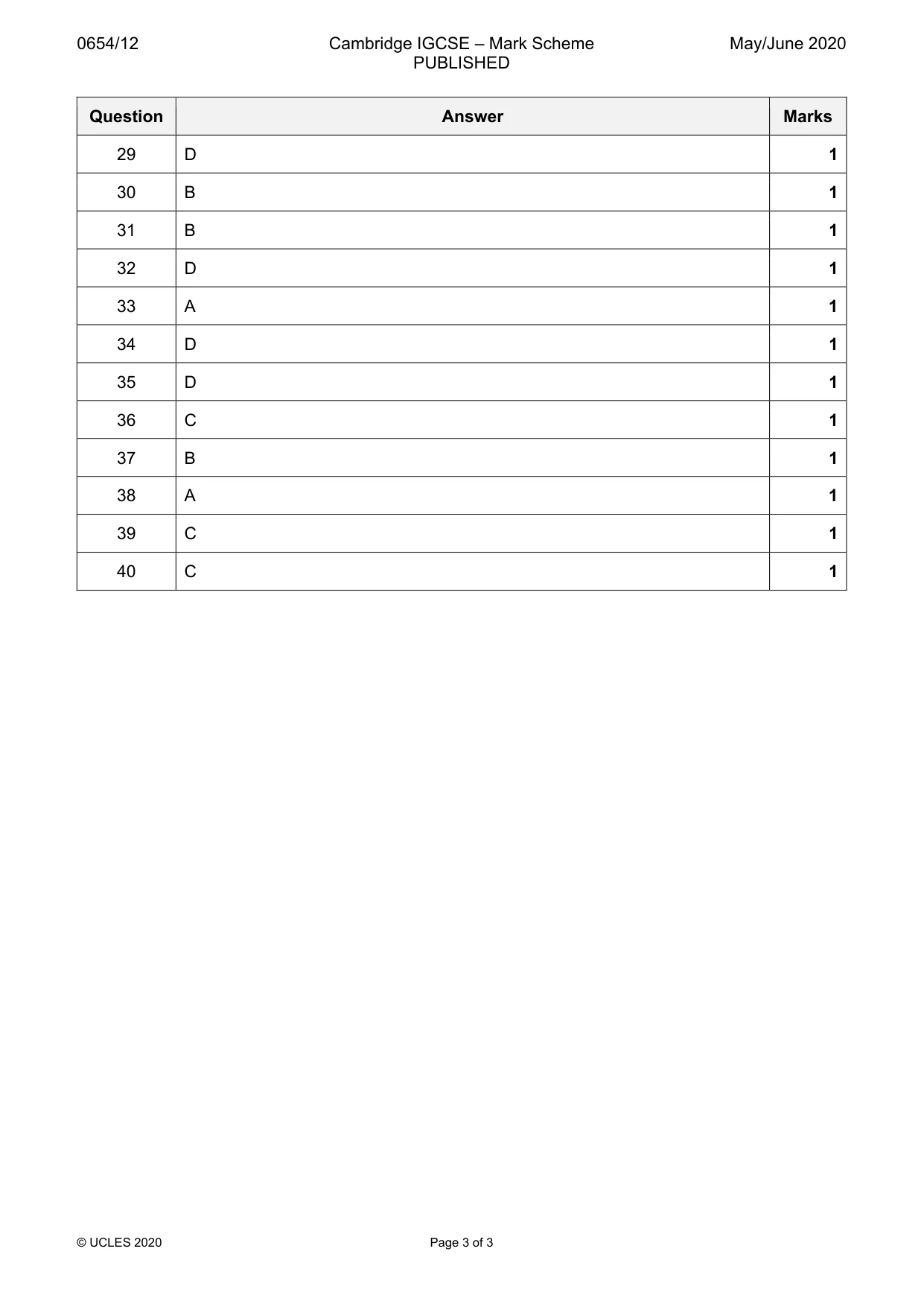
Mark scheme: D
Q30 · Two different forces act on two different areas
30 Two different forces act on two different areas. Which combination of force and area produces the greatest pressure? A the larger force acting on the larger area B the larger force acting on the smaller area C the smaller force acting on the larger area D the smaller force acting on the smaller area
Mark scheme: B
Q31 · Which source of energy is renewable?
31 Which source of energy is renewable? A coal B geothermal C natural gas D nuclear
Mark scheme: B
Q32 · A hot water tank is fitted with two identical heaters P and Q
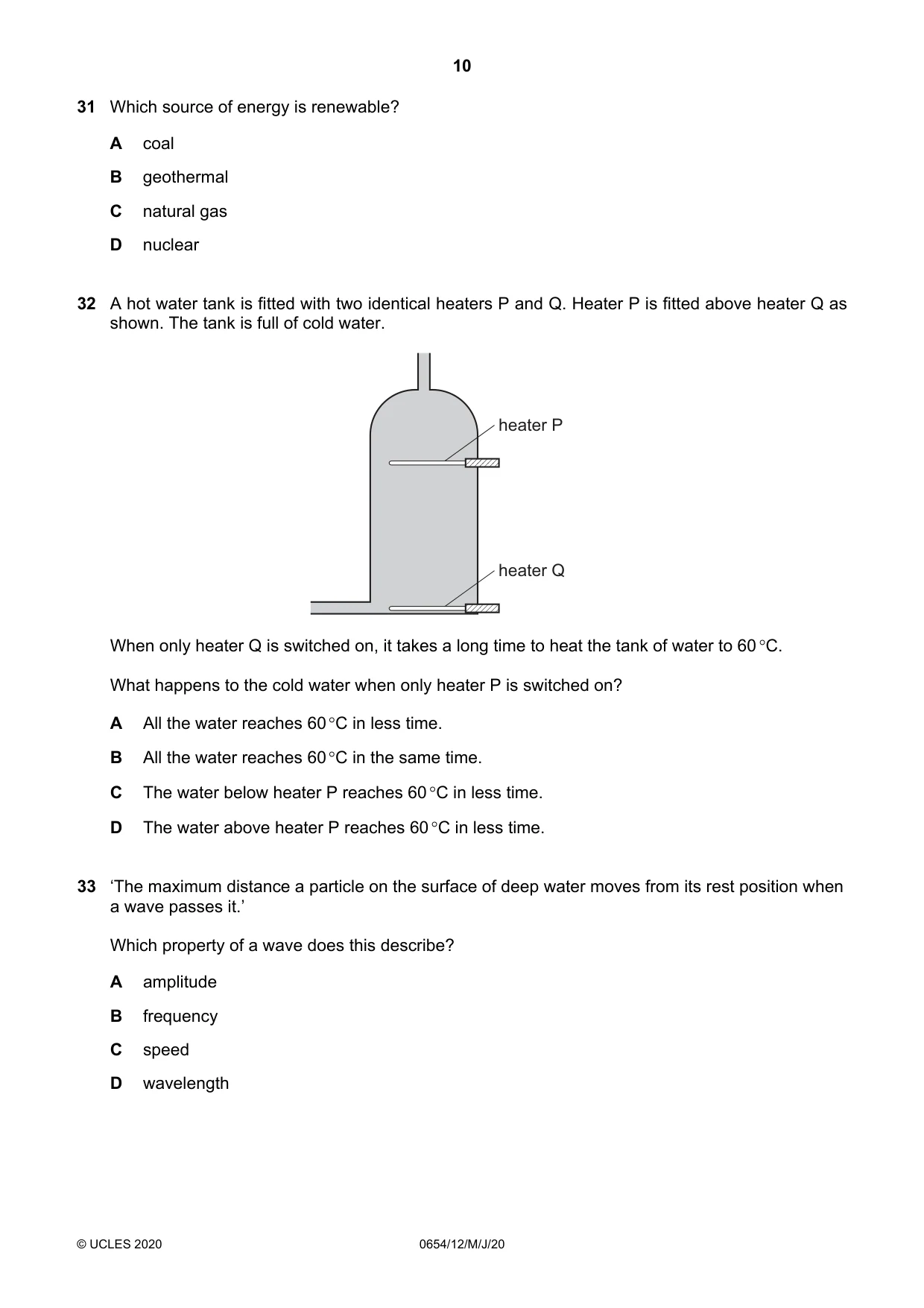
32 A hot water tank is fitted with two identical heaters P and Q. Heater P is fitted above heater Q as shown. The tank is full of cold water. heater P heater Q When only heater Q is switched on, it takes a long time to heat the tank of water to 60 °C. What happens to the cold water when only heater P is switched on? A All the water reaches 60 °C in less time. B All the water reaches 60 °C in the same time. C The water below heater P reaches 60 °C in less time. D The water above heater P reaches 60 °C in less time.
Mark scheme: D
Q33 · ‘The maximum distance a particle on the surface of deep water moves from its rest…
33 ‘The maximum distance a particle on the surface of deep water moves from its rest position when a wave passes it.’ Which property of a wave does this describe? A amplitude B frequency C speed D wavelength
Mark scheme: A
Q34 · The sound heard from the siren of a police car becomes louder and higher pitched as the…
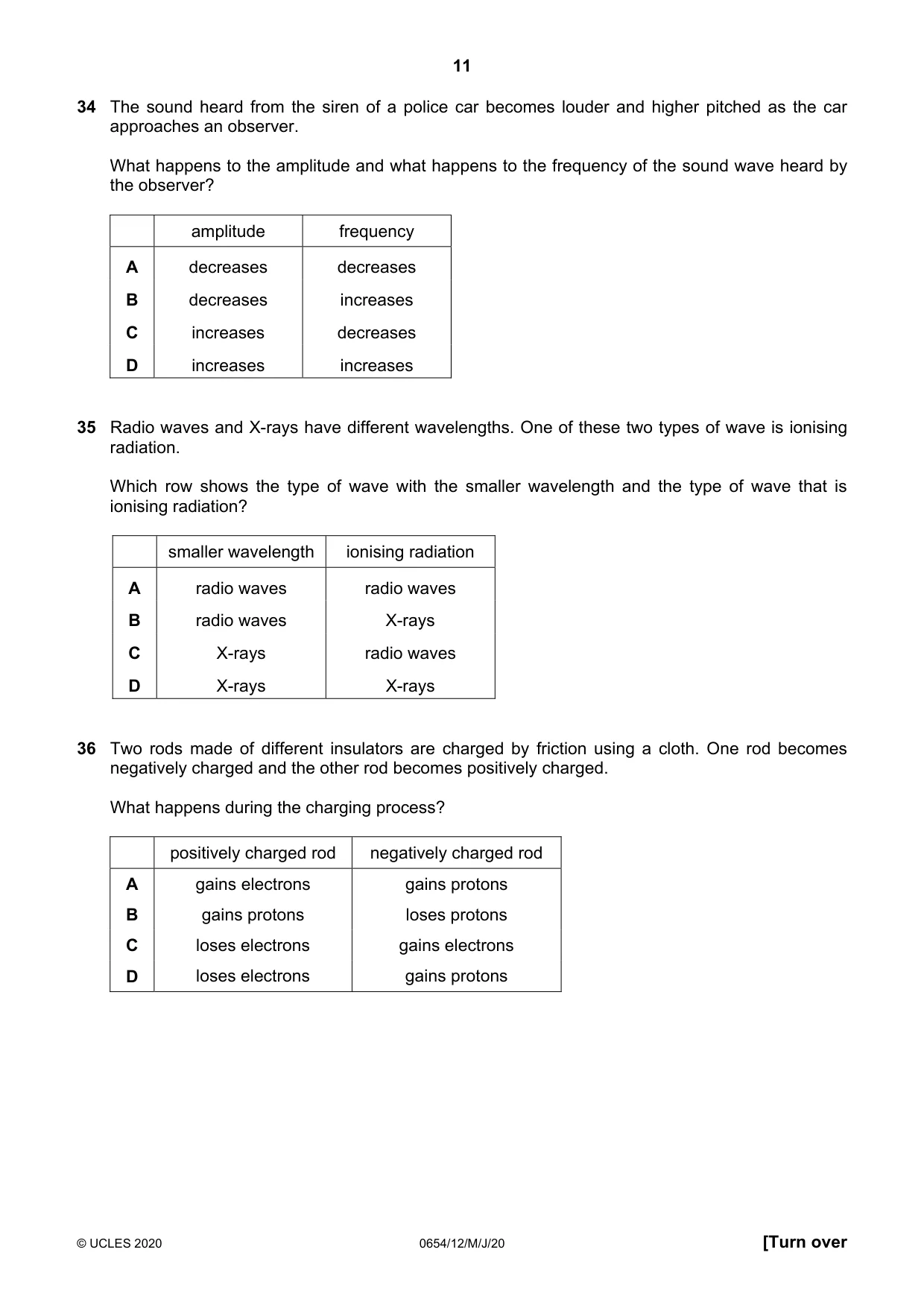
34 The sound heard from the siren of a police car becomes louder and higher pitched as the car approaches an observer. What happens to the amplitude and what happens to the frequency of the sound wave heard by the observer? amplitude frequency A decreases decreases B decreases increases C increases decreases D increases increases
Mark scheme: D
Q35 · Radio waves and X-rays have different wavelengths
35 Radio waves and X-rays have different wavelengths. One of these two types of wave is ionising radiation. Which row shows the type of wave with the smaller wavelength and the type of wave that is ionising radiation? smaller wavelength ionising radiation A radio waves radio waves B radio waves X-rays C X-rays radio waves D X-rays X-rays
Mark scheme: D
Q36 · Two rods made of different insulators are charged by friction using a cloth
36 Two rods made of different insulators are charged by friction using a cloth. One rod becomes negatively charged and the other rod becomes positively charged. What happens during the charging process? positively charged rod negatively charged rod A gains electrons gains protons B gains protons loses protons C loses electrons gains electrons D loses electrons gains protons
Mark scheme: C
Q37 · The circuit shown is used when determining the resistance of a lamp
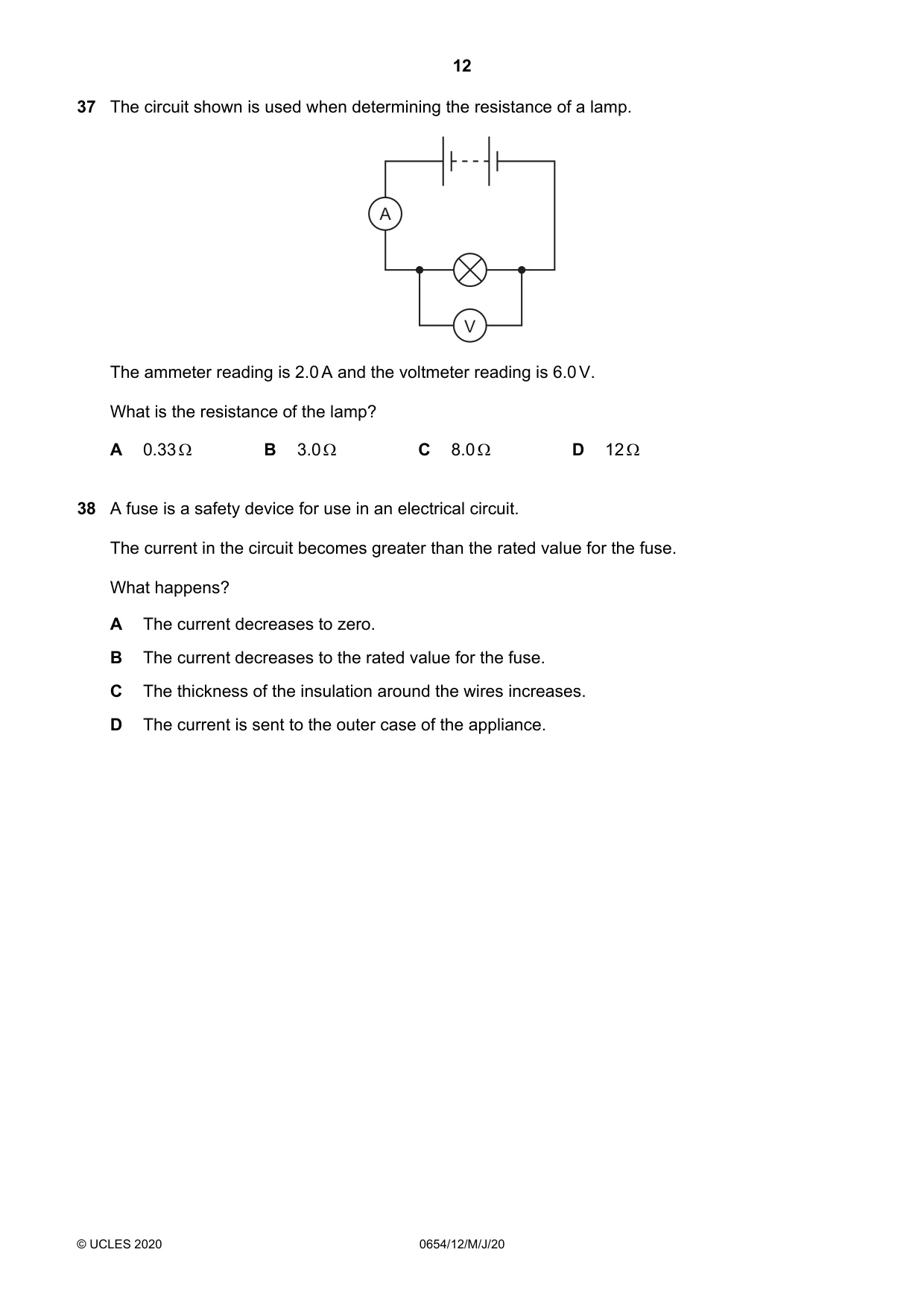
37 The circuit shown is used when determining the resistance of a lamp. A V The ammeter reading is 2.0 A and the voltmeter reading is 6.0 V. What is the resistance of the lamp? A 0.33 Ω B 3.0 Ω C 8.0 Ω D 12 Ω
Mark scheme: B
Q38 · A fuse is a safety device for use in an electrical circuit
38 A fuse is a safety device for use in an electrical circuit. The current in the circuit becomes greater than the rated value for the fuse. What happens? A The current decreases to zero. B The current decreases to the rated value for the fuse. C The thickness of the insulation around the wires increases. D The current is sent to the outer case of the appliance.
Mark scheme: A
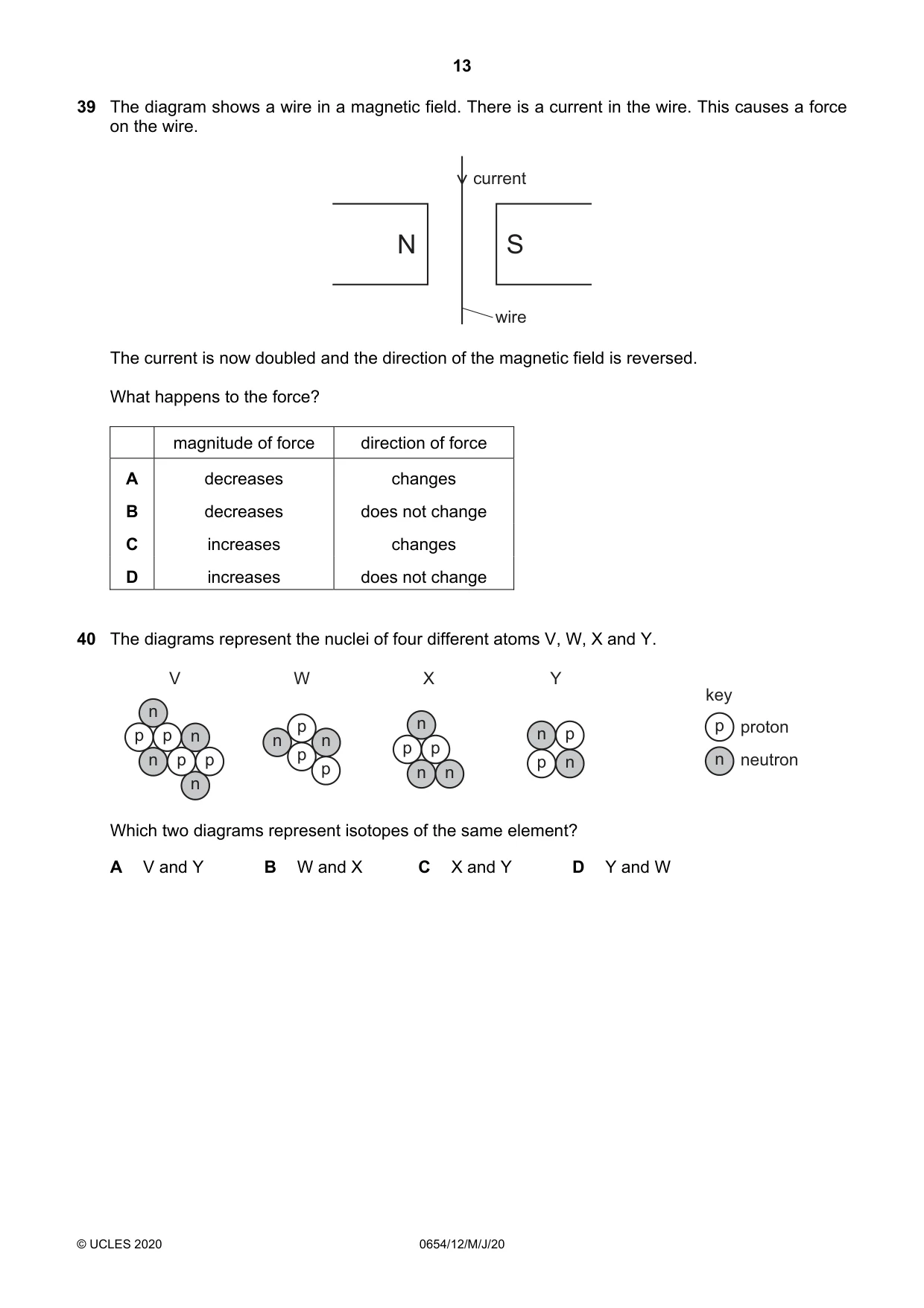
Q39 · The diagram shows a wire in a magnetic field
39 The diagram shows a wire in a magnetic field. There is a current in the wire. This causes a force on the wire. current N S wire The current is now doubled and the direction of the magnetic field is reversed. What happens to the force? magnitude of force direction of force A decreases changes B decreases does not change C increases changes D increases does not change
Mark scheme: C
Q40 · The diagrams represent the nuclei of four different atoms V, W, X and Y
40 The diagrams represent the nuclei of four different atoms V, W, X and Y. V W X Y key n p n p proton p p n n n n p p p p n p p p n n neutron p n n n Which two diagrams represent isotopes of the same element? A V and Y B W and X C X and Y D Y and W
Mark scheme: C
What was in this paper
The subtopics covered by these 40 questions, and how many questions each got. Open one in a new tab to see every Cambridge question on it.
1Atomic structure and the Periodic Table1Biological molecules1Cell structure1Characteristics of living organisms1Density1Diet1Electrical quantities1Electrical safety1Electrolysis1Electromagnetic effects1Electromagnetic spectrum1Elements, compounds and mixtures1Energy, work and power1Enzymes1Exothermic and endothermic reactions1Food chains and food webs1General properties of waves1Group VII properties1Habitat destruction1Homeostasis1Identification of ions and gases1Isotopes1Mass and weight1Oxides1Photosynthesis1Polymers1Preparation of salts1Pressure1Reactivity series1Redox1Respiration1Selection1Sexual reproduction1Simple molecules and covalent bonds1Simple phenomena of magnetism1Sound1Transfer of thermal energy1Transpiration1Water1