Cambridge IGCSE Sciences - Co-ordinated (Double) 0654 — 2025 Feb/March Paper 1 · Variant 2
0654/12/F/M/25 · 40 questions · 40 marks · 45 min
The question paper and its mark scheme, free to read here and free to download. This is Cambridge’s own paper, exactly as it was sat.
Question paper16 pages
Mark scheme3 pages
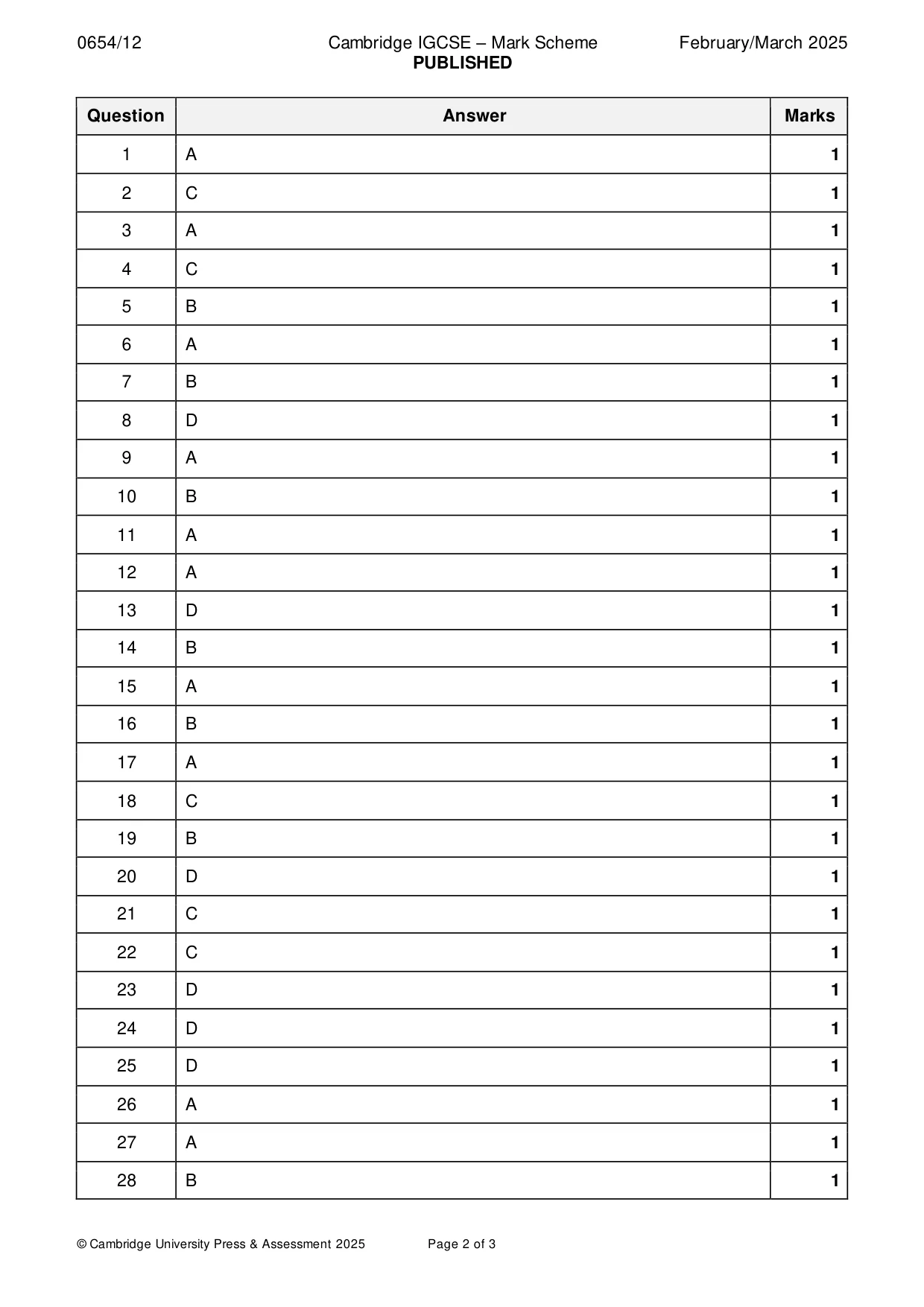
Answers below. Sit the paper first if you are practising.
Questions as text
Q1 · A scientist studies a living organism
1 A scientist studies a living organism. The organism has the ability to remove the waste products of metabolism. Which characteristic of living organisms does this show? A excretion B nutrition C respiration D reproduction
Mark scheme: A
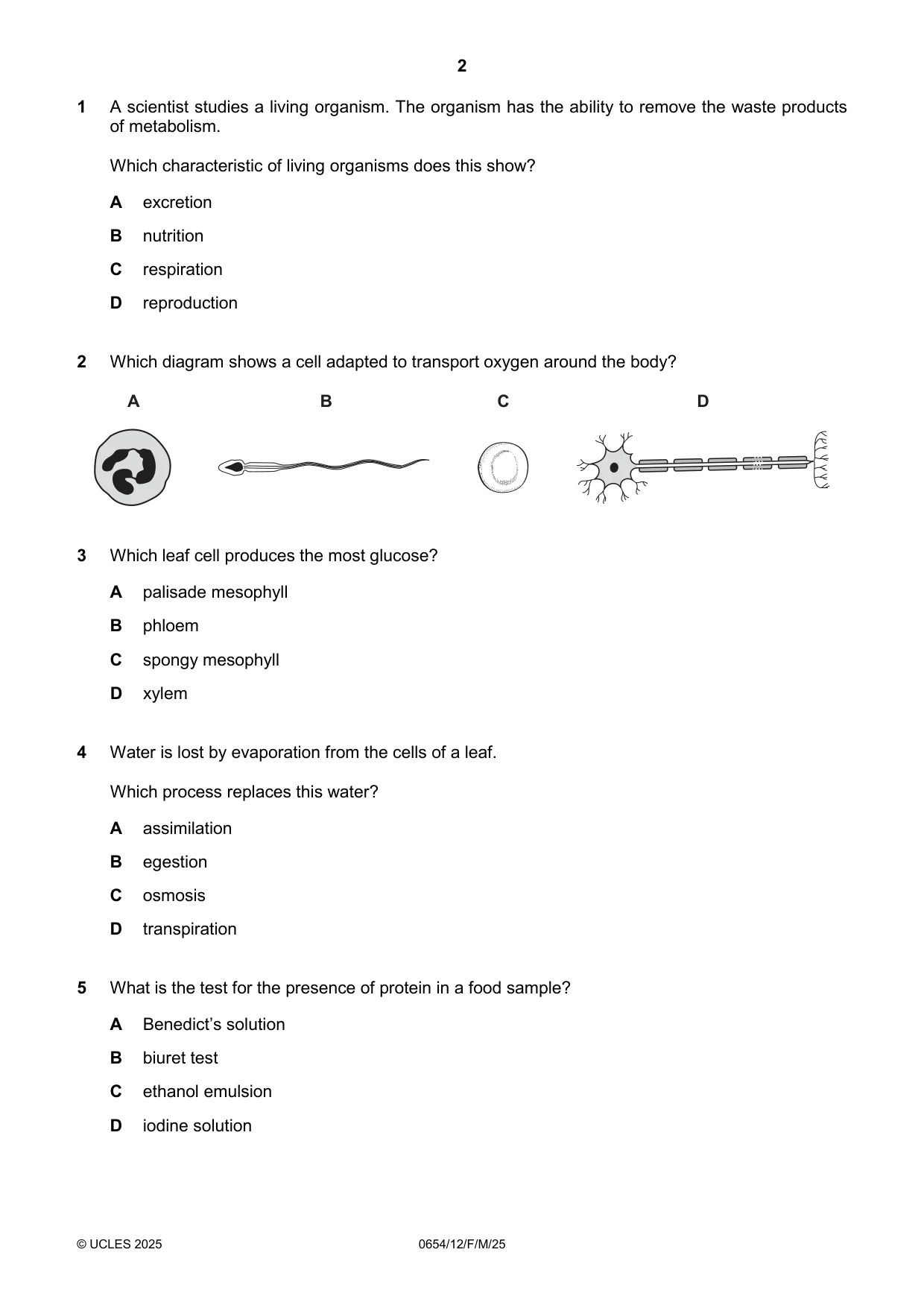
Q2 · Which diagram shows a cell adapted to transport oxygen around the body?
2 Which diagram shows a cell adapted to transport oxygen around the body? A B C D
Mark scheme: C
Q3 · Which leaf cell produces the most glucose?
3 Which leaf cell produces the most glucose? A palisade mesophyll B phloem C spongy mesophyll D xylem
Mark scheme: A
Q4 · Water is lost by evaporation from the cells of a leaf
4 Water is lost by evaporation from the cells of a leaf. Which process replaces this water? A assimilation B egestion C osmosis D transpiration
Mark scheme: C
Q5 · What is the test for the presence of protein in a food sample?
5 What is the test for the presence of protein in a food sample? A Benedict’s solution B biuret test C ethanol emulsion D iodine solution
Mark scheme: B
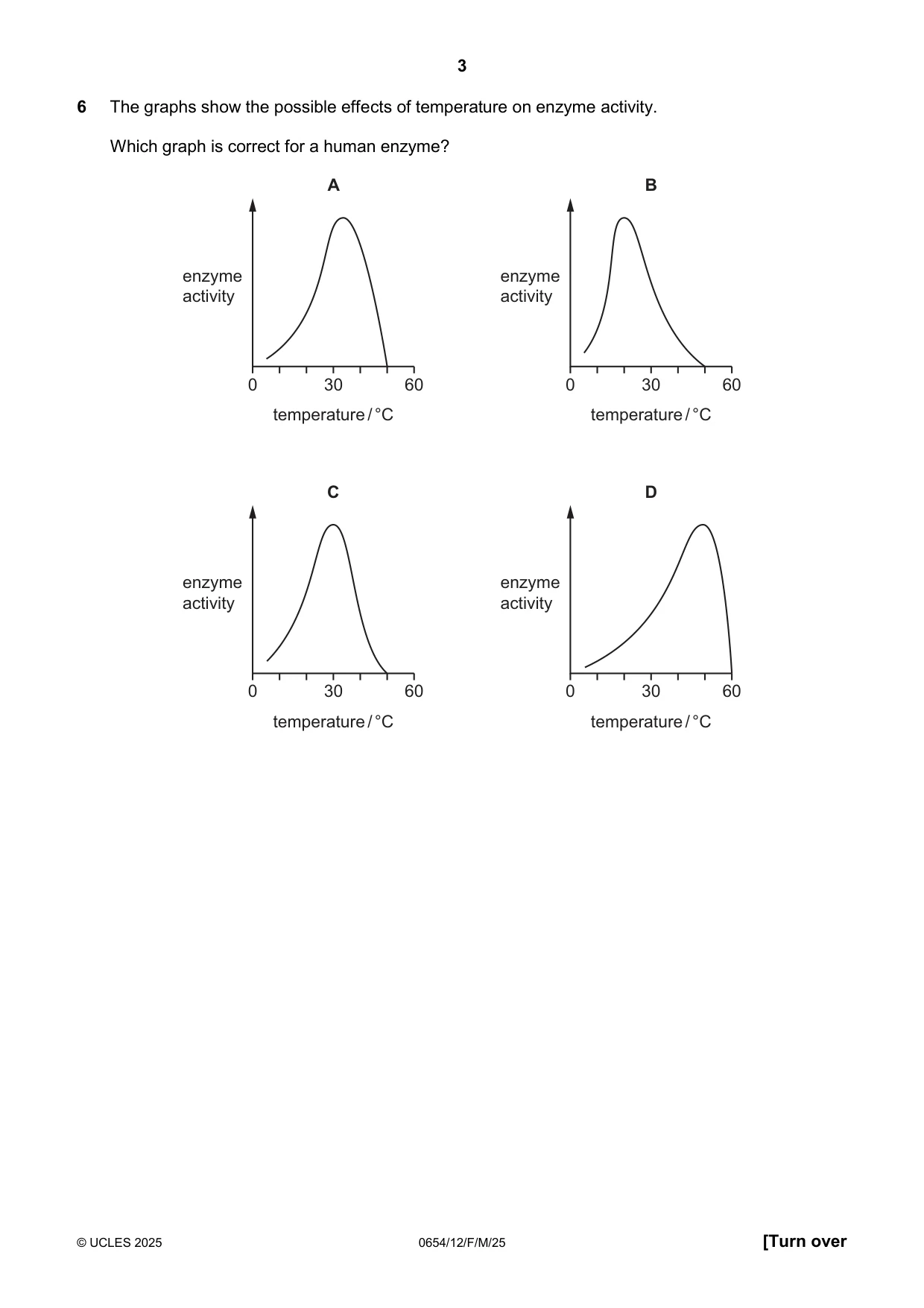
Q6 · The graphs show the possible effects of temperature on enzyme activity
6 The graphs show the possible effects of temperature on enzyme activity. Which graph is correct for a human enzyme? A B enzyme enzyme activity activity 0 30 60 0 30 60 temperature / °C temperature / °C C D enzyme enzyme activity activity 0 30 60 0 30 60 temperature / °C temperature / °C
Mark scheme: A
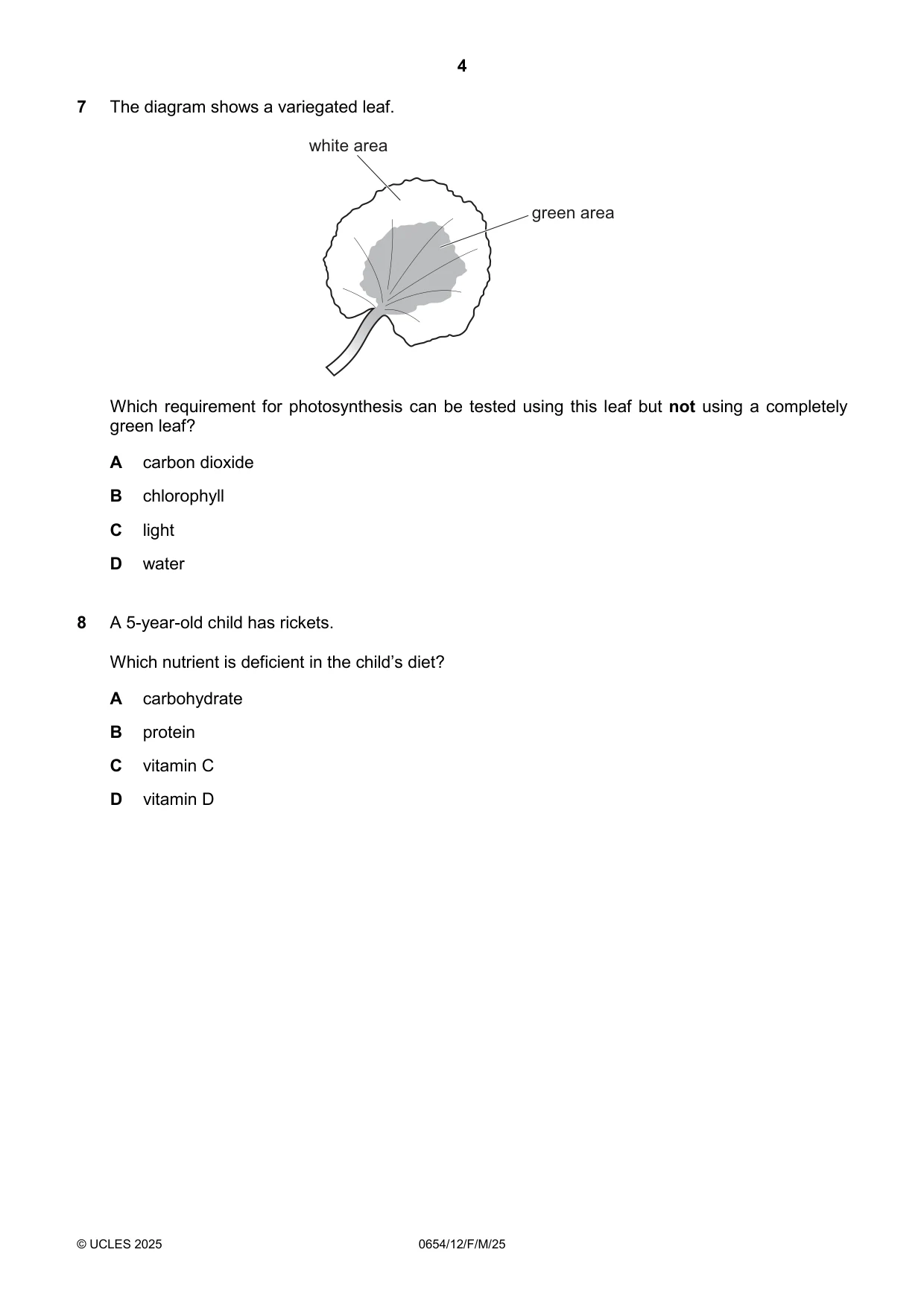
Q7 · The diagram shows a variegated leaf
7 The diagram shows a variegated leaf. white area green area Which requirement for photosynthesis can be tested using this leaf but not using a completely green leaf? A carbon dioxide B chlorophyll C light D water
Mark scheme: B
Q8 · A 5-year-old child has rickets
8 A 5-year-old child has rickets. Which nutrient is deficient in the child’s diet? A carbohydrate B protein C vitamin C D vitamin D
Mark scheme: D
Q9 · The diagram shows a cross section of a plant stem and a plant root
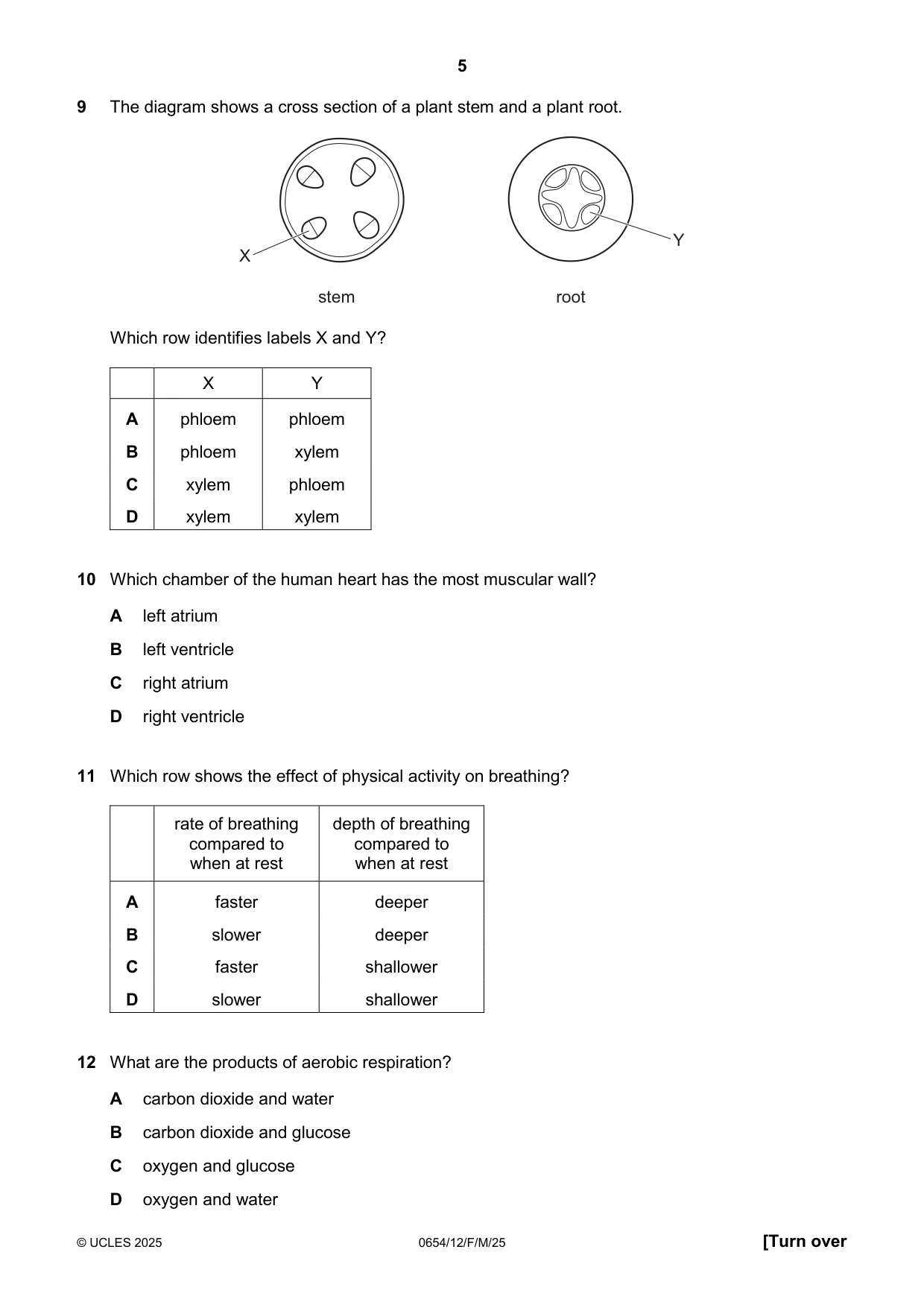
9 The diagram shows a cross section of a plant stem and a plant root. Y X stem root Which row identifies labels X and Y? X Y A phloem phloem B phloem xylem C xylem phloem D xylem xylem
Mark scheme: A
Q10 · Which chamber of the human heart has the most muscular wall?
10 Which chamber of the human heart has the most muscular wall? A left atrium B left ventricle C right atrium D right ventricle
Mark scheme: B
Q11 · Which row shows the effect of physical activity on breathing?
11 Which row shows the effect of physical activity on breathing? rate of breathing depth of breathing compared to compared to when at rest when at rest A faster deeper B slower deeper C faster shallower D slower shallower
Mark scheme: A
Q12 · What are the products of aerobic respiration?
12 What are the products of aerobic respiration? A carbon dioxide and water B carbon dioxide and glucose C oxygen and glucose D oxygen and water
Mark scheme: A
Q13 · The diagram shows a cross section of a flower
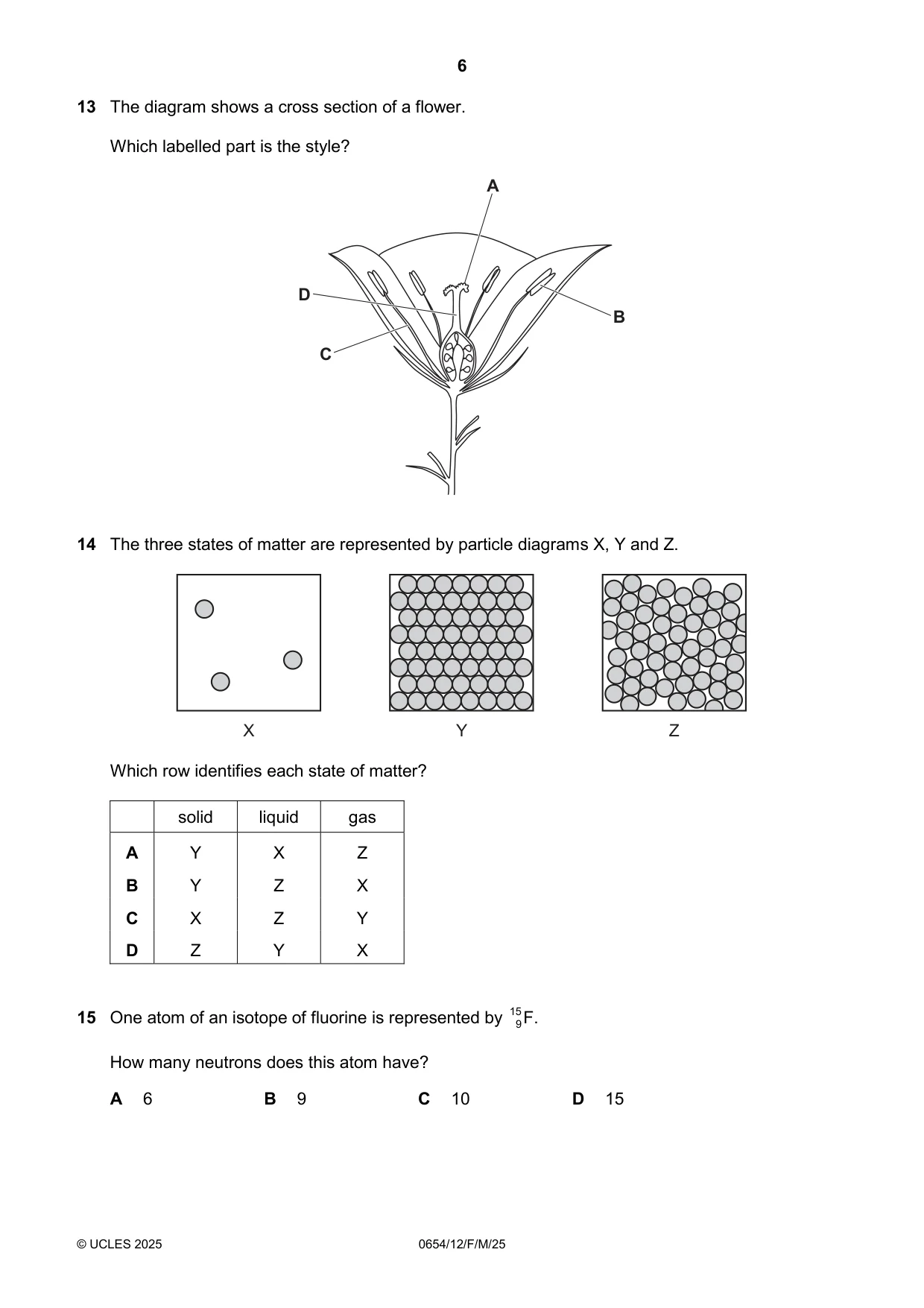
13 The diagram shows a cross section of a flower. Which labelled part is the style? A D B C
Mark scheme: D
Q14 · The three states of matter are represented by particle diagrams X, Y and Z
14 The three states of matter are represented by particle diagrams X, Y and Z. X Y Z Which row identifies each state of matter? solid liquid gas A Y X Z B Y Z X C X Z Y D Z Y X
Mark scheme: B
Q15 · One atom of an isotope of fluorine is represented by 15 F
15 One atom of an isotope of fluorine is represented by 15 F. 9 How many neutrons does this atom have? A 6 B 9 C 10 D 15
Mark scheme: A
Q16 · Which dot-and-cross diagram represents sodium chloride?
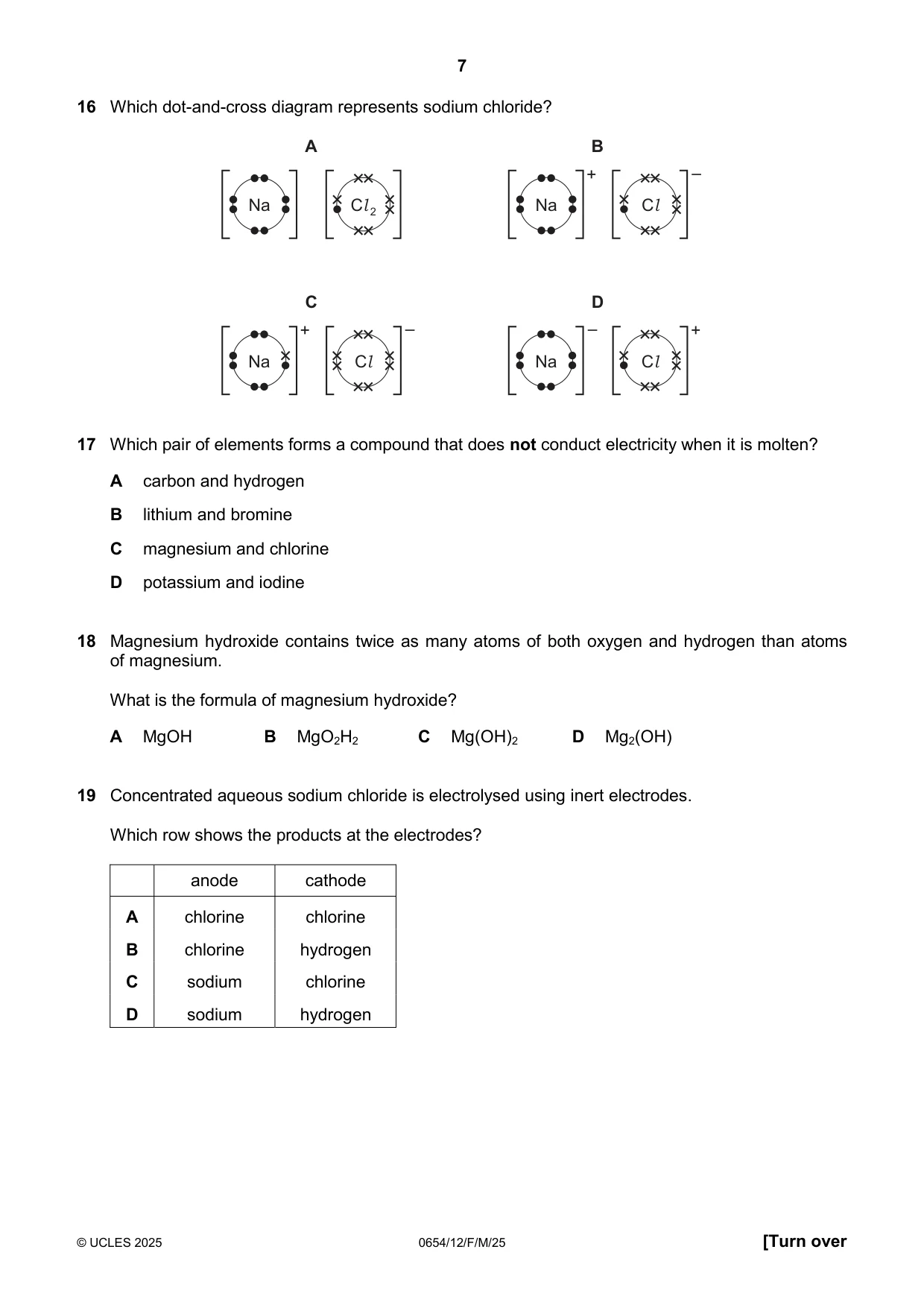
16 Which dot-and-cross diagram represents sodium chloride? A B + – Na Cl 2 Na Cl C D + – – + Na Cl Na Cl
Mark scheme: B
Q17 · Which pair of elements forms a compound that does not conduct electricity when it is…
17 Which pair of elements forms a compound that does not conduct electricity when it is molten? A carbon and hydrogen B lithium and bromine C magnesium and chlorine D potassium and iodine
Mark scheme: A
Q18 · Magnesium hydroxide contains twice as many atoms of both oxygen and hydrogen than atoms…
18 Magnesium hydroxide contains twice as many atoms of both oxygen and hydrogen than atoms of magnesium. What is the formula of magnesium hydroxide? A MgOH B MgO2H2 C Mg(OH)2 D Mg2(OH)
Mark scheme: C
Q19 · Concentrated aqueous sodium chloride is electrolysed using inert electrodes
19 Concentrated aqueous sodium chloride is electrolysed using inert electrodes. Which row shows the products at the electrodes? anode cathode A chlorine chlorine B chlorine hydrogen C sodium chlorine D sodium hydrogen
Mark scheme: B
Q20 · The initial and final temperatures of four different experiments are measured
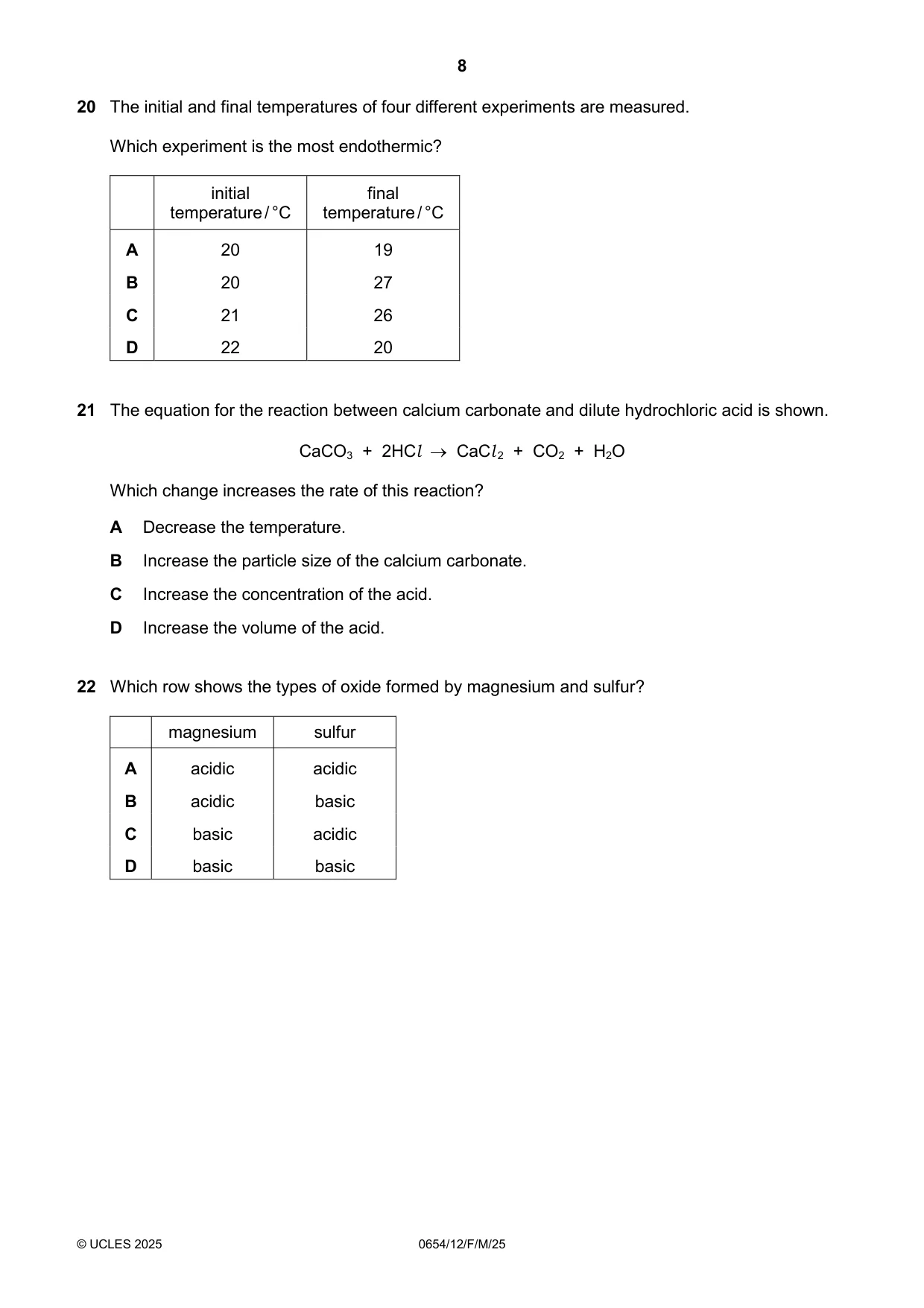
20 The initial and final temperatures of four different experiments are measured. Which experiment is the most endothermic? initial final temperature / °C temperature / °C A 20 19 B 20 27 C 21 26 D 22 20
Mark scheme: D
Q21 · The equation for the reaction between calcium carbonate and dilute hydrochloric acid is…
21 The equation for the reaction between calcium carbonate and dilute hydrochloric acid is shown. CaCO3 + 2HCl CaCl 2 + CO2 + H2O Which change increases the rate of this reaction? A Decrease the temperature. B Increase the particle size of the calcium carbonate. C Increase the concentration of the acid. D Increase the volume of the acid.
Mark scheme: C
Q22 · Which row shows the types of oxide formed by magnesium and sulfur?
22 Which row shows the types of oxide formed by magnesium and sulfur? magnesium sulfur A acidic acidic B acidic basic C basic acidic D basic basic
Mark scheme: C
Q23 · Copper sulfate is made when copper carbonate is added to dilute sulfuric acid
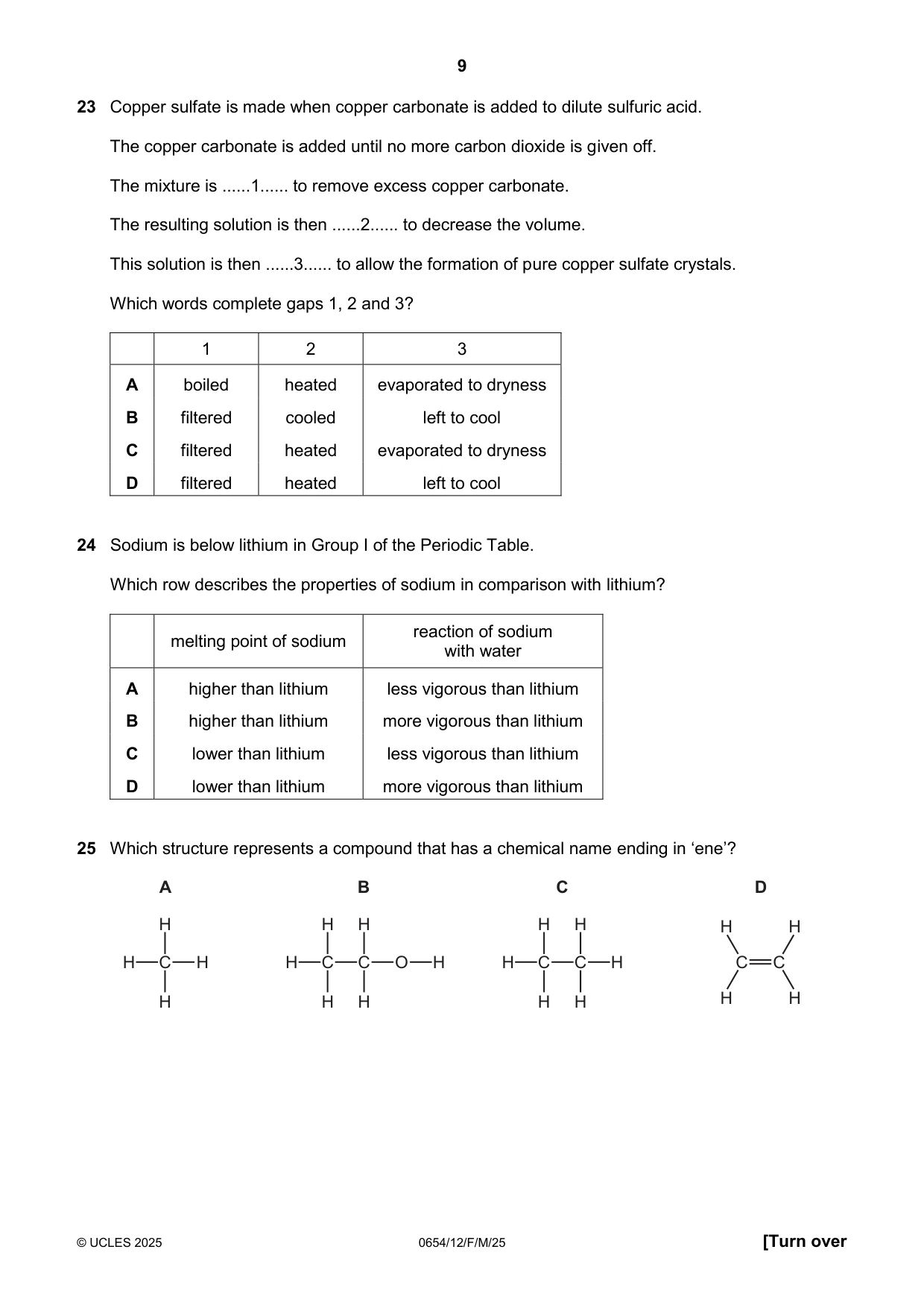
23 Copper sulfate is made when copper carbonate is added to dilute sulfuric acid. The copper carbonate is added until no more carbon dioxide is given off. The mixture is ......1...... to remove excess copper carbonate. The resulting solution is then ......2...... to decrease the volume. This solution is then ......3...... to allow the formation of pure copper sulfate crystals. Which words complete gaps 1, 2 and 3? 1 2 3 A boiled heated evaporated to dryness B filtered cooled left to cool C filtered heated evaporated to dryness D filtered heated left to cool
Mark scheme: D
Q24 · Sodium is below lithium in Group I of the Periodic Table
24 Sodium is below lithium in Group I of the Periodic Table. Which row describes the properties of sodium in comparison with lithium? reaction of sodium melting point of sodium with water A higher than lithium less vigorous than lithium B higher than lithium more vigorous than lithium C lower than lithium less vigorous than lithium D lower than lithium more vigorous than lithium
Mark scheme: D
Q25 · Which structure represents a compound that has a chemical name ending in ‘ene’?
25 Which structure represents a compound that has a chemical name ending in ‘ene’? A B C D H H H H H H H H C H H C C O H H C C H C C H H H H H H H
Mark scheme: D
Q26 · Sodium chloride is dissolved in water
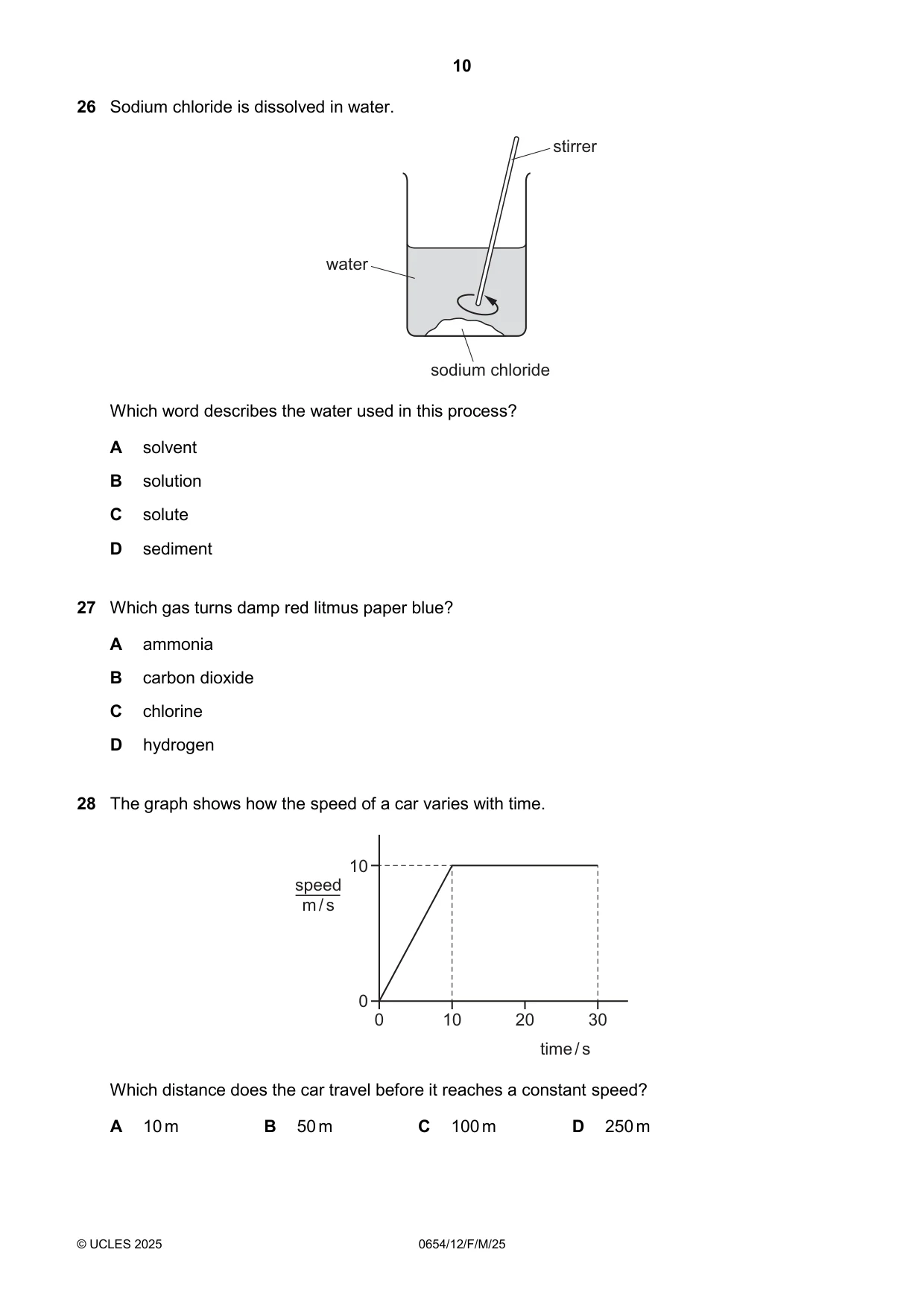
26 Sodium chloride is dissolved in water. stirrer water sodium chloride Which word describes the water used in this process? A solvent B solution C solute D sediment
Mark scheme: A
Q27 · Which gas turns damp red litmus paper blue?
27 Which gas turns damp red litmus paper blue? A ammonia B carbon dioxide C chlorine D hydrogen
Mark scheme: A
Q28 · The graph shows how the speed of a car varies with time
28 The graph shows how the speed of a car varies with time. 10 speed m / s 0 0 10 20 30 time / s Which distance does the car travel before it reaches a constant speed? A 10 m B 50 m C 100 m D 250 m
Mark scheme: B
Q29 · What is the density of an object that has a mass of 20 g and a volume of 5.0 cm3 ?
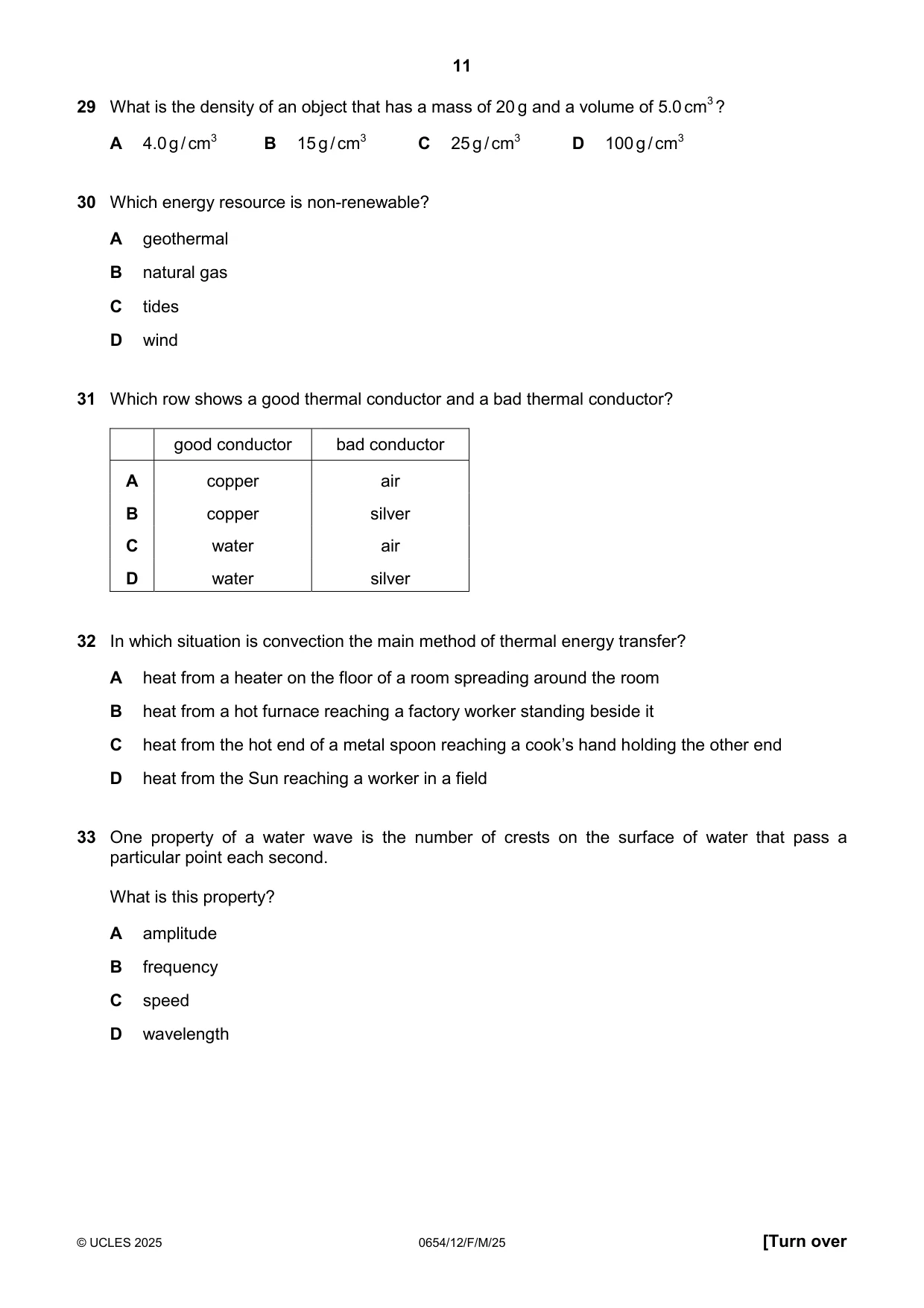
29 What is the density of an object that has a mass of 20 g and a volume of 5.0 cm3 ? A 4.0 g / cm3 B 15 g / cm3 C 25 g / cm3 D 100 g / cm3
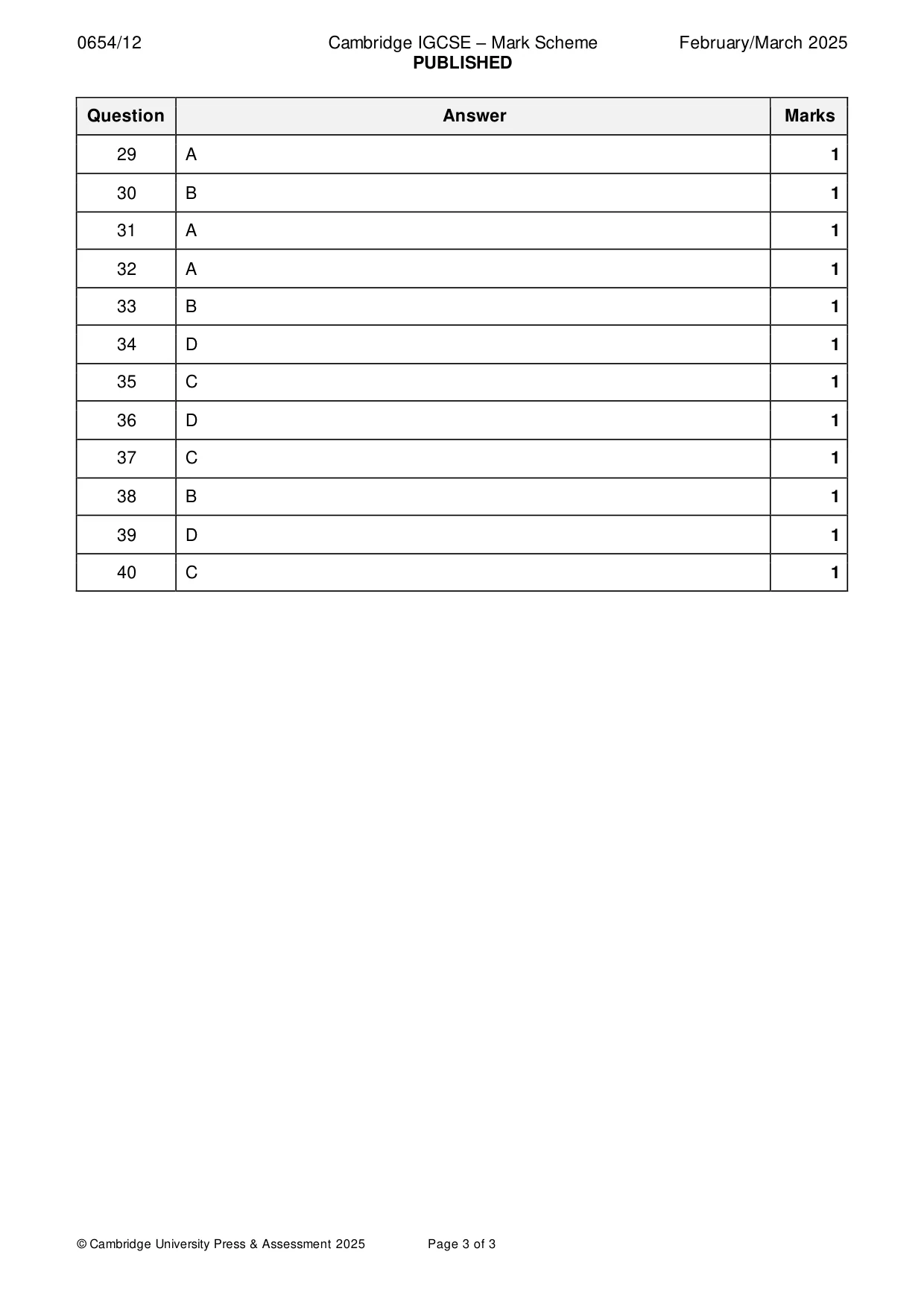
Mark scheme: A
Q30 · Which energy resource is non-renewable?
30 Which energy resource is non-renewable? A geothermal B natural gas C tides D wind
Mark scheme: B
Q31 · Which row shows a good thermal conductor and a bad thermal conductor?
31 Which row shows a good thermal conductor and a bad thermal conductor? good conductor bad conductor A copper air B copper silver C water air D water silver
Mark scheme: A
Q32 · In which situation is convection the main method of thermal energy transfer?
32 In which situation is convection the main method of thermal energy transfer? A heat from a heater on the floor of a room spreading around the room B heat from a hot furnace reaching a factory worker standing beside it C heat from the hot end of a metal spoon reaching a cook’s hand holding the other end D heat from the Sun reaching a worker in a field
Mark scheme: A
Q33 · One property of a water wave is the number of crests on the surface of water that pass a…
33 One property of a water wave is the number of crests on the surface of water that pass a particular point each second. What is this property? A amplitude B frequency C speed D wavelength
Mark scheme: B
Q34 · Light strikes a plane mirror and is reflected
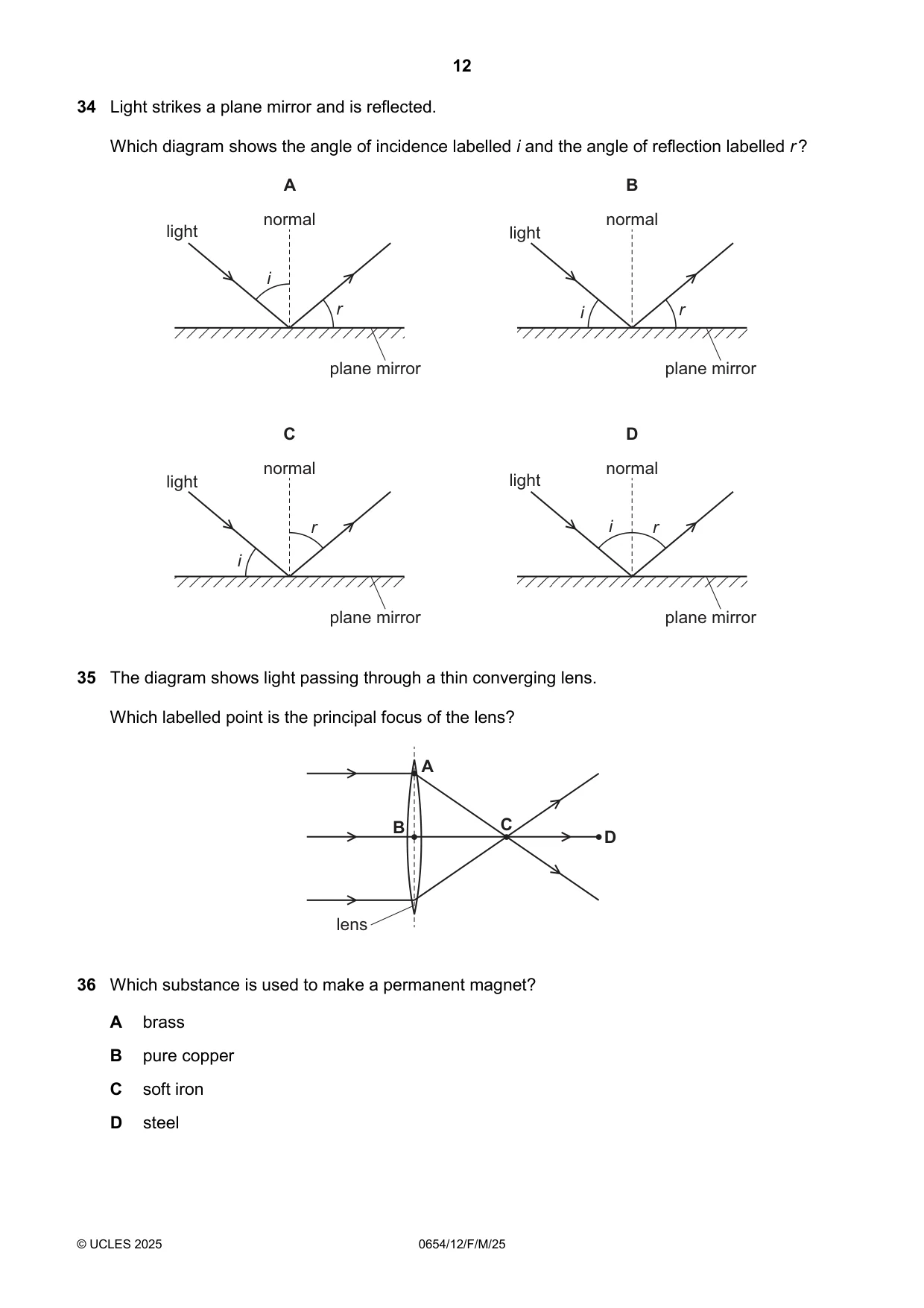
34 Light strikes a plane mirror and is reflected. Which diagram shows the angle of incidence labelled i and the angle of reflection labelled r ? A B normal normal light light i r i r plane mirror plane mirror C D normal normal light light r i r i plane mirror plane mirror
Mark scheme: D
Q35 · The diagram shows light passing through a thin converging lens
35 The diagram shows light passing through a thin converging lens. Which labelled point is the principal focus of the lens? A B C D lens
Mark scheme: C
Q36 · Which substance is used to make a permanent magnet?
36 Which substance is used to make a permanent magnet? A brass B pure copper C soft iron D steel
Mark scheme: D
Q37 · Which equation relates resistance R to current I and voltage V ?
37 Which equation relates resistance R to current I and voltage V ? I V A R = I V B R = C R = D R = I – V V I
Mark scheme: C
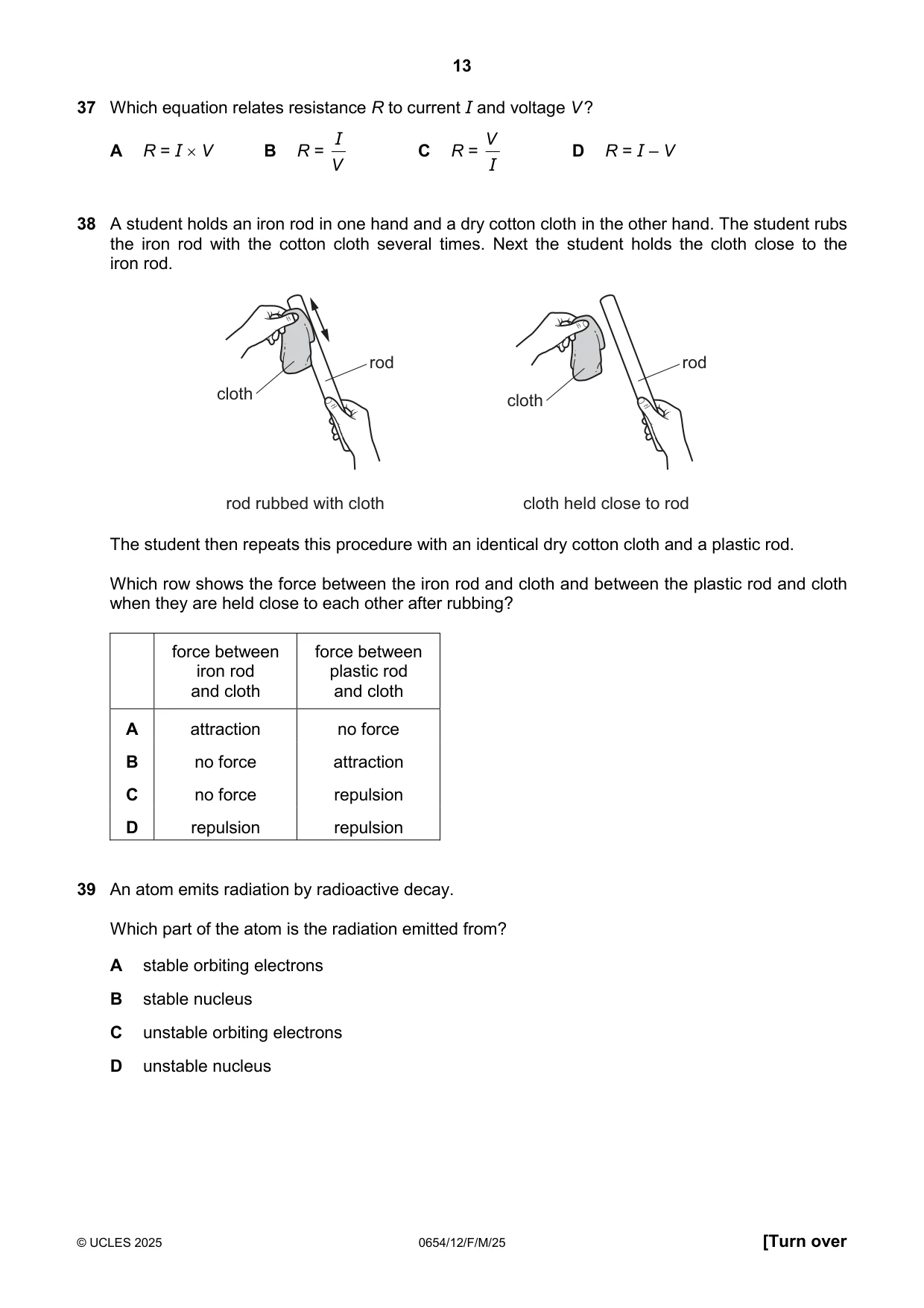
Q38 · A student holds an iron rod in one hand and a dry cotton cloth in the other hand
38 A student holds an iron rod in one hand and a dry cotton cloth in the other hand. The student rubs the iron rod with the cotton cloth several times. Next the student holds the cloth close to the iron rod. rod rod cloth cloth rod rubbed with cloth cloth held close to rod The student then repeats this procedure with an identical dry cotton cloth and a plastic rod. Which row shows the force between the iron rod and cloth and between the plastic rod and cloth when they are held close to each other after rubbing? force between force between iron rod plastic rod and cloth and cloth A attraction no force B no force attraction C no force repulsion D repulsion repulsion
Mark scheme: B
Q39 · An atom emits radiation by radioactive decay
39 An atom emits radiation by radioactive decay. Which part of the atom is the radiation emitted from? A stable orbiting electrons B stable nucleus C unstable orbiting electrons D unstable nucleus
Mark scheme: D
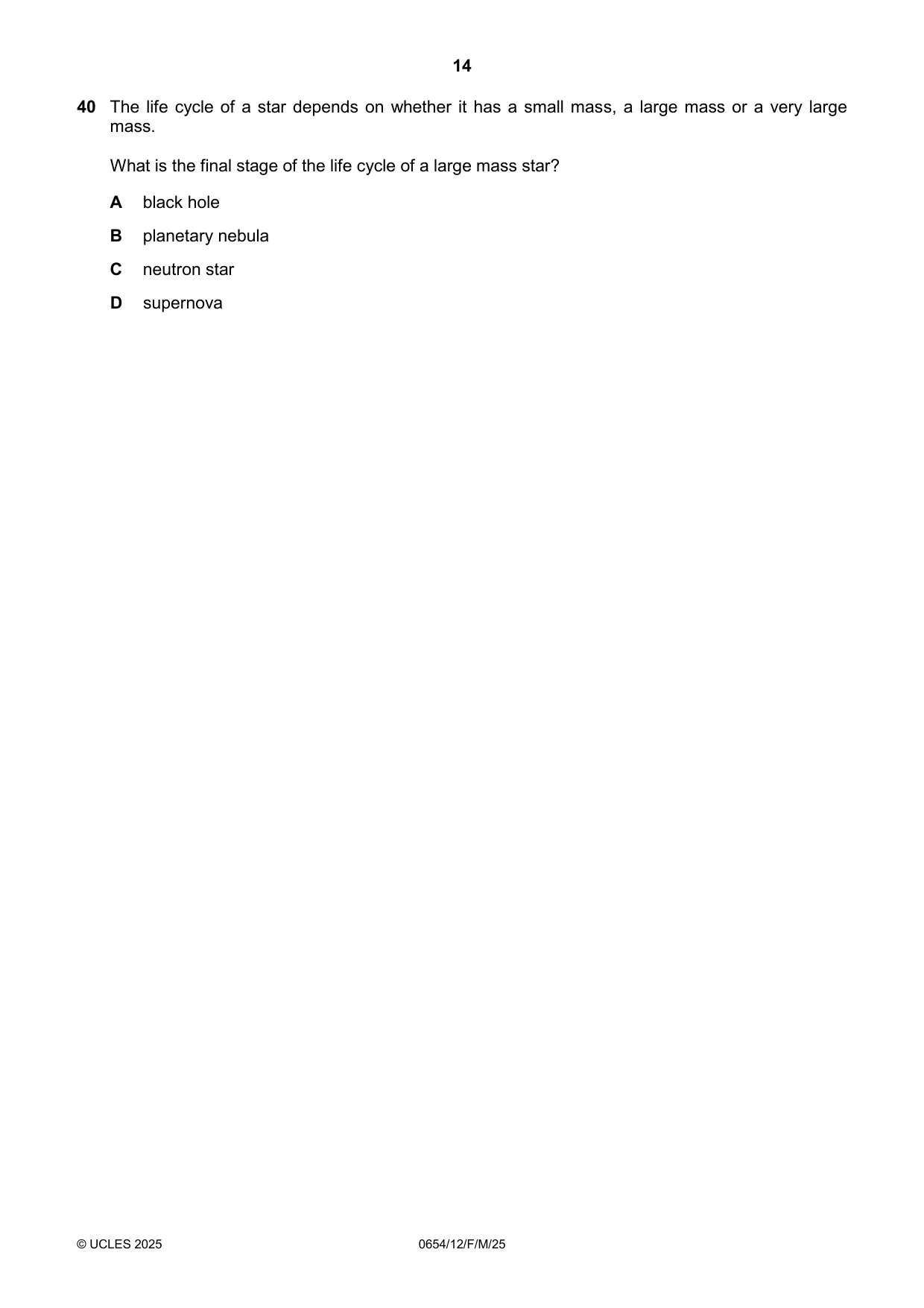
Q40 · The life cycle of a star depends on whether it has a small mass, a large mass or a very…
40 The life cycle of a star depends on whether it has a small mass, a large mass or a very large mass. What is the final stage of the life cycle of a large mass star? A black hole B planetary nebula C neutron star D supernova
Mark scheme: C
What was in this paper
The subtopics covered by these 40 questions, and how many questions each got. Open one in a new tab to see every Cambridge question on it.
2Photosynthesis2Simple phenomena of magnetism2Transfer of thermal energy2Alkenes1Biological molecules1Blood1Characteristics of living organisms1Density1Diet1Electrical quantities1Electrolysis1Energy, work and power1Enzymes1Exothermic and endothermic reactions1Formulas1Gas exchange in humans1General properties of waves1Group I properties1Heart1Identification of ions and gases1Ions and ionic bonds1Isotopes1Motion1Oxides1Radioactivity1Rate of reaction1Respiration1Separation and purification1Sexual reproduction in plants1Simple molecules and covalent bonds1Solids, liquids and gases1Stars and the Universe1Transpiration1Water1Xylem and phloem1What you needed in this session
Cambridge’s own grade thresholds for 2025 Feb/March, Paper 1 · Variant 2. A higher threshold means an easier paper — the bar moves with how the cohort did.