Cambridge IGCSE Sciences - Co-ordinated (Double) 0654 — 2023 Feb/March Paper 1 · Variant 2
0654/12/F/M/23 · 40 questions · 40 marks · ≈45 min
The question paper and its mark scheme, free to read here and free to download. This is Cambridge’s own paper, exactly as it was sat.
Question paper20 pages



Mark scheme3 pages
Answers below. Sit the paper first if you are practising.
Questions as text
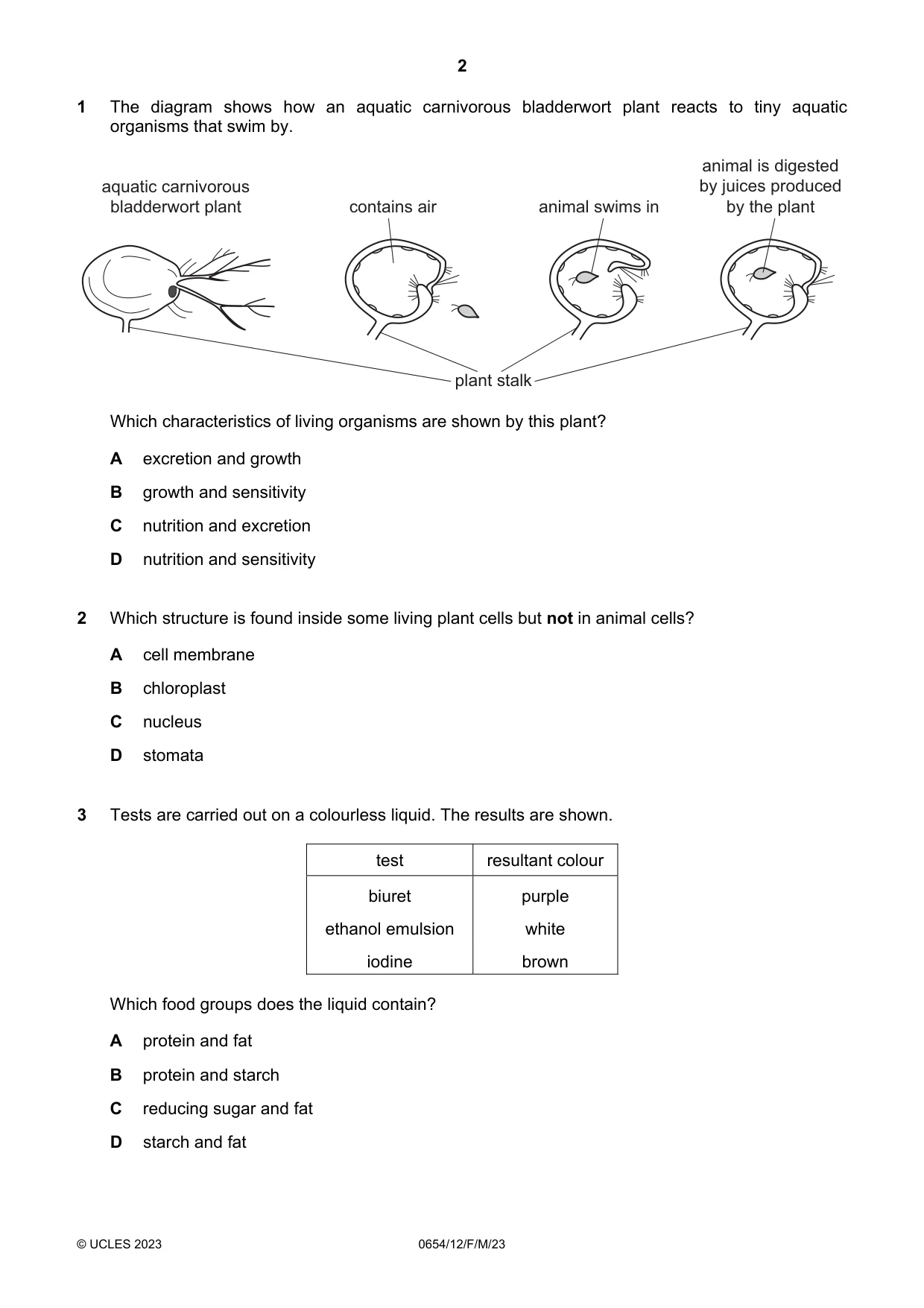
Q1 · The diagram shows how an aquatic carnivorous bladderwort plant reacts to tiny aquatic…
1 The diagram shows how an aquatic carnivorous bladderwort plant reacts to tiny aquatic organisms that swim by. animal is digested aquatic carnivorous by juices produced bladderwort plant contains air animal swims in by the plant plant stalk Which characteristics of living organisms are shown by this plant? A excretion and growth B growth and sensitivity C nutrition and excretion D nutrition and sensitivity
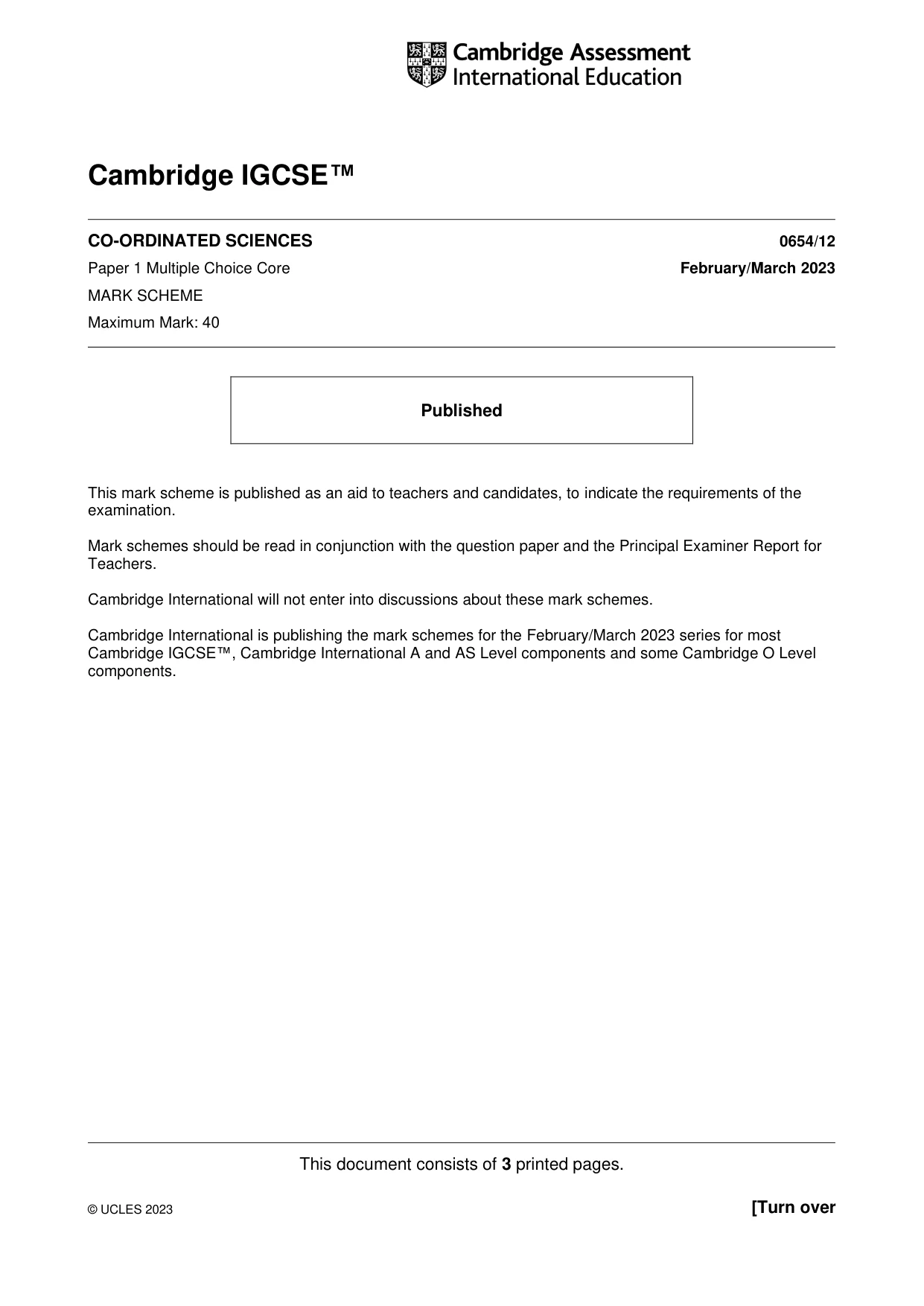
Mark scheme: D
Q2 · Which structure is found inside some living plant cells but not in animal cells?
2 Which structure is found inside some living plant cells but not in animal cells? A cell membrane B chloroplast C nucleus D stomata
Mark scheme: B
Q3 · Tests are carried out on a colourless liquid
3 Tests are carried out on a colourless liquid. The results are shown. test resultant colour biuret purple ethanol emulsion white iodine brown Which food groups does the liquid contain? A protein and fat B protein and starch C reducing sugar and fat D starch and fat
Mark scheme: A
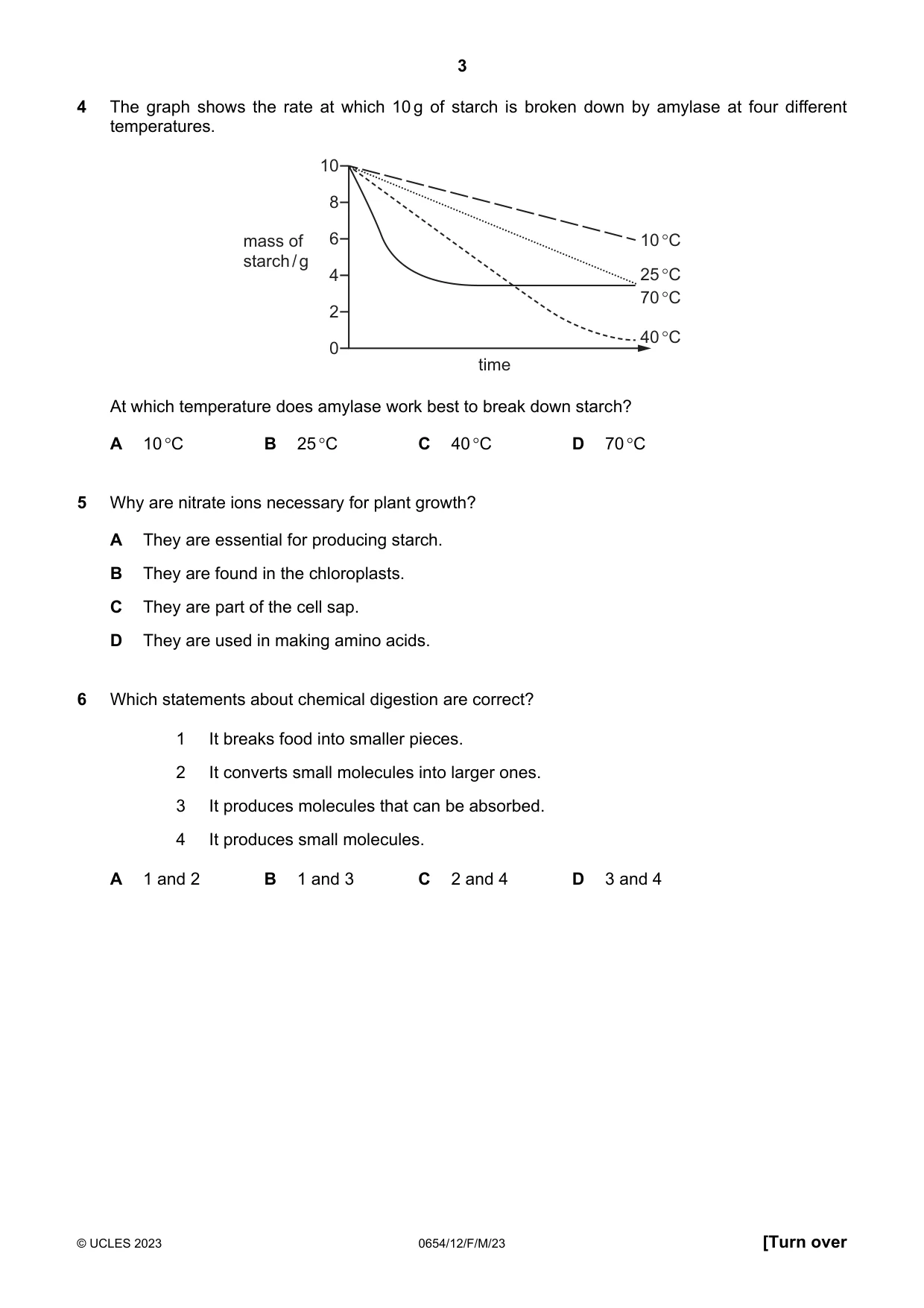
Q4 · The graph shows the rate at which 10 g of starch is broken down by amylase at four…
4 The graph shows the rate at which 10 g of starch is broken down by amylase at four different temperatures. 10 8 mass of 6 10 °C starch / g 4 25 °C 70 °C 2 40 °C 0 time At which temperature does amylase work best to break down starch? A 10 C B 25 C C 40 C D 70 C
Mark scheme: C
Q5 · Why are nitrate ions necessary for plant growth?
5 Why are nitrate ions necessary for plant growth? A They are essential for producing starch. B They are found in the chloroplasts. C They are part of the cell sap. D They are used in making amino acids.
Mark scheme: D
Q6 · Which statements about chemical digestion are correct?
6 Which statements about chemical digestion are correct? 1 It breaks food into smaller pieces. 2 It converts small molecules into larger ones. 3 It produces molecules that can be absorbed. 4 It produces small molecules. A 1 and 2 B 1 and 3 C 2 and 4 D 3 and 4
Mark scheme: D
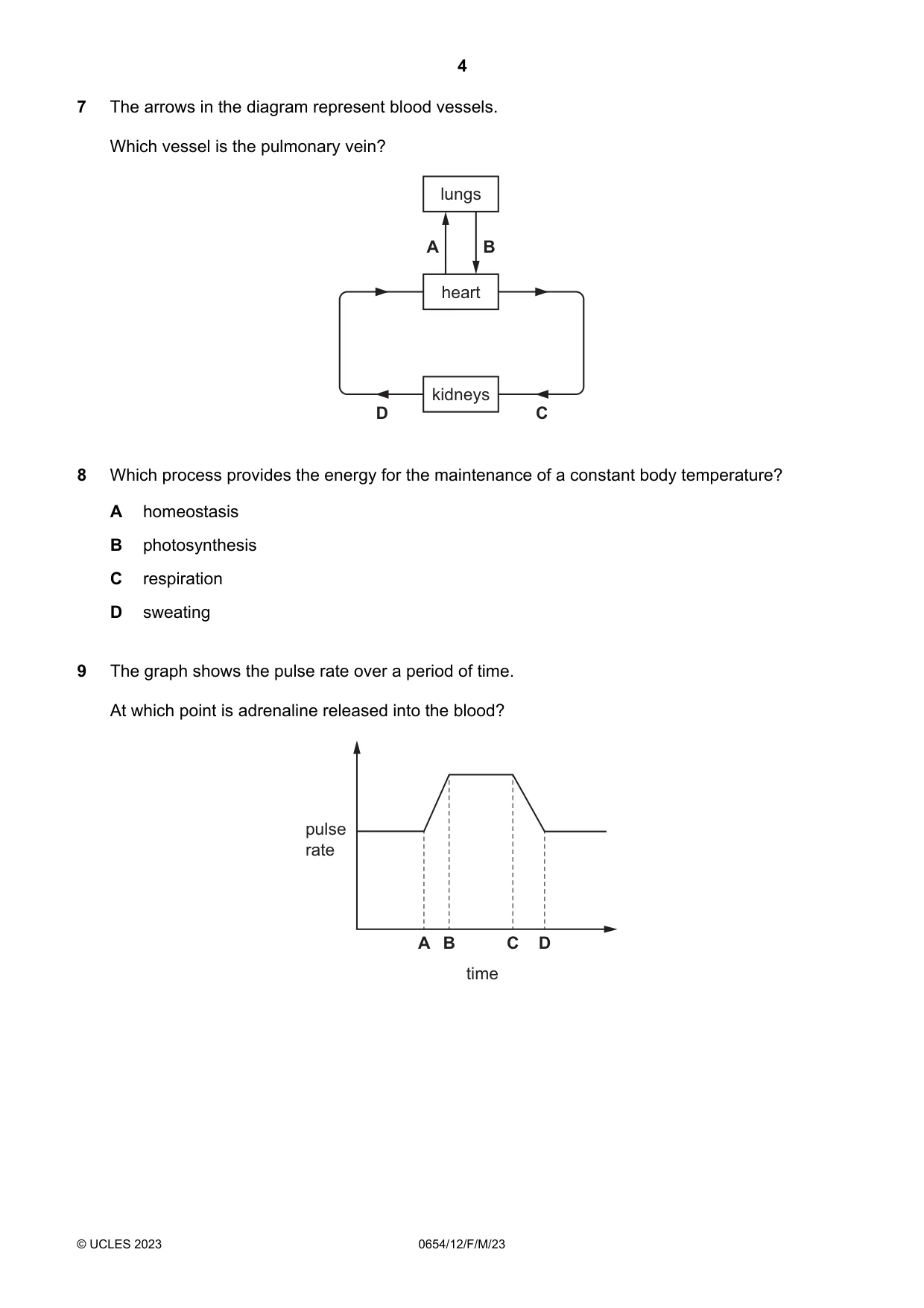
Q7 · The arrows in the diagram represent blood vessels
7 The arrows in the diagram represent blood vessels. Which vessel is the pulmonary vein? lungs A B heart kidneys D C
Mark scheme: B
Q8 · Which process provides the energy for the maintenance of a constant body temperature?
8 Which process provides the energy for the maintenance of a constant body temperature? A homeostasis B photosynthesis C respiration D sweating
Mark scheme: C
Q9 · The graph shows the pulse rate over a period of time
9 The graph shows the pulse rate over a period of time. At which point is adrenaline released into the blood? pulse rate A B C D time
Mark scheme: A
Q10 · Which row correctly matches a structure with its function in the human reproductive…
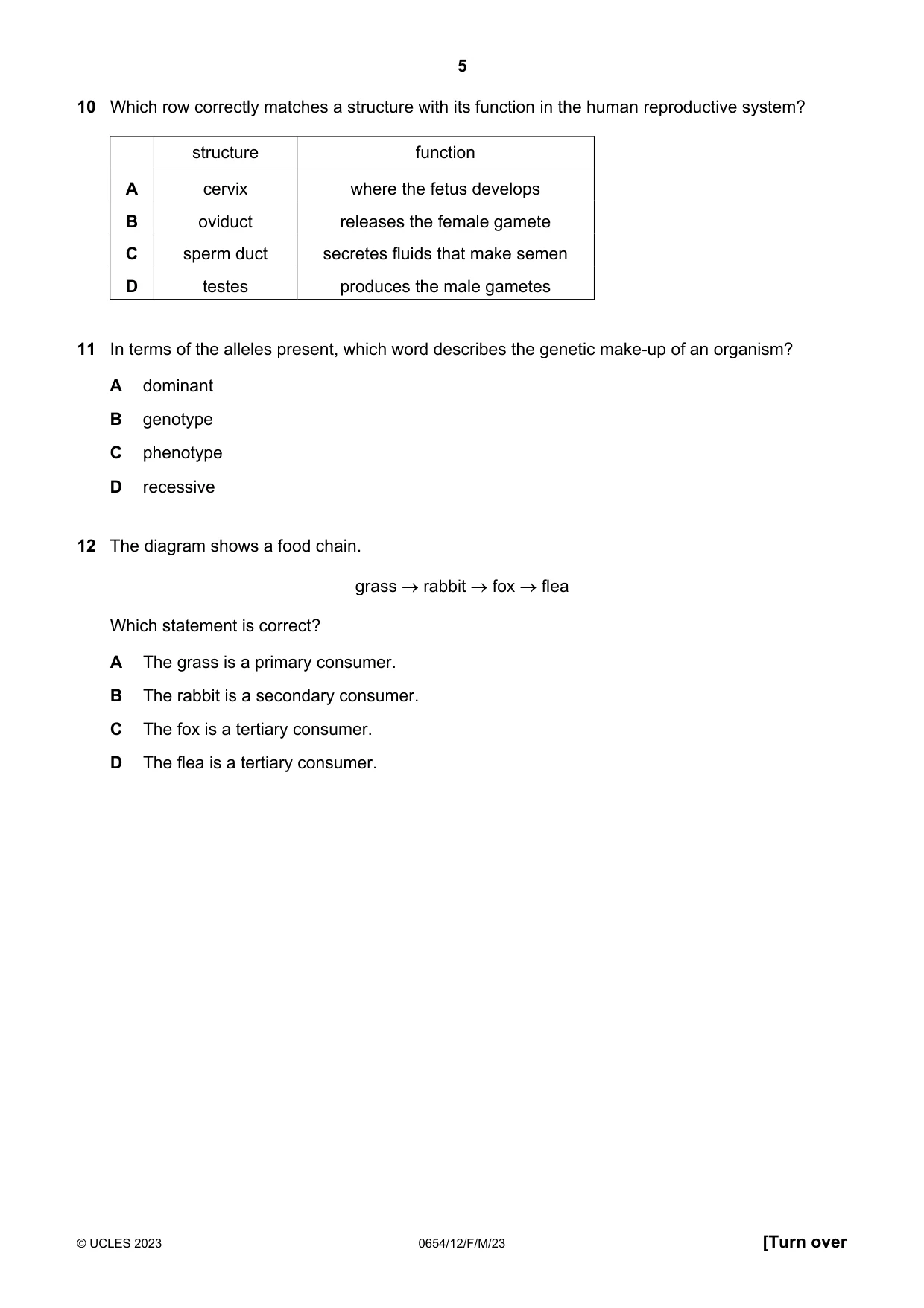
10 Which row correctly matches a structure with its function in the human reproductive system? structure function A cervix where the fetus develops B oviduct releases the female gamete C sperm duct secretes fluids that make semen D testes produces the male gametes
Mark scheme: D
Q11 · In terms of the alleles present, which word describes the genetic make-up of an organism?
11 In terms of the alleles present, which word describes the genetic make-up of an organism? A dominant B genotype C phenotype D recessive
Mark scheme: B
Q12 · The diagram shows a food chain
12 The diagram shows a food chain. grass rabbit fox flea Which statement is correct? A The grass is a primary consumer. B The rabbit is a secondary consumer. C The fox is a tertiary consumer. D The flea is a tertiary consumer.
Mark scheme: D
Q13 · A student draws four different attempts at part of the carbon cycle
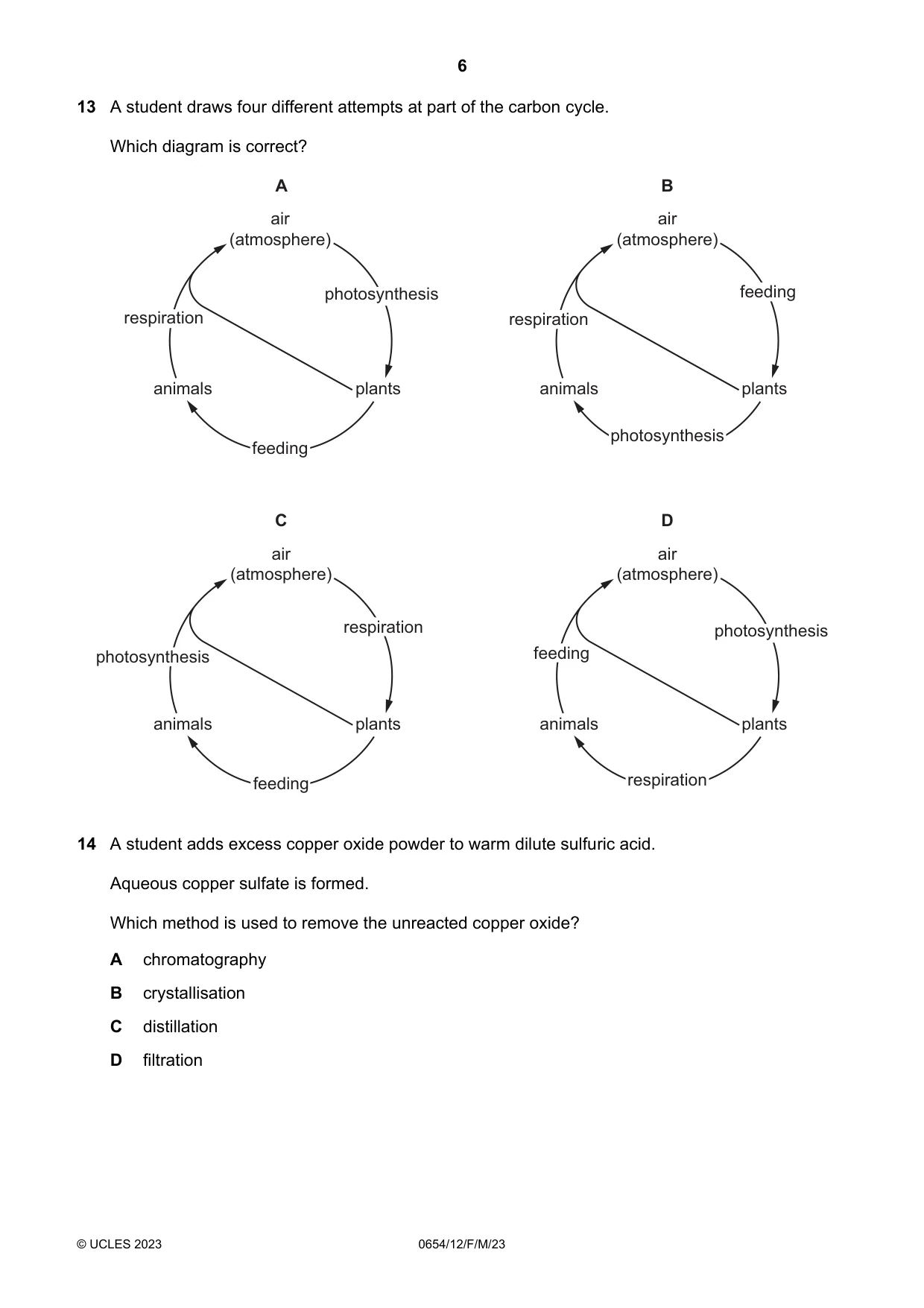
13 A student draws four different attempts at part of the carbon cycle. Which diagram is correct? A B air air (atmosphere) (atmosphere) photosynthesis feeding respiration respiration animals plants animals plants photosynthesis feeding C D air air (atmosphere) (atmosphere) respiration photosynthesis photosynthesis feeding animals plants animals plants feeding respiration
Mark scheme: A
Q14 · A student adds excess copper oxide powder to warm dilute sulfuric acid
14 A student adds excess copper oxide powder to warm dilute sulfuric acid. Aqueous copper sulfate is formed. Which method is used to remove the unreacted copper oxide? A chromatography B crystallisation C distillation D filtration
Mark scheme: D
Q15 · Which diagram represents molecules of a compound?
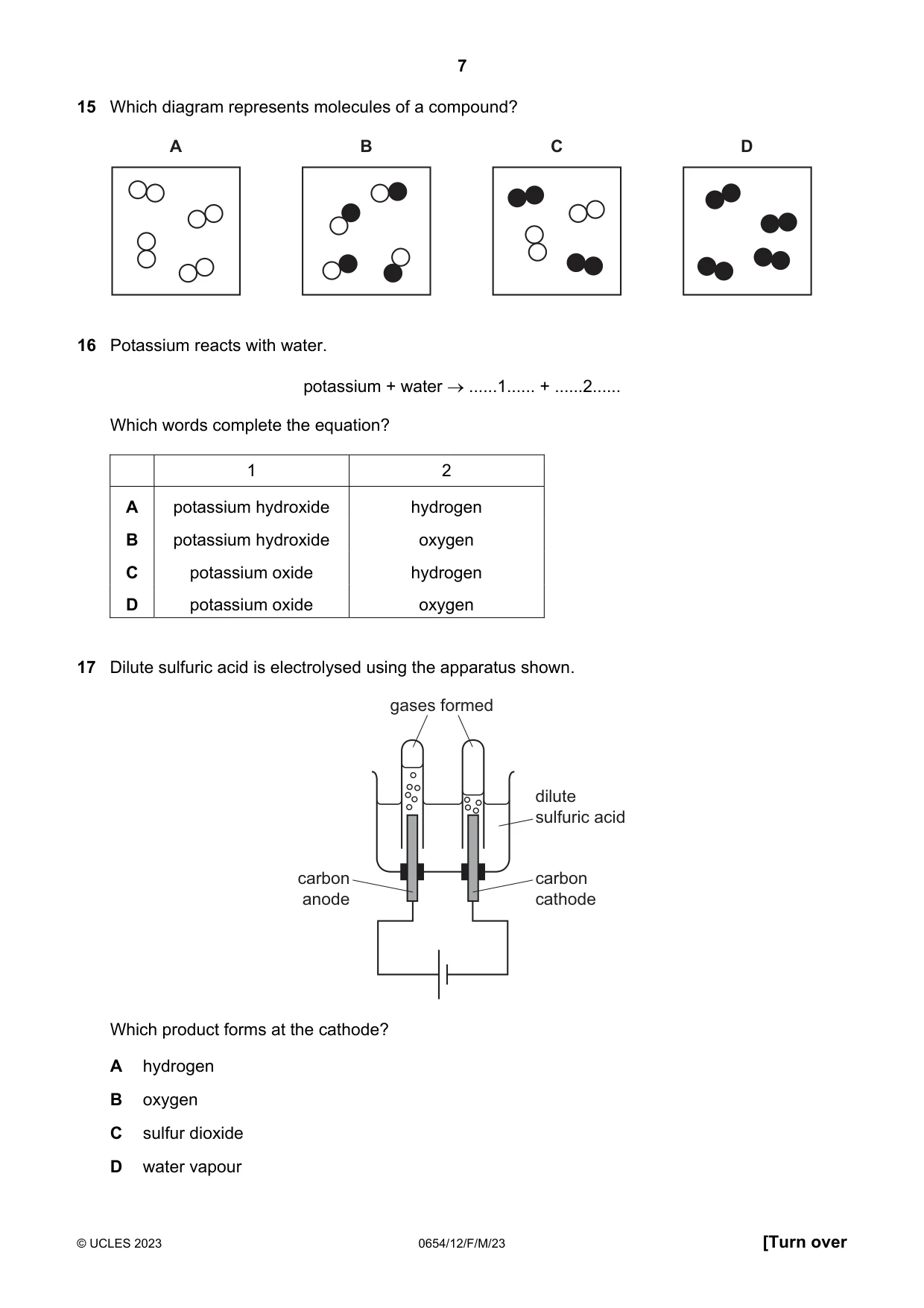
15 Which diagram represents molecules of a compound? A B C D
Mark scheme: B
Q16 · Potassium reacts with water
16 Potassium reacts with water. potassium + water ......1...... + ......2...... Which words complete the equation? 1 2 A potassium hydroxide hydrogen B potassium hydroxide oxygen C potassium oxide hydrogen D potassium oxide oxygen
Mark scheme: A
Q17 · Dilute sulfuric acid is electrolysed using the apparatus shown
17 Dilute sulfuric acid is electrolysed using the apparatus shown. gases formed dilute sulfuric acid carbon carbon anode cathode Which product forms at the cathode? A hydrogen B oxygen C sulfur dioxide D water vapour
Mark scheme: A
Q18 · The initial and final temperatures in two experiments, X and Y, are shown
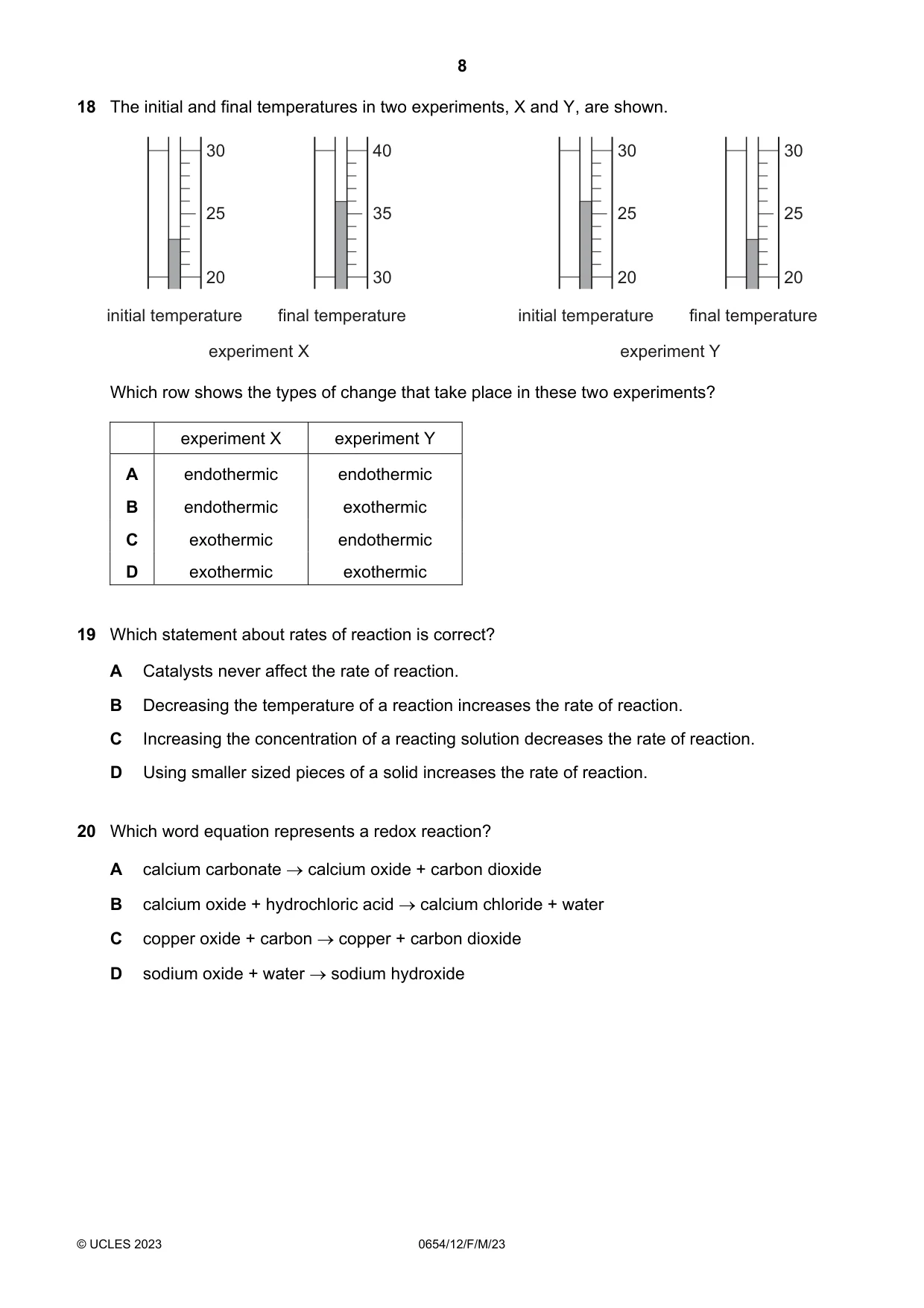
18 The initial and final temperatures in two experiments, X and Y, are shown. 30 40 30 30 25 35 25 25 20 30 20 20 initial temperature final temperature initial temperature final temperature experiment X experiment Y Which row shows the types of change that take place in these two experiments? experiment X experiment Y A endothermic endothermic B endothermic exothermic C exothermic endothermic D exothermic exothermic
Mark scheme: C
Q19 · Which statement about rates of reaction is correct?
19 Which statement about rates of reaction is correct? A Catalysts never affect the rate of reaction. B Decreasing the temperature of a reaction increases the rate of reaction. C Increasing the concentration of a reacting solution decreases the rate of reaction. D Using smaller sized pieces of a solid increases the rate of reaction.
Mark scheme: D
Q20 · Which word equation represents a redox reaction?
20 Which word equation represents a redox reaction? A calcium carbonate calcium oxide + carbon dioxide B calcium oxide + hydrochloric acid calcium chloride + water C copper oxide + carbon copper + carbon dioxide D sodium oxide + water sodium hydroxide
Mark scheme: C
Q21 · A student makes lists of acidic oxides and basic oxides
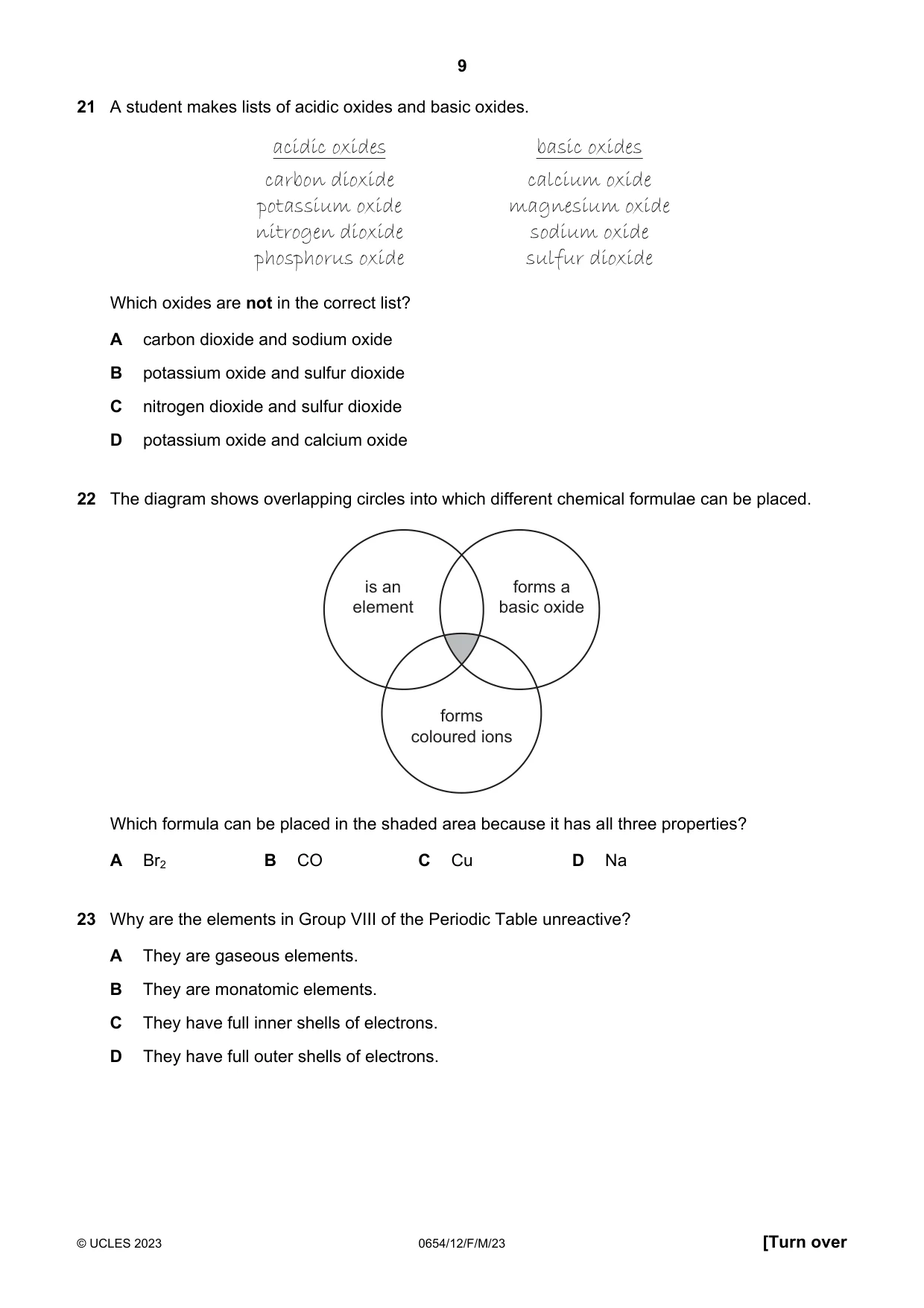
21 A student makes lists of acidic oxides and basic oxides. acidic oxides basic oxides carbon dioxide calcium oxide potassium oxide magnesium oxide nitrogen dioxide sodium oxide phosphorus oxide sulfur dioxide Which oxides are not in the correct list? A carbon dioxide and sodium oxide B potassium oxide and sulfur dioxide C nitrogen dioxide and sulfur dioxide D potassium oxide and calcium oxide
Mark scheme: B
Q22 · The diagram shows overlapping circles into which different chemical formulae can be placed
22 The diagram shows overlapping circles into which different chemical formulae can be placed. is an forms a element basic oxide forms coloured ions Which formula can be placed in the shaded area because it has all three properties? A Br2 B CO C Cu D Na
Mark scheme: C
Q23 · Why are the elements in Group VIII of the Periodic Table unreactive?
23 Why are the elements in Group VIII of the Periodic Table unreactive? A They are gaseous elements. B They are monatomic elements. C They have full inner shells of electrons. D They have full outer shells of electrons.
Mark scheme: D
Q24 · Pieces of four metals are added separately to test-tubes containing dilute hydrochloric…
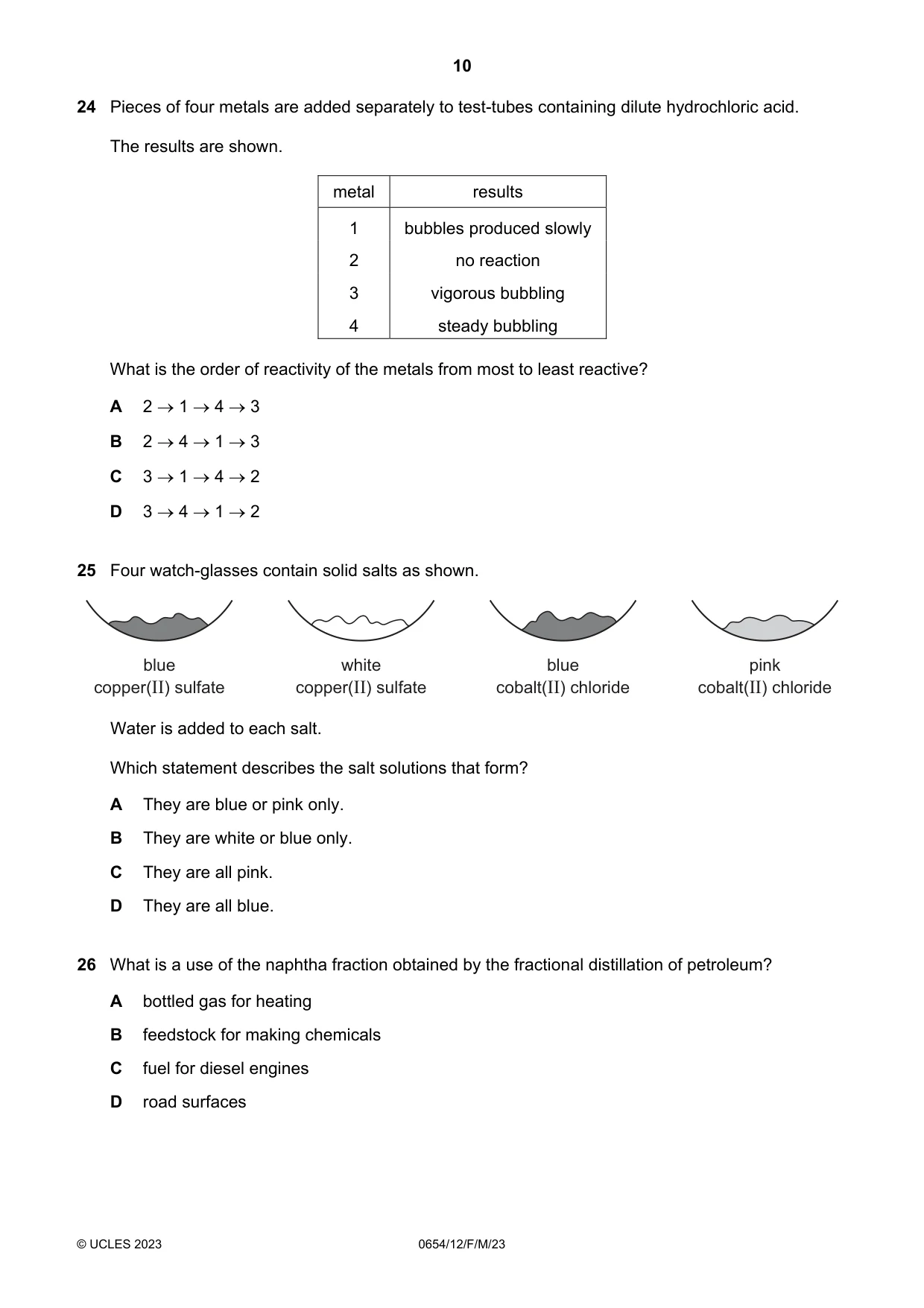
24 Pieces of four metals are added separately to test-tubes containing dilute hydrochloric acid. The results are shown. metal results 1 bubbles produced slowly 2 no reaction 3 vigorous bubbling 4 steady bubbling What is the order of reactivity of the metals from most to least reactive? A 2 1 4 3 B 2 4 1 3 C 3 1 4 2 D 3 4 1 2
Mark scheme: D
Q25 · Four watch-glasses contain solid salts as shown
25 Four watch-glasses contain solid salts as shown. blue white blue pink copper(II) sulfate copper(II) sulfate cobalt(II) chloride cobalt(II) chloride Water is added to each salt. Which statement describes the salt solutions that form? A They are blue or pink only. B They are white or blue only. C They are all pink. D They are all blue.
Mark scheme: A
Q26 · What is a use of the naphtha fraction obtained by the fractional distillation of…
26 What is a use of the naphtha fraction obtained by the fractional distillation of petroleum? A bottled gas for heating B feedstock for making chemicals C fuel for diesel engines D road surfaces
Mark scheme: B
Q27 · Which substance is an unsaturated compound?
27 Which substance is an unsaturated compound? A ethane B ethanol C ethene D methane
Mark scheme: C
Q28 · Which diagram shows the distance–time graph for an object moving with constant speed?
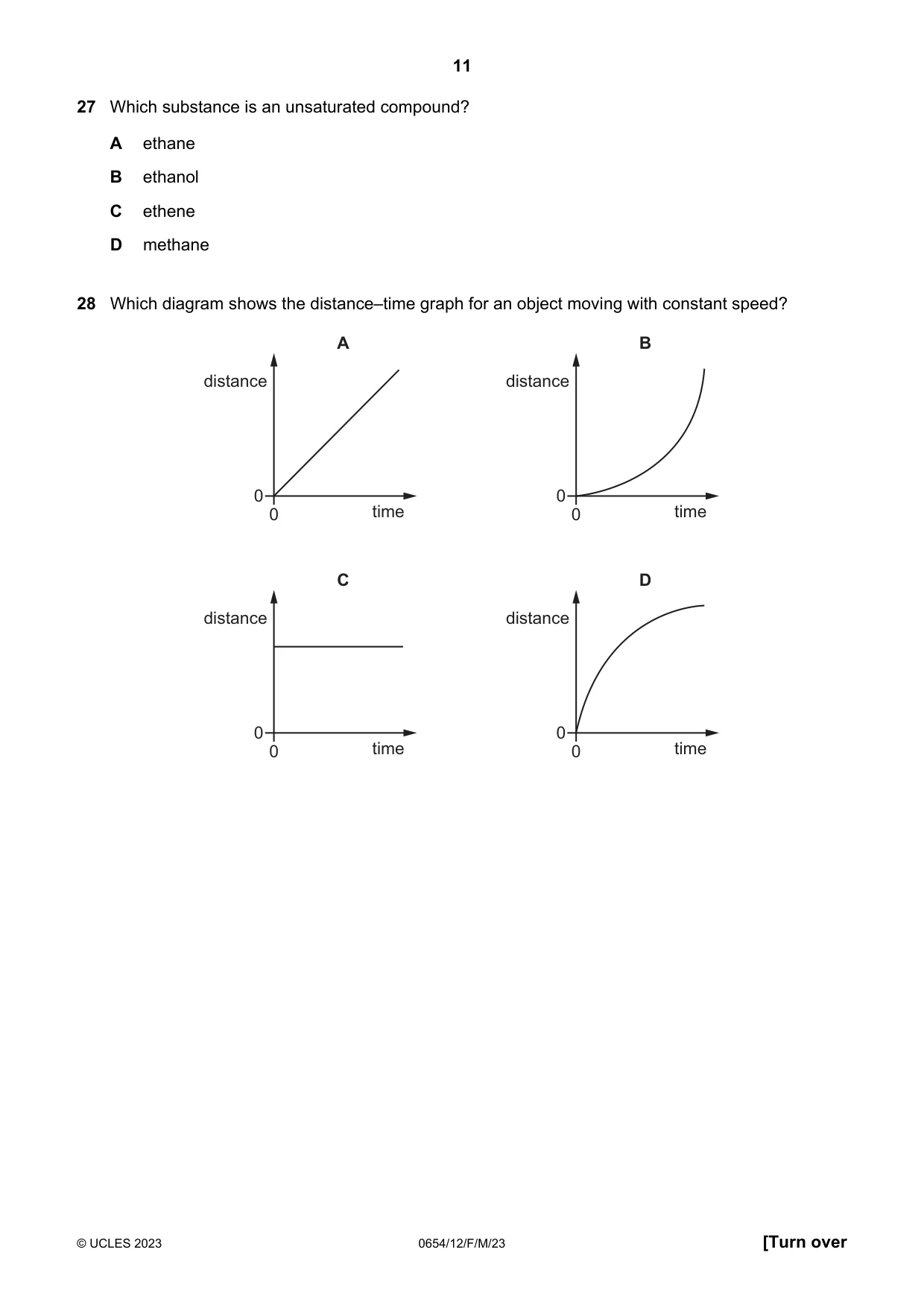
28 Which diagram shows the distance–time graph for an object moving with constant speed? A B distance distance 0 0 0 time 0 time C D distance distance 0 0 0 time 0 time
Mark scheme: A
Q29 · A parachutist and his parachute have a combined weight W
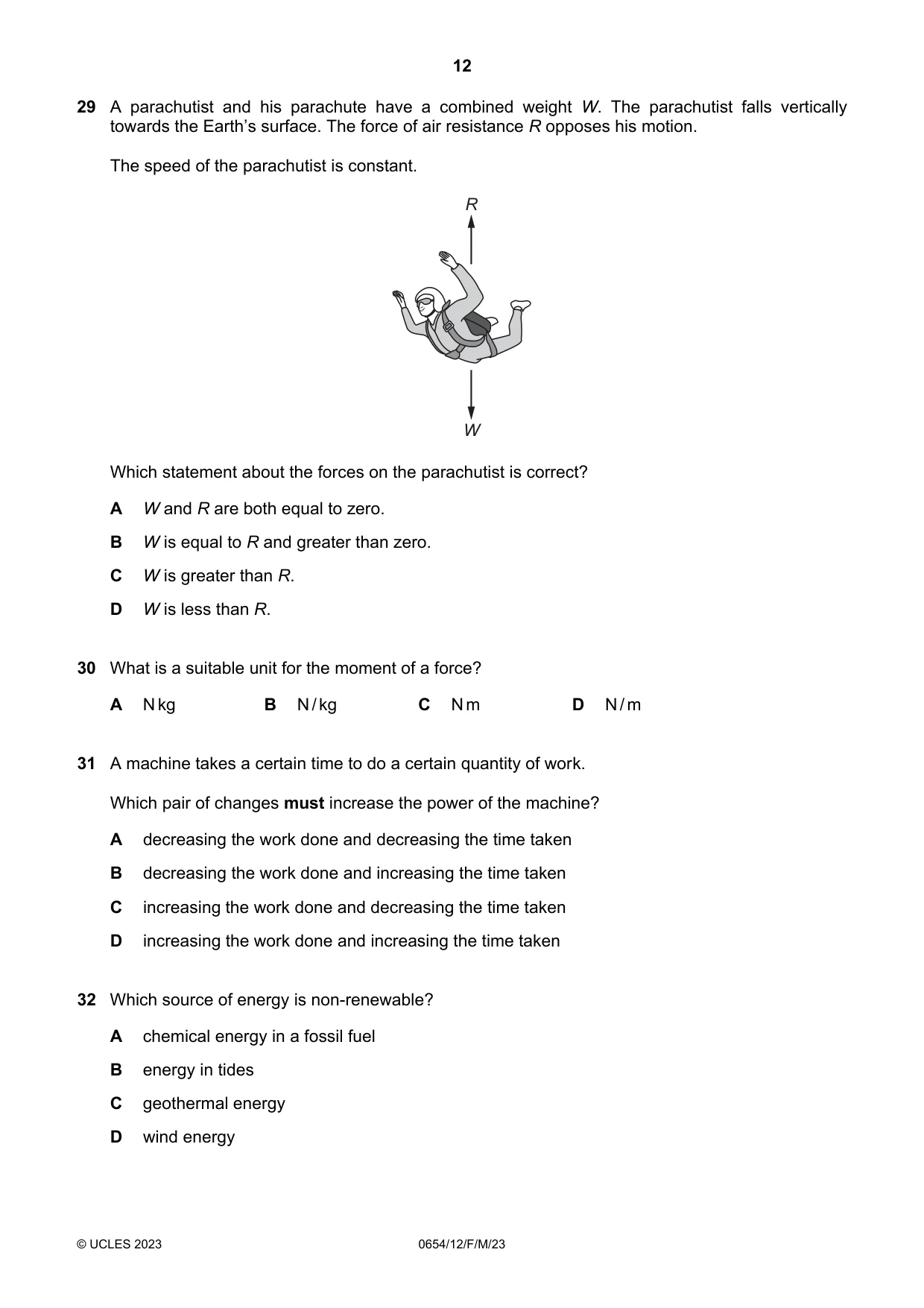
29 A parachutist and his parachute have a combined weight W. The parachutist falls vertically towards the Earth’s surface. The force of air resistance R opposes his motion. The speed of the parachutist is constant. R W Which statement about the forces on the parachutist is correct? A W and R are both equal to zero. B W is equal to R and greater than zero. C W is greater than R. D W is less than R.
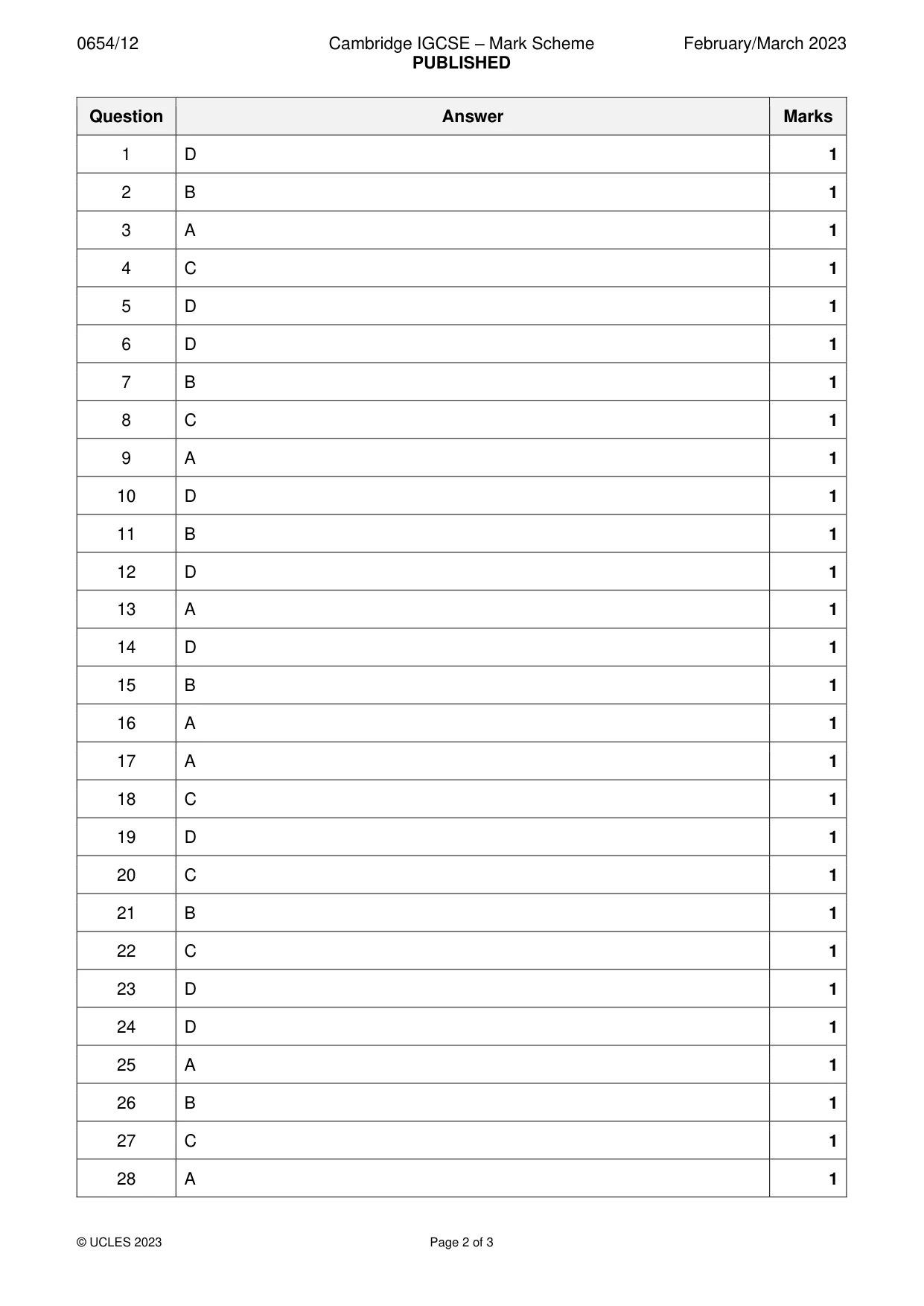
Mark scheme: B
Q30 · What is a suitable unit for the moment of a force?
30 What is a suitable unit for the moment of a force? A N kg B N / kg C N m D N / m
Mark scheme: C
Q31 · A machine takes a certain time to do a certain quantity of work
31 A machine takes a certain time to do a certain quantity of work. Which pair of changes must increase the power of the machine? A decreasing the work done and decreasing the time taken B decreasing the work done and increasing the time taken C increasing the work done and decreasing the time taken D increasing the work done and increasing the time taken
Mark scheme: C
Q32 · Which source of energy is non-renewable?
32 Which source of energy is non-renewable? A chemical energy in a fossil fuel B energy in tides C geothermal energy D wind energy
Mark scheme: A
Q33 · A hot water tank is fitted with two identical heaters P and Q
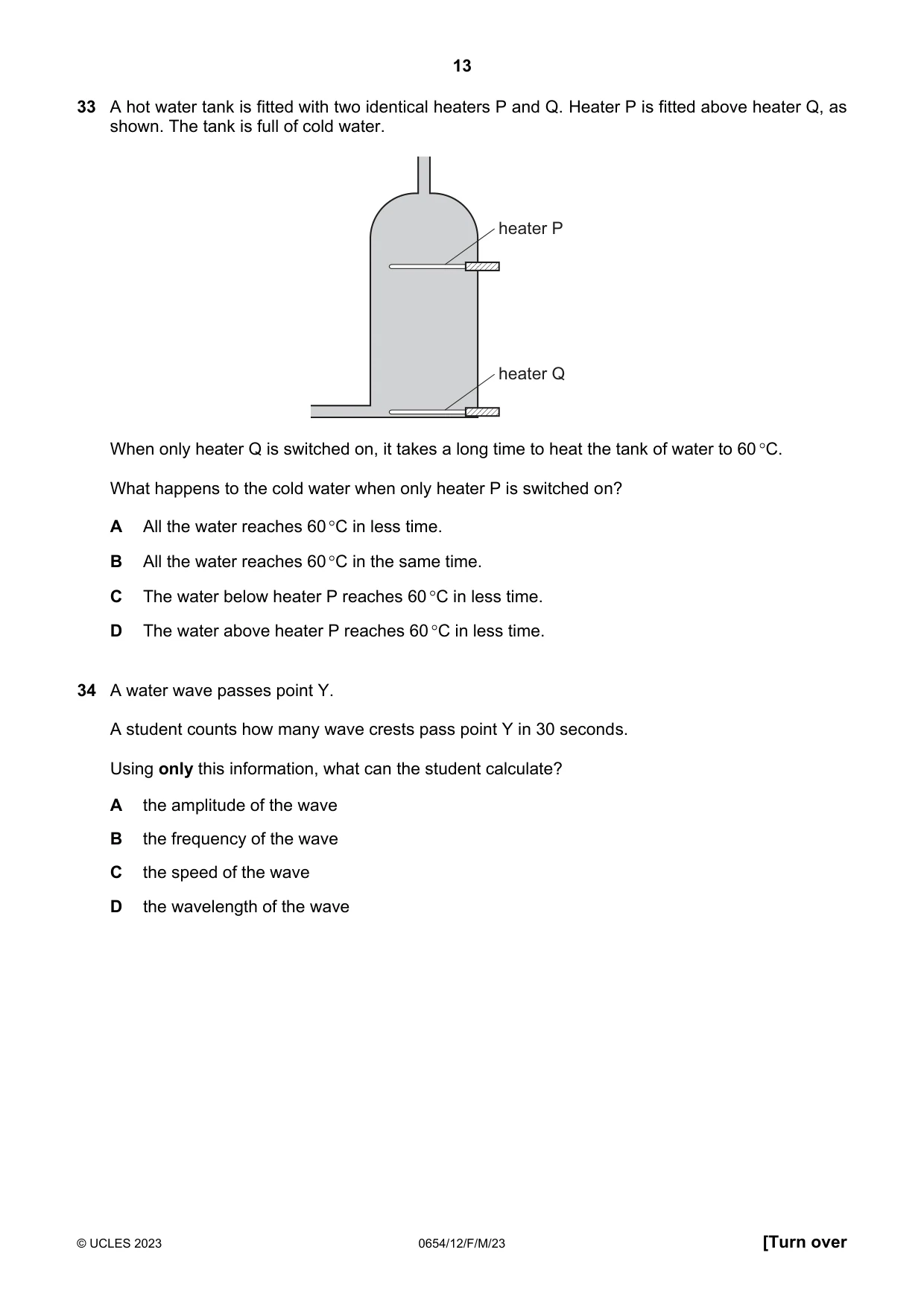
33 A hot water tank is fitted with two identical heaters P and Q. Heater P is fitted above heater Q, as shown. The tank is full of cold water. heater P heater Q When only heater Q is switched on, it takes a long time to heat the tank of water to 60 C. What happens to the cold water when only heater P is switched on? A All the water reaches 60 C in less time. B All the water reaches 60 C in the same time. C The water below heater P reaches 60 C in less time. D The water above heater P reaches 60 C in less time.
Mark scheme: D
Q34 · A water wave passes point Y
34 A water wave passes point Y. A student counts how many wave crests pass point Y in 30 seconds. Using only this information, what can the student calculate? A the amplitude of the wave B the frequency of the wave C the speed of the wave D the wavelength of the wave
Mark scheme: B
Q35 · The diagram is a displacement–time graph for the molecules in air as a sound wave passes
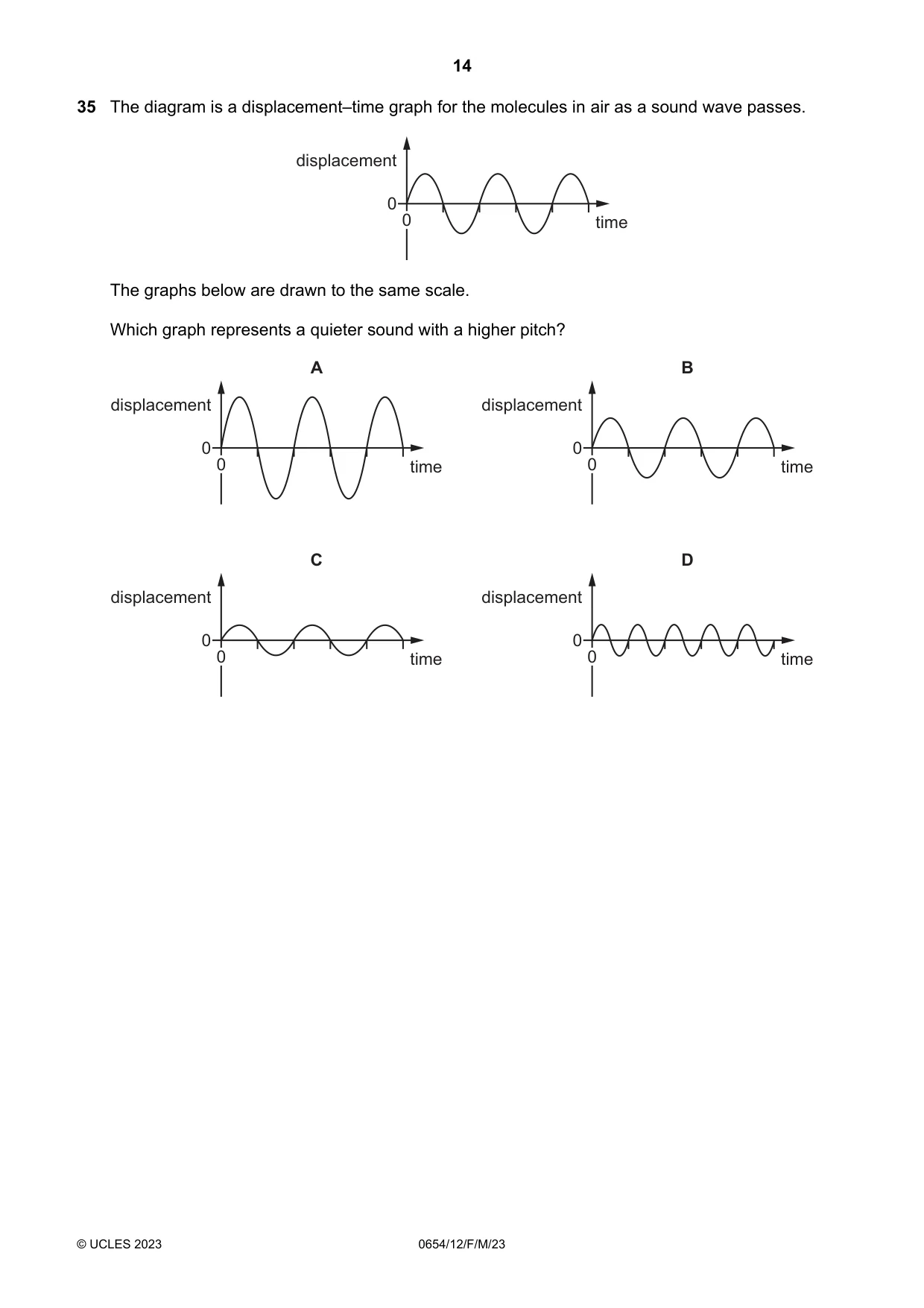
35 The diagram is a displacement–time graph for the molecules in air as a sound wave passes. displacement 0 0 time The graphs below are drawn to the same scale. Which graph represents a quieter sound with a higher pitch? A B displacement displacement 0 0 0 time 0 time C D displacement displacement 0 0 0 time 0 time
Mark scheme: D
Q36 · Which diagram shows the pattern and direction of the magnetic field near the S pole of a…
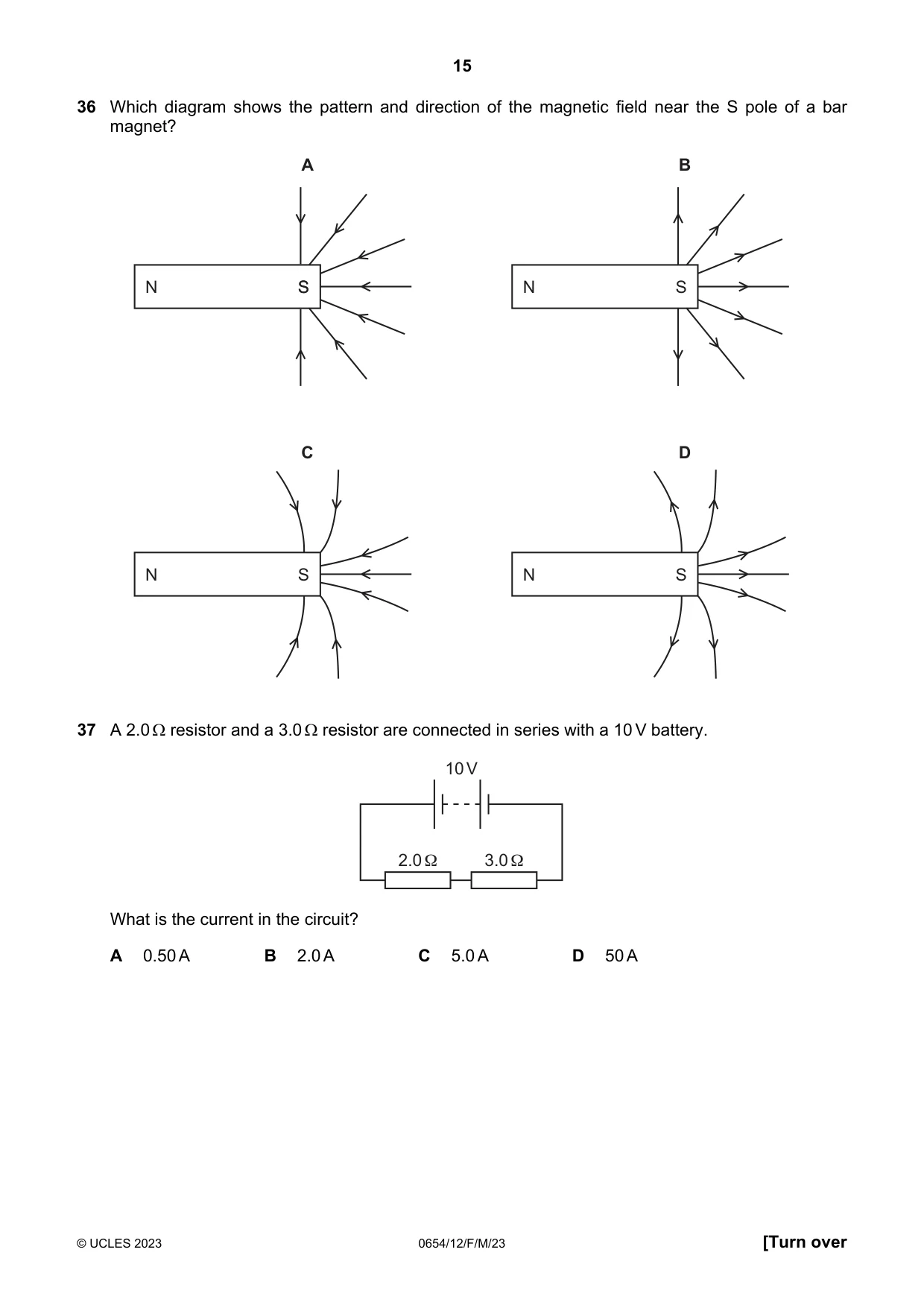
36 Which diagram shows the pattern and direction of the magnetic field near the S pole of a bar magnet? A B N S S N S C D N S N S
Mark scheme: C
Q37 · A 2.0 resistor and a 3.0 resistor are connected in series with a 10 V battery
37 A 2.0 resistor and a 3.0 resistor are connected in series with a 10 V battery. 10 V 2.0 Ω 3.0 Ω What is the current in the circuit? A 0.50 A B 2.0 A C 5.0 A D 50 A
Mark scheme: B
Q38 · The current in an electric heater is 10 A when in normal use
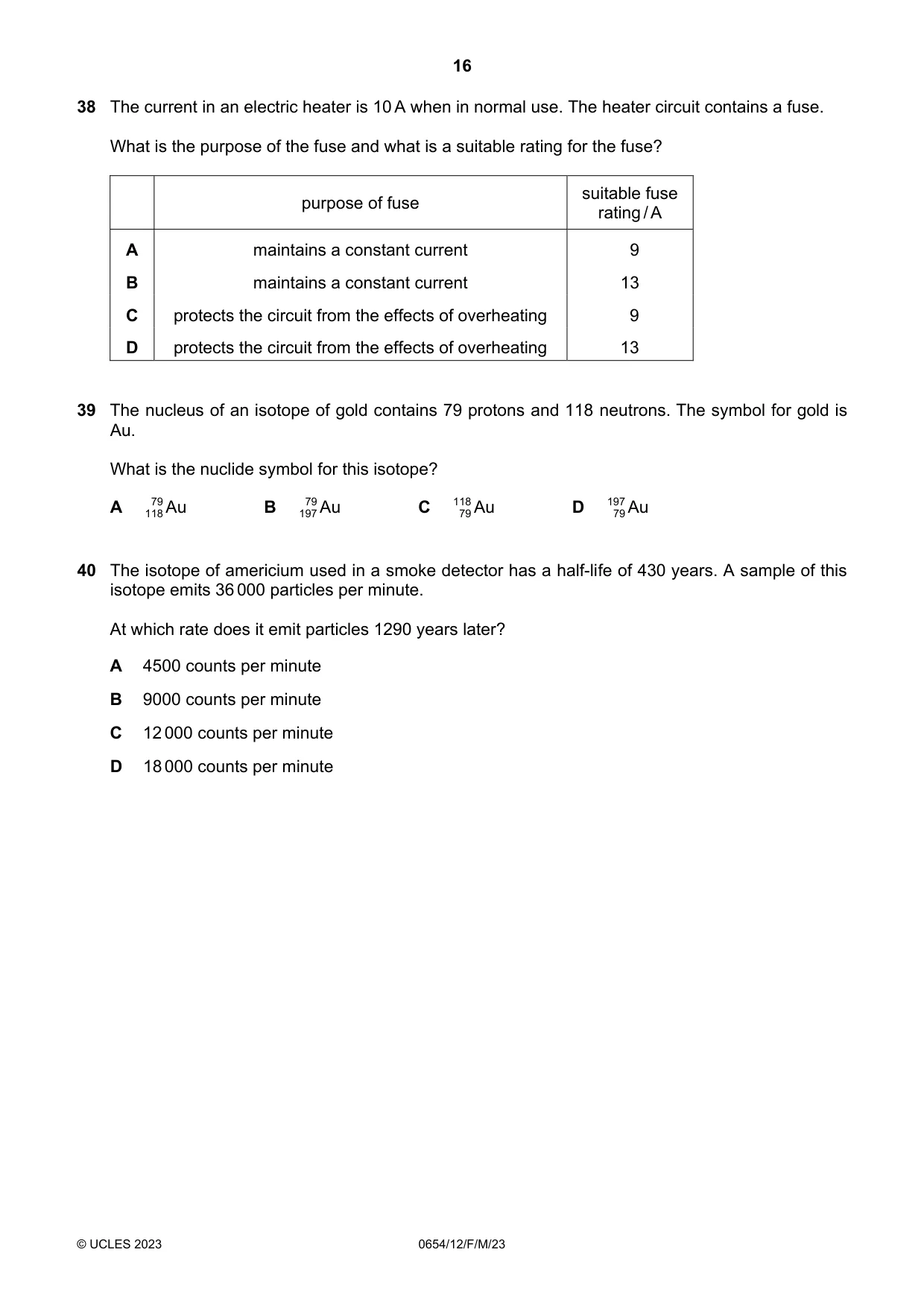
38 The current in an electric heater is 10 A when in normal use. The heater circuit contains a fuse. What is the purpose of the fuse and what is a suitable rating for the fuse? suitable fuse purpose of fuse rating / A A maintains a constant current 9 B maintains a constant current 13 C protects the circuit from the effects of overheating 9 D protects the circuit from the effects of overheating 13
Mark scheme: D
Q39 · The nucleus of an isotope of gold contains 79 protons and 118 neutrons
39 The nucleus of an isotope of gold contains 79 protons and 118 neutrons. The symbol for gold is Au. What is the nuclide symbol for this isotope? A 79 Au B 79 Au C 118 Au D 197 Au 118 197 79 79
Mark scheme: D
Q40 · The isotope of americium used in a smoke detector has a half-life of 430 years
40 The isotope of americium used in a smoke detector has a half-life of 430 years. A sample of this isotope emits 36 000 particles per minute. At which rate does it emit particles 1290 years later? A 4500 counts per minute B 9000 counts per minute C 12 000 counts per minute D 18 000 counts per minute
Mark scheme: A
What was in this paper
The subtopics covered by these 40 questions, and how many questions each got. Open one in a new tab to see every Cambridge question on it.
2Forces2Alkenes1Biological molecules1Carbon cycle1Cell structure1Characteristics of living organisms1Chromosomes and genes1Digestion1Electrical circuits1Electrical safety1Electrolysis1Elements, compounds and mixtures1Enzymes1Exothermic and endothermic reactions1Food chains and food webs1Fuels1General properties of waves1Group I properties1Heart1Homeostasis1Hormones1Motion1Noble gases1Oxides1Radioactivity1Rate of reaction1Reactivity series1Redox1Separation and purification1Sexual reproduction in humans1Simple phenomena of magnetism1Sound1The nucleus1Transfer of thermal energy1Transition elements1Water1Xylem and phloem1What you needed in this session
Cambridge’s own grade thresholds for 2023 Feb/March, Paper 1 · Variant 2. A higher threshold means an easier paper — the bar moves with how the cohort did.