Cambridge IGCSE Sciences - Co-ordinated (Double) 0654 — 2009 Oct/Nov Paper 1 · Variant 1
0654/11/O/N/09 · 40 questions · 40 marks · ≈45 min
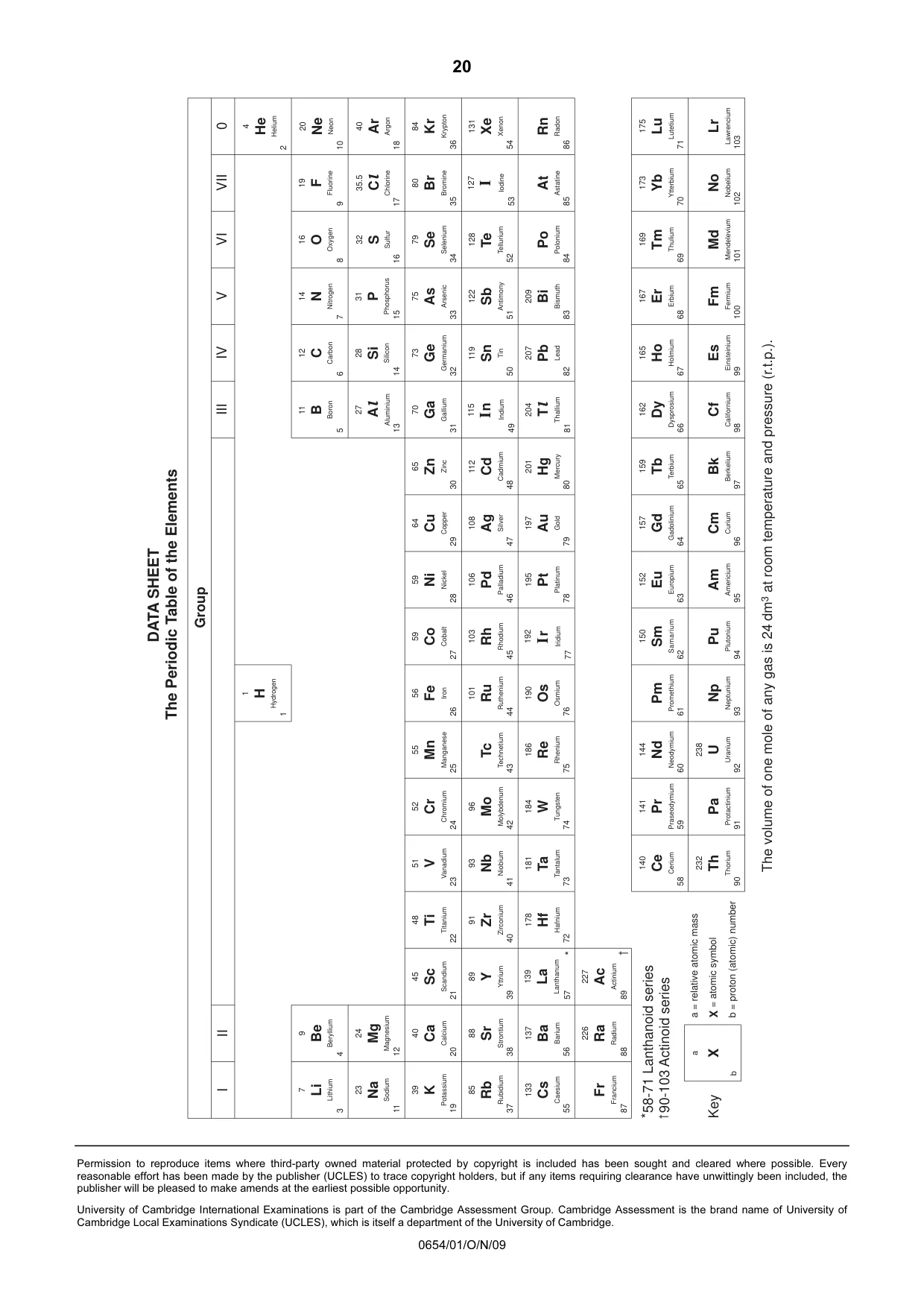
The question paper and its mark scheme, free to read here and free to download. This is Cambridge’s own paper, exactly as it was sat.
Question paper20 pages



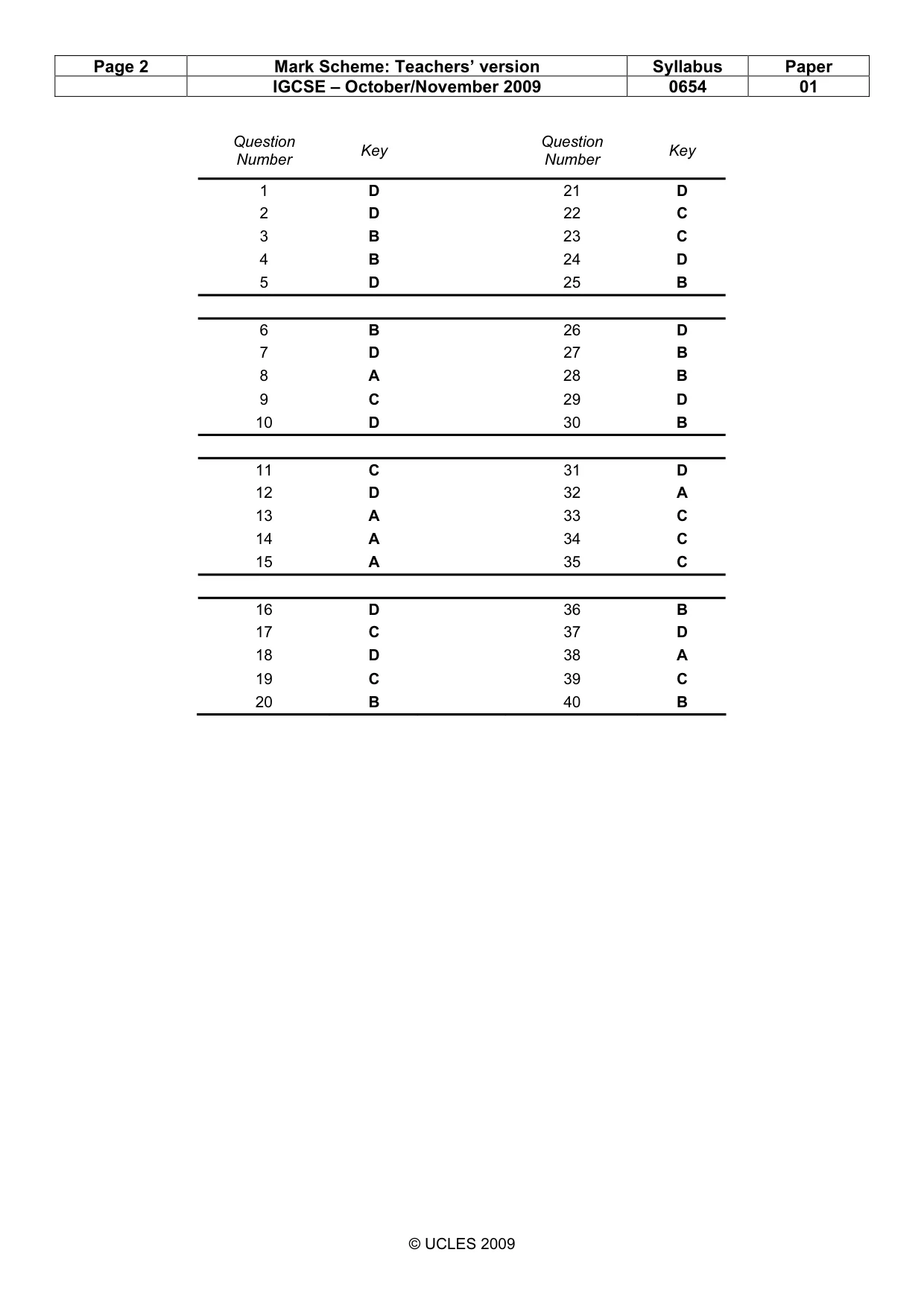
Mark scheme2 pages
Answers below. Sit the paper first if you are practising.
Questions as text
Q1 · An animal is observed swimming in a river
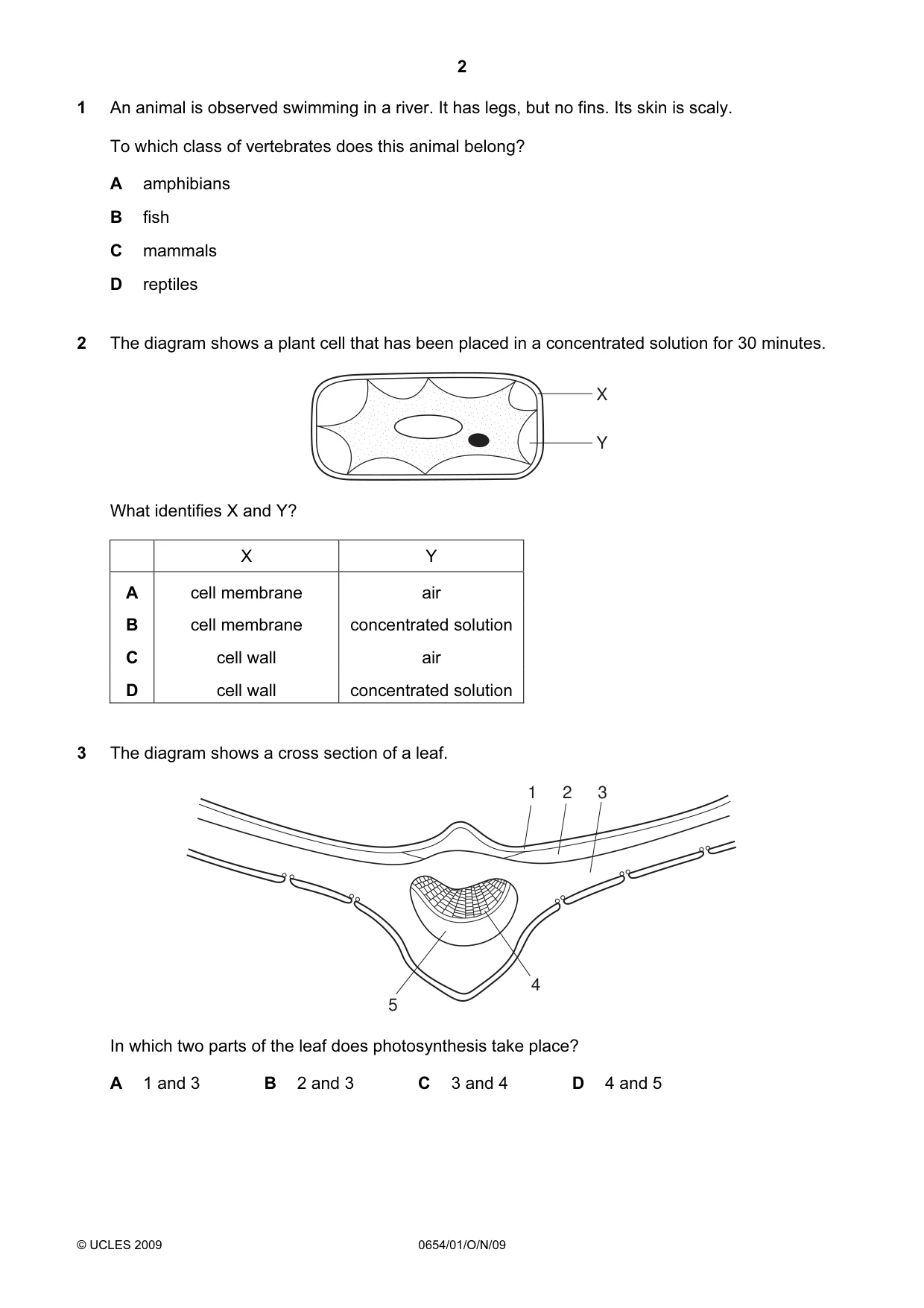
1 An animal is observed swimming in a river. It has legs, but no fins. Its skin is scaly. To which class of vertebrates does this animal belong? A amphibians B fish C mammals D reptiles
Mark scheme: D
Q2 · The diagram shows a plant cell that has been placed in a concentrated solution for 30…
2 The diagram shows a plant cell that has been placed in a concentrated solution for 30 minutes. X Y What identifies X and Y? X Y A cell membrane air B cell membrane concentrated solution C cell wall air D cell wall concentrated solution
Mark scheme: D
Q3 · The diagram shows a cross section of a leaf
3 The diagram shows a cross section of a leaf. 1 2 3 4 5 In which two parts of the leaf does photosynthesis take place? A 1 and 3 B 2 and 3 C 3 and 4 D 4 and 5
Mark scheme: B
Q4 · How do goblet cells and cilia help to keep the lungs free from infection?
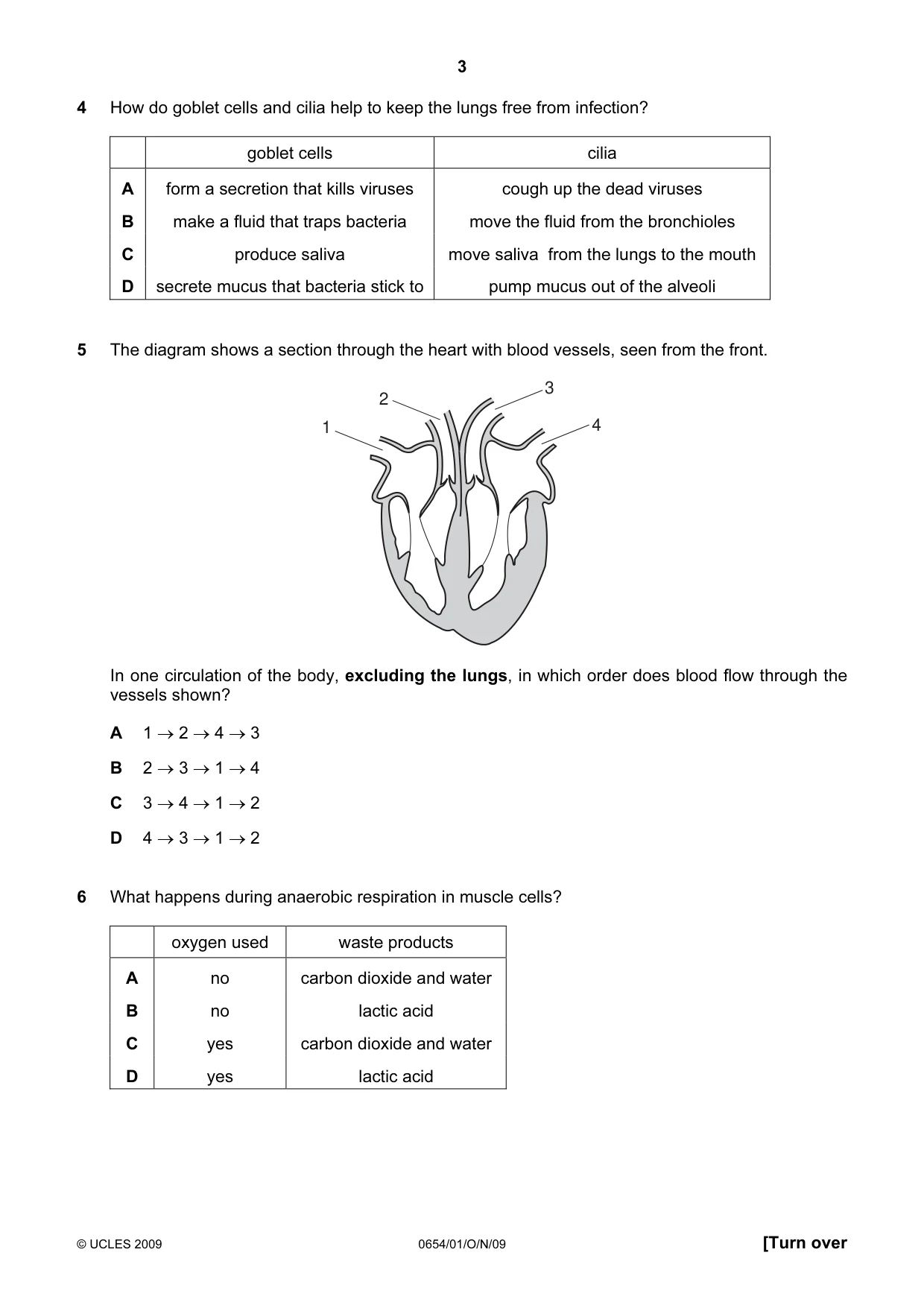
4 How do goblet cells and cilia help to keep the lungs free from infection? goblet cells cilia A form a secretion that kills viruses cough up the dead viruses B make a fluid that traps bacteria move the fluid from the bronchioles C produce saliva move saliva from the lungs to the mouth D secrete mucus that bacteria stick to pump mucus out of the alveoli
Mark scheme: B
Q5 · The diagram shows a section through the heart with blood vessels, seen from the front
5 The diagram shows a section through the heart with blood vessels, seen from the front. 3 2 1 4 In one circulation of the body, excluding the lungs, in which order does blood flow through the vessels shown? A 1 → 2 → 4 → 3 B 2 → 3 → 1 → 4 C 3 → 4 → 1 → 2 D 4 → 3 → 1 → 2
Mark scheme: D
Q6 · What happens during anaerobic respiration in muscle cells?
6 What happens during anaerobic respiration in muscle cells? oxygen used waste products A no carbon dioxide and water B no lactic acid C yes carbon dioxide and water D yes lactic acid
Mark scheme: B
Q7 · The diagram shows parts of the digestive system
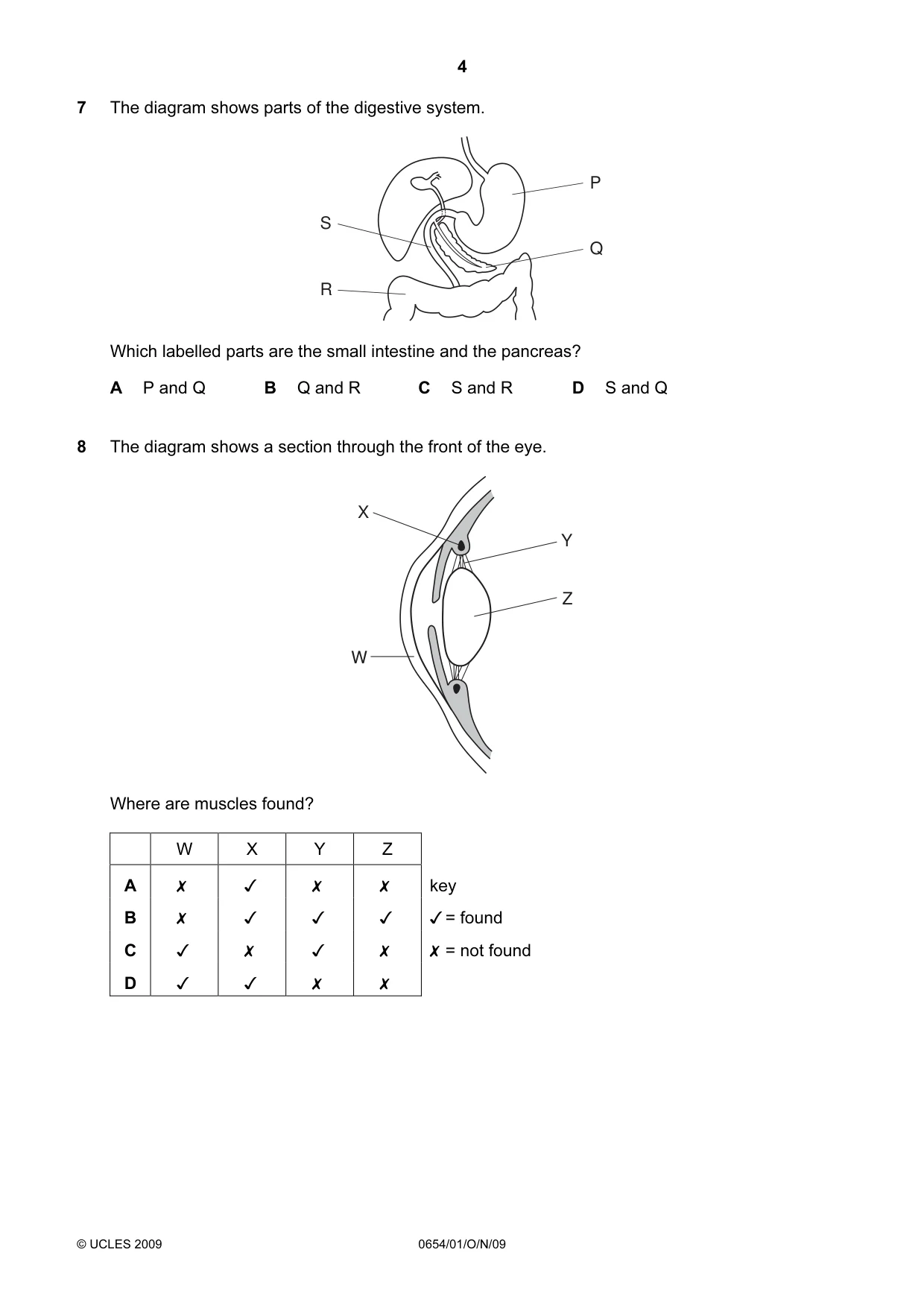
7 The diagram shows parts of the digestive system. P S Q R Which labelled parts are the small intestine and the pancreas? A P and Q B Q and R C S and R D S and Q
Mark scheme: D
Q8 · The diagram shows a section through the front of the eye
8 The diagram shows a section through the front of the eye. Xx WwW ) Where are muscles found? W X Y Z A x v Xx x key B x Jv Jv Jv JY = found Cc Jv x J x X = not found D Jv Jv x x
Mark scheme: A
Q9 · The diagram shows a section through a bean seed
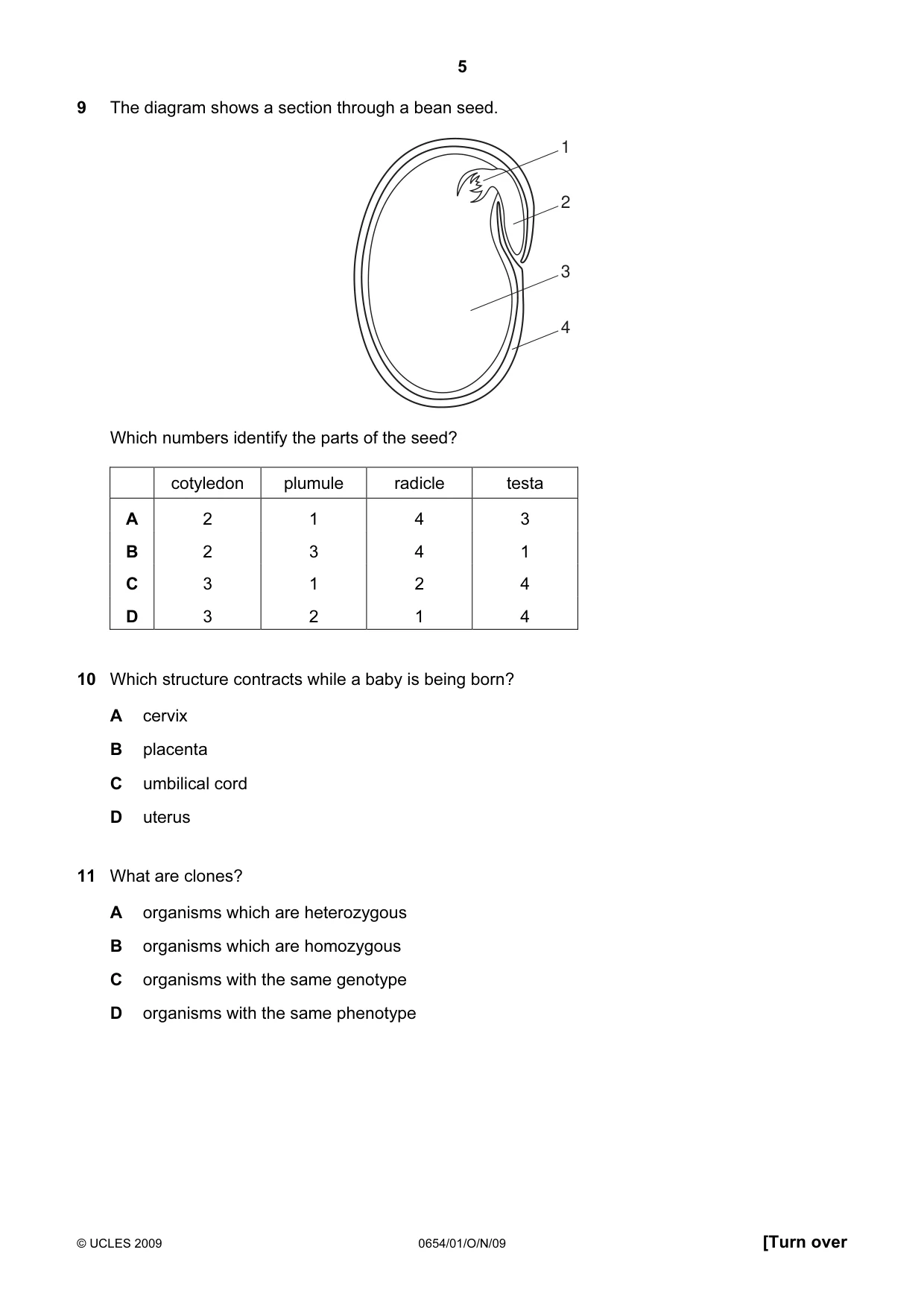
9 The diagram shows a section through a bean seed. 1 2 3 4 Which numbers identify the parts of the seed? cotyledon plumule radicle testa A 2 1 4 3 B 2 3 4 1 C 3 1 2 4 D 3 2 1 4
Mark scheme: C
Q10 · Which structure contracts while a baby is being born?
10 Which structure contracts while a baby is being born? A cervix B placenta C umbilical cord D uterus
Mark scheme: D
Question 11
11 What are clones? A organisms which are heterozygous B organisms which are homozygous C organisms with the same genotype D organisms with the same phenotype
Mark scheme: C
Q12 · The diagram shows a food chain
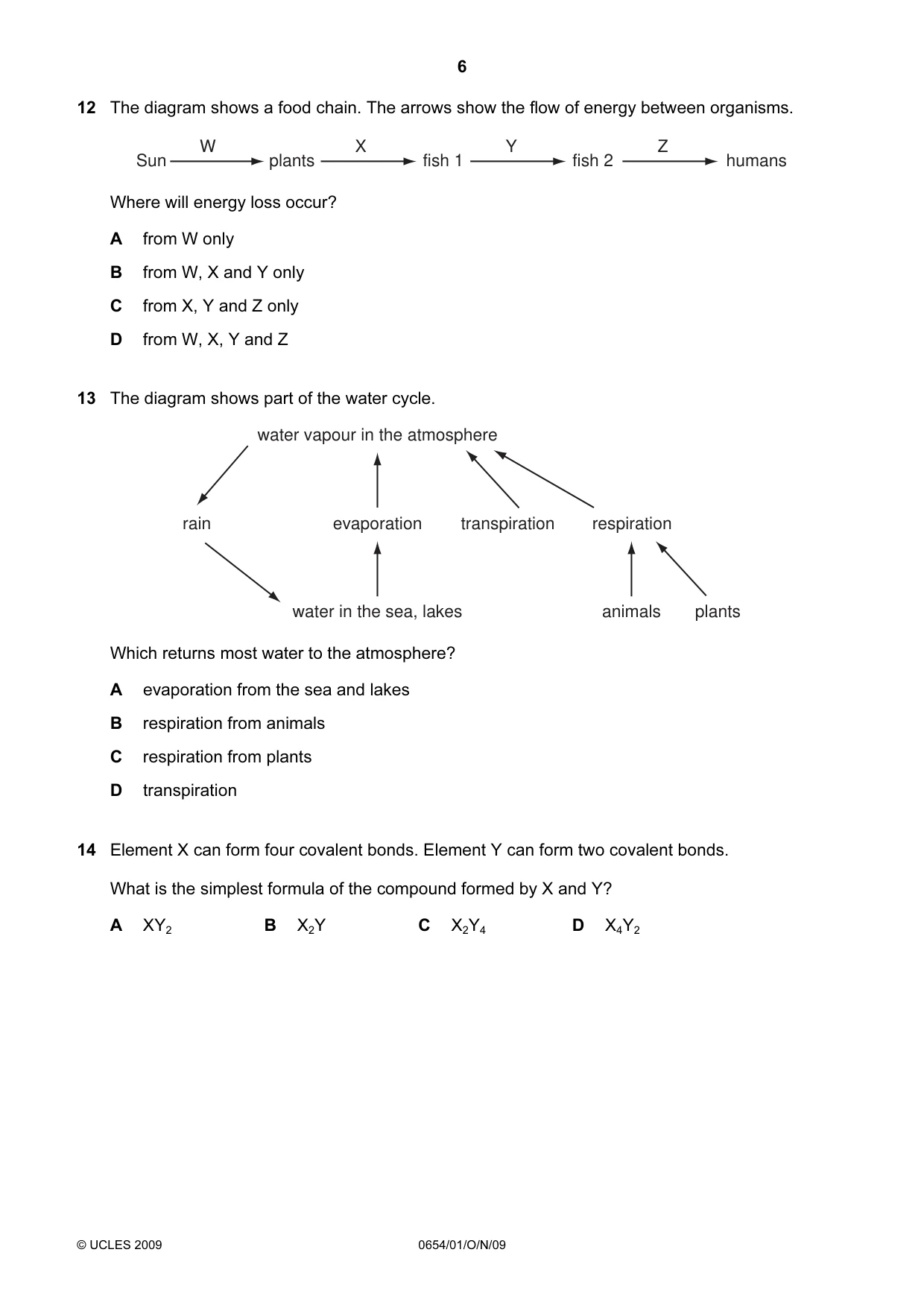
12 The diagram shows a food chain. The arrows show the flow of energy between organisms. W X Y Z Sun plants fish 1 fish 2 humans Where will energy loss occur? A from W only B from W, X and Y only C from X, Y and Z only D from W, X, Y and Z
Mark scheme: D
Q13 · The diagram shows part of the water cycle
13 The diagram shows part of the water cycle. water vapour in the atmosphere rain evaporation transpiration respiration water in the sea, lakes animals plants Which returns most water to the atmosphere? A evaporation from the sea and lakes B respiration from animals C respiration from plants D transpiration
Mark scheme: A
Q14 · Element X can form four covalent bonds
14 Element X can form four covalent bonds. Element Y can form two covalent bonds. What is the simplest formula of the compound formed by X and Y? A XY2 B X2Y C X2Y4 D X4Y2
Mark scheme: A
Q15 · Element X forms a basic oxide
15 Element X forms a basic oxide. How should X be described? type of element position in the Periodic Table A metal on the left B metal on the right C non-metal on the left D non-metal on the right
Mark scheme: A
Q16 · Catalytic cracking is useful in the petrochemical industry
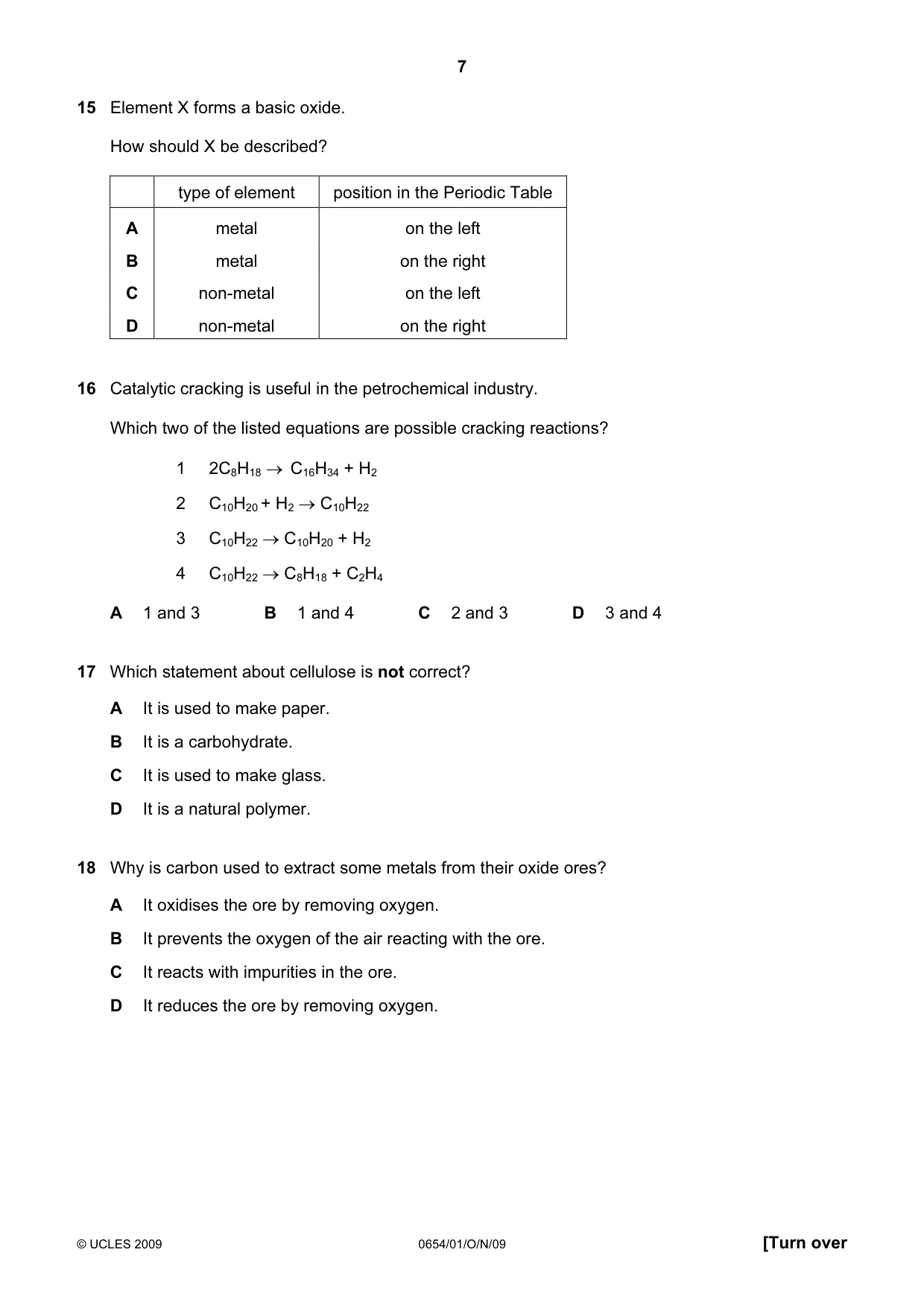
16 Catalytic cracking is useful in the petrochemical industry. Which two of the listed equations are possible cracking reactions? 1 2C8H18 → C16H34 + H2 2 C10H20 + H2 → C10H22 3 C10H22 → C10H20 + H2 4 C10H22 → C8H18 + C2H4 A 1 and 3 B 1 and 4 C 2 and 3 D 3 and 4
Mark scheme: D
Q17 · Which statement about cellulose is not correct?
17 Which statement about cellulose is not correct? A It is used to make paper. B It is a carbohydrate. C It is used to make glass. D It is a natural polymer.
Mark scheme: C
Q18 · Why is carbon used to extract some metals from their oxide ores?
18 Why is carbon used to extract some metals from their oxide ores? A It oxidises the ore by removing oxygen. B It prevents the oxygen of the air reacting with the ore. C It reacts with impurities in the ore. D It reduces the ore by removing oxygen.
Mark scheme: D
Q19 · Which process can be used to produce sodium and chlorine from the compound sodium…
19 Which process can be used to produce sodium and chlorine from the compound sodium chloride? A cracking B distillation C electrolysis D filtration
Mark scheme: C
Q20 · Tests on some 10 cm3 samples of tap water give the following results
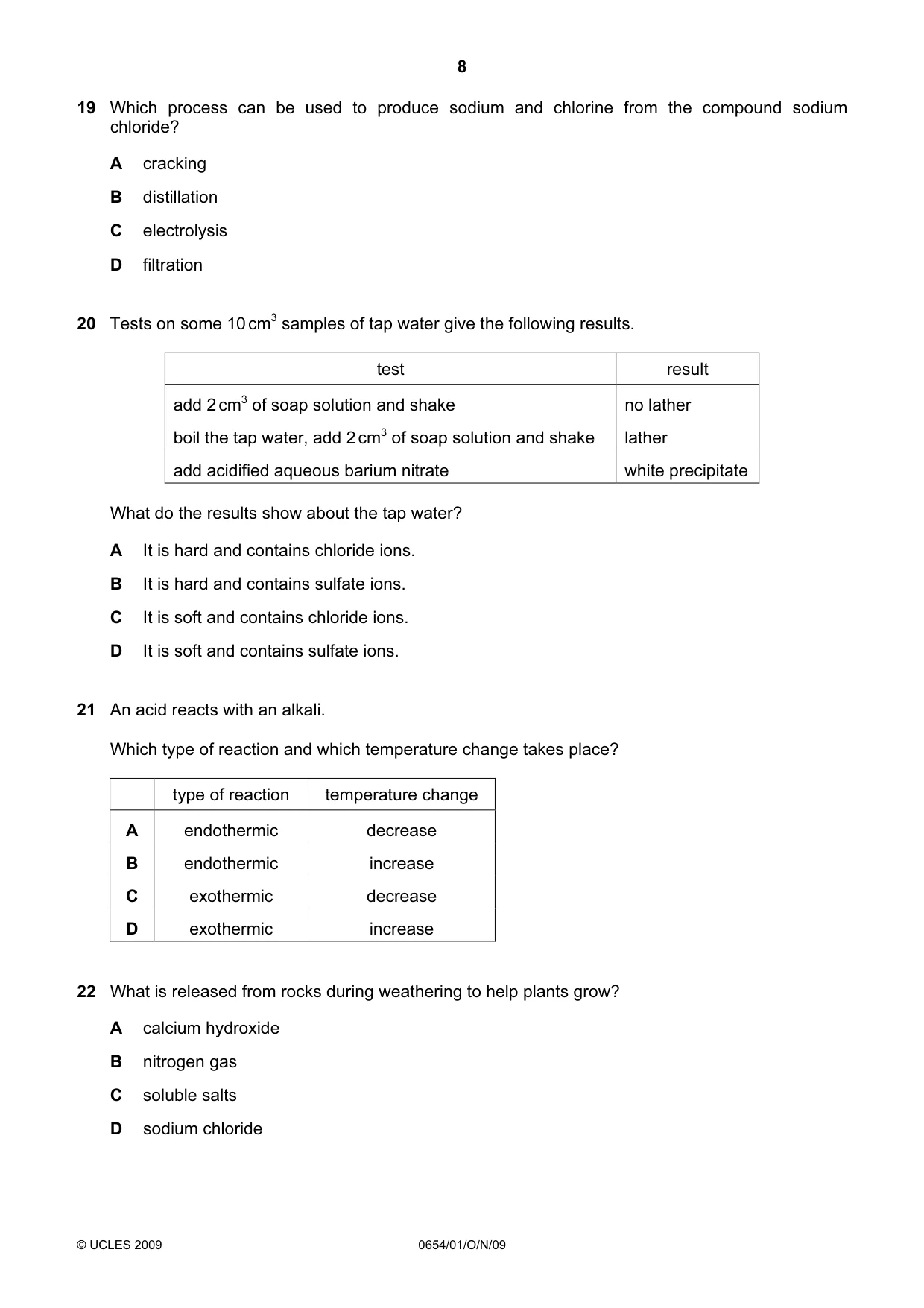
20 Tests on some 10 cm3 samples of tap water give the following results. test result add 2 cm3 of soap solution and shake no lather boil the tap water, add 2 cm3 of soap solution and shake lather add acidified aqueous barium nitrate white precipitate What do the results show about the tap water? A It is hard and contains chloride ions. B It is hard and contains sulfate ions. C It is soft and contains chloride ions. D It is soft and contains sulfate ions.
Mark scheme: B
Q21 · An acid reacts with an alkali
21 An acid reacts with an alkali. Which type of reaction and which temperature change takes place? type of reaction temperature change A endothermic decrease B endothermic increase C exothermic decrease D exothermic increase
Mark scheme: D
Q22 · What is released from rocks during weathering to help plants grow?
22 What is released from rocks during weathering to help plants grow? A calcium hydroxide B nitrogen gas C soluble salts D sodium chloride
Mark scheme: C
Q23 · What is used to test for ammonia gas?
23 What is used to test for ammonia gas? A a lighted splint B aqueous sodium hydroxide C damp red litmus paper D limewater
Mark scheme: C
Q24 · Why is Aspirin said to be an analgesic?
24 Why is Aspirin said to be an analgesic? A It relieves pain. B It forms a colloid when dissolved in water. C It is an antacid. D It can be obtained from plants.
Mark scheme: D
Q25 · An experiment using olive oil and water is shown
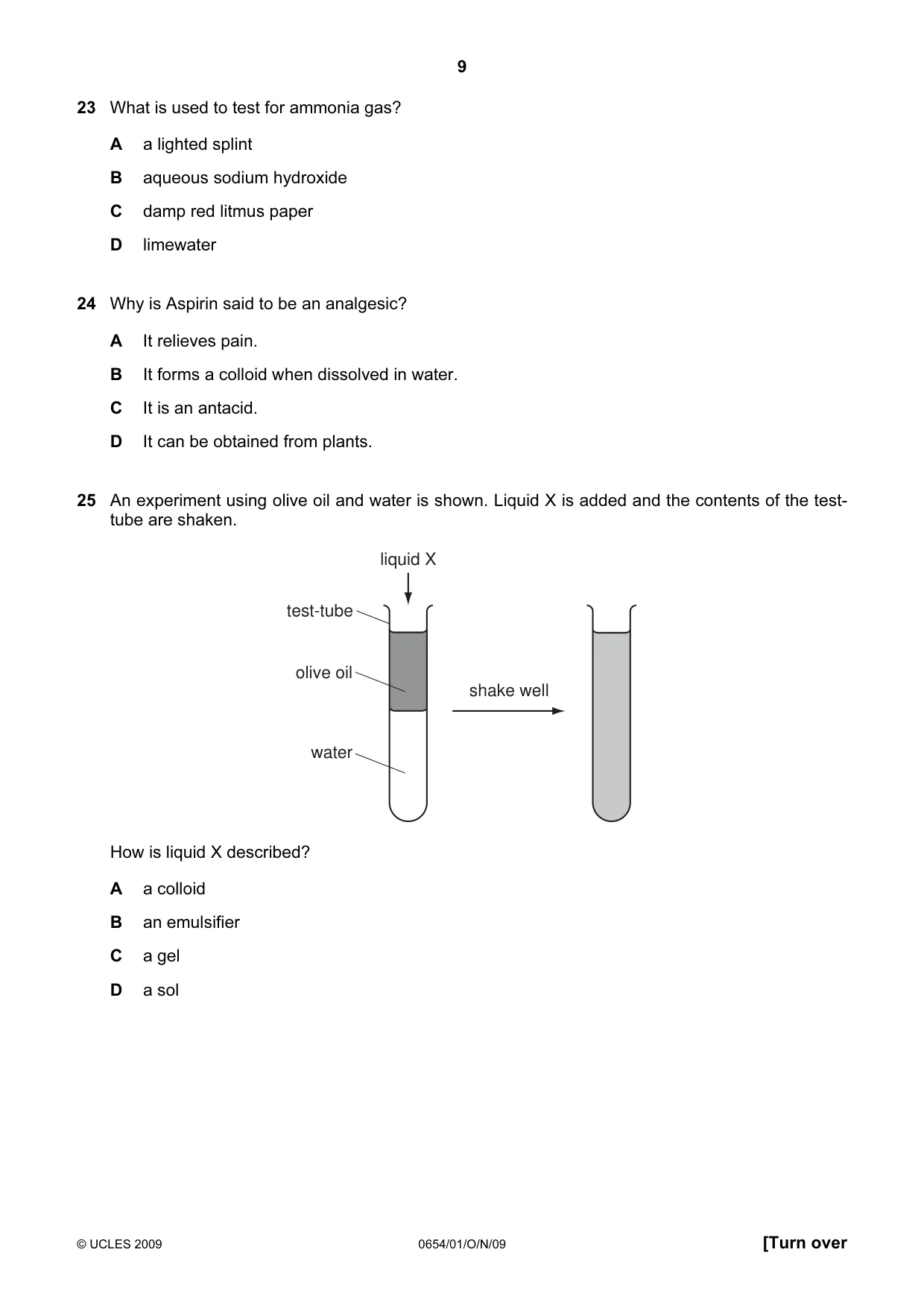
25 An experiment using olive oil and water is shown. Liquid X is added and the contents of the test- tube are shaken. liquid X test-tube olive oil shake well water How is liquid X described? A a colloid B an emulsifier C a gel D a sol
Mark scheme: B
Q26 · An element present in fuels such as coal and coke is ……1……
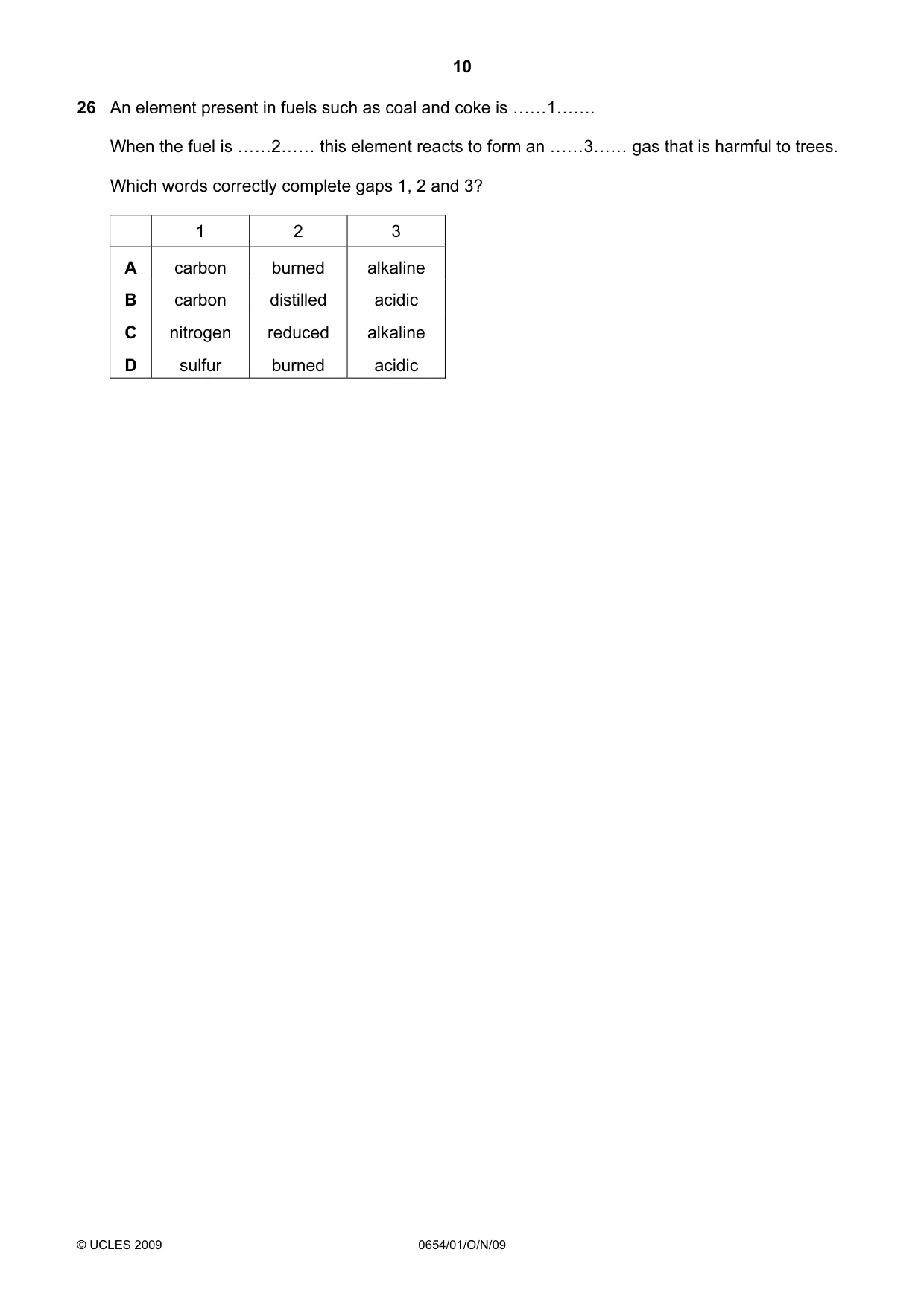
26 An element present in fuels such as coal and coke is ……1……. When the fuel is ……2…… this element reacts to form an ……3…… gas that is harmful to trees. Which words correctly complete gaps 1, 2 and 3? 1 2 3 A carbon burned alkaline B carbon distilled acidic C nitrogen reduced alkaline D sulfur burned acidic
Mark scheme: D
Q27 · Circuits P, Q, R and S are set up as shown
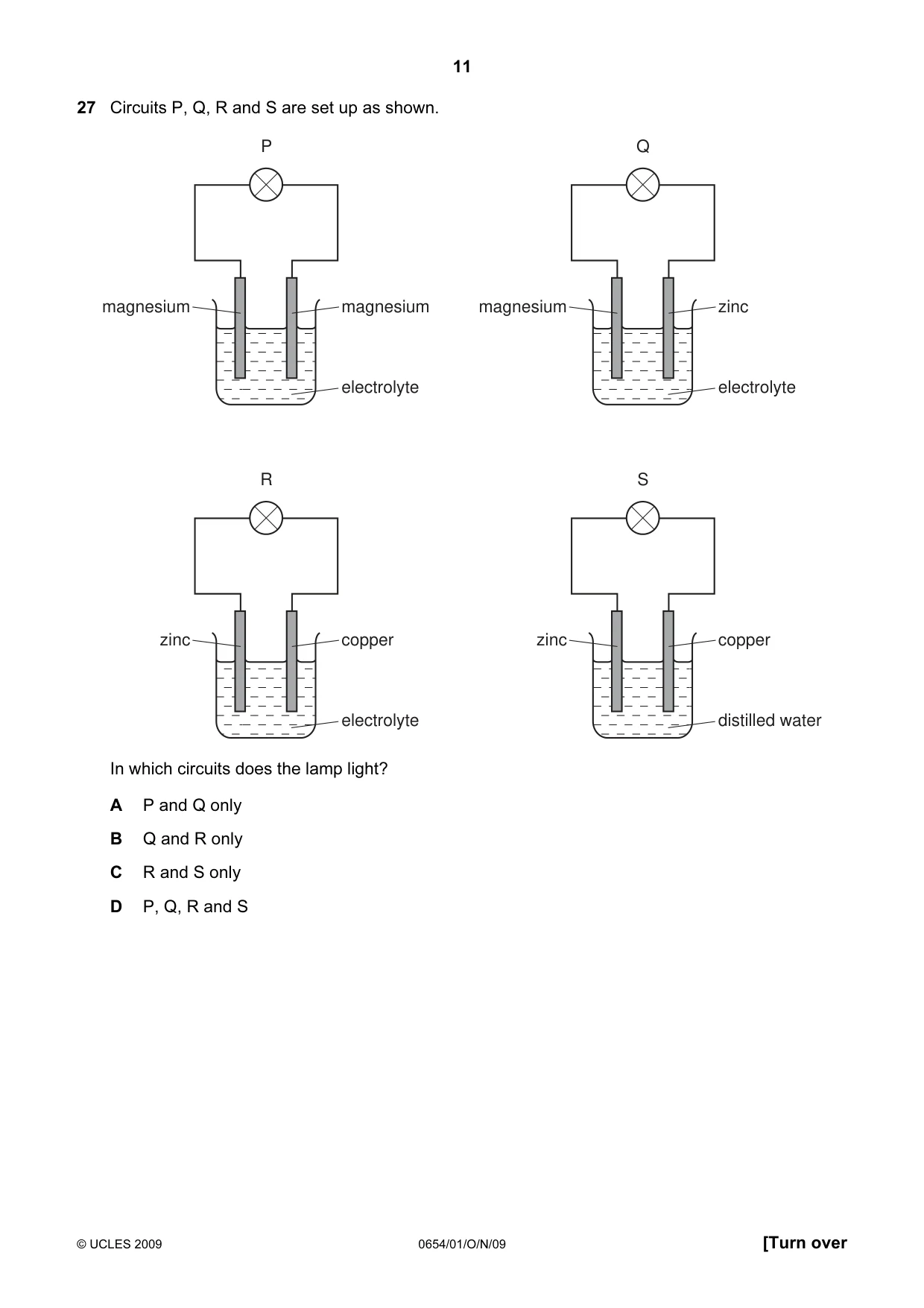
27 Circuits P, Q, R and S are set up as shown. P Q magnesium magnesium magnesium zinc electrolyte electrolyte R S zinc copper zinc copper electrolyte distilled water In which circuits does the lamp light? A P and Q only B Q and R only C R and S only D P, Q, R and S
Mark scheme: B
Q28 · A stopwatch is used to time an athlete running 100 m
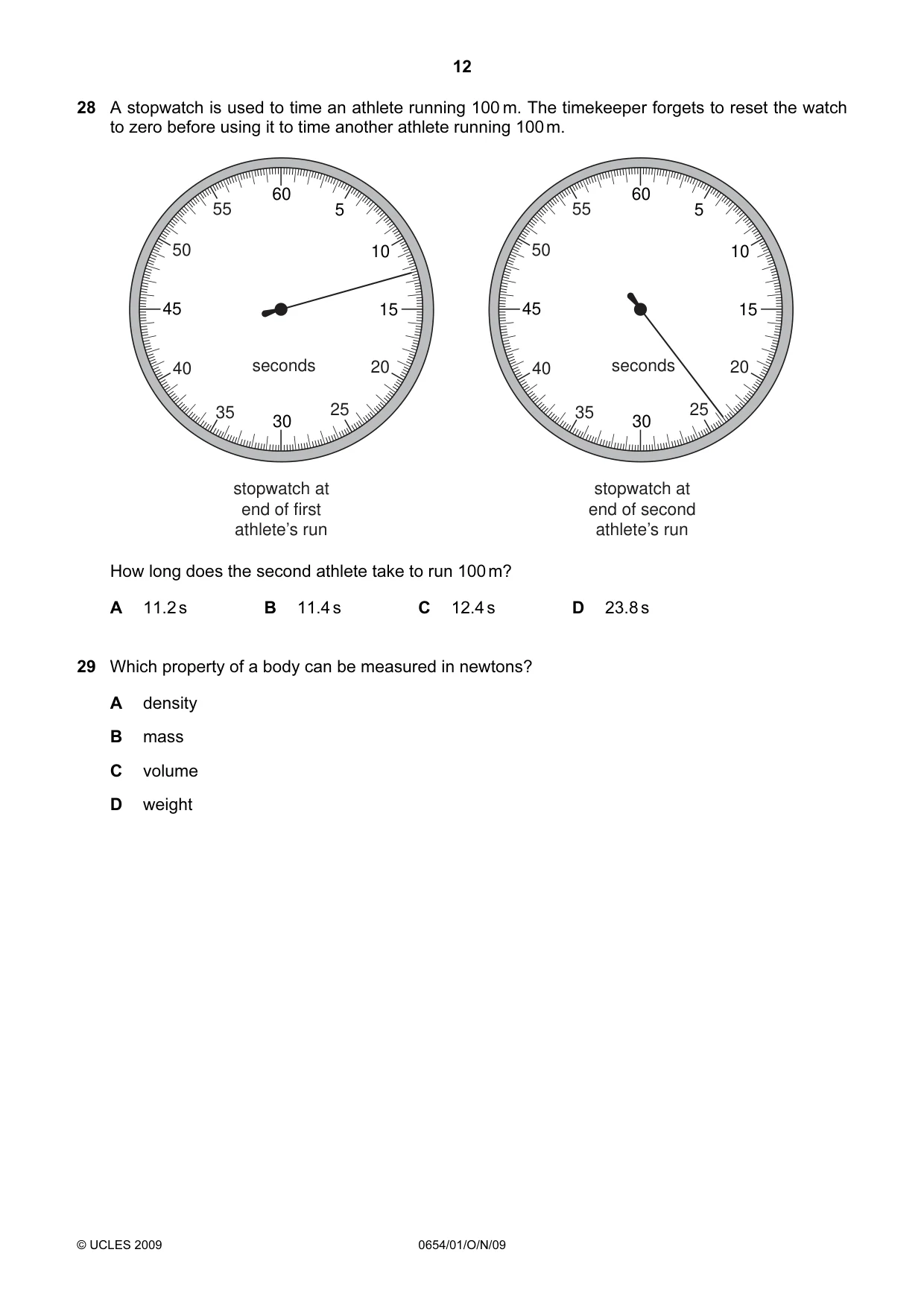
28 A stopwatch is used to time an athlete running 100 m. The timekeeper forgets to reset the watch to zero before using it to time another athlete running 100 m. 60 60 55 5 55 5 50 10 50 10 45 15 45 15 40 seconds 20 40 seconds 20 35 25 35 25 30 30 stopwatch at stopwatch at end of first end of second athlete’s run athlete’s run How long does the second athlete take to run 100 m? A 11.2 s B 11.4 s C 12.4 s D 23.8 s
Mark scheme: B
More questions on Physical quantities and measurement techniques
Q29 · Which property of a body can be measured in newtons?
29 Which property of a body can be measured in newtons? A density B mass C volume D weight
Mark scheme: D
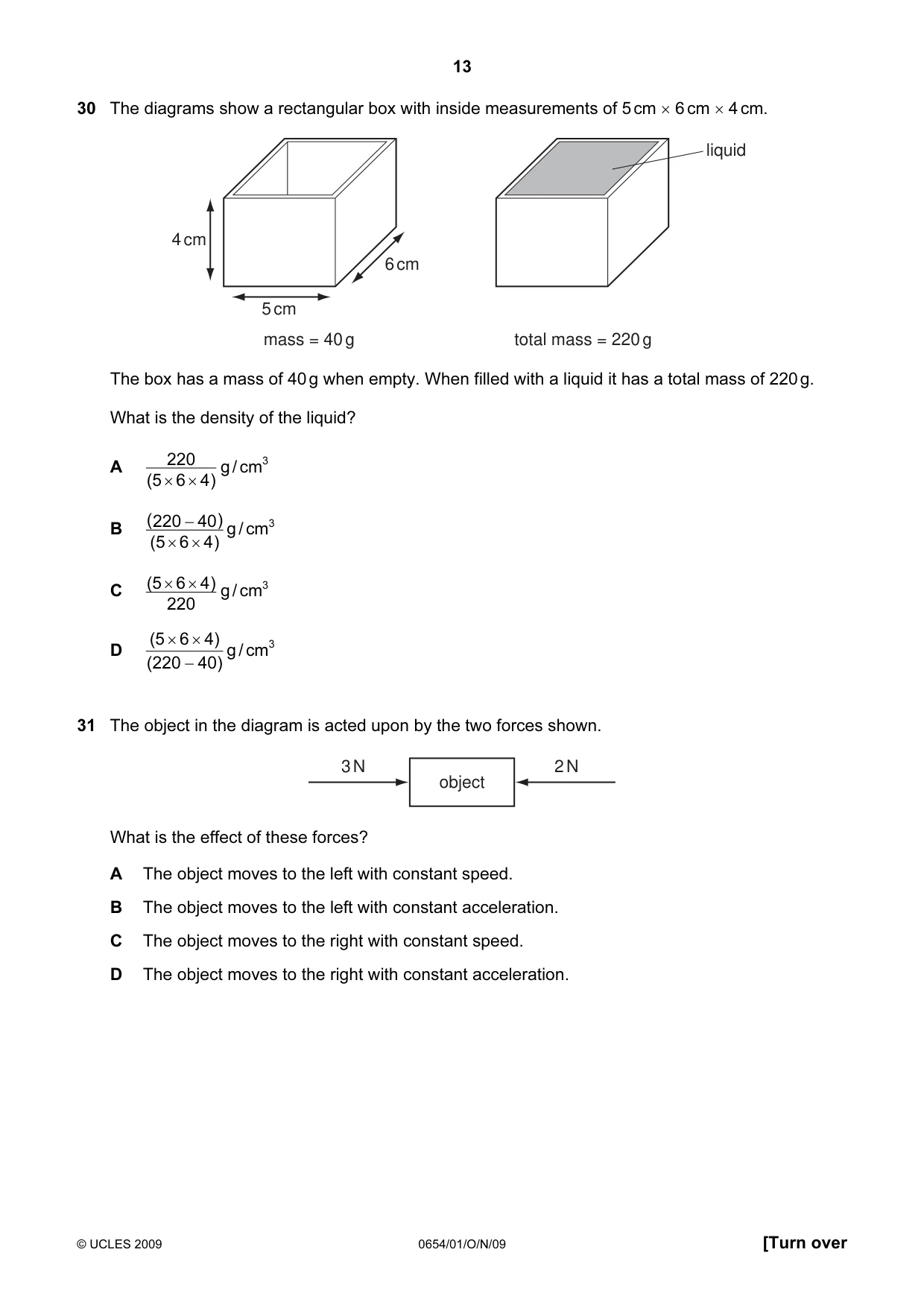
Q30 · The diagrams show a rectangular box with inside measurements of 5 cm × 6 cm × 4 cm
30 The diagrams show a rectangular box with inside measurements of 5 cm × 6 cm × 4 cm. liquid 4 cm 6 cm 5 cm mass = 40 g total mass = 220 g The box has a mass of 40 g when empty. When filled with a liquid it has a total mass of 220 g. What is the density of the liquid? A 220 g / cm3 (5 × 6 × 4 ) ( 220 − 40 ) g / cm3 B (5 × 6 × 4 ) (5 × 6 × 4 ) g / cm3 C 220 (5 × 6 × 4) D g / cm3 (220 − 40)
Mark scheme: B
Q31 · The object in the diagram is acted upon by the two forces shown
31 The object in the diagram is acted upon by the two forces shown. 3 N 2 N object What is the effect of these forces? A The object moves to the left with constant speed. B The object moves to the left with constant acceleration. C The object moves to the right with constant speed. D The object moves to the right with constant acceleration.
Mark scheme: D
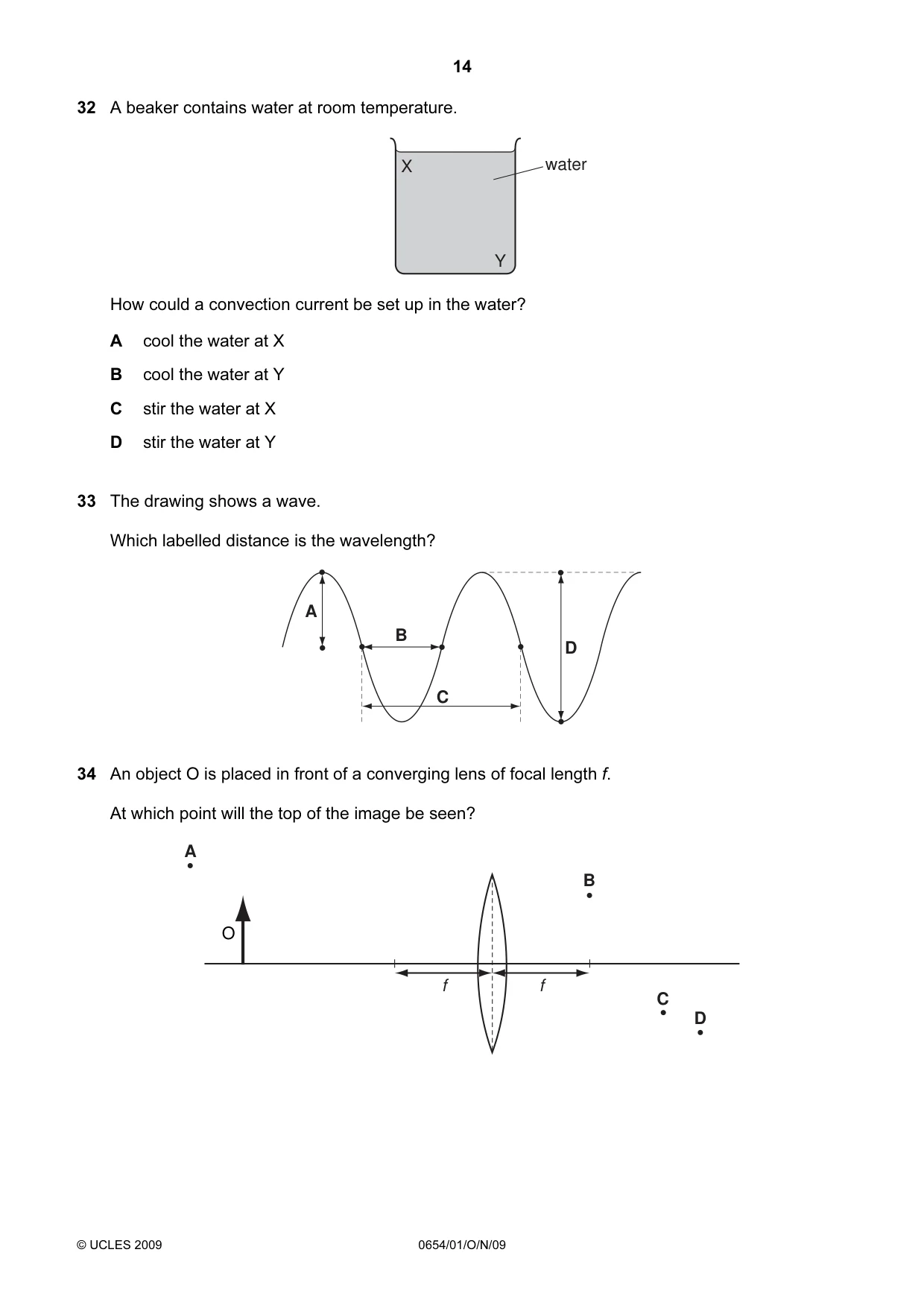
Q32 · A beaker contains water at room temperature
32 A beaker contains water at room temperature. X water Y How could a convection current be set up in the water? A cool the water at X B cool the water at Y C stir the water at X D stir the water at Y
Mark scheme: A
Q33 · The drawing shows a wave
33 The drawing shows a wave. Which labelled distance is the wavelength? A B D C
Mark scheme: C
Q34 · An object O is placed in front of a converging lens of focal length f
34 An object O is placed in front of a converging lens of focal length f. At which point will the top of the image be seen? A B O f f C D
Mark scheme: C
Q35 · A pupil measures the potential difference across a device and the current in it
35 A pupil measures the potential difference across a device and the current in it. Which calculation gives the resistance of the device? A current + potential difference B current ÷ potential difference C potential difference ÷ current D potential difference × current
Mark scheme: C
Q36 · A student uses a length of wire as a resistor
36 A student uses a length of wire as a resistor. He discovers that the resistance of the wire is too small. To be certain of making a resistor of higher value, he should use a piece of wire that is A longer and thicker. B longer and thinner. C shorter and thicker. D shorter and thinner.
Mark scheme: B
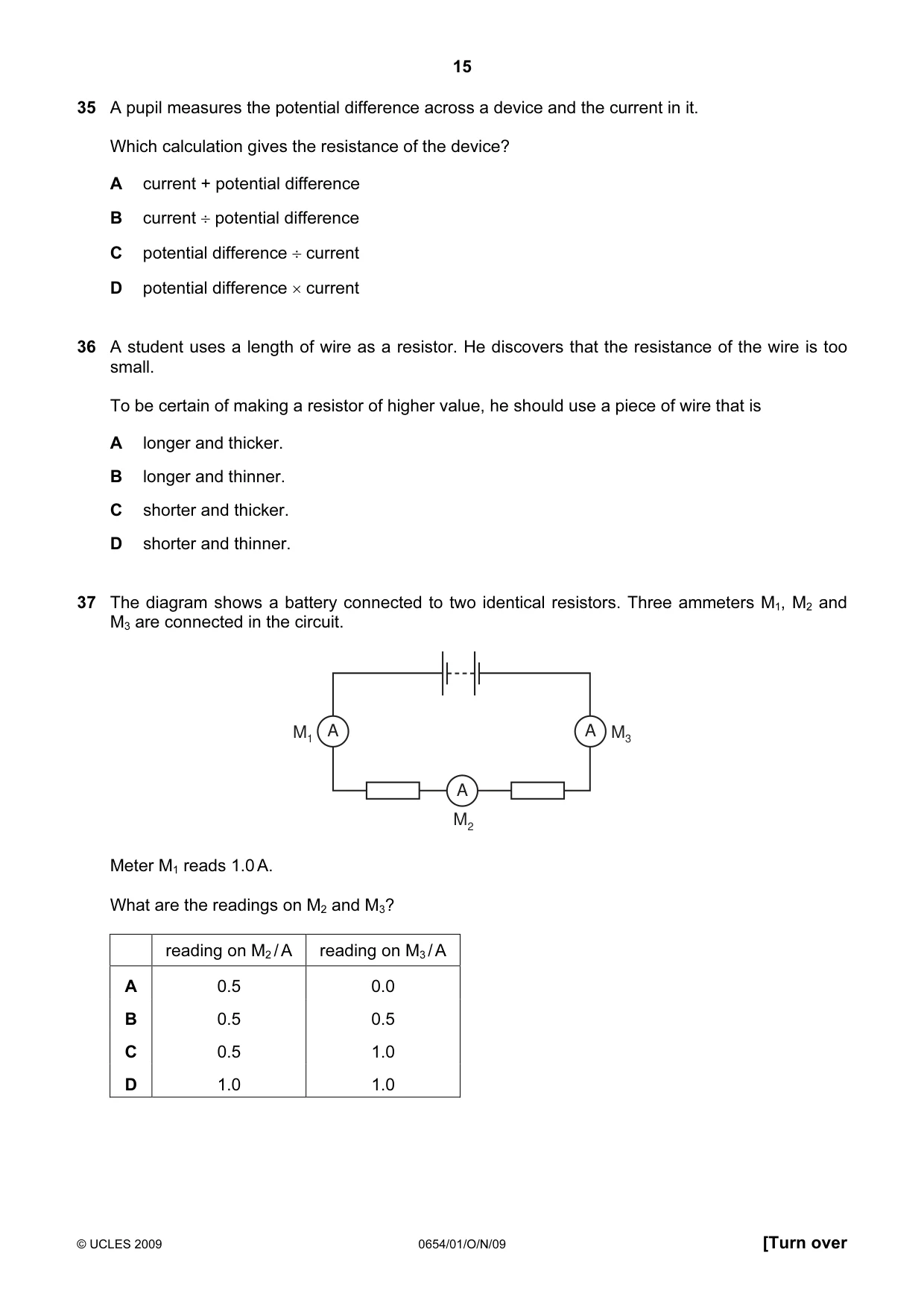
Q37 · The diagram shows a battery connected to two identical resistors
37 The diagram shows a battery connected to two identical resistors. Three ammeters M1, M2 and M3 are connected in the circuit. M1 A A M3 A M2 Meter M1 reads 1.0 A. What are the readings on M2 and M3? reading on M2 / A reading on M3 / A A 0.5 0.0 B 0.5 0.5 C 0.5 1.0 D 1.0 1.0
Mark scheme: D
Q38 · An electric heater is connected to the mains using insulated copper wires
38 An electric heater is connected to the mains using insulated copper wires. The wires become very warm. What can be done to prevent so much heat being produced in the connecting wires? A Use thicker copper wires. B Use thinner copper wires. C Use thicker insulation. D Use thinner insulation.
Mark scheme: A
Q39 · Which statement explains the meaning of the half-life of a radioactive substance?
39 Which statement explains the meaning of the half-life of a radioactive substance? A half the time taken for half the substance to decay B half the time taken for the substance to decay completely C the time taken for half the substance to decay D the time taken for the substance to decay completely
Mark scheme: C
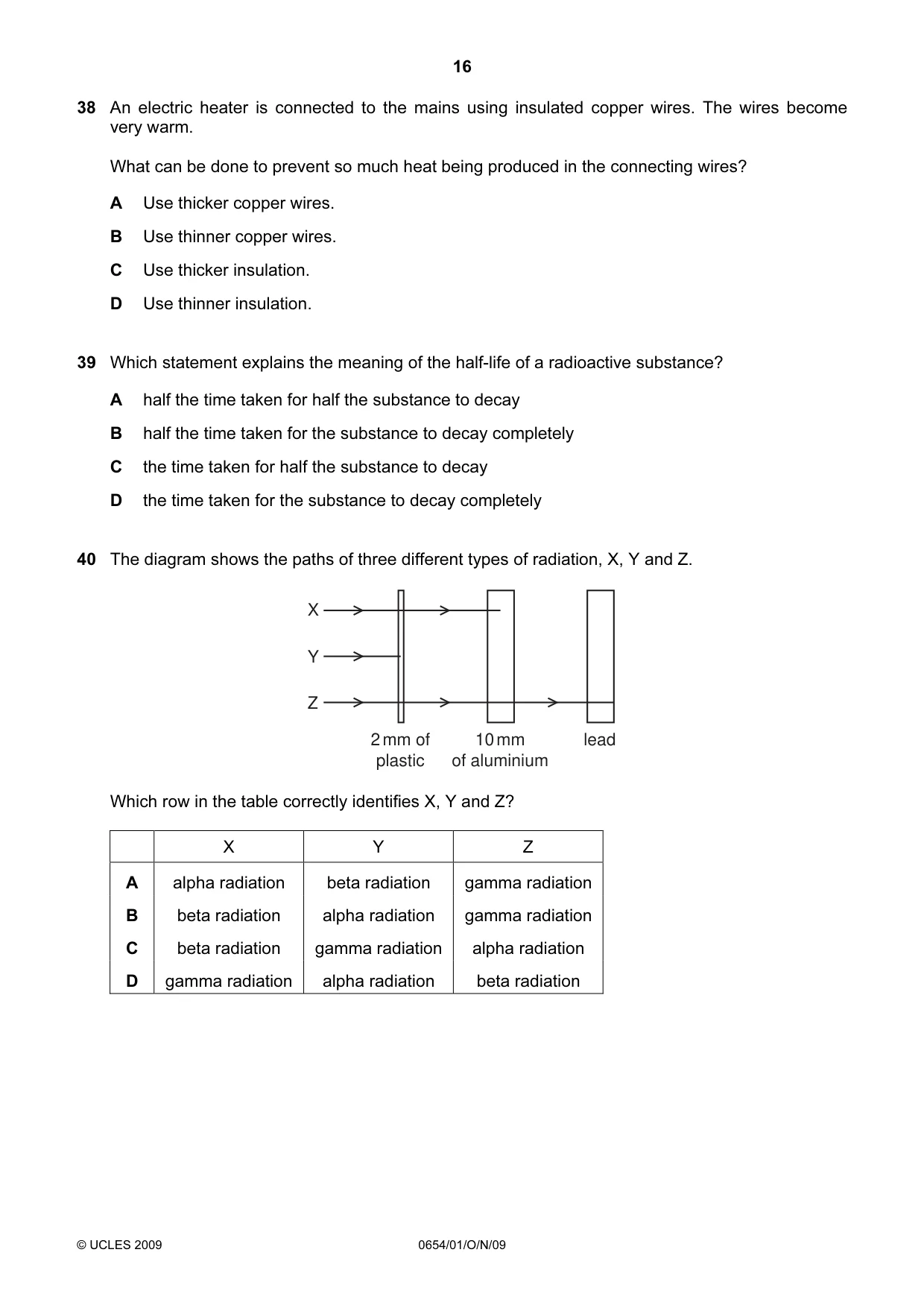
Q40 · The diagram shows the paths of three different types of radiation, X, Y and Z
40 The diagram shows the paths of three different types of radiation, X, Y and Z. X Y Z 2 mm of 10 mm lead plastic of aluminium Which row in the table correctly identifies X, Y and Z? X Y Z A alpha radiation beta radiation gamma radiation B beta radiation alpha radiation gamma radiation C beta radiation gamma radiation alpha radiation D gamma radiation alpha radiation beta radiation
Mark scheme: B
What was in this paper
The subtopics covered by these 40 questions, and how many questions each got. Open one in a new tab to see every Cambridge question on it.
2Electrolysis2Identification of ions and gases2Radioactivity2Air quality and climate1Alkanes1Asexual reproduction1Carbon cycle1Characteristics of living organisms1Circulatory systems1Coordination and response1Density1Digestive system1Drugs1Electrical circuits1Electrical safety1Energy flow1Exothermic and endothermic reactions1Extraction of metals1Forces1Gas exchange in humans1General properties of waves1Light1Mass and weight1Osmosis1Oxides1Photosynthesis1Physical quantities and measurement techniques1Polymers1Respiration1Sexual reproduction in humans1Sexual reproduction in plants1Simple molecules and covalent bonds1Solids, liquids and gases1Transfer of thermal energy1Water1What you needed in this session
Cambridge’s own grade thresholds for 2009 Oct/Nov, Paper 1 · Variant 1. A higher threshold means an easier paper — the bar moves with how the cohort did.