Cambridge IGCSE Sciences - Co-ordinated (Double) 0654 — 2016 Oct/Nov Paper 1 · Variant 1
0654/11/O/N/16 · 40 questions · 40 marks · ≈45 min
The question paper and its mark scheme, free to read here and free to download. This is Cambridge’s own paper, exactly as it was sat.
Question paper16 pages
Mark scheme2 pages
Answers below. Sit the paper first if you are practising.
Questions as text
Q1 · The plant Mimosa pudica grows in Central and South America
1 The plant Mimosa pudica grows in Central and South America. Its leaves close up rapidly when touched. Which two characteristics are shown by this action? A growth and movement B growth and sensitivity C movement and sensitivity D respiration and growth
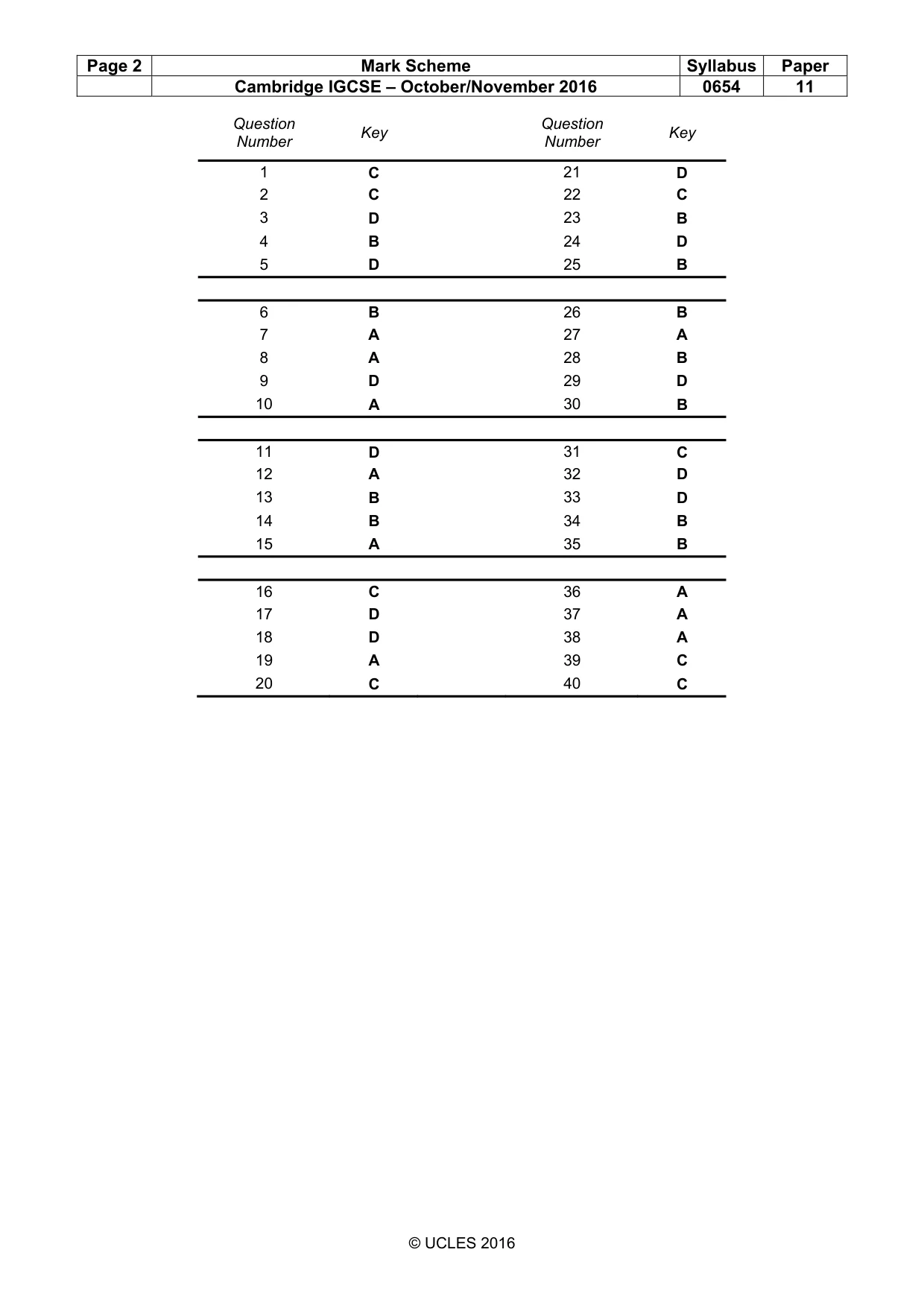
Mark scheme: C
Q2 · Which statement about enzymes is correct?
2 Which statement about enzymes is correct? A Amylase breaks down fats into fatty acids and glycerol. B Amylase breaks down proteins into amino acids. C Lipase breaks down fats into fatty acids and glycerol. D Lipase breaks down proteins into amino acids.
Mark scheme: C
Q3 · The diagram shows human teeth in the lower jaw
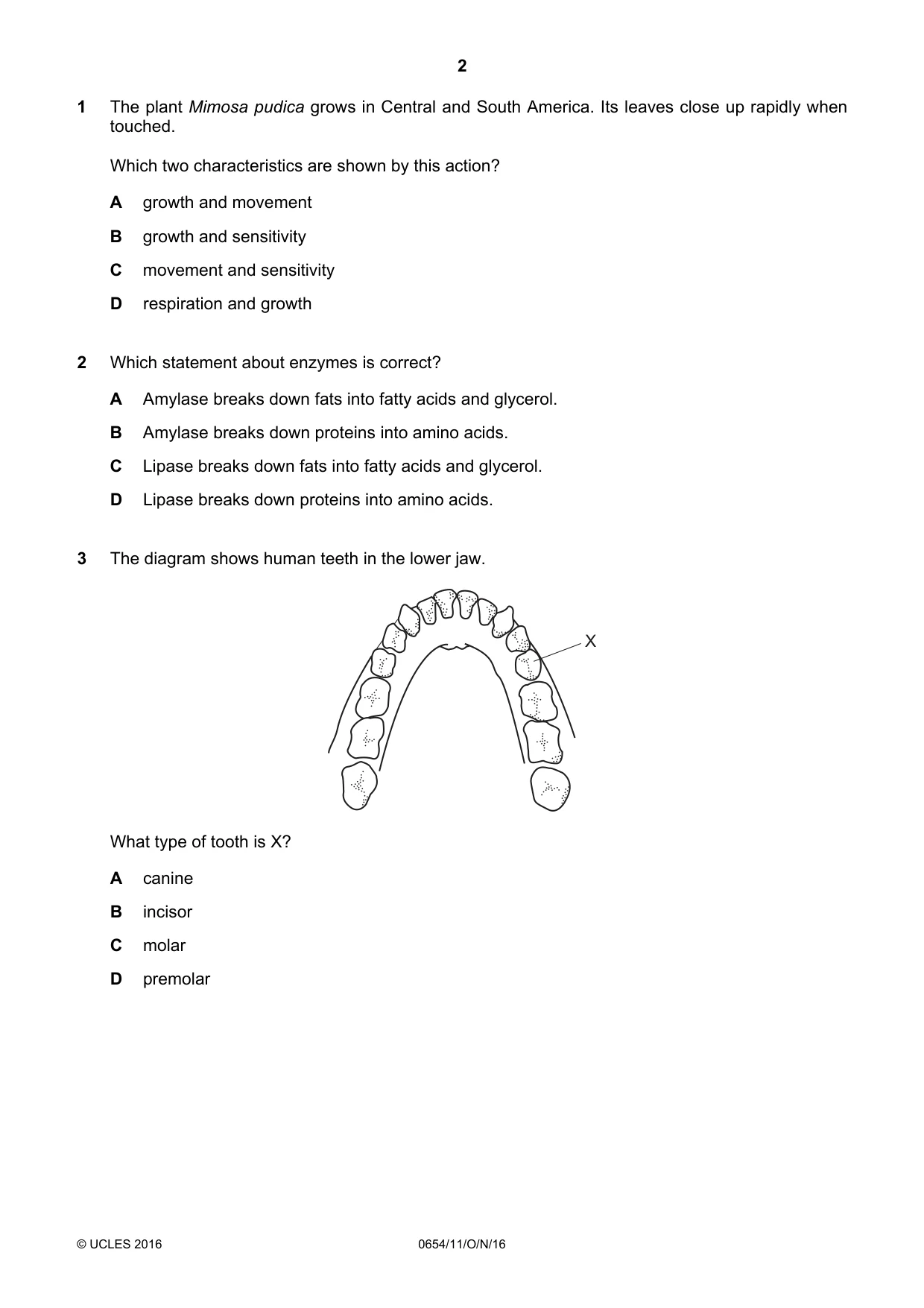
3 The diagram shows human teeth in the lower jaw. X What type of tooth is X? A canine B incisor C molar D premolar
Mark scheme: D
Q4 · The diagram shows a section through the human heart
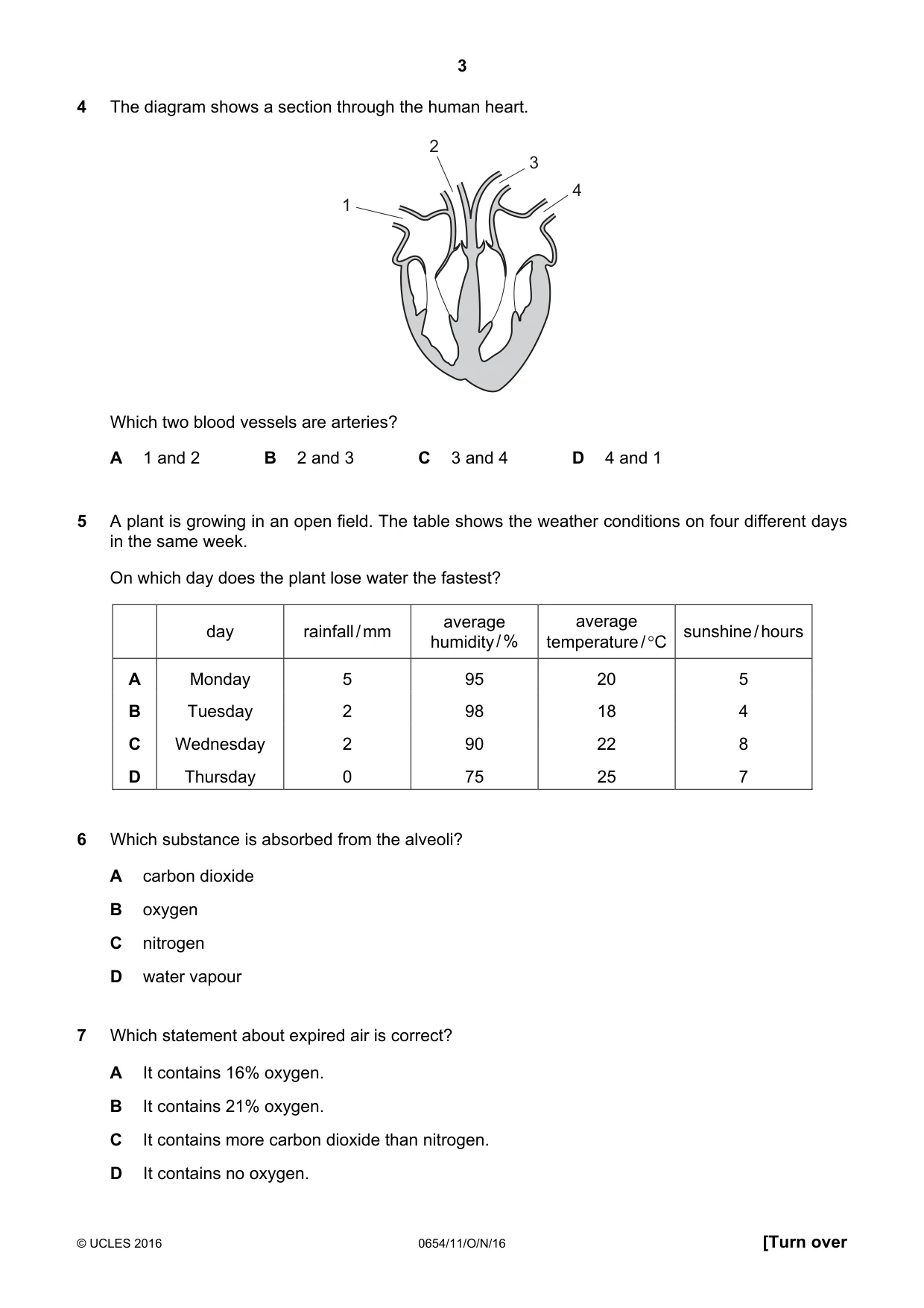
4 The diagram shows a section through the human heart. 2 3 4 1 Which two blood vessels are arteries? A 1 and 2 B 2 and 3 C 3 and 4 D 4 and 1
Mark scheme: B
Q5 · A plant is growing in an open field
5 A plant is growing in an open field. The table shows the weather conditions on four different days in the same week. On which day does the plant lose water the fastest? average average day rainfall / mm temperature / °C sunshine / hours humidity / % A Monday 5 95 20 5 B Tuesday 2 98 18 4 C Wednesday 2 90 22 8 D Thursday 0 75 25 7
Mark scheme: D
Q6 · Which substance is absorbed from the alveoli?
6 Which substance is absorbed from the alveoli? A carbon dioxide B oxygen C nitrogen D water vapour
Mark scheme: B
Q7 · Which statement about expired air is correct?
7 Which statement about expired air is correct? A It contains 16% oxygen. B It contains 21% oxygen. C It contains more carbon dioxide than nitrogen. D It contains no oxygen.
Mark scheme: A
Q8 · The diagram shows a neurone and associated structures
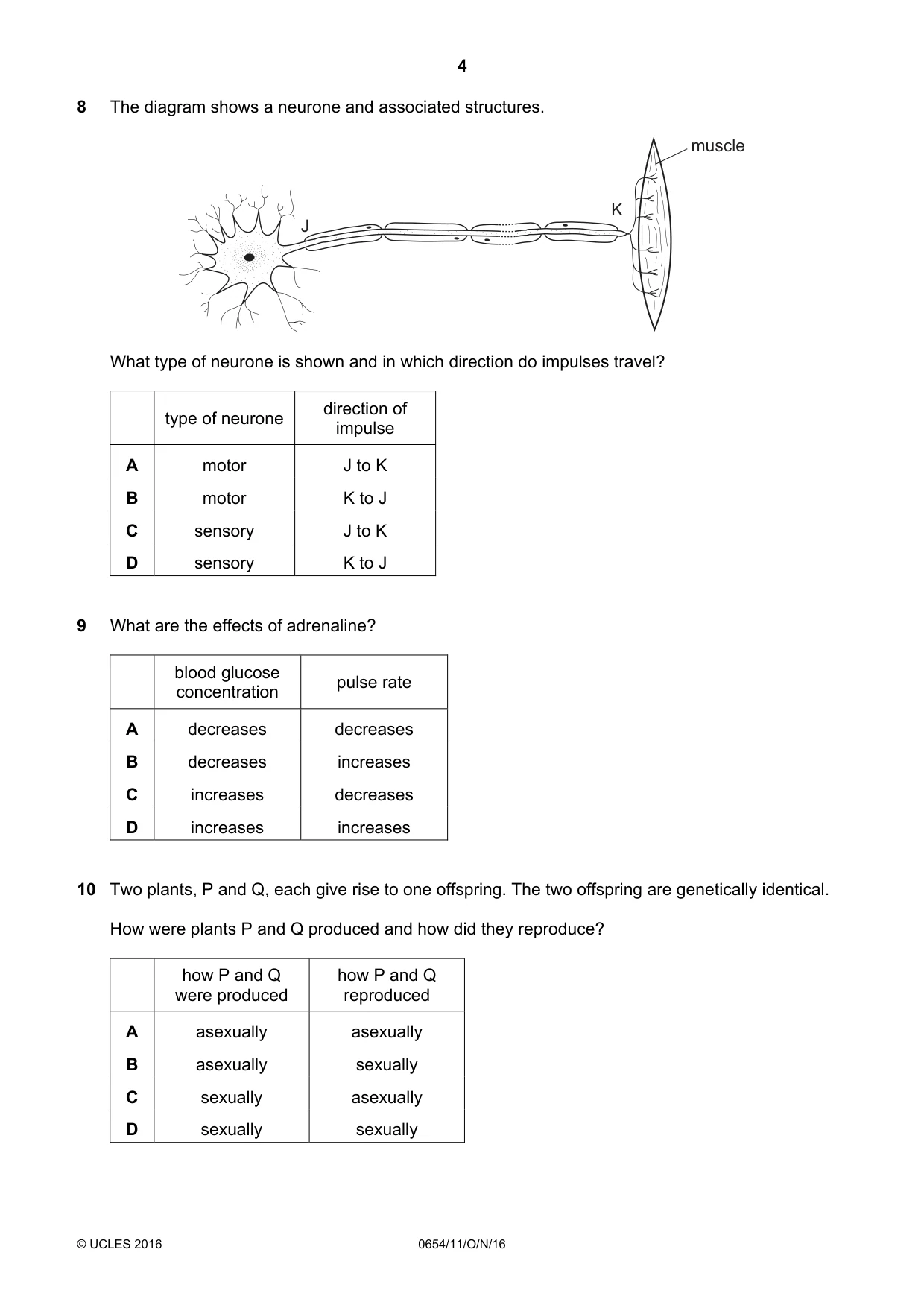
8 The diagram shows a neurone and associated structures. muscle K J What type of neurone is shown and in which direction do impulses travel? direction of type of neurone impulse A motor J to K B motor K to J C sensory J to K D sensory K to J
Mark scheme: A
Q9 · What are the effects of adrenaline?
9 What are the effects of adrenaline? blood glucose pulse rate concentration A decreases decreases B decreases increases C increases decreases D increases increases
Mark scheme: D
Q10 · Two plants, P and Q, each give rise to one offspring
10 Two plants, P and Q, each give rise to one offspring. The two offspring are genetically identical. How were plants P and Q produced and how did they reproduce? how P and Q how P and Q were produced reproduced A asexually asexually B asexually sexually C sexually asexually D sexually sexually
Mark scheme: A
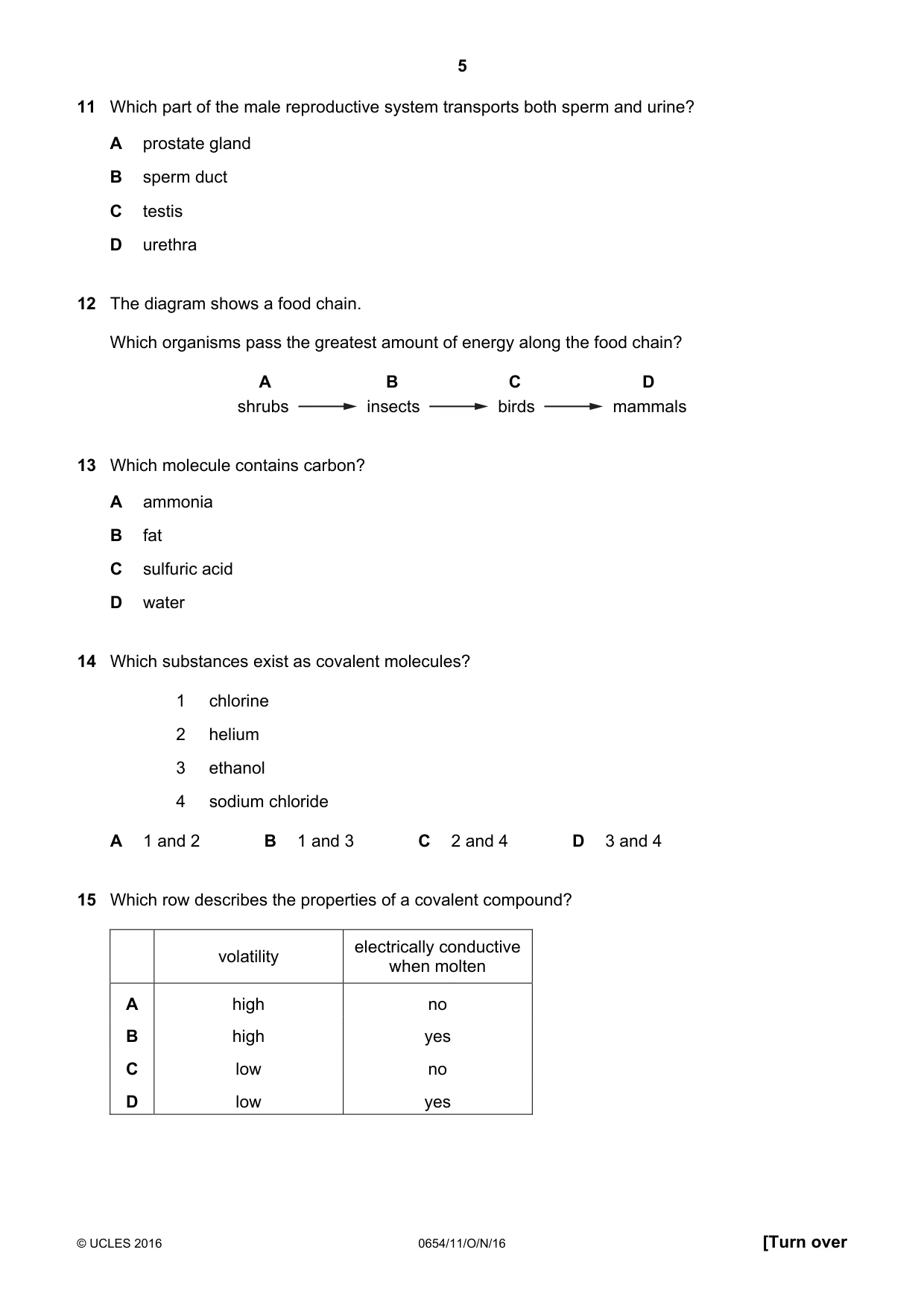
Q11 · Which part of the male reproductive system transports both sperm and urine?
11 Which part of the male reproductive system transports both sperm and urine? A prostate gland B sperm duct C testis D urethra
Mark scheme: D
Q12 · The diagram shows a food chain
12 The diagram shows a food chain. Which organisms pass the greatest amount of energy along the food chain? A B C D shrubs insects birds mammals
Mark scheme: A
Q13 · Which molecule contains carbon?
13 Which molecule contains carbon? A ammonia B fat C sulfuric acid D water
Mark scheme: B
Q14 · Which substances exist as covalent molecules?
14 Which substances exist as covalent molecules? 1 chlorine 2 helium 3 ethanol 4 sodium chloride A 1 and 2 B 1 and 3 C 2 and 4 D 3 and 4
Mark scheme: B
Q15 · Which row describes the properties of a covalent compound?
15 Which row describes the properties of a covalent compound? electrically conductive volatility when molten A high no B high yes C low no D low yes
Mark scheme: A
Q16 · A model of a molecule is shown
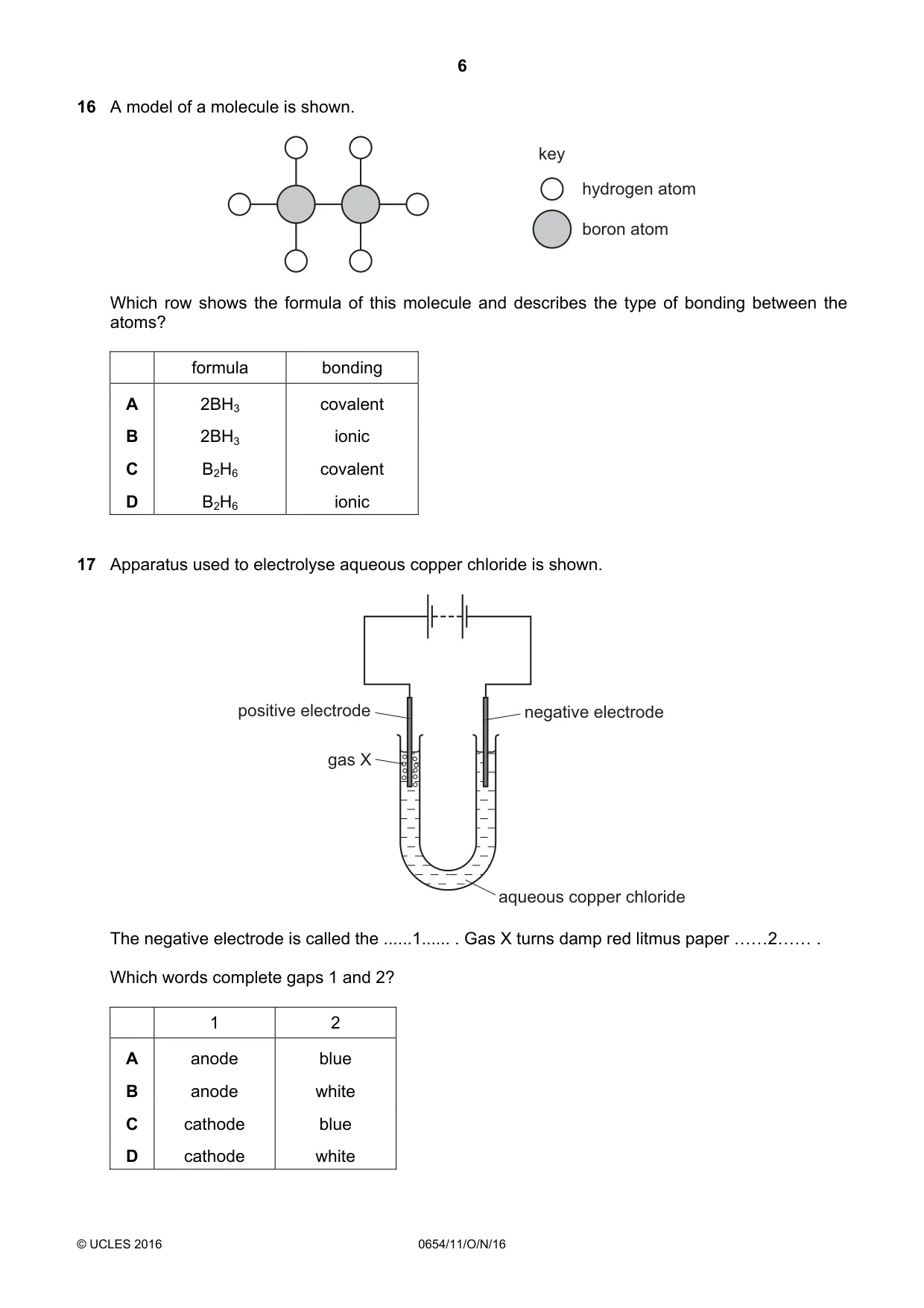
16 A model of a molecule is shown. key hydrogen atom boron atom Which row shows the formula of this molecule and describes the type of bonding between the atoms? formula bonding A 2BH3 covalent B 2BH3 ionic C B2H6 covalent D B2H6 ionic
Mark scheme: C
Q17 · Apparatus used to electrolyse aqueous copper chloride is shown
17 Apparatus used to electrolyse aqueous copper chloride is shown. positive electrode negative electrode gas X aqueous copper chloride The negative electrode is called the ......1...... . Gas X turns damp red litmus paper ««2«« . Which words complete gaps 1 and 2? 1 2 A anode blue B anode white C cathode blue D cathode white
Mark scheme: D
Q18 · Which type of reaction and which temperature change take place when an acid reacts with…
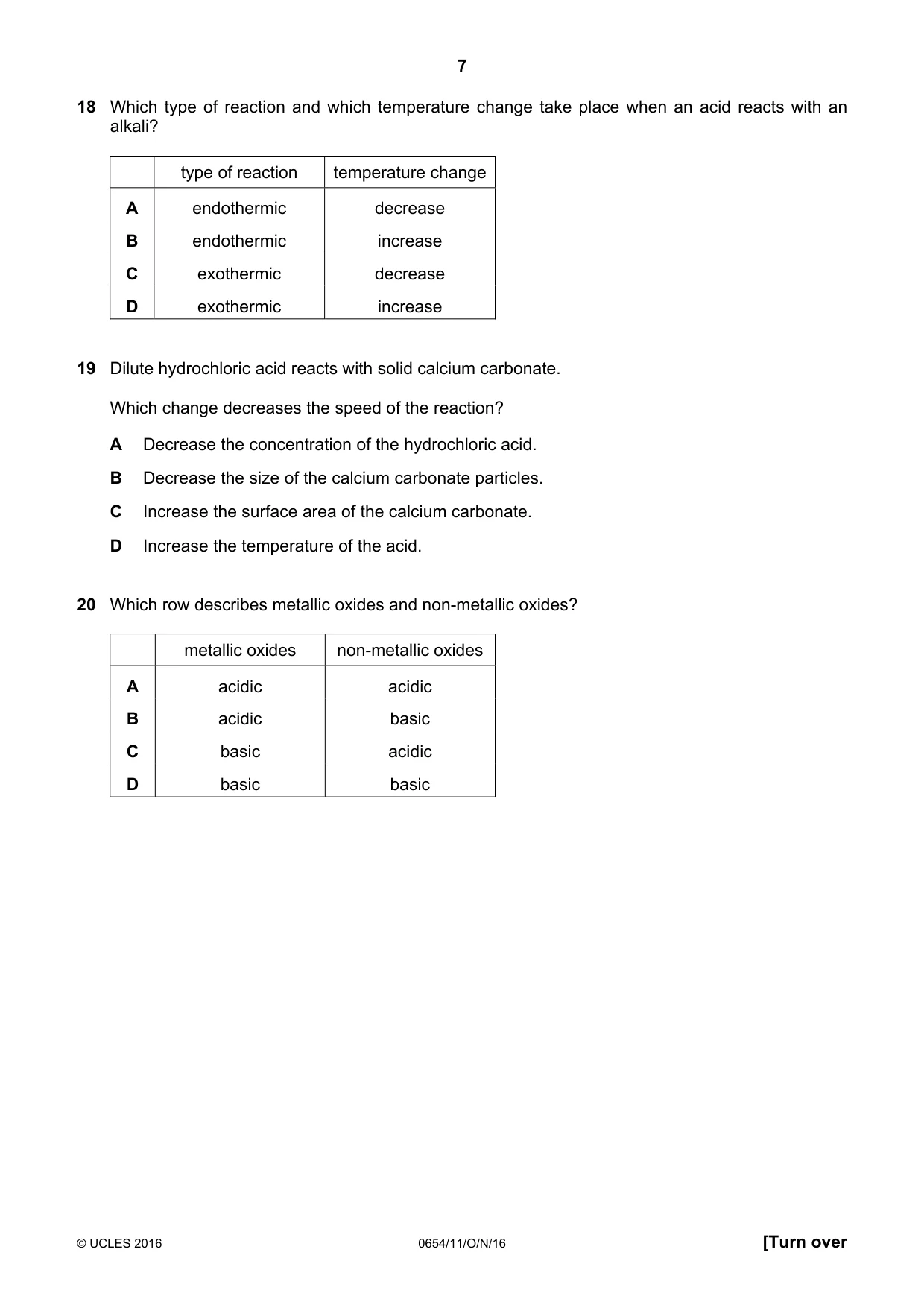
18 Which type of reaction and which temperature change take place when an acid reacts with an alkali? type of reaction temperature change A endothermic decrease B endothermic increase C exothermic decrease D exothermic increase
Mark scheme: D
Q19 · Dilute hydrochloric acid reacts with solid calcium carbonate
19 Dilute hydrochloric acid reacts with solid calcium carbonate. Which change decreases the speed of the reaction? A Decrease the concentration of the hydrochloric acid. B Decrease the size of the calcium carbonate particles. C Increase the surface area of the calcium carbonate. D Increase the temperature of the acid.
Mark scheme: A
Q20 · Which row describes metallic oxides and non-metallic oxides?
20 Which row describes metallic oxides and non-metallic oxides? metallic oxides non-metallic oxides A acidic acidic B acidic basic C basic acidic D basic basic
Mark scheme: C
Q21 · In which experiment does limewater become milky?
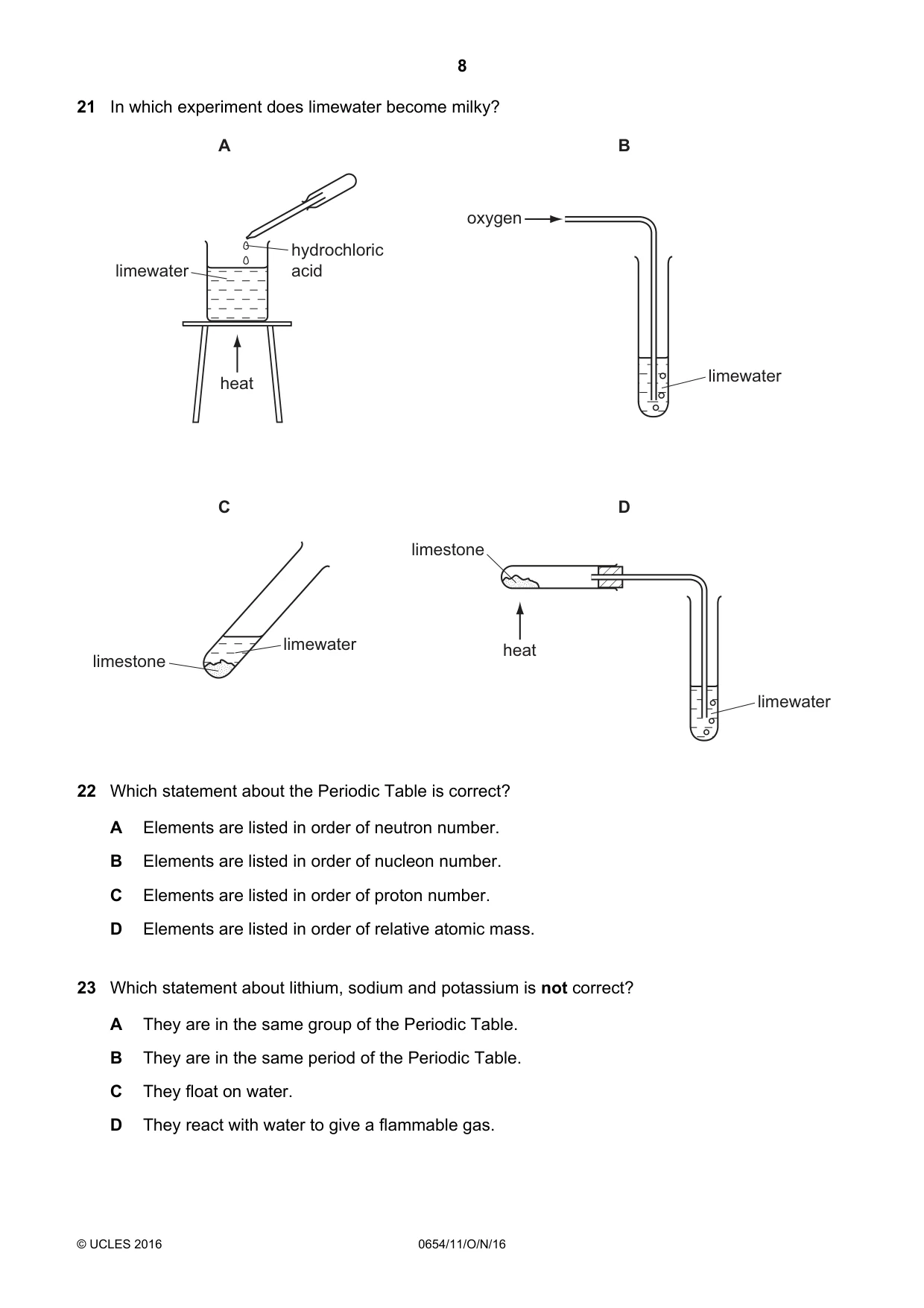
21 In which experiment does limewater become milky? A B oxygen hydrochloric limewater acid heat limewater C D limestone limewater heat limestone limewater
Mark scheme: D
Q22 · Which statement about the Periodic Table is correct?
22 Which statement about the Periodic Table is correct? A Elements are listed in order of neutron number. B Elements are listed in order of nucleon number. C Elements are listed in order of proton number. D Elements are listed in order of relative atomic mass.
Mark scheme: C
Q23 · Which statement about lithium, sodium and potassium is not correct?
23 Which statement about lithium, sodium and potassium is not correct? A They are in the same group of the Periodic Table. B They are in the same period of the Periodic Table. C They float on water. D They react with water to give a flammable gas.
Mark scheme: B
Q24 · Some properties of aluminium are listed
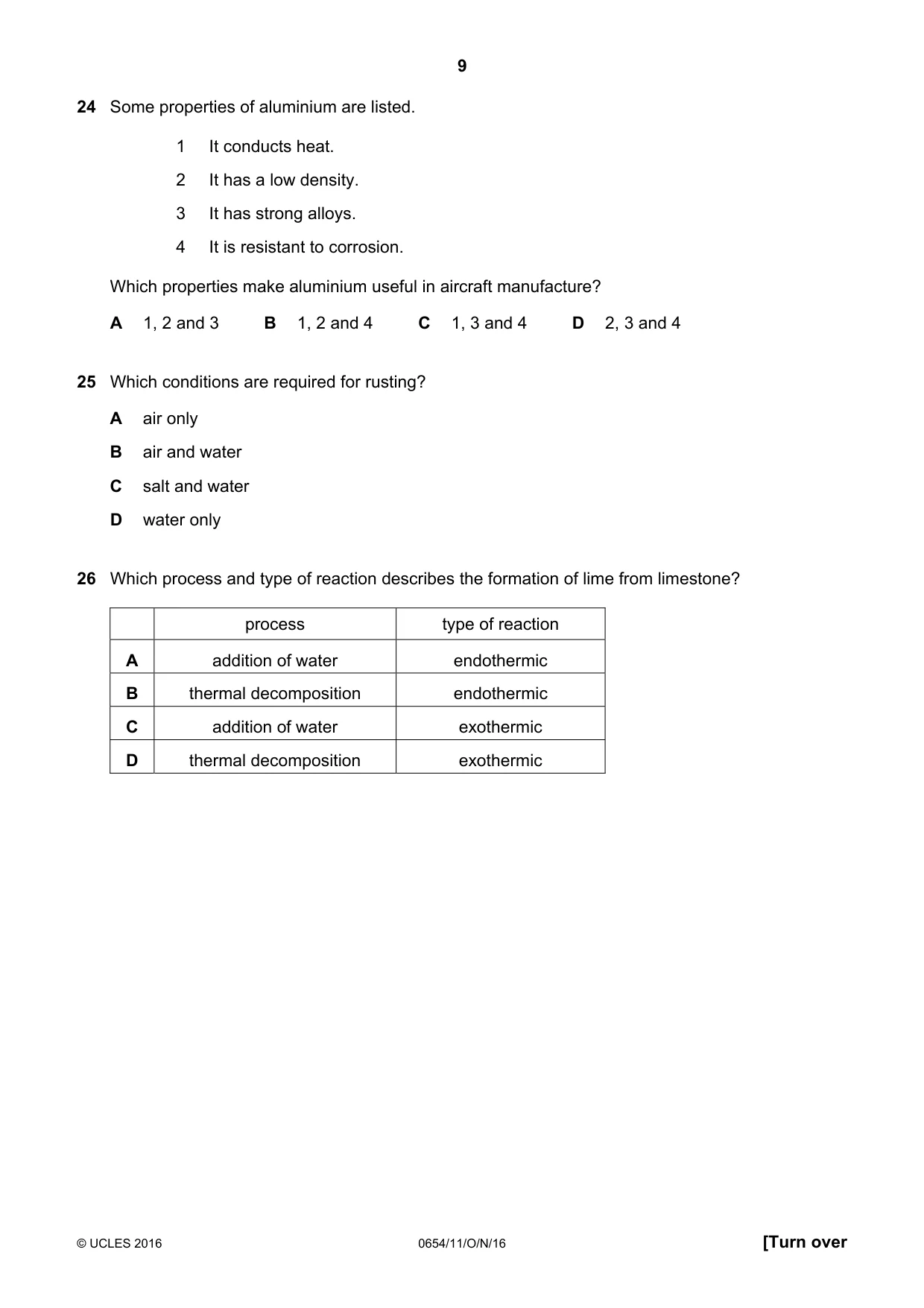
24 Some properties of aluminium are listed. 1 It conducts heat. 2 It has a low density. 3 It has strong alloys. 4 It is resistant to corrosion. Which properties make aluminium useful in aircraft manufacture? A 1, 2 and 3 B 1, 2 and 4 C 1, 3 and 4 D 2, 3 and 4
Mark scheme: D
Q25 · Which conditions are required for rusting?
25 Which conditions are required for rusting? A air only B air and water C salt and water D water only
Mark scheme: B
Q26 · Which process and type of reaction describes the formation of lime from limestone?
26 Which process and type of reaction describes the formation of lime from limestone? process type of reaction A addition of water endothermic B thermal decomposition endothermic C addition of water exothermic D thermal decomposition exothermic
Mark scheme: B
Q27 · Ethene is formed when decane, C10H22, is passed over hot aluminium oxide
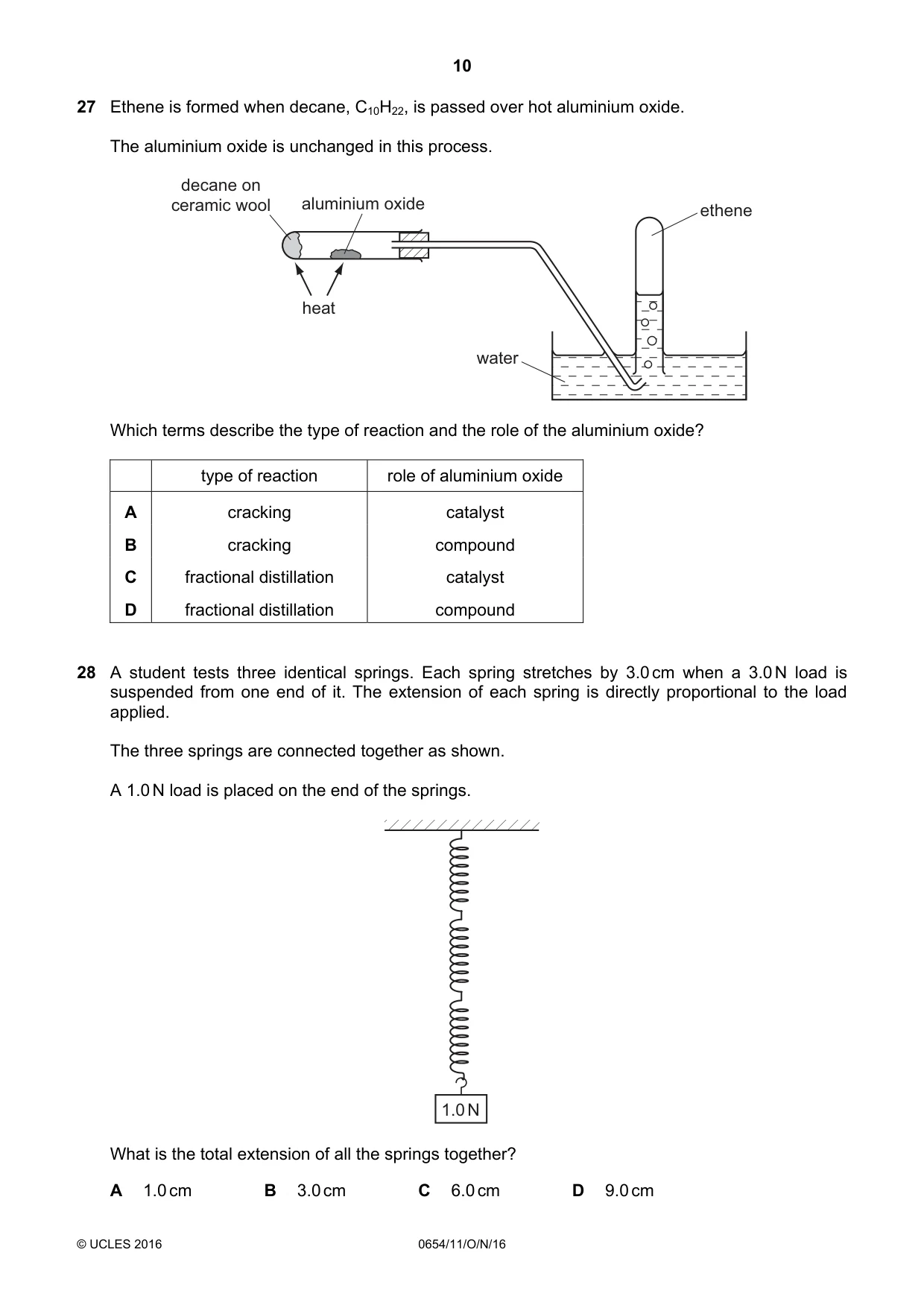
27 Ethene is formed when decane, C10H22, is passed over hot aluminium oxide. The aluminium oxide is unchanged in this process. decane on ceramic wool aluminium oxide ethene heat water Which terms describe the type of reaction and the role of the aluminium oxide? type of reaction role of aluminium oxide A cracking catalyst B cracking compound C fractional distillation catalyst D fractional distillation compound
Mark scheme: A
Q28 · A student tests three identical springs
28 A student tests three identical springs. Each spring stretches by 3.0 cm when a 3.0 N load is suspended from one end of it. The extension of each spring is directly proportional to the load applied. The three springs are connected together as shown. A 1.0 N load is placed on the end of the springs. 1.0 N What is the total extension of all the springs together? A 1.0 cm B 3.0 cm C 6.0 cm D 9.0 cm
Mark scheme: B
Q29 · Which is a unit of power?
29 Which is a unit of power? A kilogram B joule C newton D watt
Mark scheme: D
Q30 · The diagram shows two graphs
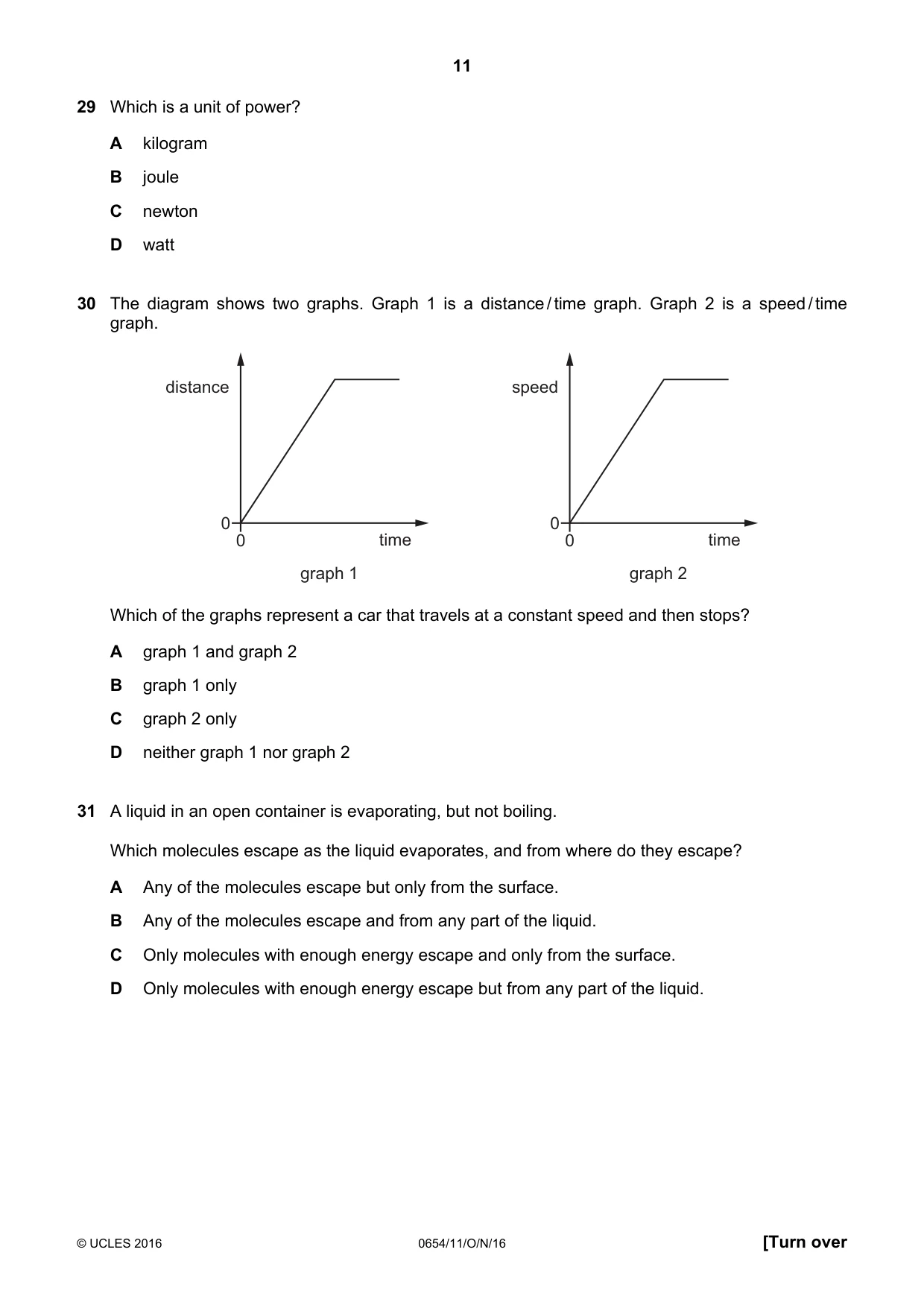
30 The diagram shows two graphs. Graph 1 is a distance / time graph. Graph 2 is a speed / time graph. distance speed 0 0 0 time 0 time graph 1 graph 2 Which of the graphs represent a car that travels at a constant speed and then stops? A graph 1 and graph 2 B graph 1 only C graph 2 only D neither graph 1 nor graph 2
Mark scheme: B
Q31 · A liquid in an open container is evaporating, but not boiling
31 A liquid in an open container is evaporating, but not boiling. Which molecules escape as the liquid evaporates, and from where do they escape? A Any of the molecules escape but only from the surface. B Any of the molecules escape and from any part of the liquid. C Only molecules with enough energy escape and only from the surface. D Only molecules with enough energy escape but from any part of the liquid.
Mark scheme: C
Q32 · Thermal energy is supplied to a gas at constant pressure
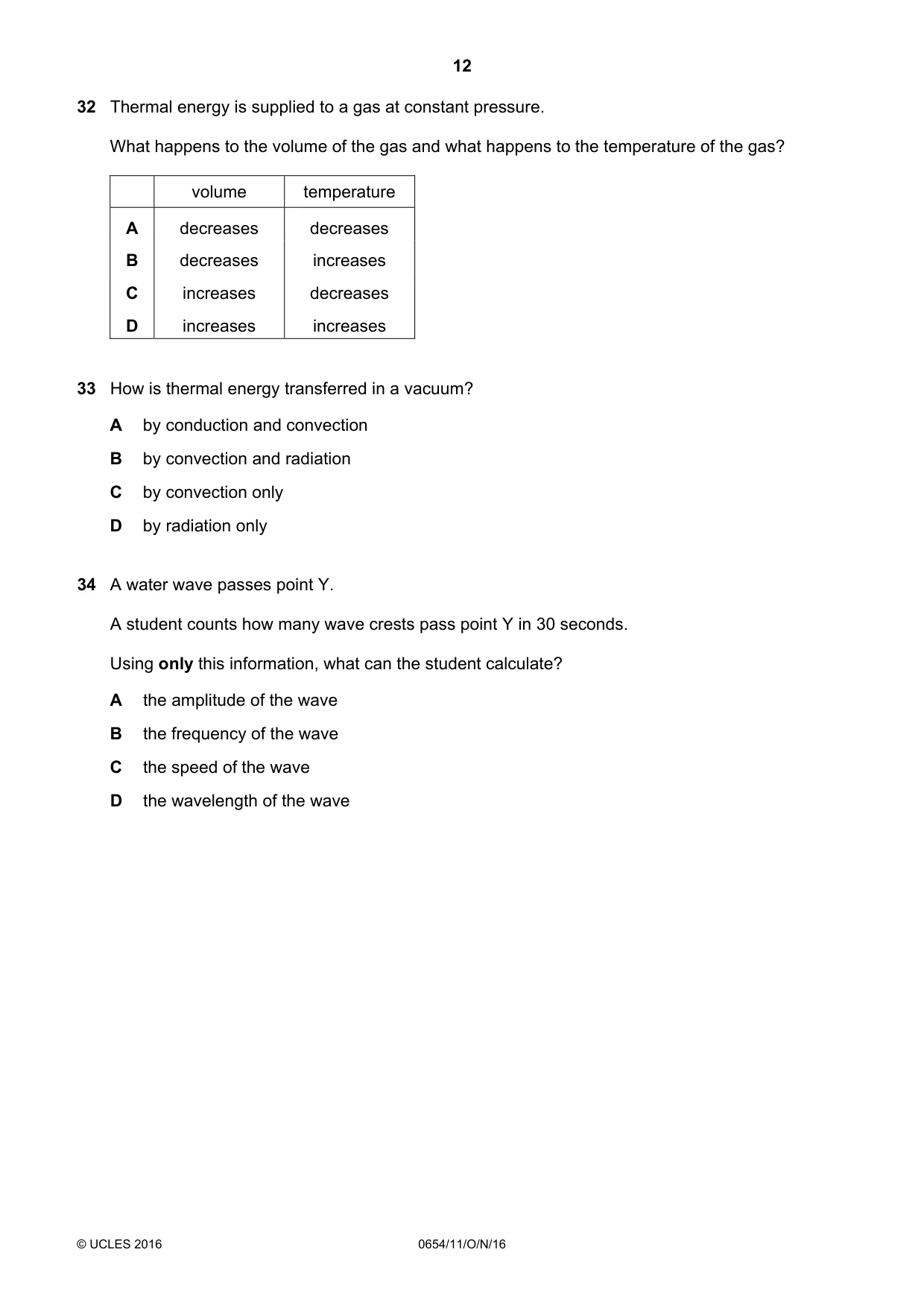
32 Thermal energy is supplied to a gas at constant pressure. What happens to the volume of the gas and what happens to the temperature of the gas? volume temperature A decreases decreases B decreases increases C increases decreases D increases increases
Mark scheme: D
Q33 · How is thermal energy transferred in a vacuum?
33 How is thermal energy transferred in a vacuum? A by conduction and convection B by convection and radiation C by convection only D by radiation only
Mark scheme: D
Q34 · A water wave passes point Y
34 A water wave passes point Y. A student counts how many wave crests pass point Y in 30 seconds. Using only this information, what can the student calculate? A the amplitude of the wave B the frequency of the wave C the speed of the wave D the wavelength of the wave
Mark scheme: B
Q35 · The diagram shows a ray of light travelling in water towards air above the water
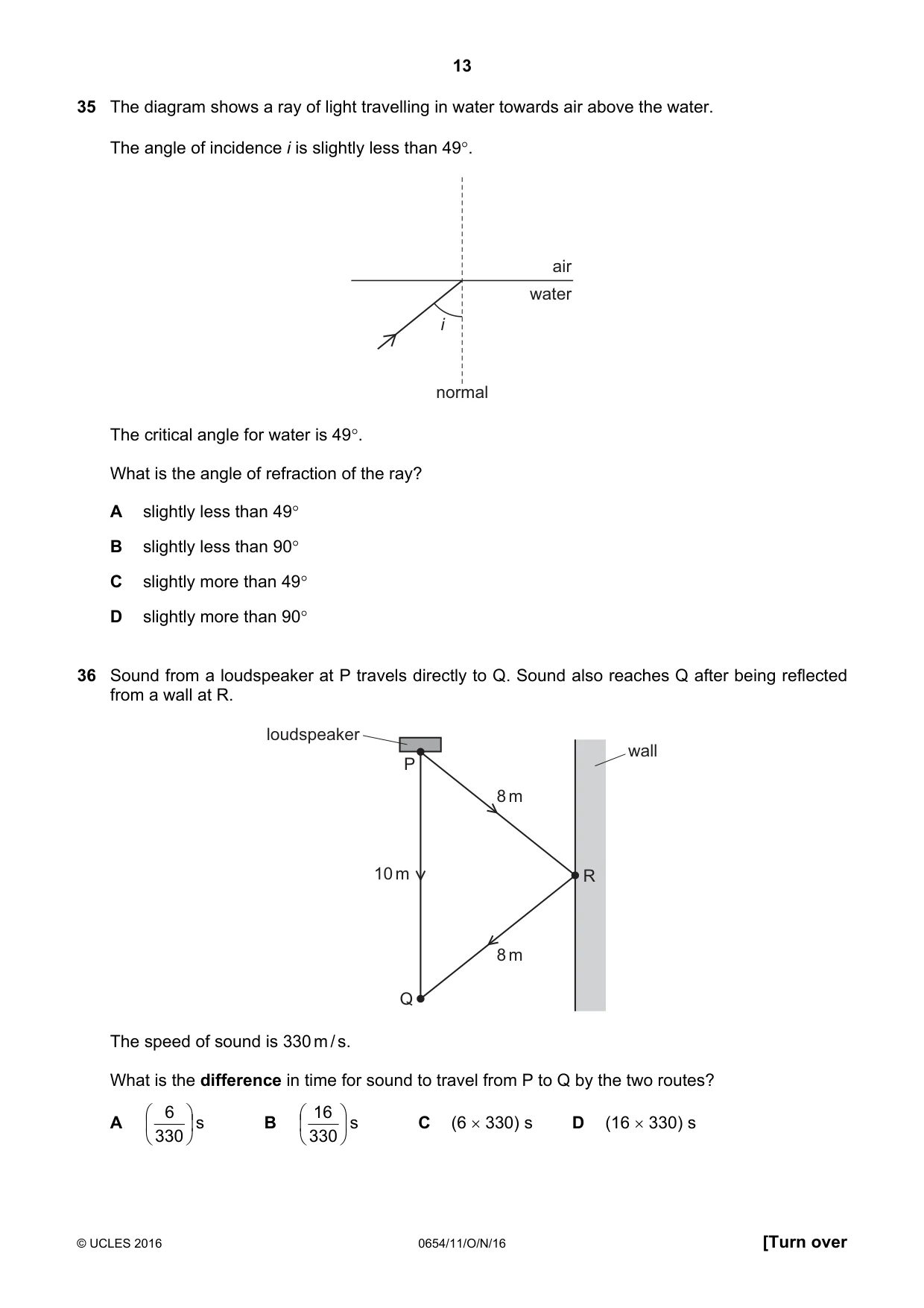
35 The diagram shows a ray of light travelling in water towards air above the water. The angle of incidence i is slightly less than 49°. air water i normal The critical angle for water is 49°. What is the angle of refraction of the ray? A slightly less than 49° B slightly less than 90° C slightly more than 49° D slightly more than 90°
Mark scheme: B
Q36 · Sound from a loudspeaker at P travels directly to Q
36 Sound from a loudspeaker at P travels directly to Q. Sound also reaches Q after being reflected from a wall at R. loudspeaker wall P 8 m 10 m R 8 m Q The speed of sound is 330 m / s. What is the difference in time for sound to travel from P to Q by the two routes? 6 16 A s B s C (6 × 330) s D (16 × 330) s 330 330
Mark scheme: A
Q37 · The diagram shows a 3.0 V battery connected to a 6.0 Ω resistor and an ammeter
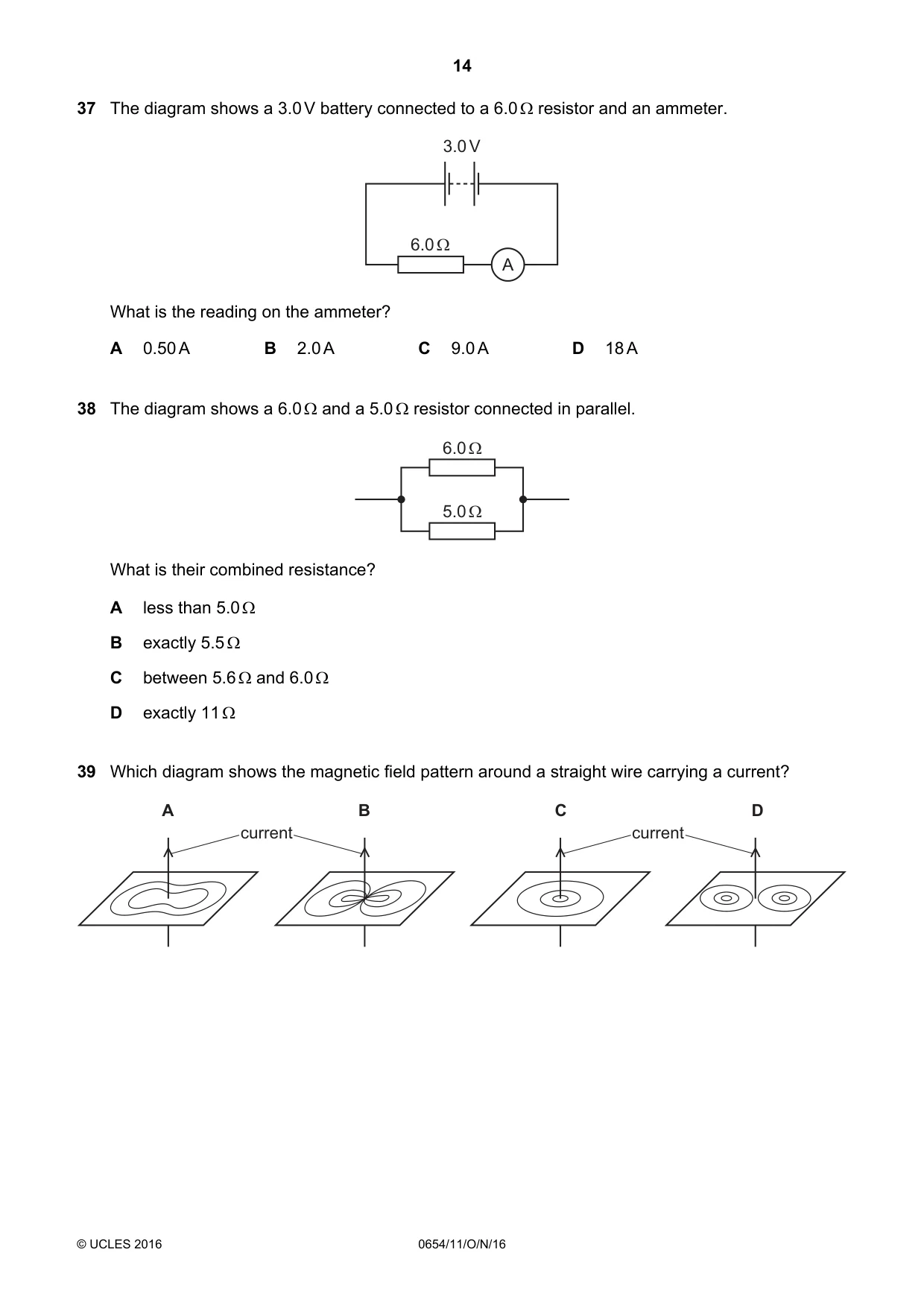
37 The diagram shows a 3.0 V battery connected to a 6.0 Ω resistor and an ammeter. 3.0 V 6.0 Ω A What is the reading on the ammeter? A 0.50 A B 2.0 A C 9.0 A D 18 A
Mark scheme: A
Q38 · The diagram shows a 6.0 Ω and a 5.0 Ω resistor connected in parallel
38 The diagram shows a 6.0 Ω and a 5.0 Ω resistor connected in parallel. 6.0 Ω 5.0 Ω What is their combined resistance? A less than 5.0 Ω B exactly 5.5 Ω C between 5.6 Ω and 6.0 Ω D exactly 11 Ω
Mark scheme: A
Q39 · Which diagram shows the magnetic field pattern around a straight wire carrying a current?
39 Which diagram shows the magnetic field pattern around a straight wire carrying a current? A B C D current current
Mark scheme: C
Q40 · The diagrams represent the nuclei of four different atoms V, W, X and Y
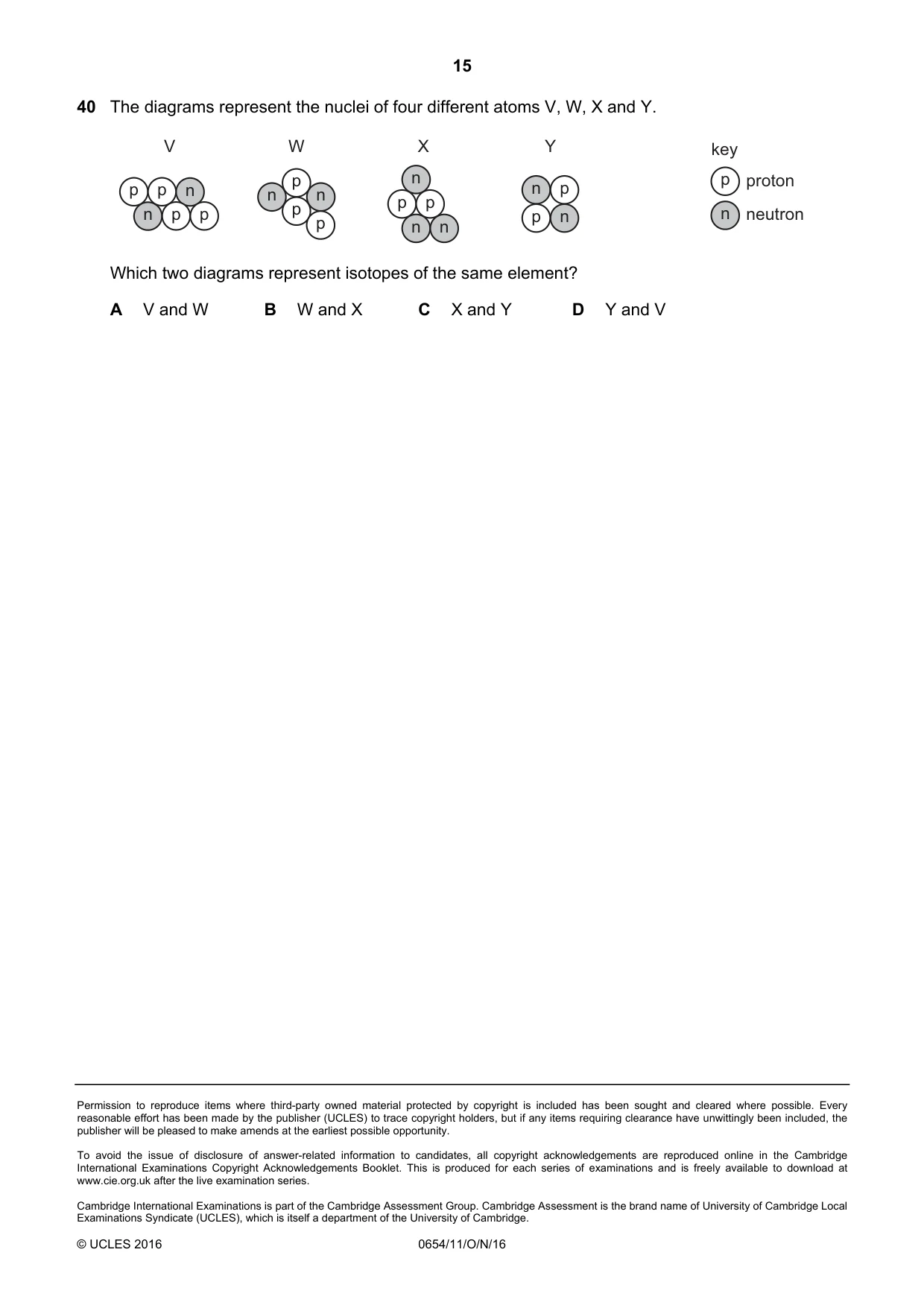
40 The diagrams represent the nuclei of four different atoms V, W, X and Y. V W X Y key p n p proton p p n n n n p p p p n p p p n n neutron p n n Which two diagrams represent isotopes of the same element? A V and W B W and X C X and Y D Y and V
Mark scheme: C
What was in this paper
The subtopics covered by these 40 questions, and how many questions each got. Open one in a new tab to see every Cambridge question on it.
3Exothermic and endothermic reactions2Gas exchange in humans2Kinetic particle model of matter2Asexual reproduction1Atomic structure and the Periodic Table1Biological molecules1Characteristics of living organisms1Coordination and response1Corrosion of metals1Digestive system1Electrical circuits1Electrical quantities1Electrolysis1Energy flow1Energy, work and power1Enzymes1Forces1Fuels1General properties of waves1Group I properties1Heart1Hormones1Identification of ions and gases1Isotopes1Light1Motion1Oxides1Rate of reaction1Sexual reproduction in humans1Simple phenomena of magnetism1Sound1Transfer of thermal energy1Transpiration1Uses of metals1What you needed in this session
Cambridge’s own grade thresholds for 2016 Oct/Nov, Paper 1 · Variant 1. A higher threshold means an easier paper — the bar moves with how the cohort did.