Cambridge IGCSE Sciences - Co-ordinated (Double) 0654 — 2016 May/June Paper 1 · Variant 2
0654/12/M/J/16 · 40 questions · 40 marks · ≈45 min
The question paper and its mark scheme, free to read here and free to download. This is Cambridge’s own paper, exactly as it was sat.
Question paper20 pages


Mark scheme2 pages
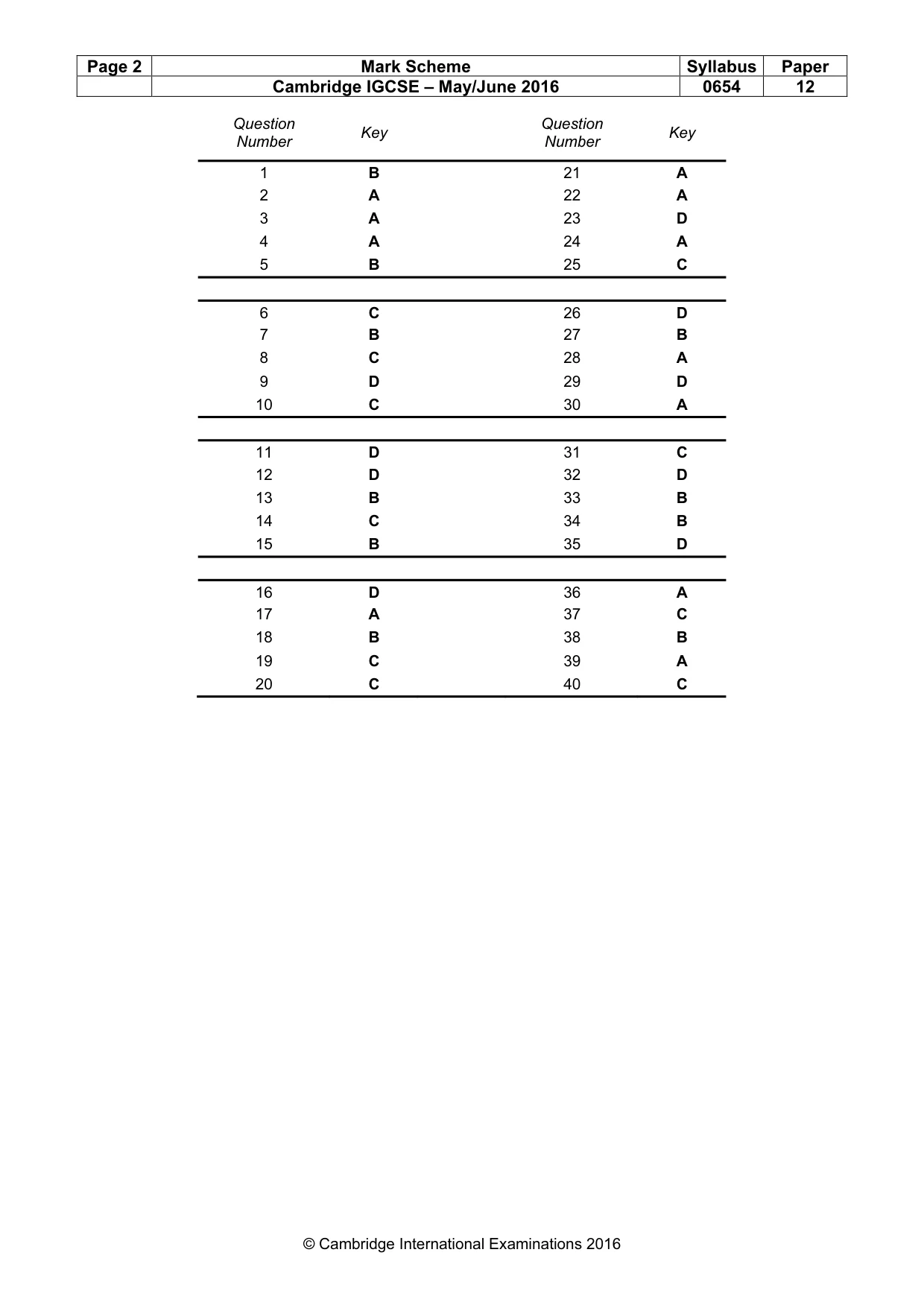
Answers below. Sit the paper first if you are practising.
Questions as text
Q1 · All living organisms are capable of A asexual reproduction
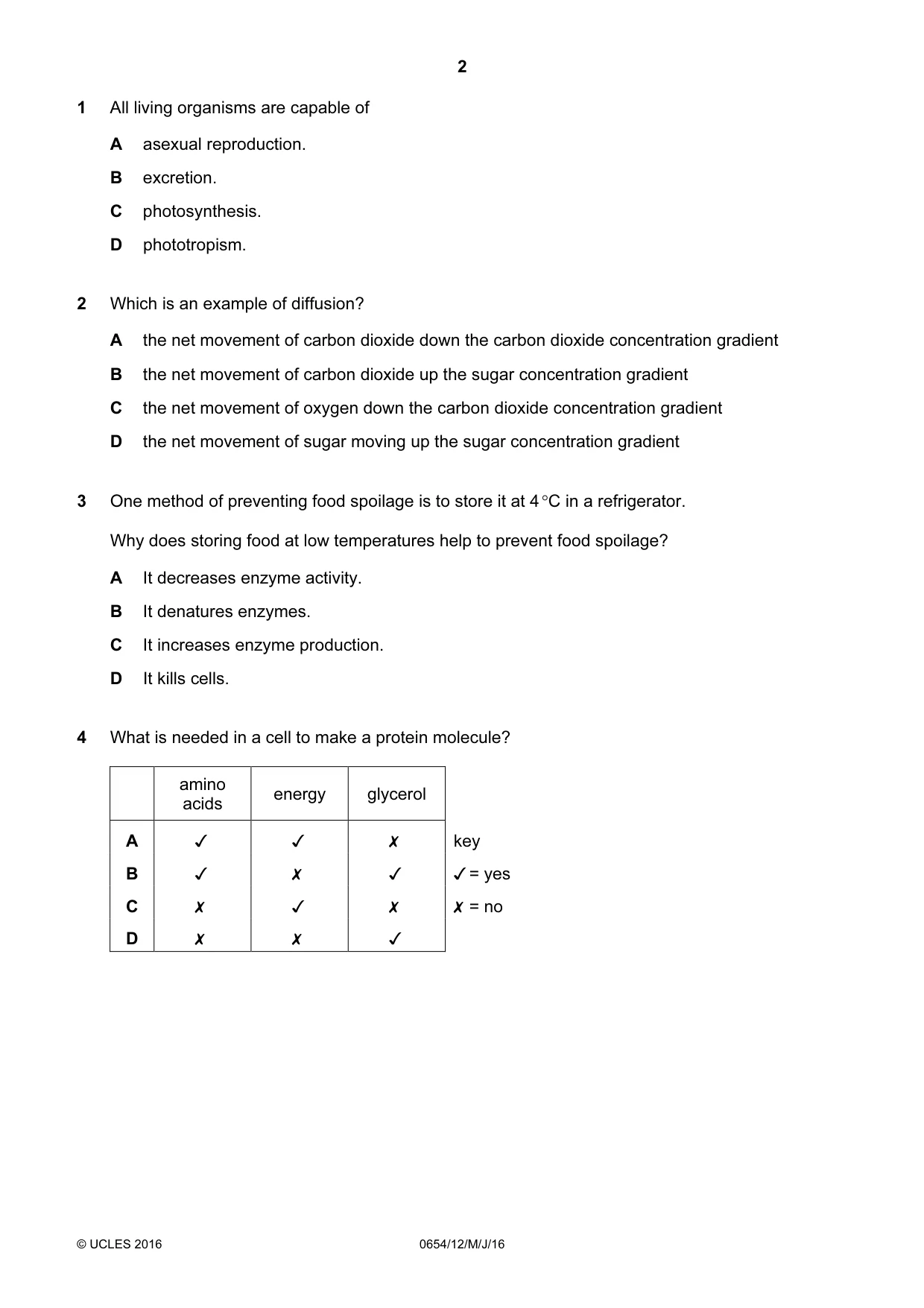
1 All living organisms are capable of A asexual reproduction. B excretion. C photosynthesis. D phototropism.
Mark scheme: B
Q2 · Which is an example of diffusion?
2 Which is an example of diffusion? A the net movement of carbon dioxide down the carbon dioxide concentration gradient B the net movement of carbon dioxide up the sugar concentration gradient C the net movement of oxygen down the carbon dioxide concentration gradient D the net movement of sugar moving up the sugar concentration gradient
Mark scheme: A
Q3 · One method of preventing food spoilage is to store it at 4 °C in a refrigerator
3 One method of preventing food spoilage is to store it at 4 °C in a refrigerator. Why does storing food at low temperatures help to prevent food spoilage? A It decreases enzyme activity. B It denatures enzymes. C It increases enzyme production. D It kills cells.
Mark scheme: A
Q4 · What is needed in a cell to make a protein molecule?
4 What is needed in a cell to make a protein molecule? amino energy glycerol A v v x B v x v Cc x v x D x x v key v=yes X =no
Mark scheme: A
Q5 · The diagram shows a tooth with a cavity caused by decay
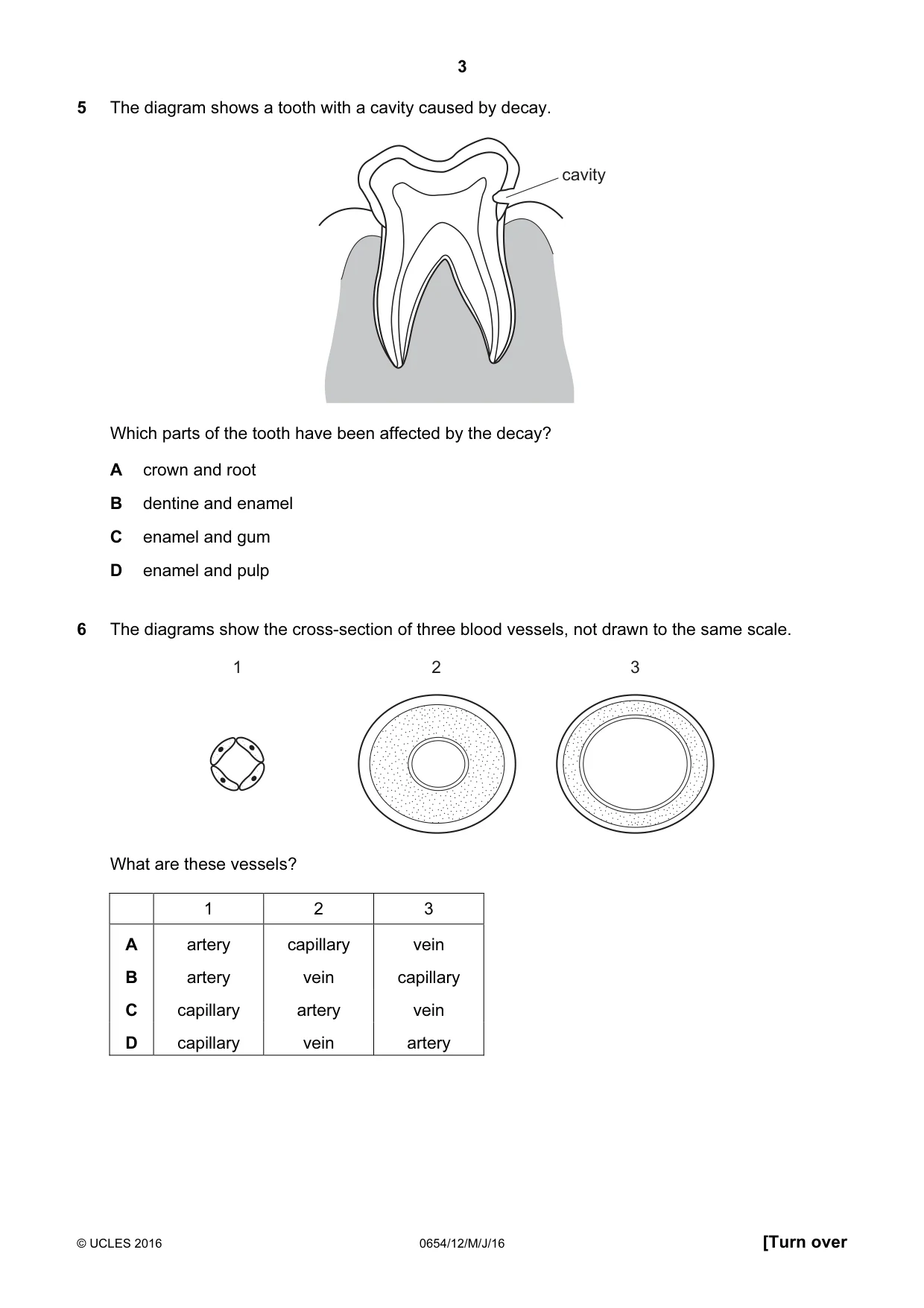
5 The diagram shows a tooth with a cavity caused by decay. cavity Which parts of the tooth have been affected by the decay? A crown and root B dentine and enamel C enamel and gum D enamel and pulp
Mark scheme: B
Q6 · The diagrams show the cross-section of three blood vessels, not drawn to the same scale
6 The diagrams show the cross-section of three blood vessels, not drawn to the same scale. 1 2 3 What are these vessels? 1 2 3 A artery capillary vein B artery vein capillary C capillary artery vein D capillary vein artery
Mark scheme: C
Q7 · Which conditions would cause the fastest rate of transpiration in a plant?
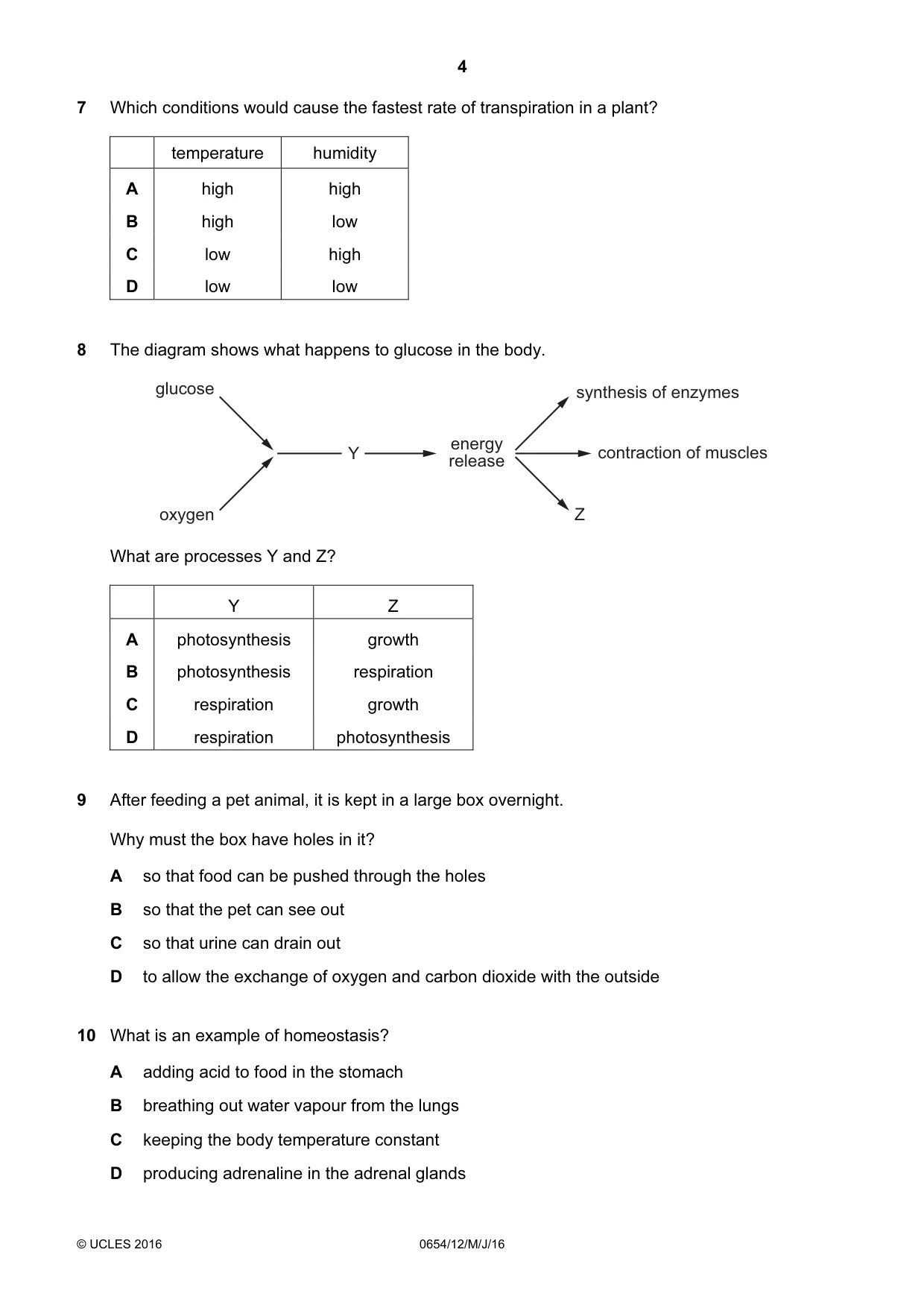
7 Which conditions would cause the fastest rate of transpiration in a plant? temperature humidity A high high B high low C low high D low low
Mark scheme: B
Q8 · The diagram shows what happens to glucose in the body
8 The diagram shows what happens to glucose in the body. glucose synthesis of enzymes energy Y contraction of muscles release oxygen Z What are processes Y and Z? Y Z A photosynthesis growth B photosynthesis respiration C respiration growth D respiration photosynthesis
Mark scheme: C
Q9 · After feeding a pet animal, it is kept in a large box overnight
9 After feeding a pet animal, it is kept in a large box overnight. Why must the box have holes in it? A so that food can be pushed through the holes B so that the pet can see out C so that urine can drain out D to allow the exchange of oxygen and carbon dioxide with the outside
Mark scheme: D
Q10 · What is an example of homeostasis?
10 What is an example of homeostasis? A adding acid to food in the stomach B breathing out water vapour from the lungs C keeping the body temperature constant D producing adrenaline in the adrenal glands
Mark scheme: C
Q11 · A student placed four sets of seeds in different conditions
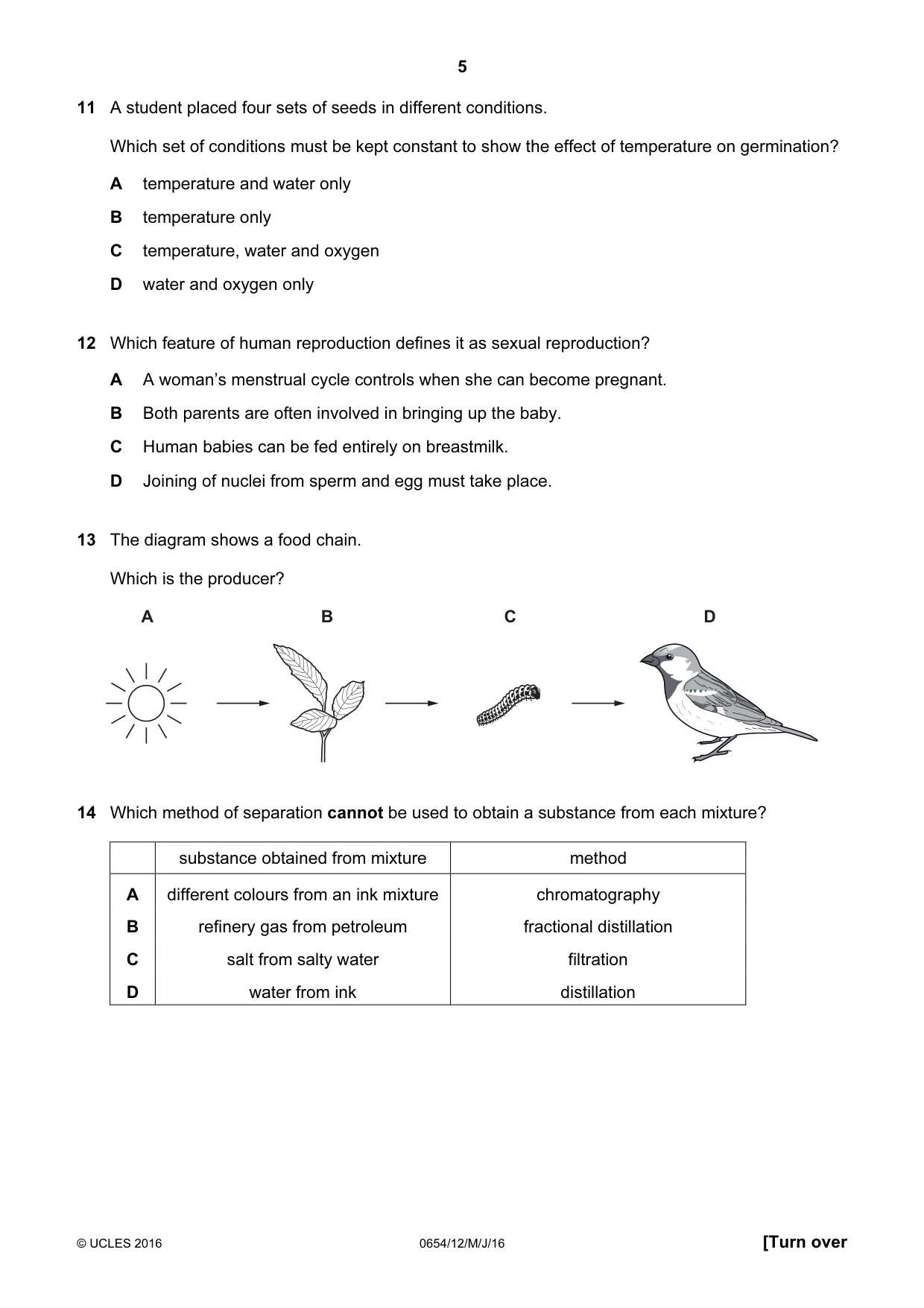
11 A student placed four sets of seeds in different conditions. Which set of conditions must be kept constant to show the effect of temperature on germination? A temperature and water only B temperature only C temperature, water and oxygen D water and oxygen only
Mark scheme: D
Q12 · Which feature of human reproduction defines it as sexual reproduction?
12 Which feature of human reproduction defines it as sexual reproduction? A A woman’s menstrual cycle controls when she can become pregnant. B Both parents are often involved in bringing up the baby. C Human babies can be fed entirely on breastmilk. D Joining of nuclei from sperm and egg must take place.
Mark scheme: D
Q13 · The diagram shows a food chain
13 The diagram shows a food chain. Which is the producer? A B C D
Mark scheme: B
Q14 · Which method of separation cannot be used to obtain a substance from each mixture?
14 Which method of separation cannot be used to obtain a substance from each mixture? substance obtained from mixture method A different colours from an ink mixture chromatography B refinery gas from petroleum fractional distillation C salt from salty water filtration D water from ink distillation
Mark scheme: C
Q15 · Two different substances, X and Y, are heated and then cooled
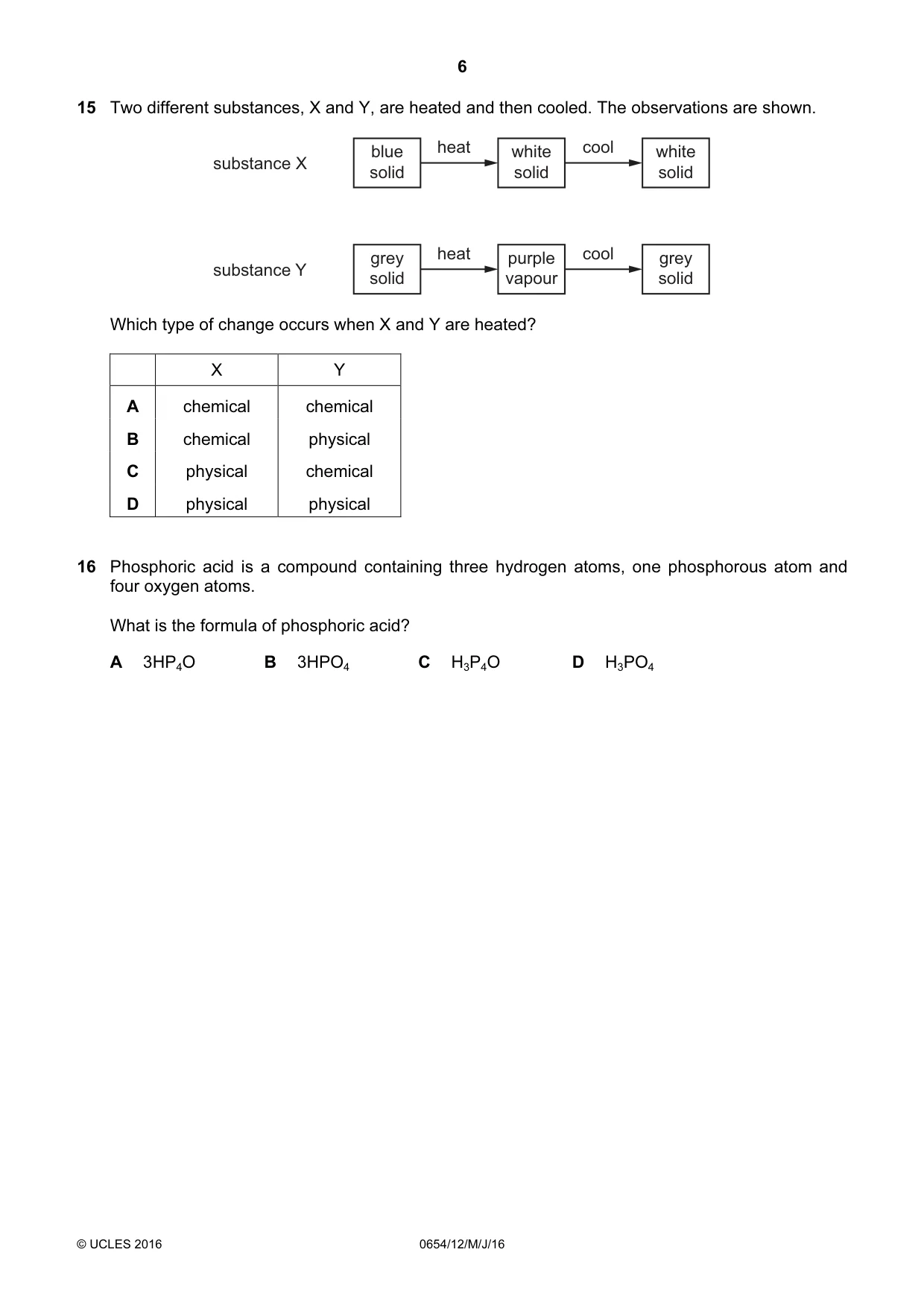
15 Two different substances, X and Y, are heated and then cooled. The observations are shown. blue heat white cool white substance X solid solid solid grey heat purple cool grey substance Y solid vapour solid Which type of change occurs when X and Y are heated? X Y A chemical chemical B chemical physical C physical chemical D physical physical
Mark scheme: B
Q16 · Phosphoric acid is a compound containing three hydrogen atoms, one phosphorous atom and…
16 Phosphoric acid is a compound containing three hydrogen atoms, one phosphorous atom and four oxygen atoms. What is the formula of phosphoric acid? A 3HP4O B 3HPO4 C H3P4O D H3PO4
Mark scheme: D
Q17 · The diagram shows the electrolysis of a compound
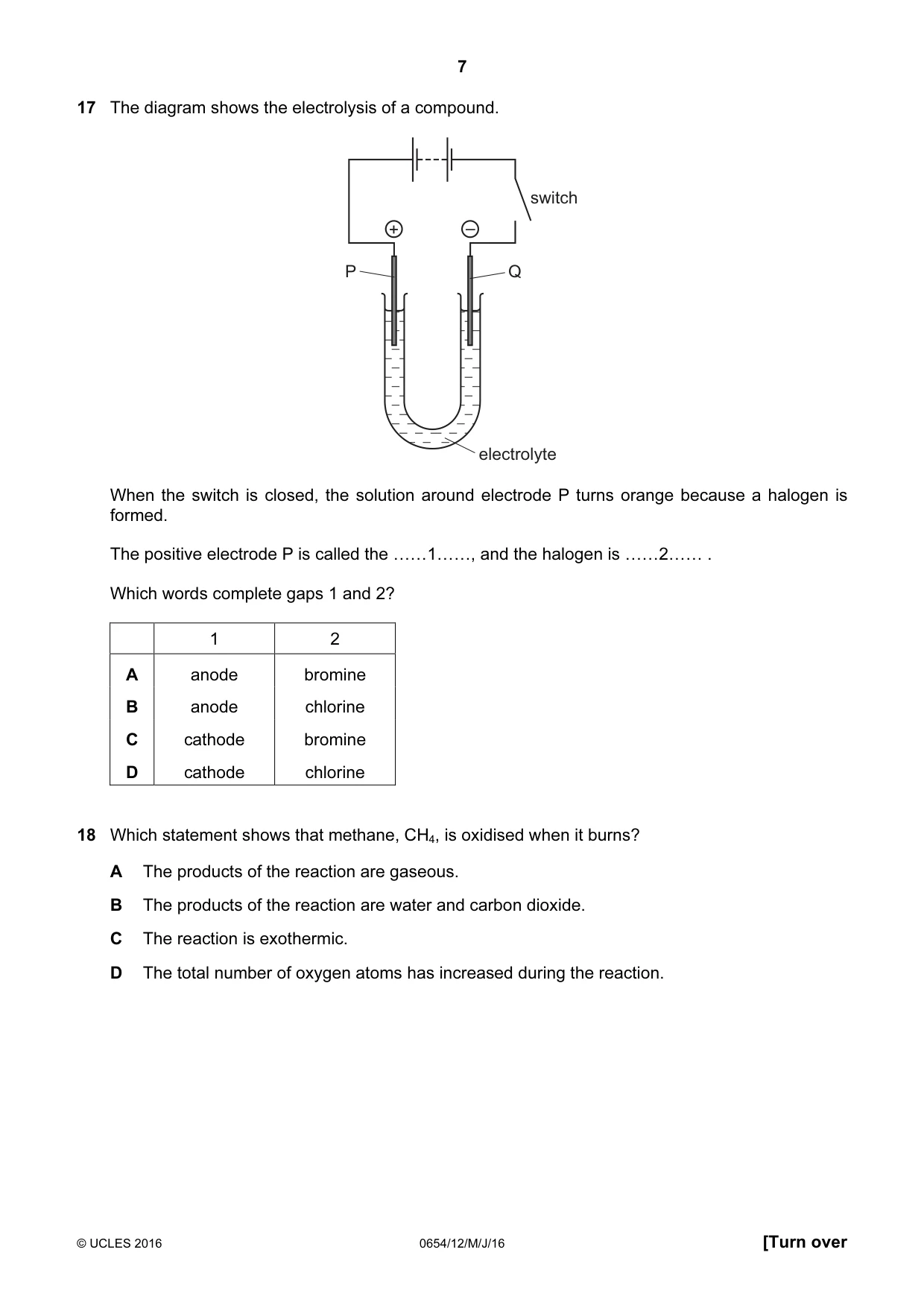
17 The diagram shows the electrolysis of a compound. switch + – P Q electrolyte When the switch is closed, the solution around electrode P turns orange because a halogen is formed. The positive electrode P is called the ……1……, and the halogen is ……2…… . Which words complete gaps 1 and 2? 1 2 A anode bromine B anode chlorine C cathode bromine D cathode chlorine
Mark scheme: A
Q18 · Which statement shows that methane, CH4, is oxidised when it burns?
18 Which statement shows that methane, CH4, is oxidised when it burns? A The products of the reaction are gaseous. B The products of the reaction are water and carbon dioxide. C The reaction is exothermic. D The total number of oxygen atoms has increased during the reaction.
Mark scheme: B
Q19 · Dilute hydrochloric acid is added to each of the test-tubes shown
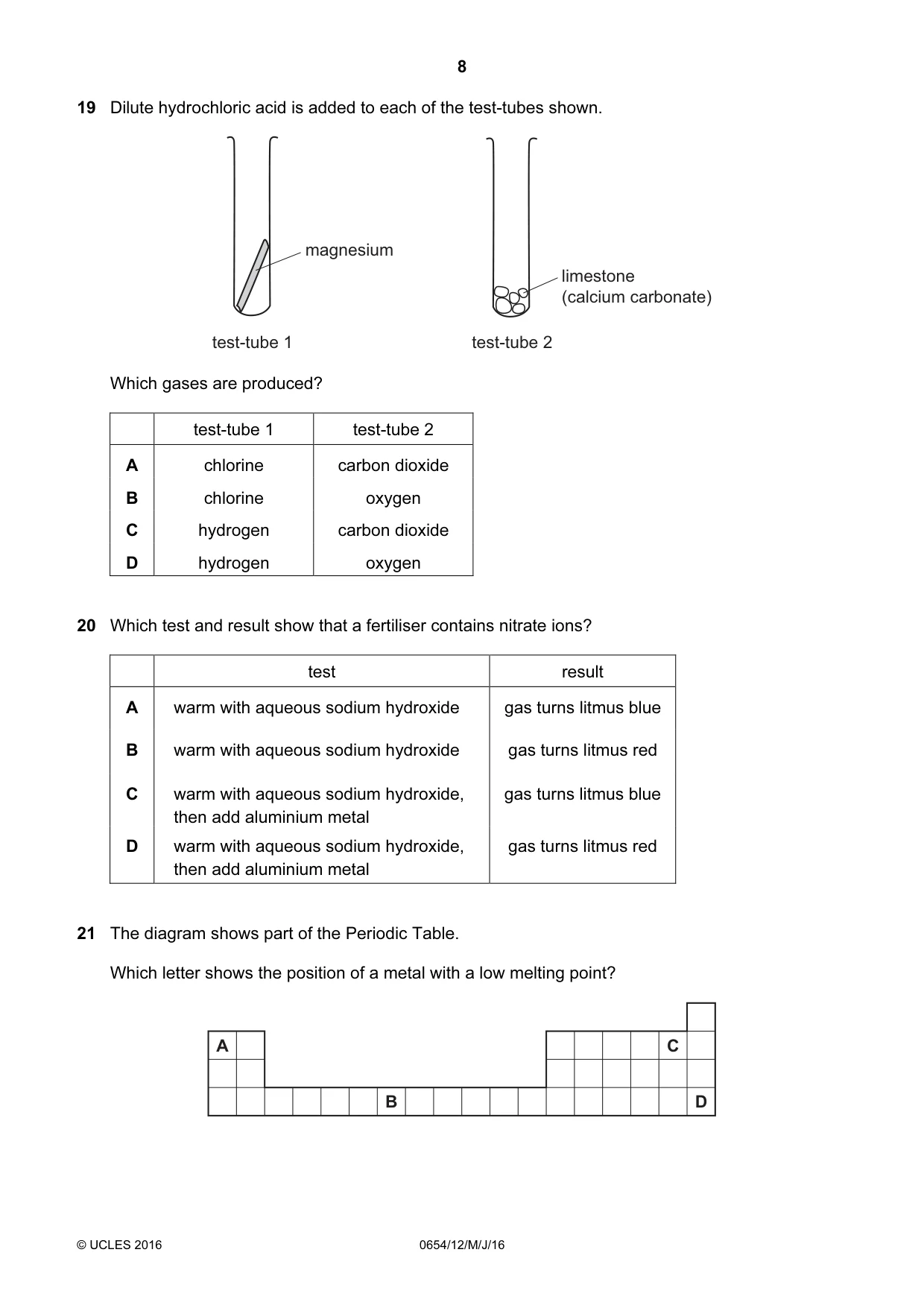
19 Dilute hydrochloric acid is added to each of the test-tubes shown. magnesium limestone (calcium carbonate) test-tube 1 test-tube 2 Which gases are produced? test-tube 1 test-tube 2 A chlorine carbon dioxide B chlorine oxygen C hydrogen carbon dioxide D hydrogen oxygen
Mark scheme: C
Q20 · Which test and result show that a fertiliser contains nitrate ions?
20 Which test and result show that a fertiliser contains nitrate ions? test result A warm with aqueous sodium hydroxide gas turns litmus blue B warm with aqueous sodium hydroxide gas turns litmus red C warm with aqueous sodium hydroxide, gas turns litmus blue then add aluminium metal D warm with aqueous sodium hydroxide, gas turns litmus red then add aluminium metal
Mark scheme: C
Q21 · The diagram shows part of the Periodic Table
21 The diagram shows part of the Periodic Table. Which letter shows the position of a metal with a low melting point? A C B D
Mark scheme: A
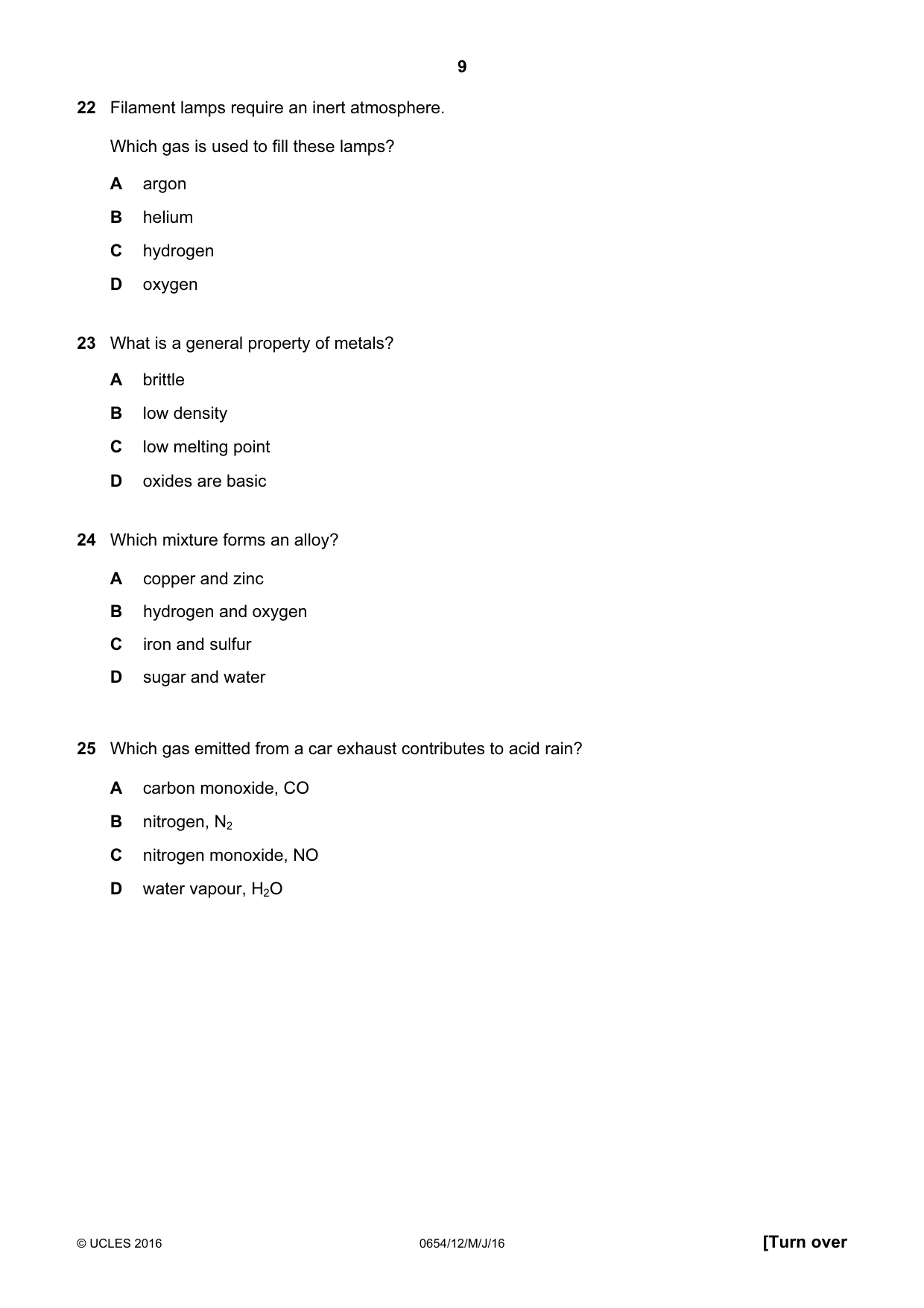
Q22 · Filament lamps require an inert atmosphere
22 Filament lamps require an inert atmosphere. Which gas is used to fill these lamps? A argon B helium C hydrogen D oxygen
Mark scheme: A
Q23 · What is a general property of metals?
23 What is a general property of metals? A brittle B low density C low melting point D oxides are basic
Mark scheme: D
Q24 · Which mixture forms an alloy?
24 Which mixture forms an alloy? A copper and zinc B hydrogen and oxygen C iron and sulfur D sugar and water
Mark scheme: A
Q25 · Which gas emitted from a car exhaust contributes to acid rain?
25 Which gas emitted from a car exhaust contributes to acid rain? A carbon monoxide, CO B nitrogen, N2 C nitrogen monoxide, NO D water vapour, H2O
Mark scheme: C
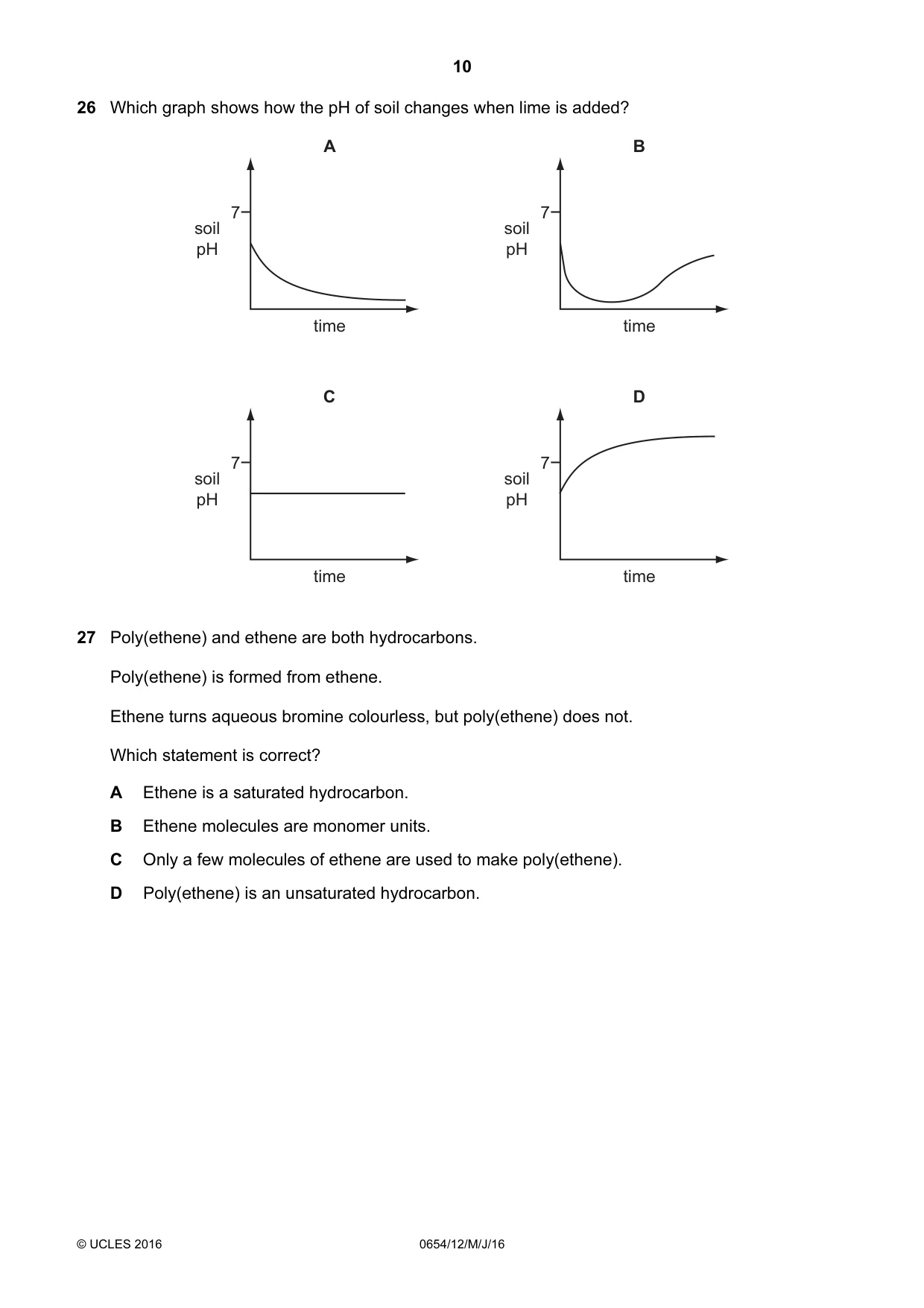
Q26 · Which graph shows how the pH of soil changes when lime is added?
26 Which graph shows how the pH of soil changes when lime is added? A B 7 7 soil soil pH pH time time C D 7 7 soil soil pH pH time time
Mark scheme: D
More questions on The characteristic properties of acids and bases
Q27 · Poly(ethene) and ethene are both hydrocarbons
27 Poly(ethene) and ethene are both hydrocarbons. Poly(ethene) is formed from ethene. Ethene turns aqueous bromine colourless, but poly(ethene) does not. Which statement is correct? A Ethene is a saturated hydrocarbon. B Ethene molecules are monomer units. C Only a few molecules of ethene are used to make poly(ethene). D Poly(ethene) is an unsaturated hydrocarbon.
Mark scheme: B
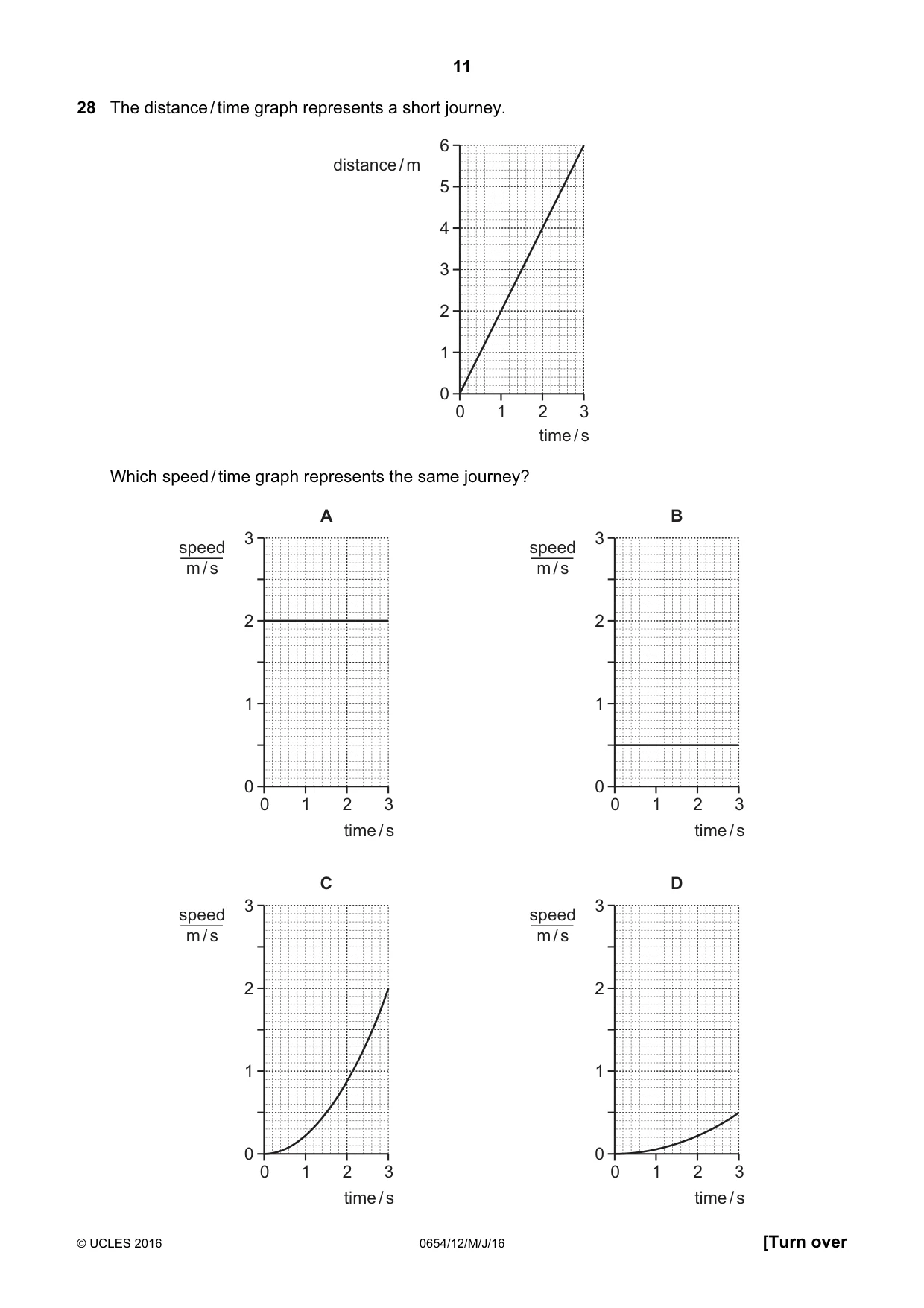
Q28 · The distance / time graph represents a short journey
28 The distance / time graph represents a short journey. 6 distance / m 5 4 3 2 1 0 0 1 2 3 time / s Which speed / time graph represents the same journey? A B 3 3 speed speed m / s m / s 2 2 1 1 0 0 0 1 2 3 0 1 2 3 time / s time / s C D 3 3 speed speed m / s m / s 2 2 1 1 0 0 0 1 2 3 0 1 2 3 time / s time / s
Mark scheme: A
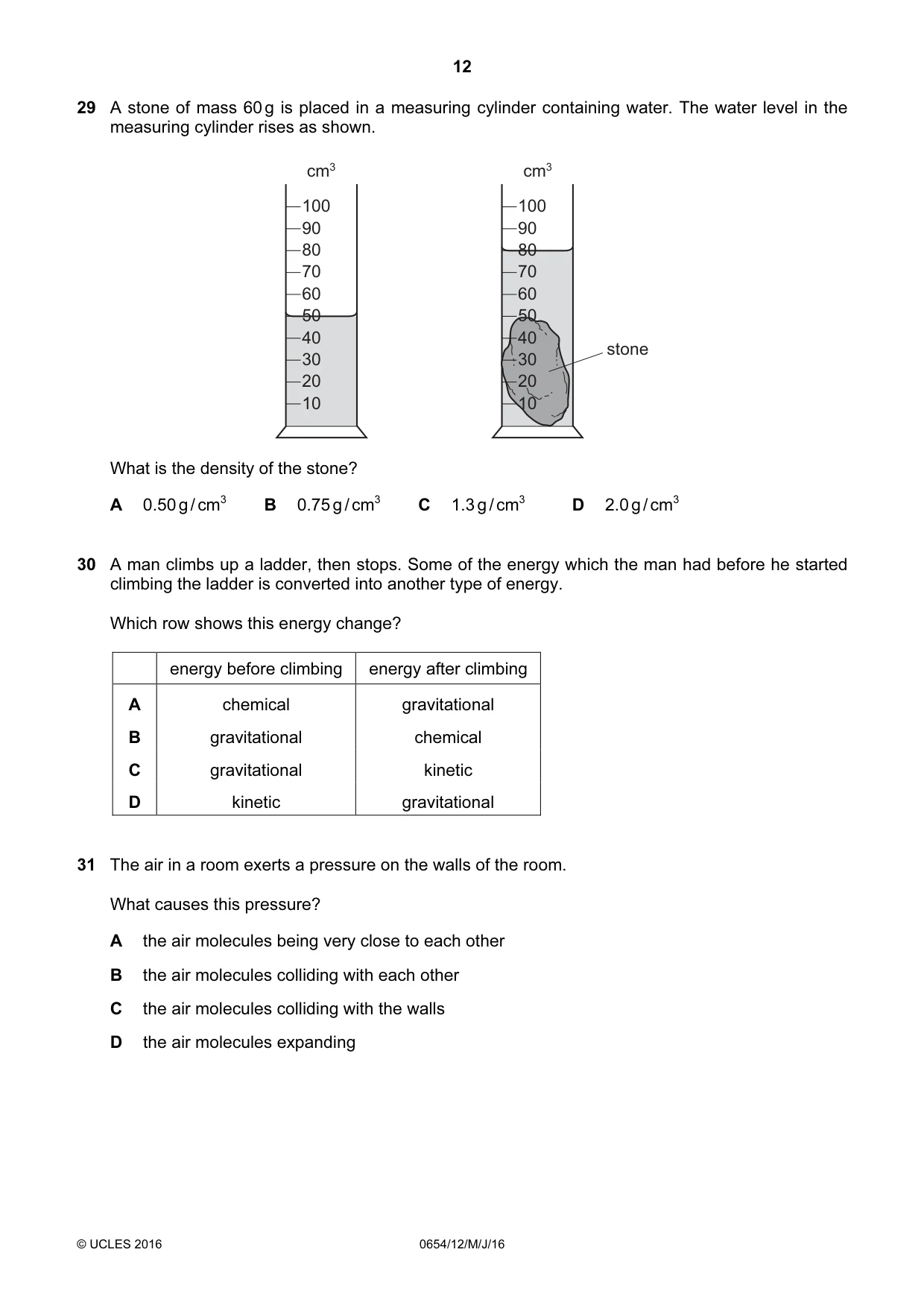
Q29 · A stone of mass 60 g is placed in a measuring cylinder containing water
29 A stone of mass 60 g is placed in a measuring cylinder containing water. The water level in the measuring cylinder rises as shown. cm3 cm3 100 100 90 90 80 80 70 70 60 60 50 50 40 40 stone 30 30 20 20 10 10 What is the density of the stone? A 0.50 g / cm3 B 0.75 g / cm3 C 1.3 g / cm3 D 2.0 g / cm3
Mark scheme: D
Q30 · A man climbs up a ladder, then stops
30 A man climbs up a ladder, then stops. Some of the energy which the man had before he started climbing the ladder is converted into another type of energy. Which row shows this energy change? energy before climbing energy after climbing A chemical gravitational B gravitational chemical C gravitational kinetic D kinetic gravitational
Mark scheme: A
Q31 · The air in a room exerts a pressure on the walls of the room
31 The air in a room exerts a pressure on the walls of the room. What causes this pressure? A the air molecules being very close to each other B the air molecules colliding with each other C the air molecules colliding with the walls D the air molecules expanding
Mark scheme: C
Q32 · A substance is a gas when its temperature is 65 °C
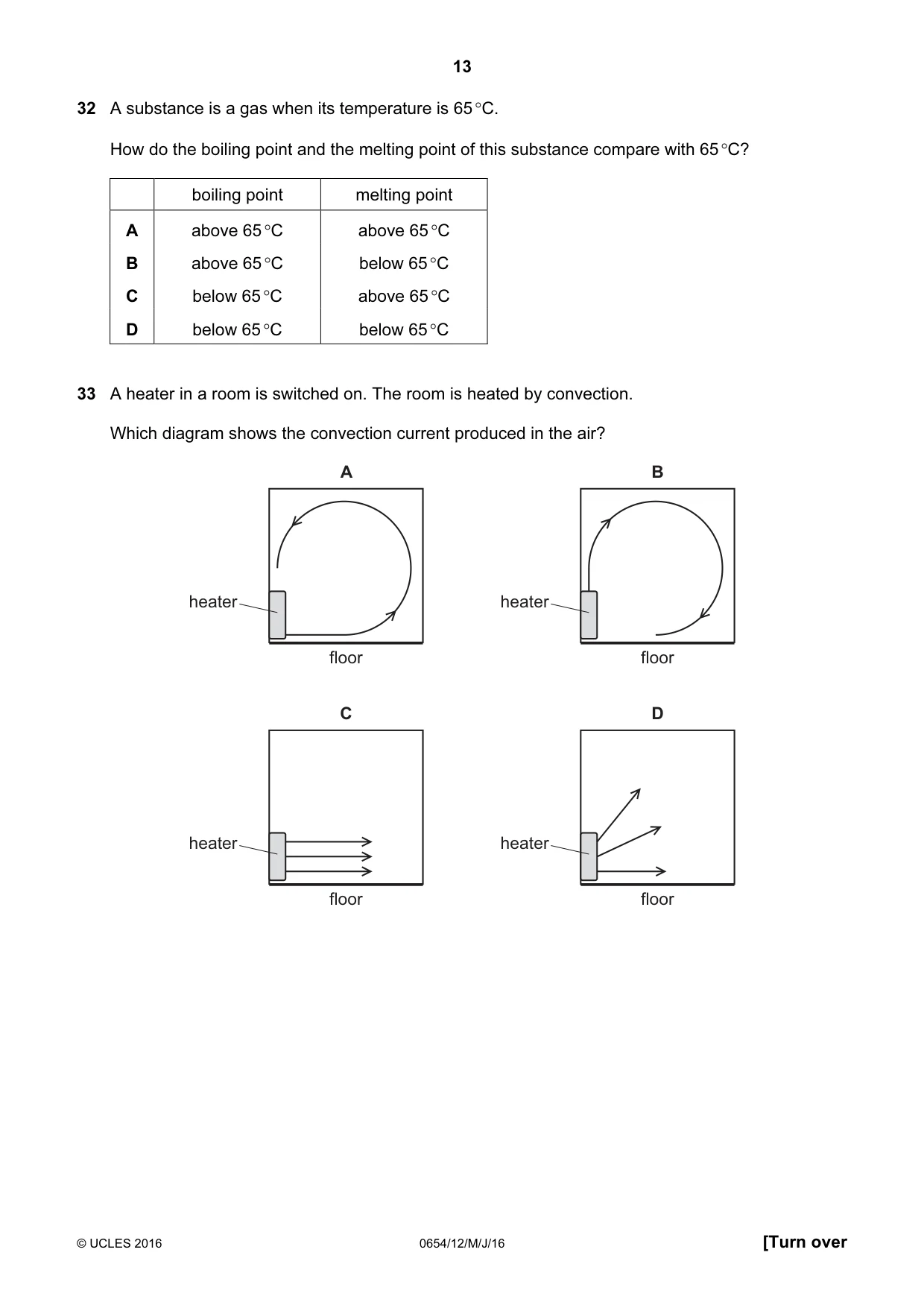
32 A substance is a gas when its temperature is 65 °C. How do the boiling point and the melting point of this substance compare with 65 °C? boiling point melting point A above 65 °C above 65 °C B above 65 °C below 65 °C C below 65 °C above 65 °C D below 65 °C below 65 °C
Mark scheme: D
Q33 · A heater in a room is switched on
33 A heater in a room is switched on. The room is heated by convection. Which diagram shows the convection current produced in the air? A B heater heater floor floor C D heater heater floor floor
Mark scheme: B
Question 34
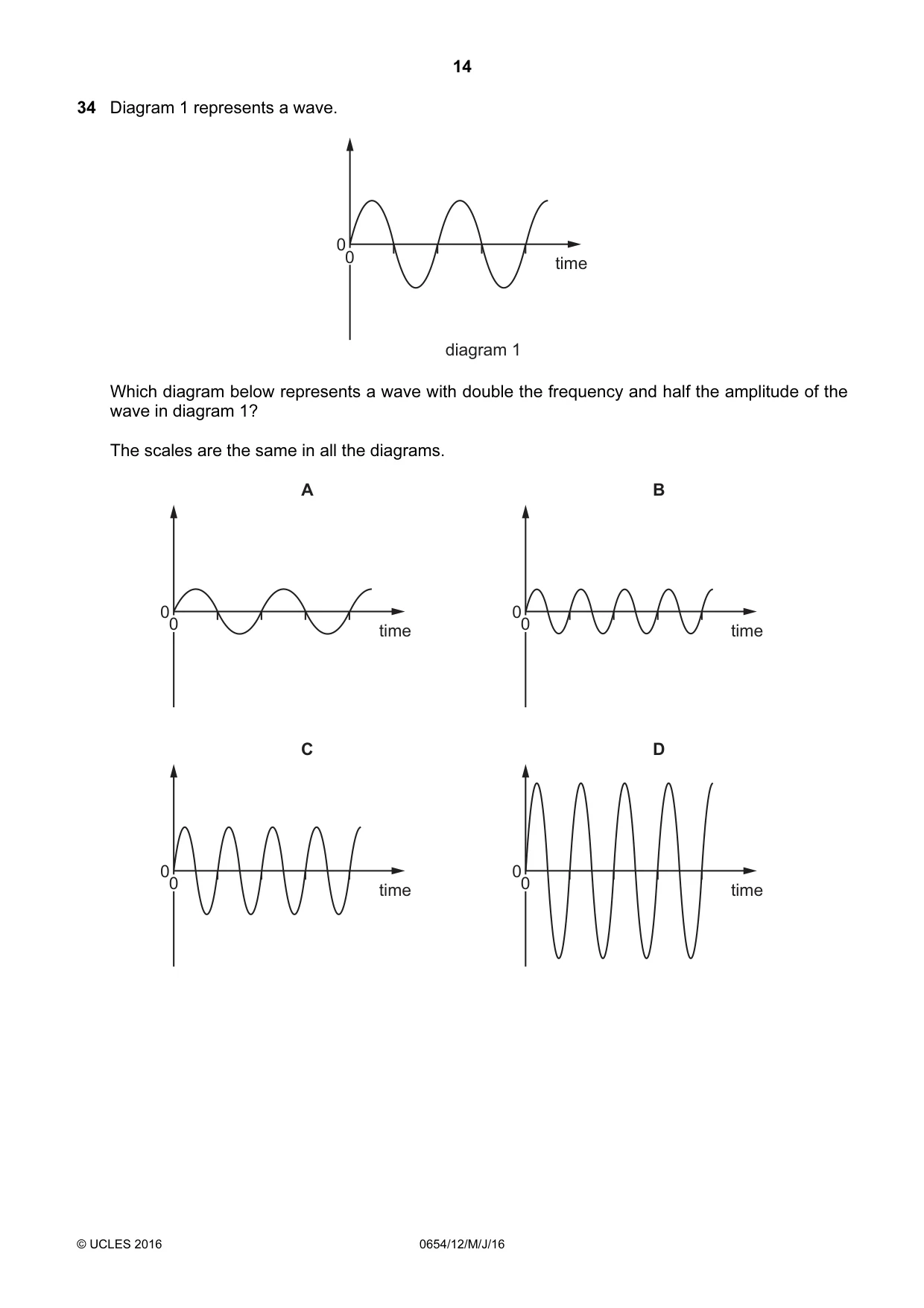
34 Diagram 1 represents a wave. 00 time diagram 1 Which diagram below represents a wave with double the frequency and half the amplitude of the wave in diagram 1? The scales are the same in all the diagrams. A B 00 00 time time C D 00 00 time time
Mark scheme: B
Q35 · A ray of light strikes the boundary between glass and air
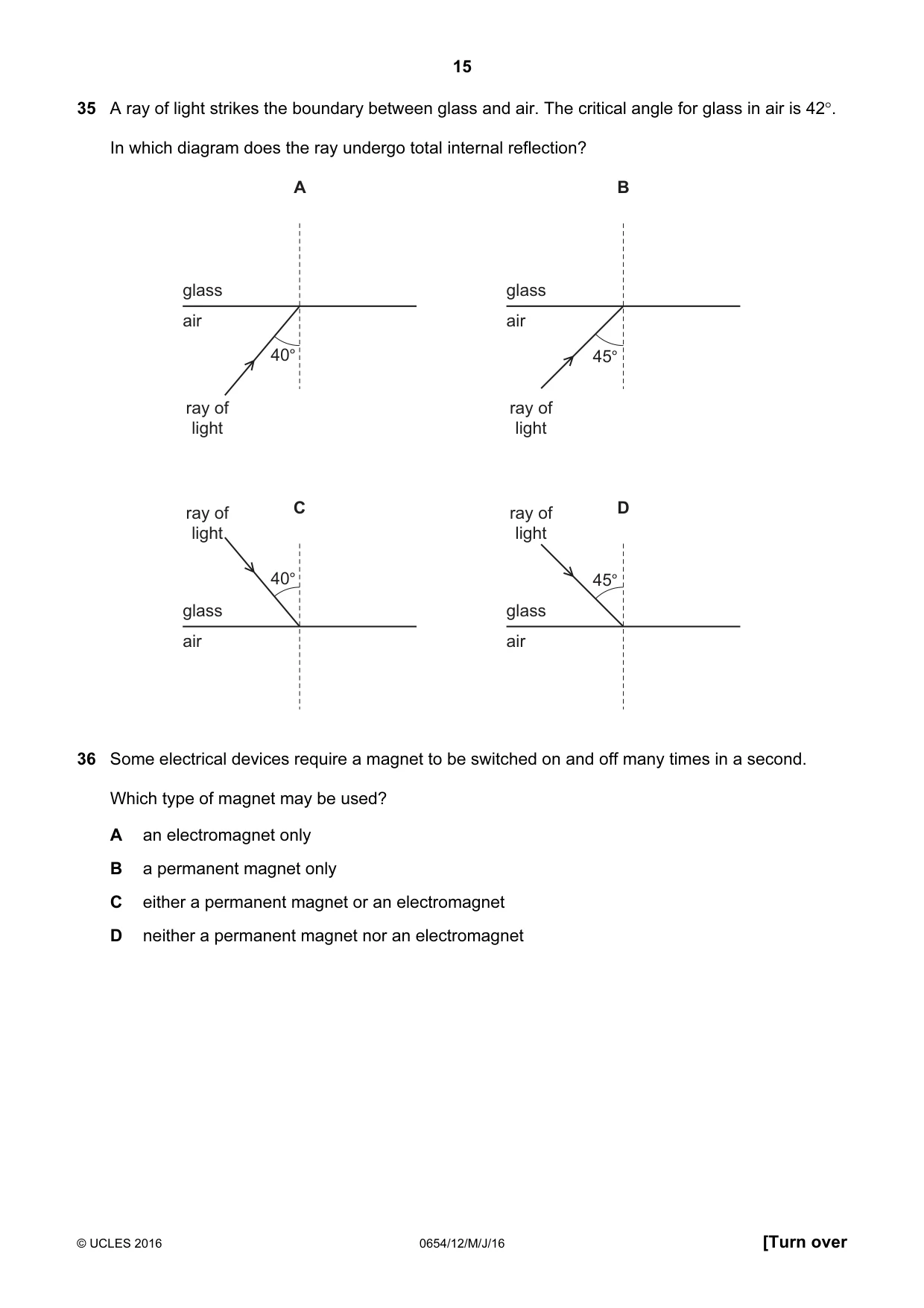
35 A ray of light strikes the boundary between glass and air. The critical angle for glass in air is 42°. In which diagram does the ray undergo total internal reflection? A B glass glass air air 40° 45° ray of ray of light light C D ray of ray of light light 40° 45° glass glass air air
Mark scheme: D
Q36 · Some electrical devices require a magnet to be switched on and off many times in a second
36 Some electrical devices require a magnet to be switched on and off many times in a second. Which type of magnet may be used? A an electromagnet only B a permanent magnet only C either a permanent magnet or an electromagnet D neither a permanent magnet nor an electromagnet
Mark scheme: A
Q37 · The diagram shows a wire of length l and diameter d
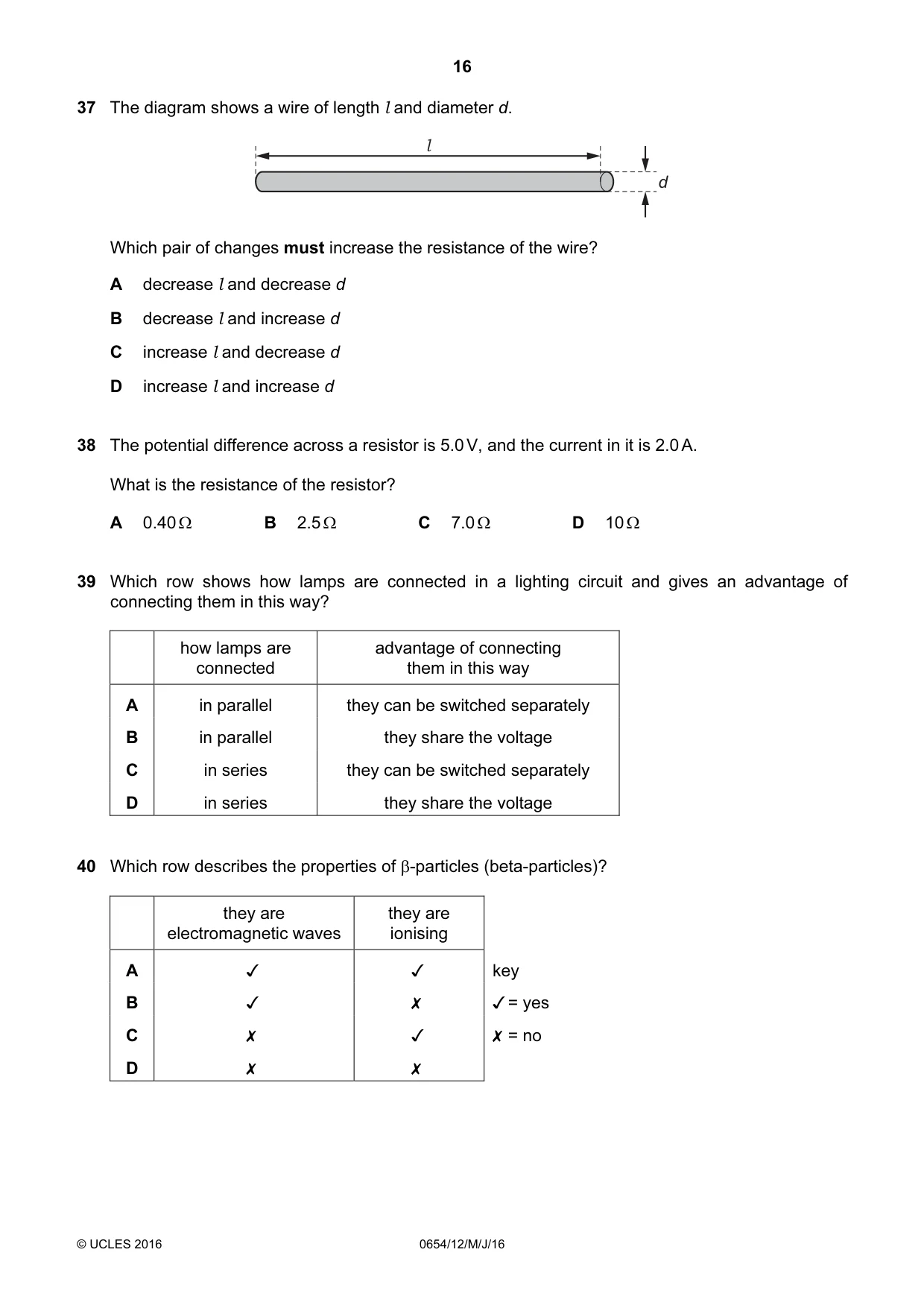
37 The diagram shows a wire of length l and diameter d. l d Which pair of changes must increase the resistance of the wire? A decrease l and decrease d B decrease l and increase d C increase l and decrease d D increase l and increase d
Mark scheme: C
Q38 · The potential difference across a resistor is 5.0 V, and the current in it is 2.0 A
38 The potential difference across a resistor is 5.0 V, and the current in it is 2.0 A. What is the resistance of the resistor? A 0.40 Ω B 2.5 Ω C 7.0 Ω D 10 Ω
Mark scheme: B
Q39 · Which row shows how lamps are connected in a lighting circuit and gives an advantage of…
39 Which row shows how lamps are connected in a lighting circuit and gives an advantage of connecting them in this way? how lamps are advantage of connecting connected them in this way A in parallel they can be switched separately B in parallel they share the voltage C in series they can be switched separately D in series they share the voltage
Mark scheme: A
Q40 · Which row describes the properties of B-particles (beta-particles)?
40 Which row describes the properties of B-particles (beta-particles)? they are they are electromagnetic waves ionising v v key v/=yes xX =no x v x
Mark scheme: C
What was in this paper
The subtopics covered by these 40 questions, and how many questions each got. Open one in a new tab to see every Cambridge question on it.
2Kinetic particle model of matter2Air quality and climate1Alkenes1Alloys and their properties1Arrangement of elements1Biological molecules1Blood vessels1Characteristics of living organisms1Density1Diffusion1Digestive system1Electrical circuits1Electrolysis1Energy, work and power1Enzymes1Experimental design1Food chains and food webs1Formulas1Gas exchange in humans1General properties of waves1Homeostasis1Identification of ions and gases1Light1Motion1Noble gases1Physical and chemical changes1Properties of metals1Radioactivity1Reactivity series1Redox1Respiration1Separation and purification1Sexual reproduction1Simple phenomena of magnetism1The characteristic properties of acids and bases1Transfer of thermal energy1Transpiration1What you needed in this session
Cambridge’s own grade thresholds for 2016 May/June, Paper 1 · Variant 2. A higher threshold means an easier paper — the bar moves with how the cohort did.