Cambridge IGCSE Sciences - Co-ordinated (Double) 0654 — 2014 May/June Paper 1 · Variant 3
0654/13/M/J/14 · 40 questions · 40 marks · ≈45 min
The question paper and its mark scheme, free to read here and free to download. This is Cambridge’s own paper, exactly as it was sat.
Question paper16 pages

Mark scheme2 pages
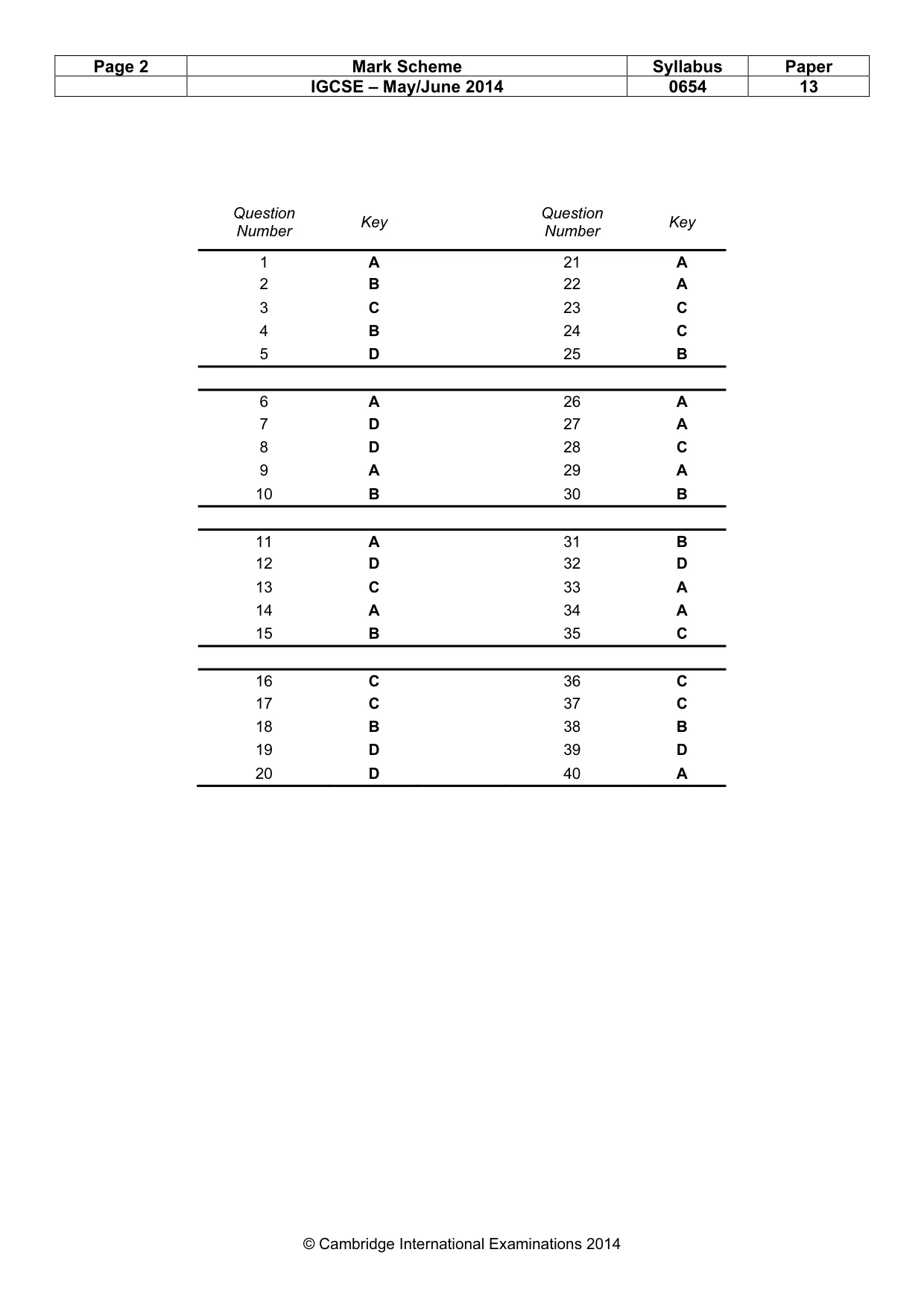
Answers below. Sit the paper first if you are practising.
Questions as text
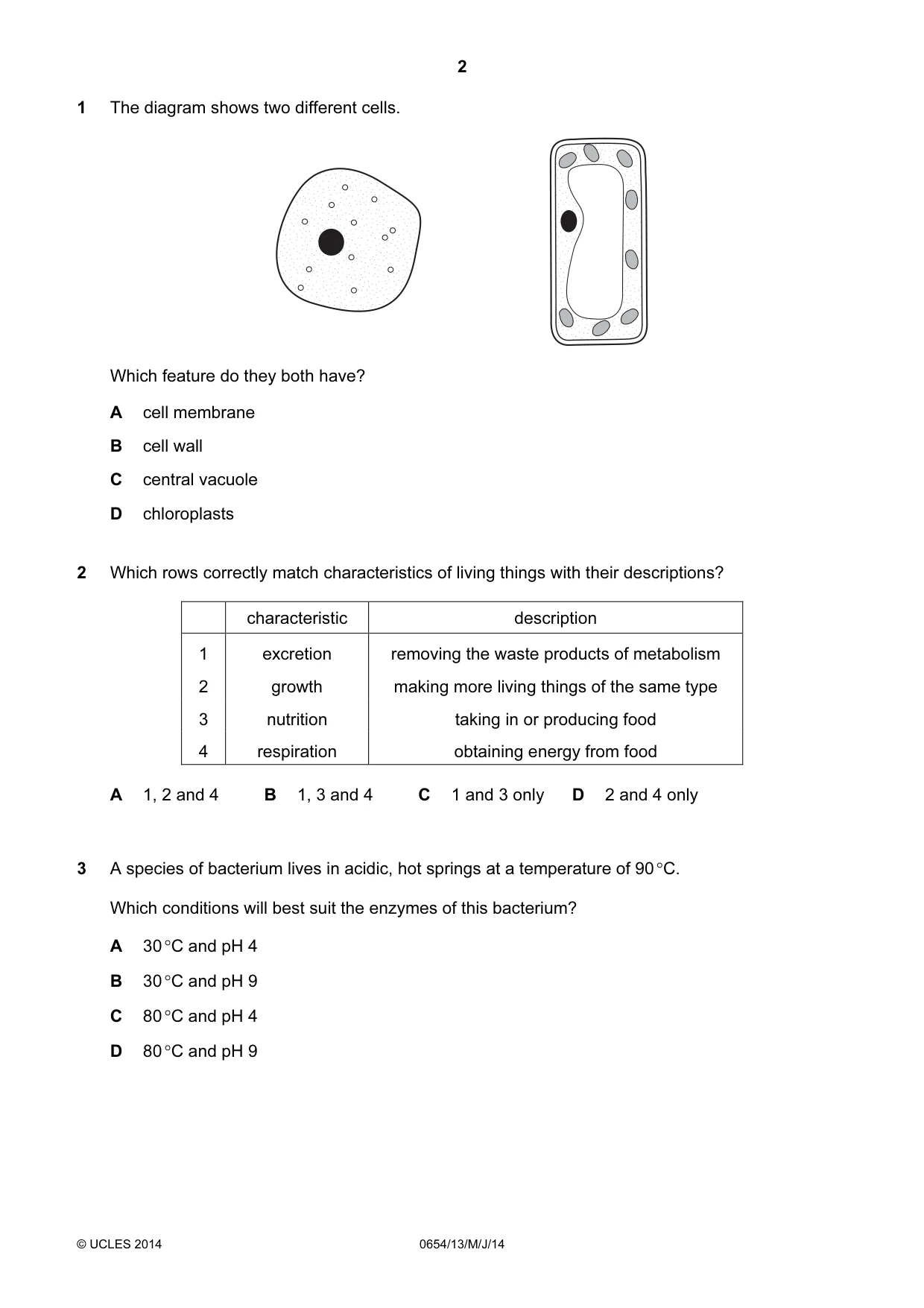
Q1 · The diagram shows two different cells
1 The diagram shows two different cells. Which feature do they both have? A cell membrane B cell wall C central vacuole D chloroplasts
Mark scheme: A
Q2 · Which rows correctly match characteristics of living things with their descriptions?
2 Which rows correctly match characteristics of living things with their descriptions? characteristic description 1 excretion removing the waste products of metabolism 2 growth making more living things of the same type 3 nutrition taking in or producing food 4 respiration obtaining energy from food A 1, 2 and 4 B 1, 3 and 4 C 1 and 3 only D 2 and 4 only
Mark scheme: B
Q3 · A species of bacterium lives in acidic, hot springs at a temperature of 90 °C
3 A species of bacterium lives in acidic, hot springs at a temperature of 90 °C. Which conditions will best suit the enzymes of this bacterium? A 30 °C and pH 4 B 30 °C and pH 9 C 80 °C and pH 4 D 80 °C and pH 9
Mark scheme: C
Q4 · Why are green plants called producers?
4 Why are green plants called producers? A They can make oxygen from sunlight. B They form organic nutrients from simple substances. C They have cells containing chlorophyll. D They produce starch from sugar.
Mark scheme: B
Q5 · In the maintenance of body temperature, which response does not need energy from…
5 In the maintenance of body temperature, which response does not need energy from respiration? A secretion of sweat B shivering C vasoconstriction D vasodilation
Mark scheme: D
Q6 · How does oxygen pass from the alveoli to the blood capillaries in the lungs?
6 How does oxygen pass from the alveoli to the blood capillaries in the lungs? A diffusion B evaporation C secretion D transpiration
Mark scheme: A
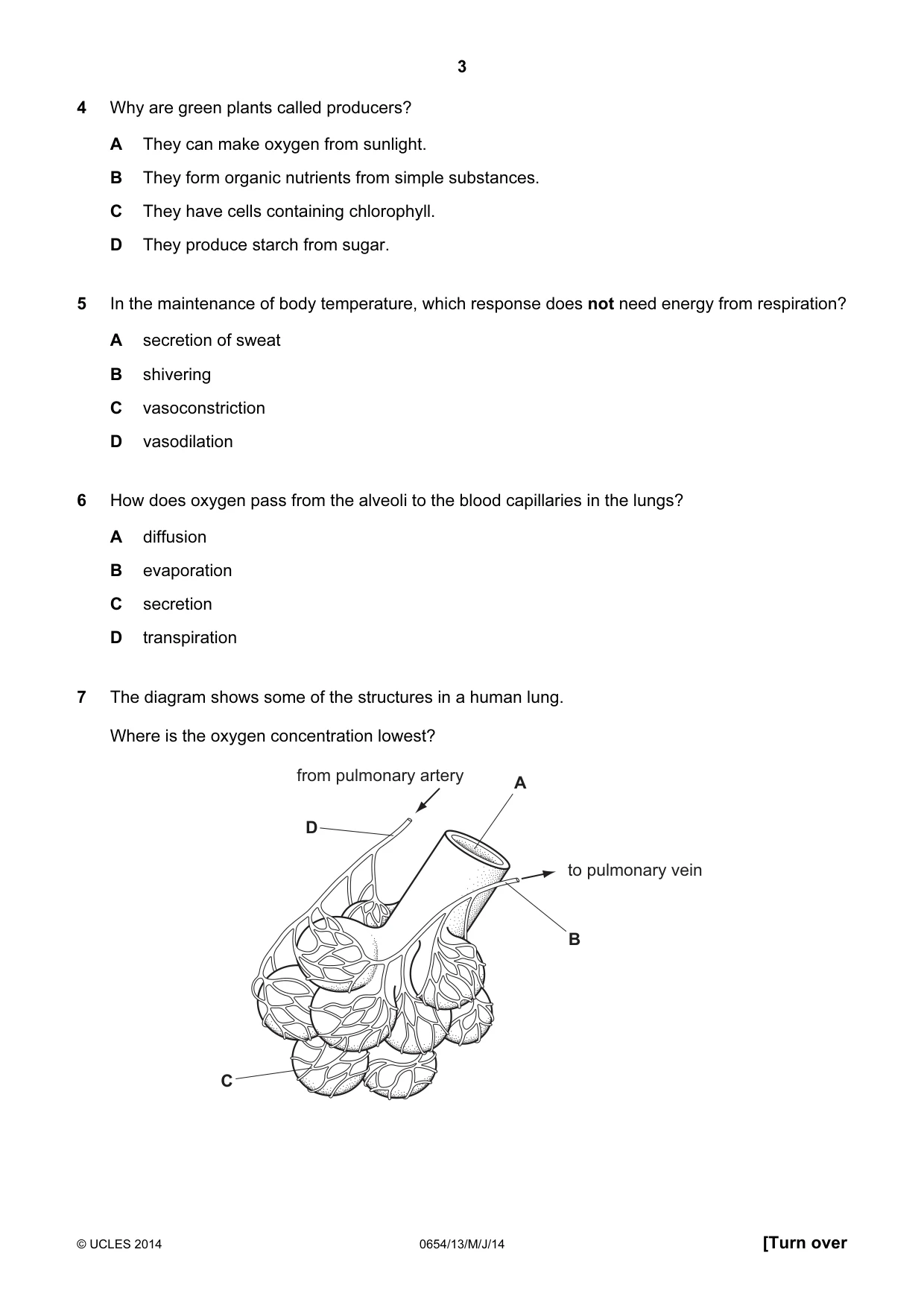
Q7 · The diagram shows some of the structures in a human lung
7 The diagram shows some of the structures in a human lung. Where is the oxygen concentration lowest? from pulmonary artery A D to pulmonary vein B C
Mark scheme: D
Q8 · A plant shoot grows towards a light source
8 A plant shoot grows towards a light source. This an example of what? A geotropism B homeostasis C photosynthesis D phototropism
Mark scheme: D
Q9 · What is a function of adrenaline?
9 What is a function of adrenaline? A to increase the concentration of blood sugar B to raise the level of oxygen in the blood C to reduce the rate of heart beat D to remove urea from the blood
Mark scheme: A
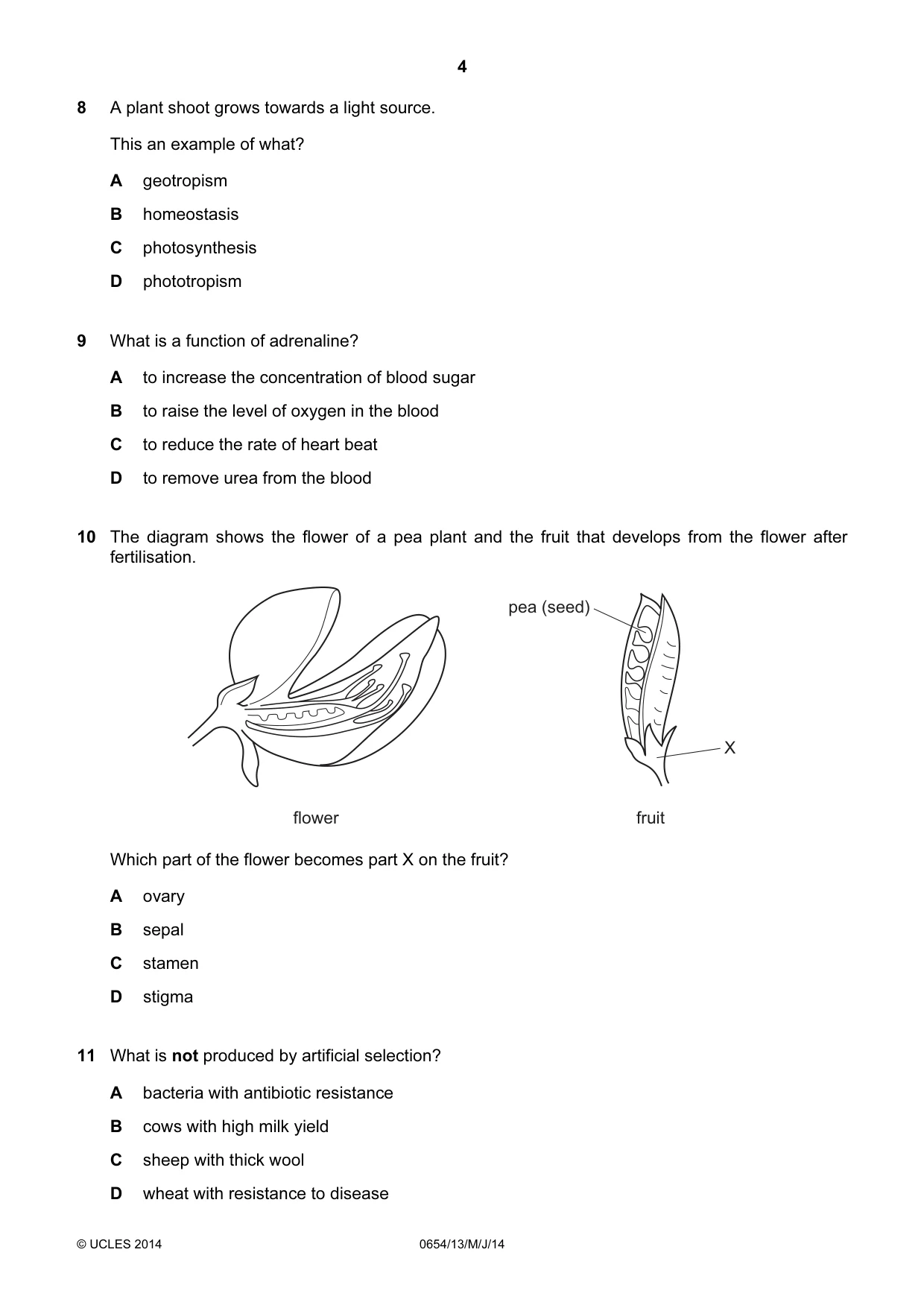
Q10 · The diagram shows the flower of a pea plant and the fruit that develops from the flower…
10 The diagram shows the flower of a pea plant and the fruit that develops from the flower after fertilisation. pea (seed) X flower fruit Which part of the flower becomes part X on the fruit? A ovary B sepal C stamen D stigma
Mark scheme: B
Q11 · What is not produced by artificial selection?
11 What is not produced by artificial selection? A bacteria with antibiotic resistance B cows with high milk yield C sheep with thick wool D wheat with resistance to disease
Mark scheme: A
Q12 · The diagram shows the female reproductive system
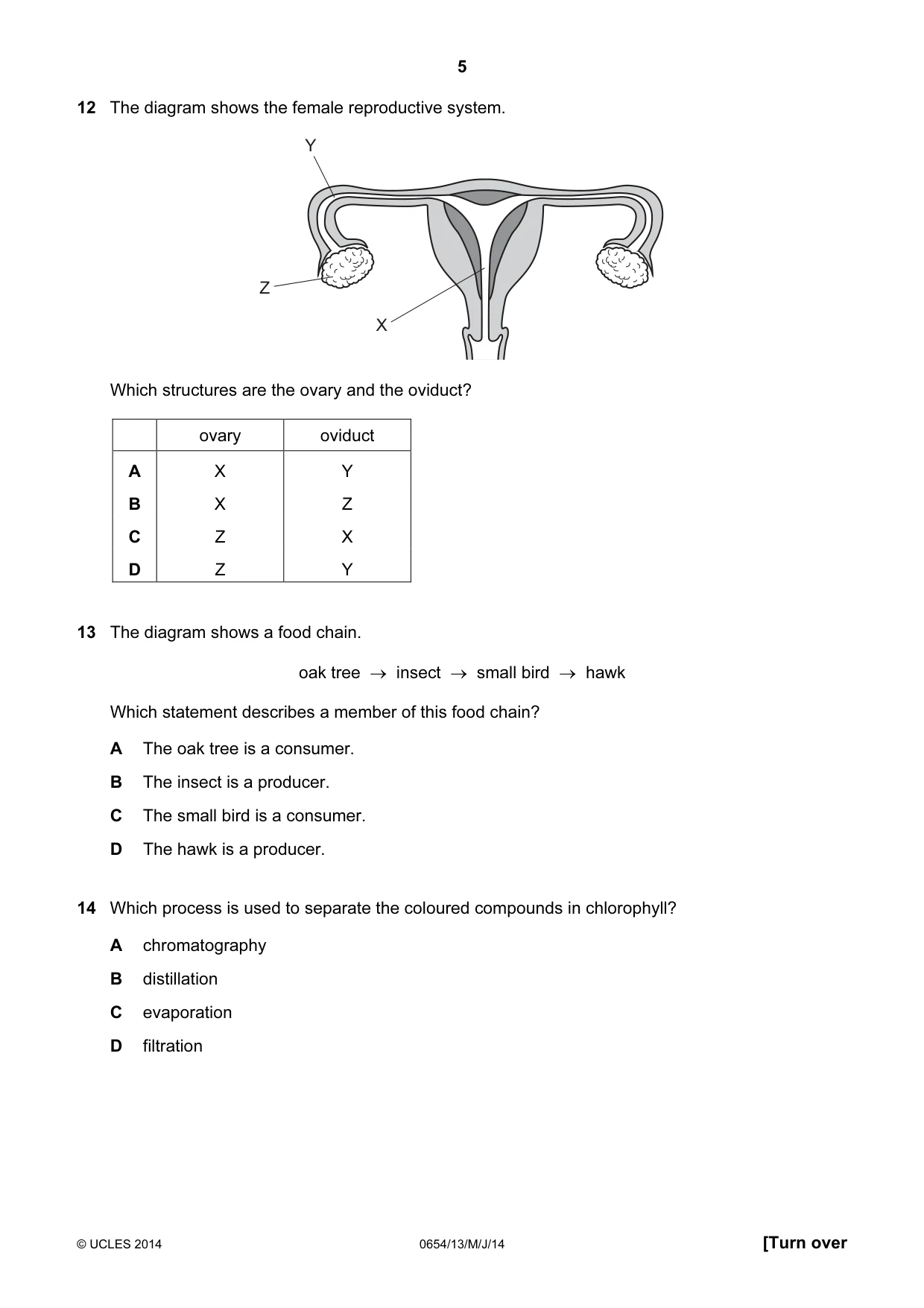
12 The diagram shows the female reproductive system. Y Z X Which structures are the ovary and the oviduct? ovary oviduct A X Y B X Z C Z X D Z Y
Mark scheme: D
Q13 · The diagram shows a food chain
13 The diagram shows a food chain. oak tree → insect → small bird → hawk Which statement describes a member of this food chain? A The oak tree is a consumer. B The insect is a producer. C The small bird is a consumer. D The hawk is a producer.
Mark scheme: C
Q14 · Which process is used to separate the coloured compounds in chlorophyll?
14 Which process is used to separate the coloured compounds in chlorophyll? A chromatography B distillation C evaporation D filtration
Mark scheme: A
Q15 · The diagram shows the electronic structures of carbon and hydrogen atoms
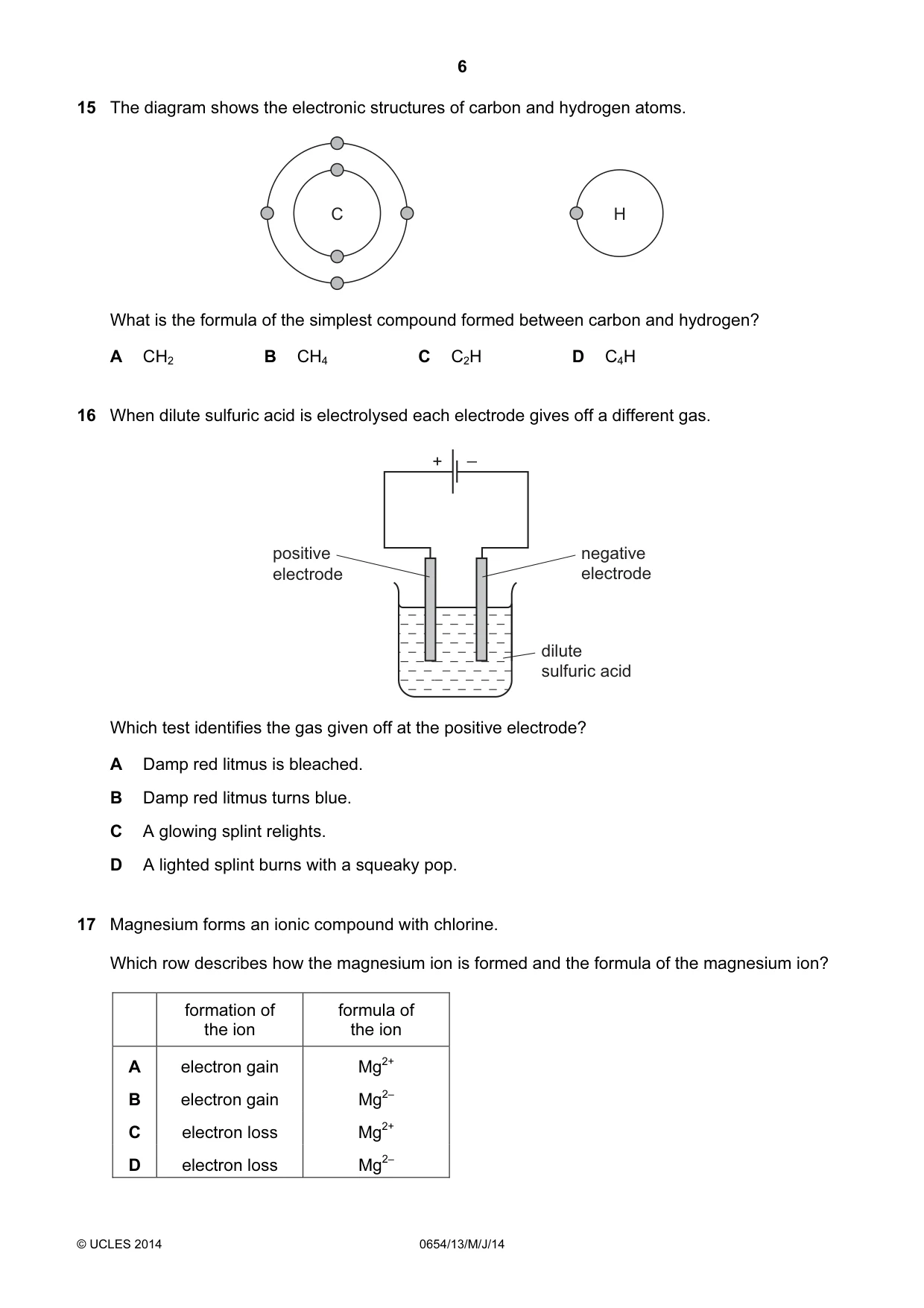
15 The diagram shows the electronic structures of carbon and hydrogen atoms. C H What is the formula of the simplest compound formed between carbon and hydrogen? A CH2 B CH4 C C2H D C4H
Mark scheme: B
Q16 · When dilute sulfuric acid is electrolysed each electrode gives off a different gas
16 When dilute sulfuric acid is electrolysed each electrode gives off a different gas. + _ positive negative electrode electrode dilute sulfuric acid Which test identifies the gas given off at the positive electrode? A Damp red litmus is bleached. B Damp red litmus turns blue. C A glowing splint relights. D A lighted splint burns with a squeaky pop.
Mark scheme: C
Q17 · Magnesium forms an ionic compound with chlorine
17 Magnesium forms an ionic compound with chlorine. Which row describes how the magnesium ion is formed and the formula of the magnesium ion? formation of formula of the ion the ion A electron gain Mg2+ B electron gain Mg2– C electron loss Mg2+ D electron loss Mg2–
Mark scheme: C
Q18 · Marble (calcium carbonate) reacts with dilute hydrochloric acid
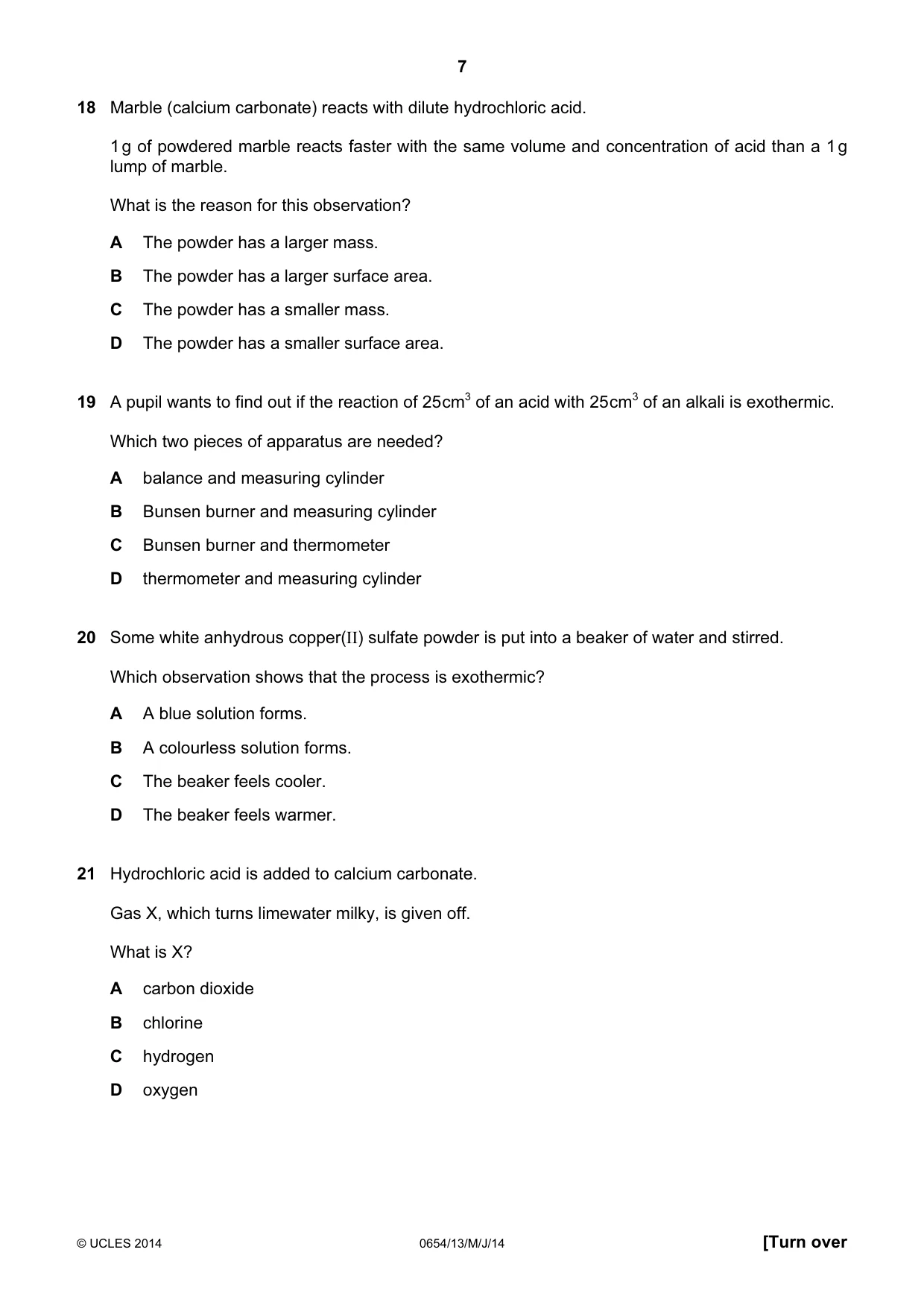
18 Marble (calcium carbonate) reacts with dilute hydrochloric acid. 1 g of powdered marble reacts faster with the same volume and concentration of acid than a 1 g lump of marble. What is the reason for this observation? A The powder has a larger mass. B The powder has a larger surface area. C The powder has a smaller mass. D The powder has a smaller surface area.
Mark scheme: B
Q19 · A pupil wants to find out if the reaction of 25 cm3 of an acid with 25 cm3 of an alkali…
19 A pupil wants to find out if the reaction of 25 cm3 of an acid with 25 cm3 of an alkali is exothermic. Which two pieces of apparatus are needed? A balance and measuring cylinder B Bunsen burner and measuring cylinder C Bunsen burner and thermometer D thermometer and measuring cylinder
Mark scheme: D
Q20 · Some white anhydrous copper(II) sulfate powder is put into a beaker of water and stirred
20 Some white anhydrous copper(II) sulfate powder is put into a beaker of water and stirred. Which observation shows that the process is exothermic? A A blue solution forms. B A colourless solution forms. C The beaker feels cooler. D The beaker feels warmer.
Mark scheme: D
Q21 · Hydrochloric acid is added to calcium carbonate
21 Hydrochloric acid is added to calcium carbonate. Gas X, which turns limewater milky, is given off. What is X? A carbon dioxide B chlorine C hydrogen D oxygen
Mark scheme: A
Q22 · When iron is heated with steam a black solid is formed
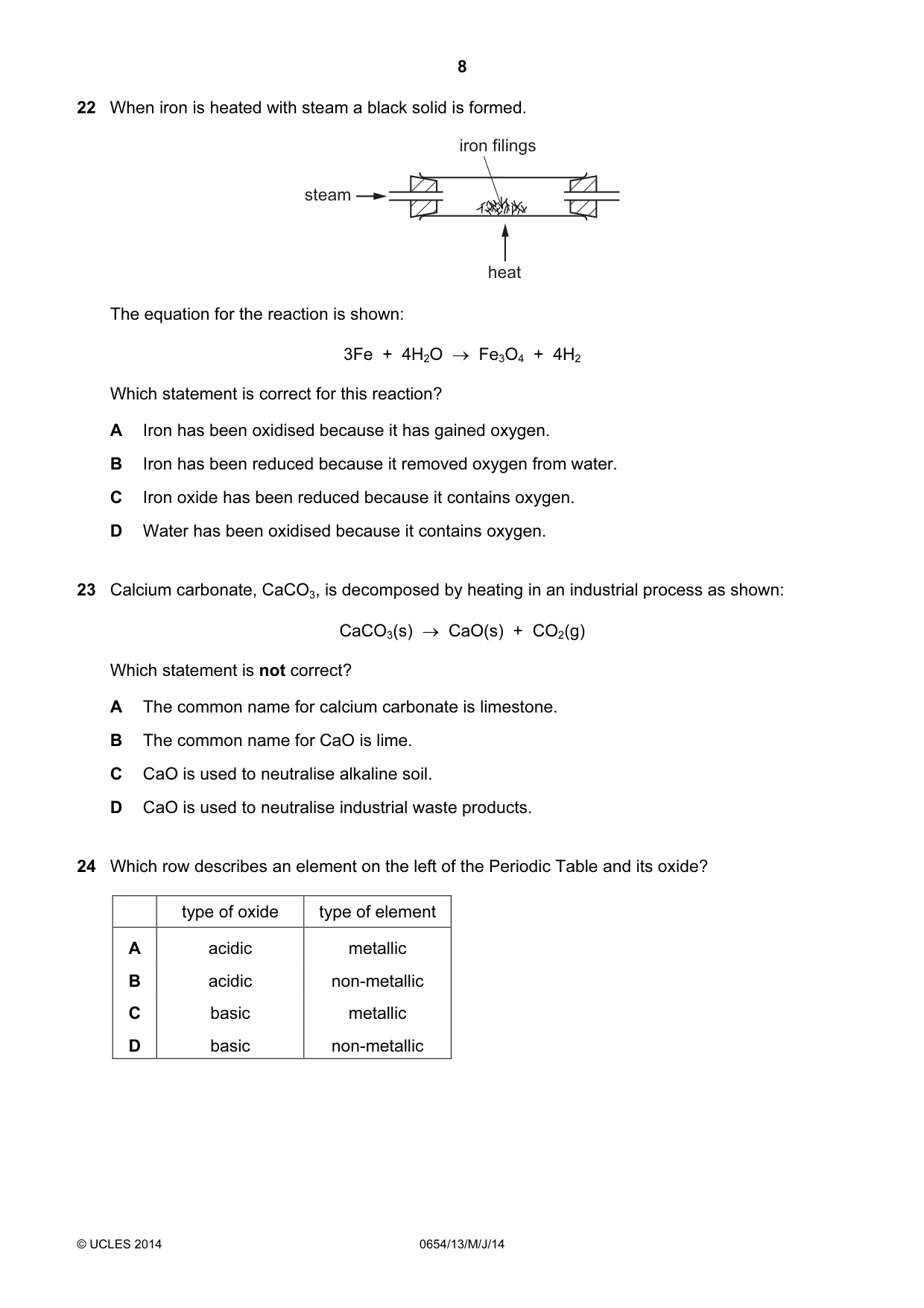
22 When iron is heated with steam a black solid is formed. iron filings steam heat The equation for the reaction is shown: 3Fe + 4H2O → Fe3O4 + 4H2 Which statement is correct for this reaction? A Iron has been oxidised because it has gained oxygen. B Iron has been reduced because it removed oxygen from water. C Iron oxide has been reduced because it contains oxygen. D Water has been oxidised because it contains oxygen.
Mark scheme: A
Q23 · Calcium carbonate, CaCO3, is decomposed by heating in an industrial process as shown…
23 Calcium carbonate, CaCO3, is decomposed by heating in an industrial process as shown: CaCO3(s) → CaO(s) + CO2(g) Which statement is not correct? A The common name for calcium carbonate is limestone. B The common name for CaO is lime. C CaO is used to neutralise alkaline soil. D CaO is used to neutralise industrial waste products.
Mark scheme: C
Q24 · Which row describes an element on the left of the Periodic Table and its oxide?
24 Which row describes an element on the left of the Periodic Table and its oxide? type of oxide type of element A acidic metallic B acidic non-metallic C basic metallic D basic non-metallic
Mark scheme: C
Q25 · Which Group I metal and which Group VII non-metal react together most vigorously?
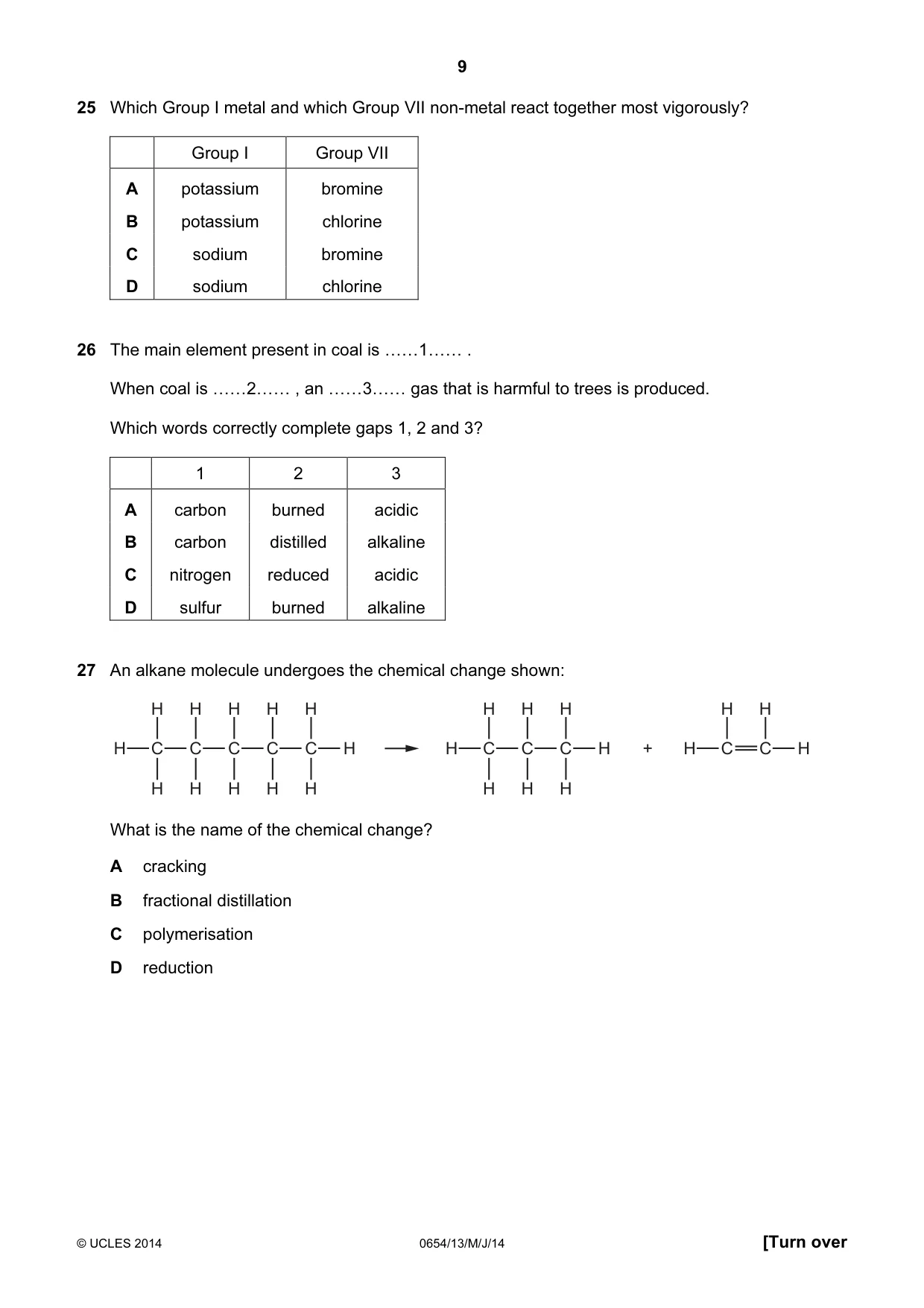
25 Which Group I metal and which Group VII non-metal react together most vigorously? Group I Group VII A potassium bromine B potassium chlorine C sodium bromine D sodium chlorine
Mark scheme: B
Q26 · The main element present in coal is ……1……
26 The main element present in coal is ……1…… . When coal is ……2…… , an ……3…… gas that is harmful to trees is produced. Which words correctly complete gaps 1, 2 and 3? 1 2 3 A carbon burned acidic B carbon distilled alkaline C nitrogen reduced acidic D sulfur burned alkaline
Mark scheme: A
Q27 · An alkane molecule undergoes the chemical change shown: H H H H H H H H H H H C C C C C H…
27 An alkane molecule undergoes the chemical change shown: H H H H H H H H H H H C C C C C H H C C C H + H C C H H H H H H H H H What is the name of the chemical change? A cracking B fractional distillation C polymerisation D reduction
Mark scheme: A
Q28 · The rectangular block shown has a mass of 48 g
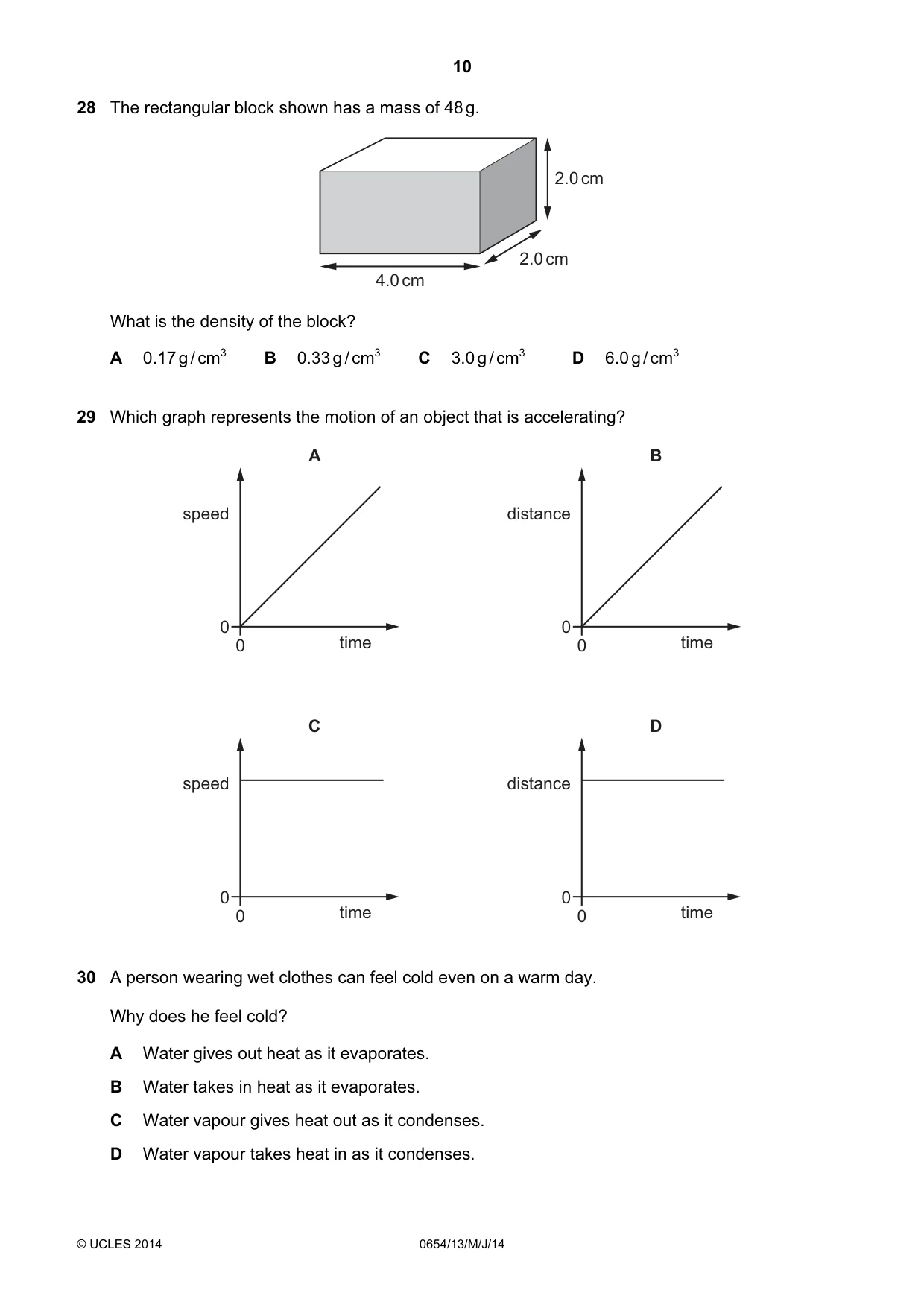
28 The rectangular block shown has a mass of 48 g. 2.0 cm 2.0 cm 4.0 cm What is the density of the block? A 0.17 g / cm3 B 0.33 g / cm3 C 3.0 g / cm3 D 6.0 g / cm3
Mark scheme: C
Q29 · Which graph represents the motion of an object that is accelerating?
29 Which graph represents the motion of an object that is accelerating? A B speed distance 0 0 0 time 0 time C D speed distance 0 0 0 time 0 time
Mark scheme: A
Q30 · A person wearing wet clothes can feel cold even on a warm day
30 A person wearing wet clothes can feel cold even on a warm day. Why does he feel cold? A Water gives out heat as it evaporates. B Water takes in heat as it evaporates. C Water vapour gives heat out as it condenses. D Water vapour takes heat in as it condenses.
Mark scheme: B
Q31 · The table lists four energy resources
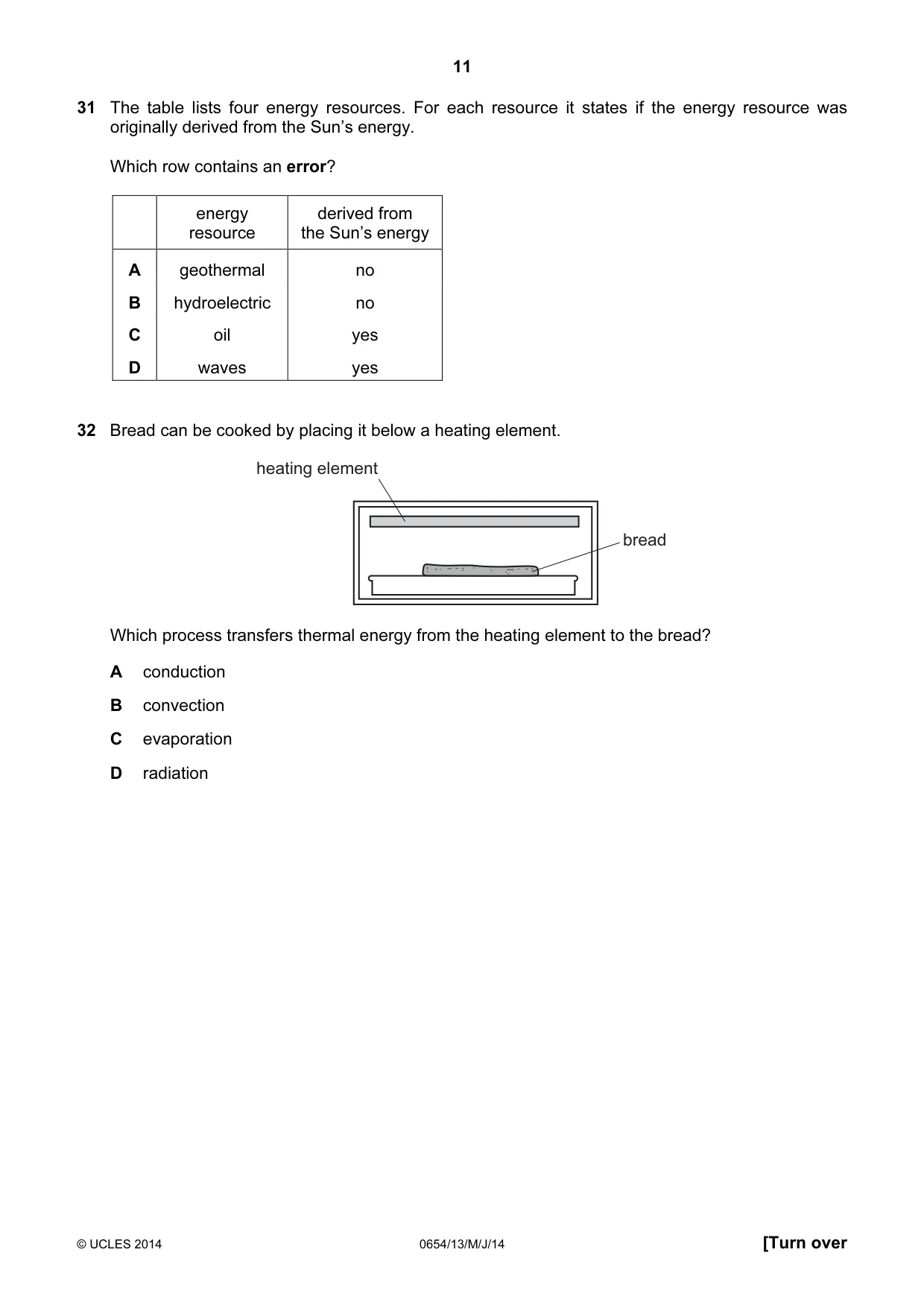
31 The table lists four energy resources. For each resource it states if the energy resource was originally derived from the Sun’s energy. Which row contains an error? energy derived from resource the Sun’s energy A geothermal no B hydroelectric no C oil yes D waves yes
Mark scheme: B
Q32 · Bread can be cooked by placing it below a heating element
32 Bread can be cooked by placing it below a heating element. heating element bread Which process transfers thermal energy from the heating element to the bread? A conduction B convection C evaporation D radiation
Mark scheme: D
Q33 · A metal wheel has to be fitted to an axle made from the same metal
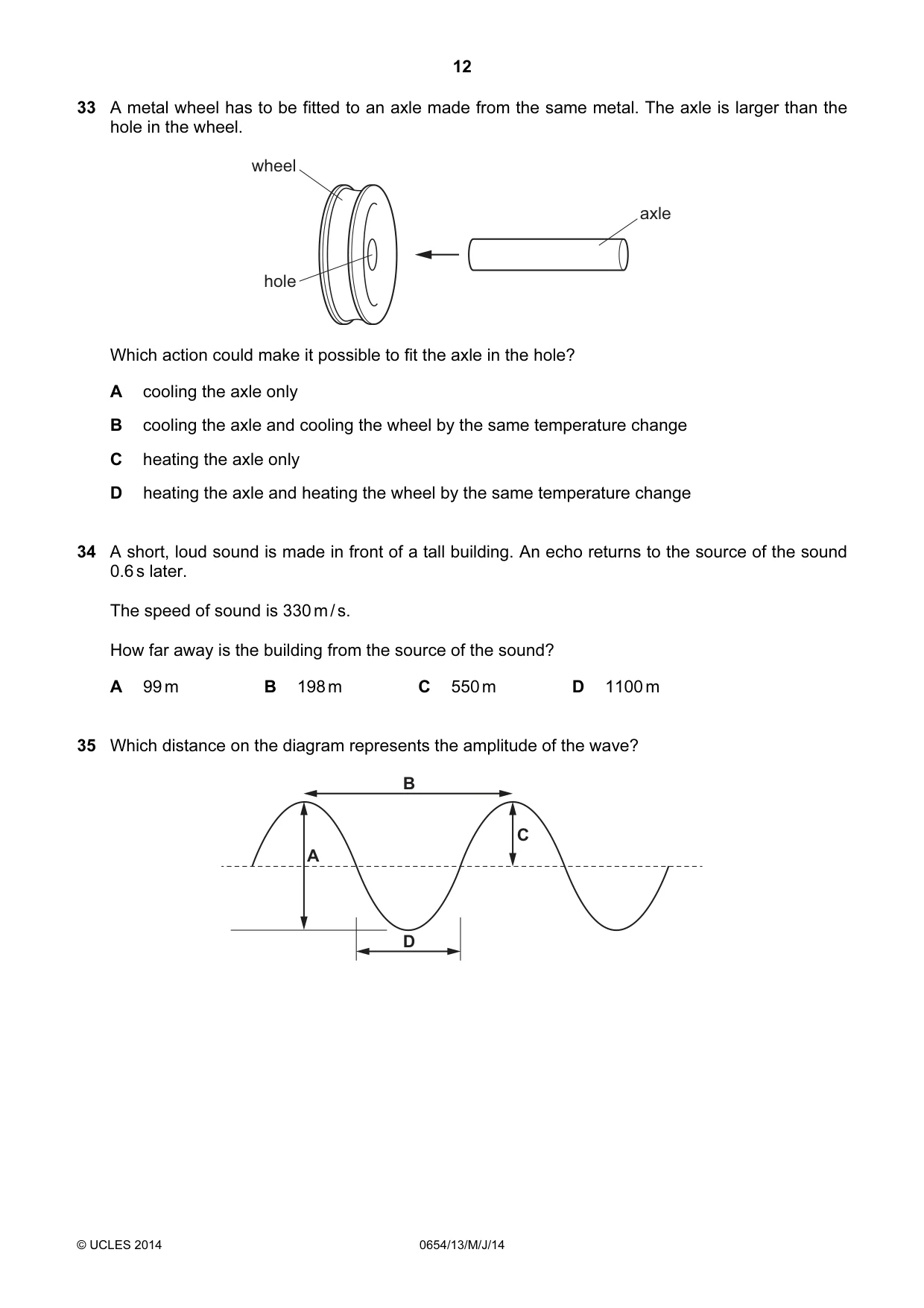
33 A metal wheel has to be fitted to an axle made from the same metal. The axle is larger than the hole in the wheel. wheel axle hole Which action could make it possible to fit the axle in the hole? A cooling the axle only B cooling the axle and cooling the wheel by the same temperature change C heating the axle only D heating the axle and heating the wheel by the same temperature change
Mark scheme: A
Q34 · A short, loud sound is made in front of a tall building
34 A short, loud sound is made in front of a tall building. An echo returns to the source of the sound 0.6 s later. The speed of sound is 330 m / s. How far away is the building from the source of the sound? A 99 m B 198 m C 550 m D 1100 m
Mark scheme: A
Q35 · Which distance on the diagram represents the amplitude of the wave?
35 Which distance on the diagram represents the amplitude of the wave? B C A D
Mark scheme: C
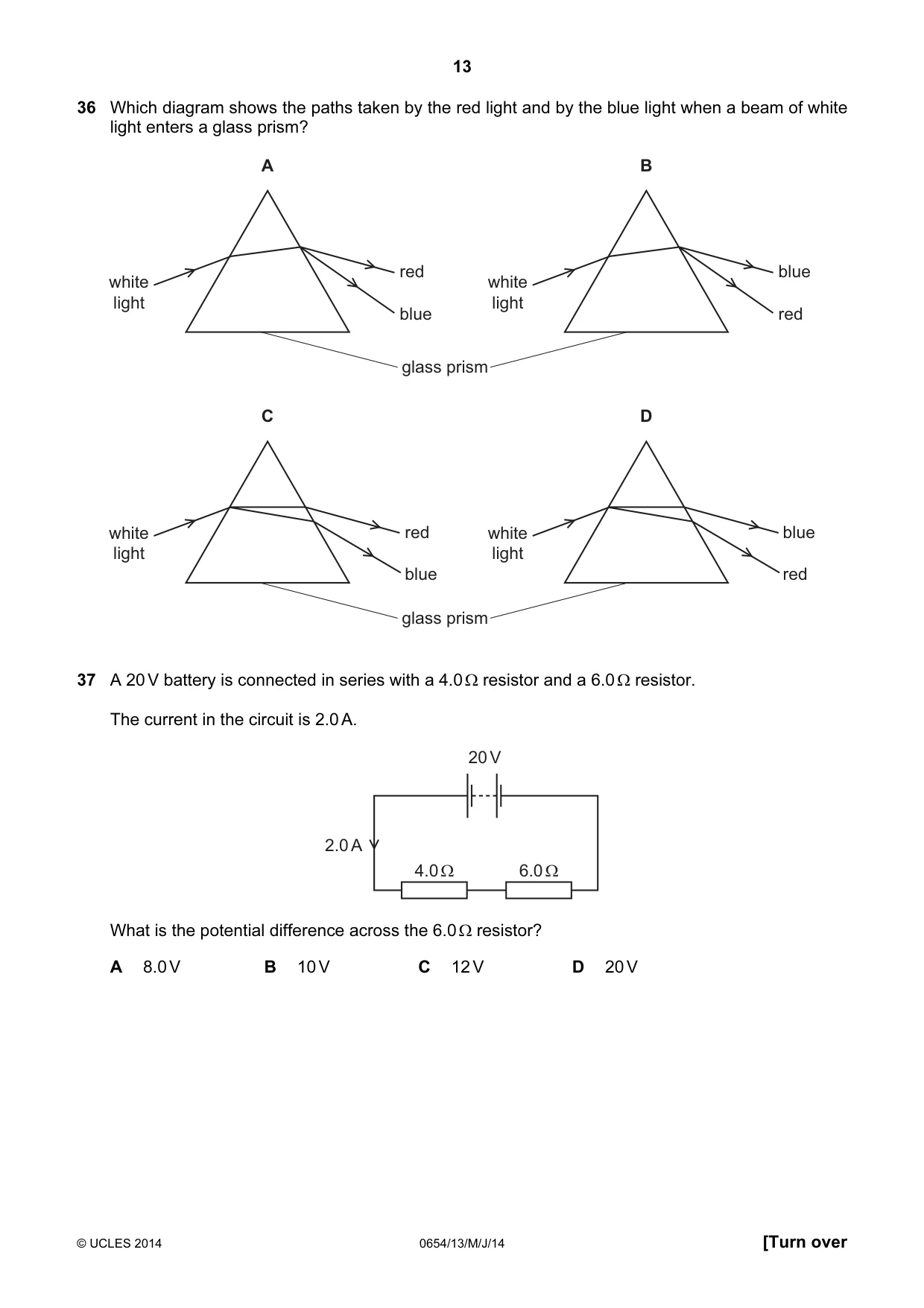
Q36 · Which diagram shows the paths taken by the red light and by the blue light when a beam of…
36 Which diagram shows the paths taken by the red light and by the blue light when a beam of white light enters a glass prism? A B red blue white white light light blue red glass prism C D white red white blue light light blue red glass prism
Mark scheme: C
Q37 · A 20 V battery is connected in series with a 4.0 Ω resistor and a 6.0 Ω resistor
37 A 20 V battery is connected in series with a 4.0 Ω resistor and a 6.0 Ω resistor. The current in the circuit is 2.0 A. 20 V 2.0 A 4.0 Ω 6.0 Ω What is the potential difference across the 6.0 Ω resistor? A 8.0 V B 10 V C 12 V D 20 V
Mark scheme: C
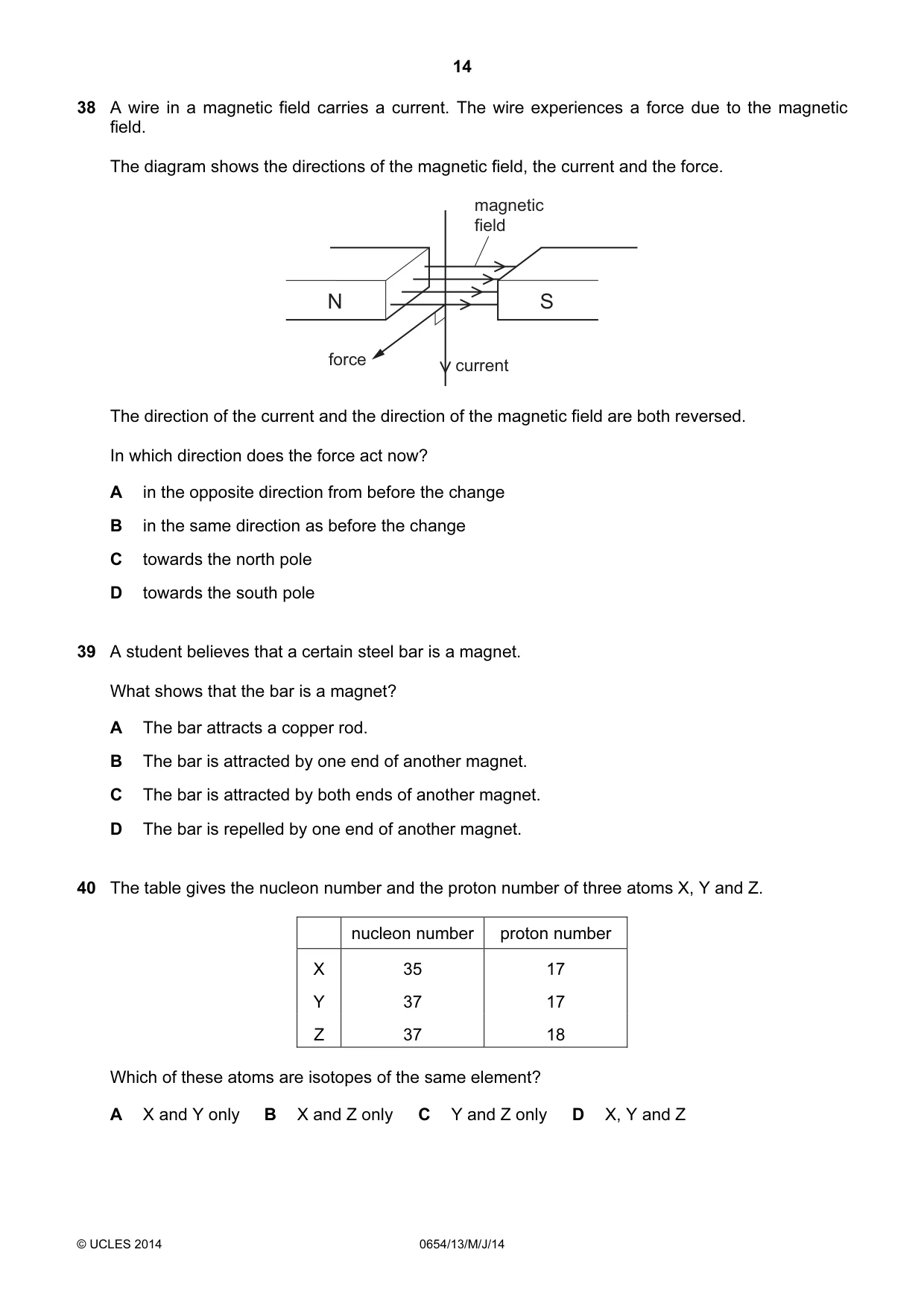
Q38 · A wire in a magnetic field carries a current
38 A wire in a magnetic field carries a current. The wire experiences a force due to the magnetic field. The diagram shows the directions of the magnetic field, the current and the force. magnetic field N S force current The direction of the current and the direction of the magnetic field are both reversed. In which direction does the force act now? A in the opposite direction from before the change B in the same direction as before the change C towards the north pole D towards the south pole
Mark scheme: B
Q39 · A student believes that a certain steel bar is a magnet
39 A student believes that a certain steel bar is a magnet. What shows that the bar is a magnet? A The bar attracts a copper rod. B The bar is attracted by one end of another magnet. C The bar is attracted by both ends of another magnet. D The bar is repelled by one end of another magnet.
Mark scheme: D
Q40 · The table gives the nucleon number and the proton number of three atoms X, Y and Z
40 The table gives the nucleon number and the proton number of three atoms X, Y and Z. nucleon number proton number X 35 17 Y 37 17 Z 37 18 Which of these atoms are isotopes of the same element? A X and Y only B X and Z only C Y and Z only D X, Y and Z
Mark scheme: A
What was in this paper
The subtopics covered by these 40 questions, and how many questions each got. Open one in a new tab to see every Cambridge question on it.
2Gas exchange in humans2Identification of ions and gases2Oxides2Transfer of thermal energy2Air quality and climate1Alkenes1Cell structure1Characteristics of living organisms1Chromatography1Coordination and response1Density1Electrical circuits1Electromagnetic effects1Energy, work and power1Enzymes1Food chains and food webs1General properties of waves1Group VII properties1Homeostasis1Hormones1Ions and ionic bonds1Isotopes1Light1Motion1Photosynthesis1Rate of reaction1Redox1Selection1Sexual reproduction in humans1Sexual reproduction in plants1Simple molecules and covalent bonds1Simple phenomena of magnetism1Sound1Thermal properties and temperature1What you needed in this session
Cambridge’s own grade thresholds for 2014 May/June, Paper 1 · Variant 3. A higher threshold means an easier paper — the bar moves with how the cohort did.