Cambridge IGCSE Sciences - Co-ordinated (Double) 0654 — 2017 May/June Paper 1 · Variant 2
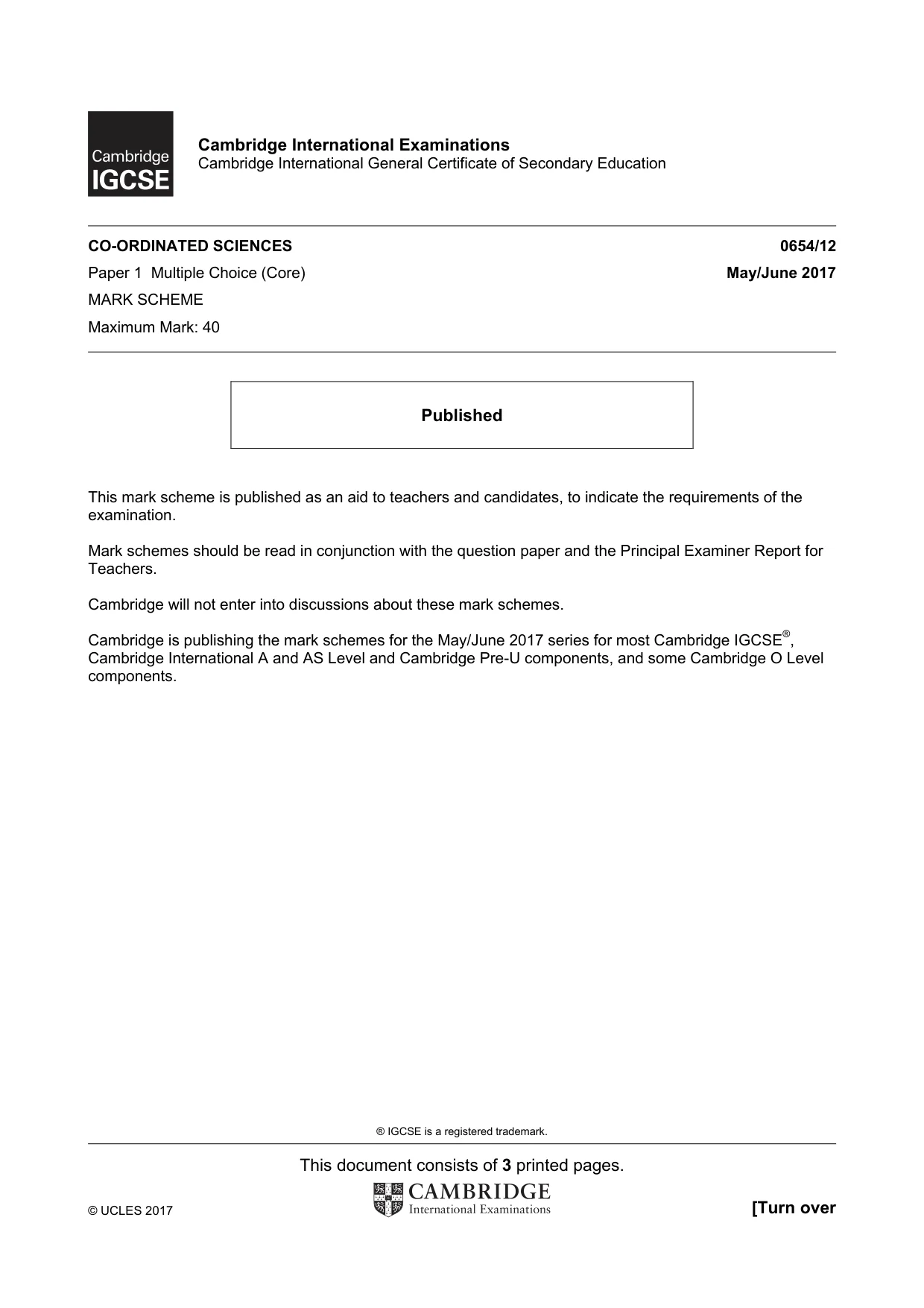
0654/12/M/J/17 · 40 questions · 40 marks · ≈45 min
The question paper and its mark scheme, free to read here and free to download. This is Cambridge’s own paper, exactly as it was sat.
Question paper16 pages
Mark scheme3 pages
Answers below. Sit the paper first if you are practising.
Questions as text
Q1 · What is not produced by artificial selection?
1 What is not produced by artificial selection? A bacteria with antibiotic resistance B cows with high milk yield C sheep with thick wool D wheat with resistance to disease
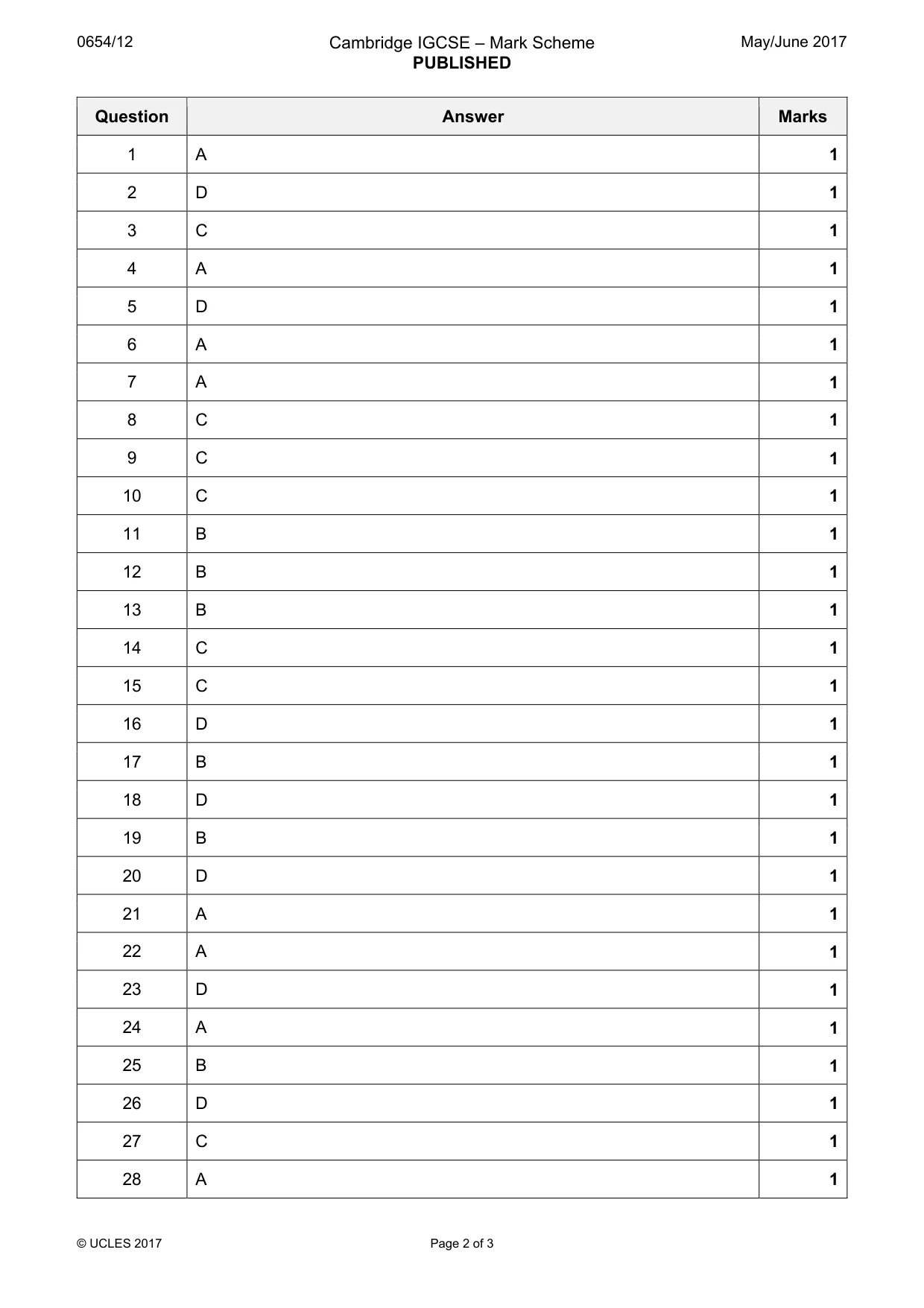
Mark scheme: A
Q2 · Which characteristic of living organisms involves chemical reactions that break down…
2 Which characteristic of living organisms involves chemical reactions that break down nutrient molecules to release energy? A excretion B nutrition C reproduction D respiration
Mark scheme: D
Q3 · The photograph shows a leaf as seen under a microscope
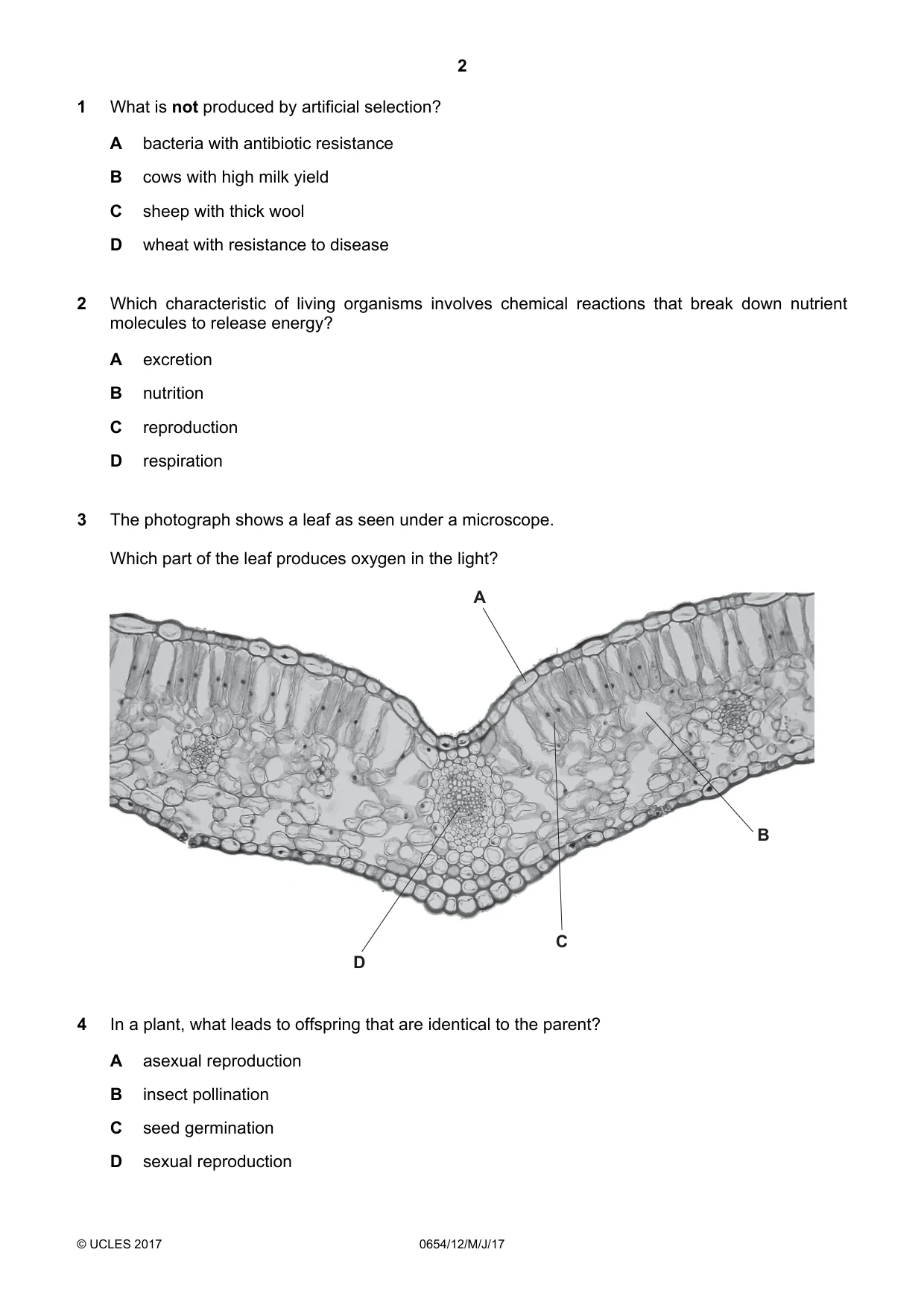
3 The photograph shows a leaf as seen under a microscope. Which part of the leaf produces oxygen in the light? A B C D
Mark scheme: C
Q4 · In a plant, what leads to offspring that are identical to the parent?
4 In a plant, what leads to offspring that are identical to the parent? A asexual reproduction B insect pollination C seed germination D sexual reproduction
Mark scheme: A
Q5 · Enzymes are biological catalysts
5 Enzymes are biological catalysts. To which group of compounds do enzymes belong? A carbohydrates B fats C hormones D proteins
Mark scheme: D
Q6 · Which conditions would cause the highest rate of transpiration in a plant?
6 Which conditions would cause the highest rate of transpiration in a plant? temperature wind speed A high high B high low C low high D low low
Mark scheme: A
Q7 · Which structure carries nerve impulses away from the central nervous system?
7 Which structure carries nerve impulses away from the central nervous system? A motor neurone B relay neurone C sensory neurone D spinal cord
Mark scheme: A
Q8 · What is the word equation for aerobic respiration?
8 What is the word equation for aerobic respiration? A carbon dioxide + water → glucose + oxygen B glucose + oxygen → carbon dioxide C glucose + oxygen → water + carbon dioxide D glucose + water → carbon dioxide
Mark scheme: C
Q9 · The diagram shows the main structures in the breathing system
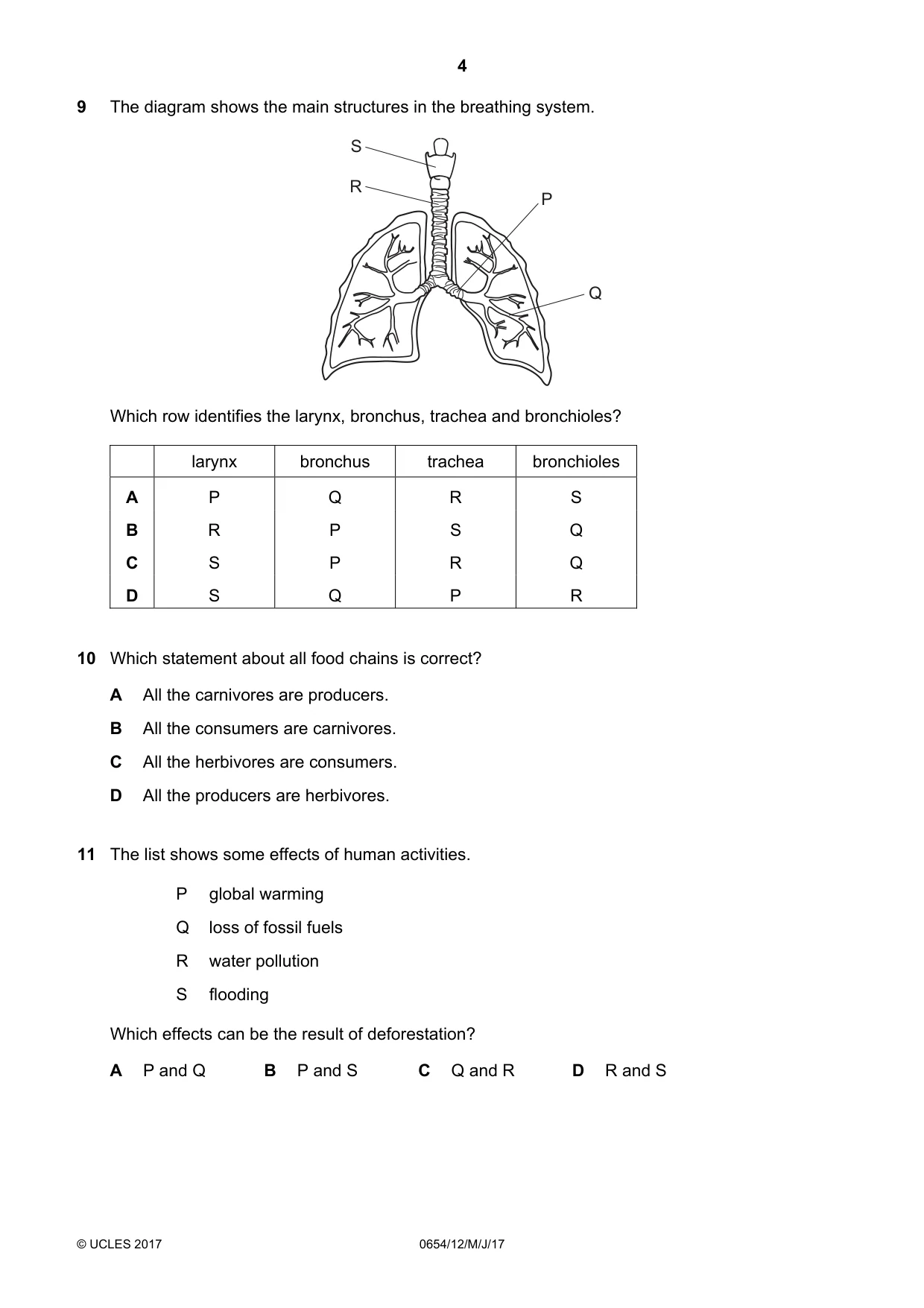
9 The diagram shows the main structures in the breathing system. S R P Q Which row identifies the larynx, bronchus, trachea and bronchioles? larynx bronchus trachea bronchioles A P Q R S B R P S Q C S P R Q D S Q P R
Mark scheme: C
Q10 · Which statement about all food chains is correct?
10 Which statement about all food chains is correct? A All the carnivores are producers. B All the consumers are carnivores. C All the herbivores are consumers. D All the producers are herbivores.
Mark scheme: C
Q11 · The list shows some effects of human activities
11 The list shows some effects of human activities. P global warming Q loss of fossil fuels R water pollution S flooding Which effects can be the result of deforestation? A P and Q B P and S C Q and R D R and S
Mark scheme: B
Q12 · Four plants with straight stems were placed in four black boxes, some with holes cut in…
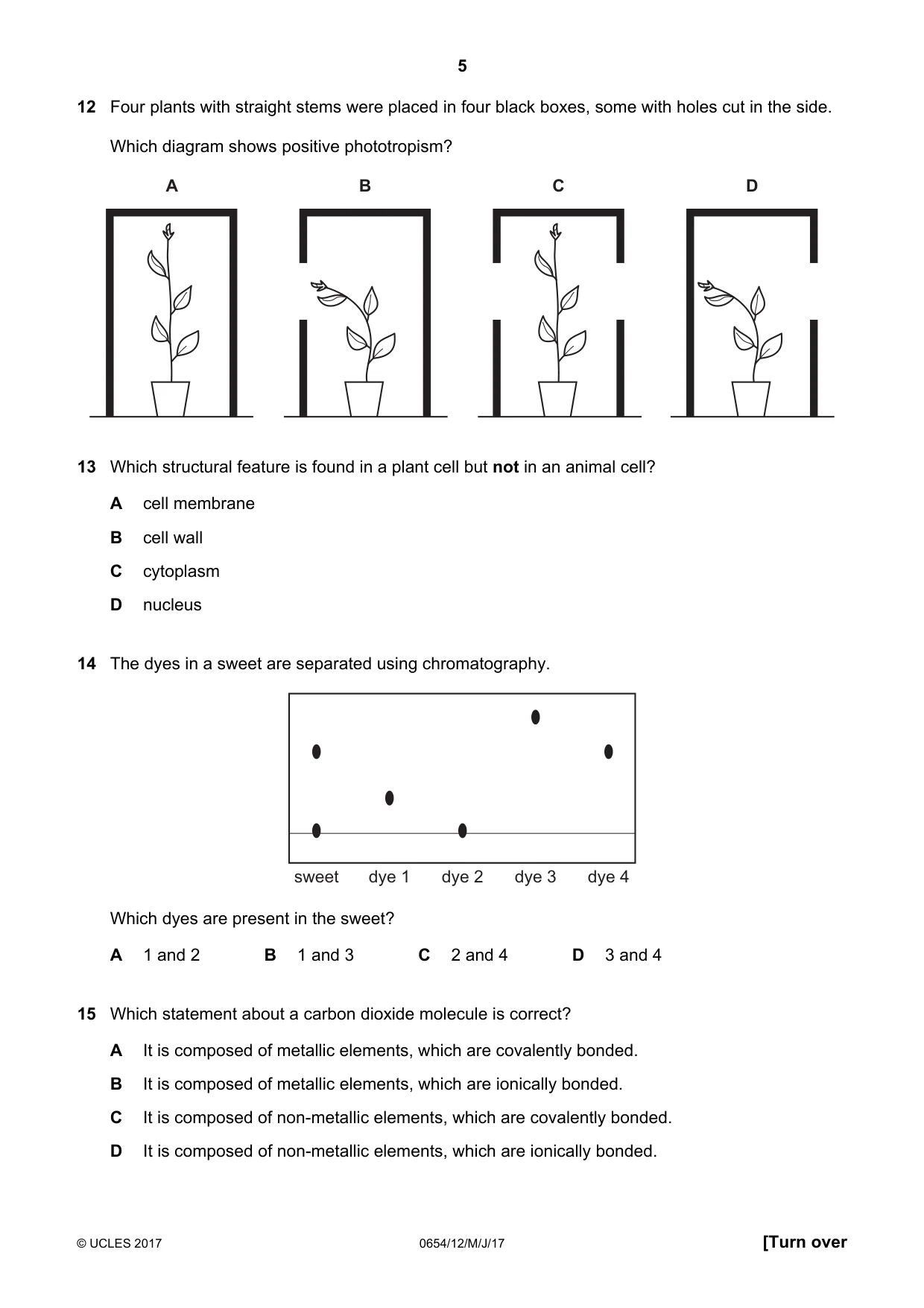
12 Four plants with straight stems were placed in four black boxes, some with holes cut in the side. Which diagram shows positive phototropism? A B C D
Mark scheme: B
Q13 · Which structural feature is found in a plant cell but not in an animal cell?
13 Which structural feature is found in a plant cell but not in an animal cell? A cell membrane B cell wall C cytoplasm D nucleus
Mark scheme: B
Q14 · The dyes in a sweet are separated using chromatography
14 The dyes in a sweet are separated using chromatography. sweet dye 1 dye 2 dye 3 dye 4 Which dyes are present in the sweet? A 1 and 2 B 1 and 3 C 2 and 4 D 3 and 4
Mark scheme: C
Q15 · Which statement about a carbon dioxide molecule is correct?
15 Which statement about a carbon dioxide molecule is correct? A It is composed of metallic elements, which are covalently bonded. B It is composed of metallic elements, which are ionically bonded. C It is composed of non-metallic elements, which are covalently bonded. D It is composed of non-metallic elements, which are ionically bonded.
Mark scheme: C
Q16 · How many atoms of metals and of non-metals are shown in the formula Na2SO4?
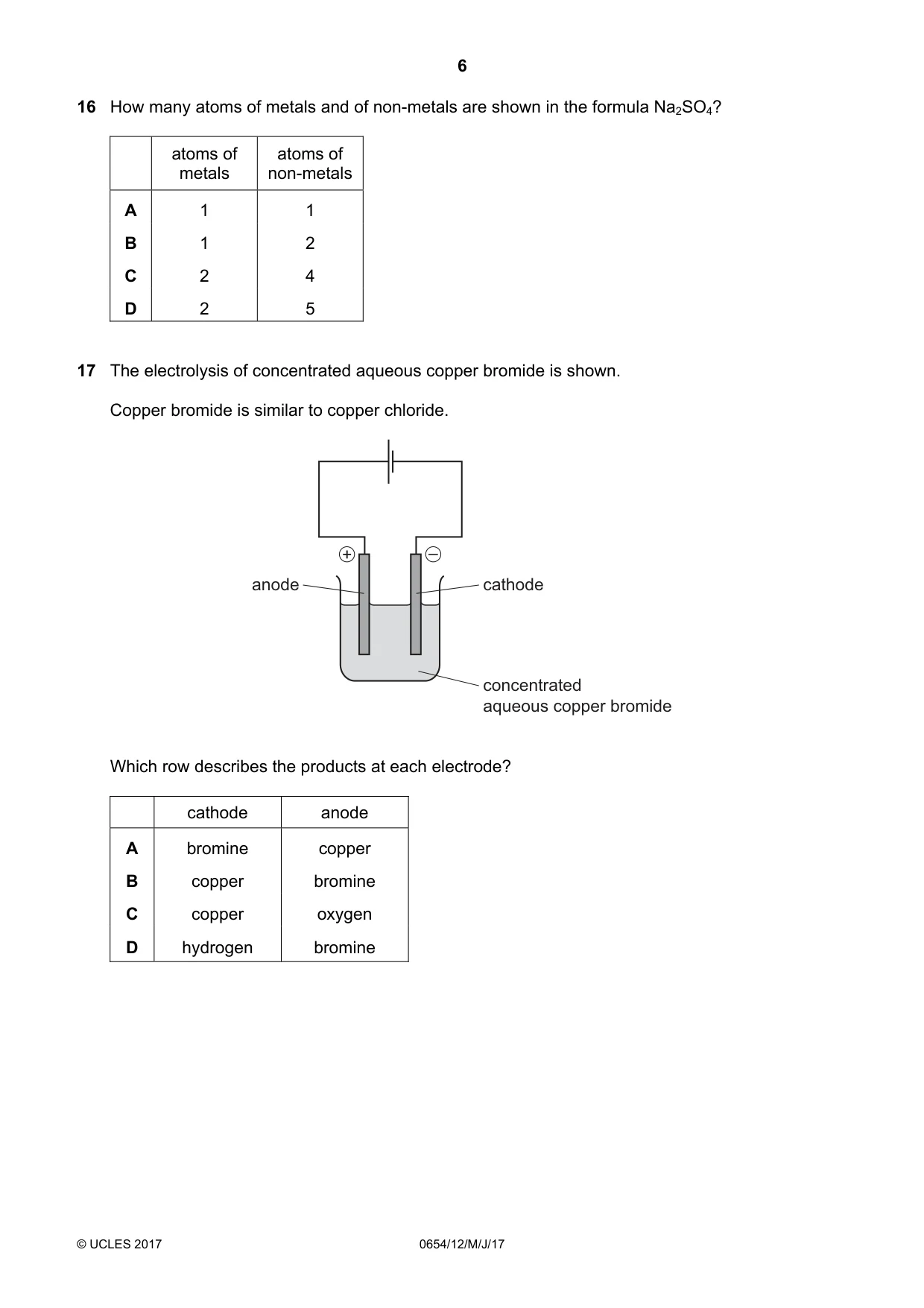
16 How many atoms of metals and of non-metals are shown in the formula Na2SO4? atoms of atoms of metals non-metals A 1 1 B 1 2 C 2 4 D 2 5
Mark scheme: D
Q17 · The electrolysis of concentrated aqueous copper bromide is shown
17 The electrolysis of concentrated aqueous copper bromide is shown. Copper bromide is similar to copper chloride. + – anode cathode concentrated aqueous copper bromide Which row describes the products at each electrode? cathode anode A bromine copper B copper bromine C copper oxygen D hydrogen bromine
Mark scheme: B
Q18 · When sodium is added to water it reacts violently and melts
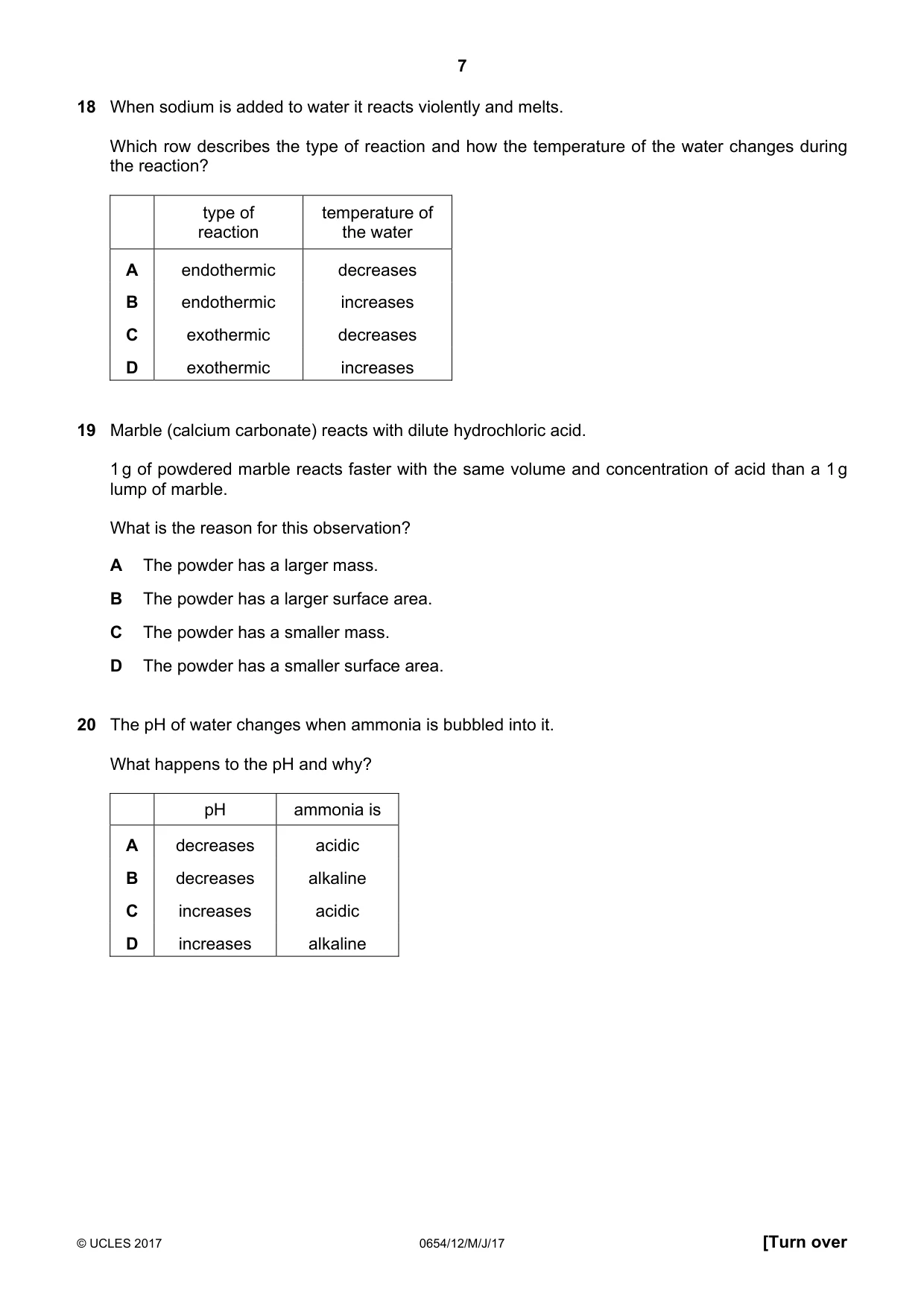
18 When sodium is added to water it reacts violently and melts. Which row describes the type of reaction and how the temperature of the water changes during the reaction? type of temperature of reaction the water A endothermic decreases B endothermic increases C exothermic decreases D exothermic increases
Mark scheme: D
Q19 · Marble (calcium carbonate) reacts with dilute hydrochloric acid
19 Marble (calcium carbonate) reacts with dilute hydrochloric acid. 1 g of powdered marble reacts faster with the same volume and concentration of acid than a 1 g lump of marble. What is the reason for this observation? A The powder has a larger mass. B The powder has a larger surface area. C The powder has a smaller mass. D The powder has a smaller surface area.
Mark scheme: B
Q20 · The pH of water changes when ammonia is bubbled into it
20 The pH of water changes when ammonia is bubbled into it. What happens to the pH and why? pH ammonia is A decreases acidic B decreases alkaline C increases acidic D increases alkaline
Mark scheme: D
More questions on The characteristic properties of acids and bases
Q21 · Two aqueous salt solutions X and Y are tested in three separate tests
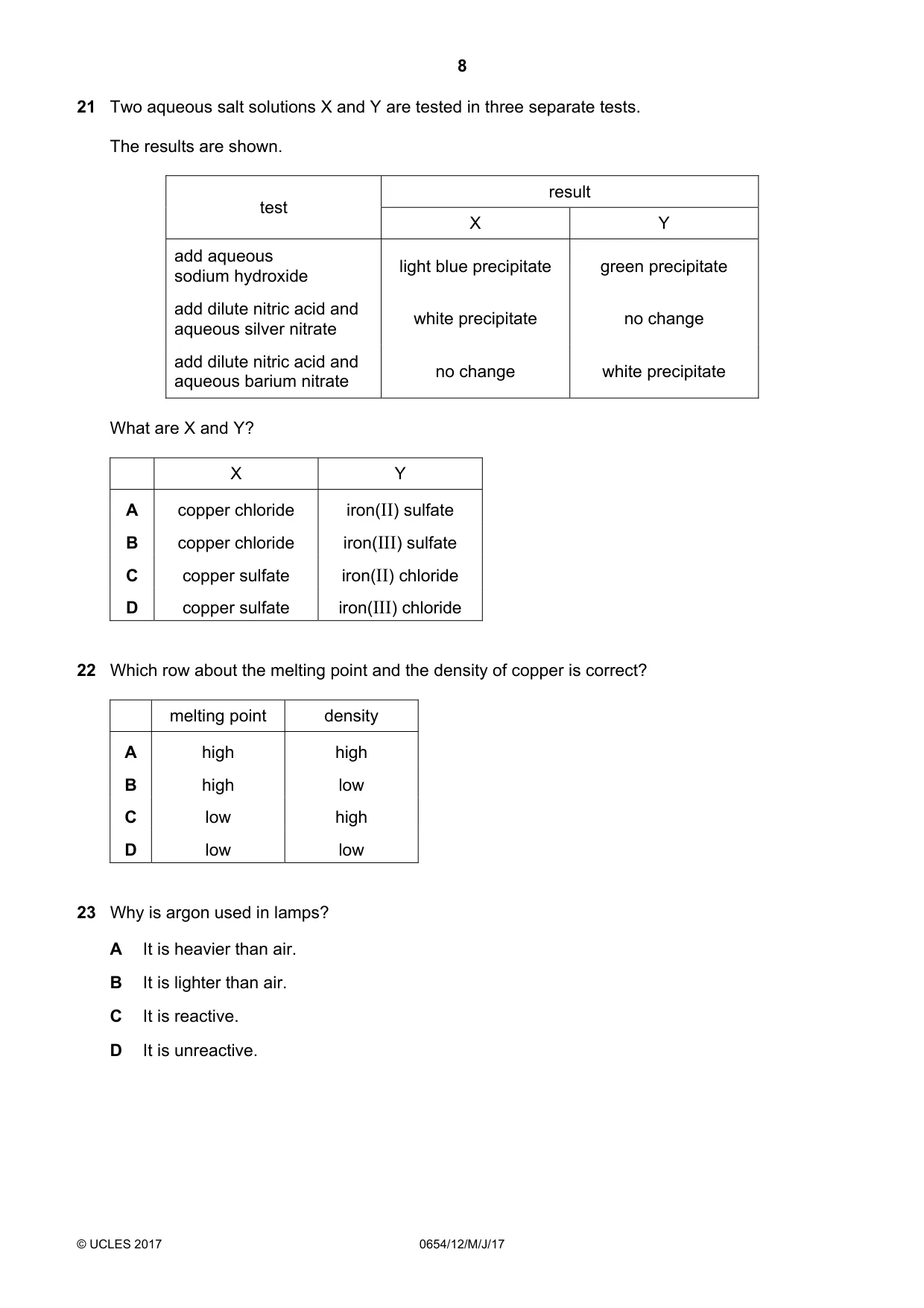
21 Two aqueous salt solutions X and Y are tested in three separate tests. The results are shown. result test X Y add aqueous light blue precipitate green precipitate sodium hydroxide add dilute nitric acid and white precipitate no change aqueous silver nitrate add dilute nitric acid and no change white precipitate aqueous barium nitrate What are X and Y? X Y A copper chloride iron(II) sulfate B copper chloride iron(III) sulfate C copper sulfate iron(II) chloride D copper sulfate iron(III) chloride
Mark scheme: A
Q22 · Which row about the melting point and the density of copper is correct?
22 Which row about the melting point and the density of copper is correct? melting point density A high high B high low C low high D low low
Mark scheme: A
Q23 · Why is argon used in lamps?
23 Why is argon used in lamps? A It is heavier than air. B It is lighter than air. C It is reactive. D It is unreactive.
Mark scheme: D
Q24 · Which metal is extracted from its ore by heating with carbon?
24 Which metal is extracted from its ore by heating with carbon? A copper B magnesium C potassium D sodium
Mark scheme: A
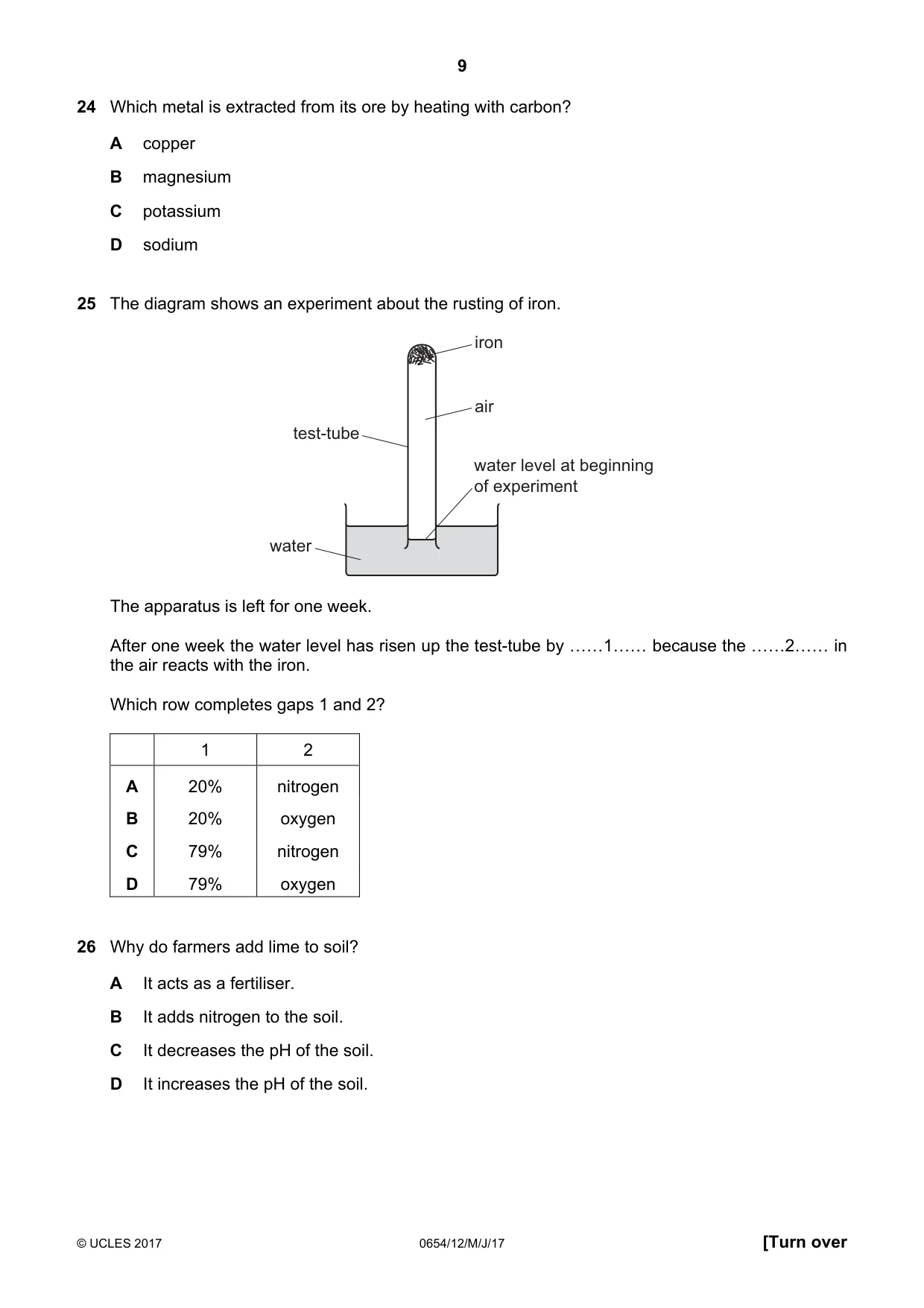
Q25 · The diagram shows an experiment about the rusting of iron
25 The diagram shows an experiment about the rusting of iron. iron air test-tube water level at beginning of experiment water The apparatus is left for one week. After one week the water level has risen up the test-tube by ««1«« because the ««2«« in the air reacts with the iron. Which row completes gaps 1 and 2? 1 2 A 20% nitrogen B 20% oxygen C 79% nitrogen D 79% oxygen
Mark scheme: B
Q26 · Why do farmers add lime to soil?
26 Why do farmers add lime to soil? A It acts as a fertiliser. B It adds nitrogen to the soil. C It decreases the pH of the soil. D It increases the pH of the soil.
Mark scheme: D
More questions on The characteristic properties of acids and bases
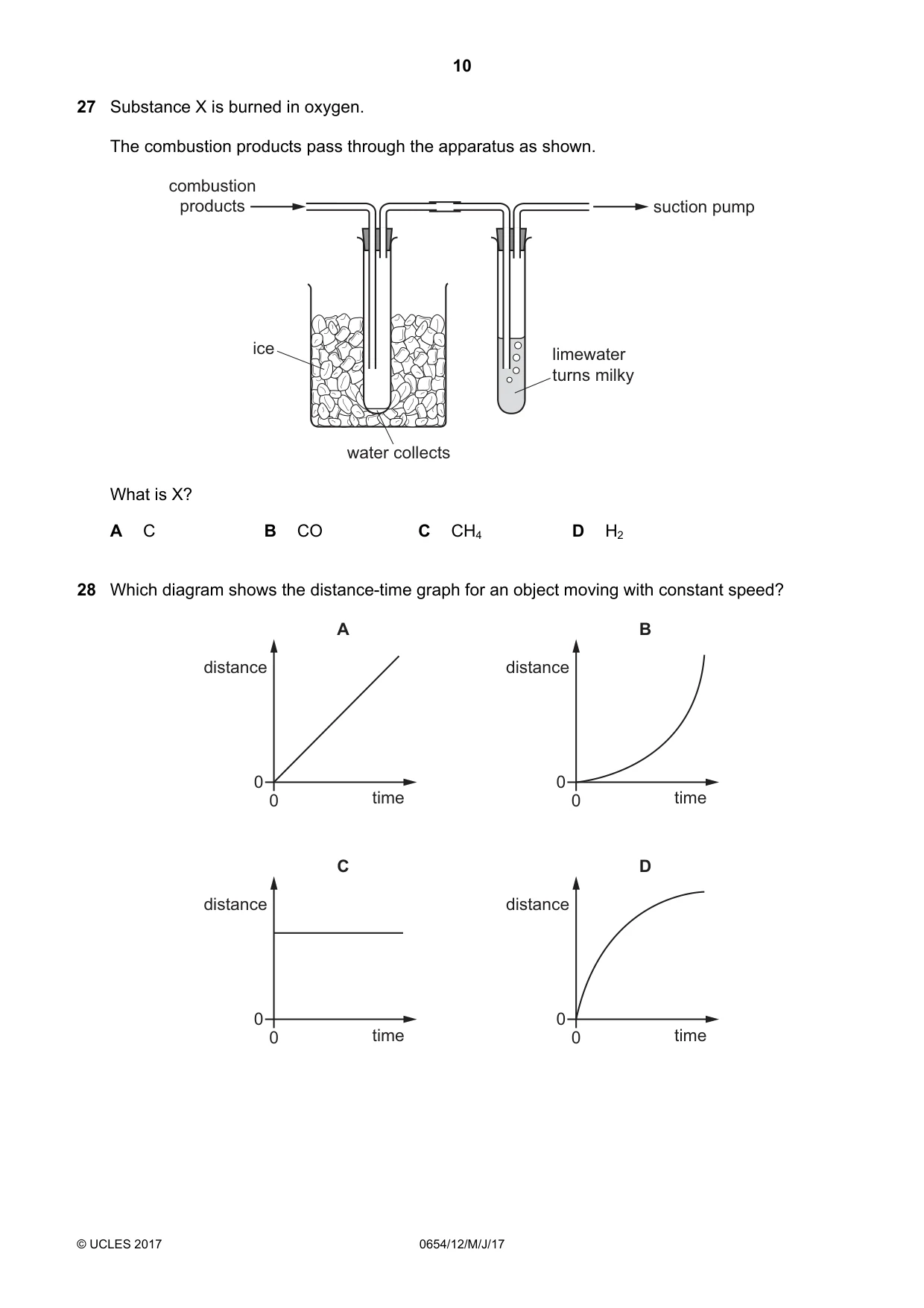
Q27 · Substance X is burned in oxygen
27 Substance X is burned in oxygen. The combustion products pass through the apparatus as shown. combustion products suction pump ice limewater turns milky water collects What is X? A C B CO C CH4 D H2
Mark scheme: C
Q28 · Which diagram shows the distance-time graph for an object moving with constant speed?
28 Which diagram shows the distance-time graph for an object moving with constant speed? A B distance distance 0 0 0 time 0 time C D distance distance 0 0 0 time 0 time
Mark scheme: A
Q29 · On Earth an astronaut has a mass of 80 kg and weighs 800 N
29 On Earth an astronaut has a mass of 80 kg and weighs 800 N. In deep space the gravitational field is very weak. What is the mass and what is the weight of the astronaut in deep space? mass / kg weight / N A less than 80 less than 800 B less than 80 800 C 80 less than 800 D 80 800
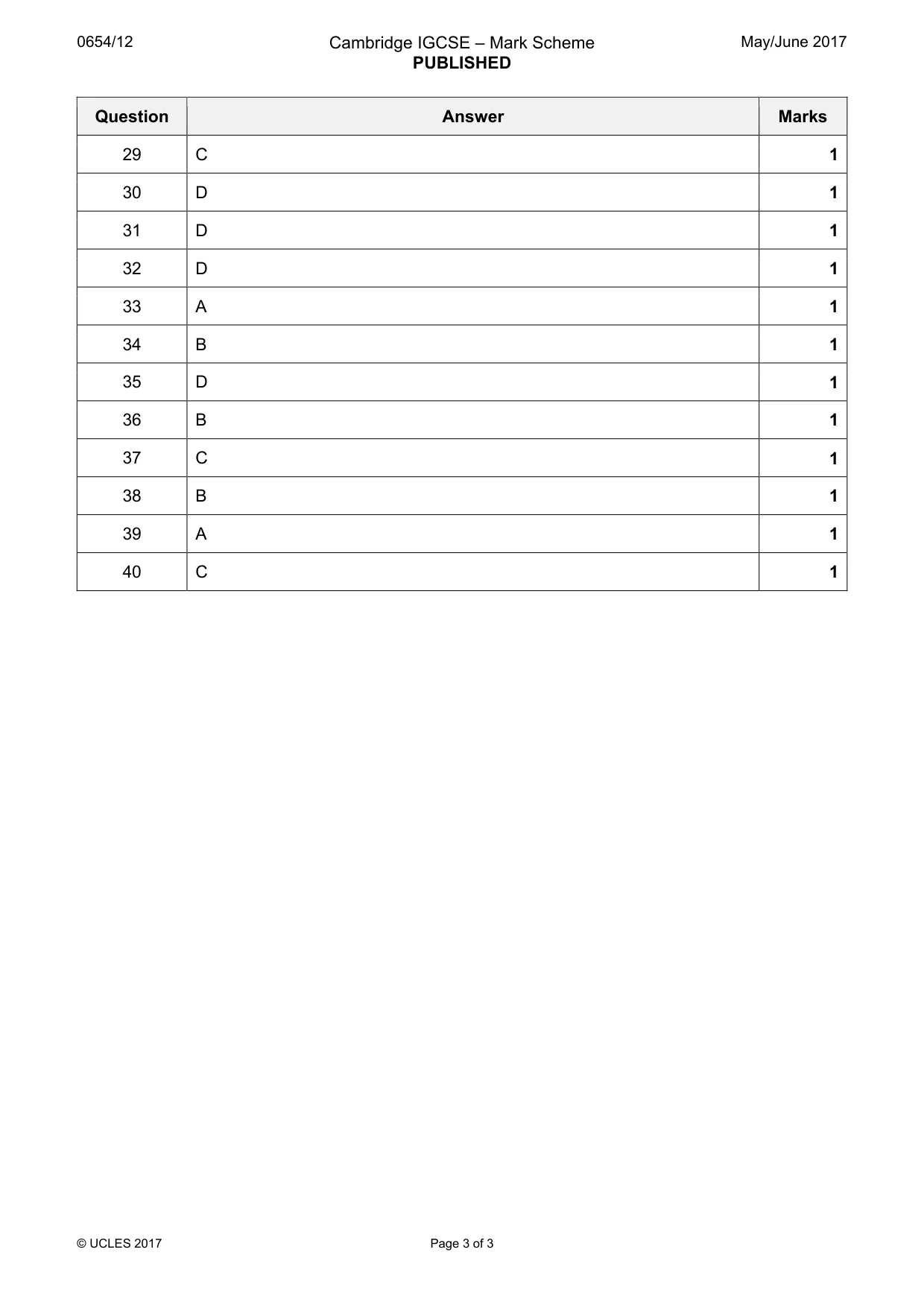
Mark scheme: C
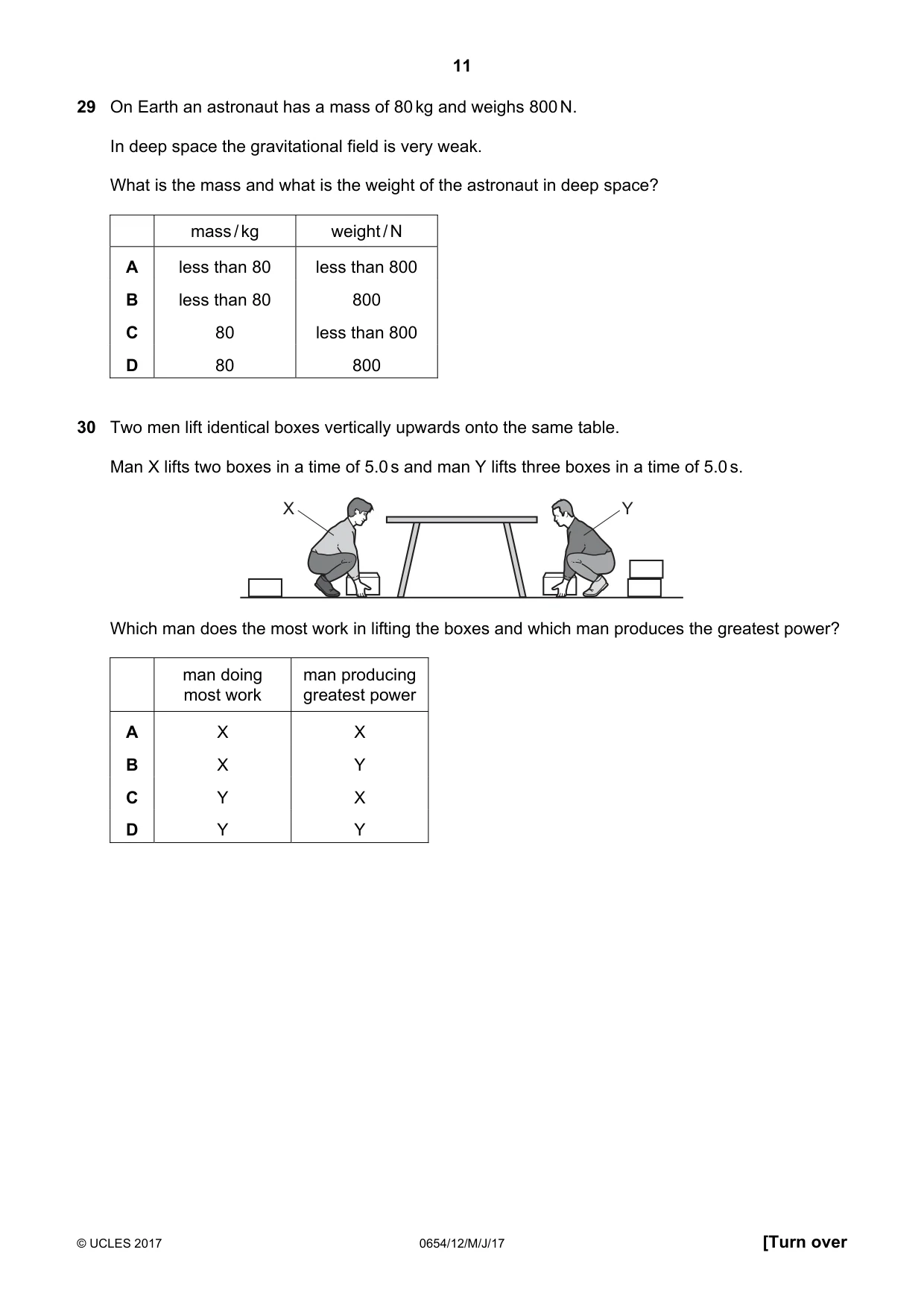
Q30 · Two men lift identical boxes vertically upwards onto the same table
30 Two men lift identical boxes vertically upwards onto the same table. Man X lifts two boxes in a time of 5.0 s and man Y lifts three boxes in a time of 5.0 s. X Y Which man does the most work in lifting the boxes and which man produces the greatest power? man doing man producing most work greatest power A X X B X Y C Y X D Y Y
Mark scheme: D
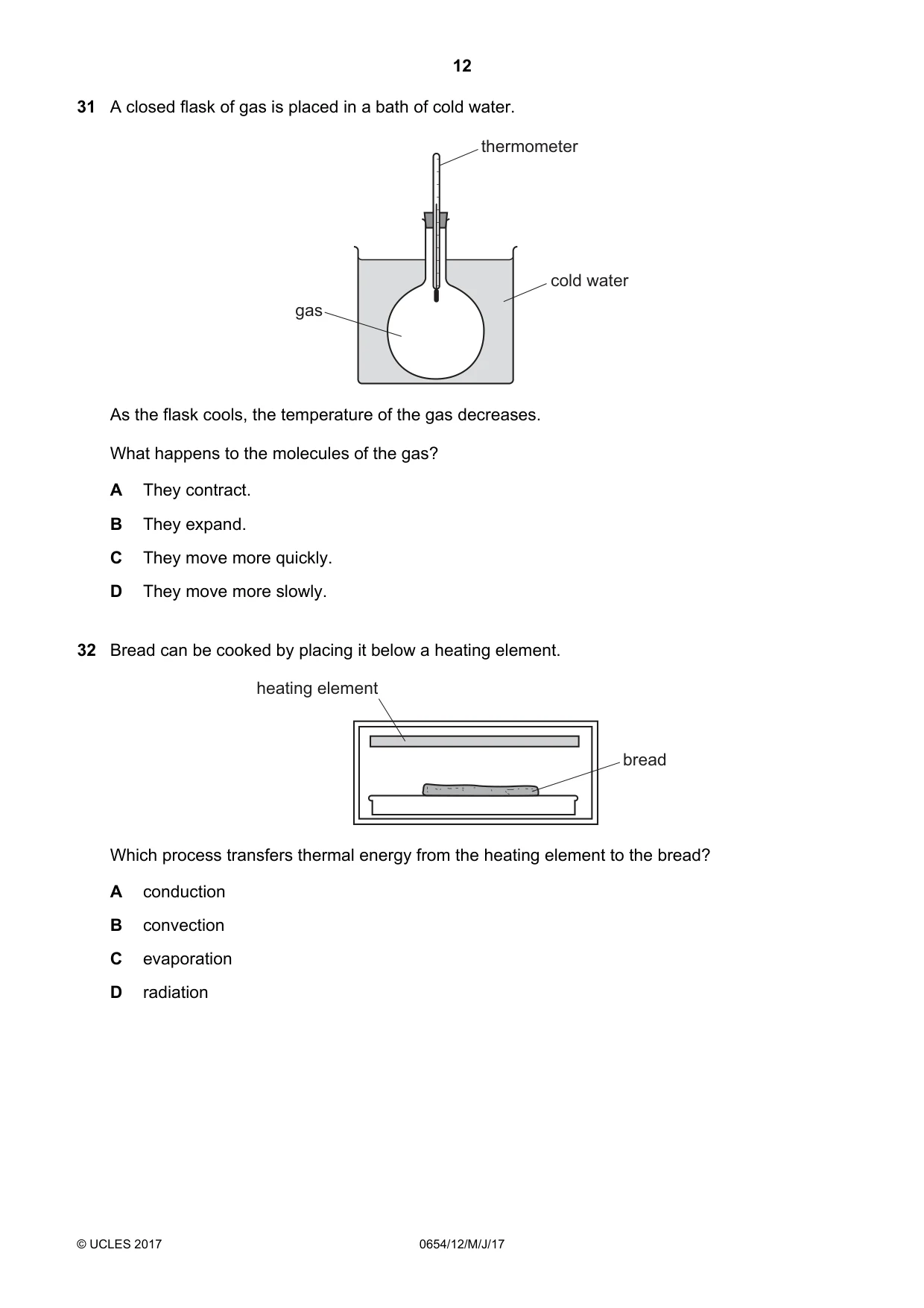
Q31 · A closed flask of gas is placed in a bath of cold water
31 A closed flask of gas is placed in a bath of cold water. thermometer cold water gas As the flask cools, the temperature of the gas decreases. What happens to the molecules of the gas? A They contract. B They expand. C They move more quickly. D They move more slowly.
Mark scheme: D
Q32 · Bread can be cooked by placing it below a heating element
32 Bread can be cooked by placing it below a heating element. heating element bread Which process transfers thermal energy from the heating element to the bread? A conduction B convection C evaporation D radiation
Mark scheme: D
Q33 · The diagram represents a wave
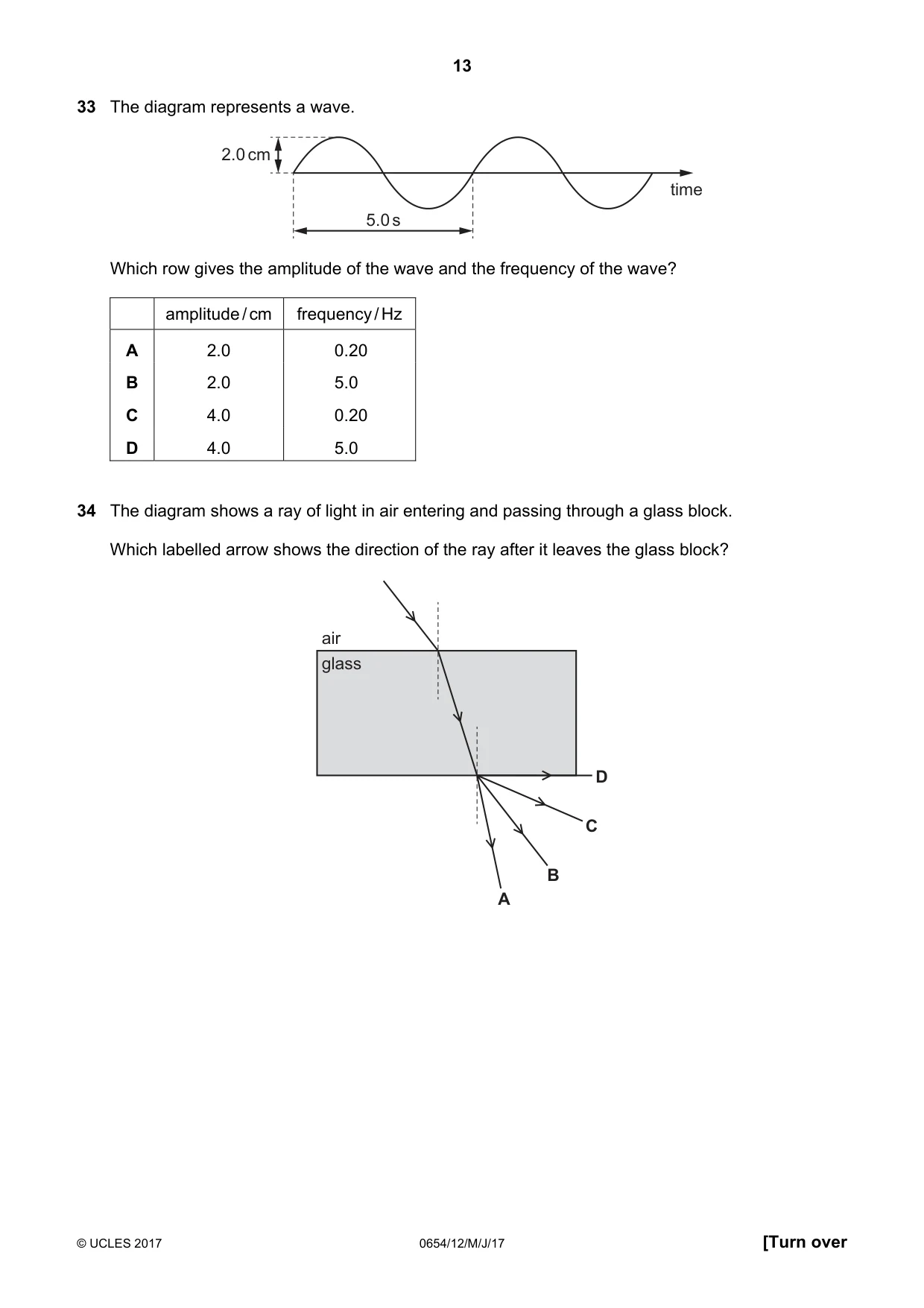
33 The diagram represents a wave. 2.0 cm time 5.0 s Which row gives the amplitude of the wave and the frequency of the wave? amplitude / cm frequency / Hz A 2.0 0.20 B 2.0 5.0 C 4.0 0.20 D 4.0 5.0
Mark scheme: A
Q34 · The diagram shows a ray of light in air entering and passing through a glass block
34 The diagram shows a ray of light in air entering and passing through a glass block. Which labelled arrow shows the direction of the ray after it leaves the glass block? air glass D C B A
Mark scheme: B
Q35 · Astronaut 1 uses a hammer to mend a satellite in space
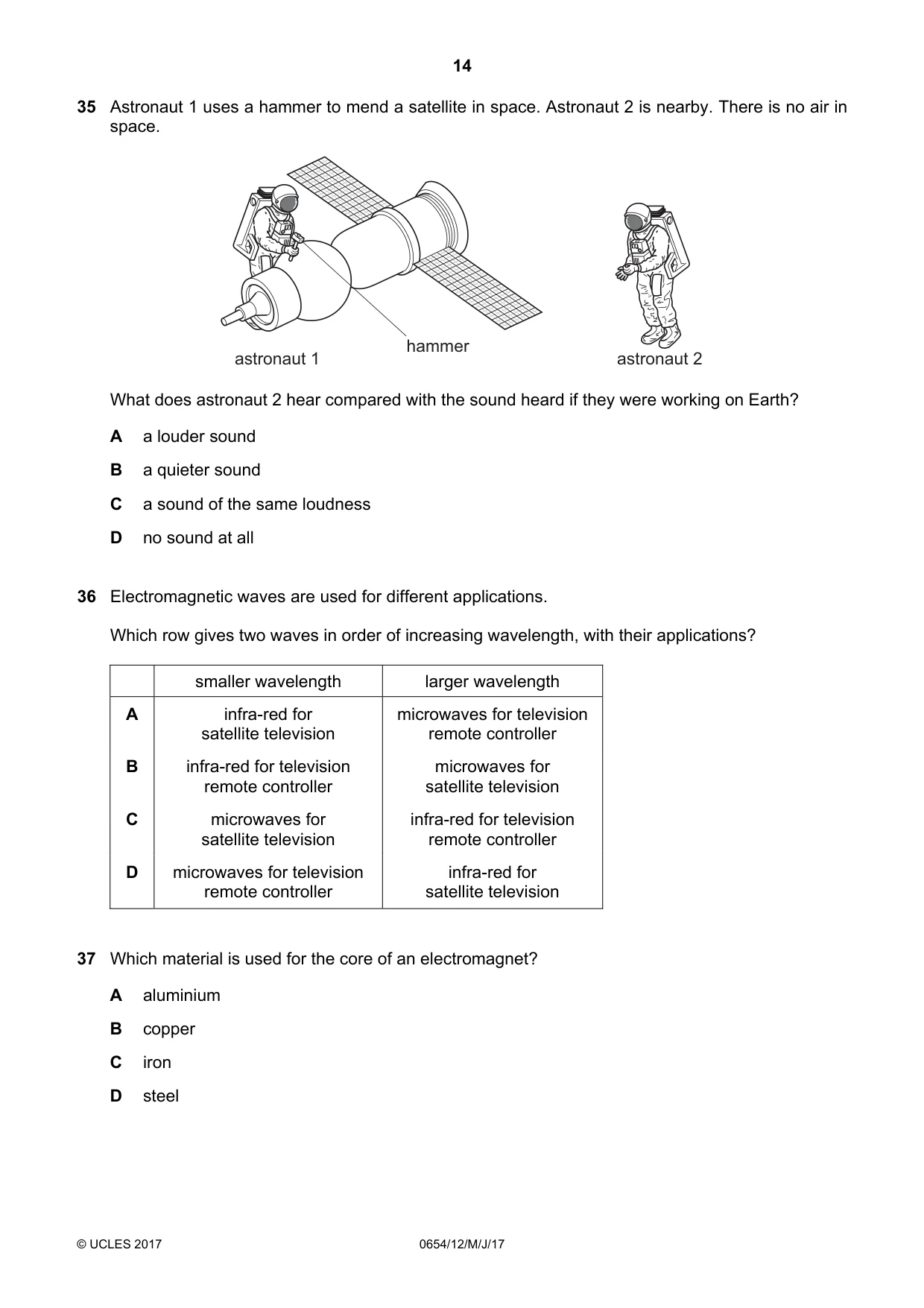
35 Astronaut 1 uses a hammer to mend a satellite in space. Astronaut 2 is nearby. There is no air in space. hammer astronaut 1 astronaut 2 What does astronaut 2 hear compared with the sound heard if they were working on Earth? A a louder sound B a quieter sound C a sound of the same loudness D no sound at all
Mark scheme: D
Q36 · Electromagnetic waves are used for different applications
36 Electromagnetic waves are used for different applications. Which row gives two waves in order of increasing wavelength, with their applications? smaller wavelength larger wavelength A infra-red for microwaves for television satellite television remote controller B infra-red for television microwaves for remote controller satellite television C microwaves for infra-red for television satellite television remote controller D microwaves for television infra-red for remote controller satellite television
Mark scheme: B
Q37 · Which material is used for the core of an electromagnet?
37 Which material is used for the core of an electromagnet? A aluminium B copper C iron D steel
Mark scheme: C
Q38 · There is a current of 4.0 A in a resistor
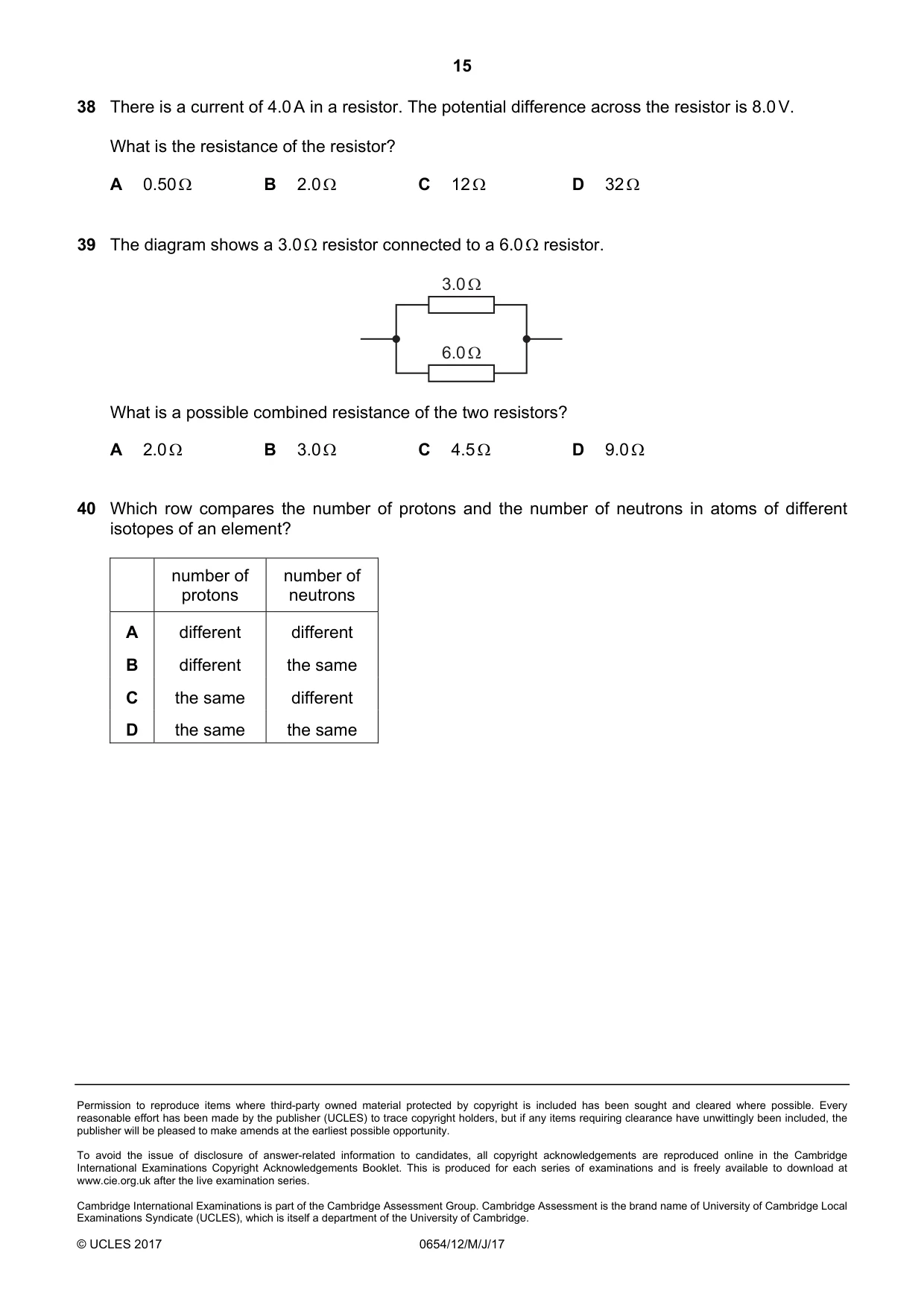
38 There is a current of 4.0 A in a resistor. The potential difference across the resistor is 8.0 V. What is the resistance of the resistor? A 0.50 Ω B 2.0 Ω C 12 Ω D 32 Ω
Mark scheme: B
Q39 · The diagram shows a 3.0 Ω resistor connected to a 6.0 Ω resistor
39 The diagram shows a 3.0 Ω resistor connected to a 6.0 Ω resistor. 3.0 Ω 6.0 Ω What is a possible combined resistance of the two resistors? A 2.0 Ω B 3.0 Ω C 4.5 Ω D 9.0 Ω
Mark scheme: A
Q40 · Which row compares the number of protons and the number of neutrons in atoms of different…
40 Which row compares the number of protons and the number of neutrons in atoms of different isotopes of an element? number of number of protons neutrons A different different B different the same C the same different D the same the same
Mark scheme: C
What was in this paper
The subtopics covered by these 40 questions, and how many questions each got. Open one in a new tab to see every Cambridge question on it.
2The characteristic properties of acids and bases2Asexual reproduction1Cell structure1Characteristics of living organisms1Chromatography1Corrosion of metals1Electrical circuits1Electrical quantities1Electrolysis1Electromagnetic spectrum1Energy, work and power1Enzymes1Exothermic and endothermic reactions1Extraction of metals1Food chains and food webs1Formulas1Fuels1Gas exchange in humans1General properties of waves1Habitat destruction1Identification of ions and gases1Isotopes1Kinetic particle model of matter1Light1Mass and weight1Motion1Noble gases1Photosynthesis1Properties of metals1Rate of reaction1Respiration1Selection1Simple molecules and covalent bonds1Simple phenomena of magnetism1Sound1Transfer of thermal energy1Transpiration1What you needed in this session
Cambridge’s own grade thresholds for 2017 May/June, Paper 1 · Variant 2. A higher threshold means an easier paper — the bar moves with how the cohort did.