Cambridge IGCSE Sciences - Co-ordinated (Double) 0654 — 2020 Oct/Nov Paper 1 · Variant 2
0654/12/O/N/20 · 40 questions · 40 marks · ≈45 min
The question paper and its mark scheme, free to read here and free to download. This is Cambridge’s own paper, exactly as it was sat.
Question paper16 pages


Mark scheme3 pages
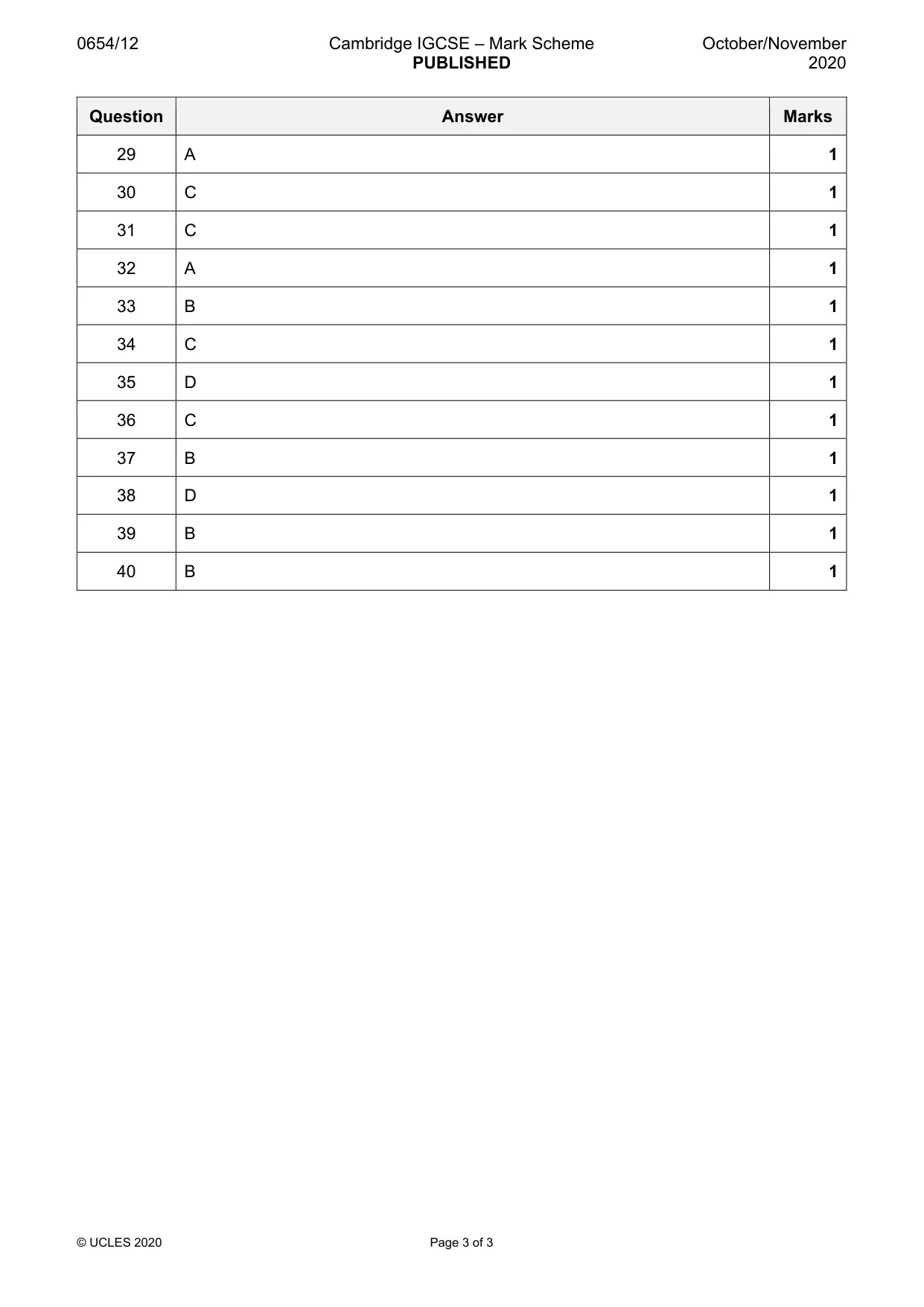
Answers below. Sit the paper first if you are practising.
Questions as text
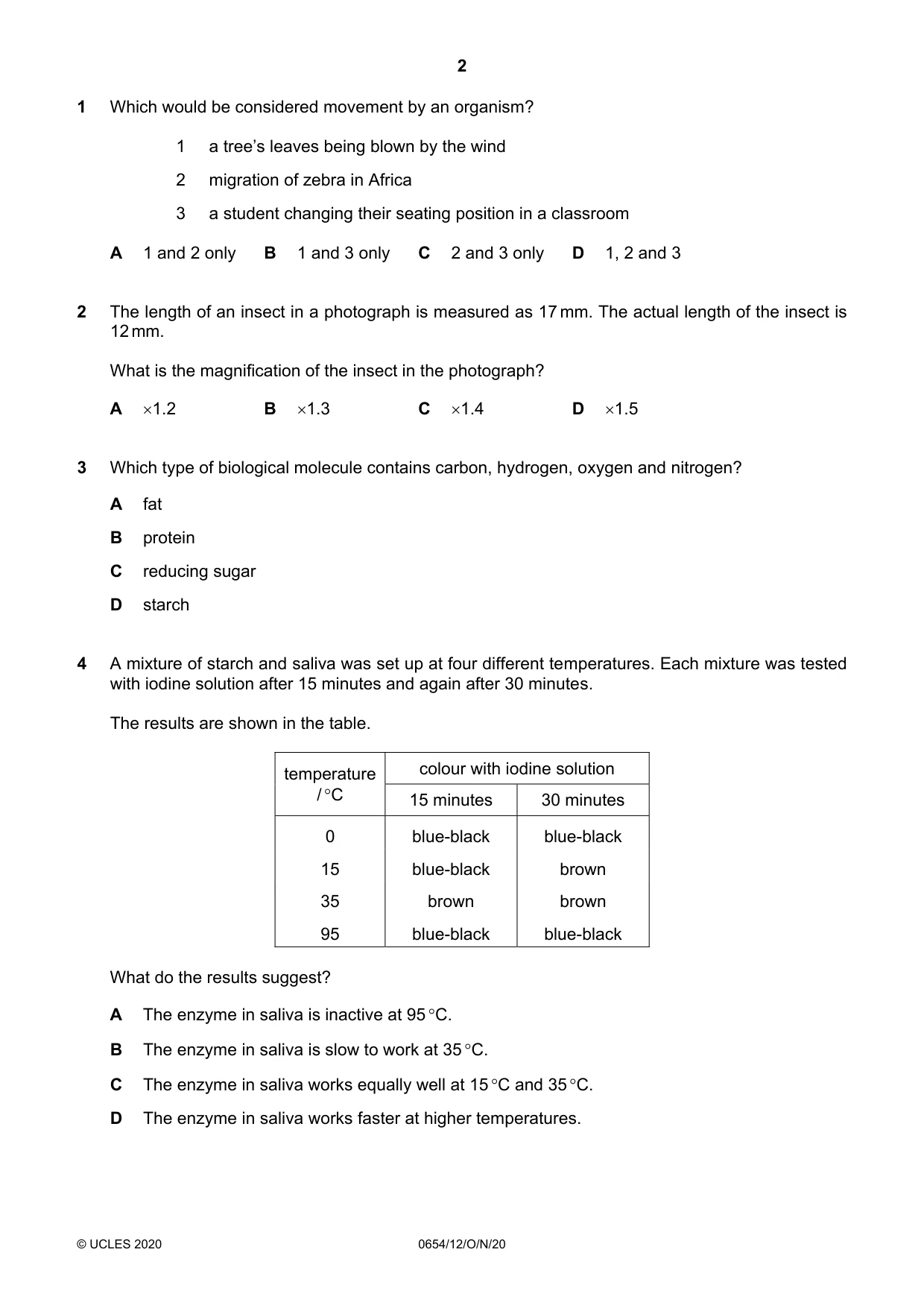
Q1 · Which would be considered movement by an organism?
1 Which would be considered movement by an organism? 1 a tree’s leaves being blown by the wind 2 migration of zebra in Africa 3 a student changing their seating position in a classroom A 1 and 2 only B 1 and 3 only C 2 and 3 only D 1, 2 and 3
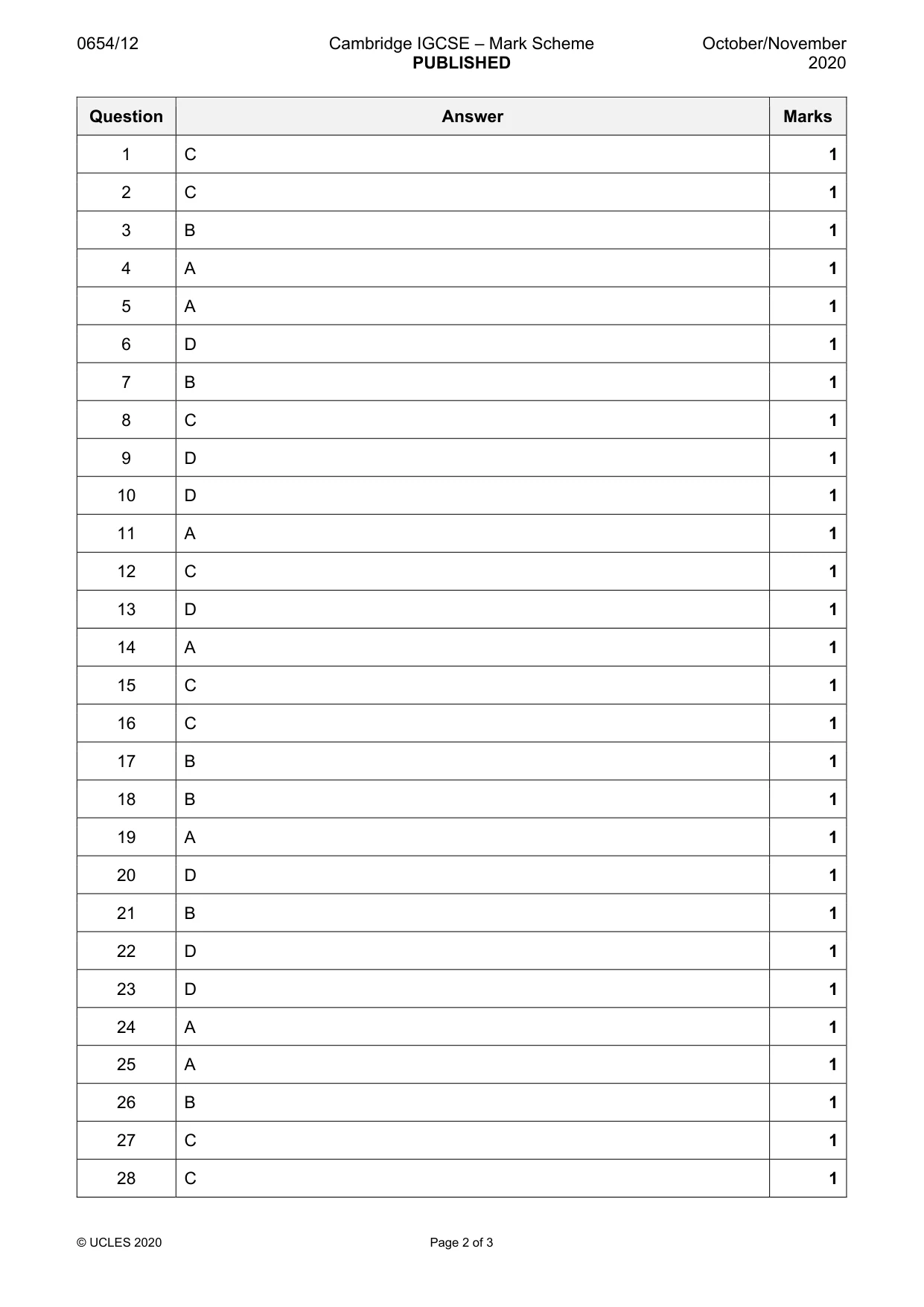
Mark scheme: C
Q2 · The length of an insect in a photograph is measured as 17 mm
2 The length of an insect in a photograph is measured as 17 mm. The actual length of the insect is 12 mm. What is the magnification of the insect in the photograph? A 1.2 B 1.3 C 1.4 D 1.5
Mark scheme: C
Q3 · Which type of biological molecule contains carbon, hydrogen, oxygen and nitrogen?
3 Which type of biological molecule contains carbon, hydrogen, oxygen and nitrogen? A fat B protein C reducing sugar D starch
Mark scheme: B
Q4 · A mixture of starch and saliva was set up at four different temperatures
4 A mixture of starch and saliva was set up at four different temperatures. Each mixture was tested with iodine solution after 15 minutes and again after 30 minutes. The results are shown in the table. temperature colour with iodine solution / C 15 minutes 30 minutes 0 blue-black blue-black 15 blue-black brown 35 brown brown 95 blue-black blue-black What do the results suggest? A The enzyme in saliva is inactive at 95 C. B The enzyme in saliva is slow to work at 35 C. C The enzyme in saliva works equally well at 15 C and 35 C. D The enzyme in saliva works faster at higher temperatures.
Mark scheme: A
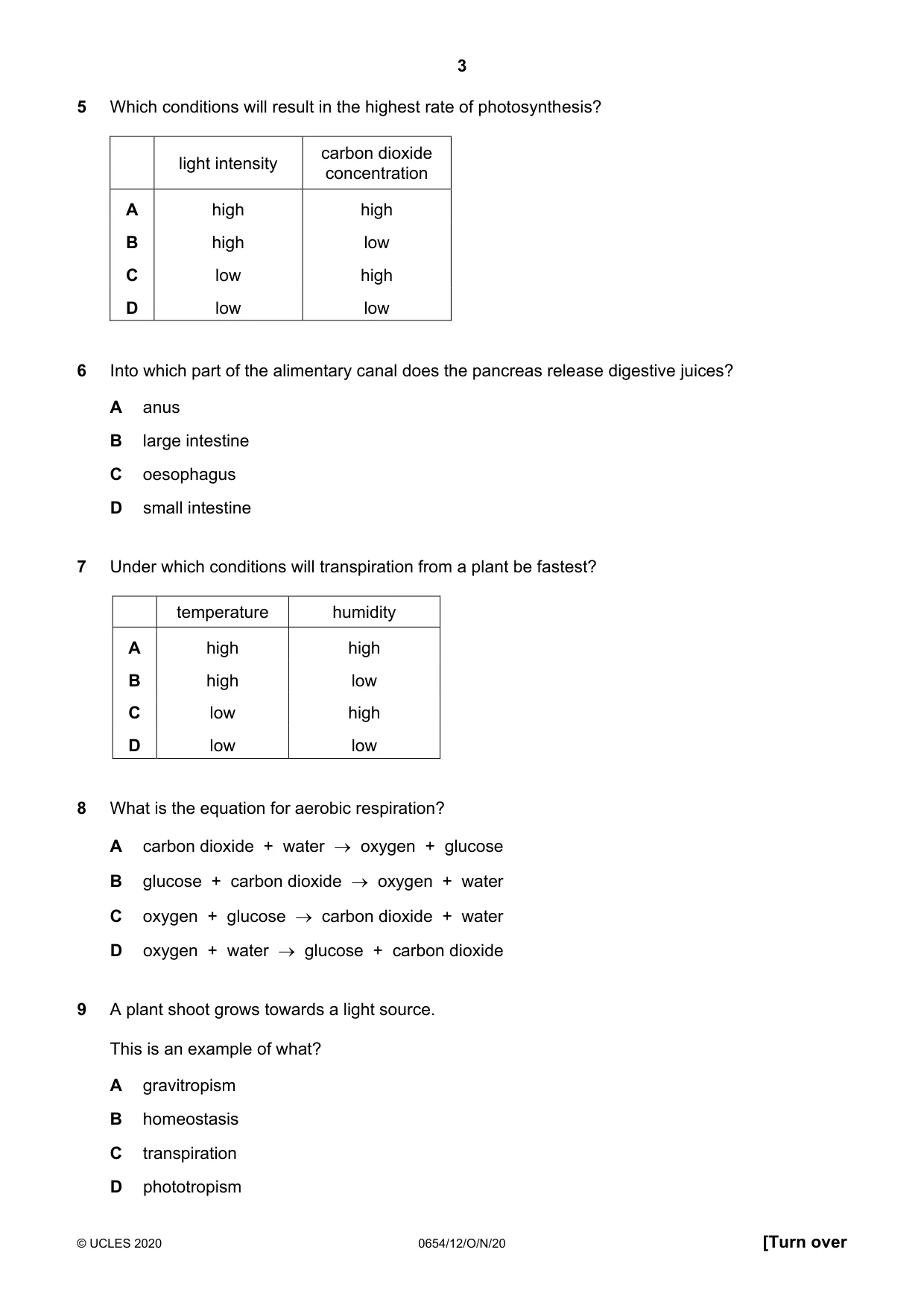
Q5 · Which conditions will result in the highest rate of photosynthesis?
5 Which conditions will result in the highest rate of photosynthesis? carbon dioxide light intensity concentration A high high B high low C low high D low low
Mark scheme: A
Q6 · Into which part of the alimentary canal does the pancreas release digestive juices?
6 Into which part of the alimentary canal does the pancreas release digestive juices? A anus B large intestine C oesophagus D small intestine
Mark scheme: D
Q7 · Under which conditions will transpiration from a plant be fastest?
7 Under which conditions will transpiration from a plant be fastest? temperature humidity A high high B high low C low high D low low
Mark scheme: B
Q8 · What is the equation for aerobic respiration?
8 What is the equation for aerobic respiration? A carbon dioxide + water oxygen + glucose B glucose + carbon dioxide oxygen + water C oxygen + glucose carbon dioxide + water D oxygen + water glucose + carbon dioxide
Mark scheme: C
Q9 · A plant shoot grows towards a light source
9 A plant shoot grows towards a light source. This is an example of what? A gravitropism B homeostasis C transpiration D phototropism
Mark scheme: D
Question 10
10 What describes pollination? A fertilisation of an egg by a pollen grain B pollen being carried by bees C transfer of pollen from a stigma to a stamen D transfer of pollen from an anther to a stigma
Mark scheme: D
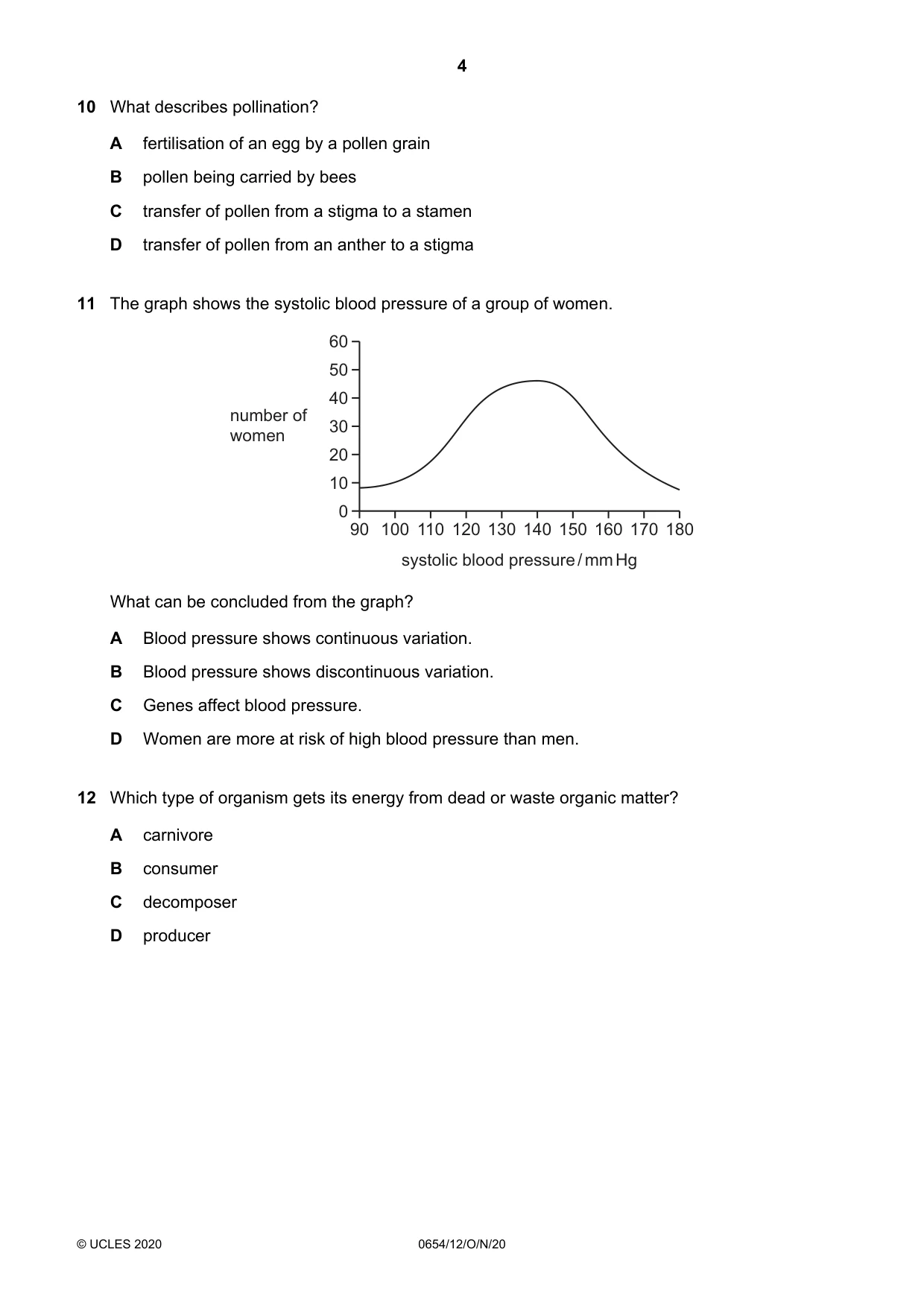
Q11 · The graph shows the systolic blood pressure of a group of women
11 The graph shows the systolic blood pressure of a group of women. 60 50 40 number of 30 women 20 10 0 90 100 110 120 130 140 150 160 170 180 systolic blood pressure / mm Hg What can be concluded from the graph? A Blood pressure shows continuous variation. B Blood pressure shows discontinuous variation. C Genes affect blood pressure. D Women are more at risk of high blood pressure than men.
Mark scheme: A
Q12 · Which type of organism gets its energy from dead or waste organic matter?
12 Which type of organism gets its energy from dead or waste organic matter? A carnivore B consumer C decomposer D producer
Mark scheme: C
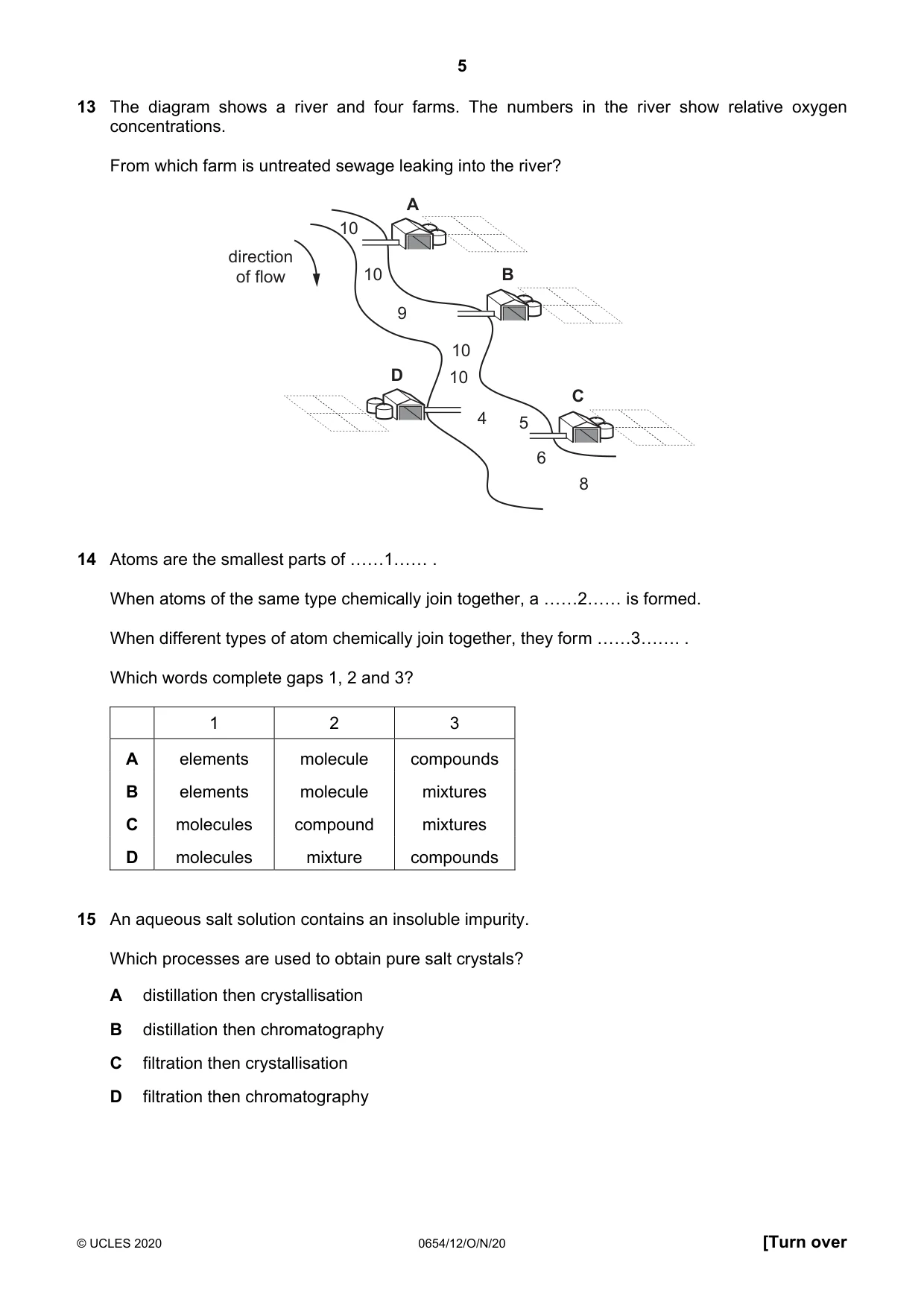
Q13 · The diagram shows a river and four farms
13 The diagram shows a river and four farms. The numbers in the river show relative oxygen concentrations. From which farm is untreated sewage leaking into the river? A 10 direction of flow 10 B 9 10 D 10 C 4 5 6 8
Mark scheme: D
Q14 · Atoms are the smallest parts of ……1……
14 Atoms are the smallest parts of ……1…… . When atoms of the same type chemically join together, a ……2…… is formed. When different types of atom chemically join together, they form ……3……. . Which words complete gaps 1, 2 and 3? 1 2 3 A elements molecule compounds B elements molecule mixtures C molecules compound mixtures D molecules mixture compounds
Mark scheme: A
Q15 · An aqueous salt solution contains an insoluble impurity
15 An aqueous salt solution contains an insoluble impurity. Which processes are used to obtain pure salt crystals? A distillation then crystallisation B distillation then chromatography C filtration then crystallisation D filtration then chromatography
Mark scheme: C
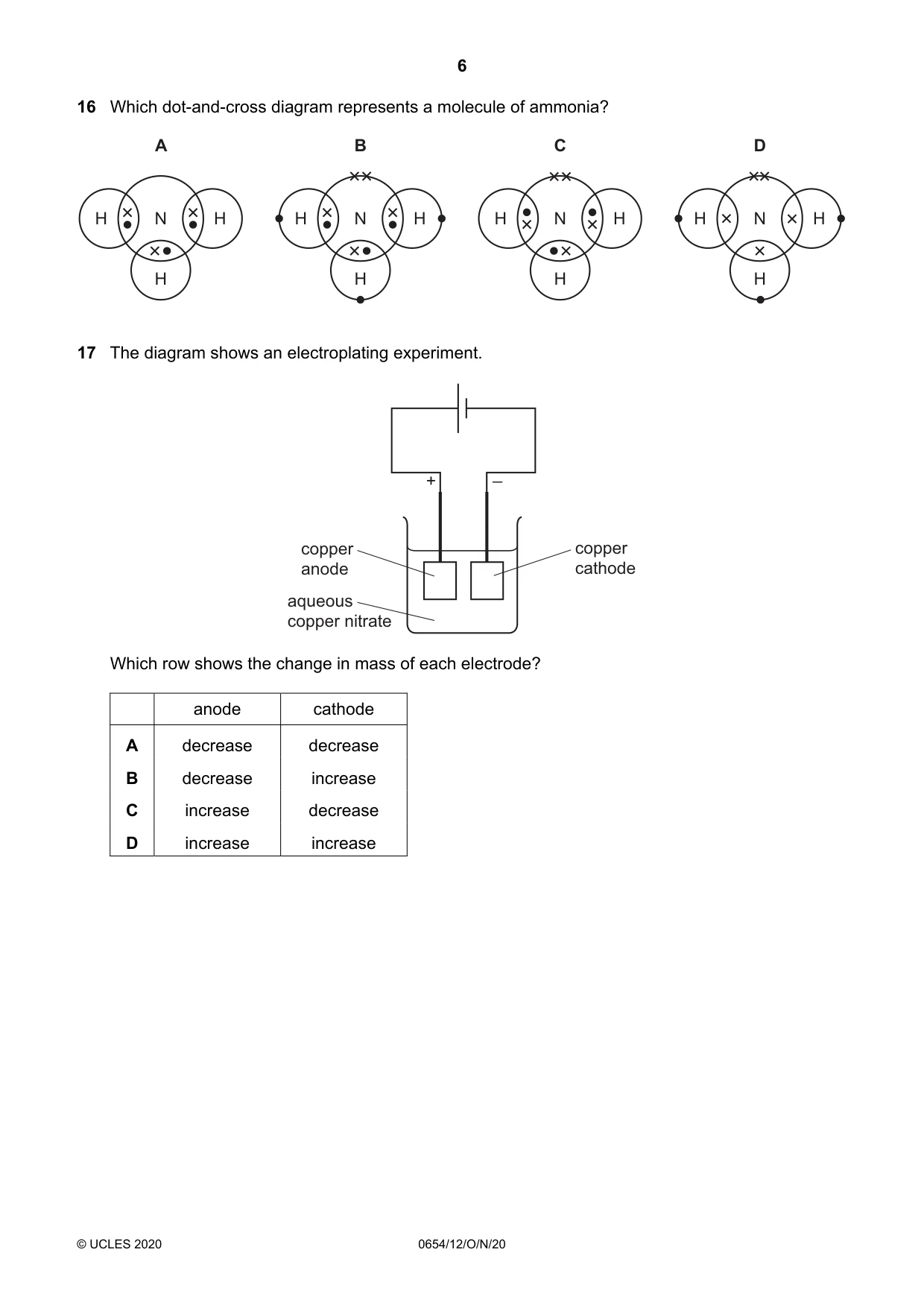
Q16 · Which dot-and-cross diagram represents a molecule of ammonia?
16 Which dot-and-cross diagram represents a molecule of ammonia? A B C D H N H H N H H N H H N H H H H H
Mark scheme: C
Q17 · The diagram shows an electroplating experiment
17 The diagram shows an electroplating experiment. + _ copper copper anode cathode aqueous copper nitrate Which row shows the change in mass of each electrode? anode cathode A decrease decrease B decrease increase C increase decrease D increase increase
Mark scheme: B
Q18 · Two processes are listed
18 Two processes are listed. 1 the conversion of liquid water into steam 2 the combustion of magnesium ribbon Which row describes the two processes? process 1 process 2 A endothermic endothermic B endothermic exothermic C exothermic endothermic D exothermic exothermic
Mark scheme: B
Q19 · Which word equation represents a redox reaction?
19 Which word equation represents a redox reaction? A carbon + copper oxide copper + carbon dioxide B hydrochloric acid + potassium hydroxide potassium chloride + water C magnesium carbonate magnesium oxide + carbon dioxide D sodium sulfate + barium nitrate barium sulfate + sodium nitrate
Mark scheme: A
Q20 · Which compound is prepared by reacting an acid with a base?
20 Which compound is prepared by reacting an acid with a base? A calcium oxide B copper hydroxide C hydrogen chloride D magnesium sulfate
Mark scheme: D
Q21 · Which row shows the trends for Group I elements lithium to potassium?
21 Which row shows the trends for Group I elements lithium to potassium? trend in trend in reaction melting point with water A decrease decrease B decrease increase C increase decrease D increase increase
Mark scheme: B
Q22 · Which statement describes transition elements?
22 Which statement describes transition elements? A They form colourless compounds. B They have low densities. C They have low melting points. D They often act as catalysts.
Mark scheme: D
Q23 · Blue cobalt(II) chloride paper is added to a liquid
23 Blue cobalt(II) chloride paper is added to a liquid. It changes from blue to pink. What is the liquid? A bromine B ethanol C petrol D water
Mark scheme: D
Q24 · Which process does not produce carbon dioxide?
24 Which process does not produce carbon dioxide? A acid reacting with a metal B acid reacting with sodium carbonate C complete combustion of methane D respiration
Mark scheme: A
Q25 · Some soil is treated with limestone to make it neutral
25 Some soil is treated with limestone to make it neutral. What is the pH of the soil before it is treated? A 5 B 7 C 9 D 11
Mark scheme: A
More questions on The characteristic properties of acids and bases
Q26 · Which substance is not a fossil fuel?
26 Which substance is not a fossil fuel? A coal B hydrogen C natural gas D petroleum
Mark scheme: B
Q27 · Poly(ethene) is made from ethene by the process of addition polymerisation
27 Poly(ethene) is made from ethene by the process of addition polymerisation. Which word describes ethene in this process? A fuel B catalyst C monomer D solvent
Mark scheme: C
Q28 · A man has a mass of 80 kg
28 A man has a mass of 80 kg. The gravitational field strength g is 10 N / kg. What is the man’s weight? A 8.0 N B 80 N C 800 N D 8000 N
Mark scheme: C
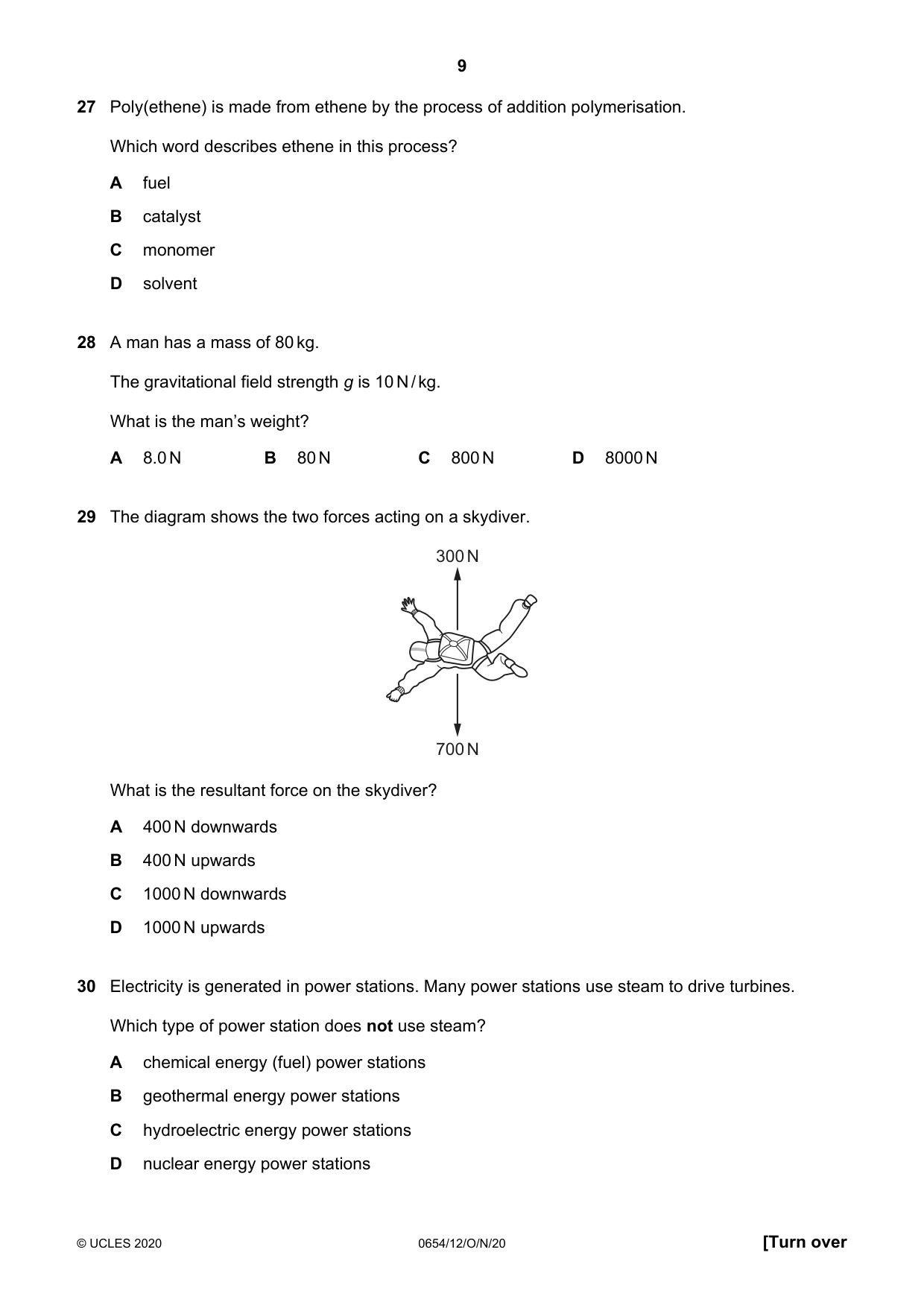
Q29 · The diagram shows the two forces acting on a skydiver
29 The diagram shows the two forces acting on a skydiver. 300 N 700 N What is the resultant force on the skydiver? A 400 N downwards B 400 N upwards C 1000 N downwards D 1000 N upwards
Mark scheme: A
Q30 · Electricity is generated in power stations
30 Electricity is generated in power stations. Many power stations use steam to drive turbines. Which type of power station does not use steam? A chemical energy (fuel) power stations B geothermal energy power stations C hydroelectric energy power stations D nuclear energy power stations
Mark scheme: C
Q31 · An electric kettle is switched on and the temperature of the water in it increases to 60…
31 An electric kettle is switched on and the temperature of the water in it increases to 60 C. What is the main method of heat transfer within the water? A boiling B conduction C convection D radiation
Mark scheme: C
Q32 · A tank contains water
32 A tank contains water. A wave is produced and travels across the surface of the water. What is the maximum height of the water as the wave passes compared with the original level of the water? A the amplitude B the frequency C the speed D the wavelength
Mark scheme: A
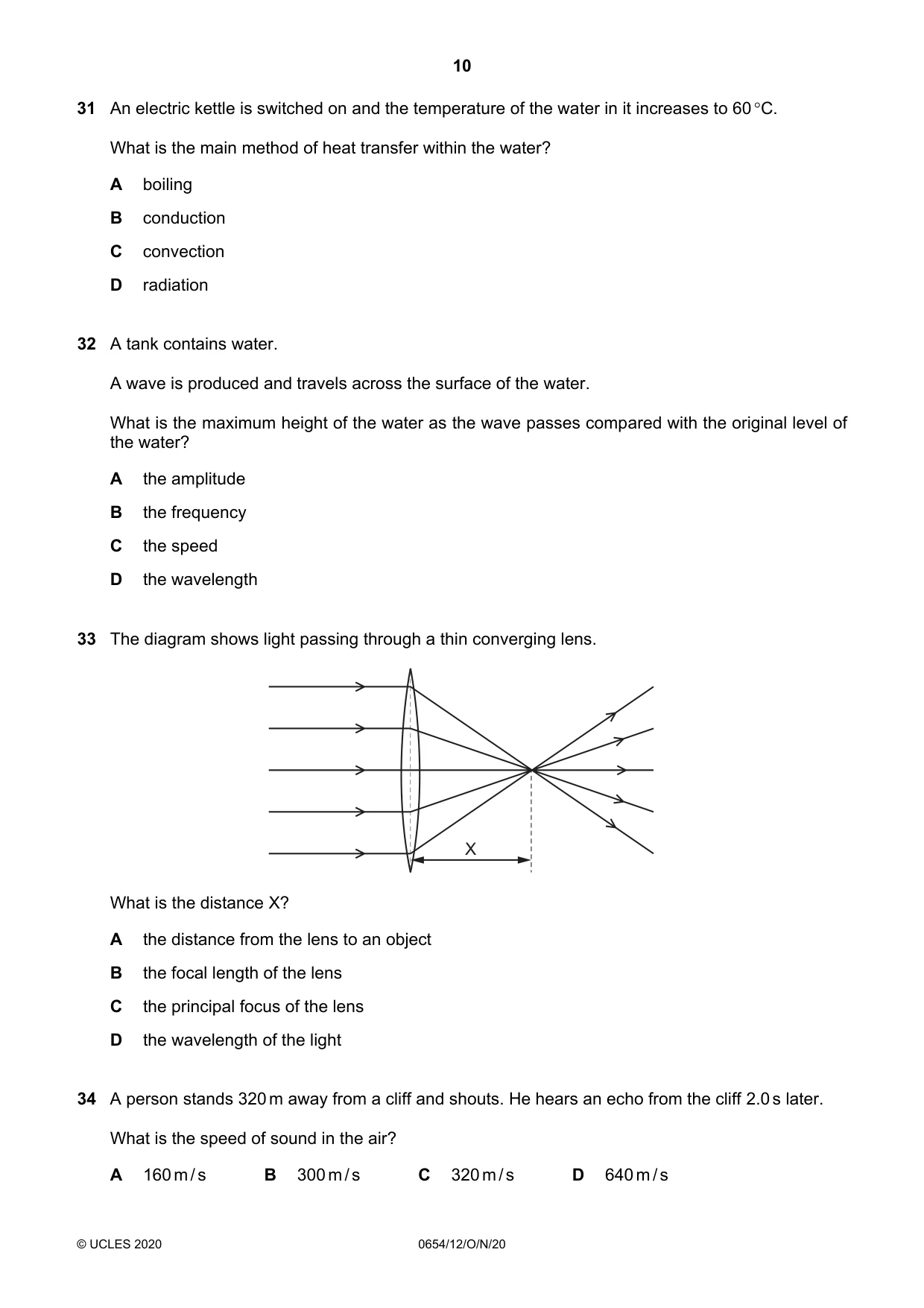
Q33 · The diagram shows light passing through a thin converging lens
33 The diagram shows light passing through a thin converging lens. X What is the distance X? A the distance from the lens to an object B the focal length of the lens C the principal focus of the lens D the wavelength of the light
Mark scheme: B
Q34 · A person stands 320 m away from a cliff and shouts
34 A person stands 320 m away from a cliff and shouts. He hears an echo from the cliff 2.0 s later. What is the speed of sound in the air? A 160 m / s B 300 m / s C 320 m / s D 640 m / s
Mark scheme: C
Q35 · What is the unit for electromotive force (e.m.f.)?
35 What is the unit for electromotive force (e.m.f.)? A ampere B ohm C newton D volt
Mark scheme: D
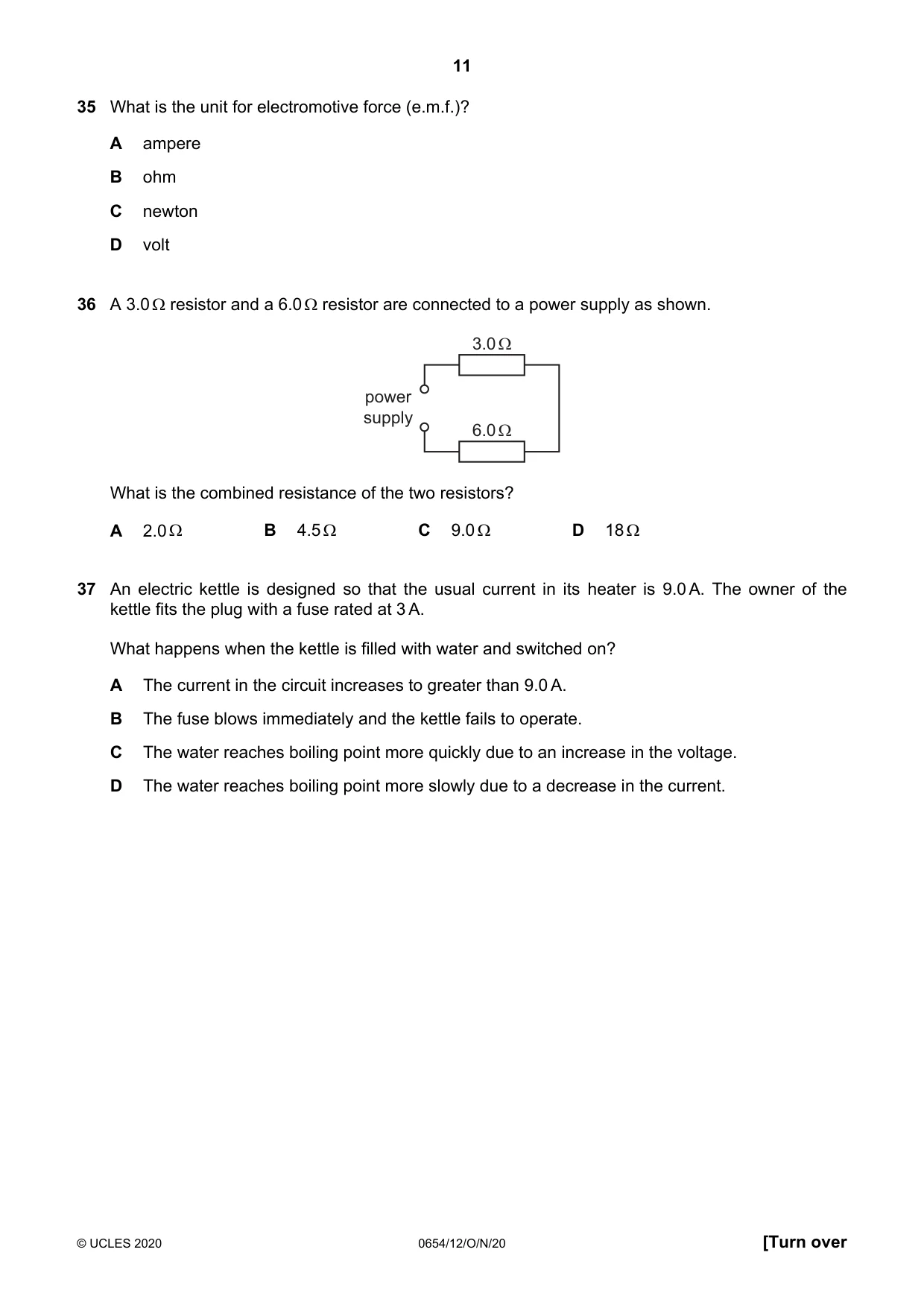
Q36 · A 3.0 resistor and a 6.0 resistor are connected to a power supply as shown
36 A 3.0 resistor and a 6.0 resistor are connected to a power supply as shown. 3.0 Ω power supply 6.0 Ω What is the combined resistance of the two resistors? A 2.0 B 4.5 C 9.0 D 18
Mark scheme: C
Q37 · An electric kettle is designed so that the usual current in its heater is 9.0 A
37 An electric kettle is designed so that the usual current in its heater is 9.0 A. The owner of the kettle fits the plug with a fuse rated at 3 A. What happens when the kettle is filled with water and switched on? A The current in the circuit increases to greater than 9.0 A. B The fuse blows immediately and the kettle fails to operate. C The water reaches boiling point more quickly due to an increase in the voltage. D The water reaches boiling point more slowly due to a decrease in the current.
Mark scheme: B
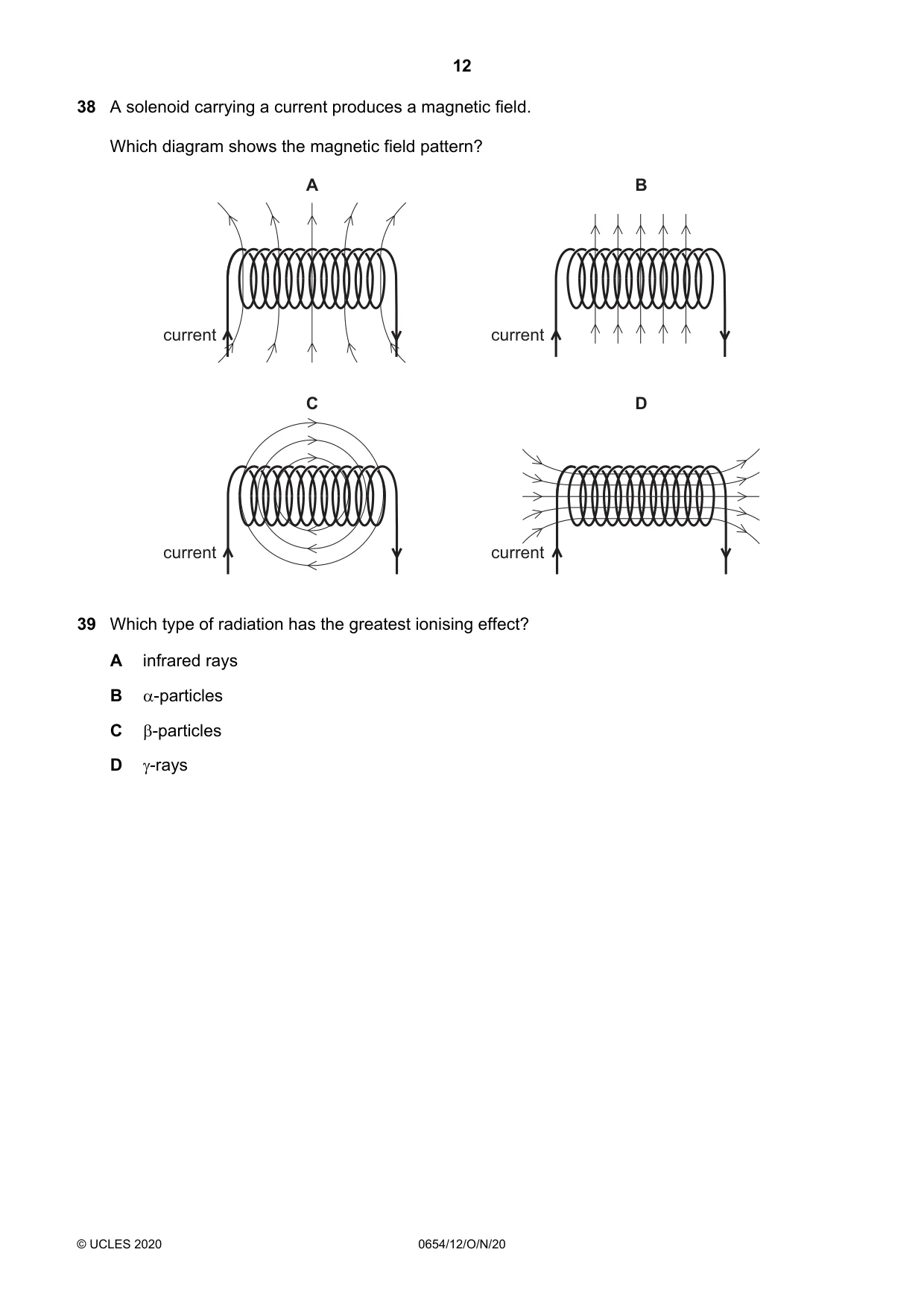
Q38 · A solenoid carrying a current produces a magnetic field
38 A solenoid carrying a current produces a magnetic field. Which diagram shows the magnetic field pattern? A B current current C D current current
Mark scheme: D
Q39 · Which type of radiation has the greatest ionising effect?
39 Which type of radiation has the greatest ionising effect? A infrared rays B -particles C -particles D -rays
Mark scheme: B
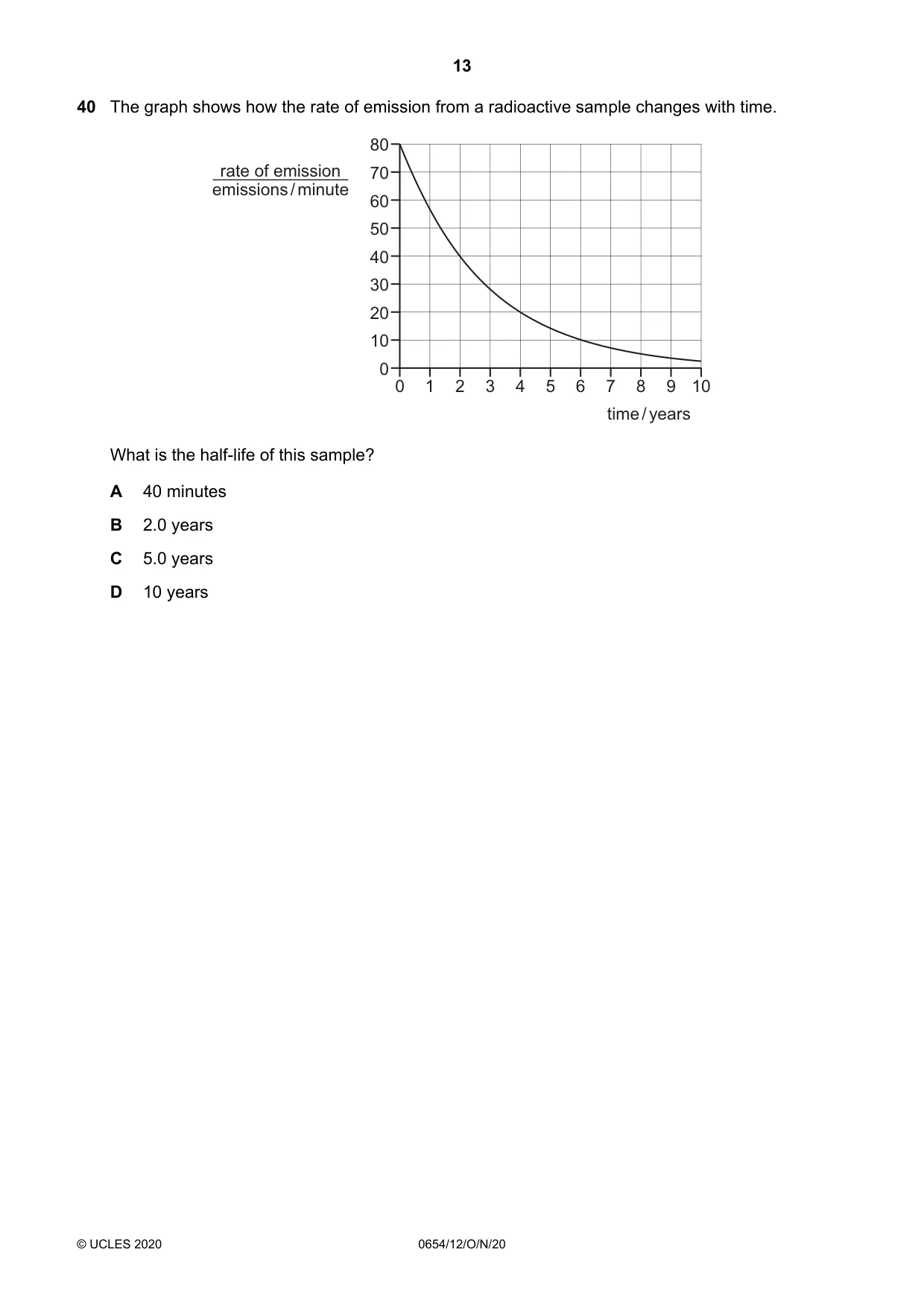
Q40 · The graph shows how the rate of emission from a radioactive sample changes with time
40 The graph shows how the rate of emission from a radioactive sample changes with time. 80 rate of emission 70 emissions / minute 60 50 40 30 20 10 0 0 1 2 3 4 5 6 7 8 9 10 time / years What is the half-life of this sample? A 40 minutes B 2.0 years C 5.0 years D 10 years
Mark scheme: B
What was in this paper
The subtopics covered by these 40 questions, and how many questions each got. Open one in a new tab to see every Cambridge question on it.
2Biological molecules1Characteristics of living organisms1Coordination and response1Digestive system1Electrical circuits1Electrical quantities1Electrical safety1Electrolysis1Elements, compounds and mixtures1Energy, work and power1Enzymes1Exothermic and endothermic reactions1Food chains and food webs1Forces1Fuels1General properties of waves1Group I properties1Habitat destruction1Identification of ions and gases1Light1Mass and weight1Photosynthesis1Polymers1Preparation of salts1Reactivity series1Redox1Respiration1Separation and purification1Sexual reproduction in plants1Simple molecules and covalent bonds1Simple phenomena of magnetism1Size of specimens1Sound1The characteristic properties of acids and bases1Transfer of thermal energy1Transition elements1Transpiration1Variation1What you needed in this session
Cambridge’s own grade thresholds for 2020 Oct/Nov, Paper 1 · Variant 2. A higher threshold means an easier paper — the bar moves with how the cohort did.