Cambridge IGCSE Sciences - Co-ordinated (Double) 0654 — 2020 May/June Paper 1 · Variant 3
0654/13/M/J/20 · 40 questions · 40 marks · ≈45 min
The question paper and its mark scheme, free to read here and free to download. This is Cambridge’s own paper, exactly as it was sat.
Question paper16 pages
Mark scheme3 pages
Answers below. Sit the paper first if you are practising.
Questions as text
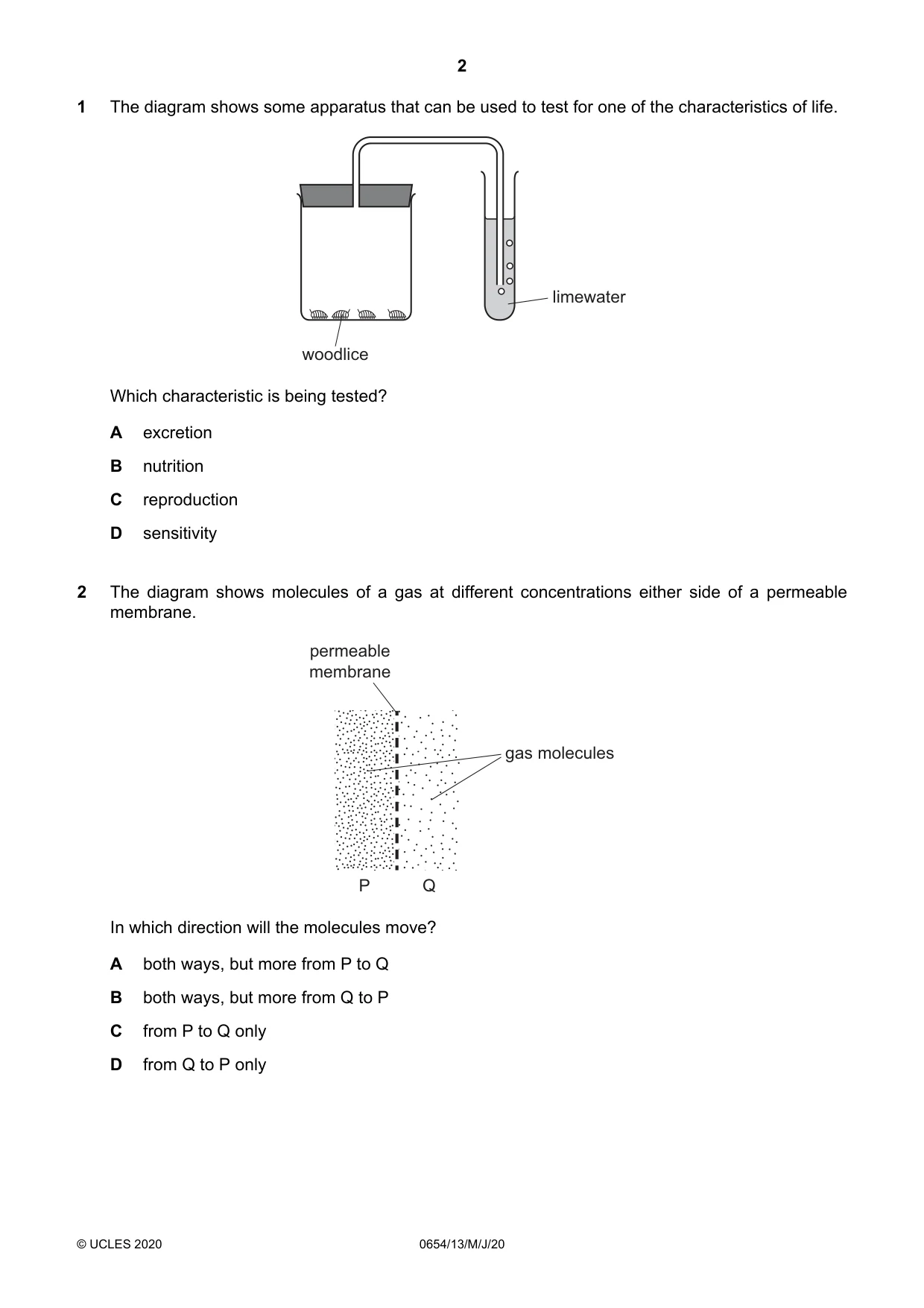
Q1 · The diagram shows some apparatus that can be used to test for one of the characteristics…
1 The diagram shows some apparatus that can be used to test for one of the characteristics of life. limewater woodlice Which characteristic is being tested? A excretion B nutrition C reproduction D sensitivity
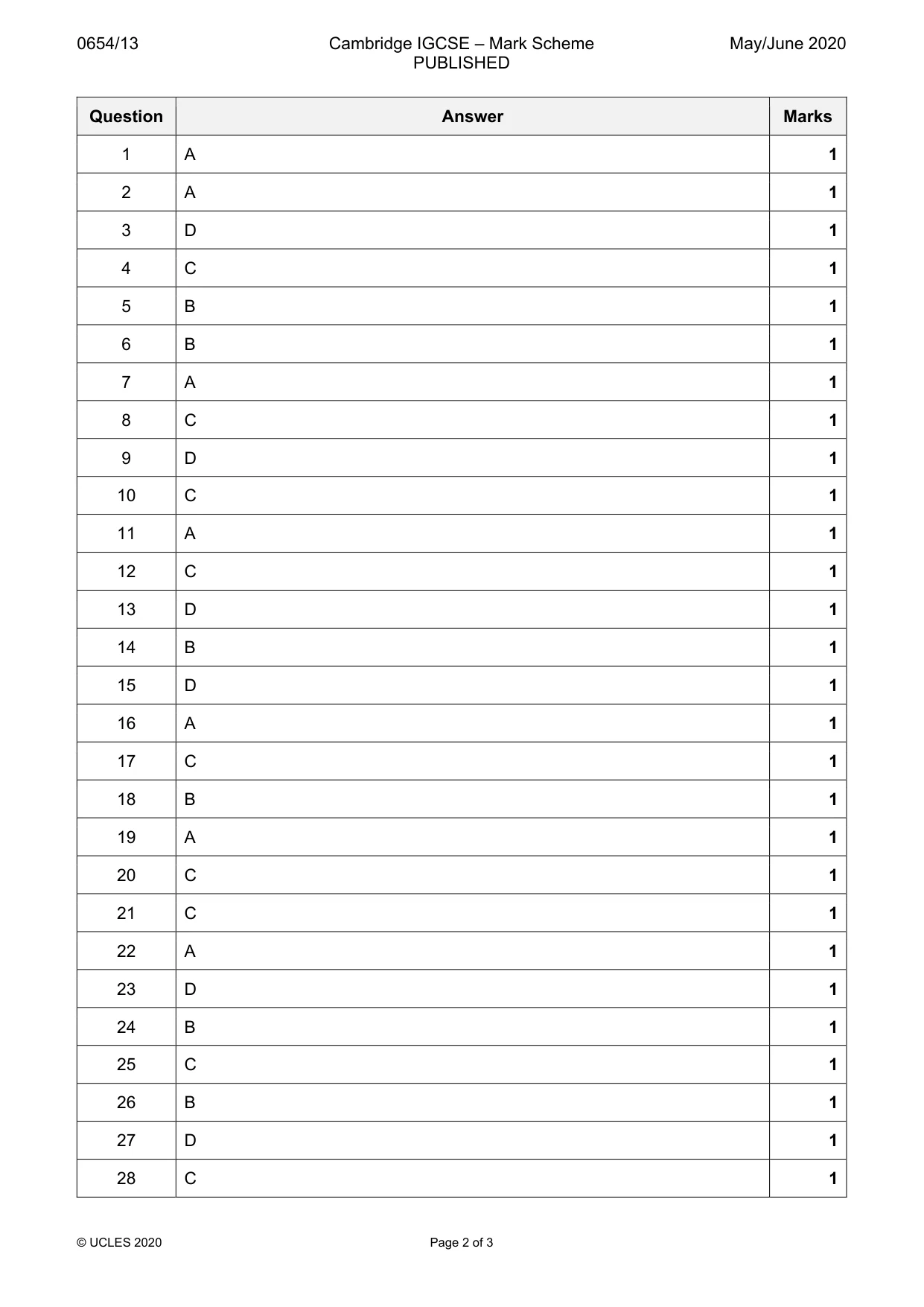
Mark scheme: A
Q2 · The diagram shows molecules of a gas at different concentrations either side of a…
2 The diagram shows molecules of a gas at different concentrations either side of a permeable membrane. permeable membrane gas molecules P Q In which direction will the molecules move? A both ways, but more from P to Q B both ways, but more from Q to P C from P to Q only D from Q to P only
Mark scheme: A
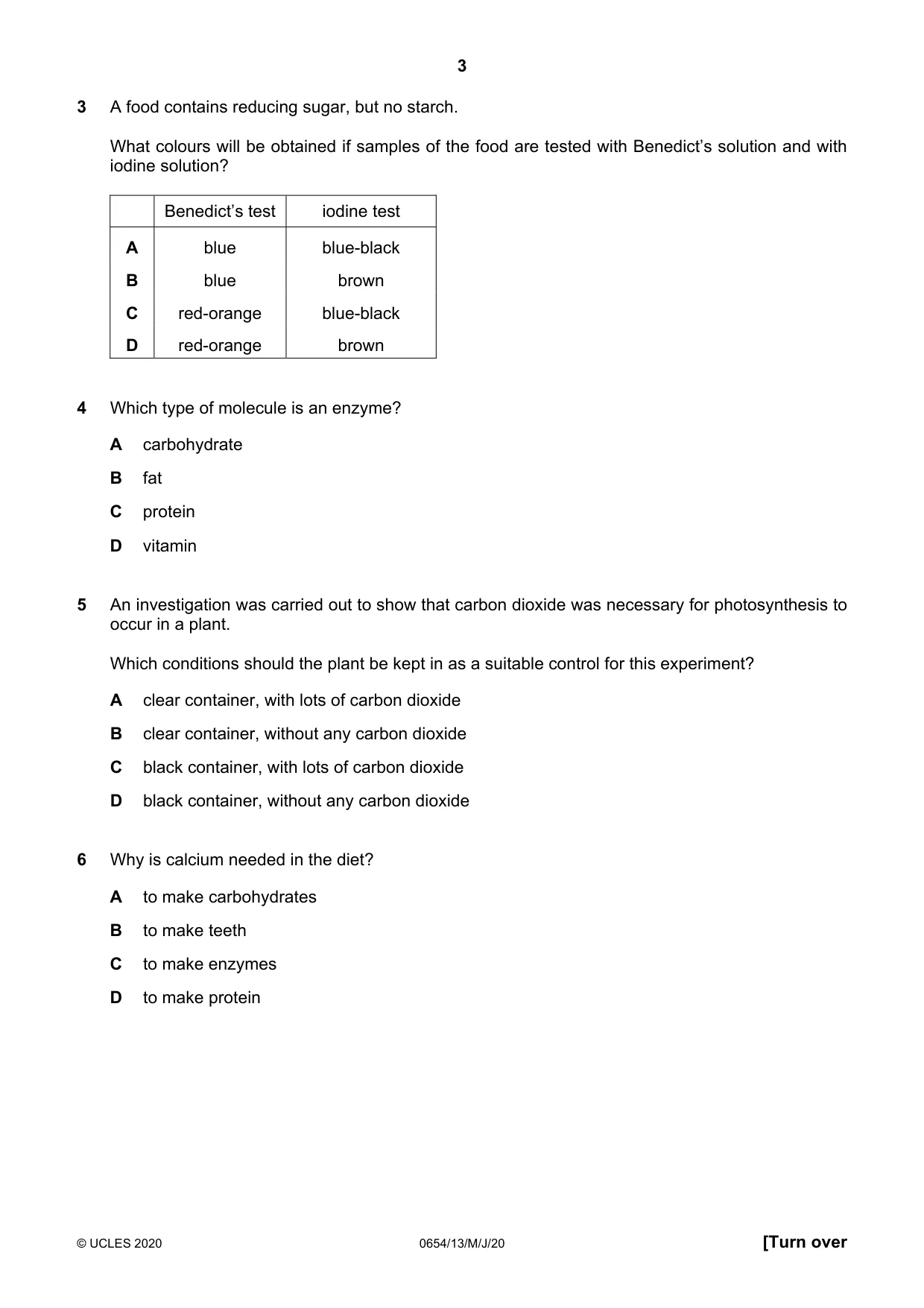
Q3 · A food contains reducing sugar, but no starch
3 A food contains reducing sugar, but no starch. What colours will be obtained if samples of the food are tested with Benedict’s solution and with iodine solution? Benedict’s test iodine test A blue blue-black B blue brown C red-orange blue-black D red-orange brown
Mark scheme: D
Q4 · Which type of molecule is an enzyme?
4 Which type of molecule is an enzyme? A carbohydrate B fat C protein D vitamin
Mark scheme: C
Q5 · An investigation was carried out to show that carbon dioxide was necessary for…
5 An investigation was carried out to show that carbon dioxide was necessary for photosynthesis to occur in a plant. Which conditions should the plant be kept in as a suitable control for this experiment? A clear container, with lots of carbon dioxide B clear container, without any carbon dioxide C black container, with lots of carbon dioxide D black container, without any carbon dioxide
Mark scheme: B
Q6 · Why is calcium needed in the diet?
6 Why is calcium needed in the diet? A to make carbohydrates B to make teeth C to make enzymes D to make protein
Mark scheme: B
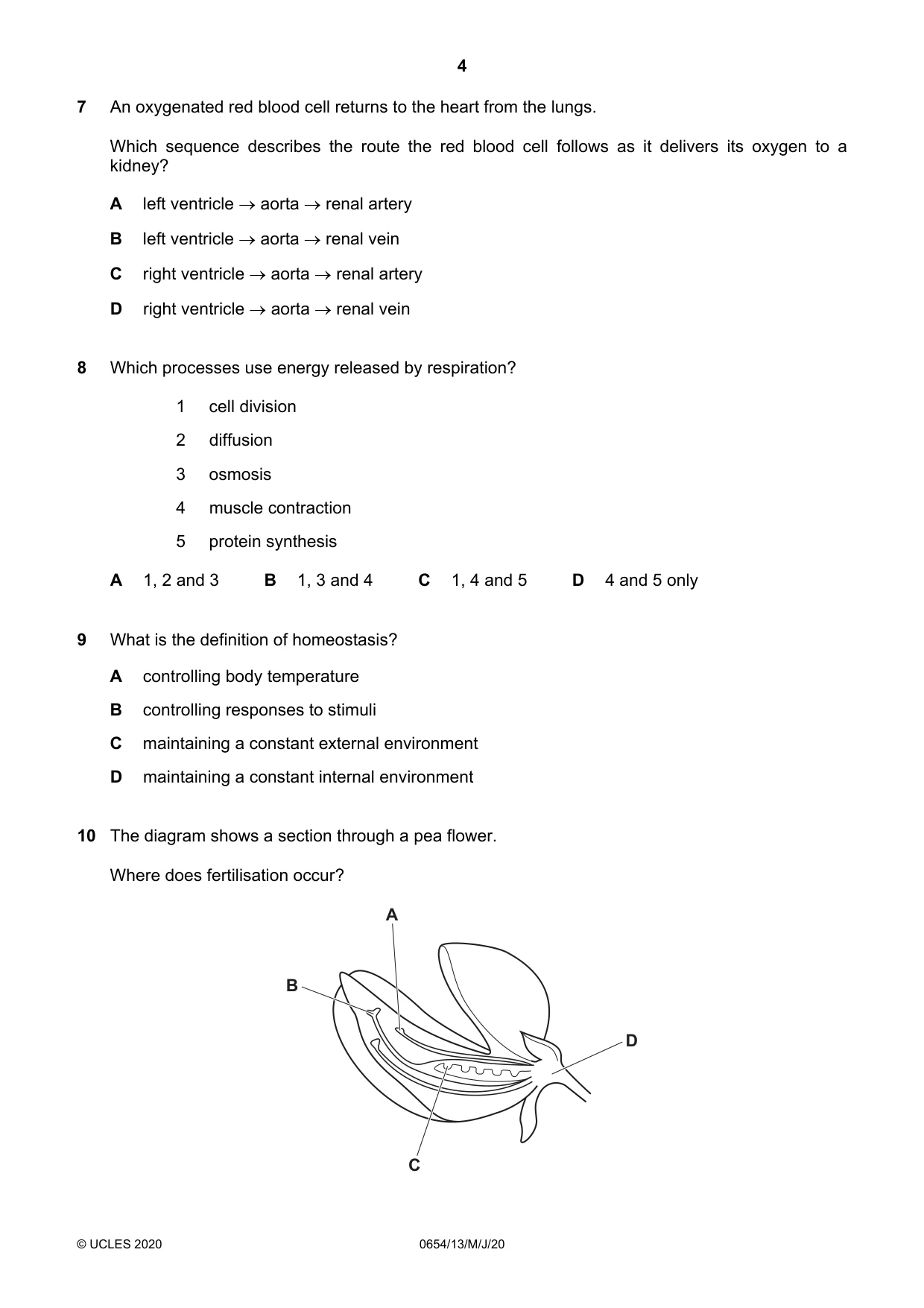
Q7 · An oxygenated red blood cell returns to the heart from the lungs
7 An oxygenated red blood cell returns to the heart from the lungs. Which sequence describes the route the red blood cell follows as it delivers its oxygen to a kidney? A left ventricle → aorta → renal artery B left ventricle → aorta → renal vein C right ventricle → aorta → renal artery D right ventricle → aorta → renal vein
Mark scheme: A
Q8 · Which processes use energy released by respiration?
8 Which processes use energy released by respiration? 1 cell division 2 diffusion 3 osmosis 4 muscle contraction 5 protein synthesis A 1, 2 and 3 B 1, 3 and 4 C 1, 4 and 5 D 4 and 5 only
Mark scheme: C
Q9 · What is the definition of homeostasis?
9 What is the definition of homeostasis? A controlling body temperature B controlling responses to stimuli C maintaining a constant external environment D maintaining a constant internal environment
Mark scheme: D
Q10 · The diagram shows a section through a pea flower
10 The diagram shows a section through a pea flower. Where does fertilisation occur? A B D C
Mark scheme: C
Q11 · In cats, the allele for short hair is dominant to the allele for long hair
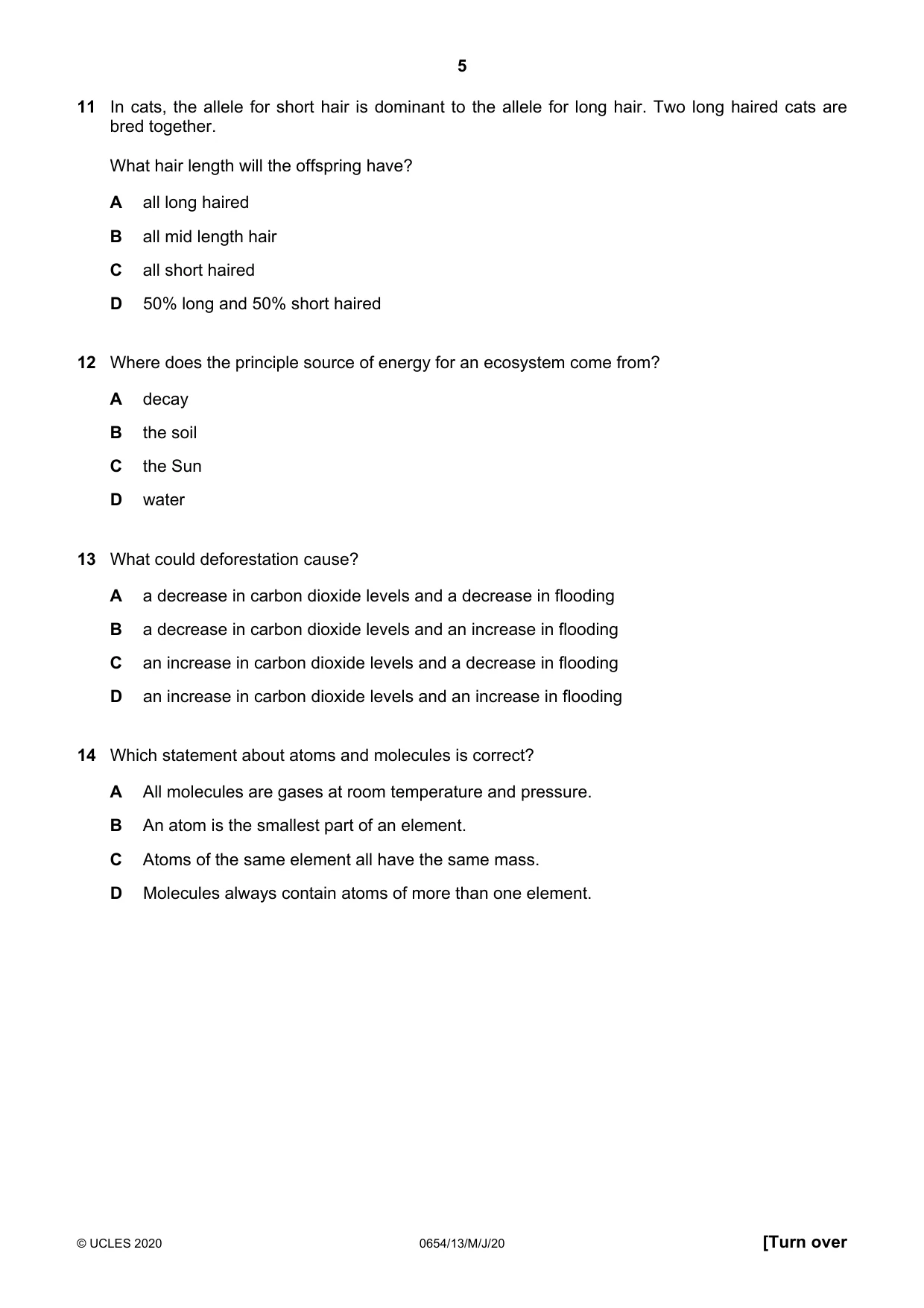
11 In cats, the allele for short hair is dominant to the allele for long hair. Two long haired cats are bred together. What hair length will the offspring have? A all long haired B all mid length hair C all short haired D 50% long and 50% short haired
Mark scheme: A
Q12 · Where does the principle source of energy for an ecosystem come from?
12 Where does the principle source of energy for an ecosystem come from? A decay B the soil C the Sun D water
Mark scheme: C
Q13 · What could deforestation cause?
13 What could deforestation cause? A a decrease in carbon dioxide levels and a decrease in flooding B a decrease in carbon dioxide levels and an increase in flooding C an increase in carbon dioxide levels and a decrease in flooding D an increase in carbon dioxide levels and an increase in flooding
Mark scheme: D
Q14 · Which statement about atoms and molecules is correct?
14 Which statement about atoms and molecules is correct? A All molecules are gases at room temperature and pressure. B An atom is the smallest part of an element. C Atoms of the same element all have the same mass. D Molecules always contain atoms of more than one element.
Mark scheme: B
Q15 · One isotope of oxygen is 16 O
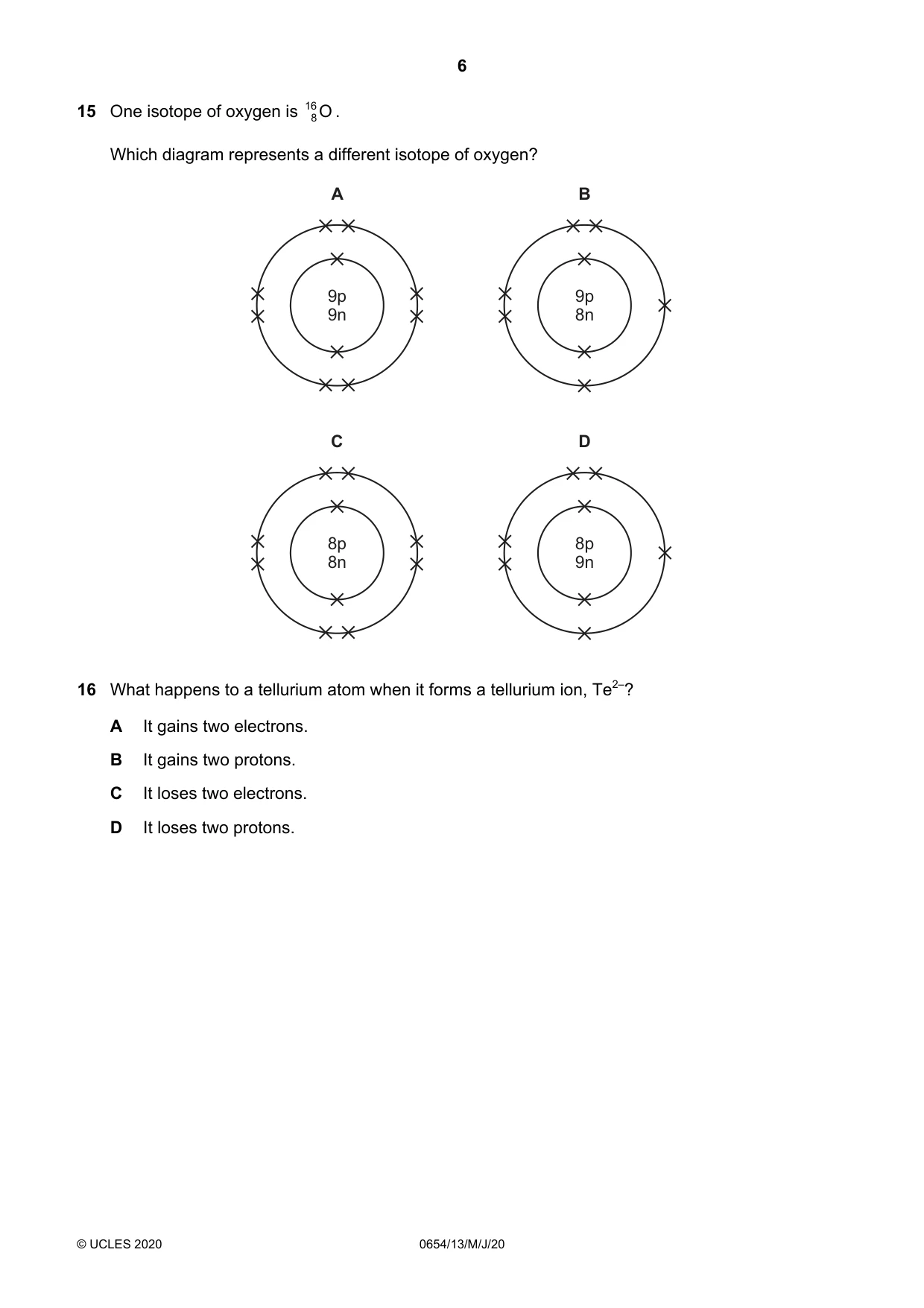
15 One isotope of oxygen is 16 O . 8 Which diagram represents a different isotope of oxygen? A B 9p 9p 9n 8n C D 8p 8p 8n 9n
Mark scheme: D
Q16 · What happens to a tellurium atom when it forms a tellurium ion, Te2–?
16 What happens to a tellurium atom when it forms a tellurium ion, Te2–? A It gains two electrons. B It gains two protons. C It loses two electrons. D It loses two protons.
Mark scheme: A
Q17 · The diagram shows the electrolysis of lead(II) bromide using inert electrodes
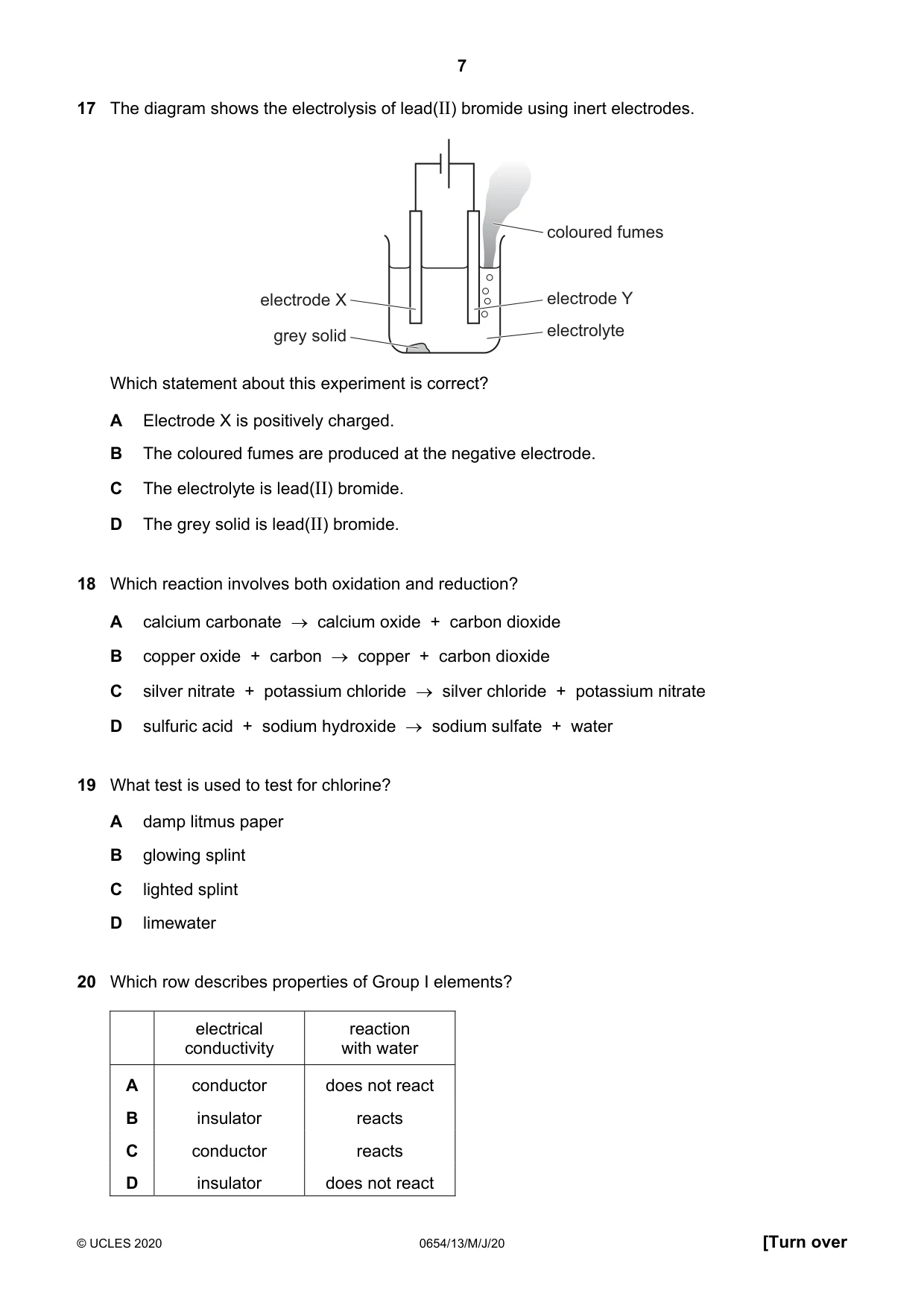
17 The diagram shows the electrolysis of lead(II) bromide using inert electrodes. coloured fumes electrode X electrode Y grey solid electrolyte Which statement about this experiment is correct? A Electrode X is positively charged. B The coloured fumes are produced at the negative electrode. C The electrolyte is lead(II) bromide. D The grey solid is lead(II) bromide.
Mark scheme: C
Q18 · Which reaction involves both oxidation and reduction?
18 Which reaction involves both oxidation and reduction? A calcium carbonate → calcium oxide + carbon dioxide B copper oxide + carbon → copper + carbon dioxide C silver nitrate + potassium chloride → silver chloride + potassium nitrate D sulfuric acid + sodium hydroxide → sodium sulfate + water
Mark scheme: B
Q19 · What test is used to test for chlorine?
19 What test is used to test for chlorine? A damp litmus paper B glowing splint C lighted splint D limewater
Mark scheme: A
Q20 · Which row describes properties of Group I elements?
20 Which row describes properties of Group I elements? electrical reaction conductivity with water A conductor does not react B insulator reacts C conductor reacts D insulator does not react
Mark scheme: C
Q21 · Which statement is not a reason why aluminium is used in aircraft manufacture?
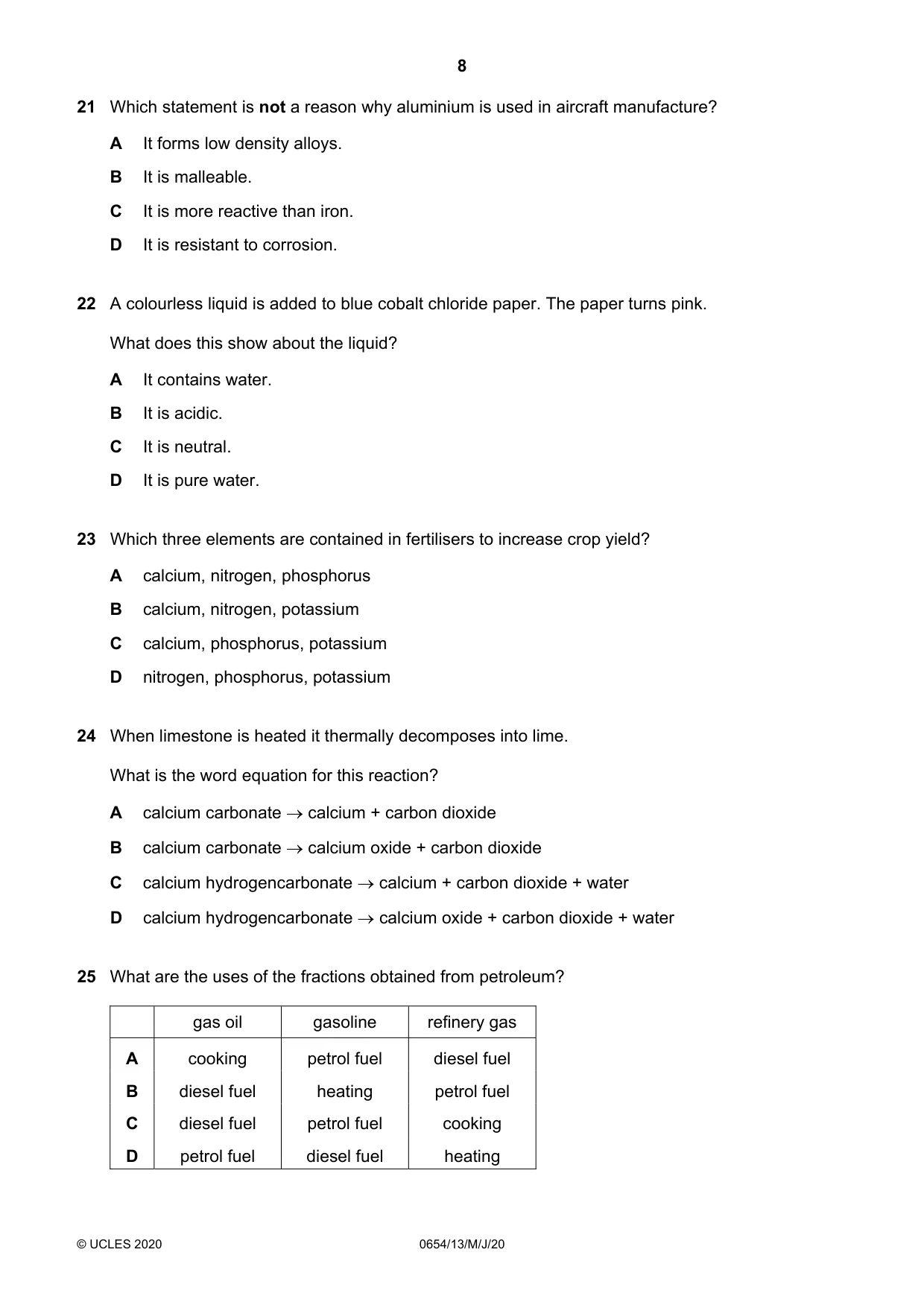
21 Which statement is not a reason why aluminium is used in aircraft manufacture? A It forms low density alloys. B It is malleable. C It is more reactive than iron. D It is resistant to corrosion.
Mark scheme: C
Q22 · A colourless liquid is added to blue cobalt chloride paper
22 A colourless liquid is added to blue cobalt chloride paper. The paper turns pink. What does this show about the liquid? A It contains water. B It is acidic. C It is neutral. D It is pure water.
Mark scheme: A
Q23 · Which three elements are contained in fertilisers to increase crop yield?
23 Which three elements are contained in fertilisers to increase crop yield? A calcium, nitrogen, phosphorus B calcium, nitrogen, potassium C calcium, phosphorus, potassium D nitrogen, phosphorus, potassium
Mark scheme: D
Q24 · When limestone is heated it thermally decomposes into lime
24 When limestone is heated it thermally decomposes into lime. What is the word equation for this reaction? A calcium carbonate → calcium + carbon dioxide B calcium carbonate → calcium oxide + carbon dioxide C calcium hydrogencarbonate → calcium + carbon dioxide + water D calcium hydrogencarbonate → calcium oxide + carbon dioxide + water
Mark scheme: B
Q25 · What are the uses of the fractions obtained from petroleum?
25 What are the uses of the fractions obtained from petroleum? gas oil gasoline refinery gas A cooking petrol fuel diesel fuel B diesel fuel heating petrol fuel C diesel fuel petrol fuel cooking D petrol fuel diesel fuel heating
Mark scheme: C
Q26 · Ethene is produced when decane, a large hydrocarbon, is heated with a catalyst
26 Ethene is produced when decane, a large hydrocarbon, is heated with a catalyst. What is the name of this process? A combustion B cracking C displacement D neutralisation
Mark scheme: B
Q27 · Which statement about the manufacture of polymers is correct?
27 Which statement about the manufacture of polymers is correct? A Polymers are made by breaking long-chain molecules into shorter chain ones. B Polymers are made by joining polymers together. C Polymers are made by fractional distillation of petroleum. D Polymers are made by joining short-chain molecules together.
Mark scheme: D
Q28 · A solid metal block has a mass of 2.0 × 10⁴ kg and a volume of 2.5 m3
28 A solid metal block has a mass of 2.0 × 10⁴ kg and a volume of 2.5 m3. What is the density of the metal? A 800 kg / m3 B 5000 kg / m3 C 8000 kg / m3 D 50 000 kg / m3
Mark scheme: C
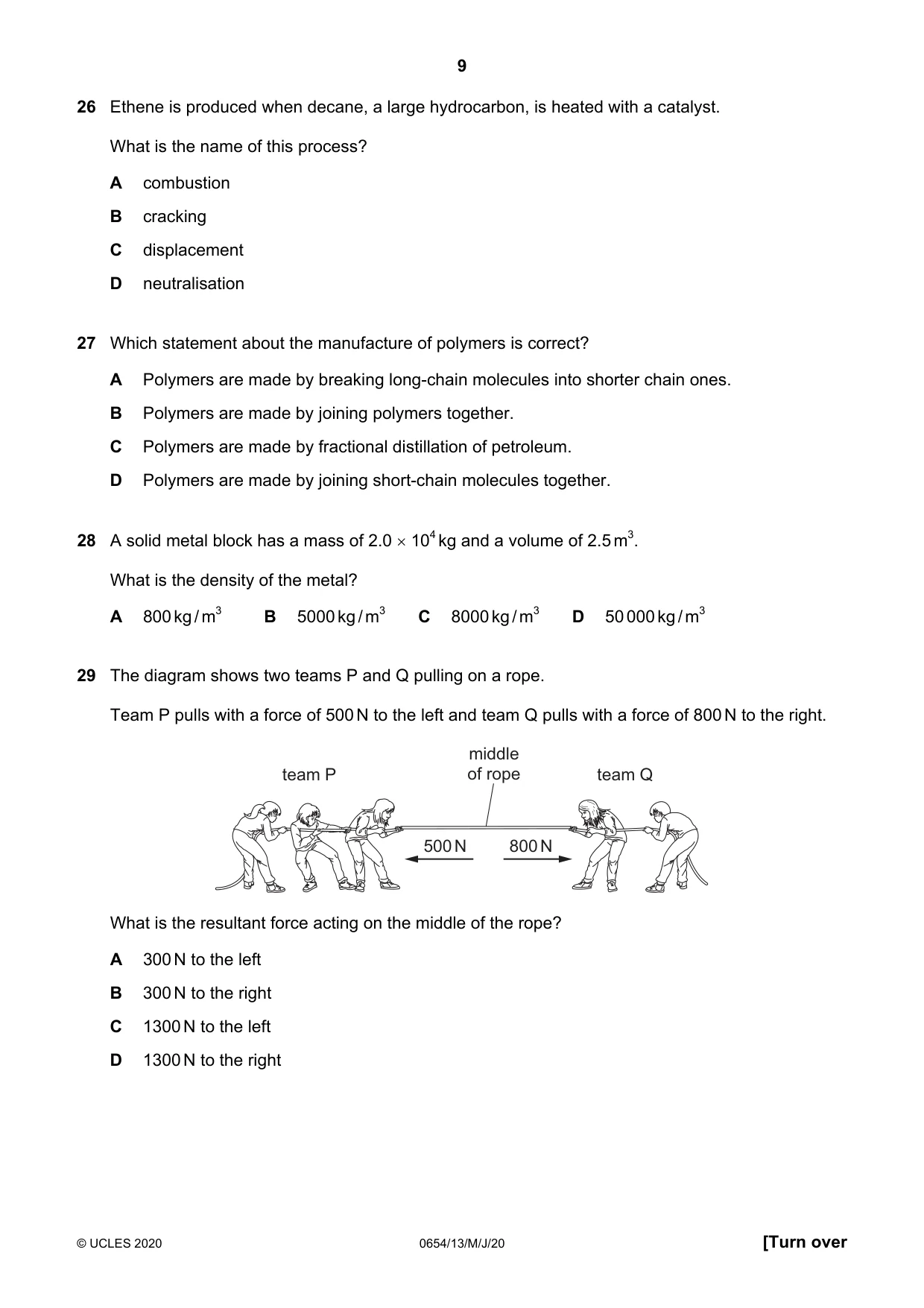
Q29 · The diagram shows two teams P and Q pulling on a rope
29 The diagram shows two teams P and Q pulling on a rope. Team P pulls with a force of 500 N to the left and team Q pulls with a force of 800 N to the right. middle team P of rope team Q 500 N 800 N What is the resultant force acting on the middle of the rope? A 300 N to the left B 300 N to the right C 1300 N to the left D 1300 N to the right
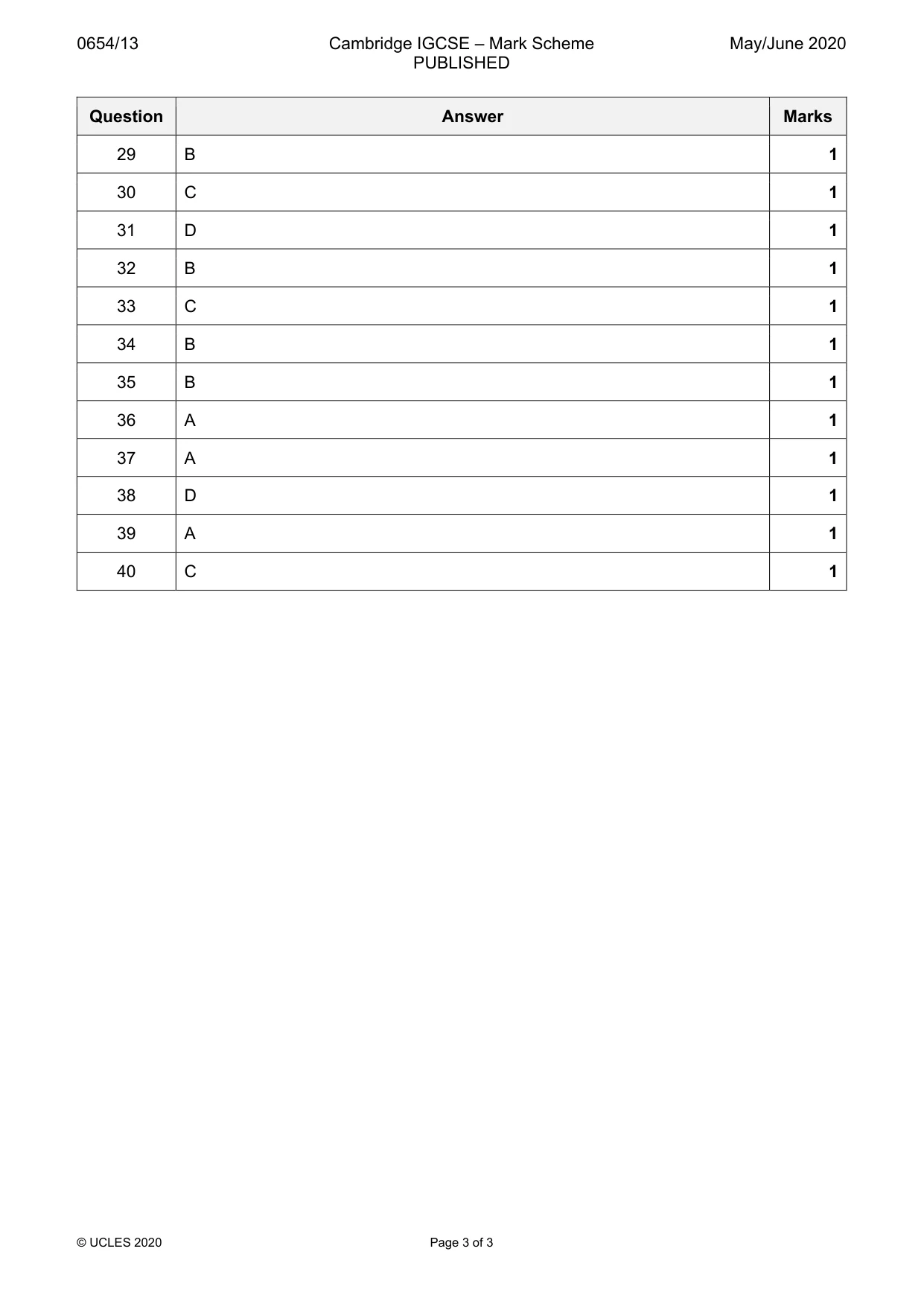
Mark scheme: B
Q30 · A liquid starts to evaporate
30 A liquid starts to evaporate. Which molecules escape, and what happens to the temperature of the remaining liquid? temperature of the molecules that escape remaining liquid A less energetic decreases B less energetic increases C more energetic decreases D more energetic increases
Mark scheme: C
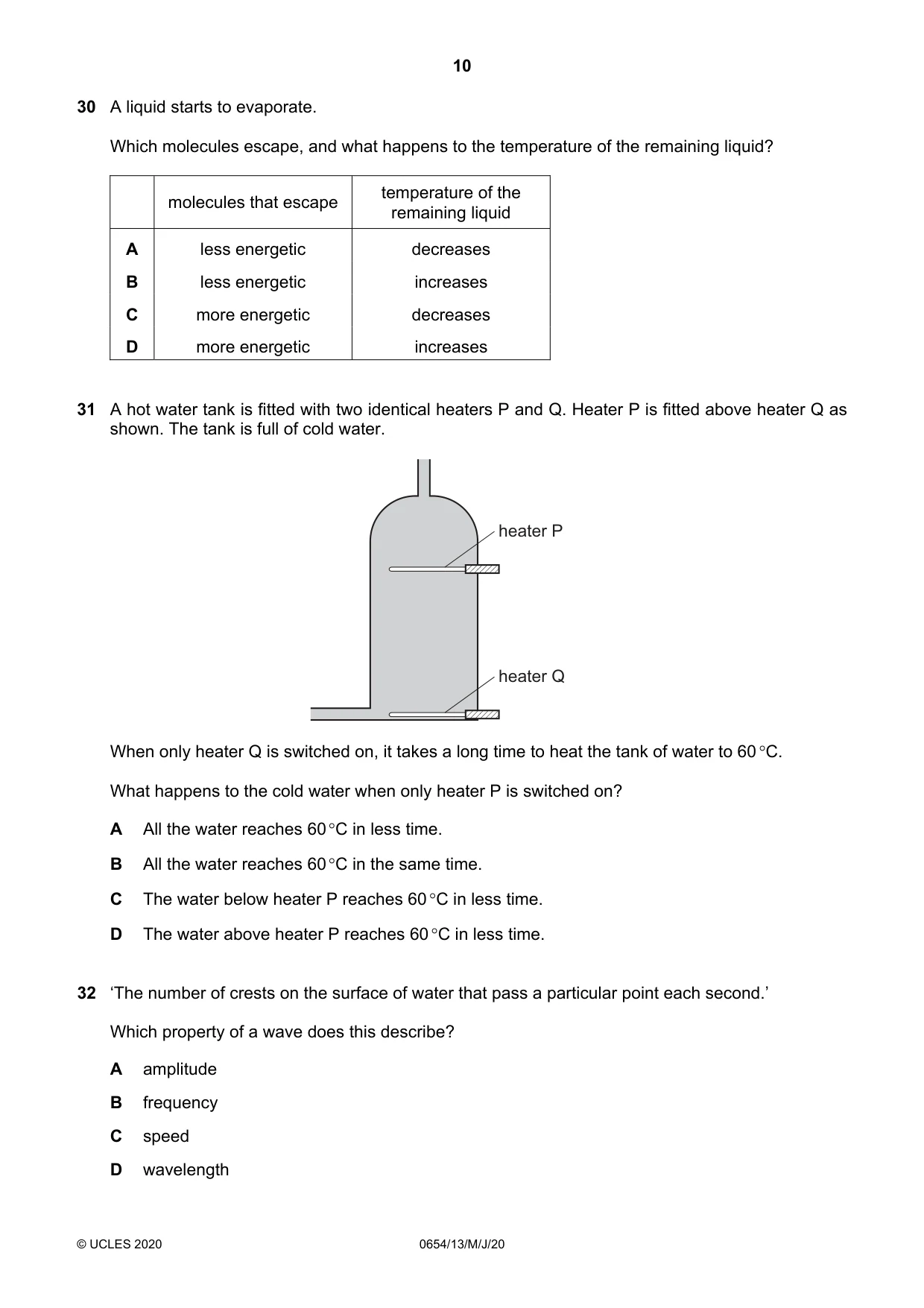
Q31 · A hot water tank is fitted with two identical heaters P and Q
31 A hot water tank is fitted with two identical heaters P and Q. Heater P is fitted above heater Q as shown. The tank is full of cold water. heater P heater Q When only heater Q is switched on, it takes a long time to heat the tank of water to 60 °C. What happens to the cold water when only heater P is switched on? A All the water reaches 60 °C in less time. B All the water reaches 60 °C in the same time. C The water below heater P reaches 60 °C in less time. D The water above heater P reaches 60 °C in less time.
Mark scheme: D
Q32 · ‘The number of crests on the surface of water that pass a particular point each second.’…
32 ‘The number of crests on the surface of water that pass a particular point each second.’ Which property of a wave does this describe? A amplitude B frequency C speed D wavelength
Mark scheme: B
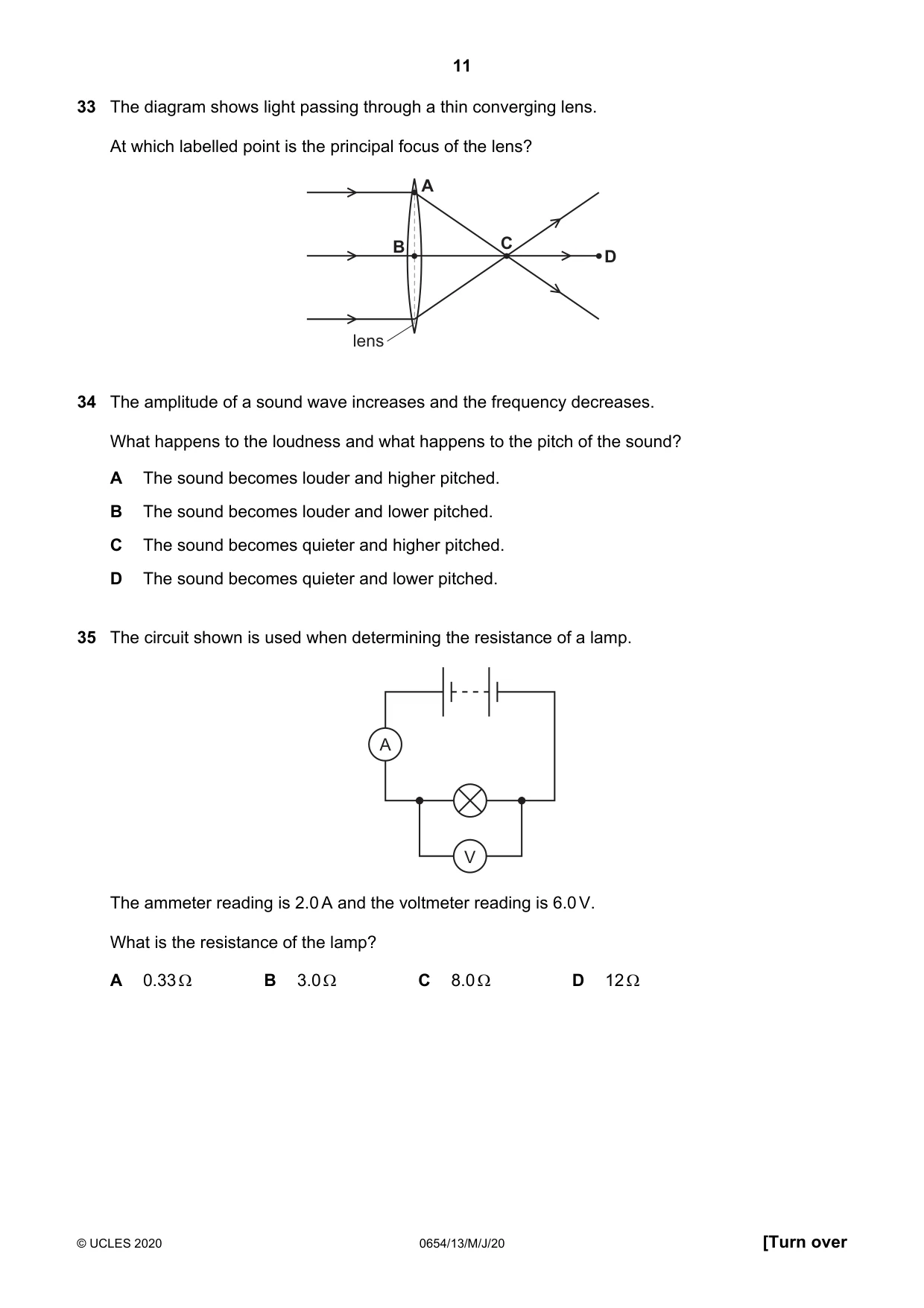
Q33 · The diagram shows light passing through a thin converging lens
33 The diagram shows light passing through a thin converging lens. At which labelled point is the principal focus of the lens? A B C D lens
Mark scheme: C
Q34 · The amplitude of a sound wave increases and the frequency decreases
34 The amplitude of a sound wave increases and the frequency decreases. What happens to the loudness and what happens to the pitch of the sound? A The sound becomes louder and higher pitched. B The sound becomes louder and lower pitched. C The sound becomes quieter and higher pitched. D The sound becomes quieter and lower pitched.
Mark scheme: B
Q35 · The circuit shown is used when determining the resistance of a lamp
35 The circuit shown is used when determining the resistance of a lamp. A V The ammeter reading is 2.0 A and the voltmeter reading is 6.0 V. What is the resistance of the lamp? A 0.33 Ω B 3.0 Ω C 8.0 Ω D 12 Ω
Mark scheme: B
Q36 · Two resistors of resistance 1.0 Ω and 2.0 Ω are connected in parallel
36 Two resistors of resistance 1.0 Ω and 2.0 Ω are connected in parallel. What is the combined resistance of this arrangement of resistors? A less than 1.0 Ω B exactly 1.5 Ω C between 2.0 Ω and 3.0 Ω D exactly 3.0 Ω
Mark scheme: A
Q37 · A fuse is a safety device for use in an electrical circuit
37 A fuse is a safety device for use in an electrical circuit. The current in the circuit becomes greater than the rated value for the fuse. What happens? A The current decreases to zero. B The current decreases to the rated value for the fuse. C The thickness of the insulation around the wires increases. D The current is sent to the outer case of the appliance.
Mark scheme: A
Q38 · A current-carrying wire passes through a flat card
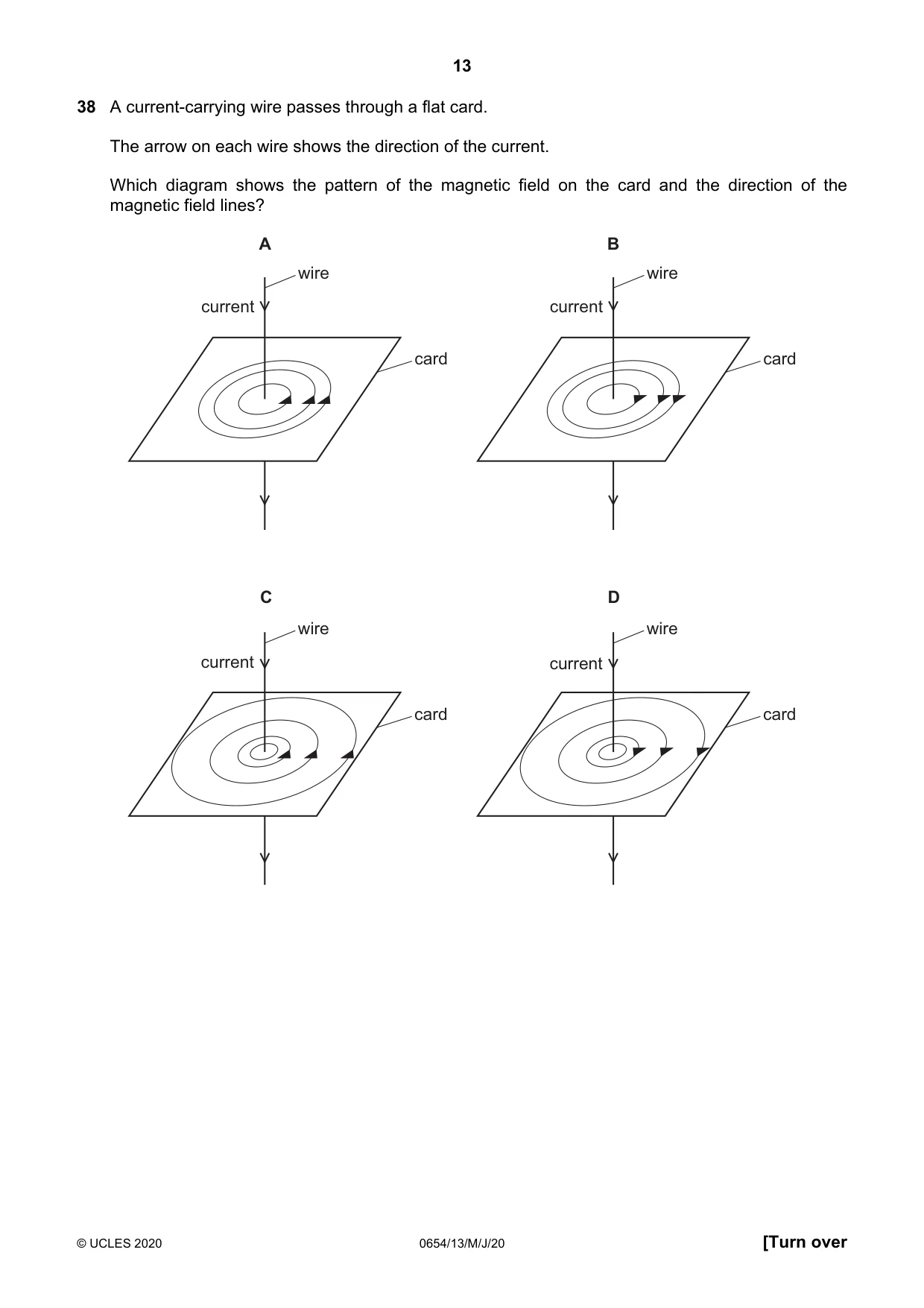
38 A current-carrying wire passes through a flat card. The arrow on each wire shows the direction of the current. Which diagram shows the pattern of the magnetic field on the card and the direction of the magnetic field lines? A B wire wire current current card card C D wire wire current current card card
Mark scheme: D
Q39 · The diagram shows a current-carrying wire in a magnetic field
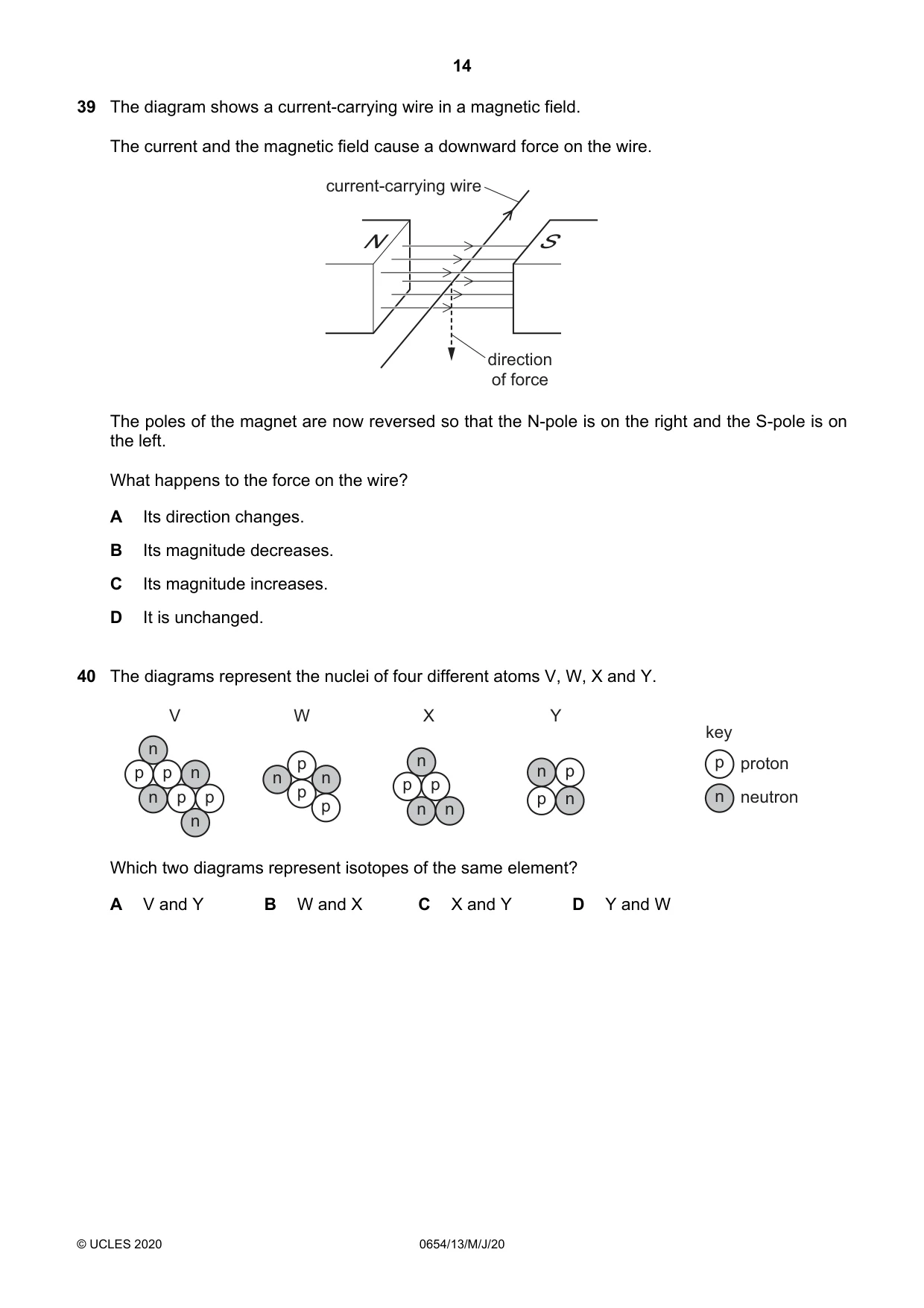
39 The diagram shows a current-carrying wire in a magnetic field. The current and the magnetic field cause a downward force on the wire. current-carrying wire N S direction of force The poles of the magnet are now reversed so that the N-pole is on the right and the S-pole is on the left. What happens to the force on the wire? A Its direction changes. B Its magnitude decreases. C Its magnitude increases. D It is unchanged.
Mark scheme: A
Q40 · The diagrams represent the nuclei of four different atoms V, W, X and Y
40 The diagrams represent the nuclei of four different atoms V, W, X and Y. V W X Y key n p n p proton p p n n n n p p p p n p p p n n neutron p n n n Which two diagrams represent isotopes of the same element? A V and Y B W and X C X and Y D Y and W
Mark scheme: C
What was in this paper
The subtopics covered by these 40 questions, and how many questions each got. Open one in a new tab to see every Cambridge question on it.
2Identification of ions and gases2Isotopes2Biological molecules1Characteristics of living organisms1Circulatory systems1Density1Diet1Diffusion1Electrical circuits1Electrical quantities1Electrical safety1Electrolysis1Electromagnetic effects1Elements, compounds and mixtures1Energy flow1Enzymes1Forces1General properties of waves1Group I properties1Habitat destruction1Homeostasis1Ions and ionic bonds1Kinetic particle model of matter1Light1Monohybrid inheritance1Oxides1Photosynthesis1Polymers1Properties of metals1Redox1Respiration1Sexual reproduction in plants1Simple phenomena of magnetism1Sound1Transfer of thermal energy1Water1