Cambridge IGCSE Sciences - Co-ordinated (Double) 0654 — 2010 May/June Paper 1 · Variant 1
0654/11/M/J/10 · 40 questions · 40 marks · ≈45 min
The question paper and its mark scheme, free to read here and free to download. This is Cambridge’s own paper, exactly as it was sat.
Question paper20 pages



Mark scheme2 pages
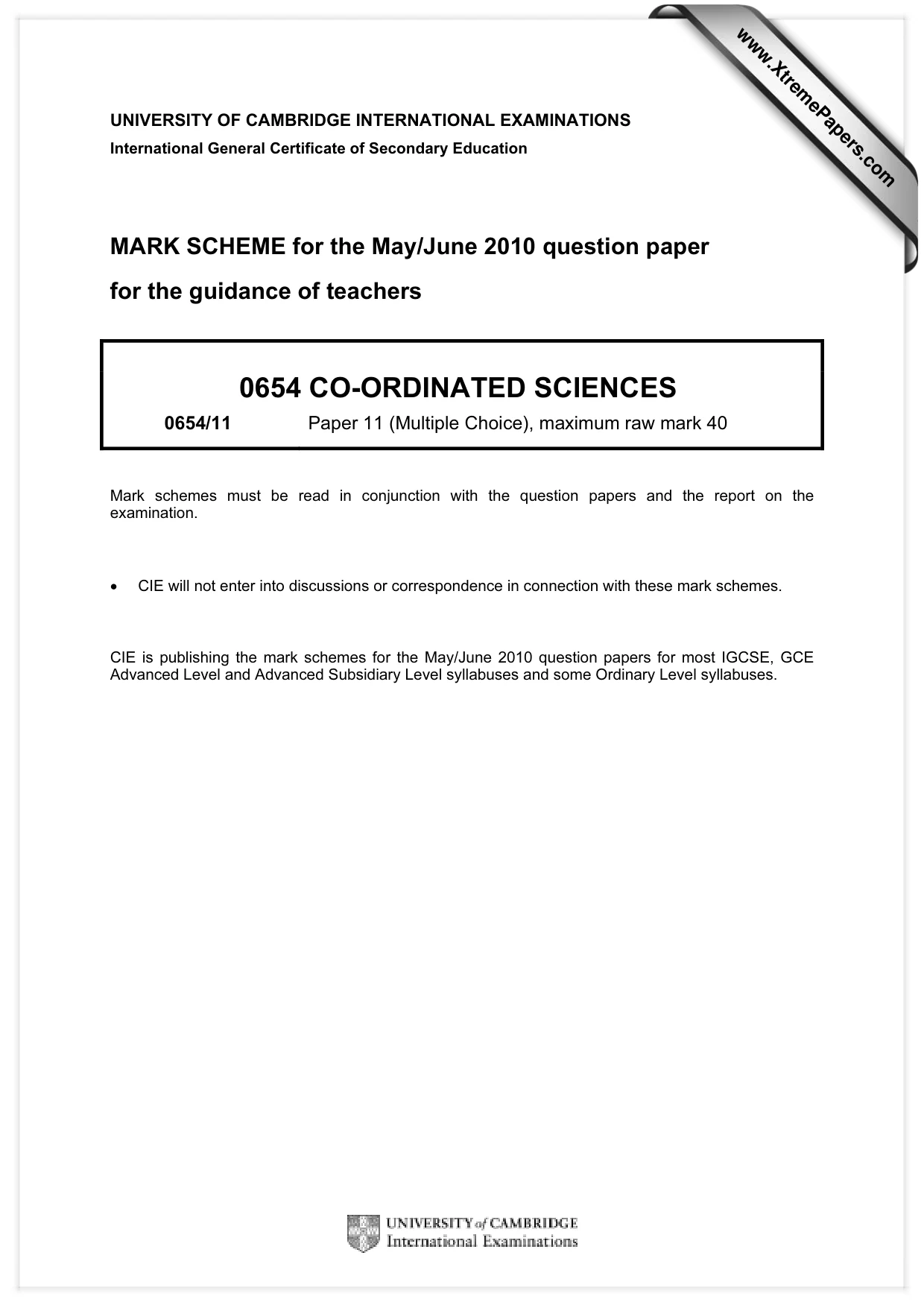
Answers below. Sit the paper first if you are practising.
Questions as text
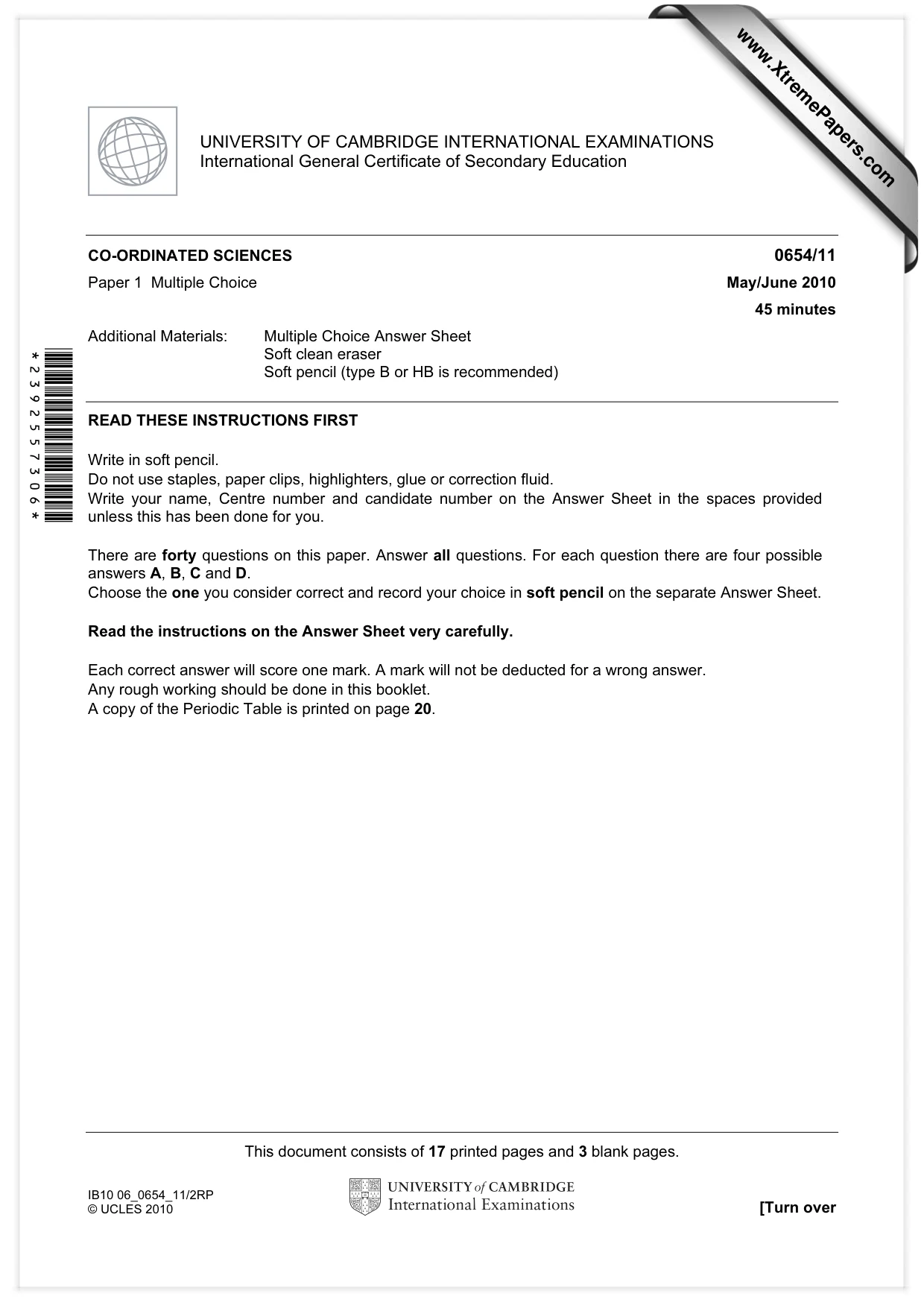
Q1 · The diagram shows a section through a flower
1 The diagram shows a section through a flower. Use the key to identify the flower. 1 flower with many ovules in each ovary ……….. go to 2 flower with one ovule in each ovary …………… go to 3 2 filaments longer than styles ……………………. A filaments shorter than styles …………………… B 3 petals shorter than sepals ……………………… C petals longer than sepals ………………………. D
Mark scheme: C
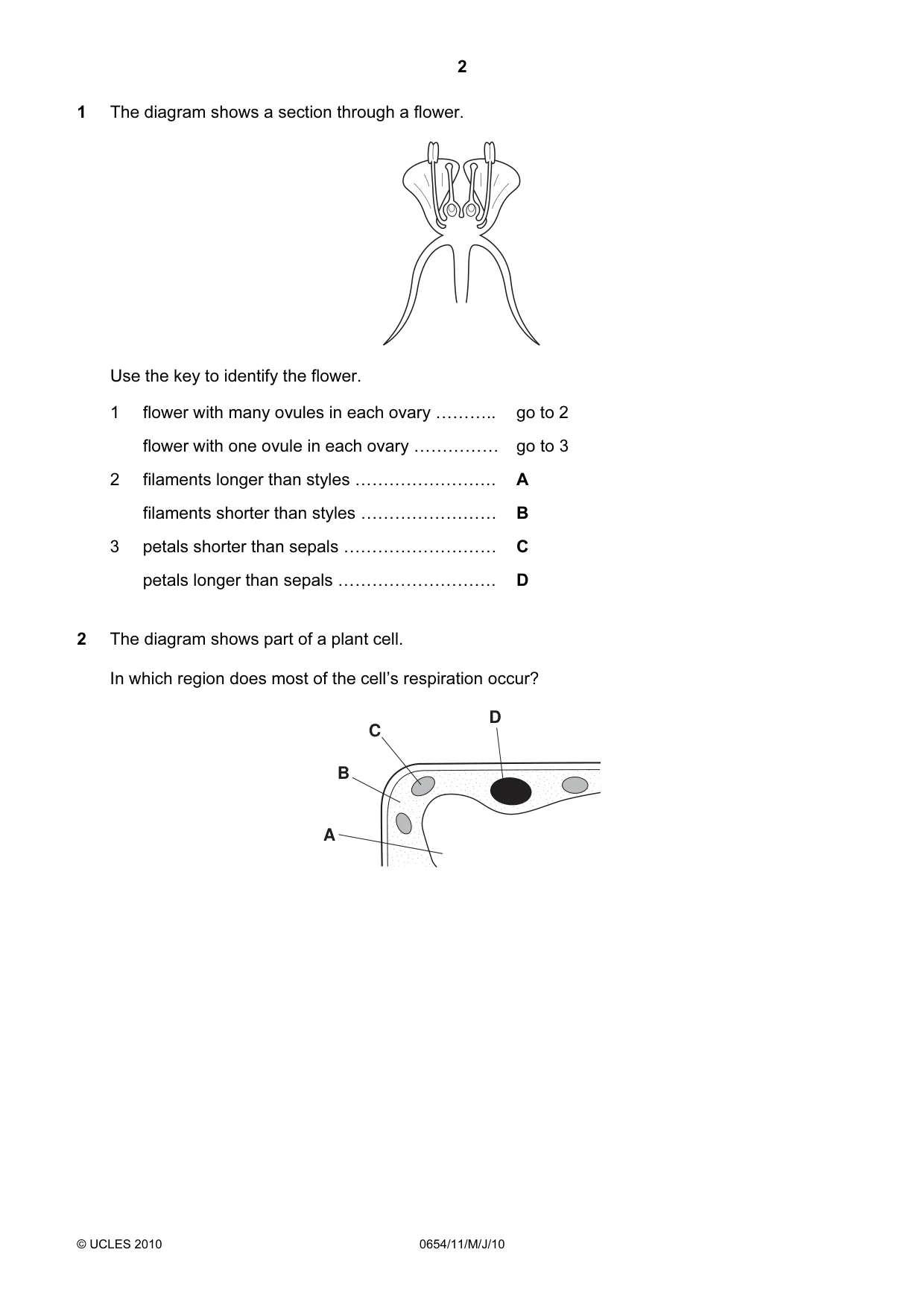
Q2 · The diagram shows part of a plant cell
2 The diagram shows part of a plant cell. In which region does most of the cell’s respiration occur? D C B A
Mark scheme: B
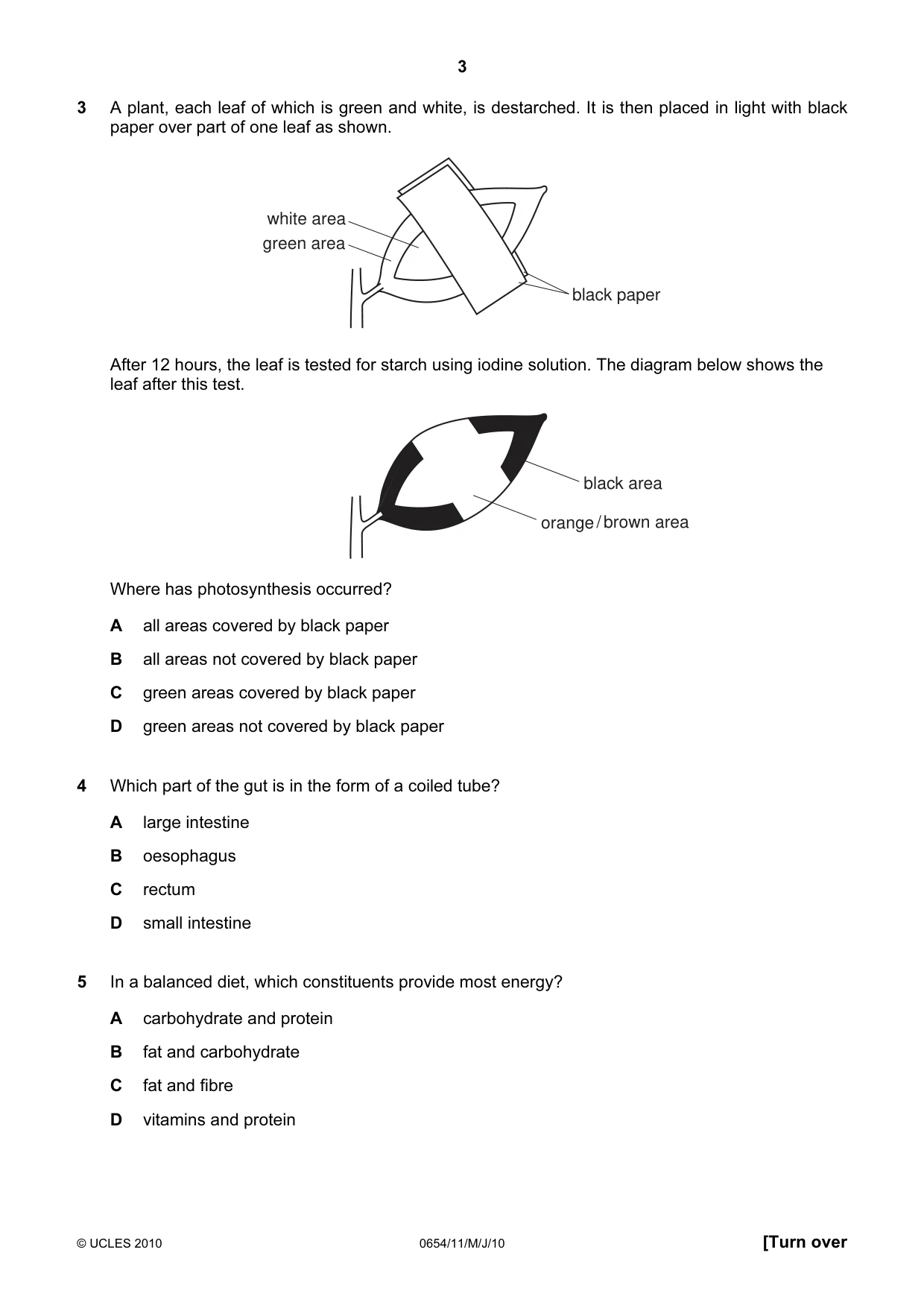
Q3 · A plant, each leaf of which is green and white, is destarched
3 A plant, each leaf of which is green and white, is destarched. It is then placed in light with black paper over part of one leaf as shown. white area green area black paper After 12 hours, the leaf is tested for starch using iodine solution. The diagram below shows the leaf after this test. black area orange / brown area Where has photosynthesis occurred? A all areas covered by black paper B all areas not covered by black paper C green areas covered by black paper D green areas not covered by black paper
Mark scheme: D
Q4 · Which part of the gut is in the form of a coiled tube?
4 Which part of the gut is in the form of a coiled tube? A large intestine B oesophagus C rectum D small intestine
Mark scheme: D
Q5 · In a balanced diet, which constituents provide most energy?
5 In a balanced diet, which constituents provide most energy? A carbohydrate and protein B fat and carbohydrate C fat and fibre D vitamins and protein
Mark scheme: B
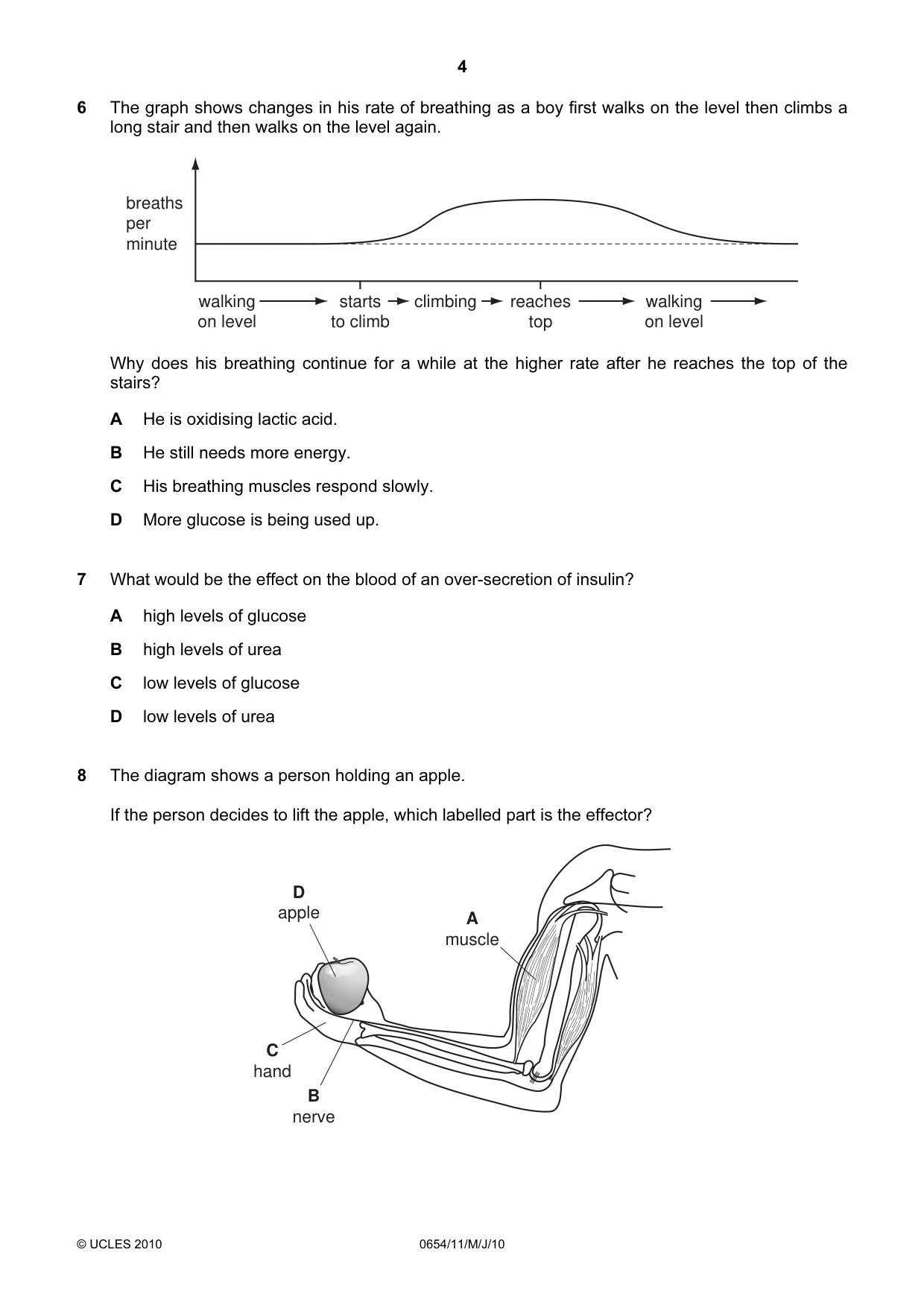
Q6 · The graph shows changes in his rate of breathing as a boy first walks on the level then…
6 The graph shows changes in his rate of breathing as a boy first walks on the level then climbs a long stair and then walks on the level again. breaths per minute walking starts climbing reaches walking on level to climb top on level Why does his breathing continue for a while at the higher rate after he reaches the top of the stairs? A He is oxidising lactic acid. B He still needs more energy. C His breathing muscles respond slowly. D More glucose is being used up.
Mark scheme: A
Q7 · What would be the effect on the blood of an over-secretion of insulin?
7 What would be the effect on the blood of an over-secretion of insulin? A high levels of glucose B high levels of urea C low levels of glucose D low levels of urea
Mark scheme: C
Q8 · The diagram shows a person holding an apple
8 The diagram shows a person holding an apple. If the person decides to lift the apple, which labelled part is the effector? D apple A muscle C hand B nerve
Mark scheme: A
Q9 · The diagram shows a flower whose stamens are dying
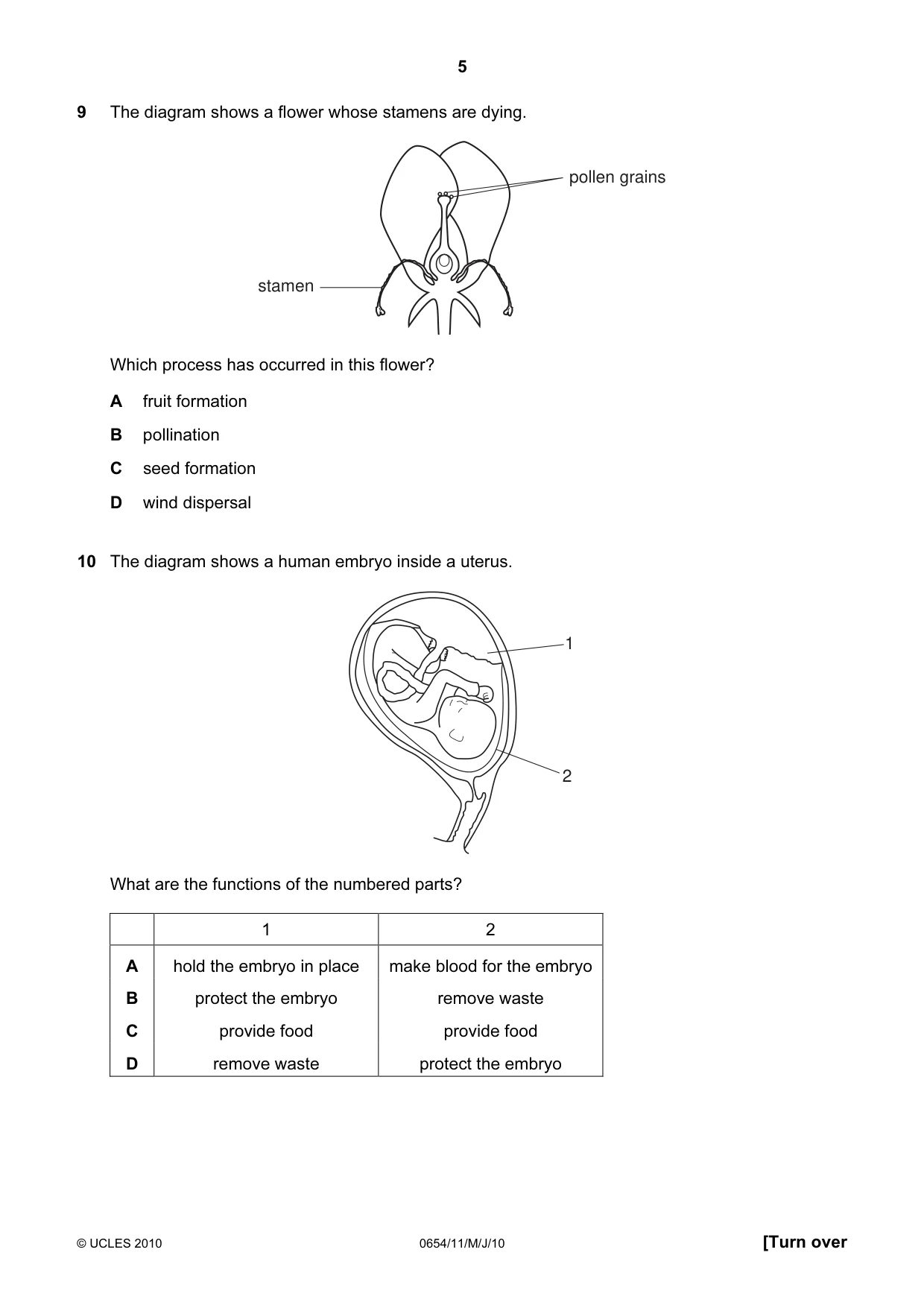
9 The diagram shows a flower whose stamens are dying. pollen grains stamen Which process has occurred in this flower? A fruit formation B pollination C seed formation D wind dispersal
Mark scheme: B
Q10 · The diagram shows a human embryo inside a uterus
10 The diagram shows a human embryo inside a uterus. 1 2 What are the functions of the numbered parts? 1 2 A hold the embryo in place make blood for the embryo B protect the embryo remove waste C provide food provide food D remove waste protect the embryo
Mark scheme: D
Q11 · The allele for red hair is recessive
11 The allele for red hair is recessive. If a girl has red hair, which statement about her parents must be correct? A Both parents must carry a recessive allele. B Both parents must have red hair. C One parent must carry a dominant allele. D The father must have red hair.
Mark scheme: A
Q12 · The diagram shows a food chain
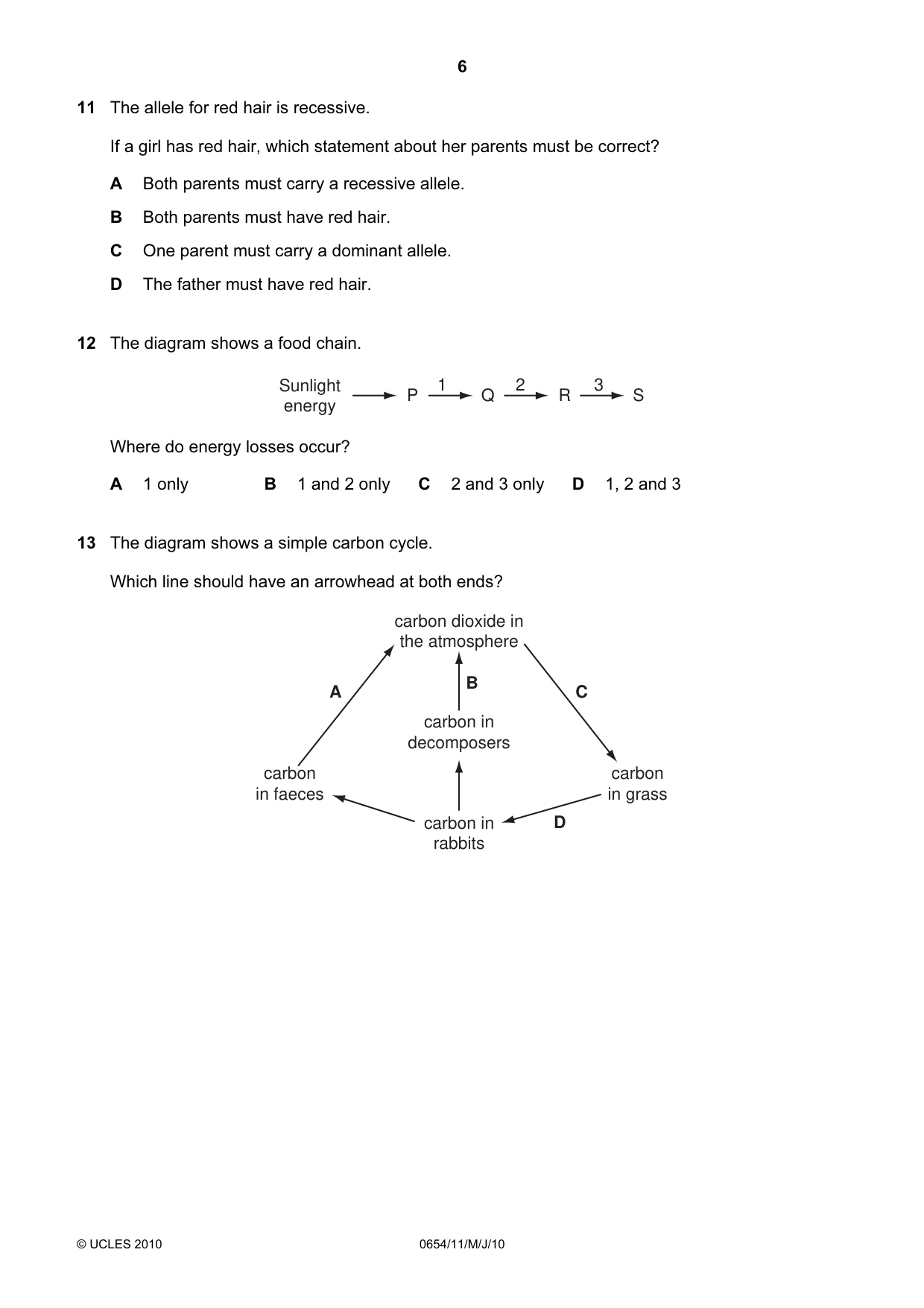
12 The diagram shows a food chain. Sunlight 1 2 3 P Q R S energy Where do energy losses occur? A 1 only B 1 and 2 only C 2 and 3 only D 1, 2 and 3
Mark scheme: D
Q13 · The diagram shows a simple carbon cycle
13 The diagram shows a simple carbon cycle. Which line should have an arrowhead at both ends? carbon dioxide in the atmosphere B A C carbon in decomposers carbon carbon in faeces in grass carbon in D rabbits
Mark scheme: C
Q14 · The graph shows the changes in temperature when a substance is cooled
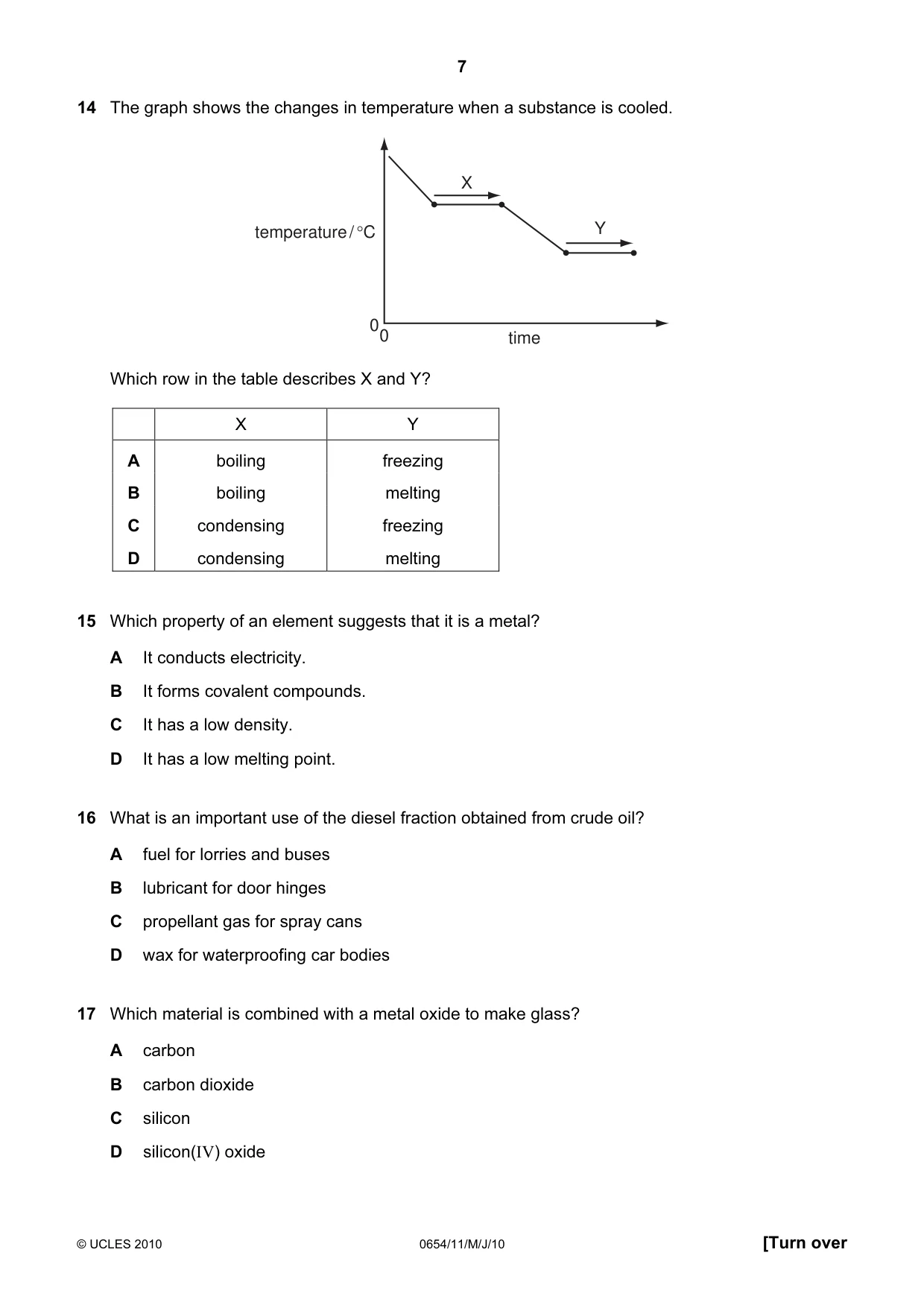
14 The graph shows the changes in temperature when a substance is cooled. X temperature / °C Y 00 time Which row in the table describes X and Y? X Y A boiling freezing B boiling melting C condensing freezing D condensing melting
Mark scheme: C
Q15 · Which property of an element suggests that it is a metal?
15 Which property of an element suggests that it is a metal? A It conducts electricity. B It forms covalent compounds. C It has a low density. D It has a low melting point.
Mark scheme: A
Q16 · What is an important use of the diesel fraction obtained from crude oil?
16 What is an important use of the diesel fraction obtained from crude oil? A fuel for lorries and buses B lubricant for door hinges C propellant gas for spray cans D wax for waterproofing car bodies
Mark scheme: A
Q17 · Which material is combined with a metal oxide to make glass?
17 Which material is combined with a metal oxide to make glass? A carbon B carbon dioxide C silicon D silicon(IV) oxide
Mark scheme: D
Q18 · The table shows the name and formula of four metal ores
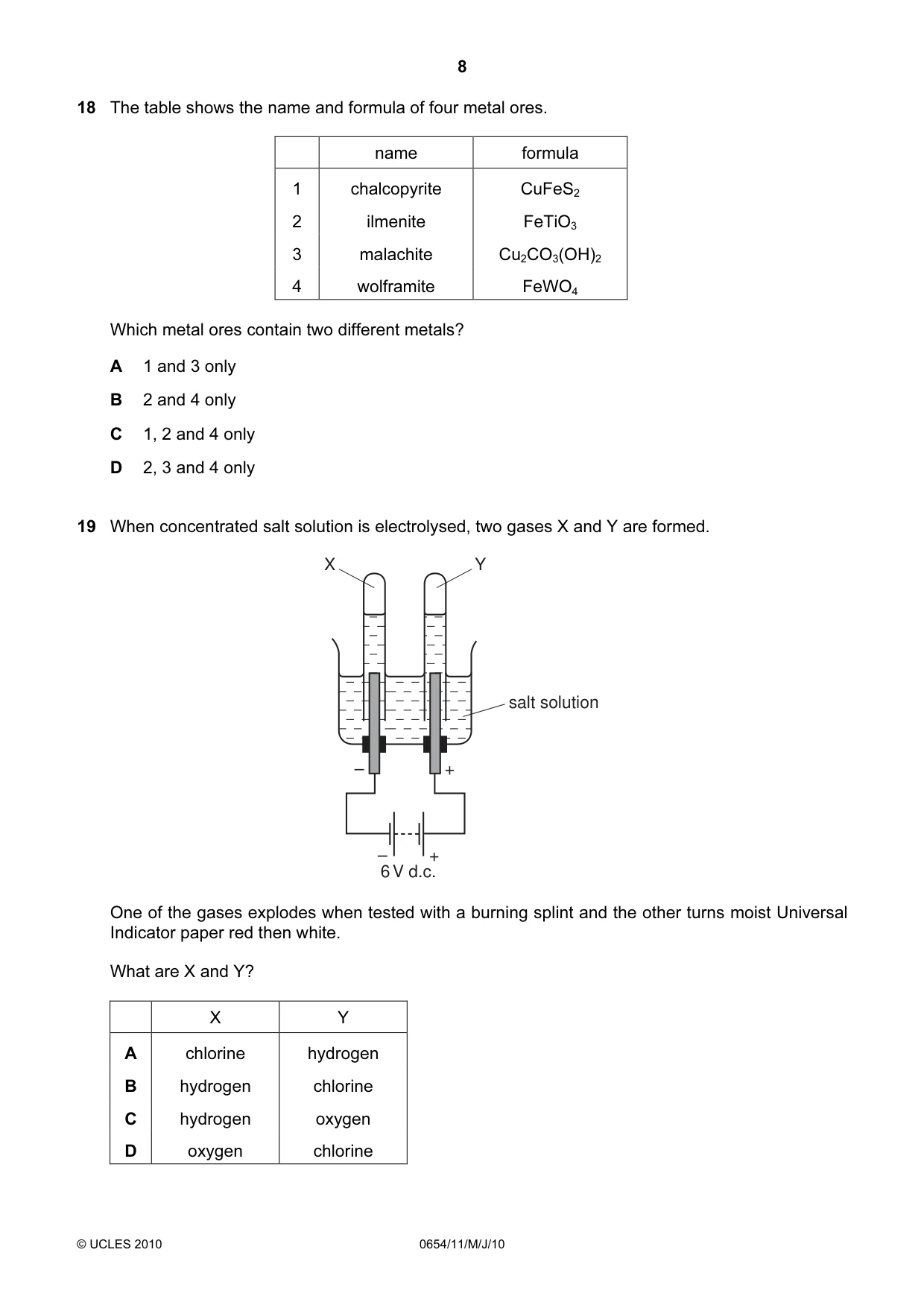
18 The table shows the name and formula of four metal ores. name formula 1 chalcopyrite CuFeS2 2 ilmenite FeTiO3 3 malachite Cu2CO3(OH)2 4 wolframite FeWO4 Which metal ores contain two different metals? A 1 and 3 only B 2 and 4 only C 1, 2 and 4 only D 2, 3 and 4 only
Mark scheme: C
Q19 · When concentrated salt solution is electrolysed, two gases X and Y are formed
19 When concentrated salt solution is electrolysed, two gases X and Y are formed. X Y salt solution – + – + 6 V d.c. One of the gases explodes when tested with a burning splint and the other turns moist Universal Indicator paper red then white. What are X and Y? X Y A chlorine hydrogen B hydrogen chlorine C hydrogen oxygen D oxygen chlorine
Mark scheme: B
Q20 · During the weathering of rocks, which process does not take place?
20 During the weathering of rocks, which process does not take place? A chemical change B fixation of nitrogen C physical change D release of salts into the soil
Mark scheme: B
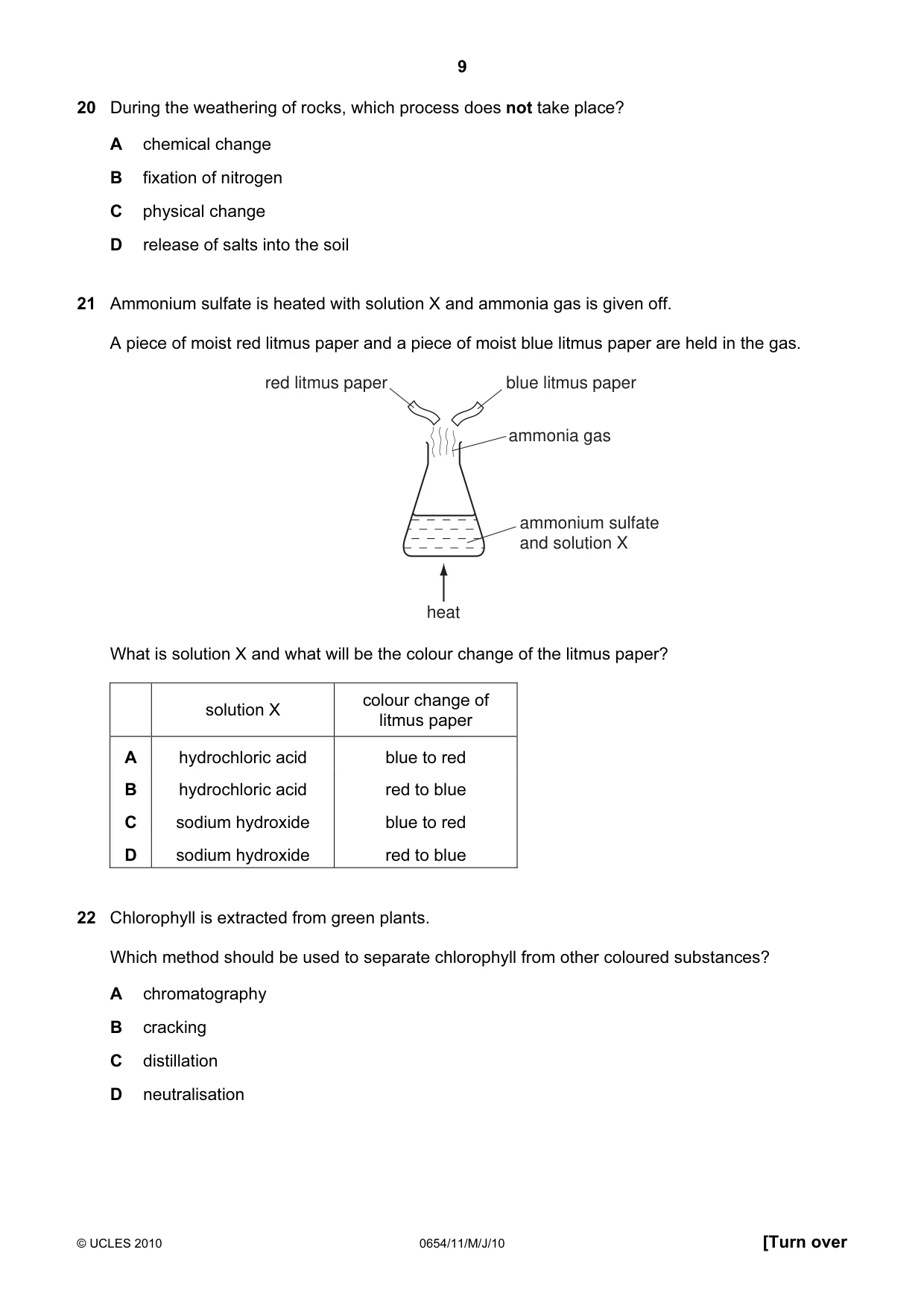
Q21 · Ammonium sulfate is heated with solution X and ammonia gas is given off
21 Ammonium sulfate is heated with solution X and ammonia gas is given off. A piece of moist red litmus paper and a piece of moist blue litmus paper are held in the gas. red litmus paper blue litmus paper ammonia gas ammonium sulfate and solution X heat What is solution X and what will be the colour change of the litmus paper? colour change of solution X litmus paper A hydrochloric acid blue to red B hydrochloric acid red to blue C sodium hydroxide blue to red D sodium hydroxide red to blue
Mark scheme: D
Q22 · Chlorophyll is extracted from green plants
22 Chlorophyll is extracted from green plants. Which method should be used to separate chlorophyll from other coloured substances? A chromatography B cracking C distillation D neutralisation
Mark scheme: A
Q23 · The contents of a beaker scatter a beam of light
23 The contents of a beaker scatter a beam of light. What does the beaker contain? A aqueous copper(II) sulfate B ethanol C milk D water
Mark scheme: C
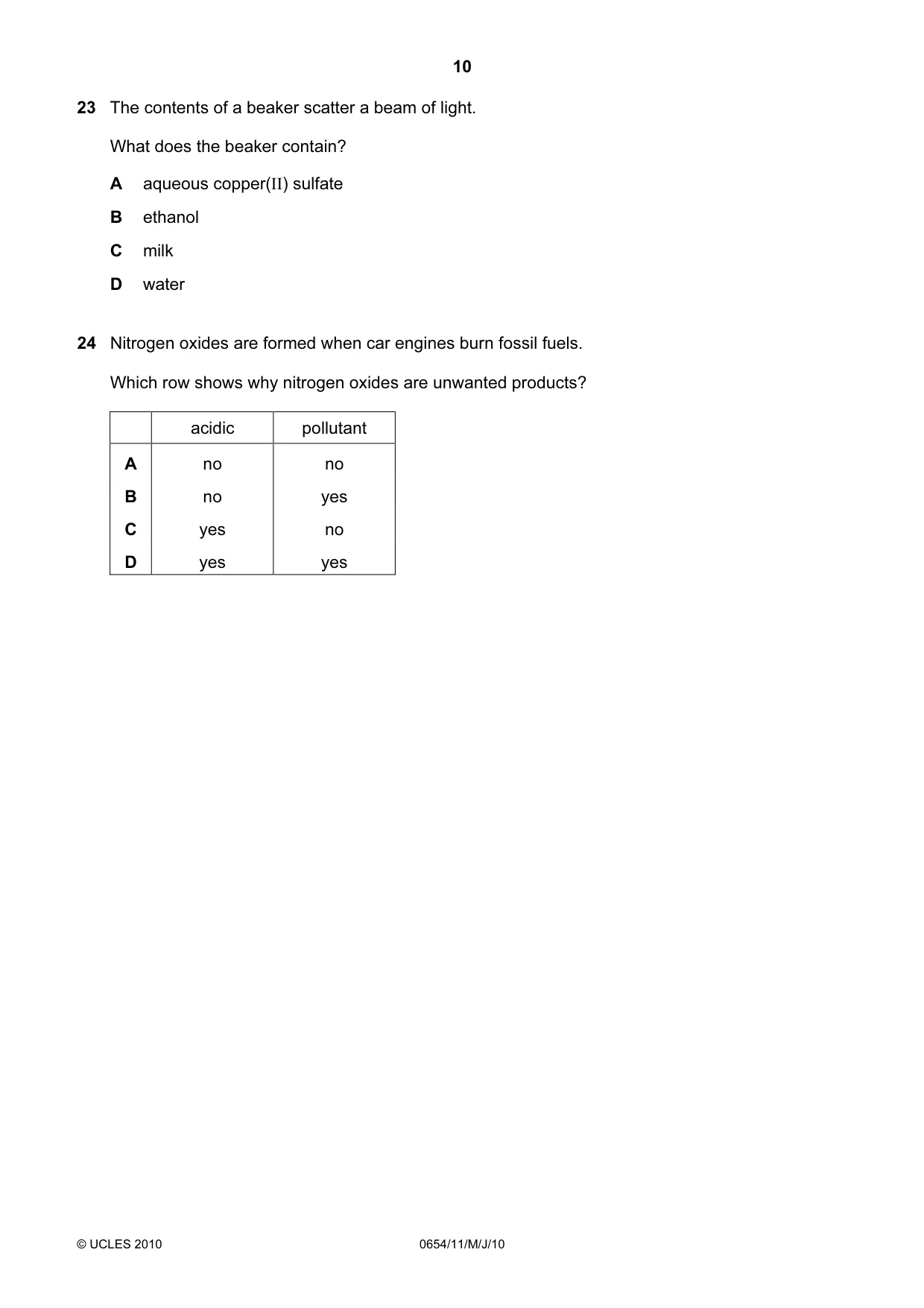
Q24 · Nitrogen oxides are formed when car engines burn fossil fuels
24 Nitrogen oxides are formed when car engines burn fossil fuels. Which row shows why nitrogen oxides are unwanted products? acidic pollutant A no no B no yes C yes no D yes yes
Mark scheme: D
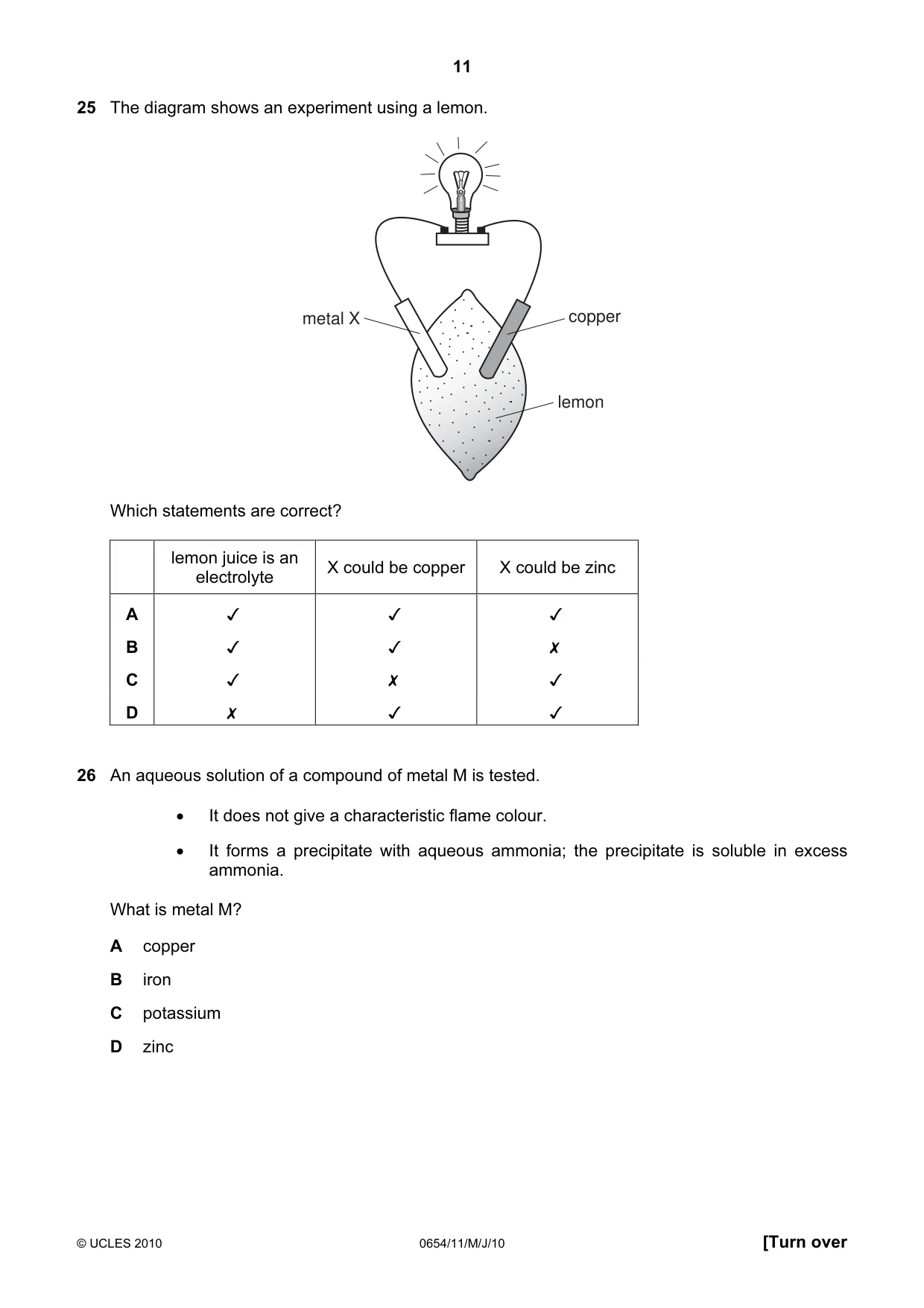
Q25 · The diagram shows an experiment using a lemon
25 The diagram shows an experiment using a lemon. metal X Which statements are correct? copper lemon 0 0O DW > lemon juice is an electrolyte ~~ KOM X could be copper Kk 4 4 X could be zinc a a SN
Mark scheme: C
Q26 · An aqueous solution of a compound of metal M is tested
26 An aqueous solution of a compound of metal M is tested. • It does not give a characteristic flame colour. • It forms a precipitate with aqueous ammonia; the precipitate is soluble in excess ammonia. What is metal M? A copper B iron C potassium D zinc
Mark scheme: D
Q27 · When element X reacts with element Y, X donates an electron to Y
27 When element X reacts with element Y, X donates an electron to Y. Which row correctly shows the type of ion that Y forms and how its position in the Periodic Table changes? effect on position of element type of ion Y in Periodic Table A negative moves one place to the right B negative no change C positive moves one place to the right D positive no change
Mark scheme: B
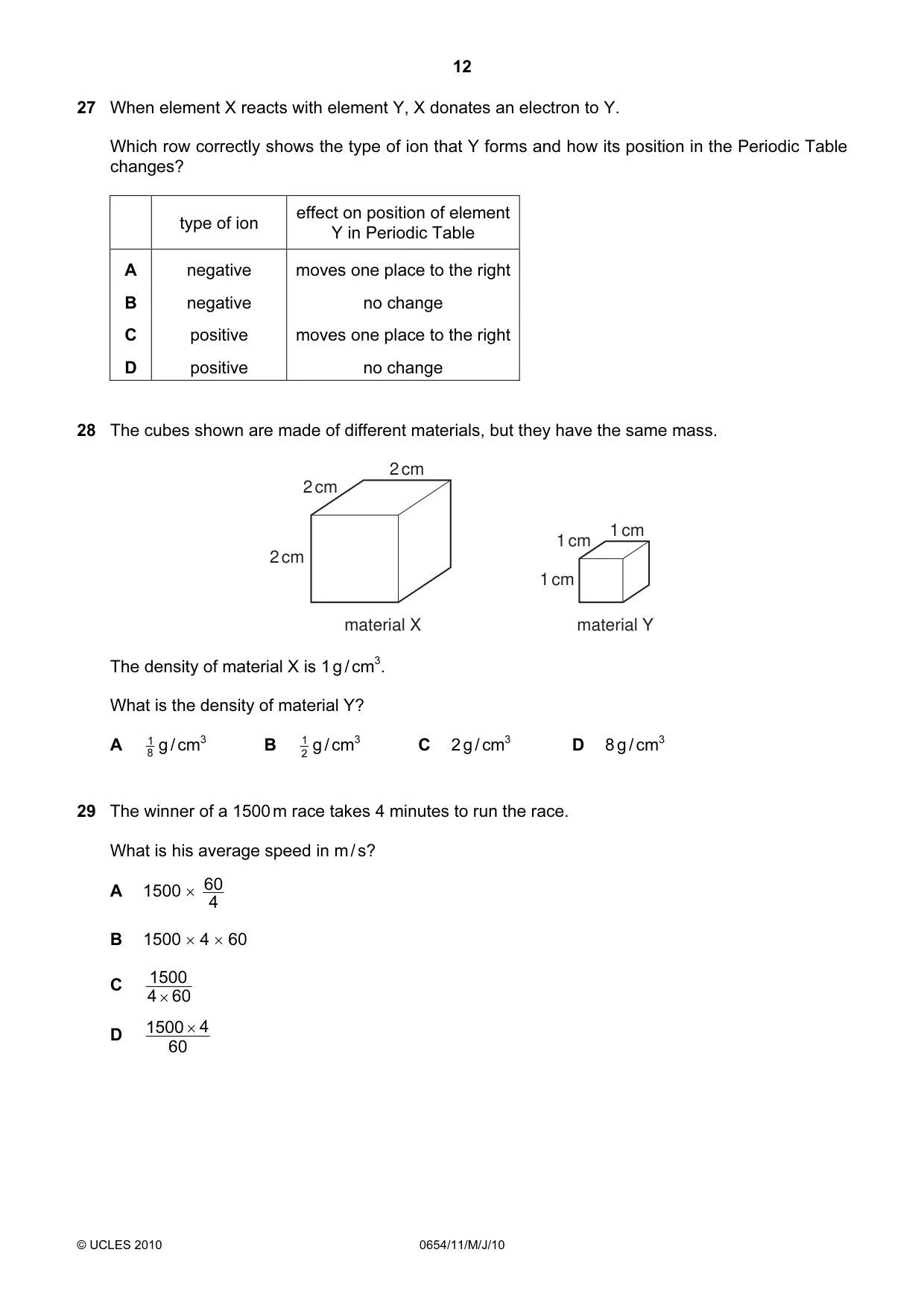
Q28 · The cubes shown are made of different materials, but they have the same mass
28 The cubes shown are made of different materials, but they have the same mass. 2 cm 2 cm 1 cm 1 cm 2 cm 1 cm material X material Y The density of material X is 1 g / cm3. What is the density of material Y? A 1 g / cm3 B 1 g / cm3 C 2 g / cm3 D 8 g / cm3 8 2
Mark scheme: D
Q29 · The winner of a 1500 m race takes 4 minutes to run the race
29 The winner of a 1500 m race takes 4 minutes to run the race. What is his average speed in m / s? A 1500 × 4 60 B 1500 × 4 × 60 1500 C 4 × 60 1500 × 4 D 60
Mark scheme: C
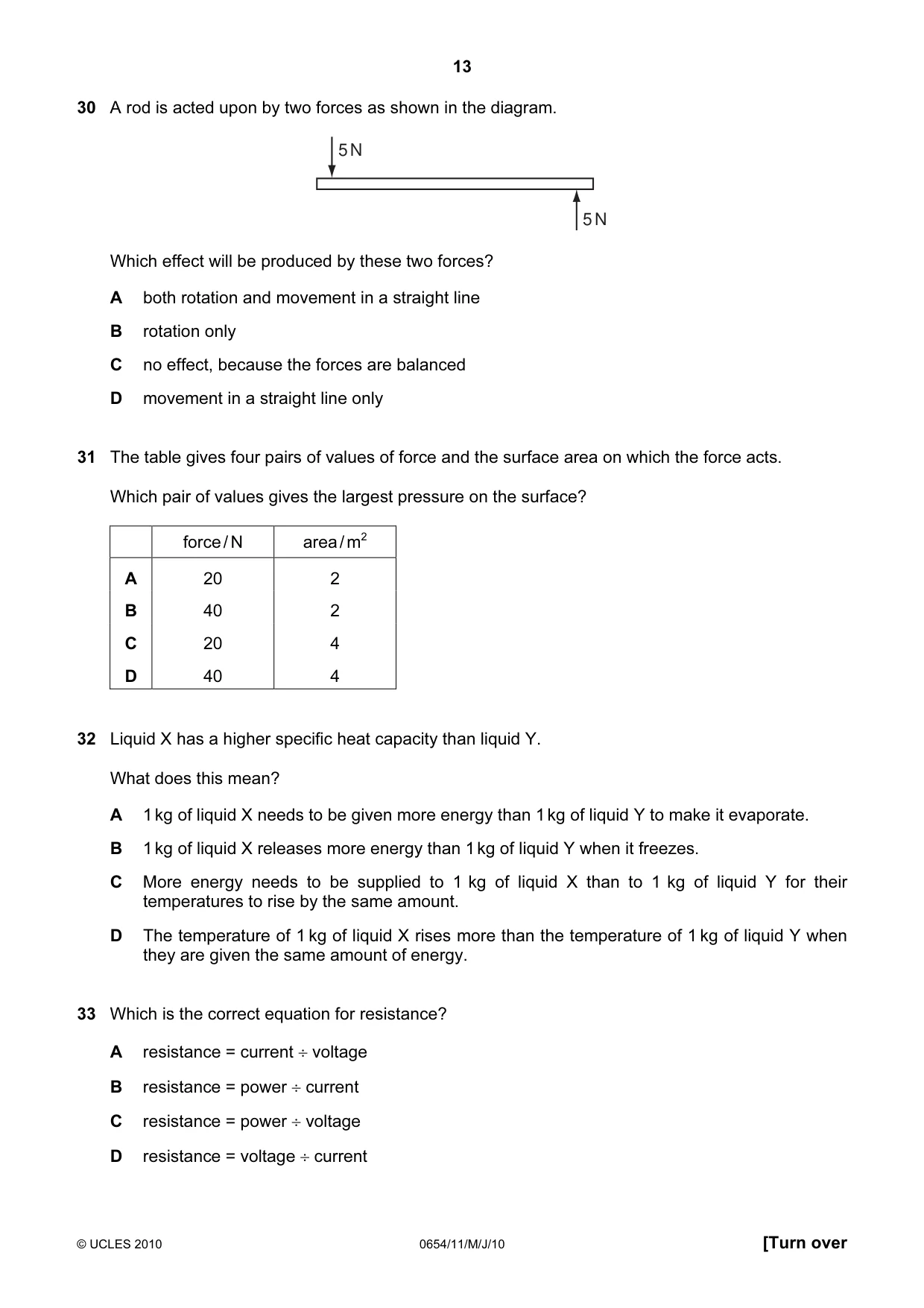
Q30 · A rod is acted upon by two forces as shown in the diagram
30 A rod is acted upon by two forces as shown in the diagram. 5 N 5 N Which effect will be produced by these two forces? A both rotation and movement in a straight line B rotation only C no effect, because the forces are balanced D movement in a straight line only
Mark scheme: B
Q31 · The table gives four pairs of values of force and the surface area on which the force acts
31 The table gives four pairs of values of force and the surface area on which the force acts. Which pair of values gives the largest pressure on the surface? force / N area / m2 A 20 2 B 40 2 C 20 4 D 40 4
Mark scheme: B
Q32 · Liquid X has a higher specific heat capacity than liquid Y
32 Liquid X has a higher specific heat capacity than liquid Y. What does this mean? A 1 kg of liquid X needs to be given more energy than 1 kg of liquid Y to make it evaporate. B 1 kg of liquid X releases more energy than 1 kg of liquid Y when it freezes. C More energy needs to be supplied to 1 kg of liquid X than to 1 kg of liquid Y for their temperatures to rise by the same amount. D The temperature of 1 kg of liquid X rises more than the temperature of 1 kg of liquid Y when they are given the same amount of energy.
Mark scheme: C
Q33 · Which is the correct equation for resistance?
33 Which is the correct equation for resistance? A resistance = current ÷ voltage B resistance = power ÷ current C resistance = power ÷ voltage D resistance = voltage ÷ current
Mark scheme: D
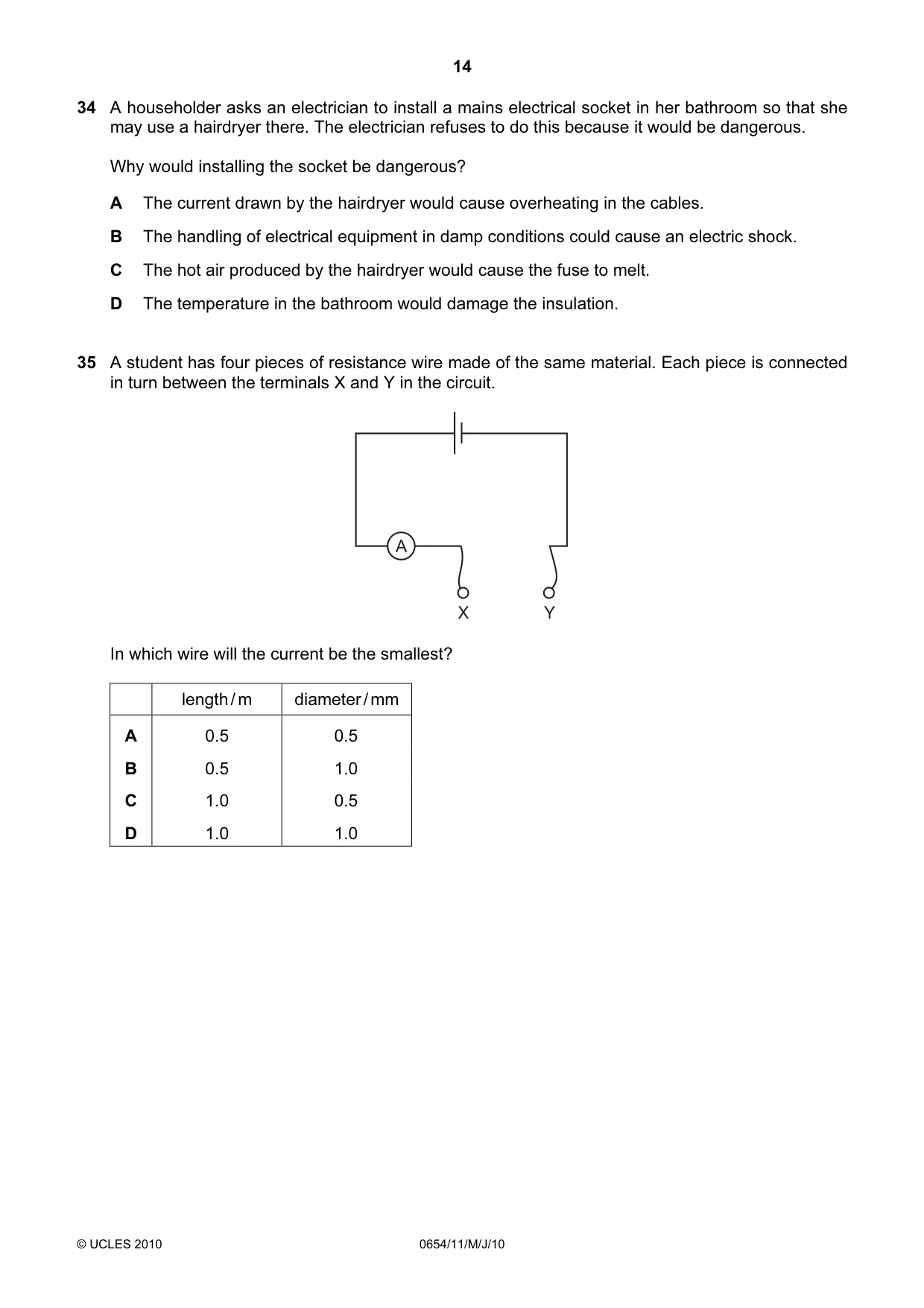
Q34 · A householder asks an electrician to install a mains electrical socket in her bathroom so…
34 A householder asks an electrician to install a mains electrical socket in her bathroom so that she may use a hairdryer there. The electrician refuses to do this because it would be dangerous. Why would installing the socket be dangerous? A The current drawn by the hairdryer would cause overheating in the cables. B The handling of electrical equipment in damp conditions could cause an electric shock. C The hot air produced by the hairdryer would cause the fuse to melt. D The temperature in the bathroom would damage the insulation.
Mark scheme: B
Q35 · A student has four pieces of resistance wire made of the same material
35 A student has four pieces of resistance wire made of the same material. Each piece is connected in turn between the terminals X and Y in the circuit. X Y In which wire will the current be the smallest? length / m diameter / mm A 0.5 0.5 B 0.5 1.0 C 1.0 0.5 D 1.0 1.0
Mark scheme: C
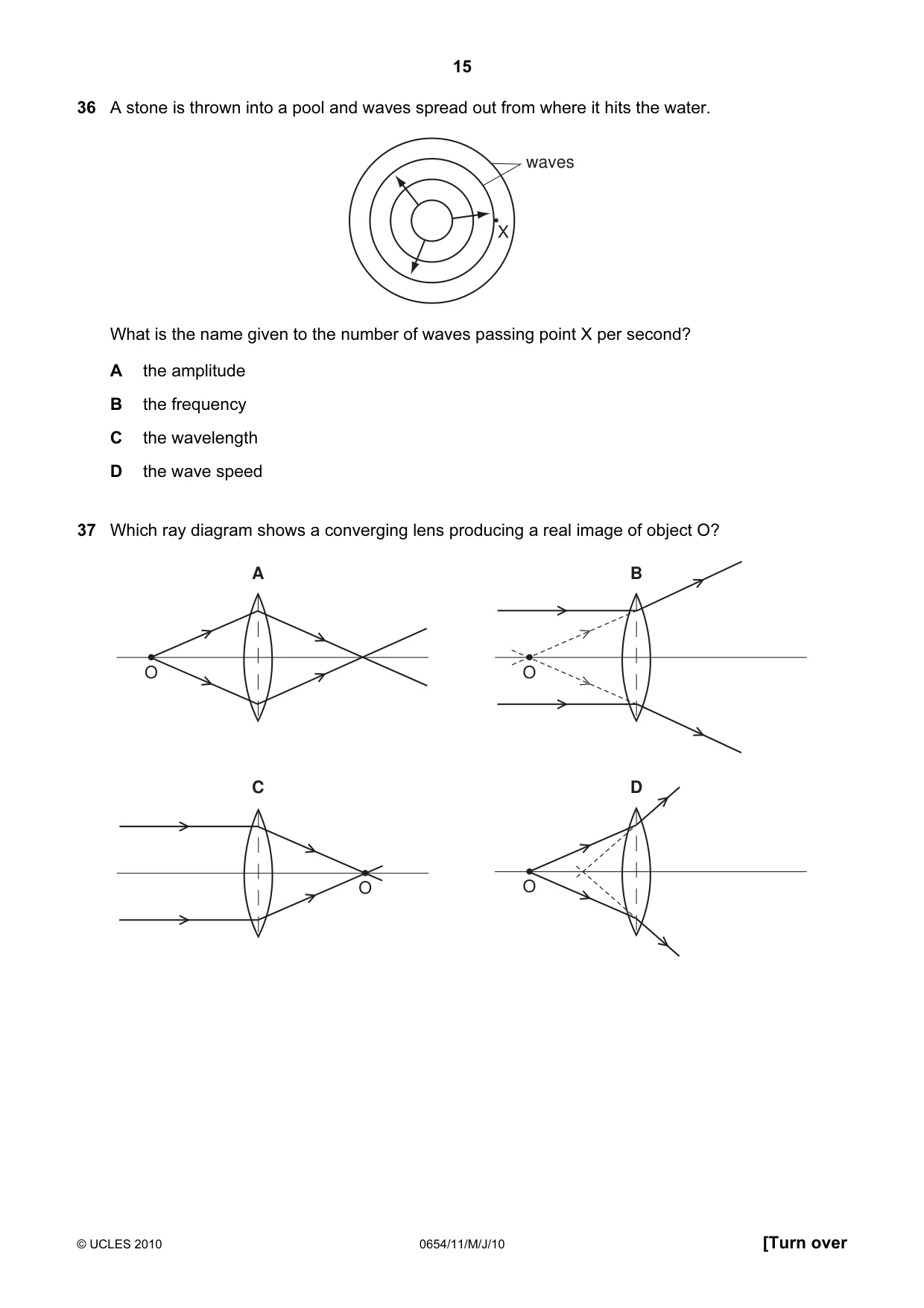
Q36 · A stone is thrown into a pool and waves spread out from where it hits the water
36 A stone is thrown into a pool and waves spread out from where it hits the water. waves X What is the name given to the number of waves passing point X per second? A the amplitude B the frequency C the wavelength D the wave speed
Mark scheme: B
Q37 · Which ray diagram shows a converging lens producing a real image of object O?
37 Which ray diagram shows a converging lens producing a real image of object O? A B O O C D O O
Mark scheme: A
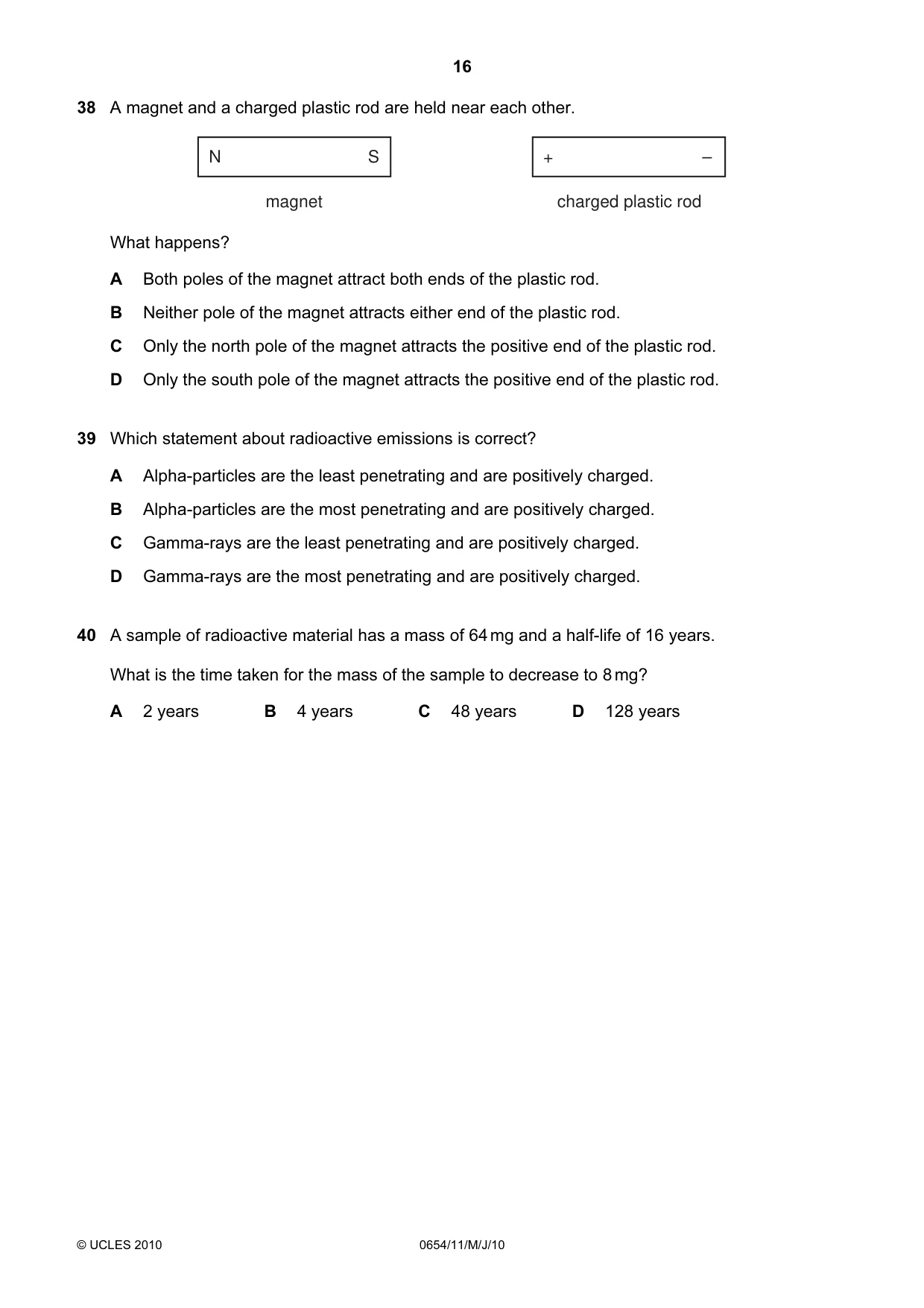
Q38 · A magnet and a charged plastic rod are held near each other
38 A magnet and a charged plastic rod are held near each other. N S + – magnet charged plastic rod What happens? A Both poles of the magnet attract both ends of the plastic rod. B Neither pole of the magnet attracts either end of the plastic rod. C Only the north pole of the magnet attracts the positive end of the plastic rod. D Only the south pole of the magnet attracts the positive end of the plastic rod.
Mark scheme: B
Q39 · Which statement about radioactive emissions is correct?
39 Which statement about radioactive emissions is correct? A Alpha-particles are the least penetrating and are positively charged. B Alpha-particles are the most penetrating and are positively charged. C Gamma-rays are the least penetrating and are positively charged. D Gamma-rays are the most penetrating and are positively charged.
Mark scheme: A
Q40 · A sample of radioactive material has a mass of 64 mg and a half-life of 16 years
40 A sample of radioactive material has a mass of 64 mg and a half-life of 16 years. What is the time taken for the mass of the sample to decrease to 8 mg? A 2 years B 4 years C 48 years D 128 years
Mark scheme: C
What was in this paper
The subtopics covered by these 40 questions, and how many questions each got. Open one in a new tab to see every Cambridge question on it.
2Electrolysis2Identification of ions and gases2Radioactivity2Sexual reproduction in plants2Air quality and climate1Carbon cycle1Cell structure1Chromatography1Coordination and response1Density1Diet1Digestive system1Electrical safety1Elements, compounds and mixtures1Energy flow1Forces1Fuels1General properties of waves1Giant covalent structures1Homeostasis1Ions and ionic bonds1Light1Monohybrid inheritance1Motion1Photosynthesis1Pressure1Properties of metals1Respiration1Separation and purification1Sexual reproduction in humans1Simple phenomena of magnetism1Solids, liquids and gases1Thermal properties and temperature1Water1What you needed in this session
Cambridge’s own grade thresholds for 2010 May/June, Paper 1 · Variant 1. A higher threshold means an easier paper — the bar moves with how the cohort did.