Cambridge IGCSE Sciences - Co-ordinated (Double) 0654 — 2008 May/June Paper 1 · Variant 1
0654/11/M/J/08 · 40 questions · 40 marks · ≈45 min
The question paper and its mark scheme, free to read here and free to download. This is Cambridge’s own paper, exactly as it was sat.
Question paper20 pages
Mark scheme2 pages
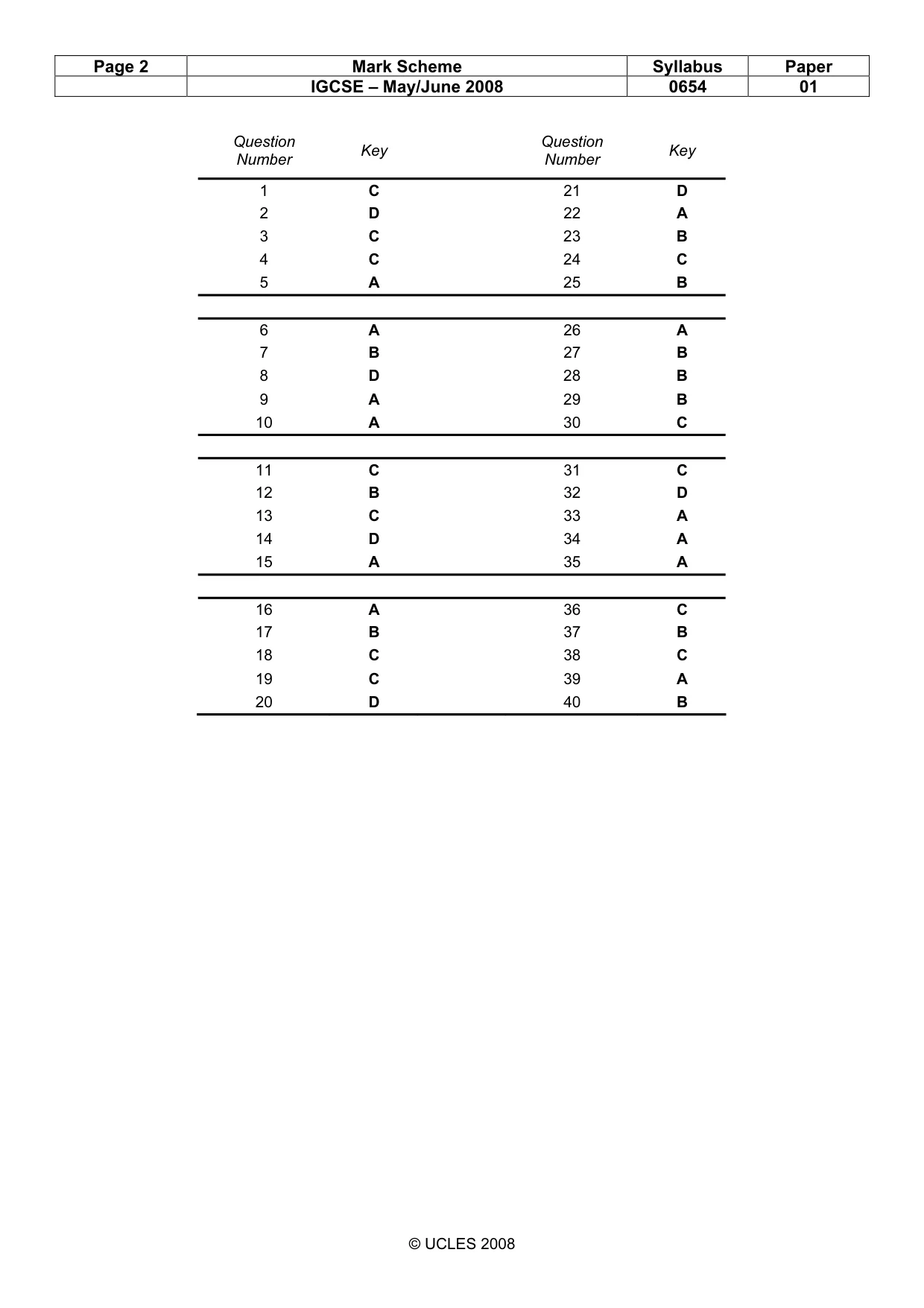
Answers below. Sit the paper first if you are practising.
Questions as text
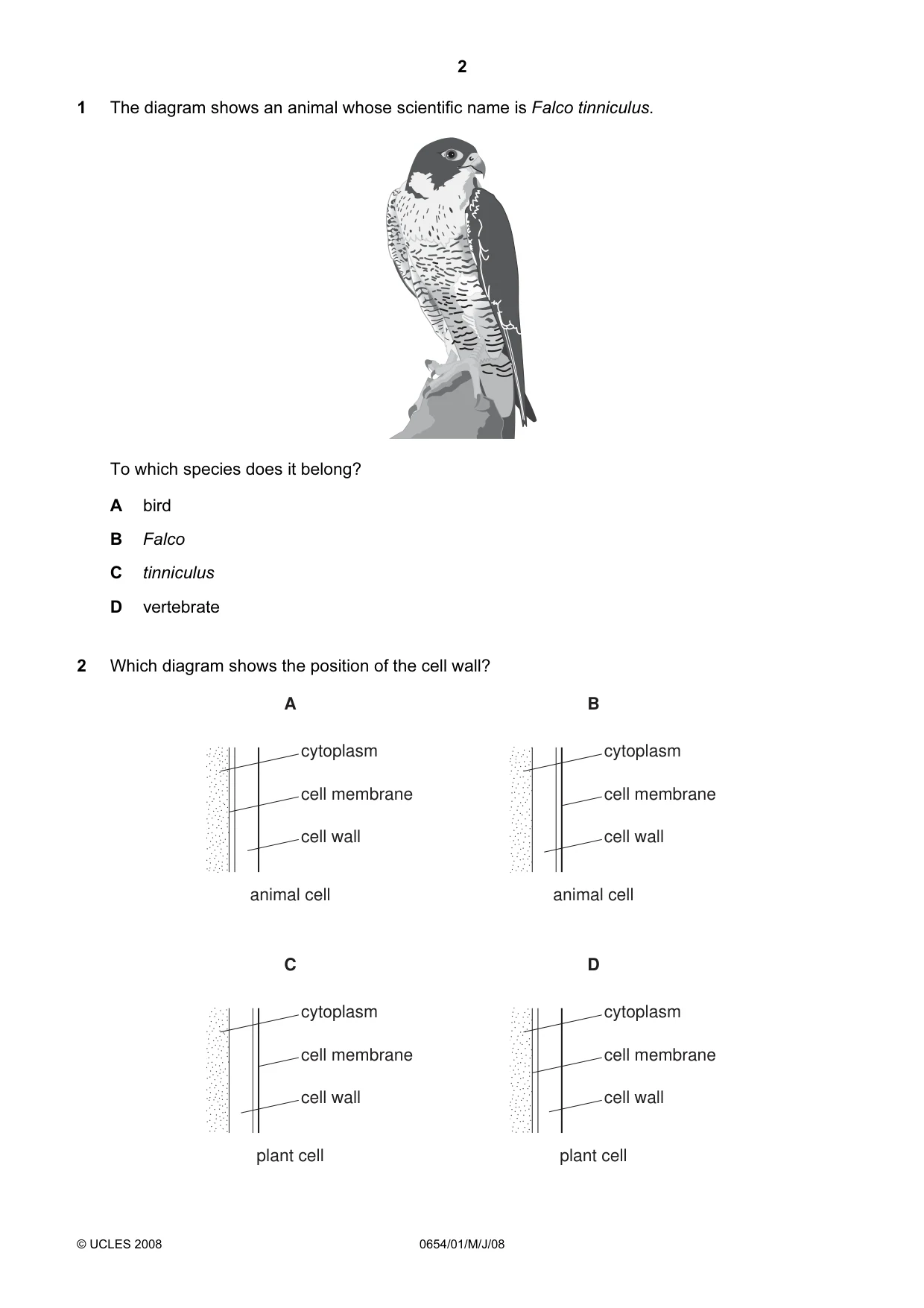
Q1 · The diagram shows an animal whose scientific name is Falco tinniculus
1 The diagram shows an animal whose scientific name is Falco tinniculus. To which species does it belong? A bird B Falco C tinniculus D vertebrate
Mark scheme: C
Q2 · Which diagram shows the position of the cell wall?
2 Which diagram shows the position of the cell wall? A B cytoplasm cytoplasm cell membrane cell membrane cell wall cell wall animal cell animal cell C D cytoplasm cytoplasm cell membrane cell membrane cell wall cell wall plant cell plant cell
Mark scheme: D
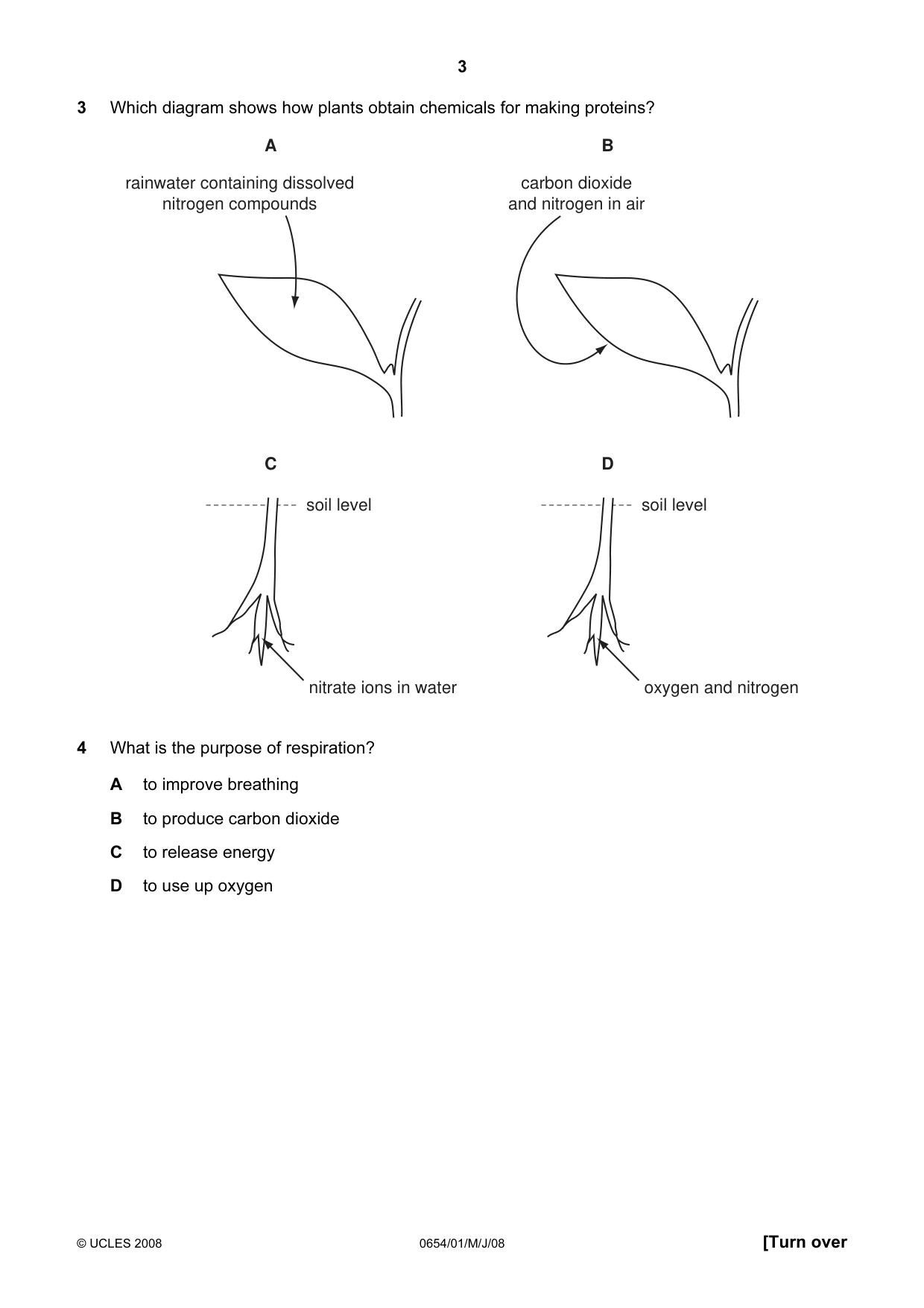
Q3 · Which diagram shows how plants obtain chemicals for making proteins?
3 Which diagram shows how plants obtain chemicals for making proteins? A B rainwater containing dissolved carbon dioxide nitrogen compounds and nitrogen in air C D soil level soil level nitrate ions in water oxygen and nitrogen
Mark scheme: C
Q4 · What is the purpose of respiration?
4 What is the purpose of respiration? A to improve breathing B to produce carbon dioxide C to release energy D to use up oxygen
Mark scheme: C
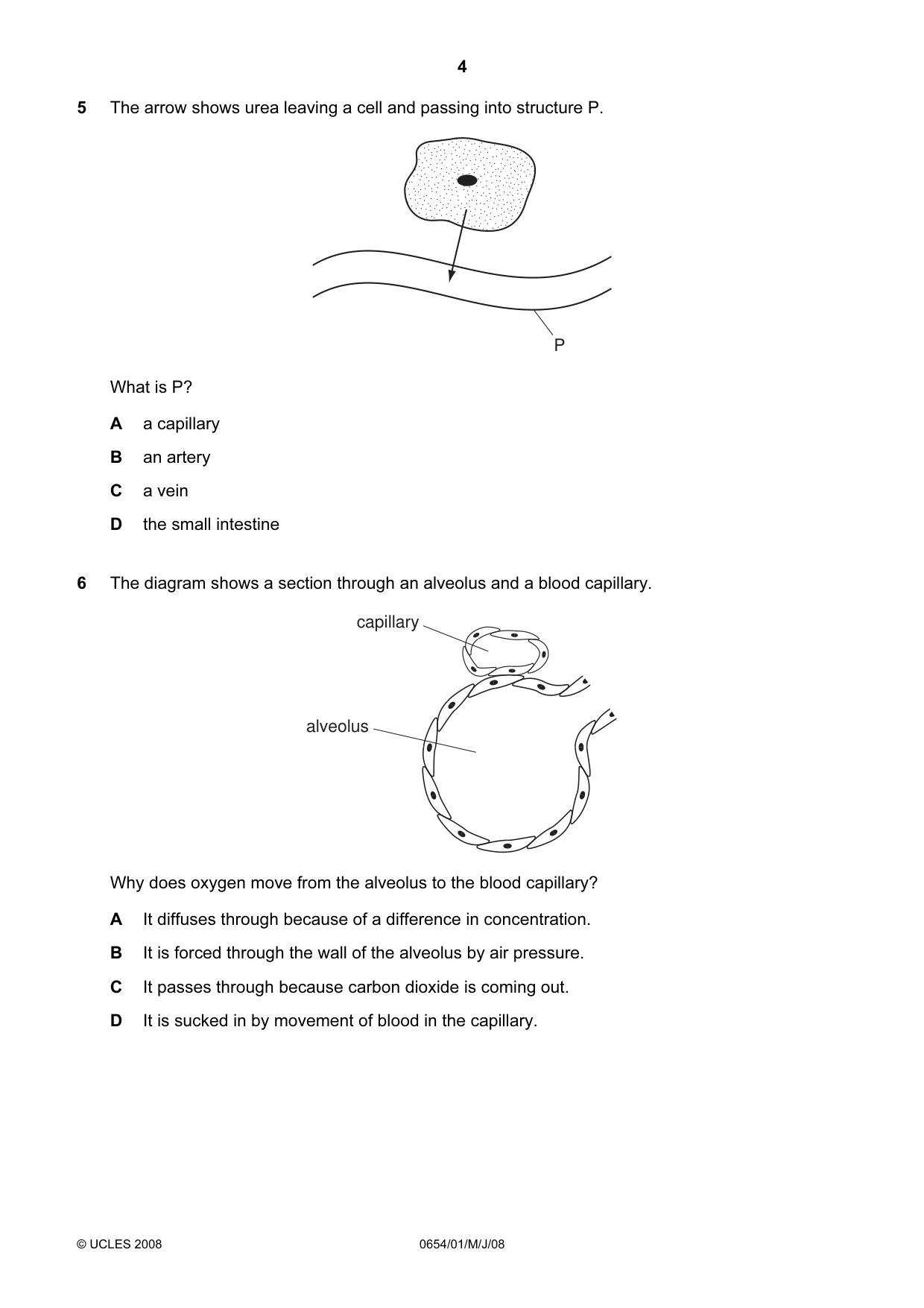
Q5 · The arrow shows urea leaving a cell and passing into structure P
5 The arrow shows urea leaving a cell and passing into structure P. P What is P? A a capillary B an artery C a vein D the small intestine
Mark scheme: A
Q6 · The diagram shows a section through an alveolus and a blood capillary
6 The diagram shows a section through an alveolus and a blood capillary. capillary alveolus Why does oxygen move from the alveolus to the blood capillary? A It diffuses through because of a difference in concentration. B It is forced through the wall of the alveolus by air pressure. C It passes through because carbon dioxide is coming out. D It is sucked in by movement of blood in the capillary.
Mark scheme: A
Q7 · Kwashiorkor is a disease that affects young children who do not have enough protein to eat
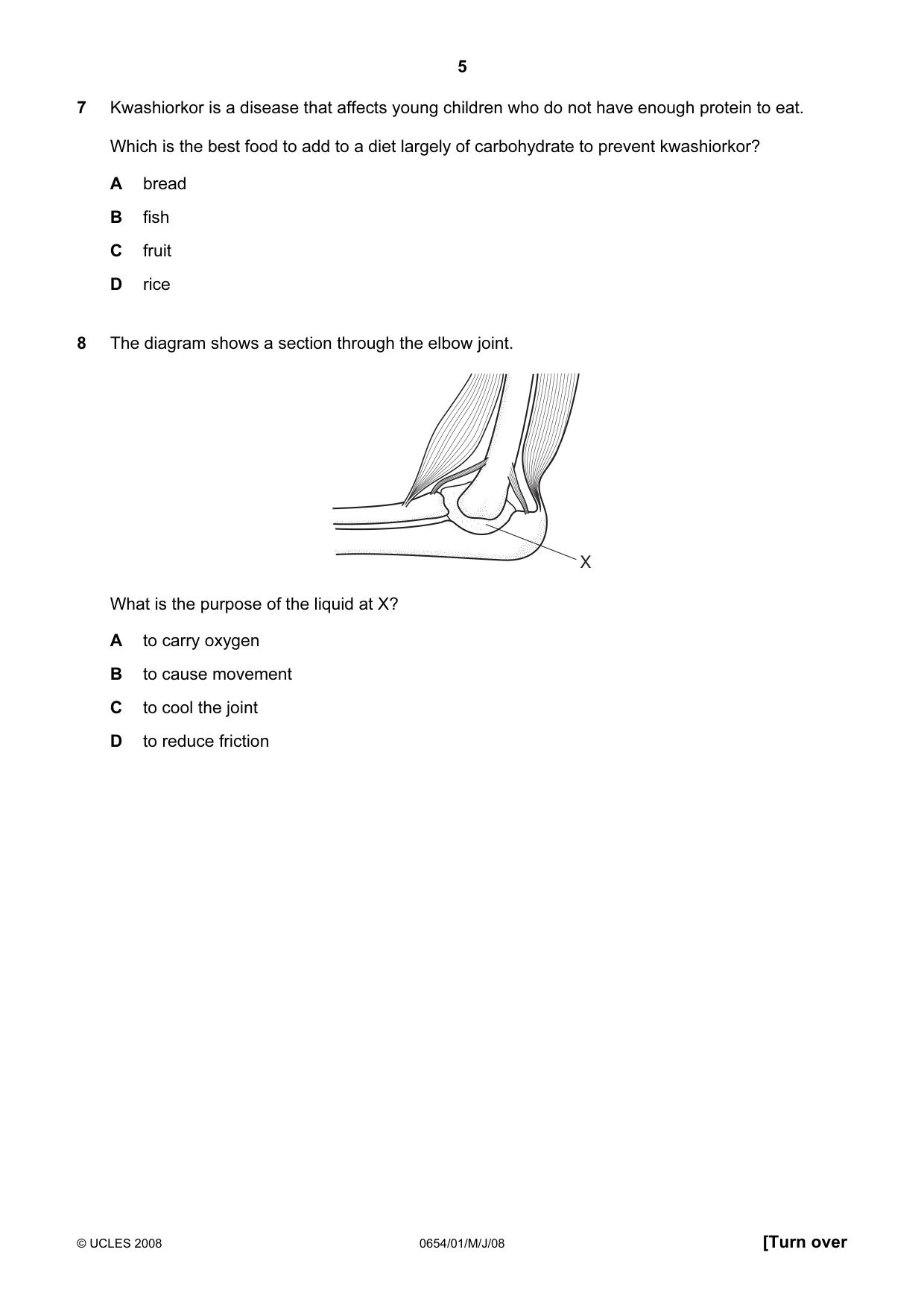
7 Kwashiorkor is a disease that affects young children who do not have enough protein to eat. Which is the best food to add to a diet largely of carbohydrate to prevent kwashiorkor? A bread B fish C fruit D rice
Mark scheme: B
Q8 · The diagram shows a section through the elbow joint
8 The diagram shows a section through the elbow joint. X What is the purpose of the liquid at X? A to carry oxygen B to cause movement C to cool the joint D to reduce friction
Mark scheme: D
Q9 · The graph shows changes in the concentration of sugar in the blood after a person has…
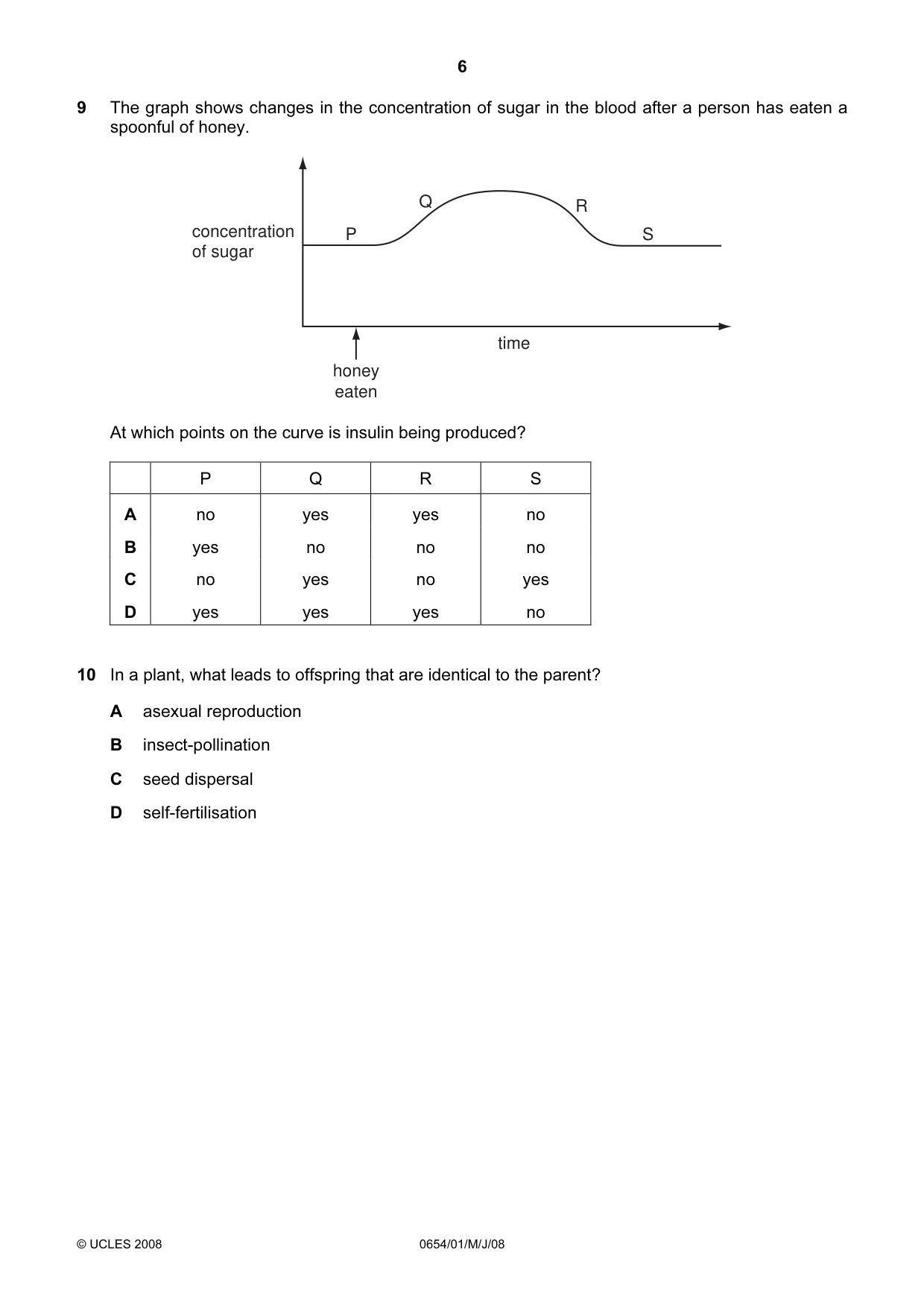
9 The graph shows changes in the concentration of sugar in the blood after a person has eaten a spoonful of honey. Q R concentration P S of sugar time honey eaten At which points on the curve is insulin being produced? P Q R S A no yes yes no B yes no no no C no yes no yes D yes yes yes no
Mark scheme: A
Q10 · In a plant, what leads to offspring that are identical to the parent?
10 In a plant, what leads to offspring that are identical to the parent? A asexual reproduction B insect-pollination C seed dispersal D self-fertilisation
Mark scheme: A
Q11 · The diagram shows a developing fetus attached to the uterus wall
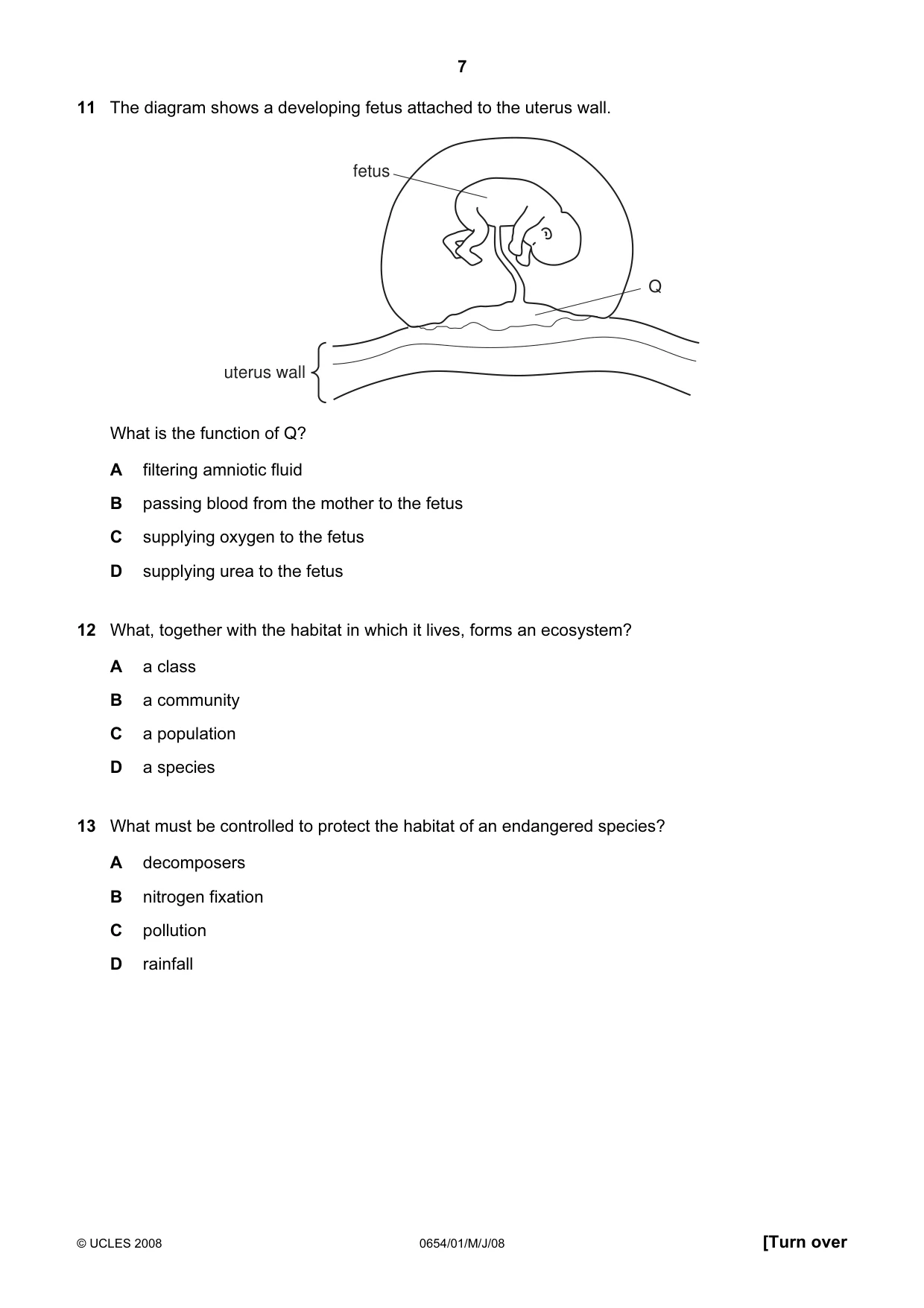
11 The diagram shows a developing fetus attached to the uterus wall. fetus Q uterus wall What is the function of Q? A filtering amniotic fluid B passing blood from the mother to the fetus C supplying oxygen to the fetus D supplying urea to the fetus
Mark scheme: C
Q12 · What, together with the habitat in which it lives, forms an ecosystem?
12 What, together with the habitat in which it lives, forms an ecosystem? A a class B a community C a population D a species
Mark scheme: B
Q13 · What must be controlled to protect the habitat of an endangered species?
13 What must be controlled to protect the habitat of an endangered species? A decomposers B nitrogen fixation C pollution D rainfall
Mark scheme: C
Q14 · What do the chemical symbols N2 and Ni represent?
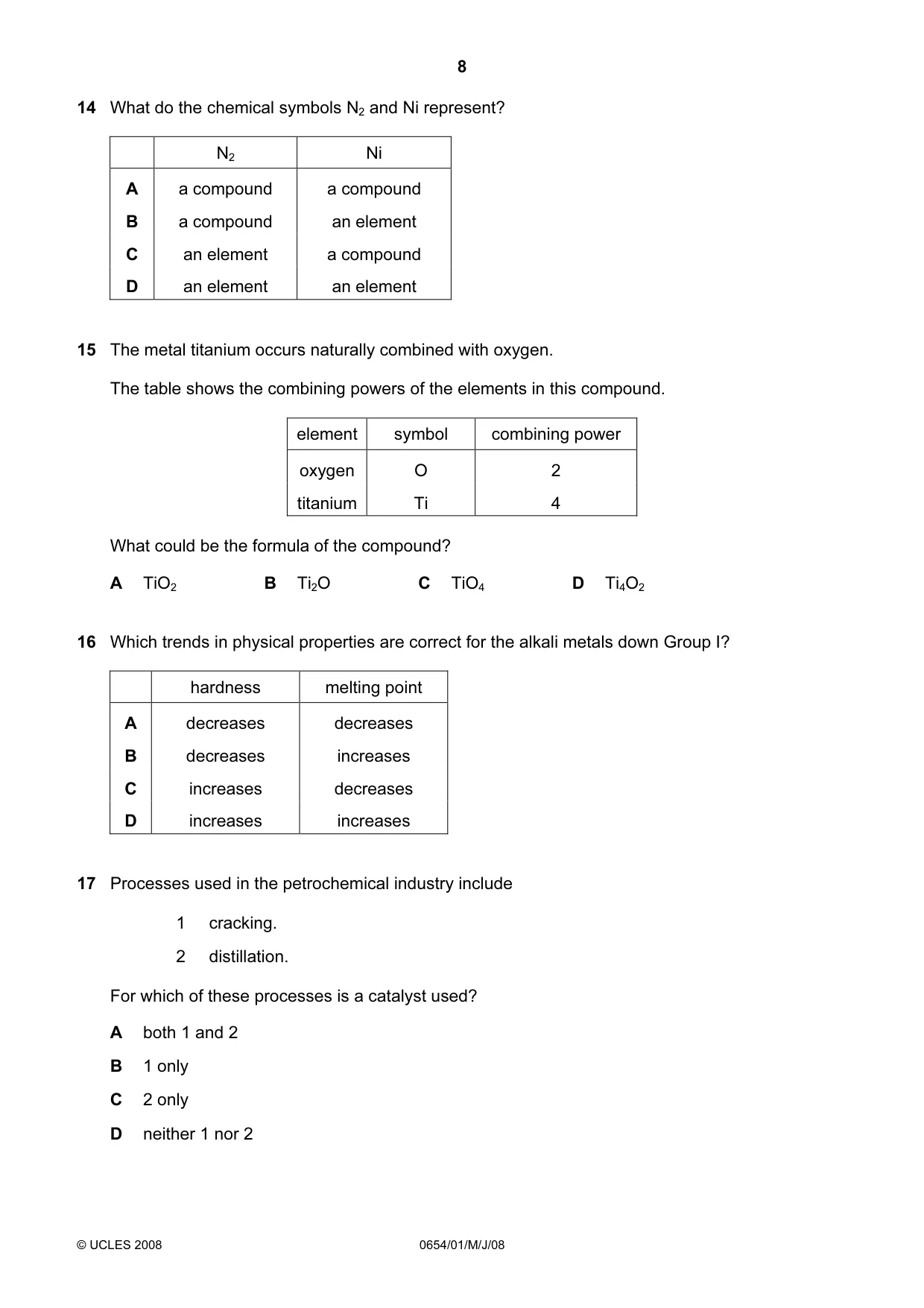
14 What do the chemical symbols N2 and Ni represent? N2 Ni A a compound a compound B a compound an element C an element a compound D an element an element
Mark scheme: D
Q15 · The metal titanium occurs naturally combined with oxygen
15 The metal titanium occurs naturally combined with oxygen. The table shows the combining powers of the elements in this compound. element symbol combining power oxygen O 2 titanium Ti 4 What could be the formula of the compound? A TiO2 B Ti2O C TiO4 D Ti4O2
Mark scheme: A
Q16 · Which trends in physical properties are correct for the alkali metals down Group I?
16 Which trends in physical properties are correct for the alkali metals down Group I? hardness melting point A decreases decreases B decreases increases C increases decreases D increases increases
Mark scheme: A
Q17 · Processes used in the petrochemical industry include 1 cracking
17 Processes used in the petrochemical industry include 1 cracking. 2 distillation. For which of these processes is a catalyst used? A both 1 and 2 B 1 only C 2 only D neither 1 nor 2
Mark scheme: B
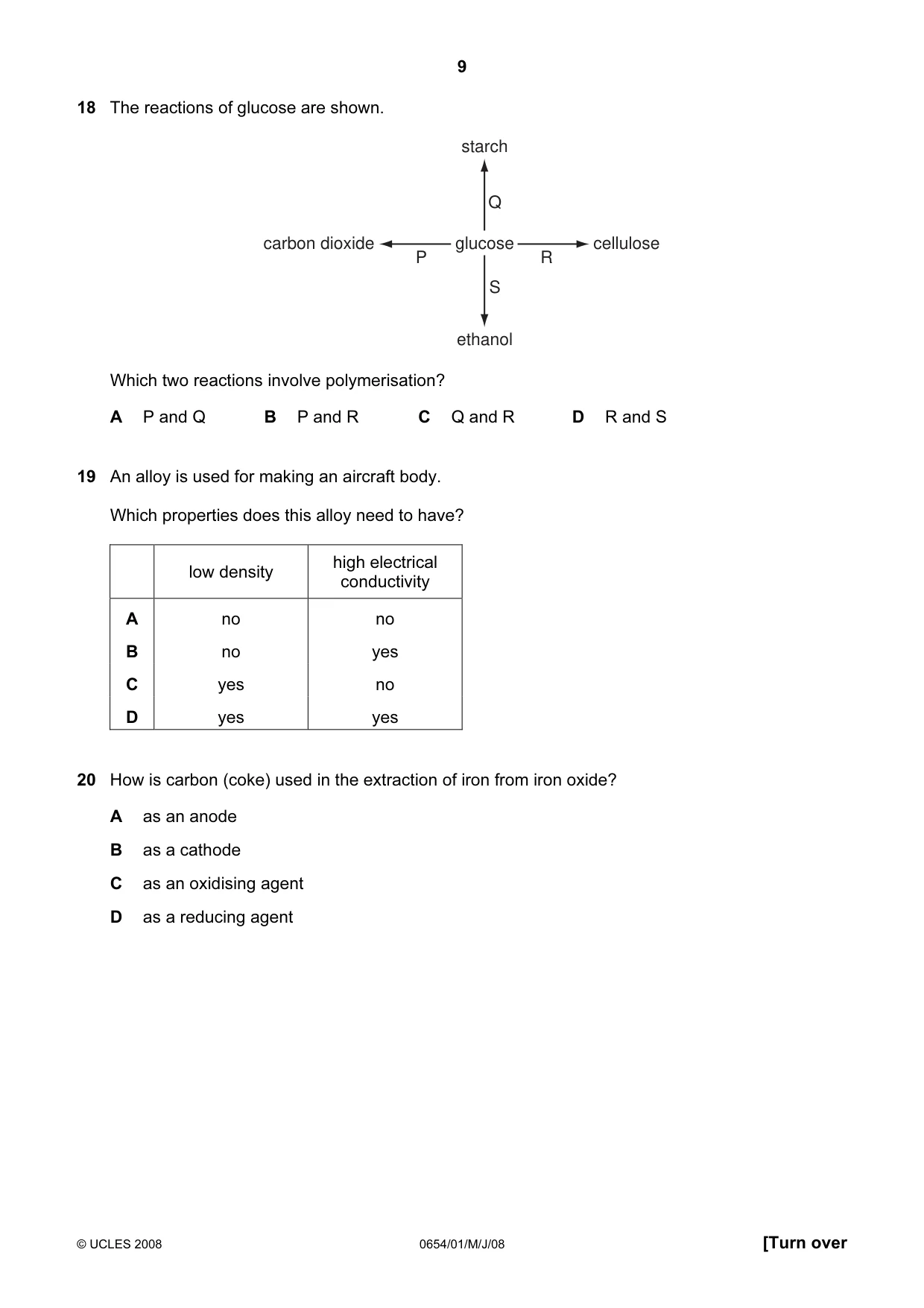
Q18 · The reactions of glucose are shown
18 The reactions of glucose are shown. starch Q carbon dioxide glucose cellulose P R S ethanol Which two reactions involve polymerisation? A P and Q B P and R C Q and R D R and S
Mark scheme: C
Q19 · An alloy is used for making an aircraft body
19 An alloy is used for making an aircraft body. Which properties does this alloy need to have? high electrical low density conductivity A no no B no yes C yes no D yes yes
Mark scheme: C
Q20 · How is carbon (coke) used in the extraction of iron from iron oxide?
20 How is carbon (coke) used in the extraction of iron from iron oxide? A as an anode B as a cathode C as an oxidising agent D as a reducing agent
Mark scheme: D
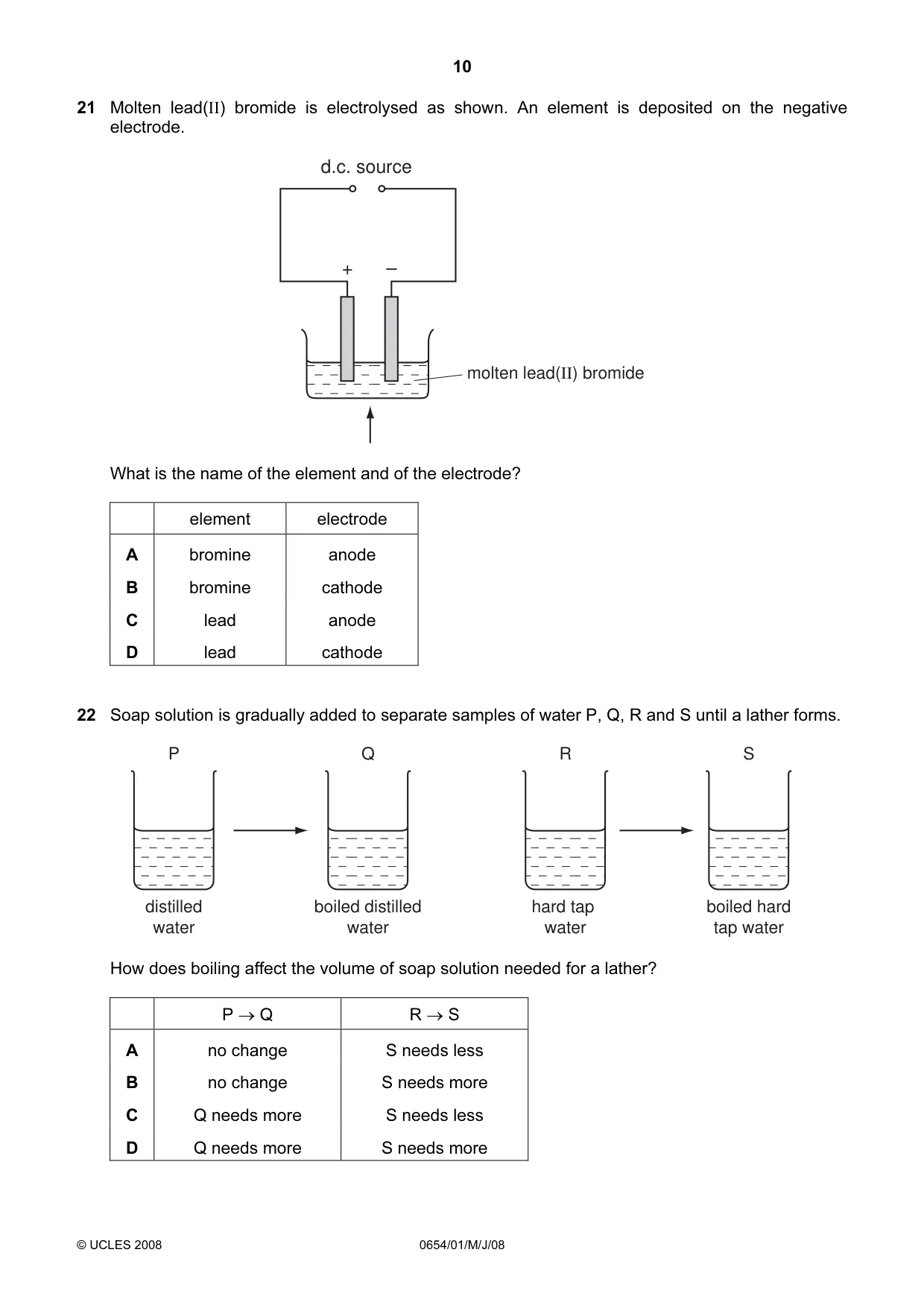
Q21 · Molten lead(II) bromide is electrolysed as shown
21 Molten lead(II) bromide is electrolysed as shown. An element is deposited on the negative electrode. d.c. source + – molten lead(II) bromide What is the name of the element and of the electrode? element electrode A bromine anode B bromine cathode C lead anode D lead cathode
Mark scheme: D
Q22 · Soap solution is gradually added to separate samples of water P, Q, R and S until a…
22 Soap solution is gradually added to separate samples of water P, Q, R and S until a lather forms. P Q R S distilled boiled distilled hard tap boiled hard water water water tap water How does boiling affect the volume of soap solution needed for a lather? P → Q R → S A no change S needs less B no change S needs more C Q needs more S needs less D Q needs more S needs more
Mark scheme: A
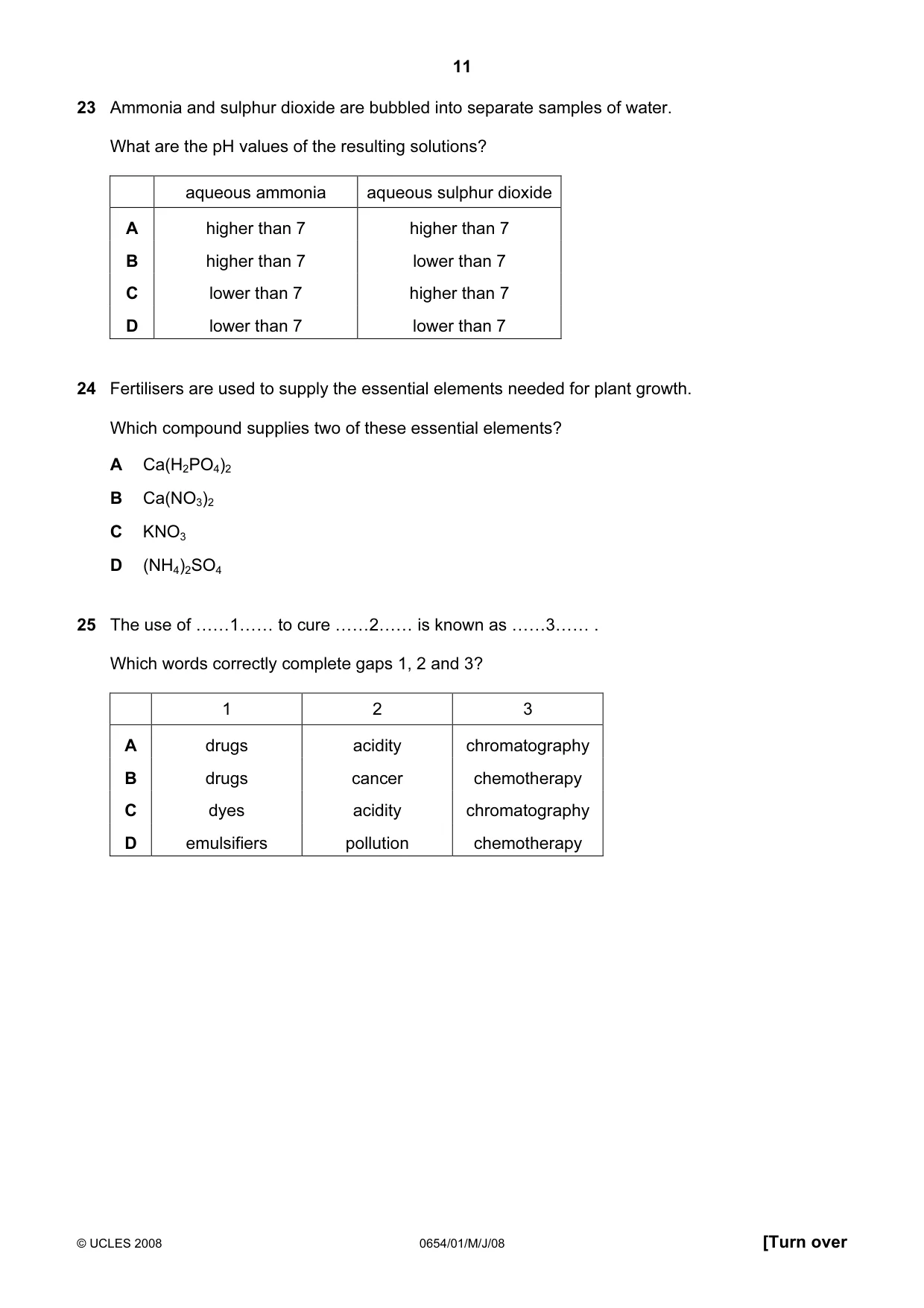
Q23 · Ammonia and sulphur dioxide are bubbled into separate samples of water
23 Ammonia and sulphur dioxide are bubbled into separate samples of water. What are the pH values of the resulting solutions? aqueous ammonia aqueous sulphur dioxide A higher than 7 higher than 7 B higher than 7 lower than 7 C lower than 7 higher than 7 D lower than 7 lower than 7
Mark scheme: B
More questions on The characteristic properties of acids and bases
Q24 · Fertilisers are used to supply the essential elements needed for plant growth
24 Fertilisers are used to supply the essential elements needed for plant growth. Which compound supplies two of these essential elements? A Ca(H2PO4)2 B Ca(NO3)2 C KNO3 D (NH4)2SO4
Mark scheme: C
Q25 · The use of ……1…… to cure ……2…… is known as ……3……
25 The use of ……1…… to cure ……2…… is known as ……3…… . Which words correctly complete gaps 1, 2 and 3? 1 2 3 A drugs acidity chromatography B drugs cancer chemotherapy C dyes acidity chromatography D emulsifiers pollution chemotherapy
Mark scheme: B
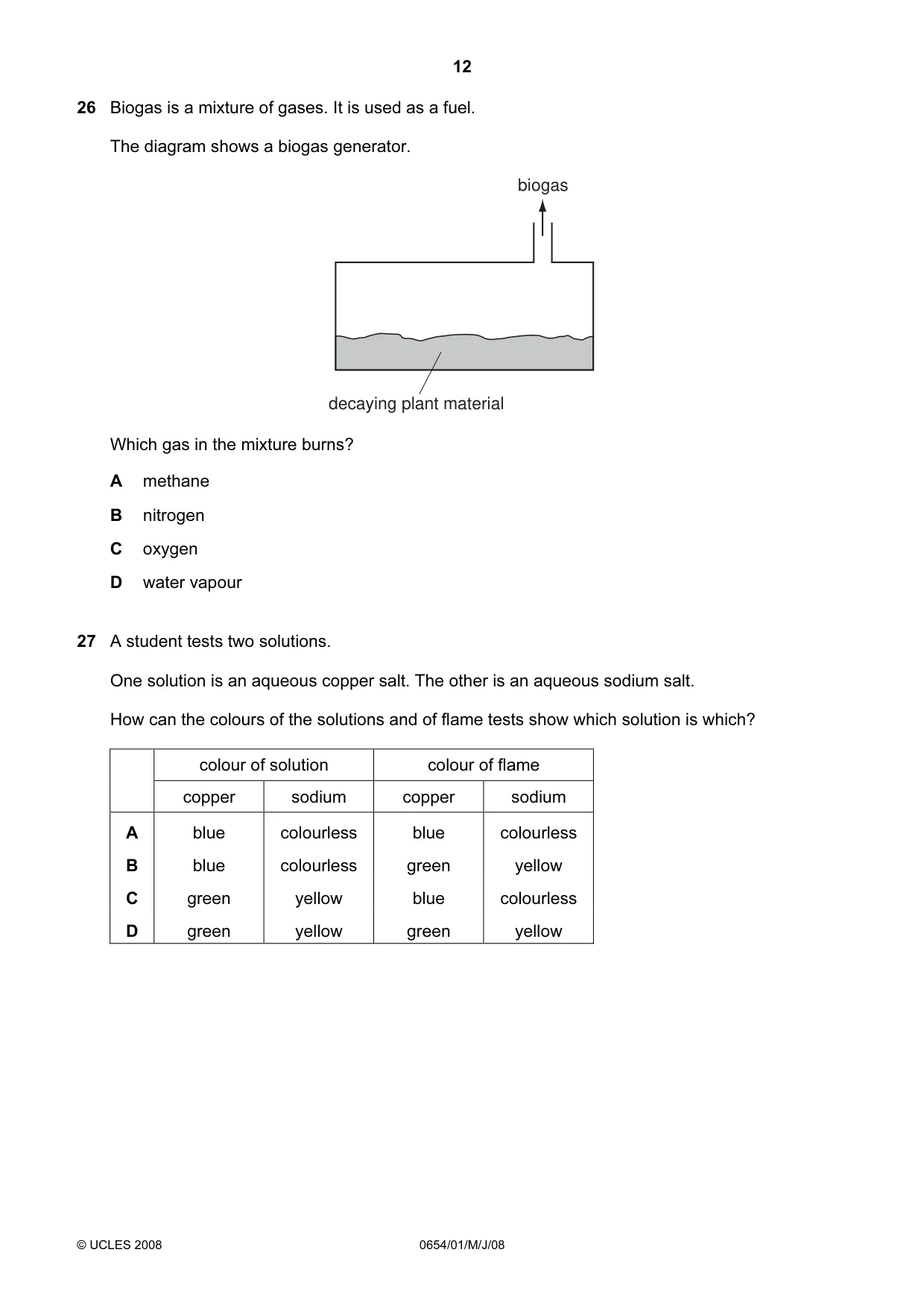
Q26 · Biogas is a mixture of gases
26 Biogas is a mixture of gases. It is used as a fuel. The diagram shows a biogas generator. biogas decaying plant material Which gas in the mixture burns? A methane B nitrogen C oxygen D water vapour
Mark scheme: A
Q27 · A student tests two solutions
27 A student tests two solutions. One solution is an aqueous copper salt. The other is an aqueous sodium salt. How can the colours of the solutions and of flame tests show which solution is which? colour of solution colour of flame copper sodium copper sodium A blue colourless blue colourless B blue colourless green yellow C green yellow blue colourless D green yellow green yellow
Mark scheme: B
Q28 · Some liquid is heated in a flask
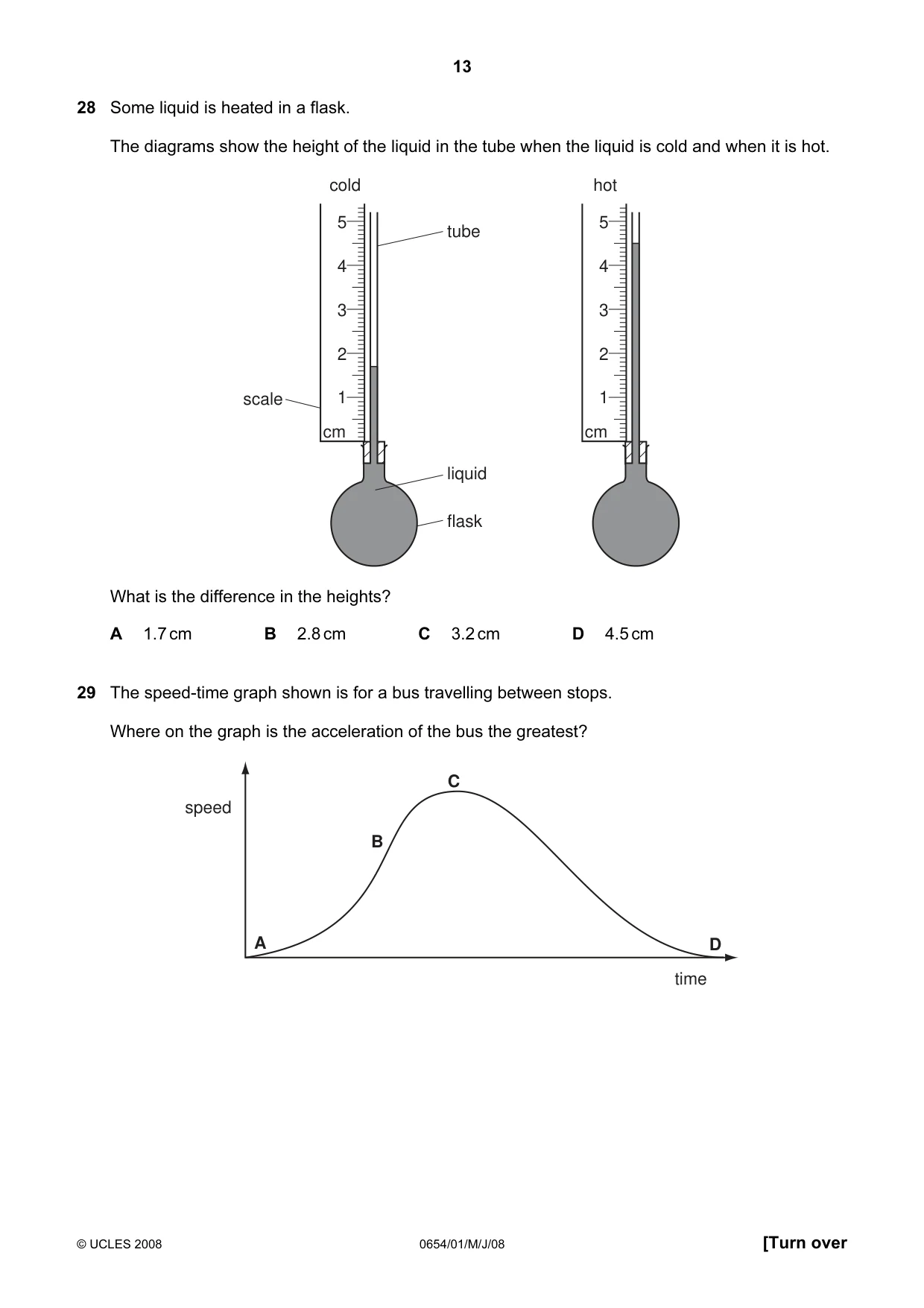
28 Some liquid is heated in a flask. The diagrams show the height of the liquid in the tube when the liquid is cold and when it is hot. cold hot 5 5 tube 4 4 3 3 2 2 scale 1 1 cm cm liquid flask What is the difference in the heights? A 1.7 cm B 2.8 cm C 3.2 cm D 4.5 cm
Mark scheme: B
More questions on Physical quantities and measurement techniques
Q29 · The speed-time graph shown is for a bus travelling between stops
29 The speed-time graph shown is for a bus travelling between stops. Where on the graph is the acceleration of the bus the greatest? C speed B A D time
Mark scheme: B
Q30 · The circuit of a motor racing track is 3 km in length
30 The circuit of a motor racing track is 3 km in length. In a race, a car goes 25 times round the circuit in 30 minutes. What is the average speed of the car? A 75 km / hour B 90 km / hour C 150 km / hour D 750 km / hour
Mark scheme: C
Q31 · The diagram shows a rectangular metal block measuring 10 cm × 5.0 cm × 2.0 cm
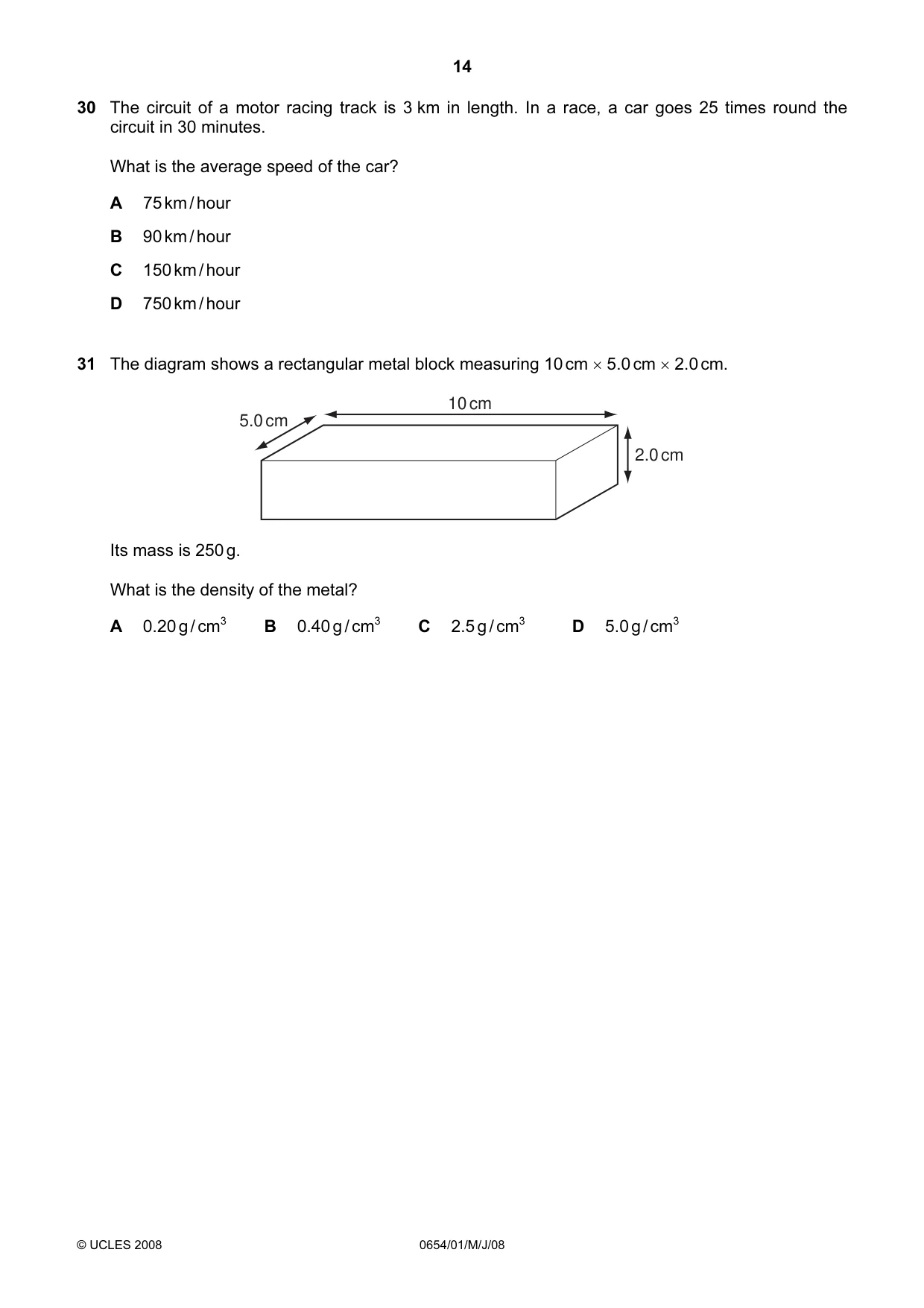
31 The diagram shows a rectangular metal block measuring 10 cm × 5.0 cm × 2.0 cm. 10 cm 5.0 cm 2.0 cm Its mass is 250 g. What is the density of the metal? A 0.20 g / cm3 B 0.40 g / cm3 C 2.5 g / cm3 D 5.0 g / cm3
Mark scheme: C
Q32 · A stone is thrown from the edge of a cliff
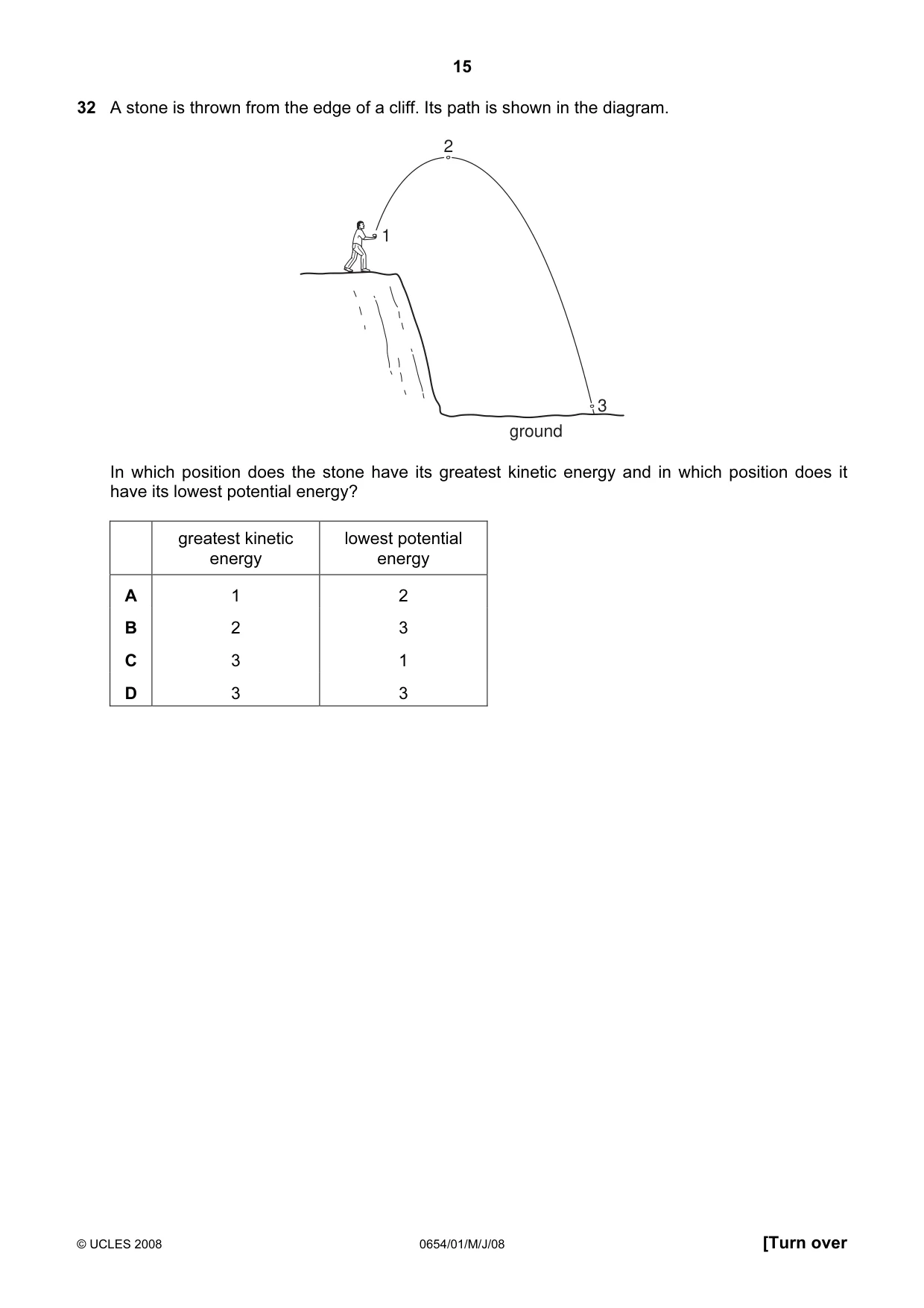
32 A stone is thrown from the edge of a cliff. Its path is shown in the diagram. 2 1 3 ground In which position does the stone have its greatest kinetic energy and in which position does it have its lowest potential energy? greatest kinetic lowest potential energy energy A 1 2 B 2 3 C 3 1 D 3 3
Mark scheme: D
Q33 · A heater is placed in a room
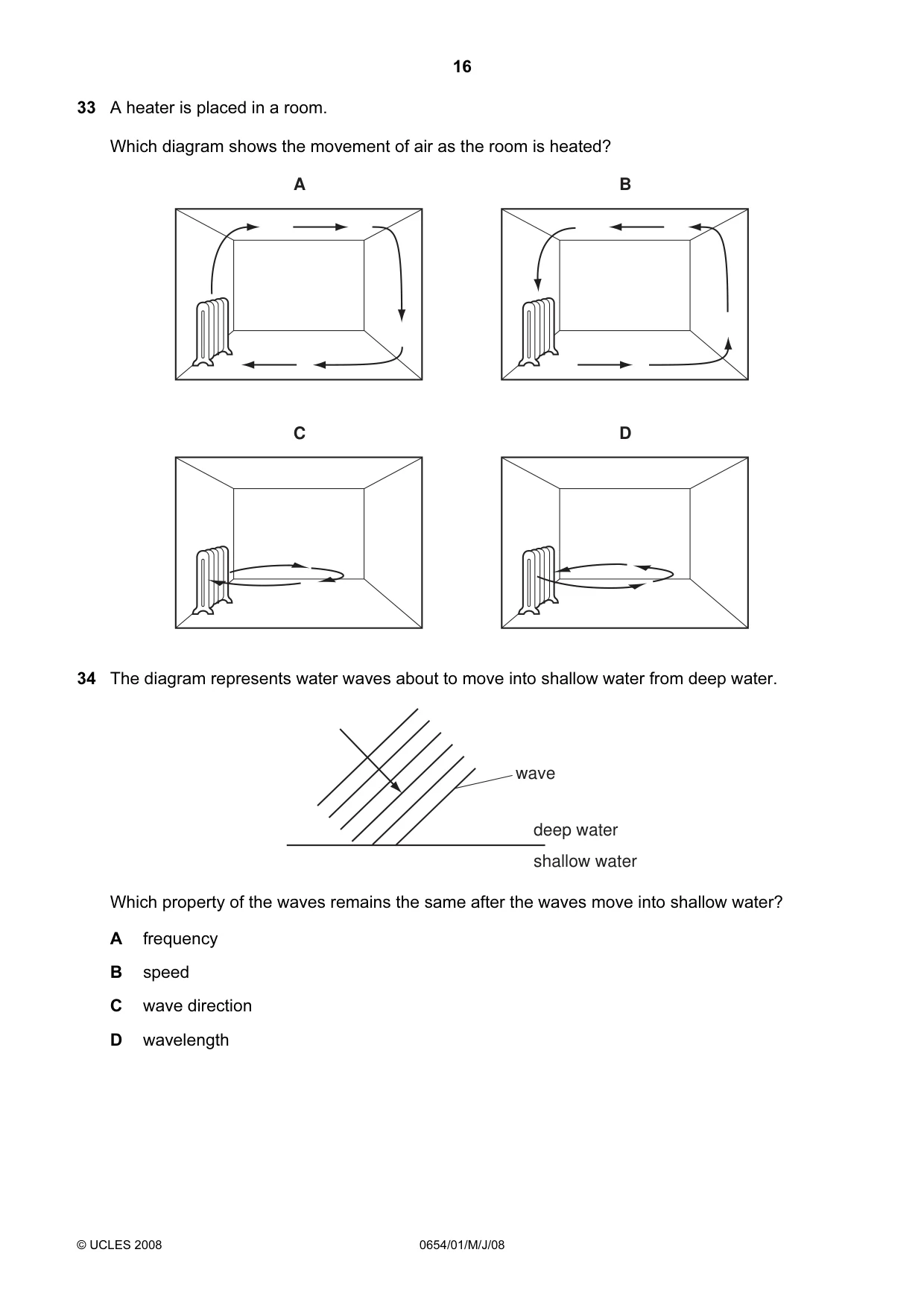
33 A heater is placed in a room. Which diagram shows the movement of air as the room is heated? A B C D
Mark scheme: A
Q34 · The diagram represents water waves about to move into shallow water from deep water
34 The diagram represents water waves about to move into shallow water from deep water. wave deep water shallow water Which property of the waves remains the same after the waves move into shallow water? A frequency B speed C wave direction D wavelength
Mark scheme: A
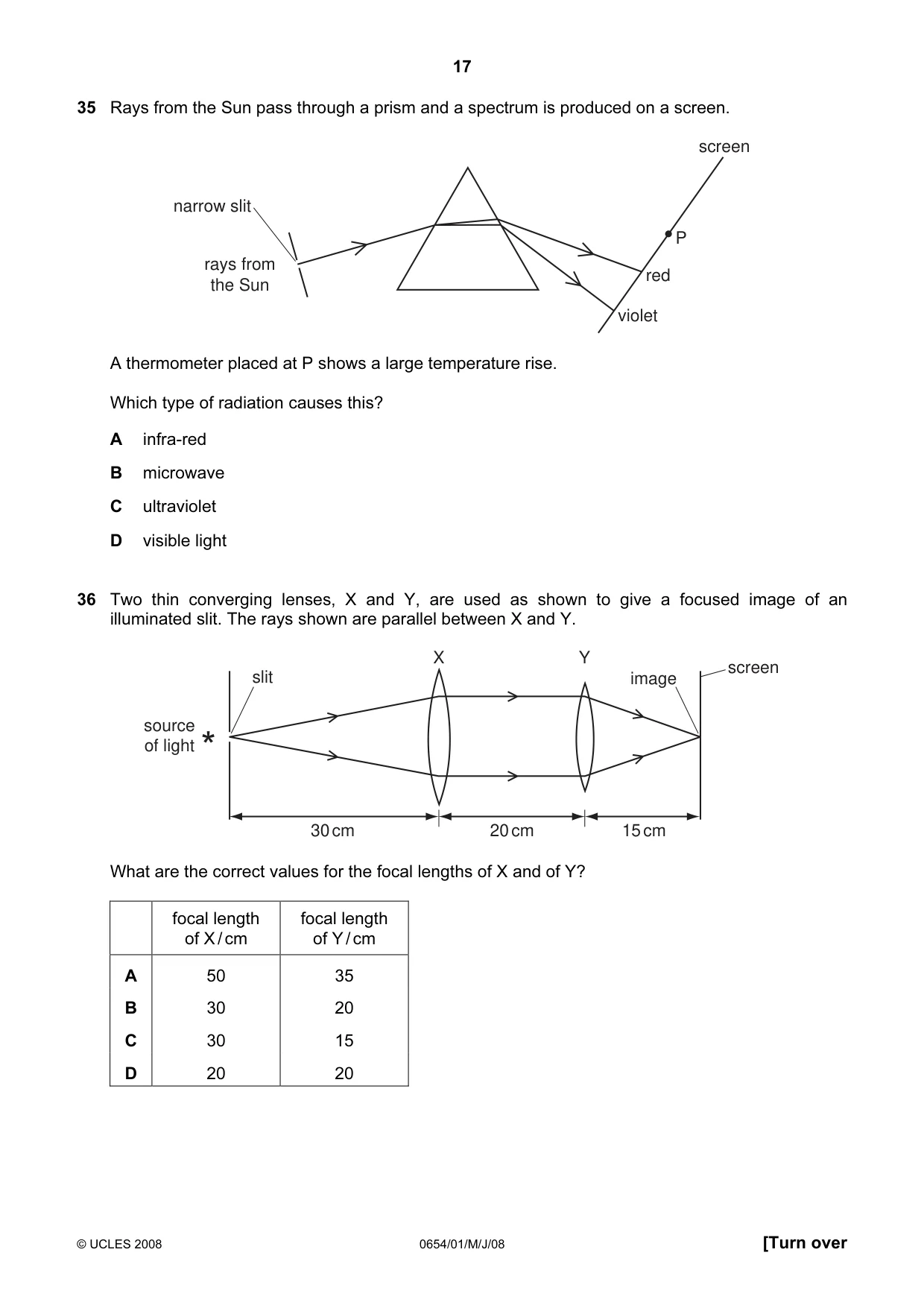
Q35 · Rays from the Sun pass through a prism and a spectrum is produced on a screen
35 Rays from the Sun pass through a prism and a spectrum is produced on a screen. screen narrow slit P rays from red the Sun violet A thermometer placed at P shows a large temperature rise. Which type of radiation causes this? A infra-red B microwave C ultraviolet D visible light
Mark scheme: A
Q36 · Two thin converging lenses, X and Y, are used as shown to give a focused image of an…
36 Two thin converging lenses, X and Y, are used as shown to give a focused image of an illuminated slit. The rays shown are parallel between X and Y. X Y screen slit image source of light 30 cm 20 cm 15 cm What are the correct values for the focal lengths of X and of Y? focal length focal length of X / cm of Y / cm A 50 35 B 30 20 C 30 15 D 20 20
Mark scheme: C
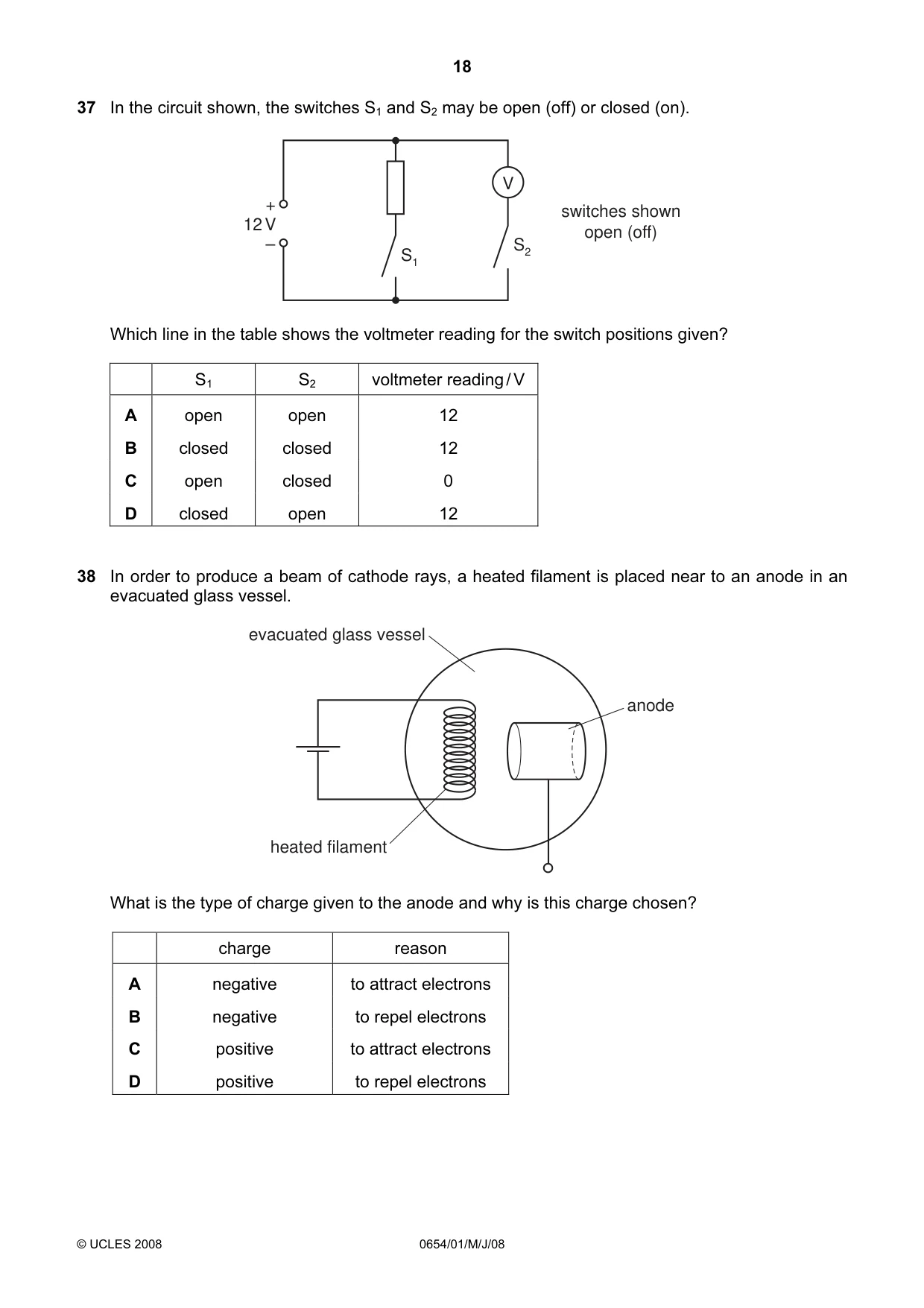
Q37 · In the circuit shown, the switches S1 and S2 may be open (off) or closed (on)
37 In the circuit shown, the switches S1 and S2 may be open (off) or closed (on). V + switches shown 12 V open (off) – S2 S1 Which line in the table shows the voltmeter reading for the switch positions given? S1 S2 voltmeter reading / V A open open 12 B closed closed 12 C open closed 0 D closed open 12
Mark scheme: B
Q38 · In order to produce a beam of cathode rays, a heated filament is placed near to an anode…
38 In order to produce a beam of cathode rays, a heated filament is placed near to an anode in an evacuated glass vessel. evacuated glass vessel anode heated filament What is the type of charge given to the anode and why is this charge chosen? charge reason A negative to attract electrons B negative to repel electrons C positive to attract electrons D positive to repel electrons
Mark scheme: C
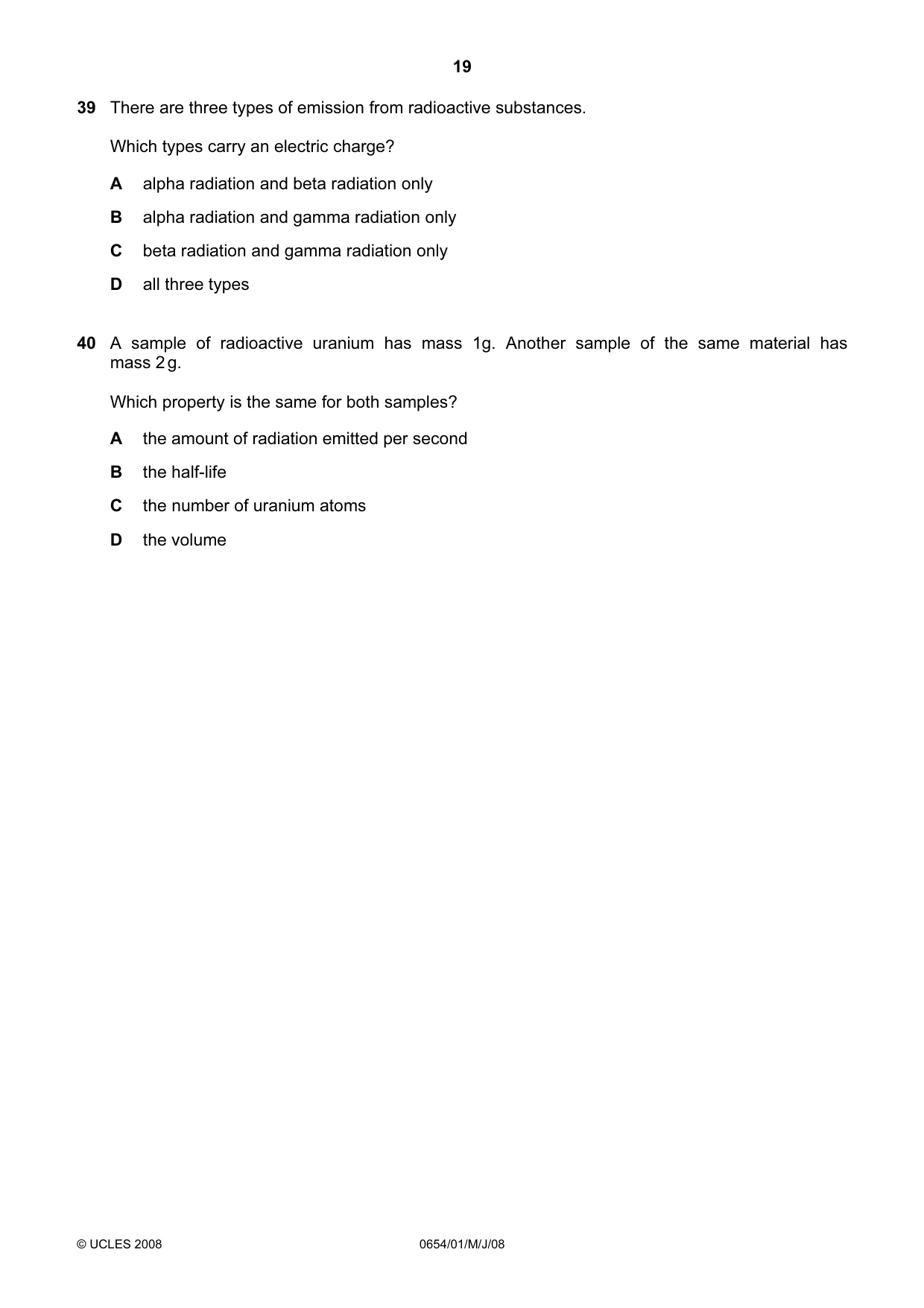
Q39 · There are three types of emission from radioactive substances
39 There are three types of emission from radioactive substances. Which types carry an electric charge? A alpha radiation and beta radiation only B alpha radiation and gamma radiation only C beta radiation and gamma radiation only D all three types
Mark scheme: A
Q40 · A sample of radioactive uranium has mass 1g
40 A sample of radioactive uranium has mass 1g. Another sample of the same material has mass 2 g. Which property is the same for both samples? A the amount of radiation emitted per second B the half-life C the number of uranium atoms D the volume
Mark scheme: B
What was in this paper
The subtopics covered by these 40 questions, and how many questions each got. Open one in a new tab to see every Cambridge question on it.
2Fuels2Motion2Radioactivity2Alloys and their properties1Asexual reproduction1Blood vessels1Cell structure1Characteristics of living organisms1Conservation1Coordination and response1Density1Diet1Drugs1Electrical circuits1Electrolysis1Electromagnetic effects1Electromagnetic spectrum1Elements, compounds and mixtures1Energy flow1Energy, work and power1Extraction of metals1Gas exchange in humans1General properties of waves1Group I properties1Hormones1Identification of ions and gases1Light1Photosynthesis1Physical quantities and measurement techniques1Polymers1Respiration1Sexual reproduction in humans1The characteristic properties of acids and bases1Transfer of thermal energy1Water1What you needed in this session
Cambridge’s own grade thresholds for 2008 May/June, Paper 1 · Variant 1. A higher threshold means an easier paper — the bar moves with how the cohort did.