Cambridge IGCSE Sciences - Co-ordinated (Double) 0654 — 2023 May/June Paper 1 · Variant 2
0654/12/M/J/23 · 40 questions · 40 marks · ≈45 min
The question paper and its mark scheme, free to read here and free to download. This is Cambridge’s own paper, exactly as it was sat.
Question paper16 pages
Mark scheme3 pages
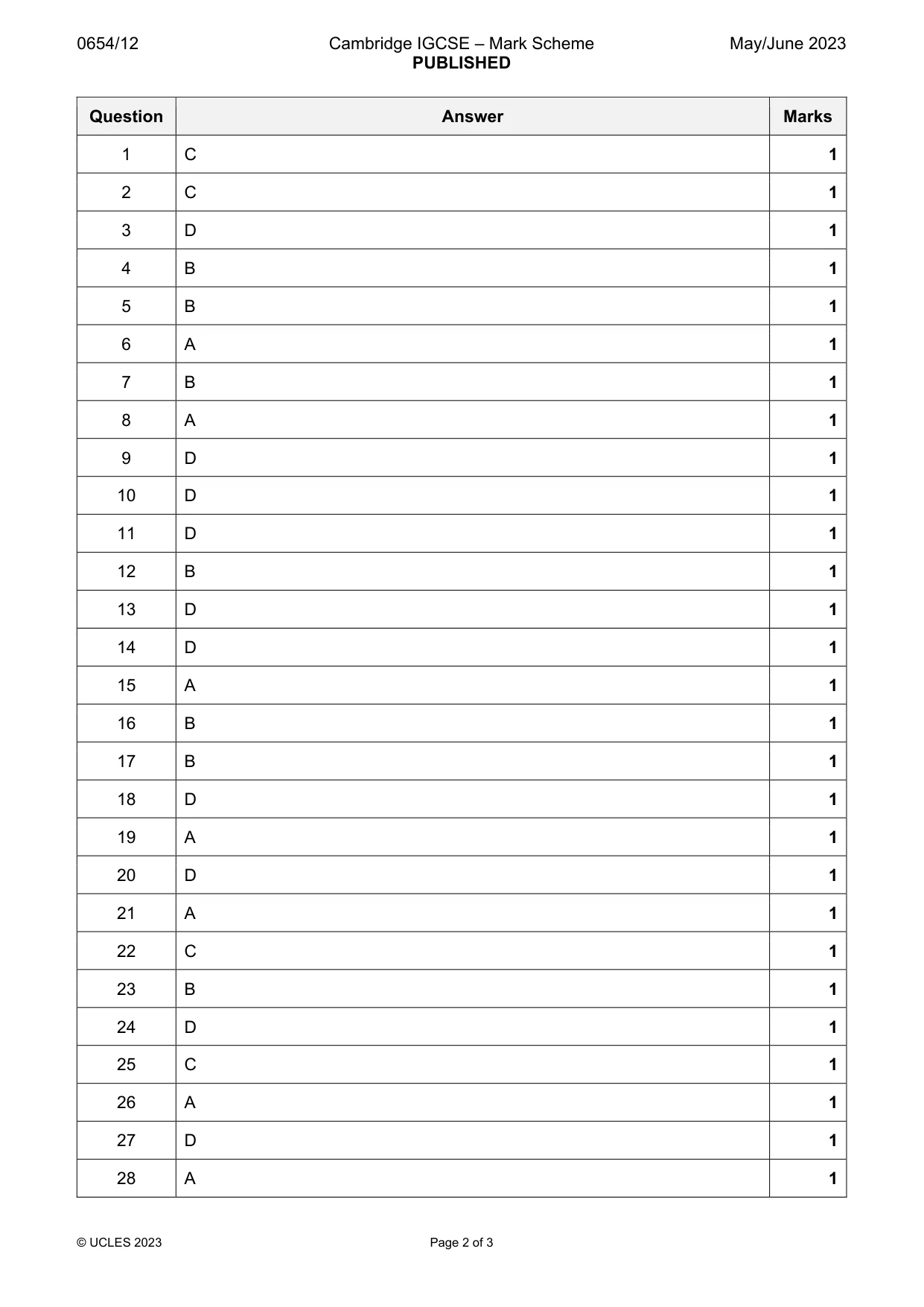
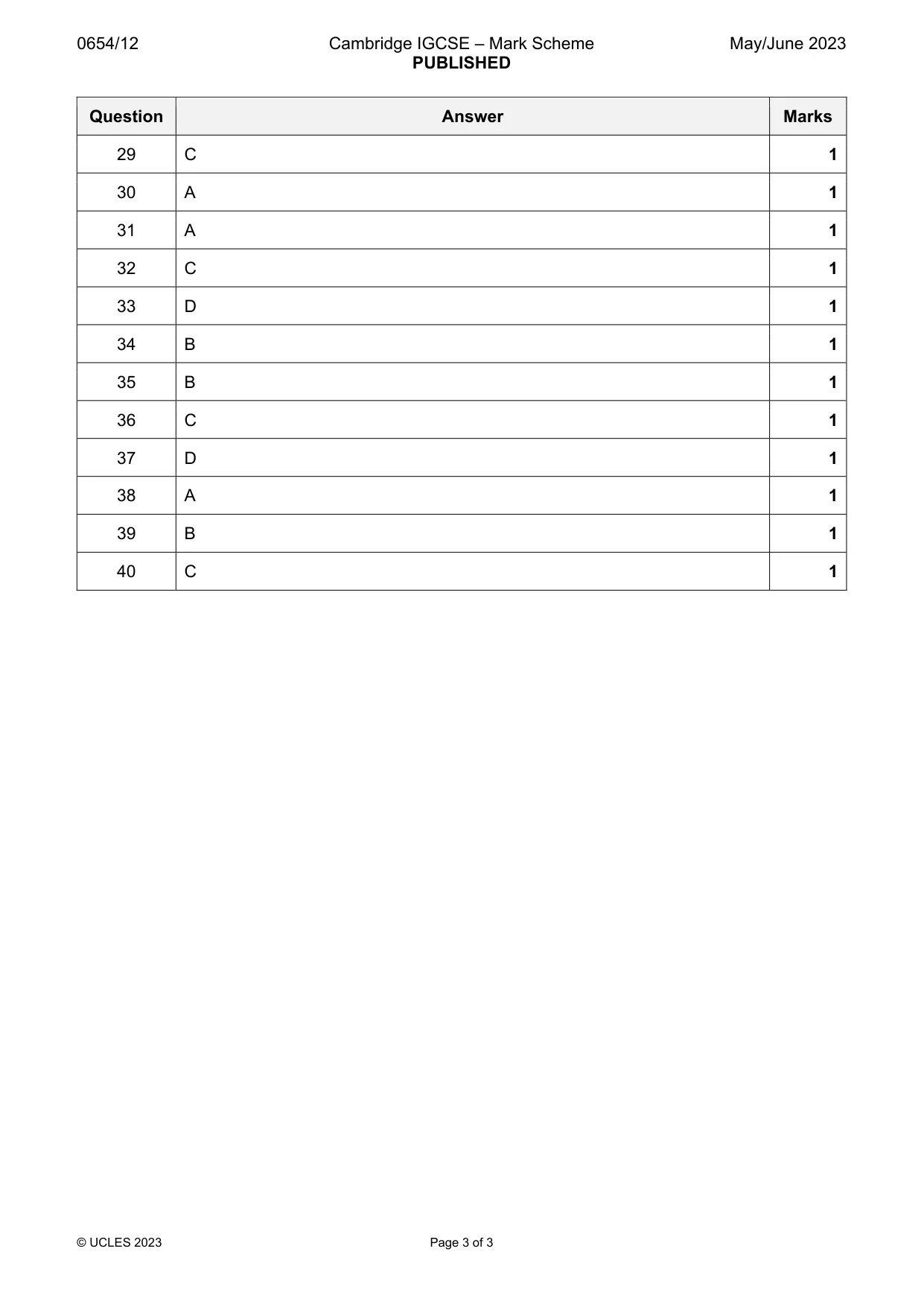
Answers below. Sit the paper first if you are practising.
Questions as text
Q1 · Which is not a characteristic of all living organisms?
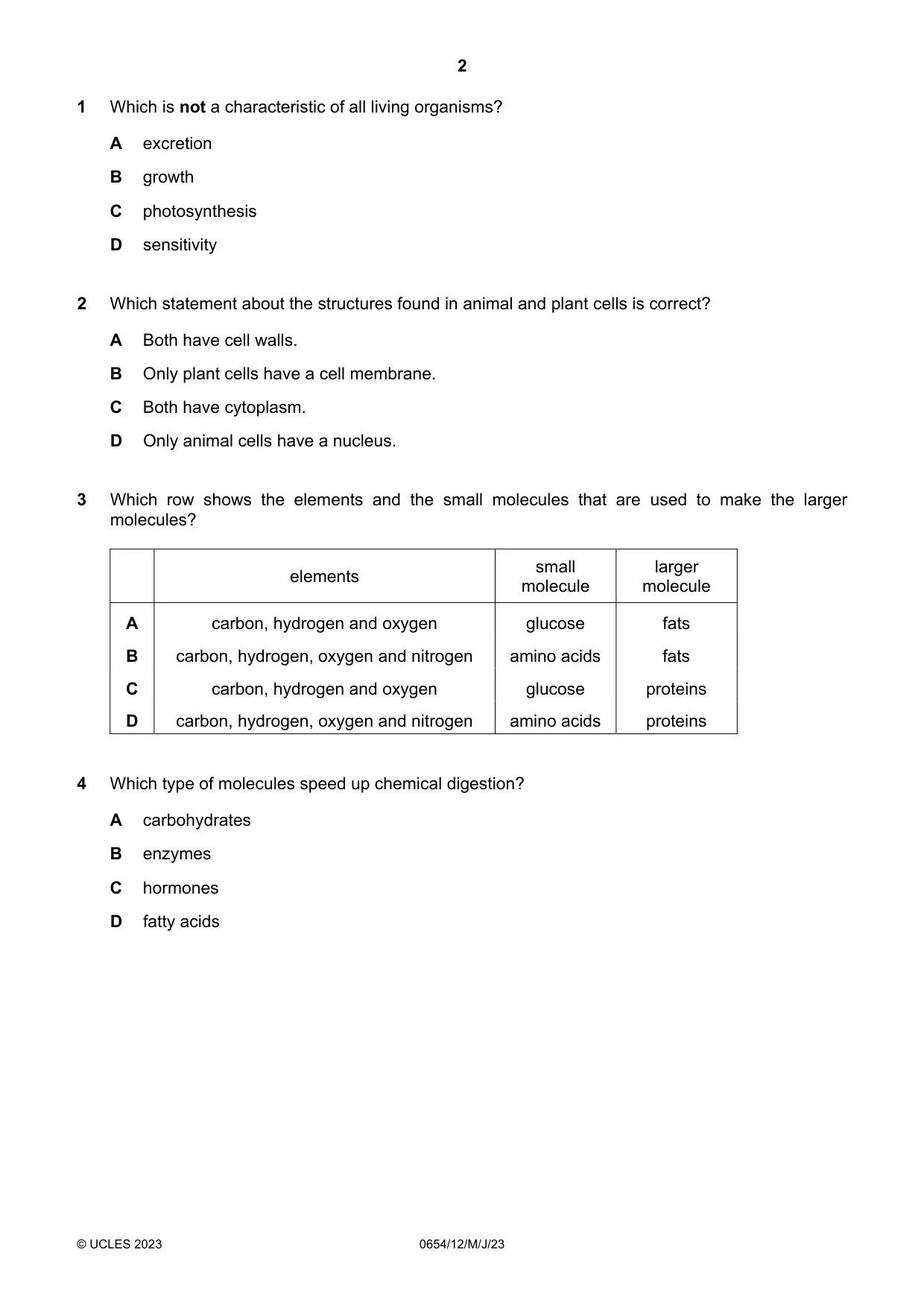
1 Which is not a characteristic of all living organisms? A excretion B growth C photosynthesis D sensitivity
Mark scheme: C
Q2 · Which statement about the structures found in animal and plant cells is correct?
2 Which statement about the structures found in animal and plant cells is correct? A Both have cell walls. B Only plant cells have a cell membrane. C Both have cytoplasm. D Only animal cells have a nucleus.
Mark scheme: C
Q3 · Which row shows the elements and the small molecules that are used to make the larger…
3 Which row shows the elements and the small molecules that are used to make the larger molecules? small larger elements molecule molecule A carbon, hydrogen and oxygen glucose fats B carbon, hydrogen, oxygen and nitrogen amino acids fats C carbon, hydrogen and oxygen glucose proteins D carbon, hydrogen, oxygen and nitrogen amino acids proteins
Mark scheme: D
Q4 · Which type of molecules speed up chemical digestion?
4 Which type of molecules speed up chemical digestion? A carbohydrates B enzymes C hormones D fatty acids
Mark scheme: B
Q5 · The diagram shows a leaf, still attached to a plant, with both green and white areas that…
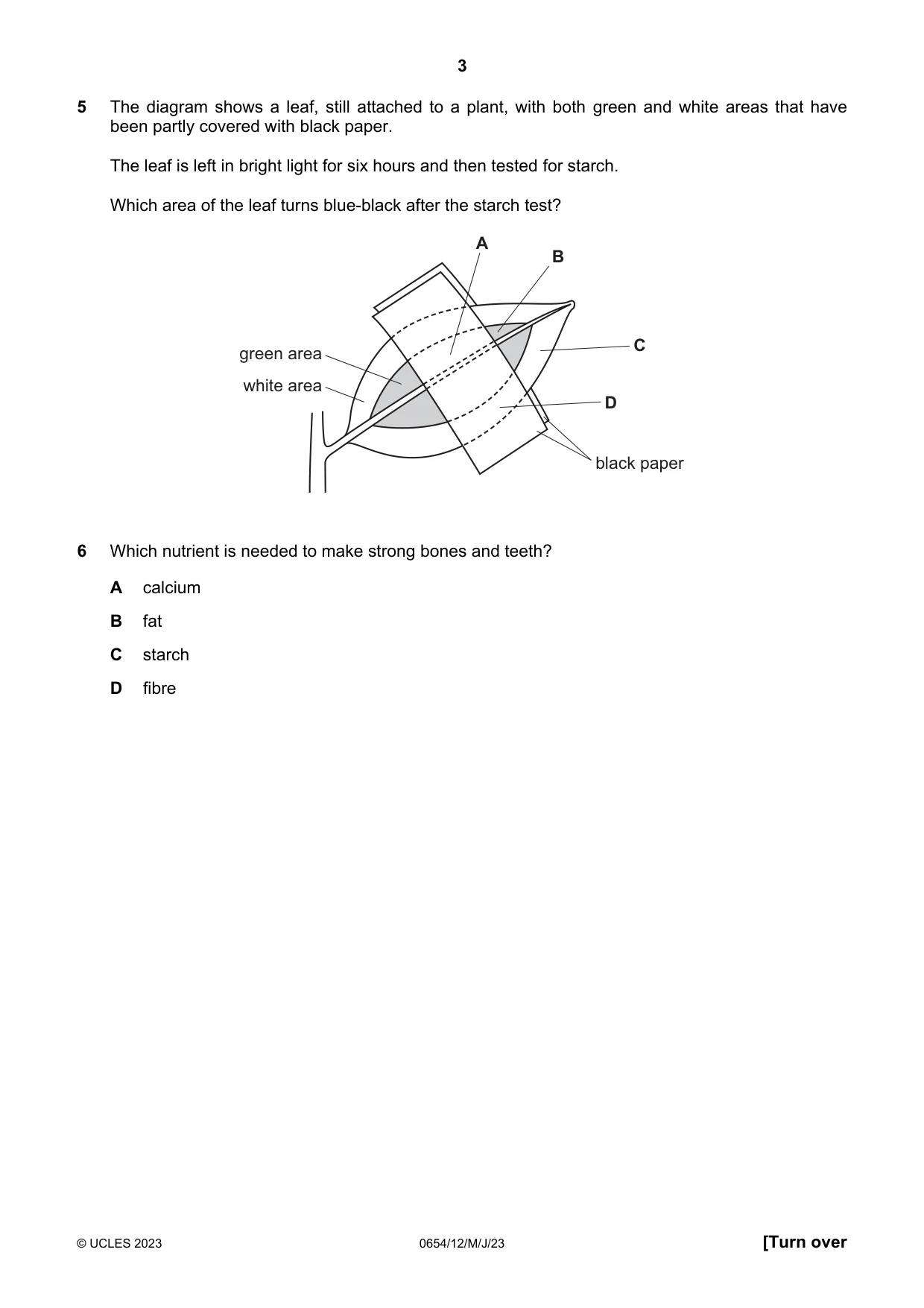
5 The diagram shows a leaf, still attached to a plant, with both green and white areas that have been partly covered with black paper. The leaf is left in bright light for six hours and then tested for starch. Which area of the leaf turns blue-black after the starch test? A B C green area white area D black paper
Mark scheme: B
Q6 · Which nutrient is needed to make strong bones and teeth?
6 Which nutrient is needed to make strong bones and teeth? A calcium B fat C starch D fibre
Mark scheme: A
Q7 · The diagram shows a shoot at the start of an experiment investigating transpiration
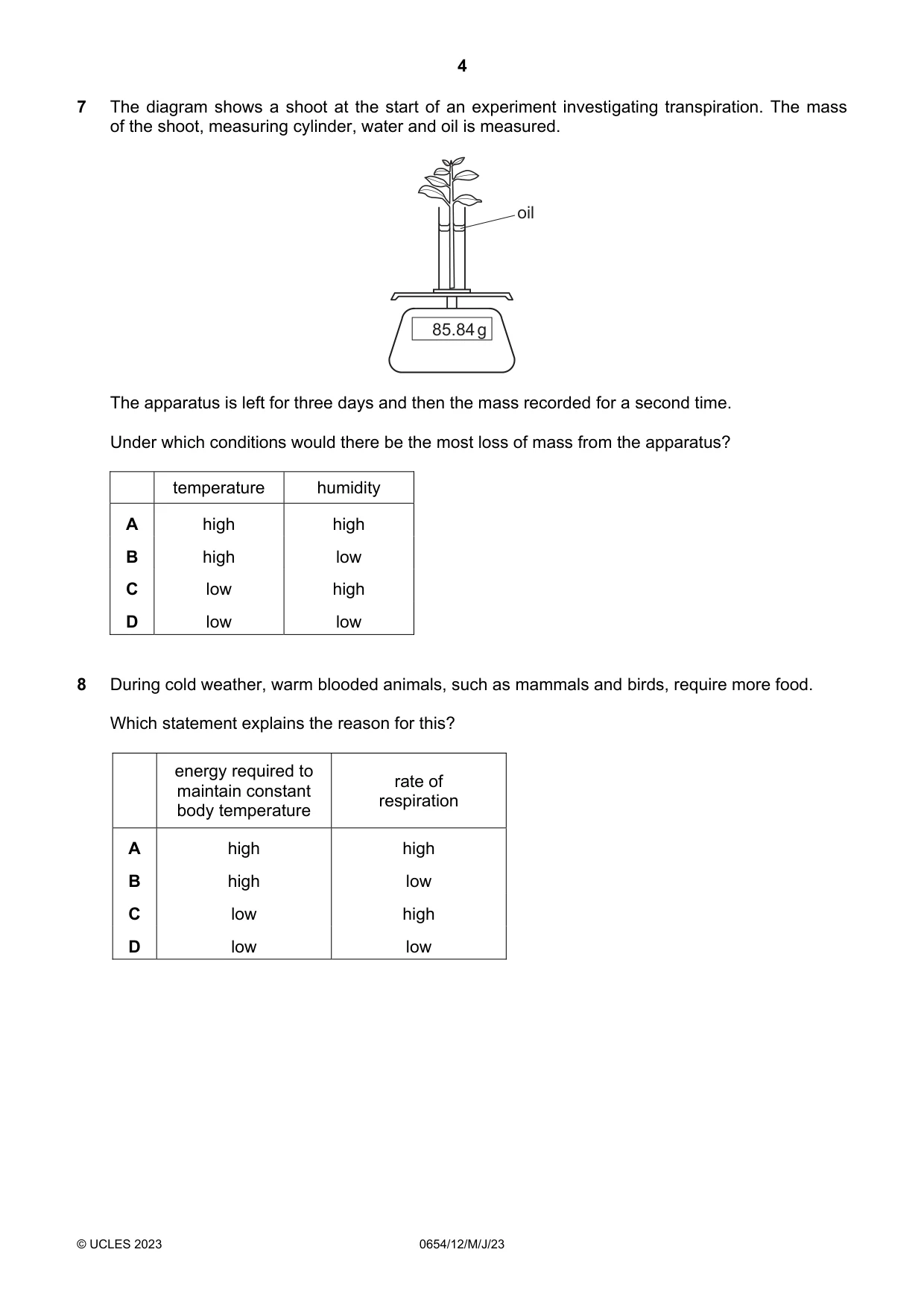
7 The diagram shows a shoot at the start of an experiment investigating transpiration. The mass of the shoot, measuring cylinder, water and oil is measured. oil 85.84 g The apparatus is left for three days and then the mass recorded for a second time. Under which conditions would there be the most loss of mass from the apparatus? temperature humidity A high high B high low C low high D low low
Mark scheme: B
Q8 · During cold weather, warm blooded animals, such as mammals and birds, require more food
8 During cold weather, warm blooded animals, such as mammals and birds, require more food. Which statement explains the reason for this? energy required to rate of maintain constant respiration body temperature A high high B high low C low high D low low
Mark scheme: A
Q9 · A person leaves an air conditioned building
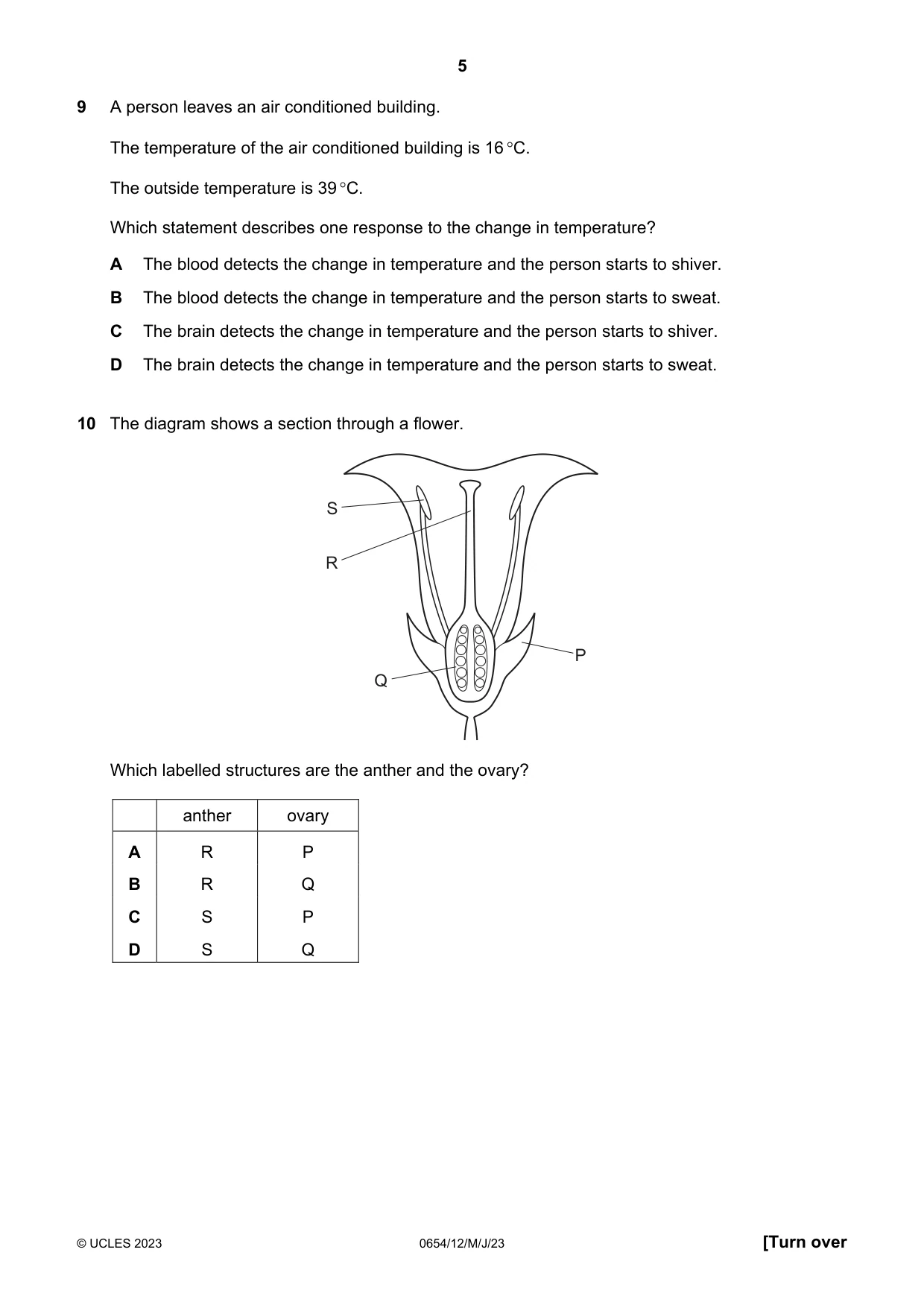
9 A person leaves an air conditioned building. The temperature of the air conditioned building is 16 C. The outside temperature is 39 C. Which statement describes one response to the change in temperature? A The blood detects the change in temperature and the person starts to shiver. B The blood detects the change in temperature and the person starts to sweat. C The brain detects the change in temperature and the person starts to shiver. D The brain detects the change in temperature and the person starts to sweat.
Mark scheme: D
Q10 · The diagram shows a section through a flower
10 The diagram shows a section through a flower. S R P Q Which labelled structures are the anther and the ovary? anther ovary A R P B R Q C S P D S Q
Mark scheme: D
Q11 · Fingerprints are classified by their shape
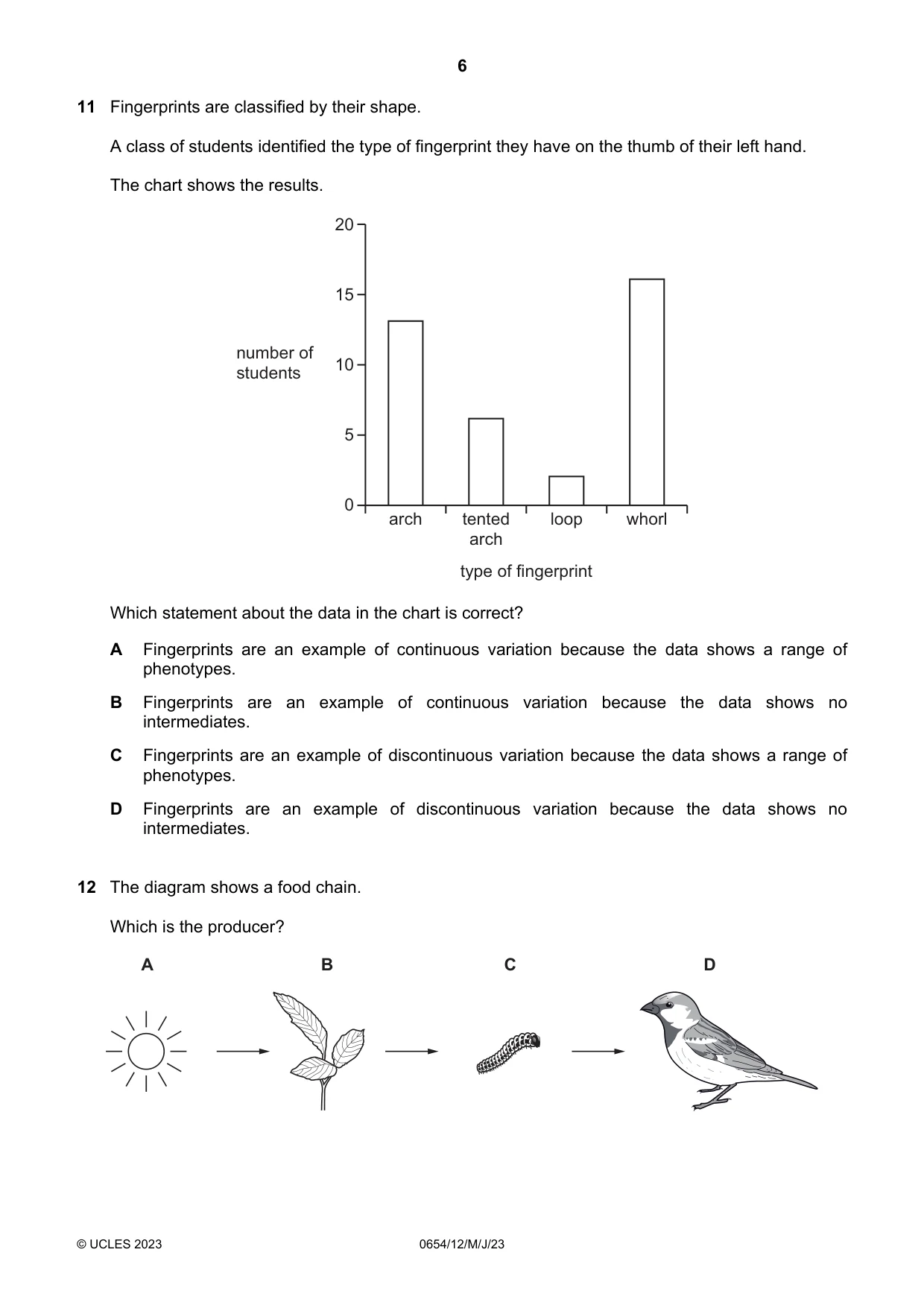
11 Fingerprints are classified by their shape. A class of students identified the type of fingerprint they have on the thumb of their left hand. The chart shows the results. 20 15 number of 10 students 5 0 arch tented loop whorl arch type of fingerprint Which statement about the data in the chart is correct? A Fingerprints are an example of continuous variation because the data shows a range of phenotypes. B Fingerprints are an example of continuous variation because the data shows no intermediates. C Fingerprints are an example of discontinuous variation because the data shows a range of phenotypes. D Fingerprints are an example of discontinuous variation because the data shows no intermediates.
Mark scheme: D
Q12 · The diagram shows a food chain
12 The diagram shows a food chain. Which is the producer? A B C D
Mark scheme: B
Q13 · Which row about the effects of deforestation is correct?
13 Which row about the effects of deforestation is correct? amount of risk of flooding carbon dioxide in atmosphere A decreased decreased B decreased increased C increased decreased D increased increased
Mark scheme: D
Q14 · Hexane and octane are liquid hydrocarbons that mix together
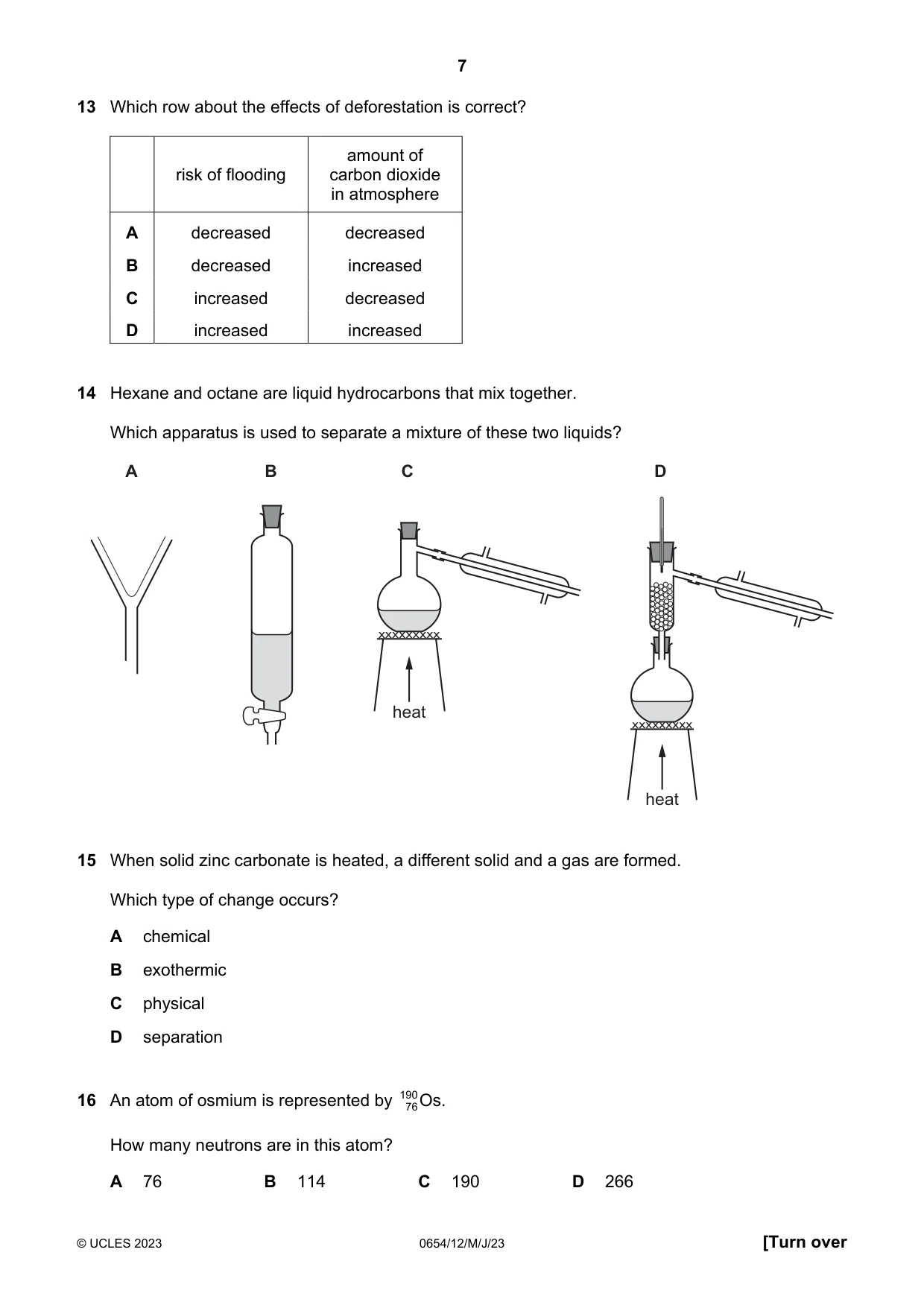
14 Hexane and octane are liquid hydrocarbons that mix together. Which apparatus is used to separate a mixture of these two liquids? A B C D xxxxxxxxx heat xxxxxxxxx heat
Mark scheme: D
Q15 · When solid zinc carbonate is heated, a different solid and a gas are formed
15 When solid zinc carbonate is heated, a different solid and a gas are formed. Which type of change occurs? A chemical B exothermic C physical D separation
Mark scheme: A
Q16 · An atom of osmium is represented by 190 76Os
16 An atom of osmium is represented by 190 76Os. How many neutrons are in this atom? A 76 B 114 C 190 D 266
Mark scheme: B
Q17 · The structures of some compounds are shown
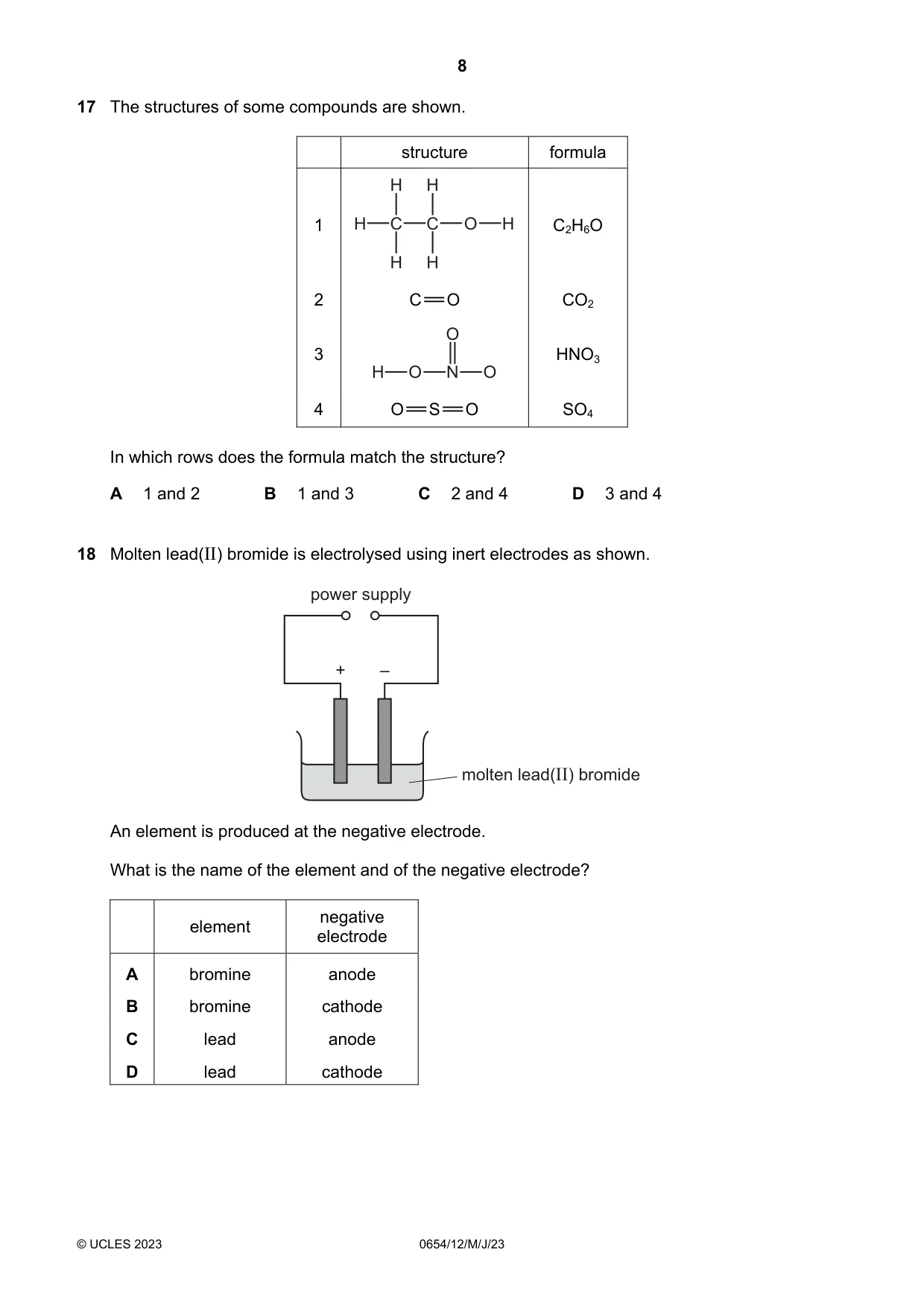
17 The structures of some compounds are shown. structure formula H H 1 H C C O H C2H6O H H 2 C=O CO2 O 3 HNO3 H O N O 4 O=S=O SO4 In which rows does the formula match the structure? A 1 and 2 B 1 and 3 C 2 and 4 D 3 and 4
Mark scheme: B
Q18 · Molten lead(II) bromide is electrolysed using inert electrodes as shown
18 Molten lead(II) bromide is electrolysed using inert electrodes as shown. power supply + – molten lead(II) bromide An element is produced at the negative electrode. What is the name of the element and of the negative electrode? negative element electrode A bromine anode B bromine cathode C lead anode D lead cathode
Mark scheme: D
Q19 · Potassium chloride is added to water
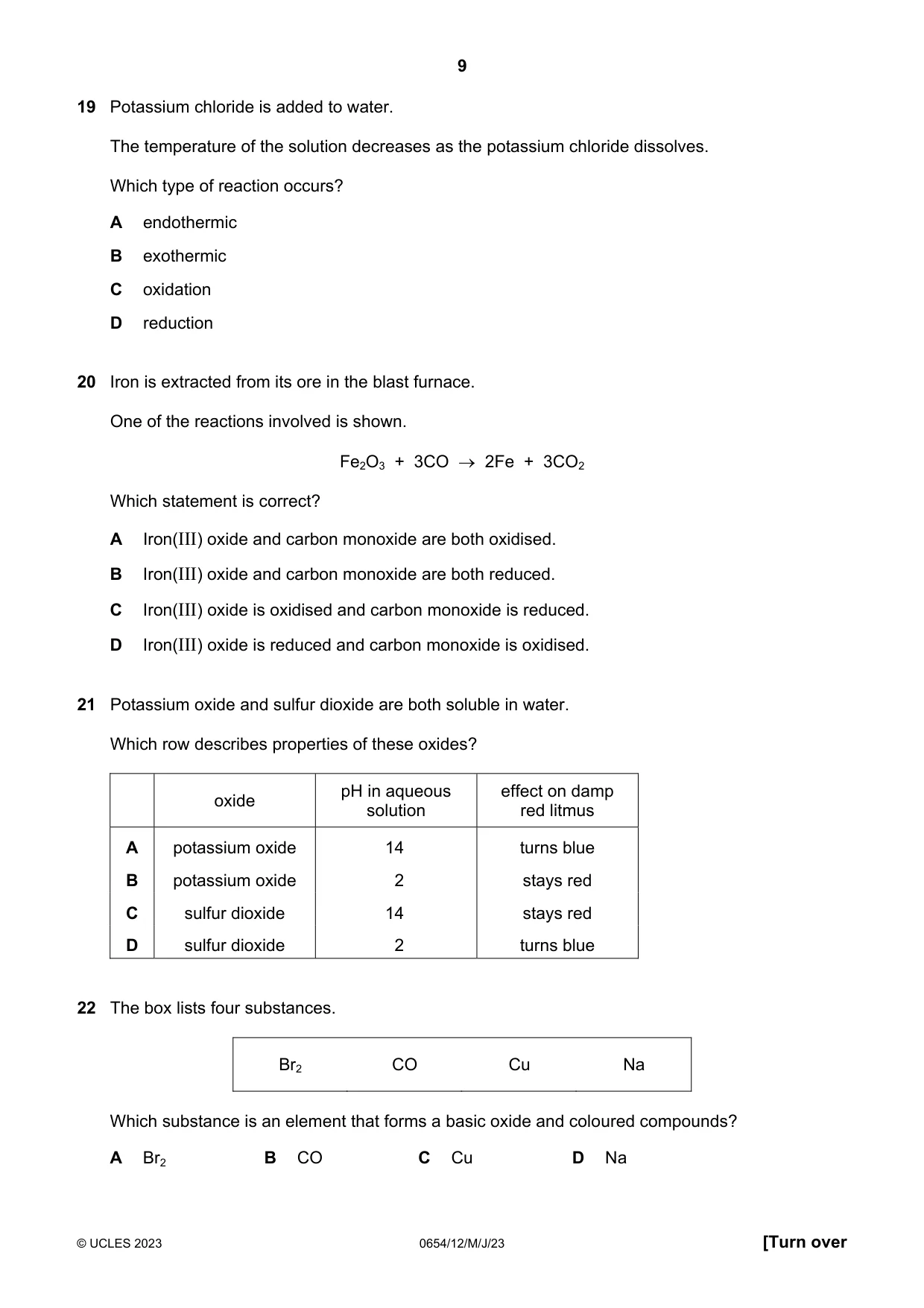
19 Potassium chloride is added to water. The temperature of the solution decreases as the potassium chloride dissolves. Which type of reaction occurs? A endothermic B exothermic C oxidation D reduction
Mark scheme: A
Q20 · Iron is extracted from its ore in the blast furnace
20 Iron is extracted from its ore in the blast furnace. One of the reactions involved is shown. Fe2O3 + 3CO 2Fe + 3CO2 Which statement is correct? A Iron(III) oxide and carbon monoxide are both oxidised. B Iron(III) oxide and carbon monoxide are both reduced. C Iron(III) oxide is oxidised and carbon monoxide is reduced. D Iron(III) oxide is reduced and carbon monoxide is oxidised.
Mark scheme: D
Q21 · Potassium oxide and sulfur dioxide are both soluble in water
21 Potassium oxide and sulfur dioxide are both soluble in water. Which row describes properties of these oxides? pH in aqueous effect on damp oxide solution red litmus A potassium oxide 14 turns blue B potassium oxide 2 stays red C sulfur dioxide 14 stays red D sulfur dioxide 2 turns blue
Mark scheme: A
Q22 · The box lists four substances
22 The box lists four substances. Br2 CO Cu Na Which substance is an element that forms a basic oxide and coloured compounds? A Br2 B CO C Cu D Na
Mark scheme: C
Q23 · Which statement about the treatment of the water supply is correct?
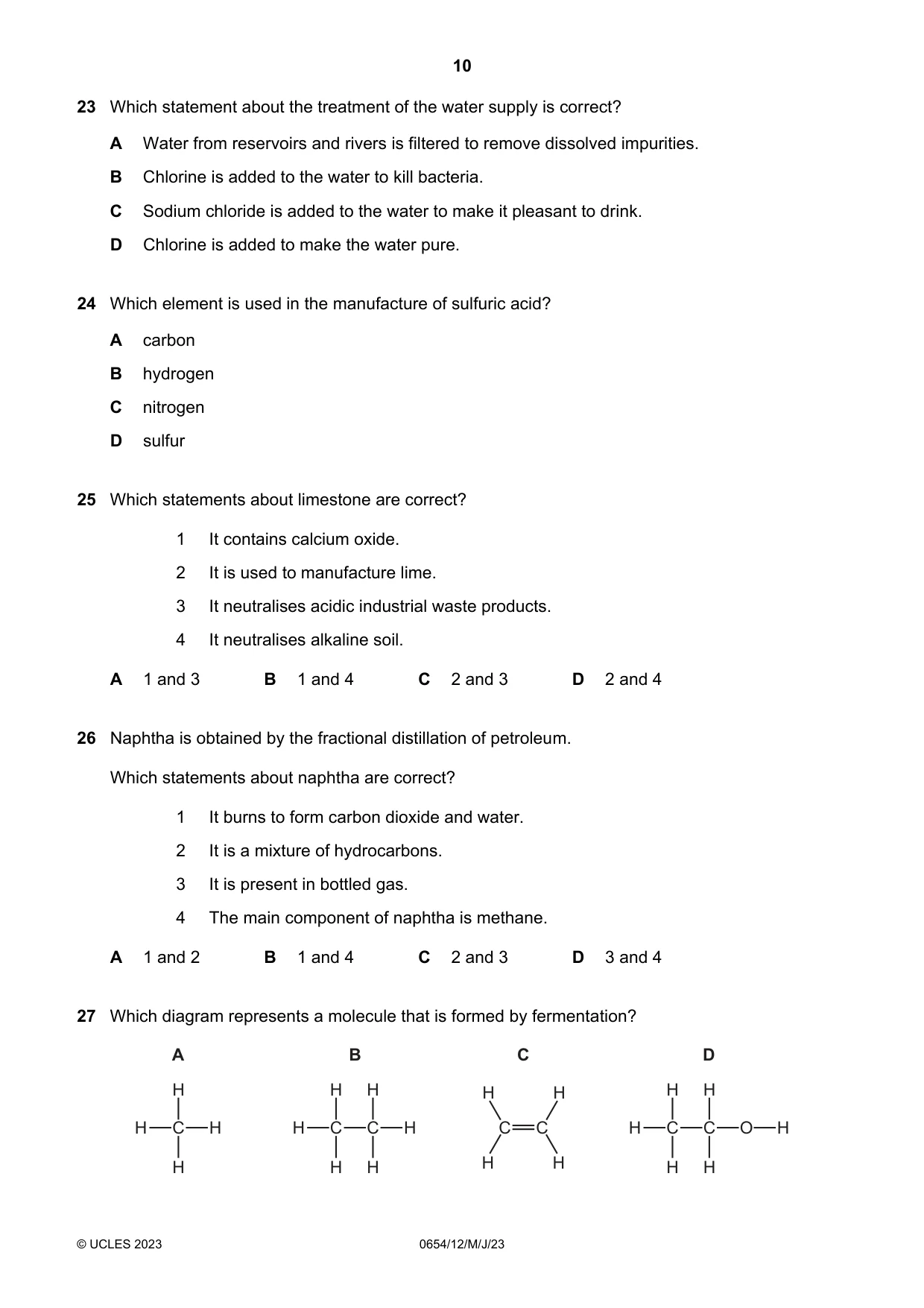
23 Which statement about the treatment of the water supply is correct? A Water from reservoirs and rivers is filtered to remove dissolved impurities. B Chlorine is added to the water to kill bacteria. C Sodium chloride is added to the water to make it pleasant to drink. D Chlorine is added to make the water pure.
Mark scheme: B
Q24 · Which element is used in the manufacture of sulfuric acid?
24 Which element is used in the manufacture of sulfuric acid? A carbon B hydrogen C nitrogen D sulfur
Mark scheme: D
Q25 · Which statements about limestone are correct?
25 Which statements about limestone are correct? 1 It contains calcium oxide. 2 It is used to manufacture lime. 3 It neutralises acidic industrial waste products. 4 It neutralises alkaline soil. A 1 and 3 B 1 and 4 C 2 and 3 D 2 and 4
Mark scheme: C
Q26 · Naphtha is obtained by the fractional distillation of petroleum
26 Naphtha is obtained by the fractional distillation of petroleum. Which statements about naphtha are correct? 1 It burns to form carbon dioxide and water. 2 It is a mixture of hydrocarbons. 3 It is present in bottled gas. 4 The main component of naphtha is methane. A 1 and 2 B 1 and 4 C 2 and 3 D 3 and 4
Mark scheme: A
Q27 · Which diagram represents a molecule that is formed by fermentation?
27 Which diagram represents a molecule that is formed by fermentation? A B C D H H H H H H H H C H H C C H C C H C C O H H H H H H H H
Mark scheme: D
Q28 · Two children X and Y pull on a rope in opposite directions
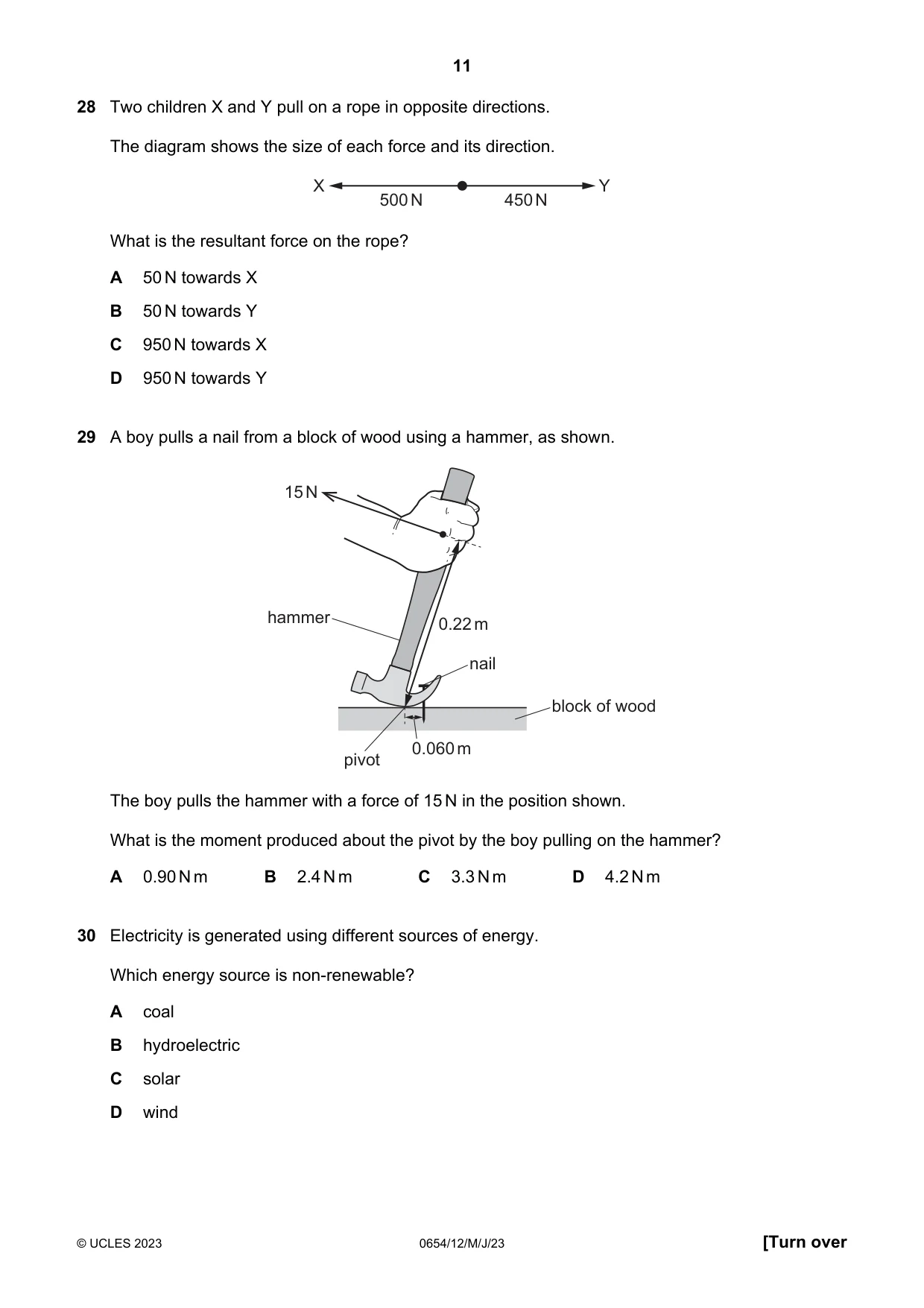
28 Two children X and Y pull on a rope in opposite directions. The diagram shows the size of each force and its direction. X Y 500 N 450 N What is the resultant force on the rope? A 50 N towards X B 50 N towards Y C 950 N towards X D 950 N towards Y
Mark scheme: A
Q29 · A boy pulls a nail from a block of wood using a hammer, as shown
29 A boy pulls a nail from a block of wood using a hammer, as shown. 15 N hammer 0.22 m nail block of wood 0.060 m pivot The boy pulls the hammer with a force of 15 N in the position shown. What is the moment produced about the pivot by the boy pulling on the hammer? A 0.90 N m B 2.4 N m C 3.3 N m D 4.2 N m
Mark scheme: C
Q30 · Electricity is generated using different sources of energy
30 Electricity is generated using different sources of energy. Which energy source is non-renewable? A coal B hydroelectric C solar D wind
Mark scheme: A
Q31 · Which statement about gas particles is not correct?
31 Which statement about gas particles is not correct? A Increasing the temperature of a gas makes the gas particles move more slowly. B The gas particles are in constant random motion. C The pressure of a gas is caused by the collision of gas particles with the container. D Very small particles suspended in a gas are in constant random motion.
Mark scheme: A
Q32 · Two methods of cooking are grilling under a red-hot heater and frying in a shallow metal…
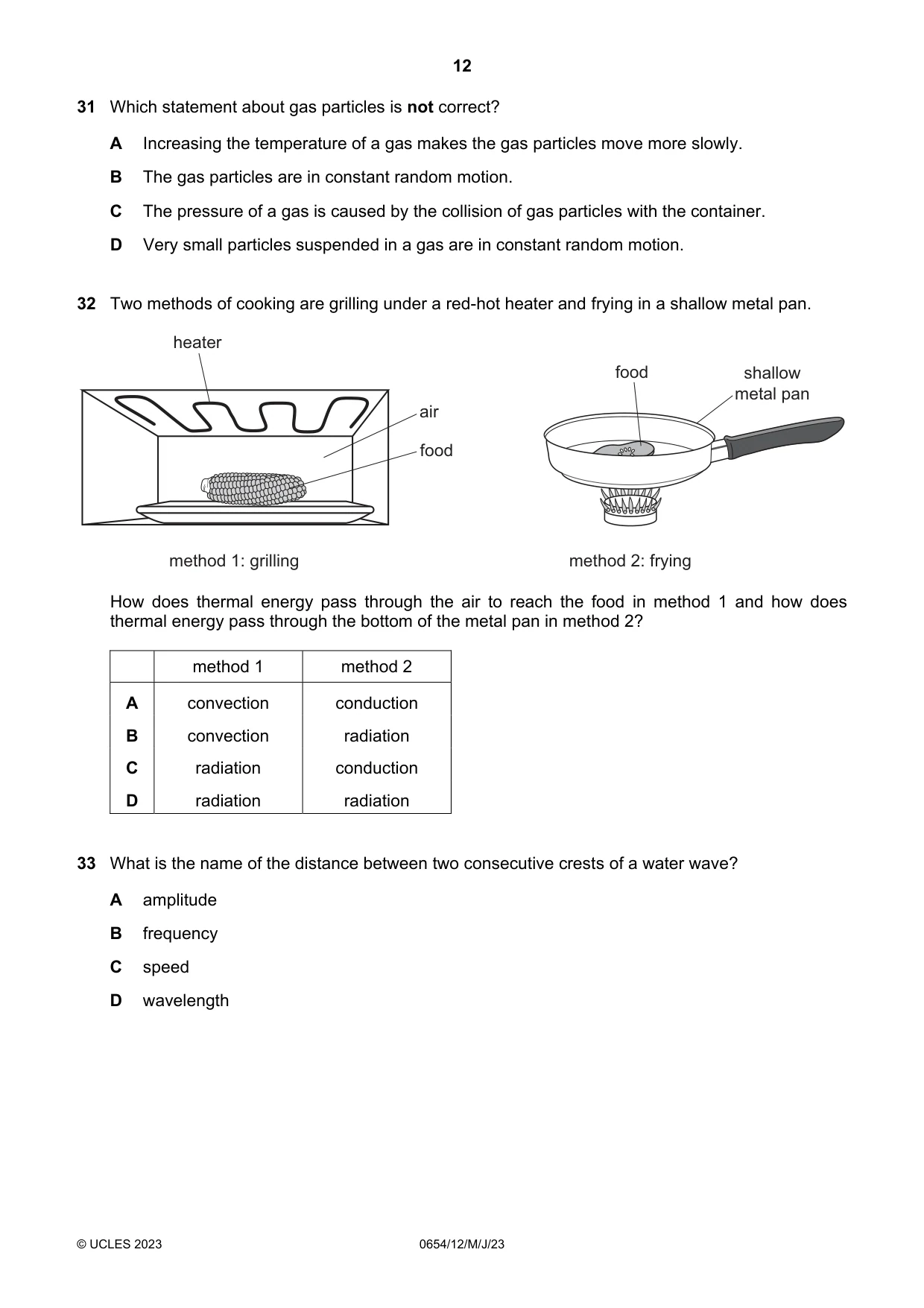
32 Two methods of cooking are grilling under a red-hot heater and frying in a shallow metal pan. heater food shallow metal pan air food method 1: grilling method 2: frying How does thermal energy pass through the air to reach the food in method 1 and how does thermal energy pass through the bottom of the metal pan in method 2? method 1 method 2 A convection conduction B convection radiation C radiation conduction D radiation radiation
Mark scheme: C
Q33 · What is the name of the distance between two consecutive crests of a water wave?
33 What is the name of the distance between two consecutive crests of a water wave? A amplitude B frequency C speed D wavelength
Mark scheme: D
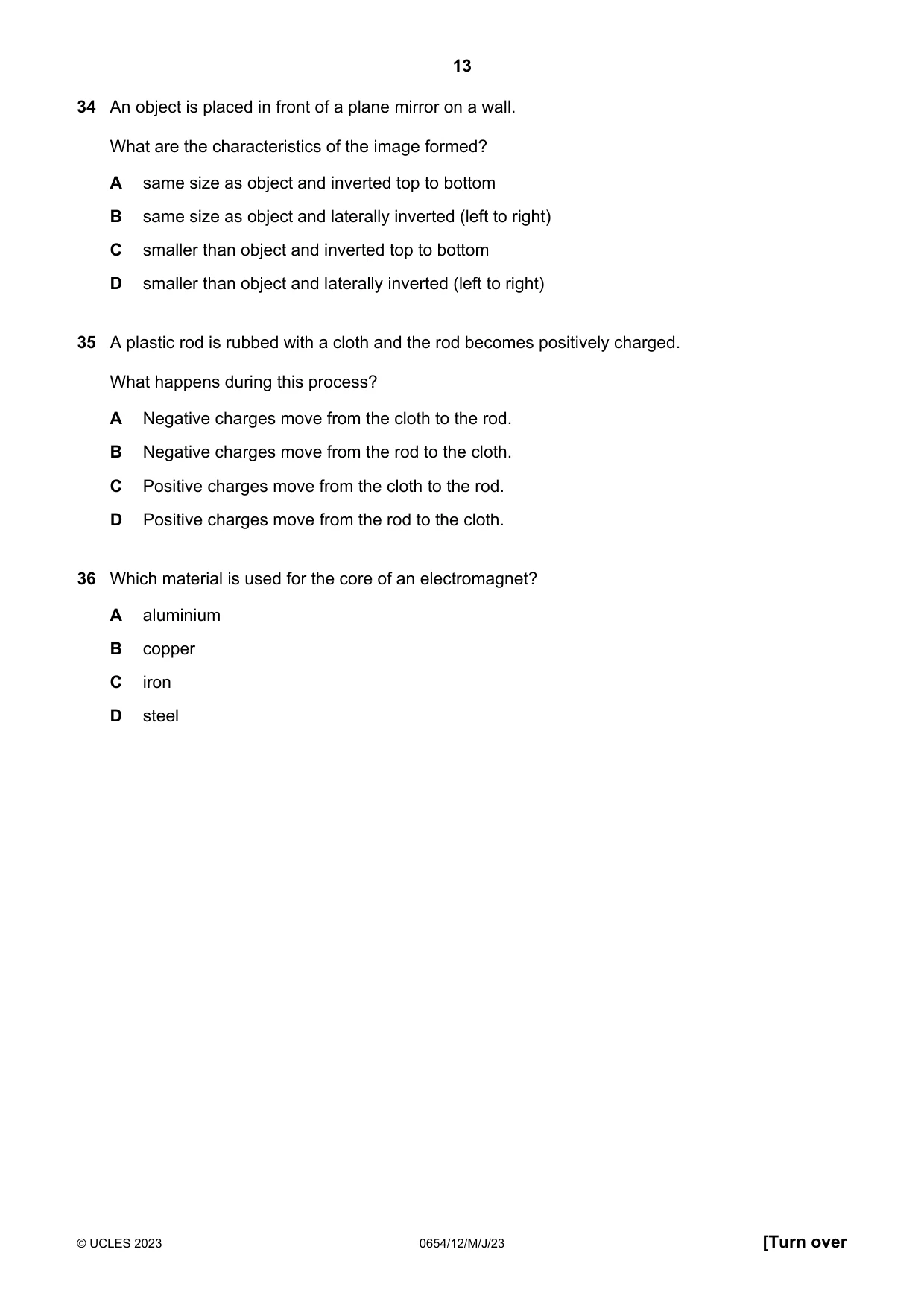
Q34 · An object is placed in front of a plane mirror on a wall
34 An object is placed in front of a plane mirror on a wall. What are the characteristics of the image formed? A same size as object and inverted top to bottom B same size as object and laterally inverted (left to right) C smaller than object and inverted top to bottom D smaller than object and laterally inverted (left to right)
Mark scheme: B
Q35 · A plastic rod is rubbed with a cloth and the rod becomes positively charged
35 A plastic rod is rubbed with a cloth and the rod becomes positively charged. What happens during this process? A Negative charges move from the cloth to the rod. B Negative charges move from the rod to the cloth. C Positive charges move from the cloth to the rod. D Positive charges move from the rod to the cloth.
Mark scheme: B
Q36 · Which material is used for the core of an electromagnet?
36 Which material is used for the core of an electromagnet? A aluminium B copper C iron D steel
Mark scheme: C
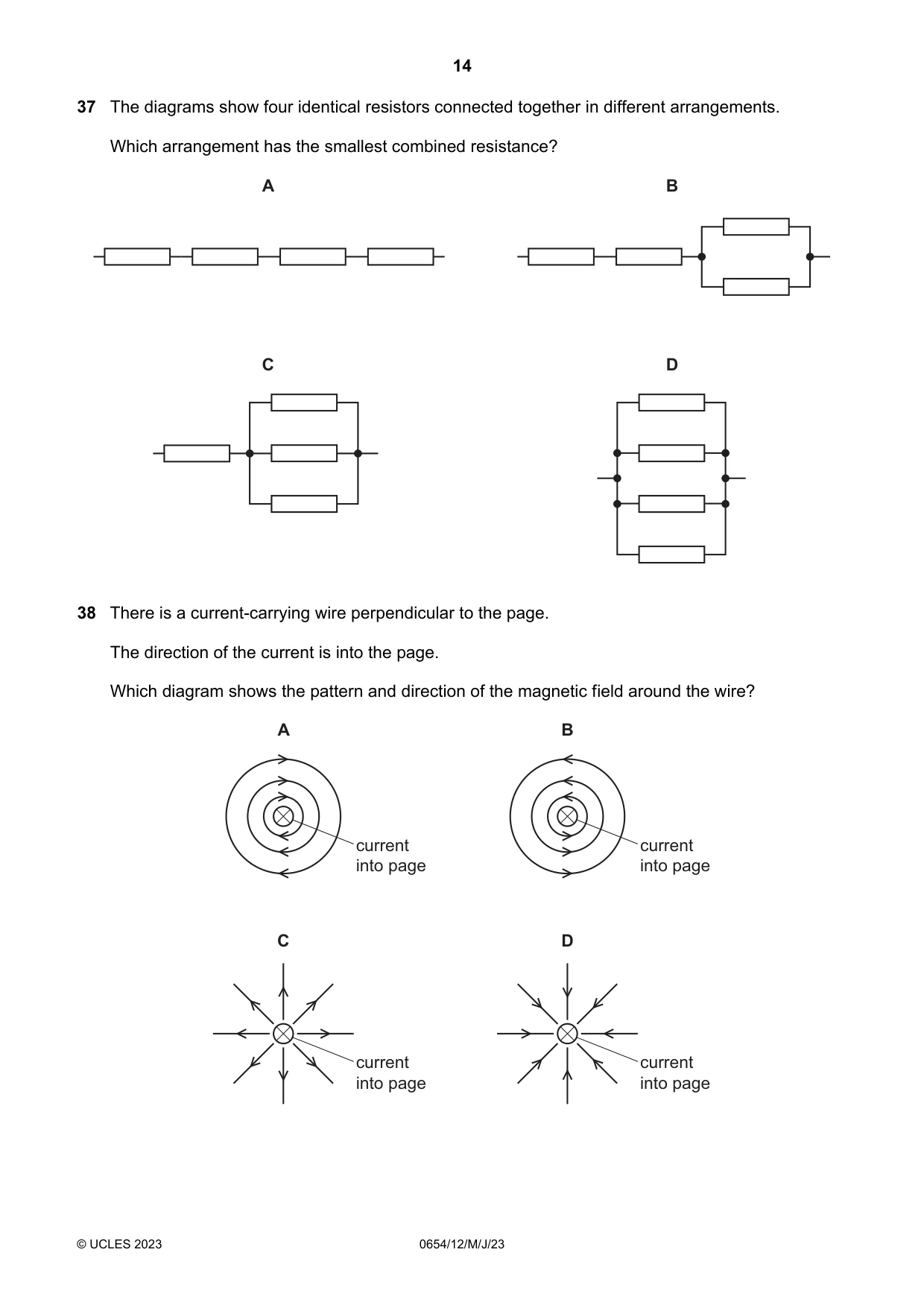
Q37 · The diagrams show four identical resistors connected together in different arrangements
37 The diagrams show four identical resistors connected together in different arrangements. Which arrangement has the smallest combined resistance? A B C D
Mark scheme: D
Q38 · There is a current-carrying wire perpendicular to the page
38 There is a current-carrying wire perpendicular to the page. The direction of the current is into the page. Which diagram shows the pattern and direction of the magnetic field around the wire? A B current current into page into page C D current current into page into page
Mark scheme: A
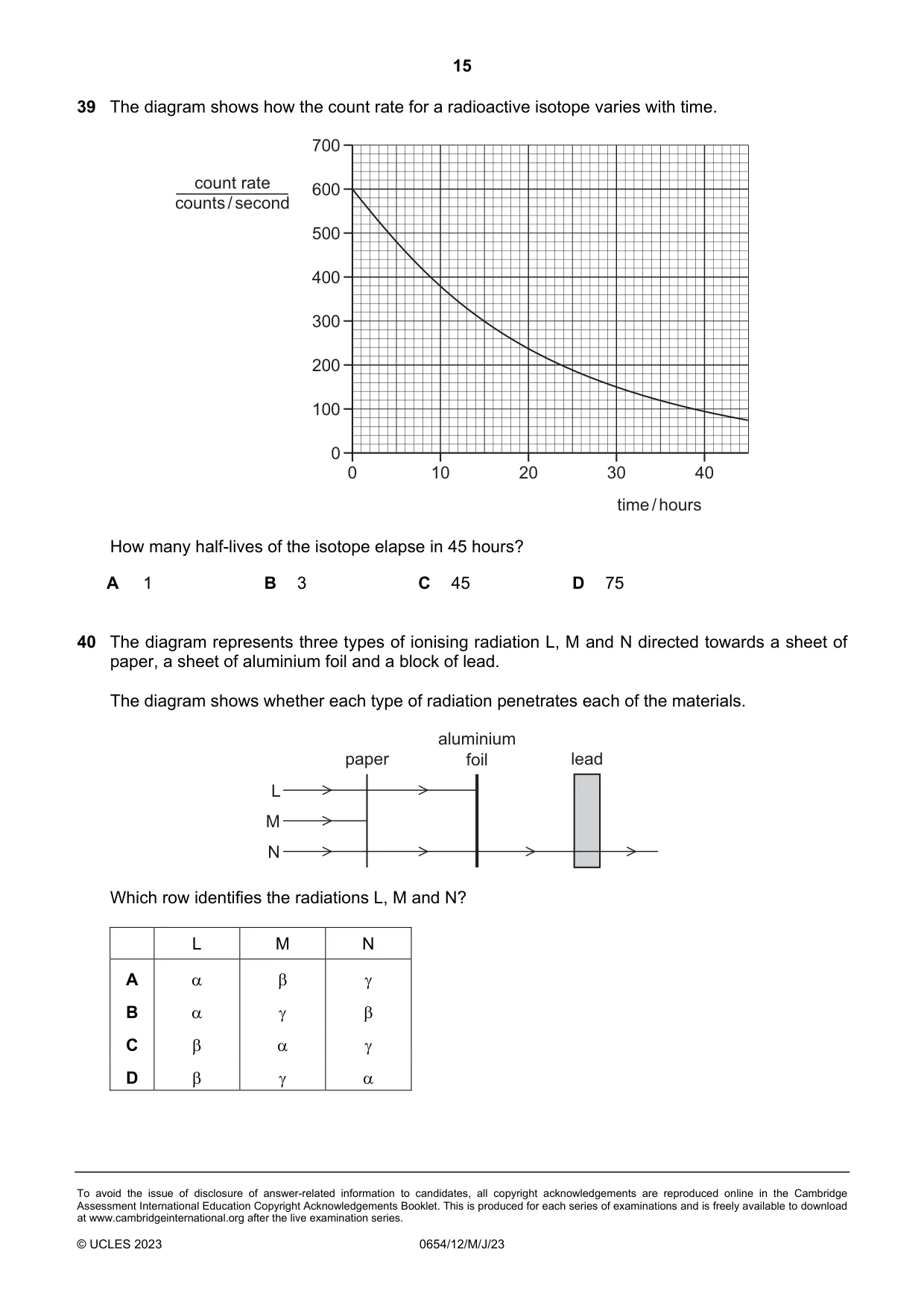
Q39 · The diagram shows how the count rate for a radioactive isotope varies with time
39 The diagram shows how the count rate for a radioactive isotope varies with time. 700 count rate 600 counts / second 500 400 300 200 100 0 0 10 20 30 40 time / hours How many half-lives of the isotope elapse in 45 hours? A 1 B 3 C 45 D 75
Mark scheme: B
Q40 · The diagram represents three types of ionising radiation L, M and N directed towards a…
40 The diagram represents three types of ionising radiation L, M and N directed towards a sheet of paper, a sheet of aluminium foil and a block of lead. The diagram shows whether each type of radiation penetrates each of the materials. aluminium paper foil lead L M N Which row identifies the radiations L, M and N? L M N A B C D
Mark scheme: C
What was in this paper
The subtopics covered by these 40 questions, and how many questions each got. Open one in a new tab to see every Cambridge question on it.
2Forces2Oxides2Radioactivity2Air quality and climate1Alcohols1Biological molecules1Cell structure1Characteristics of living organisms1Diet1Electrical circuits1Electrolysis1Energy, work and power1Enzymes1Exothermic and endothermic reactions1Food chains and food webs1Formulas1Fuels1General properties of waves1Habitat destruction1Homeostasis1Isotopes1Kinetic particle model of matter1Light1Photosynthesis1Physical and chemical changes1Redox1Respiration1Separation and purification1Sexual reproduction in plants1Simple phenomena of magnetism1Transfer of thermal energy1Transition elements1Transpiration1Variation1Water1What you needed in this session
Cambridge’s own grade thresholds for 2023 May/June, Paper 1 · Variant 2. A higher threshold means an easier paper — the bar moves with how the cohort did.